/


Author: Zafar Ishaq Ansari
Tags: quran



Text
                    Mm
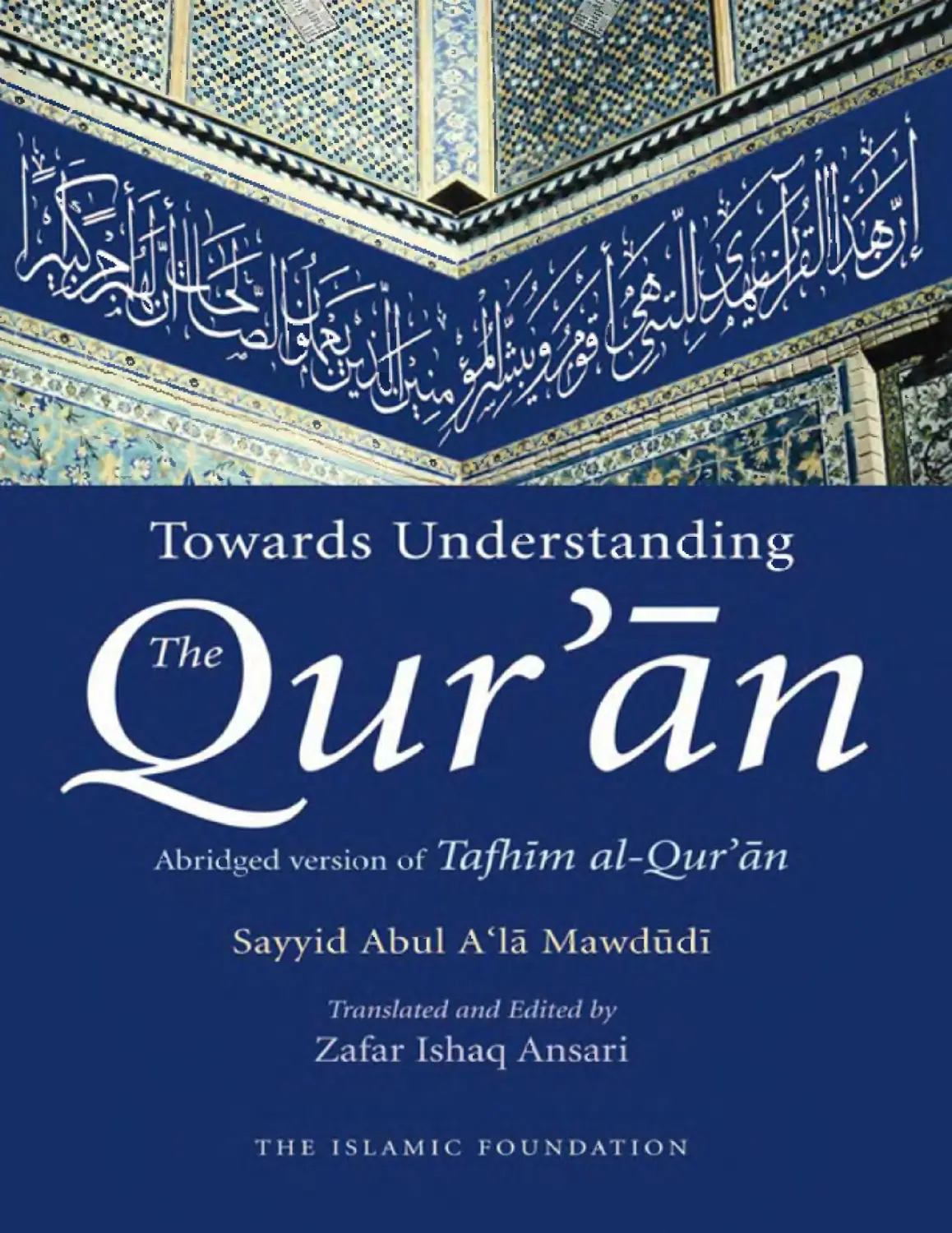
Towards Understandin
Abridged version of Tafhtm al-Qur'atl
Sayyid Afoul A'la Mawdudl
Translated and Edited by
Zaf&r Ishaq Ansari
Ml L ISLAMIC; I OUN 1 3 A I ION

Bismi Allahi Alrrahmani Alrraheemi
In the name of Allah, the most
Beneficent, the most Merciful

Towards Understanding
the Qur'an
Vol. I
SURAHS 1-3
English version of
Tafliim al-Qur'an
SAYYID ABUL A' LA MAWDUDI
Translated and edited by
Zafar Ishaq Ansari
The Islamic Foundation

© The Islamic Foundation (English version) 1988/1408/A.H.
ISBN 0 86037 183 2 (PB)
ISBN 0 86037 184 0 (KB)
All rights reserved. No part of this publication may be reproduced, stored in a retrieval
system, or transmitted in any form or by any means, electronic, mechanical, photocopying,
recording or otherwise, without the prior permission of the copyright owner.
Translated and edited by Zafar Ishaq Ansari
Cover illustration: Rashid Rahman
Published by:
The Islamic Foundation,
223 London Road,
Leicester LE2 1ZE, United Kingdom
British Library Cataloguing in Publication Data
Mawdudi, Sayyid Abul A'la
Towards understanding the Qur'an
Vol. 1
Islam. Koran-Critical studies
I. Title II. Ansari, Zafar Ishaq
III. Islamic Foundation IV. Tafhlm al-Qur'an. (English)
297'. 1226 ISBN 0-86037-184-0
ISBN 0-86037-183-2 Pbk.
iil jg^t ^X-VI J-jJJIj -U£ll tijjSj ^
won ji\tj\.»»\\t -~>-j* :«UJIi»l
Sole Distributor in the Middle East:
INTERNATIONAL ISLAMIC PUBLISHING HOUSE
1. 1. P. H.
PubNsNnQ An* Distributing Manas Book* And Tapaa In 70 Languaoaa
HEAD OFFICE: P.O.Box 53195 ■ Riyadh 1 1534 • Saudi Arabia
Tafc (M«-1) 4650610-464721J- Fix: 4633460
BOOK SHOPS: Riyadh 1 -4620347/ Jaddah 2 '6873752/ Khobaf 3-6045821

To
my father
Muhammad Zafar Ahmad Ansari
in love, gratitude, and respect.

Contents
Foreword - Khurshid Ahmad ix
Editor's Preface -Zafar Ishaq Ansari xix
Author's Preface - Sayyid Abul A'la Mawdudi 1
Introduction -Sayyid Abul A'la Mawdudi 7
Surah 1: AI-Fatihah (Makkan Period)
Introduction 33
Text and Explanatory Notes 35
Surah 2: AI-Baqarah (Madinan Period)
Introduction 39
Text and Explanatory Notes 45
Surah 3: Al 'Imran (Madinan Period)
Introduction 229
Text and Explanatory Notes 233
Glossary of Terms 311
Biographical Notes 319
Bibliography 327
Subject Index 329
General Index 365
MAPS
The Route of Prophet Abraham's Migration 108
Places of Hajj 160
The Battle of Uhud 283
v

TRANSLITERATION TABLE
Consonants. Arabic
initial: unexpressed
medial and final: 3
VJ.
d
k
<-J b
•
•
dh
U t
J
1
O t
r
?
f
m
Cj th
•
J
z
c
•
n
O"
s
h
C h
J 1
sh
<; f
w
£. kh
s
v
£/rdw and Persian the same
exceDt the following:
*— ' P
Jo
d
s.
J 1
& 1
J.
J
r
Vowels, diphthongs,
etc.
short:
a;
i;
u.
long: L — a
u C?-7-
i 6 ly
diphthongs:
1 — aw
(3~ — ay
vii

Foreword
Islam is unique by virtue of the fact that it is a religion based on
a Book - the Qur'an. In the same way that the Islamic Ummah,
whose identity and historical personality have been derived from
and fashioned by the Qur'an, is unique so is Muslim culture and
civilization. No influence has been greater than the Qur'an in
shaping the spirit and ethos of Muslim culture and civilization. If
we look at the long history of religions and civilizations, it may be
said, without reservation, that if ever there was a book that produced
a religion, a community, a culture and a civilization, it is the Qur'an.
For this reason, the origins and destiny of the Muslim Ummah rest
with the Qur'an.
It would be no exaggeration to suggest that Tafsir literature
mirrors Muslim religious and social thought at its best. The real
genius of the Muslim mind has expressed itself in its unceasing efforts
to understand and interpret the word of God as enshrined in the
Qur'an and as exemplified in the Sunnah of the Prophet (peace be
on him). And just as the Qur'an deals with all aspects of human
life, thought and behaviour, so Tafsir literature constitutes a
spectrum reflecting Muslim ideas in all areas of human thought and
behaviour. From eschatology and metaphysics to prayer and wor-
ship, from epistemology to individual conduct and social behaviour,
from social philosophy to the problems of familial and societal
organization, from theology to law and morality, from the most
sensitive aspects of motivation to the explicit problems of war and
peace, to justice and Ihsdn, to history and futurology. A meaningful
history of Muslim thought cannot be written without delving deep
into Tafsir literature. This is the reason why most of the histories
of Muslim thought, written either in the West or which have drawn
primarily upon sources other than Tafsir literature, have failed to
capture the richness and originality of Muslim contributions to
human thought and society.
ix

Towards Understanding the Qur'an
The Prophet Muhammad (peace be on him) was not only the
recipient of the Divine Revelation contained in the Qur'an; he was
also its most authentic interpreter and expounder. The Sunnah
represents the Qur'an in practice. It embodies and radiates the
model in both space and time.
The prophetic model is not only the realization of the ideal; it
also inaugurates a process through which those who have followed
in the footsteps of the Prophet throughout the ages have continued
to strive to understand, interpret, explain and implement the Word
of God. Succeeding generations strived to follow the model and
learn from the efforts of their predecessors. The text of the Qur'an
was preserved and protected in its totality; it was spared human
explanation. The translation of the Qur'an into other languages was
accepted as an aid to the understanding of the Qur'an, but it was
never accepted as a substitute for that text. A translation is a human
effort and constitutes a form of tafsir {bay an). Efforts were made
in every age to understand the meaning of the Qur'an and to discover
its teachings' relevance to the problems faced by the people in
particular situations. The eternal has continued to provide guidance
for the temporal in all times and climes. Similarly, efforts to
implement the teachings were made at both individual and collective
levels, and which did not lose sight of the specific problems of the
age. In facing these challenges, meticulous care was taken to see
that the Word of God and the Word of man remained distinct. Every
effort to understand the intent of the Master and its relevance to
changing situations remained a human effort, despite the fact that,
in the context of Islamic thought and literature, these represented
the best of the Muslim genius. Over a thousand tafsirs are available
in the Arabic language and a similar number in other Muslim
languages taken together. Fresh contributions have been made in
every age and from all areas of the Muslim world.
The science of Tafsir is a very specialized discipline. I make no
effort in this brief foreword to capture even the most distinct aspects
of its subject. Although it would be worthwhile to highlight at least
three areas of special concern.
First and foremost, I would like to make reference to the Muslim
scholars and savants who have strived to find the meaning to verses
of the Qur'an by reference to other verses of the Qur'an itself and
to the Sunnah of the Prophet Muhammad (peace be on him). These
efforts have been supplemented by attempts to find out how the
Companions of the Prophet understood different verses of the
Qur'an. While using the tools of lexicon - the Arab idiom and usage
at the time of the Prophet and the literary tradition which constituted
x

Foreword
the intellectual universe in which the Qur'an was revealed - their
real effort was to understand the meaning of the Qur'an in light of
the interpretation given by the Prophet, his Companions and the
early savants. In the typology of Tafsir, this is known as the tradition
of Tafsir al-Mathur.
The second area of concern I have chosen relates to the fiqhi
tafsir. The primary concern, in this context, was to find out the
commentary {Ahkdm) in relation to the different aspects of indi-
vidual and collective life and behaviour. This covered not only
whatever was available in the form of direct and explicit injunctions
but also what was derived by applying the principles of tafsir and
the inference of law (istinbdt al- Ahkdm). Efforts were made to apply
Qur'anic injunctions to new problems with the aim of deriving the
intent of law for situations not explicitly covered. As Qur'anic
guidance comprehends all aspects of life, this effort became all-em-
bracing. Fiqhi Tafasir lay its primary emphasis on spelling out
Qur'anic guidance on the multifarious aspects of human life, and
applies, in particular, general principles to actual problems and
infers the law for issues and areas not directly covered in the text.
The third major area of concern covers the wide spectrum of
tafasir written to highlight the wisdom contained in the Qur'an, the
rationale behind its beliefs as well as its commands, the vision of
the man and the society the Qur'an builds and how it differs from
the vision of man and society in other religions, ideologies and
philosophies. These tafasir also deal with objectives and criticisms
made against some of the teachings of the Qur'an. Efforts were also
made to show the relevance of the Qur'an to the problems of the
age and how these problems could be solved by recourse to the
Qur'an. This category is known as Kaldmi Tafsir.
Although these three perspectives are not exclusive, Qur'anic studies
have nevertheless progressed in every age as a result of them. Muslim
scholars, in their attempts to search out Qur'anic answers to the
challenges of their times have always tried to fathom Qur'anic depths.
Every age has its own outstanding contributions which testify to the
inner strength and vitality of the Islamic traditions. For example, the
latter half of the twentieth century will be remembered for two seminal
contributions to tafsir literature; namely Fi Zilal al-Qur an by Shahid
Sayyid Qutb and Tafhim al-Qur' an by Sayyid Abul A'la Mawdudi.
The Qur'an held a unique fascination for Sayyid Mawdudi. To
him it was not simply a sacred book which had to be believed in as
an article of faith. It was something more, something vitally different
and something very special. Let me spell out his relationship with
the Book in his own words.
xi

Towards Understanding the Qur'an
It was in 1946 that an interesting book appeared under the title
Mashdhir Ahl-e-'Ilm ki Muhsin Kitaben (Books that Moved the
Intellectual Luminaries, literally 'their Benefactor Books'). It was
an anthology of essays and memoirs written by over two dozen
top-ranking scholars and statesmen of the Indo-Pakistan subconti-
nent. Each one recapitulated and reflected upon the books that had
influenced him most. In this myriad galaxy, which highlighted
outstanding books from RumT's Mathnawl to the Tilism-e-Hushruba
(A Book of Magic and Fairy Tales) , the shortest yet the most moving
contribution was from Sayyid Mawdudi. He was alone in identifying
only one book, strangely enough the one not mentioned by any of
the other distinguished scholars; it was the Qur'an: T have studied
a large number of books, particularly in the days of my early gropings
in the dark (Jdhiliyah). It would not be an exaggeration to submit
that I have tried to imbibe quite a library - books dealing with
philosophy, old and new, science (natural and social), economics,
politics and what not. But when I studied the Qur'an with the eyes
of my soul it opened up a new world before me. The spell of all
that I had read in my age of gropings was cast asunder. Then only,
I realized that now I have had access to the roots of knowledge,
and the world of reality; Kant, Nietzsche, Hegel, Marx and other
secular thinkers began to look like pygmies. In fact, I began to pity
them, for they could not resolve issues, despite grappling with them
throughout their life and producing thereon huge volumes. This
Book has resolved these in a few words. This Book alone is my true
benefactor. It has changed me altogether. It has transformed the
animal in me into a human. It has conducted me from darkness into
light. It has endowed me with a beacon which illumines every dismal
corner of life into which I now venture to move. Now reality glows
before my eyes without any mask. The key that can open every
locked door is called a "master-key". So to me, the Qur'an
constitutes the master-key which resolves every problem of human
life. It has opened up for me glorious avenues of life and progress.
Words fail me to thank the Lord, Allah, subhdnahu wata'dld, Who
bestowed upon us this Blessed Book.'
The Qur'an is the key to Sayyid MawdudT's life and mission. In
his view, where the Muslims have failed is in the weakening or
pollution of their relationship with the Qur'an. It was the Qur'an
that made them masters of the world. It is the Qur'an which can
once again set their house in order and enable them to win back
their rightful place in the world.
It is significant that the journal through which Sayyid Mawdudi
launched his intellectual crusade was called Tarjumdn al- Qur'an
xii

Foreword
(Spokesman of the Qur'an). And when the Islamic Movement of
the Jamd'at-i-Islami was formally launched, in August 1941, he
devoted most of his energies to writing the Tafhim al-Qur'dn so that
this movement would imbibe the message of the Qur'an and engage
in the struggle to establish the world order that the Qur'an wants
to establish. That is why Tafhim al-Quran occupies a very central
position in Sayyid Mawdudl's strategy for Islamic revolution.
Sayyid Mawdudi is one of the chief architects of contemporary
Islamic resurgence. He was a prolific writer. He authored more than
150 books and treatises on different aspects of Islam, ranging from
al-Jihdd fi al-Islam to the Manifesto of the Jamd'at-i-Isldmi. His
magnum opus, however, remains the Tafhim al-Qur'dn, his trans-
lation and tafsir (exegesis) of the Qur'an. This alone epitomizes his
elegant literary style, his vast erudition, the clarity and brilliance of
his thought and the candour of his commitment to change the world
in the image of the Qur'an. It was in the maturity of his youth, in
February 1942, at the age of thirty-nine, that he began the writing
of this tafsir; it was not until May 1973, when his hair had run white
and he had sought retirement from the active leadership of the
Jamd'at, that he completed the work. Tafhim al-Qur'dn is the
choicest product of a lifetime - a life dedicated to the glory of the
Lord, a life engaged in honest intellectual inquiry, in robust
scholarship, in all round Jihad to establish the supremacy of the
truth as revealed by Allah and as practised by His prophet. Tafhim
al-Qur'dn has been published in six volumes. The first volume
appeared in 1950, when Sayyid Mawdudi was in prison, and the last
one appeared in 1973.
The Tafhim al-Qur'dn is the most widely read tafsir in our times .
Tafhim is a unique contribution to contemporary tafsir literature.
For this reason, some of its distinct contributions deserve to be
highlighted.
The uniqueness of Tafhim lies in the fact that it looks upon the
Qur'an as a book of guidance {hiddyah). There is no denying that
the Qur'an does deal with aspects of history, geography, socio-
economic relations, natural phenomena, etc., but it is not primarily
concerned with any of these subject areas. It is a masterpiece of
higher literature, but it is not meant to be used as a mere piece of
literature. As such, the Qur'an has been approached as the main-
spring for guidance, destined to play a decisive role in the reconstruc-
tion of thought and action, of institutions and society; as was the
case when it was revealed to the Prophet Muhammad (peace be on
him). The function of Tafhim is not to dwell primarily or mainly
on literary beauties and legalistic niceties - which have not been
xiii

Towards Understanding the Qur'an
ignored - but to develop an understanding of the Qur'an as the
source of guidance.
Sayyid Mawdudi also emphasizes that the Qur'an is a book of a
movement. It presents a message, invites the whole human race to
a view of reality and society, organizes those who respond to this
call into an ideological community and enjoins upon this community
the necessity to strive for the socio-moral reconstruction of humanity,
both individually and collectively. The Qur'an wants to produce a
universal ideological movement and constitutes a guide-book for
this movement. Much of the Qur'an cannot be properly understood
unless it is studied in the context of this framework. The Prophet
was assigned to play a historical role as the leader of this Islamic
movement. The Qur'an was revealed to him piecemeal during the
twenty-three years of his prophetic career, guiding his steps through-
out his struggle. This guaranteed guidance has a particular, as well
as a general and universal, aspect. In its particular aspect, this entire
milieu provides an illustration of the movement and change which
the Qur'an wants to bring about. In its general and universal aspect,
the Qur'an abstracts from the specific time-space context and
presents the model which can and should be applied in different
time-space situations. Sayyid Mawdudi approached the Qur'an as
the guide-book for this movement of Islamic reconstruction. As
such, the internal evidence of the Qur'an, revealing as it does
different aspects and situations of this Da'wah and movement, the
Sunnah of the Prophet and of his Companions and the evidence on
Asbdb al-Tanzil, assumes great significance in his understanding of
the Qur'an.
The Qur'an presents a complete way of life - a code of conduct
and a scheme for organizing the total gamut of human life - belief,
action and society. It does not divide itself into water-tight material
and spiritual, this-worldly and that-worldly, compartments. It creates
only one supreme loyalty - to Allah and His prophet; and tries to
organize the whole fabric of human life on this basis. Sayyid
Mawdudi suggests that the key concepts of the Qur'an are Ilah,
Rabb, 'Ibadah and al-Din. The Qur'an invites man to accept the
Creator as Rabb, the Sustainer and Sovereign, to harmonize his will
with the Will of Allah in all its aspects ('ibadah) and to establish
the Will of Allah over the totality of life (din). This is the path
through which man can seek the fulfilment of his real nature. This
is the approach that the Tafhim has expounded.
In his unique style, Sayyid Mawdudi emphasizes that the key to
the understanding of the Qur'an lies in its style and methodology.
These are distinct and unique - suited to its purpose and mission -
xiv

Foreword
and consequently do not fit any framework developed by human
scholarship. Its purpose is Hiddyah (guidance). It addresses itself
to man Its target is to develop a new consciousness of reality and
to generate a new social movement to establish a new culture and
civilization. To achieve this objective, it has adopted a direct>nd
straightforward method of heart-to-heart conversation between God
and man. Its style is that of brief and precise Khutubat addressed
by God to man but containing all the elements of a meaningful
dialogue between the two. Individually, every ayah of the Qur'an
serves this purpose, and in the context in which it occurs. Sayyid
Mawdudi develops a new concept of the (Nazm) system and
sequence within the Qur'an. Earlier Mufassirun have tried to
elaborate on the relationship between the different surahs of the
Qur'an. Some have studied Nazm within every surah. Sayyid
Mawdudi attempted to study the Nazm of the whole of the Qur'an
and of each surah, and the relationship between different surahs
and between verses within the surah in light of the overall objectives
of the Qur'an, and has shown how they are woven together into
one glorious pattern. The apparent diversity is permeated with a
purposive unity. To Mawdudi, the style and methodology of the
Qur'an are not secondary to its purpose, rather they are its essential
instruments. Instead of presenting an apology for the methodology
of the Qur'an or trying to justify it logically or rhetorically, he has
presented this methodology of the Qur'an as a unique and essential
key to the understanding of the message and mission of the Qur'an .
These propositions form the framework in which Sayyid Mawdudi
tried to study the Qur'an. He has written a Muqaddimah, pro-
legomena, to the Tafhim al-Qur'an, wherein he has discussed his
approach to the study of the Qur'an and the principles of interpre-
tation he has followed, and a treatise on the key concepts of the
Qur'an: Hah, Rabb, 'lbddah and al-Din. Every surah has been
prefaced by an introduction giving the subject matter of the surah,
its relevance to the overall scheme of the Qur'an, its historical setting
and a summary of the questions and issues discussed in it.
The Tafhim offers a new translation of the Qur'an which is neither
literal nor liberal. It is an interpretative translation in direct, forceful
and modern Urdu. In the first place, this translation conveys the
meaning of the Qur'an in a forceful style nearest to the spirit of the
original. Secondly, it renders the spoken word of the Arabic into
the written word of Urdu. With this translation, Sayyid Mawdudi
has tried to provide for the ordinary Urdu reader an almost direct
access to the Qur'an.
Another distinctive aspect of this translation is the use of para-
xv

Towards Understanding the Qur'an
graphs. In the text of the Qur'an, there are no paragraphs. The
division of the Qur'an into Manzil, Juz' and Ruku' is only for the
convenience of recitation. They are not meaningful divisions. The
introduction of paragraphing in translation is a major innovation
and to the best of my knowledge, Sayyid MawdudI has been the
first scholar to do so in Urdu, and perhaps in any language of the
world.
The translation is followed by explanatory notes elaborating the
meaning of the Qur'an, giving historical and other information
wherever necessary, pin-pointing the relevance of a verse to the
message and spirit of the Qur'an and the needs of the Islamic
movement, explaining the hikmah (rationale) behind different
injunctions and their import for our own times. Through these notes,
Sayyid Mawdudi has tried to develop a new 'Urn al-Kalam based
upon the Qur'an and utilizing the developments of modern know-
ledge, the principles of historical criticism, comparative religion and
ideologies. In using the methodology of the Qur'an to develop a
new 'Urn al-Kalam Mawdudi has added grist to his mill. His effort
is to use these notes as an aid to the understanding of the Qur'an
and to dispel doubts and difficulties which a modern-educated
Muslim may face in his efforts to study the Qur'an. He has been
only too eager to avoid any issues which may distract the reader's
attention from the word of the Qur'an. The notes are functional
and not just ornamental.
He has also used these notes to delineate and elaborate the broad
outlines of the total scheme of life adumbrated in the Qur'an and
to suggest how this can be translated into the reality of the present
time.
While dealing with the Ahkdm, he has avoided sectarian con-
troversies. Although he generally follows the Hanafi school, he has
usually in his explanatory notes stated the viewpoint of all major
schools of Islamic thought, including that of the Shi' ah. This helps
the reader appreciate how a certain verse has been explained or
approached by scholars belonging to different schools. It also
identifies the flexibility of Islamic law, and paves the way for bridging
the gap between the different schools of thought. In so doing, it
lays the foundations for an ecumenical movement within Islam.'
In his exegesis, Sayyid Mawdudi tries not only to capture the
original meaning and impact of the Qur'an but also to throw light
on the model that emerges from that, as a guide for the present and
for the future.
Another distinct feature of the Tafhim al-Qur'an is its index.
Running into some three hundred pages it is, perhaps, the most
xvi

Foreword
elaborate and exhaustive concordance of the Qur'an. It deals with
the concepts, themes, personalities and events in the Qur'an and is
an extremely useful aid to any researcher.
Tafhim al-Qur'an is a major contribution to Tafsir literature. It
is difficult to measure it with the yardsticks of modernism or
traditionalism. It may, more correctly, be described as revivalist and
revolutionary. Its emphasis is on movement, activism and dynamism,
without taking liberties with the Word of God or equating the
concepts of the Qur'an with the thought-content of modern
ideologies. It is permeated with respect for tradition in thought and
practice without completely identifying the Qur'an with the institu-
tional structures produced by the Muslims during the course of
history. It is a plea for purposive change and tries to develop the
faculty to discriminate between the essential and the incidental,
between the divine, and as such permanent, and the human, and as
such changeable. The Tafhim al-Qur'an is, itself, a human effort
and is subject to all the possibilities and limitations of the human
effort to understand and explain the Divine Word. It has its own
contemporary flavour and this constitutes its merit as well as its
limitation.
The need to produce a complete translation of the Tafhim in the
English language has been felt ever since its publication in Urdu.
To fulfil this need, Islamic Publications, Lahore has published an
English translation of the Tafhim. Although this rendered a useful
service, it was commonly realized that the translation could not
capture the real force and elegance of the Tafhim al-Qur'an, which
is not only a masterpiece of scholarship, but also a rare piece of
literary excellence. The text of the Qur'an, as translated in Urdu
by Sayyid Mawdudi, could not be effectively reproduced in the
English translation. Explanatory notes were abridged in a number
of places. Editorial language standards and the physical production
of the book left much to be desired. Sayyid Mawdudi realized these
limitations and wanted a new and more forceful translation of the
Tafhim al-Qur'an in modern English and was eager that the same
be printed to professional and international standards. It was with
this ambition that the late Chaudhri Ghulam Muhammad and the
present writer discussed with Sayyid Mawdudi the plan for a new
translation of the Tafhim. We all agreed that Dr. Zafar Ishaq Ansari
would be the most competent person to undertake this onerous task.
His command of Arabic, Urdu and English and his deep understand-
ing and insight into the thought and style of Sayyid Mawdudi
qualified him for the job. It was in deference to the wish of Sayyid
Mawdudi that Chaudhri Ghulam Muhammad and I persuaded Dr.
xvii

Towards Understanding the Qur'an
Zafar Ishaq Ansari to commit himself to this assignment, a respon-
sibility that he shouldered with some reluctance. It is unfortunate
that both Sayyid Mawdudi and Chaudhri Ghulam Muhammad are
no longer with us to see the fruit of Dr. Ansari's heroic effort to
recreate the Tafhim in English. Their souls would, however, be
happy to see that their dream is now coming true.
The Islamic Foundation is publishing this new translation in
fulfilment of the command of Sayyid Mawdudi, with the co-operation
of his family, and with the permission of the Idara Tarjumanul
Qur'an which holds the copyright of the original. The Foundation
has established a permanent cell to prepare and oversee the
production of the Tafhim al-Qur'dn in the English language. We
have tried to achieve the highest standards of accuracy, literary
elegance and aesthetic production. The first volume contains the
Muqaddimah and tafsir of Surah al-Fatihah, al-Baqarah and Al
'Imrdn. The second volume, to appear shortly, will go upto Surah
al-A'raf. The translation of the entire Urdu Tafhim is expected to
be completed in twelve to fifteen volumes of almost equal size. It
is hoped that at least one volume will appear every year. May Allah
enable us to achieve this target and may Allah make this translation
as instrumental in spreading the message and mission of the Qur'an
all over the world as He has blessed the Urdu Tafhim to rekindle
the spark of faith in the lives of hundreds of thousands of people
and committed them to the Islamic mission. And may Allah give
the best rewards to all those who have been engaged or who have
been helpful in producing this English version of the Tafhim
al-Qufan.
Leicester Khurshid Ahmad
9 Jumada al-Tham, 1408
23 January, 1988
xviii

Editor's Preface
The present work is a fresh English rendering of Tafhim al-Qur'dn
- a translation of, and commentary on, the Qur'an by this century's
most extensively read and influential Muslim scholar, Sayyid Abul
A'la Mawdudi (1903-1979). Though he was born, and lived through-
out his life, in the South Asian subcontinent, Mawdudi's writings
attracted Muslims across the globe and contributed greatly to that
complex of feeling, consciousness, and activity which has lately come
to be characterized, mainly by the outside world, as 'Islamic re-
surgence'.
Mawdudi was uniquely gifted for the task he undertook - a sys-
tematic exposition of the teachings of Islam. To help him fulfil that
task he possessed a clear and penetrating mind as well as a felicitous
and vigorous pen. Not only that, he had also been engaged since
his early years in an extensive and unusually intelligent study of
Islam. Also, thanks to his knowledge of English and his broad intel-
lectual curiosity, he had easy access to the fount of Western learning.
Moreover, far from being an intellectual recluse, Mawdudi had a
keen awareness of the problems of the time in which he lived, a fair
grasp of the 'spirit of the age'. When all these qualities are taken
into account, alongside Mawdudi's redoubtable ability to organize
and present his material systematically and vigorously and marshal
his arguments in a highly ordered and logical fashion, it is not difficult
to appreciate why his writings should have had such a great impact
on his readers.
As a writer, Mawdudi was both prolific and versatile. His works,
which number around 150, and range from small tracts to voluminous
books, encompass virtually every aspect of Islam. These works were
generally well received, especially his exposition of the socio-
economic and political doctrines of Islam that won for him consid-
erable acclaim. Likewise, he distinguished himself by arguing and
forcefully establishing that the principles prescribed by Islam
were intrinsically sound, that they were relevant for, and viable in,
xix

Towards Understanding the Qur'an
every age and clime, that they were conducive to the overall
well-being of man. In addition, Mawdudi also contributed to the
traditionally recognized fields of Islamic scholarship such as Hadith,
Fiqh and 7/m al-Kalam. However, the Qur'an held for him a very
special, and one might say, incomparable fascination. He relished
the Book of God beyond measure and never ceased to look up to
it at every turn of his life for light, guidance and inspiration. In his
view, the Qur'an was not to be approached merely for barakah
(blessing); it should serve as the sheet-anchor of every Muslim's life.
It should be his main source of inspiration, the driving and guiding
force of all his activities. The Muslim should let the Qur'an shape
his intellectual outlook, mould his character and conduct, and
provide the yardstick with which to judge all things. Mawdudi once
described the Qur'an as the 'master-key' which had solved for him
all his intellectual problems, had removed all his perplexities. It is
perhaps significant that the monthly magazine which he chose to
edit and through which he articulated his ideas for forty-six years
(1933-79) bore the apellation Tarjumdn al-Qur'dn (The Interpreter
of the Qur'an).
It was in the early forties, however, that Mawdudi decided to
launch upon a full-scale work on the Qur'an consisting of an
interpretative translation of the Qur'anic text accompanied by
explanatory notes. Instalments of the work, which Mawdudi chose
to call Tafliim al-Qur'dn, appeared every month in the aforemen-
tioned magazine. It took more than thirty years for the work to be
completed, a huge work of six volumes, each of approximately 700
large-size pages.
When Mawdudi embarked on the work, he had a relatively modest
aim in mind. He primarily felt uneasy with the lifeless translations
of the Qur'an in Urdu and felt the need to produce an elegant,
readable, and free-flowing translation that would reflect in Urdu
prose something of the literary force and fluency of the Qur'an. As
for the explanatory notes, it was conceived that they would be
confined to explaining only the basic teachings of the Qur'an without
attempting to deal with the more detailed and technical matters
which are generally covered in the standard works of Tafsir. The
underlying reason for this was that in Mawdudi's conception Tafhim
was addressed to the layman rather than to the scholar.
But as Mawdudi went along, his vision of Tafhim al-Qur'dn
underwent a major change. After a few years, the purely scholarly
aspects of Qur'anic exegesis increasingly engaged his attention and
his notes became more and more copious. From this point onwards
xx

Editor's Preface
Tafhim began to attract people not merely because of the author's
ability to apply the relevance of Islamic teachings to the problems
of the present age, or because of a relatively greater emphasis on
the socio-economic and political aspects of Islam in his writings. It
began to be valued also for the research and scholarship of the
author, of which the work was a good testimony.
Even before the first volume of Tafhim al-Qur'an (covering the
first six Surahs of the Qur'an) was published in 1950, the work had
already attracted the interest and won the admiration of a wide circle
of readers, both laymen and scholars. The work was particularly
useful for those who, because of the generally difficult and somewhat
archaic language and style of the translations and Tafsir works
available to Urdu readers, were often discouraged from embarking
on a serious study of the Qur'an. Tafhim, on the other hand, was
characterized by a simple and forceful style apart from having a
certain freshness of approach. It indeed attempted to achieve what
its title - Tafhim - signified, viz. to help the reader understand the
meaning and message of the Qur'an. What is more, in attempting
to do so, the author had especially kept in view those aspects of the
Qur'an which the contemporary reader needs most to understand,
and relates them to the problems which often agitate his mind. It
was in the same context that Mawdudi also tried to highlight in
Tafhim that the teachings of the Qur'an were equally relevant for
the men and women of today as they had been for those of bygone
ages. All these features have helped many a reader to appreciate,
and experience, that the Qur'arvwas addressed directly to him, that
it had something important to say to him as a person. Thus Tafhim
has led countless people to approach the Qur'an directly and seek
the riches of meaning and inspiration from its vast, boundless
treasure-house. Turning people directly to the Qur'an for light and
guidance is perhaps the most significant contribution of the work.
I felt greatly honoured when I was asked to render this important
work into English. It was, however, with considerable diffidence
that I accepted the undertaking. For the book that I had to deal
with contained the Word of God, the 'weighty word', the Book
which, had God sent it down 'on a mountain, you would certainly
have seen it falling down, splitting asunder for fear of Allah' (59:
21). I was, then, as I am now, acutely conscious that my endowments
- scholastic, intellectual and literary - are quite limited. I have thus
often felt that with those limitations, it was indeed an act of boldness
to accept such a stupendous responsibility. I was encouraged,
however, by the fact that Sayyid Abul A'la Mawdudi himself
xxi

Towards Understanding the Qur'an
considered me worthy of the task and sent word to that effect.
Obviously I had no choice.
For a host of reasons my task was far from an easy one. Translation
from one language into another is always difficult, and especially so
when the material to be translated consists of matters that require
both accuracy and subtlety of expression. In this particular case, the
task was rendered even more difficult by the fact that the two
languages in question belong to two different cultural and intellectual
traditions. These factors were in addition to the erstwhile dilemma
of every translator: to what extent he should remain close to the
original text and to what extent he should exercise some liberty in
departing from it - even with circumspection - in the interest of
making the translated text read better and possess the characteristic
flavour of the translated language.
I naturally attempted to combine, as perhaps most translators
would do, the two opposing considerations. In order to achieve this,
I tried to keep my first draft as close to the text as possible, trying
to retain as much as I could of the original, even the sequence of
words and phrases. This draft served as the base, and it was subjected
to a series of drastic revisions in order to make it readable in terms
of the accepted idiom and style of English. Even so, I made an
effort to retain something of the flavour of the Urdu literary prose,
and especially of the characteristic style of Mawdudl.
In order to enhance the usefulness of the work, especially for
those readers of English whose needs are different from those of a
lay reader in Urdu for whom this book was originally intended, I
have added a number of features.
For instance, in the original work a number of statements seemed
to require documentation, yet, for good, understandable reasons
they had not been documented by the author. Therefore, an attempt
has been made in this work to provide adequate documentation
wherever this documentation seemed necessary. Also, wherever
there are quotations in Tafhim from English sources - and they are,
of course, Urdu translations of the original - I have gone back to
the original sources, located the passages in the quoted works and
incorporated them in the present work.
Documentation of Hadith proved to be particularly difficult and
consumed an enormous amount of time. For referencing, I have
adopted the system followed by A. J. Wensinck in his A Handbook
of Early Muhammadan Tradition, Leiden, 1927, and later in his
famous Concordance. The references to various Tafsir works in the
notes signify the numbers of the Surahs and verses in question rather
xxii

Editor's Preface
than the volumes and pages of the Tafsir works concerned. This has
been uniformly followed except in one or two cases where the note
referred to was too lengthy and hence it was found necessary to also
indicate the volume and page. All quotations from the Bible have
been taken from the Revised Standard Edition (for details of which,
see the Bibliography).
In order to help the lay English reader - who needs more
information on certain basic features of Islam and its history than
an average Urdu reader - a few more additions were considered
necessary. A Glossary of Terms has been included to explain some
of the major terms that have been used. Likewise, Biographical
Notes have been added to give at least some basic information
regarding the persons whose names occur in the text. Also, in
addition to the Subject Index (which is a translation of the Index
prepared by the author of Tafhim), a General Index has been added.
A Bibliography of the books referred to in the work has also been
provided. Finally, a few - very few - notes have been added at
places where elucidation seemed necessary.
Additions made by the editor have been kept to a minimum and
wherever they appear it has been indicated that they are from the
editor.
It took me quite a long time to prepare the manuscript of the
present work, and then a number of reasons caused considerable
delay in bringing it to the light of day. During the course of these
years, I have received assistance and encouragement from a large
number of people. To all of them I owe a debt of gratitude and here
at least a few, if not all, must be mentioned.
The greatest encouragement, of course, came from the late Sayyid
Abul A'la Mawdudi who honoured me immensely by reposing his
trust in me as one suited for the task of rendering Tafhim into
English. It is a matter of great sorrow for me that when the first
volume of this work is appearing in print, he is no longer in our
midst. May Allah reward him with eternal peace.
Likewise, I received much encouragement from the late Chaudhri
Ghulam Muhammad and my life-long friend, Professor Khurshid
Ahmad, both of whom urged me to apply myself to a task whose
stupendousness made me shrink.
The first draft was seen by several friends, of whom I must
especially mention my close friend Dr. Ali Kettani, presently
Director General, Islamic Foundation for Science, Technology and
Development, Jeddah, who read a part of it and favoured me with
his comments. There are three persons, however, from whose
xxiii

Towards Understanding the Qur'an
editorial suggestions I benefited the most: Mr. Muhtar Holland, Mr.
P. Moorman and Miss S. Thackray. Dr. Muhammad Ibrahim H. I.
Surty of the Islamic Foundation, Leicester not only provided
editorial assistance but also saw the work through the final processes
of publication with meticulous care. I would also like to thank Dr.
M. M. Ahsan, Director General of the Islamic Foundation and Mr.
E. R. Fox for their valuable assistance. Dr. Muhammad Sa'id and
his colleagues at the University of Peshawar and Mr. Anwarul Haq
of ACE Lahore rendered valuable cartographic assistance in prepar-
ing the maps, in the light of the original sketches drawn by the
author. Let me also record my gratitude to my friend Mr. Faiyazud-
din Ahmad whose hospitality during my stay in Leicester has left
indelible memories. Mrs. Barratt, the tireless secretary of the Islamic
Foundation, has put me under considerable obligation by typing the
manuscript over and over again.
In the preparation of the Subject Index the main work was done
by my friend, Syed Zaheer Iqbal, and in the preparation of the
General Index, I received much assistance from my niece, Aishah
and her husband, Mawlana Yusuf Talal Ali. Mr. Ahmad Ashfaq, a
long-time frienjff ; and colleague at the University of Petroleum and
Minerals, Dh&hr&n provided much assistance in referencing a large
number of traditions. Professor Mahmood Ahmad Ghazi, an emi-
nent scholar and Director, Shah Faisal Masjid Islamic Centre,
Islamabad helped me by tracing some intractable material needed
in connection with the Biographical Notes.
During my long stay in Saudi Arabia (1967-1986) and my
association with the University of Petroleum and Minerals, Dhahran
(1970-1986), I was encouraged by the interest shown in my work
by several people. Of these special mention must be made of Dr.
Bakr Abdullah Bakr and Dr. Fahd Hamid Dakhil, respectively
Rector and Vice-Rector of King Fahd University of Petroleum and
Minerals, Dhahran and several friends, especially Dr. Ahmad
Totonji, Mr. Daud Mathews and Dr. Muhammad al-Jar-AIlah.
My father once kindly looked at the manuscript and the few critical
comments and suggestions that he made only showed how much his
son could learn from him.
Mr. Khurram Jah Murad's devotion to Islam and especially his
ardent love for the Qur'an have been a continuing source of inspiration
during our very close, life-long friendship - an inspiration which words
definitely fail to describe. I have no doubt that had he condescended to
review the manuscript of this work critically, the touch of his pen would
have turned it - as everything else that it touches - into pure , solid gold .
xxiv

Editor's Preface
During the course of this work, my wife and children kept my
moral high by cheerfully bearing my involvement in a work which
occasionally prevented me from giving them their due time and
attention, and by their occasional expression of pride in a task that
hopefully constitutes some service - however modest - to promote
a better and fuller understanding of the Book of Allah.
To these, and to many others who assisted and encouraged me
in this task - and these are too numerous to mention individually -
I record my profound sense of gratitude. May Allah bless them all.
Islamabad,
19 Dhu al-Qa'dah, 1407 A.H.
17 July, 1987
Zafar Ishaq Ansari
XXV

Author's Preface
When so many translations of, and commentaries on, the Holy
Qur'an already exist, a desire for spiritual blessing and grace is not
in itself sufficient justification for undertaking a fresh venture in this
field. The effort will only be worthwhile if it fills gaps left by earlier
works, or satisfies some unmet need felt by those interested in
studying the Holy Book.
The present work is neither directed at scholars and researchers,
nor is it aimed at assisting those who, having mastered the Arabic
language and the Islamic religious sciences, now wish to embark
upon a thorough and elaborate study of the Qur'an. Such people
already have plenty of material at their disposal. Instead it is
intended for the lay reader, the average educated person, who is
not well-versed in Arabic and so is unable to make full use of the
vast treasures to be found in classical works on the Qur'an. For this
reason many subjects prominent in the more technical works of
Qur'anic exegesis have not been treated. The principal aims through-
out have been to help the reader to acquire a clear grasp of the
Qur'an, to clarify ambiguities which he may encounter in his study,
and to solve problems which may arise in his mind. It is for the
reader to judge how far these aims have been achieved.
Literal translation has been abandoned in favour of a relatively
free interpretative rendering of the Qur'an. This does not imply any
objection to literal translation as such. Several distinguished scholars
have already used this approach admirably. For example, the
translation of Shah Wall Allah in Persian and the translations of
Shah 'Abd al-Qadir, Shah Rafi' al-Din, Mawlana Mahmud al-Hasan,
Mawlana Ashraf 'All and Hafiz Fath Muhammad Jalandhari in
Urdu. For this reason little useful remains to be done in this sphere.
There are, however, certain needs which are not, and cannot, be
met by a literal translation and it is to these that this work seeks to
respond.
Literal translations of the Qur'an tend inevitably to lack literary
1

Towards Understanding the Qur'an
force, fluency, eloquence and stylistic charm. Such lifelessness is
incapable of either arousing the reader to ecstasy, stirring his being,
making his eyes flow with tears, or raising a storm of emotion within
his soul. Literal translations often leave one doubting whether the
original book could indeed have been that which challenged the
whole world to produce another like it. What filters through is
merely the dry husk of its contents, stripped of all literary enchant-
ment. The violent, soul-shaking spirit which permeates the original
text is thus evaporated into thin air. This is a serious drawback, for
the literary force of the Qur'an plays possibly as important a role
in conveying its message as the teachings themselves. It was the
literary quality of the Qur'an - a quality acknowledged even by its
opponents - which first melted the hearts of its opponents, and
shook the length and breadth of Arabia like a thunderbolt.
Another reason why literal translations fail to inspire the reader
is the manner is which they are set for printing. Either the interlinear
style is followed or, according to a more recent fashion, a page is
bisected and the Quranic text is printed on one half of the page,
with the translation on the other half. This practice certainly has its
uses, but its drawback is that the reader, being unable to read
passages with continuity, often fails to receive their full impact as
chunks of Arabic constantly interrupt the flow of his reading.
Most English translations of the Qur'an make particularly lifeless
reading because, following the Biblical pattern, the translation of
each verse is numbered, and begins on a new line. Take any piece
of great literature, break it into fragments, put one sentence over
another, give each one a number, and then try to read it. It will
soon become obvious that the impact is nothing like that created by
reading a coherent and continuous text.
A further important reason why literal translations of the Qur'an
tend to be ineffective is that the Qur'anic style is oratorical rather
than narrative. If the translator retains the original oratorical style,
rather than replacing it with straightforward prose, passages are
bound to appear somewhat incoherent. It is well known that the
Qur'an was not originally revealed as a set of written treatises. What
actually happened was that various discourses were revealed to the
Prophet (peace be on him) in the context of the circumstances and
problems which he encountered in the course of his mission, and
these he delivered to the people in spoken form.
Oral language and style naturally differ greatly from written
composition. For example, suppose a person were to write something
to clarify a misunderstanding. He would first have to refer explicitly
to the misunderstanding, then say things which might clarify it. But
2

Author's Preface
a man delivering a speech for the purpose of clarifying that same
misunderstanding would not need to make specific reference to it,
for his audience would consist largely of the very people concerned .
Again, an orator may often switch from one grammatical person
to another, while referring both to himself and to his audience. He
will sometimes mention his audience in the third person, while at
other times address them directly in the second. He may similarly
alternate between the singular and the plural. He will sometimes
speak on his own behalf, and sometimes on behalf of a group of
people. At other times he will speak as if representing some power
on high, and on yet other occasions that power will speak through
his tongue. This undoubtedly makes speech more effective, but when
that speech appears in book form, an element of incoherence is
bound to be noticeable; the farther one is removed from the original
context and environment the greater the sense of incoherence.
This explains why people who do not fully appreciate this fact
and, despite their knowledge of Arabic, complain of a lack of
coherence between various parts of the Qur'an. Since the Qur'an
is literally the Word of God, it would obviously be sacrilegious to
add a single syllable to the original text, even with the intention of
enabling the reader to have a better perception of its inner
coherence. Hence the only service that Qur'anic scholars can render
to Arabic-knowing readers is to provide explanatory notes wherever
needed. However, when we attempt to convey the meaning of the
Qur'an in another language, it seems justifiable to take a little liberty
- though exercising the utmost care and circumspection - and replace
the oral by the written style, thereby easing the problem of those
who have difficulty in perceiving its inner coherence.
As already pointed out, every surah of the Qur'an is in fact a
segment of speech, revealed at a certain stage of the Islamic
movement. Each revelation was occasioned by the demands of
certain circumstances, and had certain purposes to fulfil. Every surah
is so vitally linked with its situational background and its circumstan-
tial setting that anyone reading a mere verbal translation, divorced
from its context, would fail to appreciate many of the points being
made. It therefore also seems reasonable to occasionally add a few
words in such a way that the translated text reflects the situational
context, even if only to a very limited extent, and thus renders the
passages more comprehensive and more meaningful to the reader.
A final problem with literal translations is that even though the
Qur'an was revealed in 'clear Arabic' (Qur'an 6: 2), it also has its
own special terminology. It often uses words with meanings other
than their literal ones and this in itself may give rise to many
3

Towards Understanding the Qur'an
ambiguities. Take, for instance, the word "kuff, which in the
Qur'anic usage has a different meaning not only from its ordinary
Arabic linguistic usage, but also from its terminological connotation
in the works of later theologians and jurists. In addition the word
is not used uniformly in the same sense throughout the Qur'an.
Sometimes it denotes a state of absolute lack of faith and sometimes
it signifies merely rejection or denial. At other times, it is used for
an attitude of ingratitude and thanklessness. It is also used to denote
non-fulfilment of certain requirements of faith. Yet again, it is used
in the sense that, despite the profession of faith, a person's life at
a practical level essentially exhibits rejection and disobedience. The
same word is further used to signify external obedience unaccom-
panied by true, inner, conviction. If we were invariably to use the
word 'kuff in a language such as Urdu, in which it is currently in
use, or its equivalent in other languages, the translation would
doubtless be correct, but it might fail to convey the full import of
the original; it might even give a wrong impression, or create
unnecessary confusion in the mind of the reader.
Consideration of these shortcomings has led me to attempt what
I would prefer to call an explanatory or interpretative exposition,
rather than a literal translation. In other words, I have not tried to
render the Arabic text of the Qur'an into another language. Instead
I have tried to express in my own words, and as faithfully as possible,
the meaning conveyed to me by the Qur'anic passages and the
impression they make upon me. As far as the form of the work is
concerned, I have tried to ensure that this translation does not make
dull reading or lack literary elegance and that it reflects something
of the force and candour of the 'clear Arabic' of the Qur'an. I have
also tried to help the reader to appreciate the natural continuity of
the various parts of the Qur'anic surahs, so that as well as embodying
the meaning and purport of the Word of God, this work also mirrors
something of its majestic grandeur and literary brilliance.
I have prefaced every surah with careful notes on the period of
a particular revelation, the circumstances obtaining at the time, the
stage through which the Islamic movement was then passing, and
its chief needs and problems. Moreover, wherever specific
background information is relevant to the understanding of a
particular verse or group of verses, such information is supplied in
the explanatory notes. In the explanatory notes, every effort has
been made to avoid distracting the reader's attention from the
Qur'an itself. These notes have a two-fold purpose: first, to elucidate
and clarify and, second, to highlight the spirit and aim of the Qur'anic
passages. The reader is advised to go through the introductory
4

Author's Preface
sections of each surah before beginning to study the surah itself,
and to refer back to them even during his study.
Muslim readers are further advised to go through whatever
portion of the Qur'an they usually recite each day, along with any
literal translation of its meaning, then to read our interpretative
rendering of the same passage without reference to the notes,
focusing on the passage as a whole. Only then should they proceed
to study it verse by verse, reading the explanatory notes as well for
a more thorough understanding. It is hoped that such study will
enable the ordinary reader - God willing - to acquire a considerable,
if not scholarly, understanding of the Qur'an.
This work was begun in Muharram, 1361 A. H. /February, 1942.
The work continued for just over five years, during which time
interpretative rendering and explanatory notes were completed up
to Surah 12. Then several events, occurring in quick succession, not
only prevented me from proceeding with the work, but even from
revising what had been thus far accomplished. In October, 1948, by
a stroke of luck, good or bad, I was arrested under the Public Safety
Act and imprisoned. I was thus able to find the time needed to
prepare this work for the press. I now pray to Allah that He may
fulfil the purpose for which this work was undertaken, and make it
useful for developing a better and fuller understanding of the Holy
Qur'an.
New Central Jail, Multan,
17 Dhu al-Qa'dah, 1368 A.H.
11 September, 1949
Abul A'la [Mawdudi]
5

Introduction
It must be said at once that this is an introduction to this present
work, Towards Understanding the Quran, and not to the Qur'an
itself. It has been written with two objectives. First, to acquaint
the reader with certain matters which he should grasp at the very
outset so as to achieve a more than superficial understanding of the
Holy Book. Second, to clarify those disturbing questions that
commonly arise in the mind of the reader during the study of the
Qur'an.
I
We are accustomed to reading books which present information,
ideas and arguments systematically and coherently. So when we
embark on the study of the Qur'an, we expect that this book too
will revolve around a definite subject, that the subject matter of the
book will be clearly defined at the beginning and will then be neatly
divided into sections and chapters, after which discussion will
proceed in a logical sequence. We likewise expect a separate and
systematic arrangement of instruction and guidance for each of the
various aspects of human life.
However, as soon as we open the Qur'an we encounter a hitherto
completely unfamiliar genre of literature. We notice that it embodies
precepts of belief and conduct, moral directives, legal prescriptions,
exhortation and admonition, censure and condemnation of evil-
doers, warnings to deniers of the Truth, good tidings and words of
consolation and good cheer to those who have suffered for the sake
of God, arguments and corroborative evidence in support of its basic
message, allusions to anecdotes from the past and to signs of God
visible in the universe. Moreover, these myriad subjects alternate
without any apparent system; quite unlike the books to which we
7

Towards Understanding the Qur'an
are accustomed, the Qur'an deals with the same subject over and
over again, each time couched in a different phraseology.
The reader also encounters abrupt transitions between one subject
matter and another. Audience and speaker constantly change as the
message is directed now to one and now to another group of people.
There is no trace of the familiar division into chapters and sections.
Likewise, the treatment of different subjects is unique. If an
historical subject is raised, the narrative does not follow the pattern
familiar in historical accounts. In discussions of philosophical or
metaphysical questions, we miss the familiar expressions and ter-
minology of formal logic and philosophy. Cultural and political
matters, or questions pertaining to man's social and economic life,
are discussed in a way very different from that usual in works of
social sciences. Juristic principles and legal injunctions are elucidated,
but quite differently from the manner of conventional works. When
we come across an ethical instruction, we find its form differs entirely
from anything to be found elsewhere in the literature of ethics.
The reader may find all this so foreign to his notion of what a
book should be that he may become so confused as to feel that the
Qur'an is a piece of disorganized, incoherent and unsystematic
writing, comprising nothing but a disjointed conglomeration of
comments of varying lengths put together arbitrarily. Hostile critics
use this as a basis for their criticism, while those more favourably
inclined resort to far-fetched explanations, or else conclude that the
Qur'an consists of unrelated pieces, thus making it amenable to all
kinds of interpretation, even interpretations quite opposed to the
intent of God Who revealed the Book.
II
What kind of book, then, is the Qur'an? In what manner was it
revealed? What underlies its arrangement? What is its subject? What
is its true purpose? What is the central theme to which its multifarious
topics are intrinsically related? What kind of reasoning and style
does it adopt in elucidating its central theme? If we could obtain
clear, lucid answers to these and other related questions we might
avoid some dangerous pitfalls, thus making it easier to reflect upon
and to grasp the meaning and purpose of the Qur'anic verses. If we
begin studying the Qur'an in the expectation of reading a book on
8

Introduction
religion we shall find it hard, since our notions of religion and of a
book are naturaly circumscribed by our range of experience. We
need, therefore, to be told in advance that this Book is unique in
the manner of its composition, in its theme and in its contents and
arrangement. We should be forewarned that the concept of a book
which we have formed from our previous readings is likely to be a
hindrance, rather than a help, towards a deep understanding of the
Our' an. We should realize that as a first step towards understanding
it we must disabuse our minds of all preconceived notions.
Ill
The student of the Qur'an should grasp, from the outset, the
fundamental claims that the Qur'an makes for itself. Whether one
ultimately decides to believe in the Qur'an or not, one must
recognize the fundamental statements made by the Qur'an and by
the man to whom it was revealed, the Prophet Muhammad (peace
be on him), to be the starting point of one's study. These claims are:
1. The Lord of creation, the Creator and Sovereign of the entire
universe, created man on earth (which is merely a part of His
boundless realm). He also endowed man with the capacity for
cognition, reflection and understanding, with the ability to distin-
guish between good and evil, with the freedom of choice and
volition, and with the power to exercise his latent potentialities. In
short, God bestowed upon man a kind of autonomy and appointed
him His vicegerent on earth.
2. Although man enjoys this status, God made it abundantly plain
to him that He alone is man's Lord and Sovereign, even as He is
the Lord and Sovereign of the whole universe. Man was told that
he was not entitled to consider himself independent and that only
God was entitled to claim absolute obedience, service and worship.
It was also made clear to man that life in this world, for which he
had been placed and invested with a certain honour and authority,
was in fact a temporary term, and was meant to test him; that after
the end of this earthly life man must return to God, Who will judge
him on the basis of his performance, declaring who has succeeded
and who has failed.
The right way for man is to regard God as his only Sovereign and
9

Towards Understanding the Qur'an
the only object of his worship and adoration, to follow the guidance
revealed by God, to act in this world in the consciousness that earthly
life is merely a period of trial, and to keep his eyes fixed on the
ultimate objective - success in God's final judgement. Every other
way is wrong.
It was also explained to man that if he chose to adopt the right
way of life - and in this choice he was free - he would enjoy peace
and contentment in this world and be assigned, on his return to
God, the abode of eternal bliss and happiness known as Paradise.
Should man follow any other way - alhough he was free to do so -
he would experience the evil effects of corruption and disorder in
the life of this world and be consigned to eternal grief and torment
when he crossed the borders of the present world and arrived in the
Hereafter.
3. Having explained all this, the Lord of the Universe placed man
on earth and communicated to Adam and Eve, the first human
beings to live on earth, the guidance which they and their offspring
were required to follow. These first human beings were not born in
a state of ignorance and darkness. On the contrary, they began their
life in the broad daylight of Divine Guidance. They had intimate
knowledge of reality and the Law which they were to follow was
communicated to them. Their way of life consisted of obedience to
God (i.e. Islam) and they taught their children to live in obedience
to Him (i.e. to live as Muslims).
In the course of time, however, men gradually deviated from this
true way of life and began to follow various erroneous ways. They
allowed true guidance to be lost through heedlessness and negligence
and sometimes, even deliberately, distorted it out of evil perversity.
They associated with God a number of beings, human and non-
human, real as well as imaginary, and adored them as deities. They
adulterated the God-given knowledge of reality (al-'iim in Qur'anic
terminology) with all kinds of fanciful ideas, superstitions and
philosophical concepts, thereby giving birth to innumerable relig-
ions. They disregarded or distorted the sound and equitable princi-
ples of individual morality and of collective conduct (Shari'ah in
Qur'anic terminology) and made their own laws in accordance with
their base desires and prejudices. As a result, the world became
filled with wrong and injustice.
4. It was inconsistent with the limited autonomy conferred upon
man by God that He should exercise His overwhelming power and
compel man to righteousness. It was also inconsistent with the fact
that God had granted a term to the human species in which to show
10

Introduction
their worth that He should afflict men with catastrophic destruction
as soon as they showed signs of rebellion. Moreover, God had
undertaken from the beginning of creation that true guidance would
be made available to man throughout the term granted to him and
that this guidance would be available in a manner consistent with
man's autonomy. To fulfil this self-assumed reponsibility God chose
to appoint those human beings whose faith in Him was outstanding
and who followed the way pleasing to Him. God chose these people
to be His envoys. He had His messages communicated to them,
honoured them with an intimate knowledge of reality, provided
them with the true laws of life and entrusted them with the task of
recalling man to the original path from which he had strayed.*
5. These Prophets were sent to different people in different lands
and over a period of time covering thousands and thousands of
years. They all had the same religion; the one originally revealed
to man as the right way for him. All of them followed the same
guidance; those principles of morality and collective life prescribed
for man at the very outset of his existence. All these Prophets had
the same mission - to call man to this true religion and subsequently
to organize all who accepted this message into a community
(ummah) which would be bound by the Law of God, which would
strive to establish its observance and would seek to prevent its
violation. All the Prophets discharged their missions creditably in
their own time. However, there were always many who refused to
accept their guidance and consequently those who did accept it and
became a 'Muslim' community! gradually degenerated, causing the
Divine Guidance either to be lost, distorted or adulterated.
6. At last the Lord of the Universe sent Muhammad (peace be
on him) to Arabia and entrusted him with the same mission that
He had entrusted to the earlier Prophets. This last Messenger of
God addressed the followers of the earlier Prophets (who had by
this time deviated from their original teachings) as well as the rest
of humanity. The mission of each Prophet was to call men to the
right way of life, to communicate God's true guidance afresh and
to organize into one community all who responded to his mission
and accepted the guidance vouchsafed to him. Such a community
* These men we«e Prophets and Messengers of God - Ed.
t That is, a group of people committed to obey the true guidance of God as revealed
to His Prophets. Here the word 'Muslim' is not used in the sense of followers of the last
Messenger of God, Muhammad (peace be on him), but in the wider sense, meaning all those
who, at various periods, both before and after the advent of the Last Prophet, committed
themselves to live in submission to God - Ed.
11

Towards Understanding the Qur'an
was to be dedicated to the two-fold task of moulding its own life in
accordance with God's guidance and striving for the reform of the
world. The Qur'an is the Book which embodies this mission and
guidance, as revealed by God to Muhammad (peace be on him).
IV
If we remember these basic facts about the Qur'an it becomes
easy to grasp its true subject, its central theme and the objective it
seeks to achieve. Insofar as it seeks to explain the ultimate causes
of man's success or failure the subject of the Book is MAN.
Its central theme is that concepts relating to God, the universe
and man which have emanated from man's own limited knowledge
run counter to reality. The same applies to concepts which have
been either woven by man's intellectual fancies or which have
evolved through man's obsession with animal desires. The ways of
life which rest on these false foundations are both contrary to reality
and ruinous for man. The essence of true knowledge is that which
God revealed to man when He appointed him his vicegerent.
Hence, the way of life which is in accordance with reality and
conducive to human good is that which we have characterized above
as 'the right way'. The real object of the Book is to call people to
this 'right way' and to illuminate God's true guidance, which has
often been lost either through man's negligence and heedlessness
or distorted by his wicked perversity.
If we study the Qur'an with these facts in mind it is bound to
strike us that the Qur'an does not deviate one iota from its main
subject, its central theme and its basic objective. All the various
themes occurring in the Qur'an are related to the central theme;
just as beads of different sizes and colour may be strung together
to form a necklace. The Qur'an speaks of the structure of the heavens
and the earth and of man, refers to the signs of reality in the various
phenomena of the universe, relates anecdotes of bygone nations,
criticizes the beliefs, morals and deeds of different peoples, eluci-
dates supernatural truths and discusses many other things besides.
All this the Qur'an does, not in order to provide instruction in
physics, history, philosophy or any other particular branch of
knowledge, but rather to remove the misconceptions people have
about reality and to make that reality manifest to them.
12

Introduction
It emphasizes that the various ways men follow, which are not in
conformity with reality, are essentially false, and full of harmful
consequences for mankind. It calls on men to shun all such ways
and to follow instead the way which both conforms to reality and
yields best practical results. This is why the Qur'an mentions
everything only to the extent and in the manner necessary for the
purposes it seeks to serve. The Qur'an confines itself to essentials
thereby omitting any irrelevant details. Thus, all its contents
consistently revolve around this call.
Likewise, it is not possible fully to appreciate either the style of
the Qur'an, the order underlying the arrangement of its verses or
the diversity of the subjects treated in it, without fully understanding
the manner in which it was revealed.
The Qur'an, as we have noted earlier, is not a book in the
conventional sense of the term. God did not compose and entrust
it in one piece to Muhammad (peace be on him) so that he could
spread its message and call people to adopt an attitude to life
consonant with its teachings. Nor is the Qur'an one of those books
which discusses their subjects and main themes in the conventional
manner. Its arrangement differs from that of ordinary books, and
its style is correspondingly different. The nature of this Book is that
God chose a man in Makka to serve as His Messenger and asked
him to preach His message, starting in his own city (Makka) and
with his own tribe (Quraysh). At this initial stage, instructions were
confined to what was necessary at this particular juncture of the
mission. Three themes in particular stand out:
1. Directives were given to the Prophet (peace be on him) on how
he should prepare himself for his great mission and how he should
begin working for the fulfilment of his task.
2. A fundamental knowledge of reality was furnished and miscon-
ceptions commonly held by people in that regard - misconceptions
which gave rise to wrong orientation in life - were removed.
3. People were exhorted to adopt the right attitude toward life.
Moreover, the Qur'an also elucidated those fundamental principles
which, if followed, lead to man's success and happiness.
In keeping with the character of the mission at this stage the early
revelations generally consisted of short verses, couched in language
of uncommon grace and power, and clothed in a literary style suited
to the taste and temperament of the people to whom they were
originally addressed, and whose hearts they were meant to penetrate.
The rhythm, melody and vitality of these verses drew rapt attention,
13

Towards Understanding the Qur'an
and such was their stylistic grace and charm that people began to
recite them involuntarily.
The local colour of these early messages in conspicuous, for while
the truths they contained were universal, the arguments and illust-
rations used to elucidate them were drawn from the immediate
environment familiar to the first listeners. Allusions were made to
their history and traditions and to the visible traces of the past which
had crept into the beliefs, and into the moral and social life of
Arabia. All this was calculated to enhance the appeal the message
held for its immediate audience. This early stage lasted for four or
five years, during which period the following reactions to the
Prophet's message manifested themselves:
1. A few people responded to the call and agreed to join the
ummah (community) committed, of its own volition, to submit to
the Will of God.
2. Many people reacted with hostility, either from ignorance or
egotism, or because of chauvinistic attachment to the way of life of
their forefathers.
3. The call of the Prophet, however, did not remain confined to
Makka or to the Quraysh. It began to meet with favourable response
beyond the borders of that city and among other tribes.
The next stage of the mission was marked by a hard, vigorous
struggle between the Islamic movement and the age-old Ignorance*
(Jdhiliyah) of Arabia. Not only were the Makkans and the Quraysh
bent upon preserving their inherited way of life, they were also
firmly resolved to suppress the new movement by force. They
stopped at nothing in the pursuit of this objective. They resorted to
false propaganda; they spread doubt and suspicion and used subtle,
malicious insinuations to sow distrust in people's minds. They tried
to prevent people from listening to the message of the Prophet.
They perpetrated savage cruelties on those who embraced Islam.
They subjected them to economic and social boycott, and persecuted
them to such an extent that on two occasions a number of them
were forced to leave home and emigrate to Abyssinia, and finally
they had to emigrate en masse to Madina.
* The author uses the term 'Ignorance' (Jdhiliyah) to denote all those world-views and
ways of life which are based on the rejection or disregard of the heavenly guidance which is
communicated to mankind through the Prophets and Messengers of God; the attitude of
treating human life - either wholly or partly - as independent of the directives revealed by
God. For this see the writings of the author, especially Islam and Ignorance, (Lahore, 1976),
and A Short History of the Revivalist Movements in Islam, tr. al-Ash'ari, III edition, Lahore,
1976 - Ed.
14

Introduction
In spite of this strong and growing resistance and opposition, the
Islamic movement continued to spread. There was hardly a family
left in Makka one of whose members at least had not embraced
Islam. Indeed, the violence and bitterness of the enemies of Islam
was due to the fact that their own kith and kin - brothers, nephews,
sons, daughters, sisters, brothers-in-law and so on - had not only
embraced Islam, but were even ready to sacrifice their lives for its
sake. Their resistance, therefore, brought them into conflict with
their own nearest and dearest. Moreover, those who had forsaken
the age-old Ignorance of Arabia included many who were outstand-
ing members of their Society. After embracing Islam, they became
so remarkable for their moral uprightness, their veracity and their
purity of character that the world could hardly fail to notice the
superiority of the message which was attracting people of such
qualities.
During the Prophet's long and arduous struggle God continued
to inspire him with revelations possessing at once the smooth, natural
flow of a river, the violent force of a flood and the overpowering
effect of a fierce fire. These messages instructed the believers in
their basic duties, inculcated in them a sense of community and
belonging, exhorted them to piety, moral excellence and purity of
character, taught them how to preach the true faith, sustained their
spirit by promises of success and Paradise in the Hereafter, aroused
them to struggle in the cause of God with patience, fortitude and
high spirits, and filled their hearts with such zeal and enthusiasm
that they were prepared to endure every sacrifice, brave every
hardship and face every adversity.
At the same time, those either bent on opposition, or who had
deviated from the right way, or who had immersed themselves in
frivolity and wickedness, were warned by having their attentions
called to the tragic ends of nations with whose fates they were
familiar. They were asked to draw lessons from the ruins of those
localities through which they passed every day in the course of their
wanderings. Evidence for the unity of God and for the existence of
the After-life was pointed to in signs visible to their own eyes and
within the range of their ordinary experience. The weaknesses
inherent in polytheism, the vanity of man's ambition to become
independent even of God, the folly of denying the After-life, the
perversity, of blind adherence to the ways of one's ancestors
regardless of right or wrong, were all fully elucidated with the help
of arguments cogent enough to penetrate the minds and hearts of
the audience.
Moreover, every misgiving was removed, a reasonable answer
15

Towards Understanding the Qur'an
was provided to every objection, all confusion and perplexity was
cleared up, and Ignorance was besieged from all sides till its
irrationality was totally exposed. Along with all this went the
warning of the wrath of God. The people were reminded of the
horrors of Doomsday and the tormenting punishment of Hell. They
were also censured for their moral corruption, for their erroneous
ways of life, for their clinging to the ways of Ignorance, for their
opposition to Truth and their persecution of the believers. Further-
more, these messages enunciated those fundamental principles of
morality and collective life on which all sound and healthy civiliza-
tions enjoying God's approval had always rested.
This stage was unfolded in several phases. In each phase, the
preaching of the message assumed ever wider proportions, as the
struggle for the cause of Islam and opposition to it became
increasingly intense and severe, and as the believers encountered
people of varying outlooks and beliefs. All these factors had the
effect of increasing the variety of the topics treated in the messages
revealed during this period. Such, in brief, was the situation forming
the background to the Makkan surahs of the Qur'an.
V
For thirteen years the Islamic movement strove in Makka. It then
obtained, in Madina, a haven of refuge in which to concentrate its
followers and its strength. The Prophet's movement now entered
its third stage.
During this stage, circumstances changed drastically. The Muslim
community succeeded in establishing a fully-fledged state; its crea-
tion was followed by prolonged armed conflict with the representa-
tives of the ancient Ignorance of Arabia. The community also
encountered followers of the former Prophets, i.e. Jews and Chris-
tians. An additional problem was that hypocrites began to join the
fold of the Muslim community; their machinations needed to be
resisted. After a severe struggle, lasting ten years, the Islamic
movement reached a high point of achievement when the entire
Arabian peninsula came under its sway and the door was open to
world-wide preaching and reform. This stage, like the preceding
one, passed through various phases each of which had its peculiar
problems and demands.
It was in the context of these problems that God continued to
16

Introduction
reveal messages to the Prophet. At times these messages were
couched in the form of fiery speeches; at other times they were
characterized by the grandeur and stateliness of majestic proclama-
tions and ordinances. At times they had the air of instructions from
a teacher; at others the style of preaching of a reformer. These
messages explained how a healthy society, state and civilization
could be established and the principles on which the various aspects
of human life should be based.
They also dealt with matters directly related to the specific
problems facing the Muslims. For example, how should they deal
with the hypocrites (who were harming the Muslim community from
within) and with the non-Muslims who were living under the care
of the Muslim society? How should they relate to the People of the
Book? What treatment should be meted out to those with whom
the Muslims were at war, and how should they deal with those with
whom they were bound by treaties and agreements? How should
the believers, as a community, prepare to discharge their obligations
as vicegerents of the Lord of the Universe? Through the Qur'an the
Muslims were guided in questions like these, were instructed and
trained, made aware of their weaknesses, urged to risk their lives
and property for the cause of God, taught the code of morality they
should observe in all circumstances of life - in times of victory and
defeat, ease and distress, prosperity and adversity, peace and
security, peril and danger.
In short, they were being trained to serve as the successors of the
mission of the Prophet, with the task of carrying on the message of
Islam and bringing about reform in human life. The Qur'an also
addressed itself to those outside the fold of Islam, to the People of
the Book, the hypocrites, the unbelievers, the polytheists. Each
group was addressed according to its own particular circumstances
and attitudes. Sometimes the Qur'an invited them to the true faith
with tenderness and delicacy; on other occasions, it rebuked and
severely admonished them. It also warned them against, and
threatened them with, punishment from God. It attempted to make
them take heed by drawing their attention to instructive historical
events. In short, people were left with no valid reason for refusing
the call of the Prophet.
Such, briefly, is the background to the Madinan surahs of the
Qur'an.
It is now clear to us that the revelation of the Qur'an began and
went hand in hand with the preaching of the message. This message
passed through many stages and met with diverse situations from
the very beginning and throughout a period of twenty-three years.
17

Towards Understanding the Qur'an
The different parts of the Qur'an were revealed step by step
according to the multifarious, changing needs and requirements of
the Islamic movement during these stages. It therefore could not
possibly possess the kind of coherence and systematic sequence
expected of a doctoral dissertation. Moreover, the various fragments
of the Qur'an which were revealed in harmony with the growth of
the Islamic movement were not published in the form of written
treatises, but were spread orally. Their style, therefore, bore an
oratorical flavour rather than the characteristics of literary compos-
ition.
Furthermore, these orations were delivered by one whose task
meant he had to appeal simultaneously to the mind, to the heart
and to the emotions, and to people of different mental levels and
dispositions. He had to revolutionize people's thinking, to arouse in
them a storm of noble emotions in support of his cause, to persuade
his Companions and inspire them with devotion and zeal, and with
the desire to improve and reform their lives. He had to raise their
morale and steel their determination, turn enemies into friends and
opponents into admirers, disarm those out to oppose his message
and show their position to be morally untenable. In short, he had
to do everything necessary to carry his movement through to a
successful conclusion. Orations revealed in conformity with the
requirements of a message and movement will inevitably have a
style different from that of a professorial lecture.
This explains the repetitions we encounter in the Qur'an. The
interests of a message and a movement demand that during a
particular stage emphasis should be placed only on those subjects
which are appropriate at that stage, to the exclusion of matters
pertaining to later stages. As a result, certain subjects may require
continual emphasis for months or even years. On the other hand,
constant repetition in the same manner becomes exhausting.
Whenever a subject is repeated, it should therefore be expressed in
different phraseology, in new forms and with stylistic variations so
as to ensure that the ideas and beliefs being put over find their way
into the hearts of the people.
At the same time, it was essential that the fundamental beliefs
and principles on which the movement was based should always be
kept fresh in people's minds; a necessity which dictated that they
should be repeated continually through all stages of the movement.
For this reason, certain basic Islamic concepts about the unity of
God and His Attributes, about the Hereafter, about man's accounta-
bility and about reward and punishment, about prophethood and
belief in the revealed scriptures, about basic moral attributes such
18

Introduction
as piety, patience, trust in God and so on, recur throughout the
Qur'an If these ideas had lost their hold on the hearts and minds
of people, the Islamic movement could not have moved forward in
its true spirit.
If we reflect on this, it also becomes evident why the Prophet
(peace be on him) did not arrange the Qur'an in the sequence in
which it was revealed. As we have noted, the context in which the
Qur'an was revealed in the course of twenty-three years was the
mission and movement of the Prophet; the revelations correspond
with the various stages of this mission and movement. Now, it is
evident that when the Prophet's mission was completed, the
chronological sequence of the various parts of the Qur'an - revealed
in accordance with the growth of the Prophet's mission - could in
no way be suitable to the changed situation. What was now required
was a different sequence in tune with the changed context resulting
from the completion of the mission.
Initially, the Prophet's message was addressed to people totally
ignorant of Islam. Their instruction had to start with the most
elementary things. After the mission had reached its successful
completion, the Qur'an acquired a compelling relevance for those
who had decided to believe in the Prophet. By virtue of that belief
they had become a new religious community - the Muslim ummah.
Not only that, they had been made responsible for carrying on the
Prophet's mission, which he had bequeathed to them, in a perfected
form on both conceptual and practical levels. It was no longer
necessary for the Qur'anic verses to be arranged in chronological
sequence. In the changed context, it had become necessary for the
bearers of the mission of the Prophet (peace be on him) to be
informed of their duties and of the true principles and laws governing
their lives. They also had to be warned against the deviations and
corruptions which had appeared among the followers of earlier
Prophets. All this was necessary in order to equip the Muslims to
go out and offer the light of Divine Guidance to a world steeped in
darkness.
It would be foreign to the very nature of the Qur'an to group
together in one place all verses relating to a specific subject; the
nature of the Qur'an requires that the reader should find teachings
revealed during the Madinan period interspersed with those of the
Makkan period, and vice versa. It requires the juxtaposition of early
discourses with instructions from the later period of the life of the
Prophet. This blending of teachings from different periods helps to
provide an overall view and an integrated perspective of Islam, and
acts as a safeguard against lopsidedness. Furthermore, a chronolog-
19

Towards Understanding the Qur'an
ical arrangement of the Qur'an would have been meaningful to later
generations only if it had been supplemented with explanatory notes
and these would have had to be treated as inseparable appendices
to the Qur'an. This would have been quite contrary to God's purpose
in revealing the Qur'an; the main purpose of its revelation was that
all human beings - children and young people, old men and women,
town and country dwellers, laymen and scholars - should be able
to refer to the Divine Guidance available to them in composite form
and providentially secured against adulteration. This was necessary
to enable people of every level of intelligence and understanding to
know what God required of them. This purpose would have been
defeated had the reader been obliged solemnly to recite detailed
historical notes and explanatory comments along with the Book of
God.
Those who object to the present arrangement of the Qur'an appear
to be suffering from a misapprehension as to its true purpose. They
sometimes almost seem under the illusion that it was revealed merely
for the benefit of students of history and sociology!
VI
The present arrangement of the Qur'an is not the work of later
generations, but was made by the Prophet under God's direction.
Whenever a surah was revealed, the Prophet summoned his scribes,
to whom he carefully dictated its contents, and instructed them
where to place it in relation to the other surahs. The Prophet
followed the same order of surahs and verses when reciting during
ritual Prayer as on other occasions, and his Companions followed
the same practice in memorizing the Qur'an. It is therefore a
historical fact that the collection of the Qur'an came to an end on
the very day that its revelation ceased. The One who was responsible
for its revelation was also the One who fixed its arrangement. The
one whose heart was the receptacle of the Qur'an was also respon-
sible for arranging its sequence. This was far too important and too
delicate a matter for anyone else to dare to become involved in.
Since Prayers were obligatory for the Muslims from the very outset
of the Prophet's mission,* and the reci tation of the Qur'an was an
* It should be noted that while the five daily Prayers were made obligatory several years
after the Prophet was commissioned, Prayers were obligatory from the very outset; not a
single moment elapsed when Prayers, as such, were not obligatory in Islam.
20

Introduction
obligatory part of those Prayers, Muslims were committing the
Qur'an to memory while its revelation continued. Thus, as soon as a
fragment of the Qur'an was revealed, it was memorized by some of
the Companions. Hence the preservation of the Qur'an was not
solely dependent on its verses being inscribed on palm leaves, pieces
of bone, leather and scraps of parchment - the materials used by
the Prophet's scribes for writing down Qur'anic verses. Instead those
verses came to be inscribed upon scores, then hundreds, then
thousands, then hundreds of thousands of human hearts, soon after
they had been revealed, so that no scope was left for any devil to
alter so much as one word of them.
When, after the death of the Prophet, the storm of apostasy
convulsed Arabia and the Companions had to plunge into bloody
battles to suppress it, many Companions who had memorized the
Qur'an suffered martyrdom. This led 'Umar to plead that the Qur'an
ought to be preserved in writing, as well as orally. He therefore
impressed the urgency of this upon Abu Bakr . After slight hesitation,
the latter agreed and entrusted that task to Zayd ibn Thabit
al-Ansari, who had worked as a scribe of the Prophet.*
The procedure decided upon was to try and collect all written
pieces of the Qur'an left behind by the Prophet, as well as those in
the possession of his Companions. t When all this had been done,
assistance was sought from those who had memorized the Qur'an.
No verse was incorporated into the Qur'anic codex unless all three
sources were found to be in complete agreement, and every criterion
of verification had been satisfied. Thus an authentic version of the
Qur'an was prepared. It was kept in the custody of Hafsah (a wife
of the Holy Prophet) and people were permitted to make copies of
it and also to use it as the standard of comparison when rectifying
the mistakes they might have made in writing down the Qur'an.
In different parts of Arabia and among its numerous tribes there
existed a diversity of dialects. The Qur'an was revealed in the
language spoken by the Quraysh of Makka. Nevertheless, in the
beginning, people of other areas and other tribes were permitted to
recite it according to their own dialects and idiom, since this
facilitated its recitation without affecting its substantive meaning.
In the course of time, in the wake of the conquest of a sizeable part
* For an account of the early history of the Qur'an see Subhi al-Salih, Mabahith fi 'Ulum
al-Qur'an, Beirut, 1977, pp. 65 ff. - Ed,
t There are authentic Traditions to the effect that several Companions had committed the
entire Qur'an, or many parts of it, to writing during the lifetime of the Prophet. Especially
mentioned in this connection are the following Companions of the Prophet: 'Uthman, 'All,
'Abd Allah b. Mas'ud, 'Abd Allah b. 'Amr ibn al-'As, Salim the mawla of Hudhayfah,
Mu'adh b. Jabal, Ubayy b. Ka'b, and Abu Zayd Qays b. al-Sakan.
21

Towards Understanding the Qur'an
of the world outside of the Arabian peninsula, a large number of
non- Arabs entered the fold of Islam. These developments affected
the Arabic idiom and it was feared that the continuing use of various
dialects in the recitation of the Qur'an might give rise to grave
problems. It was possible, for instance, that someone hearing the
Qur'an recited in an unfamiliar dialect might pick a fight with the
reciter, thinking that the latter was deliberately distorting the Word
of God. It was also possible that such differences might gradually
lead to tampering with the Qur'an itself. It was also not inconceivable
that the hybridization of the Arabic language, due to the intermixture
between Arabs and non- Arabs, might lead people to introduce
modifications into the Qur'anic text, thus impairing the grace of the
Speech of God. As a result of such considerations, and after
consultation with the Companions of the Prophet, 'Uthman decided
that copies of the standard edition of the Qur'an, prepared earlier
on the order of Abu Bakr, should be published, and that publication
of the Qur'anic text in any other dialect or idiom should be
proscribed.
The Qur'an that we possess today corresponds exactly to the
edition which was prepared on the orders of Abu Bakr and copies
of which were officially sent, on the orders of 'Uthman, to various
cities and provinces. Several copies of this original edition of the
Qur'an still exist today. Anyone who entertains any doubt as to the
authenticity of the Qur'an can satisfy himself by obtaining a copy
of the Qur'an from any bookseller, say in West Africa, and then
have a hafiz (memorizer of the Qur'an) recite it from memory,
compare the two, and then compare these with the copies of the
Qur'an published through the centuries since the time of 'Uthman.
If he detects any discrepancy, even in a single letter or syllable, he
should inform the whole world of his great discovery!
Not even the most sceptical person has any reason to doubt that
the Qur'an as we know it today is identical with the Qur'an which
Muhammad (peace be on him) set before the world; this is an
unquestionable, objective, historical fact, and there is nothing in
human history on which the evidence is so overwhelmingly strong
and conclusive. To doubt the authenticity of the Qur'an is like
doubting the existence of the Roman Empire, the Mughals of India,
or Napoleon! To doubt historical facts like these is a sign of stark
ignorance, not a mark of erudition and scholarship.
22

Introduction
VII
The Qur'an is a Book to which innumerable people turn for
innumerable purposes. It is difficult to offer advice appropriate to
all. The readers to whom this work is addressed are those who are
concerned to acquire a serious understanding of the Book, and who
seek the guidance it has to offer in relation to the various problems
of life. For such people we have a few suggestions to make, and we
shall offer some explanations in the hope of facilitating their study
of the Qur'an.
Anyone who really wishes to understand the Qur'an, irrespective
of whether or not he believes in it, must divest his mind, as far as
possible, of every preconceived notion, bias and prejudice, in order
to embark upon his study with an open mind. Anyone who begins
to study the Qur'an with a set of preconceived ideas is likely to read
those very ideas into the Book. No book can be profitably studied
with this kind of attitude, let alone the Qur'an which refuses to
open its treasure-house to such readers.
For those who want only a superficial acquaintance with the
doctrines of the Qur'an one reading is perhaps sufficient. For those
who want to fathom its depths several readings are not even enough.
These people need to study the Qur'an over and over again, taking
notes of everything that strikes them as significant. Those who are
willing to study the Qur'an in this manner should do so at least twice
to begin with, so as to obtain a broad grasp of the system of beliefs
and practical prescriptions that it offers. In this preliminary survey,
they should try to gain an overall perspective of the Qur'an and to
grasp the basic ideas which it expounds, and the system of life that
it seeks to build on the basis of those ideas. If, during the course
of this study, anything agitates the mind of the reader, he should
note down the point concerned and patiently persevere with his
study. He is likely to find that, as he proceeds, the difficulties are
resolved. (When a problem has been solved, it is advisable to note
down the solution alongside the problem.) Experience suggests that
any problems still unsolved after a first reading of the Qur'an are
likely to be resolved by a careful second reading.
Only after acquiring a total perspective of the Qur'an should a
more detailed study be attempted. Again the reader is well advised
to keep noting down the various aspects of the Qur'anic teachings.
For instance, he should note the human model that the Qur'an extols
as praiseworthy, and the model it denounces. It might be helpful to
make two columns, one headed 'praiseworthy qualities', the other
23

Towards Understanding the Qur'an
headed 'blameworthy qualities', and then to enter into the respective
columns all that is found relevant in the Qur'an. To take another
instance, the reader might proceed to investigate the Qur'anic point
of view on what is conducive to human success and felicity, as against
what leads to man's ultimate failure and perdition. An efficient way
to carry out this investigation would be to note under separate
headings, such as 'conducive to success' and 'conducive to failure',
any relevant material encountered. In the same way, the reader
should take down notes about Qur'anic teachings on questions of
belief and morals, man's rights and obligations, family life and
collective behaviour, economic and political life, law and social
organization, war and peace, and so on. Then he should use these
various teachings to try to develop an image of the Qur'anic
teachings vis-d-vis each particular aspect of human life. This should
be followed by an attempt at integrating these images so that he
comes to grasp the total scheme of life envisaged by the Qur'an.
Moreover, anyone wishing to study in depth the Qur'anic view-
point on any particular problem of life should, first of all, study all
the significant strands of human thought concerning that problem.
Ancient and modern works on the subject should be studied.
Unresolved problems where human thinking seems to have got stuck
should be noted. The Qur'an should then be studied with these
unresolved problems in mind, with a view to finding out what
solutions the Qur'an has to offer. Personal experience again suggests
that anyone who studies the Qur'an in this manner will find his
problem solved with the help of verses which he may have read
scores of times without it ever crossing his mind that they could
have any relevance to the problems at hand.
It should be remembered, nevertheless, that full appreciation of
the spirit of the Qur'an demands practical involvement with the
struggle to fulfil its mission. The Qur'an is neither a book of abstract
theories and cold doctrines which the reader can grasp while seated
in a cosy armchair, nor is it merely a religious book like other
religious books, the secrets of which can be grasped in seminaries
and oratories. On the contrary, it is the blueprint and guidebook of
a message, of a mission, of a movement. As soon as this Book was
revealed, it drove a quiet, kind-hearted man from his isolation and
seclusion, and placed him upon the battlefield of life to challenge a
world that had gone astray. It inspired him to raise his voice against
falsehood, and pitted him in a grim struggle against the standard-
bearers of unbelief, of disobedience to God, of waywardness and
error. One after the other, it sought out everyone who had a pure
and noble soul, mustering them together under the standard of the
24

Introduction
Messenger. It also infuriated all those who by their nature were bent
on mischief and drove them to wage war against the bearers of the
Truth.
This is the Book which inspired and directed that great movement
which began with the preaching of a message by an individual, and
continued for no fewer than twenty-three years, until the Kingdom
of God was truly established on earth. In this long and heart-rending
struggle between Truth and falsehood, this Book unfailingly guided
its followers to the eradication of the latter and the consolidation
and enthronement of the former. How then could one expect to get
to the heart of the Qur'anic truths merely by reciting its verses,
without so much as stepping upon the field of battle between faith
and unbelief, between Islam and Ignorance? To appreciate the
Qur'an fully one must take it up and launch into the task of calling
people to God, making it one's guide at every stage.
Then, and only then, does one meet the various experiences
encountered at the time of its revelation. One experiences the initial
rejection of the message of Islam by the city of Makka, the persistent
hostility leading to the quest for a haven of refuge in Abyssinia, and
the attempt to win a favourable response from Ta'if which led,
instead, to cruel persecution of the bearer of the Qur'anic message.
One experiences also the campaigns of Badr, of Uhud, of Hunayn
and of Tabuk. One comes face to face with Abu Jahl and Abu
Lahab, with hypocrites and with Jews, with those who instantly
respond to this call as well as those who, lacking clarity of perception
and moral strength, were drawn into Islam only at a later stage.
This will be an experience different from any so-called 'mystic
experience'. I designate it the 'Qur'anic mystic experience'. One of
the characteristics of this 'experience' is that at each stage one almost
automatically finds certain Qur'anic verses to guide one, since they
were revealed at a similar stage and therefore contain the guidance
appropriate to it. A person engaged in this struggle may not grasp
all the linguistic and grammatical subtleties, he may also miss certain
finer points in the rhetoric and semantics of the Qur'an, yet it is
impossible for the Qur'an to fail to reveal its true spirit to him.
Again, in keeping with the same principle, a man can neither
understand the laws, the moral teachings, and the economic and
political principles which the Qur'an embodies, nor appreciate the
full import of the Qur'anic laws and regulations, unless he tries to
implement them in his own life. Hence the individual who fails to
translate the Qur'anic precepts into personal practice will fail to
understand the Book. The same must be said of any nation that
allows the institutions of its collective life to run contrary to the
teachings of the Qur'an.
25

Towards Understanding the Qur'an
VIII
It is well known that the Qur'an claims to be capable of guiding
all mankind. Yet the student of the Qur'an finds that it is generally
addressed to the people of Arabia, who lived in the time of its
revelation. Although the Qur'an occasionally addresses itself to all
mankind its contents are, on the whole, vitally related to the taste
and temperament, the environment and history, and the customs
and usages of Arabia. When one notices this, one begins to question
why a Book which seeks to guide all mankind to salvation should
assign such importance to certain aspects of a particular people's
life, and to things belonging to a particular age and clime. Failure
to grasp the real cause of this may lead one to believe that the Book
was originally designed to reform the Arabs of that particular age
alone, and that it is only people of later times who have forced upon
the Book an altogether novel interpretation, proclaiming that its
aim is to guide all mankind for all time.
Some might say this with no other purpose than to vent their
irrational prejudice against Islam. But leaving such people aside, a
word may be said to those whose critical comments are motivated
by the desire to understand things better. The latter would do well
to study the Qur'an carefully, noting down any place where they
find that it has propounded either some doctrine or concept, or laid
down some rule for practical conduct, relevant for the Arabs alone
and exclusively conditioned by the peculiarities of a certain place
or time. If, while addressing the people of a particular area at a
particular period of time, attempting to refute their polytheistic
beliefs and adducing arguments in support of its own doctrine of
the unity of God, the Qur'an draws upon facts with which those
people were familiar, this does not warrant the conclusion that its
message is relevant only for that particular people or for that
particular period of time.
What ought to be considered is whether or not the Qur'anic
statements in refutation of the polytheistic beliefs of the Arabs of
those days apply as well to other forms of polytheism in other parts
of the world. Can the arguments advanced by the Qur'an in that
connection be used to rectify the beliefs of other polytheists? Is the
Qur'anic line of argument for establishing the unity of God, with
minor adaptations, valid and persuasive for every age? If the answers
are positive, there is no reason why a universal teaching should be
dubbed exclusive to a particular people and age merely because it
happened to be addressed originally to that people and at that
26

Introduction
particular period of time. No philosophy, ideology or doctrine
consists of mere abstractions and is totally unrelated to the cir-
cumstances in which it developed. Even if such an absolute abstrac-
tion were possible it would remain confined to the scraps of paper
on which it was written and would fail totally to have any impact
on human life.
Moreover, if one wishes to spread any intellectual, moral and
cultural movement on an international scale, it is by no means
essential, in tact it is not even useful, for it to start on a global scale.
If one wishes to propagate certain ideas, concepts and principles as
the right bases for human life, one should begin by propagating
them vigorously in the country where the message originates, and
to the people whose language, temperament, customs and habits
are familiar to its proponents. It will thus be possible to transform
the lives of the people into a practical model of the message. Only
then will it be able to attract the attention of other nations, and
intelligent people living elsewhere will also try to understand it and
to spread it in their own lands.
Indeed, what marks out a time-bound from an eternal, and a
particularistic national doctrine from a universal one, is the fact that
the former either seeks to exalt a people or claims special privileges
for it or else comprises ideas and principles so vitally related to that
people's life and traditions as to tender it totally inapplicable to the
conditions of other peoples. A universal doctrine, on the other hand,
is willing to accord equal rights and status to all, and its principles
have an international character in that they are equally applicable
to other nations. Likewise, the validity of those doctrines which seek
to come to grips merely with questions of a transient and superficial
nature is time-bound. If one studies the Qur'an with these consider-
ations in mind, can one really conclude that it has only a particularis-
tic national character, and that its validity is therefore time-bound?
IX
Those who embark upon a study of the Qur'an often proceed
with the assumption that this Book is, as it is commonly believed
to be, a detailed code of guidance. However, when they actually
read it, they fail to find detailed regulations regarding social, political
and economic matters. In fact, they notice that the Qur'an has not
27

Towards Understanding the Qur'an
laid down detailed regulations even in respect of such oft-repeated
subjects as Prayers and Zakah (Purifying Alms). The reader finds
this somewhat disconcerting and wonders in what sense the Qur'an
can be considered a code of guidance.
The uneasiness some people feel about this arises because they
forget that God did not merely reveal a Book, but that He also
designated a Prophet. Suppose some laymen were to be provided
with the bare outlines of a construction plan on the understanding
that they would carry out the construction as they wished. In such
a case, it would be reasonable to expect that they should have very
elaborate directives as to how the construction should be carried
out. Suppose, however, that along with the broad outline of the
plan of construction, they were also provided with a competent
engineer to supervise the task. In that case, it would be quite
unjustifiable to disregard the work of the engineer, on the expecta-
tion that detailed directives would form an integral part of the
construction plan, and then to complain of imperfection in the plan
itself. (This analogy should elucidate the position of the Prophet
vis-a-vis the Qur'an, for he clarified and elaborated the Qur'an,
supplementing its broad general principles by giving them precise
and detailed forms, and incorporating them into practical life, his
own as well as that of his followers - Ed.)
The Qur'an, to put it succinctly, is a Book of broad general
principles rather than of legal minutiae. The Book's main aim is to
expound, clearly and adequately, the intellectual and moral found-
ations of the Islamic programme for life. It seeks to consolidate
these by appealing both to man's mind and to his heart. Its method
of guidance for practical Islamic life does not consist of laying down
minutely detailed laws and regulations. It prefers to outline the basic
framework for each aspect of human activity, and to lay down certain
guidelines within which man can order his life in keeping with the
Will of God. The mission of the Prophet was to give practical shape
to the Islamic vision of the good life, by offering the world a model
of an individual character and of a human state and society, as living
embodiments of the principles of the Qur'an.
X
The Qur'an is strong in its condemnation of those who indulge in
schismatic squabbling after the Book of Allah has been revealed,
28

Introduction
so causing a weakening of faith;* yet there has been considerable
disagreement over the correct interpretations of the Qur'anic injunc-
tions,, not only among later scholars, but even among the founders
of the legal schools and the Successors. t Indeed, disagreement can
be traced back even to the times of the Companions^ of the Prophet.
One can hardly point to a single Qur'anic verse of legal import which
has received complete unanimity as regards its interpretation. One
is bound to ask whether the Qur'anic condemnation applies to all
who have disagreed in this way. If it does not, then what kind of
schism and disagreement does the Qur'an denounce?
This is quite a problem and its ramifications cannot be considered
at length here. The reader may rest assured that the Qur'an is not
opposed to differences of opinion within the framework of a general
agreement on the fundamentals of Islam and the broad unity of the
Islamic community. In addition it is not opposed to disagreement
arising from an earnest endeavour to arrive at the right conclusions
on a particular subject; the only disagreements condemned by the
Qur'an are those arising out of egotism and perversity, leading to
mutual strife and hostility.
The two sorts of disagreement are different in character and give rise
to different results. The first kind is a stimulus to improvement and the
very soul of a healthy society. Differences of this kind are found in every
society whose members are endowed with intelligence and reason.
Their existence is a sign of life, while their absence only serves to
demonstrate that a society is made up not of intelligent men and women
but rather of blocks of wood. Disagreements of the second kind,
however, are of an altogether different character and lead to ruin and
destruction of the people among whom they arise. Far from being a
sign of health, their emergence is symptomatic of a grave sickness.
The first kind of disagreement exists among scholars who are all
agreed that it is their duty to obey God and His Prophet. They also
agree that the Qur'an and the Sunnah are their main sources of
guidance. Thus, when scholarly investigation on some subsidiary
question leads two or more scholars to disagree, or when two judges
disagree in their judgement on some dispute, they regard neither
their judgement, nor the questions on which their opinion has been
expressed, as fundamentals of faith. They do not accuse those who
disagree with their opinion of having left the fold of true faith. What
each does is rather to proffer his arguments showing that he has
* See^Qur'an 159; 30; 33; 3: 105; 8: 46 - Ed.
t The word 'Successors' has been used as the equivalent of Tabi'un, i.e. those who benefited
from the Companions of the Prophet - Ed.
t The word 'Companions' has been used as the equivalent of Sahdbah, i.e. those who, in
a state of belief, enjoyed the companionship of the Prophet (peace be on him) - Ed.
29

Towards Understanding the Qur'an
done his best to investigate the matter thoroughly. It is then left to
the courts (in judicial matters) and to public opinion (if the matter
relates to the community at large) either to prefer whichever opinion
seems the sounder, or to accept both opinions as equally permissible.
Schism occurs when the very fundamentals are made a matter of
dispute and controversy. It may also happen that some scholar,
mystic, mufti, or leader pronounces on a question to which God
and His Messenger have not attached fundamental importance,
exaggerating the significance of the question to such an extent that
it is transformed into a basic issue of faith. Such people usually go
one step further, declaring all who disagree with their opinion to
have forsaken the true faith and set themselves outside the commun-
ity of true believers. They may even go so far as to organize those
who agree with them into a sect, claiming that sect to be identical
with the Islamic community, and declaring that everyone who does
not belong to it is destined to hell-fire!
Whenever the Qur'an denounces schismatic disagreements and
sectarianism, its aim is to denounce this latter kind of disagreement.
As for disagreements of the first category, we encounter several
examples of these even during the life of the Prophet. The Prophet
not only accepted the validity of such disagreements, he even
expressed approval of them. For this kind of disagreement shows
that a community is not lacking in the capacity for thought, for
enquiry and investigation, for grasping or wrestling with the prob-
lems it faces. It also shows that the intelligent members of the
community are earnestly concerned about their religion and how to
apply its injunctions to the problems of human life. It shows too
that their intellectual capacities operate within the broad framework
of their religion, rather than searching beyond its boundaries for
solutions to their problems. And it proves that the community is
following the golden path of moderation. Such moderation preserves
its unity by broad agreement on fundamentals, and at the same time
provides its scholars and thinkers with full freedom of enquiry so
that they may achieve fresh insights and new interpretations within
the framework of the fundamental principles of Islam.
XI
It is not intended here to survey all the questions which may arise
in the mind of a student of the Qur'an. Many questions relate to
30

Introduction
specific surahs or verses, and are explained in the notes to these.
This introduction confines itself to basic questions related to the
understanding of the Qur'an as a whole.
31

Surah 1
Al-Fdtihah
(Makkan Period)
Title
The title al-Fatihah (The Opening') reflects the content of this
surah. Al-Fdtihah signifies that which introduces either a subject or
work, or that which marks an inauguration; it is thus equivalent to
an 'Introduction' or a 'Foreword'.
Period of Revelation
This surah was revealed at the very outset of Muhammad's
prophethood. Indeed, we learn from authentic Traditions that this
was the first complete surah to be revealed to him. Only a few verses
(parts of the early surahs such as 96, 73 and 74) were revealed before
this.
Subject Matter
Al-Fatihah is actually a prayer, which God teaches to all who
embark upon the study of His Book. Its position at the beginning
signifies that anyone who wants to benefit from the Book should
first offer this prayer to the Lord of the Universe.
Man naturally prays only for what his heart desires, and only when
he feels that the object of his desire is at the disposal of the One to
Whom his prayer is addressed. The placing of this surah at the head
of the Qur'an is a sign that God urges man to read this Book with
33

AL-FATIHAH (The Opening)
the aim of discovering the right course in life, i.e. 'the straight way',
to study it with the earnestness of a seeker after Truth, and never
to forget that the real source of true knowledge is God Himself.
The student of the Book should therefore begin by making a humble
petition to Him for true guidance.
Once this is grasped, it becomes self-evident that in relation to
the Qur'an this opening surah, al-Fdtihah, is not just an introduction
or foreword; the relationship is really one of prayer and response.
Al-Fatihah is a prayer from man, and the rest of the Qur'an is God's
response to this prayer. Man prays to God that He may show him
the straight way, and in response to this prayer God offers the
Qur'an as the true guidance, the 'straight way', which man has
sought and prayed for.
34

AL-FATIHAH (The Opening) 1: 1
In the name of Allan, the
Merciful, the Compassion-
ate. 1
(1) Praise 2 be to Allah,
the Lord 3 of the entire
universe, ►
1 . One of the many good practices taught by Islam is that its followers
should begin all their activities in the name of God. This principle, if
consciously and earnestly followed, will necessarily yield three beneficial
results. First, one will be able to restrain oneself from many a misdeed,
since the habit of pronouncing the name of God is bound to make one
wonder when about to commit some offence how such an act can be
reconciled with the saying of God's holy name. Second, if a man pronounces
the name of God before starting good and legitimate tasks, this act will
ensure that both his starting point and his mental orientation are sound.
Third - and this is the most important benefit - when a man begins
something by pronouncing God's name, he will enjoy God's support and
succour; God will bless his efforts and protect him from the machinations
and temptations of Satan. For whenever man turns to God, God turns to
him as well.
2. As we have already explained, the character of this surah is that of
a prayer. The prayer begins with praise of the One to Whom our prayer
is addressed. This indicates that whenever one prays one ought to pray in
a dignified manner. It does not become a cultivated person to blurt out
his petition. Refinement demands that our requests should be preceded
by a wholehearted acknowledgement of the unique position, infinite
benevolence and unmatched excellence of the One to Whom we pray.
Whenever we praise someone, we do so for two reasons. First, because
excellence calls for praise, irrespective of whether that excellence has any
direct relevance to us or not. Second, we praise one whom we consider to
be our benefactor; when this is the case our praise arises from a deep
feeling of gratitude. God is worthy of praise on both counts. It is incumbent
on us to praise Him not only in recognition of His infinite excellence but
also because of our feeling of gratitude to Him, arising from our awareness
of the blessings He has lavished upon us.
It is important to note that what is said here is not merely that praise be
to God, but that all praise be to God alone. Wherever there is any beauty,
any excellence, any perfection - in whatever thing or in whatever shape it
may manifest itself - its ultimate source is none other than God Himself.
No human beings, angels, demigods, heavenly bodies - in short, no created
beings - are possessed of an innate excellence; where excellence exists, it
► Translation continued on next page.
35

AL-FATIHAH (The Opening) 1: 2-3
(2) the Merciful, the
Compassionate, 4 (3) the
Master of the Day of Re-
compense. 5
. M * •
is a gift from God. Thus, if there is anyone at all whom we ought to adore
and worship, to whom we ought to feel indebted and grateful, towards
whom we should remain humble and obedient, it is the creator of
excellence, rather than its possessor.
3. In Arabic the word Rabb has three meanings: (i) Lord and Master;
(ii) Sustainer, Provider, Supporter, Npurisher and Guardian, and (hi)
Sovereign, Ruler, He Who controls and directs. God is the Rabb of the
universe in all three meanings of the term.
4. Whenever we are deeply impressed by the greatness of something we
try to express our feelings by using superlatives. If the use of one superlative
does not do full justice to our feelings, we tend to re-emphasize the
extraordinary excellence of the object of our admiration by adding a second
superlative of nearly equivalent meaning.* This would seem to explain the
use of the word Rahim following Rahman. The form of the word Rahman
connotes intensity. Yet God's mercy and beneficence towards His creatures
is so great, so extensive and of such an infinite nature that no one word,
however strong its connotation, can do it full justice. The epithet Rahim
was therefore added to that of Rahman.
5. God will be the Lord of the Day when all generations of mankind
gather together in order to render an account of their conduct, and when
each person will be finally rewarded or punished for his deeds. The
description of God as Lord of the Day of Judgement following the mention
of His benevolence and compassion indicates that we ought to remember
another aspect of God as well - namely, that He will judge us all, that He
is so absolutely powerful, that on the Day of Judgement no one will have
the power either to resist the enforcement of punishments that He decrees
or to prevent anyone from receiving the rewards that He decides to confer.
Hence, we ought not only to love Him for nourishing and sustaining us
and for His compassion and mercy towards us, but should also hold Him
in awe because of His justice, and should not forget that our ultimate
happiness or misery rests completely with Him.
* The author illustrates this by referring to some Urdu usages, which we have omitted - Ed
36

AL-FATIHAH (Tk
,e Opening) 1: 4-7
(4) You alone do we wor-
ship, 6 and You alone do we
turn to for help. 7
(5) 'Direct us on to the
Straightway, 8 (6) the way
of those whom You have
favoured, 9 (7) who did not
incur Your wrath, who are
not astray.' 10
6. The term 'ibddah is used in three senses: (i) worship and adoration;
(ii) obedience and submission; and (iii) service and subjection. In this
particular context the term carries all ''ese meanings simultaneously. In
other words, we say to God that we worship and adore Him, that we are
obedient to Him and follow His will, and also that we are His servants.
Moreover man is so bound to none save God, that none but He may be
the subject of man's worship and total devotion, of man's unreserved
obedience, of man's absolute subjection and servitude.
7. Not only do we worship God, but our relationship with Him is such
that we turn to Him alone for help and succour. We know that He is the
Lord of the whole universe and that He alone is the Master of all blessings
and benefactions. Hence, in seeking the fulfilment of our needs we turn
to Him alone. It is towards Him aJone that we stretch forth our hands
when we pray and supplicate. It is in Him that we repose our trust. It is
therefore to Him alone that we address our request for true guidance.
8. We beseech God to guide us in all walks of life to a way which is
absolutely true, which provides us with a properly-based outlook and sound
principles of behaviour, a way which will prevent our succumbing to false
doctrines and adopting unsound principles of conduct, a way that will lead
us to our true salvation and happiness. This is man's prayer to God as he
begins the study of the Qur'an. It is, in short, to illuminate the truth which
he often tends to lose in a labyrinth of philosophical speculation; to
enlighten him as to which of the numerous ethical doctrines ensures a
sound course of conduct; to show which of the myriad ways and by-ways
is the clear, straight, open road of sound belief and right behaviour.
9. This defines the 'straight way' which we ask God to open to us. It is
the way which has always been followed by those who have enjoyed God's
favours and blessings. This is the way which has been trodden from the
beginning of time by all those individuals and communities that have
unfailingly enjoyed God's favours and blessings.
37

AL-FATIHAH (The Opening)
10. This makes it clear that the recipients of God's favour are not those
who appear, briefly, to enjoy worldly prosperity and success; all too often,
these people are among those whom God has condemned because they
have lost sight of the true path of salvation and happiness. This negative
explanation makes it quite clear that in' dm (favour) denotes all those real
and abiding favours and blessings which one receives in reward for righteous
conduct through God's approval and pleasure, rather than those apparent
and fleeting favours which the Pharaohs, Nimrods and Korahs (Qaruns)
used to receive in the past, and which are enjoyed even today by people
notorious for oppression, evil and corruption.
38

Surah 2
Al-Baqarah
(Madinan Period)
Title
This surah is entitled al-Baqarah ('The Cow') because at one point
it mentions the anecdote of the cow (see verses 66-73). Each surah
of the Qur'an covers such a wide range of subjects that comprehen-
sive surah headings are impossible. The titles suggested by the
Prophet (peace be on him), under instruction from God, are not so
much headings as tags to differentiate the surahs. The name of this
surah, 'The Cow', does not signify that the cow is its main theme,
but merely marks it as the surah in which the cow is mentioned.
Period of Revelation
The greater part of this surah was revealed in the early Madinan
period, soon after the migration of the Prophet to Madina. A small
portion was revealed later, and is included here because its subject
is in harmony with the earlier parts. Hence we find the verses
prohibiting interest (verses 275 ff.) included in this surah even
though they were revealed during the very last days of the Prophet's
life. Moreover, the concluding verses were revealed in Makka but
have been incorporated here because they fit into the overall
framework.
39

AL-BAQARAH (The Cow)
Background
To appreciate this surah one must first grasp the historical
background of its revelation:
(1) Until the time of migration (Hijrah), the message of Islam
was confined to Makka and was addressed mainly to the polytheists
of Arabia, for whom it was altogether new and foreign. After his
migration to Madina, however, the Prophet (peace be on him) found
the Jews living in nearby settlements. They affirmed the unity of
God and believed in prophethood, revelation, After-life and angels.
They also recognized the religious Law revealed by God to Moses
(peace be on him). In principle, their religion was the same as that
being preached by Muhammad (peace be on him). Over many
centuries, however, they had passed through a process of degener-
ation which had left them far removed from their true religion.*
Many non-Islamic concepts, for which there was no basis in the
Torah, had crept into their beliefs. Their daily lives, too, had become
overlaid with customs and usages which had no place in their original
religion and for which there was no scriptural sanction.
In fact, they had totally distorted the Scriptures by mixing the
word of man with the Word of God. They had mutilated whatever
remained intact of the original Word of God by resorting to arbitrary
interpretations and hair-splitting legal deductions and elaborations.
Among them true religious spirit was already dead. What was left
was a soulless body of outward observances. Their theologians and
rabbis, their elite as well as their common men, had all become so
totally enmeshed in corruption that their beliefs were warped, their
moral standards in decline and their daily lives degenerate. Further-
more, they cherished their corrupt ways far too much to be prepared
for any reform. This corruption had gone on for so many centuries
that whenever someone arose among them who was inspired by
religious ideals, who sought to lead them to a truly sincere religious
life, they looked upon him as their greatest enemy and spared no
effort to prevent him from succeeding in his mission.
The accretion of foreign elements, the mutilation of the true
teachings of their faith, the hair-splitting interpretations and schisma-
tic divisions, the preoccupation with the letter and disregard of the
spirit and substance of God's directives, the heedlessness of God,
and the worship of material benefits had all made deep inroads
* Some nineteen centuries had then elapsed since the time of Moses. According to Jewish
historical sources, Moses died in 1272 B.C. The Prophet Muhammad was entrusted with
prophetic office in 610 C.E.
40

AL-BAQARAH (The Cow)
into their lives and had carried their degeneration to a point where
they had even forgotten that they were 'Muslims'. In short, they
acquired the characteristic traits now associated with the Jews and
had turned their religion into a national heritage of the Israelites.
When the Prophet arrived in Madina, God instructed him to call
the Jews to their true and original faith. This call is embodied roughly
in the first sixteen sections (ruku') of this surah (i.e. from the opening
verse of the surah to verse 141). In these sections both the past of
the Jews and their present moral and religious condition are
subjected to severe criticism. Moreover, the principles of true faith
are elucidated in contrast with the corrupted forms of religion and
morality. All this clearly shows the kind of corruption that can
overtake the followers of Prophets, and what constitutes a true
religiousness as distinct from a mere outward observance of religious
laws. It also demonstrates the fundamentals of true religious life
and the things of real value in the sight of God.
(2) With the arrival of the Prophet (peace be on him) in Madina,
the Islamic movement entered- a new stage. In Makka the Prophet
devoted himself almost exclusively to expounding the basic principles
of the true faith and to the moral training of his followers. After
the migration, however, people belonging to different tribes and
areas of Arabia, and who had embraced Islam, began to concentrate
in Madina. When these people, in co-operation with the local
Muslims (Ansar) (literally meaning 'Helpers'), laid the foundations
of a small Islamic state God began to issue fundamental directives
on social, economic, legal and political matters, explaining how a
new order of life could be established on the basis of Islam. The
last twenty-three sections of the surah (i.e. verse 141 to the end of
this surah) consist mainly of such directives. Most of them were
issued in the very early part of the Madinan period of the Prophet's
life while the rest were issued later and in response to different
requirements.
(3) With the migration to Madina, the struggle between Islam
and unbelief entered a new phase. Hitherto, the message of Islam
had been spread in the very heart of unbelief. People of various
tribes stayed in their homelands even after they had embraced Islam,
carrying on their missionary work there, even though they were
persecuted and subjected to many wrongs. After the migration all
these scattered Muslims gathered in Madina, formed a body-politic
and established a small independent state. However, although they
held a tiny piece of land the whole of Arabia was pitted against
them, bent upon their extermination.
41

AL-BAQARAH (The Cow)
In these circumstances the very survival, let alone the success of
this small group of people depended upon several factors. First, that
they should propagate their beliefs with the utmost conviction in
order to convert others. Second, that they should demonstrate the
falsity of their opponents' standpoint so cogently and convincingly
that there could remain no justifiable ground for any intelligent
person to entertain any doubt on the question. Third, that they as
the followers of the Prophet should not lose their nerve or become
disheartened because they had been driven out of their homes and
were faced, through the hostility and opposition of the whole
country, with economic stringency, hunger, and constant insecurity
and danger but that they should confront the situation with patience
and fortitude. Fourth, that they should be prepared to resist with
both courage and the force of arms the violent assault by which the
enemy intended to frustrate their movement, and that in this
resistance they should not heed the enemy's superiority in either
numbers or material resources. Fifth, that they should be inspired
with the zeal and boldness needed to establish the Islamic order; if
they found the people of Arabia unprepared to allow the Islamic
order to be established by peaceful means, they should not hesitate
to smash their corrupt way of life, based as it was on an inherited
tradition of pagan Ignorance.
(4) In this phase of the development of the Islamic movement a
new element, the 'hypocrites', began to emerge. Although the first
signs of hypocrisy had appeared during the last phase of the
Prophet's life in Makka, the nature of that hypocrisy was different.
The kind of 'hypocrites' found then were those who while recognizing
the truth of Islam and claiming to believe in it were not prepared
to sacrifice their material interests, run the risk of severing the
relationship which bound them to others, and who shrank from the
persecution and trial which used to afflict all those who responded
to the call of Truth.
In Madina, we notice that in addition to hypocrites of this sort
other kinds also began to enter the body politic of Islam. One group
consisted of those who had no faith in Islam but had entered the
ranks of the Muslim community merely in order to create mischief.
Another group of hypocrites, conscious of the political dominance
of the Muslims, considered it advantageous to gain acceptance as
fellow Muslims. At the same time they maintained contacts with
their enemies so that they could enjoy the best of both worlds; in
this way they secured all the advantages of friendship with the two
opposite camps and thus remained safe from any hostilities. There
42

AL-BAQARAH (The Cow)
was still another group of hypocrites - those who were in a state of
ambivalence and indecision between Islam and Ignorance but who
had embraced Islam because the majority of their tribe or family
had done so. The final group consisted of those who, although they
believed Islam to be true, found it difficult to forsake their inherited
way of life, their superstitions, their customs and usages, and to
discipline themselves to observe the moral restraints and fulfil the
obligations prescribed by Islam.
At the time this surah was revealed these various kinds of
hypocrites had just begun to appear and so God made only brief
references to them. In the surahs revealed in subsequent years,
references to the hypocrites became more elaborate and directives
were issued regarding the members of each of their category since
by then the characteristics and activities of the hypocrites became
clearer.
43

AL-BAQARAH (The Cow) 2: 1-2
In the name of Allah, the
Merciful, the Compassion-
ate.
(1) Alif, Lam, Mint. 1
(2) This is the Book of
Allah, there is no doubt in
it; 2 it is a guidance for the
pious, 3 ►
1 . The names of letters of the Arabic alphabet, called huruf muqatta'at,
occur at the beginning of several surahs of the Qur'an. At the time of the
Qur'anic revelation the use of such letters was a well-known literary device,
used by both poets and orators, and we find several instances in the
pre-Islamic Arabic literature that has come down to us.
Since the muqatta'at were commonly used the Arabs of that period
generally knew what they meant and so they did not present a puzzle. We
do not notice, therefore, any contemporaries of the Prophet (peace be on
him) raising objections against the Qur'an on the ground that the letters
at the beginning of some of its surahs were absurd. For the same reason
no Tradition has come down to us of any Companion asking the Prophet
about the significance of the muqatta'at. Later on this literary device
gradually fell into disuse and hence it became difficult for commentators
to determine their precise meanings. It is obvious, however, that deriving
right guidance from the Qur'an does not depend on grasping the meaning
of these vocables, and that anyone who fails to understand them may still
live a righteous life and attain salvation. The ordinary reader, therefore,
need not delve too deeply into this matter.
2. One obvious meaning of this verse is that this Book, the Qur'an, is
undoubtedly from God. Another possible meaning is that nothing contained
in it can be subject to doubt. Books which deal with supernatural questions,
with matters that lie beyond the range of sense perception, are invariably
based on conjecture and their authors, despite their brave show of
competence, are therefore not immune from a degree of scepticism
regarding their statements. This Book, which is based wholly on Truth, a
Book which is the work of none other than the All-Knowing God Himself
is distinguishable from all other books. Hence, there is no room for doubt
about its contents despite the hesitation some people might express either
through ignorance or folly.
3. This means that while the Book is potentially for all, only those who
possess certain qualities can benefit from it. The first such quality is piety:
those who want to benefit should be disposed to distinguish between good
► Translation continued on next page.
45

AL-BAQARAH (The Cow) 2: 3
(3) for those who believe in
the existence of that which is
beyond the reach of human
perception, 4 who establish
Prayer 5 and spend out of
what We have provided
them, 6 ►
and evil, and to shun evil and do good. Those who lead an animal existence,
who never stop to consider whether their actions are either good or bad,
who cynically follow the prevailing winds, who are helplessly tossed about
by the animal desires that dominate their minds, such persons are altogether
incapable of deriving any benefit from the guidance embodied in the
Qur'an.
4. This is the second prerequisite for deriving benefit from the Qur'an.
Ghayb signifies the verities which are hidden from man's senses and which
are beyond the scope of man's ordinary observation and experience, for
example the existence and attributes of God, the angels, the process of
revelation, Paradise, Hell and so on. 'Belief in the ghayb' means having
faith in such matters, based on an absolute confidence in the Messengers
of God and despite the fact that it is impossible to experience them.
According to this verse, Qur'anic guidance can prove helpful only to
those prepared to affirm the truths of the suprasensory realm. People who
make their belief in these questions conditional upon sensory perception
of the object of belief, and who are not prepared even to consider the
possibility of the existence of things that cannot be weighed or measured,
cannot profit from this Book.
5. This is the third requirement. It is pointed out that those to whom
belief means merely the pronouncement of a formula, who think that a
mere verbal confession of faith is enough and that it makes no practical
demands on them, can derive no guidance from the Qur'an. To benefit
from the Qur'an it is essential that a man's decision to believe should be
followed immediately by practical obedience to God.
Prayer is the first and continuing sign of practical obedience. No more
than a few hours can pass after a man has embraced Islam than the
mu'adhdhin calls to Prayer and it becomes evident whether or not the
profession of faith has been genuine. Moreover, the mu'adhdhin calls to
Prayer five times every day and whenever a man fails to respond to his
call it becomes clear that he has transgressed the bounds of practical
obedience. An abandonment of Prayer amounts to an abandonment of
obedience. Obviously, if a man is not prepared to follow the directives of
his guide, it is immaterial whether or not true guidance is a vailable to him.
Translation continued on next page. .— ~—
46

AL-BAQARAH (The Cow) 2: 4
(4) who believe in what has
been revealed to you and
what was revealed before
you, 7 and have firm faith in
the Hereafter. 8 ►
> ^ " ^
It should also be noted that the expression 'establishment of Prayer' has
a wider meaning than mere performance of Prayer. It means that the system
of Prayer should be organized on a collective basis. If there is a person in
a locality who prays individually but no arrangements are made for
congregational Prayer, it cannot be claimed that Prayer is established in
that locality.
6. This, the fourth prerequisite for a person to benefit from the Qur'an,
demands that the person concerned should neither be niggardly nor a
worshipper of money. On the contrary, he should be willing to pay the
claims on his property of both God and man, and should not flinch from
making financial sacrifices for the sake of his convictions.
7. The fifth requirement is that one should believe in the Books revealed
by God to His Prophets in the various ages and regions of the world, in
the Book revealed to Muhammad (peace be on him) as well as in those
revealed to the other Prophets who preceded him. The door of the Qur'an
is closed to all those who do not consider it necessary for man to receive
guidance from God. It is also closed to those who, even if they believe in
the need for such guidance, do not consider it necessary to seek it through
the channel of revelation and prophethood, but would rather weave their
own set of ideas and concepts and regard them as equivalent to Divine
Guidance.
This door is also closed to those who believe in Divine books as such,
but confine this belief to those books accepted by their forefathers, and
spurn Divine Guidance revealed to anyone born beyond their own racial
and national boundaries. The Qur'an excludes all such people and is
prepared to open the source of its grace only to those who believe that
mankind does require Divine Guidance, who acknowledge that this
guidance does not come to people individually but reaches them through
Prophets and Divine Books, and who are not given to racial or national
chauvinism but are devotees of Truth alone, and are therefore prepared
to submit to Divine Guidance wherever it be found.
8. Belief in the After-life is the sixth and last requirement. The term
al-Akhirah embraces a whole set of ideas:
► Translation continued on next page.
47

AL-BAQARAH (The Cow) 2: 5-7
(5) Such people are on true
guidance from their Lord;
such are the truly successful.
(6) As for those who have
rejected these truths 9 it is all
the same whether or not you
warn them, for they will
never believe. (7) Allah
has sealed their hearts 10 and
their hearing, and a covering
has fallen over their eyes.
They deserve severe chas-
tisement.
fit'" ^ > ->..< >•. > ' <
0^
(i) that man is not an irresponsible being, but is answerable to God for
all his conduct in this world;
(ii) that the present order of the world is not timeless, but will come to
an end at an appointed hour known only to God;
(iii) that when this world comes to an end God will bring into being
another world in which He will resurrect, at one and the same
moment, all the human beings ever born on earth. He will gather
them together, examine their conduct and grant each one just reward
for his actions;
(iv) that those who are accounted good in God's judgement will be sent
to Heaven, and those judged by Him as evil-doers will be consigned
to Hell;
(v) that the real measure of success and failure is not one's prosperity in
the present life, but one's success or failure according to God's
judgement in the Next.
Those who do not accept this set of beliefs can derive no benefit from
the Qur'an. For if a man is merely in a state of doubt and hesitation with
regard to these matters - let alone disbelieving them - he cannot advance
even one step forward along the path charted out by the Qur'an.
9. That is, those people who do not meet these six requirements, or
reject all or any one of the fundamentals set out above.
10. This does not mean that their rejection of the Truth is a consequence
of God sealing their hearts. What is meant is that God sealed their hearts
and ears as a consequence of their decision to reject the fundamentals of
48

AL-BAQARAH (The Cow) 2: 8-11
(8) There are some who
say: 'We believe in Allah and
in the Last Day', while in
fact they do not believe . (9)
They are trying to deceive
Allah and those who believe,
but they do not realize
that in truth they are only
deceiving themselves. 11 (10)
There is a disease in their
hearts and Allah has inten-
sified this disease. 12 A pain-
ful chastisement awaits them
for their lying. (11) When-
ever they are told: 'Do not
spread mischief on earth',
they say: 'Why! We indeed
are the ones who set things
right.' ►
faith, of their deliberate choice of a path divergent from that charted out
by the Qur'an. Anyone who has worked for the dissemination of the Truth
often finds that if, after full consideration, a person decides against a
doctrine, his mind begins to move in a completely opposite direction so
that he fails to appreciate anything that is explained to him. His ears become
deaf, his eyes are blinded to the merits of that doctrine, and one gets the
distinct impression that the person's heart has indeed been sealed.
11. These people delude themselves that their hypocritical behaviour
will profit them when in fact it will prove harmful both in this world and
the Next. A hypocrite may be able to fool people for a while, but it does
not last long; his hypocrisy is ultimately seen through. As for the Next
Life, it is obvious that his claim to be a true believer is contradicted by his
own actions and is thus quite worthless.
12. 'Disease' here refers to the disease of hypocrisy. The statement that
'Allah has intensified this disease' means that He does not punish the
hypocrites immediately but allows them to indulge in their hypocrisy and
exult in the success of their ruses. This feeling of success intensifies their
hypocrisy.
► Translation continued on next page.
49

AL-BAQARAH (The Cow) 2: 12-15
(12) They are the mischief-
makers, but they do not
realize it. (13) Whenever
they are told: 'Believe as
others believe', 13 they
answer: 'Shall we believe as
the fools have believed?' 14
Indeed it is they who are the
fools, but they are not aware
of it. (14) When they meet
the believers, they say: 'We
believe', but when they meet
their evil companions, 15 in
privacy, they say: 'Surely we
are with you; we were merely
jesting.' (15) Allah jests
with them, leaving them to
wander blindly on in their
rebellion. ►
13. They are being asked to become Muslims in the same manner as
others of their community became Muslims - that is, honestly and sincerely.
14. They think that those people who sincerely embraced Islam and
thereby exposed themselves to all kinds of trials and persecutions, and
confronted risks and dangers, were merely fools. To them it seems sheer
folly to invite the hostility of the entire land merely for the sake of Truth
and righteousness. In their view, wisdom consists not in bothering oneself
with the distinction between truth and falsehood, but in remaining
concerned only with one's own interests.
15. 'Satan' in Arabic means refractory, rebellious and headstrong, and
is used for both human beings and jinn. Although this word is generally
used in the Qur'an for the satans amongst the jinn, it is also used
occasionally for human beings possessing satanic characteristics. The
context generally explains whether the word 'satan' refers to jinn or to
► Translation continued on next page.
50

AL-BAQARAH (The Cow) 2: 16-18
(16) These are the ones who
have purchased error in
exchange for guidance. This
bargain has brought them no
profit and certainly they are
not on the right way. (17)
They are like him who kindled
a fire, and when it lit up all
around him, Allah took away
the light (of their perception)
and left them in utter dark-
ness where they can see no-
thing. 16 (18) They are
deaf, they are dumb, they are
blind; 17 they will never return
(to the right way). ►
human beings. In this particular case the word 'satans' refers to those
influential leaders of the time who were in the vanguard of opposition and
hostility to Islam.
16. This means that two opposite effects emerged when a true servant
of God radiated the light which made it possible to distinguish true from
false and right from wrong, and made the straight way distinct from the
ways of error. To those endowed with true perception, all truths became
evident. But those who were almost blinded by the worship of their animal
desires perceived nothing.
The expression, 'Allah took away the light of their perception' should
not create the impression that these people were not responsible for their
stumbling into darkness. Only those who do not seek the Truth, who prefer
error to guidance and who are adamantly disinclined to pursue the Truth
despite its luminosity, are deprived, by God, of the light of their perception.
God simply enables such people to do what they wish.
17. They have become deaf to hear, dumb to utter and blind to perceive
the truth.
-J >* f " '< >\ *' \" * r^' i
► Translation continued on next page.
51

AL-BAQARAH (The Cow) 2: 19-20
(19) Or they are like those
who encounter a violent
rainstorm from the sky,
accompanied by pitch-dark
clouds, thunder-claps and
flashes of lightning: on
hearing thunder-claps they
thrust their fingers into their
ears in fear of death. Allah
encompasses these deniers of
the Truth. 1 * (20) It is as if
the lightning would snatch
their sight; whenever it
gleams a while for them they
walk a little, and when dark-
ness covers them they halt. 19
If Allah so willed, He could
indeed take away their hear-
ing and their sight. 20 Surely
Allah is All-Powerful.
18. By thrusting their fingers into their ears they temporarily deceive
themselves into believing that they can escape the catastrophic end that
awaits them. However, they cannot escape that end since God with all His
might, encompasses them.
19. The first parable refers to those hypocrites who disbelieved com-
pletely but had become Muslims merely to further their worldly interests.
The second parable refers to those who were prone to doubt and hesitation
or whose faith was weak; who believed in the Truth but not to the extent
of exposing themselves to hardships for its sake. The 'violent rainstorm'
here alludes to Islam, which came to the world as a blessing. 'Pitch-dark
clouds, thunder and lightning' refer to the trials, tribulations and difficulties
which confronted the Islamic movement, owing to the violent opposition
and resistance of those committed to Ignorance. The last part of the parable
portrays the state of mind of the hypocrites. They move a little ahead when
circumstances seem favourable, but when either difficulties cloud the
horizon, or when they are given directives which run counter to their desires
or inherited prejudices, they are seized with alarm and come to a halt.
52

AL-BAQARAH (The Cow) 2: 21-2
(21) O mankind, 21 serve
your Lord Who has created
you as well as those before
you; do so that you are
saved. 22 (22) It is He Who
has made the earth a resting-
place for you, and the sky a
canopy, and sent down water
from above with which He
brought forth fruits for your
sustenance. Do not, then, set
up rivals 23 to Allah when you
know (the truth).
20. Just as God has completely deprived the first category of hypocrites
of their 'light of perception', He could have rendered these other hypocrites
totally blind and deaf. But it is not God's way to deprive anyone of sight
and hearing while he is willing to see and hear. Hence, God allowed them
to retain their sight and hearing to the extent they were prepared to see
and hear the Truth.
21 . Even though the message of the Qur'an is addressed to all , benefiting
from it depends on one's willingness and on God's succour in relation to
that willingness. This is why the Qur'an first explained which kind of people
can and which kind of people cannot benefit from the Qur'an. As this has
been explained in the foregoing verses, the quintessence of the message
to which the Qur'an invites all mankind is now put forth.
22. So that you are saved from false beliefs and unrighteous conduct in
this life, and from the punishment of God in the Next.
23. That is, when man recognizes that all those things were done by
none but God, then worship, devotion and service must be exclusively for
Him. For who besides the Creator can legitimately claim these things from
man?
53

AL-BAQARAH (The Cow) 2: 23^t
(23) If you are in any
doubt whether it is We Who
have revealed this Book to
Our servant, then produce
just a surah like it, and call
all your supporters and seek
in it the support of all others
save Allah. Accomplish this
if you are truthful. 24 (24)
But if you fail to do this -
and you will most certainly
fail - then have fear of the
Fire whose fuel is men and
stones 25 and which has been
prepared for those who deny
the Truth.
Not to set up others as rivals to Allah means not to make anyone other
than God the object of worship, service and obedience that one owes to
God alone. Later on we shall see, in some detail, how the Qur'an itself
specifies the forms of worship and service which we owe exclusively to
God, and wherein associating anyone else amounts to shirk (associating
others with God in His divinity). This, the Qur'an seeks to eradicate.
24. Before this, in Makka, opponents had often been challenged to
produce anything of comparable merit if they believed the Qur'an to be
the work of a human being. In Madina the same challenge was reiterated.
(For similar challenges made elsewhere in the Qur'an, see 10: 38; 11- 13-
17: 88 and 52: 33-4.)
25. This suggests, in a subtle manner, that in the Next Life not only will
the unbelievers become the fuel of hell-fire, but that the same fate will
befall the idol-stones they worshipped and before which they had prostrated
themselves. They will then know, for sure, how far their idols had any
share in godhead.
54

AL-BAQARAH
(The Cow) 2: 25
(25) (O Prophet!) An-
nounce glad tidings to those
who believe in this Book and
do righteous deeds (in accor-
dance with its teachings),
that for them are gardens be-
neath which rivers flow. Their
fruits will have such
resemblance to those of the
earth that whenever they will
be provided with those fruits
they will say: 'It was this
which was granted to us on
earth before.' 26 For them
there shall be pure spouses, 27
and there they shall abide for
ever.
26. The fruits of Paradise will not be so exotic in appearance as to be
unfamiliar to people. They will resemble the fruits to which human beings
are accustomed in this world, though infinitely excelling them in delicacy
of taste. In appearance they may resemble, say mangoes, pomegranates
and oranges, and the people of Paradise will be able to identify them as
such. In taste, however, there will be no comparison between the terrestrial
and heavenly fruits.
27. The Qur'anic text has the Arabic word azwaj which means 'spouses'
or 'couples', and embraces both husband and wife. The husband is the
zawj of his wife, and vice versa. In the Next World, however, this
relationship of spouses will be qualified by purity. If a man has been
virtuous in this world while his wife has not, their relationship in the Next
World will be sundered and the man will receive another spouse who will
be pure and virtuous. On the other hand, if a virtuous woman has had an
evil husband she will be tied in companionship with a virtuous man. Where
husband and wife have both been virtuous their relationship will become
everlasting.
55

AL-BAQARAH
(The Cow) 2:26
(26) Behold! Allah is not
ashamed to propound the
parable of a gnat, or even of
something more lowly. 28 On
hearing these parables the
believers know that it is the
truth from their Lord, while
those bent on denying the
Truth say: 'What does Allah
mean by these parables?'
Thus He causes many to go
astray just as He directs many
to the right way. 29 He
thereby causes to go astray
only the transgressors, 30
28. Here an objection is indirectly refuted. At several places in the
Qur'an, spiders, flies, gnats and so on are mentioned in order to elucidate
certain points. Opponents objected to this on the grounds that such objects
were too lowly to find a place in the Book of God. They indicated that
had the Qur'an indeed been a revelation from God it would not have
mentioned such trivial objects.
29. Those who do not wish to understand things and are not motivated
by the urge to seek the truth become enmeshed in superficial questions
relating to the Book of God, draw altogether erroneous conclusions when
they encounter references to apparently insignificant things such as gnats,
and are thereby thrown further and further away from the Truth. Those
who seek the Truth and possess true perception, on the other hand,
penetrate through these superficialities and perceive the gems of wisdom
that they embody. This appreciation makes their hearts attest that such
wisdom could have no other source than God Himself.
30. Fasiq means transgressor, disobedient. (See also n. 33 below.)
56

AL-BAQARAH (The Cow) 2: 27-8
(27) who break the covenant
of Allah after its firm bind-
ing, 31 and cut asunder what
Allah has commanded to be
joined, 32 and spread mischief
on earth. 33 They are the utter
losers.
(28) How can you be un-
grateful to Allah Who bes-
towed life upon you when
you were lifeless, will later
cause you to die and will
again bring you back to life
so that you will be returned
to Him. ►
31. The injunctions or ordinances issued by a sovereign to his servants
and subjects are termed 'ahd in Arabic since compliance with them becomes
obligatory for the latter. 'Ahd has been used here in this sense. The 'ahd
referred to signifies God's eternal command that all human beings are
obliged to render their service, obedience and worship to Him alone. 'After
its binding' refers to the promise made by mankind to remain faithful to
the injunctions of God at the time of Adam's creation. (For details see
verse 7: 172.)
32. That is, the transgressors strike their blows at those very relationships
upon which the individual and collective well-being of mankind depends,
and which God wants maintained on a sound basis. This small sentence is
of great import as it embraces the whole of human morality and social life,
and extends from relationships between individuals to those between
nations. 'To cut asunder what Allah has commanded should be joined'
does not merely signify the disruption of relationships between man and
man; it forbids the establishment of all forms of human relationship except
the right and permissible ones. For wrong and prohibited bonds between
people have the same consequences as the disruption of the bonds of human
relationship as such - namely, the corruption of man's moral and social
order.
► Translation continued on next page.
57

AL-BAQARAH
(The Cow) 2: 29
(29) It is He Who created
for you all that is on earth
and then turned above and
fashioned it into seven
heavens. 34 He knows all
things. 35
33. In these three sentences the nature of transgression and the attitude
of transgressors is fully defined. To debase the relationship between man
and God, and between man and man necessarily leads to 'mischief. Those
who spread this 'mischief on earth are transgressors.
34. It is difficult to explain precisely what is meant by the 'seven
heavens'. In all ages man has tried, with the help of observation and
speculation, to conceptualize the 'heavens', i.e. that which lies beyond and
above the earth. As we well know, the concepts that have thus developed
have constantly changed. Hence it would be improper to tie the meaning
of these words of the Qur'an to any one of these numerous concepts. What
might be broadly inferred from this statement is that either God has divided
the universe beyond the earth into seven distinct spheres, or that this earth
is located in that part of the universe which consists of seven different
spheres.
35. In this sentence attention is drawn to two important facts. First, man
is warned against disbelief and rebellion against God, for God knows all
that man does and none of his actions are hidden from Him. Second, it is
suggested to man that if he turns away from the All-Knowing God, from
the One Who is the source of all knowledge, this can only leave him groping
in the darkness of ignorance and error. When there is no source of true
knowledge except God, and when that very light which alone can illuminate
man's life can be obtained from none else but Him, what good can come
out of deviation from the Truth?
58

AL-BAQARAH
(The Cow) 2:30
(30) Just think 36 when
your Lord said to the
angels: 37 'Lo! I am about to
place a vicegerent 38 on
earth', they said: 'Will You
place on it one who will
spread mischief and shed
blood 39 while we celebrate
Your glory and extol Your
holiness?' 40 He said: 'Surely
I know what you do not
know.' 41 ►
36. Thus far man has been summoned to serve and obey God on the
grounds that God is his creator and sustainer, that in His grasp lies man's
life and death, that He alone is the Lord Who rules over the entire universe
in which he lives. In view of this, the only attitude which can be deemed
appropriate for man is one of service and subjection to God.
The same idea is presented in the following section, but supported on
slightly different grounds - namely that God created man as His vicegerent.
In this capacity, man is obliged not merely to serve and worship Him, but
also to act in accordance with His instructions and guidance. The Qur'an
warns that if man allows himself to be misled by his arch-enemy, Satan,
he will be guilty of the most serious rebellion and will have to face the
consequences of his action.
In this connection the Qur'an defines precisely the true nature of man
and his correct position in the universe. It also enlightens us to a period
of man's past which is otherwise inaccessible. What the Qur'an tells us
here, with its practical consequences, is of far greater value than knowledge
derived by unearthing bones and pottery, and piecing together scattered
fragments of information with the help of conjecture.
37. The word malak in Arabic means 'message-bearer'. Angels are not
depersonalized and abstract forces, they are beings with personalities of
their own and are employed by God for the administration of His universe.
They are His faithful servants. Some people have incorrectly considered
them to be, in some way or another, God's partners in His Lordship and
Godhead, while others have considered them to be His kinsfolk, turning
them into gods and worshipping them.
38. 'Khalifah' or vicegerent is one who exercises the authority delegated
to him by his principal, and does so in the capacity of his deputy and agent.
Hence, whate ver authority he possesses is not inherently his own, but is
► Translation continued on page 61.
59

AL-BAQARAH (The Cow)
derived from, and circumscribed by, the limits set by his principal. A
vicegerent is not entitled to do what he pleases, but is obliged to carry out
the will of his master. If the vicegerent were either to begin thinking himself
the real owner and to use the authority delegated to him in whatever
manner he pleased, or if he were to acknowledge someone other than the
real owner as his lord and master and to follow his directions, these would
be deemed acts of infidelity and rebellion.
39. This was not said by way of objection or protest. It was said rather
by way of inquiry and in order to satisfy their curiosity; it is inconceivable
that the angels could object to any of God's decisions. The word 'vicegerent'
suggested to them that the proposed species of creation would be placed
on earth with some authority. It was incomprehensible to them how a
species of being which had been invested with discretionary power and
authority could conform with the overall order of the universe, which is
based on absolute and involuntary subservience to the Will of God. They
thought that investing anyone with authority in any part of the universe
would lead to mischief and disorder. It is this aspect which the angels were
curious about.
40. This does not mean that the angels considered themselves suitable
for 'vicegerency'. They merely wanted to point out that God's orders were
already being carried out fully, that they - the angels - were engaged in
doing His will and that according to His Divine will the entire universe
was kept in a state of absolute purity; moreover, God's glory was constantly
being extolled and His holiness celebrated. Since all these things were
being done, they wanted to ask what gap was still considered to exist that
called for the creation of a new species of being to fill it.
The word tasbih has two meanings: (i) to proclaim glory and (ii) to exert
oneself earnestly and energetically. In the same way, taqdis has two
meanings: (i) to celebrate or proclaim holiness and (ii) to purify.
41. This was an answer to the latter doubt expressed by the angels. The
angels were told that the reason for the appointment of a vicegerent was
best known to God alone and could not be understood by them. Despite
the services rendered by the angels, something over and above their work
was still required. God decided, therefore, to create a new species of being
in the world and to invest it with some authority.
60

AL-BAQARAH (The Cow) 2: 31-3
(31) Then Allah taught Adam
the names of all things, 42 and
presented them to the angels
and said: 'If you are right
(that the appointment of man
as vicegerent will cause mis-
chief) then tell Me the names
of these things.' (32) They
said: 'Glory to You! We have
no knowledge except what
You taught us. 43 You, only
You, are All-Knowing, All-
Wise.' (33) Then Allah said
to Adam: 'Tell them the
names of these things'. And
when he had told them the
names of all things, 44 Allah
said: 'Did I not say to you
that I know everything about
the heavens and the earth
which are beyond your range
of knowledge and I know all
that you disclose and all that
you hide?'
E9 Oj^^Uj oj jJ L
42. The nature of man's knowledge is such that he acquires information
of different things through their names. Hence it might be said that the
sum total of man's knowledge consists of the names of things. To teach
Adam the names of all things means, therefore, imparting the knowledge
of those things.
43. It seems that the knowledge of each angel and each genre of angel
is confined to its own sphere of competence. The angels appointed to
administer, let us say, things relating to air have full knowledge about this
subject but have no knowledge, say, about water, and so on and so forth.
Man's range of knowledge, however, is comprehensive. Even if man's
information in a particular area may be narrower than that of the angel
directly concerned with it, the total range of his knowledge has a
comprehensiveness which has not been granted to the angels.
61

AL-BAQARAH (The Cow) 2: 34
(34) And when We or-
dered the angels: 'Pros-
trate yourselves before
Adam', all of them fell
prostrate, 45 except Iblls. 46
44. This demonstration of Adam's capacity was an answer to the first
of the doubts the angels had expressed. In this manner, they were made
to realize that God had not only bestowed some authority upon man, but
had also endowed him with knowledge. Fear of mischief and disorder
through man's appointment as vicegerent is only one aspect of the matter.
The other aspect is constructive and offsets man's potentiality for spreading
mischief. For the wise will not sacrifice a major good for fear of a minor
harm.
45. This signifies that all the angels whose jurisdiction embraces the
earth and that part of the universe in which the earth is situated were
ordered to devote themselves to man's service. Since man had been invested
with authority on earth the angels were told that whenever man wanted
to make use of the powers with which he had been invested by God, and
which God of His own will had allowed him to use, they should co-operate
with him and enable him to do whatever he wanted to do, irrespective of
right and wrong.
This can be understood with reference to the manner in which govern-
ment employees are required to work. When a sovereign appoints a
governor or a magistrate, all government employees under his jurisdiction
are duty-bound to obey him. As long as the sovereign permits the governor
or magistrate to exercise authority on his behalf, people are required to
obey him, irrespective of whether he exercises this authority judiciously or
not. But as soon as the sovereign indicates to those employees that the
governor or magistrate should be barred from doing something, the
effective authority of the governor or the magistrate comes to an abrupt
end. In fact, were the sovereign to issue the order that the governor be
dismissed or imprisoned, the same employees who until then had been
moving to and fro at his bidding would not feel hesitant in putting hand-cuffs
on him and taking him to prison.
God's order to the angels to prostrate themselves before Adam was of
a similar nature. It is possible that prostration signifies the fact of their
becoming yoked to man's service. At the same time it is also possible that
they were ordered to perform the act of prostration itself as a sign of the
envisaged relationship between angels and man. In my view the latter
seems more plausible.
46. Iblis literally means 'thoroughly disappointed; utterly in despair'. In
Islamic terminology the word denotes the jinn who, in defiance of God's
62

AL-BAQARAH
(The Cow) 2: 35
He refused, and gloried in
his arrogance and became
one of the defiers. 47
(35) And We said: 'O
Adam, live in the Garden,
you and your wife, and eat
abundantly of whatever you
wish but do not approach
this tree 48 or else you will
be counted among the wrong-
doers. 49 ►
command, refused to obey and to yoke himself to the service of Adam
and his progeny and asked God to allow him a term when he might mislead
and tempt mankind to evil and error. He is also called al-Shaytan (Satan).
In fact Satan (or Iblis) is not an abstract, impersonal force. Like human
beings he is possessed of a specific personality. Moreover, one should not
make the mistake of considering Satan an angel. Elsewhere the Qur'an
itself clearly states that he was a jinn and jinn, as we know, are an
independent species, distinct from the angels. (See Qur'an 18: 50.)
47. These words seem to indicate that in committing disobedience IblTs
was probably not alone. What seems to have been the case is that a section
of the jinn was bent upon rebellion and the name of IblTs is mentioned
only because he was their leader and the most noted among them for his
rebellion.
Another translation of this sentence could be: '. . . and he was of the
defiers {kafirln)\ If this sense is correct, these words would signify that
there was already a party of rebellious and recalcitrant jinn and that Iblis
belonged to that party. In the Qur'an the word shayatin (satans) denotes
these jinn and their offspring. Hence, whenever the context itself does not
indicate that the term has been used for human beings who possess satanic
attributes, the word 'satans' should be understood to signify these satanic
jinn.
48. This indicates that before man was sent to earth - the realm of his
vicegerency - Adam and Eve were kept in Paradise in order to test them
and their proclivities. A tree was chosen for this test and they were told
not to approach it. They were also told that if they did approach it they
would be reckoned as wrongdoers in the sight of God. It is unnecessary
to delve into a discussion about what that tree was and what was the
particular reason underlying the prohibition to approach it. The actual
► Translation continued on next page.
63

AL-BAQARAH
(The Cow) 2:36
(36) But Satan caused both
of them to deflect from
obeying Our command by
tempting them to the tree
and brought them out of the
state they were in, and We
said: 'Get down all of you,
henceforth, each of you is an
enemy of the other, 50 and on
earth you shall have your
abode and your livelihood
for an appointed time.'
reason for the prohibition was not that any particular evil inhered in the
tree which could harm Adam and Eve, but rather to test how far they
would follow the instructions of God and overcome the temptations of
Satan. Anything that served this purpose was good enough, and this is why
God has mentioned neither the name of the tree nor its attributes.
Moreover, for this kind of test Paradise was the best possible place.
What God wanted to impress on man was that the only place that befits
man's station is Paradise, and that if man turns from the course of obedience
to God as a result of Satanic allurements, he will remain deprived of it in
the Next Life even as he was deprived of it once before. The only way he
can recover his true status and reclaim the lost Paradise is by resisting
effectively the enemy who is always trying to drive him off the course of
obedience to God.
49. The use of the word 'wrong-doer' is highly significant. 'Wrong-doing'
consists in withholding someone's rights and the wrong-doer is one who
withholds those rights from their legitimate claimants. Anyone who
disobeys God withholds three major rights. The first is what is due to God,
for He has the right to be obeyed. Second, there are the rights of all those
things which a man employs in disobeying God. The parts of his body, his
mental energy, his fellow-beings, those angels who, under Divine dispen-
sation, have been appointed to enable him to achieve his aims, both
righteous and unrighteous, the material objects which he employs in his
acts of disobedience - all these have a rightful claim upon him to be used
in ways that please God. But when he uses them in ways which displease
God he commits wrong against them all. Third, he wrongs his own self
which has the right to be saved from perdition. By inviting punishment
from God because of his disobedience he wrongs his own self as well. It
is for these reasons that the word 'wrong' is often used in the Qur'an for
sin, and the word 'wrong-doer' for sinner.
64

AL-BAQARAH
(The Cow) 2:37
(37) Thereupon Adam
learned from his Lord some
words and repented 51 and
his Lord accepted his
repentance for He is Much-
Relenting, Most Compas-
sionate. 52
50. This means that Satan is the enemy of man, and vice versa. That
Satan is the enemy of man is obvious enough, for he tries to drive him off
the course of obedience to God and leads him to perdition, but one might
wonder how man could be referred to as the enemy of Satan. The fact is
that man's essential humanity makes this enmity incumbent upon him.
Man, however, is often deceived by Satan and befriends him owing to the
temptations that he holds out to him. This kind of friendship does not
mean that the basic, irreconcilable clash of interests between man and
Satan has been resolved. It only means that one of the two (Satan) has
defeated and successfully trapped the other (man).
51 . This means that when Adam became conscious of his act of sin and
wanted to return from his state of disobedience to that of obedience, and
when he tried to seek remission for his sin from God, he was unable to
find the words to use in his prayer to God. In His Mercy God taught him
the words with which he could pray.
The word tawbah basically denotes 4 to come back, to turn towards
someone'. Tawbah, on the part of man, signifies that he has given up his
attitude of disobedience and has returned to submission and obedience to
God. The same word used in respect of God means that He has mercifully
turned towards His repentant servant so that the latter has once more
become an object of His compassionate attention.
52. The Qur'an refutes the doctrine that certain consequences necessarily
follow from sins and that man must in all cases bear them. In fact this is
one of the most misleading doctrines to have been invented by human
imagination. If it were true it would mean that a sinner would never have
the opportunity to have his repentance accepted. It is a mechanistic view
of reward and punishment and thus prevents and discourages the sinner
from trying to improve.
The Qur'an, on the contrary, tells man that reward for good actions and
punishment for bad ones rests entirely with God. The reward that one
receives for good acts is not the natural consequence of those acts; it is
rather due to the grace and benevolence of God and it is entirely up to
Him to reward one or not. Likewise, punishment for evil deeds is not a
65

AL-BAQARAH (The Cow) 2: 38
(38) We said: 'Get you down
from here, 53 all of you, and
guidance shall come to you
from Me: then, whoever will
follow My guidance need
have no fear, nor shall they
grieve. ►
natural and unalterable consequence of man's acts. God has full authority
to punish man for his sin as well as to pardon him.
God's grace and mercy, however, are interrelated with His wisdom.
Since He is wise, He does not use His power arbitrarily. Hence, whenever
God rewards a man for his good acts, He does so because the good was
done with purity of intention and for the sake of pleasing God. And if
God refuses to accept an act of apparent goodness, He does so because
that act had merely the form or appearance of goodness, and was not
motivated by the desire to please God.
In the same way God punishes man for those sins which he commits
with rebellious boldness, and which whet his appetite for more rather than
lead him to repentance. Similarly, in His mercy God pardons those sins
which are followed by genuine repentance and readiness on the part of the
sinner to reform himself. There is no need for the criminal to despair of
God's grace and mercy, no matter how great a criminal he is. Nor is there
any reason for even the most rabid disbeliever to despair, provided he
recognizes his error, repents of his disobedience and is ready to replace
his former disobedience with obedience.
53. The reiteration of this statement is significant. We have been told
above that Adam repented and that his repentance was accepted by God.
This means that the stain of sin was washed away and therefore no stain
remained - neither on Adam nor on his progeny - that might require that
God's only begotten son be sent to the world and be crucified, as Christians
claim, so as to expiate for mankind's sin.
On the contrary, God not only accepted Adam's repentance but also
honoured him by endowing him with prophethood so that he might be able
to direct his children correctly. The repetition of the order to leave Paradise
and go down to earth is aimed at driving home the point that earth was
not created as a place of punishment for man. On the contrary, man was
put on earth to serve as God's vicegerent there. It was only to test man
and thereafter to equip him for the performance of God's vicegerency that
man was placed temporarily in Paradise. (See also n. 48 above.)
► Translation continued on next page.
66

AL-BAQARAH (The Cow) 2: 39
(39) But those who refuse to
accept this (guidance) and
reject Our signs as false 54 are
destined for the Fire where
they shall abide for ever.' 55
54. Ayat is the plural of ayah which means a 'sign' or 'token' which
directs one to something important. In the Qur'an this word is used in four
different senses. Sometimes it denotes a sign or indication. In certain other
places the phenomena of the universe are called the ayat (signs) of God,
for the reality to which the phenomena point is hidden behind the veil of
appearances. At times the miracles performed by the Prophets are also
termed ayat since they show that the Prophets were envoys of the Sovereign
of the universe. Lastly, individual units of the Book of God are also called
ayat because they point to the ultimate reality, and because the substantive
contents of the Book of God, its phraseology, its style, its inimitable literary
excellence are clear tokens of the attributes of the Author of the Book.
The sense in which the word ayah has been used in a particular verse
becomes evident from the context of its occurrence.
55. This is a permanent directive from God to mankind which is valid
from the beginning of life until the Day of Judgement. It is this which has
been mentioned earlier as God's covenant (see n. 31 above).
It is not for man to prescribe the way of life which his fellow human
beings should follow. In his double capacity as the subject and vicegerent
of God, man is required to follow the way of life prescribed by his Lord.
There are only two means of access to this way: either by direct revelation
from God or by following one to whom God has revealed guidance. Nothing
else can direct man to the way that enjoys God's approval and good
pleasure. Resorting to any other means in quest of salvation is not only
fundamentally mistaken but tantamount to rebellion.
The story of the creation of Adam and the origin of the human species
occurs seven times in the Qur'an, once in the verses just mentioned. For
other references see 7: 11 ff., 15: 26 ff., 17: 61 ft., 18: 50, 20: 116 ff., 38:
71 ff . The story also occurs in the Bible in Genesis 1 , 2 and 3 . A comparative
reading of the Qur'anic and Biblical versions will enable the perceptive
reader to detect the differences between the two.
The dialogue between God and the angels at the time of the creation of
Adam is also mentioned in the Talmud. This account lacks the spiritual
significance underlying the Qur'anic version. Indeed, the Talmudic version
additionally contains the following oddity: when the angels ask why men
are being created, God replies that they are being created so that good
people may be born among them. God refrains from mentioning the bad
67

AL-BAQARAH (The Cow) 2: 40
(40) Children of Israel ™
Recall My favour which I
had bestowed on you, and
fulfil your covenant with Me
and I shall fulfil My covenant
with you, and fear Me alone.
people lest the angels disapprove the creation of man! (See Paul Isaac
Hershon, Talmudic Miscellany, London, 1880, pp. 294-5.)
56. 'Israel' means the slave of God. This was the title conferred on Jacob
(Ya'qub) by God Himself. He was the son of Isaac and the grandson of
Abraham. His progeny are styled the 'Children of Israel'.
Turning to the Qur'anic text itself, it is noteworthy that the foregoing
verses have been in the nature of introductory remarks addressed to all
mankind. From the present section up to and including the fourteenth
(verses 40-121), the entire discourse is addressed to the Children of Israel;
only occasionally are the Christians and the pagans of Arabia addressed,
and sometimes also the followers of the Prophet. When studying this
discourse, the reader should be particularly aware of the following purposes:
The first purpose of this discourse is to invite those followers of the
earlier Prophets who still had some element of righteousness and goodness
to believe in the Truth preached by the Prophet Muhammad (peace be on
him) and to join hands in promoting the mission he championed. In these
sections they are told that the Qur'an and the Prophet are bearers of the
same message and mission preached by the earlier Prophets and Scriptures.
The earlier communities were entrusted with the Truth in order that, as
well as following it themselves, they might call others towards it and try
to persuade them to follow it. But instead of directing the world in the
light of this truth, they themselves failed to follow the Divine Guidance
and sank into degeneracy. Their history and their contemporary religious
and moral condition bore out this degeneration.
They are also told that God has once again entrusted the same Truth to
one of His servants and has appointed him to carry out the same mission
as that of the earlier Prophets and their followers. What the Prophet has
brought is, therefore, neither new nor foreign; it is their very own and
they are asked to accept it as such. A fresh group of people has now arisen
with the same mission they had, but which they failed to carry out. It is
clearly their duty to support these people.
The second purpose of this discourse is to leave no reasonable justification
for the negative Jewish attitude towards Islam, and to expose fully the true
state of the religious and moral life of the Jews. This discourse makes it
68

AL-BAQARAH (The Cow)
clear that the religion preached by the Prophet was the same as that
preached by the Prophets of Israel, So far as the fundamentals are
concerned, nothing in the Qur'an differs from the teachings of the Torah.
It is also established that the Jews failed glaringly to follow the guidance
entrusted to them, even as they had failed to live up to the position of
leadership in which they had been placed. This point is established by
reference to events of irrefutable authenticity.
Moreover, the way in which the Jews resorted to conspiracies and
underhand machinations designed to create doubts and misgivings, the
mischievous manner in which they engaged in discussions, the acts of
trickery in which they indulged in wilful opposition to the Truth, and the vile
tactics which they employed in order to frustrate the mission of the Prophet,
were all brought into sharp relief so as to establish that their formal,
legalistic piety was a sham. -What lay behind it was bigotry, chauvinism
and self-aggrandizement rather than an honest search for and commitment
to the Truth. The plain fact was that they did not want goodness to flourish.
This candid criticism of the Jews had several salutary effects. On the
one hand, it made the situation clear to the good elements among the Jews.
On the other, it destroyed the religious and moral standing of the Jews
among the people of Madina, and among the pagans of Arabia as a whole.
Moreover, it undermined the morale of the Jews to such an extent that
from then on they could not oppose Islam with a firmness born of strong
inner conviction.
Third, the message addressed in the earlier sections to mankind as a
whole is here elucidated with reference to a particular people. The example
of the Jews is cited to show the tragic end that overtakes a people when
it spurns Divine Guidance. The reason for choosing the Children of Israel
as an example is that they alone, out of all the nations, constituted for four
thousand years the continual embodiment of a tragedy from which many
lessons could be learnt. The vicissitudes of fortune which visit a people,
depending on whether they follow or refrain from following Divine
Guidance, were all conspicuous in the history of this nation.
Fourth, this discourse is designed to warn the followers of Muhammad
(peace be on him) to avoid the same pitfalls as the followers of the earlier
Prophets. While explaining the requirements of the true faith, it clearly
specifies the moral weaknesses, the false concepts of religion, and the
numerous errors in religious belief and practice which had made inroads
among the Jews. The purpose is to enable Muslims to see their true path
clearly and to avoid false ones. While studying the Qur'anic criticism of
the Jews and Christians, Muslims should remember the Tradition from the
Prophet in which he warned them that they would so closely follow the
ways of the earlier religious communities that if the latter had entered a
lizard's burrow, so would the Muslims. The Prophet was asked: 'Do you
mean the Christians and Jews, O Messenger of God?' The Prophet replied:
'Who else?' (See Bukharl, Ttisam', 14; Muslim, "Ilm', 6 - Ed.) This was
not merely an expression of reproof. Thanks to the peculiar discernment
69

AL-BAQARAH (The Cow) 2: 41-2
(41) And believe in the
Book which I have revealed
and which confirms the
Scripture you already have,
and be not foremost among
its deniers. Do not sell My
signs for a trifling gain, 57 and
beware of My wrath.
(42) Do not confound Truth
by overlaying it with false-
hood, nor knowingly conceal
the Truth. 58 ►
and insight with which the Prophet was endowed, he knew the ways in
which corruption encroaches upon the lives of the followers of the Prophets,
and the different forms it assumes.
57. 'Trifling gain' refers to the worldly benefits for the sake of which
they were rejecting God's directives. Whatever one may gain in exchange
for the Truth, be it all the treasure in the world, is trifling; the Truth is of
supreme value.
58. For the proper understanding of this verse we need to recall that in
the time of the Prophet the Jews of Arabia were more learned than the
Arabs. In fact, there were some Jewish scholars of Arabia whose fame had
spread even beyond the confines of that land. For this reason the Arabs
tended to be intellectually overawed by them. In addition, the influence
of the Jews had become pervasive and profound by virtue of the pomp
and pageantry of their religious rites, and the magical crafts and feats of
exorcism for which they were famous. The people of Madina, in particular,
were greatly under the spell of the Jews. These Jews made on them the
sort of impression generally created on ignorant neighbours by a better
educated, more refined and more conspicuously religious group.
It was natural in such circumstances that, when the Prophet began to
preach his message, the ignorant Arabs should approach the Jews and ask
their opinion of the Prophet and his teachings, particularly as the Jews also
believed in Prophets and Scriptures. We find that this inquiry was often
made by the Makkans, and continued to be addressed to the Jews after
the Prophet arrived in Madina.
In reply to this query, however, the Jewish religious scholars never told
the candid truth. It was impossible for them to say that the doctrine of
monotheism preached by Muhammad was incorrect, that there was any
error in his teachings regarding the Prophets, the Divine Scriptures, the
► Translation continued on next page.
70

AL-BAQARAH (The Cow) 2: 43-5
(43) Establish Prayer and
dispense the Purifying Alms
(Zakdh) 59 and bow in worship
with those who bow. (44)
Do you enjoin righteousness
on people but forget your
own selves even though you
recite the Scripture? Have
you no sense? (45) And
resort to patience and Prayer
for help. 60
angels and the Next Life and that there was any error in the principles of
moral conduct which the Prophet propounded. At the same time, however,
they were not prepared to make a straightforward affirmation of the truth
of his teachings. In short, they neither categorically denied the Truth nor
were prepared to accept it with open hearts.
Instead, they tried to plant insidious doubts in the minds of everybody
who enquired about the Prophet and his mission. They sought to create
one misgiving after another, disseminated new slanders, and tried to engage
people's minds in all kinds of hypothetical problems so as to keep them in
a state of doubt and uncertainty. They also tried to raise controversial
issues which might keep people, including the followers of the Prophet,
entangled in sterile debate. It is this attitude of the Jews to which the
Qur'an alludes when it asks them not to overlay the truth with falsehood,
not to suppress and conceal it by resorting to false propaganda and
mischievous campaigns of slander, and not to attempt to deceive the world
by mixing truth with falsehood.
59. Prayer and Purifying Alms (Zakdh) have always been among the
most important pillars of the Islamic faith. Like other Prophets, the
Prophets of Israel laid great stress upon them. The Jews had, however,
become very negligent about these duties. Congregational Prayer had all
but ceased among them; in fact, a great majority of the Jews did not
perform Prayers even individually. They had also not only ceased to pay
Purifying Alms, but some had even gone so far as to make their living out
of interest.
60. That is, if they feel difficulty in keeping to righteousness, the remedy
lies in resorting to Prayer and patience. From these two attributes they
will derive the strength needed to follow their chosen course.
71

AL-BAQARAH (The Cow) 2: 46-8
Truly Prayer is burdensome
for all except the devout
(46) who realize that ulti-
mately they will have to meet
their Lord and that to Him
they are destined to
return. 61
(47) Children of Israel!
Recall My favour which I
bestowed upon you exalting
you above all nations. 62
(48) Fear the Day when no
one shall avail another, when
no intercession will be ac-
cepted, when no one will be
ransomed, and no criminal
receive any help. 63
The literal meaning of 'sabr' is to exercise restraint, to keep oneself tied
down. It denotes the will-power, the firm resolve and the control over
animal desires which enables man to advance along the path of his choice
- the path that satisfies his heart and conscience - in utter disregard of the
temptations within, and of all obstacles and opposition without. The
purpose of this directive is to urge man to develop this quality and to
reinforce it from the outside by means of Prayer.
61. This means that Prayer is an insufferable encumbrance and affliction
for the man who tends not to want to obey God and to believe in the
After-life. For the man who, of his own volition, has bowed his head in
obedience to God and is conscious that he has to stand before God after
death, it is failure to perform the Prayer, rather than its performance, that
becomes intolerable.
62. This refers to that period of human history when, of all nations,
only the Children of Israel possessed that knowledge of Truth which comes
from God alone. At that time they were entrusted with the task of directing
the nations of the world to righteousness; they were expected to serve God
and to invite the rest of the world to do the same.
63. A major reason for the degeneration of the Israelites was the
corruption of their beliefs about the After-life. They had succumbed to
the illusion that since they were among the offspring of great Prophets,
72

AL-BAQARAH (The Cow) 2: 49-50
(49) And recall 64 when
We rescued you from the
slavery of Pharaoh's people 65
who had afflicted you with
dreadful suffering, slaying
your males and sparing your
females. That was a tremend-
ous trial for you from your
Lord. 66
(50) And recall when We
split the sea, providing pas-
sage for you, and thus saved
you and caused Pharaoh's
people to drown before your
very eyes.
that since they were related to those venerable saints and pious men who
had dedicated themselves entirely to the service of God in the past, they
would be forgiven by the grace of those great men. They believed that
once they had bound themselves firmly to those men of God, it would
become impossible for God to punish them. Such false reliance made them
negligent of true religious piety and enmeshed them in a life of sin and
wickedness. Hence, as well as reminding the Children of Israel of God's
favour upon them, it was necessary to refute all the false ideas which they
cherished.
64. From here on, through the several sections that follow, reference is
made to the best-known episodes of Jewish history. As these episodes were
known to every Jewish child, they are narrated briefly rather than in detail.
This reference is intended to remind the Jews both of the favours with
which the Israelites had been endowed by God and of the misdeeds with
which they had responded to those favours.
65. We have rendered 'Al Fir'awn' as 'Pharaoh's people'. This includes
the members of the Pharaonic family as well as the aristocracy of Egypt.
66. The test was whether they would emerge from the crucible of
persecution as pure gold, or as mere dross. The test also lay in whether
or not, after their miraculous deliverance from so great a calamity, they
would become grateful servants of God.
73

AL-BAQARAH (The Cow) 2: 51^f
(51) And recall when We
summoned Moses for a term
of forty nights, 67 and then you
set up the calf as your god in
his absence. 68 You indeed
committed a grave wrong.
(52) Yet We pardoned you
that you might be grateful.
(53) And recall (that
while you were committing
this wrong) We gave Moses
the Scripture and the Criter-
ion 69 that you are guided to
the right way.
(54) And recall when (on
returning with this favour)
Moses said to his people: 'My
people! You have wronged
yourselves by taking the calf
for god, so turn in repentance
to your Creator and kill your-
selves. 70 This will be best for
you in your Creator's sight.'
67. When the Israelites reached the Sinai peninsula after their exodus
from Egypt, God summoned Moses to the mountain for forty days and
nights so that the nation which had now achieved independence could be
taught law and morality. (See Exodus 24-31.)
68. The cult of cow-worship was widespread among Israel's neighbours.
It was particularly common in Egypt and Canaan. After the time of Joseph,
when the Israelites fell prey to degeneracy and became the slaves of the
Copts, they were contaminated by many of the corrupt practices prevalent
among their rulers. Cow-worship was one of them. (There is a detailed
account of the episode of calf-worship in Exodus 32.)
69. 'Criterion' here means that understanding of religion which differen-
tiates truth from falsehood, making each stand out distinctly.
74

AL-BAQARAH (The Cow) 2: 55-6
Thereupon He accepted your
repentance. Indeed He is
Much-Relenting, Most Com-
passionate.
(55) And recall when you
said: 'O Moses, we will not
believe in you until we clearly
see Allah (speaking to you).'
Thereupon a tremendous
thunderbolt struck you
before your very eyes.
(56) Then We revived you
after your extinction, that
you might be grateful. 71
c> ^ ^ >*?-r »> t- <»r
70. That is, they should put to death those of their own number who
made the calf an object of worship and actually worshipped it.
71. The incident referred to here is the following. When Moses went to
the mountain he had been ordered to bring with him seventy elders of
Israel. Later, when God bestowed upon Moses the Book and the Criterion,
he presented them to the people. Some mischief-makers, according to the
Qur'an, began to complain that they could not believe in something just
because Moses claimed that God had spoken to him. This invited the wrath
of God and they were punished. The Old Testament, however, has the
following account:
'And they saw the God of Israel; and there was under his feet as it were
a pavement of sapphire stone, like the very heaven for clearness. And he
did not lay his hand on the chief men of the people of Israel; they beheld
God, and ate and drank' (Exodus 24: 10-11).
Interestingly, it is stated later in the same book that when Moses
requested God to show him His glory, God rejected the request and said:
'You cannot see my face; for man shall not see me and live'. (See Exodus
33: 18-23.)
75

AL -BAQARAH (The Cow) 2: 57-8
(57) And We caused a
cloud to comfort you with
shade, 72 giving you manna
and the quails, 73 (saying):
'Eat of the good things that
We have provided you as
sustenance.' And by their
sinning (your forefathers)
did not wrong Us: it is they
themselves whom they
wronged.
(58) And recall when We
said: 'Go into this town 74 and
eat abundantly of its food;
but enter the gate prostrate,
saying, "Repentance". 75 We
will forgive you your sins and
shall bestow more favour on
the doers of good.'
72. That is, God provided them with shade from clouds in the Sinai
peninsula where there was no shelter from the heat of the sun.
It should be remembered that the Israelites had left Egypt in their
hundreds of thousands. In Sinai, there were not even any tents in which
they could shelter, never mind proper houses. But for the fact that God
by His grace kept the sky overcast for a considerable period, these people
would have been scorched to death by the heat of the sun.
73. Manna and quails constituted the natural food that was continually
made available to them throughout the forty years of their wandering in
the Sinai desert. Manna was like coriander seed. When the dew fell in the
night, manna fell with it from above. By God's grace the quails were made
available so plentifully that the entire nation was able to live on them alone
and so escaped starvation. (For details regarding manna and quails see
Exodus 16; Numbers 11: 7-9 and 31-2; Joshua 5: 12.)
74. It has not yet been possible to arrive at any conclusion about the
identity of the locality mentioned here. The series of events in the context
of which God's command to enter the city is mentioned belong to the
period of the exodus of the Children of Israel in the Sinai peninsula. It is
therefore probable that the place mentioned in this verse is some Sinaitic
city. Another plausible suggestion is that it is Shattim, which was located
76

AL-BAQARAH (The Cow) 2: 59-60
(59) Then the wrong-doers
substituted another saying
for that which had been
given them; and so We sent
down a scourge upon the
wrong-doers from the
heavens for their transgres-
sion.
(60) And recall when
Moses prayed for water for
his people and We replied:
'Strike the rock with your
staff.' And there gushed out
from it twelve springs 76 and
each tribe knew its driuking-
place. (Then you were
directed): 'Eat and drink of
the sustenance provided by
Allah, and do not go about
acting wickedly on earth,
spreading mischief.'
M » •. - -
>• Z ' ' '.\f^ ' Tf "w"'*
opposite Jericho on the eastern bank of the river Jordan. According to the
Bible the Israelites conquered this town during the last years of the life of
Moses. After the conquest the Israelites became so decadent that God
smote them with a plague from which twenty-four thousand died (Numbers
25: 1-9).
75. God's command was to enter the city not with the arrogance of
tyrannical conquerors, but with the humility of men of God (in the manner
in which the Prophet would later enter Makka at the time of its conquest).
As for 'hittah', it could either mean that when they entered the town they
should seek God's pardon for their sins or that instead of plundering and
massacring people in the wake of their conquest, they should proclaim an
amnesty.
76. This rock is still to be found in the Sinai and attracts tourists. It still
bears the slits and cracks of the springs. The number of springs was twelve
because the Israelite tribes were also twelve in number. God provided one
spring for each tribe so that they would not fight each other for water.
77

AL-BAQARAH
(The Cow) 2: 61
(61) And recall when you
said: 'O Moses, surely we
cannot put up with one sort
of food, so pray to your Lord
to bring out for us what the
earth produces - its herbs
and its cucumbers and its
corn and its lentils and its
garlic and its onions.' Then
Moses said: 'Will you take a
meaner thing in exchange for
what is better? 77 Go down to
some city and there you shall
get what you ask for.' And
ignominy and wretchedness
were pitched upon them and
they were laden with the
burden of Allah's wrath.
This was because they denied
the signs of Allah 78 and slew
the Prophets unrightfully. 79
And all this, because they
disobeyed and persistently
exceeded the limits (of the
Law).
.s • M »f £ V '* .If
77. This does not mean that their real fault lay in asking for things which
entailed cultivation instead of availing themselves of manna and quails
which they received without any toil. What is emphasized here is that
rather than being concerned with the great purpose for which they had
been brought to the Sinai they relished the foods which gratified their
palates to such a degree that they could not forgo them even temporarily
(cf. Numbers 11: 4-9).
78. There are several ways in which one might deny the signs of God.
First, one might refuse to accept those teachings of God which one found
contrary to one's fancies and desires. Second, one might know that
something is from God and yet wilfully flout it. Third, one might know
well the import of God's directives and yet distort them.
79. The Israelites recorded their crimes in detail in their own history.
Here are just a few examples from the Bible:
78

AL-BAQARAH (The Cow)
(1) After the death of Solomon the state of the Israelites was split into
two- the State of Judah with its capital in Jerusalem, and the State of Israel
with its capital in Samaria. This was followed by a series of wars between
the two States so that the State of Judah sought the assistance of the
Aramaean State of Damascus against its own kinsmen. At this, Hamsun
the seer went under God's direction to Asa the king and rebuked him.
Instead of rectifying his behaviour, Asa was so angry that he put the seer
in the stocks. (See 2 Chronicles 16: 7-10.)
(2) When Elijah denounced the Jews for their worship of Baal and
invited them to return to monotheism, Ahab, the king of Israel pursued
him for the sake of his pagan wife so that he had to take refuge in the
mountains of the Sinai peninsula. On this occasion, according to the Bible,
he said: '. . . the people of Israel have forsaken thy covenant, thrown down
thy altars, and slain thy prophets with the sword; and I, even I only, am
left; and they seek my life, to take it away' (1 Kings 19: 14).
(3) The same king Ahab imprisoned another Prophet, Micah, for no
other reason than that of speaking the truth. King Ahab ordered that he
should be given only bread and water. (See 1 Kings 22: 26-7.)
(4) When idol-worship and moral corruption became prevalent in Judah
and the Prophet Zechariah raised his voice against them, he was stoned
to death in the very court of the house of the Lord. (See 2 Chronicles 24: 21 .)
(5) When the Israelite State of Samaria was wiped out by the State of
Jerusalem, the Prophet Jeremiah deplored the condition of the Israelites.
He warned them that it was time they set about mending their ways
otherwise they would face an even more calamitous end than that of
Samaria. The response to this sincere preaching was abuse and curses: he
was beaten, imprisoned, put in the stocks and lowered by ropes into a
cistern, where he was left to die of hunger and thirst. He was also accused
of various crimes, including treason and conspiracy. (See Jeremiah 15: 10;
18: 20-3; 20: 1-18; 36-40.)
(6) It is reported of another Prophet, Amos, that when he denounced
the widespread errors and corruption in the State of Samaria and warned
of the evil consequences that follow such misdeeds, he was condemned to
exile and told to pursue his prophetic task somewhere beyond its frontiers.
(See Amos 7: 10-13.)
(7) When John the Baptist protested against the acts of moral corruption
that were brazenly practised in his court, Herod, the ruler of Judah, first
put John into prison, then had him beheaded at the request of a dancing
girl, and had his head set on a platter and presented to the girl. (See Mark
6: 17-29.)
(8) The same hostility to Prophets is evident from the life of Jesus. The
priests and political leaders of Israel ultimately became inflamed against
Jesus, who criticized them for their impiety and hypocrisy and invited them
79

AL-BAQARAH
(62) Whether they are the
ones who believe (in the
Arabian Prophet), or
whether they are Jews,
Christians or Sabians - all
who believe in Allah and the
Last Day, and do righteous
deeds - their reward is surely
secure with their Lord; they
need have no fear, nor shall
they grieve. 80
(The Cow) 2: 62
f > I S Sit' ' i s * ~~ * "
to true faith and righteousness. It was this which prompted them to prepare
a false case against him and persuade the Romans to sign a death sentence.
Later, when the Roman governor, Pilate, asked them which of the two
prisoners - Jesus or Barabbas, a notorious brigand - should be released
on the occasion of the feast, they asked for the release of Barabbas and
for the crucifixion of Jesus (Matthew 27: 20-6).
This is a shameful chapter in the record of the Jewish nation, to which
the Qur'an refers here in passing. It is evident that when a nation chooses
its most notoriously criminal and wicked people for positions of leadership,
and its righteous and holy men for gaol and the scaffold, God has no
alternative but to lay His curse and damnation on that nation.
80. The context of the verse makes it clear that it is not attempting to
enumerate in detail all the articles of faith in which one should believe, or
all the principles of conduct which one should follow in order to merit
reward from God. These matters are mentioned elsewhere, in their
appropriate places. The aim of the verse is merely to repudiate the illusion
cherished by the Jews that, by virtue of their being Jews, they have a
monopoly of salvation. They had long entertained the notion that a special
and exclusive relationship existed between them and God. They thought,
therefore, that all who belonged to their group were predestined to
salvation regardless of their beliefs and actions, whereas all non-Jews were
predestined to serve as fodder for hell-fire.
To clarify this misgiving the Jews are told that what really matters in the
sight of God is true faith and good deeds rather than formal affiliation
with a certain religious community. Whoever has true faith and good deeds
to his credit is bound to receive his reward, since God will judge people
on the basis of merit rather than on the grounds that a man's name happens
to be listed in the world as a member of one religious community or the
other.
80

AL-BAQARAH (The Cow) 2: 63-5
(63) And recall when We
made a covenant with you
and caused the Mount to
tower above you, 81 (saying):
'Hold fast to the Book that
We have given you, and
remember the directives and
commandments in it, that
you be pious.' (64) Then
you turned away from your
covenant, and had it not
been for Allah's grace and
mercy upon you, you would
have long been utter losers.
(65) And you know the
case of those of you who
broke the Sabbath, 82 how We
said to them: 'Become apes,
despised and hated.' 83 ►
81 . From the manner in which this incident is described at various places
in the Qur'an it is obvious that, at that time, it was quite well known to
the Israelites. It is difficult, however, after the passage of many centuries
to be able to speak with certainty about the precise nature of the incident.
All we can say is that while the Children of Israel were making their
covenant in the shadow of Mount Sinai, they witnessed an awesome
phenomenon and felt as if the mountain was about to fall upon them.
Verse 171 of Surah al- A' raj seems to portray this. (See also n. 132 in that surah . )
82. Sabbath, i.e., Saturday. It was laid down that the Israelites should
consecrate that day for rest and worship. They were required to abstain
from all worldly acts, including cooking (which they might neither do
themselves, nor have their servants do for them). The injunctions in this
connection were so strict that violation of the Sabbath was to be punished
with death. (See Exodus 31: 12-17.) When religious and moral decadence,
however, spread among the Israelites they indulged in open desecration
of the Sabbath, so much so that in Jewish towns trade and commerce were
carried out in broad daylight.
83. The details of this incident are mentioned later in Surah 7, w. 163
ff. The exact manner in which their transformation into apes took place is
Translation continued on next page.
81

AL-BAQARAH (The Cow) 2: 66-9
(66) And thus We made
their end a warning for the
people of their own time and
for the succeeding genera-
tions, and an admonition to
the God-fearing.
(67) And then recall when
Moses said to his people:
'Behold, Allah commands
you to slaughter a cow. ' They
said: 'Are you jesting with
us?' Moses answered: 'I seek
refuge in Allah that I should
behave in the manner of the
ignorant.' (68) They said:
'Pray to your Lord that He
make clear to us what she is
like.' Moses answered: 'He
says, she is a cow, neither old
nor immature, but of an age
in between the two. Do,
then, what you have been
commanded.' (69) They
said: Tray to your Lord that
He make clear to us of what
colour she is.' Moses
answered: 'He says, she is a
yellow cow, with a bright
colour which is pleasing to
those who see!' ►
Wv^LriJ^iolJli
disputed. Some scholars are of the opinion that the transformation was a
physical one, while others hold that they were invested with the attributes
characteristic of apes. But both the words and the manner in which this
incident is recounted in the Qur'an seem to suggest that what took place
was a physical transformation of certain persons into apes rather than just
a moral metamorphosis. What seems plausible to me is that while their
minds were allowed to remain intact, their bodies were changed into those
oi apes.
► Translation continued on next page.
82

AL-BAQARAH (The Cow) 2: 70-1
(70) They said: 'Pray to your
Lord that He make clear to
us what cow she is. Cows
seem much alike to us, and
if Allah wills, we shall be
guided.' (71) Moses ans-
wered: 'Lo! He says, she is a
cow unyoked to plough the
earth or to water the tillage,
one that has been kept
secure, with no blemish on
her!' Thereupon they cried
out: 'Now you have come
forth with the information
that will direct us aright.'
And they slaughtered her
although they scarcely seem-
ed to do so. 84
84. Through contact with neighbouring peoples, the Israelites had
become infested with the attitude of sanctifying the cow, in fact they had
even become accustomed to cow-worship. In order to disabuse the Jews
of this, they were ordered to slaughter the cow. Their professed belief that
God alone was worthy of worship could be tested only by making them
slaughter with their own hands what they had formerly worshipped. This
test was indeed a hard one since their hearts were not fully imbued with
faith. Hence, they tried to shelve the issue by resorting to enquiries about
the kind of animal they were required to slaughter. But the more they
enquired, the narrower the strait became for them, until the indications
were as obvious as if someone had put his finger precisely on the particular
animal they were required to slaughter - the animal which had for so long
been an object of their worship. The Old Testament also mentions the
incident, but there is no reference to the manner in which the Jews tried
to evade the matter. (See Numbers 19: 1-10.)
83

AL-BAQARAH (The Cow) 2: 72~A
(72) And recall when you
killed a man and then began
to remonstrate and cast the
blame (of killing) upon one
another even though Allah
was determined to bring to
light what you were hiding.
(73) Then We ordered:
'Smite the corpse with a part
of it.' Thus does Allah bring
the dead to life and thus does
He show His signs that you
might understand. 85 (74)
Then (even after observing
this) your hearts hardened
and became like stones, or
even harder. For surely there
are some stones from which
streams burst forth and some
that split asunder and water
issues out, and some that
crash down for fear of Allah.
Allah is not heedless of the
things you do.
>» ,;///// » - .
85. At least one thing becomes clear from this statement: that the slain
person was restored to life at least long enough to indicate his assassins
But the actual words in which the order 'smite the corpse with a part of
it is couched tend to create a measure of ambiguity. Nevertheless, the
meaning inferred by the early Qur'anic commentators - that the order was
to smite the slain man's body with some part of the slaughtered cow -
seems to me plausible. Two birds were thus killed with one stone- first
they were made to behold a sign of God's power; and second, the notion
that the cow possessed any holiness or sanctity was shattered For if the
object of their worship - the cow - had any supernatural power, some
calamity should have visited them as a consequence of slaughtering it But
no calamity took place. On the contrary, killing the cow seemed to be
beneficial insofar as striking a dead man with a part of it brought him back
84

AL-BAQARAH (The Cow) 2: 75
(75) Do you hope that
these people will believe in
the message you are preach-
ing, 86 even though a party of
them has been wont to listen
to the Word of Allah and
after they had fully grasped
it knowingly distorted it? 87 ►
86 This is addressed to the converts of Madina, who had then lately
embraced the faith of the Arabian Prophet. These people had some vague
notions about Prophethood, Heavenly Scriptures, Angels, the After-hie
Divine Law and so on, and for this they were indebted to their Jewish
neighbours. It was from these same Jewish neighbours that they had heard
that another Prophet was about to appear, and that his followers would
prevail over the rest of the world.
It was partly because of this background that when the people of Madina
heard about the Prophet, they readily turned towards him and embraced
Islam in large numbers. They naturally expected that those who already
followed Prophets and Divine Scriptures, and who, by introducing them
to these ideas had contributed to their embracing the true faith, would not
only join the ranks of the true believers, but would even be amongst their
vanguard. As a result of these expectations the enthusiastic Muslim
converts approached their Jewish friends and neighbours and invited them
to embrace Islam. When the Jews flatly declined to do so, this negative
reply was exploited by the hypocrites and other enemies of Islam as an
argument for creating doubts about the truth of Islam.
If Muhammad was the true Prophet, they argued, how was it conceivable
that the Jewish scholars and divines would deliberately turn away from
him since, if he was a true Prophet, such a behaviour would be tantamount
to ruining their After-life? Here the simple-hearted Muslims learn of the
historical record of the Jews, a record which is replete with perversion and
corruption. This was designed to make them realize that they ought not
to expect too much of a people with so dark a past, for if they were not
realistic in their expectations about them they would be utterly disappointed
when their call failed to penetrate their hardened and stony hearts. Their
chronic decadence had a history of several centuries. For a long time they
had treated those verses of the Scriptures which made sincere believers
tremble in awe as objects of jest and play. They had tailored religion to
suit their base desires and it was around such a perverted view of religion
that all their hopes of salvation were centred. It was futile to hope that
such people would flock to the call of Truth the moment it was proclaimed.
Translation continued on next page.
85

AL-BAQARAH (The Cow) 2: 76-7
(76) And when they meet
those who believe [in
Muhammad] they say: 'We
too believe in him.' But in
their intimate meetings they
say to one another: 'How
foolish! Why should you inti-
mate to them what Allah
has revealed to you, for they
will use it as argument
against you before your
Lord?'** (77) Are they
unaware that Allah knows
all that they hide and all that
they disclose? ►
87 A party of them' refers to the scholars and religious doctors of the
Jewish community. The 'Word of God' here signifies the Torah, the Psalms
(Zabur) and other Scriptures which the Jews had received through the
Prophets Distortion' denotes the attempt to twist a text in such a manner
as to make it signify something different from its real meaning, and may
also denote tampering with the text of the Scriptures. The Israelite scholars
had subjected the Scriptures to distortions of both kinds.
88. When the Jews talked among themselves they asked their co-
religionists to disclose to the Muslims neither the prophesies about the
Prophet, nor those verses of the Scriptures on the basis of which they could
be reproached for their evil conduct; they thought that the Muslims would
make use of scriptural arguments against them before God, and would
thus have them pronounced guilty. These were the depths to which Jewish
religious decadence had sunk. They were convinced that if they could
succeed in concealing their guilt in this world, they would be saved from
censure in the Next. For this reason they were asked if they considered
God to be unaware of their deeds, either apparent or hidden.
Translation continued on next page.
86

AL-BAQARAH (The Cow) 2: 78-9
(78) Among them are also
the unlettered folk who do not
know about the Scriptures
but cherish baseless wishes
and merely follow their con-
jectures. 89 (79) Woe, then,
to those who write out the
Scriptures with their own
hands and then in order to
make a trifling gain claim:
'This is from Allah.' 90 Woe
to them for what their hands
have written and woe to them
for what they thus earn. ►
IS'
89. This was the state of the Jewish masses. They were ignorant of the
Scriptures, unaware of the principles of faith as enunciated by God in His
Book, unaware of the rules of conduct that He had laid down, and of the
teachings which are of fundamental importance for man's salvation.
Because they lacked this knowledge, they fabricated a whole religion out
of their desires and fancies, living in a paradise built on false hopes and
illusions.
90. These observations relate to their rabbis. They were not content
with misinterpreting the Word of God. They also interjected into it their
readings of the Scriptures and their explanatory comments thereof, stories
from their national history, superstitious ideas and fancies, philosophical
doctrines and legal rules. The result was that the Divine and the human
became inextricably mixed. They claimed, nevertheless, that the entire
thing was divine! Every historical anecdote, the interpretation of every
commentator, the doctrine of every theologian, and the legal deduction of
every jurist that managed to find its way into the Bible became the 'Word
of God'. It was thus obligatory to believe in all that, and every deviation
from it became tantamount to deviation from the true faith.
Translation continued on next page.
87

AL-BAQARAH (The Cow) 2: 80-3
(80) And they say: 'The Fire
will certainly not touch us
except for a limited number
of days.' 91 Say (to them):
'Have you received a promise
from Allah - for Allah never
breaks His promise - or do
you attribute to Allah some-
thing about which you have
no knowledge?' (81) Those
who earn evil and are encom-
passed by their sinfulness are
the people of the Fire, and
there they will abide; (82)
those who believe and do
righteous deeds are the
people of the Garden, and
there they will abide.
(83) And recall when We
made a covenant with the
Children of Israel: 'You shall
serve none but Allah and do
good to parents, kinsmen,
orphans and the needy, you
shall speak kindly to men,
and establish Prayer and give
Purifying Alms (Zakdh), ►
7 » -dl \ iJO^ \ Jk_^£- Ail \
ji- 1; jij (g| jUX.
91. This is a misconception entertained by all Jews, laymen as well as
rabbis. They felt sure that no matter what they did, they would remain
immune from hell-fire just by virtue of being Jews! The worst they could
conceive of was the possibility of a transient punishment before they were
transported to heaven.
► Translation continued on next page.
88

AL-BAQARAH (The Cow) 2: 84-5
And yet, except for a few
of you, you turned back on
this covenant, and you are
still backsliders. (84) And
recall when We made a
covenant with you, that you
shall not shed one another's
blood, and shall not turn out
one another from your
homelands; you confirmed
it, and you yourselves are
witnesses to it. (85) And
here you are, killing one
another, turning out a party
of your own from their home-
lands, aiding one another
against them in sin and
enmity, and if they come to
you as captives you ransom
them although the very act
of expelling them was unlaw-
ful to you. Do you believe in
a part of the Scripture and
reject the rest? 92 What else,
then, could be the retribution
of those among you who do
this than that they should
live in degradation in the pre-
sent life, and that on the Day
of Resurrection they should
be sent to the severest chas-
tisement? Allah is not heed-
less of what you do.
■"1"? ')i '.If
1^1 O^U-jo
92. Before the advent of the Prophet (peace be on him) the Jewish tribes
who lived on the outskirts of Madina had concluded an alliance with the
Arab tribes of Aws and Khazraj. When the Arab tribes fought against one
another each Jewish tribe fought on the side of its allies, which led to
fratricide and so to a flagrant violation of the Book of God. Moreover,
when the war ended the captives were ransomed. This ransom was justified
on the basis of scriptural arguments; they extolled the Word of God when
89

AL-BAQARAH (The Cow) 2: 86-8
(86) These are the ones who
have bought the present life
in exchange for the World to
Come. Their chastisement
shall not be lightened, nor
shall they be helped.
(87) And We gave Moses
the Scripture and caused a
train of Messengers to follow
him and then sent Jesus, the
son of Mary, with clear
proofs and supported him
with the spirit of holiness. 93
But, is it not true that every
time a Messenger brought to
you something that was not
to your liking, you acted
arrogantly: you called some
Messengers liars and killed
others? (88) They say:
'Our hearts are well-pro-
tected.' 94 No! The fact is that
Allah has cursed them
because of their denying the
Truth. So, scarcely do they
believe. ►
v»-^>p-f^<-4A^i^ Sib * V
it permitted the ransom of prisoners of war, but attached no significance
at all to the same Word of God when it prohibited mutual feuding.
93. The 'spirit of holiness' signifies the knowledge derived through
revelation. It also signifies the angel Gabriel who brought this revelation.
It also denotes the holy spirit of Jesus, the spirit which God had endowed
with angelic character.
The expression 'clear proofs' refers to those signs which are likely to
convince a truth-seeking and truth-loving person that Jesus is a Prophet
of God.
94. They said, in effect, that they were so staunch in their beliefs that
their convictions would remain unaffected regardless of what was said.
Such a claim is the hallmark of those bigots whose minds are seized by
► Translation continued on next page.
90

AL-BAQARAH
(The Cow) 2:89
(89) And now that there has
come to them a Book from
Allah, how are they treating
it? Even though it confirms
the Truth already in their
possession, and even though
they had prayed for victory
against the unbelievers, and
even when that Book came
to them - and they recog-
nized it - they refused to
acknowledge its truth. 95
Allah's curse be upon the
disbelievers. ►
It • * » 's*. > J\' |- "fx
irrational prejudice. Nothing can be a matter of greater shame for human
beings than the so-called firmness of conviction which they often boast of.
What can be more foolish than adherence to inherited beliefs and
convictions when their falseness is established by overwhelmingly strong
arguments?
95. Before the advent of the Prophet, the Jews were eagerly awaiting a
Prophet whose coming had been prophesied by their own Prophets. In
fact, the Jews used to pray for his advent so that the dominance of the
unbelievers could come to an end and the age of their own dominance be
ushered in. The people of Madina were witnesses to the fact that these
same Jewish neighbours of theirs had yearned for the advent of such a
Prophet. They often used to say: 'People may oppress us today as they
wish, but when our awaited Prophet comes, we will settle our scores with
our oppressors.'
Since the people of Madina had themselves heard such statements they
were inclined to embrace the religion of the Prophet all the more readily
lest their Jewish neighbours supersede them in acquiring this honour. It
was therefore astonishing for them to find that when the promised Prophet
did appear those same Jews who had so eagerly looked forward to
welcoming him turned into his greatest enemies.
The statement 'and they recognized it' is confirmed by several contem-
poraneous events. The most authentic evidence in this connection is that
of Safiyah, a wife of the Prophet, who was herself the daughter of one
learned Jewish scholar (Huyayy b. Akhtab) and the niece of another (Abu
Yasir). She says that when the Prophet migrated to Madina both her father
► Translation continued on next page.
91

AL-BAQARAH (The Cow) 2: 90-1
(90) Evil indeed is what they
console themselves with. 96
They deny the guidance re-
vealed by Allah, grudging
that He chose to bestow His
gracious bounty (of revelation
and prophethood) on some
of His servants whom He
willed. 97 Thus they have
brought on themselves wrath
after wrath, and a humiliating
chastisement is in store for
such unbelievers.
(91) When they are told:
'Believe in what Allah has
revealed', they say: 'We be-
lieve only in what was re-
vealed to us (Israel)'. They
deny everything else even
though it be the Truth which
confirms the Truth already
in their possession. ►
St ' J ""'V\ I-*
and uncle went to meet him and conversed with him for quite a while.
When they returned home, she heard the following conversation:
Uncle : Is he really the same Prophet whose advent has been prophesi-
ed in our Scriptures?
Father: By God, he is.
Uncle: Do you believe that?
Father: Yes.
Uncle: Then what do you intend to do?
Father: I will continue to oppose him and will not let his claim prevail
as long as I live.
(Ibn Hisham, Sirah, eds., Mustafa al-Saqqa' et al., 2 vols., II edition,
Cairo, 1375/1955, see vol. 1, pp. 518 f. See also Ibn Ishaq, The Life of
Muhammad, tr. and notes by A. Guillaume, London, Oxford University
Press, 1955, pp. 241 f. - Ed.)
*■ Translation continued on next page.
92

AL-BAQARAH (The Cow) 2: 92-3
Say (to them): 'If indeed you
are believers, why is it that
in the past you killed the
Prophets of Allah (who were
from Israel)?' (92) Moses
came to you with clear proofs
and yet you were so wont to
wrong-doing that as soon as
he was gone you took to
worshipping the calf.
(93) Recall the covenant We
made with you and caused
the Mount to tower above
you stressing: 'Hold to what
We have given you with full
strength and give heed to it.'
But their forefathers said:
'We hear, but we disobey' -
for their hearts were over-
flowing with love for the calf
because of their unbelief.
Say: 'If you are men of faith,
then evil are the things that
your faith enjoins upon you.'
V- c * t >>
96. Another possible rendering of the same verse is: 'And how evil is
that for the sake of which they have sold themselves', i.e. for the sake of
which they have sacrificed their ultimate happiness and salvation.
97. They had longed for the promised Prophet to arise from among their
own people. But when he arose among a different people, a people they
despised, they decided to reject him. It was as if they thought God was
duty-bound to consult them in appointing Prophets, and since in this case
He had failed to do so they felt they had a right to be offended by God's
'arbitrariness'.
93

AL-BAQARAH (The Cow) 2: 94-6
(94) Say to them: 'If
indeed the Last Abode with
Allah is yours, in exclusion
of other people, then long
for death 98 if you indeed
speak truly.' (95) But they
shall never long for it because
of what their hands have al-
ready wrought, and Allah is
well aware of the wrong-
doers. (96) You will cer-
tainly find them most eager
to cling on to life," indeed
even more eager than those
who associate others with
Allah in His divinity. Every
one of them wishes to live a
thousand years although the
grant of long life cannot
remove him from his
chastisement. Allah sees
whatever they do.
~f > r**\-" fit
98. This is a subtle, satirical reference to their excessive worldliness.
Those who really care for the Hereafter neither set their hearts on earthly
life, nor are they unduly frightened of death. The condition of the Jews
was the reverse of this.
99. The Arabic text implies that the Jews were so frightened of death
and so keen to remain alive that they did not mind whether they led an
honourable and dignified existence, or whether their life was one of
indignity and humiliation.
94

AL-BAQARAH (The Cow) 2: 97-8
(97) Say: 'Whoever is an
enemy to Gabriel 100 (should
know that) he revealed this
(Qur'an) to your heart by
Allah's 101 leave: it confirms
the Scriptures revealed
before it, 102 and is a guidance
and good tiding to the men
of faith. 103 (98) (And if this
is the cause of their hostility
to Gabriel, let them know:)
Whoever is an enemy to
Allah, His Angels and His
Messengers and to Gabriel
and Michael will surely, find
Allah an enemy to such
unbelievers.'
100. The Jews not only reviled the Prophet (peace be on him) and his
followers but also God's chosen angel, Gabriel, denouncing him as their
enemy, and branding him as the angel of curse rather than of blessing.
101. Since Gabriel communicated the revealed messages with God's
approval the abuses of the Jews which were apparently aimed at Gabriel
should be considered as directed at God.
102. They abused Gabriel because he had brought the Qur'an from God,
and since the Qur'an on the whole confirms the Torah this too became a
co-sharer in those abuses.
103. Here there is a subtle suggestion that the wrath of the Jews was,
in fact, directed against true guidance and righteousness even though
acceptance of these would have brought them good tidings as to their own
success.
95

AL-BAQARAH (The Cow) 2: 99-102
(99) And We sent down
to you clear verses that eluci-
date the Truth, and which
only the transgressors deny.
(100) Is it not that every
time they made a covenant
with Allah a party of them
set it aside? The truth is that
most of them do not truly
believe. (101) And when
there came to them a Mes-
senger from Allah, confirm-
ing what they already posses-
sed, a party of those who had
been given the Scriptures
flung the Book of Allah
behind their backs as if
they knew nothing,
(102) and then followed
what the evil ones falsely
attributed to the Kingdom of
Solomon 104 even though Sol-
omon had never disbelieved;
A\> '\' t I "t\i'i
104. 'Evil ones' embraces all evil beings, whether they belong to the
human species or to the jinn. Here the reference seems to be to both.
When moral and material decline set in among the Israelites, they were
overwhelmed with slavery and ignorance, with misery and poverty, and
with humiliation and decadence. They were thus drained of all high
ambitions and increasingly turned to magic, sorcery, witchcraft, charms
and amulets. They began to search for facile means such as spells that
would spare them hard work and yet ensure the achievement of their
desired ends. At this stage they were misled by the evil ones, who made
them believe that the mighty kingdom and astonishing power of Solomon
were merely due to occult sciences and magical formulae, and that by
revealing those they would pass on to them the keys to success. People
were so engrossed in such practices that they ignored both the Book of
God and anyone who summoned them to truth and righteousness.
96

AL-BAQARAH (
The Cow) 2:102
it is the evil ones who had
disbelieved, teaching people
magic. And they followed
what had been revealed to
the two angels in Babylon -
Harut and Marut - although
these two (angels) never
taught it to anyone without
first declaring: 'We are
merely a means of testing
people; so, do not dis-
believe.' 105 And yet they
learned from them what
might cause division between
a man and his wife. 106 ►
105. There are various opinions on the interpretation of this verse. My
own conclusion is that at the time when the whole Israelite nation was
chained in slavery and captivity in Babylonia God sent two angels in human
form in order to test the Jews. In the same way as angels were sent to the
people of Lot in the form of handsome youths (see Qur'an 11: 69 ff. -
Ed.), they were presumably sent to Israel in the form of divines who could
work magic and sorcery. These angels at once began working their magical
wonders but they warned the people that their presence among them was
designed to test their faith, and that they ought not to jeopardize their
After-life by the practice of magic. Despite the warning it seems that the
Israelites had become so fond of their magical artifices that they continued
to resort to talismans and sorcery.
It should not surprise anyone that angels came down to earth in human
form; angels are dutiful servants of God's kingdom, and are capable of
assuming the form appropriate to the specific task they are required to
perform at any particular time. Who knows how many angels may be busy
performing their duties in our midst even today!
One might also wonder why angels should teach people magic, which is
after all intrinsically evil. In order to understand this we must remember
that the nature of their task was no different from that of an undercover
policeman who hands over marked currency notes to a corrupt official as
a bribe with the aim of ensuring that he is caught red-handed.
106. This shows that the greatest demand was for magical arts and
charms to sow discord between a man and his wife and to procure the
eventual seduction of the latter. This was the depth of moral depravity to
which these people had fallen. A people cannot sink to a lower level of
► Translation continued on next page.
97

AL-BAQARAH (The Cow) 2: 103
They could not cause harm
to anyone except by the leave
of Allah, and yet they
learned what harmed rather
than profited them, knowing
well that he who went for it
will have no share in the
World to Come. Evil indeed
is what they sold themselves
for - had they but known!
(103) Had they believed and
been God-fearing Allah's
reward would have been
better! Had they but known!
moral degeneracy than when adulterous affairs become their favourite
pastime, and when seducing a married woman is considered a boastful
achievement. The matrimonial relationship is, in truth, the very foundation
of man's collective life. The soundness of human civilization depends on
the soundness of the relationship between the two sexes. Hence, nothing
could be worse than the person who strikes at the very foundations of the
structure which supports both him and society as a whole.
There is a Tradition from the Prophet to the effect that Satan sends his
agents on their missions to all parts of the world. On their return these
agents report their achievements with each mentioning his own special evil
act. But Satan is not completely satisfied with any of them. It is only when
an agent reports that he has succeeded in separating a wife from her
husband that Satan is filled with joy and embraces him. (Bukhari, 'Talaq',
25 - Ed.) In the light of this Tradition it is understandable why the angels
who were sent to the Israelites to test them were asked to disclose those
magical arts which would lead to separation between a husband and his
wife, for the inclination of a people to learn such arts is a sure index of its
moral decadence.
98

AL-BAQARAH (The Cow) 2: 104-5
(104) O you who be-
lieve! 107 Do not say (to the
Prophet): 'Ra'ind\ ('Lend
ear to us') but say 'Unzurnd'
('Favour us with your atten-
tion') and pay heed to him. 108
A painful chastisement
awaits the unbelievers.
(105) The unbelievers, be
they the People of the Book
or those who associate others
with Allah in His divinity, do
not wish that any good
should be sent down upon
you from your Lord. But
Allah chooses for His mercy
whomsoever He wills, and
Allah is of Abounding
Bounty.
J-vxaJi J*4tt\j Aili^
107. This and the following verses inform the followers of the Prophet
(peace be on him) of the machinations of the Jews against Islam and the
Muslims, and dispel any doubts and misgivings they tried to create in their
minds. Special attention is paid to the points raised during controversial
discussions between Muslims and Jews. It is useful to note here that when
the Prophet (peace be on him) arrived in Madina and the message of Islam
began to spread the Jews tried to engage Muslims in controversial religious
discussions. They raised all kinds of involved and suspicion-provoking
problems so as to contaminate the simple and pure-hearted Muslims with
the spiritual diseases from which they themselves suffered. Not only that,
they resorted to sly and deceptive talk in the presence of the Prophet.
108. When the Jews visited the Prophet they tried to vent their spite by
using ambiguous expressions in their greetings and conversation. They used
words which had double meanings, one innocent and the other offensive.
After using quite proper expressions they would then whisper some
malicious words. Ostensibly they maintained the decorum of respect and
courtesy while sparing no underhand means to insult the Prophet. Later
we shall encounter several examples of this kind of behaviour. The
particular expression referred to here, and which the Muslims were asked
to avoid using since it lent itself to abuse, was employed by the Jews when
in conversation with the Prophet, whenever they wanted to request a short
99

AL-BAQARAH (The Cow) 2: 106-7
(106) And for whatever
verse We might abrogate or
consign to oblivion, We bring
a better one or the like of
it. 109 Are you not aware that
Allah is All-Powerful?
(107) Are you not aware
that the dominion of the
heavens and the earth belong
to Allah, and that none be-
sides Allah is your protector
or helper?
pause in which to finish whatever they wanted to say. They used the
expression ra'ind, which meant 'kindly indulge us' or 'kindly lend ear to us'.
It was possible, however, for the expression to be used with quite a
different shade of meaning. In Hebrew, for instance, there is a word similar
to it which means: 'Listen, may you become deaf.' In the same language
it also means arrogant, ignorant and fool. In actual conversation it was
also used on occasions when one wanted to say: 'If you listen to me, I will
listen to you.' When it was pronounced with a slight twist of the tongue it
turned into ra'ind, meaning 'our shepherd'.
It is because of the possibility of the word being used in these different
senses that Muslims were asked to avoid it and to use instead the
straightforward expression unzurna, meaning 'kindly favour us with your
attention' or 'kindly grant us a while to follow (what you are saying)'. This
advice was followed by the admonition to listen attentively to what the
Prophet said, for the Jews used to ask for the same thing to be repeated
merely because they did not pay proper attention to what the Prophet said
but instead were engrossed in their own thoughts. If the Muslims were to
heed what the Prophet said, they would scarcely need to make such
requests.
109. This is in response to a doubt which the Jews tried to implant in
the minds of the Muslims. If both the earlier Scriptures and the Qur'an
were revelations from God, why was it - they asked - that the injunctions
found in the earlier Scriptures had been replaced by new ones in the
Qur'an? How could the same God issue divergent injunctions? Further-
more, they expressed their amazement at the Qur'anic indictment of the
Jews and Christians for having allowed part of the revelation to be forgotten
and lost, pointing out that it was impossible that Divine revelation should
be erased from human memory.
100

AL-BAQARAH (The Cow) 2: 108
(108) Or would you ask
your Messenger in the man-
ner Moses 110 was asked
before? And whoever
exchanges faith for unbelief
has surely strayed from the
right way. ►
0 J-^JUlp
In all this, their motive was not to know the truth but to cast doubt on
the Divine origin of the Qur'an. In refutation God states that He being
the Absolute Sovereign has unlimited authority both to abrogate previous
injunctions and to cause people to forget the injunctions He wants them
to forget. However, God ensures that whatever He abrogates or causes to
be erased from people's memories is replaced by something equally or
even more beneficial.
110. The Jews, who were addicted to hair-splitting arguments, instigated
the Muslims to ask the Prophet a great many questions. God, therefore,
cautioned the Muslims against following the example of the Jews in this
matter, and admonished them against unnecessary inquisitiveness. The
Prophet himself often warned the Muslims that excessive inquisitiveness
(which was devoid of religious earnestness and the sincere desire to do
God's will) had been the ruin of earlier religious communities. (Muslim,
'Fada'il', 130; Bukhari, Ttisam', 2 - Ed.) He stressed that people need
not delve too deeply into questions left unelucidated by God or His
Messenger. It was better to follow the injunctions which were clearly laid
down, abstain from things prohibited, and avoid excessive inquiry about
far-fetched, hypothetical issues, attending instead to questions of practical
significance . (See the statement made by the Prophet (peace be on him) :
'AH b. 'Umar al-Dara QutnT, Sunan, 4 vols., Beirut, 'Alam al-Kutub, n.d.,
see vol. 4, p. 298 in 'al-Sayd wa al-Daba'ih wa al-At'imah' - Ed.)
► Translation continued on next page.
101

AL-BAQARAH (The Cow) 2: 109-11
(109) Out of sheer envy
many People of the Book
would be glad to turn you
back into unbelievers after
you have become believers
even though the Truth has
become clear to them.
Nevertheless, forgive and be
indulgent 111 towards them
until Allah brings forth His
decision. Indeed Allah is All-
Powerful. (110) Establish
Prayer and dispense the
Purifying Alms (Zakdh).
Whatever good deeds you
send ahead for your own
good, you will find them with
Allah. Surely Allah sees all
that you do.
(Ill) And they say: 'None
shall enter the Garden unless
he be a Jew' or (according to
the Christians), 'a Christian'.
These are their vain
desires. 112 Say: 'Bring your
proof if you are speaking the
truth.' ►
f >
r * -£ i-'t ^ •» t ^ » x >
111. This means that one should neither allow oneself to get angry at
their spite and hostility, nor waste one's valuable time by engaging in
useless debates and acrimonious polemics. It is better to wait patiently and
observe how God deals with them. Instead of wasting energy in frivolous
pursuits such as those mentioned above one should spend it in the
remembrance of God and in acts of goodness, for it is these rather than
barren controversies that will benefit man in the Life to Come.
112. That is, all this is merely wishful thinking, even though they express
these thoughts as if they were really going to happen.
► Translation continued on next page.
102

AL-BAQARAH (The Cow) 2: 112-14
(112) (None has any special
claim upon reward from
Allah.) Whoever submits
himself completely to the
obedience of Allah and does
good will find his reward with
his Lord. No fear shall come
upon them, nor shall they
grieve.
(113) The Jews say: 'The
Christians have no basis for
their beliefs', and the Chris-
tians say: 'The Jews have no
basis for their beliefs.' They
say so even though they read
the Scriptures. The claim of
those who have no know-
ledge (of the Scriptures) is
similar. 113 Allah will judge
between them on the Day
of Resurrection concerning
their differences.
(114) And who is more
unjust than he who bars
Allah's places of worship,
that His name be mentioned
there, and seeks their de-
struction? It does not behove
such people to enter them,
and should they enter, they
should enter in fear. 114 There
is degradation for them in
this world and mighty chas-
tisement in the Next.
<j^j Coii j^4*
113. The reference is to the polytheists of Arabia.
114. Places of worship should properly remain in the custody of devout
and God-fearing people, so that even if bad people did go there they would
103

AL-BAQARAH (The Cow) 2: 115-17
(115) The East and the
West belong to Allah. To
whichever direction you
turn, you will be turning
to Allah. 115 Allah is Ail-
Embracing , All-Knowing . 1 16
(116) They say: 'Allah has
taken to Himself a son.'
Glory to Him. In truth, His
is all that is in the heavens
and the earth, and to Him
are all in obeisance. (117)
He is the Originator of the
heavens and earth; whenever
He decrees a matter He
(merely) says, 'Be' , and it is.
be deterred frorn committing misdeeds through fear of punishment. This
is a subtle reference to the wrong perpetrated by the unbelievers of Makka,
who had barred their own compatriots - the Muslims - from worshipping
in the House of God.
1 15. God is neither eastern nor western. East and west, north and south,
and indeed all places and directions are His, though He is not confined to
any particular place or direction. Hence, if any place or direction is fixed
for worship this does not mean that God dwells there. Likewise, changes
in the direction of Prayer is not a proper subject for controversy and dispute.
116. That is, God is neither limited, mean, narrow-minded, nor poor in
resources. All such notions about God, which arise from considering Him
as essentially similar to human beings, are erroneous. God's realm is
boundless and so is His vision and the range of His benevolence and mercy.
Moreover, God's knowledge is all-embracing. He knows who remembers
Him, as well as where, when and why he does that.
104

AL-BAQARAH (The Cow) 2: 118-19
(118) The ignorant say:
'Why does Allah not speak
to us? Why does no sign
come to us?' 117 The same was
said by people before them.
Their hearts are all alike. 118
We have made the signs clear
for people of firm faith. 119
(119) (What greater sign can
there be than that) We sent
you with the Truth as a
bearer of good tidings and a
warner! 120 And you will not
be answerable about the
people of the Blazing Flame!
»"f >^ -iv'T •'t/ . ✓
117. What they meant was that God should either appear before them
Himself, tell them plainly that the Qur'an was a revelation from Him, and
proclaim His injunctions, or cause them to see some extraordinary sign
that would convince them that whatever Muhammad (peace be on him)
told them was from Him.
118. The fact is that the misguided people of the time of the revelation
of the Qur'an did not raise any objection or make any demands essentially
different from those of the misguided people of the past. From the remote
past till today, error and misguidedness seem to have the same character,
so the same doubts and objections are repeated over and over again.
1 19. The demand that God should speak to them directly was too absurd
even to be answered. The question dealt with here concerns the demand
for a sign that would convince them of the Truth. In response to this it is
pointed out that many signs do exist, but all such signs are of profit only
to those who are inclined to believe. As for those who are bent on disbelief,
what sign can be shown to them, and to what avail?
120. Why speak of other signs when the most conspicuous sign of Truth
is the very person of Muhammad? Let us recall his life before the
commencement of his prophethood, the conditions existing in the area
where, and the people among whom, he was born, the manner in which
he was brought up and spent the first forty years of his life, and then his
glorious achievements as a Prophet. What further signs could we want in
support of his message?
105

AL-BAQARAH (The Cow) 2: 120-1
(120) Never will the Jews
be pleased with you (O
Prophet), nor the Christians
until you follow their way. 121
Say: 'Allah's guidance, that
is the true guidance.' Should
you follow their desires disre-
garding the knowledge which
has come to you, you shall
have no protector or helper
against Allah. (121) Those
to whom We have given the
Scripture, and who recite it
as it ought to be recited, truly
believe in it; 122 and those who
disbelieve in it, they are the
utter losers.
< <i -'Si- A" ' -VIS 1
121. The cause of their disconcertment with the Prophet (peace be on
him) was not that they were earnest seekers after the Truth which the
Prophet had failed to make clear to them. The real cause of their
unhappiness was that he had not resorted to hypocrisy and trickery in
regard to religious matters, that unlike them he did not pursue self-interest
and self-indulgence under the facade of godliness and piety, that he did
not twist religious principles and injunctions without scruple, as the Jews
were wont to do in order to make them suit their desires and fancies, that
he did not resort to the chicanery and duplicity which characterized the
religious life of the Jews. As a result, it was no use trying to appease them.
For unless the Muslims were prepared to assume the attitude and
orientation of the Jews and to follow all their errors in belief and practice,
there was no question of their being able to bring about any reconciliation
with them.
122. This refers to the pious element among the People of the Book.
Since these people read the Book with sincerity and honesty of purpose,
they are inclined to accept whatever they find to be true according to it.
106

AL-BAQARAH (The Cow) 2: 122-3
(122) Children of
Israel! 123 Recall My favour
which I bestowed upon you
and that I exalted you above
the nations of the world,
(123) and have fear of the
Day when none shall avail
another, when ransom shall
be accepted from no one,
when no one's intercession
will profit them, when there
shall be no help from any
quarter.
123. A fresh subject is now broached. In order to appreciate it fully,
the following should be clearly borne in mind:
(1) After Noah, Abraham was the first Prophet appointed by God to
spread the universal message of Islam. At the outset, he journeyed for
many years from Iraq to Egypt, and from Syria and Palestine to various
parts of Arabia inviting people to serve and obey God. Later he appointed
deputies in various regions to carry on his mission. He sent his nephew
Lot to Transjordan, his son Isaac to Syria and Palestine, and his eldest son
Ishmael to Arabia. Then he built, in Makka, the shrine called the Ka'bah
which subsequently, and under God's own command, was made the centre
of the prophetic mission.
(2) Abraham's progeny descended in two main branches. One of these,
the Children of Ishmael, lived in Arabia. The Quraysh and other Arabian
tribes belonged to this branch of Abraham's line. Even those Arabian
tribes which were not related to him by blood identified themselves with
Abraham, since they had been influenced in varying degrees by his religious
ideas. The other branch consisted of the Children of Isaac. In this branch
there arose a great number of Prophets, for example Jacob, Joseph, Moses,
David, Solomon, John, and Jesus. Since Jacob was called Israel, his
offspring came to be known as the Children of Israel. Other peoples who
accepted their faith as a result of preaching either lost their former identity
and became assimilated with them, or remained separate from them
ethnically but identified with them religiously. At the time when decadence
flourished this branch of the Abrahamic family gave birth first to Judaism,
and subsequently to Christianity.*
•This is based on the ground that originally all Prophets propounded Islam, and that
Judaism and Christianity are only later innovations, and in fact, distortions - Ed.
107

The Prophet Abraham (peace be on him) was born in Ur, a town in Iraq. After his trial of the Fire,
he left his home and migrated first to Harran. Later on, he went to Palestine and set up the centres of
Da'wah (the call) at Bethel, Hebron and Bai'r Sheba. He deputed the Prophet Lot (peace be on him),
his nephew, to the eastern part of the Dead Sea. Then he travelled to Egypt, a centre of culture and
civilization of the day, next only to Iraq in its splendour. It is not, however, definitely known whether
he established any centre of Da'wah in Egypt. Next, he moved to Hijaz and built the House of Allah in
Makka. He entrusted the House to his son, the Prophet Ishmael (peace be on him). Finally he settled in
the Palestinian city of Hebron. After his death, the Prophet Isaac (peace be on him), his second son,
•succeeded him in the work of Da'wah, a legacy which was afterwards inherited by the Prophet Jacob
(peace be on him).
108

AL-BAQARAH (The Cow)
(3) The true mission of Abraham was to invite people to obey God and
to mould the entire system of individual and collective life according to
Divine Guidance. He was himself obedient to God and followed the
teaching received from Him, and constantly strove to spread it and make
all human beings live in obedience to it. It was because of this that he was
appointed the religious leader and guide of the whole world. After his
death, the task of guiding the world was entrusted to the branch which
had issued from Isaac and Jacob, and which came to be known as the
Children of Israel. It is in this branch that many Prophets were born. It
was also this branch which was given the knowledge of the Straight Way,
and was designated to lead all the nations of the world along that Way. It
is of this favour that God again and again reminds these people.
In the time of Solomon this branch took Jerusalem as the centre of its
mission. Jerusalem maintained its central position for all devotees of God
and remained the qiblah (direction) in which all worshippers of God were
required to turn in their Prayer.
(4) While addressing the Children of Israel in the last ten sections, God
set forth the criminal record of the Jews, exposed their decadent state at
the time of the revelation of the Qur'an, and made it clear to them that
they had totally lacked gratitude to God for His favours and bounties. Not
only had they ceased to guide the world, but had turned away from Truth
and righteousness to such an extent that nearly all of them had lost the
capacity to do good and to respond to Truth.
(5) It is also intimated that the religious leadership of all mankind is not
an exclusive privilege of Abrahamic blood, but rather the fruit of Abraham's
sincere obedience and service to God, to which he had wholly consecrated
himself. Only those who follow the way of Abraham, and guide the world
along that way, are therefore entitled to the position of guidance and
leadership. And since the Jews had abandoned it and become incapable
of carrying out the mission of Abraham they were being removed from
that position.
(6) At the same time it is hinted that the non-Israelite peoples who
identified themselves with Abraham through Moses and Jesus had also
veered from the way of Abraham. The same was true of the polytheists
of Arabia, who felt proud of belonging to Abraham and Ishmael and based
this pride on lineage alone. For, so far as their faith and conduct were
concerned, they had not even the remotest tie with Abraham and Ishmael.
They did not deserve, therefore, to be entrusted with the religious
leadership of the world.
109

AL-BAQARAH (The Cow)
(7) It is also made clear that by God's will a Prophet, for whose advent
Abraham and Ishmael had once prayed, was born in the other branch of
the Abrahamic family, i.e. the Ishmaelites. The way propounded by this
Prophet is exactly the same as that by Abraham, Isaac, Ishmael, Jacob
and in fact all the Messengers. His followers also confirm the truth of all
those designated in the past to serve as God's Messengers, and call mankind
to the same message those Messengers preached earlier. Thus, leadership
now naturally devolves on those who follow this Prophet.
(8) This proclamation of a transfer of leadership naturally called for the
proclamation of a change in the direction of Prayer. As long as the Israelites
held the reins of the world's religious leadership, Jerusalem remained the
centre of the mission of Islam and the qiblah of truth-loving people. The
Arabian Prophet (peace be on him) as well as his followers had accepted
Jerusalem as the qiblah until God duly proclaimed the removal of the Jews
from their position of leadership. With this proclamation Jerusalem ceased
to enjoy its central position. So it was proclaimed that from then on the
centre of God's true religion would be the place from which the message
of the Prophet Muhammad (peace be on him) had radiated. Since in the
past it had been the centre of the mission of Abraham (peace be on him),
it was difficult even for the polytheists and for the People of the Book to
deny that the Ka'bah had a greater right to be made the qiblah. There was
thus every reasonable ground for the decision to change the qiblah and its
opponents could only object out of irrational adamance.
(9) The proclamation that the followers of the Prophet Muhammad
(peace be on him) had been designated to the religious leadership of
mankind, and that the Ka'bah would now be the focal point of man's
religious life, was followed by directives (beginning with verse 153 and
continuing to the end of the surah) addressed to the Muslims. These
directives were aimed at enabling the Muslims to acquit themselves
creditably of the duties laid upon their shoulders as the bearers of this
mission.
110

AL-BAQARAH (The Cow) 2: 124-5
(124) Recall when
Abraham's Lord tested him
in certain matters 124 and
when he successfully stood
the test He said: 'Indeed 1
am going to appoint you a
leader of all people.' When
Abraham asked: 'And is this
covenant also for my descen-
dants?', the Lord responded:
'My covenant does not em-
brace the wrong-doers.' 125
(125) And We made this
House (Ka'bah) a resort for
mankind and a place of sec-
urity, commanding people:
'Take the station of
Abraham as a permanent
place for Prayer', and en-
joined Abraham and
Ishmael: 'Purify My House
for those who walk around
it, and those who abide in
devotion, and those who
bow, and who prostrate
themselves (in Prayer).' 126
lSj^o Jl^ "2JU <jk>> otj
124. At various places the Qur'an enumerates the severe tests through
which Abraham passed. It was only after these had been completed
successfully that he was able to establish his worthiness to serve as the
religious guide and leader of all mankind. From the moment when the
truth was revealed to him till the moment he died, his life was a continuous
tale of sacrifice and suffering for his cause. There is no conceivable object
of man's love and attachment in the world which Abraham did not sacrifice
for the sake of the truth. Likewise, there is no conceivable danger which
instinctively frightens man which Abraham did not encounter for the sake
of the Truth.
125. This specifies that God's promise of the conferment of leadership
applied only to those of Abraham's offspring who were righteous, and that
the wrong-doers were naturally excluded. This also makes it clear that,
111

AL-BAQARAH (The Cow) 2: 126
(126) And when Abra-
ham prayed: 'O my Lord!
Make this a place of security
and provide such of its
people who believe in Allah
and the Last Day with fruits
for sustenance', Allah
answered, 'And I shall still
provide him who disbelieves
with the wherewithal for this
short life, 127 and then I shall
drive him to the chastisement
of the Fire; that is an evil
end.'
just as the promise did not apply to the misguided Israelites, it did not
apply to the polytheistic Ishmaelites.
126. 'Purify My House' does not merely mean keeping it clean of dirt
and filth. The real purity and cleanliness of the House of God rests in the
fact that in it the name of God alone should be glorified. If someone
declares in its sacred precincts that anything other than God is his Lord,
his object of worship and adoration, the dispenser of man's needs and
requirements, the hearer of man's supplications, then such a person is
guilty of desecrating the House of God.
This verse also contains a hint as to the evil-doing of the people of the
Guraysh. They boasted that they were the inheritors of the legacy of
Abraham and Ishmael, but instead of being faithful to that legacy, they
actually trampled over it. So, just as the Children of Israel were excluded
from the promise made to Abraham, so were the polytheistic children of
Ishmael. (See also n. 125 above - Ed.)
127. (Here a distinction is made between honouring a people by
entrusting it with the religious leadership and guidance of the world, and
bestowing on it an abundant means of livelihood - Ed.) When Abraham
enquired who merited world leadership it was made clear to him that only
his truly believing and righteous children, to the exclusion of the wrong-
doing ones, were worthy of it. This occasioned God to clarify that the
religious leadership of the world was quite distinct from its livelihood. Men
of faith alone were entitled to the former, whereas both believers and
unbelievers would be provided the latter. If someone enjoys abundant
material wealth it should not be misconstrued to mean that God is
necessarily pleased with him and that he has been designated by God to
provide religious guidance to the world.
112

AL-BAQARAH (The Cow) 2: 127-30
(127) Recall when
Abraham and Ishmael raised
the foundations of the
House, praying: 'Our Lord!
Accept this from us; You are
All-Hearing, All-Knowing.
(128) Our Lord! Make us
submissive to You and make
out of our descendants a
community that submits
itself to You, and show us
the ways of Your worship,
and turn to us in mercy. You
are Much-Relenting, Most
Compassionate. (129) Our
Lord! Raise up in the midst
of our offspring a Messenger
from among them who shall
recite to them Your verses,
and instruct them in the
Book and in Wisdom, and
purify their lives. 128 Verily,
You are Mighty, Wise.* 129
(130) And who, unless he
be weak of mind, would be
averse to the way of
Abraham? For it is We Who
chose Abraham for Our mis-
sion in this world, and surely
in the World to Come he
shall be reckoned among the
righteous. ►
128. The term 'purification' used here embraces the purification of
beliefs and outlook, morals, habits and customs, and social, cultural and
political life; the purification of man's life in its totality.
129. This has been said in order to indicate that the advent of Muhammad
(peace be on him) was in fact God's response to the prayer of Abraham
(peace be on him).
»- Translation continued on next page.
113

AL-BAQARAH (The Cow) 2: 131-3
(131) Such was Abraham
that when his Lord said to
him: 'Submit', 130 he said: 'I
have submitted to the Lord
of the Universe.' (132)
And Abraham enjoined the
same upon his children, and
so did Jacob: 131 'My children!
Behold, Allah has chosen
this religion for you. 132
Remain till death in sub-
mission (to Allah).' (133)
Why, were you witnesses
when death came to Jacob?
He asked his children:
'Whom will you serve after
me?' They said: 'We shall
serve your God, the God of
your forefathers, Abraham,
Ishmael and Isaac, the One
God, and unto Him do we
submit.' 133
130. 'Muslim' signifies he who bows in obedience to God, who acknow-
ledges God alone as his Sovereign, Lord and Master, and the only object
of worship, devotion and service, who unreservedly surrenders himself to
God and undertakes to live his life in accordance with the guidance that
has come down from Him. Islam is the appellation which characterizes the
above-mentioned belief and outlook which constitutes the core and kernel
of the religion of all the Prophets who have appeared from time to time
among different peoples and in different countries since the very beginning
of human life.
131. Jacob is especially mentioned since the Children of Israel were his
direct descendants.
132. Din is a Qur'anic technical term, signifying the way of life, the
system of conduct, and the code on which man bases his entire mode of
thought and action. (For the author's views on din see his Four Basic
Qur'anic Terms, tr. Abu Asad, Lahore, 1979, pp. 93-103 - Ed.)
114

AL-BAQARAH (The Cow) 2: 134
(134) Now, they were a
people who passed away.
Theirs is what they have
earned, and yours is what
you have earned. You shall
not be asked concerning
vrp OjU-^
what they did.
133. In the Bible the events connected with the death of Jacob (peace
be on him) are narrated in detail. It is amazing that this narrative makes
no reference to his testament. However, the contents of the detailed
testament embodied in the Talmud greatly resemble the Qur'anic version.
The Talmudic version reads as follows:
'Serve the Lord your God, and He will deliver ye from all trouble,
even as He delivered your fathers.'
'. . . Teach your children to love God, and observe His command-
ments, in order that their days may be prolonged, for God will guard
those who do justly and walk in righteousness through all His ways '
And the sons of Jacob responded, 'All that you have commanded
us, our father, we will do. May God be with us!'
And Jacob answered: 'The Lord will be with you if ye depart not
from His ways to the right hand or to the left.'
(The Talmud Selections by H. Polano, London, Frederick Warne & Co.,
[1877], pp. 113-14.)
134. What is being said here is that even though they might be their
offspring in terms of blood-relationship they had, in fact, no true relation-
ship with them. What right did they have to pretend to belong to them
when they had departed far from their way? For God would not ask people
what their forefathers did; it was rather about their own conduct and action
that they would be questioned.
'Theirs is what they have earned' is a characteristically Qur'anic expres-
sion. What we ordinarily characterize as either 'action' or 'doing' is termed
by the Qur'an as 'earning'. The reason is that each and every human action
has its ultimate effect, whether or not it is good, and will have its
manifestation in God's approval or disapproval. It is this ultimate effect
which is a man's earning. Since the Qur'an considers this to be of paramount
importance, it characterizes man's actions as his 'earning'.
115

AL-BAQARAH (The Cow) 2: 135-6
(135) And they say: 'Be
Jews', or 'Be Christians'.
Then you will be rightly
guided.' Say to them: 'No,
follow exclusively the way of
Abraham who was not one
of those who associate others
with Allah in His divinity.' 135
(136) Say: 'We believe in
Allah, and in what has been
revealed to us and to
Abraham, Ishmael, Isaac,
Jacob and the descendants
(of Jacob) and in what was
given to Moses and Jesus and
in what the other Prophets
received from their Lord. We
make no distinction between
any of them, 136 and we are
those who submit to Allah.'
tun
135. In order to grasp the subtlety of this remark two things should be
borne in mind.
First, that in comparison to Islam, the primordial religion, both Judaism
and Christianity are later products. The name Judaism, as well as the
characteristic features and elaborate body of laws and regulations associated
with it, emerged during the third or fourth century B.C. As for Christianity
m the sense of the body of dogmas and theological doctrines which
characterize it, it came into existence long after Jesus (peace be on him)
The question that naturally arises is that, if man's guidance depends on
following Judaism or Christianity how can Abraham and other Prophets
and righteous people who are accepted as having been rightly-guided even
by the Jews and Christians be considered so when they were born several
centuries before the birth of Judaism and Christianity? If they were
fightly-guided from whom did they receive their guidance? Obviously their
source of guidance and inspiration was neither Judaism nor Christianity
since in their times, these did not exist. So man's rectitude does not depend
on those characteristics which led to the rise of Jewish and Christian
particularisms; it rather depends on adopting that universal way to Truth
which has guided and inspired men throughout the ages.
116

AL-BAQARAH (The Cow) 2: 137-8
(137) And then if they
come to believe as you
believe, they are on right
guidance; and if they turn
away, then quite obviously
they have merely fallen into
opposition to the Truth.
Allah will suffice you for
protection against them. He
is All-Hearing, All-Know-
ing.
(138) Say: 'Take on
Allah's colour.' 137 And
whose colour is better than
Allah's? It is Him that we
serve .

Second, the Scriptures of the Jews and Christians attest that Abraham
believed that worship, adoration, service and obedience were due to God
alone, and that it was his mission to have none associated with God in His
attributes and rights. Since polytheistic elements had made inroads into
Judaism and Christianity it was obvious that both had strayed from the
way of Abraham.
136. To make no distinction between the Prophets means not to hold
some of them to be right and the others to be wrong, not to recognize
some to have been the recipients of Divine revelation and the others not.
All the Prophets sent by God invited men to the same Truth and to the
same way. Hence for anyone who is really a lover of Truth it is necessary
that he should recognize all of them to be its bearers. Those who believe
in one particular Prophet and disbelieve in others do not in fact believe
even in that particular Prophet in whom they claim to believe, for they
have not grasped the nature of that universal 'Straight Way' (al-sirat
al-mustaqim) which was enunciated by Moses, Jesus and the other
Prophets. When such people claim to follow a Prophet they really mean
that they do so out of deference to their forefathers. Their religion in fact
consists of bigoted ancestor-worship and blind imitation of inherited
customs rather than sincere adherence to the directives of any Prophet of
God.
117

AL-BAQARAH (The Cow) 2: 139
(139) Say (O Prophet):
'Will you then dispute with
us concerning Allah when He
is our Lord and your
Lord? 138 Our deeds are for
us and your deeds are for
you. And it is Him that
we serve exclusively.' 139
137. This verse can be translated in two ways. One of these is: 'We have
taken on Allah's colour.' The other is: 'Take on Allah's colour.'
On the eve of the advent of Christianity the Jews followed the practice
of bathing everyone who embraced their religion. This ritual bath signified
that all his previous sins had been washed away and that he had adopted
a different colour for his life. This practice was subsequently taken over
by the Christians and is termed 'baptism'. Not only converts but even
new-born babies were baptized. The Qur'anic remarks here refer to this
institution. The Qur'an says in effect: 'Of what use is this formal baptism?
What really is worth doing is to adopt the colour of God, and it is not
water that gives one this colour but actual service and devotion to God.'
138. The one principle that the Prophet and his followers unreservedly
stood for was that God alone should be served. Does that call for dispute
and quarrel? If anyone, it is the Muslims who are entitled to quarrel with
the Jews and Christians, for it is they rather than the Muslims who insist
that others beside God should also be made objects of service and adoration.
An alternative translation of this portion could be: 'Would you then
dispute with us for the sake of Allah?' In this case the meaning of the verse
would be that if their dispute was sincere, it was easy to put an end to it
by agreeing to serve none but God.
139. They are told that everyone is responsible for his own conduct. If
they have earmarked a part of their service and devotion to others than
God, let them do so and see for themselves what it leads to. The Muslims
did not want to keep them from error by force. As for themselves, they
had consecrated their service, obedience and worship to God alone. If the
Jews and Christians could bring themselves to recognize the right of the
Muslims to do so, the dispute could automatically be brought to an end.
118

AL-BAQARAH (The Cow) 2: 140-1
(140) Or do you claim that
Abraham and Ishmael, Isaac
and Jacob and the descen-
dants (of Jacob) were 'Jews'
or 'Christians'? Say: 'Do you
have greater knowledge, or
Allah?' 140 Who does more
wrong than he who conceals
a testimony he has received
from Allah? Allah is not
heedless of the things you
do. 141 (141) Now, they
were a people who passed
away. Theirs is what they
earned, and yours is what
you earn; you shall not be
questioned concerning what
they did.
140. This remark is addressed to the ignorant mass of Jews and Christians
who sincerely believed that all the Prophets belonged to their religious
denomination.
141. This remark is addressed to the Jewish and Christian theologians
who were not unaware that Judaism and Christianity, with their existing
characteristics, had emerged at a relatively late period in history. They
nevertheless considered Truth to be confined to their own religious sects.
They also perpetuated the misunderstanding that man's ultimate happiness
and success lay in following the beliefs, institutions and legal codes which
had been developed by their jurists, theologians and mystics long after the
Prophet of God had passed away. When these theologians were asked to
which among their religious communities Abraham, Isaac, Jacob and other
Prophets belonged, they evaded a reply. This was because they could not
state categorically that they belonged to their own sect. On the other hand,
they could not reply explicitly in the negative, for such an admission would
have undermined the very basis of their claim that Truth was confined to
their fold.
119

AL-BAQARAH (The Cow) 2: 142-3
(142) The weak-minded
will say: 'What has turned
them away from the direction
they formerly observed in
Prayer?' 142 Say: To Allah
belong the East and the
West; He guides whom-
soever He wills onto a
straight way.' 143 (143)
And it is thus that We
appointed you to be the com-
munity of the middle way, so
that you might be witnesses
before all mankind and the
Messenger might be a wit-
ness before you. 144
cr* O Hi l> OLpU 1 431
Dip ^*A^«i Jfe^&ilij
142. After his migration to Madina the Prophet continued to pray in
the direction of Jerusalem for between sixteen and seventeen months.
Subsequently, he received the order to pray in the direction of the Ka'bah.
(See verse 144 below.)
143. This is the first answer to the objections of these ignorant people.
Their narrow minds and limited vision led them to undue attachment to
such formalities as the direction and locale of Prayer. They presumably
conceived God to be confined to a particular direction. In reply to their
absurd objection the first thing which was explained was that all directions
belong to God. Fixing any particular direction for Prayer does not mean
that God is confined to that direction. All those who have been favoured
with God's true guidance rise above such limitations of outlook so that it
is easy for them to grasp the universal verities of religion. (See also nn.
115 and 116 above.)
144. This constitutes the proclamation appointing the religious commun-
ity (wnmah) consisting of the followers of Muhammad to religious guidance
and leadership of the world.
'And it is thus', which precedes this proclamation, contains two allusions.
It alludes, in the first place, to that Divine Guidance which enabled the
followers of Muhammad to know the Straight Way so that they could
attain progress to the point of being proclaimed 'the community of the
middle way' (or 'the mid-most community' or 'the community justly
balanced' - Ed.) In the second place there is an allusion to the change in the
120

AL-BAQARAH (The Cow)
direction of Prayer from Jerusalem to the Ka'bah. People of limited
intelligence could see no significance in this change of direction although
the substitution of Jerusalem by the Ka'bah amounted to the removal of
the Children of Israel from their position of world leadership and their
replacement by the ummah of Muhammad (peace be on him).
The Arabic expression which we have translated as 'the community of
the middle way' is too rich in meaning to find an adequate equivalent in
any other language. It signifies that distinguished group of people which
follows the path of justice and equity, of balance and moderation, a group
which occupies a central position among the nations of the world so that
its friendship with all is based on righteousness and justice and none receives
its support in wrong and injustice.
The purpose of creating 'the community of the middle way', according
to this Qur'anic verse, is to make it stand as witness 'before all mankind
and the Messenger might be a witness before you'. What this means is that
when the whole of mankind is called to account, the Prophet, as God's
representative, will stand witness to the fact that he had communicated to
the Muslims and had put into practice the teachings postulating sound
beliefs, righteous conduct and a balanced system of life which he had
received from on high. The Muslims, acting on behalf of the Prophet after
his return to the mercy of God, will be asked to bear the same witness
before the rest of mankind and to say that they had spared no effort in
either communicating to mankind what the Prophet had communicated to
them, or in exemplifying in their own lives what the Prophet had, by his
own conduct, translated into actual practice.
This position of standing witness before all mankind on behalf of God,
which has been conferred on this community, amounts to its being invested
with the leadership of all mankind. This is at once a great honour and a
heavy responsibility. For what it actually means is that just as the Prophet
served as a living example of godliness and moral rectitude, of equity and
fair play before the Muslim community, so is the Muslim community
required to stand vis-a-vis the whole world. What is expected of this
community is that it should be able to make known, both by word and
deed, the meaning of godliness and righteousness, of equity and fair play.
Furthermore, just as the Prophet had been entrusted -with the heavy
responsibility of conveying to the Muslims the guidance which he had
received, in a like manner a heavy responsibility has been laid on the
Muslims to communicate this guidance to all mankind. If the Muslims fail
to establish before God that they did their duty in conveying to mankind
the guidance they had received through the Prophet they will be taken to
task seriously and their honourable position as the leaders of the whole
world, far from being of any help to them, will spell their disaster. They
will be held responsible along with the protagonists of evil for all the errors
of belief and conduct which have spread during their term of leadership.
They will have to face the grim question: What were they doing when the
world was convulsed by storms of transgression, injustice and error?
121

AL-BAQARAH (The Cow) 2: 144
We appointed the direc-
tion which you formerly ob-
served so that We might
know who follows the Mes-
senger from him who turns
on his heels. 145 For indeed it
was a burdensome thing ex-
cept for those whom Allah
guided. And Allah will never
leave your faith to waste.
Allah is full of gentleness
and mercy to mankind.
(144) We see you oft turn-
ing your face to the heaven;
now We are turning you to
the direction that will satisfy
you. Turn your face towards
the Holy Mosque, and
wherever you are, turn your
faces towards it in Prayer. 146
^I'oySJ CJ&qIj *Z.}f'3*
145. One purpose of this change in the direction of Prayer was to find
out who was blinkered by irrational prejudices and chained by chauvinistic
attachment to land and blood, and who, having liberated himself from
those bonds, was capable of rising to the heights and grasping the Truth.
On the one hand were the Arabs who were steeped in their national and
racial arrogance. For them , taking Jerusalem as the direction of their Prayer
(as originally practised by the Prophet) was too hard a blow to their national
vanity to be accepted with equanimity. On the other hand, the Jews were
essentially no different. They, too, were obsessed with racial pride so that
it was difficult for them to accept any other than the direction of Prayer
which they had inherited from the past. How could the people whose hearts
were full of such idols respond to the call of the Messenger of God? Hence,
God saw to it that the worshippers of such idols were distinguished from
the genuine worshippers of God by first fixing Jerusalem as the direction
of Prayer. This was bound to alienate all those who had worshipped the
idol of Arabianism. Later, the fixing of the Ka'bah as the direction of
Prayer led to the alienation of those who were engrossed in the worship
of the idol of Israel. Thus there were left with the Prophet only those who
truly worshipped none but the One True God.
146. This is the injunction concerning- the change in the direction of
Prayer and was revealed in Rajab or Sha'ban, 2 A.H. According to a
122

AL-BAQARAH (The Cow)
Tradition in the Tabaqat of Ibn Sa'd, the Prophet was at the house of Bishr
b. Bara' b. Ma'rur where he had been invited to a meal. When the time
of zuhr prayer came, the Prophet rose to lead it. He had completed two
rak'ahs and was in the third when this verse was suddenly revealed. Soon
after the revelation of this verse everybody, following the leadership of
the Prophet, turned the direction of Prayer away from Jerusalem to the
Ka'bah. A public proclamation of the new order was then made throughout
Madina and in the suburbs. Bara' b. 'Azib says that at one place the
announcement was heard by people while they were in the state of ruku'
(kneeling). On hearing this order they immediately turned their faces
towards the Ka'bah. Anas b. Malik says that the news of the announcement
reached Banu Salamah the next day while the morning Prayer was in
progress. People had completed one rak'ah when they heard the announce-
ment about the change of direction and the entire congregation immediately
faced the new qiblah. (See Ibn Sa'd, Tabaqat, vol. 1, pp. 241 f. - Ed.)
It ought to be noted that Jerusalem is to the north of Madina while the
Ka'bah is to the south. In order to change direction during congregational
Prayer it would have been necessary for the leader of the Prayer to walk
several steps beyond what was originally the last row of worshippers. The
people in the congregation, too, would have been forced not only to make
a right about-turn but also to walk a little to straighten their rows. We find
specific mention of this in certain Traditions.
The words, 'We see you oft turning your face to the heaven', and 'Now
We are turning your face to the direction that shall satisfy you', show
clearly that even before the revelation of this injunction the Prophet was
expecting something of this nature. He had begun to feel, with the
termination of the era of Israelite leadership, that the time had come for
the central position of Jerusalem to cease and a return to the original centre
of the Abrahamic mission to commence.
The 'Holy Mosque' refers to the sanctuary invested with holiness and
sanctity; the sanctuary in the centre of which the Ka'bah is located.
To turn one's face in the direction of the Ka'bah does not mean that
wherever a man might be he should turn to the Ka'bah with absolute
accuracy. It would obviously be extremely difficult for everyone to comply
with such an order. Hence the order is to turn one's face in the direction
of the Ka'bah rather than to the Ka'bah itself. According to the Our 'an,
we are required to find out the direction of the Ka'bah as accurately as
possible. We are not required, however, to locate it with absolute precision.
We may pray in the direction which appears correct as a result of our
enquiry. However, if a man is either at a place where it is difficult to
determine the direction of the Ka'bah or if he is in a position where it is
difficult to maintain the correct direction (e.g. when travelling on a train,
a boat, or an aeroplane), he may pray in the direction which seems correct,
or in whatever direction it is possible for him to face. If he then comes to
know the correct direction while he is in the state of Prayer he should turn
his face in that direction.
123

AL-BAQARAH (The Cow) 2: 145
Those who have been granted
the Book certainly know that
this (injunction to change the
direction of Prayer) is right
and is from their Lord. Allah
is not heedless of what they
do. (145) And yet no mat-
ter what proofs you bring
before the People of the
Book they will not follow
your direction of Prayer; nor
will you follow their direction
of Prayer. None is prepared
to follow the other's direc-
tion of Prayer. Were you to
follow their desires in disre-
gard of the knowledge which
has come to you, you will
surely be reckoned among
the wrong-doers. 147 ►
A>-f3 *Li _>^oL« J
147. The purpose of this verse is to ask the Prophet not to be disturbed
by the controversy and remonstrance to which some people had resorted
as a result of this change in the direction of Prayer. It was difficult to
convince those people by argument, since they suffered from prejudices
and intransigence and were unwilling to abandon their traditional qiblah.
It was also impossible for the matter to be resolved by adopting the qiblah
of any of the contending groups; there were various groups and they were
not agreed in respect of the qiblah. If the qiblah of one group had been
adopted this would have satisfied only that group. As for the rest, their
remonstrating would persist. Furthermore, and more basic in this connec-
tion, was the fact that as a Prophet Muhammad ought neither to be
concerned to please people, nor haggle with them in order to arrive at
compromised solutions. On the contrary, the mission of a Prophet is to
adhere firmly to the knowledge vouchsafed to him by God regardless of
all opposition. To deviate from that knowledge to please others is
tantamount to offending the prophetic mission and is inconsistent with the
gratitude that the Prophet ought to feel for having been favoured with the
position of world leadership.
► Translation continued on next page.
124

AL-BAQARAH (The Cow) 2: 146-8
(146) Those to whom We
have given the Book
recognize the place* (towards
which one must turn in
Prayer) as well as they
recognize their own sons 148
even though a group of them
knowingly conceals the
Truth. (147) This is a defi-
nite Truth from your Lord;
be not, then, among the
doubters.
(148) Everyone has a
direction towards which he
turns; so excel one another
in good works. 149 Allah will
bring you all together wher-
ever you might be, for no-
thing is beyond His power.
0
148. 'To recognize something as well as one recognizes one's sons' is an
Arabic idiom. It is used with regard to things which one knows without
the least shadow of a doubt. The Jewish and Christian scholars were well
aware that the Ka'bah had been constructed by Abraham and that
Jerusalem had been built by Solomon some thirteen hundred years after
that, and that in his time it was made the qiblah. This is an unquestionable
historical fact and they knew it to be so.
149. There is a subtle gap between this sentence and the next, a gap
which the reader can fill with just a little reflection. The idea conveyed
here is that anyone who prays will, after all, have to turn his face in some
direction. But what is of real significance is not the turning of one's face
in some specific direction but one's orientation to righteousness for the
sake of which one performs the ritual Prayer. A man's real concern should
be moral excellence rather than controversies regarding such formal
regulations as the direction of Prayer.
'According to some commentators, the pronoun refers to the Prophet or the Qur'an, rather
than the Qiblah - Ed.
125

AL-BAQARAH (The Cow) 2: 149-50
(149) From wheresoever
you might come forth turn
your face towards the Holy
Mosque; for that indeed is
the truth from your Lord,
and Allah is not heedless of
what you do. (150) From
wheresoever you come forth
turn your faces towards the
Holy Mosque, and where-
soever you may be, turn your
faces towards it in Prayer so
that none may have an argu-
ment against you, 150 unless
they be those immersed in
wrong-doing. Do not fear
them, but fear only Me so that
I may complete My favour
upon you; 151 perhaps you will
be guided to the right way 152
oik
150. The followers of the Prophet (peace be on him) were asked to
follow the order to turn their face towards the Ka'bah, and to do so strictly,
since any lapse in this matter on their part would give their opponents a
weapon to use against them in their polemics. They would be able to hold
Muslims up to ridicule on the grounds that they had violated what they
themselves claimed to be from their Lord.
151. The 'favour' here refers to the position of world leadership and
guidance from which God removed the Children of Israel and which was
then conferred upon this ummah. The highest reward that can be granted
to a people in recognition of its righteousness is its designation, by God's
command, to the leadership of the world in order to guide the entire human
race to godliness and righteousness.
What is said here, therefore, is that the command to change the qiblah
was a sign of the installation of the Muslims to world leadership. Hence,
the Muslims should follow the directives of God if for no other reason than
that ingratitude and disobedience might deprive them of the honour that
had been bestowed upon them.
152. '. . . Perhaps you will be guided to the right way' is indicative here
of the regal majesty appropriate for God's address to His creatures. The
indication from a sovereign, while addressing his slave, that the latter could
expect some favour from him is quite enough to make that slave rejoice
and celebrate.
126

AL-BAQARAH (The Cow) 2: 151-3
(151) just as when We sent
a Messenger among you who
recites to you Our signs,
purifies your lives, instructs
you in the Book and in Wis-
dom, and instructs you on
what you knew not.
(152) So remember Me and
I shall remember you; give
thanks to Me and do not be
ungrateful to Me for My
favours.
(153) Believers! 153 Seek
help in patience and in
Prayer; Allah is with the
patient ones. 154 ►
0 i^^E^i^S
153. Since the ummah has been invested with world leadership, a set of
necessary directives is now provided for its guidance. Before laying down
these directives it seemed necessary to caution the Muslims that the office
which had been conferred on them was indeed no bed of roses. On the
contrary, it was a great and perilous responsibility. Once they undertook
it, they would be subjected to all kinds of afflictions, put to all kinds of
trials and tribulations and made to bear all kinds of deprivation. If,
however, the Muslims persisted along the path of God despite the perils
they would be rewarded with God's favour in full measure.
154. To acquire the strength that is needed to bear this heavy burden
of responsibility the believers should do two things: they should develop
patience and they should strengthen themselves by devoting themselves to
Prayer.
Later we shall encounter elaborations which will show that 'patience' is
a word embracing a whole set of moral virtues of the utmost importance.
'Patience' is indeed an indispensable key to success. Likewise, we shall
later have occasion to note in some detail how Prayer prepares the Muslims,
both as individuals and as a collective body, to carry out their mission.
► Translation continued on next page.
127

AL-BAQARAH (The Cow) 2: 154-7
(154) And do not say of
those who are killed in the
way of Allah that they are
dead; they are alive even
though you have no know-
ledge of their life. 155 (155)
We shall certainly test you by
afflicting fear, hunger, loss
of properties and lives and
fruits upon you. Give glad
tidings, then, to those who
remain patient (156) and
when an affliction smites
them, they say: 'Verily to
Allah do we belong, and it is
to Him that we are destined
to return.' 156 (157) Upon
them will be the blessings
and mercy of their Lord, and
it is they who are rightly
guided.
155. The word 'death' as well as its general concept has a depressing
effect. People have therefore been instructed not to refer to martyrs who
laid down their lives for God as 'dead', since this might lead to the
dissipation of the spirit which enables people to struggle and make sacrifices
in God's cause. Instead, people have been instructed to bear in mind that
anyone who lays down his life for God has in fact attained immortality
As well as being a statement of fact this also helps to arouse and sustain
courage.
156. 'Saying' does not signify the mere making of a statement. It means
a statement which is accompanied by a deep conviction in one's heart- 'To
Allah do we belong.' This being so, a man is bound to think that whatever
has been sacrificed for God has in fact attained its legitimate end for it
has been spent in the way of the One to whom all things truly belong.
'And it is to Him that we are destined to return' refers to the fact that man
will not stay forever in this world and will return, sooner or later, to God.
And if man is indeed destined to return to God why should he not return to
Him having spent his all, having staked his life for His sake? This alternative
is preferable to the pursuit of self-aggrandizement and then meeting death
either by sickness or accident.
128

AL-BAQARAH (The Cow) 2: 158
(158) Surely, al-Safa and
al-Marwah are the symbols
of Allah. Hence, whoever
performs Hajj (full Pilgrim-
age) 157 to the House (of
Allah) or makes 'Umrah
(minor Pilgrimage^ , will find
it is no sin for him to ambu-
late between the two. 158 And
whoever does a good work
voluntarily 159 should know
that Allah is Appreciative,
All-Knowing.
157. The pilgrimage to the Ka'bah along with a set of other rites on
certain fixed dates of Dhu al-Hijjah is known as Hajj. Pilgrimage at other
times is known as 'Umrah.
158. Safa and Marwah are the names of two hillocks near the Holy
Mosque in.Makka. To run between these two hillocks was among the rites
which God had taught Abraham in connection with Hajj. Later, when
Pagan Ignorance prevailed in Makka and the neighbouring regions, altars
were built for Isaf at Safa and for Na'ilah at Marwah, and people began
to circumambulate them. After the advent of the Prophet, when the light
of Islam had spread to the people of Arabia, Muslims came to doubt
whether running between Safa and Marwah was one of the original rites
of Pilgrimage or was merely an invidious religious innovation of the Age
of Ignorance. If it was in fact such, they feared they might be committing
an act of polytheism.
Moreover, we learn from a Tradition transmitted from 'A'ishah that
even in pre-Islamic times the people of Madina were not favourably
disposed to this practice. Although they believed in al-Manat they did not
believe in Isaf and Na'ilah. For these reasons, it was necessary, at the time
of the change of the qiblah, to dispel popular misconceptions about this
rite. It seemed necessary to tell people that running between these two
hillocks was part of the original rites of Pilgrimage and that the sanctity
of Safa and Marwah, far from being an invidious innovation of the people
of the Age of Ignorance, stemmed from the revealed Law of God.
159. It is best that one should perform this ritual obligation with
wholehearted devotion. But if devotion is lacking one is not thereby exempt
from fulfilling one's obligation. One must perform this ritual if only out
of a sense of duty.
129

AL-BAQARAH (The Cow) 2: 159-62
(159) Those who conceal
anything of the clear teach-
ings and true guidance which
We have sent down even
though We have made them
clear in Our Book, Allah
curses such people and so do
all who curse; 160 (160)
those who repent and make
amends and openly declare
(what they had concealed),
such shall I pardon for I
am Much-Relenting, Most
Compassionate.
(161) As for those who
disbelieved 161 and died disbe-
lieving, surely the curse of
Allah and of the angels and
of all men is on them.
(162) Thus shall they abide
and their chastisement shall
not be lightened, nor shall
they be given respite.
160. The biggest failure of the Jews was that they kept the teachings
contained in the Book of God confined to a limited class of people, the
rabbis and professional theologians, instead of spreading them. They did
not allow this knowledge to filter through even to the Jewish masses let
alone the non-Jewish peoples of the world. Later, when errors and
corruptions spread among them owing to widespread ignorance the Jewish
theologians made no serious effort to root them out. Moreover, in order
to maintain their hold on the Jewish masses they lent their tacit approval
to every corrupting deviation from the true faith that gained currency.
The Muslims are being admonished to refrain from this kind of
behaviour. The nation which has been charged with the guidance of the
entire world is duty-bound to do its utmost to radiate true guidance, rather
than keep it under lock and key as a miser hoards his money.
161. The original meaning of kufr is to conceal. This lent the word a
nuance of denial and it began to be used as an antonym of iman. Iman
means to believe, to accept, and to recognize. Kufr, on the contrary,
130

AL-BAQARAH (The Cow)
denotes refusal to believe, to deny, to reject. According to the Qur'an
there are several possible forms of disbelief. One is to refuse either to
believe in the existence of God, to acknowledge His sovereignty, to
recognize Him as the only Lord of the Universe and of mankind or to
recognize Him as the only Lord and the only object of worship and
adoration. The second form of disbelief is when a man recognizes the
existence of God but still refuses to accept His ordinances and directives
as the only source of true guidance, and as the true law for his life. The
third form of disbelief is when even though a man recognizes in principle
that he ought to follow the guidance of God he refuses to believe in the
Prophets who were the means of communicating God's guidance to man.
The fourth form of disbelief is to differentiate between one Prophet and
another and, out of parochialism and bigotry, to accept some Prophets and
reject others. The fifth form of disbelief is the refusal to recognize, either
totally or partially, the teachings communicated by the Prophets, on God's
behalf, concerning the beliefs, the principles of morality, and the laws for
fashioning human life. The sixth form of disbelief is where a person
theoretically accepts all that he should accept but wilfully disobeys God's
ordinances and persists in this disobedience, and considers disobedience
rather than obedience to God to be the true principle of life.
All these modes of thought and action are forms of rebellion towards
God and the Qur'an characterizes each of them as kufr. In addition, the
term kufr is used at several places in the Qur'an in the sense of ingratitude
and in this usage it signifies the exact opposite of shukr (gratitude).
Gratefulness consists in feeling thankful to one's benefactor, in duly
recognizing the value of his benevolence, in making use of it in a manner
pleasing to its bestower, and in being utterly loyal to him. Ingratitude
denotes, on the contrary, that the man concerned has either failed to
recognize the bounty of his benefactor, or considers it to be either the
outcome of his own power and ability or else that of some other person's
favour or intercession. Another form of ingratitude consists in failing to
recognize fully the worth of the bounty received and in either allowing it
to be wasted or to be used in contravention of the will of the benefactor;
this ingratitude includes infidelity and treachery towards the benefactor in
disregard of his benevolence and kindness. This kind of kufr is known in
ordinary language as ungratefulness.
131

AL-BAQARAH (The Cow) 2: 163-5
(163) Your God is One
God, there is no God but
He; the Merciful, the Com-
passionate. (164) (To guide)
those who use their reason
(to this truth) there are many
signs in the creation of the
heaven and the earth, in the
constant alternation of night
and day, in the vessels which
speed across the sea carrying
the things which are of profit
to men, in the water which
Allah sends down from the
heaven thereby quickening
the earth after its death, in
the scattering of every kind
of animal in the earth, and
in the courses of the winds
and the clouds pressed into
service between heaven and
earth. 162 (165) Yet among
men some take others as
equals to Allah 163 and love
them as Allah alone should
be loved; but those who
(truly) believe, they love
Allah more than all else. 164
162. If a man were to observe the constant operation of this universe,
reflect on it in a manner befitting a rational being, and think about it
without either stubbornness or bias, he would find sufficient signs to
convince him that this gigantic system is absolutely subservient to the will
of the Omnipotent and Wise Being, Who alone wields all power and
authority. Moreover, this system seems to be such as to rule out all
possibility of any interference from others whether independent of the
Creator of the universe or in partnership with Him. Since this One True
God is the Lord of all creation and none else is in possession of any power
or authority, none is entitled to any share in His godhead or overlordship.
163. There are certain attributes which belong exclusively to God.
Moreover, there are certain duties that man owes to God by virtue of His
being his Lord. The indictment of the Qur'an is that the people in question
132

AL-BAQARAH (The Cow) 2: 165
If only the wrong-doers were
to perceive now - as they will
perceive when they will see
the chastisement - that all
power belongs to Allah
alone, and that Allah is
severe in chastisement!
ascribe to others than God the attributes which are exclusively His and
likewise consider others to be the rightful claimants of certain rights over
man which belong only to God. To be Lord of the entire complex of causal
relationships found in the universe, to dispense the needs and requirements
of people, to deliver them from distress and affliction, to heed complaints
and respond to lamentations and prayers, and having full knowledge of all
that is apparent as well as all that is hidden, are the exclusive attributes
of God.
Furthermore, there are certain rights which God alone may claim: that
His creatures should recognize Him alone as their Sovereign, prostrate
themselves before Him alone in recognition of their bondage to Him, turn
to Him alone for the fulfilment of their prayers, call Him alone for help
and succour, place their trust is none save Him, centre their hopes and
expectations only in His Munificence, and fear Him alone both in public
and in private.
In the same way, being the only Absolute Sovereign of the universe, it
befits none save God to lay down what is permitted and what is prohibited
for His subjects, to prescribe their rights and duties, to command them
what to do and what not to do, to direct them as to how the energy and
resources bestowed on them, by God, should be expended.
Again, it is God alone Who can ask His subjects to acknowledge His
sovereignty, to accept His commands as the source of law, to consider Him
alone to be the Lord entitled to command men, to consider His commands
supreme, and to turn to Him alone for correct guidance. Whoever either
ascribes to any being other than God any of the aforementioned attributes
or recognizes the claim of anyone save God to be entitled to any of the
above-mentioned rights over His creatures is in fact setting up that being
as a rival to God, and placing him on the same plane as God. By the same
token, any individual or institution claiming to possess any of the exclusive
attributes and rights of God (as mentioned above), is in fact claiming a
position parallel and equal to that of God even though the claim to godhead
may not have been categorically spelled out.
164. True faith requires that a man should give absolute priority to
seeking God's good pleasure and should hold nothing too dear to sacrifice
for the sake of God.
133

AL-BAQARAH (The Cow) 2: 166-9
(166) At that moment those
who have been followed will
disown their followers, and
they will see the chastise-
ment, and their resources
will be cut asunder.
(167) And the followers will
then say: 'Oh if only we
might return again, we would
disown them as they have
disowned us!' 165 Thus Allah
will show them their works
in a manner which will cause
them bitter regrets. Never
will they come out of the
Fire.
(168) O men! Eat of the
lawful and pure things in the
earth and follow not in the
footsteps of Satan. 166 For
surely he is your open
enemy; (169) he only com-
mands you to evil and inde-
cency and to attribute to
Allah the things concerning
which you have no know-
ledge. 167
y 4 *- ✓ .
165. Here particular reference is made to the dismal end of those
so-called religious leaders who mislead people, and of their gullible
followers who fall easy prey to their deception. This has been done in order
to warn the Muslims to beware of the errors which misled former nations,
and to impress upon them the need to develop the capacity to distinguish
between true and spurious leaders so as to avoid being led by the latter.
166. The demand made here is that they should violate all those taboos
in matters of food and drink which have their basis in superstitious beliefs
or irrational usages.
167. The notion that all superstitious customs and taboos are God-given
religious teachings is an example of satanic deception, pure and simple,
since there is no evidence whatsoever to suggest that they are from God.
134

AL-BAQARAH (The Cow) 2: 170-2
(170) And when they are
told: 'Follow what Allah has
revealed', they say: 'No, we
shall follow what we found
our forefathers practising.' 168
What! Even if their
forefathers lacked under-
standing, and right gui-
dance? (171) Those who
have refused to follow the
way of Allah resemble cattle;
when the shepherd calls them
they hear nothing except
shouting and crying; 169 they
are deaf, dumb and blind,
and so they understand
nothing.
(172) Believers! Eat of the
pure things We have pro-
vided you for sustenance and
give thanks to Allah 170 if it is
Him that you serve.
168. The only possible argument and justification for these taboos was
that they had been sanctified by the practice of their forefathers from whom
they had allegedly come down generation after generation. Fickle-minded
as they were, they deemed this argument to be sufficiently persuasive.
169. This parable has two aspects. On the one hand, it suggests that
these people are like herds of irrational animals, dumb cattle, that always
follow their herdsmen, moving on as they hear their calls without under-
standing what they mean. (Thus these people follow their leaders even
though they do not grasp where it is they are being led to - Ed.) On the
other hand, it also suggests that when the Truth is preached to them they
show such insensitivity to it that one may as well be addressing animals
who merely comprehend sounds but are incapable of understanding their
meaning. The expression lends itself to both interpretations.
170. The believers are told that if by having believed they have
committed themselves to following the Law of God as they claim then they
should abandon all taboos and prohibitions imposed by the pundits and
priests, by the rabbis and church fathers, by the monks and recluses, and
135

AL-BAQARAH (The Cow) 2: 173
(173) He has made unlawful
to you only carrion and blood
and the flesh of swine and
that over which there has
been pronounced the name
of someone other than
Allah; 171 there shall be no sin
upon him who is constrained
(to eat them) even though he
neither covets them nor
exceeds the indispensable
need. Allah is All-Forgiving,
All-Compassionate . 172
by their own forefathers. Although they were required to abstain from
whatever had been prohibited by God, they ought to feel no compunction
with regard to consuming all that He had permitted. This has also been
alluded to in the saying of the Prophet reported in a Tradition in the
following words: 'Whoever prays in our manner, turns towards our qiblah
(in Prayer), and eats (the flesh) of our slaughtered (animals), that person
is Muslim. 1 (Bukhari, 'K. al-Salah', 28; 'K. al-Adahl', 12; Muslim, 'K.
al-Adahi', 6; Nasal, 'K. al-Iman', 9; 'K. al-Dahaya', 17 - Ed.) This means
that in spite of praying and facing towards the qiblah, a person is not fully
assimilated into Islam as long as he maintains the pre-lslamic taboos in
matters of eating and drinking and holds on to the fetters of superstition
forged by the victims of Ignorance. A person's adherence to these taboos
is indicative of the fact that the poison of Ignorance continues to flow in
his veins.
171. This applies to the flesh of an animal slaughtered in the name of
anything and anyone other than God as well as to the food prepared as
an offering to someone other than God. God alone is the master of
everything - of the animal whose flesh we consume as well as of every
other kind of food - and it is He Who has mercifully provided us with
them. Hence, if it is appropriate to pronounce any name as an expression
of gratitude, of consecration, it can only be the name of God. To use
anyone else's name means that we believe that there is some other being
either instead of or in addition to God which deserves to be acknowledged
as our Lord and Benefactor.
172. This verse grants permission to use prohibited things with three
stipulations. First, one must be in a state of extreme compulsion, for
example, being gravely ill or being so hungry and thirsty that one's very
136

AL-BAQARAH (The Cow) 2: 174-6
(174) Those who conceal
anything of the Book sent
down by Allah and sell it
away for a trifling gain are
merely filling their bellies
with Fire. 173 Allah will neither
address them on the Day of
Resurrection, nor shall He
pronounce them 'pure'. 174 A
painful chastisement lies in
store for them. (175) They
are the ones who bought
error in exchange for true
guidance, and chastisement
in exchange for forgiveness.
How patient they are in
enduring the Fire! (176)
This is so because Allah sent
down the Book with the
Truth, but those who dis-
agreed concerning the Book
iX3 jljd
veered far away from the
Truth. ►
life is in danger, and a prohibited thing is all that is available to save one's
life. Second, the person concerned should have no inclination to violate
the Law of God. Third, in consuming the prohibited thing one should not
exceed the limits of bare necessity. If a few bites or a few drops are enough
to save one's life, one ought not to go beyond the absolute minimum.
173. This means that the blame for the growth of whole new codes
consisting of superstitions, perverted customs, and unjustifiable taboos lay
squarely on the shoulders of those religious scholars who had knowledge
of the Scriptures but failed to transmit their knowledge to the common
people. Moreover, later, when erroneous practices began to spread among
them they remained mute spectators of this drama. Indeed, some of them
kept wilfully silent about these matters thinking that their interests would
be better served if the Scripture remained a sealed book and its injunctions
were kept beyond the access of the common people.
174. This is a refutation of the false claims made by their religious leaders
and a clarification of the misconceptions regarding their positions and
► Translation continued on next page.
137

AL-BAQARAH (The Cow) 2: 177
{111) Righteousness is not
turning your faces towards
the east or towards the
west; 175 true righteousness
consists in believing in Allah
and the Last Day, the angels,
the Book and the Prophets,
and in giving away one's
property in love of Him to
one's kinsmen, the orphans,
the poor and the wayfarer,
and to those who ask for
help, and in freeing the necks
of slaves, and in establishing
Prayer and dispensing the
Purifying Alms (Zakdh).
True righteousness is
attained by those who are
faithful to their promise once
they have made it and by
those who remain steadfast in
adversity and affliction and
at the time of battle between
Truth and falsehood. Such
are the truthful ones; such
are the God-fearing.
privileges which these leaders had been spreading among the common
people. They spared no efforts to give the impression that they were sacred
beings and that anyone who attached himself to them would necessarily
earn God's forgiveness through their intercession. Here God is telling them
that He takes no notice of people who are unworthy to intercede for
themselves, let alone able to intercede for others.
175. Turning one's face towards the east or the west is mentioned here
only by way of illustration. The actual purpose of the verse is to emphasize
that the observance of certain outward religious rites, the performance of
certain formal religious acts out of conformism, and the manifestation of
certain familiar forms of piety do not constitute that essential righteousness
which alone carries weight with God and earns His recognition and
approval.
138

AL-BAQARAH (The Cow) 2: 178
(178) Believers! Retribu-
tion is prescribed for you in
cases of killing; 176 if a
freeman is guilty then the
freeman; if a slave is guilty
then the slave; if a female is
guilty, then the female. 177
176. Retribution, that is, blood revenge, is based on the principle that
what a person has done to others ought to be done to him. This does not
mean that the murderer should be put to death in exactly the same manner
as he killed but that the murderer should be subjected to the same act,
i.e. killing, as that to which he subjected his victim.
177. In pre-Islamic Arabia people tried to take blood revenge upon the
murderer's family and tribe, and the retaliation corresponded to the value
placed on the blood of the victim. Their desire for revenge was not
quenched merely by putting the murderer to death. They preferred to put
to death tens and even hundreds of people to avenge the one life they had
lost. If a respected member of their tribe was killed by an ordinary member
of another, it was not deemed enough to put to death the actual murderer.
They preferred to kill a man of the murderer's tribe equal in standing to
the victim, and even several members of the murderer's tribe. However,
if the victim was a man of humble standing from another tribe, and the
murderer from their tribe happened to be a man of high standing, they
were unwilling to permit the execution of the murderer.
This attitude is not confined to the Ignorance of that bygone age. Even
today those nations that are supposedly the most civilized will often
proclaim, officially and quite brazenly, that if one of their citizens is killed
they will execute scores of the killer's compatriots. In addition we often
hear that to avenge the murder of one person a large number of hostages
belonging to a subject nation have been shot dead. One of the 'civilized'
nations of the present century subjected the whole Egyptian nation to blood
revenge because one of their officials, Sir Lee Stack, was killed by an
Egyptian. The courts of justice of these so-called civilized nations have
been known to refrain from passing the death sentence on convicted
homicides when they happened to be members of the ruling nation while
their victims belonged to the subject nation. It is iniquities such as these
that God seeks to end by means of the directive contained in this verse.
What God says here is that the killer ought to be put to death irrespective
of his status and that of the victim.
139

At-BAQARAH (The Cow) 2: 179
But if something of a mur-
derer's guilt is remitted by
his brother 178 this should be
adhered to in fairness, 179 and
payment be made in a goodly
manner. This is an alleviation
and a mercy from your Lord;
and for him who transgresses
after that 180 there is a painful
chastisement. (179) Men
of understanding, there is life
for you in retribution 181 that
you may guard yourselves
against violating the Law.
* \\ *\\' ^ 1\W '~ *
178. The very use of the word 'brother' in this context suggests that as
a general rule one ought to incline towards leniency. Despite the bitterness
felt towards someone who has shed the blood of, say, one's father, the
murderer is still one's brother by virtue of being a member of the human
family. Hence if one who has been wronged can overcome the vengeful
spirit aroused by his erring brother's deed, this attitude of forgiveness will
be worthy of his humanity.
This verse also makes it clear that according to the Islamic penal law
the question of homicide can be settled by the mutual consent of the two
parties. It is the prerogative of the heirs of the victim to forgive the
murderer, and if it is exercised not even a judge has the power to insist
on carrying out the death sentence. In such a case, however, as the following
verse mentions, the murderer will be made to pay blood money.
179. The term ma 'ruf occurs quite frequently in the Qur'an. It refers to
conduct which is reckoned fair and equitable by the generality of disin-
terested people. The generally accepted usages and customs of life are
called 'wr/and ma' ruf in Islamic terminology, and they are considered valid
in all those matters not specifically regulated by the Shartah.
180. Excess might consist of trying to avenge the blood of the murdered
man even after his heirs have settled the matter and received blood money
or of efforts on the part of the murderer to delay the payment of blood
money thus repaying the heirs of the victim with ingratitude for their
kindness and goodwill.
181. This refutes another notion of Ignorance, a notion ingrained in the
minds of many people, both past and present. On the one hand there are
140

AL-BAQARAH (The Cow) 2: 180
(180) It is decreed that
when death approaches,
those of you who leave
behind property shall
bequeath equitably to
parents and kinsmen. This is
an obligation on the God-
fearing. 182 ►
some people who, entrenched in Ignorance, tend to exceed the limits of
moderation in revenge. At the other end of the spectrum stand those who
are opposed in principle to the concept of executing a murderer. They
have conducted such intense, world-wide propaganda against the death
penalty that it has become abhorrent to many people. In fact the impact
of this propaganda has been so great that in many countries the death
penalty has been abolished altogether.
The Qur'an, however, addresses itself on this question to wise and
intelligent people and cautions them against such immoderate leniency by
proclaiming that the survival of human society rests on the application of
the death penalty for homicide. A society which holds inviolable the lives
of those who disregard the sanctity of human life is in fact rearing snakes
and serpents. To save the life of one murderer is to risk the lives of many
innocent human beings.
182. This injunction relates to a period of time when no rules had been
laid down for the distribution of inheritance. Thus everyone was required
to make testamentary disposal of their property so as to ensure that no
disputes arose in the family and no legitimate claimant to inheritance was
deprived of his due share. Later when God revealed a set of laws regarding
the distribution of inheritance (see Qur'an 4: 1 1 ff.), the Prophet elucidated
further the laws relating to testamentary disposition and inheritance by
expounding two rules.
First, that no person can make any will regarding his estate in favour of
any of his legal heirs. Their portions were laid down in the Qur'an and
neither increase nor decrease in this was permissible, nor could any heir
be disinherited, nor anything willed in favour of any heir over and above
his legal portion. (See the Tradition: There may be no will in favour of
the heir.' See Abu Da'ud, Al-Wasaya', 6; TirmidhT, 'Al-Wasaya', 5;
Nasa'I, 'Al-Wasaya', 5; Ibn Majah, 'Al-Wasaya', 5 - Ed.)
Second, that testamentary disposition might be made to the extent of
one third of the estate, but no more. (See Bukhari, 'Al-Wasaya', 2 and 3;
Muslim, 'Al-Waslyah', 5-10; Abu Da'ud, 'Al-Wasaya', 2 - Ed.)
► Translation continued on next page.
141

AL-BAQARAH (The Cow) 2: 181-3
(181) Then if anyone alters
the will after hearing it, this
sin shall be upon them who
alter. Surely Allah is
All-Hearing, All-Knowing.
(182) He who suspects that
the testator has committed
an error or injustice and then
brings about a settlement
among the parties concerned
incurs no sin. Surely Allah is
Much-Forgiving, Most
Compassionate.
(183) Believers! Fasting is
enjoined upon you, as it was
enjoined upon those before
you, that you become God-
fearing. 183 ►
The purpose underlying these explanatory directives of the Prophet
seems to be that at least two-thirds of the estate should be left aside to be
distributed among the legal heirs according to the Our'anic rules, and that
a will could be made in respect of the whole or part of the remaining
one-third. This could be made in favour of either relatives, whether close
or distant, who are not legal heirs, or others not related by the blood-tie
but who are deserving of assistance. Likewise, a will could be made in
favour of charitable causes which are found worthy of support.
In later times people began to regard this directive regarding testamentary
disposal as a recommendation only. The result was that this rule fell largely
into disuse. It is significant, however, that the Qur'an mentions it as 'an
obligation on the God-fearing'. Were Muslims to make this injunction an
operative institution no trace would remain of the problems which agitate
their minds respecting the Islamic law of inheritance, for example grand-
children whose parents had predeceased their paternal or maternal grand-
parents and who, under Islamic law, were not entitled to inherit from
their grandparents. (The author suggests that re-activating the Qur'anic
directive on testamentary disposal is the answer to this and similar problems
183. Like most other injunctions of Islam those relating to fasting were
revealed gradually. In the beginning the Prophet (peace be on him) had
instructed the Muslims to fast three days in every month, though this was
► Translation continued on next page.
- Ed.)
142

AL-BAQARAH (The Cow) 2: 184
(184) Fasting is for a fixed
number of days, and if one
of you be sick, or if one of
you be on a journey, you will
fast the same number of
other days later on. For those
who are capable of fasting
(but still do not fast) there is a
redemption: feeding a needy
man for each day missed.
Whoever, voluntarily, does
more good than is required,
will find it is better for him ; 184
and that you should fast is
better for you, if you only
know. 185
not obligatory. When the injunction in the present verse was later revealed
in 2 A.H., a degree of relaxation was introduced: it was stipulated that
those who did not fast despite their capacity to endure it were obliged to
feed one poor person as an expiation for each day of obligatory fasting
missed (see verse 184). Another injunction was revealed later (see verse
185) and here the relaxation in respect of able-bodied persons was revoked.
However, for the sick, the traveller, the pregnant, the breast-feeding
women and the aged who could not endure fasting, the relaxation was
retained. (See Bukharl, Tafsir al-Qur'an', 25; Tirmidfn, 'Sawm', 21;
Nasa'i, 'Siyam', 51, 62, 64; Ibn Majah, 'Siyam', 12; Ahmad b. Hanbal,
Musnad, vol. 3, p. 104; vol. 4, pp. 347 and 418; vol. 5, p. 29 - Ed.)
184. This act of extra merit could either be feeding more than the one
person required or both fasting and feeding the poor.
185. Here ends the early injunction with regard to fasting which was
revealed in 2 A.H. prior to the Battle of Badr. The verses that follow were
revealed about one year later and are linked with the preceding verses
since they deal with the same subject.
143

AL-BAQARAH (The Cow) 2: 185
(185) During the month of
Ramadan the Qur'an was
sent down as a guidance to
the people with clear signs of
the true guidance, and as the
Criterion (between right and
wrong). So those of you who
live to see that month should
fast it, and whoever is sick or
on a journey should fast the
same number of other days
instead. Allah wants ease
and not hardship for you so
that you may complete the
number of days required, 186
magnify Allah for what He
has guided you to, and give
thanks to Him. 187
186. Whether a person should or should not fast while on a journey is
left to individual discretion. We find that among the Companions who
accompanied the Prophet on journeys some fasted whereas others did not;
none objected to the conduct of another. The Prophet himself did not
always fast when travelling. On one journey a person was so overwhelmed
by hunger that he collapsed; the Prophet disapproved when he learned
that the man had been fasting. During wars the Prophet used to prevent
people from fasting so that they would not lack energy for the fight. It has
been reported by 'Umar that two military expeditions took place in the
month of Ramadan. The first was the Battle of Badr and the second the
conquest of Makka. On both occasions the Companions abstained from
fasting, and, according to Ibn 'Umar, on the occasion of the conquest of
Makka the Prophet proclaimed that people should not fast since it was a day
of fighting. In other Traditions the Prophet is reported to have said that
people should not fast when they had drawn close to the enemy, since
abstention from fasting would lead to greater strength. (See Ahmad b.
Hanbal, Musnad, vol. 3, p. 329, and vol. 5, pp. 205 and 209; Darimi,
'Sawm', 41; Muslim, 'Siyam', 92; Nasa'i, 'Siyam', 47; Bukhari, 'MaghazI',
71; Muslim, 'Siyam', 102; Ahmad b. Hanbal, Musnad, vol. 3, pp. 21, 35,
46; Tirmidhi, 'Sawm', 18; Nasa'1, 'Siyam', 52; Bukhari, 'Jihad', 29; Muslim,
'Siyam', 98; Abu Da'ud, 'Sawm', 42; Muslim, 'Siyam', 102, 103, 105;
Ahmad b. Hanbal, Musnad, vol. 2, 99; Tirmidhi, 'Sawm', 19 - Ed.)
The duration of a journey for which it becomes permissible for a person
to abstain from fasting is not absolutely clear from any statement of the
144

AL-BA QARAH (The Cow) 2: 186
(186) (O Muhammad!)
When My servants ask you
about Me tell them I indeed
am quite near; I hear and
answer the call of the caller
whenever he calls Me. Let
them listen to My call and
believe in Me; 188 perhaps
they will then be guided
aright. 189
Prophet, (cf. relevant Traditions Abu Da'ud, 'Sawm', 46, 47; Nasa'i,
'Siyam',54, 55; Malik, Muwatta , 'Siyam', 21, 27 - Ed.) In addition the
practice of the Companions was not uniform. It would seem that any
journey which is commonly regarded as such, and which is attended by the
circumstances generally associated with travelling, should be deemed
sufficient justification for not fasting.
Jurists agree that one does not have to fast on the day of commencing
a journey; one may eat either at the point of departure or after the actual
journey has commenced. Either course is sanctioned by the practice of the
Companions. Jurists, however, are not agreed as to whether or not the
residents of a city under attack may abstain from fasting even though they
are not actually travelling. Ibn Taymiyah favours the permissibility of
abstention from fasting and supports his view with very forceful arguments.
187. This indicates that fasting need not be confined, exclusively, to
Ramadan. For those who fail to fast during that month owing to some
legitimate reason God has kept the door of compensation open during
other months of the year so that they need not be deprived of the
opportunity to express their gratitude to Him for His great bounty in
revealing the Qur'an.
It should be noted here that fasting in Ramadan has not only been
declared an act of worship and devotion and a means to nourish piety but
has also been characterized as an act of gratefulness to God for His great
bounty of true guidance in the form of the Qur'an. In fact, the best way
of expressing gratitude for someone's bounty or benevolence is to prepare
oneself, to the best of one's ability, to achieve the purpose for which that
bounty has been bestowed. The Qur'an has been revealed so that we may
know the way that leads to God's good pleasure, follow that way ourselves
and direct the world along it. Fasting is an excellent means by which to
prepare ourselves for shouldering this task. Hence fasting during the month
of the revelation of the Qur'an is more than an act of worship and more
than an excellent course of moral training; it is also an appropriate form
for the expression of our thankfulness to God for the bounty of the Qur'an.
145

AL-BAQARAH (The Cow) 2: 187
(187) It has been made
lawful to go in to your wives
during the night of the fast.
They are your garment, and
you are theirs. 190 Allah
knows you betrayed your-
selves and He mercifully
relented and pardoned you.
So you may now associate
intimately with your wives
and benefit from the enjoy
ment Allah has made lawful
for you; 191 and eat and
drink 192 at night until you can
discern the white streak of
dawn against the blackness
of the night, 193 then (give up
all that and) complete your
fasting until night sets in. 194
188. Even though people can neither see God nor subject Him to any
other form of sense perception this should not make them feel that God
is remote from them. On the contrary, He is so close to each and every
person that whenever any person so wishes he can communicate with his
Lord. So much so that God hears and responds even to the prayers which
remain within the innermost recesses of the heart.
People exhaust themselves by approaching false and powerless beings
whom they foolishly fancy to be their deities but who have neither the
power to hear nor to grant their prayers. But God, the omnipotent Lord
and the absolute Master of this vast universe, Who wields all power and
authority, is so close to human beings that they can always approach Him
without the intercession of any intermediaries, and can put to Him their
prayers and requests.
189. This announcement of God's closeness to man may open his eyes
to the Truth, may turn him to the right way wherein lies his success and
well-being.
190. Just as nothing intervenes between a person's body and his clothes,
so nothing can intervene between a man and his wife; it is a relationship
of inalienable intimacy.
191. Although there was no categorical ordinance in the early days
prohibiting sexual intercourse between husband and wife during the nights
146

AL-BAQARAH (The Cow)
of Ramadan, people generally assumed that this was not permissible.
Despite the feeling that their action was either not permitted or was at
least disapproved of they did at times approach their wives. Such a betrayal
of conscience can encourage a sinful disposition. God, therefore, first
reproaches them with their lack of integrity, for this is what was objection-
able. As for the act itself, God makes it clear that it is quite permissible.
Henceforth they might engage in sexual intercourse as a perfectly lawful
act unencumbered by feelings of guilt.
192. In this connection, too, there was a misapprehension at first. Some
thought that eating and drinking were absolutely prohibited after the
performance of the 'hha (Night) Prayer. Others thought that one could
eat and drink so long as one had not fallen asleep, but that if one had it
was not permissible to eat on reawakening. These were people's own fancies
and often caused great inconvenience. This verse seeks to remove all such
misconceptions. It clearly lays down the duration of the fast: from dawn
until sunset. Between sunset and dawn it is permissible to eat, to drink,
and to indulge in the legitimate gratification of sexual desires.
At the same time the Prophet introduced the pre-fasting repast, recom-
mending a good meal just before dawn.
193. In fixing the time of obligatory rites, Islam has been mindful that
these timings should be so clear and simple that people, at all stages of
development, should be able to follow them. This is why Islam bases its
timing on conspicuous natural phenomena and not on the clock.
Some people object that this principle of timing is untenable in areas
close to the poles, where night and day each last for about six months.
This objection is based on a very superficial knowledge of geography. In
point of fact neither day nor night lasts for six months in those areas - not
in the sense in which people living near the Equator conceive of night and
day. The signs of morning and evening appear at the poles with unfailing
regularity and it is on this basis that people time their sleeping and waking,
their professional work, their play and recreation. Even in the days before
watches were common, the people of countries like Finland, Norway and
Greenland used to fix the hours of the day and night by means of various
signs that appeared on the horizon. Just as those signs helped them to
determine their schedules in other matters, so they should enable them to
time their various Prayers, the pre-fast meal and the breaking of the fast.
194. 'Complete your fasting until night sets in' means that the time of
fasting ends with nightfall, i.e. sunset marks the breaking of the fast. The
precise time of the end of the pre-dawn repast is when a lean strip of aurora
appears at the eastern end of the horizon and begins to grow. The time to
break one's fast starts when the darkness of night seems to have begun to
appear over the eastern horizon.
147

AL-BAQARAH (The Cow) 2: 187
But do not associate inti-
mately with your wives dur-
ing the period when you are
on retreat in the mosques. 195
These are the bounds set by
Allah; do not, then, even
draw near them . 196 Thus does
Allah make His signs clear to
mankind that they may stay
away from evil.
In our own time, some people have adopted an attitude of extreme
caution with regard to the time of both the end and start of fasting. The
Law has not fixed these schedules with rigid precision. If a person wakes
up just at the crack of dawn it is proper for him to eat and drink hastily.
According to a Tradition the Prophet said: 'If anyone of you hears the call
for [the morning] Prayer while he is eating he should not stop immediately,
but should finish eating to the extent of his bare need.' (Abu Da'ud,
'Siyam', 14 - Ed.) Similarly one need not wait for the light of day to
disappear fully before breaking the fast. The Prophet, for instance, used
to ask Bilal to bring him something to drink as soon as the sun had set.
Bilal expressed his astonishment, pointing out that the light of day could
still be observed. To this the Prophet replied that the time of fasting came
to an end when the darkness of night began to rise from the east. (Muslim,
'Siyam', 10; Abu Da'ud, 'Siyam', 15; etc. - Ed.)
195. 'On retreat in the mosque' refers to the religious practice of
spending the last ten days of Ramadan in the mosque, consecrating this
time to the remembrance of God. In this state, known as i'tikdf, one may
go out of the mosque only for the absolutely necessary requirements of
life, but one must stay away from gratifying one's sexual desire.
196. The directive here is neither to exceed nor draw near the limits set
by God. This means that it is dangerous for a man to skirt the boundaries
of disobedience; prudence demands that one should keep some distance
from these lest one's steps inadvertently lead one to cross them. The same
principle has been enunciated in a Tradition in which the Prophet said:
'Every sovereign has an enclosed pasture and the enclosed pasture of God
consists of His prohibitions. So, whosoever keeps grazing around that
pasture is likely to fall into it.' (Bukhari, 'Iman', 36; 'Buyu", 3; Muslim,
'Musaqah', 107; Abu Da'ud, 'Buyu", 3; Tirmidhi, 'Buyu", 1; Nasa'T
'Buyu", 3; 'Ashribah', 50; Ibn Majah, Titan', 14 - Ed.)
It is a pity that many people, who are not conversant with the spirit of
the Shari'ah (Islamic law), insist on using these boundaries to the limits.
148

AL-BAQARAH (The Cow) 2: 188-9
(188) Do not usurp one
another's possessions by
false means, nor proffer your
possessions to the authorities
so that you may sinfully and
knowingly usurp a portion of
another's possessions. 197
(189) People question you
concerning the phases of the
moon. Say: 'They are signs
to determine time for the
sake of people and for the
Pilgrimage.' 198 Also tell
them: True righteousness is
not that you enter your
houses from the back; right-
eousness lies in fearing
Allah. So, enter your houses
by their doors, and fear Allah
that you might attain true
success.' 199
: v r?
O <**x-*o +1*1) J->y «
Many religious schoiars exert themselves in finding out arguments to justify
this attitude, and a point is thus reached where only a hair's breadth
separates obedience from disobedience. Consequently many people fall
prey to disobedience, even to downright error and wrong-doing. For once
a man arrives at this point he is seldom capable of discerning between right
and wrong, and maintaining the absolute self-control needed to keep within
the lawful limits.
197. One meaning of this verse is that people should not try to seek
illegitimate benefits by bribing magistrates. Another meaning is that when
a person is aware that the property he claims rightfully belongs to someone
else, he should not file a judicial petition either because the other party
lack's the evidence to support their case or because by trickery and cunning
the petitioner can usurp that property. It is possible that the judicial
authority would decide the case in favour of the false claimant on the basis
of the formal strength of the claim, but as this judicial verdict would merely
be the result of the chicanery to which the claimant had resorted he would
not become its rightful owner. In spite of the judgement of the court the.
property would remain unlawful for him in the sight of God. It has been
reported in a Tradition that the Prophet said: 'I am merely a human being
149

AL-BAQARAH (The Cow)
and you bring to me your disputes. It is possible that some of you will be
more impressive in argument than others, so that I may give judgement in
favour of one on the basis of what I hear. Beware that if I award to someone
what belongs to his brother, I will have assigned to him a lump of Fire.'
(Bukhari, 'Shahadat', 27; Muslim, 'Aqdiyah', 4; Abu Da'iid, 'Aqdiyah',
7; Tirmidhi, 'Ahkam', 11,18; Nasa'T, 'Qudat 12, 33; Ibn Majah, 'Ahkam''
5, etc. -Ed.)
198. The waxing and waning of the moon has attracted men's attentions
throughout the ages and all kinds of fanciful ideas, superstitions and rituals
have been, and are still today, associated with it. The moon was considered
the basis of good and bad omens. Certain dates were considered auspicious
and others inauspicious for starting journeys, for beginning new tasks, for
weddings and so on on the ground that the rising and setting of the moon,
its waxing and waning and its eclipse affect human destiny. The Arabs too
had their share of such superstitions. It was therefore natural that enquiries
regarding such matters should be addressed to the Prophet.
In response, God says that the waxing and waning of the moon is nothing
more than a physical phenomenon. By its appearance in the firmament
the moon enables man to divide his year and it can thus be considered
nature's own calendar. Particular reference is made to Hajj because it
occupied the position of highest importance in the religious, cultural and
economic life of the Arabs. Four months of the year were specified since
they were the months of major and minor Pilgrimage {Hajj and 'Umrah).
During these months there was to be no warfare and the routes were
completely safe for travelling. Thanks to the peace and tranquillity thus
established, trade and commerce prospered.
199. One superstitious custom of the Arabs was that once they entered
the state of consecration for Pilgrimage they did not enter their houses by
the door. Instead, they either leapt over the walls from the rear or climbed
through windows which they had specially erected for that purpose. On
returning from journeys, too, they entered their houses from the rear. In
this verse this superstitious custom is denounced, as are all superstitious
customs; it is pointed out that the essence of moral excellence consists of
fearing God and abstaining from disobeying His commands. Those mean-
ingless customs by which people felt bound, out of blind adherence to the
traditions of their forefathers, and which had no effect at all on man's
ultimate destiny, had nothing to do with moral excellence.
150

AL-BAQARAH (The Cow) 2: 190-1
(190) Fight against those
who fight against you in the
way of Allah, 200 but do not
transgress, for Allah does
not love transgressors. 201
(191) Kill them whenever
you confront them and drive
them out from where they
drove you out. (For though
killing is sinful) wrongful per-
secution is even worse than
killing. 202 Do not fight
against them near the Holy
Mosque unless they fight
against you; but if they fight
against you kill them, for
that is the reward of such
unbelievers. ►
200. The believers are asked to fight those who hindered their efforts
in the cause of God, and acted with hostility towards them merely because
they sought to fashion human life according to the revealed guidance of
God. Earlier, when they were weak and scattered, the Muslims were asked
merely to preach and be patient with the wrongful repression meted out
to them by their opponents. However, now that a small city state had been
established in Madina they were commanded for the first time to unsheathe
their swords against those who had resorted to armed hostility against their
movement of reform. It was some time after this injunction that the Battle
of Badr took place, to be followed by several other battles.
201. The believers are told that material interests should not be the
motivation for their fighting, that they should not take up arms against
those who were not in opposition to the true faith, that they should not
resort to unscrupulous methods or to the indiscriminate killing and pillage
which characterized the wars of the pre-Islamic era, the Age of Ignorance.
The excesses alluded to in this verse are acts such as taking up arms against
women and children, the old and the injured, mutilation of the dead bodies
of the enemy, uncalled-for devastation through the destruction of fields
and livestock, and other similar acts of injustice and brutality. In the Hadith
all these acts have been prohibited. The real intent of the verse is to stress
► Translation continued on next page.
151

AL-BAQARAH (The Cow) 2: 192-3
(192) Then if they desist,
know well that Allah is
Ever-Forgiving, Most
Compassionate. 203
(193) Keep on fighting
against them until mischief
ends and the way prescribed
by Allah prevails. 204 But if
they desist, then know that
hostility is only against the
wrong-doers. 205
that force should be used only when its use is unavoidable, and only to
the extent that is absolutely necessary.
202. Here the word fitnah is used in the sense of 'persecution'. It refers
to a situation whereby either a person or a group is subjected to harassment
and intimidation for having accepted, as true, a set of ideas contrary to
those currently held, and for striving to effect reforms in the existing order
of society by preaching what is good and condemning what is wrong. Such
a situation must be changed, if need be, by the force of arms.
Bloodshed is bad, but when one group of people imposes its ideology
and forcibly prevents others from accepting the truth, then it becomes
guilty of an even more serious crime. In such circumstances, it is perfectly
legitimate to remove that oppressive group by the force of arms.
203. God, in whom the believers have faith, is forgiving and ready to
pardon even the worst criminals and sinners after they have renounced
their arrogant defiance towards Him. It is suggested that this attribute of
God should be reflected in the behaviour of the believers as well. As the
saying goes: 'Mould your morals according to the attributes of God .' Hence,
whenever the believers have to resort to armed conflict, they should do so
not for the sake of quenching their thirst for vengeance but in the cause
of God's religion. Their conflict with any group should last only as long
as that group resists the cause of God. As soon as it gives up this resistance
hostility should cease.
204. Here the term fitnah is used in a different sense from the one in
which it was used above (see verse 191). It is evident from the context that
fitnah refers here to the state of affairs wherein the object of obedience is
someone other than God. Hence the purpose of a believer's fighting is that
th.s fitnah should cease and obedience should be consecrated to God alone.
152

AL-BAQARAH (The Cow)
An investigation of the usages of the word din (which occurs in this
verse) reveals that the core of its meaning is obedience. In its technical
usage, the word refers to that system of life which arises as a result of a
person recognizing someone as his Lord and Sovereign and committing
himself to following his commands and ordinances. This explanation of the
word din makes it quite clear that when some human beings establish their
godhead and absolute dominance over others, this state of affairs is one
of fitnah. Islam seeks to put an end to this and replace it by a state of
affairs in which people live in obedience to the laws of God alone.
205 . What is meant here by 'desisting' is not the abandonment of unbelief
and polytheism on the part of the unbelievers but rather their desistance
from active hostility to the religion enjoined by God. The unbeliever, the
polytheist, the atheist, has each been empowered to hold on to his beliefs
and to worship who and whatever he wishes. In order to deliver these
people from their error, Muslims are required to counsel them and tell
them, where their good lies. But Muslims ought not to try to achieve this
purpose by resorting to force. At the same time, these misguided people
have no right to either enforce the false laws of their own contriving instead
of the laws of God or to drive the people of God to bondage of others
than God. In order to put an end to this fitnah, both persuasion and force
may be used, whenever and to the extent to which each of the two is
needed, and a true believer will not rest until the unbelievers give up this
fitnah.
The statement that hostility is meant only against wrong-doers seems to
imply that when the true system of life replaces the false one, ordinary
people should be granted a general amnesty. At the same time, however,
it would be justifiable to punish those who exceeded all limits in their
hostility to the Truth, at the time when they held the reins of power. Yet
in dealing with such people, it becomes the true believers, after they have
won final victory, to adopt a general attitude of forgiveness and tolerance
towards the vanquished rather than subject them to revenge for the wrongs
they committed in the past. Those criminals whose records were exception-
ally bad could, however, be punished. The Prophet (peace be on him),
availed himself of this permission in respect of some notorious enemies
whose hostility had exceeded all limits, even though pardon and forgiveness
behoved none more than him. Thus 'Uqbah ibn AbT Mu'ayt and Nadr b.
Harith from among the captives of the Battle of Badr were put to death
and when a general amnesty was proclaimed after the conquest of Makka
four out of seventeen persons were executed. (See Ibn Hisham, vol. 1,
p. 644 and vol. 2, pp. 409 ff . - Ed.) These acts were based on the permission
to put to the sword those who have been conspicuously ruthless in their
hostility to Islam and the Muslims.
153

AL-BAQARAH (The Cow) 2: 194-5
(194) The sacred month
for the sacred month;
sanctities should be
respected alike (by all con-
cerned). Thus, if someone
has attacked you, attack him
just as he attacked you, and
fear Allah and remain con-
scious that Allah is with those
who guard against violating
the bounds set by Him. 206
(195) Spend in the way of
Allah and do not cast your-
selves into destruction with
your own hands; 207 do good,
for Allah loves those who do
good. 208
206. From the time of Abraham three months - Dhu al-Qa'dah, Dhu
al-Hijjah and Muharram - were consecrated for Hajj, and the month of
Rajab was consecrated for 'Umrah. For the duration of these four months
warfare, killing and pillage were prohibited so that people could perform
Pilgrimage and return home safely. For this reason these months were
called the 'sacred months'.
The purpose of the verse is to stress that if the unbelievers respect the
sanctity of the sacred months, the Muslims should do the same. If, however,
they violate this sanctity and subject the Muslims to aggression, then the
Muslims are also entitled to retribution even during the 'sacred months'.
The permission mentioned here was called forth by the introduction of
nasi', a practice which had been introduced by the Arabs in order to have
an advantage over others in their battles and raids. The manner in which
the Arabs used nasi' was such that whenever they wished either to start a
conflict in order to satisfy their vendetta or to loot and plunder they carried
out their raid in one of the sacred months and then later on tried to
compensate for this violation by treating one of the non-sacred months as
a sacred month. The Muslims were, therefore, concerned as to what they
should do in case the unbelievers resorted to this artifice and surprised
them by an attack in one of the recognized sacred months. The verse refers
to this problem.
207. 'To spend in the way of Allah' signifies financial sacrifice in order
to establish God's religion. Not to make any financial sacrifice but to be
154

AL-BAQARAH (The Cow) 2: 196
(196) Complete Hajj and
' Umrah for Allah. And if you
are prevented from doing so,
then make the offering which
is available to you, 209 and do
not shave your heads until
the offering reaches its ap-
pointed place. 210 ►
>> \ •£.*- .r
inclined, instead, to hold personal interests dear to one's heart will lead
to one's ruin both in this world and in the Next. Allah will set the unbelievers
to dominate over you in this world and condemn you in the Next world.
208. The root of the word ihsan is HSN, which means doing something
in a goodly manner.
One standard of conduct is merely to perform the task entrusted to one.
The other and higher standard is to perform that task in a wholesome
manner, to devote all one's capacities and resources to its fulfilment, to
do one's duty with all one's heart. The first standard is that of ordinary
obedience for which it is enough that a man should fear God. The other
and higher standard is that of ihsan (moral and spiritual excellence) for
which it is necessary that one should have a strong love for God and a
profound attachment to Him.
209. If any obstruction prevents a person from proceeding with the
Pilgrimage and he is forced to stay behind, he should make a sacrificial
offering to God of whatever is available - for example, either a camel, a
cow, a goat or a sheep.
210. The statement: 'until the offering reaches its appointed place' has
been variously interpreted by the jurists. The HanafT jurists consider this
to signify the area which lies within the boundaries of the Haram. In their
view this injunction means that if a man has been prevented from Pilgrimage
he ought to send to the Haram either the animal itself or the money to
purchase it, and have a sacrificial offering made on his behalf. According
to Malik and al-Shafi'i this verse enjoins one to perform a sacrifice at the
very spot where one is prevented from going any further. (See also
Qurtubi's commentary on the verse - Ed.)
The injunction regarding 'shaving the head' means that one may not
have one's hair cut until a sacrificial offering has been made.
Translation continued on next page.
155

AL-BAQARAH (The Cow) 2: 196
If any of you should have to
shave your head before that
because of illness, or injury
to the head, then you should
make redemption by fasting,
or almsgiving, or ritual sac-
rifice. 211 And when you are
secure, 212 then he who takes
advantage of 'Umrah before
the time of Hajj shall give the
offering he can afford; and if
he cannot afford the offering,
shall fast for three days dur-
ing Hajj and for seven days
after he returns home; that
is, ten days in all. This
privilege is for those whose
families do not live near the
Holy Mosque. 213 Guard
against violating these ordi-
nances of Allah and be mind-
ful that Allah is severe in
chastisement.
„'->:< "i". -< -> \r<{ V*
0
211. According to the Hadith, in such a situation the Prophet (peace
be on him) ordered three days of fasting, or the feeding of six poor people,
or the slaughter of one sheep or goat. (See Bukhari, 'Maghazi', 35; Muslim,
'Hajj', 83 - Ed.)
212. This refers to the change in the situation when the obstacle to
proceeding with the Pilgrimage has been removed. Since, in those days,
the circumstances which most commonly prevented people from proceeding
with their Pilgrimage was the danger of armed attack from tribes hostile
to Islam, the removal of that circumstance is described by the words: 'when
you are secure'. 'To become secure' refers not only to the removal of the
danger of armed attack but to the removal of all such dangers.
213. In pre-Islamic Arabia it was considered a serious sin to perform
Hajj and 'Umrah in one and the same journey. According to the self-made
law of the pre-Islamic Arabs, each of these Pilgrimages required a separate
journey. God declared this law void for those coming from abroad and
156

AL-BAQARAH (The Cow) 2: 197
(197) The months of Hajj
are well known. Whoever
intends to perform Pilgrim-
age in these months shall
abstain from sensual indulg-
ence, 214 wicked conduct 215
and quarrelling; 216 and what-
ever good you do, Allah
knows it. Take your provi-
sions for the Pilgrimage -
but, in truth, the best
provision is piety. Men of
understanding, beware of
disobeying Me. 217 ►
who were granted the privilege of performing both types of pilgrimage in
the same journey. This privilege, however, was not extended to those living
in the environs of Makka, within the miqat* since it is not difficult for
them to proceed separately for the major and minor Pilgrimages.
'Then you who take advantage of 'Umrah before the time of Hajj' means
that a person may perform 'Umrah (minor Pilgrimage) and then may
interrupt the state of consecration (ihrdm) and free himself of the
prohibitions and limitations incumbent upon him in that state. Later, when
the time for the Hajj (major Pilgrimage) arrives, he should once again
assume the state of consecration (ihrdm).
214. In the state of consecration (ihrdm) the husband and wife are
required to refrain not only from sexual intercourse but also from lascivious
conversation (and, for that matter, from any act which either stems from
or is likely to stimulate sexual desire - Ed.).
215. Even though ail sinful acts are evil, the sinfulness of such acts is
aggravated when they are committed in the state of consecration (ihrdm) .
216. In this state it is not even permitted to rebuke one's servant.
217. In the pre-Islamic Age of Ignorance it was considered an act of
gross worldliness for anyone to carry provisions while on the Pilgrimage.
A pious man was expected to go to the House of God without any worldly
goods. This misconception is removed here and it is pointed out that
abstenti on from carrying provisions is not necessarily an act of righteous-
► Translation continued on next page.
* Miqat, pi. mawdqlt, signifies the points which an outsider intending to perform Pilgrimage
may only cross in the state of consecration (ihrdm) - Ed.
b J Jj — >_?<Ui<C*1_jw J^ist
157

AL-BAQARAH (The Cow) 2: 198
(198) It is no offence for you
to seek the bounty of your
Lord during Pilgrimage. 218
When you hasten back from
'Arafat then remember
Allah at al-Mash'ar al-
Haram (i.e. al-Muzdalifah),
and remember Him in the
manner He has directed you,
for before this you were
surely in error. 219
ness. True righteousness lies in the fear of God, in abstaining from violating
His commands, and in leading a pure and decent life. If a pilgrim's conduct
is not good and he resorts to wickedness the mere fact of not carrying
provisions, thus parading his detachment from worldly goods, will do him
no good. For his wickedness he will suffer humiliation both in the sight of
God and man, and his action will be a desecration of the religious duty
for which he undertook the journey. On the other hand, if a person's heart
is full of the fear of God, and his moral conduct is good, he will be exalted
by God and will be held in high esteem by human beings on his return
from the Pilgrimage, regardless of the amount of provisions he carried.
218. This was another misconception entertained by the pre-Islamic
Arabs. They considered it objectionable to do anything relating to one's
livelihood during the Pilgrimage. In their view earning one's living was an
act of pure worldliness and hence it was bad to indulge in it while engaged
in the performance of a religious duty. The Qur'an refutes this and
expounds the view that if a person strives to earn his living while observing
fully the laws of God his action is tantamount to seeking God's grace and
bounty. (See 62: 10 - Ed.) It is no sin if a man sets out to seek God's good
pleasure and during the same journey tries to combine that purpose with
the quest for permissible worldly benefits.
219. The Muslims were asked to give up all those polytheistic and pagan
practices that had arisen among the Arabs during the Age of Ignorance
and which ran alongside the worship of God thereby adulterating the latter.
They were required to consecrate their worship and adoration to God alone
according to the guidance He had now revealed through the Prophet.
158

AL-BAQARAH (The Cow) 2: 199-200
(199) Then press on even
as others press on and
implore ' Allah's forgive-
ness; 220 Allah is Forgiving,
Merciful. (200) And when
you have performed your
rites remember Allah as you
remember your fathers; and
remember Him even
more. 221 There are some
(among the ones that
remember Allah) who say:
'Our Lord, grant us what is
good in this world', such shall
have no share in the Here-
after. ►
220. Since the time of Abraham and Ishmael the recognized practice of
the Arabs with regard to Hajj was that on the 9th, Dhu al-Hijjah, they
went from Mina to 'Arafat, returning on the morning of the 10th to stay
at Muzdalifah. Later, as the priestly monopoly of the Quraysh became
well established, they claimed that it was below their dignity to go to 'Arafat
with the ordinary people of Arabia. As a mark of what they called their
distinction, they went to Muzdalifah only (without going to 'Arafat) and
returned from there, leaving it to the commoners to go to 'Arafat.
Subsequently Banu Khuza'ah, Banu Kananah and those tribes which were
linked by marriage with the Quraysh acquired the same privilege. Eventu-
ally, the status of the tribes allied to the Quraysh came to be considered
higher than that of the ordinary Arabs, and these tribes too abandoned
the practice of going to 'Arafat.
It is this pride and vainglory which the present verse seeks to undermine.
It is addressed to the Quraysh and the tribes associated with them either
through marriage or alliance, and to all those who might be inclined to
claim for themselves special privileges and distinctions in the future. Such
people are asked to go to the place to which all others go, to stay with
them, to return with them and to seek pardon from God for the fact that
they violated the way of Abraham.
221. After the Hajj the Arabs used to hold rallies at Mina. At these
rallies people from different tribes proudly narrated the achievements of
their forefathers and indulged in much extravagant self-praise. Here they
are asked to renounce all such things and devote the time which they
formerly spent on trivialities to remembering and celebrating God.
Dhikr refers to the remembrance of God at Mina.
► Translation continued on page 161.
159

160

AL-BAQARAH (The Cow) 2: 201-4
(201) And there are others
who say: 'Our Lord, grant
us what is good in this
world and what is good in the
World to Come, and protect
us from the chastisement of
the Fire.' (202) They shall
have a portion from what
they earned; Allah is quick
in reckoning. (203) And
remember Allah through the
appointed days. It is no sin
for him who hastens off and
returns in two days, and it is
no sin for him who delays the
return 222 provided he has
spent the days in piety.
Beware of disobeying Allah
and know well that to Him
you all shall be mustered.
(204) Among men there is
a kind whose sayings on the
affairs of the world fascinate
you, he calls Allah again and
again to bear testimony to
his sincerity; 223 yet he is most
fierce in enmity. 224 ►
<Jyy_ J J^> cr^- 9
\~>< - f r ; flu*- 'Jit
222. Whether a person returned on the 12th or on the 13th of Dhu
al-Hijjah from Mina to Makka during the days of tashriq (i.e. from the
10th to 13th of Dhu al-Hijjah) was immaterial. What was of real importance
was not the number of days spent at Mina but the intensity of one's devotion
to God during the period of one's stay.
223. Such a person tends to claim again and again that he was merely
a well-wisher and was simply striving to uphold what is true and right, and
to promote the welfare of the people rather than doing things for the sake
of personal aggrandizement.
224. The words aladd al-khisam mean 'the most fierce in enmity'. This
would ap ply to someone who concentrates all his energies on opposing
► Translation continued on next page.
161

AL-BAQARAH (The Cow) 2: 205-8
(205) Whenever he attains
authority, 225 he goes about
the earth spreading mischief
and laying to waste crops and
human life, even though
Allah (whose testimony he
invokes) does not love mis-
chief. (206) Whenever he
is told: 'Fear Allah', his vain-
glory seizes him in his sin. So
Hell shall suffice for him -
what a wretched resting
place! (207) On the other
hand, among men there is a
kind who dedicates his life in
seeking to please Allah; and
Allah is full of kindness to
such devoted servants. (208)
Believers! Enter wholly into
Islam 226 and do not follow in
the footsteps of Satan for he
is your open enemy. ►
% <§J si^iiii fig
truth, and who resorts to whatever falsehood, dishonesty, treachery and
breach of faith he thinks necessary to achieve his ends.
225. The expression idhd tawalld can be translated in two ways. First,
in the manner of our translation of the text. It can also be translated to
make the verse mean that when such people return from sweet and
apparently genuine talk, they engage in arrogant and destructive action.
226. God demands that man should submit, without reservation, the
whole of his being to His will. Man's outlook, intellectual pursuits,
behaviour, interaction with other people and modes of endeavour should
all be completely subordinate to Islam. God does not accept the splitting
up of human life into separate compartments, some governed by the
teachings of Islam and others exempt.
Translation continued on next page.
162

AL-BAQARAH (The Cow) 2: 209-10
(209) And if you stumble in
spite of the clear instructions
which have come to you,
then know well that Allah
is All-Mighty, All-Wise. 227
(210) Are those people (who
are not following the right
path in spite of admonition
and instruction) waiting for
Allah to come to them in
canopies of clouds with a re-
tinue of angels and settle the
matter finally? 228 To Allah
shall all matters ultimately
be referred.
227. The point is that God has enormous power and knows well how
to punish criminals.
228. These words are indicative of an important fact. Man's test lies in
showing whether he accepts reality even though he cannot perceive it
directly through his senses; and whether, after having accepted it, he has
the required moral stamina to obey God even though he is endowed with
the capacity to disobey Him. In sending the Prophets, in revealing the
Scriptures, indeed, even in performing miracles, God has always taken
care to leave scope for testing man's power of judgement and his moral
stamina. He has never disclosed reality to such a degree that man would
be inevitably compelled to accept it. For if that were done, nothing would
remain to be tested and the very idea of man's success or failure would be
meaningless.
It is pointed out, therefore, that people should not keep waiting for God
and the angels - the devoted servants of His realm - to appear before
them. If that were to happen, it would mark the end of everything and
there would be no occasion left for man to decide anything. To believe
and to bow in submission and obedience to God are of value only so long
as the reality is presented in such a way as to make its rejection possible.
163

AL-BAQARAH (The Cow) 2: 211-12
(211) Ask the Children of
Israel how many clear signs
We gave them! And when a
people tamper with Allah's
bounty after it has been bes-
towed on it - then indeed
Allah is severe in punish-
ment. 229
(212) Worldly life has
been made attractive to those
who have denied the Truth.
Such men deride the men of
faith, but the pious shall rank
higher than them on the Day
of Resurrection. As for
worldly livelihood, Allah
grants it to whomsoever He
wills without measure.
For, if the Truth were to be fully disclosed and if men were to see with
their own eyes God on His Throne of Majesty with the entire universe
acting according to His command, what would be the worth of their faith
and obedience? If all these things were physically observable not even the
most stubborn unbelievers and the worst sinners would dare either to
disbelieve or disobey. Acceptance of faith and obedience has value only
as long as there remains a veil over reality. The moment when reality is
totally unveiled would mark the end of the period granted to man to decide,
and of the testing period for him. It would, in fact, be the Day of Judgement.
229. There are two reasons why this query is addressed to the Children
of Israel. In the first place, a group of living human beings provide a better
source of instruction and admonition than mute archaeological findings.
In the second place, the Israelites were a people who, having been endowed
with Scripture and prophethood, were entrusted with the leadership of the
world. By falling prey to worldliness, hypocrisy and other errors of belief
and conduct they subsequently lost God's favour. A people entrusted with
the task of universal leadership could derive no better lesson from another
people than this one.
164

AL-BAQARAH (The Cow) 2: 213
(213) In the beginning
mankind followed one single
way. (Later on this state
ended and differences
arose.) Then Allah sent forth
Prophets as heralds of good
tidings for the righteous and
as warners against the con-
sequences of evil-doing. He
sent down with them the
Book embodying the Truth
so that it might judge bet-
ween people in their dis-
putes. And those who inno-
vated divergent ways rather
than follow the Truth were
none other than those who
had received the knowledge
of the Truth and clear gui-
dance; and they did so to
commit excesses against each
other. 230 Thus Allah
directed, by His leave, those
who have come to believe (in
the Prophets) to the right
way in matters on which they
disagreed. Allah guides
whomsoever He wills onto a
straight way.
4A.
iv * , *. Its
230. When ignorant people attempt to trace the history of 'religion' they
tend to the view that man began his life in the darkness of polytheism and
that in the course of time, corresponding to man's progress, this darkness
gradually receded and light increased till man arrived at monotheism.
The Qur'anic version, however, proclaims that man began his life in full
light of the Truth. God revealed this Truth to the very first man He created,
one to whom He intimated the right way of life for man. Thereafter the
human race remained on the Right Way for some time and lived as one
community. Later, however, people invented deviating ways. This did not
happen because Truth had not been communicated to them. The cause
was rather that some people wilfully sought to acquire privileges, benefits
and advantages beyond their legitimate limits, and thus subjected others
165

AL-BAQARAH (The Cow) 2: 214-15
(214) Do you suppose 231
that you will enter Paradise
untouched by the suffering
endured by the men of faith
who passed away before
you? They were afflicted by
misery and hardship and
were so convulsed that the
Messenger and the believers
with him cried out: 'When
will Allah's help arrive?'
They were assured that
Allah's help was close by.
(215) People ask you what
they should spend. Say:
'Whatever wealth you spend
let it be for your parents and
kinsmen, the orphans, the
needy and the wayfarer;
Allah is aware of whatever
good you do.'
to injustices. It was in order to enable people to overcome this corruption
that God sent His Prophets. These Prophets were not sent to found separate
religions in their own names and bring new religious communities into
existence. Rather the purpose of the Prophets was to illuminate before
people the Truth which they had allowed to be lost, and once again make
them into one community.
231 . In between this verse and the one above comes a whole story which
has been left untold, a story which is alluded to in the present verse and
which is mentioned in some detail in the Makkan surahs of the Qur'an
(these were revealed earlier than the present surah). The point emphasized
here is that whenever the Prophets came into the world they, and their
followers, were confronted with severe resistance from those in rebellion
against God. At grave risk to themselves they strove to establish the
hegemony of the true religion over the false ways of life. To follow this
religion has, therefore, never been easy; it is not merely a matter of
declaring one's faith and then sitting back in ease and comfort. On the
contrary, the profession of faith has always demanded that one should
strive to establish the religion, which one has adopted as one's faith, as a
living reality and that one should spare no effort in undermining the power
of the Devil who seeks to resist it.
» Z sr.'T'ft
X — ^ ~~
166

A L-BAQARAH (The Cow) 2: 216 -1 7
(216) Fighting is ordained
upon you and it is disliked by
you; it may well be that you
dislike a thing even though it
is good for you, and it may well
be that you like a thing even
though it is bad for you. Allah
knows and you do not know.
(217) People ask you
about fighting in the holy
month. Say: 'Fighting in it is
an awesome sin, but barring
people from the way of
Allah, disbelieving in Allah,
and denying entry into the
Holy Mosque and expelling
its inmates from it 232 are
more awesome acts in the
sight of Allah; and persecu-
tion is even more heinous
than killing. ►
232. This relates to a certain incident. In Rajab 2 A.H. the Prophet sent
an expedition of eight persons to Nakhlah (which lies between Makka and
Ta'if). He directed them to follow the movements of the Quraysh and
gather information about their plans, but not to engage in fighting. On
their way they came across a trade caravan belonging to the Quraysh and
ambushed it. They killed one person and captured the rest along with their
belongings and took them to Madina. They did this at a time \vhen the
month of Rajab was approaching its end and Sha'ban was about to begin.
It was, therefore, doubtful whether the attack was actually carried out in
one of the sacred months, that is, Rajab, or not. But the Quraysh, and
the Jews who were secretly in league with them, as well as the hypocrites
made great play of this and used it as a weapon in their propaganda
campaign against the Muslims. (For this expedition see Ibn Hisham, Sirah,
vol. 1, pp. 601 ff; Ibn Ishaq, Life of Muhammad, tr. A. Guillaume, pp.
286 ff.) They pointed out the contradiction between the claims of the
Muslims to true religion on the one hand, and their not hesitating to shed
blood in a sacred month on the other.
This verse aims to answer these objections. The essence of what is said
here is that fighting during the sacred months is without doubt an evil act.
It points out that those people who had continually subjected their kith
► Translation continued on next page.
167

AL-BAQARAH (The Cow) 2: 217
They will not cease fighting
against you till they turn you
from your religion if they
can. 233 (So remember well)
that whoever turns away from
his religion and dies in the
state of unbelief their work
will go to waste in this world
and in the Next. Such men
are destined for the Fire and
it is there that they will abide.
and kin to untold wrong for thirteen years merely because they believed
in the One God were not competent to make such an objection. Not only
had the Muslims been driven from their homes, they had had the way to
the Holy Mosque closed to them, a bar which had not been imposed by
anyone during the course of some two thousand years. With this record
of mischief and misconduct it was not for them to raise such an outcry at
a minor ambush, and especially so when the incident had taken place
without the approval of the Prophet. The whole incident was in fact no
more than an irresponsible act on the part of some members of the Islamic
community.
It should be remembered that when on their return those people went,
with captives and booty, to visit the Prophet, he expressly pointed out to
them that he had not permitted them to fight. Not only that, he declined
to receive the public exchequer's share of their booty, which indicated that
their booty was considered unlawful. The Muslims, in general, also severely
reproached the people responsible for the incident, and in fact nobody in
Madina applauded what they had done.
233. A few simple-hearted Muslims, whose minds were seized by a
mistaken concept of righteousness and pacifism, were influenced by the
above objections which had been raised by the polytheists of Makka and
the Jews. In this verse the believers are being asked not to entertain the
hope that they might clear the air and promote understanding and goodwill
by adopting an over-lenient stance towards their opponents. The objections
of the latter were not motivated by the desire to find out the Truth; their
true purpose was nothing but vilification. What particularly irked the
adversaries of the Muslims was that they believed in a religion of their own
and were inviting the whole world to accept it. Hence, as long as the
Muslims continued to believe in Islam and as long as their opponents
remained stubborn in their disbelief, the existing chasm between the two
groups was bound to remain.
168

AL-BAQARAH (The Cow) 2: 218-19
(218) (On the contrary)
those who believed, and for-
sook their hearth and home,
and strove 234 in the way of
Allah, such may rightly hope
for the mercy of Allah: for
Allah is All-Forgiving, All-
Merciful.
(219) They ask you about
wine and games of chance.
Say: 'In both these there is
great evil; even though there
is some benefit for men, their
evil is greater than their
benefit.' 235
Moreover, the enemies whom they confronted were not to be considered
ordinary enemies. Those who wanted to deprive a person of his belongings
or land were in fact enemies of a relatively much less dangerous kind than
those who sought to turn him away from his faith; while the former sought
to harm his worldly interests, the latter were bent upon hurling him into
the eternal torment in the Hereafter.
234. Jihad denotes doing one's utmost to achieve something. It is not
the equivalent of war, for which the Arabic word is qitdl. Jihad has a wider
connotation and embraces every kind of striving in God's cause. A mujahid
is a person who is single-mindedly devoted to his cause, who uses his mental
capacity to reflect how best he can achieve it, propagates it by word of
mouth and by the pen, uses his physical energy in striving to serve it,
spends all the resources at his disposal to promote it, employs all the force
he commands in confronting any power which might stand in its way, and,
whenever necessary, does not shirk risking his very life for it. All this is
jihad. 'Jihad in the way of God' is that strife in which man engages
exclusively to win God's good pleasure, to establish the supremacy of His
religion and to make His word prevail.
235. This is the first injunction concerning intoxicating drinks and
gambling, and here the matter has been left merely as an expression of
disapproval. This was a preliminary step designed to prepare the minds of
people for the acceptance of their prohibition. The injunction prohibiting
the performance of Prayer when in a state of intoxication came later, and
ultimately alcohol, gambling and the like were categorically prohibited (see
4: 43 and 5: 90).
169

AL-BAQARAH (The Cow) 2: 220
They ask: 'What should
we spend in the way of
Allah?' Say: 'Whatever you
can spare.' In this way Allah
clearly expounds His injunc-
tions to you that you may
reflect upon them, (220)
both in regard to this world
and the Next.
They question you con-
cerning orphans. Say: 'To
deal with them in the way
which is to their good, that
is best. 236 And if you intermix
(your expenses and living)
with them, (there is no harm
for) they are your brothers.'
Allah knows the mischievous
from the righteous, and had
Allah willed, He would
indeed have imposed on you
exacting conditions, but He
is Ail-Powerful as well as
All- Wise.
236. Before this verse was revealed many severe injunctions had already
been revealed regarding the protection of orphans' property. It had been
ordained that 'people should not even draw near to the property of the
orphan' (6: 152; 17: 34) and that 'those who wrongfully eat the properties of
orphans only fill their bellies with fire' (4: 10). Because of these severe
injunctions the orphans' guardians were so overawed that they even
separated the food and drink of the orphans from their own; they felt
anxious lest anything belonging to the orphans became mixed with their
own. It is for this reason that they enquired of the Prophet (peace be on
him) what the proper form of their dealings with orphans should be.
170

AL-BAQARAH (The Cow) 2: 221
(221) Marry not the
women who associate others
with Allah in His divinity
until they believe; for a
believing slave-girl is better
than a (free, respectable)
woman who associates others
with Allah in His divinity,
even though she might please
you. Likewise, do not give
your women in marriage to
men who associate others
with Allah in His divinity
until they believe; for a
believing slave is better than
a (free, respectable) man
who associates others with
Allah in His divinity, even
though he might please you.
Such people call you towards
the Fire, 237 and Allah calls
you, by His leave, towards
Paradise and forgiveness;
and He makes His injunc-
tions clear to people so that
they may take heed.
237. This is the reason for, and the wisdom underlying the injunction
mentioned above prohibiting marriage links with polytheists. Marriage
does not consist merely of sexual relations between a man and a woman.
It is a relationship which has deep social, moral and emotional implications.
If established between a believer and a polytheist, this kind of relationship
has many possible outcomes. On the one hand, it is possible that because
of the influence of the believing spouse, the other partner, the family and
the future generations may become receptive to Islamic beliefs and to the
Islamic way of life. On the other hand, it is also possible that the spouse
who is a polytheist may influence the thinking and mode of living of the
believing spouse, the family and the future generations. Moreover this
relationship may promote in that family a hotch-potch of Islam, downright
atheism, and polytheism which, however welcome to non-Muslims, is in no
way acceptable to Islam. No true believer can run the risk that either the
ideas and life-styles which are organically related to atheism and polytheism
171

AL-BAQARAH (The Cow) 2: 222-3
(222) They ask you about
menstruation. Say: 'It is a
state of impurity; 238 so keep
away from them and do not
approach them till they are
cleansed. 239 And when they
are cleansed, then come to
them as Allah has com-
manded you. ' 240 Truly, Allah
loves those who abstain from
evil and keep themselves
pure. (223) Your wives are
your tilth; go, then, into your
tilth as you wish 241 but take
heed of your ultimate
future 242 and avoid incurring
the wrath of Allah. Know
well that one Day you shall
face Him. Announce good
tidings to the believers.
may flourish among the members of his family, or that some aspect of his
own life may bear the impress of atheism or polytheism.
238. The Arabic word adha denotes both a state of ritual impurity and
sickness. Menstruation is not merely an impurity, but also a state in which
the woman is closer to sickness than to health.
239. With regard to matters such as these the Qur'an resorts to
metaphors and figurative language. Hence it instructs men not to approach
women. This does not mean that people should either abstain from sitting
together on the same floor or eating together when a woman has her
monthly period making her virtually an untouchable, as has been the
custom among the Jews, Hindus and certain other nations. The explanation
of this injunction by the Prophet makes it clear that during this period men
are only required to abstain from sexual intercourse; no change is
postulated in other relationships, and the woman is to be treated in the
normal way. (See, for instance, Bukhari, 'Hayd', 10, Ttikaf, 2-4, 10, 19;
Muslim, 'Hayd', 6-13; Abu Da'ud, Taharah', 102, 106 - Ed.)
240. The 'command' of God mentioned here is not a formal legal
injunction from God, but that inherent urge with which the nature of both
men and animals has been imbued and which is apprehended instinctively.
o^^bbo^l^^,^) Jju X?
t*7? -.
172

AL-BAQARAH (The Cow) 2: 224-5
(224) Do not swear by
Allah in your oaths if they
are intended to hinder you
from virtue, piety and prom-
oting the good of mankind. 243
Surely Allah is All-Hearing,
All-Knowing. (225) Allah
will not take you to task for
the oaths you utter in vain, 244
but will certainly take you to
task for the oaths you utter
in earnest. Allah is All-For-
giving, All-Forbearing.
(The verse means, therefore, that after the end of the menstrual course
people may again engage in sexual intercourse - Ed.)
241. That is, God's purpose in the creation of women is not merely to
provide men with recreation. Their mutual relationship is like that between
a farmer and his tilth. A farmer approaches his field not just for the sake
of pleasure, but to acquire produce. Similarly, man ought to approach the
tilth of the human race with the purpose of acquiring produce, that is,
offspring. What is of concern to the Law of God is not the particular mode
of cultivating one's tilth, but rather that one should go only to one's tilth
and not elsewhere, and that one should go there for the purpose of
cultivation.
242. These words are susceptible to two meanings. First, that a person
should try to maintain the continuity of the human race so that when he
departs from this world there should be others to replace him in his tasks.
Second, that one should be concerned with the quality of the coming
generation, i.e., how far it is endowed with religious devotion, moral
excellence and humanity, and that one should do all that is possible to
promote these qualities. The latter part of the verse contains the warning
that those who deliberately neglect these two duties will be severely taken
to task by God.
243. Authentic Traditions indicate that if a person takes a vow and
discovers later that righteousness and common good are best served by
breaking that vow then he should do so. Expiation consists in either feeding
or providing clothes for ten poor people, or setting free a slave, or fasting
for three days (see 5: 89).
173

AL-BAQARAH (The Cow) 2: 220-7
(226) For those who vow
abstinence from their wives
there is a respite of four
months. 245 Then, if they go
back on their vow they will
find that Allah is All-Forgiv-
ing, All-Compassionate. 246
(227) And if they resolve on
divorce, 247 surely Allah is
All-Hearing, All-Know-
ing. 248
244. This refers to oaths which one utters either through habit or without
any intent and purpose. The breach of such vows neither entails expiation
nor makes man liable to God's reproach.
245. In the legal terminology of Islam this is known as Ha'. It is obvious
that harmony and cordiality do not always prevail in matrimonial life.
There are occasions when strains and tensions develop, leading to discord
and estrangement. But the Law of God does not approve of that discord
which causes a husband and wife, who are legally tied to one another in
matrimony, to remain for all practical purposes alienated from one another
as if they had ceased to be spouses. For this kind of abnormal discord and
estrangement God has fixed a limit of four months during which the spouses
are required either to settle their difference, or to break the tie of wedlock
so that each becomes free to contract marriage with someone with whom
a harmonious matrimonial relationship appears more likely.
Since the verse mentions 'taking a vow', the Hanafi and Shafi'i jurists
consider the injunction to be applicable only when a husband has taken a
vow not to have sexual relations with his wife. According to them, the
injunction does not apply if the husband merely forsakes sexual relations
with his wife without taking any vow to that effect. The Maliki jurists are,
however, of the opinion that irrespective of whether a person has taken a
vow, the maximum permissible limit for abstaining from sexual relations
in wedlock is four months. A statement to that effect is also attributed to
Ahmad b. Hanbal. (See Ibn Rushd, Bidayat al-Mujiahid, vol. 2, pp.
98 ff. - Ed.)
According to 'AH, Ibn Abbas and Hasan al-Basri, this injunction is
related to the cessation of sexual relations as a result of unpleasantness in
the relationship of the spouses. It would not apply, however, if a husband
were to decide to abandon sexual relations with his wife out of some
174

.4 L -BAQARAH ( The Co w)
beneficial romtaeration - sav because the wife is breastfeeding - at a tune
wHTi thm relationship was pleasant. According to other jurists, however,
anv vow which prevents sexual intercourse between a husband and wite is
r/ rI - ;nc { ou „h! not to last longer than tour months irrespective ot the stale
oi the matrimonial relationship when it was taken (See Jassas. AhKam
al-Quran. vol. 1, pp. 355 f. - Ed.)
-»46 Some jurists have interpreted this verse to signiiy that it the spouses
break their vow and re-establish sexua! relations they will not be liable to
any expiation and will be pardoned by God gratuitously. However, the
majority of jurists are of the opinion that they are required to expiate. The
statement that God is Oft-Forgiving and Merciful does not mean that God
has forgiven them, it means rather that God will accept their expiation
and will forgive them for whatever excesses they may have committed
against each other.
247. According to 'Uthman, Ibn Mas'ud, Zayd ibn Thabit and others
the limit for the restoration of matrimonial relations is four months. The
mere termination of that period proves that the husband has decided to
repudiate the marriage and so divorce automatically ensues. It will be
reckoned as an irrevocable (bain) repudiation. This means that separation
between the spouses will come into force and the husband will not have
the right to revoke it during the period of waiting {'iddah). The two parties
will however, have the right to recontract marriage by mutual consent.
Statements from 'Umar, 'Ah, Ibn 'Abbas, and also a statement from Ibn
'Umar, have been reported in support of this doctrine and have been
accepted by the HanafT jurists as the basis of their doctrine.
Sa'Td ibn al-Musayyib, Makhul, Zuhri, and some other early jurists agree
with this doctrine to the extent that divorce comes into force after four
months But they/consider that the husband may revoke it during the period
of waiting; and' even after the lapse of that period the spouses may
recontract marriage by mutual consent.
However, 'A'ishah, Abu al-Darda' and the majority of the jurists of
Madina are opposed to this opinion and hold that after four months the
matter should be placed before the court when the judge will order the
husband either to resume matrimonial relations with his wife or divorce
her. Statements from 'Umar and 'AH as well as a statement from Ibn 'Umar
have come down in support of this doctrine. This opinion has been accepted
by Malik and Shafi'i. (See Jassas, vol. 1, pp. 359 f. - Ed.)
248. That is, if a man has abandoned his wife on unreasonable grounds,
he should not feel secure from the wrath of God for He is not unaware of
the excesses that he may have committed.
175

AL-BAQARAH (The Cow) 2: 228-9
(228) Divorced women
shall keep themselves in
waiting for three menstrual
courses and it is unlawful for
them, if they believe in Allah
and the Last Day, to hide
whatever Allah might have
created in their wombs.
Should their husbands desire
reconciliation during this
time they are entitled to take
them back into wedlock. 249
In a fair manner women
have the same rights against
their men as men have
against them; but men have
a degree above them. Allah
is All-Powerful, All- Wise.
(229) Divorce can be pro-
nounced twice: then, either
honourable retention or
kindly release should fol-
low. 250
249. Jurists disagree about the legal import of this verse. According to
some, as long as a woman has not completed her third menstrual period
repudiation will not have the effect of irrevocable divorce. This is the view
of Abu Bakr, 'Umar, 'AH, Ibn 'Abbas, Abu Musa al-Ash'ari, Ibn Mas'ud
and several distinguished Companions of the Prophet. This is also the
accepted doctrine of the Hanafi jurists. On the other hand, another group
of jurists is of the view that, as soon as the third monthly period of a woman
begins, the husband ceases to have the right to revoke the divorce. This
is the view of 'A'ishah, Ibn 'Umar and Zayd ibn Thabit, and has been
accepted by the Shafi'i and MalikT jurists. It should be clear, however, that
this injunction is applicable only when the husband has pronounced single
or double divorce. In case of triple divorce, the husband ceases to have
the right of revocation. (See Jassas, vol. 1, pp. 364 ff. - Ed.)
250. This little verse aims at the reform of a serious evil that was rampant
in the social life in pre-Islamic Arabia. According to the customary law of
176

AL-BAQARAH (The Cow) 2: 229
(While dissolving the mar-
riage tie) it is unlawful for
you to take back anything of
what you have given to your
wives 251 unless both fear that
they may not be able to keep
within the bounds set by
Allah. Then, if they fear that
they might not be able to
keep within the bounds set
by Allah, there is no blame
upon them for what the wife
might give away of their
property to become released
from the marriage tie. 252
These are the bounds set by
Allah; do not transgress
them. Those of you who
transgress the bounds set by
Allah are indeed the wrong-
doers.
Arabia, a person was entitled to pronounce any number of divorces upon
his wife. As a result divorce was resorted to at the least provocation and
annoyance. In addition, the husband often exercised his right to revoke
the divorce he had pronounced with the result that the poor wife could
neither live with him in happiness nor free herself to contract a fresh
marriage with someone else. Here the Qur'an seeks to shut the door on
this injustice. According to this verse, a man may pronounce revocable
divorce upon his wife not more than twice. Should he pronounce divorce
for the third time after revoking it twice, the wife will be permanently
alienated from him.
The appropriate procedure for divorce, according to the Qur'an and
Hadith, is that a person should pronounce one divorce outside the time
of the wife's menstrual period. After the first divorce he may pronounce
a second in the next clear period if he wants to, though it is preferable
that he should confine himself to pronouncing the first. In this case the
husband retains the right to revoke the divorce at any time before the lapse
of the period of waiting ('iddah); even if the period of waiting has lapsed,
the couple have the right to recontract the marriage by mutual consent. If
the husband, however, pronounces divorce in his wife's third clear period
177

AL-BAQARAH (The Cow)
he has no right to revoke the divorce, and the spouses are not entitled to
recontract the marriage. The pronouncing of triple divorce in one session
is a highly sinful act according to the Law, and the Prophet has strongly
denounced it. (See Nasa'i, Talaq', 6 - Ed.) It has even been established
that 'Umar used to flog those who pronounced triple divorce in one session.
Although this procedure of divorce is considered sinful, the founders of
the four legal schools consider it to have legal effect, with the result that
such divorce, in their view, becomes absolutely irrevocable.
251. This refers to the mahr (bridal gift) and the jewellery, clothes and
so on which the husband offers as a gift to his wife, and to which he has
no right of reclaim. It is, indeed, normally inconsistent with Islamic ethics
that a person should reclaim anything he has made over to another by way
of donation or gift. In the Hadith this disgraceful act is likened to a dog
licking its own vomit. (See Bukhari, 'Hibah', 30; Nasa'i, 'Hibah', 3, etc.
- Ed.) In the case of a husband, in particular, it is a matter of the utmost
disgrace that, at the time of saying farewell to his divorced wife he should
try to dispossess her of what he had once given her out of his own goodwill.
On the contrary, the morals that Islam seeks to cultivate require that at
the time of parting the husband ought to present her with a farewell gift.
(See verse 241 below.)
252. In the terminology of Islamic Law this is known as khul' , i.e. a
woman's securing the annulment of her marriage through the payment of
some compensation to her husband. Whatever settlement is made between
a husband and wife should come into effect. If the matter is referred to
the court, however, it will investigate only whether the wife has really
become too disgusted with the husban 1 to put up with him. (For the
Traditions on the basis of which the author concludes this see the
commentaries on this verse in Ibn Kathir and Qurtubi, see especially the
latter, vol. 2, pp. 946-8 - Ed.) Once this is determined the court is entitled
to fix the amount of payment incumbent on the wife as compensation for
the repudiation of her marriage, and the husband will be bound to accept
that amount and divorce his wife. In general, the jurists believe that the
payment, thus fixed, should not be higher than the original mahr paid by
the husband.
The divorce that comes into effect is irrevocable and brings separation
into effect immediately. Since the woman has paid compensation, she has
in effect purchased the right of repudiation and the husband, therefore,
has ceased to have the right to revoke the divorce. If, however, the spouses
agree to recontract marriage, they may do so.
According to the majority of jurists the period of waiting under khul' is
the same as under divorce. However, there are several Traditions in Abu
Da'ud, Tirmidhi, Ibn Majah, etc., which show that the Prophet fixed the
period of waiting at one menstrual period, and that 'Uthman applied this
in a case which he decided. (See Ibn Kathir's commentary on the verse.)
178

AL-BAQARAH (The Cow) 2: 230-1
(230) Then, if he divorces
her (for the third time, after
pronouncing the divorce
twice), she shall not be lawful
to him unless she first takes
another man for a husband,
and he divorces her. 253 There
is no blame upon them if
both of them return to one
another thereafter, provided
they think that they will be
able to keep within the
bounds set by Allah. These
are the bounds of Allah
which He makes clear to a
people who have knowledge
(of the consequences of vio-
lating those bounds).
(231) And so, when you
divorce women and they
reach the end of their waiting
term, then either retain them
in a fair manner or let them
go in a fair manner. And do
not retain them to their hurt
or by way of transgression;
whosoever will do that will
indeed wrong himself. 254 ►
■V-" * * -»
253. It is known from authentic Traditions that it is totally illegitimate
for a person to arrange the marriage of his divorced wife with someone
else on the understanding that the latter wil divorce her to make it possible
for the former husband to recontract marriage with that woman. Such
trickery would in fact be an act of sheer sexual corruption and would not
render the woman liable to remarriage with her former husband. According
to a Tradition transmitted from 'All, Ibn Mas'ud, Abu Hurayrah and
'Uqbah ibn 'Amir, the Prophet pronounced his curse on those who arrange,
as well as on those who agree to contract, such fictitious marriages. (See
Muslim, 'Talaq', 15, 71; Nasa'i, Talaq', 8; Ahmad b. Hanbal, Musnad,
vol. 1, p. 314 and vol. 5, p. 334; Al-Muwatta', 'Talaq', 27; Abu Da'ud,
Talaq' , 10 - Ed.) .
► Translation continued on next page.
179

AL-BAQARAH (The Cow) 2: 232
Do not take the signs of
Allah in jest and remember
Allah's favour upon you. He
admonishes you to revere the
Book and the Wisdom that
He has sent down upon
you. 255 Fear Allah, and know
well that Allah has full know-
ledge of everything.
(232) When you divorce
women and they have com-
pleted their waiting term do
not hinder them from marry-
ing other men if they have
agreed to this in a fair man-
ner. 256 ►
254. It is absolutely improper that a person should revoke the divorce
he pronounced on his wife before the lapse of the period of waiting merely
in order to use this revocation as a pretext to harass and torment her. God
commands that if a person revokes the divorce this decision should be
prompted by a sincere desire to live together amicably. Should that
intention be lacking, it is better to part company in a graceful manner (see
further n. 250 above).
255. Muslims should not forget that by teaching them the Book and
Wisdom, God entrusted them with the glorious task of guiding the world.
They should also not forget that they were appointed the 'community of
the middle way' and appointed as witnesses to good and righteousness (see
verse 143 above). It does not become them, therefore, to indulge in
sophistry and to play with the verses of the Book of God, to exploit the
words of the Law to their advantage in achieving ends counter to its spirit,
and to slump into injustice and other evil behaviour instead of directing
the world to the Right Way.
256. This is a directive to the relatives of the divorced woman. When a
woman is divorced by her husband and he fails to revoke the divorce before
the expiry of the waiting period, the relatives of the woman should not try
to prevent the couple from re-marrying if they agree to do so. This verse
may also be interpreted to mean that if a divorced woman wants to contract
marriage with someone other than her former husband after the expiry of
the waiting period, the former husband should not obstruct this marriage
by making malicious propaganda against the woman he has forsake n.
► Translation continued on next page. ~ ~ ~~"
180

AL-BAQARAH (The Cow) 2: 233
That is an admonition
to every one of you who
believes in Allah and the Last
Day; that is a cleaner and
purer way for you. For Allah
knows whereas you do not
know.
(233) If they (i.e. the
fathers) wish that the period
of suckling for their children
be completed, mothers may
suckle their children for two
whole years. 257 (In such a
case) it is incumbent upon
him who has begotten the
child to provide them (i.e.
divorced women) their suste-
nance and clothing in a fair
manner. But none shall be
burdened with more than he
is able to bear; neither shall
a mother suffer because of
her child nor shall the father
be made to suffer because he
has begotten him . The same
duty toward the suckling
mother rests upon the heir 258
as upon him (i.e. the father).
257. This injunction applies to the condition where the couple have
separated either because of divorce, or khul (see n. 252 above), or faskh
(annulment) or tafriq (repudiation as a result of judicial decision) and the
woman is nursing a child.
258. That is, if the father dies, whoever replaces him as the guardian of
the child will be responsible for fulfilling this claim.
181

AL-BAQARAH (The Cow) 2: 234
And^ it boift (me parents)
decide, by mutual consent
and consultation, to wean the
child, there is no blame on
them; if you decide to have
other women suckle your
children there .is no blame
upon you. provided you hand
over its compensation in a
fair manner. Fear Allah and
know well that Allah sees all
that you do.
(234) The wives of men
who have died must observe
a waiting period of four
months and ten days; 259 when
they have reached the end of
the waiting term, there is no
blame on them regarding
what they may do with them-
selves in a fair manner. Allah
is well aware of what you do.
A.i A 5' ",">A<
"* > «• ^ „ > _« ••' --
259. The waiting period owing to the death of the husband is obligatory
even for a woman with whom consummation of marriage has not taken
place. A pregnant woman, however, is exempted from this. Her waiting
period expires with childbirth, irrespective of whether the time between
the husband's death and the childbirth is less than the waiting period
prescribed by Law.
To observe a waiting period' does not mean merely that they should
refrain from marrying, but also from self-adornment.
Hence we find categorical directives in the Hadith that a widow should
neither wear colourful and showy dresses and jewellery, make use of henna
kohl, and perfumes, nor set her hair in an attractive style. There is
disagreement, however, as to whether the widow may go out of her house
during the waiting period. 'Umar, 'Uthman, Ibn 'Umar, Zayd ibn Thabit
Ibn Mas'ud, Umm Salamah, Sa'id ibn al-Musayyib, Ibrahim al-Nakha'i'
Muhammad ibn Sirin and the founders of the four legal schools are of the
opinion that during the waiting period a woman should stay in the house
in which her husband died. During the daytime she may go out to do
necessary errands, but her residence should be her own home On the
182

aL-BAQARAH (The to*
(255) There is no blame on
you whether you hint ai a
marriage proposal to such
women or keep the proposal
hidden in your heart. Allah
knows that you will think of
them m that connection. But
do not make any secret
engagement with them and
speak openly in an honour-
able manner. Do not resolve
on the marriage tie until the
ordained term lias come to
its end. Know well that Allah
knows even what is in your
heart. So, beware of Him
and know well that Allah is
All-Forgiving, All-Forbear-
ing.
(236) There is no blame
upon you if you divorce your
wives before you have
touched them or settled a
bridal gift upon them. But
even in this case you should
make some provision for
them: 260 the affluent, accord-
ing to his means; the
straitened, according to his
means - a provision in fair
manner. That is a duty upon
the good-doers. ►
t»t V ' ' 1 " ■ t
i V*
40 ^.cl*" £^^=s^
contrary, 'A'ishah, Ibn 'Abbas, 'All, Jabir ibn 'Abd Allah, 'Ata', T7a'us,
Hasan al-Basri, 'Umar ibn 'Abd al-'Aziz and the Zahiris are of the opinion
that a widow may spend her waiting period wherever she likes, and may
even go on journeys. (See the commentary on the verse in Jassas, vol. 1,
pp. 418 f. - Ed.)
260. This sundering of the matrimonial contract after it has been
concluded does c ause some harm to the woman; God has ordered,
► Translation continued on next page.
183

AL-BAQARAH (The Cow) 2: 237-8
(237) And if you divorce
them before you touch them
or settle a bridal gift upon
them, then (give them) half
of what you have settled un-
less either the women act
leniently and forgo their
claim, or he in whose hand
is the marriage tie acts
leniently (and pays the full
amount). If you act leniently,
it is closer to being God-fear-
ing. And forget not to act
gracefully with one another, 261
for indeed Allah sees all that
you do.
(238) Be watchful over
the Prayers, 262 and over pray-
ing with the utmost excel-
lence, 263 and stand before
Allah as would utterly obe-
dient servants.
therefore, that the person concerned should compensate for the loss
according to his capacity.
261. Magnanimity in dealings is essential if human relationships are to
remain sound and pleasant. If everyone were to stick strictly to his legal
rights and claims, a pleasant social life would be rendered impossible.
262. Having mentioned the laws for the guidance of human society, God
rounds off this address by emphasizing Prayer, for it is Prayers which instil
in man the fear of God. They inculcate the feelings of goodness and purity
and the disposition to obey the ordinances of God, and foster adherence
to righteousness. Without Prayer it would be impossible for men to persist
in observing the laws of God, and they would likely be swept away by a
current of defiance and disobedience, as happened in the case of the Jews.
263. The expression al-salat al-wustd has been variously interpreted to
mean the Morning, Mid-Day, Sunset or Night Prayers. But no direct
statement explaining this expression has come down from the Prophet
himself. All the divergent opinions are deductions made by scholars. The
184

AL-BAQARAH (The Cow) 2: 239-41
(239) And even if you are
confronting a danger, still
perform the Prayer whether
on foot or riding; when you
are secure, then remember
Allah in the manner that He
taught you - the manner
which you did not know
earlier.
(240) Those of you who
die leaving behind your
wives 264 should make testa-
ment of one year's provision
without expulsion in favour
of your wives; and if they
themselves depart, there
shall be no blame upon you
for what they may do with
themselves in an honourable
manner. Allah is All-Mighty,
All-Wise. (241) Likewise,
let there be a fair provision
for the divorced women; this
is an obligation on the God-
fearing.
opinion of the majority seems to be inclined in favour of the Afternoon
('Asr) Prayer, since it is claimed that on one occasion the Prophet alluded
to this as al-saldt al-wustd. The event cited in support of this inference is
that during the Battle of the Ditch the Prophet was once so preoccupied
with the problems posed by the siege of Madina, by the polytheists, that
he could not perform his 'Asr Prayer within the scheduled time, and the
time of sunset drew close. On that occasion the Prophet said: 'God fill the
graves and houses of these people with fire. They have caused us to miss
our wustd (mid-most) Prayer.' This statement led people to believe that
the expression 'mid-most Prayer' referred to the 'Asr Prayer. It seems more
likely, however, that the Prophet meant that the cares of the battle had
prevented him and his followers from performing the Prayer in an excellent
way; the delay in the Prayer meant that instead of praying with equanimity,
concentration and total devotion, they were forced by circumstances to
pray hurriedly.
185

AL-BAQARAH (The Cow) 2: 242-3
(242) Thus Allah makes
His injunctions clear for you
that you may understand.
(243) (O Messenger!)
Have you thought of those
who went forth from their
homes for fear of death even
though they were in their
thousands? 265 Allah said to
them: 'Die!' Then He re-
stored them to life. 266
The adjective wusta, in addition to signifying the middle position of the
subject that it qualifies, also signifies its excellence. Hence the expression
could legitimately be interpreted both in the sense of the middle Prayer
as well as in the sense of the Prayer which is performed at the right time
and with full devotion and attention to God, a Prayer which contains all
the. attributes of excellence. The admonition which follows, 'stand before
Allah as utterly obedient servants', seems to indicate what was meant by
the 'mid-most Prayer'.
264. The main discourse has already come to an end (see verse 238 and
n. 262 above.) These concluding remarks are supplementary.
265. Here begins a fresh discourse, in which Muslims are urged to
struggle and make financial sacrifices for God's cause. Moreover, they
have been warned to avoid those forms of corruption which eventually led
the Children of Israel into decline and degeneration. In order to appreciate
this discourse it should be borne in mind that it was revealed when the
Muslims had been driven out of Makka and had lived in Madina for a year
and a half. Exasperated by the wrongs to which the unbelievers subjected
them, the Muslims had again and again asked the Prophet to permit them
to fight. But when they were at long last asked to fight, some of them
showed a degree of reluctance and disinclination (see verse 216 above).
Their attention is now drawn, therefore, to two incidents in the history of
the Israelites from which they may learn their lesson.
266. This refers to the exodus of the Israelites. Surah 5 (see verse 20
ff.) gives some details of this incident. The Israelites had left Egypt in large
numbers and were wandering in the desert, eager to find a home. But
when at God's command Moses ordered them to drive the Canaanites out
of Palestine and conquer that land, they showed cowardice and refused to
186

AL-BAQARAH (The Cow) 2: 244-6
Indeed Allah is Bounteous
to men - but most people do
not give thanks in return.
(244) So fight in the way of
Allah and know well that
Allah is All-Hearing, All-
Knowing. (245) Who of
you will lend Allah a goodly
loan 267 which He will return
after multiplying it for him
manifold? For Allah has the
power both to decrease and
increase, and to Him you will
be returned.
(246) (O Messenger!)
Have you thought of what
happened with the elders of
the Children of Israel after
Moses? They asked one of
their Prophets: 'Set up for us
a king so that we may fight
in the way of Allah.' 268 He
said: 'Would you possibly
refrain from fighting if fight-
ing is ordained for you?'
£ y -s & "W^^'i" -ft ^
x > — *
proceed. Eventually God let them wander about for forty years till one
full generation of Israelites had died and been replaced by a new one reared
in the tough conditions of desert life. It was only then that God enabled
the Israelites to overcome the Canaanites. Their former condition is
described as death, whereas the later development is seen as their
restoration to life.
267. 'Goodly loan' signifies whatever one gives to another person
selflessly, and from absolutely pure motives. God describes whatever man
spends in this manner as a loan made to none other than Him, and He
undertakes to repay that loan and to repay it several-fold. The stipulation,
however, is that the loan should be a 'goodly' one; that is, it should not
be tainted with selfish designs and should be given for the sake of God,
to be spent for purposes pleasing to Him.
187

AL-BAQARAH (The Cow) 2: 246
They said: 'And why would
we not fight in the way of
Allah when we have been
torn from our homes and our
children?' But when fighting
was ordained for them they
turned back, except a few of
them. Allah is well aware of
the wrong-doers.
268. This took place about a thousand years before Christ. At that time
the Israelites were persecuted by the Amalekites who had deprived them
of the greater part of Palestine. The Prophet Samuel, who was then ruling
over the Israelites, was old. The elders of Israel, therefore, felt the need
to appoint as their head someone else under whose leadership they could
wage wars. By that time, however, the Israelites had become so deeply
infected with Ignorance, and the customs and practices of non-Muslim
nations had made such inroads into their lives that the distinction between
a religious state committed to serving God and secular monarchy was lost
on them. They consequently asked God to appoint a king rather than a
religious ruler (khalifah) over them. The information contained in the
Bible is as follows:
Samuel judged Israel all the days of his life. . . . Then all the elders
of Israel gathered together and came to Samuel at Ramah, and said
to him, 'Behold, you are old and your sons do not walk in your ways;
now appoint for us a king to govern us like all the nations.' But the
thing displeased Samuel when they said, 'Give us a king to govern
us'. And Samuel prayed to the Lord. And the Lord said to Samuel,
'Hearken to the voice of the people in what they say to you, for they
have not rejected you, but they have rejected me from being king
over them. According to all the deeds which they have done to me,
from the day I brought them up out of Egypt even to this day,
forsaking me and serving other gods, so they are also doing to you
. . .' So Samuel told all the words of the Lord to the people who
were asking a king for him. He said, 'These will be the ways of the
king who will reign over you; he will take your sons and appoint them
to his chariots and to be his horsemen, and to run before his chariots.
And he will appoint for himself commanders of thousands and
commanders of fifties, and some to plough his ground and to reap
his harvest, and to make the implements of war and the equipments
of his chariots. He will take your daughters to be perfumers and
cooks and bakers. He will take the best of your fields and vineyards
and olive orchards and give them to his servants. He will take the
188

AL-BAQARAH (The Cow)
tenth of your grain and your vineyards and give it to his officers and
to his servants. He will take your men-servants and maid-servants,
and the best of your cattle and asses, and put them to his work. He
will take the tenth of your flocks, and you shall be his slaves. And
on that day you will cry out because of your king, whom you have
chosen for yourselves; but the Lord will not answer you in that day.'
But the people refused to listen to the voice of Samuel, and they
said, 'No! But we will have a king over us, that we also may be like
all the nations, and that our king may govern us and go out before
us and fight our battles.' And when Samuel had heard all the words
of the people, he repeated them in the ears of the Lord. And the
Lord said to Samuel, 'Hearken to their voice, and make them a king.'
Samuel then said to the men of Israel, 'Go every man to his city.'
(1 Samuel 7: 15; 8: 4-22.)
And Samuel said to the people . . . 'And when you saw that Nahash
the king of Ammonites came against you, you said to me, No, but a
king shall reign over us, when the Lord your God was your king.
And now behold the king whom you have chosen, for whom you
have asked; behold, the Lord has set a king over you. If you will fear
the Lord and serve him and hearken to his voice and not rebel against
the commandment of the Lord, and if both you and the king who
reigns over you will follow the Lord your God, it will be well; but if
you will not hearken to the voice of the Lord, but rebel against the
commandment of the Lord, then the hand of the Lord will be against
you and your king. Now therefore stand still and see this great thing,
which the Lord will do before your eyes. Is it not wheat harvest
today? I will call upon the Lord, that he may send thunder and rain;
and you shall know and see that your wickedness is great, which you
have done in the sight of the Lord, in asking for yourselves a king.'
So Samuel called upon the Lord, and the Lord sent thunder and rain
that day; and all the people greatly feared the Lord and Samuel. And
all the people said to Samuel, 'Pray for your servants to the Lord
your God, that we may not die, for we have added to all our sins
this evil, to ask for a king.' And Samuel said to the people, 'Fear
not; you have done all this evil, yet do not turn aside from following
the Lord, but serve the Lord with all your heart, and do not turn
aside after vain things which cannot profit or save, for they are vain.
For the Lord will not cast away his people, for his great name's sake,
because it has pleased the Lord to make you a people for himself.
Moreover as for me, far be it from me that I should sin against the
Lord by ceasing to pray for you; and I will instruct you in the good
and right way . . .' (1 Samuel 12: 6-23).
These statements from Samuel make it clear that the demand to appoint
a king was disagreeable to God and to His Prophet. It might be asked,
however, why the Qur'an does not contain any denunciation of this demand
189

AL-BAQARAH (The Cow) 2: 247
(247) And their Prophet
said to them; 'Indeed Allah
has sent forth Saul (Taiut) as
your king/ 269 They said: 'By
what right shall he rule over
us when we are more worthy
than he to dominion, since
he is not even very wealthy?'
He said: 'Allah has chosen
him over you and has en-
dowed him abundantly with
both intellectual and physical
capacities. Allah indeed has
the power to bestow domin-
ion upon whomsoever He
wills. Allah is Munificent,
All- Knowing.'
of the elders of Israel. The reason is that to the purpose for which this
incident has been cited the appropriateness and otherwise of the demand
is irrelevant. The purpose here is to show the extent to which cowardice
and self-indulgence had become part of Israelite life, and to show how the
lack of moral restraint had come to characterize their conduct. It is these
which ultimately led to their decline. The aim of the Qur'anic narrative is
to -enable Muslims to derive a lesson from this and to. ensure that these
weaknesses do not creep into their own lives.
269. In the Bible he is called Saul. He was a thirty-year-old Benjaminite
youth. 'There was not a man among the people of Israel more handsome
than he; from his shoulders upward he was taller than any of the people'
(1 Samuel 9: 2). He went out in search of the lost asses of his father.
During this search, he passed through the house of Samuel and God
informed Samuel that this was the person who had been chosen to govern
the people of Israel. Samuel brought Saul to his house, took a vial of oil,
poured it on his head, kissed him and said: 'Has not the Lord anointed
you to be the prince over His people of Israel?' (1 Samuel 10: 1). Samuel
later called the people of Israel together and proclaimed Saul to be their
king (1 Samuel 10: 17).
This was the second Israelite to be anointed by God's command to a
position of leadership. Earlier, Aaron had been anointed as the chief priest.
The third case of anointment was that of David, and the fourth that of
Jesus. There is no clear statement in the Qur'an regarding the designation
of Talut (the Saul of the Bible) to prophethood. The mere fact of his being
" J.
a.
190

AL-BAQARAH (The Cow) 2:248
(248) And their Prophet said
to them: 'The sign of his
dominion is that in his reign
the Ark, wherein lies inward
peace for you, will be
brought back to you, and the
sacred relics left behind by
the house of Moses and the
house of Aaron - borne by
angels. 270 Truly in that is a
sign for you, if indeed you
are men of faith.'
appointed a ruler does not necessarily warrant considering him a Prophet
as well.
270. The Biblical version of this incident is different from the Qur'anic
one. The former sheds light, however, on certain details of the incident.
It shows that during a military engagement the pagan Philistines had
captured the 'Ark of the covenant'. Terrified of the scourge and pestilence
which spread wherever they carried the Ark, these pagans placed it on a
cart driven by milk cows, and sent it off. (1 Samuel 5-6 - Ed.) Perhaps
the Our 'an alludes to this when it mentions angels, since the cart was
driverless and it was the angels who kept it in their custody and brought
it to the Israelites. The Qur'anic statement, that in the Ark 'lies inward
peace for you', can be understood in the light of the Biblical statements
that the Israelites regarded the Ark as highly auspicious, and as an emblem
of their triumph and victory. When they were deprived of it, they began
to feel that they had been deprived of the mercy of God. The return of
the Ark, therefore, had a highly salutary effect on them as it strengthened
their sagging morale and raised their spirits.
The Qur'anic mention of 'the sacred relics left behind by the house of
Aaron' seems to allude to the Tablets of Law bequeathed to Moses on
Mount Sinai. The Ark is also said to have contained the original copy of
the Torah, which Moses himself had had transcribed and which he had
himself handed over to the Levites. The Ark is also supposed to have
contained a golden urn holding the manna (Hebrews 9: 2 ff - Ed.), in
order that the coming generations might recall God's benevolence to their
forefathers during their wandering in the desert. The Ark also probably
contained the rod of Moses which was one of the great miracles of God.
(Hebrews 9: 5 mentions the rod of Aaron - Ed.)
191

AL-BAQARAH (The Cow) 2: 249
(249) And when Saul
(Talut) set out with his forces
he said: 'Allah will try you
with a river, and whoever
drinks of it does not belong
to me; he who refrains from
tasting it - unless it be just a
palmful - he indeed belongs
to me.' Then all, except a
few of them, drank their fill
at the river. 271
But as soon as he and the
believers with him went forth
across the river, they said:
'Today we have no strength
to face Goliath (Jalut) and
his forces.' 27 ? But those who
believed that they were
bound to meet their Lord
said: 'How often has a small
party prevailed against a
large party by the leave of
Allah.' Allah is with those
who remain steadfast.
271. This may refer either to the river Jordan or to some other river or
stream in that region. Saul wanted to take the Israelite army across the
river. He was aware, however, that there was little moral discipline and
restraint left in them. Hence he hit upon this device to distinguish the
worthy from the worthless. Those who could not endure thirst, even for a
short while, could not be expected to remain steadfast in their confrontation
with an enemy at whose hands they had already taken a beating.
272. These were presumably the people who had shown their impatience
on the bank of the river. (See the preceding note - Ed.)
192

AL-BAQARAH (The Cow) 2: 250-1
(250) And when they went
forth against Goliath (Jalut)
and his forces, they prayed:
'Our Lord! Shower us with
patience, and set our feet
firm, and grant us victory
over this unbelieving people . '
(251) Thereupon by the
leave of Allah they put the
unbelievers to flight, and
David killed Goliath, 273 and
Allah granted him dominion
and wisdom, and imparted
to him the knowledge of
whatever He willed. And
were it not that Allah repel-
led men with another, the
earth would surely be over-
laid with mischief. 274 But
Allah is Bounteous to the
people of the world (and thus
extirpates mischief).
273. David was then in the early years of his youth. By chance he joined
the army of Saul just when the mighty champion of the Philistine army
had challenged the Israelite army to combat. None of the Israelites had
the courage to take up the challenge. On seeing this, David took on Goliath
in a duel and slew him. From then on, David could do no wrong in the
eyes of the Israelites. Saul gave him the hand of his daughter in marriage
and ultimately he became the ruler of the Israelites. (For details see
1 Samuel, chapters 17 and 18.)
274. This enunciates the principle according to which God treats the
nations as a part of the Divine system governing the world. He allows
various nations to attain power and strength within certain limits. But when
any nation begins to commit wrongs and exceed reasonable limits, God
brings forth another nation as a counterweight. Were the dominion of one
nation or party to endure for ever, and were its capacity to perpetrate
wrongs granted in perpetuity, God's earth would become full of corruption
and wickedness.
193

AL-BAQARAH (The Cow) 2: 252-3
(252). These are the signs
of Ailah which We recite to
you in truth, for indeed you
are one of those entrusted
with a message. (253) And
these Messengers (who have
been designated to guide
men), We exalted some of
them above the others.
Among them are such as
were spoken to by Allah
Himself, and some He
exalted in other respects.
And We granted Jesus, son
of Mary, clear signs and sup-
ported him with the spirit of
holiness. Had He willed,
those who had seen these
clear signs would not have
fought one another there-
after. But (it was not the will
of Allah to prevent people
from disagreement by com-
pulsion, hence) they differed
among themselves whereby
some attained faith and
others denied the Truth. Yet
had Allah so willed they
would not have fought one
another. Allah does what-
ever He wills. 275
J^j C^aJ \j>4> *L-U Joo ^
275. The main cause of the differences which arose after people had
received true knowledge through the Prophets, and which were even
aggravated into feuds and wars, is not that God was helpless, and lacked
the power to put an end to the fighting. Had He willed so, no one would
have had the power to defy the teachings of the Prophets, to take the
course of disbelief and rebellion against Him, and to spread mischief and
corruption in His world. But it was not His will to deprive human beings
of their free-will and choice, and to compel* them to follow a particular
course. He has created human beings on earth in order to test them and
194

AL-BAQARAH (The Cow) 2: 254
(254) O you who believe!
Spend* out of what We have
provided you 276 before there
comes a Day when there will
be no buying and selling, and
no friendship and interces-
sion will be of any use. And
they who disbelieve, they,
indeed they are the wrong-
doers. 277
hence endowed them with the freedom to choose from the various
alternative courses of belief and action.
God did not appoint the Prophets as policemen to force people to faith
and obedience. He sent them, instead, with reasonable arguments and
clear signs in order to invite people to righteousness. Hence the cause of
all the differences and wranglings and fighting which took place was that
people, in exercising the free-will granted to them by God, followed
divergent courses. In short, people follow divergent ways precisely because
of God's omnipotent will that men should have a choice. It would be a
grave misunderstanding to hold that people follow different paths because
God failed to persuade people to follow the path which He wanted them
to choose.
276. This means spending in the way of God. The instruction given here
is that those who have adopted the cause of the true faith should undertake
financial sacrifices for its sake.
277. Here the expression 'they who disbelieve' signifies either those who
refused to obey God and held their property to be dearer than God's good
pleasure, or those who did not believe in the Day of which they had been
warned, or those who cherished the false illusion that in the Hereafter they
would somehow be able to secure their salvation and that their association
with men devoted to God would stand them in good stead for they would
intercede with God on their behalf.
195

AL-BAQARAH (The Cow) 2: 255
(255) Allah, the Ever-
Living, the Self-Subsisting by
Whom all subsist, there is no
God but He. 278 Neither
slumber seizes Him, nor
sleep; 279 to Him belongs all
that is in the heavens and all
that is in the earth. 280 Who is
there who might intercede
with Him save with His
leave? 281 ►
278. Irrespective of the number of gods or objects of worship set up by
ignorant people, the fact remains that godhead in its entirety belongs
exclusively to the Eternal Being, Who is indebted to no one for His
existence. In fact, He is not only self-existent, but upon Him rests the
entire order of the universe. He alone wields all sovereign authority over
His dominion. None shares either His attributes or His power and might,
and no one has the same claims against the creatures as He. Hence, if
anywhere in the heavens or the earth someone sets up anything or anybody
as an object of worship and service (ildh) either instead of or in addition
to the One True God this amounts to declaring war on reality.
279. This is a refutation of the ideas of those who, in formulating their
concepts of God, are inclined to consider God analogous to their own
imperfect selves and hence ascribe to God the weaknesses characteristic
of human beings. An instance at hand is the famous Biblical statement
that God created the heavens and the earth in six days and on the seventh
day He rested (see Genesis, chapters 1 and 2).
280. To God belongs the heavens and the earth and everything therein.
There is no one who shares anything with God in governance either of the
heavens or of the earth. Any conceivable being other than God would
necessarily be a part of the universe and thus belong to, and be a subject
of, God rather than His partner and equal.
281. This is a refutation of the ideas of those polytheists who consider
either saints, angels or other beings to be so influential with God that if
they were adamant in demanding something of Him, their demand would
prevail. They are being told that, far from anyone having the power to
impose his will on God, none - not even the greatest Prophets and the
most highly esteemed angels - will dare utter one word in the majestic
court of the Lord unless they are expressly permitted to do so.
► Translation continued on next page.
196

AL-BAQARAH (The Cow) 2: 255
He knows what lies before
men and what is hidden from
them, whereas they cannot
attain to anything of His
knowledge save what He
wills them to attain. 282 His
Dominion 283 overspreads the
heavens and the earth, and
their upholding wearies Him
not; He is All-High, All-
Glorious. 284
282. Here another blow is struck against polytheism. On the basis of
the concept of God's unlimited sovereignty and omnipotence it was
stressed, in the foregoing verses, that no one shares independently in God's
governance of the universe, and no one is so powerful with God that his
intercession would decisively influence His judgement. The same point is
stressed here but in a different manner. It is pointed out that no one
possesses the knowledge that would enable him to comprehend the order
of the universe and the considerations underlying it, so no one can
legitimately interfere in its governance. The knowledge of human beings,
of jinn, of angels and of all other creatures is limited and imperfect. No
one's knowledge embraces all the facts of the universe. If someone did
have the right to interfere even in only a part of the universe, and if his
suggestions were of necessity to be put into effect, the entire order of the
universe would be disrupted. Creatures are incapable of understanding
what is best for them, and do not have the capacity to know how best the
universe should be governed. It is God alone Who knows everything.
283. The Arabic term kursi signifies sovereignty, dominion and author-
ity.
(The word Kursi has been variously interpreted by Muslim scholars. The
literal meaning is obvious; it signifies that which one sits on. Scholars have
differed, however, as to whether the word has been used in the Qur'an
literally or figuratively. They have also disagreed whether the Kursi and
'Arsh which occur in the Qur'an have one and the same meaning or are
different. The main opinions expressed by the scholars are the following:
(i) that Kursi signifies God's knowledge, a view attributed to Ibn 'Abbas;
(ii) that it is identical with 'Arsh (Throne), a view attributed to Hasan
al-Basri; (iii) that it signifies God's power; (iv) in opposition to such views
a large number of scholars insist that Kursi should be considered a reality
rather than be understood figuratively. In addition to many earlier scholars,
this view was vigorously championed by Ibn Taymiyah. It should be
197

AL-BAQARAH (The Cow)
remembered, however, that Ibn Taymiyah and others who hold this
opinion, side by side with affirming that Kursi is a reality, also emphasize
that man has no knowledge about the nature and modality of Kursi and
that it ought to be treated as something unique, being related to God Who
is unique both in His essence and attributes. (See the commentaries of
AlusI, Tabarl, Qurtubl, Ibn Kathir and Shawkanl on this verse. See also
[hn Taymiynh, Majmu al-h'atawa Ibn Taymivah, vol. 5, pp. 55—8 and vol
6, pp. 584-5. It is interesting to note that Sayyid Qutb, (martyred 1386
A.H./1966 C.E.), a contemporary of Mawdudi and one of the most
influential Islamic thinkers of our time, has interpreted the verse exactly
as Mawdudi did - Ed.)
284. This verse is generally known as the 'Verse of the Throne' and it
provides in one piece a knowledge of God without parallel.
The question that arises here is: What is the occasion for describing the
Lord of the Universe and His attributes? In order to appreciate this one
should rehearse the discourse beginning with verse 243 and continuing up
to this point. In this discourse the believers were urged to strive with their
lives and belongings to establish the true faith and were warned to get rid
of the weaknesses which had characterized the conduct of the Israelites.
A fundamental fact about war - that victory and success do not depend
apon superiority in either numbers or weapons - was then indicated. They
depend rather on faith, fortitude, discipline and firm resolution. Thereafter
the Divine wisdom underlying fighting was disclosed, namely that God
removes one set of people by means of another in order to maintain the
good administration of the world. For were one group's dominance to be
assured in perpetuity, the lives of all other human beings would become
miserable.
This was followed by the clarification of a misunderstanding which often
arises in the minds of ignorant people. This misunderstanding arose from
the false assumption that God had sent His Prophets so that all diversity
and disagreement might come to an end. The people who accepted this
premise, however, saw considerable diversity and disagreement, and were
aware that falsehood existed side by side with Truth. They were agitated
by the thought that this state of affairs might suggest helplessness on God's
part, that He had failed to stamp out the evils He wanted to. In reply to
this it was pointed out that it was not God's will to compel all human
beings to follow one and the same way. Had it been so, man could not
have deviated from the course set for him by God. This observation was
followed by a passing reference to the subject with which the discourse
opened. Finally, the point is made that no matter how many divergent
beliefs, viewpoints, ways of life and conduct exist in actual life, the reality
underlying the order of the universe is the one stated in this verse, and it
remains unaffected by the misconceptions of people. On the other hand,
however, it is not God's purpose to compel people to accept it. Whoever
accepts it will find it to his own benefit; whoever rejects it, will find the
result harmful.
198

AL-BAQARAH (The Cow) 2: 256-7
(256) There is no compul-
sion in religion. 285 The right
way now stands clearly dis-
tinguished from the wrong.
Hence he who rejects the evil
ones 286 and believes in Allah
has indeed taken hold of the
firm, unbreakable handle.
And Allah (Whom he has
held for support) is All-
Hearing, All-Knowing.
(257) Allah is the Guardian
of those who believe, and
brings them out of every
darkness into light. 287 ►
285. Din here signifies the belief about God embodied in the above
"Verse of the Throne' and the entire system of life which rests upon it.
The verse means that the system of Islam, embracing belief, morals and
practical conduct cannot be imposed by compulsion. These are not things
to which people can be yoked forcibly.
286. Literally taghut means anyone who exceeds his legitimate limits.
In the Qur'anic terminology, however, it refers to the creature who exceeds
the limits of his creatureliness and arrogates to himself godhead and
lordship. There are three stages of man's transgression and rebellion against
God. The first stage is that one acknowledges in principle that obedience
to God is right, but disregards it in practice. This is fisq (transgression).
The second stage is that one not only disobeys but also rejects obedience
in principle, and thus either refuses to become the subject of anyone at all
or adopts someone other than God as the object of service and devotion.
This is kufr (infidelity). The third stage is that one not only rebels against
one's Lord but also imposes one's own will (in disregard of the Will of
God - Ed.) on God's world and God's creatures. Anyone who reaches
such a point is termed taghut and no one can be a true believer in God
unless the authority of such a taghut (evil one) is rejected.
287. The 'darkness' mentioned here means the darkness of Ignorance,
which throws man off the path of salvation and well-being and directs his
energies and efforts to wrong directions in defiance of reality. 'Light' here
means the knowledge of Truth with the help of which man comes to know his
own reality and that of the universe; this knowledge also shows him the
purp ose of his life, and thus leads him consciously to adopt the Right Way.
► Translation continued on next page.
199

AL-BAQARAH (The Cow) 2: 258
And those who disbelieve,
their guardians are the evil
ones; 288 they bring them out
of light into all kinds of dark-
ness. These are destined for
the Fire, and there they shall
abide.
(258) Did you not con-
sider the case of the person 289
who remonstrated with
Abraham 290 about who was
Abraham's Lord because
Allah had granted him
dominion? 291 ►
288. Here tdghut (see n. 286 above) has a plural connotation. It implies
that by turning away from God a man is subjected not to the tyranny of
one, but to the tyranny of many tawdghit (evil one). One of these is Satan,
who throws up new temptations and allurements. Another potential tdghut
(transgressor) is man's own animal self, which seeks to subjugate him to
his appetites and desires. There are many more tdghut in the world outside
oneself; one's wife and children, one's relatives, one's family and one's
community, one's friends and acquaintances, one's social environment and
one's people, one's leaders and guides, one's government and rulers are
all potential tdghut, each one of whom seeks to have his purposes served.
Man remains subjected to these innumerable masters throughout his life,
not knowing precisely whom he should please and whose displeasure he
should avoid.
289. It was stated earlier that God is the protector and supporter of the
man of faith and brings him out of darkness into light whereas the protectors
and supporters of the unbelievers are tdghut who lead him out of light into
darkness. It is to illustrate this that three examples are cited here. The first
is that of a person before whom truth was put with such clear and impressive
arguments that he could not refute it, but since he had placed his reins in
the hands of tdghut, he still could not believe in it. The two subsequent
examples are those of two people who clung to God as their support, and
God drew them out of darkness so that they were enabled to perceive
directly those realities which are beyond the reach of man's perception.
► Translation continued on next page.
200

AL-BAQARAH (The Cow) 2: 258
When Abraham said: 'My
Lord is He Who grants life
and death', he replied: 'I
grant life and death.'
Abraham said: 'But surely
Allah causes the sun to rise
from the east; now you cause
it to rise from the west.'
Thereupon the denier of the
Truth was confounded. 292
Allah does not direct the
wrong-doers to the right way.
290. Here the reference is to Nimrod the ruler of the land of Abraham's
birth, Iraq. The event which is referred to here is not mentioned at all in
the Bible. However, the whole story occurs in the Talmud and is largely
in harmony with the Qur'anic version. In the Talmudic version it is said
that the father of Abraham occupied the highest office in Nimrod's
government. When Abraham denounced polytheism, preached the doctrine
of the unity of God and smashed the idols of the temple, his own father
lodged a complaint against him before the king. This was followed by a
conversation which is mentioned here.
291. The dispute was over the question: Whom did he acknowledge as
his Lord? The reason why this dispute arose was that God had granted
kingship to the remonstrator, namely Nimrod. In order to comprehend
fully the nature of the dispute hinted at in these statements, it is necessary
to bear in mind the following:
(1) All polytheistic societies from the earliest times till today share one
characteristic: they acknowledge God to be the Lord of lords, the greatest
of all deities. They are unwilling to acknowledge Him, however, as the
only God, the only object of man's worship and service.
(2) Polytheists tend to divide godhead into two categories. One of these
belongs to the supernatural stratum. The being invested with godhead at
this stratum rules over the entire system of causation and is the one to
whom man turns for the fulfilment of his needs and for solutions to his
problems. With this godhead the polytheists associate spirits, angels, jinn,
heavenly bodies and several other beings. To them they address their
prayers. They regard them as the objects of their worship. It is at their
altars that offerings and sacrifices are placed. The second category of
godhead belongs to the social and political stratum, and refers to the being
who has the privilege of absolute sovereignty: the one who is entitled to
make the rules of conduct for human life, the one who is entitled to
201

AL-BAQARAH (The Cow)
unreserved obedience, the one who has unlimited authority to command
in worldly matters. Polytheists of all ages have either wrested this godhead
from God altogether, or they have had this godhead distributed, in addition
to God, among many others such as royal dynasties, religious divines and the
venerated personalities of society, whether they belonged to the past or to
their own times. Many royal families have laid claim to godhead of the second
category and, in order to consolidate their claim, they have pretended to
be the offspring of gods in the former sense. In general there has been
collusion between the religious and the ruling classes on this question.
(3) Nimrod's claim to godhead belongs to this second category. He did
not deny the existence of God, and he did not deny that He was the creator
of the heavens and the earth, and that He alone governed the entire
universe. Nimrod did not claim for himself that he held the reins of the
entire realm of causation in his hands; he claimed rather that he was the
absolute sovereign of Chaldaea and its inhabitants, that in his realm his
word was law, that there was no authority superior to his own to which he
was answerable. Any Chaldaean who did not either acknowledge him to
be his lord or took anyone other than him to be so, was a rebel and a traitor.
(4) Abraham asserted that he acknowledged none else but the creator
of the universe as his God, the only object worthy of his worship. He also
denied categorically the godhead and overlordship of anyone else. This
raised the question of how far the new creed could be tolerated, in so far
as it was opposed to the tenets of the national religion and rejected the
current ideas regarding the deities it worshipped. It also alerted the
establishment in so far as Abraham's ideas might constitute a serious threat
to the national state and to the position and privilege of its ruling coterie.
292. Even though it was clear from Abraham's very first sentence that
none other than God could legitimately be regarded as the Lord, Nimrod
resorted to an unreasonable reply. But Abraham's second statement left
no room even for Nimrod's brazenness. He knew well enough that the sun
and the moon were subjected to the overlordship of the same God as
Abraham had acknowledged as his Lord. What, then, could he say in
reply? To accept the Truth which Abraham had made crystal clear by his
argument meant that Nimrod ought to part with his absolutist despotism.
The devil within him was not prepared for that. Hence he was left
wonderstruck, unable to get out of the darkness of self- adoration to the
light of Truth. If he had taken God rather than the Evil One as his patron
and supporter, the true path would have been opened to him after
Abraham's preaching.
According to the Talmud, Abraham was interned in prison on the orders
of this king. He remained in prison for ten days, after which the king
decided to have him burnt alive. It was then that the famous incident of
Abraham being thrown into the fire took place (see Qur'an 21- 51 ff • 29-
16; 37: 83).
202

AL-BAQARAH (The Cow) 2: 259
(259) Or consider him
who passed by a town that
was fallen down upon its tur-
rets, 293 and exclaimed: 'How
will Allah restore life to this
town that is now dead?' 294
Allah then caused him to
remain dead for a hundred
years and then raised him to
life, and asked him: 'How
long did you remain in this
state?' He replied: 'I
remained so for a day or a
part of a day.' Allah
rejoined, 'No, you have
rather stayed thus for a
hundred years. But look at
your food and your drink,
there is no deterioration in
them. And look at your ass
(how its entire skeleton has
rotted)! And We did all this
so that We might make you
a token of instruction for
people. 295 And see how We
will put the bones (of the ass)
together and will clothe them
with flesh.' Thus when the
reality became clear to him,
he said: 'I know that Allah
has power over everything.'
4
293. It is irrelevant to ask who the person was and the place where this
incident occurred. The real purpose in mentioning this event is to show
how God showed light to the one who had chosen God as his protector
and supporter. As for determining the name of the person and the locality,
we neither possess the means to do so, nor is such an endeavour in any
way beneficial. What seems to be evident from the statement that follows
is that the person concerned must necessarily have been a Prophet.
203

AL-BAQARAH (The Cow) 2: 260
(260) And recall when
Abraham said: 'My Lord,
show me how You give life
to the dead,' Allah said:
'Why! Do you have no faith?'
Abraham replied: 'Yes, but
that my heart be at rest.' 296
He said: 'Then take four
birds, and tame them to
yourself, then put a part of
them on every hill, and sum-
mon them; they will come to
you flying. Know well that
Allah is All-Mighty, All-
Wise.' 297
294. This question does not signify that the person concerned denied or
entertained any doubts regarding life after death. His enquiry merely
indicates his wish to have direct knowledge of reality, like the Prophets of
the past.
295. The restoration of life to a man considered to have died a hundred
years ago was in itself sufficient to make him, for his contemporaries, a
living testimony.
296. That is, the rest and inner peace that one attains as a result of
direct personal observation.
297. People have subjected this incident and the one above to very
strange interpretations. If one bears in mind, however, God's dealings with
the Prophets, one will not feel any need to strain one's energies in
hammering out such artificially-contrived interpretations. The truth of the
matter is that the kind of function that ordinary believers are required to
perform requires of them no more than believing in certain truths without
perceiving them through their senses. The function entrusted by God to
the Prophets is such that they ought to have direct knowledge of the truths,
the acceptance of which they are required to invite others to.
Thanks to the nature of their mission, the Prophets had to tell the world
that while others resorted to conjecture and fancy, they spoke from personal
direct observation and experience; that while others could claim to possess
only imagination, they possessed reliable knowledge; that while others
were blind, they alone had the God-given capacity to perceive the Truth.
It is for this reason that the angels come to the Prophets and they see them
204

AL-BAQARAH (The Cow) 2: 261
(261) The example of
those 298 who spend their
wealth in the way of Allah 299
is like that of a grain of corn
that sprouts seven ears, and
in every ear there are a
hundred grains. Thus Allah
multiplies the action of
whomsoever He wills. Allah
is Munificent, All-Know-
ing. 300 ►
with their own eyes. It is for the same reason that the Prophets were
allowed a glimpse of the system of governance of the heavens and the
earth. It is for the same reason, again, that they were enabled to observe
Heaven and Hell and witness scenes of resurrection.
The Prophets are in possession of faith in the Unseen at the time they
are invested with prophethood. After being designated to prophethood,
they are further honoured by special favours and privileges, and initiated
into what may be termed as 'faith in the seen' (for the 'Unseen' is changed
for them to the 'seen'). This favour is a special prerogative of the Prophets.
(For a further explanation see Surah 9, nn. 17, 18, 19 and 34.)
298. Here the discourse turns to the subject touched upon in verses 244
ff. above. Believers were urged to sacrifice life and property for the sake
of the great cause in which they believed. It is difficult, however, to
persuade those whose standard of judgement in respect of economic matters
has not completely changed, to rise above either personal or narrow group
interests and dispense their wealth wholeheartedly for the sake of a
righteous cause. People who have a materialistic outlook and whose life
constitutes an uninterrupted pursuit of money, who adore every single
penny they have, and who can never stop thinking about their balance
sheets can never have the capacity to do anything really effective for the
sake of higher ideals. When such people apparently do spend money for
the sake of higher moral ideals, it is merely an outward act which is
performed after carefully calculating the material benefits which are likely
to accrue either to them, to their group or to their nation. With this outlook
a person cannot go one step forward along the path of that religion which
requires man to become indifferent to considerations of worldly profit and
loss, and constantly to spend time, energy and money to make the Word
of God reign supreme.
To follow such a course requires a moral outlook of an altogether
different kind; it requires breadth of vision and magnanimity and, above
► Translation continued on next page.
205

AL-BAQARAH (The Cow) 2: 262-3
(262) Those who spend their
wealth in the way of Allah
and do not follow up their
spending by stressing their
benevolence and causing
hurt, will find their reward
secure with their Lord. They
have no cause for fear and
grief. 301 (263) To speak a
kind word and to forgive
people's faults is better than
charity followed by hurt.
Allah is All-Sufficient, All-
Forbearing. 302
all, an exclusive devotion to God. At the same time it requires that man's
collective life should be so re-moulded as to become conducive to the
growth of the moral qualities mentioned above rather than to the growth
of a materialistic outlook and behaviour. Hence the three succeeding
sections (i.e. verses 261-81 - Ed.) are devoted to enunciating instructions
designed to foster such an outlook.
299. A great many expenditures fall under the category of spending 'in
the way of Allah', as long as this is done according to the laws of God and
with the intention of seeking His good pleasure. This includes spending
one's wealth to fulfil one's legitimate needs, to provide for one's family,
to look after the needs of relatives, to help the needy and to contribute to
the general welfare and to spread the true religion and so on.
300. The greater the sincerity and the more intense the feeling with
which one spends for the sake of God, the greater will be God's reward.
It is not difficult at all for God, Who blesses a grain so that out of it seven
hundred grains grow, to allow one's charity to grow in like manner so that
the unit of money one spends will return seven hundred fold. This statement
is followed by a mention of two of God's attributes. First is His munificence.
His Hand is not clenched so as to restrain Him from recompensing man
for his deeds to the fullest extent that he deserves. Second, God is
All-Knowing. He is not unaware of what one spends and the spirit in which
one spends. So there is no reason to fear that one will not receive one's
due reward.
301. They need not fear that they will not be amply rewarded or that
they will have any reason to feel remorse for spending in the way of God.
206

AL-BAQARAH (The Cow) 2: 264
(264) Believers! Do not nul-
lify your acts of charity by
stressing your benevolence
and causing hurt as does he
who spends his wealth only
to be seen by men and does
not believe in Allah and the
Last Day. 303 The example of
his spending is that of a rock
with a thin coating of earth
upon it: when a heavy rain
smites it, the earth is washed
away, leaving the rock
bare; 304 such people derive
no gain from their acts of
charity. Allah does not set
the deniers of the
Truth on the right way. 305
302. This statement comprises two parts. First, God is not in need of
man's charity. Second, since God Himself is tolerant, He will tend to like
those who are generous and tolerant rather than those who are narrow-
minded and mean. How is it possible for God, Who lavishes upon man all
kinds of bounties and forgives him again and again despite his faults and
failings, to be pleased with those who, even if they were able to offer
anyone a loaf of bread, unfailingly trample upon the receiver's self-respect
by constantly reminding him of the favours they have done him? For this
reason it has been stated in the HadTth that God will have nothing to do
with those who continually remind those whom they have been kind to of
their acts of generosity. (Muslim, 'Iman', 171; 'Libas', 25; Tirmidhl,
'Buyu", 5; Nasa'i, 'Zakah', 69; 'Buyu", 5; Ibn Majah, Tijarah', 30-Ed.)
303. The desire to display one's good deeds itself proves that the person
concerned does not truly believe in God and the Hereafter. One who does
good merely in order to impress people with his righteousness clearly
regards those persons as his god. Such a person neither expects reward
from God nor is he concerned that his good deeds will some day be reckoned
to his credit.
304. In this parable, 'heavy rain' signifies charity, and 'rock' the wicked
intent and motive which lie behind external acts of charity. The expression,
'with a thin coating of earth upon it' signifies the external aspect of charity
207

AL-BAQARAH (The Cow) 2: 265-6
(265) The example of those
who spend their wealth
single-mindedly to please
Allah is that of a garden on
a high ground. If a heavy rain
smites it, it brings forth its
fruits twofold, and if there is
no heavy rain, even a light
shower suffices it. 306 Allah
sees all that you do.
(266) Would any of you
desire that he should have a
garden of palms and vines
with rivers flowing beneath
it - a garden in which he has
every manner of fruit - and
that it should then be struck
by a fiery whirlwind and be
utterly burnt down at a time
when old age has overtaken
him and his offspring are still
too small to look after their
affairs? 307 Thus does Allah
make His teachings clear to
you that you may reflect.
which conceals the wicked intent and motive of a man. These explanations
make the significance and purport of the parable clear. The natural effect
of rainfall should be the growth of plants and harvest. But if the earth,
which is the repository of fertility, is insignificant in quantity, for example
only a coating of it on some rock, the result will be that instead of yielding
any beneficial result the rainfall may even prove harmful. Similarly, charity
has the capacity to generate goodness and benevolence in human beings.
Man's potential for goodness, however, is conditional on sincerity. Devoid
of that charity leads to sheer loss and waste.
305. Here the term kafir is used in the sense of the ungrateful person
who refuses to acknowledge benevolence. People who either make use of
the bounties of God in order to seek the gratitude of God's creatures rather
than God's good pleasure, or who spend on others and then hurt them by
stressing their acts of benevolence and kindness, are ungrateful to God for
208

AL-BAQARAH (The Cow) 2: 267-8
(267) Believers! Spend
out of the good things you
have earned and out of
what We have produced for
you from the earth, and
choose not for your spending
the bad things such as
you yourselves would not
accept or accept only by
overlooking its defects.
Know well that Allah is
Most-Sufficient, Most-
Praiseworthy. 308 (268) Satan
frightens you with poverty
and bids you to commit inde-
cency whereas Allah prom-
ises you His forgiveness and
bounty. Allah is All-
Generous, All-Knowing.
jl^li^y 1*0!
1 ^JfWoiP^
> > . >„>' £ < \\
G. > > ~£ . . .
His bounties and favours. Since such people do not seek to please God,
God does not care to direct them to the way that leads to His good pleasure.
306. 'Heavy rain' signifies here charity motivated by a high degree of
benevolence and sincerity. 'Light shower' refers to charity deficient in
sincerity and goodness, though not altogether devoid of them.
307. It is obvious that a man does not like to see the earnings of his
lifetime destroyed in his old age, when he needs them badly and when he
can no longer earn. How is it, then, that he can contemplate stepping into
the realm of the Hereafter and finding suddenly that he is empty-handed;
that he has sown nothing from which he can reap the fruit? In the Next
World there will be no opportunity to begin earning anew. Whatever one
can do towards ensuring one's well-being in the Hereafter must be done
in this world. If one devotes oneself totally to the pursuit of the riches of
this world rather than to the Hereafter, one's situation will be as pitiable
as that of the age-stricken man whose orchard (his source of income in his
old age) is reduced to ashes too late for him to produce a new one.
308. It is obvious that He Who is invested with the best attributes cannot
be appreciative of those possessed of low and evil qualities. God is, for
instance, Generous and Beneficent, and constantly showers His favours
209

AL-BAQARAH (The Cow) 2: 269-71
(269) He grants wisdom to
those whom He wills; and
whoever is granted wisdom
has indeed been granted
much good. 309 Yet none ex-
cept men of understanding
take heed.
(270) Allah knows what-
ever you spend or whatever
you vow (to spend). The
wrong-doers have none to
succour them. 310 (271) If
you dispense your charity
openly, it is well; but if you
conceal it and pay it to the
needy in secret, it will be
even better for you. 311 This
will atone for several of your
bad deeds. 312 Allah is well
aware of all that you do.
01 v£
and bounties on His creatures. How is it possible for Him, then, to love
those who are mean, niggardly and vicious?
309. 'Wisdom' signifies sound perception and sound judgement. The
purpose of this statement is to point out that one who is possessed of
wisdom will follow God's path rather than that of Satan. The followers of
Satan believe that it is the height of wisdom and shrewdness to be constantly
concerned with saving out of one's earnings, and to be perpetually on the
look-out for a higher income. But for those endowed with Divine
perception such an attitude is sheer folly. True wisdom consists in using
one's resources moderately to meet one's needs and in spending whatever
is left for charitable purposes. It may be possible for a person who does
not spend for charitable purposes to attain a much greater degree of worldly
prosperity than others. The life of this world, however, is only a fraction
of man's total life which is not limited to the confines of this world. One
who risks the well-being of his eternal existence for the sake of highly
transient well-being in this world is indeed a fool. The truly wise person
is he who makes full use of the tenure of this life and invests his resources
in prosperity in the life that will never cease.
210

AL-BAQARAH (The Cow) 2: 272
(212) You are not respon-
sible for setting these people
on the right way; Allah sets
on the right way whomsoever
He wills. Whatever wealth
you spend in charity is to
your own benefit for you
spend merely to please
Allah. So, whatever you
spend in charity will be
repaid to you in full and you
shall not be wronged. 313
310. Whether or not a man spends in the way of God, and whether or
not he vows to spend in the way of God, God is fully aware both of his
intentions and deeds. All those who either spend for the sake of God or
vow to spend for the sake of God will be adequately rewarded. As for
those who have either spent or have vowed to spend for others than God,
no one will save them from God's chastisement.
'Vow' means either a man's pledge to spend something or to perform
some act of goodness which is not obligatory on him providing a particular
wish of his is fulfilled. Provided that this vow is related to some wish which
is in itself permissible and good and that the person concerned makes it
to none but God and for the sake of God, then such a vow will be reckoned
as an act of obedience to God and its fulfilment will be worthy of reward.
Otherwise such a vow will be seen as an act of disobedience and sin and
its fulfilment will invite punishment from God.
311. If charity is of an obligatory nature it is preferable to dispense it
openly. Non-obligatory charity should preferably be dispensed secretly.
This principle applies to all acts. As a rule, it is more meritorious to perform
obligatory acts openly and non-obligatory acts of goodness, secretly.
312. The performance of good deeds in secret leads to the continual
improvement of one's life and character. One's good qualities develop fully
and one's bad qualities gradually wither away. This makes a man so
acceptable to God that He pardons the sins that he might have committed.
313. In the beginning Muslims tended to hesitate in helping either their
non-Muslim relatives or other non-Muslims who were in need. They
thought that helping Muslims only constituted 'spending in the way of
Allah'. This verse rejects this attitude. The purpose of this verse is to point
out that Muslims are not responsible for forcing true guidance down the
211

AL-BAQARAH (The Cow) 2: 273
(273) Those needy ones
who are wholly wrapped up
in the cause of Allah, and
who are hindered from mov-
ing about the earth in search
of their livelihood especially
deserve help. He who is una-
ware of their circumstances
supposes them to be wealthy
because of their dignified
bearing, but you will know
them by their countenance,
although they do not go
about begging of people with
importunity. And whatever
wealth you will spend on
helping them, Allah will
know of it. 314
throats of people; conveying the message of Truth to people absolves them
of the obligation incumbent upon them. It is, then, for God either to favour
the recipients of the message with true perception or not. In addition
Muslims should not shrink from helping their relatives in the affairs of the
world on the ground that they are not following the true guidance; they
will be rewarded by God for whatever help they render to needy persons
for the sake of God.
314. The people referred to here are those who, because they had
dedicated themselves wholly to serving the religion of God, were unable
to earn their livelihood. In the time of the Prophet there was a group of
such volunteer workers, known as Ashab al-Suffah, consisting of about
three or four hundred people who had forsaken their homes and gone to
Madina. They remained at all times in the company of the Prophet, always
at his beck and call to perform whatever service he required of them. They
were dispatched by the Prophet on whatever expeditions he wished.
Whenever there was nothing to do elsewhere, they stayed in Madina and
devoted themselves to acquiring religious knowledge and imparting it to
others. Since they were full-time workers and had no private resources to
meet their needs, God pointed out to the Muslims that helping such people
was the best way of 'spending in the way of Allah'.
212

AL-BAQARAH (The Cow) 2: 274-5
(274) Those who spend
their wealth by night and by
day, both in secret and
openly, will find that their
reward is secure with their
Lord and that there is no
reason for them to entertain
any fear or grief. (275) As
for those who devour
interest, 315 they behave as
the one whom Satan has con-
founded with his touch. 316
* > < f ' ' > > %s ^
315. The term riba in Arabic means 'to grow, to exceed, to increase'.
Technically, it denotes the amount that a lender receives from a borrower
at a fixed rate of interest. At the time of the revelation of the Qur'an
several forms of interest transactions were in vogue and were designated
as riba by the Arabs. Of these one was that the vendor sold an article and
fixed a time limit for the payment of the price, stipulating that if the buyer
failed to pay within the specified period of time, he would extend the time
limit but increase the price of the article. Another was that a man loaned
a sum of money to another person and stipulated that the borrower should
return a specified amount in excess of the amount loaned within a given
time limit. A third form of interest transaction was that the borrower and
vendor agreed that the former would repay the loan within a certain limit
at a fixed rate of interest, and that if he failed to do so within the limit,
the lender would extend the time limit, but at the same time would increase
the rate of interest. It is to transactions such as these that the injunctions
mentioned here apply.
316. The Arabs used the word majnun (possessed by the jinn) to
characterize the insane. The Qur'an uses the same expression about those
who take interest. Just as an insane person, unconstrained by ordinary
reason, resorts to all kinds of immoderate acts, so does one who takes
interest. He pursues his craze for money as if he were insane. He is heedless
of the fact that interest cuts the very roots of human love, brotherhood
and fellow-feeling, and undermines the welfare and happiness of human
society, and that his enrichment is at the expense of the well-being of many
other human beings. This is the state of his 'insanity' in this world: since
a man will rise in the Hereafter in the same state in which he dies in the
present world, he will be resurrected as a lunatic.
213

AL-BAQARAH (The Cow) 2: 275
Seized in this state they say:
'Buying and selling is but a
kind of interest', 317 even
though Allah has made buy-
ing and selling lawful, and
interest unlawful. 318 ►
317. The unsoundness of this view lies in not differentiating between
the profit one gains on investment in commercial enterprises on the one
hand, and interest on the other. As a result of this confusion , the proponents
of this view argue that if profit on money invested in a business enterprise
is permissible, why should the profit accruing on loaned money be deemed
unlawful? Similar arguments are advanced by those who thrive on interest
in our own times. Their argument runs as follows: A person who could
have profitably invested his money in a commercial enterprise loans it out
to somebody who, in turn, makes a profit out of it. In such circumstances
why should the borrower not pay the lender a part of the profit? Such
people, however, disregard the fact that no enterprise in which a man
participates, whether it is commercial, industrial or agricultural, and
whether one participates in it with one's organizing skill or capital, or by
both, is immune from risk. No enterprise carries absolutely guaranteed
profit at a fixed rate. What is the justification, then, for the fact that out
of all the people in the business world, the financier alone should be
considered entitled to a profit at a fixed rate in all circumstances, and
should be protected against all possibility of loss?
Let us set aside for a moment the questions of non-profitable loans and
vacillations in the rate of profit. Let us consider only the question of loans
for profitable enterprises, and confine our consideration to loans made at
non-exorbitant rates of interest. The question, however, remains: Which
rational principle, which logic, which canon of justice and which sound
economic principle can justify that those who spend their time, energy,
capacity and resources, and whose effort and skill make a business thrive,
are not guaranteed profit at any fixed rate, whereas those who merely lend
out their funds are fully secured against all risks of loss and are guaranteed
profit at a fixed rate? And which principle can justify the fact that a man
lends out his funds to an industrial concern and fixes, say for the next twenty
years, that he will be entitled to receive each year a given per cent interest
on his capital, while the proprietors of the industrial concern have no means
of foretelling the price changes affecting their commodity, and hence their
profit? Let us consider another case, namely that of war loans. How can
it be appropriate that all classes of people endure all kinds of losses and
are exposed to all kinds of risks and dangers connected with war, whereas
the financiers, simply by having made loans, continue to receive interest
on them for long periods of time, sometimes even for a whole century?
► Translation continued on next page. ™
214

AL-BAQARAH (The Cow) 2: 275
Hence, whosoever receives
this admonition from his
Lord, and then gives up
(taking interest), may keep
his previous gains, and it will
be for Allah to judge him. 319
Whoever reverts to it, they
are the people of the Fire,
and there they shall abide.
318. The essential difference between non-interest business transactions
and interest-bearing transactions rests on the following grounds:
(1) In ordinary business transactions there occurs a mutually equitable
exchange of benefits between the buyer and the seller. The buyer derives
benefit from the article which he purchases from the seller; the seller
receives compensation for the effort, ingenuity and time spent on making
the article available to the buyer. In interest-bearing transactions, on the
other hand, the exchange of benefits does not take place equitably. The
interest receiving party receives a fixed amount as a payment for using the
loan he advances and thus his gain is secured. The other party to the
transaction has only one thing at his disposal - a period of time during
which he can make use of the funds loaned, and which may not always
yield a profit. If such a person spends the borrowed funds on consumption,
there is obviously no question of profit. Even if the funds are invested in
trade, agriculture or industry, one stands the chance both of making a
profit and of incurring a loss during the period of time in question. Hence
an interest-bearing transaction entails either a loss on one side and a profit
on the other, or an assured and fixed profit on one side and an uncertain
and unspecified profit on the other.
(2) In business enterprises the profit that a person makes, however large
it may be, is made only once. The person who lends out money on interest
receives, on the contrary, an on-going profit which multiplies with the
passage of time. Moreover, however large the extent of the profit made
by the borrower from the loaned money it will still be within certain limits,
while the claims of the lender in return for this profit are unlimited. It is
even possible that the lender may seize the entire turnover of the borrower
if he defaults on payment, thus depriving him of all the resources from
which he makes his living. It is also possible that even after the lender has
seized all the property of the borrower, his claims will still remain
unsatisfied.
215

AL-BAQARAH (The Cow)
(3) In a business deal, the transaction ends with the exchange between
a commodity and its price. After this exchange has taken place, no
obligation remains on either party towards the other. If the transaction is
that of rent, the thing rented (e.g. land or building) is not consumed but
is rather used and remains intact, and is returned to the owner after a
stipulated period of time. In a transaction involving interest, however,
what actually happens is that the borrower first spends the loaned funds,
then reclaims them with his efforts, returning them to the lender together
with a surplus.
(4) In agriculture and industry, and in trade and commerce, one makes
a profit after having expended one's effort, intelligence and time. In an
interest-bearing transaction, on the contrary, one becomes entitled to a
sizeable share in the earnings of others without any toil and effort, by
merely allowing someone to make use of one's surplus money. The lender
is neither a 'partner' in the technical sense of the term, for he does not
share both the profit and the loss, nor is his share in proportion to the
actual profit.
There is thus a tremendous difference from an economic point of view
between business transactions as such and interest-bearing transactions.
Whereas the former plays a highly constructive role in human society, the
latter leads to its corrosion. This is in addition to its moral implications.
By its very nature interest breeds meanness, selfishness, apathy and cruelty
towards others. It leads to the worship of money and destroys fellow-feeling
and a spirit of altruistic co-operation between man and man. Thus it is
ruinous for mankind from both an economic and a moral viewpoint.
319. What is said here is not that man will be pardoned by God for the
interest taken in the past, but that it is for God to judge him. The expression:
'may keep his previous gains' does not signify absolute pardon from God
for the interest one has taken, rather it points to the legal concession that
has been made. It only means that no legal claim will be made for the
interest taken in the past. For were such claims to be entertained, an
endless succession of litigation would ensue. From a moral point of view,
however, the earnings made by way of interest would continue to be
impure. If a person is really God-fearing and if his economic and moral
viewpoint has really undergone a change under the influence of Islam, he
will try to abstain from spending on himself the income which he has
obtained by illegitimate means. He will also try to seek out those from
whom he has derived illegitimate earnings and will try to return those
earnings to such people; if he is unable to locate them, he will try to spend
them on collective welfare rather than on himself. It is this conduct alone
which can save him from the punishment of God. As for one who continues
to enjoy his illegitimate earnings, it is not unlikely that he will be subjected
to God's punishment.
216

AL-BAQARAH (The Cow) 2: 276
(276) Allah deprives interest
of all blessing, whereas He
blesses charity with
growth. 320 ►
C^J^M lijJj fe! 1 -oil
320. The fact stated in this verse is a truism from a moral and spiritual
as well as from an economic and social viewpoint. For, although wealth
apparently multiplies through interest and shrinks as a result of charity, in
actual fact the opposite is the case. By God's decree, the law of nature is
such that interest not only serves as a strain on moral and spiritual
well-being, and social and economic growth, it also causes actual regression
and decline. Charity, however, (including such acts as lending money to
people with the stipulation that they should return it if they can, and at
their convenience) leads to the growth and expansion of man's moral and
spiritual qualities and to the growth of human society and economy.
Looked at from moral and spiritual standpoints, it is evident that interest
is not only the outcome of selfishness, miserliness and callousness but also
encourages their growth. Charity, on the other hand, is the outcome of
generosity, compassion, large-heartedness and magnanimity, with the
result that the more one practises charity the more these qualities develop.
It is obvious that if there is a society whose individuals are selfish in their
dealings with one another, in which none is prepared to assist the other
without self-interest, in which every person considers the other's need an
opportunity to capitalize and exploit, in which the interests of the rich are
directly opposed to the interests of the common people, that society does
not rest on stable foundations. In such a society, instead of love and
compassion there is bound to grow mutual spite and bitterness, apathy,
indifference and callousness. The elements which compose such a society
are bound to remain inclined towards disintegration and chaos; acute
internal conflict and strife are sure to occur.
Contrast this with the society which is based on mutual sympathy and
co-operation, whose individuals deal with one another magnanimously, in
which, when a person is in need, people willingly come forward to accord
generous help, in which the 'haves' assist the 'have-nots' with compassion
and at least engage in just and equitable co-operation. In such a society
mutual cordiality, goodwill and fellow-feeling are bound to flourish. The
various components of such a society will be closely knit together and prove
a source of mutual support. In such a society internal conflict and strife
will make few inroads. Also, owing to mutual co-operation and goodwill
the pace of development should be faster than in the other kind of society.
Let us now look at the matter from an economic viewpoint, from which
interest-bearing loans are seen to be of two kinds. The first category consists
of loans incurred by people in genuine need, who are compelled to borrow
for their personal consumption requirements. The second consists of the
Translation continued on page 219.
217

AL-BAQARAH (The Cow)
loans incurred by businessmen for investment in trade and industry or
agriculture.
The first category is generally acknowledged to lead to ruin. Nevertheless,
there is not one country in the world where financiers and financial
institutions are not sucking the blood of poor labourers, peasants and
ordinary low-income people through interest on consumption loans. The
burden of interest makes it extremely difficult, often impossible, for
borrowers to pay off the original loan. They may even have to resort to
fresh borrowing from elsewhere to pay if off. Because of the way interest
works, the sum outstanding against them often remains even after they
have paid twice or three times its amount in interest. The bulk of the
income of labourers is snatched away from them by lenders, leaving them
without enough for the bare necessities of life for themselves and their
families. This situation steadily erodes their interest in their jobs. For if
someone else is to reap the benefit of a man's hard work, why should he
work hard at all? Moreover, oppressed by the worries of debt, the health
and strength of labourers is gradually destroyed by undernourishment and
lack of medical treatment.
In short, a minority of people continually fatten themselves by sucking
the blood of millions of ordinary people, but the total production level of
the people remains much lower than its optimum potential. Ultimately, of
course, these exploiters are seldom spared the evil consequences of their
actions. Their callous selfishness causes such widespread misery among the
masses that anger and resentment against the rich smoulder in their hearts
ready to erupt in times of revolutionary unrest. The exploiters then have
to pay very dearly: their ill-earned riches are not only wrested from them,
they are either killed mercilessly or subjected to ignominy and humiliation.
The second category of loans, those invested in productive enterprises,
also cause harm because of the infliction of a predetermined rate of interest
on such borrowings. The most significant are the following:
(1) Projects which do not promise a higher rate of profit than the current
rate of interest fail to attract sufficient funds, no matter how useful and
necessary they may be from the viewpoint of larger national interests.
Loanable funds flow towards those business enterprises which are likely
to yield at least the same, if not a higher rate of profit on investments than
the current rate of interest, even though they may be of very little or no
benefit to the nation at large.
(2) There can be no guarantee that a business investment, whether it is
in trade, industry or agriculture, will always yield a rate of profit which is
higher than the rate of interest. Not only can there be no such assurance,
there can never be an assurance about any business that it will always
remain profitable. What really happens, therefore, is that the financier is
assured interest at a predetermined rate whereas the business in which the
loan is invested is exposed to risk and possible losses.
218

AL-BAQARAH (The Cow) 2: 277
And Allah loves none who is
ungrateful and persists in
sin. 321 (277) Truly those
who believe and do righteous
deeds and establish Prayer
and pay Purifying Alms
(Zakah) - will find that their
reward is with their Lord,
and that they have no reason
to entertain fear or grief. 322
(3) Since the lender does not share the profit and loss of the business
but lends out funds on the assurance of a fixed rate of interest, he is in no
way concerned with the fortunes of the business itself. He is solely
concerned, and in a totally selfish spirit, with his own pecuniary benefit.
Hence, whenever the lender senses the faintest sign of depression, he
begins to withdraw money from the market. The result is that sometimes
imaginary fears and anxieties spark off an actual depression in the economy.
And if the economy is depressed owing to other factors, the excessive
selfishness of the financiers tends to escalate the situation into a full-scale
economic crisis. These three evils of interest are obvious to every student
of economics. Can anyone then deny the truth of the Natural law enunciated
by Allah that interest decreases the national economic wealth?
Let us now look at the economic effects of charity. Suppose the general
attitude of the prosperous members of a society is that within the limits of
their means they spend generously on the fulfilment of their own requirements
and on the requirements of their family, and then devote the surplus to
helping the poor. After that they either use their funds to provide interest-
free loans to businessmen, invest them in business with the stipulation that
they shall be co-sharers in both the profit and loss of the business, or deposit
them with the government so that it may use them on projects of public
welfare. A little reflection will make it obvious that trade, industry and
agriculture in such a society will attain maximum prosperity; the standard
of living of its people will continually rise and production in it will be much
higher than in societies where economic activity is fettered by interest.
321. It is clear that only those who have a surplus of earnings over their
basic requirements can lend out money at interest. This surplus, according
to the Qur'an, constitutes God*s bounty. And true thankfulness for this
bounty requires that a person should be bountiful towards other creatures
of God even as the Creator has been to him. If, instead of doing this, the
person tries to become richer at the expense of those whose present earnings
are insufficient to meet their needs, he is at once guilty of ungratefulness
to God, and blatantly unjust, cruel and wicked.
219

AL-BAQARAH (The Cow) 2: 278-9
(278) Believers! Hold
Allah in fear and give up all
outstanding interest if you
do truly believe. (279) But
if you do not do so, then be
warned of war from Allah
and His Messenger. 323 If you
repent even now, you have
the right of the return of your
capital; neither will you do
wrong nor will you be wrong-
ed. ►
322. In this section God brings into sharp relief two contrasting
characters. One is selfish, Mammon-worshipping, a kind of Shylock. He
is totally preoccupied with making and accumulating money in total
disregard of his obligations to God and his fellow-beings. He counts the
money he has saved and is so consumed by the desire to see it multiply
that he spends much time estimating how much it will grow in the weeks,
months and years to come. The other character is a God- worshipping,
generous and compassionate person, ever conscious of the claims of both
God and man, ready to spend whatever he earns by the sweat of his brow
on himself as well as on other human beings, and devotes a good part of
it to philanthropic purposes.
The first character is strongly denounced by God. No healthy society
can exist on the basis of such men, and in the Hereafter, too, they are
destined to meet grief and affliction, torment and misery. The latter, by
contrast, is a character highly extolled by God, a character which will serve
as the basis of a sound and healthy society in this world and will lead man
to salvation in the Next.
323. This verse was revealed after the conquest of Makka and has been
placed here because of its contextual relevance. Although interest was
considered objectionable earlier, it had not been legally prohibited. After
the revelation of this verse interest-bearing transactions became a punish-
able offence within the realm of Islam. The Prophet (peace be on him)
warned the Arab tribes through his officials that war would be declared
against them if they did not give up interest-bearing transactions. It was
specified, for instance, in the agreement under which the Christians of
Najran were granted internal autonomy under the suzerainty of the Islamic
state, that if they continued to use interest, the agreement with them would
be considered void and their action an act of belligerency. On the basis of
the last words of the verse, Ibn 'Abbas, Hasan al-Basri, Ibn Sinn and
Rabi' ibn Anas are of the view that anyone who takes interest within the
Translation continued on next page.
,-vt > >> <r
220

AL-BAQARAH (The Cow) 2: 280-2
(280) But if the debtor is in
straitened circumstance, let
him have respite until the
time of ease; and whatever
you remit by way of charity,
it is better for you, if only
you know. 324 (281) And
beware of the Day when you
shall return to Allah, and
every human being shall be
fully repaid for whatever
(good or evil) he has done,
and none shall be wronged.
(282) Believers! When-
ever you contract a debt from
one another 325 for a known
term, commit it to writing. 326
boundaries of the Islamic State (Dar al-Isldm) should be pressed to
repudiate the transaction and recant and, if he persists, should be put to
death. Others consider it sufficient to imprison such people and keep them
in prison until they pledge to give up taking interest. (See Jassas's
commentary on verse 2: 278; see especially vol. 1, pp. 471 f. - Ed.)
324. This verse is the basis of the Islamic regulation that if a person has
become incapable of paying off his debt, the court will force the creditors
to grant him respite for payment. In fact, under certain circumstances, the
court is entitled to remit a part of his debt and, at times, the whole of it.
It is mentioned in the Hadlth that once a person suffered loss in his trade
and became greatly burdened with debt and the case was brought to the
notice of the Prophet. The Prophet urged the people to help their brother
in his distress. They came to his assistance but the amount of help was not
enough to wipe out his debts. Then the Prophet approached the lenders
and asked them to accept whatever amount was available and to grant
remission to the borrower because of his inability to make further
payments. Muslim jurists have made it clear that a debtor's residential
house, eating utensils, clothes and the tools which he uses for earning his
livelihood may not be confiscated in any circumstances whatsoever for
non-payment of loans. (For relevant discussion and textual evidence see
the commentaries on this verse in Ibn KathTr , Jassas , and Qurtubl - Ed . )
221

AL-BAQARAH (The Cow) 2: 282
Let a scribe write it down
between you justly, and the
scribe may not refuse to write
it down according to what
Allah has taught him; so let
him write, and let the debtor
dictate; and let him fear
Allah, his Lord, and curtail
no part of it. If the debtor be
weak of mind or body, or
incapable of dictating, let his
guardian dictate justly, and
call upon two of your men 327
as witnesses; if two men are
not there, then let there be
one man and two women as
witnesses from among those
acceptable to you 328 so that
if one of the two women
should make a mistake, the
other might remind her. ►
^JU_*Jj v-^fr-=tJb -Oil <Ui£
325. This is the basis of the rule that the time for the repayment of a
loan should be fixed at the time when the loan is transacted.
326. When friends and relatives borrow from one another it is generally
considered unseemly either to commit these loans to writing, or to have
them attested by witnesses. Such an act is considered a sign of distrust.
But God enjoins that whenever loans or business transactions take place,
their conditions should be recorded in black and white and should be
attested by witnesses so that there remains no ground for misunderstanding
or dispute. It is mentioned in the Hadlth that three kinds of people who
air their grievances to God go unheeded. The first is the man who does
not divorce his wife despite her being of bad character. The second is the
guardian of the orphan who hands over the latter's property to him before
his having attained the age of majority. The third is he who loans out his
money to a person without making anyone a witness to that transaction.
(Cited by Jassas, Ahkam al-Qur'an, vol. 1, p. 481; also Ibn Kathir, in
commentary on 4: 5, citing this as a Tradition from Abu Musa al-Ash'ari
mentioned by Ibn Jarir al-Tabari - Ed.)
327. That is, from among Muslim males. This shows that wherever one
has a choice, one should appoint only Muslims as one's witnesses. In the
► Translation continued on next page.
222-

AL-BAQARAH (The Cow) 2: 282
Let not the witnesses refuse
when they are summoned (to
give evidence). Do not show
slackness in writing down the
transactions, whether small
or large, along with the date
of its payment. That is fairest
in the sight of Allah; it is the
best for testimony and is
more likely to exclude all
doubts. If it be a matter of
buying and selling on the
spot, it is not blameworthy if
you do not write it down; 329
but do take witnesses when
you settle commercial trans-
actions with one another.
And the scribe or the witness
may be done no harm. 330 It
will be sinful if you do so.
Beware of the wrath of
Allah. He teaches you the
right way and has full know-
ledge of everything.
case of non-Muslim subjects of the Islamic State (ahl al-Dhimmah),
however, they may appoint witnesses from among themselves.
328. What is implied is that every Tom, Dick or Harry is not worthy of
acting as a witness. Rather, persons of high integrity enjoying public
credibility should be appointed as witnesses.
329. The purpose of this directive is to stress that it is better for even
day-to-day sales to be written down, as has become customary nowadays
(viz. the issuance of invoices). Such a procedure, however, has not been
made obligatory. Likewise, it is not objectionable if neighbouring shopkeep-
ers do not record the frequent transactions that take place between them .
330. This means that no person should be compelled to write the
document or be its witness. It also means that no party of a dispute should
persecute either a scribe or witness for witnessing against the interests of
that party.
223

AL-BAQARAH (The Cow) 2: 283
(283) And if you are on a
journey and do not find a
scribe to write the document
then resort to taking pledges
in hand. 331
But if any of you trusts
another, let him who is
trusted fulfil the trust, and
fear Allah, his Lord.
G
And do not conceal what
you have witnessed, 332 for
whoever conceals it, his heart
is sinful. Allah has full know-
ledge of all that you do.
331. This does not mean that pledge transactions are confined to
journeys alone. These transactions have been specially mentioned in the
context of journeys because during journeys people often have to resort
to pledge transactions. Moreover, it has not been laid down that pledge
transactions may be entered into only when a scribe is not available to
write down the transaction. It is also permissible, if the lender is not satisfied
merely with the written promise of the repayment of the loan, for the
borrower to seek a loan by pledging some property to the lender. But since
the Qur'an urges its followers to be generous in their dealings, and since
it is inconsistent with high standards of moral excellence not to make loans
to needy persons without keeping some property in custody, the Qur'an
has abstained from mentioning this form of dealing even though it is
permissible.
It should also be noted that the purpose of taking a pledge is merely to
assure the lender the return of his loan. He has no right at all to benefit
from the pledged property. If a person lives, say, either in the building
which has been pledged, or pockets its rent, he is guilty of taking interest.
There is no essential difference between charging interest directly and using
the pledged property. If, however, either cattle or beasts of burden have
been pledged, they can be milked and used for transport in lieu of the
fodder that one provides them during the period of custody.
332. Concealing true evidence applies both to a person not appearing
to give evidence and to his avoidance of stating facts.
224

AL-BAQARAH (The Cow) 2: 284-5
(284) All that is in the
heavens 333 and the earth
belongs to Allah. 334 Whether
you disclose whatever is in
your heart or conceal it,
Allah will call you to account
for it, 335 and then will forgive
whomever He wills, and will
chastise whomever He wills.
Allah has power over every-
thing. 336
(285) The Messenger
believes, and so do the
believers, in the guidance
sent down upon him from his
Lord: each one believes in
Allah, and in His angels, and
in His Books, and in His
Messengers. They say: 'We
make no distinction between
any of His messengers. We
hear and obey. Our Lord!
Grant us Your forgiveness;
to You we are destined to
return.' 337
^£=>& -oil j \\Olz&>L>
333. These are the concluding observations on the subject. Just as this
surah opened with an enunciation of the basic teachings of religion, so the
fundamentals upon which Islam rests are reiterated in the concluding
section of the siirah. It is useful to go through the first section of this surah
(see verses 1-5) while reading these concluding verses.
334. This is the first fundamental principle of Islam. That God is the
Sovereign of the heavens and the earth and all they contain, and that it is
improper for man not to bend himself in obedience and service to God.
335. This sentence mentions two other matters. First, that man is
individually responsible to, and answerable before, God. Second, that the
Lord of the heavens and the earth, before Whom man is answerable, is
All-Knowing. Thus, nothing is concealed from Him, not even intentions
and thoughts which lie hidden deep in the hearts and minds of people.
225

AL-BAQARAH (The Cow) 2: 286
(286) Allah does not lay a
responsibility on anyone
beyond his capacity. 338 In his
favour shall be whatever
good each one does, and
against him whatever evil he
does. 339 (Believers! Pray thus
to your Lord): 'Our Lord!
Take us not to task if we
forget or commit mistakes.
336. This refers to God's absolute authority. He is not bound by laws
framed by others which might limit Him to operating in a certain manner.
He is an absolute sovereign and has the full power either to punish or
pardon people.
337. This verse outlines what one is required to believe in and what
should be the distinguishing characteristics of one's conduct. They consist
of the following: belief in God, in His angels, in His Books, in all His
Messengers (instead of some rather than others), and in the fact that
ultimately one will have to stand before God's judgement. These are the
five fundamental articles of faith in Islam. Having accepted them, the only
proper attitude for a Muslim is to cheerfully accept and follow whatever
directives he receives from God. Instead of exulting in his moral excellence
he should be humble and should constantly seek God's forgiveness and
mercy.
338. Man's answerability to God is limited by the extent of his ability.
If a man does not have the ability to do a certain thing, God will not take
him to task for not having performed it. In the same way, if it is really
beyond a man's ability to abstain from something, God will not blame him
for having failed to abstain from it. It should be noted here that man will
not be the final judge as to whether he had the ability to do something or
not. Such judgement will be made by God alone.
339. This is the second fundamental principle of God's law of retribution.
Every man will be rewarded for the services he has rendered, none will
be rewarded for services rendered by others. The same applies to
punishment. It is the one who is guilty who will be punished. It is possible,
however, that if a man has initiated either good or bad practices, they will
continue to affect people's lives. The resulting good and bad deeds of
people will be reckoned either to their credit or against them, since they are
clearly related to their efforts and actions. It is impossible, however, that a
226

AL-BAQARAH (The Cow) 2: 286
Our Lord! Lay not on us a
burden such as You laid on
those gone before us. 340 Our
Lord! Lay not on us burdens
which we do not have the
power to bear. 341 And over-
look our faults, and forgive
us, and have mercy upon us.
You are our Guardian; grant
us victory, then, against the
unbelieving folk.' 342
man should be either rewarded for an act of goodness or punished for an
act of evil in which he has had no share - neither by intent nor practical
action. The requital of acts is not transferable.
340. The prayer made here is that God should not subject them to the
severe tests and the terrible persecutions and hardships undergone by their
predecessors. It is God's law that those who commit themselves to follow
Truth and righteousness are subjected to severe tests and tribulations, and
it is a believer's duty to meet them with patience and fortitude. At the
same time, the believer should always pray that God may make it easy for
him to follow the path of Truth and righteousness.
341. Believers pray to God not to place upon them a burden beyond
their capacity of endurance, and to subject them only to those tests from
which they may emerge triumphant. May it not happen that the hardships
are too much for them to bear, and that their feet falter and are turned
away from the path of righteousness.
342. In order to appreciate fully the spirit of this prayer, one should
remember that these verses were revealed on the occasion of the ascension
of the Prophet, a year before his migration to Madina. At that time the
struggle between Islam and unbelief had reached its climax. Not only in
Makka, but throughout the Arabian peninsula, there was no place where
the lives of those who wished to follow the religion of God had not been
made extremely difficult. In these circumstances the Muslims were told in
what manner they ought to pray to their Lord. It is obvious that if the
bestower himself tells one how to present one's request, the granting of
the request becomes virtually assured. Hence, this prayer greatly
strengthened the hearts of the Muslims. Moreover, this prayer implicitly
taught the Muslims not to allow their feelings to flow along undesirable
channels. They should instead mould them into a prayer to their Lord.
z27

AL-BAQARAH (The Cow)
Think of the heart-rending cruelties to which the Muslims were subjected
merely because of their devotion to Truth, and then turn to the contents
of this prayer, where there is no trace of bitterness against the enemies.
Consider the physical afflictions and material losses which the Muslims
suffered, then note how this prayer does not contain the slightest hint of
worldly ambition. Compare the wretchedness and misery of these devotees
of Truth with the pure, exalted feelings with which this prayer is overflow-
ing. This comparison will enable us to appreciate the nature of the spiritual
and moral training provided to men of faith.
228

Surah 3
Al 'Imran
(Madinan Period)
Title
The house of Tmran is mentioned once in this surah and has
symbolically been chosen as its title.
Period of Revelation
This surah comprises four discourses. The first discourse runs
from the beginning of the siirah till verse 32, and was probably
revealed not long after the Battle of Badr. The second opens with
3: 33: 'Truly Allah chose Adam, Noah, the descendants of Abraham
and of Tmran over all mankind', and continues to 3: 63. This was
revealed in 9 A. H. at the time of the deputation of Christians from
Najran. The third opens with 3: 64 and concludes with 3: 120. The
period of its revelation is approximately the same as that of the first
discourse. The fourth runs from 3: 121 to the end of the surah. It
was revealed after the Battle of Uhud.
Subject Matter and Central Theme
These various discourses are permeated by a unity of purpose and
theme. The surah is addressed in the main to two groups: the People
of the Book (i.e. the Jews and Christians), and those who believe
in Muhammad (peace be on him) as God's message-bearer.
229

AL 'IMRAN (The House of 'Imran)
In this surah the first of these groups is admonished, along the
same lines as in Surah 2. They are censured for their doctrinal errors
and moral corruption, and are told that the Prophet (peace be on
him) and the Qur'an invite them to the same true religion preached
by the Prophets from the earliest times. The deviant course they
have adopted is inconsistent with the very scriptures which they
themselves acknowledge to be of Divine origin. They ought, there-
fore, to accept the Truth now placed before them by Muhammad
(peace be on him).
Further directives, similar to those found in Surah 2, are addressed
to the second group of people (the Muslims), since they are pro-
claimed to be the 'best nation'. (Qur'an 3: 109 - Ed.) In this capacity
the Muslims are required to be the standard-bearers of the Truth,
and are made responsible for the reform of the world. The Jews'
and Christians' record of religious and moral degeneration is placed
before them as a warning. They are told how they should act as a
nation devoted to bringing about reforms in the world, and how to
deal with the People of the Book and the hypocrites who place all
kinds of obstructions in the way of God. Moreover, their attention
is drawn to the need to reform themselves, and to root out the
weaknesses which came to light during the Battle of Badr.
This surah is thus not only characterized by a unity of theme and
inner coherence, but also appears so intimately related to Surah 2
that it can be considered a logical supplement to it.
Historical Background
At about the time this surah was revealed, the followers of the
Prophet (peace be on him) had already encountered fierce trials and
tribulations, the advent of which had been foretold in Surah 2. Even
though the believers had won a victory at Badr, a hornet's nest had
been disturbed, in that all those forces in Arabia hostile to the new
movement were alerted. The Muslims were in a state of unease and
fear. It seemed that the small town of Madina, which endured the
wrath of most of the neighbouring societies, might be wiped out
completely. The situation also aggravated the town's economic pos-
ition, not least because of the dislocation and imbalance caused by
the large influx of immigrants.
The Jewish tribes around Madina were in no way disposed to
honour the agreements they had concluded with the Prophet (peace
be on him) after his migration from Makka. At the time of the
Battle of Badr their sympathies clearly lay with the idol-worshipping
230

AL 'JMRAN (The House of 'Imrdn)
polytheists rather than with the Muslims who believed in the One
True God, in Prophethood, in the Divine Scriptures and in the After-
life. After the Battle of Badr these tribes openly promoted the
Quraysh and other Arab tribes to avenge themselves on the Muslims.
In particular the chief of Banu Nadir, Ka'b b. al-Ashraf had carried
his manoeuvres to the point of implacable hostility and downright
treachery. Leaving aside all other considerations, the Jews had
disregarded the centuries-old friendship and good neighbourliness
which had existed between them and the people of Madina.
Finally, their brazen violation of treaty obligations exceeded all
reasonable limits. A few months after the Battle of Badr, the Prophet
(peace be on him) launched an attack upon Banu Qaynuqa', the
most hostile of the Jewish' tribes, and banished them from the
outskirts of Madina. This inflamed the animosity of the remaining
Jewish tribes, who began to hatch conspiracies in collaboration with
the hypocrites of Madina and the polytheistic tribes of the Hijaz, so
much so that people feared a murderous assault on the Prophet
(peace be on him). The situation was so alarming that the Compan-
ions kept their weapons at their sides day and night, and a constant
vigil was maintained. If the Prophet (peace be on him) ventured
out of sight for any length of time the Companions launched a search
immediately.
The Quraysh were smarting from the defeat of Badr, and the
Jewish efforts to arouse their feelings of revenge were like pouring
oil on flames. Within a year they attacked Madina again with an
army of three thousand. This was the Battle of Uhud (named after
the mountain in the valley of which it was fought). A thousand
Madinans accompanied by the Prophet engaged the invading army.
Three hundred of these, (the hypocrites), however, cut themselves
off from the army of the Prophet and returned to Madina. Even
among the seven hundred left with the Prophet (peace be on him)
there was still a small group of hypocrites who did their best to
demoralize the Muslim ranks during the course of the battle. This
was the first occasion when the problem of enemies within their own
ranks became manifest to the Muslims.
Although the machinations of the hypocrites contributed a good
deal to the setback suffered by the Muslims in the Battle of Uhud,
their own Weaknesses also played an equal role. It should be recalled,
however, that the Muslims had not been a group for long, and had
been organized on the basis of a common devotion to a faith and
ideology, and a shared commitment to follow a set of principles. A
process of moral instruction and discipline was in operation, but had
231

AL 'IMRAN (The House of 'Imran)
not yet reached maturity. For a group which was fighting to defend
its beliefs and convictions for only the second time in its history, it
was only natural that some of its members should betray certain
weaknesses in their conduct. The battle's results called for a detailed
review of the events connected with it: the weaknesses found among
the Muslims, according to Islamic standards of judgement, were
pointed out and directives were given with a view to helping them
purify and reform themselves. It is instructive, with this in mind, to
study with care the Qur'anic comments on the incident, and to see
how these differ from comments generally made by military comman-
ders in the aftermath of battles!
232

AL IMRAN (The House of 'Imrdn) 3: 1-4
In the name of Allah, the
Merciful, the Compassion-
ate.
(1) Alif, Lam, Mim.
(2) Allah, the Ever-Living,
the Self-Subsisting, Who sus-
tains the entire order of the
universe - there is no God
but He. 1
(3) He has revealed this
Book to you, setting forth
the truth and confirming the
earlier Books, and earlier He
revealed the Torah and Gos-
pel (4) for the guidance of
mankind; 2 and He has also
revealed the Criterion (to
distinguish truth from false-
hood). A severe chastise-
ment lies in store for those
who deny the signs of Allah.
Allah is All-Mighty; He is
the Lord of Retribution.
1. For explanation see Surah 2, n. 278 above.
2. The Torah is generally taken to signify the first five books of the Old
Testament, and the lnjil (Gospel), to mean the four Gospels of the New
Testament, even though those books form a part of it. This has sometimes
caused people to wonder if these books were indeed revealed by God. If
they are accepted as revealed, one may wonder if the Qur'an really verifies
their contents as this verse says. The fact is, however, that the Torah is
not identical with the first five books of the Old Testament even though
those books form a part of the Torah. Likewise, the lnjil is not identical
with the four Gospels of the New Testament.
The fact is that the Torah, in the Qur'anic usage, signifies the revelations
made to Moses (peace be on him), in about forty years, from the time he was
appointed a Prophet until his death. These include the 'Ten Commandments',
which were handed over to him inscribed on stone tablets. Moses took down
the rest of the revealed injunctions and handed over one copy to each of
the twelve tribes of Israel, and one copy to the Levites for safe keeping. It is
233

AL '1MRAN (The House of 'Imran)
this book which was known as the Torah and it existed until the first
destruction of Jerusalem. The copy entrusted to the Levites was put beside
the Ark of the Covenant along with the Commandment tablets, and the
Israelites knew it as the Torah. The Jews, however, neglected the Book:
during the reign of Josiah the King of Judah the Temple of Solomon was
under repair and the high priest, Hilkiah, chanced to find the Book lying
in the construction area. He gave it to the King's secretary, Shaphan, who
in turn took it to the King as if it were a strange find (see 2 Kings 22:
8-13).
Hence, when the Babylonian King, Nebuchadnezzar, conquered
Jerusalem and razed it and the Temple of Solomon to the ground, the
Israelites lost for ever the few original copies of the Torah which they
possessed, and which they had consigned to obscurity. At the time of Ezra
the priest, some Israelites returned from captivity in Babylon, and when
Jerusalem was rebuilt the entire history of Israel, which now comprises the
first seventeen books of the Old Testament, was recorded by Ezra with
the assistance of some other elders of the community. Four of these books,
Exodus, Leviticus, Numbers and Deuteronomy, consist of a biographical
narrative of Moses. In this biography those verses of the Torah available
to Ezra and the other elders are also recorded and in the contexts in which
they were revealed. The present Torah, therefore, comprises those frag-
ments of the original book which are interspersed throughout the biography
of Moses (composed in the manner described above).
In locating these fragments of the original Torah there are certain
expressions which help us. These are interspersed between the different
pieces of biographical narration and usually open with words such as: "Then
the Lord said to Moses', and 'Moses said, the Lord your God commands
you.' These expressions, then, are fragments of the original Torah. When
the biographical narration re-commences, however, we can be sure that
the fragment of the true Torah has concluded. Wherever authors and
editors of the Bible have added anything of their own accord, by way of
either elaboration or elucidation, it has become very difficult for an
ordinary reader to distinguish the original from the explanatory additions.
Those with insight into Divine Scripture, however, do have the capacity
to distinguish between the original revealed fragments and the later, human
interpolations.
It is these scattered fragments of the original revealed Book which the
Qur'an terms as the Torah, and it is these which it confirms. When these
fragments are compared with the Qur'an, there is no difference between
the two as regards the fundamental teachings. Whatever differences exist
relate to legal matters and are of secondary importance. Even today a
careful reader can appreciate that the Torah and the Qur'an have sprung
from one and the same Divine source.
Likewise, Injil signifies the inspired orations and utterances of Jesus
(peace be on him), which he delivered during the last two or three years
of his life in his capacity as a Prophet. There are no certain means by which
234

AL 'IMRAN (The House of 'Imrdn) 3: 5-6
(5) Nothing in the earth
and in the heavens is hidden
from Allah. 3 (6) It is He
Who fashions you in the
wombs as He wills. 4 There is
no God but He; the All-
Mighty, the All- Wise. ►
we can definitively establish whether or not his statements were recorded
during his lifetime. It is possible that some people took notes of them and
that some followers committed them to memory. After a period of time,
however, several treatises on the life of Jesus were written. The authors
of these treatises recorded, in connection with the biographical account,
those sayings of his which they had received from the previous generation
of co-religionists, in the form of either oral traditions or written notes about
events in his life. As a result the Gospels of Matthew, Mark, Luke and
John are not identical with the Injil. Rather, the Injil consists of those
statements by Jesus which form part of these Gospels. Unfortunately we
have no means of distinguishing the fragments of the original Injil from
the pieces written by the authors themselves. All we can say is that only
those sections explicitly attributed to Jesus, for example in statements such
as: 'And Jesus said' and 'And Jesus taught', constitute the true Injil. It is
the totality of such fragments which is designated as the Injil by the Qur'an,
and it is the teachings contained in these fragments that the Qur'an
confirms. If these fragments are put together and compared with the
teachings of the Qur'an one notices very few discrepancies between the
two, and any discrepancies that are found can be resolved easily by unbiased
reflection.
3. That is, God knows all the facts of the universe. Hence the Book
which He has revealed is, of necessity, true. It may be more appropriate
to say that the unadulterated Truth can be made available to man only
through this Book, which has been revealed by the All-Knowing, All- Wise
God.
4. This refers to two important facts. The first is that no being knows
human nature as well as God does; it is thus imperative that man should
depend on the guidance revealed by God, something man needs the most.
The second is that the Being Who takes care of all of man's requirements,
major and minor, from the time of conception onwards, will not fail to
provide guidance for man's conduct in this life.
► Translation continued on next page.
235

AL 'IMRAN (The House of 'Imrdn) 3: 7
(7) It is He Who has
revealed the Book to you.
Some of its verses are
absolutely clear and lucid,
and these are the core of the
Book. 5 Others are ambigu-
ous. 6 Those in whose hearts
there is perversity, always go
about the part which is
ambiguous, seeking mischief
and seeking to arrive at its
meaning arbitrarily, al-
though none knows their true
meaning except Allah. On
the contrary, those firmly
rooted in knowledge say:
'We believe in it; it is all from
our Lord alone.' 7 No one
derives true admonition from
anything except the men of
understanding. ►
5. Muhkam means that which has been made firmly and perfectly. The
muhkam verses mentioned here are those Qur'anic verses which are
embodied in clear and lucid language and whose meaning is not liable to
any ambiguity and equivocation. The words of these verses are clear
pointers to their true meaning and, therefore, it is difficult to subject them
to arbitrary interpretation. Such verses form the core of the Holy Book;
they are the verses which fulfil the true purpose for which the Qur'an was
revealed, and they invite the whole world to Islam. They embody
admonition and instruction as well as the refutation of erroneous doctrines
and the elucidation of the Right Way. They also contain the fundamentals
of the true faith; teachings relating to belief, worship and morality, and
mandatory duties and prohibitions. These are the verses which will guide
the genuine seeker after Truth who turns to the Qur'an in order to find
out what he ought and ought not to do.
6. 'Ambiguous' verses are those whose meaning may have some degree
of equivocation.
It is obvious that no way of life can be prescribed for man unless a certain
amount of knowledge explaining the truth about the universe, about its
*■ Translation continued on next page.
236

AL 'IMRAN (The House of 'Imrdn) 3: 8-9
(8) They pray to Allah: 'Our
Lord! Do not let our hearts
swerve towards crookedness
after You have guided us to
the right way, and bestow
upon us Your mercy. Surely
You, only You, are the Mun-
ificent Giver! (9) Our
Lord! You surely will gather
mankind together one Day,
a Day about (the coming of
which) there is no doubt.
Surely Allah never goes
against His promise.'
E
origin and end, about man's position in it and other matters of similar
importance, is intimated to him. It is also evident that the truths which lie
beyond the range of human perception have always eluded and will
continue to elude man; no words exist in the human vocabulary which
either express or portray them. In speaking about such things, we
necessarily resort to words and expressions generally employed in connec-
tion with tangible objects. In the Qur'an, too, this kind of language is
employed in relation to supernatural matters; the verses which have been
characterized as 'ambiguous' refer to such matters.
At best, such expressions may serve to either bring man close to or
enable him to formulate some view of reality, even if it is a faint one. The
more one tries to determine the precise meaning of such verses, the more
their ambiguities proliferate, and the more one is confronted with choosing
between several plausible interpretations. All this is likely to alienate one
progressively further away from the Truth instead of bringing one closer
to it. Those who seek the Truth and do not hanker after the satisfaction
of their egocentric quest for exotic superfluities, will be satisfied with the
dim vision of reality derived from these verses. They will concentrate
their attention instead on the clear and lucid 'core' verses of the Qur'an.
It will be left to those who are either out to make mischief and mislead
people or who have an abnormal passion for superfluities to devote their
attention to hair-splitting discussions about the contents of the 'ambiguous'
verses.
7. This might give rise to an unnecessary problem: How can people
believe in 'ambiguous' verses when the contents of these cannot be grasped?
237

AL 'MR AN (The House of 'Imran) 3: 10-12
(10) Those who disbe-
lieve, neither their wealth
nor their offspring will avail
them at all against Allah,
and it is they who will be the
fuel of the Fire. (11) (To
them shall happen) the like
of what happened to the
people of Pharaoh, and those
before them. They rejected
Our signs, so Allah seized
them for their sins. Allah
indeed is severe in punish-
ment.
(12) Tell those who disbe-
lieved: 8 'You shall soon be
overpowered and mustered
to Hell - and that is an evil
resting place!' ►
, s •> 'AX'fsS .iff,
The fact is that a reasonable person will believe that the Qur'an is the
Book of God through his reading of its clear and lucid verses, rather than
by learning fanciful interpretations of the ambiguous verses. Once so
convinced, he is not likely to be worried by doubts and anxieties caused
by the ambiguities of the verses concerned. One who seeks the Truth is
satisfied with the obvious meaning of these verses, and wherever he
encounters complications and ambiguities he abstains from pursuing their
solution too far. Instead of wasting his time splitting hairs, he is content
to believe in the things laid down in the Book of God, without seeking to
know them precisely and in detail. He turns his attention, in the main, to
questions of a practical nature.
8. For explanation see Surah 2, n. 161 above.
► Translation continued on next page.
238

AL 'IMRAN (The House of 'Imran) 3: 13
(13) You have already come
across an instructive sign in
the two hosts that encoun-
tered each other in battle (at
Badr): one host fighting in
the way of Allah, and the
other that of unbelievers.
They saw with their own eyes
that one host was twice the
number of the other. 9 But
(the result of the battle has
proved that) Allah succours
with His victory whomsoever
He wills. In this there is
surely a lesson for all who
have eyes to see. 10
9. The actual disparity between the two armies was roughly three to
one, but even a cursory glance was enough to tell the casual observer that
the army of unbelievers was about twice as large as that of the believers.
10. The events and results of the Battle of Badr are briefly reviewed so
as to bring home certain lessons to the Muslims. There are three important
lessons to be learnt. First, the manner in which the believers and the
unbelievers advanced to the battlefield clearly demonstrated the difference
in the moral fibre of the two armies. In the army of the unbelievers, the
soldiers held drinking parties and were entertained by the songs and dances
of slave girls. The prevalent mood of that army was one of self-indulgence.
On the other hand, piety, fear of God and moral restraint of the highest
order characterized the Muslim army. The soldiers were busy in devotion
and remembrance of God, to Whom they addressed all their prayers and
supplication. It was obvious to anyone which army was fighting in God's
cause. Second, the believers won a resounding victory against an army of
unbelievers superior to them in numbers, and in the quality and the quantity
of arms. So the victory clearly indicated which of the two armies enjoyed
the support of God. Third, the outcome of the battle came as a shocking
humiliation for those who, heedless of God's might, had been exulting in
the strength of their arms and the number of their supporters. It came as
a shock to such people when God subjected a tribe like the Quraysh,
foremost in influence and power throughout Arabia, to an ignominious
defeat at the hands of a few ill-equipped Makkan fugitives and peasants
from Madina.
239

AL 'IMRAN (The House of 'Imrdn) 3: 14-17
(14) Men are naturally
tempted by the lure of
women, children, treasures
of gold and silver, horses of
mark, cattle and plantations.
These are the enjoyments in
the life of this world; but
with Allah lies a goodly
abode to return to. (15)
Say: 'Shall I tell you of things
better than these? For the
God-fearing there are, with
their Lord, gardens beneath
which rivers flow; there they
will abide for ever, will have
spouses of stainless purity 11
as companions, and will
enjoy the good pleasure of
Allah.' Allah thoroughly
observes His servants. 12
(16) These are the ones who
pray: 'Our Lord! We do
indeed believe, so forgive us
our sins and keep us safe
from the chastisement of the
Fire'; (17) men who are
steadfast, 13 truthful, obe-
dient, spend (in the way of
Allah) and implore the for-
giveness of Allah before day-
break.
jl
^.ACL^iQp XL ^
<Z-*^ *' ■ ■■■ l l > ,
11. For explanation see Surah 2, n. 27 above.
12. This shows that God neither showers His favours on people arbitrar-
ily nor makes casual and superficial judgements. He knows full well the
deeds and intentions of people. He also knows who merits His rewards
and who does not.
13. That is, they are those who remain steadfast in the cause of Truth;
who do not lose heart when they either suffer losses or are subjected to
afflictions; who do not despair when they encounter reverses; who are not
240

AL 'IMRAN (The House of 'Imran) 3: 18-19
(18) Allah Himself bears
witness that there is no God
but He; 14 and likewise do the
angels and the men possessed
of knowledge 15 bear witness
in truth and justice that there
is no God but He, the All-
Mighty, the All-Wise.
(19) The true religion with
Allah is Islam. 16 The People
of the Book adopted many
different ways rather than
follow the true way of Islam
even after the knowledge of
truth had reached them, and
this merely to commit exces-
ses against one another. 17 Let
him who refuses to follow
the ordinances and directives
of Allah know that Allah is
swift in His reckoning.
if-' " >'\ '\1 > * X' \' •- ' t ?
-Oil v^^bj_^>s_> ^ j >»-4^i
seduced by temptations. They are the ones who remain faithful to the
Truth, even when it apparently stands no chance of prevailing (see also
Surah 2, n. 60 above).
14. The testimony in question is from God Himself, Who knows directly
all the realities of the universe, Who observes every existing thing without
obstruction. It is the testimony of the One from Whose sight nothing is
hidden, and who can be a better first-hand witness than He? His testimony
is that no one but He is possessed of the attributes of godhead; no one
has the power to govern the universe, and no one has the right to claim
the rights which belong exclusively to God.
15. After God, the most trustworthy testimony is that of the angels, for
they carry out the administration of the universe. The testimony of the
angels, based on their own observations, is that the Will of God alone
reigns supreme in the universe, and they turn to Him alone in the
governance of the heavens and the earth. Moreover, all creatures possessing
knowledge of reality have testified, unanimously, that no one except the
One True God reigns and rules over the universe.
241

AL 'IMRAN (The House of 'Imran) 3: 20
(20) And if they remonstrate
with you, tell them: 'I have
submitted my whole being to
Allah, and so have those who
follow me.' And ask the
People of the Book as well
as those who follow no
heavenly Scripture: 'Have
you also submitted (to
Allah)?'** If they have sub-
mitted to Him, they are
indeed on the right way but
if they deviate from submit-
ting to Allah, then your duty
is merely to deliver the mes-
sage. Allah observes the af-
fairs of His servants.
16. In the sight of God there is only one system of life and way of
conduct which is both in accord with reality and morally right. This consists
of man's acknowledging God as his Lord and the sole object of his worship
and devotion; of surrendering himself unreservedly to God in obedience
and service. In doing so he should follow in toto the guidance communicated
by God through His Messengers rather than try to devise ways of serving
God according to his own lights. This mode of thought and action is known
as Islam, and it is only reasonable that the Lord and Creator of the universe
should accept nothing less from His creatures and servants. In his folly
man thinks that he has the right to believe in and follow every doctrine
that comes his way whether it be atheism or idolatry. In the sight of the
Sovereign of the universe, however, all such attitudes amount to nothing
short of rebellion against God.
17. This shows that the religion of every Messenger of God, in every
age and clime, was none other than Islam (submission to God). Likewise,
every Divine book, in whichever language it was revealed, and to whichever
people it was addressed, contained the teachings of Islam. The various
religions which have spread among mankind are distortions of this true,
original religion, and are the result of tampering. Coveting privileges over
and above those to which they were entitled, people altered the beliefs,
principles and injunctions of the true religion in a manner conducive to
their own interests.
18. The Prophet (peace be on him) is asked to tell them in effect: 'I and
my followers have embraced the original, unadulterated Islam which is the
242

AL 'IMRAN (The House of 'Imran) 3: 21-3
(21) Give those who refuse
to follow the directives of
Allah, who slay the Prophets
unjustly, and who slay those
who enjoin justice, give them
glad tidings of a grievous
chastisement. 19 (22) These
are the people whose works
have gone to waste in this
world and in the World to
Come. 20 They have none to
help them. 21
(23) Have you not noticed
those who have been given a
portion of the Book?
Whenever their learned men
are summoned to the Book
of Allah to judge the differ-
ences between them, 22 a
party of them turns away in
aversion. ►
true religion enjoined by God. Tell us, now, if you are prepared to give
up the accretions introduced by your forefathers, and embrace this original,
true religion?'
19. This is a sarcastic remark. Its purpose is to bring home to them that
the misdeeds about which they are so jubilant, and which they regard as
their proud achievements, will ultimately lead them to a painful end.
20. They have spent their efforts and energies in a manner leading to
catastrophic results in this world and the Next.
21 . No power can make these misdeeds either bear good fruit or prevent
them bearing evil fruit. The powers upon which the wrong-doers rely for
support in this world and in the World to Come will not be of any help to
them.
22. They are asked to acknowledge the Book of God as the final arbiter
in all matters, and to submit to its judgement, accepting as right whatever
this Book holds to be right, and as wrong whatever it holds to be wrong.
The Book of God referred to here is the Torah and the Injil, while the
► Translation continued on next page.
243

AL 'IMRAN (The House of 'Imran) 3: 24-6
(24) This is because they
say: 'The fire of Hell shall
not touch us except for a
limited number of days.' 23
The false beliefs which they
have forged have deluded
them in their faith. (25)
How, then, will they fare
when We shall gather them
all together to witness the
Day about (the coming of)
which there is no doubt, and
when every human being
shall be repaid in full for
what he has done, and none
shall be wronged?
(26) Say: 'O Allah, Lord
of all dominion! You give
dominion to whom You will,
and take away dominion
from whom You will, and
You exalt whom You will,
and abase whom You will. In
Your Hand is all good.
Surely You are All-Power-
ful. ►
< * - -» *■
expression 'those who have been given a portion of the Book' refers to
the Jewish and Christian religious scholars. (For the Qur'anic view of the
Torah and the Injil see n. 2 above - Ed.)
23. These people considered themselves to be God's favourites and
cherished the illusion that, regardless of what they did, they were bound
to enter Paradise. They took the view that since they were believers, were
descended from pious people, followed noble Prophets, and were disciples
and admirers of holy men, Hell would not dare touch them. They also
thought that even if they were thrown into Hell they would remain there
for a few days only, to be purged of the impurity of the sins which had
afflicted them, and would then be sent straight to Paradise. Such notions
had made them so bold that even when they committed the most atrocious
crimes and the most mortal of sins, and brazenly deviated from Truth and
rectitude, their hearts remained utterly unmoved by the fear o f God.
► Translation continued on next page.
244

AL IMRAN (The House of 'Imran) 3: 27-9
(27) You cause the night to
pass into the day and the day
to pass into the night. You
bring forth the living out of
the dead, and You bring the
dead out of the living, and
You give sustenance to
whom You will beyond all
reckoning.' 24
(28) The believers may
not take the unbelievers for
their allies in preference to
those who believe. Whoever
does this has nothing to do
with Allah unless he does so
in order to protect himself
from their wrong-doing. 25
Allah warns you to beware
of Him for it is to Allah that
you will return. 26 (29) Say:
'Whether you conceal what
is in your hearts or disclose
it, Allah knows it. Allah
knows what is in the heavens
and in the earth and He has
power over everything.'
24. Those who disbelieved and disobeyed were seen to be prosperous,
whereas the believers, with their devotion and loyalty to God, suffered all
the deprivation, persecution and torment to which the Prophet and his
followers were subjected around the year 3 A.H. The contrasting states of
the two groups of men were the reverse of what would naturally be
expected. This raised disturbing questions in people's minds about the
underlying wisdom of this phenomenon. The verse conveys God's answer.
25. This means that it is lawful for a believer, helpless in the grip of the
enemies of Islam and in imminent danger of severe wrong and persecution,
to keep his faith concealed and to behave in such a manner as to create
the impression that he is on the same side as his enemies. A person whose
Muslim identity is discovered is permitted to adopt a friendly attitude
towards the unbelievers in order to save his life. If he considers himself
incapable of enduring the excesses to which he may be subjected, he may
even state that he is not a believer.
245

AL •IMRAN (The House of 'Imran) 3: 30-2
(30) The Day is approaching
when every soul shall find
itself confronted with what-
ever good it has done and
whatever evil it has wrought.
It will then wish there is a
wide space between it and
the Day! Allah warns you to
beware of Him; He is most
tender towards His ser-
vants. 27
(31) (O Messenger!) Tell
people: 'If you indeed love
Allah, follow me, and Allah
will love you and will forgive
you your sins. Allah is All-
Forgiving, All-Compassion-
ate.' (32) Say: 'Obey
Allah and obey the Mes-
senger.' If they turn away
from this then know that
Allah does not love those
who refuse to obey Him and
His Messenger. 28
> '
26. One should not be overwhelmed by the fear of other human beings
to the extent of losing the fear of God. Human beings can harm a man
but the most they can do is to ruin his transient, earthly life. God, on the
other hand, can subject him to everlasting torment. If one is constrained
in extraordinary circumstances to resort to a prudent concealment of faith
(taqiyah) in order to save one's life, this concealment should remain within
reasonable limits. The most one is permitted to do is to protect one's life
and property without jeopardizing either the interests of Islam or of the
Muslim community as a whole, and without causing loss of life and property
to other Muslims. One must never allow saving one's own life to lead to
the propagation of unbelief at the expense of Islam and to the dominance
of unbelievers over Muslims. Here the believers are warned ^hat, no matter
how dangerous the circumstances surrounding them, they cannot escape
God's reproach if they give substantial aid to those rebelling against Him,
and cause any harm to God's chosen religion, to the community of believers
or to any individual believer. For, it is to God that one will ultimately
return for reckoning.
246

AL 'IMRAN (The House of 'Imran) 3: 33-5
(33) Truly Allah 29 chose
Adam and Noah and the de-
scendants of Abraham and
of 'Imran 30 above all man-
kind (34) (for His mes-
sengership) - a people alike
and the seed of one
another. 31 Allah is All-Hear-
ing, All-Knowing (35).
(He also heard) when the
woman of 'Imran 32 said: 'O
Lord! Behold, unto You do
I vow that the child in my
womb is to be devoted to
Your exclusive service.
Accept it, then, from me.
Surely You alone are All-
Hearing, All-Knowing.' 33
27. It is out of sheer goodwill that God warns people against deeds likely
to have devastating consequences for them.
28. This marks the conclusion of the first discourse. Reflection upon its
contents, particularly the reference to the Battle of Badr, leads one to the
conclusion that this section was probably revealed between the battles of
Badr and Uhud, i.e. sometime in 3 A.H. The tradition mentioned by
Muhammad b. Ishaq has led to the common misunderstanding that the
first eighty verses of this surah were revealed on the occasion of the arrival
of the deputation from Najran in 9 A.H. (See Ibn Hisham, Sirah, vol. 1,
pp. 573 ff., especially p. 576; Ibn Ishaq, Life of Muhammad, tr. A.
Guillaume, second impression, London, Oxford, 1968, pp, 270 ff., espe-
cially p. 272 - Ed.) This is not true. In the first place, the introductory
section indicates that the surah was revealed much earlier. Second, the
Tradition narrated by Muqatil b. Sulayman states explicitly that on the
occasion of the arrival of the deputation from Najran only those verses
which concern the Prophets John (Yahya) and Jesus (is£) (peace be on
them) were revealed, and the number of those verses is about thirty.
29. This marks the beginning of the second discourse. The period of its
revelation is about 9 A.H., when a delegation from the Christian republic
of Najran visited the Prophet. Najran lies between the Hijaz and Yaman,
and comprised, at that time, seventy-three towns and villages. Its population
can be gauged from the fact that an estimated one hundred and twenty
> y*1 <,-.', tj£*\ £ s
247

AL 'IMRAN (The House of 'Imran)
thousand men could bear arms. The entire population was Christian and
was under the hegemony of three Christian chiefs. The first of these, 'aqib,
was the head of the community. The second, sayyid, looked after the
collective and political affairs of the people. The third, usquf (bishop), was
their religious leader. (See Ibn Hisham, vol. 1, p. 573; Ibn Ishaq, Life of
Muhammad, tr. A. Guillaume, pp. 270 f. - Ed.)
When the Prophet annexed Makka, the whole of Arabia became
convinced that the future of the area was bound up with him, and
deputations from all parts of the peninsula began to visit him. In this
connection the three chiefs of Najran came to Madina accompanied by
sixty people. As they were not prepared to go to war, the alternatives
before them were either to embrace Islam or to live as dhimmis (protected
non-Muslim subjects of the Islamic state). It was on this occasion that God
revealed this discourse; it served as an invitation to the people of Najran
to accept Islam.
30. 'Imran was the father of Moses and Aaron, and has been mentioned
in the Bible as Amram.
31. The real error of the Christians lies in considering Jesus to be the
son of God and a partner in His godhead, rather than His servant and
Messenger. If this misunderstanding was removed it would become quite
easy for them to advance towards Islam. Hence at the very outset of the
discourse it is mentioned that Adam, Noah and the Prophets in the house
of Abraham and 'Imran were all human beings. Even though many
Prophets were born in the same family, one from the other, none of them
was God. Their merit lay in the fact that God had chosen them to preach
His religion and reform the world.
32. If the 'woman of 'Imran' is interpreted as the wife of 'Imran, this
'Imran must be different from the 'Imran just mentioned (see the preceding
verse). In the Christian tradition the name of the father of Mary is
mentioned as Joachim. If this expression, however, is interpreted to mean
'a woman of the house of 'Imran', it would mean that the mother of Mary
belonged to that tribe. There is, unfortunately, no definite source of
information that would lead us to prefer one interpretation to the other,
as there is no historical record either about who the parents of Mary were,
or to which tribes they belonged. Were we to accept the tradition that the
mother of John (Yahya) and the mother of Jesus were cousins, then it
would be valid to interpret the expression as meaning 'a woman of the
tribe of 'Imran' for, according to the Gospel of Luke, the mother of John
was one of the daughters of Aaron (Luke 1:5).
33. That is, God heeds the prayers of His creatures and is well aware
of their intentions.
248

AL ' I MR AN (The House of 'Imran) 3: 36-7
(36) But when she gave birth
to a female child, she said:
'O Lord! I have given birth
to a female' - and Allah knew
full well what she had given
birth to - 'and a female is not
the same as a male. 34 1 have
named her Mary and commit
her and her offspring to You
for protection from Satan,
the accursed.' (37) There-
upon her Lord graciously
accepted Mary and vouch-
safed to her a goodly growth
and placed her in the care of
Zechariah.
Whenever Zechariah 35 vis-
ited her in the sanctuary, 36
he found her provided with
food. He asked her: 'O
Mary, how did this come to
you?' She said: 'It is from
Allah. Allah provides suste-
nance to whom He wills
beyond all reckoning.'
34. Since a boy is free from some of the physical shortcomings and social
disabilities associated with a girl, the mother of Mary thought that had the
child been a boy he would have been more able to achieve the purpose
for which she had consecrated the child.
35. This section refers to that period of Mary's life when she attained
her majority and was admitted to the Temple of Jerusalem, and devoted
all her time to remembering God. Zechariah, into whose care she was
given, was perhaps the husband of her maternal aunt, and was one of the
guardians of the Temple. This Zechariah is not to be confused with the
Prophet Zechariah whose assassination is mentioned in the Old Testament.
36. The word mihrab usually refers to that niche in mosques where the
leader of the prayer stands. In this instance, however, the term signifies
the apartments usually built in synagogues and sanctuaries on a raised
platform adjacent to the place of congregational worship, which served as
249

AL IMRAN (The House of 'Imrdn) 3: 38-40
(38) Then Zechariah prayed
to his Lord: 'O Lord! Grant
me from Yourself out of
Your grace the gift of a
goodly offspring, for indeed
You alone heed all
Prayers.' 37 (39) As he
stood praying in the sanctu-
ary, the angels called out to
him: 'Allah gives you good
tidings of John (Yahya), 38
who shall confirm a com-
mand of Allah, 39 shall be out-
standing among men, utterly
chaste, and a Prophet from
among the righteous.'
(40) Zechariah exclaimed:
'My Lord! How shall I have
a son when old age has over-
taken me and my wife is
barren?' He said: 'Thus shall
it be; 40 Allah does what He
wills.' ►
yj J\s <o> k^=L>^ J^lbk
the residence of caretakers, servants and beggars. Mary lived in an
apartment of this kind and devoted all her time to worship and prayer.
37. Until then Zechariah had no issue. The sight of this pious young
girl made him yearn for a child just as virtuous and devout. When he saw
that God sent food to her, by dint of His limitless power, he felt hopeful
that God might also bless him with issue, despite his old age.
38. In the Bible his name is mentioned as John the Baptist. For
information about him see Matthew 3, 9 and 14; Mark 1 and 6; Luke 1 and 3.
39. The 'command from Allah' signifies Jesus (peace be on him). His
birth took place as the result of an extraordinary command from God and
in an unusual manner, hence he is designated as 'the command' or 'word'
from Allah.
40. God granted Zechariah a son despite his old age and despite the
barrenness of his wife.
Translation continued on next page.
250

AL 'IMRAN (The House of 'Imran) 3: 41-4
(41) Zechariah said: 'O my
Lord! Appoint a sign for
me.' 41 The angel said: The
sign for you shall be that you
shall not speak to men for
three days except by gesture.
Remember your Lord and
extol His glory by night and
by day.' 42
(42) Then came the time
when the angels said: 'O
Mary! Behold, Allah has
chosen you, and made you
pure, and exalted you above
all the women in the world.
(43) O Mary! Remain
devout to your Lord, and
prostrate yourself in worship,
and bow with those who bow
(before Him).'
(44) (O Muhammad!) We
reveal to you this account
from a realm which lies
beyond the reach of your
perception for you were not
with them when they drew
lots with their pens about
who should be Mary's guar-
dian, 43 and you were not with
them when they disputed
about it.
£5-^-? ^==* !>*J
41. Here the request is made for some specific sign to be given by means
of which Zechariah would come to know in advance when the unusual
incident of the birth of a child to a couple, where the male was old and
the female both old and barren, would take place.
42. The real purpose of this discourse is to disclose to the Christians the
error of their belief in Jesus as God and as the son of God. The subject is
introduced by mentioning the birth of John (peace be on him), another
251

AL 'IMRAN (The House of 'Imran) 3: 45-9
(45) And when the angels
said: 'O Mary! Allah gives
you the glad tidings of a com-
mand from Him: his name
shall be Messiah, Jesus, the
son of Mary. He shall be
highly honoured in this world
and in the Next, and shall be
one of those near stationed
to Allah. (46) And he shall
speak to men in the cradle
and also later when he grows
to maturity and shall indeed
be among the righteous.'
(47) She said: 'O my Lord!
How shall I have a son when
no man has ever touched
me?' The angel answered:
Thus shall it be. 44 Allah
creates whatever He wills.
When He decides something,
He merely says: "Be" and it
is. (48) And He will teach
him the Book, the Wisdom,
the Torah , the Gospel , (49)
and he will be a Messenger
to the Children of Israel.'
* > - — ' > • -
miraculous birth which had taken place only six months before the birth
of the Messiah (peace be on him) and among his own relatives. God wants
to make the Christians ask themselves why the miraculous birth of Jesus
should make him God when the similarly miraculous birth of John did not
make him so.
43. They drew lots to decide who should be the guardian of Mary, whose
mother had consecrated her to the service of God in the Temple. Since
she was a girl, it was a delicate matter as to who from among the priests
of the Temple would be the appropriate person to take care of her.
44. Thus it was affirmed that a child would be born to Mary despite the
fact that no man had touched her. The angel's answer mentioned here,
'Thus shall it be', was exactly the same as the response given to Zechariah.
Both the following sentences and the preceding section support the view
252

AL 'IMRAN (The House of 'Imran) 3: 50
(And when he came to
them he said): 'I have come
to you with a sign from your
Lord. I will make for you
from clay the likeness of a
bird and then I will breathe
into it and by the leave of
Allah it will become a bird.
I will also heal the blind and
the leper, and by the leave
of Allah bring the dead to
life. I will also inform you of
what things you eat and what
you treasure up in your
houses. Surely this is a sign
for you if you are true believ-
ers. 45 (50) And I have
come to confirm the truth of
whatever there still remains
of the Torah, 46 and to make
lawful to you some of the
things which had been for-
bidden to you. 47 1 have come
to you with a sign from your
Lord; so have fear of Allah
and obey me. ►
S S » < »-» , fits ?* *i
'K <y ' * J fas** "T
0 pAA&St
that the angel had conveyed to Mary the glad tidings that a son would be
born to her without normal sexual contact, and it was thus that Jesus was
born. For, if Mary's child was to be born to her in the usual manner in
which children are born to women, and if the birth of Jesus did take place
in the normal way, the entire narrative from verse 35 of this surah to verse
63 would have to be declared absurd.
Indeed, one would be forced to treat as meaningless all those statements
about the birth of Jesus which are found scattered elsewhere in the Qur'an.
The Christians had begun to regard Jesus as God and the son of God
because of this fatherless birth. The Jews, in turn, cast aspersions on Mary's
chastity on the grounds that she had given birth to a child despite being
unmarried. If the fatherless birth of Jesus was itself false, it would have
been sufficient to tell the Christians that they were indulging in sheer
mis-statement, that Mary had indeed been married, that she had a
legitimate husband, and that it was as a result of that wedlock that Jesus
► Translation continued on page 255.
253

AL 'I MR AN (The House of 'Imran)
was born. If this fact could have been stated plainly, there would have
been no need for long preparatory statements and complicated proposi-
tions, and no need to call Jesus the son of Mary instead of naming his
father. For far from resolving the issue such statements add to the
confusion. Those who believe the Qur'an to be the word or command from
God and yet try to prove that the birth of Jesus took place in the normal
manner, as a result of union between his father and mother, end up by
proving only that God is less capable of clear expression than they are!
45. It is hinted here that these signs are sufficient proof that Jesus was
designated by God, the Creator and Sovereign of the universe, provided
people are prepared to accept the truth instead of obstinately clinging to
their prejudiced views.
46. This is further proof that Jesus had been entrusted with a mission
by God. Had he not been designated by God but by an imposter he would
surely have attempted to found an independent religion, exploiting his
miracles to lead people away from their original faith. However, Jesus
believed in, and confirmed, the validity of the teachings of the original
religion which had been preached at God's behest by the earlier Prophets.
The fact that Jesus preached the same religion as that expounded earlier
by Moses and the other Prophets is also borne out by the statements of
the existing Gospels. According to Matthew, in his Sermon on the Mount
the Messiah categorically declared: 'Think not that I have come to abolish
the law and the prophets; I have come not to abolish them but to fulfil
them' (Matthew 5: 17). And when a Jewish lawyer enquired: 'Teacher,
which is the greatest commandment in the Law?', Jesus replied: 'You shall
love the Lord your God with all your heart, and with all your soul, and
with all your mind. This is the greatest and the first commandment. And
a second is like it, you shall love your neighbour as yourself. On these two
commandments depends the law and the prophets' {ibid., 22: 37-40). He
also instructed his disciples: 'The scribes and the Pharisees sit on Moses'
seat, so practise and observe whatever they tell you, but not what they do;
for they preach, but do not practise' (ibid., 23: 2-3).
47. What Jesus wanted to impress upon them was that he would abolish
the prohibitive innovations which had infiltrated the original Divine Law
(Shari'ah). These were the results of the superstitions of their ignorant
commoners, the legal hair-splitting of their lawyers, the extremism of their
world-renouncing pietists, and the ascendancy and predominance of
non-Muslim peoples over them. In determining what is lawful and unlawful,
Jesus would be guided by the injunctions of God and not by the inventions
of human beings.
254

AL 'IMRAN (The House of 'Imran) 3: 51
(51) Surely, Allah is my
LofJ and your Lord; so serve
Him alone. This is the
straight way.' 48
48. This shows that as with the other Prophets, the fundamental points
of Jesus' mission were the following:
(1) Man should acknowledge the exclusive sovereignty of God which
demands absolute service and obedience to Him, and Him alone. This
principle serves as the basis for the entire structure of human morality and
social behaviour.
(2) Man should obey the Prophets since they are the representatives of
the true Sovereign.
(3) The Law which should regulate man's conduct by elaborating what
is right and what is wrong should be none other than the Law of God. The
laws devised by others should be abrogated. There is, thus, no difference
between the missions of Jesus, Moses and Muhammad (peace be on them
all). Those who think that the missions of the Prophets differ from one
another and who believe that their objectives vary have fallen into serious
error. Whoever is sent by the Lord of the Universe to His creatures can
have no other purpose than to dissuade God's subjects from disobeying
Him and assuming an attitude of vanity and disregard towards Him, and
to admonish them against associating anyone with God in His divinity (that
is, either holding anyone to be a partner with the Lord of the Universe in
His Sovereignty or recognizing others beside God as having a rightful claim
on part of man's loyalty, devotion and worship), and to invite them all to
be loyal to, and to serve, obey and worship God alone.
It is unfortunate that the Gospels in their present form do not offer as
clear a picture of the mission of Jesus as that presented by the Qur'an.
Nevertheless, we find scattered throughout the Gospels all the three
fundamentals mentioned above. The notion that man ought to submit
himself totally to God is embodied in the following statement:
'You shall worship the Lord your God and Him only shall you serve'
(Matthew 4: 10).
In addition, Jesus believed that the object of his efforts was that God's
commands relating to the moral realm should be obeyed in this world in
the sphere of human conduct just as His commands about the operation
of the physical universe are obeyed in the heavens:
'Thy kingdom come,
Thy will be done,
On earth as it is in heaven' (ibid., 6: 10).
255

AL 1MRAN (The House of 'Imrdn)
The fact that Jesus presented himself as a Prophet and a representative
of the Kingdom of Heaven, and that in this capacity he asked people to
follow him is borne out by several statements. When, for instance, he
began his mission in Nazareth and when his own kith, kin and compatriots
turned against him, he remarked: 'A prophet is not without honour except
in his own country . . .' (Matthew 13: 57; see also Luke 4: 24 and Mark
6: 4). And when conspiracies were hatched in Jerusalem to put an end to
his life, and people counselled him to go away, he replied: 'Nevertheless
I must go on my way ... for it cannot be that a prophet should perish
away from Jerusalem' (Luke 13: 33). When Jesus entered Jerusalem for
the last time the disciples cried with a loud voice: 'Blessed be the King
who comes in the name of the Lord' (Luke 19: 38). This angered the
Pharisees, who asked Jesus to rebuke his disciples. But he replied: 'I tell
you, if these were silent the very stones would cry out' (ibid., 19: 40). On
another occasion he said: 'Come to me, all who labour and are heavy
laden, and I will give you rest. Take my yoke upon you. For my yoke is
easy, and my burden is light' (Matthew 11: 28-30).
The fact that he invited people to obey the Laws of God rather than the
laws made by man is evident from his response (found in both Matthew
and Mark) to the objection raised by the Pharisees to the conduct of their
disciples who ate with defiled hands, that is, without washing.
'Well did Isiah prophesy of you hypocrites, as it is written:
This people honours me with their lips,
but their heart is far from me;
in vain do they worship me,
teaching as doctrines the precepts of men.'
And he said to them: 'You have a fine way of rejecting the
commandment of God in order to keep your tradition. For Moses
said, "Honour your father and your mother", and "He who speaks
evil of his father or mother, let him surely die", but you say, "If a
man tells his father or mother what you would have gained from me
is Corban (that is, given to God), and then you no longer permit him
to do anything for his father or mother, thus making void the word
of God through your tradition which you hand on'" (Mark 7: 6-13;
see also Matthew 15: 2-9).
256

AL 'IMRAN (The House of Imran) 3: 52-3
(52) And when Jesus per-
ceived their leaning towards
unbelief, he asked: 'Who will
be my helpers in the way of
Allah?' The disciples 49 said:
'We are the helpers of Allah.
We believe in Allah, 50 and
be our witness that we have
submitted ourselves exclu-
sively to Allah.* (53) Our
Lord! We believe in the com-
mandment You have
revealed and we obey the
Messenger; make us, then,
one of those who bear wit-
ness (to the Truth).'
49. The word hawari means approximately the same as the word ansdr
in the Islamic tradition. In the Bible the usual terms are 'apostles' and
'disciples'. Jesus' chosen disciples were called apostles in the sense that
they had been entrusted with a mission by him rather than in the sense of
having been entrusted with a mission by God.
50. At various places the Qur'an characterizes man's participation in
the effort to establish the supremacy of Islam as 'helping God'. This needs
a little explanation. God has endowed man with the freedom of will and
choice, with the result that He does not resort to His omnipotent will to
compel man either to do certain things or to refrain from others. He rather
leaves man free to adopt the course that pleases him - be it that of either
belief or unbelief, of either obedience or disobedience. God prefers to
instruct man by means of persuasive argument and admonition, so as to
bring home to him that even though he is free to disbelieve, disobey and
defy the Will of God, his own interest and well-being lie in serving and
obeying his Creator.
Hence, directing people to the right path by persuasion and admonition
is of concern to God. He regards those who contribute to this cause as His
allies and helpers. This is, in fact, the most exalted position attainable by
man. When a man performs Prayers, keeps his fast and worships God in
other ways, he is merely on the level of service and subjection to God.
But when a man strives to spread God's true religion and to enthrone it
in actual life, he is honoured with the status of God's ally and helper,
which is the zenith of man's spiritual growth.
'Literally, 'and be our witness that we are Muslims' ~ Ed.
257

AL 'IMRAN (The House of 'Imran) 3: 54-7
(54) Then they schemed
(against the Messiah), and
Allah countered their
schemes by schemes of His
own. Allah is the best of
schemers. (55) (And it was
part of His scheme) when
Allah said: 'O Jesus! I will
recall you 51 and raise you up
to Me and will purify you (of
the company) of those who
disbelieve, 52 and will set your
followers above the unbe-
lievers till the Day of Resur-
rection. Then to Me you shall
return, and I will judge bet-
ween you regarding what you
differed. (56) As for those
who disbelieved, I shall
punish them with a terrible
chastisement in this world
and in the Next; and they
shall find none to help
them. (57) But those who
believe and do righteous
deeds, He will reward them
in full. Allah does not love
the unjust.'
• 9> fas . •'f-
51. The expression used is mutawaffika. The original meaning of
tawaffd is to take and receive. To 'seize a person's soul' constitutes the
figurative rather than the literal meaning of the word. Here the word is
used in the sense of 'recall', for example, the recall of an official from his
work. The Israelites had persisted in their disobedience, and despite
repeated warnings and admonitions their collective behaviour had become
increasingly corrupt. They had killed a succession of Prophets and were
out to shed the blood of all those who invited them to righteousness and
moral rectitude. In order to complete His argument against them, and to
give them a last chance to reform themselves, God sent to them two great
Prophets, Jesus and John the Baptist. These Prophets carried with them
such overwhelming proof of their designation by God that no ground was
left for anyone to disbelieve in them, except those who were obstinately
258

AL 'IMRAN (The House of 'Imrdn)
hostile to the Truth and who had become exceedingly bold in their
opposition to it.
Yet the Israelites let this last opportunity slip away. They not only
spurned the message of the Prophets but also brazenly indulged in many
other atrocious crimes. One of their chiefs had John beheaded at the behest
of a dancing girl, and their priests and scribes conspired to have Jesus put
to death by the Roman authorities. Further admonition would have been
a sheer waste of time. God, therefore, decided to recall His Prophet and
condemned the Israelites to perpetual disgrace.
It should be noted that this whole discourse (verses 3: 33 ff.) is devoted
to repudiating the Christian belief in the godhead of Jesus, and to reforming
their beliefs. The main reasons for the spread of these false beliefs were:
(i) the miraculous birth of Jesus; (ii) the miracles which he performed; and
(hi) his ascension into heaven (which is mentioned categorically in the
Christian scriptures).
The Qur'an confirms the miraculous birth of Jesus and asserts that this
fatherless birth is a manifestation of God's omnipotence. God creates
whomsoever He wills and in the manner He chooses. This extraordinary
birth neither proves that Jesus was God nor that he had any share in God's
godhead. The miracles of Jesus are also verified by the Qur'an; in fact it
enumerates them one by one. The Qur'an, however, makes it clear that
Jesus performed these miracles in accordance with God's will, and not of
his own innate power.
Had the traditions cherished by the Christians regarding Jesus' ascension
into heaven been without foundation, they would have been told that he
whom they regarded as either God or the son of God had died long ago
and become part of the earth, and that if they wanted to satisfy themselves
on that score they could go and witness for themselves his grave at a certain
place. But not only does the Qur'an not make any categorical statement
that Jesus died, it employs an expression which, to say the least, contains
the possibility of being interpreted as meaning that he had been raised into
heaven alive. Further, the Qur'an tells the Christians that Jesus, contrary
to their belief, was not crucified. This means that the man who cried out
at the end of his life: 'Eli, Eli, lama sabach-thani?' , that is, 'My God, my
God, why hast thou forsaken me?' (Matthew 27 : 46), and the one whose
image was seen on the cross was not Christ; God had already raised Christ
into heaven.
As for those who try to interpret these Qur'anic verses as indicating the
death of Jesus, they actually prove only that God is incapable of expressing
His ideas in clear, lucid terms.
52. The words 'those who disbelieve' here refer to the Jews whom Jesus
had invited to believe, and who had refused that invitation. The expression:
'your followers', if it denotes the true followers of Jesus, can only mean
Muslims. Should 'followers' signify all those who profess allegiance to
Jesus, it would include both Christians and Muslims.
259

AL 'IMRAN (The House of 'Imran) 3: 58-60
(58) What We recite to
you consists of signs and wise
admonition. (59) Surely
the similitude of the creation
of Jesus is as the creation of
Adam whom He created out
of dust, and then said: 'Be',
and he was. 53 (60) This is
the truth from your Lord; be
not, then, among those who
doubt. 54
53. This means that if Jesus' miraculous birth is sufficient proof that he
should be regarded either as God or as the son of God then there are even
stronger grounds to apply this to Adam. For, while Jesus was born without
a father, Adam was born with neither father nor mother.
54. The main points set before the Christians so far are the following:
First, it was impressed upon them that none of the various arguments which
gave rise to the doctrine of the divinity of Jesus provided valid grounds to
support that doctrine. Jesus was merely a human being whom God had
created in an extraordinary manner for reasons best known to Him. God
had also invested Jesus with the power to perform certain miracles by
means of which he could categorically establish his claim to prophethood.
It seems perfectly reasonable that God should not have allowed such an
extraordinary person to be crucified by unbelievers and should have raised
him up to Himself. As the Sovereign, God has the power to treat any of
His subjects as He wishes. How can this extraordinary treatment of Jesus
justify the conclusion that the subject was himself either the Sovereign, the
son of the Sovereign or an associate with Him in His Sovereignty?
Second, the message of Muhammad (peace be on him) is the same as
that of Jesus. The missions of the two are identical.
Third, even after [the ascension of] Jesus the religion of his disciples
remained the same, namely, Islam, which is now expounded by the Qur'an.
What has happened is that, in the course of time, the Christians have
abandoned the teachings of Christ, and have deviated from the religion
followed by the early disciples of Jesus.
260

AL IMRAN (The House of 'Imran) 3: 61^t
(61) Tell whoever dis-
putes with you on this matter
after true knowledge has
come to you: 'Come! Let us
summon our sons and your
sons, and our women and
your women, and ourselves
and yourselves, and then let
us pray together and invoke
the curse of Allah on those
who lie.' 55 (62) This is the
true story. There is no God
but Allah, and assuredly
Allah is All-Mighty, All-
Wise. (63) And if they turn
their backs, truly Allah knows
those who cause mischief.
(64) Say: 56 'People of the
Book! Come to a word com-
mon between us and you: 57
that we shall serve none but
Allah and shall associate
none with Him in His divinity
and that some of us will not
take others as lords beside
Allah.' And if they turn their
backs (from accepting this
call), tell them: 'Bear witness
that we are the ones who
have submitted ourselves
exclusively to Allah.'*
02 -il iQS^Z^ Jj^£TJ^
55. The real aim in suggesting this procedure for deciding the dispute
was to prove that the attitude of those amongst the delegation of Najran
was one of deliberate stubbornness and intransigence. They had no sound
arguments to contradict any of the points mentioned above, and they could
not find any shred of evidence in their own scriptures upon which they
could claim, with firm conviction, that their beliefs were true. Moreover,
all that the members of the deputation had come to know of the character,
teachings and achievements of the Prophet had made them more or less
'Literally: 'Bear witness that we are Muslims' - Ed.
261

AL IMRAN (The House of 'Imran) 3: 65-7
(65) People of the Book!
Why do you dispute with us
about Abraham even though
the Torah and the Gospel
were not revealed until after
the time of Abraham? Do
you not understand? 58 (66)
Behold, you are those who
have disputed greatly con-
cerning matters which you
knew; why are you now dis-
puting about matters that
you know nothing about?
Allah knows it whereas you
do not know. (67)
Abraham was neither a Jew
nor a Christian; he was a
Muslim, wholly devoted to
God. 59 And he certainly was
not amongst those who as-
sociate others with Allah in
His divinity. ►
-Oil j ^^pSO^j-JJ U--9 Oyr\*M
convinced of his prophethood, and at least caused their disbelief to waver.
When they were told that if they had full confidence in the truth of their
beliefs they should come forward and pray to God that His curse should
fall on the deniers of the truth, none of them came forward. It thus became
clear all over Arabia that the priests and leaders of Christianity in Najran,
whose holiness was celebrated far and wide, followed beliefs, the truth of
which, they themselves were not fully confident in.
56. This marks the beginning of the third discourse of this surah. Its
contents invite the conclusion that the surah was revealed sometime
between the battles of Badr and Uhud. The subjects of these three
discourses are so closely interrelated that some commentators have wrongly
understood the verses which follow to be part of the foregoing discourse.
From the whole tenor of the discourse which now begins, however, it is
evident that it is addressed to the Jews.
57. The invitation here is for the two parties to agree on something
believed in by one of them, the Muslims, and the soundness of which could
hardly be denied by the other party, the Christians. For this was the belief
of their own Prophets and had been taught in their own scriptures.
► Translation continued on next page.
262

AL IMRAN (The House of 'Imran) 3: 68-71
(68) Surely the people who
have the best claim to a
relationship with Abraham
are those who followed him
in the past, and presently this
Prophet and those who
believe in him; Allah is the
guardian of the men of faith .
(69) A party of the People
of the Book would fain lead
you astray, whereas in truth
they lead none astray except
themselves, but they do not
realize it. (70) People of
the Book! Why do you reject
the signs of Allah even
though you yourselves wit-
ness them? 60 (71) People
of the Book! Why do you
confound Truth with false-
hood, and why do you con-
ceal the Truth knowingly?
58. That is, both Judaism and Christianity came into existence after the
Torah and the Injil had been revealed; Abraham had lived much earlier
than that. Thus it can easily be grasped that the religion of Abraham could
not have been that of either Judaism or Christianity. If Abraham was on
the right path and had attained salvation it is obvious that one need not
follow either Judaism or Christianity in order to be on the right path and
to attain salvation. (See also Surah 2, nn. 135 and 141 above.)
59. The word hanif denotes someone who turns his face away from all
other directions in order to follow one particular course. We have tried to
convey this sense through the expression: 'a Muslim, wholly devoted to
God'.
60. Another rendering of this could be, 'and you yourselves bear witness'
to Muhammad's prophethood. However it is translated the sense remains
the same. In fact, the impeccable purity of the life of the Prophet, the
astounding impact of his teachings and training on the lives of his
Companions, and the loftiness of the teachings of the Our' an all constituted
such illustrious signs of God that it was very difficult for anyone conversant
263
J^JUup <_-l^Jl iJul£

AL 'IMRAN (The House of 'Imrdn) 3: 72-3
(72) A party of the People
of the Book said: 'Believe in
the morning what has been
revealed to those who
believe, and then deny it in
the evening that they may
thus retract (from their
faith). '6i (73) They also
say among themselves: 'Do
not follow anyone except him
who follows your faith.' Say:
'Surely true guidance is
Allah's. It is His favour that
anyone should be given the
like of what you have been
given in the past, and that
others should have been
given firm evidence to prof-
fer against you before your
Lord.' Say: 'Surely bounty is
in the Hand of Allah; He
gives it to whom He wills.
with the lives of the Prophets and the tenor of Divine Scriptures to doubt
the prophethood of Muhammad (peace be on him).
It is a fact that many Jews and Christians (especially their scholars) came
to recognize in their hearts that Muhammad was the very Prophet whose
coming had been announced by the preceding Prophets. This fact was so
overwhelming that, despite their intransigence, they could not help but
give verbal expression, at times, to the truth of the Prophet's teachings.
This is why the Our'an repeatedly blames them for maliciously misrepre-
senting the signs of God which they saw with their own eyes and to which
they themselves attested.
61. This was one of the devices adopted by the leaders and rabbis of
the Jews who lived on the outskirts of Madina in order to damage the
mission of Islam. To demoralize the Muslims and create misgivings about
the Prophet (peace be on him), they sent their agents to embrace Islam
publicly, then to renounce it, and subsequently to go about telling people
they had done so because of the faults they had found in Islam, the Muslims
and their Prophet.
264

AL 'IMRAN (The House of 'Imran) 3: 74-7
Allah is All-Embracing, 62
All-Knowing. 63 (74) He
singles out for His mercy
whomever He wills, Allah is
possessed of abounding
bounty.'
(75) And among the
People of the Book there are
some who would restore you
even if you were to entrust a
treasure of gold, and of them
there are some whom were
you to entrust with one gold
piece, will not restore it
unless you stand over them.
That is because they say: 'We
will not be taken to task for
whatever we may do to non-
Jews (ummis). m Thus they
falsely fix a lie upon Allah,
and do so wittingly. (76)
But Allah loves only those
who fulfil their covenant and
fear Allah. Truly Allah loves
the God-fearing. (77)
There shall be no share in the
Life to Come for those who
sell away the covenant of
Allah and their oaths for a
trivial gain. On the Day of
Resurrection Allah will
neither address them, look
at them, nor will He purify
them. 65 A painful chastise-
ment lies ahead of them.
Ji ' "**
> j; '/ / ' s / - '
<'<. ,1-' - i
> "* 5-
X *S * \ 4 * fss - ^ jt -
62. The word wdsi' which is used here occurs in the Qur'an in three
contexts. The first context is the narrow-mindedness and mean outlook of
certain people, in contrast to which God is not 'narrow'. The second context
is the denunciation of miserliness, meanness and niggardliness, in contrast
to which God is Generous and Munificent. The third context is the
ascription of finite, limited concepts to God as a result of their limited
265

AL 'IMRAN (The House of 'Imran) 3: 78
(78) And there is a party
among them who twist their
tongues while reciting the
Book to make you think that
it is part of the Book when
in fact it is not. 66 They say:
It is from Allah', when in
fact it is not from Allah. They
falsely fix a lie upon Allah,
and do so wittingly.
*>1
imagination, whereas the truth is that God is infinite (see Surah 2, n. 116
above).
63. That is, God knows who deserves to be honoured and exalted.
64. This was not merely the misconception of the ignorant mass of Jews.
Their religious teaching was the same and the legal doctrines of their
accepted religious authorities and jurists reflected this idea. With regard
to injunctions on loans and interest the Bible makes a clear distinction
between an Israelite and a non-Israelite (Deuteronomy 15: 1-3; 23: 20).
It is stated in the Talmud that if the bullock of an Israelite injures the
bullock of a non-Israelite the former is not liable to any penalty, but not
vice versa. Similarly, it is laid down that if anyone finds an unclaimed
article he should enquire amongst the people who live nearby. If they are
Israelites he should announce his find; if not he may keep it without saying
anything further.
Rabbi Samuel Ishmael says that if a dispute between a Jew and a Gentile
is brought before a judge, he should base his verdict on Jewish law if it is
favourable; if the law of the Gentiles goes in favour of the Jew he should
justify his judgement by saying that the Gentile has no valid ground for
complaint since judgement was given according to his own law. Even if
both laws are unfavourable towards the Jew the judge should still find
some pretext for deciding in his favour. Rabbi Samuel says that benefit
should be derived from every mistake the non-Israelite may make. (See
Paul Isaac Hershon, Talmudic Miscellany, London, 1880, pp 37 and
210-21.) FF
65. The reason is that, despite their worst crimes, they still thought that
on the Day of Judgement they alone would be honoured with God's favour,
and that towards them alone He would turn His gracious attention. They
also entertained the belief that if they had been stained by any trace of
sin, it would be washed away by the grace of their pious elders. Such people
are warned here that the treatment meted out to them in the Next Life
will be altogether contrary to their expectations.
266

AL 'IMRAN (The House of 'Imran) 3: 79-80
(79) It does not befit a
man that Allah should grant
him His Book and sound
judgement and prophet-
hood, and thereafter he
should say to men: 'Become
servants to me apart from
Allah.' He would rather say:
'Become dedicated men of
Allah, 67 in accord with the
dictates of the Book you have
been teaching and studying.'
(80) He will never enjoin
you to take the angels or
Prophets for your lords. Will
he enjoin upon you unbelief
when you have submitted
yourselves to Allah? 68
66. This could mean that they either distort the meaning of the Scriptures
or twist the words of the text in order to misinterpret it. Its real meaning,
however, seems to be that when, during their reading of the Scriptures,
they encounter any word or sentence which goes against their interests,
and the beliefs and notions which they cherish, they distort the meaning
of it by deliberately twisting their tongues. Instances of such tongue-twisting
are not altogether wanting among those who, despite their belief in the
Qur'an, share some of these people's characteristics. For instance, some
people who stress the superhuman character of the Prophet (peace be on
him) misread the following verse: innama and basharun mithlukum (Qur'an
18: 110) (I am nothing but a human being like you), replacing innama by
inna ma and and translate it: '(O Prophet), say to them: "I am not a human
being like you."'
67. The term rabbdnl is used here to denote Jewish religious scholars
and functionaries who were supposed to provide true religious guidance
to establish their rites of worship, implement religious laws, and so on.
The same word occurs in Surah 5: 44 and 63. In the Christian tradition the
word 'divine' is used as an equivalent to the word rabbdnl.
68. This refutation is directed at all the false concepts which were
attributed to the Messengers of God by various nations, and then made
an integral part of the religious scriptures. These concepts were false in
that they elevated either the Prophets or the angels to the level of deities
u-l^U AAip '»y^J p&tfj
267

AL 1 1 MR AN (The House of 'Imran) 3: 81-2
(81) And recall when
Allah took a covenant from
the Prophets: 'This is the
Book and the Wisdom which
I have given you. But should
a Prophet come to you con-
firming that which is already
with you, you shall believe in
him and shall help him.' 69 So
saying, Allah asked: 'Do you
agree and accept to take up
the burden of the covenant?'
They answered: 'We agree.'
He said: 'Then bear witness;
and I will be with you among
the witnesses. (82) Then
whosoever shall turn away
from this covenant, they are
the transgressors.' 70
and turned them into objects of worship. These verses expound the general
principle that any doctrine which teaches the worship of anyone and
anything other than God, and exhalts any creature to the position of God,
can never be the teaching of a Prophet. It follows that if such teachings
are contained in any religious scripture, they are falsely ascribed. Any such
doctrine found in scripture must be considered an innovative distortion of
the true teachings of the Prophets at the hands of people who had lost
their way and fallen into error.
69. This means that all the Prophets had been asked to pledge - and
the pledge of a Prophet is automatically binding upon his followers - that
they would support every Prophet that God sent to preach and establish
His religion, for which cause they had been designated. The followers of
the Prophets were thus required neither to disregard, out of narrow-min-
dedness and bigotry, the Prophets who were to appear in the future, nor
consider themselves the exclusive representatives of the true faith, nor to
oppose the Truth. On the contrary, they should muster around anyone
who raised the banner of Islam.
It is useful to point out that the Prophets before Muhammad (peace be
on him) had to take this pledge, and this is why every Prophet announced
to his followers the coming of other Prophets in the future and directed
them to support those Prophets whenever they appeared. It seems
significant that there is no mention, either in the Qur'an or in the Hadith,
U c3 J-uw (> ^=3 iUJLS
268

AL 'IMRAN (The House of 'Imran) 3: 83-5
(83) Do they now seek a
religion other than that pre-
scribed by Allah even though
all that is in the heavens and
the earth is in submission to
Him 71 - willingly or unwil-
lingly - and to Him all shall
return? (84) Say: 'We
believe in Allah and what
was revealed to us and what
was revealed to Abraham
and Ishmael and to Isaac and
Jacob and his descendants,
and the teachings which
Allah gave to Moses and
Jesus and to other Prophets.
We make no distinction bet-
ween any of them; 72 and to
Him do we submit.'* (85)
And whoever seeks a way
other than this way of sub-
mission (Islam), will find that
it will not be accepted from
him and in the Life to Come
he will be among the losers.
of the Prophet Muhammad being asked to take such a pledge. Moreover,
the Prophet neither informed his followers of the advent of any future
Prophet nor did he direct them to believe in the prophethood of any such
Prophet.
70. The purpose of this statement is to warn the Jews and the Christians
that they were desecrating the pledge they had made to God, and, by
disbelieving in and opposing the Prophet Muhammad (peace be on him),
they were violating the terms of the pledge made by their Prophets. They
had thus become 'transgressors', for they had broken the bond of obedience
to God.
"Literally, 'we are Muslims to Him' - Ed.
269

AL 'MRAN (The House of Tmran) 3: 86-90
(86) How can Allah guide
a people who once believed,
and after they received clear
signs and affirmed that the
Messenger was a true one,
lapsed into disbelief. 73 Allah
does not guide the wrong-
doers. (87) The recom-
pense for their wrong-doing is
that the curse of Allah and of
the angels and of all men shall
be upon them. (88) Thus
shall they abide. Neither
shall their chastisement be
lightened nor shall they be
granted any respite. (89)
But those who repent and
mend their ways shall be ex-
cepted for indeed Allah is
All-Forgiving, All-Compas-
sionate. (90) Those who
disbelieved and have har-
dened in their disbelief after
once believing, 74 their (pre-
tence to) repentance shall
not be accepted. Indeed such
men have altogether strayed.
71. The basic principle characterizing the universe, in other words the
religion of the universe and of every part of it, is Islam; insofar as the
universe is in a state of total obedience and service to the Will of God.
Here people are asked if they would follow a way of life different from
Islam though they are part of the universe which is characterized by
submission to God (islam).
72. They are told that it is not the habit of Muslims either to believe in
some Prophets and disbelieve in others or to affirm to the truth of some
and call others false. Muslims are free from narrow prejudices and
chauvinistic loyalties. The true attitude of Muslims is to bear witness to
the truth of every Messenger of God, irrespective of where and when he
appears.
270

AL IMRAN (The House of 'Imran) 3: 91-2
(91) Truly those who disbe-
lieved and died as unbeliev-
ers, not even an earth full of
gold will be accepted from
them as ransom. For such
people there is painful chas-
tisement; and none shall
come to their help.
(92) You shall not attain
righteousness until you spend
out of what you love (in the
way of Allah). 75 Allah knows
whatever you spend.
73. This is a repetition of the statement made earlier, namely that the
Jewish rabbis of Arabia in the time of the Prophet (peace be on him) knew,
and sometimes even testified to verbally, that Muhammad was a true
Prophet and that his teachings were the same as those of the earlier
Prophets. (See for instance Qur'an 2: 89 - Ed.) Their subsequent attitude
- namely that of rejection and opposition - was the outcome of prejudice
and intransigence, born out of their centuries-old hostility to the Truth.
74. They were not content with just rejecting the call to the Truth but
stood in vehement opposition and hostility to it and spared no efforts in
obstructing people from following the way of God. They created doubts,
spread misgivings, sowed the seeds of distrust and engaged in the worst
conspiracies and machinations in order to frustrate the mission of the
Prophet (peace be on him).
75. The purpose of this verse is to remove the misconception of the Jews
concerning 'righteousness'. The Jews had inherited an elaborate legal code
which had accumulated as a result of the casuistry and hair-splitting legalism
of their jurists. Their notion of 'righteousness' consisted of outward, formal
conformity to that code and they evaluated all day-to-day actions, especially
the trivial ones, in terms of conformity to that code. Narrow-mindedness,
greed, covetousness, meanness, concealment of the Truth and readiness
to barter with it lay beneath this veneer of formal piety. They were,
nevertheless, considered pious in the minds of the people; Jewish public
opinion condoned their conduct because it conformed to its concept of
'righteousness'.
In order to remove this misconception they are told that the things they
considered fundamental to righteous conduct are of little consequence.
The real spirit of righteousness consists in the love of God - a love which
271

AL 'IMRAN (The House of 'Imran) 3: 93
(93) All food (that is law-
ful in the Law revealed to
Muhammad) was lawful to
the Children of Israel, 76
except what Israel 77 made
unlawful to themselves
before the revelation of the
Torah. Tell them: 'Bring the
Torah and recite any passage
of it if you are truthful.'
makes man value the good pleasure of God above all worldly acquisitions.
If the love of anything seizes a man's mind to such an extent that he is
unable to sacrifice it for the sake of the love of God, then that thing has
virtually become an idol, and until he smashes it the door to righteousness
will remain closed to him. If a man lacks this spirit, then his excessively
formal and legalistic approach in religious matters can be considered no
more than glossy paint over a piece of hollow, worm-eaten wood. It may
be possible to deceive human beings by the sheer lustre of the outer paint,
but not God.
76. When the Jewish rabbis found no grounds for criticizing the
fundamental teachings of the Prophet (there was no difference between
the teachings of the previous Prophets and that of the Arabian Prophet
on matters which constitute the core of religion), they raised objections
about the details of religious law. The first objection was that the Prophet
(peace be on him) had declared lawful a number of things which had been
reckoned as unlawful since the time of the ancient Prophets. What is said
here is a refutation of that objection.
77. If 'Israel' is taken to mean the 'Children of Israel' then the
interpretation of this verse must be that before the revelation of the Torah
they treated a number of things as prohibited on the grounds of custom
and usage alone. If, however, 'Israel' signifies Jacob (Ya'qub) then the
meaning is that he avoided the use of certain foods, which his descendants
wrongly understood to be religiously prohibited, as a result of either a
temperamental dislike or an ailment. This latter version is more commonly
accepted. It becomes clear from the next verse that the Biblical injunction
regarding the prohibition of the flesh of camels and rabbits was not part
of the original Torah but an interpolation by Jewish doctors. (For a detailed
discussion see Surah 6, n. 122 below.)
272

AL 'IMRAN (The House of 'Imrdn) 3: 94-7
(94) Those who falsely fix
lies upon Allah despite this
are the wrong-doers. (95)
Say: 'Whatever Allah has
said is true. Follow, then, the
way of Abraham in total
devotion to Allah. He was
not one of those who
associate others with Allah
in His divinity.' 78
(96) Behold, the first
House (of Prayer) estab-
lished for mankind is the one
at Bakkah: it is full of bles-
sing and a centre of guidance
for the whole world. 79 (97)
In it there are clear signs and
the station of Abraham; 80
whoever enters it becomes
secure. 81 Pilgrimage to the
House is a duty owed to
Allah by all who can make
their way to it. As for those
who refuse to follow His
command, surely Allah does
not stand in need of any-
thing.
78. The Jews had enmeshed themselves in legalistic minutiae and these
had become their major concern. They had abandoned service to the One
True God and had allowed their religious life to become corrupted by
polytheism. Instead of attending to the fundamentals of religion they
indulged in discussions about questions that had only arisen because of the
hair-splitting legalism of their scholars during their centuries of decadence .
79. The second objection raised by the Jews was that the direction for
Prayer had been changed from Jerusalem to the Ka'bah. This objection is
answered in Surah 2 (see verses 142 ff. and nn. 142 and 147 above). The
Bible, itself, testifies that Jerusalem was built by Solomon more than four
and a half centuries after Moses (see 1 Kings 6: 1), and that it was during
his time that the worshippers of the One God began to pray towards it
(1 Kings 8: 29-30). It is established by traditions from numerous sources
273

AL 'IMRAN (The House of 'Imrdn) 3: 98-9
(98) Say: 'People of the
Book! Why do you reject the
signs of Allah when Allah is
witness to all that you do?'
(99) Say: 'People of the
Book! Why do you hinder
one who believes from the
way of Allah, seeking that he
follow a crooked way,* even
though you yourselves are
witness to its being the right
way?' Allah is not heedless
of what you do.
which are undisputed throughout Arabia, however, that the Ka'bah was
constructed by Abraham who lived some eight or nine centuries before
Moses. That the Ka'bah was older than the Temple of Jerusalem was
beyond dispute.
80. Here it is stressed that there are several clear signs which prove that
the Makkan sanctuary enjoys God's blessing and has been chosen by Him
as His sanctuary. Even though it is located in the middle of wide expanses
of desert God has seen to it that its inhabitants enjoy a satisfactory living.
Although the rest of Arabia was plunged into chaos and disorder for about
two and a half thousand years, peace and tranquillity reigned in both the
precincts and the environs of the Ka'bah. Thanks to the Ka'bah the entire
Arabian peninsula enjoyed four months of peace and order every year.
These were the sacred months when people went on Pilgrimage. Moreover,
barely a half century before the revelation of these verses, people had seen
how Abrahah, the Abyssinian invader, fell prey to God's scourge when he
attacked Makka with the intention of destroying the Ka'bah. At that time
this incident was known to everybody in Arabia. Its memory was fresh and
many eye-witnesses were still alive at the time of the Prophet (peace be
on him).
81. Even during the pre-Islamic era - the Age of Ignorance in Arabia
- this sanctuary enjoyed such veneration that even those who thirsted for
each other's blood saw their enemies in the sacred territory but dare not
attack them.
Pv3f« VC £ e l ° ^ tra " sl f ated ^cording to the general understanding of the Qur'anic
exegetes, it would read as the following: 'Say: People of the Book! Why do you hinder the
™rX< »° m > C T ° f , A ! la \ seekin 8 to ™*e it appear CIOoke l eve y n th h
yourselves are witness to its being the right way? Allah is not heedless of what you do.' - Ed.
274

AL 'IMRAN (The House of 'Imran) 3: 100-3
(100) Believers! Were
you to obey a party of those
who were given the Book,
they might cause you to
renounce the Truth after you
have attained to faith.
(101) How can you disbe-
lieve when you are the ones
to whom the signs of Allah
are recited and amidst you is
His Messenger? Whoever
holds fast to Allah will cer-
tainly be guided to the
straight way.
(102) Believers! Fear
Allah as He should be
feared, and see that you do
not die save in the state of
submission to Allah 82 *
(103) Hold fast together to
the cable of Allah 83 and be
not divided. Remember the
blessing that Allah bestowed
upon you: you were once
enemies then He brought
your hearts together, so that
through His blessing you
became brothers. You stood
on the brink of a pit of fire
and He delivered you from
it. 84 Thus Allah makes His
signs clear to you that you
may be guided to the right
way. 85
82. They should remain steadfast in their obedience and loyalty to God.
83. The expression 'cable of Allah*, in this verse, refers to the 'religion
of God'. The reason for use of the word 'cable' (habl) is that it both
"Literally: 'and see that you die not save that you are Muslims' - Ed.
275

AL 'IMRAN (The /
(104) And from among
you there must be a party
who invite people to all that
is good and enjoin the doing
of all that is right and forbid
the doing of all that is wrong.
It is they who will attain true
success. (105) Do not be
like those who fell into fac-
tions and differed among
themselves 86 after clear signs
had come to them. A mighty
chastisement awaits them
of 'Imrdn) 3: 104-5
. ' f "Y' • >sr'u »'v
establishes a bond between man and God and joins all believers together.
To take a firm hold on this cable means that the believers should attach
profound importance to their religion: this should always be the centre of
their concerns; they should continually strive to establish it; and the
common desire to serve it should make them co-operate with each other.
As soon as Muslims turn their attentions away from the fundamental
teachings of their religion and lose sight of establishing its hegemony in
life they begin to concern themselves with matters of secondary importance.
And, just as they rent the communities of the former Prophets, enticing
people away from their true objective in life, so schisms and dissensions
are bound to plague their lives. If Muslims do this they are bound to suffer
indignity and disgrace both in this world and the Next as happened with
the followers of the previous Prophets.
84. This refers to the state of the Arabs on the eve of the advent of
Islam. There were animosities among the tribes which regularly broke out
into fighting; every now and then there was much bloodshed. Things had
reached a point that the entire Arabian nation seemed to be on the verge
of destroying itself. It was due to the blessings of Islam alone that it was
saved from being consumed by the fire to which this verse alludes. The
people of Madina had embraced Islam some three or four years before
these verses were revealed. They had witnessed the blessing of Islam as it
unified into one brotherhood the Aws and Khazraj, two tribes which had
long been sworn enemies. Moreover, both tribes treated the migrants from
Makka in a spirit of sacrifice and love seldom seen even among members
of the same family.
85. If they had eyes to see they could conclude for themselves whether
their salvation lay in adhering firmly to this religion or in abandoning it
276

AL 'IMRAN (The House of 'Imrdn) 3: 106-9
(106) on the Day when some
faces will turn bright and
other faces will turn dark.
Those whose faces have
turned dark will be told: 'Did
you fall into unbelief after
you had been blessed with
belief? Taste, then, chastise-
ment for your unbelief.'
(107) And those whose faces
have turned bright, they will
be in the mercy of Allah, and
therein they shall abide.
(108) These are the mes-
sages of Allah which we
recite to you in truth, and
Allah desires no wrong 87 to
the people of the world.
(109) To Allah belongs all
that is in the heavens and the
earth, and to Allah are all
matters referred for decision.
and reverting to their former state; i.e. decide whether their true well-
wishers were God and His Messenger or those Jews, polytheists and
hypocrites who strove to plunge them back into their former state.
86. The reference is to those communities which received clear and
straightforward teachings of the true religion but who had abandoned the
fundamentals, forming separate sects around trivial and subsidiary ques-
tions; they became so engrossed in quarrelling over superfluous and
insignificant questions that they lost sight of the mission God had entrusted
to them, and even lost interest in those fundamentals of belief and righteous
conduct which are essential for man's salvation and felicity.
87. Since God does not want to subject people to any wrong He
illuminates the straight path of their salvation, and forewarns them of the
matters for which they will be asked to render an account in the Hereafter.
It is clear that if people abandon the path of rectitude they wrong no one
but themselves.
277

AL 'IMRAN (The House of 'Imran) 3: 110-12
(110) You are now the
best people brought forth for
(the guidance and reform of)
mankind. 88 You enjoin what
is right and forbid what is
wrong and believe in Allah.
Had the People of the Book 89
believed it were better for
them. Some of them are
believers but most of them
are transgressors. (Ill)
They will not be able to harm
you except for a little hurt,
and if they fight against you
they will turn their backs (in
flight), and then they will
not be succoured. (112)
Wherever they were, they
were covered with ignominy,
except when they were pro-
tected by either a covenant
with Allah or a covenant with
men. 90 They are laden with
the burden of Allah's wrath,
and humiliation is stuck upon
them - and all this because
they rejected the signs of
Allah and slayed the
Prophets without right, and
because they disobeyed and
transgressed.
88. This is the same declaration that was made earlier (see verse 2: 143
above). The Arabian Prophet (peace be on him) and his followers are
informed that they are being assigned the guidance and leadership of the
world, a position the Israelites had been relieved of because they had
shown themselves unsuitable. The Muslims were charged with this respon-
sibility because of their competence. They were the best people in terms
of character and morals and had developed in theory and in practice the
qualities essential for truly righteous leadership, namely the spirit and
practical commitment to promoting good and suppressing evil and the
acknowledgement of the One True God as their Lord and Master. In view
278

AL 'I MR AN (The House of 'Imran) 3: 113-16
(113) Yet all are not alike:
among the People of the
Book there are upright
people who recite the mes-
sages of Allah in the watches
of the night and prostrate
themselves in worship.
(114) They believe in Allah
and in the Last Day and en-
join what is right and forbid
what is wrong, and hasten to
excel each other in doing
good. These are among the
righteous. (115) Whatever
good they do shall not go
unappreciated, and Allah
fully knows those who are
pious. (116) As for those
who denied the Truth,
neither their possessions nor
their children will avail them
against Allah. They are the
people of the Fire, and
therein they shall abide.
of the task entrusted to them, they had to become conscious of their
responsibilities and avoid the mistakes committed by their predecessors
(see Surah 2, nn. 123 and 144 above).
89. 'People of the Book' refers here to the Children of Israel.
90. If the Jews have ever enjoyed any measure of peace and security
anywhere in the world they owe it to the goodwill and benevolence of
others rather than to their own power and strength. At times Muslim
governments granted them refuge while at others non-Muslim powers
extended protection. Similarly, if the Jews ever emerged as a power it was
due not to their intrinsic strength but to the strength of others.
279

AL 'IMRAN (The House of'Imrdn) 3: 117-18
(117) The example of what
they spend in the life of this
world is like that of a wind
accompanied with frost which
smites the harvest of a people
who wronged themselves,
and lays it to waste. 91 It is not
Allah who wronged them;
rather it is they who wrong
themselves.
(118) Believers! Do not
take for intimate friends
those who are not of your
kind. They spare no effort to
injure you. 92 Indeed they
love all that distresses you.
91. The term 'harvest' in this parable refers to this life which resembles
a field of cultivation the harvest of which one will reap in the World to
Come. The 'wind' refers to the superficial appearance of righteousness,
for the sake of which unbelievers spend their wealth on philanthropic and
charitable causes. The expression 'frost' indicates their lack of true faith
and their failure to follow the Divine Laws, as a result of which their entire
life has gone astray.
By means of this parable God seeks to bring home to them that while wind
is useful for the growth of cultivation if that wind turns into frost it destroys
it. So it is with man's acts of charity: they can prove helpful to the growth
of the harvest one will reap in the Hereafter but are liable to be destructive
if mixed with unbelief. God is the Lord and Master of man as well as of
all that man owns, and the world in which he lives. If a man either does
not recognize the sovereignty of his Lord and unlawfully serves others or
disobeys God's Laws then his actions become crimes for which he deserves
to be tried; his acts of 'charity' are but the acts of a servant who unlawfully
helps himself to his master's treasure and then spends it as he likes.
92. The Jews living on the outskirts of Madina had long enjoyed friendly
relations with the two tribes of Aws and Khazraj. In the first place this
was the result of relations between individuals. Later, they were bound by
ties of neighbourliness and allegiance as a result of tribal inter-relationship.
Even after the people of Aws and Khazraj embraced Islam, they maintained
their old ties with the Jews and continued to treat them with the same
warmth and cordiality. However, the hostility of the Jews towards the
Arabian Prophet (peace be on him) and towards his mission was far too
intense to allow them to maintain a cordial relationship with anyone who
280

AL 'IMRAN (The House of 'Imrdn) 3: 119-20
Their hatred is clearly man-
ifest in what they say, and
what their breasts conceal is
even greater. Now We have
made Our messages clear to
you, if only you can under-
stand (the danger of their
intimacy). (119) Lo! It is
you who love them but they
do not love you even though
you believe in the whole of
the (heavenly) Book. 93
When they meet you they
say: 'We believe', but when
they are by themselves they
bite their fingers in rage at
you. Say: 'Perish in your
rage.' Allah knows even
what lies hidden in their
breasts. (120) If anything
good happens to you they
are grieved; if any misfortune
befalls you they rejoice at it.
But if you remain steadfast
and mindful of Allah their
designs will not cause you
harm. Allah surely encom-
passes all that they do.
ijw >\j \zX \J Is
had joined the new movement. Outwardly, the Jews maintained the same
terms of friendship with the Ansar (Helpers) as before but at heart they
had become their sworn enemies. They made the best use of this pretended
friendship, and remained constantly on the look-out for opportunities to
create schisms and dissensions in the Muslim body-politic, and to draw out
the secrets of the Muslims and pass them on to their enemies. Here God
warns the Muslims to note this hypocrisy and take the necessary precaution.
93. It is strange that although the Muslims had reason to feel aggrieved
by the Jews it was the latter who felt aggrieved by the Muslims. Since the
Muslims believed in the Torah along with the Qur'an the Jews had no
justifiable ground for complaint. If anyone had cause to complain it was
the Muslims for the Jews did not believe in the Qur'an.
281

AL IMRAN (The House of 'Imran) 3: 121
(121) (O Messenger! 94
Remind the Muslims of the
occasion) when you went
forth from your home at
early dawn (to the battlefield
of Uhud) and placed the
believers in battle arrays.
Allah is All-Hearing, All-
Knowing.
94. This marks the beginning of the fourth discourse of this surah. It
was revealed after the Battle of Uhud and contains comments on it. The
previous section ended with the assurance: 'But if you remain steadfast
and mindful of Allah their designs will not cause you harm.' (See verse
120 above.) The Muslims did suffer a setback in the Battle of Uhud precisely
because of this lack of patience, and because of a few mistakes committed
by some of them which were indicative of insufficient piety. This discourse,
therefore, is quite appropriate and warns the Muslims against such
weaknesses.
The discourse contains a precise and instructive commentary on all the
main events connected with the Battle of Uhud. In order to appreciate
this it is appropriate to refresh our minds as to the situational context of
its revelations. In the beginning of Shawwal 3 A.H., the Quraysh attacked
Madina with an army of three thousand men. In addition to their numerical
superiority they were also much better equipped. Moreover, they sought
to avenge their losses in the Battle of Badr. The Prophet (peace be on
him) and his closest Companions were of the opinion that they should
defend themselves from within the boundaries of Madina. There were,
however, several young people who longed for martyrdom and felt
aggrieved at not having had the opportunity to fight in the Battle of Badr.
They insisted that the enemy should be resisted outside the confines of
Madina. The Prophet gave in to their demands and decided to march out
of the city to meet their enemies. A thousand people accompanied him.
Of these, 'Abd Allah b. Ubayy broke away along with his three hundred
followers after reaching the place called Shawt. This, happening as it did
just before the commencement of the battle, created such perplexity and
confusion that the people of Banu Salamah and Banu Harithah wanted to
turn back, and it took some effort on the part of the Companions to
persuade them not to.
The Prophet advanced with the remaining seven hundred Muslims and
lined up his troops at the foot of Mount Uhud (a distance of approximately
four miles from Madina) in such a manner that the mountain was behind
and the Quraysh army in front of them. There was only one mountain pass
282

THE BATTLE OF UHUD
JST : MOUNT UHUD" , ' . />,,>,/
f^. •' ' ) Muslim Camp
_.~ } .-J , — ^/ — -
?/ r*
1 c
Muslim S
Army
\
^ ' f,,J j
, > - ■ ;f>,n i i .'. 'f. a/ ■ * ■ w ■. ; ... -V' •
-. v t ^
Mounf Rumat f'Aynain)
LEGEND:
« The cave where the Prophet took shelter after he was wounded. A Piace where the Prophet took rest,
m Place where the tooth of the Prophet was buried. + S pr/n 9 [3] Martyrs' cemetery.
+ Where Hamrah fell. ^ Place where Hamzah was first buried. X Battlefield.
The position of Zubavr s Cavalry. Date palm grove. j^7|n Stony p/afeau.
Grave of Hamiah and the mosque
283

AL 'IMRAN (The House of 'Imrdn)
from where the Muslims could be subjected to a surprise attack. The
Prophet posted fifty archers there as guards under the command of 'Abd
Allah b. Jubayr, instructing him neither to let anyone approach nor to
move away from that spot. 'Even if you see birds fly off with our flesh',
the Prophet said, 'still you must not move away from this place'. (For such
instructions from the Prophet see Ibn Sa'd, Tabaqdt, vol. 2, pp. 39-40 and
47, and Waqidi, Maghdzi, vol. 1, pp. 224 and 229 - Ed.) Then the battle
commenced. In the beginning the Muslims proved the better side but
instead of maintaining their onslaught until they had assured complete
victory, they were overcome by the temptation of booty and turned to
collecting the spoils. When the archers whom the Prophet had posted to
repel the attack of the enemy from the rear saw that the enemy had taken
to its heels and that people were collecting booty, they too joined the melee
and began to do the same.
'Abd Allah b. Jubayr tried to persuade them not to leave their posts by
reminding them of the Prophet's directive. Hardly anyone heeded him.
Khalid b. Walid, who was at that time an unbeliever and who commanded
the Quraysh cavalry, seized his opportunity. He rode with his men around
Mount Uhud and attacked the flank of the Muslim army through the pass.
'Abd Allah b. Jubayr's depleted forces tried unsuccessfully to resist the
attack.
The fleeing soldiers of the enemy also returned and joined the attack
from the front and the scales of the battle turned against the Muslims. The
suddenness of these attacks, from both the rear and the front, caused such
confusion that many fled. Then the rumour spread that the Prophet,
himself, had been martyred. This news shattered whatever presence of
mind the Companions had left, and led many who had stood firm to lose
courage altogether. At this moment there remained around the injured
and bleeding Prophet (peace be on him) no more than ten or twelve loyal
persons who had staked their lives for his sake. Defeat seemed inevitable.
Fortunately, however, the Companions realized that the Prophet was still
alive. They therefore advanced towards him from all sides, rallied around
him, and led him to the safety of the mountain. (For an account of the
Battle of Uhud in early Islamic sources, see Ibn Hisham, Sirah, vol. 1, pp.
61 ff., Waqidi, Maghdzi, vol. 1, pp. 199 ff., especially pp. 224, 229 f. and
237 ff., and Ibn Sa'd, Tabaqdt, vol. 2, pp. 36-48, etc. - Ed.)
It remains a mystery why the unbelievers of Makka held back when
victory was within their grasp. The Muslim ranks were in such disarray
that they would have been hard pushed to resist further. (Cf . the account
and conclusion of W. M. Watt regarding the Battle of Uhud in Muhammad
at Medina, Oxford University Press, 1956, pp. 21 ff., especially pp. 26-9
- Ed.)
284

AL IMRAN (The House of 'Imrdn) 3: 122-7
(122) And recall when
two groups from among you
were inclined to flag 95 al-
though Allah was their pro-
tector; it is in Allah that the
believers should put their
trust. (123) For sure Allah
helped you at Badr when you
were utterly weak. Beware,
then, of Allah; perhaps you
will be thankful.
(124) And recall when
you said to the believers:
'Will it not suffice you that
your Lord will aid you by
sending down three thousand
angels?' 96 (125) If you are
steadfast and mindful of
God, even though the enemy
should suddenly fall upon
you, your Lord will help you
even with five thousand
marked angels. (126) Allah
has reminded you of this only
as a glad tiding to you and so
as to let your hearts be at
rest. Help can only come
from Allah, the All-Mighty,
the All-Wise. (127) And
Allah provided this aid to
you in order to cut off a part
of those who disbelieved and
frustrate them so that they
retreat in utter disappoint-
ment.
S S -r •£ »
lp c&f~\ y&-$ pr-f~!J 1
95. This refers to Banu Salamah and Banu Harithah, whose morale had
been undermined as a result of the withdrawal of 'Abd Allah b. Ubayy
and his followers.
96. When the Muslims saw that their enemies numbered three thousand
while three hundred out of their army of one thousand had departed they
285

AL 'IMRAN (The House oflmran) 3: 128-32
(128) (O Messenger!) It is
not for you to decide whether
He will accept their repen-
tance or chastise them, for
they surely are wrong-
doers. (129) Whatever is
in the heavens and the earth
belongs to Allah. He forgives
whom He wills, and chastises
whom He wills: Allah is in-
deed All-Forgiving, Most-
Compassionate. 97
(130) Believers! Do not
swallow interest, doubled and
redoubled, and be mindful
of Allah so that you may
attain true success. 98 (131)
And have fear of the Fire
which awaits those who deny
the Truth. (132) And obey
Allah and the Messenger,
that you may be shown mercy.
began to lose heart. It was on this occasion that the Prophet spoke these
words to them.
97. When the Prophet was injured he uttered words of imprecation
against the unbelievers: 'How can a people that injures its own Prophet
attain salvation?' These verses are in response to that utterance.
98. The major cause of the setback suffered at Uhud was that precisely
at the moment of their victory the Muslims succumbed to the desire for
worldly possessions, and turned to collecting booty rather than completing
their task of crushing the enemy. Hence God thought fit to raise a barrier
against this excessive adoration of money, and to urge them to give up
usury which keeps man constantly absorbed in considering ways and means
of amassing wealth and generally whets his appetite for money.
286

AL 'IMRAN (The House of 'Imrdn) 3: 133-7
(133) And hasten to the for-
giveness of your Lord and to
a Paradise as vast as the
heavens and the earth, pre-
pared for the God-fearing
(134) who spend in the way
of Allah both in plenty and
hardship, who restrain their
anger, and forgive others.
Allah loves such good-
doers." (135) These are
the ones who, when they
commit any indecency and
wrong against themselves,
instantly remember Allah
and implore forgiveness for
their sins - for who will for-
give sins save Allah? - and
who do not wilfully persist in
the wrong they did. (136)
They shall be recompensed
by forgiveness from their
Lord and by gardens beneath
which rivers flow; there they
shall abide. How good is the
reward of those who
labour! (137) Many eras
have passed before you. Go
about, then, in the land and
behold the end of those who
gave the lie to (the directives
and ordinances of Allah).
99. The existence of interest in a society generates two kinds of moral
disease. It breeds greed and avarice, meanness and selfishness among those
who receive interest. At the same time, those who have to pay interest
develop strong feelings of hatred, resentment, spite and jealousy. God
intimates to the believers that the attributes bred by the spread of interest
are the exact opposite of those which develop as a result of spending in
the way of God, and that it is through the latter rather than the former
that man can achieve God's forgiveness and Paradise. (For further
explanation see Surah 2, n. 320 above.)
287

AL IMRAN (The House of 'Imran) 3: 138-41
(138) This is a plain exposi-
tion for men, and a guidance
and admonition for the God-
fearing.
(139) Do not, then, either
lose heart or grieve: for you
shall surely gain the upper
hand if you are true men of
faith. (140) If a wound has
befallen you a similar wound
has already befallen the
people who are opposed to
you. 100 We make such move-
ments to men in turn so that
Allah might mark out those
who are the true men of faith
and select from among you
those who do really bear wit-
ness (to the Truth): 101 for
Allah does not love the
wrong-doers, (141) and
makes men go through trials
in order that He might purge
the believers and blot out
those who deny the Truth.
100. This alludes to the Battle of Badr. The intention is to point out to
the Muslims that if the unbelievers were not demoralized by the setback
they suffered at Badr then the Muslims should not be disheartened by the
setback they suffered in the Battle of Uhud.
101. The actual words of this verse, iTlJij^-a^j can be inter-
preted in two ways. One meaning could be that God wanted to select some
of them so that He could bestow upon them the honour of martyrdom.
The second meaning could be that out of the hotch-potch of true believers
and hypocrites which their community consisted of at that moment, God
wanted to sift those who were truly His witnesses over all mankind. (See
Qur'an 2: 143 - Ed.)
288

AL 'IMRAN (The House of 'Imran) 3: 142-4
(142) Did you think that you
would enter Paradise even
though Allah has not yet seen
who among you strove hard
in His way and remained
steadfast? (143) You pre-
viously longed for death (in
the way of Allah): now you
have faced it, observing it
with your own eyes. 102
(144) Muhammad is no
more than a Messenger, and
Messengers have passed
away before him. If, then, he
were to die or be slain will
you turn about on your
heels? 103 Whoever turns
about on his heels can in no
way harm Allah. As for the
grateful ones, Allah will soon
reward them.
102. This is with reference to those Companions who had urged the
Prophet to go out of Madina and take on the enemy there because of their
ardent desire for martyrdom. (See Ibn Sa'd, Tabaqdt, vol. 2, p. 38 - Ed.)
103. When the rumour of the Prophet's martyrdom spread during the
battle, it disheartened most of the Companions. The hypocrites who were
in the Muslim camp began to advise the believers to approach 'Abd Allah
b. Ubayy so that he might secure protection for them from Abu Sufyan.
Some went so far as to say that had Muhammad really been the Messenger
of God he would not have been put to death, and for that reason they
counselled people to revert to their ancestral faith. It is in this context that
the Muslims are now told that if their devotion to the truth is wholly bound
up with the person of Muhammad (peace be on him) , and if their submission
to God is so lukewarm that his demise would cause them to plunge back
into the disbelief they had cast off, then they should bear in mind the fact
that Islam does not need them.
289

AL IMRAN (The House of 'Imran) 3: 145
(145) It is not given to any
soul to die except with the
leave of Allah, and at an
appointed time. 104 And he
who desires his reward in this
world, We shall grant him
the reward of this world; and
he who desires the reward of
the Other World, 105 We shall
grant him the reward of the
Other World. And soon shall
We reward the ones who are
grateful. 106 ►
104. The purpose of this directive is to bring home to the Muslims that
it would be futile for them to try to flee from death. No one can either
die before or survive the moment determined for death by God. Hence
one should not waste one's time thinking how to escape death. Instead,
one should take stock of one's activities and see whether one's efforts have
either been directed merely to one's well-being in this world or to well-being
in the Hereafter.
105. The word thawab denotes recompense and reward. The 'reward of
this world' signifies the totality of benefits and advantages which a man
receives as a consequence of his actions and efforts within the confines of
this world. The 'reward of the Other World' denotes the benefits that a
man will receive in the lasting World to Come as the fruits of his actions
and efforts. From the Islamic point of view, the crucial question bearing
upon human morals is whether a man keeps his attention focused on the
worldly results of his endeavours or on the results which will acrue to him
in the Next World.
106. The 'ones who are grateful' are those who fully appreciate God's
favour in making the true religion available to them, and thereby intimating
to them knowledge of a realm that is infinitely vaster than this world. Such
people appreciate that God has graciously informed them of the truth so
that the consequences of human endeavour are not confined to the brief
span of earthly life but cover a vast expanse, embracing both the present
life and the much more important life of the Hereafter.
A grateful man is he who, having gained this breadth of outlook and
having developed this long-range perception of the ultimate consequences
of things, persists in acts of righteousness out of his faith in God and his
confidence in God's assurance that they will bear fruit in the Hereafter.
► Translation continued on next page.
290

AL 'IMRAN (The House of 'Imrdn) 3: 146-9
(146) Many were the
Prophets on whose side a
large number of God-
devoted men fought: they
neither lost heart for all they
had to suffer in the way of
Allah nor did they weaken
nor did they abase them-
selves. 107 Allah loves such
steadfast ones. (147) And
all they said was this: 'Our
Lord! Forgive us our sins,
and our excesses, and set our
feet firm, and succour us
against those who deny the
Truth.' (148) Thereupon
Allah granted them the re-
ward of this world as well as
a better reward of the World
to Come. Allah loves those
who do good.
(149) Believers! If you
follow those who deny the
Truth, they will drive you
back on your heels, 108 and
you will turn about, losers.
He does so even though he may sometimes find that, far from bearing
fruit, righteousness leads to privation and suffering in this world.
The ungrateful ones are those who persist in a narrow preoccupation
with earthly matters. They are those who disregard the evil consequences
of unrighteousness in the Hereafter, seizing everything which appears to
yield benefits and advantages in this world, and who are not prepared to
devote their time and energy to those acts of goodness which promise to
bear fruit in the Hereafter and which are either unlikely to yield earthly
advantages or are fraught with risks. Such people are ungrateful and lack
appreciation of the valuable knowledge vouchsafed to them by God.
107. They did not surrender to the followers of falsehood merely because
of their numerical inferiority and lack of resources.
108. That is, they would push them back into the same state of unbelief
from which they had extricated themselves. Since the Battle of Uhud the
291

AL 'IMRAN (The House of 'Imran) 3: 150-2
(150) But Allah is your Pro-
tector, and He is the best of
helpers. (151) We will cast
terror into the hearts of those
who have denied the Truth
since they have associated
others with Allah in His
divinity - something for
which We have sent down no
sanction. The Fire is their
abode; how bad the resting
place of the wrong-doers will
be!
(152) Allah surely fulfil-
led His promise (of succour)
when you were slaying them
by His leave until the
moment when you flagged
and quarrelled among your-
selves about the matter, and
acted against the order of
(the Prophet). Soon He
showed you what you had
intensely desired - for some
among you sought this world
and some of you sought the
Next. Thereupon, in order
to put you to a test He turned
you away from your foes.
Still He pardoned you after
that 109 for Allah is Bounteous
to those who believe.
i \?\\ " I' ' '- '
VO Ax' r.f f >
3
U ...... ,t . ,E
> s <'^ '/A '
i^" Arf' *'r - s^" "
*>" *K *'y< -tils' ,'jf
hypocrites and the Jews had constantly propagated the idea that, had
Muhammad been a true Prophet, he would not have suffered the reverse
that he encountered in that battle. This reverse was offered as proof that
Muhammad (peace be on him) was an ordinary person whose fortunes
varied, like those of other men, between victory and defeat. They further
contended that the support and patronage of God which Muhammad
claimed to enjoy was a sham.
292

AL 'IMRAN (The House of 'Imrdn) 3: 153-4
(153) Recall when you
were fleeing without casting
even a side glance at anyone,
and the Messenger was cal-
ling out to you from the
rear. 110 Then Allah requited
you by inflicting grief after
grief upon you 111 so as to
instruct you neither to grieve
for the losses you might suf-
fer nor for the afflictions that
might befall you. Allah
knows all that you do.
(154) Then, after inflict-
ing this grief, He sent down
an inner peace upon you - a
sleep which overtook some
of you. 112 ►
109. The failure of the Muslims was of such a serious nature that had
God not pardoned them they might have been obliterated there and then.
It was out of God's grace, support and patronage that after the Muslims
had been overpowered by the enemy the latter were seized with perplexity
and confusion, and withdrew.
110. When subjected to a sudden two-pronged attack the Muslims
scattered; some fled to Madina while others climbed Mount Uhud. Despite
this, the Prophet (peace be on him) did not move from his position. The
enemy surrounded him on all sides and only a small party of ten to twelve
followers was left with him. Even at that critical moment his feet remained
firm and he continued to summon his fleeing followers towards himself.
(See Waqidi, Maghdzi, vol. 1, pp. 237, 240 and 241 - Ed.)
111. The 'grief referred to in this verse had many causes: (i) by the
setback the Muslims suffered on the battlefield and by the rumour that the
Prophet (peace be on him) had been martyred; (ii) by the fact that a large
number of believers had been killed and wounded; and (iii) by the fact
that nothing was known about what was happening to the Muslim families
left behind in Madina. For it was possible that the enemy was greater in
numbers than the total population of Madina, and that it might break
through the defences of the battered Muslim army and enter and ravage
the Muslim city.
► Translation continued on next page.
293

AL 'I MR AN (The House of 'Imran) 3: 155
Those who were concerned
merely about themselves,
entertaining false notions
about Allah - the notions of
the Age of Ignorance - asked:
'Have we any say in the
matter?' Tell them: 'Truly,
all power of decision rests
solely with Allah.' Indeed,
they conceal in their hearts
what they would not reveal
to you, saying: 'If we had any
power of decision, we would
not have been slain here.'
Say: 'Even if you had been in
your houses, those for whom
slaying had been appointed
would have gone forth to the
places where they were to be
slain.' And all this happened
so that Allah might test your
secret thoughts and purge
your hearts of all impurities.
Allah knows well what is in
the breasts of men.
(155) Surely those of them
who turned their backs on
the day when the two armies
met (at Uhud) did so because
Satan . made them slip be-
cause of some of their lapses.
But Allah has pardoned
them; He is All-Forgiving,
All-Forbearing.
112. A strange phenomenon was then experienced by certain Muslim
soldiers. Abu Talhah, who took part in the battle, states that the Muslims
were seized by such drowsiness that their swords were slipping from their
hands. (For several Traditions stating this incident, including one related
by Abu Talhah, see WaqidI, Maghazi, vol. 1, pp. 295-6 - Ed.)
294

AL 'IMRAN (The House of'Imrdn) 3: 156-9
(156) Believers, do not
behave like those who disbe-
lieved and say to their
brothers (who meet some
mishap) in the course of their
journey for fighting: 'Had
they remained with us, they
would not have died nor been
slain.' Allah makes such
thoughts the cause of deep
regrets in their hearts. 113 For
in truth it is Allah alone who
grants life and deals death.
Allah sees all that you do.
(157) And were you to be
slain or to die in the way of
Allah, then surely Allah's
forgiveness and mercy are
better than all the goods they
amass. (158) And were
you to die or be slain, it is to
Allah that you will all be
mustered.
(159) It was thanks to
Allah's mercy that you were
gentle to them. Had you
been rough, hard-hearted,
they would surely have scat-
tered away from you. So par-
don them, and pray for their
forgiveness, and take counsel
from them in matters of
importance. ►
,> fits* \i .
|i j\-^aJQjl. Alllj iw-^-C J
113. Such ideas had no solid ground. God's decree regarding the time
of one's death cannot be deferred. Those who lack faith in God and think
that everything is dependent on their own scheming and effort rather than
on the overpowering Will of God become victims of perpetual remorse,
since they never cease to reflect how a slightly different circumstance or
slightly altered strategy could have led to an altogether different and
wh olesome result.
► Translation continued on next page.
295

AL 'IMRAN (The House of 'Imran) 3: 160-4
And when you are resolved
on a course of action place
your trust in Allah; surely
Allah loves those who put
their trust (in Him). (160)
If Allah helps you none shall
prevail over you; if He for-
sakes you then who can help
you? It is in Allah that the be-
lievers should put their trust.
(161) It is not for a
Prophet to defraud; 114 and
whoever defrauds shall bring
with him the fruits of his
fraud on the Day of Resur-
rection, when every human
being shall be paid in full
what he has earned, and shall
not be wronged. (162) Is
he who follows the good ple-
asure of Allah like him who
is laden with Allah's wrath
and whose abode is Hell?
How evil that is for a resting-
place! (163) They vary
greatly in rank in the sight of
Allah, and Allah sees what
they do. (164) Surely
Allah conferred a great
favour on the believers when
He raised from among them
a Messenger to recite to them
His signs, and to purify them,
and to teach them the Book
and Wisdom. For before that
they were in manifest error.
-Oil uUl \ (> Jb_^ liU
C^«J *\(J^y>^ er-^'Cr 4 -Ail
. ' £ * r-»^- ^ ^
114. When the archers, whom the Prophet had posted to defend the
army against any attack from the rear, saw that the spoils of the enemy
296

AL IMRAN (The House of 'Imran) 3: 165
(165) And how come
when a calamity befell you,
you began to ask: 'How has
this come about?' 115 even
though the enemy has suf-
fered at your hands (in the
Battle of Badr) double what
you have suffered! 116 Say:
This calamity has been
brought about by your-
selves.' 117 Surely Allah is
All-Powerful. 118 ►
were being collected, they feared that the spoils might fall in their entirety
to the lot of the soldiers who were then collecting them, and that they
might, therefore, be deprived of their share. It was this idea which had
impelled them to leave their posts. When the Prophet returned to Madina
after the battle he asked them to explain the cause of their disobedience.
When he had heard their unconvincing stories he told them: 'You thought
that we would act dishonestly and would not deliver you your share.' (See
AlusT, Ruh al-Ma'dni, commentary on this verse - Ed.) The verse alludes
to this here. The purpose is to impress upon them that the Messenger of
God himself was the commander of their army and that all their affairs
were in his hands alone. What made them feel that their interests were
not secure even in the hands of God's Messenger? Did they think that a
division of spoils under the direct supervision of the Prophet would be
made in any manner other than that dictated by absolute honesty,
trustworthiness and justice?
1 15. The more high-ranking Companions were too well aware of reality
to fall prey to any misunderstandings. The ordinary believers, however,
had thought that as long as God's Messenger was in their midst and as
long as they enjoyed God's support and help the unbelievers could never
triumph over them. Hence, when they suffered defeat at the Battle of
Uhud , their expectations were shaken and they began to wonder why things
had taken the course they had. They wondered why they had been defeated
even though they had fought for the sake of God's true religion with God's
support, and the Messenger of God was with them on the battlefield.
Furthermore, they were worried that the defeat had been at the hands of
those who were out to destroy God's true religion. These verses seek to
allay this sense of anxiety and rid their minds of doubt and suspicion.
116. In the Battle of Uhud seventy Muslims were martyred. In the Battle
of Badr, seventy unbelie vers were killed and seventy taken as captives.
► Translation continued on next page.
297

AL 'IMRAN (The House of 'Imran) 3: 166-8
(166) What befell you on the
day when the two hosts met
was by the leave of Allah,
and in order that He might
mark out those who believe
(167) and those who are
hypocrites. And when these
hypocrites were asked:
'Come and fight in the way
of Allah', or (at least)
'defend yourselves', they
answered: 'If we but knew
that there would be fighting,
we would certainly have
followed.' 119 They were
nearer then to infidelity than
to faith. They utter from
their mouths what is not in
their hearts. Allah knows
well what they conceal.
(168) These are the ones
who stayed away, saying
about their brothers: 'Had
they followed us, they would
not have been slain.' Say: 'If
you speak the truth then
avert death when it comes to
you.'
4 J^Up^^^jJ^
117. The calamity that had befallen them was the outcome of their own
weaknesses and mistakes. They had not remained sufficiently patient, they
had acted, in certain respects, in a manner inconsistent with the dictates of
piety, they had disobeyed the command that had been given them, they were
lured by material wealth and they disputed and quarrelled among them-
selves. After all this, was it still necessary to ask what caused the debacle?
118. If God has the power to make them victorious He also has the
power to bring about their defeat.
119. When 'Abd Allah b. Ubayy decided to withdraw from the battlefield
with his men several Muslims attempted to persuade him not to do so. Ibn
Ubayy replied that he was sure that there would be no fighting that day,
and he assured them that had he expected fighting to take place, he would
have gone along with them.
298

AL 'IMRAN (The House of 'Imran) 3: 169-73
(169) Think not of those
slain in the way of Allah as
dead. 120 Indeed they are liv-
ing, and with their Lord they
have their sustenance,
(170) rejoicing in what Allah
has bestowed upon them out
of His bounty, 121 jubilant that
neither fear nor grief shall
come upon the believers left
behind in the world who have
not yet joined them. (171)
They rejoice at the favours
and bounties of Allah, and
at the awareness that Allah
will not cause the reward of
the believers to be lost.
(172) There were those
who responded to the call of
Allah and the Messenger 122
after injury had smitten
them 123 - for all those who do
good and fear Allah there is a
mighty reward. (173) When
people said to them: 'Behold,
a host has gathered around
you and you should fear them',
it only increased their faith
and they answered: 'Allah is
Sufficient for us; and what an
excellent Guardian He is!'
; J S »>>✓ '-"Z S S C 'S
120. For an explanation see Surah 2, n. 155 above.
121. There is a Tradition from the Prophet that he who leaves the world
after having lived righteously is greeted with a life so felicitous that he
never wishes to return to the world. The only exception to this are martyrs
who wish to be sent back to the world so that they may once again attain
martyrdom and thereby enjoy that unique joy, bliss and ecstasy which one
experiences at the time of laying down one's life for God. (Ahmad b.
299

Ah 'IMRAN (The House of 'Imran) 3: 174-5
(174) So they returned with
a mighty favour and a great
bounty from Allah having
suffered no harm. They fol-
lowed the good pleasure of
Allah, and Allah is the Lord
of great bounty. (175) It
was Satan who suggested to
you the fear of his allies. Do
not fear them; fear Me, if
you truly believe. 124
Hanbal, Musnad, vol. Ill, 103, 126, 153, 173, 251, 276, 278, 284, 289;
Bukhari, 'Tafsir al-Qur'an', 6 and 21; Muslim, 'Al-Imarah', 108, 109, 121
-Ed.)
122. When, after the Battle of Uhud, the Makkan polytheists had
travelled several stages of their journey, they began to tell themselves what
a mistake they had made in allowing the opportunity to crush the power
of Muhammad to slip out of their hands. At one place they halted and
deliberated among themselves about launching a second attack on Madina.
They failed, however, to muster sufficient courage and carried on to
Makka. The Prophet, for his part, also realized that they might attack once
again. On the second day of Uhud, therefore, he gathered the Muslims
and urged them to pursue the unbelievers. Even though this was a highly
critical moment, the true men of faith girded their loins and were prepared
to lay down their lives at the behest of the Prophet. They accompanied
him to Hamra' al-Asad, eight miles from Madina. The present verse refers
to these dedicated men.
123. These few verses were revealed almost one year after the Battle
of Uhud. As they are connected with the events of the battle they were
included in the present discourse.
124. While returning from the Battle of Uhud, Abu Sufyan challenged
the Muslims to another encounter at Badr the following year. But when
the appointed time arrived, Abu Sufyan's courage failed him on account
of the famine prevailing in Makka that year. As a face-saving device he
arranged to send an agent to Madina who spread the rumour that
tremendous war preparations were afoot among the Quraysh, and that
they were trying to muster a huge army which would be so powerful that
no other power in the whole of Arabia would resist it. The purpose of this
rumour was to overawe the Muslims and discourage them from advancing
300

AL 'IMRAN (The House of 'Imran) 3: 176-8
(176) Let not those who
run towards disbelief grieve
you; they shall not hurt Allah
in the least. Allah will not
provide for them any share
in the Next Life. A mighty
punishment awaits them.
(177) Indeed those who
have purchased unbelief in
exchange for faith shall not
hurt Allah in the least. Theirs
shall be a painful chastise-
ment. (178) Do not let the
unbelievers imagine that the
respite We give them is good
for them. We give them re-
spite so that they may grow
in wickedness. A humiliating
chastisement lies in store for
them.
Sit • \ *>'\ A' 1 "' Zi\
towards Makka, so that when the confrontation did not take place it would
be blamed on the timidity of the Muslims. The effect of this measure was
such that when the Prophet (peace be on him) urged the Muslims to
accompany him to Badr the initial response was not encouraging. Finally,
the Prophet publicly announced that if no one would accompany him, he
would go alone. In response, fifteen hundred devotees expressed their
willingness and accompanied him to Badr. Abu Sufyan set out with two
thousand men but after travelling for two days he told his men that it
seemed unwise to fight and that they would return the following year for
the proposed encounter. Thus he and his men retreated. The Prophet and
his Companions stayed at Badr for eight days awaiting the threatened
encounter. Meanwhile, they conducted business with a trade caravan which
yielded them considerable profit. Later, when it became known that the
unbelievers had gone back to Makka, the Prophet returned to Madina.
(See Ibn Hisham, vol. 2, pp. 209 f.; Ibn Ishaq, Life of Muhammad, pp.
447 f. - Ed.)
301

AL 'IMRAN (The House of 'Imran) 3: 179-80
(179) Allah will not let the
believers stay in the state
they are: 125 He will set the
wicked apart from the good.
Allah is not going to disclose
to you what is hidden in the
realm beyond the reach of
perception, 126 but He
chooses from among His
Messengers whom He wills
(to intimate such know-
ledge). Believe, then, in
Allah and in His Messengers;
and if you believe and be-
come God-fearing, yours will
be a great reward.
(180) Those who are nig-
gardly about what Allah has
granted them out of His
bounty think that niggardli-
ness is good for them; it is
bad for them. What they
were niggardly about will
turn into a halter round their
necks on the Day of Resur-
rection. To Allah belongs the
inheritance of the heavens
and the earth; 127 and Allah is
well aware of what you do.
125. That is, God does not want to see the Muslim community in a
hotch-potch condition with the true men of faith indistinguishable from
the hypocrites.
126. This means that God does not resort to revelation to provide
information as to whether specific individuals are true men of faith or
hypocrites. God creates, instead, certain situations in which the faith of
those who profess to believe is severely tested. The result is that the man
of faith stands out clearly from the hypocrite.
127. Everything in the heavens and the earth belongs to God alone.
Hence the possession and use of anything by man is purely transient. For
302

AL 'IMRAN (The House of 'Imran) 3: 181-3
(181) Allah has heard the
saying of those who said:
'Allah is poor, and we are
rich.' 128 We shall record what
they have said, and the fact
of their slaying the Prophets
unjustly, and we shall say to
them: 'Taste now the torment
of the Fire. (182) That is
in recompense for what you
have done.' Allah does no
wrong to His servants.
(183) To those who say:
'Allah has directed us that
we accept none as Messenger
until he makes an offering
that the fire will consume',
say: 'Other Messengers came
to you before me with clear
signs, and with the sign you
have mentioned. So why did
you slay them, if what you
say is true?' 129 ►
everyone will be dispossessed of his temporary belongings, and everything
will ultimately return to and abide with God. If anyone therefore spends
openheartedly in the way of God out of his temporary possessions he does
so from property which, ultimately, belongs to God alone. Anyone who
hoards his possessions and fails to spend them in the way of God is indeed
stupid.
128. This statement was made by the Jews. On the revelation of the
Qur'anic verse (2: 245): 'Who of you will lend Allah a goodly loan?', the
Jews began to ridicule it and said: 'Look, God has now gone bankrupt and
has begun to beg of His creatures for loans.' (For this statement made by
the Jews see the Tradition mentioned by Ibn Kathlr in his comments on
this verse - Ed.)
129. The Bible mentions at several places that the token of Divine
acceptance of a person's sacrificial offering was the appearance of a
mysterious fire which consumed the offering. (See Judges 6: 20-1 and 13:
19-20; 2 Ch ronicles 7: 1-2.) The Bible does not state, however, that the
» Translation continued on next page.
303

AL IMRAN (The House of Imrdn) 3: 184-5
(184) Now, if they give the
lie to you, then other
Messengers who came bear-
ing clear signs and scriptures
and the illuminating Book
were also given the lie before
you. (185) Everyone is
bound to taste death and you
shall receive your full reward
on the Day of Resurrection.
Then, whoever is spared the
Fire and is admitted to
Paradise has indeed been
successful. The life of this
world is merely an illusory
*>\ > > s rV*^r >; > ? ✓
enjoyment. 130
consuming fire was an indispensable token of prophethood and that anyone
not endowed with that miracle could not be a Prophet. The Jews in
discussing the claim of Muhammad (peace be on him) to be a Messenger
of God brought up the question of this miraculous sign, and used it as a
pretext for denying that claim. There was even clearer evidence of the
Jews' hostility to Truth: they had not hesitated to murder a number of
Prophets who had been endowed with the miracle of consuming fire. The
Bible mentions, for example, the Prophet Elijah who had challenged the
worshippers of Bai to sacrifice a bull, promising that he too would sacrifice
a bull. He stated that the offering of the one who was truthful would be
consumed by the miraculous fire. The confrontation took place before a
large crowd and it was Elijah's sacrifice which was consumed by the fire.
This so antagonized the Bai- worshipping Queen that the henpecked King
decided to put the Prophet Elijah to death. Elijah was forced to leave his
homeland and take refuge in the mountains of Sinai. (See 1 Kings 18 and
19.) The Jews are told in effect: 'How dare you ask for the miracle of the
consuming fire when in the past you have not even refrained from
murdering Prophets who performed that miracle?'
130. Whoever considers the effects of his actions in this earthly life to
be of crucial significance, and sees in them the criteria of right and wrong,
the criteria of that which leads either to one's ultimate salvation or to one's
doom, falls prey to a serious misconception. The fact that a person is
outstandingly successful in life does not necessarily prove that he is either
on the right path or is the recipient of any special favour from God.
Similarly, even if a person is surrounded by trials and hardships, it does
304

AL 'IMRAN (The House of 'Imrdn) 3: 186-9
(186) (Believers!) You
will certainly be put to test
in respect of your properties
and lives, and you will
certainly hear many hurtful
things from those who were
granted the Book before you
and those who have
associated others with Allah
in His divinity. If you remain
patient and God-fearing 131
this indeed is a matter of
great resolution. (187)
And recall when Allah took a
covenant from those who
were given the Book: 'You
shall explain it to men and
not hide it.' 132 Then they cast
the Book behind their backs,
and sold it away for a trivial
gain. Evil indeed is their bar-
gain. (188) Do not think
that those who exult in their
misdeeds and love to be
praised for what indeed they
have not done, 133 do not
think that they are secure
from chastisement. A painful
chastisement awaits them.
(189) To Allah belongs the
dominion of the heavens and
the earth; and Allah is All-
Powerful.
u <
J>»1
not prove that he has either strayed from the right way or is out of favour
with God. The earthly results of a man's actions are often quite different
from the ones he will see in the Next Life. What is of true importance is
what will happen in that eternal life rather than in this transient one.
131. Muslims should not lose their self-control in the face of the Jews'
invidious taunts and slander. The Jews' accusations, debased talk and false
propaganda should not provoke the Muslims into adopting a posture either
305

AL 'IMRAN (The House of 'Imrdn)
inconsistent with truth and justice or with the dignity, decorum and high
standards of moral conduct that become men of faith.
132. Although the Jews remembered that some Prophets had been
endowed with the miracle of consuming fire, they conveniently forgot their
covenant with God at the time they were entrusted with the Scripture, and
their mission as the bearers of the Scripture.
The 'covenant' to which this verse alludes is mentioned at several places
in the Bible. In the last sermon of Moses, cited in Deuteronomy, he again
and again calls the attention of Israel to the covenant in the following
words: 'Hear, O Israel: The Lord our God is one Lord; and you shall love
the Lord your God with all your heart, with all your soul, with all your
might. And these words which I command shall be upon your heart; and
you shall teach them diligently to your children, and shall talk of them
when you sit in your house, and when you walk by the way, and when you
lie down, and when you rise. And you shall bind them as a sign upon your
hand, and they shall be as frontlets between your eyes. And you shall write
them on the doorposts of your house and on your gates.' (Deuteronomy
6: 4-9.)
Then, in his last testament Moses said: 'And on the day you pass over
the Jordan to the land which the Lord your God gives you, you shall set
up large stones, and plaster them with plaster and you shall write upon
them all the words of this law, when you pass over to enter the land which
the Lord your God gives you, a land flowing with milk and honey, as the
Lord, the God of your fathers, has promised you. And when you have
passed over the Jordan, you shall set up these stones, concerning which I
command you this day, on Mount Ebal, and you shall plaster them with
plaster.' (Deuteronomy 27: 2-4.) When the Levites were handed a copy
of the Torah, they were instructed to gather men, women and children
every seventh year on the occasion of the Feast of Tabernacles and to
recite the entire text to them. But their indifference to the Book of God
grew to such a point that seven hundred years later even the priests of the
Temple of Solomon and the Jewish ruler of Jerusalem did not know that
they had the Book of God with them. (See 2 Kings 22: 8-13.)
^ 133. Such people expected praises to be lavished upon them for being
God-fearing, devout and pious, for being sincere servants of the true faith,
for being defenders of God's Law and for having reformed and purified
the lives of people, even though none of this might be true. They wanted
people to go about trumpeting that such and such a person had made great
sacrifices in the cause of God and had sincerely guided people to the right
way even though the facts might be the reverse of what they claimed.
306

AL IMRAN (The House of 'Imran) 3: 190-2
(190) Surely in the crea-
tion of the heavens and the
earth, 134 and in the alterna-
tion of night and day, there
are signs for men of under-
standing (191) -those who
remember Allah while stand-
ing, sitting or (reclining) on
their backs, and reflect in the
creation of the heavens and
the earth, 135 (saying): 'Our
Lord! You have not created
this in vain. Glory to You!
Save us, then, from the chas-
tisement of the Fire. 136
(192) Our Lord! Whomever
You cause to enter the Fire,
him You indeed bring to dis-
grace, and there will be none
to succour the wrong-doers.
134. This section constitutes the conclusion of the present surah. It is
related not so much to the verses which immediately precede it as to the
entire surah. In order to grasp its significance one should particularly bear
in mind our introductory remarks to this surah. (See pp. 229 ff. above.)
135. This means that with the help of those signs one can easily arrive
at the Truth, provided one is not indifferent to God and looks at the
phenomenon of the universe thoughtfully.
136. When people look carefully at the order of the universe, it becomes
clear to them that it is an order permeated by wisdom and intelligent
purpose. It is altogether inconsistent with wisdom that the man endowed
with moral consciousness and freedom of choice, the man gifted with reason
and discretion, should not be held answerable for his deeds. This kind of
reflection leads people to develop a strong conviction that the After-life
is a reality. Thanks to this conviction, they begin to seek God's refuge
from His punishment.
307

AL IMRAN (The House of 'Imran) 3: 193-5
(193) Our Lord! Indeed we
heard a crier calling to the
faith saying: "Believe in your
Lord"; so we did believe. 137
Our Lord, forgive us our
sins, and wipe out our evil
deeds and make us die with
the truly pious.' (194)
'Our Lord, fulfil what You
promised to us through Your
Messengers, and disgrace us
not on the Day of Resurrec-
tion; indeed You never go
back on Your promise.' 138
(195) Their Lord answer-
ed the Prayer thus: 'I will not
suffer the work of any of
you, whether male or female,
to go to waste; each of you
is from the other. 139 Those
who emigrated and were
driven out from their home-
steads and were persecuted
in My cause, and who fought
and were slain, indeed I shall
wipe out their evil deeds
from them and shall certainly
admit them to the gardens
beneath which rivers flow.'
This is their reward with their
Lord; and with Allah lies the
best reward. 140
Cite V ^ii-oLi) \ ^ bjiiVj
»>< ^ , v Z ^ **
j \j
137. This observation also convinces them of the soundness of what the
Prophets have propounded regarding the beginning and end of the
universe, and of the way of life which they have prescribed.
138. Such people do not doubt the fact that God will fulfil His promises.
What they do doubt is whether they will be reckoned among those for
whom those promises were made. Hence they pray to God to make them
worthy of His promised rewards. They are afraid lest they remain targets
308

AL IMRAN (The House of 'Imran) 3: 196-9
(196) (O Messenger!) Do
not let the strutting about of
the unbelievers in the land
deceive you. (197) This is
but a little enjoyment, then
their destination is Hell -
what an evil resting place!
(198) But those who fear
their Lord: theirs shall be the
gardens beneath which rivers
flow and in which they will
live forever: a hospitality
from Allah Himself. And
Allah's reward is best for the
truly pious. (199) And
among the People of the
Book some believe in Allah
and what has been revealed
to you, and what has been
revealed to them. They hum-
ble themselves before Allah,
and do not sell Allah's reve-
lations for a small price. For
these men their reward is
with their Lord. Allah is swift
in His reckoning.
«- >> * t *>\ Jf.4
of slander and ridicule by the unbelievers in this world, and then be
disgraced in the Hereafter before the same unbelievers who may mock
them once again saying that their faith has been of no avail to them.
139. All humans are equal in the sight of God. God does not have
separate criteria for judging the male and the female, the master and the
slave, the high and the low.
140. It is reported that some non-Muslims came to the Prophet and said
that Moses had produced his staff and had been endowed with the miracle
of the shining hand (see Qur'an 7: 108; 20: 22), and that Jesus restored
sight to the blind and cured the lepers (see Qur'an 3: 49). Other Prophets
had also been granted miracles. What miracles, they enquired, could the
Prophet perform? In response the Prophet recited all the verses from verse
190 to the end of this surah, adding that that was what he had brought.
309

AL 'IMRAN (The House of 'Imran) 3: 200
(200) Believers, be stead-
fast, and vie in steadfast-
ness, 141 stand firm in your
faith, and hold Allah in fear
that you may attain true suc-
cess.
141. The original Arabic word is ^ , sabiru. This has two possible
meanings. One is that whenever they are in confrontation with unbelievers
the believers should endure even greater hardships for their cause, and
display a higher degree of fortitude than the unbelievers. The other is that
the believers should try to excel one another in facing the opposition and
hostility of unbelievers with courage and fortitude.
310

Glossary of Terms
'Ahd (covenant) in 2: 27, for instance, refers to the command issued
by God to His servants. This 'ahd consists of God's eternal
command that His creatures are obligated to render their service,
obedience and worship to Him alone.
Al-Akhirah (After-Life, Hereafter, Next World). The term embraces
the following ideas:
1. That man is answerable to God.
2. That the present order of existence will some day come to an end.
3. That when that happens, God will bring another order into
being in which He will resurrect all human beings, gather
them together and examine their conduct, and reward them
with justice and mercy.
4. That those who are reckoned good will be sent to Paradise
whereas the evil-doers will be consigned to Hell.
5. That the real measure of success or failure of a person is not
the extent of his prosperity in the present life, but his success
in the Next.
'Arsh literally means throne. The Qur'an refers to God as the Lord
of the Throne (9: 129). Mawdudi holds that the main purpose of
mentioning God as the Lord or Master of the Throne in the Qur'an
is to emphasize that God is the effective controller of the whole
universe, that He not only reigns but also rules.
Afhab al-$uffah consisted of about three or four hundred Compan-
ions who spent most of their time in the company of the Prophet
(peace be on him). They acquired knowledge and had dedicated
themselves wholly to serving Islam.
Ayah (pi. dydt), means a sign (or 'token') which directs one to
something important. In the Qur'an the word has been used in
four different senses: (1) sign or indication; (2) the phenomena
of the universe (called aydt of God for the reality to which the
phenomena point is hidden behind the veil of appearances); (3)
miracles performed by the Prophets; and (4) individual units (i.e.
verses) of the Book of God.
311

Towards Understanding the Qur'an
Dhikr means remembrance. In the Islamic context, it is used in the
sense of 'remembrance of God'. In verse 2: 199, dhikr refers to
remembering God on a specific occasion, namely during the
Pilgrimage at Mina.
AM al-Dhimmah (or Dhimmis) are the non-Muslim subjects of an
Islamic state who have been guaranteed protection of their rights
- life, property and practise of their religion, etc.
Din: the core meaning of din is obedience. As a Qur'anic technical
term, din refers to the way of life and the system of conduct based
on recognizing God as one's sovereign and committing oneself to
obey Him. According to Islam, true din consists of living in total
submission to God, and the way to do so is to accept as binding
the guidance communicated through the Prophets.
Fasiq: transgressor, evil-doer, disobedient. For further elaboration
see Surah 2, n. 33 on p. 58.
Fitnah has been used in the Qur'an in two meanings. It refers, firstly,
to persecution, to a situation in which the believers are harassed
and intimidated because of their religious convictions. Secondly,
it refers to the state of affairs wherein the object of obedience is
other than the One True God.
Hadith: the word hadith literally means communication or narration.
In the Islamic context it has come to denote the record of what
the Prophet (peace be on him) said, did, or tacitly approved.
According to some scholars, the word hadith also covers reports
about the sayings and deeds, etc. of the Companions of the
Prophet in addition to the Prophet himself. The whole body of
Traditions is termed Hadith and its science 'Ilm al- Hadith.
Hajj (Major Pilgrimage) is one of the five pillars of Islam, a duty
one must perform during one's life-time if one has the financial
resources for it. It resembles l Umrah (q.v.) in some respects, but
differs from it insofar as it can be performed during certain
specified dates of Dhu al-Hijjah alone. In addition to tawaf and
sa'y (which are also required for 'Umrah), there are a few other
requirements but especially one's 'standing' (i.e. stay) in 'Arafat
during the day-time on 9th of Dhu al-Hijjah. For details of the
rules of Hajj, see the books of Fiqh.
312

Glossary of Terms
Huruf muqafta'at are a group of letters with which several surahs
of the Qur'an open. The muqatta'dt were commonly used by the
Arabs at the time of the advent of the Prophet (peace be on him)
and hence they caused no agitation among the non-Muslim
audience of that time. This literary style later fell into disuse and
hence the commentators of the Qur'an have come to disagree
regarding their exact signification. It is obvious, however, that
deriving guidance from the Qur'an does not depend on grasping
the meaning of these letters.
'Ibadah is used in three meanings: (1) worship and adoration; (2)
obedience and submission; and (3) service and subjection. The
fundamental message of Islam is that man, as God's creature,
should direct his 'ibadah to Him in all the above-mentioned
meanings, and associate none in the rendering of it.
Iblis literally means 'thoroughly disappointed; one in utter despair'.
In Islamic terminology it denotes the jinn, who refused the
command of God to prostrate before Adam out of vanity. He
also asked God to allow him a term when he might mislead and
tempt mankind to error. This term was granted to him by God
whereafter he became the chief promoter of evil and prompted
Adam and Eve to disobey God's order. He is also called
al-Shaytan (Satan). He is possessed of a specific personality and
is not just an abstract force.
'Iddah denotes the waiting period that a woman is required to
observe as a consequence of the nullification of her marriage with
her husband or because of the husband's death. For details see
verses 2: 228 ff. along with relevant notes.
Ihram denotes the state of consecration which is essentially required
for performing Hajj and 'Umrah. The outward garb which consists
in the case of men of just two sheets of cloth instead of tailored
clothes is one of the conditions of ihram but not identical with it.
Apart from donning that garb, one is required to pronounce
talbiyah {Labbayk Allahumma Labbayk . . .).
In the state of ihram the pilgrim is required to observe many
prohibitions; e.g. he may not hunt, shave or trim his hair, shed
blood, use perfume, or indulge in sexual gratification.
Ihsan literally denotes doing something in a goodly manner. When
used in the Islamic religious context, it signifies excellence of
behaviour arising out of a strong love for God and a profound
sense of close relationship with Him. According to a Tradition
the Prophet (peace be on him) defined ihsan as worshipping God
as though one sees Him.
313

Towards Understanding the Qur'an
IW denotes a husband's vow to abstain from sexual relations with
his wife. The maximum permissible limit for abstaining from
sexual relations in wedlock under such a vow is four months, after
which iicC would automatically mean repudiation of the marriage.
Injil signifies the inspired orations and utterances of Jesus (peace
be on him) which he delivered during the last two or three years
of his earthly life in his capacity as a Prophet. The Injil mentioned
by the Qur'an should, however, not be identified by the four
Gospels of the New Testament which contain a great deal of
material in addition to the inspired statements of the Prophet
Jesus. Presumably the statements explicitly attributed to Jesus
(peace be on him) constitute parts of the true, original Injil. It is
significant, however, that the statements explicitly attributed to
Jesus in the Gospels contain substantively the same teachings as
those of the Qur'an.
rtikaf refers to the religious practice of spending the last ten days
of Ramadan (either wholly or partly) in a mosque so as to devote
oneself exclusively to worship. In this state one may go out of the
mosque only for the absolutely necessary requirements of life,
but one must stay away from gratifying one's sexual desire.
Jahiliyah denotes all those world-views and ways of life which are
based on rejecfion or disregard of heavenly guidance communi-
cated to mankind through the Prophets and Messengers of God:
the attitude of treating human life - either wholly or partly - as
independent of the directives of God.
Khalifah or vicegerent is one who exercises the authority delegated
to him by his principal, and does so in the capacity of his deputy
and agent. This term has been used in the Qur'an with reference
to man: 'Just think when your Lord said to the angels: Lo! I am
about to place a vicegerent on earth . . . ' (2: 30).
Khul' signifies a woman's securing the annulment of her marriage
through the payment of some compensation to her husband. For
details see Siirah 2, n. 252 (p. 178).
Kufr: its original meaning is 'to conceal'. This word has been
variously used in the Qur'an to denote: (1) state of absolute lack
of faith; (2) rejection or denial of any of the essentials of Islam;
(3) attitude of ingratitude and thanklessness to God; and (4)
non-fulfilment of certain basic requirements of faith. In the
accepted technical sense, kufr consists of rejection of the Divine
Guidance communicated through the Prophets and Messengers
of God. More specifically, ever since the advent of the last of the
Prophets and Messengers, Muhammad (peace be on him), rejec-
tion of his teaching constitutes Kufr.
314

Glossary of Terms
Kursi, (see verse 2: 255), has been variously interpreted by Muslim
scholars. In the opinion of the author, it signifies sovereignty,
dominion and authority. As for other Muslim scholars, some have
considered it to signify God's knowledge. A number of scholars,
however, consider the Kursi (literally, that which one sits on) a
reality rather than a mere figurative expression. These scholars
emphasize, however, that both the nature and modality of God's
Kursi are not known to man.
Mahr (bridal gift) signifies the amount of payment that is settled
between the spouses at the time of marriage, and which the
husband is required to make to his bride. Mahr seems to symbolize
the financial responsibility that a husband assumes towards his
wife by virtue of entering into the contract of marriage.
Malak means 'message-bearer' and is used in the Islamic texts for
angels.
Ma'raf refers to the conduct which is reckoned fair and equitable
by the generality of disinterested people.
Miqat (pi. mawdqit) denotes the points which an outsider intending
to perform Pilgrimage may cross only in the state of consecration
(ihram). These points were fixed according to directions from
God.
Nasf was a practice in vogue among the pre-Islamic Arabs: they
altered the duration of the four sacred months. Whenever they
wished to start fighting or to loot and plunder - and they could
not do so during the sacred months - they carried out their
expedition in one of the sacred months and then later on
compensated for this violation by treating one of the non-sacred
months as a sacred month.
Rabb has three meanings: (i) Lord and Master; (ii) Sustainer,
Provider, Supporter, Nourisher and Guardian, and (hi) Sovereign
and Ruler, He who controls and directs. God is Rabb in all the
three meanings of the term.
The rationale of the basic Qur'anic message - 'serve none but
God' - is that since God is man's Rabb - Lord, Sustainer, Provider,
Nourisher, etc. - He alone should be the object of man's worship
and service. See, for example, Qur'an 2: 21.
Rahim is from the root r h m which denotes mercy. In the Qur'an
this attribute of God has been used side by side with Rahman
(which is also from the same root rhm). As such Rahim signifies
God's mercy and beneficence towards His creatures. Moreover,
according to several scholars, the word Rahim signifies the
dimension of permanence in God's mercy.
315

Towards Understanding the Qur'an
Rahman (literally 'merciful') is one of the personal names of God.
According to scholars of the Arabic language and some commen-
tators of the Qur'an, the word has the nuance of intensity
regarding Divine Mercy. Thus the word does not just signify the
One Who has mercy; it rather denotes the One Who is exceedingly
merciful; the One Who is overflowing with mercy for all.
Rak'ah(p\. raka'dt) represents a unit of the Prayer and consists of bend-
ing the torso from an upright position followed by two prostrations.
Riba literally means 'to grow; to increase'. Technically, it denotes
the amount that a lender receives from a borrower at a fixed rate
in excess of the principal.
Ruku* means to bend the body, to bow. This bowing is one of the
acts required in Islamic Prayer. Additionally, the same word
denotes a certain unit in the Qur'an. The whole Book, for the
sake of the convenience of the reader is divided into thirty parts
(ajzd\ sing, juz'), and each juz' consists usually of sixteen ruku' .
Sabbath, i.e. Saturday. It was laid down that the Israelites should con-
secrate that day for rest and worship. They were required to altogether
abstain on that day from all worldly acts, including cooking (which
they might neither do themselves nor have others do for them).
Shaytan (pi. shaydtin) literally means refractory, rebellious, and
headstrong. Although this word has generally been used in the
Qur'an for the satans amongst the jinn, it is also used occasionally
for human beings possessing satanic characteristics.
Shukr means thankfulness. In Islam, it is a basic religious value. Man
owes thanks to God for almost an infinite number of things. He
owes thanks to God for all that he possesses — his life as well as all
that makes his life pleasant, enjoyable and wholesome. And above
all, man owes thanks to God for making available the guidance
which can enable him to find his way to his salvation and felicity.
Tabi'un (sing. Tdbi'i), Successors, are those who benefited and
derived their knowledge from the Companions of the Prophet
(peace be on him).
Taghut literally denotes the one who exceeds his legitimate limits. In
Qur'anic terminology it refers to the creature who exceeds the limits
of his creatureliness and abrogates to himself godhead and lordship.
In the negative scale of values, the first stage of man's error is
fisq (i.e. disobeying God without necessarily denying that one
should obey Him). The second stage is that of kufr, (i.e. rejection
of the very idea that one ought to obey God). The last stage is
that man not only rebels against God but also imposes his
rebellious will on others. All those who reach this stage are tdghut.
316

Glossary of Terms
Taqdis has two meanings: (1) to celebrate and proclaim holiness;
(2) to purify.
Tasbih has two meanings: (1) to proclaim the glory (of God); (2)
to exert earnestly and energetically in the service (of God).
[A.yyam] al-Tashriq signifies four days of the month of Dhu
al-Hijjah, viz. 10th through 13th.
Tawbah basically denotes 'to come back; to turn towards someone'.
Tawbah on the part of man signifies that he has given up his
disobedience and has returned to submission and obedience to
God. The same word used in respect of God means that He has
mercifully turned to His repentant servant so that the latter has
once more become an object of His compassionate attention.
Thawab denotes recompense and reward. A major thrust of Islamic
teachings is that man should be concerned with the ultimate
recompense that he will receive for his deeds. Some of these good
or bad deeds might be recompensed in some measure in the
present world. However, what is of basic importance is the Next
World where the righteous will enjoy lasting bliss and the wicked
will suffer lasting punishment.
'Umrah (Minor Pilgrimage) is an Islamic rite and consists of
pilgrimage to the Ka'bah. It consists essentially of ihrdm (q.v.),
tawdf(i.e. circumambulation) around the Ka'bah (seven times),
and sa'y (i.e. running) between Safa and Marwah (seven times).
It is called minor Hajj since it need not be performed at a particular
time of the year and its performance requires fewer ceremonies
than the Hajj proper.
317

Biographical Notes
'Abd Allah ibn 'Abbas, d. 68 A.H./687 C.E., a Companion of the
Prophet (peace be on him), was the most outstanding scholar of
Qur'anic exegesis in his time.
'Abd Allah ibn 'Amr ibn al-'As, d. 65 A.H./684 C.E., was a
Companion and son of the conqueror of Egypt who embraced
Islam before his father. He was noted for his devotion and learning
and prepared one of the first collections of Hadith.
'Abd Allah ibn Jubayr, d. 3 A.H./625 C.E., a Companion of the
Prophet (peace be on him), participated in the battles of Badr
and Uhud. In the latter battle, in which he was martyred, he was
the commander of the archers.
'Abd Allah ibn Mas'ud, d. 32 A.H./653 C.E., one of the most
learned Companions of the Prophet (peace be on him), was noted
especially for his juristic calibre. He was held by the Iraqi school
of law as one of its main authorities.
'Abd Allah ibn Ubayy ibn Salul, d. 9 A.H./630 C.E., was the
foremost enemy of the Prophet (peace be on him) and the
ringleader of the hypocrites in Madina.
'Abd Allah ibn 'Umar, d. 73 A.H./692 C.E., a famous Companion
and son of the second Caliph, was famous for his piety and for
transmitting many Traditions from the Prophet (peace be on him).
Abu Bakr, 'Abd Allah ibn 'Uthman, d. 13 A.H./634 C.E., was the
most trusted Companion of the Prophet (peace be on him) and
the first Caliph of Islam. Abu Bakr's wisdom and indomitable
will ensured the survival of Islam after the death of the Prophet .
Abu al-Darda', 'Uwaymir ibn Malik, d. 32 A.H./652 C.E., was a
distinguished Companion who contributed to the collection of the
Qur'an, and was known for his bravery as well as his piety and
religious devotion.
Abu Da'ud Sulayman ibn al-Ash'ath, d. 275 A.H./889 C.E., was a
famous traditionist whose Kitdb al-Sunan is one of the six most
authentic collections of Hadith.
319

Towards Understanding the Qur'an
Abu Hurayrah, d. 59 A.H./679 C.E., was a Companion of the
Prophet (peace be on him) who transmitted a very large number
of Traditions.
Abu Jahl, 'Amr ibn Hisham ibn al-Mughirah, d. 2 A.H./624 C.E.,
was an arch-enemy of Islam throughout his life. He was killed
during the Battle of Badr in which he was the leading commander
on the side of the Ouray sh.
Abu Lahab, 'Abd al-Uzza ibn 'Abd al-Muttalib ibn Hashim, d. 2
A.H./624 C.E., was an uncle of the Prophet (peace be on him).
He was, however, one of the fiercest enemies of Islam and the
Prophet.
Abu Musa al-Ash'ari, 'Abd Allah ibn Qays, d. 44 A.H./665 C.E.,
was a Companion of the Prophet (peace be on him) who embraced
Islam in its early years and migrated with other Muslims to
Abyssinia. He was later appointed by the Prophet (peace be on
him) as governor over Zabid and ' Adan (Aden) ; still later he was
appointed as governor of Basrah, and subsequently of Kufah. He
also served as an arbitrator in the dispute between 'AIT and
Mu'awiyah.
Abu Sufyan, Sakhr ibn Harb ibn Umayyah, d. 31 A.H./652 C.E.,
was one of the foremost opponents of Islam and the Prophet
(peace be on him) until the conquest of Makka, when he embraced
Islam. In subsequent military encounters, Abu Sufyan fought on
the Muslim side.
Abu Talhah, Zayd ibn Sahl ibn al-Aswad, d. 34 A.H./654 C.E., was
a Companion noted for his courage and for his skill as an archer.
He participated in the battles of Badr, Uhud, Khandaq, and in
several military expeditions.
Abu Yasir (ibn Akhtab), d. 5 A.H./627 C.E., was a prominent
Jewish leader in the time of the Prophet (peace be on him). He
was the brother of Huyayy ibn Akhtab, and was as inveterate an
enemy of Islam as his elder brother.
Ahmad ibn Hanbal, d. 241 A.H./855 C.E., was the founder of one
of the four Sunn! schools of law in Islam. He valiantly suffered
persecution for the sake of his religious conviction.
'A'ishah, d. 58 A.H./678 C.E., daughter of Abu Bakr, was a wife
of the Prophet (peace be on him). She has transmitted a wealth
of Traditions, especially those concerning the Prophet's personal
life. She was also regarded highly for her mature and sharp
understanding of the teachings of Islam.
320

Biographical Notes
'All ibn abl Talib, d. 40 A.H./661 C.E., was a cousin and also
son-in-law of the Prophet (peace be on him) and the fourth Caliph
of Islam. He was known for his many qualities, especially piety
and juristic acumen.
Al-Alusi, Mahmud ibn 'Abd Allah al-Husaym, d. 1270 A.H./1854
C.E., was a leading commentator of the Qur'an, litterateur, jurist
and Sufi of the nineteenth century . His commentary Ruh al-Ma'dni
is an encyclopaedic work which continues to command consider-
able respect.
Anas ibn Malik, d. 93 A.H./712 C.E., was a distinguished Compan-
ion who had the honour of serving the Prophet (peace be on him)
for many years.
'Ata' ibn abi Rabah, d. 114 A.H./732 C.E., a prominent Tabi'i
(Successor) of Makka, was a famous jurist.
Al-Bara' ibn 'Azib, d. 71 A.H./690 C.E., was a Companion who
embraced Islam at a tender age, participated in several military
expeditions and played significant roles in them.
Bilal ibn Rabah, d. 20 A.H./641 C.E. , was a very famous Companion
of the Prophet (peace be on him) and mu'adhdhin (caller to
Prayer).
Bishr ibn al-Bara' ibn Ma'rur, d. 7 A.H./729 C.E. , was a Companion
of the Prophet (peace be on him) and a leader of the Banu Nadlah
branch of the Khazraj tribe of Madina. He died after the Battle
of Khaybar as a result of having taken a poisonous food which
was served to the Prophet (peace be on him) and his Companions
by a Jewish woman.
Al-Bukhari, Muhammad ibn Isma'H, d. 256 A.H./870 C.E., is
regarded as the most famous traditionist of Islam, whose work is
one of the six most authentic collections of Hadith, generally
considered by Muslims to be the 'soundest book after the Book
of Allah'.
Al-Darimi, 'Abd Allah ibn 'Abd al-Rahman, d. 255 A.H./869 C.E.,
was one of the outstanding scholars of Hadlth whose Musnad is
highly regarded.
Hafsah, d. 45 A.H./665 C.E., daughter of the second Caliph, 'Umar
ibn al-Khattab, was one of the wives of the Prophet (peace be on
him).
Al-Hasan al-Basri, d. 110 A.H./728 C.E., known primarily for his
piety, was a major theologian of Basrah during the last decades
of the first century of //yra/i/seventh century C.E.
321

Towards Understanding the Qur'an
Huyayy ibn Akhtab, d. 5 A.H./626 C.E., was a Jewish chieftain who
was intensely hostile to, and engaged in conspiracies against, Islam.
He was taken prisoner during the Battle of Qurayzah and put to death.
Ibn Hisham, 'Abd al-Malik, d. 213 A.H./828 G.E., was an outstand-
ing historian who is best known for his Sirah (Biography) of the
Prophet (peace be on him).
Ibn Kathlr, Isma'il ibn 'Umar, d. 774 A.H./1373 C.E., was a famous
traditionist, historian and jurist and the author of one of the
best-known commentaries on the Qur'an.
Ibn Majah, Muhammad ibn Yazid, d. 273 A.H./887 C.E., was a
famous traditionist whose collection of Traditions {Kitab al-Sunan)
is one of the six most authentic collections of Hadith.
Ibn Sa'd, Muhammad, d. 230 A.H./845 C.E., historian, traditionist
and the secretary of al-Waqidi (s. v. al-Waqidi) , is known for his
al-Tabaqat al-Kubrd, a major biographical dictionary of the early
period of Islam.
Ibn Sirin, Muhammad, d. 110 A.H./729 C.E., was a noted second
generation scholar of Basrah, who was especially prominent as a
traditionist.
Ibn Taymiyah, Taqi al-Din Ahmad ibn 'Abd al-Hallm, d. 728
A.H./1328 C.E., was one of the most outstanding theologians and
jurists of Islam. His ideas have had an immense impact on
Muslims, especially during the last two centuries.
Ibn 'Umar, 'Abd Allah, d. 73 A.H./692 C.E., a son of the second
Caliph, 'Umar ibn al-Khattab, was an outstanding Companion in
his own right, and is renowned for his piety and knowledge.
Ibrahim al-Nakha'T, d. 96 A.H./715 C.E., was the most prominent
jurist of Kufah in the second generation of Islam and played a
major role in the development of the Iraqi school of law.
Jabir ibn 'Abd Allah, d. 78 A.H./697 C.E., was a Companion who
is noted for having transmitted a very large number of Traditions
from the Prophet (peace be on him).
Al-Jassas, Ahmad ibn 'AIT, d. 370 A.H./980 C.E., was an eminent
jurist of the Hanaf! school of law in his time. He is celebrated for
his Qur'an-Commentary, Ahkam aUQur'an, which is an erudite
commentary on the Qur'an from a legal perspective.
Ka'b ibn al-Ashraf, d. 3 A.H./624 C.E., was a Jewish chieftain and
poet, who used his poetic skill to ridicule and insult the Prophet
(peace be on him) and his Companions. He also incited various
tribes to fight against the Muslims, and was put to death by the
Muslims for his vile hostility.
322

Biographical Notes
Khalid ibn al-Walid, d. 21 A.H./642 C.E., was a military genius of
Makka who initially opposed Islam but converted to it before the
conquest of Makka. After the death of the Prophet (peace be on
him) he played a major role in suppressing the rebellion against
Islam.
Makhul ibn abi Muslim, d. 112 A.H./730 C.E., was a scholar of
Hadith and Fiqh who, after journeying through different lands,
settled in Damascus and was recognized as one of the greatest
jurists of Syria in his time.
Malik ibn Anas, d. 179 A.H./795 C.E., was a famous second Islamic
century/eighth century C.E. traditionist and jurist of Madina, and
the founder of one of the four SunnT schools of law in Islam. His
al-Muwatta', a collection of Traditions as well as legal opinions
of the jurists of Madina, is one of the earliest extant works of
Hadith and Fiqh.
Mu'adh ibn Jabal, d. 18 A.H./639 C.E., a Companion, was known
for his knowledge of Law; he was among those who undertook
the collection of the Qur'an and was appointed by the Prophet
(peace be on him) as a judge in Yaman.
Muqatil ibn Sulayman, d. 150 A.H./767 C.E., was one of the
distinguished scholars in the field of Tafsir (Qur'an-Commentary),
who has left behind a number of works in the field of Qur'anic
sciences.
Muslim ibn al-Hajjaj al-Nisaburi, d. 261 A.H./875 C.E., was one
of the greatest scholars of Hadith, whose work is one of the six
most authentic collections of Hadith and ranks second in impor-
tance only to that of al-Bukhari.
Al-Nadr ibn Harith, d. 2 A.H./624 C.E., was among the staunchest
enemies of Islam who personally caused the Prophet (peace be
on him) much annoyance. Standard-bearer of the Quraysh in the
Battle of Badr, he was taken prisoner and put to death.
Al-Nasa'I, Ahmad ibn 'All, d. 303 A.H./915 C.E., was one of the
foremost scholars of Hadith whose Sunan is considered one of
the six most authentic collections of Traditions.
Al-Qurtubi, Muhammad ibn Ahmad, d. 671 A.H./1273 C.E. , was one
of the most distinguished commentators of the Qur'an. His al-Jdmi'
li Ahkdm al-Qur'dn is not only one of the best commentaries on
the legal verses of the Qur'an but also one of the best tafsir works.
SafTyah, d. 50 A.H./670 C.E., was the daughter of Huyayy (s.v.
Huyayy ibn Akhtab) who converted to Islam from Judaism
whereafter the Prophet (peace be on him) took her in marriage.
323

Towards Understanding the Qur'an
Sa'id ibn al-Musayyib, d. 94 A.H./713 C.E., was a foremost scholar
and jurist of the generation of Successors (Tdbi'un). One of the
seven recognized jurists of Madina, he was known for his know-
ledge of Hadith and Fiqh as well as for his piety and devotion.
Salim, the mawld of Abu Hudhayf ah, d. 12 A.H./633 C.E., originally
a slave of Persian origin, was liberated from slavery by the wife
of Abu Hudhayf ah. Salim was among the early converts to Islam
and ranked among the Companions most noted for their know-
ledge of the Qur'an.
Al-Shafi'I, Muhammad ibn Idris, d. 204 A.H./820 C.E., was the
founder of one of the four SunnI schools of law in Islam.
Al-Tabari, Muhammad ibn Jarir, d. 310 A.H./923 C.E., was a
distinguished historian, jurist and Qur'an-commentator. His major
extant works include his commentary JamV al-Bayan ft Tafsir
al-Qur'dn and his Annals, viz. Ta'rikh al-Rusul wa al-Muluk.
Ta'us ibn Kaysan, d. 106 A.H./724 C.E., was a Tdbi'i (Successor)
who is known for his knowledge of Law and Hadith, and for his
boldness in admonishing the rulers.
Al-TirmidhT, Muhammad ibn 'Isa, d. 279 A.H./892 C.E., was a
famous traditionist whose collection of Traditions, Kitab al-Sunan,
is considered one of the six most authentic collections of Hadith.
Ubayy ibn Ka'b, d. 21 A.H./642 C.E., was a prominent Companion
who was knowledgeable about the Scriptures and played a key
role in the collection of the Qur'an.
'Umar ibn ' Abd al-'AzIz, d. 101 A.H./720 C.E. , was an outstandingly
pious and just Caliph of the Umayyad dynasty who was also
famous for his knowledge and learning.
'Umar ibn al-Khattab, d. 23 A.H./644 C.E., was the second Caliph
of Islam under whose Caliphate the Islamic state became increas-
ingly organized and its frontiers vastly expanded.
Umm Salamah, Hind bint abi Umayyah, d. 62 A.H./681 C.E., was
one of the wives of the Prophet (peace be on him).
'Uqbah ibn abi Mu'ayt, d. 2 A.H./624 C.E., was one of the most
inveterate enemies of Islam who were responsible for the cruel
persecution of Muslims in Makka.
'Uqbah ibn 'Amir, d. 58 A.H./678 C.E., was a Companion of the
Prophet (peace be on him) who later became governor of Egypt.
'Uthman ibn 'Affan, d. 35 A.H./656 C.E., was a son-in-law of the
Prophet (peace be on him) and the third Caliph of Islam under
whose reign vast areas were conquered and the Qur'an's present
codex was prepared.
324

Biographical Notes
Al-Waqidi, Muhammad ibn 'Umar, d. 207 A.H./823 C.E., was one
of the earliest and most famous Muslim historians, who was known
especially for his Maghdzi, a biography of the Prophet (peace be
on him).
The Zahiris constitute a school of law in Islam which was founded
by Da'ud ibn Khalaf, d. 207 A.H./884 C.E. The characteristic of
the school is that it considers legal injunctions to consist merely
of clear statements embodied in the Qur'an and Sunnah and is
strongly opposed to ra'y, qiyas, istihsdn, etc., which are accepted
in varying degrees as valid sources of laws by the jurists of other
schools of Islamic Law. This school did not attain much popularity
among Muslims and hardly exists today though in the fifth Islamic
century/tenth century C.E. it found a very brilliant and erudite
representative in Ibn Hazm, d. 456 A.H./994 C.E., of Spain.
Zayd ibn Thabit, d. 45 A.H./665 C.E., was a prominent Companion
of the Prophet (peace be on him) who played a major role in the
collection of the Qur'an.
Al-ZuhrT, Muhammad ibn Muslim ibn Shihab, d. 124 A.H./721
C.E., was an outstanding early second Islamic century/eighth
century C.E. scholar of Madina who left an indelible impression
on Hadith and Sirah.
325

Bibliography
Abu Da'ud, Sulayman ibn al-Ash'ath al-Sijistam, al-Sunan.
Al-Bukhari, Abu 'Abd Allah Muhammad ibn Ismail, al-Jdmi'
al-Sahih.
Al-Daraqutni, 'All ibn 'Umar, al-Sunan, 4 vols., Beirut, 'Alam
al-Kutub, n.d.
Al-Darimi, Abu Muhammad 'Abd Allah ibn 'Abd al-Rahman,
al-Sunan, 2 vols., Cairo, Dar al-Fikr, 1978.
Hershon, Paul Isaac, Talmudic Miscellany, London, 1880.
Holy Bible, Revised Standard Edition, New York, 1952.
Ibn Hisham, Abu Muhammad 'Abd al-Malik, Slrah, eds. Mustafa
al-Saqqa et al., II edition, Cairo, 1955.
Ibn Ishaq, The Life of Muhammad, tr. and notes by A. Guillaume,
Oxford University Press, 1955.
Ibn Kathir, Tafsir Ibn Kathir.
Ibn Majah, Abu 'Abd Allah Muhammad ibn Yazid al-Qazwmi,
al-Sunan.
Ibn Rushd, Bidayat al-Mujtahid, 2 vols., Cairo, n.d.
Ibn Sa'd, Abu 'Abd Allah Muhammad, Al-Tabaqat al-Kubrd, 8
vols., Beirut, 1957-60.
Ibn Taymiyah, TaqT al-DIn, Majmu' al-Fatawd Ibn Tymiyah, ed.
Muhammad ibn 'Abd al-Rahman ibn Qasim, 37 vols., Riyadh,
1398.
Al-Jassas, Abu Bakr, Ahkam al-Qur'dn, 3 vols. , Cairo, 1347 A.H.
Malik ibn Anas, al-Muwatta\ ed. Muhammad Fu'ad 'Abd al-Baqi,
2 vols., Cairo, 1951.
Mawdudi, Sayyid Abul A'la, Four Basic Qur'anic Terms, tr. Abu
Asad, Lahore, 1979.
327

Towards Understanding the Qur'an
, Islam and Ignorance, Lahore, 1976.
, A Short History of the Revivalist Movements in Islam, tr.
al-Ash'arT, III edition, Lahore, 1976.
Muslim, ibn al-Hajjaj, al-Sahih,
Al-Nasa'i, Abu 'Abd al-Rahman Ahmad ibn Shu'ayb, al-Sunan.
Polano, H., The Talmudic Selection, London, Frederick Warne,
[1877].
Al-Qurtubi, al-Jami' li Ahkdm al-Qur'dn, 8 vols., Cairo, Dar
al-Sha'b, n.d.
Al-Salih, Subhi, Mabahith fi 'Ulum al-Qur'dn, Beirut, 1977.
Al-Tirmidhi, Abu 'Isa Muhammad ibn 'Isa, al-Jdmi' al-Sahih.
Al-WaqidT, Muhammad ibn 'Umar, al-Maghazi, ed. M. Jones, 3
vols., Cairo, 1966.
Watt, W. M. , Muhammad at Medina, Oxford University Press, 1956.
Wensinck, A. J., Concordance et indices de la tradition musulmane,
7 vols., Leiden, 1939-1969.
, A Handbook of Early Muhammadan Tradition, Leiden,
1927.
328

Subject Index
Abraham (Ibrahim):
— The responsibility of universal mission on him, 109.
— Two main branches of his progeny, 109.
— His true mission, 109.
— Office of Leadership, 102.
— His passing of tests to which he was subjected by God, 111.
— His supplication for the rise of a community of Muslims in his progeny and
for a Messenger from among them, 113.
— His selection by God for the task of calling to Truth, 113.
— Prophet Muhammad's call to follow the way of Ibrahim, 116.
— He did not associate others with Allah in His divinity, 116, 273.
— Judaism and Christianity are products of a period later to him, 116, 263.
— His discussions with Nimrod, 200, 201, 202.
— His supplication for the demonstration of quickening the dead, 204.
— Who can truly claim relationship with him, 263.
— God's command to the people to follow his ways, 273
Adam (Adam):
— His test in Paradise and its purpose, 63.
— His removal from Paradise, 64.
— His repentance, 64.
— Why he was removed from Paradise despite the acceptance of his repentance ,
66.
— God's instructions to him at the time of his departure from Paradise, 66.
— The similarity between him and Jesus, 260.
Ahl al-Kitdb (see People of the Book).
Al-Akhirah (see Hereafter).
Angels:
— Meaning of the Arabic term 'ma/afc', 59.
— Function and place of angels in the order of the universe and the employment
of angels in various tasks, 59, 61, 97.
— The nature of the objection raised by the angels on the vicegerency of Man,
60.
— Limits of their knowledge, 61.
329

Towards Understanding the Qur'an
— The command to prostrate before Adam, and its significance, 62.
— To be inimical to them is tantamount to disbelief, 95.
— The importance of the angels bearing witness to the unity of God, 241.
— The giving of good tidings by the angels to Zechariah while he was praying
250.
— Their giving of good tidings to Mary, 251.
— Their part in the struggle between Truth and falsehood, 285.
Apostasy:
— The sin that destroys the good deeds of both the past and the future, 169.
— The consequences of the Jews declaring faith in Islam and then renouncing
it, 271.
— The consequence of abandoning the fundamentals of faith after being
favoured with true guidance, 277.
The Apostles:
— Correct meaning of the term, 257.
— Their religion was Islam, 257.
'Arafat (see Hajj).
The Ark of the Covenant:
— The tidings to the Children of Israel of its return to them, 191.
— What in reality it was, 191.
Ashab al-Suffah, 212
Ayah, pi. Ayat (Sign, signs):
— Meaning of the word ayah, 67.
— Two kinds of ayat in the Book, 236, 237.
— The meanings of the expression 'signs of God', 67.
— There are plenty of signs for those who use their reason, 132, 307.
— Signs of God make clear the path that leads to salvation, 275.
— What kind of people profit from the signs of God, 307.
— What do the signs of God as a whole point to?, 307.
Badr, the Battle of:
— 'Uqbah ibn abT Mu'ayt and Nadr ibn Harith from among the prisoners were
put to death, 153.
— The significance of the Battle of Badr in the history of the movement of the
Prophet, 230, 231.
— The lesson for the Islamic movement in the Battle of Badr, 239, 240.
— The second Badr, 300, 301.
Banu Isra'il (see Children of Israel; Israelites).
Baptism, 118.
The Best People:
— Qualities and responsibilities of, 278.
330

Subject Index
The Bible:
— There is no mention in it of Jacob's testament to his sons, 115.
— Biblical version of the kingships of Prophet Samuel and Talut (Saul), 188-9.
— Biblical statements about the Ark of the Covenant, 191.
— It is silent about the discussion between Abraham and Nimrod, 201.
— What in reality the Bible is, 233-5.
— The Sermon on the Mount, 254.
— The remnants in it of the teachings of Jesus, 255-6.
— The mention in it of the burnt offering, 303, 304.
Blood Money (see Islamic Laws).
Books, Revealed:
— To believe in all the revealed Books is an essential requirement of faith, 47,
116.
— What occasioned their revelation, 233, 265.
— History of the Torah and the Gospels, 233-4.
— Jesus came to fulfil the Torah, not to abolish it, 254.
Bribe:
— Its prohibition, 149.
Celebrating God's Holiness (see Taqdis).
Charity (see Spending in the Way of God).
Chastisement/Punishment/Torment, God's:
— The kinds of people who will be subjected to God's chastisement, 89, 92,
99, 103, 137, 140, 164, 233, 238, 243, 258, 265, 271, 276, 303.
— Ransom will not save man from it, 271.
Christianity:
— Came into existence later than Christ, 116.
— Subtle Qur'anic argument to show the falsity of Christianity, 116, 118.
— The basic error of the Christian dogma, 251-2.
— Reasons for the appearance of belief in Christ's divinity, 258-9.
— Came into existence long after Abraham, 263.
Christians:
— The first followers of Christ were Muslims rather than Christians, 257.
— Three points set before them by the Qur'an, 260.
Colour (of God):
— Service and devotion to God lead man to have God's colour, 118-19.
Commandments, Qur'anic, 99, 122, 126, 129, 134-6, 139-61, 169-85, 212, 220-4,
286.
The Community of the Middle Way (see Umtnah Wasat),
Corruption (see Fasdd).
331

Towards Understanding the Qur'an
Covenant:
— The punishment for selling away the covenant, 265.
— The covenant that was made with the Prophets, 268.
— The covenants that were made with the Children of Israel, 88, 93, 305.
Criterion (see Furqan).
Da'ud (see David).
David (Da'ud):
— David slays Goliath, 193.
Deferment of Sacred Months (see Nasf).
Deformation, Distortion (see Maskh).
Dhikr (see Remembrance of God).
Disbelief {Kufr):
— Disbelief has no rational basis, 58.
— The meaning of denying the signs of God, 78.
— To believe in a portion of a revealed Book and to reject the rest, 89.
— Some acts and tenets of disbelief, 96-8.
— Different forms of disbelief, 131.
— The use of the word 'kufr' as opposed to 'shukr', 131.
— The life of this world has been made very attractive for the disbelievers, 164.
— There can be no accord between belief and disbelief, 168.
— Refusal to submit to God is the second stage of disbelief, 199.
— Acts of charity with the intent of display equated with disbelief, 207.
— One's offspring and the riches of the world cannot avert the evil consequences
of disbelief in the Hereafter, 238, 279.
— Refusal to obey the Prophet amounts to disbelief, 246.
— The dire consequence of disbelief, 258.
— No Prophet teaches disbelief, 267.
— Those who hardened in their disbelief, 270.
— The end of those who die as disbelievers, 271.
— It is disbelief to disregard acts of worship, 273.
— The strutting about of the disbelievers in the land should not lead to any
misconception, 307.
— The disbelievers have no share in the Hereafter, 301 .
— The reason why the disbelievers are granted respite, 301.
Dissimulation of one's religion (see Taqiyah).
Divine Determination:
— What kind of people does God deprive of His Guidance?, 48-9, 51 , 53, 210.
— What is meant by God increasing people in their error, 49.
— What is the meaning of the statement that God guides and misguides?, 56.
— Nothing can happen without God's leave, 102.
332

Subject Index
God's intervention to clean the earth of mischief, 193.
— Man has the choice of disagreeing with (and not accepting the truth), 194.
— God alone exercises control over the universe, 196.
— The importance of the hints given in the Ayat al-Kursi about Divine Decree,
197.
— Victory and defeat are in the Hands of God, 239, 285.
— God's Hand behind every event, 245.
— God's ways of providing sustenance to His chosen people, 249.
— God's wisdom in the events that occur around us, 288, 296-7.
— Deliverance from the fear of death, 290.
— The hour of death is set, 294.
— One cannot escape God's decree, 295.
— No one can vanquish him whom God supports, 296.
— The reason why the unbelievers are given respite, 301.
Divorce (Taldq):
— The period of waiting for divorced women, 176.
— Revocation, 175, 176.
— The approved method of pronouncing divorce, 177-8.
— Irrevocable separation with triple pronouncement, 177-8.
— The case of the man who gets his triple-divorced former wife married to
another person and then arranges a divorce in order to marry her himself, 179.
— Good treatment urged even in the event of separation, 176.
— Divorce may not be used for harassment, 179.
— The question of children's nursing in the event of separation, 181.
Obstacles may not be placed before a divorced woman who after her waiting
period, seeks to get married to a man of her choice, 180.
— The case of a man who divorces before consummation of marriage, 184.
Duties towards God/God's rights against man {Huquq Allah):
— Exclusive duties to God, 132.
— Hajj is a duty man owes God, 273.
Earnings:
— The Qur'an calls our deeds our earnings, 115.
Elijah (Ilyas):
— His exile, 79.
Enjoining the Good and Forbidding the Evil (see Religion, The Establishment of
the true).
Establishment of Prayer (see Prayer).
Evangel (see Injif).
Evil-doer; wrong-doer; unjust (see Zalim).
Evil Powers; Evil Ones (see Taghui).
333

Towards Understanding the Qur'an
Expiation:
— The expiation for breaking an oath, 173.
Faith (I man):
— Its relationship with righteous deeds, 55, 88.
— Acceptance of the Book in its entirety, 89.
— Things the faithful should not say or do, 88, 101.
— The demand to believe in all the revelations vouchsafed to the Prophets,
116, 269.
— The demands of faith, 133, 135, 136, 169, 171, 195, 246.
— Signs and qualities of the faithful, 138, 240.
— The importance of denial of false gods in order to believe in the One True
God, 199.
— The desire to observe the power of God so that one's heart is set at rest,
even though one has faith (in God's power), 204.
— Doing good for show is contrary to faith in God and in the Hereafter, 207.
— Articles of faith, 225.
— 'To hear and obey' is a concomitant of faith, 225.
— Attitude of the faithful to the ambiguous verses (mutashabihat) , 236.
— The faithful ought not to take the disbelievers into their confidence, 245.
— Rewards for those who have faith, 287, 299.
— The true believer's faith increases in the face of adversity, 299.
— Not to fear anyone but God is a requirement of faith, 300.
— Faith must be tested, 302.
— So far as the 'unseen' is concerned, there is no alternative but to believe in
what God and His Prophets have to say, 302.
Fasdd (Corruption; mischief):
— What the Qur'an means by 'spreading of mischief on earth', 57.
— Portrayal of a character seeking to spread mischief, 162.
— God's measures to save the earth from being overlaid with mischief, 193.
— Three stages of corruption in a man's attitude towards God, 199.
Fasiq (Transgressor; ungodly; disobedient):
— Meaning of the term, 56, 199.
— Attributes of the transgressors, 56-7.
— Only the transgressors deny the clear verses of God , elucidating the Truth , 96.
— Fisq is the first stage in one's refusal to obey God, 199.
— Those who make a covenant with God and then break it, 268.
Fasting (Sawm):
— Its purpose, 142.
— Graduality in commands concerning it, 142-3.
— The rules for fasting during a journey, 143.
— A means of expressing thanks for having been given the Qur'an, 144.
— The permission to have sexual intercourse during the nights of Ramadan, 146.
— Time limits for starting and breaking the fasts, 146.
354

Subject Index
— The time-schedule for fasting in the areas close to the Poles, 147.
— Prohibition of sexual intercourse while in the state of i'tikaf, 148.
— Unnecessary precaution in following the timetable for starting and ending
the fasts, 148.
— Fasting as a means of expiation, 156.
Favours, God's:
— Difference between superficial and real favours, 39.
— Why the Children of Israel forfeited God's favour, 164.
Fighting in the Way of God {Jihad):
— First injunctions, 151.
— Objectives, 151, 152, 288.
— Until when?, 151, 152.
Fir'awn (see Pharaoh).
Fisq (see Fasiq).
Fitnah:
— Meaning of the term, 151.
— Fitnah is worse than killing, 151-67.
— Use of the term fitnah in the sense of setting up others than God as objects
of devotion and service, 152.
— Fitnah is worse than bloodshed, 167.
— People who seek fitnah take much interest in the ambiguous verses, 136.
Furqdn (Criterion):
— It was bestowed on Moses, 74.
— An attribute of the Qur'an, 144.
— God-given criterion between right and wrong and truth and falsehood, 74,
144, 233.
Gabriel (JibrTl):
— Jewish hostility towards him, 95.
— One who revealed the Qur'an to the Prophet, 95.
Gambling (Qimdr):
— The first injunction about it, 169.
Ghayb (The Unseen; the realm beyond the reach of human perception):
— Its meaning, 46.
— The meaning of faith in it, 46.
— God intimates knowledge of the Unseen to the Messengers to the extent
that He wilts, 302.
— Have faith in what God and His Prophet have to say about the Unseen , 302.
God, Attributes of:
— The Nourisher and Provider of sustenance, 35, 164, 245, 249, 264.
— The Ever-Living, 196, 233.
335

Towards Understanding the Qur'an
— His Compassion and Mercy, 36, 75, 113, 132, 142, 152, 159, 174, 246, 265,
270, 286, 295.
— His attributes of reckoning, rewarding and chastising, 36, 133, 156, 164,
225, 233, 238, 241, 286.
— The Creator, Originator, Fashioner, 104, 235, 252.
— His knowledge, 58, 61, 86, 117, 119, 126, 129, 142, 167, 170, 174, 180, 182,
187, 190, 197, 205, 209, 223, 224, 235, 245, 247, 262, 265, 271, 274, 282,
293, 294, 302.
— His acceptance of repentance, 65, 75, 113.
— Forbearance and forgiveness, 142, 152, 159, 173, 174, 183, 206, 225, 270,
286, 287, 294.
— Power, capacity, authority, all-pervasiveness, 52, 66, 98, 100, 102, 125, 133,
163, 170, 176, 185, 190, 194, 204, 225 , 233 , 244 , 245 , 250, 261, 265 , 281,
285, 297, 305.
— Dominion, Sovereignty, Lordship, 100, 104, 196, 197, 305.
— Wisdom, 61, 113, 163, 170, 176, 185, 204, 235, 241, 261, 285.
— The All-Seeing, 102, 182, 184, 208, 240, 242, 295, 296.
— The All-Embracing, the Munificent, 104, 190, 205, 209, 265.
— The All-Hearing, 117, 142, 173, 174, 187, 247, 250, 282.
— Lord and Master of all that is in the heavens and the earth, 120, 196, 245,
277, 286, 302, 305.
— He is Appreciative, 129.
— He guides some and lets others go astray, 56, 165, 207, 211.
— He answers Prayers, 145.
— He is devoid of all defects and weaknesses, 196.
— He sustains the order of the whole universe, 196, 233, 245.
— He is Self-Sufficient , 206, 209, 273.
— The All-High, the. All-Glorious, 197.
— Possessor of all good attributes, the Praiseworthy, 35, 209.
— His promises are bound to fulfilment, 237.
— He gives life, causes death, 295.
— He is just and does not cause wrong, 303.
God, The Cable of:
— Its meaning, 275-6.
God, Curse of:
— What kind of people deserve it, 90, 130.
God, Glorification of:
— Its meaning, 60.
God, House of:
— The true meaning of its purification, 112.
God, Unity of (Tawhid):
— Ail praise is for God alone, 35.
— Worship is for God alone, 37.
336

Subject Index
— Succour should be implored of God alone, 37.
— Evidence of the unity of God. 53, 57-8, 132-3.
— Prayers should be addressed directly to God, 145.
— God alone sustains the order of the entire universe, 196, 233.
— The significance of the Ay at al-Kursi for a proper understanding of God, 1 98.
— Evidence of God's unity put forth by Abraham before Nimrod, 200-1.
— There is no God but He, 233.
— He Who creates alone can be the guide, 235.
— God Himself bears witness to His unity, 241.
— Testimony of the angels and the people of knowledge that there is no God
but He, 241.
— All powers are in the Hands of God, 244.
— Jesus' call to serve the One True God, 255.
— The invitation to the delegation from Najran to agree to jointly invoke God's
curse on the question of the unity of God, 261.
— Invitation to the People of the Book to accept the unity of God, 261.
— Prophets do not invite people to submit to themselves or to angels; they
rather invite people to submit to God, and dedicate themselves wholly to
Him, 267.
— Denial of the unity of God leads to nullification of all good deeds, 280.
— Sovereignty rests with God alone, 294.
God's Will (see Divine Determination).
Good Deeds, The Nullification of:
— A consequence of reneging Islam. 168.
— A consequence of insincere charity, 207-9.
— A consequence of slaying Prophets and those who enjoin good deeds, 243.
— The enevitable consequence of disbelief, 280.
— The rationale of the nullification of good deeds, 280.
Gospel (see Injil).
Gratitude:
— It is the opposite of ingratitude, 131.
Guidance:
— What kind of people are denied guidance, 48, 51, 52-3, 201, 270.
— There are only two means of access to the right way, 67.
— God's Guidance is the true guidance, 106.
— The consequence of turning a blind eye to God's Guidance, 106.
— Man's rectitude does not depend on the peculiarities that characterize
Judaism and Christianity, 116.
— Rectitude depends on adopting the universal way to Truth, 116.
— Who are rightly-guided, 128.
— To attain true guidance, one must believe in the Prophets, 166.
— It is a favour from God, 264.
— Conditions for obtaining true guidance, 275.
337

Towards Understanding the Qur'an
Hajj (Major Pilgrimage):
— Once intended, Hajj and 'Umrah must be completed, 155.
— The Pilgrim may not cut his hair before the sacrifice, 155.
— The meaning of 'being prevented' from the //ayy-journey, 155, 156.
— The Pilgrim may fast if he cannot offer the sacrifice, 156.
— The restrictions while one is in the state of ihram y 157.
— The cultivation of Islamic morals during Hajj, 157-8.
— The permission to engage in economic activities during the //ay/'-journey, 158.
— The emphasis on piety as the true provision for the //ayy-journey, 157.
— Regulations to be observed in Muzdalifah, 158.
— The journey from Makka to 'Arafat, from 'Arafat to Muzdalifah, 159.
— The instruction to remember God much while in Mina, 159.
— The permission to delay or hasten departure from Mina to Makka, 161.
— Hajj is a duty that a man of means owes to God. 273.
— Hajj becomes obligatory if one has the resources to perform it, 273.
Hallowing of God (see Taqdis).
Harut and Marut, 97.
The Heavens:
— The meaning of seven heavens, 58.
Hell:
— Even the idols of the idol-worshippers will be in Hell, 54.
— What kind of people will go to Hell, 54, 67, 88, 105, 150, 162, 199-200, 215,
238, 292, 296.
— The everlasting abode, 67.
— The punishment in it of the evil-doers will be their own earning, 303.
— Punishment in Hell will bring people to disgrace, 307.
— It is an evil resting place, 309.
Hereafter: the Life to Come; the Next Life; the Next World; the World to Come
(al-Akhirah):
— Clarification of the concept, 47-8, 72-3.
— The life after death, 57.
— Moral effects of belief in the Hereafter, 72.
— The effects of mistaken notions about the Hereafter, 72, 244.
— The effects of preferring this world to the Next, 90.
— One will not be questioned about others in the Hereafter, 115, 120.
— The questioning in the Hereafter before all mankind about witnessing to
the Truth, 120.
— The attitude of false leaders in the Hereafter, 134.
— The unavailing regrets of those who follow false leaders, 134.
— There will be no share for the worshippers of this world in the blessings of
the Next, 159.
— Success in the Hereafter depends not on the riches of this world but on
piety, 164.
338

Subject Index
— Who may truly hope for God's mercy, 169.
— There no one will be able to buy salvation by his riches, nor will friendship
or intercession be of any avail, 195.
— Futility of hypocritical deeds, 207.
— Punishments in this world will not save one from punishments in the
Hereafter, 85.
— Every person will be questioned individually, 119.
— Deeds are not vicarious, 226.
— Rewards in the Hereafter for pleasures missed in this world, 240.
— The Day of full retribution, 246.
— Belated anguish of the evil-doers, 246.
— The final verdict on all contentious matters, 258.
— Who will be the losers there, 265.
— Nothing will save those who die in disbelief from punishment in the Next
World, 171.
— Some faces will be bright while others will be dark, 277.
— Disbelief is destructive for the harvest of the Hereafter, 280.
— He who is working for the reward in the Hereafter will be the one who will
receive reward there, 290.
— Those who defraud will bring with them the fruits of their fraud, 296.
— Words and deeds are being recorded, 303.
— The place of true success, 304.
— The worth of this life compared to the Hereafter, 304.
— Evidence for the Hereafter, 307.
— That Day the deeds of the righteous will not go unrewarded, 308.
— Equality of people in the sight of God, 309.
Hikmah (see Wisdom).
The Holy Spirit or Spirit of Holiness:
— Supported Jesus, 194.
Homicide, Murder (see Islamic Laws).
Huquq Allah (see Duties towards God).
Hypocrisy (see Hypocrites).
Hypocrites {Munafiqun, sing, munafiq):
— What kind of hypocrites were found in Makka, 42.
— Different kinds of hypocrites in Madina, 42-3.
— Machinations of the hypocrites in the Battle of Uhud, 231, 289, 291-2.
— Mischievous acts of 'Abd Allah ibn Ubayy on the occasion of the Battle of
Uhud, 282.
— Efforts of the hypocrites to demoralize the believers, 292.
— Their foolish conjectures about God after the Battle of Uhud, 294.
— Through trials and afflictions does God set apart the hypocrites from the
true believers, 302.
339

Towards Understanding the Qur'an
'Ibddah: God, Worship of, Service to:
— The three meanings of the term ibddah, 37.
— For God alone, 37, 53, 117, 261.
— It is forbidden to worship any other than God, 88.
— Jacob enjoins upon his sons to serve none but God, 114.
— Worship in the sense of abiding by the Law, 135-6.
— Jesus' call was also to serve and obey none other than God, 254.
— The Qur'an's call to the People of the Book to serve none but God, 261.
Iblis (Satan):
— His refusal to prostrate, 62.
— Meaning of the term IblTs, 62.
— The nature of his existence, 63.
'Iddah (Waiting Term):
— In the event of the husband's death, 182.
— In the event of divorce (see Divorce).
Ihrdtn (the state of consecration):
— Restrictions in the state of Ihram, 157.
lid' (Vow to abstain from one's wife):
— Its meaning as a technical term in Islam, 174.
— Injunctions pertaining to it. 174, 175.
Ilyas (see Elijah).
Imamah (see Religious Leadership).
Imdn (see Faith).
imran:
— Woman of imran vowed to dedicate her child to the service of God. 247.
— Two meanings of the Qur'anic expression 'woman of imran', 248.
— Was the father of Moses and Aaron, 248.
— Mentioned in the Bible as Amram, 248.
Infanticide (see Superstitions and Evil Practices of the Days of Ignorance).
Inheritance (see Islamic Laws).
Injll (Evangel, Gospel):
— The revelations that brought guidance, 233.
— Injil is not identical with the four Gospels of the New Testament. 233.
Insincere Charity:
— A sign of lack of faith in God and the Hereafter, 207.
Intercession:
— Intercession will not profit the criminals, 107.
— No one may intercede with God on anyone's behalf without His leave, 196.
*Isa (see Jesus).
340

Subject Index
Islam:
— Expounded, 114, 270.
— The original religion was Islam: other religions are corrupted forms of that
original religion, 9, 10, 11.
— The Islamic practice of beginning every act in the name of God, 35.
— Simplicity in fixing the times for obligatory rites in Islam, 147.
— The demand that man should submit totally to the will of God, 162.
— Islam is the only religion acceptable to God, 241.
— The religion of alt Prophets and Messengers was Islam, 242.
— Its three fundamental components, 255.
— It is the only true religion, 269.
— No other way is acceptable to God but that of Islam, 269.
Israel, The Children of, Israelites, (Banu Isra'Tl):
— The reason for its name, 68.
— Qur'anic criticism of them, 68-9.
— Qur'anic invitation to them, 68.
— The meaning of their exaltation over other peoples, 72.
— Reasons for their degeneration, 72-3.
— Their sufferings at the hands of Pharaoh, 73.
— The sea was split and a way was made for their deliverance, 73.
— They take a calf as their god, 74.
— They sojourn through the Sinai after leaving Egypt, 76.
— The beginning of calf-worship among them, 74.
— The punishment prescribed for those among them who worshipped the calf,
74.
— Their religious and moral crimes, 75, 90, 91.
— A patch of cloud hung over them for shade, 76.
— The provision of manna and quails, 76.
— The city in which they were asked to enter prostrate, 76.
— They were punished for their misdeeds, 77.
— Springs gush forth for them from a rock, 77.
— Exhibiting impatience, they ask for earthly provisions, 78.
— They denied the signs of God, murdered Prophets, and committed transgres-
sions, 78.
— Record of their criminal behaviour with their Prophets, 78-80.
— Their breaking of the covenant made with God, 81, 89, 93, 305.
— Their violation of the Sabbath, 81.
— They are commanded to slaughter a cow, 82.
— Why were they commanded to slaughter a cow?, 83.
— Their obduracy and hard-heartedness, 84.
— The covenants that were taken from them, 89, 93, 305.
— Their opposition to truth because of chauvinism, 92.
— Their condition during the period of their moral and material decline, 96.
— They are reminded of a harsh reckoning in the Hereafter, 107.
— What is meant by bestowal of favour on them, 109.
341

Towards Understanding the Qur an
— In them is a lesson for the peoples of the world, 164.
— The exodus, 186-7.
— They ask Samuel to appoint a king over them, J 88.
— The tidings to them about the return to them of the Ark and the Sechina, 191 .
— The example of their impatience in the incident of the river, 192.
— History of the Torah, 233-5.
— The appointment of Jesus as a Messenger of God over them, 253.
— The message of Jesus, 253-4.
— Their rejection of the message of Jesus, 257.
— Their crimes against Jesus, 258-9.
— Certain foods were unlawful to them alone, 272.
— They were laden with God's wrath, 278.
— The attitude of the righteous among them, 279.
Israelites (see Israel, The Children of).
I'tikaf (Devotional Retreat in the Mosque):
— The prohibition of gratifying sexual desire during devotional retreat in the
mosque, 148.
Jacob (Ya'qub):
— His last words to his children, 114.
Jahannam (see Hell).
Jerusalem:
— The centre for the Call to God, 109.
— Jerusalem later ceased to be the centre of that mission, 110.
— It was constructed thirteen centuries after the Ka'bah, 125.
Jesus; also Christ flsa, Maslh):
— Wrongs done against him by the Children of Israel, 79-80.
— His clear proofs, 90.
— Was supported by the spirit of holiness, 194.
— Why was he called a 'command' from God?, 250.
— He cannot be declared God on the ground of his miraculous birth, 251-2, 260.
— His miraculous birth, 252-3.
— Miracles exclusive to him, 253-4.
— He had come to instruct in the Torah and the Gospel, 252.
— He confirmed the Torah, 253.
— He brought the same religion as that of Moses and other Prophets, 253.
— His mission, 255-6.
— Traces of his true message in the Gospels, 255, 256.
— His call: 'Who will be my helper in the way of Allah?' after the rejection
of his call by the Israelites, 257.
— The meaning of mutawaffika, 258.
— His raising up to God, 258.
342

Subject Index
— God's promise to him that his followers would be set above those who
disbelieved in him, 258.
— In which respect he resembled Adam, 260.
— His call was the same as that of the Prophet Muhammad, 260.
Jews:
— Their religious and moral condition at the time of the revelation of the
Qur an, 40-1, 265-6.
— What lesson does the Qur'anic criticism of their corruptions teach us?, 40-1
— Why has the Qur'an criticized them?, 68-70, 85.
— Their religious and moral crimes, 68, 69, 92-8, 264-6, 271.
— Their religious and moral influences on the polytheistic Arabs, 70.
— The method to which they resorted in trying to harm the cause of Islam,
70, 86, 230-1.
— Their neglect of Prayers and charity, 71.
— Their idol-worship, 79.
— Their false claim that salvation is their monopoly, 80, 94.
— Their distortion of, and interpolations in the Book of God, 85, 86, 87, 267.
— Their moral and religious influences on the people of Madina, 85, 91.
— The moral condition of their scholars, 85, 87, 267, 274.
— Their fanciful ideas about God, 86.
— The ignorance of the Jewish masses, 87.
— The reasons for their degeneration, 88, 89, 102, 130.
— Their misconception regarding the Hereafter, 88, 266.
— The moral condition of the Jews of Madina, 91, 93.
— Christ's criticism of the Jewish scholars, 255-6.
— They reject the call of Jesus, 258.
— The religious basis for discrimination between Jews and non-Jews, 266.
— Their fixing lies on God, 265.
— Righteousness in their view consisted of mere adherence to outward forms
of righteous conduct, 271.
— The legalistic hair-splitting of their scholars, 272.
— Their pretention of friendship with the Muslims of Madina, 280-1.
— Their holding God to ridicule, 303.
Jibril (see Gabriel).
Jihad (see Fighting/striving in the Way of God).
John (the Baptist) (Yahya):
— His unjustified killing, 79.
— His qualities, 250.
Judaism:
— It came into existence in the third or fourth century after Abraham, 263.
— The prevailing spirit of racial prejudice in the Jewish religious system, 266.
343

Towards Understanding the Qur'an
Ka'bah:
— The centre of worship before the construction of the Temple in Jerusalem,
125.
— The objections of the Jews regarding the proclamation of the Ka'bah as the
qiblah, 120, 173.
— In it there are clear signs, 273.
— The esteem in which it was held by the Arabs, 274.
Khildfah (see Vicegerency).
Khul' (divorce at the instance of the wife):
— Technical meaning and process, 178.
— The waiting term for knur, 178.
Kufr (see Disbelief).
The Lawful and the Unlawful:
— The command to eat of the lawful and the pure, 134.
— Eat of the pure things, 135.
— Three conditions for partaking of the prohibited food, 136.
— Illegitimacy of the benefits earned through unlawful means, 149.
— Prohibition of certain foods for the Children of Israel alone, 272.
Laws, Islamic:
Principles of Law:
— The difference between legal and moral points of view, 216.
Matrimonial Affairs:
— Marriage, 171, 183.
— Ila (vow of abstinence from one's wife), 174.
— Divorce, 174-6.
— Bridal-gift, 183.
— The waiting term, 176, 179, 182.
— Reconciliation, 177, 180.
— Khul (Divorce on the initiative of the wife), 178, 181.
See also: Married Life.
Laws of War: (see also 'Fighting in the Way of God'):
— 'Fight against those who fight against you', 151.
— Underlying purposes of fighting in the way of God, 151, 288.
— 'Keep on fighting until mischief ends', 152.
Interest:
— Interest declared a criminal offence, 220.
See further under 'Ribd\
Testimony:
— The law of testimony, 222^4.
Judicial Procedure:
— Judicial verdicts will be based on the formal merits of the case, 149.
344

Subject Index
Homicide:
— The law of qisas (retribution), 139.
— The heirs of the murdered may remit something of the murderer's guilt, 140.
— The rule concerning blood money, 140.
See also under Qisas
Loans and Mortgages:
— Related commandments, 221-4.
— In case of inability to repay one's debt, 221.
Will:
— The commandment to leave behind a will was in force until the revelation
of the laws of inheritance, 141.
— Limits to testamentary disposition after the revelation of the laws of
inheritance, 141.
Leadership, Religious (Imamah):
— It is not a birthright of the descendants of Abraham; it is rather earned by
dint of good deeds, 109.
— Removal of the Israelites from this position, 109.
— The change of leadership and the change of the qiblah duringPrayer, 109.
— Leadership is not entrusted to evil-doers, 109.
— Distinction between being worthy of spiritual leadership and bestowing
abundant means of livelihood, 112.
— The idol-worshipping Quraysh were as much disqualified to lead as were
the Israelites, 112.
— The designation of the followers of the Prophet Muhammad to leadership
of all mankind, 120.
— Use of the word 'favour' to describe leadership, 126.
— The first instructions that were given to Muslims when they were being
entrusted with Leadership, 126.
Life after Death:
— God's demonstration of it through a miracle, 204-5.
— The incident of quickening four birds at the request of Abraham, 204.
— Glad tidings of a blissful life after death to the martyrs, 299.
Life to Come (see Hereafter).
Loan:
— The admonition to show generosity to the debtor, 221.
— The law of bankruptcy: 'Show respite to the debtor in straitened cir-
cumstances', 221.
— The importance of committing loans to writing, 222.
— Fixing of a time-limit, 221.
— Written documents may be done away with in case of frequent transactions,
223.
— Mortgage in place of documents, 224.
— When mortgage becomes interest, 224.
345

Towards Understanding the Qur'an
The Losers:
— Who are the utter losers? 57, 106.
Madina:
— Characteristics of the revelations of the Madinan period, 17, 41-2.
— Condition of the Muslims during the early Madinan period, 41, 42, 85, 186,
230-2.
— Attitude of the Jews of Madina with regard to Islam and Muslims, 91-2,
280-1.
— Economic imbalance owing to the influx of immigrants to Madina, 230.
Magic:
— Its popularity among the Jews during the Babylonian period, 97.
Major Pilgrimage (see Hajj) Huquq al-Nas (see Men, The Rights one owes to
others).
Makka:
— Characteristics of the revelations of the Makkan period, 16-17, 40.
— The condition of Islam and Muslims during the Makkan period, 40, 227-8.
— Outlines of the moral and spiritual training given to Muslims during the
Makkan period, 227-8.
— The first central place of worship was constructed in Makka, 273-4.
Man:
— His place in the universe, 9, 59, 194, 195.
— The nature of his relationship with God, 9.
— The nature of his existence on earth, 10, 163.
— What is the right attitude for him in this world?, 10.
— The consequence of right attitude, 10.
— The consequence of wrong attitude, 10.
— The start of his sojourn on earth was not made in the darkness of ignorance
but in the light of Divine Guidance, 10, 66, 165.
— His original religion was Islam, 10.
— Reasons for deviation from Islam to other religions, 10.
— What initiated his degeneration, 11.
— His origin, 59.
— Reasons for the angels' query regarding the appointment of man as God's
vicegerent, 60.
— What kind of knowledge was he given?, 60.
— The Qur'an refutes the notion of 'original sin', 65.
— The nature of his vicegerency, 59, 60.
— The basis of reward and punishment, 65.
— On what does his salvation depend?, 80.
— Sometimes man is unable to appreciate the wisdom of Islamic injunctions
because of his limited knowledge, 167.
— He is questionable to the extent of his capacity, 226.
— Equality of all human beings in the sight of God, 308.
346

Subject Index
M anasik (Rites of Hajj):
_ The ritual of running between Safa and Marwah is not a heretical innovation
of the Age of Ignorance, 129.
Manna and Quails, 76.
Marriage:
— The prohibition to marry among the polytheists, and its reasons, 171-2.
— One may not resolve on marrying a woman until she has completed her
waiting term, 183.
Married Life:
— The importance of married life in human society, 97.
— The nature of relationship between a married couple, 145.
— Some laws of married life, 171, 172.
— Magnanimity and grace in dealing with one's spouse , even when the marriage
ends in divorce, 184.
— The injunction to leave behind a testament of provision for one's wife, 185.
Martyrdom:
— Its reward, 295.
— Rewards for, and high ranks in the Hereafter, for the martyrs, 299.
— The extraordinary bliss and ecstasy of martyrdom, 299-300.
Ma'ruf (conduct universally accepted as fair and equitable; whatever is good):
— Its religious and legal meaning, 140.
— The responsibility of enjoining the good, 276.
Marwah (the mount of):
— It is a sign of God, 129.
Mary (Mary am):
— Her birth, 249.
— Events after her entry into the temple, 249.
— Her distinguished place among the women of the world, 251.
— She receives good news from the angels of the birth of Jesus, 252.
Maryam (see Mary).
Masih (see Jesus).
Masjid al-Haram (The Holy Mosque):
— Its meaning, 122.
— 'Do not fight against unbelievers near the Holy Mosque unless they fight
against you', 151.
— The prevention of the entry of Muslims into it by the Quraysh, 167.
Maskh (distortion; deformation):
— The deformation of the Sabbath-breakers into apes, 81-2.
347

Towards Understanding the Our'an
Men, The Rights one owes to others; Duties towards other men {Huqiiq al-Nas):
— Parents, 88, 166.
— Kinsmen, 88, 138, 166.
— Orphans, 88, 138, 166.
— Wayfarer, 138, 166.
— The needy, 88, 138, 166.
— Only the God-fearing can duly respect the rights of people, 185.
Menstruation (see Purity and Cleanliness).
Messengers (see Prophets).
Miracles:
— The demonstration of life after death through a miracle, 203.
— The incident of the quickening of four birds, 204.
— The birth of a child to the infertile wife of Zechariah, 250.
— The miraculous birth of Jesus, 252.
— The consumption by a fire from the sky of the sacrifice accepted by God, 303.
— The reply to the demand of the People of the Book that an offering be made
and that a fire from the sky should consume it, 303.
Moral Teachings:
— The evils that the Our'an seeks to eliminate, 57, 89, 90.
— Good treatment of parents, 88, 166.
— Good treatment of orphans, 88, 138, 166, 170.
— Place of repentance (tawbah) in the Islamic moral system, 65.
— Virtues that Islam seeks to cultivate in man, 88, 138.
— 'Excel one another in good works', 125.
— Instructions that were given to Muslims when they were handed the
leadership of all mankind, 126, 127.
— Betrayal of conscience, 146.
— Prohibition of usurping another's property by false means, 149.
— Place of ihsan and charity in the moral system of Islam, 154, 155, 166.
— Moral education through Hajj, 157.
— Instructions to carry piety as one's provision in the Hajj-journey , 157.
— 'Seek the good in the World to Come along with the good in this world' , 161 .
— The conduct of one who dedicates one's life to seeking the good pleasure
of God, 162.
— The importance - for righteous behaviour - of the conviction that Allah
sees all our deeds, 161.
— Exhortation to be magnanimous in one's dealings, 170.
— The Our'an teaches modesty by using metaphorical expressions when
describing intimate man-woman relationship, 172.
— Exhortation to the parting couple to behave graciously with each other,
180-3.
— 'Do not make a plaything of God's commands; learn to respect them', 180.
— The concomitant demand of an impeccable character as ummah wasat, 180.
— Exhortation to be gracious in dealings, 183.
348

Subject Index
— Moral excellence essential for the struggle to make Truth prevail, 205.
— When you spend in the way of God, do not stress your benevolence, 206, 207.
— Admonition to shun hypocrisy and to be sincere, 207.
— Admonition to be honest, 224.
— The condition of a sinful heart, 224.
— Interdiction of concealment of testimony, 224.
— The principle: 'to each man what he earns', 226.
— The nature of the moral training of the Prophet's Companions in Makka, 228.
— Moral character - a source of collective strength, 239.
— The admonition to look beyond mere material gains, 240, 290.
— God does not approve of niggardliness, 209.
— Charity atones for sins, 210.
— Importance of taking the initiative in helping the needy, 212.
— Dignified behaviour in straitened circumstances, 212.
— The desirability of giving their due to their rightful owners, 216.
— Portrayal of two contrasting characters, 220.
— Admonition to deal generously, 221.
— Admonition to be lenient with the debtor, 221.
— Responsibilities of those who can read and write, 222.
— Not to refuse to offer evidence, 223,
— Consideration of a man's character in the evaluation of his testimony, 223.
— 'Do not take outsiders for intimate friends', 280.
— Taking of interest (ribd) and dispensing charity promote two different
characters, 287.
— True believers, when they commit any sin, implore God's forgiveness and
do not persist in the sin they had committed, 287.
— Determination and courage are necessary qualities of faith, 288.
— The crucial question in Islamic morals, 290.
— The admonition to remain steadfast against falsehood, 291, 310.
— Some comments on the moral evils of greed and avarice, 292,
— The reverse at Uhud was because of moral weaknesses, 294.
— Muslims may entertain no misgivings about the Prophet, 297.
— The consequence of dishonesty in the Hereafter, 296.
— 'Not equal can be those who seek Allah's good pleasure and those laden
with His wrath', 296.
— Niggardliness of a well-to-do person is all the more blameworthy, 302.
— Patience and piety in face of provocation are qualities of 'men of great
resolution', 305.
Mortgage:
— The case of taking possession of the pledged property, 224.
— Profiting from the mortgaged property is no different from taking interest,
224.
349

Towards Understanding the Qur'an
Moses (Musa):
— The period in which he lived, 40.
— He is summoned for a term of forty days and nights, 74.
— He is given the Scripture and the Furqan (Criterion), 74.
— The miracle of water gushing forth from a rock, 77.
Mosque, The Holy (see al-Masjid al-Haram).
The Mount (Sinai) (i.e. Tur):
— God caused the Mount to tower above the Israelites, 81.
Muzdalifah (see Hajj),
Mubahalah:
— The invitation to the Christians of Najran for joint invocation of God's curse
on the deniers of truth, and their evasion, 261.
Muhammad:
— His mission, 11, 28.
— How did his mission get started and what were the phases through which it
passed before its completion?, 13-14.
— Why and how was he opposed?, 14.
— What kind of people accepted his call and what effect did it have on their
lives?, 15.
— Reasons for his success, 15.
— His call was the same as of the previous Prophets, 68-9, 230.
— Objections raised against him by his adversaries and their refutation, 105,
167-8.
— Proofs of his prophethood, 105, 263-4.
— His coming constituted God's response to Abraham's prayers, 113.
— His duty was to deliver the message , whether people accepted it or not , 242 .
— Following him is a corollary of one's love for God, 246.
— His message was the same as that of Christ, 159.
— A hint that prophethood would cease with him, 268-9.
— Disapproval of imprecation against the unbelievers during the Battle of
Uhud, 286.
— He was a Messenger just like there had been other Messengers in the past,
289.
— Circulation of the rumour of his martyrdom during the Battle of Uhud, 289.
— An exemplary demonstration of courage and steadfastness, 293.
— He was endowed with an excellent quality of leadership, 295.
— He fully deserves to be trusted, 296-7.
— His designation as a Messenger was a great favour to the believers, 296.
Munafiq, pi. munafiqitn (see Hypocrites).
Munkar (the reprehensible; the evil):
— The duty to forbid the reprehensible, 276.
The Muqatta'at Letters, 45.
350

Subject Index
Musa (Moses).
Muslim:
— Who is a Muslim?, 114, 261.
— How he becomes God's helper, 257.
Muslim Community, The Organization of the:
— The Prophet's model as the leader: some main qualities, 275.
— Importance of consultation, 295.
Nadhr (Vow), 210.
Najran:
Verses that were revealed on the arrival of the delegation from Najran, 247.
— The deliberate stubbornness of the delegation, 216.
The delegation evades invoking God's curse upon those who lie, 261.
Namrud (see Nimrod).
Nasi' (Deferment of sacred months):
— The practise of nasV among the Arabs (deferment of sacred months), and
their unscrupulousness in this regard, 154.
Nawafil (Supererogatory acts):
— It is better to perform them in secret, 211.
Nazarenes (see Christians).
Necessity, The state of extreme:
— The permission to partake of the forbidden food or drink if driven by
necessity, 136, 137.
Next Life (see Hereafter).
Next World (see Hereafter).
Nimrod (Namrud):
— His dispute with Abraham, 201.
— The real meaning of his claim of godhead, 202.
Nubuwah (see Prophethood) .
Oath:
Prohibition of such oaths which bar one from virtuous deeds and the
instruction to break them, 173.
— There will be no questioning on unintentional oaths, 173-4.
— Expiation for breaking an oath, 173.
— There is no share in the Hereafter for those who sell their oaths, 265.
351

Towards Understanding the Qur'an
Parables, Our'anic:
— The parable about two kinds of hypocrites, 51.
— The likeness of those who are heedless to Divine Guidance with a shepherd
and his cattle, 135.
— The likeness of spending in the way of God with seed out of which grow
seven ears, and in each ear there are a hundred grains, 205.
— The example of hypocritical spending, 207.
— The example of those who spend sincerely, 208.
— The depiction of loss of all efforts, 208.
Paradise:
— Description of its delights, 55.
— The kinds of people who will enter Paradise, 55, 88, 240, 287, 307-8.
— Pairing of males and females in Paradise, 55.
— Hasten to Paradise, 287.
— The way to it is through difficult trials, 288.
Patience (see Sabr).
People of the Book (AM al-Kitab):
— Their claim that salvation was theirs alone, 102.
— Their misconceptions, 103.
— The attitude of the mischievous among them, 106.
— The attitude of the pious among them, 106, 279, 309.
— The concealment of Truth by their scholars, 11, 125.
— Religious chauvinism of their theologians, 119.
— Wilful opposition to Truth, 124.
— The corrupt state of their scholars, 243.
— Their religious and moral crimes, 243.
— What were they invited to?, 243.
— The corruption of their concept regarding the Hereafter, 244.
— Reproach of them for their disputations, 262.
— Their rejection of God's signs, 263.
— Their intrigues against the Islamic movement, 264.
— Muslims will hear from them hurtful things, 305.
— Their attitude of casting aside the Book of God and bartering it for paltry
gains, 305.
— For those among them who will believe in the Qur'an, assured are their
rewards with God, 309.
Perseverance (see Sabr).
Pharaoh (Fir'awn):
— His persecution of the Children of Israel, 73.
— The drowning of his army, 73.
Piety, Fear of God (see Taqwd).
352

Subject Index
Polytheism:
— When and how it appeared, 10.
— To recognize for others than God the attributes, or consider oneself bound
to them by the duties which are exclusively God's, 132.
— To slaughter an animal in the name of anyone other than God, 136.
— Polytheism is a lie and a declaration of war against Truth, 196.
— The ideology of polytheistic societies, 201, 202.
Polytheists, Arab:
— Their pre-Islamic beliefs, 134-5.
— Their pre-Islamic customs, 135-7.
— Their condition before Islam, 276.
See also 'Pre-Islamic Practises'.
Praise (of God):
— Its meaning, 35.
— Why does God alone deserve praise?, 35.
Prayer (al-Saldh):
— Its importance in the Islamic system of life, 46.
— The meaning of establishing it, 47.
For which kind of people it is easy and on whom it is burdensome, 72.
— The injunction to turn one's face toward the Holy Mosque during the Prayer,
122, 126.
— How to orient oneself while praying in a train or a ship, 123.
— Meaning of al-salat al-wustd, 184-5.
— It must be offered under all circumstances, 185.
Prayers, Shortening of (see Qasr).
Proclaiming God's glory (see Tasbih).
Prophethood (Nubuwah):
— Explained, 11.
— How does its need arise?, 11.
— The religion of all the Prophets was the same as was their missions, 11.
— The mission of the Prophets, 11.
— The beginning of Messengership, 165-6.
Prophets:
— The proneness of their followers to degeneration, 11.
— Enmity to Prophets is disbelief, 195.
— The way of the Prophet Muhammad (peace be on him) is the same as of
the previous Prophets, 110.
— Islam has been the religion of all Prophets, 114, 165, 166, 242, 270.
— It is essential to believe in all Prophets, 116, 225.
— What is meant by saying that no distinction should be made between different
Prophets, 117.
353

Towards Understanding the Qur'an
— Abraham, Ishmael, Isaac, Jacob, and the descendants of Jacob were neither
Jews nor Christians, 119,
— The object of their mission, 166.
— Their ranks, 194.
— Prophets are enabled to perceive the realities which others cannot perceive,
204.
— Their belief in all revelations from God, 225.
— The requirement that men obey the Prophets even as they obey God, 246.
— The choice of Adam, Noah, the family of Abraham and the family of 'Imran
for prophethood, 247.
— They were all seeds of one another, 247.
— Three main points of their mission, 255.
— They may not invite people to submit to them (i.e. the Prophets) rather
than God, 267.
— Teaching of polytheism cannot be attributed to them, 267.
— The covenant that was taken from them, 268.
— No Prophet can be untrustworthy, 296.
— Many Prophets have been denied before, 304.
Prudent Dissimulation of one's religious belief and identity (see Taqiyah).
Purification (Tazkiyah):
— Its wide connotation, 113.
— The effects on a man of doing good deeds without seeking to display them,
210.
— One's heart becomes sinful if one conceals testimony, 224.
Purity and Cleanliness:
— The menstruation period is a state of ritual impurity, 172.
— The prohibition of sexual intercourse during this period, 172.
Qasr (Shortening of Prayer) (see Prayer).
Qiblah:
— The direction of the qiblah does not signify that God is confined to that
direction, 120.
— Change of qiblah was a proclamation of change of the religious leadership
of mankind, 120.
— The test entailed by the change of qiblah, 122.
— The injunction concerning the change of qiblah, 122.
— How was the order for change of qiblah implemented while people were
praying?, 125.
— The reasons for the Ka'bah being made the qiblah, 274.
Qimar (see Gambling).
Qisds (see Retribution).
Quails (see Manna and Quails).
354

Subject Index
Qur'an:
— Advantages and disadvantages of literal translation, 1-3.
— The Qur'anic style and approach, 2, 13.
— Reasons for the apparent incoherence in the Qur'an, 2, 3, 7, 8.
— The importance of historical background for a proper understanding of the
Qur'an, 3.
— The Qur'anic terminology, 3.
— The dissimilarity of the Qur'an with other literary works, 7.
— What kind of difficulties common people face in understanding it and why,
7, 8.
— The attempt to show, by far-fetched explanations, a high degree of coherence
and inter-relatedness between the different parts of the Qur'an, 8.
— The drawback in trying to look at its verses by detaching ^en^from then-
contexts, 8.
— The essentials that ought to be known so as to properly understand it , 9-1 2.
— Its supranatural background, 9.
— Its subject, 12.
— Its central theme, 12.
— Its objective, 12.
— The order in the arrangement of its verses, 13.
— The manner of its revelation, 13.
— Different characteristics of the revelations that came down at different stages
of the Prophet's striving to spread the message of Islam, 18.
— Background of the Makkan surahs and their characteristics, 14-16.
Why is there such a repetition in its subject-matter?, 18.
— Why is its present sequence different from the sequence of revelation?, 19.
— The wisdom in the present arrangement of the verses of the Qur'an, 19.
Who arranged it in the manner it is found to-day, 20.
— Why do we believe that it was preserved and remained secure from any
tampering?, 20, 21.
— Its recording during the time of the Prophet, 20.
— It was committed to memory while its revelation continued, 21.
— Why any alteration in it was not possible, 21.
— How was the first authentic copy of it prepared?, 21.
— Who were the people during the time of the Prophet who possessed different
parts of it in written form?, 21.
— The right way to study it, 23-30.
— How to study it in depth, 23.
— Full appreciation of it is not possible without engaging in the struggle to
fulfil its mission, 24.
— Proofs of its being a universal and everlasting source of guidance, 26.
In what sense it offers a comprehensive guidance, 27, 28.
— Its relationship with the Sunnah of the Prophet, 28.
— Which kind of disagreement does it disapprove of?, 29-30.
— The first complete chapter of the Qur'an, 33.
— The first revelations, 33.
355

Towards Understanding the Qur'an
— Titles of the surahs, 39.
— The kind of people who will benefit from it, 45-6, 53.
— Its message to mankind, 53, 59.
— Challenge to opponents: 'You cannot produce anything like it\ 54.
— The consequences of denying it as the revealed Word of God in the
Hereafter, 54.
— Some objections raised by the rejecters and their answers, 56, 100, 101.
— The kind of peopte who received misguidance from the Qur'an, 56, 234, 236.
— Its message is the same as of all the previously revealed Books, 68-9, 233-4.
— It confirms the previous revelations, 70, 91, 95, 233.
— In what sense does it confirm the previous revelations?, 233-4.
— It was sent to the Prophet through Gabriel, 95.
— The attributes of the Qur'an, 95, 96, 144.
— The meaning of abrogation of the Qur'anic verses, 106.
— Alongside expounding laws it also appeals to man's moral sense, 140.
— The beginning of its revelation, 144.
— Its version of 'history of religion', 165-6.
— It has come with the Truth, 233.
— It is the criterion to distinguish the Truth from falsehood, 233.
— It has two kinds of verses: the clear and the ambiguous, 236.
Qur'an, Towards Understanding the:
— Its features, 1-4.
— Reasons for adopting an interpretative exposition rather than a literal
translation, 4,
— Method followed in attempting an interpretative exposition, 4.
— The best way of profiting from the Qur'an, 5.
— Its history, 5.
— The objective of the 'Introduction', 7.
Quraysh:
— Their religious and moral crimes, 103, 104, 112, 159, 167.
— Their prevention of the Muslims from worshipping in the House of God, 104.
Ramadan:
— The revelation of the Qur'an began in this month, 144.
— The commandment to fast in this month, 144.
Religion:
— Mankind followed one religion in the beginning, 165.
— The religion prescribed by God should prevail, 152.
— The meaning of 'no compulsion in religion', 199.
— Its fundamental principles, 225.
— Its basic premise is: God is the Lord of the heavens and the earth, 225.
— The true religion is only one, 230.
— The true religion with God is Islam, 241.
— It signifies submission to God, 269.
356

Subject Index
Religion, The Establishment of the true:
— What is meant by 'helping God', 257.
— Enjoining the good and forbidding the evil assures success, 257.
— The responsibility of enjoining what is right and forbidding what is wrong
is a corollary of being the best people, 278.
Religions:
— The Qur'anic view of the origin of different religions, 165-6, 242.
Different religions arose as a result of distorting the teachings of Islam, 242.
Remembrance (of God) (Dhikr):
— The importance of remembering God during Hajj, 159.
— Two groups of people who remember God: those who seek worldly riches
alone, and those who seek the good things of both this and the Next World,
159, 161.
— Remember God in the manner He has taught you, 185.
Repentance (Tawbah):
— Meaning of the Arabic word tawbah, 65.
— What kinds of sins are forgiven as a result of repentance, 65-6.
— The importance of repentance in the Islamic moral scheme, 65-6.
— Self-reformation must accompany repentance, 130, 270.
— Whose repentance is not acceptable, 270.
— Requisites of true repentance, 287.
Resurrection, The Day of:
— The Day when the questions on which men differed will be resolved, 103.
— The Day when all men will receive their full rewards, 304.
Retribution (Qisas):
— Its meaning, 139.
— Its pre-Islamic concept, 139.
— In retribution there is life for the society, 140.
Rewards:
— The deeds that deserve rewards, 103, 213, 258, 299.
— No one's deeds will go unrewarded, 211.
Riba (Interest):
— The exact meaning of the term riba (interest), 123.
— Its prohibition, 213, 214, 220.
— It is tantamount to insanity, 213.
— It is against justice, 214, 215.
— Difference between obtaining profits by trading and taking interest, 214-16.
— The sorry end of those who take interest, 213.
— The spiritual, economic and moral effects of interest, 215, 216.
— Interest and charity contrasted, 217.
— Nullification of interest on transactions of the past, 220.
— Interest is declared a criminal offence, 220.
— The form interest takes in mortgage, 224.
— Its long-term harms, 287.
357

Towards Understanding the Qur'an
Righteousness:
— Righteousness should not be equated with mere conformity to the outward
forms of religious life, 149.
— What in truth is it?, 138, 149.
— Spending in the way of God is essential for being righteous, 271 .
— An organized group is needed to call people to righteous conduct, 271 .
— Whatever good deeds one does - provided one does so with faith - will not
go to waste, 279.
Rites of Hajj (see Manasik).
Rizq (see Sustenance).
Sabbath:
— The day consecrated for rest and worship, 81.
'Sabbath-breakers':
— The incident of their transformation into apes, 81, 82.
Sabr (Perseverance; Steadfastness, Patience):
— The term explained, 72, 138, 240, 291.
— God's succour for those who persevere, 128, 192, 285.
— Importance of perseverance in face of falsehood, 291.
— Need for it when a believer is put to the test, 305.
— It is a necessary condition for the success of those devoted to Truth, 71,
128, 192, 285, 291.
— Two meanings of the Qur'anic command sabiru, 310.
The Sacred Months:
— What do they mean?, 154.
— Their sanctity is from the time of Abraham, 154.
— The incident of Nakhlah, 167.
— Wars during these months, 167, 168.
Sacrificial Offering:
— The meaning of its reaching its appointed place, 155.
— The Pilgrim may not have his hair cut before the sacrifice, 155.
— The Pilgrim may fast if he cannot afford the sacrifice, 156.
— The sacrifice that was consumed by a fire, 303-4.
Al-Safa (the mount of):
— It is a symbol of God, 129.
— Running between it and Marwah is one of the original rites of Pilgrimage, 129.
Al-Salah (see Prayer).
Salvation/True Success:
— What kind of people are going to attain salvation, 48, 310.
— Enjoining the good and forbidding the evil is a requisite for it, 276.
— Piety is another requisite, 287.
358

Subject Index
Satan (see also Iblis):
— Meaning of the word, 50.
— The use of the word Satan for the refractory, 50.
— What is meant by 'the Satan 1 , 62-3.
— The reality of Satan, 62, 63.
— Who are the satanic jinnl , 63.
— Satan dislodges Adam from Paradise, 63, 64.
— Man's open and eternal enemy, 64, 134, 162.
— The prompter to evil and indecency, 134.
— Satans are the inventors of magic, 97.
— Do not follow in the footsteps of Satan, 134, 162.
— He frightens people with poverty to prevent them from spending in the way
of God, 209.
— Satan's confounding of a man with his touch, 213.
— He frightens people with his allies, 300.
Saul (Talut):
— His appointment as a king, 190, 191.
— His setting out with an army, 192.
Sawm (see Fasting).
Schism (see Sectarianism and Schism).
Sectarianism and Schism:
— What kind of dissent is disapproved, 29.
— Disagreements resulting from scholarly inquiry are possible and are not
disapproved, 29, 30.
— The causes of, 166, 195, 241.
— Their prohibition, 275-6.
— The only way to avoid, 275-6.
— Enjoining good and forbidding evil is an important means to avoid schism
and sectarianism, 276.
Sign, Signs (see Ayah, ay at),
Solomon:
— Disorder after him among the Israelites, 79.
— Practice of magic attributed to him, 96-7.
Spending in the way of God:
— Importance of charity in Islam, 47.
— Various ways of spending in the way of God, 138.
— To refrain from spending can lead to ruination, 154, 155.
— What may be spent and where, 166.
— The command to spend what one can spare, 169.
— The meaning of 'lending to God', 189.
— Manifold growth of what one spends in the way of God, 187, 205, 207-8.
— Will be a means of salvation in the Hereafter, 195.
359

Towards Understanding the Qur'an
— A wide field is available for charity, 206.
— All spending should be free of stressing one's acts of benevolence nor should
it be followed by any hurt to the beneficiary, 206.
— The consequence of spending for show and display, 209.
— The demand to spend of the good things that one owns, 209.
— It may be dispensed both openly and in secret, 210.
— A means of atonement for sins, 210.
— It is beneficial to one's own self, 211.
— Help to non-Muslims, 211.
— Who are the most deserving of financial assistance, 212.
— Its moral, spiritual, economic and social benefits, 217, 219.
— Its benefits compared with the moral, spiritual, economic, and social harms
of interest, 217, 219.
— It is the key to the door of virtue, 271.
— The demand to spend what one holds dear, 271.
— The consequence of niggardliness in the Hereafter, 302.
Steadfastness (see Sabr).
The Straight Way (Al-Sirat al-Mustaqim):
— Its meaning, 37.
— Those who believe in some and disbelieve in other Prophets have not grasped
its nature, 117.
Succour, God's:
— It is for the persevering, 193, 285.
— A small party prevails against a large party by the leave of God, 192, 239.
— None shall prevail over one whom God helps, 296.
— He who is forsaken by God can find help from no quarter, 296.
Suckling:
— The question of suckling of children in the event of divorce or khul\ 181.
— Suckling on wages, 182.
— Nursing expenses of the orphan are to be defrayed by the heirs, 182.
Sunnah:
— Its place in the Islamic system, 27-8.
Supererogatory Acts (see Nawafil).
Superstitions and Evil Practices of the Age of Ignorance:
— To take omen from the movements of the moon, 150.
— The practice of entering one's house through the back door after Pilgrimage,
150.
— To consider it a sin to combine Hajj and 'Umrah, 156.
— To consider trading during Hajj a worldly affair and hence a sin, 158.
— The practice of the polytheists of narrating before crowds of people the
achievements of their forefathers, 159.
360

Subject Index
Supplication, Prayer:
— Surat al-Fatihah is in fact a Prayer, 33.
— Qur'anic Prayer-words, 37, 193, 226-7, 237, 291, 307-8.
— Prayers of Abraham and Ishmael, 112-13.
— There is no need of a mediator to carry supplications to God, 145.
— Supplications of Mary's mother, 247, 249.
— Zechariah's supplications for a godly offspring, 250.
Sustenance (Rizq):
— Sustenance is provided in this world both to the believer and the unbeliever,
112.
Abundant sustenance is not provided in consideration of piety, 164.
— Success or failure in the Hereafter is not dependent on abundance or shortage
of sustenance in this world, 164.
— Provision of sustenance is in the power of God alone, 245, 249.
Tdghut (Evil Ones):
— The third stage of rebellious attitude, 199.
— To believe in God it is necessary to deny the authority of the evil ones, 199.
— Its different kinds, 200.
Talaq (see Divorce).
Talmud:
— Talmudic version of Jacob's testament resembles the Qur'anic version of it,
115, 116.
— Talmudic version of Abraham's argument with Nimrod, 201, 202.
Talut (see Saul)
Taqdis (Celebrating God's holiness):
— Its meaning, 60.
Taqiyah (Prudent dissimulation of one's religious belief and identity) :
— When, and to what extent it is permissible, 245.
Taqwd (Piety; Fear of God):
— The best provision for the //ajy-journey, 154.
— Piety and not riches of the world will lead to success in the Hereafter, 164.
— Effects of piety on the Life to Come, 240, 307, 309.
— Steadfastness and perseverance characterize the pious, 240.
— Piety is essential for salvation, 287.
— To respond to the call of God and His Messenger even after one has been
smitten by injuries indicates that one fears God, 299.
Tasbih (Proclaiming God's glory):
— Its meaning, 60.
Tashriq, The Days of (see Hajj).
361

Towards Understanding the Qur'an
Tawbah (see Repentance).
Tawhid (see God, Unity of).
Tawrah (see Torah).
Test:
— The test in the change of qiblah, 122, 123.
— Tests are inevitable in the cause of Truth, 128, 166, 305.
— Man's life is nothing but a series of tests, 163.
— The 'unseen' should remain as such in order that the test to which man has
been put has any meaning, 163.
— How the pleasures of the world are a test, 240.
— The means by which the true bearers of the message of Islam are sifted, 289.
— The necessity of tests to purge the impurities of the heart, 294.
— The reverse at Uhud helped in distinguishing the hypocrites from the true
believers, 298.
— The need for patience and piety during different stages of trial, 305.
Testimony:
— Some legal points, 221-3.
— Legality of the testimony of women, 222.
— Legality of the testimony of non-Muslims, 222-3.
— The consideration of the character of the witness for the reliability of the
testimony, 223.
— Prohibition of refusal to bear witness, 223.
— The witness and the scribe may not be threatened, 222.
— It is a sin to conceal testimony, 223.
Torah (Tawrah):
— Subjected to interpolations, 40, 233, 234.
— Which Torah does the Qur'an confirm?, 234.
— What kind of adulterations have been effected by the Jewish religious
scholars, 272.
— How the People of the Book treat it, 305.
The Transgressor, the Ungodly (see Fasiq).
Uhud, The Battle of:
— Reasons for the detailed review of the Battle of Uhud in the Qur'an, 231.
— Details of the battle, 282, 284.
— Prophet Muhammad's invocation of God's wrath on the disbelievers on that
occasion and God's disapproval of it, 286.
— Penalty paid by the believers for seeking the riches of this world, 292.
— It was to teach the Muslims a lesson that they were subjected to a reverse , 293.
— Muslims experienced slumber during the conflict, 294.
— The consequence of not fully trusting the Prophet, 296-7.
— Some confusion arising from the defeat at Uhud, 297.
— The main reason for the misfortune, 298.
362

Subject Index
Ummah Wasat (The Community of the Middle Way):
— The office of religious guidance and leadership of the world, 120.
— Qualities of the justly balanced nation, 120.
— The importance of being conscious of this office, 180.
'Umrah: (see Hajj).
Unbelievers, The Makkan (see Quraysh).
Ungratefulness:
— Kufr as opposed to shukr, 131.
The Universally Accepted (see Ma'ruf).
Unjust (see Zalim).
The Unseen (see Ghayb).
Vicegerency (Khildfah):
— Its meaning, 59.
Vow (see Nadhr).
Vow to abstain from one's wife (see Ha").
Waiting Term (see 'Iddah).
Wine:
— The first ruling about it, 169.
— Its harms exceed its benefits, 169.
Wisdom (Hikmah):
— A man possessed of wisdom will follow the path prescribed by God rather
than Satan, 210.
— Revere the Wisdom God has sent down upon you, 180.
— It is given to Prophets, 268.
— It was bestowed on David, 193.
— Jesus was taught Wisdom, 252.
— Prophet Muhammad was sent to teach Wisdom, 113, 127, 296.
Witness:
— Meaning of the Muslim Ummah bearing witness on behalf of the Prophet,
120, 121.
— The heavy responsibility that the duty of witnessing entails and the many
demands it makes, 121.
— God marks out the true believers for this task, 288.
Woman:
— Some regulatory injunctions pertaining to women, 172, 174-85.
— Her place as a witness in legal proceedings, 222.
363

Towards Understanding the Qur'an
World to Come (see Hereafter).
Worship, Places of:
— What kind of people deserve to be their custodians, 103-4.
Wrong-doer (see Zdlim).
Yahya (see John).
Ya'qub (see Jacob).
Zakah (Purifying Alms), 71, 102.
Zakariya (Zechariah):
— He was stoned to death for raising his voice against idolatry and corruption,
79.
Zdlim (Evil-doer; Wrong-doer; Unjust):
— What does the Qur'an mean by zulm (wrong-doing, injustice)?, 63, 64.
— It is zulm to bar people from praying in the mosques and striving to destroy
them, 103.
— It is zulm to disregard the knowledge coming from God and to follow the
desires of people, 124.
— God does not love the wrong-doers, 258.
— God does not guide the wrong-doers, 270.
364

General Index
Aaron (Harun), 190, 191, 248 (see also
Harun)
'Abd Allah b. 'Amr al-'As, 21
'Abd Allah b. Jubayr, 284
'Abd Allah b. Mas'ud, 21, 175, 176,
179, 182
'Abd Allah b. Ubayy, 282, 285, 289,
298
Abrahah, 274
Abraham (Ibrahim), 68, 108, 109, 110,
111, 111, 112, 112, 113, 113, 114,
116, 117, 119, 119, 125, 129, 154,
159, 200, 201, 202, 204, 229, 247,
248, 262, 263, 263, 269, 273, 274
Abrahamic: Blood, 109; Family, 107;
Mission, 123
Abraham's Offspring, 111
Abu Bakr, 21, 22, 176
Abu al-Darda', 175
Abu Da'ud, 172, 178, 179
Abu Hurayrah, 179
Abu Jahl, 25
Abu Lahab, 25
Abu Musa al-Ash'arl, 176, 222
Abu Sufyan, 289, 300
Abu Talhah, 294
Abu Yasir, 91
Abu Zayd Qays b. al-Sakan, 21
Abyssinia, 14, 25
Adam, 10, 57, 61, 62, 63, 63, 64, 65,
65, 66, 67, 229, 247
After-life, 15, 47, 40, 72, 85, 97, 231,
307
Ahab, 79
Ahmad b. Hanbal, 174, 179, 299
'A'ishah, 129, 175, 176, 183
'All, 174, 175, 176, 178, 183
AlifLdm Mim, 45, 45, 233
Al-Alusi, 198, 297
Amalekites, 188
Amos, 79
Anas b. Malik, 123
Angels, 40, 59, 61, 61, 62, 62, 64, 85,
95, 204, 225
Ansar, 41, 257, 282
Apostles, 257
Arabia, 1, 11, 14, 15, 16, 21, 22, 26,
40, 41, 42, 70, 103, 108, 109, 129,
159, 177, 230, 248, 267, 274, 300
Arabian: Nation, 276; Peninsula, 227,
274; Prophets, 80, 85, 110, 278, 280
Arabianism, 122
Arabs, 70, 150, 154, 158, 160, 213, 276
Arab Tribes, 89, 107, 220, 230
'Arafat, 158, 159
Aramaean, 79
Ark, 191, 191, 234
'Arsh, 197
Asa, 79
Ashab al-Suffah, 212
Ashraf 'All, Mawlana, 1
'Asr Prayer, 184, 185
'Ata', 183
Aws (The Clan of), 89, 276, 280
Ayah, Ay at, 67
Bai, 79, 304
Babylon, 97, 234
Babylonia, 97
Badr, 25, 239, 262, 301; Battle of, 143,
144, 151, 153 , 229, 230, 231, 239,
247, 281, 288, 297, 297
Ba'in (Taldq), 175
Bakkah, 273,
Baptism, 118
Banu Harithah, 282, 285
Banu Khuza'ah, 159
Banu Nadir, 231
Banu Qaynuqa', 231
Banu Salamah, 123, 282, 285
Barabbas, 80
Battle of the Ditch (Khandaq), 83
Battle of Uhud, 284, 288, 291, 297
Benjaminite, 190
365

Towards Understanding the Qur'an
Bible, 67, 77, 78, 79, 87, 115, 188, 190,
201, 250, 266, 303, 304, 306
Biblical: Pattern, 2; Version 191
Bishr b. Bara' b. Ma'rur, 123
Bridal Gift (Mahr), 178
Bukhari (Sahih),69, 98, 101, 151, 172,
178, 300
Canaan, 74
Canaanites, 186, 187
Chaldaea, 202
Children of Isaac, 107
Children of Ishmael, 107
Children of Israel, 68, 69, 72, 72, 73,
76, 81, 88, 107, 109, 112, 114, 121,
126, 164, 164, 186, 187, 252, 272,
272, 279
Christ (see Jesus), 188
Christianity, 107, 116, 117, 118, 119,
263
Christian: Belief, 259; Particularism,
116; Scholars, 244; Theologians,
119; Tradition, 248, 267
Christians, 16, 66, 68, 69, 80, 100, 102,
103, 116, 117, 118, 119, 125 , 220,
230, 248, 251, 252, 253, 259, 260,
262, 262, 264, 269
Church Fathers, 135
Companions, 18, 20, 21, 29, 45, 144,
176, 231, 262, 283, 284, 289, 289,
297, 301
Congregational Prayers, 71
Corban, 256
Cow Worship (Cult of), 74
Criterion (Furqan), 74, 74, 75, 144
Damascus, 79
David (Da'ud), 108, 190, 193, 193
Day of Judgement, 36, 67, 164, 266
Day of Resurrection, 89, 103, 137,
164, 258, 265, 296, 302, 304, 308
Deuteronomy, 234, 266, 306
Devil, 166
Dhimmis, 248
Dhu al-Hijjah, 129, 154, 159, 161
Dhu al-Qa'dah, 154
Din, 114, 153, 199
Direction of Prayer, 121, 122
Divine: Books, 47; Dispensation, 64;
Guidance, 10, 11, 19, 20, 47, 68, 69,
109, 120; Law, 85, 254, 280; Origin,
101; Perception, 210; Revelation,
100; Scriptures, 70, 85, 231, 264;
System, 193; Wisdom, 198
Egypt, 74, 76, 107, 186, 188, 234
Elders of Israel, 188
Elijah (Ilyas), 79, 304
Equator, 147
Eve, 10, 63, 64
Exegesis, Qur'anic, 1
Exodus (from Egypt), 74, 75, 76, 81
Ezra, 234
Feast of Tabernacles, 306
Finland, 147
Fir'awn, 73
Gabriel (Jibril), 90, 95, 95
Genesis, 67, 196
Gentile, 266
Ghayb, 46
God, House of, 104, 111, 112, 157
God of Israel, 75
God's: Address, 126; Approval, 38,
115; Closeness, 146; Covenant, 67;
Creatures, 199, 208; Decisions, 60;
Decree, 217, 295; Direction, 20;
Favour, 38, 109, 127, 164, 266; For-
giveness, 138, 226; Glory, 60; Grace,
158, 293; Guidance, 12, 120, 131;
Kingdom, 97; Knowledge, 104;
Law, 226, 306; Messengers, 110;
Path, 206, 210; Power, 84; Promise,
111; Purpose, 20; Vicegerency, 66;
Will, 110
Goliath (Jalut), 192, 193, 193
Gospel (Injil), 233, 235, 248, 252, 254,
255 , 262
Greenland, 147
Hadtth, 151, 157, 177, 221, 222, 268
Hafiz Fath Muhammad Jalandhari, 1
Hafsah, 21
Hajj, 129, 129, 150, 154, 155, 156, 156,
157, 157, 160
Hamani, 79
Hamra' al-Asad, 300
HanafT Jurists, 155, 175, 176
Hamf, 263
Hasan al-Basri, 174, 183, 220
Harut, 97
Hawari, 257
Hebrew, 100, 191
Hell, 16, 46, 162, 238, 244, 244, 309
Helpers (Ansdr), 41
Hereafter, 47, 94, 159, 169, 207, 213,
220, 277, 280, 290, 291, 309
Herod, 79
Hershon, Paul Issac, 266
366

General Index
Hijaz, 231, 247
Hijrah, 40, 288, 298
Hilkiah, 234
Hindu, 172
Hittah, 77
Holy Mosque, 122, 123, 126, 129, 151,
156, 167, 168
Hunayn, 25
Huruf Muqatta'at, 45
Huyay b. Akhtab, 91
Hypocrites, 25 , 42 , 43, 43 , 49, 231,
277, 288, 298
'Ibadah, 37
Iblis, 62, 62, 63
Ibn 'Abbas, 174, 175, 176, 183, 220
Ibn Ishaq (Sirah), 167, 248, 301
Ibn Jarir al-Tabari, 222
Ibn Kathir, i78, 198, 221, 222, 303
Ibn Majah, 178, 207
Ibn Mas'ud (see 'Abd Allah b.
Mas'ud), 176, 179, 182
Ibn Rushd, 174
Ibn Sa'd, 284, 289
Ibn Sinn, 220
Ibn Taymiyah, 145, 197, 198
Ibrahim al-Nakha'i, 182
'Iddah, 175, 177
Ignorance {Jdhiliyah), 14, 25, 43, 52,
139, 140, 199 '
Ignorance, Age of, 129, 151, 158, 274,
294
Ihrdm, 157
Ihsan, 155
tid\ 174, 175
Ildh, 196
'Imran, 227, 247, 248
Injil (see also Gospel), 233, 234, 243,
244, 263
Interest, 214, 217, 220
Iraq, 107, 201
Isaac, 68, 107, 109, 110, 114, 116, 119,
119, 269
Isaf, 129
'Ishd' (Prayer), 147
Ishmael, 107, 109, 110, 111, 112, 114,
116, 119, 119, 160, 269
Ishmael, Rabbi Samuel, 266
Ishmaelite, 112, 133
Isiah, 256
Islamic: Community, 29; Life, 28; Law,
142, 178, 221; Movement, 4, 16, 18,
41, 52; Order, 42; State, 221, 223, 248
Israel, 68, 69, 74, 75, 79, 92, 97, 188,
190, 272
Israelite: Leadership, 123; Life, 190;
Scholar, 86
Israelites, 41, 73, 74, 76, 77, 78, 79,
81, 83, 96, 110, 112, 186, 187, 188,
193, 198, 234, 258, 259, 378
1'tikdf, 148, 172
Jabir b. 'Abd Allah, 183
Jacob (Ya'qub) 68, 107, 109, 110, 114,
114, 116, 119, 119,269, 272
Jdhiliyah, 14, 15
Jalut (Goliath), 192, 193
Jassas, 175, 176, 183, 221, 222
Jeremiah, 79
Jericho, 77
Jerusalem, 79, 109, 110, 120, 121, 122,
123, 125, 234, 256, 273
Jesus, 79, 80, 90, 107, 109, 116, 116,
117, 190, 194, 234, 235, 247, 248,
250, 251, 252, 253, 254, 255, 256
Jewish, 68 , 70 , 80 , 85 , 89 , 91, 125;
Community, 86; Law, 266; Histori-
cal Sources, 40, 230, 254; Masses,
86, 130; Particularism, 116; Scribe,
271; Scholars, 91, 244; Theologians,
119
Jews, 16, 25, 40, 41, 69, 71, 73, 79, 80,
83 , 85 , 86, 88 , 91, 94 , 95 , 99, 100,
103, 106, 109, 110, 116, 116, 117,
118, 119, 130, 167, 168, 172, 229,
230, 253, 254, 262, 262, 264, 265,
266, 269, 271, 273, 277, 279, 280,
281, 303, 304, 305, 306
Jihad, 169
Jinn, 50, 62, 63, 96, 197, 201 , 213, 269
John the Baptist, 79, 107, 247, 250,
250, 251, 252, 258, 259
John, The Gospel of, 235
Jordan, 306
Jordan River, 77, 192
Joseph, 74
Josiah, 234
Judah, 79
Judaism, 107, 116, 117, 119, 263
Judges, 303
Ka'bah, 107, 110, 111, 120, 121, 122,
123, 126, 129, 174, 273
Ka'b b. al-Ashraf, 231
Khalid b. al-Walld, 284
Khalifah, 59, 188
Khazraj, The Clan of, 89, 276, 280
Khul', 178, 181
Kingdom of God, 25, 256
Kingdom of Solomon, 96
367

Towards Understanding the Qur'an
King of Ammonites, 189
Kings, 234, 273, 304, 306
Kufr, 4, 130, 131, 199
Kursi, 197, 198
Last Day, 49, 80, 112, 138, 176, 181,
207, 279
Law of God, 11, 129, 135, 137, 140,
148, 172, 174, 254
Legal Schools, 29
Levites, 191, 233, 234
Life of Muhammad by Ibn Ishaq, 167,
247,248'
Life to Come, 102, 265, 269
Lot, 97, 107
Luke, 235, 250, 256
Mabahith ft 'Ulum al-Qur'dn, 21
Madina, 14, 16, 39, 40, 41, 42, 54, 69,
70, 85, 89, 91, 99, 120, 123, 129, 167,
168, 175, 186, 212, 227, 230, 231,
239, 248, 264, 280, 282, 289, 293,
297, 300, 301
Madinan: Period, 19, 39; Surahs, 17
Maghazi, 156
Mahmud al-Hasan, Mawlana, 1
Mahr, 178
Majmu" al-Fatdwd Ibn Taymiyah, 198
Makhul, 175
Makka, 13, 15, 16, 21, 29, 39, 40, 41,
42, 54, 77, 104, 108, 129, 144, 158,
161, 167, 168, 186, 220, 227, 230,
248, 274, 276, 300, 301
Makkan: Fugitives, 239; Period, 19;
Surah, 166
Makkans, 14, 70
Malik b. Anas, 156, 175
Malik! Jurists, 174, 176
Manna, 76, 76, 78
Mark, 235, 250, 256
Ma'ruf, 140
Marut, 97
Al-Marwah, 128, 129
Mary (Maryam), 90, 194, 248, 249,
249, 251, 252, 252, 253, 254
Al-Mash'ar al-Haram, 755
Matthew, 80, 235, 250, 254, 256
Mawaqit, 157
Messiah, 254, 258
Micah, 79
Michael, 95
Mina, 159, 161
Minor Pilgrimage ('Umrah), 129, 129,
150
Miqdt, 157
Mughals, 22
Moses, 40, 74, 74, 75, 75, 77, 78, 82,
83, 90, 93, 101, 109, 116, 117, 186,
187, 191, 234, 248, 254, 256, 269,
273, 274, 306
Mount, 81, 93, 254
Mount Ebel, 306
Mount Sinai, 81, 191
Mount Uhud, 293
Mu'adh b. Jabal, 21
Mu'adhdhin, 46
Muhammad (peace be on him), 9, 11,
12, 13, 15, 22, 40, 47, 68, 69, 70, 85,
86, 105, 110, 113, 121, 145, 247, 264,
268, 269, 289, 292, 300, 301, 304
Muhammad ibn Ishaq (see Ibn Ishaq)
Muhammad ibn Sinn, 182
Muharram, 154
Mujdhid, 169
Muqatil b. Sulayman, 247
Muqatta'at (see Huruf Muqatta'at)
Muslim: Community, 11, 16, 17, 42,
302; Government, 279; Society, 17
Muslim (Sahih), 69, 156, 172, 179,
207, 300
Musnad, 179
Al-Muwatta', 179
Al-Muzdahfah, 159, 159
Nahash, 189
Na'ilah, 129
Najran, 229, 247, 248, 261, 262
Nakhlah, 167
Napoleon, 22
Nasa'i, 178, 179, 207
Nebuchadnezzar, 234
New Testament, 233
Next (Life), 48, 52, 54, 64, 71, 266,
301, 305
Next (World), 49, 55 , 86, 103, 155,
168, 170, 209
Nimrod (Nimrud), 38, 201, 202
Noah, 107, 247, 248
Non- Arabs, 22
Non-Islamic Concepts, 40
Non-Jews, 80, 130
Non-Muslim Nations, 188
Non-Muslims, 17, 188, 211, 223, 248,
254
North, 104
Norway, 147
Numbers, 77, 78, 83, 234
Old Testament, 75, 83, 233, 234, 249
368

General Index
Pagan Ignorance, 129
Pagans, 68, 69
Palestine, 107
Paradise, 15, 46, 55, 63, 64, 66, 165,
244, 287, 287, 289, 304
People of the Book, 17, 102, 106, 110,
124
Persian, 1
Pharaohs, 38
Pharaoh's People, 73, 73
Pharisees, 254
Philistine, 191, 193
Pilate, 80
Pilgrimage, 129, 149, 155, 156, 157,
157, 158, 158, 273, 274
Polytheist, 103, 201, 202, 231, 277
Prayers, 20, 28, 46, 46, 47, 71, 71, 72,
72, 102, 104, 110, 111, 120, 120, 122,
123, 124, 125, 125, 126, 127, 127,
136, 138, 169, 184, 185, 185, 186,
257, 307
Pre-Islamic: Arabia, 139, 156, 176;
Arabs, 156, 158; Era, 151; Litera-
ture, 45
The Prophet's: Life, 39; Message, 19;
Mission, 20
Psalms, 86
Purifying Alms (Zakah), 28, 71, 71,
88, 102, 138
Qarun, 38
Qiblah, 109, 110, 123, 124, 125, 126,
129, 136
Quails, 76, 76, 78
Qur'anic: Commentators, 84; Com-
ments, 232; Condemnation, 29;
Criticism, 69; Exegesis, 1; Expres-
sion, 115; Guidance, 46; Indictment,
100; Injunctions, 29; Laws and Reg-
ulations, 25; Life, 26; Message, 25;
Mystic Experience, 25; Narrative,
190; Passage, 4; Precepts, 25; Re-
marks, 118; Rules, 142; Statements,
26, 191; Style, 2; Teachings, 23, 24;
Terminology, 10, 99; Text, 2, 4, 22,
68; Truths, 25; Usage, 4, 233; Ver-
ses, 8, 19, 21, 25, 29, 121, 236;
Version, 165
Ouraysh, 13, 14, 21, 107, 112, 160,
167, 231, 239, 282, 284, 300
QurtubT's Commentary, 155, 178, 198,
221
Rabb, 36
Rabbani, 267
Rabbi, 40, 86, 87, 88, 130, 135, 264,
272
Rajab, 155, 167
Rak'ah, 123
Ramadan, 144, 144, 145, 147
Raman, 188
Roman Authorities, 259
Roman Empire, 22
Roman Governor, 80
Ruku', 41, 121
Sabbath, 81, 81
Sabians, 80
Al-Safa, 129, 129
Saflyah, 91
Sa'id b. Al-Musayyib, 175, 182
Al-Salat al-Wustd, 184, 185
Al-Salih, Subhi, 21
Salim, Mawia of Hudhayfah, 21
Samaria, 79
Samuel, 188, 189, 190, 193
Satan, 50, 51, 63, 64, 65, 98, 134, 161,
164, 209, 213, 249
Satanic Allurement, 64
Saul (Talut), 192
Sayyid Qutb, 198
Scriptures, 40, 68, 70, 73, 74, 85, 86,
89, 90, 95, 100, 103, 106, 117, 137,
242, 162, 259, 267, 306; Heavenly, 85
Seven Heavens, 58
Sha'ban, 167
Al-SharTi, 156, 174, 175, 176
Shafi'i Jurists, 176
Shah 'Abd al-Qadir, 1
Shah Rafi' al-DIn, 1
Shah Wall Allah, 1
Shaphan, 234
SharVah, 10, 140, 254
Shattim, 76, 77
ShawkanI, 198
Shaytan (Satan), 63
Shirk, 54
Shukr, 131
Sinai Peninsula, 74, 76, 79, 304
Sir ah (of Ibn Hisham), 167
Al-Sirat al-Mustaqim, 117
Solomon, 79, 96, 96, 107, 109, 273
South, 104
Speech of God, 22
Spirit of Holiness, 90
Stack, Sir Lee, 139
Successors, 29
Sunnah, 291
Syria, 107
369

Towards Understanding the Qur'an
Tabaqat Ibn Sa'd, 123
tabari, 198
fabi'un, 29
Tablets of Law, 191
Tabuk, 25
Tafriq, 181
Taghut, 199, 200
fahdrah, 172
Ta'if, 167
falaq, 98, 178, 179
Talmud, 67, 115, 201, 202, 266
Talmudic Miscellany, by Paul Isaac
Hershon, London, 1880, 68
The Talmudic Selections by H. Polano,
London, [1877], 115
Talut (Saul), 190, 192
Taqiyah, 246
Ta'us, 183
Tawbah, 65
Thawab, 290
Throne, 197; Verse of the, 198, 199
Tirmidhi, 178, 207
Torah, 69, 86, 95, 233, 234, 243, 244,
252, 253, 263, 272, 272, 281, 306
Towards Understanding the Holy
Qur'an, 1
Tradition, 45 , 69, 98, 129, 144, 145,
148, 149, 179
Transjordan, 107
Temple of Jerusalem, 249
Temple of Solomon, 234, 306
Ten Commandments, 233
Ubayy b. 'Amir, 178
Uhud, 25, 229, 247, 262, 282, 282, 286,
294, 300
'Umar, 21, 144, 175, 176, 178, 182
'Umar ibn 'Abd al-'Aziz, 183
Ummah, 11, 14, 19, 120, 121, 126, 127
Umm Salamah, 181, 182
'Umrah, 129, 129, 150, 154, 155, 156,
158
'Uqbah b. 'Amir, 179
Urdu, 1,4
'Urf, 140
'Uthman, 21, 22, 175, 181
Vicegerent, 59, 60, 61, 66
Waqidi, 284, 293, 294
Watt, W. M., 284
Way of God, 271
Will of God, 1, 28, 60, 199, 241, 257,
295
Word of God, 87, 89, 90, 205
World to Come, 90, 98, 113, 161, 243,
243, 280, 291
West Africa, 22
Ya'qub (Jacob), 68
Yaman, 247
Zabur, 86
Zahiri, 183
Zakdh, 28, 71, 71, 88, 138, 219
Zawj, 55
Zayd Ibn Thabit al-Ansari, 21, 175,
176, 182
Zechariah, 79, 249, 249, 250, 250, 251,
251, 252
Zuhri, 175
370

Corrigenda
Page No.
Line No.
Instead of
Should be
xi
25
objectives
objections
104
5
Allah
Allah's
127
2
you who
you, of yourselves, who
130
9
those
but those
182
19
on them
on you
260
3
Surely the
Surely, in the sight
of Allah, the
277
15
we
We
292
9
We have
He has
Back cover
29
timeliness
timelessness