/


Author: Palmer W.
Tags: history translated literature world history history of russia revolution london publisher civil war in russia
Year: 1873


Text
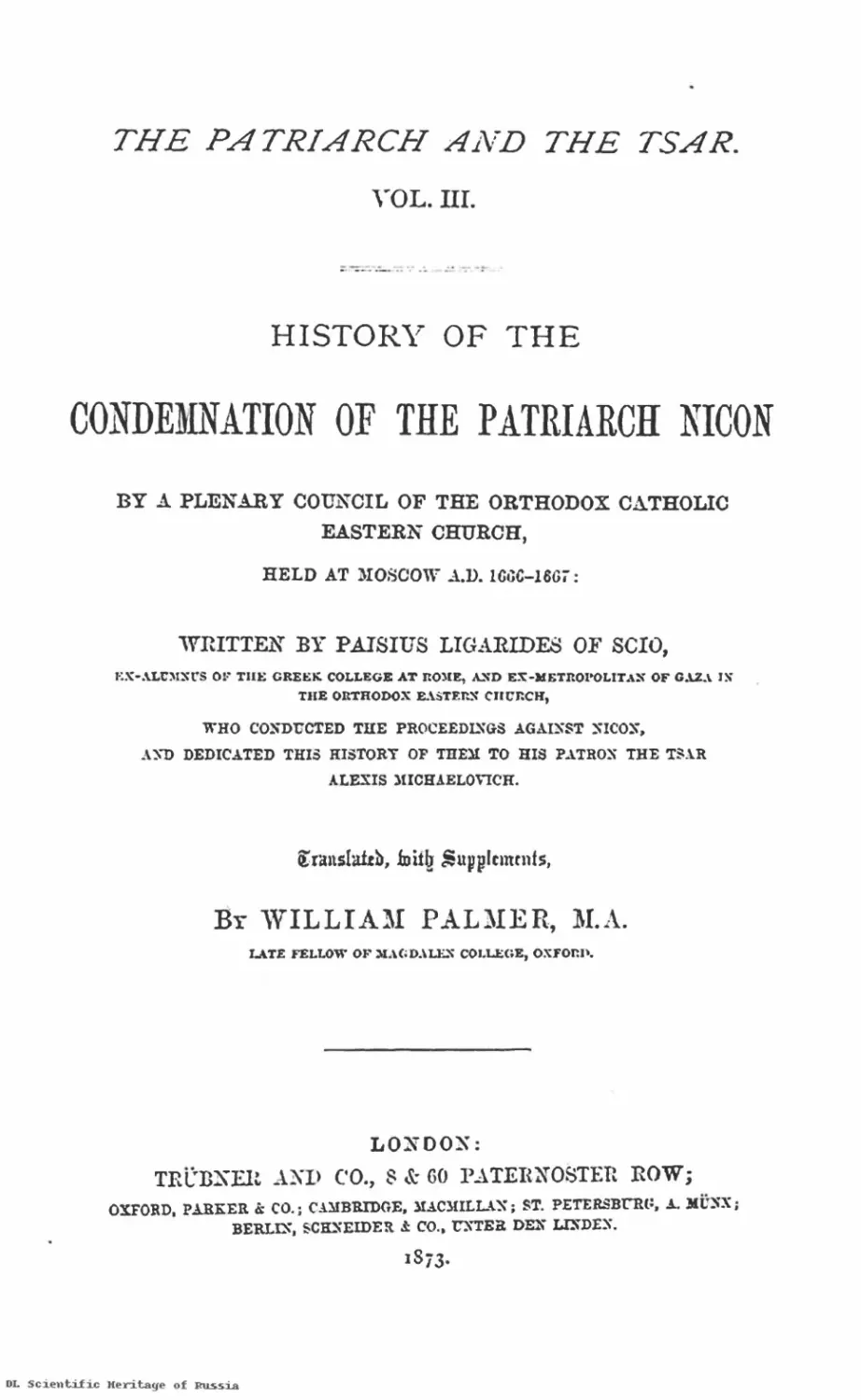
THE PATRIARCH AND THE TSAR.
VOL. in.
HISTORY OF THE
CONDEMNATION OE THE PATRIARCH NICON
B Y A PLENARY COUNCIL OF THE ORTHODOX CATHOLIC
EASTERN CHURCH,
HELD AT MOSCOW A.D . 1GCC-16G7 :
WRITTEN BY PAISIUS LIGARIDES OF SCIO,
K.X-ALCMXCS OF THE CREEK COLLEGE A T ROME, AXD EX-METROPOLITAN OF ΟΛΖΛ IV
THE ORTHODOX RASTERS CIICRCH,
WHO CONDCCTED THE PROCEEDINGS AGAINST NICON,
AND DEDICATED THIS HISTORT OP THEM TO HIS PATRON THE TSAR
ALEXIS MICHAELOVICH.
iTranslaitb, ioitlj Supglcm tnfs,
B y \VILLIAM PALMER, Μ.Λ.
LATE FELLOW OF MAC DALES COLLEGE, OXFORD.
LONDON:
TRL'BNER AND CO., $ & 60 PATERNOSTER ROW ;
OXFORD. PARKER A CO.; CAMBRIDGE, MACMILLAN; ST. PETERSBCRG, A. ML'NX;
BERLIN, SCHNEIDER A CO., ENTER DEN LINDEN.
1873.
dl Scien tific Heritage of Russia
MENTITA EST INIQUITAS SIBI.
*
LONDON:
B0330N AND SONS, PRINTERS, PANORAS ROAD, N .W
#
DL Scientific Heritage of Russia
THE PATRIARCH AGAINST THE TSAR,
THE CHURCH AGAINST THE WORLD ;
SMYRNA AND PHILADELPHIA AGAINST PERGAMUS AND SARDLS,
PATIENCE AND CHARITY AGAINST VIOLENCE AND CUPIDITY
THE RESURRECTION (VOSKRESENSK)
AND THE NEW JERUSALEM (NOVI IERUSALIM)
AGAINST BABYLON AND ANTICHRIST.
HI. S cientific Heritage of Hu«.via
«
«
»
DL Scientific Heritage of Russia
CONTEXTS.
Notices Pateius Ligaridcs before his riming to Russia; from a Dis
sertation published at Moscow in 1002, p. 1. O f the same a fter his
coining to Russia; from the Hist. Diet, of Heel. W riters tfe. by Eugenius,
sometime metropolitan o f Kieff, p. 10. Of the same ; from the work of
P. Rodota, D eir Origins, Progresso c SUtlopresente del Rito Greco in IhtUn
<iV. Rome. 1703, p. 1*2.
Paisius’ H istory of tiie Synod held at M oscow 100G-10GT.
Dedication to the tsar A lexis Michaelovich, p . 13. Frontispiece, or
physiognomical portraiture o f Nicon, p. 21.
Book I. The Abdication o f Χ ΐ,,,,ι .
Chap. i. Introduction, p. 28.
Chap. H. *Exposition concerning the following narrative f O f the
erection o f the patriarchate o f Moscow , p. 29.
Chap. i n . 4Embassy sent by the tsar ’ Theodore Ivan, to Constanti
nople (in 1592-1593) for the definitive and canonical erection o f the same
patriarchate, p. 30.
Chap. iv . O f the privileges o f the different patriarchates, p. 32.
In connection with the above : Supplements I. and II. p . 313.
Chap. v. Entrance upon the subject.' Nicon, before becoming patri
arch in 1052. had dissembled his true character, p. 38.
Chap. v i. 1Statement of the scandal which arose H ow Bogdan Matv.
Khitroff made 1a beginning o f skirmishing,’ p. 39.
Chap. vii. Nicon’s abdication (10 July 1058), p. 41.
Chap. viii. 4A local synod’ convened by the tsar (a.d . 1000), p. 43.
Chap. IX. 4Contumacy o f Kicon towards the synod,' which he calls a
* synagogue,* p. 40.
Chap. x . 4Doubt of the synod,’ whether Eicon's abdication involved
also the loss o f all sacerdotal rank, p. 48.
Chap. x i . Condescension o f the emperor, p. 49.
Chap. xii. 4Arrival at Moscow o f the metr. o f Gaza* (28 Apr. 1002.1:
he comes of himself ((&ο0«λακ), without any invitation or mission : Arse-
nius Souchanoff visits him on behalf of X ico n ; and Xicon afterwards
writes to him a letter, p. 50.
Scientific Heritage of Russia
VI
CONTENTS.
Letter from Nicon to Ligarides, inserted by tbs translator, p. 51.
Chap. x iii. 1Answer o f Paisius to the letter of Nicon’ (an answer
written not without the imperial command), 12 July 1662, p. 57.
Chap. XIV*. Nicon’s idea of appealing to the Pope, p. 69.
Chap. XV. 4Solution of the difficulty of the synodLigarides is
called to the patriarchate; and is consulted, 1. about Nicon’s feigned
appeal to the P op e; 2. whether the faith of the Russians came from
Byzantium ? and at what time ? p. 72.
Chap. x v i. ‘ Questions o f the .Boyars :* especially of x x x . Questions
addressed to him in writing by the boyar Sim eon Lucian. Streshneff, m a
ternal uncle to the tsar, and his Answers to the same (against these Nicon
wrote his Replies or Objections); Paisius Ligarides (one day in Lent,
1663) is introduced privately to the council-chamber at the palace, and
is consulted first by the boyars, and then by the emperor himself. He
advises the emperor to write secretly of the demands or presumptions of
Nicon to the four oecumenical patriarchs, saying : 4So you w ill at once
obtain your object,’ p. 73.
Supplement III. (referring to the x x x . Questions of Streshneff and the
Answers o f Ligarides, as prefixed separately in Y ol. I . to the R eplies of
Nicon, p. xxvii. - x x xix., and as spread together with the replies through
the whole of that work), p. 313.
Supplement iv. (in illustration o f Paisius’ advice), Letter written by
P. Ligarides to the tsar on Whitsunday, 7 June 1663, p. 313.
Chap. xvii. 4Resolution of the em perorLetters are written with
xxv. leading Questions in Grech, and sent to C.P . by the Greek deacon
Meletius, a friend of Ligarides recommended by him fo r this service.
Meletius is also to inform the patriarchs orally respecting Nicon, who is
not named in the Questions, and to suggest how the Answers should be
worded. He leaves Moscow 1 Sept. 1663, p. 75.
Supplement v. The x x v . Questions sent to C P . with the Answers
subscribed by the four patriarchs, which were received at Moscow on
"Whitsunday, 29 May 1661, p. 317.
Chap, x v iii. *Another villanous machination o f Nicon,’ who in the
mean time had publicly cursed the em peror: a commission, with Ligarides
as chief representative o f the clergy, and the prince Niketa Iv. Odoefsky
as chief representative o f the synclete, is sent to Yoskresensk 17 July
1663, p. 76.
Chap. x i x . 4Departure o f the imperial commissioners
Nicon refuses
to receive P. Ligarides unless he brings canonical letters: he goes how
ever to him with the res t; and exhibits no letters : but, according to his
own account, he whispers in the ear o f the patriarch, in Romaic, an
unmentionable word, p. 77.
Supplement vi. (referring fo r Nicon’s account of this commission to
p. 586-604 of his Replies &c.), p. 349.
Chap. x x . 4Return o f Meletius,’ with the Answers subscribed by the
four oecumenical patriarchs, Whitsunday, 29 M ay 1664 : Athanasius o f
Andros metropolitan o f Iconium denounces these Answers and the patri
archal subscriptions as forgeries : he is confuted, p. 83.
Scientific Heritage of Russia
CONTEXTS.
VII
Supplement v n . Separate letter to the tsar from the patriarch of
Jerusalem Nectarius, dated 20 March 1664, not trusted to Meletius. but
sent separately by Sebastus and others who were going fo r alms to M os
cow, p. 349.
Chap. x x i. 4Second mission to the oecumenical patriarchs’ o f Meletius
and Stephen, another Greek a native of Andros, to obtain assurance of
the genuineness o f the Tomes, and to induce the patriarchs to come in
person to Moscow, p. 80.
Supplement v m . 1 and 6. Two extracts from Solovieffs History of
Russia &c., giving notices (but confused and dislocated) of the tsar’s
missions to the Levant in 1664-1666; also, 2, 4, 3, and 5, two letters from
Athanasius metr. o f Iconium to Nicon, and Nicon’s Answers, p. 356 -370 .
Supplement ix. Extract from SoloviefTs History of Russia: Nicon
writes to the tsar on hearing of his having sent to the Eastern patriarchs,
p. 370.
Chap. x x ii. 4Furtive attempt of Nicon:* that is, his unexpected return
to Moscow in the night, 17-18 Dec. 1664, p. 85.
Supplement vxn . 6. Letter, dated 12 Nov. 1664, and referred to re
peatedly by P. Ligarides as appointing him to be exarch or representative
o f the patriarch Dionysius of CJE\ and of all the synod, to explain and
defend thepatriarchalTomes, and to conduct the case respecting Nicon to
a final decision (see p. 89, 92,235, where he appeals to it as to a genuine
document even in 1667, and shows that he is ignorant what inquiries had
been made about it, and with what result).
The second mission o f Meletius and Stephen in the autumn o f 1604
is first alluded to only by Solovieff (see p. 360), through an answer made
about it to the envoy Sabbas at Thessalonica in 1666 by Kyr Dionysius,
then expatriarch. In the notes at the end of his vol. xi. he gives part
o f 4a Letter o f the patriarch Dionysius’ to the tsar, mentioning 4faculties*
sent to 4Kyr Paisius, the holy and intelligent metropolitan o f Gaza,’ &c.
as above; and dated 12 Nov. 1664 (see Suppl. vm . p . 370). Solovieff
gives this letter without any hint o fforgery, though he has printed in hi3
history something of what was answered by the expatriarch Dionysius
in 1666, about the character o f Ligarides and his agents Meletius and
Stephen, and especially this, that he had never received Stephen at C P .
n or given him any letters, though the Chartophyl&x had tried to induce
him to give such a letter in favour of Ligarides (see p. 360). Solovieff,
however, disconnects Stephen from the letter o f 12 Nov. 1664, as if it
was not till Jan. 1665 that he parted from Meletius in Moldavia to go to
Constantinople (p. 361). On the other hand, he represents the separate
letter o f the patriarch Nectarius to the tsar, really dated 20 March 1664,
as if it were written after his conferences with Meletius in Jan. 1665:
and in the midst of extracts from this letter of 1664, so presented, he in
terposes the inform ation that Nectarius 4having been told that Paisius
Ligarides was styling himself patriarchal exarch, replied to the ow>y that
nobody had been invested with the quality of exarch’ (see p. 363). This
* envoy,1 thus disconnected both from name and date, and smothered
between passages from Nectarius's letter of 1G54, was certainly not Mele-
Scientific Heritage of Russia
CONTENTS.
*··
vm
tius in Jan. 1655, but may have been possibly tbe envoy Sabbas, who,
we know, was sent in 1666 to make inquiries about tbe character o f Liga-
rides and his friends and agents Meletius and Stephen, and about the
letter or letters brought b y Stephen from Constantinople, p . 363.
Supplement x. Letters written by P. Ligarides in Greek fo r the tsar,
in the tsar’s name, to K yr Dionysius patriarch of C.P . and to Kyr
Nectarius patriarch o f Jerusalem, in Jan. 1665 ; complaining to them both
o f Nicon’s uncanoakal return to Moscow, and replying sarcastically to
that separate letter which Nectarius had w ritten in March 1664 to the
tsar, p. 372-379 .
Chap, xxiit . 1Return o f them that had been sent on the second mis
sion and. first, of the envoy Stephen: he had had (so he said) a private
interview at C.P . with the patriarch Dionysius, and had delivered to Jam
the tsar's letters, to which the p a tria r ch wrote a suitable answer, appointing
moreover the metr. o f Gaza to be the interpreter o f the patriarchal Tomes,
and the most confidential mouthpiece of all the synod ; as is contained in
the patriarchal letter o f instructions to him (the 1faculties ’) which is
laid up in the imperial archives (see Suppl. v m . 6, p. 3G9, 370) : Atha
nasius metr. o f Iconium is again confuted, and confined in the Simonoff
till his untimely death, p. 89.
Chap. x x iv . Embassy from the emperor to the sultan, p. 90.
Chap. xxv.
‘ Another secret mission to the expatriarch o f C.P .
Dionysiusnow (that is, in Jan. 1666) metr. of Thessalonica, where he
was seen by this envoy Sabbas, keUar o f the Choudoff. Sabbas went also
to C .P .; but the patriarch there, Parthenius iv. Koumkoum (MoyfxaAos),
fearing the grand vizir, would have nothing to say to him, p. 91.
Supplement xi. Letter o f Nicon, written in Dec. 1665, to the patriarch
o f C.P . Dionysius, intercepted on the way in Little Russia, in Jan. 1666
(when Dionysius had ceased to be the sitting patriarch), p. 379.
Chap. xxvi. ;Pecuniary lossof the metr. of Gazahis deacon Agath-
angelus, having gone to Voskresensk to Nicon , utters many calumnies
against him, p. 92.
Chap, x x v ii. cAnother commission sent from the emperor to Nicon’
(in consequence o f a petition fr o m the bishops), to desire o f him a written
judgment concerning the confession and communion o f condemned felon s :
Nicon sends also information o f all the i calumniesThe had been hearing
against the metr. o f Gaza, p. 94.
Chap, x x v iii. ‘ Manifold calumnies brought against the metr. o f Gaza
The emperor is utterly sh o w ed ; and shows him, in presence o f certain
special Individuals o f the boyars, X icons letter.1 Paisius, if convicted on
one point, pleads guilty to all, but claims, if he can clear himself on any
one point, to be acquitted on all, p. 99.
1 Nicon in his Letter also to the patriarch Dionysius, after speaking of the way
in which Pairias Ligarides had been received without canonical letters, and had even
been made president among the clergy, wrote that he was under the imputation
of an unraenrionable crime. Bat the first allusion to such sin here comes from
Ligarides himself, he having (according to his own statement) whispered a certain
word in Romaic, as early as July 1663, into the ear of Nicon; in order that Nicon
may now setm to be retaliating, out of revenge for that insinuation.
io Heritage of Russia
CONTENTS.
ix
Chap. xxrx . ‘ Decision and investigation by the synod.’
Two points
are examined: 1. whether Paisius is orthodox ? and 2. whether he prac
tises astrology ? He is fully acquitted on b oth: Agathangelus is brought
in in irons, and is imprisoned till he declares publicly that all that had
been said and written against the metr. of Gaza was false^p. 100.
Chap. x x x . ‘ Ordination o f new bishops,’ in 1664, and translation of
others, by order of the tsar, with the blessing of the metr. of Gaza:
And the tsar thus continued to use him, though he knew now what im
putations he lay under, without applying first, at least, to the patriarch
o f Jerusalem, to learn more about his true character and status, p. 101.
Chap. x xxi. 1Synodical review of Eicon’s acts ’ (in the spring of
1606) : and of his having carried off the staff of St. Peter the first metr.
o f Moscow : those who through surprise had acknowledged him as patri
arch on the 18th Dec. 1604 are now pardoned, p. 302.
Chap, xxxii. 4Of certain heterodox SchismaticsLigarides, by order
o f the tsar and the synod, composes against them a book, the Stag of
Rule &c., which is translated afterwards from his Latin into Russ by
Simeon o f Pololsk, and finally printed, p. 106.
Chap, xxxiii. Zeal of Paul, now metr. of Kroutitz, Paisius of Gaza,
and Hilarion of Riazan against the Russian innovators, p. 108.
Supplement xir. (in connection with p. 106-110 and 197-109, respect
ing the new Schismatics, and referring to Appendix ill. to Travels *f
Macarius), p. 4*».
Chap, xxx iv. *Announcement of the approach of the patriarchs,* that
is, of Paisius of Alexandria and Macarius of Antioch, p. 110.
Chap. x xx v . Salutation o f the two patriarchs by grandees sent in the
emperor's name, p. 113.
Chap, xxxvi. 4Arrival of the two most blessed patriarchsLetter
o f welcome from the emperor (13 Oct. 1666), p. 116.
4 EpilogueEicon alone is troubled and annoyed, p. 117.
Book Π . Deposition and Degradation ofXicon,
i IntroductionOftheThrees, p.118.
Chap. i . 4Arrival of the patriarchs, and how they were first met with
an address of welcome’ by Hilarion abp. of Riazan, p. 119.
Chap.ii . 1Entry of the patriarchs into M oscowaddress by Paul
metr. of Kroutitz, p. 120.
Chap. ill . 4Audience of the patriarchstheir speech to the emperor,
and his speech in reply, p. 123.
Chap. iv. Homage of the bishops: gifts from the archimandrites:
address from the metr. o f Gaza, p . 126.
Chap. v . Other addresses to the tw o patriarchs, p . 128.
Chap. vi. 4Visits of the patriarchs to two holy monasteries:’ Latin
address from Simeon of Pololsk (translated into Greek by the metr. of
Gaza), p, 130.
Supplement x iv . Other letters and addresses welcom ing the patriarchs
on their approach, and on their arrival at Moscow, not given by Paisius
Ligarides, p. 402.
Scientific Heritage of Russia
X
CONTENTS.
Chap. v ii. Certain preparatory matters or synodical questions : W h e
ther synods are lawful, and useful, p. 131.
Chap. v iii. i Whether it was competent for our autocrat Alexis to
convoke a synod ?’ or should synods be convoked only by patriarchal au
thority ? or by the Bishop of Rome ? p. 135.
Chap. ix . What, then, is this present assembly? an (ecumenical synod,
or a particular trial and judgment ? p. 140.
Chap. x . *H ow two great questions were proposed to the patriarchs
for solutionviz. 1. Why is the patriarch of Alexandria styled oecu
menical judge ? and 2. When was the patriarch of Antioch first styled
Father o f fathers, i .c . Ώατριάρχης ? p. 144.
Chap. x i. 4Synodical meeting (7 and 28 Nov.) in the Zolotaia palata
(the Golden balli of the palace:’ speech of the emperor: The patriarchal
Tomes (translated about this time into Russ by the metr. o f Gaza) are
read; and declared to apply to Nicon: Libels of the chief charges against
him are given to the patriarchs, to study in their cells; and two Russian
bishops, Paul metr. of Kroutitz and Hilarion abp. of Riazan, are to
explain them o r a lly : but the patriarchs o f themselves ask the tsar to
give them also Paisius Ligarides, which he does, s a ying : cF rom him you
can learn a ll, with as much detail as you please,’ p. 155.
Chap. x ii. ‘ Summary o f the libels of accusation presented to the two
patriarchs against Nicon :’ digested by Paisius Ligarides, p. 157.
Supplement x m . (in connection with passages at p. 159 and p. 79.)
Of the red-striped mandya, for wearing which Nicon is blam ed: and of
the pastoral staff given to him by the patriarch o f Antioch in 1655, and
wrested out o f his hands by the same patriarch, or rather b y the four
patriarchs and the tsar, in 1066, p. 400.
Chap. x m . £How Nicon was summoned by the synod, and came and
appeared b efore i t :’ having first been anointed, and having confessed,
and celebrated the liturgy, commemorating in it only the patriarch of
Constantinople Parthenius, p. 166.
Supplement x v. Minutes and reports concerning the same ; from the
archives o f the patriarchate at Moscow, p. 412.
Chap. x iv . 4How Nicon appeared personally before the most sacred
synod,’ and before the tsar and the synclete (1 Dec. 1666) in the Z ololaia
palata of the palace: his abdication is urged against him, and his inter
cepted Letter to the patriarch Dionysius; and, especially, his having charged
the tsar and the synclete with latinising, because they took a blessing
for the government of the Church from Paisius Ligarides, p. 168.
Chap. x v . 4How Nicon was synodically condemned in the second a c t :’
(two sessions of ‘ Wednesday’ the 3d Dec. and Friday the 5th being
here consolidated). They read out in the synod the following w ords:
1Witnesses must be credible persons, not in want of money, not of bad
repute, n ot in the pay o f others, not heretics, nor personal enemies.’
It was urged against Nicon that he had degraded Paul bishop of Ko
lomna, o f himself alone, without a synod: The heads of the patriarchal
Tomes sent in 1664 are read out, especially chap. xiv. adducing can. ii.
o f the council held in St. Sophia (misquoted as xiii. o f the council called
ΟΣ. Scientific Heritage of Russia
CONTEXTS.
the First and Second, held in the church of the H oly Apostles) : Nicon
answers contum aciously: he objects too to the two patriarchs that they
have lost their chairs at Cairo a nd Damascus by absenting themselves
w ithout the sultan’s permission, and that others now hold them (comp,
p 184 and 189). The patriarchs take from Nicon the cross. The bishops
are asked, first the Greek, and then the Russian, how he is to be punished ?
and they all reply that he is to be degraded in the most complete manner.
The patriarch of Antioch says that he has shown himself even worse
than S ata n; and the patriarch o f Alexandria, as oecumenical judge, de
livers the judgment. Order is given that this sentence be written out in
Greek and in Russ, p. 178.
Chap. x v i. ; How Nicon was definitively deposed by sentence o f the
synod in its third act,’ 12th D ec .; this meeting being held in the patri
archate without the tsar, and the act itself being performed in a chapel
over the back gates of the Choudoff monastery, p. 191.
Supplement x v i. Account of the four sessions and acts of Dec. 1, 3,
5, and 12, from the papers of the prikaz of secret service, so far as they
have been used by M. SoloviefE in vol. xi. of his Uistonj of Russia, p. 41G.
Supplement x v ii. Official account of the same, as preserved in the
archives of the patriarchate at Moscow , headed 4A ct xiv. Of the deposi
tion from the chair o f the late patriarch Nicon,’ p. 437.
Chap. x v ii. £Recapitulation o f the troubles which had come upon the
Church' by the fault of Nicon : The tsar commits to the two patriarchs
the task of making a general correction and settlement, p. 197.
Supplement x v i i i . Ocher documents respecting the degradation and
imprisonment o f Nicon ; from the archives of the patriarchate at Mos
cow, p. 450.
Supplement x i x . Communications addressed in Dec. lGGGby the two
patriarchs Paisius o f Alexandria and Macarius o f A ntioch to their brethren
the patriarch Nectarius o f Jerusalem (p. 450) and the patriarch Par-
thenius of Constantinople, p. 45G, 459.
Book III. Creation of a new Patriarch, Joasaph II.
Introduction : Preliminaries to the election &c. o f the new patriarch
Kyr Joasaph: Of the Threes, p. 199.
Chap. I. 4H ow the two patriarchs celebrated the liturgy in the great
church,’ i.e . on the 21st Dec., the festival of St. Peter the first metropoli
tan of Moscow, p. 199.
Chap. ii . 4H ow on the fest. o f Christ’s N ativity the patriarchs came to
the palace to sing the polychronion fo r the emperor the hours and the
vespers having been sung according to custom on the eve in the jm tri-
a rch alpala ce: The patriarchs also afterwards celebrated the liturgy before
the emperor in the cathedral, p. 200.
Chap. h i . H ow the two patriarchs came also on the new year (Jan. 1.
1GG7) to the palace, and celebrated there the liturgy, p. 202.
Chap. IV. H ow the chronological reckoning o f the years o f the world
from the creation was made a question by the Russian bishops, p. 204.
Supplement x x . O f the era o f the creation, placed by the Egyptians,
xi
ic Heritage of Russia
Xll
CONTEXTS.
the Babylonians, and the Indians, in accord with the Hebrews, about the
autumnal equinox in the anticipated Julian year b.c. 5302, p. 463.
Chap. v . H ow the blessing of the water was performed twice, once
on the eve, and again on the festival itself of the Lights (the Theophany
or Epiphany), p. 207.
Chap. v i. *How some of the Russian bishops were unwilling to sub
scribe the deposition o f Xicon
especiallyPaulthe metr. of Kroutitz and
Hilarion archbishop of Riazan, *who seemed to be pillars,’ and who had
been foremost to act against the person of Nicon, yet did not wish to
subject the clergy unreservedly to the boyars : they demurred to the doc
trine o f the patriarchal tomes (as dishonestly translated by Ligarides),
that there was only one principle of government, viz. the tsar. Paisius
now discusses the three unctions o f prophet, priest, and king, p. 207.
Chap, vir. "Whether the high-priesthood and the empire are ever
united in one and the same person, p. 210.
Chap. viii. Whether this unction which is given is to be understood
materially or intellectually, p . 212.
Chap. IX. Of the meeting of the bishops to consider the question
previously proposed, whether the patriarch be subject to the emperor?
p. 213.
Chap. x . H ow the bishops met, and the passages relating to the imperial
and royal power were read, p. 222 .
Chap. x i. 4Of a memorial or petition presented secretly to the patri
archs by the tw o bishops.’
The metr. of Gaza exclaims : 41 myself will
answer this most foolish and wicked libel, inasmuch as the oecumenical
patriarch Dionysius appointed me to be the guardian, interpreter, and the
champion of the patriarchal tomes; and I have by no means been paid
to hold my tongue.’
*Ye fear,’ he says, *for thefuture ; lest some future
sovereign enslave the Russian Church. There is no chance o f this. This
will never b e! From a good emperor [Alexis] that son who shall succeed
him [Peter the Great] will be still better,’ p . 230.
Chap. x ii. 4Decision o f the synod respecting the question mentioned
above as laid before it.’
Of anathematising rebels: Of the emperor enter
ing the sanctuary: The king or emperor has the preeminence in political.
matters, and the patriarch in ecclesiastical, p . 241.
Chap. xiir. 4How the two bishops were summoned before the synod
and suspended:’ though they hadin the mean time repented, and had both
o f them subscribed separately the patriarchal tomes, with every jo t and tittle
of their contents (and so had swallowed the exaggerations o f Paisius’ ver
sion uncorrected), p. 251.
Chap. x iv . 4How all met in the stauropegion (the Choudoff monastery)
to elect a new patriarch.’
Three questions: 1. Can a bishop lawfully take
a third see? 2. Can there be a reordination of one who is already a
bishop ? and 3. Is it lawful that the patriarch should be chosen by lot ?
p. 257.
Chap. xv . Resolution of these three preliminary questions, p. 262.
Chap. xvi. 4How Kyr Joasaph was proclaimed patriarch of Moscow/
his advanced age being a convenience (see p. 261) and a recommendation:
Scientific Heritage of Russia
This nomination was in the council-chamber: The three names presented
to the emperor (none o f them names o f bishops) were read out by Almiaz
Iva n o ff: and the emperor preferred that which stood first of the three.
News on the 1st of Feb. of the conclusion of a truce with Poland, p. 260.
Chap. x v ii. *H ow the tw o suspended bishops were called before the
synod, and made their apology and were pardoned : and how beneficial
it was to the rest to see their contentiousness thus com e to nothing, and
end in sardonic laughter: T o complete their forgiveness they were ad
mitted also (after being reproached by him before all, with words which
went deep, fo r their schism) to kiss the hand o f the emperor : having re
peated over and over again *P eccavim us' There was still some whispering}
however, even after this, about the absolute supremacy o f the emperor ;
and about the anathematising o f reb els; and against a patriarchal oath of
allegiance, p. 273.
Chap, x v iii. 1How Kyr Joasaph, the new patriarch, was ordained' on
the Sunday of the Carnival, 10th Feb. (Paisius Liya rides also joining in
the imposition o f hands), p. 270.
Supplement xxi. Letter given to the new patriarch of Moscow Joa
saph after his consecration. A ls o tw o orders f o r changing the archiman
drite who was in charge of the monk Nicon (from the archives o f the
patriarchate), p . 468.
Supplement x x n . (with reference to what is alluded to at p. 189,184.
185, 130-131.) Letter from the tsar to the patriarch o f C.P . Parthenius,
written seemingly in the spring o f 1CG7, to engage him to obtain the
restoration o f the patriarchs Paisius o f Alexandria and Macarius o f A n
tioch to their sees, which, in consequence o f their having absented them
selves icithout the jpermission o f the civil ru/<?;·.*, had been filled up as vacant.
and were now held by others. The tsar wrote also, in 1607, a letter to
the same patriarch o f C.P., Parthenius, to engage him to obtain the resto
ration o f Paisius Ligarides to the see of Gaza : and he wrote later, in 1669.
to the patriarch o f Jerusalem Nectarius to ask fo r absolution f o r the same
Paisius Ligarides, continuing to use him in the mean time as i f he needed
no absolution (see p. 300). B efore this last letter was written the tsar
had received (in the summer o f 1068) a letter fro m the patriarch Nec-
tarius advising him to keep Ligarides under strict surveillance, lest he
should go off to the Pope (see p. 547, 552). The tsar's letter to Nectarius
(and one to Methodius, then patriarch of C.P ., was sent by the same en
v o y) was received at C.P . by Dositheus after Nectarius had resigned the
patriarchate, in J oly 1G69, p. 470.
Chap. x ix . Solution o f certain questions proposed to the three patri
archs, p. 284.
Chap. xx . 4O f certain other questions moved during the great Lent :*
especially concerning the validity o f Latin baptisms, p. 2S7.
Supplement x x m . (referring to the full act o f the synod on this sub
ject, as printed in 4Dissertations on Subjects relating to the Orthodox or
Eastern-Catholic Communion,' p. 184-198), p. 479.
Chap. x x i . : Of other occurrences during the great fast :* viz. the
erection o f some new sees, and the promotion o f some sees from a lowet%
CONTEXTS.
xiii
ic Heritage of Russia
XIV
CONTEXTS.
to a higher rank: also of the power of the emperor to create sees, or to
raise their rank. E xcept officiating in sacred things, all the other epis
copal privileges are vested in the emperor, p. 295.
Supplement x x i v . Eleven separate acts, tomes, or chapters o f the
patriarchal synod, which continued to meet at intervals during the first
six months o f 1007, fo r the settlement o f divers ecclesiastical questions,
especially those raised by the raskolniks or starobratsi, w ho protested
against Nicon's correction o f the church-books, p. 479.
Chap. x x ii. Of the procession on Palm Sunday, and the patriarch s
riding on the ass, p . 300.
Chap, xxiii. How the holy Μύρον (the Chrism) was made by the patri
archs : and some other occurrences o f the Great Week, p. 303.
Epilogue, p. 310.
Supplement x x v . List o f the boyars, okolniks, doumnie dvorianini,
and diaki from a little before the time when Paisius Ligarides came to
Moscow in 1002 to Easter in 1607: also of other officers o f the tsar’s c ou r t;
and of the presidents in the chief prikazes, at the time o f Nicon’s condem
nation in Dec. 1000 (from the Drevnaia Rasshaia Bibliotheca), p. 518.
Supplement XXVI. Extracts from The present State o f Russia (a.d . 1000
to 1007 ; but with some later notices inserted in the second and third
editions o f 1003 and 1070) by Dr. Samuel Collins, chaplain to the C om
pany o f the English Merchants at Moscow, p. 529.
Supplement x x v n . From the archives of the patriarchate at Moscow:
An Order, made by the oecumenical patriarchs and the synod, fo r rem oving
the monk Nicon from the Therapontofi to another distant monastery [to
the Solovetsky ?] on account o f certain considerations not executed at
that time, but put forward by the patriarch Joachim in 1G76, May 10,
after the death o f the tsar Alexis, when Nicon was treated with renewed
severity, and was removed fro m the Therapontofi: to the Cyrilloff monas
tery, p. 538.
Supplement xxviii. 1. From the archives of the patriarchate : A Mi
nute, how they escorted forth the patriarch Macarius o f Antioch with the
crosses &c. at his departure from Moscow (31 May 1008); and 2. Letter
sent after the patriarch Macarius in July 1008 from the patriarch o f
Moscow Joasaph: and Answer brought back in October from the same
patriarch Macarius, p. 539.
Supplement xxix. Extracts from P. Theiners Monument Historiques
relatifs au reync d 'Alexis JJichaelovtch, &c. Rome, 1859, p. 52: 1. The
Nuncio writes from Warsaw to the Pope, 18Jan. 1008: 2. The King of Po
land writes to the two Eastern Patriarchs then at Moscow, 28 Mar. 1068 ;
3. and to Paisius Ligarides, same date ; 4. and to the Tsar Alexis, same
date; 5. the Nuncio from Warsaw, in July 1608, writes to Cardinal Ros-
pigliosi; G. enclosing a Letter o f P. Schieretsky, a Dominican, written at
his suggestion to Paisius Ligarides : 7. Reply o f Paisius Ligarides to the
same P . Schieretsky, 25 Sept. 1068: 8. Communications from the arch
bishop o f Gnesnen to the N uncio, dated Warsaw, 16 Jan. 1669. Paisius
Ligarides speaks o f the evil report spread o f him b y Nectarius patriarch
o f Jerusalem, that he was altogether a papist; also o f its being said that
oi. Scientific Heritage of Russia
CONTEXTS.
XV
he was receiving 200 ducats a year from the Propaganda: he wishes he
were ; and hopes the Holy Ghost may inspire the Nuncio to get such a pen
sion for him, p. 540.
Supplement x x x . 1. Letter o f 1 Nov. 1669 to the tsar from Dositheus
now patriarch of Jerusalem: he bad received in July at C.P. the tsar’s
letter written to Nectarius, now expatriarch, about P. Ligarides. ‘ asking
that we should absolve him but he, Ligarides, has upon him unmention
able crimes and sins ; and he is notpenitent: he writes letters (one specimen
o f which is sent for the tsar to read) to certain friends of his, heretics like
himself, full of foul-m outhed abuse o f the expatriarch Nectarius; so that
Dositheus could wish rather to give him over again the punishment he
deserves. Nevertheless, since the tsar writes that ‘ he has brought his
empire to a good end’ (/. e. out of its difficulties), he Dositheus, o f affection
f o r the tsar (also to obtain the tsar’s alms), takes Ligarides’ impenitent
revilings as if they were a bouquet o f sweet-smelling flowers; and, by way
o f honour and praise fo r them, holds him absolved from thejust excom
munications and curses o f the patriarch Nectarius & c .: and he joins here
with, 2. a Letter o f absolution for P. Ligarides. In this it is said that
‘ whereas he, Ligarides, has sinned in certain points, andfo r his guilt was
put outfrom the sacred ministration andfrom the clergy by Kyr Nectarius
and by all the sacred synod of Jerusalem.. .. and now the tsar has asked
of us a pardon for him, w e. . . hold the said P. Ligarides for absolved and
blessed, and freed from all excommunication and curse.. . . Moreover we
have recommended to our father Nectarius and to a ll the synod, that they
should absolve him likewise,’ &c. However, when this Letter o f absolution
was given at Moscow to P. Ligarides—tbe letter with which it came the
tsar probably kept to himself— it was objected to by the Russian bishops
as ambiguous and incomplete, p. 550.
Supplement x x x i . Letter o f Paisius Ligarides to the tsar, contending
against some, whom he does not name (but no doubt he alludes to the
patriarch of Moscow Joasaph, who had been trying before to get rid of
him, as appears, at p. 548, from his letter of 25 Sept. 1668 to the Domi
nican Schieretsky), that the above absolution o f himself is regular, and
sufficient, and petitioning ‘ fo r a righteous revision.’ B ut he does not noio
claim to be considered innocent of those charges on which he had been
degraded and excommunicated before he went as commissioner (in 1663)
fro m the tsar and the Russian clergy to Yoskresensk, there to whisper
into the ear o f Nicon (as he pretended afterwards) a suspicion o f unmen
tionable sins, p. 557 .
io Heritage of Russia
DL Scientific Heritage of Russia
EPITOME OR DIGEST.
P antaleon LlGAKIDES of Scio, born about 1612, was in the Greek col
lege at Rome sixteen years, 1626-16-42, to the age o f thirty : he took the
degrees o f doctor in philo3. and theol. with great distinction ; was ordained
deacon and priest at Rome by Raphael Korsak, Ruthenian mctr. o f Little
Russia, p. 13 (and Replies of Xicon, p. 530). In 1637 he published in a
book of his fellow-student Xeophytus Rodino an Apologyfo r Peter A rcu-
dins, dedicated to Urban V III.; and in another tract of the same Xeo-
phytus, On the M agnificat, he printed a Letter to the archbishop o f Xaples.
p. 2 (and Replies &c. p. 586). In 16-42 he left Rome for Constantinople,
counting perhaps on the favour o f the then patriarch Parthenius L : but
he being soon forced to make way fo r another, Ligarides transferred him
self to the Danubian principalities, and thence w ent to Poland and to
Muscovy, where he died in 1678. I n 1650 he served the metr. Stephen o f
Tergovist by assisting in the preparation o f a Wallachian edition o f the
Kortachay, which was published in 1652; but his fixed employment in the
principalities was that o f teacher in the school founded by the Vasili
Loupoulus, bey or liospod ir of Moldavia, at Jassy, p. 4. Here he was of
course known only as Orthodox; but he kept up his relations with his fel
low-countryman L eo Allatius, and others o f the Roman school, to whom
he wrote as a Catholic. He gained the favour o f Paisius patriarch of
Jerusalem, who took him with him from Jassy, late in 1650, in company
with Arsenins Souchanoff; and, having passed by Scio, they arrived on the
Cth Oct. 1651 at Jerusalem. On Sunday 16th Xov . the patriarch tonsured
him to be a monk (on which occasion he took from his patron the name
o f Paisius), and committed him to the charge o f Arsenins Souchanoff,
who was to be his novice-master, p. 5. Between that time and Easter
1652 (when Arsenins left) Jerusalem was visited by the patriarch Ma
carius o f Antioch with his son and archdeacon P a u l: they met there
Arsenins Souchanoff; and they had personal knowledge of the fact that
the patriarch Paisius ordained (that is, reordained, though he may have
been unaware o f it) Ligarides deacon and priest, p. 14, 422, 423 ; and a c
cording to his own account made him protopresbyter. W hile living at
Jerusalem he compiled a History o f the Patriarchs o f Jerusalem down to
Heraclius, but quite in a Latin sense; the ms. o f which work becoming
know n afterwards (Dositbeus, who was first archdeacon to the patriarch
Xectarius of Jerusalem, and then patriarch himself, made great use o f it in
Ms own similar H istory), was condemned, together with its author, who
was anathematised ns a heretic by the patriarchs Nectarius o f Jerusalem
b
l
Scientific Heritage of Russia
EPITOME OF PAISIUS’ HISTORY
and Methodius of C.P . (so this probably was in 1G67-1GG8). p . 6. But in
the mean time, between 1652 and 1656, the patriarch Paisius o f Jeru
salem consecrated Ligarides bishop to the see o f Gaza, with the title o f
metropolitan. W hether he ever resided there, nay even whether he was
ever there at all, is doubted by Nicon in his Replies, p. 97. At any rate in
1656-1657 he was living again in Moldavia and Wallachia, where he was
seen by the patriarch Macarius o f Antioch. In 1657 Nicon, who had need
o f Greeks o f intelligence and learning, having heard of him f ro m Arsenius
Souchanoff, and that he wished to go to Moscow, wrote to him inviting
him thither, p. 89. H e seems to have served Stephen b ey o f Moldavia in
that intrigue by which he supplanted Yasili bey ( Replies, p. 46) ; and after
wards, when both Stephen bey of Moldavia and Constantine bey of W al
lachia had been deposed, in 1657, he fled after them into Transylvania,
where he was robbed o f all he had. p. 7. H e was deposed, degraded, and
excommunicated by the patriarch of Jerusalem Nectarius (the successor
o f Paisius) fo r crimes o f which in 1669-1670 Dositheus then patriarch
o f Jerusalem wrote to the tsar Alexis that modesty did not allow him to
name them . p . 547, 552, 551, 10, 94, 96, 99-101, 360, 392, 422, 425, 79.
He was (according to Nicon in his R eplies, p. 586) a long time in Poland,
under the Polish king, and he sfiid mass in all their kostels. Eugenius
sometime metropolitan o f Kieff, in his D iet, o f Eccles. W riters &c., writes
that he came to Moscow in 1660 with a letter from the patriarch of C.P .
P&rthenius IV. Konmkoum (Μογίλαλο$), recommending him as fit to be
employed in the affair o f Nicon, p. 10. But this is inaccurate : he writes
distinctly o f himself that he came to M oscow ί&οββλ»*, o f his own will,
without any invitation or mission, not to accuse or to judge Nicon, but on
speculation, for the pecuniary needs of his poor see; and that he arrived
first at Moscow on the 28th Apr. 16G2. This he pleaded in 1G6G to the tsar
himself, when he begged to be dismissed before the arrival of the two pa
triarchs, then expected. H e may no doubt have had his original letters
of orders both Roman and Greek, and the letter given to him on his con
secration to be a bishop ; and a letter perhaps from the patriarch of C.P .
Parthenius Π . o f a date somewhat earlier than 1650, w ith which he first
went from C.P . to the Danubian principalities. But neither o f himself,
when he first came to M oscow , nor when canonical letters were demanded
o f him at Yoskresensk in 1663 by the patriarch Nicon, did he even by his
own account exhibit any letters, or pretend to have any. And for this
reason Nicon refused to have anything to do with him, and warned the
tsar o f the impropriety and the sin o f receiving such persons as came un
accredited.
xviii
Book I. Of the Abdication of Nicon.
The writer dedicates his History to the tsar Alexis, who, he thinks, will
feel bound to defend it (i.e . cause it to be translated and published), p. 15.
He swears by truth that it holds fast to truth, without either rhetorical
amplifications or improper curtailments. They would b e calumniators
who should call it verbose, cunningly dishonest, partial and extravagant,
Scientific Heritage of: Russia
XIX
full of invective, overladen with accusations, and a mass of all manner of
libels, p. 17. H e is a simple man, straightforward and unpolished ; who
represents facts as he has known them, without undue favour or indulg-
ence. Should any man, like Philoxenus,· run down this history, let him
remember how Philoxenus was thrown into the quarries at Syracusefo r
not praising the tragedies of the tyrant, p. 18. H e has a firm standing-
ground, an invulnerable panoply, in the tsar s protection, p. 20. All the
virtues, all the graces, run up into the tsar: may he live to the age of
Methuselah! p. 21. As a ‘ frontispiece’ he gives a physiognomical por
trait of Nicon, and exclaims: 4O, my eyes! what a monster!’ p. 21;
*Strife and contention breathe in Kcicon’s form.’ p . 27. In his introduc
tion he says he will be scrupulously just, as an Areopagite ; yea, by God
omniscient, and by truth, which I prize above all things; and, like Socrates,
I will be even hyperveracious when I have to speak of myself or of them
that were on the same side with me. p . 28.
Nicon, before becoming patriarch, had dissembled his true character,
and seemed goodnatured, gentle, an ascetic, a lover of learning, a lover of
the Greeks, and for his sermons like another Gregory the Divine. But
when he had attained his object he threw off the mask, and showed him
self such as he really was, a man o f stone or oak, an intriguer, ambitious,
revengeful, arrogant, inhuman, &hireling careless o f the sheep, rioting in
luxury, the slave of pleasures, affecting imperial titles, for every good
work reprobate, p. 38, 39.
When he had been patriarch six years, and his iniquities cried aloud
to heaven, God brought suddenly upon him the stroke of punishment.
One o f the tsar s archons, Bogdan M atv. Khitroff,1by pushing slightly with
the open palm o f his hand a servant of the patriarch ^15th June 1658),
made a beginning o f skirmishing, p . 41 . The patriarch the next morning
threatened to excommunicate Bogdan; but the tsar begged him to abstain
from any such excessive punishment for so small a cause. But the patri
arch was deaf to these siren accents; he was like the deaf adder to these
imperial incantations. And when on the 10th July the tsar, owing to a
pressure o f state business, could not go to the church, Nicon, being very
suspicions, imagined an affront; and, after celebrating the liturgy, belched
forth publicly curses on himself if he should ever again return to his
chair or take the title of patriarch ; and taking off his vestments one by
one he said, *I am no more patriarch!' so that he all hut deposed and de
graded himself. The tsar was astounded, and sent the first o f his archons,
Al. Nik. Troubetzkoy, to beg him to return to the chair, and not follow
mere passion. B ut Nicon only became more fierce. So the tsar let the
man go to be quiet for a while, trusting that afterwards by condescending
letters and kind words he should heal his untimely mortification. B ut
he only fell foul more and more fiercely of them that were sent to him,
fighting and raging against them, pretending that he was unwilling (when
he panted like a stag after it) to resume the patriarchate, p. 43.
1 Called *the whispering favourite.’
See p. 536, 537; also Nicon's account, p. 52,
171, 384 ; that of Khitroff himself, the tsar, and the two Eastern patriarchs, p . 414,
421, 429; and the act of the Synod, p. 444.
OF THE MOSCOW SYNOD OF 1666- 1667.
dl Scientific Heritage of Russia
XX
EPITOME OF PAISIUS’ HISTORY
At length [in the spring of 1660] a synod was proclaimed [by the
tsar]: and they decreed that they considered Nicon to be no longer patri
arch, and that none o f the bishops should name him as such, or kiss his
hand; going upon the fact of his own voluntary and absolute abdication,
p. 43. But Nicon called this meeting ‘ a synagogue.1 So he continued
freely to ordain, and to celebrate the liturgy, as openly warring with the
tsar, and contending against all the sacred synod, p . 46. But in truth it
belonged originally to the sovereign both to convoke synods, and even to
confirm their decrees. A s fo r celebrating, som e thought that Nicon might
do this; but the greater number, and especially our Roman bishops then at
Moscow, as following more closely the holy canons, said that he ought by
no means to celebrate, having absolutely forsworn his episcopal character.
p. 48. But the tsar, labouring for peace, thought it necessary to use some
condescension; and there was found a precedent in the case of Eustathius,
who, after resigning his see, was allowed by the Third oecumenical coun
cil to retain the name and honour of a bishop. But this was a most mis
taken len ity; for it only emboldened Nicon (p. 50), who began afterwards
to excommunicate and to anathematise individuals, and on one occasion,
on the first Sunday of Lent (in a.d . 1660), even bishops, especially Pitirim
the metropolitan o f Kroutitz.
Things being in this state, there came to Moscow on the 28th of April
166*2, Ιδίοθ€\ojs, o f his own will, ‘ free and uncalled1(p. 50), not to dispute
with Nicon nor to judge him, but to relieve his see [he having no see at
the time] of the debt burdening it (p. 427), Paisius metr. o f Gaza. Nicon,
hearing of this, sent and asked Arsenius Souchanoff to visit the metro
politan o f Gaza in his name, hoping that he might help to make peace
between the patriarch and the emperor. The metropolitan o f Gaza, with
out committing himself, sent a civil answer: and Nicon wrote to him a
friendly letter, in which he detailed all that he had suffered. This letter
was translated into Latin by Epiphanius Slavenetsky [so by the tsar's
order}; and a copy of it is preserved in the imperial archives. The metro
politan o f Gaza, not icithout the imperial command, replied, p . 51.
In his answer he wrote: ‘ Thy letter contained the drama of thy suf
ferings, f o r which may God repay thee in the glorious day o f retribution__ _
But finding myself between two parties of combatants, I am at a loss to
which side to turn.. . . A soldier once said to Hadrian: My horse carries
me, but the emperorfeeds m e: I will say: The tsar day by day bestows his
grace upon me [/. e. gives me a daily allowance], the patriarch prays for
and blesses m e: it shall be another Theophilus o f Alexandria to judge
between them, &c. Thus, had it been earlier, I might have preluded. But
since the Eris has cast the apple of strife with the inscription *Detur
fortiori' (Let the prize be to the stronger), she has occasioned a thousand
scandals [and it is now too late]. Let us probe the first sources of this
evil plethora. The true root of the mischief is thy self-love. From the
time that thy beatitude received the title of Great Hossoudar the tares have
sprung up abundantly: and I have been astonished that thou shouldest
magnify thyselfwith, this unusual title, &c. For, as Homer sings, ‘ Let
there be one ruler, one king,* like as there is one God, and one sun among
DL Scientific Heritage of Russia
the planets.. . . I know that thy most reverend eminence looks to a right
purpose and end. Nevertheless it is said: Woe unto him by whom the
offences shall have com e Ϊ Every slight dishonour put upon a servant is
not an insult to the patriarch, or to the tsar.-
p. 59. Thou sayest that
thou didst retire f o r good reasons, and didst shake off the dust of Moscow
fo r a testimony against its disobedience. But that retirement was a thing
needing caution, that there m ight not befall thee, as now there has be
fallen thee, the misfortune of Epimetheus.. . . Y e have both been made a
spectacle to the world, Alexis and Nicon, to see which of you shall obtain
the palm of victory, the prize of the contest. Nicon cries aloud,4RepentP
Alexis cries, ‘ He that abideth unto the end shall be savedadding, *Let
ic alone even this year also ; and if it bear fruit of obedience, w ell; but if
not, then after that thou shalt cut it down.’ . . . If thou dost not shepherd
the sheep in the usual way, as caring fo r them, thou art a hireling, p. 61.
How long wilt thou forget tby flock? How long wilt thou be fixed in thy
fury ? .. . But I come to the capital point of thy arguments, which if we
can demolish, we may then erect our trophy, and inscribe on i t : 4The
victory is with the emperor Alexis V 4The emperor,' thou sayest,4judges
ecclesiastical causes,’ <£c. &c. B ut these things, and things exactly like to
these, thou wilt find in the holy scriptures to be the customary and here
ditary rights of kings.. . . It is the special right of the king to judge
others, and not to be judged by others, p. 65. The most Christian emperor
showers on all his gifts... . And I above all will shout like a Stentor, to
proclaim his boundless liberality towards m yself Hast thou the heart to
attack our divinely-graced autocrat and most legitimate heir o f the Roman
monarchy ? Gracious! YThat respect did he show thee . . . so that often
the most illustrious boyars o f the council were scandalised at such humility!
Remember his innumerable acts o f goodness to thee, how ht3 promoted
thee. It is a grievous thing for thee to kick against the pricks, and un
gratefully darken with the depths o f Lethe the draughts of his sweet
graces, which thou hast swallowed dow n in rivers. . . . Fall not to curses
for petty causes, and occasions taken from dogs4 .... and blame not our
Asia tic loquacity, which is spurred only by the oestrus o f charity, &c. &c.
Dated the 12th July 1662. p. 69.
Nicon, on reading this letter, cried ou t: ‘ I appeal to the Pope Γ* Not
that he thought o f the Pope, or had any inward agreement with him
(fo r how should he, having been f r o m his birth ignorant o f all these things,
and uninitiated.f) . . . A nd he alleged the council o f Sardica, which enacts
that the bishop of Rome is by all means to examine the sentences o f the
other bishops, p. 70. He then says that after some tim e he was called to
the palace o f the patriarchate, to a m eeting held solely to investigate the
feigned appeal of Nicon to the Pope ; also, whether the faith of the Rus
sians really came from Byzantium, and at what time they became Chris
tians ? On these subjects the Russians applied fo r inform ation to Paisius,
and Paisius enlightened them. p . 72.
2 Suppose then that the patriarch's servant had similarly, and in public, struck
an officer of the tsar on duty ?
3 See Nicon’s Replies, p. 206, 222.
4 See p. 42G; and Nicon's Replies, p. xxi. xxxix. 16.
3 lb. p. xxi. and620.
OF THE MOSCOW SYNOD OF 1666- 1667.
xxi
DL Scientific Heritage of Russia
Thenceforth the fame o f the metropolitan o f Gaza was in all the
co u r t; and he was often called upon by the council to answer questions ;
on which occasions a Muscovite named Lucian, who knew L atin , was his
interpreter. Especially the boyar Sim. L uc . Streshneff ,c the tsar’s maternal
uncle, addressed to him in w riting x xx . Questions,6789em bodying all the de
mands o f Nicon, some o f which, since they are of great importance to this
history, I will append* at the end of it. The xxx. Answers which I wrote
in Latin were translated into Slavonic by the tsar's translator Stephen;
nnd many eagerly received them, and wrote copies of them. A t last one
o f these copies fell into the hands of Nicon, who sought an opportunity of
revenging himself.* p. 74. By and by, one day in Lent, in 1G63, he was
called fo r privately,10 and asked by the grandees how the Church might
be delivered from her widowhood ? He replied that this might easily be
managed, if only the tsar would accept his advice, and go through with it.
Hereupon the tsar himself appeared, and asked his advice. H e replied :
Send letters to the oecumenical patriarchs, stating E ico n ’s demands or
presumptions: so you will at once obtain your object. The tsar said·: I
must have a little time to think, and to consult with my boyars, and then
I will call fo r thee again. In the mean time, give me thy hearty blessing:
7)Κ(ν yap, ctis Aeyovatv, curuxc? πόδι. p . 75 .
Ligarides also wrote on the 9th June 1GG3 a letter to the tsar, sug
gesting a personal m otive to quicken him, and advising also that the
letters to the patriarchs should be writ ten at once in Grech, fo r greater
secrecy, i. c. by himself. So they were written with xxv. leading Questions;
and Ligarides also recom mended to be their bearer a Greek deacon named
Meletius, a friend of his own (against whom, as a man o f bad character
and an adept in forgery, Nicon warned the tsar). Meletius was also to
inform the patriarchs orally about Nicon, who was not named in the
Questions; and to suggest how the Answers should be worded. So the
letters were written p riv ately; and Meletius with liberal presents &c, set
out a .d . 1GG4, Jan. 1 [perhaps 1GG3, Sept. 1]. p . 7G.
Meantime Nicon. spreading out certain letters o f the tsar on a lectern
in the church of his monastery, caused to be read or sung Psalm cviii.
containing the words, *Let his children be orphans, and his wife a wid ow :
let his days be few,’ & c.; and he was denounced for this at Moscow as
having publicly cursed the tsar. The tsar called all the bishops together,
6 Who nicknamed his dog 4Xicon,’ and taught the same dog to sit up and to
mimic the gesture of the patriarch in giving the blessing. See Xicon’s R eplies,
p. xxxix. 16, and Appendix YI. to the Travels of Macarius k c. p. 4S1.
7 Manifestly suggested by himself, after he had learned what they had to tell
him about Nicon, and what they wished: and so Nicon himself in his Replies ob
serves to Streshneff, p. 30.
8 This he has not done : but see Supplement in . p. 313, and Replies &c. p. xxvii.
9 Who wrote upon it his Replies or Objections, which, however, were not then
shown, and copied among the nobles of tbe council as Ligarides’ Answers were : he
also wrote to the tsar warning him of the clanger and the sin incurred by receiving
stranger ecclesiastics unaccredited. See p. 78,81, 391, and Nicon's R eplies, p G70, G71.
10 i.e . probably by the boyar Simeon Stre^hneiT, and introduced informally, as if
without any order from the tsar, into the council-chamber.
xxii
EPITOME OF PAISIUS’ HISTORY
DL Scientific Heritage of Kussm
XX111
and told us: we all blushed with shame, and besought him for a searching
investigation. Again he summoned both the synod and the council of
state; and by common consent the metropolitan o f Gaza was appointed to
be the chic/commissionerf o r the clergy, and the prince Niketa Iv. Odoefsky
[the compiler o f the Code of 1049] to be the chief commissioner for the
boyars; and they all went to Yoskresensk, with a body of soldiers, on the
17th July 1063. p . 70, 77.
Nicon, hearing o f the soldiers, thought they were going to send him
into exile; and hearing of the metropolitan of Gaza being there, he ob
jected that he was a foreigner, whom he would not receive without the
exhibition of canonical letters, p. 78 . The boyar replied: He will come
and make his own excuses.11 So he went with the rest; and Nicon (who
denied having cursed the tsar), a fter staring at him fiercely, asked why he
wore a red or red-striped mandya? to which he replied: *Because I am
from the true Jerusalem, and not from thy Jerusalem, which is neither
tbfe new nor the old, but a third, perhaps that of the Antichrist to come?
Again, Nicon asked, 4Why dost thou not speak in Greek, which is thy
native dialect, but only in the accursed tongue o f the Latins ?’ *However1
(Ligarides pretends he replied),cthis is the tongue you will hear from the
Pope, when you go to Rome icith your appeal. What have you to do with
the Pope, tell me, by the Graces? Tongues, moreover, are not to be cursed.
Again: I do not speak in Greek because thou knowest not so much as
the alphabet in this tongue. Nevertheless I will speak to thee, and whisper
in thy ear something in Romaic : Thou------ !' Tan unmentionable word is
here implied to have been whispered] *strict maiatainer of the canons,
whence hast thou learned to clothe beardless boys in monastic garbp. 79 .
Finally (he writes), we reentered onr own lodging utterly wearied
and disgusted. Neither did we [/. e . Ligarides and bis Greek attendants]
dare to go to the church (the next day being Sunday) after the horrors
of the day before ; but we sat by ourselves, and waited for the rest of onr
company: and they remained very late: for Nicon, having ascended his
false Golgotha, preached thence, saying: 1Already has come the band of
the soldiers, and Herod and Pilate are ready in the judgment-ball (al
luding to the boyars Herodion and Niketa); yea and he also (Almiaz
Ivanoff) who may answer to Judas: there have come also the high-priests
Annas and Caiaphas' (the m etropolitan o f Gaza and the archbishop Joseph
of Astrachan). The boyars made an energetic report to the tsar: they
detected Nicon preparing to go out; prevented him, and set guards around
the monastery. But after two days there came from the tear orders for
us to return. And when we arrived, and had given our blessing to the
tsar, and had kissed his hand, he immediately, with a gracious smile, said
to m e: 1Well; have yon now yourself seen Nicon?1 And I replied,4Yea,
by truth, it had been better for me never to have seen such a monster;
better to be blind and deaf at once, than to see him, or to come within
11 Really, he said,4Well, be has a letter? Sea the official report: and Nioon’·
Replies, p. 587. And when he came before Nioon, and had no letters to exhibit,
Nicon refused to have anything to do with him. It was said indeed: 4HeAot a
letter; but it is with the tsarbat Nican replied, 4That then is nothing to Me?
OF THE MOSCOW SYNOD OF 1666-1667.
Scientific Heritage of Russia
EPITOME OF PAISrUS’ HISTORY
hearing of him Γ . . . Nicon, by the way, sent libels against me to the tsar,
...
making apologies fo r having behaved roughly to me [really warning
the tsar how he was offending against the canons], and a thousand other
charges he let out besides, p. 82.
T o return to the mission o f Meletius : he arrived at C.P . where ho
found also the patriarch of Jerusalem, Nectarius: and he, Nectarius, with
difficulty persuaded the patriarch o f C.P ., Dionysius, to receive the tsar s
letters. However he did receive them ; and he bade the envoy live as
privately as possible. The issue was, that a formal document or tomes
(these being one and the same document in duplicate) was composed, but
anonymously, as against some bishop who was acting disorderly, in the
form o f xxv . Questions and Answers.1213 These were sent to the other two
patriarchs, and subscribed by all the f o u r ; and in due tim e they were sent
to Jassy, and there delivered by the patriarch o f Jerusalem, Nectarius, to
Meletius, who arrived with them at Moscow on Whitsunday, 29th May
1664.1* B ut Athanasius metropolitan o f Iconium , who was then at
Moscow, contested the genuineness o f the patriarchal signatures, p. 83 :
and though he was confuted, the tsar sent Meletius a second time to the
Levant, and together with him another Greek o f Andros named Stephen,
a relative of the patriarch Dionysius o f C.P ., not only to obtain fresh
assurance that the patriarchal tomes received were genuine, b ut also to
persuade the patriarchs, or two of the fo u r at least, and other Eastern
bishops to come personally to Moscow. So they left Moscow 25th Sept.
1664, and parting from one another, Stephen went first, with a secretary
o f the tsar named Porphyry, to the patriarch Nectarius o f Jerusalem,
who was then for alms in the country of the Albani (and as he was
vacillating, letters reached him from C.P . which convinced him that he
could not safely go to Russia) : and from him Stephen went on to C.P .
(p. 84, 361, 369, 360) : but Meletius went to Egypt, and thence to Mount
Sinai, and to Georgia (where the patriarch o f Antioch was in 1665 col
lecting a lm s ); and by his honeyed discourses, his most sweet eloquence,
his most gold-beaming strings o f words, he persuaded the patriarchs
Paisius o f Alexandria and Macarius o f Antioch, and other Eastern m etro
politans, to undertake to come to Moscow, p. 85.
Nicon, on hearing of this, gnashed his teeth : and about the middle of
the night preceding the Sunday next before Christmas, 18th Dec. 1664,
he unexpectedly reappeared in the cathedral at Moscow, and was received
by the clergy who were there. News o f this was carried across to the
palace. The tsar was thunderstruck ; and wondered whence such impudent
audacity could have originated. Instantly be summoned all the council,
and all the bishops : I therefore also was called in haste : and as I drew
near t o the palace, I saw m any lights lighted there, and an indescribable
12 Probably a project or rough draft of the Answers desired was prepared and
sent from Moscow together with the Questions by Ligarides himself.
13 Nectarius sent also a separate letter of his own to the tsar, advising him to
recall Nicon to hie chair; he added too a letter for Nicon ; and these he sent by a
separate^ messenger, who was thrown into prisuu for his pains. See Supplment v n .
p*
457*
xxiv
OL Scientific Heritage of Prussia
XXV
blaze of torches below : and if there had been a hostile army approaching,
there could not well have been a greater confusion or clamour. Verily
then the tear teas indignant, the boyars shouted at the top of their voices,
the bishops muttered Hospodi pom ilui! (Kyrie elei'son !) and called on
God, saying Boje moi/ (Mon Dieu !), shaking their heads. All hurried
pell-m ell up the stairs o f the palace. After some space the tsar asked
anxiously, what was to he done f And I, the metropolitan of Gaza, said:
Let him be asked how he has come in hither, and who invited him, that
he has m ounted suddenly, like a thief and an invader, the patriarchal
throne ? Paul the metropolitan o f Kroutitz was sent to question him,
together with certain lords. B ut Xicon, drawing back, said : *W ho are
you ?’ He replied : 41 have recently been consecrated metropolitan, and
so now I wear the usual robes.1 Nicon sent a sealed letter to the tsar,
who having with difficulty received it, opened it, and read it before alL
It gave an account of a vision, in obedience to which Nicon had returned
to Moscow. All with one accord cried out: ‘ Let this seer of empty
revelations—this buffoon of a man— depart from us with all speed ; that
there be not any rising of the people' So three of us bishops, Paul of
Kroutitz, Paisius o f Gaza, and Theodosius o f Servia [two of the three
being strangers, living on the tsar's alms], and three boyars were sent to
bid him be gone before sunrise: so, casting a glance o f rage at us, and
having privily seized the pastoral staff of St. Peter, he went out hastily;
and having shaken off the dust from his feet, and having bade his attend
ants do the like, he fled off in haste. But the tsar sent after him ; and he
was at last forced to give up the staff : and he confessed in terms that
instead of a divine revelation, a certain boyar had desired him to come to
Moscow; and he gave up his letter; so making himself a traitor Judas by
betraying the secrets of his-friend, who was thrown into chains, and lost
his property, his wife, and his own life. p. 89.
The envoy Stephen had a private interview at C.P . with the patriarch
Dionysius :u and the patriarch having receivedfrom him and having read
the tsar's letters, bade him not show himself at the patriarchate, but only
at the house o f the domina Boxandra, as she should be the medium
through which to manage all details. About the scandal caused by the
metropolitan o f Iconium he wrote a suitable answer to the tsar, appointing,
moreover, the metropolitan o f Gaza, Paisius, interpreter o f the two patri
archal tomes; yea, and the most confidential mouthpiece o f all the synod,
as is contained in the patriarchal letter o f instructions to him, which is
preserved in the imperial archives.» On his return Stephen was confronted
with Athanasius, who still brazened it out, and who, after being again
confuted, was confined in the Simonoff till the arrival of the patriarchs,
o r rather till his untimely death, p . 90 and 369.1415
14 Bat Dionysius himself, being asked afterwards, said that he never received
him, nor gave him any letters, though the Chartophylax did ask him to give a
letter in favour of Ligarides; see p. 369, 360, 363.
15 Here it is noted on the margiu of the MS. by a contemporary hand that *this
isalie the writer knowing, though he will not name him, the man who forged
this pretended letter of the patriarch of C.P . in favour o f Ligarides.
OF THE MOSCOW SYNOD OF 1666- 1667.
DL Scientific Heritage of Russia
xxvi
EPITOME OF PAISIUS’ HISTORY
T o the request of the tsar, that the patriarch Dionysius [if he could
not come him self] would send some bishop as a representative of the
oecumenical chair, the patriarch replied, that this request, i f it were to be
complied with without great danger, should have been addressed to the
sultan. A nd an embassy was in fact sent to the sultan, 6th Jan. 1666,
ostensibly only to negotiate with him to put a stop to the continual
incursions o f the Tatars into Little and W hite Russia. The envoy Bas.
Dmifcrieff was to go from Azak to Adrianople, where the sultan was. p. 91.
Also the tsar sent the kellar o f the Choudoff, named Sabbas, to Kyr
Dionysius, now expatriarch, and metropolitan o f Thessalonica, on account
of the difference and contention between the two Andrians, Athanasius
and Stephen. Dionysius told him that allTM was genuine, and dismissed
him, without however giving him any writing. So he departed, and went
to C.P. to the oecumenical patriarch Parthenius, who would n o t listen so
much as with the tips o f his ears to the requests Sabbas had to make,
observing strictly the engagement made b y him with the vizir Kupriuli.
So Sabbas returned without any success.17
Then he relates how he was robbed, 21st Dec. 1664, by a deacon,
Agathangeius, who had been banished and imprisoned till he obtained
his release and took him into his service; and how the same Agathan
geius went to Voskresensk to Nicon, and made deposition o f a thousand
calumnies, which he belched out against the metropolitan o f Gaza, both
by writing and by word of mouth.
In 1665, Feb. 25th, the tsar, in consequence o f having received a
petition from all the bishops in Moscow (that is from Paul, whom they
had made metropolitan o f Kroutitz, and three others, all foreigners living
on the tsar's alms), sent K yr Joachim archimandrite o f the Choudoff, and
the secretary Dementius Bashmakoff, to N icon (then in his hermit pillar
where he used to pass Lent), to demand of him a written judgment re
specting the propriety o f confessing and communicating condemned felons
[in the expectation that he would write something that could be laid hold
o f as contrary to the canons]. Nicon promised to do so : and the synod
remained expecting his composition with the greatest eagerness. B ut
would to God it had never come to light! for it emptied out upon me
insultingly all the dregs o f idle gossip, bringing forward a thousand calum
nies which should not have been uttered publicly, p. 96 ; see too p. 392,
79, 427, 551, 558.
Before Agathangeius had been set at liberty, i.e . before ho went to
Voskresensk, Nicon had already sent to Moscow the stories fabricated
against me, at the bare reading of which the tsar was utterly shocked.
And having called fo r the metropolitan o f Gaza, with certain special
individuals o f the nobles, he showed them the letters o f Nicon. The
A ll/ i.e. all that had been received, not on ly the Answers and subscriptions
of the tomes, but also the forged letter obtained afterwards by Stephen, written to
make Ligarides patriarchal exarch or deputy.
17 Really he brought information unfavourable to Faisius him self, and to his
friends and agents Meletins and Stephen ; and so very little was communicated to
him about that mission. See p. 360, 363, 547.
Scientific Heritage of Russia
XXV11
metaropolitan of Gaza said: ‘If there be only so much as one of all these
calumnies found to he true, I consent to be held guilty of all; but if I
succeed in showing any one of them to be false, I claim to be acquitted
of all.1 The tsar said: ‘ The present time is not convenient1(for it was
just the end of Lent), ‘ but after Easter week there shall be a searching
investigation.1 . .
. After this, on Palm Sunday, wishing to gladden the me
tropolitan of Gaza in his tribulation, he presented to lum a very handsome
mitre. Nicon heard of this, and gnashed his teeth : and still more when
he learned in addition that at the Lavanda the metropolitan of Gaza had
represented St. Peter, p. 100. After the Sunday of St, Thomas, the metro
politan of Gaza wrote a petition for investigation. ‘ For though,1he said,
‘ I ought to hejudged by my oicnpatriarch Xectarius1* (seep. 551, 553), still
of my own free willI submitmyself to this synod of the Russian bishops.1
p. 100; and compare p. 300.
Hereupon the tsar commanded that the heads should meet at the
palace to examine strictly as to these two points : 1. whether the metro
politan of Gaza is orthodox (see p. 4 and 547); and 2. whether he culti
vates the art of magic, and vain astrological calculations (see p. 548).
There were introduced in his favour a myriad of trustworthy witnesses,
who said that his accusers were simply liars. A nd Agathangelus being
brought in in chains was proved to be a slanderer; and he was kept in
irons till he sued fo r grace, having first publicly declared that all that had
been said and written against the metropolitan of Gaza was false.. . . A
complete acquittal* was pronounced afterwards, on a review of the matter,
by the three patriarchs. For so soon as the coming of the two patriarchs
was announced, all inis economically hushed up and allowed to go to sleep,
38 Nectarius became patriarch of Jerusalem in Kj60, and Lig&rides came to Mos
cow in 1G62without such letters as he would naturally have brought had he not
been already degraded and excommunicated. Nectarius, like Ligarides himself, re
sided much more at C.P . or in the Danubi&n principalities than at Jerusalem; and
it seems that Ligarides when condemned by him was still in Moldavia, and that he
allowed judgment to go by default, and went off on that account first to Poland,
and afterwards to Bussia, while Nectarius sent the act of his condemnation to be
assented to, registered, and carried ont by the local synod at Jerusalem. The public
anathema of his JBfistory of the Patriarchs of Jerusalem, and of his person in con
nection with it, at C.P . in 16G7or 1GG8, need not have been connected with anymen
tion of other crimes besides heresy (though it is true that the ex-patriarch Diony
sius in16G6says of him not onlythat he is no scion oftheChurch ofC.P . and a
heretic, but also that heis 'a badman’); and, besides, this was the aoi ofDoritheei
himself, and so it is plainly distinct from that earlier 11nmmimnfoalinii which Boa*
theus ascribesaltogether to Nectarius, saying that ‘heis not a man to say anything
false or to do anything unjust.’ p. 551.
19
i. e. they owned him for a brother, asked for him to be their instructor, let
him sit with them, and spesk, and vote in the synod, and subscribe its acts, con-
celebrated and communicated with him, and accepted his ordinations, and let him
join with them in consecrating a new Patriarch: all this they did; because so it
suited the tsar and the boyars. But had it not been for this, he would of himself
have thought it necessary or prudent to make off before the two patriarchs arrived
at Moscow (p. 427): and as soon as his services were no longer needed he found the
new patriarch desirous of getting rid of him (p. 54$), and he himself, without pre
tending any longer to clear himself, desired only such an absolution as the tsar’s in
fluence mightbe ableto obtainfor him. p . 55$.
OF THE MOSCOW SYNOD OF 1666-1667.
ic Heritage of Russia
as there teas need to turn to other matters [and to use Ligarides in those
matters], p. 101.
Meantime, while Nicon was sleeping, a new kind of tares (the Russian
starobratsi) had sprung u p : and the tsar determined to make more b i
shops. So the metropolitan Pitirim [in 1664] was promoted [under the
blessing and initiative o f Ligarides] to N ovgorod, and the archimandrite
Paul was made metropolitan o f Rroutitz ; Cornelius (4th June 1664) was
consecrated archbishop o f Siberia, Simeon o f V ologda [but he was bishop
there already], and Arsenius o f Pskoff. A nd after a time a ll the bishops
were convoked to a general synod, very agreeably to the canons.
So, being assembled (in 1666), they considered all the acts and conduct
o f Nicon since his public abdication ; and the form er synodical decision
and declaration o f the bishops, p. 103 : also the conduct o f the metropoli
tan Jonah (who had set the rest an example for taking Nicon’s blessing
in Dec. 1664) was carefully considered, and it was decided that he had
acted involuntarily, from confusion and surprise. So they were all par
doned. p . 105. Against the new schismatics led by Lazarus, Abbakoum ,
Epiphanius, Niketa, Nicanor, Thyrsoff, Gregory Neronoff, and others, we
(Paisius o f Gaza), by command of the tsar and the synod, composed a
book (the Staff of Rule), overthrowing point by point the doctrines of
Niketa, which afterwards in an abridged form was translated into Russ
by Simeon o f Polotsk, and printed, p. 108. A nd three bishops were dis
tinguished f o r their zeal against those schismatics, who nom inally accus
ing Nicon really reproached us Romans (i. e . Greeks) as having swerved
from orthodoxy. These were Paul metropolitan o f Kroutitz, Paisius o f
Gaza, and Hilarion archbishop o f Riazan. p . 110.
At length the patriarchs o f Alexandria and Antioch were announced
to be approaching, having come from Georgia and Persia by the Caspian
sea to Astrachan, where the archbishop Joseph and the voivode prince
James Nik. Odoefsky received them. p. 112. The tsar w rote, 14th Sept.
1666, to welcome them : writing in his letter that they ‘ fo r Christ’s sake
alone have undertaken this long journey’ [but later he wrote to the patri
arch of C.P . that it was in order to obtain his abas'}; expressing 4confidence
that through their beatitudes the present scandals will cease, and the storms
be turned into a calm.’
And again, 13th Oct., he writes o f 4the long
journey full o f toils, pains, and perils which they have gone through as
athletes fo r Christ’s Church, and solely fo r its peace and settlement unto
edification.’ p. 117. The patriarchs, encouraged b y these letters, went fo r
ward with joy, and all prepared for their reception: one single individual
alone, viz. Nicon, was troubled and annoyed. A nd now the storm-demon,
which, sailing in the ship against our w ill, had sought to cast us out, was
himself to be east out instead · and so all was to become calm. p . 118.
Book II. Final Deposition of Nicon.
Pirst, he gives addresses o f welcome made to the tw o patriarchs,
that quoted above: c.g . the metropolitan o f Riazan
said: *Come and give to our emperor that peace which God loves, to
set up trophies of victory over his enemies' p. 120. And Paul metro-
xxviii
EPITOME OF PAISIUS’ HISTORY
Scientific Heritage of: Russia
XXIX
politan of Kroutitz : *Ye have done the will of the Lord, and fulfilled
the duty of superintending the flock, in that from your lofty icatch-tcwer
regarding also thisflock, ye made haste to stretch ont a helping hand by
coming hither as soon as ye had learned what straits oppressed it owing
to the transgression of its shepherd, and his most gross neglect. A nd ye,
as imitators o f Christ, seeking not at all your own interests, bnt regarding
only the common good of Christ’s Church, have come hither with speed.1
p. 121. And Pitirim metropolitan of Novgorod: *The tsar and the syn-
clete rejoice, and all the people, that the Russian Church is now to be
delivered from her widowhood.' p . 123.
The patriarchs having made their entry, 2 Nov., w ere lodged in the
podvorie of the Kyrilloff monastery [where the patriarch Macarius had
been before, a .d . 1655 and 1656]. On Sunday the 4th they had their
first audience ; and the tsar said that he trusted ‘ that through them the
Russian Church should be healed, like the woman with the issue o f blood,
from her plague ; she that in time past icas deserted fo r some secret and
unknown sins; by touching even the hems of your garments: for grace in
very deed and power goes out of you, and heals all those that approach
withfaith.' . . . 4Thou, O successor o f Mark, and true successor o f Peter,
Paisius of Alexandria, hast gone forth like a flash of lightning to scatter
darkness, looking only to the straight and equal rule o f right and justice
and of piety. And thou, O most blessed Macarius, hast emulated PauL
Ye shall, I am assured, be abundantly rewarded for your labours both in
this world and in the next.' p. 126.
Ligarides, knowing himself to have been degraded and excommuni
cated by his own patriarch Xectarius, and that the other patriarchs and
Greek bishops could scarcely be all ignorant of this fact, had been un
willing to meet them, and had begged the tsar to dismiss him before their
arrival (see p. 427): but the tsar having overruled his scruples, he also
now presented himself with an address of welcome : ‘ In truth,’ he said,
1the four patriarchs of the universe were invited to Moscow not once only
bnt twice; and the letters of the tsar were made out, and would before
have been sent and delivered, had not the serpent o f envy creeping in,
and having a great jealousy of this general assembly [plenary or oecu
menical council] o f the evergreen trees, interposed obstacles, and hindered
it with his evil eye, like Cronus and the Gorgons and Medusa. Never-
theless ye two, of your compassion, have come.. . . Yea, O shepherds of
shepherds, take pity on this flock of the Russians, your children: guide
« 5, as vigilant helmsmen of the universal Churchy to a fur haven: for
doing which ye shall receive both here a reward a hundredfold, and in the
world to come everlasting life,’ Ac. The patriarchs replied: 4We thank
thee, and we respond to thy good wishes withfraternal prayers and bene
dictions. May the angel of the Lord cany thee onfrom virtue to virtue
&c. p . 127. Simeon of Potolsk too [who had come into Muscovy from
Lithuania in 1655, and who after the death of the tsar Alexis showed
himself an admirer o f Nicon] now visited the patriarchs, and made an
address to them in Latin, which was translated into Greek by Ligarides
[It reads however as if it had been his own writing from the beginning].
OF THE MOSCOW SYNOD OF 1666-1667.
Scientific Heritage of Russia
XXX
EPITOME OF PAIS1US5 HISTORY
1Ye/ he says,1are truly the eyes of the world, which direct ourfeet into
the straight path o f sincere piety and holiness; by which the Catholic
Church, steered by your heavenly skill, passes over the waves o f time
well and prosperously, m uch better than the A rg o which was piloted by
Jason.. . . Y e are the two olive-trees, to communicate wisdom and holiness
to Russia, which prays unceasingly that the oil of mercy may not fail in
her vessels, and that when the bridegroom comes suddenly in that mo
mentous night, she may not be shut out outside the d oor/ &c. p. 131.
Then he proves at length that synods are lawful, and profitable : by them
the H oly G-host speaks : many eyes, like the many-eyed Argus, who had a
hundred eyes like the coloured eyes of a peacock’s tail, see more and see
better than the single eye of the Gorgon, or the most solitary eye of the
Cyclops Polyphemus [meaning Nicon]. p . 134.
Again another question : The tsar sent letters to the fo u r patriarchs
begging them to come to Moscow, to review and judge the case of the
ocpatriarch Nicon who had ill-administered the patriarchal power. B ut
some said that it belonged only to ecclesiastical persons, n ot to potentates,
to call a synod. They insisted that the power o f judging (κανονίζω) the
Churches has been given to the Bishop o f R om e, and that the confirmation
o f every synod lies with him ; and the same was confirmed by the Novells
o f Justinian. But in reply to this and the like objections, w e shall adduce
a multitude o f testimonies, quoting Socrates, &c. p. 135. . . . So it was
competent, in like manner, for our emperor Alexis &c., admitting at the
same time that the emperors by no means convoke synods by compulsory
command (see Nicon’s Replies, p. 40,102, 103), but only byfriendly request.
p. 138. Unquestionably, then, this synod of Moscow was legitimately
convoked by our emperor, who both issued the letters and defrayed the
charges fo r the convocation, the preparation, and the holding of it. No
wonder, then, i f we should in this History often dilate upon the tsar s
praises. F or the monarch Alexis himself is both the beginning and the
middle and the end of this splendid theme, p. 140. Again it was synodic-
a lly considered, what such a meeting as this is to be called ? And since
in it there will be present the emperor Alexis, and two patriarchs (and
there were only two present at Nice), and all the local bishops, and many
other distinguished bishops from the Eastern patriarchates, it might
justly be said to have thef o r m and appearance o f an oecumenical20 synod.
Still it cannot properly be called an oecumenical synod, because there is
no dogma of faith to be defined in it, but only a definitive judgment
against the lawless Nicon, who has been lawfully deposed by the patriarchal
ansiccrs, and by the episcopal vote of the all-wise local synod [of 16G0,
confirmed in the spring o f 1GGG], which passed its judgment without any
manner o f partiality, through the ministerial assistance of our divinely-
guided emperor, p. 147.. . . Let those rave on, and go, with bad luck to
them, to the ravens, who say (and among them Nicon is one) that the
Eastern patriarchs no longer enjoy the divine power because they have
been expelled from their patriarchal thrones through the violence of the
20 Such Nicon thought it ought to be, if it was to judge him : see p. 300, 371,
433 ; MouraviefPs History of the Russian Church, p. 234.
OX. Scientific Heritage of: Russia
unbelieving Gentiles : fo r where the patriarch is, there also is the patri
archal and apostolic chair. W herefore also it is a trite saying, that ■where
the Pope is, there is Rome, as when the Roman Pontiff resided in France,
p. 149.
At the first meeting of the synod in the Zolotaia ·palata of the palace
(7th Nov. p. 155 &c. 416 &c.), the emperor, before the two patriarchs
and the most sacred synod and the most splendid synclete, made a speech,
saying : *In truth I shall be most happy if the work aimed after shall be
brought to a good end, so that I procure peace to the church, or rather to
the empire, which has been tom asunder, like Pentheus and Osiris, into
many fragments and schisms. One thing only I am sure of, that God
will be the just rewarder of them who contend’ [fo r Hun], To which all
responded 1Amen P
Then there were produced the two patriarchal Tom es [ o f 1664] which
had been subscribed by the fo u r oecumenical patriarchs, and which had
been translated about this time from the Greek into Russ by Paisius the
metropolitan o f Gaza. And there were read out from them the most
important parts. A fter which the bishops present were asked by the two
patriarchs whether Nicon was obnoxious to judgm ent according to those
accusations and answers. All cried out aloud,4Yes, he is V and the first
o f them, Pitirim, added that there were many other offences besides, o f
which Nicon had been found guilty, though these were the most flagrant.
Then there were handed to the patriarchs libels containing the chief
charges against Nicon in a succinct form (whence I have here compiled
a spicilegium 1 to be studied in their ce lls; and the emperor named two
Russian bishops, P a u l mctrojrtlitan o f Kroutitz, and H i Jarion metropolitan
o f Riazan, to go over the charges with them. They expressed their satis
faction ; but added o f themselves: 4Do us the favour to give us yet a
third bishop o f our own tongue, that is, Paisius of Gaza, who is not ignorant
o f the affair o f Nicon.'
4He is yoursfrom this moment.* the emperor re
plied : ‘from him ye can learn alV p. 156.
This hakfaxch, originally poorer than Iras, having been raised to the
patriarchate, with the mad ambition o f Lucifer attempted to set his own
chair above those o f the other patriarchs ;2: at last, as a mule he kicked
his own b en efa ctorand as a viper wounded by his senseless ingmtitude
the great church o f Christ, and like Plato’s 4horse’ (Aristotle) bit at his
master. He elbowed aside the patriarch of Jerusalem by writing himself
4Patriarch o f the N ew Jerusalem .*’ he sought, through a spurious docu
ment,® to filch from the see of A ntioch the third place : he wronged the
oecumenical chair o f C.P . by seizing to himself the illustrious chair o f
Kiefi,-* styling himself 4Patriarch o f all Great, L ittle, and W hite Russia!’
« See Nicon’s 1Replies, p. 54,158.
Ibid. p. 206, 222, 270.
23 By printing a document in which it appeared incidentally that the tsar Theo
dore Jr. had desired this. But Picon rejoiced that no snch uncanonical innovation
liad been introduced. See Replies k c . p . 54, and MouraviefTs History k c . p . 132.
24 He anathematised Pitirim for invading it {Replies k c . p . 158). As for the
s tyle introduced by the tsar into public documents, the patriarch of C.P . Paiaius
himself,in 1654-1055, reproduces it in hisletters. See Tea rels of Macarius kc. p . 28 ;
and Appendix v. p. 4G3, and Π. p. 408, 410.
OF THE MOSCOW SYNOD OF 1666- 1667.
XXXI
DL Scientific Heritage of Russia
p. 333. H e devised25 a new sophism against the patriarchs of Alex
andria and Antioch, as if the desolation o f those cities made them to be
out o f their sees. Hatching plots, weaving mischiefs, suggesting words
[‘ great hossoudar1J manifestly originating fr o m himself) he overleaped all
the former bounds, so that Nicon was the only head to he heard of :-c he
dared to change the old customs o f the four patriarchates ; wearing a red-
striped mandya,2728using a looking-glass and a comb in the church f 3 cast
ing into fetters and setting free o f his own will f 9 blessing the water at
the Theophany once30 only, &c. How, then, can he do otherwise than
incur the treble anathema o f canon ii. o f the Sixth council ? p. 160. This
man was rc-ordainal31 when already a bishop ; and he himself re-ordained
two others : he would not call the bishops his ‘ brethren;'3- he called their
local synod ‘ a synagogue :’33**he called orthod ox bishops31 in the church
Annas and Caiaphas: he had himself painted in the church while still
living :'5 he coveted3''*and assumed the title of ‘ Great Hossoudar,’ belong
ing to secular rulers (se ep . 331-333): he squandered the revenues o f his
see (see p. 334, 335, and 506, 507), o f vanity, on his own useless founda
tions ; seizing lawlessly37 the lands of the surrounding proprietors (see p.
392,194): he shouted like a bacchanal, claiming to himself separate juris
diction, giving up none to be judged, but committing himself all judg
ment to laymen38 who are used to sell the scales of justice. A t length the
just God smote with madness him whom he would destroy ; and Nicon
ran headlong into the pit which he had dug with his own hands; and like
another Hainan he was hanged on his own gallows, which he had prepared
for MordecaL As a new Epimetheus, without consulting any o f the bishops
favourable to him, he entered the cathedral full of wrath and pride, and
after celebrating the liturgy deposed himself by a sort o f suicide, &c.
p. 166.
A l l the bishops met 2S 2sov., and discussed the question whether Nicon
must be summoned. Some were well pleased with the decision o f the
patriarchal tomes, which distinctly signified that this was by no means ne
ce ss a ry39 as the charges against him were already clearly established by
trustworthy10 witnesses. Nevertheless it was the voice o f the m ajority that
it was by all means necessary.
25 Refuted rather, by retorting it ; and with the greater force, because he was not,
like those patriarchs, residing out of his own proper see or eparchy. See Nicon’s
Replieskc. p.97,9S,kc.
26 Travels of Macarius, p. 1G6, and
Appendix TIL p. 488, 490.
37 Seo Supplement XUL p. 401.
28Seebelow, p. 484; Rejylics kc. p. 20; and Travels kc. p. 80.
23 See Mouravieff's History kc. p. 19G.
30 See below, p. 207, 484 ; and Travels kc. p. 279, 315.
31 See below, p. 203; and Replies kc. p. 13-10, 660; Mouravieff’s History kc.
p. 129.
32SeeReplieskc. p. G8.
33 See p. 46; andReplies kc. p, 40-43.
34 t.e. on the IStb July 1GC3 : see p. 434, 445; and Replies k c. p. 58G-G04.
58Seep. 21, and Travels ofMacarius kc. p. 268.
36SeeReplies kc. p. 6G.
37 Ibid. p . 585.
38 j bid# 292-388.
39 So they were meant perhaps by Ligarides, when be made the first diaffc
of them, to signify distin c tlybut as finally worded and subscribed they do not
distinctly signify anything o f the k in d; nor are they so explained in the codicil
appended to them by the patr. Nectarius, or in his separate lette r: see p. 349.
49 Cntrustworthy,’ by a contemporary band in the margin.
xxxii
EPITOME OF PAISIUS’ HISTORY
Dt Scientific Heritage of Russia
But from the official papers o f the prikaz of secret service Solovieff
gives a different account, to this effe ct: The tsar after having had the
two patriarchs on the 5th Nov. sitting three hours with him alone, on the
7th Nov. made a speech to all the synod about Nicon’s departure in 1658;
and the bishops presented the depositions taken in 1660, and the extracts
then made from the canons. On the 28th Nov. the tsar in another session
read through the charges against Nicon, and ashed the jtatriarchs to decide
the matter according to the canons and according to their own discretion.
They replied that it was necessary to summon Nicon, and call upon him
to answer.” p. 416. So a decree was sent, saying: ‘ The most blessed
patriarchs Paisius o f Alexandria and Macarius o f Antioch and all the
sacred synod call thee to appear personally before us respecting certain
spiritual matters: be not disobedient, but come in a humble manner' &c.
There were sent with it an archbishop and two archimandrites. Nicon,
highly indignant, replied : 41 shall not come voluntarily; but under com
pulsion of the tsar perhaps I may come.1 [Really Nicon said: *I have
my institution from the patriarch of Constantinople: but if the patriarchs
of Alexandria and Antioch are now come with the knowledge and consent
of the patriarchs Parthcnius of C.P . and Nectarius o f Jerusalem, “ for
information about divers spiritual matters,” I will come for those matters,
and to give information.’ p. 412. The synod sent a second citation, say
ing : 1 Thou didst not obey the ulcaz of the tsar and the command of the
patriarchs: thou didst refuse disrespectfully; so becom ing rebellious against
the tsar, and dishonouring the patriarchs and all the synod. And now,
overlooking thy affronts and disobedience, they have sent to thee this
second time,’ &c. p. 415.] And Nicon, having first been anointed with the
«ύχ€λαίον, and having celebrated the liturgy, in which he made mention
only42 o f Parthcnius patriarch of C.P ., set forth, and [after being met on
the road by a third citation] arrived at Moscow; and a lodging was as
signed him in the house o f the metropolitan Theodosius12 o f Servia, where
he remained under a guard of soldiers, p. 168.
On the 1 st Dec. wc bishops all met in the Zolotaia palate** [and ho
names them all, om itting, however, the tico patriarchs, who sat on separate
scats on the left] and sat on the right; the kniazes and boyars, Niketa
Odoefsky, Gregory Cherkasky, Youry Dolgorouky, Iv. Prozorofsky, Peter
Soltikoff, Bogdan Khitroff, Herodion Streshneff, and m any others, sitting
on the left. Nicon was summoned, and came, by no means ss a man
under condemnation, but with a cross borne before him, and w ith his epis
copal staff borne aloft, and giving his blessing to the people. He made
the introit as usual; and during his prayer all stood: and having prayed
for the tsar &c.,
and fo r the four oecumenical patriarchs, and for all
41 Nicon had not been summonedbythe synods of 1660 and of the spring of 166C ;
yet the acts of those synods against him are distinctly recognised as valid, and are
confirmed below by the two patriarchs and this synod of Dec, 1666, p. 161, 460,
461, though inconsistently. Comp. p . 405.
<= See p. 412, 416, 41$, 430, 433, 43$, 456, 457, 461, 477, 47$.
43 Cut at p. 415 in the official minute it is ‘ the podvorie of the church of the
Archangel in the Kremlin, at the Nikolski gates.’
44 The *Stol6vaia :* see p. 417 and 440.
c
OF THE MOSCOW SYNOD OF 1666- 166J.
xxxiii
Scientific Heritage of Russia
xxxiv
EPITOME OF PAISIUS’ HISTORY
orthodox Christians, he bow ed to the tsar thrice, and to the patriarchs
twice. H e was honoured with a word from the autocrat that he should sit.
(p. 440}. They turned to him with an invitation to sit on the right side,
on the same bench with the bishops (p. 418). But Ligarides writes : A sign
was made to him to sit in the usual place ; but he gravely blamed the
tsar, and said: ‘ Though I am not come hither to be honoured, thou
onghtest to have honoured the patriarchal rank as is decent and just.’
Then b oth the patriarchs exclaimed against him [with rhetorical invec
tives], ending thus: ‘ and dost thou demand a chair I T o sit is for a
judge, and not for a man under condemnation.’
Nicon v:as persuaded by
these words, and so remained standing in the midst, and s a id : ‘ I am
come to learn why the (ecumenicalpatriarchs have called for me.’
Then the tsar came down from his place, and said : ‘ The erpatriarch
Nicon, for his own caprices, without our order, and without any synod,
renounced the patriarchate, and he has left the Church in widowhood
now nine years: ask him why he left the chair?’ They asked him (through
an interpreter; fo r they themselves knew not the Slavonian tongue, p. 440).
He answered: ‘ Have you the counsel and consent of the patriarchs [Par-
thenius] o f C.P . and [Nectarius] of Jerusalem that you are to judge
me ? Unless you have, I will not reply to you : for m y appointment is
from the patriarch o f Constantinople.’
They referred him only to the
patriarchal tomes and signatures brought to Moscow in 16G4 (when D io
nysius, not Parthenius, was the sitting patriarch of Constantinople); so
that they did not attempt to show that they had come with the cog
nisance o f the patriarch Partheniusy nor even with that of Nectarius,
though he n o doubt had joined with them three years b efore in subscrib
ing the tomes. Sec p. 412, 418, 477. N icon also challenged two of the
Russian bishops present as disqualified to be witnesses or judges against
him, viz. Pitirim and Paul, who were liis personal enemies.
The patriarchs again asked Nicon why he had renounced the patri
archate ? p. 419. [But Ligarides writes thus] F ir s t , the patriarchs asked
him why he left his chair ? He replied: ‘ On account of the wrath of the
tsar, which he showed by not causing justice to be done against Bogdan
Khitroff when he had struck my servant, and by not coming to the church.’
The tsar then, standing in the midst, as i f him self under accusation, re
plied: ‘ Nicon wrote to me for justice against Khitroff when the tsar o f
Georgia was at dinner with m e : Khitroff struck his man for making a
disturbance, and fo r hift want o f manners : there could be no transaction
o f ecclesiastical business on the palace stair &c. (p. 419): and on the festi
vals I was prevented from going to the church by a pressure o f business
of state.’ And he said to Nicon : ‘ If it was on account of my wrath that
thou didst leave the chair, then why didst thou never give any such reason,
but speak: only« of thme own sins ; and of not returning as a dog to his
v om it; and didst desire that another should as soon as possible be elected
patriarch in thy stead ?’ (The tsar also called God to witness that he had
no anger against Nicon. On the contrary he had ever honoured him as a
father, and had wished to continue to do so without change, p. 441. Nicon,
43 But see Nicon’s Replies, p. 22, 104, 105, 583.
DL Scientific Heritage of Russia
I
on the other hand, said that 4the tsar’s anger was manifested to heaven
and to earth/)
The patriarchs asked: 1Then didst thou not abdicate V Nicon replied:
11 abdicated in a sense of my own; asMartyrius of Antioch, when the
people were disobedient and mocked him, refused to remain their pastor :
nevertheless, since he did this only verbally, it did not really vacate his
chair/ They said again: 1Thou didst renounce, saying, KIf I be again
patriarch,let me be anathem aand in putting off the pontifical robes
thou didst exclaim, ’AMCgio*, 44I am unworthy Im Nicon replied: 1That is a
story which they trumped up against m e: if I had so renounced,I should
not have taken aicay with me a set of ’pontifical vestments' p . 419.
The tsar said: ‘ Nicon wrote in his letters to the most holy patriarchs
many words of dishonour and reviling; whereas I have never written
against him one word of dishonour and reviling/4®And he commanded that
they should read out Nicon’s letter, which he had intercepted, to the patri
arch Dionysius (it is given in full at p. 381-400).
"When they read the
account of the coming to Yoskresensk in 1663 of the prince Odoefsky and
Paisius Ligarides as commissioners from the tsar and the council of
the boyars and from the synod of the bishops (see p. 391), the tsar said:
4They were sent to reprimandhim for that he wrote to me withgreat dis
respect, and with a curse put certain letters o f mine under the Gospel: he
reviled the m etropolitan o f Gaza, who has the testimony o f his confessor in
hisfavour; and who has with him his letters of consecration/ Nicon said:
41 prayed against him who had wronged me, but I cursed not. The me
tropolitan of Gaza, according to the canons, ought not to be allowed to
officiate, [if it were only] for this, that he has left his see, and has been
for a long time past living at Moscow/ The patriarch Macarius, alluding
to what Nicon had written47(see p. 392), said: 1The metropolitan of Gaza
was ordained deacon and priest at Jerusalem; this I know o f a certainty
[he added,4not at Borne :’ but that he could n ot4know o f a certainty/]
1From that their lawless synod (the synod of bishops acting under the
tsar, with Paisius Ligarides for its president, see p. 396, 397) there ceased
to be in Bussia union with the holy Eastom Church, and with your bless
ing, but they took their initiative instead from the Boman Hostel, to suit
their own wills/ When this was read from Nicon’s letter to the patriarch
Dionysius, the patriarchs asked Nicon: 4Whereby has Bussia separated
herself from the Catholic (Eastern) Church ?’ 4Hereby,’ he replied,4that
Paisius o f Gaza translated Pitirim from one metropolitan see to another,
<0 He had 4honoured him as a father* no doubt in those XXV. Questions which
heand ligarides had sent in 1663 toO.P ., and in their suggestion oftheAnswers to
be returned.
c it may be noticed that Nicon speaks here only of Ligarides being a Latin
heretic, who, if orthodox, would be deposed by the canons for living so long out of
his diocese and without canonical letters ; and who besides had been deposed and
anathematised by the patriarch Nectaries. It does not seem that he connectedthe
horrible imputation mentioned in hisletter to Dionysius with the excommunication
byNectaries : itisinfact in thepresent tense: verylikelyit was noz read aloud:
and Nicon did not bring it up: it is only from DosUhens’ letter of 1C69, p. 551,
that it appears that the excommunication of Nectarius was really for immorality·
OP THE MOSCOW SYNOD OF 1666-1667.
mv
DL Scientific Heritage of Bussia
XXXVI
EPITOME OF PAISIUS* HISTORY
and ordained in liis stead another metropolitan, viz. Paul, to the see of
TCrnnt.it7. j and other bishops in like manner : but he had no competency
to do that, seeing that he had been excommunicated and anathematised by
the patriarch of Jerusalem. And even though he were not a heretic [nor
otherwise excommunicated], he had no right by the canons to be living
here for any long time at Moscow (see Replies &c. p. 4-6, 594) : I do not
recognise him for a metropolitan : he has not even p. c. so far as I know,
see p. 391] any letters o f consecration: any m ujik at that rate may put on
a mandya and call himself a metropolitan. I wrote all that I wrote with
reference to him, but not to the orthodox Christians’ [who know nothing
about him]. The enemies of Nicon triumphed. On all sides there arose
a cry : 4 He has called us all heretics, and not only the metropolitan of
Gaza : there must be a decree made about this according to the canons Γ
Nicon turned to the tsar and s aid : 4If thou hadst only feared G-od, thou
wouldst not have so acted by me.’
The tsar made no reply. And when
the reading of the letter was finished Nicon said to the tsar: *God will
judge thee. I knew at my election that by the end of six years I should
be hated and persecuted.’ p. 426.
But Ligarides makes the patriarchs o f themselves pass fr o m the discus
sion o f Nicon’s abdication to the mention o f his letter thus : ‘ But this
point (/. c. o f the abdication) shall at another time be returned to and
more closely inquired into : f o r the present do thou now thyself answer re
specting the slanders patched together against our emperor, and sent with
thy subscription to the oecumenical patriarch Dionysius.’ Nicon, not being
aware that his letter had been intercepted, s a id : 1Let my letters be pro
duced :’ and produced they were, being as it were letters o f information
from him addressed to the patriarch of C.P . Dionysius, to the patriarch of
Jerusalem Kyr Nectarius, and to thepatriarchs o f Alexandria and Antioch
now present at Moscow, K yr Paisius and K yr Macarius. They were read.
In them Nicon accused the emperor . . . o f invading ecclesiastical rights
and property, p. 173. Also he wrote that all the synclete had fallen away
to the doctrines of the Pope, on account of Paisius metropolitan o f Gaza,
the papolater, whom he also called repeatedly a great heretic. Neverthe
less, being desired to specify the heresy o f the metropolitan of Gaza,
Nicon said that in point o f fact he had belched out this calumnious infor
mation through human passion; that is, because Paisius did not depart
from Moscow quite so soon as Nicon wished; but stayed on there without
returning to his own see,4, only, as was clear, to work up the case against
him. The patriarchs bade read that section o f the Nomocanon of Matt.
Blaster which enacts that the emperor is not to he insulted; and whoever in
sults him withoutjust cause, if a clerk, is to be deposed.. . The bishops cried
ou t: cLet Nicon, then, be punished according to the law: for he not only
did not honour our autocrat, who is orthodox, pious, and most munificent,
but we even see with our eyes his libels sent against him to the oecumeni
cal patriarchs, vituperating him, and calling him a heretic, a Jeroboam ,
and an Uzziah, caballing against him, and exhibiting himself self-condem
ned. Therefore he is destitute of all excuse, as having disturbed not onlv
4‘ Or to Moldavia?
Di scientific Heritage of. Russia
the clergy, hut even the empire^yea and all the synclete : and he who dis
turbs the empire is inexcusable, according to canon xii. o f Antioch.’
1What then, pray,’ asked the synclete,1is he to suffer who, as a hireling,
has not only left his flock untended f o r nine years, but now also reviles
it as heretical to the oecumenical patriarchs ? ’ ‘ Let the Nomocanon,’ said
the patriarchs, *be brought in and read.’
And they read out of it from
Alatt. Blastar the description o f the duty and character o f a patriarch/*
beginning, *A patriarch is a living image o f Christ’ &c., and ending thus:
; but he ought to be also capable o f rebuking the disobedient, and in the
cause o f truth and justice of speaking even before tsars, without being
abashed? ‘ Therefore,’ the patriarchs said, 1Nicon, who slanders his flock
as if all have turned aside towards the Pope of Borne (whom yet he him
self sought very busily to have for his judge, and by n o means us the
Eastern patriarchs), is not a true shepherd, but a hireling and a robber.
Wherefore he is to be deposed as a slanderer of his own wife (that is, of
his flock) as if she were a strumpet.’ p . 176.
Nicon was questioned farther why he had anathematised the m etro
politan Pitirim (1060) on the Sunday of Orthodoxy ? He replied: *B e
cause he had sat on the ass on Palm Sunday (in 1659), and also because
he was in the habit o f omitting my name from the diptychs (though I was
n o heretic), and ordained priests and deacons (which a vicar-bishop cannot
do) without my knowledge.’
A fter much disputing the conclusion was
this: that all these things had been done after Nicon’s public abdication,
and after Pitirim had been by common consent** elected to be the super
intendent and vicar o f the patriarchate, p. 176.
On the 3d December in another session ( o f which neither Ligarides
nor the summary account in the patriarchal archives makes auy separate
m ention), before Nicon came in the tsar informed the patriarchs that on
the evening before he sent to Nicon meat and drink, but he had refused
to receive it, saying that he had sent no message for that.**
‘ Nicon does
everything as if he were going out o f his -mind,’ replied the patriarchs,
p. 427.
When he had come in, the tsar, stepping down from his place, made a
speech ; and all present petitioned the patriarchs against Nicon th u s :
4Inveighing against the metropolitan o f Gaza he wrote to the patriarch
o f CJP. as if all orthodox Christendom had seceded from the Eastern
Church to the Western Kostel, whereas there has not been any sort o f
separation. W e petition therefore that the patriarchs should clear aU
the orthodox Christians from such an imputation.’ Here the tsar and all
the council bowed to the patriarchs to the ground. 1This is a matter o f
the utmost moment,’ replied the patriarchs: i Nicon then called us also
The same as is copied out also in Nicon’· Meptks at p. 61.
49 That is, simply the tsar's order; for it was not till the spring of 1660 that the
tsar caused a synod to be held on the su bject: and this synod having only recently,
on the *27tli February, after hearing extracts from the canons read, found Nicon to
be self-deposed, eren from, the priesthood, Nicon on the 11th o f March, anathema
tised Pitirim , who presided in the synod for and under the tsar.
w He had sent a message to ask that the guards should be ordered to let his
attendants go out to l uy necessary food f o r themselves.
OF THE MOSCOW STOOD OF 1666-1667.
xxxvii
ic Heritage of Russia
heretics, as if we were come to judge among heretics51 But we in the
Muscovite empire are orthodox Christians.52 We will for this [in conjunc
tion with the metropolitan o f Gaza] judge the patriarch Nicon, and de
fend the orthodox Christians according to the canons, p. 428.
The tsar now handed to the patriarchs three letters, in which Nicon
wrote him self *erpatriarch’ (hivshi patria rch). The patriarchs declared:
‘ W hoever is convicted of lying thrice is by the laws no longer to be be
lieved: but Nicon has been convicted of many lies. Whoever has slandered
any one is subjected to the same punishment which he would have brought
on the other. He, then, who has brought a charge of heresy against
the metropolitan o f Gaza and against all orthodox Christendom, and
fails to prove it, incurs himself, if a priest deposition, if a layman excom
munication.’
(The tsar also exhibited Nicon’s letter, i. e. his written pro
posals and conditions, for the appointment o f a new patriarch.) The patri
archs continued : ‘ W hen Timouraz the king of Georgia was at the tsar’s
banquet-table, Nicon sent his man to make a disturbance; but in the laws
it is written : *1Whoever makes disturbance between Icings is worthy o f
death and as for him who struck Nicon’s servant, God forgive him ! for
so it ought to be done.'
A t these words the patriarch of A ntioch arose and
blessed Khitroff with the- sign o f the cross (see p. 536, 537). p. 429.
On the 5th Dec. there was a third session. Before Nicon came the
tsar told the patriarchs that *Nicon, before coming to Moscow, confessed,
and communicated, and caused himself to be anointed [as if fo r death]
with holy oil.’
The patriarchs at this were astonished not a little, p. 430.
The patriarchs asked Nicon : ‘ Who gave thee authority to write thy
self patriarch of the New Jerusalem ?’ Nicon replied : ‘ I did not so style
m yself.’
Here Hilarion archbishop of Riazan showed a letter in which
it was written thus exactly. Nicon said : 1That is m y handwriting : may
be it was a slip of the pen.’
He added : 11 have heard from some Greeks
•
that there are now othej·53 patriarchs sitting in the chairs o f Antioch and
Alexandria.’
The patriarchs said : 1W e have not been deposed ; nor have
ice renounced our chairs. It may be that the TurJcs have done something
in our absence: but if any one has dared to invade our chairs by com-
2 ndsion o f the sultan,H such an intruder is not a patriarch ; he is an adul
terer.’
Nicon replied: *From this hour I call God to witness that I will
not speak b efore the patriarchs, so long as the patriarchs o f C.P . and
Jerusalem are not here.’ p. 431 and p. 140.
Ligarides writes of the session o f 5th Dec. that Nicon came as before,
and again stood. And the patriarch Paisius began: £Whoever doeth
and speaketh falsehood has for his father the d e vil: truth cannot be
hidden : the tsar is strong ; but the strongest o f all things is truth. . . . So
the truth will defend and save thee also, O brother Nicon, i f only thou
51 Or to sit as brethren in council, they might have added, with men destitute of
c&nonioal letters, deposed and excommunicated even by ourselves, and kn ow n to be
at least under the imputation o f unmentionable crimes.
53 And as for the metropolitan of Gaza, we receive him as he is received by the
tsar, and we have of ourselves specially asked for him of the tsar to be our guide and
our instructor in this affair; see p. 156.
53 So in truth there were; see p. 47S, 555, 558.
u Orofthetsar?
χχχνίϋ
EPITOME OF PAISIUS’ HISTORY
OX. Scientific Heritage of Russia
wilt speak the truth.’ Kyr Macarius also spoke, and said: ‘ Me in time
past the emperors o f the Romans convoked the most sacred synods, so
the tsar Alexis has assembled this most religious syn od : he has laid the
whole weight of the Church of the Russians on our shoulders, saying: “ B e
hold the great controversy of this Church : the Most High shall require it
of your souls in the terrible day of judgment: see then that ye do nothing
ofpartiality or passion.”
Say now therefore, and answer, we adjure thee
by the Truth itself, O brother Nicon, w hy didst thou abdicate thy chair?
God is not mocked: and if thou liest, thou wilt lie not unto men, but
directly against the H oly Ghost.’
Nicon replied: 1On account of the
wrath of the tsar.’
The tsar replied : ‘ It was not through any anger or
hatred of mine, but only of thine own self-will; for thine own tortuous
and multifarious desires ebbing and flowing oftener than the Euripus, and
going through more transform ations than the octopod,.’
The patriarchs re
sumed : 1Why then didst thou not say this? but didst only declare that
thou wert unworthy, and put oil thy robes, repeating at the same time,
441 am unworthy; I am no more patriarch” ?' Nicon [as before in the
first session] absolutely denied having done this: wherefore there were
sought out credible icitncsscs: and Pitirim metropolitan o f Novgorod and
Joasaph of Tver, and some members o f the synclete, especially the boyar
Herodion Streshneff (who was sent to desire Nicon to return to the chair)
gave their testimony, adding that he refused, and imprecated a curee on
him self i f he should ever return. Nicon called them all false witnesses,
who sought by giving such testimony to serve and please the tsar. This
imputation produced a great excitement.
‘ Yes,’ said the synod ; 4but if
in the mouth o f two or three witnesses every word shall be established, it
is not possible to say, when ten thousand persons of rank and worth wit
ness against thee, that they all lie,’ & c. p . 181.
But since, while this was going on, a vast hubbub had arisen, the pa
triarchs rose and said: ‘ It is not on this one charge only, my good man,
that thou art accused, but there are also ten thousand other charges against
thee. Come then, let us take another: Why didst thou alone of thyself
depose Paul bishop of Kolomna without a synod of twelve bishops?’
Nicon replied : 41 did not by my own authority deprive him formally or
altogether
if I stripped him of his mandya, that was only giving him a
warning \the tsar did the rest].’
The bishops cried out at this: 4Thou
alone didst deprive our brother, without our cognisance.’ p. 182.
The patriarchs seeing the strife of words to be endless, said: 4W e
have not come here to wrangle with thee, but to pronounce the decision8* o f
the most holy patriarchs [already prepared against thee in their T om es
sent in 1664]. And since thou in the former meeting didst desire to leant
i f wc had the authorisation o f the other twopatriarchs also, sec here we [again]
shoic thee their signatures icritten in these two Tomes which were already sent
to Moscow previously to our arrival [i. e. in 1064, when Dionysius, not Pa r-
thenius, was patriarch of C.P .] . The tsar too, according to the minutes
of the prikaz of secret service (see p. 433), said to Nicon: ‘ Dost thou
believe the word of the oecumenical patriarchs? they ha re subscribed icith
55 See Travels o f Macarius, p. 109.
M 8ee p. 457, 461*
OF THE MOSCOW SYNOD OF 1666-1667.
XXXIX
Heritage of Russia
xl
EPITOME OF PAISIUS’ HISTORY
their own hands that the patriarchs of A ntioch and Alexandria have come
with their consent** to M oscow .’
Nicon looked at their subscriptions, and
said: 41 do not know their hands.’ The patriarch of Antioch said : 4These
are the genuine subscriptions o f the patriarchs.’
Nicon replied to the
patriarch of A ntioch: 4Here thou hast it all thine own w ay; but how wilt
thou answer f o r thyself to the p atria rch \_Partheniu$~\ o f Constantinople P
After this the heads of these patriarchal Tomes were read out in Greek
and in Russ. And first there was read chap, xiv., in which it is laid down
that a bishop who has once abdicated and gone into retirement cannot after
wards return to his chair ; nor he who has put himself down to the place
of penitents; and for this there was adduced canon ii. o f the council
held in the church of St. Sophia: 4Whoever throws up his chair o f his
own will without any persecution shall be no more allowed to hold it’
(p. 431: and at p. 193 and 446) : ‘ A bishop who descends from his chair
to the place of penitents cannot do episcopal acts.’ Nicon demurred to this
canon as spurious; for he recognised only the v ii. oecumenical councils
and the local synods held before them ; but those held subsequently he
by no means received.57 The patriarchs said : 4Probably then thou re
jected also this synod of ours, which has been confirmed [first] and held
[afterwards] against thee by the f o u r patriarchs?’ (But compare Solo-
viefFs account at p. 431.) Nicon answered: 4All these writings’ (the
tomes, that is, and the extracts from the canons) 4are trash; adducing
spurious canons, most vilely misinterpreted and misapplied: W h o ever
called penitence a plough P At this the synod cried o u t: 4What then ?
cannot the fou r patriarchs interpret the scripture, and apply its texts for
edification?’ The patriarchs too spoke, and said : 4We all, the four patri
archs, are the successors o f the Apostles: and we act and speak in their
names,’ &c. The patriarch of Alexandria said : 4Kuowest thou not that
the patriarch o f Alexandria is oecumenical judge ? ’ Nicon replied : 4Then
judge thyself; and say that in Alexandria and Antioch there are now no
patriarchs, because they live in Cairo and Damascus’ (p. 184 and 433).
Against such contumacy the tsar and the synclete and the synod ob
jected, as showing a most malicious and reprobate spirit.
The patriarchs demanded of h i m : 4Say, how many bishops canonically
judge a bishop, and how many are needed to judge a patriarch ?’ Nicon
replied : 4A bishop is judged b y twelve bishops, b ut a patriarch (only) by
the whole w orld’ (by the οϊκουμίνη). The patriarchs said : 4Thou alone
didst depose the bishop Paul of Kolomna uncanonicalhjp. 433.
K The same is asserted also in the synodal act at p. 445 ; hut it is clear from the
tsar’ s own letter to the patriarch Parthenius (p. 477), and from those sent by the
two patriarchs Paisius and Macarius to the same Parthenius, and to the patriarch
o f Jerusalem Neciarius (p. 459, 45G), that there was no mutual understanding pre
viously, and that they had never subscribed any document showing that the patriarchs
Paisius and M a c a r i u s with their consent to Moscow. The subscriptions, there
fore, exhibited as equivalent to snch a document must have been those o f the* Tomes
o f 1663-1664.
W So too in H e synodal act at p. 446 : but this is false; see Nicon’e Replies See.
p. 622, 623: he disputed only the genuineness of the text quoted, and the applica-
tion made of it,
·
ox. Scientific Heritage of Russia
Then Kyr Macarius asked Nicon whence he had learned to have the
cross carried before him? seeing that this was not customary in time
past. Nicon replied: ‘ The cross is the standard of Christians, which routs
all our enemies.’ 1Yes,’ said the patriarch: ‘ but if this was not usual even
before, how darest thou now to lift up this standard, when thou comest to
trial, and after thine own emphatic and solemn abdication ?’ The patri
archs gave order to take away from Nicon the cross which was borne
before him, on the ground that no single patriarch had any such custom,
andthatNiconhadtaken itfrom theL atinsSoit wastaken awayby
the deacon of the patriarch of Alexandria, and held before the two patri
archs ; and afterwards it was carried before them, when they went out, as
far as to the door o f the patriarchate, p . 185.
The patriarch of Alexandria said : *Though I am the oecumenical
judge, I wish to judge this man here out of the Nomocanon. Let can. xii.
o f Antioch be read : Whoever troubles the emperor, and disturbs hie empire,
is altogether without defence.’
Nicon objected that the book out of which
this was read was printed by the heretics at Venice. The Greek bishops all
certified that they received that book as orthodox, and correctly printed.
However, for greater security, the Russian Kormchay was produced. But
even this itself was objected to by Nicon as inaccurately printed under
the late patriarch Joseph. He was forced to confess that some things
had been inaccurately printed even during his own patriarchate: where
fore he had commanded the bishops to correct them all with exactness
whenever there should be a convenient season.
Afterwards the Roman [/. e . the Greek] bishops were asked what
punishment was due to Nicon, who had trampled under foot the divine
canons & c .; and had accustomed himself to innumerable acts of rapine
and injustice all the time o f his patriarchate. They replied : *Let him be
canonically deposed, and stripped of all power to do sacerdotal acts.’ ‘ Ye
have spoken well,’ said the patriarchs: ‘ but still let the Russian bishops
also be asked.’ They all answered: ‘ Let him be deposed in the most com
plete manner.’
The patriarch of Antioch said: ‘ It is written : “ When forced, even
the devil confesses the t r u t h but Nicon does not (i. e. cannot be forced
to) confess the truth.’*9p. 434. But Ligarides writes, p. 187 : { Sometimes
even the devil has been found to speak truth : but Nicon has never at any
time so much as once sjtoken truth, and has shown himself tw ee than Satemf
The patriarch of Alexandria resumed: ‘ Behold, O Nicon, a time o f
penitence is now opened before thee. Bewail thy many sins, that thou
mayest become fit for the kingdom o f God: for penance is in truth a
spiritual plough? All cried ont in assent: and they added : *That which
must be done, let it be done quickly.’
Then both the patriarchs stood u p ; and the patriarch of Alexandria,
as the judge, delivered sentence: ‘ It has seemed good to vs and to the
Haly Ghost, and to the divinely-crowned tsar, and we decide, according to
:s See Travels of Macarius, p. 10, 103.
50 It was made a great point to force criminals to confess. So Dr. « 'ollins writes
that in Moscovy no criminal can be put to death till he has confused himselfguilty*
OF THE MOSCOW SYNOD OF 1666-Γ667.
xli
DL Scientific Heritage of Russia
xlii
EPITOME OF PAISTUS’ HISTORY
ike decision o f the most holy patriarchs our brethren in the H oly Ghost, that
Nicon is no more patriarch of Moscow, on account of all the offences law
lessly com mitted by him, and punishable by the canons’ (specifying eight
of these as the most important, p. 18 8);con account of which, and lastly
and especially on account o f \ή&fanta stical ideas' (respecting the relations
o f the spiritual and civil authorities), ‘ w e strip him o f all episcopal
honour and power, and degrade him to be a simple monk.’
It was ordered that this sentence should be written in the Rom an (£.c.
Romaic-Greek) and Russian languages, for a perpetual record. And it
was determined that on a set day there should be performed, in presence
o f the Church, the act of deposition. So every one returned to his own
lodgings, wondering at the obduracy of Eicon ’s heart, and at his unre-
penting madness.
But first Nicon said aloud: 1Ye have power noio to say and to do such
things, because ye have received it from the tsar.1 Also, shrugging his
shoulders, he said audibly, as he stepped into his sledge, these words
1Ah, N icon ! thou deservest to suffer what thou sufferest. Thou oughtest
not to have been so plain-spoken in uttering truth, but shouldst have
dissembled it, and sometimes disguised it with words of econom y, suit
ing thyself to times and occasions.5 On the 8th December the patri
archs sat loith the tsar alone three hours. On the 12th December the
patriarchs assembled with the clergy in the krestovaia hall o f the patri
archate,6®and sent to ask the tsar to send to them some one from the
synclete. The tsar sent the boyars prince Niketa Ivan. Odoefsky, the
prince Ivan A lex . Yorotinaky, and Peter Mich. Soltikoff, the doumni
dvorianin Procopius Kouzm . Eleazaroff, and the secretary o f the council
Almiaz Eleazaroff; also the stolnik prince Peter Sim. Prozorofsky and
other stolniks. Nicon was kept waiting in the corridor or vestibule
which is before the krestovaia. p . 434.
Presently the patriarchs went forth to a church [or chapel rather]
o f the Annunciation, which was over the [back] gates of the Choudolf
monastery, and stood in their places with all the bishops, vested with
their epitrachelia and omophoria, and wearing their mitres. T h ey sum
moned N icon ; he came, prayed before the icons, bowed to the patriarchs
twice to the waist, and stood on the left side o f the western doors. And
the patriarchs having said the Ε υλογεί κ.τ.λ., and having performed the
rest of the office, stood at the royal doors, called Nicon up to them, and bade
him listen to the reading o f the synodal act, which (having been already
read in Greek by the priest John, econome o f the great church o f Antioch)
was then read in Slavonic b y Hilarion archbishop o f Riazan. p. 19.1 ,434,443.
58 But compare the account given by Shusherin.
60 See Travels of Macarius, p. 269, 273-276, 321, 165. Separated by a porch from
a church of the Xil. Apostles: here Nicon had held a synod, and had given banquets:
here he was condemned; while judges appointed by the tsar sat in his patriarchal
prikazes in the same palace : here, or in a room adjoining, in 1720 was held the as
sembly for instituting the spiritual ‘ Kollegium,’ since renamed ‘ theM .H . Directing
Synod here, 21st Feb. 1721, it first m e t ; and Peter beiDg asked if the patriarchate
had been suppressed without a word being said about it, exclaimed, *I am your pa
triarch !* and here in a .d . 1763 Arsenins Maclieycvich metr. of Rostoff was degraded
Scientific Heritage of Russia
It began thus: 1In the name &c. Amen. Whereas Nicon &c. has
troubled our emperor &c., and disturbed all his Orthodox empire, by (1)
interfering in m atters not belonging to the patriarchal power and office, the
heads of which our emperor sent and notified to us thefou r oecumenical
patriarchs, asking if it was proper that any patriarch should so a ct; and
above all inquiring (2) concerning Nicon’s extraordinary act of abdica
tion ; and (3) concerning his still doing episcopal acts, styling himself
profanely Patriarch of the New Jerusalem, plundering like a robber,
and, having changed his mind, opposing obstacles to the appointment
o f another patriarch. And on that account our most potent hossoudar
the tsar desired the personal presence o f the oecumenical patriarchs in
Moscow. However, the other two patriarchs were not able to go thither
in order to judge, either personally or through exarchs sent to represent
them.
But, behold, we two patriarchs Paisius &c. and Macarius &<x
have come to Moscow, icith the counsel and consent of the other tico most
holypatriarchs ,CT in order to examine and judge of the acts of Nicon, and
o f every other ecclesiastical matter which may need it.
£We, then, have found Nicon guilty, and liable to canonical punishment
on many charges, among which are the following: 1. He anathematised
Russian bishops without trial or judgment. 2 . H e caused the Church
to be in widowhood eight years and six months, during which vacancy
there arose many schismatics and agitators. 3. H e nicknamed two bishops
Annas and Caiaphas, and two nobles of the syndete Herod and Pilate.
4. When summoned, according to the custom of the Church, to answer, be
not only did not come in humble guise, as we, out of brotherly charity,
prescribed, that so ice might obtain f o r him more indulgence, but, quite the
contrary, he, when he appeared before the council, immediately began
(as he had done also before) even to accuse us, saying that we were not
in our ancient chairs, calling onr patriarchal judgment (/. e. the Tomes)
“ stuff” our quotations from the canons (especially canon ii. of the council
held in St. Sophia) falsifications; rejecting all councils held after the
Seventh oecumenical council; calling our own interpretations “ utter trash”
and onr Eastern Nomocanon heretical, because printed in the W est. 5 .
Also in letters icrittcn to us the fo u r oecumenical patriarchs, which came
into the hands of the most dement tsar, he charged this our most orthodox
hoesoud&r with latinising, calling him also a persecutor icho teas wronging
the Churchy and comparing him to Jeroboam and to TTmah. La like
manner he slandered the syndete and all the Russian Church, as turning
aside to the Latin doctrines. A nd this he said chiefly on account of the
metropolitan o f Gaza Paisius, out of spite against him, because he knew
him to be habitually in comm unication with the m ost illnstrious synclete
concerning certain (political)* affairs. But fo r this, that he reviles his
by the 4M.H . Synod* for raising his voice against the ukaz of Catherine IT. finally
confiscating the estates of the monasteries and the bishops. In 1731 Nov. Oth, the
‘ M .H . Synod* was partially, and in 1742 altogether, transferred to St. Petersburg.
For coronations it still comes here.
® Thisis false. See above at p. xl.
82 The word ‘ political ’ is in the Greek of Ligarides (see p. 103), bnt not in the
Slavonic of the synodal archives (p. 446): bnt both versions alike mention only his
OF THE MOSCOW SYNOD OF 1666-1667.
χΐϋί
Scientific Heritage of Russia
flock, he is rightly held and declared to be not a shepherd but a hireling.
6. Farther, he by himself alone deposed a bishop, without any local syn od;
and, even while living at Yoskresensk, he punished many people not with
spiritual mildness, but with cruel secular punishments, p. 193, 446.
1Since, then, Nicon did not show episcopal meekness, but practised ty
ranny and injustice, betook himself*to plundering, and incurred the guilt
o f cruelties, we, in obedience to the canons, being vested in our omophoria
and epitrachelia, have altogether deposed and degraded him, in conjunc
tion with the local synod of the Russian bishops and with the Greek
bishops [of whom Paisius Ligarides is one] present in Moscow, so that
he is to be henceforth simply the monk Nicon. And in his room we have
all of us [Paisius Ligarides being one o f us] with one accord determined
to elect another patriarch" to the chair, w ithout any delay, against whose
legitimacy there can be no ground for cavil. And the place of Nicon’s
abode till his death has been appointed to be in a certain monastery, there
in quiet to bewail his sins, w ith an archimandrite to watch him , that he
may not be able to concoct any plots or intrigues; and some honourable
dvorianin with a small detachment o f soldiers, fo r his complete custody
and safe-keeping, that no letters [ ‘ tending to excite disturbances,’ p. 448]
may be carried to him or from him.
4All these things we have done canonically, without any respect ofpter-
sons, without any prejudice or passion in judgment, fearing that eye of
God which cannot be evaded (for God has an eye to search out and to
punish); and fearing that future tribunal which shall recompense the
same punishment [to them that have wronged others] we have judged
and published a godly and righteous judgm ent; and, according to the
power given f r o m the Apostles and continued even to us, we declare Nicon,
heretofore patriarch of Moscow, to be stripped of all power to do any epis
copal act, and henceforth to be only a common monk. And whosoever shall
dare to call him patriarch, he shall incur the penalties o f the holy fathers.
Read in the year o f the creation 7175, a .d . 1606, Dec. 12.’ p. 191, 434,443.
While this act was reading, Nicon at times muttered something, as i f
he were not willing so much as to listen to i t ; wherefore also he often
murmured his objections, and, denying this or that, reviled in return.
However, his contradiction was all in the ail*; and he only justified his
name N eicon b y his contentiousness; and he continued gainsaying to no
purpose, pouring out weak washy nonsense, like the earthen mugs o f water-
drinkers at a fountain, p. 195.
Then the patriarchs, standing in the middle of that holy chapel, de
clared his perfect degradation in the usual form.
relations with the syncldc; whereas Nicon’s imputation refers solely to the fact tha
the Russian Church had been governed with his btminy instead of that of the Mus
covite and Eastern patriarchs.
83 Ligarides, w ho had slirnnk from meeting personally the two patriarchs and
other Greek bishops, till the tsar overruled his scruples, scarcely expected at this
moment that the choice would fall on himself; but after the election of Joas&ph II.,
considering his advanced age and the probability that there would soon be another
vacancy, be seems for a short time to have had a hope of i t ; see p. 548.
χΐίν
EPITOME OF PAISIUS’ HISTORY
XCHeritage of Russia
xlv
[O f this form Ligarides should have had personal experience, when he
was himself six years before degraded by the patr. o f Jerusalem Nectarius :
but perhaps all had not been done in his own case with the full ‘ usual
form.’
In 1660, when Nectarius (on the death of Paisius) became patri
arch, Ligarides was living in M olda via, with which the patriarchs o f
Jerusalem (then residing mostly at Constantinople) were closely connected
through the monasteries there belonging to the H oly Places (whether he
had ever so much as been at Gaza, is doubted by Nicon in his Replies,
p. 97). Nectarius, who was 1such a man for justice, that in his time
another Greek bishop like him could scarcely be found’ (p. 581), when on
his visiting the Principalities, as we may suppose, in 1660 or 1661 he dis
covered Ligarides, already denounced to Jam and to the patriarch of C.P .
as a heretic and loose liver by letters from the metropolitan of Moldavia
(see p. 9, 360, and Replies, p. 0 8 6), to be guilty of sins which his successor
Dositheus writing to the tsar in 1669 could not for modesty name (p. 551),
he would no doubt summon him to answer for himself : and then, Liga
rides perhaps not answering, he pronounced him to be deposed, degraded,
and excommunicated; and sent or took the written act of this to be re
peated, or published and registered, afterwards by the local synod at Jeru
salem, and at Gaza itself. Ligarides having thus lost his employment in
Moldavia (which he may have given up o f himself), and having to shift
his quarters, went away, according to Nicon, to Poland, where he was *a
long time,’ with or under the king, and said mass (as a Catholic p riest) in
all the kostels (Replies, p. 551, 5S6)— and this he would not have done
while he was Jknown only as Orthodox,’ (p. 4j— and determined at length
to go to Moscow, o f his own will (p. 50), uncalled, to relieve his see of its
debts (p. 427), that is (since he had no see at that tim e) to get money, if
possible, for his ow n personal needs, b y offering his services to the boyars.
And when he came to Poutivl, he would obtain admittance without diffi
culty by producing that letter o f invitation which had been sent to him
1 Dec. 1657 (in consequence o f some words from Axsenius Souchanoff) by
the patriarch Nicon (p. 5, 8 ,9 , 51), though it is likely that he entered also
‘ in the tsar's name’ (see Travels o f Macarius, p. 70). Having arrived at
Moscow , he was received without canonical letters (p. 391) ; and the tsar
asked fo r his blessing (p. 75) ; and made the Russian clergy and Church
take from him the initiative blessing, instead o f taking it from Nicon, or
seeking it by appeal from the patriarch of Constantinople (p. 368, 392,
396, 424, 173): he obtained f o r the tsar, the synclete, and the Church a
prejudgment o f the case against Nicon from the fo u r Eastern patriarchs,
the patriarch Nectarius who had degraded and excommunicated him sub
scribing with the rest (p. 75, 76, 82, 313-349); and then he wrote a letter
fo r the tsar (p. 376 -379), in which he made the tsar himself sarcastically
twit Nectarius f o r having first compliantly subscribed, and then, when it
was ‘ quite too late,' having become conscientious about the matter, so as
to write a separate letter in a contrary spirit (p. 349-356) : he brought
for them two of the patriarchs personally to Moscow : and then, to do him
justice (though Nectarius was not one, for he vacillated, and eventually
did not come, p. 84, 362). thought it was better that he should himself
OF THE MOSCOW SYNOD OF 1666-1667.
xc Heritage of Russia
xlvi
EPITOME OF PAISIUS’ HISTORY
leave Moscow before their arrival (p. 427). But the tsar, though he knew
that he haul no credentials (p. 391), and that he was said to have been
deposed and anathematised (p. 9, 82), and that he was said also since
coming to M oscow to be guilty of unmentionable sins (p. 9G, 99-101, 392),
nevertheless 4economically hushing up’ all these suspicions (p. 101), over
ruled his scruples, as unnecessary. So, not being allowed to leave Moscow,
he complimented the two patriarchs on their arrival (p. 12G); and they of
themselves asked to have him fo r their special interpreter and instructor
(p. 15G); and concelebrated and communicated with him at the altar,
asking no questions (p. 201, 301, 305 ,309); and he sat with them in their
synod (p. 1G9, &c.), treating Nicon as a man already condemned; and
they defended him in the same synod against Nicon’s imputations (p. 423);
and even made it one of the gravest charges against Nicon that he had
slandered as latinising those who gave the ecclesiastical initiative to an
ex-studcnt of the Greek college at Romo unaccredited from any Eastern
patriarch (p. 173, 193, 425, 446). A nd now (p. 191), standing in om o-
phorion and epitrachelion, he together with them and with all this plenary
synod definitively deposes and degrades Nicon— not, however, also excom
municating him— 4in the usual form ,’ the patriarchs saying, both of them,
that he must be stripped o f the insignia o f the episcopate, viz. o f the
pectoral and the mandya.]
But none dared to take them from him, from some reverence to the
highest rank of the priesthood. At length, therefore, the patriarch of
Alexandria, approaching him gently and quietly, took off the kamilauchion
from the head of Isicon. And ISficon said: 4Take also my mandyayif thou
w ilt; for now thou hast the power.’
‘ Well, we ought indeed to do so,’
said the patriarchs; 4but in consideration o f the urgent request of our
emperor Alexis we allow thee to retain the episcopal mandya until thou
be come to the place of thy banishment; for then thou must be finally
stripped of it. So they left it on him, and also the pectoral (iyK6\mov)y
which was set all over with pearls. But Nicon said sarcastically: 41 know
that, as ye are poor, ye will be glad to have some pearls; so ye had better
take my pectoral.’
But the patriarchs answered him : 4Take back and
keep this to thine own confounded perdition.’ p. 19G.
In truth thou oughtest notyO Nicon, to have been so free-spoken, nor
to have represented the truth so plainly, so categorically, to the tsar and
to the boyars, without being at all abashed. F or i f thou hadst behaved more
politicly.flattering and humouring them, thou wouldst not have com e at last
to such a condemnation. Suffer then now, and be content: else, as Epic
tetus says, If thou frettest in vain, thou only hurtest thyself; and that
which bears thee down bears thee down all the same.
The bishops then were indignant at what had been said to the patri
archs ; and smarting under it, they all desired that the pectoral might be
taken backimmediately. So two of the„boyars being sent, as if from the
patriarchs, regained it, stripping it off from him, and hanging it up in the
cathedral with triumph. p . 196.
Of the same concluding scene Solovieff, using the minutes of the
prikaz of secret service, writes as follow s: 4When the counts against him
Scientific Heritage of Russia
had been read over to him, the patriarch of Alexandria took off from
Nicon’s head the klobouk, on which were cherubim embroidered in pearls.
They took off from him too the panagia [the hyulKmov or pectoral; that
is the upper one of two which he had upon him], and said to him that
thenceforth he was not to be called ‘ patriarch’ but simply 4the monk
Niconthat he was to live in the monastery to which he was to be sent
quietly, without insubordination, and pray for the pardon of his sins. 11
know, without your homilies, how to live,1he replied: *but as for this,
that you have taken the klobouk and the panagia from me [I give them
to you], you may divide the pearls from them between you: they will
give you each five or six zolotniks of pearls, and about ten gold pieces.
Ye are slaves of the sultan, who go about for alms, in order to be able to
pay your tribute to the Turks. Whence have ye taken these laws?
Why do ye what ye are doing here in secrecy, like thieves, in this chapel
o f a monastery, without the presence o f the tsar, o f the council, and of
the people? It was before all the people that they entreated me to under
take the patriarchate. I consented, seeing the tears o f the people, and
hearing the fearful adjurations o f the tsar. I was made patriarch in the
cathedral, before all the multitude of the people. And if it be your wish
to condemn and to depose me, let us go to that same cathedral in which
I received the pastoral staff; and if I am proved worthy of deposition,
subject me there to what punishment ye please.’ They replied that it was
all the same in what church or chapel the decree o f the council was pro
nounced, so long as it was pronounced with the concurrence of the tsar
and o f all the bishops.
They put upon Nicon a common klobouk, taken from a Greek m onk:
but the episcopal staff and mandya they did not take from him, fo r fear
o f thepeople, according to some accounts; in deference to the request of
the tsar, according to others.
The place fixed for the banishment of the deposed patriarch was the
Therapontoff monastery of Biclo-ozero, whither there were sent with him
two black priests, two deacons, one simple monk, and two laymen. As he
got into the sledge, Nicon began to say, apostrophising himself: ‘ O Nicon,
whence has all this happened to thee ? “ Do not speak the truth [or do
not insist on right], do not lose friendship:” if thou hadst only given
some handsome banquets, and hadst supped with them, this would not
have befallen thee.’
They carried him away from the Choudoff monastery hidden within an
escort of soldiers; but a crowd followed. Behind the sledge there went
the archimandrite o f the Spassky at Yaroslaff Sergius; and when Nicon
began to say anything, he cried ou t: LBe silent, Nicon V Nicon, turning
to his former econome, said: ‘ Say to Sergius that, if he can, he may stop
my mouth.* The econome said: ‘ The most holy patriarch Nicon bids me
say to thee that if thou canst thou mayest stop his mouth.’
*How darest
thou,* cried Sergius, ‘ to call a simple monk patriarch ?’ A voice from the
crowd exclaimed: 4Why criest thou out so? the name of patriarch was
given him from above, not from thee, thou proud b ully!’ Sergius turned
to the soldiers, and bade them seize that man: they replied that he was
OP THE MOSCOW SYNOD OF 1666- 1667.
xlvii
Scien tific Heritage of Russia
xlviii
EPITOME OF PAISIUS’ HISTORY
already seized, and carried off to the proper place f o r him. Kicon passed
that night in the zemslci dvor (the police-court-house).
The next day, 13th Dec., was fixed for his departure: [it was then a
most severe frost, and Kicon had not in coming from Yoskresensk pre
pared himself for any long journey] : the tsar sent to Kicon money and a
winter cloak for the road; but he did not accept them. The tsar also
asked for his blessing for himself and for all his family: Kicon did not
give his blessing. The people began to assemble in the Kremlin. They
were told that Kicon was to be taken out by the Sretensky; but when
the crowd had gone out they carried him away by another road. p . 437.
‘And now ’ (this is put into the mouths of the two patriarchs at another
meeting held the next morning—but the voice is the voice of Ligarides)
‘ the sea has become calm, the sky is clear, & c .: Kicon has been cast out,
that worker o f countless mischiefs, who lifted up his head so high, to his
own destruction; and the peace of God from on high which passeth all
understanding has entered into our hearts, which were before cut as it
were asunder. Y e have seen his haughtiness, his confidence. H e never
once said “ I erred as a man,” but on every point he wrangled and fought ;
not coming to conversion, to repentance, but putting forward sophistries in
defence o f his sins, scheming with duplicity and dishonesty, boiling with
envy and malice against all, &c. &c. In truth, fo r a man to correct him
self is angelic : but it is directly satcaiical, on the other hand, to be incap
able of repentance. If LuciferCi had ever said, “ I have sinned ; forgive
me, 0 my Creator!” Lucifer would have been no more Lucifer, but
prince, as before, o f all the heavenly powers.’
B ook HI. Creation of a new Patriarchy dc.
In Book h i. Ligarides relates, p. 207, how on the 14th Jan. 1667 all the
bishops met for the subscription of the Act for the deposition o f Kicon (and
o f the Russian translation o f the patr. Tomes o f 1GC4, to which the same
Act referred), and there arose some disagreement on account o f certain
little expressions contained in the appeal or reference o f the case (that is,
in the xxv. Questions referred to the patriarchs in 1664), which were mis
understood. and wrested by Paul metr. o f Kroutitz and Hilarion arch
bishop of Riazan, who had seemed to he pillars o f this local synod, and by
some others o f the bishops who had joined them : and on account o f the
same they were unwilling to subscribe, fearing not a little where no fear
w a s ; unreasonably wresting the words, and behaving with obstinacy and
self-will ;** which turned greatly to their own hurt. They went away, both
64 And so it is implied if Kicon had ever said, ‘ I have sinned; forgive me,
O hossoudar, and ye boyars ; for the future I will be your obedient servant,’ Nicon
would have been no longer Kicon, but patriarch of Moscow, as before.
65 They had been willing for personal reasons to act against Kicon, b ut still they
shrank from an absolute subjectiou o f the Church to the tsar and the boyars, and
attempted after K icon ’s condemnation to make a stand, as i f taking up his principles.
But it happened to them as to the seven sons of Shcva the J ew ; and when they be
gan, as it were, to exorcise, and to say: ‘ We adjure you by Jesus, whom Kicon
preached,’ the evil spirit leaped upon them , and cried, ‘ Jesus I know, and Kicon I
kn o w ; but who axe yc V and they fled discomfited, and made an abject submission.
xc Heritage of Russia
of them, without being brought to reason, while all the rest had subscribed.
And on this account the tsar was much disturbed. And still more were
the patriarchs astonished at the disregard shown to their own most ex
alted entreaty. So the synod separated with some disorder, and with a
command that examination should be made of this part of the patriarchal
Tomes in their several cells, and a written answer given in by each after
two days.
The matter was this : In ch. ii . o f the patriarchal Tomes (see p. 320,
322) it was laid down that every man, whether bishop or patriarch, is
bound to yield and submit himself to the reigning sovereign in allpolitical
matters and causes, so that there be only one lord and leader, p. 208.
The day appointed came, and the passages collected in favour o f the
episcopate and likewise the passages in favour of royalty were publicly
read. Simeon archbishop o f Yologda said that Chrysostom plainly asserts
the episcopate to be above royalty. The metropolitan o f Gaza replied
that the words of Chrysostom show that in spiritual matters this is so,
which truth is not at all contrary to the patriarchal Tomes, since they lay
it down that in civil matters the king or emperor (/fcwnAcvi) alone is first.
*True,’ replied the archbishop; *but remember that thou also thyself
art a bishop , and so thou oughtest to uphold rather the rights o f the bishops
than extol rhetorically those of the [secular] rulers' T o this the metropo
litan o f Gaza answered : 11 declare that I am not a creature o f the em
peror, but one who rightly divides the word of truth.’ p . 215.... Lastly,
after other passages, there was read one from the first epistle of Gregory
Dialogus Pope of Rome to Leo the Isaurian, thus: 1Thou knowest, O
emperor, that the dogmas of the holy Church are not matters for kings,
but fo r the bishops............ For this the bishops have been set over the
churches, abstainingfrom public, that is from political m atters; and kings
in like manner arc to abstain from ecclesiastical matters, and to keep to
those which have been committed to them, that is, to political: but the
com m on counsel and consent of Christian kings and pious bishops is one
power, when matters are managed with peace and charity.’
All cried out
aloud: *O excellent distinction! which gives to each, to the priest and to
the king alike, his own.’ And after another passage from the second epistle
of the same Pope to Leo the Iconoclast: *See again,’ said the bishops
unanimously, ‘ Pope Gregory of Rome rebukes the emperor Leo the Isau
rian, all bnt quoting verbally that verse o f the Psalm, “ I did speak also
against kings, and was not ashamed.” ’
‘ Yes,’ said the two patriarchs;
4when the emperor or king is a heretic, he is rightly rebuked and con
demned, as not submitting himself to the Catholic Church. A distinc
tion, therefore, is to be taken in the question respecting kings, and we
must separate absolutely from the religious and orthodox such as are im
pious and heretical.’ p . 221.
TFhen they met again the next morning, the metropolitan o f Gaza ex
plained a passage o f St. Epiphanius, where he says that the throne o f
David and his royal seat remain in the Church of Christ in the priest
hood ; and among other things he said: *Give me a pattern bishop (de
scribing him), and I will prefer him to any Cesar or Augustus who has
OF THE MOSCOW SYNOD OF 1666- 1667.
x lix
Heritage of Russia
1
EPITOME OF PAISIUS’ HISTORY
ever reigned on earth. . . . But i f the contrary shall appear in any case—
one man will suffice me as an example . . . Nicon, I mean, who now stands
as a layman outside the holy rails, as having been born and promoted not
to bring peace hut a sword upon the Church o f Christ—then [it is implied]
I shall prefer the emperor to him. But thou, O our divinely established
hossoudar, and most faithful champion o f the Church, 0 thou most truly
priest and king, follow er o f Justinian and of Constantine, thou hast now
been raised up by Christ our God as a new David, a man after his own
heart, to convoke this synod, following that voice which says: “ W here two
o r three are gathered together in m y name, there am I present in the
m idst o f them,1' 1&c. A nd when he had ended, all applauded, especially
the two oecumenical patriarchs, who then desired the pattern o f the J e w
ish kingdom to be considered: and there was read from 1 Kings viii.:
*All the elders o f Israel came to Samuel to Hamah,’ &c. [to the words]
‘ Go ye every man to his house.1 And the metropolitan of Gaza again
commented on this history, s a ying : 41 wish to explain the right o f the
kingdom or monarchy. In the first place, the king is free from the laws,
accountable to no one. Hence he does as he pleases, judging without
being judged, as having irresponsible dominion, and being him self living
law. W herefore also he is represented as a god upon earth among men
(see Eicon's Replies, p. 105, 401), as the Most High has given him the
dominion. Hence the same properties as are in G od belong also to the
king, as once said the Pythagorean Diogenes &c., and that“ he may fo r c e
women, as many and o f whatever condition he w ill," ' &c. p. 227. And he
caused to be read the story of St. John Chrysostom's interference to
right the widow whose vineyard the empress Eudoxia had taken to her
self, the last passage being this: ‘ The empress rejoined to Epiphanius :
wI f thy fatherhood attempts to put any difficulty in my way, so as to pre
vent my banishing John [as now Nicon], I will immediately reopen the
heathen temples, and make the people to worship idols ag ain; and I will
make the end worse than the beginning.1
- ’ At this point the metropolitan
o f Gaza cried out aloud : 4Go now and deny if thou canst, 0 most rever
end synod, that sovereigns are provoked to wrath, and will not tolerate it,
if they see the heads of the Church meddling with their imperial m atters,
seeing that they a re scarcely to be withheld fro m meddling themselves with
ecclesiastical matters'
The two recusant bishops, fearing greatly, presented a written petition
to the tw o patriarchs about midnight, praying them most humbly to in
tercede with the autocrat respecting what they had murmured in objec
tion, on a dark paper written not so much with ink as with the venom of
asps. They alleged that Chrysostom has said that the priesthood is above
the empire; also that it was not proper that bishops shonld hiss the hand
o f the king or emperor, quoting from Simeon o f Thessalonica, who com
plains bitterly o f the encroachments made by the civil power on the B y
zantine Church of his own time. He says: 4For this cause it is that our
calamities have been multiplied ; and while we strive to have dominion
over things not to be meddled with, strangers bear rule over us, & c.; and
while we think, alas, to make a gain by appropriating to ourselves things
Scientific Heritage of Russia
li
offered to God, we have lost what was really our own, &c. But God grant
that some remedy may be applied to this evil, and that the things o f
Cesar may be secured to Cesar, and the things of God to G od; so that
upon all that belongs to us there m ay be the blessing of God, and sacred
things m aybe secured, and secular things m aybe prospered and increased/
4And ye in truth’ (the tw o bishops said in their petition to the patriarchs),
4though ye are oppressed by the infidel Hagarenes, shall obtain fo r your
patience and affliction worthy rewards from Christ. B ut we, thrice-
wretched, who are thought so happy fo r living in the bosom and centre
o f Christendom, suffer a ll manner o f constraint in our dioceses, and all
manner o f other inconveniences. A nd though, in spite o f ourselves, icc
put up with and dissemble the greater part of the wrongs which ice suffer
fro m the boyars, yet ire shrink with trembling at the thought that the evil
must go on and become worse, when it shall be determined and made a fixed
principle that the State is supreme over the Church. And though we have no
suspicion that we shall be wronged or bnrt in this most happy time o f the
tbrice-bappy government of our heaven-defended and glorious tsar, our
hossoudar, the hossoudar Alexis Michaelovich—Almighty God forbid that
we should ever conceive such a thought!—we nevertheless fe a r fo r thef u
ture : we would be cautious respecting possibilities: lest they who come
to bear rale in future times, not perceiving the true sense o f the patri
archal Tomes, should run into error, attending merely to the letter, which
often killeth, being allure;! miserably and drawn aside to destruction.
The thought of these abuses of the letter of the literal text, and of mis
interpretations likely to be made by inexperienced translators not perfectly
skilled in the G reek tongue, oppresses us. Therefore, as physicians o f
souls &c., give us some medicine to heal our pains; yea, yea, and we shall
be set up, we who at present appear to stumble, and not to walk upright,
nor to follow the common sentence o f the most reverend synod/ and more
to the same purpose.
The metropolitan o f Gaza was called in to read the libel. Shaking his
head, he cried ,10 truth, thou hast perished from the earth ! &c. In truth
the Russians are not worthy o f so great a sovereign. I myself will answer
this mostfoolish and wicked writing. I well know that to the discontented
and turbulent I shall seem a mischief-maker, ready to fom ent scandals & c .:
still 1 fea r the condemnation o f him who hid his talent in the earth, inas
much as the oecumenical patriarch Dionysius appointed me to be the inter
preter, the guardian, and the champion of thepatriarchal Tomes** For this
cause I enter into this great contest by no means bearing on my tongue
the o x (i.e .by no means paid to keep silence), but reuttering that most sweet
word o f the philosopher, “ I love Socrates, I love Plato ; but I love more
truth, which is the first o f all things.”
There was n o need indeed to
answer this incoherent and most rubbishy effusion : still, since Solomon
says,44Answer a fool, lest he fancy at some time that he has spoken well,”
I will treat the matter from the beginning/
Then , after discussing again the comparative excellence o f priesthood
and empire, he says that ‘ as it was said ,44Either Philo platonisesor Plato
4In the margin, by a contemporaryhand,1Here he plainlylies/ kc. p .89 ,2&>,869,
OF THE MOSCOW SYNOD OF 1666-1667.
Scientific Heritage of Russia
lii
EPITOME OF PAISIUS’ HISTORY
philoniseseven so, I swear by the truth, our most excellent emperor
Alexis—let flattery go to the ravens, let the adulation o f flatterers, who
like ravens inch out the intellectual eyes, depart— has shown himself so
knowing in the affairs o f the Church (see Travels o f Macarius, p. 108, 137,
287, 290), that one would think he had been all his life a bishop, and had
been trained fr o m a child within the sanctuary, like Samuel. A nd after
this are they not ashamed to make it a matter of blame that we kiss the
munificent hand of this most pious monarch ? Yes, indeed : yes, indeed ;
X do both kiss and embrace the hand which enriches strangers &c., the
hand anointed with the fragrant chrism o f gospel grace, sealed with the
earnest o f the All-holy Spirit, which writes salutary uJcazes, which supplies
our external and internal wants, which lavishes what exceeds all necessity
o r want.
£Evil is in everything, on all sides interwoven with all the virtues. . .
W e cannot make a separate ποντ\ρ6πο\ι$ fo r the bad. W e deny not that
there are many [i.e . among the nobles, from whom, as the two bishops
complained, the clergy suffered much already, and feared to suffer worse]
who walk not in the steps of Christ or of the apostles: but still to con
clude from some to all is unphilosophical. Nor if two or three o f the boyars
arc iireligious, and insult what belongs to the episcopate, are a ll of them
therefore at once to be set down as insubordinate and transgressors. Let
us not listen to such a calumny.
‘ A s for those malignants who say that the tsar creates the patriarch,
they say what is not true. It is by no means the emperor, but the synod’
[with me the metropolitan of Gaza, perhaps, at its head], ‘ which acts; the
*
*
emperor only ministering in it, being orthodox and religious, as has been
shown &c. p. 236-238. As for Simeon of Thessalonica, if he is not al
ways to be rejected, neither is he in all his interpretations to be follow ed.
The bishop by standing on the eagle and reciting the Creed, before his
consecration, really tells us that he will be constant and a lover o f Rome
in the faith of the emperor, and also disposed to follow the sovereign in all
things, as a good and obedient subject. This imperial eagle, then, is his
support, &c.
‘ Ye “ fearfor thefuture;' lest, that is, somefuture sovereign, having a
strong will o f his own, being at once his own absolute judge and legislator
(his own measure o f justice and law), enslave the Russian Church. There
is no chance of this. This will never be. This will never be/ From a
good emperor [Alexis] that son [Peter the Great] who shall succeed him
will be still better. The bad raven lays a bad egg ; but from the noble
eagle noble will be also the eaglet. H e shall not slay the priests like
Saul, nor thrust them out as Solomon thrust out Abiathar; but he shall
be another A lexis’ (alluding to the tsarevich then the heir-apparent), ‘ i .e .
a helper and defender; having the plenitude of sovereignty according to
an everlasting race, despotic both by right of blood and by the laws. H e
shall be, however, p riest and king, having a mixed origin’ (alluding to the
ancestor o f the R om anoff dynasty, the patriarch Philaret ‘Niketich) ‘ like
Aristobulus, who was at once high-priest and k in g : as also Christ the
Messiah after the flesh is traced from a mixed descent. He shall be a new
m. scientific Heritage of: Russia
Constantine, emperor a t once and bishop, as we say o f him to his praise
in the great vespers: and the same is witnessed by the historian Eusebios
to have been such a priest and king. F or the emperors o f the Romans,
like the kings of Egypt, held conjoined the power o f the priesthood and
the sovereignty; as Virgil sings: “ R ex Anius,rex idem hominum Phcebi-
que sacerdos.”
But I have lengthened involuntarily my secret discourse,
which I could wish spoken in the ears o f alV p. 241.
W hen it was day all m e t: and the [Greek] bishops, being asked by
the patriarchs if they had anything to bring forward, replied that in time
past the four patriarchs had well and wisely made this distinction, that
in jnU tical matters the king or emperor had the preeminence: and they
traced this distinction, as to its first cause and occasion, to a constitution
in the Nomocanon made in the reign o f Constantine Porphyrogenitus by
the patriarch of C.P . Alexius and his synod against traitors. It ran thu s :
4T o them that shall attempt to make any plot or civil confusion, A n a
thema V &c. And in like manner in the reign of Manuel Comnenus ; and
in that o f Alexius Palaeologus. On this subject also the metropolitan
o f Gaza spoke, beginning from a law o f Julius Caesar which defines who
is properly a traitor and a rebel, viz. he who organises or joins a faction
against the emperor, or plots against him, o r against the senate [as NTicon
plotted against the tsar's synclcte] &c. p. 242-245. The Russian bishops
said: 4W e know that heretics are anathematised, as on the first Sunday
in L e n t ; but as fo r plotters and rebels, that they also should be anathe
matised we have never yet known; nor have we read of such a thing.’
The metropolitan o f Gaza asked: 4Have ye not just now heard how
traitors were anathematised by the patriarch Michael o f C.P . with his
sy n o d?’ 4Yes,’ they replied; 4but whether this can be done rightly ac
cording to the laws o f the Church we are altogether unaware, and would
desire to hear proof.’
4Well, then,’ said the metropolitan o f Gaza, 4does
not St. Paul say, 44I f any man love not the Lord Jesus Christ, let him
be anathema maranatha” ? But whoever loves not the emperor loves not
either the Lord Jesus Christ. And St. Peter speaks thus: 44Fear God,
honour the king.”
Behold, behold; after the heavenly God he subjoins
the earthly’ (see Replies of Nicon, p. 105, 401) &c. &c. p. 246. Amd at last
he winds up with these words: ‘ What do ye say, 0 ye patriarchs? that ye
are persuaded by what I have said, or that ye desire farther testimonies?*
All answered unanim ously:4What has been already said is even more than
enough.’
4Therefore,’ said their beatitudes, 4let this be the conclusion:
that the king or emperor has the preeminence in p olitical matters, and
the patriarch in ecclesia stical; that so the harmony o f the ecclesiastical
constitution may be the better preserved in its integrity, and uninfringed
upon, and may so abide for ever and ever.’ All applauded, and exclaimed
aloud : 4This is the judgment o f us all. LoDg life to our victorious and
invincible emperor! Many years and health to you also, O most holy
patriarchs!’ p. 251.
The two bishops repented, though too late, and subscribed separately
the condemnation of Nicon with every jo t and tittle of thepatriarchal Tomes.
But no one gave them any thanks for their 4Pcccari,' which was not
OF THE MOSCOW SYNOD OF 1666-1667.
]iii
xc ill'l lfcaye of Russia
honest and religious, but o f time·serving and men-pleasing, to cloak their
own inward retention o f their sophistical ideas. F or all that [though they
had subscribed] they were summoned, and put to shame publicly.
Therefore, on the 24th Jan. 1667, we all met in the apartments o f the
patriarch Kyr Paisius o f Alexandria (on account of his having hurt his leg)
to consider three questions: 1. H ow is he to be punished who has been c o n
tumacious towards a patriarchal synod, and that a great and plena ry one?
2. I f any one show disrespect to the tw o patriarchs, even to their faces,
not obeying nor following them, though they have seen them subscribing
in the presence o f all ? 3. Of him who in the most distinct and practical
way shall be disobedient, and refuse to trust a most Christian emperor, who
owns the Church to be his mother, and is zealous to glorify her as superior
to all supremacy, and beyond the sphere o f all [secular] power;—how is such
an one to be punished, and with what canonical punishment? W e all
answered synodically, that such persons are to be corrected by ecclesiasti
cal penalties; because the decision o f the patriarchs can no longer be called
in question, nor proposed afresh fo r examination. A nd especially, if all
the four be consentient, they supersede any other judgment, no other
higher tribunal existing on earth, p. 251.
The patriarchs then sent fo r the two refractory and guilty bishops,
who soon came running up, as if to kiss the hand o f the patriarchs in the
usual way: but they were at onceforbidden. They were all then (the
other bishops being seated in order) asked, 1Why they, loho seemed to be
pillars, and of more understanding than the rest, and at the same time o f
more practical ability and energy, had shown themselves thus disobedient,
and thus obstinate f* They began to excuse themselves, excusantes cxcusa-
tiones inpeccatis, and uttered nonsense which helped them nothing. Am ong
other things, they said that they had been deceived by the inaocurate
translation of Paisius of Gaza (see p. 320, 3*22), who had rendered incor
rectly that passage in the Tomes in which it is laid down that the patriarch
is subject to the emperor in political matters only, answering herein ignor
antly. F or the metropolitan o f Gaza is not an imperial translator, b ut
o f his own voluntary zeal translates and interprets : and he translates n ot
directly but intermediately, through the Lathi tongue, from the Greek.
Wherefore also he has Qw/taps] made no fault in translating i f the Rus
sian translators [ o f his Latin version] have in places failed to reproduce
accurately what was being translated. F or such interpreters generally
leave out here and there words which are o f importance (i.c . here the word
ipoliticaV), as not knowing how to render expressions which have not their
exact equivalents.05 Wherefore also they are not true channels for convey
ing and communicating the sense, but rather betrayO's and damagers o f
it. They also demurred as to some o f the expressions in the Profession
and Oath of Allegiance given in by the patriarch Michael to the emperor
85 There was no such difficulty whatever in the word 1politicos? and what stands
even now (no*c that it is not simply *omitted’) in the printed Slavonic for it, {po
razoumouibfagodostoini veshchiScannot po.'sibly have been a mistranslation from
the single word ‘politicas,’ but rather it was translated frotn ‘ secundum rationem
e t r e s condecentcs
Ii\r
EPITOME OF PAISIUS’ HISTORY
Scientific Heritage of Russia
lvi
EPITOME OF PAISIUS’ HISTORY
cline the appointment on the score o f his age, but was over-ruled : and
in fact his advanced age, which is called by Ligarides 1convenient’ (per
haps with respect to his own views on the patriarchate ; see p. 548), may
have been considered just then a recommendation, as an additional
security fo r his ‘ meekness, Nicon having gone, like another Judas [or
like Chrysostom], to his own place o f condemnation, p. 261, 267.
The tsar, in a speech made to induce K yr Joasaph to accept the chair,
is represented by Ligarides at p. 268 as saying, in language too m uch like
his ow n : 1We swear by truth, the sovereign o f all things, that no one
personal foe, however noble, nor enemy, has ever troubled me so much,
so much exasperated or alarmed me, as he who was heretofore patriarch,
Kyr Kicon; whoin truth appeared as a newplague ofEgypt; who under
took and carried on pertinaciously a contest neither praiseworthy nor
admirable, ungratefully heedless of all the good which had been shown
him—from heaven— most bounteously and abundantly. Wherefore also
the M ost High has recompensed to him, even in this present life, retribu
tion for his corrupt actions, using an exact balance : I speak thus not as
triumphing, but with pain for him : and for his unchanging obstinacy I
deeply grieve; as I see him abiding insejiarablefrom evil, giving no open
ing for any glimpse of hope of repentance or of regret, or of that improve
ment which I love. . . . And God of his compassion brought hither to us
the two patriarchs K yr Paisius and K yr Macarius, who, finding our Nicon
convicted by many proofs, and bound on many charges, would have cor
rected him and guided him spiritually, and would have calmed his soul,
and better inform ed his mind by gentle strains, i f perchance it had been
possible by their pastoral rod to bring him to straightforwardness and r e c ti
tude. But we have now missed our right and peaceful aim : for the jack
daw remained a jackdaw still: the dropsical patient refused to receive the
medicine o f the needful treatment, the draughts of the proper purge,’ & c.
&c. p. 270.
On the Sunday o f the Prodigal, the 3d February 1667, the suspended
bishops were admonished by the two patriarchs, and pardoned. A nd so
all was gladness. And as Thomas’s incredulity was in a sense good, as
confirming many souls to believe, so i f these bishops, the most eminent o f
their brethren, had not disputed about the sense o f the patriarchal Tom es,
the rest tcould not have been confirmed: but the sight of the contentious
ness o f these two bishops coming to nothing, and ending in sardonic
laughter, produced its effect. It remained still that they should also kiss
the hand of the tsar, and- so receive p er fe ct forgiveness o f their offences
(fo r they had greatly wounded him, the complete king, by their injurious
susceptibility and disobedience). So the next day the tsar came to the
patriarchs, to take their blessing: and these two bishops were called with
the r e s t : and having been rebuked before all, and reproached with words
which went deep, f o r their schism, they departed in peace, having repeated
over and otfer again 1Peccavim us P
There was some whispering, however, still am ong their friends, even
a fter this, in support o f them that had said that the empire is exceeded in
dignity by the priesthood, because the bishop is named fir s t in the churchy
dl Scientific Heritage of Russia
lvii
and afterwards the em peror: and they quoted Simeon o f Thessalonica.
But this argument would prove too much, as it would go to set every
clerk before the emperor, p. 274. And he compares the chrism of the
empire and that o f the episcopate; and says that the first, if not above,
is at least o f equal weight and equivalent, and, to speak aristotelically,
parallel and corresponding (Αντίστροφον) to that of the episcopate, p. 275.
On the Sunday o f the Carnival, 10th Feb., the new patriarch was or
dained, Ligaridesjoining in the imposition of hands, p . 281. A nd afterwards
he too, in his speech to return thanks to the tsar and the two patriarchs,
thanked these latter fo r all their toils and travels undertaken solelyfo r
the well-being ami right pilotage o f ike Church of Christ. A nd the patri
archs replied most rhetorically. The prince Niketa Odoefsky, in the name
o f all the synclete. wished the tsar and the new patriarch many years.
Afterwards Ligarides took a prominent part in dealing with various
ecclesiastical questions in subsequent meetings o f the patriarchal council,
and subscribed all its acts. By one o f these it was enacted that the tsar
should on suitable occasions raise the rank of episcopal sees, or create new
ones: and in relating this, at p. 298, Ligarides quotes a passage from
Demetrius Chomatenus thus:
1For the emperor is director even over the synodicaljudgments, and giv
ing them their [legal] force, regulates the ecclesiastical ranks, and legis
lates for the life and polity of the clergy; yea and for the causes of bi
shops and clerks ; and also for the votes (the elections) o f vacant churches;
and he advances sees and persons from a less honour to a greater, &c.;
and, t o speak briefly, icith the single exception o f officiating in sacred things,
all the other episcopal privileges are clearly represented by the emperor;
and in respect o f them he acts lawfully and canonically.’ p . 298.
In H oly Week there was a concoction and blessing of the holy
Chrism ; a ceremony belonging only to the patriarchs, so that Ligarides
could not take part directly in that; but indirectly he did, sincere had
had a share in consecrating one o f the three patriarchs who now on H oly
Thursday blessed the new Chrism; and, together with the other bishops,
he was present and concelebrated in the liturgy (the tsar also then com
municating within the altar): and again in like manner he concelebrated
on H oly Saturday, and on Easter Sunday, p. 303-311.
F r o m the Supplements.
As regards the personal condemnation o f Nioon, though the two Greek
patriarchs, with the mixed synod held by them in conjunction with the
tsar and his synclete, bad treated Nioon from the first as «^patriarch,
and as already validly condemned both by the local synod of 1660 and by
the patriarchal Tomes o f 1663 (p. 169,444-461), still, no sooner had they
confirmed and re-inforced the previously-existing condemnation, than
they themselves inconsistently allowed that it was in itself invalid; and in
dealing with the case o f those whom Nicon had between the 10th July
1658 and the 1st Dec. 1666 ordained at Yoskresensk, they recognised them
as validly ordained, for this reason, that Nicon when he ordained them
had not as yet been validly deposed. p . 495.
OF THE MOSCOW SYNOD OF 1666-1667.
DL Scientific Heritage of Russia
EPITOME OF PAISIUS’ HISTORY
As regards one o f those two great struggles which Nicon undertook,
viz. that against the spirit o f popular ignorance and superstition, the
patriarchs and the synod which deposed him justified him altogether,
acknowledging his zeal for orthodoxy; and in eleven separate acts or
tomes, composed during the first six months of 1G67 they approved and
reenacted (with one unimportant ex ception; see p. 495) his correction o f
the church-books, and his other reforms: so that in the eyes of the ras-
kolniks the whole hierarchy and the tsar and the synclete acted as ‘ dis
ciples of Nicon/ who was said to have been a blind follower of the modem
Greeks, corrupted b y Turkish and Latin influences, and even him self an
introducer o f Latin heresies.
As regards Nicon’s other great struggle, undertaken against the spirit
o f secular supremacy, it appears that there was a combination against
him of three distinct forces: 1. That of the tsar, who, after his successful
campaigns, ‘ was lifted up’ (p. 384, 583), and became personally jealous o f
the patriarch (see p. 419; and Travels o f Macarius, Appendix V II. p. 485-
491), and was irascible (p. 171), and capable, when thwarted or rebuked,
of exclaiming lMujik hladin/ ’ {Reillies &c. p. 583 ; Travels ofMacarius,
p. 286, 316); and who had besides a taste for interfering and giving di
rections in ecclesiastical matters (ib. p. 108, 137, 287, 148, 290). 2 . T he
boyars and other nobles, who represented simply the world and the flesh
(p. 534, 537; Travels o f Macarius, p. 68, and Appendix i. p . 395 &c. 407,
and vi. p. 481) ; who claimed for their order complete superiority over that
o f the clergy (p. 234); and accused Nicon o f troubling the tsar and the
empire by innovating, contrary to form er precedents (p. 74, 75, 321, 352),
opposing the Code, which had become law (p. 324), exacting from the tsar
a prom ise to follow in preference the laws of God and of the Church,
and so introducing a dualism o f authorities (p. 325). 3. The heads of the
clergy, who f o r personal reasons sided with the boyars and the tsar against
Nicon, and had no objection to see the tsar, who was pious and munifi
cent, act personally, if it so pleased him, as lay bishop (p. 234), but yet
had no desire to see their order entirely subjected to the boyars, and to
the lay courts (p. 207, 234, 273).
As regards the tsar and the boyars, it appears that the synclete took
the initiative in the proceedings against Nicon rather than the tsar, and
went to greater lengths o f hostility (see p. 49, 74, 86, 374, 377, 191, 193,
351, 364, 368, 436, 446), so as even sometimes to make the tsar show
plainly his own weakness and their predominance. Thus the very first o f
the xxv. Questions 4embodying the demands or presumptions o f Nicon’
which were sent in 1663 to C.P ., is directed rather against the tsar’s own
past conduct than against Nicon ; and it invites an answer which in plain
language would be this : 1The tsar, when he gave unusual honour and
power to the patriarch Nicon, was wronging and dishonouring the nobility,
and acting contrary to the duty and office of a king or emperor’ (p. 319).
And the like in Questions ιϋ. iv. x . xi. xii. xiii. (p. 323, 324, 331,333, 334,
335). A nd again, in dealing with Nicon’s foundations, to which the tsar
had been a party, and especially with that o f the New Jerusalem, which
the tsar had urged him to undertake, with the promise o f hia own assist-
lviii
ic Heritage o f Russia
lix
ance, the boyars made the patriarchs and the synod to condemn these
altogether, as unlawfully and uncanonically founded and endowed; excus
ing the tsar for having done wrong of his ignorance, when Nicon ought
to have instructed him better, giving him absolution for his fault, annul
ling his grants and letters o f privilege, and encouraging him to subject
himself to his own imprecations written in them (p. 334, 335 ,505,507) ; all
which was plainly humiliating for him, and by no means what his own
personal feelings would have suggested. And in fact, after a few years
(in a .d . 1669), the rights and properties of those monasteries were by
him restored to them, and their legal status was recognised.
As regards the order o f the clergy, no sooner had Nicon been person
ally condemned and removed (which, bub for their deserting him and
acting against him, could not have been done), but those same bishops
who had been foremost against him, 1who had seemed to be pillars in the
synod, and of more ability, understanding, and energy than the rest,’
attem pted to make a stand upon his im nciplcs (p. 256), claiming some
recognition of the rights of their order so that it might not be entirely
subjected to the boyars and to the civil authority (p. 207,230). But fear
ing the consequences o f their own audacity, and ‘ repenting when it was
too late,* they first subscribed separately ‘ every jot and tittle of the patri
archal Tom es' (p. 251), even as falsified and exaggerated by Ligarides
(p. 320, 252), and then were rebuked and put to penaxice all the same for
their rebellion and schism · so that their attempt ended only in sardonic
laughter on the part of the boyars (p. 273).
As regards Ligarides, what INicon objected against the tsar, and the
synclete, and the bishops, that they had put the Russian Church and em
pire under the blessing and initiative (p. 392, 396, 424, 446) of an excom
municated heretic, a vagabond Greek, who had been educated at Rome,
this is fully justified by what he relates in his History (p. 74, 77,89,102,
156 &c.), and by the public documents written or suggested by him (p. 372,
317), and by the acknowledgment of the tsar himself, who, writing in the
first half o f 1669 to the patriarch Nectarius o f Jerusalem, says expressly
that *he, Ligarides, had brought his empire to a good end of its difficul
ties, as being extremely intelligent and learned1(p. 551).
And though he had shrunk from meeting the Eastern patriarchs and.
bishops, and claiming to sit in their mixed synod as metropolitan o f Gaza
(p. 427), still, when his scruples had been overruled, and under the pro
tection o f the tsar and the synclete he had been treated as a brother by
the Eastern patriarchs and bishops, being asked for by themselves to b e
their special instructor (p. 156), and had sat with them in the synod
(p. 169), joining in the condemnation o f Xioon (p. 191,197), and in the
election (p. 257, 266) and consecration (p. 279) of a new patriarch, and
had concelebrated and communicated with them at the altar (p. 201, 281,
300, 305, 309), and had taken a leading part in all the proceedings of the
synod as continued in 1667 (p. 255, 284, 288, 295), subscribing all its acts
(p. 481-518),he no doubt thought that all danger for himself was now over,
and that he was firmly established at M oscow: and so, about Easter in
1667, at p. 101 of his History (then written ‘ in a very short space of
OF THE MOSCOW SYXOD OF 1666-1667.
Scien tific Heritage of Russia
lx
EPITOME OF PAISIUS’ HISTORY
tim e1) lie asserted, n ot without some grounds, that all the three patriarchs
(those, that is, o f Alexandria and Antioch, and Joasaph the new patriarch
o f Moscow) had finally declared his entire acquittal o f all the calumnies
which Nicon had collected and uttered or repeated against him.
And
now it was, after Easter 1667, that in his account o f the commission sent
in 1663 toYoskresensk he wrote o f himself (p. 79)Jthat he then, 18th July
1663, whispered into the ear o f Nicon a suspicion o f unmentionable im
purity, so that Nicon might seem to the reader to have been prompted by
a spirit o f revenge and retaliation to invent or repeat afterwards (p. 06,
392) those ecalumnies1 against Ligarides at the bare reading o f which
the tsar was horror-struck (p. 99 -101).
He would not indeed put himself forward (comp. p. 427), nor would
he expect to be put forward by others, as a candidate for the patriarchate
o f Moscow while the Eastern patriarchs and other Greek bishops were
present there : but when he saw that all those selected as eligible, and
especially Joasaph who was preferred to the rest, were quite old men—
men 1conveniently old1 (p. 261, 267, 270)—he may have formed, and we
are told by himself (see p. 548) that he did form, an expectation that in
the event of another vacancy—likely to occur before long—he might
be elected. And so late as July 1668 the Papal nuncio in Poland un
derstood him to be *ever more and more highly regarded in Muscovy.1
The tsar, however, had learned more about him from the mission o f
Sabbas in 1666 (p. 91, 359-363), or f ro m other sources, than Ligarides
perhaps 'was aware of, or than SoloviefE even now has thought proper
to divulge.
In the mean time, while the tw o patriarchs had to stay on at Moscow
(p. 478), the tsar w rote to the patriarch o f C.P ., Parthenius, to restore them
to their sees (p. 476), not knowing perhaps that Parthenius had him self
taken part in displacing one at least o f them (p. 558). T he tsar engaged
him also, though n ot by the same letter, to do the like fo r Ligarides.
This was probably done at the instance o f Ligarides himself, who thought
it might be a disadvantage to him at Moscow to remain destitute o f pr o o f
that he was in actual possession o f any quality: it implies, however, that he
now owned to the tsar that he had been deprived—he might say only for
absenting himself from his see (p. 10) : and so far he was on a level with
the two patriarchs o f Alexandria and Antioch, who had also been d e
prived of their sees for absenting themselves: so that it might seem to be
a good opportunity fo r obtaining, together with them, his restoration. It
does not seem that Parthenius did anything/or the two patriarchs Paisius
and Macarius—perhaps he had not time, owing to the distance o f Cairo
and Damascus—f o r they were restored through his successor Methodius
(p. 558); but he did make some move (the patriarch of Jerusalem being
close at hand at C.P .) in favour o f Ligarides, yet not apparently with suc
cess, nor without exciting some resentment on the part o f the patriarch
Nectarius and his successor Dositheus, who describes such interference
as altogether irregular, and as only showing the ignorance and incapacity
o f Parthenius.
But, Parthenius being about that time displaced to make way for
xc Heritage of Russia
Methodius, after Methodius (in 1G67-1668) had become patriarch o f C.P .,
.
but before Dositheus (1GG8-1669) had become patriarch of Jerusalem,
the patriarch of Jerusalem Xectarius, having had his attention drawn to
a History of the Patriarchs of Jerusalem written by Ligarides quite in a
Latin sense, and having invited the concurrence o f the patriarch of C.P .
Methodius, these two patriarchs jointly anathematised both that work
itself and its author (p. G). And Xectarius wrote at this same time, in
the spring of 16G8, a letter to the tsar, making known to him, as it would
seem, what had just been don e; a letter by which, as Ligarides in Sept.
16G8 wrote to the Polish Dominican Schieretsky, he ‘ spread an evil re
port against him (p. 547) as being an absolute -jxqiolater, and in receipt
o f a pension of 200 ducats from the Propaganda: and in consequence
he was then in a very painful and doubtful position: and the patriarch
Joasaph was doing his utmost, by fair means and foul, to get him excluded
altogether from the assemblies of the clergy; and so to cut off the xchole
thread o f his hojje, viz. the prospect of being hereafter raised to the
patriarchate.’ H e prays the Dominican father therefore, and through him
the nuncio, to use his influence *that the Propaganda m ay decree in his
favour whatever the H oly Ghost shall inspire ;* that is, may give him fo r
his zeal and his ‘ g ood intentions and affections’ such a pension as he was
falsely reported to have (p. 548). Xectarius at this same time had written
in his letter to the tsar 4to detain him, lest he should go off to the Roman
Pope’ (p. 552). Soon after this—perhaps that he might be out of the
way, and cause less embarrassment while his status was disputed—he was
sent with a pension from the tsar to Kieff, where he was invited to give
lectures as a professor o f philosophy; and he passed there (not to the
satisfaction o f the voivode) perhaps something less than a year.
The tsar in the mean time, in the spring of 1GG9, wrote fresh letters in
his favour both to Xectarius, whom he supposed to be still patriarch of
Jerusalem, but who had now in truth resigned, and had been succeeded
by his former archdeacon Dositheus (a Sciote, like Ligarides), and also to
the patriarch of C.P ., Methodius. H e wrote probably with special refer
ence to the anathema recently published at C P . against Ligarides’ History
of the Patriarchs of Jerusalem; a work written many years before, never
printed, nor even completed, and n ow dragged to light chiefly perhaps
with the view of striking an oblique blow at the man who had so cleverly
and so completely compromised all the fou r Eastern patriarchs, and who
through the tsar him self had taunted with cutting raillery his own patri
arch Xectarius by whom he had been first excommunicated. But to the
tsar Ligarides might represent that, even i f he had, m any years ago, latin
ised in a writing never published, he had repented o f that long since, and
had sufficiently reestablished his character f o r orthodoxy; and if, before the
recent condemnation o f this writing, he had been deprived of his see f o r
absenting himself still his absence had been useful to the Russian em pire;
and for the last six years he had been kept on at Moscow by the tsar and
the synclete. So the tsar in his letter to Xectarius (received by Dositheus
at C.P . in J uly 1669), after observing th a t4the spiritual art is like medicine,
at one time excommunicating for sin, and at another reconciling f o r
OF THE MOSCOW SYNOD OF 1666-1667.
hd
DL Scientific Heritage of Russia
lxii
EPITOME OF PAISIUS’ HISTORY
repentance,’ begged him to absolve Ligarides, since ‘ lie had brought his
empire to a good end (that is, had brought it out of its difficulties), ‘as
being extremely intelligent and learned’ (p. 551).
But Dositheus, 1 Feb. 1670, wrote of the tsar’s other letter, sent by
the same bearer to the patriarch of C.P ., that it had been received, but
that the patriarch of C.P . could not make any move in the matter; only,
if he attempted it, he might bring upon himself excommunication: and
though the late patriarch Parthenius (who also had deposed the patriarch
o f Alexandria Paisius, and put another named Joachim into his place)
had attempted at the tsar’s request (made in a former letter) to interfere
in behalf of Ligarides. he had done that as a man ignorant and unlearned.
But as regarded Ligarides, and the letter addressed to the patriarch of
Jerusalem on his behalf, Dositheus wrote that he was originally deposed,
degraded, and excommunicated by the late patriarch of Jerusalem N ec
tarine (a man beyond compare for justice) not merely for having ab
sented himself from his see, nor for his Latin heresy, but for crimes of
unmentionable impurity: that he, Dositheus, however had, in consequence
o f the tsar’s request, written to his father the cxpatriarch Nectarius, pro
posing that he and the local synod should pardon Ligarides, and restore
him to the see of Gaza: but Nectarius wrote back that ‘ we should rather
entreat thy majesty to send him away from Moscow ’ [than seek to get
him received at Gaza].
‘ But as for that matter,’ he writes, ‘ let it be as thou pleasest: if he is
wanted, we are glad that he should be useful to thy majesty: but if thou
wishest to send him to us, we will receive him, and supply him with the
means of living in retirement, either at Gaza, or, if he pleases, at Jeru
salem or at Scio.
*As for repentance in order to absolution, that he had no mind to : but
he writes to certain friends of his, heretics such as he is himself, seeking
to frighten us.’
And one o f these his letters Dositheus encloses to the
tsar as a specimen, that he may read it through, and see how he attacks
and reviles his patriarch.
‘ And for that alone he ought to be degraded.
And if thy majesty, who, being both righteous and powerful, might have
commanded us to pardon him, yet does not command, but only requests this,
much more certainly ought he to have written to us in terms of petition
and entreaty: but he writes and abuses us, calling us “ spiritually dead”
and “ irreligious
and our father the patriarch Nectarius he calls “ de
pravity,” a “ sort of wild beast,” an “ idiot,” and a “ madman,” with many
other unbecoming words, for which I could have wished yet once more
to give him the punishment he deserves, were it only for the honour of
m y father and elder Nectarius.
‘ Nevertheless, we, out of respect for thy request, and out of affection
for thee, take these his foul-m outhed and contumacious revilings as if
they were a bouquet of sweet-smelling flowers; and byway of honour and
praisefor them we hold him absolved and blessed, and freed from thejust
curses o f the patriarch Nectarius; and we make him not to have been
affected by his guilt ever so little. And we are expecting the return o f
our archimandrite Prochorus with the alms of thy majesty, which are now
Scientific Heritage of Russia
our only hope. Let thy mercy, most serene lord, be upon us. as we do put
our trust in thee’ (p. 553).
In the Letter o f Absolution accompanying this, it is stated, that,
‘ W hereas Ligarides had been for certain sins suspended and degraded
and excom municated b y the expatriarch Nectarius and by all the sacred
synod of Jerusalem, and now the emperor Alexis &c. has asked of us a par
don fo r him, we, out o f consideration for his request’ (nothing being said
o f penitence) 1and of our affection fo r his holy and powerful empire, hold
him, the said Paisius Ligarides metropolitan o f Gaza fo r absolved and
blessed of the Lord God Almighty and o f our Saviour Jesus Christ, and
freed from all excommunication and curse. &c. Ac. Moreover, we have
recommended to the holy city Jerusalem, to our father Nectarius, a nd to
a ll the synod, that they should absolve him in like manner as he, by the
grace o f the Holy Ghost, is absolved by our humility, out o f affection
&c. fo r the tsar’ (p. 557). Dated in Oct. 1669.
So these letters arrived at Moscow in the spring o f summer o f 1670,
and the tsar gave the Letter o f Absolution to Ligarides, in order that by
its help he might satisfy the scruples o f the new patriarch Joasaph, and
regain the status which he had lost. The letter, however, was objected
to as ambiguous and incomplete, seeing that it was on ly personal from
Dositheus, and he only promised to recommend to Nectarius and the local
synod to do the same, whereas the excommunication had been not only
made originally by Nectarius, but also at his instance b y the local synod.
They might have added, if they knew it, that there had been two excom
munications, one earlier, fo r crimes o f impurity, in pronouncing which the
local synod of Jerusalem had joined with the patriarch, or had repeated
his sentence; the other later, for heresy, when the patriarch of C.P. M e
thodius had joined the patriarch o f Jerusalem Nectarius in anathematis
ing a book written by Ligarides, together with its author.
Hereupon Ligarides addressed a petition to the tsar, no longer speak
ing of calumnies, nor pretending innocence, but merely pleading that the
absolution obtained teas valid and sufficient, and praying fo r ‘ a righteous
revision’ o f the unfavourable conclusion come to by the Russian patriarch
Joasaph and the bishops.
But after this tim e he no longer appeared as a public character. His
History was not *defended,’ i. e. taken up by the tsar, to whom it was de
dicated ; nor translated and published: what he wrote in it (p. 101) o f
his com plete acquittal having been pronounced by the three patriarchs
would no longer hold g oo d : the charges fo r uttering which Agathangelus
and others were imprisoned till they retracted them were now known by
the tsar at least to have%been true : a nd what Ligarides falsely pretended
to have whispered into the ear o f Nicon, 18 July 1663 (p. 79), was to
become a voice uttered audibly in the ears o f all the world by himself
against himself, and to the unspeakable disgrace o f the Russian Church
and empire. Henceforth he neither hoped to be restored to the see of
Gaza, nor to succeed Joasaph as patriarch of Moscow, nor to obtain f o r
his zeal a pension from the Propaganda : but he lived on at Moscow under
surveillance, strangers, as Heinsius in March 1671 (p. 8), being forbidden
OF THE MOSCOW SYNOD OF 1666-1667.
lxiii
Scientific Heritage of Russia
Ixiv
EPITOME OF PAISrOS’ HISTOET.
%
to bold intercourse with him, and he being forbidden to hold intercourse
with them; and he died there, as it is said, in 1678.
The tsar Alexis in the mean time (in Jan. 1676) had sent from his
death-bed to ask once more, for himself, Nicon's forgiveness and prayers,
having already before written in his will these words: 1Farther, of my
spiritual father, the great hospodin, most holy hierarch and blessed pas
tor, the patriarch Nicon, though by the judgments of God he is not in
this place (z.e . in this chair o f Moscow), I ask absolution andforgiveness.'
DL Scientific Heritage of Russia
ADDITIONS AND CORRECTIONS.
p. 7, line 30 and 37, the ‘ Hungarians* and eHungary’ here, and the 4m agyars’ o r 4Hungarians’ in
vol. ii . mean the Transylvanians and Transylvania.
8,line 17,for 54or 55 read50or Gi>
11, ,, 0,
„ Parthenius substitute Methodius
31,„9,
„ o f patriarchate rea d o f the patriarchate
40, „ 13, „ complexion
,,
first complexion
60, cancel the footnote : this letter written in 1062 cannot allude to Eicon ’s return to Moscow
in December 1GG4 ; the mention of winter (retained from Christ’ s w ords in the Gospel) is
here only metaphorical.
74, line 13, a fter winch I made insert (15tli Aug. 1662)
$2, „ 22, omit a second copy of, and in line *23fo r was read were
102, „ 14, after Siberia insert (4th June 1664)
„
„
15, f o r Polotsk or Volotsk r e a d 1Vologda*; though Simeon of Vologda was already bishop
there : Simeon of Polotsk is mentioned below at p. 10S as being still only a hieromonach.
108, line 21, after a book, insert (the Staff of Rule, which was approved later by the synod, 7th
May 1666,)
119, line S ,f o r Joachim read Joasaph
153, „ 15, ,, like an Apostle rea d Apostlc-likc
154, in the footnote f o r Skirjal
„
Skrijal
155, line 4, after all met insert (7th Nov.: see p. 416 and 417)
15C, „ 11,for essay read bouquet
160, „ 13, „ rubbishing rea d rubbishy
16*2, „ 34, after at p. 21 add and Travels of Macarius, &c. p . 263
164,
„
33, ,, clear sighted insert (ώ*β*β&τν*«»>)
166, „ 33,
„
assembled together insert (28th Nov. see p. 41G)
1G7, „ 3‘2,
,,
sent
„
(*29th Nov. see p. 416)
165.
„
4, before Souzdal
„
4the Euthymieff monastery at’
„
,, 34, after really
„
Ligarides here consolidates tw o meetings, the first on
Sat. 1st Dec., the second on Mon. 3d Dec., into one, see p. 41G, 417.
,,
line 35, 36, f o r the Krestovaia hall of the patriarchate read the Zolotaia palata of the tsar’s
palace
169, line 14, f o r Chitroff read Ehitroff
ISO, „ 19, „ Attaliota r e a d the Attaliotc
183, „ 9, at 4canon xiii. o f the First and Second Council held in the Church of S. Sophia,* note
that the Council called the First and Second was held in A.D. S59 and S61 in the Church of
the Holy Apostles, but the canon here meant is canon ii. (not xiii., nor xii. as it is called at
p. 336) of the Council held in A.D . 879 in the Church of S. Sophia.
„
line 15, a fter this First and Second Council insert [not so, but 4this Council held in the
Church of S. Sophia’ ]
191, line 14, after the word 4thus’ : note that the same document and more at full is given also
from the synodal Archives at p. 443-448
*201, line 22, f o r Eudoxia read Eudocia
230, „ 31,„ Chap.ix. „
Chap. xi.
‘237, „ 18, „ magnificent read munificent
‘244, „ IS, „ on law iii.
„
in law iii.
245, in the footnote, f o r 4Hungarians’ r e a d 4Transylvanians’
253, line 11, fo r my tongue read My tongue
*266, „ 29, „ contiguous „ under the same roof with
300, „ 6, „ ofmind
„
of mine
317, ,, 24, after at p. 75 add and p. 82, S9,155,16*, 182,192,20i, 235, 252, 25*>, 2*3
YOL.m . Paisius.
DL Scientific Heritage of Russia
lxvi
ADDITIONS AND CORRECTIONS
p.322, line 28, for emperor insert alone andomitalone after matter
330, „ 1 of the footnote, after pro Carthaginiensi insert[NicaenaJ
336, „ 20,for canon xii. readcanon ii.
337, „ 0, aftersat addthroughout andafter 1666 addand 1667
330, „ 4,for[at C.P . or in Moldavia?] read[at JassyinMoldavia]
862, „ 1 of the footnote, for together with reada little after
891, „ 33,for canon xli. readcanons xl. xli.
431, „ 20, afterthe}' read insert[from the patriarchal tomes cfc. x iv .; and then this canon]
432, afterfootnote 1 add sec also inAppendix vL of vol. ii . p . 431, an account of a some
what similar disturbance in 1662
467, line 4, for Sebastian read Sebastus
470, „ 3, „ decree
„
permission
490, „ S, „ the Lord's Prayer readthe Prayer to Jesus
639, „ 2, after escorted forth add(31st May 1668)
dl scientific Heritage of Russia
HISTORY OF THE LOCAL SYNOD
HELD AT MOSCOW
AGAINST NICON, HERETOFORE PATRIARCH:
COMPOSED B Y
PAISITJS THE SCIOTE, METROPOLITAN OF GAZA.
PREFIXED BY THE TRANSLATOR.
1Some Notices o f Paisius Ligarides before his coming to Russia,
Moscow, 1862/
PAISIUS’ name originally was Pantaleon Ligarid es; and by this
name Dositheus, patriarch of Jerusalem (in his H ist o r y o f the
Patriarchs o f Jei'usalem), says he is mentioned in the book
Τ ά γ ρ α . H e was born in Scio. His fellow-countryman and
contemporary, L e o Allatius, says that the Greeks of that isle
(which for about 240 years was under the Genoese) often sent
their sons for education to Rome, and to other Latin cities;
and such youths, on their return, enjoyed special consideration,
and received from the Greek bishops permission to teach the
sciences. (De Eccl. Occ. et Or. perpet. consens. lib. iii. ch. x. § 4.)
Paisius in his early years did thus. H e entered for instruction
the college not long before (in A .D . 1578) opened at Rome b y
Pope Gregory Χ Π Ι. for Greeks, in which Jesuits were the
teachers. Here, under the name o f the pure ancient Greek doc
trine, Greek youths were taught the doctrine o f the Roman
Church. Hence in those times went forth many o f the first in
struments of the Unia in south-western Russia: as the metro
politans o f Kieff Joseph Veliamin-Routzky, Raphael Korsak,
Antony Seliava, and Cyprian Jochofskoy; the archbishops of
B
Heritage of Russia
2
PAISIUS’ HISTORY OF THE SYNOD OF 1 6 6 6 .
Smolensk Laurentius Krevsha and Andrew Z lo t y ; o f Polotsk
Nicholas Losotsky, and Nicephorus Gojonsky; the bishops, of V ol-
liynia Jerom Grochofskoy, of Loutzk Jeremiah Pochapofsky,
o f Pinsk Pachomius Oransky, o f Touroff Alexis Dubovich, and
the coadjutor-bishop of Vilna Marcian Trizna.
Among those
who issued later from the same school Allatius names also P a n -
taleon Ligarides o f Scio. (lb . p. 986, 996.)
The time that Pantaleon studied at Rome we cannot fix ex
actly : but we know when he left Rome. Leo Allatius in 1645
wrote to his friend Bartold Neg usi: ‘ Pantaleon Ligarides three
years ago left Rome for Constantinople, to visit his native isle of
Scio, and to diffuse in those parts the Roman faith.’
But the
hopes which he built on the favour o f the then patriarch o f
C.P ., Cyril o f Beroea, were not realised. This patriarch had
been raised to the chair in the room o f Cyril Lucar, deposed by
the influence of the Latin party [the French embassy] at C.P .,
and was considered to be favourable to the Latins, who even
called him their disciple. But he was soon forced to make way
for Parthenius. A fte r this Allatius added also: ‘ But from trust
worthy information it seems that Pantaleon’ s affairs are not in a
good way with the new patriarch, who has been raised to the
chair by the heretics. O that this journey had fallen to my own
lot!’ (Philippi Cyprii Chronicon Ecclesice Grcecce, 1687, p. 437,
438.)
And so Pantaleon left Rome probably in 1642. A t that
time he was already known by some publications. In 1637 he
published, with the book of Neophytus Rodino [ of Potamion in
Cyprus] his fellow-student at Rome, his Apology fo r Peter A r -
cudius (known by his zealous labours for the promotion o f the
Unia in south-western Russia and among the Greeks). A nd
in connection with another work of the same Neophytus, entitled
a Commentary on the Song o f the B . Virgin, the M agnificat, <J*c., Pan
taleon printed a letter o f his own to the archbp. o f Naples. This
last letter, so far at least as its dedication or inscription goes, was
known to the patriarch Nicon, who regarded it as a ground for
suspicion, because in it Pantaleon calls the Latin archbishop his
‘ most honoured lord.’
[Nicon mentions this both in his Vozra-
jenia and in his letter to the patriarch Dionysius o f C.P . In
the former he says, ‘ A nd a testimony against him (of his Latin-
ism) was brought here by Theophanes, archim. o f the monastery
0L scientific Heritage of Russia
NOTICES OF PAISIUS LIGARIDES.
3
of Constantine on Mount Athos; viz. a little book entitled a
Commentary on the M agnificat, printed at Rome; and in it there
is his name by which he was known in the world, Pantaleon
Ligarides.’ Replies o f Nicon, pp. 550 and 586.]
The changes of the patriarchs made at C.P ., it is plain, were
not opportune for the views of a disciple of the Jesuits. He left
Constantinople.
From about 1650 we find him in Hungro-Wallachia, with
the metropolitan o f Tergovist Stephen. Here he, with his coun
tryman the hieromonach Ignatius Petritsi, was employed in pre
paring for the press an edition of the Kormchav (the Πηδαλίον)*
then translated from the Greek into the Wallachian (or Rou
manian) language. F rom the preface of this book it appears
that the metropolitan Stephen had long been seeking fo r a col
lection o f the canons o f the Greek Church in a true copy, and
had even written letters on the subject to the patriarch o f C.P .
with requests for assistance.
But at last he found a good copy
o f the canons in the possession of his own spiritual son George
Karidi of the city of Triki; and, with the consent of the voi
vode Matthew Bassaraba, and his council, he determined to
translate them, and to print the translation at the voivode’ s
press. This work was intrusted to a monk named Da n iel; but
he not being himself enough of a scholar, invited the assistance
o f the learned strangers the hieromonach Ignatius, and Panta
leon Ligarides. (See the Vienna Journal entitled Jakrhucher
der Litteratur, 1824, xxv. Band, p. 158.) So it appears, from his
being still named Pantaleon, that Ligarides was not yet a monk,
nor ordained to any ecclesiastical order. The voivodes of Mol
davia and Wallachia at that time, by their liberality to monks,
attracted to themselves many Greeks; and it was in those prin
cipalities first that educational institutions o f a higher kind were
organised, and printing-presses set at work, before anything o f
the kind was done among the Greeks themselves. They did not
fear to translate even L atin books into the Slavonic tongue, and
to print them. Thus in 1647 there was printed at the expense o f
Helena the consort o f Matthew Bassaraba, the Im itatio o f Thomas
h Kempis. A nd as translations into Slavonic were not intelli
gible to all, they began also to print books in the Roumanian lan
guage. One of the first works of this kind was an edition o f the
Kormchay published in A .D . 1652.
DL Scientific Heritage of Russia
However, tlie fixed employment of Ligarides in tlie Rouma
nian principalities was that of a teacher in the school at Jassy.
For to this time must he referred a notice of him inserted by
the Greek Demetrius Procopii in his account of learned Greeks
of the XVII. and of part of the xvm . century (Fabric. Bibl.
Groec. t . xi. p . 531). He calls Ligarides i well instructed in
all the sciences, and specially well acquainted with the divine
scripturesand at the same time he describeshim as being the
master o f the school at Jassy. That school was established by
the voivode of the same time, Vasili Loupoulus, in virtue of a
letter o f the patriarch of C.P . Parthenius, at the same time that
he reestablished the rights of the chair of C.P . over the Molda
vian Church; whereas to that time, from the time of the coun
cil of Florence, it had recognised the authority of the patriarch
of Achrida. (Prince Cantemir’s Description of Moldavia, Mosc.
1789, p. 364, &c.)
In what relation to Orthodoxy did Ligarides stand at this
period of his life? In the school at Jassy, so far as there are
any indications in the accounts o f that time, there were no fol
lowers o f the Roman Church. In the well-known controversy
about the orthodoxy ofthe patriarch of C.P . Cyril Lucar, whom
the Latin party sought to represent as a decided Protestant [as
he personally was], the learned at Jassy did n ot adhere to such a
judgment of him; and in the synod of Jassy, though the doc
trine which had been published as Cyril’s was condemned as
contrary to that of the Eastern Church, Cyril himself was not
condemned by name. Ligarides knew how to conform himself
to every variety of opinion. In an orthodox school he knew how
to appear orthodox; but he did not break off his relations with, his
form er companions of the Roman school, and continued to re
present himself to them as attached to Roman convictions. In
this respect his letter to his fellow-countryman L eo Allatius is
worthy of notice; a letter in which he tells a story of a miracle
which an orthodox Russian priest could not perform, but which
the Uniat bishop Joasaph Kuntsevich, as he pretends, performed.
The account is given thus : A Russian priest was called to ab
solve a man who had died under the excommunication o f the
Church, and whose body in consequence had been found undis
solved in the earth. The priest began his prayer of absolution
thus: {If we judge rightly in abhorring Azymites and Latin-
4
PAISIUS’ HISTORY OF THE SYNOD OF 1666.
OL scientific Heritage of Russia
NOTICES OF PAISIUS LIGARIDES.
5
isers, O Lord our G od, then’ &c. But no miracle followed.
Joasaph Kuntsevich was invited to try. He prayed thus : ( I f
we believe rightly that the Holy Ghost proceeds from the Father
and the S on; that the archbishop of old Rome, according to the
confession o f the council of Florence, is the father and teacher
o f all Christians, and the vicar o f Christ, and believe so as he
believes, then’ &c. Scarcely had he ended this prayer, writes
Ligarides, when the corpse dissolved, <&c. This extract from his
letter shows on which side were the sympathies o f Ligarides.
ΛΥe may add that this letter is still written by *Pantaleon,’ not
‘ Paisius.’
So Ligarides is not yet a monk. (Nic. Comneni
Papadopouli Prcenotiones Mystagogicoe, 1697, p. 245, 246.)
His being tonsured to be a monk would necessarily tighten
Ligarides’ connection with Orthodoxy. He succeeded in recom
mending himself to the good graces o f the then patriarch of Jeru
salem Paisius, who lived long in the countries of Moldo-Vlachia
and Hungro-Vlachia, having in Jassy itself four monasteries
belonging to the H oly Sepulchre (Dositheus, patriarch of Jeru
salem, Hist, o f the Patriarchs o f Jerusaleniy book xii. ch. i.
§ 10), b y name Galati, Bournouski, St. Saba, and Nikoritsi. It
was from him that Ligarides received the tonsure, and with it
the new name of Paisius, which covered all the past.
This took place at Jerusalem [whither, no doubt, Ligarides
had accompanied the patriarch from Moldavia]. O u r celebrated
traveller of the 17th century, Arseni us Souchanoff [afterwards
kellar o f the Troitza], was godfather to Ligarides, and himself
mentions this fact in his Travels. Arsenius had been sent from
Moscow to the East to observe the forms and orders o f divine
service actually practised by the Greeks; and he went in com
pany with the patriarch of Jerusalem, Paisius, first to Moldavia,
in May 1649. A t Jerusalem he did not arrive till Oct. 6th in
1651. O n the way he passed some weeks (from 26th June to 19th
July) in Scio, the country of Ligarides, and described minutely
the manner o f life o f the Greeks and the Latins there. A t
Jerusalem, Arsenius writes, 16th November, it being Sunday,
the patriarch celebrated in the church o f the Resurrection.
The same day, after the matins, the patriarch himself tonsured
Ligarides, and having called to him Arsenius, bade him keep
him under obedience s trictly,4as they keep novices at Moscow
in the great monasteries’ (M S . in the Moscow Synodal Library,
DL Scientific Heritage of Russia
No. 573, ϊΐροσκννητάριον of Arsenius Souchanoff, fol. 104). But
at Jerusalem Arsenius remained till Easter in the following year
(1652) ; and on the 27th of April he started to return, leaving
his godson to look after his soul’ s interest for himself.
A t that time o f his being brought into contact with life at
Jerusalem, and with the hierarchy o f the H oly City, Paisius, as
a man o f learning and curiosity, employed himself in writing a
History of the Patriarchs of Jerusalem. In what spirit he began
and carried on that work, and how far he got [or how far he suc
ceeded] with it, one may see from the words of the patriarch of
Jerusalem Dositheus, who being a countryman o f the patriarch
Paisius, and having been in his service from his youth, must,
beyond a doubt, have known Paisius personally, and who eventu
ally availed himself o f the preparatory labours of Paisius p . e . the
materials collected by him] for his own History of the Patri
archs o f Jerusalem. Enumerating the Greek writers of the six
teenth and seventeenth centuries, he says o f Paisius: c Paisius
Ligarides, of Scio, a Latiniser. He wrote an Explanation o f the
Divine Liturgy, but in a sense favourable to the innovations of
the Roman Church. Also he wrote an historical work about
those who have been patriarchs at Jerusalem, in folio, in 73 ca-
hiers. From this work we ourselves derived very great assistance
in the way of materials towards our present history. H e wrote
o f the patriarchs down to the [reign of] Heraclius; but after
Heraclius, he has said nothing to any good purpose [nothing
sound] about them. One third part of the work perhaps con
sists of stories and narratives about the ascetics and the patri
archs; but two-thirds are against the Eastern Church; and
especially against the sacred Photius, and in defence o f the
papal power. The patriarchs Methodius o f Constantinople
(1668-1671), and Nectarius o f Jerusalem (1661-1669), having
read through that history, and seeing in it the vilest railing
against orthodoxy, delivered it to an anathema, and excommuni
cated Ligarides himself as a heretic’ (Dosith. H ist . &c. book
xi. ch. xi. § 7, fol. 1180). The successor o f Dositheus in the
chair o f J erusalem, Chrysanthus, in editing his history, does not
disapprove o f these severe remarks about the learned labours o f
Paisius; but he thinks to defend him by his later writings, in
which he sees his zeal for the defence o f orthodoxy against the
attacks of the Lutherans (76. fol. 1181). Tins history o f Paisius
6
PAISIUS’ HISTORY OF THE SYNOD OF 1 666.
di. Scientific KeritAife of Russia
has not come down to us in that form in which it was left by the
author him self: we know only Dositheus’ history [compiled from
it]. A nd if that o f Paisius deserved to be blamed for its par
tiality towards the Roman Church, that which we have, on the
other hand, as re-written by Dositheus, is not so much a history
as a polemical work against Popery based on history.
The patriarch Paisius was n ot so severe and inquisitorial in
respect to the monk whom he had tonsured. Continuing his
favour to him [but this was earlier, and there is no reason to
think that he knew what Paisius was writing], he raised his
namesake to the see of Gaza (between 1652 and 1656). But it
seems that Paisius found it more to his own advantage to be
constant to Wallachia and Moldavia than to his impoverished
see. So it was at Wallachia that he was found by the patriarch
Macarius of Antioch, at the end of 1656 and [in the beginning
of] 1657, as he was on his way back from Moscow. The at
tendant of Macarius, the archdeacon Paul of Aleppo, who wrote
an account o f all the journey o f his patriarch, relates how they
fell in with Paisius, then metropolitan o f Gaza, and what literary
relations they had with him. (See Travels o fMacarius, p. 345-4 .)
From the journal of Macarius’ son and archdeacon Paul it
appears that Paisius in 1656 was already metropolitan o f Gaza,
and that not long before Macarius reached Wallachia from Mos
cow he had been in Palestine [between 6th Oct. 1651 and Easter,
or 27th April 1652, he was at Jerusalem]; but had not remained
there. [W e may collect also from the same Travels of Macarius,
and from an allusion in the R eplies (Vozrajenia) o f Nicon, that
Paisius had served Stephen b ey in that intrigue, by which he
supplanted Vasili bey o f Moldavia; and that afterwards, when
the league formed between the Hungarians and the two beys,
Stephen and Constantine o f Moldavia and Wallachia, had led
to the deposition o f these latter, he was sufficiently compromised
not to think himself safe in Wallachia, nor to stay on there, in
company with the patriarch Macarius, in the K ozia convent, or
elsewhere in the mountains, till the invasion o f the Turks and
Tatars was over: but he fled after the dethroned beys into
Hungary, and there, in common with many others, was robbed
o f all that he had. I n allusion to this the archdeacon Paul con
gratulates himself that he and the patriarch Macarius had not
been induced, either by their own fears, or by the suggestion
NOTICES OF PAISIUS LIGAREDES.
7
DL Scientific Heritage of Russia
8
and example o f others, to continue their flight in like manner
across the frontier. Afterwards Paisius returned to W allachia.]
O f the acquaintance o f Paisius with the ancient ecclesiastical
literature, and of his love for rare hooks, we know also from his
relations with the Belgian envoy at Moscow, Nicholas Heinsius,
who received from him here a list o f some sermons o f the patri
arch o f C.P . Photius, till that time unknown to the learned.
A m o n g these sermons there were also those two remarkable ones
which he preached on occasion o f the inroad of the Russians
against C.P ., and which were only recently rediscovered on
Mount Athos. (Combefif. Auctuarium Novissim. BibL Patr, tom.
i. p. 549.) Heinsius, after his return to his own country, in
March 1671, wrote of Paisius to one of his friends: ‘ Once I
invited to visit me the metropolitan o f Gaza, Paisius Ligarides,
a Greek, very well educated, inasmuch as he had passed the
best years o f his life at Pom e, an extremely polite old gentleman.
[H e may, perhaps, when Heinsius saw him, have been 54 or 55
years old.] But the next day, by direction o f Athan. Laur.
Nashchokin, who has the superintendence o f all relations with
foreigners, I was given to understand that it did not please
them at the court that I , without asking permission o f the tsar’ s
majesty, had invited to come and see me a man who stood so
high among the clergy. A like message was also sent to Paisius,
for having complied with my invitation. So we were both shut
off from any farther communications. Meanwhile I saw nobody
who would have been better able than he would have been,
by his conversation, to make me closely acquainted with Russian
affairs.
When Paisius Ligarides was still in Wallachia he attracted
the attention o f the patriarch Nicon. Having need of learned
men for that correction o f the church books which he had under
taken, Nicon, by the recommendation o f Arsenius Souchanoff,
invited him to come to him to Moscow, and the more readily
because he was informed that Paisius o f himself was wishing to
go to Russia.
‘ W e have heard of thy learning,’ he wrote to
Ligarides, ‘ from the monk Arsenius, and that thou wishest to see
us, the great hossoudar: therefore we also wish to receive thee
with affection, as our son beloved in the H oly Ghost. Only, on
receiving this our letter, do thy diligence to come to this capital
city of Moscow.’
At the same time (1 Dec. 1657) he wrote
PAISIUS’ HISTORY OF THE SYNOD OF 1666 .
Heritage of Russia
NOTICES OF PAISIUS LIGAREDES.
9
to Stephen the voivode of Moldavia, and to Constantine"the
voivode of Hungro-Vlachia, as also to the metropolitans Gideon
o f Souchava and Stephen of Hungro-Vlachia, that they should
facilitate his coming to Moscow. But it is not known w hy1
Paisius did not immediately act upon this invitation, and only
five years later made his appearance at Moscow, when Nicon was
in an entirely different position: and he made his appearance
then, probably in consequence o f another invitation, not to assist
the energetic patriarch in his useful enterprises on behalf of the
Church, but to aggravate the difficulties o f his struggle.
It was not so that Nicon regarded him at that time. N o
doubt under the influence of changed relations, and in conse
quence o f fresh informations about Paisius, received from people
who wrere not well disposed towards him, but knew him closely,
Nicon wrote of him: iSome report of him that he is not an
orthodox son of the holy Eastern Church, but a member o f the
Western Roman kostel; that he was with the Pope thirty years
as a deacon [rather, till the age o f 3 0 ; which would make him
to have been born in 1612, and to have been about 38 when
Heinsius saw him in 1670]; and he lived among the Moutiani
(Wallackians) a long tim e; and disseminated much Roman
heresy. H e bade widower priests to marry again; and said that
young monks and nuns should marry, and eat meat. A nd the
metropolitan o f Moldavia wrote about him to the ecumenical
patriarchs, and they anathematised him, and ordered that he
should be unfrocked. And he went off from Wallachia to Poland;
and in Poland he was a long time with the king, and he cele
brated [mass] in all the kostels.’
Vozrajenia o f Nicon, fyc. See
the Replies of Nicon, p. 530-586.
In these sharp reproaches there is not only the anger o f the
wounded patriarch, but also, as is plain from the evidence we
have discovered, the voice, to a great extent, o f truth. The
circumstances known to u s ; viz. Paisius’ prolonged residence at
Rome for study in a Roman college, necessarily joined with the re
nunciation o f orthodoxy; his heterodox sentiments in his writings,
and his condemnation by the patriarchs; the relations which he
very probably kept up with his former fellow-students and a c-
1 The cause may be inferred from all that is related in the Travels of
Macarius concerning the troubles in the Principalities, and the deposition o f
the two beys Stephen and Constantine, followed by their flight, and that o f
Paisius himself, to Hungary. See pp. 340*345 and 352-367 .
DL Scientific Heritage of Russia
quaintances o f the Roman school, who were now labouring for
the propagation o f the U nia within the Polish dominions,— all
these things were not the inventions of an angry and revengeful
spirit. O f the justice of other accusations we can say nothing,
from our ignorance of the circumstances. But we have no ground
for altogether rejecting them.
10
PAISIUS’ HISTORY OF THE SYNOD OF 1666.
From the 1Historical Dictionary o f Writers that have been in Rus
sia o f the Clergy o f the Grceco-Russian Church: by Eugenius,
sometime Metropolitan o f Kieff.’
PAISIUS in his letter to the tsar Alexis, 31 Dec. 1666, written
to defend himself against the imputations cast upon him by N i-
con, wrote that he had been protopope at Jerusalem; that after
wards he received the monastic tonsure, and was consecrated
metropolitan for Thessalonica; and lastly translated, with the same
rank, to Gaza in the patriarchate of Jerusalem. About the year
1660 [really in 1662] he came into Russia with a letter o f re
commendation from the patriarch of C.P . Parthenius Koum -
koum, who represented him as a man well acquainted with the
laws of the Church, and fit to be used in the business o f examin
ing the conduct of the patriarch Nicon. Hence it appears that
they had called for either liim, or some one like him, expressly
for this affair. A nd in consequence he was received by the tsar
and by the boyars, who were displeased with Nicon, very favour
ably. The boyar Simeon Lucianovich Streshneff, one of the
most powerful o f the patriarch’ s enemies, addressed to Paisius
xxx. questions respecting the conduct of Nicon, and Paisius wrote
upon them canonical answers in condemnation o f Nicon. A fter
wards he wrote all the communications o f the tsar to the Eastern
patriarchs in the affair o f this patriarch, and was one o f those
who did most to stir up the Russian clergy against him. Hence
Nicon did not spare him either to his face or to others, reproach
ing him with being a runaway, a foreign vagabond, a heretic, who
brought no canonical attestations o f his quality. A nd in fa ct it
was afterwards discovered, and the tsar Alexis Mich, himself,
in 1668, received from the patriarch of Jerusalem Nectarius a
letter written to inform him that this Paisius, fo r his wilful and
long absenting of himself from his see, and for certain crimes,
Heritage of Russia
NOTICES OF PAISIUS LIGARIDES.
11
had been long before anathematised and deposed. For this
reason, perhaps, it was that Paisius declined to take his place in
the synod held at Moscow against Nicon. Nevertheless he was
present in it, and subscribed with the rest the sentence [against
N icon], and the other synodal decrees which were made after
wards ; and after that he obtained from the tsar his conge to
return to his own country. But after having gone only as far
as Kieff, he stopped there, while the tsar was interceding with
Dositheus (who had succeeded Nectarius as patriarch o f Jeru
salem) and with Parthenius the patriarch of Constantinople, to
obtain f o r him their forgiveness and absolution. In the mean
time, while he was living at Kieff, with a pension from the tsar,
he was invited into the academy there, to lecture on philosophy;
but he discharged this duty only for some months; and it seems
that he wras beginning to send complaints against the clergy o f
Kieff, and to try to set the tsar against them. Where he died
is not known; but he was again living at Moscow as late as the
year 1676, as appears from his letters to the tsar, the originals o f
which, together with other acts and documents relating to the
affair o f Nicon, and wdth the letters and answers o f the Eastern
patriarchs, are preserved at Moscow in the archives o f the foreign
office. There also, among the papers o f the late professor Barsoff,
are still preserved the lectures given by Paisius on philosophy at
Kieff, in the L atin tongue. Selli in his catalogue o f writers
says, that during the time that James Reitenfels, the Courlander,
was staying in Moscow", Paisius compiled some notices on mat
ters o f faith (<commentaria nonnulla ad religionem spectantia); and
at the request of a Swede, who had come there as ambassador
(John Liliental) in 1666, he wrote a treatise On the B elief o f
tiie Greeks and Russians respecting the holy Eucharist ( Tractatus
de Fide Groecorum et Russorum circa sacrosanctum Eucharisttce
Mysterium). According to Alb. Fabricius (Bibl. Gr. tom. x.
p. 436) this treatise was published by Arnauld in 1666, in his
book D e FerpetuUate Fidei Catholicce de & Eucharistia. Fabricius,
in the place referred to, places Paisius in the list o f those Greeks
wrho have Latinised. A nd in the archives o f the foreign office
at Moscow* there are letters of his to Cardinal Barberini, and to
Kelephin archbishop of Strigonia. A ll these letters, as xcell as
those to the tsar A lexis Michaelovich, are written in L atin . (See
above the article on the patriarch Nicon.) The Greek Deme
BL scientific Heritage of Russia
12
PAISIUS’ HISTORY OF THE SYNOD OF 1 666.
trius Procopii, in the above-cited place, asserts that there were
still preserved various compositions o f his which had not been
published. In the patriarchal library at Moscow there is among
the Greek MSS. a preface written by him for a translation o f
the Nomocanon o f Matthew Blastar into the modern Greek or
Romaic dialect. [There is also at Jerusalem a treatise by him
On the Interpretation o f Dreams, written for the tsar Alexis, on
occasion, no doubt, o f some trouble or misgiving caused to him by
those two remarkable dreams o f the patriarch Nicon , which were
communicated by him in writing to the tsar, and told besides to
other people.] Tom. ii. p. 145-149 of 2d ed., S .P .B . 1827.
Translated from the work entitled iDelV Origine, Progresso, e
Stato presente del Rito Greco in Italia, tfc. da P . P . Rodota.
Roma, 1763.’
T he smaller number o f the students in the Greek College
(founded in 1577 by Gregory X I II .) has consisted and still con
sists o f Oriental Greeks, while the majority are Basilian monks
and Ruthenians and Italians, together with Italo-G r eek secular
students. I f we speak only o f the very few Eastern students,
some o f them have died in the same college, or soon after their re
turn to their own countries, in the dispositions o f true Catholics.
Others, as incapable o f any good training, have been sent back to
their homes soon after coming to the college. A n equal number,
perhaps, have been restored to their families, at the age of 17 or
18, on account o f bad health, without having acquired either
solid virtue or learning. O f those who have gone out after fin
ishing their course, some have given up their country, and have
remained in Latin cities to avoid risk of their eternal salvation.
Others, more courageous, have returned to Greece, and have
there stood up against the schismatics, neither fearing their threats
nor yielding to their persecutions. Both the one class and the
other have obtained general celebrity by their learning, their
moral virtues, their sufferings, or lastly the excellence o f their
works published in defence o f the faith, <fcc. Others, recalled to
their homes, either by their own natural love o f their country, or
by the necessity o f looking after their patrimony, or by their
vow o f obedience to the college, have maintained consistently
or. Scientific Heritage of Russia
NOTICES OF PAISIUS LIGARIDES.
13
in private houses the affections contracted in Rome. I f the
natural fear o f grave affronts threatened them by the schismatics
weakened their zeal f o r the salvation o f others, the supernatural
love of the divine truths learned among the Latins quickened
their zeal for their own salvation. These have died in obscurity,
V/
leaving no memorial o f virtuous actions. Others, lastly, from
human weakness, have yielded to the seductions o f their friends
and relatives, to the contradictions o f rulers, to the examples o f
their fellow-citizens. These in all do not exceed the number
o f ten, who have declared themselves enemies o f the Roman
Church : and of these two only have held any ecclesiastical
dignity, viz. Pantaleon Ligarides, and Hilarion Cicala.
Concerning the former of these two there is appended in a
note the following account:
‘ Pantaleon Ligarides, a Sciote by birth, o f excellent parts,
was sixteen years in the Greek College at Rome, where he made
the best o f his opportunities. H e obtained the degrees o f doctor
in philosophy and in theology in the church o f St. Athanasius,
in presence o f many cardinals. O n that occasion he distinguished
himself by his sharpness and readiness, and by his copious learn
ing. O n e o f those present proposed in Greek questions, which
the respondent treated off-hand, with a rapidity and fulness
which excited the admiration o f all. After this, having been
ord ained [deacon and priest] by Raphael Korsak, Ruthenian
metropolitan o f Russia, he went to Constantinople, where, in the
p u b lic meetings o f bishops and Greek litterati [in the salons o f
one or more Catholic ambassadors, or the lik e?], he learnedly
defended the truths o f Catholicism, and with rare perspicuity and
acuteness put to shame and silenced his opponents, as they were
not able to withstand either the vehemence o f his zea l or the
force o f the arguments by which he proved the preeminence o f
the pontifical authority over that o f the other patriarchs. His
zeal and his learning earned him the hatred o f all the bishops,
and more especially that of the patriarch of CJP., by whom he
was forbidden either to celebrate the mass or to preach, was
solemnly declared to be a layman, as haring been ordained at
Rome by a prelate united to the Holy See, and, finally, was cut
off from all intercourse with mankind by an excom m unication,
which was notified to those who were in the habit o f conversing
with him. The patriarch, not content with having discharged
DL Scientific Heritage of Russia
14
PAISIUS’ HISTORY OF THE SYNOD OF 1 666 .
his thunderbolts against Ligarides, turned his m a lice against the
Greek College. H e declared in a public meeting o f the bishops
that it was the ruin of Greece; and made a decree not to receive
them that had been educated there, but to treat them as dis
turbers o f the state, and as the open and sworn enemies of the
Greek nation. Ligarides might have easily avoided all these
painful troubles, i f he had consented to conform his maxims to
the system o f the schismatics: but he preferred to suffer the war
o f such fierce persecutions rather than purchase peace by acts o f
detestable sacrilege. That he might not, to no purpose, provoke
still more the rage of the ungodly, he left Greece, where he
reaped for his labours only thorns instead o f fruits, and trans
ferred himself to Moldavia and to M uscovy, in order by his learn
ing and eloquence to convince the obstinate schismatics of those
parts. Here he was elected archdeacon ofJenisalem, and bishop
of Gaza. It is not known what sort of life he led in those
countries. Thus much, however, is certain, that he had sufficient
influence to extirpate there two abominable abuses, viz. that o f
rebaptising the Latins, and that o f renewing every year an act
of excommunication against the Pope. In the year 1637 he pub
lished at Borne a posthumous work of Arcudius, D e Purgatorio
Igne, adversus Barlaam, Grcec. Lat., with a learned and elegant
preface, and dedicated it to Urban V III. He died in 1678. A
gentleman o f Constantinople, who had been, during a long time,
intimately acquainted with him in M uscovy, related to the su
periors of the Greek College, that he had been present at his
death, and remembered to have noticed in him clear signs o f his
firmness in the Catholic faith and in Christian piety. I t m ay
seem that such an attestation deserves more credit than any rep orts
which have induced some other less well-informed person or per
sons to conclude that he was an apostate from the faith. T he
diversity o f the reports, and the notices which have got abroad
about him, has led me to reckon him among them that have caused
scandaV (tom. iii. lib . iii. c. 7, p. 208).
Heritage of Russia
DEDICATION TO THE TSAR ALEXIS.
15
DEDICATION.
To the most divine, most serene, and most religious Emperor o f the
tlirice-happy and great city ofMoscow, and of all Great, Little,
and White Russia Autocrat, and of many other provinces and
lordships august Despot by natural succession and inheritance,
Kyr Kyr Alexis Michaelovich, Paisius Metropolitan of Gaza
wishes health, victory, and salvation.
W h a t a certain rhetorician said as a figure of speech, and
perhaps also out o f adulation, to the most august Caesar,—
Emperor and absolute lord! whoever dares to approach thee
is quite ignorant o f thy unapproachable pow er; yet whoever
dares n ot, is unaware o f the compassionateness and benignity o f
thy rule/— this I in literal and simple truth say to thee, oar most
excellent Autocrat, having had the closest general knowledge o f
thy innate nobility o f heart, o f thy accessibleness, and affability.
I come therefore to thee, O irresistible, complete king (τταντά -
νακτα), who hast set up so many trophies of victory over thy
enemies visible and invisible, dedicating to thee, as an honour
able tribute or votive oblation, this synodical book, which I have
composed as a history from the beginning to the end of all that
has been done against Nicon, diversified with multitudes o f
canons and curious matters, adorned with grave questions and
answers, and flowered over in profusion with patriarchal deci
sions and synodical suggestions. I flatter m yself that thou also,
O most excellent and most divine Emperor, wilt feel thyself
bound to take my part, and to defend most energetically this m y
diversified and beautiful composition, which holds fast to truth.
F or I swear by most imperial truth, that I have neither used
rhetorical amplifications to set off its contents, nor have through
haste, by understatements and slovenly curtailments, improperly
depreciated them. B ut, like one o f the old Spartans, so I have
now written, leaning as it were on my own spear and shield,
with the famous saying on my lips, c Either with it or upon it Γ
that is, Either I will bring back my shield in triumph, or I will
ntific Heritage of Russia
be brought back upon it myself dead. Or again, I have written
as leaning on m y pastoral staff and crook, and remembering that
it has handles and hooks, like an anchor, to this end, to bring
home to itself them that are straggling, and to fix them by the
Spirit, and also to discipline the unruly, and to drive off such as
are enemies and marauders, and mentally like evil beasts; so that
I think there is no room for any mocking Momus, or sour Zoilus,
or cutting Archilochus or Hipponax, to attack satirically my per
formance. But if any one presumptuously attack me, I will put
them to flight as the Lapithse put to flight the Centaurs; like
Triptolemus, I will sow on the lands the grains of my words; like
ALaris, I will fly on my winged arrow to Greece; or like Gyges,
who gloried in his magic ring. I will smite them with the club
of Hercules; I will shake at them the trident of Neptune;
and as another Cameades [the founder of the later Academy
and preacher of universal scepticism], I will come in boasting of
my Olympic victories. It is related of Phidias, that celebrated
sculptor of antiquity, that when he had completed his master-
work o f the Olympian Jupiter, he set it up in a public thorough
fare, where it would be seen by many, that each person as he
passed by might show what he thought o f it, -while he himself,
standing concealed behind the statue, took note of what was said,
and then afterwards at home he retouched his work, so as to
defer to the more generally expressed opinions. A nd the great
painter Apelles, hearing a cobbler criticise a boot which he had
painted, accepted his criticism at once, taking it for granted that
the cobbler understood his own art. So I too should be very
glad, if it were possible, to collect together all those of my own
art, and immediately to set about correcting whatever appeared
to them faulty in my -work. For I am not a Hippias, who am
bitiously pretend to be master o f every science, and of all logical
method, and of every inferior a rt; nor a Gorgias, boasting my
self able to speak on any subject or question, and to resolve it at
once and out ofhand. But I have a great dread of the envy of
m y fellows; inasmuch as, according to Chrysostom, any expres
sions of approval from one’s neighbours are food for malignity;
and the more part are like putrid flies in ulcers: whence also the
Ascraean bard (Hesiod) sings, ‘ Potter hates potter, and each
artificer his fellow of the same art, and the poor man hates the
poor.’
Therefore, as o f old, they who were ill able to speak, and
16
PAISIUS’ HISTORY OF THE SYNOD OF 1666.
DL Scientific Heritage of Russia
DEDICATION TO THE TSAR ALEXIS.
17
destitute o f all the A ttic eloquence, sought for themselves advo
cates and patrons to plead for them in the courts, looking to the
necessity which pressed them, and seeking opportune protection
and consolation, so I too have taken upon myself to choose thy
most mighty dominion to be my patron and advocate, or p ro
locutor and αΖ-locutor; that I may apply also that verse of my
friend, the tragedian JEschylus, who sings o f that incredible
wonder o f the speaking oaks, which gave out oracles as with
human voice. W herefore, supplicating thee, even as men used
to supplicate those oracular oaks, I also now bend the knee o f
my heart to thee, praying that thou wilt not leave me to sleep
[that thou wilt not forget me], but wilt continue always to be
towards me such as I have hitherto known thee, my vindicator
and defender against every spiteful Telchin and Titan of frenzied
men, who, like noisy Corybants, may attack and vilify and be
angry against this m y work, calumniating it as verbose, as cun
ningly dishonest, as partial and unprincipled (or as that of a
reckless partisan, παραφυρφ), f u ll o f invective, overladen with ac
cusations, and a mass of all manner of libels. But I will say in
my defence, O most just Emperor, that my history is so com
posed, to use the words of the Attic Thucydides, as to be a valu
able possession for ever, and a fair mirror o f human life. I
know, farther, that it is a most available source whence to draw
correction, a most true discipline, in the words o f the admirable
Polybius; yea, and in those of Dionysius of Halicarnassus, a
mine o f prudence and wisdom, and a school for conduct in politi
cal affairs; also an example of good counsel and an embodiment
o f truth, in the words of the most learned Plutarch. Hereby I
have been taught to speak the truth, and utterly to reject all
idea o f flattery, holding tight to simple accuracy; because, when
once upon a time some fell foul o f the Macedonians as speaking
indiscreetly, that is, without flattery or art, Philip, the son o f
Amyntas, replied to them thus: ‘ M y Macedonians, being by na
ture simple, rude, matter-of-fact people, call a tub a tub and figs
figs.’
I too am as one o f those ancients for this simplicity,
straightforward and unpolished: and as I have known the facts
to be, so I conscientiously relate them in my work, neither sup
pressing nor adding anything whatever, but relating all straight
forwardly and simply, neither swelling my narrative with pleon
asms, nor depriving it of its due body, and as the index of a
c
Scientific Heritage of Russia
sundial, which faithfully casts the shadow, representing the whole
truth without partiality or misgiving, as I know it to be. F o r I
would rather be a truthful writer than a sophist or collector o f
lies, falsifying the original sources o f information, or passing off
for original documents forgeries. I declare, wrth Pythagoras,
that exactly as I have known, and as I had guessed before of
Nicon, so also I have passed my judgm ent against him,’ and so I
describe and paint him, using vrords as dyes, and figures o f speech
as colours, showing no undue favour or indulgence. But if any
one shall hereafter attempt to blacken with sinister annotations
[lit. to obelize, χιάζειν\ this m y history, and to depreciate it, and
write to refute it, as once Pliiloxenus, the dithyrambic poet o f
Cythera, did by the w’orks o f Dionysius, let him remember how
that Pliiloxenus was cast into the quarries at Syracuse f o r n o t
praising the tragedies of the tyrant. However, I well know that
I shall be celebrated and crowned hereafter even by my enemies
themselves, and by them that now seem to be Niconists. Though
the}’ will dissemble and will not openly blush, still, from the re
proaches of conscience, they will let out the truth even in spite
o f themselves. F o r such is the nature o f virtue, that when it is
looked in the face, it is admired at bottom even by them that
impugn i t ; and, on the contrary, such is the nature o f vice and
evil, that even with those who follow' it, it is at once condemned;
and all [both good and bad] with one voice render homage to
virtue. For as my friend Gregory the Theologian has it, 1war
knows how to admire valourthe truth of which assertion the
great captain Gainas confirmed when lie saw with what freedom
o f speech and boldness St. J ohn Chrysostom discharged his mis
sion towards the empress. So that I might quote the words of
the prophet, and say, 1They that trouble me shall become weak
and fall to the ground; they shall be plucked up by the roots
and hurried away’,’ as by a torrent. Therefore, having found a
firm base and standing-ground in thy imperial protection, I shall
have a breastplate o f reasonable boldness and not o f rash audacity,
having arms to defend myself against a ll; yea, being clad in full
armour, having for my panoply thy protective defence [άλίξη-
τικην αλίζησιν, playing upon the tsar’s name Alexis], and thy
equity and goodness, as the herb μόλο healing wrounds, and ν η π ε ν -
to be a help against poisons, and a safeguard and salutary
medicament (αΧεζιφάρμακον, καί αΧζιτηριον, και παιώνιον). A nd,
18
PAisrus’ HISTORY OF THE SYNOD OF 1666.
η. Scientific Heritage oi Russia
DEDICATION TO THE TSAR ALEXIS.
19
to speak with Nicand er: ‘ M ay this great protection (άλέξιμου)
so beΓ
And , in truth, were I to imitate those who are nice in noticing
words and letters, and skilful in m aking words express manners,
and in marking the etymologies o f names, and distinguishing
cases, and making happy anagrams and plays on them, I should
say that the Most High has given thee the name A lexis to show
that H e has chosen thee to be the saviour and helper o f ruined
Greece. L et us consider the letters o f thy name, and let us ex
amine and smelt them, as men smelt the ore o f metals. ’ Αλέξιος*,
Alexios: A is αρζεις, ‘ thou shalt rule;’ λ, λαόν, ‘ over the peo
ple ;’ ε, ελευθέρου, ‘ freed [by thee];’ ξ, ζενοπρεπώς, ‘ marvel
lously i, ‘Ισραήλ, ‘ the Ishmaelite;’ ο, ό λ ίθ ρ ιον , ‘ the destroyer
C, συντρίβεις, ‘ thou shalt crush.’
Yea! yea! Be to us in
deed, as in name, a defender (άλέξιος), as a lover o f Christ;
an Alexander or helper o f men (αλέξαι/2/οος), as a lover o f
G od ; dispelling from us miseries and dangers, according to the
signification of thy name. It is sung in poetry that a philoso
pher named Eudemus was in the habit o f making certain rings
which he called preservatives (αλ εζιτίφ ια), and hanging them
about as guardian amulets affording protection (αλίζησιν) and
bringing the greatest succour. There is also in Hesiod a cer
tain earth mentioned as αλεζιάρη, i .e . as defensive against a
curse; and in Nicander a certain branch or shoot called θεριακή,
i.e . having virtue against beasts, or αλεξιάρτ?, defensive against
war or against a curse.
In truth, the thorn called rhamnus is
good to relieve the smart o f them that have been bitten by rep
tiles; and it is also celebrated for a poison-dispelling virtue
against the plague. A nd what shall I say more o f thy name
Alexis, b ut that I wish thee αλεξέμευαι, to defend [according
to its signification] in the words of Homer Ί God, the ruler o f
the universe, the Almighty, grant that the word spoken by the
blessed Andrew, the fool for Christ’ s sake, may be fulfilled, and,
that the seventeenth o f the twenty-four Greek letters (the letter
p, r, and the number p', 100) may be accomplished and com
pleted in the nation o f the Russians during this present time
o f thy all-admirable and thrice-happy reign [i. e . mayest thou
reign 100 years!] O, when shall my ears hear the hymn of
the most prophetic Moses, that ‘ one o f you shall chase a thou
sand’? Ah, when shall be fulfilled the most divine oracle of M e-
Scientific Heritage of Russia
thodius o f Patara,1 who says, 1Lift up thy bow upon the clouds,
and show signs in heaven and wonders upon earth’ ? When, O
when, shall be the fulfilment of that wonderful prophecy, ί I will
give the sinner into his hands, and I will turn and take venge
ance for his blood’ ? When, O when, shall the two nations
arise, whose language and speech shall be one [i.e . M uscovy and
Lithuania, if the succession to the crown of Poland should be
obtained by the tsar Alexis], and make war in the place where
is the perforated stone ? For they shall put to flight all Ismael.
Then shall be destroyed the men of the tyrant city, as wax
melteth from the presence o f the fire. Then shall be fulfilled
what was spoken by the prophet, *The lion and the lion’s whelp
shall chase the w ild asses.’
However, these things are at the
disposition o f God ($εου ivi yovvaot κέίται). B ut in the mean
time do thou receive with thy accustomed generosity and thy
most condescending benignity this my history, which at the first
glance may seem vituperative (στηλιτευτικη), but is really and
in truth demonstrative (αποδεικτική), even as Ptolem y king o f
Egypt graciously accepted the admirable Pharos which Sostrates
erected; and as Memnon king of Media was pleased with the
golden house. A nd as men praised Zenodorus, who designed the
Colossus of Rhodes to the honour o f Apollo, and Hermodorus, who
erected the wonderful obelisk; which monuments not all time has
been able to efface, but has left their crowns abiding even to the
present day, so do thou accept as a statue [made in honour o f
thyself] this my historical narrative, not composed in ten years,
as Isocrates is said to have taken ten years to study and com plete
his Panegyrical Oration; nor, as the most illustrious Cinnamus
said of his Myrrh, that it had been ten years com posing; but
written in a few months, with the most potent facility given me
from above for the finishing and perfecting of the work. F or
not crimes only were cut and recorded on pillars (whence the
word στηλίτευσις) for infamy, but also good and honourable deeds
were similarly inscribed for a perpetual memorial, to transmit
them to future times. Thus Apollodorus set up the column
which still bears the name of Trajan at Rome. But forgive me,
yea, 1 pray thee, i f as an unskilful artist I have failed worthily
to cut and inscribe thy heroic actions; as Plato also confessed
^ 1 Keally of another much later Methodius. See Replies of thePatriarch
Xicon, in the Appendices, p . 665 .
20
PAISIUS1HISTORY OP THE SYNOD OF 1666.
Dl. scientific Heritage of Russia
PORTRAITURE OF NICON.
21
against himself, and by so doing rather enhanced the merits and
great deeds of the Athenians. Y et this only, as he says, may be
enough and suffice, if we say that, as all the radii of a circle
meet in one centre, and all the rivers and seas flow into the vast
and deep ocean, so all the ideas o f the virtues and all the beau
ties of the Graces run up into thee, and in thee each one ofthem
joins all the rest, thou all-imperial and most divine monocrat
Kyr Kyr Alexis Michaelovich; to whom may the Giver of life
grant the years of Methuselah, the cycles ofArganthonius (king
of Tartessus, who lived 120 or 300 years), the Olympiads of
Nestor (who was said to have lived 300), and the years o f the
Macrobii (of Ethiopia, of whom it was reported that they com
monly lived to the age of 120), for the support o fthe ecclesiastical
firmament, for the ingathering (7rept'A ^v) of the fulness of the
people of Christ, for the illustration o f the imperial diadem,
and confirmation o f the beauty of the universe. A nd let all the
people say, Amen I Amen ! Amen!
FRONTISPIECE.
A Portrait o f the Character o fNicon, heretofore Patriarchy sketched
physiognomically fo r the reader to contemplate, and for a pleo
nastic exposure o f him (παρεζίλεγχον).
S in c e history is mute painting, and painting is history speak
ing, we w ill sketch and prefix here a portrait of the ex-patriarch
Nicon, and exhibit the man himself, so far as a portrait can re
present him, to posterity. F or when he was patriarch he caused
him self to be painted at full length in handsome pictures, num
bering himself, while yet living, with the most holy hierarchs of
the Church.8 Nay, and even after his patriarchate was over, he
still had him self painted at full height, wearing a rich mitre, and
2 Such contemporary portraits of Nicon are still to be seen in the church of
the Novospaes monastery which he restored when archimandrite there, and in
that of the patriarchal palace which he built from the foundations. Here he is
represented together with the other five patriarchs o f Moscow who had preceded
him. At Voskresensk also there is preserved in the church a large picture o f
him as the founder, surrounded by his clerks and disciples, painted not after
hie deposition from the patriarchate, but after his retirement from Moscow.
Heritage of Russia
22
PAISIUS’ HISTORY OF THE SYNOD OF 1666.
attended by a group of deacons and clerks; not remembering—
he. that had no form nor comeliness— how Plotinus, the most Pla
tonic philosopher, though he had a handsome countenance and a
faultless figure, was too modest to allow him self to be painted,
thinking this to be unbecoming a philosopher. But Nicon, who
was rather like aboriginal matter (which the philosophers tell us
is without qualities, without form, without figure),— Nicon, I
say, delighted to be painted and decked out, he whose bare look
and expression was altogether m ore unpleasing and shapeless
than that of any hobgoblins (ϊμπουσαι), which in mythology are
called Lamiae and Mormolycse.
I myself— yea, by truth that is dear to m e— before I had
ever seen the famous Nicon, was extremely curious to set my
own eyes upon his form, and so sought anxiously for an oppor
tunity to get a sight of him, even if it were in an imperfect and
misleading portrait (τταραγώγψ εϊκόνι). A nd after a long time
1 gained my wish: for a certain excellent painter, a German,
named John, with whom I was familiar, knowing the greatness
o f my curiosity, came one day, and brought me a large portrait
of Nicon, which when I beheld, and had looked steadily at it, I
was struck dumb. In good faith, I saw a Kalikancher, or one o f
the fabled Cyclopses, Giants, or Hippocentaurs, or an Ephialtes,
that is, an incubus or nightmare which comes and sits upon one
in sleep, the very name o f which is a terror, and the actual pre
sence worse. A fter a few moments, recovering myself, I uttered
that half-line of Nonnus, 'Οφθαλμοί, τί το Θανμα! Ο, my eyes!
wThat a monster! and began to think them happy that have no
eyes, or that are born blind, so as to be in no danger o f beholding
such a monster o f a man, with a wild-beast yoke-bent forehead.
And Perseus indeed, who fought a fearful fight (yop-γώς) with
the Gorgons, and slew Medusa, whose aspect turned all beholding
her to stone, hid himself with a mirror, so as to be invisible, and
using a spear with a sickle-shaped end cut off her head, and
escaped himself unhurt. B ut he who came unawares on the
sight of Nicon was in danger, like a man whose eye has fallen
on a fierce w olf: and he at once from that moment had all his
senses suspended. F o r such a one fascinates all alike, all but
killing them that approach him, even before he has uttered a
word, by his malignant truculent look, coming upon them like an
inhuman Telchin. M y friend the painter smiled, and said, ‘ W h at
Scientific Heritage of Russia
PORTRAITURE OF NICON.
23
will you give me’— ‘ If you will make revelations V I continued, in
terrupting him. Perhaps you will show me that those physiog
nomical conclusions which I may draw are untrustworthy, as
being based only on guess, a foundation utterly deceptive, and
upon an art or faculty full of uncertainty and fancifulness; in
deed, on an assumption and an aftersound remote from the courts
o f God, and by common consent condemned and rejected by the
divine Fathers.’
But he replied in a contrary" sense, saying,
‘ N o: to speak so would not be at all like a philosopher, but
rather like one of thefanatics; like a man still in the mud of vul
gar prejudices; for that proverb is true which says, “ He is the
best o f seers who guesses well.”
And, not to quote Homer, who
in different places gives us outward hints and embodiments (as
in the third book o f the Odyssey, about Thersites, “ I will show
you him, what sort of a man he was: hisback was humped over
the shoulders ; he had black straight hair on his headand in
the ninth book of the Iliad about Hector, “ having the eye of
a Gorgon or of murderous Mars” ), I will not let you off without
quoting to you the physiological guesses o f your friend Gregory'
the Theologian to the disadvantage o f Julian the Apostate. F o r
this father, in his second philippic against Julian , writes as
follows:
“ At that time then I made, as I know now, no bad guess of
the man’ s character, though I am not naturally sharp, as some
are, in such matters: but a sort of divination was produced in
me by the inequality of his temper and manners, and by the
vehemence of his transports; if at least the saying be true, that
he is the best of prophets who guesses well. F or I thought no
thing good could be portended by his long, ill-set neck; his
shoulders ever in motion, shrugged up and falling again; his
restless eye, ever wandering about him, and having an expression
of madness; his feet tottering and knocking one against the
other; his nostril breathing contempt and insult; the changes of
his countenance ridiculous, and expressive of ridicule; his im
moderate and convulsive bursts of laughter; his nods of assent
or dissent given with no manner o f sense or reason; his delivery'
embarrassed and interrupted by breathing and pu ffing; his ques
tions put at random, without judgm ent; his answers no better
than his questions, interfering one with another, not consistent,
nor showing the order of a good education. W hy should I enu-
DL Scientific Heritage of Russia
inerate all particulars? A s regards this man, before he manifested
himself by his actions I knew him : and if any of them that were
then m y companions and heard what I said were here, they
would, I am sure, bear me witness that I said to them from the
first time o f my seeing and noticing these things, 4What a plague
is the Roman empire rearing for itself I’ adding that I hoped I
might turn out hereafter to have been a false prophet.” *
The science, then, o f natural expressions, and the art of phy
siognomy wliich distinguishes them, is not a fanciful invention o f
sophists, nor a mere trope of manoeuvring rhetoricians. F or the
admirable Plato has said in his P olitics, that there are in the soul
four passions (παθήματα) or faculties, intelligence in the highest
part, understanding in the second, b elief (πίστις) in the third,
and in the fourth guess or conjecture. I do not deny then that
the art of physiognomy deals with guessing, because it has no
necessary demonstration to give, b ut ends with guessing on ly
and conjecturing upon certain grounds of probability. A certain
physiognomist named Zopyrus, on seeing Socrates, immediately
cried out, 4Babai! what a downward propensity this man has
towards all bodily passions and lusts Γ And when Socrates’ dis
ciples laughed to scorn his pretensions, and twitted his divina
tion with being senseless and unlucky, their master interposing
commended the physiologist, saying, 4Such I was indeed natur
ally, before I studied wisdom, O my children; but philosophy
has supem aturally healed my natural propensities, and by labo
rious effort has corrected me, and has licked into shape my
ungainly soul, as a she-bear affectionately licks her cubs.’
How
ever, nature is an ever-sounding echo, and a never-silent voice
o f the God of the universe, which in each of the creatures cries
aloud and sounds in plants his w ord ,4Let the earth bring forth;*
in the living creatures, 4Increase and m ultiplya n d this nature
is called by the poets Pasiphae; but by the philosophers it is
defined to be the principle o f the innate inclination, the cause o f
the inward propensity and gravitation: but among the outer
barbarians, who are n ot Greeks, it is described as the daughter
and assessor o f the Demiurge, and the soul and harmony of the
universe. And it is not without propriety that as in the great
world the Creator has set in the heavens the stars as signs, so in
the microcosm o f man he has set the uncertain and hidden indi
cations o f physiognomy, manifested to very few who are able to
24
PAisrus’ bistort of the synod of 1666.
DL Scientific Heritage of Russia
PORTRAITURE OF NICON.
25
detect them, and not to the multitude. Thence it is that phy
siognomic determination o f the human form and mathematical
anthropology searches out and distinguishes the appropriate signs
o f the body apparent or non-apparent, general and particular,
in each part and in the individual m an ; and it searches these
out not superficially, considering accurately, generally, and upon
the whole, and searching particularly the quantity of the body,
whether it be great in its length or short in its size, and its
quality, whether the person examined be of white com plexion or
of black; what is the shape of the limbs, the form of the counte
nance, the sound of the voice, the tone of the pronunciation, and
in b rief all the particulars, everything that goes to constitute
the idiosyncrasy, that causes sympathy and antipathy, or con
spires towards any certain effect in reference to the general
temperament of the body.
These principles being laid down previously and known, only
look, in the name of the Graces, at Nicon’s head, of what a mons
trous size and how thick-skinned it is ! One might very appro
priately write on it the epigram, 4What a head ! and it has no
brains!’ For such men are usually most senseless and most un
learned, as have extraordinarily great heads and limbs. L o ok
too at his haii', how black it is, like the ruffles of a raven, or the
mane of a wild boa r: and as the poets represent Neptune, call
ing him c black-maned.’
Then look at his face, looking as fierce
as a tiger, and as savage as a bear; wherefore also csharp bile
sits at his nostril’ (βριμύα χολή π οτϊ ρινt κάθηται), as sings the
Syracusan poet Theocritus, to the disadvantage of Pa n ; sig
nifying his irascibility. But since your friend Aristotle teaches
us not to make sure or trust to one limb or part of the body
only, but to consider all, or the greater number and the most
important, from w hich the composition and temperament o f the
whole strikes the beholder even at a distance, let us consider the
signs o f these upper parts, as being much more certain and
veracious than the rest. L ook then, whoever knows anything o f
foreheads, at his forehead (for the distinguishing of a man’s fore
head is a sort of portrait-painting o f itself, as that is an epitome
o f the whole countenance), in which are fixed effrontery and
obstinacy: at his ears, long and large like those of Midas, most
w orthy to take in bitter announcements of rebuke and condem
nation : at his open nostrils, manifestly characteristic o f all his
DL Scientific Heritage of Russia
ignoble hollowness and his posturing hypocrisy. W hat need is
there to dwell on his sharp teeth, altogether cynical (i e. like
those of a dog), proclaiming his ferocity and his insatiate raven
ing ? What shall we say of his straight long neck, like that of
a cock? is it not plainly the minister of gluttony ? What of the
tendons o f that same neck, soft in their flabbiness? are they not
an indication o f remissness and sloth ?3 Yea, and the thickness
too of this neck seems to bear witness against his proud arrog
a n ce : at the same time it represents his irascibility, and his
disposition to provoke and to exasperate. W ithin it is a φάραγζ
(a gullet, or rather gulley) for meats : without it is a λάρυγξ (a
larynx), more greedy than any cormorant (λάρυγξ Χάρου λαρώ-
rfpoc), and expresses his austere humour. So again his long
thick beard is knovm (γίγνώσκεταί) as a worker o f disgust (αη
δίας), and is to be pointed at as an index (yvwpwv) of injustice.
In like manner his long moustache under his nostrils betokens
his peculiar want of discretion, and his crass ignorance. But
thou— O thou gaping, and unbridled, and unshuttable [lit. door
less] mouth! for I address thee as if thou wert a living thing;
thou ill-starred and rascally member! thou full of all roguery,
and running over with all subtlety to pervert justice, which
couldest never speak a word to the purpose, but wert used only
to blatter forth whatever came upperm ost! and thou, O tongue,
which hast learned to talk till thou oughtest to ache at thine own
loquacity, utterer o f vain words, leader o f blasphemy, bringing
to birth intrigues, how long wilt thou hiss like a goose against
us, carrying thyself with pompous contumacy against all the
teachers o f the gospel, who have been tricked and baffled by thee
in thy desperate madness with ten thousand artful and desperate
devices; thou that art naturally the support o f supposititious ter
rors and evils! Who can find figures of speech to do justice to
the remaining parts of his body ? I commend greatly the East
ern painters o f sacred forms for their custom o f painting half-
lengths only, judging and acting therein decently. These
painters, then, I will now imitate, and not say anything of what
is hidden and private for the sake of modesty and gravity. Yet,
lest any one should say that we pass over the rest of the mem
bers as recognising in them signs o f virtue and evidences o f a
good nature, I will specify farther his broad breast as announc-
* For the same imputation, see the RepliesofRicon, p. xxx . and 108, 9.
26
PAISIUS’ HISTORY OF THE SYNOD OF 1 666.
DL Scientific Heritage of Russia
PORTRAITURE OF NICON.
27
ing emptiness and folly, and his short μετάφρενον (space between
the shoulder-blades) as full of intrigue and deceitfulness. O
broad shoulders o f Nicon, expressive of cowardice and pusil
lanimity ! O empty sides, workers o f evil counsel, heralds of
impudence ! 0 angry breast, girt as Cithjeron o f old with furies
and bacchanals! O portly and fat belly, in which is verified the
proverb, τταχεΧα yacrrrjp χρηστόν ου τίκτει voov (A fat belly does
not produce a good mind) ! O hands more rapacious than those
o f Briareus 1 O fingers slender and short, witnesses o f parsi
mony and mismanagement! O — but why do I lengthen my
words beyond measure ? It is enough to say that he was con
ceived, begotten, and born in Saturn, and under the horoscope
o f Saturn. But wrhosoever is bom at the time that Saturn is in
the zodiacal sign o f the Bull must needs have an evil mind and
evil actions, and through the cold air falls into excesses o f mind
and derangement o f the senses. Wherefore I think I may close
this m y portraiture o f Nicon with this epigram: Νείκωνος μορφή
έριδας και νείκεα φράζει* Την φύσιν αλλάζαι η χάρις οιδε μόνη.
(Strife and contention breathe in Neicon’sform ; ’Tis grace alone
that nature can amend.)
DL Scientific Heritage of Russia
HISTORY OF THE LOCAL SYNOD
HELD IN 1666.
Chap. I . Introduction.
[A f t e r a verbose prooemium].............God as the sovereign of
the universe and the sun of justice, shining upon all the na
tions under heaven, has bestowed upon them all the kingly dig
nity, so that there neither is nor ever has been any race or people
whatsoever which has not at one time or another been ruled by
kings, though in some cases it may have been only for a short
time; God thus declaring that the kingly office is not of mere
human will and invention, but a divine gift and universal provi
sion. .. . Having laid this down, I will go on at once to my sub
ject, and will say that, in all that I shall relate concerning the
affair of Nicon, I will be scrupulously just as an Areopagite,
neither garbling, adding, exaggerating, nor suppressing anything
out of partiality or antipathy; yea, by God omniscient, and by
truth, which I prize above all things; and, like Socrates, I will
be even hyper-veracious when I have to relate anything concern
ing mvself or them that were with me and on the same side.
For in most of the meetings, if not in all— in those, that is, which
were held privately— I was present, sometimes having questions
put to me, and sometimes answering and giving my own judg
ment : so that there are but a very few of the things that were
done which are not thoroughly known to me: especially as to all
that took place in the way of cause and effect connectedly and con
secutively, I have all that had preceded distinctly in my mind,
and firmly fixed in my memory. A nd hence I think that it will
be no «email gain, if I commit to w riting all the details, that
DL Scientific Heritage of Russia
INTRODUCTION.
29
tliey may not be lost and forgotten, being as they are very well
worthy to be made known to posterity. I feel sure that this my
work will tend to promote the best direction o f the Church, and
the improvement of its condition. A nd let no one run me down
nor blame me as an accuser o f sacred persons, who ought to
have remembered how the archangel Michael dared not to bring
a railing accusation against Lucifer, inasmuch as he had once
been prince of the incorporeal spirits and his own superior. F or
I know that as it is right to praise virtue, so no less is it needful
to blame vice and evil. Else, if men were not exposed and re
proached for their evil deeds, they would have one motive the
less for abstaining or desisting from them, and the consequence
would be, that it would be all one to do ill or to do well.
C h a p . Π . E xp osition concerning tJie following narrative.
We have said above that God, for the good order and re
straint and benefit o f mankind, has instituted and given to all
the seventy-two races and tongues the gift of despotism or mon
archy. A s for the Russian monarchy, predestined to protect and
deliver us Greeks, and to take and renew Constantinople (ac
cording to the prophetic verses o f Leo the philosopher about
the russet or yellow people) when Constantine Palaeologus V III.
and his consort H elena had lam entably lost Constantinople, the
prince o f Moscow (from which city and river the Russians are
called Muscovites) John ΠΙ. Basilides,1 who was first gloriously
proclaimed king from his having smitten and subdued the Tatars,
who before held all the surrounding cities in subjection, had for
his wife Sophia, the daughter o f Thomas Palaeologus despot o f
the Peloponnese. This John was succeeded by Theodore Joan-
nides, who, to honour the holy Church of God, conceived the
idea of raising the metropolitan see o f Moscow to the supreme
dignity o f the patriarchate; that so the highest title of the priest
hood might correspond with the highest title o f empire. A nd it
so falling out that the patriarch Jeremiah came from C .P . to Mos
cowinAJi.7099 [reallyinA.M .7097=A .D . 1588-1589]inquest
i The writer here confounds John III., who married Sophia and threw off
the Tatar yoke, with John IV., grandson o f Sophia, who gloriously subdued
the Tatar kingdoms of Kazan and Astrachan, and who was the first solemnly
proclaimed tsar, i.e. king or emperor, of Muscovy, and the father and predeces
sor of Theodore I.
DL Scientific Heritage of Russia
30
PAISIUS’ HISTORY OP THE SYNOD OF 1 6 6 6 .
of aid for the great church, after the scandals which had oc
curred in connection with Theoleptus, and the lamentable con
fiscation o f the patriarchal church and residence (that of Pam -
makariste), the said Jeremiah by his own sole act constituted
and proclaimed Job, then metropolitan of Moscow, to be patri
arch, as is written in the imperial Oustav (τακτική κώδίκί), al
though the two bishops who were with him, Dositheus o f Mon-
embasia and Arsenius o f Elasson, did their best to restrain the
patriarch o f Constantinople from this act, and m ost strongly pro
tested against it, saying, that [if done at all] it must needs be
done by a synod, and proclaimed by consent of the other three
patriarchs. It is worthy of notice too in what terms Meletius,
who was then [who immediately afterwards became] patriarch
of Alexandria, wrote on this same subject to the patriarch Jere
miah: ‘ I know, moreover/ he writes, ‘ that thou wert offended
in the matter of the advancement of the metropolitan see o f Mos
cow to the rank of a patriarchate. But thou knowest surely that
this is not within the com petence o f a single patriarch (unless it
be intended to make old Rome a pattern for the new), but of a
synod only, and an oecumenical synod (i.e . of the Orthodox).
For in this way hitherto the patriarchates have been established.
So thy holiness ought to have obtained the consentient voices of
the rest o f thy brethren. F or it behoves that all (as the fathers
o f the third council teach us) should know and decree what is
done, when it is any common matter which is the subject of
deliberation: and it is manifest that a patriarchal chair is not
subject to any other chair, but to the Catholic Church (with
which it is united and compacted by the confession o f the one
and immutable orthodox faith). Upon these principles I know
thou wilt [eventually] act, and as having done what thou didst
under compulsion, w ilt upon reflection, both by word and missive,
annul it. But [iu the mean time] since our words do not move
thee to any good, but only to perturbation and anger, and their
consequences, I will spare your holiness m y reproaches and my
self trouble; and I pray that God may be gracious to us for the
future in all things.’
Chap. III . Embassy sent by the Tsar.
Owing to these circumstances the Russian bishops represented
to the tsar Theodore that the whole matter o f the erection o f the
DL Scientific Heritage of Russia
31
patriarchate ought to have been determined with the suffrages of
all; and therefore they prayed him to send an embassy to the
emperor o f the Hagarenes sultan Selim, to negotiate for the con
firmation o f peace, and also to the oecumenical patriarch Jere
miah; that he, being moved by direct request in usual form,
should paternally mediate and arrange that the other three
oecumenical patriarchs should com e to Constantinople, and con
firm by their synodical decree this great dignity and perfection
of patriarchate for M uscovy. Theodore assented, and did this.
And the patriarchs, having obtained permission, w ent to Constan
tinople; that is, M eletius o f Alexandria (who was empowered
to represent also the patriarch of Antioch Joachim) and So-
phronius o f Jerusalem, and nearly all the other members o f the
all-holy synod met at the residence o f the oecumenical patriarch,
and held a synod expressly and solely for the recognition and
proclamation o f the patriarch of Moscow. So all was done and
com pleted happily, as m ay be seen in the patriarchal register
(σελίνι) : and it was decreed that the local bishops o f Russia
should have liberty to elect the patriarch of Muscovy and Russia
according to their own desire and will, and that he should rank
as patriarch after the patriarch of Jerusalem, fifth. F or as Con
stantinople had obtained the privilege of precedency after the
bishop o f Rome, because it w'as the capital, from the divinely-
inspired fathers o f the councils of Constantinople and Chalcedon,
so the fo u r most holy oecumenical patriarchs and the rest of the
synod o f the bishops decreed that the great capital of Moscow,
which is honoured with the emperor’ s residence and with the
presence o f the synclete, should obtain like and equal privileges
with the former capitals, and be equally magnified in ecclesi
astical matters. . . . Thus was elected the illustrious patriarch
Philaret, who, though he was consecrated for the greater weight
and authority by the patriarch of Jerusalem, Theophanes, then
staying at Moscow, y et was in truth, raised to the patriarchal
chair by the voice of the emperor and the approval of the
most reverend bishops, without the issue o f any other patri
archal license. So too had been created before the patriarchs
Hermogenes and Joasaph; so was created afterwards the patri
arch Joseph; and so also Nicon; and the present patriarch
Joasaph II. , the concordant suffrages of the bishops o f Mus
covy and Russia having been presented to the most religious
EMBASSY SENT BY THE TSAR IN A.D. 1591.
Heritage of Russia
emperor as the eldest son o f the Church, and her protector and
defender.
There was a suitableness in the way in which the jurisdic
tions o f the oecumenical patriarchates were thus established in the
different great divisions o f the world. Asia had Antioch, where
the first patriarchal chair was fixed b y the presence o f the most
blessed Peter, the supremest prince o f the Apostles, who, not
without a divine providence, afterwards went to the elder Rome,
which then had the sceptre o f the world, and there having con
firmed the word of the Gospel with signs and wonders, set up
another throne to preside over the whole west. E g y p t too shook
off her old polytheistic idolatry, and receiving the light of the
knowledge of God from the evangelist and apostle Mark, had a pa
triarchal chair of her own in the great city of Alexandria. Then
after many years the Emperor Constantine raised Byzantium to
be a worthy capital for the whole w orld; and that the city where
the Lord’s feet had trod, the mother o f the Churches, might
not seem left without due honour, it also was honoured with
the patriarchal dignity, yet so as to have the last place, the holy
fathers being herein divinely inspired with wisdom, that it might
never be said nor thought (as might have been the case if the see
of Jerusalem had held the primacy), that there was the authority
and kingdom o f Christ upon earth. I t remained then, and was
agreeable to these precedents, that the orthodox capital of Mus
covy, as presiding over all the regions o f the north, should be
honoured and distinguished by the title of a patriarchate; and
more especially at that point of time when, after the sting of the
deceiving locust, after the irresistible and overwhelming force o f
the many-branched tyranny which had trodden down the four
patriarchates of the world, it had pleased the Almighty to exalt
conspicuously this newly-compacted empire o f Russia for our con
solation and support, that Christ’ s sheep of the E a ste r n Church
might not altogether despair, as having no ( shepherd o f peoples,’
nor seeing any other such on the earth, nor knowing any ortho
dox emperor.
32
PAISIUS’ HISTORY OF THE SYXOD OF 1 6 6 6 .
CHAP. IV. Of the privileges o f the different patriarchates.
Since the Roman patriarch— 1 know not how— had been cut
off from the rest, there was need of some other patriarch to be
created in his stead, to fill up the mystical number o f those
Heritage of Russia
[five prophetical cities or] five heads which were to be found
speaking the language o f Canaan. S o here there was appropri
ately introduced the patriarch o f Russia, preserving unchanged
the order o f the r e s t: and the five patriarchal Churches may be
compared to the five senses, or to the five mental energies . . . .
Canon xxxiv. o f the Apostles prescribes that the bishops o f every
nation are to distinguish him who is first among them, and reckon
him as a head . . . There are three Churches not subject to any
patriarch, the primates o f which are called autocephalous, viz.
those of Achrida (or Justiniana Prima), of Cyprus, and of the
Iberians (or Georgians), to which some ignorantly add the arch
bishopric o f Mount Sinai.
As for Iberia, it was once under Antioch, from the time when
the patriarch Eustathius, after the first council o f f i c e , was sent
thither to instruct them, after Nonna, who first taught the
Iberians. And their bishops received successively their ordina
tion from the patriarchs of Antioch. But in the time of the
reign o f David prince o f the Iberians, the Curopalata, it came to
pass that, their catholicos (i.e . their primate) haring died, out o f
twelve monks, who were sent to Antioch to be consecrated bi
shops for all that region, ten were killed by the Hagarenes (or
by them that were called of old Massagetse, i .e . the Turks), and
two only escaped and reached A ntioch. These two related to
Job, who was then patriarch (A .D . 822-853), all that had taken
place, telling him also that for the future the journey would be
very' difficult and hazardous, and that on this account he should
use some condescension with them. W hereupon the said patri
arch, convoking all his local bishops, and stating to them the
pressing necessity, synodically decreed that it should be allowed
for the catholicos of Iberia to be ordained by the local bishops,
without the issuing o f any other patriarchal license; only that
they should keep up the perpetual commemoration o f the patri
archs of Antioch to all future time safe, whole, and inviolate; as
Matthew Blastar in treating o f rights and privileges (ch. ii .) wit
nesses. A nd the most exact Peter patriarch of Antioch (A .D .
1053), in his epistle to the bishop o f Venice, who sought to be
styled patriarch after the ruin o f the city of Aquileia by the
Goths, Vandals, and Lombards, writes, saying that, as there are
five senses to which no sixth can be added, even so there cannot
be more than five patriarchs: there is no room for a sixth. The
D
PRIVILEGES OF THE PATRIARCHATES.
33
oi. scientific Heritage of Russia
same determination o f tlie synod held at Antioch respecting the
Iberians was again confirmed by the patriarch Anastasius; and
it is clearly noted in the canonical Catalogue o f the Sees.
But the Church o f Cyprus was honoured with independence
by the decree of the third council, held at Ephesus. A nd
canon viiL o f the fifth council, held at Constantinople, forbids
the patriarch of Antioch to assume the right o f ordaining the
bishops o f Cyprus, which he was assuming on the ground, as it
would seem, that the military commander in Cyprus had been
used in former time to be sent thither by the dux o f Antioch.
And canon xxxiv. o f the Quinisext synod in Trullo decrees that
the former canon o f the council of Ephesus in favour o f the
Church o f Cyprus shall continue in full force. G eorge Cedrenus
relates that the relics o f St. Barnabas having been discovered at
Constantia in the reign o f Zeno, with the gospel of St. Matthew
translated by himself from the Hebrew into Greek on his breast,
this was brought to the synod, and caused the fathers to honour
as they did the Cypriote Church.
And in like manner by custom the privileges of the New
Justiniana ought to be analogous to those of Constantinople;
though it is true that Matthew Blastar remarks that it is difficult
to make out whether this canon was ever actually in force.
For novell cxxx. of Justinian has these words:
c W e decree, according to the definitions o f the holy synod,
that the most holy Pope of the elder Rome is first o f all the
priests; and that the bishop o f Constantinople has the second
place, next after the apostolic throne o f the elder R o m e ; and
that of the rest the archbishop o f Justiniana Prima, our native
country, shall be preferred in honour, so as to have for ever
under him the bishops o f the provinces o f Dacia, Mediterrania,
and Dacria, Ripesia, Praevalia, and Kardania, and the upper
Mysia; and that these bishops shall be consecrated by him; and
that in these provinces subjected to him he shall have the vica riate
o f the Apostolic throne, according to the definition of the holy Pope
Vigilius. The same right we have given also to the bishop o f
Carthage in Africa, from the time that God has restored to us
this province.’
I t is from a chrysobullon o f Justinian that the privileges of
the archbishop of Sinai also have originated. F o r he has such
a document of that emperor, containing these w ords: ζ M y impe
34
PAISrUS’ HISTORY OF THE SYNOD OF 1 6 6 6 .
DL scientific Heritage of Russia
PRIVILEGES OF THE PATRIARCHATES.
35
rial will is, to honour the superior o f Mount Sinai for the time
being with the highest honours;’ and it appoints that he is to be
reckoned third among such as enjoy extraordinary honours, and
be equalled with them in all points, in processions, in sittings,
standings, and meetings, and use robes like those o f all such
bishops as have in former or present time obtained such honours.
The same is confirmed, or rather illustrated, by a document in
an ancient Nomocanon to be seen in the library o f the Isle of
Chaike, which the patriarch Jeremiah inserted in his patriarchal
and synodical letter, and which I also will here insert:
4A t the time that Anastasius was patriarch of A ntioch, in the
reign o f Justinian, when Jerusalem was finally honoured to be a
patriarchate, in A .M . 6062 ( A .D . 553), the patriarchs o f Constan
tinople, Alexandria, and Antioch having met in synod, Anasta
sius patriarch of Antioch gave to the bishop of Jerusalem, o f
the metropolitan provinces subject to his see, two, viz. those
o f Cesarea o f Palestine, and Scythopolis or Bashan; and in
addition he detached from the metropolitan province o f Tyre
the see o f Porphyropolis. Moreover they fixed (in the time o f
the patriarch Euthymius) the line o f demarcation to the
river which flows between Ptolemais and Mount Carmel of
Zabulon. I n like manner also from the metropolitan province o f
Bostra (της Αυσίηδος) he detached four s e es , viz. those o f Gadira,
Capitolias, Abilla, and Gava, and gave them to J erusalem, and
they set the border even unto the land called Ausitis. F or be
fore also in the fourth council held at Chalcedon — as may be
seen in the seventh act— Maximus the patriarch o f Antioch, by
a composition entered into, and that with muchjealousy and con
tention, had [allowed it to be] fixed synodically that the see o f
Jerusalem should have the three Palestines, and that o f Antioch
the two Phoenicias and Arabia, and have no occasion for conten
tion for the future on account of this matter, the love o f Christ
being to both sides a power bringing them to agreement. A nd
Apollinarius, the orthodox patriarch o f Alexandria, likewise gave
o f the metropolitan provinces subject to his see Bostra o f Arabia,
and Petra, and six episcopal sees, viz. those of Gaza, Asca-
lon, Eleutheropolis, Pharan, Eleia, and Mount Sinai. But they
made sure the throne o f Mount Sinai, that no one should actu
ally sit upon its holy synthronus (which to this present day is
shut up), and made the border to be to the Red Sea. A nd thence
DL Scientific Heritage of Russia
he who is canonically elected hegoumen and bishop o f Mount
Sinai by the patriarch o f Jerusalem has to this day a clear and
unquestionably legitimate institution. I t is to be remarked, how
ever, that there are three degrees or ranks o f episcopal sees.
For some o f them are called ύπερτιμος ( Le. specially honoured),
and their bishops are styled exa rchs; as the metropolitan o f Ephe
sus, who is styled ύπερτιμος, και εξαρχος of all Asia; and the
metropolitan ofThessalonica is ύπε ρτ ιμος, and exarch o f all Thes
saly, having also the place of . . . [legate of the bishop of Rome].
Others have the title of ύπερτιμος only, without that of exarch;
as the prelate of Tiberiopolis or Varna, and the archbishop of
Anchialus (for Anchialus was aforetime united to the see of
Mesymbria). Some, and the very first, o f the metropolitans, as
the metropolitan o f Cesarea in Cappadocia, are styled ύπερτιμος
των ύπερτίμων, και έπαρχος πόσης της ’Ανατολή^· In like manner
the metropolitan o f Heraclea is styled πρόεδρος τ ω ν ύπερτίμων,
and exarch of all Thrace and Macedonia. W hence it appears
that the archbishop o f Mount Sinai may indeed have a right to
the title of ύπερτιμος, but not to that of exarch; and he is like
other archbishops, and follows the rule o f such as have been de
tached from their own metropolitans. F or M ount Sinai was
raised from being a simple bishopric to the title of an arch
bishopric ; and so, properly, its prelate is to be called superior o f
Mount Sinai and bishop of the H oly Peak. A nd this is witnessed
by the patriarch o f C .P . Nicholas, who wrote to the illustrious
Anastasius as ‘ hegoumen o f Mount Sinai.’
And if there have
been at times instances in which the hegoumen-bishop o f Sinai
has been consecrated by some other patriarch than the patriarch
o f Jerusalem (as Sophronius, superior o f Sinai, was consecrated
archbishop by Joachim patriarch of Alexandria, and Lazarus by
Gregory, also patriarch of Alexandria), still such rare exceptions
do not make a rule. William the [Latin] archbishop of Tyre, in
book xii. of his History o f the Crusade, names the see of Mount
Siuai as one of those which were subject to the patriarch of J e
rusalem ; and in the τακτικόν (i.e . the official catalogue with the
order o f precedence) o f the metropolitans and bishops o f the
patriarchal province o f Jerusalem, the ‘ hegoumen and bishop,’
as he is styled, o f Mount Sinai is set down as the twenty-fourth
see. It matters nothing that the entry has been cut out from
the codex o f J erusalem, in order that the bishop o f Sinai might
36
PAISIUS’ HISTORY OF THE SYNOD OF 1 6 6 6 .
ox. scientific Heritage of Russia
not seem to be subject to the patriarch of the Holy City. What
has most weight [that w ay], and is more to the point than any
thing else, is this, that the name o f the patriarch o f Jerusalem is
not mentioned in the sendees of the Church by the bishop of
Sinai, though he is certainly not autocephalous. But what
has been said is enough for the present, and by way of intro
duction.
W e must now turn to the subject o f our history, and to the
patriarchate of Russia, which we have already said is ranked as
the fifth. For though we said above, contentiously as it icere, and
rhetorically, that the patriarch of Russia bears the likeness o f the
patriarch o f Rome, it is not therefore to be supposed that he has
the place or order o f the patriarch of Rome. Far from it. For
this would be a contempt of the canon o f the holy oecumenical
synods, which forbid to change the ancient landmarks set by our
fathers. It is enough, therefore, for the patriarch of Muscovy
to be the head of the Russians, autocephalous like the rest o f the
patriarchs o f the East, and nothing more.
And as for the title
o f archbishop, that is ra ther an indication that the see was once sub
ject to a metropolitan, and came to be detached; as Byzantium
having been taken, as Photius relates, after a three years’ siege
in the reign of the Roman emperor Severus, and its walls des
troyed, and the city itself subjected to Perinthus which is H e-
raclea, its bishops were in consequence ordained b y the metro
politan o f Heraclea, who still retains the privilege o f consecrating
the patriarch. And so the holy city o f Jerusalem, or JElia, was
by the fifth council, in A .M . 6062 (A .D . 553), under Justinian,
raised to be a patriarchate, when it had before been only a
bishopric, subject to the metropolitan o f Caesarea o f Palestine, as
is mentioned in canon vii. o f the first oecumenical synod o f Nice.
[And then he glosses this canon, as i f it had been posterior to the
fifth council, so as to reconcile it, thu s : that, though Jerusalem
is raised to be a patriarchate, Caesarea is not therefore degraded
to be a mere bishopric, but it keeps its rank as a metropolitan see
under the patriarchal see of Jerusalem, and has the privilege,
as before, o f consecrating the bishop o f Jerusalem, now become
patriarch.] Armenia M ajor too was once under the chair o f
Antioch, but was afterwards detached in honour o f its illumina
tor St. Gregory, and became autocephalous. And so the primate
o f Russia became autocephalous as the head of Russia, leaving,
PRIVILEGES OF THE PATRIARCHATES.
37
Heritage of Russia
however, at the same time undiminished its honour \i.e . its pre
cedence] to the patriarchate of Constantinople, from which it has
the gift o f its exemption to the present day; whence we under
stand why the patriarchs of Constantinople and Jerusalem were
called archbishops, viz. because they were once bishops, and were
detached from their proper metropolitans.
CHAP. V . Entrance upon the subject.
On the decease of Joseph patriarch of Moscow [in A.D. 1652]
the man elected to succeed him was Nicon, who was then metro
politan o f Novgorod, the first see in rank after the patriarchal.
Before becoming patriarch he had dissembled his true character,
acting a part, and being seemingly goodnatured, gentle, un
washed, unshod, no frequenter o f the bath, and vastly celebrated
for his love of learning, and for his love of the Greeks; yea, and
even as if he were another G regory the Divine, for his divinity,
[especially his sermons]. But from the time that he obtained
his object, and got to be at the head of all the rest, he threw off
the mask, and showed himself plainly, what he had really been
all along, a man o f oak or stone, according to the old saying. . . .
And as they say that nature will always come out, and that
power and honours mostly change men for the worse, this saying,
though it may sometimes not be so, was in Nicon’ s case at any
rate truth itself. F o r he gradually evinced himself a great ge
nius for intrigue, sharp to increase his own greatness, quick to
avenge himself, and, in the words of St. Paul, ‘ reprobate for
every good work;’ strengthening his power in swelling and mag
nitude; heavy'-handed, energetic, driving after every sort of bad
ness and arrogance; treating with inhumanity his inferiors; a
hireling, not a shepherd, as caring nothing that the sheep should
perish; the slave o f his pleasures, indulging himself in all man
ner of luxurious riot [σπατάλαις, e .g . in splendid robes, German
works o f art, new buildings, antiquities, books, curious arms,
silks and stuffs, & c .] , having been initiated from his early life
[as having been a secular married priest] into secular licenses;
and after having passed an interval in monastic life, though
fa r from attaching himself to it, but ever occupied with softer
works, erecting magnificent buildings for ostentation, multi
plying his <Λνη possessions o f productive villages, getting to him
self the lordships o f towns, ingratiating himself in the most
38
PAISIUS’ HISTORY OF THE SYNOD OF 1 6 6 6 .
bl scientific Heritage of Russia
HOW THE SCANDAL AROSE.
39
deinocratical way possible by the promptness and convenience o f
his numerous schemes, and by the quickness o f his judgm ent;
seeking rather to be renowned as a tutelary patron o f cities,
and a founder o f monasteries, and to be styled Great Hossoudar
(jjityag α υθίν τη ς), equipping himself rather with equalising imi
tations o f the accompaniments o f empire than satisfied with the
concomitance o f titles suitable for a patriarch, purposing and
claiming to be a Nicetas [his original name in the world, i .e . a
conqueror of others] and not a Nicon [i.e . one who, as an
ascetic, is only conquering himself]. A nd yet the patriarch
Metrophanes, who was o f imperial origin (being o f the lineage o f
the emperor Probus), and Theophylact, who was the son o f the
emperor Romanus, not to mention Chrysostom, who was son o f
Secundus a member o f the synclete and commander o f the army,
and Theophilus patriarch o f Alexandria, who was a relative o f
the empress Eudoxia, never dreamed o f using such titles. A nd
most properly. F o r undue honours are wont to excite arrogance.
And hence the bishops o f past and primitive times were named,
and named themselves, εύτίλϊίς·, that is, homely, obscure, plain,
humble, servants, and mediocrities. A nd not only was this title
o f *servant of the servants of God’ taken bv Gregory Dialogus,
but Peter also patriarch of Antioch, in imitation o f him, when
writing to Dominic archbishop of Venice [of Grado] wrote him
self i the last o f all the faithful, and servant of the servants of our
Lord Jesus Christ.’
And ^Michael patriarch o f Alexandria
styled himself *the unprofitable servant o f the servants o f the
Lord’ in the letter which he wrote to the emperor Basil. For
they remembered that, according to the L ord ’ s words, he that
exalteth himself shall be abased. A nd if canons ix. and x. o f the
synod of Carthage forbid the bishop o f the first see to be called
the chief (ακρον) of the priests or exarch, in order to preclude,
as Balsamon supposes, that arrogance which from honour and
precedence grows into power, and directly to enjoin humility and
moderation, much more surely is one t o be forbidden who calls
him selfi Great Hossoudar’ (that is, great lord). But all this by
the w a y : we will now return to our subject.
Chap. VI. Statement o f the scandal which arose.
Six years had passed, and Nicon was still patriarch, living
the life o f a Cyclops. F o r the days o f his dignity were shortened
dl scientific Heritage of Russia
and brought to a close providentially, on account o f his lawless
acts and his daily base deeds. For the Most High not only sets
limits to the life of every man, but also to his power; bringing us .
low and lifting us up, according to our work, as Basil the Great
has it; and Chrysostom also, in speaking of the long-suffering
of God, and the set term of years which he allowed for repent
ance before the flood burst upon the earth. A nd so, when the
iniquities of Nicon were multiplied, and had swelled as a moun
tain to their full height, and cried aloud, even to heaven, H e
who disposes all things by weight and measure suddenly brought
upon him at the fitting tim e the stroke o f punishm ent suitable
to what had preceded. W h at this was which had preceded, what
its beginning, and what its com plexion, I will now briefly relate.
In A.D . 1658 there came to Moscow Timouraz the king of
the Iberians (i. e . o f the Georgians), with a numerous suite and
royal guards: and our emperor Alexis, among other attentions,
ordered a splendid banquet to be prepared for his newly-arrived
guest. And as the master of ceremonies at this great banquet
he appointed the archon Bogdan, which is by appropriate inter
pretation Theodotus [Khitroff]. N ow notice had been given
that no one might enter that imperial banquet-hall except the
members of the council, and such as were invited by name to
the banquet, and they clad in splendid and gold dresses befitting
the occasion. But Nicon, as not having had any invitation to
the banquet, sent privately to the banquet one o f his servants
named Demetri, to observe all, and come back and give him an ac
count o f it. So he, that he might not be recognised by them that
sat at table, went thither clad in mean and dirty clothes, unfit
for that reception. A nd Bogdan, the master of the ceremonies,
pushed him slightly with the open palm o f his hand, and bade him
get out and be gone. But the other ceased not to mutter and
complain that he, the patriarch’ s servant, and sent there by him,
should be so disgracefully turned out. However, master Dem etri
was obliged to leave the hall, which he did in great dudgeon,
thinking that the most ill-starred day o f his life, and hurried
back to his lord to complain of Bogdan, who had thus openly
insulted the patriarch.
On account of this the next morning Nicon threatened to put
forth a written excommunication against JBogdan, who, as he said,
had insulted the patriarchal office by striking his servant. But
40
PAISIUS' HISTORY OF THE SYNOD OF 1666 .
DL Scientific Heritage of Russia
41
the emperor, replying in gentle and conciliatory terms, tried to
pacify the patriarch's indignation, begging him to abstain fr o m
any such most excessive and deliberate punishment, when the
cause o f offence was in reality but sm all; saying that otherwise
he would cast a reproach on that day o f the festivities, and cloud
all the cheerfulness o f the reception. B ut the patriarch was d e a f
to these siren accents: he was like the deaf adder to these imperial
incantations; and his mind was wholly taken up with the study
how to take some revenge to set off against this beginning o f
skirm ishing. Shortly afterwards there was the festival of the
Tunic o f Christ, which the Russian Church is used to celebrate
with great pomp on the tenth of J uly: and the emperor, as
having much to attend to ju st then, did not go, as was usual, to the
cathedral. A message was sent to him by the patriarch: but he
excused himself on the ground that he was occupied with busi
ness o f state, and so was unable to go down to the church. But
Nicon, being naturally very suspicious, interpreted in his own
mind the tsar’ s absenting himself to signify something else : and,
taking this mere shadow o f his own imagination as a second af
front, he did an act which no man before him had ever exhibited
on the stage of the world. This worthy device "was as follows.
CHAP. VII. H is abdication.
Nicon had come to the church to celebrate the holy liturgy;
and after vesting himself in his patriarchal robes, and ending the
whole ceremony of the celebration, he stood in the middle of the
church, and began to belch forth from his belly publicly, in pre
sence o f all, "words of madness, words which it was an absolute
duty for him not to utter, if it had been possible for him to be
silent. H e showed that he had no idea of attending to that verse
--which says, θυμόν χ α Χ ίν ο υ , μη φρένων ϊζω πίσης' (Bridle thine
anger lest thou lose thy senses.) A nd so, after that his stale
and rotten and long harangue, he attempted of his own will to
divest himself of his patriarchal power, imprecating on him self the
greatest curses if he should ever again return to his chair, or take
the title o f patriarch, or allow himself to be called patriarch by
others. A nd as he spoke, he suited his action to his "words. For,
taking off his episcopal vestments one b y one, he said as he took
off each the words, ‘ I am no longer patriarch,’ so that he had
all but deposed and degraded himself. F or the historian Nicetas
NICOX’ S ABDICATION, Α.Ό. 1658.
DL Scientific Heritage of Russia
42
PAISIUS’ HISTORY OF THE SYNOD OF 1 6 6 6 .
mentions among other ill-treatment suffered b y the patriarch
Ignatius, that after much contestation in words, and vehement
contention and delay, without any law o f justice, b y the frantic
use o f mere force, they p ut upon this patriarch Ignatius tattered
and filthy vestments, and after having so robed him in full sacer
dotal attire disrobed him again back forwards : and there was a
certain subdeacon named Procopius, in mind a fool, in life im
moral, whom the patriarch shortly before had on this account de
graded : and he, taking off first the omophorion, and then each of
the other vestments, cried aloud at each Ά νάξίος ( ‘ Unworthy*) !
In this only Ignatius differs from Nicon, that Nicon o f his own
freewill and resolution put off his episcopal vestments, but Ig
natius was stripped of them by the force and violence of others.
So then, when he had put off all, Nicon, instead of his white
kamilauchion, took a black one, and put it on his head as an em
blem of penitence. Also he left the pastoral staff, which was the
original one o f the first metropolitan o f Moscow, St. Peter, α ττα ι-
ωρησάμενος, at the patriarchal chair, and so went forth from the
church in humble guise [as degraded]. The emperor, on hear
ing o f these extraordinary and irregular proceedings, was as
tounded : and afterwards he often said that he seemed to see a
dream with his eyes open : and calling to him the first of all the
archons, Alexis Niketich Troubetzkoy, he sent him out, at the
head of other messengers, to attempt to restore a good understand
ing, to Nicon, with many entreaties that he would return to the
patriarchate, and not put such a stigma at once upon the church
and the state, to make them an object o f mockery and sneers to
all the peoples under heaven, from no other motive than mani
fest passion. But N icon purposely worked himself up, and be
coming still more fierce, utterly lost him self; and treating the
mediatory mission o f that nobleman as nothing, and showing no
manner o f respect or good feeling, he utterly rejected the friend
liness expressed, expecting, as it seems, that the potent emperor,
after having first sent others, would come himself to entreat him.
And indeed our gentle and pacific sovereign would have gladly
done this, i f only he had foreseen any prospect o f so obtaining the
good result which he most greatly desired. However, knowing
the inexorable and unchanging obstinacy o f Nicon, and that
he was swollen to a great pitch of arrogance, he let the man go
to be quiet for a while, trusting that afterwards, by condescend-
DL Scientific Heritage of Russia
43
m g letters and kind speeches, he should succeed in healing the
untimely mortification o f Nicon. There were in fact sent after
this to and fro not a few conciliatory embassies (προσεταφιζό-
μεναι), mediations, entreaties, and letters: but these all availed
nothing : the only result was, that he set himself against them,
and fell foul of them more and more fiercely, not [letting them
come and go] without fighting and raging against them, lifting
up his neck on high, like a fiery and unmanageable horse, pre
tending that he was unwilling, when hepanted like a stag after it,
to resume the patriarchate.
Chap. VIII. A local synod.
A lon g time passed, and all was full of confusion and inter
minable contention. A synod therefore was proclaim ed; and
the local bishops m et; and having heard witnesses, and accurately
examined into what had passed, and ascertained the monstrosity
o f the case, they synodically agreed and declared that they con
sidered Nicon to be no longer patriarch, and that none o f the
said bishops should any more give him the name or title o f
patriarch, or kiss his hand according to the custom ; and if any
bishop should contravene this decree, that he should incur canoni
cal censures and penalties; as may be seen in their synodical
codex, subscribed b y the bishops and by the other heads of the
clergy. The main point of the synodical determination itself
was the fact of N icon’ s own voluntary and absolute abdication.
For there is a saying, that there is no snare to take a man like
his own lips; and whosoever is taken and caught by the words
o f his own mouth is held tight by bonds which cannot be loosed,
and can in no way escape, but must absolutely abide and stand
by all that he has voluntarily uttered. Wherefore also, when
such an one is convicted of having transgressed, his just recom
pense awaits him, and he can no longer evade the merited pun
ishment o f his irrevocable recklessness. Martyrius patriarch o f
Antioch once in times past abdicated the government of his
disobedient and ill-advised people, and left them , having kept
blameless his own episcopal dignity: and Narcissus patriarch o f
Jerusalem, having been calumniated by certain malicious people,
and after a time having returned to Jerusalem, was most highly
honoured bv Gordianus, who meanwhile had succeeded to his
*
*
chair. But no one, after haring once abdicated, and in spite o f
LOCAL SYXOD, A.D . l66o.
DL Scientific Heritage of Russia
44
PAISIUS' HISTORY OF THE SYNOD OF 1 6 6 6 .
having done so, unless he were a second time canonically invited
to it, has ever remounted his throne merely o f his own will.
Else he would be, and would justly be called, an invader, i f
he ventured upon anything of the kind arbitrarily, as acting
inconsistently with his own previous declaration. G r ego ry the
Theologian, when on account of certain jealousies he had left the
chair o f Constantinople, went to the palace and asked as a favour
the permission o f the emperor Theodosius, addressing him in
these words : 6For all the good thou hast done to the Church, O
emperor, may Christ reward thee in the day of just retribution:
and now refuse me not the request I am going to make. I be
seech thee let me be released from my cares. This gift I ask of
thee; this last favour 1 hope thou wilt grant me.’
Surprised at
his words, the emperor and the members o f the council, as having
a great reverence for him, and regret to lose him, could scarce
bring themselves to let him depart with permission to retire.
However, they did. B ut Nicon neither went to the palace,
though he w'as in the habit o f being there very frequently on
account o f many hair-splittings, nor communicated his inward
intention to his own bishops; but did quite alone what he did
so unreservedly and strangely, and what he afterwards repented
of, when he could no longer undo it. A nd hence we see that
Nicon’ s abdication was not a nullity, nor incapable of being taken
hold of against him, because it was only verbal; seeing that the
patriarch Narcissus also o f Jerusalem, and Martyrius o f Antioch,
and Gregory o f Constantinople, abdicated their sees only verb
ally, and yet their acts had a solid and most abiding validity with
all. I will say something which may seem strong, viz. that
the unwritten has even a more certain validity than the written
abdication. F o r the one a man may subscribe under compulsion;
as Tryphon patriarch o f Constantinople, once being ensnared by
the metropolitan o f Cesarea, abdicated contrary to his own will.
Also it is commonly reported that afterwards he [Nicon] sub
scribed himself as merely a bishop, without a see. A n abdication
made in presence o f the Church, though unwritten, no lapse o f
time could ever obliterate, seeing that he had the sun to witness
what he did, and the surrounding people to denounce for ever
the truth. O f a truth the words of divinely-delivered tradition,
as says the Areopagite, are o f the greatest weight. Wherefore
also the divine apostles delivered many things by secret revela
DL Scientific H eritage of Russia
LOCAL SYNOD, A.D . l66o.
45
tion to them that were perfect and fully initiated: as also St.
Paul, writing to the Thessalonians, bids them to hold fast what
they had heard, whether by word or by epistle. And to Timothy
he testifies that he had delivered to him a deposit in a mystery,
that is, the secret tradition, according to the paraphrase of Pachy
meres. In like manner, then, the unwritten abdication, being a
manifest tradition, and made known to the multitude, and a sort
o f notorious pledge, has the utmost force for all men of under
standing, who know that all the time before Moses men were
not taught by letters and books, but conversed mouth to mouth,
and learned the will of God through the divine illumination, as
Theophylact archbishop of Bulgaria makes clear in the intro
duction to his Commentary. Even the throwing-off of the omo-
phorion alone would have abundantly sufficed to constitute a
perfect abdication; for we find it recorded that Peter patriarch
of Alexandria, when in the prison, put off his omophorion, and
sent it to his successor Achillas, in token of a regular abdication:
so that the said omophorion answered at once to both of them
both these purposes, of being for the one a proof of clear abdi
cation, and for the other a manifestation declaratory of his in-
thronement and succession. A nd Metrophanes again, the most
clear-sighted bishop, whom Constantine the Great acknowledged
as his spiritual father, when very aged and worn with sickness,
went down with his bishops to the church, and proclaimed the
presbyter Alexander bishop and successor to his own chair: on
which the people with one voice, together with the emperor him
self, for several hours kept crying *Aζιος (‘He is 'worthy’) ! Then
he put away his omophorion on to the holy table, charging that
it should be kept for his successor, and predicting that the man
would be there [to claim it] before long: and he came in fact
the seventh day after his death, he having lived 106 years, as
Photius in his Bibliotheca relates. B ut the imprudent Nicon not
only put off his omophorion, the badge of the episcopal dignity,
but openly and of his own free will cast off all his sacerdotal
vestments; a thing the like to which had never been done from
the beginning, nor heard of. I am not ignorant of what is prac
tised in Palestine, and all the rest o f the quarter o f the East,
namely, that whenever any ecclesiastical person seeks to contract
a second marriage, such an one is vested in all his sacred attire
and set in the middle of the church (so says the patriarch Mele-
Scientific Heritage of Russia
46
PAISIUS’ HISTORY OF THE SYNOD OF 1666.
tius, w riting to tlie people of Oastron in Crete about priests con
tracting a second marriage), in the midst of the congregation,
the bishop sitting in his ch air; and then, while they sing ‘ T o-day
Judas deserts his Master, and admits the devil/ he is divested
one b y one o f all his sacred vestments, while the priests who
divest him and the congregation who stand round cry, as each
article is taken off, ’ Α νάξιος (‘He is unworthy5) ! Then, as having
lost the beauty and grace o f priesthood, and having removed to
another place, he is allowed to marry again. Nicon , then, suf
fered [or inflicted upon himself] what is customary fo r digamists,
without understanding the great disgrace and reproach which
would thence accrue to him, and which he was fixing spontane
ously upon himself, and upon all the episcopal or d e r: (for the
offences o f priests are judged a common disgrace to all their
order).
Chap. IX . Contumacy of Nicon towards the synod.
But Nicon, being inflated with an idea of his own wisdom,
contemptuously rejected the acts o f this synod, as no better than
the dirt-houses built by children on the light sand; and he was
even wont to call this meeting a synagogue, or conciliabulum, not
considering that he himself, only a little before, had held the place
o f chief in this same synagogue. The things in it which dis
pleased him, and with which he found fault, were three; viz. first,
that he himself was not personally present to defend himself, but
was condemned unheard in his absence ; and he quotes that say
ing in the Gospel of St. John, ‘ Doth our law condemn any man
without first hearing him, and knowing what he doeth V secondly,
that he was condemned by those whom he had himself conse
crated to be bishops, or, as he might say, by his ow n children,
whose father he w as; thirdly, that, contrary to the canons and
the ecclesiastical constitutions, this synod was convoked hy the
emperor alone, and in no wise by a patriarch, or by the Pope of
Rome, according to the synod o f Sardica. For these reasons he
continued freely to ordain, and openly celebrated the liturgy,
and did all just as he had done before, as openly warring with
the em p eror , and contending against all the sacred synod, and
was manifestly meditating, even on foot, to run to the recovery
o f his chair.
But these objections, though a thousand times put forward,
OL Scientific Heritage of Russia
CONTUMACY OF XICOX.
47
were refuted; and below' they shall be shown by us to be mere
cobwebs, or rather gapings. But for the present it will be
enough to adrl only, that there is no need of any testimony or
formal apology where the proofs speak for themselves distinctly
and cry aloud. There was no occasion, then, for Nicon to be
summoned to make his defence respecting w'hat he had done
himself spontaneously, and about which he could have no defence
to make. F or if he did not wish to abdicate, w’ho obliged him to
leave the patriarchal chair ? but being in full freedom, and his
own master, he did what he did, and was his own sole and only
enemy, to hurt himself. A nd the passage which he alleged from
the Gospel could avail him nothing, having another sense, viz.
that it is not right to condemn a man off-hand without knowing
his cause, but that there is need of very careful examination and
of full knowledge, so that the judges may know what they ought
to do and decide, as Theophylact interprets it. Als o, what he
says respecting the bishops w’ho condemned him in their synodi
cal meetings is a great mockery of truth : for it w*as not the man
Nicon himself, but the H oly Ghost, who ordained them, and who
ordains all of us from above, from heaven.
Wherefore Paul, as
is related in the Acts o f the Apostles, says (ch. xix.) : *Take heed
unto yourselves, and unto all the flock in which the H oly Ghost
hath made us bishops.’ T h e Spirit, then, and not any man, makes
the bishops: the Spirit is the efficient cause, the man is only his
instrument. Wherefore also the relation of ordainer does not
exist strictly and in itself, but only in human parlance. Though
Nicon, therefore, may be spoken o f as the senior o f them that
were ordained bishops b y him, both in respect o f his act in or
daining them and in respect of the ministry, still they are all
equally fellow-brethren, fellow-ministers, fellow-bishops. A nd as
for the synod, and the question who has a right to convoke it, it
is a long question, and a veiy old o n e : nevertheless, as the elec
tion o f the bishops o f old was made by the people, who lifted
up their hands and suggested aloud the names they favoured,
though the act o f ordination and the sacramental ceremony was
performed by the bishops who laid their hands on the persons
elected, so also in like manner the convocation o f the synod be
longed originally to the sovereign, who convoked and brought to
gether the bishops; but the confirmation o f the things decreed
in the synod belonged to the bishops who sat in it and who go-
οχ, Scientific Heritage of Russia
48
PAISIUS’ HISTORY OF THE SYNOD OF 16 6 b.
verned the churches (that 1 may use the words o f Socrates, in
book ii. o f his Eccl. Hist.) . Nevertheless the emperors also sub
scribed the decrees o f the synods, to show that they assented to
them, and as confirming or authenticating the records o f them.
And so the fathers o f the second oecumenical synod earnestly be
sought Theodosius the Great to confirm what they had synodi-
cally decreed, for the universal accrediting and corroborating o f
the same.
Chap. X . Doubt of the synod.
Also respecting the liturgy, whether Nicon should celebrate
or not, there was much difference o f opinion among the bishops
then assembled; some affirming that he m ight, others strenuously
denying this. The greater number, however, and especially our
Romaic bishops then at Moscow, Parthenius o f Thebes, Cyril of
Andros, and Nectarius o f Pogoniane, as following more closely
the holy canons, said that Nicon ought by no means to touch the
awful mysteries, nor venture to celebrate, as b eing no longer
regularly capable, after he had once f o r all and absolutely abdi
cated and foresworn his episcopal character. F or i f canon xvi. of
the synod called δευτεροπρώτη (the First and Second), delivers
to us, and absolutely decrees, that a bishop absenting himself for
more than six months from his diocese, and not prevented from
returning by any plea of necessity, is at once to be deprived of
his see, and o f the priesthood, much more surely is one who has
once abdicated the patriarchal dignity, and stripped himself of
all the insignia o f the episcopate in the church, to be forbidden
to perform the divine liturgy, the highest act o f divine service,
the mystery of mysteries. For, so far as he could, he had de
serted and left altogether to the wolves that sacred flock which
had been committed to his charge b y Christ the chief shepherd,
despising the care o f it. I t is senseless certainly, and profane,
for any one to abdicate the troublesome and laborious part o f
primacy, but to hold and claim to retain all that carries with it
honour and reverence, making ease his object, rather than the
care o f souls. This is confirmed by St. Cyril in chap. iii. o f his
Epistle to Domnus: for he says that for the stewards of the mys
teries to abdicate their churches is not approved by the canons
and laws ofthe Church: for if they are worthy to celebrate, they
ought not to abdicate their office ; and i f they are unworthy, still
oi. Scientific Heritage of Buasia
THE EMPEROR’ S CONDESCENSION'.
49
such ought not to be allowed to retire by abdication; but upon
conviction and proof of their offences they should be deprived.
The same subject is enlarged upon also by can. iii . of Dionysius.
If, then, the canons decree excommunication against such as,
being called to preside over the people, refuse to comply, who
that has sense would admit the ease-seeking abdication o f those
who are already established in office, and not rather punish them,
as they merit, with the utmost severity; especially as the name
o f the episcopate is significative of act and energy, which, if any
one have voluntarily shaken off from him, he has thereby lost
also the thing itself, that is, the name. And if he be not such as
to be rightly called a bishop (an overseer), how shall he claim the
priesthood ? or how shall he be called a hierarch who has no clergy
under him, nor is a ruler of clerks? And if a man have not pro
perly any name of hierarchy, certainly he must be far from hav
ing a right to the exercise of hierarchical functions or powers.
He who has no share in the name can never be supposed to have
a claim to the thing. A n act of abdication, then, is not to be
admitted unless the person abdicating confess him self to be
unworthy o f the priesthood; but this being demonstrated, then
in that case, on his abdication, the person abdicating will lose
simultaneously all sacerdotal rank. R ead , dear reader, M atthew
Blastar’ s 28th chapter about abdication, where } o u w ill find
much that is to the point.
CHAP. XI . Condescension of theEmperor.
But our most intelligent sovereign Alexis— in fact, as in name,
a man o f God*— thought that it was indispensable to use some
condescension and economy, labouring for peace and anxiously
seeking for it, according to his title of Most Serene or Calm, as
he knew too w ell the unhappy contentiousness o f Nicon , and his
haughtiness and obstinacy. A nd there was fonnd a convenient
precedent fo r condescension in the letter o f the third oecumeni
cal synod to the Pamphylians, respecting the case o f a certain
bishop named Eustathius, who under certain circumstances o f
difficulty had, o f pusillanimity and desire o f ease, resigned by a
written act his bishopric, to which another bishop had already
been consecrated. This Eustathius, having changed his mind,
* H is patron saint, from whom he was named, being called *Alexis, the
man ofGod.’
E
OL Scientific Heritage of Russia
came witli tears into the holy synod, not reclaiming his church,
nor disputing the right o f its occupant, but only begging to be
allowed to have the name and honour o f a bishop. S o the fathers,
moved by the tears of Eustathius, and fearing lest any harm
should befall him o f his excessive grief, judged it right that he
should have the name and honour and communion o f a bishop,
i.e . that he should enter within the sanctuary to communicate,
but should not ordain unless permitted to do so b y the local
bishop. Wherefore, as those holy fathers in time past used a
certain economy or condescension, and allowed the said Eusta
thius to celebrate, with the knowledge and permission o f the
local bishop, and occasionally to ordain, with the like permission,
so the Russian bishops were disposed to allow Nicon to celebrate,
and occasionally to ordain— only in his own monastery, in a
simple way— till such time as there should be a new patriarch
created, which they hoped and expected would be almost immedi
ately, not having the least idea— far, very far, were they from it
— what a length of days and years was to pass first. B ut experi
ence, the universal instructress, showed clearly that the above-
mentioned oecumenical precedent fo r condescension was not
good to be followed continually, or in the case of all persons. F or,
if Nicon had been made to remain without executing any sacred
functions, he would not afterwards have been so audacious as he
showed himself, but would have been humbled, and would have
had leisure to think o f his own soul, and to bewail his former
errors. But as it was, having simply perm ission to officiate, he
began afterwards openly to excommunicate and to anathematise
individuals; and on one occasion in particular— on the first Sun
day o f Lent, called Orthodox Sunday— even bishops, especially
Pitirim the metropolitan o f Kroutitz, and all the rest that he
knew to be his opponents and antagonists, making o f his newly-
founded monastery a complete patriarchal residence, where he did,
while he "worked [at its erection], whatsoever he pleased.
Chap. XII . Arrival of the Metropolitan of Gaza.
Things being in this state, when five years [current, from
10th July A.D . 1658, really not four years complete] had now
elapsed since Nicon’ s abdication, there came to Moscow, f o r
his own purposes, o f his own will [see above, p. 10], Paisius metro
politan ofGaza. He arrived in a.d . 1662, on the 30th day of the
50
PAISIUS’ HISTORY OF THE SYNOD OF 1 666.
DL scientific Heritage of Russia
51
paschal festival [M. 28th A pr .]; and on the 1st of April [May] in
the cathedral first saw the most radiant face of the most serene
emperor K yr Kyr Alexis Michaelovich. Nicon heard of the
arrival o f this metropolitan o f Gaza, and sent an instruction to
Arsenius3 the monk, who was his confidential agent, to pay a visit
o f salutation in his name to the metropolitan o f Gaza. And the
salutation was in this f o r m : i The arrival o f thee Paisius metro
politan o f Gaza, and his brother in the H oly Ghost, is a matter o f
great joy to Nicon, heretofore patriarch of Moscow; and he has
great hopes that through thy help all shall be perfect peace, so
that the partition wall of enmity may be broken down, which has
strangely and unnaturally grown up between the patriarch and
the emperor.’
The metropolitan o f Gaza, having no knowledge as
g e t enabling him to detect what was under the surface o f the
man, received the words o f salutation civilly; and after answering
them, without committing himself, with properly-worded polite-
nesses, allowed the bearer o f the patriarchal compliments to depart
with his own compliments in return. But Xicon, being far from
satisfied with the result o f Arsenius’ mission, sent to the metro
politan o f Gaza a friendly letter written in the Slavonic tongue
(Σλοβαϊστι), in which he detailed pathetically all that he had
suffered. This patriarchal letter was translated by the most
learned διδάσκαλος Epiphanius [Slavenetskv] into L a t in ; and
a copy of it is preserved in the imperial archives for a record for
ever. It would be tedious to insert it h e r e ; especially as all its
contents appear from the answer made to it by the metropolitan
of Gaza, an answer which he wrote not without the imperial com-
mand. This answer was as follow s:
[We, however, will here first insert the letter of Xicon:
•
Nicon, by the grace o f God Patriarch, to the most reverend Paisius
Metropolitan o f Gaza, sends greeting in the H oly Ghost his grar
cious benediction· [ Written before the 12th July, A.D. 1662.]
W e are not ignorant, by the mercy of God, what has moved
thine episcopal reverence to write to the tsar’ s majesty o f the
present urgent m atter; nevertheless, we will write to thee some
better information as to the facts themselves, their nature, and
the way in which they have occurred from the beginning, that
you mav know what has taken place in all my tribulations from
8Seeabove, p.5 and 8.
NICON’S LETTER TO PAISIUS, A.D. 1662.
ol Scientific Heritage of Russia
52
PAISIUS’ HISTORY OF THE SYNOD OF 1 666.
that time when they first began to be put upon me, without any
manner o f controversy or contradiction.
It pleased the grace o f the H oly Ghost that our humility
should be placed in the patriarchal chair, in conformity with the
constitution given by the most holy patriarchs (and we have
here a copy of it, written out as it was confirmed by the hands
o f the four most holy oecumenical patriarchs, and o f other most
rev. metropolitans archbishops and bishops, and b y their seals,
in the time of the tsar Theodore Ivanovich, &c.) . A nd when
we had sat in the patriarchal chair o f Moscow six years, and
were in the councils serviceable and agreeable to our most gra
cious tsar, though not in all things, that is [not] in [respect of] the
constitution o f the Church, [since we maintained] that our holy
mother the Church had received supreme and independent au
thority in ecclesiastical causes, according to the tradition o f the
holy apostles and of the holy fathers o f the seven councils, and o f
other most gracious emperors (in the SI. tsars), the tsar’ s majesty
took to himself [supreme] authority to judge both ourselves and
others our most rev. metropolitans, archbishops, and bishops,
monasteries, archimandrites, hegoumens, consecrated religious
men and women, and all the order o f the clergy. But, what
is more than all assertion or proof, you yourself at Moscow see
with your own eyes what danger and tyrannical devastation is
approaching for the Church, and how upon ukases from the tsar
there are made compulsorily archimandrites and hegoumens,
popes, deacons, constitutions, and admonitions; inasmuch as both
we ourselves and the whole order o f the episcopate are by ukaz
o f the tsar subjected to the jurisdiction o f lay people.
On the 15th of June in the past year 7166 [1658] the tsar
made a great entertainment for a certain king o f Georgia, at
whose coming to the tsar’ s majesty one o f the tsar’ s nobles struck
our strapchi. And when it was said to him, 1This is the pa
triarch’ s strapchi, whom thou oughtest not to strike,’ the same
servant o f the tsar repeated the blow with greater force, and
spake words of abuse, saying, c W hy are we so much to respect
the patriarch V A nd I made a representation o f what had been
done by a letter in my own hand, which I sent to the tsar’s
majesty, that he should cause the proper inquiry to be made,
and justice to be done. A nd the tsar’ s majesty would not do
this; but he wrote with his own hand that he intended to see
DL Scientific Heritage of Russia
53
me. But he did not see me. On the second day he became
very angry/ And on the 8th of July I celebrated divine
sendee in presence o f the miraculous icon o f our L adv of
Kazan, which has a church in Moscow in the great street: and
on that day the tsar came neither to the vigil service nor to
the liturgy, [though it was customary' that he should do so],
in consequence o f his being incensed against me. A nd on the
10th day of the same month, on the festival of the Tunic of
our Lord, sent from Persia to Moscow, on which day likewise
it is customary for the tsar to attend the vigil service and the
paraclesis, I sent to inquire whether the tsar s majesty was com
ing to the vigil. And he would not come to it: but he sent a
certain prince o f his suite [Youry Romodanofsky] to m y cell with
many unprofitable words, and with disrespect. A n d we, when
we had heard that abuse, thought it over, and determined to
c give place to wrath.’
And so in fact we did, since the tsar s
authority has engrossed everything, and we are accounted fo r
nothing. Having finished the divine liturgy in the usual manner,
we delivered our testimony o f this in the holy church before God,
and before all the world, and sent to the tsar's majesty the kliu-
char to advertise him o f our departure,5 telling him that we had
not done, n or were doing, any hurt or prejudice whatever to the
Church o f God, but went away on account of his unreasonable
wrath, ζ doing according to the words of the gospel, “ when they
persecute you in one city, flee into anotherand, “ whoever re
ceives you not, and hearkens not to your words, when ye go out
from that house or from that city, shake off the dust from your
feet for a testimony against them.”
And now I, going forth from
this your city, shake off from my feet and leave to you the dust
which cleaves to them .’
And the tsar’s majesty sent to the
church a certain nobleman with the same words o f disrespect as
before. Therefore we, taking up the song of holy David, c Lo,
I fled, and escaped, and abode in the desert,’ 1I waited for G od
my saviour,’ went forth, and remained here a year and two
months, suffering privations; and w e went hence to another
4 In another MS. *on which account I was angry.’
But Kieon throughout,
and in answer to the tsar’s own question, said that it was the tsar's wrath
against him which moved him to leave Moscow ; so that this cannot be un-
mentioned here. Whether he was displeased him self at this second evasion
has nothing to do with Nicon’s statement of his own case.
4 This was in his letter only, as then written by him and sent to the tsar.
KICON’S LETTER TO PAISIUS, A.D . 1662.
dl scientific Heritage of Russia
monastery, and again from it to a third, which is upon the sea,
and in that haven we abode a year.
.
**
Then the tsar convoked the different authorities living here
[under his rule in Russia]; and of the circumstances related
above concerning our departure he told them nothing. But he
procured that false depositions should be written down from the
lips of certain men living in the palace; and others with severe
threats he commanded to say of me that I had voluntarily abdi
cated my chair. T o this end the tsar gave gifts to bishops,
archimandrites, and hegoumens, that they should subscribe with
their hands that we should be no longer patriarch [z. e . should be
treated as i f deposed]. A n d they submitted themselves to the
tsar’ s will according to his ukaz, without having in any way ex
amined into the opposite sid e; and, without having asked for any
explanation or answer, f o r what reason I had gone away, passed
a judgment on me which was irregular; and all subscribed with
their hands against m e ; contrary to the tradition o f the holy
fathers, and to canon xvi. o f the council called the First and
Second, which enacts th u s : 1 I f any bishop departs from his
diocese, and lives in some other place above six months, not
being kept by imperial command, nor in obedience to the patri
arch, nor being sick and unable to move, such a one is to be
deprived b y common consent of his episcopal rank and authority.’
But my departure was not of any such kind; but is shown to
have been made according to the words of the gospel, in which
Jesus Christ himself is related at divers times to have withdrawn
from the malice of Herod and of the Jew s; both secretly with
drawing himself, and openly going away from them. So also did
the apostles. F or Paul went away from Damascus, and Peter
from the prison. Others in like manner withdrew from authori
ties ; as Gregory the Divine and Athanasius the Great openly
withdrew from tyrannical persecutions. So too those [very]
bishops themselves who made charges against me contrary to
that tradition are worthy o f deposition, since they abode more
than six months in Moscow when convoked together against me,
though their duty was not to have listened to the tsar, nor to
have assembled without our consent and permission, according
to their written engagement which was read by them in the holy
church at their election before us, and before the tsar, and
before all the w.orld, that they ‘ will not [contrary to the canons]
54
PAISIUS’ HISTORY OF THE SYNOD OF 1 6 6 6 .
DL Scientific Heritage of Russia
55
obey the tsar or his ukaz, even though he were to threaten them
with death/ But they, having been almost all of them conse
crated by me, registered not against themselves the tradition of
the First and Second council above mentioned, which in its ca
nons xiii. xiv. and xv. has the following: ‘ If any pope, or bishop,
or metropolitan, dares to separate himself from the unity of the
most holy patriarch, and does not name him according to the
rule in the celebration o f the holy mysteries, but, before a synod
has deliberated, and the act o f his condemnation has been read,
anticipates his deposition, such a one the holy synod decrees is
to be stripped of all sacerdotal honour.’
Nor did they register
against themselves the tradition o f the synod o f Sardica (canon
x i x .) : 1I f any bishop be deposed without cause, by violence, or
contrary to reason, as i f either for the confession o f the Catholic
Church, or for justice itself, and is forced to suffer injustice, he, as
being a true [pastor] and blameless, may abide in another city,
as long as may be necessary, till he is able to return and obtain
satisfaction for the wTong done to him.’
But we did not go
away into any other dioceses or flocks during all this time, but
have been living within our own flock and in our own diocese of
Moscow, though not long ago we heard that a great persecution
was fiercely threatened us from the tsar’ s majesty, and this was
reported to us by the tsar’ s command by Herodion Matveevich
Streshneff, the tsar’ s okolnik, saying that the tsar’ s majesty
would endure [the present state o f things] no longer. But we
are conscious o f no kind of fault towards the tsar, except for this,
that we write and speak blaming his injustice, in that he has
reduced the holy monasteries o f G od to great poverty, and has
profaned the churches of God by his violent hand. A nd he has
been moved to wrath against us because his doing thus is dis
pleasing to us. A nd he, without our episcopal blessing [or con
sent], takes from the holy churches and monasteries their sacred
maintenances and their lan d s: and whatever he thus takes from
them he, without any episcopal judgm ent and permission, forcibly
subjects to his own power. And, as I see myself in Moscow,
without any episcopal election, bishops and archimandrites are
ordained merely upon his command, and are sent according to
his will and discretion. A nd , as I m ys elf see, both we ourselves
and all the synod of the bishops are put under the jurisdiction o f
people of no [ecclesiastical] character: and that court [o f theirs]
NICOX’S LETTER TO PAISIUS, A.D, 1662.
Scientific Heritage of: Russia
is called the Monastery Court. A nd those very men whom we,
by the power given us by the Holy Ghost, have bound, the tsar
looses, and, regarding our bond and curse as nothing, bids them
to be absolved, and unites himself with them, and goes to prayer
with them, transgressing canons x. and xi. o f the Apostles. But
for that I anathematised the metropolitan o f Kroutitz and Simeon
Streshneff, a member o f the tsar’s council, I did this not without
just cause. Because in the first year after our departure we
heard that the metropolitan o f Kroutitz had, like the cursed
Beuben, defiled his father’ s bed, and cast reproach on him,
when, in celebrating the festival of Palm Sunday, he, without any
scruple, sat on the seat o f his father before all the world, with
insult to the name o f his father. B ut in the gospel it is written
that Christ alone sat on that ass, and never bade his apostles to
do so likewise. But to all of them he gave commandment thus,
saying: 6Heal the sick; cleanse the lepers; raise the dead; cast
out devils; wash one another’ s feet. I am hungry, give ye me
to eat; I am thirsty, give ye me to drink;’ &c. But none of
these things did he d o; but he did what was contrary to the
traditions, following only the ukaz o f the tsar.
Thus, with
out any synod, contrary to all former right and law, he ordained
a bishop to a see belonging to the patriarchate o f Constantinople,
in the province of Kieff. And at the time o f this ordination he
sat in the patriarchal place. Amd now he governs three dioceses,
the patriarchal, that o f Sonzdal, and his own of Kroutitz, these
many years past. B ut his own diocese he has never so much as
once seen since he was ordained to it. O f other malicious insults
and unjust reproaches which we have met with we will not go
on to write. You yourself, as your ears are open, will hear the
stories which are circulated by many in the world. P ra y to G od
for us, that we may be restored to health: for we are in the
greatest pain and suffering, caused by the malice o f a certain
wicked hierodiacon o f the metropolitan o f Kroutitz, who, b y his
suggestion, privily gave us a drink drugged with a deadly poison,
to carry us off. But the justice of God delivered us from that
deadly poison, according to the scripture: i I f ye drink any
deadly thing, it shall not hurt you . ’
But for my sins God al
lowed it to be taken up into my body, and so we are now tortured
by its effects, and we think that we cannot live much longer.
The member o f the council, Simeon Streshneff, has been anathe
56
PAISIUS’ HISTORY OF THE SYNOD OF 16 6 6 .
DL scientific Heritage of Russia
57
matised by us for this, that he taught a certain dog like himself
to give the blessing with his fore-paws, as Christ at his ascension
blessed his disciples, lifting up his two hands. Three monks 1
anathematised for tills, that they revile the holy confession of
the orthodox faith which was sent to us from the most holy
Paisius, then patriarch o f Constantinople; and for this also, that,
not having faith in the most holy liturgy and the divine myste
ries, they make societies, contrary to that which we have enacted
with the council, and with the blessing of our brother the most
holy oecumenical patriarch [ i . e . the patriarch of C.P .] , because
we in our diocese would never allow anything to be either added
or taken away from the Church, contrary to the canons o f the
holy apostles and the holy oecumenical synods. Y o u r reverence
writes about c certain books of the tsar’ s majesty, which were col
lected from many countries, and now lie shut up, unread and
neglected.’
For the obtaining of those books it was not the
tsar’ s will, but my care that did what was done. They have been
carried away hence to our more distant monasteries.
Fare
well : and do not forget us in thy holy prayers.]
CHAP. xm. Answer of Paisius to the letter ofΛicon.
■To Nicon , heretofore the most blessed and most learned Kvr
K yr patriarch o f Moscow and Russia, the humble Paisius metro
politan o f Gaza does due obeisance.
Thou hast struck us to the heart with one o f thy apologeti-
cal epistles, most venerable patriarch, and hast so charmed me,
that thy golden epistle is as an amulet to hang around m y neck
(νηπενθές τ’ αχολον τε κακών επίληθον απάντων), as a charm of
peace, making one to forget all evils. F or it contained the drama
o f thy struggles and o f all thy sufferings in the most attractive
style; fo r which may the God of retribution repay thee with a
worthy reward in the glorious day of retribution. F or the Lord says
o f them that suffer persecution for righteousness’ sake that theirs
is the kingdom o f heaven, signifying b y the word righteousness
(or justice) all virtue, which they who hunger and thirst after
here shall there be filled with. But, finding myself to be standing
between two parties o f combatants, I am at a loss to which side
to turn ; as no man can serve two masters: for either he will
hate the one, and love the other, or he will cleave to the one, and
despise the other. The bishop of Hippo, as we know, when
PAISIUS’ ANSWER TO NICON.
Heritage of Russia
between two icons [ o f Christ and the B . Virgin], cried out, not
without tears, in his prayer: 1Which way to turn I know not.
From the icon of the Mother I am fed with milk; and from the
side of the Lord I am both fed and washed.’
A soldier once
said to the Emperor Hadrian, i M y horse carries me, but the
Emperor feeds me.’
I, without any flattery, will say, Alexis and
Nicon, the monarch and the patriarch; the one o f them day by
day bestows his grace upon me, the other both prays for and
blesses me. It shall be another Theophilus of Alexandria to
judge between them, and to bring them to amity, cutting off the
hand o f the one and the tongue o f the other, in their represen
tative waxen images.
Thus, i f it had been some time earlier, I might have preluded,
and might have been ambitious to be decorated, like Theophilus,
with a gold mitre and double epitrachelion by them jointly, in re
ward for negotiating a treaty of peace between them. B ut since
the Eris has cast the apple of strife with the inscription, 1L e t it
begiven to the stronger’ (Deturfortiori, τφ κρίίττονι), and hasfled,
she has occasioned a thousand scandals, and indeed has opened
the very box o f Pandora, and has let loose a swarm o f mischiefs
on this capital. L et us probe the first sources o f this evil ple
thora. F or if these can be purged away, we may hope to obtain
more easily and more speedily a complete cure. T he Creator o f
all things brought all the beasts o f the field and all the fowls o f
the air to Adam to be named. It may be asked why he did not
let him who named all the other creatures give a name also to
him self% and the wise reply that hereby he cut up by the roots
the passion o f self-love. F or i f our first ancestor had been al
lowed to name himself, he would not have named himself from
the clods, or Earthy (for this is the meaning of the word Adam),
but he wrould have aspired, we may imagine, to some splendid
titles and swelling designations, such as Proto-nobilissimo-panu-
pertatos, above his earthly nature. The true root o f mischief,
and the stronghold o f evils, is self-love, which blinds the divine
mind, and blocks up the gates o f the senses. F or from the time
that thy beatitude received the title of Great Hossoudar, an epi
thet o f preeminence which encircles the head of the emperor as
with a fair diadem, the tares have sprung up abundantly, run-
ning up from the ground. A nd I have been astonished— yea,
by truth, which is dear to me— that thou shouldest magnify thy
58
PAISIUS’ HISTORY OF THE SYNOD OF 1 666 .
BL scientific Heritage of Russia
PAISIUS’ ANSWER TO NICON.
59
self with this unusual title, well knowing what great scandals
were occasioned by the title ‘ (Ecum enical’ between John the
Faster and Gregory Dialogus; though the oecumenical patri
arch {i. e . the patriarch o f C.P .) insisted so to be styled unques
tionably on the ground of his relation to the oecumenical em
peror, who held the pow er o f the whole οίκονμίνη, or inhabited
world. For, as Homer sings, ουκ αγαθόν ττολυκοιρανίη* «C
κοίρανος έστω , είς βασιλεύς (Many rulers are not a good thing: let
there be one ruler, one king); like as there is one God, and one
sun among the planets. So Alexander replied, when Darius,
the Persian king, asked to halve the empire with him.
Farther, there has been an access o f great mischiefs in the
baneful polity o f that out-of-the-way corner [Voskresensk], which,
after remaining uninhabited for many years and desolate, found
a pretext fo r being colonised : on account of which monastery
also populous villages o f the boyars have been made desolate,
and all these subsequent calamities have ensued, murders, feuds,
plunderings, and intestine fightings.
I know that thy most reverend eminence looks to a light purpose
and end . Nevertheless, c let what is good be done also in a good
way,’ said Synesius, a man o f understanding in truth as in name.
And before him Gregory the Theologian had said, c Good is not
good, unless it be also done in a good way.’
1W oe unto him,’
says the T ruth itself, ‘ by whom the offences shall have come Γ
Thou thinkest that thou blamest justly the tsar on account of
the blow given to thy servant, who, thou sayest, represented the
patriarchal dignity. B ut perchance this is not really so. F or
though it be true that the honour o f the icon passes to the
original, still, 0 most blessed patriarch, not every servant of
a king represents the image of the king; nor therefore does
every servant o f a patriarch represent the patriarch. A nd
so, consequently, neither does every slight dishonour put
upon a servant constitute an insult to the patriarch or the king,
any more than every honour done to a king’ s servant is at
once and necessarily to be referred to the king himself. I well
know that Theodosius the Great was vehemently incensed
against the Thessalonians for the insult offered to a statue; but
then that statue was one of his own sister: as also the neglect
o f the due honour to a certain king’ s son moved the king his
father to wrath, which was noticed so as to put to shame the
oi. Scientific Heritage of Russia
father, who had once been an Arian, when he reflected that
while honouring to the utmost God the Father, he had lowered
the W ord of God, his only-begotten Son, into a creature. If
then such things as these, which cause scandals, could be put out
o f the way, peace will dawn again, and the cloud of enmity which
has been brooding will at once be dispersed.
T hou sayest that thou didst for good reasons retire from thy
chair, and didst shake off the dust o f Moscow which clave to thy
feet for a testimony against its disobedience. B ut would that there
had not been this flight ‘ on the sabbath day, and in the winter ;’6
which lias stirred up intestine factions and fightings, and occa
sioned those mischiefs which happen from day to day. It was a
thing to have been much deliberated about first, that flight; a
thing needing exceeding caution and anxiety, that retirement;
that there might n ot befall thee, as has now befallen thee, the
misfortune o f Epimetheus, to whom, when he had done the deed,
there came repentance. W h at was gained, tell me, in the name
of the Graces, by this thy hasty removal ? by thy unwritten ab
dication? by thy renunciation o f thy chair? by incurring the
aversion of the people f by the alienation of the emperor? For
thou didst depart and hurry off without salutation, without any
leave-taking, full of wrath, and replete with perturbation, very
differently from Gregory Theologus. For that other Gregory
who wrote his life relates that he went to the emperor, and in
presence o f the council begged his permission to retire and be at
peace, praying for him and blessing him; and so he departed.
And the patriarch Martyrius o f Antioch is related to have de
clared in the church that he renounced the insubordinate clergy
and the disobedient people; and so, spontaneously retiring, he died
in peace, having taken upon himself the life of a hermit. But
neither o f them is recorded to have resumed his chair, or to have
taken again in hand the helm o f the patriarchate; but others
came in their stead, and did all that is usual. But thy beatitude,
after retiring, hast not been careful to remember that it was thine
own choice to live in privacy, and to leave the burden o f the patri
archate, looking rather to self-discipline or improvement. But,
being come to this point, I cannot refrain from speaking out a
little, and greatly praising the patience o f our heaven-crowned
emperor. Why, O man of God, didst thou endure for so long a
»
• Alluding to Nicon’s return to Moscow in the night of Dec. 18, a .d . 1664.
60
PAISIUS’ HISTORY OF THE SYNOD OF 1 6 6 6 .
Heritage of Russia
PAISIU S’ ANSWER TO NICON.
61
time such a deplorable widowhood o f the Church ? such a long
cessation o f the patriarchate? this spiritual divorce, for four years
and m ore? Certainly this was an act of prudent economy, a
manifestation o f patience, a mark of mildness. Y e have both
been made a spectacle to the world, Alexis and Nicon, to see
which o f vou shall gain most honour for virtue, which shall ob-
tain the palm o f victory, that is the prize of the contest. Nicon
cries aloud,1Rep ent!' imitating that other Nicon whose name he
bears: the monarch Alexis sings the new song, c H e that abideth
unto the end, the same shall be saved,' adding in imitation o f Christ,
cLord, let it alone even this year also, till I shall dig about the
fig-tree, and cast dung; and if it bear fruit of obedience, con
version, good works, w e l l; but if not, then, after that, thou shalt
cut it down, as being unprofitable, that it cumber not and hurt
the ground, especially the place of the vineyard/ But I hear
sounding in my ears the pastoral pipe o f Christ, who cries in the
wilderness, c I am the g ood shepherd,’ i . e . the shepherd empha
tically, and the chief shepherd. T he God-man, Jesus, does not
liken himself to a hunter, but only to a shepherd, signifying by
this theological symbol the gentleness and kindness o f the shep
herd : whence also the poet has happily called Agamemnon
‘ shepherd of the peoples.’
But Nimrod, the giant and tyrant,
is related to have been the first hu nter , rejoicing in blood, in
deaths, in the tearing to pieces of living creatures, clothed with
the symbols at once o f savageness and cruelty. N ow thou wast
vouchsafed to be made a shepherd o f the rational sheep, O most
blessed N ic o n ! holding a shepherd’s staff in thy hands to con
duct and direct to the pastures o f salvation the sheep committed
to thy charge. Thou oughtest, therefore, to know them, and to
be known o f them, overlooking them, giving them the usual
episcopal superintendence, as caring for them. Otherwise thou
shouldest be called a hireling, a careless servant, a destroyer o f
souls, a bishop o f a flock not thine own, seeing the sheep scat
tered and taking no care for them, retaining no mark of love
for the flock. From such love Moses cried, ‘ The Lord God
of the spirits and o f all flesh look out a man to set over this
congregation, who shall go in and out before them, and who
shall lead them forth, that this congregation of the L ord be not
as sheep which have no shepherd. A nd , having taken Joshua,
he set him before Eleazar the priest and before all the congre-
DL Scientific Heritage of Russia
gation, and he put his hands upon him, and established him,
as the L or d commanded Moses.’
Who has ever seen a shep
herd without a flock ? If any one desire a bishopric ( ‘ an over
sight") , he desires a good w ork. The episcopate or overseership is
a toork consisting in action and labour, not a thing of mere idea,
an empty mental abstraction. I t demands much pains, and long
labour, and the work of an Atlas. It requires personal bodily
presence. Dost thou not hear the herald of the Gentiles, Paul,
charging the man that is a bishop thus : ‘ Preach the word; be
instant in season and out of season; reprove, rebuke, exhort,
with all long-suffering and doctrine. Be sober in all things;
endure affliction ; work diligently ; accomplish thy ministry o f a
preacher o f the gospel’ ? How can such things be performed by
one who does not abide in his chair, nor is present to perform
them? who does not actually administer the functions o f the
patriarchate? Be thou thyself thine own judge : thou art the
fittest o f all men. I f any other man were patriarch, and had
remained so long a tim e away from the patriarchate, wouldst
thou have endured such an orphanage, such a widowhood and
divorce ? or wouldst thou not have chosen rather to have another
ordained in his stead for the conduct o f this numerous people, for
the management o f this great nobility, for the credit of this
immense monarchy % W h at thou abhorrest fo r thyself, that do
not thou to another.
‘ W ith what measure ye mete, it shall be
measured to you again.’
‘ Nothing in excess.’
‘ Press nothing
too far.’
‘ Know thyself;’ and ζ attend to thyself.’
0manof
loves, most learned, lift up thine eyes round about thee, and see
thy children needing the conduct o f a patriarch. How long wilt
thou forget thy flock ? how long wilt thou be angry and fixed
in thy fury ? Thou hast heard the trumpet of the gospel sound
ing in thine ears, ‘ Learn of me; for T am meek and lowly of
heart.’
‘ Let not the sun go down upon thy wrath,’ on the
provocation o f thy brother. But thou, how many revolutions o f
the sun, how many courses o f the moon, how many beginnings
and ends of years, hast thou not allowed to pass while persisting
in thy wrath, acquiescing in irritation, O chief shepherd! Lis
ten to my words, O golden head o f this golden-fleeced flock, and
he joined to thy members, which, like those of Pentheus, are torn
asunder, and scattered here and there, by spiritual bacchanals.
It is not for the good of the Church ; it is not for the advantage
62
PAISIUS’ HISTORY OF THE SYNOD OF 1 6 6 6 .
DL scientific Heritage of Russia
PAISIUS’ ANSWER TO NICON.
63
of the monarchy; it is not lawful for thee to remain away from
thy chair. Thou doest contrary to the canons; thou offendest
against the laws; thou doest contrary to what is just. I must
proclaim the gospel aloud, and at the very top of my voice:
my zeal endures not delay: All cry out against thee; all ad
monish thee to lay aside thy wrath. Stop not thine ears with
wax against my siren strains, nor put up thine hands to
them, so as not to hear. A t my incantations and endearing
invitations let my brother go down to his garden, and eat the
fruit from the ends o f his branches [such as nuts, chestnuts,
and almonds], to feed [his flock] in the gardens, and to gather
lilies. Yea, yea; come down, and come up hither: for when
thou didst go down hence, thou wentest up [t. e · didst act
haughtily]. L et the censures o f those who love to censure be
silenced : let the word-splittings o f biting malignants be put to
confusion. U nderstand that the fou r patriarchates are looking
anxiously to see the end o f this difference. The imperial city o f
Moscow has become a spectacle for angels and for men. M ay
my tongue cleave to m y throat if I speak falsely! How should
I lie, if, according to Malachi, the lips of the priest lie not ?
whose words are silver tried in the fire, more precious than gold
and topaz. But thou wilt say, e There lias been convened against
me a local synod, in spite of my disallowance, to spin an unjust
deposition, and to weave together what cannot be woven together,
like Penelope, unravelling the web o f the divine canons.’ W hat
then? was not Athanasius condemned? Was not Chrysostom
calumniated ? Shouldest thou not rather sing thanksgivings to
G od that thou hast nothing else to charge [against that synod]
but the length of time of six months [that it sat without doing
anything] ? It is better to trust in the Lord than to trust in man.
Thou trustedst very m uch to thy ordination [to thy having or
dained all the bishops], and thou wert deceived in thy hopes, O
most blessed man ! A horse is a vain thing to save a man. De
ceptive are the minds o f men, whose eyes and worship turn and
gaze on prosperity, as the heliotrope turns to the sun. T h e world
is full of applauding flatterers, who ciy, c Great is H anno! Great
is Psaphon!’ He sails before the wind who has extraordinary
prosperity; but when the weather changes, and the wind becomes
contrary, then the judgm ents even o f brethren are manifested,
and the thoughts o f friends are tested. Thou art offended at
DL Scientific Heritage of Russia
the bishop of Kroutitz for having made the procession on the
ass, which it was for thee only to do. But I hear (whether truly
or not) that others also in this wide empire are in the habit,
openly and unblamed, o f making this same procession on the ass
on Palm Sunday, as the metropolitan o f Novgorod, and the arch
bishops of Kazan and Siberia. I t was indeed for thee to person
ate our Lord in this symbolical a ct; but thy absence leaves it
open for such things to be done by others. F o r it would be
unreasonable that the ancient order o f the Church should be put
an end to, and that the most serene sublimity o f the Christian
monarchy should be clouded, for reasons out o f place and al
together fictitious (Sd αιτίας πap£vη\\ayμίνας και νφ αμίνα ς το
σύνολον). The custom o f appointing vicars is certainly one in
full use in the Church : and if the metropolitan o f Kroutitz by
the common suffrage and by the imperial mandate, act as vicar, with
out having permission to do any single thing belonging exclu
sively to the patriarch, (fo r he neither sits in thy chair, nor
does he sit on the holy synthronus when celebrating the holy
liturgy, as I myself can vouch, having seen with my own eyes),
and makes common commemoration of all the patriarchs, as thou
didst direct and enjoin to be done, I do not see for what act
such a one is to remain under an anathema, except it be for the
attempt at poisoning, the very idea of imputing which is a great
stain and a reproach; yea, by truth, the sovereign o f all things.
But I am now come to the capital point, and the Achilles of thy
arguments, which if we can demolish, we may then erect our tro
phy, and inscribe on it, ‘ The victory is with the Emperor Alexis.’
‘ The emperor,’ thou sayest, ‘ judges ecclesiastical causes, appoints
archimandrites, has instituted a praetorium o f [i.e . over] monks [the
lay monastery court], takes from the monasteries whatever he
pleases, and, while he does thus, thinks that he owes no account
to any one, as being absolutely a hallowed person.’
But these
things, and things exactly parallel or like to these, thou wilt find
in the holy Scriptures to be the customary and hereditary rights
of kings. For when the Hebrews sought from Samuel a king,
saying, ‘ Now therefore appoint a king over us, to judge us, like
the rest of the nations,’ they heard this in reply: ‘ This shall be
the right of the king: he shall take your sons to reap his harvest,
and to get in his vintage, and to make his instruments o f war,
and the furniture o f his chariots; and he shall take your fields,
f)4
PAISIUS’ HISTORY OF THE SYNOD OF 1666.
DL Scientific Heritage of Russia
PAISIUS’ ANSWER TO N1C0N.
65
and your vineyards, and the best o f your olive-vards he shall
take, and shall take the tenth of them for his works; and he
shall take the tenth o f your flocks, and ve shall be his servants.’
Read also Deuteronomy, wherein are these precise words: ‘ When
thou shalt be come into the land which the Lord thv God shall
give thee, and shalt say, I will set over me a king, whom the
Lord God shall choose ; thou shalt set a king over thee of thy
brethren; thou mayest not set over thee a stranger, who is not
thy brother. He shall not multiply to himself horses; neither
shall he make the people to return into Egypt.’
And in ch. xi.
he continues: ‘ A prophet from among thy brethren, like unto
me, shall the Lord thy God raise up unto thee; him ye shall
hear.’
Therefore we see that it is a special right of the king to
judge others, and not to be judged by others. As also the codex
o f the Synedrion declared. This does not hold also o f the bishop,
who judges and is judged himself, bears witness and has witness
borne against him. A nd this is plain from the example o f king
Solomon, concerning whom the third book of Kings relates thus:
c A nd to Abiathar the priest the king said, Get thee to Anathoth
to thy lands; for thou art worthy of death this day. Howbeit I
will not put thee to death, because thou barest the ark o f the
covenant before my father, and because thou wert afflicted in all
things wherein my father was afflicted.’ I pass over the emperors
of old and of new Rome, who [so often] put out the patriarchs
from their chair, according to their own will and pleasure. The
example o f Solomon is enough fo r the clearest certainty. H e
deposed Abiathar, and made Zadok priest in his r o o m ; so that
the removal o f the one was the promotion o f another. The
name o f patriarch too is customarily given by the Jew s to the
first o f their priests, according to Synesius, from the word πάτριά
(tribe) and άρχειν (to ru le), as Dicaearchus says. Aristotle too
witnesses thus: ‘ For every house is governed monarchically by
the eldest; wherefore also at the first the different states were
ruled by kings, as is still the case with the nations. A nd of the
Cyclops Homer says that each ruled his children and wives;
as do the heads of tribes and families with the Arabs: and hence
arose hereditary monarchies. These, as being established by laws
and going by succession, seem to be the most secure, and those
which are called elective or tyrannical less so. W h e n ce Alcseus
sings o f Pittacus in Mitylene thus : T hey made Pittacus tyrant
F
DL Scientific Heritage of Russia
66
PAISIUS’ HISTORY OF THE SYNOD OF 1666 .
o f the irrational and ill-tamed city.’
So a tyrant and a king are
n ot the same thing, b ut they differ most widely the one from the
other. F or though the poets that were before the Trojan war
called the kings tyrants (wherefore also the poet described
Echatus as the most unrighteous of all kings, without naming
him tyrant), still this name was only in late times popularised
among the Greeks; and it was in the time o f Archilochus, ac
cording to the Sophist Hippias, that the name ‘ tyrant’ [in the
later sense] was introduced, being taken from the name T yrrh ene s.
Tyranny was earned to a notable pitch by Dionysius, Phalaris,
and Busiris. Afterwards by an euphemism they called tyrants
also αίσυμνητας, as the same Aristotle relates, in treating of the
polity of the Cumaeans. W hy have I inserted all this at length?
In order that no one may ignorantly call our emperor ( βασιλέα,
j&m'leus), who is the basis o f his people by succession from his
ancestors, and has received his dominion according to fixed laws,
by the name o f 6tyrant.’
The most Christian emperor show's
mercy to all, showering on them with rich liberality his gifts;
and, like another Titus, who wras surnamed the L o v e and Delight
o f our mortal race, he daily cries, c Come hither unto me and
draw [to yourselves from] rivers o f beneficence, alms, b ou n ty:
for from my fingers the graces [all manner o f acts of grace] run,
and I wish it to be said of me that my arms are long for giving,
thinking it to be more blessed to give than to receive.’
And if
we should hold our peace, all the patriarchates would cry out
together, like the brazen [tripods] at Dodona, giving out a har
monious sound. A nd I above all will shout like a Stentor to
proclaim his boundless liberality towards m y s elf; and, like the
wall o f Byzantium, m y mouth shall return even a sevenfold echo.
But I perceive Momus [the god o f ridicule] gently whispering in
my ear, that I shall wear out the soles of my shoes [if I go on so
fast]. So I will make haste and run away as from a trap, de
camping from what may be suspected as adulation. Y et I will
not be diverted nor desist from repeating the oracular and most
truthful injunctions o f the thrice-blessed Pete r: ‘ Fear G od ;
honour the king! for he is the minister of God. Wherefore ye
must needs be subject unto him, not only for wrath, but also for
conscience’s sake. F or there is no powrer but from G od :’ [and so],
as the apostle o f the Gentiles reasons, ‘ he that resisteth the
power resisteth the ordinance o f G o d ; and they that resist shall
ot Scientific Heritage of Russia
PAISIUS’ ANSWER TO XICO.W
receive unto themselves damnation.’
G o then, now, and refuse
to render unto Cesar the things that are Cesar's, or to pay him
tributes ; though ages ago our L ord Jesus Christ paid the census
to the tribute-gatherers and publica ns; and though in his parents
he submitted to and obeyed the decree o f Augustus, the monarch
who then ruled upon earth, when he had ordered all the world
to be taxed or registered. A nd now I understand w hy Vespasian
and Titus, father and son, came with a great army and strong
spirit, and destroyed the J ew s; namely, to avenge the blood of
the God-man Jesus, the only-begotten Son o f God the Father,
who had previously yielded and submitted himself o f his own
will to the Roman power. But hast thou the heart, O most
reverend Xicon , to attack our divinely-graced and august ly-reign-
ing autocrat and most legitimate heir o f the Roman monarchy,
the K yr K y r Alexis Michaelovich, after being used to see him so
frequently coming to thy cell ? Ah, what humility ! Gracious!
what respect [did he show] towards thee, the primate o f the
Church, before whom he presented himself with all modesty
and self-abasement, so that often the most illustrious b oya rs
of the council were scandalised at such quiet and most lowly
humility on the part o f the imperial dignity! Nevertheless
thou, O most excellent monarch, didst not cease piously to re
mind these objectors o f the reverence which Alexander o f Mace-
don paid to Jaddua, the legal high-priest of the Jews. For if
he, being a gentile, showed such great honour to the high-priest-
liood, saying that the high-priest’ s ministry was from God, and
the dignity absolutely given from on high, ought not much more
we, who bear the name and unction o f Christ, to exceed, and
very far exceed, gentiles in the grace o f reverence, the honour o f
which reverts to the giver o f all good things and father o f lights,
from whom is every good and perfect gift V Remember his innu
merable acts o f goodness to thee, O patriarch; how he raised
thee from being an archimandrite to be metropolitan, and finally
exalted thee even to the envied chair o f the patriarchate itself.
It is a grievous thing that thou shouldest kick against the pricks,
O most blessed patriarch, and that, after having swallowed
down in rivers the draughts o f his sweet graces, thou shouldest
ungratefully darken them with the perennial depths o f L e t h e ;
thou, upon whom my Eros Alexis went and emptied all his
quiver. Call to mind how my apostle-like new Constantine cast
67
DL Scientific Heritage of Russia
over certain spiritual stains the mantle of his imperial purple,
and cast into the fire and reduced to ashes for ever the libels o f
accusation against certain ecclesiastical persons which had been
presented to him. Didst thou not, during the absence o f our
long-reigning autocrat, remain with our august empress and
the most religious imperial princesses as their guardian angel, to
bless them, as the godfather and spiritual father o f our youthful
Cesar Alexis Alexievich, as the tutelary o f all the palace, the
honorary governor and careful keeper o f the capital city of Mos
cow ? What more could our most serene autocrat have done to
thee, which he did not to thee? to thee personally, the patriarch,
to whom this one thing only was lacking, to be called the ac
tual and very father7 of the emperor. L ift up, then, thy hands
in supplication to the L ord , O most blessed patriarch, for the
heaven-crowned city o f Moscow, praying for our Christ-loving
autocrat, for the imperial princes and princesses, and for the
Christian people; and fall not to curses, to excommunications,
to anathemas, for petty causes, and occasions taken from dogs.*
For it is a shame, not to say an injustice, for such causes to
separate men from the Catholic Church, and cu t them off from
the ecclesiastical body, and deliver them over to Satan, as the
you ng Corinthian was delivered over f o r incest, to destruction o f
soul and body, and to everlasting torment. N o t so, my thrice-
longed-for brother; not s o! But forthwith, giving heed to my
words, return thy sword into its scabbard. F o r all who have
taken the sword shall perish by the sword: that is, the excom
munication falls either upon him who pronounces it, or upon him
against whom it is pronounced: for it is a divine fireball and
thunderbolt, which can by no means come or go without burn
ing. But, O holy and sacred head, receive favourably this
present letter, impressed with inward responsive lov e; and blame
not our Asiatic loquacity (βαττολογίαν), which runs out indefin
itely beyond the bounds o f the apostolic character, I well know.
For the loves do not know how to keep within the bounds; they
overleap the stakes, and the ropes stretched to keep the course,
spurred only by the oestrus o f charity. Moreover, i f in anything
we may seem as men to have offended [t. e . if you chance to
have heard any details of my former life, when I was a uniat in
1i. e. like the ‘ great hossoudar’ the patriarch Philaret Niketich.
• Alluding to the dog of the boyar Sim. Streshneff. See the Bellies of
Mem,p. xxxix. and 11, 16,23.
68
PAISIUS’ HISTORY OF THE SYNOD OF 1 6 6 6 .
Heritage of Russia
N’lCOX APPEALS TO THE POPE.
09
the Propaganda at Hom e; or afterwards, when living as if ortho
dox among the Orthodox], I hope it may be pardoned: for to err
is common to m en; and to be compassionate is the special mark
o f fatherly affection. N either am I unaware that thou art a
«0
lover o f the Greeks and a lover o f the Romans,10 being exact
[in following them] both in dress, and in manners, and in dig
nity. W herefore also thou didst write to the patriarchs about
orthodoxy, doing therein well, and being minded religiously;
forasmuch as from them it was that ye have the patriarchal
dignity, even from Jeremiah of blessed memory, having received
it as a light lighted immediately from the first light, and having
since retained it among yourselves, and having it now b y succes
sion from one to another. £Honour,’ savs the decalogue, £thv
father and thv m othersignifying not only the father after the
flesh, and the mother who is of earth, but much more the patri
arch, who is therefore so named because he is set as a ruler o f
fathers. Yes, yes; think o f the great church [of Constantinople]
as a sister and mother compacted together with you by faith,
purified [into one rock] by piety; from which both the defini
tions o f the divinely-inspired fathers and the constitutions o f
the oecumenical canons have flourished forth and arisen, for the
common profit o f all, fo r the benefit and salvation o f the world.
M av vou live in health for the longest term; for the defence
and benefit o f the ecclesiastical firmament, for the increase and
strengthening of the Christian community. A nd let all the
people say, Amen, amen !
Written from Moscow, A.D. 1662,
July 12.
Chap. XIY . Nicon's idea of appealing to the Pope.
When, then, Nicon had seen and read this letter, and could
find nothing to object against any part o f it, though he would
have been glad to do so, he answered, as Aristophanes says,
ov$\ γρυ, i . e . not a syllable: only, wishing to imitate Paul
(who once opportunely said to the governor Festus, when un
justly accused before him o f the Jews, £I appeal unto Cesar’ ),
without knowing what he said, he cried out, £I appeal to the
14 «piXXe'XATjy καί ψιλορωμαίοs, i.e. of the Greek and Romaic learning and ortho
dox Christianity, as well as o f the Christians themselves o f Turkey (Έλλτρ'Μ)
and of the Levant
rather than of the Greek and of the Roman or
Latin tongues and Christians.
Scientific Heritage of Russia
70
PAISIUS’ HISTORY OF THE SYNOD OF 1 6 6 6 .
Pop e;’ 11 not that he cared for the Pope, or had inwardly any
agreement with him (for how should he, having been f r o m his birth
ignorant o f all these things and uninitiated f) , but he spoke those
words merely for the sake of some empty appearance in the
eyes of the vulgar, or, rather, to run through a little time which
passes rapidly, betaking himself to a resource which was abso
lutely impracticable. F or in truth it was utterly impossible
that the Russians, who had received from Byzantium their reli
gion and their baptism, from the patriarch Alex is, and their
ordinations too, and the supreme dignity o f the patriarchal au
thority, from the Eastern Church alone, should impatiently and
abruptly run off to the Pope, who was, and who was considered
to be, the patriarch of the West. Nicon, however*, who brought
down his own soul to the dust of death, and made it (to speak
with Solomon) touch the gates of hell, put forward the Church
o f the Pope. A nd , as a ground in support and recommendation
of his position, he alleged the synod of Sardica, which enacts that
the bishop of Rome is by all means to examine the sentences of
the other bishops. But this man, who thus all of a sudden and
in a moment feigned himself a papist, ought first to have read
the synod of Carthage, which spent little less than twelve years
in examining into the exact truth of this very question upon
which we now are. For it showed no respect to the council of
Sardica, nor even noticed its existence. For, after examining
into the genuine canons o f the first oecumenical synod of Nice, it
writes to Celestine even peremptorily and unceremoniously, that
the bishop of Rome should no more presume to meddle with the
decisions o f the others, as there was no canon prescribing this
mode of procedure. But we may say farther (for this pro
posal o f Nicon is open to easy refutation on all sides), first, that
the canon o f the synod of Sardica, as being only local, was set
aside by the Fourth oecumenical synod. For this gave ra ther to
the bishop o f Constantinople the privilege of examining the judg
ments of the others: and, what is more, the synod of Sardica,
being only a local synod, overlooked and contravened the First
oecumenical synod of Nice, which absolutely decrees that every
diocese shall keep its own rights and liberties uninfringed upon.
I do not wish to assert farther that Hosius of Corduba, who at
Sardica represented the Roman presidency, offered, in order to
u See Preface to the RepliesofNicon,p. xxi. to xxiii.
Scientific Heritage of Russia
71
gain favour, to give greater honour than was just to Rome. For
I would not run the risk o f slandering such a man, who had ap
peared as a champion o f orthodoxy in the synod of Nice; though
I am aware that at the close of his life he gave in to Arianism,
and subscribed a condemnation o f Athanasius, having some time
before, at Sardica also, acted contrary to his former subscription
and judgment. But if you allege the trite story, how, when the
emperor Aurelian (though he was a heathen) was passing with
his army by Antioch, the bishops who had deposed Paul of Sa-
mosata came to him, begging him to eject that heretical bishop,
and compel him by force to leave the chair, as being now de
posed ; but the emperor replied, that he had not the knowledge
requisite for judging their matters, and bade them take the cause
to the bishop of Rome, and acquiesce in his decision, as he was
a Christian like themselves; to this we reply that it is absurd to
put forward to the Church of God the judgment o f a heathen,
and to insist on proving supremacy from such a source. For the
First synod, as we have said before, decreed that each diocese
should ha\*e and keep its own rights unchanged and uninfringed
u p on : and the Second synod defined that Rome should have the
preeminence, because it was honoured with the empire and the
senate, and by no means on account o f the princes o f the Apostles
Peter and Paul. F or if Rome is preferred on account of Peter,
or Byzantium on account o f Andrew, much more ought Ephesus
also to be preferred on account of John, the beloved disciple, who
lay on the L ord’s breast, the son o f thunder, and the sublime
divine; and most of all, and before all, ought the chair of Jeru
salem to have the primacy, where the Lord himself lived after
the flesh, and as the great and first high-priest there sacrificed
the great sacrifice by offering himself to God the Father; and
whence, to say all in a word, the whole episcopate sprang as from
its r o o t ; where the ministry o f the apostolic chair was immedi
ately planted by Christ; and whence the voice of the gospel
went forth and was diffused, and the grace o f the new covenant
ran even unto the ends o f the world.
Chap. XV. Solution o f the difficulty o f the Synod.
After some considerable time I, the metropolitan o f Gaza, was
called to the palace of the patriarchate, on account o f an inquiry
and discussion. The proposed and sole scope of the m eeting was
PAISIUS INSTRUCTS THE RUSSIANS.
Heritage of Russia
to investigate thefeigned appeal of Nicon to the P op e; and whether
in truth the faith of the Russians came from Byzantium; and at
what time history declares this nation to have become Christian,
and to have changed from heathenism to piety ? A n d I answered,
that Curopalata relates, in his L ife o f Basil the Macedonian, that
this emperor having made a treaty with the Russians, he, among
other things, desired them to accept saving baptism, and, farther,
sent an archbishop to them to instruct and baptise them; but
they refused to lay aside their errors unless they should see some
miraculous sign, like that o f the Three Children, which Alexis the
archbishop chanced to refer to in his instruction. They desired
then that the holy book o f the gospel should be cast into the fire,
saying, that if it were not consumed they would embrace the
faith of Christ. Hereupon, he says, the archbishop, having first
prayed, cast the divine book into a blazing pile; and the heathen,
having for several hours seen it remain in the fire unconsumed
and not hurt, forthwith came over to Christianity. The like is
related also by Zonaras, Cedrenus, and Nicephorus Callistus,
who however, without referring to any other source, add that the
bishop entered into the fire together with the gospel, and re
mained safe and unharmed; as also a priest clad in all his sacer
dotal attire, bearing the holy lance, came out from the fire [in the
first crusade] unburned and unsinged, with no smell of smoke
about him. Also, concerning the appeal, Matthew Blastar was
brought forward, who, in his chap. xi. about Privileges, says, that
from the canon o f the Second council, and from canon xxxvii. o f
the Seventh, they think that it belongs to the patriarch of C.P .
to ordain also the bishops among the barbarous nations which
border upon his dioeceses, such as are the Alans ( Le. the Circas
sians), the Ziachs and Asvazes, who are now called Ampazades,
and the R oss; of whom some border on the Pontic, others on the
Thracian dioecese. N ow the Asian dioecese extends to the Tauric
mountains; the Pontic has those sees which lie along the Euxine
as far as Trebizond, and beyond; the Thracian extends even as far
as to Dyrrhachium. F or though it be true that in old time the
metropolitans of Thessalonica, Athens, Corinth, Palaeae Patrae,
Ravenna, and Monembasia, were entitled by the Pope his legates
and vicars, as representing his person and filling his place in
synods, still all these were bishops o f the Eastern C h ur c h ; and
this plan was'devised only on account o f the length o f the jour-
72
PAISIUS’ HISTORY OF THE SYNOD OF 1 6 6 6 .
dl Scientific Heritage of Russia
ney, that whenever there might be any occasion to send to the
Homan bishop, they m ight not be deterred by having actually to
cross the sea. It will not be unseasonable to insert here some
things collected from the lives of SS. Methodius, Cyril, and
Clement, which are very beautiful and profitable.
In the time o f the prince Boris, a man o f good talents and
very susceptible o f good impressions, the Bulgarian nation, as
they say, began to be Christian and to receive baptism. A nd at
that time there flourished the saints Cvril and Methodius, who
seeing the numbers that were converted and baptised, and that
needed solid spiritual nourishment, invented the Slavonian let
ters, and supplied the wants of the time b y translating the divine
scriptures into the Bulgarian tongue. This conversion o f the
Bulgarians from their Scythian errors took place as late as A .M .
6370, A.D. 862, in the time o f Adrian12 Pope of Rome, and Mi
chael emperor of the Romans: and it was the occasion of in
creasing the schism by reason o f the dispute to which o f the two
ought this nation to be subordinate, the bishop o f old or the
bishop of new Rome. Hence came the practice of rebaptising,
the Romans [i. e . the G reeks o f Constantinople] rebaptising such
as [had already been baptised by the Latins, and] the Latins
such as had already been baptised by the Romans. Wherefore
Simeon metropolitan o f Thessalonica says in his Dialogue about
Heresies: 4Farther, they also administer baptism not as the
Church has received, but after a different fashion. F o r they per
form it n ot by three immersions, but b y three affusions, and
w ithout chrism, contrary to the tradition o f the Apostles and the
ancient custom o f the Church.’
This was said : and, after many
words, the conference was broken up, because it had been drawn
out to a great length, and the hour was very late.
Chap. XVI. Questions of the Boyars.
From this time an extraordinary fame o f the metropolitan o f
Gaza was blazed abroad, and was in the mouths of many, and
pervaded the whole court of the emperor: wherefore he was
often called upon by the council to answer questions; on which
occasions he had for his interpreter a certain man o f Moscow,
named Lucian, who was acquainted with the Latin language.
I t would be tedious if I were to propose to set forth at length
14 Adrian II., whose accession, however, was in a.d. 86T. The baptism o f
Bogoris, or Boris, was really in A.D. 865, under Pope Nicholas I.
XXX. QUESTION’ S OF STRESHXEFF TO PAISIUS.
73
DL Scientific Heritage of Russia
74
PAISIUS’ HISTORY OF THE SYNOD OF 1 6 6 6 .
each o f the questions which were so addressed to me, and which
contained abundant matter. Y et I shall think it proper to append
at the end of this work some o f the Questions asked me by the
most illustrious boyar Simeon Lucianovich [Streshneff], uncle
by the side of his mother (whose name before marriage was Eu-
docia Streshneff) o f our invincible emperor, as they are o f great
importance towards this history, fo r the more exact clearness o f
what I shall say; forasmuch as in those his Questions the said
boyar o f the council embodied all the demands o f the afore-men
tioned Nicon in the form o f questions, which for the present,
that I may not interrupt too much m y narrative, I gladly leave
on one side, reserving such mention o f them as may be conve
nient for some other place. Those XXX. Answers then [which I
made to the said Questions] were translated at the time into the
Slavonic dialect by the emperor’ s translator, Stephen ; and many
eagerly received them, and wrote copies o f them. B ut as there is
nothing hid which shall not be revealed, at last one o f these
copies fell into the hands of Nicon, and blew up the coals of his
wrath into a fiercer flam e; wherefore also he sought a convenient
occasion for revenging himself upon the metropolitan o f Gaza.
Howbeit he was not able directly to vomit out this his inward
venom to the emperor, as the metropolitan was in the habit o f
going frequently to the palace, on account o f different questions
put to him. However, he waited in expectation, and looked out
for an opportunity, and watched most closely what turn the main
m atter should take, acting for his own side with the most astute
policy. By and by, one day in Lent [a.M. 1663], the metr. of
Gaza was called for privately, and was asked by the grandees o f
the council in what way the Church, which all these years past
had been suffering damage, and had been left deserted and in
widowhood, m ight be definitively delivered from this widowhood ?
fo r it seemed very scandalous that the Church should be headless,
and this patriarchal chair so lon g be seen em pty, without any
lawful pastor and good hierarch. Hereupon the metropolitan o f
Gaza replied, that the above was reasonable and ju s t; and the
bride of Christ, the holy Church, might very easily obtain her de
liverance, if only the potent majesty [of the emperor] were willing
to assent to my counsels, and would ca n y them into effect with
bis whole soul and resolution. Hereupon the heaven-crowned
emperor himself made his appearance; and, after many questions
di. Scientific Heritage of Russia
ADVICE OF PAISIUS TO THE EMPEROR.
75
and proposals, said: 6Tell me, in the name of truth itself, thy
plain mind about the rectification o f ou r ecclesiastical affairs.’
T o which the metropolitan o f Gaza replied, ‘ Send letters to the
four oecumenical patriarchs, and make known to them the case
respecting Nicon, stating briefly his demands, or, I may say, pre
sumptions ; for so you will at once obtain your object.’
The
monarch said, ‘ W ell, you must let me have a little time to think
upon it, and to consult with my boyars, and then I will send and
call for thee again, so soon as I shall have fixed all, and turned
over this counsel in my mind. In the mean time give me thy
hearty blessing; for ‘ he has come to us,’ as he says [quoting a Greek
iambic line], i icith auspicious fo ot*
Ch a p. XVII. Resolution of theEmperor.
After a few days the emperor sent again for Paisius the me
tropolitan o f Gaza, and declared his mind that letters should be
written to the oecumenical patriarchs. But there was no small
difficulty as to who could be trusted to carry and deliver them
when they were w ritten: and after many [had been mentioned]
the metropolitan o f Gaza suggested the most accomplished hiero-
diakon Meletius, a countryman and friend of his own. Nicon
was informed of everything (for there are even in kings’ palaces
Midas-like listeners, who report accurately what is done to their
correspondents); and he strove by every possible stratagem and
contrivance to bring to naught and hinder the execution o f the
good counsel that had been given. F o r he wrote information that
Meletius was afo r g e r , and only seeking a specious opportunity to
abscond, as being a runaway already, and ready to run away
again to his own country. T o this the metropolitan o f Gaza
answered, that the patriarch’ s perturbation was natural enough,
and that he uttered all these tragical things o f his own passion,
inasmuch as he foresaw exactly what would happen, and what
was planning against him.
‘ But who then,’ said the emperor,
‘ will stand surety for the man that he will return, seeing that he
is accounted to be double-minded, and to have scarce anybody
to give him a character but himself ?’ ‘ I myself,’ said the me
tropolitan o f Gaza, ‘ will vouch for him, and will pledge myself
that he shall return.’
‘ A nd I,’ put in the emperor, 4am con
fident that Meletius will serve us faithfully, and will return to
us as speedily as possible with golden tidings.’
Dionysius also,
DL Scientific Heritage of Russia
tlie archimandrite o f the monastery o f Iviron [on M ount Athos],
expressed his concurrence in what was said, and pledged himself
for the fidelity o f Meletius before all the council. So he had three
sureties to vouch for him, an emperor, a metropolitan, and an
archimandrite. W hat need is there to lengthen our words
after the Asiatic fashion 1 T he letters were written privately
to the four oecumenical patriarchs; and Meletius, with liberal
pre sen ts, and with allowances for his journey, departed from
Moscow, in the year 1664, Jan. 1.
C h a p . XVIII. Another villanous machination of Nicon.
Meantime, w hile we were thus occupied,f there broke out an
other m ischief: for Satan, the enemy of peace, the deceiving
spirit, instigated N ico n openly to curse the emperor, and abso
lutely to deliver him over to Satan. But that this might not be
notorious to all, and manifest to the simpler sort o f them that
were in the monastery, he cunningly veiled his malicious wicked
ness. H e spread out the imperial letters,13 w hich were sealed
with the great seal, on the top of a low stand (an άναλογείον),
and caused to be sung the curses o f psalm cviii. (which contains
thirty curses against the traitor Judas, who sold the Lord for
thirty pieces of silver, as says Theodoret), with these words o f
imprecation,cL et his children be orphans and his wife a widow;
let his days be few ,’ &e., with a loud voice, so that all should
near. This was reported immediately to the great emperor, who,
as soon as day dawned, called together all the bishops who were
to be found, and related to them, not without tears, what N icon
had done, as has been described above. 6Grant, 1* added the su
preme monarch, 4grant that I myself have erred and do err, yet
o f what sin have my dear children been guilty f and he said in
imprecation, “ L e t his children be destroyed, and his posterity
clean put out.”
O r wherein, again, has my wife and empress
offended ? and yet he has recklessly imprecated curses on all per
sons, men and women alike, o f my court.’
W e all blushed with
shame at the hearing of such things; and with one voice and con
sent they earnestly besought the emperor f o r a searching and
exact investigation o f the matter. T he most excellent monarch
assented, and dismissed us, and returned to his apartments. A n d
u See tlie Replies ofNicon, p. 588 .
70
PAISIUS’ HISTORY OF THE SYNOD OF 1666.
DL Scientific Heritage of Russia
NICON CURSES THE EMPEROR.
77
in the morning he called together again both the synod and the
council, to consult with them as to whom he should send. A nd
by common consent the metropolitan o f Gaza was appointed, as
being most learned and eloquent, and able both to give him who
should ask, and to extort from another, a direct answer. H e was
called therefore to kiss the emperor s hand, having for his fellow
commissioner Joseph the archbishop o f Astrachan, and for their
subordinate the archimandrite Theodosius. And, having taken
permission, he departed to the synod o f the bishops, to consult
with them, and to learn how he was to accost Nicon.
‘AmI,’
he said, 4to kiss his hand, and give him the due salutation, or
not? Am 1 with persuasive words to try to soften his stem
and adamantine heart ? or to use the bluntest words, and be as
plain-spoken as possible, as representing the person o f the em
peror and the synod?’ T o these questions the synod replied by
determining that I was not to salute him, nor to be altogether
courteous, until I had first examined and made out with com
plete exactness what he had really done ; *after which, as a wise
and discreet man,’ they said, c you will be able with full confidence
to act according to the dispositions o f the man, and according to
circumstances at the moment.’
The bovars also [members
the council, who were sent as commissioners] asked about this
very same thing (they were three, the prince Nicetas Odoefsky,
the φρούραρχος or commander of the guard Herodion Stresh-
neff, and the secretary and keeper o f the seal Almiaz Ivanoff),
whether they were to kiss Nicon’ s hand, and take his blessing ?
They all replied in the affirmative; seeing that, though Nicon is
not patriarch as before, still he must in justice be considered as
one of the sacerdotal order; and every one who is such, so long
as his judgm ent and condemnation be not lawfully pronounced,
blesses the laity and sanctifies them indifferently; seeing that
the less is blessed of the greater.
CHAP. XIX . Departure o f the imperial Commissioners.
W e set forth, therefore, with full instructions, and escorted
and attended by soldiers on all sides, July 17, A.D. 1663; and
the next day, at the hour o f vespers, we arrived at the monastery
o f the Resurrection, falsely called by him ‘ New* Jerusalem :’ and,
after halting a short space in the hospice, the most illustrious
Nicetas Odoefsky sent a man to announce us to Nicon , to say
OL Scientific Heritage of Russia
78
PAISIUS’ HISTORY OF THE SYNOD OF 1 666.
that there had com e certain bishops as commissioners to speak
and confer with him. But he was greatly disturbed at hearing
there was such an array o f soldiers come, and said to them that
were about him, being troubled, no doubt, by his own conscience:
<Their coming bodes no good; they want to send me away to
a distance.’
Nevertheless, outwardly assuming a look o f keen
ness and self-possession, he asked who they were that were come,
and especially what the metropolitan o f Gaza could do among
them, 4being a stranger, and o f another language, who has never
before been to salute us, or pay us the due obeisance ; or, what
is more essential, to exhibit to us his letters commendatory and
dimissory, according to the custom ?’ A nd the most illustrious
boyar [on hearing this reported] said, { H e will com e himself, and
make his own excuses to the patriarch. Come, let us go, with
God’ s help.’
So he went forth from the hospice: and, having
come to the gate of the monastery, we chanted the "Αξιόν έστίν
as usual, and went in, and went to the cell o f the patriarch, a
long line o f monks standing on either side, and the soldiers fol
lowing us. W e entered, and he began to say the usual prayers,
and stood a moment, awaiting our episcopal salutation: but when
he saw that we did not go up to him, he looked us in the face and
reddened, as, forsooth, being put to shame at our first approaches
being so little friendly; and, drawing back abruptly, he entered
into his inner chamber, and there awaited us, standing upright,
and leaning on a bent-topped and thick staff, and silent as one
dumb. Then I, the metropolitan o f Gaza, began to speak in
Latin, looking to Nicon : *Our most serene emperor and auto
crat of all Great, Little, and W hite Russia, K yr Kyr Alexis
Michaelovich, and all the episcopal synod, has sent m e to ask
thee from what motive or for what cause thoii hast delivered
over to an indissoluble excommunication and most heavy curse,
with all his house, our monarch, the most serene empress and
Augusta, the L a dy Maria, and their most supremely august
children and our princes, the K yr K yr Alexis Alexievich and
Theodore Alexievich, whom the Most High has given to us to
reign upon the earth for the glory o f the ecclesiastical firmament,
for the increase and happiness e f the Christian com m unity?’
This was translated into Russ b y the emperor’ s interpreter Si
meon; and after he had ended repeating it all, as he translated
it, Nicon began to string together words which were nothing to
DX. Scientific Heritage of Russia
79
the purpose,14 never answering to the question, but only exem
plifying that saying, 4Menecles says one thing, the hog another.’
After long and patiently waitingfo r them (αυτοΊς), I at length said,
4Answer, I pray, to the question, as the gospel directs, Yea, yea,
or Nay, nay. Didst thou curse, or didst thou not curse, our
em peror?’ A nd Nicon said,15 41 make prayers and supplications
fo r the emperor, and do not imprecate on him destruction.’
4How does he not imprecate,’ I exclaimed, 4who applies the
deep and awful curses o f the Psalms to the emperor ? viz. that
another should take the bishopric of his empire, that his consort
the empress should be a widow*, and his imperial children become
altogether orphans!’ Many words were spoken on this matter
hy the boyars, who took him up with one consent, and disputed
with him sharply. Nicon, meanwhile, was continually staring
at me, dilating his fierce e y e s : 4And thou, why dost thou come
here, wearing thy mandya red, contrary to the proper custom V
4Because,’ I retorted, 41 am from the tru e Jerusalem, in which
the Saviour o f all men shed abundantly his most pure blood,
and by no means from thy falsely-named Jerusalem, which is
neither the new nor the old, but a third, perhaps that o f the A nti
christ who is to come? And he said, 4AVhy dost thou not speak
to me in Greek, which is thy native dialect, but only in the ac
cursed tongue o f the L atins?’ 4However,’ replied I, 4this is the
tongue you will yourself hear from the Pope, when you go to
Rome to present your appeal, and to plead your cause. What
have you to do with the Pope, tell me, by the Graces, from whom
you certainly have not received the quality of patriarch, nor
have ever received a blessing from thence, that now yo u should
seek to run over to him to prosecute your appeal ? I think too
that tongues are not to be cursed; since the Holy Ghost of old
came down in the form o f tongues o f fire. Again, I do not speak
in Greek for this reason, that thou knowest not so much as the
alphabet in this tongue. Nevertheless, I will speak to you and
whisper in your ear something in Rom aic: Thou— most tenacious
maintainer o f canons and laws, whence hast thou learned to dress
beardless boys in monastic garb V This discussion wras drawn
14 i. e. declining to recognise Paisius, or to be questioned by him ; but bid
ding the Russian archbishop speak.
u Paisius dissembles the fact that Nicon never answered at all to him, and
takes to his own interpellation the answer which was really made to the arch
bishop of Astrachan. See the Replies ofNicon, p. 5S4 to 604.
PAISIUS IS SENT TO NICON, 17 JULY, A.D. 1663.
DL Scientific Heritage of Russia
80
PAISIUS’ HISTORY OF THE SYNOD OF 1666 .
out over a space of many hours; and there was a great tumult
among my fellow commissioners and the boyars. A nd Nicon
stood there all the time continually shaking his staff at them ;
and striking with it violently on the ground, he fluttered them,
thundering, confounding, lightening, answering alone to all of
them, like Thersites, suffering none to speak again without
catching it; so that at last we went out from his cell without
having done anything, utterly stupefied at his obstinacy and
headlong violence, and at the ungovernable rush and ready tor
rent of his words. But I, for fear o f tediousness, have not re
lated here the hundredth part o f what the emperor’ s fast-writer
took hasty notes of at the time. F or Nicon, when he was speak
ing himself, expatiated at immoderate length, and concluded
what he pleased, according to his own aim and w ill; but when
any other was speaking, he anticipated him and cut him short,
confounding him, and preventing him from finishing, and seeking
to prove rather his own will and id ea; so that finally we reen
tered our own lodging utterly wearied and disgusted, as having
only blown up the blazing pile of his wrath to greater fierce
ness. A nd so about midnight we \Le. Paisius himself] arose and
sang, according to rule, the office for the Lord ’ s-day in the hos
pice ; for we dared not go to the church after the horrors of the
day before. Nor did we go either to the liturgy; but we sat
by ourselves [myself], and waited for the rest o f our company,
who had gone earlier to the church for worship. A nd they re
mained there very late indeed at the church before they returned,
in consequence o f N icon ’ s having ascended his false Golgotha,
and thence spoken words most profane, such as it was unlawful
for men to utter, expressing his inward passion, and declaiming
most energetically. i For already,’ he said, £has come the band
o f the soldiers; and Herod and Pilate are ready in the hall of
judgment [alluding to the boyars Herodion and N iceta s]; yea,
and he also [Almiaz] who may answer to J ud a s: there have
come also the high-priests [the archbishop Joseph and the me
tropolitan Paisius] Annas and Caiaphasapplying in all its de
tails to himself the drama o f the L or d ’ s crucifixion, caricaturing
absurdly and profanely the awful mysteries of the Passion, call
ing himself most absurdly Jesus Christ. When at length he did
finish (for they thought he never would), and our company had
ho m e d home, and related the burlesque scene he had acted, we
ni. Scientific Heritage of Russia
THE COMMISSIONERS ARE RECALLED.
81
were all much annoyed; and the boyars, having written down
the words he had uttered, and the figures o f his sermon, made
an energetic report thereupon to the em peror: and we remained
where we were, without doing anything farther, till we should
receive from the emperor his final answer. I n the mean time,
however, they that lived close to the monastery [and within it]
were summoned and examined, how, and when, and after what
fashion N icon had pronounced against the emperor the words of
imprecation ? and we ascertained very’ m any things in agreement
with the charges brought against him ; and that he had poured
forth very many other injurious words, full o f the most brazen
impudence. Nicon meanwhile, learning that all his cond uct was
being thus closely investigated, was studying bow to make his
escape as speedily as possible, and had a very' light vehicle got
readv, in which, verv earlv in the morning, before it was well dav,
he was on the point of starting, to escape to certain cun ningly
concealed (υ φ ά λ ο υ ς) hiding-places. But his intention o f fly
ing16 was discovered im m ediately; and so he was prevented, and
guards were at the same time set about the monastery. A nd after
two days there came in haste Dementias the emperor's private
secretary, with an order from the emperor and an epistle from
the synod containing instructions to us to leave the p la c e ; but
first we were to reprimand the levity o f Nicon , and to impose on
the monks about him certain needful injunctions; and after
haring so done, we were to return at once to the capital. Accord
ingly, having so done, we departed thence, and went straight on
our way, and arriving early in the morning, and haring given our
blessing to the emperor, we joyfully kissed his hand; whereupon
he immediately”, with a gracious smile, said to me : £Have you
now yourself seen N ico n '? have you discovered his vehemence
and disputatiousness V A n d I replied, c Y ea, byrtruth, it had been
better for me never to have seen such a monster. I had rather be
blind and deaf at once than see him, or come within hearing of
his Cyclop tones, and m uddy, tumbling, foaming torrents, stun
ning one above tbe cataracts of the Nile.'
I had nearly for
gotten to mention that, at the very time o f our departure and
return, N icon sent libels against me to the emperor, making
great apologies, on the ground that I had not kissed his hand
according to the custom, nor saluted him, as was becoming, with
le See tbe Replies of Xicon, p. 603 .
G
KL scientific Heritage of Russia
82
PAISIUS* HISTORY OF THE SYNOD OF 1 6 6 6 .
civil words ; and that on this account it was that he had behaved
roughly to me, who had not managed delicately the commission.
And a thousand other charges he let out besides, which, for bre
vity, I forbear to mention, lest Momus should say that my history
is nearly all about myself. So we will dismiss this subject, and
return to the mission o f Meletius, from which we have digressed.
CHAP. X X . Return o fMeletius.
W ell then, Meletius, the man o f careful diligence in deed as
well as in name [from μελίτη, ca re], having arrived at Constan
tinople (to be brief), delivered the emperor’ s letters to the (ecu
menical patriarch Dionysius. (The patriarch of Jerusalem, N ec-
tarius, happened to be also living then at Constantinople.) But
Dionysius, on account of the imminent danger, and the fear he
was under, could scarcely be induced to receive the emperor’ s
letter; however, by the advice and recommendation o f K yr
Nectarius, he did receive it, and broke the seal, and read it,
bidding the envoy who brought it to live as privately as possible,
and in a cell by himself. The issue was, that, after considera
tion and deliberation, it was determined that a formal document
(τόμοι) should be composed, but anonymously, as against some
bishop who was acting disorderly, in the form o f questions and
answers. This being done, a second copy of the said Questions
and Answers was sent to the other two oecumenical patriarchs,
Kyr Paisius of Alexandria, and Kyr Macarius of Antioch, to be
subscribed by them. A nd they were accordingly subscribed, yet
not without examination, or with little care for accuracy respect
ing these articles, which were in number xxv. In due time the
two documents which had been sent arrived at Jassy, a city o f
Moldo-Vlachia, and were delivered to Meletius by the patriarch
o f Jerusalem, K y r Nectarius, who was then staying there, with
strict care and charge that they should be safely delivered into
the hands of the most excellent autocrat Alexis. A nd at last,
after a thousand troubles on the way, and difficulties from the
movements o f troops consequent upon them, Meletius the Sciote
arrived at Moscow, b ringing with him the patriarchal documents
and other friendly letters, containing divers encomiastic expres
sions, precisely on the Sunday of Pentecost [29th May, A.D. 1664].
But the sower o f tares and great adversary of truth stirred up
Athanasius metropolitan o f Iconium [then at Moscow] to give
DL Scientific Heritage of mis*. ia
out positively that the pretended subscriptions o f the patriarchs
were forgeries. A nd he attempted to give weight to this assertion
from his own personal knowledge, saying that he had been sent
expressly as an agent by the oecumenical patriarch Dionysius, his
maternal uncle, to treat for the peace which was so much to be
desired between the emperor and the patriarch Nicon. Here
upon a great clamour was raised, and there was quite an agita
tion throughout all the court, the members o f the council crving
out against him, ζHow can a bishop without commendatory and
dimissory letters be com e as agent from the patriarch to the
emperor, to treat of a matter of such importance as the very
word peace implies V So after there had been very much con
tradiction between M eletius and Athanasius the m etropolitan o f
Iconium about the alleged forgery of the patriarchal signa
tures, the metropolitan o f Gaza said: cI can say, yea, by most un
erring truth, that I can speak for the certain genuineness o f this
subscription o f the patriarch of Antioch Kyr Macarius, and that
not from his Arabic signature, of which I am no sort ofjudge,
but from the Greek signature of the priest John o f Scio, the
patriarch’ s econome and countersigner, whose handwriting I
know w ell; and so I can vouch for the subscription being per
fectly good and genuine.’
Farther, Cosmas also, the metropo
litan of Amasia, said: cAnd I know well the signature of the
patriarch of Jerusalem K yr Nectarius, who is my countryman
and old friend.’
Both these attestations gave great satisfaction to
the emperor and the council. Still there remained in the mind
a grain o f doubt whether the patriarchal document was really
genuine or spurious. F or this is commonly the effect o f slander,
to beget a trouble in the mind, and to make a man’ s heart dis
turbed. A nd so afterwards I was yet again asked privately of
this m atter, what I really thought about the subscription, and
whether I thought it genuine or forged 1 ( By God,’ I replied,
‘ I wonder exceedingly at this present question. I think that it
is exceedingly difficult to know for certain and distinguish the
spurious from the genuine, the forged from the tru e; and it
requires close examination and science. F o r whole books and
documents, and the substances themselves on which they are
written, are often counterfeits; and there is at the beginning of
the treatise on dialectics an enumeration o f the different ways in
which this may be done. Nevertheless, as I have said before,
PATRIARCHAL TOMES FROM C .P . 1664.
S3
W. Scientific Heritage of Russia
84
PAISIUS’ HISTORY OF THE SYNOD OF 166 6 .
two out o f the four patriarchal subscriptions are confessedly
genuine; yea, and that o f the oecumenical patriarch, as the metro
politan o f Iconium himself has already attested, does not show on
the face o f it any blunder. There remains only that o f the pa
triarch of Alexandria: and the Paraclete, the Spirit o f truth, will
not leave us altogether uncomforted, but will provide something
respecting this also to attest and declare its true quality. But
as the case stands at present, I go with the majority, who have
received the subscriptions as genuine.’
C h a p . X X I . Second mission to the oecumenical Patriarchs.
But our sovereign, Kyr Kyr Alexis Michaelovich, thought it
requisite, in order to remove all evil suspicion, to send a second
time letters o f request to the patriarchs, and to persuade them,
if possible, to come in person to Moscow, in order to the most
complete and authoritative settlement o f the business. So the
same Meletius who has been already mentioned was sent again,
together with one Stephen, b y origin from Andros, who was a re
lative of the patriarch K y r Dionysius, on this most useful service,
A .D . 1664, Sept. 25. But as Kyr Nectarius was then sojourn
ing in the country of theAlbani (έν ry Άλβαν(τι8ι χώρο) for the
collection o f alms, Stephen went to the patriarch .o f J erusalem
with a certain private secretary [o f the tsar] named Porphyry,
who had for his interpreter a man named Basil Pasmes, o f Jan -
nina, humbly and earnestly entreating him to go personally to
Moscow for the general peace o f the Church. A nd he som etimes
refused\ and sometimes said he icould go, being, in spite o f him self
drawn two contrary ways at once. Nevertheless, he was finally
convinced, by letters which he received from Constantinople,
that it was utterly out of the question for him to go away so far
to the north, on account o f the danger which threatened the
holy sepulchre from the different nations, and especially from
the vile Armenians, who sought to take away all the privileged
sanctuaries o f the numerous races, giving their m oney unspar
ingly to our rulers, who for that sole reason are constantly
changing, oftener than Proteus, or than the Euripus which changes
seven times in the night and day. So the two envoys having
parted the one from the other, Stephen went to Constantinople,
to deliver there to the oecumenical patriarch Dionysius the em
peror’ s letters; while Meletius went to the other two patriarchs,
scientific Heritage of Russia
viz. to Kyr Paisius of Alexandria, and to Kyr Macarius of An
tioch, to do his utmost to obtain that they should come. A nd
having gone by sea to Egypt, and there having seen Kyr Paisius,
after much conference and persuasive argument, he attained his
end. And having gone thence to ‘Mount Sinai for devotion, he
there adroitly persuaded the archbishop o f Sinai, Ananias, by
his honeyed discourses to go to Moscow to attend personally the
contemplated synod. K y r Macarius o f A ntioch was in the mean
time sojourning in Georgia, whither he had gone to seek alms
from the Christians o f that country. H e also was gained over by
Meletius, and induced to join K yr Paisius by most gold-beaming
strings o f words.
Meletius found too an ex-metropolitan o f
Trebizond, named Philotheus, and used his most sweet eloquence
so well, that he stirred the man up and joined him to the others.
But o f these particulars we shall speak more at length hereafter.
For their journey was not accomplished so rapidly in fact as our
narrative summarily represents i t ; but the way was in truth dif
ficult enough, and very mountainous and formidable, especially
for elderly men like the patriarchs, who had been bred up and
had lived all their lives in habitable countries, and had been
used to summer climates, as dwelling at the navel o f the world,
and in its middle and most temperate region.
CHAP. ΧΧΠ . Furtive attempt o f Nicon.
Nicon, on hearing o f this second mission, gnashed his teeth,
and his heart was smitten asunder; and after churning on it for
a long time what scheme, think you, did he hit upon ? It is some
thing worth listening to. O n the Sunday next before Christmas
[aj>. 1664], about the middle o f the night, he entered with a great
company into the capital city o f Moscow, and went straight to
the cathedral, where he ascended the patriarchal throne, made
distinct signs, and called all to receive his blessing. There was
present at the time the then acting vicar o f the patriarch, the
metropolitan o f Rostoff, named Jonah. A nd forgetting his own
subscription and engagement made long before, never to receive
Nicon as patriarch, he went up to kiss his hand, and ask his
prayer and blessing, adding also, out o f adulation, that he was
come at a happy season. Thereupon, when they saw that he who
held the first place in the church, the head, had submitted him
self to Nicon, the rest all came running up with one accord
SECOND MISSION TO THE PATRIARCHS.
85
DL Scientific Heritage of Russia
8G
PAISIUS’ HISTORY OF THE SYNOD OF 1666.
likewise for his blessing. So the proto-presbyter Michael, with
all the inferior priests and clerks o f the cathedral, kissed his
hand; and the proto-deacon (also named Michael) thundered out,
‘ Farther, let us pray for our father and patriarch N ic o n !’ News
o f all this was carried across iiito the palace.17 And the emperor,
when he heard of the sudden and most inopportune and un
looked-for return of Nicon, was thunderstruck, and considered
with himself whence such impudent a udacity could have originated.
And on the instant he summoned all the council, and sent for
all the bishops who were in Moscow, with his commands that
they should come without a moment’ s delay. I therefore also
[among the rest] was called in haste to the imperial palace. A nd
as I drew near to it, I saw an extraordinary multitude of lights
lighted there [in the windows and galleries], and an indescrib
able blaze o f torches all around it, so that I marvelled exceed
ingly at that unprecedented sight o f the torches and lights; so
that in truth, if there had been a hostile army o f Scythians in
arms approaching, or a horde o f Leuco-Sauromatse had appeared
close at hand with their swords drawn, there could not well have
been a greater confusion or clamour than at the unexpected
return o f Nicon. Verily then the emperor was indignant; the
boyars shouted at the top o f their v o ic e s ; the bishops muttered
‘ Kyrie eleison,’ and called on God, saying, ‘ Boje moil’ [i.e . Mon
D ie u !], shaking their heads. A ll hurried pell-mell up the stairs
o f the palace. A fter some considerable space, the emperor, asked
anxiously what was to be done in this sudden conjuncture? And
I, the metropolitan o f Gaza, said, ‘ L et him be asked how he
came in hither, and who had invited him, that he had with such
confidence mounted suddenly, like a thief and an invader, the
patriarchal throne, certainly before he had been tried, not to say
acquitted ?’ Paul, the metropolitan o f Kroutitz, was sent to ques
tion him, together with certain lords o f the council. B u t Nicon,
seeing the aforesaid metropolitan with an episcopal m andya and
white camilauchion, spake thus to him sarcastically, drawing
himself back as if in surprise, ‘ W ho are you ? You are entirely
unknown to m e !’ But he replied: ‘ I have been recently conse
crated metropolitan, and so now wear the usual episcopal robes.
But tell me wherefore, without the will o f the sovereign, hast
thou thus suddenly come in among us? For thou hast come in
lT Nioon himself sent the news to the tsar.
Scientific Heritage of Russia
87
truth not bringing peace, but a sword against the new Israel,
which sees thy exceedingly high mind.’
Nicon, in reply, pro
nounced tragically a multitude of words which were beside the
subject; and, after many senseless and idle words, he said: CI
have returned and come again to my chair, as Narcissus the patri
arch of Jerusalem did, who after twelve years had deserted it.’
(For this Narcissus was the thirtieth patriarch of Jerusalem; and
having conceived a desire for retirement, he resigned the epis
copate of the holy city, and lived a hermit life in some unknown
place in the desert, and was succeeded in the patriarchate by
Dius; and he again, on his death, by Germanus; and he by
Gordius, in whose time Narcissus reappeared, and lived with
Gordius in friendship and good accord. But when Gordius was
dead, and Narcissus extremely old, for he was of the age of 117
years, a bishop named Alexander, who had come to worship at
the sanctuaries, by divine revelation was made patriarch of
Jerusalem, the aged Narcissus pressing him earnestly to accept
the chair: and he afterwards died the death of a martyr.) The
metropolitan o f Kroutitz was sent back a second time, and, re
peating often in different words the same thing, besought Nicon
to depart as quickly as possible, to spare the Christian community
the danger o f trouble and disturbance. But he produced a note,
and, holding it in his hand, said, ‘ Go, and deliver this to the
emperor, to be read in the presence o f all.’
And the emperor,
having with difficulty received this, opened it. The contents of
that sealed letter or petition were briefly to this effect: cAfter my
long absence and fasting,18after long-continued supplication and
earnest prayer, on this now the fortieth day, there appeared to
me an angel oftheLord,19and said to me, uGo as quickly as
possible, O patriarch Nicon, to Moscow, and show thyself per
sonally to thy flock; for all will joyfully receive thee, and install
thee in thy patriarchal chair.”
Trusting, therefore, this angelic
revelation, that I might not be disobedient to it, or rather to
God, Ιο, I am come here o f myself, without notice, unannounced.
Do ye then choose what it pleases you, and what ye like best,
and do, as ye have it now in your own power, whatever y©
deliberately choose.’
We were all amazed at this fictitious reve-
V
is In his hermitage, near the monastery of Voskresensk.
19
This may be a paraphrastic account given of the contents of Xicon’s
letter, by some one interpreting rapidly and viva voce to Paisius at the time.
NICOX COMES TO MOSCOW, 18 DEC. 1664.
dl Scientific Heritage of Russia
88
PAISIUS’ HISTORY OF THE SYNOD OF 1666.
lation, and at his fabling, though nothing was said : and all with
one accord cried out, ‘ A n angel of Satan has been sent to Nicon,
disguised as an angel o f li g h t : notwithstanding, let this seer o f
empty revelations depart from us with all speed: let this buffoon
of a man return to his monastery, that there be not any rebellion,
yea, and needless bloodshed too, among the people.’
So there
were appointed of us three bishops, Paul of Kroutitz, Paisius
o f Gaza, and Theodosius of Servia; and with us three boyars, at
the head of whom was George Dolgoruky, to notify to Nicon
that he should get him away as quickly as possible, before the
sun should be risen; else, if any mischief or severity should
happen afterwards, he would have nobody to blame but himself.
After this, showing his anger against us, and exceedingly indig
nant (for those of our party kept singing in his ear, in an under
tone, and repeating over and over again these words, ‘ It is
enough that you have had distinct notice!’ ) , he, I say, at length,
being convinced, in spite o f himself, that it was so (άττοδυστησ-
τήσας), casting a glance o f anger and rage at us three bishops,
and having p rivily seized hold of the pastoral staff of St. Peter
(the first metropolitan o f Moscow), descended in the utmost wrath
from the patriarchal chair, and, scarcely having made his rever
ence, went out hastily from the church; and having taken his
place in the vehicle, as b eing manifestly detected [and having
failed in his attempt], he fled off in all haste. A nd having
shaken off the dust from his own feet, and having bade his
attendants to shake it off likewise from theirs, he had nothing
else to congratulate himself upon but the having g ot possession
o f the pastoral staff, which pleased him vastly; and, as if he had
by a holy stratagem regained this his standard, he w ent away
with it, and returned towards his monastery, without being seen,
or hindered at least by anybody. But when this act o f his was
reported to the emperor, he immediately sent the metropolitan
o f Kroutitz, and with him two boyars, to reprove him both for
his desperate audacity and for his most impudent sa crilege; yea,
and in the name o f piety to redemand from him the pastoral staff
o f the first metropolitan o f Moscow. The commissioners speedily
arrived.20 B ut now, what rhetorical writer could worthily describe
his unspeakable and cynical impudence, or relate all the scan
dalous things he said. I prefer to be a Pythagorean and an
M Really, they overtook him at the village of Chemevo.
dl scientific Heritage of Russia
PAISIUS REPRESENTS THE SYNOD OF C.P .
89
Harpocrates, rather than to commit to writing his words, unfit to
be repeated, or insert in m y narrative his injurious expressions
and sayings, lest I should seem even to foul the paper itself. I t
is enough to say that he was at last forced to give up the staff,
however unwillingly; and that he who had feigned having re
ceived an angelic revelation confessed in terms that a certain
boyar had desired him to come to M oscow; and as he spoke he
produced his letter, and delivered it to the commissioners, that
they might show it to the emperor; so making himself to be
also a traitor Judas by betraying the secrets of his friend, and
the mysteries which he ought to have kept secret in his own
heart. A nd on this account that wretched man shortly after
wards was throw n into chains, and lost his property, his wife,
and his own life.
CHAP. XXJII. Return o f them that had been sent on the
second mission to C .P . A .D . 1665.
The envoy Stephen [after parting from Meletius], having
reached Constantinople, had an interview there privately with
the patriarch Kyr Dionysius, and delivered to him the emperor’s
letters: and the patriarch, haring read them, bade him not show'
him self at the patriarchate, but only at the house o f the most
illustrious domina Roxandra, as she should be the medium
through which to manage all details, and gave him to under
stand that his wishes should be accomplished and his requests
satisfied. A n d with regard to all the scandal caused by the
ex-m etropolitan o f Iconium Athanasius, w ho had disturbed the
beloved peace, and had exceedingly grieved the absolute autocrat
and his synclete by his inventions and lies, the patriarch wrote
a suitable answer to the emperor, appointing m oreover the metro
politan o f Gaza, Paisius, interpreter o f the two patriarchal τόμοι,
yea, and the most confidential mouthpiece o f all the synodf1as is
contained in the patriarchal letter o f instructions to him, which
is preserved in the imperial archives. A fte r this, Stephen, having
met Radoulas, the new prince of Hungro-Vlachia, and having
paid his respects to him, as having form erly been his patron and
guardian, being fortified with the patriarchal letters, directed his
n Here a note made on the ms. observes that ‘ this, to the writer's own, know
ledge, is a lie ; and that he knows, though he will not name, the man whoforged
the pretended letter of the Patriarch to Paisius here spoken o f'
fltiiic Heritage of Russia
course straight to Moscow, and after many labours and perils
arrived at this capital, to the great delight and satisfaction o f
our potent autocrat.
Nevertheless, the metropolitan o f Iconium, Athanasius, again
contradicted, recklessly asserting that the letters were spurious
and forged, neither fearing God nor reverencing the emperor
respecting the calumnious assertion o f forgery, but in very truth
putting on a whore’ s forehead. So he showed no shame, but both
acted and spake most shamelessly, with more vehemence than
before. The two were confronted before the emperor, viz. Atha
nasius ex-metropolitan o f Iconium and Stephen the envoy and
bearer o f the letters; and there they had a great discussion, and
reviled one another with a zeal which advanced the matter no
thing. However, Stephen carried off the victory; and the metro
politan o f Iconium was sent to the Simonoff, to pass some time
there in retirement and disgrace; and there he remained till the
time o f the splended arrival of the patriarchs, or rather till his
untim ely death.
Chap. XXIV. Embassyfrom the Emperor to the Sultan.
Am ong the other requests of our most serene emperor to the
patriarch K y r Dionysius there was this, that he would send some
• bishop as representative o f the oecumenical chair.
To this
earnest request the most holy patriarch replied, saying: ‘ This
request should have been addressed [in the first instance] to our
potent emperor the sultan Mahomet: otherwise it would be a
difficult matter and one involving great danger, a matter likely
to excite the utmost suspicion, yea, and to occasion even a bloody
persecution.’
There was much inquiry about this, and the most
careful discussion in order to ascertain how it could be managed
in the most becoming wray, and in such way as to be absolutely
in accordance with justice. A nd it was concluded at length that
it was convenient, for the sake of securing the oecumenical patri
archs from all risk of scandal, and of placing the matter on a
safe footing, that an embassy should be sent to the emperor o f
the Turks,' to negotiate with him to put a stop to the continual
incursions o f the Tatars of the Crimea into Little and W hite
Russia. So there was dispatched with sealed letters from the
emperor one o f the lesser ambassadors, named Basil DemetriefF,
on the day of the festival of the Theophany [a.D. 1666], with
90
PAISIUS’ HISTORY OF THE SYNOD OF 16 66 .
DL Scientific Heritage of Russia
91
orders to go by way of the river Moskva to the city of Azak,
which had in time past been given as a gift to the Turks by
the emperor Michael. A nd on his arrival there, after making
his public entry, he was sent on with great honour direct to Con
stantinople, where he stayed only a few days, and was then de
sired to go to Adrianople, where the sultan then was, preparing
to attack the Venetians, who were doing their utmost to relieve
Chandak in Crete. W ell; the secretary o f our emperor met with
a gracious reception, and being satisfactorily assured by the
friendly expressions o f the potent sultan, and having without
difficulty confirmed the peace, a thing which was welcome to
the Turks, he was sent with strongly-worded and imperative
letters to the new khan o f the Tatars, commanding him no longer
to let the Tatars his subjects make incursions as before into the
country of Little and W hite Russia which was subject to Alexis
Michaelovich emperor of Moscow, but make them remain quiet
with a truce and suspension o f hostilities. Such was the end
and result o f the first embassy of our absolute monarch to the
potent sultan o f the Turks. W hat came o f it farther our nar
rative shall show farther on with all sincerity.
CHAP. ΧΧΛγ. Another secret missioyi to the ex-patiiarch
Dionysius. AJD. 1665.
There was also sent on another mission the kellar o f the
Choudoff monastery, named Sabbas, to K y r Dionysius, who was
now metropolitan o f Thessalonica. But his mission had rather
the appearance o f his having absconded than o f his having been
s en t; for it was managed so secretly that only three persons
knew of it: all the rest knew nothing about it. The cause of
this mission also was the difference and contention between the
two Andrians, Athanasius and Stephen, about the letters which
had been brought, whether they were genuine or forged. Sab
bas left Moscow in company with Joannicius, who had come in
the name of all the community of Mount Athos in quest o f alms,
on account of the losses which had fallen upon the monks there.
H e arrived happily in company with Joannicius at Thessalonica;
and like Nicodemus o f old, the secret disciple, he entered secretly
to the presence o f Kyr Dionysius, and, after having received his
blessing and saluted him, opened his business, and told him for
what purpose he had made that long journey. A nd Dionysius
MISSION' OF DEMETREEFF, AND OF SABBA, 1 6 6 6 .
DX. Scientific Heritage of Bussia
'92
PAISTUS’ HISTORY OF THE SYNOD OF 1 6 6 6 .
having replied that all was genuine, and in particular, having
acknowledged the documents, yea, and testifying that all the
subscriptions to them were genuine and free from any forgery,
he dismissed Sabbas, without, however, giving him any uniting,
on account o f the fear and peril which hung over him, καί
ανωτέρας νοθείας κα\ αψευΰείας επέκεινα: only wishing the em
peror all his desires, and victoiy over his enemies, he sent the
man away with his prayers, providing him for the way with a
letter o f absolution. So he departed, and went thence to the
oecumenical patriarch Parthenius. B ut he would not listen, to use
a common saying, so m uch as with the tips o f his ears to the re
quests Sabbas had to make, observing strictly the engagements
he had made with Kiupruli, the vizir at Constantinople, not to
write nor receive any letters whatever to or from the Russians
without the knowledge and permission o f the sultan, on penalty,
i f he was detected doing otherwise, o f incurring capital punish
ment. S o Sabbas returned without any success, having failed
of realising his magnificent hopes (for he had left Moscow full
o f confidence that he should accomplish triumphantly all the
objects o f his mission), having come in nowhere (as the jockeys
say), not even third or fourth, but with the credit o f a M ega-
rian for trustworthiness.
m
Chap. X XVI. Pecuniary loss of the Metropolitan o f Gaza.
All these things were known to N icon ; for he had many spies
in every quarter, who informed him o f whatever passed; and
hence he was all the more enraged against the metropolitan o f
Gaza, as he saw him taking part energetically against him. A nd
fuel was added to his anger by the hierodiacon Agathangelus,
in whose behalf the metropolitan o f Gaza had before presented
a written petition to the emperor that he would be pleased to
recall him, and set him free from his banishment and confine
ment, though the emperor had remarked to him, more propheti
cally than hopefully, ‘ Thou ceasest not, good man, to interest
thyself and petition for this m onk; but hereafter thou wilt
repent it heartily, when thou knowest what a villain he is:
nevertheless, I grant you his liberty; he shall be set free in a
few days; only remember to distrust (as Epicharmus has it);
or rather, in the words of the Apostle, not to believe every
•
·»I
»
spirit.
DI. Scientific Heritage of Russia
93
So this miscreant returned from the place of his confine
ment, and attached himself to the metropolitan o f Gaza as his
interpreter, acting as superintendent, besides, o f the new house
which the emperor had built for him, honouring him also with
m any splendid presents for his house-warming at the same time.
This good-for-n othing Agathangelus brought with him from the
Solovetzky monastery two men, servants, whom he made over
to the metropolitan o f Gaza as capable of serving him. They
were both thorough thieves; and one night, when they had
found a convenient opportunity, and had managed to lay hold of
the keys, they stole the gold pieces which the emperor, for his
services, was allowing and causing to be paid to him, and de
livered them to Agathangelus, as money o f their own, to hold as
a deposit in trust for them. The rascals were not content with
this, but they took also a beautiful casket, containing a very large
sum o f money, pearls, and other precious things o f great value,
which I had saved for myself, and made off with all haste, and
got clean away with it, causing no small loss to the metropolitan
o f Gaza, yea, and unspeakable distress. Officers of the empe
ror were sent to trace out these thieves, Agathangelus himself
[as the most likely person to divine their movements] being the
guide and director o f the officers. A nd presently they were dis
covered in the great monastery of Troitsa, whither they had
gone, as i f to pass the night, so soon as they should have supped.
They , seeing that they were discovered, contrived to find an
opportunity to offer Agathangelus a large sum to buy themselves
o f f ; and that cunning scoundrel, having taken from them all that
they had upon them— silver, gold, and pearls— brought them
back to M oscow; and pretending to have put them into safe
ward, by night, having waited till the metropolitan had left his
house to go to the vigil service of St. Peter, he let them go. The
emperor, being informed o f all this, Agathangelus was immedi
ately put into chains and cast into the dungeon o f the patri
archal palace, through Paul the vicar o f the patriarchate. A n d
he lay there in prison some few d ays; and with many prayers
and supplications he craved to be allowed to go a second time
in pursuit of the thieves, finding twelve men to remain sure
ties for him. Whereupon, being suffered to go, and supplied
with all necessaries, he went not after the thieves, but straight
to the patriarchal monastery of Nicon, where he made deposi
PAISIUS OF GAZA IS ROBBED, DEC. 1664.
DL Scientific Heritage of Russia
tion o f a thousand calumnies which he belched out against the
metropolitan o f Gaza, both in writing and by word o f mouth.
And Nicon, whose ears were wide open, made use o f this Agath-
angelus as a convenient tool, and furnishing him with letters
and money, sent him diligently to Constantinople, with the in
tention o f counteracting there, through him, both the hierodiacon
Meletius and the metropolitan o f G a z a : but the villain was Re
cognised and arrested at Kieff, and brought back in irons to
Moscow, as a manifest runaway and traitor.
Chap. XXYII . Another commission sentfrom the Emperor to
Nicon.
In the year A.M . 7173 [a .d . 1665], Feb. 25, the most reli
gious archimandrite K y r Joachim o f the Choudoff was sent by
our heaven-guarded emperor, together with the most confiden
tial archon Dementius, to Nicon , who was then iu his hermit
pillar, where he used to pass the tim e o f Lent in retirement.
The communication with which they were charged was to this
effect: 1Most blessed lord! all the bishops who are now in the
capital city o f Moscow— P aul metropolitan o f Kroutitz, Paisius
o f Gaza, Cosmos of Amasia, Macarius o f Greven— have peti
tioned with many and most earnest entreaties our most serene
and potent autocrat K y r K y r Alexis Michaelovich, emperor
o f Moscow and all Great, Little, and White Russia, no longer to
forbid those who are daily taken in the commission o f thefts,
and murders, and other crimes, access to ecclesiastical penance;
but that they be allowed to obtain absolution after oral confes
sion of their crimes; and i f they be found altogether worthy by
their confessors, that such malefactors should farther have fa
cility to communicate in the all-holy mysteries; and only after
having had the benefit o f such preparation and viaticum be
led away at once to the place o f their sentence, to suffer due
penalties in satisfaction for their crimes. On account o f this
matter we are now come with instructions both to inquire and
to take down the judgm ent o f thy beatitude respecting this most
difficult su bject; because when thy all-holiness was aforetime
patriarch in Moscow you laid it down, and farther persuaded
the most religious emperor, that such pests as murderers and
robbers making a profession o f these crimes, and persisting
audaciously in other like wicked and abominable habits, when
94
PAISHJS’ HISTORY OF THE SYNOD OF 1666.
Scientific Heritage of Russia
taken in the act, should be put to death mercilessly, according to
the laws. F o r otherwise, i f they were to confess and gain abso
lution o f their crimes from the priests, they would imm ediately
also be fit to be liberated and defended from their previously
impending punishments, especially if they should first have com
municated in the holy mysteries. T o this effect your high
dignity then instructed our most excellent emperor by words
spoken only in conversation. But now the divinely-crowned
emperor asks from thee to declare and set forth clearly and fully
in writing all thy mind on this point, that it may remain per
manently on record for ever, inasmuch as robberies have now
become frequent beyond all former precedent: and hence his
most mighty dominion is compelled, for the restraint o f the
multitude, not to be neglectful of such means o f correction as
seem to us proper, but to award offenders punishments answer-
able in severity to their crimes, according to what is called the
lex talionis. B ut since our most religious emperor had received
long since from thee, and held as an injunction and certain in
struction, to sweep away utterly such malefactors, and take no
account of them, as outcasts by the laws themselves, he wishes
to have such a written composition as thy wisdom and learning
may be able to supply, both for the full assurance o f his gooti
conscience, and also for a direct answer [which he may give] to
the most reverend and venerable bishops and others who prefer
and recommend a contrary judgm ent, and distinctly undertake
to prove to thee clearly from the inspired Scriptures an abund
ant answer and refutation o f [any exposition which may be
shown them in a contrary sense to their own].’
In reply to
this, Nicon said: c The desire o f the most excellent emperor is
reasonable in seeking from m e a written exposition, for the better
knowledge, that is, and instruction o f posterity. Nevertheless,
to satisfy properly a demand o f such importance there will need
some considerable time. Therefore I desire that some certain
time be fixed and allowed me for the completion o f this very
good task. So do ye carry back word to our most religious em
peror K yr K yr Alexis Michaelovich of Moscow, and all Great,
Little, and AYhite Russia, that within a reasonable number o f
days I promise by God’ s help and grace to discharge the duty
I owe him respecting this his demand.’
The commissioners who had been sent returned to Moscow ,
NICON IS CONSULTED RESPECTING FELONS, 1 6 6 5 .
95
DL Scientific Heritage of Russia
96
PAISrUS’ HISTORY OF THE SYNOD OF 1666.
and made a very particular report of all that had passed; and the
synod remained awaiting uselessly the composition promised by
the boastful Nicon, and expecting it with the greatest eagerness.
But would to God that it had never come to light, but the
winds had carried it awav and cast it into the fire o f Etna, or
into the flaming crater o f Vesuvius! For it emptied out upon
me insultingly all the dregs o f idle gossip, and published, as upon
the stage o f a theatre, the most fanatical and tragical, headlong,
and noisy abuse o f me, satirically bringing forward one after
another a thousand calumnies which should not have been uttered
publicly, and irreverently revealing them to a ll; far from remem
bering, in his unyielding obstinacy, the right-minded counsel of
the most Christian emperor Constantine, who determined not to
read a word of the libels presented to him against the bishops,
but committed them to the flames, as incapable of serving any
good purpose, and reduced them to ashes, saying, among others,
these words, worthy o f Codrus, that, even if he saw any spiritual
blots or spots on the priests with his own eyes, he w ould dutifully
cover them with his own purple, and by no means expose as on
the stage o f a theatre these sacred persons, who are objects for
the greatest reverence on account o f their office. This big
lumbering-worded Nicon, however, wrote at his first outset, set
ting up his high neck most pompously, b y way of preface, that he
would say nothing of himself, but would draw all, as from peren
nial streams o f living water, from the holy scriptures; yea, and
that he had learned very m uch from the most holy oecumenical
patriarchs; in some matters directly b y word o f mouth, in others
intermediately through epistolary communications; he had learned
the heaven-derived lessons o f the Church not without careful
attention, obtaining knowledge from one source or a nother: that
among other things which he had been taught there was this
ecclesiastical injunction, not to cast pearls before swine, swine
being in truth all those who follow a swinish life, as are .mur
derers and captains o f brigands, whom he besought with many
entreaties to abstain and to cease from their wicked deeds, as ■
Epictetus lias it. But such, if they do not in due time reform
and repent o f their evil deeds, b ut persist in their most wicked
murdering and violence, shall obtain no absolution; but i f taken
shall find no sort o f mercy, having refused to put themselves in
the way o f mercy, when they had before all the liberty they
DI. Scientific Heritage of Russia
could desire. F o r thev who have been steeled against pity for
their own souls, and have showed no sort o f respect to the calling
o f the Church, how should they be fit objects of mercy if caught
in the act o f their crimes, when they have used not the present
opportunity, nor have brought forth worthy fruits o f repentance,
when they are caught at a moment that suits not, and obey, ac
cording to the saying, only the persuasion o f necessity? For, so
far as depends on themselves, they would spend nearly the whole
o f their lives in even- kind of the vilest wickedness, even i f they
were to live for the longest conceivable time. (And this persist
ence in evil and deliberate impenitence it is which makes the
wicked to abide for ever in hell, as the deep mind of the great
Augustine by reasoning determines, so as to punish by eternal
fire the temporary crime of the man, with an everlasting recom
pense measured to his momentary sin, continuing with the
continuance o f ages o f ages, and exacting the vengeance o f retri
bution to the full weight o f everlasting condemnation.) But in
refutation o f this insane error and wordiness o f Xicon we have
written more particularly and at length in my treatise inscribed
and dedicated to Paul of Kroutitz. And for the present it will
be enough to mention what Socrates relates in his Ecclesiastical
Histoi'y, lib. i. ch. 10: 6The most religious Constantine,’ he says,
i took anxious care for the peace of the Church, and the con
cord of the world. For this end he called to the svnod Acesius,
also a bishop of the Novatian party, and asked him, i f he
also assents to the written and public creed ? But he said : The
synod, 0 emperor, has defined nothing n e w ; for so the Church
has received from the very beginning, from the apostolic times.
The emperor thereupon asking him, W h y , in that case, did
he separate from communion? he related and enlarged on what
was done in the time of Decius during the persecution; and ex
plained the exact discipline o f the severe canon which prescribed
that they who after baptism have sinned any such sin as is said
in holy scripture to be unto death are not to be admitted to the
communion o f the divine mvsteries, but are to be exhorted to
repentance, with the hope o f obtaining absolution not fro m the
priest but from God, who has power to receive them and to for
give sins. W h en Acesius had thus spoken, the emperor, we are
told, made this remark: Acesius, set thine own ladder, and go
alone bv it to heaven.’
This the Xovatian Socrates confesses,
H
NICON IS CONSULTED RESPECTING FELONS, 1 6 65 .
97
Heritage of Russia
with no small censure o f Eusebius Pamphili for having passed
over such facts in silence (which, he says, many writers o f history
have done, omitting mucli which they ought to have related,
either from prejudices o f their own or of partiality for persons).
So do thou also, O Nicon, who agreest with Novatus, and art
another Acesius, set thine own particular and perfectly straight
ladder right on its end, and go up by it perfectly alone to hea
ven. For no man is faultless, but God alone : but we, if we say
that we have no sin, lie flatly, and utterly destroy ourselves, as
speaking manifestly falsehood, and counterfeiting the sterling coin
of golden truth. What is more, we shall be herding with the
swine o f the sty of the insane Arius, who, talking nonsense, blas
phemously said that Christ himself sinned, taking for a mere man
the Lord, who is single and double, one and two, in two natures,
according to the verse, ‘ The Lord is God, and hath appeared to
usas St. Eulogius P ope o f Alexandria divinely testifieth, and
with unanswerable refutations demolishes his madness, wicked
ness, and senselessness. B ut as f o r that passage o f the gospel
which Nicon alleged, ‘ Cast not that which is holy to the dogs/
Methodius, bishop and martyr, in his selection περί τ ω ν y sv-
νητών, writes thus: ‘ Pearls, with Xeno, we understand to be the
more mysterious lessons o f the divine religion, while swine are
they who are still wallowing like swine in ungodliness and all
manner o f pleasures. B efore these, he said, Christ forbids us
to cast the divine instructions, because they are unable to bear
them.’
However, though this great divine, Methodius, would
have pearls to be the inner and more awful doctrines, I must
say that we ought not to understand the swine to be simply the
unbelievers [and wicked men], as having their souls altogether
unenlightened and not adorned from above, as with pearls, with
the apostolical precepts and doctrine: but we ought to take
pearls to mean the virtues with which as with precious pearls the
soul is beautified: and not to cast them to the swine is this, not
to expose them, the virtues, such as purity, temperance and jus
tice and truth, to the sensual pleasures: for these latter are
like swine, devouring with a swine-like life, and making the
soul to live in the midst o f passions; as is excellently remarked
by the most wise and learned Photius in his Myriobiblon. But
I must return to my former subject, viz. to the charges and
calumnies brought against myself.
98
PAISIUS’ HISTORY OF THE SYNOD OF 1666.
oi. Scientific Heritage of Russia
CALUMNIES AGAINST PAISIUS.
99
CHAP. X X V I I I . M a nifold calumnies brought against the
Metropolitan o f Gaza.
Before Agathangelus (i.e . ‘ good angel or messenger’ ) , whose
name should have been rather Cacoangelus ( ‘ evil angel ’ ) , had
been set at liberty, Xicon had already sent [to Moscow] the sto
ries which had been fabricated and put together against me, full
o f impudence, replete with slanders, so that at the bare reading
o f them the emperor was utterly shocked; and haring called for
•the metropolitan o f Gaza to the court, w ith certain special indi
viduals of the archons, he showed them the letters o f Nicon .
The metropolitan o f Gaza in reply said: ‘ O most serene and
most just emperor, if there be only so much as one o f all these
calumnies which shall be found true, I will consent to be held
guilty of all: but if I succeed in showing any single one o f them
to be false, I shall expect to be held guiltless altogether. F o r
James, the first o f our hierarchs \i.e. the first bishop o f Jeru
salem], says that whosoever shall keep the whole law, and yet
offend in one point, he is guilty of all. F or though he who has
committed theft mav not have as vet committed adulterv, still,
since he has transgressed the general prescription o f charity,
from which the particular commands of the law spring as boughs
from one trunk, he has become in a manner guilty of all; as the
Preacher also teaches, that “ he who sins, though but one, shall
destroy or lose much goodness,” that is, the divine grace, which
is the shield and panoply o f all o f us.’ T he emperor was satisfied
w ith this answer, and said: ‘ The present is not a convenient time
for it (for it was just at the end of the salutary Lent); but after
Easter week there shall be a searching investigation into all these
numerous charges brought against thee.’
After this, on Palm
Sunday, when the emperor leads by the bridle the white horse,
on which sits the bishop in full robes blessing the surrounding
people (in emulation, one would say, and imitation o f Constantine
the Great, -who performed the office o f strator, or groom, and
held himself the reins o f the horse on which Pope Sylvester rode,
as that most religious emperor himself relates in his own ed ict),
— on the day o f that high festival, I say, the most absolute sove
reign, wishing to gladden the metropolitan o f Gaza, Paisius, in
his tribulation, presented to him a very handsome head-dress
dl scientific Heritage of R u s s i a
100
PAISIUS’ HISTORY OF THE SYNOD OF 1666.
( KiBapiv)j which he had caused to be prepared, making a display
o f his grace towards him, so that all marvelled at this unusual
decoration. Nicon heard o f this, while yet doubting [what suc
cess his information might have], and was cut asunder in his
heart; and he gnashed his teeth still more when he learned in
addition that in the ceremony o f the Lavanda the metropolitan
o f Gaza had represented the person o f Peter. Nevertheless, he
waited, and watched what should be the final issue o f the matter.
And, after the Sunday o f St. Thomas, the metropolitan o f Gaza
wrote a petition, imploring the religious emperor to examine the
deadly charges alleged against him.
‘ For though,’ said he, ‘ I
am from the region of Jerusalem, and ought to be judged by my
own patriarch Nectarius, still, of my own free will and mind, I
submit myself to this synod of the Russian bishops. Therefore
I desire that the investigation concerning me should take place
as speedily as possible, for my perfect clearing.’
Chap.XXIX
.
D ecision and investigation by the Synod.
Hereupon the emperor issued his commands that the heads
[of the grandees and o f the clergy] should meet at the palace,
and examine with the most searching accuracy those two prin
cipal and deadly points : first, whether the metropolitan o f Gaza
is of orthodox belief, and keeps whole and undefiled the tradition
of the faith received from the fathers; and secondly, whether
he cultivates the art o f magic and vain astrological calculations.
There were introduced in his favour a vast number (lit. a myriad)
of trustworthy witnesses, who said that his accusers were simply
liars, and that there was no ground whatever for their charges.
And these farther confirmed their depositions by subscribing
them with their own hands. W hile this terrible ordeal was
going on, Agathangelus, or rather (as he was in truth) the angel
of Satan, was brought in fettered: and the next day he was
brought before the imperial tribunal, greatly confounded. But,
0 marvellous impudence o f the m a n ! while being exposed and
convicted, he brazened it out the more audaciously; he uttered
slanders unblushingly; or rather he set at naught the imperial
court, speaking loud, and fighting indifferently with all. A t last
it was ordered that he should be also made to appear in the
patriarchal palace before the synod, and make the due and proper
defence o f himself touching all that had been falsely written and
Heritage of Russia.
said against the metropolitan o f Gaza. However, this snorting
declaimer was convicted and proved most clearly to he a slan
derer, and accuser o f bishops, and was sent away in irons to the
new” monastery o f the Ascension, where he was kept a long time,
until he petitioned for grace, having first publicly declared in
the synod that all that had been said and written against the
metropolitan o f Gaza was false. A nd the metropolitan o f Gaza,
in imitation o f Christ, forgave him : but the other Russian bishops
would by no means forgive him, but rather cried out, on the other
hand, that this man of wicked tongue ought to be disciplined
with ecclesiastical penalties, for a lesson and warning to all other
hieromonachs; and indeed, also, for the sake o f the bishop whom
he had calumniated; that there might be nothing wanting to
his canonical and complete acquittal. S uch an acquittal w*as
pronounced afterwards, on a review of the matter, by the three
patriarchs. F or so soon as the much-desired coming of the twO
patriarchs was announced, all was economically hushed up and
allowed to go to sleep, as there was need to turn to other matters.
CHAP. X X X . Ordination o f neic Bishops.
N ow while Xicon , that bad husbandman, was sleeping, and
while he was snoring, ( as i f rolled up in five blankets’ [here he
quotes Aristophanes], the old enemy o f mankind came, and in
the happy field o f Christ’ s Church sowed among the wheat an
abundance o f divers kinds o f tares, to pluck up all which by the
roots there needed many hands as strong as Hercules’ , or rather
arms with a hundred hands on them, like those of Briareus. In
truth, every sort of evil heresy is a kind of tares: nevertheless
there is a difference: for such as spring up of a superficial
curiosity respecting divine things are easily dissipated, and dis
solved, as soon as the sun o f the divinely-inspired scriptures rises,
and reaches the mid heaven; but such as spring and grow u ^ o f
crass perverseness and excessive ignorance are with difficulty to
be rooted u p ; being intertwined, as it were, and fenced round
with thorns, they can scarcely be got at to cut them off at top,
and they can with difficulty be hooked with a sharp sickle near
their roots below, being fit fuel for the fire that is unquenchable.
O n this account, the bishop’ s is a laborious kind of life, and not
one much to be grasped at, needing many tools formed and com
pacted for his work by a long course o f years, and reaching
PAISIUS ACQUITTED. ORDINATION OF BISHOPS.
101
Scientific Heritage of Russia
102
PAISIUS’ HISTORY OF THE SYNOD OF 1666.
forward to future ages. Therefore, seeing the great church [t. e.
the patriarchal church] left dry and waste, and overgrown with
wood, the sleepless eye o f the emperor looked out for some con
venient compensating remedy, to counterbalance the growing
mischief of the time; and [when he had formed his plan], he
zealously carried it into execution. So, after much and anxious
inquiry and consideration, he came to the conclusion that it was
necessary to put most industrious labourers into Christ’ s vineyard;
men able to endure both the frost o f the night and the heat of
the day. Whereupon, the canonical votes having been obtained, he
promoted to the eminent see o f Great Novgorod the metropolitan
Pitirim, by the usual form o f translation; and in his room the
archimandrite Paul was consecrated metropolitan o f Kroutitz.
In like manner Cornelius was consecrated archbishop o f Siberia,
Simeon of Polotsk, and Arsenius o f Pskoff. And these being sent
to their different dioceses, began efficiently to purge the thresh
ing-floor, and to gather in the wheat, and to bum the chaff: and
so, being tended by the husbandman, and moistened with the
showers from above, the heavenly crop grew better, and put forth
ears abundantly, for the sufficient food o f the hungry, or rather
also for their enjoyment. Whence, after a time, all the bishops
were convoked to a general meeting, νηη/ agreeably to the divine
canons, w hich prescribe that the bishops should meet in synod
twice every year to consider what m ay be needful or profitable
for the Church, as well as to cast out from the midst of it what
ever scandals there may be in it, gathering together stones for
the heads o f senseless and heedless men, who found upon the
loose sand the castles and bulwarks o f their own inventions, in
which they place such trust.
Chap. X X X I . Synodical review of Nicorfs acts.
The bishops therefore, being assembled together in the year
1666, considered attentively all the acts and conduct o f Nicon
since his public abdication; and the former synodical decision
and declaration of the bishops; and how by a stratagem he had
invaded the patriarchal chair, grasping at it in contravention o f
all laws, only o f excessive vain-gloriousness, and had seated him
self in it as a robber, had disturbed the imperial court o f set
purpose, and had drawn over to him even the then acting vicar
o f the patriarchate, the metropolitan o f Rostoff, K yr Jonah, as also
M. Scientific Heritage of Russia
SYNOD IN THE SPRING OF A.D . 1666.
103
the protopresbyter and the protodiakon, both named Michael,
getting them by his stratagem to kiss his h a n d; and, above all,
that he carried off, like a sacrilegious robber o f churches, the
episcopal staff o f St. P eter the first metropolitan o f Moscow, as
a most expressive claim and token c f patriarchal power. F o r
this most sacred bishop, being a native of a certain city of Volhy-
nia at no very great distance from Leopolis (Lvoff or Lemberg),
left Kieff, on account of its having been ruined by continual
incursions o f the barbarous Tatars (happily so named, as i f from
Tartarus)y and removed his chair opportunely and wisely to
Moscow, in the reign o f the most illustrious prince and despot
Daniel (for they that at that time had the sovereignty o f all the
Russians were called Princes). A nd this prelate was very virtuous
and venerable before God and before men, so that from the time
o f his death the Muscovites have been and still are in the habit
o f celebrating his festival with reverence and honour; and they
preserve his pastoral staff as an emblem o f the episcopal power.
And since a patriarch of Moscow was created, this staff belongs
to the patriarchal chair. B ut when any successor is awaiting it,
it is laid up in the vestry, and kept with the utmost care. A nd
on this account there was so much importance attached to this
staff, that Nicon committed an act o f m anifest sacrilege merely
that he might but seem still to retain and claim the patriarchal
dignity and authority, and to show that he, Kicon, was still both
in name and in fact the true patriarch of Moscow. A nd , on the
other hand, our most prudent emperor contended directly with
him for this staff, when he had now carried it off, energetically
contesting the claim, and counteracting him, that he m ight cut
up by the roots those hopes on which he had anchored himself;
not thinking assuredly o f the material wood of the staff, which
was of no sort of value, but because it was an heirloom much
more valuable than any gold and silver or jewels. W ith such
great perturbation and trouble was the absolute monarch sur
rounded, and anxiously distracted, to recover the possession o f
the pastoral staff of Peter, the pastor o f Christ and divinely-
minded hierarch. It is worth while here to insert the well-con
sidered all-holy words of the pope and patriarch and oecumenical
judge Kyr Meletius Pega of Alexandria, which he wrote to Job
the first patriarch of Moscow, to whom he also sent as a present
the pateritsa (pastoral staff or crosier) of our most divine father
Heritage of Russia
and lord Kyr Joachim, in A.D. 1593. H e wrote thus, word for
word: ‘ Your most exalted patriarchal chair shall also have as a
present from us this staff, which, not for anything valuable about
the wood, but for its valuable antiquity, has been held precious
among us to this day. It is that which belonged to the thrice-
blessed K y r Joachim o f Alexandria, who was patriarch for about
seventy years, and lived till past the age of a hundred, the same
that drank, by the grace o f Christ without being hurt, a cup of
poison; whom the illustrious and venerable Silvester succeeded;
as we again, sinners though we be, have succeeded Silvester.’
It was not, therefore, so much for the wood of the staff, which
was of very common wood, as on account o f their inward rever
ence for their former primate Peter, that there was so sharp
a contention excited, and so much trouble taken. T he pastoral
rod of Moses was o f wood, which he had received in succession
from the patriarch Jacob, that which was the ministerial instru
ment o f such great miracles. A simple judicial rod was also the
staff of our most venerable father N icon , who was surnamed
6Repent;’ and it too, in like manner, is held in great veneration
by the people of the isle of Scio to the present day; since a
thing seems to be not trifling when it is dedicated to G od; as
Ignatius Theophorus in some place o f his Epistles testifies. A nd
so too the afore-mentioned patriarch Meletius, in his Epistle to
Theodore emperor of Muscovy, to whom also he sent as a gift a
most beautiful and valuable diadem, wrote that it was ‘ not so
much noticeable for the jewels which ornamented it, or fo r the
other materials o f which it was made, as venerable for its an
tiquity and its brilliant associations; inasmuch as this is the
diadem which was worn by St. Cyril, bishop o f Alexandria, at
the council of Ephesus, during the reign o f Theodosius the
Younger, being after the fashion o f the M .H . Pope o f the elder
Rome, wreathed with laurel (λώρψ κοσμούμενου) ; and his suc
cessors in the apostolic chair have been used to prize it as their
most valuable ornament ever since. W e therefore, as a blessing
from ourselves, present to thee this ornament and treasure o f the
Church, to be added and kept for the future among thine other
most imperial treasures.’
Farther, there was a careful and particular consideration
and review made of the matter of the metropolitan Jonah; and
it was decided that all that that archbishop had done had been
104
PAISIUS’ HISTORY OF THE SYNOD OF 1666.
DL Scientific Heritage of Russia
SYNOD IN THE SPRING OF A.D . 1666.
105
done involuntarily, from a sort o f oblivion and confusion at the
suddenness o f the surprise. A nd for the more solemn testimony
o f his sincere exculpation, there was performed over him the
usual vesting with the epitrachelion and the omophorion, over
the holy table; which having been performed within the sanc
tuary, we were all completely assured that all the part that he
had acted on that occasion had been without any ill purpose.
In like manner were set free and pardoned also all the rest o f the
clerks who had fallen together with him, and had on that same
occasion improperly kissed the hand o f Nicon , all b ut saying
those trite words,‘ W here the carcass is, thither fly the eagles to
it;’ yea, and that other maxim, ‘ W hat their rulers do, the subjects
w ill do also,’ following in their steps and imitating them. W e
know that it is customary for very many things to be done
privately; and even for ordinations which have any irregularity
about them to be canonically made g o o d ; as, for instance, such
episcopal ordinations as have been conferred by two bishops
without the additional presence o f the primate (i.e . the metro
politan himself) of the province, as the divine canons prescribe.
Whence Meletius patriarch o f Alexandria wrote to Sophronius
patriarch of Jerusalem respecting Laurentius bishop o f Sinai:
‘ I wonder’ (he writes) ‘ if, after receiving the WTiting o f the
oecumenical patriarch, which he wrote to thee, he has ventured to
disregard it and still claims to retain the episcopate, even i f
thou hast pardoned him, as some pretend. But do thou write to
us. A s for the judgment o f the oecumenical patriarch respecting
the ordination o f the said bishop, it is perfectly just, and agree
able to the sacred constitution o f the CCCXVm. divinely-inspired
fathers, who in their fourth canon have decreed that they who
ordain a bishop must necessarily be at the least three. A nd that
no one may fancy that this constitution is contrary to canon i.
o f the h oly Apostles, which says that the ordination o f a bishop
is to be made b y two, or three, bishops, the doctors unanimously
explain that even two bishops, i . e . concelebrating with the metro
politan, may ordain a bishop (and so with him there are th r ee );
bu t when the metropolitan is not present, they require that
there should be three bishops with voices; and i f the ordination
be performed otherwise than canon xix. o f the fathers o f the
synod of Antioch decrees, it is to be of no validity and of no
force? Take notice what is the meaning of these words, to be o f
DL Scientific Heritage of Russia
100
PAISIUS’ HISTORY OF THE SYNOD OF 1 66 6 .
no validity.’
Nevertheless afterwards, through great economy
and condescension, this whole defect o f the ordination was made
good, as the same aforesaid K yr Meletius shows, w riting in
express words thus to Joachim patriarch of A ntioch: 1Seeing
that the said K y r Laurentius and they that are with him have
come to feel their faults, and confessing them before the Church
with repentance have asked pardon, we also have received them
as repentant, on their engaging to conduct themselves for the
future with more scrupulousness, and with careful abstinence
from what is irregular. A nd we have thus received them, not
lightly or out of hand, but on being also certified by your com
missioners that ye (that is, thou and the most holy patriarch o f
Jerusalem, together with the other bishops then within reach at
Jerusalem) have made good the irregularity o f his ordination by
concelebrating together with him.’
But all this will perhaps
seem superfluous and discursive, which we have now said to
justify secret condescensions in cases o f irregularities with allu
sion to the first subject-matter o f this Russian form (σχήματος),
which has been introduced now in our times.
CHAP. Χ Χ Χ Π . O f certain heterodox Schismatics.
For, one thing leading suddenly to another, a Stygian swarm
o f greater evils burst forth, and fell upon an evil work, which
was followed by a vast multitude of all the people, welcoming
what was a most grievous and wasting plague to the orthodox
Church o f the Russians. And this was all through the excessive
imprudence o f Nicon, who, like Epimetheus, opened Pandora’ s
box, and repented too late; who acted at one time in one way,
at another time in another, with inconsistency, and was a
cothurnus [like Theramenes], by no means standing firm in one
judgment, but Proteus-like suited himself to all the seasons, and
was ever changing with them. F or there sprang up suddenly,
to the peril o f the whole Russian Church, certain new schisma
tics named Lazarus, Abbacoum, Epiphanius, Nicetas, Nicanor,
Thyrsus (a bacchanal indeed, 2/iyrsophorus, and a torchbearer,
wordy, like a Thersites), G regory NeronofF, and others, who also
wrote and disseminated a thousand insane falsehoods and fictions,
more foul-smelling than all the dung o f Augeas’ stable, against
us [the Greeks, that is]. Indeed before, in the time o f Jeremiah
patriarch o f Constantinople, the Luthero-Calvinists, seeking the
DL Scientific Heritage of Russia
OF THE STAROBRATSI.
107
advantage o f union with us, and having dared to assert that we
symbolised with their blasphemies, when they found b y expe
rience that they were attem pting what was utterly impossible,
wrote a book which they entitled Turco-Grcecia;— the name alone
is enough— as i f we Romans, after the lamentable capture o f
Constantinople, took our opinions from the Turks. G od forb id!
For, though we sin daily, we have not held up our hands to any
strange god, but say with Job: iThe Lord gave us the empire;
the Lord has taken it away. H e hath done what it pleased
him .’
Satan has done against us Romans as he did against
Job, saying, ‘ Doth Job serve God for naught? but put forth
now thine hand, and touch all that he h ath ; and truly he will
not bless thee to thy face.’
So we were stripped of our empire,
and deprived of all our varied learning, and other preeminences.
But yet we retain the holy religion of our fathers inviolate, and
the ancient customs of the Church unchanged. Our four patri
archates, like the four mystical living creatures, still b y G od ’ s
grace and mercy rightly divide the word of truth, preaching
unreservedly, and even to blood, as spiritual heralds, clothed
with the apostolic orthodox faith as with royal purple, not
dyed from shell-fish, but with the blood o f martyrs, inasmuch as
they remove n ot irreverently the most sacred traditionary land
marks, nor lay any other foundation than the L o r d Jesus
Christ, but, honouring as most precious stones the apostles and
the divinely-inspired fathers and prophets, keep their traditions
even to every iota firm and absolutely uninfringed. Wherefore
also, wearing the apostolic orthodoxy as royal purple, w e shall
appear before the judgment-seat of the Lord, and shall be
inheritors o f the kingdom o f heaven, as having the perfect and
genuine mark o f his lot and heritage. B ut away with strife!
away with envy too, which is akin to murder! W e are even
still beautiful, we Romans, strong (ρωμαλέοι) in courage, strong
(ρωννυμινοι) in creed, strong (Ιρρωμίνοι) in doctrine, strong
(ρωμικοί) in mind, though called Greeks, and seeming to be
Hellenes; so that we are even still able sufficiently to quench
the coals with the intellectual moisture o f the fiery grace o f the
Spirit distilling as dew. A n d avoiding vain questions, w e search
the most divine scriptures, like diligent miners following the
veins o f ore, and so finding in them everlasting life. A n d though
here for a short time we suffer, yet we are like the pvragnus,
DL Scientific Heritage of Russia
108
PAISIUS’ HISTORY OF THE SYNOD OF 1666.
which grows spontaneously on mount Olympus, as the martyr
St. Meletius relates, and which has so much sap and moisture in
it, and grows so thick, that it not only is not consumed but, so
far as appears, flourishes all the more i f a great fire be lighted
close round its roots, and made so to burn as that it shall seem
to rise out of a well of flames; a striking emblem o f pure souls,
which from sufferings and anxieties gain Socrates’ celebrated
oblivion, or the impassibility of Pyrrho. This we Romans so
obtain, enduring with a noble and good spirit, like Hercules,
like Atlas. B ut against these presumptuous and heady men who
suddenly appeared to originate a pernicious error and a mul
tiplication o f wickedness, counterfeiting the ancient maimers o f
the Church, and wholly corrupting the ancestral traditions and
customs, while seeming to insist on retaining accredited customs,
as if legitimate, who had become the authors o f many disturb
ances, and had filled with unspeakable innovations this great
capital, who had by certain human arts and devices successfully
economised, and had cloaked the true features of their hetero
doxy ; for the perpetual confutation and sufficient exposure o f this
heresy, I say, which had so sprung up and made progress, we, by
command of the emperor and of the synod, composed a book,
overthrowing point by point the doctrines o f Nicetas, that self-
constituted divine, who had never imbibed even the first rudi
ments of theology: and this book was afterwards, in an abridged
form, translated into Russ by the hieromonach Simeon, and
finally printed for a perpetual memory and everlasting assurance.
C h a p . Χ Χ Χ Ι Π . Zeal ofPaulMetropolitan ofKroutitz,Paisius
o f Gaza, and Hilarion o f Riazan, against the Russian innovators.
When , after his resurrection on the third day, the chief
Shepherd and God-man Jesus saw Peter sleeping, he cried out
to him, 1Simon, sleepest thou?’ as if he had said, i Awake, thou
that sleepest;’ for 1it beseems not a man that is a councillor’ (as
Homer has it) 1to sleep all the night,’ especially one who is shep
herd of the peoples.
‘ God said to Moses (Num. xx .): Take
Aaron, and Eleazar his son, and bring them up to mount Hor
before all the congregation; and put off from Aaron his vest-
' ments, and put them upon Eleazar his s o n : and he did so.’
1Dost thou understand,’ cries the thunder-voiced Cyril of Alex
andria, £that Eleazar, who is to receive the high-priesthood, is
Heritage of Russia
ZEAL OF PAUL, PAISIUS, AND HELARION.
109
taken up to a lofty mountain, visible from on all sides, and illus
trious for its glory ? Let this then be said to every one who is
brought to the holy ministry, that a city cannot be hid that is set
on a hill.’
A n exact type o f the bishops is Aaron, whose rod
put forth blossoms and nuts, the sweet fruit o f the almond.
But why, I ask, was the rod o f the legal high-priest an almond
r od? and why was it preserved, ever remaining in blossom?
1It was a symbol of the just judgment of the bishops,’ says the
afore-mentioned most learned Cyril, ‘ wiiose duty it is to watch
constantly, and who are to carry about in themselves nuts (fruit),
that is, the most sincere tokens and memorials o f their ever-
flourishing care.’
There is also an old tradition, that our L ord
by his question to Peter thrice repeated meant to set him right
o f his former thrice-repeated denial, saying, 4Peter, lovest thou
m e?’ and that as he said the words, ‘ Feed my lambs,’ ‘ Feed
m y sheep,’ he gave him a staff significative of pastoral authority.
F o r as Moses, when constituted leader o f the people o f Israel,
received the staff of the patriarch Jacob, which had been in
herited by his son Joseph, and after his death had been taken to
Pharaoh’ s palace, and was given by the daughter o f Pharaoh the
princess Thermoutis [wife o f Thothmes] to Moses her adopted
son, so Peter also, being put forward from all the sheep of the
world, and at once appearing to be, and being called, and indi
cated as, the mouth of the whole choir o f the apostles, receives
the charge o f being leader o f the flock, as Theophylact declares,
in meet recompense for the ardour of liis love. This staff of the
Prince o f the Apostles the Christians living at Antioch once
upon a time having set up as a conquering standard against the
Hagarenes, put to flight 40,000 o f them; and afterwards, fighting
with all their might, they routed also the remainder o f their in
numerable forces. Thence it has been the custom for all religi
ous heads o f churches and monasteries to carry a staff* in their
hands, as an emblem o f authority and sign o f their leadership of
the people, as the most learned Simeon o f Thessalonica explains,
saying thu s: ‘ The staff signifies the power of the Spirit, and
the faculty o f settling or supporting, and feeding and leading the
people, and disciplining the disobedient, and bringing together to
himself those that are afar off. Wherefore also it has at top a
double handle like the flukes o f an anchor, with which to pursue
and hook those who are like wild beasts and mischievous. A nd
DL Scientific Heritage of Russia
lastly, it exhibits the cross o f Christ, and the sign o f victory, by
which we both conquer, and are supported, and led, and shep
herded, and sealed, and drawn to Christ; conquering our passions,
putting to flight our enemies; and being ourselves defended from
all harm.’
Nowr therefore, there were three bishops, who ap
peared as true staff-bearers o f the H oly Trinity, as foremost in
the ranks, and leaders of the attack on the enem y: and their
names were Paul, Paisius, and Hilarion. These zealously at
tacked and refuted those schismatics who were actively dissemin
ating their mischief in different parts, nominally accusing Nicon,
but really holding up to reproach us Romans, as having swerved
from orthodoxy and from the traditionary faith of our fathers,
having aimed wide of the mark in matters o f conscience, and
made shipwreck of the mystery of godliness. These, I say, we
irresistibly confuted, proving clearly that Alleluia ought to be
said thrice, as being an emblem and confession o f the tripersonal
Trinity, according to the divine revelation; also that the divine
sign o f the cross ought to be made with the first three fingers, as
Ignatius Theophorus t a u g h t; and farther teaching that men
should believe in the H oly Spirit, who is called i the Lord , and
the Spirit o f Truth;’ and a multitude o f other points, as they were
defined afterwards in the synodical articles, and as we shall re
late and set forth hereafter with more detail.
CHAP. XXXIV. Announcement of the approach of the
Patriarchs.
To relate in detail the long and varied journeyings o f these
two most blessed patriarchs, how they were invited by our most
excellent emperor, and set forth, leaving their own chairs and
patriarchates, I leave to others who may be disposed to write
accounts o f such details. It will be enough for me to say only
thus much, that they passed by a country o f mountains and pre
cipices, without roads, and suffered a thousand hardships and
perils as they passed by the mountains o f Georgia (Iberia), reach
ing thence with difficulty the cities of Per s ia ; that from thence
they went through the Gates, as they are called, of Alexander,
which he devised as a security in that spot [the L o n Gates of
the Caucasus, on the side of the Caspian Sea], and crossed the
Breasts of the North [the range of the Caucasus]. Many months
before they actually arrived the much-desired coming o f the
110
PAISIUS’ HISTORY OF THE SYNOD OF 1 666 .
Heritage of Russia
APPROACH OF THE TWO PATRIARCHS.
Ill
patriarchs was announced at Moscow. F o r the patriarch of
Antioch, K y r Macarius, as has already been related, was in the
illustrious Iberias [i.e . in the countries of the G eorgians]; and
learning that his brother and fellow-minister K yr Paisius o f
Alexandria was awaiting him in the Persian city of Tiflis, he de
parted out o f Mingrelia, which is at the top on the Black Sea,
and ha\ing opened a communication with K y r Paisius, they
agreed together that the patriarch o f Alexand ria should g o on to
Samach (another city of Persia), but the patriarch o f Antioch
should remain yet a short time, for certain affairs o f his own,
until the arrival fat Samach] o f the emperor’ s vessel. So he
departed from Tiflis (so called22 from the hot springs there) Ap ril
4, A .D . 1665, with much fear and laborious precautions, running
off as a fugitive to the precipices of Mount Taurus, and, together
with them that rode with him, joined K yr Paisius on Easter-day
(loth of April). And there they tarried a while, expecting the
vessel that should come for them from Astrachan. W h en the
ship was announced, they all went down to the shore o f the Cas
pian Sea, which stretches parallel to the Euxine, and is like, a
lake without any exit. A nd it was because nature had here
made spontaneously something like such a gate as might be
made by man that the Caspian Gate and the Caspian Sea were
so named of old, according to Procopius.
A nd both the patri
archs, having with their company and with their loaded camels
ridden down, alighted, and remained there a few days, waiting
for a fail* w ind; which having at length obtained, they lost no
time, but sailed at once. A n d wdien they were half w*ay on their
voyage, they met another larger ship o f the emperor’s, to which
some part o f their company was transhipped, so to give them more
room (for before they were terribly crowded and inconvenienced).
And now they were abundantly supplied with all that they
needed: they had plenty o f provisions: only the water failed
them ; and so they were tormented with insatiable thirst, the
wind having changed so as no longer to be favourable : and they
suffered so much distress that they were forced to send the ship’ s
boat ashore. B ut the whole line o f the coast was watched by the
famous Koumoukids, a race o f cruel and fierce-looking men, liv
ing constantly by forays, and carrying off captives and cattle and
property from their neighbours, thinking from o f old time any
22 Tepliin Slavonic and Russ means ; hot.’
DL Scientific Heritage of Russia
112
PAISIUS’ HISTORY OF THE SYNOD OF 1666 .
loss and calamity which may befall mariners to be the greatest
good luck in the world fo r themselves. These people wounded
with their missiles three o f the sailors, who were simply seeking to
take in water. They succeeded, however, in bringing off, at the
expense o f some blood, a little o f the water, as much as sufficed
to save them from perishing by thirst. B ut after no great num
ber o f days from this time they entered the great river Volga,
from which in former times the Bulgarians were named, as hav
ing come from i t : and there remaining, they were satiated to the
full with abundance o f all good things, especially of most sweet
and excellent fish, and with the finest sterlets (σπαράγγων),
though the multitude o f mosquitoes was such that they were
forced to sit continually under mosquito-nets. So presently set
ting forth again on their way, in high spirits, as now, by G od ’ s
merciful grace, having got safe through all the dangers and
storms, they arrived and moored at Astrachan, a city with very
handsome walls, where the archbishop Joseph came out to receive
them with a splendid procession (λιτή) , his hieromonachs stand
ing in a circle round him, and carrying the holy icons and the
holy gospels adorned with jewels and pearls, and other sacred
vessels and treasures, all clad in their full sacerdotal attire. So
all the clergy hastened to meet them ; and the common people,
together with the clergy, to do their reverence to them, as well
as for the pleasure o f the sight, occupying the most convenient
places o f the streets for seeing the splendid entry o f the most
holy patriarchs to the city. The most illustrious voivode also
came (he happened to be the prince James, son o f the most
noble boyar Nikita), together with the most noble boyars o f his
s u ite; and having paid the due salutation to the patriarchs, and
having received their blessing, he walked before them, and con
ducted them to the monastery with great joy , amid the ringing
o f all the bells o f all sizes from all sides, as on any high festival
(and before that he had saluted the patriarchs on their arrival
with the discharge of firearms and a rtillery); and so he intro
duced them to the lodgings which had lon g before been prepared
for them. Such was the honourable meeting and reception which
the most blessed patriarchs had from the inhabitants o f Astra
chan. A fter their arrival at Astrachan (where their allowances
for their support were appointed to all of them) they rested a
short space in continual hospitalities, feastings, and civilities, and
Scientific Heritage of Russia
LETTER TO THE PATRIARCH OF ALEXANDRA.
113
then were appointed all to proceed in carriages belonging to the
emperor. So the patriarchs set forth from the city of Astrachan,
and came to Simbirsk; and thence by land they travelled forty
days’ jo u r n e y : and whereas the roads were difficult to pass, and
very wet and miry, they were levelled and made good by the
emperor’ s command, and furnished with new bridges; so that
the roads were found level, and the streets making a good ap
pearance everywhere.
Chap. Χ Χ Χ Λ 7. Salutation by the Grandees in the Emperor s
name.
And now in the mean time there were sent two of the gran
dees, as on the emperor’ s behalf, to offer to the patriarchs the due
salutation and welcome, bearing letters also full o f expressions o f
satisfaction. H ere I think I ought to insert the text o f these
letters, as not containing anything improper to publish, or any
state secrets o f the emperor, such as it is honourable to conceal,
according to the words of Solomon. These letters too [like other
documents mentioned in this work] were translated from the
Slavonic into Greek by the most learned διδάσκαλος Epiphanius,
as follows:
Letter of the Emperor to Kyr Paisius, Pope and Patriarch of
Alexandria [abridged in the English].
‘ By the grace of God, we, Alexis Michaelovich, <&c. [the
fullest title] to the most blessed and most reverend bishop and
most all-holy pope and patriarch of Alexandria and (Ecumenical
judge, K y r Paisius, &c. wishing all earthly and heavenly bless
ings from the first and greatest bishop (high-priest) Jesus Christ
our Saviour, who has ascended into the heavens.’
[Then an
amazing cloud o f verbiage, expressing affection and reverence,
welcome and joy , at haring previously received the patriarch’ s
letters, and thanks to G od] €for having preserved you through
all the perils and hardships o f the journey, and brought you
safe to Russia, considering the right purpose o f your beatitude,
that you might be able through such your salutary passage [to
Russia] to contend against and to subdue them that oppose p iety,
and to support and defend them that adhere firm ly to the sincere
fa ith ........... and has directed hither the beautiful feet o f thy
beatitude, whose mind for acuteness in theology is like an eagle
I
DL Scientific Heritage of Russia
which can gaze unblencliing on tlie sun, to announce to us the
gospel (the good tidings) o f fair peace, in imitation o f Christ
and his apostles; that thou mayest have the blessings both o f
them that thirst after justice, and of them that are persecuted fo r
the truth and are called by every evil name fo r Christ*s sake; for
whom alone also thou hast undertaken and gone through all
these hardships and labours, in spite o f thine age and infirmities.
But in truth there is laid up for thee, in recompense for [all
these thy noble labours in behalf o f the orthodox religion and
the apostolic Church] which the angels desire to look into, the
unfading crown o f righteousness. Christ himself shall reward
thee an hundredfold, and give thee moreover everlasting life.
Wherefore we now -welcome thy most anxiously-desired arrival
as if it were the presence o f an angel from heaven heralding to
us a flowery spring, dispersing every cloud of dissatisfaction,
dissolving every storm o f most heavy winter which, has over
clouded the rational flock, and, in brief, to dispel all the thick
night of painful circumstances. So may the most holy Trinity
&c. preserve and direct thy inward and outward man for many
years; and grant to our empire, through thy prevailing prayers
and intercessions, that thy dealing with us may be propitious, thy
advance favourable, and thine entrance advantageous. Amen.
So be it. Given in the imperial palace of Moscow, A .M . 7175,
a .d . 1666, Sept. 14th.
‘ But since our majesty feels the utmost anxiety for the health
o f thy beatitude, we have personally sent with these present
letters Peter Sabbich Khitroff, by rank a nobleman o f our palace,
to inquire after the health o f your all-holiness, hoping that you
may arrive as prosperously and as speedily as possible at this
our capital.
( I, Alexis emperor, who thirst for the life-flowing blessing of
thy beatitude, and for the delight o f seeing thee, together with my
consort the empress Maria, and all my sisters and dearest children,
all affectionately salute thee, and devoutly adore the L ord .’
Another like letter the potent emperor K yr Alexis wrote
also to the patriarch of Antioch, Kyr Macarius, which is by no
means to be omitted from this our history, as it shows so signally
the great care, reverence, and attention with which our emperor
regarded and welcomed the two oecumenical patriarchs. This
letter was couched in the following term s:
O
114
PAISIUS’ HISTORY OF THE SYNOD OF 1666.
DL Scientific Heritage of Russia
LETTER TO THE PATRIARCH OF ANTIOCH.
115
Letter o f the Emperor to K yr Macarius Patriarch ofAntioch.
‘ W e , Alexis Michaelovich, by the providence, mercy, and
grace o f God, great hossoudar (μέγας αύθέντης), emperor (βασι
λεύς), and grand prince (μέγας κνίζης) o f Great, Little, and
W hite Russia, &c. &c. to the most blessed and hypersuperla-
tively most reverend K yr Macarius, patriarch o f the city o f God
Antioch and of all the East, archpastor o f the holy catholic
and apostolic Church of Christ, wishing love, peace, health and
salvation, Sec.
‘ The near approach of all the good we have been so long
expecting greatly gladdens our religious mind. F or thy natural
meekness and generosity o f mind, adorned with orthodox doc
trine, and the sleepless care which thou takest for the rational
sheep o f Christ, exceeds all virtue, abounds above all grace.
Wherefore we have long been looking for thy presence with all
our soul, eagerly desiring to see with our own eyes thy pastoral
or rather angelic countenance. W hence from the day that we
received thy all-worshipful letters we were greatly delighted, & c.
to be informed o f the health o f your all-holiness, who labourest
so zealously in behalf of Christ’ s Church, yea, and leadest all to
piety : whence the praise o f thy great name flourishes; and we
feel confidence that through thy beatitude the present scandals will
cease, and the storm now agitating the Church he turned to a calm.
W hat has been already done by thy most wise high-priesthood
excites vast admiration among all tribes o f men. Thy laborious
joum eyings will long be celebrated with praises; thy firmness
o f purpose, the anxieties, the hardships which thou hast endured
from vicissitudes o f weather and seasons, from change o f place,
while conducted as a stranger from one place to another, follow
ing the steps o f Jesus Christ, and being like Paul, who, begin
ning from Jerusalem, went about even to Ulyricum announcing
the gospel of Christ. Thus also thy beatitude with exact emula
tion o f the zeal of Paul, who was caught up into the third heaven,
hast performed this long and laborious journey solely to arrive
in our empire. So soon, then, as the news o f thy courage, firm
ness, and generosity reached the ears o f our majesty, we were
lifted up on the wings o f hope, which made us think it n ot un
becom ing to receive thee even as another Paul, with the confid
ence that through thy all-holy tongue, which brings, as it were,
dl scientific Heritage of Russia
a beam o f olive-w ood in thy mouth, thou wilt announce to us that
much-desired peace, for the sake of settling which alone thou
hast performed all this long journey. G od grant that the holy
features o f thy pontifical countenance may shine upon us, as we
most earnestly desire to see it, as speedily as possible. W e pray
that thy all-holiest beatitude may enjoy health of soul and body,
with all other blessings, &c. Written at the imperial court of
Moscow, A.M. 7175, a .d . 1666, Sept. 14th.
{ W e have been pleased to send on this present service Peter
Sabbich Khitroff, to go and inquire after the health of your all
holiness, yea, and to add that our majesty wishes that you may
arrive as prosperously and as soon as possible at Moscow.’
CHAP. XXXVI. Arrival of the two most blessed Patriarchs.
The most blessed patriarchs having come within a short dist
ance of Moscow, the emperor, our good entertainer o f strangers,
sent out a variety o f presents to them, with a profusion worthy
o f his imperial magnificence, and cast, as it were, to them a bunch
o f roses significative of friendship, in the following letter:
Letter o f the Emperor to the two oecumenical Patriarchs.
‘ W e , Alexis, &c. to the all-holiest supersuperlatively reverend
and most blessed bishops and chief pastors o f the rational sheep
o f Christ, K yr Paisius pope and patriarch of Alexandria and
oecumenical judge, and K y r Macarius patriarch of Antioch and
all the Past, the orthodox and catholic helmsmen o f our all-holy
mother and mistress the Church, praying all protection from
our Lord Jesus Christ: The apostle who was caught up to the
third heaven has declared that divine love is the beginning and
end of all particular commandments o f piety. Wherefore our
imperial majesty, having learned to ascend to the continuous
steps o f the virtues, desires with cordiality and much love to see
your all-holiness, which is above all honour, closely joined with
ourselves, and to be able to confer with you on those matters
which are o f the utmost importance, having continually in our
thoughts that saying, M e that receiveth you receiveth me. This say
ing it is which has moved us, though you are still only on the
way, to send to you in token o f our inward affection, and for the
most perfect completion o f inward virtue. Moreover, we have
sent a trusty officer o f superior rank, one who is used to attend
116
PAISIUS’ HISTORY OP THE SYNOD OF 1 666.
Scientific Heritage of Russia
NICON IS TROUBLED AT THEIR ARRIVAL.
117
in our imperial court, the general and colonel Artemon Ser-
gievich [Matveeff], a man o f highly approved ability and fidelity
in matters o f state, to attend upon your holinesses on the way;
and we have instructed him to show the utmost zeal and dilig
ence in rendering you all other service and assistance, and in
furnishing and preparing whatever may be useful or becoming
for your journey to Moscow. H e also will bring certain presents
with him, to refresh and comfort you, as far as may be, after the
hardships and fatigues of your long journey, full of toils, pains,
and great perils, with which you must be worn o ut and exhausted,
and which you have gone through as athletes for the sake o f
Christ’ s Church, and solely for its peace and settlement unto edi
fication. The most high God grant in recompense for all your
pains and labours and tribulations endured f o r H im , health to
your beatitudes for the confirmation of the faith of his holy
Name, and for the making clear o f his unspeakable majesty.
Amen. So be it.
Written from the imperial court in our
capital city of Moscow, A .M . 7175, A .D . 1666, Oct. 13.
6T he emperor Alexis with all his house suppliantly and re
verently implores and begs yo u r prayers, blessing, and pardon.’
Epilogue.
T h e patriarchs then, encouraged by these letters, went for
ward with joy, and all prepared fo r their meeting and reception.
One single individual alone, which was Nicon, was troubled and
annoyed, considering the uncertainty and the unfavourableness
o f the prospect for himself. Prometheus was not wounded b y so
many bites of the vulture at his liver, JEneas was not assailed by
so many doubts and fears, as Nicon’ s heart now stuck itself full
o f questionings (ενεπορπώσατο), cloaking itself (εγκομβωθεισα),
gasconading on this side and on that; as a wide-throated big
winged sea-gull flying round ab o u t: and, as Etna with spontane
ous belchings o f fire lights up into flames, so his heart at one
m oment was dark with anxieties as covered with ashes, and at
the next blazed up into a flame. As an ox at the altar, so his
soul was used inwardly to be oppressed, and to melt as wax,
being heated red-hot with fiery darts o f anxieties, like a bush
set on fire on all sides, and hedged in with pricking thoughts as
with needles. B ut here let the torrent o f our narrative stop,
swollen though it be, and roughened as to its stream by storms
DL Scientific Heritage of Russia
o f wind and rain. But let us flee, O friends, the rough surge
and the rising waves of the working sea: for, lo, the peace of a
clear sky makes a w a y; the stream, suiting itself to our wishes,
becomes c a lm ; the storm suddenly clears off into fair weather;
all becomes tranquil and genial; that storm-demon which had
before indignantly sought to cast us, though sailing in the ship
against our will, like Jonas o f old into the sea [being himself cast
out in our stead]. From this moment the breaths o f zephyrs,
the equinoctial gales (Ισημερινοί αυραι, b ut he means rather
summer breezes) of the spirit blow about us, and succeed to
the storm. Already the halcyon days, dawning after the many
tumults and tempests which were dashing against the churches,
have breathed in upon us a breath of peace and refreshm ent;
the happy petals o f blushing flowers rise smilingly, bursting
under the influence o f the spring zephyrs; and the grasshoppers,
finding their voices again, fill the ear o f them that are lovers of
piety, and that are nourished b y spiritual son g s; and the night
ingales with their sweet notes, warbling their siren melodies and
swan-like quavers and strains, excite the people that are in their
prime to give glory and to sing hymns to God. Wherefore,
this only is the introduction and the sum o f unmarred happiness,
that for the night mourning shall lie out o f doors unsheltered,
but the morning shall be joy.
END OF THE FIRST BOOK.
118
PAISIUS’ HISTORY OF THE SYNOD OF 1666.
Book Π.
Introduction [aMdged].
A s St. Gregory the Divine enumerates three removals o f
polity or dispensation, which the scripture calls earthquakes, as
David, ‘ The earth did quake/ &c., and Paul, ‘ Yet once more I
will shake not the earth only,5 & c .; the first being the change
from idolatry to the law, in which the Father is revealed, but
the Son and the Spirit only hinted; the second that from the
law to the gospel, in which the Son is revealed, and through
him the H oly Ghost; the third that which is yet to come, when
this world passes away from our present darkness to the full
DI. Scientific Heritage of Russia
ADDRESSES TO THE PATRIARCHS.
119
vision o f the Trinity,— so we also have proposed to exhibit three
ecclesiastical earthquakes of removal, o f which we have already
explained and shown the first, in the distinct abdication o f Nico n
made in presence o f the Church. So we have still to relate the
second earthquake, which is the patriarchal judgm ent pro
nounced against N ico n ; and the third and last, which we shall
show to have been his final deposition, and the regular election
o f a new patriarch, Kyr Joachim. Now then we proceed to the
second earthquake, which is vastly greater and more complete
than the first; and so we shall in due time come to the third,
the last in order, b ut the first in weight and importance, and
shall set it forth as it deserves, adorned with divers patriarchical
sentences, as with sweet-scented flowers, and coloured over with
multifarious ideas o f different times.
Chap. L Arrival ofthePatriarchs, and hoxc they werefirst met
with an address o f welcome.
The patriarchs were now close at hand; and on the 2d Nov.
were to make their entrv. B ut who can describe the universal
«/
jo y ? All the city poured out to meet them. Early on that
m orning the emperor sent Hilarion archbishop of Riazan, and
two distinguished archimandrites, with an imperial carriage to
meet the patriarchs; and he, as a man o f eloquence and edu
cation, welcomed them thus: 6To-day all the land of Russia
is filled with jo y , O most holy lords, fathers, and archpastors!
To-day the bodily presence o f your all-holiness beams like the
blazing rays o f the sun upon the Russian Church, and promises
*to us all joy. To-day on the tempest-tost and well-nighfoundering
ship o f our patriarchate zephyrs of calm begin to breathe, & c.
The seventh year [the eighth, from 10 July A.D . 1658] has now
passed that we all have been expecting this fair weather to bring
a calm. In this our speech there is no flattery. Your coming
will be for these northern parts as the morning dawn b ringing
light after thick darkness. T h e visible heaven indeed is adorned
with the greater light of the sun and the lesser light o f the
moon, but the intellectual heaven of Christ’ s Church has you
revolving in it as two great luminaries, two mystic suns, fa r ex
ceeding the light of the moon. For in very truth ye are the
light o f the world, the most brilliant luminaries of the universe,
not hidden under the bushel, but set in the candlestick o f your
DL Scientific Heritage of Russia
120
PAISIUS’ HISTORY OF THE SYNOD OF 1 666 .
most exalted chairs to lighten the peculiar people [ o f God].
Whence also from the splendour of your virtues and graces we
expect the happiest effects. F or the Prince o f our salvation has
said, Where two or three are met together in my name, there
am I in the midst of them. And we feel the more sure that we
shall obtain that peace which we long f o r through your all-holiness,
as we wrell know that wherever ye say, Peace and blessing to
them that are worthy, immediately peace ensues, according to the
unfailing words of Jesus Christ. This peace we thirst for, as
the hart thirsts for the waterbrooks............. Come then, lift up
your hands and give peace, O most blessed patriarchs, to our
most entirely religious and Christ-loving great hossoudar and
mighty emperor K yr K yr Alexis Michaelovich, auguring and
announcing to him that peace which God loves, to set up trophies
o f victory over his enemies, and praying that he may have health
o f soul and body with all his house, and length of days, with all
good things that can be asked as profitable to the soul in abund
ance, the enjoyment o f everlasting life, the years o f Methuselah:
and we will all say, Amen, Amen.’
CHAP. n . Entry o f the Patriarchs into Moscow.
Outside the outer walls o f the city the metropolitan o f
Kroutitz P aul went forth with a great number of priests, all in
full robes: and he too spoke an address of welcome to the patri
archs, though, what with the multitude o f the people and the
narrowness o f the bridge, he was so thronged that scarcely a
word was audible.
c Hail’ (he said), ‘ ye who have gladdened the whole Russian
Church, 0 most holy patriarchs! Rejoice ever in the Lord, ye
who have done his will, and fulfilled the duty o f superintending
the flock , in that from your lofty watch-tower regarding also this
flock, ye made haste to stretch out a helping hand by coming
hither so soon as ye had certainly learned w7hat straits oppressed
it, distracted as it was and wandering hither and thither, owing
to the transgression o f its shepherd and his most gross neglect.
In truth, the office of the good shepherd is to apply m ollifying
ointment to those sheep that are diseased, to bind up the wounds
o f the wounded, to carry the weak on his shoulders, and to lead
them to the rich pasture, to a place of herbage, to waters of
refreshment. A nd ye, as imitators o f the chief shepherd Christ,.
df. scientific Heritage of Russia
THEIR PUBLIC ENTRY : ADDRESSES.
121
seeking not at a ll your own interest, but regarding only the
common good of Christ’ s Church, have come hither with speed.
Wherefore also we rejoice with all our hearts, and venerate the
steps of your blessed feet. O f old the shepherds who kept watch
in the field hastened to Bethlehem, which is b y interpretation
the house o f bread,1 and there presenting their gifts adored the
babe laid in the m anger: and now the chief shepherd himself,
Jesus, has moved you, as shepherds who were not slumbering, to
come to the great city of Moscow: whom we with all reverence
greet and welcome; and coining forth to receive you we bear
with us, as a standard, the most venerable icon which has upon it
Christ as a child and his Mother, the mother o f God, for a mani
fest token2 and abiding succour. Also we raise aloft and carry
to meet you the life-giving cross, the victory-bringing sign o f
piety, the thrice-happy sym b ol; that, through this most imperial
emblem o f the cross preceding and leading you, you may make
an auspicious entry. Come then, and, as with all reverence w e
bend our heads, give us your prelatical blessing, pronouncing
the beloved Peace both to the city, and to the house, and to all
the Christian people/ &c. &c.
First there was borne the imperial standard, the double
headed eagle; and with it a splendid glass lantern, with wax
lights lighted, led the way, and a huge cross o f crystal firmly
held aloft. A nd after many inferior clerks, who had gone first,
a body of priests not easily to be counted followed, and a great
number o f archimandrites, some going first others following; and
after them came last, like most brilliant stars, the two most holy
patriarchs, wearing their mandyas, their epitrachelia, and their
omophoria, the emblems o f their episcopal power. A nd when
the patriarchs were come near to the second wall, they were met
by the metropolitan o f Rostofi* Jonah, with a number o f bishops
and archimandrites. Again, somewhat nearer [to the Krem lin],
they were awaited in the round platform [before the church o f
Vasili Blajenni] by other bishops and archimandrites, and b y the
metropolitan o f Kazan Laurentius; and he also had an address
ready. Last o f all, the metropolitan o f Novgorod, Pitirim, was
waiting for them in the cathedral, with the remainder o f the
1 So ifc should he, Χφτου' but in the MS. it is &ρκτον, t. e. the house o f the
north, or of the bear.
2 The icon called Znamenski.
DL Scientific Heritage of Russia
122
PAISIUS’ HISTORY OF THE SYNOD OF 1 666.
senior metropolitans and the archimandrites o f the first rank.
And when the two patriarchs had come up close we all went
forth from the great church to meet them, and the metropolitan
Pitirim delivered the following address:
‘ David of old danced and leaped before the ark when he saw
it coming into his own city of holy Sion; and so now our emperor
Alexis Michaelovich, &c., clothed not only outwardly with white
robes but inwardly with the splendid purple o f orthodoxy, dances
and leaps with joy to see in this his city you, the living arks,
containing the divine oracles o f the gospel doctrine and rivers
o f life welling up from your breasts, and carrying that mystical
manna itself which the H oly Ghost gives to him that over-
cometh (τφ νικωντι). H e knows that you are not only a candle
showing your good works to the glory of God, hut also the very
light itself, according to the word of the Saviour, who said, Y e
are the light of the world. W e see you now in your own persons,
holding in your hands the pastoral staff b y which the rational
sheep are governed, and the wolves driven away from the fold.
Or rather our emperor expects that the new sowers of tares shall
be broken by that your staff as a potter’ s vessel. Wherefore he
rejoices, and with him the m ost illustrious synclete of the nobles
exults, and all the multitude o f the Christians shares their j o y ,
at the happy prospect o f the deliverance o f the Russian Church,
which is now wearing, contrary to all reason, the mourning
garments o f widowhood. Yea , this great city o f Moscow, as a ship
tossed by tempests, hopes to attain to a calm haven through
your serene coming, and that the whirlwinds of Boreas now
bursting on her so fiercely will cease, when there shall have been
made that election which is to he wished o f some excellent man
capable o f coping with the dragon, which has now vomited out so
fierce a flood, through certain boors ignorant o f the old doctrines,
and transgressors o f the primitive rules. A nd we hope that the
bride of Christ, the holy Church, may be clothed with the sun o f
justice, and her brow circled with a diadem, not of jewels, but of
twelve stars, which are the twelve articles o f the creed as dictated
by the twelve apostles; and that this great house o f the city of
Moscow may be swept clean from the pollutions o f wretched
heterodoxy, adorned with the beauty (φιλοκαλήματι) o f piety,
sprinkled with the aspersion o f infallible truth, yea, and fenced
round with the traditionary oracles o f the Eastern Church, tried
DL Scientific Heritage of Russia
AUDIENCE OF THE PATRIARCHS.
123
in the fire, and made whiter than snow, o f which we also are
true sons, close followers, fellow disciples and companions, as she
walks by the straight road and rightly divides the word of truth.
Come then, 0 come, and supplicating all together the one God
who in three persons is worshipped and glorified, let us cry o u t :
Establish, O God, ou r most serene emperor and most mighty
prince, K yr Kyr Alexis Michaelovich, monocrat of all Great,
Little, and W hite Russia, and guard him, together with the most
religious empress the lady and mistress Maria Ilichna, with their
sons the most honourable hossoudars Alexis, Theodore, Simeon,
and John Alexievich, and all the imperial princesses, and all
the palace, and the Christian people. Give them peace and
strength; break the power o f the barbarous nations; yea, and
subject them, for the spread of orthodoxy.......... A nd ye, who
bring to us the hope o f a peaceable settlement o f the Church, or
rather who by coming as moderators are yourselves pledges o f it,
would that in this present life ye could enjoy the same! A t any
rate, in the life to come may ye inherit the heavenly and ever
lasting mansions.............A nd may ye hear with joy that most
desirable and divine voice saying to each, W ell done, good and
faithful servant; enter thou into the joy of thy L o r d!’
After this address we went into the great church with all
rev eren ce; and the patriarchs, after the customary salutation o f
the icons, while the singers sang theyA£iov Ι σ τίν , κ.τ.λ. went and
stood in the middle of the church, where were two low seats
(with a cushion) set upon two carpets, as for some small distinc
tion, and there having remained a short time [in prayer], they
returned thanks briefly to all the bishops present in appropriate
words; for it was not possible, after all the fatigue they had
gone through, and when the day was so far spent, to indulge
in eloquence after the Asiatic fashion. So we all kissed their
hands; and the patriarchs, g etting into the imperial carriages
which were ready for them, went away to the metochi (the
lodge) of the Cyrilloff monastery, where their lodgings were
prepared for them. And, after they had rested awhile, a hand
some entertainment was served to them in their cells.
Chap. m
.
Audience o f the Patriarchs.
After two days our emperor invited the patriarchs to an
audience; and they went, that day being Sunday, taking with
DL Scientific Heritage of Russia
them many presents of foreign articles, and varieties of all the
productions o f Egypt, Damascus, Iberia, and all the region o f the
East, and of Arabia, and whatever Thrace produces that is in
request and portable. A nd when they were come near to the
golden hall (the zolotaya palata) of the emperor’ s palace, there
came out to meet them in splendid apparel all the synclete; and
the two patriarchs, having both together said over them the
usual prayer, and having blessed them, after m any civilities and
welcomes, uttered the following address [here abridged]:
6O Lord Almighty, king and ruler o f the universe, strengthen
the arm of our heaven-crowned emperor Kyr Kyr Alexis Mi-
chaelovich of Moscow, & c .; give him strength invincible against
all his enemies visible and invisible; as thou didst strengthen
David against Goliath, and Constantine against the tyrant M a x -
entius: for in thee, O emperor, after God, we trust to be delivered,
according to the import of thy name: for the name Alexius is
interpreted to mean an averter o f evils, a defender, a new A le x -
ander, putting to flight all attacking barbarians, pursuing and
driving away all tyrants, enemies of Christ. F rom which op
pressions may we be delivered and rescued, O Christ our king,
who hast written on thee the title, King of kings and Lord of
lords. And may he, who is the Paraclete and the giver o f life,
give to thee, O emperor, life for the longest term, make thee to
reign many years, to extreme old age, f o r the confirmation o f the
ecclesiastical firmament, for the increase o f the people of Christ,
for the joy o f our undecaying race, and for the everlasting hon
our of the Russian nation: Whom now we bless, and sanctify,
and glorify for ever and ever. Am en.’
To which the emperor replied: i If ever there was a time,
now is the time to sing that psalm o f thanksgiving of the king
and prophet David: Our God is in heaven; and in earth the
Lord hath done whatsoever pleaseth him (Ps. cxiii.) . A nd he
indeed, the forefather according to the flesh of Christ our G od,
considering the many and great miracles wrought in the exodus
o f the Hebrews, ceased not to hymn them ; but I dwell on the
goodness and mercy o f my Redeemer and Creator in that benefit
and grace which he has now given me, beyond all hope and
expectation, in your honourable and most useful coming. I n
truth I am hereby made more a debtor— I am at once placed
under a greater obligation— than were the ungrateful Jews when
124
PAISIUS’ HISTORY OF THE SYNOD OF 1666 .
DL Scientific Heritage of R u ssia
SPEECH OF TH E EMPEROR.
125
they were freed from the bondage of Pharaoh. In truth now
I have a good hope and confident expectation that through you
deliverance from her bonda*ge will be brought to our Russian
Church, which now is held and oppressed by the most grievous
tribulations and difficulties, like that woman (in the gospel) who
was bowed down with her plague. F o r I trust that she too shall
hear that word, Woman, thou art loosed of thy plague; that is,
that, after she has received your more solemn prayer and most
sacred blessing, she shall be raised and set up right who in time
past was desertedfo r some secret and unfoiowyi sin s; yea, and she
shall glorify the Most High with joy, dwelling in the hope o f the
eighth year3 and age,4 and looking in it for the keeping o f the
commandments o f the decalogue, and for the fulfilment o f the
whole of the divine law.5 Believe me, O divinely-promoted
patriarchs, that that Berenice6 to whom I have alluded never
went to so many expenses, nor tried so many ways to be cured
o f her bodily disease, as I have pursued methods, mediations,
and economies, f o r healing that spiritual disorder which has
attacked our Church. And this one only chance, namely that
o f obtaining your presence, was still left to me as a last anchor,
through which I confidently trust that she shall obtain the de
sired cure, and be delivered from her bloody flux, by touching
even the hems o f your garments: for grace in very deed and
power goes out from you, and heals all those that approach with
faith. But, being at this point of my address, I am at a loss
with what to begin and with what to end my welcome. W hat,
O what, shall I even call you, O most divine pastors, and three
times most blessed? Shall I call you apostles? Y e are apostles
•
in the truest sense, as being truly called their successors. A nd
thou for one, O pope and patriarch Kyr Paisius, art not so
m uch the successor o f the evangelist Mark, the adopted son and
beloved nephew o f the chief prince o f the apostles, as the true
successor o f Peter himself, who was petrified into the adamantine
rock of the faith, in that, though aged, thou hast gone forth
from thy patriarchal throne, even as a bright flash of lightning,
to scatter all the mist and darkness o f error, heeding not the
pains and dangers o f such long journeyings, b u t looking only to
8 That is, since Nicon’s retirement; but it was now really the ninthyear.
4 That is, the eighth millennium, or great jear of the world.
6 Which should be charity.
‘ The woman in the gospel.
Scientific Heritage of Russia
126
PAISIUS’ HISTORY OF THE SYNOD OF 1 666.
the straight and equal rule of right and justice, and the stead
fastness o f unerring piety. A nd thou again, O most blessed 7
Macarius, who hast in thyself by anticipation a pledge o f the
most happy blessedness, in truth as well as in name M acarius,
blessed imitator and follower o f the apostle L uk e of Antioch,
w ho has related that in A ntioch the first-fruits o f the gospel
were first named Christians! thou hast both received b y inherit
ance his acts, and hast imitated his zeal, following in the steps
o f the apostle P a ul; and thou hast journeyed over the land, and
hast ploughed the sea. That glorious confession o f Peter, for
which he was called blessed (μακ άριος), thou hast kept unde
filed and unaltered, notwithstanding the fierce attacks o f all
adversaries, with all thy mind and soul fighting against them.
Welcom e then, O mighty lights, which shine in equal renown o f
authority, and excel in equal preeminence o f dignity, O mystical
yoke of the Spirit, holy pair, turtles dear to my soul, lovely
pigeons, a double-headed e a gle; the one the most laborious ox,
the other the lion, the most generous and royal o f beasts. Again ,
and again, welcome! But, as I know what labours ye have un
dergone, I am assured that you will be abundantly rewarded for
them both in this world, and in the next. Amen. So be it.’
After some considerable time the patriarchs, having been
thus cordially welcomed, proceeded to the church to hear the
sacred liturgy. It was celebrated on that occasion by Philaret
archimandrite o f Vladimir, with some others o f the secondary
rank, that so the benediction might be given b y the patriarchs.
And , having given it, they returned home.
Chap. IV. Adoration (or homage) of the Bishops, and separate
presentations o f gifts by the Archimandrites. Address fr o m the
Metropolitan o f Gaza.
The next day the emperor sent to the patriarchs the customary
presents of welcome . . . And the day after that the bishops of
the different sees came; and, kissing the hands o f the patriarchs,
presented them some with gilded icons, others with silver cups,
and other pledges of good will. A nd after them the archiman
drites, and other heads o f monasteries, came in like manner.
The metropolitan o f Gaza also came, and delivered an address
as follows:
1Translating the name Macarius, which means blessed.
DJ. Scientific Heritage of Russia
ADDRESS FROM PAISIUS OF GAZA.
127
cW liat shall I call you? heavenly men, or earthly angels?
who have brightened the heaven, and have made a heaven o f
earth, that is, of the holy Church; and have adorned it with
your good works as with stars, with your doctrines as with ele
ments, with your virtues as with spring flowers/ &c. &c. [Then
he expatiates with nonsense about the trees, the olive, the fig,
the vine, the bramble, the willow, and the rhamnus, and their
significations; and concerning the four rivers o f Paradise being
emblematic o f the four patriarchates. Afterwards he proceeds
thus] : cIn truth, the patriarchs o f the universe were invited not
once only but twice to Moscow : and the letters o f the emperor
requesting this great charity had been made out, and would
before have been sent and delivered, had n ot the serpent o f
envy, creeping in, and, haring a great jealousy o f this general as
sembly o f the evergreen trees, interposed obstacles, and hindered
it with his evil e y e ; like Cronus, and the Gorgons, and Medusa.
Nevertheless ye two, o f your compassion, have c o m e ; the olive
of Alexandria and the vine of Antioch; to reign here, and to
supply abundantly oil and vin e to this wounded people, which
has fallen into the hands of robbers visible and invisible, pouring
into its wounds abundantly wine and oil, like the charitable
Samaritan. Yea, O shepherds o f shepherds, fathers o f fathers,
take pity on this flock; take pity on the Russians, your children.
Yea, yea, O bishops o f bishops, with you r archieratical staff direct
u s ; stablish us a ll; and guide us, as vigilant helmsmen o f the
universal Church, to a fair haven, to a calm and sheltered an
chorage ; for doing which ye shall receive both here a reward an
hundredfold, and in the world to come everlasting life, &c. & c.
Amen, Amen.’
Hereupon the patriarchs said: ‘ Thou hast gladdened us with
thy good words, which have come forth from thy treasury o f
things old and n ew ; and thou hast already raised our expectation
by thy golden tongue, which thou usest as a well-timed instru
ment of music. W herefore we thank thee, and we respond to
thy good wishes with fraternal prayers and benedictions. M a y
the angel of the L ord go before thee, keeping thee in all thy
ways, placing ever steps of ascent in thy heart, carrying thee on
from virtue to virtue, and giving thee that which is above all,
namely, a good end Γ &c. &c.
DL Scientific Heritage of Russia
128
PAISIUS’ HISTORY OF THE SYNOD OF 1666.
CHAP. V . Other addresses to the two Patriarchs.
It was the hour for dinner, and there came four youths from
Theodosius the metropolitan o f Servia, bearing four dishes filled
with divers meats : and of these boys the first made a speech as
follows:
‘ A m ong the oaths of the Pythagoreans, O most blessed patri
archs, there was one, “ Yea, by the number four,” or “ Nay, by
the number four, which pleases our soul, and contains the roots
o f ever-springing nature.”
N ow what was it which these sages
intended to hint by the number four? Opinions differed; but
the prevailing interpretation was, that the four things were the
four elements of fire, air, water, and ear th; and this last also,
according to Homer, was divided into four parts, which should
be Asia, Europe, Africa, and America, the new country of the
antipodes: and o f these we are even ourselves com posed: where
fore Empedocles called them the seeds o f life. Also the name of
•God, consisting [in Hebrew] of four letters, and in most nations
[as in θεός and Deus] expressed by four letters, may be under
stood under the same Pythagorean tetrad, which also indicates
those four roots which are βυθός, σιγή, νους, and αλήθεια. This
might well be asserted by a wise and judicious m an: but hear,
I pray you, by the Graces, what my fellows may have to say.’
The second of the youths then advancing, spoke thus : ‘ The
king Nebuchadnezzar saw in his dream four beasts diverse and
portentous ; which Daniel explains to be the four empires o f the
Babylonians, the Persians, the Greeks, and the R om a n s : and it
pleased the divine W ord not to be incarnate in any other than in
the auspicious time of the most noble Romans. But why, thou
wilt ask, was this so ? Doubtless, that the most powerful Romans
might execute just vengeance on the Jews for the murder of
Christ, taking them prisoners o f war, and selling thirty o f these
same Jews, in vengeance for Him who was sold for thirty pieces
of silver, for one silver coin, as the most exact Hebrew historian
Josephus relates. The Romans, besides, afforded some sort of
facility for the preaching of the gospel over all the world. Be
sides which, the religious emperors of the Romans, Constantine,
Marcian, and Theodosius, caused the faith to be made clear, and
supported orthodoxy: as also at the present day our divinely·
graced emperor Alexis, the universal and legitimate successor of
DL Scientific Heritage of Russia
OTHER ADDRESSES TO THE PATRIARCHS.
129
the Roman emperors, supports the Church of Christ and defends
it, like another Cesar, -wielding a two-edged sword against the
adversaries of the Church and the empire. And so you have the
whole explanation. This was the reason. A lso , because the
Romans, according to the sense o f their name itself in the Roman
#
w
tongue, were strong, valiant, altogether noble, and in all ways
distinguished. I have spoken according to the measure of my
capacity’ [ending with the quotation o f a Greek iambic line].
The third boy then made his speech thus: cL et others say
what they please; I think that by the tetrad must be meant the
four divine gospels o f the four inspired evangelists, the four
mystical rivers o f the Church in the East, the Pison, Gihon,
Tigris, and Euphrates, which flow round and water the four -
quartered world. A nd three precious stones are possessed by
Pison, which is Matthew, because he has revealed to us the great
mystery of the Trinity, in the words, “ Go and make disciples of
all nations, baptising them in the name o f the Father, and of the
Son, and o f the H olv Ghostinto which faith we have all been
baptised, and [in it] are saved. It would be too long to speak
o f the other three symbolical rivers ; and the subject far exceeds
my capacity. So I hold my peace with Pythagoras, who forbids
such as I am to speak for five years.’
The fourth boy, who was shorter and smaller than any o f
the rest, now came forward: his name was Orestes. c Ye have
all,’ he said, ‘ 0 m y companions, spoken extremely w e ll; never
theless I will utter the whole truth. This divine and holy tetrad
means properly yourselves, the holy oecumenical patriarchs: and
the fourfold great beasts or living creatures which the prophet
saw are regarded b y the prophets, as by Ezekiel in his visions,
thu s : the eagle as mystically representing the throne of the
patriarchate o f Constantinople, the lion that o f Alexandria, the
calf that of Antioch, and the man that o f Jerusalem. Also the
lioness o f the Babvlonians svmbolised the chair o f Peter the first
hierarch of Antioch, to which also was subject the city of Baby
lon, and which was studded round with one hundred and fifty
great chairs, answering to the number o f fishes caught in a cer
tain haul. The bear o f the Persians signifies the chair o f Jeru
salem, which suffered there the bitter captivity o f 400 years and
more. The leopard of the Greeks signified very clearly the
great see o f Alexandria. The fourth beast, the multiform, won -
K
DL Scientific Heritage of Russia
derful, and terrible beast o f Rome, signifies the enviable and
lofty chair o f new Rome. So again fire signifies the see of
Constantinople, water that of Alexandria, air that o f Antioch,
and earth that of Jerusalem. A nd these chairs have for their
patrons the four great angelic captains (τα ζιάρχα ς) ; that of
C.P . St. Michael, that of Alexandria Gabriel, that of Antioch
Raphael, and that o f iElia Uriel. Rightly therefore and to the
purpose has my lord and archangelist (i.e . arch-sender o f mes
sengers) Theodosius sent to offer to your all-holiness these f o u r
dishes of viands. A nd I know the innate and sincere devotion
which he feels and fosters fo r you, O most blessed patriarchs,
whom lie promises to serve as long as he has life with all his
heart and soul faithfully.’
The patriarchs were pleased with these addresses; and having
given the boys their blessing, and gratified them with suitable
presents, they dismissed them to return home.
CHAP. V I. Visits o f the Pat7*iarchs to two holy monasteries.
On the Sunday following the patriarchs went for worship to
the new convent of the Ascension [in the K rem lin]; and having
made a commemoration o f the deceased [grand-princesses, tsarit-
sas, and other princesses] entombed there, they went in [from
the church into the convent itself] and dined there, and having
received a few presents left. In like manner on the next follow
ing Sunday they went to the Divichi convent to give their
blessing to the nuns there; and after having partaken o f a slight
refection returned, the cold having suddenly become very severe.
But in the intervening week they had been visited also b y the
most learned Simeon. H e made an address to them in L atin,
which was translated by the metropolitan o f Gaza as follows :
‘ Welcome, most holy patriarchs! welcome, many-eyed shep
herds! welcome, tender fathers and universal benefactors! wel
come ten thousand times in the L o r d ! <fcc. &c., one soul in
two bodies! the effect o f whose coming is like sunrise on the
birds, and on all nature. So we, the young of the great eagle
our Saviour, the nurselings o f that most pare dove which de
scended on the head of the L ord in the Jordan, the chickens o f
that tender hen which so often -would have spread her wings
over the city of Jerusalem, & c. &c., rejoice now, like the Assy
rians [in allusion to Antioch], who keep festival in April because
130
PAISIUS’ HISTORY OF THE SYNOD OF 1 666.
Scientific Heritage of Russia
the sun then begins to ascend and to lengthen the days, and like
the Egyptians of old, who had aforetime Serapis, but afterwards,
by the good deed of the most blessed Theopkilus, St. Michael
for their patron, and who kept festival on the 6 th of June, on
account o f the most beneficent rise of the golden Nile, measured
upwards to sixteen cubits, &c. & c. L et David then now sing,
u This is the day which the Lord hath made; we will rejoice and
be glad in i t a day with two suns ; whereas in the first creation
there was only a sun and a moon, &c. Ye are truly the eyes of
the world, which direct our feet into the straight path o f sincere
piety and holiness, b y which the Catholic Church, steered by your
heavenly skill, passes over the waves o f time well and prosper
ously, much better than the Argo which was piloted by the hard-
tasked and anxious Jason. In the Apocalypse we read of two
candlesticks, which offer a type of your patriarchates, lit with you r
inward love towards G od and your neighbour, whereby ye are
not hidden under the bushel, but set aloft to light all the house,
&c. &c., sowing the good seed, going about in all directions,
like new Triptolemi, like new Abarises, not boasting* yourselves
in arrows, but in the cross o f Christ. Again, Zacharias the
prophet saw two olive-trees, between which stood a candlestick
fed \rith abundance o f oil, symbolising you two great hierarchs,
who dart the rays o f orthodoxy on all, whether dwelling far or
near, and pour the most abundant oil o f wisdom and the radiance
of holiness, portending that you are to be the channels to com
municate abundant m ercy and compassion to this land o f Russia,
which prays unceasingly that the oil o f mercy may not fail from
her vessels, and that when the bridegroom comes suddenly in the
midst o f that momentous night she may not be shut out, outside
the door, & c. These and other like benefits we now receive,
and trust to receive, through you; for which may God give you
the just recompense in the day of judgment after you have lived
here many years, Nestorian Olympiads, and the years o f Methu
selah, springing up ever fresh and flourishing, &c.^ to communi
cate . . . mercy and compassion to every neighbour in innumer
able distributions and ungrudging beneficences. I have done.’
CHAP. Y U . Certain preparatory matters ( Prolegomena;), or
synodical questions.
After these and-other like welcomes, there was held a general
LATIN ADDRESS OF SIMEON OF POLOTSK.
131
di. Scientific Heritage of Russia
132
PAISIUS’ HISTORY OF THE SYNOD OF 1 666.
m eeting in the new patriarchal palace [built by Nicon, and
adjoining the tsar’ s palace in the Krem lin], which had been
completed [or prepared for the synod ? εξεφγασμενφ] in about
two weeks, and well and handsomely adorned. A nd first of all
a question was started whether it be lawful at all to hold synods
at any time when there is need. F or at first sight it may seem
not to be lawful to assemble any number o f local synods. For
Gregory the Divine writes to Procopius (Ep. xlii.) : 61 am my
s elf inclined, i f I must write the truth, to avoid every meeting
of bishops, as I have never seen any good come of any one of
them,’ &c. [O f the rest o f this chapter, twenty-two pages in
length, we shall give only a summary]: of which Calvin makes
great use to run down all synods and meetings of bishops;
which is absurd.......... A s if St. G regory meant to vilify or slight
the council of Nice, &c. which he so well knew had settled the
faith. I must enter more at length into this question, with the
reader’ s permission. Before the council of Nice there had been
held forty-nine synods, as Agapius o f Hierapolis attests, the
apostles themselves having set the example, and having used
these words, 1It seemeth good to the H oly Ghost and to us,’ <&c.
[and he goes into details about each meeting at Jerusalem, with
the date A .D . 34 for the Crucifixion. The lot which fell upon
Matthias was not a literal lot (referring to Dion. Areop. E ccl.
Hier. iii. and to George Pachymeres), as it is in the verse of
Homer. The second synod he puts at A.D . 51 (Acts xv. and
Galat. xii.), 6Then fourteen years afterwards,’ &c. (as if from
A.D . 34, first three years to A .D . 37, and fourteen more thence to
A.D . 51), on the same subject on which he withstood St. Peter.
A ll being silent, James, the first helmsman and bishop o f J eru
salem, answered, i My judgment is’ (εγώ κρίνω)· Again, he says,
there was a fourth synod in A.D . 58 (Acts xxi.) to tolerate the
Jewish customs; to which St. Paul also conformed (according to
the condescension o f the seventeenth year fr om the resurrection
in A.D . 51), and came up to Jerusalem at Pentecost with a vow,
shorn, as being himself a Nazarene]. A nd as a delegation with
the apostolic decree had been sent to Antioch (t. e. before), so
now Paul appeared at Jerusalem, the metropolis of all Palestine
a n d mother o f all the Churches according to Theodoret {Eccl.
Hist, lib .v .) . Also, and first of all, there was the assembly on
the day of Pentecost, when the Holy Ghost was given. Then
DL Scientific Heritage of Russia
PREPARATORY QUESTIONS.
133
again the Twelve being m et together composed the Creed in xii.
articles before they separated and preached to the nations, as
a symbol of the correct confession of all, and an invincible
standard o f that orthodoxy which should last for ever, <£c.; as
Augustine, Ambrose, Clement, and L eo attest, & c. Cyprian and
Ruffinus affirm, Irenmus and Jerome Maximus and Epiphanius
(H a r e s . x ii.) assent, and accredit the assertion, that the apostles
had put forth also the sacred Mystagogia written afterwards by
Clement, and the so-called Apostolical canons put together by
the same Clement, and farther the much-contested Constitutions
(that is, unadulterated, and uncorrupted by heretical hands).
Lastly, they were once more assembled at Jerusalem at the
time o f the falling asleep (κοίμησις, dormitio, assumptio) of the
all-holy Virgin, when they all came together from the ends o f
the earth to bury in the place of Gethsemane her most immacu
late body, as, among others, Dion. Areop. in his book De Nomi-
nibus Sacris, chap, iii., addressing the blessed Hierotheus, says:
cTVhen we also, as thou thyself knowest, and many o f our holy
brethren were come together to behold that body which was the
fountain of life and the receptacle of the D eity; and there was
there present also James the brother o f God, and Peter the top
most and oldest summits' o f the divines.’ &c. I n like manner
V
/
Juvenal, who adorned the throne o f Jerusalem by his acquire
ments, and Nicepliorus Callistus in the third book of his E c cl.
History, and John Damascene, and Andrew of Jerusalem arch
bishop o f Crete, in their compositions about the κοίμησις, write
that in the 48th year o f Christ she slept the life-giving sleep;
so that all her life, if we add the fourteen or fifteen years before
her divine conception, was sixty-two years or sixty-three, as
Eusebius Pamphili says in his Chronicon, or, as Cedrenus will
have it more exactly, only sixty-two. But to return to our
point, which was to show the lawfulness o f synods : Canon xxxvii.
o f the Apostles orders a synod to be held in each see or eparchy
twice a year, in the fourth week o f the pentecostal season, and on
the twelfth day o f Ilyperboretieus or November. Again, can. xx .
o f Antioch, and can. vi. of the second council of Nice, relaxing
the former decrees to once a year, and referring to a like relax
ation in canon viii. o f the Sixth council, 1when the metropolitan
shall appoint,’ &c. A nd the force o f all these synods is derived
from the authority and example o f the apostles. Wherefore in
BL Scientific Heritage of Russia
134
PAISIUS’ HISTORY OF THE SYNOD OF 1 6 6 6 .
all ages there have been held particular or local and general or
cecumenical synods fo r matters both o f faith and discipline, and
for moral and political constitutions, not only in times o f Christian
peace and rest, but also under persecution of tyrants. And the
benefits obtained by them can scarcely be enumerated. They
have been the horn o f Amalthea, the μώΧυ o f souls, and the
νηπενθές r’ άχοΧόν τε κακών ΙπιΧηθον απάντων. H ow else could
Arius, Macedonius, Nestorius, Eutyches, the Origenists, the
Monothelites, and the Iconoclasts, have been condemned and
overthrown ? So that Gregory Dialogus well said that he vener
ated the first four oecumenical synods as the four gospels. W here
fore also o f old he who was full o f spiritual ambrosia, Ambrose,
cried aloud of the N icene decree, ‘ N either sword, nor fire, nor
mighty man can separate me from that decree, any more than
from Christ. The mart}TS suffered all things for this alone.
Yea, he who cannot lie has promised (Matt, xviii.), “ W here two
or three are met together in my name, there am I in the midst
o f themnot as when (Luke xxiii.) being yet on earth he said,
“ I am in the midst of you as he that serveth,” but as he sat
teaching in the midst o f the doctors.’
Wherefore the bishops,
the true successors o f the twelve apostles, ofttimes w ent and met
and held synods; and the archimandrites and hegoumens and
presbyters, as followers and successors o f the seventy-two apos
tles, subscribed the synodical decrees, after giving their opinions,
with the holy scriptures set in the midst, &c. See. Hence also
it is said in the Acts (ch. v.) : ‘ It has seemed good both to the
Holy Ghost and to us.’
And the Nicene synod spake defining
thus : ‘ F or the Catholic Church believes that she is teaching
nothing fresh, but only presenting with more clear explanation
the enigmas or mysteries o f the holy scriptures,’ Sec. A nd for
this reason, after the holding o f the synods, there were those
exclamations, &c. Sec. A nd in the Fourth council they shouted
repeatedly, ‘ Peter has spoken by the lips of Pope L eo.’
A little
water, the naturalists tell us, soon corrupts, but not a great
body. . . . A great number of eyes, like the many-eyed Argus
who had a hundred eyes like the coloured eyes of a peacock’ s
tail, or like Lynceus who saw the secret recesses and mines, see
more and see better than the single eye of the Gorgon, or the
most solitary eye of the Cyclops Polyphemus [meaning Nicon] :
for reasons are ever occurring to justify the proverb, that ‘ one is
DL scientific Heritage of Russia
CAN EMPERORS CONVOKE SYNODS ?
135
as good as none for men o f senseseeing that in the multitude
for the most par; is to be found both power, and wisdom, and
intelligence, & c .: and Homer says that the vote of the majority
is for the best. It is therefore possible that synods now also
should be held in case o f very apparent and pressing need; and
the act o f holding them is not irregular, nor inconsistent with
the sacred rules.
CHAP. ΥΧ1Ϊ. Whether it was competentfor our AutocratAlexis
to convoke a pa rticular Synod.
W e have related above that our emperor A lexis sent let
ters to the four oecumenical patriarchs entreating them to come
to Moscow, to review and finally judge the cause ( άναθεωρησαι
κρίσιν) o f the ex-patriarch Nicon, who had ill administered the
stewardship of the patriarchal power. This invitation, however,
seemed to some to be uncanonical and unlawful, as i f it belonged
only to ecclesiastical persons, and was by no means to be p re
sumptuously undertaken by potentates. They insisted that the
power o f judging (κανονίζειν) the Church, as Socrates says
(Eccl. Hist. lib. ii.), has been given to the bishop o f Rome, and
consequently that every synod held without his consent is un
canonical. A nd hence the bishops presiding over the East are
blamed by the Pope o f that day, Julius, because without his
consent they had held a synod at Antioch; whereas the old
canons are distinct on this point, and say that in the case o f
every synod the confirmation lies with the bishop o f R o m e : and
the same was afterwards confirmed by the Nocells o f Justinian:
whence in novell cxxxi. it is declared that no synod whatever is
valid unless it be first confirmed by the apostolic see of St. Pe
ter. A nd in the case of Dioscorus, among the other accusations
brought against him there was this, that he had presumed to
convoke a synod without the apostolic wall o f Peter, which is
considered to be unusual and indefensible. But in reply to
these7 and other like objections we shall adduce a multitude o f
testimonies. First we shall cite Socrates himself, who in the
preface to his fifth book has these words: ‘ From the time that
there began to be Christian rulers and emperors, the affairs o f
the Church depended on them (ηρτη τοεζ αυτών), and even the
7Never really stated in this form , but purposely thus misrepresented by
Paisius.
DL Scientific Heritage of Russia
136
PAISIUS’ HISTORY OF THE SYNOD OF 1 66 6.
greatest synods have been held and are still held by their will.’
And so Photius also, in his work respecting the seven councils,
has affirmed, saying, c In all which things the great Constantine,
who deserved to be listened to, then wielding the sceptre o f the
Roman empire, was preeminently conspicuous, both convoking
the synod, and heightening its solemnity b y his presence.’
And
this may be shown inductively. First, Constantine, the phoenix
o f Christian emperors and kings, convoked the synod of Nice
by encyclical letters sent to all parts; whence, among the rest,
John also, the great archbishop o f Persia, came at once to the
holy assembly, and was numbered among the cccxviii. holy
fathers. B ut to send for him to the synod the bishop o f Pome,
Sylvester, had no power whatever, inasmuch as Persia then
was in no way under Sylvester, while Great Britain for instance
was, inasmuch as he from the beginning was director and des
pot8 only of the regions of the West (ΒιιΖύνοντι και ΰεσπόζοντι).
And the rest o f the distinguished representatives o f the fathers
were, farther, conveyed in chariots o f the emperor to N ice, and
all suitable expenses of their journey and maintenance were de
frayed for them. In like manner also Theodosius the Great
&c. assembled the Second council at C.P ., and Marcian the
Third at Ephesus, as every one who has the least knowledge of
ecclesiastical history is aware, and as may be collected clearly
from the letters themselves sent to P op e .Damasus (that adam-
ant of the faith), wherein it is expressly added that he was
by the imperial authority called to the assembly. N ote, too,
that Leo of Rome, that great glory o f the Church, who besought
the emperor Theodosius the younger that a council might be
held within the borders o f Italy, was not listened to; but when
it was held, it was held only in the splendid city o f Ephesus.
And again, when the same L e o had asked through the synod
from the emperor Marcian for some delay, he did not obtain his
request, though he was so great and so distinguished a father,
but was obliged to submit to the emperor’ s command. A nd
when the emperor Valentinian happened to be staying at Rome,
the bishop o f Rome with the bishops about him besought him
even with bended knees that he would be pleased to intercede
with the emperor Theodosius, that there should b e held yet
another synod. So it is not by the bishop of Rome, but by the
e
a title now given to all bishops, even in the Greek liturgy.
DL Scientific Heritage of Russia
CAN EMPERORS CONVOKE SYNODS?
137
Roman emperors, that the oecumenical and canonical synods are
convoked and proclaimed. A nd consequently it was competent
for our most potent emperor Alexis also, as being equal in rank
to the ancient emperors (as Justinian the Great who called
the Fifth council against the Origenists; Constantine Pogonatus,
grandson of Heraclius, who called the Sixth against the M ono-
tlielites ; and Constantine who with his mother Irene, wearing
the crown o f orthodoxy, assembled the Seventh council against
the Iconoclasts), both to assemble a synod, and by letters o f
request to send for and to beg to come to him the four patri
archs presiding over the Eastern Church, in order to review" the
judgm ent o f Nicon, and investigate certain other ecclesiastical
matters, for the edification o f the whole bodv of the Church. But
come now, come, let us work this exposition with m ore detail.
For the discussion o f this problem on which we are engaged is
no small matter for those who have exercised themselves in
the whole π ίνταθλον of ecclesiastical history. And first, it is
admitted that the emperors by no means convoke the synods by
compulsory command, but certainly only by request (βε-ητικως),
and with all friendliness and graciousness, for the sake o f the
general peace and good order o f the world, address their invita
tions to the bishops; as may be seen in the third imperial letter
o f the emperors Valentinian and Mareian, which has these
words: ‘ For we of our ardent zeal for the faith have at the
present time set aside the pressing exigencies o f public affairs,
making it our first object that the orthodox and true faith may
in the presence o f our serenity be confirmed.’
In the same way
also Constantine, the faithful emperor, in the sacred (i.e . imperial)
letter sent to Pope Agatho, writes word for word thus: ‘ For
we are competent to suggest and to invite, with a view to the
general welfare and union o f all Christians; but to compel we by
no means desire. W e bid therefore by all means your fatherly
beatitude not to hinder the will of God.’
For this reason the
emperors in the oecumenical synods p re s ided ; as Theodosius the
Great in that of C.P ., as Sozomen, for one (lib. vii.), attests.
Nevertheless, in act i. o f the council o f Chalcedon we read the
following w ord s: ‘ Since then the most religious emperor (viz.
Mareian) has been habituated by the tradition o f his grandfather
to confirm the orthodox faith, and not to suffer the canons to be
at all infringed, we think it well that the matter be referred to
dl Scientific Heritage of Russia
138
PAISIUS’ HISTORY OF THE SYNOD OF 1666.
him ; and if he orders a suit or trial to be instituted and carried
through, so that the parties be heard b y their representatives
pleading for them, this also is accepted by us. For it is just that
what is decreed by the most religious emperor should be carried
into execution, in imitation and emulation o f his predecessor the
most holy emperor Constantine.’ F or Theodoret writes in book i.
of his Eccl. Hist.; ‘ And there entered the emperor himself also
with a few attendants, last o f all, b eing in person o f imposing
stature, and in the prime o f age and comeliness, and still more
remarkable for the expression o f modesty which was on his brow.
And a plain seat having been set in the midst, lie sat down on
it, after first asking permission o f the bishops; and at the same
time with him all that assembly seated themselves.’
Theodosius
(which was more than this) in the council of Ephesus presided
even by his deputy, the consul Candidatus. A nd Marcian was
present in the council o f Chalcedon personally, and directed the
judges who were there, like another Zorobabel. Moreover, the
first emperors confirmed the synods, subscribing their acts in red
letters. Thus in the Sixth council the emperor subscribed first
in vermilion thus: £I, Flavius Constantinus, being a faithful
believer in Jesus Christ who is G od, emperor of the Romans,
'
agreeing with all that has been determined, have subscribed.’
And though in the synod held against Photius the emperors
Basil, Constantine, and L eo are found to have subscribed after
the subscriptions o f the legates o f the P op e and the commissioners
o f the patriarchs, still in the synaxaria for the Sunday o f the
commemoration o f the Nicene fathers, we read that the great
and apostle-like Constantine confirmed the holy creed by sub
scribing it last o f all with red letters. A nd the Chronographer
writes in his synopsis, that the synodical volume o f the Seventh
oecumenical council was subscribed with their own hands b y the
emperor Constantine and his mother Irene, and also b y Tarasius
the patriarch, and by the commissioners o f Pope Hadrian, and by
those of the other patriarchs. Also the fathers of the council of
C.P ., in their address to the emperor Theodosius, add the fol
lowing words: ‘ We pray, then, that by a letter of thy serenity
the vote of the synod may be confirmed; that as thou hast
honoured the Church by thy letters calling us together, so also
thou mayest confirm the result o f our decisions.’
And in the
address o f the Sixth synod to the emperor Constantine w e read :
DL Scientific Heritage of mis*. ia
CAN EMPERORS CONVOKE SYNODS?
139
£But, 0 sovereign, lover o f goodness and justice, make tliis
return to Him who has bestowed on thee the power, and as a seal
to our decisions give them y ou r written imperial confirmation,
so that no man may either speak against what has been done or
devise any other question. F o r know, O most serene emperor,
that o f all that has been decreed before by the synods and by the
eminent fathers we have infringed on nothing, but rather have
reconfirmed all.1 A nd besides this, after the address, the holy
synod said v erbally: £W e ask the religious and divinely-crowned
dominion o f the sovereign that by thy divine subscription au
thority be given to the constitution which w~e have fram ed and
signed.’
Constantine, the most religious emperor, said in r e p ly :
£What the holy and oecumenical synod asks we will at once do
and thereupon he took the constitution o f the holy synod already
signed by the bishops, and with his own hand subscribed it.
Lastly, and chiefly, let us put as a conclusion to this question a
passage o f Sylvester Syropulus the great ecclesiarch and dikaio-
phylax. For he, in his History o f the Council of Florence, gives
us the following narrative, more precious than gold or iv o ry :
£Our people then, 1 he says, £were considering how they should
draw up the constitution. T he emperor then and those o f our
side said that the name o f the emperor should be put first,
according to the order and the constitutions o f the oecumenical
synods, and then that of the Pope. But the Latins would not so
m uch as hear this spoken of. F or they said that the papal
dignity vastly exceeded the imperial; and how then should the
Pope be put after the emperor ? But those of our side said that
it is the privilege of the emperor to assemble the synod, and for
this reason his name is put first, as is manifest from the acts.
The Latins said that the present synod was assembled by the
Pope, since it was by his determination, and at his expense; and
that in this respect he was their leader, and had precedence o f
them, and they should rather write in the constitution that the
P op e had both convoked the synod, and that through him the
union had been made. T o this the emperor objected that, though
it were true that the P ope had defrayed the charges, still, unless
our messengers and edicts had been sent, neither would the
patriarchs o f the Eastern Church have named commissioners, nor
would any o f the bishops presiding in our Church or o f the races
belonging to it have come, or sent any one to the synod, for any
DL Scientific Heritage of mis*. ia
140
PAISIUS’ HISTORY OF THE SYNOD OF l 666.
wish or edict of the Pope. So that on this ground also it is I
that have assembled the synod, and I ought to be put first. But
besides these reasons, it is enough that in all the oecumenical
synods the names of the emperors come first; and this, as be
in g also oecumenical, ought therefore to follow their precedents.’
After all the constitution was written th u s : 6Eugenius bishop,
servant of the servants o f God, with the concurrence o f our most
well-beloved John Paheologus the most illustrious emperor of
the Romans, o f the commissioners o f our venerable brethren the
patriarchs, and the other representatives o f the Eastern Church,’
&c. Whence it is plain that there can be no question but this
present synod at Moscow was fairly and legitimately convoked
by our most potent and divinely-cbosen emperor Kyr K y r Alexis
Michaelovich, who both issued the letters, and defrayed the
charges, and incurred all manner o f expenses, more than can be
imagined, for the preparation, the convocation, and the.holding
of this synod, as no one can fail to know of all those who have
any place in this imperial court. A nd this, as we proceed, our
narrative will show and bring before the reader still m ore dis
tinctly. L et no one, then, wonder if it should happen that oft-
times hereafter and in divers places here and there in this noble
history we should touch and dilate on the emperors praises. For
the monarch Alexis himself\ who, according to Ezekiel, is the
prince o f the Ross, is both the beginning and the middle and the
end o f this splendid theme, o f which we have set up the golden
pillars (ύπεστήσαμεν), to use the words o f Pindar, who sings:
‘ W herefore, as in duty bound, we vindicate him, and ten thou
sand times celebrate him, returning again and again to the
theme.’
And I will add the words of Musseus, ‘ Neither will I
forget nor be ever unmindful’ [of him].
C h a p . I X . What7then, is this present assembly f an oecumenical
Synod, or a particular trial andjudgment (κρίσις) ?
This question also, among others, was synodically considered,
what such a meeting as this is to be called ? a synod, or simply a
trial and judgment? and for the resolution o f this question there
were immediately adduced the remarks o f Silvester Syropulus,
who has raised the same question concerning the council of
Florence. A nd in one way, he says, it may be called an oecu
menical council, since the emperor J ohn (the seventh of the
DL Scientific Heritage of mis*. ia
IS THIS AN (ECUMENICAL SYNOD ?
141
Palseologi, who reigned in C .P . 194 years and 1 0 months) was
present at it, with Eugenius the Pope o f old Rome and Joseph
patriarch of new R o m e ; and the representatives of the other
patriarchs, Philotheus of Alexandria, Dionysius of Antioch, and
Joachim o f Jerusalem; and other bishops more than can here
be enumerated on botli sides sat in it, so as to exhibit the show
and form o f an oecumenical synod. Discussions were conducted
in it in order, as in the other holy oecumenical synods; and what
was said in them was written down at great length. N ever
theless he concludes that it can by no means be called an oecu
menical synod, because there was no synodical decision made in
it, nor judgm ent and constitution contained in any definition,
but merely a pact and agreement of the two parties, that they
should both retain their own judgment and ancestral opinion
which they the Romans [the Greeks, that is] and the Latins had
held respectively, without having come to any conclusion: only
that they should all unite together and agree to be content that
either Church should hold its own, the meetings [for making
this agreement] having been held with much secrecy, and the
proofs having been worked up in the dark privately by certain
persons, and in private apartments in the P ope’ s palace. There
fore, since in the present assembly at Moscow there will be
present the renowned and divinely-honoured emperor K y r K yr
Alexis Michaelovich, and the two most blessed and most holy
patriarchs K yr Paisius of Alexandria and Kyr Macarius of An
tioch (as there were only two present at Nice, Alexander o f
Alexandria and Eustathius o f Antioch), and all the local bishops,
and many other distinguished bishops from other countries col
lected from various parts from the patriarchates o f the Eastern
Churches, it might justly be concluded that this assembly had
in a manner the form and appearance o f an oecumenical synod.
Nevertheless, it cannot p r o p e r ly be called an oecumenical synod,
because there is no dogma o f faith to be proposed for consider
ation in it, or made the subject of a definition; nor is any
dogmatical decree sought or made in it, but only a simple trial
and judgment o f Nicon, or rather a certain exact conviction [and
condemnation] of the particular acts done by him. Therefore it
cannot be called an oecumenical council, but only a particular
trial and judicial decision, having for its end the most absolute
deposition o f Nicon. N or let any one urge against me that the
Scientific Heritage of Russia
council held in time past against the patriarch Photius, when he
was deposed, is b y some entitled oecumenical, in which council
were present the representatives of Pope Nicholas of Pom e, and
o f Michael patriarch of Antioch, and Theophilus o f Jerusalem,
and very many other distinguished bishops, w ith the m ost blessed
patriarch Ignatius him self; seeing that this synod, though very
similar to ours at Moscow, is not called the Eighth (for that held
at Florence is the only one which has claimed this title); and
besides that reason which I have treated o f above, viz. that it
made no theological definition on the subject o f the H oly Ghost,
but merely a judicial condemnation and decision, it is not ac
cepted but rejected to this day by the Orientals, almost without
exception.9 So this which is now to meet will not be an oecu
menical synod, b ut only a particular assembly of bishops, and
a definitive judgm ent against the lawless Nicon , who has been
lawfully deposed from the patriarchal chair by the patria rchal con
sultations [of A.D. 1664], and b y the episcopal vote o f the synod
[of A.D. 1660] which passed its judgm ent without any partiality,
through the ministerial assistance o f our great and divinely-guided
emperor K y r K y r Alexis Michaelovich, as our narrative as it
proceeds will most clearly show. This having been said by way o f
preparation, and all thereupon being silent, Paisius the metro
politan o f Gaza arose, and made, for the sake of stating clearly
the necessary distinctions, the following most rhetorical speech
[which we abridge]: ·
cPharaoh’ s seven lean kine and seven blasted ears o f corn,
which were seven years o f famine, devoured the fat ones. The
seven good ones were the seven ages which produced good men
adorned with all virtues, men learned in all sciences, cultivators
o f Christ’s vineyard, who multiplied the seed o f piety a hundred
fold, gathering the wheat into garners, and plucking up with it
the tares to burn. So it was not the lean kine and ears that ate
up the full ones, but the contrary. T he preceding times were
the lean, in which there was as yet no [oecumenical] synod.
Again, Joshua bade the seven priests hold the seven trumpets,
and so they did six days; and on the seventh day they compassed
Jericho seven times, &c. T he seven trumpets are the seven
oecumenical synods, which bring down the lofty walls o f the here
sies. Yet the tongues o f the god-defying giants were confounded,
• i.e. by all except the Uniate, with whom he was not unconnected himself.
142
PAISIUS* HISTORY OP THE SYNOD OF 1 6 66 .
dx. Scientific Heritage of Russia
IS THIS AX (ECUMENICAL SYNOD ?
143
and the malignant Telchins and Titans were dispersed; and
their tower, as built of clay, fell to the ground, and became
dust, and was carried away into the air as chaff, and was alto
gether destroyed to its foundations, so that their memorial per
ished as a voice dies away upon the ear. What do I mean by
all these images, but that the L ord has willed that the synods
which really are and are reputed to be oecumenical should be
seven, and seven only, according to the figure which we have
in the seven Catholic epistles; the two o f P eter figuring the two
councils of Nice, that of James the council o f Ephesus, the three
of John the three councils of C.P ., and the one o f Jude the coun
cil o f Chalcedon. But why do I delay to adduce also the seven
days o f creation, as most clearly figuring the seven synods o f the
universe; the first day clearly signifying the council of Nice,
in which shone forth the timeless light of the Divine W ord , and
Arius the workman of night was darkened like a νυκτικυραζ?
[and so on, paralleling the rest]. The seventh day, the Sabbath,
the seal of creation, the sign o f rest, typifies clearly the seventh
oecumenical council, when the holy icons were restored, and the
scandals of the Church brought to an end. A nd as respects the
sabbatical river, Josephus and Pliny write that it lay dry all the
six days o f the week, and flowed abundantly on the Sabbath
alone, though in the time o f Vespasian it stopped and dried up
altogether, which was.a sign, not to be mistaken, that all the
snortings of the impious were then shown to be folly and with
ered ; the seven synods having all but written, as an inscription
on a monument, on columns or stelae, a prohibition saying, “ G o
no farther;” as Justinian’ s equestrian statue on a column, with
his hand extended to the east, forbade the Persians to cross into
territory not their own, so [bidding the Church] to stand only
on her existing positions and canons, and not to go forward
so as to stray from them one way or another; for they will not
get much profit from any such marauding inroad. H ence we
conclude for the indubitable and veritable number o f the Seven
oecumenical councils, that it goes no farther, nor admits o f addi
tion, but ends with the seven-zoned apocatastasis o f the Sabbath.
L e t there not then be, or be named, any oecumenical synod be
yond the seven, but only sacred congresses, meetings, assemblies,
and conferences. Wherefore also that assembly which met in
the church of St. Sophia was called the First and Second
DL Scientific Heritage of mis*. ia
144
PAISIUS’ HISTORY OF THE SYNOD OF 1666.
(ή πρώτη και Βευτέρα), and not the Eighth or Ninth synod. I
have done.’
And all were satisfied with what he had said. A nd
so the said conference o f the bishops broke up.
CHAP. X . Now two great questions were proposed to the Patri
archs f o r solution.
Two other questions were proposed to be resolved by the
patriarchs in their apartments. 10 . . . The first was this: Whence
is it that the patriarch o f Alexandria is styled £oecumenical
judge and thirteenth apostle,’ and that he wears a g old fillet
(λώρον) round his head? And the second: When did the patri
arch of Antioch first begin to be called ζshepherd of shepherds,
bishop of bishops, and father o f fathers,’ and to have the title of
‘ thirteenth apostle’ ? For though Theodore Balsamon (and his
predecessor Peter) says in his letter to Dominic of Venice that
the title of patriarch belongs properly and exclusively to the
[patriarch] o f Antioch, he has neither shown clearly the fact,
nor its cause. A s touching the first question, there was adduced
the story of Theophanes and the logothete Epiphanius, o f the
difference between the emperor Basil the younger and John
patriarch of C.P ., and the judgment of Theophilus patriarch of
Alexandria, who, having made two wax figures* cut out the
tongue of the one and cut off the hand of the other. This he
did in the church of St. Sophia; and for this he was crowned by
the hand o f the emperor with a gold tiara, and the patriarch
gave him his own epitrachelion or stole (since which time he
wears two), and the titles o f coecumenical judge,’ &c. And I think
it was this same Theophilus who was thenceforth also called
‘ thirteenth apostle,’ as a master o f science and wise architect,
another Bezaleel, for his opportune thought o f making the two
images. A different and a simpler explanation is given b y the
patriarch Meletius, who in his epistle to the Russians says, that
there being an excessive jealousy between old and new Rome,
and [the bishop of] the old Rome striving not only for preced
ence but dominion, and enslaving all the Church, this sight
ought to have deterred the rest from such rivalry: but when the
10 This also is abridged, being mere trifling, like what has preceded, and
only amplified, or forged, to amuse the reader, and to draw his mind away
from those facts and proceedings which ought to have been related, but are
not.
Heritage of Russia
OF CERTAIN PATRIARCHAL TITLES.
145
third primate, viz. the patriarch of Alexandria, had pronounced
a just judgment against the two contending rivals of old and
n ew Rome, he on this specious pretext took to himself the title of
6oecumenical jud ge. ’
Others, however, add, I know not whence,
that the patriarch o f Alexandria once judged a certain Italian
king (pijya) who had a contest with the P ope, and so received
from him the tiara, and from the Pope the title of Pope, and
the second epitrachelion. T he truth is that Meletius P e g a here
writes obscurely, and it is hard to say what he means. B ut I
think he is alluding to that title o f £oecumenical,’ about which
Gregory Dialogus contended much with John the Faster. F or
Gregory, as an excellent spiritual physician, knowing well that
contrary remedies tell commonly against contrary diseases, first
began to style him selfcGregory, bishop, servant of the servants
o f God,’ as may be seen in his letter to the emperor Maurice and
to the empress. I n like manner as it is related of the apostle-like
emperor Constantine by Nicephorus Blemmides that, whereas
the emperors his predecessors had been used to write £M y do
minion orders and defines thus,’ he changed this, and substituted
‘ M y sovereignty determines.’
So we find also in the acts of
the Sixth council that the emperor Constantine said: whereas
Mahomet, after taking Constantinople, wrote on the π ρόθυρ α
four times the letter B, thus, B. B .B . B., for βασιλεύς βασιλέων
βασιλεύσι βασιλεύω ν (king of kings, kinging it over kings). Such
pompous titles then, Meletius concludes, should be cast o ut o f
the Church o f Christ, though he nevertheless tolerated and used
them courteously, only giving something like a rebuke to those
who awkwardly and ignorantly give to the patriarchal titles an
improper sense.
But as to the reason why the patriarch o f Alexandria wears
a mitre like that of the Pope of Rome even in the assemblies of
the Church, Simeon o f Thessalonica, in his reply to the Ques
tions o f Kvr Gabriel metropolitan o f Pentapolis, says that this
was borrowed from the high-priests o f the old law, since they
also wore a KtSaptc, which they called a mitre, and a tiara (it is
called κυρβασία b y Chrysostom). Some, however, say that this
was given by the fix*st Christian emperor Constantine to Syl
vester : and in the Chrysobulla, which both the Latins adduce
and which Matthew Blaster inserts in his Nomocanon, ascribing
it to Constantine the Great, this is w ritte n: that Constantine
L
Heritage of Russia
140
PAISIUS’ HISTORY OF THE SYXOD OF 1 666 .
gave the stemma o f the empire, set with jewels, to Sylvester, as
to his spiritual father, by way of honouring the priesthood ; and
when Sylvester, out of humility, would not receive the golden
crown and the diadem, he forced him to accept the gilt Χώρον
(laurel?) which was on the emperor’ s head, which is a type of
Christ’ s resurrection: and this with his own hands he put on
the head of Sylvester. But they say that Cyril the Great of
Alexandria received from Pope Celestine the privilege of wear
ing the mitre, and what is called the sacrum with the gold λ ώ ρ ο ν ,
when he was his representative in the Third council, as Theo
dore Balsamon relates at length, & c . ; and thence his successors
have perpetuated the same in memory o f that event. A nd while
all other bishops celebrate the liturgy uncovered, the patriarch
o f Alexandria alone celebrates with the same sacred λ ώ ρ ο ν , which
is also called the sacrum, and the gold tiara on his head. I
know that it is said that this covering o f the head wras devised
by St. Cyril on account of some headaches, or other infirmity in
the head, to which he was subject, and that afterwards, having
received from above, by the divine inspiration o f the all-pure
Mother of God, a bit of stuff from a phenolion of St. John
Chrysostom, and having put it like the λ ώ ρ ο ν about his head, he
was immediately healed of his pains. For Cyril had such an
enmity against Chrysostom, and inveighed so passionately against
him, that he exclaimed in the time of his enmity, * If John is to
be reckoned as a patriarch, Judas is an apostle!’ as was the case
with Epiphanius also, who tried to show that John was an
Origenist. So then, when he was president at Ephesus, he
asked leave to wear on his head this covering for his infirmity,
and was allowed by the fathers to do so. But i f that epistle is
genuine which Theodosius patriarch of Jerusalem is said to
have written to Ignatius o f C.P ., and he really wrote thus,
ζ W e have sent to thee the ποΰίφιις and the επωμ\ς, with the
mitre, the sacerdotal attire of James the brother of God ,’ &c.,
it follows that James was the first who wore a mitre, as the
legal high-priest had been used to wear the κίδαρ*ς, which also,
as Simeon o f Thessalonica says, was called a mitre. A nd before
him Epiphanius o f Cyprus (in Hceres. Nazarceorum) says: ( This
James was the son of Joseph by his first wife, and was a Naza-
rite, and sanctified to the L ord as the first-born son of Joseph.’
W e have found it asserted also that he was a priest according to
ic Heritage of Russia
the old law, and on that account was allowed once in the year
to enter into the Holy of Holies, as it was commanded by the
law that the high-priests should do. It was also allowed him to
wear on his head το πίταλον (i.e . the leaf or fillet), as men
worthy of credence have distinctly attested in their writings,
especially Eusebius Pamphili (lib. ix. cap. xxiii.), who intro
duces also St. Polycrates as saying that St. J oh n the Evangelist
was a priest, and had been used to wear the gold πίταλον on
his head.
F or the question why the patriarch o f Alexand ria is styled
ζ thirteenth apostle,’ the explanation given was this, that it
was because the evangelist St. Mark had been one o f the Se
venty apostles, and from him, as having been the first hierarch
there, this title descended to his successors the bishops o f A l e x
andria. But this answer will not suit the case of the other
patriarch to whom the same title is given. F o r we find in a
certain old Ordinal (τακτίκδν) that the bishop o f C.P . also
is styled thirteenth apostle. A nd yet And rew , the first-called
disciple, who was a πίτρος (i.e. a Miring stone’) before Peter, is
one o f the Twelve, not one o f the Seventy. I f then Athanasius
in Ode IV. of the Matins for his day is called by the hymno-
grapher Theophanes a 4thirteenth apostle,’ this is not so m uch
because he w-as successor o f St. Mark the Evangelist, as on
account of his eminence and powder as a teacher: just as Chry
sostom too is called a thirteenth apostle, not because he \vas
successor o f the apostle St. AndrewT, but because he was a great
light and teacher o f all the wrorld. This appears more clearly
if wre adduce the words of the troparia (the verses o f the hymns)
alluded to, &c., and those of the prayer Ό θεάς ημών, ό τρ σρ
οικονομά, κ.τ.λ. in the form for the consecration o f bishops,
&c. Since then, among the apostles, the herald of the Gentiles,
Paul, is, and is called, a thirteenth apostle, so in like manner
every patriarch, on account o f the ministry o f teaching belong
ing to the patriarchal power, may be called encomiasticaUy a
thirteenth apostle, in a word an imitator, follower, and successor
o f St. Paul. St. John Chrysostom, for his earnest homily on
the festival of the Lights (τά φώτα, the Theophany), was hon
oured by the emperor Theodosius, wTho was among his hearers,
with the imperial sakkos, for greater encouragement and so
lemnity, and also that he might have his arms freer for rhe
OF CERTAIN PATRIARCHAL TITLES.
147
DI. Scientific Heritage of Russia
148
PAISIUS’ HISTORY OF THE SYNOD OF 16 6 b .
torical gesticulation. W hence also Theodore Balsamon adds
that the patriarchal lantern and seal, ’with the τρικήριον and
ΰικ ή ρ ιον (the triple and double lights), and the mandya with
7τάματα and ποταμοί (stripes like rivers) on it, are emblematic
o f the office and dignity of teaching.
It would be superfluous farther to multiply testimonies; yet
we will bring two or three old witnesses, that so every word may
be established. First, Gregory of N}’ ssa, wTho in his funeral
sermon for his brother Basil parallels him with ‘ the thirteenth
apostle Paul,’ so that he may be called a thirteenth apostle for
his preaching only of the gospel. A nd the same Basil himself
writes of St. Ambrose, that ‘ the Holy Ghost translated him
[from his civil eminence] to the presidency o f the apostles; for
grace is ever producing fresh grac e; since the grace o f the all
holy Spirit is not to come to an end.’
In conclusion, St. Cyril
says in his commentary on St. John, ‘ The apostles entered into
the labours of the prophets, and in like manner the successors
o f the apostles fill up what is lacking to the apostles,’ &c. &c.
Some one will say to us, perhaps, that thus the chair o f Mark is
wronged, as to it belongs exclusively the title of ‘ thirteenth
apostle.’
In truth the chair o f Mark has a special right to this
title for its having founded so many Churches o f the G entiles;
even as Attica for its colonies was called mother, and the isle o f
Chios, for example, daughter; as Sion is called the mother o f the
Churches by John Damascene; and Alexandria, as the mother
o f many Churches, went even as far as Gades, to the ends o f the
earth; and for this the successors of St. Mark may be magnified
with the title o f thirteenth apostle. And Athanasius, who super
intended not so much Alexandria as the world, . . . ordained and
sent Fmmentius to be archbishop of India; and Protesius again,
who was ordained in the room o f the mi happy Dioscorus, and
who was pierced to death with reeds by the Monothelites, or
dained and sent Gregentius to the city of Kephro, where there
was a great multitude of Jews, with Ervan their chief rabbi, who
was blind both in body and in soul. A nd lie, being converted,
was baptised by the name o f Leo, and regained his sight, and
became one of the synclete o f the prince, and was followed by
the rest; of whom 5000 were baptised in one day, and all the
rest after them. T o the chair o f Mark also it was that Ethiopia
stretched out her hands for h elp; and through it all the king-
DL Scientific Heritage o£ Russia
OF CERTAIN- PATRIARCHAL TITLES.
149
dom o f the Ilomeritce was baptised, and, in a word, all Arabia
Felix, which, after becoming Christian, attached itself dutifully
to the chair o f Alexandria. N ow it is commonly said that lie
who founds and establishes a Church is accounted an apostle,
wherefore also the thrice-great Constantine is with propriety
called apostle-like ( Ισαπ όστολος) because in his golden consul
ship Christianity was extended. Alexandria, then, has a just
and special claim to this great title o f thirteenth apostle, & c. as
.
having produced of old such great lights, and as producing still
even in our own times learned patriarchs, as Meletius, Cyril,
and Metrophanes, distinguished for wisdom and eloquence. L e t
those then rave on and go, with bad luck to them, to the ravens,
who say (and among them Nicon is one) that the patriarchs no
longer enjoy the divine power, because they have been expelled
forsooth from their patriarchal thrones, which had been ori
ginally allotted them, through the incursions and impious viol
ence o f the unbelieving Gentiles. F or though the patriarchs o f
Alexandria and A ntioch have been expelled, says Theodore
Balsamon, from their glory, still from their thrones themselves
they have by no means separated their residences; but the one
o f them has his chair in Egypt, the other in Damascus: f o r
where the patriarch is, there also is the patriarchal and apostolic
chair. Wherefore also it is a trite saying, that where the P op e is,
there is Rome, alluding to the time when the Roman P ontiff
resided in France. . . . If I were not afraid of being tedious, I
would relate how when Pope Alexander of Alexandria had con
voked a synod for the destruction o f pagan idols, all the idols at
their united prayer fell down and were reduced to dust, except
one; and that one too, on the approach of St. Spiridion of Tri-
m ythos; and how Theophilus cast down from his great column
Serapis the great god of the Egyptians, and put St. Michael in
his place. But I forbear. . . .
As for Antioch, Balsamon says that the patriarch of Antioch
is styled specially‘ father of all the fatherhoods or patriae’ ( π α τήρ
τω ν πάτριων απασύν), that is i patriarch’ (πατριάρχης), since the
time when Euodius was ordained by Peter ; and there the name
o f Christians was first given. A nd there Kissar, the eldest son o f
the governor, was b y Peter and Paul raised from the dead, after
he had been dead fifteen years. (The apostles, as they appeared
to Kissar below, were two venerable and white-haired elders.)
DL Scientific Heritage of mis*. ia
So all the family and Kissar himself, and 5000 of the people, were
baptised the same day. Paul with his foot produced a fountain
to baptise Kissar; and the tomb of Kissar was enlarged into a
church and a patriarchal residence. So Paul uses the word πά
τ ριά, and we sing Δεύτε, πάτριοι, κ.τ.λ. The rest are called either
‘ archbishops/ as those of C.P . and Jerusalem, or ‘ popes,’ as
those of Rome and Alexandria. The bishop of Antioch alone was
called πατριών πατήρ or ‘ patriarch/ as being the prime source
o f the fathers, and putter-forth of the shepherds (αρχή τώ ν πά
τερων και προβολενς τών ποιμένων), because he was successor of
the protothronus St. Peter, not by the passion o f encroachment.
Nevertheless the Church of Antioch, says Theodore Balsamon,
learning that the others were called patriarchs for the sake of the
identity of the honour, and because the five patriarchs hold the
place and representation of the one Head of the body of the holy
Churches of God, [acquiesced in this custom]. A nd Dionys.
Areop. (lib. iv. Eccl. ffier .) says that ‘ the Most Holy sanctifies
himself for us, and fills us with all sanctification.’
Is Christ then
insulted when he hears his own chief apostle called Most Holy?
for so Nathaniel in his ‘ Protheorema to the divine Liturgy’
(cap. xl.) called Peter, who is made a rock by the faith, and even
all the tetrad of the most blessed patriarchs, which takes the
same title. So Peter is called stone (λίθος), and rock (πέτρα), and
foundation of the faith, though according to Hosea Christ is the
stone; and according to Dionysius the chief corner-stone, & c .;
and the rock too, according to St. Paul, who says, ‘ and that rock
was Christ/ who is by nature the rock itself, the stone itself, the
foundation itself.
‘ For other foundation can no man lay/ &c.;
according to the same apostle. But to return to this city o f A n
tioch, the eye of Syria. The Jews of old, carried away captive
by the Babylonians, sat by the river Euphrates, and wept s o r e ;
but their weeping was turned to joyful laughter in the metropolis
o f Syna, in Antioch, near Daphnse, when Peter, the prince o f the
disciples, came there to found the apostolic chair, as indeed he
did, fixing it holily and happify; 'which chair, made of palm-wood,
and afterwards sheathed with silver by the Christian emperors o f
the Romans, remained safe and undamaged to the time o f Theo
dore Balsamon.. . . It was not fitting that this apostolic chair of
Peter should be set up in Jerusalem, lest any one should think
that it was honoured not for its own sake, but for the sake of the
150
PAISIUS’ HISTORY OF THE SYNOD OF 1666.
or, scientific Heritage of Russia
OF CERTAIN PATRIARCHAL TITLES.
151
L o r d ’ s sepulchre. Therefore this apostle, going forth as the sun
from Jerusalem to enlighten the east and the west, came to C e -
sarea Philippi, and there ordained Zaccheus the publican, and at
Berytus he ordained Quartus, and at Byblus J oh n Mark, and at
Tripoli Maron; and Luke, one o f the seventy, he ordained when
he had crossed to Laodicea; and so at last he came to Antioch,
where he ordained Euodius, o f sweet odour, declaring him the
primate; and thence departing after seven years,11 or according
to others after twelve years,12 he went by divine revelation to
the elder Rome, the capital of the Romans, that he, Simon Peter,
m ight there engage in single combat with Simon Magus, who also
had a statue set up to him on the bank of the Tiber with an in
scription, ‘ To Simon the great god,’ as Justin the martyr and
philosopher relates. And so, after having lived in Rome many
years, and having appointed Linus the first bishop, he departed,
not without divine inspiration, to Alexandria, to set up the great
throne there also, and that o f the thirteenth apostle. F or when
he had come thither, he ordained Mark the Evangelist, his own
true disciple, to be its ruler; and thence, having gone over the
regions around [the Mediterranean], he arrived in Spain [Iberia?],
where also he suffered violence, haring the hair shaven from his
head, which is the origin of the TraraXi'fipa [the clerical tonsure,
so called by the Greeks] and the sign of the crown of thorns:
and afterwards he continued preaching courageously to the same
nations, as the patriarch Germanus, and after him the priest
John, and Nathaniel relates (in cap. i. entitled ‘ O f the sense o f the
tonsure o f the priest’ s head,’ that is o f the papalithra). A nd so,
after a long and laborious time, he returned the second time to
Rome, to shed his blood. A nd though as a man he feared, and
was minded to escape from the struggles o f martyrdom, and
would have escaped, had not Christ appeared to him as i f going
somewhither in haste, and to his question, ‘ Domine, quo vadis?’
replied, ‘ Romam vado, iterum crucifigi;’ at which words he re
turned to Rome, strengthened with power from on high: and
haring been crucified -with his head downwards, as he himself
had asked, he signified that for the time to come his chair should
11 A.D, 35+7=42.
12 Lc. from the crucifixion in A.D. 30, instead of seven from the persecution
and dispersion o f Stephen in a.d, 35, and indicating the same date for leaving
Palestine, viz. a .d. 42.
DL Scientific Heritage of Russia
152
PAISIUS’ HISTORY OF THE SYNOD OF 1 6 6 6 .
be the head. A nd thence originate the boasts o f Rome, like the
rushings of a river which make glad the city o f Sion, because its
bishop is the successor of Peter the prince o f the apostles. Thence
Simeon o f Thessalonica exclaims, ‘ L et Sylvester have all his
privileges, and all the successors o f Peter for time to come (as
Linus, Anacletus, and Clemens, whom Peter ordained and ap
pointed to be successively sufiragans, as is witnessed by Irenseus,
Epiphanius, Eusebius, and Tertullian, not as chorepiscopi, but as
true successors): only let the Pope stand in the petrified faith of
Peter, [and then] let him be counted both the apex o f all, and the
first and supreme bishop: and let him glorify himself to the ut
most with the honour o f Sylvester, since the Fourth council also,
of the dcxxx. fathers, entitled the letter of Leo, Pope of Rome,
the pillar of orthodoxy and the end of all lengthy disputation, as
it agreed entirely with the confession o f the thrice-great and
supreme prince o f the apostles, Peter. And the select fathers at
Chaicedon received joyfully the expressions o f Pope L eo as they
were read, as loud utterances o f Peter personally present: and the
divinely-assembled choirs o f the Sixth and Seventh councils
styled the chair o f Rome ‘ the apostolic chair.’
AndDomitius the
bishop o f Prusias is to be mentioned, who speaks thus : ‘ I follow
the relations which have been sent from our father Agatho, the
archbishop of the apostolic and supreme chair o f the elder Rome,
to our divinely-crowned and most serene lord and great victorious
emperor: I receive them as inspired by the Holy Ghost and by
Peter the prince o f the apostles, and as written by him with the
finger o f the aforesaid thrice-blessed Pope Agatho; and I embrace
them with an inseparable accord.’
As then having the first chair [in order o f time], and being
apostolic before any other, the bishop o f Antioch claims specially
to himself those great titles of ‘ father o f fathers, shepherd o f
shepherds, and bishop of bishops,’ with which same titles the
apostolic throne o f Mark also is adorned. For Theodore B al-
samon, in his reply to the Questions o f the most holy patriarch
Mark of Alexandria, gives him these titles, &c. The same titles
o f exceeding honour Basil of Achrida had given before to Hadrian
Pope of Rome, writing thus: ‘ A nd as a shepherd of shepherds,
according to thy pastoral and heaven-taught wisdom, thou
teachest us not to be neglectful, but to care for the flock.’ From
one and the same Peter then it is, the most blessed and the
DL Scientific Heritage of Russia
OF CERTAIN PATRIARCHAL TITLES.
153
most supreme prince o f the apostles, that such magnificent titles
originate, and bursting up, as springs, run in streams here and
there, expanding and dividing. F or what is good is apt to com
municate itself; and affectionate children and true disciples are
sometimes honoured with the privileges o f their parents and
teachers. A nd the first chair o f Antioch, at Daphnge, is adorned
with titles on account o f the colonies which it sent out to dif
ferent provinces. F o r example, in the time o f Justinian, when
Bachtan was king in Iberia, to those wild and dark regions it
sent Amban, Abib , Stephen, Arsenius, David, John, Antony,
Joseph, Hesychius, Judas, Jesse, and Thomas, as before Herm on
patriarch o f Jerusalem had sent six bishops to the Chersonese,
viz. Capito, Ephraimites, Basil, Agathodorus, Elpidius, and
./Etherius. A nd now I know why St. John Chrysostom is not
only called6like an apostle’ (Ισαπόστολος), but also a ‘ thirteenth
apostle,’ as like St. Paul having a great mouth, and great under
standing. For he, yes he, that bright star o f the East, overthrew
from their foundations the idol temples o f Phoenicia, o f Gaza,
and of Ascalon, &c., and enlightened the Scythians of Thrace
and other barbarians. So too he sent into the East, where the
Marcionites were numerous, apostolic and learned men, and put
to shame all error. A nd afterwards Ignatius, who, having his
soul kindled with the fire o f the Spirit, brought the Russians to
the knowledge of God, sending the bishop A lexis to Vladimir the
grand prince; who like the phoenix and the asbestus remained
unbumed in the midst of the flames, holding the gospel of Christ
in his hands as an εγκόλπιον (as an amulet), a miracle which
Tsigaras o f Jannina, in his Sy?iopsis ofDivei's Histories, relates at
length. But to conclude all: let Meletius the most distinguished
patriarch of Alexandria be heard. F or he, in the synodical
session and act held in the church o f the all-holy and ever-virgin
Mary, called Our Lady of Consolation (παραμυθίας), for the ele
vation o f the metropolitan see o f Moscow to the highest rank
o f the patriarchate, in the reign o f Theodore Ivanovich autocrat
o f Moscow and all Russia, among many other words spoke also
the following: £In truth the criterion of our love to our Saviour
and God is pastoral diligence. For he says to Peter, “ Lovest
thou me? Feed my sheep: Feed my lambs.”
....
And now by
the grace o f God the Church o f Christ remains organised, having
received its perfect settlement in the seven oecumenical councils.
BL Scientific Heritage of Russia
154
PAISIUS’ HISTORY OF THE SYNOD OF 16 66 .
.
...
Since then the establishment o f the patriarchal thrones also
had ever in deed [even from the first] been sketched by antici
pation in outline, and this was embodied later and more distinctly
in the First council (canon vi.), speaking thus, u L et the ancient
customs remain in force,” & c . ; and the Seventh council says,
“ The throne o f JElia &c. shall be the fifth and last, the other
patriarchal thrones being preferred in h onour;” that no idea,’
he says, 1might be fostered as if the kingdom o f Christ were
earthly; and in the Fourth council, can. x x v iii.: “ Everywhere
following the definition o f the saints, and recognising the canon
just recited of the CL. fathers o f C.P ., we decree respecting the
privileges of the same new Rome,” & c .; ye see that the fathers
looked to nothing else in distributing the order o f the patriarchal
chairs than the civil rank of the cities and capitals (βασιλείων).
For Alexandria seemed to be the capital of all Egypt, as Antioch
was of the Assyrian^, old Rome o f Europe, and Constantinople
o f Asia, having hierophants f r o m the beginning, whom the Gentiles
called Flamens, as leading the rest of their false priests. I think
it then just, and I propose,’ concludes the same Meletius, 1that
the throne o f the orthodox city of Moscow should be and should
be entitled a patriarchate, because it has been honoured by God
to be the capital of this country and of all Russia; and that all
the northern regions be subjected to the patriarchal chair o f
Moscow and all Russia, and that its holder should rank after
the most holy patriarch of Jerusalem, and should be head and
acknowledged as head over all the northern parts, according to
canon xxxiv. o f the Apostles, and be and be styled the Brother o f
the Orthodox Patriarchs, having the same rank and place as to
his chair, their equal in order and dignity, and being specially
commemorated like them in the sacred diptychs, and in the holy
offertory, and in the other ecclesiastical assemblies.’ 13 The holy
synod consented to these same proposals, and decreed the same,
namely, Jeremiah the most holy oecumenical patriarch [of C.P .
that is], and Sophronius o f Jerusalem, and the rest o f the bishops,
without any difference o f opinion all subscribed. But enough of
this question. L et us now return within the posts of our race
course (that is, to the subject o f our history).
13 The above is not strictly a quotation or extract. Compare the Replies of
Nicon, p. 47-53. The synod in question was held at C.P . in a .d. 1593, and its
acts were printed by Nioon in his Skirjal in A.D. 1G55.
Scientific Heritage of Russia
FIRST SESSION OF THE SYNOD IN THE PALACE.
155
C hap . XI . Synodical meeting in thegolden hall of thepalace.
But the foregoing questions were only as preludes before the
great pentathlon and gymnastic contest, which was to come off,
as in the amphitheatre, against the famous Nicon . So all met
in the imperial palace; and the emperor, before the two patri
archs and the most sacred synod and the most splendid synclete,
began with the following exordium [abridged here] :
1 Solomon sent up hymns o f praise when he had completed
the temple; and Justinian when he had finished the eighth
wonder o f the world, the church of St. Sophia. W hat thanks
givings, then, should not I send up to the Most H igh for the sight
and presence o f this assembly o f oecumenical patriarchs, metro
politans, archbishops, bishops, & cd In truth, I shall be most
happy if the work aimed after shall be brought to a good end, so
that I procure peace to the Church, or rather, I may say, to the
empire, which has been torn asunder, like Pentheus and Osiris,
into many fragments, not to say also schisms. One thing only
I well know and am sure of, namely, that God, the dispenser o f
blessings and the just rewarder o f them who contend \for JEZwn],
will give abundantly a just recompense o f everlasting blessings
in the great day o f restitution. T o which eternal and un
speakable enjoyments may we all have the happiness to attain,
through the intercessions and prayers o f the great hierarchs o f
Moscow, Peter, A lexis, Jonah, and Philip, and o f all the saints.
Amen. So be it.’
In which all joined, and responded together.
Then there were brought in into the midst the two patri
archal tomes, which had been authenticated b efore and subscribed
by the fo u r oecumenical patriarchs, viz. K vr Dionysius of C.P .,
Paisius o f Alexandria, Macarius o f Antioch, and Nectarius o f
Jerusalem, and translated about this time (ηΰηπου) from the Greek
into Russ14 by Paisius die metropolitan o f Gaza. And there were
read aloud from them the most important portions o f their con
tents. A nd after this reading the bishops present were asked
by the most blessed patriarchs Paisius and Macarius whether
Nicon was \_the person] obnoxious to judgment15 in respect o f the
14 Paisius, who had written the xxv. Questions sent in Greek to the patriarchs
[and probably also the first draft of the Answers], translated their Answers
into Latin; and his Latin was translated again into Russ.
15 That is, was the person alluded to in the Questions sent to the four patri
archs, and to which they in these two documents had replied.
Heritage of Russia
accusations made ? A ll cried out aloud, i \'es Γ And the first of
them in rank, Pitirim, added that there were many other offences
also for which Nicon had been found worthy o f condemnation,
though those contained in the above-m entioned portions o f
the patriarchal tomes were the more flagrant and important, in
which he seems to be altogether guilty and liable to punishment.
Then were read besides some o f the letters sent at different times.
A nd then, after much discussion and careful examination, there
were handed to the patriarchs divers libels containing the chief
charges against Nicon in a succinct form, whence a sort o f spici-
legium and compendium, a tasteful essay (φιλοκαλία), collect
ing and accumulating the charges brought against him (τ ι ς φ ιλ ο
καλία ενθεν κάκεΰθεν σαρώσασα και σωρεύσασα), has been here
put into the form o f a single statement, as word for word is
subjoined. (D o not be alarmed, dear readers, at its len gth;
for there is no useless verbosity when only that is said which
is necessary for the statement o f the case, & c.) These things
having been thus done and spoken, and the libels having been
delivered to the patriarchs, to be studied b y them in their
apartments, the emperor named two o f the Russian bishops to
explain, superintend, and review (ΰπρμηνεύτας εφόρους και άυα-
θεωρήτας) the charges against Nicon to the two oecumenical
patriarchs, viz. P aul metropolitan o f Kroutitz, and Hilarion arch
bishop o f Riazan,— in the same way, one may say, in which,
as Epiphanius relates (in Hceres. Nazarceorum), it was usual that
there should be with the patriarch o f the Jews certain assessors
(called apostles), abiding constantly with him night and day,
advising him, and supplying him with references to the enact
ments o f the law. Both the patriarchs assented to this choice
and proposal o f the emperor, and expressed their satisfaction at
it, as being most prudent and convenient. They added, however,
as a request o f their own: ‘ Do us the favour, O most serene mon
arch, to give us yet farther a third bishop o f our own tongue,
that is, Paisius o f Gaza, who is not ignorant o f the affair o f Nicon.'’
cH e is yours from this moment, the emperor replied : ‘ From him
ye can learn all with as much detail as you please.’ A fter this the
assembly broke u p ; not, however, till they had been entreated to
lose no time, but to set vigorously to work all of them, both
in the way o f reading and b y diligent attention o f mind, and
that they should study the more important heads o f that case o f
156
PAISIUS’ HISTORY OF THE SYNOD OF 1 666.
Scientific Heritage of Russia
Nicon which was to be examined: 6for the contest before us is
great, and the pentathlon weighty and difficult.’
CHAP. X II . [Summary o f the\ statements or libels o f accusation
'presented to the two Patriarchs against Nicon \abridged fr o m
the diffuse tirade o f Paisius’] .
Hear, ye fatherhoods (π ατριοί) of the nations, ye heads of
the Churches, O most holy and divinely-promoted patriarchs!
&c. &c. Hear, O most divine intelligences, rulers of the races
[or fatherhoods, πατρίων], princes o f the tongues, superintendents
o f the tribes (for G od has set according to the climes o f the
world one to have the care of each nation, as D aniel witnesses);
give ear, O ye heavenly orders, and ye corresponding orders
upon earth, heavenly men and earthly angels. ( H ear/ says
Moses also, ‘ 0 heaven, and I will speak; give ear, O earth, to
the words o f my mouthinvoking the elements themselves to be
present as witnesses, because he knew that they would remain
afterwards and for ever. F o r this cause also another prophet
cried, saying, cHear, O altarsince that king to whom he was
sent was more senseless than the stones; for, though he saw'the
altar rent, he stretched out his hand against the prophet. . . .
Like Moses, then, and like Isaiah, we call to witness all the ele
ments and all the nations to knowledge and understanding. F or
I am about to reveal to you, the just judges, the unprincipled
acts (ραδιουργίας·), the nameless practices, the artifices, and
the plots o f the ex-patriarch o f Moscow Nicon. F o r this kaki-
arch (L e. patriarch o f all that is bad), having been born o f mean
parents, lived first as a hired servant, being poorer than Irus
[i. e. than any begg a r]; and afterwards, having, beyond all hope,
been raised to the lofty eminence o f the patriarchal chair, he,
with the mad ambition o f Lucifer, impudently attempted to set
his own chair above those of the other patriarchs, making whole
sale onslaughts ( α θ ρ ό ω ς * αποπειρώμενος), pondering all manner
o f schemes, occupied constantly with dishonest stratagems, con
temning the most ancient privileges: and at last he appeared
as a mule kicking his own benefactor,16 and, as a viper, wound
ing with senseless ingratitude the great church of Christ, his
own mother and nurse. . . . Plato called Aristotle ‘ the horse/ be
cause he bit at his master. . . . So this senseless and slothful hus-
16 His own master or orcner, that is.
PAISIUS’ SUMMARY OF ACCUSATIONS.
157
Heritage of Russia
158
PAISIUS’ HISTORY OF THE SYNOD OF l b 6 b.
landman (άγεωργεων) Nicon may be called a horse which thought
to oppose the oecumenical teachers who were before him. But
he who takes the wise in their own craftiness, and who marvel
lously brings down those who exalt themselves and snort for the
abundance o f their wealth, swept away the evil and most vile
plot of Nicon like a spider’ s wreb, when he wished to appear
beyond the rest (επεκεΐνα τω ν ά λ λ ω ν ) , as forsooth being outside
[o f the Turkish empire], and enjoying a prosperous establish
ment, and thinking to be styled and celebrated pop e, arch
bishop, and patriarch, and determined to honour himself with
this17swelling title, retaining no show o f reverence for the ancient
and true pope and patriarch o f the great city o f Alexandria,
who had had this title from the beginning (and before St. Cyril
represented Celestine in the fourth council o f Chalcedon, when
he was called a thirteenth apostle), as may be seen from the
letter of Arias mentioned by Theodoret (in lib. i. of his E ccl.
Hist. cap. v .). And not only so, but he directly (διαρρήδην)
shoved and elbowed aside the patriarch o f Jerusalem, writing
himself patriarch of the new Jerusalem, heedless of the dis
tinction laid down by Sophronius between the old Jerusalem o f
the Jews, the murderers o f Christ, and the new, which is the
mother of all the Churches. . . . Nor did he leave the chair of
Antioch (where Peter and Paul, after the resurrection of Kissar
and the baptism o f the five thousand, had such great success,
and gave the commencement to the Christian name) . . . un
assailed, but plotted by all means to cast down this throne also,
and to subject it as inferior to himself, seeking surreptitiously to
filch from it the right of being ranked third18 by a fraudulent
subscription and a spurious document; being ignorant, wretched
man, that to the bishop of Antioch alone, according to Theodore
Balsamon, belongs specially and of right this title of patriarch.
He committed a flagrant injury also against the oecumenical
chair [of C.P .] by seizing to himself the illustrious chair o f K ieff ^
the first supreme metropolis of the apostle-like Vladimir, wishing
to be commemorated publicly and styled thus, ‘ Nicon, by the
mercy o f God archbishop o f Moscow, and o f all Great, Little,
and W hite Russia,’ holding all the same privileges which the
oecumenical chair (that is, the chair o f C .P .) has obtained from
11The title not of ‘ pope,’ but of ‘ great hossoudar,’ /xeyas· αύθ4ντη$, is really
alluded to.
w Replies of Nicon, p . 54.
“ l b . p. 158, a n d Travels of Macarius patriarch of Antioch, p. 281.
Heritage of Russia
PAISIUS’ SUMMARY OF ACCUSATIONS.
Ιϋΰ
the holy synods, and holds canonically to this day. . . . B ut
Nicon, who of grace and favour only had the name of patriarch,
urged on by his own innate egotism, boasted himself in titles not
his own and in borrowed plumes, like the jackdaw in the fable,
accumulating to himself strange and unseemly titles, or rather
heaping coals of fire on his own head, for his final condemnation.
However, Nicon devised a new sophism to digest his own in
ward malice (προς το περιπίπτειν τη ν ενδόμυχον αυτόν μοχθηρίαν),
namely this, that the patriarch o f Alexandria and the patriarch
equally o f Antioch, in consequence o f those cities having been
made desolate by the calamitous changes o f these times, and
their not residing there, cannot be said to be truly and properly
patriarchs, circumscribing judaically the authority by the place.
.
. . Butthisisnot so. No;byno means. Thegrace ofthe
Spirit is neither circumscribed by fences, nor shut in by cancelli:
.
. . for it is not the place that sanctifies the man, but the man
that sanctifies the place, &c. F rom the time, then, that he en
tered upon this contest (πίνταθλον), devising plots, weaving
mischiefs, suggesting words m anifestly originating fr o m him self
he overleaped all the former bounds, so that Nicon was ike only
head to he heard o f ; and, having fallen into a reprobate mind, he
made bold to change the old customs and manners o f C.P . and
Alexandria, and A ntioch and Jerusalem, and even o f the former
patriarchs of Moscow, not only by wearing red (πόματα) stripes
on his mandya instead of blue, and by not mentioning publicly
the name o f the oecumenical patriarchs as before, but also by
introducing novelties into the ritual forms and books, and by
changing his robes in the divine liturgy. For having eighty-five
sakkoses, that he might exhibit them, he put on in one liturgy
twelve sakkoses one after another. A nd, that he might not
seem to be inferior even to God himself, he introduced a mon
strous idea o f orders among his singers in the divine liturgy,
calling some o f the eldest youths seraphim18 and cherubim, by
whom he was attended within the awful sanctuary. He was
constantly looking in the glass19 and combing himself. He even
made of the holy bema (the sanctuary) a fortress, or rather a
18 There were stands or galleries at Yoskresensk behind the iconostase for
the singers, one above the other; and they mounted from the lower to the
higher as the solemnity of the liturgy advanced. These ‘ quoirs’ still remain.
19 This is still done in Russia, that the long hair of the priest or bishop may
not be disordered when he has the phenolion or the sakkos put over his head.
DL scientific Heritage of Russia
160
PAISIUS’ HISTORY OF THE SYNOD OF 1666.
prsetorium. T o speak more correctly, he kept the monastic clerks
in fetters, casting them there into chains on the spot, so that they
could not escape, and again taking prisoners out o f their chains o f
his mere will and caprice. W hat Jeremiah shall weep these things
as they deserve, seeing the things o f God despised and mocked
by him ? How many vain reproaches did his enemies vomit out
against St. John Chrysostom because he had struck or boxed
the ear o f a certain hierodiacon within the bema, as the accusers
o f the saint madly declared? But how much might not one say
with truth against Nicon, who even kicks the clergy, and has
profaned, as i f open to all, the unapproachable20 sanctuaries, and
has made the all-pure table (τράπεζα) a scene for tragi-comedies,
whence the whole rubbishing swarm o f his innovations has had
its beginning, disturbing the customs and fixed institutions o f the
Church, madly falling foul o f the venerable mysteries as if they
were fables: for he lawlessly marked with his obelus [as for
omission] and set aside the triadic hymns composed by the most
holy patriarch Metrophanes, and customarily sung on every Sun
day ; so showing himself an enemy of the supreme Trinity. St.
John writes in the Apocalypse, 1I f any man add to these words,
God shall add to him all the woes that are written in this book.’
In like manner also the apostle Paul cries aloud, t h o u g h an
angel come from heaven and preach to you anything beyond
what we have preached to you, let him be anathema.’
And
canon ii. o f the Sixth council ordains that we remain stedfastly
and immovably in all that the divinely-inspired fathers have
framed for the healing of our souls,. . . following in the steps of
Moses, who charged us beforehand that we are not to add any
thing whatever, nor to take anything away. How, then, shall
Nicon do otherwise than incur a treble anathema? This man,
when it was the order throughout all the world that the blessing
o f the water on the Theophany should be performed twice, once
on the eve, and once on the day itself o f the festival, commanded,
contrary to the rule of the Church, that, it should be performed
only once; not perceiving that the word σή μ ερ ο ν (to-day), so
often repeated in the prayer o f the patriarch Sophronius, means
the day itself of the festival. W h at man o f common sense, then,
will deny that Nicon is an innovator, subverting the order o f the
typicon and the ancient tradition o f the Church ?
20 άβατα, into which lay people may not enter.
Heritage of Russia
PAISIUS’ SUMMARY OF ACCUSATIONS.
161
This man teas ordained a second time when he was made
patriarch; and he re-ordained two others who were Lishops already
on occasion o f their translation, contrary to canon lxvii. o f the
Apostles, which forbids re-ordaining, and deposes him that re
ordains any, together with them that he has ordained. F o r
there are three sacraments which admit not o f repetition, as con
ferring a seal, type, and place (citing Asterius bishop o f Amasia
on the parable of the two sons). . . . So Nicon must confess
either that he was never ordained metropolitan o f Novgorod, as
i f the patriarch Joseph was a heretic (which is false and absurd),
or that, in consequence o f his re-ordination afterwards, he never
became a true patriarch, and also that all his ordinations are
invalid. [See Replies o f Nicon, p. 13-16.]
This man would not condescend to call the bishops whom he,
with whatever validity or invalidity, had ordained his brethren
[again quoting Asterius for the sense of this word cbrethren/
and Meletius in his epistle to the Russians]. . . . So, then, he is
to be called a hater o f his brethren, who showered on them ten
thousand insults, and exposed to extraordinary affronts his own
spiritual brethren, publicly striking, as it icere, and rebuking to
their faces his fellow bishops o f the same blood with himself,
contrary to all law and justice. For, according to the imperial
laws and the patriarchal tomes, rough insult is usually estimated
by considering both the person, and the place, and the thing [2. e.
the act or matter o f the offence]. This contentious Neicon, then,
was not ashamed most impudently to call the local assembly o f the
bishops a 1synagogue,’ when in time past, by the act of such a
synagogue, he was made to appear as put out o f the synagogue.
[See Replies o f Nicon, p. 61-65, and 40-43, 99-104 ; 603.]
This man, when messengers were sent to him from the
absolute autocrat (7ταντά νακτος), and from the synod itself,
made a tragi-comic scene in the church, and reproached orthodox
bishops, comparing them to Annas and Caiaphas who presided
over the Jews in the murder of Christ. And shall not a man of
such prodigious insolence be punished with the [due] canonical
penalties ? Or shall not he fall under the heaviest condemnation
who upon the very’ ambon insults his fellow pontiffs and fellow
bishops, who are the eyes of the Church, conducting himself
shamelesslv without cause in the church and in the sanctuarv?
v
**
Insult done to another becomes greater, as they say, geometrically
di. Scientific Heritage of Russia
162
PAISIUS’ HISTORY OF THE SYNOD OF 1666.
and analogically, and becomes heavier according to its quantity
and quality. But as for liim, it is not enough for him to insult
by word and by writing us who are still living on the earth, but
he must needs vilify also the great bishops who were before him,
not to say also religious emperors who had departed this life,
giving no heed to that word of the Lord, ‘ W hoso curseth father
or mother, let him die the death;’ nor remembering the oracle of
St. Paul that ‘ he that is dead is justifiedwherefore also in
our commemorations o f them we designate them as those who
have fallen asleep and departed b y a happy end.
‘ Let the me
mory,’ says my intelligent friend >Synesius (συνετός 'Σ ννίσως),
1o f the dead be honoured, since their end ought to be accounted a
sort of festival and holy celebrity for such as have departed hence
to the Lord.’ [See above, p. 80; and Replies ofNicon, p. 669, 670."j
Y et again : This irreligious man had his own portrait put in
the church while still living this uncertain and corruptible life,
making himself even before his death nearly equal with the
saints, wearing on his head something like a golden fillet (- Ι τ α λ ό ν) ,
a premature anticipation o f the aureole of glory, the faithful
symbol of imperishable blessedness. Knew he not, the wretched
man, how prone to slip is human nature? ‘ H old what thou
hast,’ the Lord says, ‘ that no man take thy crown.’
And Solon,
one o f the seven wise men, says that no one is to be called happy
before his death. . .. And Solomon . . . and Pindar. . . and
Gregory the Divine. Who wras more religious (υσιώ τφος) than
Hosius of Corduba, who represented Sylvester o f Eome in the
synod of Nice ? yet he afterwards miserably slid into the g u lf o f
Arianism . . . A nd lastly Moses, for the water o f strife alone, was
excluded and denied the desired land of promise. A nd Solo
mon in his old age had so completely lost the gift of prophecy
that he could not understand and read the books. A nd Titus,
who besieged Jerusalem, and was called the Delight o f the
World . . . when he grew old turned aside to pleasures and pas
sions, &c. [See above the note at p. 21.]
No man knows what the morrow will bring forth. Onlv
Nicon of all men took no heed whatever of this future and o f its
uncertainty: lie considered not what was likely to come to pass.
And so he claimed to be styled, and to be addressed in writing,
Great Hossoudar [See Replies, &c. p. 66], ambitiously coveting a
title rather civil than ecclesiastical, properly belonging to secular
Scientific Heritage of Russia
PAISIUS’ SO D IA K Y OF ACCUSATIONS.
163
rulers, pluming and boasting him self in a word beyond the patri
archal greatness, and altogether foreign to the profession o f a
bishop, to the dignity of a teacher; taking to himself privileges
altogether new and improper, and as far as possible from having
been given by the holy oecumenical synods, winch had proscribed
beforehand every sort of assumption as damaging the identity o f
the ecclesiastical honour, and had embraced heartily and most
prudently humility, the mother of the virtues, &c. But if Mele-
tius o f Alexandria savs that, for the sake of edification and unity,
every one ought to do his best to remove whatever scandalises
and troubles the Church of God, and precipitates souls into hell,
and we ought to strive to banish all faction and contention, how
much more ought we to put away such things as produce all
manner of vain-glory, and root them out, with the pride which
they cause, as breaking up the simple concord of the spiritual
brotherhood into which we have all been baptised, and in which
we have been trained! But O, the audacity! Alas, the folly!
O, the savage ferocity! The most ancient patriarchs used
modestly and simply their own styles and titles, as may be seen
in the acts of the holy synods; as Pope Agatho in his epistle to
the tln-ee emperors (in the Sixth council in Trullo) writes ‘ my
leastness’ (ίΧαχιστία) and ‘ ou r littleness’ ( σμικρότης) ; and his
three legates subscribed as the ‘ representatives o f the most re
ligious and most holy bishop of the elder Borne Agatho.’
Also
in the first act of this synod we read that there had come to it
‘ George the most religious and most holy archbishop of CJP.
new Borne, and Macarius the most religious archbishop of A n
tioch.’
But go now, and write a patriarch merely ‘ most religious’
(όσιώτατος), when every simple liieromonach will be put out if
he is not styled ‘ most entirely religious’ (πανοσιώτατος); as
Nicon too, with the rest, who, not content with ‘ most blessed’
and ‘ most entirely holy’ (μακαριώτατος and τταναγίώτατος), glo
rified himself with the title o f ‘ great hossoudar5 (jiiyag αυθέν-
της), contrary to all law and right. O golden years o f the past!
0 golden age of humility! whereas our age is not of gold, but
of brass, in respect of the boastful ambition of titles. How
ever, if we would be a little accurate in our expressions in
styling the patriarchs, we might call three apostolic thrones
‘ most blessed’ (μακαριωτάτους), as having been made blessed b y
the martyrdoms o f their apostles; and the others should be ‘ m ost
DI- Scientific Heritage of Russia
164
PAISIUS’ HISTORY OF THE SYNOD OF 1 6 6 6 .
holy’ (άγιώτατος), fo r the sake o f their apostles without local
martyrdom .. . . The patriarch of Moscow therefore cannot in
strictness be ‘ most blessed,’ but only ‘ most holy,’
since the
metropolis of the Russians (or rather o f the Sauromatse) was
sanctified by St. Andrew, who planted there the first cross. But
if the bishop of Cyprus is also to be called ‘ most blessed’ for
the sake of Barnabas, in whose tomb was found the original
gospel and its translation, both written by the evangelist St.
Matthew with his own hand, though he may have obtained and
enjoyed this title once, he has it now no longer. F or the titles
o f the patriarchs have been settled since in each patriarchate
for the sake of order: else, if every one could take to himself
the titles of the rest, there would be a confusion worse than the
fabulous chaos.. . . It is not lawful therefore for thee, 0 Nicon,
it is not lawful for thee to multiply proudly thy titles, and to
filch unjustly privileges which have not been given thee by the
synod at C.P . on account of thy numberless cities, on account
o f thy vast territory, extending to the shores o f the ocean. F or
neither does the most holy patriarch of Antioch move the land
marks* o f the fathers which they have set up for ever, though he
had as many episcopal sees under him from o f old as there were
fishes taken in the net which Peter drew to land, viz. one hun
dred fifty and three, and as there were chapters in our old
Euchologion. Still, he has the sense not to magnify him self
with these swelling titles of thine (and he does w ell); though he
has under him four catholicoses, o f Persia, o f Armenia Major, o f
Iberia, and o f the country now called Katactonia. A nd thou,
O Paul, immaterial pipe of the H oly Ghost, writest: ‘ It was fit
that we should have such a high priest,’ & c .; and elsewhere, in
thine epistle to Tim othy, thou describest the qualifications o f a
bishop thus: ‘ A bishop should be,’ &c. ‘ not given to wine’ (μη
τα ροίνον), that is, according to Ecumenius, not self-willed and
overbearing, clear-sighted, fervent in spirit, for the edification o f
the people and the oversight o f the Church, and not going about
from one see to another, which looks like adultery. Y et no one
o f these fair qualifications o f a bishop did N icon ever possess
or show; but, on the contrary, he loved covetousness and filthy
lucre; and the love of money, which is the root of all evils,
as some young damsel, he took to his bosom to be his consort.
Whom ever o f the naked did Nicon clothe with a garment?
BL Scientific Heritage of Russia
PAISIUS’ SUMMARY OF ACCUSATIONS.
165
He stripped men; he did not clothe them. W hat stranger did
he take care for ? What poor wretch lying in prison did he
kindly visit? H e expelled them indeed [fro m Moscow], but
he did nothing to win them. H e dragged thousands to dark
dungeons, and was not known to free any o f them from hu
manity. T o whom o f the bishops was he ever readily bountiful,
he the unmerciful ? O r whom o f strangers from abroad did he
ever invite to a friendly visit or to a banquet, he the hard
hearted, the iron-souled, to gratify or comfort them with kind
ness, or to show them honour ? Thus Nicon was unhealable,
incurable, not to be recovered from his vices. W h o is wise, and
he shall understand how to describe his intrigues, his reckless
ness, his luxury, his ambuscades, his conspiracies, his factious
partisanships. H e was energetic in founding and walling towns
or castles, and villages and monasteries, expending vainly and
unprofitably the revenues of the patriarchal church, seeking
rather to be famed as the holder and founder o f towns and new
monasteries, and as a new Melcliisedec of his own new Jerusalem,
seizing lawlessly the lands o f the surrounding prop rietors,21 tlieir
villages, and their pastures, for the greater extension and mag
nificence o f his foundations. Alas for his insatiable soul! Ah,
woe fo r his evil disposition, really like to the all-devouring jaws
of hell! For from the time that he had waxed too fat, he be
came [like Jeshurun] thick and broad ( Ιτταχυνθη και ΙττΧατύνΘη)
in heart. Then it was, then, that he abandoned God who had
made him what he was, and was himself afterwards wholly
abandoned of Him, b y a certain divine permission. F or from the
time that he rejected the service of the Lord, the Most High
also, b y a certain just misfortune (κακοπάΖειαν), put him out from
the priesthood. H a ving been ever blamable and an imaginer
of unseasonable tilings ( α καφοψάνταστος), he lived counting his
money, measuring his costly furs from Siberia, shouting like
a bacchanal for the courts o f civil and criminal jurisdiction, and
for the prisons [so well] becoming the patriarch (ευϊών τα κριτή
ρια [και] τα ττρίττοντα τιο ττατριάρ'χΐ) $ικαιωτ{φια) , giving up none
[of liis own people] to be judged, but committing himself all
judgment to laymen, who are used to sell the scales of justice.
Wherefore also the just God, the recompenser, allowed his right
21
Alluding to Iv. Sitin and Rom. Babarikin. But the lands seized bythem
were afterwards restored to Yoskrcsensb. See Replies, &c. p . G7-94; 5St-G04.
Heritage of Russia
166
PAISIUS* HISTORY OF THE SYNOD OF 1666.
hand to be withdrawn from Nicon [so as no longer to protect or
restrain him ]; whereupon lie ran headlong into the pit which
he had dug with his own hands; and, like another Hainan, he
was hanged on his own gallows which he had prepared for M or -
decai. F or the L ord sometimes smites with folly him whom he
will destroy, giving here also the weights o f retribution. It is a
proverb that the foolish man is his own enemy. A nd such did
Nico n exhibit himself, the new Epimetheus, lost in the grossest
folly and utter imprudence, since he rushed forward and threw
himself headlong into Scylla and Charybdis, wdtliout consulting
previously any o f the bishops who were friendly to him about
the course to be taken, but acting with unhesitating confidence
upon his own evil counsel alone. A nd so he did all that he did,
acts full of madness, full of folly, worthy of the derision o f
Democritus. But why do I loiter, and not hasten to the fact, to
the drama that was acted ? H e entered into the great church
full of wrath and prid e; and, after the celebration of the sacred
liturgy, he put off all his episcopal robes, deposing himself, and
exhibiting himself, as one might say, in the act o f suicide. . . .
T he Greek Hercules, among his other twelve labours, had to
cleanse the stables of A ugeas; and when he had seen the
quantity of filth and smelt the stench, he turned the river into it,
and by that clever device cleansed the stable. A harder task even
than that is before me in the conduct of Nicon, which exceeds all
the worst stories of misconduct. But I will commit to you who
are the life-giving rivers the map o f his conduct, invoking to
its examination and trial God the observer and searcher o f all,
that he may give the most straight and right decision, after
great consideration and investigation on the part of the patri
archs. [See Replies, &c. p. 31, 96, 22, 104, 292-423, 463-604.]
Chap. XIII . Hoio Nicon icas summoned by the Synod, and
came, and appeared before it.
A ll the bishops assembled together; and after much examin
ation and discussion, this also was made a question, whether it
was necessary that Nicon should be synodically summoned and
appear, in order that he m ight answer to such questions as
should be put to him by the synod, according to the usual order
o f proceeding in criminal and civil causes. A nd some indeed
were well pleased with the decision o f the patriarchal tomes,
ox. Scientific Heritage of Russia
XICOX IS SUMMONED BY THE SYNOD.
*1G7
which distinctly signified that it was by no means necessary to
make any such summons, as the charges against him were already
clearly established by trustworthy (άξιοττιστων) persons and icit-
nesses, against whom nobody22could object. A nd the philosophers
.say that processes ought not to be multiplied without cause or
necessity. Nevertheless it was the voice of the majority, and it
prevailed, that it was by all means necessary that Nicon should
be summoned, and should appear before the synod in order to a
just condemnation, or, it might be, a legitimate justification o f
himself And in support of this opinion there was adduced act
viii. o f the Sixth oecumenical synod, which says that 4at the veil
(that is, the hanging at the door) there stand some o f the bishops,
hicromonachs, and deacons; and we ask if it pleases your d i-
vinely-wise dominion and the holy synod that they should enter?
A nd the emperor Constantine and the holy synod said, L et the
men enter: and they entered.’
Arius was cited synodically.
So too was Macedonius, as many as ten times. Nestorius was
summoned th ric e; and Dioscorus o f Alexandria was thrice sum
moned by tliree bishops. A nd in the Fifth council, since Origen
was not living on earth, his writings were presented formally to
the synod, and were delivered over to an everlasting anathema.
So also the Sixth council anathematised the Monotlielite here
tics who were dead, viz. Sergius, Pyrrhus, and Paul of C.P .,
yea, and Honorius Pope of Home, and Cyrus o f Alexandria,
though they had long before departed out o f this world.
So, in the presence o f our most serene autocrat Kyr K yr
Alexis Micliaelovicli, in the golden hall of the palace, the most
holy patriarchs Paisius and Macarius presiding, and all the most
sacred bishops being present, and all the most splendid synclete,
a decree was passed that Nicon, heretofore patriarch of Moscow,
should be cited to appear to give answer to the question, F o r
what cause he had left liis chair? The decree which was sent
ran thu s : ζ The most blessed patriarchs K yr Paisius &c., and
K y r Macarius <£c., and all the most sacred synod o f the bishops,
call thee to come to this great capital city o f Moscow without
delay, and to appear personally before us [to answer for thyself]
respecting certain spiritual matters. Be not disobedient to this
-
Here another hand has written in the margin αναξιόπιστων, i . e . ‘ untrust
worthy.’ And this should be one of the suite at least of the patriarch Paisius of
Alexandria. See above another marginal note of the same person at p. SO.
Scientific Heritage of Russia
168
PAISIUS’ HISTORY OF THE SYNOD OF 1666.
summons; but come in a liumble manner. Thus we charge
thee to do.’
There was sent with this decree the archbishop o f
Pskoff Arsenius, with two other ecclesiastics, archimandrites,
Sergius o f Yaroslaff and Paul of Souzdal, to N icon ’ s monastery
of Voskresensk (i.e . of Christ’s resurrection). But Nicon, having
insolently shut the doors, not only did not receive them that
were sent, but also, as highly indignant, sent them away, say
ing, c I will not come voluntarily,23 but by imperial compulsion
perhaps I may. W hat I have now said I have said according
to that psalm of David: “ I said, I will keep my ways, that I
offend not with my tongue; I have set a watch to my mouth.” ’
So they that had been sent departed without any success from
the monastery, and drove straight back to Moscow, and made
their report o f all that had passed to the patriarchs.
On this account the most holy patriarchs and the most
sacred synod of the bishops met again, and immediately decreed
a second citation according to the divine canons, viz. that Nicon
was to come immediately to the capital city o f Moscow, and to
come in humble guise, and appear with no more than ten at
tendants before the holy synod. The same commissioners went
again to notify this decree; and Nicon this time did not dis
obey, but having performed the office for the unction of oil with
prayer (the ζνχίλαιον), and having been himself anointed there
with, and having anointed those who were w ith him, he cele
brated the divine liturgy, in which he made commemoration only
o f Parthenius patriarch o f Constantinople. A nd after this he pre
pared himself24 to enter into the contest. A nd so, according to
the prescription of the decree, he arrived in M oscow; and for a
lodging there was assigned him the house o f the metropolitan
Theodosius, where he remained with all his attendants under a
guard o f soldiers, for greater security and for safe custody.
Chap. X IV . H ow Nicon appeared personally before the
most sacred Synod.
On the 1st [really 3d] Dec. at sunrise, b y command of the
emperor, all of us bishops met in the heaven-roofed palata [the
Krestovaya palata o f the patriarchate], in the name o f our L o r d
and Master Jesus Christ, our G od and Saviour.
And there,
** Being prejudged, and insulted by the manner in which he was summoned.
** i . e . he prepared himself bodily to set out for this end, as he had first pre
pared himself spiritually.
dl Scientific Heritage of Russia
NICON APPEARS BEFORE THE SYXOD.
169
our emperor liimself presiding, there assembled the metropoli
tans, to wit, Pitirim o f Novgorod, Laurentius o f Kazan, Jonah
o f Rostoff, Paul o f Ivroutits, Paisius o f Gaza, Theodosius o f
Varsavion [of Scrvia], Gregory of Xicsea, Cosmas of Amasia,
Athanasius o f Iconium, Philotheus o f Trebizond, Theoplianes
of Chios; the archbishops Ananias of Sinai, Simon o f Vologda,
Philaret of Smolensk, Hilarion o f Riazan, Joasaph of Tver,
Joseph of Astrachan, Arsenius o f Pskoff; the bishops Alexan
der o f Viatka ( Βεάσκης), Lazarus o f Chernigoff, Methodius o f
Mstislaff, and Joachim o f Slaviansk. These all sat on the right
side. A nd on the left the most glorious kniazes aud boyars,
viz. Nicetas Odoefsky, Gregory Cherkassky, G eorge Dolgoruky,
Ivan ProzorofFsky, the boyar (α ρ χ ώ ν) Peter SoltikofF, the okol-
nik Bogdan ChitrofF, the okolnik Herodion [Streshneff], and
very many others o f the grandees (πψίφίιμων) and the princes
(πρικίων), in dignity sat in order.
And thereupon Nicon
was called, who had come to the imperial court sitting in a
carriage (a sledge), with the cross borne before him and his
episcopal staff borne aloft, as he liimself had directed. A nd he
having recited the ’ 'Αξιόν Ιστίν κ.τ.λ., and having wished many
years in the usual way to the emperor, a sign was made to
him to sit in the usual place (εττι τύπον άζισμίνον). But he
demanded a seat like those of the two patriarchs, considering
himself to be a judge, and by no means a man under condem
nation [or come to be condemned, κα-ακρινυμενον]. And he
gravely blamed the emperor about the seat, saying, c Though for
myself I am not come hither to sit in honour, but to answer, as
has been notified to me, to your questions, still thou oughtest, O
Christian emperor Alexis, to have honoured the patriarchal rank
and to have reverenced it, as is decent and just.’
Then both
the patriarchs said: i Is this, then, Nicon, on account of whom
for eight years and more all Muscovy has been in commotion,
and the Eastern Church has suffered intolerable evils, and the fo u r
patriarchates have been in danger, and on account o f his single
person have all but been overthrown and desolated (ανάστατα) ?
And dost thou demand a chair? Rememberest thou not that
to sit is reserved to a judge, and belongs not to a man who is
being condemned (κατακρινόμζνον). W e read in act xvii. of the
synod held against Photius that when Photius came in with his
staff the vicars o f Nicholas Pope o f Rome immediately cried out,
dl Scientific Heritage of Russia
170
PAISIUS’ HISTORY OF THE SYNOD OF 1666.
“ Take the staff out of liis liand; for it is a sign of tlie pastoral
dignity, of which he is unworthyand so immediately Photius
was deprived of the pastoral staff.25 It is not therefore for thee
to sit now, being under accusation, and in the act o f being con
demned (κα τακμινόμενον), but to stand26 upright on thy feet,
and to answer for thyself: wherefore also the God-man Jesus
sitteth at the right hand of God and the Father, who before also
was found sitting among the doctors, and he shall yet again sit
upon a throne to judge the quick and the dead and all nations.
And Isaiah, the most loud-voiced of the prophets, says, 661 saw”
the L ord sitting upon a throne, high, and lifted up.”
And it
was the traditionary rule fo r the Areopagites to judge sitting,
and to hear both sides equally in their place of judgment, viz.
the accuser and the accused. A nd Moses, as he testifies in
Exodus, says that he cannot endure that malefactors should live,
hut judges them according to just judgment. A nd this v”as
signified by that command in the law not to eat the blood, that
is, not to put a man to death unjustly or without sufficient
cause, nor to delight in human blood, like blood-thirsty wild
beasts, since they that are judges have to fight only against
guilt, and b y no means against human nature. F o r this reason
they sit on a seat, as i f to show the calmness o f their heart and
the undisturbed state o f their mind.’
Nicon teas 'persuaded by
these words, and so, standing in the midst, heard the questions
w hich were put to him.
First, then, he w’as asked by the two patriarchs why he
left Ins patriarchal chair, and wTent away into the wilderness, as
if repeating the saying [of the Psalmist] to remain hid there
(ΧαΖιβιώσαι) ? And lie answered, c On account of the very
great anger of the emperor, and his wrath (μηνιν), which was
waxing fierce against me, which was unmistakably made know n
to me by his, the emperor’s, not having come to either of the
two customary great festivals of our Lady of Kazan and of
23 As therefore Photius had then been prejudged by his ecclesiastical superior
Pope Nicholas, and the synod was held at C.P. only to give greater local weight
and effect to a condemnation already valid, so now Nicon has been prejudged
by his superior Alexis, and the synod is held not with any idea o f his possibly
clearing himself, but only to give greater weight to a condemnation already
valid. But this speech o f the patriarchs is probably a mere figment o f Paisius,
whom, as he says, they had ashed to have for their interpreter and instructor,
and whose style betrays him wherever he puts words into the mouths of others.
26 But see Shusherin’ s account of the same matter.
DL Scientific Heritage of Russia
NICOX BEFORE THE SYNOD.
171
the lioly Tunic of the Lord, and still more bv his not immedi-
ately causing trial to be made and justice done against Bogdan
Matveevich, who had struck my servant.’
T o this the emperor
replied (standing uncovered in the midst, as i f under accusation)
that ‘ he had been unable to go to the church on the festivals
named, as he needed the time fo r imperial cares, and was pre
vented by press of business of state: for indeed the office of
governing is a thing full of many cares, implicated and occupied
about ten thousand labyrinth-like concerns.5 H ere, looking at
the two patriarchs, and seeing them standing (fo r they had risen,
that he might not be standing before them while they were
seated), the most serene autocrat said: (lt is f o r me now to
stand, O most blessed patriarchs, as being called in question by
my father Nicon; but do ye sit as judges and successors o f the
apostles, to whom the Lord said, “ Y e shall sit on thrones,
judging the twelve tribes of Israel.55 Sit, O most holy patri
archs, and hear quietly the heads of what is objected to me
and the seals of m y answers.5 Both the oecumenical patriarchs
were persuaded to sit down; and the emperor, taking up the
words of Nicon, said: ‘ So then thou sayest, O father, that it
was on my account only that thou madest that abdication o f the
patriarchal chair? I should have expected you [in that case] to
testify to this effect against me before all the clergy and before
all the laity, who were present in such numbers.5 c Yes,5 said
Nicon ; *but I knew thee to be a monarch, irascible, and very
much angered against m e; and thence as a man I feared; and
against my own will, in a manner, I retired on account of thee
from the patriarchal chair.5 c V ery good,5 said the emperor:
‘ but yet when thou didst abdicate thy patriarchal chair, thou
didst never nor in any way introduce any such reason, but,
when asked, didst only say that thou didst leave thy chair, and
retire to the place o f penitents, simply for some washing away
and expiation o f thine own sins; as may be seen at once from
the letters sent by thyself, in which also thou didst write thyself
“ late patriarch” and “ very great sinner :55 wherefore thou saidst
thou liadst no thought ever again to return to the envied chair
o f ambition, for that this would be (such was thine expression)
like the dog returning again, according to the proverb, to his
vom it; but didst desire only that as soon as possible an elec
tion should be made and the votes canonically given for him
di. Scientific Heritage of Russia
172
PAISIUS’ .H ISTORY OF THE SYNOD OF 1666.
whom the M ost High had preordained. Now the wise Solomon
somewhere says that“ a strong snare for a man are his own lips,
and every one shall be taken by the words of his own mouth.”
It is vain to repeat that verse :27 tj γλώσσ’ όμώμοχ’ , ή φρήν
ανώμοτος (“My tongue only swore, but my mindis unsworn”);
for else all the contracts of society will dissolve into nothing,
and will vanish like smoke into the air.’ 28
The patriarchs objected to him, ‘ Then didst thou not make
abdication?’ Nicon replied, £I made it in my own sense; and
like Martyrius of Antioch, in the time o f the emperor Zeno, wrho,
when the people of Antioch were disobedient and given up to all
sorts o f provoking jests and raillery, refused to remain their
pastor. Nevertheless, since he did this only verbally [it did not
really vacate his chair].’
And the patriarchs answered against this: ‘ A s we under
stand, thou sayest that because thou didst not make thy [formal
and] perfect resignation in writing, thou hadst b y no means
completed it in the fullest sense. Nevertheless Tryphon, ac
cording to the Chronographer, being patriarch of C.P . , gave a
written resignation o f the oecumenical chair to the metropolitan o f
Caesarea, who trapped him through the clever stratagem o f telling
him that he was ridiculed as a man altogether unlettered, and so
ignorant that he could not even write his own name. See here,
brother, you have a resignation made in writing, but obtained by
fraud, and subscribed altogether involuntarily. But the unwritten
abdication has an attestation, which cannot be passed over in
silence, in the surrounding people. Therefore thy unmitten ab
dication, which was made publicly, has greater force than any
written resignation g ot up in private apartments secretly and
perhaps fraudulently, plainly because it was uttered personally
by thyself in presence o f the whole church full of people. But
this point shall again at another time be more clearly examined
into.
‘ F o r the present do thou now thyself answer respecting the
slanders and calumnies patched together against our emperor,
27 So Alexis in the synod has time to quote Greek plays to Nicon : but every
thing is Paisius throughout; and we must take nothing from him on trust, nei
ther word nor fa c t ; but sift all carefully, believing only that which is checked
and verified from other sources.
79 Compare Nicon’s own account o f his retirement in his R eplies, pp. 21,
104, 595.
DL Scientific Heritage of mis*. ia
NICON BEFORE THE SYNOD.
173
and sent with thy subscription to the oecumenical patriarch* (i. e .
the patriarch of C.P . Dionysius]. Nicon, not being aware that
his letters had been intercepted\ said, ‘ L et my letters be pro
duced:’ and produced they were, being, as it were, letters o f
information [and consultation] fro m him inscribed to the patri
arch of C.P . Kyr Dionysius, to the patriarch of Jerusalem K yr
Nectarius, and to the patriarchs o f Alexandria and Antioch, now
present [at Moscow], K yr Paisius and K yr Macarius. They were
read; and in them Nicon was found to speak of the most potent
emperor K yr K yr Alexis Michaelovicli as having apostatised
and departed from the doctrines and instructions o f his ancestors.
. Besides this he compared him to Jeroboam, and distinctly called
him a perpetrator o f injustice, and a spoiler o f ecclesiastical
rights and property. A nd he inserted together with these an
other farther reproach, namely, that he had set up a court
over the monks [t. e. over the bishops and monasteries and their
properties], such as had never before been opened by other
autocrats. H e introduced besides this too, together with other
charges, in those letters, that all the boyars o f the synclete had
fallen away to the doctrines o f the P op e, on account of Paisius
metropolitan o f Gaza, the papolater, whom he also called re
peatedly a great heretic. Nevertheless, being desired by him to
specify and expose the heresy o f the metropolitan o f Gaza, Nicon
said that in point o f fact he had belched out this calumnious
imputation at that time through human passion; that is, because
Paisius did not depart from Moscow quite so soon as Nicon
wished, but stayed on there without returning to his oxen see, only,
as was clear, to work up the case against him, and was making
war upon him in innumerable writings.
T he most blessed patriarchs bade read that section [ o f the
Nomocanon] which enacts that the emperor is not to be in
sulted. Hereupon there was brought in the book of Matthew
Blastar, who writes in title ii. ch. vii. word for word as follows :
6Canon lxxxiv. o f the Apostles says, W hoever shall insult the
emperor or the governor without just cause, if he be a clerk is
to be deposed, and if a layman to be excommunicated. For the
Mosaic law’ enjoins, T hou slialt not speak evil of the ruler of thv
people. A nd Peter, the apex o f the apostles, says, Honour the
king. A nd the great Paul bids to pray for kings and all that are
in authority, and that though they were unbelievers. B y putting
DL Scientific Heritage of Russia
174
PAISHJS’ HISTORY OF THE SYNOD OF 1666.
in tlie words “ without just cause” (for I have transcribed tlie
sacred canon without change) he has cut off unbecoming insult,
hut not righteous rebuke, when any one applies it to those who
do acts beyond their duty or competency (καθήκον) and such
rebuke is taken for insult. The civil laws also enact that he
who finds any abuse o f the emperor written on paper sealed
or unsealed, and does not immediately hum it, but reads it
[aloud], is to be punished in the same way as if he had been tlie
author o f the abuse.’
The bishops cried out with a loud voice,
‘ L et Nicon, then, be punished according to the laws. For
blessed Peter wrote in his Catholic Epistle (ch. ii .): Fear God,
honour the king. And Paul says: H e that resisteth the power
resisteth the ordinance of God: fo r he beareth not the sword
in vain. For he is a minister of God. And yet at that time
the ruler was the most impious Nero, a tyrant with the disposi
tion o f a savage beast, for whom the divine apostles bade the
Christians make prayer and intercession to God. But Nicon
not only did not reverence and honour our orthodox autocrat,
but we even see with our eyes libels written [by Nicon] against
him, and sent to the oecumenical patriarchs, vituperating him,
calling him a heretic who is most pious, a Jeroboam who is a
meek David, a tyrant who is most scrupulously just, a rapacious
confiscate who is profusely liberal and a distributor of all man
ner of benefits; so that he appears distinctly caballing against
our most excellent emperor, exhibiting himself self-condemned
before the patriarchates as a forger o f libels. F or Tertullian
also, who flourished almost in the times o f the apostles, writes,
referring to the emperor o f old Koine: W e reverence the mon
arch after the most high God, as being the representative of God
upon earth. Therefore Nicon is destitute o f all excuse or fair
defence, as having disturbed not only the clergy but even the
empire, yea, and all the synclete. And he who disturbs the
empire is altogether inexcusable, according to canon xii. of the
synod held at Antioch; unless any one should venture to say
that when he wrote those letters he was out o f his mind. F or in
that case, according to Matthew Blastar, he may And mercy
and be pardoned by the sovereign. H e who insults the emperor,
he says, is not necessarily to be forthwith executed or made
to suffer some other severe punishment; for it may be, he either
spoke of mere levity, and is to be despised, or o f insanity, and
Scientific Heritage of Russia
XICOX BEFORE THE SYXOD.
175
is to be pitied, or as suffering wrong, and then allowance is to
be made: but the case is referred to the emperor; and he,
according to the quality o f the person, judges whether he is to
be pardoned or punished.’
‘ W hat then, pray,’ said the synclete, ‘ is he to suffer, 0 most
holy patriarchs, who dishonours his own flock, and falsely calls
it heretical, and in fact lost? Nicon , unless he can show and
prove this accusation in the clearest manner, cannot be called a
true and good shepherd, but is only a hireling, a man o f dark-
ness, not an overseer, (an episcofos, not an episco/>os): since the
true shepherd ought to watch oyer his own sheep and lay down
his own life for his flock, having been intrusted with the charge
o f it from above. B ut Nicon not only left his flock untended,
leaving for nine whole years the patriarchal chair in widowhood
and the Church bereaved, but now’ also he slanderously accuses
all to the oecumenical patriarchs, an act unworthy and improper
for any bishop.’
‘ Let the book of laws [ro Νόμιμον, the Xomocanon] then,’
said the patriarchs, cbe brought in and read, in which is con
tained the duty and the description o f the patriarch in nearly
these words:
‘ A patriarch is a living and animated image o f Christ, by
deeds and words exhibiting in himself the features o f the truth.
The aim of the patriarch is, first, to preserve those who are
committed to him o f God in piety and good manners; then
also, according to his ability and opportunity, to convert all the
heretics also to orthodoxy, and to the unity o f the Church (but
heretics who are so called by the laws and the canons are they
w’ho do not communicate w’ith the Catholic Church); and yet
farther, b y striking the unbelievers also with his exemplary and
conspicuous and admirable conduct, to make them imitators o f
the faith. The object to be proposed to himself by the patriarch
is, the salvation o f the souls committed to him, to live to Christ,
to be crucified to the w’ orld. The characteristics o f a patriarch
are these: to be apt to teach; to adapt himself to all, high and
low’ , with facility; to be gentle to all who come to him and con
verse with him, instructing them ; but to be capable o f rebuking
and confuting the disobedient, and in the cause o f truth and justice
to speak even b efore kings without being ashamed.’
There was read besides from Matthew Blastar (title v.) the
DL Scientific Heritage of Russia
176
PAISIUS’ HISTORY OF THE SYNOD OF 1666.
chapter c About Bishops,’ which says that *it belongs to the cha
racter o f a bishop to be ready to expose himself the first to dan
ger on behalf of his people, to comfort his flock when afflicted,
and to regard as his own the affliction or distress o f those under
himand the like.
i Therefore,’ the patriarchs said, ‘ Nicon, who unjustly and
absurdly calumniates his own flock, and writes falsely that all,
small and great, have turned aside to the doctrines o f the Pope
o f Rome (whom, notwithstanding, Nicon himself sought very
busily to have f o r his judge, and by no means us, the Eastern
patriarchs, from whom he had the patriarchal blessing and
ordination, as is prescribed by canon ii. o f the Second oecumeni
cal council, winch witnesses that the chairs o f the P ontic and
Thracian dioeceses, besides the Asian, are subject to that o f
C.P ., and farther the places also in the parts o f the barbari
ans, that is, the regions o f the Sauromatse in the North, or all
the northern parts, as Meletius o f Alexandria, in his epistle to
Gideon o f Leopolis, interprets it),— Nicon, then, is not a true
shepherd; nor did he enter through the true spiritual door; but
he has manifested himself to be altogether a hireling and a rob
ber, who has crept in to slay and destroy the flock. Wherefore
he is to be deposed, as a slanderer o f his own wife, that is, of his
flock, whose honour he has not guarded, but has only dishonoured
her, as i f she were an adulteress and a strumpet.’
Nicon was questioned farther why he had anathematised the
metropolitan Pitirim on the Sunday o f Orthodoxy? He replied,
‘ Because he had sat on the ass in the procession on Palm
Sunday; and also because he was in the habit o f omitting my name
fr o m the diptychs (though I was no heretic), making no mention
o f it in celebrating; and farther he was in the habit o f ordaining
priests and deacons without my knowledge.’
After much dis
puting, the conclusion o f the discussion was this: that all these
things had been done after Nicon’ s public abdication, and after
Pitirim had been b y common consent elected to be the superin
tendent and vicar o f the patriarchate; and that therefore he had
been free to act as he did, taking the privileges which belonged
to his position, and conferring ordinations in due course, as being
the patriarchal vicar, and holding the place of the patriarch.
Now, however, for the shortness o f the time [available, the
days being very short in December], and owing to there having
Scientific Heritage of Russia
NICON BEFORE THE SYNOD.
177
been a vast deal of talking to no purpose on both sides, tbe confer
ence broke up, the patriarchs saying to Nicon, ‘ G o home, brother;
and in another meeting we will, with God’s help, make fuller in
vestigation, and with careful consideration will finish the matter.’
1 had nearly forgotten to say that at the end of this first
meeting an incident occurred which deserves to be noticed. T w o
archimandrites, Philaret of Vladimir and Sergius o f Yaroslaff,
stepped forth into the midst, and began to speak in the synod,
justifying [the tsar and the court] against Nicon . But imme
diately N icon turned upon them, saying, ‘ In what synod, pray,
are archimandrites also to be found acting as judges (δικ ά ζον -
τες) and condemningAnd Ivyr Paisius o f Alexandria replied,
‘ There is not here any synod about the faiili, but merely a simple
trial: and in the court [or tribunal, Kpirt'iptov\ every one is free
to appear and to defend or accuse. W h o knows, then, for what
cause this archimandrite has come forward publicly, whether it
be to speak in favour o f either side, or to invalidate some wit
ness V K y r Macarius also spoke, and added, that archimandrites
and hegoumens were present in the oecumenical synods, as is plain
from the synodal acts. A nd thereupon the acts were read. A nd
there were found to have been present in the Fourth oecumenical
synod 630 persons, o f whom 520 were bishops, and the remain
ing 110 all archimandrites and hegoumens. I t is made credible
too, and appears from the epistle to Pope Leo *of Rome, that in
like manner in the Fifth and in the Sixth and in the Seventh
oecumenical councils there were present o f archimandrites and
hegoumens not a few. Nor let any one object in favour of
Nicon that the patriarch Joseph of C.P . [at Florence] would by
no manner o f means let the hegoumens subscribe synodically;
nay, he did not even let them give their votes (^/νωμοδοτησαΐ).
For that most well-informed patriarch said thus with special
reference only to the unordained hegoumens, but not of such as
had been ordained publicly. F o r before it was usual at C.P .
that the emperor should give to the hegoumen elect the legal
investiture (ro δεκανίκιον), after receiving which he went to the
patriarch and was ordained; and then he had the right, in vir
tue o f his dignity of hegoumen, to sit with [the rest] and to
give his judgm ent: and he joined in ratifying the determina
tions o f the synod, as has been noticed by the great ecclesiarcli
Sylvester Syropulus in his work on the council o f Florence.
N
Heritage of Russia
178
PAISIUS’ HISTORY OF THE SYNOD OF 166b .
Chap. XY . H ow Nicon was synodically condemned in the
second act [or session].
In the same year and month, Wednesday [Dec. 5], Nicon was
again summoned by two bishops and two archimandrites; and lie
again came with the gilt cross and the pateritsa; and, having
made the usual prayer, and the polychronion over the emperor,
he stood in the midst, while the patriarchs sat, and all the bishops,
being twenty-two in number, and all the rest o f the grandees
o f the senate [the kniazes and boyars, άρχοντες], around the em
peror. The emperor stepping down from his throne, again stood
on his feet erect in the midst, as i f about to defend himself.
Thereupon Kyr Paisius o f Alexandria began with an exor
dium to this effect: ‘ Nothing in the world is sweeter than
truth, nor more desirable than strict equality (Ισό τη τος) . . . In
truth, every one who doeth and speaketh falsehood has for his
father the devil. But it is not fo r Iona that the light o f unerring
truth can he hidden by the deceptive clouds o f foul falsehood. It
soon breaks out again and shines, and at once dispels the mists.
u Wine is strong,” once said Zorobabel; u the king also is strong ;
and a woman is stronger than h e : nevertheless, a fter ally the
strongestofallthingsistru thaswe read inthethirdbook of
Esdras. A nd the inspired David prophesied o f the just man:
u His truth shall encompass thee with a buckleras indeed the
truth [o f God] did encompass David when he fled from Saul,
Jacob when he was wronged of Laban, Mardochai when he was
envied and slandered by Haman. So the truth will defend and
save thee also, 0 brother Nicon, and encompass thee, securing
thee as a panoply; only speak the truth, turning aside in nothing
from the straight path. F or if, according to Malachi, the priest’ s
lips lie not, how shall the lips of a patriarch lie, who is a high-
priest o f high-priests?’ K yr Macarius also of Antioch lifted up
his voice, and said: ‘ Y e all know, O ye bishops and boyars,
that in time past the emperors o f the Romans convoked the
most sacred synods. A nd so the most excellent emperor Alexis
Michaelovich, no less than the autocrats o f old, has assembled this
most religious syn od: and we too, having been invited [to it by
him], have come hither, after suffering no end o f hardships in
accomplishing the long and difficult journey. L e t this all-
complete sovereign (παντάναξ) be witness before all that he has
laid the whole weight o f the Church o f the Russians on ou r shoulders,
DL Scientific Heritage of Russia
NICON AGAIN BEFORE THE SYNOD.
179
saying, uBehold the great judgment (κρίμα) of this Church: the
Most High shall require it of your necks in the fearful day of
judgment. See, then, that ye do nothing o f pa rtiality or passion.”
Say now, therefore, and answer, ice adjure thee by the truth itself
0 brother Nicon, and without any evasion (since also the law
condemns no man unless it first hear from him and know what
he hath done, as we have it in the gospel of St. John),29say, for
what cause didst thou abdicate thy chair? F o r angels take
down thy confession: God is not mocked: and if thou liest, thou
wilt lie not unto men, but directly against the Spirit o f truth
Himself, who searcheth the reins and the heart.’
Nicon replied:
‘ On account of the very great anger o f the emperor.’
And the
emperor a ll but sarcastically said against this: cAll that thou
sayest now, O father, thou hast learned from them that pre
tend to foretell things future by astrology.30 These told thee,
when thou wast still patriarch, and predicted, that after b eing
six years patriarch thou shouldest be tyrannically dealt with b y
the emperor, that is, by me. B ut such predictions have been
shown to be folly and nonsense: for it was not through any anger
or hatred of mine that thou hast deserted thy chair, leaving fo r
nine whole years the Church in widowhood: it was only of thine
own self-will that thou didst what thou didst; o f thine own vain
counsels31 which were locked in thine own brea st; for thine own
tortuous and multifarious desires, changing backwards and for
wards oftener than the E u ripusf1 and going through more trans
formations than the octopod
The patriarchs resumed: ‘ A nd why, then, didst thou not
add this on that dark day o f thine abdication, u I quit my chair
on account of the wrath of the emperor and the asperity of his
conduct,” but didst only declare that thou wert unworthy of the
pastoral dignity, and together w ith the word didst also execute
the deed, putting o ff the patriarchal robes, and saying aloud
publicly [in the act o f putting off each vestment], “ I am un
worthy,” and, “ I am no longer patriarch” ?’ Nicon absolutely
» Quoted against the murderous and hypocritical Jews by one o f them
selves in the case o f Christ.
30 Paisius himself seems to have been employed in this way by some of his
friends at Moscow.
*» That is, in the hope of bringing me round to reconsider the course I was
taking, and to reverse my policy; in one word, to ‘ repent.*
w Here we have Paisius again, and Paisius alone manifestly.
DL Scientific Heritage of Russia
denied having done this. Wherefore also, to prove the fact of
his abdication, there were sought out credible witnesses; and
there were put forward two bishops, Pitirim metropolitan o f
Novgorod and Joasaph of Tver, and some others, members of
the synclete, especially the boyar Herodion [Streshneff], who was
sent to request Nicon to return to his church; hut he, not
withstanding that, refused, and even imprecated a curse on
himself i f lie should ever return to the patriarchal chair. But
Nicon persisted fin his denial of these facts], and called them all
false witnesses, and such as gave their testimony in order to
please men, to do the emperor [what they thought would be] the
greatest service and pleasure. This imputation troubled them
all not a little; and threw them into a very great excitement.
c Yes,’ said the synod; cbut the voice of the people is the voice of
God. A nd if in the mouth of two or three witnesses every
word shall be established, it is not possible to say, when ten
thousand persons o f rank and worth witness against thee, that
they all lie.’ There was brought in therefore the hook of Michael
Attaliata, who writes, in title xvi. £O f Witnesses,’ these words:
£The witnesses must be credible persons; wherefore also are
disqualified first the poor, as being in want of m oney; then all
who are o f bad repute, or in the pay of others: nor can slaves
be witnesses against their masters; nor common informers; nor
such as fight with beasts in the shows; nor heretics against
orthodox Christians; nor Jews. There are excepted also bishops
and priests, and protospatharii, and all wTho hold any of the
greater dignities, who are not to be forced to give evidence against
their will, but [are to be admitted to give it] only o f their own
will. A nd if they give their evidence voluntarily [and are so
pleased, they may give it] not by appealing publicly in person,
but in their own [houses or] apartments, as Psellus adds in his
gloss.’ .
..
. W h ich having been read, it was said: £Behold two
bishops witness against thee, 0 Nicon , whose testimony is o f
the strongest and highest kind. A n d they give their evidence
not in their cells, but personally present before us the two patri
archs, and the synod, and the synclete. A nd the civil law says:
A witness is to be compelled either to bear witness o f that which
he knows, or to make oath that he knows not: else any poor
and simple witness may be forcibly, as it were, dragged up to
bear witness, to set forth the truth, and may be hauled about
180
PAISIUS’ HISTORY OF THE SYNOD OF 1666.
01. scientific Heritage of Russia
NICON AGAIN BEFORE THE SYNOD.
181
from city to city to appear.’
The synclete also cried out: ‘ Eyes,
according to the Thurian saying,33are surer than ears. What, then,
we saw we hear witness of, and not what we only heard.’
The
patriarchs objected to N icon : ‘ It cannot b e ; it is incredible
that two or three should li e : or rather it is not incredible that
one should lie, but that two or three witnesses should all lie is
impossible.’
‘ Do ye, then,’ said Nicon, ‘ believe my declared
enemies, and those who are furious against m e? N o credence,
no credence whatever is due to the wretch Pitirim , who even
plotted to poison me. L et Pitirim be set aside; and then let
this blasphemous act, this foul word, be proved against me by
credible witnesses to the satisfaction o f all.’
Order was made by the patriarchs to bring in the book o f
Matthew Blastar, and to read from it ch. iii. ‘ O f Witnesses,’ as
follow s: ‘ The witnesses ought to be credible persons, not any
low dirty persons, nor altogether insignificant: also their educa
tion and their employment should be considered, and so their
testimony accepted, if they do not contradict one another. B ut
if it appear that they are false witnesses, let them have their
tongues cut out,’ & c. Then o f their being prejudiced for or
against the accused, &c. & c. Then o f the emperor, <fcc. &c.
But since, while this was going on, a vast hubbub had arisen
among all, the patriarchs rose and said : ‘ It is not on this one
charge only, my good man, that thou art accused, but there are
also ten thousa?id other charges [in the indictment] against thee.
Come then, come, let us turn to another of the accusations: T ell
us how many bishops are required by the canons for the de
position o f a bishop.’
Nicon answered, ‘ Twelve.’
The patri
archs said, ‘ W h y then didst thou alone, o f thyself, depose P a ul
bishop o f Kolomna, and banish him ; through which severity
being driven to despair, he went out o f his mind and died V
Nicon replied, ‘ I did not by my own authority deprive him alto
gether, but only stripped him of his mandya by way of giving
him a lesson. But if he perished afterwards, that is not my
fault, nor any matter o f blame against me, but it concerns him
self only.’
And the bishops cried out at this: ‘ Thou alone didst
deprive our brother without our cognisance. Y et canon xii. o f
the synod of Carthage enacts that “ one w'ho has fallen under
any accusation,” & c.: on which account Kyr Luke patriarch of
33 Again the synclete is Paisius,
Scientific Heritage of Russia
C.P . disallowed the deposition made b y John archbishop o f Cy
prus o f the bishop of Amathus, &c. This Nicon in like manner
by himself alone deposed Paul bishop of Kolom na: and after
that condemnation, already so grave and painful, he added yet
farther ignominy, by ordering him to be beaten every day un
mercifully, not considering the prophetic word of Nahum , “ Thou
shalt not punish twice for the same offence:” and hence that
wretched man, being driven out o f his mind, and wandering
about, perished no one knows by what death. Wherefore this
great sin hangs to thy neck, 0 Nicon, for acting tyrannically
against that Paul, whom thou didst shut up in the monastery.
Thou pretendest to have been exa ctly-ju st (άκροδίκαιος) towards
thy brother and fellow-minister.
“ Be not over exactly-just
(ακροΰίκαιος)” counsels somewhere the wise Solom on: and the
philosopher Pythagoras says,34 “ Excesses are baneful: do no
thing in excess: moderation in everything is best:” a golden
apophthegm. A nd James the brother o f God says, “ For the
judgment shall be without mercy to him that showed not
mercy.”
And “ with what measure ye mete it shall be measured
to you again, not only in the world to come, but also in this
present life,” said H e who is the truth itself. Through which
oracles is established the principle o f inflicting the same punish
ment as the offence.
“ Put up,” said Jesus, who is God and
man, to Peter, “ thy sword into its sheath; for all they that
take the sword shall perish by the sword.”
But if Nicon even
caused to be scourged his own spiritual father Leonidas, and
so exceedingly dishonoured him, what other sentence must he
hear b ut this, that he is accursed, and is to be only short-lived
on the earth?’
The most holy patriarchs, seeing that the strife o f words was
being protracted without end, said, c W e have not come here to
w rangle with thee and to contend, but to pronounce the decision
o f the most holy patriarchs. A nd since thou in the former meet
ing didst desire to learn i f we had the autJwrisation o f the other
two patriarchs also, see here we show thee their signatures, written
in these two tomes which xoere already sent [to Moscow] previously
to our arrival.’
When Nicon saw these, he was silent; and in
u So the tsar, the boyars, the bishops, each of the two patriarchs of Alex
andria and Antioch, and the synod itself, all speak in the style of Paisius
Ligaridee, and quote the Greek Classics.
182
PAISIUS’ HISTORY OF THE SYNOD OF 1666.
DL Scientific Heritage of Russia
spite of himself, not being able to oppose the truth, he held his
tongue.35
After this the heads of the patriarchal tomes were read out
in Greek by Cosmas bishop of Amasia, and in Russ by Hilarion
archbishop of Riazan.
And first there was read ch. xiv\, in
which it is laid down that the bishop who has once abdicated
his own chair and gone into retirement cannot afterwards return
to it, nor he who has put himself down to the place of penitents.
And in confirmation there was adduced canon xiii. of the First
and Second council, held in the church of St. Sophia.
Nicon demurred to this canon, calling it spurious: for he
recognised only the seven oecumenical councils, and only those
local synods which had been held before [the last o f] those same
seven oecumenical councils; but those held subsequently he by
no means received; and consequently he did not accept this First
and Second synod as canonical and genuine. The patriarchs
said: i Probably, then, thou declinest also to accept as canonical
this synod of ours, which has been confirmed and held against
thee by the fou r36 patriarchs'?’ Nicon answered: 6All these
writings37 are no better than old wives’ stories, for there are
adduced here spurious canons, most vilely understood and com
mented upon. Therefore I by no means receive them. F or
who has said that penitence is a plough ? and who has applied
that text of the gospel, “ No man having once put his hand to
the plough, &c.” to the place of penance?’
The synod cried out, 6What then ? Cannot the four patri
archs interpret the divine scripture and apply its texts, twisting
and turning .them to some salutary and edifying sense, when
M According to what Paisius has told us above, the contents of those tomes,
subscribed by all the four patriarchs, were intended to be such as to answer
the purpose of those who had obtained them, even without any farther process:
else the exhibition now of those two signatures of Dionysius and Nectarius
as attached to the tomes went no farther towards making the patriarchs Par-
thenivs and Nectarius parties to the present synod or assembly at Moscow,
than if the patriarchs Paisius and Macarius had taken out of their pockets two
old letters with the same signatures, and had shown them to Nicon. Perhaps
they did not really do exactly what Paisius makes them do, but merely indi
cated the agreement of all the four patriarchs who had subscribed and sent the
tomes as a sufficientbasis and warrant for anything which the two patriarchs
personally present might do now ; and this seems to be confirmed by what fol- .
lows in Paisius’ own narrative.
*e Confirmed by all thefour, first, and held only by us two, afterwards.
.
37 Meaning the tomes sent by the four patriarchs.
NICON AGAIN BEFORE THE SYNOD.
183
Scientific Heritage of Russia
184
PAISIUS’ HISTORY OF THE SYNOD OF 1666.
every bishop at bis ordination is appointed to be a teacher o f the
divine scripture? wherefore also he wears on his mandya the
stripes like streams (ποταμούς) and like draughts (πόματα), to
signify the voices o f divinely-inspired doctrines and of their
spiritual interpretation.’
T he patriarchs therefore hereupon spoke themselves, and said
words to this effect: ‘ W e all, the four patriarchs, are successors
of the holy apostles, and what we do and say we do and say in
the name o f the blessed apostles.’
‘ And farther,’ added the
patriarch of Antioch, ‘ I am the successor of the prince of the
apostles P ete r; this, my brother o f Alexandria, is the legitimate
successor o f the evangelist M ark; the patriarch of C.P . is the
successor of Andrew; and the patriarch of Jerusalem is the suc
cessor o f James the brother of God. So then, if we say anything,
we say it out of the mouths of the holy apostles and evangelists.’
Nicon spoke against this, urging that they were not in possession
o f their ancient chairs, inasmuch as the patriarch of Alexandria
has not his chair in Alexandria, but only lives in Egypt, and the
patriarch of Antioch has not his chair in the city of Antioch, but
lives in Damascus. Then the patriarchs cried out, ‘ W e do not
deny that our patriarchal residences have been removed, and
that the original ones have been entirely laid waste, having been
taken in war by the barbarians o f those parts. Nevertheless we
have not on that account lost [our title, so as to have ceased] to
be true patriarchs: at least we had not when our predecessors
the most holy Kyr Meletius of Alexandria and Kyr Joachim of
Antioch dwelt in the very same places in which we now dwell.
And them ye yourselves honour and reverence (in which ye do
well), as having been catholic and legitimate patriarchs. W here
fore we also are to be accounted to be such as we are in truth,
that is, legitimate. B ut if you do not regard us as legitimate on
this single ground38 that we have been forced to remove our
residence, then neither should they who were patriarchs before
us be regarded as legitimate, as many, that is, as lived in the
same transferred patriarchal residences as we live in now. I t
38 But if Nicon had forfeited his title by removing his residence only to
Voskresensk, which was in his own see or eparchy of Moscow, how much more
had they become patriarchs Μ ψίλφ ονόματι μόνον, i. e. merely titular patriarchs,
who lived not even within the limits of their nominal sees ? So they had better
look at home before they countenanced his enemies in the use o f such an argu
ment as this. This no doubt was all Nicon meant. See his Replies, p. 97, &c.
DL Scientific Heritage of mis*. ia
NICON AGAIN BEFORE THE SYNOD.
185
follows also that those who have been or who are named patri
archs among yourselves have never had any share in the patri
archal power, as forsooth having received their ordination from
as who were not legitimate patriarchs, and as having been in
vested with the title o f patriarchs b y patriarchs wh o had already
removed from their original sees before our time, that is, by Jere
miah of C.P . and Soplironius39 of Jerusalem, who, with the con
sent o f the other patriarchs, decreed and indeed personally ap
pointed Job to be patriarch of M oscow; and he was numbered
with the rest o f the patriarchs, being reckoned to be fifth. W e ,
then, now equally are legitimate patriarchs, and as such shall be
received and honoured by all men o f sense and true Christians.’
But, indeed, against such contumacy of Nicon the emperor
with the synclete and the synod objected, and said that he had
uttered those words in a most malicious and reprobate ( αΰοκιμον)
spirit, and had spoken foolishly and improperly.
Then K yr Macarius of Antioch questioned Nicon, saying:
‘ Thou, O Nicon, wast not used in time past to have the sign o f
the cross in silver carried before th e e: whence then hast thou
now learned to have this brought in before thee, inconsiderately?’
Nicon replied th a t6the sign o f the venerable cross is the stand
ard o f all Christians, and our weapon o f victory, which routs and
puts to flight all enemies visible and invisible.’
‘ Yes,’ said the
patriarch; cbut if in the time when tliou wast patriarch this was
not customary, how hast thou dared now to lift up this standard,
when thou comest [only] to trial [and judgment], and after the
abdication completed by thee with so much emphasis and so
lemnity V Nicon answered nothing, but, as being ju stly confuted,
held his tongue.
Then therefore, then, both the patriarchs gave order that the
cross should be taken away from him. And thereupon Anas-
tasius the archdeacon o f the patriarch o f Alexandria, having first
made his reverence,40 went up and took away the cross out o f the
hands of Nicon’ s deacon, and held it before the two patriarchs to
the end [of the session], preceding them also with it as far as to
the door o f the new patriarchal palace.
After these things the patriarchs asked Nicon why he wore
*» See Replies ofNicon, pp. 15, 53, 232, and 658.
<° i.e, to the two patriarchs, which the Greek clergy call takiDg &Suav, or
permission.
Heritage of Russia
186
PAISIUS’ HISTORY OF THE SYNOD OF 1666.
on his breast two pectorals (εγκόλπια), and on his head a cap
(καμελαυχιον) with seraphim worked in pearls on it, which was
not customary f He replied, ‘ 1 have hung on my breast two
pectorals because when I left Moscow I retained one as a tutelary
(φυλακτήριον, to keep and protect me), and the other I have now
added as a defensive weapon, for tifying myself with the cross,
and perhaps also anticipating that the cross might he taken away
from me) as it has been, by you, contrary to all reasonable expect
ation.’
When all this had passed, the patriarch o f Alexandria rose
and said: ‘ I ask you whether any o f those who are here present
are ignorant that the most holy patriarch o f Alexandria is the
oecumenical judge [or, as here it must be translated, the jud ge o f
the universe]V They all cried out with one voice: ‘ We know
and confess that he is really, as he is styled, the judge of all
the universe.’
The patriarch of Alexandria lifted up his voice and said,
‘ Though 1 am the judge, I wish nevertheless to judge this man
here out of the Nomocanon. Bring me hither the book of laws
[το Νόμιμον, meaning the Πηδάλιοv, Kormchay or N omocanon];
and let canon xii. o f the synod of Antioch be read, which runs
thus: 4Whosoever troubles the emperor and disturbs his empire
is altogether without defence,’ &e.
N icon , having his mind confused, cried out, objecting that
this book was heretical, because it was printed b y the heretics
[the Latins, at Venice], and bore their seal [and imprimatur],
and consequently had no authority.41 O n this account the
[Greek] bishops present were called, and asked their opinion
about the books printed elsewhere [i. e . in the west o f Europe],
and especially at Venice. And they all together answered: ‘ W e
get our Gospels, our Menaea, and our other church books from
the renowned and powerful republic of Venice. A nd we, as
we have no printing-presses of our own, and as these books con
tain nothing but the Greek order o f service, accept these books,
and honour them with all our souls, and cease not to read them
in the church night and day.’
There was brought forward for
greater confirmation the K orm chay (Νόμιμον) o f the Russians.
41 As if he had objected: ‘ At least read your canons from some hook writ
ten or printed among ourselves. Who can tell how far the Latin imprimatur
at Venice goes towards authenticating a Greek Nomocanon or Πηδάλιο? ?’
DL Sclentilic Heritage oi: Russia
NICON AGAIN BEFORE THE SYNOD.
187
But even tlds itself was objected to by Nicon, as having been in
accurately printed in die time of the late patriarch Joseph. Nicon
was forced to confess that some things had been ill and inaccurately
printed even in the time o f his own patriarchate ; wherefore lie had
given a command to the bishops to correct them all with exactness,
whenever' there should be a convenient season.
Afterwards the Roman [that is, the Greek] bishops were
called, and were asked: What punishment then ought to be in
flicted on Nicon, who had trampled under foot the divine canons,
and contemned the traditions of the fathers; who had so many
heavy charges against him, and was implicated in so many mur
ders, and had accustomed himself to innumerable acts o f rapine
and injustice during all the time o f his patriarchate ? They said
that‘ he ought to be punished with ecclesiastical penalties: and
since among these penalties the first and chiefest is deposition,"
let him be canonically deposed, and stripped of all power to do
sacerdotal acts.’
6Y e have spoken w ell/ said the most holy patriarchs: ‘ but
still let the Russian bishops also be asked, and let them declare
their opinions.’
They all answered, c L et him be deposed in the
most complete manner: for he is not guilty on one charge only,
but on many he is found plainly to have incurred the condemna
tion o f truth.’
The patriarch of Antioch said: ‘ Sometimes even the devil has
been found to speak truth, as when he cried with a loud voice,
“ W hat have I to do with thee, Jesus, thou son of the most high
God? I adjure thee by God that thou torment me not.”
But
Nicon has never at any time so much as once spoken truth, and has
shown him selfworse than Satan, hating even more than does Satan
the perfect simplicity o f the truth.’
The patriarch of Alexandria resumed: ‘ Behold, 0 Nicon,
a time o f penitence is now opened before thee. Bewail thy
many sins, that thou mayest become fit for the kingdom of God,
according to the holy gospel. F o r penance is in truth a spi
ritual plough. Wherefore it is well, says Theophylact, as soon
as one has said what is good, without any evasion to act upon
the same immediately.’
“ i . e . here degradation: his deposition from the patriarchate, they pre
tended, was complete already; but they were not content with merely affirming
this to be so, nor thought themselves safe unless he were altogether incapaci
tated from doing episcopal or even sacerdotal acts.
dl Scientific Heritage of Russia
188
PAISIUS* HISTORY OF THE SYNOD OF 1666.
They cried out, in affirmation [of the sam e]: 6In truth a
most necessary and useful thing is penance, which changes the
mind through utterance, and manifests the inward evil thoughts
through confession. W e ought not, then, any longer to delay;
but that which must be done, let it be done as quickly as pos
sible.*
Then both the patriarchs stood u p ; and the patriarch of
Alexandria, as the judge of the universe, from one end of the
world to the other end o f the antipodes, opened his mouth and
delivered the following sentence:
i Blessed be God, who is glorified in Trinity, the Father the
unbegotten, the Son who is begotten, and the H oly Ghost the
Paraclete who proceedeth from the Father. It has seemed good
then to its, and to the H oly Ghost, and to the divinely-crowned em
peror, according to the power and grace given to its*3 from the
life-giving and sacramentally-working Spirit, to bind and to loose
whatever needs binding and loosing; and we decide, according
to the decision of the most holy patriarchs our brethren44, in the
Holy Ghost and fellow-ministers, that Nicon is no more, nor is
to be called any more in time to come, patriarch o f Moscow,
in consideration o f the charges which have now been examined,
and on account o f all the offences lawlessly committed by him;
offences altogether forbidden by the piety o f the divine canons
and subjected to penalties. A nd o f these many charges the
chief and most important are as follow s: That he described the
most excellent and most orthodox emperor as an a p ostate and
a tyrant in his letters which he sent to the four patriarchs;
that he declared that the whole o f the most splendid synclete
latinised, and had run on the rocks of heretical doctrines, with
out bringing any p roof whatever o f this, but so speaking merely
from passion, and slandering his own flock ; that he called the
patriarchal tomes with their interpretations and answers a tissue
o f nonsense and old wives’ fables; that he contemned the books
printed elsewhere p . e . at Venice], and even those printed at Mos
cow itself, and approved and used in the church, and called
them altogether spurious, and even rejected [some of] the local**
** And to him?
44 So putting off the present decision upon the patriarchal tomes, and spe
cially upon those tiro patriarchs, or ««-patriarchs, who have nothing to do with
the present decision.
DL Scientific Heritage of Russia
NICON AGAIN BEFORE THE SYNOD.
189
synods, saying that they contained nothing at all sound nor
canonical, but introduced em pty-sounding canons and absurd
misinterpretations; that he insulted the patriarchs, and said they
were not legitimate on account o f the transfer o f their chairs,
and instead of them presumed to commemorate others, without
having inquired into and ascertained the truth ; that he had
shown himself a slayer o f his brethren, inasmuch as he alone, o f
himself, deposed Paul the bishop o f Kolomna, and caused the
same bishop to be also cruelly scourged, not considering the di
vine oracle to be found in Nahum, u Thou shalt not punish twice
for the same offence
that by his own voluntary act and deter
mination he stripped himself of the patriarchal robes, calling him
self altogether unworthy, within the great patriarchal church :
and, to sum up all at once, on account of this man’ s acts of rapine
and injustice and lawlessness, and on account o f his fantastical
ideas*5 we strip him o f all episcopal honour and power, so that for
the future he is no longer to be called patriarch or bishop, nor
to wear any episcopal ornaments, b ut he shall be, and shall be
called b y all, simply u the monk.” 46 Thus let him be styled, and
thus let him be, for all time to come, and once for all.’
Order was made that this sentence and act o f deposition
should be written in the Roman [z. e. in the Romaic or Greek]
and Russian languages, for a perpetual record. A nd it was de
termined that on a set day there should be performed in p r e
sence o f the Church, according to the ancient order and usage,
the act of deposition. A n d so all the synod hastened to separate;
and every one returned to his own lodgings, wondering at the
obduracy o f Nicon s heart, and at his unchanging and unrepent
ing madness.
But first Nicon said aloud, looking at the patriarchs: 4Y e
have power now to say and to do such things because ye have
received authorisation ( Ιν^όσιμον) from the emperor Alexis M i-
chaelovich, who, honouring you not according to your deserts,
has given you these exalted seats.’ 47
4W hat then V said the patriarch o f Alexandria; 4am I the
first or the only patriarch whom the autocrat K y r Alexis M i-
45 Respecting the relations of the ecclesiastical and the civil authorities ?
<6 yepovras or starets, which is literally an *elder;’ but these words in Greek
and Slavonic are used in a secondary sense o f monks: so Nicon’s degradation
from the priesthood also is implied.
47 He probably added something more, though Paisius has omitted it.
DL Scientific Heritage of Russia
chaelovich Las invited hither and honoured ? or have there not
been other patriarchs before me, whom the most serene empe
rors o f religious memory have honoured ? D id not Basil Porphy-
rogenitus crown with his own diadem Theophilus, patriarch of
Alexandria, after his judgment V ‘ Yes,’ said the patriarch of
Antioch; ‘ and the renowned emperor Basil Bulgaroctonos, after
he had delivered Antioch from the tyranny o f the barbarians,
and restored it to the Roman empire, honoured the then patri
arch Agapius with a chrysobulla, and gave him the monastery
of the Hodigitria,48 which possessed immense revenues, f o r his
maintenance. W hy, then, does it seem strange to thee that we
should sit as judges on thrones? But was it fit for thee, when
in the act o f being condemned by so many bishops, and burdened
with so many and grave charges, to sit upon a lofty throne,
while we, who had been called in to be thy judges, should stand,
justifying ourselves against thy many accusations ?’
Nicon replied: ‘ N o doubt Theophilus also sat to condemn
St. John Chrysostom.’
The synod replied: ‘ A rt thou, then, blameless like Chryso
stom? who was slanderously accused o f being an Origenist when
he was really unspotted, and more pure than g old; and on his
account all the people of Christ were shedding hot tears; and
the ambon o f the great church was consumed by fire from
heaven. B ut for thee all weep and lament as fo r an evil-doer,
as for a man most notorious for rapine and covetousness. But
now hold thy tongue, and go to th y cell, neither whispering
anything [to others] nor muttering secretly [to thyself].’
But he, shrugging49 his shoulders, or affecting to tremble,
said even to the common people these words: ‘ Thou altogether
deservest, O Nicon, to suffer what thou sufferest for thy love of
truth. Thou oughtest not to have been so plain-spoken in utter
ing truth, but shouldest have dissembled it, and sometimes dis
guised it with words of economy (προσθέτοις), suiting thyself to
times and occasions.’
W ith such foolish and insane words on
his lips did he step into his carriage (his sledge), and w ent home.
α i.*. o f our Lady, or her icon, known by the title 'Οδηγητρία at C.P.
« χποττρίμχύν' though perhaps Paisius means to give quite another sense to
Nicou’ e irony, which is reported also by Shusberin, and which was not ad
dressed to the people, but was muttered to himself and to his own clerks, and
that at another time.
190
PAISIUS’ HISTORY OF THE SYNOD OF 1666.
DL Scientific Heritage of Russia
XICON IS DEPOSED AND DEGRADED.
191
Chap. X V I . How Nicon was definitively deposed [degraded]
by sentence o f the Synod in its third act.
On the 12th of Decem ber there was held the third meeting
in the new patriarchal palace, when, all the bishops having come
together there* and the boyars of the most glorious (ενδοξότατης)
synclete being present on behalf of the emperor’ s majesty, Nicon
was ordered to appear before the most sacred synod. A nd when
he had come to the place in which they were assembled, he was
amazed to see the bishops all standing vested with their epitra-
chelia and omophoria in the neighbouring church50 o f the A n
nunciation. A nd the patriarchs having said the Ευλογητός
κ.τ.λ., and having performed the rest o f the office, there was read
aloud by the priest John, economus o f the church o f Antioch,
the copy o f the deposition, running thu s :
‘ In the name of the Father and of the Son and of the Holy
Ghost, A m en . Whereas N icon, heretofore patriarch o f Moscow,
has troubled our long-reigning emperor K yr Kyr Alexis Michael-
ovich, &c., &c., and has disturbed all his orthodox empire, and has
inteyfered in affairs not belonging to the patriarchal power and
office, the heads o f which our divinely-crow ned emperor sent and
notified to us the f o u r oecumenical patriarchs, asking whether it
seemed to them proper and reasonable that any patriarch should
so act, and above all inquiring with respect to the extraordinary
act done in the midst of the great church, when Nicon put off
all his episcopal robes, crying out with a loud voice, “ I am no
longer patriarch, nor do I any longer consider myself a shepherd
but a sheep, as being unworthy and a sinnerand after having
thus done and spoken, w ith great wrath and irnpetuosity, he
went away, and flung o ff his patriarchal dignity, and o f his own
will resigned the flock committed to him, without any violence
or compulsion, hurried on only by human passion, and out o f
revenge against a certain boyar o f the synclete, w ho had struck
his patriarchal servant and driven him away from the imperial
banquet-hall, as being only a layman : wherefore also he feigned
to go away in humble guise to do penance, yea, and to be in
quiet, and to weep for his own sins, in the monastery which he
50 In a small chapel over the entrance into the Cbondoff monastery, close
to the gate o f the Kremlin ; not in the patriarchal palace, but in that patri
archal monastery to which they went from *the new patriarchate.’
Heritage of Russia
192
PAISIUS’ HISTORY OF THE SYNOD OF 1 6 6 6 .
had founded. Nevertheless, while he was there also he con
tinued to do episcopal acts, ordaining freely, and consecrating,
and dedicating [chapels], building new monasteries with un
seemly titles and empty names, as N ew Jerusalem, Golgotha,
Bethlehem, and Jordan, trifling with divine things, mocking
holy things, styling himself patriarch of the N ew Jerusalem,
plundering like a robber (and if he had had the power, he would
have appropriated even the third part of the empire). And
though he had definitively given up his chair, he would not suffer
that another patriarch should be created, a cting with hypocrisy.
Therefore, when they had knowledge o f such his deceitfulness,
when our most serene monarch and the most sacred bishops and
all the most splendid senate knew o f such his great dishonesty,
and his intrigues, and his villany, his audacity and self-will, his
sacrilege and his greediness, they did not venture to elect another
patriarch to the chair o f Moscow , lest there should be at once
two patriarchs, one outside and the other within the city, with
a divided jurisdiction: F or this cause also our most excellent
emperor wished that the oecumenical patriarchs should come
bodily and personally to Moscow, and make there an exact in
vestigation
'W e then find the aforesaid Nicon guilty person
ally, or by complicity, o f many and divers charges. Am ong
other charges there was one that he anathematised th e bishops
o f his own country, without any sentence or trial, on the first
Sunday in Lent, called the Sunday of Orthodoxy, and with sar
castic buffoonery called two of the bishops Annas and Caiaphas;
and two members o f the synclete, who were sent to him as com
missioners from the emperor, he called Herod and Pilate. There
fore Nicon was summoned, according to the usual order, to come
and make true answer and apology as to those charges which
were brought against him. But Nicon not only did not come in
humble guise, as we had in brotherly love prescribed to him, to
obtainf o r him more sympathy, but he at once began and ceased
not to condemn us, saying that we were not in possession o f our
own ancient chairs, but lived elsewhere as strangers, and wan
dered about, the one o f us having his chair in Egypt, the other at
Damascus. Farther he called our patriarchal decisions “ trash”
and “ fables;” and when we adduced, with reference to the
charges brought against him, canons opposed to his practices, he
called them supposititious and spurious, especially canon ii. o f
Scientific Heritage of Russia
ACT OF DEPOSITION AND DEGRADATION.
193
tlie synod held in St. Sophia, which enacts nearly in these words:
“ The bishop who has gone to the place of penitents is no longer
to meddle w'ith what belongs to the episcopate.”
This canon he
altogether rejected, and set aside all the canons of the local and
particular synods. A nd yet in the ordinal (τακτική) of bishops
we find that he who is to be consecrated a bishop is to make a
confession that he receives all the written ecclesiastical tradition,
both the oecumenical and the particular and local synod s; yea,
and the sacred synods held at C.P . in the church of St. Sophia
and in the palace against Barlaam of Calabria and Acridenus and
their followers, which sincerely confirmed the Seventh oecumeni
cal synod. M oreover those expositions and interpretations which
we jointly drew out and propounded as bishops and teachers o f
the Church o f Christ he called a nonsense.”
For the greater
confirmation, then, o f our propositions, and the more abundant
certainty o f the conclusions arrived at, we brought forward the
canons o f the Eastern Nomocanon,51which is called the Basilicon.
But even this, with the utmost impudence, he roundly declared
to be heretical, because it had been printed elsewhere, that is, in
the western parts. A lso in the letters written hy him to us the
four (Ecumenical patriarchs, which fell into the hands of the most
serene emperor, he described this our most Christian monocrat
Kyr Kyr Alexis Michaelovich as a latiniser,52a tyrant, a Jero
boam, who was wronging the Church, and an U zziah; and he wrote
that the synclete in like manner and all the Russian Church had
miserably run upon the rocks of Latin doctrines. A nd this he
said chiefly on account of the metropolitan o f Gaza Paisius,
being moved by spite against him, because he knew that he was
in the habit of conferring with the most splendid synclete respect
ing certain political affairs. Verily he who dishonours the flock
committed to him is not a shepherd, but shall rightly be con
sidered and plainly called a hireling, as not laying down his life
for the sheep. M oreover o f himself alone he deposed a bishop,
without any local synod or meeting in which he should have
made clear the charge against him. For we know that the
(ecumenical patriarch [the patriarch, that is, o f C .P .] did not
allow the deposition decreed by John archbishop of Cyprus
against the bishop of Amathus, though made by eleven bishops,
51i.e. of the modem Greek Πηδάλιον. "Νόμιμον, the *book of laws,’ is the
word in the original.
52 SeeReplies, &c. p . xxi. and 670.
0
scientific Heritage of Russia
194
PAISIUS’ HISTORY OF THE SYNOD OF 1 6 6 6 .
for tliis single reason that the requisite number o f twelve had not
been completed, but there had been one short o f it. A nd , after
the deposition of Paul bishop of Kolomna, whom he also savagely
stripped of his mandya, he inflicted on him stripes and most
severe disciplines, forgetting that text which forbids us to pun
ish twice for one and the same offence. Wherefore also the
result was that the said bishop went out o f his mind, and per
ished miserably, no man knowing whether he was destroyed
by some wild beast, or fell into the river and was drowned.
Farther, he even ordered his own spiritual father [his confessor]
to be unmercifully beaten and scourged during two years, so
that he became altogether paralytic, as we have ourselves seen
with our own eyes. Since, then, we have ascertained that Nicon
did not behave himself like a bishop nor with gentleness, but
tyrannically, allowing himself habitually in acts o f injustice and
rapine, and behaving himself like a tyrant, we have, in accord
ance with the divine and sacred canons o f the apostles and
o f the oecumenical and particular and local councils, excluded
him from every sacerdotal function, so that he may be no longer
capable of pretending to do any episcopal a c t; and we have al
together degraded him with omophorion and epitrachelion, in
conjunction with all the local and most sacred synod, decreeing
that from henceforth he is to be considered and to be called
simply the monk Nicon, and no longer patriarch o f Moscow.
And for the place of his abode, to his last breath, it has been
appointed that this shall be a certain ancient and easily ac
cessible (eviτροσοδον) monastery, that there he may be able
to bewail his sins in great quietness. And it has farther been
apjwinted that one archimandrite o f good reputation shall be
with him to keep guard over him perpetually, that no one may
dare o f his oicn will to insult him or to commit any sudden violeyice
against him ; and that Nicon himself, on the other hand, may
not be able f o r thefuture to concoct any plots or wily stratagems.
And, besides this, it has been ordered that there shall be with
him some honourable man from the imperial court with a small
detachment o f soldiers to keep guard for the complete custody
and safe-keeping of Nicon, that no letters may be carried to him
or from him [as would else be easy] to disturb the peace and
trouble the state of the Russians. A l l these things we have
canonically done, acting without any respect o f persons or passion
oi. scientific Heritage of Russia
ACT OF DEPOSITION AND DEGRADATION.
195
in condemning, fearing the incorruptible eye of God (fo r God
has an eye to execute vengeance), and fearing that future tribunal
which shall recompense the same punishment [to them that
have wronged others]: and revolving in our mind and thought
the fearful tlireatenings o f punishment in this present life, and in
the world to come o f everlasting fire, we have decreed and pub
lished a righteous and godly judgment, according to the gift
given us from above, from the unbegotten Father, the begotten
Son, and the H oly Ghost, the one and tri-personal Trinity: and
according to the power given from the apostles, and continued
by succession even to us, we declare N icon , heretofore patriarch
o f Moscow, to be stripped of all power to do any episcopal act, so
that from this present day he is no longer to be called a patri
arch, b ut simply Nicon the monk. A nd whosoever hereafter
shall dare to call him still patriarch, he shall incur the penalties
o f the holy- fathers. Read in the year from the foundation of
the world 7175, but from the Incarnation 1666, D ec. 12.’
This same act was read aloud in Slavonic also by Hilarion
archbishop o f Riaza n; and at times Nicon muttered something
while it was being read, as i f to show that he was not willing so
much as to listen to it. Wherefore also he often murmured his
objections, and denying [this or that], reviled [the authors of
that document] in return. However, his contradiction was all
to the air, and he only justified his name Neicon hy his contenti-
ousness. A nd he continued gainsaying to no purpose, pouring
out weak washy nonsense, like the earthen mugs o f water-drinkers
at a fountain.52
Then the patriarchs, standing in the middle o f that holy
chapel, declared his perfect degradation in the usual form, say
ing both o f them that he must also b e stripped o f the customary
insignia of the episcopate, viz. of the pectoral (IjKoXm ov) and of
the mandya. But none dared to take them from him, from some
reverence to the highest rank o f the priesthood. A t length,
therefore, the patriarch o f Alexandria, approaching him gently
and quietly, took off the cap (καμιλαύχιον) from the head of
Nicon. A nd Nicon said, ‘ Take also my mandya, i f thou wilt; for
now thou hast the power.’
‘ Well, we ought indeed to do so,’
said the patriarchs; ‘ but in consideration o f the urgent request and
entreaty o f our long-lived emperor A lexis ,55 we allow thee to retain
52 κρουνοχντρολήραιos, a word of the com edian Aristophanes.
53 That there may he less to strike the eye of thepeople outside.
DL Scientific Heritage ο1 Russia
196
PAISIUS’ HISTORY OF THE SYNOD OF 1 6 6 6 .
the episcopal mandya which thou art wearing until thou he
come to the monaster}' appointed fo r thy place of banishment;
for then thou must be finally stripped of it, in token of thy being
only a simple monk, and no longer a bishop.’
So they left it on
him, and also the pectoral,54which was set all over w ith pearls.
But Nicon said sarcastically,41 know that, as ye are poor, ye
will be glad to have some pearls, so you had better take my
pectoral.’55 But the patriarchs answered him, ‘ Take back this,
and keep it to thine own confounded perdition’ (εχε τοΰτο λαβών
είς την gi)v ολεΖρίαν αττάλειαν} : ^for let not the oil of the sinner
anoint my head, as David sings, prophesying, O Nicon, in that
psalm, for thy case.’
So Nicon vacated the patriarchate; though, as he passed
along, he said to the people: ‘ 0 truth, thou hast perished! false
hood prevails.*
In truth thou oughtest not, O Nicon, to have
been so free-spoken, nor to have represented the truth so plainly,
so categorically, to the emperor and to the boyars, without being
in any degree whatever abashed. F o r i f thou liaclst behaved more
politicly, flattening and humouring them, thou wouldst n ot have
come at last to such a condemnation,56 O wretched m a n! Bear,
then, now courageously what thou hast suffered, and be content.
Else, as the philosopher Epictetus says, i f thou frettest in vain,
thou hurtest only thyself, and [the stream] that bears thee down
bears thee down [all the same].
The bishops57 then were indignant at what had been said,
and smarting under it (σφαΰάζοντες), they were exceedingly an
noyed about the pectoral. Wherefore they all desired that this
same ornament might be taken back immediately. So two o f
the boyars being sent, as i f from the patriarchs, regained it,
stripping it off from him, and hanging it up in the great church
with triumph, where the patriarchs also gave up5* o f their own
accord the cross o f silver gilt, as i f shaking off from themselves
a ll imputation o f covetousness.
54 Commonly called the Panagia, though it is not always nor necessarily
an icon o f our Lady.
45 But compare Shusherin’s account of the same incident.
M This apostrophe here curiously appropriated by Paisius is thusfar not an
unfair representation of Nicon’s own words, really a repetition o f some former
advicegiven him by the tsar, as if spoken by himself to himself. See note p. 190.
57 The Greekbishops more especially ?
38 To rthorn were these things virtually given up? and tvho was it that
triumphed?
DL Scientific Heritage of Russia
OF THE NEW RUSSIAN SCHISMATICS.
197
C H A P . XVII. Recapitulation o f the troubles which had come
upon the Church.
In the morning the bishops met in the new patriarchal palace,
as if to hear some communication from the two patriarchs. And
when the bishops were all seated in order in the synodicon, there
appeared before them Leonidas, form erly Nicon’s confessor, who
had now become paralytic, having scars o f wounds on his knees,
having been bound with heavy chains, scourged, and cruelly
treated during two years by the ex-patriarch Nicon, having
been confined in a dark prison, worn out with hunger and thirst:
and he related, with expressions to m ove compassion, the details
of his sufferings; how, and for what cause, he, poor wretch, had
incurred so many and so severe sufferings. W e were all utterly
astounded at what had been done, at what we heard related;
and we conld not listen without tears.
But the patriarchs began to speak as follow s: ‘ Y e see, O
brethren, plainly that Nicon was not a convenient labourer fo r
the Lord’s field and vinevard. But during the time of his ab-
v
O
sence very many poisonous roots of schisms, and thorny tares of
heresies, have sprung up, to the damage o f this Russian state,
which we now ought to root out, [though it be] not without
blood, attending diligently, labouring painfully for their perfect
extirpation, and for the ejection o f the error which has gone
mad about material elements ( υλομανησάσης). These scandals
o f the Church have greatly afflicted our most Christian emperor
Kyr Kyr Alexis Michaelovich. For the harmony of the holy
Church is broken; and the treasure o f the ancient beautiful
order is lost. . . . Justice is thrust out: now everywhere acts
of rapacity abound: tyranny and ambition enriches itself; so
that our heaven-defended emperor has of his humane regard re
ferred all to us as inspectors and judges, that we should go to the
sources [ of these evils], and with sincerity set all in good order,
after examination o f each matter in detail, adding at last with
a groan: “ Ye are to be inspectors, and shepherds, and bishops
of all; wherefore, going up to the upper chamber of your mind,
look out and see how the wild beasts are seeking to invade the
fold, to kill and slay the lambs.” Therefore, having examined, w'e
have found that the whole ecclesiastical state has been brought
into thorough disorder, and has fallen to ruin, b y unmistakable
experience. W herefore we have determined to set about restor-
Scientific Heritage of Russia
198
PAISIUS’ HISTORY OF THE SYNOD OF 1 6 6 6 .
m g it with all our s o u l; contending for the truth, reproducing
by unction Aaron, by zeal Phinehas, by judgment Daniel and
Solomon, seeking that which is lost, turning back to the pasture
the sheep which lias strayed, and restoring it to the company o f
the ninety-nine, observing when the times have need of economy
and condescension. Nicon indeed, who was the cause o f scandals,
has been tltfoushout the chief author o f the calamities, the ori-
ginator of the confusion. But now the spring-time so much
needed has dawned; the sea has become calm; the sky is clear;
the winds are lulled all around; since the mist of darkness has
dispersed, the threatening clouds have evaporated, the halcyons
have begun, &c. <£c. Nicon has been cast out and stripped o f
all episcopal power, that worker o f innumerable mischiefs, who
had lifted up his head so high as to "despise his own brethren, to
his own destruction; and the peace o f God from on high, which
passeth all understanding, has entered into the recesses o f our
hearts, and filled our bowels, which were before cut as it were
asunder. Y e have seen his madness, his haughtiness, his con
fidence. H e never once said, (t I erred as a man,” but on every
point wrangled and fought, not coming to conversion, to repentance,
but always persisting in his own obstinacy he invented and put
forward sophistries in defence of his sins,59 contriving artifices,
scheming, behaving with duplicity and dishonesty, and boiling
with envy and malice against all, leaping upon all with dis
orderly violence, thrusting out his tongue fiercely even to hea
ven, having devised many improprieties against the good order
o f Christ’ s Church, emptily swelling, behaving like a child. I n
truth, for a man to correct himself is something angelic; but it is
directly satanical, on the other hand, to be incapable o f repent
ance. I f Lucifer had ever said, u I have sinned; forgive me,
0 my Creator!” Lucifer would have been no longer Lucifer,
as Chrysostom witnesses, but an archangel, and the prince, as
before, o f all the heavenly powers.’
On this the synod said: ‘ The creator and framer of the
visible and invisible universe, who is one L o r d in three persons,
&c., who made the two great lights, the sun and the moon, & c.
&c., and set them in the firmament, has also set you two patri
archs as two great lights in the firmament o f the Church, you
who are apostles with the Twelve fo r the preaching of the gospel.
49 τροφασίξόμςνοί τροψάσαί ivαμαρτία*, ‘ excusationes excusans in peccatis.’
di. scientific Heritage of: Russia
FESTIVAL OF THE 3IETR. ST. PETER .
199
For your sound is gone out into all lands, &c. TTlierefore
that is true which is said by John Eucha'ita rhetorically of the
Three Hierarchs: “ H aving received wisdom from God, as other
three apostles of Christ, &c. &c., y e are the light o f the world,
the salt o f the earth, the patriarchal heads, ever shining to
give light on the earth,” &e. &c. Y ou the Sun o f Justice has
set aloft in this great house o f the Church, to make glad this
same Church, to illumine the Russian state. Y o u the Most
High has glorified in this council, as he glorified Alexander o f
Alexandria who presided in the council o f Nice, and the patri
arch o f Antioch the generous Eustathius. [May ye live for the
longest term o f life, for the benefit and help o f the people o f
Christ, and may your reward be o f the greatest in the kingdom
o f heaven, in the ever-flourishing amaranthine crown o f your
prizes, your decorations, your wreaths, to the enjoyment of which
may both you and we attain, being made partakers with hymns
and delights with the choir of the most holy patriarchs as citi
zens and inhabitants o f the ever-blessed paradise. Yea, yea, all
holy Christ, our king. So he it! so be it!’
Book ΠΙ.
THIS book has an introduction, entitled 6Preliminaries to the
election and institution to the patriarchate o f the new patriarch K yr
JoasaphJ But it opens with an enumeration o f all the threes in
nature, man, the scriptures, and religion ; and after nine pages,
all about the number three, Paisius at length winds up thus:
c Here I will end my discourse o f the threes, since it needs more
time than can now he afforded. So we return to the web of our
history, weaving the warp and twining the web [or going about
the beam o f the loom], taking up again the thread, and plying
the shuttle full of woof (τον στήμονα νφαίνοντες, και ττΧίκοντες
τον ιστόν, την κροκόν ετταναλαβυντες, και την κερκίδα κινησαντες
του ερίου άνάττλεον).
CHAP. L How the two Patriarchs celebrated the liturgy in the
great church.
There was now at hand the festival of St. Peter, the first
metropolitan o f the capital of [Moscow; and both the patriarchs
dl scientific Heritage of Russia
were invited to celebrate tlie liturgy. T w o seats were set for
them overnight, covered with silk, near the patriarchal place,
opposite to the imperial throne, on which about [after] midnight
they sat, and sang and finished all the vigil service (for they
cautiously refrained from mounting the patriarchal chair, to
avoid any sort of scandal). They ordered, however, that none
of the bishops should wear a cross on their mitre. Some did not
like this prohibition. But the bishops of White Russia, Lazarus
and Methodius, who were most displeased, and objected that they
had this privilege from the patriarch o f C.P ., were told that the
concession was only within their own dioceses. However, those
who had the sakkos were allowed to wear it. A fter the liturgy
[in which the bishops concelebrated with the two patriarchs]
the prayer of the κόλλυβα (which had not been in use before in
the commemorations of the saints) was said by the patriarch of
Alexandria; and after the dismissal (the ά πόλυ σις) the emperor
feasted them in their apartments. A nd after the dinner there
was a discussion about the prohibition o f the crosses on the mi
tres, since some presbyters even are στα υροφόροι (i. e . have the
privilege of wearing the cross): only a bishop, however, can
wear crosses on the phenolion, and on his head, or wear an epi-
gonation . . . also of the kollyba . . . and of the colours of these,
representing the virtues and graces . . . [Then he gives the story
of Theodore the great martyr appearing to the bishop Euzo'ius
in the city o f the Euchaitre to turn away the people from eating
what had been offered to idols, & c . ;
.
..
also o f the symbolism
of the Graces, &c.]
CHAP. II . How on the festival of Chrises nativity the Patriarchs
came to the palace to sing the jyolychronion f o r the Emperor.
And now it was the eve of the Nativity, when the hours
were sung, according to the custom, in the new patriarchal
palace. A t the time for vespers both the patriarchs came, as
being to celebrate the liturgy the next morning and sing the
polychronion for the emperor. A t night \i.e. in the vigil service,
consisting on this occasion o f the nocturn and matins, the ves
pers having been sung separately overnight], the right choir
sang in Greek and the left in Slavonic, a thing which was new
in Muscovy, and all were pleased at it, as showing the unity
of the Church, divided only by difference of language. In the
200
PAISIUS* HISTORY OF THE SYNOD OF 1666.
Scientific Heritage of Russia
FESTIVAL OF THE NATIVITY.
201
morning, about tlie first hour o f the day, all tlie bishops and all
the members o f the synclete came in in procession in files, &c.
&c. A nd after the proclamation [ of the polyclironion] the patri
arch o f Alexandria pronounced the following encom iu m :
c I f I call thee, O emperor of long life Alexis !Michaelovich, a
most pious autocrat, this most glorious title will suit thee with the
strictest truth, since night and day thou meditatest what belongs
to piety, what promotes orthodoxy, as an advanced champion, a
vanguard warrior o f the Catholic Church, a vigilant defender^
an excellent leader in council, a valiant carer for ecclesiastical
affairs, &c. &c. . . . Or again, ifI call thee crowned ofGod; or
if I call thee all-serene Augustus, and legitimate heir o f the em
pire o f the Palseologi, from which race as from some golden chain
thou art descended, namely from the Palseologene Sophia, this
title also is perfectly appropriate. Wherefore be strong, and be
o f good courage, to regain the throne which has long been due
to thee, and which is reserved f o r thee. . . . Thou hast thyself
already enlarged the bounds of the empire beyond what former
emperors were able to do. . . A l l this for thy innate meekness,
like that of David, and for thy inherent temperance and chas
tity. . . . Blessed in truth the womb that bore so great and so
excellent a sovereign, and wrell [was thy mother] named Eudoxia.1
In truth and not only in w’ord was thy mother Augusta, and Lady
Empress, through whom it pleased the gracious G od that there
should come to light the thrice-great A lexis and new Akrander,
monocrat, &c. &c., the succourer o f the Orthodox, and after G od
their only anchor and protection and help. Constantine was
once vouchsafed to see two patriarchs, Alexander o f Alexandria
and Eustathius o f A ntioch; but now God has vouchsafed to
thee, our most excellent autocrat and new emperor Constan
tine, to see us their successors. M ay God then/ &c. &c. [ending
with all the usual good wishes.]
After this we went down to the church; and, all wearing
our robes, we awaited the coming o f the emperor. A nd presently
he came, wearing all his imperial robes, and all his synclete with
him, also wearing state dresses o f gold tissue. A nd after the
liturgy we wTent up to the painted chamber, in which we ban
queted, the emperor sitting on his silvered throne, and the
1 And before this there is a lineofHomer inserted ; so this speech too, like
the rest, is a lucubration o f Paisius.
DL Scientific Heritage of mis*. ia
two patriarchs being near him, wearing new mandyas with the
linings (και τας αμνεχομίνας) of Siberian furs commonly called
sables (σαμούρια), sent on that same festival to them as presents
or sportulce from the emperor (κανίσχια ζίνια).
CHAP. III . How the two Patriarchs came p » like manner to the
palace] on the new year, and celebrated there the liturgy.
It was the new year’ s day of this new year 1667 from the
Incarnation; and the emperor Alexis Michaelovich thought that
he ought to observe the Roman custom. Wherefore he sent for
the two patriarchs privately, as i f that they might give their
blessing to the most religious lady the Augusta Maria, and her
eldest son the hossoudar Alexis Alexievich, and the sisters and
daughters o f the emperor, with all his house. A nd the patriarch
Paisius began, with a prayer, to speak to the most dear chil
dren o f the emperor, having Dionysius the archimandrite of the
Iversky monastery to interpret for him, as follow s: e 0 thrice-
liappy branches of the imperial root, on whose most worshipful
twigs and abundant boughs the nations scattered afar shall rest
and lodge together, and shall delight themselves in peace under
your shade! For if of old the king Nebuchadnezzar, &c. &c.
For on your empire the sun never sets; and we see it extending
itself now to the west, now to the east. . .. And may the Lord
grant of his goodness that those ancient prophecies, spoken o f old
from the beginning, may obtain their accomplishment through
the yellow race of the Russians in your times, by your recovering
that empire and monarchy to which you have an ancestral claim,
so that you alone may have power and lordship both over the
east and the west, over the north and the south, and the borders
o f your empire may be extended and widened on all sides. May
the Most High be pleased to subject to your rightly-dividing feet
all the barbarous nations scattered over many lands, and now
unbelieving; that the people who sit in darkness (Im ea n the
Cimmerians, who f o r six ichole months have no light) may see the
great light of the knowledge of God, & c. &c. Therefore, in
crease and be multiplied, in stature and in grace, O ye, who are
our hopes for the safety and salvation of the universe, that all may
recognise in your virtues and prosp erity the golden trunk, the
imperial root, which reproduces in you by successive generations
its ancestral nobility,’ & c. &c. [concluding in the usual style.]
202
PAISIUS’ HISTORY OF THE SYNOD OF 1066.
ol Scientific Heri.ta.gfe of Bxtssxa
Then the patriarch, turning to the empress, addressed her
thus: ‘ Many daughters have wrought mighty things . . . hut
thou hast exceeded all, as we may now say with the wise Solomon,
0 most serene and most Christian empress, L ady Augusta, Maria
Hichna, new blessed Helena, and beauteous Pulcheria. The Lord
has chosen thee out of so many women to be more honourable
than them all.’
[And after speaking of the fame of her alms-
deeds, and o f her goodness to the clergy, o f which they had
heard everywhere, he continues:] e Blessed in truth is thy womb,
which has given us four princes, that we may bless and sanctify
thee, that their empire may increase perpetually even to the very
ends o f the universe — O f a truth this good fecundity is every
where considered a part o f happiness, but especially in kingdoms
[i.e . in royal families]; and in this case it gives us great hope that
thou art to enrich all the world b}* thy four rivers, and establish
solidly b y these four elements the vast [that is, the oecumenical]
empire, viz. by the most religious grand prince A1exis Alexievich,
the most religious grand prince Theodore Alexievich, the most re
ligious grand prince Simeon Alexievich, and the most religious
grand prince John Alexievich, through whom we trust and are
assured that our four patriarchates shall be established, being
founded on the unshaken rock o f the holy gospels o f our Saviour
Christ. Heai’, O L o rd God, the prayer which we offer from
the depth of our hearts,’ &c. &c.
Afte r this the patriarch turned his address to the princesses,
and said: 1Bejoice in the L ord! and again I say to you, rejoice!
fo r it is no small grace that he has given you to be blessed personally
by us, the true successors o f Peter and Marky the patriarchs icho, to
use a bold figure, illumine and adorn thefiivmament o f the Catholic
Church, after having been bom o f royal parents, &c. &c. W e
are come indeed in the first place, at the request, made through
his letters, o f our long-lived emperor, to root out all tares, and to
put an end to those scandals of the Church which the sower o f
tares has sown in the field of the Lord. But we have come also
to bless and to pray for and to sanctify you. And, behold now,
lifting up both our hands with all our hearts, we do bless you
and pray for you,’ 2 &c. &c.
[The young prince] Alexis Alexievich would have replied to
thank the patriarchs in G reek; but his father the emperor Alexis
Michaelovich anticipated him, and asked the patriarchs thus in
-
Thus the m ock ing serpent Messed that fam ily to its extinction.
BLESSINGS FOR THE LATIN NEW YEAR, A .D . 1667.
203
di. Scientific Heritage of Russia
204
PAISrUS’ HISTORY OF THE SYNOD OF 1 6 6 6 .
G r e e k : 6M y wife the empress, and my imperial children, and the
princesses my sisters, and my daughters ask how y ou could pass
over such a long distance, and accomplish such a difficult jour
ney ; but they are delighted at your presence here, and desire to
receive your prayer and your blessing, asking it with all their
heart and soul.’ This the emperor sa id; and they all showed
their concurrence. The patriarch rejoiced to hear the emperor
speak Greek, even as that Persian who put out his eyes for joy
when he had seen Alexander in a Persian dress, or as the synod
o f the CCCXYin. fathers when they heard Constantine speak
Greek, and said nearly what his master said to Cicero when
Cicero spoke Greek at Athens: ‘ W e had one thing left us, and
now you have taken that away too, O dear Romans ! W e rejoice
nevertheless at being so despoiled, expecting the liberation of
the Greek empire and its recovery by you powerful Russians,
who now reign, and have inherited both the empire and the
orthodoxy of the Romans.’
Afte r a suitable reception and complimentary attentions
they went to the church to celebrate the divine liturgy, with only
a few bishops and archimandrites concelebrating, as the church
o f the palace was extremely small. A nd afterwards they went
into the trapeza, where, however, there was only a slight repast.
But they were not suffered to depart without receiving presents
o f honour from the emperor; for a silver jug and ewer was
given to each of the patriarchs, and sent after them to their
. lodgings; [and in addition 150 pairs o f choice Siberian sables.
And so ended the auspicious ceremonies o f the new year.
Chap. IV. How the chronological reckoning oftheyears ofthe
xcorld fr o m die creation to Christ was made a question by the
Russian bishops.
And now a much more intricate question than those which had
preceded was started, as preliminary (πρωαγωνία, preliminary,
that is, to the drawing up o f the acts o f the late synod), viz. to
know whether our common reckoning is canonical, and does not
err from the true number o f years % F o r the most blessed patri
archs had written in the original o f their manifesto that ‘ this
present instrument is given in A.M . 7175 (ψροτ) or A .D . 1667’3
* We are now at January 1, A.D . 1667; else at the actual date of the docu
ment and in the document itself it should be, as it is above, 1666.
OL Scientific Heritage of Russia
OF THE CHRONOLOGICAL RECKONING.
205
(αχξζ') · I t was immediately questioned by the Kussian bishops
whether this patriarchal epoch is right, and this chronological
reckoning o f time accurate. For these reckon differently, and
make more years, and insist on tlieir own reckoning of 5533
(δ,φλγ') years beginning [i.e . going back] from the resurrection,
and from the birth of Christ, from which last event they say
that there were 33 years to the resurrection, concludino; for
a certain metachronism; so that there are not from the birth
o f Christ 1667, but fewer years by 25, which reckoning o f theirs
is most plainly contrary to that o f all other nations, which
reckon not from the resurrection b ut from the nativity.
‘ This’
[he says, quoting Socrates] ‘ is a most difficult subject, the
Hebrews being at variance with the Greeks, and the Latins
also. There are six genealogies or sequences o f generations:
1. from Adam to Noah; 2. from Noah to Abraham; 3. from
Abraham to D avid; 4. from David to the Captivity; 5. from
the Captivity to the D eturn; and 6. from the Return to Christ:
and the seventh period, commencing from Christ, is an image
o f the Sabbath of rest.’
N ow according to Nicephoros Callistus and to Suidas there
are from Adam to the Flood 222 [2220] years, thence to the
Tower o f Babel 525, thence to Abraham 425 (or from the Flood
to Abraham 9 5 0); thence to the Exodus 430, thence to the
Tem ple 757, thence to the Captivity 425, making all together
4080 [really by addition making 4 7 8 2 ]; thence to the empire
o f Alexander 318, and thence to Christ 303 [330], making in all
5500, according to old tradition.3 But we make 5508; and it is
difficult to say whence we and the Greeks have g ot the addi
tional 8 years.
Petavius seeks to solve the difficulty thus: H e takes occa
sion from Tkeophanes [the continuator o f Syncellus], the histo
rian Maximus, George [Syncellus] the monk, and Paulus Dia-
conus, to assert that this apparent metachronism was very old
among the Greeks. Thence the monk Philip in his Τάγμα to
the emperor Alexius Comnenus said that from the Creation to the
3 But his figures, even as corrected above, make only 5430, and we must still
add 70 years from tbe Captivity to the Return, which have dropped out, to make
up the 5500. The true sums would be: 2256+1 year and Gmonths+950+70
+430+640+427+70+1S7+330, m aking in all n ot 5500 but 53G1 years and 6
months. See Palmer’s Egyptian Chronicles; London, 1860.
Heritage of Russia
206
PAISIUS’ HISTORY OF THE SYNOD OF 1666.
Nativity there had passed 5005 years; as the Ethiopians also
[the Copts and Abyssinians] of Egypt add a number o f years,
affirming that Christ was born4 at (κατά τύ) A .M . 5577, certainly
erring in this metachronism, as others err much by prochronism.
However, Epiphanus (in Hceres. lib . i .) against the Noetians,
says that our Saviour was born in the 42d year o f Augustus.
Also in the same heresy, against the Antidico-Marianitse, he says:
cIn the 30th year o f Herod L, son of Antipater, our Saviour was
bom in Bethlehem, which was the 42d of Augustus.’
And
Clemens A le x .: ‘ From the Nativity to the death of Commodus
there are in all 194 years, 1 month, and 10 days.’
And Justin
Martyr in his second apology to Antoninus Piu s: c One hundred
and fifty years ago, in the time o f Cyrenius, Christ was born.’
Clemens then, the author o f the Stromata, was right when he
wrote ashedid(lib.i.).
...
Hence we may say what Basil said
o f the philosophers: 6No single word of theirs is fixed and im
movable ; he that comes later always upsetting him that went
before.’
So it is with the chronologers: they agree in nothing,
but reckon from different epochs; as the Alexandrians from the
era of A ctium; whence Dio Cassius speaks of the day on which
Alexandria was founded as being a festival. Others reckon by
the Olympiads; others by the Jubilees and the Consulships:
wherefore they begin from the first or second taxing (άπογραφή)
of Cyrenius, who put the Jewish race under tribute, and made a
census o f their property. [And , after a quantity of the most
prodigious nonsense and inaccurate quotations o f chronological
discrepancies, w ithout any thread o f connection, he continues
thu s:] From what has preceded it is made clearer than the sun
that our reckoning is correct and certain, viz. that of 5508 years,
as George Syncellus witnesses that he has found in old and
exact copies that Christ was born in the consulship5 o f Sulpicius
Camerinus and Caius Poppceus. A nd Matthseus Cigala in his*
* They affirm nothing of the kind. They place the nativity in their a.m .
5501, and the crucifixion in their a.m . 5534, which by the omission of 8 years
later seems drawn down so as to end Aug. 29 in oura.d.42 ; and then if any
blunderer makes them to confound their own era of the crucifixion with that
of the nativity, and adds 42 to 5531, he may so obtain 5576 complete, or 5577
current years.
4 i.e .in a.d.9; the year ofSyncellus, likethat of the Coptic monkAnianus,
whom he followed, being drawn down apparently by his omissions of years of
the emperors later to our a.d . 9.
dl scientific Heritage of Russia
TWO BISHOPS REFUSE TO SUBSCRIBE.
207
New Synopsis reckons 5508; and -ZElstedius in iii. o f liis Ency
clopaedia. . . . But I hear some one crying out behind me and
shouting, c Enough of these thy long episodes! Turn, 0 racer,
thy colt towards the goal.’
I obey; and having urged my foam
ing horse -with the whip, I go willingly back towards the goal.
CHAP. V . H ow the blessing o f the water was performed twice,
once on the eve, and again on the festival itself\ o f the Lights
(i.e . o f the Tlieopliany or Epiphany, τ ω ν Φώτων).
Nicon had ordered it to be performed only once, and that in
the night, because in the night the L o r d was baptised. But the
blessing of the water (the αγιασμός) on the eve is for the new
month (νουμ η νία). The Russians had had a superstitious custom
of plunging lighted candles into the water; but the patriarchs
did not do this. [Then follows a digression about the days of
the week.]
CHAP. VI. How some o f the Russian bishops were unwilling
to subscribe the deposition o f Eicon.
Especially P aul the metropolitan o f Kroutitz and Hilarion arch
bishop o f Riazan were unwilling, on account o f certain expressions
about absolute obedience to the emperor in the patriarchal tomes.
[This chapter was first shown to the translator (in Russ) by M .
Titoff at C.P . in 1851, and later b y the archimandrite Porphyrius
at Jerusalem in the spring o f 1854.]
On the 14th January 1667 all the bishops met in the new
patriarchal palace about the subscription o f the act for the depo
sition o f N ico n : and there arose some disagreement on account
o f certain little expressions (ρηματίσκια) contained in the report
(α να φ ο ρ ξ ), which were misunderstood and wrested by Paul the
metropolitan o f Elroutitz and Hilarion archbishop of Riazan,
who seemed to be p illa rs of this local synod, and by some others
of the bishops who followed them. A nd on account of the same
they were altogether unwilling to subscribe, fearing not a little
where no fear w as; especially as they were unreasonably wrest
ing the words, and gratuitously behaving as men of no un
derstanding, with obstinacy and self-w ill; winch turned greatly
to their own hurt, on account o f the disagreement, and their
insubordinate audacity and impudence. They went away, both
o f them, without being brought to reason, while all the rest had
Scientific Heritage of Russia
208
PAISIUS’ HISTORY OF THE SYNOD OF 1666.
subscribed. And on this account the emperor was much dis
turbed : and still more were the most holy patriarchs astounded
at the disregard shown even to their own most exalted entreaty.
And so at length the synod separated, not without some disorder
(σφαίασμόυ), and not without a provision and command that
examination should be made of this part of the patriarchal tomes
in their several cells, and an answer given by each in writing as
succinctly as possible after two days. A nd here the idea occurs
to me o f setting forth from its origin and principle the essential
and radical cause o f the schism, for more accurate knowledge
and complete information respecting this business. F or false
hood is manifold (πολύσχεΰες), according to Theodoret, but the
truth simple and single.
W ell then, in chap. ii . o f the patriarchal tomes, among other
things, it was laid down that every man, whether bishop or
patriarch, is bound to yield and submit himself to the reigning
sovereign in all political matters and causes; so that there be
only one lord and leader. And Homer also, the swan o f poets,
sings somewhere o f the ruler, speaking with reference to Aga
memnon, εις κοίρανος έστω, έΐς βασιλεύς. And, as Alexander
replied to Darius, ‘ One sun reigns over the whole hemisphere.’
St. Epiphanius tells us that there are three preeminent graces
of the Holy Ghost, namely, prophecy, priesthood, and royalty.
But which of these three sacred gifts is to be thought the first is
very doubtful, on account o f the diversity of men’ s judgments
and ideas. That the grace of unction is common to all these
three gifts is manifest to all and self-evident, besides that it is to
be inferred from the holy scriptures. F or the L ord says in the
book of Exodus, chap, xxix., to Moses: ‘ And thou shalt take the
oil o f unction, and pour it on the head of Aaron, and shalt
anoint him.’
Here we see the legal unction of the high-priest
Wherefore the high-priest (or bishop) is and remains ‘ the
anointed of the Lord.’
Also see Leviticus, chap. viii. But the
prophet also is called ‘ the anointed of the Lord,’ according to
the third book of Kings, where it is said to Elijah the Tishbite:
‘ And Elisha, the son of Shaphat of Abel Meholath, shalt thou
anoint to be prophet in thy room.’
In which same manner, it is
said, Zacharias also anointed his son John to be prophet in his
room, before he was slain; [for he it was] who was slain between
the temple and the altar, because he had anointed him while yet
Scientific Heritage of Russia
OF THE THREE UXCTIOXS.
209
an infant lying in the H oly of holies. Moreover, it is certain
that the ling also is called the Lord ’s anointed, as is shown by
the first book of lu ng s, chap, x., where it is written that Samuel
anointed Saul to be king : 4And Samuel took the horn of oil,
and poured it on his head, and said to him: The Lord hath
anointed thee to be ruler over Israel, and thou shalt rule the
Lord’s people: and the Spirit of the Lord shall come upon thee,
and thou shalt prophesy with the prophets, and shalt be changed
into another man.’
But when the Lord repented that He had
made Saul king over Israel, and set him aside, Samuel the
prophet heard again from the L ord : ‘ Fill thine horn with oil,
& c . ; and come, go to Jesse the Bethlehemite. A nd Samuel
took the horn o f oil, and anointed David in the midst o f his
brethren. And the Spirit of the Lord came upon David from
that day forth.’
And after the death of Saul the men of Judah
came and anointed David there, to reign over the house o f Judah
(2 Kings ii. 4 .) . X o one, then, o f these three dignities is in re
spect o f the anointing before the others ; neither the king before
the prophet, nor the priest before the king. F o r all three are
the anointed of the L ord , and differ nothing in respect o f their
unction from one another, but are truly brethren and equals.
Still we must inquire which o f these three gifts is first in
point o f time— prophecy, priesthood, or royalty 1 Epiplianius says
(Ιυ τ(γ 7ταναρίφ) expressly that Adam had the gift o f prophecy;
and so also Abel, and Seth, and the prophet Xoali. Wherefore
prophecy is the most ancient o f all the three. In like manner
Suidas also speaks, under the head Adam, saying that being
made by the hand of God, and in his image and likeness, he
was rightly called the first sage. A nd the scripture says that
God, after making all beasts and cattle and creeping things and
fowls, brought them to Adam, to see what he would call them.
The same appears in his naming o f Ins wife Eve. Having, then,
such knowledge, our first ancestor, besides prophecy, had also
priestly acts and offices, arts, letters, sciences, and all manner o f
inventions and instruction, and laws both written and unwritten,
and all things else that are needful for human life and society.
Whence we may conclude that Adam was not only a prophet,
but also priest, and farther king, and was adorned with all the
three graces o f the Spirit. A nd that he was the first priest and
king is plain from the Psalms, where it is said, as from the
P
DL Scientific Heritage of mis*. ia
210
PAISIUS’ HISTORY OF THE SYNOD OF 1666.
moutli of the first man: ‘ Thou hast fashioned me, and laid thine
hand upon m e ;’ all but saying expressly that by this imposition
o f hands He has ordained him the first or the chief priest. A nd
that Adam was also made a king by the Almighty is clear from
the psalm which says : ‘ Thou hast made him a little lower than
the angels; thou hast crowned him with glory and honour, and
hast set him over the works o f thine hands.’
Wherefore no
one is first; but all these three gifts are together equal and
simultaneous, having their beginning from Adam, who was high-
priest, prophet, and king, as aforesaid.
CHAP. VIL Whether the high-priesthood and the empire
are ever united ?
Answ er: Y e s ! In his treatise against the Melchisedechian
heresy Epiphanius says that the first act of priesthood in un
circumcision is performed by Abel, the next by Noah, and the
third by Melchisedec, who was king of Salem and priest o f the
most high God. A nd St. Paul in his epistle to the Hebrews
writes that this man, 1being first named by interpretation king of
righteousness, and afterwards also king o f Salem, that is, of
peace, remaineth a priest for ever,’ on account o f us who are
now priests o f Christ, through whom, as instruments, Christ
sacrifices and is offered in sacrifice (as Ecumenius says, com
menting admirably and luculently on this place). So we see
that the high-priesthood is found conjoined with royalty. A nd
this is certified to us still more from the propinquity contracted
by intermarriage between the two tribes ( of Judah and Levi),
the sacerdotal and the royal, Judah and Aaron. For we read
in Exodus that Aaron took to wife Elisabeth daughter o f Amin-
adab, sister o f Naasson, who was of the tribe of Judah. But
the Jewish law, as St. John Damascene says (lib. iv.), for
bade one tribe to intermarry with another. A nd so likewise
Theophylact (ch. i.) says it was the law not to take a wife from
another tribe, nor even from another φρατρία : and this to avoid
any confusion o f their inheritances; but still more on account
o f the saving generation of Christ, God incarnate, as Nazianzen
sings in his poem περί Χρίστου γενεαλογίας*
Δαυ'ίδας Σολομώντε Νάθαντ’ , ε£ ών 6 μεν ηλκεν
“Ωστε ρόου μεγάλου ποταμού βασιλίμον αιμα,
DL Scientific Heritage of Russia
ARE PRIESTHOOD AND EMPIRE EVER UNITED ?
211
A υταρ oy εvayεωvτε φαεινότατων θ ’ Ιερέων*
Χρίστος δ’ άμφότερ5 εσχεν, α να ζ piyaq αρχιερεύςτε.
Wherefore also Elisabeth is saicl to be cousin to the Blessed
Virgin. For Joachim was of the tribe of Judah, and Anna his
wife, as he says, of the tribe of Leri. Hence they who were
successively begotten to be kings were also priests, and were so
c a lled ; especially after the carrying away captive to Babylon,
when Aristobulus, the son o f Jonathan, was at once reigning
king and high-priest; and he first of all the Jews took and wore
a royal diadem, having changed, as Josephus says, the govern
ment into a monarchy. And of such, who were at once kings
and high-priests, must be understood what he writes in lib. iv.
o f his Antiquities: ‘ But let him do nothing without the approval
o f the high-priest and the senate’ (the sanhedrim or council).
Such rulers from the tribe of Judah ceased not till the coming
of Christ himself. But so soon as he himself, being God in
carnate, was born at Bethlehem o f Judea, in A.M. 5508, the
order and succession was broken o ff and stopped in the person
of Alexander, who was of priestly and royal descent, being the
son o f Alexandra, also called Selene, as writes the veracious
Josephus; after whom there reigned Herod o f Ascalon, a
stranger, who obtained from Rome the royal crow n and per
mission to rule, to which he had otherwise no claim, as Eusebius
Pamphili relates. But enough of this. T o go more into details
is not to our present purpose: only it will be worth while to
trace out in what sense and through what gifts or graces our
Lord Jesus Christ is called ‘ Christ’ or ‘ Anointed.’
TTe say, then, that he is so called on account o f all the three
gifts above m entioned; that is, for the unction o f prophecy, the
unction o f priesthood, and the unction o f royalty, as will be
plain from the holy scriptures. O f prophecy, from Deut. x i i . :
‘ A prophet like unto me,’ &c.; John v.: ‘ For Moses spake
concerning meand Matt. i v . : £There shall not be left one
stone upon another,’ <&c. And of priesthood, from the Psalms:
‘ Thou art a priest for ever after the order o f Melchisedec
‘ Wherefore God hath anointed thee,’ & c.; and Is. lxi. And
lastly o f royalty, as being of the seed of David, according to
Matthewr and Luke; and from that place in the Psalms: ‘ Thy
throne, O God, endureth for eve r; the sceptre o f thy kingdom
OX. Scientific Heritage of Russia
212
PAISIUS’ HISTORY OF THE SYNOD OF 1666.
is a riglit sceptre.’
But of tliis kingly dominion o f our Lord we
shall say more elsewhere. What has been said here is enough
for our present purpose and question.
CHAP. ΥΠΙ. Whether this unction which is given is to be under-
stood materially or intellectually ?
Constantine Manasses, in his Chronology, says of Charles
king of the Gauls [of the Franks], and after the division o f the
double-headed eagle the first autocrat o f the W est, that he was
anointed after a Judaicai fashion, contrary to what was proper,
by Pope Leo III. of Pome; as also his son Louis was anointed
with holy oil to be king o f Italy, being so made an anointed o f
the Lord. And the priests and bishops also of the Western
Church are anointed with the holy oil of the chrism in their
ordination, according to the old custom of the Jews, as Ephrem
Syrus testifies (and now in like manner do the Jacobites also;
and when any of them are ordained, they are anointed with
μ ύ ρ ο ν ) ; whereas the bishops and priests o f the Eastern Church
have never been anointed with myron, or sensible oil, as is clear
also from the troparion in the great vespers for St. Nicholas
‘ anointed with intellectual unction’ (μύρψ χρισ μένος νοητφ).
But at what time and from what suggestion the emperors o f the
East began to be anointed with the holy myron is very difficult
to say for certain. Those, however, who are best informed about
the details of history think it most probable that after the cap
ture o f C.P . by Michael Palaeologus, who drove out the Franks,
and from Ephesus in Asia reintroduced the sceptres o f the B o -
mans into the capital with great glory and renown, he intro
duced also this custom, in order that the emperors o f the East
might not seem to come short of those of the West in any
privileges. Let it be so, those will say who hold a contrary
opinion: but why are the Eastern emperors anointed with myron
and not with holy oil? the myron being by no means allowed
except for an ineffaceable seal and security against assaults or
wiles of the enemy. T o this and other like questions let others
answer i f they can and have leisure. Simeon o f Thessalonica
says: ‘ After the first prayer he pours upon his head the holy
myron in the form o f a cross, showing that Christ has anointed
him, and that He who has conquered by the cross will make him
a conqueror.’
See what he writes: that he does not pour the
DL Scientific Heritage of Russia
IS THE UNCTION MATERIAL OR SPIRITUAL?
213
ron sacramentally, as in other cases, but only for a certain
ritual sweet odour, and general fragrance o f the future life
l conduct of him who is anointed; because, according to the
•stle, we all are a sweet odour o f Christ. Thence in Question
l Answer xxiii. the same Simeon adds, that he who returns
the Church] after denying Christ is anointed by us with
ron, but not rebaptised; that baptism gives life itself in
rist Jesus, but the myron adds the life and breath of Christ
1 holiness as a seal. There is no sacrament in such appli-
ion o f it as is made to kings, where only the matte?' is present,
; not joined with the same form (είδος), with the same idea,
ention, and purpose. But that originally our Rom an empe-
s were only crowned, and were not anointed, the ecclesiastical
torians prove, all but repeating the verse o f David’ s psalm:
hou hast set a crown o f pure gold upon his head.’
So Martian
s crowned by Anatolius, and many others, whom it would be
ious here to enumerate; who were crowned by the most holy
;riarchs, but not anointed. A nd thus much suffices to our -
rpose, which is to show that they who are associated both
ellectually and sensibly should be crowned, through which
:ism they are also called cChrists of the Lord,’ and rightly
med βασιλείς, being βάσεις of the people (λαού) in all nations.
IAP. I X . O f the meeting o f the bishops to consider the question
preciously proposed, whether the Patriarch be subject to the
Emperor?
T he day appointed came, and all the bishops assembled, fired
th the flame o f fraternal charity, in the new patriarchal palace,
der the presidency o f the two most blessed patriarchs Paisius
d Macarius, each bringing with him in writing his own con-
bution ex abundanti (εκ περιουσίας) towards the solution o f
e ill-boding discussion (της δεινής)· A nd with godly zeal
e passages which had been collected and which seemed to
ike in favour o f the honour and reverence o f the episcopate
?re brought forward, and likewise those αυχήματα which seemed
be in favour o f royalty were publicly read. A nd the second
scourse [third book] of St. John Chrysostom concerning priest-
od was adduced, a passage being quoted thence word for word
u s : 6The office of priesthood is performed on earth, but it is
be referred to the class and order o f heavenly things. A nd
DL Scientific Heritage of Russia
214
PAISIUS’ HISTORY OF THE SYNOD OF 1 66b.
that with reason. F or it was not any mortal, not any angel, not
any archangel, not any other created power, but the Paraclete
himself, that instituted such an ord er; who taught and empow
ered mortal men while still dwelling in the flesh to embrace and
conceive mentally the ministry o f angels.’
And again, below:
‘ F or the priest stands not bringing down fire from heaven to
consume the oblations set forth, b ut that grace, flowing into
the sacrifice, may through that very same [sacrifice] inflame the
minds o f all, and render them purer than silver melted and puri
fied in the fire.’
And again: ‘ For they who inhabit the earth
and live thereon have it committed to them to dispense things
that are in heaven ; they have power given to them which God
has given neither to angels nor archangels: for it has not been
said to them, “ W hatsoever thou shalt bind on earth shall be
bound in heaven, and whatsoever thou shalt loose on earth shall
be loosed in heaven.”
Earthly princes also have indeed the
power o f binding, but it is of binding bodies o n ly ; but that
• bond o f priests o f which I am speaking affects also the soul
itself, and reaches even to the heavens; so that whatever the
priests shall have done below, those same things G od ratifies on
high, and the L o rd confirms the sentence o f his servants. F o r
what else can you say o f this, b ut that all power over heavenly
things is conferred on them by G od ? F o r whosesoever sins, he
says, ye shall retain, they are retained. What power, I pray, can
be greater than this only*? The Father has given universal
power to the Son. B ut I see that the same universal power
has been delivered by the Son to them. For they are exalted
to that authority, even as if they were already translated to hea
ven, and raised above human nature, and exempted from our
passions.’
Here the synod, rising up, cried alou d :cWherefore, O excel
lent man, didst thou not recite what St. Chrysostom says at the
beginning o f that same book fii., a passage which is more pre
cious than gold and topaz, viz. “ T he choice being offered of
priesthood, which is as much ’above royalty as spirit is above
flesh” V
The metropolitan o f Gaza replied: ( It was not o f dishonesty,
but merely for dear brevity’ s sake, that the golden words of the
golden-mouth were passed over, and only a short extract from
them given; so much, that is, as seemed requisite and useful.’
Scientific Heritage of Russia
IS THE PATRIARCH SUBJECT TO THE EMPEROR ?
215
Simon archbishop o f Vologda rose and said: ‘ See, here it is
clearer than the sun that Chrysostom asserts the grade ( β ά ϊ ρ ο ν )
o f the episcopate to be above that of royalty.’
The metropolitan o f Gaza replied: ‘ W e must first examine
what was the mind of that great master, and to what purpose he
was speaking when he said this, and then proceed to the exa
mination o f the words themselves, which clearly and wisely show
that in spiritual matters the bishop exceeds and transcends the '
imperial dignity; which truth is not at all contrary to the patri
archal tomes, since they lay it down that in civil matters only
the king or emperor (βα σιλεύς) is first.’
c True,’ replied the archbishop: ‘ but remember and ponder
the proverb o f Solomon, which teaches all men, and so also the
clergy, to turn neither to the right hand nor to the left, but
to go only by the middle way, which cannot lead wrong and
which is most royal, which is the king’ s highway. Remember
that thou also thyself art a bishop, and one o f the rulers o f
Christ's people, and so thou oughtest to uphold rather the lights
o f the bishops than extol rhetorically the rights o f the [eicufar]
rulers.’
On this the metropolitan o f Gaza answered: c I declare that
I am not a creature o f the emperor ( ψιλοβασιλεύς·), nor a φιλ-
α λ ίζιος (a creature o f Alexis), as o f old Hephsestion -was called
φιλαλεζανΰρος (the friend of Alexander) humorously, but one
who rightly divides the word of truth, as a spiritual herald,
wearing the oracle, that is the εγκυλτπον itself, on the middle
o f my breast, as an amulet o f truthfulness, as a type o f openness
(ε7πδηλώ<τεως), and as a sort o f seal o f the sincere divine grace.
Come hither, then, m y brother and fellow-minister; look deeper
and more accurately into the precise words themselves o f Chry
sostom, as into precious stones or metals, and thou wilt perceive
beyond a doubt that the episcopate is as much above the empire
as the soul is better than the body, as being the εντελεχεία (the
perfecting element in the whole constitution). Therefore, as the
outward man, the sense, that is, performs the sensible energies,
and the inner man, on the other hand, the soul, performs the
inward energies, thus also the bishop is occupied about the spi
ritual matters of the Church, and the king about the secular
matters o f the kingdom, each keeping in their integrity his own
properties, each revolving about his own sphere, and occupied
dl Scientific Heritage of Russia
216
PAISIUS* HISTORY OF THE SYNOD OF 1 6 6 6 .
with his own axis of jurisdiction, keeping the tribunals, and bal
ancing equally the scales of justice.’
The bishops said: ‘ Have ye in your hands here ready any
other testimonies, for clearer illustration and p r o o f?’
The most blessed patriarchs replied: ‘ Yes ; we have abund
ance from the sixth discourse [or book] of the same Chrysostom
about priesthood: a But when he invokes the H oly Ghost and
' consummates the most awful sacrifice, and then touches the
common Lord of all, in what rank shall we place him,— tell m e?
or how great purity shall we demand o f him, and how great
piety? For consider o f what quality ought those hands to be
which so minister? o f what character should be the tongue
which is to utter those words ? what should be purer and chaster
than the soul which receives so great a Spirit? Then the
angels also stand about the priest, and every order o f celestial
spirits cries aloud, and the place around the altar is filled with
them, in honour o f Him who lies thereon. A nd o f this indeed
there is enough to persuade us even in the very nature o f the
mysteries which are then transacted. But farther I have once
heard a certain person relate that an old man, a priest of admir
able virtue, and used to see revelations, told him o f a vision once
vouchsafed to him, in which at that time he saw suddenly a
multitude o f angels, clad in white robes, encircling the altar, and
bending down, as i f any one should see soldiers standing in
presence of a king; and I, for my part, believe it. And another
related to me, not having had it from any third person, but
having seen and heard it himself, that when Christians are at
the point to die, i f they have received these mysteries with a
pure conscience, angels surround and conduct them hence, out
o f reverence for That which they have received.” ’
Here Stephen archbishop o f Souzdal rose, and said: c Here
I need thy learned comment, O brother and fellow-minister
Paisius; and I request thee to explain what Chrysostom means
by introducing such considerations.’
And the metropolitan o f
Gaza replied: c Manifestly Chrysostom is here insisting and
plainly representing how great ought to be the purity of the
hierophant who stands before and circles that holy and awful
altar, which attracts the many-eyed intellectual spirits, writing
down everything in the book o f life. Thence the elder Marda-
dinus, as you may see in the Leimonarion of John Moschus, says:
%
Scientific Heritage of Russia
IS THE PATRIARCH SUBJECT TO THE EMPEROR ?
217
u When I see the advent o f the H oly Ghost, then I consummate
the liturgy.”
And another bishop, being blamed b y Agapetus
bishop o f Rom e for bis slowness in pronouncing the words of the
divine transubstantiation, replied: “ I did not see, as has been
usual with me, the advent of the H oly Ghost.”
Something of
the same kind is related b y Amphilochius respecting Basil the
Great, when writing about the Holy Ghost: u We say before and
after certain other words as having great force in relation to the
mystery, having received them from unwritten teaching; where
fore we also add in our prayers and say the following: O Lord,
who at the third hour didst send down thy most H oly Spirit on
thine apostles, &c.” ’
1L et there be brought in,’ said the two patriarchs, *other
farther testimonies of the divinely-inspired fathers.’
And there
was adduced St. Epiphanius bishop o f Cyprus, who in his treatise
against the Melchisedechians has the following w ords: c The first
act o f priesthood in uncircumcision is performed b y Abel, the
next by Noah, the third by Melchisedec. A nd that Melcliisedec
was a man the apostle himself, in his epistle to the Hebrews,
asserts, thus : But he whose descent is not reckoned from them
received tithes of the patriarch, having brought out to Abra
ham, as we have it in Genesis, bread and wine; for he was
priest of the most high God at that tim e; and he blessed him,
and received tithes of h i m : since it was fitting that the priest
of the most high God should be honoured by the servant of God,
&c. H e had not then, as the heretics imagine, come down from
heaven. F o r the one, and only one, who came down from hea
ven is the Son o f Man, as says the apostle John, the holy and
truthful divine. Neither is Melchisedec the H oly Ghost, seeing
that he is made like unto the Son of God. The Jews also de
ceive men, when they say that Melchisedec was just, good, and
priest of the Most High, but that inasmuch as he was the son o f
a harlot, his mother’ s name was not mentioned, n or liis father’ s
known. F o r the name o f Rahab, though she were a harlot, is
written in the book of Joshua; and those of Zimri and Cosbi,
who committed fornication, in the book of Numbers, though the
latter was not o f Jewish extraction. Farther, we find that the
father o f Daniel was a man named Sabaas; and in like manner
we find the natural descent {την φύσει πατριαρχείαν) of Elijah,
which I will mention, thus : Elijah the Tishbite was brother to
DI. Scientific Heritage of Russia
Jaddua tlie priest, and so was himself also o f priestly descent,
being the son o f Aliimaaz, the son o f Zadok, the son of Akitub,
the son o f Atnariah, the son of Moriah, the son o f Zarali, the son
of Azziah, the son of Phinehas, and so up to Abraham/
The metropolitan o f Gaza rose, and, without being asked,
said : ‘ I will speak to this passage with the permission o f all of
you. This traditionary genealogy given by the illustrious Epi-
phanius (τον Ιτηφανονς τούτου Έ 7τιφανίου), as being himself of
Hebrew origin, is beautiful, and indeed extremely curious; but
it makes nothing whatever to our doubt and question, which is
not about succession, but about the preeminence o f the priest or
the king. So, i f there is any other special testimony, let it be
brought forward before the synod/
Whereupon there was immediately brought forward a passage
in the treatise against the heresy o f the Nazarseans, where St.
Epiphanius inquires how we are to understand -what is said by
the archangel, that Christ should sit, according to the scriptures,
on the throne of David: ‘ Thus with an oath the Lord sware,
“ OfthefruitofthybodywillIsetupon thyseatuTheLord
sware, and will not repentfor the promise o f God is without
repentance. Certainly, Christ was born o f the seed of D avid;
and St. John the Evangelist says: They came to anoint him to
be king; and he knowing it, retired, and hid himself in a city
called Ephraim, in the wilderness/ H e answers, explaining ad
mirably the text, thus : ‘ For the throne o f David and the royal
seat is the priesthood in the holy Church; which dignity of
royalty and high-priesthood at once our Lord, having conjoined,
has given to his holy Church, removing into it the throne o f
David, which is not to fail for ever. F or there by succession
the throne o f David remained till the coming o f Christ himself,
they that were rulers from the tribe of Judah not ceasing till
he came for whom it was reserved. A nd that was the expecta
tion o f the Gentiles, as he says. F o r the rulers who were from
Judah by succession ceased at the coming o f Christ, having
governed till then. F o r the time was interrupted and stopped
when, Christ being born in Bethlehem, it stopped in the per
son o f Alexander, who was of royal and priestly descent; after
which same Alexander this lot ceased, after him and Salome,
who is also called Alexandra, in the time of Herod the king and
the Roman emperor Augustus, H erod being an alien. But the
2IS
PAISnJS’ HISTORY OF THE SYNOD OF 1 6 6 6 .
dl scientific Heritage of Russia
royal seat having lapsed in Christ to the Church, the royal dig
nity removed from the bodily house o f Judah and Jerusalem,
after the flesh, and the tlirone is set up in the holy Church of
God for ever, resting its dignity on a double claim o f royalty and
high-priesthood. A nd the royal dignity from our L o r d Jesus
Christ is after two ways; one, that he is of the seed of king
David after the flesh; the other, that he is a greater king from
everlasting, according to his godhead : but the priestly, because
he is high-pi%iest and the head o f all high-priests [or bishops]
after him, the apostle James, who is called the L o r d ’ s brother,
being immediately, after the ascension, made the first bishop.
H e gave then,’ continues this holy father, ‘ to them that were
appointed by himself the kingdom ; and his tlirone remaineth for
ever; and he sits to the end, reigning on the throne o f David,
not by any means having taken away the kingdom o f David,
but having given it to his servants and bishops of the Catholic
Church.’
On hearing this passage the synod said: ‘ N ow what hast
thou to say in answer to this, 0 thou hierophant of Gaza?
Behold here is a solution to our question plainer than the sun,
that the throne of the episcopate excels every other throne, and
consequently also the royal dignity itself.’
The metropolitan o f Gaza answered : cSince we are not of
them that dispute egotistically for victory, but of them, if you
please, that seek to be as exact aspossible (τω ν ζριούντων, αλλάγε
των άκριβούντων)—I use the words of the sophist Aristides of
Smyrna, who so answered Marcus Antoninus emperor o f the
Romans— let a short space be allowed me to consider and to
look into this eloquent passage o f the most illustrious (epi-
phanestatos) and most divine Epiphanius; and let us for the
moment go on to the other testimonies, i f there are any more
ready.’
The bishops answered: ‘ W e have a great abundance o f
testimonies; only do thou open wide the doors o f thine ears.’
So there was read from G regory Nazianzen a passage (from
his defence o f himself) where he speaks thus: ‘ W h o is he who
moulds, as men mould forms o f clay, for the passing hour, him
who is the champion o f truth, him who is to live with the angels
and give glory with archangels, and send up to the supernal
altar his sacrifices, and be a priest with Christ, who is to renew
IS THE PATRIARCH SUBJECT TO THE EMPEROR?
219
DL Scientific Heritage of Russia
the creature and restore the image of God, and to create for the
world to come; and, to say what is more, who is to be a god,
and to make the God whose ministers we are? And where are
they who lie prostrate? and where are they who send?’ Also
the heaven-revealing Basil, in the fifth prayer o f the office o f
the ΕύχΙλαων, prays thus: ‘ 0 Lord our God, who didst breathe
upon thy disciples and say, “ Receive the H oly Ghost,” who
hast also called me, though a sinner, to the holy and most exalted
order o f the priesthood, and hast vouchsafed me to enter into the
sanctuary itself, within the veil, into the holy of holies, and to
celebrate thy heavenly mysteries, and offer to thee gifts and sacri
fices for our own sins and for the ignorance of thy people, and to
mediate for thy rational sheep; do thou, 0 thou all-good King,
hear my prayer in this hour and holy day, and at every time
and place, and hearken to the voice o f my supplication,” &c.
From which passage we collect two things : one, that the priest
is a god upon earth, according to the words o f the psalm, “ I
have said, Ye are gods, and all of you sons of the Most Highest:”
and farther, that every other order upon earth is excelled and
overtopped by the most exalted order o f the priesthood.’
Lastly
there was read the first epistle of Gregory Dialogus [£ e. o f
Gregory the Great, Pope of Rome], which he wrote to the em
peror L eo the Isaurian, and in which he expresses himself thus :
4 Thou knowest, 0 emperor, that the dogmas o f the holy Church
are not matters for kings, but for the bishops; and so they will
be safely determined. For this the bishops have been set over
the churches, abstaining from public matters’ (Pause; and take no
tice of this, 1abstainingfrom p ublic,' that is, from political matters);
‘ and kings in like manner are to abstain from ecclesiastical mat
ters, and keep to those which have been committed to them (that
is, to political). But the common counsel and consent of Chris
tian kings and pious bishops is one power, when matters are man
aged with peace and charity.’
All cried out aloud: ‘ 0 , ex
cellent distinction! 0 , most excellent interpretation and most wise
explanation, which gives to each, to the priest and to the king
alike, his own!’ In like manner also in the second epistle of the
same Pope of Rome to Leo the Iconoclast: ‘ Thou hast written
that “ I am both king and priest, according to that text o f the holy
Apocalypse which says: A nd thou hast made us priests and kings.”
And this the emperors thy predecessors illustrated both in word
220
PAISIUS’ HISTOBY OF THE SYNOD OF 1 6 6 6 .
Scientific Heritage of Russia
and deed, when they founded and took care o f the churches, seek
ing out, together with the bishops, the truth with loving desire
and zeal for orthodoxy; as Constantine the Great,and Valen-
tinian the Great, and Constantine the father o f Justinian, the em
peror of the [Fifth] synod. These emperors reigned after a godly
manner, and, in concert with the bishops, with one mind and
counsel, assembled the synods, and sought out the truth of doc
trine, and established and adorned the holy churches. These
are indeed priests and kings, who did the part o f both in fact.
But thou, from the time that thou didst take the empire, hast
not kept at all the definitions of the fathers; but, finding the
holy churches clad in cloth of gold (κροσσωτοις), hast stripped
them o f their glory, and made them bare. For what are our
churches b ut histories of the saints represented b y painting?
I f any one take from thee thy royal robes, the purple, the diadem
o f thy head, the mantle (τη ν aXovpytda), the ranks o f thy guards,
&c., thou wilt be considered by men as nothing, being left with
out show or form. For thou, doing what thou hast no right to
do, hast made the Churches to be unadorned and bare. F or as
the bishop has no right to intrude into the palace, and promote
men to civil dignities or posts, so neither has the emperor the
right to intrude into the churches (unless he means to break
through his boirnds) and make decrees for the clergy, or con
secrate, or give the symbols o f the holy mysteries, nor even to
communicate without a priest. B ut each one o f you, in what
ever calling he has been called by God, in that let him abide.’
‘ See again,’ said the bishops with one consent, ‘ P ope Gregory
• o f Home rebukes the emperor L eo the Isaurian, all but quoting
verbally that verse o f the psalm, “ 1 did speak also against kings,
and was not ashamed.” ’
‘ Yes,’ said the two oecumenical patri
archs, ‘ when the reigning emperor or king is a heretic, he is
rightly rebuked and condemned, as not submitting himself to
the Catholic Church. A distinction therefore is to be taken in
the question respecting king s: and we must separate absolutely
from the religious and orthodox such as are impious and hereti
cal in like manner as true priests also are distinguished from
false priests, as St. Basil writes in his epistle to the people o fX i-
copolis. But since the day is spent, and the hour is almost too
late, let the questions about the kingly office stand over till to
morrow.’
And so all the assembly separated with a blessing.
IS THE PATRIAECH SUBJECT TO THE EMPEROR ?
221
DL Scientific Heritage of Russia
222
PAISIUS’ HISTORY OF THE SYNOD OF 1666.
CHAP. X . How the bishops met, and the passages relating to
the imperial and royalpower ioere read.
In the morning early all the bishops met in the new patri
archal palace, to bring forward the passages which seemed to
make for the religious empire. A nd the patriarchs came both
in their mandyas; and after having said the ’ ' Α ζιο ν εστιν <Scc.
and given the usual blessing, they bade all stand in then.· places,
and said words to the following effect: ‘ A promise is a serious
thing, which should be demanded and fulfilled at once. W hence
also the prophet Jonas, remaining imprisoned alive in the belly
o f the whale, prayed saying: u What I have vowed, that I will
pay to the Lord for my salvation.”
Wherefore, seeing that
yesterday the metropolitan o f Gaza promised us to explain that
place of St. Epiplianius where he says, that the throne of David
and his royal seat remain in the holy Church of Christ in the
priesthood, let him speak and make clear this passage as well as
he ca n ; and then let us proceed to the passages relating to the
Christian monarchy.’
And the metropolitan of Gaza, taking the permission given
to him, spoke thu s : i Though comparison in general seems only
to beget strife and hatred, on account of the diversity of men’ s
minds and judgments, still, when the comparison is for the
exhibition and knowledge o f the sincere truth, it seems to be
not only not odious and disgusting, but very laudable. More
over a comparison and parallel is to be understood according to
a certain analogy and likeness, not as if it held good absolutely
and in every point: for else, it would not be a comparison but *
an analysis ( εζετα σις). It seems, then, that the priesthood is
superior to the earthly kingdom in respect o f its full spiritual
power, since no man else can forgive sins but the bishop alone.
a W ho can forgive sins,” said the Jews, i( but God alone?” But
the bishop is called a god upon earth, as says St. Clement in the
Apostolic Constitutions, and likewise Gregory o f Nazianzum.
But though in blessing the priest excels the king (wherefore
also Melchisedec, being priest o f the Most High, sanctified
Abraham: and without controversy the less is blessed of the
greater, according to St. Paul), still in respect o f their unction
there is no difference; for this is common to both. Hence
St. Cyprian, in his treatise about the chrism, cries, saying: u T o
ol Scientific Heritage of Russia
PASSAGES OX THE IMPERIAL POWER.
223
day in the cliurcli is made the μ ύ ρ ο ν , wherein balsam is mixed
with oil, and thereby appears clearly, and through it is signified
plainly the union o f the episcopal and royal power and dignity.
For through the chrism is understood the H oly Ghost itself.
For according to the word of the prophet: The Spirit of the
Lord is upon me, wherefore he has anointed me, &c. For he
was sanctified or consecrated as a man by the Holy Ghost: yet
he has his essence imm utable; for G od is unchangeable.”
“I
have also a certain ointment” (μ ύ ρ ο ν ) , says Gregory- o f Nazian-
zum in his hom ily; “ but an ointment with which only priests
and kings are anointed, which is composed of many and costly
ingredients, and which has been poured out for us (for, Thy name
is ointment poured out), composed by the art o f a great unguent-
maker. M ay it be vouchsafed me to breathe the sweet odour
of this ointment before G od !” Thence Dionysius the Areopagite
savs, when treating o f the ceremonv o f the holv chrism, that
“ the divine hierarchy uses it for the consecration o f even-
ft*
m
church, representing plainly Jesus, who sanctifies himself as the
heavenly sanctifier; to whom also every mind is divinely dedi
cated as a temple; and the sanctification pervading all that is
done in the church towards us, sanctifies us also.” The unction,
then, with chrism gives the illapse o f the Holy Ghost. And as
the composition of the chrism is o f divers most fragrant ma
terials b y winch they that are touched with it are made fragrant,
according to the amount o f their participation, so also he who
is anointed receives the mystical breath and fragrance o f the
all-holy Spirit, and godly souls, as doves, are delighted to be
anointed with the chrism.
“ Dost thou winder liowp one and
the same Spirit perfects prophets, anoints kings, consummates
priests, and appoints pastors and teachers ? Understand,” cries
my friend the patriarch o f J erusalem Cyril, in his Catechetical
Lectures; “ even as the same rain, which comes down from above
in spring, decks the earth in many forms and fashions o f plants
and flowers,” and paints it with myriads o f flowers as with
colours, and here bursts forth the rose, there the violet laughs,
the lily smiles, the hyacinth rises, opening from its delicate calices.
I will parody a little the poetry of St. Gregory of Ffazianzum,
in reference to the dignity of the priesthood and the empire.
For he sings in the book of his poetry the following words, as
a melodious swan:
oi. scientific Heritage of Russia
224
PAISIUS’ HISTORY OF THE SYNOD OF 1 6 6 6 .
“ Nature has not given two suns; but two Romes, luminaries
o f the whole world, the old and the new capital, separate so far
from each other as that the one should shine before the sun
[i. e . in the east], the other in the west, and match beauty with
beauty harmoniously” [being in the original six Greek verses].
‘ W e know that the Creator has set in the firmament of
heaven two great lights; the one to give light by day with its
own, the other to lighten the night with reflected light. Both
are very beautiful and useful towards all production and change
in the whole world : and when they both equally shine and give
light, so long all things are bright and rejoice. B ut when both,
or either of them, fail or are eclipsed, then there is great lament
ation and much distress. Now doubtless the lights of lights,
which are most bright above all, are the bishop and the king in
the bright firmament o f the Church. A nd when both of these
rightly divide the word of truth, there is universal gladness and
rejoicing. But when they do not keep their feet straight, but
suffer a lamentable eclipse, then, ay then, mourning comes on
all, and much lamentation is heard. It is indeed a woeful spec
tacle when the lesser luminary, the moon, is suddenly darkened;
but much more woeful is it when the greater luminary, the sun,
is similarly darkened, as it wTas at the time o f the crucifixion,
when he came supernaturally upon the moon.
“ Remember,”
writes the Areopagite in his seventh epistle to the bishop Poly
carp, refuting Apollophanes, u that we have seen the eclipse
itself (ϊκτττω σιν), beginning from the east and going to the solar
limit, and again returning not from the same quarter— and like
wise the refilling (ίμ τττω σ ιν) and repurgation— but from the
quarter diametrically opposite.”
Aforetime the priests, being
themselves golden in their lives, celebrated with wooden patens
and chalices; but now we, who are o f brass and iron in our
words and deeds, celebrate the sacred mysteries with golden
patens and splendid chalices. Alas for the change! Alas for
the transformation! Give me a bishop who shall have the zeal
o f Phinehas, the meekness of Moses, the presence o f Elias, and
I will prefer him to any Cesar or Augustus who has reigned
on earth. But if there are o f us bishops and 7n€iropolitans
who rule ill, and are of low manners (μιαροπολίτας), of whom I,
thrice-wretched, am the first, what a shame shall be ours! what
caution ought we not to use for the future! Alexander, the
Ol Scientific Heritage of Russia
son of Pliilip conquered the world; but he was unable to con
quer himself, being overcome by his passions; and having the
imperial mind taken captive, he was at last by excesses reduced
to be altogether a bond-slave. W herefore the emperor Trajan
■was thus counselled by his instructor Plutarch: “ If thou directest
thyself towards virtue, all will become straight and smooth to
thee, and will tend more and more to turn out well and to help
thee.”
For it is not only the king who ought to appear, and to
be, above the rest, but also the ruler o f the Church should be
seen as a candle set on a golden candlestick, as a Pharos and a
Colossus, giving light, and holding a torch to all the nations to
enter the haven of calm security. Such a high-priest it was
needful for us to have as is holy, harmless, undefiled, clearer
than crystal, and purer, who in the flames o f the fire shall not
be consumed, but rather burnished. But i f the contrary shall
appear in any case (but I will say no more, lest I should antici
pate evil), one man will sufficefo r me as an example instead of
many, one who has been stripped synodically of the patriarchal
rank and power, N eicon I mean, who stands now as a layman out
side the holy rails, as having been born and promoted not to bring
peace but a swoj'd upon the holy Church o f Christ, the royal and
Davidical seat and bride-chamber, not considering— senseless
man that he has been— the voice of the chief Shepherd and great
Teacher, which crieth, “ Peter, put up thy sword into its sheath;”
all but upsetting him, and those like him, in sharply pulling him
back fro m his zeal to shed blood, as Theophylact explains it, on
the Gospel of St. John. But, O thou our ever-worshipful and
heaven-established lord, great conqueror, and most faithful cham
pion of the Church! stand as a palm-tree for many years. May
thy youth be as that of the eagle, O thou most truly priest and
king! For thou hast imitated and trodden in the footsteps
o f Theodosius the Great, o f Justinian the Great, o f the most
Christian Constantine. Thou hast now been raised up by Christ
our God as a new David, whom he has found, a man after his
own heart: for thou didst not give sleep to thine eyes nor
slumber to thine eyelids, until this divinely-convoked assembly,
this numerous meeting, this splendid synod, had been collected
and brought together by thy divinely-wise serenity; following
the divinely-uttered voice, which clearly says in the Gospel of St.
Matthew: “ W here two or three are gathered together in my
Q
OF THE UNION OF EMPIRE AND PRIESTHOOD.
225
DL Scientific Heritage of Russia
name, there am I present in the midst o f them .”
I will con
clude my speech with the words of my patriarch o f Jerusalem,
Sophronins, by entreating you, O most holy patriarchs, with this
m ost reverend synod, to make earnest and incessant prayers and
supplications to G od for our Christ-loving and most serene em
peror; that the merciful and good God (whose power is equal
to his will), being propitiated by your heaven-received prayers,
vouchsafe to him length of many years, and give him the greatest
victories and triumphs over the barbarians, and crow n him with
children’ s children, and hedge him round with divine peace, and
make his sceptre strong and potent, to break the pride of all the
barbarians, but especially o f the Saracens, who fo r our sins have
now beyond form er expectation risen up against us, and hold all
in bondage, with savage and brutal cruelty, and infidel and
impious audacity. Wherefore I most earnestly beseech you, 0
most blessed patriarchs, to make most earnest prayer to Christ,
that receiving the same favourably from you, he may overthrow
the sooner their furious ragings full of madness, and bring them
low, and make them the footstool o f heaven-crowned kings, as
before: that all the body politic of his empire may have fair
weather in him, b eing palisaded round, and defended on all sides
by his potent sceptre, and In the peace which they enjoy through
him plucking the grapes of gladness. I have spoken. M ay you
receive favourably what I have said.’
A ll applauded: and especially the two oecumenical patriarchs;
who then desired that the basis of the Jewish kingdom, as con
tained in the divine scriptures, should be brought forward for
consideration. A nd accordingly there was brought in and read
from the first book o f Kings (ch. viii.) the following passage:
‘ A l l the elders o f Israel gathered themselves together and came
to Samuel unto Ramah,’ &c. [to the words:] (Go ye every man
to his city.’
The metropolitan o f Gaza rose, and said: ‘ I wish myself to
be your commentator here, and to explain the right of the king
dom or monarchy. A nd in the first place I will remark that the
king is free from the laws, as Dio Cassius also shows (lib. iv.) ,
being free from all necessity or accountability (τταραστάσεως).
Hence he does as he pleases, judging without being judged,
and without being condemned, as having irresponsible dominion,
and being himself living law. Wherefore also he is repre
226
PAISIUS’ HISTORY OF THE SYNOD OF 1 666 .
DL Scientific Heritage of Russia
OF THE UNION OF EXPIRE AND PRIESTHOOD.
227
sented as a god upon earth among men ; inasmuch as the Most
High has given him the dominion. H ence the same properties
as are in G od belong also to the king, as once said the Pytha
gorean Diogenes, saying that “ as G od is to the world, so is the
king to the state; and as the state is to the world, so is the
king to God, whose character and image he isand that “ he
may fo r c e women, as many and o f whatever condition he wilL” The
number indeed of wives which the king might take was limited
by the Jewish council to eighteen, in imitation of the first king
David, who lived in great eminence and wealth: and yet the
wonderful Solomon exceeded this number o f women, having
taken a thousand, as we collect from the Song o f Songs (ch. v .)
also. A nd now I understand why the kings o f the gentiles
thought it unbecoming for them to appear very often in presence
o f their subjects, on account of the greatness of their dignity.
Hence the king of Assyria, Artaxerxes, not only was unwilling
to make a spectacle o f himself, but even made a severe law to
punish capitally any person who should come to him without
being called, as we read in the book o f Esther, thinking, it may
be, that to be invisible exhibits a divinely-inhabited image o f the
invisible God, who also bears an image of such a king within
himself. The king farther changes and re-institutes the cus
toms and laws of his countrv, according to his own will and
pleasure. F or how often (tell me, I pray, was it not so?) did
not the people of the Jews sin by going after idolatry, the most
foul and hateful to God, because their king personally, and at
first alone, was an idolater? For the saying is true, that the
common people and the promiscuous crowd follows and does
after the example ofthe king. Μ είζονος tiers βοος καί άρονν δε-
δάηκεν έλάσσων (that is, u And from thebigger ox thelesser learns
to plough” ) . Hence the Egyptians affected to walk lame, in
imitation o f their king Vulcan. The king on earth, then, is not
circumscribed by the written laws, as being most self-sufficient,
and not to be ruled by any; just as the king of the Argives,
Agamemnon, is called by the tragic poet JEschylus άκ ρ ιτος
π ρ ν τ α ν ι ς , that is, u unjudged or irresponsible ruler,” as source
and director o f the laws being superior to the laws. Hence also
the Cesar of the Romans was called αντοκράτωρ (autocrat) to
signify his self-responsible (αύ-οθελους) power and his abso
lutely perfect dignity. A s also Justinian’ s novel! cv. writes
DL Scientific Heritage of Russia
that, “ God, the K ing of kings, has subjected the laws to kings,
having given these latter as living law to all men beneath the
moon.” *
There was adduced also the relation which is given in the
third book of Esdras (ch. iv.), though now not extant in Greek,
as being doubted of and apocryphal, respecting the three Hebrew
guards of the Persian absolute monarch Darius, who started
amongst themselves this curious discussion and philosophical
contest, amicably and as brethren disputing whether o f these
three were the strongest in this earthly life, wine, the king, or a
beautiful woman ? He then that said the king was the strong
est spake freely to this effect: 1Are not, 0 men, they the strong
est who are lords both of the sea and o f the land, and masters
o f all things that are in them both ? Such is the king, as being
above all things, and ruler o f all men, who do what he commands
them. A nd if he sends them to make war and fight, they im
mediately go, digging through mountains and walls and towers.
A nd if he speaks and commands, saying, Bowstring this man,
they immediately bowstring him : and no word of the king do
they disobey or evade. A nd whenever or wherever the soldiers
conquer in war, all that they reduce or take captive or take as
spoil they bring to him. In like manner also they who do not
fight, but only cultivate the land and sow and reap, bring their
tributes and imposts to the king. A nd if he, without any other
will or judgment than his own, says, Slay this man, they slay
him immediately/ &c.
The metropolitan o f Gaza rose again, and s aid : 1Here also
again I wish to appear once for all as your commentator, and
briefly to paraphrase the words which say, u A l l pay tribute to
the king, as being his subjects.”
For that afore-mentioned Per
sian king Darius, having had some Attic figs by some chance
brought before him, and learning afterwards that they were
from a foreign country not subject to him, sware their greatest
oath never again to eat o f them till he should have subjected to
himself and enslaved that fig-bearing city o f Athens ; that the
king might not be said to have eaten of what was not his own;
but only and exclusively from his own possessions. A nd now
ye may understand very clearly why it was that the empress
Eudoxia refused to restore to the widow her field, because her
own imperial foot had trodden there.’
And here there was
228
PAISIUS’ HISTORY OF THE SYNOD OF 1666.
OX. scientific Heritage of Russia
adduced from the life o f St. Epiphanius the story alluded to, as
follow s:
c A certain man, whose name is not mentioned, hut who was
noble, wealthy, and prosperous, had at a certain time been
banished on the charge o f having shown disrespect to the em
peror, and so his property also had been confiscated. His wife,
however, who had since become a widow, still retained and
owned a plot o f ground situate in the suburbs. I t so chanced
one day that the empress, taking her diversion, came that way,
and stepped upon that field; upon which it was immediately
remarked to her that she was going upon land not her own.
Now the Roman law then in force was this, that, if the emperor
or empress set his or her foot upon land belonging to another,
or plucked o f any o f its fruits, such land could no longer be
claimed or owned by any other, but belonged thenceforth to the
emperor or empress. B ut John with the name o f grace (£e.
John Chrysostom) rebuked her, saying, u Restore the field of
the -widow, O most dear daughter and sovereign ! Hast thou not
heard how Jezebel is exposed and pointed out as a warning by
the divine scriptures, on account of the vineyard of an innocent
man ?” But the empress said to the patriarch : “ Thou hadst
better not reproach rulers to their f a c e !” and thereupon she
immediately ordered John to be turned out of the imperial
chamber. A nd he, after he had gone forth, immediately ordered
his archdeacon Eutychius to make her a return in kind, and not
to allow the empress Eudoxia to enter the church. A nd on this
account she had displeasure against the golden-mouthed and
eloquent teacher: and calling to her St. Epiphanius o f Cyprus,
who had before been summoned to the capital, and was there at
the time, she said to him : “ Father Epiphanius, all the empire
o f the Romans is mine, and all the priesthood of the churches
under m y empire is now thine. Since John, who understands
not how to behave himself orderly, being one of the priesthood,
insubordinately contends against them that are sovereigns, I
have for some time past been intending to make and assemble a
synod, and to have this man cast out as unworthy o f the priest
hood, setting another in his stead in this chair, some one else
who may be capable o f exercising the priesthood; that my em
pire may in all respects abide in p ea ce” But St. Epiphanius
replied to the empress in a tone o f patient meekness: “ Listen
OF THE UNION OF EMPIRE AND PRIESTHOOD.
229
xc Heritage of Russia
to thy father, 0 my daughter. I f on account o f thine own per
sonal affront thou seekest to have John thrust out o f the Church,
thy loving father and subject Epiphanius will not consent to
thee in this. For sovereigns, 0 m y child, above all others,
ought to be ready to forgive any personal affront, inasmuch as
ye also have a sovereign who is in heaven; against whom ye
also continually sin; and he forgives you on the condition that
ye also forgive them that affront y o u : as he says in the gospels,
Be ye merciful, even as your Father which is in heaven is mer
ciful.”
The empress rejoined to Epiphanius: “ I f thy father
hood attempts to put any difficulty in m y way, so as to prevent
my banishing John, I will immediately reopen the heathen tem
ples, and make the people to worship idols again: and I will make
the end worse than the beginning.” ’
At this point the metropolitan of Gaza cried out aloud: ‘ Go
now, and deny, i f thou canst, 0 most reverend synod, that sove
reigns are provoked to wrath, and will not tolerate it, if they see
the heads of the Church meddling with their imperial matters,
seeing that they are scarcely to he withheld fr o m [meddling them
selves]|with ecclesiastical matters. Since, even though entreated
by innumerable prayers, and helped along step b y step, and
turned into the straight path of virtue by meek and charitable
petitions, they scarcely are brought to assent and yield to the
incantations used to [tame] them, and to the persuasive, soft,
and flexible tunes used to soften them.’
A t length the synod separated on account o f certain secret
business, o f which an account shall be given immediately below
in the next chapter; and each one o f us went home, with the
prayer and blessing o f the patriarchs, and with notice to reas
semble on the morrow.
Chap. IX . Of a memorial or petition presented secretly to
the Patriarchs by the two Bishops.
Those two bishops who have been mentioned already [as re
fusing to subscribe the patriarchal tom e] heard what had taken
place; and fearing greatly lest they should suffer some disagree
able consequences from their past obstinacy and self-will, they
presented a written petition to the oecumenical patriarchs about
the hour o f midnight, praying and imploring them most humbly
to intercede with the autocrat (τον τταντάνακτα), &c. respecting
230
PAISIUS’ HISTORY OF THE SYNOD OF 1 6 6 6 .
Scientific Heritage of Russia
MEMORIAL PRESENTED BY THE TWO BISHOPS.
231
what they had murmured in objection, on a dark paper written
upon not so much with ink as with the venom of asps. They
alleged that Chrysostom has said that the priesthood is above
the empire. A nd in confirmation and illustration of their posi
tion they instanced the very ancient custom which long ago got
into the form for the consecration o f bishops, that a bishop about
to be consecrated should stand and tread upon the double-headed
eagle, the Roman crown o f the imperial power ( I always thought
it most absurd to interpret this to mean the character o f the sub
limely-soaring John the Divine, though such is the opinion o f
Simeon of Thessalonica). . . . They alleged farther that it was
improper, or rather unlawful, that the bishops should kiss the
hand of the king, and put themselves under a hand which is
altogether unsealed [with unction], whereas even Simeon o f
Thessalonica, manifesting the utmost bitterness ( β α ρ υ λ υ π ώ τ α τ ο ς
ΰιακείμενος), has, among other things, written thus :
6u He that has just been ordained bishop receives the mandya
with the stripes (lit. rivers, π ο τα μ οί) in sign that he is a teacher,
and a follower o f Christ the first bishop, from whom also he has
received the divine grace from heaven. A nd thence the divine
grace is poured out upon the bishops in succession. W herefore
also he blesses with boldness, though he be the bishop of another
city, having received the permission, however, at the time o f his
own [spiritual] wedding, having power to bless and to pray on
that day only, as a gift and special privilege. Moreover, after
the banquet, the new bishop is set upon a horse, and goes round
the city-wall attended by guards, as a newly-made bishop com
municating the divine grace newly given to him, and giving
sanctification by his blessing. Wherefore also, as having bold
ness towards God, and having no small power by virtue o f his
ordination, he is sent to the king or emperor to make prayer for
him and for the palace and the army; as having been made
spiritually one o f the anointed o f the L o r d , he blesses the potent
emperor, the anointed o f the L o r d with ointment; and on taking
leave he prays for his welfare and salvation. N ow in former
times this order was followed in a godly and becoming manner;
wherefore also the prayer o f the bishop was laudable and profit
able. But now” — Remark, O divine and h oly synod, these words,
precious above gold and topaz!6— u all is just the contrary. For
e Paisius forgets that the petition o f the two bishops is to the two patriarchs
OX. Scientific Heritage of Russia
the presentation is made, and the bishop comes to the sovereign,
and p ra y s : hut, instead of being honoured with any honour for
Christ’ s" sake, he is dishonoured rather, as he is exhibited both
in the light of one much inferior to him whom he blesses, and
as a servant ministering of his servitude, and something less
considerable than e\’ en the anagnosts, who on the Thursday in
Easter week kiss the emperor on his hand and cheek, together
with the clerks and the patriarch. F o r he goes up to the sove
reign, and does reverence, and kisses his hand, after having
made the prayer. And how is it that he who prays does this %
And wherefore is it that, while the emperor kisses the hand of a
common priest, the bishop upon his consecration, and upon his
solemn prayer for the emperor, kisses the emperor’ s hands?
This is contrary to all consistency. A nd see what takes place
when he who has been sanctified by the Spirit, and consecrated
a bishop, he whose hand is hallowed, so that he can ordain, and
bless, and seal believers, himself fetters [his own hands], and
kisses servilely hands which have not been consecrated to bless,
hands secular and military, with holy and consecrated lips,
which the day before or even that same day invite to the awful
communion! Also, while the sovereign is seated, he stands in
his presence. These things, i f he were a private person, would
be proper; as the apostle says, Honour the king. But when he
is Christ’s high-priest and vicar it ought not to be done thus: for
the dishonour o f him reverts to Christ. For they that are con
secrated and that receive the apostolic power, though many, are
all one in Him. But these improprieties have arisen not so much
by the fault of emperors themselves, as from other men, from
flatterers, who have mispersuaded them by men’ s words to do
also even the greater acts o f the episcopate, so as even to promote
.
bishops, and to cause— alas!— men ordained by the Spirit as
shepherds for such and such Churches to be translated elsewhere
by men who have not the power and exercise of priesthood, and
contrary to the mind of the Spirit. If there be need in any
case, fo r more edification, that any bishop should be appointed
to a greater city, this shall be done by the Spirit, by whom the
bishop is consecrated, not by the secular power. Moreover per-
orityy not to the synod ; and he makes them exclaim in language o f his own
style, as Tie might have exclaimed i f he had been adducing any passage, and
callmg the attention o f the synod to a clause favourable to his own purpose.
232
PAIS1US’ HISTORY OF THE SYNOD OF 1666.
Scientific Heritage of Russia
MEMORIAL PRESENTED BY THE TWO BISHOPS.
233
sons are appointed in the same way to be hegoumens over
monks and others consecrated to God, contrary to the will of
the Spirit: and these loose and bind, having received this power
from them that had not themselves the power of the grace: and
they are ordained and preside as superiors over numbers, utterly
disregarding those who have the grace. F o r this cause it is that
our calamities have been multiplied, and we have been made
small and few beyond all nations. A nd while we strive by force
to have dominion over and to meddle with things not to be
meddled with, strangers bear rule over us. A nd while we do
acts not humane or charitable, our enemies, and the enemies of
God, in consequence invade us. And while we think, alas! to
make a gain b y appropriating to ourselves sacred things, and by
secularising things offered to God, we have lost what was really
our own, and our adversaries reap our fruits and eat them
before our eyes. But God grant that some remedy may be
applied to this evil; and that the things of Cesar may be se
cured to Cesar, and the things of God to G od ; so that upon all
that belongs to us there may be the blessing o f God, and sacred
things may be kept together, and secular things may increase;
and not, on the contrary, be destroyed one o f another. F o r the
old enemy and destroyer is cunning in these things, and strives
to implicate even the religious in the sin o f sacrilege, and to
compass the overthrow of holy and divine persons (καί τώ ν Ιερών
καί θείων την καθαίρεσή ενεργήστ/). But may he, the evil one,
be himself overthrown b y God ; and may they that are faithful
and religious live piously and so as to please G od ; and may they
receive in Christ, as the reward of their Christian mind, deliver
ance from all their dangers and calamities, and increase o f all
good things 1” 9
They adduced farther a passage o f Arethas metropolitan o f
Cesarea in Cappadocia, who on chap. xiii. o f the Apocalypse, at
the words, ‘ A nd Babylon the great came in remembrance,’ in
terprets these words thu s : i “ By Babylon he does not intend
old Rome, because in the times o f heathenism many o f the holy
martyrs [through her] suffered cruel tortures and death. N or
does he mean the whole w orld; though there is something
plausible and acceptable to many in the opinion that he names
it Babylon, and great, as having the greatness (το μεγαλεΐον)
from the random eddies and changes (περισπασμών είκαίων)
DL Scientific Heritage of Russia
o f human life. For i f the world were signified by Babylon, how
could the islands be distinguished from the world, seeing that
they are themselves parts o f the world? W e must, therefore,
probably find another meaning for B abylon; and what shall
this be ? It is no other than the city o f Constantine, in which
once justice flourished, but now murderers, from the neck-and-
neck competition o f secular persons seeking to make themselves
equal with ecclesiastical; or rather not content with equality, unless
some one o f them shall take the supremacy, to the kindling of the
greater wrath of God. Wherefore also the Impassible Nature
made a show o f passion, so that the wine-cup o f the fierceness of
wrath should be given to Babylon.”
‘ And ye in truth,7 though ye are tyrannised over by the in
fidel Hagarenes, have fo r your patience and affliction worthy re
wards and crowns from our Saviour, who shall be the righteous
rewarder o f all. B ut we thrice-wretched, who are thought so
happy for living in the bosom and centre o f Christendom, suffer
all manner o f constraint in our diceceses, and all manner o f other
inconveniences. A nd though, iu spite o f ourselves, we put up
with and dissemble the greater part o f the wrongs [which we
suffer] from the boyars (ύπο των αρχόντων), yet we shrink with
trembling at the thought that the evil must go on and become worse
when it shall be determined and made a fixed principle that the
State is supreme over the Church And though we have no sus
picion in our minds that we shall in any degree be wronged or
hurt in this most happy time o f the thrice-happy government of
our heaven-defended and glorious and victorious emperor our
hossoudar, the hossoudar Alexis Michaelovich— Almighty God
forbid that we should ever conceive such a thought!— we never
theless fear for the future: we would be cautious respecting
possibilities (ro άωρον ευλαβούμενα): lest they who may come
to bear rule in times to come, not perceiving [what is said to be]
the true sense o f these patriarchal tomes, should run into error,
attending m erely to the letter, which often killeth, being allured
miserably and drawn aside to destruction. The thought o f these
abuses o f the letter o f the literal text, and o f misinterpretations
likely to be made8by inexperienced translator's, not perfectly skilled
7 Here the quotation ends; and Paisius must be continuing with the words
o f the two bishops in their petition addressed to the patriarchs.
8 Actually made in the official Russian translation o f the patriarchal tomes
234
PAISIUS’ HISTORY OF THE SYNOD OF 1666.
DL Scientific Heritage of Russia
ANSWER OF PAISIUS TO THE MEMORIAL.
235
in the Greek tongue, oppresses us. Therefore, as physicians of
souls, as spiritual healers, doing good without p a y (like the saints
called άνάργνροι), we pray you to administer to us some potion
to heal our pains— and we shall be healed— pouring in wine and
oil convenient for the hurt, for a salutary cure. Yea, yea! Amen,
am en! and give us your healing balms, and we shall be set up,
we who at present appear to stumble, and not to walk upright,
nor to follow the common sentence of the most reverend synod/
This, and more to the samepurpose, was the substance o f their
libel (or memorial).
Shortly afterwards the metropolitan o f Gaza was called in to
read the libel. A nd when he had read it, he understood its drift;
and, shaking his head, he cried out: ‘ 0 truth, thou hast perished!
falsehood now reigns, and condemnation sits in judgm ent! In
truth the Russians are not worthy of so great a sovereign; a
sovereign most Christian and most religious, who wields a sceptre
not of iron nor heavy, but soft and gentle, a hazel rod. I my
self will answer this most foolish and tcicked writing. F or though
I well know that to minds discontented and turbulent I shall
seem to put myself forward over boldly, as a m ischief-m aker
willing to foment scandals, a worker o f contentions, a cause o f
fighting and sedition, still I fea r the condemnation o f him who
hid his talent in the earth, I shrink from the blame o f the disobe
dient and slothful servant, inasmuch as the oecumenical patriarch
Dionysius appointed me to he the interpreter, the guardian, and
the champion o f the patriarchal tomes.9 For this cause I enter
into this great contest, this public σκάμμα or πενταπλόν, by no
means bearing on my tongue the o x ;10 no Harpocrates with my
sent from C.P ., and translated at Moscow into Latin byPaisius and from his
Latin into Russ, as may be seen by comparing tbe Greek and the Russ printed
in parallel columns in Roumantseff’s Hossoudarstvennaia Grammata, &c.
9Here is written on the margin of the ms., brought beyond a doubt into
Egypt by the patriarch of Alexandria Paisius himself, the following note:
1Sere heplainlylies. He obtained [through Meletius and Stephen ; see above,
p. 84, 89], as was detected afterwards, letters [12th November, A.D. 1664], aa if
from the patriarch Dionydus: but they were forged, by the management of
MeletiitSy a monk of the Lavra, and written by the hand of a certain clerk
whose name I purposely refrain from writing.’
On this note the archimandrite
Porphyry in his extracts, com m unicated to the English translator in 1854, had
observed: ‘ It is plain that this annotator was minutely acquainted with the
w hole business.’
10 Alluding to the passage, βow M yλώσσηϊ piyas βίβηκς, i. e. being by no
means bribed to keep silence,— but paid for advocating what I advocate.
Scien tific Heritage of Russia
finger to my lips, nor Pythagoras keeping a five years’ silence,
and more dumb than the fishes, but re-uttering that most sweet
word of the philosopher, who once said honestly: u I love Socra
tes, I love P lato; but I love more truth, which stands alone, and
is the first o f all things.”
There was no need indeed, there was
no need, in answer to this incoherent and most rubbishy pack o f
words (την ασύνδετου ταντην και φαυλοτάτην φλυαρίαν), to inter
pose a long speech, to refute at length that continuous Lethe,
or break up the substructions and foundations o f the wretched
tragedy. Still, yielding to the authority o f the wise Solomon,
who says plainly that one ought to answer a fool, lest he fancy
at some time that he has spoken well, or has proposed what is to
the point— therefore, that I may begin from the beginning—
LThere are many questions raised by the ancients; and many
still doubted of among ourselves, which excite excessive party-
spirit, and occasion vehement disputings on both sides; as, for
instance, whether o f the two be more excellent, logic or rhetoric ?
as having the same subject matter, the one squeezing things to
gether like a closed fist, the other opening them out broadly, like
an open hand. Again, whether o f these two be more important,
painting or history (Ιστορία) ? Plutarch gave his sentence, that
painting is history silent, and history painting eloquent, & c .
&c. Again, which is more excellent, skill in letters or in arms ?
‘Cesar had both, &c. &c. Or the agricultural life or the pas
toral ? Abraham followed both, &c. But why should I multiply
instances ? The Homer o f Nazianzum writes, π ρ α ξ ιν προτιμη-
σέΐας rj Μ ω ρίαν; and answers most laconically and wisely*'Αμφω
μεν ύ σ ι 8ε%ιαίτε και φίλαι.
‘ Thou askest whether o f the two excels, priesthood or empire?
and I reply that in one respect priesthood is to be preferred in
honour (that is, in respect o f spiritual matters), but in another
respect royalty is to be praised (that is, in respect o f political
matters). But polity is, as the philosopher Aristotle teaches in
lib. iii. o f his Politics, the order o f the city or state; whence
Plato, his master, said in his Laws about the country o f Attica,
that it was a city with a polity constituted for the common weal,
& c .; a state governing itself according to the form called demo
cracy, and doing according to its ancestral custom. The most
Attic Thucydides concludes: “ A tyranny and a tyrant, then,
are different from a king and a kingdom, which latter look to
236
paisius’ history of the synod of 1666.
Heritage of Russia
ANSWER OF PAISIUS TO THE MEMORIAL.
237
the common good, while tyrannylooks to its own interest.”
It suf
fices to say that the priesthood has a reign or royalty over the
things of the church, and the empire a hierarchy over the things
o f the state. H ence men must with philosophy exercise the
priesthood, and discipline royal science with priesthood, as Syne-
sius o f Cyrene desires. A nd Plato indeed, the Attic siren, muse,
and bee, pronounced that polity happy in which a philosopher
was king, or the king was a philosopher. But Philo Judseus
was such a very great Platonist that it was doubted which was
which, and men said, u Either Philo platonises, or Plato philon-
ises.”
Even so, I swear by the truth, our most excellent emperor
Kyr Kyr Alexis Michaelovich—let flattery go to the ravens, let
the adulation o f flatterers, who, like ravens, pick out the intellec
tual eyes, depart— has shown himself so knowing in the affairs o f
the Church, that one would think he had been all his life a bishop,
and had been trained to be a hierophant from his earliest child
hood within the sanctuary, like Samuel. A nd after this are they
not ashamed to mention with blame that we kiss the magnificent
hand of this most great and pious monarch ? Yes, indeed! yes?
indeed! I do both kiss and embrace the hand which enriches
strangers, which tends the orphans, which leads the blind, which
supports the maimed, which leads into the right way the
wandering. Yes, yes! I kiss the hand anointed with the frag
rant chrism of gospel grace; which is sealed with the earnest of
the all-holy Spirit; which writes beautifully the salutary com
mandments, which supplies our external and internal wants, which
bountifully lavishes what exceeds all necessity or want. Y es !
yes! I kiss that most warlike hand, most fit to command armies,
and armed with the arms o f righteousness, to speak with Paul,
on the right hand and on the left; which contends for the
orthodox faith, w hich is adorned with the m anifold colours o f
goodness, which is gilt with the virtues, which is crowned with
the graces, and clothed with heavenly beauties and diadems.
And thou indeed, O emperor honoured of God, Alexis, and
thyself [like thy patron] truly a man o f God, withdrawest, in
stead of holding out, thy hand to us bishops: but we, of our
selves, even violently snatch it to us, as the anointed hand, the
hand most merciful to all, o f our anointed sovereign. In old
time Ptolem y surnamed Philadelphus put an inscription over
his immense library, calling it a Dispensary for souls. But
dl scientific Heritage of Russia
238
PAISIUS’ HISTORY OF THE SYNOD OF 16 6 6 .
much more happily our philadelphian sovereign (that is, most
charitable, most affectionate to the brethren, and to his own
sisters) Alexis is wont to call his hospital for the infirm and
sick a living library; and very appropriately, as the examples of
his charity, being seen as in that library itself, are open for us
to examine, though we do not so much read in those books as
contemplate and admire the treasures of love for the poor which
are secure from depredation in this world and laid up safely in
store for the world to come. But one o f the most learned Cre
tans, at once in jest and in earnest, replied: u I f you will prove
me for one to be a liar, I will confess that you speak truth.”
But
why do ye mock my words, 0 fellow-ministers (for I claim to
myself your brotherhood) ? Evil is in everything, on all sides
interwoven and conflicting with all the virtues. It is not pos
sible to make now a new separate city for the bad (πονηρόπο-
\ις), as Philip of Macedon once, according to the historian Theo-
pompus of Scio, did, collecting all the bad together from on all
sides; but the bad live together with the good in one society.
The Church of Christ is called holy, though she is blackened by
them that are defiled and polluted, and marked with the spots
of sins like the leopard. W e deny not that there are many who
walk not in the steps [ of Christ and the apostles], who foot it
not aright, nor rightly divide [the word of truth]. But, still, to
conclude from some to the whole body is unphilosophical and
inconsequent. F or the scope o f an induction extends not only
to a few, or to some, but to all everywhere. F or it does not
follow that i f the Cyclops have only one eye, therefore all men
are one-eyed. N or if two or three o f the boyars are irreligious,
and insult what belongs to the episcopate, are all of them therefore
at once to be set down as insubordinate and as transgressors.
Let us not listen to such a calumny! to use the words of Sim
eon o f Thessalonica. A s for those malignants (Telchins), who,
because they are agitated by innovating envy, say that the em
peror creates the patriarch, they say what is not true. For it is
by no means the emperor, but the synod, which acts, the emperor
only ministering in it (Ιννπ ηρετονμένου), being orthodox and re
ligious, as has been shown, not only because he is the Church’ s
protector and avenger (or advocate, εκδικος), and anointed king
in the face of the Church, but also in order that he may coope
rate and minister, and cherish ( σ τ φ γ ρ ) , and keep firm the things
. Scientific Heritage of Russia
ANSWER OF PAISIUS TO THE MEMORIAL.
239
[institutions, doctrine, discipline, ritual, privileges, and property]
o f the Church, needing himself also to be kept among the ortho
dox for the sake of the peace of the Church. H e then that is
elected, making the proper profession, and having accepted the
church (απολογούμενου y o v v και του υποψηφίου ακυτα), all the
bishops come to him [the emperor], and do him reverence. But
though I have already said the same thing often, I will not shrink
from saying it once again [quoting seven Greek lines] :
“ The eye, which sees other things, sees not itself. Thou art
taught to write for the most part by examples of writing. The
,writer o f the gospel teaches this to them that are ensamples, to
us, I say, o f the sanctuary; that their eye be not filled with
darkness, lest we should also exhibit ourselves as chiefs of evil.
For if the light be such, how great is that darkness!”
cA rt not thou, then, the man who reasons amiss, i f thou either
easiest off for once and for ever Simeon o f Thessalonica, or else
receivest and admittest all his interpretations? For he maintains
that the imperial eagle (o n which the bishop elect is made to
stand, offering in writing and reading aloud the most beautiful
and the first o f all lessons o f learning, viz. the Creed), is signifi
cant of support, not o f contempt. F o r i f this imperial emblem
were an expression and symbol o f contempt, this very same
thing in the labarum would not have been reverenced by the
Roman soldiers, nor studded with pearls and countless jewels.
Neither would the Cesars be likely to endure without indig
nation to see their own power trampled under foot and insulted.
For every insult and dishonour offered to any of the insignia of
the emperor passes, according to the word of Julius Cesar, and
is referred, to the emperor himself. F or i f he who coins base
money is said to strike the emperor in the face [and is punished],
how much more shall he who ignominiously tramples on the
most majestic symbol o f the autocrat be condemned, instead of
being regarded as altogether blameless! In old time the Roman
general Marius set up the eagle as a trophy of victory in his tri
umph over Jugurtha king o f Numidia. W hereupon also Sylla his
antagonist, competing with him, and at the same time to defend
and revenge himself, slew 9000 Romans o f Marius’ party (π ρ ο ς
yap τ ο ν εχονθ’ 6 φθόνος ερπει, according to Sophocles). It is
not, then, for dishonour but for honour that the eagle is spread
under the feet o f him who is to be ordained bishop. Wherefore
DL Scientific Heritage of mis*. ia
240
PAISIUS’ HISTORY OF THE SYNOD OF 1 6 6 6 .
also lie stands erect, pronouncing aloud the most sacred Creed
into which we have been baptised, all but telling us, in so many
words, that he will be constant, firm, and a lover o f Rome, [loyal]
in the faith of the emperor, and also disposed to follow the sove
reign in all things, as a good and obedient subject. This imperial
eagle, then, is a support: wherefore he stands upon the very
king o f birds, and is supported, while he also promises at the
same time to bear up his eaglets on high, to gaze without blench
ing on the blazing sun o f righteousness.
6Ye “fear for thefuture” lest, that is, some future sovereign,
having a strong will o f his own, being at once his own absolute judge
and legislator (his own measure o f justice and law), enslave the
Russian Church. There is no chance o f this! there is no chance
of this! This will never be! This will never be! From a good
emperor that son who shall succeed him will be still better. The
bad raven lays a bad e g g : but from the noble eagle noble will
be also the eaglet. There will not be a Saul who slew eighty-
five priests wearing an ephod. N or shall he imitate Solomon,
who made Zadok priest, thrusting out Abiathar. F o r the name
Alexis [the name o f the tsarevich, then the heir-apparent]
means helper or defender. Therefore he shall be rather your
guardian, and the defender o f the ecclesiastical administration
o f the Church, and your protector and maintainer and champion.
He will not be a tyrant or an άίσυμ νη της (a mob-ruler), possessed
o f tyrannical power instead of virtue. H e has the succession o f
empire from his fathers, the plenitude of sovereignty according
to an everlasting race (κατά γένος άΐΰιον), despotic both by right
o f blood and by the laws. H e shall be however priest and king,
having a mixed origin* [alluding to their ancestor the patriarch
Philaret Nikitich]; (like Aristobulus, who was at once high-priest
and king, and wore the diadem; as also Christ, the Messiah, after
the flesh is traced from a mixed descent both high-priestly and
royal. He shall be proclaimed a new Constantine, emperor at
once and bishop, as we say o f the most Christian and most great
Constantine, to his praise, that he was, in the great vespers.
And the same is witnessed by the historian Eusebius to have
been such a priest and king. F or the emperors o f the Romans,
like the kings of Egypt, held conjoined the power o f the priest
hood and the sovereignty, as sings also the Latin Homer, that is
Virgil, “ Rex Anius, rex idem hominum, Phoebique sacerdos.”
HferdLt&cfe of R ussia
SYNODICAL DECISION OF THE QUESTION.
241
But I have lengthened, in spite of myself, my discourse, which I
could wish were to he spoken in the ears o f all. But still I have
learned that it is a good thing to conceal the secret of the king,
and not to publish the things that are said and done secretly.
Wherefore also, embracing calm silence, I here end this my secret
speech in answer.’
CHAP. X II . Decision o f the Synod respecting the question
mentioned above as laid before it.
These things having been thus done and looked into, and it
being now daylight, and the sun having risen above the horizon,
all the bishops came together, not knowing what had taken place
during the night. A nd when they had taken their seats, they
were asked b y the two most blessed patriarchs if they had any*
thing in common to offer to the synod, and any gift o f words or
arguments to bring forward into the midst. The bishops an
swered: ^By the good pleasure o f God and your blessing, O
most blessed patriarchs, we are not destitute, but have great
abundance o f such.
‘ It is to be known that the four oecumenical patriarchs in
time past made with great wisdom this distinction, that in p oli
tical matters the king or emperor has the preeminence. F or we
have found in the Nomocanon (Νο/ζί'μψ) of the patriarch of Alex
andria the first cause and occasion b y reason o f which this con
stitution was made. Is it your pleasure that this codex be pro
duced?’ ‘ L e t it be brought in,’ said the most holy patriarchs. So
it was brought in; and the following words were read from it:
‘ In the reign o f Gonstantine Porphyrogenitus a constitution
was made and published with the participation o f the then patri
arch Alexius and the synod, anathematising such as attempted to
make revolt or set up a tyranny against emperors, as so inciting
subjects to rise against their proper masters. It ran thu s ; u T o
them that at any future time shall attempt to make any plot or
civil confusion, anathema! To all that shall aid and abet them,
or take part in their insurrection, anathema! To all that consult
together and instigate others to such measures, anathem a! To
all that go out with them into the field, anathema! T o any that
receive them to penance, without their having repented of their
insurrection, anathema!” Likewise in the reign o f Manuel Com-
nenus, that emperor, with the civil dignitaries and the then
R
DL Scientific Heritage of Russia
patriarch and the synod over which he presided, anathematised
them that were minded to make a plot or insurrection against
his son Alexius, and their accomplices. Another act of just the
same kind was by the emperor Alexius Palgeologus prepared to
be issued in regard to his son the emperor Andronicus Pius, on
which occasion also the great dignitaries were present, and the
patriarch Joseph (who for his adherence to time orthodoxy ob
tained the crown o f confessorship), together with the synod of
the bishops under him : and they subjected to an anathema and
to the most fearful imprecations all who should plot any treason
or insurrection to drive from the throne the pillar o f orthodoxy,
the divine emperor Alexius.’
The metropolitan o f Gaza rose and said with reference to
this distinction: 6There is a law of Julius Cesar which defines
who is properly a traitor (αποστάτης) and a rebel (αντάρτης) ;
and this determines that he who organises or joins a faction
against the emperor, and plots against him, or against the senate,
or devises a plot, or, knowing o f any one, does not immediately
give information o f it, or who thinks that he has knowledge,
and does not give information, is and is to be called a traitor
and rebel, even as i f he joined the barbarians. Wherefore also
Miltiades, the Athenian general, was condemned as a traitor be
cause, having taken the fleet to the isle of Paros, he departed,
and returned to the golden Athens without doing anything:
for which he was suspected of having taken a bribe, when he
might have taken the island i f he would. Likewise the tyrant
who rises up against his lawful emperor or king is named a
rebel. And so every traitor and rebel is rightly subjected to
anathema. For though Chrysostom says that we ought not to
anathematise any Christian man while he still lives on earth,
and may repent, still temporarily to separate the traitor is not
improper; and to deliver him to Satan for the warning and
correction of others is competent for us to do, according to the
teaching o f Paul, who was caught up to the third heaven (1 Cor.
v.), even as we do with one who denies God. For as, says the
oecumenical patriarch p. e. the patriarch of C.P .] K y r Michael,
he is cut-off from the community o f the orthodox who has denied
the faith respecting God, so also, in the same way, he who has
broken his oath to the imperial power, and is treacherously and
dishonestly minded towards it, seems to us unworthy to be called
242
PAISIUS’ HISTORY OF THE SYNOD OF 1 6 6 6 .
Heritage of Russia
SYNODICAL DECISION OF T E E QUESTION-
243
after the name o f Christ. Christ himself, the anointed of the
Lord, who has the crown of empire and the diadem, says: “ Touch
not my anointed [lit my christs], and do my prophets no harm.”
And Saul is called the anointed [the christ] of the Lord, who
was also reckoned among the prophets on account o f the anoint
ing. O n this account David was angered against the Amalekite
who said that he had slain the same Saul; and he said (2 Bangs
i.): “ How wast thou not afraid to lift up thine hand to slay
the L ord’ s anointed ?” And thereupon he commanded that he
should he slain by the sword, that he might have a recompense
in kind, saying: “ Thy blood be on thine own head, because
thou saidst: I have slain the anointed o f the Lord.” ’
The patriarchs here said: ‘ Can ye confirm this from our
laws and codices? Fo r the wise and admirable Solomon says in
his Proverbs: My son, drink waters out of thine own vessels,
and let thy running water be poured out from the fountain o f
thine own cistern.* Hereupon there was immediately produced
and read a passage from Matthew Blastar (tit. f a x , c. 21), iO f
traitors. ’
‘ H e who provokes enemies, or betrays to enemies
Romans, is punished capitally. B ut they who by land or sea
have joined with robbers or pirates are punished more severely
than open enemies, inasmuch as secret treachery is worse to deal
with than open war. Such as from the Romans abscond to
their enemies may lawfully, and without danger o f being called
in question, be slain as enemies. H e who has plotted or schemed
against the safety o f the emperor, or the state, is put to death,
and his property is confiscated. They who desert to the enemy,
and make known our counsels, are strangled or burned.* There
was read also the chapter on conspiracies, or such as make fac
tions and seditions: ‘ A conspiracy is, when any persons take
counsel against any others, and bind themselves b y oaths to one
another not to desist from their plan till it he accomplished; as
in the Acts St. Luke relates that certain of the Jews made a
conspiracy, and bound themselves b y a curse, neither to eat nor
drink till they had killed Paul. A faction is properly a knot of
relations or o f other persons united together; but here it denotes
an evil design, and conspiracy o f some people for evil deeds.
But the word τυρεύειν means to concoct or devise things hard
and bad, as it is written: “ Their heart Ιτυρώ^η ” instead of
6σκληρνν$η [was hardened]. H e who organises a conspiracy
DX. Scientific Heritage of Russia
244
PAISIUS’ HISTORY OF THE SYNOD OF 1 6 6 6 .
against the government, or who devises evil against the army, or
betrays it to the enemies, or who by any treachery prevents the
enemy from being conquered or subjected to the Romans, or
procures them aid of men, arms, or money, or in any other way,
falls under the charge of treason (καΖοσιώσεως). Also the as
sembling of any concourse without the sovereign’ s command is
a great crime according to the laws. A Novell of the emperor
Constantine Porphyrogenitus, published with the cognisance o f
the patriarch Alexius and the synod, subjects to anathema such
as shall either make plots or riots, with all who shall aid and
abet or advise \vith any such persons, or suggest and recommend
such courses, and all wrho go out with them to fight, or receive
them to penance, without their first repenting o f their treason,
and desisting from it. ’
There was read .also from the Military
Laws of Rufus the following passage: ( He who offends against
the emperor is put to death, and his property is confiscated;
and his memory is condemned even after his death.’
And,
farther, on law nL there is this constitution: ‘ I f any dare to
make any conspiracy or faction or sedition against their proper
commander, on .any pretext whatsoever, they shall incur capital
punishment; and then, especially, they that are the causes, and
the originators or leaders o f the conspiracy. In like manner,
if any one of the commanders of divisions (τάγματος) dare to
oppose his superior commander, that is, the count, or the tribune,
he shall be punished capitally. F or all insubordination against
the dux or commander of the soldiers incurs capital punishment.
And if this is the law as regards commanders and great dignita
ries, how much more as regards kings and* emperors?’ Likewise
in law xvi. respecting any mutiny of the soldiers‘ If any one
kindle or excite a mutiny (τρ αχέίαν) of the soldiers, he is pun
ished capitally. But when many soldiers all together conspire
for any unlawful end, and any legion is rendered weak and
disaffected by them, they are commonly disbanded.’
A legion is a select body of men, 6000 strong, according to
Suidas; while according to others a legion contains £97 [893]
persons, that is, i f we sum up the values o f the letters o f which
this word λεγεών is composed. According to analogy, however,
to speak with Theophylact, the man that does the actions o f
devils has within himself so many devils; and he is not clothed
with the robe that he received in his baptism, nor abides in the
Scientific Heritage of Russia
SYNODICAL DECISION OF TH E QUESTION.
245
house, that is, in the Church, because he is not worthy to enter
it, but in the tombs, that is, in the receptacles o f dead works.
For these are the tombs o f vice and the remembrancers o f eternal
punishment, not to say prison-houses (Βικ αιω τιφ ια). In very
truth every rebel11 and insubordinate transgressor is like to a
man possessed of a devil, and a son o f perdition; whereas he
who with confidence and boldness grounds himself on his own
engagement and oath, and is not like a reed shaken b y the wind,
is called faithful, who exhibits by deeds his inward purpose. The
plotter, then, and the rebel is at once faithless and o f little faith,
for he exhibits not the due faithfulness in his deeds, but knock
ing, in a manner, his own promise as an earthen pitcher against
a brass kettle (to quote Solomon’s words), he breaks it altogether
in pieces. F o r this cause such a trampler on the cross is rightly
to be accounted of as a heathen and a publican, inasmuch as he
has broken his own faith and the engagement given b y him to
the most excellent emperor. W hat then ? He who has trodden
under foot the cross o f the Lord, and so denied him, is he justly
subjected to the punishment of anathema, think you, or unjustly,
though he has first of his own will bound himself by his own curse?’
The Russian bishops s a id : ‘ W e knowTthat heretics are ana
thematised, as on the first Sunday in L ent. But as for plotters
and rebels, that they should be smitten with the thunderbolt o f
anathema, we have never yet known; nor have we read of such
a thing. F o r we remember the words o f the patriarch Tarasius,
who said in his Apologeticon: “ The anathema is a fearful thing;
for it casts a man far from God, and expels him from the king
dom of heaven, and sends him even to outer darkness.” ’
‘ A nd do ye not remember,’ said the metropolitan o f Gaza,
‘ how ye have only just now heard that traitors were struck with
an anathema in time past by the patriarch Michael, with the
concurrence o f the holy synod o f the bishops who were then pre
sent in the capital with him V
‘ Yes,’ they replied; ‘ but whether this can so be done ac
cording to the laws of the Church, we are altogether unaware;
and therefore we desire some ancient testimony, so that we may
learn it more clearly*’
11 What, then, of Stephen, who in 1653 plotted against Vasili hey of Molda
via, and of his emissaries, through whom he intrigued with Matthi hey of
Wallachia, and with the cra.1 of Hungary ? See the JRepliesofNican, p. 16.
Heritage of Russia
« W ell, then,’ said the metropolitan o f Gaza, ‘ have you not
a sufficient witness in the most famous apostle Paul, who, at the
end of his first epistle to the Corinthians, sets as a seal or con
clusion to his own epistle these words: “ If any one love not
theLord Jesus Christ, let him be anathema, maranathawhere
the sweet Ecumenius adds these words in com m ent: “ By one
word he terrified a ll; that is, all the fornicators, all them that
caused their brethren to offend by eating things offered to idols,
all them that disbelieved the resurrection, and the like: for
they that do such evil actions love not the Lord Jesus Christ
« Maranatha,” that is, the Lord has come.’
‘ H o w ? ’ said the Russian bishops.
‘ For Nicon said dif
ferently, and taught that “ anathema” and “ maranatha” were
the same.’
‘ W hat blundering and excessive stupidity in the man !’ ex
claimed the metropolitan o f Gaza.
‘ Maranatha, Ecumenius
says, is a Syriac word signifying, “ the L ord has come.”
The
apostle therefore inserted the word to signify that he not only
eschewed privacy (την ιδιωτείαν αποστρίφεται), but also as
sumed great dignity, at the same time giving them a tap, and
taking down the superciliousness o f some Corinthians, who at
that time prided themselves on their eloquence, and teaching
them that they needed not learning but piety.’
The bishops said: ‘ From this text what dost thou seek to
conclude?’
The metropolitan o f Gaza replied: ‘ That whoever loves
not the emperor, loves not either the Lord Jesus Christ. And
this I say not of myself, but the mouthpiece of the apostles,
who was pronounced blessed by our Saviour in these words,
“ Blessed art thou, Simon Bar-Jonah !” thus speaks in his first
catholic epistle: “ Fear G od; honour the king!” Behold!
behold! After the heavenly God he subjoins the earthly, 12 the
most serene and god-crowned king. Therefore, whoever honours
not the king, and does not with all honesty and good report
(πανευκλέως) reverence him, the same does not either honour
or reverence the most high God. Does it not then follow, by
parallelism o f inference, that whoso dishonours the king, dis
honours also God? according to the L o r d ’ s own unerring words
in St. Luke: “ He that heareth you heareth me, and he that
“ See the Replies of Nicon, p. 105, 401.
246
PMSIUS’ HISTORY OF THE SYNOD OF 1 6 6 6 .
DL Scientific Heritage of Russia
SYNODICAL DECISION OF THE QUESTION.
247
despiseth you despisetli m e ; and lie that despiseth me despisetli
him that sent methat is, G od and my Father, as the dishonour
rests not with you, hut runs up to Him who is dishonoured. So
too, then, the dishonour shown to the king is referred, and passes,
and runs up straight even to God himself, the supreme lord
and king o f kings. Instruction concordant and twin with this
Ο
Γ5
the divine herald Paul also ceases not to inculcate in his first
epistle to Timothy: (t Let as many as are under the yoke, being
slaves, esteem their own masters worthy o f all honour, that the
name of God and the doctrine be not evil spoken ofthat is,
among the Gentiles, who marked goodness (χρηστότητα) even
in the name of Christ [writing it Χρηστός, Chrestus]. For the
gospel does not teach defection from allegiance, nor disobedience,
but rather loyalty and ready obedience. Wherefore in the epis
tle to the Romans he says : “ Let every soul be subject to the
higher powers; for there is no power but o f God. Wherefore
it is necessary to be in subjection, not only for wrath but also
for conscience’ s sake.”
“ What sayest thou, 0 Paul?” cries
Ecumenius : u is every ruler instituted by God ?” “ Yes,
verily,”
answers the most profound theologian A ug us tin e:
“ God, who gave empire to the Assyrians and to the Persians,
made the Roman emperors also to be emperors. H e wrho set
up Caius Cesar, set up also Nero. H e who made Vespasian to
reign made Domitian to reign also. H e who made Constantine
emperor made also Julian to be emperor.”
On this account
Athenagoras also, in his Apology for the Christians to M . Aure
lius and his son Commodus, said: “ T o the father and son all is
subject, because they have received the empire from on high.”
For the heart of the king is in the hand of God, according to
the word o f the prophet. A nd elsewhere, the same Solomon
has said: “ The souls of the just are in the hand of God.” From
which text it is manifest that the absolute monarch (ό π α ν τά ν αζ)
does all whatsoever he does not without God, but that he is also
guarded by God, and his godlike heart is kept in goodness (άγα-
θομενη) of God, and receiving the divine afflatus from on Mgh,
is made bright with the heavenly light, radiating most brilliantly
for the soul-saving governance, that is, o f the Christian people.
Hence the local bishop is hound to pray for the health and safety
o f our heaven-guarded emperor, as may be seen more plainly in
the divine liturgies. A nd the same is more strikingly attested
M, Scientific Heritage of Russia
by Justin, the philosopher and martyr, in his Apology for the
Christians: “ To you [the emperors] in all other things we
are subjects and servants^ hut we worship God only.”
For, as
Athenagoras has observed, in his time the Christians prayed
for the emperor as haring received from God the helm o f the
empire; and farther, for the emperor’s son, as being to receive
by succession from his father the same empire; also for the
army and allies of the emperor they prayed and besought God,
as we are assured by my patriarch of Jerusalein, Cyril (Cat. v.) .
For this cause the Persian Artabanus said, that o f all the laws
o f the Persians, which were many and most excellent, this one
deserved to be held as Hie vei'y best o f ally that they honoured
their king, and adowd him as an image o f the all-preserving God.
But why do I omit to instance what is done daily in this illus
trious capital of Moscow, where mention is made [in all the
divine offices] of the emperor, of the empress, and the princesses
[the emperor’s sisters, besides his sons and daughters], and this
in obedience to most ancient tradition. F or canon lxix. o f the
Sixth13 council in Trullo says: “ It shall not be lawful for any
lay person whatsoever, to enter within the holy sanctuary, the
emperor’ s majesty.and lordship [however] being by no means
prohibited, but whenever he may wish to offer gifts to his
Creator, according to a certain most ancient tradition, he may
enter the sanctuary.”
For at the time o f the great introit, when
the cherubic hymn was beginning to be sung, the emperor alone
was used to enter into the sanctuary, to offer his own honourable
oblations for supplication; and from them the chief celebrant
took particles, mentioning, in the first place, the name o f the
emperor, and so in order all the subordinate members o f the
imperial family. The cause o f this may be most easily seen from
disc. X X . o f St. Gregory o f Nazianzum, who there addresses to
Basil the Great the following words: “ But when it was time
[for him] to bring the gifts to the divine table, which he did
himself, no one of those who were accustomed taking part with
him” (as Valens could not tell whether Basil the Great, who
was then the bishop, would receive the gifts in consequence of
the emperor’s menaces), “ at that moment he was perceived to
be suffering from ve rtigo; for the emperor’ s face turned black
all over; and, had not one of the clerks within the βήμα sup-
u So called, but really held ten years later, and not of oecumenical authority.
248
PAISIUS’ HISTORY OF THE SYNOD OF 1 6 6 6 .
DLscientific Heritage of Russia
ported him with his hand and prevented it, he would have fallen
to the ground.”
From this offering o f the gifts so practised at
the great introit it was that the public naming and proclama
tion and commemoration of the emperors began originally to be
made by the bishop, who cried aloud: (ΜνησΖείη <&c.)
“ May
the Lord God remember our most religious and Christian em-
peror,” &c., while he held the gifts in his hands. A nd if it is
a fearful thing to fall into the hands of the living God , as he
judges strictly and punishes severely (as appears also in the first
man Adam, who, in the day that he was created, was expelled
from the paradise of delight), it is also no less truly a fearful
thing to fall into the hands of the king or emperor. For, as the
Preacher teaches: “ Keep the king’s commandment, and about
the words of an bath of God be not hasty: for thou shalt go
out of his sight. Stand not in an evil word : for whatsoever he
willeth he will also do. ”
And in the Proverbs : u The threat of
a king,” he says, “ is like the roaring o f a lion ;14 whoso provoketh
him to anger sinnetli against his own soul.”
Who was more
royal than Romulus, who created to himself a new and great
people, and divided all his state into thirty centuries? and yet
he slew his brother. W h o was stronger than Abim elech, who
cruelly slew his seventy brethren in one day ? W h o was wiser
than Solomon, who, on his first accession, began his reign by
shedding the blood of his brother Adonijah? And yet all these,
o f love for themselves and their power, put to death their own
brothers. W h o was more cruel than N e r o the hardhearted, who
even burned the mighty city of Rome by night, that he might
witness a representation o f the burning of T r o y ; who spared not
even his own mother Agrippina, when he would curiously search
into his own conception; who even insulted the reputed goddess
of the Syrians with his urine ? And yet even for him, who was
such a monstrous tyrant, the princes o f the apostles taught
Christians to pray as for the vicegerent o f the most high God,
sending abroad the divinely-oracular voice “ because kings are
from Jove” (k yap Δώ ς βασϊληές). Wherefore also they are
said to be ^ίοτρεφέίς (“ nourished or maintained by Jove” ) . T o
give examples: Minos, who said that he had conversed with
Jupiter. In like manner Numa also gave out that he had in-
14 Compare the Replies ofNicon, p. 132.
SYNODICAL DECISION OP TH E QUESTION.
249
DL Scientific Heritage of Russia
250
terviews with the nymph Egeria; and Scipio, that he dwelt
together with Jupiter Capitolinus; and Sertorius, that he had
colloquies with a hind; and Mahomet, with a pigeon. W hat is
more, for the benefits conferred by them, for the invention or
communication of sciences and arts, many kings have been
named god s; as the celebrated pope and patriarch o f Alexandria
Athanasius, when attacking the Hellenists and idolaters, relates
at length.
“ Perhaps,” he says, “ they will betake themselves to
this argument, and utter big words about the utility o f their in
ventions to human society; saying that for this cause also they
have been accounted gods, because they conferred benefits on men.
For Jupiter is said to have given them the art o f moulding,
Neptune that of navigation, Vulcan that o f working in metals,
Minerva that of spinning and weaving, Apollo that o f music,
Diana that o f hunting, and Vesta that o f making clothing, Ceres
that o f agriculture, &c. &c., as in their accounts o f them they
have related.”
But if for these and like causes the king is dei
fied, then certainly thou also, 0 godlike emperor, Alexis Michael-
ovich, hast a right to the same title, as having caused deserts to
be inhabited and cultivated with new plants and trees. Thou
hast made the plains to produce wine, and the villages figs, the
plains to he planted with hazels, the orchards and gardens to be
adorned with many-coloured flowers, emulating the stars; who
cuttest the dry land into streams of water, into tanks and pools
and artificial aqueducts; not to loss and hurt, like X e rx es the
celebrated Persian king, attempting madly to change the ele
ments, to dig through Athos, or to bridge the sea with its raging
waves; but for the common good of all thou hast made all
things new, and hast made Moscow (which was old) to be almost
a new city. What do ye say, 0 ye patriarchs ? That ye are
persuaded by what I have said, or that ye desire still to hear
other testimonies?’
All answered unanimously: ‘ W h at has been already said is
even more than enough. ’
‘ Therefore,’ said their beatitudes, ‘ let
this be the conclusion and result of the discussion, that the king
or emperor has the preeminence in p olitical matters, and the
patriarch in ecclesiastical; that so the harmony of the ecclesi
astical constitution may be the better preserved in its integrity
and urnnfringed upon, and may so abide for ever and ever.’
All applauded, and exclaimed alo u d : 6This is the judgment
PAISIUS’ HISTORY OF THE SYNOD OF 1 6 6 6 .
Heritage of Russia.
THE TWO BISHOPS ARE SUSPENDED.
251
of us all. L ong life to our victorious and invincible emperor!
And many years of life and health to you also, O most holy and
most blessed patriarchs Γ
Chap. ΧΠΤ . How the two Bishops were summoned before the
Synod, and suspended.
The two bishops repented, though too late, according to the
proverb, and subscribed separately the deposition o f N icon , with
all the details and circumstances o f the [patriarchal] tomes (π ερi-
φράσεσι τω ν τόμων και ττεριστάσεσιν). But no one gave them
any thanks for that their 6peccavi,’ which was not honest and
religious, but o f time-serving and men-pleasing, to cover their
own inw’ard retention o f their sophistical ideas. F o r all that they
were summoned, and put to shame publicly.
Therefore, on Jan. 24th, towards sunset, we all assembled
in the apartments o f the patriarch o f Alexandria K y r Paisius
(on account o f his saidfall, and the hurt done to his leg) ; and there
were laid f o r resolution before the patriarchs three questions o f
no light moment. The first was this: i How* is he to be punished
(or disciplined) who shall dishonour b y contumacy a patriarchal
synod, and that a large one and complete V The second w as:
6I f any one shall show disrespect to two patriarchs, and that not
in their absence but to their face, m aking no account o f them
nor obeying them, one may say, like the old Megarians, and that
though they have seen them with their own eyes subscribing in
the presence o f all V The third question was c O f him who in the
most distinct and practical way shall be disobedient, and refuse to
trust a most Christian emperor who owns the Church to be his
mother, and is zealous to glor ify her as superior to all supremacy
and beyond the sphere o f all [secular] power,— how is such an
one to be punished (κανόνίζεσΖ αι, i . e . with what canonical punish
ment is he to be disciplined) V
W e all answered synodically with one consent that such per
sons are to b e corrected b y ecclesiastical penalties; because the
judgm ent and decision o f the patriarchs can no longer be called in
question, nor proposed afresh for reexamination. A nd especially
i f all the f o u r be consentient, they supersede (inτερνικωσιν, i*e. leave
no room for) any other judgment (δίάγνωσιν), no other higher tri
bunal existing on earth.
After these questions then, and some other similar discussions,
DL Scientific Heritage of Russia
the two most holy patriarchs sent for the refractory and guilty
bishops, that they should come at once to the synod : and they
after a brief space accordingly came, running up as i f to kiss the
hand of the patriarchs in the usual way ; but they were imme
diately forbidden, and were not vouchsafed the usual prayer and
blessing. They were all then (the other bishops being seated in
order) asked f why they, who seemed to he pillars and o f more
understanding than die rest, and at the same time o f more practical
abilitg and energy,· had shown themselves thus disobedient and thus
obstinate t
They began to excuse themselves (excusantes excusationes in '
peccatis), but they laboured in vain, and uttered nonsense which
helped them nothing. They said however, among other things,
that they had been deceived by the fa ulty translation o f Paisius
o f Gaza, who had rendered incorrectly15that passage in the tomes
in which it was laid down that the patriarch is subject [to the
emperor] in political matters only, answering herein ignorantly
and not intelligently. F o r the metropolitan o f Gaza is not an
imperial translator, but o f his own voluntary zeal he translates
and interprets; and he translates not directly, but intermediately,
through the Latin tongue, from the Greek. Wherefore also he has
made no fault in translating i f 16 the Russian translators have in
places failed to represent and interpret accurately what was be
ing translated. For such interpreters generally leave out here
and there words which are o f importance, as not knowing how to
render exactly into another tongue expressions which have not
their exact equivalents. Wherefore also they are not true chan
nels fo r conveying and communicating the sense, but rather
betrayers and damagers o f it .17
They farther found fault, and added this as one o f their dif
ficulties, and indeed as 1a thing monstrous* that in the afore-
recited confession given in by the patriarch K yr Michael to the
emperor Kyr Manuel there are contained these words: u I ac
knowledge that I am at the disposal and will and command of
thy dominion* as against every man who opposes this m y present
oath.”
And not only does he address this oath in writing to the
14 Inadequately, making it even more decisive in favour o f the temporal
power than it was in the original.
14 Translating, however* f rom his Latin versioh o f the Greek.
1T So they were put to penance for finding otit and objecting to this mis
translation, and without farther examination o r judgment.
252
PAISIUS’ HISTORY OF THE SYNOD OF 1666.
DL Scientific Heritage of Russia
THE TWO BISHOPS ABE SUSPENDED.
253
emperor, b ut also to the empress, and to their imperial children,
and even to the princesses, and to their future husbands; which
is not only very grovelling and mean and unbecoming, but also
unworthy o f the patriarchal authority and out o f place, because
thus the patriarchal eminence and dignity is very much degraded.
For if a bishop and any common priest is forbidden to swear,
how shall an oecumenical patriarch swear and bind himself by an
oath 1 It seems to be impossible: for an oath is, as they know
who are initiated, a confirmation o f something which is made
credible and which is secured through a sacred testimony. F or
the disgraceful saying o f Euripides,1* “ m y tongue swore, but my
mind is unsworn,” is altogether impious. For the taking of an
oath is an act of the mind through which the true G od is ad
duced in witness for the negation or confirmation o f any matter,
having for its end and object to preclude falsehood.’
To this the synod replied : ‘ Three things are required to an
oath, that truth may be confirmed b y it, viz. justice, honesty,
and a good cause. For without these three it is to be considered
unlawful, false, and foolish. . . . The oath o f Herod was, as Theo-
phylact says, unlawful and impious, or rather senseless ; and, as
if fearing his oath, he slays a righteous man, when he should
rather in that instance have foresworn himself than commit such
an atrocity. . . . Wherefore also the Church sings: “ for it is a
weightier matter to make an oath than to keep it.”
Indeed
swearing was forbidden, and is forbidden, for the sake of caution.
Wherefore the ancients and the Greeks, as Demosthenes, sware
by inanimate things, b y the groves, by the streams, & c., to avoid
irreverence. A nd Theocritus: “ No·! not by the earth.”
And
Orpheus: “ by heaven.”
. . . But we Christians are forbidden to
swear at all, &c, &c. (Matt, v.), though an oath by inanimate
objects is not an oath of the Lord. But as the Gentiles deified
these things, they are forbidden to swear by them ; as also they
are forbidden idols (Ps. cxiii. 12. “ The idols of the heathen,” & c.) .
The Hagarenes swear by the head o f the sultan, <fec., as also did
the old Egyptians [by the head of their Pharaoh], as Synesius
attests. A nd in the Iliad, Ναι μα τάδε σκήπτρου** . . . But, you will
say: Thou shalt not take the name of the Lord thy God in vain;
therefore when it is not taken in vain, we m a y : and it was not
18 Quoted, no doubt, in Grech, by the two bishops.
19 Then follows a dissertation on να! and μα .
DL Scientific Heritage of Russia
forbidden altogether by the Jewish law, &c. “ A nd in his name
thou shalt swear” (Deut. x .; with the examples o f Jacob and
Esau, Rahab, & c.) . However, in the less perfect dispensation
the oath was allowed to the Jews economically. The son of
Sirach counsels not to swear. Clinias the Pythagorean paid 3000
Attic talents rather than swear that he did not owe them ; for
which St. Basil celebrates him in his homily to the young men.
Again, you will object that Paul, says, u G od is my witness”
(Rom. i.) . And the chief Rabbi himself, who says, “ Be not ye
called rabbi,” says, “ Amen, amen, I say unto you.”
[Then he
quotes Justin, interpreting ‘ Amen’ to mean ‘ may it be.’ ] “ The
Lord sware:” “ By myself have I sworn.”
.
. . A n oath therefore
is not evil in itself, seeing that the Most High has used it. Even
so: but we must know how to use it aright, as in the case of
medicine. But enough about oaths/ said the patriarchs.
But the patriarch of Antioch, K y r Macarius, immediately
resumed, and spoke thu s : c A great thing in truth, brethren and
fellow-ministers, is obedience and submission towards superiors
(τούςμείζου ς): whence it is sung,20 “ Obedience is better than sa
crifice and burnt-offerings.”
The fathers o f the Thebaid once
heard that the wonderful Simeon was abiding on his pillar, fixed
there like a phoenix, and they believed not their ears, for they
were not pleased with the thing, as seeming a novelty (he re
mained there 40 yea rs ); wherefore they sought to test him by
this same touchstone o f obedience. A nd they sent some to cry
out to him, “ 0 dear brother, the Egyptian fathers bid thee come
downwhereupon he came down immediately, and made a pro
found reverence to the brethren. But they, when they saw his
obedience and perfect abnegation o f self, bade him go up again.
‘ But ye, who have been disobedient to us the patriarchs who
have been put forward to come hither on behalf [of all the four"]
for your honour and correction, ye have withstood us, contending
against us. In truth opposition is diabolical; self-will and pre
sumption is satanical. Y e have chosen rather to think yourselves
wise than to bow your heads to all the synodj and submit not to
men but to the most high God, lifting up the horn o f contu
macy on high, like unicorns, only f o r simple vanity and f o r a
mere personal partiality* ( δια φιΧην τινα αν^ρωτταρίσκειαν, i. e.
purpose o f man-pleasing).
20 In reproof too of a king.
254
PAISIUS’ HISTORY OF THE SYNOD OF 1 6 6 6 .
Scientific Heritage of R ussia
The patriarch of Alexandria, Paisius, took it up, and said: ‘ T o
make a faction or party (φατριάζειν) is a great crime; and it is
absolutely forbidden by the civil laws. B ut much more is it
necessary that this sin o f making conspiracy should be forbidden
within the Church of Christ. And by canon xviii. o f the Fourth
ecumenical council of Chalcedon, i f any clerks or monks are found
to lift themselves up and to make a fa ction or concoct intrigues
against their bishops or fellow -clerks, they are to be altogether
degraded from their order. Y e know, my friends, that ye are re
sisting not us hut God, resisting the H oly Ghost (for it hath seemed
good to us, the oecumenical patriarchs, and so also to the H oly
Ghost, to depose Nicon, who had misbehaved himself as patriarch,
and had made himself a vessel not o f election but o f mischief
and a receptacle of guile), thereby breaking the bond o f charity,
quenching the spirit o f union, as hunters o f words pursuing names
and little niceties o f expression. A nd now ye put yourselves for
ward as philologers, whereas y e understand not at all the sense
o f the word όρκος, nor its special etymological use, in which it is
often used, and w-hich is its tr-ie sense. K now , then, that when
the oecumenical patriarch K y r ^Michael uses the word ορκος, he
uses it as equivalent to proof or persuasion. For as ορκος is from
tlpyw (a restraint for restraining, that is, for forbidding all who
would transgress from transgressing it), so also π ί σ η ς is derived
from πείΖω (proof for persuadiug); and thence το π ιστόν is under
stood and used with respect to its being safe and known, afford
ing trust and confidence to those who receive it for security and
certainty, as I [.Paisius o f Gaza] hear also from Theognis, who
sings and moralises: “ By trust I lost my money, by trust I also
saved it;” like the Ascrcean Hesiod, who sings: “ Trust and mis
trust alike have ruined men.”
Therefore let us say that men
give and receive ορκια [i.e . oaths, or, in the sense sought to be
given it here, restraints]. And Homer sings: ορκια π ίστα τα-
μ ό ν η ς , cutting faithful oaths (or oaths of trust and surety). But
ορκια, according to Eustathius the scholiast, are all things which
pertain to oaths. Thence Philostratus calls water Α ιο ς όρκιον,
that is, the thing sure and acknowledged (π ισ τ ό ν και ό/ζολογού-
μενον). But to withhold trustfrom (απιστεΐν) a most Christian
emperor is a proof ofpusillanimity, a sign o f disrespect, not to say
also an exhibition o f ignorance. F or our potent emperor both is
and is named holy (άγιος). K or would I have you suspect this
THE TWO BISHOPS ARE SUSPENDED.
255
BL Scientific Heritage of Russia
epithet, as if it were merely a word of flattery. F or Meletius
our predecessor, in his epistle to Theodore Ivanovich, styles him
his “ holy son in the spirit, and lord” (άγων, και δεσπότην),
while Hoi'misdas P op e o f Rome called the emperor “ most holy,”
on account of the unction, that is, and according to the exceed
ing dignity o f the empire, and the powder which shines out upon
all, and exceeds in worth, as writes Tarasius patriarch of C.P . to
the anchorite and hegoumen John. Cease, then, from talking
vain nonsense; cease from random gainsayings; and bow your
heads to this sacred synod?1 and to the brotherhood, that ye may
not hear that voice of reprobation: “ Depart from me all ye
workers ofiniquityand also that word ofloathing: “ Get thou
behind me, Satan.” 22 For ye will hear that (but may that never
be either to you or to us, O Christ our king!), and it wdll enter
into your ears i f ye persist in setting at naught the patriarchal
decision, and in calumniating it as inconsistent and interpolated
(ασύστατον teal παρεγγραπτον). For they truly niconise,.or rather
papisticise (παππαρίζονσιν), who try to lessen the empire (σμικρΰ-
ναι τη ν βασιλείαν), and are zealous to extol on high the episcopate’
(καί την αρχιεροσύνρν προς ύψος επαραι σπονδάζονσι).
Meantime the two bishops stood hanging down their heads
and looking upon the ground, as being put to shame. A nd after
a considerable space o f deep silence the patriarchs said: ‘ Go,
and remain for a time suspended from all performance o f divine
offices. F or this penance is sufficient for you.’ A nd so, not with
out tears, they went out from the patriarch’s apartment. But the
others [ o f their fellows] who were left were struck with fear at
their unlooked-for punishment, and at the severity o f their pen
ance ; for they had not had the least expectation that those bi
shops who had been more bold and free-spoken [than the rest]
would be so sharply corrected and subjected to penance. But
then they learned, both they and other's, that they now had heads
and superiors oyer them, t o rule them, whereas they had long been
used to imagine tliat they were altogether their own masters, and
had nobody over them, through the base absence o f Nicon, and
the disorder and anarchy which were its consequences.
But now, whereas Paul the metropolitan of Kroutitz had been
n And to him who, if you how them not, is able to cut them off,
33 And what follows, · For thou savourest not the things that he o f God, but
the things that be of men’ ?
256
PAISIUS’ HISTORY OF THE SYNOD OF 1666.
Scientific Heritage of Russia
ELECTION OF A NEW PATRIARCH.
257
previously the superintendent and guardian o f the patriarchate,
a decree was made that he should be replaced by K yr Theodo
sius bishop of Archangel, who for the very short time of vacancy
which still remained administered the affairs o f the patriarchate
well and honourably, so as to please both God and men.
After the above-mentioned two bishops had departed, the
patriarchs gave out the first notice, that all were to prepare
themselves and hold themselves in readiness for thefr e e ( ανυτηύ-
θυνον) election of a new patriarch. iWherefore/ they said,
£all, and each in particular, must make earnest prayer to God
for this election.’
And so all departed home with alacrity, re
joicing at tins happy announcement.
CHAP. X IY . H ow all met in the stauropegion [or patriarchal
mo?iaste7y, i .e . the Choudojf\ in the K rem lin] to elect a new
Patriarch,
On the morrow all m et in the patriarchal stauropegion with
one accord, the bishops, archimandrites, hegoumens, and all the
Russian clergy, for the election of the new patriarch of Moscow
and all Russia. F or they had all learned, small and great, that
jpermission teas accorded to vote publicly and openly for whom
they would. And a great crowd assembled to learn who it was
to be. A nd in old time indeed the Athenians were curious
seekers after news; but now the Russians seemed to exceed
them. A nd after some time all that had come together, after
having said the Άξιον Ιστίν κ.τ,λ ., seated themselves, every man
in his proper order. A nd one of the senior bishops, who ex
celled in the word of life and had a reputation for instruction
and eloquence, rising up in the midst, spoke as follow s:
‘ My eyes! what is this miracle? what is the sight which I see?’
('Οφθαλμοί, τί το θαύμα;) ... so theHebrews cried out when they
first saw the very sweet manna, the heavenly dew, falling in small
drops. . . W h at more pleasant and more cheerful sight can there
be for us, who desire to attain to the heavenly life, than that of
seeing assembled and dw elling together in unity our brethren,
adorned with the golden raiment of divine 'virtues, &c. & c. ? To
day, o f a truth, there is gladness, as o f a high festival, both in
heaven and earth . . . Rejoice, ye heavenly intelligences, and all
ye angels of God! Jerusalem which is above, Sion which is
below,— let them rejoice and be glad, because the middle wall of
s
Heritage of Russia
'258
PAISIUS’ HISTORY OF THE SYNOD OF 1666.
separation is done away, the mist o f sadness is scattered, &c.,
and she that has been long a widow puts off the mourning gar
ments of her widowhood . . . Let me22 parody a little the song of
Isaiah. Where now, O Nicon, is thy strength ? Where is the
sting of thy haughtiness ? u L et the wicked be taken away, that
he see not the glory of the Lord. For I have seen, I have seen
the wicked exalted very high, even as the cedars of Lebanon:
and I passed by, and behold, he was not.”
Who, who was more
proud, for the multitude of his villages, for the nation o f his
dependents, than Nicon, when he was patriarch? W ho, who
boasted himself more in wealth and power than Nicon the pri
mate of all Great, Little, and W hite Russia? Ah, ah! he has
fallen into the pit which he himself had dug for him self with
his own hands, even as L ucifer, falling like lightning from hea
ven into the hell which he had made for himself. Nicon has
perished! and his memorial has passed away with an empty sound,
and all his glory has withered as a flow er; and his towering
pride has been singed and burned to ashes like a torch. 0 ,
O ! how has Nicon fallen from the starry firmament of the
Church! He who in the morning rose like some Lucifer or
m orning-star, suddenly became dark, a night-raven ( νυκτικόραζ),
a bat, or rather a night-fox,23 doing the works of darkness, that
he might not see those things which befit the day, but seeing only
the things o f the night, apparitions and phantasms,24 nearly as an
owl that lives by night, the spirit which sees visions having now
in the night become clear-sighted (τ ο υ ότιτίκου η$η πνεύματος
ατενίσαντος).
“ For thou didst say in thy mind, I will ascend
to heaven, I will set my throne above the stars o f the heaven”
(that is, above the four patriarchs), “ I will sit on the lofty mount
ains which extend to the north.”
But the Most High has put
thee down from thy throne; he who is wont to put down the
mighty, and to lift up from the dunghill the poor. A nd that
measure which thou didst mete has been measured to thee again,
according to a divine retribution. It is not man that has brought
thee down, but God who is above; He has humbled thee for the
multitude of thy villanies (πανουργιώ ν), because thou didst not
22 Paisius o f Gaza here again, and everywhere.
® »wraX<£inj£, capable o f seeing only b y night, but with a play upon the
word hkdr*i)$, which is a fox.
** Alluding to Nicon’ s dreams, one o f which was in part the cause o f his un
expected return to Moscow, and an account o f which he wrote to the tsar.
scientific Heritage of Russia
4
ELECTION OF A NEW PATRIARCH.
259
remember thy latter end in the day of thy confidence, but wast
ever thinking exceedingly proud thoughts. Righteous art Thou,
O Lord, and true are thyjudgments! ForNicon provoked Thee;
yea, he provoked Thee very much, oppressing in many ways the
poor in spirit, not considering that the groans o f thepoor shall not
perish fo r ever. Therefore also the cup of thy bruising was mag
nified, and thy haughty eyebrow was brought down, and brought
to trepidation: and now thou sittest in solitude, thou who wast
before crowded around by the people. B ah! bah! how hast thou
made shipwreck, O Nicon, and hast been most bitterly over
whelmed bv the surges of calamity, not knowing how to hold the
rudder of the patriarchal trirem e! Wherefore thou art become a
lamentable spectacle, as in a tragedy, to all the four quarters o f
the world, grasping the property o f the poor, and giving it to the
covetous, striving to overcome25 truth, which is the sovereign o f the
universe. But w e lament fo r thy m arvellous disobedience, for
thy obstinacy, and the hardness o f thy heart, because when we
all admonished thee, both by friendly letters and by brotherly
addresses, to desist from thy hard-lieartedness, thou didst not at
all deign to do so, but didst slight our warning, boasting thyself
overmuch in thine own vanity, not understanding that the man
void of counsel is his own enemy, and that a snare for such a man
are his own lips, and that he who denies his own declaration is
self-condemned. Yea, yea; and with grief we shake our heads,
since we have seen that lamentable day o f thy deposition, w orthy
o f many black marks, a day such as we had not expected to see
for ever. F or it was thou, thou thyself, that didst bring hither to
this place at m uch cost, with much labour, with unbearable perils,
the two most holy patriarchs, who by their joint sentence, and the
concurrence o f our counsel and judgm ent, did degrade thee utterly
from the episcopate, and expel thee from the patriarchal chair as
one condemned o f the gravest crimes. W e render the greatest
thanks, we return unspeakable gratitude to you, the most blessed,
the most wise master-builders, who, like Bezaleel, have fixed the
new tabernacle of the venerable testimony, with the spiritual
roofs of the ecclesiastical firmament, & c .; who have traversed
sea and land, . . . symplegades and syrtes, . . . incurring dangers
from robbers and from pirates,. . to help our poverty, our unspeak
able necessity. In very truth they appeared as bright stars, as
,s νικησαι, playing on the name o f Nicon.
dl Scientific Heritage of Russia
lighthouses showing us the way into port. . . . Through their
help N icon has been thrust out from the patriarchate (or rather,
to speak more correctly, he thrust out him self through his own
folly) and from the ecclesiastical order and hierarchy. Wh ere
fore to-day we are met together to elect another, who shall not
trust in the abundance o f his wealth, nor strengthen himself in
the power o f his might and his authority, as N icon glorified him
self in horses and in chariots (though a horse is a vain thing to
save a man, and the chariots o f Pharaoh sank like stones in the
deep waters). Wherefore we rejoice, and prefer to he despised in
the house o f God than to dwell in the tents o f the sinners, and
to tabernacle in curtains. And, behold, I see you as eagles
about to fly up and to soar to the sun of righteousness . . . So we
also thirst for the participation o f the hope prepared for us, and
seek the things that are above, like eagles flying upwards, . . .
seeking spiritually to rise on the wings o f humility . . . L e t us
flee division; let us turn away from discord; . . . let us lay aside
the works o f darkness, and the profane babblings o f loquacious and
foolish schismatics, who plainly go about to dissolve our spiritual
brotherhood; who have also not a little disturbed this divinely-
guarded city of Moscow/ &c. [Then he quotes S t Cyril, ot
Christ himself, both sacrifice and priest, offering and being of
fered, receiving and being distributed; and apostrophises M os
cow thus:] 4Hail, Moscow! rejoice for being the place of such a
synod o f heavenly men and earthly angels, <&c.; .
. adorned with
monasteries and churches as with pearls, and enriched with relics
o f mart}'rs! . . Eejoice y e too, 0 most venerable archimandrites
and hegoumens, and say: 44Y e that are unclean, go fo r th ; ye that
are unworthy o f the bridechamber, go forth, and flee far from this
divine choir (procul, 0 procul este, p rofa n i)!” Elect, I beseech
you, a man adorned with prudence, versed in theory, honoured
for his practice, o f a venerable age, yet not so much venerable
for years as for virtues, knowing how to rule himself, and how to
govern others with moderation. Bear w ell in mind the charac
teristics enumerated by St. Paul, that a bishop should be sober,
temperate, vigilant, fit to be ruler and head o f the Russian patri
archate, showing himself in deed a patriarch as -well as in name.
Elect a man who has ordered well his life, so as to enjoy a good
reputation, &c. &c. Let another take the bishopric of Nicon, he,
that is, for whom it has been reserved, n ot to say predestinated^
260
PAISIUS’ HISTORY OF THE SYNOD OF 1666.
DL Scientific Heritage of Russia
ELECTION OF A NEW PATRIARCH.
261
frbm many and ancient days, as Matthias took the lot o f the
apostolic ministry, that is, the gift of the divine loving-kindness to
men, after Judas, who had been numbered with the eleven; that
the number may be full, and not seem to be impaired; that the
minds of the weaker sort may be sobered by his miserable fall and
transgression; since Nicon, from his refusing to understand and
to lay to heart the examples26 of former time, has gone to his own
place of condemnation. But I have fatigued myself by going up
a difficult ascent, to the acropolis of holy Sion, even up to the
divine Jerusalem itself. F or I tremble and am afraid at the
ascent, as it has been to many an occasion o f being precipitated
dow n; having learned besides the first half of the verse Δευρ’ άνα-
βη%ι κάτω* καΧ yap άνω κατίβης (“Hither ascend down; for thou
didst descend up”). But may the Lord grant us to see the things
that are agreeable to God, the things that are most honourable
and most becoming, more clearly, either in a type, or in a glass,
or in a picture. And let all the people say, Amen, so be it.’
All with one voice and synodically chose twelve godly and
aged m en; cfor sometimes age also is venerable, and given
conveniently by God’ [with a pun and a quotation, γήρας το
της γης Ιρών γίρας σεβάσμιον και θευσδοτον]. Three o f these
•were bishops, the rest archimandrites and hegoumens. O ut o f
these again they preferred four as more eligible than the rest,
and more skilled in business (ττολιπκωτερους). L astly, it re
mained that three others should be voted for and selected in
common, not, however, without the knowledge of our most ex
cellent autocrat. B ut since the lot fell on divers persons, o f
whom some were bishops, but digamists \i. e. had already been
translated once], while others had been reordained, a difference
arose.
Wherefore three questions were proposed fo r solution to the
most blessed patriarchs. The first was, whether it be lawful
for a bishop to take a third see? the second, whether there
can be a reordination (άναχεφοτονησις) ? and the third, whether
it is lawful that the patriarch should be chosen by lot, as was
done in the choice of the apostle St. Matthias ? These heads
then were delivered to the patriarchs, to examine them, and to
give answer. A nd in truth it was here according to that pro
verb that6Need is the mother o f abundance/ . . .
=« Of Judas, and o f others, as o f Chrysostom, see p. 229, 230.
Heritage of Russia
262
PAISIUS* HISTORY OF THE SYNOD OF 1666.
C h a p . X V . Resolution of three preliminary questions.
The first question was, whether a man can be made three
times a bishop, seeing that ordinary m arriage is allowed the
second time only of condescension, and the third tim e is ac
counted a transgression, as Gregory of Nazianzum sa ys: and
Basil calls a fourth marriage polygamy. The em peror L e o Sa
piens, marrying a fourth time, was not allowed by the patriarch
Nicholas, nor blessed by the patriarch Euthymius; nay, even
his third was not blessed, but was called a transgression. £If
then,’ the patriarchs replied, £the third civil marriage is scarcely
allowed, how shall the spiritual be allowed a third tim e ? Paul
says a bishop is to be the husband of one wife (that is, if married
at all); and some argue hence against all translations. Some
object that Gregory Theologus was himself bishop three tim es:
but this is quite false. H e was forced first by the bishops, with
St. Meletius at their head, to accept for a time the second
bishopric; but after the death of Meletius in C .P . he resigned,
and refused the third time, and settled Eulalius there instead.
So they who pretend that he was bishop three times ventrilo
quise, i. e. speak merely out of their own belly.’
The second [third] question was more curious, and seemed
most worthy of closer inquiry, viz. if it be lawful now to cast
lots27in the election of bishops. For it is written, £And the lot
fell on Matthias.’
The patriarchs answered: £It is plain and
well known that among the Hebrews the lots (ot δϊ?λοι) were
in use. Theodoret describes the use o f the tw enty-tw o H ebrew
letters in this way, and exemplifies by val and ουκ. Δήλοι were
so named from a verb δήω [δηλο'ω ?] : whence Hosea (ch. iii.)
writes, £many days without prince, sacrifice, altar, priest, or
δήλων,’ 28 which Aquila paraphrases with the word φ ω τισ μ ούς, il
luminations, while Suidas makes δήλονς to b e visions in sleep.
Epiphanius in his book about the twelve precious stones, and
especially where he treats of the άδαμας, describing the signs
given by them, says that the high-priest w ore them when he
went into the holy of holies, thrice in the y e a r : and Zacharias
went in as high-priest: and the people saw the flashing of the
stones as a good omen when he came out.
** Here they examine different passages in which lots are named, give them
another sense, o r make them out to be exceptional, and decide against the use
o f material lots.
28 the Vulgate it is ‘ teraphim.’
Scientific Heritage of Russia
THREE PRELIMINARY QUESTIONS.
263
When there was an accidental opportunity, Paisius the
metropolitan o f Gaza was asked to give his opinion, which he
did accordingly [in a long-winded discussion which follow s].
iThough Ecumenius by κλήρου understands our λ άχος or λαχμον,
speaking thus o f the election o f St. Matthias, u The apostles,
as not being yet perfectly accomplished, recognised the worthy
person by lot and not by a sign” (and he quotes the case o f the
mariners and Jonas), still Dionysius the Areopagite (Eccles.
Hier. ch. vi.) explains this lot otherwise, as some divine gift
indicating the man to be chosen; either a light from heaven, or
adove,&c.; .
. . the rods of the chiefs of the twelve tribes, and
that of Aaron; . . . the dew on the fleece of Gideon; . . . Elias
knew the prophets of Baal: . . . which supernatural Cilots” are
signs, and not to the point. But the common λαχμοι, which
distinguish according to the precious stones [ o f the Urim and
Thummim], are heathenish: and astrology, & c. and divination
by fate or fortune are proscribed. Other lots are such as, “ m y
lots are in my hand.”
Such are used in things beyond the
prudence of man, as to discover the theft of Achan, and the
honey of Jonathan, and by Samuel to find Saul. And Augus
tine says : uThe city being closely besieged, the lots were given
to know who should go out and who stay.” .
.
.
uA lotistheend
o f strife.”
And the great ecclesiarch Sylvester Syropulus writes,
that when Metrophanes metropolitan o f Cyzicus was to be made
patriarch of C.P . (who had before been proposed by John, the
seventh of the Palieologi), there were lots (two candidates, the
metropolitans o f Cyzicus and of Trebizond, having been chosen
by the bishops) : and the lots were placed upon the holy table:
and after the great protopapas had celebrated the liturgy, he
took one o f them, and gave it to b e carried to the emperor.’
In respect o f the third [second] question there were certain
preliminary discussions as to previous facts and documents re
lating to the oecumenical patriarch Jeremiah and Job the first-
made patriarch of Moscow, and how the emperor Theodore
Ivanovich received the same oecumenical patriarch. I n the
other Kussian records and descriptions [ o f the ceremonies ob
served] there was contained also the form o f the ordination
performed upon the metropolitan Job, who being already metro
politan o f Moscow was ordained a second time, which to us
Eastern bishops seemed not only a novelty, but absolutely heretical,
Heritage of Russia.
264
PAISIUS’ HISTORY OF THE SYNOD OF 1666.
and inserted ignorantly by the scribe, and noted falsely, being
really an interpolation. F or canon Ixvii. o f the Apostles says
that there can be no second baptism nor ordination, unless these
two sacraments have been administered b y heretics,
^s ote the
words of the canon, 1unless, ’ &c. W h at is impossible cannot be
done: what is unlawful cannot be blessed, though there were
ten thousand doing it and blessing it, and they bishops, priests,
or patriarchs. The historian tells us that when Peter was about
to be crucified, he sent for Linus and Clement, and said to them
these words: i Behold, I give to you that power, those keys of
the kingdom of heaven which the L ord gave to me, that is, the
power of binding and loosing, yet of binding not absolutely, but
conditionally, whatever may deserve binding, and to loose what
ever may be worthy of loosing/ Therefore it is not lawful to
allow what is not of our competency, though they be popes or
patriarchs who have done it, when the things that are allowed
or done by them are transgressions and unlawful. F o r who
shall say that it is lawful for them to murder, to commit adul
tery, & c .; such sins being forbidden by the decalogue ? Let it
therefore be laid down as a certain position, that there can be
no canonical reordination nor rebaptism, because the seal o f these
is ineffaceable. There are three sacraments which impress a
seal—baptism, chrism, and ordination: wherefore these cannot
be given twice, because of the ineffaceable nature of the seal.. . .
This may be learned still more clearly from Simeon o f Thessa-
lonica, who writes of the ordination o f a patriarch thu s : i I f then
he is already one o f the bishops, he needs not to be ordained,
but only to be enthroned.. . . Certainly if any, having been no
minally priests before, had been rebaptised, these would have had
need to be reordained: for i f their baptism, which is the founda
tion o f all other sacraments, were not canonical [were invalid],
there was no ground in them for the other sacraments to rest
on, as it is impossible to build walls or to put on a roof where
there is no foundation. Therefore certain o f the M uscovites did
very ignorantly and inconsistently who some time ago rebaptised
Kozak priests [that is, L atin or uniat priests taken in war in
the Kozak country or in Lithuania], but did not reordain
them, but let them retain their order o f priesthood. Wherefore
John sumamed ό χαμαίτης (of the ground, /wmilis) of Scio, who
was also called Κασούλας, that most eloquent preacher, reasoned
OS. Scientific Heritage of Russia
THREE PRELIMINARY QUESTIONS.
265
very probably from the fact that the ordination o f the Latins
is held sufficient (στίρκτην) by the Eastern Church (for no man
o f the Easterns until now has ventured to reordain a L atin
priest), that their baptism also, and by consequence, must be
held to be valid. [Then follow one or two pages about idols
n ot being icons, because they have no real prototypes.] .
.
. And
so there can be no true sacrament of orders, nor any other
secondary sacrament, where there has not been previously true
baptism.
I am not ignorant that John bp. of Kitros, in his first Ans
wer to Constantine Cabasilas abp. o f Dyrrhachium , doubts about
the azymite priests, reordained by the Eastern bishops, whether
that was done w ell; and answers that fwe ought to hold the un
written custom o f the Church as a law ; for so teaches St. Basil
the Great. Certainly then, i f any such custom is also o f lon g
standing. However, in this matter we do not know for certain
if it has ever been examined and approved by a synodical tri
bunal. For it is such old customs as have been examined in a
synodical court and approved which the saints order us to
regard as unquestionable; but such as are not of this kind they
absolutely reject. F or those things which have been synodically
considered and determined are o f more fo rc e and weight than
those which have been ruled only by individual authorities.’
However, I think that I ought to say with confidence, that
when ecclesiastical custom cries aloud, and the acts that are
religiously done every day speak for themselves, we ought not
by any means to run off to empty theories and sophistical con
tentions, which tend only to break up the peaceful state of the
Church; but we should be disposed to favour the teaching
which has come down from those before us, and the injunctions
o f our fathers, and not move those landmarks of the old fathers
which they set to remain for ever. Therefore canon xlviii. of
the synod of Carthage directs thus: cA nd that we repeat which
has been delivered to us, and which has been decreed in the
synod of Capua, that it be not lawful for any second baptism to
be administered, or any reordination made, or for bishops to be
translated;’ which canon iv. o f the council of C.P . also forbids,
saying that Maximus the cynic neither had been nor was a
bishop, &c. For, as Gregory the presbyter of C.P . writes in
his Life of St. Gregory of Nazianzum, Maximus was a native of
Heritage of Russia
Egypt. . . . who opposed Gregory and Jolin Mares .... he sent
money to the patriarch of Alexandria, and got him to send some
bishops to ordain Maximus as bishop o f Byzantium , which they
did in the house of a stage-piper.. .
So there can he no more reordination than rebaptism, nor
removal o f bishops, but only lawful translations from one see
to a higher; and that for the sake of some manifest good of all;
as in the case of Gregory of Nazianzum, who found only one
church (that of the Resurrection) at C .P . orthodox, and left
there only one A ria n,------ [citing canon xiii. o f Antioch, and
Matt. Blastar on Translations, cap. iv.] . F or so greatly did the
council of Sarclica loathe this offence o f invasion, that it judges
him who is guilty o f it \Le. who invades another see without
appointment by a synod] to be unworthy o f the Christian name,
and would not have such to receive even Christian burial. But
promotion is allowed; as in the time o f John Yatatzes, when
Germanus was patriarch, in the case o f the elevation o f the
metropolitan o f Tirnovo to be patriarch. Asan, prince o f the
Bulgarians, did not cross the Hellespont, but remained near
Callipolis. John took Asan’ s wife and daughter to Lampsacus,
where was the empress Irene, and they married Asan’ s daughter
to their sorj, and let the wife return. And, to gratify Asan, they
made the metropolitan o f Tirnovo a patriarch by imperial and
patriarchal decree, Asan promising also to assist them to expel
the Latins.
Chap. X VI. H ow Kyr Joasaph was proclaimed Patriarch of
Moscow.
W e went then by command of our emperor to the council-
chamber contiguous to the imperial palace ( συνόροφ ον) , that is,
all the bishops, with only one o f the patriarchs, K y r Macarius
(for the leg of Kyr Paisius was so painful that he could not
walk). A nd we stood in order, viz. on the right side Pitirim
metropolitan o f Novgorod, Laurentius o f Kazan, Jonah of Ros-
toff, Paisius o f Gaza, Theodosius o f Archangel, Gregory of Nicsea,
Kosmas o f Amasia, Athanasius o f Iconium, Philotheus o f Tre-
bizond, Theophanes o f Chios (the metropolitan o f Kroutitz
Paul, and the archbishop o f Riazan Hilarion, as being under
sentence o f suspension, were not present), Ananias archbishop
of Mount Sinai, Simon of Vologda, Philaret of Smolensk, Joa-
2G6
PAISIUS’ HISTORY OF THE SYNOD OF l66b.
dl scientific Heritage of Russia
ELECTION OF KYR JOASAPH.
267
sapli of Tver, Joseph of Astrachan, Arsenius o f Pskoff, M an-
asses of Pogoniane, Alexander o f Viatsk, Lazarus o f Chernigoff,
Methodius o f Mstislaff, Joachim o f Sloviansk. And, behold, our
m ost divinely-graced emperor appeared with his most illustrious
synclete, and his most splendid senate and council, shining like
some Lucifer in the midst of the stars. A nd having received
the blessing, as usual, o f K yr Macarius, and having beckoned
to all the bishops to be seated, he sat down himself on his gold-
covered seat, the other religious boyars and the most venerable
archimandrites standing. Then was given the paper containing
the names o f the three persons elected by Pitirim metropolitan
o f Novgorod to the patriarch Macarius, who presently gave it to
the emperor; and it was read publicly in the ears of all by the
senator [the secretary of the council of the boyars] Almiaz [Ivan-
off]. The three were the most venerable archimandrite o f the
Trinity Lavra Joasaph, the archimandrite o f Vladimir K yr
Philaret, and the kellar o f the stauropegial monastery o f the
thaumaturge Alexis [the Ohoudoff in the K rem lin] K yr
Sabbas.
After much consideration and theoretical examination, K y r
Joasaph was proclaimed patriarch of Moscow and Russia, by
the bishop of the chief see Pitirim, who proclaimed thus: ‘ Our
most serene and most potent emperor & c., and the divine and
sacred great synod, invite thy most venerable sanctity to the most
exalted chair o f the patriarchate,’ &c.
However, this patriarch-elect made many excuses, on account
o f his advanced age, adding, that he had neither learning nor
capacity for business (neither theory nor practice). But the
most serene and most prudent emperor, not without tears, with
hymettian words and kind expressions sweeter than honey and
the honeycomb, mollified his pain, skilfully uttering impromptu
such a harangue as the following:
iThe god-loving zeal, the godly-wise care for the peaceful
state o f the Catholic Church which I have inherited and made
m y own from m y divinely-appointed ancestors, ye all w ell know,
I think; and I consider it to be superfluous to seek other wit
nesses for any confirmation and recommendation o f what I shall
say. But the adversary Satan, the common hater o f peace, the
implacable enemy of Christian love, who is ever disposed to con
tend against me, has raised innumerable opponents, not so much
DL Scientific Heritage of Russia
268
PAISIUS’ HISTORY OF THE SYNOD OF 1666.
civil as spiritual, who dwell nearer or abide farther off, who
cease not day by day to lift up themselves against me, and to
set themselves in array against me, to speak with St. P a ul, in
the arms of the right hands and of the left hands of injustice
and tribulation. W e swear truly to you, however, by truth,
which is the sovereign of all things, that no one personal foe,
however noble, nor enemy, has ever troubled me so much, so much
exasperated or alarmed me, as he who was heretofore patriarch
of Moscow, K yr Nicon, who also in truth appeared as a new
plague o f Egypt,29 the first decisive and Pharaonic stroke, who
undertook and carried on pertinaciously a contest neither praise
worthy nor admirable, heedless o f all the good which had been
shown him— and I mean not that which I showed him myself,
which was as nothing, but that which was shown him from
heaven most bounteously and abundantly. B ut he m ay with
reason he called publicly ungrateful who, having received bene
fits, remembers them not. Wherefore also, since his just con
demnation the Most High has recompensed to him, not in the
world to come, but even already in this temporal life, his retri
bution and recompense, having weighed his corrupt actions,
using an exact balance. It is not however with any pleasure,
as i f triumphing at his reverse, that I thus speak, but from the
depth of my heart I am pained at the depth of his affliction,
I am disquieted and feel a pang at his calamity, and at the
unchanging obstinacy o f his mind 1 deeply grieve, as I see him
abiding inseparable from evil, as i f it were grow n into his nature,
giving no opening for any glimpse of hope of repentance, or of
regret, or o f that improvement which 1 love. Therefore, I have
cried aloud with David my royal prophet, and have said : “ D o
not I hate them, 0 Lord, that hate Thee; and have not I pined
away at the sight of [thine enemies] ? Yea, I have hated them
right sore, and they have been unto me for [mine own] enemies.”
Consequently I was not able to remain indifferent when I knew,
and had ever before my eyes for so many years, m y mother,
which bare me anew, which fed me at her breast, w hich nursed
me, my holy Church, unreasonably and unlawfully w id ow ed;
but being moved by divine zeal I felt compelled to bestir myself,
to succour her, and to stretch out to her the hand of help, as
being naturally and of right her defender, being styled her ad-
” A new Moses to plague Pharaoh.
DL Scientific Heritage of mis*. ia
ELECTION OF KYR JOASAPH.
269
vocate and her patron; and by the power which 1 have had allotted
mefrom above by the favour, mercy, and grace of the Almighty,
from whom, the Lord of lords, I have it that I am lord and
despot (being anointed on this account also with the divine
mvron o f the spiritual chrism and seal) to fulfil with all my mind
and soul that which is written in the wisdom o f king Solomon,
who cries in his Proverbs (ch. xx . 8), 66A good king is as a
winnowing fan, scattering away the wickedand also to imitate
and emulate the religious kings who have been before me, as
David, Josiah, and Hezekiah, who contended strenuously for that
religion which had been delivered to their people, and who, as
the anointed of the Lord , showed themselves in deed, as they
w-ere called in word, champions and patrons o f the most vener
able orthodoxy. O f a truth many, according to the Psalms,
have trusted in the Lord, in whom if any other governor has
ever put his trust, I also am one o f the more conspicuous, believing
him that says, u The heart shall not fear that is grounded on
the counsel of understanding.”
But since the counsels o f men
are ever fallible, and their designs very often mistaken, I was
persuaded that this also is good, wdiich is said, a As& thy fathers,
and they shall tell theeand so I asked, both by my letters and
by my entreaties, the most holy patriarchs to visit us opportunely,
and to give a hand quickly to the Russian Church, wdiicli was
in the greatest danger, tossed on the surges of innovations, and
driven, as they say, to the very edge of a rocky shore. A nd the
compassionate G od, the lover o f men, through whom kings reign
on the earth, wdio foresees the future and knows the present and
the past, has brought hither o f his grace, and has given to us,
the two patriarchs, Kyr Paisius and Kyr Macarius [playing
upon their names], men truly able to sift the exact criteria and
the conspicuous dikaioteria ( κριτήρια καί ΰικαιωτηρια) o f ju stice
which dwells with them ; who, finding our Nicon convicted by
many proofs, and enslaved by m any charges, would have corrected
him and guided him spiritually, as being already turned aside
from the \Jdng*8\ highway, and would have calmed his soul, and
better informed his mind by gentle strains, i f perchance it had
been possible b y their pastoral rod to b ring him to straightfor
wardness and rectitude («ic ευθύτητα και ορθότητα). But we have
now missed our right and peaceful aim: for the jackdaw re
mained a jackdaw s till; the dropsical patient continued still to
DL Scientific Heritage of mis*. ia
270
run with water, refusing to receive the m edicine o f the needful
treatment, the draughts of the proper purge. B ut do thou then,
O Joasaph, who hast been now elected, or rather thou divinely-
appointed Aaron, whose rod has blossomed and borne almonds
(fo r I wish to address thee also), be a man, be strong, and cease
to complain o f thy most becoming and venerable age, as already
drooping its head heavily like an ear o f corn, like a palm-tree
with its sweet burden23looking to the ground, as if in love with
the earth.30 I remember to have once read that am ong the
Spartans who were so brave in war (who wore red, that they
mi^ht not show, nor themselves so much notice, the blood when
wounded by the enemy) there were three choruses; and the first
was ofthe old men, who sang as follows: uW e were once valiant
youths” (Αμμες ττοτ ημεν αλκιμοι νεανίαι) ; the second o f men,
who responded *Αμμες δεγ’ εσμεν, αν θελρς, αλκάστεροϊ’ and the
third o f youths, who sang Αμμες δεγ’ εσσόμεσθα ττολλψ κρείτ-
τονες, “ but we in time shall be much better men still.” But what
else is strength than a certain bond of the soul to the body? Re
joice and congratulate thyself that thy raging passions have been
bridled, that the irrational impulses o f the wanton flesh have
been withered, and the flowing and ebbing waves o f the soul
surging within have been broken and lulled to calm, so that
thou hast become almost entirely passionless through the hoary
hairs o f natural old age. This thy old age shall be thy bridge
and ladder to a better passage, to a greater ascent, because thou
shalt also in thine old age utter that Socratic word, “ I grow old
ever learning.”
And thou hast come to hear that votive wash of
the same Hesiod, “ Mayest thou die old! mayest thou by old age
be veiy happy !” (Γηραλέος $ε νάνοις} γήρα μί*/ας όλβιός είης).
Thou must still farther hear this wish : “ M ay thy old age be as
that of the most wise serpent, which renews itself through an
abstinence o f for ty days, and casts all its skin, and is trans
formed into a new coat of spring, to a new youth, according to
the poet Nicander, who sings thus i
αναφοιτηστ} νεαρρ γ ε
κεχαρμίνος η β α .
Come then, henceforth go as some spiritual
stag, which drives away the venomous snakes, and hastes at full
speed to the fountains and streams o f the divine scriptures; and
29 The imagery is quite as if Alexis liad made the tour of the Levant in
com pany with Paisius.
* Playing, as before, on the word yvpas, as if from yrjv and tyav.
PAISIUS’ HISTORY OF THE SYNOD OF 1666.
m. Scientific Heritage ot Russia
ELECTION OF KYR JOASAPH.
271
drink thou the water which gushes up to everlasting life with
insatiable m ou th: for so also the sin that dwelleth in thee shall
be killed, and the triple horn o f thy life shall be renewed, ex
tending to other years, even to fifty years. L et thy sober con
science return to the height of virtues; and may it be warmed
by the warming grace of the all-holy Spirit. For so immedi
ately shall thy youth be renewed as that of an eagle (which
is thus called αετός for its πολυετείας, as i f from αιών), w hich
lives for many years, and because it many times renews itself by
the growing again o f its feathers, according to the great Atha
nasius; (though Theodorus o f Heraclea has said allegorically
that the old age of the Hebrews who were captives at Babylon
was to be renewed into a kingdom as they were before, the eagle,
as being the king of birds, hinting this kingdom). But may thy
old age blossom, sprouting and growing up, and renewing itself
like the bird called the phoenix, which after 500 or 600 years
being burned to ashes, is renewed with new wings and quick
ened, returning to life on the third day. Farther, may thy age
blossom as the new shoot of the palm which sprouts u p ; and
reaching to great length of days, may it produce lasting fruit
o f unfading imm ortality: of which may we also all be partakers
through your god-persuading and god-established prayers, O
most blessed 'patriarchs, and most religious bishops! And let all
the people say, Amen, Amen/
All applauded, and cried out, (O king, live for ever! Many
years to thee, thou new Constantine, thou great Theodosius, thou
most excellent Justinian, defendsr and valiant champion and
helper of the Church! May the Lord, who strengthens rulers,
strengthen thy em pire! O heavenly King, preserve our earthly
king, who has given peace to our Church, and has saved it from
all divisions. Save all those who love the peace and concord of
the Church of Christ, and who b ring with them such things as
are good and desirable both for soul and body!’
After these solemn words, and the civilities usual on court
occasions, our most excellent emperor was blessed by Kyr M aca
rius ; and so, shortly afterwards, the episcopal synod broke up,
and every one went home with much gladness for the consola
tion o f the election.
The ordination was to take place on the 3d of February; but
out of respect for Kyr Paisius it -was put off for some days, till he
DL Scientific Heritage of Russia
272
PAISIUS’ HISTORY OF THE SYNOD OF r 6 6 6 .
should get better. So it was put off to the next Sunday, which
was that o f the Carnival.
' But, 0 the gooduess and providence o f G od! There came
also the ambassadors who had been sent to the most serene
Casimir krai ofLachia [king of Poland], bringing news o f the
conclusion o f a truce for thirteen years and six months on the
first of Feb., a day therefore well given in the kalendar to
Eilanon [playing as usual on the name, as signifying cheerful
ness, joy, from M aris].. . . It is an old custom at Moscow for
the ambassadors to carry about the Ic o n not made with hands
[the Holy Face, called αχειροποίητος] in time of friendliness and
peace. So the emperor with the bishops and boyars went out to
meet this so holy icon about six miles: and when it had come
near to the great church, K y r Macarius with all the clergy
went out to receive it; and a παράκλησις of thanksgiving was
celebrated for the peace; and after it the polychronion was
sung; and all went home with joy.
And, having been present on this occasion, I cannot refrain
from declaring that the Church can have no peace without the
empire; and i f the empire is disturbed, the Church is necessarily
and altogether disturbed too. B ut see and understand the un
speakable economy of God, which governs with care all things;
so that when the Church of Christ began to be at peace, and
when the neikos or strife (νείκος with a pun) o f Neicon ceased,
the middle wall also o f separation was broken down. So that in
truth the empire and the episcopate appear as two great and
equal lights, and each is reciprocally illumined by the other, and
is paralleled alternately, as one may say, by a certain circum vo
lution (αντιπφίστασις).
On the morning of the Presentation (ύπαναντης), February
2d, the ambassador Athanasius [Naschokin] was honoured with
the rank of b oyar; and after the patriarchal celebration o f the
liturgy, being robed in splendid attire, the same Athanasius
was honoured in the imperial banqueting hall, the chiefs o f the
senate being also seated at the banquet; and he was gratified
farther with other gifts, to excite emulation in others after him
to serve faithfully the potent autocrat and the common interest
o f the state with all their souls.
I had nearly forgotten the heads which were proposed b y the
emperor; but these, for brevity’ s sake, I will not mention now,
in. scientific Heritage of Russia
as men nowadays insist much on brevity, and loathe idle loquacity
(βαττολογίαν), as wearisome. But they shall be given below,
and thrown together with other questions in the τόμος ενώσεως
(the Tome of Union), which shall be set forth at the end.
Chap. Χ Υ Π . How the two suspended Bishops were called
before the Synod (3d Feb.)y and made their apology.
On the Sunday of the Prodigal there was held a great synod
on account o f the offending bishops who had been suspended.
And they were called; and after being admonished and exhorted
by the patriarch, having made metanoias b y prostration, they
were admitted to his blessing and prayer; and being pardoned
they partook o f the brotherly salutation in a holy kiss. A nd
now all was in gladness; and the mists were altogether dis
persed, and the full-mooned light of peace shone, the very name
o f wThich is sweeter than the honeycomb. As Thomas’ s incre
dulity was good, as confirming many souls to believe, so if these
bishops, the most eminent o f their brethren, had n ot disputed about
the sense o f the patriarchal tomes, the rest would not have been
confirm ed: but the sight o f the contentiousness o f these tw o
bishops (τυ ΰύσερι) coming to nothing, and ending in sai'donic
laughter [at their utter powerlessness, produced a powerful and a
salutary effect]. It remained still, however, that such offenders
should kiss the hand of our emperor, and so receive perfect
forgiveness o f their offences (fo r they had greatly wounded him
the complete king (παντάνακτα) by their injurious susceptibility
and disobedience). So the most mild sovereign the next day
came to the patriarchs to take their blessing; and those two
bishops, Paul and Hilarion, were called with the rest; and hav
ing been rebuked before all, and reproached with words which
went deep for their schism, they departed in peace, having re
peated over and over again cPeccavimus
There was some whispering, however, still among their friends,
even after this, in support o f them that had said that the empire
is exceeded by the dignity o f the priesthood, because the bishop
is named first in the church, and the emperor afterwards; and
this is customary not only in the συναπτή of the ειρηνικά [the
petitions bidden in the public services by the deacon, and re
sponded to by the singers and people], and in the secret prayers
T
THE SUSPENDED BISHOPS ARE PARDONED.
273
Heritage of Russia
274
PAISIUS’ HISTORY OF THE SYNOD OF 166b.
o f the liturgy, and in the diptychs themselves, but also in the
prayer behind the ambon, in which the Church always puts first
the bishops and priests and all the rest o f the clergy, and then
adds last the emperors, according to a certain divine law and
custom given out from the beginning; because the priesthood
is the source o f all Christianity, which pours forth to all streams
o f sanctification. Thence the bishop appears more honourable
than all who are sanctified by him, because the less is blessed by
the greater. Nevertheless Simeon o f Thessalonica, who thus
speaks, witnesses in his chapter on the M atins that among some
this order had been changed, ‘ and so in some sense the clergy
obtain the place due to them, in spite o f their being very much
tyrannised over by the laity’ (παρά των λαϊκών σκόδρα μεντοίγε
καταίνναστενόμενοι). B ut in truth this argument is too forced,
.
and proves too much, as it would go to set every clerk above
the emperor. . . . In the ειρηνικά, after all the clergy and the
people, there follows the mention o f the emperor, the palace, and
the army. . . . but in the dismissal (άπόΧυσις) of the noctura
the emperor is put first, and the bishops afterwards: ‘ L et us
pray fo r our potent and holy emperors,’ <fec.
‘ Yes, but,’ they add, ‘ besides, the emperors are anointed by
the Church, and receive from her their quality o f rulers, even as
the bishops, who, being anointed with the grace [ o f their priest
hood], receive likewise their spiritual power, according to the
prophetic word, Thou shalt make princes over all the earth.’
Here also I will speak, and that not from myself, but from the
treasury of the divine scriptures.. . . A nd let us see first what
is written even in the Nomocanon, where it is examined with
much exactness what is the power o f the chrism. S o, then, on
canon xii. o f the synod of Ancyra it says that the holy patriarch
Polyeuctes first expelled from the precinct of the most holy great
church of God the emperor Kyr John Tsimisces, for having
slain the emperor Nicephorus Phocas, but afterwards received
him: fo r he said with the holy synod, in the synodical act then
made, and preserved in the record-office, that since the chrism of
holy baptism effaces all sins o f whatever kind or magnitude they
be, the chnsm of the empire also had by all means effaced the
murder committed previously by John Tsimisces. The same
argument one might extend also to the most splendid sun o f all
Christian kings, Constantine, who had unjustly slain, through
di. scientific Heritage of Russia
SOME MURMUR ABOUT THE SUPREMACY STILL.
275
Fausta his kicked wife, his innocent son Crispus, the delight of
the world, the second Joseph, and new Hippolytus (to whom
Constantine him self afterwards set up a silver statue, cT o m y
injured son Crispus, Constantine his father set this up’ ), nam ely,
that he received complete remission o f this when he was baptised
and anointed by the most divine P ope Silvester in what is called
the Lateran palace (for we are not to believe the Arian Eusebius,
who absurdly tells us that the m ost Christian emperor deferred
his baptism, and was baptised in the Jordan quite at the end of
his life, having remained so many years uninitiated and only a
catechumen). So the chrism o f the empire is a great thing, and
i f not above, yet at least o f equal weight and equivalent, and, to
speak aristotelically, parallel and corresponding (αν τίσ τρ οφ ο ν)
to [that of] the episcopate.
One argument only still remains for us to examine, viz. that
it is said of the bishop Slcnrora ayts,choly despot, or lord,’ which
is not uttered to the anointed emperor. But this argument halts
on both legs: for the emperor also is and is called ayioc, holy.
So Hormisdas of Pom e writes to Epiphanius o f CIP., ‘ 1 was filled
with joy that the most holy emperor and thy charity show care
for the peace of the Church,’ &c. Here is not only άγιος, but
άγίώτατος; not onlyholy, but tnost holy. Again, in book ii. of the
Βασιλική Αιάταζις, cap. v . περί τω ν απρακτών ημερών, Balsamon
has the following, i Read the novell of our divinely-crowned em
peror Kyr Manuel, son ofComnenus.’ And in lib. iii. c. ii. c Of
the Translation o f Bishops,’ £M y most potent and holy emperor,’
&c.; and in the third of the synodical decisions, in the chapter
‘ O f voluntary homicide,’ * Our potent and holy emperor and
lord,’ &c. A nd Simeon of Thessalonica, when treating of the
election (or promotion, π ροβλησεί) of a new patriarch, writes,
c O ur potent and holy lord and emperor, and the divine and
holy synod, invite thy holiness to the most lofty throne o f the
patriarchate o f C .P .; ’ whence it is plain that the emperor notifies
not of himself, but [what is the vote] of the synod, and only
ministers as the anointed of the Lord, and as having been con
stituted the cdefensor’ (or guardian and defender) and minister
o f the Church when he was anointed, and as having promised so
to be. And both the bishop who anoints the emperor by his
proclamation proclaims him holy, and the emperor, more espe
cially after being anointed with the unction o f the chrism, is pro
Heritage of Russia
claimed holy, though in the strict and natural sense there is one
only who is holy, that is God, &c.
They argued also still against the patriarchal decision made
concerning the anathema published against rebels [or traitorsj:
for the opponents said that this was plainly contrary to St. John
who says that we should subject no man to ana**
thema as Ion** as he lives on earth, except him who is attached to
heresy, and will not repent.
‘ What then, he says, (is the
anathema which thou utterest but this: L et him be given over to
the devil, and let him no longer have place of salvation, but let
him be an alien from Christ? And who art thou who darest to
do this, and anticipatest the judgment of the K ing? This ana
thema cuts off from Christ.’ ‘ On this account,’ Balsamon notes,
‘ the synodical tome made in the reign o f K yr Constantine Por-
phyrogenitus and the patriarch K y r Alexius , to anathematise the
traitors and rioters, and such as took up arms against the em
peror and plotted an usurpation, is not o f force.* I t is worth
while to compare with this the annotation o f the patriarch Kyr
Philotheus, who wrote as follows to Armenopulus: eHow is it
that thou didst not add to what thou hast written, that on account
o f the golden and holy laws of that great light of the Church,
St. John Chrysostom, forbidding to anathematise any Christians
so long as they are orthodox, the tomes anathematising traitors
and rebels against the emperor are of no force ? For this is
said by thy fellow Nomophylax, afterwards patriarch o f Antioch,
Theodore Balsamon; and of the same thou, I am sure, art not
ignorant. Either, then, thou oughtest to have added a note to
what thou hast said about those tomes, or not have inserted them
at all in thine excellent and valuable work. B ut I now fill up
what is wanting to the work of my friend, and I think not im
pertinently, but with reason, and for a ve ry plain necessity.’
But, 0 most holy patriarch Philotheus, pardon me, i f I ask with
due reverence, is it not lawful ever to take up and enforce
(επανακαινιζίΐν) laws which have lain a dead letter? and to give
effect to tomes which have not before been acted upon, on the
spur o f some occasion? I know well thou wilt not deny that this
may be done, as thou knowest that the power o f making and
repealing laws has never died out, but abides for ever in the
Church, against which the gates of hell are not to prevail. There
fore it islawful that laws which have been aforetime a dead letter
276
PAISIUS* HISTORY OF THE SYNOD OF 1 6 6 6 .
DL Scientific Heritage of Russia
should be taken up and enforced. And this is what has been
done by the four patriarchs on account o f the arrogant Nicon, who
teas lifting up himself so as to overtop the emperor in dignity, and
making himself everything in all affairs, and becom ing a Proteus,31
and hereby subverting and throwing into confusion the manners
(i/Sjj) of the empire, yea and the customs of society. A nd so
of necessity [i.e . if Xicon’s party had their way] those three
imperial tomes must fall too, yiz. the first, which was made in
the reign of Kyr Constantine Porphyrogenitus; the second, of
the time of Kyr Manuel Comnenus; and the third, in the time
o f K\t Alexius Palaeolomis.
·.
O
But allow me to expound a little in explanation of this word
‘ anathema.’
Paul says anathema to him who should preach
anything beyond what he had himself preached (Gal. i .); and
in his Epistle to the Homans (ch. ix.), (I could wish to be my
self anathema from Christ for the sake of my brethren,’ & c.; and
in 1 Cor., cN o man calleth Jesus anathema speaking in the
H oly Ghost.’ [Then he quotes Ecumenius’ commentary on these
passages.] . . . Paul’ s wish was hypothetical—( if it were possible’ —
and excessive, like that of Moses. So too Augustine.
But to the last [objection o f the objectors], that it appears
out of place that a patriarch should give a promise [or oath] and
[plight his] faith to the emperor, let me say this much in explana
tion. A promise is a great thing; and he who disregards his own
engagem ent and faith does the greatest possible harm and dam
age both to himself and to those under him. In proof of this
take a story well known among the Arabs: Melek Tarchar had
taken prisoner the son of the governor or prince (ύπατο υ ) of
Antioch; and the Egyptian caliph,' being secretly a Christian,
though not known to be one, committed the youth to the then
patriarch of Jerusalem to be taught and trained. The father,
hearing of his being there, sent many and valuable gifts as a
ransom to the prelate who was his keeper; and he, swallowing
the bait, sent the boy back to his father, giving out that he had
died. But— O the judgments of God!—he was taken prisoner
a second time by the same M elek Tarchar, who, after recovering
from his first amazement, went straight to Jerusalem and ques
tioned the patriarch, who twice and thrice assured him that the
31
i. e. slipping from a spiritual into a secular, and then back into a spiri
tual potentate.
ALSO ABOUT THE ANATHEMA AGAINST REBELS.
277
ol scientific Heritage of Russia
278
PAISTOS’ HISTORY OF THE SYNOD OF 1666.
youth had died. Whereupon Melek Tarchar asked him whether
he would assure him by a strict oath that the youth who had
been taken prisoner had really died? The patriarch feared, and,
being tempted by what he had [already] on his conscience, con
sented to give a faithful oath upon the h oly gospels. B ut the
other was not content with this, but bade him celebrate, and
take the oath in the liturgy itself, and kiss the cross o f the L o r d ;
‘ and then/ said he, ‘ I shall be well assured: but if you refuse,
you shall be punished as a traitor.’ T he patriarch was compelled,
in order to escape falling into the hand of man, to com ply: so
the poor wretch cast himself headlong into p erju ry; and before
communicating in the mysteries he swore over them and kissed
the cross, and then communicated in the precious b ody and blood
unworthily. O f all this Melek Tarchar was a witness. A nd when
he saw the falsehood o f the bishop, he immediately ordered the
youth to be produced before all. A nd all being now speechless
and without excuse, M elek Tarchar, f o r his rage and indignation,
became such an enemy of the Christians [as he is known to have
been]. A nd he laid waste Christian towns and villages, and des
troyed monasteries, hospitals, and hermitages to their foundations,
for the peijury of the patriarch of Jerusalem. G o to now, thou,
whoever thou art, and say, i f thou darest, that a man may dis
solve the bond of his pledge made and promise given, and break
his treaty. But I will not think it too much to add another story
o f perjury, which is this: Amurath, sultan o f the Turks, had
made a truce with the Hungarians, being compelled to it by the
valour and success o f Janka [John Corvinus H uniades] voivode
o f Transylvania, son o f a Wallachian b y a Greek mother, who
had defeated the Turks twenty times, and was only once routed
himself, at Varna. F or there came the cardinal Julian Cesarini,
legate o f Pope Eugenius IV ., to persuade Vladislas king of Hun
gary to make war on Amurath. A nd so, with the blessing of
the cardinal, he collected a large fcrce, crossed the frontier, and
marched to V arna; which when Amurath heard, he came across
as speedily as possible from Asia (the Venetians and the Genoese
betraying the passage, and accepting one gold piece for every
Turk that crossed). The Hagarenes in all were 100,000 . But
when the Christian soldiers o f Vladislas saw such a host, they
were greatly afraid. H owever, they could not choose but fight,
and the battle was desperate and dreadful. Amurath, it is said,
Scientific Heritage of Russia.
ORDINATION OF THE NEW PATRIARCH.
279
was panic-struck, and thought all lost, and was preparing to go
off secretly and escape, after seeing his bodyguard of ja n i
zaries put to flight; but looking towards the standard of the
king, which had upon it the representation o f Christ crucified,
he cried out with a loud and bitter cry ,4O Thou, the Crucified,
behold the faithlessness o f thy worshippers, who basely violate
their oaths pledged to m e!’ And now the Hagarenes, making a
stand, and fighting more valiantly than before, gained a great
victory [at Varna, Nov. 10, A .D . 1444], which is celebrated to
this day. Yladislas, being badly wounded, fell from his horse,
and was slain, and buried under a heap of other dead, 30 ,000
Turks being slain, and 40,000 Christians [the legate also was
slain]. Whence we collect that men should not break their faith
and the pact of their engagement, even though it have been
plighted to infidels. A nd we see what is the sense o f those words
in the prayer for such as have bound themselves by an oath:
1Do thou, O Lord, grant to N. thy mercy, breaking the bond
of his sins that is upon him; for thou art he who hast mercy on
them that are bound, and settest up them that are cast down.’
To explain I will take an instance which Gregory relates: ‘ The
emperor Michael confessed to the patriarch Joseph. Wherefore
also when [the patriarch] had finished the liturgy with the other
bishops, he came and fell down prostrate before the entrance to
the βήμα, openly accusing himself of his sins, and particularly of
that of perjury, and of having blinded the late emperor’s sons:
and thereupon he asked for absolution. The patriarch then first,
standing over him as he lay prostrate, read a certain written
form ; and after him each of the bishops in turn read the same.
And so the emperor departed rejoicing with such an absolution,
thinking that now he had God reconciled and propitious to him.’
But of these things enough.
Chap. XV ill. How Kyr Joasaph, the new Patriarch, was
ordained.
It was now the Friday in the week called κρεωφάγος,32and all
flocked together to see the [ordination of] the new patriarch. . . .
H e came, and took their blessing from the two most blessed
patriarchs; and, having saluted the brethren, sat down on a low
seat (or bench, σκίμττοδος), w ith a cushion on it, and a carpet
32 Because they eat meat every day in that week before leaving it off.
M. Scientific Heritage of Russia
underneath, spread on the floor. He went out with a bodyguard
o f twelve soldiers after the ceremony, and returned again on the
Sabbath afternoon. And Kyr Paisius having said the ευλογητός
k.t.X., and Kyr Macarius having incensed after the άπόλ νσις,
there were offered the usual sweets and confectionaries, made of
sugar and divers other good things, and with them one silver
cup full of Celtic [French, or Cretan?] wine was distributed to
each bishop for the fatigue o f his attendance and for joy of the
announcement; as the Bulgarians used to drink their f ull cup
still called γεμάτο (i.e . bumper) when their prince (κρούμου) had
conquered Nicephorus33 surnamed Apogenicus, whose scull was
made into a cup.
On the morning of the Sunday of the Carnival, F eb. 10, there
was performed in the usual place of the imperial vestibule (π ρο
αύλιου) the awful commoration o f the second advent, at which
were present the emperor, wearing his gold diadem, the patriarch
Macarius vested in his patriarchal robes, and around the chiefs
o f the boyars and of the senate. This custom I suppose to be
derived from the time 'when Bogoris despot o f the Bulgarians
was converted to Christianity (in the time o f Michael son o f The-
ophilus and his mother Theodora), and named Michael after the
emperor: for he, having beheld the second advent painted by
the monk Methodius, was much touched by it in his heart.
This ceremony finished, we all entered into the great church,
and rested within the bema till K yr Paisius was robed (he wore
over his sakkos his double epitrachelion); and the two patri
archal deacons, Anastasius o f Alexandria and Paul34 o f Antioch,
came to us, calling the bishops two and two, who, m aking the
usual obeisance to the emperor and to the two patriarchs, went
up to the high platform, which was all splendidly adorned, sur
rounded with gold brocades and Syrian damask trim mings, and
sat there a short space, till there came also K yr Joasaph who
was to be ordained, slightly supported b y the protopresbyter
Michael and the protodeacon, also named Michael. H e made
his profession o f faith as usual, &c. Farther, he promised that
he would never give any license for intermarrying with the A r
menians, Calvinists, and Lutherans, who are out o f the Church;
33Nicephorus, logothete of Seleucia, was slain by the Bulgarians inA.D. 811.
34 Who wrote, in Arabic, the travels of his father the patriarch Macarius
when he came with him before to Moscow, in a.d. 1654.
280
PAISIUS’ HISTORY OF THE SYNOD OF 1666.
Hesrxtac/e of Russia
ORDINATION OF THE NEW PATRIARCH.
281
and [that he would conform to] some other» regulations similar
and o f like spirit to these; and especially to preserve unimpaired
the traditionary customs o f the Eastern Church; and he dis
tinctly pledged him self to communicate in all things with the
four oecumenical patriarchs. A nd when the time for the im -
agion was come, lighted candles were given to those within the
bema by the two patriarchs, and Kyr Joasaph w’as brought by
two metropolitans, Pitirim o f Novgorod and Laurentius o f Ka
zan; and having thrice circled the holy altar (της θείας η$η
χορείας σννισταμενης, και τον " Α γ ω ς φαΧλομενου), he k n e lt on
both knees, and set his forehead against the holy table, and
received the divine seal, while all we bishops stood round him,
and took part in the solemn act of imposition o f hands, and or
dained him together with the two patriarchs. A nd the paper
was spread out, I mean the 7ττερύγιον, so called because m arked
with the form o f a wing:. . . the gospel was opened and placed
[with the writing downwards] upon his head; and the usual
words giving the divine grace were pronounced. And after the
second and third seal, on his rising from the corner of the holy
table, there was given out the ’'Αξιος (£He is worthy!’) . Then
he was robed in all the robes o f his dignity, the omophorion, & c .;
and, having blessed the emperor and all the people, he sat down
on the holy synthronus; and having given the ‘ Peace be with
thee’ to the reader; and at the time of the Communion having
distributed to the bishops, to each o f them in his due order, his
particle of the h oly things, and afterwards also to the emperor
and to the boyars, in their due order, the antidoron and the
sanctification [αγίασμα, i. e . the wine and water accompanying
the άντίδωρον] as being himself sanctified (ηγιασμένος)) he made
the dismissal. But after the end of the liturgy we went up
again in our mandyas to the raised platform [towards the west
end of the church], and Kyr Joasaph began to make a speech of
thanks to the monarch Kyr Kyr Alexis Michaelovich, and also
to the two patriarchs, thanking them for all their labours and
hardships o f their long travels undertaken solely fo r the well-
being and right pilotage o f the Church o f Christ. T o this, when
he had ended, the patriarchs made him a suitable acknowledg
ment and reply, with the utm ost good-w ill and most rhetorically.
They added at the same time, very considerately and suitably,
certain fraternal exhortations respecting the commission o f the
Heritage of Russia
282
flock to him.. . . A nd then, taking the splendid mandya with its
stripes o r rivers (ποταμοί), they vested the new patriarch with
it (it was studded and embroidered with pearls and jew els):
and then they put on him a very precious pectoral, and the
white kamilauchion with gold-set seraphim, w hich the emperor
brought and handed to the patriarchs. Only the pastoral
,
as emblematic o f power, he \the emperor], with the consent o f the
patriarchs (μιτα τής πατριαρχικής συνα,νίσιως), delivered to him
with his own hands, having fir s t hissed the right hand [of the
new patriarch]. And this he did according to the ancient and
original tradition. For Simeon o f Thessalonica, in speaking of
the ordination o f a patriarch, remarks this very same thing, and
writes that ‘ the emperor himself alone gives the pastoral staff to
the patriarch;.because he wishes to honour the Church, implying
also at the same time that he personally accepts affectionately
this individual now consecrated as his own pastor whom G od has
chosen for him.’
Having then been thus adorned, K y r Joasaph blessed the
emperor and his Augusta the lady empress, and their imperial
sons, and all the imperial princesses b y name. A nd the first of
the senate, Nicetas Odoefsky, in the name o f all the boyars began
(νπηγόρευσε) to wish the usual polychronion for the emperor, and
afterwards, after a suitable address, he wished the like to the
new patriarch. A nd so, after the salutation, all o f us the bishops
departed with singing of hymns, and with lanterns preceding, to
the patriarchal palace; and after a short space we all together
went up to the palace, and entered into the dw elling itself of
the empress. A nd the most serene empress was seated with
her son Kyr Kyr Alexis Alexievich, and around her were the
princesses and many other ladies, wives o f the boyars, and the
maids of honour o f the palace. A nd having said the yΑξιόν
κ.τΛ., and made the dismissal, and having wished glory to the em
peror and to his house (την βασιλικήν φήμην νπα-γορεύσαντες),
we remained a short time there till the new patriarch had finished
giving his blessing to the ladies who were standing around. And
then we went to the golden-roofed banquet-hall of the palace,
where the emperor was present with only a slight [show of
refreshments]: and taking the new patriarch by the hand he
seated him close to himself, just to taste a morsel and drink a
small glass on account of the long procession and circuit he had
PAISIDS’ HISTORY OF THE SYNOD OF 1666.
Scientific Heritage of Russia
now to make to bless the inner city, according to the old custom
derived from new Rome to Moscow.
W e went out then, and being seated all of us bishops in low
carriages [sledges], we followed the patriarch’ s carriage o f state,
which was adorned with marks o f distinction (παράσημα, banners)
and attended by clerks in exact order and with the singing of
hymns. And after the circuit and blessing of the city, we
returned again to the blessing [or banquet] of the emperor; and
immediately after us there came the two patriarchs of Alexandria
and Antioch, each with all his retinue; whom having met and
saluted, we came with joy into the imperial banquet-hall, where
were set out silver goblets, gilt ewers, very richly ornamented
bowls, costly vessels of plate, and gold-inlaid trays, brought not
so much for use as for pomp and display. Among this set-out
o f plate there were very curious timepieces, with inconceivable
tricks of ingenious mechanism. I leave to others the task o f
describing the meats, the pastry, the sweets, the wines, the mu
tual pledges of healths, the mixed drinks, & c. I would mention
only the spiritual presents distributed to the three patriarchs. I
should be an ungrateful and an unjust writer if I failed to men
tion these. Three very long tankards made to represent horns
(χειροκρατηρες εικονικοί), admirably worked and adorned, were
given to each patriarch; sacred furniture and gold brocade in
no small quantities was sent after them, and other gifts fo r the
church. .A fte r which, having all made the usual prayers and
good wishes, having drank a full cup to the emperor’s health,
and having swallowed besides three cups to the healths o f the
three patriarchs, we departed home with lanterns and torches.
But in the morning K yr Joasaph went again to bless the
remaining part of the city, with the usual procession; and after
it he invited the patriarchs and all the bishops to a banquet, to
which we went accordingly, having been bidden by the senior
metropolitan Pitirim. A nd a little before we sat down, after we
had washed our hands, Paisius o f Gaza recited in the ears o f all
the following epigram, as his own present, όλίγοντε φίΧοντε'
[being four couplets].. . . The patriarch, after returning appro
priate thanks, bade the metropolitan o f Gaza take his place
according to the order o f the bishops who were seated. And, as
the banquet went on, and the mutual good-fellowship grew,
we Easterns made a singing like that o f the sirens; and many
ORDINATION OF THE NEW PATRIARCH.
283
DL Scientific Heritage of Russia
gifts and precious articles, stuffs, and icons, &c., followed us
home, which I forbear to enumerate.
Chap. XIX. Solutions o f certain questions proposed to the
three Patriarchs.
On T. the 12th of February the emperor kept the birthday
o f his son Alexis Alexievich; and after the vigil service and the
liturgy, the patriarch entered with the bishops into the apart
ment "of the empress, where was also the young prince Alexis,
and all the choir o f the princesses: and, after the usual prayer
and blessing, all received from the hands of the prince the festi
val cake (άρτον), and then went to the heaven-roofed banquet-
hall. And the emperor, o f his joy , made birthday presents and
no end o f καροκζύματα to the three patriarchs.
On the Sunday o f the Cheese-week we assembled, according
to the custom, at the patriarchate; and having there asked
pardon o f one another, we went to the emperor, and having
done the usual homage, we asked pardon for our faults, and he
with much humility asked pardon in like manner o f us. . .
And whereas it had been ordered by the two patriarchs that
all the bishops should wear black and not white kamilauchia for
greater unity, those who had them white prayed not to be
deprived of them. And the most serene emperor promised to
speak with the patriarchs, that they should not com pel them to
change. A nd so, having received the blessing, he went back
into the sacred palace.
And towards evening the emperor came to the two patriarchs,
to their own lodgings, as i f to receive their blessing and to ask
their forgiveness. And as an act of friend ly condescension he
presented to each one of the suite a cupful of the best mixed
w ine; and lastly he offered the usual good wishes to the patri
archs, that they might have a profitable and edifying com
mencement of L e n t; and so, having been himself blessed, he
departed.
The commencement o f the fast daw ned; and after abstin
ence from food for three days, the emperor, after the liturgy of
the Presanctified (on the W ednesday), sent to the patriarchs and
to the other bishops some sweetmeats, as i f fo r the end o f the
three days’ abstinence from food. And again on the Friday,
after the liturgy o f the Presanctified, all the archimandrites and
284
PAISIUS' HISTORY OF THE SYNOD OF 1666.
DL scientific Heritage of Russia
QUESTIONS PROPOSED TO THE PATRIARCHS.
285
hegoumens brought, according to custom, to the patriarchs and
to the other bishops huge loaves o f a blackish colour with a little
beer (ζηθος), that is barley-wine, and with herbs prepared with
salt [salted red cabbage], gifts in truth slight, but suitable for
monks and for the fast. In these days the emperor Alexis touches
no fish nor caviar, but eats only cabbage and pulse. He eats on
other days pulse and dry fruits and vegetables, and drinks water,
or beer and hydromeL
*
But I must not omit mentioning the questions which were
raised. The first was this: What is the Invitatory week (προσφω-
νη σιμος), and what is the Cheese-eating week (η τυροφά-γος)^ and
From whom is the liturgy of the Presanctified? and W hy is the
holy Bread dipped in [smeared with] the Blood ? To which the
patriarchs answered thus: i The Invitatory week invites to the
exercises of the fa st; or, one may say that it is proclamatory, as
Hermes or the heralds proclaimed peace or war; and the Greeks
had certain preludes, prooemia, overtures, introductory' flourishes,
and the like. The first three weeks prefixed to the fast are weeks
o f preparation. Some say that we allow meat to be eaten every
day during the first of these weeks out of opposition to the fast
of the Armenians called Artibourion. In the Cheese-week even
monks eat cheese, butter, and eggs on the Wednesday and Fri
day, upsetting the Jacobites and the Tetradites. And formerly,
as in the time o f the patriarch Nicephorus, the liturgy of the
Presanctified was celebrated on the Wednesday and Friday of
this week; but now it is not: as neither is it now celebrated
on the Great Friday; though in the W est they celebrate their
liturgy of the Presanctified upon Good Friday, by order, as it is
said, ofPope Innocent. [Then follows an account of St. Gregory
the Illuminator.] None of his family knew Greek: so he wrote
to the emperor Theodosius to get letters made for the Armenians.
The emperor sent to them Phoenicius, who made their letters for
them, and instructed some o f them, who afterwards, com ing to
Ionia, were apprehended, b ut subsequently released, when they had
vindicated themselves, by order o f Theodosius; and having come
to C.P . they swore ever to keep the faith, and to receive their
ordinations from the five apostolic thrones : and their first nine
teen catholicoses did s o : and among these there was one most
prophetic man named Narses, who sat thirty-four years. A fter
his time they fell away from the five apostolic thrones: and the
Heritage of Russia
schismatical bishops were eleven in number, who brok e the
commands o f St. G regory, and the traditions ratified b y oath
and anathema o f king Tiridates, bidding them always take their
catholicos from the metropolitan o f Cesarea fo r the time being,
and preferred to follow Eutyches and Dioscorus and Leu co-
Petrus, and take from the emir o f Syria their ordinations. They
remained orthodox about 348 years or more, till the T hird council
o f Ephesus, <£c. [with a long and fabulous account o f the fasts
o f the Armenians, all in reference to the first question, about
the week here called Iuvitatory.]
Now for the week called τυροφάγος, or Cheese-eating: The
Jews o f Jerusalem, who had assisted Chosroes against the Chris
tians, came out to Heraclius, on his triumphal return after six
years, with a petition for immunities, which he unsuspectingly
granted. Afterwards the monks got him to punish the Jews,
taking on themselves a voluntary penance o f abstaining during
this week even from cheese and eggs. B ut after his death they
returned to their former custom, and ate them. They say that the
observance o f this week was instituted by the N icene fathers, and
even that o f the Invitatory week also, so that nineteen weeks,
ending with the flesh-eating week of Pentecost and A ll Saints’
Sunday, correspond to the nineteen years o f their paschal cycle.
To the third question, W hether mention should be made of
Pope Gregory Dialogus in the dismissal of the Presanctified?
Though Margonius Maximus, bishop of Cythera in Cyprus, has
written that this liturgy was instituted b y him du ring the fast
for the Easterns, who still use it, this has seemed doubtful to
many, because it is not found among the works of St. Gregory,
nor was it translated into Greek by his successor the Athenian
Pope Zachary. A nd there were two Gregories called Dialogus.
Still, as the Greeks and A rabs, Armenians and Catholics, and
the bishops o f the five lordships (δεσποτειών) of Iberia, being
sixty and more in number, all think and say s o ; and all the
bishops of the East with one voice and judgm ent hold that the
great Gregory, who in the time o f the emperor Maurice was
sent by the then Pope to C.P ., is the original source of the
liturgy of the Presanctified, it is not improbable that he was so.
Wherefore Nicetas Pectoratus blames the L atins for saying
masses during Lent, contrary to the canons o f Laodicea (xlix.
and li.) and of the council in Trullo (lii.) . It is wrong to ascribe
286
PAISIUS’ HISTORY OF THE SYNOD OF 1 666.
in. scientific Heritage of Russia
it to Germanus patriarch of C.P ., as it is not said that he com-
posedy but only that he explained the liturgy. I n truth the first
composer o f a liturgy was our hierarch James, and after him
Clement of Rom e; also Mark the apostle; and afterwards Basil
the Great by abbreviating [the prayers o f] the liturgy o f St.
James, as Proclus the disciple o f St. John Chrysostom relates
(and St. Ampliilochius says that Basil wrote what he wrote in
ecstasy); and last of all St. John Chrysostom.
To the fourth question, I f it is allowable to dip the portion
o f the consecrated gifts ( αγιάσματα) which is to be reserved in
the Blood with the spoon, o f which some doubt, saying that
where the body is, the two being united, there is also the blood,
the patriarchs said that it ought to be so done, according to a
most ancient custom of the holy Eastern Church. And Arm e-
nopulus relates what Pope Theodore did in the condemnation o f
Pyrrhus [Theodore being by origin from Jerusalem].. . . St.
Basil is related to have dipped one of the four parts ofthe Lamb
in the,Blood, and to have reserved it for his death; a custom
still retained in Scio.
Chap. X X . O f certain other questions moved during the great
Lent.
The Sunday of Orthodoxy [the first Sunday in Lent] was
now come. O ur two patriarchs remained at home.
Kyr
Joasaph alone with the local bishops, the emperor, & c., were
present. A nd Michael the protodeacon began to read out the
synodicon, and they all responded ‘ Everlasting memory,’ or
‘ Anathema, anathema, anathem a!’ A nd the first question
asked was about those who had simply fallen in war, whom
Nicephorus Phocas wanted to proclaim martyrs. B ut Basil even
suspends them from the communion. [See Matthew Blastar
in note x. on the synod of Gangra, in which anathema was pro
nounced against those who refuse the fasts of the Church, &c.,
as the Fourth council anathematised those who have been or
dained simoniacally, whereas the synodical tom e made in the
time o f Constantine Porphyrogenitus and the patriarch Alexius
anathematises those who rebel against the emperor.] B u t Basil
the Great confesses that the fathers did n ot reckon the killing
o f men in the wars as murderers or homicides, exculpating, as it
seems to me, those who contend in defence o f chastity and
OF OTHER QUESTIONS MOVED DURING L EN T.
287
DL Scientific Heritage of Russia
piety 5 stilly he counsels abstinence for three years from com
munion ; though some blame him for this. A nd though such
as fall in war are not to be called martyrs, still to award them
everlasting memory (αιώνιον μνήμην) is just and proper.
Then came the festival of Porphyrius bishop o f Gaza ; and
the emperor came to the two patriarchs with the chief boyars
and the patriarch o f Moscow, and all the choir o f the bishops.
And our all-wise autocrat proposed certain heads, truly worthy
of his most intelligent mind, the most important o f which b y far
was the question whether the Latins ought to he rebaptised t For
among the other innovations o f the Latins, he said, for which
they have been rent off (or have rent themselves off, α π ζρ-
ράγησαν) from the Catholic Church, Simeon o f Thessalonica
reckons also this, in his treatise On Heresies, s a yin g: 1Moreover
they administer baptism not as the Church has received, but
after another custom: for they administer it not with three im
mersions, but with three affusions, and without the μ ύ ρ ο ν [the
chrism o f confirmation, which all the ancients joined, and which
the Easterns still invariably join with baptism]. Wherefore also
most of their children [who die young] remain unsealed.
A few days passed, and the questions were resolved very
wisely and clearly, and [the answers] were translated into the
Slavonic tongue. And so they [the questions probably alone,
before the discussion] were read in a synod in the hearing of
all, both the bishops and the boyars, on the 1 0 th of March.
Then the emperor, all being seated in order, began to ask
‘ what opinion had the bishops about the L atins; that is, whether
their baptism is canonical [valid] ? Fo r the Westerns prefer
to baptise by three affusions rather than by three immersions;
and some use only aspersion, as we have heard, without any
necessity. But the Spaniards formerly were used to baptise
with only one immersion, to show their horror, as I understand,
o f Arianism, which had most falsely imagined progressive steps
in the Trinity.’
The answers o f most o f the bishops showed great diversity
o f opinions. But the metropolitan o f Gaza, standing in the
midst, answered to the point thus: ‘ Know, O most serene and
divinely-appointed emperor, and let all this synod know, the
most excellent answer and doctrine o f the eminent Theodoret,
which may serve as a Delian oracle for this your present ques-
288
PAISIUS’ HISTORY OF THE SYNOD OF 16 6 6 .
Scieutific Heritage of Russia
OF OTHER QUESTIONS MOVED DURING LENT.
289
tion. He says then: “ As many as use in a sound sense the
invocation o f the holy Trinity, neither adding anything nor
taking anything away, baptise canonically \i. e. validly], and
such as are baptised by them are perfectly baptised” (αμψπτοι).
Hence the canon o f the Second council (of C.P .) determines
that the Arians are not to be rebaptised. If, then, the form o f
the invocation be unchanged, the matter o f water unsophisticated
(αμεταττοίητον), and the priest canonically ordained, that baptism
is to be considered sound and blameless. B u t the baptism
of the Latins halts neither in the matter nor in the form ; and
farther, the priest (who ordinarily baptises) baptises with the
right intention, according to the custom o f the apostolic Church.
Consequently the baptism o f the Latins is good. It would have
been doubtful i f they baptised with an addition to the words,
“ in the name of the Father, and of the Son, and of the Holy
Ghost,” thus, “ who proceeds from the Father and the S o n : ”
but they do not this, nor are reported by any to do it.’
Afte r long and most sharp contention, the words o f St. Cyprian
were brought up again, who says that all heretics and schismatics
are to he rebaptised; Sec. Yet this same Cyprian says: cNever
theless, since it has seemed good to some in Asia, out o f economy,
to receive the baptism o f the Catkari (or Novatian schismatics),
let the baptism o f these also be received.’
But the synod said
that the question must be examined farther. S o the metro
politan of Gaza said again thus: cThat we Easterns think the
Latins to be schismatics, and they reciprocally call us Romans
schismatics, is notorious to all. B ut the question to be considered
is th is : How did the divine fathers receive schismatics who were
not aliens from the faith, but differed only about certain ecclesi
astical questions? N ow it was the common rule that the baptism
o f schismatics was not to be disallowed. F or the fathers o f the
Second council made of them all two divisions, one o f those who
were not to be baptised, the other of those who were to be
rebaptised. . . . So the Encratitse, who abhorred marriage, are
anointed with the holy myron, but not rebaptised, and the
Aquarii, and the Novatians. B ut they who made confusion in
the Trinity, baptising into a joint Son and Father, as the Sabel-
lians, and the Arians, 31 and the Macedonians, who called the
*l That is, as he had explained above, the later Arians, w ho baptised into
4the name of the Father greater, the Son less, and the H oly Ghost less still·’
U
Heritage of Russia
Spirit a creature, are rebaptised. Therefore they who do not
confound the Trinity are not to be rebaptised, but only anointed
with the chrism. Nor let any one object their affusions instead
of immersions. For Eusebius thought it right to plunge head
downwards with one immersion only. A nd Gregory the Divine
(in his sermon xliv., O f Lent) writes: “ I understand [of baptism]
the three breathings o f Elias on the widow’ s son, and the pour
ings o f water on the wood on Carmel;” and again in sermon xl.
But this I say not that I think that we ought not to make the
three immersions, which are celebrated b y the holy apostles and
by Dionysius the Areopagite, and are excellently explained by
the patriarch Xiphylinus. . . . But that I may not raise ten
thousand scandals and civil feuds against the two Churches; for
I fear the woe pronounced against him b y whom scandal cometh,
f l will say no more].’
Then was brought in and read what was written by Sylvester
Syropulus in his History o f the Council of Florence. A nd before
that Gregoiy the protosyncellus, having a long discussion with
Peter of Calabria about baptism, attempted to prove that the
Latins are unbaptised, first, from the positive rule of the fathers
how baptism is to be administered, and their explanation o f the
significance o f each part of the act; and secondly, from the sense
of the word baptism (βαπτισμός).
But the bishops of White Russia [where they were mixed
with the Uniats] said: ‘ These arguments, which are here writ
ten, are politic refinements (κομψενματα). F or there are times
when we affuse immersing, and there are times when we immerse
affusing, as daily experience shows, confirming the common cus
tom, which, without fixed limit and indifferently, does this both
by affusion and by immersion, according to the local custom es
tablished among us, when the spiritual matrix, the font, is too
small to receive the whole child for complete immersion. But
these by the outside philosophers are said to be circumstantial
accidents, and nothing essential to the completeness o f the sacra
ment. Only the form is essential. For Xiphylinus says: “ For
such as, & c. [as above] are baptised.”
L e t the opponents then
take heed lest they fall into the pit o f the Anabaptists: for we
ought to receive “ one baptism” of the Lord, as we have been
taught by the creed,’ &c. <fec.
But the Russian bishops objected the forms, (E g o baptizo,’
290
PAISIUS’ HISTORY OF THE SYNOD OF 16 6 6 .
DL scientific Heritage of Russia
OF OTHER QUESTIONS MOVED DURING LENT.
291
‘ Ego absolvo/ and the like; whereas we recognise the priest only
as a living instrument of the Holy Ghost, &c. W hence also we
use the form 1The divine grace/ &c. and n o t‘ I ordain thee/
&c. However, in the gospel we have both 6H e who is baptised/
passive, and ‘ Go ye and ‘ baptiseye] active. And Paul says, ‘ I
baptised none of yo u / <fcc.. . . Hence it is also concluded that it
is not right to rebaptise either the Armenians, or the J acobites,
or the Nestorians, according to the custom [now ] prevalent in
the Eastern Church. For they do not now hold to the foul
doctrines o f their first founders. F o r in the time o f Theophanes
o f blessed memory, patriarch o f Jerusalem, there was sent one,
the metropolitan o f Berrhoea, to inquire in a friendly way about
the questions o f faith to the Nestorians who had come from
Babylon to Jerusalem as pilgrim s: and that eminent bishop,
after close questioning, found that they confessed the Panagia
(the all-holy Virgin) to be Mother of God, and God the W ord
to have been truly incarnate, and the economy not to have been
only fantastic. A nd the Armenians o f this present time con
fess that we Romans are their fathers; for the grace, that is, o f
ordination, which they received from the metropolitan o f Cesarea;
and also on account o f St. John Chrysostom, who in the time o f
his exile taught many Armenians in Cucusus. Since, then, they
do not err in theform of baptism, & c.. . . on this account they
are neither rebaptised nor reordained.
The hieromonach Methodius once asked Theodorus the Stu -
dite whether a priest ordained by an heretical or a deposed
bishop could perform sacerdotal functions ? and Theodorus ans
wered, ‘ As a corrupt tree cannot bring forth good fruit, so nei
ther/ &c. And this agrees with what St. Basil writes to the N i-
copolitans: 61 know not as a bishop, nor would I reckon among
the priests of Christ, the man who has been promoted by impure
hands for the destruction o f the faith, &c. This is my judg
ment.’
See, this father rejects the ordination o f heretics. A n d
Tarasius patriarch of C.P . says: ζAnd I also reject them, & c.;
especially if there were orthodox bishops by whom they might
have been ordained.’
So, then, the divine fathers rejected such
ordinations on the ground that there was no excuse. Whence
(that is, on the ground that in other cases there was some excuse)
those who lived later, without being ignorant o f St. Basil’ s opin
ion, have condescendingly received those who had been ordained
Heritage of Russia
292
PAISIUS’ HISTORY OF THE SYNOD OF 1 6 6 6 .
by heretics, &c. When Paul of Samosata was deposed as a
heretic, those ordained by him, though his aiders and abettors,
were tolerated as bishops by the synod of A ntioch; of whom
one was K yr Hymen<eus o f Jerusalem, and another Gregory
Thaumaturgus of Neo-Cesarea» A t Nice there were many
Arians, who all, on subscribing, were received as bishops. St.
Meletius was ordained by the Arians to Sebaste, and thence
translated by the same party to Berrhoea, and again to Antioch:
yet, when he aided orthodoxy, it was not imputed to him ; and
he ordained St.John Chrysostom hierodiacon, and also St. Basil,
as Socrates and Amphilochius attest, and restored Gregory the
Divine to C.P .: and Gregory of Nyssa calls him a saint, and a
new apostle. And St. Basil received as a bishop Eustathius of
Sebaste, who had been a Macedonian. Between the First and
the Second councils there were above forty years; and many had
been ordained by Macedonius, Eusebius, Eudoxus, and others;
yet they all were received in the Second council. The Arian
Cyril, intruded into the place of St. Maximus o f Jerusalem, is
reckoned a saint by those ordained by him, and is celebrated as
an Olympic Nicon [i.e . conqueror] by St. Gregory of Nyssa;
and he is found in the Second council as a prominent personage
(π/οοεστώς), though Maximus was still living, without being
accused for his intrusion. And at Rome Novatus had many
followers, &c. &c. [at great length].
‘ W e are satisfied about this. Enough Γ the synod said. ‘ But
there remains a doubt about baptism, which is the foundation of
all. But when there is a doubt, St. Cyril o f Alexandria says, we
ought to rebaptise for security. A woman bare twins, and on the
tenth day tumours came out. The mother, seeing one o f the child
ren in danger, took it to the church and had it baptised: and
after two years, when the children were grown, she wished to
have the unbaptised one baptised, but could not tell which it was.
The priest referred to St. Cyril, who bade him baptise both, with
the addition of the words: “ The unbaptised N. is baptised,” &c.
In like manner did K yr Macarius patriarch o f Antioch, who re
cently went αντομολησας (i.e . without the permission o f the Turks)
to the five principalities of Iberia, and there having found many
o f the people, small and great, quite ignorant whether they had
been baptised or no, bade that they should all be baptised hypo
thetically by the form, “ The unbaptised N. is baptised,” <fcc.’
Scientific Heritage of Russia
The question was once raised by the bishop o f Heraclea Manuel,
whether one baptised by a lay person was to be received as a
believer, this having occurred in his diocese, and the local synod
having decided that such should be rebaptised according to canons
xlvi. and xlvii. o f the Apostles (see too xxvi. and xlvi. of Laodi-
cea and Carthage). So they should be rebaptised conditionally.
But i f any one object what is related of St. Athanasius, let him
remember the civil law which decrees that what is contrary to
the canons is not to be made into a precedent, and that an excep
tional case is no law' of the Church. But here I should insert
what occurred in the time of Hippolytus Calaron o f blessed me
mory, my maternal uncle, metropolitan o f Rieta (ό 'Ρίέτ-ης), and
the wonder o f Chios. At the time of the reduction of Cyprus,
after the lamentable desolation o f that illustrious island, a lady
o f Cyprus who had been made captive was taken to the harem
o f the pasha, and bore a son. The pasha, seeing her weeping
over her child, took it and baptised it forthwith himself, using the
right words. She thanked him. It chanced that the capitan
pasha w’ent off with the fleet for C.P ., and on the way put into
harbour at Chios. The mother, who was watching for a favour
able opportunity, sent the child to be baptised. It was taken
to the priest (καμπάναν) of the church of the Archangels. All
the exorcisms & c . were read, and the preparatory prayers; the
moment for baptising was come; and the priest having said c The
servant of God N . is baptised’— O the miracle!— all the water in
the font dried up as if turned to ice. The priest, trembling, went
off to tell the metropolitan; and he, being equally astounded, bade
him inquire whether the child had not been already baptised ?
The woman-servant who brought the child answered, i I f a H a -
garene can baptise, it has.’
This story is found at length in the
codex o f the metropolitan see at Chios: and the most respect
able clerk J ohn Triacontaphyllus, who is still living, relates and
attests the miracle. Hence it is collected that a layman also in
case o f need can baptise; with which Gabriel of Philadelphia
agrees. Nevertheless, it is not well concluded hence that the
baptism of the Calvinists and Lutherans (Calvino-Lutherans) is
to be allowed, since they make a constant practice of that w’hich
is tolerable only in cases o f necessity, and have attempted to
destroy utterly the priesthood o f the Church, absurdly trying to
prove that priesthood is not a necessary sacrament, nor b y any
OF OTHER QUESTIONS MOVED DURING LENT.
293
Scientific Heritage of Russia
294
means most useful in Christ’s Church. But one swallow [as the
case o f St. Athanasius] does not make a spring.
T o this the most holy patriarchs s aid: ‘ The present question
is not about the Luthero-Calvinists, who aie altogether without
priests, and are savagely hostile to the episcopate, but about the
baptism of the Latins (for to limit to the Orientals the validity of
baptism, and to exclude all the rest from Christianity, I should call
•
too narrow, not to say cruel). Is there any ancient decision about
this ? or is there not ? He who knows, by all means let him
speak, that he may not fall into condemnation, and suffer the
punishment of that bad and slothful servant who hid .his lord’s
talent in the earth.’
The metropolitan of Gaza rose up and said: ‘ What I shall
say I shall say not from myself (as the Saviour said), but what I
have heard from my father in the law that will I speak; for to
speak anything of oneself is to speak outside o f the Scriptures,
which is the characteristic of false prophets. But hear the Lord
§aying through Ezechiel: “ I have not sent them : they have
spoken o f themselves; and they speak out o f their own belly.”
Therefore listen, 0 divine and holy synod, to what has been pro
nounced by the holy and great synod held in the year 6992 [that
is, in A.D. 1484] in the church of Ιίαμμακαριστη at C.P . under the
presidency of the most holy patriarch K y r Simeon o f C.P . and
Gregory pope of Alexandria, Dorotheus o f Antioch, and Joachim
of Jerusalem. Let there be brought in for proof of what shall
be said the most ancient book32 of the Holy Mountain o f the im
perial monastery of the Iberians.’
So it was brought in, and was read distinctly with a loud
voice by the metropolitan of Gaza, containing the following:
( Form and order fixed by the holy and great synod itself for those
who turn from the Latin doctrines to the orthodox and catholic
Church of C.P . and to the three most holy patriarchs o f the East,
that is, o f Alexandria and Antioch and Jerusalem, appointed in
the year 6992 (a.d. 1484) in C.P . in the patriarchate o f the most
holy patriarch Kyr Simeon.’
And it runs as follows: ‘ The
priest, having put on his epitrachelion, says the Ευλογητός, κ.τ.λ·
And after having said the Βασίλη ουράνιε, κ.τ.λ. and what follows,
he places him who is converted from the Latins to the orthodox
* See above, p. 265 ; and Travels ofMacarius, p. 174, 321. Also se e 1Disser.
tations on the Orthodox Communion,' p . 188-197.
PAISIUS’ HISTORY OF THE SYNOD OF 1 6 6 6 .
DL scientific Heritage of Russia
OF OTHER OCCURRENCES DURING LENT.
295
faith in front o f the holy doors o f the bema or sanctuary, and
asks him [divers questions]; and after he has recited correctly all
the creed, such an one is anointed by the priest with the holy and
great myron o f the Church, and the priest exclaims in anointing
each sense,i( The seal of the gift of the Holy Ghost, Amen.” ’
c It is ended, and completely ended,’ exclaimed the two oecu
menical patriarchs. LThis is the faith of the orthodox. A l l that
the patriarchs before us have defined we also without change de
fine, diminishing nothing nor adding anything in any way beyond
the landmarks laid down by the inspired and god-fearing fathers.’
And so the synod that had been convoked ended, and there was
a final decision made on this subject, yea, and a constitution, 33
that no one should any more contend about this question, as hav
ing been already synodically determined and settled from o f old
by the four oecumenical patriarchs. These things having been
thus capitulated and synodically determined, and entered in the
patriarchal registers fo r perpetual memory, all, after prayer and
blessing, departed home. [This was on the 15th March 1667.]
Chap. XXI . Of other occun'ences during the great fast.
There is a canon of the First council of Nice (canon v i .) :
c L et the ancient customs prevail,’ &c. N ow a custom has grow n
in some parts o f the East, a custom which especially flourishes in
Scio, o f reading every Friday during Lent, except in the first
and sixth weeks, in the vespers the six οίκοι o f the Akathist hymn.
This custom the patriarchs approved, and desired that it should
on no account be laid aside, b ut rather be confirmed and ex
tended. A nd the distinguished preacher and coryphaeus o f divine
rhetoricians the metropolitan o f Gaza Paisius was appointed to
take for his tex t any passage he pleased in these six οίκοι.
So
all flocked together to hear his mellifluous doctrines [uttered in
Greek] and lofty conceits. A nd he showed from Acacius o f St.
Sabba that these alphabetical οίκοι were b y no means composed
(as the vulgar story is) by the Monothehte patriarch o f C .P .
Sergius, but rather by St. And rew o f Jerusalem, sometime me
tropolitan o f Crete, who brought as a gift to Sergius the great**
** Confirming those o f Nicon, made in 1655 and 1656. Nevertheless the very
same custom o f rebaptising the Latins, thus corrected by the Eastern patri
archs in Russia, was introduced among themselves before another century had
passed, without any synod, merely by a patriarchal constitution.
DI. Scientific Heritage of Russia
296
PAISIUS* HISTORY OF THE SYNOD OF 1 6 6 6 .
kanon, the Life of St. Mary of Egypt, and these oikoi of the
Akathist. In the time o f Heraclius Andrew was chartophylax
of the great church, &c. &c.
Then dawned the festival of the most patient and new Job,
Alexius the man of God; and all Moscow, rejoicing at thenames-
day (γενεθλία) of our emperor, the desire o f the world, flocked
together to his church of the same name. A nd the three patri
archs together, in three most splendid carriages (sledges), came
to celebrate the liturgy. And the emperor came, and all the
synclete with him. On this day the archbishop o f Astrachan R yr
Joseph was honoured by the three patriarchs with the episcopal
sakkos for good reasons, as his chrysobulla sets forth, and was
raised to the rank of metropolitan, to rank after the metropolitan
of Kazan, for Astrachan also was a capital. The metropolitan
of Rostoff objected, but he was not listened to. F o r the emperor
is styled Emperor (β α σ ιλ εύς) of Novgorod, Kazan, and Astra
chan, but only Great Hossoudar (ΜΙγας Α ν% έντη ς) of Rostoff
and o f Yaroslaff. After all we were invited to a most splendid
banquet; and gifts were given to the three patriarchs of gilt
cups, rich stuffs, choice Siberian furs, &c. &c.
It was considered however circumstantially, and not of super
fluous curiosity, but seriously, whether it was a canonical and un
exceptionable proceedingf o r the divinely-guarded and holy emperor
by his own direct act to exalt or degrade the ecclesiastical chairs ?
For this seems very difficult to make out (8νσ8ιεξνγητον λίαν),
because it seems to belong (συντείνειν) to the patriarchs for the
time being, who are the proper superintendents and managers
over the ecclesiastical affairs.
After great and compendious diligence and particular in
quiry, there was found in book ii. of the Πρόχειρον τω ν βασιλι
κών νομίμων (i.e . Manual of the Imperial Laws), in which are
also the Imperial Constitutions (βασιλ ικοί διατάζεις), c. iv., the
following insertion o f Balsamon: ‘ O f its being permitted to the
emperor to raise bishoprics to the rank of metropolitan sees/
‘ You should know,’ he says, ‘ that in M ay of the 10th Indiction
(επινεμησις), in A.M. 6595 [a.D. 1087], there was a note from our
emperor Alexius Comnenus to the effect that the metropolitan
see o f Basileon and that of Madytae being about to be voted
empty, the metropolitans o f Heraclea and A ncyra rose up and
objected that such churches, though they had been honoured
DL Scientific Heritage of Russia
with the title of metropolitan sees, ought not to be reckoned by
the great church [among its dependencies], but by themselves,
because the church of Madytae belonged to Heraclea, and that
of Basileon to Ancyra, quoting canon xii. o f Chalcedon. There
was an imperial judgment made, in the presence o f the emperor
and the synod, which then judged concurrently with him, that it
was permitted to the emperor to give a rank of precedence to the
churches, and to raise the bishoprics or archbishoprics to be
metropolitan sees, and to fix what related to their votes and the
rest of their ordering (δίενθετήσεως) according to his own will,
without hindrance from the canon ordering that there shall be
preserved to the metropolis the rights belonging to it previously
with respect to the see now honoured. A nd this note was read, ex
plaining how his preservation o f the rights previously existing is
to be understood. F or we, owing to its length, have not inserted
it here entire. But I remark from the same, after the narra
tive containing this, that the churches thus honoured b y imperial
command are reckoned to depend on the see of C.P ., and their
former metropolitans are to have no power over them. It con
tains word for word as follows: ‘ But since the bishops again
adduced the canon o f Chalcedon, and said that those who by
imperial command were honoured with a higher rank were so
honoured uncanonically, and wished some check to be put to un
reasonable appetites, m y em pire also, n o t wishing this privilege
given by the divine canons to be neglected, &c.$ declares illegal
all such promotion if obtained by application, and not ex mero
motu o f the emperor.*
But that the emperor really has this pri
vilege may be plainly seen from the ordinance (διατνπωσις) made
in the time of Leo Sapiens and of Andronicus son of Michael
Palaeologus, as is found in the Νέα Σννοψ ις τώ ν διαφορών ιστοριών.
This emperor honoured many metropolitans, raising them from
small thrones to great. F o r instance, M onembasia, w hich was
aforetime an episcopal see under Corinth, he raised by a chryso-
bulla, and gave it the privilege of representing the chair o f Jeru
salem in synods. So the bishop of Mileni (6 Μιλενικος) was un
der Serrae; and Siberia was a parish in Great Russia (ενορία).
And John Cantacuzene gave the title of παναγιώτατος (su
premely all-holy) to the metropolitan o f Thessalonica, and the
same to Monembasia, with the title of exarch of all the Pelopon-
nese. And Demetrius Chomatenus, w riting to Constantine Ca-
CAN THE EMPEROR RAISE THE RANK OF SEES 1
297
Scientitle Heritage of Russia
basilas, in the second of his questions, ‘ W hether a bishop who
has accepted can he translated/ cites an order o f the emperor
Manuel Comneni Porphyrogenitus to the synod, ordering it to
raise Florus the deacon, who had been elected to the church of
Myra in Lycia, to the renowned metropolitan see of Thessalonica,
then vacant.
‘ For the emperor/ he says, ‘ as being, and being
called, the common master of science (Ιπιστημονάρχης) for the
churches, is director even over the synodical judgments (επίοτατα),
and giving them their force regulates the ecclesiastical ranks,
and legislatesf o r the life and polity o f the clergy (βίψ καί πολιτείφ
των τον βήματος) ; yea, andfo r the causes (ΰίκαις) of bishops and
clerks, and also f o r the votes [ elections] o f vacant churches; and
he advances from a less honour to a greater, e.g . from being a
bishopric to being a metropolitan see, <&c., out o f respect either
to the merit o f the individual, or to honour the city. A ll this
may be more easily learned by him who wishes it f r o m the con
tents o f die sacred canons and the new legislation o f the Novells
o f Justinian, to be found in all the third book of the Basilica,
which treats at length of their privileges and state o f life, and
criminal and civil suits. A nd, to speak briefly, with the single
exception o f officiating in sacred things, all the other episcopal p r i
vileges are clearly represented by the emperor; and in respect of
th em he acts lawfully and canonically.’
There is found also in
lib. xix. of the Jewish Antiquities of Flavius Josephus an impe
rial subscription running thus: ‘ Tiberius Claudius Caesar A u
gustus Germanicus P ontifex Maximus, Trib. Pot. Consul XI.’
And seeing that the emperor for the time being is also the
Lord’s anointed, on account o f the chrism of the empire, and
that Christ our God, besides other titles, both is and is entitled
our high-priest or bishop, the emperor also is reasonably adorned
with episcopal graces.
It was in imitation, then, and emulation o f these precedents that
our glorious and Christian emperor Kyr K y r Alexis Michaelovich
(may the Lord multiply his years!) acted when, considering the
orthodox faith shooting up like a vine, and increasing like young
olives around the table of its churches, he corrected as an in
structor (Ιπιστημονάρχης, a master o f sciences) the oversights
o f the Russian Church, and gave orders to found new bishoprics
for the government and correction o f the faithful. F or seeing
that the harvest was great, and had increased an hundredfold, he
298
PAISIUS’ HISTORY OF THE SYNOD OF 1 6 6 6 .
dl scientific Heritage o(: Russia
OF OTHER OCCURRENCES DURING LE N T.
299
chose out and appointed over it many husbandmen to reap the
rich ears o f the vast field of the Church, as may be learned better
from the contents o f his chrysohulla} and from the constitution fo r
the ordering o f the episcopal thrones, which shall be appended
below i v τφ συνοδικφ κανονίψ, εν τψ δελταρίψ.
The feast o f the Annunciation, the natale mundi, was now
come, and brought with it gold-covered gospels to the metropoli
tans Jonah of Rostoff and Paul o f Kroutitz, and new sakkoses of
gold brocade, as presents from the emperor, in which they cele
brated the liturgy, together with the three patriarchs, in the
imperial convent o f the Annunciation.
T h e first34 Russian
bishop who ever wore a sakkos in Moscow was the senior metro
politan of Novgorod. But whence he got this privilege they are
not all agreed . . . After a time it became a matter of emulation,
and the metropolitan o f Kazan obtained i t ; and now in our time
four others are adorned with it, viz. Joseph o f Astrachan, Jonah
o f Rostoff, Paul of Kroutitz, and Theodosius o f Archangel, wear
ing not only the image o f the six-winged seraphim, &c. &c. H ere
let me stop to explain how the sakkos, a type of grief and ex
treme tribulation, is taken at the same time as a symbol o f jo y
and majesty. Besides the sakkos (sackcloth) o f fasting, the
emperors wore it at their coronation, and on festivals: and Theo
dosius the younger gave to St. John Chrysostom, on the Epi
phany, his own sakkos; whence the other patriarchs wished to
have it too. It was also given, as time went on, to the chief
metropolitans, to signify Christ’ s passion.
The fast of Lent was ended; and according to old custom
the doors of all the secular tribunals were closed. But the doors
o f repentance were opened wide, and all were invited. Noah was
well called Deucalion, as Δεΰτε καλεων (Hither calTmg) to repent
ance. Constantine the Great used to say that if any o f the
clergy misconducted themselves, he would wish to hide them
under his own purple, that the royal priesthood might not be
disgraced. [Then he tells a story o f Constantine’ s burning the
tables upon some informers against a clerk, making them first
watch the clerk, then hastening before them to the house, put
ting the clerk into a jar, and sitting on him, and bidding the
informers, who followed, to find him if they could, or be punished
as slanderers.] But why speak o f Constantine ? W hat multi-
« Now there is no bishop in Russia who does not wear the sakkos.
DL Scientific Heritage of Russia
tudes of scandals hast not thou, 0 emperor, known and dissem
b led ! I will speak only o f thy goodness to myself, immortal
benefits, which no time can efface, as already set and graven
in adamant. F or what intemperance and turpitude35 did Nicon
leave unnamed, the accusation o f which he did not belch out
against me, the stranger bishop ? AVhat act or thought of mind
did he not at the same time pillory? Or what word of mine, or
habit, or turn, did he leave unwounded, unthrust at? None, in
truth; none whatever. And yet my long-living and most intelli
gent emperor regarded all these imputations against me as empty
and vain, and set them aside as if they were nothing: and tear
ing them away and breaking through them as i f they were cob
webs, as indeed they were, he flung them aside, giving them not
a thought. But enough. There is no need of many words when
deeds sound like Dodonsean brass, and when, i f we were silent, the
very stones would cry out, &c. &c.
m
Chap. ΧΧΠ . Of the Procession on Palm-Sunday, and the
Patriarch's riding.
This day was observed with great pomp. The patriarch rode
on a white horse, led about by his eldest son our most potent
emperor, who held the rein, robed in his imperial robes. Con
stantine thus held the rein o f Silvester when he departed from
old Rome, giving him the Lateran palace. A nd Justinian did
the like for Agatho [Agapetus, in A.D. 536] when that pope
had come to new Rome and deposed Anthimus and ordained
Mennas in his pla ce.. . Hephaestion in old time was scandalised at
seeing Alexander do this to Jaddua: but Alexander answered
well. And now our emperor led by the rein [playing on the
word, as if it might mean also reined, bridled, silenced, ε χ α λ ι ν o -
γώ<η?σε] not so much that horse on which K y r Joasaph rode as
the Luthero-Calvinists, who set at naught the priesthood.
All of us bishops put on within the bema each his own robes;
and the beginning of the usual παράκλησις having been made,
and we having made, two and two, the usual low reverences
(στρώτας μετανοίας) to the emperor, we went out in order from the
great door of the great church, saying the λ ι τ εί α ; and, having
blessed the palace, we went with our pastoral staffs, stepping
u But see the letter of Dositheus patriarch of Jerusalem, written to the
tear in November 1670, given below among the Appendices.
300
PAISIUS’ HISTORY OF THE SYNOD OF 1666.
. s cientific Heritage of Russia
THE PROCESSION ON PALM-SUNDAY.
'
301
m
slowly, preceded by the cross, with lanterns and torches about it,
and after it by the imperial standard o f the double-headed eagle,
the singers singing sweetly the troparion composed by the em
peror Theophilus, according to Cedren us ,4Go forth, y e Gentiles,
go forth also, ye people! behold the king of heaven/ &c. till we
came to the handsome convent o f the Trinity, where the palm
bearing festival is usually celebrated (it is surrounded by red
palisades). And there the patriarch K yr Joasaph (the other
two being very weak after the frequent and long services of the
Lent fast) changed his patriarchal attire for other more festal
robes, as did likewise our emperor, putting on all his imperial
robes (a diadem with pearls as big as small nuts, a most rich
crown, pectorals with huge emeralds worth thousands of gold
pieces, wood of the true cross on his breast: it was indeed a sight
to astonish the whole city) : and so we came, saying the liteia,
to a circular space girt with a stone parapet, like an old amphi
theatre, where, after the antiphonal singing o f psalms and hymns,
the gospel was read. But when they were almost come to that
place in it where it is written (Matt, xx .), i Then Jesus sent
two of his disciples, saying to them, G o to the village/ &c. there
appeared two priests, the proto-presbyter and the sceuophylax
(sacristan), who, taking permission by a reverence, went to bring
the colt. And, standing at some distance from the circular space
above mentioned, they led thence a horse covered over with white
cloth housings; and the patriarch mounted, bearing in his right
hand the cross, and having the gospel resting on his breast, and
so he went, blessing the people: and we slowly followed behind,
the singing-boys already singing around a certain tree adorned
with divers fruits, apples filled with all manner o f sweets, & c .
On the ground were strewn small bits of cloth o f many colours;
and along all the middle of the way were laid down choice
carpets (έπιπλα), on which the horse, arching his neck, went
pompously, as i f conscious o f his precious burden, <fec.
After this spiritual ride and public procession we entered
into the church to celebrate the liturgy, and the other two patri
archs also came, having been invited previously. A nd the first
o f the concelebrating archimandrites gave out in the bema the
benediction Ε υ λ ο γη μ έ ν η κ.τ.λ. [with which the liturgy begins] ;
and he and other priests said the three secret prayers representing
the angels; and the singers sang the [corresponding] antiphones
Heritage of Russia
outside, representing tlie prophets. Here I will explain the ori
gin of this excellent idea. Some of the Jewish children cried ·
4Hosanna to the Son of David!’ others responded, ‘ Blessed is he
that cometh in the name of the Lord!’ the first being the pro
phets who went before, the second the martyrs and doctors, ac
cording to Theophylact and Epiphanius; and the crowd and the
fathers of the children reechoed, ‘ Hosanna in the highest! God
is the Lord, and he has appeared to u s !’ Hence the like is sung
now on Palm-Sunday antipkoually. I am not ignorant that it
is related how* Ignatius the third bishop o f Antioch after St.
Peter, after seeing a vision of angels singing praise antiphonally
to the Trinity, introduced this fashion into the church at Antioch,
as Socrates relates (lib. vfi. cap. viii.) and Basil (Ep. lxiii) to the
clerks of Neocesarea. But Theodoret says that Flavian and
Diodorus first divided the singers into two choirs to excite a holy
emulation. But enough. The gospel was read first in Greek,
then in Slavonic; and the emperor kissed.it. A nd after the ex
clamation they began to sing the cherubic hymn, composed in
the time of the emperor Justin, according to Cedrenus. A nd all
the hierodiacons and the archimandrites who went round in the
introit [that is, who were concelebrating], bearing the symbols
o f victory [the sacred vessels, and emblems o f the passion], cried
and proclaimed thus: ‘ Our heaven-crowned emperor, &c., Alexis
Michaelovich, and the most religious Augusta, Maria Hichna,
and the princes and princesses [all by name], may the L ord
remember for many years Γ And the patriarch K y r Paisius of
Alexandria, receiving the holy Βίσκος (the paten), imprecated
suitable blessings on the emperor; and the patriarch of Moscow
Kyr Joasaph, in like manner, taking the chalice, did the same.
Here many ask why this great introit is made with so much
pomp, with lighted lamps, &c. Simeon o f Thessalonica explains
that it symbolises the second advent; and Germanus, very well,
that it represents the procession from Bethany, as on this day.
After the end o f the liturgy, K yr Joasaph went out to bless
the artificial fruit-tree above mentioned as loaded with hanging
fruits (άκpoSpva). A nd having made thence a suitable distri
bution to the palace, he gave the rest to us as a blessing. A nd
we all went into the patriarchal banqueting-hall, into which the
emperor did not enter on account of the fatigue o f the procession.
There were sent, however, dishes worthy o f so great an emperor;
302
PAISIUS’ HISTORY OF THE SYNOD OF 1 6 66 .
DL Scientific Heritage of Russia
CONCOCTION OF THE HOLY CHRISM.
303
and so, having feasted and dined, we wrent out, after singing
grace as usual, and having given and received the brotherly
salutation.
Chap. XXIII . How the holy μύρον was made; and some other
occurrences o f the Great Week.
For a long time holy chrism had not been made in Moscow,
I know not why : I suppose from ignorance o f the right manner
o f making it,36 and some difficulty in p rocuring the materials.
And perhaps it was intermitted through indolence of the former
prim ates. Therefore, having anticipated the want and foreseen
the necessity, the two patriarchs stated to the emperor the need
of this holy concoction; and he received the suggestion as com
ing from God, and ordered the requisite ingredients to be pre
pared and furnished abundantly. I confess I had not expected
this work to be accomplished at once, because the ingredients
are difficult to obtain and find, and costly, and so time is needed,
and forethought; but I was agreeably disappointed.
The making o f the myron belongs to the patriarch alone, ac
cording to canon vi. o f the council of Carthage, which forbids
any priest to make it. Dionysius the Areopagite, and Simeon o f
Thessalonica, and Pachymeres the scholiast on Dionysius enu
merate the ingredients. . . . Ματλαΐα is from a Latin word sig
nifying the measure or vessel measuring the oil-ladanum. Mar-
ουλα is the small hoe or stirring-iron ; or a small tub, σκαφιδιού.
1.
Kό ρ ο ς is the aspalathus (a prickly shrub yielding a fragrant
oil), or, according to Koressi the Sciote, it is what is called
costus (an aromatic root), or the coriander, which grows bushy,
and has a pleasant pungent taste and a fragrant smell. The
hypericon is in Hellenic called barsamon (by the Cypriots it is
called barsamiticon): it has leaves like the hazel, which dried
have a sweet smell, and are very good for wounds. 2 . The
xerobalsamum is a fragrant shrub, and its juice, or the unguent
obtained from it, is like the tear o f the balsam. Opobalsamum,
which grows m uch in Arabia, is very useful for ointments;
it smells sweet like a rose, whence they call it ηδύοσμος* its
common name is sweet-smelling katzarus. 3. Echinanthe is the
fragrant rush which Koressi writes σχοινάνΖη (σχοίνος being
a rush), like the China rush which produces the medicinal
Heritage of Russia
3C Because they were without a patriarch ?
304
PAISIUS’ HISTORY OF THE SYNOD OF 16 6 6 .
mastic. 4 . Pepper, both white and black, small and great. 5.
Myrrh, commonly called μετετζονβίον, is well known; as is also
6. The styrax, which is very sweet-scented, and flows from the
tree itself as a tear, like that o f the quince. 7. The xylocassia,
vulgarly called canella, is well known, the bark o f which is
thicker than cinnamon. 8. The Indian le af called malabathron
or nardus. 9. The carpobalsamum, the juice of which is like
that of the opobalsamum, very sweet-scented: its seed tastes
very sweet, and its fruit is agreeable. 10. The cyperon is
a sweet-scented root vulgarly called μ α χ α φ ις , i. e. sword-root.
11. Mizzococca are the seeds o f the oxua-tree, which are glutin
ous like the γ ο νμ ά of the oak-tree. 12. Κελτίκον is the Celtic
nard, which has a beautiful leaf and root, and is very fragrant.
13. The cassia called black is known, the fruit o f which is
like the ζυΧοκερατον and the rose otherwise called the xerocary-
dphyllon: but if too much of this be put in, it spoils all the
myron. 14. Cachris, commonly called rosemary. 15. Cinna
mon, well know n: its leaf is like canella. 16. Assaron, or
•
*
wild nard, very fragrant. 17. Macarus or macerus, vulgarly
maccos, or St. Thomas’ wort. 18. Terebinth, or termanthus, is a
well-known tree: its juice is sweet and like that of the ρητίνη .
It is called with us τριμαντίνα.
19. Potiton, or pepiton, is
the μοσχοΧάχανον, in Latin moschalon (muscat); but the
savants say it is the μουσεΧίζιον, the wine which Hippocrates
so much loved. Koressi says it is the πονζονν, i. e. a com
pounded wine.
20. Myrobalanon is the μυρεψικη βάλανος,
which some makers o f myron used instead of olive-oil fo r costly
unguents. 21. Ladanon, from the κ υ π ρ ιώ ν called xystarion, is
well known: from this plant a dew attaches to the beards of the
goats and sheep. 22. Stachys has white leaves, is very fragrant,
and keeps its scent like the άγρωμάρουλλον or θρίδα£ aypia.
23. Λίβανος and Χίβανον abounds on Lebanon, as it does on
Antilibanus.
24. The δενδρολίβανον, and the κικυβερι also
called τζ ιν ζίβ ε ρ ι (ginger?), in Latin zirodosia, with very frag
rant seed and root. 25. yA κορον, an aromatic reed abounding
on the shores of Pontus and Bithynia. 26. ’ Ελένών, a sweet
root, in L atin inulla. 27. Aristolochia has a thick root, sweet
bark, and is a stomachic: there are three sorts o f it. 28. Iris, a
sweet reed, which the Hebrews also used for their chrism, vul
garly called σπαθοκορτον, i. e. sword-grass. 29. Βοχος or β ο λ -
Heritage of Russia
COXCOCTIOX OF THE HOLY CHRISM.
305
χ ο ς , a fragrant tear of a Saracenic tree in Saraia of Arabia. 30 .
Xylaloe or xylalas, or agallochon. 31. Βαλσαμέλαων is the same
as opobalsamum. In other Euchologia some other things are
mentioned as ingredients. So the patriarchs took o f these also,
viz. narcissus, aspalathus, cassamon, galacas, & c. A nd enough
o f the ingredients.
O f old only the Pope of old Rome, according to the Westerns,
made the myron, which he used to send to Constantinople. B ut
according to the Easterns it was the patriarch o f Amtioch resid
ing at Daphnoe who sent it to Iberia. B ut on account o f some
jealousies and suspicions it was appointed that it should be
made by all the patriarchs.
On the Great Monday all the herbs & c. were bruised and
mixed together, and the oil was brought in and poured into the
boiler (κ οκ κ άβιον), and was measured to the requisite quantity,
and the measures o f wine were prepared. A n d the patriarchs,
wearing their epitraclielion and omophorion, made the begin
ning, Ε υλογητός 6 Ζεος κ.τ,λ. and, while the Βασίλίΰ ουράνιε and
the Τ ρισ άγιο υ [the Παναγία Tptdc] were saying, and the tro-
parion and contarion o f the day were being sung, the two patri
archs incensed crosswise. Then, taking a lighted lamp, they
lighted the sticks under the boiler. Then their attendants ar-
ranged and spread the pyre [the wood under the boiler], the
chief manager being Leontius the hegoumen o f Cyprus. Then
the reading of the four gospels began ; and when the first boil
ing was done, the fragrant wine was poured in (οίνάνθη αύτ£
σακκαλίσθασα). A nd so the other ingredients, the libanum
and the ladanum, the mastic, the patites, the styrax, were put
in, and the like, and boiled on the Tuesday, and stirred on the
Wednesday. A nd then the mixture was turned out of the great
boiler and cooled, and put into the new vessels called nardia, or
alabastra.
After the morrow, that is on the Great Thursday, the patri
arch Kyr Joasaph came with the usual λιτεία to the Ohoudoff
monastery; and the emperor followed with the grandees; and
the εκτεγης having been said, we went in order, singing, and
entered into the church o f the Blessed Virgin . And the vases
( κ ρ ατΐφες), covered with sacred coverings, were set within the
bema, after the washing and clothing o f the holy table, against
the time of the holy ceremony of the blessing {ιεροτελεσιουρ-
x
DL Scientific Heritage of mis*. ia
'yiag). A nd at the great introit, when the gifts were brought
in, the vases of myron were brought in too, covered. A nd af
ter the consecration and the Καί ϊστω τά ελέη τ ο υ μεγάλου θεοΰ
κ . τ Χ , the three patriarchs began to uncover the vases, and to
sign them thrice. And Kyr Paisius, bending his head, said
the first prayer, Κύριε του ελεους κ.τ .Χ .; and Ivyr Macarius
the next, Σοί, τι} θεψκ .τΧ
Then signing (σφραΎίζοντες)
them again, and covering the vases, and having poured the
holy myron out from them into the proper receiving vessels in
which it was to be kept, they finished the liturgy. While
the communion anthem was singing, the emperor entered within
the altar to communicate. B ut, O the warm repentance, and the
spiritual inward boiling at that time at which the conscience,
burning as a bush, showered off drops shining in the sun which
ran streaming from his ey e s ! Ah, what groans from the
depth of depths, heaved one after another, enough to soften
a heart o f adamant! &c. &c. Alas for us clergy, who, without a
tear, approach the most awful table, who touch unholily the holy
things, which should be given only to the holy and worthy. O f
old St. Ambrose forbade Theodosius to enter the holy bema,
though the emperor had long been used to enjoy the privilege
prevalent from o f old in the Byzantine church. Hence Valens,
when he was about to offer the oblations in the great introit,
was seized with giddiness as soon as he had entered the bema.
And Matthew Blastar notices this privilege in spite o f the
canons, as o f canon lxix. of the Sixth council. F o r this reason
it is said that the emperors were ordained sub deacons ; and that
Kyr Theophilus o f Alexandria so ordained the emperor Basil,
after giving judgment on his difference with the patriarch John.
And Simeon o f Thessalonica rightly blames the Latins for hav
ing made the churches, and even the sanctuaries, accessible
to all.
Affer the liturgy there was the washing o f the feet o f the
bishops (τω ν αρχιερατικών π όΰω ν), representing Clmst’s disci-
ples, by K y r Joasaph. B ut here do thou, 0 reader, note with
me for a moment the arrogance o f Nicon, who made the example
o f Christ to consist not in washing the feet o f the disciples,
but in sitting on the colt with βαία and boughs. And yet the
Saviour o f all commands not on occasion o f the sitting, but on
occasion o f the washing, saying, ‘ Y e ought also,’ &c. That is,
306
PAISIUS’ HISTORY OF THE SYNOD OF 1666.
DL Scientific Heritage of mis*. ia
COXCOCTIOX OF THE HOLY CHRISM.
307
according to Theophylact, ‘ Y e have a more necessary duty to
wash one another's feet, for humility;’ because this seems to be
one o f the lowest offices of unlettered and ignorant servants,
such as were the fishermen, the apostles, to wash feet. W i n c h
the first of the fishermen, Peter, considering, said: ‘ Lord, washest
thou my feet?’ &c. &c. But the representative of Peter now was
Pitirim the senior metropolitan, who said this in Slavonic. A n d
thence this most Christian custom spread to every city and
country; and especially it is practised at Jerusalem, where, on
the arrival of pilgrims, their feet are immediately washed. B ut
the Crusaders [the Knights of St. John], who now’ hold Malta,
had this for their first duty and profession, to wash the feet o f
the strangers and pilgrims who came to the H oly Land. O ur
divinely-graced emperor, then, does after the example of Christ,
when he goes about by night to the houses o f the bishops, and is
zealous every yea r to p erform this menial and dishonourable office
o f washing their f e e t ; not deputing the service to be done for
him by any other, but doing all him self; putting the water into
the basin, washing the feet, drying them with the towel with all
zeal and humility; looking doubtless to the transcendental min-
istrv o f humility, which exalts instead of degrading the man wrho
acts on it. But one may observe that in other places it is not
the feet of bishops, b ut o f twelve simple priests, that are washed.
W hy, then, is it done thus at Moscow, when every bishop is a
type of Christ rather than of an apostle ? I answer: That is
when they are in their own dioceses, but n o t when they are
assembled round their chief the patriarch, to whom they are
subject. A nd the metropolitan ordained by a patriarch is as a
son37 to his ordainer.
After the washing and wiping of the feet, the vases (κρα
τήρες) o f the myron were distributed; and one alabastron was
given to the emperor, another to the local bishop and patriarch K y r
Joasaph, a third to the heads of the clergy o f the great church;
and the rest were kept for the two other patriarchs: and then the
Xirrj followed, and only a short παράκλησις, on account of the
fatigue o f the preceding ceremonies.
T wo other ceremonies were performed in the Great W eek
very worthy of attention. The one was the making of the com -
37 Yet this was one o f his reproaches against Nicon, that he treated them as
his sons, rather than as brethren. See the Replies of Alcon, p. 61-64, 162.
BL Scientific Heritage of Russia
308
PAISIUS’ HISTORY OF THE SYNOD OF 1666.
mon ευχέλαιον (oil for anointing the sick with prayer) on the
Great Wednesday, if this be canonically done. F or some say
that James the brother o f the Lord has left us a rule not to
apply it to the bodies of such as are in health, but only to the
sick, and such as have no hope of life and are all but expiring.
The other [ceremony and] question was, whether on the Great
Friday (when all else is suspended, and the saving passion o f
our Lord Jesus Christ is put forward alone to be contemplated)
the water may rightly be blessed by the holy relics of saints and
martyrs being put into the vessel (λεκάνη)?
To the first question I reply, that sickness is twofold, o f soul ·
and of body: and he who is sick in either way may be anointed
with the oil o f prayer (εύχελαεον) for the remission o f lesser
sins. Yet I do not deny that in the original and proper sense
the euchelaion was designed for those who were suffering from
some grave bodily malady, for bodily strengthening and restora
tion to health: but in a secondaiy and, as I may allow, an
abusive sense, it is not forbidden that it should be used for those
who suffer some spiritual evil; as bodily purgatives may be
taken only as precautionary safeguards (ττροφνλακτικά).
As to the other question: The chief martyrs are associated
with the passion of Christ. It is a tradition at Jerusalem, that
for every drop of blood which fell from Christ while he was on
the cross, a body in the tombs outside the gate arose, and went
into the holy city to show that it was in truth [the Son o f God
who was crucified]. But as this was only for a sign, they o f
course died again: and thenceforth they were ‘ in the hand of
G od,’ and no longer in Hades. So Theophylact on Matt, xxvii.
‘ Read,’ he says, &c. But some say that after the resurrection
o f Christ these also rose and died no more, quoting the words,
‘ Thou hast led captivity captive,’ &c. But I know not whe
ther one ought to admit this (since a ll are to rise again at the
last day).
On the morning o f the Great Friday we all assembled in the
great church; and putting on mourning and black robes, we
went up into the church (τε'μενος) of the Annunciation, where
there were set out a vast number o f sacred relics and treasures
(αναθήματα) [i.e . precious reliquaries] for veneration. A nd hav
ing taken and kissed them, we went down with them, each of
us carrying his reliquary, the emperor himself following behind
Scientific Heritage of Russia
309
HOLY SATURDAY, A.D. 1 6 6 7 .
with the boyars. A nd while the great or holy hours were being
sung, and the gospels were being read in Greek [the four gospels
are read through on this day] by K yr Paisius o f Alexandria and
Kyr Macarius o f Antioch, and in Slavonic by K yr Joasaph, and
also by the metropolitan Pitirim, there began to be performed
the great αγιασμός [blessing of the water] with the holy relics of
the martyrs, from which αγιασμός very many vases (κρατήρες)
were filled, and kept with warm faith, to be used as salutary
preservatives for divers diseases.
A t the fixed hour for the vespers we went again to the great
church; and there, having sung all the office, we went on to
the vigil service. And after the άπόλνσις ofthe πανννχις we
performed at dawn with a great procession the sacred ε π ιτά φ ιο ν
[i . e . the representation of the burial o f Christ].
And at the proper time, having finished the liturgy towards
the evening on the Great Sabbath, we rested, still fasting. But,
O most sacred Sabbath!— for I will address you as if you were a
living thing,— how shall I relate thy memorable hymns ? I, the
worshipper o f the holy sepulchre, not to say the most special sup
pliant and ambassador. On which Great Sabbath also the holy
light, the symbol of the unsetting light, comes down from above,
enlightening for ever the good, and accompanying the bad who
are to be burned with fire unquenchable. M a y my tongue cleave
to my throat if ever I forget thee, O all-holy city Jerusalem, my
country, my soul, and my metropole! And why should I forget
thee, which hast adorned me with the angelic habit, and hast re
ceived me affectionately into thine own bosom, and even raised me
to the exalted degree o f the episcopate, and to the eminence o f
the preachership in the thrice-happy patriarchate o f K y r Paisius?
Yea, yea; let the names o f the departed be ever honoured. F or
he that is dead is justified, according to St. Paul. Yea, yea ; let
the holy memory of my excellent benefactor be remembered for
ever; of him who welcomed me, when I was a stranger, to the
shrines o f Jerusalem. F or I greatly approve that saying, that
we ought to engrave the favours and benefits we have received
on retentive (σ τ ε γ α ν ή ) marble for everlasting memory, but our
wrongs and ill-treatment only on the dust, fo r a passing note of
disregard, yea and of contempt, to perish like the flowers which
blossom only for a day. [Then after celebrating the church of
J erusalem, and the pilgrimages made thither, and quoting G r e -
Scientific Heritage of Russia
gory Nyssene, he exclaims:] Let thost?8 go to Jericho who non
sensically say that the life-giving sepulchre, and Bethlehem, and
Golgotha are everywhere: for at Jerusalem there are the ori
ginals, but elsewhere only copies or symbols, &c. &c.
Epilogue.
The Lord grant us to be as iVi'eodemus, to conquer (νικ^ν)
first in our heart the inner crowd o f the passions o f the flesh;
and farther to emulate Joseph, who is interpreted i addition,, 9 and
to add by a continuous course o f virtue spiritual steps and a
ladder; and so to take up (aipuv) that which is good, as Joseph
o f Arimathea, taking up the light yoke of the cross. A n d may
we receive the body o f Christ, and place it as in a new tomb cut
in the rock, that is, in the mnemonic part o f the soul, and never
forget G od ; and wrap it worthily in the linen cloth of a pure
conscience, which is the garment o f the s o u l; and embalm it
with mixed myrrh and spices, and by no means reveal the mys
tery which is secret, &c. But, 0 blessed Azcodemus, f o r o f thee
David sang, ‘ Blessed is the man,’ &c., and thou sattest not with
them, but wast put in p rison by them, and marvellously delivered,
and didst preach the resurrection to the rulers o f the i synagogue,’
and to the high-priests Annas and Caiaphas, and thou too, 0
most rich Joseph, and most prosperous merchant, who didst buy,
in truth, a fie ld ? 9 where was hidden the priceless treasure, the
incomparable pearl, thou didst, in truth, do a praiseworthy deed
when thou didst ask the body of Pilate . . . Truly thou wert a
good counsellor, and a man o f the synclete ( σ υ γ κλητικός), and in
deed and word distinguished (jεπίσημος). N o one o f the apostles
or disciples did this. Perchance they feared. But hadst not
thou too reason to fear ? But nothing great can be done with
out daring and risk. So with Mcodemus, who (νικά , that is, who
conquers or) surpasses all in charity to strangers (φιλόξενή), thou
didst [bury Christ]; and the Lord, who in life had not where to
lay his head, in death is buried in the tomb of another; and,
** See the Replies of fflcon, p. 67 -89 .
a9 That field and treasure which neither tsar nor boyars, nor venal patri
archs and synods, could take from thee. For all this otherwise unmeaning
verbiage has sense and force enough, if only instead of *us,’ who are now tri
umphing, the reader thinks o f Nicon and of the final judgment, and on the
resurrection and the new Jerusalem promised to the virtues o f Smyrna and
Philadelphia. Rev. ii . 8 -11, and iii. 7 -13.
310
PAISIUS’ HISTORY OP THE SYNOD OF 1666.
Heritage of mis*. La
311
being naked, is clothed by Joseph· These things we also ought
[in some sense] to do, placing the memory [of Christ] in the
chamber of our soul as in a tomb, imitating those good works of
charity and mercy, mixing myrrh and aloes, the bitter and strin
gent thoughts of the judgment of that never-ending separation
and just retribution (δικαστήρια διχαστικά, μ ά λ λ ο ν δε δικαι-
ωτίφια, i.e . tribunal of separation, or rather prison ofjust punish
ment); from which do thou spare and redeem us, O good Lo r d!
Yea, we beseech thee; through the intercessions and prayers of
thv saints, Joseph and Nicodemus, 40 who pleased thee. Amen.
So be it!
HOLY SATURDAY, A .D . 1667.
Τίλος? καί θδψ οοξα.
40 So this History o f Paisius Ligarides, o f which he tells the reader that it
was written in a very short time, was finished at or about the date at which it
ends, viz. Holy Saturday (6 Apr.) in A .D . 1667. The two patriarchs, however
(whose restoration to their chairs was as yet uncertain), were kept on still at
Moscow, Macarius o f Antioch till 31 May 166S, and Paisius o f Alexandria till
5 June 1669. As fo r Paisius Ligarides himself, though the tsar wrote to the
patriarchs of Jerusalem STectarius and Dositheus, to obtain his absolution and
his restoration to the see of Gaza, and to the patriarch of C.P. also, Parthe-
nius IY., to exert his influence for this same end, as well as for the restoration o f
the patriarchs o f Alexandria and A ntioch to their chairs, he never returned to
the Levant, but remained in Russia, no longer honoured as before (though he
was for a short time employed as a professor at Kieff), but rather living under
surveillance, till he died, as it is said, in A .D . 1678.
Scientific Heritage of Russia
DL Scientific Heritage of Russia
SUPPLEMENTARY
REFERENCES AND DOCUMENTS,
Appended by the Translator to Paisius’ History op the Synod
opa.d. 1G6G.
L
A t p. 30, where mention is made of the institution o f the
patriarchate of Moscow, note that in Nicon’ s Replies, <&c. p. 47-
54, the whole synodal act of the synod held at C.P . in A.D . 1593,
as printed before by him in his Skrijal of 1655, is copied out.
See also for those earlier acts which had preceded it, p. 14, 231,
656-659; and Mouravieffs Hist, o f the Russian Church) p. 127-
133, and the appendices, p. 289-343.
Π.
At p. 31 mention is made o f the consecration o f the patri
arch Philaret o f Moscow by Theophanes patriarch of Jerusalem,
in June A.D. 1619 ; and of the appointments of the other patri
archs of Moscow. See the Replies, &c. o f Nicon, p. 15, 233,
659.
ΙΠ.
A t p. 73 mention is made o f the· Thirty Questions addressed
by the boyar Simeon L uc . Streshneff to Paisius Ligarides, and
o f his Answers (12 July 1662). A n abridgment o f these is pre
fixed to the Replies of Nicon, p. xxvii. to xxxix. And interwoven
with his Replies they are spread through the body of that work.
IV.
In connection with what is related at p. 74 may be in
serted the following: 1Autograph letter to theHossoudar the Tsar,
Scientific Heritage of Russia
314
SUPPLEMENTS TO PAISIUS’ HISTORY.
tyc. from Paisius metropolitan o f Gaza: O f communicating to the
oecumenical patriarch [i.e . to the primate, the patriarch o f C .P .,
and to the other Eastern patriarchs] all that has passed respecting
the patriarch Eicon, respecting wh om there have been spread abroad
among the people divers and momentous rumours. A lso a petition
fro m the same Paisius Ligarides, to be allowed to use the special
Greek and Latin library collected by the T sar [:really by the patri
arch Eicon], written June 7 (which was Whitsunday) in a .d.
1663.’
[But from what Nicon writes at pp. 51 and 57 in his
Letter to P aisius Ligarides it would appear that Paisius had
already, before July 1662, written an earlier letter than this of
7th of June 1663 to the Tsar, and had in that letter also said
something about the books collected by N icon .]
Most serene and invincible emperor! Since to -d ay the tongues
o f fire are sent down upon us for the free will o f sincere preach
ing and of apostolic truth, it 'will be well fo r us not to abuse such
a most welcome benefit, but to turn it to as good account as
possible by most religiously labouring and studying both for the
exaltation o f our holy mother the Church, and for the amplifica
tion of your most serene empire. A nd whereas it is acknow
ledged everywhere that public interests must take place of pri
vate, and ecclesiastical matters are preferred emphatically above
civil, your most serene majesty, taking courage, may, we hope,
be pleased to devote attention to all these interests, and b y no
means disdain to study especially those matters which seem con
veniently to look and tend towards the public good, both ecclesi
astical and political. Wherefore, since the patriarchal dignity
outshines and overtops the rest, it is thought very unbecoming
by all, both privately and publicly, that such a chair should for
the space o f four1 whole years remain stripped of its honour.
For it is a thing unheard of that a patriarchal church should so
long, like the moon, be under eclipse, and be deprived o f its legi
timate pastor, as a widow who has lost her husband. F o r one
may reason th u s : Either the patriarch Nicon is burdened with
crimes, and in that case he ought, as unworthy, to be synodically
[judged to be] out of, not in [the chair], and punished (since
crime is followed by its punishment): or, if he is by no means
judged to be guilty, and seems to be open to no process o f accu
sation, he will be able freely to return to his chair, discharged of
1 Nearly five from Nicon’s departure from Moscow in 1658.
di. scientific Heritage of Russia
315
all accusation; and so an end will be at length made of this so
great contention (litigii). F or all Muscovy throughout its whole
extent has now been made a spectacle [ ‘ a reproach’ in the Slav.]
to the whole world, and the nations are all looking to see what
is to be the winding-up, the crisis and catastrophe of this tragi
comedy [ ‘ tragic spectacle,’ Slav.] . Besides, innocence will then
become known, and the innoxious integrity o f [one o f the two]
sides.2 For a rumour is falsely circulated even to this day, that
it was on account o f imminent danger o f being secretly slain, and
on the reA'elation o f a tyrannical conspiracy against him, that the
patriarch Nicon took to flight. W hich assertion, so nakedly
made, certainly brands with no slight blot yo u r most august em
pire, attaching to it the extreme reproach o f parricide; and by this
most foul wickedness first your most sacred majesty is wronged,
then the council [‘ senatus;’ in the Slav, ‘ the government,’
pravitelstvo] and the people of Muscovy are blackened with the
infamy of an abominable crime (piaculi), most unworthy to be
committed even in thought [the Slav, is equivalent to e infanda
infamia m ortalispeccati,cujus vel sola cogitatio horrorem inducit].
F or if it was a very great misdeed that the patriarch should have
received even so much as a single blow from the emperor Basil
when he was provoked by reproachful words, how enormously
flagitious a crime would it not be to have sought and attempted
to compass for the patriarch the last end of most sweet life!
A nd though Theophilus patriarch o f Alexandria, being called
in at that time as a mediator to restore peace, is related to have
confronted the adverse parties thus opposed to one another [in
the form o f two waxen images], and to have ordered that the
tongue o f the waxen image o f the patriarch should be cut out,
and that the hand of the emperor’ s effigy should be amputated
(tolleretur de medio), on account of the c u ff disrespectfully given
by it, yet what pontiff can now be found to be a mediator and
to intercede again and repeatedly for thee, the most Christian
emperor, the slayer o f the patriarch Nicon (for the will in such
a matter is taken for the deed rightly and deservedly)? 0
calumny, worthy to be punished by the everlasting flames o f
hell! 0 plague, to be plagued with eternal torments ! [‘ O lnem
2 ‘ Insuper innofcescet innocentia, partiumque integritas innoxia fiet mani
fests,’ See. But the Slav, would be in Latin: ‘ Insuper necessarium est osten-
dere innocentiam et imj>artialitatemy' i.e . ‘ necessary for thee, 0 tsar, to show
thine own innocence and impartiality.’
LETTER OF PAISIUS TO THE TSAR, 1663.
Heritage of Russia
316
SUPPLEMENTS TO PAISIUS’ HISTORY.
luendam aeternis cruciatibus!’ The Slav, has 4O obloquy or
slander, worthy o f endless torments!’] Is it thus, O Alexis, 0
man o f God, that thou art known and accounted of by the judg
ments of foreigners on account only o f Nicon, a man covered
with thy benefactions, and overshadowed b y the rays o f thy
clemency? But now I see that honey is turned into gall, and
the choicest wine changed to vinegar, through an extraordinary
mark of ingratitude [the Slav, more intelligibly puts simply 4by
boundless ingratitude’]. It remains therefore concluded that a
mission should be dispatched as speedily as possible to the patri
arch o f C.P ., in order that he, as the oecumenical patriarch [the
Slav, has 4judge’], may be specially informed o f the whole mat
ter, so that he may be able to pronounce juridically [the Slav, has
4in canonical or regular order’ ] right judgment in so grave a
matter, in which the public reputation [ o f your majesty and of
the council and people of Russia] is greatly compromised [ 4ubi
publica fama maximopere periclitatur.’
The Slav, supplies 4of
all the empire’] . F or it is said with reason, 4Omnia si perdas,
famam servare memento;’ and 4Fama, malum quo non aliud
velocius ullum’ ( 4Though you lose all beside, remember to keep
your good fameand 4Evil fame is a mischief which flies and
spreads more swiftly than any other’ ) . The reference or appeal
(relatio seu αναφορά.) ought to be composed in Greek, that it may
be the more easily understood without any need of trusting to
another interpreter; and also that the secrets o f your majesty
may not be divulged among men who may be o f various opin
ions and judgments. T o have hinted this briefly is enough . . .
TTe will say more, i f your most clement majesty shall be pleased
again hereafter to accept and read our lucubrations [annue-
rit iterum nostras lucubrationes recognoscere. The Slav, would
be in L a tin : 4annuerit vel dignata fuerit accipere meas reprae-
sentationes nativa vestrae imperialis majestatis benevolentia]
with thy royal benevolence, the spring zephyr o f thy native benig
nity breathing favourably (regali benevolent^, spirante jFaronio
nativae benignitatis).
Your most serene and most sacred majesty’ s most humble
and devoted client, Paisius Ligarides metropolitan o f Gaza, m.p .
[i.e. with my own hand].
DL Scientific Heritage of Russia
ANSWERS OF THE EASTERN PATRIARCHS, 1664.
317
(And together with the above, or as a postscript.)
Most sacred and pious em peror! A garden shut up and
a fountain sealed, if they both are prevented from ministering
abundantly their fruits to the hungry and their waters to the
thirstv, are rightly and deservedly considered to be no better
than if they did not j;.y.ist. T o what purpose do I instance
these? It has become known to me for some time past, by
fame, that your most serene majesty had obtained from various
libraries a selection o f valuable books. Therefore I beg and
earnestly petition that I mav be allowed free access to examine
and use those books (codices), both Latin and Greek. A nd
this will most certainly profit and not hurt the holy Church of
God as well as your most august empire, which may the Divine
Providence ever protect, exalt, and confirm. A m e n ! S o be i t !
so be it!
Your most serene and most clement majesty’ s most humble
beadsman (orator) and most devoted [slave] fo r all services (ad
omnia. These two words are omitted in the Slavonic), Paisius
Ligarides metropolitan o f Gaza, m.p .
On the other side is the address thus: 6To thee alone, the most
serene Emperor, mg most Christian lord and patron. ’ (Roumant-
sejjr, vol. iv. p. 119-121, State Papers, &c.)
Y.
A t p. 75 mention is made of Ticenty-five Questions based
on the preceding Thirty Questions o f the boyar Streshneff, and
sent at the suggestion o f Paisius Ligarides, by the hand o f his
friend and fellow-countryman Meletius, to the Eastern patri
archs, Meletius being instructed also to give them oral infor
mation, with suggestions how to word the answers so as best
to suit the purpose in view. These Questions and Answers are
printed in G reek and Slavonic in Roumantseff’s Collection} &c.
as follows:
Answers o f the f o u r oecumenicalpatriarchs to Twenty-five Ques
tions touching the power o f the Tsar (i.e . empei'or or king), that it
is unlimited; and the power o f the Patriarch, that it is limited;·
occasioned by the judicial trial that was preparing concerning the
Russian patriarch Eicon: with an appendix o f the personal opi
nion o f the patriarch o f Jerusalem Nectai'ius,— that every patriarch
dl Scientific Heritage of Russia
may be judged and deposed by bishops and metropolitans, 1663,
May?
(The T om e o f certain necessary questions, the answers to
which have been made by the four most holy and most blessed
patriarchs, and put forth, after having been weighed according to
the definitions and canons o f the Catholic and Apostolic Eastern
Church, in the form of Questions and Answers, A .D . 1663, in
the month o f ------ ·)
In the name of the Father unbegotten and unoriginated, of
the Son begotten and originated, and of the H oly Ghost origi
nated and proceeding from the Father only, the all-holy and
blessed and life-giving, undivided and unconfused and imperial
Trinity, the one in nature, the only God, from which every good
benefit and every perfect gift is communicated to the creation:
{Exordium.) To begin from God and to rest on God is what
the voice of the Divine inculcates on those who are about to
engage in any matters which are to conduct to the salvation
of souls and to the conservation o f ancient customs. F o r every
matter thence begun arrives at a conclusion profitable and well
pleasing to Him . A nd the most prophetic Solomon, by writing
as he does,£In the much multitude of counsel there is under
standing/ gives us to understand how very profitable is the
counsel that is drawn from the holy canons, and the understand
ing that is collected from the divine fathers. F or by the con
currence o f many counsellors the unintelligent opinion which
was unperceived and was lurking underneath is destroyed, and
there springs forth the intelligent common counsel, as a pano
plied warrior with shield and spear forcibly solving every doubt.
Who then can doubt but they who begin from God and rest on
God will, b y the concurrence o f many and good counsels, obtain
those ends after which they aim ? Therefore, having this con-*
* It was not till 7th June 1663 that Paisius Ligarides wrote his letter to the
Tsar (see his H i s t o r y , p. 74, and No. IY. above) ; and the Questions addressed
subsequently, in consequence o f his advice, to the patriarchs were, according
to him, sent off 1st January 1664. But the ‘ codicil’ o f Nectarius patriarch of
Jerusalem, attached to the patriarchal tome, is dated February 1664; and it was
received at Moscow, together with the tome previously subscribed by him as well
as by the other three patriarchs, and together with his separate letter o f 20th
March, in May 1664. Paisius’ date then, o f Jan. 1, a .d . 1664, for the sending off
o f Meletius with the xxv . Questions, cannot be right. Perhaps he should have
written ‘ on the new year, 1st Sept.' i.e. in a.d, 1663.
318
SUPPLEMENTS TO PAISIUS' HISTORY.
Heritage of Russia
fidence, as worshippers o f God , and taking our stand on the
common counsel o f the apostles, and the canons and the sent
ences o f the synods, we will give their proper answers to the
Questions proposed, aiming above all things at the spiritual
benefit to be obtained through the same.
It is to be observed that the name o f tome is given to the
sentence or decision made by the synod on any matter [from
the verb τέμνειι·] because it cuts or decides all doubts, and
solves the questions brought forward; as also νόμος (law') is
so called [from νέμω] because it awards (νέμει) to each man
the right which belongs to him, and discriminates and makes the
true distinction and partition in that which seems confused and
difficult to distinguish. [Observed by Paisius Ligarides?]
Chap. I . — Question. TThat is aking or emperor (βασιλεύς) ί
Ansicer. From the great Νόμιμον (book of the law’ s, or N o-
mocanon) of the great church, ch. v. § 2.
c A king or emperor is lawful government (or authority
governing by law), a common good to all the subjects, neither
doing good to any from p a rtiality nor hurt from antipathy, but
according to the merits of them that are ruled, like an umpire
in the games, distributing the prizes impartially, and not bestow
ing new benefits of favour to some to the detriment o f others:
[i.e . it was not right to bestow on Nicon, whether as metro
politan o f N ovgorod or as patriarch, unprecedented favours of
powers or titles, to the lowering o f the nobles].
Gloss. 6T he king or emperor, as the head and apex o f all,
ought to be beneficent towards all the members subject to him,
and neither, yielding to any partiality o f affection, confer bene
fits on the undeserving, nor be carried away to do hurt to them
that deserve honour by any passion or dislike: but as a worker
o f justice, setting aside all passion, he ought to apportion as a
judge to all their recompenses according to their deserts, and
not to favour individuals, nor confer on them any new or unusual
favours, o f which they who are so unduly honoured to the p r e ju
dice o f others taking advantage, use the same, it may be, to cause
confusion and disorder, and to oppose their benefactor. [In the
Slav., after c favours,’ the words are: ‘ who are improperly
honoured, and use what they have so obtained to the detriment
o f others and to dishonour and oppose their benefactor.’ ] For
ANSWERS OF THE EASTERN PATRIARCHS, 1664.
319
Heritage of Russia
320
SUPPLEMENTS TO PAISIUS’ HISTORY.
this cause kings ought to see that they give not ilieir own glory to
another, nor do anything unprecedented in the way o f conferring
favours, according to the scripture, which says: ‘ Give not thy
glory to another, lest thou stir up against thyself a nest of
hornets’ [in the Slav. ‘ bees which produce no honey’] .
Law . 1The aim of the king is the preservation and security
*>y goodness’ p .e. by such means as goodness may use] cof the
forces remaining and actually belonging to him, and the re
cover}· by watchful attention o f whatever has been lost, and the
acquisition, through wisdom and just methods and management,
of what has not yet been acquired. The end of the king is to
benefit his subjects; wherefore also he receives the title of ίύ-
tpyb-ης (benefactor) in a special sense; and if he fails to be
beneficent, he seems to falsify, according to the ancients, the
royal character. The king ought, therefore, to be most promi
nently distinguished [Ιτησημότατος: in the Slav, ‘ high or lofty,’
i.e . above all, not eclipsed by any subject; but the natural sense
of the Greek is ‘ distinguished above all for his virtues’] , and
renowned for his zeal towards G od.’
Gloss. ‘ Hence it is collected that the king or emperor is
lord of all his subjects, since they all who obey him receive
from him benefits, and they who in any way whatever resist
him receive punishments, even though the man who resists
him should chance to be also the local ecclesiastical prim a te;4
for he beareth not the sword in vain, but fo r the praise o f them
that do well [in the Slav. 1who serve, i . e . who serve him 1well’],
and for the punishment o f the evildoers. F o r he is the minister
o f God to execute vengeance. Wherefore also it is written:
Fear God, honour the king; and, Pray for kings.’
Chap. II.—
Question. A r e then simply all, and especially the
local bishop or patriarch, to submit to and obey the ruling king
or emperor in all civil5 matters and causes, so that there may
4 Lit., ‘ the same who in that place or region is ecclesiastically foremost.’
In the Slav. *even though it should be any ecclesiastic exceeding all others in
place,’ i. e. in rank.
6 Kara vdorasrhs πολίτικαs vwoSifffis καί Kptacis" but in the Slav, as printed 1po
razumu i veshchi blagodostoini,’ which might be in Greek κατά\6yov καί cimptnus
ύποθ4σ€ΐς, so as to omit entirely the important word ‘ civil,’ πολίτικα*, and this too
alter the first and grosser falsification, which seems to have consisted in the
simple omission of the word πολιτικά*, had provoked opposition from some of
the Russian bishops after the condemnation of Nicon in the synod of 1666.
OL Scientific Heritage of Russia
be only one lord and leader? or is it not to be so? [In the Slav.
6Thus, is there to be one single principle o f authority, or not ?’ ]
Answer. In ch. bdv. o f the great Nomimon there is inserted,
from the tome o f the writing (έγγραφης) of the most holy oecu
menical patriarch K v r Michael addressed to the then emperor
K yr Manuel, what follow s: i Rightly to worship God in the
first place, and a fte r that6 to honour the emperor, and to keep
faith sincerely to both, is a law which has been absolutely laid
down from o f old for all men who are pious towards God. And
these two being the supreme objects o f all human honour, in
those things to which the commandment o f the fidelity owing to
them properly belongs (for what God is in heaven and in all
things and creatures, the same on earth, after God, is the im
perial preeminence and dignity in the territories, things, and
persons which are under its dominion), w e judge that just as
he who denies the faith in G od is banished from the assembly
o f the orthodox, so he who abjures his fidelity to the power o f
the emperor, and is treacherously and disloyally disposed [Slav.
c shows himself malicious and false’ ] towards it, is unworthy to
be called a Christian; since he who wears the crown, the au
thority, and the diadem is also a christ, or anointed one, o f the
Lord . Since then these things are so, we are undeniably bound,
everyone ofus,tokeep agodlyfidelity[ενθεον, butintheSlav.
c a true fidelity’] to our potent emperor for ever.’
And, after a
little more: ‘ W e synodically now ordain and define that fo r the
future all who are raised to the eminence [Slav. c dignity’] of the
high-priesthood, that is to say, the most holy patriarchs, shall
also give the same7 engagement as security o f their fidelity to
the potent emperor as they each give o f their orthodox senti
ments respecting God.’
See the form of the profession of the
patriarchy with what respect [εύλαβ είας* in the Slav.‘ honour’] it
is worded; and consider exactly its words and its m eaning: ‘ I
engage by this m y present act in writing to observe towards
thee, the potent emperor, sincere fidelity and loyalty, as I owe
See Paisius’ History, p . 207, &c., and the amusing attempt of the same Paisius
to shift the charge from himself upon the blunderingtranslators who translated
hitLatin translation into Slavonic.
* The Slav, instead of *but afterthat,’ μ«τάδ€, has merely ‘likewise,’ ‘ taje.’
5
But it is tV αυτών in the text, which makes no sense. The Slav, avoids
the difficulty by om itting the words κατ' alnbv, and leaving the proper object of
orthodox faith to be implied.
Y
ANSWERS OF THE EASTERN PATRIARCHS, A .D . 1664. 3 2 1
scientific Heritage of Russia
this both of natural and of legal d uty; and to be [obedient]
to the determination and will and command of thy majesty
(βασιλ εί α ς ) against every man who contravenes this present
oath.’
And , after a little more, saying that he extends the
sense o f the oath not only to the emperor himself, b ut also to
the empress, and to their imperial children, he continues: fAnd
if it so be that thou payest the common debt of all men, I en
gage that I will from thenceforth, without any sort o f doubt or
need o f anv other oath, show the same sincere fidelity and un
feigned loyalty towards the beloved son o f thy m ajesty. ’
And
after a little more: ‘ A nd, saving [Slav, ‘ having manifested’] my
fidelity and loyalty to him and the honour o f thy majesty, I
profess that I will be obedient to the determination and will and
command of the beloved consort o f thy sacred majesty the em
press [lit. Αύγουστος].’
And a little farther on: ‘ And again
I profess that I will be obedient to the determination and will
and command of thy majesty; and I will do as thy majesty may
command whether by word or writing, whether it be concerning
thy beloved daughter the most illustrious princess and him who
is to be her husband, or concerning any other arrangement
(οικονομίας) which shall be decreed8 by thy majesty. And if
any question or doubt arise, whatsoever it be, I will address
myself to the solution o f the same, according to the determi
nation o f thy majesty. A nd I engage to observe all this by
this m y written act entirely and without qualification, without
guile or duplicity o f any kind, or any evasive interpretation. So
may God be propitious to m e !’ Hence it results that the king
or emperor is lord and arbiter o f every p olitical matter alone,9
and that the patriarch is subject to him, as being in superior
authority, and the executor (or executing minister) of G od ;
and that it is by no means lawful for him to will or to do any
thing or to act in political matters in opposition to the judgment
» δρισ&ησομ4ιτη$' but the Slav, has ‘ which I shall be charged to execute,’
‘ quod mihi commiseris peragendum.’
* Κύριον καί Ιξουσιαστ^ν vavrbs πολίτικου πράγματος μόνον κ . τ . λ . B u t in the
printed Slav, this place also, like the similar one noticed above, was garbled by
simply leaving out the word ‘political ’ in the first instance ; and when that
was too much for some o f the Russian bishops, the present translation as it
stands now printed was substituted, which translates thus : ‘ that the tsar alone
is hossoudar (lord) and the exerciser of lordship (or arbiter) over everything
that is melUpleasing [to God 7 or to him self 7] ; but that the patriarch is to be
obedient to him, as being in the higher dignity.’
322
SUPPLEMENTS TO PAISIUS’ HISTORY.
DL scientific Heritage of Russia
o f the emperor, nor in ecclesiastical matters to g o about10 to re
model the old orders and customs, and introduce new services
into the church, or call in question and abrogate the forms o f
the sacred liturgies [so as to vary from] those which are author
ised and enjoined by the canons, viz. those of St. John Chry
sostom, and of Basil the Great, and that o f the Presanctified.
But he must observe towards the emperor upright fidelity; and
towards the ecclesiastical traditions and customs he must have
an unchanging judgment, and must by no means introduce any
novelties in them. I f he does otherwise, and shows himself pre
sumptuous (αττανζαδιαζόμενον) either towards the emperor or
towards the ecclesiastical constitutions, we declare that he loses
his dignity, so that he is not only no longer to be called a
bishop, but he is not even to be called a Christian (εκπίτηειν
της αξίας, ώστε ου μόνον αρχιερέα, άλλ’ ουδέ Χριστιανόν λεγε-
σ θ αί). For this shows that he is not to be named [a Christian]
from Christ, that he disturbs [in the Slav. ‘ rejects and angers’]
the christ of the Lord [i.e . the tsar, the Lord’s anointed].
Chap. Ι Π . — Question. Is it right that in like manner as it
is necessary that the patriarch should give an engagement [of
fealty] to the emperor in writing, so he should also seek fr o m him
a written [ engagement] ?
Answer. The apostle cries aloud: 1Let all things be done in
order.’
But what order would be kept, if the patriarch also
were to seek from the emperor a written engagement, though it
were even about the smallest matter? For the emperor or king
(βασιλεύς) being the basis of the (λαών or λ εώ ν) peoples, there
will so be two principles in one monarchy rivalling one another,
whence strife will certainly ensue. F or where there are two
principles of authority not in subordination one o f them to the
other, but mutually independent, there also there is strife [in
the Slav, ‘ enmity and scandal’]; there also there is ruin. W here
fore also the unerring mouth of Christ said: ‘ Every rule (or
principality, α ρ χ ή ) which is divided into parts (μεριζόμενη) with
in itself shall be destroyed.’
So that to ask for such a thing11
10βουλ*ν(<τθαι καί*but should uot καίbe <3<tt€? In the Slav, it is ‘nor in ec
clesiastical affairs to wish and to change,’ as if it had been βού\*σθαι.
11 Such, that is, as Nicon asked fo r ; first a promise of obedience in spiritual
things by word of m outh, and then later a written, enactment to abrogate or
limit certain parts o f the Code.
ANSWERS OF THE EASTERN PATRIARCHS, A .D . 1664. 323
DL Scientific Heritage of Russia
324
SUPPLEMENTS TO PAISIUS’ HISTORY.
is a sign o f treachery and disloyalty,12 and the act o f a man
secretly 'plotting against peace. A nd such a one ought to he cast
out and banished (άιτοσκορακίζεσθαι), as an insurgent against the
imperial power (ως τρ βασιλεία μαχόμενον. In the Slav. 1is to
be cast out as one that is earring against the tsar’ s throne’).
This may be collected also from tit. lx. o f the imperial book of
the Laws (Νομίμου, u e . the Basilica), viz. that by no manner of
means has the primate of the church liberty (άδειαν) to seek
a promise from the emperor. For no liberty has been given to
them that preside spiritually13 to seek for promises from him
who rules politically in any matter whatsoever, that the unity [of
rule] may not be found divided into two, nor that ruin which
would be the consequence o f this ensue.
Chap. IV . — Question. Can any one, being bishop in any ep
archy, ask from the emperor to exercise lordship in the same ?
Answer. The Attaliote, in lib. i. ch. 109, says: ‘ If any bi
shop, being in possession o f an eparchy, ask o f the emperor to
rule in his own eparchy, he incurs the guilt o f sacrilege, unless
indeed it be the emperor who of his own will makes him to be a
ruler'
Chap. V . — Question. Is that which has been decreed by the
emperor law? and has it binding authority?14
Answer. The Attaliote, in lib. i. ch. 54, says: 6That which
shall seem good to or that which shall please the emperor is law,
whether he enacts it by a writing bearing his signature, or judici
ally gives sentence, or after consideration notifies and publishes his
pleasure. A nd all these different forms are called ordinances.15
But in a stricter sense than the others those laws which are
dogmatically published, and which treat methodically and make
definitions on certain subjects [as those of the Code] are called
12 δόλουκαί νκουλότητοί. In the Slav. ‘ from the tsar, is a sign o f malice or
roguery, and an act of shamelessness, of impudence.’
13 rots προϊσταμένου ττνίυματικως
χητοσχόσΐί$ παρά του rrycyovevovros τολι-
τίκώί, ‘ to them that rule spiritually to seek promises from him that rules
yolitically·.* But in the Slav. ‘ to spiritual people (i.e. ecclesiastics) o f authority,
i. e. dignified clerks, to exact promises (lit. vows) from him who has lordship in
the world
and, at the end, instead of ‘ that ruin,’ &c. *sedition and scandaV
M«“1
rb Kvpost i. e. the Oulojenie or Code, and its provisions for lay
people to exercisejurisdiction over all the clergy.
u διαχάξα!' in the Slav. * vrowcAenia,’ from ‘ wandata’ o f Paisius, no doubt.
DL Scientific Heritage of mis*. ia
ordinances’ [διατάγματα, ‘ ordinationes.’ In the Slav, ‘ vrouchenia
ί chini,’ i.e .‘ mandata et ordinationes’]. Hence it may be col
lected that no one has any sort of liberty to oppose the emperor’s
injunction {Ιπιτά-γματι) ; for it is law [in the Slav, ‘ for it is
o f itself law’] . X or he who is ecclesiastically chief, whether it
be a patriarch or one of any other grade.
Wherefore any one
who opposes the injunction or the letters of the emperor shall be
punished as acting contrary to law [in the Slav, ‘ as a trans
gressor of the laws'].
Chap. VI. — Question, Can a bishop, or a patriarch, or any
other ecclesiastic, whatever title he may have, excommunicate
whom they please for personal matters of their own ? 16 And are
those who have been so excommunicated bound [υπαιτίους, i. e .
bound by the excommunication; in the Slav,
‘ abominable or
hateful’] before G od? And is he who excommunicates un
reasonably subject to canonical penalties? [και εί o aφ ορίζω ν
άλόγως υπαίτιος εστι τοις καυόσι; in the Slav. ‘ Or is he who
excommunicates without a true judgment obnoxious to the ca
nons ?’]
Ansicer. Can. xxxvii. of the synod of Carthage says: ‘ Like
wise it is agreed that so long as his own bishop does not com
municate with him that is so excommunicated, the same bishop
is not to be communicated with by other bishops, that the bishop
may be the more cautious not to utter [such an excommunica
tion] against any one.’
And Zonaras, glossing this canon, says :
‘ As long as that bishop does not communicate with the man ex
communicated, neither shall the other bishops communicate with
that one who so excommunicates. And the reason is given,
that the bishops may not be hasty and inconsiderate to accuse
and to excommunicate, and may not say against any one what
they cannot prove.’
And Balsamon: ‘ By this canon the bishop
who unreasonably excommunicates is thus punished. But I am
of opinion that not only is such a bishop [by the canons] to be
punished, but also that when this unreasonable excomm unication
has been uttered, he who has been excommunicated is to be
loosed [i.e , declared free from any bond] before a superior [hier-
,e i.e. As Nicon may have excommunicated Khifcroff, Pitirim, Streshneff,
Sitin, or Babarikin.
See the Replies.&c. (Quest, xxii. of the xxx.) pp. xxxi.
154, 156, 157-172.
ANSWERS OF THE EASTERN PATRIARCHS, A .D . 1664. 325
OL Scientific Heritage of Russia
arch], and he who has excommunicated him is to be punished
according to the Novell of Justinian. Novell of the emp. Jus
tinian : “ We forbid all the bishops to separate any man from the
holy communion before some cause be shown for which the
ecclesiastical canons order that so it should be: and if any one
without any such [canonical] cause shall separate or excommu
nicate any man, the same man, as being unjustly separated, being
loosed by the superior hierarch shall obtain the communion, but
he who had unjustly separated him from it shall be excommuni
cated by that superior priest p.e. the hierarch] to whom he is sub
ject ; that he may justly suffer the same penalty which he had
unjustly inflicted.”
According then to this Novell also he is to
be punished/
Farther gloss of the same Theodore Balsamon, patriarch of
Antioch: *So that he who is excommunicated not for any cause
specified (as incurring that penalty) by the divine canons, but by
the inconsiderate will of the bishop excommunicating, shall safely
disregard the excommunication; and he rather who has excom
municated him shall incur punishment. For if liberty were to be
given to the bishops to excommunicate seasonably or unseason
ably alike, and to force those whom they censured to fear an un
seasonable excommunication, the bishops might presume even to
the setting up of a tyranny, and might trample under foot piety,
and the canons might become the occasion of many evils; there
is no extremity of confusion and mischief which might not be
the result.’
And from St. Dionysius the Areopagite, from his
consideration of the mystery in the case of those who have fallen
asleep in holiness, it is to be collected that if the hierarch excom
municates any man contrary to the intent of God, the divine
power does not follow him: 1Thus also the hierarchs hold their
powers of excommunicating as exponents of the divine judg
ments : not as if the all-wise power of God, to say it without
irreverence, followed ministerially their unreasonable impulses,
but so that they, by the sacramental Spirit suggestively moving
them, excommunicate deservedly those that are condemned by
God.’
And the blessed Synesius, writing to Theophilus, says
of such cases: *The divine power follows not unreasonable im
pulses.’ And from the Laws: 6If any one curses or excommuni
cates a man unreasonably, not only does it not affect that man,
but the curse returns upon his own head.’ And the divine word
326
SUPPLEMENTS TO PAISIUS’ HISTORY.
DL scientific Heritage of Russia
says, ‘ Pray, and curse not.’
For the power of binding and
loosing given by the Saviour to the priests is not ready at once
(or absolutely) to bind and to loose according to their view, but
only as is pleasing to God. Nor is it lawful for them of their
own wills to loose or to bind, but only for the causes enacted
by the canons. Whence it is collected respecting the bishops
who unreasonably [in the Slav, ‘ and shamelessly’] curse or
excommunicate any man, that they not only cause the curse and
the excommunication to return back upon themselves, but they
also deserve punishment for angrily and inconsiderately of their
own will separating from the common body of the Church some
of those whom the Saviour redeemed with his own precious
blood, and that they are to be deposed from the episcopal chair,
according to the divine canons. And if there is no allowance
made for an unreasonable curse or excommunication of any com
mon person, much less certainly is there in the case of princes
and of those who have intrusted to them [that is, from God] the
power of government [in the Slav. ‘ of eminent persons,’ that is,
of boyars and bishops].
C h a p . VII.— Question. Since it was saidabove thathe who
has been excommunicated by a priest, upon being loosed by the
superior priest is to obtain communion, may one here understand
the word ‘ priest’ to signify bishop and metropolitan ? and in
like manner the word ‘ bishop’ to signify metropolitan and patri
arch? or not?
Answer. The word ‘priest’ is ageneral name inthe canons,
and is used to signify both priest and bishop. For when the
canons say that he who has been unjustly separated by a priest
from communion is to be loosed by the superior priest, the word
‘ priest’ in the first place means either a priest or a bishop, but in
the second place the same word means either a bishop, or a
metropolitan, or a patriarch. So also the word ‘ bishop’ is used
both for a bishop in the general sense and for a metropolitan
and a patriarch. When the canons say, ‘ If any bishop be tried
on any charges, and it be so that the bishops around him do not
agree,’ &c., it is understood17 that thebishop first namedis a me
tropolitan or patriarch, but the bishops named afterwards are
So it was not understood by XicotL certainly. See his JRejplies, See. Quest,
xi. of the xxx. pp. xxviii., 59,60,670.
ANSWERS OF THE EASTERN PATRIARCHS, A .D . 1664. 327
DL Scientific Heritage of Russia
either suffragan bishops if the bishop tried be a metropolitan, or
metropolitans if the bishop tried be a patriarch. And it cannot
be said here that the metropolitan or that the patriarch is not
subject to the synod about him, so as to be judged by the
bishops who are around him [i . e . in his own province or patri
archate] because it is not said expressly by the canon ‘ metro
politan’ or ‘ patriarch,’ but ‘ priest’ and ‘ bishop.’
So then this
pretext cannot be laid hold of by him who is locally the ecclesi
astical primate, whether metropolitan or patriarch, nor justify
him in saying that he is not subject to the judgment of the
bishops who are about him. But if he were to make an appeal
respecting the charges brought against him, the [final] decision
must be received from the chair of Constantinople. And if the
other patriarchs also be consentient, there remains no longer any
room for pretending [to anything farther] respecting the charges
made against him [εάν δε περί ών εγκαλεϊτο εκκλητον καλεσρ,
άπο τοΰ θρόνου τής Κωνσταντινουπόλεως την απόφασιν εκ8εκτέον.
In the Slav. ‘ But if he who is accused of any crimes makes
a perenesenie, relationem, translationem, of the cause,’ i . e. ap
p eals to the highest tribunal, this highest tribunal is the chair of
Constantinople, from which the final judgment is to be awaited.
And if the other patriarchs also agree with the patriarch of
C.P., there remains no longer any place for any farther defence
(ochischenia, i . e . purgationis, π ρ οφ άσ ε ω ς) respecting the charges
brought against him].
Chap. Vffl .—Question. Is the chair of Constantinople in
trusted with thejudgment of all causes of other churches ? and
is it from that chair that every ecclesiastical question must obtain
its final settlement?
' A n sw er . Tin's privilege belonged formerly [ijv* but in the
Slav. ‘ was given1] to the Pope of Rome before he was rent off
[or ‘ split himself off,’ or ‘ separated’] from the Catholic Church
by arrogance and voluntary malice [π ρ ο τοΰ Siappaynvai τί}ς
καθολικής εκκλησίας ύπο αλαζονείας και ε^ελοκακίας. But in
the Slav. ‘ was separated or excommunicated (otlouchisia) from
the Catholic Church on account of his proud and evil will’].
Buthe being nowsplitoff [διαρραγεντος], all the causes ofthe
churches are referred to the chair of Constantinople, and receive
fromit their decision, as that chair has equal (τά ίσα πρεσβεία,
328
SUPPLEMENTS TO PAISIUS’ HISTORY.
dl Scientific Heritage of Russia
ANSWERS OF THE EASTERN PATRIARCHS, A .D . 1664.
329
£the same or equaF) privileges, according to the canons, with
those of the elder Rome. For canon iv. of the council of S a r -
d ic a says: 1 If any bishop shall have been deposed by the judg
ment of the bishops who are in the same parts, and says that he
still undertakes to defend himself, he is not otherwise to be
restored to his chair than if the bishop of Rome shall first have
taken cognisance of the case, and shall issue a decree to this
effect.’ But that this privilege has been transferred to the oecu
menical chair (the chair of C.P.) one may learn from man}r
sources; and especially from the scholia of the great Ν ό μ ιμ ο ν
(or Nomoeanon), which say : cOn the strength of this canon the
Romans(εκτούτου τον κανόνος το Ρωμαϊκόν ηρται εις άλαζονίαν)
have lifted themselves up to arrogance; and their ( τ ο ύ τ ω ν )
bishops in old time putting this canon forward a s i f 18 it were a
canon of the Nicene council, were detected and exposed in the
synod of Carthage as falsifiers (εάΧωσαν κακοΰρ-γοι), as the
preface of that synod of Carthage of itself shows.’
And lower
down: ‘ Going upon this canon, the bishops of the elder Rome
boast that all the appeals of the churches are committed to
them.’
And, continuing, he says: £It does not give to him a ll
the appeals of the bishops, but those of the eparchies subject to
him, which (he says) afterwards were subjected to the bishop of
Constantinople, so that it is to him also that their appeals thence
forth belong.’
And from Balsamon: 6 What was decreed con
cerning the Pope are not peculiar and exclusive privileges of him
alone, but they are to be understood to belong also to the bishop
of Constantinople; and the bishop of Rome being now split off
from the Catholic Church, they are to be found now only with
the oecumenical chair [ i . e . the chair of Constantinople, μ ό ν ο ν
εϊς τον οικουμενικόν αναφαίνονται %ρόνον~\. Andifthe rest ofthe
patriarchs also are consentient, if so be that any case be of great
magnitude, the decision which has been pronounced will be
irreversible.’
[SeeNicon’s Replies, & c. p. 57, 644, 666.]
CHAP. IX . — Question. But it may be said that in conse
quence of the patriarchates being comprised within [the empire
w of in the Greek by a blunder, which has beencommunicated to the Slavonic,
and makes it to be without sense. It should be «s, i . e . &>s οΖσαν, ttjs i v Nucaltf
συνόδου κ.τ.λ. Paisius may also have latini s ed a little in his translation, which
seems to have run thus : : et hunc canonem pntres Nicreni concilii proponentes
Herltage o£ Russia
330
SUPPLEMENTS TO PAISIUS’ HISTORY.
of infidels], and being now under the yoke [περι\ηφ$ηναι, και
άναι υττ6 ζ υ γ ό ν but in the Slav. ‘ have been reduced to bond
age by the infidels, and are under the yoke ], they have no longer
their former honour, nor authority to decree and to judge eccle
siastical causes as aforetime.
Answer. Fromthe great Νόμιμον of the great church, ac
cording to the judgment of the divine fathers, after much else, it
is thus written: ‘ For this cause, as it seems, it has been pre
scribed (ττροτετύπω ται) that there should be unquestionably pro
moted successors to all those patriarchs also who are not in
possession of the most holy chairs allotted to them owing to the
incursions of the heathens. For though they have been thrust
out from the glory of their chairs, still the spiritual grace, ac
cording to David, shall not wax old. For our God shall come
rather the more manifestly, and shall not keep silence : and He
shall gather together to him his saints who have kept his cove
nant. For it is ordered by the canons that these are to be com
forted, andthought worthyof all care and acceptation (α π ο δ οχή ς),
but by no means [‘ of derision and reviling’ in the Slav.] that
they are to be dishonoured on account of the anomalous state
of circumstances.’ If, then, at that time, even when they were
actually excluded from their chairs, canons were made that they
should be accounted worthy of all honour, and they have now
by the grace of Christ recovered their chairs [or free access at
least to the sites connected with them], how shall their sentence
andjudgment concerning every ecclesiastical matter be refused?
Hence therefore it is collected by the common judgment [of us
all] that those of the bishops [intheSlav. ‘ thoseprimates] who
say that because the patriarchs are under a slavish yoke and are
straitened, they have not the honour and worth [Slav. ‘ dignity
and glory’] and authority of the patriarchate equally as if they
were free, and [Slav, ‘ on that account’] do not acknowledge
their ecclesiastical decision made according to the canons, a r e to
be punished, as opposers of the divine will, and living only by the
senses, and understanding nothing beyond, and a r e to be deposed
from their own rauks. One may find scattered about in one
olim pro Carthaginiensi synodo acceperunt primatum gerentes tunc temporis
[leaving out altogether the word τούτων, L e . Romanorum] public^, utpote in-
telligi potest ex pr<efatione synodica ejusdem Carthaginien&is synodi,’ Ac.
dl scientific Heritage of Russia
place or another very many clear testimonies to the honour of
these [patriarchal chairs].19
Chap. X
. — Question. Is it permittedto whoever will, whe
ther patriarch, or metropolitan, or bishop, to give h i m s e lf in
writing any titles which may please him o f arrogance, and to
corrupt the title given canonically to him, or to style and write
himself Effendi20 [αύ£«ντι?ς in the Greek, i hossoudar in the
Slav.], when this title specially belongs to the civil rulers
[ϊ'ίγεμυσίν* ‘ to secular k n i a z e s ' or princes in the Slavonic, which
would include also many of the Russian nobles] ?
Answer. From the great Νόμιμον ofthe great church in
s. xxx .: cThen when the divine and holv writings and the
traditions of the fathers name the bishops of Alexandria p o p e ,
and the bishops of Constantinople and of Jerusalem a r c hbish op ,
and the bishop ofAntioch alone patriarch, how is it that the
church of Antioch does not feel herself wronged when she
learns that the rest also are stvled patriarchs'? certainly it is
because of the identity of the honour belonging to them all.’
And a little farther on : 6 But since some say there is nothing
to prevent those also who are bishops in any other place from
being thus honoured and magnified, since they too have been
found worthy of the dignity of teaching, and like Moses and
Aaron stand in the holy of holies, we say that by the divine
and sacred canons to the patriarchs alone are divided after
an honorary way the climes ofthe habitable world (π εφ ιλ οτίμη-
ται της οικονμίνηζ τα κλίματα). And hence neither canany
other, of his own right, take to himself any district [ενορίαν,
i . e . c parish,’ ceparchy,’ or 6 diocese’ in the Western sense of
this word; in the Slav, it is c eparchy’], or any other privilege;
but he sacerdotally executes that p a r t and that p a r t only of the
ministry21 which has been given to him from the divine great-
19 The raskolniks did indeed thus impugn the authority of the Greek patri
archs of their time. But the prim ate Nicon did not. H e only retorted their
own argument on those who pretended that he had fallen from the patriarchate,
and even from the priesthood, because he had withdrawn from Moscow to Vos-
kresensk, which was in his own diocese. See the R e p lie s , See. (Question xviii.
of xxx.), p. xxix. 96, See. and Paisius’ H istor y , See. p. 184, 192.
20 See the Replies. See. (Question xiii. of the xxx.), p. xxviii. 66 ; and Paisius’
History, «See. p. 162, See.
21 Siouc/jorcus, i. e. of the general government and administration of the Church.
In the Slavonic it is *sod illam solara partem sua potestatis administrat sacer-
ANSWERS OF THE EASTERN PATRIARCHS, A .D . 1 6 64 .
331
Her 1
of Russia
332
SUPPLEMENTS TO PAISIUS’ HISTORY.
ness of the patriarch* (παρά της πατριαρχικής θείας μεγαλείότη-
τος). And, after a little:‘ Some one might ask: Wherefore is the
Pope of Rome called “ the oecumenical Pope” before he was split
off, and in like manner the archbishop o f C.P . is called “ the
oecumenical patriarch,” while the other patriarchs who are o f
the same order, vocation, and honour, have not obtained this
title so as to be styled “ oecumenical patriarch” ? But since
the Pope was by the demon o f self-love [ ‘ pride’ in the Slav.]
separated from the company o f the rest o f the patriarchs, and
confined to the narrowed region o f the W est, I do not see the
patriarch o f Constantinople adorned with any o f the privileges
of the Pope. For neither is he crowned with the λώρον [t. e.
the fillet or tiara: the same word is retained in the Slav.] of
the empire, nor does he parade himself (θεα τρίζε τα ι) with scarlet
slippers, according to the form [ ‘ ordered by Constantine the
great,’ Slav.], nor does he use any other privilege o f the elder
Rome. A nd on this account his feet stand straight, and his
head is made hoary, according to David, with all manner of
wisdom, and he does not magnify his own subscriptions as
“ oecumenical father,” though he is so styled and glorified by
us.* And, after a little more: ‘ But if they22are of the divine
list of the bishops, alas! how can any one express or describe
the condemnation which these draw upon themselves? F o r o f
what pardon will that teacher be counted worthy, who puts for
ward the canons,23 but sees not the sublimity o f the canons ?
Certainly, of none: but he will rather hear from G od : “ Thou
hast rejected justice, and I will reject thee from being priest
before me.” ’
Hence therefore it is collected, and from many
other testimonies also, that those o f the bishops who seek or
desire to take to themselves in writing unusual titles, and to
proclaim themselves Effendis [αύθέντας* ‘ hossoudari’ in the
Slav.], as gaping after the secular glory, and inflated b y arrog
ance, appropriating to themselves privileges not awarded them by
dotaliter quam commissam sibi habet a patriarchali divina magnitudine,’ &c.
This is certainly quite wrong : and perhaps, since the argument here is against
any assumption by inferior bishops, the true sense o f Siouefia&os may be terri
torial : ‘ he acts sacerdotally in or over, er for, that pa rt only of the patriarchal
diocese and ministry,’ &c.
22 Instead of the word ‘ they’ the Slav, inserts ‘ the Popes.’
° κανόνα,‘a c a n o n b u t the Slav.1who teaches and professes observance of
the canons, but sees not their sublimity.’
DL Scientific Heritage of Russia
the sacred synods, or by emperors, are to be summarily pun
ished, and incur the loss o f their episcopal dignity, as not being
imitators of our meek Saviour Christ, but seeking to be fa m e d
a n d talked o f 24 being inflated with satanical arrogance, imitat
ing the pride of Satan, who promised to give to the Saviour
the kingdoms o f the w o r l d , when they ought to style themselves
‘ servants (δούλους) and chumble.’
Wherefore they shall hear
from the Saviour: i Get thee behind me, Satan!’ and from the
mouth of G od : ‘ Thou hast rejected justice, which forbids to
seek what does not belong to thee, and I will reject thee from
being priest before me.’
And what should this rejection be ?
What elsebut that such vain boasters are to beput outfrom the
episcopal chair by deposition ?
Chap.XI.— Question.
Can a metropolitan or a patriarch
stvle himself in writing, and cause himself to be styled in com -
mon parlance, ruler (αρχηγός) of any other eparchy which is not
subject to his own chair ?25
Answer. T he divine canons are all absolutely opposed to the
bishop who presumes to attem pt these enormities, both those of
the holy Apostles and those of the divine fathers. So canon xxxv.
of the Apostles says: 1A bishop is not to ordain out of his own
bounds, nor any one from another diocese (υπερορία, μη χ ζ φ ο -
τονείτω), without the will of those of the region :’26 and if any
one is convicted of having done so, let him be deposed, together
with him that has been ordained. But o f the assumption o f any
improper title, there has been enough said above. I t results
therefore hence that the bishop who presumes [Slav. c to do such
things, and’] to ordain out of the bounds of his own eparchy, is
to be deposed together with the person ordained, and to lose24
24 Ιπιφημίζςσθαι ie*\ovras· but the Slav, renders it 1wishing to be styled
Hossoudarand for ras /WiXeias, ‘ the kingdoms,’ it has *the empire or king
dom (;tsantco) o f the world.’
24 This seems directed against Nicon’s style of Patriarch o f Great, Little, and
White Russia, given him by order o f the tsar in the πολυχρόνια, and in other
forms, but not o f Nicon’s own will, nor acted on by him so far as Little Russia
is concerned. See the JRejplies, See. p. 158-160, 501; and at p. 670, the references
concerning Paisius Ligarides ; also see the Travels o f Macarius, &c. p. 2 81 , and
Paisius’ History, p. 15S.
M i.e. o f the local bishops. In the Slav. *without the consent o f the rest of
the eparchy,’ i .e , o f the suffragans o f his province, as i f the bishop meant must
be a metropolitan or a patriarch, and the ordination that o f a bishop.
ANSWERS OF THE EASTERN PATRIARCHS, A.D . 1664. 333
OX. Scientific Heritage of Russia
334
the chair o f his eparchy, as being a contemner o f the constitutions
of the fathers. For it is said, ‘ Thou shalt not move the ever
lasting landmarks’ [in the Slav. ‘ Thou shalt not overstep the
ancient boundaries’].
CHAP. Χ Π . — Question. Can a bishop expend the revenues of
the Church where he pleases, and found with them monasteries,
or colonise lands ?
Answer. Canon xxxviii. of the Apostles, and canon xxv. of
the synod of Antioch, say: ‘ Let the bishop administer with
authority the property of the church, appropriating from it
nothing to himself, nor wasting anything’ [καταχρώμενος* the
Slavonic has £upotrebbioushclii,’ c consuming,’ or simply i using,’
Le. for his own purposes], nor giving any thing to his relations,
unless they be among the poor. But if any one transgresses this
canon, let him be punished by the Church.’
And canon xl. of
theApostles, and canon xxiv. of the synod of Antioch, say: cLet
the property of the bishop and the property of the church be
clearly distinguished, that so both the bishop m ay be able to dis
pose of his own, and the church may lose nothing.’
Gloss. c The intent of the canon is, that whatever property
the bishop brings with him when he comes to the see is to be his
own; but that he is not to expend the revenues of the see on his
own needs and pleasures, but keep them for the poor. Hence
it is collected that the local bishop has no liberty either to found
monasteries or to colonise lands not depending on the church,
but belonging to himself.27 Whence canon vii. of the First and
Second council enacts that it is not lawful for any one of the
bishops to found a monastery of his own, or to make any change,
to the detriment of his own see.28 And if any one be convicted
27 μοναστήρια κτίζαν fj χώρας κα τοικ ίαν Ιαυτω, μη xnroTerayμίνας τρ ίκκλησί^,
άλλ’ &τοψ€ρομίνας αυτψ. For this the Slav, has ‘ vel monasteria construere, vel
oppida colonis instruere, praesertim si ecclesiae suae non sint su bdita’ (so that
by putting ‘ oppida’ of the same gender with 1monasteria’ instead o f *terras
and inserting 'praesertim si,’ the last clause is made to refer to the monasteries
as well as lands), *sed enae voluntati subjiceant.’
28 μοναστηριον ίδιον ♦CTifeiv 1) vtovpyiiv Μ καταλνσ^ι της ίδίαί ίπισκοττης. The
Slav, has ‘ monasterium suum fundare vel renovare or innovare,’ as i f the Greek
had been avaicaivifav, and this w ould no doubt be covered by the more general
word vtovpyuv, *res novas m o l i r ib u t what was wanted was a direct allusion
to all the lesser houses and properties transferred to be dependencies on the
Iverakoy, the Krestnoy, and the Voskresensky monasteries o f Nicon ’s founda
tion.
SUPPLEMENTS TO PAISIUS’ HISTORY.
DL Scientific Heritage: of Russia
o f presuming to do this, he is to incur the proper penalty; and
the new property or dependency created by him [το υεουργηθέυ
ύπ’ αυτού* the Slav, has i the building or work newly made by
him’] is to be attached and secured to the see, so as to be its
own direct property, as i f there had never been any monastery
there at all’ [the Slav, has 1in the same way as if of old it or
they had not existed’]. And a little farther on : cAnd if it be
within the bounds of the see, there is no room for any question ;
but i f beyond them, the monastery, with all belonging to it that
is in it, shall be subject to that see in which it is situate; but
the local bishop shall have only the usual rights o f the bishop
over it; that is, unless the see suffered any loss’ [through its
foundation or transformation, for which in that case, it is implied,
the see is entitled to restitution].
Chap. xm.— Question. Can a bishop or a patriarch with
out danger [of punishment] become a curator o f public (i. e . of
civil) offices, so as to direct political affairs ?
Answer. From Balsamon, patriarch of Antioch: cThe DCXXX.
holy fathers o f the Fourth council, viz. that o f Chalcedon, in
their canon vii. inserted on this subject word for word what fol
lows: “ W e ordain that they who have once been made clerks
are neither to g o into military service nor into secular dignities
(αξ ία ς ); and whoever presume to do this, and do not desist, are
to be anathematised.” A nd canon xxiii. o f the holy Apostles runs
thus: “ A bishop or priest or deacon who occupies himself with
military affairs (στpartly σχολάζων), and seeks to exercise both
at once, secular authority and the sacerdotal ministry, is to be
deposed : for the things o f Caesar [are proper to] Caesar, and the
things of God are proper (άρμότπι) to God.”
And canon vi. of
the Apostles says that u A bishop or priest is not to take upon
himself secular cares; if he does, he is to be deposed.”
For it
[ i.e . the canon] desires these to keep themselves out o f the way
o f clamours and confusion, and without distractions to take their
part in the divine ministrations. And canon lxxxi. says: “ If
they will not obey, so as to desist from secular cares, in that case
they are also to be deposed.”
And canon lxxxiii. subjects the
bishop who occupies himself with military matters and political
administrations to deposition: “ For no man,” it says, “ can
serve two masters.”
And the canon o f the council called the
ANSWERS OF THE EASTERN PATRIARCHS, A .D . 1664. 335
DL Scientific Heritage of Russia
First and Second says: u I f he undertakes secular governments
and cares [άρχάς καί φροντίδας* the Slav, has c if he executes
secular dignities, and occupies himself with them’ ] , he is to be
expelled from his clerical rank.” A nd canon xvi. o f the synod of
Carthage enacts the same: u For no man who serves as a soldier
entangles himself in the business o f this life, but keeps himself
free that he may please him who has enlisted him, i .e . God.”
Hence, then, it results that the bishop who seeks to thrust him
s e lf into political commands [the Slav, has cto take the lead in
secular affairs, and to magnify himself by directing them’] and
to magnify himself with secular powers, is to he deposed from the
episcopate, as a contemner o f the ecclesiastical lordship [<1>ς κατα
φρονετήv της εκκλησιαστικής δεσποτείας' the Slav, has ‘ as beincr
careless about the greatness o f the church, or about the ecclesi
astical greatness"'].
Chap. XIV.— Question. Can abishop whohasputhimself
down to the place of the penitents claim to exercise the epis
copal dignity ? [can he after this again at pleasure resume the
episcopal rank?]
Answer. Canon xii. o f the synod held in St. Sophia says
expressly: c L et not a bishop put himself down to the place of
the penitents: but if one has put himself down, let him no
more lay claim to the episcopal honour. Hence [the Slav, in
serts 1certainly"] it is collected that a bishop who has gone
away (αποδημησαντα), after he has abandoned his see (επαρχίαν)
in order to be at rest and to live in penitence, can no more re
turn to his see, and seek episcopal honour, and lick what he has
vomited up, as from a change o f mind! [και λήχειν δπερ εζεμε-
σεν, ως απο παλιμβουλίας' the Slav, has c can by no means any
more lay claim to that his for m er chair, 7ior return to his eparchy,
and seek to have his episcopal dignity; f o r this would be after
the likeness o f him, or the dog, that licks what he once vomited
out o f his own vnll"].
CHAP. XV. — Question. If abishop or patriarch, having re
jected his chair without any compulsion, and having put off pub
licly the sacerdotal attire, saying that he will not any longer
be bishop or patriarch, and having withdrawn from his chair
without the cognisance [Slav. 1any cognisance’ ] o f the local
holder o f the civil authority (τον κατά τόπ ον προϊστάμενου ηγ€-
336
SUPPLEMENTS TO PAISIUS’ HISTORY.
OL Scientific Heritage of Russia
μονικώς) shall have gone away in order to be at rest (επι
τφ ή συ χ ά ζε ι ν ) , confessing himself [Slav. 6 making himself’] un
worthy to act as bishop, can he after that return to that which
he has despised, and from which he has withdrawn?’ [Slav.
* be restored to the place o f which he has made little, account,’
&c.]
Answer. It has been said above that the bishop who has
once been put down to the place o f the penitents by himself, with
out any violence or compulsion of civil rulers [avsu ηνος β ί α ς ή
δυναστείας αυθεντικής* Slav.cnon autem necessitate, neque op-
pugnatione alicujus majestatis’ ] , has no recall open to him
for the future, so as to lay claim to episcopal honour [ούδ^μίαν
ανάκΧησιν ^χειν του Χοπτού άντητοίίίσθαι ic.r.X. Slav. i nullam
omnino in futurum invitationem (L e . nullum invitationis lo
cum) habet honorem iterum episcopalem recuperandi’] . F or
no one, say the divine oracles, putteth Jiis hand to the plough
and again taketh it off. For the 'plough is penitence, 2 9 through
which we reap the fruits o f salvation. A nd to have also put off
the sacerdotal attire before m a n y , and at the putting-off of each
o f the sacred vestments to have said,£I am unworthy of this,’ left
him30 no longer room for any pretext to put on again that attire
which he had [the Slav, inserts *voluntarily'] put off in such
a way. For as in gradually proceeding through the degrees o f
the priesthood he was vested one by one with the sacred vest
ments up to the omophorion (the pallium), by which he became
a bishop, and attained that grade, so, putting off these same,
beginning from this, viz. the omophorion, and going backwards,
he remained at last, as he was originally, a private person and
a monk [Slav. *a simple monk’] , having himself passed sent
ence upon himself(αυτός κα$’ εαυτού αποφήνας) after the cele
bration o f the sacred liturgy. Wherefore he is by no means to
be received when he runs back, and again claims the episcopal
dignity. For such awful matters must not be played with ( τ α
yap φρικτά ου δίκαιον yivtaSat παικτά). This is collected also
from the great Νόμιμον of the great church, that he who has39
39 This is what Nicon, in the council which condemned him, called 1non
sense’ and *trash.’
See Paisius’ History, &c. p . 41 -46, 1S3.
50 Here Nicon is directly mentioned rather than covertly alluded to. See
the Beplies, &c. (Questions iv. and v. of the xxx.), p. xxvii. 20, 21, 23, 103,
673 ; and Paisius’ EUstory, p. 41 -46, 166, 179,191.
Z
ANSWERS OF THE EASTERN PATRIARCHS, A .D . 1664. 3 3 7
Scientific Heritage of Russia
once contemned the episcopal m i n i s t i y is not to be received any
more totheepiscopal honour [Slav. ‘ labour and ‘ ranU],
338
SUPPLEMENTS TO PAISIUS’ HISTORY.
CHAP. XVI. —
- Question. But if it so happened that after
this practical resignation he was invited through men of note,
or even through a letter of the local ruler—it may be even
by himself personally31—and that lifting himself up against this
ruler, he should not have returned, what is to be done ?
A n s w e r . Can. xlvi. of the synod of Laodicea, and can. liii.
of that of Carthage, say: ‘ A bishop who is called to a synod
and disregards the call, except it be for some extraordinary
hindrance (St ανωμαλίαν), isto be punished. But if,farther,
confiding in the multitude of his own people, he despises bro
therly charity, let him be punished by the secular power’ (ap-
χοντικως παιΰευίσζω). Hence, then, itis collectedthatthere
is no recall for such an accumulator of contumacy [ovS tpia v
ανάκλησιν εχε;ντον τοιοΰτον αλλοπρόσαλλου υπερόπτην*
Slav,
‘ quod nullius u l t r a revocations (locum or spem) habeat talis
turbulentus malefactor’] ; f i r s t , because he has despised the Chris
tian congregation committed to him; s e c o n d l y , because he
has been contemptuous towards the chair; t h i r d l y , because he
went off to penitence, and confessed himself unworthy of the
episcopal ministry, without [Slav, inserts ‘ a n y s o r t ο/ ’] compul
sion ; f o u r t h l y , because he hardens himself in disobedience [Slav,
‘ impenitence and disobedience’] and persists in obstinacy, and
has refused to yield to the entreaties of them that invited
him back, it may be even of the sovereign.32 Wherefore not
only is he not to be received back to the episcopal ministry, but
31 The Slav, omits the remarkable words lit may he by him selfpersonally,'
and translates thus: ‘ Si acciderit post veram illam rejectionem per aliquos
honorabiles viros, vel per scripturam summi rectoris ejus loci, vocare (where we
must either understand eumdem rectorera fo r the agent and iliu m fo r the object,
or suppose ‘ vocare’ to be a blunder for vocar?-, προσκληθηναι), ille autem velut
augens se in pinguitudinem, nihil curans de his, non voluerit redire, quid est
faciendum V The Greek is, ci
συν4βη μ(τα τ^ν Έμπρακτον ταύτην παραίτησιν,
τροσκληθηναι δι' άξιολόγων ανδρών, 1) καί δι’ Επιστολής τον κατά τόπον Tiycpovtvoinos,
τυχδν καίπαρουσίας, κατππαιρόμηνος τούτφ ούκ 4παν4λθτ), τι δίΐ π οα ιν;33**
33 Τυχόν καί τον rtycpovciovros' the Slav, ‘ quarto quod in impcenitentia et
inobedientiS sit, et in ferocitate sententiae suae jactet se, et nolit rogationi re-
vocantium satiefacere, neque vel ejus ipsius qui summo imperio fungitur.’
OX. scientific Heritage of Russia
he is also to be punished by the civil ruler according to the canon,
as a private person.33
C h a p . XVII. — Question, 34 But suppose that, after such a
practical resignation, such a one shall unblushingly presume,
in the place to which he went to be at rest (ήσυχάσαι, to be in
retirement), to do the acts belonging to the episcopate, or to hold
ordinations ? what is to be done ?
A nswer. Let him be excommunicated, and punished by the
civil power (αρχοντικώς παιΖευεσζω), accordingtothe canon set
forth above, together with him that has been ordained. For if
he who ordains out of his own bounds is deposed, together with
the person ordained, how much more he who, after making such
a resignation both of the sacred vestments and of the ministry,
has dared to stretch forth his hand to impart the Holy Ghost,
whose ministry he has renounced of his own will and has gone
off as a deserter into private life’ [Slav. c et in simplicem vitam
monasticam descendit'].
CHAP. XVHL— Question. Is it lawful for any bishop who
pleases to leave his own eparchy, and go whithersoever he lists,
without danger [of punishment] ?
Answer. From§i. ofthe great Νόμιμον on can. cvi. ofthe
synod of Carthage: c Let not bishops absent themselves, except
with the consent of the first see of the country to which the
bishop seeking to absent himself belongs: that is, not unless he
has first obtained from the primate himself that more p a rticula r
formofletter (κατεζαίρετον) whichis called dimissory<fec. By
the words c more particular’ is to be understood either from the
greater ecclesiastical primate (π α ρ ά τ ο ν εκκλησίαcmκώς* π ρ ο ϊ σ τ ά
μενον μείζονος, ab illo qui principaliter primatum gerit), ifper
chance there be [such a double subordination], or from him who
is first or preeminent politically, 3 5 The gloss of Zonaras: ‘ The55
55 iy Ιδιώτην Slav. ‘ as a simple monk'
54 See RepliesofNicon(question iv. of the xzx.), p. xxvii. 597-601.
** fl vapa του *ολπικω$. Nicon might have called this too nonsense and
trash, if be heard it read. The Greek is, εΐ μετδ. ψηφίσματα τη* πρώτη* κάθε·
δρα* του ίδίου ίκάστη* χώρα* Επισκόπου" τουτίστιν, εI μ·ή tar αίηοϋ του πρωτεύοντος
(necessarily by its connection with KaSiBpas above a bishop) κατεξαίρετον λάβτι
rf)v fyrts \4yertu άτολυτί/τή, κ.τ. λ . Τ δ κιιτεξαίρετον εννοείται ναρα τον ίκκΚησιασ·
τικώί προϊστάμενου μείζονο*, εϊ τυχ&ν εϊη, ί) ταρα τον πολιτικώ*. The S lav , repeats
ANSWERS OF THE EASTERN PATRIARCHS, A.D . 1664.
339
DL Scientific Heritage of Russia
340
SUPPLEMENTS TO PAISIUS’ HISTORY.
bishops and the rulers (προεστώτες) of the rational flock of
Christ are all absolutely required both by justice itself and by
the canons, which follow [and enforce] justice, to abide in their
churches, and to feed and govern the people committed to
them.5 And a little farther o n : ‘ But if there be need to go
away, it must be with the consent of the first ch a ir , either the
ecclesiasticalor that of the civil ruler’ {μετά ψηφίσματος της πρώ
της καθεΰρας, η της εκκλησιαστικής η της αυθεντικής. And so
in the Slav. ‘ abeat cum permissione primi t h r o n i sive spiri
tual, sive etiam scecularis). Balsamon’s gloss on the same
says that ‘ there is necessary for this the judgment even of all
the synod oftheir region (της κατ αυτών συνοδου), according
to can. xi. of the synod of Antioch. For on this account there
is added to the canon the proviso that there is required the
consent ofthe others also, but preeminently (κατεζαίρετον) that
of him who is first [or primate], the patriarch, it may be, or the
civil ruler5 [auSrtvrou. The Slav, has: ‘ there is required the
consent thereto o f the highest in au thority, or the counsel of all
the synod, according to, &c. but preeminently that of him who
holds the primacy (primatum gerit), whether patriarch or prince,’
kniaz]. And can. lxxiii. of the synod of Carthage says: ‘ Again
it pleased the synod that it shall not be lawful for any bishop
leavinghisprcyp&r (αυθεντικής αυτοΰ καθεδρας) chairtotakehim
self away to some church in the dicecese, 36 or busying himself
beyond what is reasonable for a long time about some matter of
his own, to neglect the care and the continuity [continuous occu
pancy] of his proper chair.5 The gloss of Zonaras: ‘ The bishops
are required both by justice itself, and by the exactness of the
divine canons, to abide in their own episcopates, and to teach
the people and govern them; and n o t [Slav. ‘ by no manner of
faithfully this monstrous gloss, worthy o f Paisius Ligarides’ ow n inspiration:
1Sine permissione primae sedis, sui episcopi in e£ regione existentis, id est, praeter
omnem qualemcumque voluntatem vel scripturam specialiter primam potesta-
tem habentis, [non sine] ill£ epistold quae vocatur dimissori&, &c. Haec vox
specialiter intelligitur aut de eo qui est ecclesiae maxime principalis, si fuerit
aliquis ejusmodi, avt de eo qui in seeculo eju sm odi,’ or ‘ talis esse intelligitur.’
56 But the Slav, has ‘ within his own eparchy,’ which is not the sense of the
Greek word dicecese, nor the sense o f the synod of Carthage, n or that of Bal-
samon, as quoted below, but which is meant to apply to N icon ’s residence at
Voskresensk within his οτρη eparchy. A nd what follow s is without sense : ‘ Vel
in su& aliqufi, necessitate, v el in breve tempus ibi maneat, h oc est, quod curam
parvam et expletionem de sua cathedra habeat.’
m. Scientific Heritage of: Russia
means'] to leave their own proper (αυθίν τ ι κ ά ς ) chairs, that is,
Isuppose,theiroriginal(πρωτοτύπους)thrones.37
And can.
xvi. of the synod held in the church of the holy Apostles, called
the First and Second, says: 6 The divine fathers (the fathers,
that is, of that synod) decreed that a bishop is not to be absent
more than six months from his proper episcopate; and the
penalty for him who does not observe this canon is dejw sitioyi.'
But can. xi. of the synod of Sardica, from the example which
it introduces, seems to contract within a less space of time the
allowable absence of the bishop, unless any necessity be upon
him. And can. i. of the synod of Carthage says: ‘ If any bishop
neglect his own flock, and, not being hindered by any illness, or
kept by imperial or patriarchal command, remain absent beyond
the space of six months, let him be altogether deprived of the
honour of a bishop.’
And can. xii. of the synod of Sardica:
4 He that goes away to possessions out of his bounds is not to
tarry longer than three weeks.’ With these canons St. Cyril
also agrees in ch. iii. of his epistle to Domnus: ‘ For that they who
serve in the priesthood,’ he says, ‘ should resign their churches
agrees not with the laws of the Church. For if they are worthy
to minister, they ought not to resign; but if they are unworthy,
let them not go out by resigning, but upon conviction of crimes
laid to their charge. But if any one should have resigned his
see, and left the flock committed to him, for him to claim the
ministry38 (λειτο υ ρ γίας) againafterthiswouldnotbejust. For
it is plain that he resigns the labour and difficulty of governing,
and the task of doing his best to check the tendency of this
world to go on from bad to worse, and that he would retain and
appropriate all that brings honour and respect, inclining more to
slothfulness than to the diligent care of souls.’
And from can.
xvi. of the svnod called the First and Second it is shown that
they are mad who opine thus, viz. that the bishops can resign
37 The Slav, has for αορτικά * a word nachalnifcshie, *principalissimos,’ in
tended to apply to a bishop’s chair in his chief sobor or cathedral, e .g , in the
cathedral o f the Assumption at Moscow, as distinguished fro m those chairs
which he has in every other sobor and church of his eparchy. For in the
Eastern churches there is such a chair, on which no one sits but the diocesan,
in every church. And then the Slav, or Latin garbler goes on boldly, and for
‘ that is, I suppose, their original thrones ( νρωτοτί-πους) ’ substitutes, without
*I suppose,’ ‘ that is. his cathedral church’ (sobornouyon svoiou tserkov).
33 But the Slav, has ‘ for him afterwards to celebrate the liturgg is not
allowable,’ w hich is quite another thing.
ANSWERS OF THE EASTERN PATRIARCHS, A.D . 1664. 341
Scientific Heritage of Russia
SUPPLEMENTS TO PAISIUS’ HISTORY.
o42
their episcopates, but still retain the priesthood. F o r this canon
decrees that 1he who for any longer time than six months ab
sents himself from his proper episcopate, not being prevented
from returning by any necessary impediment, is to lose both the
episcopate and the priesthood.’
But if he who commits the less
offence is thus condemned, how' much more shall not he who has
at once and altogether resigned the episcopate, and despised the
care o f the flock for all his life, be punished for having, so far as
he was concerned, abandoned to the wolves the holy flock in
trusted to him by Christ the chief shepherd ? to say nothing of
his being allowed to take as a prize to himself the privileges of
the priesthood. Of this can. x. of St. Dionysius also treats: ( If,
then, they who are called to preside over the people, i f they do
not obey at the first, are by the canons sentenced to excommuni
cation, who that has any reason can accept, without making any
difficulty o f it, the resignation o f those that are already estab
lished as pastors, and not rather punish such loith the u t m o st
severityp ossible? Besides, the name of the episcopate is expressive
o f act and energy.39 And he who has cast off voluntarily the
energy has lost also the church. And not being fit to be called
a bishop, how shall he lay claim to the priesthood? O r how shall
he be called a hierarch who has no clergy under him, nor is an
archoTX (ruler) of any hierom0non (priests)? And if the name of
hierarchy does not belong to him, much less certainly can the
energy [the active exercise] of this [i.e . of the ιεραρχία or epis
copate. But the Slav, goes farther, and says, ‘ on this account
much less can he be competent to exercise the priesthood,’ opus
sacerdotii]. Moreover, in the missive o f the Third holy oecume
nical council, concerning a certain Eustathius, it is shown to
those who rightly consider the matter that such as resign their
churches forfeit at once both the episcopate [meaning the see],
and the priesthood [meaning the honour o f a bishop: but the
Slav, translator, and perhaps the compilers o f the G reek, here
mean it otherwise]. For this Eustathius being a bishop o f Pam-
phylia, and having fallen into difficulties, resigned the episcopate.
And to that place another had already been appointed. B ut he -
betook himself w'eeping to the holy synod, not contesting the see
with him who held it, but seeking only the name and honour of
** Compare the words o f Paisius Ligarides in the Replies ofNicon(question
xix. of the xxx.), p. xxix. 107, 109 ; and Paiaius’ History, p. 61, 62, 175.
dl scientific Heritage of Russia
a bishop. A nd the fathers, feeling both for the tears and for the
advanced old age o f Eustathius, and fearing lest anything should
happen to him from his excessive grief, allowed him to retain
the name of the episcopate, and the honour, and the communion
o f a bishop, so as to enter within the altar, and to communicate
there. But he was neither [Slav. £by no means either’] to cele
brate himself, nor to ordain. But this was done by the holy
fathers not canonicallv, but of economy and unusual condescen-
sion, as he λνΐιο reads the epistle through with attention w ill see.
Hence, therefore, it is collected that he who has resigned his
eparchy is deprived also of the honour and of the exercise of the
ministry of a bishop, according to the canons.40
Chap.XIX .—
Question.*1 But if any metropolitan or patri
arch, having left his original42 (or cathedral) chair, shall not have
gone beyond the bounds of his eparchy, but should be found
remaining in some place or monastery within the bounds o f his
eparchy above the space of six months, will he then incur this
penalty ?
A?isirgr. This is even more enormous (ατοπώτερον) than if he
had gone out of the bounds of his eparchy. For if he abandons
his chair, and takes not the proper care o f its government, but
behaves himself contemptuously as if he were its enemy, and a
hireling not a shepherd, and when informed against, it m ay be,
or even requested to return, refuses to return to his chair, such
a one is stripped of the episcopal honour even more than he
who remains absent beyond the bounds of his eparchy, as being
wounded by harshness and passion (d>c σκληρότητι και Ιμιταμεία
τετρω σκόμενοςβ Slav*. £by the arrow of stiffneckedness and in
ward passion’ ) , and harbouring anger against his own flock, for
which he ought to have been ready to expose himself to danger,
and lay down his life, according to the Lord’s word.
w The Slav, has *deservedly and canonically.’
41 See the Replies, kc. (question xviii. of the xxx.), p. xxix. 96, icc.
42 πρωτότυπον in the sense purposely given to this word and to αύθςντικην
above. The Slav, has here the same word, nackabiieshi, as that by which
αυθίντικ^ν was rendered a b o v e ,4principalissimam c a t h e d r a m νρωτότιητον, when
added by Zonaras as a gloss, being then rendered by 4svoiou sobomuyou tser-
kov ,’ his cathedral.
ANSWERS OF THE EASTERN PATRIARCHS, A.D. 1664.
343
Scientific Heritage of Russia
344
SUPPLEMENTS TO PAISIUS’ HISTORY.
t
Chap. X X . — Question*3 Is it lawful, then, for the local
synod to elect (χειροτονη σα ι) another bishop in this eparchy,
instead of the one who is thus obnoxious to the canons (του
υπευθύνου* the Slav, has ‘ qui inventus est in culpa5) ?
Answer. By all means. For the Church of Christ ought
not to be left deprived of her spiritual head, when he who was
aforetime entitled her bishop has once (είσάπαξ) been split off
(enroppaytvrog καί αττο($οκιμα<τ%ίντος* Slav. ‘ deposito setnel et
absolute abdicato/ i.e . rejecto) and rejected. F or canon xxv. of
the Fourth holy council says expressly : ‘ L e t not a church re
main in widowhood longer than three months, but within this
time let a bishop be appointed. I f this is not done, let those
who neglect to appoint one be punished5(ΙπιτιμηΖησονται). And
the chosen vessel Paul cries aloud to Tim othy: ‘ What thou
hast heard from us in presence o f many witnesses, the same de
liver thou to faithful men, who may be able to teach others also.5
But the office of teaching is not committed to others than to
the bishops. W hence it results necessarily that the local synod,
after making canonical election by votes [ψήφους κ α ν ο ν ι κ ά ς ττοιη-
σ α μ ίνη ν ' Slav. ‘ datis sortibus canonicis, vel regularibus, et vo~
ca libus5], is to establish a hierarch for that chair who seems to be
blameless, that the flock of the Lord may not halt as one lame
(μη χωλεΰρ). And if it delays to do so, it will subject itself to
punishment, according to the canon of the Fourth council, [to
be inflicted] not only by the superior synod, but also by God.
CHAP. X X I . — Question. I f any metropolitan or patriarch
being under accusation be judged by the bishops about him,
when perhaps he has been some years in that eparchy, and it so
be that all the bishops about him were ordained by him, can he
refuse the judgment passed by them against him on the pretext
that he is accounted to be their father, and they stand to him in
the relation o f sons?
Answer. Relation, according to those who are skilled in dia
lectics, is of many different kinds. One kind is essential ( κατά
το είναι), another nominal (/card το λεγεσθαι), and it is under
stood according to the different relations o f the subject spoken of.
For example: A man in relation to his own offspring is said to
" See the ReplUs, &c. (question xx. xxi. of the xxx.)» P· xxx . 122-135, See.
DL Scientific Heritage of mis*. ia
be a parent, and has the relation of paternity. But in that he
isaman (ycl α νϊρω π ος) accordingtotherelationofidentity,
and the definition of man, if he be referred to [ i . e . compared with]
his offspring, he has no difference. In just the same way, if a
metropolitan, it may be, or a patriarch be compared as tlieir
elder with those, the bishops around him, whom he has ordained,
in respect of ordination they would be his sons ; but in respect
of the identity of the episcopate and the greatness of the spiritual
dignity, they would be called fellow-brethren and fellow-bishops,
and ministers of the same one God. Whence also the blessed
Paul inhis epistlesat onetime callsthemhis c h ild r e n , as having
been enlightened by him, ‘ mv son Timothy/ and ‘ my son Titus,’
but at another also ‘ brethren/ as fellow-apostles. And the Lord
‘ is not ashamed to call men his brethren.’ And again: ‘ Behold I,
and the children whomGod hath given me.’ It appears therefore
hence, that according to the relation of their ordination, and
according to that of their order [i. e . rank and precedence], this
[metropolitan or patriarch] is father to the bishops about him:
but in respect of the episcopate and the spiritual power they
are fellow-brethren and fellow-bishops: so that he will have no
ground for saying that the bishops who have been ordained by
him cannot judge him, when lie has incurred penalties according
to the divine canons, nor give a vote which shall be lawful against
him. For fatherhood and sonsliip have no place in respect of
justice [L e . when the question is one of justice and right; the
Slav, has ‘ in a matter of judgment, in causa vel quaestione
judicii’], and least of all in ecclesiastical questions, when spiritual
danger is involved. For the Divine says: ‘ He who is on other
occasions meek, when he knows that God is being wronged be
comes in very truth a warrior. ’ 44
C h a p . ΧΧΠ .—QnestiojiS5 But if, rejectingtheirjudgment,
he has recourse to an appeal, what will be the consequence?
Ansicer.
The judgment [the Slav, inserts ‘ already ] pro
nounced inwriting by the oecumenical chair [the chair of C.P.],
Ai Svrtos yiverai μαχητηί' the Slav, has 1cum videat damnum animm t ua
desuper impendere, turn revera verus Tinder et bellator contra oppugnantem se
et inferentem ejusmodi injuriam efficiturso that if the quotation as it stood
in the Greek too plainly suited Nicon rather than his enemies, the translation
at any rate is all their own.
45 ticc the Replies of Xieon, Scc. 1 ». 309.
ANSWERS OF THE EASTERN PATRIARCHS, A.D . 1664. 340
OL Scientific Heritage of Russia
346
SUPPLEMENTS TO PAISIUS’ HISTORY.
and by the patriarchs ranking after it, against him, according to
what appears legitimate ( νόμιμον) and canonical, as has been
said above (that chair having from the canons this privilege),
must be of force against him, without any other pretext (προ·
φάσεως) fo r farther contention being left in this m atter.46
Chap. XXUL—Question. Can such a one bedeposed even
by a less number than that of twelve bishops %
Answer. Matthew Blastar says: ‘ But if both sides choose
arbitrators, even though they be fewer than the number required
in other canons, viz. than twelve bishops, he that is condemned
by them cannnot appeal/
Chap. XXIV.—
Question. Can a bishop or a patriarch
make innovations, and introduce into his ow n church unusual
services (or ritual observances), and re-m odel the established
(διατεταγμένος) holyliturgies'?
Answer. Something has been said of this already above;
and now we say farther that every innovation which is put for
ward by only a particular authority (μερικώς προβαλλόμενη) is
an occasion for confusion and disorder. F o r those which are
recognised by the holy synods are not called innovations, but
ordinances (δια τ άξε ις) for the compaction of the Christian people.
But he who of particular authority (μερικώς) presumes to do
such things, especially if he corrupts what has been put forth by
holy men, and recognised by the holy fathers, and confirmed by
length of time, foisting in strange things of his own, is to be
cast out [Slav, adds 1and deposed!*] as a worker o f confusion,
and is to be anathematised (Slav, to be excommunicated, or
rather delivered to an anathema) together with his innovations.
For the divine Paul says: 4If any man shall preach to you aught
beside that which we have preached to you, though it be an
angel from heaven, let him be anathema/ And the Saviour**
** The intention seems^to be certainly that this document, in case of need,
may be used as a final decision made by anticipation : and this sense is un
equivocally fixed upon it in the Slav, translation by the insertion of the word
‘ already’ (ouje) ; and thus itwas practically usedby thetwo patriarchs and the
synod which condemned Nicon in 1666. But the answer as it stands in the
Greek leaves it open to suppose that in case of such an appeal the patriarchs,
before declaringby a written and irreversiblejudgment theguilt of Nicon, must
try him personally, and hear freely all that he may have to say for himself.
DL Scientific Heritage of Russia
givessentence (άποφαινεται) thathewhocausesscandalisto
have a millstone tied about his neck, and to be cast into the sea.
Wherefore they that wish to be religious must keep all that has
been put forth by the synods and by the saints unimpugned
[απαρασάλευτα*
the Slav, has ‘ intemerata et immutata ].
Chap.XXV.—Q uestion. Ifanyonestrikeaservantofa
bishop, or metropolitan, or patriarch, does the insult [ ΰ β ρ ι ς ,
Slav. ‘ injuria’]pass(α ν α φ ερ ε τα ι)tohislord?[theSlav,inserts‘or
not'] and can he of himself alone judge the insult or wrong, or
not rather the civil tribunal ?
Answer.
Not every insult (or wrong) passes to the lord, but
only that which is expressly inflicted on the lord’s account. But
if the sen-ant is doing anything disorderly, and is insulted or
beatentobringhimtoorder[νβριζομ ίνο υ rjτυπτόμενουεπίσω-
φρονισμώ' theSI.has6isbeatenand barked at withdishonouring
words by the chief?iobles of the tsar,avirisprincipalissimis’]by
those who are set over the execution of the emperor’s commands,
that insult remains upon him only who is disorderly, and does
not pass to his lord. But if the lord is displeased, the judgment
of such a case does not belong to him, but it shall be carried
beforethecivil(πολιτικόν κριτήριου) tribunal;anditisthence
that the sentence shall be pronounced. But if he passes judg
ment for himself against the man who struck his servant ( α υ τ ό ς
προς αυτόν ίίκην κατά του τυπτησαντοςεζενεγκει),then,asacon
temnerof the superior tribunal,andastryingbydisordertocor
rect disorder, he shall incur punishment, and shall be without
excuse (υπεύθυνος ϊ σ τ α ι κ α ι αναπολόγητος). For no man rights
himself47 as prosecutor and judge at once, but the judgment
must be referred to others, as the laws prescribe.
Epilogue.
So there is put forth a common synodical sentence ( ψ ή φ ο ς )
that the bishop to whom these Questions apply [τον υπεύθυνον
οντα* Slav. ‘ episcopusis qui inventus sit in talibus qusestionibus
culpabilis’] is, according to these Answers, to receive punishment
without any fear of Avrong being done thereby ;4ft and is to be
4T i.e . can rightly do so. That he sometimes does in fact right himself is
pretty clear from what is going on now. 0 uScfeyap iavrbv
i s ivdyeoy κα\
κριτή*.
41 That is, if only he be really guilty, on which nothing either is said or can
ANSWERS OF THE EASTERN PATRIARCHS, A.D . 1664.
347
di. Scientific Heritage of Russia
cast oat from the episcopal honour and dignity; and another in
lieu of him is to be elected (or ordained or instituted, κεχεφοτο-
νησ^αι* Slav. i constituendum esse’) tothis eparchy lawfully and
canonically, and as a matter of course. 49 For we are fellow-
workers with God, as following the footsteps of the apostles:
and we ought not to allow the vineyard of God to be spoiled
by deceitful foxes (υπ ούΧοις)^ nor his flock to be scattered by
bloodthirsty wolves. If we do otherwise, we shall have to eive
account to him in the day of judgment as having neglected
the souls which he redeemed with his own blood, and the flocks
(π οιμνίω ν) which hedrewtogether fromthe ends of theworldby
the net of the apostles.
Praying the three-sunned light of
theGodhead, whichisoverall,tostrengthen (σ τηρίζει) his
Church against all her visible and invisible enemies,
I Dio
nysius, by the mercy of God archbishop of C.P. New Pome, and
oecumenical patriarch, confirm and ratify all the above as canoni
cal.
'F I Paisius, by the mercy of God pope and patriarch of
the great city of Alexandria, and oecumenical judge, confirm the
above as agreeing with the ecclesiastical canons.
I Macarius,
by the mercy of God patriarch of the great city of God Antioch
and of all the East, in confirmation have subscribed [subscribed
by himself in Arabic, with the Greek in small character added
by another hand].
I Nectarius, by the mercy of God patri
arch of the holy city of Jerusalem and of all Palestine, confirm
the above as agreeing with the ecclesiastical canons.
[The Slav, translation of the Epilogue, instead of making the
last few words of it an introduction to the signatures, as they
must be, ends thus: ‘ de ovibus (π οιμνίω ν) qumsunt ab extre-
mitatibus terrm reti apostolico collectse et coadunatae, precantes
una et rogantes trifulgidam lucem sanctissimm Deitatis ut con-
firmet suam ecclesiam et liberet ab omnibus visibilibus et invi-
sibilibus hostibus. Amen.’
And then follow fac-similes of the
signatures, and after them the translations of them in Russian
type.]
348
SUPPLEMENTS TO PAISIUS* HISTORY.
be said in such n document: κατά ras άποκρίσας απροκριματίστως τη$ iraiSelas
άττολαβίά'· the Slav, has ‘ secundum responsiones factas (vel ordinatas) sine ullo
peccato obtinebit debitum sibi supplicium,’ &c.
4* νομίμω* καί kovovucus καί γνησίων
Slav, ‘ secundum legem et secundum
c&nones veri&gvmutj as if it had been γνήσιος, referring to the new pastor to be
elected; but then it should be γ ν ή σ ι ο ν and neither so could it stand. It mean»1
‘ regularly, properly,’ as opposed to νυθνπικά:, κιβΒηΚώς.
Scientific Heritage of Russia
349
[Annexed is the following] ‘ Separate statement (εκθεσίς*, or
codicil) of Nectarius patriarch o f Jerusalem, with the subscrip
tion o f his hand
‘ By the present tome is judged not only a bishop, or a me
tropolitan, but also a patriarch. H owever, there is need [the
Slav, substitutes ‘ placet or conveniens est certe Mi’] that a synod
should be assembled, and that he who is charged under these
heads should be summoned once and again, and a third time.
A nd if he obey the synod and appear, and make a defence, he is
to be judged according to his defence by the synod. B ut i f he
contemn the synod, and do not appear, the synod will then con
demn him, even though absent [the Slav, adds, c and will finish
the matter’] . B ut i f any one, being a patriarch, stands out,
saying that he is not amenable, nor can be called in question
(on ουκ ευρύνεται, ο υ η ανακρίνεται) by bishops or metropolitans,
because he is above them in honour, let such a one know that
e\'en a metropolitan may judge aud depose a patriarch, when he
has assembled the rest o f the bishops, as many as may be [able to
be] present. F o r Acratius the metropolitan o f Caesarea deposed
Macedonius the bishop of Constantinople, as Socrates relates
(Hist. Eccl. lib. ii. cap. 23). A nd the Eastern bishops deposed
Pope Julius, as Sozomen relates (lib. iii. cap. 2) : and the martyr
bishop Cyprian opposed strenuously the then Pope, who said that
heretics ought not to be rebaptised. So that e v e r y person [who
is a bishop] may be judged by every person [though he be only
a bishop] by the present compilation (or collection, σ υντάγματι),
made from the holy canons.
Written at Jassy, A.D. 1664, in
the month o f February.
Nectarius, patriarch of the holy city
o f Jerusalem/
PAISIUS AT YOSKRESENSK, JULY 1663 .
VI.
A t p. 76 -82, where Paisius Ligarides is sent with other com
missioners from the tsar and the council to Voskresensk, 17th
July, A.D. 1663, compare Nicon’s account of the same in his
Replies, &c. p. 586 -604.
VII.
Separate L etter o f Nectarius patriarch o f Jemsalem to the tsar
A lexis Michaelovich, requesting him to restore Nicon to the p atri
archal chair o f Moscow, written in A.D. 1664, M arch 20, and sent
DL scientific Heritage of Russia
350
SUPPLEMENTS TO PAISIUS* HISTORY.
from Jassy together with the patriarchal tomes containing the
xxv. Questions and Answers, with the codicil appended by Necta-
rius, as given above. Printed in Greek and Slavonic, in Rou-
mantseff’ s Collection, &c. vol. iv. p. 134-143.
In God our Saviour, who is hymned in a trinity of persons
and worshipped in a unity of godhead, the Father unbegotten,
hut begetter o f a Son,50 and only producer o f the H oly Ghost,
the Son beloved, and the Holy Ghost eternally proceeding from
the Father only, and through the Son both manifested and dis
tributed to the creatures, one essence, one kingdom, one power,
which created the world visible and invisible, and provides for
and rules the universe—-to thee the most faithful in Christ and
most orthodox, divinely-crowned, divinely-guarded, invincible
and holy emperor (β α σ ιλ εΐ), and spiritually our most beloved
son, Kyr K y r [Slav. Hossoudar] Alexis Michaelovich, auto
crat of all Great and Little and White Russia, emperor (βασιλδϊ,
Slav, tsar) of Moscow, Kieff, Vladimir, and Novgorod, emperor
of Kazan, emperor of Astrachan, emperor of Siberia, lord
(aufllvr??, Slav, hossoudar) of Pskoff, and grand prince (μί'γάλψ
κνέζγ) of Lithuania, Smolensk, Tver, Volkynia, Podolia,
Yougorsk, Perm, Viatka, Bulgaria, and other countries, lord
and grand prince (αύθέυτρ και μεγάλφ κνίζρ, hossoudar i veliki
kniaz) of Nijny Novgorod, o f Chernigoff, o f Riazan, o f Polotsk,
o f RostofF, o f Yaroslaff, o f Bielozersk, of Oudorsk, o f Obdorsk,
of Kondisk, o f Vitebsk, o f Mstislaff, and of all the northern
regions, ruler [νικητή, c conqueror,’ in the Greek, but ruler or
commander only in the Slav.] and lord [αύθεντρ, hossoudar]
o f the countries of Iberia, Kartalenia, Georgia, and Imeretia,
of the Circassian and Gorski princes, and o f many other pro
vinces and principalities in the East and W est and North here
ditary lord and ruler; grace, peace, power, and victory, and
abiding continuance o f the most exalted throne of thy holy em
pire for a long succession o f thy sacred family, most religious
and most faithful in Christ-1
- this is what our mediocrity prays
for from Him the almighty and all-ruling God, the K ing of
50 The Slav, translation after ‘ begetter of a Son* omits κα\ προβολί} μόιηρ [πρό
βολό μόριο] του ayiov ιη>(ύματο5, and inserts instead ‘ who was made man by the
sole overshadowing of the Holy Ghost,’ and then continues with the GreeJi, ‘ the
Son beloved,1&c. In this we may trace beyond a doubt the hand of Paisius
Ligandes, who expressly claims the Slavonic translation as bis own, because it
was made from his Latin*.
ULScientific Heritage of Russia
kings and Lord of lords, by whom, as H e himself says, kings
reign and lords have lordship.
The most august and holy letter o f thy sacred and holy
hand we received from the hierodiacon M eletius with all due
respect and honour, as also the alms which accompanied it, which
you sent in honour of the holy and life-giving sepulchre o f our
Lord. In this letter we did not find either the cause for the
withdrawal of your patriarch Ivyr Nicon, the beloved brother
and fellow-minister o f our humility, nor any other charge what
ever against him than that o f his five years’ absence. B ut from
the deacon Meletius w e heard very many things as if from the
lips of your holy majesty, as he said: and he showed me also
a certain short writing, as a memorandum given him, adjuring
him by God to tell us all that he knows about Kyr Nicon and
his adversaries. A nd as regards his adversaries, he said that
they had offended against K y r Nicon in certain small matters
not worthy of any attention.51 But as regards Kyr Nicon, he
mentioned certain weighty matters and almost unpardonable,
and all of them innovations, which to us did not appear alto
gether credible. However, on account of this affair, your im
perial letter invited us to com e to your holy majesty, in order to
its due examination and settlement. B ut since it is not possible
for us either to go or to send our representatives, on account
o f the dangers impending, and for other reasons of which you
will be orally informed by the bearers o f this letter, in con
formity with our order, we have adopted another way of deli
vering a judgm ent hypothetically, that this matter may be set
right.
To utter a definitive judgment, grounded upon what Meletius
said, was not reasonable; and it would have been contrary also
to the ecclesiastical canons on the testimony o f only one witness,
and that one too of the lowest grade [ of the priesthood], to pro
nounce a judgm ent against a patriarch, when neither do the
civil laws allow of this. W e have written, however, a synodal
tome, consisting o f selections from the ecclesiastical and synodal
canons and from the laws o f the imperial constitutions, as com
pendious answers to what Meletius said. W hat he said we do
41 irepl μ\ν των αντιπάλων αύτοϋ μικρά τινα
προσκ*κρουκ4ναι τ £ Κυρ Νίκωνι
κοά λ4τ/ου pifitvbs άξια’ but the Slav, translator has rendered it ‘ according to what
he said, they adduce only a few charges, and those unworthy o f attention.’
SEPARATE LETTER OF THE PATRIARCH NECTARIES.
351
DL Scientific Heritage of: Russia
352
SUPPLEMENTS TO PAISIUS* HISTORY.
not write distinctly, but you can tell [what it was] fr o m the
Answers of the synodal tome: for all that is written in it con
sists of answers to all that we heard fr o m M eletius and that he
said about K y r Nicon. Nevertheless these heads are nowhere
about the dogmas of the faith, but about the ecclesiastical ad
ministration, viz. that Kyr Nicon devised certain innovations
as to the ecclesiastical order, and desires to maintain these
contrary to [the previous] custom. But the greatest matter of
all these was his withdrawal, and that52 in presence of the
church he uttered a renunciation of the patriarchal chair on the
qround o f the people not being obedient.53 It seems to us, however,
that vou may set right in a pacific manner the matter by once
more, or twice if need be, recalling Kyr Nicon, and bidding
him to return to his chair, showing him the heads of our tome,
that he may observe them. And if he appears in time past
to have contravened them, as Meletius said he did, but will now
change his mind and be content to observe them, then in that
case he is worthy offorgiveness. For there have been very many
such cases in the Church (and where the imputations were
graver than these), which have been arranged for the decency
of peace. So we entreat your sacred majesty not to incline
your most equitable ear to the counsels o f men %olio delight in
m ischief (χαιρέκακων' Slav. cof envious men’), who love faction
and disorder, especially ifsuch are of the spiritual order. For God
is our witness, that we have been much grieved by the scandals
which have occurred in the Russian Church, so that there is much
more reason for us than for Jeremiah to utter those words of his:
c My bowels, my bowels are pained; my heart is afflicted, and my
soul: my heart is torn asunder.’ He was lamenting for a bodily
war; but I groan and weep for a spiritual; and like him I say:
c Who will give water to my head, and fountains of tears to
mine e y e s ’ that I may weep for the discord and the division
that has grown up in the Church of our Lord? For discord
52 η foelvov αναχώρ-ησις ijv, καί οχι ίπ* 4κκλ-ησίas όξξφώνησ* τήν -καραίτησιν του
θρόνου τοΰ -πατριαρχικού
τον faru$Tj λαόν; but this makes no sense, and ύ χ ι is
either here an interrogative, or a mere corruption for Sri. The Slav, translator
however has: ‘ the gravest matter of all this is his absence, but not that he before
the church uttered an abdication o f the patriarchal chair, on accou nt o f the
disobedience o f the people.’
In any case 8rt m ust he supplied.
#** Either, then, Meletius had mentioned as Nicon ’ s true reason the non-com
pliance o f the people, including the boyars and the tsar, with his requirements,
or Nectarius o f himself perceived that this was the reason.
BL Scientific Heritage oi Russia
and disorder in the Church is more dreadful than any war, as
it rends the seamless robe of Christ, which not even the hard
hearted soldiers were allowed to rend at the time of Christ’ s suf
fering. But to rend the robe o f Christ is a manifest destruction
o f souls for whom Christ died. O r know ye not that the Churches
which are with us under the yoke of bondage are likened by us
to ships that are ready to sink under the incessant assaults of
the heathen ? and we were used to regard the Church o f you
pious Russians as being alone like a second ark of Noah, saved
from all the flood of the Gentiles, and preserving within her
uncorrupted the seeds o f piety. But now who has bewitched
you out of this blessing of peace ? Wherefore do ye so cruelly
reject your first inheritance? For your first inheritance was
peace. For c peace,’ he said, when he was going to death, CI
leave to you; m\’ peace I give to you.’
Or know ye not that
he who voluntarily rejects his first inheritance loses also his
adoption as a son, and no longer has Christ for a father? for
how can he who has not peace have Christ for a father? Re
flecting, then, on this, O most peace-loving sovereign, emulate
the meekness o f David, show zeal for the orthodox faith, and
exert thyself strenuously to reseat your lawful patriarch in his
proper chair, that there be not set up in the time o f thy holy
reign such an evil and ruinous precedent for changing your
patriarchs, when they are orthodox and rightminded in the doc
trines of the faith. For this is the source of the ruin of our
Church in Constantinople: it has been, and still is, a cause o f
many evils: this it is which has put us to shame before the
Westerns. See, then, to yourselves, lest ye also, by a proceeding
hitherto unprecedented among you, set a precedent for a ruinous
custom. If then Kyr Nicon says: £I did not renounce my
chair, but I renounced him that was disobedient,’ it is clear that
he rebukes the people fo r disobedience. Show, then, to him the
pro p er obedience, as to the steward of the divine grace; obedience
(tvTrξ'βξίαν) I say, not such as is unusual for the Churches of
God, but that which the sacred laws enjoin. B ut his renuncia
tion, which some say he made before the Church, may be con
descendingly’ condoned for the sake of peace; and the more so
because he, K y r Nicon, as we have said, renounced the dis
obedient people, and not the chair. But even i f he had renounced
the chair, and had made a written act o f his resignation, still
AA
SEPARATE LETTER OF THE PATR. NECTARIL'S, 1664.
353
DL Scientific Heritage of mis*. ia
the matter may be condoned. F o r ofttimes such renunciations
are without effect. For the patriarch Gennadius o f blessed me
mory, who was patriarch of C.P . after the capture o f the city,
says in one o f his epistles written to the monks o f Mount Sinai,
the original of which we there saw, and of which we possess
a copy, that the renunciation o f a bishop is void unless it be
accepted and confirmed by the patriarch (that is, i f the bishop
resigning be a metropolitan), or b y the synod i f such a one be
a patriarch.54 In the time o f our own patriarchate in the holy
.
city o f Jerusalem a metropolitan named Dorotheus, o f the see of
Petra, which is under the chair o f Jerusalem, repeatedly asked
to be allowed to resign his see, which is beyond Jordan, and
which contains only three or four settlements o f Christian Arabs
besides the place itself where that metropolitan resides. But as
he was a virtuous man, able both by deed and word to confirm
the Christians who are there, we did not consent that he should
resign. A t last, after he had asked permission many times, he
brought to us also his written abdication ; but we disallowed it,
and he still hold^ his see. Again, K yr Cyril, who was patri
arch after Kyr Timothy, being aged, and wishing to be rid of
the cares of the patriarchate, gave in a written abdication to his
synod, and there was raised to fill his place K y r Neophytus,
who was then metropolitan of Heraclea. But after this some of
the first metropolitans, and those o f the most eminent, having
been informed of it, hastened from their dioceses to C .P . ; and
not being pleased at the abdication o f Cyril, they annulled i t ;
and having provided for the retirement of Neophytus, with his
consent, a decent maintenance from the revenues o f the church,
they raised Cyril afresh to the chair, neither from their friend
ship for Cyril nor o f any enmity against Neophytus, but because
Cyril was a most able and experienced administrator o f the
church. But do thou, O divine and sacred head, follow the rule
o f the wise Gennadius, which says that an abdication which is
not confirmed is void. For we shall find, if we examine accu
rately, many other ancient examples also agreeing with the rule
o f Gennadius. This Gennadius is the same who, at the desire44
44In the Greek, e¥ye μτιτρονολίτης icrrlvb 7ταραιτουμενος, %farb T7?s . , . (the
word σνν<$δου has dropped out), rfye veerριάρχης imlv 6 roioxnos. The Slav, trans
lation would be ‘ abdicatio episcopi invalida eet, nisi confirmata fnerit a patri-
areba: similiter et abdicatio metropolitan et patriarch».’
354
SUPPLEMENTS TO PAISIUS’ HISTORY.
Heritage of Russia
of the sultan Mahomet after he had taken C.P ., composed and
presented to him in w riting those most wise and theological
statements of the Christian faith, for which he was exceedingly
respected by the same sultan.
But the case of your patriarch Kyr Nicon is totally different.
For he neither gave in to his own synod any written resignation,
nor was the resignation which he uttered orally accepted by
your holy majesty, nor by all the people. A 11 indisputable proof
of this is the fact, that to this day your holy majesty is inviting
him to return. And so from on all sides it is clear that his
resignation is of no force, if indeed it was ever made at all.”
1 ou ought then, as we have said, again to invite him to return.
And behold we write also to him fraternally, admonishing him
that he did not well to leave the capital, and to live away from it.
J f it please*6 thy holy majesty, send to him this our said letter,
for it too is accompanied by a translation as well as this present.
And thus far we have done what we can (και ταυτα μϊν εις
τοσοΰτο, μη ΰυνάμενοι κ.τ .λ .), not being able ourselves to go, nor
even at present to send our clerks (ημετερομς ανθρώττους), to
the compassion o f thy holy majesty for help for the ten thousand
debts of the holy and lifegiving sepulchre.
But if God be pleased to permit it hereafter, perhaps we will
send, since it is a thing altogether impossible for us to go our
selves, for the reasons w hich will be explained orally by the
Christians here present [Slav, ‘ w’ho will take these letters’], thy
servants and faithful ministers o f the L o rd ’ s sepulchre, Seb-
astus son o f Demetrius, Demetrius son o f George, and Pius,
whom we beg thy holy majesty to receive graciously to its [i.e .
to thy] most serene encouragement and good hope.57
Furthermore, we state clearly this also, in addition [to what
44 «ITM (a misprint or slip of the pen for «ftroi/ or rtyt) καί
iyfrero. The
Slav, has 1sit invalida et consistit solummodo in ejus verbis.*
46 But so far was it from *pleasing his majesty’ that he intercepted and sup
pressed this letter o f a brother patriarch to Nicon, just as he intercepted and
suppressed a letter written a little later by Nicon to the patriarch o f C .P .; and
the bearers o f Nectarius’e letters to the tsar and to Nicon, and of Nicon’ s letter
to the patriarch of C.P., were both of them thrown intoprison; where the latter
o f the two, fo r fear o f the rack, even committed suicide. 0 holy tsar 1 0 apos
tolical liberty o f patriarchs and synods ! 0 dutiful protection and guardianship
exercised by the 1eldest son o f the Church’ !
57 c!s rb "γαΧτινότατόν τη$ θάflfos καί (λτίδα άγαθήκ.
These words are omitted
by the Slav, translation.
SEPARATE LETTER OF THE PATR. NECTARIES, 1664. 3~)5
Scientific Heritage of Russia
has been said above] to thy holy m ajesty: that if K yr Nicon be
invited yet once and again to return to his chair, and will not,
ye can then act as the heads of the tome direct: and this will
be altogether unexceptionable. .For it is not right that the
capital city should be without a spiritual pastor. So that it is
every way necessary, either that he return, or that another be
raised instead of him to the chair. Nevertheless, it will be
much better that vou should make him to return, for the rea-
sons which we have given. May God the almighty king, the
giver o f peace and tranquillity, preserve the power o f thy divine-
granted empire for a long succession o f thy most sacred and
most imperial race!
Written in the year 1664, March 20.
The humble Nectarius, by the mercy of God patriarch of the
holy city o f Jerusalem. (RoumantsefPs Collection, &c., vol. iv.
p. 134-141 .)
356
SUPPLEMENTS TO PAISIUS’ HISTORY.
VIII.
A t p. 82-92 Paisius relates how Athanasius metropolitan
of Iconium, who pretended to be a relative (ανεψ ιός) of the
patriarch of C.P ., and to be charged with a mission o f pacifi
cation from him, cast doubt on the patriarchal tome with the
twenty-five Questions and Answers brought to Moscow by Mele-
tius on Whitsunday, 29th May, in A.D. 1664 (see above, p. 82),
contending that the signatures o f the four patriarchs were for
geries ; the fact being that he had been told by the patriarch
Nectarius in Moldavia, out o f a too diplomatic caution, that the
patriarchs had given Meletius nothing. Athanasius, no doubt,
brought the usual letters from C .P . for the tsar, and probably
also for the patriarch Nicon, though these latter were not suffered
to reach h im ; and he may have obtained permission, or taken the
liberty, like others, to call himself άνεψ ώς, even i f he were not
actually a relative of the patriarch of C.P . But his own mere
assertion (contradicted too, seemingly, b y the patriarch Dionysius
himself) is no sort of proof that he was charged with any perso
nal mission. And after all his name appears, together with those of
the two patriarchs, and the other G reek bishops then at Moscow,
as subscribing the synodal act f o r the condemnation o f Nicon in
1666. So then it seems that, in spite o f the bad character given
him by themselves in the forged letter from C .P . to be found be
low (and see the notes at pp. 89, 235 ofPaisius’ Histoiy), he was
Scientific Heritage of Russia
not thought unworthy to sit in their synagogue if only he could
be persuaded to do so, and that he was not proof either against
continued severities, or against those ulterior fears or hopes
through which it was sought to enlighten him. Paisius, however,
writes at p. 90 that, after being confuted for the second time in
A.D. 1665, he was kept in confinement in the Sim onoff till the
arrival of the patriarchs in 1666,ζor rather till his untimely death?
If so, what is to be said of his signature, which seems to attest
that he sat in the synod of 1666, and joined in the condemnation
ofXicon ?
DOUBT CAST OXTHE ANSWERS, 1664 AND 1665.
657
1. From Soloriep's 6History of Russia
But neither did these Answers o f the patriarchs help forward
the affair of Xicon. Xicon had a strong party among the Greeks,
which, with the passionateness o f the south, began to be agitated when
they knew of the arrival at C.P . of Meletius, and began to use
all means to thwart him. From Xicon’s partisans among the
Greeks at Moscow there came letters to C .P ., representing that
Xicon — is another Chrvsostom— that the tsar loves him. and
used to go bv night to him, to converse with him, but the bovars
hate him because he urges the tsar to make war on the Tatars,
who carry off into captivity the Muscovites and the Kozaks,
whereas the boyars do not like to go out to war, nor to be forced
awav from their easv life at Moscow. They wrote that Xicon
loves the Greeks, and is a zealous defender of the doctrines of
the Eastern Church; they wrote that the letters and writings
brought by Meletius have been composed by Ligarides, whom
the boyars have bought by money and honours; that there had
been given to Meletius eight thousand pieces of gold, by the
help of which he had succeeded in obtaining that the answers
should be given against Nicon. An archimandrite from the
patriarchate o f Antioch uttered all this in the presence of the
patriarch of C.P . himself, and then went and cried it about all
Constantinople, seeking after Meletius. Still more violently were
the Constantinople Greeks agitated58 by a certain clerk named
Michael, who had a letter from his father-in-law Anastasius,
from Moscow, about the eight thousand gold pieces brought by
Meletius. But Meletius, on his side, icrote to Ligarides, that a cer-*
* One would think that Nicon was a bone of contention between contrary
factions in some free and democratical country.
DL scientific Heritage of Russia
358
SUPPLEMENTS TO PAISIUS’ HISTORY.
tain Emmanuel Maival had secretly promised the two patriarchs
[of C.P . and Jerusalem] fifteen thousand gold pieces if they
would only give no answers in condemnation o f N ic o n ; and not
succeeding in this, he had sought to kill Meletius. The letters
representing that Nicon was suffering for having advised war
against the Tatars, who wasted both Great and Little Russia,
would necessarily make a special impression on the Greeks of
C.P ., who were in the habit of seeing three and four ships in a
day arrive at their city full of Russian captives; and of seeing
priests, virgins, monks, and youths, exposed for sale in the slave-
markets : crowds of them were shipped off to Egypt to be sold
there: some o f these captives voluntarily renounced Christianity,
others were compelled to apostatise by force.
But the partisans o f Nicon were not content with exciting
the Greeks of C.P . against Meletius ; they determined to make
use o f a desperate expedient in Moscow itself. They gave the
tsar to understand that there had arrived the metropolitan of
Iconium Athanasius, with the quality of exarch; that he is a
nephew [or relative] of the patriarch o f C.P ., and has been sent
from him and from all the synod. W h e n presented to the tsar,
Athanasius began to speak with unusual solem nity: ‘ The patri
arch of C.P . and all the synod sent me, and bade me say: As
the L o r d God came to his disciples when the doors were shut,
and said : Peace be with you! so I, in the name of the patriarch
of C.P . and all the synod, say to thee, Hossoudar! Be reconciled
to the patriarch Nicon, and invite him back to the chair, to sit
there as before,’
Alexis Michaelovich thought it strange that
this preacher o f peace should have been sent without letters, to
bid them verbally invite Nicon back,
‘ Dost thou know of the
mission o f Meletius V asked the tsar o f Athanasius.
‘ Idoknow
o f it,’ he replied: ‘ the patriarchs did not receive Meletius, nor
take from him thy letters and alms.’
‘ How so?’ continued the
tsar: 6Meletius wrote to me quite another story.’
Athanasius,
standing before the image o f the Saviour, declared that Meletius
wrote what was false. But, behold, before long there arrives
Meletius himself [29 May 1664], and brings the Answers sub
scribed by the patriarchs.
The tsar* called a council of the
Russian and Greek clergy to attest the subscriptions. The synod
declared that the subscriptions were genuine. Athanasius alone
at first denied their genuineness, but at last he too confessed
DL Scientific Heritage of Russia
that the subscriptions were genuine.
Afterwards it became
known what it was that had decided him so confidently to tax
Meletius with falsehood: he had asked thepatriarch o f Jerusalem
Nectarius [at C.P ., or in Moldavia?] what determination had they
come to respecting the affair o f Nicon? and he out o f caution
told him that they had given Meletius no answer at ally nor set
their hands to any writing whatever.50
However that might be, the tsar was not set at rest. The
patriarchs m ight subscribe Answers, and yet at the same time
ask that the scandalous affair should be dropped, and that there
should ensue a reconciliation with Nicon. T o proceed agaiust
Nicon on the basis of the Answers sent by the patriarchs was
more than the tsar ventured upon. H e knew with whom he
had to d o : he knew how Nicon would begin to thunder against
a synod which rested on dead letters winch had just before been
a matter o f dispute, and in -which Nicon was not so much as
named. T o put a definitive end to the scandal, and to quiet
his own conscience, he needed the personal presence o f the
patriarchs themselves; and tills the more, inasmuch as in the
violently-developed strife o f the two p a rties it was difficult to
relv on the honestv o f the means used in these distant relations
%'
V
and intercommunications with the patriarchs. The pretended
mission o f Athanasius o f Iconium wTas not the only one o f the
kind. The monk Sabba was sent [early in 1666?] to the patri
arch [then ex-patriarch] of C.P . Dionysius.
‘ H oly lord,’ said
he to Dionysius, ‘ the tsar Alexis Michaelovich beseeches thee :
Come to Moscow; bless his house, and set to rights many
urgent matters; and determine wdiat the tsar is to d o ; whe
ther lie is to beg the patriarch Nicon to return, or is he to
appoint another? Also he asks: W as Athanasius the metro
politan of Iconium sent by thee ? and is he a relative of thine ?
Didst thou commission him verbally to recommend that Nicon
should be asked by us to return ? H ow many were the writings
that thou didst send by the deacon M eletius? Was the Greek
Stephen received by thee? and didst thou send by him a letter
appointing the metropolitan of Gaza to be thy exarch?’ ‘ To
go to Moscow is utterly impossible for me,’ replied Dionysius.59
59 He may also have said something in presence of Athanasius as to the
expediency of inviting Nicon to return to the chair; and upon this Athanasius
may have based his pretended mission from the patriarchs and their synod.
DOUBT CAST ON THE ANSWERS, 1664 AND 1665.
359
DL Scientific Heritage of mis*. ia
1 1 bless the tsar p . e. the tsar has my consent and blessing]
either to pardon Nicon, or to appoint another who is humble
and meek [in his room]. I f he fears to appoint another, we
m il take ϋιβ sin on our own heads. The tsar is absolute sove
reign ( ‘ samodeijets,’ autocrat): everything is p ossible f o r him.
Meletius came hither [to C.P . is meant, but Dionysius was
now at Thessalonica] without sufficient secrecy [lit. ‘ not humbly
enough,’ too openly]; all the Turks knew about him ; and he
caused me the loss o f 200 purses [which ought in equity to be
made up to me ?]. The metropolitan o f Iconium Athanasius is
no relation of mine. He had a debt owing to the Turks: he
asked for a delay of a week, and went off: I gave him no com
mission, not a single word: let them keep him close, and by no
means let him go : if the tsar lets him go, he will do the gi'eatest
harm to the Church. When the deacon Meletius came, we, with
the patriarch Nectarius [of Jerusalem], wrote tw o writings [or
tomes], word for word the same, and subscribed them with our
hands; and we sent one by Meletius to Alexandria [or to Cairo,
to be subscribed by the patriarch Paisius o f Alexandria], while
Nectarius sent the other by a monk of his own to Antioch p. e .
to Damascus, to be subscribed there by the patriarch Macarius
of Antioch]. The Greek Stephen was never received by m e :
only the artophylax [chartophylax] bothered me that I should
write in a letter that the metropolitan o f Gaza was to be my ex
arch. But I gave him no permission for this : and if any such
letter has been exhibited to the tsar, that is a spurious document
devised [literally ‘ tares sown’ ] by the artophylax [chartophylax].
As for Paisius Ligarides, he is not a scion o f the chair of C .P .;
nor do I call him orthodox; for I hear from many that he is a
papist, and a bad man. And as for the Greek Stephen, do not
let him go free either ; G0 for he has done great mischief to the
orthodox Church, no less than Athanasius o f Icon iu m . 61
80 These requests (identical with what occurs in the forged letter appointing
Paisius Ligarides exarch) to keep in confinem ent in Muscovy Greeks who had
been doing nothing unusual for Greek ecclesiastics to do for some hope of gain
(See Pr a teU o f Macarius , p. 105,147), nor anything specially injurious to their
own Church in the Levant, however much they might have offended the Musco
vite boyars or the tsar, may well excite suspicions : in any case, such vindictive
recommendations of men not much worse than their fellows to the tender mer
cies of foreign tyranny are not likely to have been quite spontaneous.
n Compare Paisius1History, &c. p. 91, 92. One sees why very little was
communicated to Paisiu s respecting this mission of Sabba.
3ΰϋ
SUPPLEMENTS TO PAISIUS’ HISTORY.
Scientific Heritage of Russia
To the other three patriarchs the same Meletius [the friend
o f Paisius Ligarides, who had before been sent with the xxv.
Questions] was sent again [in the autumn o f 1664], with the fol
lowing instructions from the tsar: *W ithout fail so to manage
matters, that the patriarchs of Alexandria, A ntioch, and Jeru
salem, and the ex-patriarch o f C.P . Paisius, or at the least two of
them, viz. the patriarchs o f Antioch and Jerusalem, should come
to Moscow. But for them that may prefer to send others to
represent them, instead o f coming themselves, to insist strongly
that they send such bishops as are good, learned, judicious,
sincere (not double-tongued), firm, just, capable o f discerning
and judging the work of God justly, not desirous o f reward and
flattery, not fearing with any kind o f fear except the fear of the
judgment of God. A nd thou, Meletius, when thou art with
the oecumenical patriarchs, speak no superfluous words about the
patriarch Xicon, but only [what is required for] justice
Meletius, in January A.D. 1665, found Nectarius the patri
arch of Jerusalem in Moldavia; and did not himself go to him,
but sent with the tsar's letter the Greek Stephen [the same
whom, according to SoloviefiTs own account given above, the
patriarch Dionysius later recommended the tsar to keep in pri
son as a rogue and an accomplice in forgery] and the under
secretary Oloveninoff.
‘ The great hossoudar,’ said these en
voys to Nectarius, ‘ begs and entreats thee that thou wouldst
be pleased to undertake the labour— fo r the work o f Christ—
o f going into the Muscovite empire.’
‘ The great hossoudar,’
replied Nectarius, ‘ sent to us all the Greek Meletius; and he
knows that I purposely went into Moldavia, that I might from
hence g o on [t. e. without danger or difficulties from the Turks]
to Moscow. But owing to the war it was utterly impossible
for me to go on. W e sent by Meletius to the great hossoudar
canonical directions [lit. ipra vilaf canones] : and how is it that ’
hitherto nothing has been done in pursuance62 o f the m ?’ Oloveni-
noff related how the metropolitan o f Iconium Athanasius had
come, and how the genuineness o f the subscriptions had been
K But what of Nectarius's own separate letter of 20th March 1661, and the
sarcastic answer now about to be made to it (in Jan. 1605) by the tsar and his
secretary Ligarides ? and what of the bearer of that letter, whom they are now
keeping in prison for his pains ? About all which Nectarius might at least in
quire before expressing his surprise that nothing has yet been done in pursuance
of the patriarchal tome.
DOUBT CAST ON THE ANSWERS, 1664 AND 1665.
3(31
Heritage of Russia
362
SUPPLEMENTS TO PAISIUS’ HISTORY.
attested. A nd when Nectarius a second time asked why, after
all, nothing had been done in pursuance o f those canonical
directions [canons], the genuineness o f which had been attested!
Oloveninoff replied : 1Without [the presence o fj an oecumeni
cal patriarch it is impossible to summon Nicon, and to appoint
another in his stead. Moreover the great hossoudar has other
matters, which cannot without you by any means be settled.
All the order of the Church is in confusion: in the churches
every one ministers as he pleases; and there is no shepherd.’
Nectarius promised to go to Moscow: 11 will go,’ he said,
•though it cost me my life. F or I consider the great hos
soudar as the oecumenical tsa r: he is the only Christian tsar,
our only hope and boast.’
However, Nectarius did not go to
Moscow. He sent to the tsar a letter63 in which he recom
mended him to invite Nicon to return to the patriarchal chair,
showing him the Answers o f the oecumenical patriarchs sent
[from Nectarius himself, and at the same time with his own
separate messenger] by Meletius, as a rule for his future con
duct : c and if he will promise to be guided by them, then in
that case he deserves forgiveness.’
He begged the tsar cnot to
lend his ears to the counsels of envious people, who love dis
sension, especially if such be of the spiritual order. I n our pre
sent circumstances,’ wrote Nectarius, ‘ when our Church is under
the yoke of bondage, we are like ships ready to be engulfed
by incessant storms; and it is in your Russian Church alone
that wre see the ark of Noah.’
Nectarius exhorts the tsar
to follow the meekness of David, and not to introduce during
his reign a bad and ruinous precedent for changing patriarchs
who are orthodox in the doctrines o f faith. H e says that it
is not possible to attach much weight to N ico n ’ s abdica
tion. H e gives examples of cases in which the abdications o f
bishops had been annulled. As regards the case of Nicon, he
did not even give in any written resignation. The tsar and
the people did not accept that resignation which he did make,
and which consisted only in words. Nectarius concludes that
it is absolutely necessary either to restore Nicon, or to raise to
his place another; but that it will be far better to determine
on the first course. Nectarius was given to understand that
w But this had been written and sent at the same time with the patriarchal
tomes nearly a year before, and was dated 20th March, a .d . 16G4.
DL scientific Heritage of Russia
Ligarides aspires to the title o f patriarchal exarch, 64 and already
so styles himself at Moscow. Hereupon the patriarch instructed
the envoy sent to him to make it known at Moscow that no
body had been invested with the quality o f exarch. Nectarius
also desired [in his letter o f 1664] that they should receive no
persons as envoys from the patriarchs unless their letters
hear the patriarchal s eal: he requested that they would give the
patriarchal letters to translate not to Greeks, hut to the tsar’ s
translators ; because the Greeks pervert the sense o f the letters.
It is easy to see how these suggestions o f the necessity o f caution
increased the perplexity and anxiety o f the tsar, and made him
desire that personal presence o f the patriarchs which would de
cide everything. A nd Meletius succeeded in persuading two o f
them, Macarius o f Antioch and Paisius o f Alexandria, to go to
Moscow (voL xi. p. 330 to 361, S .P .B . 1861).
2. Λ L etter o f Athanasius metropolitan o f Iconium to Nicon.
Note prefixed on the MS. 1This letter is written by Atha
nasius to inform Nicon o f the spuriousness o f certain letters
[the patriarchal Answers or tome] which had been brought to
Moscow . . . [here the writing is no longer legible] . . . and
giving testimony . . . [about] the metropolitan o f Gaza . . .
[that] he is an enemy of God, a destroyer, not a shepherd . . .
and wicked . . . and thence he wrote this.’
And at the end of
the MS. there is another note, which, like that prefixed, is now
only in part legible, thus: ‘ This Athanasius was sent from the
patriarch o f C.P . with letters to the tsar’ s majesty and to the
patriarch Nicon. . . . They sent him Athanasius into a monastery
[the Simonoff, into confinement], and thence he wrote this,’
M y most holy and blessed and wise father, and patriarch of
the great city o f Moscow and of all Russia, thirteenth apostle,
and judge of Great and Little and W hite Russia, my father and
lord (vladiko), Kyr K yr (Hospodi, Hospodi) N ico n ! I salute
thy blessed soul, and do m y reverence and bow to the earth, and
kiss thy hands and thy feet in thought through this my letter.
e‘ When ? and by what messenger ? for this could not beby Stephen in Jan.
1665, but must have been later. Solovieff would have done better if he had
given more frequent and more exact r e fer en c es to those documents which he
was permitted to use, and if, in putting together extracts from different docu
ments, he had given them always in their proper order, and with the true date
of each.
DOUBT CAST OX THE ANSWERS, 1664 AND 1665.
363
DL Scientific Heritage of Russia
I pray the Almighty to vouchsafe me to see thee in the body,
and f o r that cause now, hearing thy holy name, I rejoice. I
have come hither, O my holy lord, solely for peace. They who
love not justice desire only falsehood. I was sent b y thy brother
the patriarch of Constantinople, fo r the sake of peace with the
boyars: and I told them what he had instructed me ; and so they
have sent me hither [into imprisonment]; and o f my people some
they have sent to Siberia, and others I know not whither; only
I thank G od : God will judge the world, and will give them
their due recompense, according to what they do. There are
Greeks who bring forged letters, only to obtain m o ney; so the
bovars believe them, and they like that better than justice.
And while your beatitude teaches according to the gospel,
they pay no attention ; rather they are more actively malicious.
No one patriarch will give any letters to them. T h y beatitude
will be again patriarch of Moscow : it shall not be otherwise: and
may thy holy prayers be with m e !
Athanasius, the last ser
vant o f thy high-priesthood, metropolitan o f Iconium and Cappa
docia.
3. Answer o f Nicon to Athanasius.
Nicon, by the mercy of God patriarch, to the more than
most blessed, the new confessor for righteousness’ sake, the most
reverend Athanasius, metropolitan o f Iconium and of Cappa
docia, hail 1
I received thy second letter, and kissed the work of thine
honourable hands, and so [in thought] the hands themselves
which wrote i t ; and I often look at it, and read it over, and so
solace myself in my great affliction. However, before anything
else, I must write and ask thy beatitude to forgive me, that I
have been so long in sending thee an answer, ow ing to my hav
ing been very ill with bodily illness. B ut for what thy beatitude
writes, and prayest to the Almighty God to vouchsafe thee to
see me in the body, I am a poor sinful body, without enlighten
ment, nor can such as I enlighten others; but rather we ought
to seek out and visit thy beatitude, who art in bonds and bitter
exile for righteousness’ sake. So the Lord commands: *I was
in prison, aud ye came to me.’
However, the present form o f
malice leaves us not opportunity to go anywhither to fulfil this
commandment, as thou knowest and hearest. B u t what else to
say I know not. W e know that God himself speaks of charity
364
SUPPLEMENTS TO PAISIUS’ HISTORY.
ni. scientific Heritage of Russia
thus: ‘ Greater love than this can no man have, that a man
should lay down his life for his friends : ye are my friends, if ye
do those things which I command y o u .’
And who can believe
all that we hear and collect about the ill-treatment to which
thou art subjected * I f the L ord himself testifies that there is
no greater love than this, that a man should lay down his life
for his friends, then for this, and on account of the command
ment, thou art the friend of God, i f thou fulfil it \to the end].
For this cause the Saviour continually commands, saying: 4 Re
member the word which I spake unto y o u : The servant is not
greater than his lor d : if they have cast me out, they will also
cast you o u t : if they have kept my w'ord, they wdll also keep
yours.'
And Peter the prince of the Apostles writes : ‘ Because
Christ also suffered for us, leaving us an example, that we should
follow his steps/ &c. A nd again: ‘ For as much, then, as Christ
hath suffered for us in the flesh, arm yourselves likewise with
the same mind’ (1 Pet. ii. 21; iv. 1 ). And the divine apostle
Paul teaches us, saying: ‘ L et us run with patience the race
that is set before us, looking unto Jesus, the author and finisher
of our faith; who for the joy that was set before him endured
the cross, despising the shame, and is set down at the right hand
of the throne of God' (Heb. xii. 1 , 2 ). And to the Corinthi
ans he writes: ‘ Therefore I take pleasure in infirmities, in re
proaches, in necessities, in persecutions, in distresses fo r Christ’ s
sake’ (2 Cor. xii. 10). Butthat we mayknow what sort of are
ward is prepared for them that are persecuted and evil-entreated
for Christ’ s sake, hear the Lord himself: ‘ Blessed,’ be says, ‘ are
they that are persecuted for righteousness’ sake, f o r theirs is the
kingdom o f heaven.’
.
..
H e not only promises, but he adds, that
the reward is qreaL H e continues and says: ‘ Blessed are ye
when men shall revile you, and persecute you, and say all man
ner o f evil o f you, falsely, for my name’ s sake: rejoice, and be
exceeding g la d ; for great is your reward in heaven.’
But we,
following the example o f the apostles, beseech thy beatitude:
‘ Cast not awray thy confidence, which hath great recompense o f
reward: for thou hast need of patience, that after having done
the wdll o f God, thou mayest receive the promise wliich God has
promised to them that love him’ (Heb. x . 35, 36). But for that
thou sayest, that they love not justice, not only do they them
selves not love it, but them that love it they hate and persecute.
DOUBT CAST OX THE ANSWERS, 1664 AND 1665.
365
DL Scientific Heritage of Russia
However, Christ himself has said: ( F or so persecuted they also
the prophets who were before you.’ But for that thou art grieved
for thy people, some of whom they have sent to Siberia, and
others they have sent thou knowest not whither; grieve not, my
brother, for that which befalls thee in doing good : for they are
•not thy people only whom they, on account o f us, have perse
cuted and exiled. Very many besides are they— how many we
ourselves know not— who after our departure from Moscow were
sent into exile in different directions and persecuted, some even
to death; and who now are suffering in distant exiles, bishops,
and archimandrites, and priests, and deacons, with their wives
and children, all sorts of severities. However, no man o f them
will be absent from the judgment o f God. They will stand all,
as it is written, in the day o f judgm ent with great confidence
before the face of them that afflicted them, & c. Grieve not,
brother, in well-doing, but suffer as a good soldier o f Christ.
Hear the prophet o f God, who blesses thee, and says: ‘ Blessed
are they that walk in his commandments;’ and again: ‘ Blessed
is the man that feareth the L o r d ; he hath great delight in his
commandments: his seed shall be mighty upon earth.’ . . .
4. Another later Letter o f Athanasius to Nicon.
T o the most illustrious, and most wise, and most blessed
father, and patriarch o f Moscow and all Russia, Ivyr K y r Nicon,
wishing joy in Christ: and I kiss thy holy hand and most hum
bly salute it.
Ihaveawish[todo so];andIinformthy
divine patronage, holy lord, that I have heard thy holy name
[named in connection with] unspeakable kindness to strangers,
how that thou lovest them, and clothest them as a loving father.
And for this the L ord shall reward thee in the kingdom o f
heaven, and thou shalt hear the happy and blessed voice of the
Lord saying: ‘ Come, ye blessed of my Father, inherit the king
dom o f heaven, prepared for you from the foundation of the
world.’
So also the prophet David says: ‘ Every day the just
man shows mercy, and is liberal, and his seed is blessed’ [Ps.
xxxv, 26].
My wise father! the falsehood of the wicked Ligarides came
to the fall, according to the words o f thy most blessed brother
[the patriarch of Constantinople], H e sent a writing, and ex
communicated him, and anathematised h i m : he calls him ‘ a
3G6
SUPPLEMENTS TO PAISIUS' HISTORY.
DL Scientific Heritage of mis*. ia
papist, and a bad and false man.’
And when he was for the
second time at Constantinople . . . the patriarch of Constantinople
sought to take him, and to put him into prison; but he got
away, and went I know not whither. N ow they are all blind;
and they all listen to him alone. W h e n my godson shall come,
I will then write of all to thy high-priesthood; and he will
bring letters to me. O nly, I pray, forget me not in thy private
prayers. Pray to G od for us: for m y affliction is great and
overwhelming; and that work longs for justice about which I
have been commissioned, and for which I am suffering here in
a strange land. A nd for m v own losses and confinement I do
not grieve; it is on account of my people only: in that I suffer,
as St. Eustathius suffered : one took away his wife, and a w olf
took one o f his children, and a bear the other; and he did not
lament, but only rejoiced in God in his afflictions. S o I also,
poor man, and the servant o f thy high-priesthood, have thy holy
letter wThicli thou hast sent me, and when I read it I rejoice.
And may the blessing o f thy high-priesthood be with me.
(1665, June 2 2 ). The last servant of thy high-priesthood, Atha
nasius, metropolitan o f Iconium and Cappadocia.
0 . Answer o f Xtcon to the preceding Letter.
Nicon, by the mercy o f God patriarch, to the most blessed
Athanasius metropolitan [ o f Iconium and Cappadocia], grace,
mercy, and peace, from God the Father and from our Lord
Jesus Christ.
Thy second letter written to us we have read,
and have understood its contents p erfectly: and we bless heartily
thy beatitude for that thou bearest not in vain the name o f im
mortality (Athanasius), but showest also works and a will worthy
of that name. The Lord give thee the zeal of Phinehas of old
against that worker o f [spiritual] adultery, the lawless Ligarides:
and take thou the spiritual sword to pierce the evil heart and
thought; and that shall be fulfilled which is written in the
Psalms: ‘ Then stood up Phinehas, and pleased God, and so the
plague was stayed: and that was counted unto him for righte
ousness, unto all generations for evermore’ (Ps. cv . 30, 31).
Thy beatitude writes that cthe falsehood of the wicked Liga
rides came to the full, according to the words of our most blessed
brother [the patriarch o f Constantinople]; and he sent a writing
and excommunicated him, and anathematised him as a papist,
DOUBT CAST OX ΤΠΕ ANSWERS, 1664 AND 1665.
307
Scientific Heritage of Russia
and an evil man.' W ith just cause, O brother, our brother the
patriarch did thus to him. However, the holy Church cries
out, and says without ceasing: ‘ Cursed are they that do swerve
from thy commandments/ But that bad man Ligarides never
thinks of doing any good thing according to the commandments,
but he thinks perversely, how to please not God hut men. And
therefore he shall have his bones scattered, a cco rd ing to that
which is written in the Psalms, by the Lord God as a men-
pleaser. And again thou writest that ‘ when he was the second
time at Constantinople,. . . the patriarch sought to take him and
to put him in prison; but he got away. A nd now they are all
blind/ The Lord says: 4There is nothing secret that shall not
be made manifest, neither anything hid that shall n o t be known
and come abroad’ (Luke viii. 17). 1Therefore whatsoever ye have
spoken in darkness shall be heard in the light; and that which
ye have spoken in the ear in closets shall be proclaimed upon
the housetops’ (Luke xii. 3). What a war do not those evil men
make upon me now for seven years, and say all that they say
falsely! and yet they prevail n o t; because the L or d fighteth
for us. Moreover, thy beatitude inform s us that thy godson is
coming, and that then thou wilt write to us. Thou wilt do well
if thou givest us information.
Farther, we write to beg thy beatitude to send us that book
which thou didst purpose to send us, on the Judgment o f Bishops.
I had a copy of it before, which was given to me at Moscow by.
a holy man, Dionysius archbishop of A chrid a; but at the time
o f my departure from Moscow, I left it there with the rest o f the
books and other property; and by ukaz of the tsar the boyars
[i.e . the council] broke open all the locks, and took away what
ever they pleased. And that book too they took; and I know
not where it is now.
But for this that thou desirest us not to forget thee in our
private prayers, be sure that we pray God [not only so, but]
together with all the community for thy beatitude. A nd farther
thy beatitude writes that thy grief is great and overwhelming,
and thou longest for justice in the matter with which thou wert
commissioned. I f thou hast received a commission, fail not to exe
cute it. The commandment of G od enjoins this on thee, say
ing : 1He that heareth you heareth me,’ <fec. But suffer as a good
soldier of Christ. Thou art troubled that thou art suffering
308
SUPPLEMENTS TO PAISIUS’ HISTORY.
OL Scientific Heritage of Russia
in a strange land: ‘ The earth is the Lord’s, and the fulness
thereof.’
And the divine Apostle says: ‘ W e have not here any
abiding city, but we look for one to come.’
And the Lord him
self says: ‘ The foxes have holes, and the birds of the air have
Μ
1
nests; but the Son o f man hath not where to lay his head.’
The
writer o f the Proverbs says : ‘ My son, i f thou settest thyself to
serve the L ord , prepare thy soul for trials.’
And thou, brother,
fret not in well-doing: the trust of one that trusts in G od will
not fail him. The Lord testifies: ‘ According unto thy faith be
it unto thee.'
And again elsewhere it is written: ‘ Abraham
believed God , and it was accounted unto him for righteousness 4
and he was called the friend of God.'
And if thou believest
that the Lord God is able to deliver thee, so it shall be unto
thee; as it is written in the Psalms: ‘ Many are the troubles
m
o f the righteous; and the Lord shall deliver them out o f all.
The Lord keepeth all their bones, so that not one o f them shall
be broken.’
Farewell, brother, and faint not at the chastening
of the Lord; nor be weary of it: for whom the Lord loveth he
*
chasteneth. Meditate continually the history o f J o b : ‘ The
Lord gave, and the Lord hath taken awayand pray also for
us, that we may be saved.
Written in the monastery of
Yoskresensk.
fi. From Soloviefi's ‘ History of Russia$c.
In the archives of the prikaz o f secret service at Moscow
there is a paper professing to be a letter from Dionysius patri
arch of C.P . to the tsar, dated [or translated at Moscow?]
12th Nov. a .M. 7174 [it should be 7173, and so Nov. in A.D.
1664, from which Solovieff quotes as follows] :
‘ A bout the affair of Nicon we some time ago took great
pains, with great attention: and we put together heads in two
tomes, duplicates, exactly alike, declaring moreover that the
aforesaid heads in those two tomes are promulgated in this
sense, as respects thy most illustrious majesty, that the patriarch
appointed in these parts must govern according to thy pleasure
and command, like the other members o f the synclete: for it is
not good that there be two heads in one monarchy; but let
there be om supremacy. That accursed Athanasius, instigated
by the father o f lies, the devil, as his instrument, without any
mission whaterei’, went thither [to Moscow] giving false witness
BB
DOUBT CAST OX THE ANSWERS, 1664AND 1665. 369
DL Scientific Heritage of Russia
370
SUPPLEMENTS TO PAISIUS* HISTORY.
against the tomes, and against the canonical heads contained in
them : for he said falsely that he was sent from us, and that he
is our relative.65 Know that he is a foul vessel of corruption,
and a man of evil designs, who has many years ago been cast
out o f the Church. Therefore let him be sent to some place to
weep f o r his soul, and let him never return to our countries to the
day of his death. And let this our denunciation [of him] be kept
quite secret; or rather let thy most illustrious majesty tear it up
into the smallest tatters, that it be seen by no one, f o r many
reasons, that it be not heard of by any other person.
<· \Ve have appointed Kyr Paisius, the holy and intelligent
metropolitan of Gaza, and have sent him faculties, as to a man
of discretion and skilled in ecclesiastical affairs o f this kind,
appointing him to be our vicar, to defend those canonical Chapters,
and to solve every difficulty and doubt objected fr o m the other side,
and to direct the trial in conjunction with the sacred synod of
the local bishops, presiding in it as representing our persona (sic)
in that one affair to its final settlement’ [SoloviefPs Histm'y, § c .
vol. xi. p. 469. Compare Paisius’ H istory, fyc. ch. xxiii. p. 89,
and what the ex-patriarcli of C.P . Dionysius himself says of this
letter (above, p. 360) to the monk Sabbas, who was sent to him
to Thessalonica].
IX.
A t p. 85 : i Nicon, on hearing o f this second mission, gnashed
his ieeth,’ &c. O f the same Solovieff writes thus :
‘ On hearing this for him terrible news, that the patriarchs
were coming for a council, Nicon wrote to the tsar a letter [from
which the following are extracts] . . . “ W e do not decline a
s ynod; rather we praise thy intention as godly, if the patriarchs
are themselves minded to come hither and to judge of all accord
ing to the divine commandments o f the gospel, and according to
the canons of the apostles and the holy fathers. Y ea verily, we
are nothing loath. But first we entreat thy nobility to listen to
this our little word of admonition with meekness and patience.
Thy nobility thought proper to call together after our departure
the metropolitans bishops and archimandrites to pass a judgment,
contrary to the divine commandments, because there is no such
commandment [or canon] as authorises bishops to judge their
patriarch, especially when they have been ordained by him, and
“ Comp. Travels of Macarius, &c. p. 103.
oi. scientific Heritage of Russia
371
NICOX WRITES TO T1IE TSAR, 1665.
«
to judge him too in his absence.”
After w riting out the account
given in the gospels of the judicial proceedings against Christ,
Xicon continues thus: “ See, most Christian tsar! even in the
midst o f that fierce envy o f the Jews nothing was done which
was without the form o f law, or without witnesses, or in the ab
sence o f the accused, though in everything they acted unjustly.
‘ Therefore/ he said, 4he that delivered me unto thee hath the
greater sin.’
So also here he that moved thy nobility against
us hath the greater sin. I f the council will condemn me only
for my departure, it must depose (or cast out) similarly even
Christ himself, because he ofttimes went away on account o f the
malice of the Jews. "When thy nobility was in good counsel and
charity with us, and once, on account o f the hatred o f the people,
we wrote to thee that it was impossible to defend us in the great
church (ne zlia nam predstatelatvovat: perhaps an error for pred-
stoiati, 1impossible for us to appear’ ) , what was then thy answer
and superscription ? That letter o f thine is deposited in a certain
church in a secret place, which no man besides ourselves knows
of. But do thou look to it, O religious tsar! that no evil come
upon thee from these thy letters, nor this turn to thy condemna
tion before God, and before the oecumenical council convoked by
thee. I write this not from any desire o f the patriarchal ch air;
m y wish is that the holv Church should be -without disturbance,
and that thou mayest not in the sight of the Lord God incur sin :
I write, not fearing for myself a great council, but not wishing
to bring on thy sacred empire disgrace; because i f in the pre
sence o f two or three witnesses every word shall be established,
how much more in the presence o f a multitude? O ur bishops
accuse us only from one canon o f the First and Second council,
which does not apply to our case. B ut when there shall be ad
duced against themselves a multitude o f canons which none o f
them can possibly evade, then, I think, there will not be left a
single bishop nor a single priest [am ong them who will appear
to be canonically] worthy o f his place. The Russian bishops at
their consecration all of them do reverence to the patriarch of
Constantinople. Then they will know their own work who now,
as bats, trouble thy felicity, that is, the metropolitan o f Kroutitz
with John Neronoff and the rest of his aiders and abettors. Thou
hast sent [to the Levant] Meletius; but he is a good-for-nothing
man, who subscribes in anybody else’ s hand, and counterfeits
Heritage of Russia
372
SUPPLEMENTS TO PAISIUS’ HISTORY.
seals. A nd here also there was a case o f that kind against him,
and [the papers about it are] now still in the patriarchal prikaz.
You have plenty of people of your own, great hossoudar, with
out employing such a rogue as that.”
T o this letter there was
no reply.’
These extracts from N icon ’ s letter are inserted,
but without references, by SoloviefF, immediately before his ac
count of Nicon's coming to Moscow in the night before the 18th
Dec. 1664. Vol. xi. p/339, 340.
X.
In connection with the account given at p . 85 -89 o f Nicon's
return to Moscow in the night of 18ίΛ Dec. A .D . 1664.
List o f letters o f the great hossoudar, which, by his special
command (ukaz), were written by Paisius m etropolitan o f Gaza
(in the spring of A.D . 1665).
1. To the most holy patriarch of C.P . Kyr Dionysius, con
taining an account of the coming of the ex-patriarch Nicon to
the capital city of Moscow (18th Dec. 1664), so as to cause
scandal to all the people, on the Sunday before Christmas, and
of the other things done by him at the same time; viz. of his
forcibly carrying off the primatial staff from the cathedral
church, and of his shaking off the dust from his shoes, and
making those with him to do the like.
2. To the patriarch of Jerusalem Kyr Nectarius, in which
he is informed that the great hossoudar has received his, the pa
triarch’s, papers [viz. the synodal tome, and Nectarius’ separate
letter to the tsar, and the other letter to be sent, if the tsar
pleased, to Nicon]; and then he is also informed of the same
occurrence, viz. o f what the patriarch Nicon had done, in com
ing uninvited to the city, which was clearly forbidden by thefour
oecumenical patriarchs.
3. To the ex-patriarch of C.P . Parthenius, signifying to
him the wish of the great hossoudar that he should come to
Moscow, since he had the road open to him to come at will from
Wallachia.
4. To Neophytus metropolitan of Adrianople, who had ac
companied the ex-patriarch Parthenius to W allachia, requesting
that he should come, and that he would consult together with
the ex-patriarch Parthenius for their both com ing hither to M os
cow.
dl Scientific Heritage of Russia
373
1. Translation [ into Slavonic] o f the letters o f the great kos-
soudar to the oecumenicalpatriarch (i. e. to thepatriarch o f C.P .) and
to the patriarch of Jerusalem.
Alexis Michaelovich, by the mercy of God tsar and grand
prince o f Moscow, and autocrat of all Great, Little, and White
Russia, and ruler and conqueror o f m a ny other principalities
and lands in the east and in the west, and o f all the northern
region : to the preeminently most holy and oecumenical patri
arch hospodin K y r Dionysius gives due honour, and kisses his
holy hands Λνίΐΐι reverence.
‘ Day unto day utters speech, and
night unto night proclaims understanding,’ sang the ancestor
o f God, playing on the seven-stringed harp. The same is true
for us of Xicon, formerly in the patriarchal chair: for he is
every day acting some novelties, that I may not say meditating
some unlooked-for apostacy and defection. Bat why do we not
relate from its commencement to thee, our most exceedingly-
beloved father and judge, the verv scandalous act which he
did on the Sunday before Christmas? For without any sort
o f shame, with great audacity, he fell upon us in the middle
o f the night (it had been better that he had not done thus!)
surrounded by a multitude of people; and having suddenly
entered into our imperial precinct [the Kremlin], he rushed
straight into the great church, with great arrogance, having a
multitude o f people about him ; and he received the obeisance
o f many, and especially that o f Jonah the metropolitan o f Ros-
toff, and blessed him, as it* he had come at an opportune moment
and ‘ with happy steps’ (ευτυχεί 7τοδΐ), as we read, and went
up to the exalted patriarchal throne, as if he were going to
celebrate the festival of Christ’s Nativity, and to pray with us
for all good things for the synclete and for the world. But
we, having learned previously the righteous judgment o f the f o u r
patriarchs, directing that without a synodal invitation he by
no means could come, nor was it allowable for him to come (or
rather he had first to clear himself o f all the mischiefs caused
by him) to his former chair, were very greatly scandalised at
such a stratagem, so as to s a y; and as he that invited the guests
in the parable, so we then said: ‘ H ow earnest thou in hither,’
not being invited ? O f many that are called, few, it is written,
are chosen. But where shall we put them that are not called
to the metropolis of this empire, but come violently with an
LETTERS WRITTEN FOR THE TSAR, 1665.
Scientific Heritage of Russia
374
SUPPLEMENTS TO PAISIUS’ HISTORY.
onslaught? For we could not have imagined ourselves even
to dream of seeing such an assault: and when we heard of it
(for we "would not behold it with our eyes), we were moved
more with zeal than with wrath, abominating an act of such
impudence, that which was done being o f surpassing audacity,
a presumption plainly contrary to the canons, which all condemn
anv sort of violence. And who could describe the seditious
excitement of the people, the a la m o f the boyars, the agitation
of the synclete, at the sudden news o f this occurrence? In
truth it was as if some great treason were threatening. The
whole city, both within and without [the Krem lin], was agitated
at such an inopportune and uncanonical return. Never before
had any mischief like this occurred or been done, so entirely
beyond all our anticipations. From henceforth we have no
need to make complaints against N icon on account o f his former
abdication, on account of his seven years’ absence from the
patriarchal chair, or on account o f a certain apostacy [i.e . that
o f the Baskolniks] caused by innovations made by ldm which
have occasioned that apostacy, b ut rather [w e complain now]
on account of this unjustifiable violence, forbidden by the holy
canons o f the councils. F or Matthew Blastar says distinctly
that this violence was so extremely hateful to the holy and
blessed fathers, that they who met together in the H oly Ghost
in the synod of Sardica made a canon that every one guilty
o f such violence should be accounted altogether abominable,
and should not be admitted to communion even at the hour
o f death, but held utterly unworthy o f the Christian name, as
being the cause of great scandal. But ‘ woe !’ says He who is
the original justice, Ho him by whom scandal com eth.’
He has done also another act of audacity. But do thou, 0
most holy patriarch, attend, and thou wilt be astounded. The
pastoral staff o f the metropolitan Peter, venerated by us all as a
saint, which hung at the patriarchal place, lie privily and tyran
nically stole, and was hardly brought to give it up to those who
properly66 contended with him about it, and required it of him.
Is not a man who does such things as these guilty of sacrilege f
Must he not be punished for such a foul robbery as this? I will
lift up my voice for justice, I will cry aloud: no man shall
hinder m e ; or rather, all insist together with one voice and one
* See Travels of Macarius, p . 290.
‘ I fear the patriarch Nicon,' 6cc
DL Scientific Heritage of Russia
mind. But where the voice of the people is, according to the
common saying, it is understood as the voice of God.
But what, again, are we to say o f this [fresh act which I
have to add]; that it is a matter for astonishment, or for tears?
Nicon at that time went away again *willingly and unwillingly’
from our imperial city. But, as he left, he bade his companions
to shake off the dust from their feet, shaking it off first himself
from his own with a certain horror, grounding himself, may be,
on that word of Christ which commands: cInto whatever cityV
or village y e enter, inquire who in it is worthy, and there abide
till ye depart. A nd whosoever will not receive you , nor hear
your words, when ye go out from that house, or from that city,
shake off the dust of your feet.’ It is true that the L o rd ordered
that this should be done to them who refused to receive the
pious preaching of the sacred and holy gospel, which we all of
us, by the grace o f God, as we received it from the beginning, so
to this day hold unaltered, without having changed even the least
point. Therefore it was without cause that this, like so many
other things, was done by him ; this sliaking-off of the dust,
that is, which had no propriety towards us, who are followers
o f Christ, and by no means rejecters o f tlie holy sacraments.
And we have been taught like Moses, who saw G od, and who
heard in old time that word: ‘ Put off thy shoes from thy feet,
for the spot whereon thou standest is holy ground.’
It was not
proper then to shake off, but rather [it would have been proper]
to collect the dust from your feet, since ye were standing in the
holy church, whose very dust partakes of sanctification. But let
it be allowed as natural for Xeikon to do all sorts o f strange
things, since Neikon came not to make peace but to bring a
sword against us and against our children, that, according to
the sound of his name by its Greek interpretation, he may show
himself a maker o f strife (νεικίων ποιτιτ-ης).
This letter we have ordered to be written privately to serve
as a b rief information, for a perpetual memorial, with a view
to future complaints, that no one may suspect us hereafter of
having acted unjustly by Nicon, b ut may know that rather we
have dealt very mildly with him, and have entered upon the
royal road [t. e. have begun to use our imperial power accord
ing to our duty] not hastily, but so far from it that some, not
knowing our secrets, have been scandalised, and have thought
LETTERS WRITTEN FOR THE TSAR, 1665.
375
scientific Heritage of Russia
376
SUPPLEMENTS TO PAISIUS’ HISTORY.
that w e were so patient as shrinking from trouble, and not caring
enough about this ecclesiastical matter. However, at first the
danger o f other consequences, which were many, seemed to be
less; or rather it seemed to be a greater good that he should
appear free from [public charge of] guilt who now appears
to be very guilty, than that we should act in any vehement or
hasty manner. For we know that popular saying: i Du ra long-
animiter; festina lente; attende tibi* (Endure with meekness; be
slow to haste; attend to thyself). But enough o f these things
for the present; farther details being reserved to be communi
cated to the bishops who shall be sent as thy representatives,
whom we wish to see arrive as soon as possible, fo r the giving o f
satisfaction to ourselves, and for the direction o f the Church.
Mavest thou enjoy health for many years, 0 most venerated
father, both as to the inner and the outer man, for the benefit
and assistance o f all the Christian com m unity! and continue to
pray to our beneficent God for us, who trust in thy prayers.
Written in our imperial palace in the year from the creation
7173, from the birth o f Christ 1665, the — day o f the month
of— .
2. Letted' to the patriarch o f Jerusalem N ecta rius.
Alexis Mich, by the mercy of God, &c. [as in the letter to
the patriarch o f C .P . above], to the most blessed and most
highly-reputed patriarch of the holy city of Jerusalem and of
all Palestine, the hospodin K yr Nectarius, gives due reverence,
and kisses his holy hands.
Not many days [i. e . no long time] ago the honoured letter
of thy highly-reputed beatitude, written on the 20th o f March,
was received by us with great joy , as imparting to us a blessing
from the holy sepulchre, and being a running source o f bene
diction; which letter treated o f the affair o f Nicon , long ago
patriarch, o f pacification, and o f quiet, and o f the settlement
o f the Church, than which there is nothing in this life more
desired by us. However, that warm entreaty o f thy beatitude
came much too late. It came after the writing o f that tome, con
firmed by the hands o f you the four most holy patriarchs, which
removed him (alienavit) from the patriarchal chair, in both the
copies o f it alike.
Moreover, thy most judicious beatitude, without the pa rtici-
DL Scientific Heritage of Russia
377
pation o f the rest o f the patriarchs, made the sum o f the matter
to be this, that he should be invited back. But on the other
hand it is a saying that ‘ the common judgment of all has the
greater force,’ while the vote of one added [separately] is held
to be of little value. That observation too of thine we received
as a sacred truth, and will act upon it, that in a just judgment
a single testimony is never to be admitted, especially if the
witness be o f the lowest rank [the patriarch o f Jerusalem rank
ing lowest o f the four oecumenical patriarchs] : for in all things
order is to be k ep t; and especially in the ecclesiastical firmament
a certain likeness is to be preserved to the highest incorporeal
constitutions, which are divided figurativelv into nine orders.
On this account thou didst presume that any abdication
would be invalid, if it be not confirmed and accepted by the
superior authorities, adducing as a witness for this the most
judicious patriarch Gennadi us, who, in time past, w rote to this
effect in one o f his epistles concerning the validity o f a resig
nation. A nd let this be granted by hypothesis to be so. But
this abdication o f Xicon has been accepted already by the regular
synod; and it is [an abdication] subscribed with his hand, as
may be seen in his own [not really act of but proposalsfor]
resignation, in which this also appears under one head, ‘ that
he has [ shall have] for the future nothing to do with the patri
archate.’
On this account that abdication o f his is a perfect
abdication, because it was accepted. A n d therefore there can be
no passing of it over [or excusing of it].
But suppose that we -were ready to attend to the request o f
thy beatitude, which we respect exceedingly even as the words
of a prophet, when thou sayest, ‘ O n this account thy imperial
majesty should call him back,’ — what if we call him not, but he
comes o f his own will, uncalled ? he will not certainly be guilt
less. But that he did come, and how he came, hear, I beseech
thee; O most blessed father. In the middle of the night, on
the Sunday of the H oly Fathers, he came from his own new-
created Jerusalem to our imperial precinct [the K rem lin] in
pomp with lights. A nd it was so that there appeared at that
time a comet, perhaps'portending his violent advent. On ac
count o f this the whole city was agitated, and all the synclete
were in consternation at this strange occurrence, and many went
audaciously to him. What.were we to d o; or what counsel to
LETTERS WRITTEN FOR THE TSAK, 1665.
Scientific Heritage of Russia
378
SUPPLEMENTS TO PAISIUS’ HISTORY.
follow ? In such difficulty and trouble were we placed. But
Nico n meanwhile sat in the patriarchal chair boldly, surrounded
by a multitude of the people. H e received the obeisance of the
metropolitan Jonah: the protopope took his orders: the deacon
publicly named him as patriarch.
Is not all this a violent plot, a manifest defection, an un
just and violent aggression, seeking by a stratagem to take the
patriarchal chair, when he was not called to it, contrary to the
canons, by force and extortion, rejecting the ordinances of the
saints, and trampling them under fo ot ? Certainly this fresh act
exceeds all his former acts in past tim e ; that is, his arbitrary
abdication, and his seven years’ absence, his seditious intrigues
and secret envoys, which out o f respect we say no more of, out
o f respect f o r the patriarchal dignity.67
Having all this before your mind, and understanding how
much more there is of a like nature [which has not been de
tailed], O most blessed father, give a worthy vote, holding the
balance straight, neither inclining it towards me nor towards him,
but cutting straight the furrow o f justice.
I should have wished to see thee, and to speak privately
with thy most judicious beatitude, as we have notified more
at length in the rest o f our written communications. I f this
cannot be, then appoint another bishop instead o f thyself to be
thy representative, some one well learned and of good under
standing. Ho thus, and thou wilt very greatly benefit me, and
wilt multiply many times thy claim for gratitude from us, who
have a great veneration for the holy places, and think o f paving
their debts, by way of alms, after this affair has been terminated.
May God, the giver o f peace and the preserver o f our life, be
merciful, and give us what is profitable by thy fervent prayers;
for the prayer of a righteous man that is fervent availeth much.
Mayest thou continue for many years, most honoured father,
for the common benefit and aid of us a ll!
Written in our
imperial palace, A.M. 7173 (a .d . 1664-1665).
Also thy goodness makes complaints, and with t r u t\ of this,
that letters are not accurately translated by the Greeks who
*
*' A respect which is shown by intercepting and suppressing letters really
written by patriarchs to one another, and by obtaining or forging and using
such letters as that given above from Solovieff, as written by the patriarch of
C.P. against Athanasius of Iconium and in favour of Paisius Ligaridcs.
DL Scientific Heritage oi Russia
379
are sojourning here, but more or less is added or taken away.
And of this we have given command to make inquiry. How
ever, for the documents brought from thee by Sebastus, they
were written not only in Greek but also in Slavonic, so that
no translator at all was used, through thy prudently-provided
translation: and some things thy archdeacon Dositheus com
municated to us in L atin , so that we made no use whatever
o f any Greek translators, having Latin translators with us in
abundance. Nevertheless, as we have before said, we have
given order to make inquiry about this, according to the wish
o f thy beatitude.
3. The third letter is written to engage the ex-patriarch of
C.P . Parthenius to come hither to Moscow.
4. And the fourth letter is to the metropolitan of Adrian-
ople Neophytus, that he should concert matters with the ex
patriarch o f C.P ., so that he too should come hither in company
with him. Neither o f these add anything noticeable.
XI.
In connection with the notices given by Paisius at pp. 85,
92, 94, there is here to be inserted a letter of Nicon, sent in
Greek from Voskresensk to the patriarch Dionysius o f Con
stantinople, but intercepted (in Jan . 166b) by the tsar, and
afterwards produced by the tsar as evidence against Nicon be
fore the council at Moscow, and actually made by that council
in no small degree the ground of his condemnation.
i This letter was translated and written in Greek by a Greek
named Demetrius, who was living at Voskresensk with the most
holy Nicon: but at the time of the council he was taken and
put into the prisons b y the river side ( naberejnia p a la ti), where,
from fear o f the tsar, he killed himself with a knife.’
Ofthe
sending o f this letter and o f its interception, Solovieff writes as
follows:
1Seeing that there was nothing to be done at Moscow, Nicon
turned to the patriarchs, and wished to give them betimes accu
rate information about the affair, from his own point o f view,
and to justify his own conduct. But it was difficult fo r him to
send letters to the patriarchs. A n opportunity offered when,
in 1665, 11th Sept., there came to Moscow the hetman o f the
Zaporog Kozaks, Ivan Martin. Briuchovetskv. There was then
LETTERS WRITTEN FOR THE TSAR, 1665.
DL Scientific Heritage of mis*. ia
living with Nicon in the Voskresensky monastery, among his
gentlemen (dieti-boyarskie), a nephew of his own in the second
degree (whose mother was Nicon’ s first cousin), a bourgeois of
Kourmish, named Theodotus Timotheeff Marisoff. This Maris
off the patriarch sent to Briuchovetsky with a request that he
would take him with him to Little Russia, and thence pass
him on to Constantinople. But the hetman refu sed . Then an
underling clerk about the patriarch, J ohn D u n g [ ‘ ShusheraJ
the real name being Shuskerin, answering to the Latin name
Stercorius], the author o f a well-known life of Nicon, bribed
a Kozak, Cyril Davidovich from Vasilkov, who took with him
Marisoff, giving out that he was a nephew of his own who
had been carried off into captivity at the time o f the campaign
of Boutourlin [and Khmielnitsky] against Lvoff p. e . in a.d .
1655]. The affair was arranged for fifty rubles and fifty gold
pieces. From Moscow Marisoff got away successfully after the
end of Dec. 1655: but soon they got information there of his
having gone; and in Jan. 1666 a courier was sent to Briucho
vetsky, desiring him to seize the envoy o f the patiiarch. In
consequence Marisoff was seized, and sent to Moscow, with the
letters found upon him. These letters [this letter] were read.
In them Nicon detailed circumstantially to the patriarchs what
had befallen him since the time when he first took the patri
archal chair.’
And, after giving an abstract o f the letter, the
professor continues: ‘ This letter, more than all besides, in
censed the tsar against Nicon. Though it be true that even
before Nicon had not been sparing of harsh (or fierce) ex
pressions respecting Alexis Michaelovieh, still that was his own
affair, a private (or family) matter, o f which his own friends—
only a few individuals— knew. B ut now Nicon had determined
to expose in black colours the conduct of the tsar towards him
self,68 towards the Church, and all the people, before foreigners,
and what is more, before people whose good opinion o f his
religiousness Alexis Michaelovieh most highly valued. With
the utmost agitation and annoyance he read this letter, as is
evident from the remarks written upon it, on the margin, with
* While the most orthodox and most pious and most inoffensive tsar was
not even whispering a word in the ear of anybody against the patriarch of
Moscow, still less seeking to pack against him an ‘ oecumenical council,' and
privily to suggest to it what was to be its judgment beforehand.
380
SUPPLEMENTS TO PAISIUS HISTORY.
DL scientific Heritage of Russia
his own hand. Thus, for instance, at the place where Xicon
says that ‘ the heavy imposts laid b y the tsar on the people
bring no advantage,’ Alexis Michaelovich has written: ‘ But
he has exemption [from these imposts], and what advantage does
th at bring(vol. xi. p . 352-354.)
The Letter.
T o the most blessed and most holy archbishop o f New Rome
and oecumenical patriarch K vr K v r Dionysius, in the H olv
Ghost our beloved and highest brother, and father, and fellow-
minister.
I salute thy beatitude, praying God, who orders
all our affairs for good, to keep thee from harm outwardly and
inwardly, and from all power of the enemy, and to give thee
continually from on high grace and strength to guide the rational
flock committed to thee o f God in his holy will. I hope that
thou mayest be found69 in health and prosperity and in all hap
piness, both o f soul and body, by this our present letter, which
is written to make known to your beatitude certain matters
relating to ourselves; both how at the first I came to be made
patriarch, and how afterwards I came to withdraw from the
capital city o f Moscow to the hermitage o f Yoskresensk, and all
things that have occurred concerning us.
I was before metropolitan o f Great Novgorod, the first
metropolitan see in Great Russia, when it pleased God to take
to himself the most holy Joseph, patriarch of Moscow and all
Russia. A fter his decease, on mv arrival at Moscow— for I
had been sent by the tsar’ s council, with the blessing of our
father o f blessed mem ory the most holy70a patriarch Joseph, to
the Solovetsky monastery for the relics of the holy martyr
Philip, sometime metropolitan o f Moscow and all Russia, whom
the tsar J oh n I V . Basilievich persecutedb unrighteously for his
righteousness, the particulars o f which for brevity I omit to
relate. A fte r some days there were words spoken on the part
o f the most religious tsar and grand prince Alexis Michaelovich,
** Dionysius, however, was deposed before the end of a .d . 1665, so that this
letter, i f it had not been intercepted by the pious tsar, would have found Par-
thenius IV. (who had sat before from 1657 to 1660, and whom Nicon seemingly
supposed to be the sitting patriarch in Nov. 1666) in the chair at C.P.
» The small letters a, 5, c , &c. in this letter o f Nicon correspond to the same
letters attached to observations made in the council, according to SolovieiFs
account o f the reading o f the letter, which will be given farther on.
LETTER OF XICOX TO PATRIARCH OF C.P ., 1666. 381
Scientific Heritage of Russia
autocrat o f all Russia, and ou tlie part of all the council, and on
the part o f the metropolitans and archbishops and all the people,
for electing to the patriarchate o f Moscow a patriarch, whom it
should please God. And there was mention made, as from one
mouth, from the tsar and his honourable council and all the sacred
synod and all the people of our humility, that our unworthiness
should be patriarch of Moscow and all Russia. A nd that was
known to us: and on this account we were unwilling to go to
the council. A nd when we were called for by the tsar’ s majesty,
and by his imperial council, by the boyars, and the holy order of
the clergy, not once nor twice, but many times, and we were
unwilling to go, then at length the religious tsar sent some o f
his honourable boyars, and some o f the metropolitans and arch
bishops and holy archimandrites and hegoumens and protopopes
and other honourable people, to bring me from my house, against
my will, to the synod b y constraint. A nd when they had come to
the holy catholic church (the cathedral), because there it was
that the synod was being held b y the most religious tsar, and
the boyars, and the sacred order, and all the people, they set me
in the midst before the tsar and all the people. A nd the most
religious tsar, with all the assembly and synod, besought me
much to be patriarch of Moscow and all Russia. A nd when I
had for a long time refused, as not being of such capacity as to
be fit to be alone the chief-pastor, saying that I am a humble
person, and of no great parts, and cannot teach the flock of
Christ’ s rational sheep, and much time had now passed— the
Lord God is my witness that this is the truth— the tsar pros
trated himself on the ground, and so lay with all the people, and
with many tears besought me that I would becom e their chief
pastor. A nd I was not able to disregard the tsar’ s entreaty. I
remembered how it is written that the heart o f the king is in
the hand of the Lord: and I wept myself not a little; and I
caused the tsar to rise up, and began to speak to the most reli
gious tsar, and to all the synod, and to all the people, in words
such as these:
ζMost religious tsar and grand prince Alexis Michaelovich,
autocrat o f all Russia, and all ye religious boyars, and all ye
members o f the sacred synod, metropolitans, and archbishops,
and bishops, and ye Christian p eople! Y e are not ignorant how
at the first there came into these countries the preaching o f the
382
SUPPLEMENTS TO PAISIUS’ HISTORY.
Scientific Heritage of Russia
holy gospel and of the canons o f the holy apostles and of the
holy fathers, o f the seven general and the nine local councils,
and o f the other individual holy fathers, and o f the imperial
laws; namely, how we received them from the religious Greek
emperors and from the oecumenical patriarchs, as is attested
by history. A nd we are called Christians, and followers o f the
divine precepts o f the gospels and of the canons o f the holy apos
tles and holy fathers, and of the laws of the religious Greek em
perors : but as for the practice and reality of works, they are very
poorly wrought among u s; though our L ord Jesus Christ says:
Why call ye me Lord, Lord, and do not the things that I say ?
And again elsewhere he said : He who hath my commandments
and keepeth them, he it is that loveth m e : and, H e who loveth
me not keepeth not my words. And again: If any one heareth
my words and believeth than not, I judge him not, for I am
not come to condemn the world, but to save the world: he
who rejecteth me and receiveth not my words hath one that
judgeth h im : the word that I have spoken, that shall judge him
in the last day. And again elsewhere he says: N ot the hearers
o f the word are just before God, but the doers of it; for blessed
are they that hear the word of God and keep it.
1And therefore, O most religious tsar, and ye the boyars,
and all ye sacred synod, and all ye Christian people, i f it be
agreeable to you that our humility should be your patriarch,
then do ye give me your word, and make a covenant with me
in this holy catholic and apostolic church, before the L o r d God
and our Saviour Jesus Christ, and before his holy gospels, and
before the holy Mother o f God, and the holy angels, and all the
saints, and promise to keep the commandments o f Christ’ s holy
gospels, and the canons o f the holy apostles and the h oly fathers,
and the laws o f the religious Greek emperors, unchangeably,
and to obey us as your chief pastor and supreme father in all
things which I shall announce to you out of the divine com
mandments and laws: and i f you will do this, then I , seeing your
zeal and your demand, can no longer refuse this great chair.’
Thereupon the most religious tsar, with all the honourable
boyars and with all the sacred synod, earnestly and affection
ately catching up our answer, did then in the holy catholic and
apostolic church, before the holy gospel, and before the holy
venerable icons of Christ and the Mother of God, and of the
LETTER OF NICON TO PATRIARCH OF C.P ., 1666.
3S3
ox. Scientific Heritage of Russia
other saints, promise to keep unchangeably all that we had
mentioned, and they called to witness our L ord and God Jesus
Christ, and our most holy, immaculate, and most blessed and
glorious Lady the Mother o f God and ever-virgin Mary, and
the holv angels, and all the saints, and the sacred and holy
gospel, and all the holy and venerable icons. A nd after that,
thereupon, all was performed that concernedfour becoming patri
arch, according to the accustomed order.
And at first the most religious tsar was exceedingly pious
and gracious, and in all the divine law obedient to whatever we
said, so far as was proper towards us : and by God’ s grace, and
with our blessing, he warred successfully with Lithuania. Then
he began by degrees to be lifted up, and to despise what we
said out of the commandments of God, and to invade0 matters
belonging to the bishops, both by [issuing] orders and by [exer
cising] jurisdiction touching matters of divine g r a c e ; whether
it were that o f himself he chose so to act, or that he was per
verted by evil men, like Rehoboam king of Israel, who rejected
the counsel of the elders.
Then, after a time, there came to our most religious tsar
Alexis Michaelovich, autocrat o f all Great, Little, and White
Russia, a certain tsar of Georgia named Teym ouraz; and the
tsar’ s majesty received him in the capital city o f Moscow with
gladness: and on the 4th day o f July our most noble tsar
made a great feast for the entertainment of the tsar Teymouraz,
and invited him to the banquet: and then an okolnik of the
tsar’ s majesty, named Bogdan Matveevich Khitroff, was clearing
the way for the meeting of the tsar, as he was expecting the
tsar Teymouraz : and it chanced that there was there a man of
ours, by name the prince Demetrius, according to the laws of
the Church holding the office of defensor (ίκ^ικος). And the
okolnik of the tsar’s majesty Bogdan Matveevich struck him
on the head with his staff a sharp blow. A nd when the man
thus causelessly struck said to him, Bogdan M atveevich: 6W e
are not come here idly, but on d uty!’ the okolnik of the tsar’s
majesty asked him : 6Who art thou V and he said: 11 am the
patriarch’s man, and am appointed for such and such a duty.’ And
the okolnik of the tsar’s majesty said to him : cDon’t make too
much of thyself!’ and struck him again with the same staff on
the forehead, and wounded him very seriously: and he came
384
SUPPLEMENTS TO PAISIUS’ HISTORY.
Scientific Heritage of Russia
385
and showed me his wounds, complaining of the okolnik of the
tsars majesty, that is, o f Bogdan Matveevich Khitroff. And
I wrote to the tsar’ s majesty with m y own hand, requesting
that he would do justice, and give redress against him who
had struck our officer without cause: i But’ (I wrote) 1if thou
wilt not judicially punish him who has unjustly struck our
officer, then we, by the power given us from the L or d God, will
punish him as we know how to do in order to justice/ And
the tsar’ s majesty wrote to us with his own hand, that c after a
while I shall see thee/ And on that day he did not see us.
And on the 8th of July it was the custom instituted by the tsars
and bishops in time past to keep a festival in honour of the Icon
of our Lady of Kazan, 'which has a church of its own at a cer
tain s p ot; and in that church every year the tsar assists at the
vespers and at the matins with all his synclete, and the patri
arch with all the sacred synod; and they celebrate the holy
liturgy, and the patriarch himself, assisted by the other bishops,
pontificates. A nd when the time comes that they should as
semble for the singing o f the vespers, and when the patriarch
goes to that church for the vespers, he then sends to give notice
to the religious tsar one of the priests, to let him know that
the patriarch is setting out to go to that church, that the tsar
mav come. But on this occasion the tsar would not so. N ei-
ther would he go to the matins: nor to the τταράκλησις [and
liturgy], having taken offence against me. A nd again on the
10th o f the same month it was the custom instituted by former
tsars, and by the great catholic and apostolic church of the
Assumption o f the holy Mother o f God, to keep a festival in
honour of the holy Tunic of our Lord God and Saviour Jesus
Christ, which was brought from Persia ; and the most religious
tsar with all his synclete usually meet to attend the vespers
and the matins; and, as in the former case, one o f the priests
is sent to the most religious tsar to invite him to come to the
vespers. But on this occasion he would not com e; but he sent
a stolnik, whose father was a member o f the synclete, the prince
Yourv Romodanofskv by name, to let me know that the tsar’s
majesty was wroth against me, and that on that account he
would not be at the matins, and did not desire that I should
wait for him at the liturgy. And he, the prince Youry, said
to me in the tsar’ s n a m e: ‘ Thou despisest and insultest the
CC
LETTER OF XICOX TO PATR. OF C.P ., 1666.
DL Scientific Heritage of Russia
tsar’ s majesty; and thou hast caused thyself to be styled Great
Hossoudar. B ut thou art not a great tsar. W e have only
one hossoudar, the tsar.’
And I to that replied, that for me
to he styled Great Hossoudar was from no desire o f my own,
but the great hossoudar the tsar had been pleased so to style
me both by word of mouth and in writing; and of this I have
proof in the letters written to me by the tsar’s majesty with
his own hand. And he, the prince Youry, said: ‘ The tsars
majesty honoured thee as a father and pastor, and thou didst
not know thyself (didst not know thy place): and now the tsar’s
majesty has commanded me to say to thee, that he forbids thee
to style thyself in speaking and writing Great Hossoudar,
and that he does not mean to honour thee any more.’
And seeing the tsar’ s wrath, that same day, after the celebra
tion o f the divine liturgy, calling to witness the L ord God and
our Saviour Jesus Christ, and the most holy Mother o f God, and
the holy angels, and all the saints, and the holy Church, and all
the sacred things, before a great concourse o f the people, and
before heaven and earth, we declared the tsar’ s wrath, saying
that the tsar is wrath against me without jus t cause,d and on
that account abstains from coming to the general assembly. A nd
having written with my own hand a letter to the tsar’ s majesty,
I sent it by a deacon, letting him know that on account o f Ids
anger I was going out of the city, according to that which is
written, 6Give place to wrath :* and again, 6W he n they drive
you out from this city, flee into another:’ and, ( Wheresoever
they will not receive you, nor obey your words, when ye depart
out o f that house or that city, shake off the dust from your feet.’
A nd the tsar’ s majesty, having read our letter, sent back
together with that deacon, on the part o f his imperial majesty, the
boyar prince Alexis Troubetskoy and the okolnik Rodion Stresh-
neff, with certain others. A nd they, having come to the church,
said to m e: ‘ The tsar’s majesty has sent us, and has given
us command to say to thee from him, a W herefore wilt thou
go?” ’ And I made answer: cI give place to the wrath of the
tsar’s majesty ;d because, contrary to justice, the synclete of the
tsar’ s majesty, the boyars, and all kinds o f people do all manner
o f wrongs® to the ecclesiastical order, and the tsar’ s majesty does
not grant any investigation or satisfaction; but when we com
plain o f such things, he is wroth against us. There is nothing
386
SUPPLEMENTS TO PAISIUS* HISTORY.
Scientific Heritage of Russia
387
more terrible than for any man to incur the tsar’ s wrath, as
Gregory the Divine writes in his discourse to the C L . Bishops.’
The same boyars also said, taunting us and reviling us before a
multitude of people : 4Thou hast given thyself the title of Great
Hossoudar; and thou interferest in many affairs o f the state:
but for the future thou wilt please not to style thyself Great
Hossoudar, nor to interfere in affairs o f state.’
And we replied: 4W e did not of ourselves take the title of
Great Hossoudar; nor have we interfered in affairs o f state.
But for that we spoke to any one against injustice, and delivered
the poor from their distresses, we bishops are appointed expressly
for th is : and this is a general commandment addressed to all
from our L ord God and Saviour Jesus Christ, who has said:
44He that heareth you heareth me, and he that rejecteth you
rejecteth me.” ’
And after these things I put on the humblest and worst
episcopal dress [that I could find"], and went out from the ca
thedral to the town lodge o f the Voskresensky monastery o f our
foundation, taking nothing of my personal property with me,
but carrying only my personal quality, and taking a single mitre
and other episcopal vestments, one o f each, and those not rich,
that I might be able to officiate as a bishop (but I did not go
away as i f renouncing the episcopal office, as now they calum-
niously assert, saying that I of my own self renounced the epis
copate) ; and there I wmited, expecting till the tsar’ s majesty
should be pacified, [and letting him know] that I wished to go
out to the monastery which I was founding at Yoskresensk.
And the tsar’s majesty sent again the same boyars to desire
that I should not go out [from the city] without having first
seen him. A nd I, after waiting there three days, expecting
some message from the tsar’ s majesty, when none came, after
those three days went out to the monastery which I was found
ing at Yoskresensk.
Again there were sent to me there some of those same boyars,
saving: 4Wherefore hast thou, without order from the tsar’s
majesty, gone away from Moscow ?’ A nd I answered them : 41
have not gone away to any great distance; if the tsar’ s majesty
should change so as to become gracious, and lay aside his wrath,
I will come back again.’
And after that there was no commu
nication ever made on that subject from the tsar’ s majesty, nor
LETTER OF XICON TO PATR. OF C.P ., 1666.
DL Scientific Heritage of Russia
388
SUPPLEMENTS TO PAISIUS’ HISTORY.
mention of my return, that I should return to my chair; but
there was an order made that the metropolitan o f Kroutitz
Pitirim should administer [the patriarchate] for the time. And
after our departure the tsar’s majesty forbade people of all orders
to approach me, or to listen to me. He also forbade that which
I wanted to be given to me from the patriarchal residences.
And whoever comes to us, i f information o f that reaches the
tsar’ s majesty, they examine such persons with severity, and
send them into exile to distant places. And so he has struck
terror upon all people. And the tsar’ s majesty has ordered that
the whole patriarchate, in respect o f all matters pertaining to it,
be administered by the metropolitan o f Kroutitz, and he has
forbidden that we should be asked or applied to, and has ordered
that he himself be applied to absolutely in all episcopal and spi
ritual matters.
Moreover, with the same great hossoudar there has been
established a court called the monastirski prikaz; and under the
tsar’s majesty that court has order to give judgment upon pa
triarchs, and upon metropolitans, and archbishops, and on the
whole sacred order. And there are set in it to judge lay people,
but o f the spiritual order no one. In it they judge under the
tsar’ s majesty o f all that relates to the property o f the Church,
movable and immovable. A nd this is enacted in the book of
the Code,f which book (made in his reign) is in complete oppo
sition with the holy divine gospels, with the constitutions and
canons o f the holy fathers, and with the imperial laws of the
Greek emperors: and now they judge, and make decrees (and
pass sentences), according to it, and set it up above Christ’s
gospel. But in the beginning of that book there is written:
‘ In the year of the world 71.56 (A.D. 1648), on the 17th day
of July, the tsar and grand prince Alexis Mich, autocrat of
„
Russia, in the twentieth year o f his age, and the third of his
divinely-protected reign, took counsel with his father and beads
man, the most holy Joseph patriarch of Moscow and all Russia,
and with the metropolitans, and archbishops, and bishops, and
with all the synod of the clergy, and spake with his imperial
boyars, and with his okolniks, and the people of his council, pro-
posing that those heads in the canons o f the holy apostles and
the holy fathers, and [in the civil laws] of the Greek emperors,
which are applicable to the general and particular government
dl Scientific Heritage of i'u·, ·, La
389
o f the state, should be written o u t; and that the ukazes of the
former great hossoudars the tsars and grand princes o f Russia,
and o f his father the great hossoudar the tsar and grand prince
Michael Theodorovich, &c. of blessed memory, and the orders
and decisions (prigovovi) o f the boyars, should be collected and
compared with the old statute-books; and that fo r whatever
heads there seem to be no ukazes o f former sovereigns, or de
cisions o f the bovars in the former statute-books, these heads
should be formulated likewise, and set forth by his imperial ukaz,
by common counsel, in order that the people o f the Musco
vite empire, o f all ranks, from the highest to the lowest, may
have one uniform administration o f justice criminal and civil, in
all causes and for all alike. And the hossoudar the tsar and
grand prince Alexis Mich. &c. made a decree that all that col
lation should be made and digested into a report by the boyars
the prince Nikita Ivan. Odoefsky, and the prince Simeon Basil.
Prozorofsky, and the okolnik the prince Theodore Theod. V ol
konsky, and the secretaries Gabriel Leontieff and Theodore
Gribovedeff.’
But as for the contents o f that book itself, there is no single
commandment of God written there, nor any one o f the canons
o f the holy apostles, or o f the fathers, or o f the imperial laws,
but what is contrary to all these, and fraudulently introduced,
and entirely against the holy Church and the sacred order o f the
clergy.
In that book, ch. x . § 1, there is written: ‘ The judgment of
the great hossoudar the tsar and grand prince Alexis Michael-
ovich o f all Russia, &c., how the boyars, and okolniks, and
officers o f the council, and the secretaries, and all the officers
and secretaries of the different prikazes, and all judges whatso
ever, are to judge/ & c.; but not from the commandments of
God, and the canons of the holy apostles and the holy fathers,
nor from the imperial laws of the Greek emperors.
And in ch. xiii. § 1 : c Our sovereign lord the tsar and grand
prince Alexis Mich, o f all Russia, <fcc., on the petition of the
stolniks, and the strapchis, and the sin-boyars, and the dvori-
anins o f Moscow, and the dvorianins o f the towns, and on that
o f the gosti, and of the centuries o f the clothiers, and o f the
black centuries, of the people of the slobodas, and of the towns,
and of the fortified places, has decreed that there be erected a
LETTER OF KIGOX TO PATR. OF C.P ., 1666.
DL Scientific Heritage of mis*. ia
monastery court (monastirski prikaz), separately, and that pt
shall have jurisdiction] over metropolitans, and archbishops, and
bishops, and the people of their prikazes and dvors, and their
sin-boyars, and all their other people and peasants ; also over
the monasteries, and archimandrites, and hegoum ens, and stro-
itels, and economes, and kellars, and kaznacheys, and over all
the common brethren, and over the servants o f the monasteries,
and over their peasants; and over popes, and over the church
clerks (diaki), so that in all suits o f plaintiff and defendant judg
ment shall be given in this monastery court.’
And they that
are set tojudge in that court are lay people; and of the spiritual
order there is not so much as one.
For the rest o f the contents o f that unrighteous hook, it is
not possible here to write them for their number. And of that
accursed book we many times spoke to the tsar’ s majesty that
he should annul it, and keep to the laws o f God , the command
ments o f the holy gospel, and the canons o f the holy apostles
and the holy fathers, and the imperial laws o f the old religious
emperors; and that lay people should not judge the sacred
order; and that the metropolitans and archbishops and bishops,
archimandrites, and hegoumens, popes, and all the clerks of
the Church, should not be judged by lay people, nor dragged by
force before them for judgment.
And on this account—for all these things— hating us with
out just cause, not once nor twice only they even sought to kill
me, because by God’ s help we enforce and hold in all things
inseparably the traditions o f the G reek law.
And on that same account I wrote to thy predecessor, the
most blessed and most holy oecumenical patriarch Paisius, con
cerning the holy Creed, and concerning the other rules o f the
Church; and we received from him a tome o f answers to all;
and by that we go in all things, according to the order which
the holy Eastern Church is used to follow. O n this account
we sent with much money to the holy city o f Jerusalem and
to the imperial city o f C.P . and to the holy mountain o f Athos,
fo r ancient copies o f holy books; and not fewer than 500 were
obtained and brought to us, some o f them written 1000, some
700, some 500 years a g o; and what we from those divine books,
by God’ s grace, have corrected and translated, that they call a
new rule, and a tradition of Nicon’s, that is, of mine.
390
SUPPLEMENTS TO PAISIUS’ HISTORY.
dl Scientific Heritage of Russia
391
And for all such evil counsels they have found— I know not
whence— an ally (or tool) to help them, contrary to the com
mandments o f God and of the holy apostles and the holy fathers,
in a certain Paisius Ligarides, whom they have taken up, and
whom they call metropolitan o f G a za : and this man is the
deviser o f their counsel against me to the tsar’ s majesty for all
[manner of] evils: and we know not whether he be really a
metropolitan.
Once I was slandered to the noble tsar, as if I had [publicly]
cursed him, whereas I had never done [anything against him],
except it were by my secret prayers [that is, for his correction or
punishment]. A nd on that account there was sent to us, to the
monaster}' o f Voskresensk, one o f the boyars o f the tsar’ s majesty,
the prince Kikita Odoefsky, with certain other colleagues and
many officials, and together with them that metropolitan o f Gaza
Paisius Ligarides,8 to sit in trial on me, and to make inquest
if the charge were true. And when I asked him who and
whence he was, and where was his see, and b y whom he was
consecrated bishop, and whether he had with him his letters o f
consecration to exhibit in proof, and whether he had letters to
us from the most holy oecumenical patriarch, testifying that he
was a true bishop, and wherefore he came to us contrary to the
canons o f the holy apostles and the fathers, he made us no sort
o f answer [to these questions], b ut only reviled us with all man
ner o f unseemly abuse. A nd on this account I wrote to the
tsar’ s majesty that it is not right to receive such persons with
out certificates, according to the divine commandment, which
says: ‘ H e that entereth not by the door into the sheepfold,
but creepeth in by some other way, the same is a thief and a
robber.’
And again, elsewhere, it is said: ‘ There shall arise
false prophets, and shall deceive many.’
And it is forbidden
by canons vii. xi. xiii. xxii. of the holy fathers o f the synod of A n
tioch, by canon xli. o f the holy synod of Laodicea, by canons
v. xiii. xxiii. o f the Fourth holy oecumenical council of Chalce-
don, b y canon iii. o f the holy synod o f Sardica, canons xxiii. and
cvi. [xxvi. and cix. B ev.] of the holy synod of Carthage, and by
canon xx. o f the Sixth holy oecumenical council. A nd to what
we wrote no attention was paid; but the tsar was inclined to
follow him in all thing s; and whatever he uttered he received
it as from the lips of God; and he listens to him as to aprophet
LETTER OF NICON TO PATR. OF C.P ., 1666.
ol scientific Heritage of Russia
of God; a man of whom it is said by some who have known
him that he is a Roman, and held the Roman faith; that he was
ordained deacon and priest by the Pope’ s authority at R om e;
and that when he was in Poland with the king he celebrated the
mass in their kostels after the Roman fashion. A nd priests and
deacons who have lived with him in Moscow say o f him that he
does nothing becoming the episcopate; that he eats flesh-meat
and drinks without regard to tim es ; and eats and drinks first
when he is going to officiate [}. e . to celebrate the liturgy], and
celebrates afterwards; and that he commits sodomy. A nd having
written a letter containing [the assertions o f] such witnesses, I
sent it to the tsar’s majesty, and it made no difference: but all
those persons [who had so witnessed of Paisius] he banished to
different places. A n authentic testimony against the same man
there is in a little book, a Commentary on the Magnificat, in
which he has written: ‘ To my most intimate and specially-
beloved the Lord Cardinal Francis . . . (after a style manifestly
not apostolical) and my most honoured L or d Archbishop . . .
Panteleemon Ligarides of Scio; in the book of Neophytus of
Rhodes.’
And when by the tsar’ s desire there are synods held, such
as are held about us, they then make the metropolitan of Gaza
president in them: and he is called the exarch [namiestnik, i .e .
lit το7τοτηρητης, vicar or representative^ commissioned] to deal
with, the case concerning us from all the oecumenical patriarchs.
And they sit in judgment on us behind our back, and seek
and receive testimony from all manner of dishonest people. A nd
whatever any one says [against me], they credit i t : and on the
ground o f these fables they everywhere institute proceedings
concerning us. And, more than this, by the tsar’ s order and
consent, letters were sent to all the towns, to the monasteries,
to inform against me when and from what monastery I may
have taken anything o f movable or immovable property, in lands,
or gold, or dollars* and so on. But of all such things, by God’s
grace, I am pure.
And after one year from our retirement to the monastery
o f Voskresensk [after the disaster at Konotop in A.D. 1659], an
alarm came upon the tsar and all the people at Moscow as if
an irruption of the barbarians [the Tatars] was at hand. A nd
the tsar’ s majesty sent to me his lord in waiting (blijnago) that
392
SUPPLEMENTS TO PAISIUS’ HISTORY.
DL Scientific Heritage of mis*. ia
393
we might be informed of that; and we said to him : c Except at
Moscow we have no house to which we could g o ; and to go
awav to our distant monasteries we have not the means: so
do thou report to the tsar, and ask where is it his pleasure
that we should be.’
A n d the same day from other informants
we were told that the Tatars were coming upon Moscow. So
we, without waiting till the Tatars should come up, drove to
Moscow, and on arriving there alighted at our own lodge o f the
monastery o f Voskresensk. And there came to us from the tsar’ s
majesty the secretary o f the council, Almiaz Ivanoff,h and ques
tioned us thus: c The tsar’ s majesty has commanded me to ask thee
why thou hast come to Moscow ?’ A nd we said that we had
come in consequence o f a message which we had received from
the tsar’ s majesty, and on account o f the invasion o f the bar
barians. A nd after that for three davs there was no manner o f
«
communication made to u s : but after three davs there came
*
again from the tsar’ s majesty the secretary of the council, Almiaz,
and said to us: ‘ The tsar’ s majesty has commanded thee to go to
the Koliazin monastery: go, then, and do not be obstinate, lest
greater wrath be provoked against thee.’
And we said: 4If our
coming is disagreeable to the tsar’ s majesty, and peace and
our blessing are not to his mind, we will go back to our own
foundation o f the monastery at Yoskresensk; but to the Koliazin
monasten’ w'e will not go.’ And so a second time I departed
out o f Moscow to the monastery o f Yoskresensk. And after
that time I heard many times that the tsar’ s majesty is writ-
ing to your high-priesthood for a constitution declaring what
vou bid him to do with us; and that he wishes to obtain a
decree to the effect that we never again hold our chair, and
that you should assist them ; and that he is already sending
to you a large sum of money.1 And we know not if this is
true: but whatever letters come fr o m your high-priesthood, the tsar
shows them to nobody; and whatever persons bring letters from .
you, they are kept under guard, and are not allowed to see any
body till they return.
And in the year 1665 [1664], one week before the Nativity,
a certain man of holy life, uamed Xikita,k who had before been
by rank one o f the tsar's boyars, but for the sake o f justice has
been utterly deprived o f that rank, wrote to us as many as three
times (and we know n ot whether really by the tsar’ s command,
LETTER OF NICON TO PATR. OF C.P ., l66b.
Scientific Heritage of Russia
394
SUPPLEMENTS TO PAISIUS’ HISTORY.
or by the instigations of his friends, or of his own piety), wishing
to bring about peace and amity between us. The tsar’ s majesty
(so he wrote) sent to liim certain persons o f those about him,
whom he regards favourably, and bade him write to us, the
humble Nicon patriarch, that we should come to Moscow before
the Nativity of Christ uncalled, o f ourselves, and that the tsar’ s
majesty would be glad of our coming, and would receive us
with joy. So, having come to Moscow, I entered into the holy
catholic and apostolic church [into the cathedral], and stood in
my episcopal place, and sent to let the tsar’ s majesty know.
And we, imitating the depth of the humility of God the Word,
did all this that we then did. A nd when we were in the cathe
dral church we sent thence to the tsar’ s majesty Jonah the
metropolitan o f Rostoff, whom we found there, and the archi
mandrite of our monastery, and one priest of the cathedral, to
announce to the tsar’ s majesty our having come. A nd the tsar’ s
majesty was wroth with the metropolitan, and the archimandrite,
and the priest, and sent them out from his presence with dis
honour, and gave command to suspend them from performing
divine service. A nd after that the tsar’ s majesty sent to us
from liis highest boyars the prince Nikita Odoefsky, with others
his colleagues, and asked us: i Why hast thou come V And we
said: ‘ To bring peace and blessing to the tsar’ s majesty, and
to you, if ye are willing to receive us in the Lord.’
And they
went with that word to the tsar’ s majesty. A nd having come
again from the tsar’ s majesty to the cathedral, and with them
the metropolitan of Gaza and the metropolitan o f Kroutitz, and
other ecclesiastical dignitaries, they said to u s : ‘ The tsar’ s
majesty has commanded us to say to thee: G o back to the
monastery of Voskresensk, and abide there till farther orders;
and delay not, that nothing worse be the consequence: and wait
for a decree from the oecumenical patriarchs: for they have
been written to from the tsar’ s majesty to that end several times;
and the tzar’s majesty is expecting soon to receive a decree from
them.’
And we, on account of the precept o f the gospel, were
not inclined to have much more to do with th em : for, ‘ where,’
it is said, ‘ they will not receive you, nor hearken unto your
words, when ye go out of that city shake off even the dust of
your feet for a testimony to them.’
And so, taking the crozier1 which stood at the episcopal
DL Scientific Heritage of Russia
395
place, I went out with it: and as I went out of the city p. e. of
the kremlin] to depart, and at each o f the gates [in the other
walls] o f the city, I shook off from m y feetm the dust, repeating
those words of the gospel: and I came to Chernevo, a village of
ours, belonging to our monastery o f Yoskresensk, twenty versts
distant from Moscow. A nd the tsar’ s majesty sent after us o f
those about his person the okolnik Rodion Streshneff and the
secretary of the council Almiaz Ivanoff, and with them sis men
o f the heads of the streltses with many soldiers, also the metro-
politan o f Kroutitz, with other ecclesiastical dignitaries. A nd
they said to u s : 6The tsar’ s majesty has commanded us to take
from thee the crozier.’
And I said to them: 6It is not right
for the tsar’s majesty to take from us the crozier by force: we
did not receive it from him, but from the grace o f the H oly
Ghost, from above.’
And on that account they straitened us
much with famine, and with all manner o f constraint. A nd
after having endured much,n seeing that it was impossible to
get away from them with that crozier in our hands, I said to
them that were sent from the tsar’ s m ajesty: ζBefore this your
coming we called to witness God, heaven and earth, and the
other holy things, and now we testify before this holy crozier
that only let the tsar’ s majesty cease to be wroth with us, and
then, i f our humility is not agreeable to him, to be patriarch in
Moscow, let him do as he pleases. O nly let him be in charity
again with us, and not afflict us. A nd whoever shall be patri
arch in our room [let it be understood] that he also in like
manner is not to wrong us, nor in any way interfere with our
personal property [or foundations]. A nd if the tsar’s majesty
will only observe justice also towards us, then this crozier shall
be to him for a blessing, and to avenge him o f his adversaries.
But if there shall be found any injustice on the part of the tsar’s
m ajesty towards our humble person, then this holy crozier shall
be to the tsar’ s majesty for a witness against him, and for an
exaction o f vengeance for all his injustice.’
And after this I sent that crozier by the hand of our archi
mandrite to the tsar’ s majesty; and we ourselves, being then
no longer detained by them, went on to the monastery of Yos
kresensk. A nd after that, when some short space had intervened,
the tsar’ s majesty sent the secretary o f the council Dementius
Bashmakoff, and Joachim the archimandrite o f the Choudoff
LETTER OF NICON TO PATR. OF C.P ., 1666.
DL Scientific Heritage of Russia
396
SUPPLEMENTS TO PAISIUS’ HISTORY.
monastery, desiring that we should give the above words o f ours
in writing under our hand: and we did that also, according to
his imperial command, and sent the writing to the tsar’ s majesty.
A n d there was no answer made to us to that writing. But
the good man who has been mentioned before, whose name was
Nikita [Ziuzin], who was before a boyar, was by the tsar’ s wrath
deprived of all his property, and banished to a distant place;
and his wife, a pious woman, from fear o f intolerable tortures,
suddenly departed this life.k The subdeacon Nikita,0 who had
brought to us letters from him, being cast into prison and into
fetters, soon died. The priest0 Sisoi, who came to us with a letter,
was banished, no one knows whither, with all his family. The
blessed Athanasius, metropolitan o f Iconium, who bore witness
concerning the fraudulent letters against me which Meletius the
deacon brought, and who also witnessed against the metropolitan
of Gaza that he was an enemy of God and a son of perdition,
was also banished into the Sim onoff monastery. Theophanes,
archimandrite o f the monastery o f Castamoneta on the holy-
mountain of Athos, was banished to the Cyrilloff monastery of
Bielo-ozero, with his brethren. The econome o f Voskresensk,
the hieromonach Aaron,0 was banished to Solovka. Basil, the
protodiacon o f the great church, with all his fam ily was banished
to Siberia. Sebastus Demetrieff, who brought letters from the
most blessed patriarch of Jerusalem [Nectarius], was banished
to the dungeon tower in the upper story o f the tsar’ s palace.
A nd many others whose names we know n o t : whoever speaks a
good word0 o f us, or brings any letters or information, they are
banished and tortured.p And over every sacred function he has
set up his own imperial command. N ot being willing to receive
a blessing from our humility, nor waiting fo r any decree to be
given in pursuance o f his letters from you oecumenical high-
priests, he directed by his own order [alone] that there should
be held a certain synod [in A .m 1664] : and over that synod he
ordered that the metropolitan o f Gaza, Paisius Ligarides, should
be president: and at that synod, with the blessing of Paisius
Ligarides, metropolitan of Gaza, they agreed to translate Piti-
rim the metropolitan of Kroutitz to Novgorod, the first metro
politan see of Russia, contrary to the divine canons, as your
high-priesthood knows that it is forbidden for a bishop to change
about from one see to another.q A nd they had scarcely so done
nr. scientific Heritage of Russia
397
by that see, when in his room they appointed and consecrated
Paul archimandrite o f the Choudoff monastery to be metro-
politan o f Kr outitz: and other bishops in like manner they
appointed for many other sees. A nd from that their lawless
synod there ceased to be in Russia union with the holy Eastern
Church, and with your blessing, but they took their initiative (or
lead) instead from the Roman Kostel, to suit their own w ills/
But from the year 886 from the Incarnation, in the time o f
the most blessed patriarch of C.P ., Photius, and o f the emperor
Basil the Macedonian, when the Russians received holy baptism
from the holy Eastern Church, to these our own times, we R us
sians have had no sort of communion with the Western K ostel;
but in all the most essential acts, as concerning the creation
o f the primates, and concerning the determination o f other
spiritual matters, we have ever taken the counsel and blessing
o f the holy Eastern Church from the most holy oecumenical
patriarchs. Only one metropolitan o f Russia, Isidore, who was
at the council of Florence, united himself with the Roman K os
tel : but after his union, when he came back from the council
'
♦
*
to Russia, we did not receive him as orthodox, b ut rejected him
as a heretic.
But now here all is done according to the tsar's pleasure.
W he n any one wishes to become a clerk, or deacon, or priest,
or hegoumen, or archimandrite, they write a petition to the tsar’ s
majesty that he will make order to some metropolitan or arch
bishop ; and upon the tsar’ s order they write an ukaz8 on those
petitions, th u s : ‘ The hossoudar the tsar has been pleased to
order that the bearer RT. be made deacon, or pope, or o f any
other order [as the case may b e ]/ And so they ordain upon
the tsar's order, not by grace o f the Holy Ghost. And when
a metropolitan or archbishop ordains any one, they write in
their letters o f ordination that such an one has been ordained
deacon or priest by ukaz o f the hossoudar the tsar, not accord
ing to the commandments of God and the canons of the holy
apostles and the holy fathers. A nd when the tsar commands
a synod to be held, they hold a synod: and whomsoever he
commands them to elect and consecrate to any bishopric, they
elect and consecrate h i m : and whom he commands them to
judge, they judge, and condemn, and depose or degrade. A n d
all the property and revenues o f the patriarchal diocese the tsar
LETTER OF NICOX TO PATR. OF C.P ., 1666.
DL Scientific Heritage of Russia
398
SUPPLEMENTS TO PAISIUS’ HISTORY.
applies to Ms own outgoings: and when he commands, they apply
them to improper purposes.5 In like manner o f the posses
sions and revenues also of the metropolitan and archiepiscopal
and episcopal sees, and of the honourable and great monasteries,
he gives orders to take both the people for sendee, and money
and com, and they take them, with no regard to justice,1 as if in
exaction of a debt. Likewise also they load all the Christian
people with heavy tributes and capitation taxes threefold; and
these exactions bring him no advantage.
And on this account I many times wrote to the tsar’ s ma
jesty, pointing out to him the examples o f the former people of
Israel, and of the Christian orthodox Greek emperors and their
laws;— how this or that of them lived so as to please God, and
what grace this or that of them obtained from G od on account
of their good works: in like manner also which of them lived
unrighteously, and what punishment this or that one of them
incurred from God for his evil deeds; and it was to no sort of
purpose, but rather served to move him to w ra th: and on this
account the tsar’ s majesty often sent to us those who were about
his person to forbid us to write to him, pointing out the examples
of former emperors or tsars: i And if,’ they would say, *thou
dost not cease so to write, then’ — abusing and reviling us, they
would allude to former generations, and point out how this man
or that of those that offended sovereigns suffered for it, and say
that the tsar would no longer endure it.
Also a boyar o f the tsar’ s majesty, Simeon Lucian. Streshneff,
taught a dogw which he had to sit u p ; and as at his ascension
our Lord Jesus Christ lifted up his hands and blessed his dis
ciples, so he taught that dog also with both his fore-paws lifted
up to mimic the divine blessing; and they call that dog ‘ the
patriarch.’
And we, having heard of that lawless impiety and
audacity, anathematised him, and cut him off from Christianity:
but the tsar's majesty commanded that no account should be
taken o f that [excommunication], and kept him still with him in
honour as before.
In like manner also we anathematised Pitirim the metropoli
tan o f Kroutitz, because after our departure he ceased in the holy
services of the church to name us (and such priests as named us
in the church services they tortured with divers tortures, and
banished them to distant places). A nd our orders— whatever it
DL scientific Heritage of Russia
399
might be that we ordered— he would not at all obey, but began
to obey only the tsar’ s m ajesty: and whatever he commanded
him, though not according^ to the commandments o f God, nor
according to the canons o f the holy apostles and holy fathers,
that he did. So he consecrated [5 M a y 1661] a bishop, Metho
dius, b y the titles of Orsha and Mstislaff: but those places were
in Lithuania, and the tsar’ s majesty had not at the time posses
sion o f them. A nd having consecrated him he sent him into the
metropolitan see of K ieff; and they called him ζ Guardian' o f
that see. B ut the metropolitan see o f Kieff was indeed originally
one with that o f Moscow, by the blessing o f the most holy oecu
menical patriarch o f Constantinople; but there are now [more
than] 200 years since it separated itself and was separately under
the blessing of the oecumenical patriarch of C.P . A nd when we
were at Moscow, and the tsar’ s majesty many times spake to us
that we should consecrate a metropolitan for K ieff, we always
refused without your blessing and counsel to do that.71 But that
metropolitan o f Kroutitz, Pitirim, did it without your blessing.
And the same Pitirim in the holy divine services, and in the
Atraat, stood and sat in those placesv and seats in which our
brethren the former patriarchs and we used to stand and to sit.
But the patriarchs o f Constantinople and of Antioch and o f
Jerusalem, who came here, when we wished to honour them ac
cording to their precedence in the holy divine services, so that
they should sit above us, and take the first part in the divine
service, declined, and said to us that it is not proper so to do.
And we admonished the tsar’ s majesty o f that, that the metro
politan o f Kroutitz should not do any such thing, and that he
should not order or permit it : but that admonition was not
attended to. And the same Pitirim, by ukaz o f the tsar’s ma-
jesty, assembled repeatedly synods concerning us, and bore false
witness concerning us, that we, departing from Moscow, vowed
with an oath that we would be no more patriarch. But we,
when w e went forth, anathematised him, whosoever he should be,
other than ourselves, who should become patriarch after us so
long as we should be still living. A nd as respects a trial, what is
the way in which a patriarch ought to be tried and judged, b y
how many patriarchs and metropolitans and bishops, your h igh-
priesthood is not ignorant. Not even a metropolitan can lawfully
71 See Replies, &c. p . 158.
LETTER OF NICON TO PA.TR . OF C.P ., 1666.
DI. Scientific Heritage of Russia
b e judged according to the canons [and the civil laws] without
the patriarch: how much less, then, is it lawful to judge a patri
arch without a synod of the most holy oecumenical patriarchs?
And as touching this matter, we pray your holiness to judge of
us and of the tsar’s majesty with justice, how it ought to be, as
ye also shall yourselves be judged at the day o f the second com
ing of our Lord God and Saviour Jesus Christ; and speak to us
about all with justice. And we ourselves also [so far as pur own
person is concerned] are not earnest about this p . e . for justice], in
order that we may be again patriarch at Moscow, but only that
we may not incur the danger o f acting against the will of God.
But i f there should be in this matter any unjust decree on
your part, our L ord Jesus Christ will require that o f you* in the
day o f judgment according to justice. Farewell.
Written at the monastery o f the N ew Jerusalem o f our
founding, at Voskresensk (i. e. the monastery o f the Resurrec-
tion), in the year 7174 (A.p. 1665-1666).
XII.
A t p. 106-110, and p. 197-199, 1O f certain new Russian
Schismatics.’
For an account of the origin o f this schism, and
o f Nicon’ s correction o f the church books, see that extract from
the work of Macarius (then vicar-bishop of Vinnitsa, and rector
o f the Spiritual Academy at St. Petersburg) which has been sub
joined as an appendix to the Travels of Macarius patriarch of
Antioch.
xm.
A t p. 159. 6Nicon . . . having fallen into a reprobate mind,
made bold to change the old customs o f Constantinople, and
Alexandria, and Antioch, and Jerusalem, and even those o f
the former patriarchs of Moscow, not only by wearing red stripes
on his mandya instead of blue,’ & c. A nd compare p. 79, where
Nicon is represented as having asked Ligarides why he too wore
a red-striped mandya. It is a small m atter: but since those
red stripes connect Nicon b y certain personal relations with the
patriarchs of Jerusalem, one o f whom had consecrated him to
the see of Novgorod, and since they are explained by Ligarides to
symbolise union with Christ’ s blood-shedding and resurrection,
they shall be noticed here. In like manner, as has elsewhere
400
SUPPLEMENTS TO PAISIUS’ HISTORY.
scientific Heritage of Russia
401
been related, the patriarch Macarius o f Antioch in 1655 gave to
Nicon a crozier, as if he were the chief successor o f St. Peter,
’who conferred by sucli a gift, or recognised at least (if it had
been conferred already), in the receiver a share o f St. Peter’ s
supreme pastoral authority.
Letter o f Paisius patriarch o f Jerusalem, by which he certifies that
he has ordained Nicon to be metropolitan o f Novgorod, and
confers on him the right to wear a mandya with red stripes.
c Paisius, & c.: W hen any shepherd of the sheep from age or
disease has become incapable of feeding the flock, there is need
that another be put in his stead to feed the same rational sheep,
and to drive away the wolves with the triple-plaited sling, that
the sheep may not be destroyed and scattered. . . . A nd whereas
the late metropolitan o f Novgorod K yr Aphthonius, not being
able, from his very advanced age and his many ailments, any
longer to feed his flock, had voluntarily resigned, and we in the
mean time, in these days, happened to be at Moscow, having
come from Jerusalem to do obeisance to our m ost religious and
most powerful and divinely-crowned emperor and grand prince
K y r K y r Alexis Michaelovich, autocrat of all Russia, the son
beloved in the H oly Ghost of our mediocrity, we have elected ·
p. e . have joined in electing] to be metropolitan o f Novgorod a
most pious hieromonach, the archimandrite o f the imperial mon
astery of our Saviour, Nicon by name, and have raised him to
the chair o f the most holy metropole of Novgorod. And we
also, seeing his great virtue and worth, and not having any
other grace to show him, have given him the right of wearing
his mandya with red stripes, and have blessed him to wear it so
all his life ; and no one is to raise any question against him for
doing so. And for confirmation and security we have given
this our patriarchal letter to the said metropolitan of Novgorod
K v r Nicon, the beloved brother and fellow-minister o f our me-
diocrity.
Written in the capital city of Moscow, in the lodge
(μετόχι) of St. Cyril, May 5th, A .M . 7157 (a . d . 1649), Indict.
2 [written on a common sheet o f paper, and subscribed in auto
graph by the patriarch with his signature or cipher]. Paisius,
by the mercy of God patriarch of the holy city of Jerusalem.’
(Roumantsejfs Collection, &c. vol. iii. p . 447. N o. 135.) Paisius
Ligarides, at p. 161, manifestly supposes that Nicon had been
dd
NICon’s crozier, and red-striped mandya.
dl Scientific Heritage of mis*.ia
consecrated to the metropolitan chair of Novgorod by the patri
arch Joseph of Moscow.
402
SUPPLEMENTS TO PAISIUS’ HISTORY.
XIV.
A t p. 118-130. (Letters sent to the two patriarchs on their
approach, and Addresses made to them on their arrival at Mos
cow.) Here we insert from roll (stolbetz) vii. o f the patriarchal
or synodal archives at Moscow some additional documents.
I.
[From the synod, 11 March 1666] T o the great hospodin,
our brother in the Holy Ghost, the most reverend Joseph arch
bishop of Astrachan and Terek, we, the brethren in the same
Holy Ghost of thy prelacy, Pitirim metropolitan o f Novgorod,
Laurentius o f Kazan, Jonah of RostofF, Paul of Sarai and Po-
donsk, Simon archbishop o f Vologda, Philaret of Smolensk,
Hilarion of Riazan, Joasaph of Tver, Arsenius o f Pskoff, and
Alexander bishop o f Viatka and Great Perm, greeting:
In
this year 7174 (a .d . 1666) it has been made known to us that
there are coming to our great hossoudar the tsar &c. to Moscow
the pope and patriarch of Alexandria K y r Paisius, and the patri
arch of Antioch K yr Macarius, and the archbishop of Mount
Sinai Kyr Acacius, and from the province o f the patriarch of
.
C.P . the metropolitan o f Trebizond; and their way will be by
Astrachan. A nd when it shall please G od that the most holy
oecumenical patriarchs come to Astrachan, thou our brother must
show them all suitable honour with all attention, that they be
received and sent on, &c. And if they begin to ask theefor what
matters they are bidden to Moscow, thou shalt say to them that
Astrachan is very distant from Moscow, and that on this account
thou knowest not for what matters they may be bidden to Moscow;
but thou supposest that they are bidden in consequence o f the
ex-patriarch Nicon having vacated the patriarchate, and for other
grave ecclesiastical matters. A nd if thou shouldest have farther
any little conversation with them, thou our brother must speak
as i f thou hadst heard from some other source any matter which
thou mentionest, and not as i f thou hadst personal knowledge of
it. But that thou our brother wert with [that is, wert sent as
commissioner to] the patriarch Nicon with the tsar’ s boyar the
prince Nikita Ivan. Odoefsky, this thou must not tell them. A nd
in all respects thou must be cautious and reserved: and thou
must also hid the clergy and the lay people who shall be with
DL Scientific Heritage of Russia
thee to say nothing about that matter to the most holy oecu
menical patriarchs and the people who may be with them, but
to be guarded in all respects. A nd when they shall be come to
Moscow, and shall see the tsar, then information will be given to
them, the oecumenical patriarchs, respecting the departure o f the
patriarch Nicon from the chair, and respecting all that the synod
has done.T2
[In a written draft joined with the foregoing all is exactly
the same as above except the following: ‘ But about the de
parture of the patriarch Nicon from the chair, and that thou our
brother wert with,’ i . e . wert sent to, ‘ him the patriarch, thou
shalt say nothing to the oecumenical patriarchs; and thou shalt
enjoin on the archimandrites and hegoumens that they also say
nothing; to the end that they, the oecumenical patriarchs, m ay
know nothing about these matters till such tim e as they be com e
to Moscow. A nd if the patriarchs should ask thee about the
departure o f the patriarch Nicon from the chair, thou shalt
answer them that at the time when the patriarch Nicon left his
chair and went away thou wert not in Moscow, and on account
o f the great distance of Astrachan from Moscow thou knowest
not exactly how it was. But when it pleases G od that they be
come to Moscow,’ &c. as above.] 6Such a letter was issued to
the under-secretary for secret service, March 11’ (1606).
II. Besides the letters of the tsar given in Paisius■Histoi'y,
p. 113-116, dated 14 Sept., and sent by Peter Khitroff, there
are in the synodal archives, roll vii., the following minute, and
report, together with the copies or drafts of two letters sent from
the synod of the clergy through the prikaz o f secret service:
ΙΠ. A.M .7175(a.d . 1666)Sept.23,byukazofthetsar&c.
and b y the blessing o f the most reverend the metropolitans, arch
bishops, and bishops, Paul archimandrite o f the Spass-Euthymieff
monastery o f Souzdal, with the hieromonachs J ob and Ignatius
o f the same monastery, were sent to meet the patriarchs.
From Moscow by ukaz, &c. I the archimandrite Paul was
n On the other side of the roll (stolbetz) containing this document there is
superscribed as follows : ‘ To the great hospodin our brother,’ See. down to *as
if thou hadst heard from some one elsethen ‘ The humble Pitirim, by the
mercy of God metropolitan, &c. has subscribed with his own hand. The hum
ble Simon, archbishop of Vologda, kc. The humble Alexander, bishop : Bar
tholomew has set his hand. The hieromonach Sergius Soltikoffas if some
clerk liad been amusing himself with thus writing.
LETTERS AND ADDRESSES TO THE PATRIARCHS.
403
Scientific Heritage of Mssia
404
SUPPLEMENTS TO PAISIUS’ HISTORY.
ordered to go by the Moskva to Kalomna, and thence by the
Oka to Riazan, and thence to Mourom, and thence to Nijny,
and thence to such place as it might happen to me, to meet the
(Ecumenical patriarchs. And I by the will of God went by
water to Mourom, Oct. 9 ; and at Mourom I learned that the
patriarchs were travelling by land from Simbirsk. And I the
archimandrite Paul, with the hieromonachs & c., went by land
from Mourom to Arzamas; and Oct. 11, in the forest of Arza
mas, before reaching Arzamas, at a distance o f forty poprische,
I met the most holy patriarchs^ and gave order to announce to
them my arrival; that by iikaz o f the tsar <fcc. I had come to
meet them, and had brought letters from all the sacred synod.
And the most holy patriarchs alighted from their carriages with
all their dignitaries, and Theognost metropolitan o f Trebizond,
and Anastasius archbishop of Mount Sinai. A nd I by ukaz o f
the tsar &c. and by the blessing o f the sacred synod, according
to the minute o f instructions given me, said:
‘ Great hospodin, Paisius, &c. The beadsmen o f our reli
gious tsar &c. the most reverend metropolitans, archbishops,
and bishops <fcc., and all the sacred synod, ask o f thee thy bless
ing, and make their obeisance and petition.’ A n obeisance. ‘ They
wish to be informed of your health and of your journey/ &c.
An obeisance. A nd I delivered to him the letter. A n obeisance.
Then again I said [having recited again the tsar’ s full title] . . .
6K yr Macarius,’ &c. [as before to Paisius] . . . and I delivered
to him the letter. A n obeisance. Then they gave me their
blessing, and to the monks and servants who were with me.
And they, the most holy patriarchs, received the letters affec
tionately, with great j o y ; and having read them, they asked of
the health of the tsar and the tsaritsa, and o f their children by
name, and of the tsarevnas, & c. I said to them that by the
mercy of God, and by the prayers o f the Mother of God and of
the great wonder-workers of Moscow, our great hossoudar & c.
and the tsaritsa &c. and their children, and the tsarevnas are
all well. Then they asked of the most reverend the metropoli
tans &c. and of all orthodox Christians. A nd I said: 1By the
mercy o f God <fec. [they are all w ell]/ And they were graciously
pleased that day in the wood to invite me to dinner, and from
their table they fed me together with themselves, at one and the
same table. A t the second dish, having risen from table,* they
Heritage of Russia
LETTERS AXD ADDRESSES TO THE PATRLVRCHS.
405
asked me about the sign of the cross: i In what way is it, then,
that orthodox Christians among you make the sign o f the cross
on their foreheads1?’ And I showed them, putting together
three fingers, as a figure of the M .H . Trinity, and bending to
gether the other two. And they, having looked up to heaven,
and sighed, said with tears: ‘ In truth that is the way in which
orthodox Christians ought to make the sign o f the cross on .their
foreheads.’
Then they asked how the bishops give the blessing?
And I, in like manner, putting together the fingers in the proper
way, and signing with them, showed them; and they thanked
God that they were united with us [in this respect] in the or
thodox faith. Then they asked of the klobouk (the κ α μ ήλ αν -
χιον), ‘ W hat kind o f klobouks do the metropolitans wear, and
the archbishops and bishops?’ A nd I said: ‘ The metropolitans
wear a white klobouk, and the archbishops and bishops black.’
‘ But you monks (they then asked), do you all then wear Greek
klobouks, kamilauchia, and riasas V And I said: ( Not all wear
them o f Greek fashion.’
And they bade me to go with them to
Mourom. And we came to Mourom on the 13th O ct.; and
there, having treated me from their own table, having given
peace and a blessing to the great hossoudar &c., and to their
children, and to the tsarevnas, and to the most reverend the
metropolitans &c., and to all orthodox Christians, and having
sealed their letters, they delivered them to me, and dismissed me
with their blessing.
The letter to the patriarch o f Alexandria Paisius sent by the
archimandrite P aul.
‘ Most supremely honourable hospodin, patriarch of Alex
andria, our most gracious father and most good pastor! N ot
so does the firmament, beautifully spangled by God with bright
stars, rejoice when the rising sun shows the beams o f his ra
diance, as all our sacred synod, assembled by the grace of God,
rejoices when now thv high-priesthood not only brilliantly il
lumines the horizon o f our land by the coming of thy pastoral
person, but also very brilliantly illuminates it by the bright
radiance of heaven-inspired doctrine. For when Phoebus, the
source of the stream o f light to our hemisphere, enters his pro
vince, the lesser luminaries necessarily suffer eclipse of their
lig h t ; and when thou, the great luminary of the ecclesiastical
Scientific Heritage of Russia
heaven, enterest the limits of the empire of great .Russia, we, all
the sacred Russian synod and the orthodox Christian Russian
people, who are like the stars, are vouchsafed a superior light,
&c. <&c. [with more Greek bombast o f the same kind] : O f which
having notice by report, as one has notice o f the daystar by the
glow of dawn, the great hossoudar &c. rejoicing, has suggested to
us to write this our anticipatory salutation, and to send it by the
archimandrite Paul <&c., by whom we salute thee <fcc., and say
to welcome thee: Blessed art thou who comest in the name o f the
Lord, & c .! Blessed is thy going out from the borders o f thy
fathers, and blessed is thy coming in to the Russian la nd! And
blessed is all thy journeying; because it is begun in zeal fo r God,
and finished by charity. The L ord prosper thy journey and thy
coming to u s : and may we be vouchsafed the happiness o f see
ing i t ! As thy sons we ask thy fatherly blessing. Written in
Moscow, a .M . 7175, Sept. 18 ( a .d . 1666). The most humble
beadsmen o f thy superlative holiness. Signed, & c.
[The superscription] ‘ T o the most superlatively holy and
most entirely blessed hospodin K y r Paisius, &c. this is to be
most humbly and most reverently presented.’
And a similar
letter was sent to the patriarch Macarius.
IV . On the 13th Oct. there was a letter from the tsar to
both the patriarchs, given in Paisius’ History, p. 116, 117.
V. A greeting addressed to the two patriarchs jointly in die
name of the tsar and of the synod of the clergy.
A.M . 7175 (a .d . 1666), Oct. 29, by ukaz of the tsar <fec.
Philaret, archimandrite o f the Rojestvennoy monastery of Vladi
mir, was ordered to meet the most holy oecumenical patriarchs
at the fortieth poprische from Moscow, at the village o f Rogoje ;
and the words which he was to say, as from the great hossoudar
and from the bishops, to the most holy patriarchs are these:
‘ The most religious tsar &c. [reciting the full title, with
abundance o f high-flown encomiums, as ‘ true keeper o f ortho
doxy and piety, and potent champion,’ & c . ] : Most blessed pas
tor Kyr Paisius, by the mercy of God pope and patriarch of the
great divine city of Alexandria, o f Libya, Pentapolis, Ethiopia,
and all the land of Egypt, and oecumenical ju d g e ! Great hospo
din, most holy K yr Macarius, &c. patriarch o f the great divine
city o f Antioch, o f Mesopotamia, o f both the Caesareas, o f Iberia,
406
SUPPLEMENTS TO PAISIUS’ HISTORY.
scientific Heritage of Russia
and Syria, and all the East, father, and pastor! From you, most
holy and most blessed fathers and pastors, the great hossoudar
&c. Alexis Michaelovich desires with most affectionate zeal your
fatherly blessing for himself [and all his family, naming the
tsarista Maria Ilichna, their sons Alexis, Theodore, Simeon, and
John Alexievich, his sisters Irene, Anna, and Tatiana Michael-
ovna, and his daughters Eudocia, Martha, Sophia, Catherine,
Mar}’ , and Theodosia Alexievna].’
Then an obeisance. A fter
which, thus:
‘ And he is very anxious to learn that you have been pre
served in good health during this your journey.’
Then another
obeisance.
‘ And the beadsmen of the great hossoudar the tsar &c.,
viz. the most reverend the metropolitans, the archbishops and
bishops, and all the sacred synod, as i f they were here p re
sent before your most honourable high-priesthood, and were
bending their heads towards your most honourable archiera-
tical feet, beg from you, O great bishops and most blessed
pastors, a blessing, and praying to the Lord God for you, do
their obeisance.
‘ W ith all affection they wish to be informed of your good
health, O great fathers and pastors, how the all-merciful and
all-bounteous L ord God, who is glorified in Trinity, has pre
served you in your journey.’
A third obeisance.
A n d the same day, when the most holy oecumenical patri
archs were pleased to dismiss me the archimandrite Philaret
from their most honourable high-priesthood to Moscow, to the
great hossoudar, they said through the interpreter the arch
deacon Athanasius: ‘ T o our sons in the H oly Ghost and
fellow-ministers, or rather to our brethren, the metropolitans
archbishops and bishops, and all the sacred synod, we give
peace and our blessing, and we desire to ask after their a rchi-
eratical health. A n d then to the venerable archimandrites,
hegoumens, protopopes, hieromonachs, hierodiacons, popes, and
deacons, and to all orthodox Christians, in like manner we give
peace and our blessing.’
V I. On the 2d Nov., Paisius writes at p. 119, Hilarion arch
bishop of Riazan, being sent out from Moscow with two archiman
drites, made an address to the patriarchs: and o f this he gives an
abridgment. A s preserved in the synodal archives, on the tenth
LETTERS AND ADDRESSES TO THE PATRIARCHS.
407
DL Scientific Heritage of Russia
408
SUPPLEMENTS TO PAISIUS' HISTORY.
attached continuation of roll vii. (which is written also on the
other side), it is as follows:
To-day all the land of Russia is filled with bright joy, O
most holy patriarchs, our lords and fathers and pastors! T o
day as the sun sheds its rays on the world, so y ou r prelatical
coming brings joy to all the Russian Church. To-day calm
generating breezes begin to blow on the storm-tossed vessel of
our Church, now that the much-desired com ing o f your prelacy
is by God vouchsafed to us. For a whole week o f years, and the
course o f one year besides, we have been waiting for this fine
weather, which now by the grace o f God, the ungrudging giver
of all good things, having received, we trust that we shall obtain
a sabbath and rest from all manner o f calamities and opposing
difficulties. These our words have nothing in them o f flattery
when we say that the coming of your prelacy to the land of all
Russia is like the rising o f the sun, bringing light after a dark
starless night to all the world. F or so with the light of wise
pastoral doctrine and the rays o f virtues you shine upon us, as
the visible sun with unceasing radiance illumines the sky. Beau
tiful and bright are the heavens with the sun and the moon, but
far more beautiful and bright is now the intellectual heaven o f
our Russian Church, because it has in itself as it were two great
luminaries botli like to the sun> b ut not resembling the change-
ableness o f the moon. In truth, ye two are the light of the
world and the candles of the universe, not hid under a bushel,
but set on the candlesticks of your most exalted thrones to give
light to all people. Therefore may ye continue to shine in
brightness o f your virtues for very many years, even to the thou
sand years o f Methuselah, for the spreading o f the glory of the
name o f God, for the ornament and beauty o f all the orthodox
Catholic Church, for the good feeding o f the flock committed to
you, and for the salutary edification o f all the Christian race!
These good things heartily praying for your prelacy from God,
we venture to desire earnestly fo r ourselves from you r prelacy
that you would say 6Peace F and a blessing to us. F or we know
that where it shall be said to them that are worthy, your peace
will there rest, according to that true word of the W ord who is
true G od : 1When ye enter into a house, salute it, saying, Peace
be to this house! and i f the house be worthy, your peace shall
rest upon it. ’
We, then, that we may be worthy of your peace
DL Scientific Heritage of Russia
and blessing, welcome with all affection your com ing, and salut
ing you, we bend our heads to receive your blessing; and not
only do we kiss your right hand which blesses us, but we also
kiss your feet, saying, ‘ How beautiful are the feet of them that
preach glad tidings o f peace, who announce to us glad tidings
o f good things !’ This doing we trust in Him who has been
pleased to say that ‘ if two take counsel together on earth about
any matter, whatsoever they ask, it shall be unto them from m y
Father which is in heaven; for wherever two or three shall be
gathered together in my name, there am I in the midst of them,’
that he, for the sake o f your holy pastoral prayers, will give all
that we desire to the Church; that he will give peace to his
w o r ld ; and that to the orthodox and Christ-loving great hos-
soudar &c. he will give victory and conquest over his enemies;
that he will give him health and length o f days, and multiply to
him all good things which are suitable for both soul and body.
Amen, Amen, Amen, so be it!
Y H . Then Paisius (p. 120) gives an address spoken outside
the outer walls by Paul the metropolitan o f Kroutitz; and after
that (at p. 121) he mentions another, v i z . :
Y I H . A n address spoken at the Lohnoe Miesto hy Laurentius
metropolitan o f Kazan (here given f r o m the synodal archives) :
O great hospodins, most holy patriarchs, K y r Paisius pope
and patriarch &c. o f Alexandria, K y r Macarius patriarch <fcc.
of A ntioch! Not so much does the sun which unremittingly
shines gladden men when after long darkness it shines forth
more brightly, and gladdens them the more, nor so great is the
joy o f children when, after having for a time lost their father
and having been in sadness, they run again into the arms o f
their father and their sorrow is forgotten* as is the case with us
now. F or in like manner we also, while we were long waiting
for your all-holinesses, were in much anxiety and sadness, on ac
count of the many chances which may happen to m en ; and how
ever wistfully w'e might turn our intellectual eyes towards y ou ,
mentally desiring to see the faces of your arch-pastorate, still
we could only as in a glass and by guess imagine them: but
now when, by the blessing of Almighty God, we have been
vouchsafed to behold in health your angelic faces, after your
toilsome journey, as the sun all the brighter after a time o f
darkness, we have forgotten all those anxieties and distresses,
LETTERS AND ADDRESSES TO THE PATRLARCHS.
409
DL Scientific Heritage of mis*. ia
410
SUPPLEMENTS TO PAISIUS’ HISTORY.
being illuminated, and gladdened by your fatherly coming.
Therefore, 0 most holy high-priests, for that your so great labour
what return can we make to you our benefactors? W e can
offer only our most hearty thanks, like that grateful servant
[that leper] who had been benefited with the other ten [nine]
who were ungrateful. For we know that not only an actual
gift, but also the remembrance o f a benefit with thanksgiving is
reckoned for virtue. Therefore first we thank the Lord God for
having prospered your journey, and for having brought your
barks to the haven o f the Russian orthodox empire, and for having
vouchsafed us to behold your longed-for prelacy. A nd then we
thank yourselves for having made so long and so troublesome a
journey for us, &c. But now, O our lords, forget your labour
that is past, and stretch forth towards the benefits [to be done
to us] which are before. The end for which you undertook it
all is now plainly and easily attainable. A nd may God, the
ungrudging recompenser, grant you fir m ly and righteously to
accomplish it. And by your entry may the L ord bless the first
and chief original desirer o f your coming, our religious tsar &c.
and his tsaritsa &c. [and so on with the rest o f his family] ; and
may he defend this capital city o f Moscow by your prayers from
all hostile attacks, and keep all his honourable empire in peace,
and subdue his enemies and opponents under his feet, and by
your fatherly prayers bless us, the synod of the Russian clergy,
and all the orthodox Christian people together. And to your
entire beatitude may he give here a long continuance in life with
prosperity, and in the world to come the healing o f that blessed
voice, ‘ Well done, thou good and faithful servant! enter thou
into the joy of thy Lord.’
And the most holy patriarchs gave peace and their blessing
to the great hossoudar the tsar Alexis Michaelovich <£c. and to
the tsaritsa &c. [and their family], and to the most reverend the
metropolitans &c.,
and to all the sacred synod, and to the
princes and boyars &c., and to all orthodox Christians.
I X . After this Paisius (p. 121-123) gives the address spoken
by Pitirim metropolitan of Novgorod in the cathedral. What
follow next from the same roll o f the synodal archives seem to be
X . Troparia, to he sung in the procession, at the meeting o f the
patriarchs, by the singers:
Hail, ye who have gladdened by your coming the Church of
Scientific Heritage of Russia
Great Russia, most holy patriarchs, lords, fathers and pastors!
hail in the Lord, in fulfilment of whose will ye have now ful
filled the work of good pastors:
When , as from a pastoral mountain, descending from the emi
nence o f your thrones, ye were pleased to go to the countries
o f the orthodox Russian empire to inspect the flock of Christ,
and b y your wise instructions to draw it from its errors into the
fold of the sheep of Christ:
T o heal with spiritual medicines those whose souls were
sick, to bind up the wounded, to take up upon your strong
shoulders the weak, and to carry them to the heavenly Father,
and give them rest in the bosom o f the Church:
A nd in addition to all these things to wed a worthy bride
groom to the widowed chair of the Church.
In truth ye are excellent pastors; ye are like unto the chief
o f all pastors, seeking not your own profit,72 but the profit o f
Christ and of his flock.
F or this cause we with all-rejoicing hearts and most glad
some souls welcoming your toilsome arrival, receive your prelacy
not in the grotto o f Bethlehem, but i f it were possible into our
hearts and bowels [to feed us].
The chief Shepherd himself, who came and was a stranger
in the grotto of Bethlehem, knows our souls, our cordiality, and
our gratitude for this your journey.
Therefore H e himself by his most divine icon, with his most
blessed Mother, and with the rest o f his servants and friends, he
. h imself comes out to meet you, as a faithful witness of our joy
and happiness in receiving you.
May He then bless you by this his life-giving cross in return
for your blessing which ye come richly to pour out on us.
Pour out then on us, who bend our heads before you, your
prelatical blessing.
Say ‘ Peace!’ to our city and house. And may Christ the
high-priest, -who promised in Abraham to bless them that bless
us, deign to fulfil that promise to-day! whom we also will not
cease daily to implore to grant you in peace, and health, and
honour long to direct the word of his truth; and after many
prosperous years o f pilgrimage in this world to give you to in
herit the heavenly habitations.
72 ‘ Seeking alms,’ the tsar himself says elsewhere.
LETTERS AND ADDRESSES TO THE PATRIARCHS.
411
DL Scientific Heritage of Russia
412
SUPPLEMENTS TO PAISIUS’ HISTORY.
XV.
At p. 167. ζHow Nicon wassummonedby the synod,’ §c. And
in the synodal archives among the documents headed ‘ O f the
meeting o f the most holy Patriarchs at Moscow, their stay there,
and their departure, ’ there are in roll vii. the following minutes,
and reports:
I.
T o the most holy patriarchs Paisius and Macarius & c., and
to all the sacred synod, we the beadsmen o f the tsar &c. and
vours, Arsenius archbishop o f Pskoff, Sergius archimandrite of
the Spass monastery at Yaroslaff, and Paul archimandrite o f the
Spass-Euthyraieff monastery at Souzdal, seek blessing, peace, and
intercession:
In this year 7175, N ov. 29th, at the sixth hour
o f the day, we came to the house o f the life-giving resurrection
o f Christ, and announced to the late most holy patriarch Nicon
our arrival; and being bidden to come in, we went in to him,
and stood, and spake to him the summons and bidding of your
high beatitude, viz. that he without delay should go to Moscow
fo r inform ation about clivers spiritual matters, in liumhle g uise,
without disobedienceP But he, having heard read the writing
ofyour high beatitude sent by us, began to say: (I have my
institution to the pontificate and to the patriarchal chair not
from the patriarch o f Alexandria, nor from the patriarch of A n
tioch, but from the patriarch o f Constantinople. T he patriarchs
o f Alexandria and A ntioch [themselves] live not in Alexandria
and Antioch, but the patriarch o f Alexandria lives in [some other
part of] Egypt, and the patriarch o f Antioch lives at Damascus.
But if the patriarchs of Alexandria and Antioch are now com e.
with the knowledge and consent of the patriarchs of C.P . and Je
ru s a lem to Moscow for divers spiritual matters, “ fo r information,”
in that case I also, so soon as I shall have g ot ready, will come
to Moscow for [those] divers spiritual matters, and to give in
formation.* But how long a time it would take him to get ready?
and when he would go, he did not tell us.74 And we informed
him o f the order of you the most holy patriarchs and of all the
sacred synod, that we had no orders to return to Moscow without
him the patriarch Nicon.75 And he said to u s: 4As soon as I
n A fraternal invitation, certainly, to a brother as yet untried and uncon
demned, from the representatives of Christ upon earth.
74The patriarchs and they whose w ill they were doing had given him no
noticebeforehand, any more than he gave them.
” So now theynot only thus rudelycommand without notice, but are ready,
as it were, to bring him up as a prisoner.
Scientific Heritage of Russia
NICON IS SUMMONED BY THE SYNOD.
413
have got ready, I will go to Moscow.’
But when he would go
there, that he did not tell us. B ut we without your pontifical
command (ukaz) dare not return to Moscow.
Π. T o the great hospodin and our brother beloved in the
Holy Ghost, the most reverend Pa ul metropolitan o f Sarai and
Podonsk, thy brother in the H oly Ghost Arsenius archbishop o f
Pskoff makes petition :
In this year 7175, Nov. 30, at the
seventh hour o f the night, thy letter was delivered to us by thy
domestic the sinbovar Thomas Nikitin. In it was written that
«Ρ
I should let thee know what, up to the reception o f thy letter,
they were doing here, and what we have done. By the per
mission o f God we had already sent word concerning that both
verbally and in writing to thy prelacy: and I sent concern
ing the same a written account to the great hossoudar: and I
ordered that those writings should be delivered to thy prelacy.
A nd in thy prelatical letter it was written to me that when the
patriarch Nicon shall be willing to go to Moscow, I, consulting
with the archimandrites and with the head of the streltses, am
to give orders to take strict care not to suffer the carriages that
may be with him to be unloaded by the way, and that none o f
his people go on before him to Moscow. Also it w*as ordered
me strictly and enjoined to take care that the patriarch N icon
should arrive in our company at Moscow at the third hour o f the
night,76 or later. But if he should choose to go by himself, after
his usual way,w e have no means o f preventing it. The people
here with us are few, and our horses bad. What he, the patri
arch Nicon, said to me about going to Moscow was this: cWhen
I am ready, I will go.’
But about the time he told me nothing.
But when he shall have made ready, and is about to start, we
will immediately send you notice o f it.
ΠΙ. In the year 7175, Nov. 29, by ukaz o f the tsar <&c. and
by the blessing o f the most holy oecumenical patriarchs K y r
Paisius &c. and K y r Macarius <&c., and o f all the sacred synod,
the most reverend Arsenius archbishop o f Psk off and Izborsk
went from Moscow to Voskresensk to the late most holy patri
arch Nicon, and came to Voskresensk Nov. 29, at the fifth hour
of the day. And at the sixth hour he was received by him the
Te So the Jews took Christ into Jerusalem from Gethsemane by night. But
they likened Nicon to a t h i e f for coming by night in December 1664.
di. Scientific Heritage of Russia
414
SUPPLEMENTS TO PAISIUS’ HISTORY.
patriarch. Nicon in his cell, and spoke to him the bidding o f the
most holy oecumenical patriarchs and of all the sacred synod,
that he should go to Moscow with haste, for information respect
ing divers spiritual matters. And the patriarch Nicon said:
c I f the patriarchs of Alexandria and Antioch are come by con
sent of the patriarchs of C.P . and Jerusalem to Moscow “ for
information” about divers [lit. here and above, £all manner o f ]
spiritual affairs, I also will go to Moscow.’
And on the 30th
day of November the patriarch Nicon in Yoskresensk, after cele
brating the divine liturgy with all the assembly of his clergy,
went forth from that monastery of Yoskresensk, and left for
Moscow. A nd in conformity with the ukaz o f the great hossou-
dar he entered Moscow Dec, 1 by night, three hours after dark
[that is, on the night of Nov. 30].
IY. In this year 7175, Nov. 30, by ukaz of the tsar &c.,
and by the blessing of the most holy oecumenical patriarchs,
and all the sacred synod, I Philaret archimandrite o f the Rojest-
vennoy monastery of Yladimir was sent to the monastery at
Yoskresensk to the most holy patriarch Nicon to this end, that
he &c. should go with speed to Moscow to the tsar &c., and to
the most holy oecumenical patriarchs, and to all the sacred synod.
And I &c., while yet on my way, before reaching Yoskresensk,
met him, the most holy patriarch Nicon, beyond the village o f
Chemevo, when I had gone six versts out, having started on the
evening before Dec. 1, at the fourth hour o f the night. And
what words I spoke are written b elow :
‘ The most religious Clirist-loving tsar &c., and the most
holy Kyr Paisius &c. and Kyr Macarius &c., with the advice
o f all the sacred synod, sent to thee, in this year 7175, N ov. 29,
the most reverend Arsenius archbishop of Pskoff &c. [as above],
and bade them say to thee that thou shouldest come speedily to
Moscow. And thou didst not obey the ukaz o f the great hos-
soudar, and the command77 o f the most holy patriarchs, thou
didst not start [at once] for Moscow, but didst refuse disrespect
fully : and by this disobedience thou didst become rebellious
against the great hossoudar,78 and didst dishonour the most holy
77What right had they to command him ? As for the patriarch Macarius,
he owed him a debt of personal gratitude for his alms and protection in 1654,
1655, and 1656.
n The tsar might have had him seized by force and brought away without
notice or preparation of any kind,if ithad pleased him so to act, without hypo-
DL Scientific Heritage of Russia
NICON IS SUMMONED BY THE SYNOD.
415
patriarchs and all the synod. A nd now the tsar of his very
great mildness and long-suffering, and the most holy patriarchs
and the sacred synod, overlooking thy affronts and disobedience,
have sent to thee this second time Philaret archimandrite o f
the Rojestvennoy monastery o f Vladimir, and Laurentius liiero-
monach of the catholicon (sobor) of the Choudoff: and he left
Moscow with orders that thou come to Moscow on the 2d Dec.
o f this vear 7175, during the second or the third hour o f the
night, and that thou go to the podvorie of the church of the
Archangel in the Kremlin, at the Nikolski gates. And thou art
to g o in humble guise, with at most ten persons.’
V . In this year 7175, Dec. 2, by ukaz of the great hossoudar,
and by the blessing o f the most holy oecumenical patriarchs and
o f all the sacred synod, there was79 sent to the monastery o f
Voskresensk for the third time, to summon the most holy patri
arch Nicon to Moscow to the council, Joseph archimandrite of
the Novospass, with Onesimus the protopope o f the Spassky,
which is outside the palace. A nd he had orders to speak to
Nicon , i f he should not yet have left, in the Voskresensky mon
aster}’ , or else on the road wherever he should meet him, from
a written paper: and a written paper was given him by ukaz of
the great hossoudar, and by the blessing of the most holy oecu
menical patriarchs and of all the sacred synod.
And Joseph80 archimandrite o f the Novospass said: ‘ B y
ukaz o f the tsar <fcc., and by the blessing of the most holy oecu
m enical patriarchs and of all the sacred synod, I went to the
m ost holy patriarch Nicon for the third time, to summon him,
w ith Onesimus protopope o f the Spassky outside the palace;
and I met him on the road in his patriarchal village of Cher-
nevo on the eve before Dec. 1, at the fifth hour of the night;
and I summoned him, the patriarch Nicon, in writing for the
third time, according to the writing given me from the synod.
Such is my statement.’
crisy; but the patriarchs and the synod also, having treated him with dis
courtesy, and affecting to share the tear’ s tryanny, he was in truth treating
them with only too much courtesy.
» This, then, is a draft of what was intended to be sent, but Nicon antici
pated them; unless it is a fault of the transcriber.
«° The text of the m s . as copied begins thus: ‘ And the most reverend Paul
metropolitan of Sarai and Podonsk See., and Hilarion archbishop of Kiazan See.,
and Joseph &c., said' [in the singular], ‘ I went,’ &c.
DX. Scientific Heritage of Russia
416
SUPPLEMENTS TO PAISIUS’ HISTORY.
XVI.
P . 166-199. How Nicon was summoned; and how he ap
peared thrice before the council, Dec. 1, 3, and 5, A .D . 1666
(though Paisius at p. 178 passes from the first o f these three
sessions to the third); and how, on Dec. 12th, he was definitively
deposed and degraded.
Account of the same from SoloviefFs H isto ry o f Russia, &c.
given for the sake of those extracts which he has made from the
original minutes preserved in the archives o f the foreign office
at Moscow; affording an important supplement to the verbiage
o f Ligarides, but compiled and coloured by a writer altogether
on the same side with him.
They went to work. On the 5th Nov. the patriarchs sat three
hours with the tsar alone. On the 7th (comp. Paisius’ History,
p. 155), there were admitted to the consultation the bishops,
boyars, okolniks, and people o f the council. The tsar spoke to
them of the departure of the patriarch Nicon from Moscow, and
the bishops gave in the depositions [taken in 1660], and the
extracts made from the canons. On the 28th Nov. (comp.
Paisius’ H istory, p. 166), there w'as a third session. The tsar
read through the charges against Nicon, and asked the patri
archs to decide the matter according to the canons and accord
ing to their own discretion. The patriarchs replied that it was
necessary to summon Nicon to the synod, and call upon him to
answer to the charges.
The next day [29th Nov.] there were sent to summon Nicon
to Voskresensk Arsenius archbishop o f Pskoff, Sergius archi
mandrite of the Spassky monastery at Yaroslaff, and Paul archi
mandrite o f the Euthymieff monastery at Souzdal. Nicon
replied: CI hold my appointment to the pontificate and to the
patriarchal chair not from the patriarch o f Alexandria nor from
the patriarch of Antioch, but from the patriarch of Constanti
nople. The patriarchs of Alexandria and A ntioch are not either
themselves resident at Alexandria or at Antioch, but the one o f
them lives in Egypt [at Cairo], and the other at Damascus. But
if the patriarchs are come by an understanding with the patri
archs of Constantinople and Jerusalem for spiritual matters, then
in that case I will go to Moscow for spiritual matters, in order
to [give them] information.’
DL Scientific Heritage of Russia
On the 30th Nov. the patriarchs, the bishops, and the syn-
clete assembled in the stolovaia izba (the banqueting-house):
the tsar sat in the imperial place, with the patriarchs near him
on the left, in arm-chairs, the bishops on the right on benches,
the boyars, okolniks, and people of the council on the left on
benches. Declaration was made o f the answer o f Nicon, and it
was regarded as insulting. T hey determined to send a second
time Philaret archimandrite o f the Rojdestvensky monastery o f
Vladimir, and the kellar of the Novospass Barlaam Palitsin, who
took to Nicon the following written summons: *Thou didst not
obey the ukaz o f the great hossoudar, and the bidding o f the
most holy patriarchs; nor didst thou come to M oscow : thou
didst answer disrespectfully: but the great hossoudar, o f his
extreme charity and patience, and the most holy patriarchs and
the sacred synod of the bishops, overlook thy insults and dis
obedience, and have sent to thee for the second time to bid thee
come to Moscow on the 2d December, at the second or third
hour o f the night; not earlier than the second, nor later than
the third hour; and thou art to alight at the podvorie of the Arch
angel in the Kremlin, at the Nikolski gates. Thou art to come
in humble guise, with ten persons or fewer.’
Having sent off these messengers, the synod employed itself
in reading out the canonical Answers sent before by the patri
archs. Paisius and Macarius testified that these canonical A n s
wers had really been sent by them, and asked: ( According to
this tome is Nicon guilty?’ ‘ H e is guilty,’ replied the bishops
and the boyars. Meanwhile Philaret and Barlaam had met
Nicon already on his way to Moscow, where he arrived at twelve
o’ clock at night.
The next day, 1st Dec., at the third hour o f the day, the
council, in the same order as before, was already sitting in the
stolovaia izba. There were sent to summon Nicon our old
acquaintance Methodius bishop o f Mstislaff [see the R ep lies o f
N icon, p. 158-160], and two archimandrites. They were to say
to Nicon that he was to come to the council cin humble guise:’
but he came, as he was always used to go, with the cross borne
before him. H e came in also after the manner o f a patriarch
into the stolovaia i z b a : he said the introit and the prayer fo r
the health o f the sovereign and o f all the imperial house, o f the
patriarchs, and o f all orthodox Christians ; and all stood while he
EE
XICON BEFORE THE SYXOD (SOLOYIEFF).
417
DL Scientific Heritage of Russia
418
SUPPLEMENTS TO PAISIUS’ HISTORY.
was thus praying. When he had finished saying the introit, he
made an obeisance to the emperor to the ground thrice, and to
the patriarchs twice. They turned to him with an invitation to
sit on the right side, near the imperial place. But Nicon, seeing
that they were inviting him to sit on the same bench with the
other bishops, and that there was no separate place for him,
replied: £I have not brought with me any seat to sit upon, so
I must either sit here where I am, or remain standing: I am
come to learn why the oecumenical patriarchs have called for me.’
Here the tsar came down from his place, stood before the
patriarchs, and began to speak thus: ‘ From the beginning of
the Muscovite empire there has never been such a dishonour
done to the catholic and apostolic church p . e . to the cathedral
of the primacy] as has been done by the ^-patriarch Nicon.
For his own caprices, o f his own wilfulness, without our order,
and without any synodal consultation, he deserted the church,
and renounced the patriarchate, without being persecuted by any
body ; and in consequence o f this his departure there have been
occasioned many troubles and dissensions ; and it is now the
ninth year that the Church is left in widowhood, without a
pastor. A sk the ex-patriarch Nicon why he left the chair, and
went away to the monastery of Voskresensk?’
The patriarchs asked Nicon this question, and he answered:
‘ Have you the counsel and consent of the patriarchs of Con
stantinople and Jerusalem [that is, an understanding with them]
that you are to judge me? Unless you have, I will not reply to
y o u : for my appointment is from the patriarch o f Constanti
nople.’ Paisius and Macarius referred him to the tomes as con
taining full powers from the other two patriarchs.
Then Nicon requested the tsar and the patriarchs to send
out from the council his personal enemies, Pitirim the metro
politan o f Novgorod, and Paul of Sarai and Podonsk [i.e . of
Kroutitz], who had sought to poison and to suffocate him. Piti
rim and Paul answered that that was a l i e ; and that the papers
o f the trial of the monk Theodosius were with the tsar. The
tsar submitted the documents of this affair to the patriarchs.
The patriarchs again asked Nicon, why he had renounced
the patriarchate ? Nicon began to speak of the banquet given
to Teymouraz, and repeated the enumeration o f all the affronts
put upon him, as he had done in his letter to the patriarchs.
Heritage of Russia
The tsar replied: ( Nicon wrote to me, and asked me to do him
justice against Khitroff at the time that the tsar o f Georgia was
dining with m e ; and at that moment to make inquest and do him
justice was impossible. The patriarch Nicon says,’ so the tsar
continued, c that he had sent his man on service for ecclesiastical
business; but at that time on the red staircase (the palace stair)
there could be no transaction o f ecclesiastical business; and Khi
troff struck his man for his want of manners, because he came
there unseasonably, and was making a disturbance; and that
affront does not go back to the patriarch Nicon. To the festivals
I could not go out owing to the pressure o fbusiness of state. I sent
to him the boyar the prince Troubetskoy and Rodion Stresh-
neff, to desire him to return to his patriarchal chair ; but he re
nounced the patriarchate, and said that when they elected him
to the patriarchate he made a vow to remain in it only three
years. I sent the prince Youry Romodanofsky to bid him for
the future not style himself Great Hossoudar, because the for -
mer patriarchs had not this style; but I did not send him a
message that I was a?ig?y with him.5 Romodanofsky declared
that he said nothing about the tsar’ s being angry. T he patri
archs asked Nicon : £What personal icrongs had been done to
thee by the great hossoudar V cThere were no personal wrongs
at all/ he replied; 6but when he began to be angry, and ceased
to come to the church, then I also left the patriarchate.’
The
tsa r: £ He wrote to me after his departure, “ Thou, great hos
soudar, shalt be [great hossoudar] alone, and 1 Nicon will be
as one o f the common people.” ’
Nicon: ζI did not write that.’
The patriarchs turned to the bishops, and asked th e m :
c What personal wrongs had there been done to Nicon by the
tsar!’ ‘None whatever/ was the answer. Nicon: ‘ I do not
speak of any personal wrong; I speak of the tsar’s anger. Other
patriarchs besides me in times past have fled from the anger o f
emperors, as Athanasius o f Alexandria, and Gregory the Divine.’
The patriarchs : ( Other patriarchs left their chair perhaps,
but not so as thou didst: thou didst renounce, saying: “ I will
be no more patriarch. If* I be again patriarch, let me be ana
thema.” ’
Nicon: cI did not say that. I said: “ For my un
worthiness I go away.”
I f I had renounced the patriarchate
with an oath, I should not have taken away with me a set ofpon
tifical vestments.’
The patriarchs: ΛWhen they ordain a man,
NICON BEFORE THE SYNOD (SOLOVIEFF).
419
Heritage of Russia
they say “ Dostoin Γ [in GreekΆξιος- Heis worthy 1]but thou
in putting off the pontifical robes didst exclaim “ N ed ostoin!”
[i.e . Α νάξιος* I amunworthy!J Nicon : 1That is a story which
they trumped up against me.’
The tsar: c Nicon wrote in his letters to the most holy patri
archs against me many words of dishonour and reviling; but I
have never written against him a word o f dishonour or reviling.
Ask him : Did he write all the truth, without the least addition
[or exaggeration]? Was he standing up in defence o f any doc
trines o f the Church? Does he [or did he] regard the late
patriarch Joseph as most holy,1a81 and as his brother? And has
he never sold any church property4 movable and unmovable?’
Nicon : 1What I have written in my letters 1 have written. I
was standing up in defence o f doctrines of the Church. I ac
knowledge the late patriarch Joseph as patriarch, b ut whether
he were holy or not is more than I know: I have sold church
property by ukaz o f the tsar.’
The tsar commanded that they should read out Nicon’ s
letter to the patriarch Dionysius. W h e n they read, f I was
sent to the Solovetsky monastery for the relics of the metro
politan Philip, whom the tsar John TV. Vasilievich persecuted
unjustly, ’ b Alexis Michaelovich interrupted the reading, and
said: ‘ W hy did he write such words o f dishonour and reviling
against the tsar John Vasilievich, but said nothing about his
own doings, how he had deposed without a synod Paul the bishop
o f Kolomna, had stripped from him the episcopal garments,
and banished him to the Khoutinsk monastery, where he per
ished no man knows how. Ask him by what canons he did all
that f Nicon said: cBy what canons I deposed and banished
him I do not remember, and what became of him I know not:
there are the papers about him in the patriarchal dvor.’
1In
the patriarchal dvor there are no papers about him, and never
were: the bishop Paul was deprived without a synod,’ replied
the metropolitan Paul o f Kroutitz.8182
420
SUPPLEMENTS TO PAISIUS’ HISTORY.
81The email letters—8bc&c.— in this account, given from Solovieff, of the
reading of Nicon’s letter correspond to the same letters attached above, in the
full text of the letter itself, to the passages here referred to.
82 It was true that Nicon had in this instance, and in others, acted accord
ingtotheignorance or bad customs ofthe time. But he mightwell hint to
the tear, that if he called for the documents relating to that affair, it would
appear that somebodyelsehad acted in the matter besides Nicon. Indeed, the
DL Scientific Heritage of Russia
Nicon was silent. They began again to read the letter.
When they came to that place where it was said that the
tsar c began to meddle with matters belonging to the patri
arch/ Alexis Michaelovich said to the patriarchs: ‘ Ask him
with what matters belonging to the bishops0 did I m ed dle?’
‘ I don’t remember113 what I wrote/ was the reply of Nicon.
They went on reading: ‘ I left the patriarchate on account
of the tsar’s anger.’ d
‘ A sk him/ said the tsar, interrupting,
e ichat anger and wrong ?'e N ico n : c He gave no satisfaction
against Khitroff, and he ceased to go to the church. I went
away of m yself: I did not renounce the patriarchate. The tsar’s
anger was manifested to heaven and earth. Except a sakkos
and a mitre, I “ took away with m e” nothing at all.’
The patriarchs: ‘ Even though Bogdan Matveevich struck
thy man, thou miglitest have been p a tient: thou mightest have
imitated that patience o f John the Alm sgiver which he showed
towards a slave. And even though the tsar were angry with
thee, it would have been proper for thee to consult about that
xcith the bishop s, and to have sent to the great hossoudar
begging him to fo r give thee,84 but not to be angry thyself.’
Here was heard the voice of Khitroff, who, taking courage
from the words of the patriarchs, said: ‘ At the time of the
banquet I was engaged about the tsar’s sendee/ so he began,
‘ and at that time there came the patriarch’s man and made
a disturbance, and I struck him in ignorance; and for that I
asked pardon o f the patriarch Nicon, and he forgave m e.’
Voices were heard from both sides, from that of the bishops
and from that of the boyars, exclaiming: ‘ There was no wrong
whatever done by the great hossoudar to the patriarch Nicon.
patriarch Paisius of C.P . had first been consulted how Paul was to be dealt
with, and ho had replied tothe tsar andtoNicon: ‘ If he is obstinate, depose
him, andyou will have usand allour synodwith yon.’
And for the patriarch
Macarius of Antioch, his son and archdeacon Paul, now present, had written in
A.D . 1654 (and they repeated and published the same after having deposed Ni-
oon), thatthe severity used against the bishop Paul of Kolomna,by the emperor
and thepatriarch, was worthy of applause, and that his perpetual banishment
mas mell deserved. He relates too how Macarius, without the canonical number
of twelvebishops, ‘ byauthority of God and the sultan’ had in 1659 deposed the
metropolitan of Emessa. See Travels, &c. pp . 75, 78, 111, 169, 175, 207, and
383-384.
83i.e.*what in particular I was then alluding to.’
*4 Promising at the same time no more to insist on his obeying the canons
andthelawsofGod2
NICON BEFORE THE SYNOD (SOLOVIEFF).
421
Scientific Heritage of Russia
422
SUPPLEMENTS TO PAISIUS’ HISTORY.
He went away, not in consequence o f any wrong, but of his
own anger.’
‘ W hen he put off the panagia and the vest
ments,’ said the bishops, ‘ he said: “ I f I think to be ever again
patriarch, may I be anathema!” he left the panagia and the
staff, and took a common stick; but about any anger of the
tsar he said nothing. When he had gone off to the Voskre
sensky monastery, his people took after him many chests con
taining property; and there was sent to him from the patriarchal
treasury in money 2000 roubles.’
The patriarchs : ‘ Thou didst
renounce the episcopate. A t putting o ff the mitre and the omo-
phorion thou didst say “ Nedostoin F” (’Α νάξιος. But perhaps
this should be in the interrogative form : ‘ Didst thou?’ ‘ Didst
thou not?’) Nicon: ‘ About the matter of renouncing they
bear false witness. I f I had altogether renounced, I should not
have taken away with me a set o f episcopal vestments.’
They read on in the letter to where N icon inveighs against
the Code.f
‘ T o that book,’ said the tsar, ‘ the patriarch Joseph
with all the sacred synod of the clergy set their hands; and
thy hand also is set to it. ’
‘Isetmyhandtoitundercom
pulsion,’ replied Nicon.
They read on to the account of the coming to Voskresensk
of the prince Odoefsky and Paisius Ligarides.s
‘ The metro
politan and the prince,’ said the tsar, ‘ were sent to reprimand
him for his injustice; for that he wrote to me with much dis
respect, and with a curse put certain letters o f mine under
the gospel: he reviled the metropolitan o f Gaza, who has the
testimony of his confessor in his favour; and who has with
him his letters o f consecration.’
Nicon: ‘ I prayed against
him who had wronged m e ; but I cursed not. The metropolitan
of Gaza, according to the canons, ought not to be allowed
to officiate, seeing that he has left his see, and has been living
at Moscow for a long time past. I heard from the deacon
Agathangelus that he was excommunicated and anathematised
by the patriarch of Jerusalem.85 I have many such mujiks.
The boyar prince Nikita Ivanovich [Odoefsky] said to me in
the tsar’ s nam e: “ Ivan Sitin is seeking to kill thee.” ’ 86 Odoef
sky : ‘ I never spoke any such words; but Nicon said to me:
“ If you wish to kill me, give the word;” and, so saying, he
bared his breast.* The patriarch Macarius s a id : ‘ The metro-
M And this was quite true.
*« See the Replies, &c. p . 598 -600 .
DL Scientific Heritage of Russia
politan of Gaza was ordained deacon and priest at Jerusalem,
not at Rome :S7 this I know of a certainty.’
Almiaz Ivanoff: 1When Nicon, in consequence of rumours
o f danger from enemies*1 [from the Tatars in 1659], came to
Moscow, lie then said to me that he had renounced the chair.’
Nicon : 4I never said so.’
When thev read in the letter that 4the tsar sent to the
%
patriarchs many g i f t s Alexis Michaelovich, turning to Nicon ,
said: 4I sent no gifts whatever: I 'wrote desiring that they
should come to Moscow to give peace to the Church. B u t thou
didst send to them with letters thy nephew', and didst give to
the Kozak Cherkashenin many gold pieces.’
Nicon: ‘ I did not
give anything to Cherkashenin; but I gave my nephew money
for the expenses o f the journey.’
They read on about Ziuzin, about his banishment, and his
wife’ s dying of grief.k The tsar: 4Ziuzan deserved for w'hat
he did to be punished with death, because he invited Nicon to
Moscow without my order, and caused a great scandal: his
wife's death was occasioned by Nicon, because he ga ve up her
husband by showing his letter; N ico n : 41 sent the letters of
Ziuzin to the great liossoudar, to justify myself by showing that
I came in consequence o f those letters, and not of myself alone.’
The tsar submitted to the patriarchs the [documents relating
to] the affair o f Ziuzin, and said: 4Nicon came to Moscow with
out being invited by anybody; and he -would have carried away
with him from the cathedral the staff1o f the metropolitan P e t e r ;
and his inferior [lit. young, sm all] monks shook off the dust
from their feet.m And in that what good deed did he do?
and those inferior monks o f his, what kind of teachers are they
that they did thus ? [i. e . are they not teachers o f rebellion ?]’
Nicon replied: ‘ When the inferior monks shook off the dust
from their feet, I did not see that; but when they came after
the staff to Chernevo, they worried0 me, and [some of] the others
they would have beaten even to death.’
4N o orders were given
to beat anybody to death; and they were not beaten,’ replied
the tsar.
They r ea d : 4Whatever people say a good word0 for me, or
87 Comp. Nicon’s Replies, Sec. p. 550-586 and 670; Paisius’ History, p. S; and
Travels of Macarius, p. 34, and at p. 194, ‘ the learned man from Rome.’
And
yet what Macarius is made here to say, not that which he farther insinuates,
was the truth.
XICON BEFORE THE SYNOD (SOLOYIEFF).
423
DL Scientific Heritage of mis*. ia
424
SUPPLEMENTS TO PAISIUS’ HISTORY.
show any letters, they are sent into banishment, and delivered
over to tortures.p The subdeacon Nikita died in b on d s; the
priest0 Sisoi was made away with ; the stroitel A aron0 was ban
ished to the Solovetsky monastery.’
‘ Nikita,’ said the tsar,
interrupting, ‘ went from Nicon to Ziuzin with seditious letters;
he was put under guard, and died a natural death o f illness:
Sisoi was a notorious rogue and sedition-m onger; and wTas ban
ished for many acts of knavery: Aaron spoke unbecoming words
about me, and for that was banished. A sk him luho was tor
turedy Nicon : 11 was so told.’
The tsar: ‘ It was not a duty
to believe seditious words, nor to write lies to the oecumenical
patriarchs.’
They r e a d : 1Bishops are appointed to different dioceses,
contrary to the canons o f the holy fathers, which forbid to trans
late bishops from one see to another.’ 41
‘ W hen Nicon,’ said the
tsar in reply to this, ‘ was in the patriarchate, he translated the
archbishop Laurentius from Tver to Kazan, and many others
he translated from one see to another.’
Nicon: ‘ I did that un-
canonically, o f ignorance.’
Pitirim : ‘ Thou thyself also wast
raised to the metropolitan see of Novgorod in place o f the
metropolitan Aphthonius, when he was still living.’
Nicon:
‘ Aphthonius was out o f his mind. It were wrell [for thee] if thou
wert equally out o f thine.’
‘ From this lawless council,’ so they continued to read in the
letter, ‘ there ceased to be in Bussia union with the Eastern
Churches, and they separated themselves from your blessing;
and accepted a lead [o r initiative] from the Roman kostels to
suit their own wills.’ r The tsar: ‘ Nicon has reckoned us off
[i.e . to have departed] from the orthodox faith and from the
blessing o f the most holy patriarchs, and he has reckoned us on
p · e - to have gone over] to the katolih faith, and has called us all
heretics! so if only his (Nicon ’ s) letter had reached the most holy
oecumenical patriarchs, we might have been fo r all orthodox
Christians under a c u rse ; and for that his lying, and dark [or
underhand?] letter it is the necessary duty o f us all to stand up,
and to be ready even to die, and so to purge ourselves from that
accusation.’
‘ W hereby has Bussia separated herself from the
Catholic88 Church?’ asked the patriarchs of Nicon.
‘ Hereby,’
** Theword intheoriginal is lSohornoithe same word ashas alwaysbeen
usedin the Slavonic Creed for the Greek κ α θ ο λ ικ ή ν , though this Greek word also,
DL scientific Heritage of Russia
he replied, that Paisius o f Gaza translated Pitirim from one
metropolitan see to another, and instituted in his stead another
metropolitan: and other bishops in like manner [under his lead
or presidency] were translated by them from one place to another1
but he had no competency to do that, seeing that he had been
excommunicated and anathematised by the patriarch o f Jeru
salem. A nd even though the metropolitan o f Gaza were not a
heretic, he had no right [by the canons] to be living here for
any long time at Moscow : I do not recognise him for a metro
politan : he has not even [so far as I know, that is, though
others may say that he has] any letters o f consecration: any
mujik might put on a mandya, and so he too would be a metro
politan ! I wrote all that I wrote with reference to him p . e . to
the lead taken by and accorded to him], but not of the orthodox
Christians’ [t. e . o f the people and nation, who know little or
nothing of what is done in the councils of autocrats]. T he defence
was too plainly null. The enemies of Nicon triumphed. On
all sides there arose a c r y : 6He has called us a ll heretics, and
not only the metropolitan o f Gaza: there must be a decree
made about this according to the canons Γ Nicon turned to the
tsar, and said : i If thou liadst only fea red God, thou wouldst not
have so acted by me.’
The tsar made no reply.
When all were quiet again [when order was once more re
stored], they returned to the reading o f Nicon ’ s letter to the
patriarchs. They read his complaint o f the appointment o f
persons to spiritual offices b y ukaz o f the sovereign,8 and of the
oppressive exactions1 made from the churches and monasteries.
The tsar explained how the matter really stood. 6As it used to
be before whenever the patriarchate was vacant,’ said he, *so it
is done now with respect to the appointment of spiritual persons:
promotions to spiritual degrees are made by the bishops, by the
act of the synod. I f anything has been taken from the patri
archal treasury, it has been taken on loan.*· From the bishops
and the monasteries there have been taken their quotas o f men
[of their dependents] to serve, o f money, and of corn, according
to former custom.1 But he, the patriarch Nicon, for the build-
written and pronounced with a <p instead of the Θ, CapholichesJtaia, designates
the Eastern or orthodox Church, while if written or pronounced in the way of
the barbarians (the Niemtsi or Germans), with a τ instead of the Θ, it designates
the Latin or Roman Catolik Church.
NICON BEFORE THE SYNOD (SOLOYIEFF).
425
DL Scientific Heritage of Russia
426
SUPPLEMENTS TO PAISIUS5 HISTORY.
m g o f the new monastery o f Voskresensky took from the house-
treasury [of the cathedral] a large sum o f money, which had been
taken from the bishops and monasteries in lieu o f persons to be
furnished for service: he also took from the bishops and mon
asteries many podvods arbitrarily/ Nicon replied, that he had
never so taken anything.
When they read the part about Methodius being made bishop
o f Mstislaff,u the tsar said: c The bishop Methodius wras sent to
Kieff not as metropolitan, but as guardian; ancl about this I
wrote [in 1666] to the patriarch o f Constantinople.89
With regard to the conduct o f Pitirim, he who was blamed
answered for himself: ‘ D uring the divine services in the cathe
dral I stood and sat in my proper place,v n o t in the patriarchal
place. On Palm Sunday I performed the ceremony by ukaz
of the emperor, not of myself alone/ Nicon : ‘ Thou hadst no
competency to do that: that act belonged to us as patriarch/
The tsar: ‘ When thou wert metropolitan o f Novgorod, thou
didst the same thing thyself; and during the time that thou
wast patriarch, the metropolitans at Novgorod, Kazan, and Ros-
toff, all did the same in like manner/ Nicon : ‘ I did that from
ignorance/
Then the}- went on [went back, rather] to the mention of
Streshneff’ s dog.w ‘ Nicon,’ said the tsar here, ‘ wrote nothing
to me about this; and the boyar Simeon Lucianovich said be
fore me with an oath that nothing o f the kind had taken place.’
The spiritual order testified that Nicon anathematised Stresh-
neff irregularly without the synod; and the boyar Peter Mich.
Soltikoff added that the patriarch had absolved Streshneff from
his curse, and had pardoned him, and had written a letter o f
absolution to him.
Nicon said nothing. But when the reading o f the letter was
finished, he said to the tsar: ‘ God will judge thee* I knew at
my election that thou wouldst be good to me six years, and that
then I should be hated and persecuted.’
The tsar turned to the
patriarchs, and said: 4Ask him how he knew that at his elec
tion?’ Nicon made no reply.
Here Hilarion of Riazan seized the opportunity to mention
other prophesyings of Nicon. 4He said,’ so Hilarion began, ‘ that
*» So too later his son Peter the Great, a fte r he had done what he did, wrote
to the patriarch of Constantinople.
Scientific Heritage of Russia
he saw a besom-star (a comet) which would bring upon the
Muscovite empire destruction: let him say from what sort of
spirit he learned that.’
Nicon: *In the time of the old law
also there were such signs: and upon Moscow too this will be
fulfilled. The Lord prophesied on the Mount of Olives of the
destruction o f Jerusalem, which was to com e to pass after forty
Tears.*
All were tired out; especially the tsar and Nicon, who had
been standing all the time on their feet. T he patriarchs closed
the session, after bidding Nicon go back to the podvorie.
Among the different voices raised against N icon in the
council, we have not heard that o f Paisius Ligarides.
He
thought it best for himself to withdraw from the final denoue
m ent of an affair, in which he had so powerfully taken part
before, and gave in to the tsar a petition containing these words:
c I came hither not to dispute with Nicon, or to judge him, but
to relieve my see of the debt which burdens it. I have received
thy liberal alms, one h alf o f which has been stolen from me by
that thief Agathangelus. I deliver him over to an everlasting
curse, as a new Judas. I beg you to dismiss me before all the
synod be assembled in Moscow. If I have had so much to suffer
before the synod, what shall I not have to suffer after it? It is
enough, all-gracious tsar! It is enough! I cannot farther serve
thy holy court (palata): let thy servant go, let him g o ! As
one free and uncalled came I hither; so let it be free fo r me
alsoto depart hence to my own see’
On the 3d Dec. there was a second session. The tsar in
formed the patriarchs that on the evening before (that o f the
2d) he sent to Nicon meat and drink, but he refused to receive
it, and said that he had plenty of his own, and that he had sent
no message to him, the great hossoudar, about that. 6Nicon
does everything as if he were going out o f his mind,’ replied the
patriarchs.
When the accused came in, the tsar, again stepping down
from his place, made a speech to the patriarchs; and all present
made petition against Nicon thus: ‘ Inveighing against the me
tropolitan o f Gaza, he wrote in his letter to the patriarch of
Constantinople as if all the orthodox Christendom [ o f Russia]
had seceded from the Eastern Church to the Western K o s tel,
whereas the holy Catholic Eastern Church [o f Russia] possesses
NICON BEFORE THE SYNOD (SOLOVIEFF).
427
DL Scientific Heritage of Russia
428
SUPPLEMENTS TO PAISIUS’ HISTORY.
within herself the health-distilling tunic o f our divine Saviour,
and the wonder-working relics of many Muscovite saints, and
there has not been any sort of separation; but we hold and
believe according to the tradition o f the holy apostles and the
holy fathers in all truth. W e petition, therefore, that the patri
archs should clear all the orthodox Christians from such an
imputation.’
Here the tsar and all the council bowed to the
patriarchs to the ground.
‘ This is a matter o f the utmost moment,’ replied the patri
archs: ‘ on this behalf we must stand up resolutely. When
Nicon called all the orthodox Christians [ o f Russia] heretics, he
at the same time called1us also heretics, as i f we were come to
judge among heretics. B ut we in the Muscovite empire see
orthodox Christians: we will fo r this judge the patriarch Nicon,
and defend the orthodox Christians, according to the canons.’
Having set forth prominently, with such solem nity o f cir
cumstance, the capital point o f the accusation against Nicon—
having shown that there could be no reconciliation with a pastor
who had so fiercely wounded the feelings o f his flock, who had
charged it with heterodoxy— to strengthen yet more the impres
sion made, they presented to the patriarchs docum entary evidence
against N icon o f the most conclusive nature, such as to prevent
their giving credence to his words and pleas in justification o f
himself. Hitherto Nicon had constantly affirmed that he had
not renounced the patriarchate: now the tsar handed to the
patriarchs three letters, in which Nicon called him self ‘ ear-patri
arch’ (bivshi patriarch).
The patriarchs thereupon declared: ‘ It is written in the
laws that whoever is convicted of lying thrice, that man ought
no longer to be believed in anything. The patriarch Nicon has
been convicted of many lies;90 and he ought not now any longer
to be believed in anything. Whoever has slandered any one
is [by the laws] subjected to the same punishment which he
would have brought on him whom he slandered. H e then who
brings a charge of heresy against any man, and fails to prove it,
incurs himself, i f a priest deposition, i f a layman excom m unica
tion.’
(The tsar also exhibited to the patriarchs Nicon’ s letter
[or written proposals and conditions] fo r the appointment o f a
new patriarch in his own stead.)
··
Comp. Paisius’ History, &c. p . 187.
DL Scientific Heritage of Russia
*
429
The patriarchs continued: ‘ When Teymouraz was at the
tsar's banquet-table, Nicon sent his man to make a disturbance;
but in the laws it is written: u Whoever makes a disturbance
between kings is worthy of death
and as for him who struck
Nicons servant, God forgive him! for so it ought to be done.’
At these words the patriarch of Antioch91 rose, and blessed Khi-
troff with the siijn of the cross.
And then the same patriarch of Antioch continued: ‘ The
archbishop of Servia, Gabriel, was struck (or beaten) by Nicon’s
peasants in the village of Poushkina, and Nicon for that gave no
redress.92 N ay more, he, Nicon himself, in the cathedral, within
the altar, during the liturgy, took off from a certain bishop his
cap, and heaped on him all manner of abuse, because he did not
hold the censer in such and such a way. Also he, the same
Nicon, went in procession to the Jordan on the eve of the festival
o f the Theophany, and not on the festival itself.’ 93
On the 5th Dec. there was a third session of the council.
The tsar, turning to the patriarchs, said: ‘ Nicon came to Mos
cow, and he threatens me with the judgments of God because
the council decreed and sent an order to him to come to Mos
cow' not with many people. When he came to Moscow, there
was taken from him, by my order, a junior clerk of his (Shu-
shera94), for this cause, that he during these nine years past
brought to Nicon all sorts of reports, and caused much mischief.
Nicon on account of that clerk reriles and dishonours me, and
says: “ The tsar persecutes m e; he gave orders to take away
m y clerk, even when he w'as in the act of carrying the cross
before me.”
If Nicon begins to speak of this in the council,
91 In the Travels of Macarius, p. 64, there is a similar approbation, given
■with rather too much of levity: . . . ‘ and for the especial crime o f smoking to
bacco, they even p u t them to death. Now what shall we say, brother Gabriel,
...
except that they undoubtedly deserve it? And for this cause we were in
great fear fo r ourselves. But we pray God for help and patience, and—fo r the
attainment of rvhat me are in quest of?
Klb.p.3X0.
“
lb. p. 279, 5th Jan. 1656. And comp. p. 315-316.
94 Really the name is Shusherin, equivalent to the Latin Christian name
*Stercorius,' i .e . one who is content to be regarded by the world as dung for
Christ’ s sake. Our historian, w hose preferences are fo r Paisius Ligarides, by
a natural mistake thinks this faithful disciple of Nicon and fellow-sufferer
with him really dung, and invariably nicknames him as such, ‘ Shu sh eraThe
same name Shusheri/* occurs also among the signatures to the L ette r o f Election
o f Michael Theod. in 1613, and again in RoumantsefFs Collection o f State Papers,
vol. iii. p. 455, No. 138, as belonging in 1650 to the voivode of Hinskin Siberia.
Perhaps M. Solovieff would not call these 1Shushera,1
EICON BEFORE THE SYNOD (SOLOVIEFF).
Scientific Heritage of Russia
430
SUPPLEMENTS TO PAISIUS’ HISTORY.
then ye, O patriarchs, know how it was. A ls o I would have yon
to know this, that Nicon, before coming to Moscow confessed,
and communicated, and caused himself to b e anointed [as for
death] with holy oil.’
The patriarchs at this were astonished not
& W hen Nicon came, the patriarch Paisius began to say to him
that he had renounced the patriarchal chair with an oath, and
had gone awav without any legitimate reason.
‘Ididnotre
nounce it with an oath,’ replied N ic o n : ‘ I called heaven and
earth to witness (or testified by heaven and earth), and I went
away from the tsar’s wrath; and now also my will is to go
wherever it pleases the tsar: what is good is not done by com
pulsion.’ The patriarchs: ‘ Manyheard thee renounce the patri
archate with an oath.’ N ico n : ‘ That they invented against me;
but if I am not acceptable, let the tsar’ s majesty send me wher-
ever he pleases: I am quite ready to go.’
The patriarchs: ‘ W h o gave thee authority to write thyself
Patriarch of the New Jerusalem V Nicon: ‘ Idid not so style
myself either in writing or orally.’
Here Hilarion o f Piazan
showed a letter o f his in which it was thus written exactly.
Nicon: ‘ That is my hand; maybe it was a slip of the pen.95
‘ I have heard/ he added, ‘ from some Greeks that there are
now other patriarchs in the chairs o f A ntioch and Alexandria.96
I would ask the tsar to order testimony to be given [on this point]:
let the patriarchs set the gospel before them.’
The patriarchs:
‘ W e are true patriarchs; we have not been deposed; nor have
we renounced our chairs. It may be that the Turks have done
something in our absence. But i f any one has dared to invade
our chairs unlawfully, by compulsion o f the sultan, such an in
truder is not a patriarch: he is an adulterer.97 There is no need
to produce the gospel: a bishop ought not to swear by the gos-
« Meaning: *I did not so style myselfformally or habitually.*
96Thiswas the fact. The pagan sultan or his pashas were doing by the
patriarchs Paisius and Macarius, for goiDg away without leave out of theirdioe-
ceses, and out ofthe empire for ‘ what they were in quest of,’ the very same
thing that those patriarchs were helping the most Christian tsar to do to Nicon
for going awayfrom Moscow withouthisleave, notout ofhisdioecese, norout
of the empire, norfor gain, but for whathewas inquestof. The sultan, how
ever, and his pashas, whatever they may have done tyrannically, were not, like
the persecutors of Nicon in the 17th century— or like certain Italians in the
19th — hypocrites.
91Seethe jRepliesofNicon, p. 154, 569 ; and above, p. 391, 392, 399.
Scientific Heritage of Russia
pel/98 Nicon : ‘ From this hour I call God to witness that I
will not speak [t. e . to answer, as to judges] before the patriarchs
so long as the patriarchs of Constantinople and Jerusalem are
not here.’ Hilarion of Riazan: ‘ How fearest thou not the judg
ments o f God, when thou thus insultest even the oecumenical
patriarchs V
The patriarchs, turning to the council, said: ‘ Declare the
truth about this point, o f Nicon ’ s having renounced the patri
archate with an oath T Pitirim o f Novgorod and Joasaph of Tver
deposed that Nicon did renounce, and that he said: ‘ I f I be
ever again patriarch, may I be anathema!’ Nicon : ‘ I do not
turn to look back, nor say what I say that I should be again in
the patriarchal ch air: but whoever shall be patriarch after me,
he shall be anathema. So I also wrote in time past to the tsar,
that without my concurrence they cannot appoint another patri
arch. I now say nothing about the chair: let it be as it may
please the great hossoudar and the [four] oecumenical patriarchs.’
The patriarchs ordered the metropolitan o f Amasia to read
the [extracts made from the] canons in G r e e k ; and in Russian
they were read by Hilarion o f Riazan. They read: ‘ Whoever
throws up his chair of his own will, without any persecution,
shall be no more allowed to hold it.’ 99 N ico n : ‘ These canons
are not those of the Apostles, nor of the oecumenical councils,
nor o f the local councils: these canons I neither receive nor
attend to.’
Paul of Kroutitz : ‘ These canons the Church has
received.’
Nicon: ‘ They are not in the Russian Kormchay:
the Greek canons [i. e . if what is thus quoted is in the Greek
books] are incorrect: the patriarchs have written them o f their
own heads; and they have been printed by the heretics [the
Latins, at Venice] : and I did not renounce my chair, p . e . not
unreservedly, in the sense o f the alleged canon] ; that they have
invented against me.’ The patriarchs: ‘ O ur Greek canons are
correct.’
Joasaph the archbishop of Tver said: ‘ When he re
nounced with an oath the patriarchal chair, we besought him
not to abandon the chair; but he said: “ I have once for all
renounced, and I will be no more patriarch; and if I return, then
let me be anathema!” ’ Nicon again, as before, gave the lie
» See the RepliesofΛΊcon, p. 510-533 .
99The canon here misquotedisii.
(not xii., see p. 336) of the synod held at C.P . in St. Sophia a.d. S79. Paisius
above, p. 183, calls it *xiii. of the FirstandSecondCouncilheldin St.Sophia
NICON BEFORE THE SYNOD (SOLOYIEFF).
431
DL Scientific Heritage of mis*. ia
432
to that testimony. Here there rose up Rodion Streshneff, and
bore witness thus: ‘ Nicon said that he had made a vow to re
main in the patriarchate only three years.’
Nicon: ‘I seek not
to return to the chair. [As to this] the great hossoudar is free.’
Almiaz Ivanoff: ‘ Nicon wrote to the hossoudar that it was not
fit for him to return to the chair, as a dog to his vomit.’
Nicon
persisted, and added:
<1 am not the only one who am driven out unjustly: the
same they did to St. John Chrysostom.’
Then, turning to
the tsar, he said: ‘ When there was a riot in Moscow, then
thou thyself also, even thy imperial m ajesty, didst confess to
the existence o f injustice: and I, being alarmed [at the license
allowed to the injustice of the boyars], withdrew from thy wrath.’
The tsar: ‘ Thou speakest unbecoming words, and insultest me.
None came to me as rioters,1 rising against m e : if the coun
try-people came, it was not against me, but they came to petition
me about their wrongs.’
From on all sides there arose cries:
‘ How fearest thou not God, but speakest unbecoming words, and
insultest the great hossoudar?’
The patriarchs: ‘ W hy dost thou wear a black klobouk (κα-
μηλαυχων) with cherubims, and two panagias?’ Nicon: ‘ I
wear a black klobouk after the fashion of the Greek patri
archs :2 I wear cherubims upon it after the fashion o f the
patriarchs of Moscow,3 who have been used to wear them on
a white klobouk. With only one panagia upon me I left the
patriarchate; but the other (which is a cross) I wear for my
help and protection.’
The bishops: ‘ W hen he renounced the
patriarchate, he did not take with him a w hite klobouk; he
took the klobouk of a simple monk; but now he wears it with
cherubims.’4
1The allusion is to a riot early in the reign of Alexis, when he gave up
some nobles tobe punished with death ; and begged thelife ofhisformer gov
ernor and then brother-in-law, Boris Iv. Morozoff, promising that he should
behave better in future. See Appendix I. after the TravelsofMacarivs,&c.
* As no longer styling myself‘Patriarch ofMoscow,*i.e. of those who have
broken their vow, and will notlisten to me as their pastor.
* As not having otherwise renounced, nor having forfeited by their dis
obedience, the patriarchate.
4Thisistrue; hedid not takethe white klobouk because hein a certain
sense and measure threw up the patriarchate of Moscow, not as flying from his
own duty,butto touch the consciences of others, and to bringthem backto
theirs: but hedid not renounce his quality ofbishop or ofpatriarch,though
SUPPLEMENTS TO PAISIUS’ HISTORY.
DL Scientific Heritage of Russia
433
The patriarch of Antioch [of Alexandria]: ‘ Knowest thou
that the patriarch of Antioch [of Alexandria] is the oecumenical
judge V Nicon: ‘ Then judge thyself [by the same rule, that
is, by which thou'judgest us]. In Alexandria and Antioch [then]
there are now no patriarchs: the patriarch of Alexandria lives in
Egypt [elsewhere], and the patriarch of Antioch lives at Damas
c u s / The patriarchs: ‘ W hen the oecumenical patriarchs blessed
Job, metropolitan o f Moscow, to the patriarchate, where were
they livingΓ Nicon: ‘ 1 at that time was not grown/5
The patriarchs: ‘ Hear the holy canons/
Nicon : ‘ The
Greek canons6 are incorrect: they are printed by the heretics/
The patriarchs: ‘ Put thy hand to this, that our Nomocanon is
heretical, and say distinctly what are the heresies in it / N icon
declined to do this.
The patriarchs: ‘ Say, how many bishops [canonically] judge
a bishop, and how many are needed to judge a patriarch?’
Nicon: ‘ A bishop is judged by twelve bishops, but a patriarch
[only] by the whole world/ The patriarchs: ‘ Thou alone didst
depose the bishop Paul uncanonically/
The tsar: ‘ Dost thou believe the word of all the oecu
menical patriarchs? They have subscribed with their hands
that the patriarchs of Antioch and Alexandria have come with
their consent to Moscow/ Nicon looked at their subscrip
tions,7 and said: ‘ I do not know their hands/ The patri
arch of A ntioch: ‘ These are the genuine subscriptions of the
patriarchs/ Nicon to the patriarch of A ntioch : ‘ Here thou
hast it all thine own way. .How wilt thou answer for thyself
before the patriarch of Constantinople?’ Voices were heard
from different sides: ‘ How dost thou not fear God, that thou
NICON BEFORE THE SYNOD (SOLOVIEFF).
he were in a sense, and without canonical fault of his own, ear-patriarch of
Moscow. Ifhetook ablack klobouk, and had cherubim put upon it afterwards,
thisdoes not show any change of mind,but only thathehad notdeliberately
prepared ablack klobouk some daysbefore, whenhehad not as yetdetermined
on withdrawing from Moscow.
4Really,he was notbom when Job wasfirstmadepatriarch.
c Those, that is, which you have been adducing, and as you have adduced
them ;for Nicon was zealous—overzealous, some said—for conformitywiththe
Greek Church of the Levant.
7In the tomes of 1664 apparently, which attested nothing of the kind ; but
theother two were no doubt parties to what was done by their silence at the
tim e; and afterwards itwas accepted and alluded to as a joint act of all the
four patriarchsby all those four who were sitting in 1681.
FF
dl scientific Heritage of Russia
434
SUPPLEMENTS TO PAISIUS’ HISTORY.
insultest the great hossondar and the (ecumenical patriarchs,
and callest the plain truth a lie?’
T he patriarchs gave orders to take away from hi icon the
cross which was borne before him, on the ground that no single
patriarch had any such custom, and that Nicon had taken it
from the Latins.
There began again a dispute about his abdication. A t last
the patriarchs said: ‘ It is written: “ W h en forced, even the devil
confesses the truth;” but Nicon does not [ i . e . cannot be forced
to] confess the truth.’
They pronounced sentence: ‘ Hence
forth thou shalt not be patriarch, nor shalt thou do acts of
priesthood, but shalt be as a simple m onk.’
On the 8th Dec. the patriarchs sat with the tsar alone three
hours. On the 12th Dec . the patriarchs assembled with the
clergy in the krestovaia hall o f the patriarchate, and sent to ask
the tsax to send to them some one from the synclete. The tsar
sent the prince Nikita Iv. Odoefsky, the boyar Peter Michaelo-
vich Soltikoff, the dvorianin o f the council Eleazaroff, and the
secretary of the council Almiaz Ivan off. Nicon was kept wait
ing in the corridor or vestibule which is before the krestovaia.8
Presently the patriarchs went forth to a church [or chapel
rather] which was over the gates o f the Choudoff monastery,
and stood in their places, vested in sakkoses, the bishops also in
sakkoses.9 They summoned N ico n : he came, said his prayers
before the icons, bowed to the patriarchs twice to the waist, and
stood on the left side of the western doors. They began to read
an extract from the synodal act in Greek and in Russian.
When the reading was finished, the patriarchs came down
from their places, stood at the royal doors, called Nicon up to
them, and enumerated to him the counts on which he was con
demned, which were the following: ‘ H e had anathematised
Russian bishops on the Sunday o f Orthodoxy without any trial
or judgm ent: By throwing up his chair he had caused the
Church to be in widowhood eight years and six m onths: In
veighing against two bishops, he had called one o f them Annas,
and the other Caiaphas: O f two o f the boyars, he had called
* Where the boyars were sometimes kept waiting in time past, till he ad
m itted them . See the Travels ofMacarius, p . 165.
* Rather in phenolia, all except the metropolitan of Novgorod, who might
wear a sakkos: but at pp. 443, 447, ‘in their epitrachelia and omophoria.’
DL Scientific Heritage of Russia
one Herod, and the other Pilate : When he was summoned to
the council, according to ecclesiastical custom, he had come not
in humble guise, and had not ceased to revile the patriarchs,
saying that they are not in possession o f their ancient chairs,
but are wanderers, going about out o f their own dioeceses; he
contemned their judgm ent; and all the canons o f the middle and
local councils held after the Seventh oecumenical council he alto
gether rejected ; 10 he called the [modern Greek printed] Nom o-
canon an heretical book, because it was printed in the W estern
parts: In his letters to the patriarchs he had accused the most
orthodox emperor o f latinising, had called him an unjust per
secutor, had likened him to Jeroboam and Uzziah, had said that
the synclete and all the Russian Church had swerved aside
towards the Latin doctrines (But he who reviles the flock com
mitted to him is not a shepherd but a hireling): He alone of
his own sole authority deposed a bishop, Paul of Kolomna; and
after deposing him he stripped him o f the mandya, and delivered
him over to be cruelly beaten ; and that bishop went out of his
mind, and perished no one knows how, whether he was devoured
by wild beasts, or was drowned in the river, or perished in any
other w a y : His own [former] confessor he ordered to be merci
lessly beaten; and the patriarchs themselves saw the scars upon
h im : While living in the monastery of Voskresensk he punished
many people, both monks and laymen, not spiritually, n ot with
meekness, for their offences, but cruelly tormented them with
secular punishments, with the knout and with cudgels; and
some he even put to the question, burning them with fire.’
When the counts against him had been read over to him,
the patriarch of Alexandria took off from Nicon the klobouk
and the panagia, and said to him that thenceforth he was not
to be called nor styled in w riting Patriarch, but was to be called
simply ‘ the monk N icon ;’ that he was to live in the monastery
[to which he was to be sent] quietly, without any insubordina
tion, and was to pray to the all-merciful God for the pardon o f
his sins.
* I know, without your homilies, how to live,’ replied
N icon : 1but as for this, that ye have taken the klobouk and
10This,ifitwere onlystrictly true, would ofitselfalone makeNicon a Catho
lic ; and no doubt this would have come to betrue, ifhehad only had time and
opportunities suggestive of enlightenment; for instance, if the tsar had been
able to send in 1669 the Polish ambassadors to Nicon, instead of sending them
to visit the two Greek patriarchs?
NICON BEFORE THE SYNOD (SOLOVIEFF).
435
Heritage of Russia
436
SUPPLEMENTS TO PAISIUS’ HISTORY.
the panagia from me, you may divide the pearls from them
between y o u : they will give you each five or six zolotniks of
pearls, and about ten gold pieces. Y e are the slaves of the
sultan, wanderers, who go about in all directions fo r alms, in
order to be able to pay your tribute to the Turks. Whence
have you taken these laws? W hy do ye what ye are doing
here in secrecy, like thieves, in this chapel of a monastery,
without the presence of the tsar, o f the council, and of the
people? It was before all the people that they entreated me
to undertake the patriarchate. I consented, seeing the tears
o f the people, and hearing the fearful adjurations o f the tsar.
I was made patriarch in the cathedral, before all the multitude
o f the people. And if now it was your wish to condemn and
depose me, let us go to that same cathedral in which I received
the pastoral staff; and if I am proved worthy of deposition, subject
me there to what punishment ye please.’
They replied to him
that it was a ll the same in what church [or chapel] the decree
o f the council was pronounced, so long as it was pronounced
with the concurrence of the emperor and of all the bishops.
They put upon Nicon a common klobouk taken from a
Greek m onk; but the episcopal staff and mandya they did not
take from him, fo r fea r o f thepeople, according to some accounts,
in deference to the request of the tsar, according to others.
The place fixed for the banishment o f the deposed patriarch
was the Therapontoff monastery o f Bielo-ozero, whither there
were sent with him two black priests, two deacons, one simple
monk, and two laymen. A s he got into the sledge, Nicon began
to say, apostrophising himself: ‘ 0 N ico n ! whence has all this
happened to thee ? u D o not speak the truth; do not lose thy
friends.” 11 I f thou hadst only given some handsome banquets, and
hadst supped with them, this would not have happened to thee.’
They earned Nicon away from the Choudoff monastery hid
den within an escort of soldiers; but a crowd of the people fol
lowed after him. Behind the sledge there went the archimandrite
o f the Spassky monastery at Yaroslaff, Sergius; and when Nicon
began to say anything, Sergius cried o u t : cBe silent, Nicon!’
He, turning to his former econome, sa id : i Say to Sergius that
if he has the power, he may come and stop my mouth.’
The eco-
11Lit. ‘ friendship,’ i.e. of the tsar especially, ‘ thyfriend,’ and of others be
sides, i.e. of the boyars, ‘ them.’
Di, scientific Heritage of Russia
nome said as he was bidden, and what was more, named Nicon
c the most holy patriarch.’
c H ow darest thou,’ cried Sergius,
1to call a simple monk patriarch V In reply, a voice from the
crowd was heard to exclaim : c W hy criest thou out so the
name o f patriarch was given him from above, and not from thee,
thou proud [bully].’
Sergius turned to the soldiers, and bade
them seize the man who had been so audacious: they replied,
that lie was already seized, and carried off to the proper place
for him. Nicon passed that night in the zemski dvor (the police-
court-house).
The next day, 13th Dec., was fixed for his departure. The
tsar sent to Nicon monev and a winter cloak for the road : but
*
he did not accept them. The tsar asked for his blessing for him
self and for all his family: Nicon did not give his blessing. The
people began to assemble in the Kremlin. They were told that
Nicon was to be taken out by the Sretenskv road; but when
the crowd had been drawn off into the Kitai-gorod, they carried
off Nicon bv another road. T o watch over Nicon there was sent
«*■
the archimandrite of the Pechersky monastery o f Nijny -N ovgo
rod, named Joseph.
On the 21st Dec. Nicon had arrived at the Therapontoff.
T he first business o f Joseph was to require him to give up the
episcopal mandya and staff. Nicon gave them up without mak
ing any objection : he asked only that the monks and laymen
who had come with him should be let go freely whithersoever
they wished. In place of Joseph of Nij-gorod there was sent
another, also named Joseph, archimandrite o f the Novospass, who
had given to him this order: 6Take care that the monk Nicon
writes no letters whatever, nor sends any whither. Take the
strictest care that no one inflicts on him any sort o f outrage.
Thou art not to allow him to give orders in any matter concern
ing the monastery; but thou art to give him food and every
sort of peace in his cells according to his need.’
xvn.
P. 166-199. Official account of the same, from the synodal
or patriarchal archives at Moscow, headed thus: 1Act xiv. O f
the deposition from the chair o f the late patriarch Nicon'
In the year 7175, N ov. 28 (A.D. 1666), it pleased the most
religious tsar & c., with the consent of the most holy patriarchs,
NICON BEFORE THE SYNOD (SOLOVIEFF).
437
d l scientific Heritage of Sussin
438
SUPPLEMENTS TO PAISIUS’ HISTORY.
Paisius &c. and Macarius &c., and of all the sacred synod, to
send to the monastery o f Voskresenskto the ex-patriarch Nicon,
to summon him to be judged in the capital city of Moscow, before
the mostr holy patriarchs and before all the sacred synod.
And forthwith there was sent the most reverend Arsenius
archbishop o f Pskoff and Izborsk, and with him Sergius archi
mandrite o f the Spassky monastery at Yaroslaff [and Paul
archimandrite o f the Euthymieff monastery at Souzdal], who,
being come to the monastery of Voskresensk, immediately notified
to the ex-patriarch Nicon the cause o f their coming.
But he returned an affronting answer, saying, that if the
most holy patriarchs of Alexandria and Antioch had come to
Moscow with the knowledge and concurrence of the patriarchs
of C.P . and Jerusalem, f o r information about divers spiritual mat
ters, I also (so he said) am ready to go to Moscow.
When this answer was brought to the tsar, and the patriarchs,
and all the sacred synod, they were pleased to make a second
summons through a very honourable man, Philaret archiman
drite of the Rojestvennoy monastery at Vladimir, who on Nov. 30,
after receiving the order, went forth, and met the ex-patriarch
Nicon on the road coming to Moscow; and, having saluted him,
he gave him the paper, on which was written thu s :
The most religious &c. the tsar &c. and the all-holiest Kyr
Paisius &c., and the all-holiest Kyr Macarius &c., by the counsel
o f all the sacred synod, sent to thee, on the 29 th o f this pre
sent month of November, the most reverend Arsenius arch
bishop o f Pskoff and Izborsk, with two archimandrites, and bade
them say to thee, that thou shouldest go to Moscow forthwith :
and thou didst not obey the ukaz o f the great hossoudar, and
the command o f the most holy patriarchs : thou didst not go to
Moscow, but didst refuse disrespectfully; and by that disobedi
ence thou didst become rebellious against the great hossoudar,
and didst dishonour the most holy patriarchs and all the sacred
synod. A nd the great hossoudar, o f his great gentleness and
patience, and the most holy patriarchs and the sacred synod,
overlooking thy affronts and thy disobedience, have sent to thee
a second time the archimandrite Philaret, and one o f the elders
o f the Choudoff, the hieromonach Laurentius, to bid thee come
to Moscow on the 2d o f December in this year 7175, during
the second or third hour o f the night, not earlier than the second,
Heritage of Russia
not later than the third, and after entering the city to stop at
the podvorie of the Archangel in the Kremlin, at the Nikolsky
gates, and to come in humble guise, with only ten persons at most.
After these there was also a third summons made in the
name o f the sacred synod, through the very honourable man
Joseph archimandrite of the Novospass and Onesimus protopope
o f the Spassky sobor in the palace.
These tilings having been thus done, the ex-patriarch Nicon
came to Moscow on the 1st o f Dec.; and immediately the whole
sacred synod haring assembled, viz. the most holy patriarchs
themselves, K y r Paisius &c. and Kyr Macarius &c., the most
reverend metropolitans Pitirim o f Novgorod, Gregory o f Nicsea,
Laurentius o f Kazan and Sriajsk, Cosmas of Amasia, Athana
sius o f Iconium, Jonah of Rostoff and YaroslafF, Philotheus o f
Trebizond, Paul of Sarai and Podonsk, Daniel of Varna, P a isiu s
o f Gaza, Epiphanius o f Georgia, Theodosius o f Bielgorod and
Boiansk [of Serria], Theophanes o f Chios, the most reverend
archbishops Simon o f Vologda, Joseph of Astrachan, Ananias
[Anastasius] o f Mount Sinai, Philaret o f Smolensk, Stephen o f
Souzdal, Hilarion of Biazan, Joasaph of Tver, Arsenius o f Pskoff,
Manasses of Pogoniane, the god-loving bishops ^licliael of
Kolomna, Lazarus Baranovich of Chernigoff and Novgorod,
AJexander o f Viatka, M ethodius o f M stislaff and'Orsha, Joachim
Diakorich of Serboslavonia, the most venerable archimandrites
Matthew of the great church o f Alexandria, Joasaph of the Troitsa
o f St. Sergius, Philaret of the Rojestvennoy o f Vladimir, Joachim
o f the Choudoff, Joseph o f the Novospass, Bamosophius o f the
Simonoff, Parthenius o f the Yourieff, Joseph of the Bogoroditsin
at Sriajsk, Misael of the Preobrajensky at Kazan, Barnabas of
the Sabbin at Zvenigorod, Cyril of the Hypatieff at Kostroma,
Joseph of the Pechersky at Nijny Novgorod, Joseph of the
Khoutinskat Great Novgorod, Moses of the Cyrilloff at Bielo-ozero,
Sergius of the Zaliessky at Goritz, Joseph of the Loujiesk at
Mojaisk, Dionysius o f the Bogoyavlensky at Kozloff, Paplinutius
o f the Andronikoff, Gerasimus o f the Bogoyavlensky behind the
market, also the most venerable archimandrites and honourable
hegoumens Arsenius of the Znamensky in the old palace, Sergius
archimandrite of the Spass at Yaroslaff, Parthenius o f the
Paphnutieff at Borofsk, Paul archimandrite o f the Spass at
Souzdal, Bartholomew archimandrite o f the Solovetzky, Benedict
NICON BEFORE THE SYNOD (SYNODAL ARCHIVES).
439
Heritage of Russia
440
SUPPLEMENTS TO PAISIUS’ HISTORY.
protosynggelos of the great church of Alexandria, Leontius he-
goumen o f St. Sabba of Alexandria, Dionysius hegoumen of
the Iversky of Mount Athos, Ticlion o f the Vozdvijensky, Moses
of the Novinsk, Hermogenes of the Zlatooustoff, Pachomius
archimandrite from Georgia, Solomon archimandrite from Bul
garia, John from Reis economus o f the great church of An
tioch, the very honourable protopopes Michael of the cathedral of
the Assumption, Andrew o f the sobor o f the Annunciation [the
Blagoviescliensky], Kondratus of the sobor of the Archangel,
Onesimus of the Spassky in the palace at the vestibule, Clement
o f the Nikolsky, Maximus of the Pokrovsky at the fosse, Jacob
o f the cathedral at Chernigoff, Paul of the prince St. Alexander
Nefsky; and very many other persons o f the sacred order, both
monks and white clergy:
All these having assembled in the tsar’ s hall called the
stolovaia (the banqueting-liall), the divinely-crowned autocrat
presiding, and his illustrious imperial synclete being also there
all present in good order, there were sent to call to the council the
ex-patriarch Nicon the god-loving Alexander bishop o f Yiatka
and Veliko-Perm, and Methodius bishop o f Mstislaff and Orsha,
and Joseph archimandrite of the Pechersky at N ijny Novgorod.
And he, Nicon, forthwith obeyed the summons, and went forth
with the cross borne before him, and giving his blessing to the
people: and, having come into the hall where the synod was,
he stood before the synod, read the *Άξίον Ι σ τί ν κ.τ.λ., and when
he had made the dismissal, he was honoured with a word from
the most religious autocrat that he should sit. H e replied that
he had not brought with him a seat to sit upon: and so he stood
before the most holy patriarchs.
And the religious tsar also arose, and began to state his
pain, or rather that o f all the Russian Church, before the most
holy patriarchs and all the sacred synod, and to lament the nine
years’ widowhood of the Church which had been caused by Nicon
by his disorderly departure from the chair. Owing to that many
schismatics and disturbers o f the peace had arisen, and had
begun to rend the unity o f the Church, and to draw down to hell
by their deceitful doctine many souls of such as were deceived by
their iniquity. And the most holy patriarchs were astonished at
the flowing tears o f the ts a r: and they themselves could scarcely
refrain from tears.
Heritage of Russia
And they asked through an interpreter (fo r they themselves
had no knowledge o f the Slavonian tongue), for what cause did
he quit the patriarchal chair ? Nicon replied : ‘ I withdrew
from the anger o f the tsar.’
In answer to this the religious
tsar called God to witness that he had no anger against him. On
the contrary, as having been bo?'ti and bred up in piety, he had
ever honoured him as a father, and had wished to continue to do
so, without change.
Here Nicon was asked why, when he quitted the chair, and
put off the sacred episcopal robes, did he swear that he would
never return to the chair, nor think of doing so ? He replied by
denying this.
*1 never so swore,9he said, ‘ at all.9 But being
confuted by a great cloud o f witnesses, he was covered with
shame and confusion.
He was questioned also about many other charges which were
to be mentioned in the manifesto of his deposition. But he was
on ever}’ point destitute o f any sufficient defence, and quite un
able to answer. A nd if he said anything, it was not said as
became a bishop, or any other man of honour, but v ery lightly,
and without a ny agreement with tmitli.
Above all, he teas p ut to shame13 by his letter which he had
sent sect'etly to the most holy Greek patriarchs, and which he
had filled with many lies and calumnies against the most reli
gious autocrat, and against all the orthodox empire. The reading
o f this letter and the examination o f the other charges lasted
from the fourth hour o f the day even to the second hour o f the
night, when the religious tsar and the most holy patriarchs and
all the sacred synod departed every man to his own quarters;
and Nicon was allowed to go back to the podvorie of the Arch
angel.
Again, on the 5th of D ec. all the sacred synod assembled in
the same stolovaia hall o f the tsar, where the orthodox tsar
himself, the defender o f piety, with his illustrious synclete, with
the princes and the boyars, and the other people of the council
were present. A n d it pleased the divinely-crowned autocrat,
the most holy patriarchs, and all the holy synod, that the ex
patriarch Nicon should be summoned by the same god-loving
bishops Alexander o f Yiatka and Methodius o f Mstislaff, and by
u But Nicon told the tsar before the council that by causing this letter to
be read aloud he was publishing his &rvn shame.
NICONBEFORE THE SYNOD (SYNODAL ARCHIVES). 441
DL Scientific Heritage of Russia
442
SUPPLEMENTS TO PAISIUS’ HISTORY.
the most honourable man Joseph archimandrite o f the Pecher
sky monastery at N ijny .
And he, haring been summoned, went in a sledge, blessing
the people, and haring the cross borne before him. A nd having
come, he stood before the most holy patriarchs and before all
the council.
But because after having abandoned the patriarchal chair he
came thus a second time with the cross borne before him, as if
he were still a patriarch, and not in humble guise, *as befitted
one under trial, the most holy patriarchs ordered their archdeacon
to take the holy cross away from his cross-bearer. A nd so it
was done.
Then there was read in the ears o f all, in the Slavonian
tongue, a translation from the rolls (the tomes) o f the most holy
orthodox patriarchs, the same rolls also in the original Greek,
with the subscriptions o f the hands of the most holy patriarchs
and of many other Greek bishops, lying before them. Therein
were contained extracts from the canons o f the seven holy oecu
menical councils and the other local councils, and from different
writers o f canons received by the Church, telling against the
offences o f Nicon.
There was laid too, in the sight of all, a copy [printed at
Venice] of the book o f the Nomocanon entitled the Eastern,
which Nicon, not knowing what to say, called heretical. Then
the most holy patriarchs, taking up that book, began to kiss
it, extolling it with high praises; and they asked the Greek
bishops who were there present whether they received it as ac
curate and uncorrupted. And they all said: cW e receive it,
and kiss it.’
Then Nicon was quite without an answer, and
as a man who finds no excuse in his sins.
Then the reading o f the above-mentioned collections was
continued. And after they had been read, the orthodox tsar
took his departure, as did also the most holy patriarchs, and
all the sacred synod. A nd they went every man to his own
quarters.
And Nicon went away to the podvorie of the Ajrchangel,
not blessing the people, nor haring the cross borne before him.
After this, on the 12th day of December, all the most re
verend metropolitans, and archbishops, and god -loving bishops,
archimandrites, and hegoumens, and all the sacred synod assem
DL Scientific Heritage of Russia
bled, and came to the most holy patriarchs into their hall [the
hall in the patriarchal residence] called the krestovaia. There
came thither also from the most illustrious monarch religious
princes and boyars, the boyar prince Nikita Ivanovich Odoef-
sky, the boyar prince John Alex . Vorotinsky, the boyar prince
Peter Mich. SoltikofF, the dvorianin o f the council Procopius
Kouzmich Eleazaroff, and the stolnik prince Peter Semen. P ro-
zoroffsky, and other stolniks of the tsar’ s illustrious majesty.
And the patriarchs and all the sacred synod sent the g od -
loving Methodius bishop o f Mstislaff and Orsha, and with him
Joseph archimandrite of the Pechersky o fN ijn y , to summon
N icon to the patriarchal hall, the krestovaia, to appear b efore
the synod. A nd he came when summoned, not giving his bless
ing to the people.
When he had come near to the presence of all the sacred
synod, the most holy patriarchs and all the rest o f the bishops
entered into the church of the Annunciation o f the most holy
Mother of God, which is over the back gates of the holy con
vent called the Choudoff, and were vested in their epitra chelia
and om ophoria, having their mitres on their heads.
And when Nicon also had come in thither, the most holy
patriarchs bade him listen to the reading of the synodal
judgment, which was read first in Greek by the economus o f
the apostolic chair o f the great church of Antioch, the priest
J oh n ; and afterwards it was read aloud in Slavonic b y the
most reverend Hilarion archbishop o f Riazan and Mourom, being
word for word as follows:
(Declaration or manifesto o f the com plete deposition and
degradation o f Nicon.)
£In the name o f the Father, the Son, and the H oly Ghost,
Amen. Whereas Nicon, heretofore patriarch of Moscow, trou
bled the most mild long-lasting reign o f our religious orthodox
tsar, & c . [with full titles] and disturbed all his orthodox em
pire, interfering in matters which belonged not to the patriarchal
office and authority, the heads o f which our god-crowned tsar sent
to us the fo u r oecumenical patriarchs and informed us about them,
asking us whether it was fit that the patriarch should interfere
in such matters, and more particularly inquiring respecting that
disorderly act which Nicon had done in the midst o f the cathedral,
when stripping himself o f all his episcopal vestments he cried
NICON BEFORE THE SYNOD (SYNODAL ARCHIYES). 443
Heritage of Russia
444
SUPPLEMENTS TO PAISIUS’ HISTORY.
aloud: u I am no more patriarch of Moscow; nor will I be any
more a shepherd, but a sheep, as being sinful and unworthy
having done thus, and having made this declaration, he went
out in great wratli and agitation, and cast off his patriarchal
eminence, and abandoned the flock committed to him without
any manner of compulsion or design against him, being moved
only by some human passion, and because he had failed to ob
tain vengeance against a certain honourable man o f the tsar’s
synclete who had struck his (the patriarch’ s) servant, and had
driven him away from the tsar’ s banqueting-hall, the same man
being a layman. A nd on this account he pretended to go away
to a place of penitence and quiet, to lament for his sins in a
monastery which he had himself founded. However, while living
there, he still continued to do episcopal acts, ordaining without
hindrance, and consecrating, and reconsecrating, and building
monasteries, and giving them unbecoming titles, and vain names
o f New Jerusalem, Golgotha, Nazareth, Bethlehem, Jordan,
and Galilee, making a jest o f divine things, and dealing irre
verently with holy things ; calling himself Patriarch o f the New
Jerusalem, plundering like a robber, so that if he had been able
and had had time, he would have possessed himself o f the third
part o f the empire. A nd though he certainly abandoned his
chair altogether, nevertheless afterwards, changing his mind,
he prevented by divers mischievous devices the creation o f any
other patriarch. For the religious autocrat, the most reverend
bishops, and the boyars, knowing his knavery, his audacity, and
his impudence, did not venture to consecrate a fresh patriarch to
the chair o f Moscow, lest there should be two patriarchs at once,
one within and the other without the city, with a divided autho
rity. A nd on that account our most potent hossoudar the tsar
desired to obtain the personal presence o f the oecumenical patri
archs in Moscow, that they might see with their own eyes the
deeds that have been done by him, and judge of them, and that
his most illustrious imperial throne m ight be vindicated, and
might be secured against the danger o f any popular obloquy
in time to come: that they might not be able to say that Nicon
had been driven out from the patriarchate by any human pas
sion. However, owing to the unsettled state and anomaly of the
times, and likewise owing to fear o f the infidels, the other two
most holy oecumenical patriarchs were not able to go to Moscow,
DL Scientific Heritage of Russia
in order there to judge o f what had taken place, either person
ally or through exarchs sent to represent them. But, behold, we
two patriarchs, Paisius & c. and Macarius &c., by the grace o f
God and bv the care o f our loner-lived and most mild tsar, have
come to Moscow, with the counsel and consent o f the other two
most holy patriarchs our brethren and fellow-ministers, in order to
examine and judge of the acts o f Nicon according to the canons
o f the Apostles, and of the oecumenical, intermediate, and local
holy councils, and of every other ecclesiastical matter concerning
this country which mav need it.
*
*
c W e then, having come to Moscow, and having made care
ful examination, have found the aforesaid Nicon guilty, and
liable to canonical punishment [lit. a debtor] in respect o f many
and divers charges. Among these are the following: That he
cursed Russian bishops on the Sunday o f Orthodoxy, without
any trial or judgment. That by deserting the chair he caused
the hclv Church to be in widowhood f o r eight years and six
months, during which vacancy o f the patriarchate many were
scandalised through the same, and there arose many schismatics
and agitators disturbing the orthodox Russian Church, and by
their deceptive teaching destroying the souls of numbers o f peo
ple. Farther, that insultingly, after the manner o f irreligious
jesters, he nicknamed two bishops Annas and Oaiaphas; and in
like manner two of the synclete of the tsar’ s boyars and com
missioners he nicknamed Herod and Pilate. Again, when Nicon
was summoned, after the custom o f the Church, to come and
make answer canonically to the charges alleged against him, he
not only did not come in humble guise, as we, out o f brotherly
cha rity, prescribed, that so wTe might obtain for him more indul
gence, but quite the contrary, he, when he appeared before the
council, immediately began (as he had done also before) even to
accuse us, saying, that we were not in our ancient chairs, but
wanderers, going about, and living out o f our sees, the one o f us
in [some part o f] Egypt, the other in Damascus, without being
in possession o f [our nominal] chairs. Farther, he contemned
our patriarchal judgm ent, calling it a stuff,” on this account,
that we adduced against his offences canons, making expressly
against the same offences, which he called “ falsifications,” es
pecially canon ii. o f the council held in St. Sophia, which decrees
t h u s : 66A bishop who descends from his chair to the place of
NICON BEFORE THE SYNOD (SYNODAL ARCHIVES).
445
scientific Heritage of Russia
446
SUPPLEMENTS TO PAISIUS’ HISTORY.
penitents14 cannot do episcopal acts.”
This canon he altogether
rejected. A nd all the canons o f the interm ediate and local coun
cils held after the Seventh oecumenical council he altogether rejected.
But one may see even from the episcopal ordinal that he who
is to be consecrated a bishop is required to profess that he
receives all the ecclesiastical traditions [written and] unwritten,
and the oecumenical, interm ediate, 15 and local councils, especially
those held at C.P . in the glorious church of the Wisdom of God
the W ord, as also in the divinely-guarded palace against Bar-
laam o f Calabria [in A.D. 1276], and against Akindynus and
their followers, by which councils the Seventh oecumenical coun
cil was faithfully confirmed. And, what is more, our own inter
pretations and statements, which acting in concert as supreme
bishops and teachers o f the Church o f Christ we composed, he
declared to be u utter trash.”
‘ For the greater confirmation of our words, and to strike the
more generally those present at the time, we brought forward the
book o f the Nomocanon called the Eastern, which contains the
imperial law. But this book he with great impudence called
heretical, because it was printed in the countries o f the West.
1Farther, in certain letters which were sent b y him to us
the four patriarchs, but which came into the hands of the most
clement tsar, he charged our most orthodox hossoudar the tsar
&c. with latinising, calling him also a persecutor, and unjust,
and comparing him to Jeroboam and to Uzziah. In like man
ner he slandered the synclete and all the Russian Church, as
turning aside to the Latin doctrines. But this he said with
a special reference to the metropolitan o f Gaza Paisius, being
moved with envy, because he knew him to be habitually in com
munication with the illustrious synclete concerning certain affairs.
But for this, that he reviles the flock committed to him, he is
with good reason both considered and openly declared to be not
14 That is, he who takes *the great schima,’ which Nicon did not do, but
took away with him when he left Moscow the vestments necessary for celebrat
ing episcopally. Besides this, Nicon might, i f he pleased, object against the
canons of that council as being of force only in those parts for which the
council was held, or in which they had been since deliberately and synodically
received.
15 But where is this to be found in the old Slavonic Pontifical ? It is no
thing to the purpose to quote their own Greek ordinals then in use within their
own patriarchates. Nicon, however, did receive the two Councils o f Photius.
DL Scientific Heritage of Russia
a shepherd but a hireling, as one that layeth not down his life
for the sheep.
*Farther, he by himself alone deposed a bishop without any
local synod, in which he ought first to have proved against him
his canonical offences. B ut w e well know that the oecumeni
cal patriarch L uk e did not recognise the deposition decreed by
John archbishop o f Cyprus, with only eleven bishops, against the
bishop of Amathus for this one reason only, that the number was
not complete, the number prescribed being twelve, besides the
metropolitan. But the deposition o f Paul the bishop of Kolom na
was made not by eleven bishops, but by one only; and he, Ni-
con, fiercely stripped him o f his mandya, and subjected him
to cruel blows and punishment, forgetting the rule that no one
is to be punished twice for one and the same offence. In con
sequence hereof it came to pass that the same bishop went out
o f Ins mind, and perished miserably, no one knows howT, whether
he was killed bv some wild beasts, or fell into some water and
was drowned, or came to his end in some other way. Moreover,
even his own confessor he commanded to be beaten unmerci-
fully, so that he was even excoriated on the feet, and we our
selves have seen his scars. Afterwards, while he was living in the
monastery at Voskresensk, there w^ere many people both monks
and seculars, whom for their offences he punished not with spi
ritual mildness, but with cruel secular punishments. Som e he
ordered to be beaten unmercifully with the knout, others with
cudgels, and others he ordered to be burned or branded, as i f
putting them t o the question. Many persons owing to these
severities were even deprived o f life, as c r e dible reports testified.
‘ But having ascertained that Nicon did not show episcopal
meekness, but practised tyranny and injustice, gave himself to
plundering, and incurred the guilt o f cruelties, we, in obedience
to the canons o f the apostles and of the oecumenical, interme
diate, and local holy councils, have decreed him to be incapable
o f doing any sacerdotal acts, so that he may for the future no
more act as a bishop. For we by the grace of God the patri
archs, being vested in our omophoria and epitrachelia, have al
together deposed and degraded him, in conjunction with all the
local synod o f the Russian bishops, and with the Greek bishops
who were present in Moscow, declaring that from henceforth he
is to be accounted and called simply as a common monk, 6the
NICON BEFORE THE SYNOD (SYNODAL ARCHIVES).
447
DL Scientific Heritage of Russia
448
SUPPLEMENTS TO PAISIUS’ HISTORY.
monk Nicon,’ but no more patriarch. A nd in his room we have
all of us with one accord determined to elect another patriarch
to the most holy chair without any delay, against whose legiti
macy there can be no ground for cavil. A nd the place of Nicon’s
abode till his death has been appointed to be in a certain monas
tery, to the end that he may without interruption and in quiet
bewail his sins. And it is ordered that there be with him in
charge of him some archimandrite, a man o f virtue and experi
ence, for the sake of security, that no disorderly person p . e .
none of the fanatical raskolniks] presume to insult him or do
him any harm, and that he himself also for the future may not
be able to concoct any intrigues. Farther, it has been notified
that there shall be with him an honourable dvorianin, with a
few people of the [tsar’ s] service [i. e . soldiers] under him, for the
sake of perfect security, and that no writings tending to excite
disturbances find their way either to him, or from him to others.
‘ All these things we have done canonically, without any
manner of respect o f persons, and without any prejudice or par
tiality in judgment; but fearing that eye o f God which cannot
be evaded {fo r God has an eye to search out and to punish), and
fearing that future judgment-seat which will award punishments
according to deserts, and considering in our minds and thoughts
in this world and in the world to come the endless torments of
unquenchable fire, we have judged and pronounced a righteous
and godly judgment.
‘ This is done in the year of the world 7175, Dec. 12th [a.d.
1666] in the fifth year o f the Indiction. [In the original there
follow all the signatures as given above at p. 4 3 9; and the same
written act o f degradation is written also on a similar leaf in
Greek with the subscriptions of all the same hands.]
Immediately after this notification had been read, the most
holy patriarchs took off from Nicon’ s head the kamilauchion on
which were the cherubim embroidered in pearls; and they put
on him another plain one without cherubim. T hey took off
from him too the panagia (εγκόλτίον). Only they suffered him
to remain still in the mandya with stripes, which, however, they
ordered Joseph the archimandrite o f the Pechersky o f Nijny
Novgorod to take from him so soon as he should be arrived at
the Therapontoff monastery, and to send it to the cathedral of
the Assumption, to the patriarchal sacristy. A nd so, having
DL Scientific Heritage of Russia
CREATION OF A NEW PATRIARCH.
449
been stripped o f the primacy, he is a common monk. A n d he
■was dismissed immediately afterwards to return to the podvorie
of the Archangel, where16he passed the night. And the next day
he was carried off to the above-mentioned Tkerapontoff monas
ter}".
And when he had arrived there, he gave up the episcopal
m andya; he gave up also the staff to the archimandrite Joseph,
who took them, and sent them to the house of the B. Virgin, to
the patriarchal sacristy, on the 27th of the same month. (See
also RoumantsefFs C ollection, # c . vol. iv. p. 182.)
(Act xv.) In the name of the great God, King of kings and
Lord of lords, &c., to the monarch bearing the sceptre o f rule
in the great Russian empire, Alexis Michaelovich, &c., in the
year of the world 7175, Jan.— (a .D. 1667.)
After the mournful act of the deposition o f Nicon, the L ord
God has been pleased to dart upon the sadly-widowed Church
rays o f gladness, and to provide and give her by his divine pro
vidence a bridegroom. F or by the command of the god-crowned
autocrat all the sacred synod was assembled, viz. the most holy
Macarius patriarch o f Antioch, & c. the most reverend metropoli
tans, the most reverend archbishops, the god-loving bishops, the
most venerable archimandrites, the very honourable hegoumens,
the venerable archpriests, &c.
All these then assembled in
the cathedral of the Assumption; and in concurrence with the
divine grace they elected three very worthy men, that one o f
them, whichever the most religious autocrat should please, might
be raised &c. to the patriarchal chair. These three were the
most venerable fathers Joasaph archimandrite o f the Troitsa mon
astery of St. Sergius, and Cornelias archimandrite of the Tichvin
monastery o f our Lady, and the very honourable monk Sabba
kellar of the Choudoff. H aving been informed that these
three were chosen, the autocrat, under the influence o f God ,
desired, in concert with the most holy patriarch of Antioch,
and with all the sacred synod, that the rational flock of Christ
should be fed by the most venerable father Joasaph, & c., and
that he should be placed on the eminence o f the patriarchal
chair.
And on the morrow, Jan. 81, all the synod being assembled,
and the tsar’ s illustrious synclete, in the presence o f the divinely-
crowned wearer o f the purple, in the tsar’ s great hall called the
le But compare Solovieff’ s account above, at p. 437.
GG
O L Scientific Heritage of Russia
450
SUPPLEMENTS TO PAISIUS’ HISTORY.
stolovaia, only the most holy Paisius the patriarch o f Alexandria
being absent from illness, the name o f the most venerable father
Joasaph was made known and proclaimed as that of the man
who was to take the helm o f the great church, &c.
This having been heard by all the synod, it rejoiced with
exceeding joy. And immediately the patriarch-elect was hon
oured by all as father o f fathers, and was conducted into the
cathedral of the chair, where having returned thanks to Al
mighty God, and having saluted the holy icons, he was with all
honour conducted away to his own residence.
Afterwards, having received his ordination and institution in
due order, he became a good ruler o f the Church, and an ex
tirpator o f the newly-sown schisms.
xvm.
At p. 197 : ‘ There appeared before them Leonidas/ &c. As
belonging to the same time, we here insert from the synodal
archives some other documents, connected with the deposition
and degradation of Nicon b y the Eastern patriarchs.
L Dec. 6, a .d . 1666 (Nicon having been condemned the
day before in the session o f Dec. 5, though he was not formally
degraded till the 12th): ‘ From the tsar & c . to Philotheus archi
mandrite of the Iverskoy &c., and to Paisius the vicar ( nami-
estnik). From the time that this reaches you ye are to give no
sort of authority to the elder Euphemius, econome (stroitel) to
the late patriarch Nicon, nor allow him any sort o f management
of the estates o f the monastery. A nd if any others be sent from
the late patriarch Nicon to you to the monastery, or to the
estates o f the monastery, ye are to give the same directions, that
they are not to be listened to in anything: nor are they to be
allowed any voice in any matter o f business: nor are any mov
ables, nor icons, nor anything else, without our imperial ukaz,
to be given up to them : but ye are to live in that monastery
and to govern yourselves until our farther order. A nd ye shall
come to us &c. to Moscow, and ye shall bring with you the elder
Philagrius (with his companions), who was sent to you from the
late patriarch Nicon. A nd ye are to bid him send whom he
pleases o f his own people to Moscow, to appear in the krestovaia
hall in the patriarchate before the sacred synod. W ritten at
Moscow, a .m . 7175, Dec. 6 (a .d . 1666).’ %
‘ Such a letter
DL scientific Heritage of Russia
was taken by the archimandrite o f the. Choudojjr, on the 7th Dec.,
at the sixth hour.’
II. Dec. 9, A.D. 16G6.
‘ The blessing o f the most reverend
Paul metropolitan o f Sarai and Podonsk, to Philaret archiman
drite of the Rojestvennoy monaster}·, and to the secretary Abra
ham Koshchireff. Information has been given to the most holy
patriarchs Paisius and Macarius, and to all the sacred synod,
that the late patriarch Nicon, when he was in the Voskresensk,
the Iverskoy, and the Krestnoy monasteries, inflicted on monks
o f those monasteries, and on their servants and peasants, and on
other people not belonging to them, civil punishments, giving
orders to beat some with the knout, and to hurt their hands and
feet, and to put others to the question, and to punish them with
civil punishments: and some people who had been so punished
or racked have even died. Y e are to make strict examination
without publicity, so that there is no noise about it, whether there
be any one o f the monks or servants or peasants, or o f others
not belonging to the monastery, on whom the late patriarch
Nicon, when he was in the Voskresensky, or Iversky, or Krest
noy monasteries, inflicted any civil punishments, and what are
their names ? A t this present time where are those persons ?
A nd whether there be not any o f the persons so racked or pun
ished who is dead? You are to make inquest about all this
secretly, so that exact information be obtained ; and you are to
send to Moscow the archimandrite Sergius, who was archiman
drite in the Krestnoy. This is written by me to you a fte r taking
the pleasure o f the great hossoudar6Sent Dec. 9, in the
night, three hours after dark, by the metropolitan’ s sin-boyar
Thomas, with whom was the patriarchal groom o f the stables,
Fedoshko.’
1The original was written by the secretary, Alexis
F edoroff.’
ΙΠ . (Dec. 12.) £From the tsar &c. to Theophanes archiman
drite of the Krestnoy monastery in the riding of Kargopol, to
the hieromonach Dionysius the vicar, and to the monk Irenarch
the econome, and to the monk Ignatius the treasurer, with the
brethren. B y order o f us the tsar &c., and with the blessing
o f the most holy oecumenical patriarchs & c . , a n d of all the sacred
synod, there are sent to you to the monastery the monk Bar-
laam &c., and the under-secretary Abdias Fedoroff &c. B ut
what they are ordered to do with you at the monastery is written
CONCERNING THE PRISONER NICON, 1666 AND 1667. 451
Heritage of Russia
452
SUPPLEMENTS TO PAISIUS’ HISTORY.
in their instructions. And when this our letter reaches you, and
they have arrived, they will speak to you o f all, and ye are to
obey them in all things.
TVritten at Moscow, A .M . 7175, Dec.
11 (A.D . 1666).’
And another separate letter from the tsar to
the same, dated on the 12th, after naming the commissioners sent
to them, continues thus: ‘ A nd with them is sent the former
archimandrite o f the Krestnoy, Sergius. A nd when this reaches
you, and they are come, ye shall bid your form er archimandrite
Sergius to abide in the monastery, and shall give him sufficient
food and clothing: but ye shall not let him go out any whither
until our farther order.
Written at Moscow, Dec. 12.’
e Such a minute was given to him the ex-archimandrite Sergius.’
ca.M. 7175, Dec. 12 (a.d . 1666), bythe will of the great
hossoudar &c., and the blessing of the most holy oecumenical
patriarchs <&c., and o f all the sacred synod, the monk Barlaam
kellar o f the Novospass, and the under-secretary Abdias Fedo-
roff, are ordered to go to the Krestnoy monastery, the foundation
o f the late patriarch Nicon, in the isle of Kia, in the riding of
Kargopol: and when they be come thither they are to take the
archimandrite and the kellar and the treasurer, and in their
presence make an inventory in the churches of the icons, and of
the settings of the icons, and of all the furniture o f all kinds,
of the books and vessels for divine service; also of the brethren
who are in the monastery, and of the servants: and in the
treasury o f the monastery they shall make an inventory of the
money there, and of all other treasure and objects o f value, and
o f all deeds and writings. A nd after making this inventory they
are to give orders that the archimandrite, the kellar, and the
treasurer, and the collegiate elders are to govern that monastery
till the tsar’ s farther orders: that they are to live separately
(Le. not in community) ; and if anybody be sent to them to the
Krestnoy monastery from the late patriarch Nicon, they are to
pay no sort o f attention to any persons so sent. Also they, the
same kellar and under-secretary, are to make an inventory o f all
estates, lands, villages, and hamlets, & c. belonging to that monas
tery, and of the peasants on them, and of the peasants without
land, and of all manner o f rights and advantages, and salt-pans,
and fisheries; and they are to question the head-man o f each of
those estates, and the swom-men, and the peasants, at what rates
and what obroks did they pay to the late patriarch Nicon and to
DL Scientific Heritage of mis*. ia
the monastery? what services did they render in ploughing
arable lands, and supplying podvods of different kinds, and
giving their labour? And in former time, when those estates
belonged to the great hossoudar, at what rates did they, the
peasants, then pay to the treasury o f the great hossoudar ?
‘ A nd you are tb order them to send from the Krestnoy mon
astery the monk Eustratius, who was sent from the late patri
arch Xieon from the monastery o f Voskresensk, and the sub
deacon Ivan, and the poddiak Yaska, who was beaten in the
monastery of Voskresensk, and sent to the Ivrestnoy.
6A nd you, the kellar Barlaara, and the under-secretary
Abdias, are to examine who o f the brethren and servants and
peasants have ever by command o f the late patriarch Nicon been
beaten with the knout, or have had their hands or feet hurt, or
have been put to any tortures, and for what causes. A nd who
ever in the course o f the examination shall appear to have been
beaten or hurt or tortured, they are to take from the same peo
ple written depositions under the hands of their spiritual fathers,
and are to send them to Moscow with speed.
1And having made the inventory in the monastery o f all the
church-furniture and all the monastic treasure o f all kinds, and
of the brethren, and the servants, and estates, and all manner
o f revenues, and peasant serfs, and peasants without lands, and
having made o f all that a book, they are to command the serfs
and the peasants without lands of that Krestnoy monastery to
be in all things obedient to the archimandrite, and the kellar,
and the treasurer, with the brethren o f that same monastery.
And then they, the kellar Barlaam and the under-secretary A b
dias, are to return to Moscow.’
(4Affixed is the house-seal o f the
patriarchal prikaz.’ )
1Countersigned by Sotoff,’
IV . (Dec. 11 .) cThe blessing of Paul metropolitan o f Sarai
and Podonsk &c., to the secretary Abram Kashcheyeff. By
ukaz of the great hossoudar &c., there has been sent to the
monastery o f Voskresensk the secretary Denis Sobloukoff; and
he is ordered to be with the archimandrite Philaret in that
place: and thou art to return to Moscow. And when he, Denis,
shall be come to the monastery at Voskresensk, thou art to com
municate to him thy instructions as to what thou wert to do
with the archimandrite Phila re t: and whatever there remains
still undone, he, Denis, is to do, according to the ukaz [ o f the
CONCERNING THE PRISONER NICON, 16 6 6 AND 1667. 453
Heritage of Russia
454
SUPPLEMENTS TO PAISIUS’ HISTORY.
tsar], and thou, relinquishing to him thy commission, art to
return to Moscow.’
(‘ Denis was sent Dec. 11.’ )
Y. ‘ A .M . 7175, Dec. 13, with the blessing of the most holy
patriarchs &c., and of all the sacred synod, to Joseph archiman
drite of the Pechersky at Nijny. H e is ordered to go with the
monk Nicon, late patriarch o f Moscow, to the Therapontoff monas
tery at Bielozersk, and to remain there with him the monk Ni
con till farther orders. A nd on the road he, the archimandrite,
is to take care that the monk Nicon writes no letters, nor sends
any whither. In like manner he is to watch that monastery
strictly, that no man do Nicon any manner o f hurt. And on
arriving at the monastery he is to take away the archimandrite’s
mandya and the staff. A nd if he will not give them up, he
is to take [from him by force] the mandya, and he is to send [it
and] the staff to Moscow. And he is to write a report of that to
the most holy patriarchs and to all the sacred synod. A nd the
monk Nicon is not to be allowed to have any kind o f influence
in the affairs o f the monastery, but he is to live in absolute re
tirement in his cell, receiving what is necessary for his support.’
‘ Such an instruction, under the hands o f the most holy patri
archs, was sent on the road after the archimandrite this same
date, at the fourth hour o f the day, by the patriarchal sin-boyar
Dmitri Vladimireff.’
(Dec. 14.) ‘ From the tsar &c., to Joseph & c .: When this
our letter reaches thee, thou art to go with the monk Nicon, late
patriarch of Moscow, to Bielozersk, to the Therapontoff mon
astery, by that road and by those towns by which orders have
been given to convey him, with the blessing o f the most holy
patriarchs and of all the sacred synod, and according to the po-
dorojna which is now sent to Aggaeus Shepeleff, viz. by Dmitroff
and Ouglich. Written at Moscow, A .M . 7175, Dec. 14.’
‘ Such
another letter from the great hossoudar was delivered to Joa
chim archimandrite o f the Choudoff monastery.’
‘ a . m . 7175, Dec. 15. Joseph, archimandrite o f the Pecher
sky at Nijny, received minutes o f instruction from the most
holy oecumenical patriarchs and all the sacred synod under their
hands, to go with the monk Nicon to the Therapontoff monas
tery, to Bielo-ozero. It was given through the patriarchal sin-
boyar Dmitri Osipoff, son o f V ladimir; and the archimandrite
Joseph gave this acceptance.’
DL Scientific Heritage of Russia
(Dec. 21 and 27.)
‘ T o the superlatively all-holv oecumeni
cal patriarchs Ivyr Paisius &c. and K yr Macarius &c., and to
all the sacred synod, Joseph, archimanch*ite of the Pechersky at
Nijny, makes his obeisance. In this year 7175, Dec. 13, ye, my
lords, &c. did order me your beadsman to go with the monk
Xicon , late patriarch of Moscow, to the Therapontoff monaster}’ ,
&c. [as above, only instead o f ‘ his archimandrite’ s mandya,’ it is
spoken o f as 6the episcopal mandya,’ and the order is distinct
to take them both, both the mandya and the staff, from him in
case he refuses to give them up]. A nd so, my lords, in this
year 7175, D ec. 21, I arrived at the Therapontoff monastery;
and he, the monk Xicon, gave up to me your beadsman the
episcopal mandya and staff, according to your ukaz, without any
manner o f contention.
And I vour beadsman took from him
the episcopal mandya and staff, and sent them to you the most
holy oecumenical patriarchs, and to the sacred synod, to Mos
cow, by Barlaam an hieromonach of the same Therapontoff
monastery, and the servitor Ivashka Krivozuboff.
‘ Moreover, with the same Xicon there came hither from
Moscow two hieromonachs, P amba and Palladius, and two hiero-
diacons, Isaiah and Marko, and one simple monk, Flavian, and
two laics, Gerashko Matveveff o f the village of Zavidoff in the
riding of Ivlinsk, and Hypatko Michaeloff of the village of V i -
atka in the riding of Yaroslaff. And the monk Xicon says that
he wishes that those monks and laymen may be allowed to go
freely, on foot or otherwise, whither they please, and that they
may not be deprived of their liberty. B ut I your beadsman
dare not without y o u r permission give them their liberty, nor
admit to him, Xicon, others who come to him. And about this
I desire to have your orders.’
(Dated ‘ A .M . 7175, Dec. 27.’ )
XIX.
At p. 199: Between 18th Dec. 1666 and 14th Jan. 1667,
after the degradation o f Xicon, but before the election o f a
new patriarch, the two Eastern patriarchs Paisius and Macarius
wrote, or had written for them, and made their own, the follow
ing communications to their brethren the patriarchs Nectarius
o f Jerusalem and Parthenius o f Constantinople.
CONCERNING THE PRISONER NICON, 1666 AND 1667. 455
DL Scientific Heritage of Russia
456
SUPPLEMENTS TO PAISIUS’ HISTORY.
I. To the 'patriarch Nectarius of Jerusalem.
Most holiest, most superlatively blessed, most adorned with
wisdom, patriarch of Jerusalem and o f all Palestine, K v r Kyr
Nectarius, our most beloved brother and most honourable fellow-
minister in the Holy Ghost, we salute thee &c., praying &c.
the Almighty &c. to give thee peace, liberation fro m a ll debts,
health and strength, and exaltation o f the holy and life-giving
sepulchre, for our spiritual jo y and gladness.
Be it known to thee that we set forth from our sees, after
having seen the writing announcing that thy beatitude had the
intention o f journeying into these countries. A nd farther, the
bearer o f the letter told us by word of mouth that the oecumenical
patriarch intended to send his exa r c h : so that we were hereby
the more moved to journey hither, to the end that it might not
happen that there should be made any change in all the heads
which we a ll the four patriarchs had judged. Moreover, we saw
also the codicil of thy superlative beatitude, that is, the short
observation which thou didst separately write on the parchment
after all our subscriptions, as if with a view to the condemnation
of Nicon : and, going in some degree upon thiSj we have done as
follows:
W e summoned him to the synod, not once only but twice:
and he came to give a full answer to all the accusations which
were brought against him by many witnesses. Moreover, 0
most blessed brother, there were found also other special charges,
which it is not convenient to write, because a letter cannot keep
a secret. Only this suffices, that there had been much and great
inward pain caused for many years to the most worthy tsar, who,
as from a fountain, poured forth tears from his eyes, so as even
to wet the floor of the room with them.
A g a i n : we ascertained that the accusations made were not
made ofpassion17nor of hatred. For to such an excess of swollen
pride did Nicon go, that he constituted himself patriarch of a
new Jerusalem. F or he named a monastery which he was
founding18 New Jerusalem, with all its environs, naming these
17 Yet a few lines farther on, Paisiue o f Gaza, or whoever else was employed
by the Muscovites to prepare the first draft o f this letter, put into it such pas
sionate calumny, that they themselves, on second thoughts, have to draw the
pen through their own words.
oi. scientific Heritage of Russia
the H oly Sepulchre, Golgotha, Bethlehem, Nazareth, and J o r
dan.
Moreover, our arrival was in some sense a liberation o f thy
messenger (the bearer of thy letters) Sebastian, whom scarcely we
were able, by many entreaties and prayers, to get freed from the
tsar's wrath and fr o m confinement. And thence we learned that
it was in truth temerity for any one to judge without much ex
amination and suitable investigation in a matter with which he
is not perfectly acquainted.1819 Therefore, when we, after com ing
hither, had seen with our eyes, and, having carefully searched
out all the truth, had found Nicon not only unworthy to hold the
patriarchal chair, but, farther, not to be worthy either o f the epis
copal rank, we, according to the holy and divine canons, and accord
ing to our patriarchal tome [i. e . the written answers sent pre
viously], have stript him o f all power to do sacerdotal acts.
And he is sent to a distinguished monastery, that he may there
weep for his sins.
W e make this notification f o r the special information o f thy
eminent holiness, as also it is fitting that we should thus notify
what we do one to another, as the constitutions o f the holy
Church require.
But we, by the mercy and grace of God, and by the care and
beneficence of ou r tsar, most worthy of many years, hope after
the termination o f this divine w’ork, and likewise after the ordi
nation o f a new’ patriarch who shall be elected synodically, to
return to our m ost needy chairs. But may God vouchsafe to us
to meet again together, and to pray together at those holy places
on which Christ our Lord trod with his feet; and may we all
have joy, in b ody and in soul. Farewell, brother most beloved,
both as to the outer and as to the inner man.
The brethren
o f thy beatitude in all things and for all things [with the signa
tures o f the tw o patriarchs].
LETTER TO THE PATR. OF JERUSALEM, DEC. 1666. 457
18 In the Slavonic copy of the synodal archives, either the translation o f the
original Greek drafts or itself the original which was to be translated into
Greek, after 1founding’ there follow these words, ‘ from robbery and sacrilege
but they have been erased, and do not appear in the Greek and Slavonic as
printed in RoumantsefFs C ollection , $ c .
" Alluding, as also a little above, to Nectarius’ separate letter, and to the
tsar’s answer to it drawn up by Paisius Ligarides.
See pp. 230 and 377. We
have in this present letter manifest traces o f the same hand.
ific Heritage of Russia
458
SUPPLEMENTS TO PAISIUS’ HISTORY.
[Reasons appended to this letter or enclosed together with itJ\
1. Because he left the patriarchal chair, and without finish
ing the liturgy went out from the church.
2. In a letter to the oecumenical patriarch of C.P . he wrote
with wrath against the metropolitan o f G a za .* and of the reli
gious tsar, and the sacred synod, and the boyars, and all the
synclete, and all the orthodox Christians o f the Russian empire,
he wrote20 as if they were heretics; as i f they had separated
themselves from the Eastern Church, and had united themselves
to the Western Kostel, and so dishonoured the catholic orthodox
church [the cathedral, that is, of the primacy], and the great
prelates who rest in it.
3. When he was before the great hossoudar and before the ’
great judges the holy oecumenical patriarchs, in answer to the
questions o f the great hossoudar and o f all the synod, he said
that it was on account of the tsar’s anger that he left the church
o f God and the patriarchal chair; but that he did not say what
he said as he was going out from it with any imprecation; but
without any imprecation, he said: 11 leave the church o f God
and the patriarchal chair o f my own will, for my own sins; and
I will be no more patriarch. ’
4. Moreover, he, the patriarch Nicon, said that he had fore
seen and foretold, after his appointment to the patriarchal chair,
that after six years he would be persecuted by the tsar. Why,
if he knew that, did he for six years hold counsel with unright
eousness %
5. After he had left the church of God and the patriarchal
chair, he subsequently wrote to the great hossoudar, in the past
year 7166 [a .d . 1658], three letters, in which he wrote himself
c &c-patriarchand in a fourth letter, which he wrote about the
ceremony o f Palm Sunday against the metropolitan Pitirim,
saying that he had unlawfully and impiously adulterated the
sacred seat o f the great high-priest of all Russia, and had per
formed the ceremony o f Palm Sunday without the counsel of
the holy synod, he wrote o f his own return to the patriarchal
10 So he is deposed and degraded by these two patriarchs for writing a letter
to their superior or elder brother the patriarch o f C.P., the primate o f their
whole communion, on the evidence o f that letter itself, intercepted and pro
duced by the tsar. It is not enough to degrade Nicon at the bidding o f the
tear, hut they must also show how little they respect the patriarch o f C.P., and
how little they respect themselves.
di. scientific Heritage of Russia
chair these words: ‘ nor looking to a return, as a dog to his
vomit, to any love of power and authority.’
6.
And in a letter written about the election o f another
patriarch he wrote that ‘ if it were desired rightfully and canoni
cally and religiously to elect a patriarch, his humility should
be invited in a friendly and courteous manner, 21 and a beginning
having been made, as o f a religious act, synodically and piously,
let the election be m ade: and then he whom the divine grace
should choose to the great high-priesthood should receive his
blessing.’
A ll those letters were written in his, the patriarch
Nicon’ s, own hand : and as regards the letter about the election
and blessing o f a patriarch to the patriarchate, that also is sub
scribed with his own hand.
Π. Letter to the patriarch of Constantinople.
Most holiest, most wisest, and most divinely-elected K y r
N . oecumenical patriarch \i.e . patriarch o f Constantinople], we,
thy brethren in the H oly Ghost and fellotv-ministers, salute
with one accord thine eminent holiness, wishing all things salu
tary &c. to thee, together with all the rest o f the sacred synod
o f the most wise bishops who are with thee in the capital city.
Be it known to your brotherly charity in the Lord (fo r there
is nothing secret that shall not he brought to light,-2 and no one
who doeth anything secretly seeks himself that this should be
brought to light, according to the Lord’ s word in ch. vii. of
St. John’s gospel), that the most illustrious and divinely-
crowned tsar &c. wrote to us not once only but twice, as we
have learned that he wrote also to the other most holy Eastern
chairs; and farther that he also sent a confidential messenger
on that same account, desiring us to come and judge a certain
ecclesiastical cause of his, which was pending in his orthodox
empire, assuring ns farther that there would be sent from your
eminent holiness some one to represent the person o f your
patriarchate: and that for greater assurance o f security against
calamities, and for the consolation o f souls, there was to be a
certain particular condescension and economy, so that [for the
n *So,’ it is argued, ‘ we are justified by his own words for having in our
own friendly and courteous way condemned and degraded him.’
25 And so also the truth concerning this condemnation of the patriarch
Nicon, their Greek verbosity prophesying unconsciously against itself.
TO THE PATR. OF CONSTANTINOPLE, DEC. 1666.
459
DL scientific Heritage of Russia
460
SUPPLEMENTS TO PAISIUS’ HISTORY.
future] two monarchies should be united into one [the Russian
empire, that is, and the kingdom and grand duchy of Poland
and Lithuania], so that the needless and pernicious discord and
strife now existing between them might cea s e; a strife pro
duced and kept up by certain bad men, who set the kingdoms
at variance for their own interested purposes. Moreover, we
had previously been assured that the most blessed patriarch
of Jerusalem had been for a long time past half way advanced
on his journey, so that he also might be personally present in
the sacred synod to be held at Moscow. F o r this cause, we two
patriarchs, that we might not seem to be at variance with so
great a patriarchal unity, and that we m ight not seem to be
disobedient to so urgent and so very reasonable a bidding of
the tsar, went forth, and made a laborious journey, going through
frozen regions and over inaccessible mountains, looking on ly to
one end, viz. that of maintaining our ancestral faith and true
justice . A nd all these hardships we accounted as nothing,
though we were burdened with years and very unfit for a long
journey. W e went forth then. But when we had arrived at
the aforesaid city o f Moscow, we did not find there the presence
[nor a representative] of your brotherly charity, as we had ex
pected, and as had been promised us. A nd on that account we
were much and heartily distressed to find ourselves frustrated
of our hope, and destitute o f that good fellowship. But since,
according to the proverb, what is done cannot be undone, we
proceeded to another consideration. A nd we began to examine
that ecclesiastical cause, which had also been already carefully
sifted and judged by a local synod.23 And we found the ex
patriarch Nicon to be on very many counts a debtor, i . e . subject
to punishment by the canons, and guilty; 24 and that he had
affronted by his writings our most potent tsar: likewise that he
had scaridalised the most illustrious synclete, reviling it, and
calling them heretics and latinisers. A ls o he kept the Church
in widowhood for the space of nine years, quite deprived o f all
** So they allow that synod as canonical, and substantially confirm and
repeat its judgm ent.
34 Here in the Slavonic, which again seems to be the original draft rather
than the Greek, there follow these w ords: ‘ It is enough merely to say in
brief that he had disturbed the whole enipire,'
But they have been erased. So
the Jews accused Christ of ‘ stirring up the people and the apostles, saying,
* They that have turned the world upeide down have come hither also.’
OL Scientific Heritage of Russia
decent regularity and of the beauty of the patriarchate, tor
menting it by his rogueries and his trickeries in all manner of
ways. More especially, after an absolute abdication of the chair
made by him publicly in the cathedral, he continued to celebrate
and to ordain, doing all things belonging to the episcopal rank
freely and unhindered, insulting at the same time holy things
by certain new and vain titles o f his own, calling himself, as if
he had ordained himself, Patriarch of the N ew Jerusalem. B ut
we consider it to be superfluous to enumerate his very numerous
transgressions, w hich can s ca r ce ly he counted.
Again, we found, O most holy lord, the patriarchal chair
o f the capital city o f Moscow very much afflicted and strangely
dishonoured, and this great flock destitute o f a watchful shep
herd; so that we perceived it to be a truth, that the calling
o f us in by the most illustrious tsar on this account was an
act very necessary, right, and canonical. A nd the judgm ent
which the local synod of Moscow had [previously] pronounced
was perfectly correct, in all respects just, and fram ed according to
the sacred canons, and confirmed [afterwards] according to our
patriarchal tomes. Therefore we exerted ourselves with all our
strength (though we did all things with great deliberation and
with very much investigation on the part of the tsar, most worthy
o f many years and our protector, and with the judgment c o n -
sdentiously given before God by the local synod of bishops) ;
and when we had made ourselves acquainted with the acts of
Nicon, we found that he had not walked aright, but had gone
out of the king’ s highway, the way of the mean, to the one side
and to the other:25 and we altogether deposed him p u blicly26
in the church, and gave sentence synodically that he should
live in one of the old monasteries which was sufficiently w ell
p r o d d ed and accessible, that he may there weep for his sins.
In consequence the patriarchal chair is now in widowhood, until
from on high the Most High shall find a worthy bridegroom
specially elected by himself for his Church.
Moreover, we have requested the tsar, most worthy of many
years, that there be made some synodical notification and expla-**
** Here follow in the Slavonic these words, *having indulged,in robbery and
sacrilegewhich have been croesed out.
» This is false : it was done pHvately, in a chapel over the back gates of
the Choudoff monastery.
TO THE PATR. OF CONSTANTINOPLE, DEC. 1666.
461
Heritage of Russia
462
SUPPLEMENTS TO PAISIUS’ HISTORY.
nation, through messengers bearing letters from him about all
that has been done here, to your eminent holiness. A nd having
received permission from him, behold, we now with joy make this
notification to you, without any respect o f persons, speaking all
the troth, in order that the future patriarch m ay obtain U s com
m emoration in the diptychs. Moreover, we anticipate that the
usual alms given [on the election of a patriarch of Moscow] to
the great chair [of O.P .] and to the other p o o r patriarchal
chairs will be now repeated: or rather that they will be some
thing more and more satisfactory [than what is usual]. And
about this we pledge ourselves and exert ourselves with all our
might until it be done, that so the proverb may be fulfilled,
which says, that ‘ when brother helps brother there shall be
safety/ and that ‘ friends are useful in time o f need/27
W e add also something else for our common consolation,
viz. that by our coming hither the middle Avail of enmity has
been thrown down, and the pretext for daily captivity [for im
prisoning Greeks at Moscow] has been done a w ay; so that we
may hope to come again to that former liberty of honour and
glory which we had in old time. F or here some, by their mis
conduct and madness, had dishonoured the super-eminent lustre
o f our race,28 and thereby rendered themselves in the eyes o f the
grandees worthy o f contempt and neglect. However, we have
laboured, and every day we pray, that they may be cast out from
the midst and altogether swept away and disgraced, for the
sake of the general honour and good character o f our race.
And we trust that so soon as we shall have completed that
work, well-pleasing to God, which, with all our souls, w e have
begun fo r the sake o f the Catholic Church, we may, by your holy
prayers propitiating God, return to your parts [that is to C .P .] ,
that we may salute one another with all our soul and heart, and
converse together, always with due honour and becoming rever
ence ; and after that, that we may go to our poor chairs, and
see again the flock committed to us; as it is the duty of all of
us who are named pastors to guard it thus with vigilance, that
we may receive a worthy reward from Christ our chief pastor;
,T The same proverb is quoted by Paisius of Gaza in writing to a Domini
can father, P . Scieretsky, at Warsaw, in the same year, to engage him to obtain
for him a pension from the Propaganda at Rome.
“
See Travels ofMacarius, pp. 64,146,147.
DL Scientific Heritage of Russia
463
also that we may escape those terrible places o f torment which
shall be allotted to every one according to his works, and which
await the workers o f iniquity and pastors who have not been
truly overseers, but dark men, who have not performed their
duty of zealous a ctivityP
Farewell, both as to the outer and as to the inner man, O
lord patriarch, planted by God and honoured by God, for very
many years o f health and safety, for the confirmation o f the
ecclesiastical firmament. The brethren o f thy eminent holiness,
yours in all things and for all things. (N .B . There is no date
to this copy.)
XX.
At p. 204-207 : i O f the chronological reckoning of the years
o f the world, from the Creation to Christ.’
And there is a ques
tion on the same subject in the Travels o f Macarius (p. 74), with
an allusion perhaps to its farther discussion afterwards, about
Jan. 1st, a .d . 1667.
The patriarch Nicon, two centuries after his condemnation,
has indirectly given occasion to a chronological discovery o f im
portance, of which this may be a proper place to give some
account. For the history o f the synod o f Moscow o f 1666,
having been written before Easter in 1667 by Paisius Ligarides,
wdth the intention o f so glorifying himself (as having been the
chief actor in that affair), a copy of this history in the original
Greek, was carried away from Moscow to Egypt, either b y the
patriarch Paisius o f Alexandria himself, on his return, or by
some one o f his company. The hopes indeed of Ligarides were
disappointed: for his work was not taken up by the tsar Alexis,
to whom it was dedicated, though in writing, in 1669, to the
patriarch Dositheus o f Jerusalem the tsar acknowledged that it
was Ligarides who had done the work for them, and who had
brought them, in their own sense, out o f their difficulties: and
in the Levant, though the other two patriarchs did not disavow
what had been done, but made themselves parties to it from the
first by their silence, and afterwards by their recognition o f the
new patriarchs o f Moscow Joasaph, Pitirim, and Joachim, suc-
*» i.e. that we as good pastors, worthily praised by ourselves, may escape the
punishment of slothful pastors such as Nicon, rightly condemned by us and by
the tsar for his want of zealous activity.
OF THE ERA OF THE CREATION, B.C. 5362.
DL Scientific Heritage of Russia
464
SUPPLEMENTS TO PAISIUS’ HISTORY.
cessively created during Nicon’ s lifetime, and even in the letters
obtained in 1683 by the tsar Theodore for the posthumous re
habilitation o f Nicon, still both they, and the two patriarchs who
had personally gone to Moscow i for the sake of alms,’ seem to
have felt that the less that was said about it the better. And
so Paul of Aleppo, the son and archdeacon o f the patriarch
Macarius of Antioch, when writing out, about 1670, and revising
for publication his earlier travels in Muscovy, alludes only in
one or two places briefly to their second journey thither, and
that without entering into any details. A nd in Egypt the MS.
history of Ligarides (branded only with two or three contem
porary notes observing that the witnesses against Nicon were
not trustworthy’ but untrustworthy, and that Ligarides and
his agent Meletius were forgers and liars) remained unread and
unknown in the patriarchal library till it was discovered there
by the Russian archimandrite Porphyrius, then stationed at Jeru
salem. H e translated some extracts from it— especially some
o f the strongest passages in the third book in favour o f the se
cular supremacy— and sent them in the summer o f 1851, with
observations of his own written in the same spirit, to the Russian
ambassador at Constantinople, who showed them to the present
writer. It was thus that the existence o f the History o f Ligarides
first came to his knowledge. After reading the extracts, he ob
served to the ambassador, that, for his own part, he hoped they
might be published in Russia as the archimandrite expected,
but he suspected that there would be people there sharp enough
to see that adulation carried too far differs but little from irony,
and is even more damaging to its object than serious opposition
or invective. And so it was. The extracts translated and sent
to Russia for publication in 1851 were never u sed; perhaps for
the same reason for which the work itself was not translated nor
published in 1667.
Having attempted in vain, by letters and through others, to
get a transcript o f Paisius’ History made and sent to England,
the writer went himself to Egypt in the autumn o f 1853, in order
to translate it from the original MS. B ut it was then no longer
at Cairo. A Russian, M. Andrew N. Mouravieff, author o f the
History o f the Russian Church, had similarly desired to obtain a
copy of it; and the first book of the three of which it consists
had actually been .copied for him. But the Greek patriarch of
Scientific Heritage of Russia
465
Alexandria, finding this copy to be very faulty, and being about
to send a bishop to Russia fo r alms, sent the original 31S. itself to
M . Mouravieff, to be kept as long as wanted for use, and then
returned. This ended, as perhaps the patriarch intended it
should end, in the MS. being acquired, a year or two later, fo r the
synodal library at Moscow. So for the time there was nothing
else to be done but to translate the first book from that imperfect
copy o f it which was still at Cairo, and to obtain permission from
the Greek patriarch to correct this and translate the rest from
the MS. itself, whenever the applicant should go after it to Russia,
which for the time the breaking out of the Crimean war had
rendered impossible.
But though there was nothing more to be done then as re*
garded the M S . , the accident o f the writer having been brought
by Xicon into Egypt, and having time there to think of other
things besides translating, became the occasion, while he was
still at Cairo, o f his lighting upon a document connected with
the date 305 B . c . , preserved by Africanus and Syncellus, and
called by them an Old Egyptian Chronicle, being in fa ct the
oldest thing o f the kind in the Greek language known in E gypt
in the time o f Africanus. The analysis and study of this Chro-
nicle, and of other later documents or remains o f lost works con
nected with it, as also of the monuments and of the fragments of
a papyrus of the date B.C . 1209, preserved at Turin, begun in
Egyp t in 1854 and continued elsewhere till the summer o f 1859,
led to the ascertainment of the following results:
I. That the old Egyptians reckoned of human time from
Apr. 26 in B.C . 5361, 4042 of their own vague years, equivalent
to 4039 anticipated Julian years and 85 days, to J uly 20 in B .C .
1322, or 5503 vague years, equivalent to 5499 fixed and 85 days, to
J uly 20 in A .D . 139. This reckoning, preserved in seven different
documents (connected with the dates B.C . 1322, 332, 305, 268,
226, 100, and A .D . 412 respectively), was divided in the earliest
exhibition o f it into two parts, after the first 2264 vague or 2262
fixed years, by an epoch only six years after the flood, which so
might easily be mistaken for it, b ut representing more probably
the birth ofMizraim the first postdiluvian ancestor: for the flood
was ignored by the early Egyptians.
II. That the Babylonians, as represented by Berosus, had a
reckoning differing by only one year from that o f the Egyptians
HH
OF THE ERA OF THE CREATTOX, B.C . 5362.
DL scientific Heritage of Russia
466
SUPPLEMENTS TO PAISIUS’ HISTORY.
(for Berosus seems to have one year more), beginning from Apr.
26 in B .C . 5362 instead of 5361. But in truth the traditional
reckoning both o f the Egyptians and the Babylonians alike
began from about the autumnal equinox in B .C . 5362; only
the Egyptians cut off, while the Babylonians prefixed, some odd
months in order to make their respective reckonings begin with
the vague year (beginning in B .C . 5362 and 5361 from Apr. 26),
and to consist from first to last o f whole vague years. The
Babylonian reckoning was divided into two parts by the epoch
of the flood, which Berosus mentions with much detail, after the
first 2258 vague or 2256 fixed (current) years.
TTT. That the Indians o f the time o f Seleucus Nicator had
a reckoning (recoverable from Megasthenes, Arrian, Pliny, and
others) of 5042 years to the death of Alexander, 13 Nov. B .C .
324, identical with that of Berosus, and divided, like it, into two
parts by the epoch of the flood after the first 2258 vague years.
IV . That i f any one, starting with any chronological system he
pleases, will only consent to sacrifice provisionally its p e culia rities ,
on whatever points the greater number and the greater antiquity
of testimonies is against it, he will thus obtain from Hebrew and
Christian sources a sacred reckoning of human time either abso
lutely identical with that of the Egyptians, the Babylonians, and
the Indians above mentioned, or differing from it only to some
very slight extent.
Thus in the present writer’ s work, entitled E g yp tia n Chro
nicles, published in London in A .D . 1860 (to which the reader
who desires to study this subject is referred), the principle of
compromise and of sacrificing peculiarities being applied to
the sacred reckonings o f the Septuagint and o f Josephus gave
the following result: T o the flood (230 + 205 + 1904-170 + 165
+ 162+ 165+187 + 188+ 600=) 2262 years (as if the whole
reckoning were divided into two parts at the same epoch with
that o f the earliest hieratic scheme of the Egyptians), then 6
months to the birth of Arphaxad (in the second year after the
beginning of theflood) +135 +130 +134 +130 +132 +130 (with
out the second Cainan) to the birth of Nahor + 79 to that of
Terah + 70 to that of Abraham+ 75 to the call of Abraham
from Haran+430 to the Exodus, making in all 3707 years and
6 months from about the autumnal equinox in B . c . 5362 to the
Exodus in the spring of B.C . 1654; thence 40 years of Moses+
Heritage of Russia.
467
5 of the wars of Joshua 4- 20 of Joshua from the division of lands
+ 10 of the elders who outlived Joshua+ 450 of servitudes and
judges (including at the end 40 of Samson in the days of the
Philistines, 40 of Eli, and 20 of the abode of the ark at Kiriath
Jearim during Samuel’ s minority) till Samuel the prophet (i , e .
till the judgeship of Samuel) + 32 of Samuel + 20 of Saul be
fore Samuel withdrew from him + 490 o f neglect o f the Sabbati
cal years to Nisan 1 of the year29 in which the temple was burned
B.C . 587 + 70 ofdesolation to B.C . 517 + 187 of Persians+ 329 of
Greeks andRomans toNisan1inB.C . 1+139toNisan 1inA.D .
139, making in all 4499 years and 6 months, in exact agree
ment with all the three heathen reckonings. N or can any one
vary m uch from this result, so long as he adheres to that provi
sional basis o f compromise which has been above suggested.
But i f any one, not content with this, demands the exhibition
of some reckoning which will stand the test o f examination and
criticism in every point o f its details, that which the present
writer thinks capable o f being so tested, and which he adopts fo r
himself, is as follows: first 2256 years (not 2262, Lamech having
182 not 188 to thebirth ofNoah)to the end of theflood: then 1+
6 months to the birth o f Arphaxad + 791 as before to the birth
of Nahor + 29 only of Nahor to the birth of Terah + 70 of Terah
to the birth of Haran, but 130 to that of Abraham+ 70 of Abra
ham, not to the call from Haran but to thefirst call from Ur of
the Chaldees+ 430 to the Exodus; and thence on as before,
making the same sum o f years as was obtained b y that other
method of compromise, on which all may be invited to agree, at
least provisionally; while it is hopeless, in that state o f confusion
and uncertainty to which chronological reckonings have been
brought, to expect people to listen to any one who insists, whether
with or without reason, on any reckoning of his own.
This is a posthumous contribution from the patriarch Nicon
(who in his lifetime also compiled a voluminous Russian Chro
nicle) towards the enlightenment o f his own people and of others;
though English certainly is not the language through which
any such contribution to learning ought now to be given to the
world, unless it be the interest o f some influential publisher to
recommend it to the public as his own speculation.
MOrfrom acc. ofSaul 120+372 to Daniel’s captivity+(18+52=) 70+205,
&c. Or again 120+256+134+49+208, &c.
OF THE ERA OF THE CREATION, B.C. 5362.
Heritage of Russia
468
SUPPLEMENTS TO PAISIUS’ HISTORY.
XXI.
A t p. 279-284: ‘ Consecration o f the new patriarch of Mos
cow, Joasaph.’
In connection with this we insert the Letter
given to this new patriarch on his consecration by the two
oecumenical patriarchs, Paisius o f Alexandria and Macarius o f
Antioch, with all the other bishops who joined in that act of
consecration (one of these being Paisius Ligarides, and another
Athanasius the metropolitan o f Iconiu m ).
By the permission of God &c., and by the command of the
tsar Alexis Michaelovich &c., we, the humble Paisius, by the
mercy of God patriarch of Alexandria &c., and the humble
Macarius patriarch of Antioch &c., came to Moscow &c., the
capital of the Christian Russian em pire: and there came with
us to the same city Philotheus archbishop of Trebizond, and
Anastasius archbishop o f Sinai, in the year o f the world 7175,
A .D . 1666, Nov.
— , for the following cause: 30
Whereas in A .M . 7166, July 10, the former pastor o f the capi
tal city of Moscow, and patriarch of all Great, L ittle , and White
Russia, Nicon, o f his own will left his patriarchal chair, and
renounced the patriarchal authority, and set the pastoral staff at
the patriarchal place, and went away to the monastery of the
Resurrection o f his own foundation, desiring to live a retired and
quiet and peaceful lif e ; and the most religious and most serene
hossoudar the tsar, through his boyars and okolniks, and the
most reverend the bishops o f the great Russian empire with
their own lips, and all the sacred synod, and a multitude o f the
people, besought him much at that time, and sought to force him
to continue to preside in his patriarchal ch air;31 but he replied
to them saying: I will not any longer feed but will be fed,
and will attend only to m yself; as is clear from the synodal act
M The absence o f the date seems to show that this is either the original draft
from which the document itselfwas to be transcribed, or a copy made from the
document itself afterwards.
” The tsar perhaps did not even read— at any rate he returned as waste paper
— the written communication sent to him by Nicon; sent him messages by his
enemies, and desired him to stay, not as a spiritual father, but as a submissive
slave : also when the people were sincerely seeking to force Nicon to stay, shut
ting the doors of the church and the gates of the Kremlin, the tsar and the
boyars sent toforce themto let him g o ; and when once he was gone, the guards
at the city-gates had orders (at least after a.d. 1659) not to let him come back
again.
DI. Scientific Heritage of Russia
written by the Russian bishops and b y all the sacred synod be
fore we came to Moscow:
And whereas, besides this his verbal renunciation, he sent
also a writing, subscribed with his own hand, to the tsar & c. in
the year 7173, Jan. —
(a .d . 1660), proposing that the religious
hossoudar & c. and the sacred synod should elect another, whom
they pleased, and appoint him to be patriarch, and that he,
Nicon, should not name himself nor be named patriarch of Mos
cow and all Russia:
We, by the mercy o f God the most preeminently holy patri
archs, Paisius of Alexandria and Macarius o f Antioch, with all
the synod of the Russian empire, and with the G reek bishops
who have come hither either with us or before us, have many
times read and considered that synodal act above mentioned, and
the writing o f the ear-patriarch Nicon subscribed with his own
hand; and we have found in addition certain divine canons o f
the holy fathers which are to the point, viz. canon xii. [ii.] of the
synod held in St. Sophia, which says: cLet not a bishop put
himself down to the place of penitents; but if he has put
himself down, he is not any more to lay claim to the episcopal
honourand canon xvi. o f the First and Second council, which
says: ‘ L et not a bishop, under any pretence whatever, be or
dained to a church, the president o f which still lives and enjoys
his honour, unless first he of himself renounces the episcopate;
for it is necessary that the bishop be first after trial canonically
deposed, and so another appointed in his stead,’ & c . A n d canon
xxv. o f the Fourth oecumenical council commands that a church
is not to remain in widowhood more than three months, but
within that time a bishop is to be ordained. B ut the divinely-
elected bride, the orthodox Church of Moscow, the capital of
Great Russia, after the abandonment o f the chair by the late
patriarch Nicon, has now remained without a patriarch not
three months only but eight years and seven months. A nd dur
ing those years she has suffered many assaults from the devil,
and attacks, disturbances, and agitations about certain doctrines
through men undisciplined in the sacred Scriptures, not only o f
the laity but also o f the clergy.
Wherefore we judged , in common with all the bishops who
are now here present at Moscow & c., in accordance with the
above-mentioned divine canons, that the great church of the pa
LETTER GIVEN TO THE NEW PATRLUtCH, 1 6 6 7 .
469
ui. Scientific Heritage of Russia
470
SUPPLEMENTS TO PAISIUS’ HISTORY.
triarchate o f Great Russia shall no longer remain in widowhood,
but that a godly man, given to the continual study of the law' o f
the L ord , shall be canonically elected to the supereminent (now
widowed) patriarchal chair &c., in the room o f the ex-patriarch
Nicon , who renounced the patriarchate; that a good shepherd,
capable of feeding well the rational sheep o f Christ, shall be
canonically elected, and ordained, and raised to the patriarchal
chair; because, according to the above-cited canon o f the Fourth
oecumenical council, he who neglects within the time mentioned
to ordain a bishop is deposed.
And so, with the counsel and command o f the most illustri
ous high-throned hossoudar the tsar, I Paisius & c. and I Maca
rius <fec., having the consent o f the bishops o f the Great Russian
empire, and of the most reverend the Greek bishops who are
here, viz. Pitirim metropolitan o f Great Novgorod and Veliko-
Loutsk, Laurentius metropolitan o f Kazan and Sviajsk, Jonah
of Rostoff and Yaroslaff, Paul of Sarai and Podonsk, Paisius o f
Gaza, Theodosius o f Servia, Gregory of Nicaea, Cosmas of Ama-
sia, Athanasius32 o f Iconium, Philotheus o f Trebizond, Daniel of
Varna, Simon archbishop of Vologda and Bielo-ozero, Philaret
o f Smolensk and Dorogoboujsk, Hilarion o f Riazan and Mourom,
Joasaph of Tver and Kashina, Joseph of Astrachan and Terek,
Arsenius o f Pskoff and lzborsk, Anastasius o f Sinai, Alexander
bishop of Viatka and Veliko-Perm, Methodius o f M stislajf and
Orsha, Lazarus of Chemigoff, and Joachim a bishop o f Servia,
canonically elected a man worthy and righteous, without malice,
wise, holy, and god-loving, full o f all understanding, w*ho has
lived many years in the practice o f monastic virtues, and has
gone through the steps o f the priesthood regularly, viz. Joasaph
archimandrite of the glorious and great and preeminent Lavra
which ranks the first in the Great Russian empire, the Lavra of
the Blessed Trinity and of the venerable Sergius and Nicon the
wonder-workers o f Radonege,— a man capable o f feeding the flock
** Either, then, if Athanasius was originally an honest though indiscreet man,
whose judgment and conscience sided with Nicon, the tsar had so wrought by
oppression upon his weakness, or by interest on his poverty, as to get him to
act against his conscience; or, if he was really a knave such as he is described
in the letter obtained at C.P . by Paisius Ligarides, what is to be thought of
those who, after having been at the pains o f sending to Constantinople to obtain
testimony of his being a rogue, use him , and associate him with themselves and
(blasphemously) also with 4the Holy Ghost,’ for the condemnation of Nicon ?
See above, p. 82-92, 356-360, 363, 366, 369.
BL Scientific Heritage of Russia
o f Christ which he purchased with his own blood, and of steer
ing well the ship of the orthodox Church of Great Russia by the
straight helm of evangelical doctrine,— and with great importu
nity called 0 1 1 him.
Then, b y the grace o f the all-holy and life-giving Spirit given
to us, we all o f us together ordained him to the primacy, to be
patriarch o f Moscow & c., and raised him to the widow*ed chair
of the patriarchate of the Russian catholic great church of our
most holy Lady the Mother of God and ever-virgin Mary, of
her venerable Assumption, and of the most reverend primates
Peter, Alexis, Jonah, and Philip, the wonder-workers, metro
politans o f all Russia, in the room o f the late patriarch Nicon.
On this account now the new Israel rejoices, as being com
mitted to a new Aaron, to be governed in meekness : the divinely-
elected bride is glad, who has been till now many years in
widowhood : the orthodox Church of Russia, having put off the
mourning o f her widowhood, and haring clothed herself with the
attire of gladness, has been given in spiritual marriage to a wise
bridegroom : the rational sheep o f Christ clap their hands, that
now they shall be fed with the healthful food of the word of
God by a good pastor: the divinely-built ark of the Russian
Church is filled with great consolation, because it is to be steered
by a dirinely-wise N oah with the straight helm o f spiritual direc
tion : the whole choir o f the orthodox children, spiritually born
o f the orthodox mother the Catholic Russian Church, sings with
joy, because they have now given to them a loving father in the
most holy Joasaph patriarch of Moscow and all Russia &c., for
whom, for his praiseworthy and blameless life, the god-crow ned
religious and christ-loving hossoudar the tsar and grand prince
Alexis Michaelorich, & c. himself with his imperial synclete gave
his divinely-wise and special 'perm ission, knowing him to have
known from a child the holy scriptures, which are able to make
a man wise unto salvation, and to be capable of teaching others,
so as to instruct them that are disorderly, to comfort the weak-
hearted, to support the feeble, to be patient towards all, and to
present each man perfect in Christ Jesus.
And so he, our brother and fellow-minister, the great hospo-
din the most holy Joasaph, patriarch o f Moscow and all Russia
&c., has now for his duty to keep that flock which he has re
ceived from G od in piety and virtuous living, and rightly to
LETTER GIVEN TO THE NEW PATRIARCH, 1667. 471
di. Scientific Heritage of Russia
472
SUPPLEMENTS TO PAISIUS’ HISTORY.
direct the word of truth : also, always to be zealous for the good
government of the holy Orthodox Catholic and Apostolic Church,
her good order and good condition, according to the tradition o f
the holy apostles and the holy fathers, according to the order of
the holy Eastern Church, in all things, with agreement and union
and due order, and without any change in anything, in all his
patriarchate, and to keep, entirely uninfringed, to the best o f his
ability, as is the duty o f patriarchs, the evangelical and apostoli
cal and patristic ecclesiastical traditions, and the sacred ca nons;
and, as an orderly distributer o f orders, to ordain canonically
readers and subdeacons, deacons, protodeacons, archdeacons,
priests, protopopes, hegoumens, archimandrites, bishops, archbi
shops, and metropolitans; also to pray to G od fo r the orthodox
tsar, and for all the christ-loving people (π λ ίφ ω μ ά ), according
to the injunction of St. Paul, who s ay s : £I exhort, therefore,
that first o f all supplications, prayers, intercessions, and giving
o f thanks be made for all men ; for kings, and all that are in
authority; that we may lead a quiet and peaceable life in all
godliness and honesty’ (1 Tim; ii. 1, 2). For the prayers o f the
clergy are like anchors, holding fast the imperial dominion, and
subjecting to it the barbarous tribes of the heathen. Also it is
his duty to teach the orthodox people the Christian law and good
living, and to bring back them that have erred into the way of
truth. And all the heretics it is his duty, so far as possible, to
convert to orthodoxy and to the unity of the Church; and the
unbelievers by his bright and striking acts to attract and make
to be imitators o f the faith. For a patriarch is a living image of
Christ, by acts and words imaging in himself the truth. A nd he
must be apt to teach towards all alike, high and low , being gentle
in his instructions, not as lording it over the clergy, but as being
an example to the flock. But as regards them that are disobe
dient, he ought to be capable of refuting and rebuking them in
season and out of season. And in behalf of truth and piety, and
for the observance o f justice, he should be ready to speak before
kings without being ashamed, and, as a good shepherd, even to
lay down his lifef o r theflock,33
But ye who are our sons in Christ, illuminated by the bright
beams o f saving orthodoxy, most reverend bishops, noble boyars
and princes, venerable archimandrites and hegoumens, and all
” See Replies of Nicon, p. 64, and above, p. 175.
DL scientific Heritage of Russia
the sacred order, and all orthodox people of this patriarchate!
give all of you to him who is our brother and fellow-minister
and your father, the grea t hospodin the most holy Joasaph patri
arch of Moscow &c., honour as to your lord and father and
arch-pastor, in like manner as ye did to the former patriarchs;
knowing that whatever honour any one gives to the bishop he
gives it to Christ himself. For the honour of the bishop passes
to Christ himself,34 according to those w’ ord s : ( Them that honour
me I will honour, and he that lightly regards me shall be lightly
regarded.’ 35 And again: 6He that receiveth a prophet in the
name o f a prophet shall receive a prophet’ s reward, and he that
receiveth a righteous man in the name o f a righteous man shall
receive a righteous man’s reward; and whosoever shall give to
drink unto one of these little ones a cup of cold water only in
the name o f a disciple, verily I say unto you he shall not lose his
reward’ (Matt. x . 40, 42). Submit yourselves, then, to him, and
be obedient, according to the divine apostle, who says: ‘ Obey
them that have the rule over you, and submit yourselves: for
they watch for your souls as they that must give account, that
they may do it with joy and not with grief: for that is not pro
fitable for you’ (Heb. xiii. 17). For he has the power given from
Christ to the holy apostles to bind and to loose; and whom
soever he shall bind on earth, he shall be bound in heaven, and
whomsoever he shall loose on earth, he shall be loosed in heaven.
Therefore obey him, all of you, in all things, even as Christ him
self\ according to the evangelical instruction contained in those
words which he spake to his holy disciples, saying: 6He that
heareth you heareth me,’ 36&c.; and again: ‘ H e that refuseth
me and heareth not my words, hath one that judgeth him : the
word that I have spoken, the same shall judge him in the last
day.’
Therefore, as shepherds feed with the staff the sheep
which follow them, but correct with the staff them that stray,
M So Nicon used to tell them ,· but after his condemnation it should be
rather *he that honours the bishop honours the tsa r himself.’
** ‘ Lightly regarded’ they have indeed been since ; as those must know who
have read accounts o f the buffooneries publicly enacted by more than one o f
the successors o f A lexis; buffooneries in comparison with which that of the
boyar Streshneff and his d og was the merest trifle'.
*· So said Nicon. But, after the tsar had set all an example of disobeying
him, to inculcate obedien ce in these terms to a successor substituted by the tsar
and the boyars only that, unlike Nicon, he might obey them , is hypocrisy, or
rather absolute nonsense.
LETTER GIVEN TO THE NEW PATRLVRCH, 1667.
473
Scientific Heritage of Russia
474
SUPPLEMENTS TO PAISIUS’ HISTORY.
and give them blows, and drive away the wolves from the flock
so for this cause the bishops also hold the δεκανικιού, after the
likeness o f the pastoral staff of Moses. F o r the prototypes o f the
spiritual shepherds o f the Church were not fierce and barbarous
men, but chosen men, meek and just, as Abel, Jacob, Moses, and
David. Therefore also there appeared to them [i*. e . to the shep
herds at Bethlehem] the angel of the L ord , as to men sanctified
and made to be types o f bishops. So shall the most holy patri
arch Joasaph with the staff o f spiritual direction feed them that
submit themselves to him and follow hi m ; but them that do not
submit themselves to him nor follow him, with the staff o f spiri
tual discipline he shall smite, wound, and break as potters' vessels.
A nd as for them that oppose themselves and cause scandal to the
flock of Christ as pertinacious wolves, let him with a sling, by the
power given him o f Christ, expel them from the fold o f Christ,
that they may not seize, tear, and destroy the gentle sheep; but
may all together, that is, the sheep that are fed with their shep
herds, by the almighty help o f the chief pastor, Christ our God,
be brought into the heavenly sheepfold, there to dwell and to
find the unwithering pasturage o f eternal bliss. A n d to the good
pastor, who has been ready to lay down his life for the sheep,
may it be vouchsafed together with them to stand before Christ
our God, who is the Lamb without spot: and may he be able to
say with boldness, ‘ Lord , behold, I and my children.’
May he
hear those words: ‘ W ell done, good and faithful servant; thou
hast been faithful in a few things, I will set thee over many
things: enter thou into the joy of thy Lord.’
And may he be
vouchsafed, with all committed to him, to receive [those good
things] which eye hath not seen nor ear heard, nor hath it
entered into the heart o f man to conceive, which God hath pre
pared for them that love him ; into which things the angels
desire to look.
And to this end there is given to him our brother and fellow-
minister, the great hospodin the most holy Joasaph patriarch
o f Moscow and all Russia, this our L etter o f institution to the
chair, for his establishment in the imperial city o f Moscow & c.
in the house of our most holy Lady &c. and of the great wonder
workers &c. A nd this our present letter we, the most holy
patriarchs, with all the bishops o f Great Russia and the Greek
bishops [now present at Moscow], having subscribed it with our
DL Scientific Heritage of Russia
ORDERS CONCERNING THE PRISONER NICON.
475
hands, and having affixed to it our seals, have delivered to him
the great hospodin, the most holy Joasaph patriarch &c. in the
year of the world 7175, A.D . 1667, May — , in the fifth year of
the Indiction [the consecration having been on the 10th Feb.
preceding].
II. (From the synodal archives, Feb. 28, A .D . 1667.)
‘ The
blessing o f the great hospodin the most holy Joasaph patriarch
o f Moscow* & c . to our beadsman the monk Leontius Zernoff
kellar o f the Troitsa monastery of St. Sergius, to Cyprian Simon-
ofsky the treasurer, and to the collegiate elders. In this year
7175, Feb. 28,37 the great hossoudar & c . made order to send
fr o m the T ro itsa monastery o f St. Sergius Joseph, sometime
archimandrite of the N ovosp a ss, to Bielo-ozero, to the Therapon-
toff monastery, to take the place o f Joseph archimandrite of the
Pechersky at Nijny. A nd so soon as this letter reaches you, you
are to send &c. [as above]. And on the day on which you send
him you are to write and send a report thereof to us, and order
it to be delivered in our razriad to Elias Kouzmich Bezobraz-
tsoff, and to our secretary Ivan Kalitin. W ritten at Moscow
A.11. 7175, Feb. 28.’
‘ Such a letter Ivashko Miteyeff servitor
from the Pechersky monastery at N ijny received, and has set to
his hand.’
(March 3.)
‘ From the great hospodin the most holy Joa
saph &c. to Joseph archimandrite o f the Pechersky o f Nijny , at
the Therapontoff monastery on the Bielo-ozero [about his being
replaced by the other Joseph sometime archimandrite o f the
Novospass, and ordering him, on the arrival of the other, to
come to Moscow, and present himself ‘ in our razriad’ before B e-
zobraztsoff and Kalitin : dated A.M . 7175, March 3].
‘ Such
a letter he received from Ivashko Miteyeff servitor o f the Pecher
sky at Nijny, and he has set to his hand.’
‘ A.M . 7175, March — , by ukaz of the great hossoudar the
tsar & c. and by prikaz of the great hospodin the most holy
Joasaph patriarch of Moscow <fec. an order was made that Joseph,
sometime archimandrite o f the Novospass, is to [go to replace
Joseph archimandrite· o f the Pechersky at N ijny to the Thera
pontoff monastery on the Bielo-ozero] ; and that fro m the time
*T This was, in 1667, Thursday in the first week of Lent, the 18th day after
the consecration of Joasaph, who before had been the archimandrite at Tro
itsa.
DL Scientific Heritage of Russia
476
SUPPLEMENTS TO PAISIUS* HISTORY.
o f his arrival there he is to be with the monk Nicon , late patri
arch o f Moscow, till farther order. A nd he is to take care that
he, the monk Nicon, writes no letters nor sends any whither;
and he is to keep strict guard that no man do any hurt or insult
to the same Nicon; and that the said Nicon is to have no sort
o f control over the affairs o f the monastery; but food and all
manner o f quiet in his cell is to be provided for him according
to his needs. T o this order and instruction the seal o f our great
hospodin the most holy Joasaph &c. is affixed.’
cSuch a
note the elder X . received from Ivashka Miteyeff servitor o f the
Pechersky at Nijny, and he has set to his hand.’
XXII.
(In connection with p. 114, 117 : and with what Nicon ob
jects at p. 430.) Letter from the tsar Alexis Michaelovich to
the oecumenical patriarch of C.P . Parthenius, written seemingly
in the spring of A.D. 1667, to engage him to obtain the restoration
o f the patriarchs Paisius o f Alexandria and Macarius o f Antioch
to their chairs, which, in consequence o f their having absented
themselves without permission o f the civil (the T urkish) rulers,
had been filled as vacant, and were now occupied b y others.
W e, Alexis Mich. &c., by the mercy of God great hossoudar,
tsar, and grand prince, autocrat o f all Great, Little, and W hite
Russia &c., to the most holy and most blessed K y r Parthenius,
by the mercy of God archbishop o f Constantinople, N ew Rome,
and oecumenical patriarch:
‘ Other foundation can no man lay than that which is laid,
which is Christ Jesus,’ according to the ever-memorable words
o f St. Paul, O most honourable father and wise arch-pastor: but
on that immovable foundation, as thy entire beatitude knows,
the solid walls o f the most holy and undefiled faith, the life
bearing foundation itself nourishing them , hold together un
shaken, so that even the gates o f hell prevail nothing, nor shall
prevail. F or how can the malice of the weak brushwood of the
immaterial fire affect that adamantine foundation ? O n which
glorious and impregnable fortress there stand as four noble walls
the four most holy oecumenical patriarchs, adorning the place of
the apostles, o f whom the chief is thy most honourable high-
priesthood, ever on the above-mentioned glorious foundation in
DL Scientific Heritage of Russia
the edifice of our holy Mother the Church, building up good
things and things profitable to all the faithful. F o r this con
spicuous and very great edification o f the Church by thy ponti
fical merit we rejoice and exult together with her, having heard
that one so exceedingly worthy o f honour as your all-blessedness
adorns so suitably and worthily the most honourable chair o f the
successors o f the apostles.
For this cause, by this present letter o f our imperial majesty,
we make known to your most holy entire beatitude that thy
most blessed and most holy brethren, who oversee with their
archieratical eye the holy thrones in the East, the oecumenical
patriarchs Paisius o f Alexandria and Macarius o f Antioch, being
pressed and overborne b y temporary difficulties to the occur
rence o f which the common nature o f man is liable, had found
it necessary to undertake a journey to different countries and
cities in quest o f alms, and for the making up of what was lack
ing ; for great is the sharpness of want, and it makes even them
that are very wise to be beggars. And while those most honourable
pontiffs thy brethren were travelling to collect alms, there reached
our imperial ears a report o f this travelling of such holy and
honourable men, especially when they visited places in countries
nearly adjacent to our im perial dominions. And hereupon, as their
most honourable entire beatitudes w ere travelling nea r the domi
nions o f our imperial majesty in other countries f o r the collection
o f alms, we sent to them our imperial letters, as to leaders o f
our holy faith who were dear to us, being moved hereto by the
fervour o f holy orthodoxy, that, as they were visiting such dis
tant places, those men, holding such exalted chairs, would also
fo r the collection o f what they needed38 come to our dominions.
And they, as fulfillers o f the sacred commands, did not neglect
our proposal, but came to the capital city o f Moscow, the seat o f
our empire, fo r the sake o f the above-mentioned alm s: whom we
have received very affectionately, even as the holy princes o f the
apostles Peter and Pa u l; and we honour them even as vicars of**
** Thus dissembling altogether the true motive for soliciting them to come,
■which seems strange, when it was asserted at Moscow that they came tojud ge
JMcon with the knowledge and consent o f the other two patriarchs, and that
they had full authority to act for them in this trial. But this assertion, as
it seems, meant only that the answers or tomes sent previously in 1664 had
been subscribed by all the four patriarchs who were then sitting.
LETTER OF THE TSAR TO THE PATR. OF C.P. ( 1667). 477
Heritage of Russia
478
SUPPLEMENTS TO PAISrUS’ HISTORY.
the most honourable thrones o f the divine ever-memorable evan
gelists Mark and Luke.
But by the divine decree of the most high Lord and Euler of
the universe, at the time o f their coming, and during their present
stay in our empire, there occurred in the holy Eussian Church
certain grave matters, which needed the common counsel and
judgment of two such most honourable and most blessed pontiffs
thy brethren. A nd this counsel and judgm ent in truth their
divinely-inspired lips supplied to us.
Moreover, we were wonderfully gratified by their holy and
angelical conversation, and by their spiritual wisdom, and we
satiated ourselves with the sweet words o f their sacred zeal and
meekness.
But our imperial ears have been pained by certain rumours
that, instead of the above-mentioned thy most honourable bre
thren, so highly worthy o f their pontifical chairs, tw o others have
— God knows by whom— been appointed patriarchs.
W e desire therefore, and we offer this our counsel to thy
most honourable entire beatitude in accordance with the sacred
constitutions o f the holy fathers, that thou wouldest extend to
the above-mentioned most holy pontiffs thy brethren, now so
journing in the dominions o f our imperial majesty, the hand of
brotherhood, the hand o f help. F o r great sadness and compas
sion takes possession o f our heart to think that tw o such great
luminaries of the Church, passing this present life in the jour-
neyings o f a sorrowful pilgrimage, have to abide in foreign lands
during the days o f this present time.
So do thou, O most
honourable father and most blessed arch-pastor, help for the
love o f God these bishops and most blessed hierarchs, thy bre
thren ; that brethren, being according to the command of the
supreme Lord helped by brethren, may be as a strong city; and
so, in that heavenly city which is above, the reward o f thy bro
therly love may be multiplied abundantly; and that they, the
most honourable hierarchs thy brethren above mentioned, may
regain their episcopal places, and many others, seeing them con
tending in behalf of unsullied justice, may be edified to the fulfil
ment o fjustice.
God and the L ord Jesus Christ our Saviour, the foundation
of alljustice, grant to thy most blessed and most worshipful high-
priesthood in this life that double health which Christians desire,
DL Scientific Heritage of Russia
479
and in the world to come joy and glory among the holy orders
o f the angels. Moreover, we entreat your entire beatitude cha
ritably to pray for us and for our imperial dominions.
Written in the imperial court o f our sovereignty, in the
capital city of Moscow, in the year from the Incarnation o f God
the W ord [1667].
OF LATIN BAPTISMS (MARCH 166 7).
XXIII.
At p. 288-295. O f the final settlement of the question
whether proselytes from the Latins are to be baptised or only
chrismed. This portion o f the acts of the synod o f Moscow,
o f the date of loth March 1667, has been printed at full from
the synodal archives in the volume entitled Dissertations on ike
Orthodox Communion (Lon d on, Masters, 1853), where the reader
will find also notices of the decrees o f two synods held by Nicon
in 1655 and 1656 on the same subject, and a later Answer, sent
in 1718 to Peter the Great, from the patriarch of C.P . Jere
miah IIL, extending the same rule to the baptisms o f the Lu
therans and Calvinists, p . 188-197. See also Travels o f Maca
rius, p. 174, 321; and p. 265 of Paisius’ History o f the Synod of
1666, fyc.
XXIV.
(Referring to p. 284, 288, 296, and 299.) Besides the de
position o f Nicon, and the appointment o f another patriarch of
Moscow in his stead, there were also other matters w hich needed
to be settled with as great a show o f ecclesiastical authority as
possible, and the settlement of which had been a joint motive
for bringing two at least o f the four patriarchs together with
other Eastern bishops to Moscow. T o these matters Paisius
Ligarides alludes (at p. 288) when he writes that, a few days
before the 10th March 1667,cthe emperor came to the two pa
triarchs, with the chief boyars and the patriarch of Moscow and
all the bishops, and proposed to them certain heads, the most
important o f which b y fa r was the question whether the Latins
ought to be rebaptised.’
This question, which had been already
synodically decided in 1655 and 1656, and with the assistance o f
the patriarch Macarius o f Antioch, was in fact, in M arch 1667,
returned to and treated over again; and the like was done by
other synodical acts of Nicon, which it was not intended to
Scientific Heritage of Russia
480
SUPPLEMENTS TO PAISIUS’ HISTORY.
reverse, lest their authority should seem to be impaired by his
condemnation. B ut Paisius gives a false impression when he
singles out the question o f Latin baptism, and treats it alone at
length, whereas other acts of the synod, on points less important
in themselves, but connected with the schism o f the Starobratsi,
ought rather to have been put forward; that respecting Latin
baptisms being mentioned only in its place as one chapter among
the rest. Elsewhere indeed (at p. 296) he does allude to one
other o f the acts of the synod, viz. that concerning the erection
of fresh sees in Russia, and the power of the emperor to raise
sees to a higher rank; and at p. 299 he promises to append
the csynodical constitution itself below. But this promise, like
another earlier one (at p. 74) relating to the xxx. Questions o f
Streslmeff and his own Answers, he has not fulfilled. It remains
then for us to do it for him now.
The acts indeed of the synod of Moscow, as decreed during
the first half of A .D . 1667, and preserved in the archives of the
patriarchate, i f printed at full, would form a volum e o f them
selves, and one extraneous to the scope o f our present work.
Still, they are so connected, all of them indirectly and many
parts of them also directly, with the double conflict engaged in
by Nicon, both against popular superstition and against state
supremacy in religion, that some account o f them is necessary
to our purpose. W e will therefore give here two lists of them;
the first making xi. chapters (which is the true number), and
indicating the subsections o f each chapter; the other seeming
to make xii. chapters, and describing only the chapters them
selves. Some o f the chapters, but not all of them, in the original
acts give their own dates; and from these it appears that neither
in the one list nor in the other are they enumerated in their
chronological order; but each liet seems to represent only that
order or disorder in which the eleven separate documents were
found following one another when that list was made. Toge
ther with the first and fuller list, which indicates the subsections,
there are added some farther notices, and extracts from the full
text o f the original chapters themselves, w herever such additions
seemed desirable.
List o f the Chapters, with their subsections.
The book of the synodal acts concerning various matters and
necessary ecclesiastical questions in the form o f Questions and
Scientific Heritage of Russia
481
Answers, which were asked and decided under the tsar Alexis
Michaelovich &c. in his imperial presence, and in the presence
o f the most holy patriarchs Paisius &c., Macarius &c., and Joa-
saph <£c., and of many Greek bishops, and of all the Russian
metropolitans and archbishops and bishops and archimandrites
and hegoumens, and all the sacred synod, and which are sub
scribed by their hands.
CHAPTER I.
i. Why in A.M. 7175 [7173, a .d . 1666-1667?] a synod was
assembled in Moscow; and in particular: Of the four-ended
cross on the prosphorse or oblations; of the Creed; and of the
Alleluias ; how ignorant persons have been scandalised; and how
these things are attested; and of the newly-corrected b o ok s :
also of the sense of the cross, a synodal exposition and injunc
tion : of the Prayer to Jesus, how to say it together with others,
and alone: and how to make the seal on prosphorae: how a
priest is to put the fingers together in blessing. Such as will
not obey, but oppose themselves, are anathematised.
ii. Concerning certain decisions made in the synod called the
Stoglav [or synod of the hundred chapters] held under John IV .
Basilievich, by Macarius metropolitan o f Moscow, in A.D . 1551.
iii. That in the life o f St. Euphrasy nus o f Polotsk what is
written o f the double Alleluia is not to be believed.
iv. W hat bodies of deceased persons remain uncorrupt ? for
what cause ? and how to attest them ?
Extracts fr o m the original document, and observations.
(From i.) c W e command all orthodox Christians o f all orders,
both small and great, men and women, to submit in all things,
without any kind of doubt or gainsaying, to the holy Eastern and
Apostolic Church of Christ.’
(From ii.) The synod held under John IV . Basilievich and
the metropolitan Macarius is abrogated, and its anathema is
disallowed. c Grace <fcc. and our benediction,’ it is said, i be
on those that obey the holy Eastern and Apostolic Church, and
on those that obey us, now and ever, and world without end.
Amen.’
Note that ii. iii. and iv. are attached as an appendix; and
the signatures o f the three patriarchs and other bishops cover
the tops and the bottoms o f all the leaves; and only those of
II
ACTS OF THE SYNOD IN 1667 (CHAP. I .) .
DL Scientific Heritage of Russia
twelve archimandrites and hegoumens, who rem ained still to
sign, follow in order after the appendix.
CHAPTER Π.
[Chapter ii. in the original document has a heading thus:
6Canons which were proposed for enactment to the sacred synod
bv the most holy oecumenical patriarchs Paisius & c. and Ma
carius <£c., for the reformation o f certain ecclesiastical matters
needing correction.’
This chapter has no date. It has the sig
natures ju st like chapter i.J
Summary o f contents ( with extracts or notices from the original
document inserted afte r certain heads).
i. Bishops are not to ordain in one liturgy three or five, or
ten or more deacons and priests, because the canons sentence
such as do this to be deposed.
ii. Priests in the liturgy are not to sit in the high place (the
episcopal chair behind the altar), nor archimandrites or hegou-
mens; nor bishops in any other diocese than their own. Nor
does even a patriarch, when travelling, sit in the high place in
the diocese of a metropolitan or bishop.
iii. When two or three patriarchs are present, how they are
to sit in the liturgy (viz. all on chairs in a row, the throne, or
high place, being left vacant); also, when a number o f metropoli
tans and bishops axe present together, w ithout any patriarch (in
like manner, the local bishop not then taking the throne).
iv. A bishop does not give the communion to another bishop
(unless the one giving it be a patriarch) ; nor a priest to another
priest (unless the one giving it be an archim andrite); nor does
an archimandrite give it to another archim andrite (unless the
archimandrite giving it be also a bishop): only a metropolitan
communicates the bishops of his own province, and an archiman
drite communicates the priests in his own convent. A nd the
clergy communicate thrice, the laity once.
v. A t the great introit the priests in taking the gifts are not
to change hands.
vi. Deacons not to sprinkle with the holy water.
vii. On Sundays and other festivals of the L ord people are
not to labour nor to traffic (except what is necessary for food,
& c .); and in the courts and offices trials and other public busi
482
SUPPLEMENTS TO PAISIUS* HISTORY.
scientific Heritage of Russia
ness are not to be carried on (except the tsar’ s necessary busi
ness o f state).
viii.
Priests in baptising are to read the prayers themselves,
and nobodv else.
Lx. In baptising, candles are not to be plunged in the water,
in which there is no meaning: and how many lighted candles
(viz. three) there are to be about the font at the time.
x. In the blessing of the water at the Theophany (Jan. 6),
and A ug. 1, before plunging the cross they are not to plunge
candles.
xi. The custom o f archimandrites by command of tsars and
grand princes blessing with (the triple and double) lights is not
admitted in the Eastern Church. Yet we do not prohibit it, out
o f respect to the tsars majesty, &c. Wherefore it was admitted :
and for the like reasons it w*as also tolerated that they should
wear silver- or gold-covered caps, like mitres. Also, how archi
mandrites are to celebrate in presence o f a bishop; viz. that
they are not then to bless with the lights, nor indeed to do any
thing else which is properly peculiar to a bishop in the presence
o f a bishop. Likewise, with a patriarch standing in the church
a bishop cannot celebrate, and bless.
xii. On the great Sabbath the procession with the σίνδ ω ν
[or Επιτάφιος, that is, the holy winding-sheet on which is the
effigy of Christ dead], and at the consecration of a church the
procession with the relics, and in baptisms and marriages, the
processions all go to the right, to the east, as in other cases,
and not as the custom is nowT[in Russia] to do in the two last-
mentioned cases, making the processions, as it is called, ( with
the sun.’
xiii. That ambons are to be made in the churches (yet with
out insisting on this).
xiv. T o all bishops, archimandrites, hegoumens, hieromon-
achs, and monks, a blessing is given to wear kamilauchia (head
dresses) of the Greek fashion, according to the tradition o f the
Eastern Church. A nd metropolitans in Russia are allowed to
wear a white klobouk, though the reasons alleged fo r their doing
so are not well founded.
xv. Bishops and priests are to teach the people not to eat
things strangled, nor to strike any creature on the head or
strangle it before killing it wdth a knife.
ACTS OF THE SYNOD IN 1667 (CHAP. Π .) .
483
DL Scientific Heritage of mis*. ia
484
xvi. M en and women are not to bathe together naked, as
nature itself teaches modesty from the beginning.
xvii. A blessing is given for the sacred order and for monks
to use clothes of the Greek fashion, but without compelling any
to i t ; and if any revile such as do this, they, if priests, are to be
degraded, if lay people, to be excommunicated.
xviii. T o have looking-glasses in the churches and in the
sanctuary is not proper; nay, monks and priests ought not to
have a looking-glass even in their cells; and we forbid this dis
orderly practice. But to comb the head and beard in the sanc
tuary is not [forbidden].
xix. I f any ignorant and shameless and lewd people, when a
bridegroom and bride come into the holy church to be crowned,
insult by foul words the sanctity o f the service, such people are
to be excommunicated, and are to be punished according to the
civil laws.
xx. Before wedding-processions priests are not to ride in
their epitrachelia with a cross, but simply.
xxi. The letter o f Demetrius Tolmach from [New] Rome to
Gennadius archbishop o f Novgorod, about the white klobouk and
other matters, is not to be credited.
xxii. The writing in the book of the Psalter with the Se
quences (the reader’ s psalter), formerly printed by the prince
Yaltir, about the manner of putting together the fingers, has
been written of ignorance by some secret holder o f the Armenian
heresy; and it is not to be trusted: and such things are to be
erased from the books.
xxiii. The injunction and the anathema, put forth through
ignorance by the patriarch Nicon about the blessing o f the water
on the holy Theophany (Jan. 6) is annulled, because it was ill-
judged; and now that ceremony is to be performed f"not only on
the eve, but also on the day itself o f the festival].
xxiv. The Slujebnik (service-book or missal) printed in A.M.
7176 [7173, AJD. 1655] is approved; and so in future it is to be
used without any evasion.
xxv. The book entitled the Skrijal (the π ίν α ζ) is to be held
in great honour: y et it is not every man who is capable of read-
ing it to good purpose; not, for instance, such as the popes
Nicetas, Lazarus, Abbakoum, and their fellows.
xxvi. The epistle of the most holy oecumenical patriarch
SUPPLEMENTS TO PAISIUS* HISTORY.
DL Scientific Heritage of Russia
485
Paisius and his synod, concerning ecclesiastical matters [espe
cially concerning the correction o f the books, written in A . D .
1664, from C .P . to the patriarch Nicon], is confirmed.
xxvii. O f the book entitled the S ta ff o f Rule (composed
against the popes Nicetas and Lazarus), on what account it
was composed, and against w’hom is its anathema. Nicetas,
however, has acknowledged his error, and repented o f it before
us. So now this Staff is only against Lazarus, Abbakoum,
Nicephorus, and Epiplianius o f the Solovetsky, and Theodore
the deacon.
xxviii. O f the Creed, the Alleluia, the collocation o f the fin
gers in making the sign o f the cross, the patriarchs refer to
another separate manifesto,39 and to ch. xxvi. xxviii. xxix. and
xxx. of the Staff of Rule.
xxix. E very priest is to teach his children letters, and all
good discipline: and o f the cause whence schisms arise in the
Church.
xxx. It is not right for the priests o f the holy Church to keep
taverns. T o sell the churches of Christ and church-places as
hereditary property is very wrong.
xxxi. A n injunction, under pain o f excommunication, how
every order [of clergy and lay people] is to stand in the church
during the singing of the divine service.
xxxii. That the genuflections or prostrations are to be made
in the church of God by all in due order, and without diversity,
on each day, according to the tradition and rule.
xxxiii. In the funeral of a dead man who is carried to the
church or grave, the clergy are to go first, and not to follow the
bier, as is customary.
xxxiv. How the pannychid is to be sung for the dead; and
of the rest of the office for the dead.
xxxv. In the sacred liturgy, when the lights are to be put
out (viz. not at the cherubic hymn, nor at the D ostoino yest, Le.
the vΑξιόν Ιστιν κ.τ.λ.) .
xxxvi. It is not proper to bring one’ s own icons into the
church and set them up apart (hence ignorant people call their
icons their gods), and set lights before them apart. N or is it**
** via. that contained in chapter iii. below, which so seems to be of earlier
date than this chapter ii. Also the dates attached to several of these xi. chap
ters show that they are not pnt together here in chronological order.
ACTS OF THE SYNOD IN 1667 (CHAP. Π .) .
DL Scientific Heritage of Russia
486
proper on the Lord’ s festivals to take the icons from the church
into private houses, so stripping the church of them.
Subtitle: ‘ Of the spiritual jurisdiction.:
xxxvii. In the house of the patriarch and in the houses o f all
the bishops for the judgment o f persons o f the spiritual order
there must be spiritual judges.
[From the original document : ‘ TVe have consulted with our
brother the most holy Joasaph &c., and with all the sacred synod
[and we have agreed] that there shall be a spiritual person, that
is, an archimandrite, with other well-skilled men in the patri
archal house to judge in spiritual matters, and to judge spiritual
persons, that is, priests and monks; that henceforth they may not
bi'ing priests and monks befo?'e secular tribunals, nor secular per
sons judge those o f the sacred and monastic order, o r any o f all the
clergy o f the Church; since the holy canons o f the holy apostles
and the holy fathers forbid this. See canon ix. o f Chalcedon
and xv. o f Carthage; and the laws o f the religious emperors.
Likewise in the book of the laws o f the emperor Justinian, ch.
lxviii. lxxiv. lxxxvii. and [in the laws of] the emperor Manuel
Comnenus, ch. lxii. & c.40
xxxviii. Also in matrimonial causes and in causes o f affinity,
me
they, the same spiritual judges, are to examine the people ac
cording to the canons; and the same are to attest wills at the
deaths of people of all orders.
[From the original document: 1In like manner we order that
in all the bishops’ houses there be a well-skilled spiritual person
to judge spiritual persons and spiritual causes, in like manner as
in the house of the patriarch. A nd the spiritual judge, that is,
the archimandrite, with his assessors, shall judge archimandrites,
hegoumens, monks, protopopes, deacons, and all ecclesiastical
clerks and nuns, in all manner o f causes. A nd of the laity, if
any fall into incestuous or unlawful marriage, or the like, the
same judges shall examine all such cases, according to the sacred
canons. And wills they shall attest.’ ]
xxxix. All other spiritual matters between lay people, men
or women, shall be judged by the patriarch’ s boyar, with the
secretaries or clerks his colleagues. A nd they who reject this our
canonical enactment shall be judged o f God in this world and
4* See too the RepliesofNicon, p. G68.
SUPPLEMENTS TO PAISIUS’ HISTORY.
Scientific Heritage of Russia
in the world to come, together with Dothan and Abiram and
Koreh.41
s i. H ow deacons, protodiacons, archidiacons, and popes are
to s it; and when they may preside.
[From the original document: ‘ The spiod reenacts can. vii.
of the council in Trullo: deacons are not to take precedence of
priests, except when a deacon, for instance, is representing his
patriarch or metropolitan. Therefore the protodiacon o f the
cathedral is not to sit before the dignified priests o f the same
church, nor, by right, before any priest. However, o f condescen
sion, we say that though he may be tolerated in sitting before
other undignified village priests, still this must not be carried
farther. A nd in like manner o f an arcliidiacon, who must not sit
above dignified hieromonachs, unless he be sent anywhere b y
the most holy patriarch, in which, case he may have all honour.’ ]
xli. All the bishops o f the Russian empire ought frequently
to assemble in synod in the capital city o f Moscow.
[From the original docum ent: ‘ It is proper that, according
to the canons o f the holy apostles and o f all the oecumenical and
local synods, the bishops in every country and province should
hold synods twice in the year, or (if that is inconvenient) at least
once. However, in these regions o f the empire o f Great Russia
the bishops have not been used to assemble often to hold synods
and to rerise ecclesiastical causes & c .; and hence it is that there
have arisen so many schismatics and agitators, who have dis
turbed all the empire and destroyed many souls, and have been
within a little of deceiving all the people, and perverting them
from the orthodox faith to absurd practices and heretical ima
ginations. A nd for this cause it is now very needful that the
bishops of all the Russian empire should meet together more
frequently in the capital f o r all manner o f good consultations,
and to correct such things as need correction in the Church.’ ]
xlii. The bishops in their several eparchies are to eradicate
all heretical tares.
[From the original document: ‘ Every bishop must watch in
his own eparchy with great vigilance and all precaution, that in
future such diabolical tares grow not u p ; but let him pluck them
up at once, that he may hear those words ofGod: “ Well done,
good and faithful servantand that they may receive unfading
41 See the RepliesofNicon, p . 345 and 6G8.
ACTS OF THE SYNOD IX 1667 (CHAP. H .) .
487
Heritage of BUSSU
488
crowns o f everlasting life: which may we all receive by the grace
and mercy of our Lord Jesus Christ! ]
Of icon-painters, and o f the Lord of Sabaoth.
xliii. Over icon-painters there should be inspectors (the in
spector should be himself a skilful painter, a good man, and an
ecclesiastic). Representations o f the L ord of Sabaoth are not
to be painted. Also saints on the icons are not to be painted
with the fingers put together42 for prayer, but with extended
hands.
xliv. The Lord of Sabaoth [that is, the Eternal Father], with
the Saviour on his breast, and the dove between them represent
ing the Holy Ghost, are not to be painted on icons. Only in
icons o f the Theophany the form o f a dove is to be painted.
xlv. The breath of the Lord o f Sabaoth descending upon the
blessed Virgin the Mother of God is not to be painted in icons
of the Annunciation. Only in the Apocalypse o f St. John, if
there be need, the Father is painted with grey hair.
xlvi. In the holy churches on the deisises [that is, the triptych
icons called in Greek ΰέησις] instead of the Lord of Sabaoth
there is to be put the Crucifixion o f J esus Christ.
xlvii. The metropolitans o f all Russia, Peter, Alexis, and
Jonah, are painted by the icon-painters with white klobouks
improperly. [On this head xlvii. observe that Peter, the first
metropolitan of Moscow, was earlier than Gennadius archbishop
o f Novgorod, to whom was addressed the letter mentioned above
o f Demetrius Tolmach ; Gennadius being, according to that
letter, contemporary with Philotheus patriarch o f Constanti
nople, whereas Peter was the contemporary o f the patriarch
Athanasius. And in fact none o f the Russian metropolitans who
were consecrated at Constantinople down to Photius ever wore
a white klobouk. The letter o f Demetrius Tolmach professes
to have been sent by the patriarch Philotheus to B a sil archbishop
of Novgorod. Peter was consecrated by the patriarch Athana
sius in A .M . 6816 ( a . d . 1308). The metropolitan Alexis of
Moscow ( a . d . 1353-1380) was contemporary with the patriarch
of C.P . Philotheus, above fifty years after the death of Peter.
Till the time of Gennadius43 the white klobouk was peculiar to
*3 See the Travels of JWacarivs, p. 150, 151.
43 Archbishop of Novgorod towards the end of the loth century. See
Mouravieff’e History, &c. p . 90 and 58.
SUPPLE^IEXTS TO PAISIUS* HISTORY.
O.L Scientific Heritage of Russia
Novgorod; but from his time the metropolitans of Moscow be
gan to wear it also, and the rest.]
O f the monastic order.
i. Monks and nuns are not to go about from the monastery
in which they have been professed to another.
ii. Without a probation no person o f either sex is to be
tonsured to the monastic habit (σχήμα) ; nor may minors be
tonsured.
iii. Y o u n g married men, no matter whether in health or sick,
are not to be tonsured without the consent o f their wives and
parents: and in like manner o f young women.
iv. N o monastery is to receive a monk or nun who has been
tonsured in another monastery.
v. If a monk or a nun w’hen summoned to return to his
monastery does not obey, the superiors o f the monasteries are
to report this to the bishop.
vi. Whatever monastery has monks or nuns who wander
about out of the monastery, they are to be punished not only
by the ecclesiastical laws, b ut also by the civil.
vii. Gifts to a monastery from monks and nuns are not to be
received (see canon xix. o f the Seventh oecum. cou ncil).
viii. If a monk or a nun without the blessing of their supe
rior goes out of their convent, and drinks and passes the night
out, how they are to be punished.
ix. Neither may a monk sleep in a monastery of nuns, nor a
nun in a monastery of men, nor pass the night there, under any
pretence whatever.
x. T o all persons o f the sacred and monastic order, without
exception, all commerce and trade is forbidden. N or may they
sit in shops. But monks and nuns may sell the work of their
own hands.
xi. Every clerk and monk and nun is bound not to give
themselves to secular cares, nor may they stand surety for any
man, nor implicate themselves with such as do.
xii. Of holy idiots, such as Andrew and Simeon; how they
are distinguishable from certain impostors. . . . [Hypocritical im
postors, who are to be fou nd sometimes between towns and vil
lages on the way, overgrown with long hair, and having wrapped
about them a monastic svitka, are not to be respected. B ut as
ACTS OF THE SYNOD IN 1667 (CHAP. II .) .
489
OL Scientific Heritage of Russia
490
for him who is an idiot from his birth, he is neither to be praised
nor blamed for what he may do.]
SUPPLEMENTS TO PAISIUS’ HISTORY.
CHAPTER ΠΙ.
I n the original document there is first a heading thus: £An
explanation by the patriarchs Faisius &c. and Macarius <£c. o f
the Alleluia; and of the manner o f putting the fingers together
in m aking the sign of the cross; and an injunction concerning
the Creed; and concerning the Lord’s prayer,’ &c.
This document too has the signatures ju s t like chapters L
and i i .; that is, all the earlier names are subscribed or written
on the tops and bottoms o f each leaf, and those o f the remaining
archimandrites and hegoumens only at the end. But there is
no date either to this or to chapter ii. However, chapter ii.
seems to be later than this, since in its § xxviii. it refers to it.]
Separate summary o f contents.
i. A full explanation about the Alleluia.
ii. O f the manner o f putting together the fingers in making
the sign o f the cross.
iii. O f the Prayer to Jesus.
iv. A synodal decree respecting the [addition o f the adjective
£true' in the] Creed, and of certain other matters.
v. Of the Alleluia; what is the order to be followed in the
church.
CHAPTER IV.
Separate summary o f contents.
i. Are robbers and thieves not to be admitted to the com
munion in the holy mysteries at their last hour, when they are
to die ? How to confess them.
ii. How those who have been condemned are to be confessed
and communicated; viz. that they should be communicated two
days before their execution: and how confessors are to judge
and instruct such criminals.
iii. How persons o f the sacred and monastic order, who are
found committing such crimes, are to be punished as lay people.
iv. Sons o f priests, i f unordained, when found committing
robbery or theft, are to be punished as lay people.
v. That a thief, if he steal in a church, though it be nothing
belonging to the church, is guilty also of sacrilege; and how
such are to be punished.
Heritage of Russia
491
vi.
I f any one o f the sacred order, or any monk or nun, keep
shops or houses, and let into those houses people of all sorts for
hire, how they are to be dealt with for this.
From the oriqinal document.
«/
This chapter iv., after a title ‘ Questions answered by the
tico most holy patriarchs’ &c., begins thu s :
‘ The monk Nicon &c. spake before the tsar & c. and all the
synclete, enjoining in the ears of all and teaching thus :44 That
he certainly would forbid priests in future not only to give the
communion to robbers and thieves, but even to confess them
before their execution; adding, that if any one acted against
this order he should give account for it to God in the day of
judgment. Thus Nicon, and they that followed him, enjoined
publicly both by writing and by word of mouth. A nd hence
robbers and thieves have m ultiplied; and they lie now in the
prisons a long time. W hat of this V
Answer. T o this we say that that is all heretical, and utterly
contrary to law, and strange to the Church of Christ. For in
holding and teaching thus Nicon and his followers appear to
be Novatians and Eustathians, who would not receive penitents
at all, thinking and speaking against the apostles and the divine
fathers. F or canon lii. o f the Apostles says: ‘ If any bishop or
presbyter receives not a man who returns fr o m his sins & c.: and
canon ii. of Laodicea & c .: and xlvi. of Carthage; and lv. of St.
Basil; and can. xiii. o f the First council of Nice. A nd we [the
patriarchs Paisius and Macarius & c.] interpret this canon o f the
CCCXYm . fathers thus (as in can. vii. of Carthage) : and we agree
with the deacon Alexius Aristin in his gloss on the same in the
Πηδάλίον, &c. And see canon lxxvi. o f Ancyra, and can. v. o f
Gregory of Nyssa; and Matthew Blastar in his Syntagma A l-
phabeticum M . ch. xi.’
(On ii.) The answer to the second question, A bout the time
before the execution o f criminals, ends with these w o r d s : ‘ On
this point, in replying to the above-written question, we find
Nicon veiy culpable, and them that follow him, viz. in the matter
o f penitence and communion in the holy mysteries.5
(From iii.) The Question. Many o f the priestly order are
44Seethe Replies of Aicon, p. 1G-19; Travels of Macarius, p. 27 : and Paisius’
History, kc. p. 94-98.
ACTS OF THE SYNOD IN 166; (CHAP. TV.) .
DL Scientific Heritage of mis*. ia
foun d implicated in robberies and thefts, and in coining base
money, & c.: how are these to be punished according to the
laws'? Answer. There arc two tribunals found in the universe,
one ecclesiastical (which is called the inner}, which judges of
souls, the other secular (which is also called the ou te r), and this
takes cognisance only of what is bodilv. A nd there are two
deaths, temporal and eternal. A nd on this account the same
judges are not to judge and punish at once both spiritually and
bodilv. For it is not given that one and the same person should
have the two powers together, the secular, that is, and the eccle
siastical : but it is needful that each keep his own order and the
judgment of his own tribunal. However, the priest or deacon
or monk, or other person o f the sacred order, who plunges into
unseemly deeds, and takes part [with felons] against the empire
[{. e . offends against the criminal laws of the civil power], is first
to be punished ecclesiastically, a ccording to the sacred canons,
by the local bishop: and then, if the same person offends a se
cond time, let him be punished also by the civil tribunals. And
if he who, beingof the sacred order, implicates himself in secular
cares, is by canon vi. o f the holy Apostles to be degraded unless
he desist, how much more are they to be degraded who give
themselves to robbery and theft, and to pecuniary frauds? It is
proper, then, that such be punished also by the civil tribunal, if
they fall a second time into such sins, or into any other of those
written above. For Matthew Blastar writes (ch. xv.) : ‘ If any
one without the emperor’ s order coins money, whether gold
pieces or silver currency, whether o f gold or silver, pure or de
based, both his hands are to be cut off. And if any man knows
o f another that he forges such money, and does not inform, one
of his hands is to be cut off, &c. [quoting at length]. And the
fir s t time ecclesiastics coining money are to be judged ecclesias
tically, according to the sacred canons, as thieves. And if they
repent and amend, w ell: but if they offend again and are taken
a second time, they are then to be punished according to the
civil laws.’
But of the sons of priests &c. we say: If they have
not received the imposition o f the bishop’ s hands with prayer,
they are to be punished as laymen in the secular courts for
their crimes: but if they are ordained [i.e . if they are clerics or
monks], they are to be punished first ecclesiastically, as clerks,
by excommunication or deposition, according to their crimes.
402
SUPPLEMENTS TO PAISIUS’ HISTORY.
dl scientific Heritage of Russia
493
(From iv.) Priests &c. are to be deposed according to the
canons. As for monks acquiring 'property contrary to their vows
&c., the power of the patriarch and that o f the tsar [note that
the power o f the patriarch is here named first] ought to take
away such monastic possessions, and distribute them to the poor,
according to the sense o f canon v. o f the First and Second
council.
CHAPTER V.
[The original has a title thus: i Order o f the divine liturgy
&c. from the all-holiest K y r Athanasius Patellarius, som e time
oecumenical patriarch of C.P ., which he spake and delivered
when he was at Moscow in A.M . 7161, A .D . 1653; attested in
the same city o f Moscow by the most holy patriarchs Paisius &c.
and Macarius &c. in A.M . 7175, A .D . 1667. JEgda &c.]
Separate summary o f contents.
i. The Order o f the Divine Liturgy entire, fa r the celebration
o f a bishop, laid down and authenticated &c. (22 leaves, includ
ing three notes or appendices, as follow s):
ii. When a patriarch puts off his omophorion, and when he
puts it on : and when he puts off and puts on his mitre.
iil Question. W hether it is right in the absence o f a bishop
for any one else o f the sacred order to consecrate new churches ?
and how is this to be done ? Answer. A priest does not pro
perly do this; nevertheless in case o f need he may.
iv. Question. A re priests and deacons to wear skouphias
(caps), according to our old custom? Answer. Y es; they should
have their heads always covered, even though the Russian skou-
phia is not like ours.
[This chapter has the signatures all on the leaves, and none
of them at the end, as in fact there are only those of the great
hierarchs repeated over and over again, and at the end that of
the patriarch Paisius in cipher.]
CHAPTER VI.
The original document begins thu s: 6In the name o f the
Father, the Son, and the Holy Ghost, Amen. In this present
year 7175, March4515, A .D . 1667, by care o f the great hossoudar
« Paisius Ligarides in his History $c. has 1March 10 bat the discussion
of the questions proposed by the tear, if begun then, may have lasted till the
15th, and the decision may have been re-confirmed in June following.
ACTS OF THE SYNOD IN 1667 (CHAP. V. VI.) .
Heritage of Russia
494
SUPPLEMENTS TO PAISIUS’ HISTORY.
the tsar &c., the most holy patriarchs Paisius &c^ Macarius
&c., and Joasaph &c., assembled together with the most rever
end the metropolitans & c.: To whom the great hossoudar <&c.
made an address respecting the synod held in tim e past in A.M .
7129, A .D . 1621, under the great hossoudar Philaret Niketich,
patriarch of Moscow and all Russia, about the baptism o f those
who come from the Roman faith to the orthodox faith of the
holy Eastern Church, asking whether it was rightly ordered by
that synod to baptise them ?
Separate summary o f contents.
i. How to receive such people as come over from the Roman
faith to the orthodox faith of the holy Eastern Church. [Canons;
and previously published Judgm ent.]
ii. What heresy of the Latins is weightiest: and that it is
not right to baptise them.
iii. That in old times also one synod was often corrected by
another.
iv. The decree of the synod held at Moscow in the time of
the most holy patriarch Philaret for [re]baptising the Latins
who come to the Eastern Church is annulled.
v. Testimony of an old book and of the synod held in Con
stantinople ( a .d . 1484) concerning Latin baptism.
[This chapter is written on nine leaves, and has the signa
tures, with the date *June 1667/ in the same manner with
chapters i. ii. and iii., the greater part at the tops and bottoms
of the pages, and only those which remained over at the end. It
has been printed at full in the volume entitled Dissertations on
the Orthodox Communion, London, Masters, 1853, p . 188-197.
And see above, p . 288-295.]
CHAPTER YU.
Questions addressed by the most holy Joasaph and the
m ost reverend the metropolitans and archbishops and bishops of
Russia to the most holy oecumenical patriarchs Paisius & c. and
Macarius & c .; and their answers.
Separate summary o f contents.
i.
On the day o f Pentecost, how to read the prayers which
are said kneeling (that is, turning to the west, or to the east) T
These prayers are to be read towards the people, to the west;
hut other prayers to the east.
di. Scientific Heritage of Russia
495
ii. O f the blessing of the water at the festival of the Theo-
phany? It is to be performed as it was performed in this
present year 1667 by the oecumenical patriarchs. [See above,
p. 207; and Travels o f Macarius, p. 279, 315.]
iii. In the parish churches at what times are the bells to be
sounded 1 For the liturgy at the second hour of the day: but
in Lent and at other fasts after the bell o f the cathedral has
sounded.
iv. When a bishop celebrates the liturgy, who is to make the
offertory (the προσκομιδή) ? Answer. One priest [of those con-
celebrating with the bishop].
v. The [double] εκτενής, and the prayers which are read on
the Wednesday in the fourth week of Lent in the liturgy of the
Presanctified, are not to be said in the liturgy of St. Basil and in
that of St. John Chrysostom on the Sabbath and the Sunday.
vi. How each order is to be communicated in the most holy
Body and Blood of Christ.
vii. Priests and deacons are not to go from church to church
without the blessing o f the bishop.
vifi. O f those whom the patriarch Nicon ordained in the
monastery o f Voskresensk before his deposition, how they are to
be dealt with, or ranked ?
[From the original d ocum en t: c Answrer. These ordinations
are to be held valid for the reason that they were performed
before his deposition from the patriarchate. But for the future
after his deposition’ (now validly made by us) ( no one can be
ordained by him to any order whatever.5]
ix. Hieromonachs and monks are not without the blessing o f
the bishop to go from monastery to monastery: and archiman
drites and hegoumens are not to receive them without letters
dimissory.
x. In the houses o f lay people no one, though sick, is to be
tonsured, but only in the monastery o f his choice.
xi. In houses o f lay people persons o f the monastic order are
not to live.
xii. How to tonsure a person to the monastic order.
xiii. I f they who live in a monastery do not submit them
selves to any superior [how are they to be dealt with ?].
xiv. O f priests who run from one diocese to another, and
celebrate marriages unlawfully.
ACTS OF THE SYNOD IN 1667 (CHAP. ΥΠ .) .
ol Scientific Heritage of Russia
496
xv. Hieromonaclis and monks are to have their confessors
onlv in their own monastery, and not in any other.
xvi. How superiors in monasteries are to deal with drunken
ness: and that Russian wine is not at all to be admitted into
monasteries.
xvii. Penitents without letters dimissory from their confessor
are not to <*o needlessly to confession to another: and in cases
o f necessity how to act.
xviii. How to deal with such as run away from their lords,
and are ordained priests and deacons, or tonsured to be monks
in monasteries ?
[<Answer. Runaways ordained priests or monks, and re
claimed, are to be dealt with according to the canons: that is,
they are to be degraded, and then given up.’ ]
xix. And to what penalties does he subject himself who or
dains or tonsures any such ?
xx. They that are o f the sacred and spiritual order and their
people are not to be judged any o f them by any secular people
whatever.
[From the original docum ent: 6Respecting bishops, archi
mandrites and hegoumens, priests and deacons, monks and nuns,
and all the ecclesiastical and spiritual order, and their p e o p le : Is
it competent for lay persons to judge them ? Answer. Bishops
&c. and their people may not in any case be judged by lay per
sons. They are to be judged in all matters by the bishops, by
each bishop in his own diocese, or by such spiritual person as he
shall appoint to judge, but not by lay people.’
Then follow' the signatures (still remaining to sign after those
occupying the tops and bottoms o f the pages), the first of these
being the humble Misael bishop o f Kolomna, followed by the
humble Lazarus bishop o f Chernigoff and Novgorod-Sieversk,
the humble Alexander bishop o f Yiatka, the humble Methodius
bishop of Mstislaff and P in s k ; and then b y archimandrites,
Philaret of the Rojdestvennoy at Vladimir* Joachim o f the
Choudoff, Joseph o f the Novospass, and twelve others.
Then there is an appendix, as follow s;]
i. A s regards them that upon the petition o f the landowners
have been ordained popes [having been before serfs], what is
to be done with their children born before their ordination,
and with them that may be born after it ? that is, A re children
SUPPLEMENTS TO PAISIUS’ HISTORY.
DL scientific Heritage of Russia
497
born before the ordination o f their father, if their father is
afterwards moved to another place, liable to be claimed as serfs
bv the landlord ? or may the father take them away with him ?
Answer. Those born before the ordination are serfs; those born
after it, or only a little before it, are free.
ii. I f in a village the hereditary proprietor or the holder o f a
government grant o f land lets go his peasant to become a priest
or deacon, and he, when ordained, breaking his promise, goes off
to another church, what is to be the consequence, or the punish
ment '? and what is to be the condition o f the children ? Ans
wer. The man must return; but his children bom after his
ordination, being free, may go where they please.
iii. What is to be the state of priests and deacons who marry
a second time, and to what order do they belong ? Ans . There
is some difference in the enactments on this subject. I t is more
honourable to abide unmarried, and to serve. By a constitution
of Leo Sapiens, ch. xix. o f the Novells, in the book o f Blastar,
letter H, it is not forbidden to such as remarry to wear the clerical
dress; they are even allowed to do some clerical acts, like inferior
clerks, outside the altar, L e. such as subdeacons and readers do.
[From the original document: cThe constitution o f Leo
Sapiens says: u W e do not receive the too severe rule o f the
ancient legislation which utterly excludes from the clerical cha
racter such digamists, and reduces them in all respects to the
state of laymen. I t is punishment enough that they lose their
orders o f priest and deacon, and are as clerks without the altar.”
According to this we also give our judgment, but without mak
ing it imperative, that i f any priests, deacons, or subdeacons have
remarried, such may be recognised as clerks outside the altar, and
may be fed by the Church, and are not to be utterly abhorred;
and they may engage in any secular work of which they are
capable, except war.’ ]
iv. W h ether heretics and schismatics ought to be punished
also by the civil laws, or only by ecclesiastical penalties % Ans
wer. Y e s ; by all means, they ought to be punished also by the
civil laws.
[And the text o f the original document continues thus : c F or
in the Second holy oecumenical council, held at C.P . under
Theodosius the Great against the blasphemer against the H oly
Ghost Macedonius, where there were present thirty-six irreligious
KK
ACTS OF THE SYNOD IN 1667 (CHAP. VC.) .
Heritage of Russia
bishops followers o f the heresy o f Macedonius, the divinely-in
spired fathers, after the deposition and anathematisation of those
irreligious bishops, ordered that they should be punished also by
the civil laws. A nd so by command of the religious emperor
Theodosius thev were beaten severely with thongs of bull s hide,
and set derisively on the backs of camels and led about the
market-place. And afterwards they sent them to Emessa, a city
o f Svria; and there they died miserably. And in the Fourth oecu
menical council, held at Chalcedon by the D C X X X .h o l y fathers
under the religious emperor Marcian and the empress Pulcheria,
against the Monothelites Dioscorus and Eutyches, these divinely-
inspired fathers with the religious emperor ordered that their
impious works should be burned, and they themselves punished
by being severely whipped with thongs o f bull’ s hide, and with
knotted sticks, and by imprisonment. Farther, they ordered
that there should be taken for the emperor from them and from
their partisans a fine of ten gold grivnas each. The holy oecu
menical council held under Justinian at C.P . against Origen
and his partisans, after deposing and anathematising them, gives
a command in concert with the religious emperor to imprison
them also by virtue of the civil laws, and to punish them with
divers pains and penalties. A nd so of some they cut out the
tongues, o f others they cut off the heads, o f others they cut off
the ears and noses, and pilloried them in the market-place; and
after that they were sent into exile for the rest of their lives.
And in the Seventh council, under the emperor Michael and his
mother Theodora, we read that her husband the emperor Theo-
philus had driven out Methodius; but after his death Methodius
was restored; and Theodora caused the intrusive patriarch John
to be whipped with thongs of bull’ s hide with 200 lashes, and all
his followers likewise: and she caused him to be blinded, and
to be sent with his followers to the most rude places of exile.’
This appendix ( of four articles) has the signatures only of
the two patriarchs Paisius and Macarius, repeated over and over
CHAPTER YIH.
Separate summary o f contents.
L Synodal constitution specifying in what cities new epis
copal titles are to be created, and what sees are to be raised in
498
SUPPLEMENTS TO PAISIUS’ HISTORY.
Scientific Heritage of Russia
499
rank; and directing that in time to come, whenever there mav
be need, new sees shall be erected in Russia.
ii. The city o f Kalouga with Torouss is to be erected into a
new see, to be taken out o f the patriarchal diocese.
iii. I f anywhere in a diocese there be found churches near
to other dioceses, the neighbouring bishop may at the request o f
the diocesan administer them, according as may be convenient.
From the original document.
‘ We, Paisius &c. and Macarius &c., by the wish of the tsar
have held meetings with the Russian bishops and with the Greek
bishops &c. present in M oscow : and we have heard words from
the tsar concerning his earnest wish for the setting right o f cer
tain most urgent ecclesiastical needs, and concerning those who
are disobedient to the holy Eastern Church: and these same
things by God’ s help we have settled, and have composed a
synodical act, and have subscribed it with our hands.
‘ Likewise in this same year 7175, A.D . 1667, June [251], we
have met again : and the tsar has addressed us, expressing his
desire that for the perfecting of the Church there should be in
stituted in certain cities which have them not at present, metro
politans, archbishops, and bishops. A nd he caused to be laid
before us a letter o f his ancestor the tsar Theodore Ivanovich
&c. for the establishment o f episcopal chairs, with the coopera
tion and blessing o f the most holy Jeremiah patriarch of C.P .
and of the most holy ‘J ob patriarch of Moscow &c. and of other
Russian and Greek bishops. This letter we, the patriarchs &c.
with the metropolitans, archbishops, and bishops, have caused to
be read in the synod; and we have found in it the decree o f the
tsar Theodore, and the blessing o f the most holy patriarchs, and
the consent o f the other bishops, for there being in the great
sovereignty o f Novgorod a metropolitan, and in the capital cities
o f Kazan and Astrakhan metropolitans, and in the grand princi
pality of the city o f Rostoff a metropolitan, also near the capital
city of Moscow at Kroutitz a metropolitan; and six archbishops,
viz. one in the grand principality o f Vologda, one in the grand
principality o f Souzdal, one in the grand principality o f Nijny
Novgorod, one in the grand principality of Smolensk, one in the
grand principality o f Riazan, and one in the grand principality
of Tver ^ also eight bishops, viz. in the city of the grand princi
pality o f Pskoff, in the grand principality of Rjeff, in the grand
ACTS OF THE SYNOD IN 1667 (CHAP. VIE.) .
DX. Scientific Heritage of Russia
500
SUPPLEMENTS TO PAISIUS’ HISTORY.
principality of Oustiog, in the grand principality o f Bielozersk,
in the appanage principality o f Kolomna, and in Briansk (these
two bishoprics being restored), and in Chemigoff, and in the ap
panage principality of Dmitroff.
c Having heard this, and seeing [that document &c.], we re
joiced; and we have judged and confirmed [the wish o f the tsar]
that this be s o; and that in places not now having them there
be appointed bishops; viz. in the grand principality o f Nijny Nov
gorod an archbishop, in the grand principality o f Rjeff of Vladimir
a bishop, in the grand principality of Great Oustiog in lieu o f a
bishop an archbishop, in the grand principality o f Bielozersk
a bishop, in the appanage principality o f Dmitroff a bishop, in
Chemigoff in lieu of a bishop an archbishop, likewise in Kolomna
in lieu of a bishop an archbishop. L et these cities each of them
have bishops; that the decree o f the tsar Theodore Ivanovich
may be carried into effect, together with the zealous wish of our
tsar Alexis Michaelovich, and that of the most holy patriarchs
Jeremiah and Job & c . Farther, we have requested the tsar that
the capital city of Astrachan be honoured with a metropolitan
chair, since we, though against ou r w ill, passed by i t : and the
tsar having consented, we have asked the most holy patriarch
Joasaph &c. to raise the archbishop Joseph to be its metropo
litan. Also we have confirmed the conversion o f the bishopric
o f the great city of Pskoff into an archbishopric. The bishop of
Yiatka is to be still bishop. In Great Perm too the existing
bishop is to be still bishop. In the city of Archangel and Khol-
mogori there is to be an archbishop. In the kingdom of Siberia,
in Tobolsk, in lieu o f an archbishop a metropolitan, in Tomsk
a bishop, and at Lena also a bishop. After this we heard of
cities having been newly founded in the Ukraine, viz. Bielgo-
rod, with many other towns near it, and that voivodes are sent
thither. There also there is to be a bishop, and in those towns
a metropolitan see.
6
we give our blessing to the tsar with the consent o f the
most holy patriarch of Moscow & c . and with that o f the bishops
o f the Russian empire, according to his discretion to appoint
metropolitans, archbishops, and bishops. A nd we ordain that
each metropolitan have under him bishops, according to the canons,
for the complete organisation o f the Church. In the province of
the metropolitan o f Novgorod there is to be a bishop o f Kargopol,
DL Scientific Heritage of Russia
501
and a bishop in Gorodetz or O u stiog; under the metropolitan
of Kazan, in his province, there is to be a bishop at Oufa; in
the province o f the metropolitan o f Rostoff a bishop at Ouglich;
in the province o f the metropolitan o f Kroutitz there is to be a
bishop at Livni. The archbishopric of Riazan we have changed
into a metropolitan see, and under it we have ordained that there
be a bishop at Yoronege, and another at Tamboff. A nd those
bishops are to live each o f them subject to his metropolitan, in
their eparchies, with the towns and the monastery allotted them,
and the lands of the estates o f that monastery; and they are to
do all by the blessing and according to the order o f their metro
politans, except celebrating and ordaining, and the rest o f those
things which the sacred canons require them to do.
i Also we bless and confirm to the archbishop of Souzdal all
the riding o f Souzdal, and besides that of Yourieff (or Dorpat) of
the Poles, to be in his diocese. But Torouss and Kalouga [are
to be] in the patriarchal [province or] diocese. And in like man
ner in the other dioceses the churches existing in them are to
be governed by that prelate to whose diocese they most naturally
and conveniently belong [that is, to whom the tsar for such
reasons may assign them].
‘ And now, that all these dispositions may be confirmed and
may have force for the future, we have authenticated this synodal
act by the subscription o f our patriarchal hands &c. and by the
signatures o f the rest o f the bishops. Written at Moscow in
the year of the world 7175 (a .d . 1667), — th June.’
At the end (besides the signatures on the tops and bottoms
o f the pages) there is the signature o f Philaret archimandrite of
the Rojdestvennoy monastery at Vladimir, and those o f thirteen
others.
CHAPTER IX.
Separate summary o f its Jieads.
i. The prohibition made at different times about widower
priests not celebrating was well made. Those, however, who are
open to no suspicion, though they be widowers, are henceforth
not forbidden to celebrate.
ii. I f a widower priest is detected in any crime, let him be sus
pended from ministering in sacred things, or let him be deposed.
fii. A layman whose wife has committed adultery is not to
be ordained.
ACTS OF THE SYXOD IX 1667 (CHAP. IX .) .
Heritage of Russia.
502
SUPPLEMENTS TO PAISITJS’ HISTORY.
iv. A clerk who knows his "wife to be committing adultery,
if he does not put her away, is to be degraded.
v. In old time priests who had no wives used to celebrate.
From thefull text o f the original.
Am on g the most necessary* matters needing reconsideration
this also has not remained unnoticed by*the sy*nod, that widower
priests and deacons have been forbidden to minister by Russian
synods held at different times.
This has now been examined into by* [the three patriarchs
and by all the bishops and the synod], and it has been judged
that, though it is without any countenance from the canons that
the rule has been laid down that widower priests and deacons
are not to minister in the divine liturgy, still on account o f the
danger of disorders being multiplied through inexperienced (i.e .
young) ecclesiastics, and in order to guard against such danger,
this rule was well made. For some men at that time from ignor
ance, contemning the sacred canons, and trampling under foot
their own consciences, dared to minister when they were un
worthy. But they who made the rule neglected to distinguish
between the pure and the incontinent, who are always to be
separated (i. e. forbidden to celebrate). B ut now, since by the
grace of God there are now in Russia people to be found, priests
and deacons, who have knowledge o f the divine scriptures &c.,
and both know what are canonical offences, and lead pure lives
[though they may be widowers], the patriarchs and the synod
decree that henceforth a widower priest or deacon, i f he has no
thing on his conscience to forbid him to minister, mav minister
unforbidden.46 But i f any widower be convicted before the bishop
o f any* crime constituting an impediment, let him be suspended
or degraded, according to the nature o f his offence. For since a
man is not qualified by having a wife to be a priest or a deacon,
neither is he by losing a wife through death disqualified or in
hibited from celebration. But it is for the vice of incontinence
that they" are inhibited.. . . F or by the old canons they that had
not wives were not inhibited, as the canons o f the holy fathers
show; for example, can. iv. of St. CyTil of Alexandria; and the
Novells o f Justinian, ch. xlii. constit. x lv i .; and St. Basil writing
to the priest Gregory, can. lxxxvii. Going upon these canons,
α See Travels of Macarius, p. 81.
DL scientific Heritage of Russia
we &c. [as above] decree &c. [as aforesaid]. Written at Mos
cowa.M.7175(a.d .1667),June—.
[And then, at the end (the earlier signatures being on the
tops and bottoms o f the pages) : 1The humble Paul metropolitan
of Sarai and Podonsk, fO ταπεινός μητροπολίτης Γάζεων Παί
σιος· the humble Theodosius metropolitan o f Bielgorod (Arch
angel), the humble Philaret archbishop of Smolensk, the humble
Stephen archbishop c f Souzdal, the humble Hilarion archbishop
o f Riazan, the humble Alisael bishop o f Kolomna, the humble
Lazarus Baranovich bishop of Chernigoff and of Novgorod-
Sieversk, the humble Alexander bishop o f Viatka, the humble
Methodius bishop o f Mstislaff and Pinskand fifteen archiman
drites and hegoumens, beginning with Philaret the archiman
drite of the Rojdestvennoy at Vladimir. A t the tops o f the leaves
there had preceded the ciphers o f the two Greek patriarchs, and
the signatures o f the patriarch Joasaph of Moscow, and o f the
four metropolitans, Pitirim o f Novgorod, Laurentius o f Kazan,
Joseph o f Astrachan, and Jonah of Rostoff.
CHAPTER X.
Separate summary o f its heads.
i. O f the synod (the Stoglav) held at Moscow in A . M . 7059
(A .D . 1551) in the reign o f John IV. Basilievich.
ii. O f the canon for having seven deacons; that they did not
rightly understand them, but afterwards corrected the error.
iii. Errors which may have been fallen into even by synods
are without blame or scruple, and o f right, to be corrected.
iv. O f the correction o f ecclesiastical matters: o f the printed
and MS. books, how they are to be esteemed; and what diligent
care should be taken about this.
v. What synod is to be received.
vi. What punishment is to be inflicted on such as are dis
obedient in respect o f the corrections made by this present synod.
From the original document.
An Instruction concerning the synod held in A .M . 7059 (A .D .
1551) under the tsar & c. John IV . Basilievich, and concerning
certain errors: About the Alleluia; and with what fingers to
make the sign o f the cross: About the four-ended cross, and
the catholic (i.e , common) prayer which is Κύριε ’ Ιησού Χριστέ,
ACTS OF THE SYXOD IN 1667 (CHAP. X .) .
503
οι. scientific Heritage of Russia
504
SUPPLEMENTS TO PAISIUS’ HISTORY.
έΧΙησον ημάς' and of the other discrepancies [discrepancies, that
is, from the Greek use] found in the former printed hooks in
expressions, and in ritual directions, which have now all in this
present synod, by the grace o f the Holy Ghost, been corrected:
W ith an Exposition by the most holy patriarchs o f the holy
Eastern Church, with all the sacred synod o f the Church of all
Russia.
‘ But for those who praise God, as in the Creed &c., incon
sistently with the old Slavonic M S S . and the Greek books, and
adduce for the double Alleluia and their way o f putting together
the fingers that svnod which was held in the time o f John IV .
Basilievich and the metropolitan Macarius, the answer o f this
synod is as follows
[Then follow examples o f councils abrogating or changing
earlier enactments o f the Old and of the N ew Testaments: Paul
yielding to Peter and James at Jerusalem, &c. Canon xv. o f
Neocsesarea, o f having seven deacons, is repealed by the Sixth
oecumenical council. The same Sixth council sets aside the
canon o f the council of Carthage for communicating after
supper; and can. viii. of the same Sixth council repeals that
canon o f the Apostles which forbids a bishop to leave his wife.]
1But if any oppose what is now reformed and decreed in the
synodal exposition respecting the Alleluia and the cross &c. &c.,
made in this year 1667, and contained in the book entitled
the Staff of Rule, he will be, as St. Paul says, u o f himself con
demned,” and he will be an inheritor of the curse o f this council,
written in its synodal act, as being disobedient to G od and to the
canons of the holy fathers.’
At the end there follow the subscriptions o f Hilarion arch
bishop o f Riazan, and fifteen archimandrites and hegoumens,
besides all the other names which had been subscribed before on
the tops o f the pages.
CHAPTER X I.
Separate summary o f its heads.
i.
A synodal manifesto respecting those estates o f different
churches and monasteries which the patriarch N icon took from
them, giving others in exchange, or which he bought, and at
tached to his newly-founded monasteries.
iL Bishops are not to sell ecclesiastical things or properties.
Scientific Heritage of Russia
505
iii. I f any one o f his oicn will sells ecclesiastical property, how
he is to he punished.
iv. I f any one, even the bishop, sells the land of his own
church or anything else, for any need whatever, without the
cognisance o f the highest superior [the patriarch? or the tsar?],
he is to lose his honour.
v. A bishop or an hegoumen who sells anything whatever
belonging to the church or the monastery is to be deposed.
vi. A bishop is not to found monasteries of his own to the
impoverishment o f his see.
vii. Wherefore in such matters the patriarch Nicon was con
demned.
viii. Letters [i. e. grants and title-deeds given hy the tsar] to
estates with imprecations [on such as shall alienate the estates, or
infringe the dispositions contained in the letters] are set aside [by
US) for the boyars], as of no weight.
ix. W hat monasteries o f his foundation, and for what rea
sons, are still to remain.
x. The estates of the house of the patriarch, however ex
changed, belong still, as before, to the house.
xi. The purchased estates given in exchange for house-
properties of the patriarchate are to belong to the monasteries
’ founded by Nicon], but the patriarchal estates are to be restored
to the house.
xii. The lesser monasteries taken and attached to the monas
tery of Voskresensk and to other monasteries of Nicon’ s founda
tion, are all, with their estates, to be as they were originally, and
are to be subject, each of them, to the jurisdiction o f the local
bishop.
xiii. A partition o f the estates and salt-pans between the
different monasteries [ o f Nicon’ s foundation], showing which are
to belong to each monastery.
From the full text o f the original.
InA.M. 7175, a.d. 1667,Apr.— .
In the name o f the Father,
the Son, and the Holy Ghost, the most holy oecumenical patri
archs Paisius &c., and Macarius &c., and the most holy Joasaph
patriarch o f Moscow &c., and the most reverend the metropoli
tans, archbishops, and bishops &c., assembled for the following
cause:
Petitions have been presented to the tsar Alexis Michaelo-
ACTS OF THE SYNOD IN 1667 (CHAP. XL).
Heritage of Russia
506
SUPPLEMENTS TO PAISIUS? HISTORY.
vich. &c., in past years at divers dates, by archimandrites, he-
goumens, economes, kellars, and treasurers, and brethren, on ac
count o f the former estates o f their monasteries, and salt-pans,
and fisheries, and all manner o f rights and properties, which the
monk Nicon took when he was in the patriarchal chair, and
after his leaving the chair, in exchange or without exchange,
and from different dioceses, and attached them to the monaste
ries of his own foundation, the Iverskoy, the Krestnoy, and the
Voskresensky, praying that the great hossoudar would be gra
ciously pleased to command those properties to be restored to
them and to their monasteries, and the lesser monasteries at
tached bv Nicon to those three of his own foundation to belong,
as before, each of them to its own local diocese. A nd the tsar
&c. decreed that the most holy patriarchs & c. should judge of
all this, according to the sacred canons, and make an order.
And we &c., accordingly, having read canon xxxiv. o f the
Apostles, running thu s : 1Without their primate the bishops are
to do nothing, except what it belongs to each to do in his own
diocese; and the primate likewise without them is to do nothing,
on account o f that unity which is needful for all* (the gloss on
this instances the selling or alienating of church-property &c.) :
can. xxvi. of Carthage on the same subject o f selling church-
property; and the gloss: and can. xxxiii. [enacting] the same
rule for priests, who are not to alienate without the bishop; and
the gloss: can. xii. o f the Seventh oecumenical council, to the
same purpose; and the gloss: can. vii. o f the First and Second
council: ‘ No bishop is to found monasteries to the impoverish
ment o f Ms see: else the unfinished monastery is to be applied to
some secular purpose, and the bishop suspendedcan. ii. o f St. .
Cynl of Alexandria: the Novells of Justinian, title B :
[Having read all these] we by these canons also condemn the
monk Nicon o f having acted irregularly. E ve n though he peti
tioned the great hossoudar for permission, and obtained letters
o f grant for those estates, still this was in evasion o f the above-
cited canons, according to which without a synod of the rest of
the bishops he could do nothing o f that kind. A n d he could not
without a synod exchange away estates belonging to the patri
archal house, or give such estates and monasteries away to be
lon g to those monasteries of his own foundation, the Iverskoy,
the Krestnoy, and the Voskresensky. But he, the monk Nicon,
Heritage of Russia
507
did that in contravention o f the sacred canons, and he did not lay
those canons [as he ought to have done] before the great hossoudar.
And therefore those letters [ o f the grea t hossoudai·] which he
obtained we account as mdl, though in those letters there are
written many words, and with imprecations, yet uncanonically.
And as to those letters and the curses in them, we forgive and
loose from all bond the great hossoudar.
But, for the monasteries which in the time o f his patriarchate
the monk Nicon founded and endowed icithout the counsel o f all
the sacred synod, uncanonically, that is, the Iverskoy, the Krest-
noy, and the Voskresensky, out o f deference to the great hossoudar
we for the time to come recognise them as monasteries, and con
firm them, receiving them into the number o f monasteries canoni
cally founded.
As regards the estates which the great hossoudar was gra
ciously pleased to [grant or confirm to] those monasteries of his,
the monk E icon ’ s, foundation, viz. the Iverskoy, the Krestnoy,
and the Voskresensky, the great hossoudar shall be graciously
pleased to give his letters to the same effect over again, as the
Lord God shall inspire him.
But as regards the exchanged and purchased estates o f the
monk Nicon it is to be thus: The original estates of the house of
the most holy Mother o f God , and of the patriarchal house, which
the monk Nicon took from the house o f the Blessed Virgin, and
from the see of Kolomna, and from different monasteries, in ex
change or without exchange, and gave them to the Voskresensky
and to other monasteries o f his own foundation, shall revert to
their former state, and shall belong, as originally, to the house
of the Blessed Virgin, and to the house o f the patriarchate. A nd
the estates formerly belonging to the see o f Kolomna shall re
vert to the see of Kolom na; and the estates formerly belonging
to different monasteries shall be restored each to that monastery
from which it was taken.
But those estates which b y the grant of the great hossoudar
were given to Nicon and attached to the monasteries o f his foun
dation shall belong without change [or exchange] to the same
monasteries; and each particular estate to such one o f them as
it shall be apportioned to on consideration.
But the purchased estates of the monk Nicon, which he gave
in exchange for others to the house of the B.V ., shall belong
ACTS OF THE SYNOD IN 1667 (CHAP. XI .) .
DL Scientific Heritage of Russia
508
SUPPLEMENTS TO PAISIUS* HISTORY.
without any exchange to that monastery of Nicon ’ s foundation
to which the estate taken in exchange for it by him was given,
those taken by him in exchange being restored to the patriarchal
house.
The monasteries which the monk Nicon arbitrarily took from
other dioceses, and attached them with their estates to the Vos
kresensky &c., shall revert to their former dioceses and be under
*
the local bishops as before, each monastery having free posses
sion o f its own estates.
And such monasteries as were founded by Nicon in different
dioceses shall be subject to the local bishops.
But for those estates of the patriarchal house which by ukaz
o f Nicon, the late patriarch, the people under his prikaz, viz.
the archimandrites, hegoumens, economes, kellars, treasurers,
and brethren o f his monasteries, o f his own foundation, received
and exchanged with the archimandrites, hegoumens, economes,
&c. o f other different monasteries, all those deeds of exchange
are to be null and void.
The division and description of these monasteries and estates,
specifying where each is situated, and to which monastery it is
to belong, is as follow s:
The grants o f the tsar $*c. o f purchased estates and salt-pans to be
possessed by the Iverskoy monastery, according to his imperial ukaz.
In the riding of Novgorod, in the Derevkaia piatina, the
village ( selo) o f Valdai with these pogosts, Eglinsk, Kolotz, N e-
rechotz, and twenty hamlets ( derevnias) : and to the same selo
and derevnias there belong 131 wastes, also a waste derevnia,
and fisheries, and lakes, and all manner o f rights and usufructs,
as are enumerated in the registers. The selo Chavnitsi with its
peasants. The riadok ( row o f houses) of Yajelbitskoy, and
together with the same the slobodka and wastes. The riadok
Edrovo, with its peasants, with wastes and pochinki, and with
its lakes and fisheries, and two small streams. The pogost of
Velikoporojsk with its peasants and the brick-kiln. A riadok at
Beretsoff with its peasants. A riadok at G reat Volochok with
peasants and with bobili (peasants without land), and with the
same riadok seven meadows. The pogost Petrovsky and Bori-
soglebskoy with peasants and bobili, and seven [church] wastes,
with seven outlying meadows. The pogost Sieskoy Borovitskoy,
and in the same the riadok Poterpieletz, with peasants. The
Scientific Heritage of Jiussii
500
small selo Nizino on the Siasa, with four derevnias belonging to
it, and two waste derevnias. The selo Yidropousk on the river
Natvertsa, which in time past was the selo Yam, and with it,
according to the registers, seventeen w as tes; and with the same
selo nineteen wastes which used to be let for obroks, and of un
occupied lands nineteen wastes and the h alf o f a waste, and with
waste land of Yam.
In the riding o f Starorouss the pogost Kelomna and sixteen
derevnias, and fifty-two wastes. The pogost Cherenchitsi, with
the selo Shotovie, and four derevnias. The pogost Ramishevs-
koy, with the selo Parchini, and nineteen derevnias, with the
half of a derevnia, and twenty-two wastes. In the same riding
o f Starorouss the pogost Petnoskoe, and thirty-seven derevnias
and a h alf derevnia, and a hundred and nine wastes and the
half of a waste, and of newly-attached two derevnias and half a
waste, and three wastes. The pogost o f Yoskresensk with a
newly-attached derevnia, and eighteen other derevnias, and a hun
dred and nine wastes. The pogost o f Ephremovskoe, and seven
teen derevnias, and two hundred and fifty-six wrastes. In the
same riding o f Starorouss the pogost Chertilsky and a mstavka,
and eight derevnias, and seventeen wastes. The pogost Slavit-
insky, and selo, and twenty-seven derevnias, and a hundred and
thirty-one wastes, and two seltsos. The pogost Doljensky, and
twenty-one derevnias, and fifty-seven wastes. The pogost D re -
lensky, and two vistavkas (places for Expositions}, twenty-seven
derevnias, two hundred and twenty-one wastes. The pogost
Sniejsky, a seltso, and six derevnias, and a hundred and two
wastes.
In the riding o f Rjeff the selo Schoeschovo and eleven derev
nias, and thirteen wastes, and four lakes.
And in Moscow, in the Kitai-gorod, a house with a court
yard (a dvor) with stone or brick chambers. Also in Moscow
a podvorie outside the city.
Also in Great Novgorod two houses with gardens.
Also in Torjok and in T ver two houses with gardens.
In the riding of Novgorod in the piatina of Derevtz the seltso
which was formerly the derevnia of Rachin-most, and a great
garden or orchard. T he seltso Ploskoe, with derevnias: and with
the same seltso and with the derevnias two wastes and three lakes,
and fisheries in the river Yolchoff, and an outlying meadow.
ACTS OF THE SYNOD IN 1667 (CHAP. XI .) .
DL Scientific Heritage of Russia
510
SUPPLEMENTS TO PAISIUS* HISTORY.
In the same riding o f Novgorod, in the Zashegnnsky stan, what
used to be the Shoumkovskaia sloboda, with its peasants, and
arable lands, and fisheries, and other rights and properties.
In the riding of Kleen the seltso Schapovo, and with it three
derevnias. In the same riding the derevnias Maximkovo, Yas-
enovo, and Dmitrovka.
In the riding of Moscow the priselok (small dependent selo)
o f Bogorodskoy.
In Starorouss six salt-pans with boilers, and reservoirs, and
all the necessary establishments and conveniences for making
the salt, and a house in Starorouss in connection with the same
salt-works. Also in Starorouss five salt boileries leased (paying
obrok), with all the establishments and apparatus fo r salt-boiling.
To the Krestnoy monastery.
In the ridings o f Kargopol and Tourchasoff, the following
volosts: Pokola; Chekouevskaia; Chiuchlin-bor on the river
Chodina; Polia on the same river ; M oud iug a; Zaostrovskaia;
Nakojaisk, from the higher end: the small volosts Korielskaia,
which is above the rapids; Volgouda on the river Volgouda;
and St. Peters Zaporojsk: the volosts o f Podporojie on the
river O nega; Oust-rieki-Onegi on the Korelski side, on the
shore of the sea; Vorzogori: the small volosts Nimenga, and
Koushrieka, another on the river Tamitsa, and Birichevskaia.
In the volost o f Korotetz nine derevnias: the volost Piala with
Kovkola; and the volost Vizenitsa.
To the monastery o f Voskresensk.
In the riding o f Moscow : In the Gorenova stan, the derev-
nia Andreeffskaia; and the selo Che m ev o: In the Badounejsky
stan the selo Ivanovskoe; the selo of Voskresensk, and two
derevnias, viz. Kotelnikovo and Bichkovo; the seltso Asaourovo,
and two derevnias; the selo Mikoulino, and the derevnia Bet-
kino ; the derevnia Tichonkova; the derevnia Seletz; the selo
o f Kashino; also the small selo ( seltso) which is called Boun-
kovo, and the third part of the waste called Phophonkova : the
seltso Petrovskoe; the selo Bojestvennoe; the derevnias Doma,
Kotioureva, and Talitsi; the seltsos Ejoiajie and N ovoe; the
derevnia Khoutsoueva.
In the riding of Volotsk the waste Sereda; and Stratilatskaia,
with other wastes.
In the riding o f Biazan half o f the selo Biadenoka.
OL scientific Heritage of Russia
In the riding o f Dmitroff, in the Moushkavsky stan the seltso
Seliso, with its wastes.
In the riding of Novgorod, in the piatina o f Derevsk, in the
pogost o f Velevsk on the lake Velie, the derevnias Gourileva,
Perevoloka, Podberejie; the lake Velie, and the lake Oukleinoe.
In the riding of Dmitroff, in the Berendeyefsky stan, half
the derevnia o f Klotisheva, and half that o f Pogorielie.
In the riding of Zvenigorod, the seltso Yourkino; the de-
revnia Kozloborodovo.
In the riding of Pereslavsk, the seltso Laurovo, and the de
revnia Rodiontsova.
In the riding o f Vladimir, Jerebey in the selo Krasnoe.
In the riding o f Rouzk, the selo Kazanovo, with its derevnias.
In the riding of Bielozersk, the pogost Bogoslovskoy; and
Jerebey in the selo Bogoyavlensko, with its derevnias; also in
the volost o f Cherepoff what used to be the seltso Koltovskoe,
with its wastes.
In the riding of Kourmish, the selo Antonovo; and the de
revnia Yourieva, and the seltso Bikovka.
In the riding of Rouzk, the seltso Ednevo; and in Kamski
two salt-pans, the gift o f the great hossoudar, producing at the
rate of 2000 rubles yearly.
And then the remaining signatures o f the archimandrites,
the rest having signed first on the tops of the leaves.
Appendix to the above.
[Reference has been made above to a schedule of certain sales
and exchanges of church lands and properties made by Nicon in
time past for reasons o f convenience, which now, <25 i f uncanonir
cal, and in spite o f the tsar's having concurred in them, are dis
allowed by the most holy oecumenical patriarchs, that is, rather
by the council of the boyars. From the schedule so alluded to,
what follows is given (the beginning o f the document is lo s t):
In the year 7161 ( a .d . 1652-1653) there were exchanged of
estates belonging to the house o f the patriarch in the riding of
Moscow the selo Pokrovsk, and that o f Pechorka; in the riding
of Kolomna the selo Biserovo with its wastes, amounting o f arable
land to 508 chetverts; also in the riding of Kolomna 32 houses
of peasants [were transferred] to the Bogoyavlensky monastery
(of the Theophany) which is on the Moskva behind the Vietoshni
riad; and fr o m that monastery there were taken in exchange to
ACTS OF THE SYNOD IN 1667 (CHAP. XI .V
511
DL Scientific Heritage of Russia
512
SUPPLEMENTS TO PAISIUS’ HISTORY.
the house of the most holy Mother of God ( i . e . to the cathedral
of the Assumption at Moscow) in the same riding of Moscow
the selo Veliaminovo, now called Vladikino, of arable land 373
chetverts, and of peasants 14 houses.
In A.M. 7162 (A.D. 1653-1654) there was given to the Iver-
skoy monastery, the foundation of the most holy Nicon the patri
arch, from his house estates, the selo Goritsi in the riding of
Kashina; also the selo Stoianetz and the derevnia attached to
it called Rousiloff, and 39 houses, 81 wastes, of arable land 2244
chetverts, and of peasants 247 houses: and to the house of the
B. Virgin in lieu of these house estates the most holy Nicon the
patriarch [transferred] the selo Antonovo andthe derevnia You-
rievka in the riding of Kourmish which the great hossoudar had
granted to him; also the seltso Biskovka which he had pur
chased of Artemius Otbaloff, of arable land 1338 chetverts, and
of peasants 130 houses. And now from that exchanged estate
there have been taken away to the crown villages (selos) of the
great hossoudar, or inquisitors appointed to judge have awarded
to petitioners (i. e . to claimants suing), about 50 families of the
peasants.
In the same year the most holy Nicon the patriarch peti
tioned the great hossoudar the tsar &c. to accept his house estates
in the riding of Zvenigorod, the villages Dmitrovsko and Oksi-
nino with their hamlets, counting 89 houses of peasants. In the
same year there was exchanged to the great hossoudar for the
crown volost (or liberty) of Lipetzko in the riding of Kashira
the house estate of the village Selna on the river Oka with its
fisheries, of arable land 280 chetverts, of peasants 85 houses;
and in lieu of that estate the great hossoudar granted to the
house of the B. Virgin from his crown villages, in the riding of
Moscow, the selo of Ozersk and that of Bieloi-Rast with their
derevnias and wastes, of arable land 230 chetverts, and of land
ploughed up or covered with wood 3581 chetverts, of peasants
76 houses.
In 7163 (A .D . 1654-5) the great hossoudar &c. granted to
the house of the B. Virgin in the riding of Dvina in Ponosi and
in Lokta fisheries, and of peasant fishermen 9 houses, and of
newly-baptised Lopars, also fishermen, 62 families. And in the
year 7165 ( a .d . 1656-1657) these fisheries and peasants were
givenby the most holy patriarch Nicon to the Krestnoy and the
DL scientific Heritage of Russia
513
Voskresensk monasteries of Ins own foundation. But the obroks
paid from them to the treasury of the house of the patriarchate
were at the rate of 430 rubles in money, and 100 poods of salmon
yearly; and to the house in lieu of that property there was giveu
nothing.
In the year 7164 ( a . d . 1655-6) there was alienated in ex
change to the great hossoudar, to his crown villages, a house
estate in the riding of Moscow, the selo Stefanofsko on the river
Iskra, with its wastes, of arable land 114 clietverts, of peasants 25
houses; and in lieu thereof the great hossoudar granted to the
house of the B. Virgin from his crown villages in the same rid
ing of Moscow the selo Cherkizovo and the derevnia Shemiakina
with their wastes, and half the seltso Nikolskoy, of arable land
326 chetverts all but half an osmina, and of peasants 26 houses.
And that selo of Cherkizovo and the derevnia Shemiakina with
its wastes the most holy patriarch Nicon gave to the Iverskoy
monastery of his own foundation. But for the house in lieu
thereof he purchased in the same riding of Moscow the estate of
Gregorieff, the selo Kouzaieff, of arable land 227 chetverts and
an osmina, of peasants 9 houses; and half of the village Nikol
skoy he gave also to the house. In it there were 44 houses of
peasants.
In the year 7165 ( a . d . 1656-1657) there was alienated b y
exchange the house estate the derevnia Posnikova in the riding
of Moscow and 14 wastes, of arable land 364 chetverts, of pea
sants 15 houses; which were made over to the protopope and
the brethren of the sobor of the Archangel in lieu of their colle
giate estate, which the most holy patriarch Nicon took to build
his monastery of Voskresensk upon. And to the house of the
patriarchate he gave in compensation his own estate of Setsonovo,
which he had bought in the riding of Moscow, having of arable
land 200 chetverts, and of peasants 10 houses; but now it is
desolate.
In the year 7166 ( a . d . 1657-8) the most holy Nicon took for
the Voskresensky monastery of his own foundation 16 wastes
belonging to the house in the riding of Dmitrofsk on the river
Iskra, and the waste Rechinovo with arable waste land, 190 chet
verts; and to the house in lieu thereof there was nothing given.
In the same year there was exchanged the house estate of
the selo Romanovskoe in the riding of PereyaslafF Zaliessky with
LL
ACTS OF THE SYNOD IN 1667 (CHAP. XI.) .
Scientific Heritage of Russia
514
SUPPLEMENTS TO PAISIUS’ HISTORY.
its derevnias and with its wastes, which were made over to the
monaster}’ of Troitsa of St. Sergius, there being of arable land
1460 chetverts, and of peasants 72 houses; and from the Troitsa
monastery there was taken in exchange for the same the estate
of the selo Rojestvennoe in the riding of Dmitroff with its de
revnias and its wastes for the monastery of Voskresensk. But to
the house in lieu of the selo Romanovskoe the most holy patri
arch ordered to be given in the riding of Kolomna from the
episcopal estates the selo Gorodische with its derevnias, having
of arable land 1746 chetverts, and of peasants 115 houses. But
the title-deeds to that estate in Kolomna he did not give.
In the same year there was alienated by exchange the house
estate the seloKhliadbovo in the riding of Moscow’ with its wastes,
of arable land 227 chetverts and an osmina, of peasants 16 houses,
to become the house estate of the Novinsky monastery; and
from the Novinsky monastery the most holy patriarch took for
the monastery of Voskresensk of his own foundation the selo
Telepnovo in the riding of Rouzk with its wastes, of arable land
785 chetverts, and of peasants 80 houses But for the patriarchal
house instead thereof the most holy patriarch Nicon bought of
the okolnik prince Youry Niketich Bariatinsky in the riding of
Vladimir Jerebey, in the seloKrasno, of arable land 170 chet
verts, and of peasants 12 houses. But the title-deeds of that
purchased estate he gave not to the house.
In the same year the most holy Nicon bought for his own
foundation at Voskresensk an estate in the riding of Moscow
from the widow’ Matrona, who had been the wife of Nikephor
Plescheeff, viz. the selo Kotereva; and for that estate 500 silver
rubles in money were paid from the house-revenues of the patri
archal palace.
In the year 7164 (A . D . 1655-1656) there was sent to the
riding of Kodopol, to the Krestnoy monastery, the secretary Ivan
Kokoshcheff, and with himthere was sent from the prikaz of the
patriarchal palace, by his (Nicon’s) ukaz, to the Krestnoy monas
tery money for the buildings, which had been collected from the
people belonging to the house estates of the monastery subject
to the payment of obrok, 1433 rubles, 3 altines, and 2 dengi.
And there is now a suit to recover that moneyin the Monastery
p r ik a z , in the palata (the krestovaia).
Also in the patriarchal Kazenni prikaz in the book ofthe
Heritage of Russia
515
out-goings there is this entry: c By ukaz of the most holy pa
triarch Nicon there was issued from the treasury of the patri
archal house, for all manner of expenses connected with the
foundation of his monastery of Voskresensk, 4895 rubles, 4 altines
and a half, and 6 dengi.’ But he, the most holy patriarch Nicon,
ordered that money to be reckoned [and set down] as issued
from his patriarchal c e ll (his personal) treasury, into which goes
whatever is given him by the great hossoudar on festivals; and
that money in the year 7166 ( a . d . 1657-1658) was not really
paid out from the patriarchal p e r s o n a l treasury.
In the same year 7166 ( a . d . 1657-1658), when the most holy
patriarch Nicon went from Moscow to the monastery at Vos
kresensk, abandoning the patriarchate, he took with him of the
house money from the Kazenni prikaz 2000 rubles in money,
andfromthe Palatniprikaz 1000.
And in the year 7167 ( a . d . 1658-1659) by ukaz of the great
hossoudar, after correspondence with the prikaz of the great
hossoudar for secret sendee, there were taken from the house
treasury [of the patriarchate] 2000 rubles; and the boyar prince
Al. Nik.Troubetskoy certified by aminute that those moneys were
sentfromthe prikazfo r secret service to thepatriarchNicon].
Another list of the chapters only, or separate tomes o f the synod
o f A.D . 1667, giving them in a different order.
A.M . 7177 [7175], May 1, a .d . 1667. List of the chapters of
the Exposition made by the most holy oecumenical patriarchs
Kyr Paisius &c. of Alexandria, and Kyr Macarius &c. of An
tioch, and the great hospodin the most holy patriarch Joasaph
of Moscow and all Russia, and by the most reverend the metro
politans and archbishops and bishops, and all the sacred synod.
Chapter I. Tome of the sacred synod assembled in Moscow,
that is, a roll, and statement of the matters ; viz. for what causes
the synod was assembled; and what judgments they laid down ;
and how they confirmed the same by the subscriptions of their
hands, the hands, that is, of the most holy patriarchs and the most
reverend metropolitans, archbishops, and bishops, and archiman
drites and hegoumens. [This is the same as chapter I. above.]
Chapter Π. Canons which were proposed to the synod by
the most blessed and most holy Kyr Paisius &c. and Kyr Ma
carius &c., for the correction of some necessary ecclesiastical
ACTS OF TEE SYNOD IN 1667 (CHAP. XI .) .
01. Scientific Heritage of Russia
516
SUPPLEMENTS TO PAISIUS’ HISTORY.
matters, under the hands of the most holy oecumenical pa
triarchs, and of the great hospodin the most holy Joasaph
patriarch of Moscow <&c., and of the most reverend metropoli
tans, archbishops, and bishops, and of the archimandrites and
liegoumens. Written in a folio caliier on twenty-one leaves.
[This is the same as chapter H. above, down to § xxxvi. inch]
Chapter m. Constitution of the most holy patriarchs Paisius
<&c., Macarius &c., and Joasaph &c., and the most reverend
metropolitans, archbishops, and bishops, and archimandrites and
he^oumens. Written in one cahier, in folio. [Same as chapter
VIII. above.]
Chapter I V . Questions addressed by the most holy Joasaph
patriarch of Moscow &c., and by the most reverend the Russian
metropolitans, archbishops, and bishops, to the most holy oecu
menical patriarchs Paisius &c. and Macarius &c., and the ans
wers of the same patriarchs. Question i. begins thus : 1 On the
day of Pentecost, of the descent of the Holy Ghost, when they
read those prayers which are said kneeling,’ &c. Under the
hands of the oecumenical patriarchs, and the great hospodin the
most holy patriarch Joasaph &c., and the most reverend the me
tropolitans, archbishops, and bishops, and the archimandrites and
hegoumens. Written in a cahier, on folio, in all ten leaves. [This
is chapter vn. above.]
Chapter v. An explanation by the most blessed and most holy
patriarchs Kyr Paisius & c . and Kyr Macarius <&c., respecting the
A l l e l u i a ; and respecting the sign of the honourable andlife-giving
cross, viz. of the right way of putting together the fingers; and
of the correction of the holy Creed ; and of the Prayer to Jesus,
&c. Under the hands of the three patriarchs, and the metropoli
tans, archbishops, and bishops, and the archimandrites and hegou
mens. A cahier in folio. [The same as chapter m. above.]
Chapter V I . Questions proposed to the two most holy oecu
menical patriarchs, Paisius &c. and Macarius &c., concerning the
judgment of the patriarch Nicon of the communion of robbers
and other murderers in the sacred mysteries. Under the hands
of the two most holy oecumenical patriarchs of Alexandria and
Antioch. [The same as chapter I V . above.]
Chapter vn. Constitutions of the holy council held in the
days of the most pacific tsar &c. Alexis Michaelovich, A .D . 1667>
the fifth year of the indiction; concerning widower popes. Under
Heritage of Russia
517
the hands of all the three most holy patriarchs, Ivyr Paisius &c.,
Kvr Macarius &c., and the great hospodin the most holy Joasaph
<£c., and of the most reverend the metropolitans and archiman
drites and hegoumens. Written on ten leaves, folio. [The same
a s chapter I X . above.]
Chapter vm. An Instruction respecting the synod held in
A.M . 7059 (a .D . 1551), in the reign of the tsar John IV. Basilie-
vicli & c . ; respecting the Alleluia ; and respecting the Prayer
to Jesus. Under the hands of the three patriarchs and the most
reverend the metropolitans, archbishops, and bishops, and the
archimandrites and hegoumens. Written on ten leaves, folio.
[The same as chapter X . above.]
Chapter I X . Three cahiers with eighteen leaves of writing,
folio, respecting the separation of the estates of the Iverskoy,
Krestnov, and Voskresensky monasteries. Under the hands of
the same three patriarchs. [The same as chapter X I . above.]
Chapter X . An exposition of the sacred synod concerning the
baptism and the correction of those who from the Latins and from
other different sects come to the faith. Written on sixteen
leaves, folio. Under the hands of the three patriarchs and of the
metropolitans, archbishops, and bishops, and of the archiman
drites and hegoumens. [The same as chapter vi. above.]
Chapter XI. Of the spiritual jurisdiction; and of the repre
sentation on icons of the Lord of Sabaoth; and of the monastic
order; and of the saints the thaumaturges of Moscow; and of
widower popes and deacons: and of popes and deacons going
from one church to another.
[Note that nothing is said here about signatures, while they
are distinctly mentioned to each of the other chapters. The
heads here are those of the latter part of chapter Π. above, begin
ning from its § xxxvii., which is the first of the subtitle: ‘ Of the
spiritual jurisdiction.’ But here ‘ the monastic order’ (which is a
subtitle) is improperly mentioned before, instead of after, the
icons and white klobouks of the sainted metropolitans of Moscow.
And there is nothing in chapter H. above about ‘ widower popes
and deacons.’]
Chapter Χ Π . The order of the divine liturgy of our holy
fathers, John Chrysostom and Basil the Great, explained.
Written from the dictation of the most holy Athanasius Patel-
larius, ex-patriarch of C.P., wrho gave and delivered it by word
ACTS OF THE SYNOD IN 1667 (CHAP. X I .) .
Heritage of Russia
of mouth when he was in the capital city of Moscow in a.m.
7161 (a.d. 1653). Attested in the same city of M o s c o w by the
most holy oecumenical patriarchs Faisius &c. and Macarius &c.,
under their hands. [This is the sa m e as chapter V. above.]
XXV.
lieferrina to pp.40* 169*191, 193, 282, and other places
where mention is made of the boyars o f the council collectively, or
where individuals o f them are named.
Nicon, in the letter which he wrote to Paisius Ligarides on
first hearing of his arrival at Moscow in 1662 (p. 51), and in
that which he wrote towards the end of 1665 to the patriarch
Dionysius of C.P. (p. 381), relates how the tsar had changed in
iiis conduct for the worse, and only alludes slightly, through a
reference to the history of Rehoboam, to the evil influence of the
boyars. But in the letters written by Athanasius metropolitan of
Iconium to Nicon in 1664 and 1665, and in Nicon’ s answers to
them, the boyars only are spoken of. i I was sent,’ Athanasius
writes, 1for the sake of a paciflcation with the boyars .... and
so they sent me into imprisonment/ <£c. And Nicon: 1What a
war do not those evil men make upon me now for seven years,
and say all that they say falsely!’ And, in reference to a cer
tain book * On the judgment of bishops/ which he was sorry to
have lost, he writes: ‘ At the time of my departure I left it at
Moscow with the rest of the books and other property: and by
ukaz of the tsar the boyars broke open all the locks, and took
away whatever they pleased: and that book too they took.’
p. 368. And the patriarch Nectarius of Jerusalem, writing in
1664 to the tsar, speaks of the contention between the patriarch
Niconiandhis adversariesandthisformofexpressionhemay
have learned from the tsar himself, for he writes of the tsar’s
envoy, the Greek deacon Meletius, thus: cAnd he sh o w ed47 m e
also a certain short writing, as a memorandum given him, ad
juring him by God to tell us all that he knows about Kyr Nicon
and his adversaries.’ p. 351. And the treason oftheboyarNikita
Ziuzin, when, feigning a secret commission from the tsar, he
41 Solovieff quotes some words from a similar minute of instructions given
to the same Meletius for his second mission, which also, like the first, he was
no doubt directed,toshore, that so these words might he seen and noticed: ‘ and
thou, Meletius, when thou art with the cecumenical patriarchs, speak no super
fluous words about the patriarch Nicon, but only justice.’
Seep. 360.
518
SUPPLEMENTS TO PAISIUS’ HISTORY.
pi. Scientific Heritage of Russia
wrote in Dec. 1664 to Nicon to return to Moscow, consisted not
only in having falsely used the tsar’ s name, but also and still
more in this, that he had gone about 6 to imbroil the tsar with
the council and with all the empire.’ ‘
The boyars, then, rather than the tsar being the principals in
the struggle (though the tsar too, certainly, had his share in it,
and was not merely passive), and the boyars having been the
first to take up and to employ Ligarides, who afterwards con
trived and managed all that was done for the removal of Nicon,
it will not be out of place to subjoin here some account of those
men who filled the chief offices at Moscow from the beginning
of 1602 (the year in which Ligarides came thither) to the end
of 1666 or to Easter in 1667 (where he ends his history). Our
list is made out from the more extensive lists published in the
i JDrevnaia JRusskaia Bibliotheca.’
Between the end of 1661 and the 1st Dec. 1666 there had
died of the boyars and dvorctskoys (whom as identical in rank
we shall here include under the first name) eight.
1. In1662diedBoris lu. Movozojj’firstpreceptor, andafter
wards brother-in-law to the tsar. He was not himself by any
means incorrupt, any more than the Streslmeffs and their bro
ther-in-law Iv. Paul. Matiushkin, who were the tsar’s nearest
relatives through his mother: but it was the double marriage
arranged by him in 1647, which, by bringing the Miloslafskys
with their needy connections into power, gave a great and lasting
predominance to rapacity and corruption. Those most guilty
may ha\*e been cowed indeed somewhat by the popular rising
at Moscow48 in 1648; they may have been held in check for a
time by the influence of Nicon ;49 they may have trembled in
1662, when the mob came to Kolomensk (from which fright,
Solovieff writes, the tsaritsa did not entirely recover for a year,
and the tsar long retained his anger against Elia Dan. Milos-
lafsky, and displaced for a time Ivan Paul. Matiushkin from his
prikaz); they may have been alarmed in Dec. 1664, when Nicon
returned in the night to Moscow, at the thought of a possible
reconciliation between him and the tsar: but to put them down
α See the Travels ofMacarius, &c. p. 68, 137, 138 ; and the appendix from
the work of Olearius, giving an account of the popular risings o f 1648 and 1650,
and showing that the tsar had not really killed either *all' or ‘ mostofthose ini
quitous voivodes and boyars,’ who caused trouble at the beginning of his reign.
« Ib.p .68,69,71,111,151,166.
BOYARS ETC. OF THE COUNCIL (1662 TO 1666).
519
DL Scientific Heritage of: Russia
effectually, to disgrace and punish them, was what the tsar never
had the will nor perhaps the courage to attempt. But to return
to Morozoff: he seems to have been in a sinking state for two
years or more before his death : and the tsar, after visiting him
in his own house (the only time that he ever so visited a sub
ject), wrote to Nicon, then at Voskresensk, as in the name of
Morozoff, to ask forgiveness if in anything he had wronged him.
Nicon replied that he knew of nothing to forgive ; if there was
anything, he forgave it; but he had experienced from Morozoff
onlykindness andgoodwill. See Travels of Macarius, p. 100.
2. Also in 106*2 there died the boyar Gleb Iv. Morozoff,
brother ofHie preceding.
3. In1663thePrinceAlexis Nik. Troubetzkoy: heheldthe
Sibir s ki prikaz 1646-1663. See p. 42, 386.
4. Also in 1663Iv. Aiidr. Miloslafsky, cr. okolnik in 1648,
and bovar in 1657 : he was one of those against whom the mob
were enraged in 1662.
5. In 1664 pr. Ivan Ivan. L obauoff-Rostofsky, created okol
nik in A.D
. 1649, boyar in 1661.
6. In 1665 pr. Theod. Theod. Volkonsky.
7. Also in 1665 (at the beginning of the year) Nikita Al.
Ziuzin was disgraced and exiled. See p. 396; and Trav els o f
Macarius, p. 69, 329.
8. In 1666 Simeon Lucianovich Streshneff; he was kraichi
in 1646, ok. 1651, b. 1655: he presided in the Oustiojskaia Chet.
(office for the province or section of Oustiog) 1657-1666, and in
theLitovski pr. 1663-1666. See p. 58,74,398; and the Replies
of Nicon, p. 16,668.
O fthe okolniks there had died:
1. In 1662 Procop. Theod. Socovnin, cr. 1650.
2. In 1662 Iv. Athan. Gavreneff, cr. doumni dvorianin in
1651, and ok. in1655: heheld the Rozriadni50prikaz fromthe
year 1643 to 1662.
3. In 1662 Tim. Iv. Stcherbatoff, cr. 1655.
4. In 1663 Iv. Andr. Miloslafsky, cr. 1648: he held the
Y a m s k i pr. (of the posts) 1650-1663.
w The highest of the prikazes till 1692, when the Posolski pr. took precedence
o f it. It was an office and court for official requests, and dispositions: it
appointed to all the nobles o f the lower ranks up to stolniks their places for
missions and duties, and punished them by imprisonments and stripes. It was
generally presided over by douranie diaki (i.e . secretaries o f the council).
520
SUPPLEMENTS TO PAISIUS’ HISTORY.
DL Scientific Heritage of itussia
5. In 1664 pr. Andr. Theod. Litvinoff Mosalskoj, cr. 1646.
6. In 1664 pr. Theod. Theod. Dolgorouky, cr. 1655.
7. In 1664 Theod. Kouzm. Eleazaroff, cr. yaselnik in 1652,
doumni dvorianin 1653, ok. 1655: he haddirected the Pom iestni
pr. from 1654.
Boyars living lsi Dec. 1666.
1. Prince Bor. Alex. Repnin, already a boyar in 1646, held
the R a z b o i n i pr. (criminal court) 1654-1661, died 1670.
2. Prince Nikita Iv . Odoefsky, already boyar in 1646, com
piledthe Code of1648, 1649: presided inthe Kazansh. dvoretz
(office for the palace and kingdom of Kazan) 1641-1686, and in
the S ib ir s l d pr. 1644-1646: after death of Elia Dan. Miloslaf-
sky in 1668 succeeded himin the three prikazes Bolshoi Kazni
(great or public treasury), In ozem ski (office for aliens), and R e i -
ta r s ki (for the cavalry), and held them till 1671: also he held
the Aptekarski pr. (lit. c the apothecary office,’ but in a wider
sense than the word bears in English) from 1678 (having with
himinitthe Kraichi s’ poutiem pr. Bas. Theod.Odoefsky, who
ill 1686 had the Dvortsovoi soudni pr. (thejudicial prikaz of
the palace), after the death of Bogdan Matv. KhitrofF). See
p. 77, 169, 282, 389, 391, 394. And the Replies & c . ofNicon,
p. 354, 586, 668.
3. Mich. Mich. Soltikoff, already boyar in 1646 : he d. 1672.
4. Pr. Greg. Koud. Cherkassky, cr. boyar in 1646. Paisius
names him as present when Nicon appeared before the synod on
the 1st Dec. 1666, but he seems to have died before the end of
that year. See p. 169.
5. Iv. Iv. Lvoff Soltikoff, cr. 1646, d. 1671.
6. Elia D an. Milosla/sky,whose eldestdaughterthetsarmar
ried in 1647, Boris Morozoff marrying her younger sister a week
later. Cr. ok. and b. 1648 (in the summer of which year the
rapacity and injustice of those advanced or protected by Moro
zoff already produced a popular rising, as similar abuses did again
in 1662). He held the R eita r sld pr. and the StreletsJd pr. (office
of the streltsi, i . e . archers and musketeers, which last Bor. Moro
zoff had held from 1646 to 1651, and in which in 1633 Sei'ge
Matveyeff wasadiak)from1651tillhisdeathin1668: alsothe
pr. Siolovich i Schetnich diel (office of accounts) 1657 to 1668,
and three other prikazes which had been held by Morozoff from
BOYARS ETC. OF THE COUNCIL IN 1666.
521
Scientific Heritage of Russia
522
SUPPLEMENTS TO PAISIUS* m STORY.
1651tohisdeathin1662, viz.theAptekarski, B olshoi Kazni, and
Inozemskiy from 1662 to 1668.
7. Pr. Mich. Petr. Pronsky, cr. 1648, lived over 1676: he
held the Poushkarski pr. (the artillery) from 14 June 1648
(after the okolnik Peter Tichon. Trachanioutoff had been given
up to the enraged people and executed) till he was sent to As-
trachan in 1651.
8. Pr. YourifAfar. Dolgorouky, cr. 1649: lived over 1676:
he held the Poushkarski pr. 1651-1654, and again 1657-1662:
in 1666 lie was over the K azenni (Ivor (treasury), which the
kaznachev Xarbekoff had had from 1664, and which Narbekoff
had againin1668. He took the Smolenski pr. and the Ousti-
ojskaia Chet, in 1677. See p. 88, 169.
9. Pr. Greg. Sim. Ivourakin, cr. 1652: he had the Aonjro-
rodskoi JRozriad in 1659.
10. Pr. Iv. Petr. Pronsky, cr. 1652: d. after 1676.
11. Bas. Bas. Sheremetieff, cr. 1653, taken prisoner in 1661,
and still a prisoner in the Crimea in 1669.
12. Pr. Iv. Andr. Khilkoff, cr. ok. 1649, b. 1655: he died
some time after 1676.
13. Pr. Bas. Greg, junior Romodanofsky, cr. ok. 1646, b.
1655, d. 1671: held the Chelobitni pr. (of private petitions and
suits) 1651, andthe Poushkarski pr. 1654-1657, and again 1662-
1665 (when he was sent to Novgorod), and again 1666-1671.
14. Pet. Bas. Sheremetieff, cr. 1657, d. 1686.
15. Pr. Iv. Sim. Prozorofsky, cr. 1657; sat inthe Vladi
m irski Soudni pr. (judicial prikaz for the principality of\Hadi-
mir) 1665-1668: slain by Stenka Razin in 1670. See p. 169.
16. Pr. Iv. Iv. Romodanofsky, cr. ok. 1648, b. 1657, d. 1671.
17. P et.Mich. Soltikoff’ cr. kraichi andok.1648,b.1659,out
lived 1676. Over the Galitskaia Chet, (for the province or sec
tion of Galitz) 1663-1668, and over the Vladimirskaia Chetv.
and the Malorossiski pr. (for Little Russia) 1663-1669 (when
this was put under Artemon Serg. Matveyeff, then a stolnik and
polkovnik): over the Bolshoi Kazni pr. 1671-1678. It is im
plied by a story which will be found farther on, that he was at
the head of the Smolenski prikaz for three years or more, before
the 15th June 1667. See p. 169.
18. Pr. Iv. Bor. Repnin, cr. 1659, outlived 1676: he had the
Chelobitni pr. andthe Yarnski pr. in 1670,the Pom iestni pc (for
DL scientific Heritage of R u s s i a
523
estates granted to be held of the crown for service) 1677, and
theSibirski 1680-1686.
10. Pr. Iv. Andr. Khovianskoy, cr. 1659 : he was respected
bv the rioters of 1662 when they were enraged against Elia Dan.
andIv. Mich. Miloslafsky, and Iv. Paul. Matiushkin, and Simeon
Lnc. Streshneff: he sat in the Chelobitni pr. 1665-1666, and
again 1668-1670, and in the Y a m s k i pr. 1665, and again 1668-
1670.
20. Pr. The. The. Kourakin, cr. 1660, outlived 1676.
21. Pr. Yak. Nik. Odoefsky, cr. 1663, outlived 1676. See
above at p. 112.
22. Pr. Iv. Al. Vorotinsky, cr. 1664, outlived 1676.
23. Pr. Al. Andr. Golitsin, cr. 1664, outlived 1676.
24. Pr. Youry Iv. Romodanofsky, cr. 1665, outlived 1676.
See p. 53, 385.
25. Pr. Greg. Greg. Romodanofsky, cr. 1665, d. after 1676.
26. The hetman of the Zaporog Kozaks, Iv. Mart. Briucho-
vetsky, who came to Moscow in the autumn of 1665, and mar
ried a daughter of the ok. pr. Dmitri Al. Dolgorouky; but he
soon fell away from his allegiance: cr. 1666.
Okolniks living 1st Dec. 1666.
1. Bogdan Matv. Khitrojf, cr. 1647, boyar 1667, d. 1678.
He was placed overthe Zemski D vor (police court) in1651(with
in two years after Leonti Step. Pleshcheeff had been given up
tothe enraged people and put to death for his misconduct in the
same prikaz): he sat in it till 1657. From 1654 to 1665 he had
the Novaia Chet.; the Oroujeynaia Palata (the armory) from
1661 to 1678 (having in 1666 his son the stolnik Iv. Bogdano
vich with him); he had the prikaz Lieflandskich IX e l (for the
affairs of Livonia) in 1665 and 1666, and the Bolshoi Dvoretz
(the office and court of the great palace) and the Bvortsovoi
So u d ni pr. (the judicial prikaz of the palace) from 1665, having
with himhis son the stolnik above mentioned also in the B o l s h o i
Dvoretz, to winch, and sotohim, all thebusiness ofthe Monas-
tir s ki pr. (the office and court for the affairs of the monasteries
and the clergy) was transferred in 1677. At that time he had
with him the ok. Alex. Sebast. Khitroff (who in 1671 had the
Smolenski prikaz, and the Oustiojskaia Chetv. till 1677). See
p. 41, 52, 114, 116, 169, 347, 384.
2. Theod. Bas. Boutourlin, cr. 1650, d. 1673.
BOVARS ETC. OF THE COUNCIL, 1666.
DL scientific Heritage of Russia
524
3. Bas. Alex. Choglodeff, cr. 1650, d. in 1669 at Olonetz.
4. Pr. Dmitri Alex. Dolgoroukv, cr. 1651, boyar in a .d .
1671: he died in A.D . 1674.
5. Pr. Pet. Alex. Dolgoroukv, cr. 1653, sat intheMonastirski
pr. 1668, d. 1669.
6. Pr. Bor. Iv. Troekonroff, cr. 1654, boyar 1673, d. 1674:
heheldthe Razb oinipr. 1661-1663withEl.Kouzm. Bezobrazoff.
His son Iv. Borisovich succeeded Odoefsky in the In o ze m s k i pr.
andheldit from1671 to1674; alsothe Reitarski pr. 1671-1678;
andthePomiestni pr. in1686.
7. Iv. Theod. senior Streshneff, cr. 1654, had the Chelobitni
pr. 1657-1661, and the Monastirs ki pr. 1660-1663.
8. Sim. Artemon. Ismaeloff, cr. 1655, d. 1674.
9. Pr. Dan. Step. Gagin, cr. 1655; over the Monastirski pr.
1657-1660; had the R az b oi ni pr. from 1663 (with El. Kouzm.
Bezobrazoff till Bezobrazoff was ordered to sit in the 'patriarchal
Rozriad, i.e . the patriarchal office and court for ecclesiastical
applications and dispositions) till 1668.
10. Iv. Theod. junior Streshneff, cr. 1656, boyar in 1676.
11. Theod. Mich. Rtischeff: on the death of his father Mich.
Al., who had been postelnik froui 1650 to 1656, he became postel
nik, but was in the same year made okolnik, and Greg. Iv.
Rtischeff, who had been strapchi before from 1650, succeeded
himaspostelnik: hepresidedintheDvortsovoi Soudni pr. 1657-
1665, andinthe Bolshoi Dvoretz 1662-1665.
Theodore Mich. Rtischeff presided also in the Maste r s k aia
Palata; andhe had thecreditof having suggested to thetsar
the expedient of coining copper kopecks and rubles to have the
samelegal value as silver (see the Travels of Macarius, p.164).
These tokens went without depreciation for two years or more;
but from Sept. 1658 they began to fall in value, and fell more
and more, till in 1663 twelve of the copper rubles were worth
only one ruble silver: and this depreciation, together with the
corruption and rapacity of some of the chief officers of state,
caused in July 1662 disturbances at Moscow which threatened
to renew the scenes of 1648. The rioters demanded that Elia
Dan. and Ivan Mich. Miloslafsky (Ivan Paul. Matiushkin too
was equally obnoxious), Theodore Mich. Rtischeff, and others
should be given up and punished as traitors. They went out
tumultuously to Kolomensk, where the tsar then was with his
SUPPLEMENTS TO PAISIUS' HISTORY.
DL Scientific Heritage of Russia
family (and the two Miloslafskys were with him), and meeting
hv the way the boyar Simeon Lucian. Streshneff, they fell upon
him with bludgeons, and he with difficulty escaped from them
across the river. In 1648 it was only by the prudence ofNiketa
Ivan. Romanoff and some timely concessions that the people were
pacified; but in 1662, having troops with him at Ivolomensk,
the tsar ordered them to charge the disorderly but unarmed mob,
which fled in all directions. Some seven thousand or more were
roughly handled, bruised, and wounded, besides a hundred who
were drowned in the river. Those who had been most prominent
had hands, feet, or noses cut off, and were exiled to distant places.
At length the copper money was suppressed; and from 15th
June 1663 the silver currency was restored (Solovieff’s H i s t o r y ,
voL xi. p. 271).
12. Mich. Mich. Babarikin, cr. 1656 : he presided in three
prikazes, viz. the Denejnago Diela (ofthe mint), the Denejnago
Sborou (for the collection of money imposts), and the B olsh oi
P r ic h o d (great revenue office), from 1663 to 1668.
13. Rodion Mato. Streskneff, cr. 1657, boyar in 1676: he
presidedin the Bolshoi Prichod 1661-1663, and in the Sibirski
pr. 1663-1678 (having succeeded in it to pr. Alex. Nik. Trou-
betskoy). See p. 77, 169, 395; and Replies of Nicon fyc., p.
586.
14. Bas. Mich. Eropkin, cr. doumni dvorianin 1655, ok.
1657, d. 1667. He presided in the Masterskaia Palata (office
for arts and manufactures, artisans, &c.) of the tsaritsa 1663-
1666.
15. Pr. Nicli. Iv. Lobanoff-Rostofsky, cr. 1658.
16. Bas. Sim. Volhinsky, cr. 1658, boyar 1676.
17. Pr. Iv. Dmitr. Pojarsky, cr. 1658, d. 1668: he had the
Chelobitni pr. withMiloslafskyin1662; thepr. D enejnoi Razdachi
(moneyissue) 1662, 1663; the Polonianichnx pr. (for prisoners of
war)1663; theM oskofski Soudni pr. (theMoscowjudicial prikaz)
1665, 1666; andthe Razboini pr. 1668-1686.
18. Iv. Mich. Miloslafsky, cr. 1658, boyar 1676 : he had the
Chelobitni pr. 1661; the Reitarskijix. 1678-1680, andthe Bolshoi
Kazni pr. in 1678.
19. Mich. Sim. Volhinsky, cr. 1659, d. 1669 : he had the
Chelobitni pr. in 1661; and when he was sent on service 11th
Oct. he was replaced there by the ok. Iv. Mich. Miloslafsky till
BOYARS ETC. OF THE COUNCIL, 1666.
525
DL Scientific Heritage of Russia
526
SUPPLEMENTS TO PAISIUS’ HISTORY.
1666: he held the Inozemski pr. 1678, and the Λrovaia Chet.
(new section) 1677-1686.
20. Pr. Pet. Sira. Ourousoff, cr. kraichi 1659, and boj'ar in
1676.
21. Osip Iv. Tscherbatoff, cr. 1660, d. 1667.
22. Osip jTv. Soukin, cr. 1661, cl. 1669: he held the Chelo-
b itn i pr. in 1666, and between 1663 and 1668 (when the ok.
Bas. Sim. Volhinsky was sent to Sweden) the Polonianichni pr.
See the Replies o f JSitcon, p. 584, 598.
23. Pr. Iv. Petr. Bariatinsky, cr. 1662, boyar 1676. Over
the Denejnago Diela pr. from 1663, and over the Monastirski pr.
1666-1668.
24. Pr. Greg. Athan. Volkonsky, cr. 1662.
25. Pr. Youry Nik. Bariatinsky, cr. 1664, boyar 1671: he
was in the Monastirski pr. 1666-1668, and was succeeded there
by the doumni dvorianin Zabourofsky.
26. Pr. Nich. Yak. Lvoff, cr. 1664: he \vas in the Chelobitni
pr. with the boyar pr. Iv. Andr. Khovianskoy in 1665; and he
presided in the N ovaia Chet. 1665-1666. In 1669 he became a
monk.
27. Theod. Yak. Miloslafsky, cr. 1665, died in Persia.
28. Athan. Laurent. Ordin Nashchokin, doumni (Ivor. 1658,
ok. 1665, boyar 1667; in 1672 he became a monk at Pskoff. In
1667, July 15, the P o s o l s k y pr. (office for embassies and foreign
affairs) was placed under him, with many additions, e . g . from
the Rozriad the affairs of the principalities pf Smolensk & c .;
also of Little Russia &c., and the Galitskaia and Vladimirskaia
Cheti &c., and the Oustiojskaia. (After he had become a monk
his place was filled by Artemon. Serg. Matveeff, who from a
head (golova) and stolnik or polkovnik (colonel) of streltsi had
been made a doumni dvorianin in 1671, and okolnik in 1672,
till he was exiled in July 1676.) See p. 272, and p. 117.
29. Iv. Bogdan. Miloslafsky, cr. 1665.
Doumnie dvorianini living ls£ Dec. 1666.
1. Bas. Theod. Yanoff, cr. 1653, also yaselnik.
2. Athan. Osip Pronchischeff, cr. 1654, d. 1671. In 1663,
together with the ok. Ivan Theod. (senior) Streshneff, he sat in
the Monastirski pr. till 1666.
3. Iv. P au l. Matiuslikin (whosewife was aStreshneff, aunt to
the tsarthrough his mother Eudocia Lucianovna; so Matiushkin
dl Scientific Heritage of Russia
527
was brother-in-law to the boyar Sim. Lucian. Streshneff), cr.
1(354:: he was under Boris Iv. Morozoff in the prikaz B o l s h o i
K a z n i in 1646; and they had under them the* diak Nazar Chees-
toy, who was killed by the enraged people in 1648 (in 1657
Anikey Cheestoy was diak in the same prikaz under Elia Dan.
Miloslafsky).
4. Andr. Bas. Boutourlin, cr. 1655.
5. Jdan Bas. Kondireff, yaselnik in 1651 (Matiushkin the
son succeeded him), d. 1667.
6. Procop. Kouzm. Eleazaroff, cr. 1655: presided over the
Kostromskaia Chetv. 1657-1671,andintheZem ski JDvor 1657-
1677.
7. Iv. Iv. Baklanofsky,cr.1655;withEliaDan.Miloslafsky
intheBolshoi Kazni pr.in1665;inthePoushkarskipr.with
pr.YouryAlex. Dolgorouky1657-1662. SeeReplies of Kicon ,
p. 587, 600.
8. Greg. Mich. Anitclikoff, cr. 1659, d. 1671; had the N o -
vaia Chet. 1666-1671.
9. Iv. Athanas. Pronchischeff, cr. 1662: he was with Elia
Dan. Miloslafskyinthepr. Bolshoi Kazni in1663;hadthe
Bolshoi Prickod 1668-1671.
10. Zamiatna Theod. Leontieff, cr. 1662, d. 1670.
11. Iv.Iv. Chaadaeff,cr.1662;intheReitarski pr.in1678
with the boyar Iv. Mich. Miloslafsky.
12. Greg. Bor. Ordin Naskchokin, cr. 1664, d. 1676; was
overthe Kholopi Sou d (tojudgeofmatters concerningpersonal
bondsmen and serfs) 1661-1663 (then the stolnik Iv. Iv. Stresh
nefftill1677),overthe Chelobitni pr. 1666-1668,andtheYam ski
pr. 1666-1668.
13. Sim. Iv. Zabourofsky, doumni diak 1655-1664, cr. doumni
dvor.1665. Asdoumnidvor.hesatintheMonastirsH pr.from
16 Feb. 1668 to 1677, when its business was all transferred to
theBolshoi Dvoretz; hehadtheRozriadnipr.1663-1665.
14. Yak. Tim. Khitroff, cr. 1665, d. 1676.
15. Iv. Bogd. Khitroff, cr. 1666, ok. 1675, boyar 1676.
16. Almiaz Ivanoff, doumnidiakfrom1655. In1654the
Pechatni pr. was placed under thePosolskipr. andso underits
diak Almiaz Ivanoff. The Novgorodskaia Chet, was under the
Posolski pr. and under Ivanoff as its separate diak 1660-1661.
He was over the Posolski 1654-1658 and 1665-1667 (being now
BOYARS ETC. OF THE COUNCIL, 1666.
0L Scientific Heritage of Russia
a doumni dvorianin): he had the Pechatni pr. (of the seal) in
1666, and again in 1668: he was created Pechatnik (keeper of
the seal) in 1667 ; he died 27 April 1669. See p. 77, 393, 395;
andtheReplies of Nicon, p.586,&c.
Βοσ-dan Iv. Nashchokin was made a doumni dvorianin in
λ
1667 ; and
Hilarion l)mi. Lopouchin, who was of noble family, after
being a doumni diak from 1655, was made a doumni dvorianin in
1667: he was chief diak in the Pechatni pr. from 1654: and
over the Posolski pr. 1658 & c . and 1663-1665 : he died in 1671.
Doumnie diaki (secretaries of the council) in D ec. 1666.
1. Dementi Bashmakof,from 1664, after the resignation of
Zabourofsky : he was over the R o z r i a d 1665-1677. See p. 81,
94, 395.
2. Gregory Karaouloff, from 1665 : he was, with other diaks,
over the Pom iestni pr. from 1666; and over the Chelobitni pr.
1671-1672.
3. Alexander Douroff, from 1666, d. 1671.
In 1667 Gerasim Dochtouroff and Lucian Golosoff were made
doumnie diaki.
Other officers o f the court in D ec. 1666.
1. K r a i c h i (grand-echanson), the prince Peter Sim. Ourous-
off; he was made boyar in 1676. This office (which was usually
filled by grandees or near connections of the sovereign, and
which of itselfgave a rank equal to that of an okolnik) had been
held before from 1648 to 1659 by Peter Mich. Soltikoff.
2. K a z n a c h e y (treasurer), Athanasius Sam. Narbekoff, from
1664. This officer too was equal in rank to an okolnik, but the
kraichi took precedence of him: he presided over the K a z e n n i
prikaz.
3. P o s t e l n ik (of the bed-chamber), Gregory Iv. Rtischeff,
from1656. From1650to1656hehadbeen Strapchi s' kliuchem,
under his relative Michael Alex. Rtischeff, who was postelnik
during the same time. When he died, in 1656, his son Theo
dore Mich, succeeded him, but was postelnik only for a short
time, being made an okolnik in the same year.
4. Strapchi s' kliuchem (grand masterofthe wardrobe), Theo
dore Al. Polteff, appointed on the promotion of Greg. Iv. Rtis
cheff in 1656. He had under him all the inferior servants of
the palace, and was the subordinate colleague of the postelnik:
528
SUPPLEMENTS TO PAISIUS’ HISTORY.
DL Scientific Heritage of Russia
lie ranked above all the stolniks, even those who were called
Kom natnie (of the chamber), but he was below the doumnie
dvorianini. Polteff also was promoted to be postelnik in 1669;
and a son of his, as appears from the name Sim. Theod. Polteff,
was made a doumn^dvorianin in 1671.
5. Y a s el n i c h i (over the manger), Ivan Athanas. Jelaboujsky
from 1664 to 1668. This officer was under the Koniushi (mas
ter of the horse), when there was one; but if there was none he
presided alone in the Koniushi prikaz.
6, 7. L o v clii and Sokolnichi (huntsman and falconer), Athanas.
Iv. Matiushkin, from 1653, when he was a stolnik. When these
two offices were held separately, the s ok o ln i ch i was the higher.
From 1654 Athanasius Iv. Matiushkin was also vaselnichi, and
presidedinthe Koniushi Dvor (office and court ofthe stables) :
he had also the care of the falconry, of which the tsar Alexis
was passionately fond: and this Matiushkin, being also first
cousin to the tsar, was personally a prime favourite.
χχλα
With reference to p. 41, where Paisius mentions Bogdan
Matv. Khitroff, and to p. 429. Compare too p. 52,191, 384,398;
and the Replies of Nicon, p. xxxix. 16, 669.
Extracts &c. from a book entitled ‘ Present State of Russia,’
the first edition of which was published in 1667, a second in
1668, and a third in 1670, by Dr. Samuel Collins, chaplain to
the Company of the English merchants at Moscow, where he
seems to have been from the beginning of 1660. In consequence
of additions having been inserted into the later editions there is
frequently an appearance of inconsistency in the dates, and the
time spoken of as present by the writer varies from 1660 to 1669.
c The art of printing was introduced into Russia in A .D . 1560,
anda Latin school erected; butLevi destroyeditvi et armis . . .
They kneel not in their devotions, but lie prostrate [stand, or pro
strate themselves]. At Whitsuntide they fall prostrate [really
at those prayers on Whitsunday they do kneel] on sycomore
branches (our maple) . . . They have no instrumental music, for
the last patriarch [Nicon] abrogated it because the papists use
it. . . . Three hours after sunrise they have the obiedna (the lit-
urgy), about one A.M . the zaoutrenni, and at sunset thevechem i.
...
Tou shall have five or six persons reading confusedly to-
MM
COLLIN'S: STATE OF RUSSIA, ib b o TO 1669.
520
DL Scientific Heritage of Russia
530
SUPPLEMENTS TO PAISIUS’ HISTORY.
gether, one a chapter, another a psalm, a third aprayer, &c. . . .
When a pope’ s wife dies he must officiate no longer. . . . He
that takes up the Russian faith, be he Lutheran or Papist, must
first renounce his former baptism, curse father and mother, and
spit thrice over his shoulder <fcc. . . If a man thinks his wife to
be barren, he will persuade her to turn nun, that he may marry
another; if she refuses, he will cudgel her into a monastery.
If the empress had not brought a second tsarevich, born June 2,
1661, after four girls together, it is thought she would have been
sent to her devotions.. . . In Lent on [three days in the week]
they eat no fish, but feed on cabbage and cucumbers and rye
bread, and drink quass. They will not drink after a man that
eats flesh.. . . Heresy among the Russians is punished with fire.
...
They waste abundance of paper in r o l l s of great length;
and though they have a table before them, they cannot write
but on their knees, as in the picture of St. Jerom. Their clerks
they call podiaks [under-secretaries], and him that is lo r d d e p u ty 51
diak. The boyar receives the petition [of any suitor in his
prikaz] if he is in a good humour, and gives it to his diak, who
commonly must be bribed. . . . The accused criminal cannot be
condemned unless he confesses. . . . Crim Tatary is tributary to
the Turk, and Moscow was formerly tributary to them, and paid
10,000 sheepskin coats yearly; and the grand duke was to feed
the Crim’s horse with oats out of his cap : to this he was sworn
by strict oath. But within these ten years the tribute has been
refused, because the Tatars broke the league by invading the
confines. They will march 100 miles a day, changing their
horses once or twice.. . . Till the Polish war the lues venerea
was not known here.
His imperial majesty, intending to marry, had divers young
ladies brought before him: at last he liked one (who, they say,
is very beautiful still) : but his chief confessor52 had a mind to
persuade himto marry another, who had a younger sister. W ell;
when this fair lady above mentioned was brought, they found
his majesty’s inclination so strong for her that they feared she
41 In some of the prikazes there were only diaks; and a doumni diak or
■secretary of the council, as Almiaz Ivanoff when he was in the Posolsky prikaz,
wae a great man : hence the writer’s blunder.
58 Being in league, it is implied, with Morozoifand Miloslafsky : or the ‘ chief
tftnfessor’ may mean Morozoif himself, the young tsar’s governor, who meant
to marry the younger sister.
DL scientific Heritage of Russia
531
would get the crown. And so indeed she did; it being a cere
mony, on his showing his liking, to tie the crown upon her head.
But the plot was so laid, that the women should tie up her hair
so hard as to throw’ her into a swoon, which they did, erring out
that she had the falling sickness. Upon this her father was
accused of treason for proposing his daughter, whipped, and sent
with disgrace into Siberia, w’here he died. The maid remains
still unmarried, and has never had any fit since. The emperor,
being conscious of the wrong he has done her, allows her a very
great pension.
The emperor’s father-in-law Elia Danilovich Miloslafsky
dares not call the empress his daughter, nor dare any of her
kinsfolk speak of themselves as being such: nor does Ivan
Paulovich Matiushkin [assistant to Morozoff in the prikaz B o l
shoi Kazni\ dare to say that he is his uncle [he being husband
to the maternal aunt of the tsar]. The diak of the Posolsky pri
kaz is nominally Boris Ivanovich [Morozoff], but really Elia
Miloslafsky. . . . The tsar seldom marries from out of the nobility.
Elia w’as of so mean account that within these tw en ty years he
drew wine to some Englishmen, and his daughter gathered
mushrooms and sold them in the market. The other lady, whom
[but for the management used] the tsar should have married,
w’as a captain’s daughter (p. 57). . . . Elia rose through the me
dium of his uncle [the tsar’s uncle Matiushkin ?], who was secre
tary or chancellor in the Posolsky prikaz, and to whom he filled
wine. . . . The present tsaritsa wras a tolerable beauty, adorned
with the precious jewels of modesty, industry, and religion. She
was married privately, for fear of witchcraft (p. 149). . . . But the
other sister made Boris Ivanovich jealous; and he sent William
Barnsby to Siberia, who, after twenty53 years, t u r n e d R u s s and
richly married. Boris died six years ago [so th is passage seems
to be written in a . d . 1668, the same vear in which Elia Dan.
Miloslafsky died], beloved by the prince, but not by the nobility,
who cannot yet accomplish their designs; for Elia Danilovich is
made generalissimo (p. 117). Elia is a goodly person, has limbs
and muscles like Hercules, a bold man, of great parts, and such
avastmemory, &c. Thetsarrather feared thanWedhim; but
the tsaritsa always kept up his interest. He is made lord trea-
43 If of banishment, from A.d. 1648; and then it should rather be *7αι$
turned :* but it may be after twenty years from his first com ing to Russia.
COLLINS : STATE OF RUSSIA, l66o TO 1669.
tttiiic Heritage of Russia
532
SUPPLEMENTS TO PAISIUS’ HISTORY.
surer, and six or seven other offices besides are conferred on
him, all of which he manages with great vigour, but not without
bribery ;54 which the tsar did the more connive at because he
knew all would return to the ocean. Perceiving [so the English
chaplain continues, that Elia’s immoralities'* were too scandalous]
the tsar urged him either to marry, or refrain from coming to
court. A t present [soheputsthisinin1667or1668],havinghad
an apoplectic fit, Elia is disabled in body and mind, and knows
nobody without being told. His los s had been the greater, had
not that great statesman Nashchokin succeeded, and supplied
his place in many offices.
It was this Nashchokin that concluded the peace with Poland
on honourable terms (30th Jan. 1667), and finished the league
with Sweden. He is now made chancellor of the Posolsky prikaz,
treasurer, lord of Little Russia, and has several other offices.
He contrived the silk trade through Russia; and it is thought
that all the Indian trade will be drawn that way. He is now
about reforming the Russian laws and new-modelling all the
tsar’s empire. There are to be no dilatory suits: all the gover
nors with their assistants are to have power of life and death:
for before all criminals were brought to Moscow. This Nash
chokin is one who will not be corrupted: lie is a very sober
abstemious man, indefatigable in business, an admirer of mon
archy: he is the only patron the English have here; a very
great and wise minister of state, not inferior peradventure to
any one in Europe’ (p. 109).
[Nashchokin’s son Voin,
seeing the leaning which his father, and indeed the tsar too,
showed towards western civilisation, and having been brought
into communication with Poles and other foreigners, became a
Catholic, and availing himself of the opportunity afforded by
an official mission, went away across the frontier. The father’s
letter to the tsar on this occasion is not unlike one which Lord
Clarendon wrote to Charles H. on the discovery of the mar
riage ofthe duke ofYork to his daughter, a treason for which
he besought his m a jesty to take his head. Alexis condoled with
his afflicted minister, and assured him that it made no dif
ference in his trust and favour, offering at the same time to
41 Elsewhere we are told by another writer that Elia had reasons ofhis own
for being an enemy to the patriarch N icon ; and that through him the tsaritsa
also was unfriendly to Nicon.
•
*
·
Scientific Heritage of Russia
take measures for getting the son into his power, o r f o r m a king
a w a y with him , wherever he might be; but Nashchokin did not
quitedesire theexecution ofthis m o s t gra cious suggestion. Nash
chokin had n o t by origin (any more than Matveeff) belonged to
the higher nobility, who were jealous of his merits and of the
favour shown him by the tsar; and the tsar was glad, so f a r as
he d a r e d , to advance such men to high offices, to balance the
power of others. When the boyar Niketa Ziuzin wrote to Nicon,
as if in the tsar’ s name, to come to Moscow, in 1664, Nashchokin
and Matveeff were the men through whom he represented him
self as having received his directions : and his whole story was
sufficiently well devised to deceive Nicon,who certainly knew well
enough of what the tsar might be capable. But Nashchokin,
when examined in consequence, not only disclaimed all personal
acquaintance with Nicon, but made the most abject apology for
having, contrary to a warning from the tsar, allowed Ziuzin to
cross his threshold even to speak with him on a matter of busi
ness : and such he felt was the gravity of this offence that, though
he had been that morning to confession, he could not, till he
should have his majesty’s forgiveness, go with a safe conscience
to holy communion! What, then, must have been his feelings of
remorse and despair at the treason, when his own son abandoned
the service of the most orthodox tsar, and the ordinations and the
chrism of Paisius Ligarides, to submit himself to the successor of
St. Peter, as if in exchange and compensation for that other run
away Ligarides, who had preferred the service and communion
and absolution of the tsar to that of the pope ? However this
may have been, the tsar was to lose the father also as well as the
son: for Nashchokin himself, in 1672, retired from public life,
and became a monk at Pskoff.]
Of the patriarch Nicon the English chaplain writes: c The
patriarch is supreme head over all church affairs, highly honoured
byhis majesty: but upon some pet he retired to his country
house about two years ago [so he is writing in 1660]. Some
say he began to inn o r a t e in certain things, or rather to reform
them: for he is no lover of images,55 to which the Russians are
grossly devoted. The see continues vacant, and they cannot
choose another in his place. His palace adjoins the emperor’s,
built of stone, and is stately enough for bigness. His place is
44 Not of Polish or Latin images. See the Travels of Macarius, p. 150.
COLLINS : STATE OF RUSSIA, 1660 TO 1669.
533
Heritage of Russia
534
SUPPLEMENTS TO PAISIUS’ HISTORY.
supplied by a metropolitan in the ceremony of Palm Sunday
[ u e . by Pitirim in 1659 and 1660] after this manner: A great
guard of soldiers lie prostrate with their faces on the ground
and so on, describing the ceremony (p. 17).
His imperial majesty [an engraving from whose portrait,
taken at the age of thirty-four, and so in 1663, is given as a
frontispiece] is a goodly person, two months older than Charles
II., of a sanguine complexion, light-brown hair, his beard uncut;
heistall and fat, of a majestic deportment, severe in Ms anger,
bountiful, charitable, chastely uxorious, very kind to his sisters
and children, of a strong memory, strict in his devotions, and a
favourer ofhis religion ; and had he not such a cloud o f sycophants
and jealous nobility about him, who blind his good intentions, no
doubt he might be numbered amongst the best and wisest of
princes.
His father was a great lover of Englishmen, and a man of
peace [see Travels of Macarius, p. 138] : but this emperor is
of a warlike spirit, engaged against the Crim Tatars, the Poles,
and the Swedes, with what success let time declare. This much
I know: this empire is impoverished, depopulated, and spoiled
so much in ten years (1653-1663) that it will not recover its
former prosperity in forty. Seven years ago [in A . D . 1654 and
1656] the plague carried off 700,000 or 800,000 people; and
three years ago [alluding to the disasters of Konotop in June
1659, and in Lithuania in 1660] the Crim Tatars carried away
captive out of the Ukraine 400,000 souls, besides 300,000 who
fell by the sword in several armies. Every thing is six times as
dear as it was formerly; and the copper money [suppressed from
15 June 1663] is not valued (p. 45).
The emperor is absolute, and has a council both general and
particular to advise with. The imperial palace is built of stone
and brick, except some lodgings wherein his majesty sleeps and
eats all the winter: for they esteem wooden rooms far wliole-
somer than stone, which are arched, thick, and damp. He lodges
three stories high. He lies in no sheets, but in shirt and drawers.
He is heir to all who die intestate, criminally, or without heirs.
He is temperate in his diet, and drinks very little wine. On fast-
days he frequents midnight prayers, the old vigils of the Church,
standing four, five, or six hours together, and prostrating himself
to the ground sometimes a hundred times, and on great festivals
DLScientific
of Russia
535
a thousand times. In the great fast he eats but three meals a
week, viz. on Thursday [Wednesday], Saturday, and Sunday.
For the rest he takes a piece of brown bread and salt, a pickled
mushroom or cucumber, and drinks a cup of small beer. He
eats fish but twice in the great Lent, and observes it for seven
weeks together, besides the maslinitsa week, when they eat milk
and eggs. Out of the fast he observes Monday, Wednesday,
and Friday, and will not then eat any thing coming of flesh. . . .
He gives three or four rounds of spirits out of his owrn hand at
entertainments of his nobility, sitting in his chair, and w ill la u g h
to see Ms subjects handsomelyfuddled; and sometimes he willput
mercury into their liquor.’
Again elsewhere he writes: 1 The tsar is a goodly person,
about six feet high, well set, inclined to fat, of a clear com
plexion, lightish hair, of a somewhat low forehead, o f a s t e r n
countenance, severe in M s chastisements, but very careful of his
subjects’ love.. . . He never went to any subject’ s house but to
his governor’ s,56 when he was thought to be past recovery. His
sentinels and guards stand silent like statues: no noise is heard
in the palace, no more than if it wei*e uninhabited. None but
his domestics are suffered to approach the inner court, except
the lords that are in office. . . . The emperor most commonly
dispatches the affairs in the time of their church service, when
he is attended by all his nobles, and if he miss any he inquires
after them(comp. Travels ofMacarius, p.140,315). Henever
dines publicly but on festivals, and then his nobles dine in his
presence.
Every year, towards the end of May, he goes three miles
out of Moscow to Obrazofsky, where he has tents, his own and
his tsaritsa’s, with those of his e l e v e n children and five sisters
[which] stand in a circle with the church.
When he goes into the country or into the fields, none may
interrupt him with petitions. A captain of White Russia, not
getting his three years’ arrears of pay from Peter Soltikoff, lord
of the province,57 and coming too near the tsar’ s coach, the tsar,
seeing no petition in his hand, suspected he might be an assassin,
Mi.e. to the house of Boris Iv. Morozoff, probably in 1GC0; and after that
visit it was no doubt that the tsar wrote to Nicon to Voskresensk asking his
forgiveness for Morozoff, though he did not actually die till 16G2.
47
The Stnolcnski prikaz, and bo the affairs of White Russia, were placed
under the Posolski pr., and bo under Nashchokin, 15 July 1667,
COLLINS: STATE OF RUSSIA. ]66o TO 1669.
DL scientific Heritage of Russia
#
and with his staff (once the tsar Ivan’ s58), not unlike a dart,
intending to pusli the fellow away, he struck him to the heart,
and he died. 59 The nobles rode up to the coach, and searching
what arms the man had, found nothing but a wooden spoon and
a petition for three years’ arrears: whereupon the tsar smote his
breast, and said: ‘ I have killed an innocent man·; but Peter
Soltikoff is guilty of his blood, whom God forgive!’ And imme-
diatelv sending for him, after a severe rebuke he turned him
out of his place, banished him the court, and appointed Nash-
chokin, that great minister of state, to take his office, and examine
and search out the misdemeanors thereof. This happened in
June last; and this action was but whispered, and that too with
much peril of a man’ s tongue.
In the night-time the tsar will go about and visit the desks
of his chancellors, and see what decrees are passed, and what peti
tions are unanswered. He has his spies in every corner.
’ Tis
death for any one to reveal what is spoken in the tsar’ s palace.
The tsar’s children are attended by children appointed to them
to be bred up with them.
The Jews have strangely crept in of late to the city and court
by means of one surgeon, who calls himself a Lutheran, a n d
assistsBogdan M atveyeffKhitroff(thedvoretskov,orgrandmaster
ofthepalace)in his a m ou rs, andsupplieshimwithPolishhand
maids. But his lady being jealous of these became a burden to
him: soonemorninglast w inter, aftereatingsomedainties,she
was found dead in her bed. This caused much grumbling among
the commons: and since that time the tsar has urged him to
marry and abandon that wicked life he led with his Polish doxies,
or else he should quit his place.
’ Twas said he would take one
of his mistresses for his wife. 60
•
u That is, the staff of John TV. the Terrible, the same with which he had
committed various cruelties, and with which he had killed his own sou.
W ith
its pointed eud John IV. once transfixed the foot of a messenger who had
brought him a letter from the prince Kourbsky, and pinned it to the ground.
39 Compare the Travels ofMacarws, p. 138, and the account given at p. 276
and p. 296 of the death of Basil Bas. Boutourlin in 1656.
*° This is the man who made what Paisius Ligarides calls *the beginning of
skirmishing,’ as before a battle, by striking the patriarch’s officer, and when
remonstrated with repeated the blow, whom Nicon anathematised, and the
Eastern patriarchshonoured for what he had done and blessed in their council,
lthen they wrenched the cross out of the hands of Nicon’s clerk.
530
SUPPLEMENTS TO PAISIUS’ HISTORY.
Scientific Heritage of Russia
537
ThisBogdan is the tsar's great favourite, lord high steward,
who regulates allthedomestic affairs. He was bred up from a
child icith the tsar, andis ofthe same age. They call him‘the
whispering favourite/ because whenever he comes to the council
heactsbehindthedoor. Nashchokin is nofriend to him, norhe
to the English, getting more money from the Dutch.
The tsar is a great patron of the Church, yet restrains the
profuse bounty of dying men to the clergy. None can found a
monastery without his license.61 He makes bold with the church
treasury on loan, intime of war,andrepays ad Grcecas kalendas.
For, indeed, else his contributions would fall short, seeing that
the Church holds about two -third s of the empire.62 In his palace
he has a hospital of very old men, men 120 years old, with whom
he delights to converse and to hear what passed in his ancestors’
time. He disposes of all ecclesiastical preferments; but he left
the election of the patriarch to lot,63having as he thinks had ill-
luck in using his prerogative [to overrule or influence the lots
when they were really used] for the election of the last patriarch
Nicon.
To conclude: without doubt this present emperor of Russia
is as pious, conscientious, clement, merciful, and good a prince as
any in the world. As for his people and ministers of state, they
are likethoseof other nations, ready to act anything for bribes or
money, andtodeceive [asmuchand]asmanyasthey can.’
Whatever else came to the knowledge or attracted the at
tention of the English protestant merchants and their congenial
chaplain, they do not seem to have been aware that in 1666-
1667 there was something like an ‘ oecumenical council’ sitting
at Moscow; else the chaplain, in speaking of the election of a
new patriarch, could scarcely have failed to mention it.
•
61 And when he gives his license, even to the patriarch, the boyars m ake
him take it away again, and make the Eastern patriarchs excuse the giving of
it as an act of weakness, and bless him for breaking his vows made to God, and
encourage him to bring himself under his own imprecations.
“
The boyars say that Nicon, if he had only had power and time, would
have seized one-thirdpart of the kingdom ; but when N icon is proposing terms
for his own retirement, and observes that the patriarchal house can afford to
contribute something to his maintenance, as he had raised its revenues by
as much as 20,000 rubles yearly, they cannot make out that he has increased
them by anything like so much.
w i.e. of the patriarch Joasaph, consecrated 10th March 1667, though the
statement is inaccurate : see above, pp. 261, 262, 267.
COLLINS: STATE OF RUSSIA, 1660 TO 1669.
DL S cien tific Heritage of Russia
538
SUPPLEMENTS TO PAISIUS’ HISTORY.
XXY1I.
From the Synodal Archives. An order made by the patri
archs and the synod for removing Nicon from the Therapontoff
to another distant monastery'; not executed at the time when it
was made, but returned to, and put forwards eight years later
b y , the patriarch Joachim, who, in A.D. 1676 (May 16), after the
death of the tsar Alexis, removed Nicon to the Cyrilloff mon
astery, and treated him with great severity.
‘ Α.Μ. 7176,April9(AJ).1668). The most holy patriarchs
Paisius
Macarius tfc., andJoasaph<fec., andthemostrever
end metropolitans, archbishops, and bishops, and all the sacred
synod who happened to be then present at Moscow, judged with
referencetothemonkNicon, on account of certain consid&'ations,
that it shall be as follows:
The monk Nicon shall be removed from the Therapontoff
monastery', in which it was ordered by the most holy patriarchs
andbyallthesacredsynodthatheshouldlive, and be trans
ported to another distant monastery.
Joseph, sometime archimandrite of the Novospass, and the
other people on service with him, who have been sent to the
monk Nicon [to guard him], shall be changed, and in his stead
there shall be sent to succeed him some other ecclesiastic of
rank, whom the great hossoudar shall name.
That archimandrite or hegoumen who shall be sent shall be
most strictly commanded, under pain of ecclesiastical punish
ment,toadmitno persons whatever intothatmonasteryinwhich
itshallbeorderedthatthemonkNiconistolivewith any letters
or commissions to him of any kind whatever; andtotakecare
thatno letters whatever, by any bearer whatever, reach him; like
wisethat no letters whatever, by any bearer whatever, be taken
from him, thesaidNicon, to any one else whatever.
Farther, the most holy patriarchs have made order that the
archimandrite or hegoumen who shall be appointed to be with
Nicon till farther order shall have his meat and drink provided
from the Cyrilloff, and from the other monasteries of the diocese
of Vologda and Bielo-ozero.’
Scientific Heritage of Russia
DISMISSAL OF THE PATR. MACARIUS (3 I MAY 1668). 539
XXVIII.
i. FromtheSynodalArchives. A minute, 4Ποιο they escorted
forth the patriarch Macarius ofAntioch with the crosses&c., at
his departure from Moscow.
‘ Having gone to the cathedral the patriarchs robed, and
beganthemolehen (the παράκλησις),CiVodou proshed,i mnoyliimi
soderjbh” &c., andwent outfrom the cathedral withthecrosses ;
and at the same time they sounded the great bell. And when
they were come to the Calvary outside the Kremlin (the Lobnoe
miesto), they read the gospel; and there was a benediction with
the cross. And they went from the Lobnoe miesto to the Moskva,
to the barge; and there they finished the moleben. And after
the dismissal there was again a benediction with the cross towards
all the four quarters. And after the benediction, Paul the me
tropolitan of Kroutitz, having taken a blessing from the most
holy patriarch, spoke an address to the most holy patriarch of
Antioch; and after the address the patriarch of Antioch said,
“ Peace be to all,” and blessed with his hands to aUthe four quar
ters. And the most holy patriarch Joasaph bade them go back
with the crosses to the cathedral. And the crosses were accom
panied by the metropolitan Paul with the heads of the clergy.’
ii. 4In the year of the world 7176, July— ( a .d . 1668), by
ukaz of the great liospodin the most holy Joasaph &c., aminute of
instructions was given to the patriarchal sin-boyar Roman Ivan.
Vladikin to go from Moscow to Nijny-N0vgorod, and to Kazan,
and so far as it may happen to be necessary, till he comes up
with the most holy Kyr Macarius patriarch of Antioch &c. And
when he comes up, he (Roman) shall deliver to the patriarch
Macarius a letter from the most holy Joasaph patriarch of Mos
cow & c . y and return to Moscow with such letter as the patriarch
Macarius may give him (Roman) for the patriarch Joasaph in
reply &c.
To this podorojnoy the seal of the most holy
patriarch Joasaph is affixed.
As soon as he is with the most holy patriarch Macarius, he
is to make a speech to him, in the name of the most holy patri
arch Joasaph, as is set down in writing; and after pronouncing
the speech he is to make an obeisance.
Speech to be spoken to the most holy Macarius patriarch of
Antioch:
Heritage of Russia
“ Most holy and most blessed Kyr Macarius, by the mercy of
God patriarch &c., the brother in the Holy Ghost of thy holi
ness Kyr Joasaph &c. has bidden me to make an obeisance to
thy holiness, and he is anxious to learn that thy health has been
good during this thy journey?” Then, after making an obeis
ance, he is to continue repeating the same preamble as above
over again, and ending with these words: “ has sent to thy holi
ness a letter.”
Copy word for word from the paper which Roman Vladikiii
brought back, Oct. — of this present year 7177 ( a . d . 1668).
“ Macarius, by the mercy of God patriarch <fec., to the most
hoJv and most blessed Joasaph & c . : May you be in health,
great high-priest, for many years on your prelatical chair. As for
your goodness in inquiring about us, we by the help &c. of God
«fee., and of the B. Virgin <fec., and of all the saints, and by the
prayers of the primates and apostolic vicars of the great city of
God, Antioch, and also together (with theirs) by your prelatical
prayers, as we travel by land from Astrachan to the sea, are
alive in the body this day Sept. 8. I do reverence [and thank]
you, great prelate and high-priest of God, for your goodness,
that thou hast been pleased to send me word from thy prelacy of
thy prelatical virtuous continuance, and respecting thy throne of
the primacy of the Russian empire committed to thee of God;
and I rejoice to learn that thy prelacy is in good health. I
could wish to see thy prelatical countenance for the fulness of
joy in Christ; but this is not possible, owing to the great dist
ance and length of the way. But when thou, great prelate,
standest at the tremendous altar of the Lord of glory, and
offerest the unbloody sacrifice to God and the Father, with the
metropolitans, archbishops, and bishops, and with all the sacred
synod, then, great prelate, remember us also in thy holy prayers
acceptable to God. And may thy prelacy in like manner be
remembered by the Lord God in his heavenly kingdom in Christ
Jesus our Lord, now and ever, and world without end. Amen.”
“ Written on the road, Sept. 9, A .M . 7177.”
XXIX.
From (Monumens Historiques relatifs au rbgne cCAlexis Mi-
chaelovichj Sfc.published at Rome at the Vatican Press by P . Aug.
Theiner of the Oratory. 1vol. fol. 1859, p. 52, cap. xxii.
540
SUPPLEMENTS TO PAISIUS’ HISTORY.
Scientific Heritage of Russia
541
i. The nuncio informs the P ope of a conversation between the
tsar, the Polish ambassadoj'8, and the Eastern patriarchs respect
ing the succession to the crown o f Poland and the reunion of the
Russian Church to the Catholic (Nunziatura diPolonia, vol.81).
(Warsaw, 8th Jan. 16G8).. . . ‘ The Polish ambassadors report
that they were recently invited by the grand duke to a private
entertainment, and that while they were drinking jovially, as is
the custom with these nations, a certain Nashchokin, who has
been more than once ambassador in Poland, one of those who
are most respected in that court both for his birth and for his
understanding, began seriously, and in the language of a man
well informed, to set forth what a great happiness it would be to
both alike of these nations, if they could agree to a perpetual
peace, and since the king of Poland had expressed his intention
of remaining a widower, arrange by a free election that the eldest
son of the grand duke of Muscovy should succeed to that king
dom, and so both these great realms should be under the govern
ment of one and the same prince; a union which would insure
the total depression of the common enemy [the Turks], and of
all theother barbarians at thesame time. The grand duke him
s e lf took it up, and said to the ambassadors, that, considering that
there could be nothing else to disincline them to this projiosal but
the point of religion, perhaps they would be pleased to have a little
conversation on the subject with the patriarchs of Alexandria and
A n t i o c h now present here at Moscow, who had been called thither
by him to judge and depose, as they had alreadydone, the patri
arch of Muscovy.
The ambassadors went, and were by them also strenuously
exhorted to exert themselves fo r this good end [i. e. the election
of the tsarevich] ; for the happy accomplishment and security of
which the same patriarchs said it was above all necessary to
settle between them the point of religion; and that as at other
times the Eastern Church had been united with the Western, it
was not a great matter to return to the same unity at this pre
sent day also.
However, the same ambassadors also report, that the said
patriarchs had, after the assembling of a council, deposed, as has
been said, the patriarch of Muscovy, solely because it had been
signified to them by the grand duke that he had shown that he
did not think ill of the Latin Church.
POLISH SUCCESSION'; AN'D P . LIGARIDES, 1668.
DL Scientific Heritage of: Russia
542
SUPPLEMENTS TO PAISIUS’ HISTORY.
ii.Theninch.xxiii.: Theking ofPoland writes to thepatri
archs ofAlexandria andAntioch, to the metropolitan of Gaza,
and to the tsar, to cooperatefor the reunion o fthe Eastern Church
with the Catholic (Nunziat.di Pol.vol.81).
(Warsaw, 28March 1668). *To the most reverendfathers in
Christ the lordsPaisius ofAlexandria andMacarius ofAntioch,
patriarchs of the Eastern Church, gratefully and devoutly beloved
by us, John Casimir, by the grace ofGod king ofPoland, grand
duke ofLithuania, Russia, Prussia, Mazovia, Samogitia, Livonia,
Smolensk,Chemigoff; alsohereditaryking oftheSwedes,the Goths,
and the Vandals.
Most reverend fathers in Christ: Our ambassadors have re
ported to us on their return from the court of the most serene
grand duke of Muscovy, our brother, neighbour, and ally, that
your religious persons are now sojourning in the capital city of
Moscow; also that y o u rejoice at the peace which we have made,
and have proposed that we should go on to try to bring about an
ecclesiastical peace also. Nothing, certainly, is more desirable.
Our faith flowed from the same one sole source, Jesus Christ:
one faith, one church, under one head the vicar of Christ, long
continued, and only flourished the more under the assaults of
tyrants and heretics. Those holy Greek fathers with whose
doctrine the Church is illumined, preserved unity and concord.
They were other causes than piety and zeal for the glory of
God which caused the dissension, and rent this seamless robe of
Christ. Yet neither is there so great a difference between the
Western andEastern clergyrespecting ecclesiastical controversies,
but that, with a sincere will and intention, and with the diligent
study of learned and pious men, it may be reconciled.. . . Certain
difficulties, if they be rightly explained, may be removed and set
at rest by the help of God without any great effort. To so de
sirable an end we axe ready to devote not our royal authority
and influence and all our energy only, but even our life. Nor
do we doubt that the most serene tsar of Muscovy will be equally
zealous for it with ourselves. Therefore we write to him, and
wish and suggest that a certain time and place should be fixed
where conference for making union may be held between dele
gates of the archbishop of Gnesnen and the other bishops of
Poland and your most reverend devotions, and the lord patriarch
and metropolitans and bishops of Muscovy or their delegates.
Scientific Heritage of Russia
543
"We hope also that tlie most holy Pope of Rome, Clement IX. , of
his piety and zeal will favour this negotiation, and paternally
approve and take part in it by his letters or by his delegate, as
we are writing to request of his holiness. We think a suit
able time would be the month of June, and the best place Mos
cow, if this pleases the tsar and your devotions: of which ex
pecting an answer as speedily as possible, we pray for your health
and prosperity. Given in our palace at Warsaw, 28th of March
1668.’
iii.
c To the rev. father in Christ Paisius Ligarides metropolitan
o f Gaza of tlie Eastern Churchy sincerely and devoutly beloved by
us, John Casimir, king $-c. (Warsaw, 28March 1668).
Most reverend father in Christ,. . . Divine Providence having
subjected to us people of different tongues and rites, we have
desired and striven to unite them all in religious as well as civil
concord: and we think it a peculiar mercy of God that we now
have in your devotion, in the neighbouring grand duchy of Mus
covy, a singularly available instrument towards this pious wish.
And though your devotion, owing to your own special propension
towards the concord of the Church, and also the singular zeal
for the same which you have derived from vour long habitual
experience and knowledge of the Roman Church, needs no ex
hortation, still, that we may lend our hand as a king to so great
a work as that of the union of the East and the West, we most
earnestly engage your devotion to exert your utmost diligence to
wards making peace between the Latin andthe GreekChurches,
and to persuade [all whom you can influence] that nothing will
contribute more to the lasting security of Christian princes, to
the glory of the Greek name, and to the welfare of nations. Let
your devotion give proof that you deserve the public reputation
which you have fo r merit, and give perpetuity to the present
legation [fix you at Moscow'?], while ecclesiastical matters, which
have hitherto gone to ruin through discord, will be restored to
prosperity by concord and peace. We have full confidence that
the most serene grand duke of Muscovy will show equal zeal, as
becomes a Christian prince, with ourselves, and will promote so
desirable a work; as we are writing more at length both to him
and to the most rev. patriarchs of Alexandria and Antioch, now
at Moscow, to engage them to do. For the rest, we promise
your devotion our royal favour; and we pray God for your good
POLISH SUCCESSION; AND P. LIGARIDES, 1668.
DL Scientific Heritage of Russia
544
SUPPLEMENTS TO PAISIUS’ HISTORY.
health. Given at Warsaw in our palace, 28 March, A .D . 1668,
in the 20th year of our reign over Poland and Sweden.’
Copy of letter to the Tsar.
iv. (Warsaw, 28 March 1668)........ ‘ After the return of our
ambassadors from Moscow, we found in their report to us that
the most reverend lords the patriarchs of Alexandria and An
tioch, being at the same time the guests of your tsarish majesty,
together with congratulations on the peace concluded between
us great C h r i s t i a n sovereigns and our realms, expressed the
strongest wish that we should interpose our study and royal
authority in order that the peace for so many ages longed for
between the Eastern and the Western Church might again
flourish, and the discord and dissensions now existing between
thembe appeased. And, since nothing can be more desirable for
us than this, that the Catholic faith, which flourished of old in
the Church by the concord of the Latin and the Greek fathers,
should by the restoration of unity be increased—and this would
be the most joyful event for all Christendom, and the extirpa
tion of heresies—we readily offer our royal zeal, according to the
desire and wish of the same most reverend patriarchs, towards
this work of pacification, not doubting that your tsarish ma
jesty also will concur with equal zeal and favour towards the
same pious work. And since this cannot be effected without
some conference of spiritual persons, both of the Latin and of
the Greek rite, we should wish that this fraternal colloquy
should be held either in some place nearer to us or in the capital
itself of your tsarish majesty without any delay; in the month of
June, if it so please your tsarish majesty. Wherefore we have
charged the supreme primate of the kingdom of Poland, the
most reverend archbishop of Gnesnen, to consult with the other
bishops of the kingdom, and with those of the grand duchy of
Lithuania, so that they may all collectively employ the same
persons [as their representatives], who may be empowered to
treat provisionally with the above-mentioned most reverend pa
triarchs, and the metropolitans and bishops, and all the clergy of
the dominions of your tsarish majesty, or with their delegates.
And this project we will submit to the first and supreme Vicar
of Christ in his Church, Clement IX., now happily governing
the same, and will beg him to receive with paternal affection
this inclination of the most reverend patriarchs, and of all the
DL scientific Heritage of Russia
545
Greek rite aspiring towards holy union, so as to smooth down
certain intervening difficulties, and to authorise the above-m en
tioned mutual conference by his pastoral blessing. N or can we
doubt that the Divine Majesty will also give his heavenly bless-
ing to this pious w ork, & c............... A nd all these [happy results]
for ourselves and for you we sincerely hope that your tsarish
majesty, our brother, may obtain, and live in health to see.
Given at Warsaw, &c. [as above].
v.. In ch. xxix. p . 60 : The reverend father Schieretzky, D omi
nican, at the suggestion o f the nuncio to Poland, engages the me
tropolitan o f Gaza at Moscow to confirm the two Eastern patriarchs,
as well as the tsar himself, in their favourable dispositions on the
subject o f the reunion o f the Eastern Church to that o f Rome, Also
a letter relating to the same from the nuncio to Card, Rospigliosi.
c To the Signor Cardinal Rospigliosi. ( Warsaw, 4 July 1668.)
cMost em. and rev. lord, my most honoured lord and patron:
Although there has not up to this time been any answer made by
the grand duke of Muscovy and the schismatical patriarchs who
are in that capital to the letters written to them b y his majesty
for the union o f the Churches, as I mentioned to your emin
ence in a former despatch, and consequently there remains little
ground for hope that anything will be done, still, that we may
not neglect to do anything we can, which may possibly con
duce, especially at the present conjuncture, towards a work so
much to the advantage of the Catholic religion, also in com
pliance with the direction given by your eminence to Mgr. Pig-
natelli by your letter of the 7th of April last, I am doing some
thing to encourage the metropolitan o f Gaza, who is there, and
ever more and more reputed o f by them all, to prosecute so holy
a work. And to this end I have caused a letter to be written
to him by the P. Lodov. Scliieretsky, a Dominican, who was
many years in Muscovy, and who is a friend o f the said metro
politan (I enclose herewith a copy of the same letter), which will
be secretly delivered into his own hands by a trader who starts
hence to-morrow, and who will probably bring the answer, being
to return within two months. A ll this I notify respectfully to
your eminence, and making my obeisance, remain the most de
voted and obliged servant of your eminence, G . archbishop of
Corinth.’
(From Warsaw, 4 July 1668.)
POLISH SUCCESSION; AND P. LIGARIDES, 1668.
NN
Heritage of Russia
546
SUPPLEMENTS TO PAISIUS’ HISTORY.
Copy of the letter o fP. Lodov. Schieretsky to the Metr, 0/ Gaza.
Yi. {Warsaw, 20JW1668).
‘ Most illustrious and most rev.
lord, my most worshipful master: On the arrival here o f my
lord the new apostolic nuncio, I went, as was proper, to pay my
respects to him, and I told him with what zeal for the true
religion your most rev. lordship has laboured in these parts, and
is still labouring to this present day, for the holy union o f the
Greek with the Catholic Roman Church, and of the excellent
dispositions which not only both the patriarchs of Alexandria
and Antioch, but also the grand duke of Muscovy himself show.
‘ When the most illustrious the lord nuncio had heard all this
with the greatest attention and interest, he immediately answered
by extolling his (the grand duke’ s) great zeal, insinuating also
that the H oly See is exactly informed of all the things that your
most rev. lordship has been doing hitherto, and that it nods pro
pitiously (annuere, or nods assent and approval) to the excellent
intention o f the same your most rev. lordship. Meanwhile it
makes you a return in kind for those lively affections which not
only will crown your name with eternal glory, but also will he
motives f o r notice with peculiar benignity fr o m his beatitude.
i These particular’s I think it well to write to your most rev.
lordship for your greater comfort, and at the same time to excite
you the more to prosecute with all possible zeal this great work.
But if your most rev. lordship knew that there was a hope of
this most excellent project taking effect, I think it would be best
that you should write to the most illustrious the lord nuncio
himself (but so secretly and safely that there m ay be considered
to be no room for any danger), and inform him exactly of the
present state of the affair, and suggest what may be done far
ther, and of the means which may conduce towards the attain
ment of this end. For I perceive that it will be very agreeable
to the nuncio; and he will answer you with all attention and
dispatch. Your letters, for the greater security, your most rev.
lordship will do well to send to me, with my name on the out
side, and I will undertake to deliver them, and apply for the
answer, that so I may have the pleasure o f thinking that I have
myself also been cooperating in some small way in this most
momentous undertaking, and that too to the honour and glory
of your most rev. lordship, whose hands I kiss "with due rever
ence.’
Warsaw, 20 June 1668.
' dl Scientific Heritage of Russia
547
vii.
At p. 1)1, ch. xxxi. The metropolitan o f Gaza informs the
P. Schieretsky of the persecutions of which he is the object at Mos
cow, on account o f his zeal fo r the reunion of the two Churches
(A*unziat. di Polon, vol.81).
Copy of letter dated Moscow, 25Sept. li)08.
6 Rev. sir, and most beloved in Christ, Ave ! Your fatherhood
inquires of me what I think about the matter of ecclesiastical
reconciliation and peace, and what result I expect it to have. I
will state my mind briefly: I think that it is at present a thing
too arduous to attempt, and excessively difficult, not to say nearly
impossible and untreatable, partly on account of sharp wars sud
denly breaking out and continually more and more spreading,
partly on account of terrible fires and conflagrations, which
have suddenly come upon this great city. To these difficulties I
have to add, that one of those two patriarchs, who playedthe first
part here, has left to return [to his own country], and the other
also is preparing for his journey. Of the rest nobody attends to
these subjects, but all are occupied with other lesser matters
and divers distractions. So time has grown long hair and gone
away with it, and the opportunity only has existed uselessly and
remained bald; so th a t w e are straitened on all sides, and our
heart is weighed down by the heaviest anxieties.
ζI myself, the only person who could have promoted this work,
and who was inflamed with the most ardent zeal to see it succeed,
remain afflicted with intense mental pain, and am so inwardly
racked that I would rather die than continue in such a wretched
state, overwhelmed by misfortunes, pursued by treacherous plots,
surroundedby calumnies. But that I may not seemto be utter
ing enigmas like the sibyls, or riddles like the prophetic sphinx,
Iwill tell you the matter briefly. The patriarch of Jerusalem
Nectamus64had sp?'ead an ill report of me, that I am a worshipper
o f the Pope, altogether a Papist (Pontificius), as having sold m yself
to him, and being honoured with an annual pension of 200 gold
scudi or ducats, as a benefleed cle?'k of the Roman Church, which
if I were really enjoying,I should notfeel aggrieved; but 1have not
a p>cnny o f all this, and I have the title without the victual (titulum-
que habeo sine vitulo). Let the most holy congregation De Pro
pagandaFide consider attentivelythis point, and decree w hatever
the H oly Ghost shall inspire, through the favour and grace of
ω See above, p. 359, 3G0, 3G3 ; and below, p. 552.
LETTER OF PAISIUS LIGARIDES, SEPT. 1668.
DL Scientific Heritage of Russia
548
SUPPLEMENTS TO PAISIUS’ HISTORY.
the new apostolic nuncio, whom 1 beg to interpose his influence
with iceight in this matter, insinuating moreoverthat the patriarch
[ofMoscowJoasaph] is doing his utmost to get me excludedfro m
all place in those most sacred synods of the clergy (ut ex sacratis-
simis illis hierolocis exulem efficiat), thrusting me down by fair
means and by foul (per fas et nefas); and to cut off the whole
thread of my hope, which was simply the prospect of my being
hereafter raised to the patriarchate. Beholdinwhat straits I am!
Behold the machinations which I have to make head against,
without any one to help. I pray thy fatherhood to leave no
stone unturned to do something for me with those whom you
know to be able, and whom you are able to influence (omnem
lapidemmove apud quos scis et potes), since friends are known
in one's needs. Be for me a Mercurius Trismegistus, defending
me in adversity, and helping me with thy natural benevolence
and thy prompt eloquence. Resting, then, on these advantages
of thy talents, and acting boldly on them, do what thou doest
q u ickly, not delaying in a matter so special (or excellent, eximio),
and most worthy of thy zeal. Be pleased reverently to kiss in
my name the most sacred hands of the most illustrious and most
rev. apostolic nuncio, to whom I have not time at this present
to write separately. I will vrite more fullyif the god Fortuna
adjuvans help. Ifyou can find a copy of Horapollo, with the
diagrams and notes, I beg you to be so good as to send it me as
quickly as possible; for I have great need of it. My services,
for whatever I may be capable of, I offer and devote to the apos
tolic nuncio and pontifical legate. Farewell.
Written at
Moscow, 16(18, Sept. 25. The dutiful beadsman of thy most rev.
paternity Paisius Ligarides, metropolitan of Gaza, m . p .
CI send my best salutations to the most illustrious and most
rev. lordabp.Nicholas, primate of the famous kingdom of Poland/
viii. Ch. xxxiii. Interesting communications made by the arch
bishop o f Gnesnen to the apostolic nuncio to Poland\ respecting the
disposition of the grand duke and of the city of Moscow (Nunzi-
ratura di PoIonia, vol. 82).
(Warsaw, 16 Jan. 1669.) ‘ The gentleman sent byMgr. the
archbishop of Gnesnen to Moscow, with letters to the tsar com
municating the king of Poland’s abdication, has returned to this
city. He reports as follows :
DL Scientific Heritage of Russia
c After speaking of the very marked favour shown to him there
.
.
.
.
[he says] that the tsar complained that the Poles had not
kept the promise made to him in the capitulation of the truce,
that they would join the forces of the kingdom with his against
the Kozaks. . . . And it was reported that, in consequence of
this, Kieff would not be restored to the Poles so soon as had been
promised by Nashchokin. He says:
6 That in that capital of Moscow there had been another great
fire, caused by some accident, which had reduced to ashes many
thousands of houses ; and that the inhabitants having observed
that there had been frequent fires in the same city since the
grand duke had deposed and exiled their patriarch, they hence
concluded that those fires were a consequence of the maledictions
fulminated by the said patriarch: and on that account they
murmured against the grand duke, who, fearing some outbreak,
had sent to call him back; and, as he refused to come back, had
sent people and carriages to bring him back perforce.
6 Also, that some persons having come to Moscow from Lithu
ania, sent by certain persons of the Lithuanians with letters to
the grand duke, not giving him his fu ll titles, the tsaV, by way
of giving an example to others, had ordered them to give 300
lashes to the bearer of that letter which was the most defective.
‘ Also, that news had been received there of a most cruel de
feat inflicted on the Muscovites by the Tatars, with the loss to
the former of 15,000 men killed, and as many more taken pri
soners, among 'whom were above 300 of their best officers : that
on the receipt of this news there was a public mourning in the
city during three successive days, such as they are used to make
on occasion of the greatest disasters ; and its effect on the grand
duke was such that he was unwell and prostrated for eight days
afterwards. It is known that the loss of the Muscovites is much
greater than what was reported here a fortnight ago.
c Besides the above, there is information from Vilna that
Nashchokin, the first minister of the grand duke of Muscovy,
who is now in Courland, has written a letter to the palatine of
Vilna, in which he assures him that the grand duke his master
has [now] no desire to obtain the crown of Poland, neither for
himself, nor for any one of his sons.’
NEWS FROM MOSCOW, JAN. 1C69.
549
DL Scientific Heritage of Russia
550
SUPPLEMENTS TO PAISIUS* HISTORY.
XXX.
Letters ofthepatriarch ofJerusalem Dositheus to the tsarAlexis
Mich, [dated 1 Noc. A.D. 16(39, but sent or received hi] 1670.
i. Translation from a Greek letter which was written to the
•
great Kossoudar the tsar and grand prince Alexis JUichaelovich <$'c.9
by the patriarch o f Jerusalem, and sent by the Greek Herodion, son
o f Thomas, in this present year 7178 (1670) Feb. 1 .
Most religious, most serene, Christian, god-crowned and god-
established, and invincible, holy and great hossoudar, tsar and
grand prince Alexis Michaelovich &c., our beloved son in the
Holy Ghost, the helper o f our mediocrity, and patron o f the
holy sepulchre of the Lord, and the hope and refuge of all ortho
dox Christians: Peace, prayer, and blessing be to thy powerful
and holy empire from our mediocrity, and from our L ord and
God and Saviour Jesus Christ health and salvation spiritual and
bodily; to whom we also pray heartily for thy powerful and most
illustrious empire to give you victory, and to strengthen you
against your adversaries, and to put dow n all enemies, visible
and invisible, under your feet.
It was not till after we had dispatched our archimandrite
Prochorus to your capital city of Moscow, O great and holy
hossoudar (αυΖΙντης), that we heard of the decease o f the tsaritsa
Maria Hichna, of blessed memory. W e were exceedingly af
flicted at that; and mourned with our most blessed father the
ex-patriarch Nectarius, in the holy city of Jerusalem; and we gave
• orders to make commemoration for her, as is proper, according
to custom: for she, the blessed empress, sent m uch alms to the
holy sepulchre, and sacred vessels by the most blessed K v r P ai-
sius patr. o f Jerusalem. A nd all those vessels remain in the
treasury of the holy sepulchre to this day and for ever. And of
her we will not write much to thy holy empire, because to thy
understanding and wisdom there is enough o f consolation. R e
member the words of the righteous Job, who says, 1God gave,
and God hath taken away; as it hath pleased the Lord, so
it is.’
Farther, we have heard how the Lord God has taken thy im
perial children ,*65 and we pray God to preserve them that are
The patriarch Macarius of Antioch was dismissed by the tsar M ay 31st*
1668: on the28th Feb. 1C69 the tsaritsa was delivered of a daughter, which died
DL scientific Heritage of Russia
still living in health unharmed for ever, to be inheritors o f thy
holy empire for many years and for ever.
In the month of July, as I was leaving Constantinople, and
going to Philippopolis in quest of alms, there came to me thy
majesty’s servant Herodion, and delivered to me thy divine
letter, which was written to thy beadsman the most blessed
Nectarius, now ex-patriarch; and we, having received it as a
divine gift, rejoiced greatly; and we read and understood its
contents.
It was written about the metropolitan of Gaza, that we should
absolve him. But he, Ligarides, O great hossoudar, has upon him
many andgreat crimes and sins, the details of which I would have
written and sent to thee, 0 great hossoudar, in proof [of what
I say], only shame icould not suffer me to do so,66 that shame (or
modesty) with which we have been brought up. One thing only
we will say, viz. that Kyr Nectarius the patriarch is not a man
to write or say anything false, but he is such a man for justice
that now another bishop like him, for understanding and for the
fear of God, could scarcely befound.
And now your powerful empire writes to us and requests us,
as if it were propercthat we should absolvehim.'* But he writes to
certain heretics, such as he is him self (whom we here have not,
neither among the living nor among the dead), that ‘ though it be
true that we are under the dominion o f the Turkish sultan, still it
is by the lordship o f the Turkish sultan that we continue without
any fear or alarmand [you desire] cthat from henceforth we
should have him for one of our community, and for a fellow-
minister and a brother beloved, since the spiritual art and doctrine
resembles that of medicine, and at one time it punishes for cor
rection, but at another absolves for repentance
which [absolu
tion for repentance, or repentance in order to absolution] he,
Ligarides, had no mind to. But ihe has brought thy holy empire
to a good end, as being extremely intelligent, and very learned.’
Therefore, also, we expressed regret [on account of him] to our
most blessed father Nectarius, [and proposed] that he should par-
the game day ; on the 3d March, the tsaritsa Maria Ilichna died. On the 5th
June the patriarch ofAlexandria Paisius left Moscow; on the 19th ofthe same
June the second surviving son of the tsar, Simeon, died; and on the 17th of
January following, in a.d . 1670, his eldest son and heir·apparent Alexis Alex.,
for whom he had coveted the succession of Poland and Lithuania, died also.
« Sec above, p. 94, 96,99-101, 370, 547,79, 10.
LETTERS OF DOSITIDEUS PATR. OF JERUS., NOV. 1669. 551
DL Scientific Heritage of Russia
552
SUPPLEMENTS TO PAISIUS’ HISTORY.
don him, and let him be in the see of Gaza, and that they should
name him there as their metropolitan in the holy service of the
Church. But he writes to us that we i should rather entreat thy
empire to give him his dismissal from Moscow.
-And we are
aware how our father Nectarius wrote to your serenity to detain
him, as if he were afraid that he should go off to the Homan Pope.
And as for that matter, let it be according to thy will, as
thou, 0 great hossoudar, pleasest. If he is xcant ed by thy empire,
ice are dad that he should he useful to thy imperial majesty;
hut if thou wishest to send him away to us, we in that case will
receive him; and as far as we have it iu our power, we will supply
himwiththemeans ofliving in retirement, if he wishesitat Gaza,
or, if he pleases, at Jerusalem, or in his native town in Chios,
where the most blessed patriarch Nectarius established a metochi
as a school, when he was going to Jerusalem, and they now
teach letters there for the good of his soul.
I, thy beadsman, am at present abiding here in Philippo-
polis, and in other towns near the Danube, till Easter, and
then we think of going to the hospodars (αύθΙντας) of Moldavia
and TVallachia to get help ( i . e . alms). But for those friends of
Ligarides to whom he writes, and seeks to frighten us, we care
nothing for them whatever. But as touching what he writes to
his friends, may it please thy majesty to take one of his letters
[which seems to have been enclosed], and to read it through,
that you mfty understand how he reviles and attacks his patri
arch. And for that alone he ought to be degraded from the
episcopal dignity. And thy majesty, who art both righteous and
powerful, might have com m anded us under the pressure of thy
power to pardon him ; but thou, as a religious tsar, writest to us
and makest request onlyfor his pardon. And he should have
written to us in such terms as are fit for petition and entreaty;
but he writes and abuses us, and calls us 4spiritually dead, and
irreligiousand our fathet* the patriarch Nectarius he calls 4de
pravity,’ 4a sort of wild beast,’ 4a man who has lost his wits,’
and 4a madman,’ with many other unbecoming words, f o r w h ich
I could have wished yet once more to give him the punishment he
deserves, for the honour of my father and elder Nectarius.
But since thy powerful and holy empire has written to us,
thybeadsman, andhathmade requestfor him, we, out- o f respect
to thy imperial majesty's request, and out of affection for thee
or. scientific Heritage of Russia
take those unseemly, foul-moutlied, and insubordinate, and arro
gant revilings of that metropolitan of Gaza as if they were silvery
light, and harmony, and a bouquet o f sweet-smelling flowers : and
by way o f honour and praise \ fo r them] we hold him absolved and
blessed, and freed from the just and tremendous excommuni
cations and curses67 of the patriarch Nectarius; and we make
him not to have been affected by his guilt [ever so little].
Now the ruler of Wallachia the voivode Ducas is our good
friend, and a helper ofthe holy sepulchre; and he is now founding
a monastery for the help of the holy sepulchre; and we are expect
ing the return of our archimandrite Prochorus with the unspeak
able alms of thy imperial majesty, who art our whole trust and
hope and consolation. And thus much we will say: If thou, great
hossoudar, dost not take in hand to help us, we have perished
from the face of the earth ;68 and at Jerusalem it will not be pos
sible for us to get out of our many debts; and we have nowhere
else any refuge or protection, except thy orthodox and most il
lustrious empire. A nd for the greatness o f its debt the infidel
creditors are intending to pawn the holy sepulchre into the
hands of the heretics; and we fear lest it should pass out of
our hands. On this account we fall down on our face to the
ground, and beg and implore the mercy and compassion of thy
powerful empire, to send in aid of the holy sepulchre o f the
Lord thy imperial majesty’s unspeakable alms, for thine own
continuance in health for many years, and for the like continu
ance in health for many years of the noble and holy children of
thy imperial majesty, and for that of thy holy sisters and daugh
ters, and for the blessed memory of thy ever-to-be-remembered
parents, and for that of the tsaritsa Maria Ilichna, and for that
of the tsarevich Simeon Alexievich. Let thy mercy, most serene
lord, be upon us, as we do put our trust in thee.
And when
we shall have received thy alms, I hope to go to the holy city of
Jerusalem to pray to God for the preservation of thy empire in
health for many years to the end of my life. And if we are re
lieved a little from the burden of our debts, by the help of God
•T But the Slav, has kleveti, *calumny,’ instead of JUatvi, *curse,’ which the
sense requires.
·* As atFlorence they said,1We are not convinced ; butfor aid againstthe
Turks we must make a compromiseso to the tsar Alexis they virtually Bay,
*W e must needs do, in order to obtain thy alms, whatever thou askest of us ;
whether itbe to condemn Nicon, or to absolve and blessLigarides.’
LETTERS OF DOSITHEUS PATR. OF JERUS., NOV. 1669. 553
dl Scientific Heritage of Russia
we will begin to build the monastery of holy Bethlehem. The
church at Jerusalem is the sepulchre and the place of the cruci
fixion and the resurrection of the great King, and the foundation
of the first emperor who reigned in time past over Christians·
And to whom else should it belong to give help and show care
for the sepulchre of the King of kings but to the Christian tsar,
that is, to thy holy empire, by the grace of Cod the only-begotten
and the first-born, of all orthodox Christians the glory, the conso
lation, the light, and the refreshment? Thou art not merely
in name a king or emperor, but more by thy many good acts
and energies. Above the diadem thy glory is the cross; above
the sceptre is this, that thou art a father to the fatherless, and a
protector everywhere to the Churches of God. Look upon us,
then, most serene great lord, autocrat and invincible tsar, Alexis
Michaelovich! If an y churches are to be built by men, it is
right that those places should be built and repaired where the
feet of Christ trod, the place which was hallowed by the blood of
Christ. If any one would give assistance in that quarter where
there is most need, that quarter are w e , since originally it was
thence that the destruction of the Christians began ; and of the
impious and the enemies there are many, and they indefatigable
and proud and rich, but of the orthodox there are very few, and
they powerless : nevertheless, with all their weakness, the ortho
dox Christians wherever we go give us help according to their
means. It is meet and right, then, that thy holy empire also
should be charitable towards the holy sepulchre, as a tsar most
glorious and renowned.
Farther, we beg and entreat thee, O great hossoiular, re
specting the imposts hateful to God, that thou wouldst give
order that in thy blessed time they should not be taken from the
poor Greeks; and receive not such assistance to thy treasury.
For this, O autocratic and most glorious tsar, is nothing else
than a device of the devil to strip many poor people, who find
and have no very great refreshment and relief from thy power
ful empire. And those trading people who come to M oscow and
go about other lands all trade not with their own money; but
there are at Constantinople many noble and honourable people
who have fallen into poverty; and what property they have left
they give it to the trading people, and they trade with it; and
whatever they make from that profit they give to the holv se-
554
SUPPLEMENTS TO PAISIUS’ HISTORY.
DL scientific Heritage oi Russia
LETTERS OF DOSITHEUS PATH. OF JEHUS., XOY. 1669. 555
pulchre from every sorok of sables at the rate of one λευ κ όν. If
there is any Greek who is reckless and bad, one man ought not
to be an occasion for punishing all. Judas, who was one of the
Apostles, sinned; but that was not made a reproach against all
the Apostles. But in so great poverty the poor Greeks have to
suffer the exaction of heavy payments from the infidels: only
from thy powerful empire they might get some small alleviation
and relief, and [in return would pray] that, as hitherto God
keeps it by his intervention from all enemies, so he would con
tinue to keep it for time to come. Only do not permit, O lios-
soudar, that they should mix lead with the gold, that the bright
ness of the gold may not be dimmed. Thus we pray thee, as thy
most humble slaves, for the love of Christ.
Farther, we beg and beseech thee with much hope in be
half of the metropolitan of Adrianople hospodin Keopliytus, who
makes his petition to thee, O great liossoudar, for a gift of icons,
of which he wrote before. Those icons he wishes to set in the
new church which he has now built very handsomely, so that
another such church is not to be found in all Thrace.
The letter of thy imperial majesty was brought to us by
the artisan Herodion the Greek with fidelity and punctuality:
and the letter of thy imperial majesty to the oecumenical patri
arch was in like manner delivered to him. But the oecumenical
patriarch, Oliossoudar, has nothing whatever to do icith the chair
o f Jei'usalem , and can do nothing in relation to the bishops
[subject to it]. O nly [if he attempted it] he might bring
upon himselfexcommunication and the vn'atli of Godfo r our sins.
Parthenius, late patriarch of the oecumenical chair, a man un
disciplined and unlearned, who understood not the legitimate
rule, was neither rightly instructed about the canons of the
councils and the services, nor about the ecclesiastical orders [of
the hierarchy]; and he stretched forth his hand where it was
not given to him to meddle, and caused trouble and disorder to
the apostolical patriarchal chairs of Alexandria and Antioeh,60
and so lifted himself up that he sought also to meddle with the
most blessed ex-patriarch of Jerusalem Nectarius. For this
» Interfering so as to take part in the deposition of the patriarchs Paisius
and Macarius from their chairs. See p.430, 478 ; and p. 558. The tsar seems to
have written a separate letter to the patriarch Parthenius IV. o f C.P., before he
was put out o f the chair and Dionysius IV . restored, to induce him to use his in
fluence also with the patriarch of Jerusalem, Nectarius, in favour of Ligarides.
bl scientific Heritage of Russia
556
SUPPLEMENTS TO PAISIUS’ HISTORY.
cause tlie wrath of God came upon him, and rewarded him ac
cording to his heart, and accomplished all his counsel. A nd the
metropolitan o f Gaza can have no importunity whatever made
for him from the oecumenical patriarch, because the oecumenical
patriarch, according to the holy and sacred canons, has no au
thority in the patriarchate o f Jerusalem, not m erely to excom
municate or absolve a bishop, but not even a deacon. P ut as
fo r that which the above-named Parthenius did f o r the metropolitan
o f Gaza, he did that as a man unlearned and ignorant o f letters.
Lastly, we heartily pray the Almighty G od to give thee all
xrood things both of this life here on earth and of the life in
h ea v e n to come, and to defend thee from all enemies visible and
invisible, together with thy noble and religious children, and
multiply the blessed race o f thy holy empire for many years.
Amen.
Herewith we have sent one small icon o f ancient painting
from the holy sepulchre, as a blessing. A nd may the grace
and mercy of the Father, and the Son, and the H oly Ghost, the
consubstantial Deity, be with thy holy empire. W ritten in the
year from Christ’s Nativity 1669, N ov. 1, at Philippopolis.
The constant beadsman o f thy holy and powerful empire
Dositheus, by the mercy of God patriarch of the holy city of
Jerusalem.
ii. Translation from a Greek writing, being a letter o f absolu
tion which was sent to the great hossoudar § c . by the patriarch o f
Jerusalem Dositheus in favour o f Paisius metropolitan o f Gaza.
Dositheus by the mercy of God patriarch of the holy city of
Jerusalem and o f all Palestine :
Whereas it has happened to the most reverend metropolitan
o f Gaza, that he as a man has sinned in certain points, and for
his guilt was put out from the sacred ministration and from the
clergy of the Church by the ex-patriarch K yr Nectarius, and by
all the sacred synod o f Jerusalem, and now there has written to
us the most religious, the most serene, and god-crow ned hossou
dar the tsar and grand prince Alexis Michaelovich, autocrat of
all Great, Little, and W hite [Russia, and has asked of us a par
don for the same metropolitan o f Gaza, we, out of consideration
for his request, and of our affection for his holy and powerful
empire, hold him, the said Paisius Ligarides metropolitan o f
OL scientific Heritage of Russia
Gaza, for absolved, and blessed of the Lord God Almighty and
our Lord Jesus Christ, and freed from all excommunication and
curse under which he had been placed by the sentence of the ex
patriarch Nectarius : and by the grace of God we restore him to
communion and unite him to the holy Church, and allow him to
be and to be entitled the legitimate bishop of the see of Gaza,
and to perform all proper episcopal acts without let or prejudice.
Moreover wehaverecommended [i.e . havesentarecommendation]
totheholycityofJerusalem, to our father Nectarius and to all
the synod, that they should absolve himthe same Kyr Paisius in
like maimer as he bythegrace oftheHolyGhost is absolved [or
pardoned] and set right [justified, rectified, L e . as it were, ac
quitted] by our humility, out o f affection for the most serene and
a u to cr a tic Christian ts a r Alexis Michaelovich, autocrat ofall Great,
Little, and "White Russia. This letter of absolution [or pardon]
is written by our humility in Philippopolis, in the year from
Christ’s birth 1669, in the month of October. [And below the
letter has the subscription]
Dositheus patriarch of the holy city of Jerusalem.
DOUBTFUL ABSOLUTION OF LIGARioES, FEB . 1 670.
557
XXXI.
From Paisius, metropolitan o f Gaza, to the great hossoudar
Alexis Michaelovich fyc. (written after the tsar had received those
letters o f the patriarch Dositheus which have been printed above,)
Most illustrious and most religious autocrat, &c. Some say
that the Absolution sent from the patriarch of JerusalemDosi
theus is irregular, because I was deposed not by Dositheus but
by Nectarius [now ex-patriarch of Jerusalem], and was by him
suspended from celebrating. For every one, it is said, must be
absolved by him by whom he was bound. But this is not always
so: [and he quotes at length the cases of Athanasius, of Mar-
cellus bishop of Ancyra, of Theodoret, of Macarius patriarch of
Antioch (who was deposed by the Sixth council), of Arius, of
Eutychius the archimandrite (who was deposed by St. Flavian
patriarch of C.P.), of St. J. Chrysostom, of Peter bishop of
Melete (who was restored by Photius), and of many others who
were deposed by Ignatius, and restored by Photius], So it is
false that a man must be absolved by him that bound him. And
besides, one may illustrate the same by modern instances: The
(XLscientific Heritage of Russia
558
SUPPLEMENTS TO PAISIUS’ HISTORY.
present patriarch of Alexandria, Paisius, was deposed by Parthe-
nius patriarch o f C.P ., and restored by the present patriarch of
C.P . Methodius at the intercession o f thy imperial majesty. The
metropolitan Pitirim was repeatedly condemned by the patriarch
Nicon for having ridden on the ass on Palm Sunday: he even
sent a libel or written accusation against him to the synod. And
so, as he was not absolved by Nicon, neither was lie absolved
[they would say, I suppose] by the most blessed patriarchs, nor
by all the synod. And so it would forsooth be necessary to peti
tion Nicon, who had bound him, and who is still living. But this
cannot well be d on e: and it is not fitting to ask the blessing of
him who is deposed from his chair: [it is clear, then, that they
are wrong*].
CJ
And whereas Nectarius suspended me, it is therefore quite
regular that Dositheus, the direct successor o f Nectarius patriarch
o f Jerusalem, should absolve me, whom the patriarch Nectarius
consecrated and raised to the patriarchal chair p ublicly with
his own hands, and gave him the patriarchal staff in the church.
And so the same Nectarius has after that no longer power to
bind and to loose, because he of himself left his throne: else
there would be at once two patriarchs o f Jerusalem, and a divi
sion in the Church ofGod. But for him that is wise and under
standing a few words will suffice.
Paisius Ligarides metro
politan o f Gaza makes his petition for a righteous revision.
THE END.
PRINTED BY ROBSON AND SONS, PANCRAS ROAD, N.W.
DL Scientific Heritage of Russia
Works translated by the Rev. R . W. Blackmore, M.A.
HISTORY OF THE RUSSIAN ClIUROH. By A N. M ouravieff.
London, Masters, 1842.
THE DOCTRINE OF THE RUSSIAN CHURCH; with a sepa
rate Appendix, entitled Λ Harmony of Anglican a n d Eastern Doc
t r in e . London, Masters, 1S4(J.
Works by W. Palmer, M.A.
DISSERTATIONS ON SUBJECTS RELATING TO THE ‘ OR
THODOX’ OR ‘ EASTERN-CATHOLIC’ COMMUNION. London,
Masters, 1S55. 10.?. C
d.
EARLY CHRISTIAN SYMBOLISM. London, Burns, Masters,
Hayes, 1859. Is. C
d.
EGYPTIAN CHRONICLES. 2vols. 8vo.
London, Triibner,
Masters, 1SG1. 10s. 6
d.
THE PATRIARCH AND THE TSAR:
VOL. I. THE REPLIES OF THE PATRIARCH NICON. London.
Triibner and Co., 1871. 12s.
Yol. II. TESTIMOXIES CONCERXIXG THE PATRIARCH NICON,
THE TSAR AND THE BOYARS, FROM THE TRAVELS OF
THE PATH. MACARIUS OF ANTIOCH, as printed in 183Gfor the
Oriental Translation Fund, with Corrections andAppendices. London,
Triibner and Co., 1872. 12s.
Scien tific Heritage of Russia