/


Text
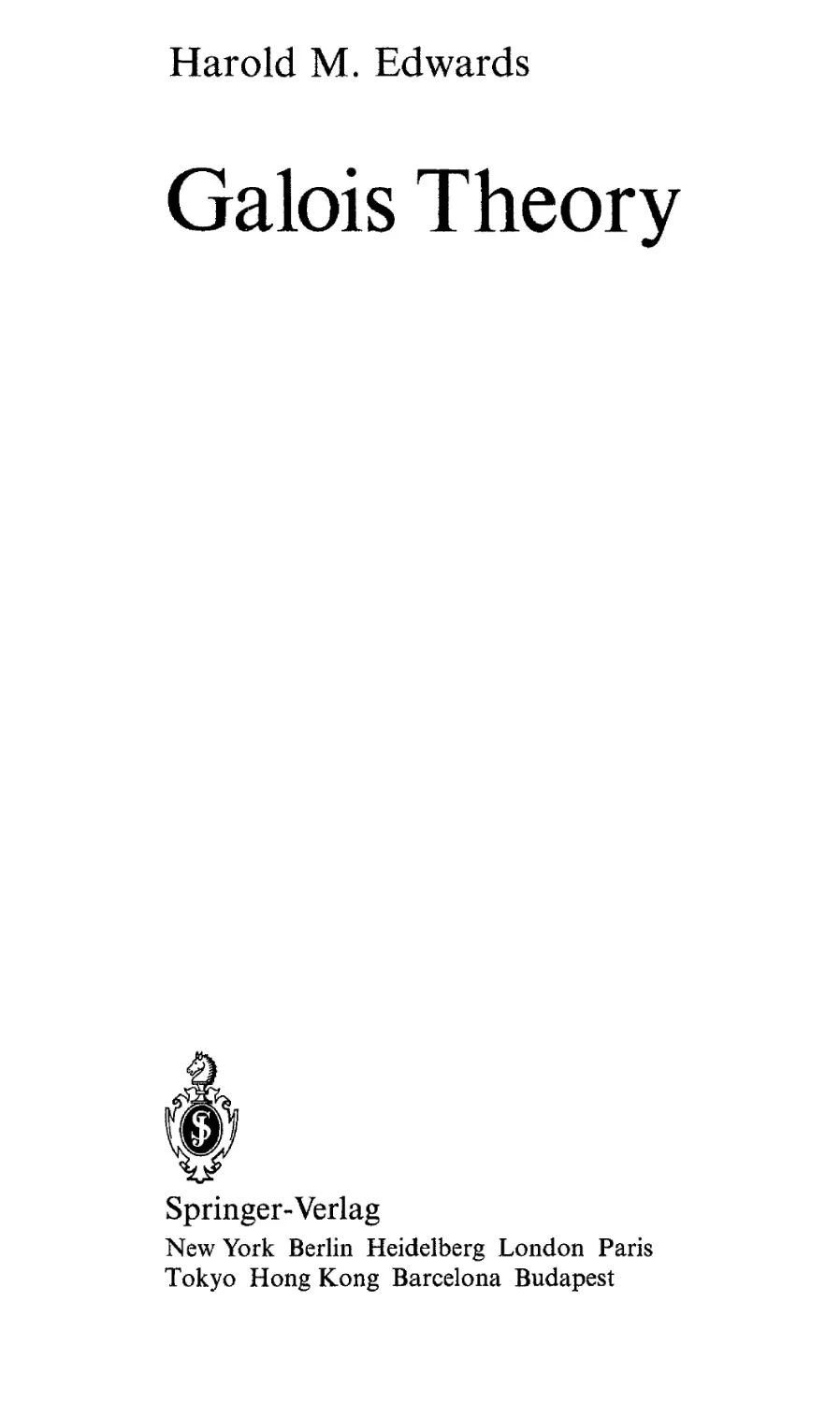
                    Harold M. Edwards
Galois Theory
Springer-Verlag
New York Berlin Heidelberg London Paris
Tokyo Hong Kong Barcelona Budapest

Harold M. Edwards
New York University
Courant Institute of
Mathematical Sciences
251 Mercer Street
New York, NY 10012
USA
Editorial Board
J.H. Ewing
Department of
Mathematics
Indiana University
Bloomington, IN 47405
USA
F.W. Gehring
Department of
Mathematics
University of Michigan
Ann Arbor, MI 48109
USA
P.R. Halmos
Department of
Mathematics
Santa Clara University
Santa Clara, CA 95053
USA
AMS Classifications: 12-01, 12-03,12A55, 01A55
Library of Congress Cataloging in Publication Data
Edwards, Harold M.
Galois theory.
(Graduate texts in mathematics; 101)
Bibliography: p.
Includes index.
1. Galois theory. I. Title. II. Series.
QA247.E383 1984 512'.32 83-20082
Printed on acid free paper.
© 1984 by Harold M. Edwards
All rights reserved. No part of this book may be translated or reproduced in any form without
written permission from the copyright holder.
Typeset by Composition House Ltd., Salisbury, England.
Printed and bound by R. R. Donnelley & Sons, Harrisonburg, VA.
Printed in the United States of America.
98765432 (corrected second printing, 1993)
ISBN 0-387-90980-X Springer-Verlag New York Berlin Heidelberg
ISBN 3-540-90980-X Springer-Veriag Berlin Heidelberg New York

Preface
This exposition of Galois theory was originally going to be Chapter 1 of the
continuation of my book Fermat's Last Theorem, but it soon outgrew any
reasonable bounds for an introductory chapter, and I decided to make it a
separate book. However, this decision was prompted by more than just the
length. Following the precepts of my sermon "Read the Masters!" [E2], I
made the reading of Galois' original memoir a major part of my study of
Galois theory, and I saw that the modern treatments of Galois theory lacked
much of the simplicity and clarity of the original. Therefore I wanted to
write about the theory in a way that would not only explain it, but explain it
in terms close enough to Galois' own to make his memoir accessible to the
reader, in the same way that I tried to make Riemann's memoir on the zeta
function and Kummer's papers on Fermat's Last Theorem accessible in my
earlier books, [El] and [E3]. Clearly I could not do this within the confines
of one expository chapter.
And so I decided to write a short book—a sort of volume \j of my work
on Fermat's Last Theorem—devoted entirely to the basics of Galois theory.
There is very little in this book that is not already to be found, however
concisely and however lacking in proof, in Galois. The one major exception
is the material on factorization of polynomials (§§49-61), which is due to
Kronecker and which seems to me to be necessary to give clear meaning
to the computations with roots of algebraic equations that Galois and
Lagrange performed without inhibition and without comment.
The crux of Galois theory is, appropriately enough, Galois' Proposition I,
which is the following characterization of what we call the Galois group of
an equation. Let a, b, c, . . . be the n roots (assumed distinct) of an algebraic
equation f(x) = 0 of degree n. The Galois group is a certain subgroup of
the group of permutations of the roots a, b, c, . . . . Galois used it to deter-

viii
Preface
mine whether a given polynomial in the roots F(a, b, c,. . .) has a known
value—in modern parlance, to determine whether F(a, b, c, . . .) is in the
ground field. The characteristic property of the Galois group is that
F(a, b, c, . . .) has a known value if and only if
F{a, b, c, . . .) = F(Sa, Sb, Sc, . . .)
for all permutations S of the Galois group. Galois proved the existence and
uniqueness of a group with this property by constructing it, using what
later became known as a Galois resolvent. (This characterization of the
Galois group will be more recognizable to readers familiar with modern
formulations of Galois theory after they read the first corollary in §41. See
also §63.)
The major theorems of Galois, such as the theorems on the solvability of
equations by radicals, flow from the study of the relationship between
algebraic equations f(x) — 0 and the groups associated with them. Of
particular importance is the analysis of the way in which the group is reduced
when the field of known quantities is extended (Galois' Propositions II-IV).
Some recent texts on Galois theory place mistaken emphasis on the
question of finding explicit quintic equations, with rational coefficients,
which cannot be solved by radicals. This is a moderately interesting result
(one not covered in this book) but it is not a key theorem of Galois theory.
Galois showed that an algebraic equation is solvable by radicals if and only
if the associated group is solvable. A given quintic with rational coefficients
can therefore be tested for solvability. Abel's theorem that the general
quintic is not solvable states that the equation x5 + BxA + Cx3 + Dx2 +
Ex + F = 0—an equation with coefficients in the field Q(B, C, D, E, F)
obtained by adjoining five transcendental elements (variables) to Q—is not
solvable by radicals. (In Galois theory this follows from the fact that the
Galois group of this equation is the full group of 120 permutations of the
five roots.) In other words, no field extension of Q(B, C, Z), E, F) obtained
by a succession of adjunctions of radicals can ever contain a root of the given
equation. This is what it means to say that the quadratic formula
~B ± JW^C
V — 21
X 2
and the much more complicated formulas for the cubic and quartic equations
(Exercises 1 and 2 of the Sixth Set) have no generalization to the quintic
equation.
Having just mentioned the exercises, I hasten to reassure the reader that
the exercises are not essential to the book. The only proofs that are relegated
to the exercises are those that I believe to be too easy, or too much like other
proofs already covered, to spend time on in the text. Naturally, the reader
who does the exercises will have a far greater understanding of the subject,
and will learn many things not contained in the text, but to do all the exercises
will surely consume an enormous amount of time. The reader who has just

Preface
ix
read the text will have covered all the propositions and methods of proof
that I consider to be basic to Galois theory.
What preparation do I assume on the part of the reader? Because
terminology changes so much from decade to decade and from field to field, I
have tried to assume as little terminology as possible. (When I completed
my undergraduate degree 25 years ago, I had had courses in advanced
calculus, determinants and matrices, differential equations, measure theory,
complex variables, etc., but I had never encountered the definition of a group
or an abstract vector space.) However, I have assumed a certain degree of
mathematical experience on the part of the reader, by which I mean
experience in computation and mathematical reasoning. The main theorems of
Galois theory state, in the last analysis, that certain computations with
polynomials produce certain results. In most cases the computations are
too long to do, and the idea of the computation is what counts, not any
particular cases of it. The reader should have enough mathematical
experience (and talent) to be able to conceive a general computation and its
properties after having done a few simple examples.
The approach of the book is consistently algebraic and constructive. The
fields considered are those obtained from the rational numbers by adjoining
a finite number of algebraic and/or transcendental elements. (Fields with
characteristic/? are mentioned only in passing. Fields obtained by completion
processes—the real and complex numbers, algebraic extensions of />-adic
fields—are not considered at all.) The constructive approach implies that
theorems mean what they say. For example, when a theorem says that an
equation is solvable, the proof must give a procedure—however impractical
—for constructing a splitting field by the adjunction of radicals. I believe
that this approach is very much in tune with Galois' conception of the
subject.
Liouville, in the "Avertissment" preceding his publication of Galois'
works in 1846, writes of the "vivid pleasure" he enjoyed when he realized
that Galois' methods were correct and that his theorems could be rigorously
proved. I experienced what I imagine was a similar—if lesser—pleasure
when I realized that two parts of Galois' memoir, which I at first thought
were mistakes, are perfectly correct. These are the places where Galois later
wrote "On jugera", in the case of the first, and "Something in this proof
needs to be completed—I haven't the time" in the case of the second.
The " Onjugera" passage is the one where Galois proves the crucial lemma
stating that any rational function of the roots can be expressed as a rational
function of the Galois resolvent. Poisson had called Galois' proof
"insufficient" but pointed out that the lemma followed from a theorem of
Lagrange. Galois, rather than elucidate his proof, laconically replied,
"That remains to be seen" (freely translated). My opinion is in §37.
The famous statement "I haven't the time" occurs in a marginal note
Galois made, probably on the night before the duel, with regard to the proof
of his Proposition II, which he said needed to be "completed ". Although his

X
Preface
proof appears wrong at first because he adjoins one root r of an equation
and then uses other roots of the equation, and although Liouville [Gl, p. 492]
found it necessary to circumvent Galois' proof entirely, I believe now that
the proof given in §44 is very close to what Galois had in mind, and that the
marginal note was merely prompted by the fact that he had changed the
statement of the Proposition, and realized that the proof needed to be
amended accordingly. (In fact, the Proposition, as stated, is false. The index
of the subgroup need not be 1 or p when p is not prime—it must simply be a
divisor of p.) A similar situation occurred with Proposition III, where
Galois again changed the statement, making it more general, at the last
minute, and had only time enough to say, "One will find the proof."
Finally, I hope it is superfluous to add that, while I have said above that
most of what is in this book is already in Galois, the converse is far from
true. The book contains a rather complete account of Galois' main memoir,
"Memoire sur les conditions de resolubilite des equations par radicaux"
(Appendix I contains a translation of this memoir) but it does not make
any claim to cover his other works. These contain, I am told, remarkable
insights into a number of topics, including the theory of Abelian functions
and finite simple groups. I return to my perennial refrain: Read the masters.

Contents
Acknowledgments xiii
§1. Galois §2. Influence of Lagrange §3. Quadratic equations §4.
1700 B.C. to a.d. 1500 §5. Solution of cubic §6. Solution of quartic §7.
Impossibility of quintic §8. Newton §9. Symmetric polynomials in roots
§10. Fundamental theorem on symmetric polynomials §11. Proof §12.
Newton's theorem §13. Discriminants
First Exercise Set 13
§14. Solution of cubic §15. Lagrange and Vandermonde §16. Lagrange
resolvents §17. Solution of quartic again §18. Attempt at quintic §19.
Lagrange's Reflexions
Second Exercise Set 22
§20. Cyclotomic equations §21. The cases n — 3, 5 §22. n ~ 7, 11 §23.
General case §24. Two lemmas §25. Gauss's method §26. p-gons by
ruler and compass §27. Summary
Third Exercise Set 31
§28. Resolvents §29. Lagrange's theorem §30. Proof §31. Galois
resolvents §32. Existence of Galois resolvents §33. Representation of the
splitting field as K(t.) §34. Simple algebraic extensions §35. Euclidean
algorithm §36. Construction of simple algebraic extensions §37. Galois'
method
Fourth Exercise Set 45

xii
Contents
§38. Review §39. Finite permutation groups §40. Subgroups, normal
subgroups §41. The Galois group of an equation §42. Examples
Fifth Exercise Set 56
§43. Solvability by radicals §44. Reduction of the Galois group by a cyclic
extension §45. Solvable groups §46. Reduction to a normal subgroup of
index p §47. Theorem on solution by radicals (assuming roots of unity)
§48. Summary
Sixth Exercise Set 65
§49. Splitting fields §50. Fundamental theorem of algebra (so-called) §51.
Construction of a splitting field §52. Need for a factorization method §53.
Three theorems on factorization methods §54. Uniqueness of factorization
of polynomials §55. Factorization over Z §56. Over Q §57. Gauss's
lemma, factorization over Q §58. Over transcendental extensions §59.
Of polynomials in two variables §60. Over algebraic extensions §61. Final
remarks
Seventh Exercise Set 81
§62. Review of Galois theory §63. Fundamental theorem of Galois theory
(so-called) §64. Galois group of xp — 1 — 0 over Q §65, Solvability of
the cyclotomic equation §66. Theorem on solution by radicals §67.
Equations with literal coefficients §68. Equations of prime degree §69.
Galois group of xn — 1 — 0 over © §70. Proof of the main proposition
§71. Deduction of Lemma 2 of §24
Eighth Exercise Set 97
Appendix 1. Memoir on the Conditions for Solvability of Equations
by Radicals, by Evariste Galois 101
Appendix 2. Synopsis 114
Appendix 3. Groups 118
Answers to Exercises 123
List of Exercises 145
References 149
Index 151

Acknowledgments
My greatest indebtedness is to Mr. James M. Vaughn, Jr., and the Vaughn
Foundation Fund. This book is a direct result of their encouragement and
support, for which I am deeply grateful. Work on the book was also supported
by a Fellowship of the John Simon Guggenheim Memorial Foundation
during 1981/82. T am grateful for both the financial support and the honor of
a Guggenheim Fellowship. A large number of friends and colleagues have
helped me by reading and commenting on early versions of the manuscript.
Some major revisions prompted by their criticisms have not been seen by any
of them, so it is even truer than usual that they are entitled to credit for many
improvements in the book but free from blame for its faults. I would especially
like to thank the following for their help: Jay Goldman, Mel Hausner, M.Y.
Hirano, Christian Houzel, Susan Landau, Richard Pollack, Walter Purkert,
Michael Rosen, Gabriel Stolzenberg, Rene Taton, William Y. Velez, B.L. van
der Waerden, and an anonymous reader for Springer-Verlag. Finally, my
thanks to New York University and the Courant Institute for their overall
support and assistance, including a sabbatical year 1980/81, the excellent
library, and the expert word-processing of Connie Engle.

Galois
§1 Great mathematicians usually have undramatic lives, or, more
precisely, the drama of their lives lies in their mathematics and cannot be
appreciated by nonmathematicians. The great exception to this rule is Evariste Galois
A811-1832). Galois' life story—what we know of it —is like a romantic novel.
Although he was making important mathematical discoveries when he was
still in secondary school, he was denied admission to the Ecole Polytechnique,
which was the premier institution of higher learning in mathematics at the
time, and the mathematical establishment ignored, mislaid, lost, and failed
to understand his treatises. Meanwhile, he was persecuted for his political
activities and spent many months in jail as a political prisoner. At the age of
20 he was killed in a duel involving, in some mysterious way, honor and a
woman. On the eve of the fatal duel he wrote a letter to a friend outlining his
mathematical accomplishments and asking that the friend try to bring his
work to the attention of the mathematical world. Against great odds, Galois'
few supporters did finally, 14 years after his death, succeed in finding an
audience for his work, and portions of his writings were published in 1846 by
Joseph Liouville in his Journal de Mathematiques. After that, recognition of
the great importance of his work came very quickly, and Galois began to be
regarded, as he is today, as one of the great creative mathematicians of all
time.
§2 The purpose of this book is to convey the mathematical drama of
Galois' work, so there will be no more mention of his short, unhappy life,* but
* For biographical information see Dupuy [Dl], Kiernan [Kl], Rothman [Rl].

2
Galois Theory
one point needs to be made about its most dramatic feature, namely, the fact
that Galois was able, at such an early age and without the benefit of any
formal higher education, to make discoveries that would win him lasting
fame. Surely many aspiring young mathematicians have been discouraged by
Galois' story, saying to themselves something like," Here T am already x years
old, x — 20 years older (younger) than Galois was when he died, and,
although I like math and have always done well at it, I would no more be
able to make a great discovery than I would be able to swim the Atlantic."
How was Galois able to do it? Was he blessed with some superhuman gift that
put him in a class apart? I think not. Of course, talent is essential, and few are
as talented as Galois. Still, talent alone is not enough. Galois had to reach the
point where he knew enough and had enough techniques at his command
to be able to move beyond what had been done before. The secret of how he
was able to do this is contained, I believe, in a passage in Dupuy's biography
of Galois [Dl, p. 206]: "Elementary algebra books never satisfied Galois
because he didn't find in them the stamp of the inventors; right from his first
year of mathematics he turned to Lagrange."
Lagrange's Reflexions sur la Resolution Algebrique des Equations A771)
is the treatise of Lagrange most likely to have inspired the creation of Galois
theory. It is an extraordinary work, written in a relaxed, discursive style
that was rather common in the eighteenth century, but is virtually unknown in
mathematical writing today. It discusses at length the central question of the
time in the theory of algebraic equations, namely: What is the essence of the
methods by which it is possible to solve equations of degrees 2, 3, and 4? Is it
possible to extend these methods to equations of higher degree and, if not, why
not? Lagrange gave an insightful answer to the first question, describing the
solutions of equations of low degree in terms of a unified technique now
known as the technique of the Lagrange resolvent* His answer to the second
question, on the other hand, is quite inconclusive. He shows that the
technique does not apply in an obvious way to equations of degree 5 or higher,
and he discusses some techniques—notably the technique of permuting the
roots of an algebraic equation—which are relevant to the applications of
Lagrange resolvents to equations of higher degree, but he gives no final
answer. In short, it is a paper that gives the reader as much information about
the problem as the author can provide and indicates the direction which the
author feels further work should take. Viewed in this way, Lagrange's paper
seems the perfect source of inspiration for a Galois.
Thus, in order to appreciate Galois' theory, it is natural first to review
Lagrange's work. We will go much farther back than that—all the way to
ancient Babylon—and then review a few other aspects of the development of
algebra before discussing the main features of the work of Lagrange and then
moving on to his successors, Gauss and Galois.
* A very similar technique was used a few months earlier by Vandermonde (see §15), but this was
unknown to Lagrange.

§3. Quadratic Equations
3
Quadratic Equations 1700 B.C.
§3 Archeological research in the twentieth century has revealed the
surprising fact that the peoples of Mesopotamia in the period around*
1700 B.C. had an advanced mathematical culture, including an excellent
sexagesimal system of arithmetic and a knowledge of the Pythagorean
theorem (a millennium before Pythagoras!). Of particular relevance to the
theory of equations and Galois theory is the knowledge in this ancient
culture of a method for the solution of quadratic equations.
According to Neugebauer [Nl], the technique commonly used in the
Babylonian texts to solve quadratic equations can be viewed as a reduction to
a normal form, followed by a method for solving the normal form. The
normal form was to find two numbers given their sum and their product. In
modern algebraic notation, this can be stated: Given two numbers p and s,
and given that xy = p, x + y = s, find x and y. The steps by which the
Babylonians solved this problem are as follows:
1. Take half of s.
2. Square the result.
3. From this subtract p.
4. Take the square root of the result.
5. Add this to half of s; this is one of the two numbers and the other is s minus
this one.
For example, if the sum is 10 and the product is 21 then the successive
steps give 5, 25, 4, 2, 7 and 10 — 7 = 3. Thus the two numbers are 7 and 3.
That this normal form is indeed a quadratic equation can be seen by
multiplying the equation s = x + y by x to find sx = x2 + xy = x2 + p.
In other words, x is a solution of the quadratic equation x2 — sx + p — Oand,
by symmetry, so is y.
Conversely, the solution of any quadratic equation can in our notation
be viewed as the solution of a problem in normal form. Specifically, the
equation ax2 + bx + c = 0 can be rewritten as x2 + (c/a) — —(b/a)x and the
solution of this equation is equivalent to finding two numbers whose sum is
— b/a and whose product is c/a. The Babylonians could not reduce all
quadratic equations to a single normal form, however, because their
arithmetic did not include negative numbers. To deal with this fact, they had a
second normal form, in which the difference and the product of two numbers
were given. This is a technical problem of considerable historical interest-
it was only a few centuries ago that negative numbers became generally
accepted so that polynomial equations did not have to be divided into several
cases depending on the signs of the coefficients—but is of no importance to
the algebra of the problem and will not be considered further here.
* The texts cannot be closely dated. Neugebauer places them between 1600 and 1800 b.c.

4
Galois Theory
In modern algebraic notation (also only a few centuries old) the Babylonian
solution of the problem in normal form can be written
or, in a more familiar form,
s ± x/s2 - 4p
X y _ V
2
Thus it is fair to say that they knew the quadratic formula but that they spelled
out the steps of the procedure instead of expressing it as a formula in the way
we do.
How did they derive this procedure? Unfortunately, there is no indication
in the texts which survive. The point of these texts seems to have been to
convey, by means of several worked examples, the technique of solution. It is
entirely possible that the technique was discovered by an ancient
genius and that his successors merely adopted it because it produced correct
answers. On the other hand, it may be that some derivation was well
understood by many people at the time, but was transmitted orally or does not
happen to be among the texts that have been found.
Cubic and Quartic Equations a.d. 1500
§4 There was some progress in algebra in the 3000 years between the
Old Babylonian period and the Italian Renaissance, but it was not great. The
late Greek writer Diophantus (circa a.d. 250) introduced some abbreviated
algebraic notation, the Hindus used negative numbers on occasion, and the
Arabs constructed the solutions of cubic equations as points of intersection of
conic sections. When the Renaissance came, however, the advances in
algebra were enormous, and they opened the way to great progress in all
branches of mathematics.
In mathematics, the Renaissance was not a rebirth at all, but a period of
first vigorous growth. In ancient times, Europe had been a mathematical
backwater, and even the Romans were barbarians when it came to
mathematics. During the Middle Ages, Europe had learned about algebra (al-jabr)
from the Arabs and had begun to improve it by devising new symbols and
notations. Then, in the sixteenth century, an enormous advance was made—
the algebraic solution of cubic equations was discovered, and soon thereafter
the solution of quartic equations.
The history of the discovery of these solutions and their exact description
in terms of the still quite clumsy notation of the period will not be necessary
in what follows. Instead, we will give just a brief account, in modern notation,
of the solutions themselves. (For more details see Kline [K2], pp. 263-270
and 282-284.)
§5 Suppose the cubic equation to be solved has the form x3 + px +
q = 0. (An arbitrary cubic equation can be put in this form by dividing by the

§7. Impossibility of Quintic
5
coefficient of x3 and then taking a change of variable x' = x — c with c equal
to the coefficient of x2 divided by 3.) Introduce two new variables a and b and
set x = a — b. The desired equation is then a3 — 3a2b + 3ab2 — b3 +
pa - pb + q = 0, that is, a3 - b3 -f- (a - b)(-3ab + p) + q = 0. If it is
stipulated that 3ab = p, then this equation takes the form a3 — b3 + q = 0.
If a solution (a, 6) of these two equations 3ab = p and a2 — b3 + q = 0 in
two unknowns* can be found, then, as is easily checked, the quantity x =
a — b is a solution of the original equation x3 + px + 0 = 0. Multiplication
by 33«3 makes it possible to eliminate b from a3 — b3 + q = 0 to find 27a6 —
CabK + 27a3q = 0, that is, 21a6 + 27qa3 - p3 = 0. This is a quadratic
equation for a3. Let« be the cube root of a solution of this quadratic equation
and let b = p/3a. Then 3ab = p and a3 - b3 + q = 0, which implies that
x = a — b is a solution of the given equation.
§6 For the solution of the quartic, assume that the equation has the
form x4 + px2 + qx + r = 0. (Again, an arbitrary quartic equation can
easily be put in this form.) Let this be put in the form x4 = — px2 — qx ~ r.
Then, if a is a new variable, (x2 + aJ = x4 + lax2 + a2 = ( —p + 2a)x2 ~
qx + ( — r + a2). In order to take a square root on the right side, this
quadratic function of x should have a single root—i.e. should be of the form
A(x + BJ~and by the quadratic formula this occurs if and only if q2 —
4( — p + 2a){ — r + a2) = 0. This is a cubic equation for a, which can (by the
above method) be solved for a. When a is a root of this equation, the right side
of the above expression of (x2 + aJ has the form A(x + BJ where A is the
coefficient of x2 and B is the coefficient of x divided by 2A, that is,
(x2 + aJ = (-p + 2a)(x - q ) ,
\ 2(-p + 2a)/
or, more simply,
Xl + a= ±^Z^+^' (x - 2(-/+ 2a))'
which gives x as the solution of a quadratic equation.
§7 Of course the successful solution of the cubic and quartic equations
led to attempts to solve the quintic equation. It was not until almost 300 years
later, in the 1820's, that it was shown, first by Abel, then by Galois, that it is
impossible to solve the quintic equation in the same manner that the cubic
and the quartic were solved, specifically, by using no operations other than
addition, subtraction, multiplication, division, and the extraction of roots.
During these 300 years the fruitful developments in algebra were in other
* There is no sharp distinction made here among the terms "variable", "unknown", and
"indeterminate". For the most part, "variable" is used in this book. If a variable occurs in an
equation that is to be solved, it may be called an unknown. If it is to remain variable and is
being used primarily as a placeholder in a computation, it may be called an indeterminate.

6
Galois Theory
directions. One of the most important was a theorem discovered by Isaac
Newton, which is the subject of the next section.
Newton and Symmetric Functions
§8 Isaac Newton A643-1727) is most famous for his discovery of the
universal law of gravitation and for his use of that law to give an exact
mathematical description of planetary motion. Consequently, he is identified
in most people's minds with mathematical physics and applied mathematics.
Even people who have some acquaintance with the history of mathematics
and who realize that Newton, with Leibniz, is regarded as the father of
differential and integral calculus, tend to think of Newton's mathematics as being
closely related to his physics, and his calculus as being primarily a tool in his
study of motion. Nevertheless, Newton's contributions to pure mathematics
alone are sufficient to place him among the greatest geniuses in the history
of mathematics. This section is devoted to a theorem of pure algebra which is
of crucial importance to the later development of the subject and which
appears to be Newton's creation.
A portion of this theorem was published in Newton's Arithmetica
Universalis in 1707, after Newton was world famous and had ceased active scientific
work. It is cited by Gauss [G2, Art. 338] and Weber [W3, vol. I, Sec. 46],
among others, and is generally known as Newton's theorem. Of course the
Arithmetica Universalis was known to have been written long before 1707,
but it is only with the recent work of Derek T. Whiteside in analyzing,
annotating, and publishing Newton's notebooks and papers that it has been
possible to date many of Newton's discoveries and, in the case of the theorem
under discussion, to know that he was aware at a very early date of the full
theorem, not just the portion given in the Arithmetica Universalis.
§9 Whiteside found in papers dating to 1665-1666, in the very earliest
phase of Newton's career, the following formulas: Let r, s, t be the three roots
of a cubic equation x3 + bx2 + ex + d = 0, and let an expression like "every
rV" denote the sum of all distinct expressions of the form rV where r and s
are roots of the given cubic, i.e. "every r2s" = r2s + s2t + t2r + r2t +
t2s + s2r, "every r2" = r2 + s2 -f t2, "every r2s2t2" =
Newton's formulas* are
(every r) = — b
(every r2) = b2 — 2c
(every r2) = ~~b2 + 3bc — 3d
(every rs) = c
(every r2s) = — be + 3d
(every r3s) = b2c - 2c2 - bd
- r2s2t2, etc. Then
A)
B)
C)
D)
E)
F)
* [N3, p. 517]. Newton took —r, -s, — f to be the roots of the equation, which simply changes
the signs of the formulas with odd degree.

§9. Symmetric Polynomials in Roots
7
(every r2s2) =
(every r3s2) =
(every r3s3) =
(every rst) =
(every r2st) =
(every r3st) =
(every r2s2t) =
(every r3s2t) ~
(every r3s3t) =
(every r2s2t2) =
(every r3s2t2) -
(every r3s3t2) =
(every r3s3t3) =
= c2 - 2bd
= -be2 + 2b2d + cd
= c3 - 36cJ + 3<i2
= -d
--bd
= -W + 2crf
= — cd
= bed - 3d2
= -c2d + 2M2
= rf2
= -W2
= cd2
-- -d3
G)
(8)
(9)
A0)
A1)
A2)
A3)
A4)
A5)
A6)
A7)
A8)
A9)
He did not record in his notes the method by which he derived these
formulas, and we can only guess what lay behind them. However, it seems
likely that the choice to stop with third powers of the roots was arbitrary*
and that he could have given analogous formulas for higher powers.
Moreover, the decision to deal with the three roots of a cubic, rather than the four
roots of a quartic or the five roots of a quintic, was also probably arbitrary.
In fact, a few pages later in Whiteside's book, a passage from Newton's
notebook is reproduced in which he gives the analogs of formulas (l)-C)
for an equation of degree 8, namely, the formulast
(every r) = -p,
■2q,
+ 3pq — 3r,
4p2q + Apr - As + 2q2,
-f 5p3q - 5p2r + 5ps — 5t — 5pq2 + 5qr,
6p*q + 6p3r - 6p2s + 6pt - 6v + 9p2q2
— \2pqr + 6qs — 2q3,
(every r7) = — p1 + lp5q — lpAr + lp3s — lp2t + Ipv — ly,
(every r8) = p8 - 8p6q + 8p5r - Sp4s + 8p3r - 8p2v + Spy ~ 8z,
* Newton in fact had a specific goal in mind in the passage in question, namely, the derivation
of the explicit formula for the resultant of two cubics (see Exercise 8). For this goal he needed the
given formulas and only these.
tThe first four of these formulas were published by Albert Girard in 1629. In Whiteside's opinion,
Newton was not aware of Girard's work. The formulas at the bottom of this page are taken from
Whiteside's edition of Newton's papers (vol. 1, p. 519). They are incorrect in the cases 6, 7, and
8. The formula for "every r6" is missing a single term 3r2. (Note that there is no u—in Newton's
alphabet, t is followed by v.) The correct formulas for "every rln and "every r8" are much longer
than the formulas given here. I do not know whether the errors are Newton's or Whiteside's.
(every r2) =
(every r3) -
(every rA) -
(every r5) =
(every r6) =
-p2-
-- -p3
-p*-
= -p5
= p6-

8
Galois Theory
where r runs over the eight roots of the 8th degree equation x8 + px1 +
qx6 + rx5 + sx4 + tx3 + vx2 + yx -f z — 0.
In other words, it appears likely that Newton was aware that there are
analogous formulas for all degrees, that is, that any symmetric polynomial
in the roots of an equation can be expressed in terms of the coefficients of that
equation. This theorem is the foundation stone of Galois theory, so it is
important to have a careful statement and proof of it before proceeding.
(It must be admitted, however, that neither a careful statement nor a proof of
it seems to have been published before the nineteenth century. Everyone
seemed familiar with it and used it without inhibition.)
The Fundamental Theorem on Symmetric Polynomials
§10 The first step in giving a careful statement of the theorem is to
remove the reference to roots of an nth degree equation, because these roots
may be irrational or complex and they are really extraneous to the theorem.
(Newton explicitly states in his formulas that the roots may be "false",
i.e. negative, or "imaginary".) The particular formulas A), D) and A0) in
Newton's list, that is,
r + s + t = -b,
rs + st + tr = c, B0)
rst = —d,
are especially important and were probably rather widely known in Newton's
time. (Whiteside [N3, p. 518, note 12] observes that the general case of these
formulas was published by Albert Girard in 1629 but says that "we may
assume" that Newton's version of it, which he published in the Ariihmetica
Universalis, was his "independent discovery".) These formulas follow
immediately from the identity
x3 + bx2 + ex + d = (x — r)(x — s)(x — t),
when the right side is multiplied out and coefficients of like powers of x are
equated. The same procedure applied to
x" + M"~l + b2x"~2 + •.. + />„ = (x - rt)(x - r2) • - • (x - r„)
shows that, in analogy to B0), the sum of all* { ) products of k of the r-t is
equal to (— \)kbk. That is,
?i + r2 + ••■ + rn = -bu
rtr2r3 + rtr2rA + ••■ + ^„-2'^-i^ = -b3>
rlr2.-.rn = {~\)nbn.
(n\ n\
* Here f denotes the binomial coefficient -— rr-;-
\k/ k\(n - fe)!

§11. Proof
9
Let ak denote the polynomial on the left side of the fcth equation, so that the
equation reads ak~{- \)kbk. Then ok is called the kth elementary symmetric
polynomial in ru r2,..., r„. Here ru r2,..., r„ are to be regarded as variables
or indeterminates, rather than roots of an equation, and ax, o2,.. ,,an are
to be regarded as polynomials in these indeterminates. A polynomial in
i\, r2,. ■ ■, rn is simply a formal sum of terms of the form Ar^r^2 ■ • • r£" where
A is a number (say a rational number for now) and the /4's are nonnegative
integers. A polynomial in i\, r2,..., rn is said to be symmetric if it has the
property that interchanging any two of the r's leaves the polynomial
unchanged—provided, of course, that two polynomials are regarded as being
equal when applications of the commutative laws of addition and
multiplication can change one into the other. (For example, rs + st + tr is
unchanged by an interchange of r and s because rs -f- st + tr = sr + rt + ts.)
Clearly the elementary symmetric polynomials ou a2,..., on in n variables
arc symmetric in this definition.
In Newton's formulas A)-A9) the left sides are by definition symmetric
in r, s, and t, and the right sides are polynomials in b, c, and d or, what is the
same in view of B0), polynomials in a^ — r + s + t, a2 — rs + st + tr,
and 0-3 — rst. Thus these formulas are all instances of the following theorem:
Fundamental Theorem on Symmetric Polynomials. Every symmetric
polynomial in rj, r2, . . . , rn can be expressed as a polynomial in the elementary
symmetric polynomials a^, o2,..., <r„. Moreover, a symmetric polynomial with
integer coefficients can be expressed as a polynomial in o^, a2, ■ ■ • ,Gn with
integer coefficients.
When the theorem is stated in this way, it deals with algebraic identities,
not with equations and roots. For example, Newton's formula C) is the
identity
r3 + 53 + t* = <t\ - 3a,<72 + 3<t3
= (r + s + fK ~ 3(r + s + t)(rs + st + tr) + 3rst.
However, if x" + b1xn~1 + b2xn~2 + • • • + bn = 0 is an nth degree
equation with n roots (in some sense) the formula ok — (~\)kbk makes it
possible to evaluate the elementary symmetric functions of the roots
immediately, without ever finding the roots themselves; then the theorem shows
that it is possible to evaluate any symmetric function of the roots without
finding the roots themselves. Moreover—a fact that will be very important
later on—if the b's are rational numbers, then any symmetric polynomial
in the roots assumes a rational value.
§11 Proof. The proof of the fundamental theorem on symmetric
polynomials which follows is a simple computational procedure for finding,
given a symmetric polynomial, a representation in terms of elementary
symmetric polynomials. To say that the procedure is simple is not to say that

10
Galois Theory
it is practical, and in fact the procedure normally leads to an impossibly long
computation. This is to be expected when a computational procedure is
used to prove a nontrivial existence theorem; a simple and sure, but probably
very slow, method is best for proving existence, but, once existence has been
established, there are frequently ways to get to the desired answer much
more quickly in particular cases.
The proof will be by induction on the number of variables. If there is only
one variable, then there is only one elementary symmetric polynomial
al = r{ and the theorem is trivially true. Assume, therefore, that the theorem
has been proved for symmetric polynomials in n — 1 variables and let
G(ri; r2,..., rn) be a symmetric polynomial in n variables. Let the terms of G
be gathered according to the power of rn that they contain, to give
GOi, r2,. ■ •, r„) = G0 + G,r„ + G2r;J + • • • + Gvrv„,
where G, (i = 0, 1,..., v) is a polynomial in the n — 1 variables
ri> *'2» • • • ■> rn- \ anc* v is the highest power of r„ that occurs in G. Now since
G is unchanged when any two of the variables ru i'2,...,r„^i are
interchanged, so is each G,. Therefore, by the induction hypothesis, each G; can
be written as a polynomial in the elementary symmetric functions in rlt
r2, ■ ■ ■, r„_v Let t1s t2, • • ■, t„-i denote these elementary symmetric
functions, that is,
x1 = rl +r2 + •■• + »•„_!,
t2 = rxr2 + r,r3 + •■• + rn-2rn_u
Then each G, can be expressed as a polynomial in the t's, say
G/(/*„ r2,..., r„_i) = ^(t,, t2, ..., Tn_t)
and, in addition, if G has integer coefficients then so do all the polynomials gL.
As before, let alt a2, • ■ •, on be the elementary symmetric functions in n
variables. Then clearly the as and the t's satisfy the relations
0-1 = 1!+ r„,
e2 = ?2 + rnxu
^3 - T3 + rn?2,
U4 = T4 + rn t3 ,
<?n " 0 + r„T„-i,

§11. Proof
11
and these imply
Tj = ax - r„,
t3 - o-3 - rnx2 = o-3 - r„<r2 + rjo-! - rj,
0 = o-„ - r„T„_j = a„ - rnan^x + •■• + (~-l)"C
Let these expressions for xu x2 ,..., t„_ t in terms of <r's and r„ be substituted
into the equation
G = 0OCO + 0i OK + 02OK2 + ■ • ■ + #vOK-
The result is a polynomial in ox, o2,..., cr„_ 2 and rn. Let the terms be gathered
according to the power of r„ that they contain to give an expression of the
form
G(ru r2,...,r„)= f0(a) + f,{a)rn + f2{a)r2n +•■•+ /„<»£
where each ft(a) is a polynomial in au <j2,..., aH_1 which has integer
coefficients if G does. If ji > n then the degree of this polynomial with respect
to r„ can be reduced using the relation
C = 1* ^1 ~ rnn~2u2 + rnn~3<r3 -■•■ + (- 1)"" V„
found above. Therefore, by repeated use of this identity, the degree in rn
can be reduced to n — 1 and an identity of the form
G(ru r2t... ,r„) - f0(a) + fx{a)rn + • • • + /,-^K A)
can be derived. Here each y^0") is a polynomial in au <j2,...,<j„ which has
integer coefficients if G has integer coefficients. The proof will be completed
by showing that, in a relation of this form, if G is symmetric, then
are all necessarily 0 so that G(ru r2,.. .,rn) ~ f0{(Ju a2,..., <j„) as was to be
shown.
Both sides of A) are polynomials in rlt r2,..., r„. Therefore it is
meaningful to interchange rt and r„ in each side. This leaves G unchanged, by
assumption, and leaves f^a) unchanged because the as are symmetric. Therefore it
changes A) into the same equation with rt in place of rn. In the same way,

12
Galois Theory
r„ can be interchanged with any one of ru r2,.. .,rn^1. This gives an n x n
system of linear equations
/o(<r) + .AOK + fi{o>\ + •' ■ + fn-AaYT1 = GO-!, r2,..., r„),
/ofa) + /iO>2 + /2<»'2 + "•+/„_ i(<x>r! - G(r„ r2,..., O,
/o(o-) + ZiOK + y2(o->« + •■■ +/B-i@>r1 = G^,^,...,^),
in which the matrix of coefficients is [rj_1], that is, has r\~l in the ith row
and ;th column. The determinant of this matrix, regarded as a polynomial
in rx, r2, •.., r„, is obviously nonzero because no two of its n! terms contain
the r's to the same powers.* Thus the fact that multiplication of the column
vector (JoO7)*/iO7)*• ••^fn~i(<7)) by this matrix gives the same result as
multiplication of the column vector (G, 0, 0,..., 0) by the same matrix
implies that these two column vectors are identical, as was claimed above
(see Exercise 30). □
A slightly different way to reach the desired conclusion G = f0 is to regard
the above n equations as saying that the polynomial F{X) = fn^1Xn~x +
fn~2Xn~2 + ' • * + f\% + /o ~~ G (with coefficients that are polynomials in
rlt r2, • • •, rH) has at least the n roots X = rlt r2,..., rn. Therefore (Exercise
29) it is divisible by (X - r,)(Z — r2)- ■ (X - r„). This would imply
deg F > n if F(X) were not the zero polynomial, so F(X) = 0, which is to
say/0 = G,/1 = 0,./2 = 0,...,/B_I =0.
Particular Symmetric Polynomials
§12 It was mentioned above that there is a theorem connected with the
fundamental theorem on symmetric polynomials that is traditionally known
as "Newton's theorem." Specifically, this theorem from the Arithmetica
Universalis^ is the following. For a given value of n, let au a2,..., on be
the elementary symmetric functions in n variables ru r2,.,., rn, and let
sk, for k = 1, 2, 3,... be the symmetric polynomial
sk = r\ + r\ + ... + r\.
By the fundamental theorem, each sk can be expressed in terms of the cr's.
In many situations it is useful to be able to find these expressions explicitly.
(When n = 8 they are given in §9 above.)" Newton's theorem " is the relation
sk - sk-xax + sk-2(T2 + (~-l)k-1s1<7k_1 +(-\)kkak = 0
(* = 1,2,3,...),
* This is the "Vandermonde determinant." Sec note to §15.
t [N2, p. 203 in the English translation.]

First Exercise Set
13
where, as is natural, a-} = 0 for; > n. Thus
Sl - o-j = 0,
s2 ~ sia1 + 2a2 = 0,
s3 -~ s2al + Si<j2 - 3o-3 = 0,
etc.
These relations make it easy to compute the sk when the ak are known, and
vice versa. In particular, given any polynomial, one can easily find the sum
of the kth powers of its roots without finding the roots. (See Exercises 15 and
16.)
§13 A symmetric polynomial of particular importance is the discriminant
EI (ri ~~ rjJ where i and) run over all pairs of distinct integers 1 < i <j < n.
In the case n — 2 the discriminant is (r1 — r2J = r\ — 2rxr2 + r\ = o2 — 4cr2,
a formula which lies at the base of the solution of the quadratic equation. In
particular, the discriminant of the roots of a quadratic equation
x2 + bx + c = 0 is ( — bJ — Ac, which shows that the two roots are equal if
and only \{b2 — 4c = 0. For more variables, the discriminant is increasingly
difficult to express explicitly in terms of the as. For example, for n = 3 it is
o\o\ — AoXot, + 1 %axa2a2 — 4a\ — 27a\ (see Exercise 25). Thus, in
particular, an equation of the form x2 + px + q = 0 has multiple roots (its
discriminant is 0) if and only if — 4p3 — 21 q2 = 0.
First Exercise Set
1. Show that if x and y are any two (real) numbers, and if s = x + y, p — xy, then
s2 — 4p > 0. Thus if s2 — 4p < 0 the problem s = x + y,p = xy has no (real) solution.
2. Show that the formula
s ± Js2 - 4p
of §3 solves the problem algebraically in the sense that it gives a solution whenever
yfs2 - 4p is something with the property that its square is s2 - 4p. Thus, in particular,
it is valid for s2 — 4p < 0 when y/s2 - 4p is regarded as a complex number.
3. The solution of the cubic in §5 should also be regarded as algebraic. It is not well
suited to the numerical solution of equations. Show that for the solution of x3 + 6x = 20
it gives x = ^10 + y/V0S - v^-10 + y/\Q&. To derive the solution x = 2, put
^+10 + ^/108 in simpler form by solving (c + d^/lf = ± 10 + 6^/3 for c and d.
(This example is from Cardan's Ars Magna.) Show that the other two solutions of
x* + 6x ~ 20 are not real.
4. Solve x3 — 3x + 2 by the method of §5. Use the solution that is obtained to find a
linear factor of x3 - 3x - 2 and thereby to find two other real roots of the equation.

14
Galois Theory
Show that these roots are given directly by the method of §5 if one uses the complex roots
of co3 = 1, that is, w = ■£[- 1 + u/3].
5. Find the complex roots of the equation of Exercise 3 by: (a) solving the quadratic
equation they satisfy; and (b) using complex values of a in the solution of the cubic.
6. Show that the solution of an nth degree equation of the form xn + axn~l +
bx" + ■ • • + dx + e = 0 can be reduced to the solution of another such equation in
which a = 0 by the substitution x — y + C.
7. Show that the method of §6 solves x4 + px2 + qx + r = 0 algebraically in the sense
that it writes the left side of this equation as a product of two factors of degree 2 (which
can then be written as products of linear factors using the quadratic formula).
8. Newton's objective in the passage where he gives the first set of formulas in §9 is to
determine, given two cubic polynomials, whether they have a common root. Let f(x) —
x3 + bx2 + ex + d have roots r, s, t, as in §9, and let g(x) = x3 + Bx2 + Cx + D.
Then g(x) and/(x) have a root in common if and only if g(r)g(s)g(t) = 0. Since g(r)g(s)g(t)
is a symmetric polynomial in r, s, t whose coefficients are polynomials in B, C, D with
integer coefficients, this condition can be expressed in the form P(b, c, d, B, C, D) — 0
where P is a polynomial with integer coefficients. Find P. [An easy but slightly long
computation. P has 34 terms.]
9. The polynomial P of the preceding exercise is called the resultant of x3 + bx2 +
cx + d and x3 + Bx2 + Cx + D. This gives the resultant of x3 + (b/a)x2 + (c/a)x +
(d/a) and x3 + (B/A)x2 + (C/A)x + (D/A) which, because these polynomials have the
same roots, it is natural to call the resultant of ax3 + bx2 + cx + d and Ax3 + Bx2 +
Cx + D. Find this resultant. [Easy from Exercise 8.] This, in essense, is the form in
which Newton gives the answer. Prove that the resultant is 0 if and only if the two
polynomials have a root in common or A = a = 0, i.e. neither polynomial is in fact cubic.
10. Use the resultant to reduce the solution of two equations in two variables/(x, y) =
0' 9(x> y) — 0to the solution of polynomials in one variable in the case where/and g both
have degree 3 at most in x. In all likelihood, this is the application that Newton had in
mind and it is the reason he did not assume a = A = 1. (Rather rough arguments are
all one can expect here, since the notion of a. solution of an equation has yet to be spelled
out.)
11. Given a polynomial in «variables/(jci, x2, ■ ■ ■, jcJ, let its terms be ordered as follows.
Arrange terms first according to the power of Xj_ they contain: / = Ahx\ +
Ah^xx\~l + • •• + Axx1 + A0 where the A's are polynomials in x2, x3, ...,xn. Next
arrange the terms of A, according to the powers of x2 they contain: At — Bikx\ + ■ ■ *
+ Bnx2 + &io>tnen arrange the terms of Bi} according to the powers of x3 they
contain, etc. Otherwise stated, put the terms of/ in lexicographic order, where one term
precedes another in lexicographic order if it contains xt to a higher power, or, if they
contain xx to the same power, it contains x2 to a higher power, or, if they contain xt
and x2 to the same power, it contains x3 to a higher power, etc. Show that if / and
g are two polynomials in xl5 x2,..., xn in lexicographic order then the leading term of
fg is equal to the leading term of/ times the leading term of g.
12. Give a proof of the fundamental theorem on symmetric polynomials along the
following lines. Let G(xt, x2,... ,x„) be a symmetric polynomial, and let Ax'

First Exercise Set
15
be its leading term (in lexicographic order). Then mt > ra2 > • • ■ > m„ and
A„mi-m2rrm2-mi m„ - i -mn nt„ _ f
^"l °2 ' "n- 1 °n ~~ J
is a symmetric polynomial with the same leading term. Similarly, let g be the monomial
in gx,g2, ..., on with the same leading term as G — f, h the monomial with the same
leading term as G — f - g, and so forth. Show that eventually one of these differences
must be 0, and therefore that G can be written as a sum of monomials in at,a2, •■•,Gn
with coefficients that are integers if the coefficients of G are integers.
13. Use the method of the preceding exercise to derive formulas A)—A9) of §9.
14. Give an alternate proof of the identity r"n - ^ir" + cr2r"~2 - ■■• + a„ = Oof §11.
15. Prove Newton's Theorem (§12).
16. Use Newton's Theorem to derive the formulas for "every r'" (/ = 1, 2,..., 8) in §9.
17. Find an equation of degree 2 whose roots are the cubes of the roots of x2 + ax + b.
Apply this to the equation x2 + x + 1 to conclude that its roots are complex cube
roots of unity.
18. Find all quadratic equations x2 + ax + b = 0 with the property that the squares
of the roots coincide with the roots.
19. For a given set xx, x2,..., x„oin variables let (kv k2,..., /c,,) denote the polynomial
which Newton would call "every x\'xk22 ■ ■ ■ x£"," that is, the sum of all distinct monomials
that can be obtained from x\'xk22 ■■■ xfth by permutations of xu x2,..., x„. (If h > n let
(kl,k2,...,kh) be the 0 polynomial.) Prove the following rule for computing
(kl,k2,..., kh)(m). Let A be the set of all functions (k\, k2,..., k'h+l) such that A)
k\ > k'2 > • • • > k'h+! and B) the (h + l)-tuple of integers (k\, k'2,..., k'h+1) is the
componentwise sum of two (h + l)-tuples, one of which is a permutation of
(kt, k2,..., kh, 0) and the other of which is a permutation of (w, 0, 0,..., 0). Then
(kuk2,,.., kh)(m) = YufeAcff where cs is the number of distinct ways that the /c-tuple
/= (k\, k'2,... ,k'h+l) can be written as a sum of two (h + l)-tuples in the prescribed
manner, or, what is the same, the number of terms in the sequence/^ (k'u k'2,..., k'h+ x)
that are equal to the value k\ which contains m. For example, A, 1)A) gives A = B,1,0),
A, 1, 1); the first arises only as A, 1,0) + A, 0, 0), but the second arises three ways—
A,1,0) + @,0,1), A,0,1) + @,1,0), and @,1,1) + A,0,0). Therefore A,1)A) -
B, 1) + 3A, 1, 1).
20. Using the preceding exercise, show that every symmetric polynomial with integer
coefficients can be written as a polynomial in s£ = x\ + x'2 + ■ • ■ + xln (i = 1, 2, 3,...)
with rational coefficients.
21. Prove F) of §9 by expressing C, 1) in terms of Sj = r + s + t, s2 = r2 + s2 + t2,
53 = r3 + s3 + f3,... as in the preceding exercise, and expressing sl5 s2, s3;... in
terms of as.
22. Show that the representation in the fundamental theorem on symmetric polynomials
is unique. In other words, show that if F(yl5 y2,..., yn) is a polynomial in n variables
with the property that substitution of the symmetric functions alf a2,...,a„ in n
variables xu x2,..., xn in F gives the 0 polynomial F(ax, a2,..., a„) = 0, then F is
the 0 polynomial.

16
Galois Theory
23. Prove the formula
1111
abed
a2 b2 c2 d2
a3 b3 c3 d3
(d - c)(d - b){d - a)(c - b)(c - a){h - a)
for the 4 x 4 Vandermonde determinant and its generalization to the n x n case.
24. Multiply a Vandermonde determinant by its transpose to prove the formula
So i'l S2 S3
sr s2 s3 s4
s2 s3 54 55
D
S3 S4 S5 s6
for the discriminant D of a 4th degree equation (see §13).
25. Use the analog of the formula of Exercise 24 to derive the formula for the
discriminant of a cubic given in §13.
26. Show that if/(x) = (x — rx)(x — r2)(x - r3) then the discriminant is the negative
of the resultant of/and its derivative/'. Use the formula of Exercise 8 to derive the
formula of §13.
27. Derive the formulas for 5,, s2,..., ss in §9 by taking the log of A + r^l + r2) • ■ ■
A + rn) = 1 + al + a2 + • • ■ + a„ using the series log(l + x) = x
W + ix3
1 v4
x4 + ■ ■ • and equating terms of like degree.
28. A polynomial in three variables can be written in one and only one way in the form
Fjter) + F2{o)x + F3(er)x2 + F4(c)y + F5(c)xy + F6(a)x2y, where F£(er) is a
polynomial in <7j = x + y + z, a2 = xy + yz + zx, a3 = xyz. Write z2 in this form. State
and prove an analogous theorem for polynomials in n variables.
29. Let F(X, rr, r2,..., r„) be a polynomial in n +.1 variables X,rl,r2,... ,r„, say
with integer coefficients. Show that if F has the property that substitution of r-t for X
gives a polynomial that is identically 0 for i = \,2,...,n then F — (X — rx)(X — r2) • • ■
(X — r„)Q for some polynomial Q'm X,rl,r2,... ,rn with integer coefficients.
30. In connection with the proof of §11, show that ann x n system of linear equations
£ dijXj = yt in which the a's, x\ and /s are polynomials in some fixed set of variables
ri> rz-> ■ • ■»>"„—or m f&ct where the a's, x\ and /s are elements of any commutative
ring without zero divisors—determines the x's when the a's and y's are given unless
det(ay) = 0.

§14. Solution of Cubic
17
A Method for Solving the Cubic
§14 The solution of the quadratic equation is expressed very succinctly
in the formula
x = ±[(* + y) + (x - y)] = i[(x + y) + yj{x - yJ]. A)
Here x and y are supposed to be the roots of a quadratic equation x2 +
bx + c = 0, so that polynomials symmetric in x and y have known values
expressible in terms of b and c; since x + y and (x — yJ are symmetric
polynomials, their values are known and can be substituted into A) to give
the value of x. The only hitch is that y/(x — yJ has two values. If the other
one, y — x, is used in A), the result is the other root y instead of x. Thus, in
either case, A) gives a root of the equation and, since x + y is known,
the other root can then be found immediately. Since x + y = —b and
(x — y)z = (x + yJ — 4xy = b2 — 4c, the solution in A) is the familiar one
i(-b ± VV - 4c).
A similar technique can be applied to the solution of the cubic. Let x, y, z
be the solutions of a given cubic equation, so that symmetric polynomials in
x, y, z have known values expressible in terms of the coefficients of the given
cubic. In a solution of the cubic analogous to A), it is natural to expect that
cube roots will be involved rather than square roots. In the same way that a
quantity u has two square roots ±v/w, it has three cube roots ^fu> a{^fu\
a2{^/u\ where ^fu is one of the cube roots (which is normally taken to be
the real cube root if u is real) and a is a primitive cube root of 1, that is,
a3 = 1, a ¥" 1. There arc two possible values for a and they satisfy the
quadratic equation a2 + a + 1 = (a3 — l)/(a — 1) = 0, which, by the quadratic
formula, gives a = (— 1 ± ^/^3)/2.
The analog of A) for the solution of the cubic is
x = i[(x + y + z) + (x + ay + a2z) + (x + a2y + az)]
= j[(x + y + z) + $(x + ay + oc2zK + ffic + a2y + azK]. B)
This formula requires that the quantities under the radicals, say u = (x + ay
+ a2zKandu = (x + a2y + azK, be evaluated. This is easily done by
observing that uv and w + v are symmetric in x, y, z and are therefore known. Clearly
uv and u + v are invariant under interchange of y and z because this
operation merely interchanges u and v. They are invariant under the cyclic
permutation x --> z -> y -> x because this carries u to
(z + ax + a2yK = [(a)(a2z + x + ay)]3 = u
and, in the same way, carries v to v. Since any permutation of x, y, z can be
obtained as a composition of interchanges of y and z and cyclic permutations,
it follows that uv and u + v are symmetric polynomials in x, y, z and can be
evaluated. (See Exercise 1.) Thus u and v can be evaluated using A). Once
this is done, these values can be used in B) to find x. One has no way of telling

18
Galois Theory
which is u and which is v, but since u and v enter symmetrically in B) this is
no problem. What is a problem in using B) is the choice of the cube roots of
u and v. Since there are three choices for each, there are nine values of B).
Of these, two more,
y = K(x + y + z) + a2(x + ay + a2z) + a(x + a2y + az)],
and
z = |[(x + y + z) + a(x + ay + a2z) + a2(x + a2y + az)],
are the remaining solutions of the cubic, while the remaining six are not
solutions. One can thus use B) to find nine values and then simply try all
nine in the cubic and reject those which fail to satisfy it. (For a better method
of selecting the three solutions from the nine values given by B) see §16.)
(In this solution we have assumed, as did the mathematicians of the
eighteenth century, that the roots x, y, z exist in some sense and that the
problem is merely to give formulas for them. The problem of the existence
of roots is discussed beginning in §49.)
Lagrange (Vandermonde) Resolvents
§15 The solution of the cubic equation in the preceding article was first
given by the French mathematician Vandermonde in a presentation to the
Paris Academy in 1770 [VI]. Vandermonde went beyond the cubic to the
quartic and to certain higher degree equations, including the equation for
11th roots of unity (see §22). Unfortunately, although'Vandermonde was
still young at the time, and although this work demonstrated a great deal of
insight into the theory of equations, this is as far as his work went. It was
eclipsed a few months later by the publication of Lagrange's extensive
Reflexions sur la Resolution Algebrique des Equations by the Prussian
Academy while Vandermonde's work was still awaiting publication by the
Paris Academy. (It waited until 1774.)
(For an interesting account of Vandermonde's career, see Lebesgue's
essay [L2]. Although Vandermondc had insightful ideas in other areas of
mathematics as well, he does not seem to have followed these up either, and
he is remembered today only because the name " Vandermonde determinant"
was given to a determinant which, ironically, does not occur in his work at
all.*)
* Lebesgue conjectures that this name was concocted by someone who misread a passage in
Vandermonde, mistaking superscripts for exponents. However, the formula a2b + b2c + c2a —
a2c — b2a — c2b = (a — b)(a — c)(b — c) does occur early in Vandermonde's main treatise. If
the left side is written as a 3 x 3 determinant
a2 b2 c2
a b c
111,
it is a "Vandermonde determinant" and the generalization to four or more variables is easy to
derive.

§16. Lagrange Resolvents
19
Unlike Vandermonde, who was French but did not have a French name,
Lagrange had a French name but was not French. He was Italian (he was
born with the name Lagrangia and his native city was Turin) and at the time
of the publication of his Reflexions he was a member of Frederick the Great's
Academy in Berlin. When he left Berlin in 1787 he went to Paris, where he
spent the rest of his life and where, of course, he was a leading member of the
scientific community; this has tended to reinforce the impression that he was
French. He was certainly the greatest mathematician of the generation
between Euler and Gauss, and, indeed, has a secure place among the great
mathematicians of all time.
§16 As was mentioned in §2, Lagrange's Reflexions was a very long work
(in his Oeuvres it occupies 220 pages) that examines from all angles the
solution of equations of degree 2, 3, and 4, and seeks to deal with the algebraic
solution of equations of higher degree. His approach to the solution of the
cubic is essentially Vandermonde's (though Lagrange was not aware of
Vandermonde's work at the time) but he describes it in a somewhat different
way. For him, as for Vandermonde, the basic idea is to consider the quantity
x + ay + a2z where x, y, z are the solutions of the cubic in question and
where a is a cube root of unity (a # 1). Let t denote this quantity. Lagrange
observes that t has six values, depending on the order in which the roots
x, y, z are taken. These six values are the solutions of a 6th degree equation
f(X) = (X - tl)(X - t2)(X - h)(X - tA){X - t5)(X - t6) = 0,
whose coefficients, being symmetric in the six values of t, are symmetric in
x, y, z and are therefore known quantities expressible in terms of the
coefficients of the given cubic. Lagrange calls this the resolvent equation.
Although it is of higher degree than the original, it is solvable because it is
in fact a quadratic equation in X3 and can be solved by solving a quadratic
and then taking a cube root.
The fact that the resolvent equation/(X) = 0 is quadratic in X3 is easily
seen by observing that the values of t can be ordered so that t2 = z + ax +
a2y = ar,, t3 = a2tx, r4 - x + az + a2y, t5 = at4, t6 = a2t4, which gives
(X - t^X - t2){X ~ f3) = (X - tJiX - att){X - a2tt) = X3 - t\ and
f{X) = (X3 - t\)(X3 - tl) = X6 - (t\ + t3)X3 + t\t43. In the notation
above, u = t\, v = tj, and the coefficients of/(X) are precisely the quantities
u + v and uv whose expression in terms of the coefficients of the original
cubic gave the solution above. Once the six values of t are obtained from
the solution of the resolvent equation, the solutions of the cubic are given
by x = ^[(x + y + z) + fi + tj, y = J[(x + y + z) + a2tx + atj, z =
^[(x + y + z) + at1 + a2f4] and the only problem is to identify t1 and t4
among the six solutions of the resolvent equation.
Unlike Vandermonde, Lagrange deals with the problem of determining
which f s to use in the formulas for x, y, z. Let t be any solution of the resolvent

20
Galois Theory
equation. Then the roots x, y, z can be reordered, if necessary, so that t = x +
ay + a2z. Lagrange observes that (x + ay + a2z)(x + a2y + az) is
symmetric in x, y, z and is therefore a known quantity, say w. (See Exercise 3.)
Once this observation has been made, the solution is simple. The three roots
of the cubic arc \\{x + y + z) + t + (w/t)], |[(* + y + z) + at + (w/af)],
and j[(x + _y + z) + a2t + (w/a2?)], where r is any one of the six solutions
of the resolvent equation.
§17 The natural way to generalize Lagrange's method to the solution
of quartic equations is to set t = x + iy — z — ir (==x + iy + i2z -f i3r)
where i = >/—T is a primitive* 4th root of unity and x, y, z, r are the roots
of the quartic in question. Then t has 4! = 24 different values according to
the order of x, y, z, r, and they satisfy a resolvent equation/(X) = 0 of degree
24. Can the resolvent equation be solved and, if so, does its solution lead to
a solution of the original equation? The answer to these two questions, as
both Vandermonde and Lagrange showed, is yes (see Exercise 4), but, as
both of them also noted, there is an easier way to derive a solution of the
quartic from considerations of this type.
The analog of formula B) of §14 would be
x = H(x + y + z + r) -f ${x + iy - z - irf + */{x - y + z - rf
+ $(x - iy - z + irfl
To use this it would be necessary to evaluate each of the quantities under
the radical signs. In particular, it would be necessary to evaluate the middle
one (x — y + z — rf. But, in fact, the evaluation of this one quantity, which
is relatively easy using ideas that have already been introduced, is enough
to make possible the solution of the quartic equation as follows. Let f =
x — y + z — r. Then the twenty-four permutations of x, y, z, r produce only
six different values of t, namely, ±(x — y + z — r), ±(x + y — z — r),
±(x — y — z + r), and each occurs four times. Let them be denoted by ±tl5
±t2, ±h- Then the resolvent equation associated with t is of the form
f{X) = (X - tlf(X + tx?{X - t2)\X + t2)\X - hf{X + t3L
= g{xf = o
where g(X) = (X2 - t\){X2 - t\){X2 - t\). Thus t\, t22, t\ are the roots of a
known cubic equation, because the coefficients of g{X) are symmetric in tj,
t\, t\ and therefore symmetric in x, y, z, r. Since a cubic equation can be
solved, this means that tj, tj, t\ can be found and therefore, by taking square
* An «th root of unity a is said to be primitive if n is the least positive integer such that a" — 1.
Of the four 4th roots of unity ( + 1, + i) two arc primitive (+ i).

§18. Attempt at Quintic
21
roots, so can ±tlt ±t2, ±t3. Since
x = H(x + y + z + r) + tt + t2 + t3],
y = H(* + y + z + r) - ti + r2 - t3],
z - H(x + y + z + r) + *x - t2 - t3],
r - i[(x + y + z + r) - tj - t2 + f3],
the solution of the quartic is reduced to the problem of assigning signs* to
tlt t2, f3. Let Sj be any one of the six roots of g(X) ~ 0, and let s2 be any
other root withj s2 # —sx. Then a check of the possibilities shows that just
one root of the quartic occurs with the sign + in both si and s2, and just one
with the sign — in both. Rename the roots so that x occurs with the sign +
in both Sx and s2 and r with the sign — in both, Of the remaining two roots,
let y be the one which occurs with the sign — in sx and let z be the last root.
With the roots so named, s, — tx and s2 = £2. In short, any two distinct
solutions of g{X) = 0 can be taken to be tx and t2, provided only that one
is not the negative of the other. The above formulas can then be used to
find x, y, z, and r once t3 is determined. This can be done simply by observing
that t1t2t3 is symmetric in x, y, z, r and is therefore known, say £ir2t3 = w.
(See Exercise 5.) Then f3 = w/tfo is determined by tx and t2) which
completes the solution of the quartic.
§18 Consider now the extension of these ideas to the case of a quintic
equation. Let xy, x2, x3, x4, x5 be the roots of the equation and let t =
Xi + ocx2 + a2x3 + a3x4 + a4x5 where a is a primitive 5th root of unity,
a5 = l,a^ 1. Then t has 5! = 120 different values and it satisfies an equation
f(X) = 0 of degree 120 whose coefficients are symmetric polynomials in the
x's and are therefore known. If tA is a value of t then so are att = x5 +
axj + oc2x2 + ■-., and a2t]5 a3fl5 a4£t. Thus f(X) contains the factor^
(X ~ tx){X - aa,){X - txhjXX - a^t^X - a4tt) = X5 - t\ and is,
actually, the product of twenty-four such factors. Thus, although/(X) has
degree 120, it is in fact a polynomial of degree 24 in X5. Is it possible to solve
f(X) = 0 and, if so, can one use the solution to find xu x2, x3, x4, x5?
Since it is easy (see Exercise 7) to find values tls t2, t3, £4 of t such that
Xj = \[(xi + x2 + x3 + x4 + x5) + f] + t2 + t3 + £4], the answer to the
second question is "yes" if one is prepared to resort to a good deal of trial
* As with the cubic, Vandemonde did not address this problem and contented himself with the
formula j[(.\: + y + z + r) ± ?, + t2 + /3] which gives eight values, four of which are roots of
the equation.
t This is possible unless two of the roots of the original quartic are equal (see Exercise 8), a case
which can be ignored for the reason explained in §31.
t This formula makes use of the equation (x — l)(x ~ a)(x - a2)(x — a3)(x — a4) = x5 — 1,
which follows from the fact that 1, a, a2, a3, a4 are the roots of x5 — 1.

22
Galois Theory
and error. Perhaps it would be possible to reduce the trial and error or even
to eliminate it altogether, as was possible in the cases of the cubic and the
quartic, but there is little point in pursuing this question unless there is
some hope that the answer to the first question is "yes." Neither Lagrange
nor Vandermonde thought this was very likely.
What is happening, clearly, is that the degree of the resolvent equation
f(X) — 0 is growing too rapidly. When n = 3 the resolvent equation has
degree 3! = 6 but actually has degree 2! = 2 in X3 and is therefore solvable.
When n = 4 it has degree 4! = 24 but actually has degree 3! ~ 6 in XA. With
ingenuity this particular equation of degree 6 can be solved. Alternatively,
if, in the case n = 4, the resolvent t = xx + ax2 + ot2x3 + a3x4 with a = — 1
instead of the primitive 4th root a = i is used, then the resolvent equation
f(X) = g(XL is the 4th power of a 6th degree equation g(X) which is easily
solvable because it is actually a cubic in X2. This trick cannot be used in the
case n ~ 5 because all 5th roots of unity other than 1 are primitive. Thus,
in the case n = 5 one is faced with the solution of an equation of degree 24
and, although it is a special equation, this seems an extremely difficult and
possibly hopeless task. At least Lagrange thought so.
§19 This is the essence of Lagrange's Reflexions as far as the solution
of equations of low degree by radicals is concerned. He examines in detail
all the approaches that have been taken to the solution of cubic and quartic
equations and shows how they can all be interpreted as applications of one
method. A quantity t, called the resolvent, is obtained as the solution of an
auxiliary equation called the resolvent equation, and the roots of the original
equation are expressed in terms of t. Moreover, he shows that in the successful
cases the resolvent has the form Xi + olx2 + ■ • • + a"_ix„ where n is the
degree of the equation, where the xt are the roots of the equation, and where
a is an nth root of unity (not necessarily primitive). Such a quantity is now
known as a Lagrange resolvent. After remarking on the apparent failure of
the method for equations of degree 5 or greater, he proceeds to a very general
investigation of possible resolvents t in terms of which one might hope to
express the roots of the equation. This investigation leads to no particular
conclusion—although it includes a general theorem of considerable
importance (see §29)—and leaves the subject in an unfinished condition well
designed to invite a young Galois to attempt to carry it further.
Second Exercise Set
1. Show that the six permutations of x, y, z can be obtained as compositions of the cyclic
permutation x -*■ y -> z -»■ x and the interchange y+->z.
2. Let u and v be as in §14 and find uv and u + v in terms of ax = x + y + z, a2 = xy +
yz + zx, and a3 = xyz.
3. Find (x + ay + a2z)(x + a2y + az) in terms of at, a2,o3.

§20. Cyclotomic Equations
23
4. Fill out the following sketch of a solution of the quartic equation based on the
resolvent t = x + iy — z - ir. (See Lagrange [LI], Section 48. Lagrange ascribes the
method to Bezout.) This quantity satisfies an equation of degree 24 which is an equation
of degree 6 in t4. Let n = tt where t is the complex conjugate of L Then n is the
root of a known cubic. Then {ij2){t + l){t — I) is the difference of the other two roots of
this cubic, and its square -(t4 — 2t2t2 + t4)/4 can be expressed in terms of n. Thus t
satisfies a quadratic equation in £4 whose coefficients are expressible in terms of n. A
solution x of the original equation can be expressed in terms of r, t, a known quantity,
and x — y + z - r. The latter can be found either as in §17 or in terms of other values
of t.
5. Find the expression of trt2t3 = w in terms of ax, a2, o2, <t4 where, as in §17, tx =
jc — >» + z — r, £2 ^x + j^ — z — r, r3=rjc — y — z + r.
6. In the notation of Exercise 5, show that if tx = +t2 or +t3 then two roots of the
original equation are equal.
7. Find four values tx, t2, t3, f4 of t = xx + ax2 + a2x3 + a3x4 + a4x5,asin §18, such
that Xi = Kffi + fi + h + h + Ul
8. Show that the six quantities
±(x - y + z - r), +(x + y - z - r), +(x - 3; - z + >•)
contain two, say 5 and f, such that s ^ ±t, unless at least three of x, y, z, r are equal.
Cyclotomic Equations
§20 Roots of unity are of great importance in algebra both because they
occur in connection with taking any root (if jfc is any nth root of c then the
most general nth root of c is a-Qc where a is an nth root of unity) and because
they occur in the Lagrange resolvent.
Roots of unity can be described transcendentally by the formula a =
cosBnk/n) + / smBnk/n) (where k = 1, 2,..., n) because de Moivre's
formula (cos 9 + i sin 0)" = cos n6 + i sin nO then gives a" — cosB7ik) +
i sinBnk) = 1. In view of the geometric meaning of the circular functions
sin x, cos x, this means that the roots of unity are the vertices of a regular
n-gon inscribed in the unit circle {|z| = 1} of the complex z-plane with
one vertex of the n-gon at z — 1. For this reason, the algebraic equation
x" = 1 satisfied by the roots of unity is called the cyclotomic equation—its
solution effects the division of a circle into n equal parts (cycle — circle,
torn = division or part).
One of the basic problems in the theory of the algebraic solution of
equations is to give algebraic solutions of the cyclotomic equations xn = 1.

24
Galois Theory
§21 In the case n — 3, the algebraic solution
a2 + a + 1 = (a3 - l)/(a - 1) = 0,
a = |(— 1 ± >/—3) was given above in §14. (The same solution can easily
be found geometrically as well. See Exercise 1.) In the case n = 4, the
algebraic solution a2 + 1 = (a4 — 1 )/(a2 — 1) = 0, a = yf— 1 is even easier. In
the case n = 5, a primitive root a satisfies a4 + a3 + a2 + a + 1 =
(a5 — l)/(a — 1) = 0. Thus it satisfies a quartic equation and an algebraic
solution is possible. However, instead of applying the.general method of
solving quartic equations, it is easier to exploit the symmetry of the equation
a4 + a3 + a2 + a + 1 = 0 to reduce it to a quadratic. This can be done by
dividing by a2 and noting that (a + a-1J = a2 + 2 + a-2 to write the
equation in the form (a + a~1J ~ 2 + (a + a~!) + 1 = 0, y2 + y — 1 = 0,
where y = a + a-1. Then y = \(- 1 ± ^/S) and a2 - ay + 1 = 0,
a = i(y ± ^/y2 — 4), from which it follows (see Exercise 3) that
- 1 ± \/-2x/5 - 10 -Jl - 1 ± V2T/5 - 10
4 4
are the four primitive 5th roots of unity. (The algebraic fact that the 5th roots
of unity can be expressed in terms of square roots corresponds to the
geometrical fact that a regular pentagon can be constructed by ruler and compass,
a fact which is a major feature of Euclid's Elements. See Exercise 2.)
Ifn = jk where / and k are relatively prime, then it is easy to see (Exercise 4)
that the product of a primitive jth root and a primitive kth root of unity is a
primitive nth root of unity. Thus, (— 1 )a is a primitive 6th root of unity, where
a is a primitive cube root of unity. More generally, since any n can be written
in the form n — j • k m where the factors j\ k,..., m are prime powers and
are relatively prime, this fact shows that in order to be able to find primitive
nth roots of unity for an arbitrary positive integer «, it suffices to be able to do
this in the case where n is a prime power. The principal case is the case where
n is prime, and this is the case that will be treated here. It is then simple to
show (see Exercise 15) that the p"" :st root of a primitive pth root of unity is a
primitive p"th root of unity.
Eleventh Roots of Unity
§22 For the next prime, n = 7, the trick used in the case n = 5 can be
imitated to give a6 + a5 + a4 + a3 + a2 + a + 1 = (a7 - l)/(a - 1) =
0, a3 + a-3 + a2 + a-2 + a + a +1=0, y3 - 3y + y2 - 2 + y +
1 = 0, y3 + y2 — 2y — 1 = 0, where y = a + a-1. The cubic equation for y
can be solved (see Exercise 11) and the result used in a2 — ay + 1 = 0,
a = i(y ± y/y2 - 4) to give a.

§23. Eleventh Roots of Unity
25
When this reduction technique is applied in the case n = 11, it reduces
(a11 — l)/(a — 1) = a10 + a9 + * ■ • + a + 1 = 0 to a quintic equation and
therefore does not in itself lead to an algebraic solution of the equation.
In his Reflexions, Lagrange observes that the solution of x11 = 1 leads to
a quintic equation, and leaves it at that. Vandermonde, on the other hand, gave
an algebraic solution of this problem, and, in this, far excelled Lagrange. His
method can be briefly described as an application of the Lagrange
(Vandermonde) resolvent to the quintic that comes from the above reduction. The
essence of his idea can be seen more clearly, however, if one applies it not to the
quintic equation but to the original 10th degree equation
al0 + a9 + . . . + a + { = (all _ jy(a „ J) = 0.
In order to apply the method of the Lagrange resolvent to a 10th degree
equation, one needs a 10th root of unity. Let /i be a primitive 10th root of
unity (that is, /? is the negative of one of the primitive 5th roots found above)
and let a be the desired 11th root of unity. Then the roots of the equation
xI0 + x9 + --- + x + l= 0 are a, a2, a3,... ,al °, so the Lagrange resolvent
is at?' + poik + • • • + (I9 ocm, where (J, /<,..., m) is some permutation of
A, 2,..., 10). The basic idea* behind the solution that follows is to put the
roots of (x11 — l)/(x — 1) in the order a, a2, a4, a8, a5, a10, a9, a7, a3, a6 in
which each root is the square of its predecessor. The associated Lagrange
resolvent is then
t = a + #x2 + £V + pa* + /?V + j95a10 + fa9
+ fa1 + /?V + /?9a6. A)
The advantage of putting the roots in this order is that t10 is then a known
quantity, as will be shown below. More generally, let th for i = 1, 2,..., 10,
be t with p changed to /?'. (In particular, tx0 ~ oc + oc2 + a4 + a8 + • • • +
a6 — -1.) Then t-° is known for all i and a = po[fi + t2 + ■ • • + *i0] =
A[\/ti° + \/tF + ••■ + v/^Io], so that, except for the problem of choosing
the 10th roots, a primitive 11th root a has been found. Actually there is no
problem at all in choosing the 10th roots because the same argument that
shows that t\° is a known quantity also shows that ^f}0_1 is a known quantity
so that once t x has been chosen (and there are just ten possible choices, because
t\° is known) the values of t2, t3,..., t9 are known and therefore so is
a = ■fs{tl + t2 + ••■ + t10). This procedure is easily seen to give an 11th
root of unity a no matter which of the 10th roots of t\° is used (see Exercise 5).
§23 The main step in this solution of x11 = 1 is to show that if t is
defined by A) of §22 then t10 is a known quantity. What this means, in
essence, is that t10 can be expressed in terms of the known quantity A alone.
* In Lebesguc's interpretation, Vandermonde was aware of the connection between the order he
chose for the roots of the quintic and the fact that 2 is a primitive root mod 11. This is probable
but by no means certain. See Lebesgue [L2],

26
Galois Theory
Now t10 is, in the first instance, a polynomial in a and /?. Thus, a typical term
of r10 is of the form Apjak where A,j, and k are nonnegative integers. Since
ft10 = 1 and a11 - 1, one can assume 0 < j < 9and0 < k < 10. Now let the
terms with like powers of a be gathered to give an expression of the form
t10 = p0(/0 + Pl(py* + PiiW + p^V
+ p4(/?)a8 + Ps(pV + P6(pV° B)
+ ■■■ + Pio(pV\
where /?,(/?) is a polynomial of degree < 10 in /? with integer coefficients.
What is to be shown is that t10 does not in fact involve a.
The key fact is that changing a to a2 changes t to fi~lt and therefore leaves
t10 unchanged. These two statements are immediate consequences of the
definitions of t and /?. Therefore
Pom + pm* + P2(P>2 + p3(£)a4 + ■ ■ • + pupv
= Poifi) + pm«2 + PiiP)^ + Piivv + ■ • • + PiotfK
from which
0 = [p*(/0 ~ P10(/O]a + [p2(fl - P^V
+ IpM - p2(/?)K + ■ ■ • + IpM ~ P9ffl]*6.
An equation of the form 0 = q^oc + <22(pV + toC/Da4 + • ■ ■ + ql0(J$)at.6
implies that q^p) = 0, q2(Jpr) = 0,..., #10(/D = 0. (See Lemma 2 below.)
Therefore in B) we have Pl(fi) = p2@) - p3(£) - ■ • ■ - p10()9). Let p(fi)
denote their common value. Then t10 — p0(/?) + p(/?)(a + a2 + a4 + ■ • ■ +
a6)= p0(P) + p(jg)(-i) = p0(jg) - p(/?) is independent of a, as required.
The proof that ££rl°_I is independent of a follows in exactly the same way
from the fact that changing a to a2 multiplies t( by /T' so that tit\°~i is
multiplied by /T^/P1I0-1 = /T10 = 1. Finally, the same Lemma 2 shows
(because t = 0 would imply /? = 0, p°2 = 0, p°3 = 0, • • •) that t ^ 0, which is
needed in the determination of t( once ttt\ ° "' is known. This technique reduces
the construction not only of an 11th root of unity but also of a pth root of
unity for any prime p > 2 to the two lemmas of the following article.
The Cases/? > 11
§24 Lemma 1. For every prime p there is an integer g with the property that
every integer not congruent to 0 mod p is congruent to a power of g mod p.
Such an integer g is called a primitive root mod p.
If a is a primitive pth root of unity and if g is a primitive root mod p then
a, a9, a92, a9\ ..., a?"'2 is a list of all the primitive pth roots of unity and,
in analogy with A) of §22, one can set t = a + fiat? + p2ag9 + • • • where /? is a
primitive (p — l)st root of unity. Then, exactly as in the case p = 11, t

§24. Two Lemmas
27
changes to /? h when a is changed to ot9; thus t" l andt,-^" l are unchanged
by a f-+ atf when f£ is t with j3l in place of /?. Thus
a = (p- l)-1^! + t2 + ■'■ + *P-i)
is a description of a in terms of known quantities and the (p — l)st root of a
known quantity once Lemma 2 is proved.
Lemma 2. Let pbea prime, let a be a primitive pth root of unity, and let fibea
primitive (p — l)st root of unity. If Pi(/T)» PiiP)-> ■ • • > ^P-1(/0are polynomials
in /? with rational coefficients and if Pi{fi)a + P2(p)oi2 + ■•• + Pp^1(p)otp'1 =
0 then PM = 0, P2@) = 0,..., Pp- M = 0.
When t*~* is written in the form p0(/7) + Pi(j9)a + p2(/?)a9 + P?,{fi)u9S H >
the fact that it is invariant under a t-+ a9 shows that it is equal to p0(/?) +
PiifftaP + P2(fi)&as + • ■ ■ > and subtraction of these equal quantities gives
0 - 0,@) - Pp-iG?)]« + CP2(JS) - Pi(/W + ■ • • ■ Then, by Lemma 2,
Pi@ = P2@) = ••■ = *>,-1@
and
tp~' = p0(P) + PiW* + a2 + a3 + • ■ • + a^J) = p0(j8) - Pi(£)
is independent of a and can therefore be regarded as known. The (p — l)st
root of this known quantity can then be set equal to t. Since the same argument
shows that t-t tp~i"l is known, and that t ^ 0, it follows that tt can be expressed
in terms of t and known quantities. Therefore
C£ = (p- l)"^! + t2 + t3 + ••• + fp_i)
has been found algebraically.
These two lemmas are of very different orders of difficulty. The first is not
hard. (See Exercise 7.) It was evidently well known to be true in the eighteenth
century, but, according to Gauss, his proof of it in Article 55 of the Dis-
quisitiones Arithmeticae was the first rigorous proof of it to be published,*
The second, on the other hand, is rather hard. Gauss strongly implied in the
Disquisitiones that he had a proof, but he did not give one.f For a proof, see
§71-
* See, however, p. XXIX of volume 3 of Euler's Opera.
f Gauss's statements about Lemma 2 are rather mystifying. At one point he seems to use a
generalization of Lemma 2 without proof (Art. 360,1, when he equates corresponding coefficients
in U and V). At another point, he omits the proof that t j= 0, saying that it would be too long
(Art. 360, III). However, as was noted above, t =£ 0 is an immediate consequence of Lemma 2.
Because of this gap in Gauss's proof, it appears to me correct to say that the equation
(xF — l)/(x — 1) = 0 for pth roots of unity had not been shown to be solvable by radicals prior
to Galois' work. /

28
Galois Theory
§25 The above method of constructing a pth root of unity a (when p is
prime) was given by Gauss in the final section of the Disquisitiones Arith-
meticae. This construction was not Gauss's main objective, however. Rather,
he was interested in reducing the solution of the equation
xp-i + xp~2 + ■•• + x + 1 = 0
satisfied by a to the solution of a succession of equations of lower degree. It
will not be necessary to study his results in detail (see Exercises 8-13) but the
basic idea is simple enough to understand and is illuminating.
Let p be a given prime (p > 2) and let a be a primitive pth root of unity.
Let Q(a) denote the field* of numbers of the form
a0 + axa. + a2cc2 + • • ■ + akct.k
where a0, ax,..., ak are rational numbers. (Here k is an arbitrarily large
positive integer, but, since ap = 1, there is no point in taking k larger than
p — 1.) If a can be expressed algebraically in terms of known quantities—that
is, expressed by an algebraic formula involving addition, subtraction,
multiplication, division, and the extraction of roots of known quantities!—then
so can all elements of Q(a). Conversely, since a is an element of Q(a), if all
elements of Q(a) can be expressed algebraically then of course a can. In
short, a can be expressed algebraically if and only if all elements of Q(a) can.
Now of course the elements of the field of rational numbers Q can be expressed
algebraically in terms of the basic operations and the number 1. (In fact,
elements of Q can be expressed rationally in terms of 1, that is, without the
extraction of roots.) Gauss's technique for the solution of the problem was to
construct a sequence of intermediate fields between the known field Q and the
unknown field Q(a) and to regard the whole extension from Q to Q(<x) as
being made up of a sequence of extensions in which one ascends the ladder
of intermediate extensions.
Specifically, let g be a primitive root mod p and let S: Q(<x) -* <Q)(a) be the
operation of replacing a by a9. (Since a3, like a, is a primitive pth root of unity,
S is in fact a well-defined automorphism of the field Q(a).) By Lemma 2 of
§24, the only elements of Q(a) that are left fixed by S are the rational numbers. {
Let d be any divisor of p — 1 and let Kd be the set of all elements of Q»(a) that
are invariant under Sd. As was just observed, Kx = Q. At the other extreme,
since gp~r = 1 mod p,Sp~l is the identity operation and Kp_ x = Q(a). The
intermediate fields mentioned above are the fields Kd (d a divisor of p — 1).**
* This is a technical term that will probably be familiar to most readers. It will be explained, for
the benefit of readers to whom it is new, in §33.
t Since j/\ = 1 is not a primitive pth root of unity, extraction of a pth root of the known quantity
1 does not solve the problem.
% This is in fact a special case of Lemma 2 which is much easier to prove than the full lemma. See
Exercise 8.
** The elements a1 + SV + S2V + ■ ■ ■ + 5"~i "V = a' + «'»' + ffl'v'2" + ■ ■ • + a''6"-" of Q(a)
are what Gauss called "periods." Every element of Kd can be written as a linear combination of
these periods with rational coefficients.

§25. Gauss's Method
29
It is not hard to show that if d and D are divisors of p — 1 and if d divides
D—say D = qd—then KD is a simple algebraic extension of Kd of degree q.
Roughly speaking, this means that the expression of elements of KD in
terms of elements of Kd involves the solution of an equation of degree q.
(See §§34-36 for the definition of simple algebraic extensions.) The degree
q of this equation is less than the degree p — 1 of the original equation for a
(unless d = 1 and D = p — 1), and by interposing as many intermediate
fields as possible Gauss was able to reduce the solution of the equation for a
to the solution of a succession of equations of lower degree. If these equations
of lower degree all have degrees less than 5 then they can be solved using the
solution of equations of degree 2, 3, and 4 (Lagrange resolvents).
Gauss claimed that the particular equations that occur in the solution
of the equation for a can always be solved by Lagrange resolvents (although
he did not call them Lagrange resolvents) even when their degree is greater
than 4. Specifically, he observed that the techniques applied above to the
extension from Q to Q(a) can also be applied (granted the appropriate
analogue of Lemma 2) to the extension from Kd to KD to prove:
Let d and D be divisors of p — 1 and let d divide D, say D = qd. Then any given
element of KD can be expressed rationally in terms of elements of Kd, the
qth root of a particular element of Kd, and a primitive qth root of unity.
What is proved above is the case d = 1,£> = p — 1, where the element to be
expressed is a. In general, if y is the given element of KD, the key to the solution
is the " Lagrange resolvent"
t = y + p ■ Sdy + P2 ■ S2dy + ■ ■ ■ + 0*- l • SD~dy,
where ft is a primitive qth root of unity. Then tq is an element of Kd, so that tis
the qth root of a known element. The expression of y in terms of t and known
elements is then easy to accomplish using adaptations of the techniques used
in the previous case. (If y itself is in Kd then t = y(l + JS + • ■ ■ + fiq~~ *) = 0,
and the procedure does not work, but in this case y is already known, by
assumption. A crucial step of the proof, which Gauss omits, though he
calls attention to it, is to show that t — 0 only when y is contained in a proper
subfield of KD.)
This theorem, unlike the special case d = 1, D = p — 1, provides a
construction of a primitive pth root of unity because it depends only on the
knowledge of a primitive qth root of unity, and because one can arrange the
construction so that q is always a prime (necessarily a divisor of p — 1). In fact,
prime values of q arise when one interposes, as it is natural to do, the maximum
number of fields Kd between Kp^ 1 = Q(a) and K1 = Q. (Exercise 9.) Thus,
once one has constructed all primitive pth roots of unity for all primes p less
than a given prime P one has all the necessary tools for constructing a
primitive Pth root—and hence all primitive Pth roots because the others are
the powers of any given one.

30
Galois Theory
§26 The proof sketched above that the pth roots of unity for any prime p
can be expressed algebraically in terms of whole numbers, the four arithmetic
operations, and the extraction of roots, is entirely constructive. It tells
precisely how, with sufficient diligence and patience, one could find the actual
expressions. However, in practice these expressions are long, cumbersome,
and unilluminating, and are not worth the trouble of finding them. The
importance of the constructive proof lies in the information it gives about the
nature of the formulas, not in the formulas themselves.
An interesting consequence of Gauss's proof is the fact that the regular
\l-gon can be constructed with ruler and compass. This follows from the
observation that if p = 17 then p — 1 = 2 • 2 • 2 • 2, so that in the sequence of
fields Q — K1 a K2 <=■ K4 a K8 c: X16 = Q(a), each extension can be
achieved by taking the square root of a known quantity. Since the operation
of taking a square root is easy to accomplish geometrically by a ruler and
compass construction (see Exercise 14) it follows that the 17-gon can be
constructed. The discovery of this fact, which Gauss made when he was only
18 years old, is said to have caused him to decide on a career as a
mathematician. In this particular case, p = 17, Gauss gave the complete formulas
for the roots of unity in the Disqulsitiones Arithmeticae (Article 354).
In the same way, the regular p-gon can be constructed with ruler and
compass whenever p — 1 is a power of 2. Only five such primes are known,
namely, 3, 5, 17, 257, and 65537. These primes are called Fermat primes.
(See [El], pp. 23-25.)
Summary
§27 In Lebesgue's opinion, Vandermonde had all the techniques
necessary for the construction of pth roots of unity at his command in the 1770's.
Lebesgue even believed that Gauss knew what Vandermonde had done and
failed to acknowledge it only because Vandermonde gave no proofs. Such
speculations are almost impossible to confirm or refute.* Two questions of
the same sort that can probably never be answered are: Was Gauss influenced
by Lagrange's Reflexions, and, if so, in what way? Gauss's use of Lagrange's
letter t for what we call the Lagrange resolvent (Art. 360) suggests a
connection. To what extent, if any, was Galois influenced by Gauss's solution of the
cyclotomic equation? Galois does mention Gauss's solution of the "binomial
equation"—that is, the cyclotomic equation—but only in passing.
The main ideas in the solution of the cyclotomic equation are:
A) The Lagrange resolvent for the solution of an nth degree equation, that is,
the introduction of the quantity t = xl + (lx2 + j92x3 + • • • + jS"*,,,
where xt, x2,..., xn are the roots of the equation and /? is an nth root of
unity.
*Note added in second printing: See Loewy, A. "Inwieweit kann Vandermonde als Vorganger
von GauB beziiglich der algebraischen Auflosung der Kreisteilungsgleichungen x" — 1 angesehen
werden?" Jahresber. DMV 27 A918) 189-195. My thanks to Olaf Neumann for this reference.

Third Exercise Set
31
B) Putting the roots of the cyclotomic equation (xp - l)/(x ~ 1) in the
order a, a3, a9",... given by a primitive root g mod p. This has the effect of
making the (p — l)st power of the Lagrange resolvent of this equation a
known quantity (because a t-+ atP does not change tp~ \ and, by Lemma 2,
this means it is independent of a).
C) Representing all Lagrange resolvents (obtained by using other (p — l)st
roots of unity /?) in terms of one of them. This is accomplished by noting
that t(t~l is invariant under a t-> a9 and is therefore known, (t ^ 0 by
Lemma 2.) This gives the solution a = (t + t2 + t3 -f • •• -f tp_l)/{p - 1)
involving known quantities and the (p — l)st root of a known quantity.
D) Breaking the extension into extensions of prime order. Instead of a
(p — l)st root of unity /? in the Lagrange resolvent, one then needs a
qth root of unity where q is a prime < p. Therefore the prime roots of
unity can be found in succession.
None of these ideas seems to have been original with Gauss, but he was the
first to put them all together in a complete, clear, and rigorous way. Even he,
however, did not—because of the lack of a proof of what is called Lemma 2
above—give a complete proof that pth roots of unity can be expressed in
terms of radicals. (The proof of the solvability of the equation by radicals was
not, after all, his objective. Moreover, he most probably did have a proof of
Lemma 2, even though he never published one.)
Third Exercise Set
1. Give the ruler and compass construction of the cube roots of 1.
2. Show that in order to construct a 5th root of unity (or an nth root of unity for any n)
it suffices to find its real part. Give a ruler and compass construction of the real part of
one of the 5th roots of unity given in §21. Compare to Euclid's construction of the regular
pentagon. (Euclid's Elements, Book 4, Proposition 11. See also Aaboe [Al], Chapter 2.)
3. Derive the formulas for the 5th roots of unity given in §21. Use them (preferably with
a pocket calculator) to calculate sin 72° and cos 72° and check the result.
4. Show that if j and k are relatively prime then the product of a primitive ;'th root of
unity and a primitive kth root of unity is a primitive jk\h root of unity.
5. Show that the formula a = ^[t, + (l2tf)/tf + (t3t\)/t] + ■ ■ ■] of §22, where
f2tf, t3t],... are known quantities, gives an Uth root of unity when fi is replaced by
any 10th root of t\°.
6. Show that if t - a + (la* + (l2a00 + ... as in §24 then (p - l)^ + (t2tp-3)/sp~3 +
(t3 tp~4)/sp~* + ... is a primitive pth root of unity for any solution 5 of sp~1 = tp~ K
7. Prove Lemma 1 of §24, which states that every prime has a primitive root.
8. Prove that if a0, a1,a2,...,a„ are rational numbers, if a is a pth root of unity a ^ 1,
and if a0 + «xa + a2(x.2 + • ■ ■ + a„an = aQ + axa0 + a2cc29 + • ■ • + ana"9, then a0 +
ax<x + a2a2 + • •■ + a„an is equal to a rational number. Use the fact that a is not the root

32
Galois Theory
of any nonzero polynomial of degree < p — 1 with integer coefficients. (This fact will
be proved in §64 and in Exercise 8 of the eighth set.)
9. In the case p = 19 of the construction of §25, find a sequence of two intermediate
fields Kx cz Kdc Kd. <=z K18 where the inclusions arc all strict inclusions. Show that
for any p the maximum number of such intermediate fields is equal to one less than the
number of prime factors of p — 1, counted with multiplicities.
10. Use the method of §25 to derive the formulas of §21 for ^ 1. (In the first stage set
Vi = a and d = 2 to find a resolvent tt whose square is invariant under S2 where S: a -+
a2. In the second stage set y2 = a + a4, and d = 2 to find a resolvent t2 whose square is
rational.)
11. Gauss's method of §25 applied to the case p = 1, D = 6, d - 2 gives an algebraic
expression for the solution y = a + <x~! of the equation y3 + y2 — 2y — 1 = 0 of the
beginning of §22. Find this expression (which involves the cube root of unity co).
12. Derive Gauss's algebraic expression for cosB7i/17) in Section 365 of Disquisitiones
Arithmeticae:
cosBw/l7) = - — + — Jll + — s/l4 - 2Jri
16 16 16
+ - /l7 + 3^/il - V34^ 2^7 - 2\/34 + 2^7.
[Evaluate numerically the elements of the fields Ku K2, K^ in succession and use
this to evaluate the needed cosine (a + a~l)/2, which is in K8. The main technique
is the resolvent method described in §25. However, the problem is not entirely algebraic
because the signs of the radicals in Gauss's formula must be determined by nonalgebraic
means.]
13. Give algebraic expressions of all eight values of cosB7i/c/l 7) other than the trivial
value 1.
14. Find a ruler and compass construction for the square root, or, as Euclid would
express it, given a rectangle, construct a square with the same area. (Euclid's Elements,
Book II, Proposition 14.)
15. Show that if a is a primitive pth root of unity (p = prime) then the p"~ 'st root of a
is a primitive p"th root of unity.
Galois Resolvents
§28 For Lagrange, the "resolvent" of an equation had three crucial
properties.
A) It is rationally expressible in terms of the roots of the equation and
known quantities (including rational numbers, the coefficients of the
given equation, and roots of unity).

§29. Lagrange's Theorem
33
B) Conversely, each of the roots of the equation can be expressed rationally
in terms of it and known quantities.
C) It is the solution of a solvable equation.
Here A) describes the universe from which the resolvent is to be selected,
and B) and C) describe the properties of the resolvent through which it
solves the equation.
Lagrange doubted that it was possible to find a resolvent for the general
5th degree equation. However, he did not leave it at that. He gave serious
consideration to the question of determining which quantities satisfying A)
also satisfied B), and he proved in this connection a very important theorem
which, as will be shown below, can be taken as the basis of Galois theory. In
fact, Galois' idea can be briefly described by saying that he realized that a
"resolvent" with properties A) and B) exists in all cases, and this "resolvent"
can be used to describe the form of the solutions fully enough to show that,
as Lagrange suspected, no resolvent with all three properties exists.
§29 Lagrange states the theorem in question as follows in his Reflexions
(Article 104):
"Ift and y are any two functions [polynomials'] in the roots x', x", x'", ...
ofy? + mx""l + nx^~z + [px'1-3 +]■•■== 0 and if these functions are such
that every permutation of the roots x', x", x'", ... which changes y also changes
t, one can, generally speaking, express y rationally in terms of t and m, n,
p,..., so that when one knows a value of t one will also know immediately the
corresponding value ofy; we say generally speaking because if the known value
oft is a double or triple or higher root of the equation for t then the corresponding
value ofy will depend on an equation of degree 2 or 3 or higher with coefficients
that are rational in t and m, n, p "
This theorem is Lagrange's answer—and it is a very satisfactory answer-
to the problem of determining which elements with property A) of the
preceding article also have property B). Rather than asking whether all roots can
be expressed rationally in terms of t and known quantities, Lagrange asks
whether a junction y of the roots (which could be a root) can be expressed
rationally in terms of t. If y can be expressed in terms of t, then surely any
permutation of the roots which leaves t unchanged will not change y. The
theorem says that this necessary condition is, "generally speaking", sufficient,
that is, that if every permutation of the roots which leaves t unchanged also
leaves y unchanged then y can be expressed in terms of t.
In order to see the situation in which the "generally speaking" provision
is necessary, let t be a polynomial in the roots x', x", x'",... of the given
equation with coejffiicients that are known quantities. If </> is any permutation of
x\ x", x'", ... let <j)t be the polynomial '",... obtained by applying
0 to the x's in t. It may be that <f)t = t even when 0 ^ identity. (For example,

34
Galois Theory
when n = 4 and t =x' + x" — x'" — jc(tv) as in §17, the twenty-four
permutations of the x's produce only six different polynomials fa.) The "equation
for t" is the polynomial F(X) = (X - t)(X - (^^(X - <fJt) • • • (X - fat),
where t, (j)^, <fJt,... is a list of all distinct polynomials that can be obtained
from t by permutations of the x's. The coefficients of F(X) are symmetric
polynomials in t, (j)^, (jJt,..., and, since a permutation of x', x", x'",.,.
merely permutes t,<f)<[t,<fJt^..., they are therefore symmetric polynomials in
x', x", x'",..., which means that the coefficients ofF(X) are known quantities.
Thus the polynomial F(X) is a known polynomial of which t is a root.
Lagrange says that if t is a simple root of F(X) and if <j)t = t implies (fry = y
then y can be expressed rationally in terms of t and known quantities. If t is
a multiple root of F(X) (since F(X) = Yl(X — </>,£) this means that one of
the polynomials (frtt has, although it is formally distinct from t, the same
numerical value when numerical values of the roots x', x", x"\ ... are used)
then y is not a rational function of t, but is a root of a polynomial whose
coefficients are rational functions of t and whose degree is equal to the
multiplicity of t as a root of F(X).
For the sake of simplicity, Lagrange's theorem will be proved only in the
case where F(X) has only simple roots, that is, where the formally distinct
polynomials t, cfr^U (jJt,... are all numerically distinct. This is the only case
that is necessary for Galois theory.
§30 Proof of Lagrange's Theorem in the Case Where the Equation
for t Has Simple Roots. Let t and y be given polynomials in the n roots, and
let tj, t2, • • •, h be all the distinct polynomials in the roots that can be obtained
from t by permutation of the roots. By assumption, any permutation which
leaves t unchanged leaves y unchanged. Therefore, there are at most k
different polynomials that can be obtained from y by permuting the variables,
and there are polynomials yl5 y2, ..., yk such that the permutations which
carry t to t£ carry y to y{. (Explicitly, let <f>it </>2> • • •, 0fc be permutations such
that t; = fat and set y{ = fay. Every permutation \}j can be written in the
form \ft — (j)tg where i = 1 or 2 or... or k and where g is a permutation which
leaves t unchanged (see Exercise 1). Then gy = y and \)/y = ^{y = yh so the
list ylf y2,..., includes all polynomials of the form \j/y.)
The key to Lagrange's theorem is to consider the k polynomials
yt + y2 + ••• + yk,
trfi + t2y2 + •■• + tkyk>
t\yi +t22y2 + --- + tiyk, A)
t\-i)'i + t2^y2 + --- + tkk-{yk.
These polynomials are symmetric (a permutation of x', x", x"\ ... merely
permutes the terms of each sum) and therefore their numerical values are

§31. Galois Resolvents
35
known (expressible in terms of the coefficients of t and y and in terms of the
coefficients m, n, p,... of the given equation). What is to be shown is that y3
can be expressed rationally in terms of tx and known quantities. For this, it
suffices to apply Cramer's rule. (Lagrange's approach is more inclusive
because he docs not make the simplifying assumption that F(X) has simple
roots.)
Cramer's rule applied to the equations ]T f-y, = Cj, where Cj is a known
quantity, gives yu = DJA where A is the Vandermonde determinant
det(/f) = Y\k<i (U — tk) and where D^ is the determinant obtained by
replacing the juth column of A by the column of known quantities cj. The
square of the denominator A2 = rifc<;(^ "~ ^J *s sirnpiv the discriminant
of F(X) = Y\(X — tt); by assumption this is not 0, and of course it is a known
quantity. Tt suffices, then, to show that the numerator of yx = Dx A/A2 can be
expressed rationally in terms of tx. In fact, it is easy to see that D1A is a
polynomial in tx. On its face, it is a polynomial in all the t-t (and in the known
quantities c{). However, permutation of two of the tt other than tx changes the sign
of both Dx and A, and therefore leaves DXA unchanged. Thus DXA can be
expressed as a polynomial in tx whose coefficients are symmetric polynomials
in t2, t3,...,tk. These coefficients can, by the fundamental theorem on
symmetric functions, be expressed in terms of the elementary symmetric
functions in k — 1 variables xx — t2 + f3 + • ■ •, t2 = t2t3 + hU + ■ ■ -,
•■•■>xk-\ == ?2?3 • - ■ ffc- But, as was seen in §11, t2 =ax — tl,r2 ==(T2 — h^x + f2>
t3 = 0-3 — f,cr2 + tjCTj — t],..., where the as, being symmetric functions
of the t's, are known quantities. Thus the t's and consequently DtA can be
expressed in terms of t, and known quantities, as was to be shown. □
§31 Corollary. If one can find a polynomial t in the roots x', x", x"\ ... with
the property that its n\ different permutations are not merely formally distinct
(this would be easy to accomplish—for example by setting t = x' + 2x" +
3x'" + • • •) but also numerically distinct, then every permutation of the roots
changes t and the condition of Lagrange's theorem is met by all polynomials y.
Therefore all polynomials in the roots, and, in particular, the roots themselves
can be expressed rationally in terms of (any) one numerical value oft
In short, if such a t can be found, then it is a "resolvent" in the sense that
A) and B) of §28 are satisfied. Such a t is called a "Galois resolvent" because
Galois was the first* to realize that there always exist such f s and to realize
how useful they are in studying the solution of an equation even when they
do not satisfy C) of §28. Of course it is impossible to find such a t if two or
more of the roots x', x", ... coincide, so Galois must—and does—exclude
equations in which this occurs. (This is not a real restriction because if
f(x) = 0 has multiple roots then it has roots in common with/'(*) = 0 and
* In his article [Kl] on the history of Galois theory, Kiernan erroneously states (p. 81) that
Lagrange had proved the existence of a Galois resolvent.

36
Galois Theory
the greatest common divisor of/and/', which is a polynomial that can be
found using the Euclidean algorithm (§35), has as its roots the multiple
roots of/; then/divided by this greatest common divisor has the same roots
as/but they all occur with multiplicity 1. See Exercise 2.)
Galois does not prove the existence of a Galois resolvent, he merely asserts
it (see Appendix 1). Moreover, he asserts that there exist Galois resolvents
of the special form t = A'x' + A"x" + A'"x'" + ■ • •, where the coefficients
A', A", A'",... are suitably chosen integers. This is certainly a plausible
statement. Equality of two permutations of A'x' + A"x" + A'"x'" + ••• is an
exceptional circumstance, one that imposes a condition on the A's. One need
only choose the A's in such a way that none of these conditions is satisfied.
The proof which follows is a carrying out of this idea. Since Galois gives no
indication at all of a proof, there is no way of knowing whether this proof
resembles what he had in mind.
§32 Henceforth, let the n roots of the given equation be denoted a, b,
c,... . The assumption is that these roots are distinct, which is to say that the
discriminant (a — bJ(a — cJ(b — cJ • • • = D is not zero. (See §13.) What
is to be shown is that n integers A, B, C,... can be chosen so that the n\
numbers AS(a) + BS(b) + CS(c) + • • • are distinct, where S ranges over all
n! permutations of the roots a,b,c,... . Let 3) be the product of the squares
of the differences of these n \ numbers, that is,
® = Fl MS(fl) " T(a)) + B(S(b) - T(b)) + • • -]2,
S,T
where the product is over all n! (n! — l)/2 pairs (unordered) of permutations
S and T in which S ^ T. Let A, B, C,... be regarded at first as variables.
Then B is a polynomial in A, B, C,... whose coefficients are polynomials in
the roots a, b, c,.... Since <3) is obviously symmetric in the roots, these
coefficients are symmetric in the roots, so 3) is a polynomial in A, B, C,...
with known coefficients. Since <3) is a product of nonzero polynomials, it is
nonzero (Exercise 4). Therefore (Exercise 3) one can assign integer values to
A, B, C,... in such a way as to make 3) ^ 0, as was to be shown.
§33 The basic use of the Galois resolvent is the following.
Let K denote* the set of all quantities that are to be regarded as known.
K must include at least the rational numbers and the coefficients of the given
equation/(x) = 0, but it may include more—for example, there may be some
reason to regard certain roots of unity as known. Since sums, differences,
products, and quotients (with nonzero denominator) of known quantities
are known, K is what is called a "field." (A field is a set with two operations-
addition and multiplication—in which the familiar associative, commutative,
* The fact that K is the initial letter of "known" is a pleasant coincidence. The use of K comes
from the fact that the set is what is known in German as a "Korper," and in English as a "field."

§34. Simple Algebraic Extensions
37
and distributive laws hold, and in which subtraction and
division—determination of x by a + x = b or by ex = d when c ^ 0—are possible.)
Let K(a, b, c,...) denote* the set of all elements which can be expressed as
polynomials in the roots a, b, c,... of the given equation f(x) = 0 with
coefficients in K. (The precise domain in which a, b, c,..., and hence the
elements of K(a, b, c,...), have their existence will be described later. At
first, it is probably easiest to think of f(x) as having rational coefficients, of
K as being the rational numbers, and of a, b, c,... as being complex numbers.
Ultimately, however, it will be important to be able to think of the coefficients
of/0;) as being literal, that is, as being elements of K that are transcendental
over the rationals. All that matters is that there be some field K(a, 6, c,...)
containing K and containing a complete set of roots a, b, c,... of/(j>c) = 0.
Such a field is called a splitting field off.)
In particular, t is in K(a, b, c,...). Let K(t) denote the set of all elements
of K(a, b,c,...) which can be expressed rationally in terms of t with
coefficients in K. Then the corollary of §31 can be expressed by the equation
K(a, b, c,...) = K(t),
that is, everything that can be expressed as a polynomial in the roots a, b,
c,... can be expressed rationally in terms of t and vice versa. (It is not obvious
that a rational function of t can necessarily be expressed as a polynomial in
a, b, c,..., only that it can be expressed as a rational function in them.
However, as is noted at the end of §36, every rational function in a, b> c,...
can be expressed as a polynomial in a, b, c,... .) This can be regarded as a
solution of the equation/(x) = 0 because, as will be shown in the next three
sections, K(t) can be described in a very explicit way, and it is afield. Thus,
the construction of K(t) which follows is a construction of a field K(t) =
K(a, b, c,...) which contains roots a, b, c, ... of the given equation.
(Strictly speaking, the construction of K(t) which follows assumes that
there is some field in which f(x) = 0 has n roots, so that, for example,
K(a, b, c,...) makes sense and provides a setting in which the computation
of the polynomial F(X) = \\s (X ~~ St) can be carried out. In other words,
it constructs a field containing roots assuming there exists a field containing
roots. This assumption, which Girard, Newton, Lagrange, Galois, et al.
seem to have made without question, will be justified in §§49-61.)
Construction of the Field K(t)
§34 Letf(x) = 0 be an equation of degree n with n distinct roots a, b,
c,... and let t be a Galois resolvent of this equation. Then K(a, b,c,...) =
K(t), The objective is to describe the field K(t) as explicitly as possible. By
* This notation should not be confused with the notation for functions. Here K is a set (the
known quantities) and K(a, b, c\ • • •) is a larger set. Similarly, in the next paragraph, K(t) is a set
containing both K and the element t, and the notation has nothing to do with functions.

38
Galois Theory
assumption, t is a polynomial in a, b, c,... which has the property that the
n! elements St of K(a, b, c,...) obtained by substituting the roots a,b,c,...
into t in each of their n! possible orders are distinct elements of K(a, b, c,.. .).
(One can, in fact, assume that t is a linear polynomial with integer coefficients.)
The "equation for £," as in §29, is the polynomial* F(X) = f]s(^ - St),
where the product is over all n ! permutations S of the roots. The coefficients
of F(X) are, in the first instance, in K(a, b, c,...), but since they are symmetric
polynomials in a,b,c,... they can, by the fundamental theorem on symmetric
polynomials, be expressed in terms of the elementary symmetric polynomials
in the roots a, b, c,... and therefore in terms of the coefficients of the given
equation/(x) = 0. Thus, F(X) is a polynomial with known coefficients in K.
(The computation of F(X) is stupendously long in all but the simplest
cases, but in principle it can be carried out. Given the integers A, B, C,...
which describe t = Aa + Bb + Cc + • ••, the coefficients of F(X) are
explicit symmetric polynomials in a,b,c,... with integer coefficients. Express
them as polynomials in the elementary symmetric polynomials au o2,. • •, <x„
in a, b, c,... . If the given equation is B0x" + B^x"'* + - • • + Bn = 0 then
or. = (_ \)lBi/B0 for i = 1, 2,..., n, that is,
f(x) = B0(x - a)(x - b)(x - c)... .
This describes each ox as an element of K, and substitution of these values in
the symmetric polynomials gives the coefficients of F(X) as elements of K.)
The polynomial F(X) with coefficients in K has degree n\ and leading
coefficient 1. Let F(X) = Gl(X)G2(X)... Gk(X) be its factorization into
irreducible polynomials G^X), G2(X),..., Gk(X) with coefficients in K and
leading coefficient 1. (A polynomial G(X) with coefficients in K is said to be
irreducible if there do not exist two polynomials g(X), h(X) with coefficients
in K such that G(X) = g(X)h(X) and such that g and h are of lower degree
than G. If one accepts the "obvious fact" that a polynomial is either
irreducible or there is a factorization of it into two polynomials of lower
degree then it is obvious that such a factorization of F always exists.f For a
full discussion of the problem of factorization see §§49-61.) The substitution
of t for X in F(X) gives,$ on the one hand, F(t) = 0 because F(t) can be
* In the remainder of the book, x is used to denote the variable in the original equation/(x) = 0,
and Xis used to denote the variable in auxiliary equations relating to the Galois resolvent. Of
course there is no logical necessity to use different letters in the two cases, but it seems clearer
to do so.
t The catch is that one might be unable to factor the given polynomial and at the same time be
unable to prove that no factorization exists.
t Here t is regarded as an clement of K(a, b,c,...). Strictly speaking, the same letter t should not
be used to represent both the polynomial in variables and the element of K(a, b, c,...) obtained
by replacing the variables by the roots a, b, c,... of the given equation. In what follows, t for the
most part will represent the element of K{a, b,c,...). It is only in the expression St, which
represents the value of the polynomial when the roots a, b, c,... are substituted in the order
indicated by S, that t must be considered to be a polynomial in variables. (See Appendix 2, where
Tis used to denote the polynomial and tv t2, ■ ■., tn\ denote its «! images in K(a, b, c,...).)

§35. Euclidean Algorithm
39
written as a product Yls(t — St) in which one of the factors is 0, and gives,
on the other hand, F@ = Gl(t)G2(t)... Gk(t). Therefore G1(t)G2(t).... Gk(t) =
0 and at least one of the factors G&t) must be* 0. In other words, the irreducible
factors G1? G2, • ■., Gk of F must include an irreducible polynomial of which
t is a root. The desired description of K(t) is then given by the following basic
theorem;
Theorem (Simple Algebraic Extensions). Let K be a given field and let G{X)
be an irreducible polynomial with coefficients in K. Then one can construct a
field K(t) such that
A) K(t) contains K,
B) K(t) contains an element t which is a root of G, that /s, which satisfies
G(t) = 0, and
C) every element ofK(t) can be expressed as a polynomial in t with coefficients
in K, that is, given any x e K(t) there are an integer v and elements b0,
bl,...,bvofK such that x — b0 + bxt + ■ • ■ + bvtv.
Moreover, any two such fields K(t) are the same in a natural sense that will
be spelled out in §36.
Roughly speaking, the field K(t) to be constructed can be described as
follows. Its elements are polynomials of degree < deg G in t with coefficients
in K. Elements are added in the natural way. Elements are multiplied by
multiplying them as polynomials and then using the relation G(t) = 0 to
reduce the product to a polynomial of degree < deg G. (For example, if
G(t) = t2 + 1 then the product of at + b and ct + d is act2 + adt + bet + bd
= ac(t2 + 1) — ac + adt + bet + bd = {ad + bc)t + (bd — ac). This is,
of course, the rule for multiplying complex numbers—here t = ^J — 1.)
Clearly the set K(t) with the operations of addition and multiplication defined
in this way satisfies A)—because the polynomials of degree 0 correspond
one-to-one to elements of K—and B)—because G(t) — 0 by the definition
of fdeeG—and C), by the very definition of the elements. The problem is to
show that K(t) defined in this way is afield, and the hard part here is to show
that division by nonzero elements is possible. The basis of the proof that K(t)
is a field is the Euclidean algorithm. This algorithm, which is one of the most
useful tools in algebra and number theory, is the subject of the next article.
§35 Let a(X) and b(X) be polynomials with coefficients in a field K. The
Euclidean algorithm is a method of finding a common divisor d(X) of a(X)
and b(X) which can be expressed in the form d(X) - A(X)a(X) + B(X)b(X),
*This "obvious fact" follows, in the last analysis, from the fact that the splitting field
K(a, b,c,...) is a field and therefore has no zero divisors. For now, let the elements of
K(a, b,c,...), i.e. polynomials in a,b,c,... with coefficients in K, be regarded as numbers. Then
the needed conclusion follows from the fact that a product of two numbers is zero only if one of
the factors is zero.

40
Galois Theory
where A(X) and B(X), and consequently d(X), are polynomials with
coefficients in K. Then d{X) is clearly a greatest common divisor of a(X) and
b{X) in the sense that any polynomial with coefficients in K which divides
both a{X) and b(X) also divides d(X) = A(X)a(X) + B(X)b(X).
The Euclidean algorithm is based on the algorithm for division with
remainder. This is an algorithm which enables one to find, given two
polynomials a(X) and b(X) ^ 0 with coefficients in K, two other polynomials, the
quotient q(X) and the remainder r(X), also with coefficients in K, such that
a[X) = q(X)b(X) + r(X) and such that either r(X) = 0 or the degree of
r(X) is less than the degree of b(X). (In this context it is convenient to adopt
the convention that the polynomial 0 has degree — oo so that one can simply
say deg r < deg b.) The existence and uniqueness of q(X) and r(X) are easy
to prove by induction on the degree of a(X) since it is easy to see that if
deg a > deg b then subtraction of a suitable multiple of b from a will reduce
its degree. (See Exercise 18.) An algorithm for division of polynomials that
is analogous to ordinary long division—called synthetic division—is easy to
derive (Exercise 19).
In terms of the division algorithm, the Euclidean algorithm can be
described as follows. Let a(X) and b(X) be given and assume without loss of
generality that deg a > deg b. Use the division algorithm to write a =
q^b + rv If rx ^ 0, use the division algorithm to write b = q2rr + r2. If
r2 ^ 0, use the division algorithm to write r± = q3r2 + r3, and so forth.
Since deg h > deg r, > deg r2> • • ■, eventually the remainder of the division
that is called for by the algorithm is 0. Let d(X) be the divisor of the division
that results in the remainder 0. Thus, if rt = 0, then d(X) = b{X), and
otherwise d(X) — r-(X) where rt(X) is the last nonzero remainder. It is to
be shown that d(X) divides both a(X) and b(X) and that it can be written
in the form d(X) = A(X)a(X) + B(X)b(X).
Let r0(X) denote b(X) and r_ {(X) denote a{X), Then the divisions of the
Euclidean algorithm are
r-i = Qiro + >'i>
ro = q2n + r2>
ri = Wi + r3,
n-2 = qi^-i + rh
ri- 1 = ^i+l^rJ
where rt = d. The last equation shows that d divides ri^1. Then the next-to-
last equation shows that d divides r^2 (because it divides both terms on the
right), the third from last shows that d divides r,_3, and so forth. Thus d
divides all r's, including r0 = b and r_ f = a, as was to be shown.
When the first equation is written in the form rx = r_1 — q1r0 = a — qxb,

§36. Construction of Simple Algebraic Extensions
41
it shows that rL can be written as a linear combination of a and b. When the
second equation is written in the form r2 = r0 — q2r{ and the expressions
r0 = b and rx = a — qxb of r0 and rl in terms of a and 6 are substituted into
it, it gives an expression of r2 in terms of a and b. In the same way, the jth
equation r> = r,-_2 — Qjfj-i shows that a linear expression of rj in terms of
a and b can be deduced from similar expressions of r7-_2 and r^v Thus
d = **,- can be expressed linearly in terms of a and b,d = Aa + Bb, as required.
§36 Proof of the Theorem on Simple Algebraic Extensions (§34). As
in the statement of the theorem, let K be a given field and let G(X) be an
irreducible polynomial with coefficients in K. Let R be the set of all
polynomials in the variable X with coefficients in K. The elements of R can
be added and multiplied in the obvious way. Two elements of R will be said
to be equivalent (congruent mod G) if their difference is divisible by G, that
is, if their difference can be written as an element of R times G e R. This
defines an equivalence relation on R (the relation is reflexive, symmetric,
and transitive). Let L denote the set of equivalence classes. Then, because
the equivalence relation is consistent with both addition and multiplication
(if a(X) is equivalent to b(X) then a{X) + c(X) is equivalent to b(X) + c(X)
and a{X)c{X) is equivalent to b{X)c{X) for all c(X)), elements of L can be
added and multiplied. The mapping K -> L which carries k e K to the
equivalence class containing the polynomial k of degree 0 is a one-to-one
map, by means of which one can regard K as being contained in L. Let t
denote the class of the polynomial X. Then, by definition, G(/) is the class of
G(X), which is the class of 0, which is identified with 0 e K. Finally, if y is any
element of L then y is the class of some polynomial h(X) — B0Xm + BlXm~l
+ '~ + Bm\ then h{t) = B0tm + Bltm~l + • • • + Bm is the class of B0Xm + ■ ■ •
+ Bm = h(X), that is, h(t) = y. Therefore L satisfies conditions A), B) and
C) of the theorem. It is to be shown that L is afield.
Elements of L can be added and multiplied in natural ways and all the
axioms of arithmetic are obviously satisfied with the possible exception of
the axiom that division by nonzero elements is possible. Let y be a nonzero
element of L, say the class of h(X). By the Euclidean algorithm, one can find
a polynomial d(X) which divides both h(X) and G(X) and which can be
expressed in the form d(X) = A(X)h(X) + B(X)G(X), where A(X) and
B(X) arc polynomials with coefficients in K. Since d(X) divides G(X) and
G(X) is irreducible, d(X) is either a nonzero constant in K or it is G(X) times
a nonzero constant in K. If it were G(X) times a nonzero constant of K then,
since it divides h(X), h(X) would be equivalent to 0 and y would be 0. Since
y is nonzero by assumption, it follows that d(X) is a nonzero constant, call
itdeK. From d = A(X)h(X) + B(X)G(X) it follows that 1 = d~ ^AiX^iX)
+ d~ lB(X)G(X). Thus the element 1 of L, which is to say the class of the
polynomial 1, is the same as the class of d ~x A{X)h{X), which is the class of
d~xA{X) times y. In short, the class of d~lA(X) is a multiplicative inverse
of v, and division by y is possible, as was to be shown.

42
Galois Theory
It remains only to specify the sense in which L is unique. Let L' be any
field satisfying A), B), and C) for some t! e L' which is a root of G. The claim
is that then there is a natural isomorphism L -> L', that is, a function L -» L'
which preserves addition and multiplication and which is one-to-one and
onto. For this, let R be mapped to L by sending h(X) 6 K to the element of
L! obtained by substituting t' for X and computing h(f) in L'. This mapping
preserves addition and multiplication. Jt is onto by property C) of L. If
hx{X) and h2(X) are equivalent, say h^X) - h2(X) = q(X)G(X), then
hi(t') - h2(t') = q(t')G(t') = 0. Thus the function R -> L' is compatible with
equivalence, and defines a function L -> L'. It remains only to show that
this function is one-to-one. If the classes yl and y2 have the same image in
V then the class yx — y2 has the image 0. It is to be shown that this happpens
only when yt — y2 — 0. This amounts to saying that any polynomial h(X)
for which h(t') — 0 must be divisible by G(X). Let the Euclidean algorithm
be used to find a common divisor d(X) = A(X)h(X) -f B(X)G(X) of h and
G. If h(t') = 0 then d(t') = A(t') ■ 0 + B(t') -0 = 0. Therefore d(X), which is
nonzero by definition, cannot be a polynomial of degree 0. Since d(X)
divides G(X) and G(X) is irreducible, this implies that d(X) is a nonzero
multiple of G(X). Since d{X) divides h(X), it follows that G(X) divides h(X),
as was to be shown. D
In summary, it has been shown how to find, for a given cquation/(x) = 0
with coefficients in K, a Galois resolvent t and an irreducible polynomial
G(X) with coefficients in K of which t is a root. Here it is assumed that there
is some large field containing K in which/(x) = 0 has deg/roots a, b, c,...,
and that these roots are distinct. By the Corollary of §31, all the roots can be
expressed as rational functions of/, that is, the roots a, b, c,... can be expressed
as elements of the field K(t) obtained by adjoining a root t of the irreducible
polynomial G(X) to K using the theorem of §34. Thus K{t) contains deg/
roots of/(X), and the construction of the field K(t) represents in this sense
a solution of/.
Of course, this is not at all the sort of solution one had in mind at the
outset, and in particular it leaves entirely unanswered the question of
generalizing to higher degrees the solution by radicals of quadratic, cubic,
and biquadratic equations. What Galois did was to show how a solution by
a Galois resolvent can be made to yield enough information to answer many
questions about the algebraic nature of the solution and, in particular, the
question of whether a solution can be expressed in terms of radicals.
Note that K(t) is a field and that every element of K(t) can be expressed
as a polynomial in t with coefficients in K. Therefore, not only polynomials
in the roots a, b, c, ... with coefficients in K (the elements of the set
K(a, b, c,...) of §33), but in fact rational functions of the roots a,b,c,... with
coefficients in K can (provided the denominator is nonzero) be expressed as
elements of K(t), that is, as polynomials in t with coefficients in K (and
therefore as polynomials in a, b, c,...).

§37. Galois' Method
43
Galois' Proof of the Basic Lemma
§37 The main tool in the above expression of K(a, b, c,...) in the simple
form K(t) is Lagrange's theorem of §29, which is used to show that the roots
a,b,c,... can all be expressed as polynomials in the Galois resolvent t. This,
however, is not the approach that Galois himself took. He mentioned neither
Lagrange nor Lagrange's theorem and instead stated and proved the crucial
fact as follows:
"Lemma III. When the function* t has been chosen as above [that is, so that
it has n! different values when the roots are permuted"], it has the properly that
all the roots of the equation can be expressed rationally in terms oft.
"In fact, let t = <j)(a, b, c,...), which is to say t - <f){a, b,c,...) = 0. Let
us multiply all of the similar equations [sic] which one obtains in permuting
the roots, keeping only the first one fixed. This gives
(t — <f)(a, b, c, d,.. .))(t — (j)(a, c, b, d,.. .))(t — <fi(a, b, d, c,...)) • • •,
which is symmetric in b, c, cl,..., and consequently can be written as a function
of a. We will then have an equation of the form F(t, a) = 0. But I say that one
can solve this for a. For this it suffices to seek the common solution of this
equation and the given one. This solution [that is, a~] is the only one they have
in common, because one cannot have, for example, F(t, b) - 0 without the
consequence (this equation having a common factor with the similar equation)
that one of the functions <f)(a,...) was equal to one of the functions <f)(b,...),
which is contrary to the hypothesis. From this it follows that a can be
expressed as a rational function of t, and it is the same for the other roots." (See
Appendix 1.)
When Poisson read Galois' memoir in 1831, he made a note in the margin
next to thisj proof saying "The proof of this lemma is insufficient, but it is
true by article 100 of the memoir of Lagrange, Berlin, 1771." Galois replied
in a note on the manuscript, "Onjugera," that is, one will make up one's
own mind. Perhaps he meant something like, "That remains to be seen."
It is easy to understand Poisson's position. Galois' proof can be regarded
as, at best, a sketch, and therefore is certainly "insufficient" if one is in any
doubt as to the correctness of his theory and the accuracy of his reasoning.
In his report to the Academy (which formally involved Lacroix, but Lacroix
did not even sign it), Poisson said of Galois' memoir as a whole that "We
* Galois used the letter Ffor t.
t In the recent edition [Gl] of Galois' writings, the pair of asterisks indicating this note is badly
placed, indicating that it pertains to Lemma II rather than Lemma III. As is clear from both the
content and from the reproduction of the actual note in the front of the volume, it pertains to
Lemma III. See also p. 491 of this edition for confirmation that the proof of Lemma III is the one
in question.

44
Galois Theory
have made every effort to understand Mr. Galois' proof. His arguments are
not clear enough, nor developed enough, for us to be able to judge their
correctness... ." He hoped that Galois would improve and amplify his
exposition of his work, but concluded that "in the state in which it is now
submitted to the Academy, we cannot recommend that you give it your
approval"* With the benefit of hindsight, one can see that Galois' ideas
were correct and gave great insight into algebraic problems. At the time,
confronted with an incomprehensible manuscript and a 19-year-old author
who could well be asked to improve on it (and who was in trouble with the
police to boot), one might well decide to recommend to one's colleagues that
they not endorse it.
Galois' position is also easy to understand. He knew that his proofs were
correct and that his understanding of algebra far exceeded that of the men
who were judging his work. Moreover, he had twice been refused admission to
the Ecole Polytechnique, when he surely knew he was better qualified than
most who were accepted, and the previous year he had submitted a memoir
to the Academy to compete for a prize and it wasn't even considered for the
prize because it was lost! After Poisson's rejection of his paper, he became
extremely bitter and evidently gave no consideration at all to amplifying his
memoir and making it more understandable to the likes of Poisson.
Onjugera. Is Galois' proof sufficient? Of course, a proof is in the eye of the
beholder, so a fiat answer yes or no cannot be given. To some extent the
answer depends on what one is allowed to assume as known. However,
assuming the existence of a field K(a, b, c,...) in which the given polynomial
has n distinct roots, one can amplify Galois' argument slightly to give a
convincing proof of his Lemma III and therefore to make his theory quite
independent of Lagrange—something that Galois would probably have
insisted upon. The argument is as follows.f
Let F(X, Y) be the polynomial obtained from the product of the (n — 1)!
expressions X — </>(Y, b, c,d,...) when the roots b, c, d,... are permuted in
all possible ways, when the symmetric polynomials in b,c,d,... are expressed
in terms of a (see the end of §30), and when a is replaced by Y. Then F(t, a) = 0,
as Galois says, and what is to be shown is that this equation can be solved
for a in terms of t. Let /' be the given polynomial with roots a,b,c, Let the
Euclidean algorithm be used to find the greatest common divisor off(Y) and
F(t, Y) when both are regarded as polynomials in Y with coefficients in
the field K(t). This gives d(Y) = A{Y)F{t, Y) + B(Y)f(Y) where d, A, and
B are polynomials with coefficients in K(t) and d(Y) is a divisor of both
F{t, Y) and f(Y). Since Y- a divides J both F{t, Y) and f(Y), it divides
*Taton [Tl].
fNote added in second printing: For further discussion of this point see Edwards, Harold M,
A Note on Galois Theory, Archive for History of Exact Sciences, vol. 41 A990) pp. 163-169. Sec
also Abel's paper "Recherche de la quanlile qui satisfait a la fois a deux equations algebriques
donnees" (Oeuvres vol. 1, p. 212).
| Division of a polynomial g{Y) by Y - a gives g(Y) = q(Y){Y - a) + r where r is constant,
Substitution of a for Y gives g{a) = r.Thus Y — « divides t/G)(that is,;- = 0) if and only Wg(a) = 0.
This is known as the Remainder Theorem.

Fourth Exercise Set
45
d(Y). Galois contends that d(Y) has no other factors. Since/( Y) is a constant
times (Y — a)(Y - b)(Y - c)..., d(Y) is a (nonzero) constant times Y - a
times a product of some subset of the factors Y — b, Y ~ c, If Y — b
divides d(Y) then it divides F(f, Y), that is, F(f, b) = 0. To prove Galois'
contention that d(Y) — y(Y — a) (y e K(t), y ^ 0) it will suffice to prove that
F(t, b) ^ 0 and, by symmetry, F(t, c)^0,....
The expressions of the elementary symmetric functions of n — 1 of the
roots in terms of the remaining root—namely xx = ax ~ a, t2 = cr2 —
aax -f a2, t3 = a3 — au2 + a2<r1 — a3,.. .—are independent of the choice
of the special root. Therefore F(X, Y) can also be described as the product
of all (n - 1)! expressions X — <f>(Y, a, c, d,...) when the roots a, c, d, ...
are permuted in all possible ways, when the symmetric polynomials in
a, c, d,... are expressed in terms of b, and when b is replaced by Y. This shows
that F(t, b) is equal to the product of the (n — 1)! terms t - <p{b, a, c,...) =
(f)(a, b,c,...) — (j)(b, a, c,...). Since by assumption these factors are not zero,
this shows that F(t, b) j± 0 and consequently that d(Y) = y( Y — a) (y e K(t),
y 7^ 0).
Setting Y - 0 in d(Y) = A(Y)F(t, Y) + B(Y)f(Y) gives y ■ (-a) e K(t).
Then division by — y gives a e K(t), as was to be shown. (See Exercise 9 for
an application of Galois' method in a specific case.)
Fourth Exercise Set
1. As in §30, let t be a polynomial in « variables xv x2,.. ■, x„, let fl5 ?25 • • • > fft he all
distinct polynomials in xx, x2,..., x„ that can be obtained from t by permutation of the
variables, and let ^>u <p2,..., <pk be permutations of the variables such that t; — </>;(.
Show that if ip is any permutation of the variables then ij/ = (j){g —thai is, first perform
the permutation g and then perform the permutation </>;— where i = 1 or 2 or... or k
and where #* = t.
2. Let/be a polynomial with coefficients in a field K. Let/(x + ft), which is a
polynomial in two variables x and h, be expanded/(x + h) = A{x) + B(x)h + C(x)h2 + ...
as a polynomial in /i with coefficients that are polynomials in x. Then A(x) — f(x).
The coefficient B(x) of/? is by definition the derivative of/'(x), denoted/'(x). Show that
f{x) divided by its greatest common divisor with/'(x) has the same roots as/(x) and
has only simple roots.
3. Show that if K is a field, if Xj, %21 -X3, ■ - « IS 3,11 infinite sequence of distinct elements
of K, and if F(A, B,C,...) is a nonzero polynomial in n variables A,B,C,... with
coefficients in K, then it is possible to select values A = xjf B = xk, C = xm,... for the
variables A, B,C,... from the sequence xl5 x2, x3,... so that F(xj, xk, xmi...) / 0.
4. Prove that a product of nonzero polynomials is nonzero.
5. Describe the field of complex numbers as a simple algebraic extension of the field
of real numbers.
6. Find C + 2-Jl) in the field Q(>/2) obtained by adjoining a root Jl of x2 - 2 to
the field Q.

46
Galois Theory
7. Show that if a, b, c are the roots of an irreducible cubic equation with rational
coefficients then a — b is a Galois resolvent of the equation. [If an equation has a rational
root it is not irreducible, nor is it irreducible — by Exercise 2—if it has multiple roots.]
8. Let t = a — 6 be the Galois resolvent of an irreducible cubic treated in the preceding
exercise. Under the assumption that the irreducible cubic has the special form x3 +
px + q (a change of variable puts any cubic in this form) find explicitly the 6th degree
polynomial F{X) of which t is a root. Show that F{X) is reducible if the discriminant
-4p3 - 21 q2 is a square. (It will be seen in Exercise 5 of the next set that F(X) is
reducible only if — 4p3 — 21q2 is a square, in which case it is a product of two irreducible
cubics.)
9. Use Galois' method of §37 to express the roots a, b, c of an irreducible cubic x3 +
px + q = 0 as rational functions of t = a — b. Of the three, c has the simplest expression.
Verify that if t is a root of the equation found in Exercise 8 then this rational function c
of f is a root of xz + px + q = 0.
10. In the case of the equation x3 - r = 0, express c as a polynomial in t. Since the ratio
of any two roots is a cube root of unity, the field K{t) must contain a square root of — 3.
Find one.
11. Combine Exercises 8 and 9 to express a, b, c, the roots of an irreducible cubic x3, +
px + q = 0, as polynomials in t = a — b.
12. Galois' derivation assumes the existence of a field in which the given equation
j\x) = 0 has deg /roots. Prove without this assumption that the field K(t), obtained by
adjoining a root t of an irreducible factor of the polynomial found in Exercise 8, contains
three roots of x3 + px + q in the sense that x3 + px + q = (x — a)(x — b)(x - c)
where a, b, c e K(i).
13. The theorem of the primitive element states that if r, s, f,... is a finite set of elements
each of which is algebraic over K- -that is, each of which is a root of a polynomial with
coefficients in K—then K(r, s, t,...) - K(w) for some w. In other words, there is a
rational function w of r, s, i,... such that each of the elements r, s, t,... can be expressed
as a rational function of w. Show that this theorem is equivalent to the following one:
Let/be a polynomial with coefficients in K and, as in the text, let K(a, b, c,...) be the
field of all rational functions in the roots a, b, c,... of/ Given any subset of the roots
a, b, c,... there is a u e K{a, b,c,...) which is a rational function of the roots in the subset
and in terms of which each of the roots in the subset can be expressed as a rational
function. In short, K(u) = K(a', b\ c',...) where a', b', c',... run over roots of the given
subset of a, b, c,... .
14. Prove the theorem of the primitive element as it is reformulated in the preceding
exercise by generalizing Galois' proof of §37. [Van der Waerden has stated [Wl] that
Galois' proof was the inspiration for his proof of the theorem of the primitive element,
although he does not explain the connection.]
15. It is obvious that anything expressible as a polynomial in the n roots a,b,c,... of an
equation/(:>c) ~ 0 of degree n with coefficients in K can be expressed as a polynomial of
degree < n in each of the roots atb,c,.... Show that in fact it can be expressed as a
polynomial of degree < n in a, of degree < n - i in b, of degree < n — 2 in c,..., and
not involving the last root at all.

§38. Review
47
16. If you arc familiar with the notion of an algebraic integer in an extension field of
Q, you can prove the existence of a Galois resolvent for an equation with rational
coefficients and nonzero discriminant D as follows. Let av a2,... a„ be the roots of the
equation. Let m be an integer such that ma, is an algebraic integer for / = 1, 2,..., n.
Then m"{"~ UD is an integer. Let plf p2,..., pn be distinct prime integers which do not
divide m"("~ l)D. Let At be the product of p,, pz,..., p„ except p{ and let f = £ Atm a{.
Then t is an algebraic integer and a Galois resolvent because if J^Aima^-, - £>4jmaTA-)
then ma0ii) = mam mod p,; if a(i) ^ t@ this gives mn(n~ l)D = 0 mod p,-, contrary to
assumption. Fill in this sketch.
17. Show that if /(x) = x2 + px + q has nonzero discriminant then Aa + B6 is a
Galois resolvent if and only if A ^ B.
18. Let b(X) be a given nonzero polynomial with coefficients in a field K. Suppose it is
known that every polynomial a{X) of degree < k can be written in the form a(X) =
q{X)b{X) + r(X) where deg /• < deg b. Show that the same is true for polynomials a(X)
of degree k, and conclude that it is true for all polynomials a(X). Show also that q(X\
r(X) are uniquely determined by a(X), b(X).
19. Describe a computational scheme similar to long division for computing, given
polynomials a{X) and b{X) with coefficients in a field K, polynomials q{X) and r(X)
with coefficients in the same field and with a(X) = q(X)b(X) + r(X), deg r < deg b. (Or,
write a computer program for doing this in the case K = Q. You may ignore the fact
that normal calculations on the computer imperfectly represent Q.)
Basic Galois Theory: The Galois Group
§38 As was seen above, the idea of the Galois resolvent is not a great
step beyond Lagrange's work. It is simply the recognition that if one is willing
to drop the condition that the equation for t be solvable then there is always a
"resolvent''' t, that is, a polynomial t in the roots such that every rational
function of the roots is a polynomial in t. The great advance which Galois
made was to devise a means of analyzing the structure of the field K(t) of
rational functions of the roots which enables one, in theory, to determine
whether the roots can be expressed in terms of known quantities from K
and the operations of addition, subtraction, multiplication, division, and the
extraction of roots. The main tool in this analysis was the concept of what is
today called the Galois group of the field K{t) over K.
Before proceeding to the discussion of the Galois group, it will be useful
to review briefly the notation and the notion of the Galois resolvent. Let K
be the field of quantities that are assumed to be known, and let f(x) = 0
be a polynomial equation of degree n with coefficients in K. Let a, b, c,...
be the roots of f(x) — 0. (Galois and his predecessors, going all the way
back to Girard 200 years earlier, seem to have taken it for granted that it was
meaningful to talk about the roots of f(x) and that there were precisely n
roots. They do not seem to have worried about where or what these roots
were. This question will be addressed in §49 et seq.) It will be assumed that

48
Galois Theory
the roots a, b, c,... are distinct, a restriction which does not cost any generality
because there is a simple Technique for replacing an equation f(x) = 0
with multiple roots with another equation with the same roots, all occurring
once. (See §31.) Let K(a, b,c,...) denote the field of all elements that can be
expressed as rational functions of the roots a, b, c,.... Then there is an
element t e K(a, b, c,...), called a Galois resolvent, with the property that
any given element of K(a, b, c,...) can be expressed as a polynomial in t with
coefficients in K. In fact, t can be taken to have the form t = Aa + Bb +
Cc + ■•' where A,B,C,... are integers. Let F(X) be the polynomial F(X) =
Y\ (X - ASa - BSb — CSc - ■ ■ ■) with coefficients in K, where the product
is over all n ! permutations S of the roots a, b,c,..., and let
F(X)=Gl(X)G2(X)-.-Gk(X)
be a decomposition of F into irreducible factors. (See §61 below.) Then F(t) = 0,
and, consequently, t is a root of one of the polynomials Gf, say Gx(t) = 0.
Then the field K(t), which is isomorphic to K(a, b, c,...), can be represented
very concretely as the simple algebraic extension of K obtained by adjoining
a root of the irreducible polynomial Gx (see §§34-36).
§39 Most readers probably have some acquaintance with the notion of
a finite group. Galois was the first* to introduce it, and he did so in the
following very concrete way.
An arrangement of the n roots a,b,c,.,. is simply a listing of them in some
order. A substitution of them is a one-to-one onto mapping of the roots to
themselves. Two arrangements can be regarded as representing a substitution,
namely, the substitution which transforms the first arrangement into the
second. For example, the ordered pair (abcdej, bacejd) represents the
substitution which interchanges a and b, leaves c fixed, and performs the cyclic
substitution d -> e -> / -> d of d, e, and /, A presentation of a groupf is a list
of arrangements of a,b,c,... with the property that the set of substitutions
which transforms the first arrangement in the list to each of the others is the
same as the set of substitutions which carry any other arrangement in the
list to the remaining ones. For example,
a b c d e f
b a c e f d
a b c f d e
b a c d e f
a b c e f d
b a c f d e
* Note add in second printing: Although Galois was the first to use the word "group" in this way,
and although he was the first to represent a finite group in the way that is described in this section,
Cauchy certainly dealt with finite groups (see, for example, "Sur le nombrc des valeure qu'une
fonction peut acquerir, lorsqu'on y permute de toutes les manieres possible les quantites qu'eile
^^6^6") and to some extent so did Lagrange and Ruffini.
fThe term "presentation of a group" is used differently in the literature of group theory.

§39. Finite Permutation Groups
49
is a presentation of a group. If the columns are rearranged so that the 1st row
is in the order of the 4th row, say, the table becomes
a
b
a
b
a
b
c
c
c
c
c
c
d
e
f
d
e
f
e
f
d
e
./
d
f
d
e
f
d
e.
On the one hand, rearranging the columns docs not alter the substitutions;
therefore, the two tables describe the same substitutions. On the other hand,
the rows of the second table are a rearrangement of those of the first, so these
substitutions are the substitutions which carry the 4th row of the first table
to the remaining rows. In order td show that the first table (and therefore
the second table) is a presentation of a group, one would have to show
that what was just shown to be true of the 4th row is true of the other rows
also.
A group of substitutions is a set of substitutions that can be obtained in this
way from a presentation of a group, includ ing the identity substitution which
carries the first arrangement to itself. Galois observes that a set of
substitutions is a group if and only if it is closed under composition, that is, if and only
if for any two substitutions S and T in the set, their composition ST is in the
set. The proof of this fact is left as an exercise to the reader (Exercise 1).
In the example above, let S be the substitution which carries the 1st row to the
4th (S is the interchange a<->6) and let T be the one which carries the 1st
row to the 5th (T is the cyclic substitution d -> e -> / -*■ d). Then S and T
commute, S2 — T3 = identity, and the six rows of the table correspond to the
identity substitution, ST, T2, S, 7, and ST2. Since this set of substitutions
is closed under composition, it follows that the table is a presentation of a
group.
The terminology introduced here is an adaptation of Galois' terminology
intended to make Galois' memoir easily accessible to a modern reader.
Galois calls an arrangement a "permutation." Since the word "permutation"
usually means—and even in Galois' day usually meant—what is called a
substitution above and in Galois' memoir, it seems better to avoid this word
altogether. Galois is not very clear as to just what he means by a "group."
For the most part he seems to mean what is called a presentation of a group
above,* but he also uses the phrase "group of substitutions", by which he
surely meant what is called a group above. Since the modern meaning of the
word group is so firmly established, it would be foolish to use it in any other
way here. More exactly, what is called a group above is, of course, a subgroup
of the group of all substitutions (permutations) of the n roots a, 6, c\.... This
is the only kind of group that will be considered here.
* See, for example, his Proposition I.

50
Galois Theory
a
b
b
a
c
c
a
b
c
c
b
a
c
c
a
b
b
a
§40 A subgroup of a group is simply a group which is contained in
another. In terms of a presentation of the group, a subgroup partitions the
presentation into a number of presentations of the subgroup. For example, if
the group is the group of all substitutions of the three letters a, b, c and the
subgroup is the identity and the interchange a <-> b then the three
presentations
a b c a c b cab
A)
of the subgroup taken together give a presentation of the whole group. The
number of presentations of the subgroup in a presentation of the group is
called the index of the subgroup. To say the same thing another way, the
number of substitutions in the subgroup must divide the number of
substitutions in the group, and the quotient is called the index of the subgroup in
the group. These facts too are left to the reader to prove (Exercise 2).
Galois recognized the special importance of what are today called normal
subgroups, although he described them in a manner that is unfamiliar today.
As was just noted, a subgroup of index A: of a group gives a partition of a
presentation of the group into k presentations of the subgroup. Galois singled
out those subgroups with the property that the various presentations of the
subgroup differ from one another by the application of a single substitution.*
For example, the subgroup presented in A) above does not have this property
because no substitution of the letters in the first presentation gives the second
presentation. (No matter how the names of the letters in the first presentation
are changed, the letter in the 3rd column is the same in both rows, and this is
not true of the second presentation.) A subgroup which does have this
property is
a b c c b a
b c a b a c B)
cab a c b.
(The group is all six substitutions of three letters. The subgroup of three
substitutions has these two presentations. The interchange of a and c carries
the one presentation of the subgroup to the other, as does any interchange.)
Another such subgroup is Galois' example
abed a c d b a d b c
bade c a b d d a c b
C)
c d a b d b a c bead
d c b a b d c a c b d a.
* For purposes of this definition, it is necessary to regard two presentations as being the same
whenever they consist of the same rows, even if they list these rows in a different order.

§41. The Galois Group of an Equation
51
(The group contains twelve substitutions of four letters. The subgroup
contains four substitutions. It should be checked that the three subpresenta-
tions present the same group. Clearly, the substitution which carries the
1st row of any one of these three subpresentations to the 1st row of any
other also carries the following rows of the one to the following rows of the
other.) It is a simple exercise (Exercise 3) to prove that a subgroup has this
property if and only if it is true that, for any T in the group, and any S in the
subgroup, the substitution T~lST is in the subgroup. Such a subgroup is
called a normal subgroup.
§41 The Galois group of the given equation/(x) = 0 with roots a,b,c,...
is the group with the following presentation. Let each of the roots a,b,c,...
be expressed in terms of the Galois resolvent t, say a = <j)„(t), b = <j)b(t),
c = (j>c(t\..., where the </>'s are polynomials with coefficients in K. As
above, let F(X) be the polynomial of degree n! whose roots are the n! distinct
elements ASa + BSb + CSc + • • • of K(a, b, c,...), where t = Aa + Bb +
Cc + • • • and where S is one of the n! substitutions of a, b, c,.... Finally, let
G(X) be an irreducible (over K) factor of F(X) of which t is a root. (See §38.)
The conjugates t', t'\ ... of r (over K) are the other roots of G(X). The Galois
group of f(x) = 0 is presented by
Ut) Ut) <f>c(t)...,
un kin 4(t").--,
The number of rows in the table—and therefore the number of elements in
the group—is equal to the number of roots t, t', t",... of G, which is equal to
deg G. (Note that the conjugates ?', t",... are all roots of F and are therefore
of the form ASa + BSb + CSc + • • • where 5 is a substitution of a,b,c,....)
In order to justify this definition of the Galois group it must be shown
that:
(A) for any conjugate t' of t, the elements <f>a(t'\ <f)b{t'\ #c@> ■ ■ • are an
arrangement of the 1st row <f)a{t) = a, (j)b(t) = b, <f)c(t) = c,...;
(B) the arrangements in the table present a group; and
(C) the group of substitutions of the roots a,b,c,... presented by the table is
independent of the choice of the Galois resolvent t.
In his proof of (A), and in several later proofs, Galois makes use of a
simple and very basic lemma:
Lemma I. If g(X) and h(X) are polynomials with coefficients in a given field K,
if g(X) is irreducible, and if g(X) and h(X) have a common root, then g{X)
divides h(X).

52
Galois Theory
Proof. Let the Euclidean algorithm be used to write a common divisor
d(X) of g(X) and h(X) in the form d(X) = A(X)g(X) + B(X)h(X) where
A(X) and B(X) are polynomials with coefficients in K. If the common root
r of g(X) and h(X) is substituted into this equation the result is d(r) = 0.
Therefore d(X) has degree > 0. Since d(X) divides g(X) and g(X) is irreducible,
it follows that d(X) is a nonzero element of K times #(X). Since d(X) divides
h(X), it follows that g(X) divides h(X), as was to be shown. □
Using this lemma, Galois proves (A) as follows. Since f((j)a(X)) is a
polynomial in X with coefficients in K, and since it has the root t in common
with the irreducible polynomial G(X), by Lemma I it is divisible by G(X)
and every root of G(X) is a root off(<j)a(X)). Similarly, every root of G(X) is a
root o£f((j)b(X)),f((j)c(X)),.... This shows that the entries in the presentation
A) of the Galois group are all roots of the equation/(x) = 0. If two entries in
the same row are equal, there is an equation of the form <pd(f) = <j)e(t'), where
d and e are roots of f(x) = 0 and t' is a root of G{X). By Lemma I, G(X)
divides 4>d{X) — <pe{X) and therefore t is a root of (f)d(X) — <f>e(X). Thus
d — (f)d(t) = 4>e(t) = e. Thus, each row of the presentation of the Galois
group includes each root of f(x) = 0 at most once, and (A) follows.
Galois does not address (B) and (C) directly, but it is clear that he saw
them as consequences of his Proposition I. His statement of this Proposition
requires rather a lot of explanation about the "substitutions" it is talking
about and the type of "invariance" it means. Therefore a reformulation of it
seems preferable to a quotation. I believe that this reformulation is faithful
to his meaning.*
Proposition I. Let ¥(£/, V, W, . . .) be a polynomial in n variables with
coefficients in K. Let Tf, be the element of K(a, b, c,...) obtained by setting
U = <f)a{t'\ V - <j)b(t'), W = <j)c(t'), ...in y. In other words, for U, V, W,...
one substitutes the arrangement of the roots given in the row of the above table
A) corresponding to f. Similarly, let Tf, Tf.-, fr,... be defined by substituting
the corresponding row. Then Tf is in K if and only if the elements ¥,, %,,
%", ■ • • are att equal. Loosely speaking, ¥(#, b,c,...) is a known quantity if and
only if it is invariant under all the substitutions of the Galois group.
Proof. Substitute U = 4>a{X), V = <pb(X\ W = <pc{X),... in y(U, V, W,...)
to obtain a polynomial ^^(X) with coefficients in K. UvVt is in K then
*¥*(X) - *Ft
is a polynomial with coefficients in K of which t is a root. By Lemma I,
G(X) divides H?*(X) — ¥,, and therefore t' is a root of this polynomial when
t! is any root of G. Thus *Ft. — *Pr = 0 and, since t' was arbitrary, ¥,,, Tf,,,...
* For Galois' statement, sec Appendix 1.

§41. The Galois Group of an Equation
53
are all equal to *Ff. Conversely, if *Pf, *Fr, *Fr,... are all equal and if there are
k of them then
% = \ UVt + Vf + %- + • • •] = I C^*@ + ^*@ + ^*co + •••]■
This is a symmetric polynomial in the roots t, t', t",... of G(X) and can
therefore be expressed in terms of the coefficients of G(X). Since these coefficients
are in K, it follows that *P, is in K, as was to be shown. □
In order to deduce (B) and (C) from Proposition I, it is helpful to observe:
Corollary. Let t be a Galois resolvent, let t' be one of its conjugates, and let S
be the substitution of the roots which carries the row of the above table A)
corresponding to t to the row corresponding to t'. In short, let S(a) = <f>a(t'),
S(b) — <f)b(t'), S(c) = 4>c{t'),.... Then S can be extended to an automorphism
of the entire field K(a, h, c,...) over K, that is, a function Sfrom K(a, b,c,...) to
itself which is the identity map on K, which carries sums to sums, products to
products, and agrees with the original Sfor the roots a,b,c,... .
Proof. An element of K(a, b,c,...) can be written as a polynomial in t. Since
t can be assumed to be a linear polynomial in a, b, c,..., an element of
K(a, b, c,...) can therefore be written as a polynomial in a, b,c,... . In other
words, any given element of K(a, b,c,...) can be written in the form
^(a, b,c,...) where *P is a polynomial in n variables with coefficients in K.
If there is an automorphism extending S, it clearly must carry this element to
*¥(Sa, Sb, Sc,...). One could define the effect of the automorphism on the
given element to be ^(Sa, Sb, Sc,...) if it were known that this definition was
independent of the choice of the representation ^(a, b, c,...) of the given
element. But this follows immediately from Proposition I because if
*¥{a, b, c,...) — (f>(a, b,c,...) then their difference is 0, which lies in K, and by
Proposition I the substitution 5of the roots leaves their difference unchanged,
that is, ^(Sa, Sb, Sc,...) = <D(Sa, Sb, Sc,...), as was to be shown. D
Corollary. Let t be a Galois resolvent, let t' be one of its conjugates, and let S
be the corresponding substitution of the roots as in the previous corollary. Let
s be any other Galois resolvent of the same equation. Then there is a conjugate
s' ofs such that S is equal to the substitution of the roots corresponding to s and s'.
Proof. Since s is in K(a, b, c,...), the extension of S defined in the preceding
corollary applies to s. Define 5' to be S(s). lfH(x) is an irreducible polynomial
of which s is a root, then application of S to H(s) = 0 gives H(s') = 0,
so that s' is a conjugate of s. Now if a = \j/a(s), where \j/a is a polynomial
with coefficients in K, then application of S to both sides gives S(a) =
]pa(Ss) = ifju(s'). Similarly, S(b) = iK(s'), S(c) = ^CE'X..., as was to be shown.
□

54
Galois Theory
Now (B) follows immediately from the last corollary because this corollary
shows that if t' is any conjugate of t then (set s = f) the substitutions of the
roots that result from changing t to one of its conjugates are the same as those
that result from changing f to one of its conjugates. (The conjugates of t
coincide with those of t' because in both cases the conjugates are the roots of
G.) Since (C) follows even more immediately from the last corollary, this
completes the justification of the above definition of the Galois group of the
equation f(x) = 0 as a group of substitutions of the roots of the equation.
Moreover, it shows that the elements of the Galois group can also be
regarded as automorphisms of the field K(a, b,c,...) over K—-a fact which is
not stated explicitly by Galois, but which is fundamental in most modern
formulations of his theory.
Examples
§42 Galois gives two examples of Galois groups of equations. The
first is what he calls an "algebraic" equation, by which he means an equation
in which the coefficients are indeterminates rather than numbers. For such
equations, he says that the group is the set of all n I substitutions of the roots
"because in this case the symmetric functions [of the roots] are the only ones
that can be determined rationally," that is, are the only ones in K. In other
words, only symmetric functions of the roots can be expressed in terms of the
coefficients and therefore, by Proposition I, the group must contain all
substitutions. This is rather plausible, but the proof is far from obvious.
(See §67.)
His other example is the group of the equation xp~1 + xp~2 + ■ ■ • +
x + 1 = 0 satisfied by the primitive pth roots of unity where p is prime. Here
if a is any root of the equation the other roots arc a2, a3,..., ap~ *. If S is any
element of the Galois group, then S(a) = ak for some k — 1, 2,..., p — 1
(because S(a) is a root). Thus the effect of S on any root is known because
S(aJ) = S(a)j = ajk (S is an automorphism). The substitutions S(aJ) = ajk
are more conveniently described by choosing a primitive root g mod p
(see §24) and setting a0 = a, ax = a%, a2 = a\, a3 = a°2,.... Then S carries
at to ai+f>, where fi is defined by S(a0) = a^, because S(ax) = S(a90) =
S(a0)g — a% = au+,, S(a2) = atl + 2, • • • ■ Thus the group of this equation is
contained in the group presented by
a0 ax a2 ... ap_2
a, a2 a3 ... a0
a2 a3 aA ... ax A)
Op-2 «0 al ••• ap~3-

§42. Examples
55
The group depends on the field K of known quantities. Galois, clearly
considering the case where K is the field of rational numbers, states, without
proof, that the group is the set of all p ~ 1 substitutions presented in the
table above. The proof of this fact uses a theorem of Gauss (Exercise 10).
Another example of interest is an equation of the form xp = k where the
known quantities K include k and a primitive pth root of unity a (with p prime).
If a is any root of the equation xp — k = 0 then the other roots arc oca,
a2a,..., ap~ {a. If S is any substitution of the Galois group then S(a) = aja
for somej and all values of S are given by S(aka) = akS(a) = ak+Ja (because S
is an automorphism that leaves the elements of K fixed). Thus
a aa a2a ... ap'1a
aa a2a a3a • • • a
a2a a3a a4a • * • aa
B)
ap la a aa ... ap 2a
is a presentation of a group containing the Galois group. Since this is a group
with p elements, and since the number of elements in a subgroup must
therefore divide p, the Galois group is either the entire group presented above or it
is the group containing the identity alone. In the latter case, by Proposition I,
every element of K(a, b,c,...) is in K and the equation already has p roots
in K. Otherwise the Galois group is the group presented above. A simple
consequence of this observation is that if k does not have a pth root in K and
if K contains a primitive pth root of unity then the polynomial xp — k is
irreducible over K (see Exercise 4).
As a final example, consider the equation x4 + 1 = 0 (the equation for the
primitive 8th roots of unity). If a is any root then so are a2, a5, and a1, and the
group of the equation is easily seen to be contained in the group presented by
3 5 7
a a a a
1 7 5
a a a a
*t 7 3
a a' a a2
7 5 3
a a° a* a .
As before, if K is the field of rational numbers, then the Galois group of the
equation is the entire group of four elements presented above (Exercise 11).
For explicit presentations of the Galois groups of cubic equations, see
Exercises 6 and 7.

56
Galois Theory
Fifth Exercise Set
1. Show that a set of substitutions of n objects a, ft, c,... is a group if and only if it is
closed under composition.
2. Show that a subgroup H of a group G partitions a presentation of G into presentations
of H and, in particular, that the number of elements in H divides the number of elements
in G. [Assume a presentation of G in which no two arrangements are equal, so that the
number of arrangements is equal to the number of elements in G.]
3. Show that a subgroup H of a group G is normal in the sense defined in §40 if and only
if, for every S in H and TinG, T^STis in jtf.
4. Show that the Galois group acts transitively on the roots of a factor of /if and only if
the factor is irreducible over K. (To say that the group acts transitively on the roots
means that given any two roots a and ft there is a substitution of the group which carries
a to b.)
5. Let f(X) be an irreducible cubic equation. Show that the Galois group of/is either
the full group of all six substitutions of the roots a, b, c of/ or it is the three element
normal subgroup presented in B) of §40. Show that the latter case occurs if and only if
the discriminant of/is a square.
6. Let x3 + px + q be an irreducible cubic whose discriminant is a square, say P2 -
~-4p3 - 27q2. Let K(t) be obtained by adjoining a root t of t3 + 3pt + P = 0. Give
explicit second degree polynomials a, ft, c in f with coefficients in K which arc roots of
x3 + px + q = 0 in K(t). Show that t' = b — c and t" = c — a are conjugates of t and
find the Galois group.
7. In the case where the discriminant of the irreducible cubic x3 + px + q is not a
square, give the explicit factorization of F(X) (Exercise 8 of the Fourth Set) into linear
factors over K(t).
8. Let/'(x) be an irreducible cubic whose Galois group has three elements. Then every
element of K(t) can be written as a polynomial of degree < 3 in t with coefficients in K.
In particular, 1, a, and a2 can be so expressed, where a is any root off. Show, without
computation, that these equations can be solved for t as a polynomial in a. Thus the
other roots of/can be expressed as polynomials in a. Find these expressions, assuming
a{ = 0. Apply them in the cases f(x) = x3 — 3x + 1 and f(x) = x3 — 2 to express
the remaining two roots in terms of a given one.
9. Show that the polynomial F(X) of §38 has the property that all of its irreducible
factors have the same degree.
10. Gauss proved that, for prime integers p, the polynomial Xp~1 + Xp~2 + -•• + X +
1 is irreducible over the rational field Q. A proof of this fact will be given in §64. Making
use of it, prove that the Galois group of (xp~ l)/(x — 1) = 0 is the group Galois
described (§42).
11. Prove that the Galois group of x4 + 1 =0 over Q is the group presented in §42.
12. Find the Galois group of x8 - 1 = 0 over Q.

§43. Solvability by Radicals
57
13. Show that the subgroup presented in Galois1 example in C) of §40 is normal.
14. A group is called cyclic if it contains a substitution S with the property that every
element of the group is a power of S. For example, the groups presented in A) and, B)
of §42 are cyclic. Show that every subgroup of a cyclic group is cyclic.
15. Show that a subgroup of index 2 is always normal.
16. Let K be a field which contains a pth root of unity a / 1, where pis prime. Show that,
as stated in §42, if a and b arc any two roots of xp — k = 0 {k e K) then b = aJa for some
integer/.
17. Show that the automorphism of K(a, b, c,...) over K described in the first corollary
of §41 carries f to t'.
18. Let a,b,c,... be the roots of an equation/(x) = 0 and let l be any primitive element
of the field K(a, b,c,...) (see Exercise 13 of the Fourth Set). Show that the irreducible
equation with coefficients in K of which t is a root has degree equal to the number of
elements in the Galois group oif(x) ~ 0 over K, that it splits into linear factors over K{t),
and that Galois' presentation of the Galois group, A) of §41, is valid for t (even though /
is not necessarily a Galois resolvent).
Basic Galois Theory: The Groups of Solvable Equations
§43 The essence of Galois' achievement was to determine the conditions
imposed on the Galois group of an equation by the assumption that the equation
is solvable by radicals. The first step in doing this, naturally, is to state very
explicitly what it means to say that an equation is solvable by radicals.
It will be simplest to assume a strong meaning for "solvable by radicals,"
namely, that all roots (not just one root) of the equation can be expressed in
terms of known quantities and the operations of addition, subtraction,
multiplication, division by nonzero quantities, and the extraction of roots.
In fact, it can be shown (Exercise 4) that if one root of an irreducible equation
can be expressed in this way then all can, but this is a fine point that can wait.
If the expression of a root involves taking a jth root and j is not prime,
then j = jj2 where jx and j2 are smaller than j, and instead of taking a jth
root one can take ay'jth root of ay'2th root. lfjt orj2 is not prime, it can be
further decomposed, until in the end the expressions of the roots off(x) — 0
involve taking roots of prime order only. Moreover, since, as Gauss showed,*
the pth roots of unity for any prime p can be expressed in terms of radicals,
* As was noted in §24, Gauss's proof was in fact incomplete because he did not prove Lemma 2.
It will be convenient to overlook this incompleteness for now and to take it for granted that pth
roots of unity can be expressed in terms of radicals. As will be shown in §65, Galois theory can be
used to prove this theorem by an argument different from Gauss's. (See also Exercise 5.)

58
Galois Theory
use can be made of pth roots of unity in a solution by radicals. This means
that, whenever a pth root of a known quantity is taken, all pth roots of the
quantity are known, because all others are obtained from any one by
multiplying by pth roots of unity.
The four arithmetic operations can be performed on known quantities
without leaving K -that is the definition of a field. However, if the solution
calls for taking a pth root, say of a quantity k of K, then although it is possible
that there is a pth root of k in K, most likely it will not be possible to do this
within K and the realm of known quantities will have to be extended to
include the needed pth root of k. Galois called such an extension of the known
quantities the adjunction of a pth root, and this name has been used ever
since. The result of an adjunction is a new, larger field K' zd K whose elements
can all be expressed rationally in terms of jfk and quantities in K. (The
theorem on simple algebraic extensions can be applied to obtain such a
field K' provided xp — k is shown to be irreducible. It was noted in §42
that this is the case when K contains primitive pth roots of unity. It is even
true—see Exercise 6 of the Eighth Set- without this assumption. However,
Galois ignored the technicality of constructing K', and consideration of it
here will be postponed to §62.) If the solution involves the extraction of
another root not already contained in K', then it will be necessary to perform
another adjunction K" => K', say of a pjth root of an element kx of K\ and
so on, until one arrives at a field K(u) which contains all the quantities that
are involved in the solution of the equation.
Thus, if the given equation f(x) = 0 is solvable by radicals, there is a
sequence of fields K c K' <= K" cz • ■ • <= Kitl\ which starts with the known
quantities K, adjoins at the ith stage a p£„ tth root of an element /c£_, of
K('-1) to K{i~l) to obtain Kli\ and ends with a field KUl) which contains n
roots a,b,c,... of the given equation f(x) = 0. Moreover, it can be assumed
that K(("n contains primitive p,-ith roots of unity.
It is clear that if the field K of known quantities is extended then the
Galois group either remains the same or is reduced to a subgroup. This
follows from the correspondence between the rows of the presentation of the
Galois group and the roots t, t', t",... of the irreducible factor G(X) of F(X)
of which t is a root; if K is enlarged then G(X) may no longer be irreducible,
and the roots of the irreducible factor of F(X) of which t is a root may be a
proper subset of t, t', t",..., in which case the new Galois group will be
a proper subgroup of the old one. Thus, as the field increases K cz K' <=
K" c= • ■ ■ c K(u\ the Galois group decreases. In the end, the roots a,b,c,...
have become "known" quantities —that is, quantities in Kifl)—and, by
Proposition I, must all be left unchanged by all substitutions of the Galois
group. Thus, by the time K(lt) is reached, the Galois group has been reduced
to the identity substitution.
The main step in Galois' analysis of solvable equations is to study the
way the group of an equation can be reduced by the adjunction of a pth
root of a known quantity when the pth roots of unity are known.

§44. Reduction of the Galois Group by a Cyclic Extension
59
§44 Galois states in his Propositions I] and III the main facts about the
way in which the Galois group is reduced when the field of known quantities
K is extended. The only case that will be needed in what follows is the one
in which K is extended by the adjunction of a pth root when it already has
pth roots of unity. For Galois' more general propositions see Exercises 6
and 7.
Proposition. Consider, as above, the Galois group of an equation f(x) = 0 over
the field K. Let p be a prime, let K contain pth wots of unity, and let K' => K
be the extension of K obtained by adjoining the pth root of an element k oj'K.
Then the new Galois group (that off(x) = 0 over K') is either the same as the
old one or it is a normal subgroup of index p.
Proof. As above, let t be a Galois resolvent off(jc) = 0, let F(X) = f] (x - St)
be the polynomial of degree n\ with coefficients in K of which the nl distinct
versions of t in K(a, b, c,...) are roots, and let G(X) be the irreducible factor
of F(X) over K of which t is a root. Moreover, let F(X) be factored into
irreducible factors over K' and let H(X) be the factor of which t is a root.
Since K' => Kt Galois' Lemma I implies that H(X) divides G(X). A
presentation of the old Galois group (that of f(x) = 0 over K) is obtained by
expressing the roots of/ (x) = 0 as rational functions of t with coefficients in
K— say a = (f>a@> b = <pb(t), c = </>c@, • • .—and listing the arrangements
0a(t'), (f>b(t'\ <pc(t'),... of a, b, c,... as t' ranges over the deg G distinct roots
of G(X) = 0. Since K' => K, sl presentation of the new group (that of/(x) = 0
over K') is obtained, using the same <£'s, when t' is subjected to the stronger
condition that it be a root of H(X). Thus, the new group is the subgroup of
the old group presented by the deg H rows of the presentation of the old
group corresponding to roots of H(X) (a subset of the roots of G(X)). It is
to be shown that either deg G = deg H, or deg G = p deg H and the
subgroup is a normal one.
Since H(X) has coefficients in K' = K(r), where r is a pth root of k, and
since every element of K' can be expressed as a polynomial in r with
coefficients in K, H(X) can be written in the form H(X) = H(X, r) where
H(X, Y) is a polynomial in two variables with coefficients in K. Given such
a polynomial H(X, Y), consider the polynomial
h(X) = H(X, r)H(X, otr)H(X, a2r) ■ • ■ H(X, a*- 'r),
where a e K is one of the primitive pth roots of unity assumed to exist in K.
Then h is a polynomial in X with coefficients that are symmetric polynomials
in the p roots r, or, a2r,..., ap~ 1r of the auxiliary equation Yp — k ~ 0. By
the fundamental theorem on symmetric functions, it follows that the
coefficients of h are in K.
On the other hand, since G(X) has coefficients that are in K', Galois'
Lemma I implies that H(X, r) divides G(X) with a quotient with coefficients
in K(r), say G(X) = H(X, r)Q(X, r).

60
Galois Theory
Lemma. // U(X, r) = V(X, r)W(X, r) where U, V, and W are polynomials in
two variables with coefficients in K (so that U(X, r), V(X, r), and W(X, r) are
polynomials in one variable X with coefficients in K(r) = K') then U(X, a'r) =
V(X, alr)W(X, a'r)for all i = 1, 2
Proofof Lemma. The polynomial U(X, Y)— V(X, Y)W(X, Y) can be expanded
mtheform<J>v(r)Xv + d>v.l(Y)Xy-1 + ••• + <J>0( Y). Substitution of r for Y
gives 0 = ®v(r)Xv + Ov_1(r)A'v + • •• + <D0(r). Therefore ris a root of
each of the polynomials <J>V(Y), <^V-1(Y),..., <3>0(Y) with coefficients in K.
Since Yp — k is irreducible over K (see §42), Galois' Lemma I implies that it
divides all the d>'s. Therefore U{XS Y) = V(X,Y)W(X, Y) + (Yr - k)Q(X, Y),
where Q(X, Y) is a polynomial in two variables with coefficients in K.
Substitution of a'r for Y then gives the desired conclusion. □
Therefore G(X) = H(X, a!r)Q(X, a'>) for i= 1, 2,..., p. Multiplication
of these p equations gives G(X)P = h(X)q(X) where q(X) has coefficients in
K. Galois' Lemma I can be used to divide this equation p times by G(x) to
find 1 = [h(X)/G(X)j~\ ■ [q(X)/G(X)p-~Jl Therefore h{X) = const. G(X)J for
some integer j, where the constant is a nonzero element of K. Comparison
of the degrees of the polynomials on the two sides of this equation gives
p ■ deg H = j • deg G. Since deg C/deg H is the index of the new Galois
group as a subgroup of the old, this shows that the index divides p (with
quotient j). Since p is prime, it follows that the index is 1 or p, as was to be
shown. All that remains to be shown is that when the index is p the new group
is a normal subgroup of the old.
When deg C/deg H = p,j in the above equation is 1, that is,
const. G(X) - H(X, r)H(X, ar) • • • H(X, ap~ V). A)
Just as the deg H arrangements <j)a{t'), <f>b(t'), (j)c(tr),... of a, b, c,...
corresponding to roots t' of H(X) = 0 give a presentation of the new group as a
subgroup of the old (see above) so do the arrangements corresponding to
the roots t' of any other factor on the right side of A) (because these factors
are factors of F{X) irreducible over K'). By the description of normal
subgroups in §40, what is to be shown is that if t{ is any root of H(X, r) and if t'
is any root of G(X), then the substitution which carries a = (j)a(t) to <pa{t'), b
to <ph(t'), c to <(>e(t'\ ... carries the arrangement (pa(tx), <j>b(ti\ 0c(fi)> • • • to an
arrangement of the form (f)a(t\), 0(,(t'i), <Wi)> • • ■ where t\ is a root of the same
factor H(X, oc'r) of A) that t' is. To this end, let tx = ]p(t) be an expression
off i as a polynomial in t with coefficients in K. Then H(\p(X), r) is a
polynomial in X with coefficients in K' of which t is a root (by the assumption
on tj). Therefore (Lemma I) it is divisible by H(X, r). The lemma then
implies that H(]p(X), oc'r) is divisible by H(X, aV) for all f. In particular, if
t\ is defined to be \j/(f) then t\ and t' are roots of the same factor H(X, alr)
of A). Thus it will suffice to show that the substitution corresponding to

§46. Reduction to a Normal Subgroup of Index p
61
t -* f carries cf>a(tx) to 4)a{t\\ <f)b{ti) to 4>b{t\), etc. But this follows immediately
from the first corollary of §41, which shows that t -» t' corresponds to an
automorphism of the field K(a, b, c,...) = K(t) which leaves elements of K
fixed; application of this automorphism to \j/(t) = tr carries it to \J/(t') = t\
and therefore carries <f)a{t^), <^fc(fi),... to (j)a(t\), <f)h{t\), ..., as was to be
shown. □
§45 The preceding two articles show that if f(x) = 0 is solvable by
radicals then its Galois group G has a sequence of subgroups G => G' =>
G" 3 • • • => G(v) such that each group G{i) is a normal subgroup of prime index
in its predecessor G°~ 1}, and such that the final subgroup G(v) consists of the
identity substitution alone. Indeed, for this one needs only to take the
sequence of field extensions K c K' c K" a • • ■ a K{,1) implied by the
solution by radicals, to take the Galois groups of the equation f(x) = 0
relative to each of the fields Kil\ and to disregard groups that coincide with
their predecessors.
A group G is said to be solvable if it has such a sequence of subgroups. Thus
it has been shown that if an equation*/^) = 0 is solvable by radicals then
its Galois group is solvable. Galois showed that this necessary condition
for solvability by radicals is also sufficient. More specifically, he showed
that if G is the Galois group of f(x) = 0 over K and if G => G' => ■ • • => G(v)
is a sequence of subgroups of G in which each G<z) is a normal subgroup of
prime index in its predecessor and G(v) = {identity} then there is a sequence
of field extensions K c K' c K" cz • ■ ■ a K{ll) such that K{p) contains all
the roots of/(x) = 0 and such that each extension Kli~l) c K{t) is obtained
by adjunction of a pth root of a quantity in K{l~i] for some prime p
(depending on i). The main element in the proof of this fact is the proof of a
converse of the proposition of §44. This converse is the subject of the next
article.
§46 Proposition. Let G be the Galois group off(x) — 0 over K and let
G' be a normal subgroup ofG of prime index p. Assume also that K contains a
primitive pth root of unity a, that is, a solution ofap = 1 with a. ^ 1. Then there
is an element k of K such that if K' => K is the field obtained by adjoining a
pth root ofk to K then the Galois group off(x) — 0 over K' is G'.
Proof. The basic idea of the proof is the idea of the Lagrange resolvent, an
element whose pth power is known. In fact, in his proof of this proposition,
Galois uses an element of the form 0 -f- a9x + a262 + • • • + olp" l0p^ j which
is reminiscent of the Lagrange resolvent or, perhaps more immediately, of
Gauss's use of an analogous technique in the reduction of the finding of pth
roots of unity to the extraction of roots. (See §25.)
* For reasons explained in §31, only equations/^) = 0 with distinct roots need be considered.

62
Galois Theory
The objective is to determine 0, Bx, 62, ■• -, &P-i in such a way that the
Galois group merely permutes them cyclicly; then B + aOx + a292 4- • • •
+ ap~ 1$p-1 is multiplied by a power of a by elements of the Galois group,
and its pth power is invariant under the Galois group, so that, by Proposition
I (§41), the pth power is a known quantity.
For his choice of 0, Galois simply says that it should be an element of
K(a, b,c,...)—"a function of the roots"—which is invariant under G' but
not invariant under G. (However, at this crucial point—and one should think
of Poisson here—Galois says the opposite of what he means and requires
that 9 "not vary for other substitutions" than those in G' instead of "does
not remain invariant for other substitutions.") In a marginal note, he
indicates the following proof that such 6/'s exist.
Let G be presented as in Galois' definition of the Galois group, with the
rows corresponding to conjugates of the Galois resolvent t. Let t,t',..., t{^~i]
be the conjugates of t which correspond to rows in the presentation of the
subgroup G' c G. (Then \i is the number of substitutions in G' and p\i the
number in G.) The coefficients of C(X) = (X - t)(X - t') • • ■ (X - f^')
are the elementary symmetric functions of £,£',..., &^1] and are therefore
invariant under the substitutions of G' because these substitutions merely
reorder t, t',..., t{fl"i). If the coefficients of C were invariant under G then,
by Proposition I, they would all be in K, and t would be a root of the
polynomial C{X) of degree ju with coefficients in K, contrary (by Lemma I of
§41) to the fact that t is the root of an irreducible polynomial of degree \ip
with coefficients in K (because \ip is the number of elements in the Galois
group over K). Therefore, at least one coefficient of C{X) is not invariant
under G and has the properties required of 0.
Let 6 be chosen and let S be a substitution of the Galois group which does
not leave 6 invariant, say S6 = 6{ ^ 0. Define 62 to be S9U 03 to be S62> and
so forth. Galois says that "since p is a prime number, this sequence cannot
end until the term 0p-l5 after which one has 9P = 9, 9p+1 = 0U and so
forth." However, he gives no proof. In order to prove that 6t = 6i+J if and
only if j is divisible by p, one can proceed as follows.
Think of the presentations of G as being arranged into p presentations of
G'. If a,b,c,... is the arrangement in the 1st row of the first presentation of
G' then Sa, Sb, Sc,... occurs in a different presentation of G' because S is
not in G'. Then, because G' is by assumption a normal subgroup, the
presentation of G' in which Sa, Sb, Sc,... occurs is obtained simply by applying S
to the first presentation of G'. Thus, S acts* on the p presentations of G'. If
P represents the first presentation of G' then S(P), S2(P), S3(P),... are
* More generally, if G' is a normal subgroup of index n in G then G acts on the n presentations
of G' contained in a presentation of G; since two elements S and Tof G act in the same way
on these n presentations if and only if S~1T is in <7\ the quotient group GjG' acting on the n
presentations gives a presentation of GjG'. The notion of a quotient group does not seem to be
needed elsewhere in the book, so it has been circumvented here. The main idea in the proof of
the present proposition is that GjG', being a group of prime order, must be cyclic.

§46. Reduction to a Norma] Subgroup of Index p
63
presentations of G'. Let v be the least positive integer such that SV(P) = P.
Then 5V applied to an arrangement in P is another arrangement in P and Sv
is in G'. Therefore, for any presentation P1 of G', <Sv(^i) = Pt. If 1 < j < v
then S^Pt) ^ Px because S^Py) - Px would imply Sj(P) = P, contrary to
the definition of v. Therefore, the action of S divides the p presentations of G'
into subsets containing v presentations each. Since v > 2 and p is a prime, it
follows that v s= p. This shows that Sp is in G' and therefore that Sp0 = 0.
If Sj0 = 0 for 1 < j < p then, since there are integers a and b such that
aj ~ bp + l(thatisj'isinvertiblemod p), it follows that 0 — SJ6 — S2^ = •■•
= 5flJ^ = Sbp + 1& — S0, contrary to assumption. Therefore, as Galois stated,
0, 9U 02,..., 9p_l are all distinct, but 9p = 9, 0p+l = 0,, ... . Moreover, if
T is any substitution in the Galois group, then T(P) — Sj(P) for some j
because P, S(P), S2(P), ...,Sp~l(P) covers all the presentations of G'. This
shows that any substitution T in the Galois group is equal to a substitution in
G' (namely, S~jT) followed by a power SJ of S.
Now let r = 0 + a0, + a202 + ■ • • + olp~10p^1, Galois' "proof" of the
proposition is merely to state that rp is invariant under the Galois group,
and is therefore known, and that an extension K' of the desired type is
obtained by adjoining a pth root of this known quantity. The steps here can
be filled in as follows.
A crucial part of the proof, which Galois makes no mention of, is the
proof that r ^ 0. For this, let r,,= 9 + aj9x + a2j02 + ■■■ + ot(p"lw0p_1,
for j = 1, 2,..., p — 1, Since aJ is a pth root of unity and aJ ^ 1, rj can be
used in place of r in the arguments that follow. Therefore one can assume
that r # 0 unless all the r's are zero, that is, rx = r2 = • • ■ — rp_x = 0. But
if all the r's were zero then
ri + r2 + --- + rp-l=(p- 1)9 + (a + a2 + ••• + a"-1)^
+ (a2 +a4 + --' + a2p~2)92 + ■■■
= p9 - 6 - 0X - 92
would also be zero, that is, p0 = 9 + 0j + • • • + 0p_x; this would give S9 =
J[S0 + S0t + ■ ■ • + S0„_1] = it^i + ^2 + ''' + %-i + 0] = 0, contrary to
assumption. Thus r / 0 can be assumed. If T is any element of the Galois
group then, as was noted above, T = SjU where U is in G' and j is an
integer, 0 <j < p. Now 1/0 = 0 so 1/0, = 1/S0 = SS~1US0 = S9 = 9X, because
S_1 t/S is in G' by virtue of the fact that G' is a normal subgroup of G. Similarly,
Ud2 = e2,..., U9p_x = 0p_jl. Therefore C/r - r and Tr = Sjr = 6j + oL0j+i +
• ■ • + ap_10,+p_1 = ap~jr, from which it follows that T{rp) = (Tr)p = rp. Thus
rp is invariant under the Galois group and by Proposition I is an element of
K, say rp = k.
Now let K' be the subfield K(r) of K(a, b, c,...), that is, all elements of
K(a, b,c,...) that can be expressed as polynomials in r with coefficients
in K. By the Proposition of §44, the Galois group of f(x) = 0 over K' is
either G or a normal subgroup of G of index p. It cannot be G because
Sr = u~xr ^ r (because r ^ Oanda-1 ^ 1), which shows that Sis an element
of G which does not leave all elements of K' fixed. Thus the Galois group of

64
Galois Theory
f(x) = 0 over K' is a normal subgroup G" of G of index p. If T is in G" then
TV = r, and, as above, T = SJU where 1/ e G'. Since Tr = SjUr = Sjr =
a.prt andr ^ 0, the equation 7> = r implies ap_J = l.a-' = a" = l,p divides
7", Sj = identity, 7 = 17, and therefore 7 is in G'. Thus G" c G'. Since both
subgroups have index p in G, it follows that G" — G', and the proof of the
proposition is complete. □
§47 Theorem. Let f(x) = 0 be an equation with distinct roots whose
Galois group G over the field K is solvable, that is, has a sequence of subgroups
G => Gj o G2 => • • • ^ Gv m w/n'c/i eac/i G, zs a normal subgroup of prime
index in its predecessor and Gv contains the identity substitution alone. Then
f(x) = 0 can be solved by radicals, that is, one can construct a sequence of
field extensions K <= K' cz K" <= . •. <z K(fl) such that f(x) = 0 has n = deg/
roots in K{A) and such that the elements of any Ku) can be expressed rationally
in terms of elements of its predecessor and a fixed radical of a fixed element of
its predecessor — in fact the elements can be expressed as polynomials in the
radical with coefficients in K{,~1).
Proof. This follows immediately from the proposition of the preceding
article, except for the problem of assuming the existence of roots of unity in
K. Let a sequence of subgroups of G be given as in the statement of the
theorem, and let px, p2,...,pv be the primes which occur as indices of
subgroups in the sequence. Then, as Gauss showed, the pjth roots of unity
can be obtained by adjoining a succession of radicals to the rational field Q
and a fortiori by adjoining radicals to K. (See note in §43.) Repetition of this
process constructs a field Kw => /Cu_1) => • • • zj K' => K which contains all
P(th, p2th, ..., pvth roots of unity. Let G be the Galois group off(x) = 0
over K(/). Then G is a subgroup of G and the proposition of the preceding
article will easily prove the theorem if it is shown that G => G n Gx za
G n G2 ^ • • => G n Gv = {identity} is* a sequence of subgroups of G in
which each subgroup is a normal subgroup of prime index in its predecessor
and the indices which occur are all included among the prime indices pu
p2,.. -, pv. Thus, the theorem will follow if it is shown that:
Lemma. //'G,- is a normal subgroup of'Gi^l with prime index p and ij'G is any
subgroup of a group containing G,_ i then either G{ n G is equal to G£_ i n Gor
it is a normal subgroup of index p.
Proof. As was seen in the proof of §46, every element of G-^ y permutes the
p presentations of G,- contained in a presentation of G;-^ Therefore every
element of G,_i n G permutes these presentations of G,-. Moreover, an
element of G,-! acts as the identity permutation of them if and only if it
* More precisely, il becomes such a sequence when groups which coincide with iheir predecessors
are omitted.

Sixth Exercise Set
65
lies in G,. Thus G,_ x n G = G; n G if and only if no element of G^ j n G
moves a presentation of G,. Otherwise some element S of G,_ i n G moves
a presentation of G,- and, as was seen in §46, S permutes the p presentations
cyclicly. In this case, the p images of a presentation of G- n G under powers
of 5 comprise a presentation of G,-_i n G, which shows that G, nC is a
normal subgroup of index p. D
§48 This ends the statement of the basic facts of Galois theory. In brief,
the theory associates to a given equation f(x) = 0, over a given field K, a
finite group called its Galois group, and shows that the equation can be
solved by radicals if and only if its Galois group is solvable. Galois used the
theory to derive the known solutions of equations by radicals, to show that
the general equation of degree > 5 cannot be solved by radicals, and to
prove a theorem about the solution of irreducible equations of prime degree
by radicals. It is clear that he saw these as simply the first applications which
would be the most accessible and striking ones for his contemporaries.
Unfortunately for mathematics, he did not live to develop the more
profound applications and extensions of his theory. Even today, mathematics
is probably the poorer as a result of this tragedy.
The following thirteen articles (§§49-61) are devoted to giving a firmer
foundation to Galois theory by spelling out more carefully what is meant by
"the roots a, b, c,..." of a given equation. This will give a clearer meaning
to the field K(a, b, c,...) and therefore to the Galois resolvent. Following
§61, Galois theory will be briefly reviewed and Galois' applications, along
with some others, will be given.
Sixth Exercise Set
1. Show that the six-element group of all substitutions of three letters is solvable by
finding a sequence of subgroups with the required properties. Use this sequence of
subgroups and the method of the text to give a method of solving cubic equations. Be
as explicit as possible.
2. Do the same for the twenty-four element group of all substitutions of four letters.
3. Let a, b, c, d be the roots of a quartic equation and let P = ab + cd, Q = ac + bd,
R = ad + be. Show that the discriminant of the cubic of which P, Q, R arc the roots is
equal to the discriminant of the quartic of which a, b, c, d are the roots. Use this fact to
find the discriminant of the quartic. [Assume that a + b + c + d = 0to simplify the
computations. Describe how the formula in this special case can be used to find the
general formula without carrying this out,]
4. Show that if one root of an irreducible equation can be expressed in terms of radicals
then all roots can, [Let K, K' be as in the proposition of §44 and let / be a
polynomial with coefficients in K which is irreducible over K. Show that if/ ~ Qxg2 • ■ • gk
is a factorization of/into factors irreducible over K' and if all roots oi gx can be
expressed in terms of radicals then all roots of/can be expressed in terms of radicals.]

66
Galois Theory
5. Prove as a corollary to the proposition of §46 that for any prime p the pth roots of
unity can be obtained by adjoining a succession of radicals to the rational field Q.
6. Galois changed his statement of Proposition II, possibly on the night before his duel,
eliminating the assumption that the degree of the auxiliary equation be prime. In all
likelihood he intended to state:
If a root r of an irreducible polynomial of degree m is adjoined to K, then the index of the
new Galois group (that of/ = 0 over K(r)) in the old Galois group (that off = 0 over K)
is a divisor ofm.
Prove this. [A slight modification of the proof in the text.] Historical note: Galois'
actual statement that the old group is partitioned into "groups" shows that he was not
using the word "group" in the modern sense, because it is not the substitutions, but the
arrangements, that are partitioned. Each "group" in the partition is a presentation of a
subgroup of the old group; these subgroups are conjugates (not necessarily distinct)
of the new group.
7. Prove Galois' Proposition III (also added to his treatise at a later time, possibly on
the night before his duel):
If in Proposition //, all roots of the auxiliary equations are adjoined to K then the new
group is a normal subgroup of the old.
8. Liouville's proof of Proposition II did not follow Galois' suggestion of a proof. He
let G(X), the irreducible polynomial over K of which t is a root, be decomposed G{X) =
Hl(X)H2{X)...Hli{X) as a product of irreducible polynomials with coefficients in
K{r). For a polynomial g(X) with coefficients in K(r), let the norm Ng(X) be the
polynomial with coefficients in K obtained by replacing r in g(X) by each of the m values r, r',
r",..., r<m~'', multiplying these m polynomials, and replacing symmetric polynomials in
the r's by their values in K. Then Gm = NG = NHy ■ NH2 NH^. Each NH; is
therefore a power of G. This power is the same in all cases because the /Ts have equal
degree. Thus m = v/t, where v satisfies NHX = Gv. Thus /.< = deg G/deg H divides m, as
was to be shown. Fill in the steps of this proof.
9. Prove Galois' Proposition IV: If u is in K(a, £>, c\ ...) —that is, if u is a polynomial in
the roots a, b, c,... oif(x) = 0—then the Galois group of/(x) = 0 over K(u) is equal to
the subgroup of the Galois group of f(x) = 0 over K consisting of those substitutions
which leave u fixed.
10. Prove Dedekind's "reciprocity theorem" of Galois theory A855, first published in
1982, [S1]): Let/and g be irreducible polynomials with coefficients in K. Let/decompose
into irreducible factors/" = ff2 .../# over K(b) where b is a root of g. Similarly, let g
decompose g = gxg2. ■ .gv over K(a) where a is a root of/ Then p. = v and the g; can
be reordered in such a way that the ratio of deg fk to deg gk is the same for all
k — 1,2,...,/*. [Show that a( and a} are roots of the same/fc if and only if there is an S
in the Galois group oifg = 0 over K with Sas = a} and Sb{ — b^ where b = £>, is a
fixed root of g. Fix a root ax of/and define gk to be the factor of g over K(a,)
of which S~ lbx is a root, where S is in the Galois group offg = 0 over K and SaY is a
root of/ft. Show that deg/ft/deg/" — deg gh/d&g g by showing both are the proportion of
S"s carrying ax to a root of/fc (or bx to a root of #fc).]
11. Deduce from Dedekind's theorem of Exercise 10 that if/lis a polynomial with
coefficients in K and if K' is obtained from K by adjoining all roots of a polynomial g with
coefficients in K then all irreducible factors of/ over K' have the same degree.

§49. Splitting Fields
67
12. Relate the solution of the cubic in Exercise 1 to the solution in §5.
13. Prove that if K' is an extension of K then the Galois group of/(jc) = 0 over K'
coincides with its Galois group over K if and only if K(a, b, c,...) n K' — K. (Both
K(a, b,c,...) and K' are contained in K'(a, b,c,.. .)•) In other words, the Galois group is
reduced if and only if one of the newly adjoined quantities in K' can be expressed
rationally in terms of the roots of/and previously known quantities.
Roots and Splitting Fields
§49 Galois and his predecessors talked about "the roots" a, b, c,... of
an equation without saying what these roots were or justifying the
assumption that roots exist. Questions of mathematical existence are among the
most profound questions in the philosophy of mathematics, and it would be
difficult if not impossible to guess how Galois, Lagrange, Vandermonde,
Newton, Girard, and the other founders of modern algebra might have
answered these questions had they dealt with them. The answers that are
given below are essentially the ones given several decades after Galois' work
by Kronecker, who was not only a great mathematician but also an
important philosopher of mathematics.
The central assumption of Galois theory, which Galois did not justify
and which was not justified in the exposition of Galois theory above, is the
assumption that it is meaningful to talk about the field K(a, b,c,...) of all
"functions of the roots" a,b,c,... of the given equation f(x) = 0. In modern
terminology, such a field is a special case of what is called a splitting field
for/(x).
Definition. Let/(x) be a polynomial with coefficients in a field K. A splitting
field for/'(x) is a field L which contains K and which has the property that
f(x) can be written as a product of polynomials of the first degree with
coefficients in L.
If any splitting field L off(x) over K is known, then Galois' constructions
of the Galois resolvent and the Galois group can be carried out within L.
If, say,/(.x) — (a,x + jS])(a2^ + #2) ■ • • fa»x + /U where af and /?,• are in
L, then one can set a = —/?i/al5 b = -~^2/a2-> c ~ ~PJa3>--- to $nd
f(x) = 0.^2 ■ ■ • a»(x ~~ a)(x ~~ b)(x — c)... . Assuming, as always, that a, b,
c, • ■. are distinct (that is,/'(x) has no factor in common with/(x)), one can
find (see §32) a Galois resolvent t = Aa + Bb + Cc + • • • {A, B, C, ...
integers) as an element of L. Then K(a, b, c, ...)== K(t) is a subfield of L
and all the constructions of Galois theory are meaningful in terms of L.

68
Galois Theory
To establish a firm foundation for Galois theory, it will suffice, therefore,
to prove the existence of a splitting field for any given polynomial. This is a
much more satisfactory way of stating the problem than to say that in some
sense it is meaningful to speak of "the roots" of an equation. What is to be
shown is that there is a mathematical structure within which computations
can be carried out and within which the given equation has roots.
§50 The so-called fundamental theorem of algebra proves the existence
of a splitting field for any equation f(x) = 0 with rational coefficients or
even with coefficients from the field of complex numbers. This theorem
states that a polynomial equation Ax" + Bx"~l + ■ ■ • + C — 0, in which the
coefficients A, B,..., C are complex numbers, n > 0, and A ^ 0, always has a
complex root. Gauss devoted much effort to giving a rigorous proof of this
theorem. Given that the equation Ax" + Bx"'1 + • ■ • + C = 0 has a root, say
a, one can then divide by (x — a) to obtain a polynomial of lower degree with
complex coefficients and the process can be repeated to write Axn +
Bx"~i + • • • as a product of linear factors A(x — a)(x — b)... . Thus the
field of complex numbers is a splitting field for any polynomial with complex
coefficients.
There are two major reasons why this theorem is not a suitable foundation
for Galois theory (and therefore not a suitable "fundamental theorem" of
algebra). The first is that Galois theory applies to equations that do not
have complex coefficients. In fact, the first objective of Galois theory was to
prove that the general quintic equation x5 + AxA 4- Bx3 + Cx2 + Dx +
E = 0, in which the coefficients are variables (see the Preface), is not solvable
by radicals in the way that the general quadratic, cubic, and quartic equations
are.
The second reason is that it is not a theorem of algebra at all. The complex
numbers, like the real numbers, are constructed by transcendental means,
involving limits or Dedekind cuts in some essential way. Accordingly, the
proof of the theorem involves topological considerations, limits, and other
nonalgebraic ideas, and the roots it provides are described in a transcendental
rather than an algebraic way.
Of course, if there were no alternative, then these objections could both
be overruled as being aesthetic rather than substantial. However, there is a
natural approach to the foundations of the subject which overcomes both
objections very easily.
Construction of a Splitting Field
§51 The theorem on simple algebraic extensions (§34) constructs a field
containing a root of a given irreducible polynomial. It can be used to construct
a splitting field of a given polynomial/as follows.

§52. Need for a Factorization Method
69
If the given polynomial/with coefficients in a given field K is irreducible
then the theorem of §34 gives a field K(a) containing K and containing a root
a of/(x) = 0. Otherwise/is reducible, say/ = j\J2 where j\ and/2 have
coefficients in K and have degree less than deg/'. If either/ or/2 is irreducible,
say/i is, then the theorem on simple algebraic extensions constructs a field
K(a) containing K and a root a of/^x) = 0. Since/ = j\f2, a is a root of
/, and this gives an extension of K which contains one root (at least) of/.
If neither/j nor/2 is irreducible then/i = h.UJi = fsfe wnere/3 and/4
have degree less than deg J\,f5 and/6 degree less than deg/2. If any one of the
factors / = f3 /4 f5 f6 is irreducible then, as before, the theorem on simple
algebraic extensions can be used to construct a field K(a) => K containing
one root (at least) of/. Since each factorization reduces the degree, this
process must eventually lead to an irreducible factor of/ and therefore to an
extension field K(a) 3 K,containing a root of/
Let K(a) 3 K be a field containing a root a of/. Then by the Remainder
Theorem (§37) f(x) = (x — a)f(x) where / has coefficients in K(a) and
degree one less than deg/. The entire process can now be repeated to give a
field K(a, b) which contains K(a) and one root (at least) of/. Then/(x) =
[x — a)(x — b)f{x\ where / has coefficients in K(a, b). Repetition of this
process deg/times gives a field K(a, b,c,...) in which/has deg/roots and
splits into linear factors. Thus K(a, b,c,...) is a splitting field of/, as desired.
The Need for a Factorization Method
§52 The argument of the preceding article raises a fundamental question
in the philosophy of mathematics. Is it valid to say that a given polynomial
/is either factorable or irreducible? On its face, the search for a factorization
of a polynomial involves infinitely many trial factors. Is it valid to imagine
that these trials can all be carried out to determine whether the polynomial is
reducible ?
For the last 80 years or so, largely as a result of the influence of Cantor
and Hilbert, such arguments have been widely accepted among
mathematicians, despite the objections of Brouwer and his followers in the intuitionist
school. In my opinion, the objections are entirely correct. The argument of
the preceding article does not prove the existence of a field with the required
property. Rather, it is an indication of how one might construct such a field
if one were able to factor polynomials or prove they are irreducible whenever
it is called for.
What is at issue is the nature of mathematical "existence." The Cantorian
school believes in some form of existence in an unseen world of Platonic
ideals. To me, such existence has little, if any, meaning. The only satisfactory
proof that a field exists is one that shows explicitly how computations in the
field are to be performed—how to represent elements of the field, what it

70
Galois Theory
means to say two elements are equal, how to multiply elements, and so
forth. In other words, the only satisfactory proof is a construction of the
field.
Whether or not one believes that something can be proved to exist without
having been constructed, almost everyone will agree that a constructive proof
is to some extent preferable and will acknowledge that there is some value
in making the effort to give a constructive proof of the existence of a splitting
field. For me, this effort is necessary to put Galois theory on a firm foundation.
§53 As the argument of §51 shows, in order to prove the existence of a
splitting field for a polynomial with coefficients in a field K, it suffices to prove
that there is a method of factoring polynomials with coefficients in K and a
method of factoring polynomials with coefficients in each of the fields K(a),
K(a, b),... that occur in the construction. Here a method of factoring
polynomials is a procedure which can be applied to any given polynomial
and will arrive after a finite number of steps at either a factorization of the
polynomial or a proof that it is irreducible. The remainder of this section
(ending with §61) is devoted to the factorization of polynomials.
Of course the method of factorization depends on the coefficient field K,
and it would be unreasonable to expect to be able to factor polynomials over
all fields, because the notion of a field is such a general one. For what fields
K should one attempt to find factorization methods? Since Galois theory
must at the very least apply to polynomials with rational coefficients, it
must at the very least be shown that there is a factorization method for the
coefficient field Q of rational numbers. This alone is not enough to establish
Galois theory for polynomials with rational coefficients because, even
when K = Q, the second stage of the construction of §51 calls for a
factorization over Q(a)t the third stage for a factorization over Q(a, b), and so forth.
In order to prove in one stroke that all these factorizations are possible, it is
natural to try to prove that given a factorization method for the coefficient
field K, one can find a factorization method for the coefficient field K(a) obtained
by adjoining to K a root a of an irreducible polynomial with coefficients in K,
This will be proved below, and it will follow from this and the preceding
theorem that there is a splitting field for any polynomial with rational
coefficients. Finally, Galois himself clearly thought of his theory as applying
to equations with literal as well as numerical coefficients, so to put this part
of the theory on a firm foundation it is necessary to study coefficient fields
which contain indeterminates. The relevant construction here is the
adjunction of an indeterminate to a given field K. If a denotes the indeterminate,
this gives the field K(a) = {p/q: p and q are polynomials in a with coefficients
in K and q ^ 0}, in which the operations of arithmetic are carried out in the
obvious way and in which pjqt and p2/qi are regarded as being equal if
Pi<?2 = Piq\> Such an extension K(a) is called a transcendental extension of
K, as opposed to the adjunction of a root of an irreducible polynomial, which
is called an algebraic extension of K. Fields containing several "indeter-
minates" can be obtained by adjoining the indeterminates serially in this

§54. Uniqueness of Factorization of Polynomials
71
way. Factorization over such fields is made possible by the theorem that
given a factorization method for the coefficient field K, one can find a
factorization method for the coefficient field K(a) obtained by adjoining to K an
indeterminate a. These three theorems combine to prove that there is a factorization
method for any coefficient field K that is obtained from the rational number
field Q by a finite number of algebraic and/or transcendental adjunctions.
Therefore, by the argument of §51, there is a splitting field for any polynomial
with coefficients in any such field.
Unique Factorization into Irreducibles
§54 It will be useful to begin the investigation of the factorization of
polynomials with coefficients in a field K with the observation that if a
particular polynomial can be written as a product of irreducible polynomials
then this can be done in essentially only one way. The qualification
"essentially only one" is necessary here in order to take account of the fact that
if c is any nonzero element of K then one factor can be multiplied by c and
another can be multiplied by 1/c, which changes the factorization in a
superficial way. The statement about unique factorization can be made
precise as follows.
A nonzero polynomial of degree 0- that is, a nonzero element of K
regarded as a polynomial -is called a unit. A polynomial* / is called
irreducible if it is not a unit and if the only factorizations of it (into factors
with coefficients in K) are the trivial ones in which one factor is a unit (and,
consequently, the other is the inverse of this unit times/). The theorem of
unique factorization then states that if j\f2 ... f^ — g^g2 • ■ • #v where the
/'s and g's are all irreducible polynomials then \i — v and the #'s can be
reordered in such a way that each g; (?' = 1, 2,..., p) is a unit times the
corresponding/.
The proof of this theorem is exactly the same as the proof of unique
factorization for integers. As for integers, the key step is to prove:
Theorem. Irreducible polynomials are prime, that is, if an irreducible
polynomial f divides a product gh of two polynomials then it must divide one of the
factors.
Proof. As for integers, the key step in the proof of this fact is the Euclidean
algorithm (see §35). Let/, g, h be as in the statement of the theorem. The
Euclidean algorithm applied to / and g gives a polynomial of the form
d = af + bg where a and b are polynomials and where d divides both
/and g. Since /is irreducible and d divides/, either d is a unit or it is a unit
times/. If it is a unit times/ then, since d divides g, it follows that/divides g
* According to this definition, 0 is not irreducible. In the study of factorization, 0 plays no role,
and therefore it is irrelevant whether one chooses to call it irreducible.

72
Galois Theory
and/divides one of the factors of gh, as was to be shown. If d is a unit, then
dh = afh + bgh shows that/divides dh (/divides gh by assumption) and
therefore that/divides h. Thus/divides either g or h, as was to be shown. □
The deduction of unique factorization from this theorem will be left to
the reader (Exercise 1).
Factorization Over Q
§55 It will be shown below (§§56 and 57) that a method for factoring
polynomials with" rational coefficients can be obtained by first finding a
method for factoring polynomials with integer coefficients and by using
this in the factorization of polynomials with rational coefficients. .Consider,
therefore, the factorization of polynomials with integer coefficients. In this
case the units, the elements which divide 1 and therefore divide everything,
are just the polynomials 1 and — 1. A polynomial is irreducible if it is not a
unit and if the only factorizations of it (into factors with integer coefficients)
are the trivial ones in which one of the factors is a unit. The first objective
is to give a method of factoring polynomials with integer coefficients, that is,
a method which can be applied to a (nonzero) polynomial with integer
coefficients to produce, in a finite number of steps, either a factorization of
the polynomial or a proof that it is irreducible. The following simple method
is due to Kronecker.
The factorization of polynomials of degree 0 is ordinary factorization of
integers, which can be accomplished in a finite number of steps by simple
trial and error. Therefore, let f(x) be a polynomial of degree n > 0 with
coefficients in Z. If/has a nontrivial factorization f(x) = g(x)h(x) over Z
then either g or h must have degree < n/2. Therefore it will suffice to give a
procedure which either gives a nontrivial factor of f(x) of degree < n/2 or
shows that there is no such factor.
Kronecker's method is based on the fact that a polynomial of degree m is
completely determined once m + 1 of its values are known. For example, if
g1 and g2 are polynomials of degree < m and if ^(O) = </2@)> di(l) =
g2{\), • • •, 0i(w) = g2(m) then gl and g2 are identical, because gx — g2 is
then a polynomial of degree < m that is divisible by x(x — l)^— 2) • • ■
(x — m), and only the zero polynomial satisfies these conditions.* Moreover,
the Lagrange interpolation formula
srw & ~ l^x - 2)... (x - wi) ,nx(x- 2)(x - 3)... (x - m)
0@) T~?zr~T\ 7 ^ + 0A) 171 ^71 ^ n 7 + " '
(-l)(-2)...(-m) 1A - 2)A - 3) ... A - m)
0)
gives an explicit formula for a polynomial with rational coefficients which
* Note the parallel with the argument at the end of §11.

§57. Gauss's Lemma, Factorization Over Q
73
has degree at most m and agrees with g at 0, 1, 2,..., m and is therefore
identical with g. Thus, if the values of g at 0,1,..., m are known, g is known.
Now if/(x) = g(x)h(x) where/, g, h have integer coefficients then, for
each integer;', g(j) divides/(/)- If/0) = 0 f°r anyy then/(x) is divisible by
x — j and this is a nontrivial factorization of/(x) (into factors with integer
coefficients) unless f(x) — ±(x — j), in which case/(x) is irreducible.
Therefore it can be assumed that/(/) ¥" 0 for 0 < j < n/2. Then, for each;',
/(/) has a finite number of divisors (because it has no divisors with absolute
value greater than |/(;)|). Thus there is a finite set of possibilities for the
values of #@), g{\),..., g(m) where m is the greatest integer < n/2 and g(x)
is a polynomial of degree < m that divides f(x). (Explicitly, there are
HoHi ■ - • Hm sets of possible values where Hj is the number of divisors of
/(;').) Let each of these sets of values be listed, and with each of them list the
corresponding polynomial A). Strike from the list all entries in which A)
does not have integer coefficients, all entries in which division of/(x) by A)
leaves a remainder or gives a quotient whose coefficients are not integers,
and all entries in which A) is +1. If any entry survives, it gives a nontrivial
factorization off(x). Otherwise f{x) is irreducible over Z. This completes
the factorization of polynomials over Z.
§56 Now let/(x) be a nonzero polynomial with rational coefficients and
degree > 0. Let d be a nonzero integer divisible by the denominators of all
of the coefficients of f(x) (for example, let d be the product of all the
denominators). Then d ■ f(x) is a polynomial with integer coefficients, say d ■ f(x) =
F(x). Regarded as a polynomial with rational coefficients, F(x) is a unit times
f(x); therefore, a factorization of/(x) into irreducible factors implies one of
F(x) and conversely. Regarded as a polynomial with integer coefficients,
F{x) can be factored F(x) = Ft(x)F2(x)...F^(x) by the method of the
preceding article into factors F((x) that are irreducible as polynomials with
integer coefficients. This method gives a factorization of F(x) into
polynomials irreducible over Q in the sense defined above because a polynomial
with integer coefficients which is irreducible over Z (that is, a polynomial which
is not ± 1 and has no factorization into polynomials with integer coefficients
other than the trivial ones in which one of the factors is ± 1) when regarded
as a polynomial with rational coefficients is either a unit (if its degree is 0) or
is irreducible (if its degree is > 0). This important fact is proved as Corollary
1 to the theorem of the next article.
§57 Theorem. Let F, G, and H be polynomials with integer coefficients
such that F is irreducible over Z and F divides GH. Then either F divides G or
F divides H. (Here "divides" means that the quotient has integer coefficients.)
In other wdrds, in the ring of polynomials with integer coefficients, irreducible
elements are prime. (See the analogous theorem in §54.)
Corollary 1, IfF(x) is a polynomial with integer coefficients that has degree > 0
and is irreducible over Z, then F(x) is irreducible over Q.

74
Galois Theory
The deduction of Corollary 1 from the theorem is Exercise 2. In the proof
of the theorem that is given below, Corollary 1 is proved directly.
Corollary 2. A representation of a polynomial with integer coefficients as a
product of irreducibles is unique up to the order of the factors and their signs.
That is, if FiF2 ... Ffl = GXG2 • ■ ■ Gv and the F\i and G's are all irreducible
then fi = v and it is possible to reorder the G's so that Ft = ±Gt{i •= 1,2,..., fi).
The deduction of this corollary is left as an exercise. It is even easier than
the analogous statement in §54. (See Exercise 1.)
Proof of the Theorem. Consider first the case deg F = 0, that is, the case
where F is a prime integer p. This case of the theorem is known as Gauss's
lemma* Let p be a prime integer which divides GH. It is to be shown that p
divides G or H. If G(x) = a^x* + a„_ yx11'1 + • • ■ + a0 is not divisible by p
then there is a largest index i such that p does not divide aL. Similarly, if
H(x) = bvxv + bv-1xv~1 + • • • + b0 is not divisible by p then there is a
largest index/ such that p does not divide bj. The coefficient of xi+J in GH is
■ " + Qi+ibj-! + atbj + ai^lbj+l + • • • and this coefficient is not divisible
by p because afij is not divisible by p (p is prime) but the terms preceding it
are divisible by p (because ai+1,ai+z, • • • are) and the terms after it are also
divisible by p (because bj+l, bj+2i • • • are). (In short, if i is the degree of
G mod p andj is the degree of H mod p then i +j is the degree of GH mod p.)
Thus, if neither G nor H is divisible by p then GH is not divisible by p. The
contrapositive of this statement is Gauss's lemma.
The next step in the proof of the theorem is to prove Corollary 1. For this,
assume F(x) is irreducible over the integers and assume F(x) = g(x)h(x)
where g and h are polynomials with rational coefficients. Let this equation
be multiplied by a suitably chosen positive integer j to put it in the form
jF = Gi{x)Hi(x) where Gt and Hx have integer coefficients and the same
degrees as g and h respectively. If p is any prime factor of; then, by Gauss's
lemma, p divides either Gt or Ht and the equation can be divided by p to
give j'F(x) = G2(x)H2(x) where / = j/p and G2 and H2 have integer
coefficients. Similarly, any prime factor of/ can be divided out and the process
can be continued until one arrives at an equation of the form F ~ G3H3.
* The name "Gauss's lemma" is used for various closely related propositions. The one which
Gauss actually stated (Art. 42 of Disquisitiones Arithmeticae) was: If g andh are polynomials in
one variable with rational coefficients and with leading coefficients 1, and if gh has integer
coefficients, theng andh both have integer coefficients. This can be deduced from the case deg F = 0
of the theorem as follows. Let c and rfbe the least common denominators of the coefficients of
g and h respectively, that is, the least positive integers such that eg — G and dh = H have
integer coefficients. If/) is a prime that divides cd, then p divides GH = edgh because gh has
integer coefficients. By the theorem, p divides GorH; say it divides G. Since the leading coefficient
of G = eg is c, it follows that cjp is an integer. Since GJp = {cjp)g has integer coefficients, this
contradicts the definition of c. Similarly/) cannot divide H, so there is no p, and cd = 1. Thus
c — d — 1 and g — G, h = H have integer coefficients, as was to be shown.

§58. Over Transcendental Extensions
75
Since F is irreducible over Z, either G3 = +1 or H3 = +1. Since G3 has the
same degree as g and #3 the same degree as h, this shows that either g or h is a
unit. Hence F is irreducible over Q.
Thus, by the theorem of §54, the equation F = GH implies that F divides
G or H when they are considered as polynomials with rational coefficients,
say G = FQ. It is to be shown that the quotient Q has integer coefficients.
Again, multiplication by a suitable positive integer puts this equation in the
formyG — FQX where Q1 has integer coefficients, and again the prime factors
of/ can be divided out one by one. Since F is irreducible over Z and deg F > 0,
F is not divisible by any integer. Therefore, these divisions leave F unchanged
and lead to an equation G = FQ2 where Q2 has integer coefficients, as
desired. □
Factorization Over Transcendental Extensions
§58 This completes the proof that there is a factorization method for the
coefficient field Q. It remains to show that if there is a factorization method
for the coefficient field K then there is also one for the coefficient field K(a)
where a is either algebraic or transcendental over K. The case where a is
transcendental over K is easier and is used in the proof of the case where a is
algebraic, so the transcendental case will be considered first.
Let f{x) = A^x*1 + A^^ + • •• + A0 be a polynomial with
coefficients Ai in K(a) where a is transcendental over K and where K is a
coefficient field for which there is a method of factorization. By definition,
the A's are quotients of polynomials in a with coefficients in K. This equation
can be multiplied by a suitable nonzero polynomial q{a) (for example, the
product of the denominators of the /Ts) to give q(a)f(x) = F(a, x), where
F(a, x) is a polynomial in x whose coefficients are polynomials in a with
coefficients in K—or, what is the same, where F(a, x) is a polynomial in two
variables a and x with coefficients in K. Since q(a) is a unit of K(a), the
factorization of/(x) over K(a) is therefore equivalent to the factorization of F(a, x)
over K(a). This can be accomplished in two steps:
A) Show that F(a, x) can be factored F(a, x) = Fx(a, x)F2(a, x)... Fv(a, x)
where each Fr (a, x) is a polynomial in two variables which is irreducible
in the sense that the only factorizations Ft (a, x) = g(a, x)h(a, x) of F{ as a
product of two polynomials in two variables are the trivial ones in which
one of the factors is a nonzero element of K.
B) Show that a polynomial in two variables which is irreducible in this
sense is, when it is regarded as a polynomial in x with coefficients in
K(a), either a unit (if it does not contain x) or irreducible (if it does).
Thus/(^c) = q{a)~~ iFl(a, x)F2(a, x)... Fv(a, x) expresses f(x) as a unit
times a product of irreducible polynomials in x with coefficients in K(a),
as required.

76
Galois Theory
[Note the analogy with the method of factoring polynomials with
coefficients in Q. There, jf(x) = F(x) where F(x) has coefficients in Z. One
shows that A) F(x) = Fl(x)F2(x)... Fv(x) where the Ft(x) are polynomials
that are irreducible as polynomials with integer coefficients and B) such
polynomials F^x) are either units or are irreducible over Q.]
To establish A) is simple using a trick of Kronecker explained in the next
article. The proof of B) is almost exactly the same as the proof in the
analogous case already considered, and will be left as an exercise (Exercise 3).
§59 The factorization of polynomials with coefficients in K(a) (a
transcendental over K) reduces, therefore, to the factorization of polynomials
in two variables with coefficients in K. Kronecker gave the following trick
for reducing the factorization of polynomials in two variables to the
factorization of polynomials in one variable. Since, by assumption, the latter
problem can be solved, this will provide a factorization method for
polynomials with coefficients in K{a).
Let/(a, x) be a polynomial in the two variables a and x with coefficients
in K. Let n be the degree of /in x. If n — 0 then/is a polynomial in a alone
and can therefore be factored. Assume, therefore, that n > 0. Let N be any
integer greater than n, and let/(f) = f(tN, t). If/can be factored, say/ = gh,
then/can be factored/ = gh~ whereof) = g(tN, t), h(t) = h(tN, t). Since every
integer > 0 can be written in just one way in the form iN +j where i > 0 and
0 ^ j < N, and since g has degree < N in x (because/does), it is easy to see
(Exercise 5) that g determines g uniquely. To factor/it will suffice, therefore,
first to find all possible factors g of/, next to find, for each of them, the
corresponding g, and finally to check whether any of these #'s divides/'. All possible
factors g of/(counting two factors as being the same if one is an element of
K times the other) can be found by using the factorization method for
polynomials in one variable to write/as a product of irreducible factors/ =
4>i(\>2 • • • 4>p. and letting g range over all products of subsets of the 0's. The
other two steps of the process are simple computations, and this completes
the description of the factorization method.
Factorization Over Algebraic Extensions
§60 It remains to show that if polynomials can be factored over K then
they can be factored over K(a) where a is algebraic over K, say where 4>{a) = 0
where 0 is a polynomial of degree n > 1, with coefficients in K, which is
irreducible over K.
Let/(x) be a polynomial with coefficients in K(a) of degree > 0. The main
technique in the proof is to take the norm o£f(x) with respect to K(a) over
K which is a polynomial with coefficients in K—and to factor it. Loosely
speaking, the norm Nf(x) of f(x) is obtained by replacing each a which
occurs in/(jc) successively by a\ a",..., a("~1), where these are the other

§60. Over Algebraic Extensions
77
roots of 4>, and setting Nf(x) equal to the product of these n polynomials;
since the coefficients of Nf(x) are symmetric in the roots a, a',..., a("~i] of
(j>, they are in K. However, this cannot be used as a definition of Nf(x)
because it assumes that there is some field (or at least some ring) containing
all roots a, a, a",..., of 0, in which the multiplication can take place, and the
existence of such a field is a large part of what is to be proved. Thus another
approach must be taken to the definition of Nf(x).
Let K(a) be regarded as a vector space of dimension n over K and let
multiplication by an element of K(a) be regarded as an automorphism of the
vector space. Then this automorphism has a determinant and this
determinant can be defined to be the norm of the corresponding element of K(a).
This definition has the disadvantages that it does not immediately give a
definition of the norm of a polynomial f(x) with coefficients in K(a) and that
it uses the language of vector spaces, with which the reader may not be
familiar. Both of these objections can be removed by making the definition
more explicit:
An element of K(a) can, by the definition of K{a), be written in just one
way in the form A0 + Axa + A2a2 + • • • + A,,^^"'1 where the A's are in
K. For any given element of K(a), say //, let M^ be the n x n matrix M^ =
(Ay) of elements of K defined by jj, ■ a1 — Yjj=o ^ua'' (i = 0,1,..., n — 1) and
let the norm of \i be defined by N(jx) = det(M^). This definition of the norm
of an element of K(a) extends immediately to give norms of polynomials with
coefficients in K(a), because if F(x, y, ■ ■ <) is a polynomial in any number of
variables with coefficients in K(a) then the elements Au of MF can be defined
in the same way as before; the Au are polynomials in the same variables as
occur in F, with coefficients in K, and the determinant of MF is a polynomial
in these variables with coefficients in K which is defined to be N(F). It
follows from the definition of matrix products that if F and G are polynomials
with coefficients in K then MFG = MF MG, and therefore, from the fact that
the determinant of a product is the product of the determinants, that N(FG) =
N(F)N(G). Finally, if F has all its coefficients in K then AVj is 0 if i ^ j and is
F if i = j, so that N(F) = F" in this case.
With Nf(x) so defined, let its factorization into irreducible factors (as a
polynomial with coefficients in K it can be factored) be Nf(x) = F1F2. ..Fv,
For each i = 1, 2, ..., v, let the Euclidean algorithm be used to find the
greatest common divisor of/ and F{, which is a polynomial with coefficients
in K(a). If this is a proper divisor of/then/will have been factored. However,
this may not produce a factorization of/even when one exists; for example,
if/is any polynomial with coefficients in K which is irreducible over K then
Nf = f" and the greatest common divisors are all/and are never proper
divisors of/ even though/may not be irreducible over K(a). (The polynomial
(p is irreducible over K but not over K(a).) For such a polynomial, one might
try applying the same technique tof(x + a) instead of/(x). This polynomial
has its coefficients in K(a) but not in K, so the factors of its norm will be
different from f(x + a), and the greatest common divisors now may well

78
Galois Theory
include a proper factor off(x + a); if so, then a factorization f(x + a) =
#(x)/i(x) will have been found, and this will give a factorization f(x) ~
g(x — a)h(x — «) as required. If this fails, one might try/'(x + 2a)oxf{x — a)
or f(x + 3a), etc. One of Kronecker's basic techniques in the theory of
algebraic functions was the method of undetermined coefficients. For him it
was natural, therefore, to consider, instead of/'(x + na) for various values
of n, the polynomial f(x + ua) where u is a new variable. When this is done,
the above method does give a factorization off unless /is irreducible.
Specifically, let / (x + ua) be regarded as a polynomial in the two variables
x and u with coefficients in K(a). Then Nf(x + ua) is a polynomial in x and
u with coefficients in K. As was seen in the preceding article, such a polynomial
can be factored into irreducible factors (assuming that polynomials in one
variable can be factored over K), say Nf(x + ua) = Gj(x, u)G2(x, u)...
G^(x, it). Now both/'(x + ua) and G-t(x, u) can be regarded as polynomials in
the one variable x with coefficients in the field K(a, u) obtained by adjoining
the indeterminate u to K(a) (a transcendental extension of K(a)). As such,
they have a greatest common divisor with coefficients in this field which can
be found using the Euclidean algorithm, say d;(x). Then f(x + ua) =
d£x)qi(x) where d{ and g, have coefficients in K(a, u). This equation can be
multiplied by the product of the denominators of the coefficients of d{ and
q-x to find an equation of the form Hfot)f{x + ua) = D&xjQ&x) where #t is a
polynomial in u with coefficients in K(a), and where £>, and Q{ have
coefficients that are elements of K(a, u) without denominators, that is,
polynomials in u with coefficients in K(a). This means that D{ and Qt can be
regarded as polynomials in two variables, say D^x, u) and Q{(x, u), with
coefficients in K(a). With u = 0 this will give a factorization of/(x) over K(a)
unless H,@) = 0. However, if H;@) = 0 then H((w) has no constant term, so
Dt(x, u)Qi(x, u), when regarded as a polynomial in u that has coefficients
that are polynomials in x, has no constant term; in this case either Dt or Q{
has no constant term and a factor of u can be cancelled on both sides. Thus
it can be assumed that H,-@) ^ 0. Then/(x) = H,<0)"' £>,(*, O)^*, 0) is a
factorization of/(x) over /C(«). It is a proper factorization unless deg£>f(x, 0)
= deg J; is either 0 or deg/. Thus, in order to prove that the method described
above is a factorization method for polynomials over K(a) it will suffice to
show that iff{x) has the property that the d$x) all have degree 0 or deg f then
f is irreducible over K(a).
Assume, therefore, that degd,- is always 0 or deg/. It will first be shown
that, for at least one value of i, deg d{ = deg/. For each i there are polynomials
A{, B{ with coefficients in K(a, u) such that dt(x) = At{x)f(x + ua) +
Bl-(x)Cl-(x, u). If deg di = 0 in all cases, then the product of these expressions
for d; would give an element of K(a, u) on the left and an expression of the
form Af + BGlG2... G^ on the right (the only term of the product without
an/has the product of the G's). Since GiG2 ... GM — Nf, this would show
that the greatest common divisor of/(x + ua) and Nf(x + ua), when they
are regarded as polynomials in x with coefficients in K(a, u), was 1. To prove

§60. Over Algebraic Extensions
79
that this is impossible, it will suffice to prove that /(x + ua) divides
Nf(x + ua), a property of the norm that would be immediate if it were defined
as the product of the conjugates off.
Lemma. If F(x, y, z,...) is a polynomial in any number of variables with
coefficients in K(a), and if N(F) is defined as above, then F divides N(F) when
both are regarded as polynomials with coefficients in K(a).
Proof. Let X be a new variable and consider the norm of the polynomial
F — X. This can be expanded as a polynomial in X, say N(F — X) =
A0X" + AxXn~~{ + ••• + A„ where the At are polynomials in the same
variables as F with coefficients in K. (It is clear from the definition that
N(F - X) has degree n in X and in fact that A0 = (- 1)",) With X = 0 this
equation gives N(F) = An. With X = F it gives 0 = A0FH + A^"'1 + ■■■
+ An. (See Exercise 14.) Thus N(F) = A„ = F(-A0Fn~i - A^1
— An_ t), which proves the lemma. □
Thus there is at least one / for which deg d{ = deg/ It is to be shown that
this implies that/(x) is irreducible over K(a). Suppose that/(x) = g(x)h(x)
where g and h have coefficients in K(a). Then/(x + ua) = g(x + ua)h(x + ua)
and Nf(x + ua) = Ng(x + na)Nh(x + ua). Since G((x, u) is an irreducible
factor of Nf(x + ua), and since factorization of polynomials in two variables
with coefficients in a field is unique (Exercise 3), G-t must divide Ng(x + ua)
or Nh(x + ua). Suppose it divides Ng(x + ua). Since ^divides both/(x + ua)
and Gt, and since deg/ = deg d^f{x + ua) divides Gt and therefore divides
Ng(x + ua) when these are regarded as polynomials in x with coefficients
in K(a, u). It will suffice to show lhat/(x + ua) divides Ng(x + ua) only
when deg g = deg/ because this will show that the only factorizations
/ = gh of/ are the trivial ones.
Let j — deg g and k = deg/. Since f(x + ua) divides Ng(x + ua) as a
polynomial in x with coefficients in K(a, u), there is an equation of the form
H(u) • Ng(x + ua) — f(x + ua)Q(x, u),
where H clears out the denominators and where all terms are polynomials
with coefficients in K(a). Consider the terms of the highest combined degree
in this equation. In/(x + ua) the terms of highest degree are an element of K
times (x + ua)k. Thus (x + ua)k divides the terms of highest degree on the
left. In H(u) the term of highest degree is a nonzero clement of K(a) times
a power of u, say ur. The terms of highest degree in the matrix Mg{x+Ua) are
of degree j and come from the leading term of g(x + ua) = c(x + ua)j + • • •.
Therefore Ng(x + ua) = det Mg{x+ua) = N(c(x + ua)j) + terms of degree
less than nj. Since the terms N(c(x + uaI) = N(c)N(x + ua)j of degree
nj are nonzero A = N(\) = N^Nic'1) and N(x + ua) = x" + • • •) these
are the terms of highest degree in Ng(x + ua). Therefore, as a polynomial in
x and u with coefficients in K(a), (x + uaf divides urN(x + ua)J. It is to be
shown that this implies that j > k and therefore that j = k.

80
Galois Theory
Set u = — 1. Then (x — df divides N(x — aI. By the lemma above, x — a
divides N(x - a), say N(x - a) = {x - a)q(x). Then (x - af divides
(x — a)Jq(x)j, which is to say that (x — df~j divides q(x)j. Unless k = j, it
follows that x — a divides q{x\ that is, that (x — aJ divides N(x — a). It
will suffice, therefore, to prove that if a is the root of an irreducible polynomial
(f)(a) = 0 over K then (x — aJ does not divide N(x — a) when both are
regarded as polynomials with coefficients in K{d).
This can be proved as follows. Taking the norm of the equation (j)(x) =
(x — a)q(x) shows that (j)(x)" = N(x — a) • Nq. By the unique factorization
of polynomials with coefficients in K and the fact that (j> is irreducible, it
follows that N(x — a) is a nonzero element of K times a power of (j)(x). Since
both are of degree n, N(x — a) is a nonzero element of K times (j)(x), and it
suffices to show that (x - aJ does not divide 4>(x). If (x - aJ did divide
<j)(x) then differentiation* of the equation <[>(x) — (x - aJq2(x) would show
that (j)'(x) had the factor x — a in common with <-/>(.*:). Since 0(x) is irreducible,
it would follow (Galois' Lemma I) that (j>(x) divided (j)'(x), which is impossible
because deg 0 = n > 2 and deg (ft' = n — 1 > 0. □
§61 This completes the proof that polynomials with coefficients in K
can be factored whenever K is a field obtained from the rational field Q by a
finite number of algebraic or transcendental adjunctions. Three remarks
are in order in connection with this proof. The first is that, although most
of the ideas are to be found in Kronecker's Grundziige ([K4], §4), the one
really hard part—namely, the proof of the preceding article that if the greatest
common divisors of/(x + ud) and the irreducible factors of Nf(x + ita) do
not give a factor of/'(x) over K(a) then/(x) is irreducible over K(a)—is not
to be found in Kronecker. He merely says that this is "easy to see". The
basic idea of the proof given above is taken from van der Waerden [W2].
By the way, Kronecker motivates the introduction of / (jc + ud) in much the
same way that this was done above, saying that it is necessary to insure that
the coefficients involve a.
Second, if Fp denotes the field of integers modulo a prime p, then there is
a factorization method for polynomials with coefficients in Fp because there
are only a finite number of factors to try. All of the above arguments apply
to give a factorization method for polynomials over fields obtained from Fp
by a finite number of transcendental or algebraic adjunctions except the
very last step, where it is stated that (j)' cannot be divisible by (j). In fact, if 0
is a polynomial of the form <p(x) - ip(xp), then <j)'{x) = \jj'(xp)- pxp~1 and,
since p = 0 in Fp or in any extension of Fp, <j)'(x) = 0 and (j)' is divisible by
(j). The proof applies under the additional assumption that <j)(x) does not
* The derivative of a polynomial g(x) can be defined, without using limits, as the polynomial
g'(x) obtained by expanding g(x + h) in the form g(x ■+ h) = A{x) + B{x)h + C(x)h2 + • • • and
setting B(x) = g'{x). The basic differentiation formulas (eg)' = eg', (g + /?)'= g' + h', {gh)' =
g'h + gh' are all easily established. The elementary facts concerning formal differentiation of
polynomials with coefficients in a given field are covered in Exercise 2 of the Fourth Set.

Seventh Exercise Set
81
divide (f)'(x). A simple algebraic extension is called separable if <p does not
divide </>', where d) is the irreducible polynomial of which a root is being
adjoined. (The separability condition can also, by Exercise 10, be stated in
any of the following three forms: A) <p' =£ 0. B) 0 is not a polynomial in xp.
C) There is a splitting field for <p in which it has deg (p distinct roots.) The
above arguments show that if K is any field obtained from Fp by a finite
number of transcendental or separable algebraic extensions then polynomials
with coefficients in K can be factored. This suffices, by the argument of §51,
to construct a splitting field for any polynomial with coefficients in such a
field K, provided the polynomial has distinct roots (i.e. is relatively prime to
its derivative). As will be seen in Exercises 10-15 of the Eighth Set, Galois
theory applies, with minor modifications, to the solution of equations with
coefficients in such a field K.
Finally, it must be remarked that the computations required to factor
polynomials—and therefore to construct the splitting field and the Galois
group—are too long to be carried out except in very simple cases.* Kronecker
at one point (loc. cit.) says that the computation can be done "theoretically."
Galois puts it more pungently. " If now you give me an equation that you
have chosen at your pleasure, and if you want to know if it is or is not solvable
by radicals, I need do nothing more than to indicate to you the means of
answering your question, without wanting to give myself or anyone else
the task of doing it. In a word, the calculations are impractical." (Galois,
[Gl], p. 39.)
Seventh Exercise Set
1. Given the theorem of §54, prove that \ifif2 ■••fP = 9iQi ■■■0V where the /'s and gr's
are all irreducible, then jx = v and the g's can be reordered, if necessary, so that_/| is a
unit times gs for all i = 1, 2,..., ju.
2. Deduce Corollary 1 of §57 from the theorem.
3. Prove:
Theorem. Let K be afield over which polynomials can be factored. In the ring K[a, x]
of polynomials in two variables with coefficients in K, irreducible elements are prime.
Corollary 1. If F(a, x) e K\a, x] is irreducible and if it has degree > 0 in x, then it is
irreducible when considered as a polynomial in x with coefficients in K(a).
Corollary 2. A representation of an element of K[a, x] as a product of irreducibles is
unique up to the order of the factors and multiplication by units (nonzero elements oj K).
4. Show that a polynomial in x with coefficients in K(a) is a unit (that is, a nonzero
element of K(a)) times a polynomial in two variables. Show also that a factorization of
a polynomial into irreducible factors implies such a factorization of any unit times the
polynomial.
* Of course much larger cases can be handled with modern computing machines. Algorithms for
factoring polynomials are being studied very actively today, and Galois' imaginary calculations
are becoming more and more feasible.

82
Galois Theory
5. In the notation of §59, give an algorithm for computing g when y is given.
6. Factor 2xA + 8x3 + 9x2 + 2x - 3.
7. Let K - Q(a) be the simple algebraic extension of Q obtained by adjoining a root a
of the irreducible polynomial x3 + x + 2. Find the norm of 2a + 1. Show that this is
the number obtained by forming the product of the three conjugates of 2a + 1 in the
splitting field and expressing this as a symmetric polynomial in the roots.
8. Prove the following generalization of Gauss's lemma:
Ifg and h are polynomials with rational coefficients and if gh has integer coefficients, then
any coefficient oj'g times any coefficient ofh is an integer.
9. Show that the norm of a polynomial with coefficients in K(a) can also be defined as
the product of its conjugates. That is, let / be a polynomial in any number of variables
with coefficients in K(a\ where a is algebraic over a field K in which polynomials can
be factored, let </> be the irreducible polynomial with coefficients in K of which a is a root,
and let L = K(a, b, c,...) be a splitting field of (j> in which a,h,c,... are the roots of <j>.
Let/,, /,... be the polynomials obtained by changing all a's in the coefficients of/ to
b, c,..., respectively, and let g = ffbf- • • • Then g = Nf. [First consider the case
L - K{a). Then Ng = Nf ■ NJb ■ Nf'r... . On one hand Ng - g", and on the other
hand Nf ■ Njb • Nfc— = Nf. Unique factorization of polynomials then implies that
g = CNf where CeK satisfies C" = 1. Applying this to X ~ f instead of / gives
X" + ---±g = C(X" + ■■■ + Nf), from which g - Nf. Then if L = K(t), where
t is a Galois resolvent, N,f = f\ ha = 9k where N, denotes the norm of a polynomial
with coefficients in L = K(t). The Galois group of 4>(x) = 0 over K(a) has k elements
because this is the number of elements in the Galois group that leave a fixed. Therefore
; is the root of an irreducible polynomial of degree k with coefficients in K{a). Therefore
altJ for 0 < i < n, 0 < j < k are a basis of K.(t) over K. When this basis is used to
compute the norm of a polynomial with coefficients in K(a) it shows that N,f = (Naf)k.']
10. Show that the three alternative definitions of separability given in §61 are equivalent
to the definition that was given. [Note that in any extension of Fp, the identity {x + y)p =
xp + yp holds.]
11. A field of characteristic p (that is, a field which contains Fp as a subfield where p is
a prime integer) is said to be perfect if every element of the field has a pth root. Prove:
0) Fp is perfect.
B) Every simple algebraic extension K(a) of a perfect field K is perfect.
C) Every algebraic extension of a perfect field is separable.
D) A transcendental extension K(a) of a perfect field K is not perfect.
12. Show that if K has characteristic p and contains an element b with no />th root, and
if K(a) is obtained from K by adjoining a root a of xp — b then the norm of a polynomial
with coefficients in K{a) is just its pth power.
13. The analog of the theorem of §34 for transcendental instead of algebraic extensions
states: Let K be a field. Then there is a field K(t) containing K and containing an element
/ such that:
A) every element of K{t) can be expressed rationally in terms of r and elements of K; and
B) \fj(X) is a polynomial with coefficients in K and if/(/) - 0 in K(t) then f(X) = 0.
Moreover, if K(t) and K(t') are any two such fields then there is an isomorphism K(t) ->
K(t') which carries elements of K to themselves and carries t to t'. Prove this theorem.

§62. Review of Galois Theory
83
14. As in §60, let F be a polynomial (in any number of variables) with coefficients in an
algebraic extension K(a) of K. Let N(X — F) be the norm of X — F as it is defined in
§60. This is a polynomial in the variables of F and in the additional variable X with
coefficients in K. Show that substitution of F for X in this polynomial gives the zero
polynomial.
Review
§62 It was shown in the preceding section that, if K is the field of rational
numbers Q, or any field obtained from Q by a finite number of adjunctions,
either algebraic or transcendental, then there is a factorization method for
polynomials with coefficients in K. By the argument of §51, it follows that
if/'is any polynomial with coefficients in K then there is a splitting field for
/, that is, a field L containing K such that /is equal to a product of linear
polynomials with coefficients in L. Thus f(x) = k(x — a)(x — b)(x — c)...
where k is in K and a, b, c,... are in L.
Given a splitting field L for /, the field K(a, ft, c,...) on which Galois
theory is predicated exists as a subfield of L, and all the constructions of the
theory can be carried out. It is easy to see that any two fields K(a, b,c,...)
obtained in this way as subfields of splitting fields L of/ over K are isomorphic
(i.e. there is a one-to-one correspondence between the elements of the two
fields in which sums correspond to sums, products to products, and elements
of K to themselves). For example,* one can observe that the polynomial
F(X) = }"] (X — St) of degree n ! of which a Galois resolvent t (see §32) is a
root has coefficients which are symmetric functions of the roots a, b, c,... of
/'with coefficients in K\ therefore these coefficients of F are known elements
of K independent of the choice of L. If f' is any one of the n! roots of F in L,
then t' is in the subfield K{a, b, c,...) of L and, by Lagrange's theorem,
K{t') = K(a, b, c,...). Now t' is a root of an irreducible factor G(X) of F
over K and, by §34, the field K(t') is isomorphic to the field obtained by
adjoining a root of this irreducible polynomial to K. Since t' was arbitrary,
this shows that K(at b, c,...) is isomorphic to the field obtained by adjoining
to K a root of any irreducible factor of F. Thus K(a, b,c,...) is independent
of L, up to isomorphism. It is therefore legitimate to call this the splitting
field of/over K.
The Galois group of f(x) = 0 over K can be defined as the group of all
automorphismsf of the splitting field K(a, b,c,...) of/over K that leave all
* This method of proof assumes that the roots a, b, c, . . . are distinct or, what is the same, that
the greatest common divisor of/'and /'' has degree 0. As was observed in §31, if/does not have
this property, then it is easy to construct another polynomial /'*, with the same roots as/ which
does have this property.
t An automorphism is an isomorphism of a. field with itself.

84
Galois Theory
elements of K fixed. In terms closer to those Galois used, it is the group of all
permutations of the roots a, b, c,... that can be extended to be automorphisms
of the entire splitting field K(a, b,c,...) which leave all elements of K fixed.*
The Fundamental Theorem of Galois Theory
§63 The basic fact of Galois theory is that the elements of the Galois
group, which leave elements of K fixed by definition, leave only the elements
of K fixed, that is:
If an element of the splitting field K(a, b, c,...) is left fixed by all the
automorphisms of the Galois group then it is in K.
This, in effect, is Galois' Proposition T (see §41).
It is only a short step from this proposition to what is often called the
fundamental theorem of Galois theory:
Let K' be a field contained in the splitting field and containing K. Then the
Galois group off(x) — 0 over K' is a subgroup of the Galois group off(x) = 0
over K. This assignment of subgroups to subfields is a one-to-one onto
correspondence between such subfields K' and subgroups of the Galois group.
By Proposition I, the Galois group off(x) = 0 over K' determines K' as the
subfield of elements it leaves fixed. This shows that the correspondence is
one-to-one, that is, that different subfields correspond to different subgroups.
To show that it is onto, let G' be a subgroup of the Galois group, let K' be the
subfieldf of the splitting field left fixed by all elements of G', and let G" be the
subgroup corresponding to K'. Then G' c G" because G" contains all
automorphisms of the splitting field which leave K' fixed. It was shown in §46
that if G' is a proper subgroup of the Galois group of/(x) = 0 over K' then
there is an element not in K' that is left fixed by all automorphisms in G'.
Under the assumptions that have been made, therefore, G' is not a proper
subgroup, that is, G' = G" and G' corresponds to the subfield K'. Therefore
the correspondence is onto. □
* Galois' description of the elements of the group as substitutions of the roots, as opposed to
automorphisms of the splitting field, has the advantage that extension of the field Kio a field K
reduces the Galois group to a subgroup. (See §43.) This is not the case when elements of the group
are regarded as automorphisms of the splitting field because then the two groups contain
automorphisms of different fields, K{a, b, c, ■ • ■) and K'(a, b, c. ■ • •)■
t If S is an element of the Galois group then it is clear that the elements of the splitting field that
are left fixed by 5 form a subfield containing K. Thus the intersection of these subfields over any
set of S"s is a subfieid containing K.

§63, Fundamental Theorem of Galois Theory (So-called)
85
The usual statement of the "fundamental theorem of Galois theory" also
includes statements about the degrees of the field extensions; these statements
too follow easily from Galois' Proposition I.
The degree of a field extension K' => K, denoted [K': K"], is defined to be
the dimension of K' as a vector space over K. This positive integer is defined
as follows. A finite subset s1,s2)...,sn of K' is said to span K' over K if every
element of K' can be written as a linear combination klsl + k2s2 + ■•■
+ knsn with coefficients kt in K. A subset s1( s2,..., sn is said to be linearly
independent over K if there is no nontrivial linear relation /<jS, + k2s2 + • ■ •
+ k„sn = 0, with coefficients kf in K, that is, if the only such relation is the
one in which the /<,- are all 0. A subset st,s2,..., sn is said to be a basis of K'
over K if it both spans K' over K and is linearly independent over K. It is
simple linear algebra (Exercise i) to prove that if there is a finite subset of
K' which spans K' over K then there is a basis of K' over K, any two bases
of K' over K have the same number of elements, and the transition between
two bases su s2, ■ • ■, s„ and s\, s'2,..., ^ is effected by an invertible n x n
matrix (/c,j) of coefficients from K in the formula s[ = £"■= t fc^-Sj-.
Given an equation /(jc) = 0 with coefficients in K, let G be its Galois
group and let L be its splitting field. It was seen above that intermediate
fields K', K a K' a L, correspond one-to-one to subgroups C of G. In this
correspondence [L : K'~\ is equal to the order oj G' and \K': K] is equal to the
index of G' in G. This is easily proved. First, since L = K(t) and since 1, t,
t2,..., f~ l is a basis of K(t) over K, where n is the degree of the irreducible
polynomial with coefficients in K of which t is a root, [L: K~\ = \_K{t): K] = n.
But n is also the order of the Galois group. Thus [L : K] is the order of the
Galois group off(x) = 0 over K. Thus [L: K'~\ is the order of G', because
C is the Galois group off{x) = 0 over K'. Therefore, the index of G' in G,
that is, the order of G divided by the order of G', is [L : /C]/[L : K']. Thus the
final statement to be proved is [L: K] = [L: K'][K': X], which follows
from the fact that if su s2,. ■., 5^ is a basis of K' over K and »l5 i/2,. ■., um
is a basis of L over K' then the m/i elements Sjitj are a basis of L over K
(Exercise 2). □
A final observation which will be useful in the applications is that if/(x)
has no multiple roots then/(jc) is irreducible over K if and only if the Galois
group off(x) = 0 over K acts transitively on the roots, that is, if and only if
for any two roots a and b of f(x) = 0 in the splitting field there is an
automorphism S in the Galois group with S(a) = b. For, if/ (x) — g(x)h(x) is a
nontrivial factorization of/and if a and b are roots of g and h respectively
then application of any element S of the Galois group to g(a) = 0 gives
g(Sa) = 0 and shows that Sa ^ b; therefore the action of the Galois group
is not transitive. Conversely, if the action of the Galois group is not transitive,
say if a and b are roots of/and no element of the Galois group carries a to b,
let a i, a2,..., a^ be the roots of /that arc of the form Sa for some S; then
g(x) = (x — ai)(x — a2)... (x — a ) is a proper divisor off (b is a root of

86
Galois Theory
/but not of g) with coefficients in K (it is unchanged by the Galois group)
so/ is reducible over K. □
Construction of pth Roots of Unity
§64 It was observed in §42 that the Galois group of xp — 1 =0 over Q
(p a prime) is a subgroup of the group of cyclic permutations presented by
ax a2 a3
a2 a3 a4
ap_l at a2 ■■• ap-2,
where a1,a2, •.., ap-\ are the roots of (xp — l)/(x — 1) = xp~l + xp~2 H—
+ x + 1 ordered by choosing a primitive root g mod p and setting ai+1 ~
a\. Galois stated without proof that the Galois group in this case is equal to
the entire (p — l)-element cyclic group.
Since it is clear that no proper subgroup of A) acts transitively on the a\
in order to prove Galois' statement it will suffice, by the last proposition of
the preceding article, to prove that f(x) = xp~' + xp~2 + • • • + x + 1 is
irreducible over Q. This very important fact had been rigorously proved by
Gauss in the Disquisitiones Arithmeticae (Art. 341), so of course Galois could
take it as known. Although Gauss's proof is straightforward and not difficult,
it can be simplified—or at least shortened—somewhat. The proof which
follows is due to Kronecker [K3].*
Let L be a splitting field for/'Ox) = xp~i + • • • + x + 1 over Q. If a is any
root of/in L then a ^ 1 and ap — 1 = {a — \)f{a) = 0. For any positive
integer/ it follows that (aJ — l)f(aJ) = ajp — 1 — 1 — 1 = 0 so that either
aj = 1 or f(aj) = 0. But if aj = 1 and ap — 1 then p divides; because
otherwise their greatest common divisor is 1 = Aj + Bp, where A and B are
integers, and a = a1 = (aj)A(ap)B = \A1B = 1, contrary to assumption. Thus
a, a2, a3,..., ap~1 are all roots of/ They are distinct because if aj = ai+k
then ai(ak — 1) = 0, and either a = 0 (which is impossible) or ak = 1 (which
implies that p divides k). Thus j'(x) = (x — a)(x — a2)... (x — ap~1) is a
factorization of/over L, and in fact over Q(a).
If g(x) is any polynomial with integer coefficients, then, by the fundamental
theorem on symmetric functions, g(a)g(a2)... g(ap~:) can be expressed as a
polynomial in the coefficients of / with integer coefficients. Thus
g(a)g(a2)... g(ap~l) is an integer. Kronecker's proof is based on the fact
that this integer is congruent to g(l)p~ J mod p. To prove this fact, let G(x) ~
g(x)g(x2)... g(xp~1). Then G is a polynomial with integer coefficients, say
flp-i
fli
A)
* For a shorter but trickier proof see Exercise 8.

§65. Solvability of the Cyclotomic Equation
87
G(x) = A0 + Aix + A2x2 + ---. Now G(l) + G(a) + G(a2) + ■ • • + G(ap~l)
can be computed in two ways. On the one hand, it is equal to
A0-p + Ax -0 + A2-0 + ■•• + Ap-y0 + Ap-p + Ap+l-0 + ■■-,
because 1 + aJ + a2j + ■ • ■ + a(p" l)J = f(aj) is equal to p if aj = 1 and is
equal to 0 if aj # 1. In particular, G(l) + G(a) + ••• + G(ap~l) is an integer
divisible by p. On the other hand, it is g{\ )p~l + (p — \)g(a)g(a2)... g(ap~ *),
because G(l) = g{\)p~~l and G(aj) = G(a) for j = 1, 2,..., p — 1 because
replacement of a by aj merely permutes the factors of G(a) (Exercise 3).
Thus g(\)p~1 + (p — Y)g{a)g{a2)... g(ap~l) ~ 0 mod p and, as desired,
g(a)g(a2)... g(ap~ !) = c/(l)p" mod p. If/(x) = g(x)h(x) is a factorization
of/, then, since /has leading coefficient 1, # and ft can be multiplied by
rational numbers to make their leading coefficients equal to 1 without
changing their product / = gh. Then by Gauss's lemma (§57) g and h have
integer coefficients. It will suffice to show that the only such factorizations
are the trivial ones in which one factor is 1. Since/A) = p, the factorization
/(l) = g(\)h(l) must be trivial, say g{\) = ± 1. Then, by the lemma,
g(a)g(a2)... g(ap~l) = g{\)p~x = 1 mod p. On the other hand, from
g(x)h(x) = f(x) = (x — a)(x ~ a2)... (x — ap~ *), it follows from
uniqueness of factorization of polynomials over Q(a) that g(x) is an element of Q(a)
times a product of factors x — aj. If deg g > 0 it would follow that g(aj) = 0
for some _/, from which 0 = g(a)g(a2)... g(ap~l) s g(Y)p~l = 1 mod p.
Since this is impossible, deg g = 0, as was to be shown. □
§65 Since the Galois group of xp — 1 = 0 over Q is the cyclic group of
order p — 1, the problem of solving this equation by radicals amounts to the
problem of finding a sequence of subgroups of this group to show that it is
solvable. Such subgroups are easy to give explicitly. Let St denote the
substitution which carries the 1st row of A) to the (i + l)st row, for i =
0, 1,..., p — 2. Then S,- followed by S, is equal to Si+j whenever i > 0,
j > 0, i + /' < p — 1, and if S( is defined for all integers i by setting St = Sj
whenever i = j mod p — 1 then StSj = Si+j for all integers i and/ In
particular, these substitutions commute. If H is any subgroup, then its order divides
p — 1, say p — 1 = hq where h is the order of H. If S{ is any element of H
then the powers of S{ form a subgroup of H and therefore the number of
distinct powers of S; divides h, that is, if/ is the least integer such that Sj ~ S0
then j divides h. Thus Sf = S0. Since Sf = SG), it follows that ih is divisible
by p — 1 = qh, which is to say that i is divisible by q. Thus S,- must be one of
the h substitutions Sq, S2q Shq = S0. This shows that for each divisor
h of p — 1 there is one and only one subgroup of order h, namely,
{bq, S2qn - ■ • , "Jp-1 = Jo)
where q = (p — \)/h. Then a sequence of subgroups of the desired type
Gr>Ht => H2 z> • • • => Hv = {S0} corresponds to a sequence of divisors
p ~r 1 > hx > h2 > h3 > • • • > hv = 1 of p - 1 with the property that

88
Galois Theory
hi/hi+1 is prime. Such a sequence gives a prime factorization p — 1 =
PiPi---Pvwherep1 = (p - \)/h1,p2 = hjh2 pv = hv-Jhv.Conversely,
given such a prime factorization of p — 1, let Hfc be the subgroup of G of
order pt + 1pk + 2 ■ • ■ pv. Then the sequence of subgroups
G = H0=>Hy ^•■■=>HV = {S0}
shows that G is solvable because the commutativity of Hi implies that all
its subgroups—and in particular Hi+ l —are normal.
Thus the Galois group of xp — 1 — 0 over Q is solvable, and, by basic
Galois theory, the equation is solvable by radicals. There is one point that
needs to be observed, however: the theorem of §47, which states that an
equation with solvable Galois group is solvable by radicals, assumes Gauss's
theorem that pth roots of unity can be obtained by adjoining radicals, and
therefore cannot be used in a proof of Gauss's theorem. The proof of Gauss's
theorem can be based instead on the proposition of §46 as follows.
For any positive integer n let K[n) be the splitting field of f(x) =
Y\p<nixP ~ 1) over ®> where p ranges over prime integers. Since K{n)
contains pth roots of unity whenever n > p, in order to show that pth roots of
unity can be expressed in terms of radicals it will suffice to show that Kin)
can be obtained from Q by a finite number of adjunctions of radicals. Since
K{2) — <Q, this is true for n = 2. Suppose that K{"~ l) can be so constructed.
If n is not prime then K{"~ l) — K{u) has already been constructed. Suppose,
therefore, that n is prime, say n = p. The Galois group of xp — 1 = 0 over
K{p~l) is a subgroup of its Galois group over Q. All such subgroups have
been described above, and it has been noted that they are all solvable. Since
Kip~ l) contains all the needed roots ot unity, the proposition of §46 shows
that the splitting field of xp — 1 over K(p_1) can be constructed by the
successive adjunction of a finite number of radicals to Kip~ l), and in fact it
gives a determination of specific adjunctions that will achieve this. Since
the splitting field of xp — 1 over K{p~l) is K{p\ this gives the construction of
K{p\ as desired. (This is, in effect, the construction of Gauss that was described
in §25.)
Solution by Radicals
§66 Let/(x) = 0 be an equation with coefficients in a field K. A solution
by radicals of such an equation is a sequence of field extensions K c Kl a
K2 c ■ ■ ■ cz K^ in which, for each i, Kt is obtained by adjoining the p;th root
of an element of Ki_l to Kt_u where p, is a prime and Ki_t contains a
primitive p;th root of unity, and in which K^ is a splitting field for/. By the
proposition of §44, it is clear that if such a solution exists then the Galois
group G of f(x) = 0 over K is solvable, that is, there is a sequence of
subgroups G = H0 => Hi =>■••=> Hp — {identity} such that Ht is a normal
subgroup of H{- x of index 1 or pt where pt is prime. Conversely, if there is

§67. Equations with Literal Coefficients
89
such a sequence of subgroups of the Galois group, then the construction of
the preceding article with K in place of Q can be used to adjoin all the pth
roots of unity for primes p that divide the order of the Galois group. This
adjunction to K may reduce the Galois group of/(x) = 0 to a subgroup, but,
as was shown in §47, a subgroup of a solvable group is solvable. Thus the
proposition of §46 can be applied, because the needed roots of unity are all
present in K, to construct a splitting field by radicals. Thus:
Theorem. An equation is solvable by radicals if and only if its Galois group is
solvable.
§67 The only example of a Galois group Galois himself gave, other than
the Galois group of xp — 1 = 0 over Q, was the example of an equation
with literal coefficients, which he stated has as its Galois group the full group
of all n\ permutations of the n roots.
Theorem. Let K be afield and let K' = K(AU A2,..., A„) be the field obtained
by adjoining n indeterminates to K. Then the Galois group of the equation
x" + A%xn~l + A2x"~2 + - •■ + An = 0 over K' is the full group of all n\
permutations of the roots.
Proof. Let a{, a2,...,an be another set of n indeterminates and let L =
K(a 1} a2, • ■ •, a„). Then, as is easily proved by induction, elements of L can
be written in the form p/q where p and q are polynomials in av, a2,... ,a„
with coefficients in K and q # 0. Two such representations Pi/qy and p2/q2
represent the same element of L if and only if pxq2 — p2q{. The n\ element
group of permutations of au a2,..., a„ acts on L in the obvious way by
permuting a's in a representation p/q because if pxq2 = p2Q\ and if S is any
permutation of au a2,...,a„ then clearly Sp1-Sq2 = Sp2- Sqv Let cr,,
u2,..., a„ e L be the elementary symmetric polynomials in a x, a2,..., an and
let K' be mapped to L by substituting (— 1 )-/crJ- for Aj in elements of K'. This
mapping is well defined because if Pl5 Qu P2, Q2 are polynomials in the 4's
with PiQ2 = P2Qi and if pu qu p2, q2 are the corresponding symmetric
polynomials in the a's then of course p^q2 = p2qv Moreover, the mapping
is one-to-one, that is, 'tipxq2 = P2a\ thenPj<22 = P2Ql5 because a symmetric
polynomial can be represented in only one way as a polynomial in the cr's
(Exercise 22 of the First Set). Also, this mapping K' -*■ L carries elements of
K to themselves. Thus the extension K' 3 K can be regarded as being
contained in L and Aj regarded as being equal to (— iy<7,-. Then the equation
x" + AiXH~ * + • ■ ■ + A„ = x" - GiX"'i + ■ ■ ■ ± a„ = (x - a^x - a2)...
(x - a„) shows that L is a splitting field for this polynomial. Therefore
X'(a,, a2,..., an) = L is the splitting field of this polynomial over K'. Since
any permutation S of the a's acts on the splitting field leaving K' fixed, the
theorem follows. □
(For another proof of this theorem see Exercise 7.)

90
Galois Theory
Corollary. The general nth degree equation is solvable by radicals for n < 4.
Proof. Let G be the group of all twenty-four permutations of a, 6, c, and d.
Since the group of two permutations of a and b, and the group of six
permutations of a, b, and c can be regarded as subgroups of G, and since a subgroup
of a solvable group is solvable, it will suffice to show that G is solvable. This
Galois does in the form of a tableau:
abed aedb adbc
bade cabd dacb
cdab dbac bead
deba bdea cbda.
(See C) of §40.) Here the set of all twelve arrangements presents a twelve-
element normal subgroup of index 2 in S4. The three sets of four arrangements
present (in three ways) a four-element normal subgroup of index 3 in this
twelve element group. The first two (or in fact any two) arrangements in the
first set of four present a two-element normal subgroup of index 2 in the four
element group. Finally, the identity is a normal subgroup of index 2 in this
two element group. □
Corollary. Any equation* of degree < 4 is solvable by radicals.
Proof. One need only solve the general equation and then substitute the
values of the coefficients in the general solution. □
Note that the ancient solution of the quadratic equation is a solution of
this type.
Corollary. In order to prove that the general nth degree equation is not solvable
by radicals for n > 5 it suffices to prove this for n = 5.
Proof. The group of permutations of five letters can be regarded as a
subgroup of the group of permutations of n letters for n > 5. Therefore the latter
cannot be solvable if the former is not. D
Corollary. The general nth degree equation is irreducible.
Proof. Its Galois group acts transitively on the roots. □
* It is assumed here, as elsewhere in the text, that the field K of known quantities is obtained
from Q by the adjunction of a finite number of algebraic and/or transcendental elements.

§68. Equations of Prime Degree
91
Solvable Equations of Prime Degree
§68 Theorem (Galois). If an irreducible equation has prime degree p
and is solvable by radicals, then the roots of the equation can be ordered
«j, a2, ..., ap in such a way that the substitutions S of the Galois group are
all of the form S(a£) = ari+s, where a£ is defined for all integers i by setting
ax = ajor i == j mod p, where r and s are integers, and where r ^ 0 mod p.
Corollary. The general 5th degree equation is not solvable by radicals.
Therefore the general nth degree equation is not solvable by radicals for n > 5.
Deduction of Corollary. It was shown in the previous article that the first
statement implies the second. Since the general 5th degree equation is
irreducible and of prime order, the theorem shows that if it were solvable by radicals
then the substitutions in its Galois group would all have the form S(a,-) =
ari+s. Since r # Omod 5, r can have four values mod 5 and s can have five
values mod 5, so there are only twenty different substitutions of this type.
Therefore the Galois group would contain at most twenty substitutions,
rather than the 120 = 5! that it does contain. □
Corollary. An irreducible equation of prime degree is solvable by radicals
if and only if it has the property that all its roots can be expressed rationally
in terms of any two of them.
This rather strange corollary is the principal result of Galois' memoir.
No doubt Galois was attempting to state a theorem which went beyond
Abel's theorem on the unsolvability of the quintic and which showed the
power of his techniques but did not refer to the Galois group in its statement.
Unfortunately, it did not catch the fancy of his readers at the French Academy
of Sciences. Its deduction from the theorem is left as an exercise (Exercise 4).
Proof of the Theorem. The first step in the proof is Galois' Proposition VI,
which states that ifXcXj c^c^-c^isa solution off(x) — 0 by
radicals, and if/(x) is irreducible of prime degree p, then/(x) is irreducible
over all the intermediate fields K, Ku K2,...,Kfl~l until it splits into linear
factors in K^. More precisely, in afield extension of the type which occurs in
a solution by radicals—say the adjunction of a qth root to a field which
contains qth roots of unity (q = prime) — an irreducible polynomial either
remains irreducible or splits into q factors of equal degree. The proof of this is
an easy adaptation of the arguments of §44 (Exercise 5). (Alternatively, this
statement follows immediately from Dedekind's "reciprocity theorem" of
Exercises 10 and 11 of the Sixth Set.) Thus when/(x) is irreducible of prime
degree p, it remains irreducible unless it splits into factors of degree 1, and the
splitting into factors of degree 1 can occur only with the adjunction of a

92
Galois Theory
pth root. This also shows that the next-to-last group in the sequence of
subgroups corresponding to the solution K c Kt c • •• c K^, which is the
group of automorphisms of the splitting field K^ over K^_1? is cyclic of order
p. Thus the roots can be numbered aua2,..., ap in such a way that
fli fl2 ■•• Op
«2 a3 ••• «i
«/» fli ••• «p-l
is a presentation of this group.
Let S be a substitution of the roots which occurs in the preceding subgroup,
and let S be represented as a permutation of the integers mod p by setting
S(cij) — aS(jy Because the group presented above is a normal subgroup, the
application of S to this presentation gives another presentation of the same
group
flS(l) aS{2) • • ■ aS(p)
aSB) aS{3) '•• aS{l)
aS(p) aS(i) •■■ aS(p~ty
The fact that the substitution which changes the 1st row to the 2nd row must
also change the 1st row of the first presentation to another row of that
presentation means that there is an r # Omod/? such that aS{2) — aSll) + r,
aS{3) = flsB>+r. '•'■> where the subscripts are interpreted mod p. Thus
SB) sS(l) + r,
5C) = SB) + r = S(l) + 2r,
SD) = SC) + r sSA) + 3r,
S(jj=S(\) + U- l)r = r; + s,
. . , ?
where s = S(l) — r.
Thus the preceding group contains only substitutions of the prescribed
type. Now consider the group which precedes this one. For the same reason
as before, if 7is any substitution of this group, then the substitution which
carries the arrangement aT{i)aTB).. ■ aT(p) to aTB)aT{3)... aT{l) must be a
substitution of the normal subgroup and therefore there must be integers
r and s such that
TB) = rT(i) + s,
TC) = rTB) + s - r2T{\) + rs + s,
7D) = rTQ) + s~r2T(\) + r2s + rs + s,
T(j) = rj-lT(i) + (rj~2 + rj~2 + ••• + r + l)s.

§69. Galois Group of x" - 1 = 0 Over Q
93
Since 7A) = T(p + \) = rpT{\) + (rp_1 + rp~2 + ■■■ + r + 1 )s, and since
rp ~ r by Fermat's theorem, A - r)T(l) = (rp~l + rp~2 + ... + r + l)s.
Multiply by 1 - r to find A - rJ7(l) = A - H> = A - r)s. If r # 1 then
7A) ~ A - 0" 1s. But then in the same way, 7B) ~ 7(p + 2) = rp7B) +
(rp-i + ... + r + i)s, which leads to 7B) = A - r)~\s = 7A), which is
impossible. Therefore r = 1 and 7B) = 7A) + s, 7C) = 7B) + s, 7D) ==
7C) + s, etc. As was seen above, this implies that 7is a substitution of this
same linear form T(f) = r'j + s'.
In the same way, the group preceding this one can contain only linear
substitutions, and the same applies to all preceding groups, including the
original one, which is the Galois group of/(x) over K. □
The Galois Group of xn - 1 = 0
§69 The cyclotomic equation x" — 1 = 0 is one of the simplest and most
important algebraic equations. Therefore its Galois group is of particular
interest. In the case where n is a prime p, it was seen above that, as Galois
stated, this group is a cyclic group of order p — 1. For general n, the answer
is easy to guess but not at all easy to prove:
By regarding roots of x" — 1 = 0 as complex numbers, one sees that there
is always a primitive root a = cosBn/ri) -f- i sinBn/n), that is, a root a with
the property that a'' ^ 1 for i = 1, 2,..., n — 1. Then x" — 1 =
(x — a)(x — a2) • ■ • (x — an) because a, a2,..., a" = 1 are n roots of x" — 1 =
0 and they are distinct because if i and j are positive integers with al+J —
a1 then aj — 1, which implies) > n. Thus the elements S of the Galois group
can be regarded as permutations of the roots a, a2, a3,...,«" = 1. Since
S(a') = S(a)'", S is known once S(a) is known. Suppose S(a) = aj A <./ < n).
Then j must be relatively prime to n because if d > 1 divided both j and n,
say) = dJ,n = dN, it would follow that S(aN) = S(a)w - ajW - «J" - 1 -
S(l), contrary to the fact that aN ^ 1 (N < n) and S is one-to-one. With this
limitation, that j be relatively prime to n, the permutations a *-» aj form a
group as follows.
Let a be a symbol and let the 1st row of a table consist of the symbols
aj where j ranges over all integers 1 <j<n that are relatively prime to n.
Let the table consist of one row for each entry in the 1st row, and let the row
corresponding to a) be obtained by replacing a with aj in the 1st row and
reducing all exponents mod n so they lie between 0 and n. (See §42 for this
table in the case n ~ 8.) This table is a presentation of a group which is
commonly denoted by (Z/VzZ)*, the multiplicative group of invertible classes
of integers mod n. It was seen above that the Galois group of x" — 1 = 0
over Q is in a natural way a subgroup of(Z/nZ)*. In the case where n is prime,
the Galois group was seen to bet all of (Z/nZ)*. In view of this, and in view
"I" The group is the same despite the fact that the presentation of (Z/«Z)* that is described above
is not the same as A) of §64 because the rows and columns are ordered differently.

94
Galois Theory
of the fact that there is no obvious way to pick out a subgroup of (Z/wZ)*,
it is reasonable to guess that in all cases the Galois group ofx" —1=0 over
Q is all of(Z/nZ)*. This is the theorem to be proved.
§70 Theorem. The splitting field of x" — 1 over Q is of the form Q(a)
where a is a primitive nth root of unity (that is, a" = 1 but a1 ^ 1 for i =
J, 2,..., n — 1). The primitive nth roots of unity in Q(a) are the elements
a} where 1 <j<n and j is relatively prime to n. Finally, the elements of the
Galois group, which must carry a to other primitive nth wots of unity, carry a
to all other primitive nth roots of unity aj. Thus the Galois group is (Z/nZ)*.
Proof. It must first be shown that the splitting field of x" — 1 over Q
contains a primitive nth root of unity. This can be done by induction on the
number of distinct prime factors of n as follows.
First suppose n has only one prime factor, that is, n = pk where p is prime
and k > 0, Then x" — 1 has the factorization (x"lp — \)g(x) where g(x) =
x«-i»/p) + xn-2[nip) + ... + Xn/P + \ t The splitting field of x" - 1 contains a
root b of g(x). Let i be the least positive integer such that bl = 1. Then i < n
and i divides n because n = qi + r where 0 < r < i; since 1 = bn (because b
is a root of g and therefore ofx" - 1) = bqi+r = (bi)qbr = br (because b( = 1
by assumption) the definition of i is contradicted unless r — 0. Since n — pk,
it follows that i is a power of p. If i were not n = pk then it would divide
njp = pk~\ which would imply b"lp = 1 and substitution of b in g(x) would
give 1 + 1 + ■ ■ • + 1 = p, contrary to the definition of b. Therefore i = n,
that is, b is a primitive nth root of unity.
Now suppose it has been shown that the splitting field of x" — 1 over Q
contains a primitive nth root of unity whenever n has fewer distinct prime
factors. Specifically, let n = mpk where m is not divisible by p and suppose
the splitting field of xm — 1 over Q contains a primitive mth root of unity,
call it c. Since the splitting field of x" — 1 over Q contains splitting fields of
both xm — 1 and xpk — 1 over Q, this field contains both a primitive pHh
root of unity b and a primitive mth root of unity c. Let a = be. Then a is a
primitive nth root of unity. This can be proved as follows. Clearly a is an
nth root of unity because both b and c are. It is to be shown that if a1 = 1 then
zis divisible by «. The Euclidean algorithm can be used to write 1 = Am + BjJ1
because 1 is the greatest common divisor of m and pk. If a1 = J is raised to the
mth power one finds 1 = bmicmi = bmi. This implies that pk divides mi and
therefore that n = pkm divides mi = Ammi -f Bpkmi (n divides both terms on
the right). Similarly, raising «' = 1 to the pHh power shows that pki is divisible
by n. Therefore i = Ami + Bpki is divisible by n, as was to be shown.
Therefore the splitting field of x" — 1 over Q is of the form Q(a), where
a is a primitive nth root of unity, (a, a2,..., a" = 1 are distinct roots of
x" — 1 = 0.) Every primitive nth root of unity is an nth root of unity and
therefore has the form aj for some j. As was noted in §69, if aj is a primitive
nth root of unity then j is relatively prime to n. Conversely, if j is relatively

§70. Proof of the Main Proposition
95
prime to n then 1 = An + Bj for some integers A and B and therefore a =
(an)A(aJ)B = (aj)B; thus every power of a can be expressed as a power of aj
(negative powers of a are equal to positive powers of a"- *) and aj is a
primitive nth root of unity. Thus the primitive roots of unity are the powers aj
of a, 1 < j < n, in which 7 is relatively prime to n. The last and main statement
of the theorem is that for every suchj there is an element of the Galois group
ofx" — 1 over Q which carries a to aK
Let x" — 1 be factored into irreducible polynomials over Q. Since x" — 1
has leading coefficient 1, one can assume without loss of generality that all
factors have leading coefficient 1. Then, by Gauss's lemma (§57), all the
irreducible factors of x" — 1 have coefficients in %. Let a be a primitive nth
root of unity in the splitting field ofx" — 1 over Q and let/(x) be the
irreducible factor of x" — 1 of which a is a root. The Galois group of x" — i over
Q acts transitively on the roots of/(x) since otherwise the method at the end
of §63 would give a proper divisor off Thus the main statement of the theorem
amounts to saying that aJ is a root off (x) for every j relatively prime to n.
Proposition. Let a be a primitive nth root of unity (in some algebraic extension
oj'Q) and letf(x) be an irreducible polynomial with coefficients in Z and leading
coefficient 1 of which a is a root. Let qbea prime integer which does not divide n.
Then aq is a root off(x).
This appears at first to be weaker than the preceding statement because
j was merely assumed to be relatively prime to n, whereas q is assumed to be
prime. However, any j relatively prime to n is of the form j = ptp2- ■ • pv
where the p's are prime and do not divide n. By the proposition, aPi is a root
of/(x). Since it is also a primitive nth root of unity, the proposition implies
then that (aPl)P2 is a root of f(x). Repetition of this argument v times shows
that aPlP2'"Pv = aj is a root of/Ox). Therefore the theorem will follow once
the proposition is proved.
Proof of Proposition (Dedekind, 1857). Let/j(jt) be the irreducible factor
of x" — 1 with leading coefficient 1 of which aq is a root. If b is any other root
of/(x) then, as was noted above, there is an automorphism in the Galois
group of x" — 1 over Q which carries a to b. Since such an automorphism
carries roots of/ to roots of/ and carries aq to bq, bq is a root of/. Therefore
the qth power of any root of/ is a root offv Conversely, since there are
integers A and B with Aq + Bn -1, a = aAq + Bn = aAq, the same argument applied
to roots of/^ shows that the Ath power of any root of/ is a root of/ Therefore
/and/! have the same number of roots, and if
f(x) = (x — a)(x — b)... (x — d)
is the splitting of/over Q(a) then
/x(x) - (x - aq){x ~bq)...(x- dq)

96
Galois Theory
is the splitting of fx. Thus the coefficients of/J are the elementary symmetric
functions in aq, bq,..., dq.
The main trick in Dedekind's proof is to use Fcrmat's theorem (Exercise
9) in the form of the statement that if F(X, Y,..., Z) is a polynomial in any
number of variables with coefficients in Z then
F(X, Y,...,Z)« = F{X\ Y\..., Z") + qQ(X, Y,..., Z)
where Q is a polynomial with integer coefficients. When this formula is
applied to an elementary symmetric polynomial in the roots a, b, c,...
of/; Q is a symmetric polynomial in a, b, ct... and therefore is an integer by
the fundamental theorem on symmetric functions. Therefore each coefficient
of/j(x) differs by an integral multiple oft/ from the corresponding coefficient
of/. In short,
.AW =/(*) + qh(x\
where h(x) is a polynomial with integer coefficients.
Now if aq is not a root of/then/and j\ are distinct factors in the irreducible
factorization ofx" — \.\ffx(x) is replaced by/(x) + qh{x) in this factorization
the result is an equation of the form
x" - 1 = /(xJ0(x) + #(x),
where 0(x) and \j/(x) are polynomials with integer coefficients. Differentiation
of this equation gives one of the form
nx"'1 = /(x)O(x) + q*¥(x), A)
where <D(x) and *F(x) have integer coefficients. Very briefly, an equation of
this form is impossible because it says that f{x) divides a nonzero constant
times a power of the irreducible polynomial x mod q; by the unique
factorization of polynomials mod q, this would imply /(x) was a nonzero constant
times a power of x mod q, and this contradicts the fact that /(x) divides
x" - 1.
To spell out the argument that A) is impossible a little more fully, note
first that one can assume without loss of generality that all coefficients A{
of <D lie in the range 0 < A{ < q (because <t>(x) can be changed to <D(x) —
^A(x) and vF(x) can be changed to T(x) + /(x)A(x) to give another equation
of the same form in which the A{ are altered by arbitrary multiples of g).
The leading term of/(x) is 1, so the leading term of/(x)<I>(x) is A/2xfl + v where
H is the degree of <D and v the degree of f. If fi + v > n, A) would give 0 = A„
plus a multiple of q, which is impossible. If pi + v < n — 2 it would give n = 0
plus a multiple of q, which is also impossible. Therefore fi + v = n — 1. On
the other hand, since/(x) divides x" — 1, its constant term must divide — 1
(set x = 0) that is, its constant term is +1. If % is the least index such that
Az ?& 0, and if % < n - 1 then (j) gives 0 = ±AZ plus a multiple of q, which
is impossible. Thus x > n — 1, which contradicts T<n = n — \— v<
« - 1.

Eighth Exercise Set
97
Therefore aq must be a root of/(x) and the proposition is proved. □
§71 The theorem of the preceding article can be used to plug the gap
in Gauss's proof that xp = 1 can be solved by radicals, because it implies
Lemma 2 of §24, that is:
Corollary. Let p be a prime and let n = p(p ~ 1). The splitting field ofx" — 1
over Q contains both a primitive pth root of unity, say a, and a primitive (p — l)st
root of unity, say ft. If Px{ft)n + P2(/?)a2 + ■ • • + Pp_,(/0ap_1 = 0 where
the P's are polynomials in [I with rational coefficients then Pi(ft) = P2(ft) = • • •
= Pp_1(/f)-0.
Deduction of Corollary. Let a = aft. Since p and p — 1 are relatively
prime, it was shown above that a is a primitive nth root of unity {n = p(p — 1)).
The idea of the proof is to consider the Galois group of x" — 1 =0 over the
field Q(ft). The elements of this group are those elements of the whole Galois
group of .x" — 1=0 over Q which leave ft fixed. Such an element carries
a to aj and carries ft to itself. Since a -*■ aj and ft is a power of a, /? h> fij.
Since ft is a primitive (p — l)st root of unity and ft* = ft, the elements of the
Galois group of xn — 1 over Q(ft) are those elements a h> a} of the whole
group for which./ is 1 more than a multiple of p — 1 and, of course, 1 <j<n
and 7 is relatively prime to n = p(p — 1). The values of j are thus 1,1 +
(p - 1), 1 + 2(p - l), i + 3(p - 1),..., 1 + (p - l)(p - 1)—that is, 1, p,
2p — 1, 3p — 2, ..., p2 — 2p + 2 —except for the second value p, which is
not relatively prime to n. Therefore the Galois group of xn — 1 — 0 over
Q(ft) has exactly p - 1 elements. This implies (§63) that [0(a): Q(/?)] =
p — I. But a relation of the form
I WK = 0
implies Yfi"J Piifi)^1 ~'ai~ 1 == 0. Tf at least one of the P's were nonzero and
if k were the largest integer for which Pk(ft) ¥" 0, then one could move the
term with / = k to the other side of the equation and divide by its coefficient
to express ak~1 as a combination of lower powers of a and elements of the
field Q(ft). This would imply that every element of Q(a) could be expressed
as a linear combination of 1 > Out (/L m » a » ■ a^E k 2 with coefficients in Q(ft) and
therefore would imply [Q(a): <Q(/03 < k - \ <k < p - \, contrary to
what was found above. Therefore the P's must all be 0. r-l
Eighth Exercise Set
1. A vector space Fover a field K is a set whose elements can be added to each other
and multiplied by elements of K in such ways that the natural axioms apply: vx + v2=-
v2 + «i,(«i + v2) + 1^ = 1^+ {v2 + v5),k(vi + v2) = kvt + kv2,{ky + k2)v = fctu +

98
Galois Theory
k2v, and, lastly, any equation of the form v — /c^ + k2v2 + ■• ■ + kmvm in which
v, v2, v3,..., vm are in V; k^ k2,..., km are in K, and kt ~£ 0, has a unique solution
Vj in V. Show that if a finite subset of V spans Fthen ^has a finite basis, any two
bases have the same number of elements, and the transition from one basis to another
is given by an invertible square matrix of elements of K. (See §63 for definitions.)
2. If K c K' c L are three fields, if s,,.v2 ■■>'„ 's a t>as's °f K' over K, and if
u,, h2,..., »m is a basis of L over K', show that the mn elements stiij are a basis of L
over K.
3. In the notation of §64, show that G(aJ) = G(a) when / is not divisible by p.
4. Deduce the second corollary to the theorem of §68. [Galois' indication of a proof
(Appendix 1) seems difficult to complete. Good use can be made of "Cauchy's
Theorem": If a prime integer p divides the number of elements in a group then the group
must contain an element of order p, that is, a substitution not the identity whose pth
power is the identity. For a proof of Cauchy's Theorem see McKay [Ml].]
5. Let K be a field containing pth roots of unity (p = prime) and let K' be obtained
from K by adjoining a pth root of an element of K. Prove that if/(x) is an irreducible
polynomial with coefficients in K then either/is irreducible over K' or it has p irreducible
factors of equal degree.
6. Let K be a field, and let p be a prime. Show that if k is an element of K
which has no pth root in K then/(x) = xp — k is irreducible over K. In other words,
if xp — k is reducible then it has at least one linear factor.
7. It was shown in Exercise 28 of the First Set that a polynomial in x{, x2,..., x„ can
be written in one and only one way as a sum of terms f(ff)xVx22 - • • xj" where F(a) is
symmetric and where the sum has nl terms, one for each choice of the exponents c-t that
satisfies 0 < ct < n — \ (i = 1, 2,..., n). Use this to prove that the Galois group of the
general equation of degree n is the full group of »! substitutions of n objects.
8. Prove the Eisenstein Irreducibilhy Criterion: If/Cx) = x" + ayx"~ 1 +- a2x"~2 + ■ • •
+ an is a polynomial with integer coefficients and if there is a prime integer p which
divides ax,a2, ■■•,a„ but does not divide a„ twice then/(x) is irreducible over Q.
[Consider the factors of an assumed factorization mod p.] Apply this to the polynomial
[(x + iy - l]/x to conclude that (Xp - \)/(X - 1) is irreducible over O.
9. Prove Fermafs Theorem in the form it is used in §70: If p is a prime integer and if
F(X, Y,Z,...) is a polynomial in one or more variables X, Y,Z,... with integer
coefficients then all coefficients of F(X, Y,Z,.. .)p - F(XP, Yp, Zp,...) (which is obviously a
polynomial in the same variables with integer coefficients) are divisible by p. [The
essential fact was already used in Exercise 8.]
10. Show that Galois' Proposition I applies without change to fields of characteristic
p provided/(x) = 0 has no multiple roots. Specifically, show that if K is a field obtained
from the finite field of integers mod p by the adjunction of a finite number of separable
algebraic and/or transcendental elements, if f(x) — 0 is an algebraic equation with
coefficients in K, and if/(x) and j'(x) have greatest common divisor 1, then there is a
group of automorphisms of the splitting field K(a, b, c,...) of/with the property that a
polynomial W(a, b,c,...) in the roots a, b, c,... of/'is in K if and only if *¥(a, b, c,...) =
^(Sa, S6, Sc,...) for all S in the group. [If K is infinite, the proof of §32 gives a Galois

Eighth Exercise Set
99
resolvent and the entire proof is the same. If K is finite, there may be no Galois resolvent,
but there is a primitive element for the splitting field, which is sufficient.]
11. Show that the method of §31 of dividing/(x) by its greatest common divisor with
f\x) works —that is, gives a new polynomial with the same roots as/and no multiple
roots, so that Proposition I can be applied to the splitting field of/ unless/(x) is
divisible by a polynomial in xp.
12. Show that if K has characteristic p as in Exercise 10, if every element of K has a
pth root in K (such a field with characteristic p is called perfect), and if/(x) is any
polynomial with coefficients in K, then there is a polynomial g(x) with coefficients in K
which has distinct roots and the same splitting field as f(x). Thus Proposition I can be
applied to the splitting field of/(.v). Show that if K is finite then every element of K has
a pth root in K,
13. (Arlin -Schreier Theorem, Part I.) Let K have characteristic p and let K' be obtained
by adjoining a root of xp - x — a to K for some a in K. Show that the Galois group of
any equation/(x) = 0 with distinct roots over K' either coincides with its Galois group
over K or is a normal subgroup of index p.
14. (Artin- Schreier Theorem, Part II) Let K have characteristic p, let /'(x) = 0 have
coefficients in K and distinct roots, and let // be a subgroup of the Galois group of
f(x) = 0 over K which is normal of index /;. Show that there is an a in K such that
adjunction of a root of xp — x — a — 0 to K reduces the Galois group to H. [Difficult.]
15. (Solution of solvable equations.) Let K have characteristic p as above and let f(x) — 0
(with distinct roots) have a solvable Galois group. Show that a splitting field for/can
be constructed by a finite sequence of adjunctions of one oi two types: (i) solutions of
xq ~ a where q is prime, q ^ p,a is already constructed, and qth roots of unity already
adjoined, and (ii) solutions of xp — x ~ a where a is already constructed.
16. A field extension is said to be normal if any irreducible polynomial with coefficients
in the smaller field which has a root in the bigger field splits into linear factors over the
bigger field. Show that in the "fundamental theorem of Galois theory" (§63) normal
subgroups of the Galois group correspond to normal extensions of K. (In particular,
the splitting field, which corresponds to the subgroup containing the identity element
alone, is normal.)
17. Show that every normal extension of K of finite degree is the splitting field of some
polynomial with coefficients in K. This shows that the "fundamental theorem of Galois
theory" can be stated as a theorem applying to normal (separable) algebraic extensions
rather than to splitting fields of polynomials.
18. Prove that if K' is a normal extension of K and if the norm of an element of K'
relative to K is defined as in §60 then the norm is equal to the product of the conjugates;
that is, det(M) = N(a) ~ \\ Sa, where M is the n x n matrix of elements of K which
represents multiplication by a relative to some basis of K' over K and where the product
is over all elements 5 of the Galois group of K' over K. [See Exercise 9 of the Seventh
Set.]
19. Show that iiK' is a normal extension of K and if g is an irreducible polynomial with
coefficients in K then the irreducible factors of g over K' all have equal degree.

APPENDIX 1
Memoir on the Conditions for Solvability
of Equations by Radicals
by Evariste Galois
Translated by Harold M. Edwards
PRINCIPLES
I shall begin by establishing some definitions and a sequence of lemmas,
all of which are known.
Definitions. An equation is said to be reducible if it admits rational divisors;
otherwise it is irreducible.
It is necessary to explain what is meant by the word rational, because it
will appear frequently.
When the equation has coefficients that are all numeric and rational, this
means simply that the equation can be decomposed into factors which have
coefficients that are numeric and rational.
But when the coefficients of an equation are not all numeric and rational,
one must mean by a rational divisor a divisor whose coefficients can be
expressed as rational functions of the coefficients of the proposed equation,
and, more generally, by a rational quantity a quantity that can be expressed
as a rational function of the coefficients of the proposed equation.
More than this: one can agree to regard as rational all rational functions
of a certain number of determined quantities, supposed to be known a priori.
For example, one can choose a particular root of a whole number and regard
as rational every rational function of this radical.
When we agree to regard certain quantities as known in this manner, we
shall say that we adjoin them to the equation to be resolved. We shall say
that these quantities are adjoined to the equation.
With these conventions, we shall call rational any quantity which can be
expressed as a rational function of the coefficients of the equation and of a
certain number of adjoined quantities arbitrarily agreed upon.

102
Galois Theory
When we make use of auxiliary equations, they will be rational if their
coefficients are rational in our sense.
One sees, moreover, that the properties and the difficulties of an equation
can be altogether different, depending on what quantities are adjoined to it.
For example, the adjunction of a quantity can render an irreducible equation
reducible.
Thus, when one adjoins to the equation
x" — 1
= 0, where n is prime,
x ~ 1
a root of one of Mr. Gauss's auxiliary equations, this equation decomposes
into factors, and consequently becomes reducible.
Substitutions are the passage from one permutation to another.
The initial permutation one uses to describe substitutions is entirely
arbitrary when one is dealing with functions, because there is no reason, in a
function of several letters, for a letter to occupy one position rather than
another.
Nonetheless, since one can hardly comprehend the idea of a substitution
without that of a permutation, we shall frequently speak of permutations,
and we shall consider substitutions only as the passage from one permutation
to another.
When we want to group substitutions we shall make them all proceed
from the same permutation.
As it is always a question of problems in which the initial distribution of
the letters is immaterial, in the groups which we consider one should have
the same substitutions no matter which permutation one starts from. Thus
if the substitutions S and Tare in such a group, one is certain of having the
substitution ST!
These are the definitions that we thought we should recall
Lemma I. An irreducible equation cannot have a root in common with a
rational equation without dividing it.
Because the greatest common divisor of the given irreducible equation
and the other equation will also be rational; therefore, etc.
Lemma II. Given any equation with distinct roots a,b,c,..., one can always
form a function V of the roots such that no two of the values one obtains
by permuting the roots in this function are equal.
For example, one can take
K = Aa + Bb + Cc + ...,
A, B,C,... being suitably chosen whole numbers.

Appendix 1. Galois' Memoir
103
Lemma III. When the function Kis chosen as indicated above, it will have the
property that all the roots of the given equation can be expressed as rational
functions of V.
In fact,* let
V= <f){a, b, c, d,...),
or
V- 0(tf, b, c, d,...) = 0.
Let us multiply together all the similar equations which one obtains by
permuting in these all the letters, leaving just the first one fixed; this will
give the following expression:
{V- 4>{a, b, c,d,.. .))(V- 4>{a, c, b, d,.. .))(K - (j)(a> b, d,f, c,...))...,
which is symmetric in b, c, d, etc.,..., and which can consequently be written
as a function of a. We will therefore have an equation of the form
F(V,a) = 0.
But I say that one can extract from this the value of a. For this it suffices to
look for the common solution of this equation and the given one: for one
cannot have, for example,
F(V, b) = 0
unless (this equation having a common factor with the similar equation) one
of the functions (f)(a,...) is equal to one of the functions <j)(b,...); which is
contrary to the hypothesis.
It therefore follows that a can be expressed as a rational function of V,
and it is the same for the other roots.
This propositionf is stated without demonstration by Abel in his
posthumous memoir on elliptic functions. J
* We have transcribed word-for-word the demonstration that we gave of this lemma in a
memoir presented in 1830. We attach as an historical document the following note which
M. Poisson felt he needed to make upon it.
"The demonstration of this lemma is insufficient; however, it is true according to n" 100 of
the memoir of Lagrange, Berlin, 1771."
Onjugera. (Author's note.)
t It is remarkable that one can conclude from this proposition that every equation depends on
an auxiliary equation with the property that all the roots of this new equation are rational
functions of one another. For the auxiliary equation for Kis of this type.
Moreover, this remark is a mere curiosity; in fact, an equation which has this property is not
in general any easier to solve than any other. (Author's note.)
j'This appears to be a reference to §1 of Chapter 2 of Abel's " Precis d'une theorie des fonctions
elliptiques" [A2, p. 547]. Elsewhere [G1, p. 35] Galois says "It would be easy for me to prove that
I was unaware even of the name of Abel when I presented my first researches on the theory of
equations to the Institute, and that Abel's solution could not have appeared before mine."
(Translator's note.)

104
Galois Theory
Lemma IV. Suppose one has formed the equation for V, and that one has
taken one of its irreducible factors, so that V is the root of an irreducible
equation. Let V, V, V",... be the roots of this irreducible equation. If
a = f(V) is one of the roots of the given equation, f(V) will also be a root
of the given equation.
In fact, in multiplying together all the factors of the form V —
(\){a, b, c, ..., d) in which one applies to the letters all possible permutations,
one obtains a rational equation which is necessarily divisible by the
equation in question; therefore V can be obtained by an exchange ofletters
in the function V. Let F(V, a) ~ 0 be the equation that one obtains in
permuting in Kail the letters except the first; then one will have F(V, b) = 0,
where b may be equal to a, but is certainly one of the roots of the given
equation. Consequently, just as the given equation and F(V, a) = 0 combine
to give a = f(V), the given equation and F(V, b) — 0 combine to give b =
f(V).
With these principles set forth, we shall proceed to the exposition of our
theory.
PROPOSITION I
Theorem. Let an equation be given whose m roots are a, b, c,... . There
will always be a group of permutations of the letters a, b, c,... which will
have the following property:
1. that each function invariant* under the substitutions of this group will be
known rationally;
2. conversely, that every function of the roots which can be determined
rationally will be invariant under these substitutions.
(In the case of algebraic equations, this group is none other than the set
of all 1 • 2 • 3... m permutations of the m letters, because in this case the
symmetric functions are the only ones that can be determined rationally.)
(In the case of the equation (x" - l)/(x - 1) = 0, if one supposes that
* Here we call a function invariant not only if its form is unchanged by the substitutions of the
roots, but also if its numerical value does not vary when these substitutions are applied. For
example, if Fx = 0 is an equation, Fx is a function of the roots which is not changed by any
substitution.
When we say that a function is rationally known, we mean that its numerical value can be
expressed as a rational function of the coefficients of the equation and the quantities that have
been adjoined. (Author's note.)

Appendix 1. Galois' Memoir
105
a — r,b = rg, c = r!'2,..., g being a primitive root, the group of permutations
will be simply this one;
abed ... k,
bed ... ka,
cd ... kab,
kabc ... i [sic; i precedes k~\.
In this particular case, the number of permutations is equal to the degree
of the equation, and the same will be true for equations all of whose roots
are rational functions of one another.)
Demonstration, No matter what the given equation is, one can find a
rational function V of the roots such that all the roots are rational functions
of V. With such a V, let us consider the irreducible equation of which Fis a
root (Lemmas III and IV). Let V, V\ V'\ ... , V{n~l) be the roots of this
equation.
Let 0K 0i K 02 K • • •» (f)m-iVbQ the roots of the given equation.
Let us write the following n permutations of the roots:
0m-lK
{V\
(V),
(V"\
0K
<t>v,
4>v\
0iK
0i V,
0i V",
02K
02 V,
02 n
(K^-"), 4>V{H~l\ 0]K("-1), 02K("-1),
0m-l^("-1).
I say that this group of permutations has the stated property.
In fact:
1. Every function F of the roots invariant under the substitutions of this
group can be written as F = \)/V, and one will have
yj,V = \j/V =z\l/V = ... = ij/V{n-l).
The value of F can therefore be determined rationally.
2. Conversely, if a function F is determinable rationally, and if one sets
F — \j/V, one will have
lj/V= tf/V = if/V" = ... = ij/V{"'
1)
because the equation for Khas no commensurable divisor and V satisfies
the rational equation F = \f/V, F being a rational quantity. Therefore
the function F will necessarily be invariant under the substitutions of the
group written above.
Thus, this group has the double property given in the theorem. The
theorem is therefore demonstrated.

106
Galois Theory
We will call the group in question the group of the equation.
Scholium. Clearly in the group of permutations under discussion the
disposition of the letters is of no importance, but only the substitutions of the
letters by which one passes from one permutation to the other.
Thus one can give a first permutation arbitrarily, provided the other
permutations are always deduced from it using the same substitutions
of the letters. The new group formed in this way will obviously have the
same properties as the first, because in the preceding theorem all that
matters is the substitutions which one can make in the functions.
Scholium. The substitutions are independent even of the number of roots.
PROPOSITION II
Theorem. If one adjoins to a given equation the root r of an auxiliary
irreducible equation*
A) one of two things will happen: either the group of the equation will not
be changed; or it will be partitioned into p groups, each belonging to the
given equation respectively when one adjoins each of the roots of the
auxiliary equation;
B) these groups will have the remarkable property that one will pass from
one to the other in applying the same substitution of letters to all the
permutations of the first.
(l)t If, after the adjunction of r, the equation for V mentioned above
remains irreducible, it is clear that the group of the equation will not be
changed. If, on the other hand, it can be reduced, then the equation for V
decomposes into p factors, all of the same degree and of the form
f(V,r)xf(V,r') x/(K/)x ...,
r, r\ r",... being the other values of r. Thus the group of the given equation
also decomposes into groups, each containing the same number of
permutations, because each value of V corresponds to a permutation. These groups
are, respectively, those of the given equation when one adjoins successively
r r' r"
*The original version included the words "of prime degree p" which Galois later struck
out, perhaps the night before the duel. Thus the letter/?, which occurs in the statement of property
A), is intended to be the degree of the auxiliary equation. For the correct statement of the
proposition, it should be modified to say that "the group will be partitioned into; 'groups' where j
divides />." If/; is prime then the partition is into 1 "group" or/?. (Translator's note.)
t There is something that needs completing in this demonstration. I haven't the time. (Author's
note.)

Appendix 1. Galois' Memoir
107
B) We saw above that the values of Kwere all rational functions of one
another. In view of this, let V be a root of f(V, r) = 0, and F(V) another. It
is then clear that if V is a root of/(K r') = 0, F(V') will be another.*
With this stated, I say that one obtains the group relative to r' by applying
the same substitution of letters throughout to the group relative to r.
In fact, if one has, for example,
4>PF(V) = 0„K
one will also have (Lemma I),
Therefore, in order to pass from the permutation (F(V)) to the permutation
(F(V')) one must make the same substitution as one must in order to pass
from the permutation (V) to the permutation (V).
The theorem is therefore demonstrated.
A832. PROPOSITION III
Theorem. If one adjoins to an equation all the roots of an auxiliary equation,
the groups in Theorem II will have the further property that each group
contains the same substitutions.
One will find the proof.|)
PROPOSITION IV
Theorem. If one adjoins to an equation the numerical value of a certain
function of its roots, the group of the equation will be reduced in such a way
as to contain no permutations other than those which leave this function
invariant.
In fact, by Proposition I, every known function must be invariant under
the permutations of the group of the equation.
* Because one will have f{F{V), f) = a function divisible by/(^, r). Therefore (Lemma I)
f(F(V), r') — a function divisible by J(V, /■')■ (Author's note.)
t This is a revision made in 1832. The original version was:
PROPOSITION III
Theorem. If the equation for r has the form rv = A, and if the/rth roots of unity have already been
adjoined, the p groups of Theorem II wilt have the further property that the substitutions of
letters by which one passes from one permutation to another in each group are the same for all
the groups.
In fact, in this case it does not matter which value of r one adjoins to the equation.
Consequently, its properties must be the same after the adjunction of any value of/- whatever. Thus
its group must be the same as far as the substitutions are concerned (Proposition I, Scholium).
Therefore, etc. (Translator's note.)

108
Galois Theory
PROPOSITION V
Problem. In which case is an equation solvable by simple radicals?
I shall observe first that in order to solve an equation it is necessary to
reduce its group successively until it contains only one permutation. For,
when an equation is solved, any function whatever of its roots is known, even
when it is not invariant under any permutation.
With this set forth, let us try to find the condition which the group of an
equation should satisfy in order that it can be thus reduced by the adjunction
of radical quantities.
Let us follow the sequence of possible operations in this solution,
considering as distinct operations the extraction of each root of prime
degree.
Adjoin to the equation the first radical to be extracted in the solution.
One of two things can happen: either by the adjunction of this radical the
group of permutations of the equation will be diminished, or, this extraction
of a root being only a preparation, the group will remain the same.
In any case, after a certain finite number of extractions of roots the group
must find itself diminished because otherwise the equation would not be
solvable.
If at this point it occurs that there are several ways to diminish the group
of the given equation by the simple extraction of a root, it is necessary, in
what we are going to say, to consider only a radical of the least possible
degree among all the simple radicals which are such that the knowledge of
each of them diminishes the group of the equation.
Therefore let p be the prime number which represents this minimum degree
such that the extraction of a root of degree p diminishes the group of the
equation.
We can always suppose, at least in relation to the group of the equation,
that a pth root of unity a is included among the quantities that have already
been adjoined to the equation. For, since this expression can be obtained by
extractions of roots of degree less than p, its knowledge does not alter in any
way the group of the equation.
Consequently, according to Theorems II and III, the group of the equation
should decompose into p groups having in relation to one another this
double property:
A) that one passes from one to the other by one single substitution;
B) that they all contain the same substitutions.
I say that, conversely, if the group of the equation can be partitioned into
p groups which have this double property, one can, by a simple extraction of
a pth root, and by the adjunction of this pth root, reduce the group of the
equation to one of these partial groups.

Appendix 1. Galois'Memoir
109
Let us take, in fact, a function of the roots which is invariant under all
substitutions of one of the partial groups, and docs not vary [sic] for any
other substitution,*
Let 0 be this function of the roots.
Let us apply to the function 0 one of the substitutions of the total group
which it docs not have in common with the partial groups. Let 0t be the
result. Apply the same substitution to 01 and let 02 be the result, and so forth.
Since p is a prime number, this sequence can end only with the term 0P-1,
after which one will have 9p = 0, 0p+1 = 0lt and so forth.
In view of this, it is clear that the function
@ -f ol91 + a202 + • • ■ + ap~ *0p_ ty
will be invariant under all the permutations of the total group, and
consequently will now be known.
If one extracts the pth root of this function and adjoins it to the equation,
then by Proposition IV the group will no longer contain any substitution
other than those of the partial groups.
Thus, in order for it to be possible to reduce the group of an equation by
simple extraction of a root, the condition stated above is necessary and
sufficient.
Let us adjoin to the equation the radical in question; we can now reason
with respect to the new group as with respect to the preceding one, and it
must be possible to decompose it too in the manner indicated, and so forth,
until a group is reached which contains only one permutation.
Scholium. It is easy to observe this process in the known solution of general
equations of the fourth degree. In fact, these equations are resolved by means
of an equation of the third degree, which itself requires the extraction of a
square root. In the natural sequence of ideas, it is therefore with this square
root that one must begin. But in adjoining this square root to the equation
of fourth degree, the group of the equation, which contains twenty-four
substitutions in all, is decomposed into two which contain only twelve. When
the roots are designated by a b c• d here is one of these groups:
abed aedb adbc
bade cabd dacb
cdab dbac bead
deba bdea cbda
* For this it suffices to choose a symmetric function of the various values assumed by a function
invariant under no substitutions when it is subjected to the permutations of one of the partial
groups. (Author's note.)

110
Galois Theory
Now this group itself splits into three groups, as is indicated in Theorems
II and III. Thus, after the extraction of a single radical of third degree just
the group
abed
bade
cdab
deba
remains, and this group again splits into two groups
abed cdab
bade deba.
Thus, after a simple extraction of a square root,
abed
bade
remains, which will be resolved, finally, by a simple extraction of a square
root.
One obtains in this way either the solution of Descartes or that of Euler.
For even though the latter extracts three square roots after the solution of
the auxiliary equation of third degree, it is well known that two suffice,
because the third can then be derived rationally.
We will now apply this condition to irreducible equations of prime degree.
APPLICATION TO IRREDUCIBLE EQUATIONS OF PRIME
DEGREE
PROPOSITION VI
Lemma. An irreducible equation of prime degree cannot become reducible
by the adjunction of a radical. [Sic. Galois evidently means that it cannot
become reducible without being solved completely.]
For, if r, r\ r",... are the various values of the radical and if Fx = 0 is the
given equation, Fx would have to split into factors
j\x, r) x f{x, r) x ...,
all of the same degree, which is impossible, at least unless fix, r) is of the first
degree in r. [x]
Thus, an irreducible equation of prime degree cannot become reducible
unless its group is reduced to a single permutation.

Appendix 1. Galois' Memoir
111
PROPOSITION VII
Problem. What is the group of an irreducible equation of prime degree n if
it is solvable by radicals?
By the preceding proposition, the smallest group possible before the one
which contains only a single permutation will contain p permutations. But
a group of permutations of a prime number n of letters cannot contain just
n permutations unless each of these permutations can be derived from any
other by a cyclic substitution of order n (see the memoir of Mr. Cauchy,
Journal de FEcole, 17).
Thus the next-to-the-last group will be of the form
■^0 -^1 X2 ^3 •■• Xn-l
Xj X2 -^3 X4 Xn- 1 ^o
x2 x3 Xn-l X0 Xl (G)
*ti-J ^0 -""J '•• Xn-2
xo ■> x 1 ■> x2 > • • • > xn -1 being the roots.
Now the group which immediately precedes this one in the sequence of
the decompositions must be made up of a certain number of groups having
all the same substitutions as this one. But I observe that these substitutions
can be expressed as follows: (Let us set xn = x0, xn+ ^ = xl5... . It is clear
that each of the substitutions of the group (G) can be obtained by putting
xk + c in place of xk throughout, c being a constant.)
Let us consider any one of the groups similar to the group (G). According
to Theorem II, it can be obtained by applying one and the same substitution
throughout the group, say by putting xf{k) in place of xk throughout the
group (G),/being a certain function.
Since the substitutions of this new group must be the same as those of
the group G, one must have
f(k + c)= f(k) + C,
C being independent of k.
Therefore.
f{k + 2c) = f(k) + 2C,
f(k + mc) = f(k) + mC.
If c = 3 and k = 0, one finds
f(m) — am + b,
which is to say
fk = ak + b,
a and b being constants.

112
Galois Theory
Therefore the group which precedes immediately the group G cannot
contain any substitutions other than those of the form
xk xak + b
and consequently can contain no cyclic substitutions other than those of the
group G.
One can apply the same argument to this group that was applied to the
preceding one, and it follows that the first group in the order of the
decompositions, that is, the actual group of the equation cannot contain any
substitutions other than those of the form
Xk Xak + b
Therefore "if an irreducible equation of prime degree is solvable by radicals
then the group of this equation can contain no substitutions other than
those of the form
Xk Xak + b
a and b being constants."
Conversely, I say that when this condition holds the equation will be
solvable by radicals. In fact, consider the functions
(x0 -f axj + a2x2 + ■ •■ + an^xn-{)n — Xu
(x0 + ccxa + a x2a 4- • • ■ 4- a x-(n-i)fl) — Xa,
(x0 + axa, + cc2x2ll2 + •■■ + a"_1x(„_IH2)" = Xa2,
a being an nth root of unity and a a primitive root of n.
It is clear that in this case any function that is unchanged by cyclic
substitutions of the quantities Xlt Xa, Xai,... will be immediately known.
Therefore one can find Xx, Xa, Xa2,... by the method of Mr. Gauss for
binomial equations. Therefore, etc.
Thus, for an irreducible equation of prime degree to be solvable by radicals,
it is necessary and sufficient that every function invariant under the
substitutions
Xk Xuk + b
be rationally known.
Thus the function
(X, -X){Xa-X){Xa2 -X)...
must be known, no matter what X is.
It is therefore necessary and sufficient that the equation which gives this
function of the roots admit, no matter what X is, a rational value.
If the given equation has rational coefficients, the auxiliary equation will
also have rational coefficients as well, and it will suffice to determine whether
this auxiliary equation of degree 1 • 2 • 3 ... (n — 2) does or does not have a
rational root. And one knows how to do this.
This is the method that one must use in practice. But we are going to
present the theorem in a different form.

Appendix 1. Galois' Memoir
113
PROPOSITION VITI
Theorem. In order for an irreducible equation of prime degree to be solvable
by radicals, it is necessary and sufficient that once any two of the roots are
known the others can be deduced from them rationally.
In the first place, it is necessary because, the substitution
Xk xak + b
never leaving two letters in the same place, it is clear that when two roots of
the equation are adjoined, by Proposition IV, the group is reduced to a single
substitution.
In the second place, it is sufficient: because in this case, no substitution of
the group can leave two letters in the same place. Consequently the group
will contain at the very most n{n — 1) permutations. Therefore it will contain
only a single cyclic substitution (otherwise it would have at least p2 [sic;
should be n2] permutations). Therefore each substitution of the group xk,
xfk, must satisfy the condition
f(k + c)= fk + C.
Therefore, etc.
The theorem is therefore demonstrated.
Example of Theorem VII
Let n = 5. The group will be the following one:
abcde
bcdea
cdeab
deabc
eabcd
acebd
cebda
ebdac
bdace
daceb
aedcb
edcba
dcbae
cbaed
baedc
adbec
dbeca
becad
ecadb
cadbe

APPENDIX 2
Synopsis
Let K be a field obtained from the rational field Q by a finite number (possibly
none) of simple algebraic and/or transcendental extensions. Let /be a
polynomial in one variable with coefficients in K. Then (§§49 61) there is an
algebraic extension L = K(a, b,c,...) of K, called the splitting field of/ over
K (unique up to isomorphism), such that/(x) = k(x — a)(x — b)(x — c)...,
where keK, where a, b, c,... are the roots of/in L, and where the roots
a,b,c,... generate L over K.
Galois seems to have taken for granted —as did his predecessors —the
existence of a splitting field, that is, of some universe in which the operations
of arithmetic ( +, —, x, ~) could be performed and in which a given
equation/(x) = 0 had deg/roots. The first major step in Galois' theory was to
give a quite explicit description of the splitting field L = K(a, b,c,...) as a
simple algebraic extension K(t) of K. This he did as follows.
Let n — deg/ and let 7= AU + BV+ CW + ■ ■ • be a linear polynomial
in n variables U, V, W,... with coefficients A,B,C,... in the ring of integers
Z. Each of the n! ways of substituting the n roots a, b, c,... e L in place of
the variables U, V, W,... of Tgives an element of L. Let tu t2,. • ■, tnl be
these n\ elements of L. When Thas the property that fx, t2,...,tn] are
distinct elements of L, T is called a Galois resolvent of f(x) — 0 over K.
It is easy to show (§32) that if the roots a, b, c, ...eL are distinct then the
coefficients A, B, C,.. .el. of Tcan be chosen in such a way that Tis a
Galois resolvent. (If a, b,c,... are not distinct then obviously no choice of A,
B,C,... makes 7 a Galois resolvent. A simple modification of the construction
shows, however, that in this case, too, L = K{t) is a simple algebraic extension
of K—see §31.) Galois proved (§37) that if T is a Galois resolvent and if t
is any one of its n\ images in L then t is a primitive element of L over K.
Otherwise stated, he proved that every root a, b, c,... of / can be expressed
as a rational function of t. (More generally, Galois showed that if T is any

Appendix 2. Synopsis
115
rational function of the roots a,b,c,... which has n\ distinct images in L then
L = K(t) when t is any one of these images.)
If T is a Galois resolvent and if 1,, B,..., t„, are its n! distinct images in
L then the coefficients of the polynomial
F(X) ={X - t^X - t2)...{X - tHl)
are symmetric functions in the tt and can therefore be expressed as
symmetric polynomials in a, b, c,... with coefficients in Z. Therefore, by the
fundamental theorem on symmetric functions (§10), F(X) is a polynomial
with known coefficients in K. Let F = GiG2. ■ Gv be a decomposition of
F into factors G, that are irreducible over K (see §§53-60). The roots of any
one of the irreducible factors G, of F over K are a subset of the roots
£,, t2,... ,tni of F, and Galois showed, therefore, that any root of any
irreducible factor G, of F is a primitive element of L over K. This shows that
the splitting field, assuming it exists, can be described very explicitly as the
simple algebraic extension (§34) of K obtained by adjoining a root of any
irreducible factor of the known polynomial F. (In particular, the irreducible
factors G, of / all have the same degree, and all of them split into linear
factors when one root of any one of them is adjoined to K.)
Galois associated to the equation /'(x) = 0, with coefficients in the field
X(and with distinct roots), a group of substitutions* of the roots a, b, c,...
in the following way. Let T be a Galois resolvent, let F(X) = f\ (X — £,) be
the associated polynomial as above, and let G be a factor of F irreducible
over K. Then the splitting field L ~ K(t) is (up to isomorphism) the simple
algebraic extension of K obtained by adjoining a root t of G, and K(t)
contains deg G distinct roots of G. The uniqueness assertion of the theorem on
simple algebraic extensions implies that t{ and t2 are roots of G in K(t)
if and only if there is an automorphism of K(t) over K which carries tj
to t2. Thus there are degG automorphisms of K(t) over K. Since K(t) =
K(a, b, c,...), an automorphism of K(t) over K is determined by its effect
on the roots a,b,c,... . The Galois group of f(x) ~ 0 over K is the group of
substitutions of a, b, c,... obtained in this way from automorphisms of
K(t) over K. It is not difficult to show (§41) that the Galois group is
independent of the choice of the Galois resolvent T, the irreducible factor G of F,
and the root t of G in L.
If the field K is extended, say to K' => K, the Galois group of/(x) = 0
over K' is in a natural way a subgroup of its Galois group over K. To see this,
* It would be more natural, in modern terminology, to call a one-to-one mapping of the n roots
a, b, c, . . . to themselves a "permutation" rather than a "substitution." In the book,
"substitution" has been used in accord with Galois' usage. Galois appears to have at first used
"permutation" to mean both a substitution, in this sense, and an arrangement or ordering of
a, b, c, . . .; he then appears to have tried to change his terminology to use "substitution" for
substitutions and "permutation" for arrangements. (Some uses of "permutation" for
substitutions remained.) Because of this confusion, I have tended to avoid the word "permutation."

116
Galois Theory
note first that the same Galois resolvent T can be used in both cases.
Therefore the same F(X) is to be factored. The difference is that the factor G{X) of
F(X) that was irreducible over K may not be irreducible over K'. Let H(X)
be a factor of G(X) that is irreducible over K'. Since a root t of H is also a
root of G, the field K'(t) obtained by adjoining a root t of H to K' contains
a field K(t) obtained by adjoining a root t of G to K. Therefore, an
automorphism of K'(t) over K' restricts to an automorphism of K(t) over K,
which shows that any substitution of a, 6, c,... obtained from an
automorphism of K'(t) over K' can also be obtained from an automorphism of
K(t) over K, as was to be shown.
One way to describe the problem of solving an algebraic equation is to
say that the field of known quantities K is to be extended until it includes a
complete set of roots a,b,c,... of the given equation /(x) = 0. If an extension
field K' of K does contain n roots a, b, c,... of f(x) = 0 then the Galois
group of/'(x) = 0 over K' consists of the identity substitution alone, because
automorphisms of K'(t) over K' leave all elements of K' — 'm particular
a, b, c,.. .—fixed. Conversely, if the Galois group of/(x) = 0 over K'
consists of the identity substitution alone then dcg H = 1, and the degree of
K'(t) as an extension of K' is 1, which is to say that the splitting
field K'(a, b, c,...) over K' is no extension at all, and the roots a, b, c,...
are already in K'.
Thus, the problem is to extend K in such a way as to reduce the Galois
group of/(x) = 0 to the identity substitution alone. If the solution is to be
accomplished "by radicals," then the extension of K should be a succession
of adjunctions of roots of equations —"pure equations" Gauss called them —
of the form xm — k — 0 where mis a positive integer and k is a known quantity.
Therefore the problem of solving an equation with radicals turns on the
question of determining what reductions of Galois groups can be achieved
by adjunctions of this type. Galois gave the answer:
One can assume without loss of generality that m is prime, say m = p,
and that K contains pth roots of unity (§65). Then, if/(x) = 0 is an equation
with coefficients in K, and if K' is obtained from K by adjoining the pth root
of an element of K, the Galois group of/(x) = 0 over K' is either the same
as its group over K or it is a normal subgroup of index p (§44). Conversely,
if the Galois group of f(x) = 0 over K has a normal subgroup of index p
then there is an element k of K such that adjunction of a root of xp — k = 0
to K reduces the Galois group to the given subgroup (§46).
This proposition is the main element in the proof that an algebraic equation
is solvable by radicals if and only if its Galois group is solvable, that is, if
and only if the Galois group G has a sequence of subgroups
G => Gj =3 G2 => • • • => Gv
in which each subgroup is a normal subgroup of prime index in its
predecessor and in which Gv contains only the identity substitution (§47).

Appendix 2. Synopsis
117
Other basic facts of Galois theory covered in the book are: The Galois
group of the general wth degree equation (with literal coefficients —that is,
coefficients that are transcendental over Q) is the full symmetric group of all
n\ substitutions of the roots (§67). The Galois group of xp — 1 = 0(p — prime)
over Q is cyclic of order p — 1 (§64). More generally, the Galois group of
x" — 1 = 0 over Q is isomorphic to the multiplicative group of invertible
integers mod n (§§69-70). An irreducible equation of prime degree p is
solvable by radicals if and only if its Galois group is isomorphic to a subgroup
of "linear" substitutions i\-*ai + b (a ^ Omodp) of the (additive) group
of integers mod p (§68). In particular, the general 5th degree equation is not
solvable by radicals. Since the symmetric group on five letters is a subgroup
of all larger symmetric groups, and since a subgroup of a solvable group is
solvable, it follows that the general nth degree equation for n > 5 is not
solvable by radicals.
The Dedekindian tradition, which has dominated algebra for the last
century, formulates basic Galois theory somewhat differently. A group is
associated not to an equation/(x) = 0 with coefficients in K but to a normal
extension field L => K. The group, denoted Ga\(L/K), associated to the
normal extension L -=> K is all automorphisms of L which leave elements of
K fixed. As was seen above, the Galois group of f(x) = 0 over K is
isomorphic to Gal(L/K), where L = K(a, b,c,...) is the splitting field of/over
K, and where the isomorphism is given simply by restricting automorphisms
in Gal(L/K) to the ^-element subset {a, b,c,...} of L.
The advantage of this formulation is that it shows that the group depends
(up to isomorphism) only on the splitting field. In particular, the group of
an equation/(x) = 0 which has multiple roots can be defined in the same
way as that of an equation with simple roots, whereas Galois' definition
assumes simple roots. The advantage of Galois' original formulation is that
it defines the group in a way that makes evident the crucial fact that
extending the field K reduces (or leaves unchanged) the Galois group (§62).
In the modern formulation, one needs to start with a large field Q
containing all extension fields of K that will be considered. The "fundamental
theorem of Galois theory" states that there is a one-to-one correspondence
between subgroups of Gal(Q/K) and subfields of Q. which contain X(§63).
The essence of this theorem is still Galois' Proposition I, which states that
an element of a splitting field is invariant under the Galois group only if it
is in the ground field —or, in Galois' terms, a rational function (j>(a, b,c,...)
of the roots is known if and only if <f)(a, b, c,...) = (j>(Sa, Sb, Sc,...) for all
permutations S in the Galois group (§41).

APPENDIX 3
Groups
In modern terminology, a permutation group is a subgroup of the group of
automorphisms of an n-element set for some positive integer n. (An
automorphism of a set is a one-to-one mapping of the set onto itself.) This, by
and large, is what Galois meant by a "group," but Galois' conception of a
group was strongly influenced by a particular method of presenting groups,
one that is unfamiliar to modern readers.
Let G be a permutation group operating, for example, on the live letters
a, b, c, d, e. Choose any arrangement of the five letters, say the alphabetical
order abode. Application of any element of G to this arrangement gives
another arrangement. If G has k elements then application of them to ahcde
gives a list of k arrangements of a, b, c, d, e, including the arrangement ahcde
corresponding to the identity element of G. Let these k arrangements be
listed in k rows with the initial arrangement ahcde in the first row. Then,
since an element of G is determined by its effect on any one arrangement, the
list of k arrangements of a, b, c, d, e determines G as the automorphisms which
carry the 1st row of the list to other rows of the list.
It is easy to show that a list of k arrangements of a, b, c, d, e arises in this
way from a permutation group G if and only if it has the property that,
given any two arrangements in the list, the automorphism which carries
the one to the other carries the first arrangement in the list to one of the other
arrangements in the list. For example, in
abede
badce
cdabe
debae
the automorphism which carries the third arrangement to the fourth (namely,

Appendix 3. Groups
119
a<~+b, c<~+d) carries the first to the second. In the same way, the
automorphism which carries any row to any other carries the 1st row to some row
in the list.
A central role in Galois theory is played by the normal subgroups of a
group. Of course Galois did not use this term, and the concept itself appears
only in the unfamiliar and rather confusing statement of his Propositions
II and III. An understanding of these propositions requires an examination
of the way in which Galois imagined the Galois group of an equation as a
"group" of arrangements of the above type.
Let G be the Galois group of/(x) = 0 over K. According to the synopsis
in Appendix 2, G is obtained by choosing a Galois resolvent AU + BV +
CW + ■ • •, forming the polynomial F(X) = [] (X - t{), where tx, t2,... ,tnl
are the n! distinct images of AU + BV + CW+ ...in K(a, b,c,...) obtained
by substituting a,b,ct... in all possible orders for [/, V, W,..., and factoring
F(X) into irreducible factors* F(X) = GX(X) • G2(X) • • • GY(X) over K. The
splitting field K(a, b,c,...) is isomorphic to the field K(t) obtained by
adjoining to K a root t of any one of the irreducible factors Gt(X) of F(X).
The factorization F(X) = G1(X)G2(X) ■ • • GV(X) partitions the roots
f 1( t2t ■. •, tnl of F(X) into those that are roots of G, (X\ those that are roots
of G2(X), etc. Since the tf correspond, by their definition, to arrangements of
a,b,c,..., this partitions the n! arrangements of a, b, c,... into v nonover-
lapping subsets. (Galois would call these subsets "groups" of arrangements
of a, b, c,... .) It is virtually the definition of the Galois group (and surely
the way Galois thought of it) to say that any one of these subsets presents G
as a group of automorphism of the finite set a,b,c,... in the manner spelled
out above. In particular, since the Galois group is independent of the choice
of the Galois resolvent and the choice of the factor G^X), all v subsets present
the same group of automorphisms of atb, c,... .
Now let H be the subgroup of G which is the Galois group of/(x) = 0
over an algebraic extension field K' of K. It is natural to assume, because
every algebraic extension can be obtained by a succession of simple algebraic
extensions (in fact, the theorem of the primitive element states that one will
suffice), that K' = K(r) is a simple algebraic extension of K obtained by
adjoining a root r of an irreducible polynomial g(x) with coefficients in K.
One obtains presentations of H by factoring F(X) - HX{X)H2(X) ■ ■ • HJJC)
into polynomials Ht(X) that are irreducible over K' and using this
factorization to partition the n! arrangements of a, b, c,... into /* subsets, each of
which is a presentation of the Galois group H off(x) = 0 over K'. Because
K c K\ Galois' Lemma I (§41) implies that each polynomial Gf(X) is equal
to a product of a subset of the Ht(X). In this way, the k arrangements of
a, b, c,... in any one of the v presentations of G are partitioned into k/j
presentations of H, where) is the number of elements in H. However, this is
* The coincidence of the letter 6' for the Galois group and for the factors G{(X) of F(X) is
unfortunate but should cause no confusion.

120
Galois Theory
not the partition of the k arrangements in a presentation of G into k/j "groups"
to which Galois refers in his Proposition II.
Let H(X) be any irreducible factor of F(X) over K' and let G(X) be the*
irreducible factor of F(X) over K which is divisible by H(X). Any clement of
K\ and in particular any coefficient of H(X), can be written as a polynomial
in r with coefficients in K. Therefore H(X) can be written in the form H(X) ~
H(X, r) where H(X, Y) is a polynomial in two variables with coefficients in
K. Consider the polynomial
H(X,r)H(X,r')H(X,r")..-, A)
where r, r', r",... are the roots of g(x) = 0. This is a product of polynomials
in X with coefficients in the splitting field K(r, r', r",...) of g(x). However,
since it is symmetric in r, r\ r",..., its coefficients are in fact in K. (It is, of
course, the norm of H(X) over K. See §60.)
By assumption, G(X) = H(X, r)Q{X, r) where Q(X, Y) is a polynomial
in two variables with coefficients in K. This implies that if G(X) ~
H(X, Y)Q(X, Y) is written in the form ®m(Y)Xm + ^m_{(Y)X'"-1 + ■ ■ • +
<D0(Y), the polynomials <!>,•(Y) are all divisible by g(Y) (by Galois' Lemma I,
because substitution of r for Y must give the zero polynomial). Therefore
G{X) = H(X, r')Q(X, r') for any root r' of g in K(r, r', r",...). Therefore
any root of any H(X, r') is a root of G(X). Galois observed that the
polynomials H(X, r') partition the roots of G(X) because if two of these
polynomials have a single root in common they have the same roots (and
therefore, up to a nonzero multiple, they arc the same polynomials). Moreover,
this partition of the roots of G(X) has the important property that it is
consistent with the action of the Galois group in the sense that if f0 and tL are
roots of the same H(X, r') and if t'0 and t\ are their images under any element
of the Galois group of/(x) = 0 over K (here t0 and t r are identified with the
corresponding arrangements of a, b, c,...) then r'0 and t\ are roots of the
same H(X, r"). This can be proved very simply as follows.
Because every root of G{X) (and in fact every clement of K(a, b, c,...))
can be expressed rationally in terms of any one root of G(X) (§37), there is a
polynomial ip(X) with coefficients in K such that tx — ip(t0). Therefore the
polynomials H(\j/(X), r') and H(X, r') with coefficients in K(r') have the
common root t0. Since H(X, r') is irreducible over K(r'), Galois' Lemma I
implies that H(\j/(X\ r') = H(X, r')R(X, r'). Then, as above, H{\jj{X), Y) -
H(X, Y)R(X, Y) = xVJY)Xm + yVm_l(Y)Xm-1 + ••• + V0(Y) where each
¥,.(Y) is divisible by g{Y). Therefore H(ij/(X),r") = H(X,r")R(X,r") for
all roots r" of g. Thus if t'0 is a root of H(X, r"), so is i//(t'0) = t\. In particular,
if t0 — t'0 is a root of both H(X, r') and H(X, r") and if t1 = ij/(t0) is any other
* These irreducible polynomials are defined only up to multiplication by nonzero elements of K.
It is natural to think of them as having leading coefficient I so that they are of the form [\ (X - ?;)
where /; ranges over a subset of ?,, t2 /„,.

Appendix 3. Groups
121
root of H(X, r') then f, — t\ = \f/(t0) is also a root of H{X, r") which shows
that if H(X, r') and H(X, r") have a root in common their roots coincide.
This partition of the roots of G{X) into subsets consisting of the roots of
H(X, r') for various roots r' of g(x) ~ 0 is the "partition of the group into
subgroups" that is the subject of Galois' Proposition II. It was just shown to
have property B) of Proposition II. That it has property A) is the "quelque
chose a completer" of which Galois wrote at the last minute. It is easy to
fill this small gap provided one makes the obvious modification "the group
of the equation will be partitioned into subgroups, the number of which
divides the degree of the auxiliary equation" in the statement of property A):
The partition of the roots of G(X) corresponds to a factorization
G(X) = n n(xt /'■>), B)
where r{l) ranges over a subset of k/j of the roots r, r', r",... of g(x) = 0.
Taking the norm of this equation over K gives G(X)A^a = N(X)k/i where
N(X) is the norm of H(X, r), that is, the polynomial A) with coefficients
in K. Since G(X) is irreducible over K, it follows that N(X) is a power of
G(X), say N(X) = G(X)m. Therefore deg g = m ■ (k/j), which shows that
k/j divides deg g, as desired.
The proof of Proposition III, which Galois said "one will find" is also
easy to supply. If all roots of g(x) — 0 are adjoined, the resulting extension
K' = K(r, r' r",...) can be obtained by adjoining one root s of another
auxiliary equation g(x) = 0, namely an equation g of which a Galois
resolvent of g(x) = 0 is a root. When g is replaced by g the factorization B)
takes the form G(X) = \\ H(X, sil)), where 5(,) runs over some subset of the
roots of g and H(X, s{l)) is an irreducible polynomial with coefficients in
K(s{i)). But the fields K(s{i)) are all equal to K' = K(r, r\ r\ ...). Therefore
B) is a decomposition of G(X) into irreducible polynomials with coefficients
in K'. Therefore each H(X, s(i)) is an irreducible factor of F(X) over K'.
Therefore the roots tt of F(X) that are roots of H(X, s{i)) give a presentation
of the Galois group of f(x) = 0 over K\ which shows that the groups
contain the same substitutions of a, /?, c,... for all s{l\ as Proposition III states.
If G is a /(-element permutation group represented by a list of k
arrangements of a, b, c,..., and if H is a y-element subgroup of G, then there is a
natural way to partition the k arrangements into k/j presentations of H;
namely, two arrangements lie in the same subset of the partition if there is
an element of H which carries one to the other. At the same time, there is
another, less natural, way to partition the k arrangements into k/j subsets;
namely, one can pick one of the k/j presentations of H mentioned above and
apply elements of G to it to obtain the other subsets of the partition. For
example, if G is the full six-element symmetric group on three letters and if
H is the two-element subgroup generated by a <-> b then the first partition is
abc acb cab
bac bca cba

122
Galois Theory
and the second (when the first of these three presentations of H is chosen) is
abc acb bca
bac cab cba,
where the second pair is obtained from the first by applying any element of
G which puts b in place of c, and the third pair is obtained from the first
by applying any element of G which puts a in place of c. Each pair of the
second partition presents a subgroup of G, but these subgroups are conjugate
to each other, not equal The second partition occurs naturally in* Galois'
Proposition II because this proposition deals with the various subgroups of
the Galois group one obtains by adjoining various roots of g(x) = 0.
The natural way to define a normal subgroup H of G is as a subgroup for
which the two methods of partitioning give the same result. Or, more simply,
one can say that H is normal in G if the first partition is consistent with the
action of G in the sense that application of any element of G to the
arrangements in any subset in the first partition gives the arrangements of another
subset in the first partition. The reader will have no difficulty in proving that
this definition coincides with the usual one.
* Gaiois' description in Proposition 11 of the partition as a "partition into/? groups" shows that
he did not always use the word "group" in the modern sense.

Answers to Exercises
First Exercise Set
1. s2 - 4p — (x - yJ.
2. The product of these two expressions is £[s2 — (y/a2 — 4pJ] = p and their sum is s.
3. The method of §5 leads to 27a6 + 21(~~20)a3 - 63 = 0 and hence to a3 = 10 ±
yibj. Then b3 = a3 - 20 = -10 + ^108. The equation (c + d^ftf = + 10 +
^/lOS splits into c(c2 + 9c/2) = +10, d(c2 + d2) = 2. If one tries to find an integral
solution, one quickly finds d = 1, c = +1. Thus a = 1 + 0, b — — 1 + ,/3, x = 2.
The factorization x3 + 6x ~ 20 = (x - 2)(x2 + 2x + 10) shows that the product of
the other two roots is 10 and their sum is -2. Apply Exercise 2.
4. 21a6 + 27-(~2)-a3 ~(-3K = 0 gives a3 - 1, a = 1, 6 *= -1, x = 2. Since
x3 -~ 3x - 2 = (x - 2)(x2 + 2x + 1), the other two roots are both -1. If a = co =
j[— 1 + iy/y\ then b = - 1/co = -to2 and x = a — £> = a> + w2 = — 1. Similarly
x = -~ 1 if a = to = (y2.
5. From Exercise 3, they are roots of x2 + 2x + 10 and therefore are -1 + 3t. If
a = I + y/3 is replaced by co(l + ^3) = (l/2)(-l -^3 + ijl + 3i) and b by
(—1 + yji)/oi the result is x = -1 + 3/. Similarly, a = co2(l + ^/j) leads to x =
-1 - 3i.
6. By the binomial theorem, the term in y"~l is (nC + a)y"~l. When C is chosen to be
- a In this term is absent.
7. Choose o as in §6. Then x4 + px2 + qx + r = /+(x)/_(x) where /+(x) = x2 +
a ± V^P + 2a [x - 2~lq{~p + 2a)].
8. P is D3 plus a sum of thirty-three terms, one for each term on the right side of A)-A9).
For example, there arc six terms in g(r)g(s)g(t) in which one root occurs to the third
power, one to the second, and one to the first, namely, BC ■ (every r3s2t). By A4), this

124
Galois Theory
contributes the terms BCbcd - 3BCd2 to P. P = -d3 + Bed2 - B2bd2 + B3d2 -
Cc2d + 2Cbd2 + BCbcd ~ 3BCd2 - B2Ccd - C2b2d + 2C2cd + BC2bd - C3d -
Wbcd + 3Dd2 + 2DBb2d + DBcd + 17 more terms obtained from these by reversing
the sign and interchanging B with b, C with c and D with d, that is, D3 — bCD2 +
b2BD2 .
9. Multiply each term of P by the power of A and the power of a needed to make it of
degree 3 in A, B, C, D and in a, b,c,d, that is, -A3d3 + A2Bcd2 - AB2bd2 + B3ad2 -....
Every term contains A or a, so P = 0 if a ~ A — 0. If a ^ 0 then/(x) can be factored by
§5 as a(x - r)(x - s)(x - t). Then P — 0 if and only if g(r)g(s)g(t) = 0, which is true
if and only if/has a root in common with g.
10. Here A, B, C, D, a, b, c, d are polynomials in y, and consequently P is a polynomial
in y. If Cc, j;) is a root of both equations then 3c is a root of both/(x, y) and g{x, y), which
shows that P(y) = 0 unless y4(y) = a(y) — 0. This gives a finite set of values of y unless
A = a = 0orP = 0, For each of the y's in this finite set, solve the equations/(x, y) = 0,
g{x, y) = 0 to find all common solutions 3c. If A = a == 0 then/and g are quadratic at
most in x and a similar procedure can be followed using the resultant of two 2nd degree
equations. If P = 0 without A = 0 then there is at least one value of 3c for each value of
y, hence go solutions. In this case it is to be expected that/and g have a common factor
h(x, y).
11. If mlt m2 are monomials, and if mt precedes m2 in lexicographic order, then obviously
WiW3 precedes m2m3. Therefore one of the monomials which goes into fg precedes all
the others, namely, the product of the leading terms.
12. The leading terms decrease in lexicographic order and the sequence therefore
terminates.
13. For example, if G = every r3s3 then / = a\. From the expansion (a + C + yK -
every a3 + 3 every a2/? + dafiy with a = r.s> fi = st,y = tr, one finds g\ = every r3s3 +
3 every r3s2t + 6r2s2t2. The leading term of G —/= -3 every r3s2t — 6r2s2t2 is
-3r3s2t. Thus g = — 3<7i<72 <?3 = -~3(every r3s2£ + 3r2s2t2) = -3 every r3s2t - 9
every r2s2f2. G-f-g = 3rVt2 - 3ct§. Thus G = a\ - 3a^a2a3 + 3o\ = c3 -
36crf + 3d2.
14. One way is to set x = /•„ in the identity (x — ry)(x - r2) • • • (x — rn) = x" —
OlX"-1 + a2xn~2
15. If/c = n, the identity sA - cti^-- x + • • • = 0 follows from summation of the identity
of Exercise 14 over all variables. The case k > n follows from this one when k — n of
the variables are set equal to 0. The case k < n follows from:
Lemma. A symmetric polynomial of degree k < ninn variables can be written in just one
way as every f(xlf x2>..., xk) where f is a symmetric polynomial of degree k.
17. x2 + (a3 - 3ab)x + b3 = 0.
18. b=b2,a^2b~ a2, hence x2 = 0, x2 ~~ x = 0, x2 - 2x + 1 = 0, x2 + x + 1 = 0
are the only four such equations.
19. By virtue of the lemma in the answer to Exercise 15, one can assume that n = h + 1.
Then the product is £ x^x™*... x"'" where (ml5 m2,..., ra„) ranges over all n-tuples of
the form t^/cj, k2,..., kh, 0) + x2(m, 0, 0,..., 0) where xl and x2 are permutations
that change the things they act on. (Thus there are n choices for x2 and n times as many

Answers to Exercises
125
terms in the product as in (kt, k2,..., kh).) The product will be known once all ^-tuples
(mlf m2,..., m„) are known in which m^ > m2 > ■ ■ ■ > mn. The rule is a method for
counting these rc-tuples. [The early editions of [W2] contained an exercise in which this
rule was misstated.]
20. Let a symmetric polynomial of the form (k1,k2,...,kh)be called special of length
h. The formula for (fc,)(fc2, k3,...,kh) gives an expression of (kt, k2,..., kh) as a
polynomial with rational coefficients in special polynomials of length < h. Repeated use of
this expresses any symmetric polynomial in terms of special polynomials of length 1,
which are the st.
21. C, 1) = C)A) — D) = 838!- s4. By Newton's theorem, sx = cv s4 — a^ +
a2s2 — o^Si + 4<r4 = 0, so C, 1) = o2s2 ~~ o^s^ + 4G 4 — o\a2 — 2a\ — G,G3 + 4<r4.
Here ax = ~b, er2 = c, a3 — —d, and ct4 = 0.
22. Let F = Amy% + Am_ty^~1 + ••• + A0 where the 4's are polynomials in
yu ),2» • • ■ ■> yn-1- If -F ^ 0; then one can divide by a power of y„, if necessary, to give an
F with the same property for which A0 ^ 0. Substitution of x„ — 0 shows that A0 is a
polynomial of one fewer variables with the same property as F. Repetition gives a
polynomial of no variables with these properties, which is impossible.
23. Both sides are polynomials of degree 0 + 1 + 2 + • • ■ 4- (n - 1) in the variables
which contain the term a°b1c2d3 ... with coefficient +1.
Lemma. Iff(x1, x2,..., x„) is a polynomial thenf(x2,x2, x3,..., x„) = 0 if and only if
f(xlt x2f...,x„) = (x1 — x2)g(x1, x2,..., x„)for some polynomial g.
For the proof see Exercise 29. Use the lemma to show not only that the polynomial on
the left contains all the factors on the right but also that its quotient by any set of these
factors still contains the remaining factors.
26. f'(rd - (r, - rj)(rt - rk).
27. s, - (s2/2) + (s3/3) - (S4/4) + • • • = («t! + G2 + ■ • • + ff„)
-fax + a2 + • • • + <7„J + ... .
The terms of degree 4, for example, give - (s4/4) = ct4 - {^2.0^2, + g\) + ¥3g\o2) -
\o\. The resulting formula for sk was first given by Waring in the eighteenth century.
28. z2 = (c\ — a2) — c^x — c^y + xy. A polynomial in n variables xl,x2,...,x„ can
be written in one and only one way in the form £ Fijki.(^x^xixj.. where 0 < i < n — 1,
0 <j < n — 2, 0 < k < n — 3,.... This is obvious for n = 1. Suppose it is known for
m — 1. A given polynomial can then be written in the form £ G(x\ where
G, = J]F(T)xgx5...
where the F's are polynomials in the elementary symmetric functions tj, t2, ..., t„_ x in
x2,x3,:..,x„ and where n < n ~ 2, v < « — 3,.... The t's can be expressed in terms
of Xj and as, and the degree in xx reduced to < n to give an expression in the desired form.
It remains to show that an expression of this form £ F(cv o2,...> G„)x[xJ2xk3... can
be the 0 polynomial in the x's only if all F's are zero. Let a„ be replaced by
(- l)"Lx'j - ffi^i + o2x\~2 - • - • + <7„_ ,*,]. The result is an expression
X G(at, G2, . . . , CT„_ i)Xi*2*3 ■ ■ •
of the same form except that G does not involve a„ and the degree in xt is unrestricted.

126
Galois Theory
Substitution of Xj =0 and the inductive hypothesis show that the terms free of x3 are
identically 0. Divide by Xj and repeat this argument to conclude that the G's are
identically 0. If the F's are free of o„ then they are identical to the G's and therefore equal to 0.
Otherwise, the terms of highest degree in a„ that occur among the F's, and, among these,
the ones that appear in front of the highest power of xu would give a nonzero G in front
of the terms in x, of highest degree, which is impossible.
29. Suppose it has been shown that F = (X - rt)... (X - r^^Qi where Q, is a
polynomial in X,rur2,...,rR. Division of polynomials can be used to write Qt—
(X - r,X?i+1 + Ri+ i where Ri+1 is of lower degree in X than X - rh that is, where X
does not occur in JRf+ v Substitution of r, for X in F gives on the one hand 0 (by
assumption) and on the other hand fa - r^fa - r2) • • • fa - n~ \)Ri+i = °- Since a product
of polynomials is 0 only if one of the factors is 0,JRH., = 0andF= (X - ry)(X - r2)...
30. Given any solution xu x2,..., x„, substitution of the column vector ylf y2,..., y„
for the yth column of the matrix au gives a matrix whose determinant is known (it
involves a's and /s) and the value of this determinant is Xj det(«0) (the determinant
function is linear in columns, and it is 0 if two columns are equal). This determines Xj
unless det(a0-) = 0.
Second Exercise Set
1. Let a be the cyclic permutation and t the interchange. Then the six permutations
id, a, a2, t, ox, a2x are distinct because if <rV = <t"'t" then c'~"' — t"~j, which implies
2. By direct computation,
it - s3 + 6<r3 + 3a(x2.y + y2z + z2x) + 3a2(xy2 + yz1 + zx2)
and v is u with y*-* z or, what is the same, with a <-+ a2. Then t/ + v = 2s3 + 12<r3 — 3
(every x2y) = 2o\ ~ 9ay<J2 + 27i73, and iiv is the cube (cr2 - 3<r2K of the answer to
Exercise 3. (These formulas are in Lagrange [LI], Section 8.)
3. a2 — 3g2.
4. n = tt = (x — zf + (y — rJ = s2 — 2(xz + jy), which has only three values
nu n2, n5 when x, y, z, r are permuted. Thus (X — n^iX — n2){X — 7r3) has known
coefficients.
i(t + i)(t -f)= iBx - 2z)Bry - 2»» = ~4(xy + zr ~~ xr - yz) - ±2n2 + 27r3.
-f8 + 2?47T2 - 7C4 = 4f4GT2 - 7T3J = 4t*l(n2 + 7l3J - 4n2 7T3]
and 7i2 + 7r3 and 7r27r3 can be expressed in terms of n = nx and known quantities. This
gives rise to an explicit factorization of the equation for t into twenty^fourlinear factors.
x — (al + t + i + w)/4 where u = x - y + z — r. If t2 is a value of f other than ikt or
?*t then +Re(r2) + Ini(f2) has four values, two of which are among the four values
± Re(f) + Im(f) and one of which is u. This gives two values for x, one of which is a
solution. I do not know how to determine t2 so that u = Re(t2) + Imfa).
5. Straightforward multiplication gives fif2f3 = every x3 — every x2_y + 2,every xyz.
In the notation of Exercise 19 of the First Set, every x2y = B, 1) = B)A) — C) =
s2^i ~ s3- Thus tlt2t3 = 2s3 — SiS2 + 2<r3 = fff — 4<rlo2 + 8<r3.

Answers to Exercises
127
7. The main fact is that 1 + a + a2 + a3 + a4 = A - a5)/(l - a) = 0. There are
many ways to choose f,, f2, f3, /4 ; for example, leave xx alone and cyclically permute
8. If no three of x, y\ z, r are equal then they can be reordered to make x ^ y\ z =£ r.
Then x — y + z — t £ ±(—x + y + z — t).
Third Exercise Set
4. Let xJ — 1 and yk = 1 be primitive roots of unity. If (xy)'" ■= 1 then (xy)'"} = 1, from
which ymi = 1. It follows that w/' is divisible by k. Since,/ and k are relatively prime, m
is divisible by k, say m = qk. Then (xy)flft = xqk ■= 1, from which j divides q. Thus 7/c
divides m.
5. Changing a to a2 in the formula gives
Thus, changing r to /T'? in the formula gives a2. Similarly, changing a to a2k in the
formula shows that this 11th root of unity is given by the formula when f is replaced by
/T kt. Thus each 11th root a, a2, a3, a4,..., a10 can be obtained by using a suitable root
fi~kt of x10 = /10 and these roots /TV all give 11th roots of unity.
7. See [El], Appendix A.2. Here is an outline of Gauss's other proof. Let if/(d) be the
number of integers mod p whose orders mod p are exactly d. If any integer has order
d mod p then all ci of its powers satisfy xd — 1 = 0 mod p. Show that this congruence has
at most d roots. Thus if ^/(d) > 0 then xd = 1 mod p has rf roots. Show that 4>{d) of them
have order d, where <fi(d) is the number of integers less than d relatively prime to d.
Thus p - 1 =2^|p-,MO£Lt|P-,0(d). Prove that Li|p-i#0=P- * and that
</>(? - 1) > 0. Conclude that tj/(p - 1) > 0, as desired. Note that this proof also shows,
more generally, that the multiplicative group of any finite field is cyclic.
8. Use the argument of §24 with /? = 1.
9. Kt cz K2 cz K6 <= Kls, or Kx c: K3 c: K9 cz K,8, or Xj c: K3 <= X6 cz Kl8. In
general, what is sought is a sequence 1 < dt < d2 < • • ■ < d,„ = p — 1, where (/;|d1+P
Then /? — 1 = (d„,/dm- \){dm-1/</„,- 2) • ■ ■ (^i/0 is a product of m factors > 1.
10. ty = on — a4,
f? = a2 -2 +a3 = -3 - y2,
f2 = 72 - S(y2) = a + a4 - a2 - a3
and by direct computation t\ ■= 5. Then 2y2 = t2 + y2 + S(y2) = t2 — 1 and 2a =
fi + a + a4 = f 1 + y2 gives the final formulas.
11. Set f,. = (a + a) + a/(a2 + a™2) + eo2'(a3 + a) and compute t,f2, f2/<2.
y = (_ 1 + t + lt~ ')/3 where t is the cube root of 7B + 3co).
12. Ifw is any element of K2 then u = a9 + bSOv/hereO = a + S2a + S4a + •• • + S14a
and a and 6 are rational. To evaluate it by the method of §25 one uses the resolvent u —
Su = (a - b)@ - S0). Let / = 0 - SO. Straightforward computation gives t2 = 17. The
sign of f is + because f = c, — c3 + c8 — c-, + c4 - c5 + c2 - c6 where ck =
2cosB7i/c/17); the only negative quantities in this sum are — c3 and c8, which are more
than compensated for by c2 and c, - c7, as is clear from a diagram and can be verified

128 Galois Theory
easily. Therefore t = y/ll, and u — Su = (a — b)yj\l. Since u + Su = — a — b, it
follows that u = ■£[—a — b + (a — b)^/il']. Otherwise stated, u = ad + bSO can
be found using 0 = (- 1 + ,/l7)/2, S0 = (-1 - V^V2- Similarly, if ueK4 then
u = atj + bSrf + cS2rj + dS3r] where r\ = a + S4a + S8a + Sl2a and a, b, c, and d are
rational. It will suffice, therefore, to find r\, St], S2tj, S2rj. Since r\ + S2rj = 0 and Srj +
S3tj = SO are known, it will suffice to find rj and Sr/. The corresponding resolvents are
s ■= r\ — S2rj =^ c^ — cs + c4 — c2 and 5s = c3 - c7 + c5 — c6, both of which are
positive. Computation gives s2 = 8 - 6 = A7 - y/\l)/2, from which (SsJ =
S(8 - 0) = A7 + yi7)/2, and all elements of K4 can be evaluated. Finally, let ( =
a + <x~l = a + S8a. The resolvent ( - S4£ = c, - c4 is positive, and its square can be
computed. The desired quantity £/2 can then be found.
13. Let
C = a + S8a, q=( + S% 0 = n + S% t - 6 - SO = IB + Us - rj - S2tj
= 2r, ~~ 9, r - C - S4C - 2C - /;.
The desired quantity is C/2 = Dr + 2s + f — 1)/16. Explicit computation gives t2 = 17,
s2 = A7 ~- t)/2, r2 - S2t] + 4 ~ 2S^. From q - Bs + t - l)/4, the value S2r/ =
(—2s + f - l)/4 follows. The value of Srj is less obvious. It suffices to find Ss. From
(s ■ SsJ - s2-S(s2) = A7 - f)A7 + f)/4 -4-17 we have s ■ Ss = ±2t. Examination
of the coefficient of a in s ■ Ss gives s ■ Ss ■= It. This gives the formula
^=_-L + J. + £ + ~Jll + ft -2s-4&.
2 16 16 8_ 8V
Application of S4 merely changes the sign of the radical. Therefore the eight desired
values are given by the four formulas obtained from this one by applying^0, S\ S2, S3 to
s and / in this one and evaluating Ss using Ss = 2f/s. These values are in the field Q(t, s, q)
where t2 = 17, s2 = A7 - 0/2, and q2 = 17 + 3t - 2s - 8fs~f. They can be realized
as real numbers by setting / = s/V7, s — \\f 34 — 1\J\1, and evaluating SJt, SJs
accordingly.
15. Let 0 be the p"~ lsi root of a. Then d to the power p" is 1. If 8k = 1 then 0d = 1 where
d is the greatest common divisor of k and p". Then, if J ^ p", a is a power of 0d = 1,
which is impossible. Therefore p"\k.
Fourth Exercise Set
1. Determine i by \j/t ~ cj); t and set g = 0,"' ip.
2. First prove that (/ + g)' ~ f + g and {fg)' = f'g + fg'. Clearly the derivative of
a constant is 0 and the derivative oif(x) = x is 1. Prove by induction that the derivative
of/(x) = (x — a)" is n(x — a)" for n = 2, 3,... . If/(x) is a given polynomial and if
a is one of its roots then f(x) = (x — a)n^(x) for some integer n > 0, where q(x) is a
polynomial not divisible by x — a or, what is the same, of which a is not a root. (See note
on the Remainder Theorem in §37.) Then (x — a)"~l divides both terms of/', while
(x — a)" divides one term but not the other, so (x — a)"~l divides d(x) but (x — a)"
does not. Let Q(x) —f(x)/d(x). Then (x — a)n divides/(x) = d(x)Q(x) but not </(x),
from which one can deduce that a is a root of Q(x). If (x — aJ divided Q(x) then
(x — a)n+1 would divide/(x).

Answers to Exercises
129
3. First consider polynomials in one variable F(A). A root of a polynomial implies a
factor. Therefore F(xk) ^ 0 for some k - 1, 2,.. .,deg F + 1. Once the theorem is
known for polynomials in n — 1 variables, and for one variable, it is easy to deduce for
n variables.
4. In lexicographic order, the leading term of the product is the product of the leading
terms,
5. Adjoin a root i of x2 + 1.
6. The method of §36 calls for finding a g.c.d. of 2x + 3 and x2 — 2. From x2 - 2 =
(x/2 - |)Bx + 3) + |, this is achieved by 1 = 4(x2 - 2) - Bx - 3)Bx + 3), which
gives 3 — 2>/2 as the inverse. Alternatively, one can "rationalize the denominator."
7. Equality of any two of a — b, a — c, b ~ a, b — c, c — a, c — b implies either the
equality of two of a, b, c, or implies that one root times 3 is a + b + c and therefore that
this root is rational.
8.
(X ~- (a ~- b))(X -~{b~- c))(X - (c - dj) = X3 + \_{a - b)(b - c) + (b - c)(c - a)
+ (c - a)(a - b)]X -{a- b){b - c)(c - a) - X3 + 3pX + P
where P is so denned. Then F(X) = (X3 + 3pX + P)(X3 + 3pX - P) - X6 +
6pX4 + 9p2X2 - P2 and P2 = (a - b)\b - a)\c - aJ = - 4p3 ~~ 21q2. If P2 has a
square root in K, this gives a factorization of F(X).
9. F(t, o) = 0 where F(X, Y) is found by expressing (X -~{Y~~ b))(X ~(Y- c)) in
terms of a and putting Y in place of a. This gives (X - VJ + (b + c)(X — Y) +
bc^(X ~ YJ ~ a(X - Y) + (ab + 6c + cd) - a(b + c), hence F(X, Y) = (X- YJ -
Y(X - Y) + p + Y2 = X2 - 3XY+ 372 + p. Thus 3a2 - 3ta + t2 + p = 0. This
combines with a5 + pa + q ■= 0 to give aBp + 2f2)/3 + Cq - f3 - pO/3 = 0- Similar
computations apply to b and c to give
-L-K ±-\ h- -L-l I q \ ~- JS—
a~2 ~2\p + i2)' 2 2\p + t2f C"r2 + p"
Of course the other two can be deduced from any one of these without further recourse
to Galois' method. Computation of c3 entails the evaluation (t2 + pK = t6 + 3pf4 +
3p2r2 + p3 - - 3pr4 - 6p2t2 - 3p3 - 27q2 (because t6 + 6pt4 + 9p2t2 + 4p3 + 27q2 =
0) from which c3 + pc + q ~ 0 follows easily.
10. c = f4/9r. a/c = (t3/6q) - {. (r3/3^J = - 27 r2/9r2 = -3.
11. f6 + 6pA4 + 9pV + 4p3 + 27<?2 = (t2 + p){tA + 5pt2 + 4p2) + 27</2.
Therefore (t2 + p)~' = - (>4 + 5pf2 + 4p2)/27</2, r = - (f4 + 5pr2 + 4p2)/9^ a =
(f - c)/2, ft = (-f - c)/2. (Note that q ^ 0.)
12. In Exercise 9, c = 3t/(f2 + p)~' is derived from t2 + 3c2 + 4p = 0 and c3 + pc +
<5f = 0. Conversely, if c is defined by this formula, where r6 + 6pf4 + 9p2t2 + 4p3 +
27<:/2 = 0 then an easy computation gives (t2 + 3c2 + 4p)(t2 + pJ = 0. Therefore
(r2 = ~p would imply q = 0) /2 + 3c2 + 4p - 0. Then c3 + pc + q = 0 can be
derived either by reversing the steps in the derivation of c = 3q(t2 + p)~ ' or as in Exercise

130
Galois Theory
9. Set a = (t- c)/2, b - (- t - c)/2. Then (x - a){x - b) = x2 + ex + (c2 - t2)/4 =
x2 + ex + c2 + p, so that (x - a)(x - b)(x — e) = x3 — c3 + p(x — c) = x3 + px +
4, as desired.
13. Let jr(X), fs(X), j\{X),... be polynomials with coefficients in K of which r, s, r,...,
respectively, are roots. Set / = frfsf,.... Theny is a polynomial with coefficients in
K and r, s, f,... is subset of its roots.
14. Assume without loss of generality that the polynomial in question has no multiple
roots. For simplicity of notation, let a, b, c be the given subset of a, b, c, d, .... Use
the argument of §32 to find a rational function <j> of three variables such that the
n(n — 1)(« — 2) values <f>(a, b, c), <j>(a, b, d), (j>{a, c, d),... are all distinct. As before, one
can assume $(x, y, z) has the special form Ax + By + Cz where A, B, C are integers.
Set u = 0(o, b, c) and F{X, Y) - {X ~~ <f>{Y, b, c))(X - <f>{Y, b, d))... where the product
has (n — \){n — 2) terms, where the symmetric polynomials in b,c,d,... are expressed
in terms of a, and a is replaced by Y. Then a is the only common root of/(F), and
F(u, Y), as before, and this shows that a can be expressed rationally in terms of u.
Similarly, b and c can be expressed rationally in terms of «.
15. See Exercise 28 of th£ First Set.
17. Explicit computation of 3 (see §32) gives D(A — BJ where D is the discriminant.
18. Say a(X) = akXk + ... and b(X) = bvXv + ■ ■ ■ . If k < v set q{X) - 0, r(X) -
a{X). Otherwise let c(X) = a(X) - {aJb,)b{X)Xk~\ By the induction hypothesis
c(X) - Q(X)b{X) + R(X). Set q{X) - Q(X) + (aJb,)Xk-\ r(X) = R(X). If 0 =
q(X)b(X) + r{X) then q(X) = 0 because otherwise degqb would be greater than deg( — /■).
Fifth Exercise Set
1. Let the substitutions S{,S2,..., S„, form a group. Then, by definition, there are
arrangements A^ A2 , Am which present the group. This implies that 5,(^4,) is of
the form Ak for all i,j. Thus Sr(Sj(/l,)) = Sr(Ak) = As. Since Sr ° St carries A} to As it is
one of the substitutions S,, S2, ■ • •, Sltl and they are closed under composition. Now
suppose Si, S2,..,, S,„ are closed under composition. Because all powers of Sx are in
the finite set 5,, S2,..., S,„, there must be integers / > j > 0 for which S\ = S{. Then
Then S\~J°S{ = S{ and S\"~j is the identity substitution. If / =j + 1 then S, is the
identity. Otherwise S\~j" ' is a substitution in the set and is inverse to SL. In any case,
then, the identity is among the substitutions S 1? S2,..., Sm and every substitution in the
set has an inverse in the set. Let A be any arrangement and let Ax = S;{A). The
substitution which carries the /th arrangement to the /th is then S,Sf~'. It is to be shown that for
any k the substitutions SjS^ l fory = 1, 2,..., m coincide with the substitutions SrS^ l
for r = 1, 2,..., m. That each) corresponds to one and only one r follows from S,-Sf' =
orL>n , or — ^yJi j/i anu l>: ™ ortJ^ 5p
2. Let the arrangements Au A2,..., AM be a presentation of the group G~
{Slt S2i..., SM}, where it is assumed that no two ,4's are equal, so that one and only
one S is the identity. Let H ~ {S1? S2,.. ■, S,,,} be a subgroup of G. Renumber the /l's
so that/4j, /42,. ■ ■, A„, are the arrangements to which elements of// carry Ax. {A{ is one
of these because H contains the identity.) It was seen in the preceding answer that if A
is any arrangement and if {5l5 S2 S,,,} is any group then S^A), S2{A\ ..., Sm(A) is
a presentation of the group. Thus Alt A2,..., Am is a presentation of H. By the same

Answers to Exercises
131
token if M > m then S,(/!„,+,), S2(Ami l),..., Sm(Am+;) is a presentation of H. It is
clear from the definition that if two presentations have an arrangement in common then
they contain exactly the same arrangements. Therefore the second presentation is
disjoint from the first one and Am+l, Am + 2 , AM can be renumbered to make
Am+1, Am + 2,.. ., A2m the arrangements of the second presentation of H. Similarly, if
M > 2m then A2m+ i,...,AM can be renumbered so that A2m+ „ A2m + 2,..., A3m are
a presentation of//, This process terminates with a renumbering of the original
presentation of G in which, for each j, 0 < j < M/m, Ajm+l, Ajm+2,..., Ajm , m is a
presentation of H.
3. Let A j, A2,..,, AM be a presentation of G. It was shown in the preceding exercise
that the A's can be renumbered so that AJm+i, Ajm+2,..., Ajm+m is a presentation of
H for) = 0, 1,..., (M/m) ~~ 1. Suppose this presentation presents H as a normal
subgroup. Then for j = 0, 1,..., (M/m) — 1 there is a substitution 7} such that
1)(A,), 7}(>42),..., 7](,4m) and ^Jm+ „ Ajm+2,..., /l>+m are the same presentation of
//, that is, contain the same arrangements, though possibly in a different order. If Tis
any element of G then T(AX) = Ajm + k for some j = 0, 1,..., (M/m) — 1 and A- =
1, 2,..., m. Thus 7X/4 j) = Tj(Ar) for some r = 1, 2,..., m. Since /L = S^^,) where
SreH, T= TjSr for SreH. It follows that for s = 1,2, ...,m, T(/ls) = 7}Sr(,4s) =
7}S'rSv(/41) = T}(At) == /4_,-m+M for some i/ = 1, 2,..., m. The arrangements T(A{),
T(A2),..., T(/4„,) are therefore included among Ajm+l, A}m.s 2,..., A}m+m. Since there
are m distinct arrangements in both cases, they coincide and T(AX\ T(A2),..., T(Am) is
a presentation of H. Therefore, for any Se//, ST(AX) is of the form T(A^ for i < m.
Thus T~lS Tcarries Ax to Ah which shows that T~ lS Tis in H, as was to be shown.
Now suppose that T~lS T is in H whenever S is in H and T in G. It is to be
shown that any one of the presentations Ajm+l, Ajm + 2,..., Ajm+m can be obtained
from any other by application of a single substitution T. It will suffices to find, for each
;, a Tj such that T}(Ay), Tj(A2), ■ - ■, Tj(Am) contains the same arrangements as Ajm+,,
Ajn + 2, •-, Ajm+m. For this, let 7} be the substitution which carries Ax to Ajm+,. For
ft= l,2,...,m, TK)= rSt(^,)= T5tT-J(^m+1)-S'(/l;,n+I) where SteH and
therefore S'eH. It follows that T(A J is one of the arrangements /4jm+,, /!_,■„, +2,..., /4jm+t„.
Therefore these presentations coincide, as was to be shown.
4. Let g be a factor of/ A factorization g — glg2otg into polynomials of lesser degree
partitions the roots of g into two disjoint (because / has no multiple roots) nonempty
subsets, namely, the roots of gx and the roots of g2. Since gx(a) = 0 implies gl(S(a)) = 0
for all substitutions S in the Galois group (S gives an automorphism which leaves the
coefficients of gt fixed because they are in K) no S can carry a to a root of g2 and the
action is not transitive. Conversely, if the action is not transitive, let a be a root such that
not every root is of the form S(a). Let h(X) = F] (X - S(a)) where S(a) ranges over all
distinct roots of/ which have the form S(a). Then h(X) divides g(X) and it has positive
degree less than deg g. When it is multiplied out, it has coefficients in K(a, b,c,...) that
are invariant under the Galois group (a substitution of the Galois group merely permutes
the factors ofh), which shows, by Proposition I, that they are in K.
5. Enumeration of the subgroups of the full group (there are six altogether) shows that
only these two act transitively. By Exercise 8 of the Fourth Set, F(X) - (X3 + 3pX + P)
(X3 + 3pX - P). Thus, if P e K then F factors and the Galois group has three elements.
Conversely, if the Galois group has three elements then P = (a - b)(b - c)(c - a)e K
by Proposition I.

132
Galois Theory
6. By Exercises 8 and 11 of the Fourth Set, c = ~-{f + 5pt2 + 4p2)/9q is a root of
x3 + px + q when t is a root of X6 + 6pX4 + 9p2X2 + 4p3 + 2lq2. If t3 + 3pt + P = 0
then c - (Pt - 2pt2 - 4p2)/9q. The other roots of x3 + px + q = 0 are represented as
elements of K(t) by a = (t - c)/2, b = (-t - c)/2. Define t' = fe-c = (-f- 3c)/2
and t" = c - a = (-f + 3c)/2. Then, because f2 + 3c2 + 4p - 0 (Exercise 12, Fourth
Set),(X - t')(X - t") = X2 + tX + t2 + 3p,(X - t)(X - t')(X - t") - X3 + 3pX+
P. This shows that t', t" are conjugates of t in K(t). Replacement of t by t' in a = 4>a(t),
b — <l>b(t),c — <^>c(f) gives roots a', fc',c' of x3 + px + q — 0. Since t ~ a - b,t' = a' - b'.
Therefore, because the six versions of a — b are all distinct and because t' — b — c,
a - b and b' = c. Therefore c' - a. Also t" = c ~ a = 6' - c' is the image of t'.
Repetition of t\-+t' carries t to f, a to c, b to a, and c to b. A third application of
t h-» t' gives the identity of K(f)■
7. The expressions of a, 6, c as polynomials in t were found in Exercise 11, Fourth Set.
The preceding exercise gives (X - t)(X - t')(X - t") = X3 + 3pX + P where P =
-t3 - 3pt. Thus (X - t)(X - f)(X - t")(X + t)(X + t')(X + t") = (X3 + 3pXf -
P2 = F(X).
8. If the expressions of 1, a, a2 in terms of 1, t, t2 can not be solved for 1, (, t2
in terms of 1, a, a2 then 1, a, a2 satisfy a linear relation a-1 +/J-a + y*a2 =0 (with
a, /?, 7 in K) contrary to the assumption that a is the root of an irreducible cubic, b, c =
-(a/2) + Fpa2 - 9qa + 4p2)/2P. In the first case b, c - a2 - 2, -a2 - a + 2. In the
second, b, c = (— 1 +>/ —3)a/2. In the second case it is assumed, of course, that
,y-^3 e K so that the discriminant is a square.
9. The roots of F in X(a, 6, c,...) all have the form AS(a) + BS(b) + CS(c) + ...- ts
where S is a substitution of the roots a,b,c Therefore ts is a Galois resolvent. The
degree of the irreducible factor (over K) off of which ts is a root is the number of
substitutions in the Galois group, and this is independent of ts.
10. It was shown in §42 that the Galois group contains no other substitutions than the
ones presented in A). By Exercise 4, the Galois group must contain at least one
substitution which carries a0 to a,- for each i = 0, 1, 2,..., p — 2. Therefore all p — 1 of the
substitutions presented must occur.
11. The problem is to prove that x4 + 1 is irreducible. The equation
(x2 + ax + b)(x2 + ex + d) - x* + 1
can be solved for a, b, c, d to find x* + 1 = (x2 + x^/2 + l)(x2 - x^/2 + 1). Thus
there is no factorization over Q.
12. Roots of x4 + 1 are roots of x8 — 1. Therefore the analysis of §42 shows that the
substitutions of the Galois group applied to these four roots can contain only those
presented in §42, and no two substitutions of the group have the same effect on the roots
of x4 + 1. If the group had fewer than four elements then a root of x4 + 1 would satisfy
an equation of degree < 4 with rational coefficients.
13. Let S be the substitution which carries abed to bade, T the one which carries abed
to cdab, and U the one which carries abed to acdb. Then S2 = T2 = identity, ST = TS,
and the subgroup is /, S, T, ST, Also U3 = / Computation gives U~lSU =
ST, U'lT U = S. If these are written SU = UST, TU = US, they show that any
SlTJU — USrTs for suitable r,s. It follows that any composition of S, T, U can be reduced

Answers to Exercises
133
to the form STjC/fc for z = 0 or 1,; = 0 or 1, k = 0, 1, or 2. These are the twelve
substitutions of the group. Since
(S!TjUkyi(SuTvXSiTjUh) = U~kT~sS'iSuTvSiTJUk = u~ik~l)U~lSuTl!U Uk~l
it can be seen that every such substitution can be reduced to the form SaTb. Therefore
the subgroup is normal by Exercise 3.
14. Let S be such that every element of G is a power of S. Let n be the least positive
integer for which S" = I. If k is a positive integer with Sk = / and iff/ is the greatest common
divisor of n and k then d - An + Bk, by the Euclidean algorithm, and Sd = (S")A(Sk)B = I.
Thus d S: n. Therefore d — n and n divides k. It follows that SJ = I if and only if; = 0
mod n. The same argument shows that if H is a subgroup of G and if m is the least positive
integer for which Sm is in H then SJ is in H if and only if ;' = 0 mod m, i.e. if and only
if SJ is a power of Sm.
15. The subgroup divides a presentation of G into two presentations of the subgroup H.
If Tis any element of G that is not in H, then T applied to an arrangement in either
presentation of H must carry it to an arrangement in the other presentation since
otherwise Te H. The two presentations of course contain equal numbers of arrangements,
so this shows that Tcarries either presentation to the other. Therefore H is normal,
16. Since (b/a)p = k/k = 1, what is to be shown is that any root of xp = 1 is a power of
a. If i > j and a1 = aj then ai~J = 1. If i — j is not divisible by p then Ap + B(i — j) = 1
for some A and B and a = aAP+B('~J) = \B — i5 contrary to assumption. Therefore
1, a, a2,..., a7'"' are all distinct. Use induction and the Remainder Theorem to prove
that a polynomial of degree n has at most n distinct roots.
17. t = Aa + Bb + ... (for simplicity—the same proof applies to Galois resolvents
t that are not linear). Thus t is a root of X - A<f>a(X) - B<f>b(X) — ... — 0. By Lemma
I, so is t'. Thus f = A4>a(t') + B<j)b(t') + ..., as was to be shown.
18. Let elements of the Galois group be viewed as automorphisms of K(a, 6, c,...) =
K(t). Denote them by SltS2,...,Sm. Then G(X)^Y\(X ~ s>0 has coefficients
invariant under the Galois group and therefore in K. G(X) is irreducible because any
factor must be divisible by at least one X — S{t and therefore by all. (If Stt = Sjt then
i = j because if Skt = t then Sk = identity.) The expressions a = <j}a(t), b — 4>b(t), ■ ■ ■
exist by virtue of the definition of "primitive element." Application of S]} S2, -.., Sm to
these expressions gives the presentation of the Galois group.
Sixth Exercise Set
1. The arrangements abc, bca, cab, present a normal subgroup of index 2 in which the
identity is a normal subgroup of index 3. Let the three subgroups of this sequence be
written G6 r> G3 z=> Gu where the subscripts denote the number of elements. To
implement Galois' method, one must choose, for each consecutive pair of groups in the
sequence—in this case two pairs—a polynomial in the roots that is invariant under the
smaller group but not under the larger. In this case, one can choose a2b + b2c + c2a
and a. The general method then calls for setting A - a2b + b2c + c2a — ab2 - be2 —
ca2. Then A2 is invariant under G6 and can therefore be expressed in terms of the
coefficients of the equation. Moreover, any polynomial in the roots F(a, b, c) which is

134
Galois Theory
invariant under G3 can be written r + sA where r and s are invariant under G6. Finally
the general method calls for setting V — a + ab + a2c. Then U3 is invariant under G3
and every polynomial in the roots can be written x + yU + zU2 where x, y, and z are
polynomials in the roots that are invariant under G3. Then A and V are radicals (A2 is
known and U3 — r + sA where r, s are known) and every polynomial in the roots can
be written in the form r, + SjA + r2U + s2AU + r3U2 + s3Afi2 where the r's and
s's are known. In particular, a, b, and c themselves can be written in this form.
In the explicit solution, assume for the sake of simplicity that a + b + c = 0, i.e.
the given cubic has the form x3 + px + q = 0. Then A2 = — 4p3 - 21 q2 can be found
by a relatively easy computation in symmetric functions. (Exercise 25 of the First Set.)
Another computation gives
U3 = a3 + b3 + c3 + 6abc + 3a(a2b + h2c + c2a) + 3u2(ab2 + be2 + ca2).
To write this in the form U3 — r + sA, interchange a and b and add to find
2r + 5(A - A) - 2a3 + 2b3 + 2c3 + \2abc
+ Ca + 3a2)(a2b + b2c + c2a + ab2 + be2 + ca2),
r = a3 + b3 + c3 + babe — f every a2b = - 3q - 6q - § ■ 3q = - 27q/2. Similarly,
2sA = 3«A - 3a2A, s - 3(a - a2)/2 = 3^/^3/2. Thus U and A can be explicitly
expressed as radicals
A - ,/^-V - 27q2,
U = ${-27q + 3Ay^3)/2-
Since
3a = (a + b + c) + U + (a + a2b + ac) = U + V,
3b = a2U + aU',3c ~ aU + a2 V, to express a, b,c (and hence all polynomials in a,b,c)
in terms of A, U, and known quantities, it will suffice to so express U'. Now UU' =
a2 + b2 + c2 — (ab + be + ca) = - 3p is known. Thus [/' = - 3p/U. To avoid
division by U, multiply numerator and denominator by U2 to find U' = —3pU2/
(~~21q + 3AyJ-3J~1. Now multiply numerator and denominator by —21q—
3Av/~-3 and simplify to find
U' = - Uz(9q + A^3)/6p2.
(The case p = 0 does not occur, of course, in the general cubic, i.e. when the coefficients
are letters. If p = 0 then the equation has the simple solution al^fq, where i — 0, 1, 2.)
Since yf—3 — a - a2, the solution can then be written
a = t^t [6p2U - 9qUz - (a - a2)At/2],
b ^-L?la26p2U - 9qaU2 - a(a - a2)AU2%
18p2
c = -i-j [a6p2t/ - 9ga2t/2 - a2(a - a2)At/2].
If the equation is of the more general form x3 + rx2 + sx + f, then the solution can
be derived from the special case by setting p = s — (r2/3), q — t — (rs/3) + Br3/27) in
the above formulas and subtracting r/3 from each of the roots.

Answers to Exercises
135
2. Galois' presentation C) of §40 gives G24 => G,2 => G4 ^ G2 ^ Gx. Since a subgroup
of index 2 is normal (Exercise ] 5 of the Fifth Set) one needs only to show that G4 is
normal in Gj2. This is Exercise 13 of the Fifth Set. Again, one needs to choose for each
successive pair of subgroups in the sequence a polynomial in the roots invariant under
the smaller but not under the larger. Such polynomials are, for example, A = Vander-
monde determinant = ±(a - b){a - c)(a - d)(b — c)(b - d)(c - d), ab + cd, a + b,
a. Again, the general method calls for setting U = (ab + cd) + a(ac + db) +
a2(ad + be), V=a + b-c-d, W ■=■ a — b, and writing an arbitrary polynomial in
a, b, c, d as a polynomial in A, U, V,W with known coefficients and in expressing A,
U, K W as radicals.
A2 is symmetric in a, b, c, d and therefore can be expressed in terms of the coefficients
of the given equation. For the explicit expression, see the next exercise. Now U = P +
aQ + a2R where P = ab + cd,Q = ac + bd, R = ad + be. The preceding exercise then
gives explicit expressions for P, Q, R in terms of the elementary symmetric functions in
P, Q, JR, two explicit radicals, U and A, and the cube root of unity a. Since the elementary
symmetric functions in P, Q, R are symmetric in a, b., c, d (this is a special feature of the
choice P = ab + cd and would not be the case if the equally valid choice
P = (a — b){c — d) had been made) this expresses Pt Q, R in terms of radicals [/, A and
the coefficients of the given equation. Explicitly, P + Q + R = a2. Moreover, PQ =
a2bc + b2ad + c2ad + d2bc, from which it is clear that PQ + QR + RP = £ a2bc.
Now <7,<73 = JVfcc + A abed, so PQ + QR + RP = ataz - 4<r4. PQR = %a3bcd +
2>2Fc2. £a3£?a/ = <74£a2 = <t4(<t? - 2o2) and o\ = £a2fcV + 2j>Vcrf =
Y,a2b2c2 + 2er4er2, so PQR = a\aA + a\ - 4er2er4. (The A in the formulas of the
preceding exercise differs from the A above in its definition; the fact that they are equal is
the basis of the next exercise.)
Next,
V2 = a2 + lab + b2 + c2 + led + d2 - l(a + b)(c + d)
= (a2 + b2 + c2 + d2) + 4(ab + cd) ~ l^ab = 4P + a2 - 4<j2.
Thus V is the square root of an expression in A and U. The expression of W as the square
root of an expression in A, U, and Kcan be obtained by introducing V2 ■= a — b — c + d
and V3 - a - b + c - d; then V\ = 4R + a\ - 4a2, V\ = AQ + o\ - 4a2, and
VV2V2 =£>3 + la3 - Xf?-From(T? = Zfl3 +3 2Vfc + 6<73and<7i<72-5yfc +
3 £af?c, it follows that W2V2 = a\ - 4a1a2 + 8<r3. Then 1W = V2 + V3 and
4W2 = V\ + 1(VV2 V3)V~X + V\ is an expression in t/, A, and V. Of course division
by V can be avoided by writing
V-1 - VV~2 = VDP + o\- 4CT2)-1 - VDQ + o\ - 4a2)DR + a\ - 4a2)jD
where the denominator D is DP + X)DQ + X)DR + X) = X3 + 4X2(P + Q + R) +
16X(PQ + QR + RP) + 64PQR, where X = o\ - 4a2. This gives Was an explicit
radical. Finally, 4a = (a + b + c + d)+V+ 1W gives a in terms of radicals. Then
b = a — ^expresses b. The other two roots can be expressed in terms of W = c — d,
and this can be expressed in terms of the radicals A, U, V, W by means of W —
(Q - R)/W where, as before, division by Wean be expressed in terms of multiplication
by expressions in A, U, V, W and division by a polynomial in <r,, a2, <r3, <r4.
3. P - Q = (a - d)(b - c). Thus
(P - Q)(Q - R)(R - P) - ±(o - b)(a - c){a - d)(b - c)(b - d)(c - d) =
± Vandermonde determinant of a, b, c, d.

136
Galois Theory
The discriminant of the quartic is therefore equal to the discriminant of the cubic
X3 - (P + Q + R)X2 + (PQ + QR + RP)X - PQR = 0.
By the formulas of the preceding exercise, this is the cubic x3 — a2x2 + (oxa?, - 4<r4)x-
(er?er4 + a\ - 4(t2g4). If the quartic has the form x4 + ax2 + jSx + y where (t£ ^ 0
then, by the formula of §13, this discriminant is
- ma2y2 + 16a4y - 4a3/?2 + 144 «02y + 256y3 - 27£4.
4. The suggested lemma proves the theorem, because a succession of extensions like
the one of the proposition of §44 gives, by assumption, a root of the given irreducible
polynomial and hence an irreducible (linear) factor whose roots can be expressed in
terms of radicals. Thus all roots of one of the irreducible factors at the next-to-last
stage can be expressed in terms of radicals, and so forth, until one arrives at the desired
conclusion. The lemma says, in effect, that if all roots of gl can be expressed in terms of
radicals then so can all roots of g; for all /'. In other words, if the Galois group of #, over
K' is solvable then so is the group of g; over K'. If #, ^ /then adaptations of arguments of
§44 show that fix) = g(x, r)g(x, ar)g(x, a2r)... g(x, a"~ V) where g(x, y) is a polynomial
in two variables with coefficients in K and where the factors on the right are irreducible
over K' = K(r). Moreover, g(x, ocr) = gix, Tr) for some substitution Tof the Galois
group oif(x) = 0 over K because/is irreducible over K. Thus, given any two of the
polynomials gixf ayV) there is a suitable power TJ of Twhich carries roots of one to roots
of the other and leaves elements of K fixed. If w is a Galois resolvent of the first (over K')
then Tju is a Galois resolvent of the second. When u is used to construct a presentation
of the Galois group of the first, Tj applied to this construction gives a presentation of
the Galois group of the second. Therefore a sequence of subgroups of the required type
for the first Galois group implies one for the second.
5. The Galois group of (xp - l)/(x — 1) over any field (of characteristic 0) is a subgroup
of the cyclic group of order p — 1 (see §42). Therefore the Galois group is solvable. If
K contains p,th roots of unity for all the indices that occur in this sequence of
subgroups— which is guaranteed if it contains pfth roots of unity for all prime factors
Pi of p — 1 —then, by the proposition of §46, all pth roots of unity can be obtained by
adjoining radicals to K. Thus it suffices to show that all /?;th roots of unity can be obtained
by radical adjunctions to Q, where p,-[p — 1. An induction now sets in. See §65.
6. As in the proof of §44, G(X) = H(X, r{i))Q(X, r(n) for all m roots r, r\ r",..., r(m~1]
of the auxiliary equation. Then
G(X)"' = h(X)qiX)
where
HX) - H(X, r)H(X, r')HiX, r")... .
This givesh(X) = const. G(X)jfor some;', from which m =j- (deg G/deg H), as desired.
7. To adjoin all roots is the same as to adjoin a Galois resolvent u of g(x) - 0 over K.
Any other root u' of the irreducible polynomial satisfied by u is a rational function of w.
Therefore the polynomials HiX, u), HiX, u'), H(X, «"),... all have coefficients in the
same field K(u) and are irreducible over that field. Therefore, any two of them which
have a root in common have identical roots. As in §44, their product is const. ■ G(X)j for

Answers to Exercises
137
some j. Since the #'s have simple roots, every root of G is a root of exactly j of the
H's. Therefore the it's can be rearranged, if necessary, so that
G(X) = const. H(X, u)H(X. u')H(X< «") • ■ • H(X, u{»1})\
where fi is the number of i/'s. This partitions the presentation of the old group into n/j
presentations of the new, and the proof that the new is a normal subgroup of the old is
as in §44.
8. See §54 on unique factorization of polynomials and §60 on norms of polynomials.
9. Any substitution of the group over K(u) is obviously in the group over K, and it
leaves it fixed by Proposition I. Conversely, if S is a substitution in the group over K,
if Su = it, and if H(X) is a polynomial in X with coefficients in K(u) of which t is a root
then application of S to H(t) = 0 gives H(St) = 0. Thus the group over K(u) contains
the substitution which carries <£a@, <M0> ^@, • • •to <^(StX <£&(StX <i>c(St\ • • - and this
is the substitution S.
10. By Exercise 4 of the Fifth Set, the Galois group oifg — 0 over K(bi) acts transitively
on the roots ofy,-. By Exercise 9, this Galois group contains the substitutions of the
Galois group offg = 0 over K that leave bt fixed. Conversely, any such substitution
carries roots of fk to roots ofyft. The suggested rule assigns at least one index
k = 1,2,..., /i to each factor of g over K.{ax), and assigns each index to at least one factor.
It needs to be shown that it never assigns different indices to the same factor. By the
preceding, this amounts to showing that if St and S2 are given then there is a Tx with
T^bl = 6X and T^iOi = S2al if and only ifthereisa T2 with T2ai = at and T2SJ1b1 —
S2 Jfc,. This follows from the formula T2 = S2lTiSv Since the S's act transitively on
the o's (Exercise 4 of the Fifth Set) the number of S's that carry al to a,- is the same for
all/, call it N. Then N ■ deg/' = number of S's and N • deg/i = number of S's that carry
a, to a root of jk. But Sal is a root of jk if and only if S~1bl is a root of
gk. Thus deg/ft/deg/' = proportion of S's that carry a, to a root of/* = proportion of
S's such that S~1bl is a root of gk = deg gk/deg g.
11. K' can be obtained from K by adjoining a Galois resolvent u of g over K. Let
G{X) — 0 be the irreducible polynomial with coefficients in K of which u is a root.
If K" is an extension of K then the irreducible factors of G over K" all have the same
degree, namely, the number of substitutions in the Galois group of g = 0 over K". Apply
Dedekind's theorem in the case K' - K(n), K" = K(a) where a is a root off.
12. The solution of §5 is A — iJ where A and J5 are determined by 27A6 + 27qA3 -
p3 = 0,3/45 = p. The solution of Exercise 1 is([/ + U')/3 where f7 is an explicit element
of a field obtained by adjoining first a square root, then *J — 3, and then a cube root,
and where [/[/'=— 3p, In the new field, the quadratic equation satisfied by /I3 has two
solutions, one ofwhich is (C/3K. If ,4 = C//3then5= - [/'/3 and the solutions coincide.
If A = <xjU/3, then the solution coincides with one of the other solutions in Exercise 1.
The product of the two solutions for A3 is (-p/3K = (UU'/9K, so the other solution is
(f/'/3K and the three solutions are again given by Exercise 1.
13. An element of K' in K(a, b, c,...) but not in K would be moved by some element of
the Galois group over K (Proposition I) but by no element of the Galois group over K\
so the two groups would not coincide. Conversely, if the two groups do not coincide,
the argument of §46 shows that some element of K(a, b,c,...) not in K is invariant under
the smaller group, i.e. is in K'.

138
Gaiois Theory
Seventh Exercise Set
1. Ifju> 0, then, since /, divides fj2 ...fn~Q\Qi-' -gv,J\ divides either gt org2.. .gY.
If it divides g2... gv it divides either g2 or g3fu ... gv,elc. Thus./i divides gx org2 or ...
orgv. In particular, v > 0. Renumber the g's so that /, divides gij, say gl = qlj\.
Repetition of this argument n times gives v > //, g; = qji (i = 1,2,...,//) for some
rearrangement of the g\ and consequently 1 = q1q2 ■ •■qligll + \ • ■■gv- Since an irreducible
polynomial can not divide 1, v > // is impossible. The <y's are units because they divide 1.
2. The proof of Corollary 1 given in the proof of the theorem deduces it from Gauss's
lemma, that is, from the case deg F = 0 of the theorem.
3. Let F(a, x) e K[a, x] be irreducible. First suppose F has degree 0 in x, i.e. F e K[tf\.
Then, directly from the definitions, F divides G = G0 + Gxx + G2x2 + • • ■ + G„x"e
K[at x], where G( e X[o], if and only if it divides each G, as an element of K[ci]. Since
F is irreducible in K[a], it is prime (§54). The argument of §57 then shows that F divides
GH only if it divides G or H. Now let F contain x. If it were reducible as a polynomial
in x with coefficients in K(a) (K with a transcendental element a adjoined), say F = gh,
then multiplication by a suitable element of K[a] (polynomials in a with coefficients in
K) would give J (a)F(a, x) = G(a, x)H(a, x), where /, G, H are polynomials in the
indicated variables with coefficients in K. Factor /'into irreducibles and divide by them
one-by-one to find F(a, x) = G;(a, x)Hj(a, x) where G,, Hx are polynomials in a and
x, contrary to assumption. Thus F is irreducible over K(a). Irreducible polynomials are
prime, so if F divides GH e K\_a, x] then F divides G or H as a polynomial in x with
coefficients in K(a), say G — FQ where Q has coefficients in K(a). Then the denominators
of Q can be cleared to give g{a)G{a, x) = F(a, x)Ql(a, x) where g and Qt are polynomials
in the indicated variables. Division by the irreducible factors of g gives G(u, x) =
F(a, x)Q2(a, x), i.e. F divides G in K[a, x]. Corollary 1 was proved above. Corollary 2
follows as in Exercise 1.
4. If the given polynomial is f(x) = A^x" + ••• + A0 where the /Ts are rational
functions of a, and if D(a) is the product of the denominators of the A's then D(a) ■ f(x) is a
polynomial in two variables, say F(a, x), and /(x) = F(a, x)/D(a) is a representation in
the desired form. The second statement follows from the observation that a unit times an
irreducible polynomial is irreducible.
5. g is a sum of terms ctJ where c e KJ > 0. Given such a term, write/ = rN + s where
0 < s < N. The corresponding term ofg is carx*.
6. The values at x - -2, -1,0, 1, 2 are -3, -2, -3, 18 - 2 ■ 32, 133 = 719. The
leading coefficient, which can be regarded as the value at oo, is 2, so any factor must
have leading coefficient +1, ± 2. The values at - 3, - 4,... are easily seen to be positive,
so there is no integer root, and therefore no factor x — a. The only possible factors
2x ~~ a would correspond to roots at halfintegers, and these could occur only in the
intervals [ — 3, — 2], [0,1] where the sign changes. However, neither - 2j nor {- is a root.
Thus the polynomial is irreducible unless it has a factor of the form 2x2 + qx + p.
Here p = —3, — 1, 1, or 3. Try p = 1. If vt and v2 are the values of this polynomial at
-1 and -2 respectively then q = 3 - vt and q - (9 — v2)/2. Since vt\2 and y2|3,
the first gives q — 5, 4, 2, 1 and the second gives q = 6, 5, 4, 3. The value at 1 of 2x2 +
qx + 1 = 3 + q does not divide 18 for q = 4 or 5, so there is no factor 2x2 + qx + I.
The polynomial 2x2 + 2x - 1 has acceptable values at - 2, -1,0, 1, but not at 2. The
desired factorization is Bx2 + 4x + 3)(x2 + 2x - 1).

Answers to Exercises
139
7. The determinant of the matrix whose rows are 1 2 0, 0 1 2, and —4-2 1, in that
order, is -11. A + 2a)(l + 26)A + 2c) = 1 + 2(a + b + c) + 4(ab + be + ca) +
8 abc = 1 + 2 ■ 0 + 4 ■ 1 + 8(-2) - -11.
8. Let d be the ieast common denominator of the coefficients of g so that cig = G where
G has integer coefficients and no prime divisor of d divides G. Similarly, let eh = #.
Since gh = F has integer coefficients, cle divides cieF = GH. A prime factor of d cannot
divide G and must therefore divide H. In this way, all prime factors of d can be divided
one-by-one into H, and it follows that all coefficients bj of H are divisible by d. Similarly,
all coefficients «, of G are divisible by e. Thus, a coefficient a,-/t/ of g times a coefficient
bf/e of/? gives a product (aje)(bj/d), which is an integer.
9. # is invariant under the Galois group and therefore has coefficients in K. The norm
can be defined using any basis of K(a) over K because del(Q~xMQ) — det(M). In
particular, the basis 1, b, b2,..., b"~[ can be used, and application to/• a' - £ c\}0? of an
element of the Galois group which carries a to b gives jb- bl = Y,cu^}i- ^rom wmcn
Nf= det(cfj) = /y/fc. Thus Ng = Nj-Njb-NJC-... = (Nf)". The key equation NJ' =
(Naj'Y follows from the fact that the matrix whose determinant is Nr/is made up of k
copies down the main diagonal of the matrix whose determinant defines N„J\ one copy
corresponding to tj, at1, a2t\ ..., a"~ltJ for each j = 0, 1,..., k — 1.
10. It is to be shown that four conditions are equivalent: (A) (p divides cf>\ (B) <f>' = 0.
(C) (j>(x) = ifr(xp). (D) In a splitting field for </>, two roots of 4> coincide. (A) => (B)
because a polynomial divides no polynomial of lower degree except 0. (B) => (C) because
the formula for the derivative shows that <p' = 0 only when powers of x not divisible by
p all have coefficient 0. (C) => (D) because if a1 is a root of <p then ap is a root of i/r,
x - apx divides ^(x), and xp — ap = (x — a{)p divides <j>(x\ so a, is a p-fold root, at
least, of <p. (D) => (A) because if (x - axJ divides <p then x — a^ divides d = g.c.d.
(<p, 4>'); because (f> is irreducible, d = c or ccj) where ce K is nonzero; because x - at
divides d, d ^ c, d - c</>, and <p divides (j)'.
11. For any ;i e F^, Fermat's theorem gives np = n, that is, every element of Fp is its
own pth root. Suppose a is the root of an irreducible polynomial of degree 2. Then the
elements of K(a) can be written uniquely in the form u + va + wa2 where », v,w e K. It
is to be shown that for every u, i>, weK there are x, y, ze X such that xp + y;'ap +
2Pa2p __ u _j_ ^ _j_ Wfl2 jnjs js j^g same sjncc every element of K can be written as a
pth power, as showing that there are ;•, s, teK with r + sap + hi2" = it -f va + wa2,
that is, 1, a77, a2p are a basis of K(a). This is true unless there are r, s, t e K,
not all zero, with r + s^ + ra2f' = 0. Such a triad would give (x + ya + za2)p ■= 0,
x + ya + za2 — 0 with x, y, z not ail zero, which is impossible. The same argument
applies when a is the root of an irreducible polynomial of any degree. To prove C) note
that if <f>(x) - \j/(xp), say </>(*) - xkp + ■ ■ ■ + a^ + ■ ■ ■ + ak, then </>(x) = w(x)p
where co(x) - xk + ■ ■ ■ + b}x} + ■ ■ ■ + bk and bP = a}. Therefore $(x) = ^(xp) implies
4> is not irreducible. D) follows from the observation that if a is transcendental over K
then a = f{a)plg{a)p is impossible.
12. N(F)P - N(FP) (norm of a product) = (Fp)p (the coefficients of Fp are in K). The
argument of Exercise 9 then gives N(F) — Fp.
13. Existence is proved by the construction indicated in §53. By A), the field constructed
in this way can be mapped onto any K(t'), By B), this map is an isomorphism.

140
Galois Theory
14. Mx~y is a matrix whose entries are polynomials with coefficients in K. Let v be the
column vector 1, a, a2,..., a"~ '. Then MX-v • t> = (X — F) • v where the multiplication
on the right signifies multiplication of each entry of v by X — F. Substitution of F for
X gives M ■ v = 0, from which det(M) = 0, as was to be shown.
Eighth Exercise Set
1. Suppose v1,v2,...,vn span V. If they are not linearly independent then one of them,
say v„, can be expressed as a linear combination of the others. Thus vu v2,..., vn..y
span. Repeat until the spanning vectors are linearly independent. (From a constructive
point of view, one must make some mild assumption about the way V is presented in
order to know that, given a finite set of vectors, one can either find a nontrivial linear
relation among them or show there is none.) A basis of n elements amounts to an
isomorphism of Fwith the vector space K" of n-tuples of elements of K. A mapping of K"
to Km which respects the vector space structures is represented by an m x n matrix.
It is to be shown that such a mapping can be invertible only if m ~ n. Prove that m
homogeneous linear equations in n unknowns have a nontrivial solution when m < n
(solve one equation for one unknown in terms of the others and substitute to reduce to
m — 1 equations in n - 1 unknowns) so that K" -> Km cannot be one-to-one if m < n.
2. Any element x of L can be written in the form x = £ «,■«,- where at e K'. Each a{ can
be written ax — £ bySj where bi}£ K. Thus x = Y,b>jsjui- If x = 0 then necessarily all
a-t are 0, from which all bi} must be 0.
3. Multiplication by /' mod p is one-to-one (if/^ = jv mod p then p divides;'(/' - v) and
p. == v mod p) and therefore onto. Thus for each / = 1, 2,..., p — 1 there is one and only
one k = 1, 2,..., p ~ 1 such that jk = i mod p. Since g{aik) = g(a'), this shows that
G{a}) = G(a).
4. If the equation is solvable by radicals, the elements of the Galois group can be
represented as transformations of the form i i—► ri + s (r =£ 0 mod p). If i and j are both
fixed under such a transformation and / ^ j mod p then /• = l,s = 0 mod p. Thus, after
two distinct roots of the equation are adjoined, the Galois group is reduced to the identity
element, that is, all roots are rational functions of the two that were adjoined. Conversely,
suppose the Galois group has the property that each of its elements, except for the
identity, leaves at most one root fixed. Using the fact that the group acts transitively on
a set with p elements, one can show that the number of elements is divisible by p. Therefore
the group contains an element of order p, say S. The proof of the theorem shows that it
will suffice to show that the powers of S are a normal subgroup of the Galois group.
To this end, let T be an element of the Galois group. Then TST is an element of order
p. Let au a2, ■ ■ ■, ap be the roots of/and for each i = 1,2 p let p(i) be the integer
mod,/) defined by TST~ !a, = £'''%. Since p(i) ^ 0 mod p, the p values i correspond
to p - 1 values ^@ and there are distinct values of i with the same p.(i), that is, distinct
roots a, that are left fixed by S,~"TST~1 for some p.. By assumption, then, S~"TST~l
is the identity, that is TST~1 — 5", and the powers of S are a normal subgroup, as
desired.
5. Let / be the given polynomial with coefficients in K and let fl be an irreducible
factor of/over K' = K{r). As in §44,/'i(;c, r)j\(x, ar).. J\(x, ap~ lr) is a constant times
a power off(x), say/(x)J. Two of the factors/^x, a'V) have a root in common if and only
if they have the same roots. Since/and/i have simple roots, each root of/is a root of

Answers to Exercises
141
exactly / of the factors j\(x, ot'r). This partitions the p factors into subsets each
containing / factors. If/ = 1 then /is irreducible over K'. If / = p then/has been factored
in the required way.
6. Van der Waerden gives the following proof. Over the splitting field, f(x) =
Y\t(x — &'r) where /■'' - k and a is a primitive pth root of unity. If g(x) is a nontrivial
factor of f(x) with leading coefficient one and if b is its constant term then b - aV where
p and v are positive integers and p. < p. Then b1' - r>xp = k". There are integers A and B
with Ap + Bp = 1. Then k - kApkBtl - {kAbB)p, q.e.d. To prove the theorem more
straightforwardly, note that it amounts to saying that a subgroup of the p(p - l)-element
group of linear transformations i f—> ri + s (r ^ 0 mod p) of the integers mod p is
transitive unless some integer mod p is invariant under all transformations in the
subgroup. Let H be a subgroup of this group, let J be an integer, and let {J!,j2, ■ • • J^} be
the orbit of j under H, that is, all classes of integers mod p which contain integers S(J)
where S e H. If S: i m> ai + b is in H, then, mod p, the integers ajk + b, are a
rearrangement of the /s. Therefore, summation gives aa -f pb = a mod p, where a - j1 +
j2 + • • • + in- If P < P, one can divide this congruence by p mod p—which is to say,
multiply by the IS above—to find that the class of Ba is fixed under S for all SeH.
7. Let K be the given coefficient field and let L = K(xu x2, ■ ■ ■, xn) be the field obtained
by the (transcendental) adjunction of n variables xl5 x2,..., x„ to K. Elements of L
can be expressed as quotients of polynomials. Because numerator and denominator
can be multiplied by the conjugates of the denominator (the polynomials obtained by
permuting the variables of the denominator) one can assume without loss of generality
that the denominator is symmetric. Thus elements of Lean be written in the form
^R((r)xCi xc22 ■. ■ xc„" where the R(a) are rational functions in a1,a2-. ■., o„eL, and
this representation is unique. The rational functions R(a) therefore form a subfield K"
of L over which L is a vector space of dimension n!. Clearly L is the splitting field of the
polynomial (X - Xi)(X ~~ x2)... (X - x„) = X" - atX + a2X2 - ■ ■ ■ ± o„ with
coefficients in K". Since the degree of the splitting field is the order of the Galois group,
the Galois group contains all nl substitutions of the roots x1,x2,...,x„.
8. If/is reducible over Q it is reducible over Z. Since/(x) = x" mod p, the only factors
mod p are nonzero constants times powers of x mod p. If / has a nontrivial factorization
over Z the constant terms of both factors must therefore both be 0 mod p. This implies
that the constant term of / is divisible by p2, contrary to assumption. The coefficients
of f(x) ^ {{x + i)p - i]/x satisfy the conditions so / is irreducible. Therefore so is
f(X - 1), because f(X - 1) = g(X)h(X) implies f{X) - g(X + \)h{X + 1).
9. In the expansion of (y + z)p all binomial coefficients except the first and the last
are divisible by p. Thus if the statement to be proved is true of F and G it is true of
F + G. It is true of any monomial with coefficient +1. Every polynomial can be written
as a sum of such monomials.
10. Let K' be an extension of K and let both be finite. What is to be shown is that
K' = Kit) for some t. Since every field with characteristic p contains the field Fp of
integers modulo p, it will suffice to show that every finite field K' is of the form Fp (t)
for some /. Let q be the number of elements in K'. Then every nonzero element a of K'
satisfies aq~' = 1 and every element of K' is a root of xq — x = 0. Now q is a power of
p, namely, q = p" where n = IK' :FP], The derivative of xq - x is therefore -1, which
implies that xq — x has no multiple roots. Thus xq — x ~ f\ (x - t() where t; ranges over

142
Galois Theory
all q elements of X'. Every nonzero element t of K' is a (q — 1 )st root of unity and K' =
Fp(t) if and only if t is a primitive (q — 1 )st root of unity. For each divisor a of q — 1 let
4>(d) denote the number of primitive ath roots of unity in K. Then a ^ X<KJ) where j
runs over all divisors of a. Since these are the same equations satisfied by the Euler
^-function @(«) = number of positive integers less than a relatively prime to a) </>
coincides with the Euler ^-function, and, in particular, 4>{q - 1) > 0.
11. Let Q(x) be the greatest common divisor of/ and /'. Let g be an irreducible factor
of/over K, say/ = g"h where g Jf h. Then/' is divisible exactly n - 1 times by g unless
ng' = 0, i.e. unless n = pv (v > 0) or g' = 0, If #' = 0 then g is a polynomial in xp, and
if w = pv then g(x)" - g(xp)v, so in both cases / is divisible by a polynomial in xp.
Otherwise the roots of g are simple roots of f/Q.
12. The argument of Exercise 11 gives j\x) — Q(x)R(xp), where Q has distinct roots
which are not roots of R(xp). By Fermat's theorem R(xp) ~ S(x)p where the coefficients
of S are the pth roots of the corresponding coefficients of JR. Thus every root oif(x) is a
root of Q(x)S(x). If S(x) does not have distinct roots, repeat. The pth power map x h+ xp
is a homomorphism of K to itself (Fermat's theorem) that is one-to-one (xp — 0 implies
x = 0). If K is finite it must be onto.
13. If b is a root of xp — x — a so is fc + 1. This gives p distinct roots. The arguments of
§44 are easily modified to prove the proposition.
14. What is needed is an analog of the "Lagrange resolvent" of §46. If 0X, 02, ■ ■ ■, Bp -
0o are determined, as in §46, with SO; = 0,-+1 then the sum s = 0, + 202 + ■ • ■ +
(p - lHp_i satisfies Ss = s - @, + 02 + ■ • • + 0P) - s - k where k is in K. With
i/f = /c_1s this gives S^ = i// - 1. Then i/^, i// + 1,..., \p + p — 1 are the roots of
xp - x = \jjp - t// e X, and the proof can follow §46. This fails if $ = 0. If s = 0 one can
try the same argument with 0 replaced by 02 and 03, etc. If this fails for all powers of 0
then the p x p Vandermonde determinant |0f| =0, i.e. Y\(®n ~~ ^v) = 0, which is
impossible.
15. Use the Proposition of §46, Exercise 14, and the fact that qth roots of unity can be
constructed using roots of unity for prime exponents less than q.
16. Let g(X) be irreducible over K and let a be a. root of g in the splitting field. Then
all distinct images Sa of a under the Galois group are roots of g (g(Sa) = Sg(a) - S@) =
0) so the product g{X) = Y\(X — Sa) over distinct Sa divides g(X). Since g(X) is
irreducible and g(X) has coefficients in K, g is a constant multiple of g. Thus the splitting field
is a normal extension. Now let K' be the subfield of the splitting field corresponding to
the subgroup H of the Galois group G. Suppose H is a normal subgroup. If g is irreducible
over K and has a root a in K', and if b is any other root of g then 6 == Sa for
some 5. Then for any T in H, S~ !T5 = T0eH and Tfr = TSa = ST0a ~ Sa ~ b,
so beK' and K' is normal. Conversely, suppose X' is a normal extension of K. If Te //,
S 6 G, and aeiC then jj(AT) = f| (X - Sa) is irreducible, as above, so Sa e K'. Therefore
TSa = Sa, S~' T5a = a. Since S~ l TS leaves all elements of K' invariant, S~1TSeH
and H is normal.
17. By the theorem of the primitive element (Exercises 13, 14, Fourth Set) K' ~ K(t)
where t is a root of an irreducible polynomial with coefficients in K. Since K' is normal,
it is a splitting field for this polynomial.

Answers to Exercises
143
18. Let b = Y\ Sa- The norm of a product is the product of the norms. The norm of
any Sa is the norm of a, as one finds by applying S to the basis used to define the norm.
Thus Nb = (Na)" where n = number of elements in the Galois group ~ [X':X].
On the other hand, Nb = b" because be K. Thus Na is b times an nth root of unity.
To see that this root is +1 apply the argument just used to J~[ (X — Sa) in place of [~[ Sa.
This is a polynomial F(X) with coefficients in K. One finds F(X)" = [N(X - a)J. By
unique factorization of polynomials, F{X) is a constant in K times N(X — a). Since
both have leading coefficient 1, the constant is 1. Set X = 0.
19. See Exercise 11, Sixth Set. A more direct proof, not using Dedekind's theorem, is
not difficult to give using the approach of §44.

List of Exercises
First Exercise Set
1. Quadratic formula (real roots implies discriminant positive) 2. Quadratic formula
as algebraic solution 3. x3 + 6x = 20, 4. x3 - 3x + 2 5. Continuation of 3 6.
Elimination of second term of general nth degree equation 7, Solution of quartics
8. Resultant of two cubics 9. Continuation 10. Continuation 11. Lexicographic
order 12. Alternate proof of fundamental theorem on symmetric functions 13.
Derivation of formulas of §9 14. Alternate proof of a formula of §11 15. Proof of
Newton's theorem 16. Derivation of formulas of §9 17. Root cubing 18. Root
squaring 19. Computation with symmetric polynomials 20. Symmetric polynomials
in terms of sums of powers 21. Continuation 22. Uniqueness in the fundamental
theorem 23. Vandermonde determinants 24. Discriminant of a quartic 25.
Discriminant of a cubic 26. Continuation 27. Formulas for sums of powers 28.
Kronecker's canonical form for polynomials in n variables 29. Supplement to proof
of fundamental theorem 30. Cramer's rule.
Second Exercise Set
1. Generators for permutations of three objects 2. Application of fundamental theorem
to §14 3. Application to §16 4. Solution of quartics by Lagrange resolvent 5.
Application of fundamental theorem to §17 6. Degeneracy in solution of quartic
7. Lagrange resolvent of a quintic 8. Quartics for which Lagrange method fails.
Third Exercise Set
I. Construction of equilateral triangle 2. Construction of regular pentagon 3. 5th
roots of unity 4. Primitive nth roots of unity for n a product of relatively prime factors
5.11th roots of unity 6. pth roots of unity 7. Primitive roots mod p 8. A polynomial
in a. invariant under a -*■ ag is a rational number (a = primitive pth root of unity, g =

146
Galois Theory
primitive root mod p) 9. Intermediate fields between Q and Q(a) 10. 5th roots of
unity 11. 7th roots of unity 12. 17th roots of unity 13. Continuation 14.
Construction of square roots 15. p"th roots of unity
Fourth Exercise Set
1. Permutation of variables in polynomials 2. Derivatives of polynomials, reduction
of solution of equations to equations with simple roots 3. A nonzero polynomial
over an infinite field has nonzero values A. Product of nonzero polynomials nonzero
5. Complex numbers 6. Division in 0(^/2) 7. a - b a Galois resolvent of a cubic
8. Galois resolvent of a cubic with square discriminant has degree 3 9. Explicit solution
of cubic using Galois resolvent 10. Continuation 11. Continuation 12.
Continuation 13. Theorem of primitive element 14. Continuation 15. Continuation of
Exercise 28 of the First Set 16. Existence of Galois resolvent, alternate proof 17.
Galois resolvent of quadratic 18. Division of polynomials 19. Continuation
Fifth Exercise Set
1. Group if and only if closed under composition 2. Subgroup gives partition of
presentation 3. Normal subgroups 4. Transitivity and irreducibility 5. Galois
group of a cubic 6. Explicit constructions in the cubic case 7. Continuation 8.
Explicit cubics with cyclic Galois group 9. All irreducible factors of F(X) have same
degree 10. Galois group of xp - 1 = 0 over Q 11. x4 + 1 = 0 12. x8 - 1 = 0
13. Galois' example of a normal subgroup 14. Subgroups of cyclic groups are cyclic
15. Subgroup of index 2 is normal 16. A lemma for §42 17. A lemma for §41 18.
Galois group given by a primitive element for the splitting field (not necessarily a Galois
resolvent)
Sixth Exercise Set
1, Solution of cubic by radicals using Galois' method 2. Of quartic 3. Trick for
finding discriminant of a quartic 4. If one root can be expressed in terms of radicals
then all can 5. The equation (xp — \)j{x — I) = 0 is solvable 6. Proposition II
7. Proposition III 8. Liouville on Proposition II 9. Proposition IV 10. Dedekind's
"reciprocity" theorem 11. Application 12. Comparison of solutions of cubic 13.
When adjunctions reduce the Galois group
Seventh Exercise Set
1. Unique factorization of polynomials 2. Corollary 1 of §57 3. Irreducible
polynomials in two variables are prime 4. K[a, u] compared to K{a)[x\ 5. Finding
g given g (§59) 6. A factoring problem 7. A norm 8. A form of Gauss's lemma
9. Norms as products of conjugates 10. Definition of separability 11. Perfect fields
(characteristic p) 12. Norm in a nonseparable field 13. Simple transcendental
extensions 14. F is a root of N(X — F).

List of Exercises
147
Eighth Exercise Set
1. Basis of a vector space 2. Basis of a composite field extension 3. A lemma for §64
4. Corollary 2 of §68 5. A lemma for §68 6. If xp - k = 0 is reducible it has a root
7. Alternate derivation of the Galois group of the general nth degree equation 8.
Eisensteinirreducibility criterion 9. Fermat's theorem 10. Galois theory in
characteristic p 11. Continuation 12. Continuation 13. Continuation 14. Continuation
15. Continuation 16. Normal extensions in the "fundamental theorem of Galois
theory" 17. continuation 18. Norm as a product of conjugates 19. Factorization
of irreducible polynomials over normal extensions.

References
[Al] Aaboe, A., Episodes from the Early History of Mathematics, New Mathematical
Library, New York, 1964.
[A2] Abel, N. H., Oeuvres Completes de Niels Henrik Abel, Vol. 1, Grondahl,
Christiana, 1881.
[Dl] Dupuy, P., La vie d'Evariste Galois, Annales de YEcole Normale C) XIII A896),
197-266.
[El] Edwards, H. M., Fermafs Last Theorem, Springer-Verlag, New York, 1977.
[E2] Edwards, H. M., Read the Masters! in Mathematics Tomorrow, L, A. Steen,
Editor, Springer-Verlag, New York, 1981.
[E3] Edwards; H. M., Riemann's Zeta Function, Academic Press, New York, 1974.
[Gl] Galois, E., Ecrits et Memoires Mathematiques d'Evariste Galois, R. Bourgne
and J.-P. Azra, Editors, Gauthier-Villars, Paris, 1962.
Also Oeuvres Mathematiques d'Evariste Galois, Gauthier-Villars, Paris, 1897,
and J. Math. Pures et Appl. AI1 A846), 381-444.
[G2] Gauss, C. F., Disquisitiones Arithmeticae, Braunschweig, 1801, republished,
3863, as vol. 1 of Werke; French transl., Rech&rches Arithmetiques, Paris, 1807,
republished Hermann, Paris, 1910; German transl., Springer-Verlag, Berlin,
1889, republished Chelsea, New York, 1965; English transl., Yale, New Haven
and London, 1966.
[Kl] Kiernan, B. M., The development of Galois theory from Lagrange to Artin,
Arch. Hist. Exact Set, 8 A971), 40-154.
[K2] Kline, M., Mathematical Thought from Ancient to Modern Times, Oxford Univ.
Press, New York, 1972.
[K3] Kronecker, L., Beweis, dass fur jede Primzahl/? die Gleichung 1 + x + x2 +
• • ■ + x^1 =0 irreductibel ist, Crelle, 29 A845) 280; also, Werke, vol. 1, pp.
1-4.
[K4] Kronecker, L., Grundziige einer arithmetischen Theorie der algebraischen
Grossen, Reimer, Berlin, 1882; also Crelle, 92 A882) 1-122; also Werke, vol.
2, pp. 237-387.
[LI] Lagrange, J. L., Reflexions sur la Resolution Algebrique des Equations, Nouveaux
Memoires de 1'Academie royale des Sciences et Belles-Lettres de Berlin, 1770-
1771; also Oeuvres, vol. 3, pp. 205-421.

150
Galois Theory
[L2] Lebesgue, H., L'oeuvre mathematique de Vandermonde, in Notices d'Histoire
des Mathematique>s, Institut de Mathematiques, Universite, Geneve, 1958; also
in U Enseignement Mathematique, 2nd series, 1 A955), 203-223.
[Ml] McKay, J. H., Another proof of Cauchy's group theorem, Amer. Math.
Monthly, 66 A959), 119.
[Nl] Neugebauer, O., The Exact Sciences in Antiquity, Princeton Univ. Press,
Princeton, 1952.
[N2] Newton, I., Arithmetica Universalis, 1707; English transl., Universal Arith-
metick, London, 1728; also in The Mathematical Works of Isaac Newton, vol. 2,
Johnson Reprint Corp., 1967.
[N3] Newton, 1., The Mathematical Papers of Isaac Newton, D. T. Whiteside,
Editor, Vol. I, Cambridge Univ. Press, Cambridge, 1967.
[Rl] Rothman, T., Genius and biographers—the fictionalization of Evariste Galois,
Amer. Math. Monthly, 89 A982), 84-106.
[SI] Scharlau, W., Unveroffentlichte algebraische Arbeiten Richard Dedekinds aus
seiner Gottinger Zeit 1855r1858, Arch. Hist. Exact Sci., 27 A982), 335-367.
[JTI ] Taton, R., Les relations d'Evariste Gaiois avec les mathematiciens de son temps,
Revue a"histoire des sciences et de leurs applications, I A947), 114-130.
[VI] Vandermonde, A.-T., Memoire sur la resolution des equations, Histoire de
l'Academie royale des sciences, 1771 (actually 1774); German transl. in Abhand-
lungen aus der reinen Mathematik von N. Vandermonde, Springer, Berlin, 1888.
[Wl] van der Waerden, B. L., On the sources of my book Moderne Algebra, Historia
Maf/?., 2 A975), 31-40.
[W2] van der Waerden, B. L., Moderne Algebra, Springer-Verlag, Berlin, 1930-31;
later editions 1937, 1950, 1955, 1960, 1964, 1966, 1971; English transl., Ungar,
New York, 1949, 1953, 1970.
[W3] Weber, H., Lehrbuch der Algebra, Vieweg, Braunschweig, 1895, 1896; reprint
Chelsea, New York, 1962, 1979.

Index
adjunction of roots 42, 58, 101
algebraic extension, simple 39, 41-42
arrangement 48, 115n
Artin-Schreier theorem 99 (Exs. 13, 14)
automorphism of a field 53, 83n
Brouwer, L.E.J. A881-1966) 69
characteristic p, fields of 80-81, 82 (Ex.
11)
cubic equation 4-5,13-14 (Exs. 3-5), 17-
20, 46 (Exs. 7-12), 56 (Exs. 5-8), 65
(Ex. 1), 67 (Ex. 12), 90
cyclotomic equation 23-31, 93-97
Dedekind, Richard A831-1916) 95-97,
117
Dedekind's "reciprocity theorem" 66 (Exs.
10, 11), 91
degree of a field extension 85
derivative of a polynomial 45 (Ex. 2), 80n
discriminant 13,16 (Exs. 24-26), 65 (Ex.
3)
division algorithm (for polynomials) 40,
47 (Exs. 18, 19)
Dupuy, P. 2
Eisenstein irreducibility criterion 98 (Ex.
8)
Euclid 24, 31 (Ex. 2), 32 (Ex. 14)
Euclidean algorithm 39-40
Euler, Leonhard A707-1783) 27n
factorization of polynomials 38, 70-81,
115
Fermat primes 30
Fermat's theorem 96, 98 (Ex. 9)
field 28, 28n, 36-37
fundamental theorem of algebra 68
fundamental theorem of Galois theory 84
fundamental theorem on symmetric
polynomials 9-12, 115
Galois, Evariste A811-1832) 1-2, 35-36,
43^14, 81
Galois group of an equation over a field
51-54,115
Galois'Lemma I 51-52
Galois' Proposition I vii-viii, 52-53, 84,
117
Galois resolvent 35, 36-37, 48, 114
Gauss, Carl Friedrich A777-1855) 6, 27-
31,27n, 32 (Exs. 11-13)
Gauss's lemma 74, 74n, 82 (Ex.8)

152
Index
Girard, Albert A595-1632) 7n, 8, 37
greatest common divisor (of polynomials)
40
group 49, 118
indeterminate 5n
index of a subgroup 50
irreducible polynomials 38, 71
Kronecker, Leopold A823-1891) 67, 72,
76, 78, 80-81, 86
Lagrange, Joseph Louis A736-1813) 2,
18-20, 22, 25, 30, 33-35, 37, 43
Lagrange resolvent 2, 19, 22, 25, 30-31,
61
Lebesgue, Henri A875-1941) 18,18n,30
lexicographic order 14 (Ex. 11)
Liouville, Joseph A809-1882) ix-x, 1,66
(Ex. 8)
de Moivre's formula 23
Neugebauer, Otto (b. 1899) 3
Newton, Isaac A643-1727) 6-9, 37
Newton's theorem 6, 12, 15(Exs. 15, 16)
norm of a polynomial (with coefficients in
an algebraic extension field) 76-77,
82 (Exs. 7, 9, 12)
normal field extension 99 (Exs. 16-19)
normal subgroup 50-51, 119, 122
permutation of the roots 33-36, 49, 115n
see also substitution
Poisson, Simeon Denis A781-1840) 43-
44,62
presentation of a group 48-49, 48n, 118
prime polynomial 71
primitive element, theorem of 46 (Exs.13,
14), 119
primitive root of unity 20, 24, 94
primitive root mod a prime 25n, 26
quadratic equation 3-4, 13 (Exs. 1, 2), 17
quartic equation 5, 14 (Ex. 7), 20-21, 23
(Ex. 4), 65 (Exs. 2-3), 90
quintic equation 5, 21-22, 90-91
quotient group 62n
resultant 7n, 14 (Exs. 8-10)
root of unity 23
separable algebraic extension 81
simple transcendental extension 70,82 (Ex.
12)
simple algebraic extension 39, 41-42
solution by radicals 28-31
solvability by radicals 57-58, 116
solvable groups 61,116
splitting field of a polynomial 37,67,83,
114
construction of 68-70
subgroup 50
substitution 48-49, 115n
symmetric polynomials
elementary 9-11
fundamental theorem on 8-12,15 (Exs.
12, 22)
transitivity of a group action 56 (Ex. 4),
85
unit (in a ring of polynomials) 71
unknown 5n
Vandermonde, Alexandre Theophile
A735-1796) 2n, 18-20, 21n, 25
Vandermonde determinant 12n, 16
(Exs. 23, 24), 18,18n
variable 5n
vector space 97 (Ex. 1)
Waerden, B.L. van der (b. 1903) 46 (Ex.
14), 80
Whiteside, Derek T. 6-7