/











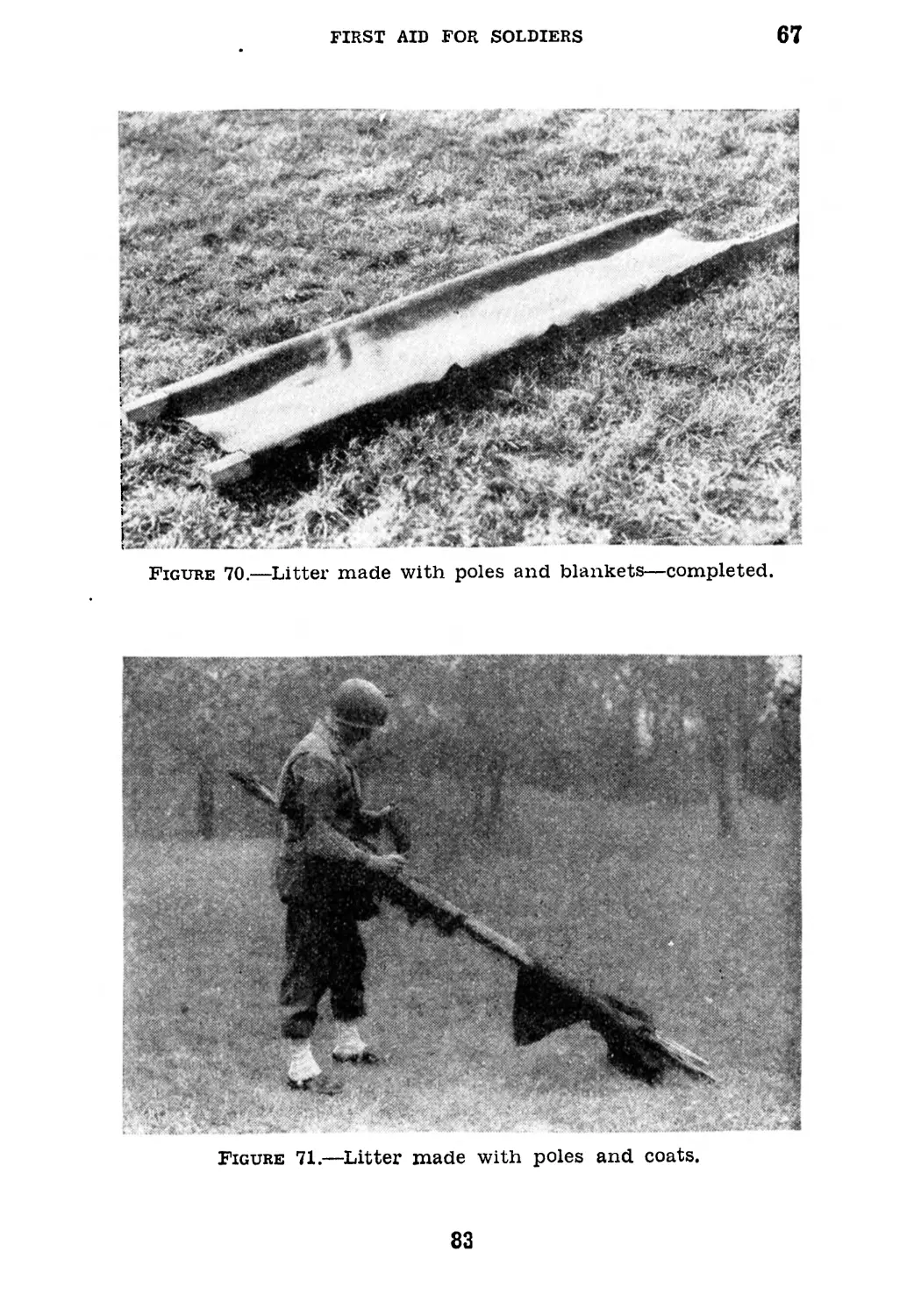
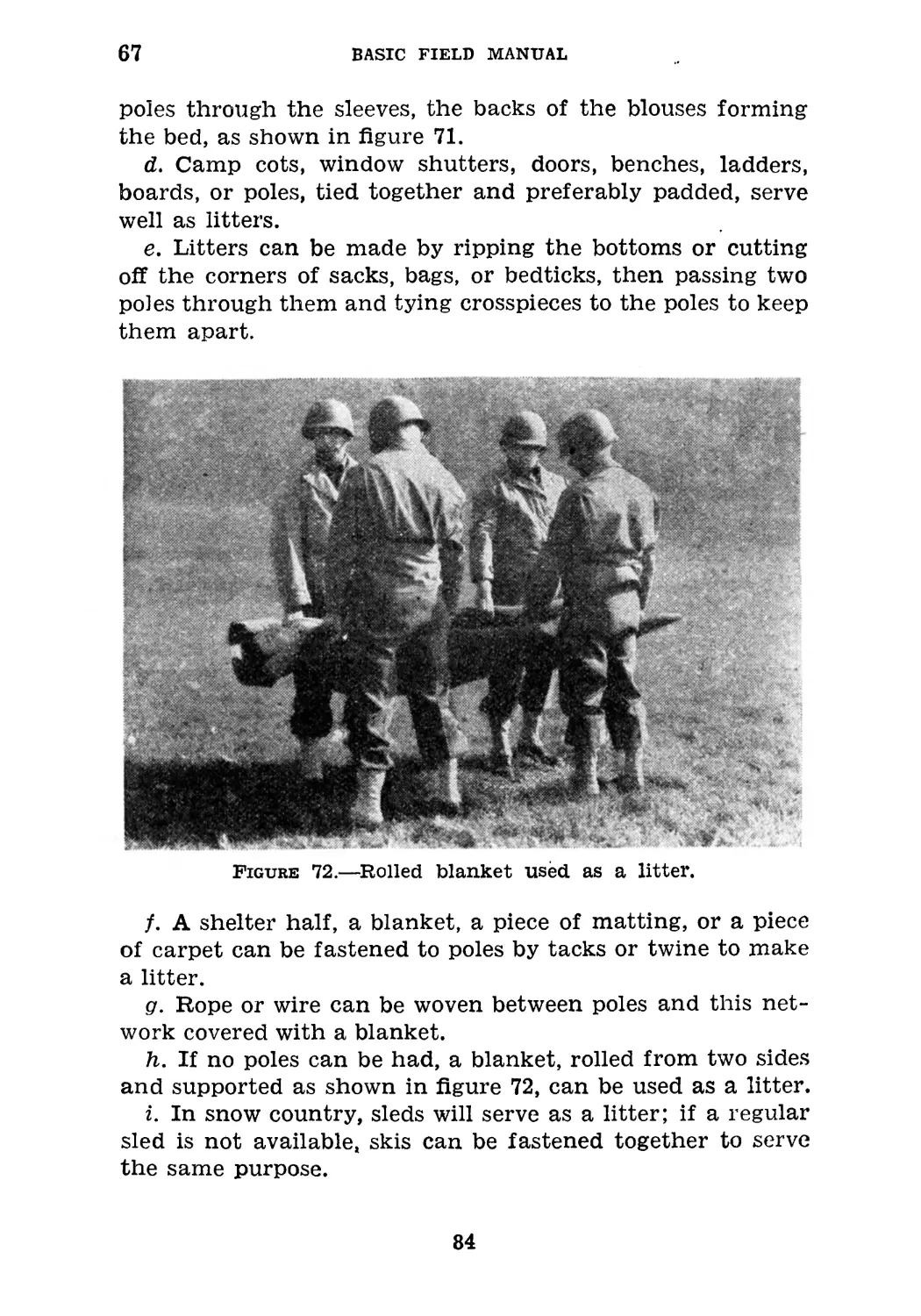
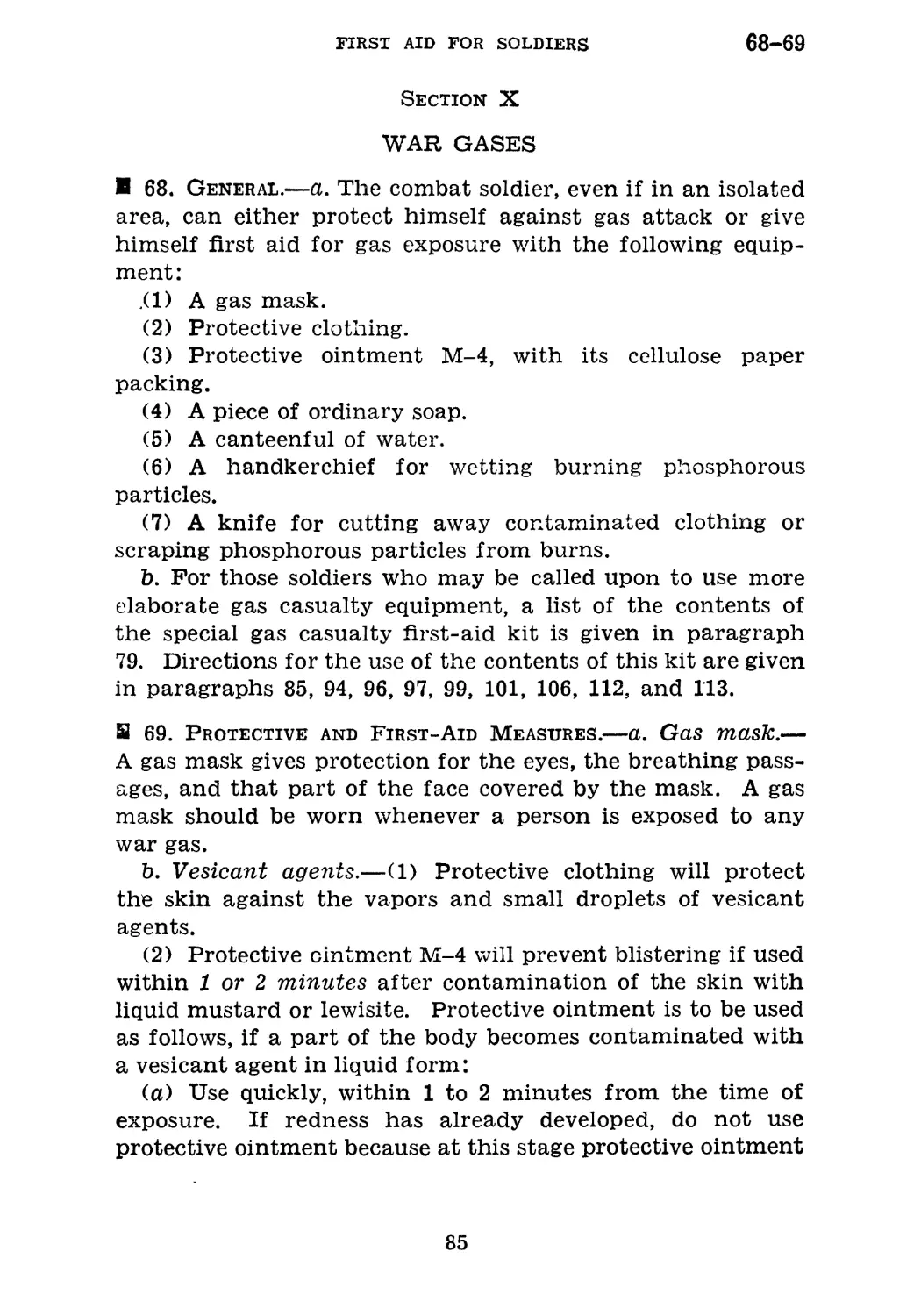

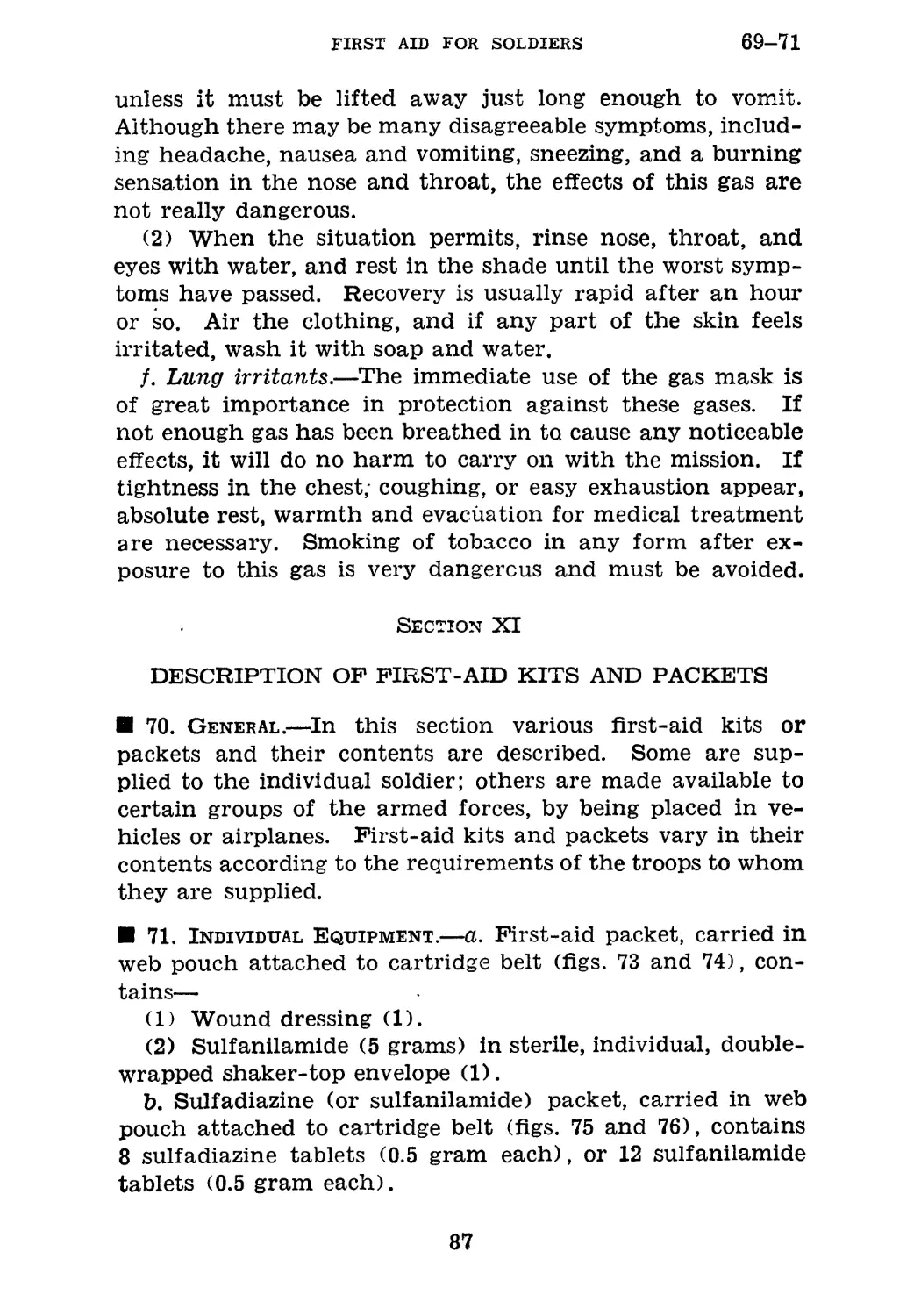
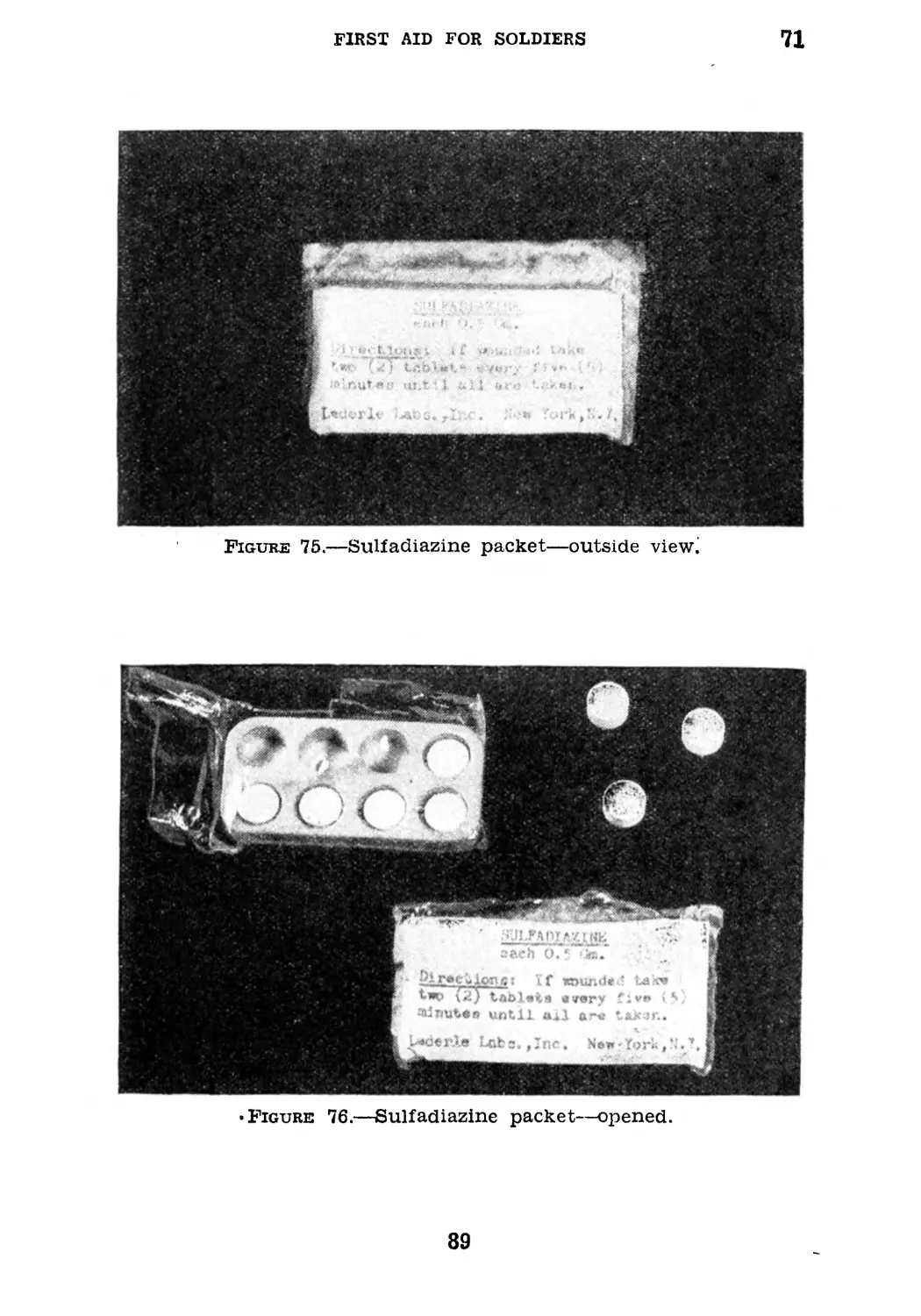
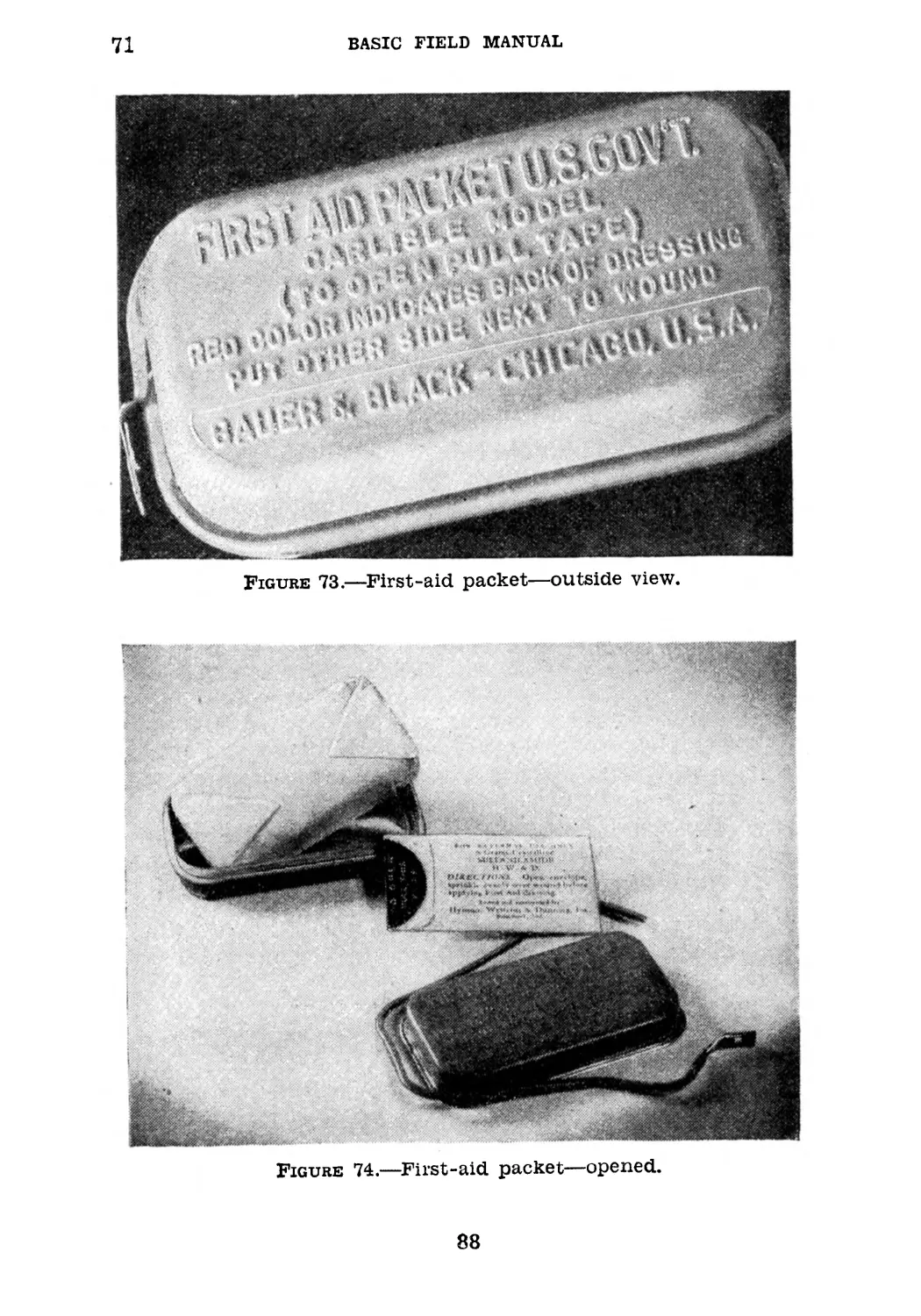
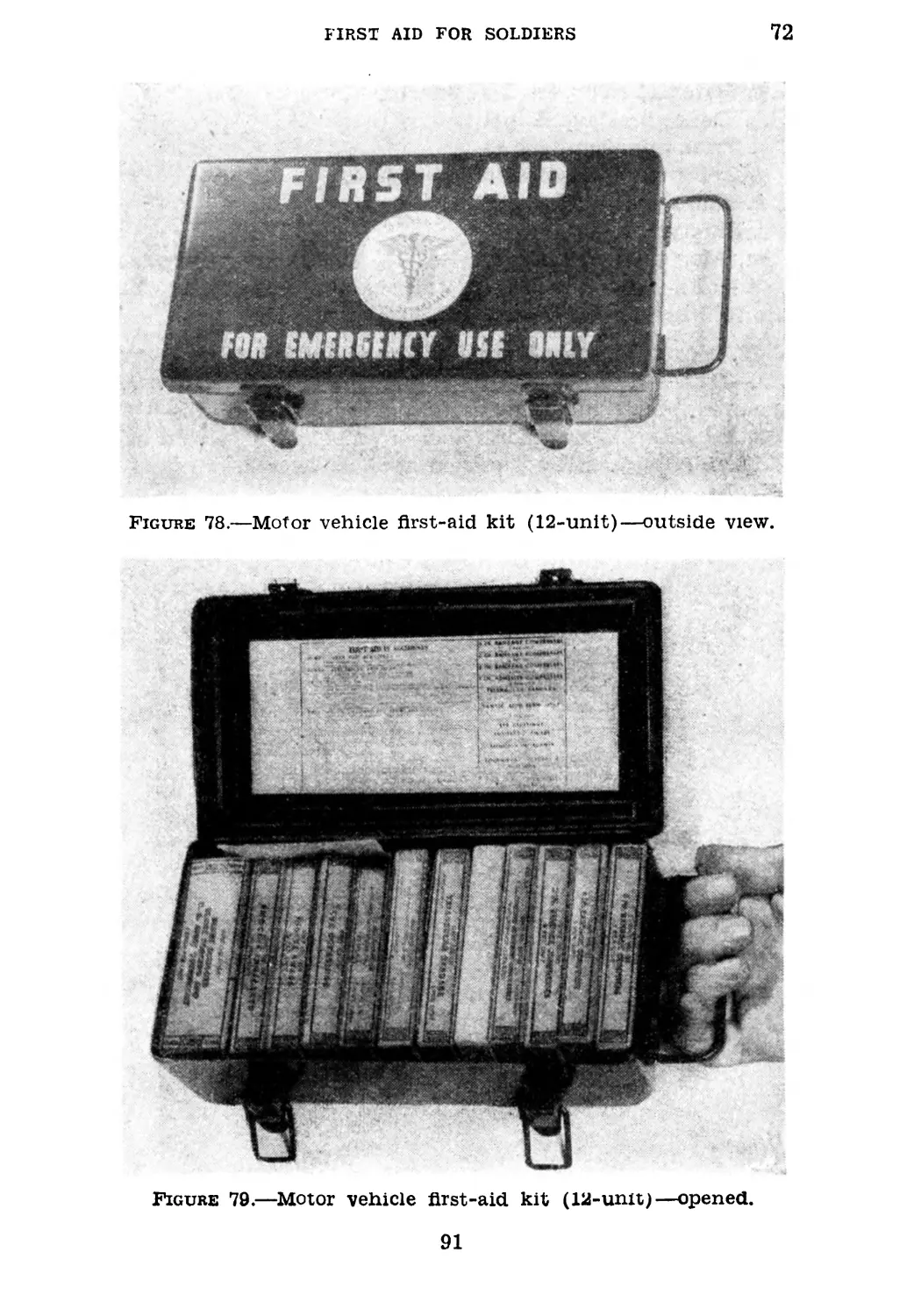
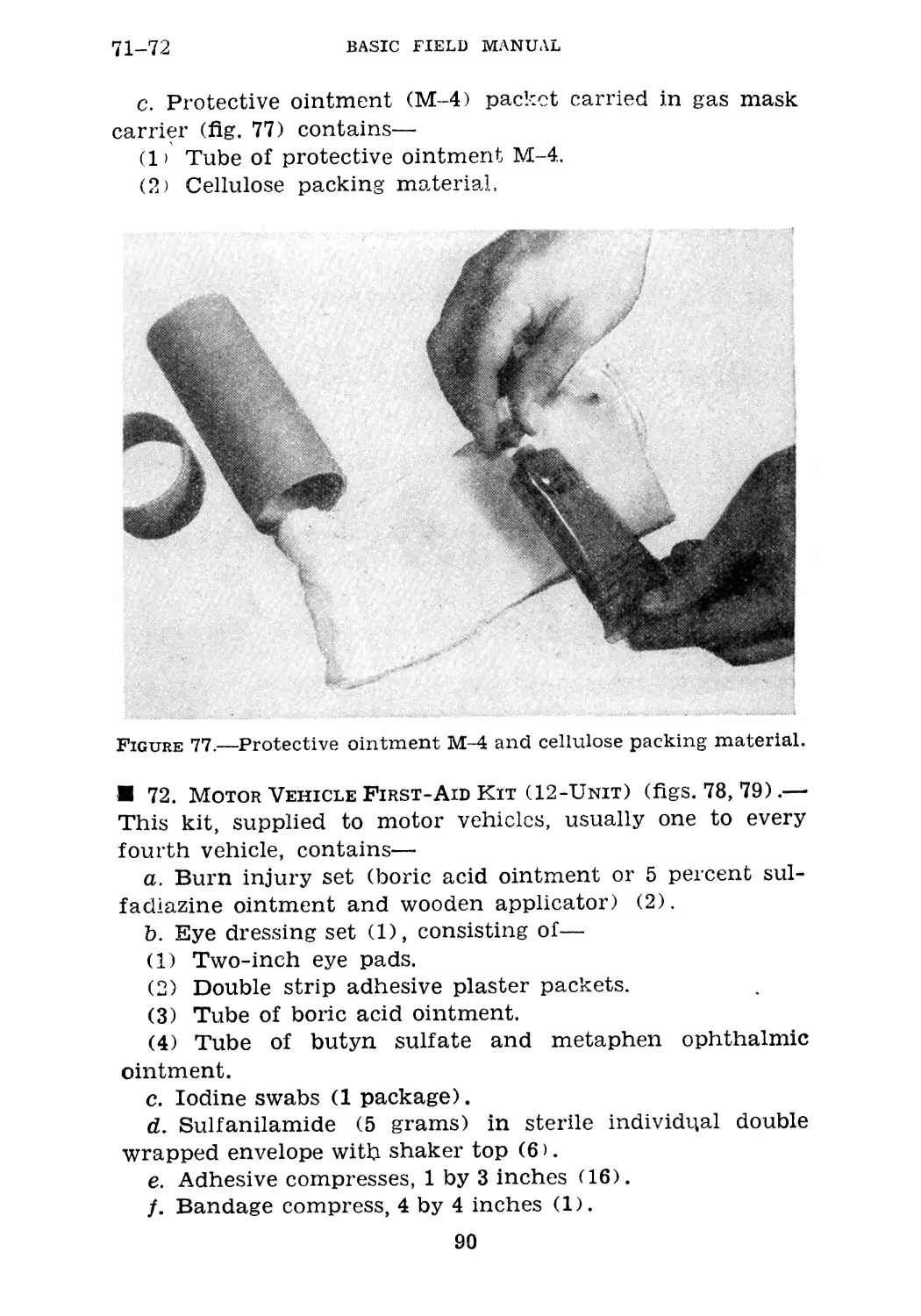
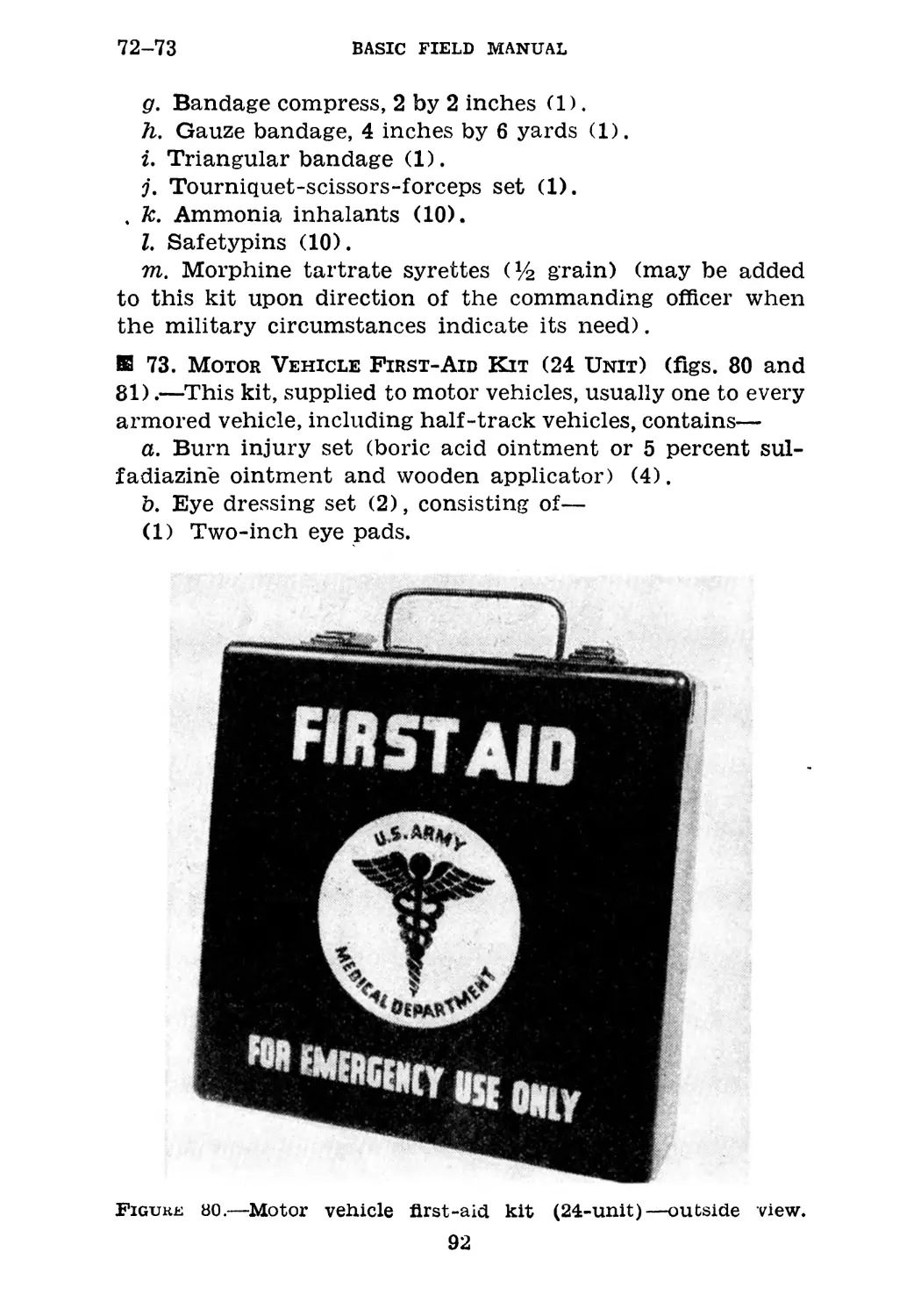

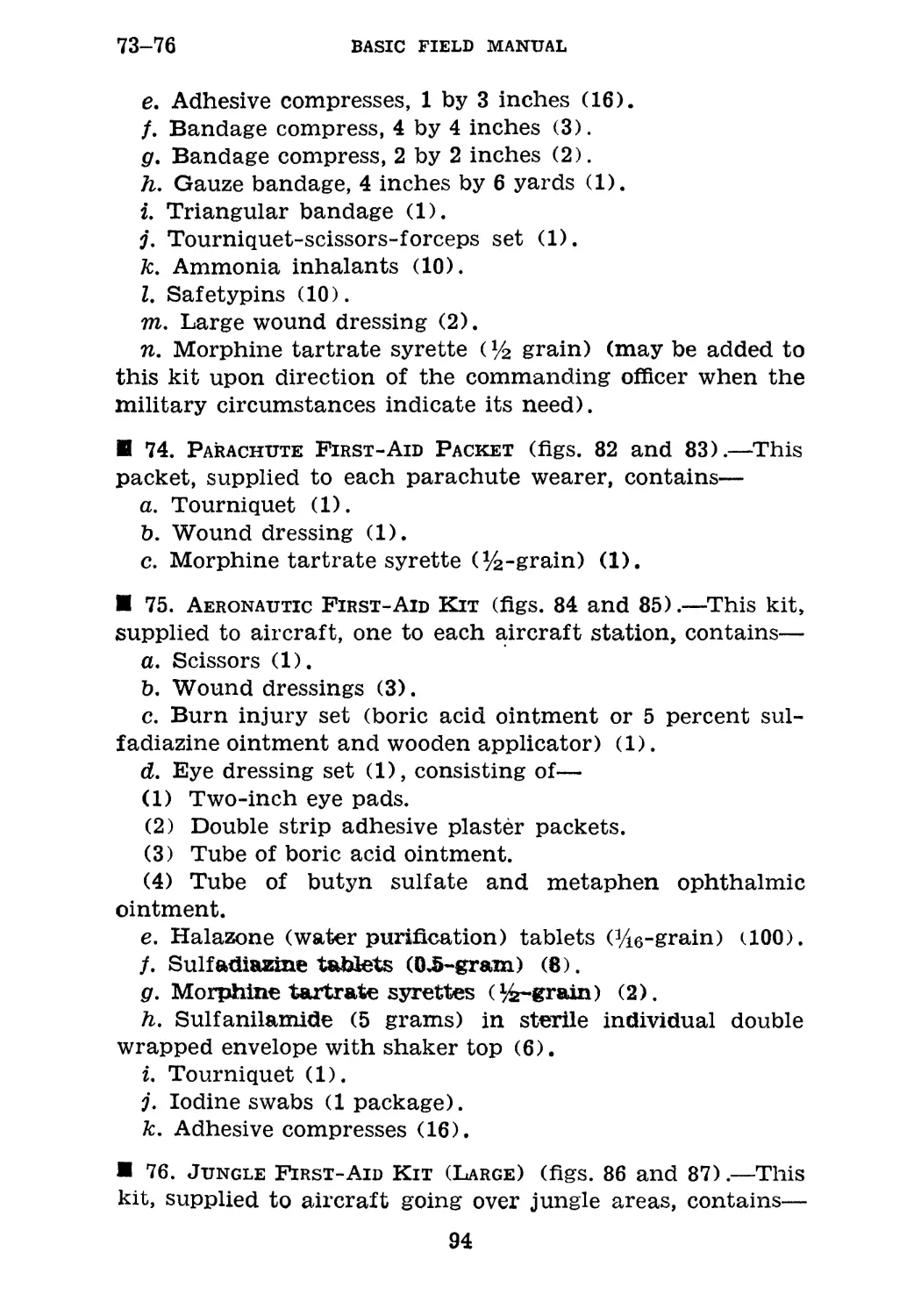
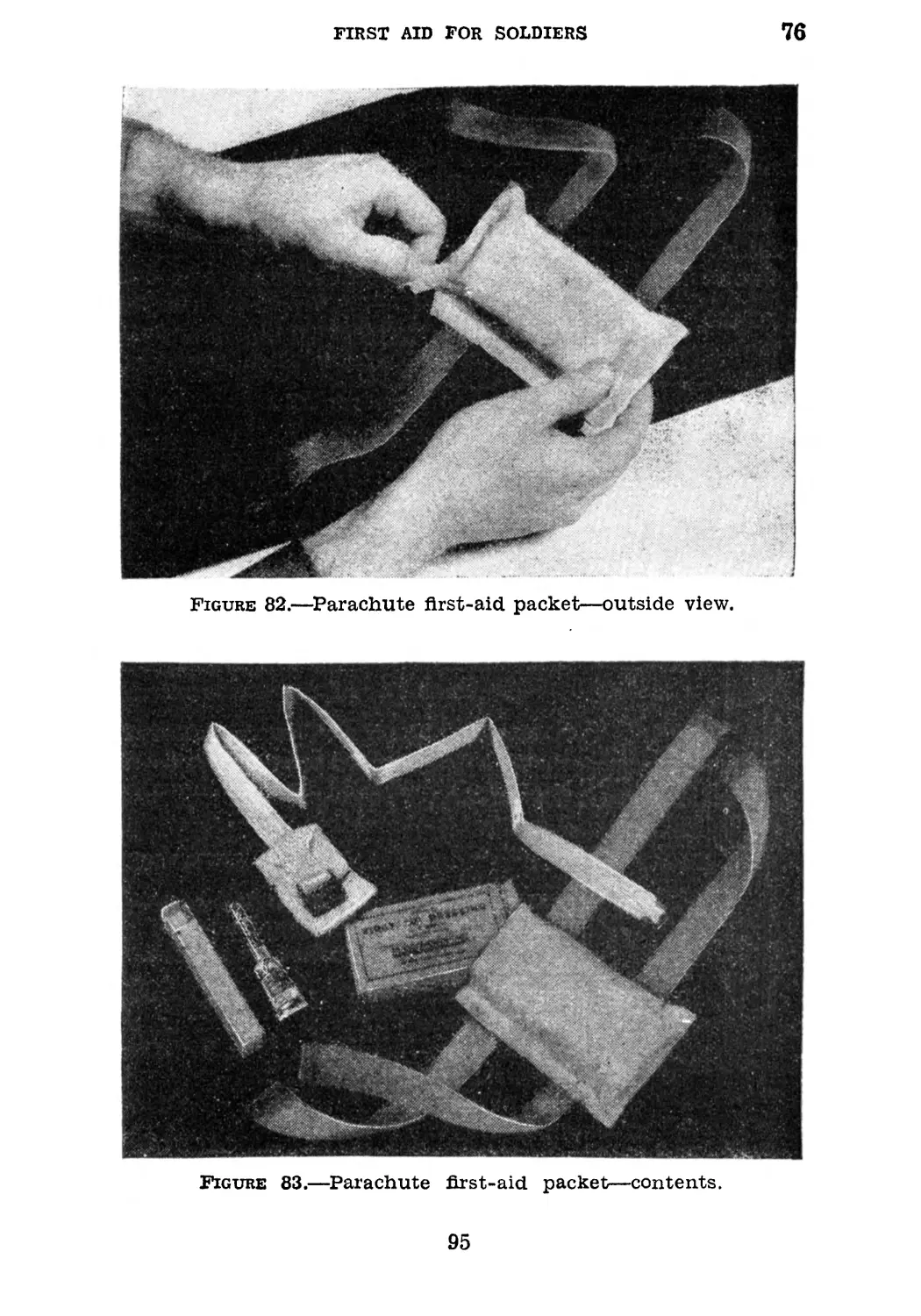
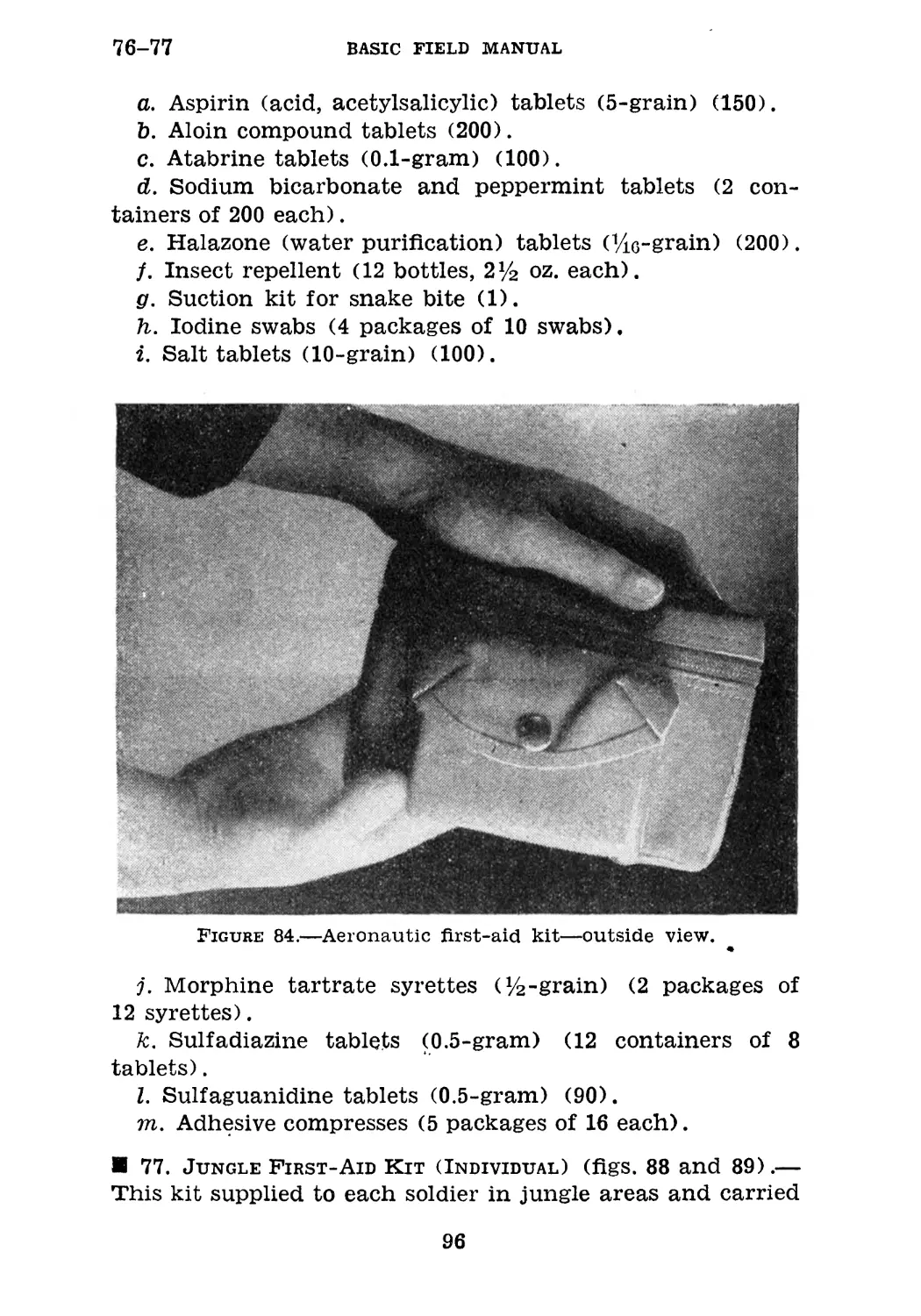
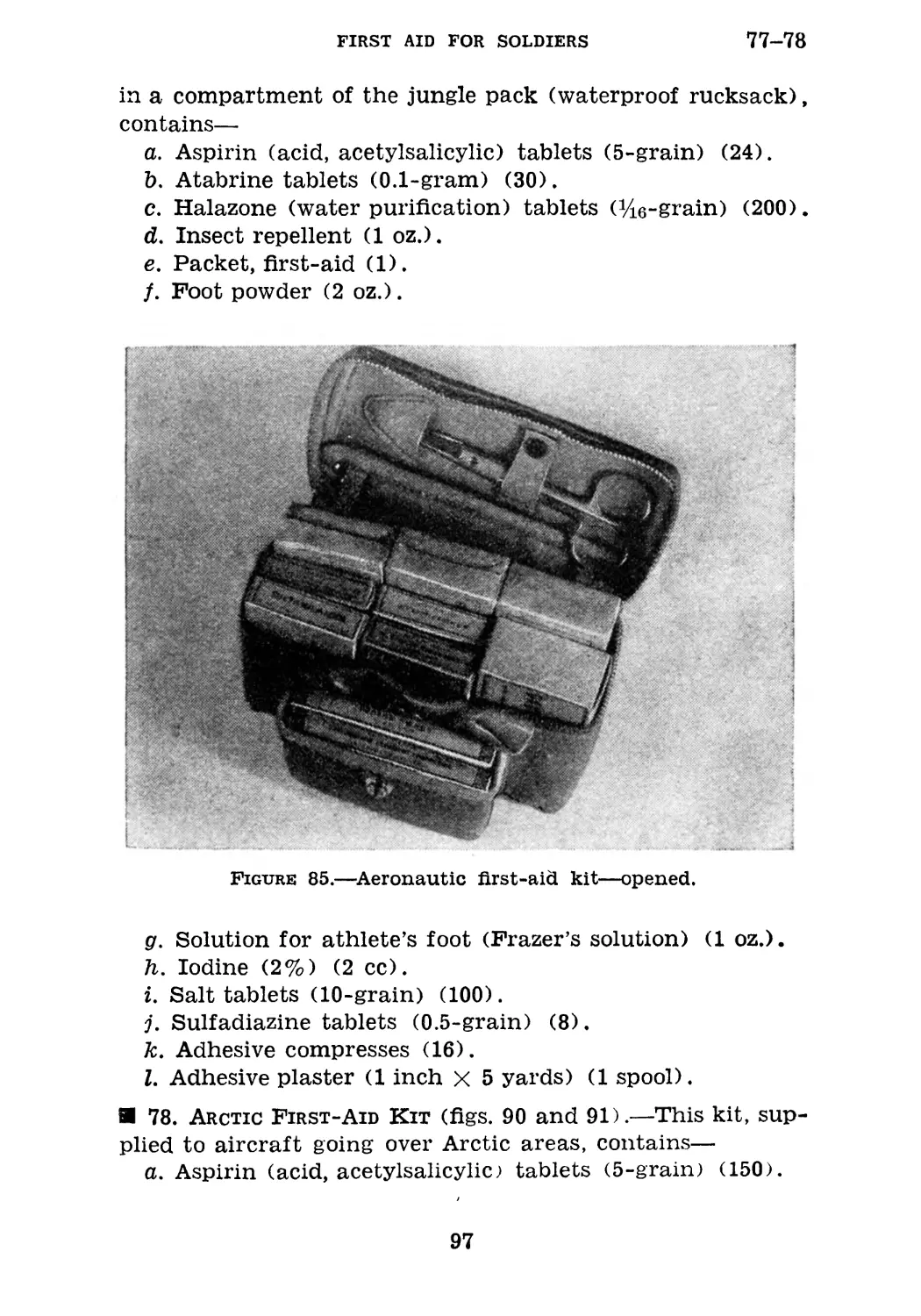









Tags: military medicine field manual
Year: 1943


Text
                    FM 21-11
WAR DEPARTMENT
BASIC HELD MANUAL
FIRST AID FOR SOLDIERS
April 7, 1943
FM 21-11
BASIC FIELD MANUAL
FIRST AID FOR SOLDIERS
Prepared under direction of the
Commanding General,
Army Service Forces
UNITED STATES
GOVERNMENT PRINTING OFFICE
WASHINGTON ; 1943
For sale by the Superintendent of Documents, U. S. Government Printing Office
Washington, D. C.
WAR DEPARTMENT,
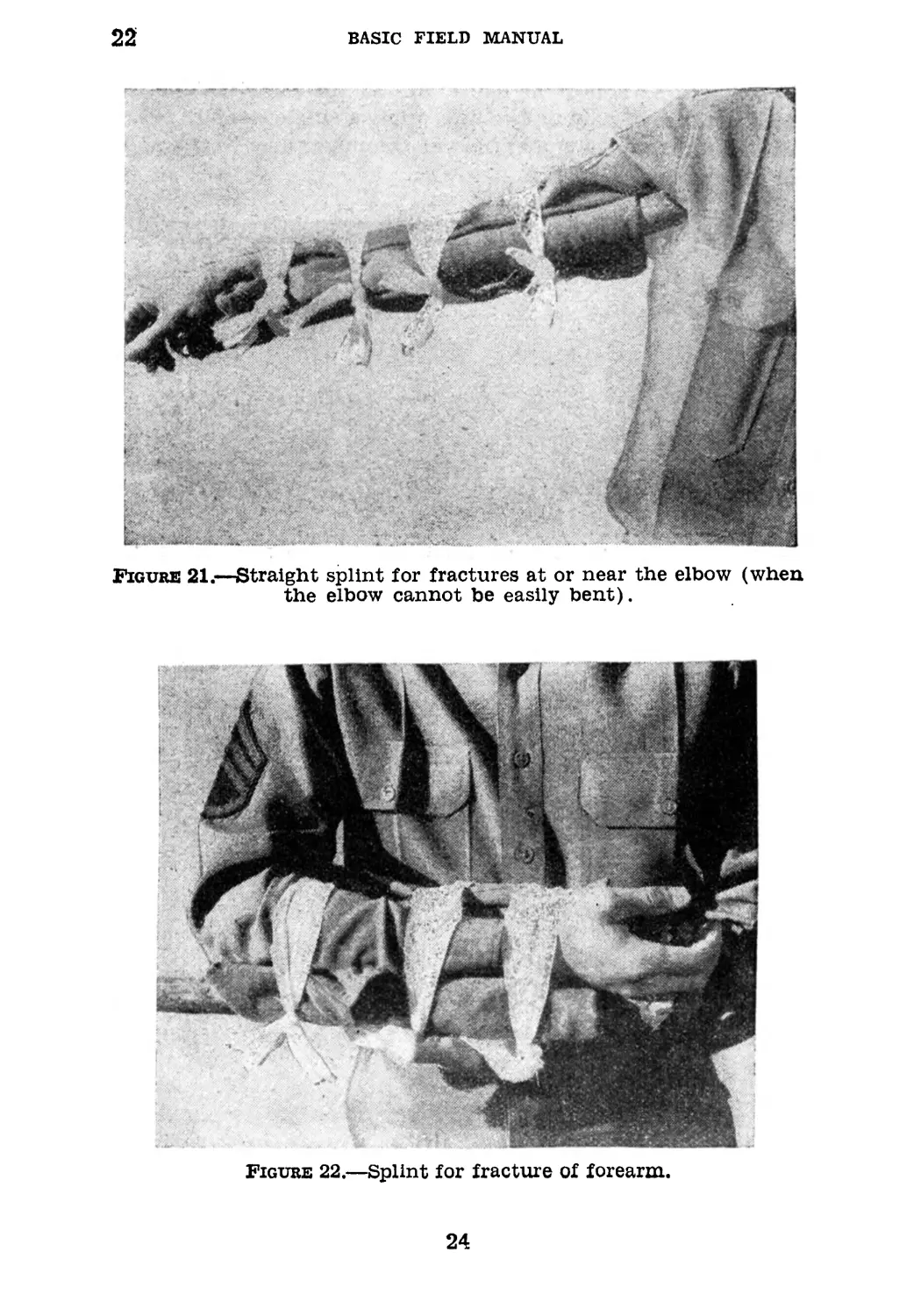
Washington, April 7, 1943.
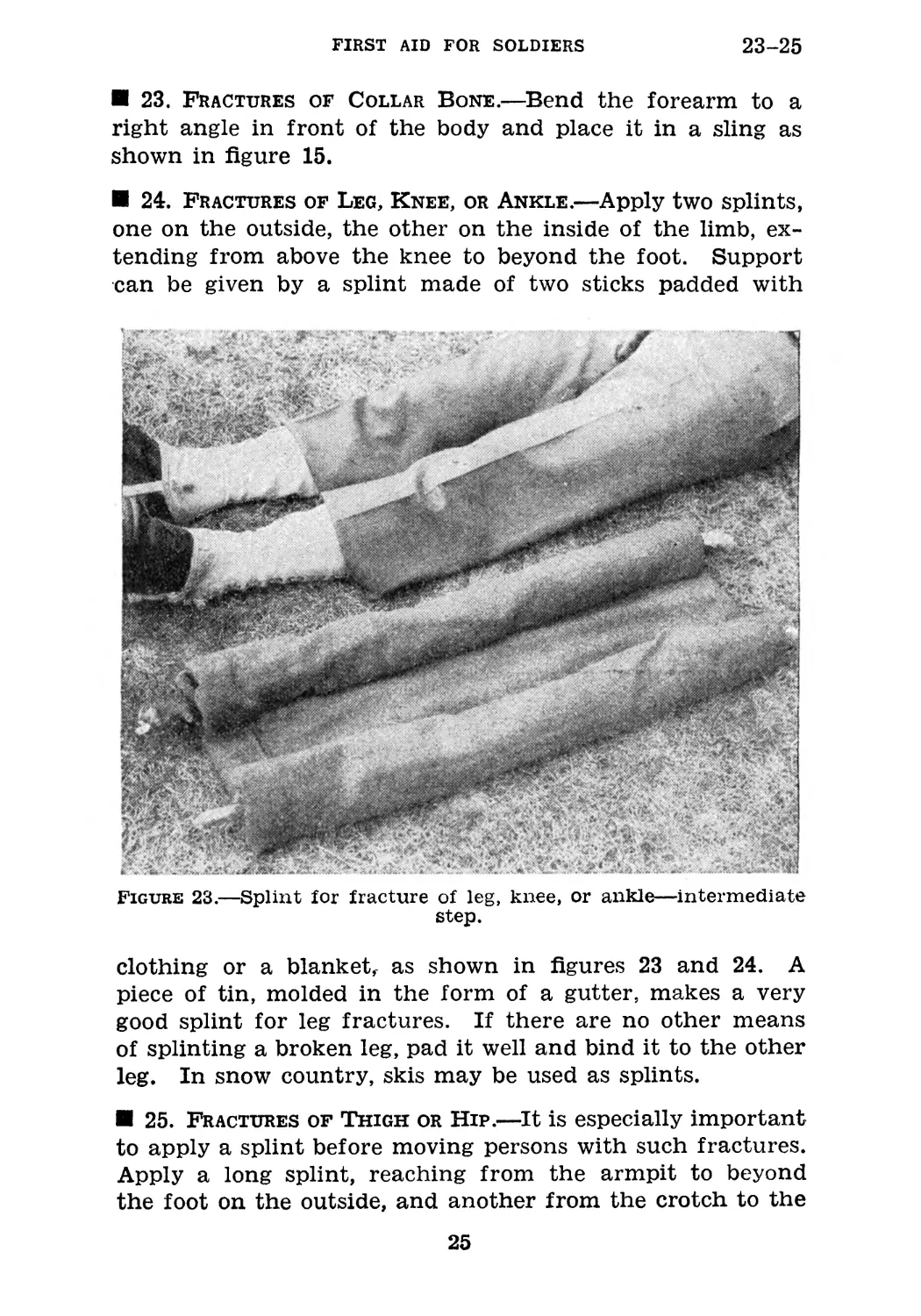
KM 21-11, Basic Field Manual, First Aid for Soldiers, is
published for the information and guidance of all concerned.
[A. G. 002.11 (9-15-42).]
By order of the Secretary of War :
G. C. MARSHALL,
Chief of Staff.
Official :
J. A. ULIO,
Major General,
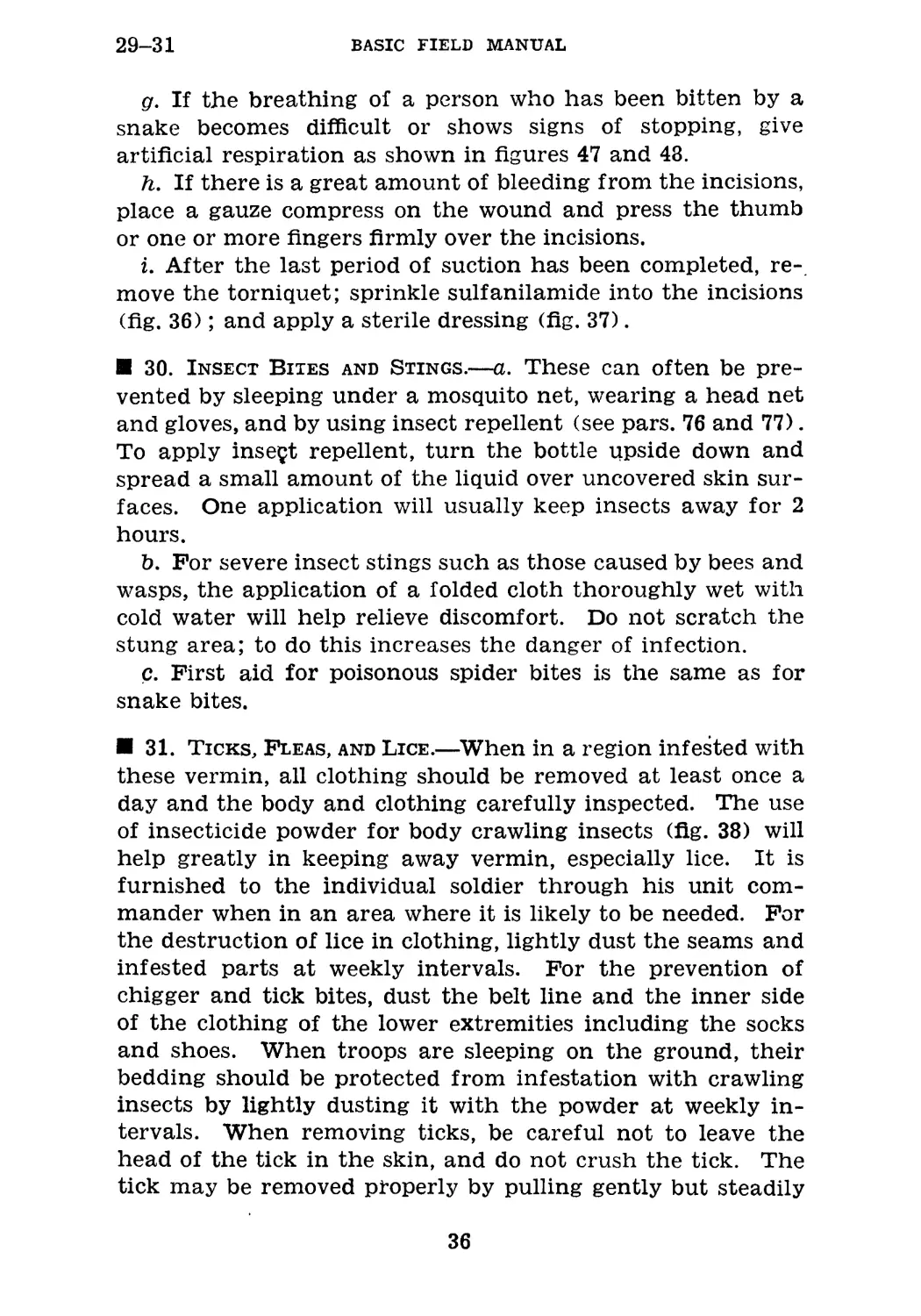
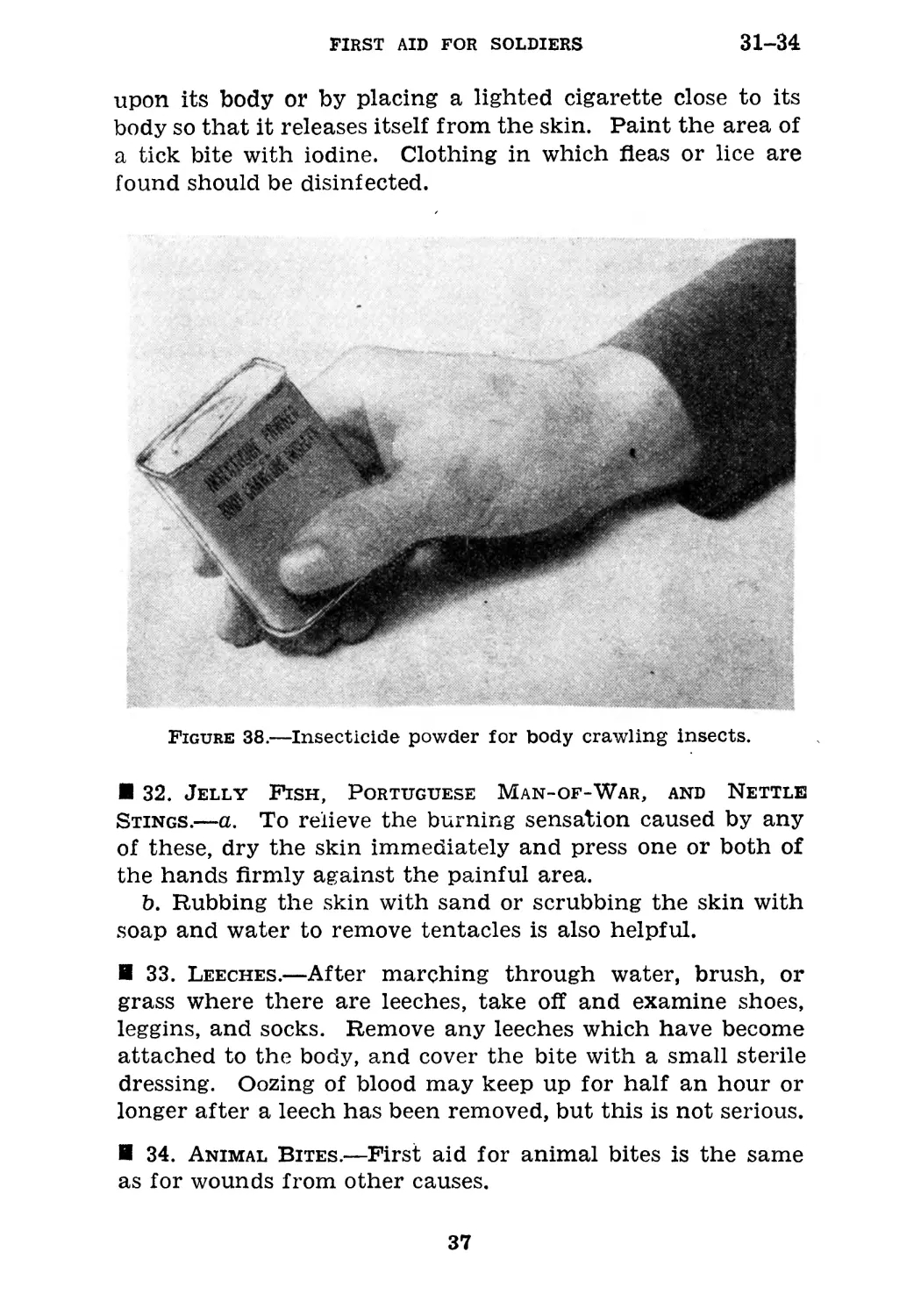
The Adjutant General.
Distribution:
X.
(For explanation of symbol see FM 21-6.)
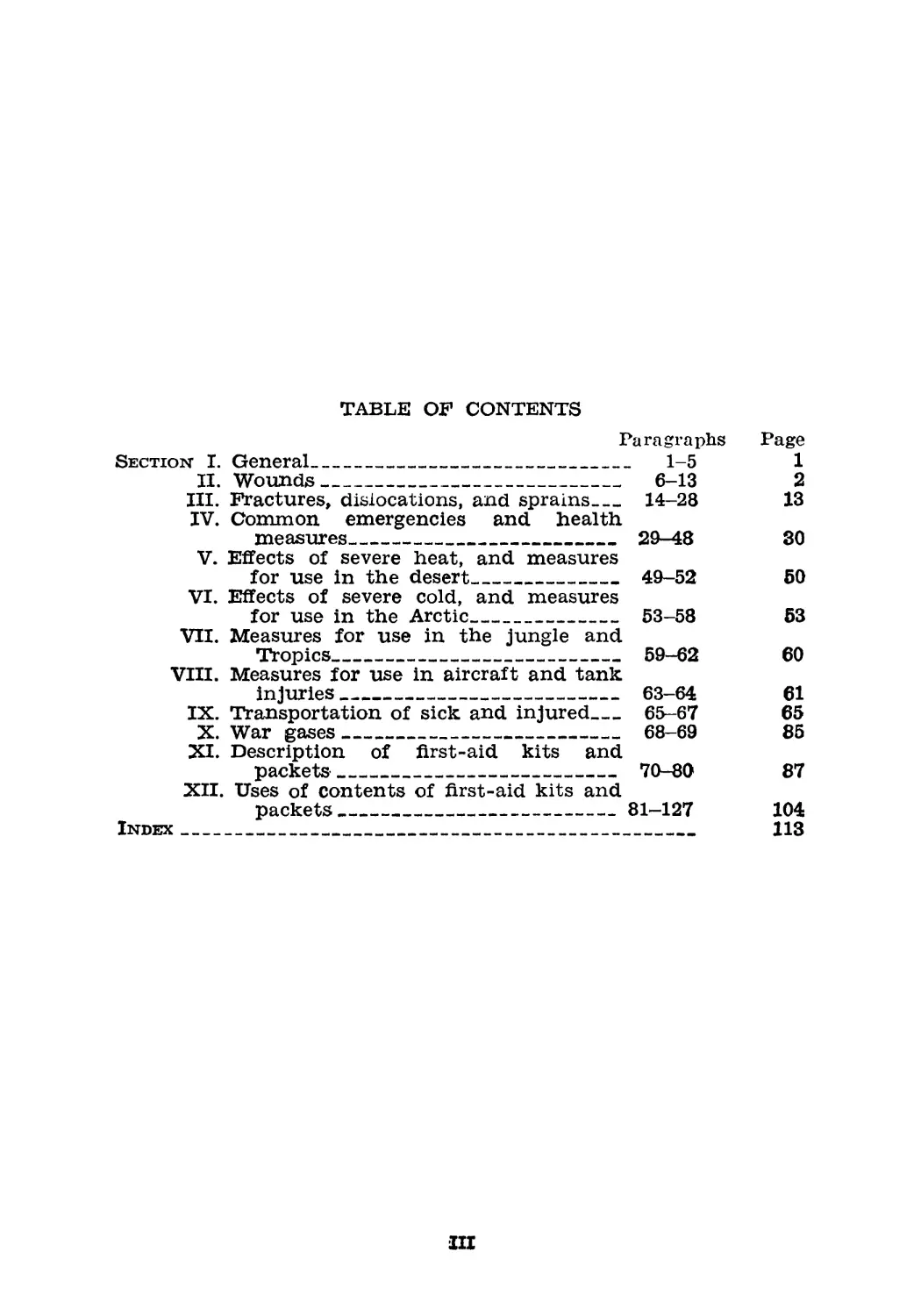
TABLE OF CONTENTS
Paragraphs Page
Section I. General_________________________________ 1-5	1
II.	Wounds________________________________ 6-13	2
III.	Fractures, dislocations,	and sprains—	14-28	13
IV.	Common emergencies and health
measures________________________________ 29-48	30
V.	Effects of severe heat, and measures
for use in the desert__________________ 49-52	60
VI.	Effects of severe cold, and measures
for use in	the	Arctic______________ 53-58	53
VII.	Measures for use in the jungle and
Tropics____________________________________ 59-62	60
VIII.	Measures for use in aircraft and tank
injuries____________________________________ 63-64	61
IX.	Transportation	of	sick	and injured— 65-67	65
X.	War gases____________________________ 68-69	85
XI.	Description of first-aid kits and
packets_________________________________ 70-80	87
XII.	Uses of contents of first-aid kits and
packets__________________________________81-127	104
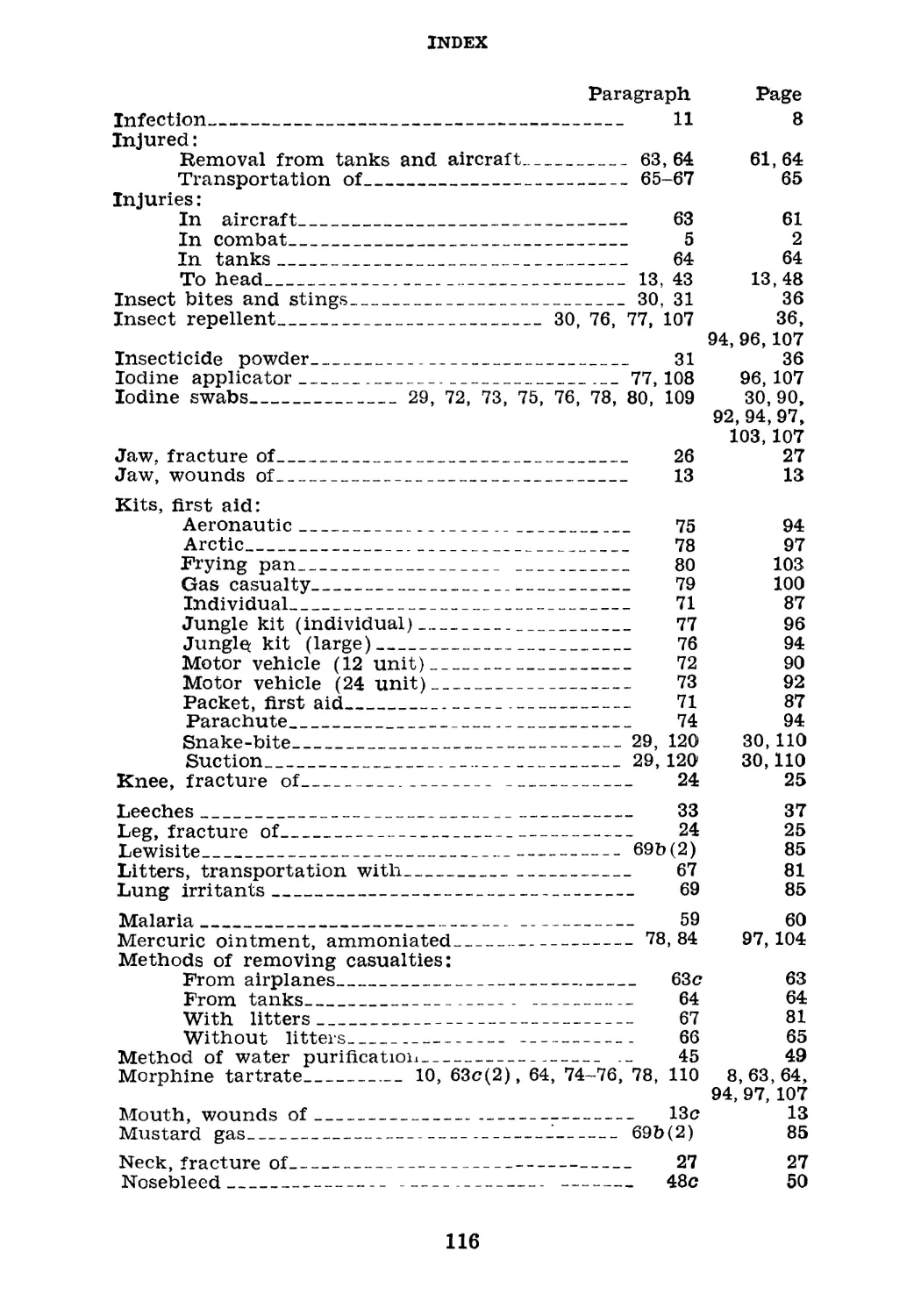
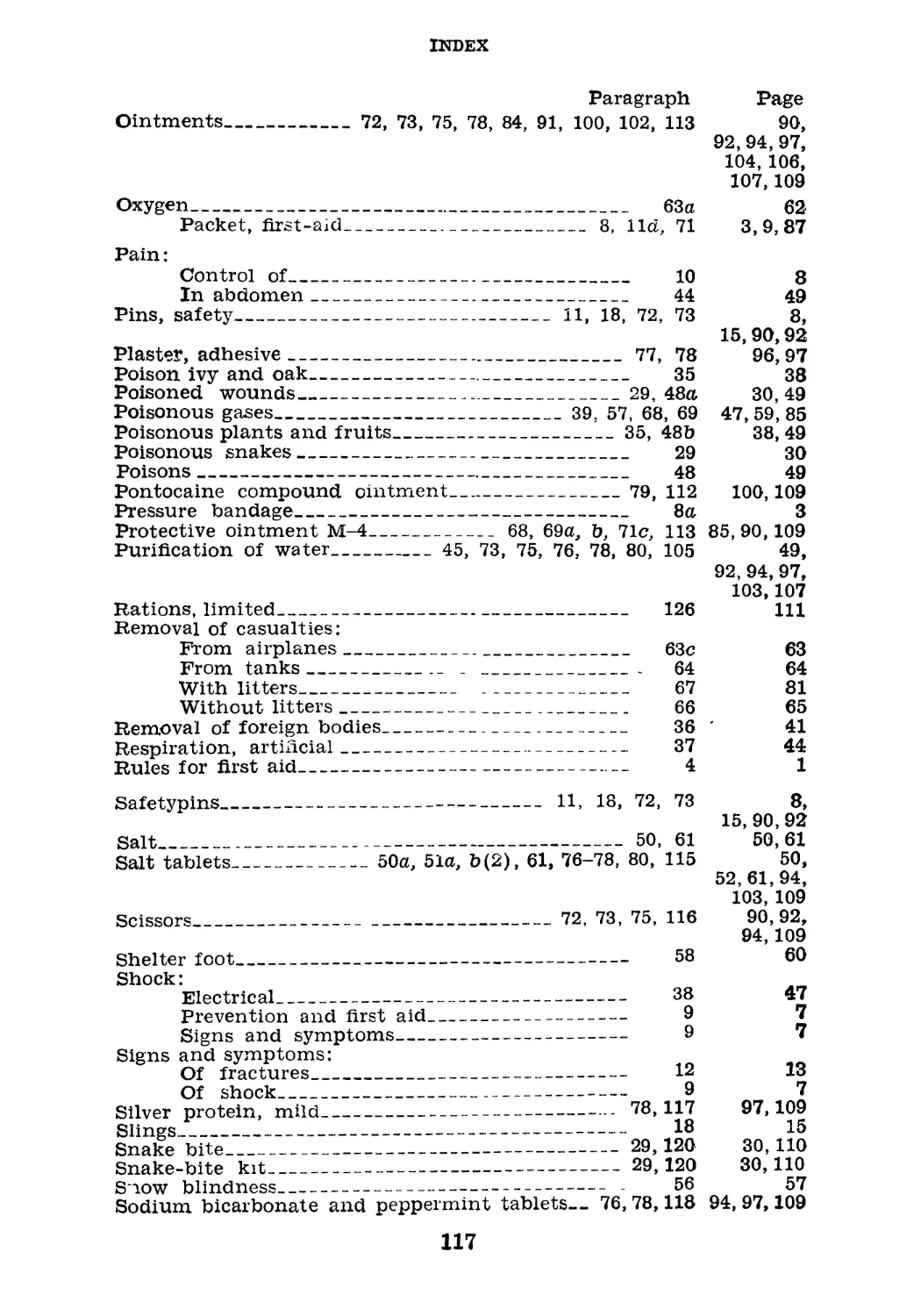
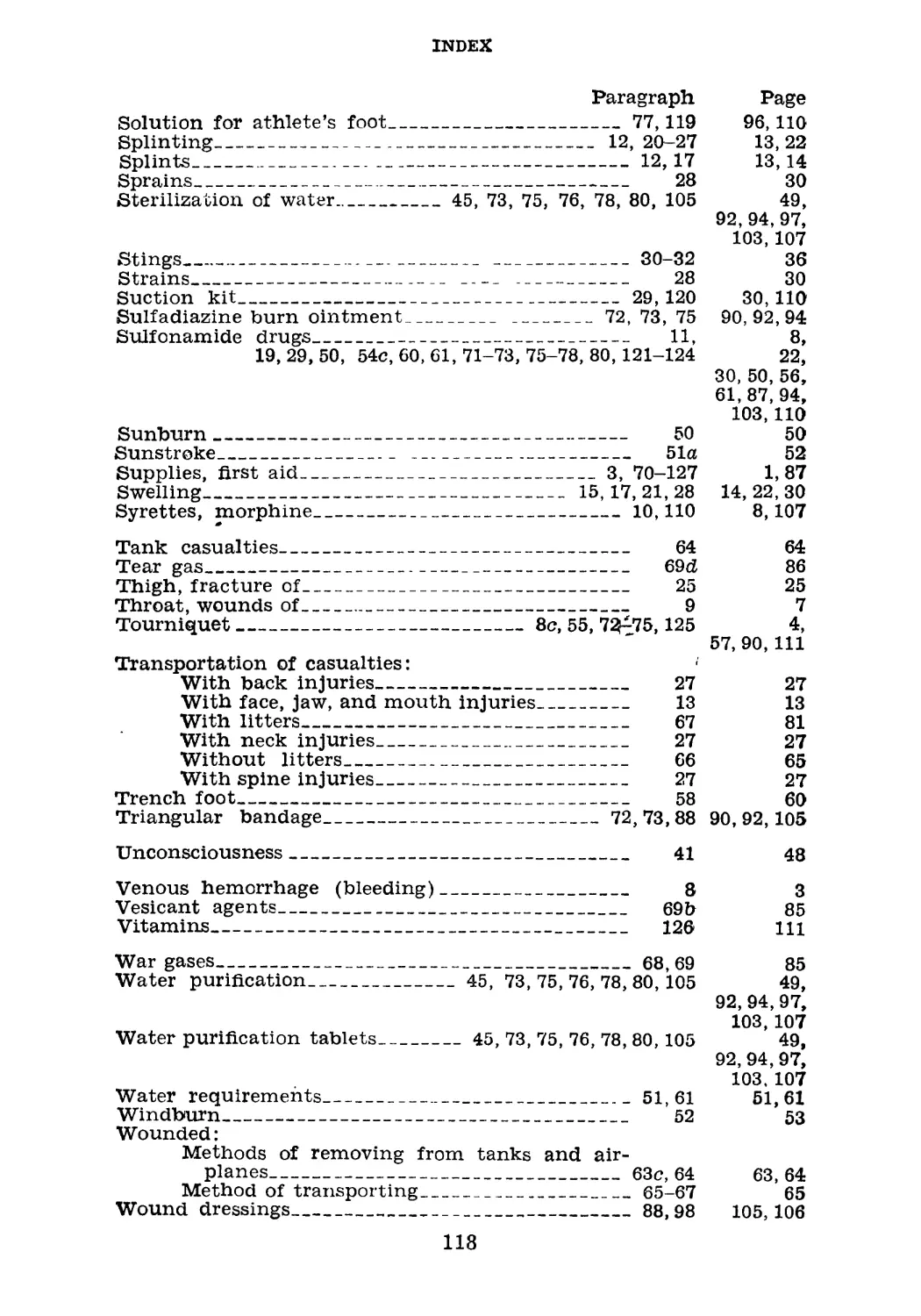
Index_________________________________________________ 113
III

ГМ 21-11
BASIC FIELD MANUAL
FIRST AID FOR SOLDIERS
(The matter contained herein supersedes chapter 10, FM 21-10;
and section II, chapter 14, FM 21-100.)
Section I
GENERAL
	1. Purpose of Manual.—The purpose of this manual is to
teach the soldier what he can do for himself or a fellow
soldier if injury or sickness occurs when no medical officer
or Medical Department soldier is nearby. Information is also
given concerning the use of certain supplies which are for
the purpose of helping to keep well. If a soldier does the right
thing, he may save his own or someone else’s life, or at least
relieve suffering. If he does the wrong thing, he may do
more harm than if he does nothing.
	2. Definition.—First aid means those medical measures
which a soldier can carry out for himself or a companion and
does not apply to the emergency medical treatment which is
given by a medical officer or a Medical Department soldier.
	3. Soldier's Equipment for First Aid.—Every soldier is
issued certain equipment for giving first aid. Besides the
supplies which he carries, other equipment will be found in
the first-aid kits and packets in motor vehicles, airplanes, or
among special troops. Soldiers whose assignments may re-
quire them to know how to use special first-aid equipment
can find descriptions, illustrations, and directions for use of
these supplies in sections XI and XII. In addition to the
first-aid supplies mentioned, many objects which are a reg-
ular part of every soldier’s clothing and general equipment
or which will be found almost anywhere can be used in giving
certain types of first aid.
	4. Important First-Aid Rules.
a.	Do not get excited; act quickly but calmly.
b.	Do not try to do too much.
1
4-7
BASIC FIELD MANUAL
c.	Handle an injured person gently.
d.	Keep an injured person warm.
e.	Whenever possible, give an injured person first aid
before he is moved.
/. Do not pour liquids into the mouth of an unconscious
person; to do this may choke him.
g. Do not try to bring an unconscious injured person to
consciousness. Let him lie quietly, face down, with his head
turned to one side.
h. Remember that drugs are dangerous if too much is
given; follow direction^ when using drugs in first-aid kits
and packets.
г. Anyone who has been given first aid for a serious con-
dition should be seen as soon as possible by a medical officer.
 5. First Aid in Combat.—Successful accomplishment of the
assigned mission is the aim of battle. The combat soldier
will administer first aid only when he can do so without
interfering with his combat duties. When administration of
first aid in actual combat is possible, usually only those
measures will be taken which are immediately necessary to
save life. The wounded person should be placed where he
is protected from enemy fire and the elements, marking the
spot where he lies so that he can be easily found by Medical
Department personnel,
Section II
WOUNDS
 6. General.—Wounds are the most common conditions
which require first aid. Prompt and correct first aid for
wounds will not only speed their healing, but will often
save a life. First aid for wounds includes measures to stop
bleeding, overcome shock, relieve pain, and prevent infection.
И 7. Exposure of Wound.—To give proper first aid, the en-
tire wound must be well exposed in order to ascertain
exactly where it is, how large it is, and how much it is
bleeding. When a wound has been caused by a bullet, a
shell fragment, or other object which could have gone all
the way through a part of the body, look for a wound where
the object may have come out, because the wound where
2
FIRST AID FOR SOLDIERS
7-8
it comes out is usually larger than the wound where it goes
in. In order to see all wounds which may be present, cut,
tear, or remove the clothing as much as necessary. Do not
drag clothes over a wound; carefully lift them off.
 8. Bleeding.—All open wounds bleed more or less. Bleed-
ing from an artery is known as arterial bleeding, and bleeding
from a vein is known as venous bleeding. Bleeding from the
arteries is more dangerous because the blood flows fast and
will soon cause a person to bleed to death unless the flow
of blood is stopped. In most severe wounds there is bleeding
from both arteries and veins. Bleeding of any type must be
stopped as soon as possible. The first-aid methods to stop
bleeding are to press directly over the wound, to elevate the
wounded part, or to use a tourniquet.
a.	Direct pressure over wound.—Direct pressure over the
wound should always be tried first. To do this, put a sterile
dressing, such as the one in your individual first-aid packet,
Figure 1.—Direct pressure over a wound to stop bleeding.
3
8
BASIC FIELD MANUAL
over the wound and press firmly on the dressing as shown
in figure 1. Keep up the pressure for at least 5 minutes and
then hold the dressing in place by bandaging. (See par.
lid.) More than one dressing may be needed for large
wounds.
b.	Elevating wounded part.—Raising a wounded arm or leg
high above the body, as shown in figure 2, will help to stop
Figure 2.—Elevation of an arm to help stop bleeding.
bleeding. The wounded person must lie down and the arm
or leg must be held up as high as possible while direct pres-
sure is made on the wound and a sterile dressing is put on.
c.	Use of tourniquet.—(1) Do not use a tourniquet unless
bleeding cannot be stopped by other means. Bleeding from
a wound can usually be stopped by applying a sterile dressing,
pressing directly over the wound, and, if possible, raising the
wounded part. If a regular issue tourniquet is used, the
buckle should be on the inside of the upper arm or thigh
as shown in figures 3 and 4, and the strap should be pulled
4
FIRST AID FOR SOLDIERS
8
in a downward direction while the injured part is steadied.
If bleeding cannot be stopped by simply pulling the tourniquet
tight, loosen it enough to slip a bayonet or other object under
it so that it can be made tight enough by twisting.
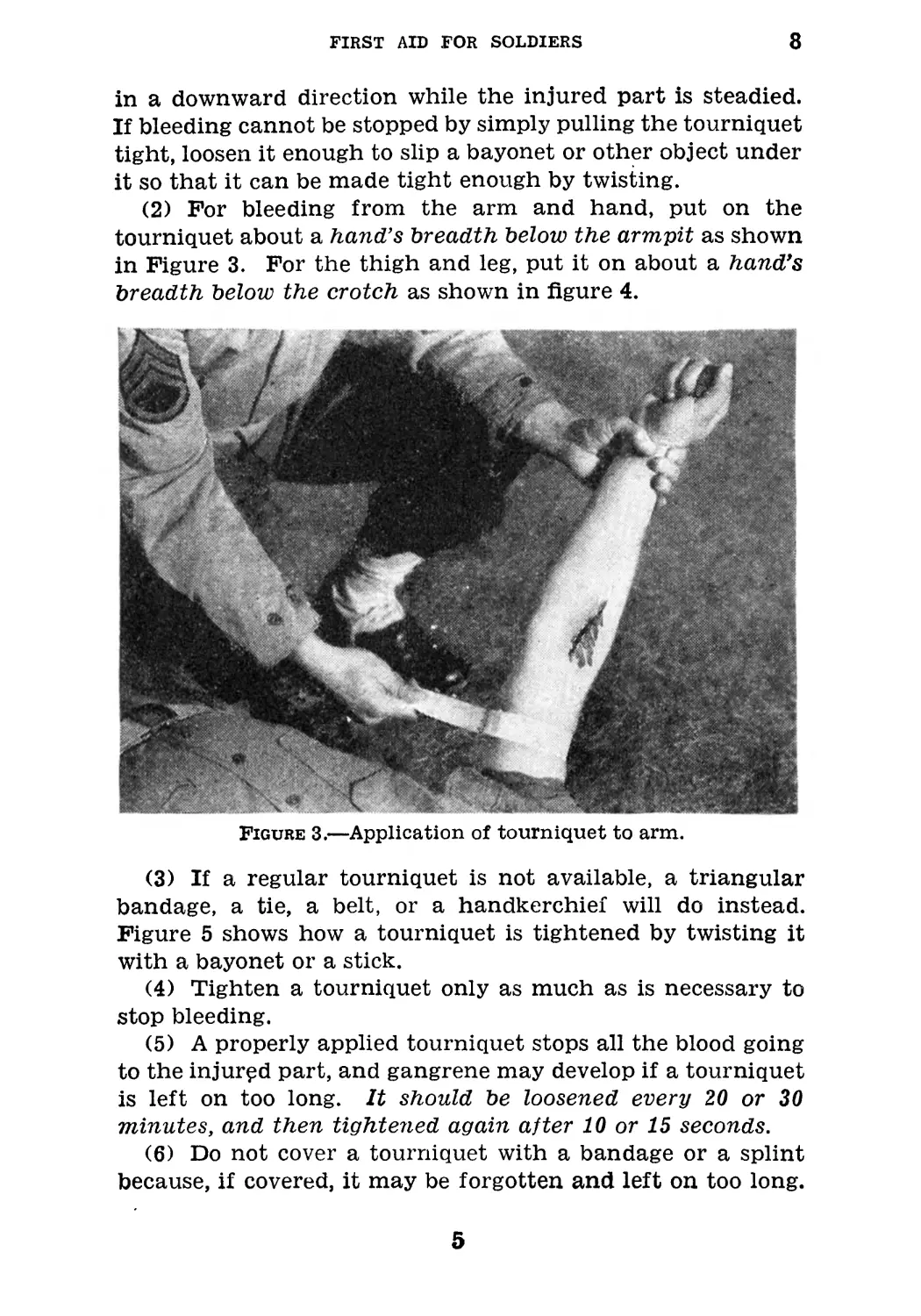
(2)	For bleeding from the arm and hand, put on the
tourniquet about a hand's breadth below the armpit as shown
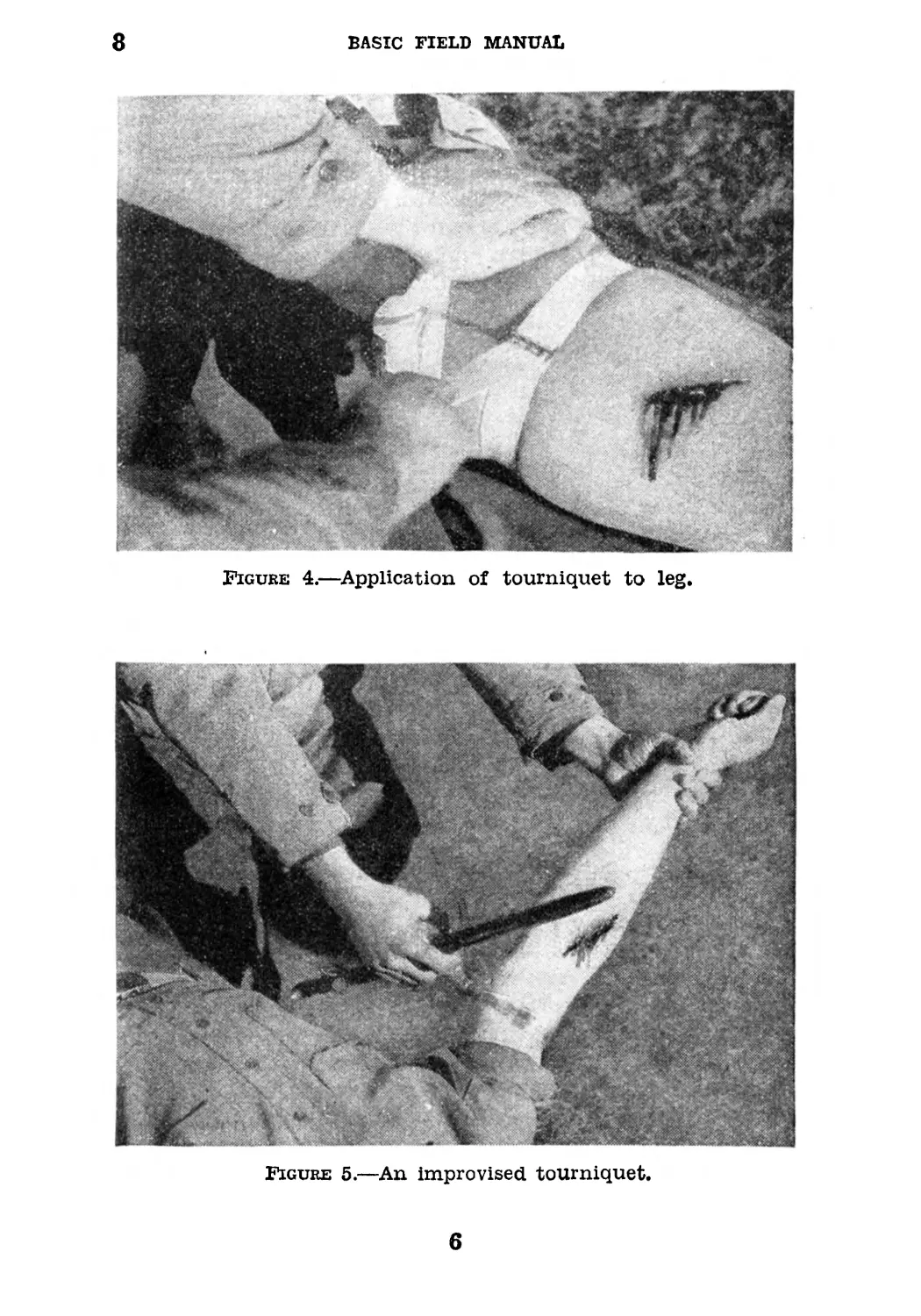
in Figure 3. For the thigh and leg, put it on about a hand's
breadth below the crotch as shown in figure 4.
Figure 3.—Application of tourniquet to arm.
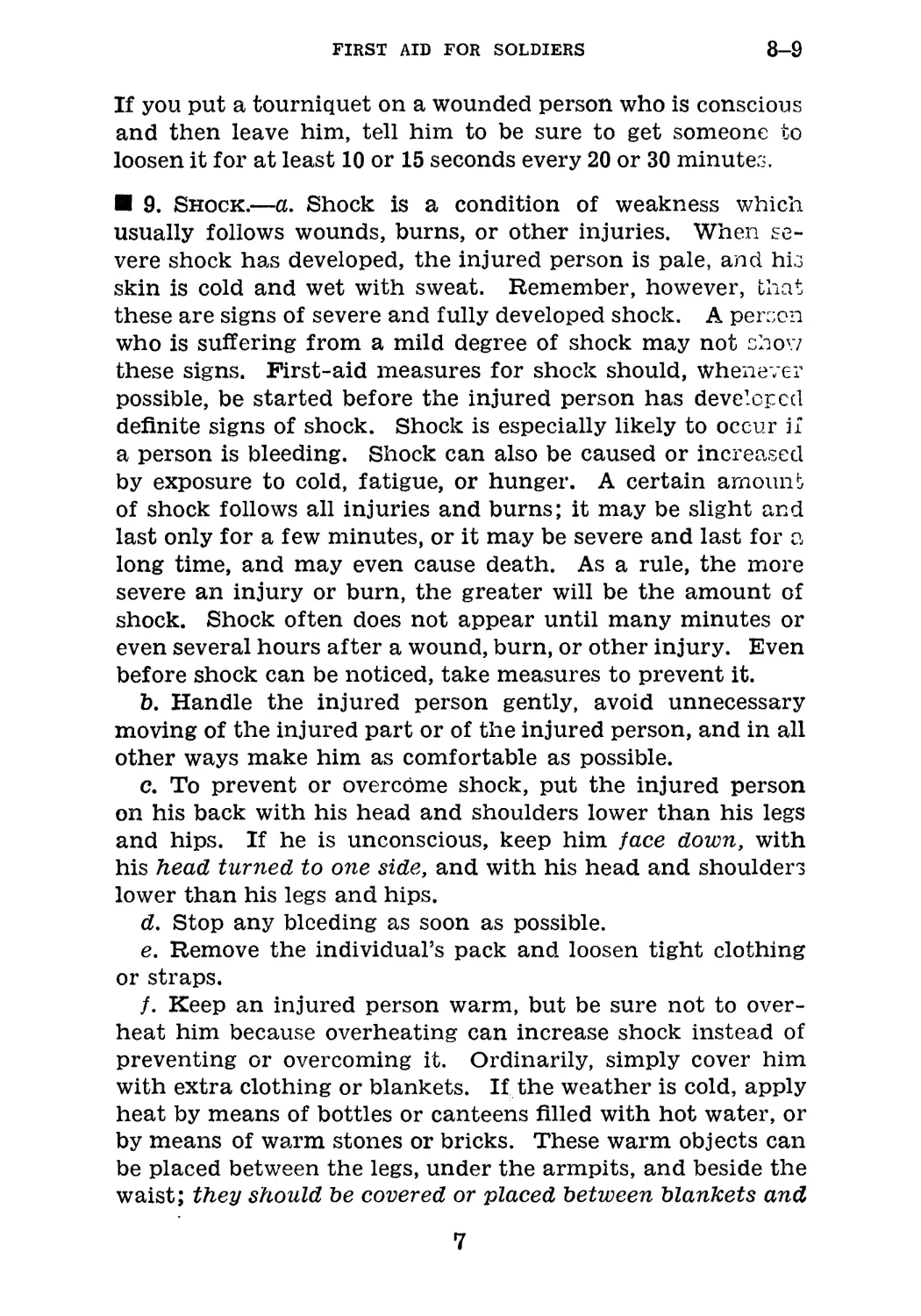
(3)	If a regular tourniquet is not available, a triangular
bandage, a tie, a belt, or a handkerchief will do instead.
Figure 5 shows how a tourniquet is tightened by twisting it
with a bayonet or a stick.
(4)	Tighten a tourniquet only as much as is necessary to
stop bleeding.
(5)	A properly applied tourniquet stops all the blood going
to the injured part, and gangrene may develop if a tourniquet
is left on too long. It should be loosened every 20 or 30
minutes, and then tightened again after 10 or 15 seconds.
(6)	Do not cover a tourniquet with a bandage or a splint
because, if covered, it may be forgotten and left on too long.
5
8
BASIC FIELD MANUAL
Figure 4.—Application of tourniquet to leg.
Figure 5.—An improvised tourniquet.
6
FIRST AID FOR SOLDIERS
8—9
If you put a tourniquet on a wounded person who is conscious
and then leave him, tell him to be sure to get someone to
loosen it for at least 10 or 15 seconds every 20 or 30 minutes.
 9. Shock.—a. Shock is a condition of weakness which
usually follows wounds, burns, or other injuries. When se-
vere shock has developed, the injured person is pale, and his
skin is cold and wet with sweat. Remember, however, that
these are signs of severe and fully developed shock. A person
who is suffering from a mild degree of shock may not show
these signs. First-aid measures for shock should, whenever
possible, be started before the injured person has developed
definite signs of shock. Shock is especially likely to occur if
a person is bleeding. Shock can also be caused or increased
by exposure to cold, fatigue, or hunger. A certain amount
of shock follows all injuries and burns; it may be slight and
last only for a few minutes, or it may be severe and last for a
long time, and may even cause death. As a rule, the more
severe an injury or burn, the greater will be the amount of
shock. Shock often does not appear until many minutes or
even several hours after a wound, burn, or other injury. Even
before shock can be noticed, take measures to prevent it.
b.	Handle the injured person gently, avoid unnecessary
moving of the injured part or of the injured person, and in all
other ways make him as comfortable as possible.
c.	To prevent or overcome shock, put the injured person
on his back with his head and shoulders lower than his legs
and hips. If he is unconscious, keep him face down, with
his head turned to one side, and with his head and shoulders
lower than his legs and hips.
d.	Stop any bleeding as soon as possible.
e.	Remove the individual’s pack and loosen tight clothing
or straps.
/. Keep an injured person warm, but be sure not to over-
heat him because overheating can increase shock instead of
preventing or overcoming it. Ordinarily, simply cover him
with extra clothing or blankets. If the weather is cold, apply
heat by means of bottles or canteens filled with hot water, or
by means of warm stones or bricks. These warm objects can
be placed between the legs, under the armpits, and beside the
waist; they should be covered or placed between blankets and
7
9-11
BASIC FIELD MANUAL
should not be put against bare skin or against very thin
clothing because they may burn the person.
g. Warm drinks are helpful in shock. If a person has a
wound of the abdomen or throat, never give him more than a
few small sips of water to wet his lips. Unless very thirsty,
a person with a wound of the abdomen or throat should be
given nothing to drink, and should never be given anything
to eat.
	10. Pain.—Some pain occurs sooner or later following all
wounds. Pain is often so slight that it does not bother the
injured person enough to require any particular attention
but, if pain is severe, it must be relieved as much as possible.
Pain can often be prevented or relieved by simple measures
such as keeping an injured person quiet and warm, carefully
changing his position to make him comfortable, splinting
an injured arm or leg, and gentle handling during transporta-
tion. Only when pain is severe, or when a badly injured
person must be moved quickly, as from a wrecked vehicle or
aircraft, is it wise to give him morphine. If pain is severe,
however, a dose of morphine will not only relieve the pain but
will also lessen shock. If morphine is needed to relieve pain,
it will be found in certain first-aid kits and packets, already
prepared for injection, in a collapsible tube with an attached
needle. Directions for its use are given in paragraph 110 and
are shown in figures 96 and 97.
Caution: The full effects of morphine are not felt for
20 to 30 minutes after injection. A second injection of mor-
phine for continued severe pain should not be given sooner
than 2 hours after the first one. Never give a second dose
of morphine to a person who is breathing 12 or less times a
minute. Never give morphine to an unconscious person.
	11. Infection.—a. Whenever the skin is torn or cut, infec-
tion may occur. Infection is very likely to take place if a
wound touches the ground, or if anything else dirty touches
or gets into it. A wound which becomes infected is much
more serious than one which is kept clean, so the prevention
of infection is a very important first-aid measure. At the
same time that bleeding is being stopped and a dressing ap-
plied, as well as after these first-aid measures have been
8
FIRST AID FOR SOLDIERS
11
carried out, care must be taken to keep a wound clean, so
as to prevent infection.
b.	Do not touch a wound with dirty hands or dirty clothing.
Do not allow a wound to touch the ground. Do not wash a
wound.
Figure 6.—First-aid packet being opened by pulling on metal tape
which seals the container.
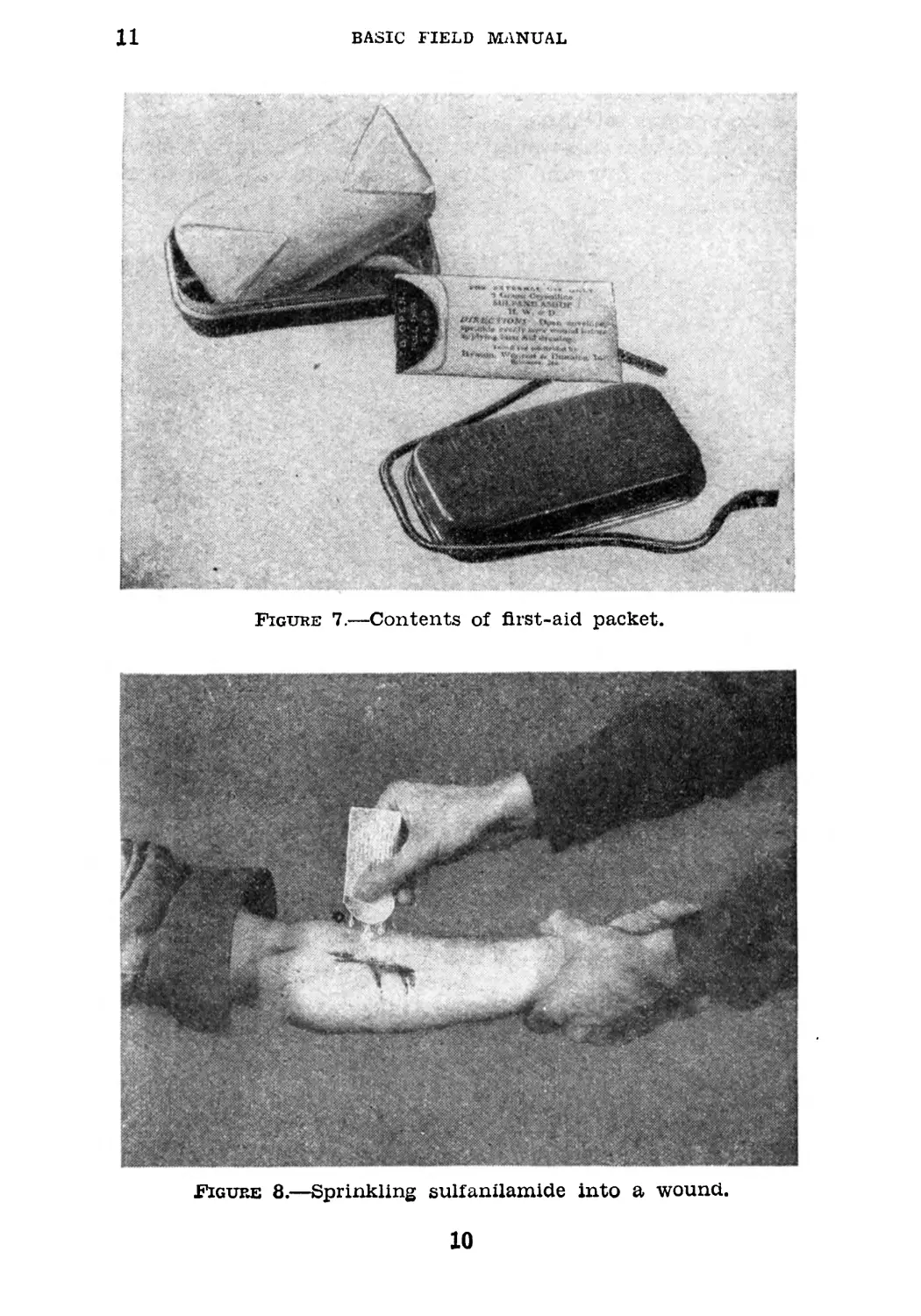
c.	If there is only a small amount of bleeding from a wound
when first seen, or if bleeding has been easily stopped, sprinkle
sulfanilamide, which is in the first-aid packet (figs. 6 and 7),
into the wound as shown in figure 8, and then apply the sterile
dressing, which is also in the first-aid packet. When bleeding
has been hard to stop, do not lift up or take off the dressing
to sprinkle sulfanilamide into the wound; removing the dress-
ing may start bleeding again.
d.	The proper application of a sterile dressing is an im-
portant means of preventing infection as well as of stopping
bleeding. To use the dressing in the first-aid packet, care-
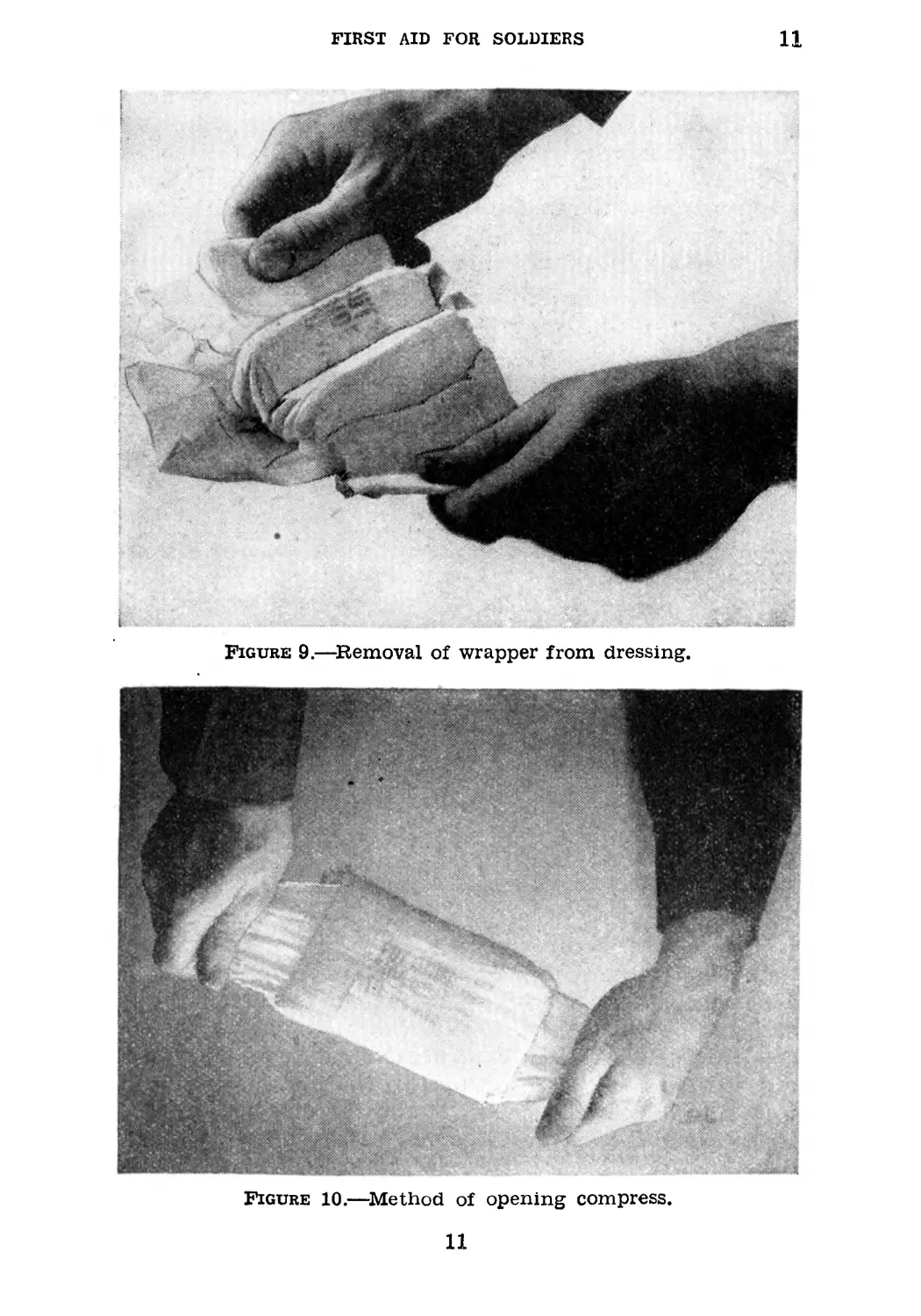
fully remove the wrapper as shown in figure 9. Open the
9
11
BASIC FIELD MANUAL
Figure 7.—Contents of first-aid packet.
Figure 8.—Sprinkling sulfanilamide into a wound.
10
FIRST AID FOR SOLDIERS
11
Figure 9.—Removal of wrapper from dressing.
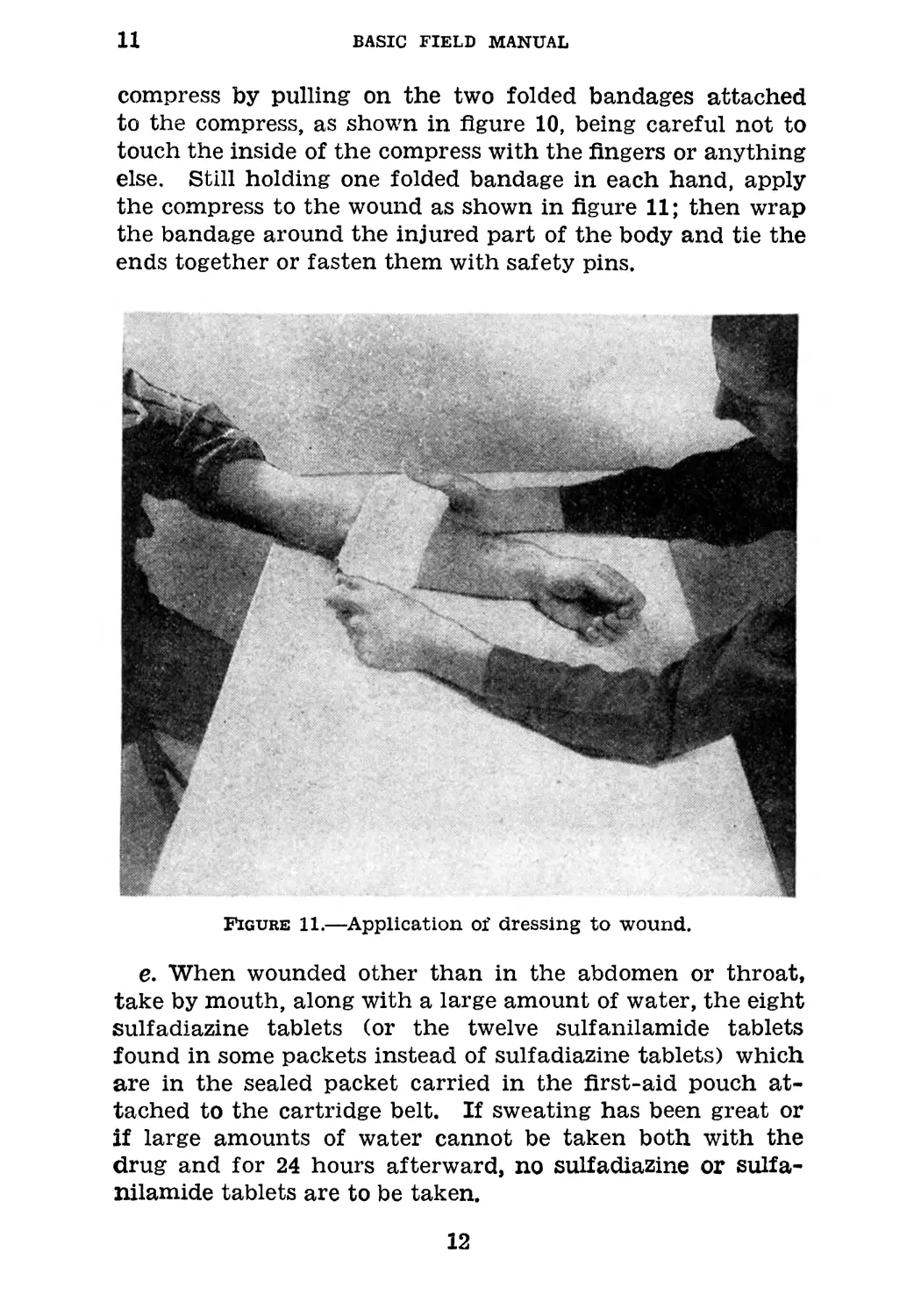
Figure 10.—Method of opening compress.
11
11
BASIC FIELD MANUAL
compress by pulling on the two folded bandages attached
to the compress, as shown in figure 10, being careful not to
touch the inside of the compress with the fingers or anything
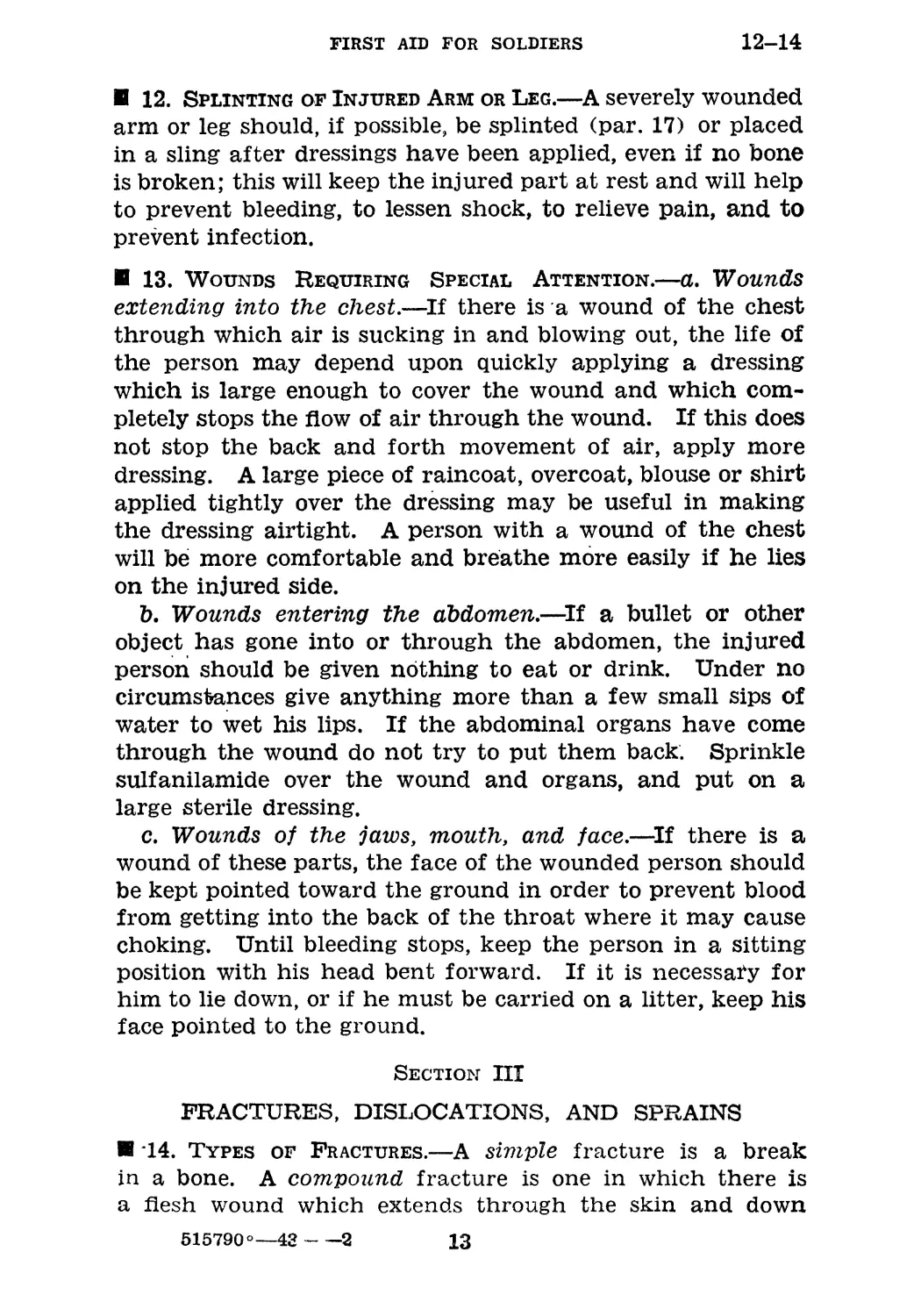
else. Still holding one folded bandage in each hand, apply
the compress to the wound as shown in figure 11; then wrap
the bandage around the injured part of the body and tie the
ends together or fasten them with safety pins.
Figure 11.—Application of dressing to wound.
e.	When wounded other than in the abdomen or throat,
take by mouth, along with a large amount of water, the eight
sulfadiazine tablets (or the twelve sulfanilamide tablets
found in some packets instead of sulfadiazine tablets) which
are in the sealed packet carried in the first-aid pouch at-
tached to the cartridge belt. If sweating has been great or
if large amounts of water cannot be taken both with the
drug and for 24 hours afterward, no sulfadiazine or sulfa-
nilamide tablets are to be taken.
12
FIRST AID FOR SOLDIERS
12-14
И 12. Splinting of Injured Arm or Leg.—A severely wounded
arm or leg should, if possible, be splinted (par. 17) or placed
in a sling after dressings have been applied, even if no bone
is broken; this will keep the injured part at rest and will help
to prevent bleeding, to lessen shock, to relieve pain, and to
prevent infection.
 13. Wounds Requiring Special Attention.—a. "Wounds
extending into the chest.—If there is a wound of the chest
through which air is sucking in and blowing out, the life of
the person may depend upon quickly applying a dressing
which is large enough to cover the wound and which com-
pletely stops the flow of air through the wound. If this does
not stop the back and forth movement of air, apply more
dressing. A large piece of raincoat, overcoat, blouse or shirt
applied tightly over the dressing may be useful in making
the dressing airtight. A person with a wound of the chest
will be more comfortable and breathe more easily if he lies
on the injured side.
b. Wounds entering the abdomen.—If a bullet or other
object has gone into or through the abdomen, the injured
person should be given nothing to eat or drink. Under no
circumstances give anything more than a few small sips of
water to wet his lips. If the abdominal organs have come
through the wound do not try to put them back. Sprinkle
sulfanilamide over the wound and organs, and put on a
large sterile dressing.
c. Wounds of the jaws, mouth, and face.—If there is a
wound of these parts, the face of the wounded person should
be kept pointed toward the ground in order to prevent blood
from getting into the back of the throat where it may cause
choking. Until bleeding stops, keep the person in a sitting
position with his head bent forward. If it is necessary for
him to lie down, or if he must be carried on a litter, keep his
face pointed to the ground.
Section III
FRACTURES, DISLOCATIONS, AND SPRAINS
 14. Types of Fractures.—A simple fracture is a break
in a bone. A compound fracture is one in which there is
a flesh wound which extends through the skin and down
515790°—43---2	13
14-17
BASIC FIELD MANUAL
to the broken bone. The flesh wounds in compound frac-
tures are usually caused by the sharp ends of the broken
bone or by bullets or fragments of high explosive shells,
grenades, or bombs. Compound fractures are more serious
than simple fractures because of the danger of infection
in the flesh wound and because shock is usually greater.
Careless handling of a simple fracture may cause it to
become a compound fracture.
 15. Signs and Symptoms of Fracture.—One or more of
the following signs or symptoms may be present when there
is a fracture:
a.	Pain and tenderness near the fracture.
b.	Partial or complete loss of ability of the injured person
to move the part.
c.	Deformity (unnatural shape).
d.	Swelling.
e.	Discoloration (blueness about the point of injury).
/. Grating of bone ends may be felt, but no attempt should
be made to produce this.
 16. First Aid for Fractures.—a. Handle all persons with
fractures, or even suspected fractures, with the greatest
gentleness; rough or careless handling causes pain and shock.
Immediate transportation of a person with a serious frac-
ture is sometimes harmful even if done very carefully;
this is especially true of fractures of the thigh, hip, leg, or
back, and in all cases in which shock has already appeared.
Give first aid, including splinting of the fracture, where the
injured person is lying.
b. Straighten the limb by pulling gently but steadily upon
its lower end.
c. Keep up this steady pull and support the limb on
either side of the fracture until a splint is applied.
 17. Splints.—a. A splint should be as wide as the limb
and long enough to prevent movement of the next joint in
either direction from the fracture. Temporary splints can
be made from many common materials such as shingles,
pieces of board, bayonet scabbards, pieces of tin, wire mesh,
and folded blankets. Pad splints well on the side toward
the skin and bind them securely in place at several points
14
FIRST AID FOR SOLDIERS
17-18
above and. below the fracture but not over the fracture.
b. Be sure that bandages are not so tightly bound as to
stop the circulation of blood when swelling of the limb
occurs, as it usually does after a fracture. Swelling, cold-
ness, stiffness, blueness, or numbness of a foot or hand is
often due to too tight bandaging. If any of these signs are
noticed, loosen the bandages which hold on the splints but
do not remove them.
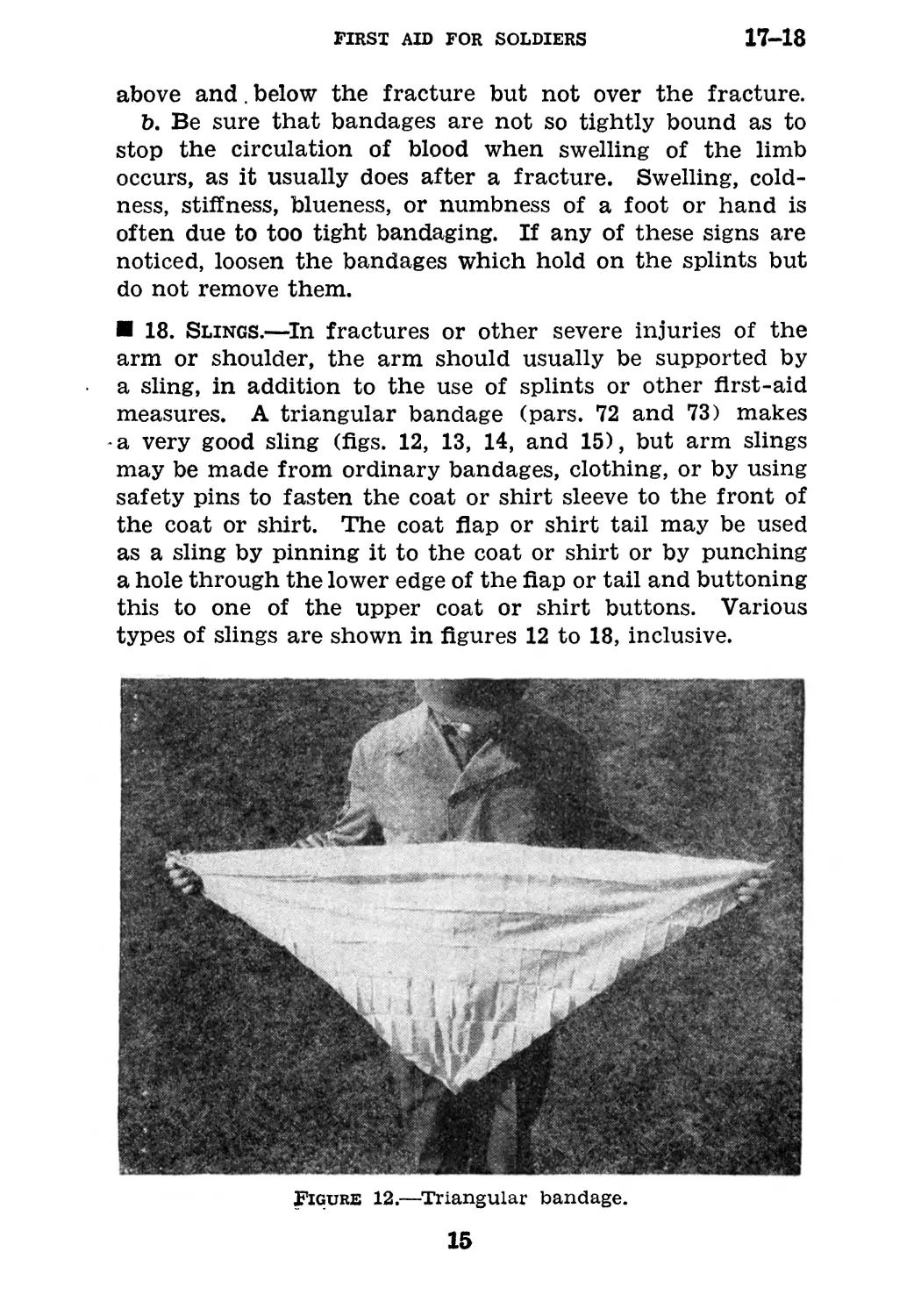
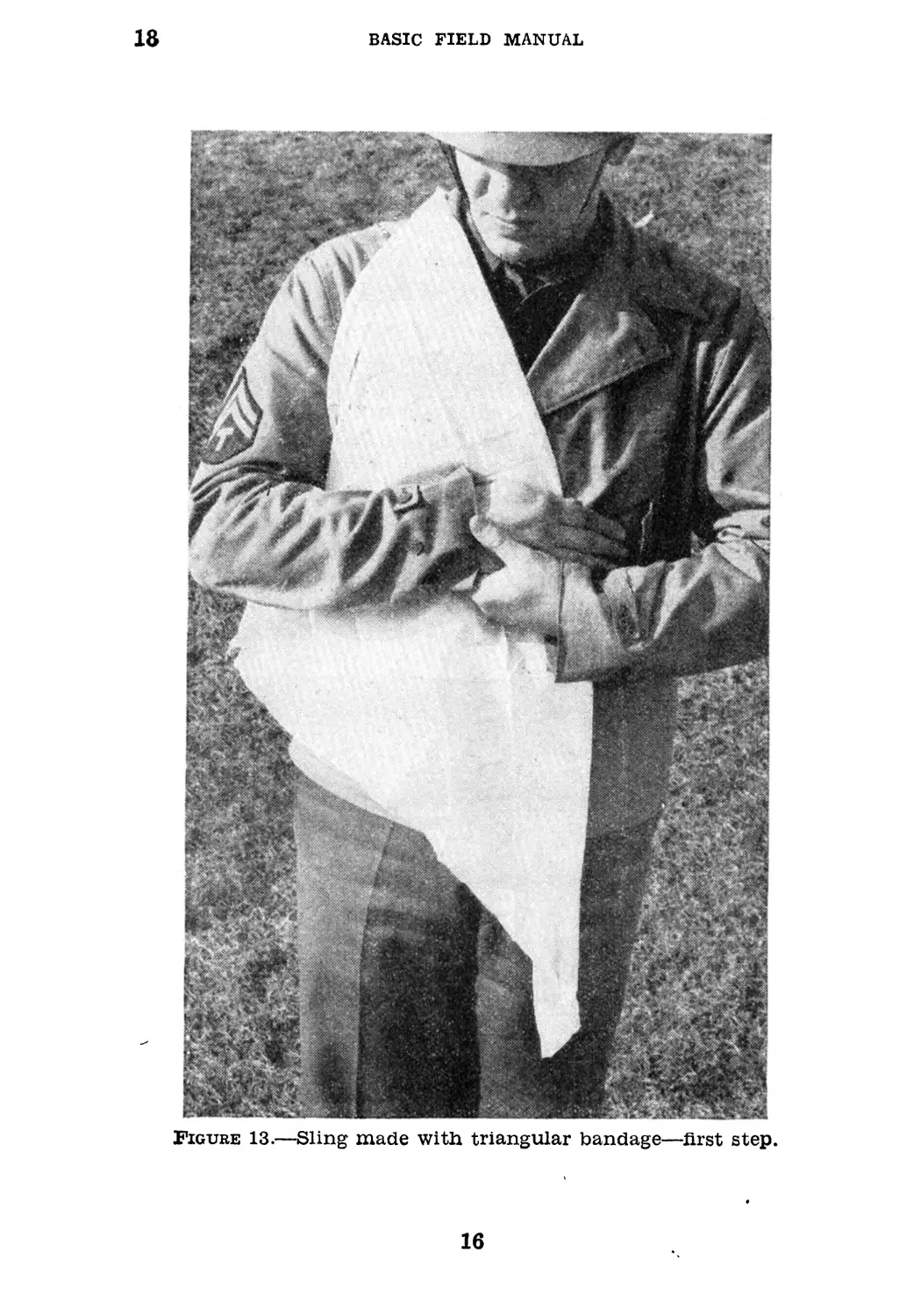
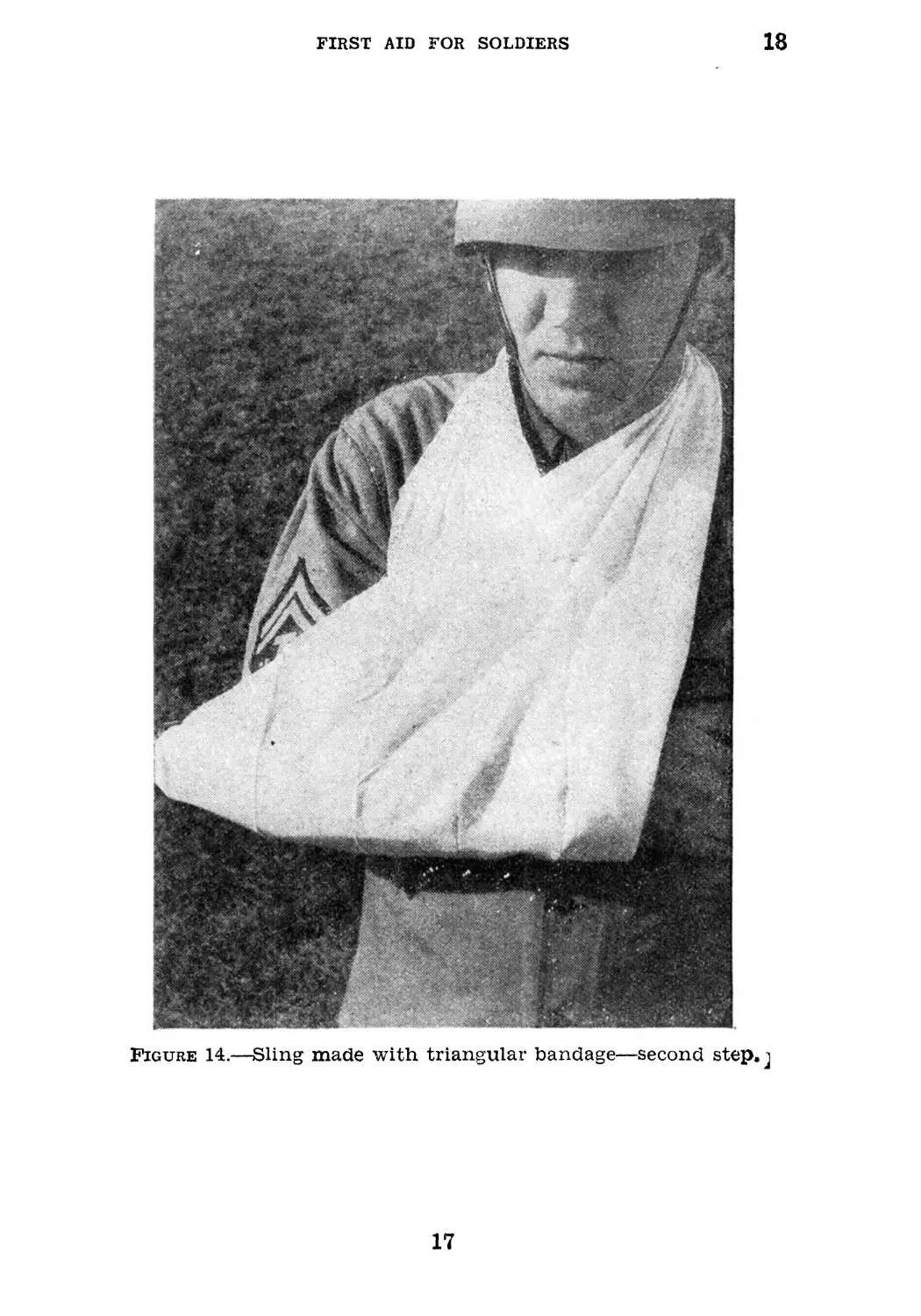
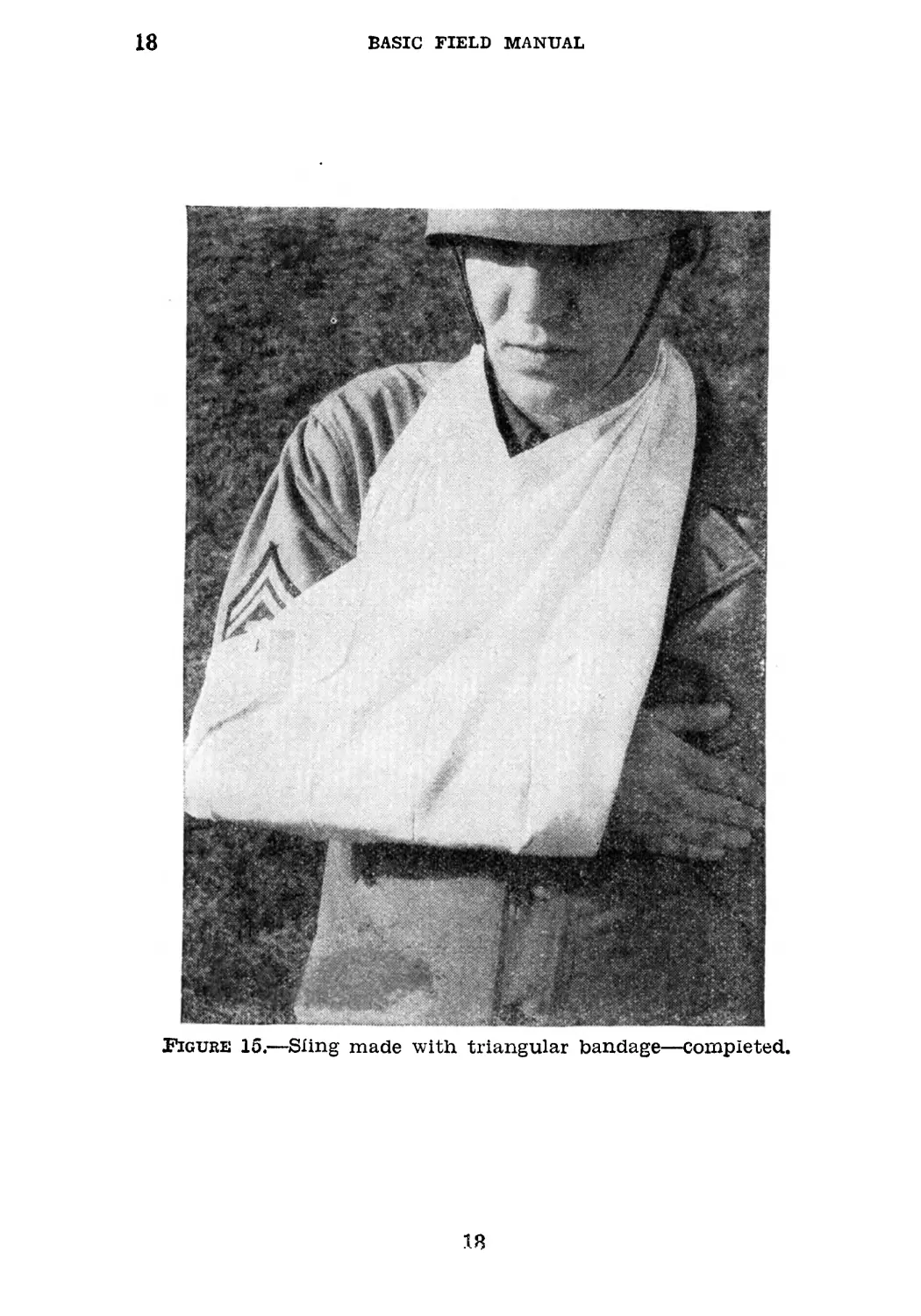
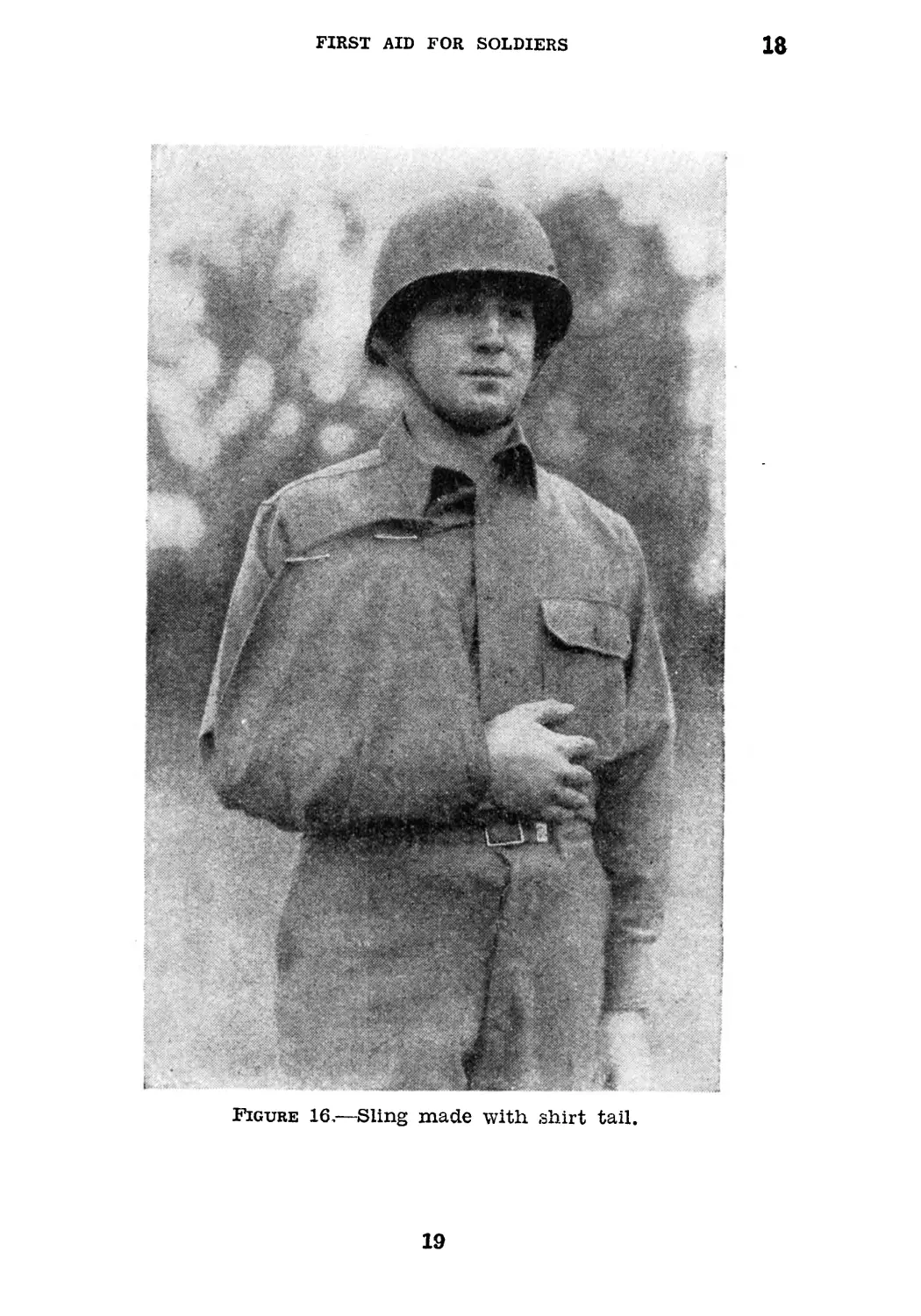
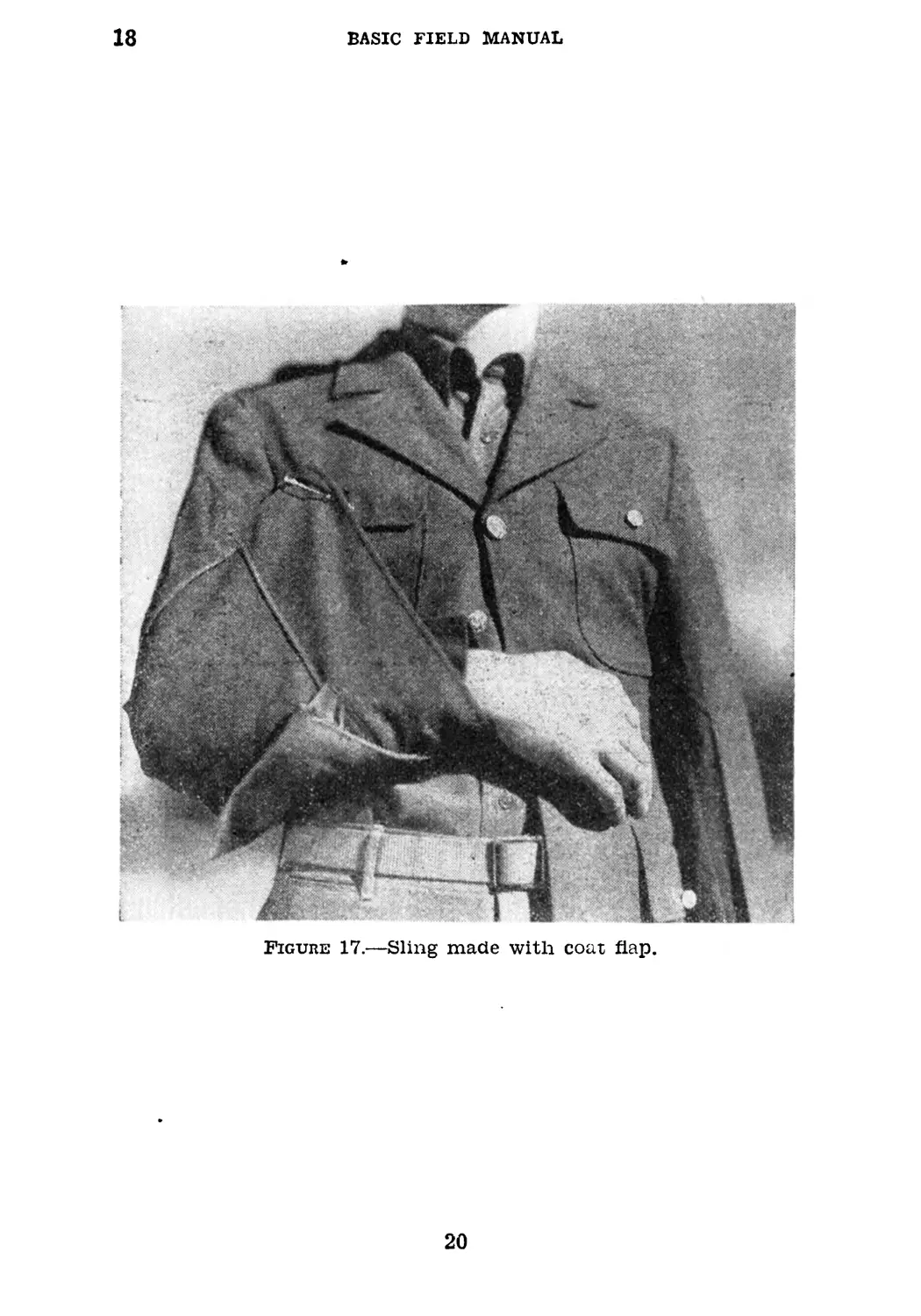
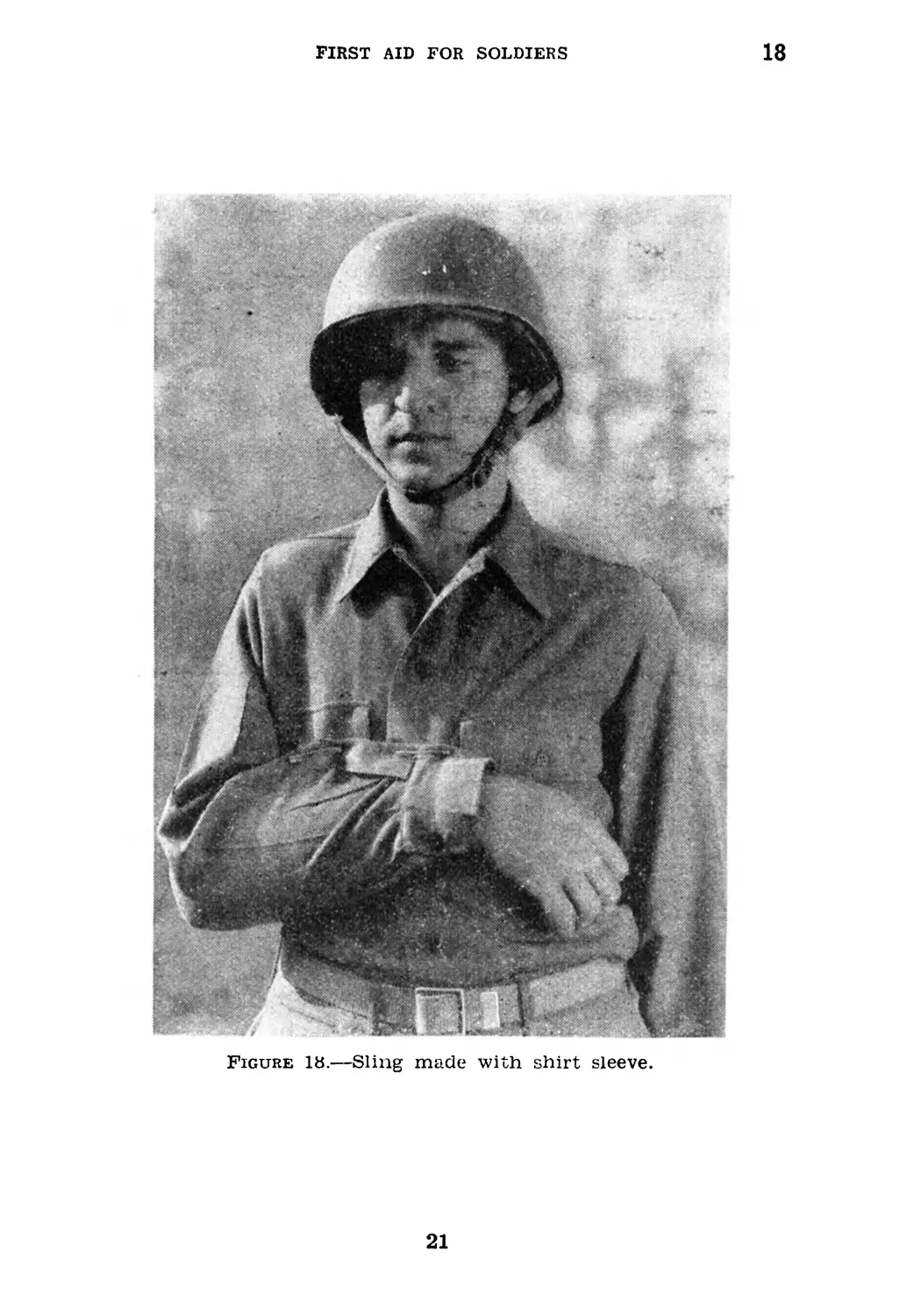
 18. Slings.—In fractures or other severe injuries of the
arm or shoulder, the arm should usually be supported by
a sling, in addition to the use of splints or other first-aid
measures. A triangular bandage (pars. 72 and 73) makes
a very good sling (figs. 12, 13, 14, and 15), but arm slings
may be made from ordinary bandages, clothing, or by using
safety pins to fasten the coat or shirt sleeve to the front of
the coat or shirt. The coat flap or shirt tail may be used
as a sling by pinning it to the coat or shirt or by punching
a hole through the lower edge of the flap or tail and buttoning
this to one of the upper coat or shirt buttons. Various
types of slings are shown in figures 12 to 18, inclusive.
Figure 12.—Triangular bandage.
15
id
BASIC FIELD MANUAL
Figure 13.—Sling made with triangular bandage—first step.
16
FIRST AID FOR SOLDIERS
18
Figure 14.—Sling made with triangular bandage—second step, j
17
18
BASIC FIELD MANUAL
Figure 15.—Sling made with triangular bandage—completed.
18
FIRST AID FOR SOLDIERS
18
Figure 16,—Sling made with shirt tail.
19
18
BASIC FIELD MANUAL
Figure 17.—Sling made with coat flap.
20
FIRST AID FOR SOLDIERS
18
Figure 18.—Sling made with shirt sleeve.
21
19-21
BASIC FIELD MANUAL
	19. Fractures With Flesh Wounds (Compound Frac-
tures) .—In fractures with flesh wounds, both the flesh
wound and the fracture require first-aid measures. Stop
bleeding, sprinkle sulfanilamide into the wound, and bandage
with a sterile dressing. If the bone is sticking through the
skin, do not push it back. Straighten the injured part by
gently pulling upon it, and apply a splint.
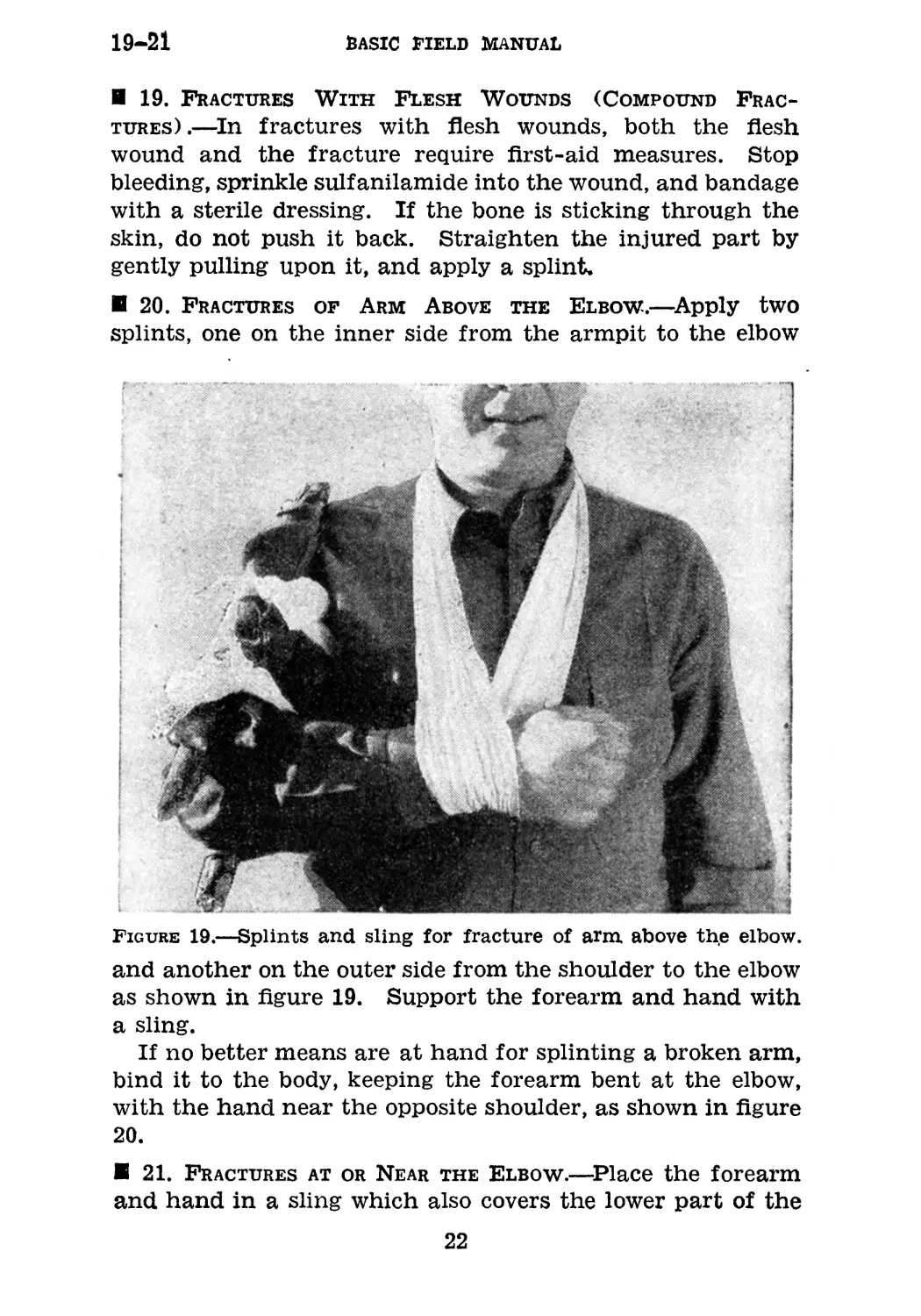
И 20. Fractures of Arm Above the Elbow.—Apply two
splints, one on the inner side from the armpit to the elbow
Figure 19.—Splints and sling for fracture of arm. above th.e elbow,
and another on the outer side from the shoulder to the elbow
as shown in figure 19. Support the forearm and hand with
a sling.
If no better means are at hand for splinting a broken arm,
bind it to the body, keeping the forearm bent at the elbow,
with the hand near the opposite shoulder, as shown in figure
20.
	21. Fractures at or Near the Elbow.—Place the forearm
and hand in a sling which also covers the lower part of the
22
FIRST AID FOR SOLDIERS
21-22
upper arm as shown in figure 15. If the elbow cannot be
bent because of pain or swelling, apply a single straight splint
extending from the upper part of the upper arm to the palm
of the hand, as shown in figure 21.
Figure 20.—Upper arm bound to body as a means of splinting.
	22. Fractures of Arm Below the Elbow (Forearm).—
With the arm bent half way at the elbow, apply a splint to
the inner surface, extending to the tips of the fingers and
another to the outer surface, also extending to the finger
tips, as shown in figure 22.
23
22
BASIC FIELD MANUAL
Figure 21.—Straight splint for fractures at or near the elbow (when
the elbow cannot be easily bent).
Figure 22.—Splint for fracture of forearm.
24
FIRST AID FOR SOLDIERS
23-25
	23. Fractures of Collar Bone.—Bend the forearm to a
right angle in front of the body and place it in a sling as
shown in figure 15.
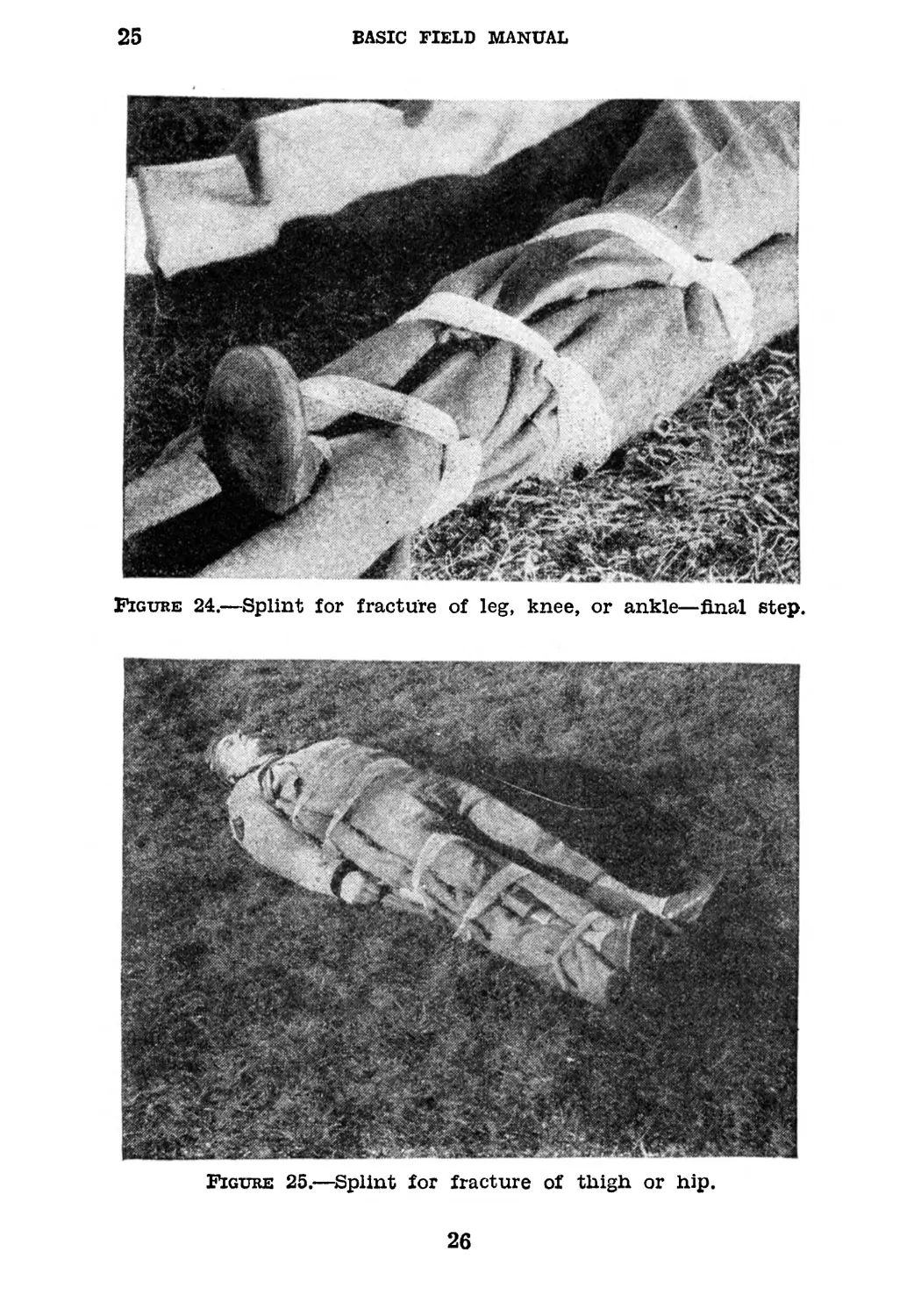
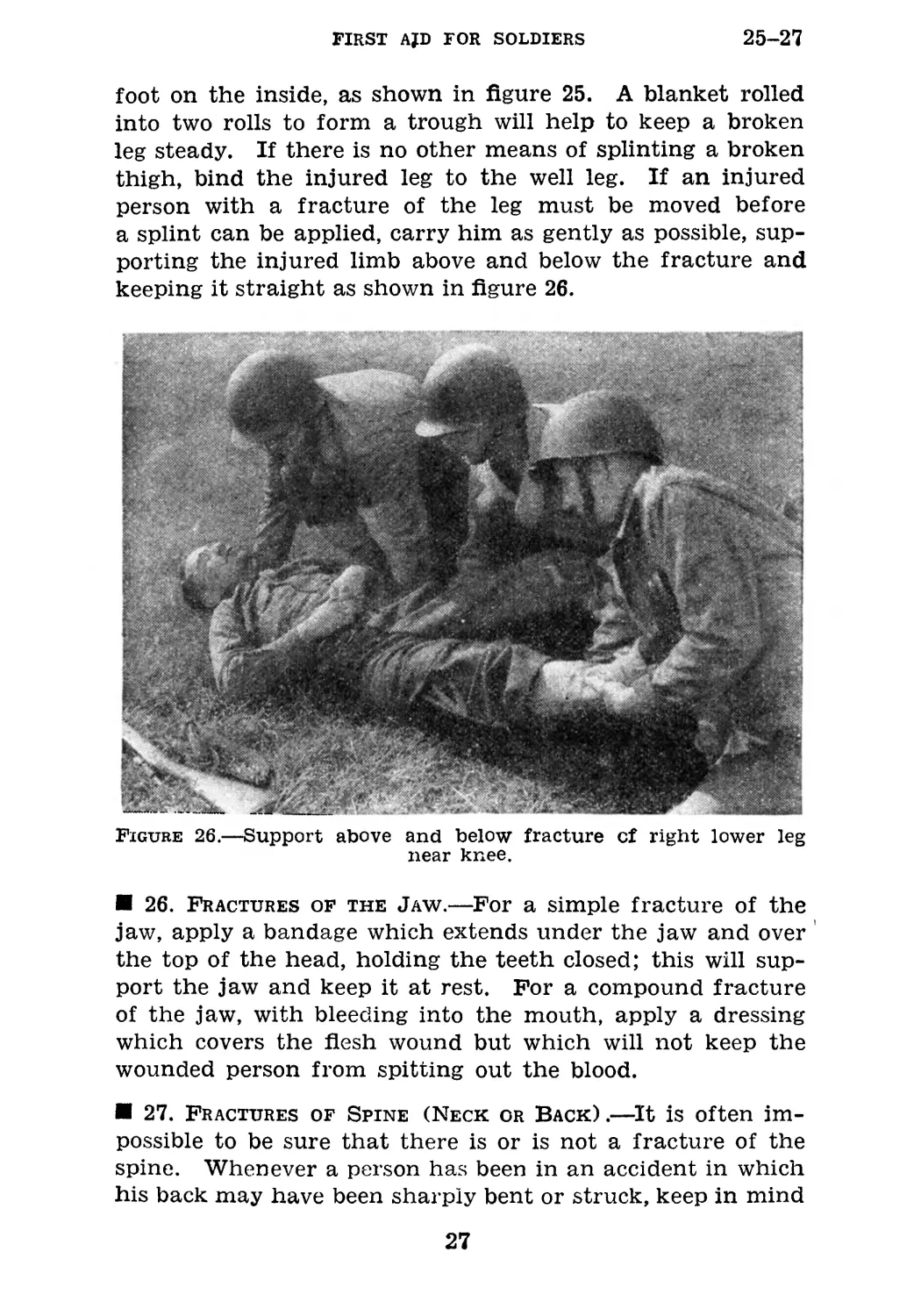
	24. Fractures of Leg, Knee, or Ankle.—Apply two splints,
one on the outside, the other on the inside of the limb, ex-
tending from above the knee to beyond the foot. Support
can be given by a splint made of two sticks padded with
Figure 23.—Splint for fracture of leg, knee, or ankle—intermediate
step.
clothing or a blanket, as shown in figures 23 and 24. A
piece of tin, molded in the form of a gutter, makes a very
good splint for leg fractures. If there are no other means
of splinting a broken leg, pad it well and bind it to the other
leg. In snow country, skis may be used as splints.
	25. Fractures of Thigh or Hip.—It is especially important
to apply a splint before moving persons with such fractures.
Apply a long splint, reaching from the armpit to beyond
the foot on the outside, and another from the crotch to the
25
25
BASIC FIELD MANUAL
Figure 24.—Splint for fracture of leg, knee, or ankle—final step.
Figure 25.—Splint for fracture of thigh or hip.
26
FIRST AJD FOR SOLDIERS
25-27
foot on the inside, as shown in figure 25. A blanket rolled
into two rolls to form a trough will help to keep a broken
leg steady. If there is no other means of splinting a broken
thigh, bind the injured leg to the well leg. If an injured
person with a fracture of the leg must be moved before
a splint can be applied, carry him as gently as possible, sup-
porting the injured limb above and below the fracture and
keeping it straight as shown in figure 26.
Figure 26.—Support above and below fracture of right lower leg
near knee.
	26. Fractures of the Jaw.—For a simple fracture of the
jaw, apply a bandage which extends under the jaw and over
the top of the head, holding the teeth closed; this will sup-
port the jaw and keep it at rest. For a compound fracture
of the jaw, with bleeding into the mouth, apply a dressing
which covers the flesh wound but which will not keep the
wounded person from spitting out the blood.
	27. Fractures of Spine (Neck or Back) .—It is often im-
possible to be sure that there is or is not a fracture of the
spine. Whenever a person has been in an accident in which
his back may have been sharply bent or struck, keep in mind
27
27
BASIC FIELD MANUAL
that either his neck or back may have been fractured. Pain
in the back or neck, loss of power to move all or part of an
arm or leg, or lack of feeling in an arm or leg, may follow a
fracture of the spine, but one or more of these symptoms
may be absent. If a broken neck or back is suspected, the
injured person’s head should not be lifted even to drink
water. Do not let the injured person try to stand or sit up.
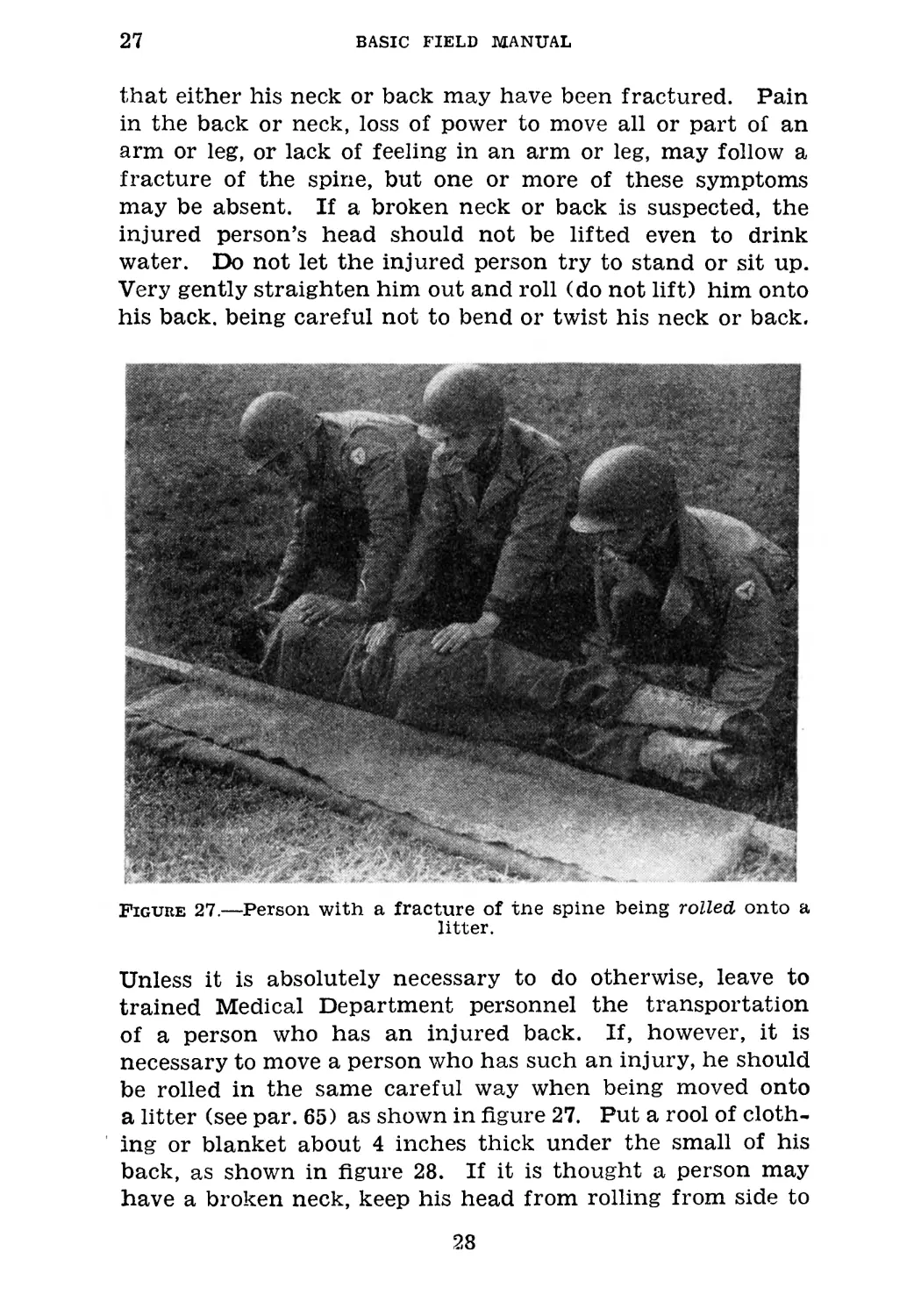
Very gently straighten him out and roll (do not lift) him onto
his back, being careful not to bend or twist his neck or back.
Figure 27.—Person with a fracture of the spine being rolled onto a
litter.
Unless it is absolutely necessary to do otherwise, leave to
trained Medical Department personnel the transportation
of a person who has an injured back. If, however, it is
necessary to move a person who has such an injury, he should
be rolled in the same careful way when being moved onto
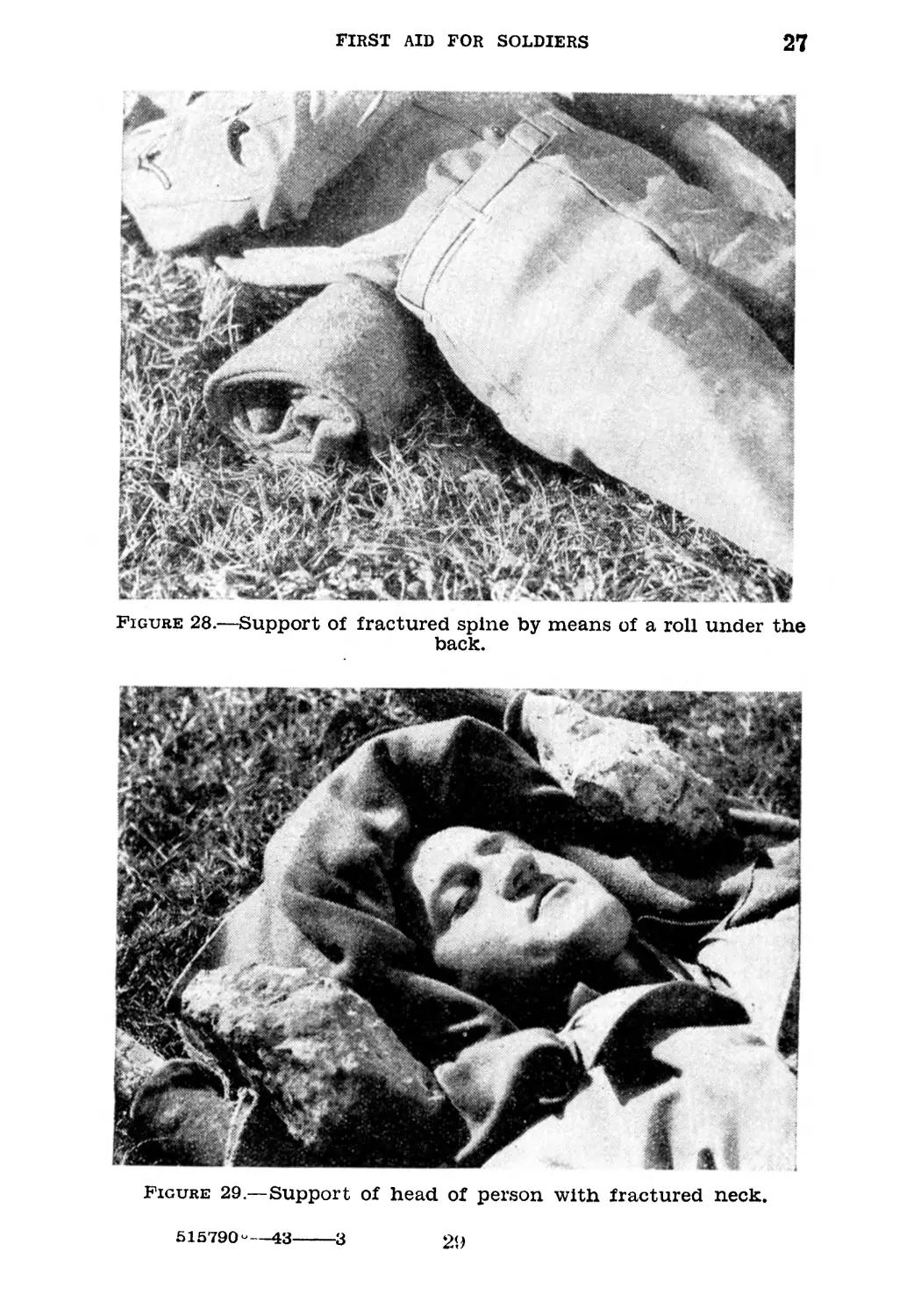
a litter (see par. 65) as shown in figure 27. Put a rool of cloth-
ing or blanket about 4 inches thick under the small of his
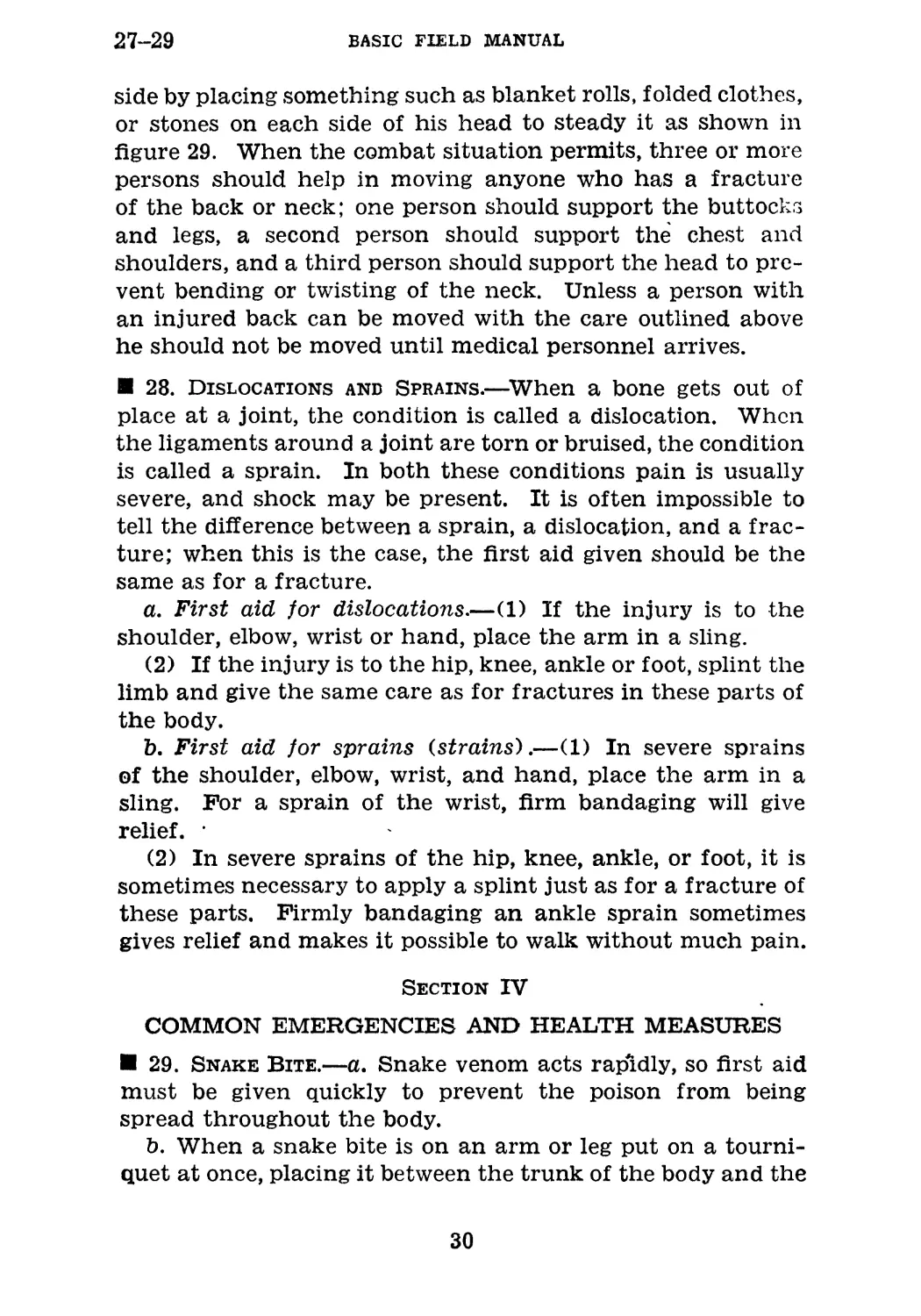
back, as shown in figure 28. If it is thought a person may
have a broken neck, keep his head from rolling from side to
28
FIRST AID FOR SOLDIERS
27
Figure 28.—Support of fractured spine by means of a roll under the
back.
Figure 29.—Support of head of person with fractured neck.
515790°—43-
-3
29
27-29
BASIC FIELD MANUAL
side by placing something such as blanket rolls, folded clothes,
or stones on each side of his head to steady it as shown in
figure 29. When the combat situation permits, three or more
persons should help in moving anyone who has a fracture
of the back or neck; one person should support the buttocks
and legs, a second person should support the chest and
shoulders, and a third person should support the head to pre-
vent bending or twisting of the neck. Unless a person with
an injured back can be moved with the care outlined above
he should not be moved until medical personnel arrives.
 28. Dislocations and Sprains.—When a bone gets out of
place at a joint, the condition is called a dislocation. When
the ligaments around a joint are torn or bruised, the condition
is called a sprain. In both these conditions pain is usually
severe, and shock may be present. It is often impossible to
tell the difference between a sprain, a dislocation, and a frac-
ture; when this is the case, the first aid given should be the
same as for a fracture.
a.	First aid for dislocations.—(1) If the injury is to the
shoulder, elbow, wrist or hand, place the arm in a sling.
(2)	If the injury is to the hip, knee, ankle or foot, splint the
limb and give the same care as for fractures in these parts of
the body.
b.	First aid for sprains (strains').—(1) In severe sprains
of the shoulder, elbow, wrist, and hand, place the arm in a
sling. For a sprain of the wrist, firm bandaging will give
relief. •
(2) In severe sprains of the hip, knee, ankle, or foot, it is
sometimes necessary to apply a splint just as for a fracture of
these parts. Firmly bandaging an ankle sprain sometimes
gives relief and makes it possible to walk without much pain.
Section IV
COMMON EMERGENCIES AND HEALTH MEASURES
 29. Snake Bite.—a. Snake venom acts rapidly, so first aid
must be given quickly to prevent the poison from being
spread throughout the body.
b.	When a snake bite is on an arm or leg put on a tourni-
quet at once, placing it between the trunk of the body and the
30
FIRST AID FOR SOLDIERS
29
bite. Apply the tourniquet above the knee, in foot and leg
bites; above the elbow, in hand and arm bites. A necktie,
belt, handkerchief, or triangular bandage can be used as a
tourniquet. The tourniquet should be loosened every 20 to 30
minutes for 10 or 15 seconds.
c.	Apply iodine to the area around the bite.
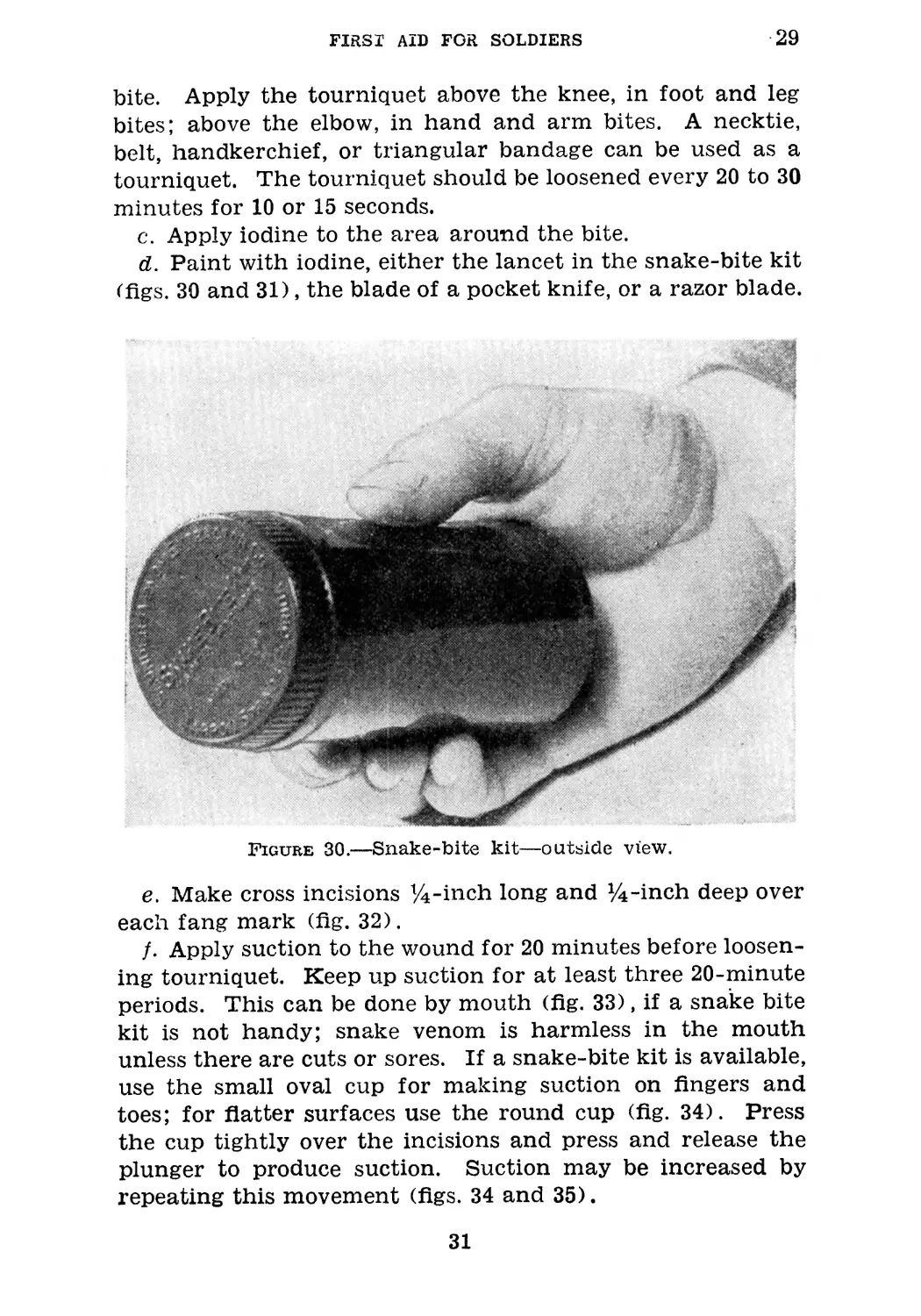
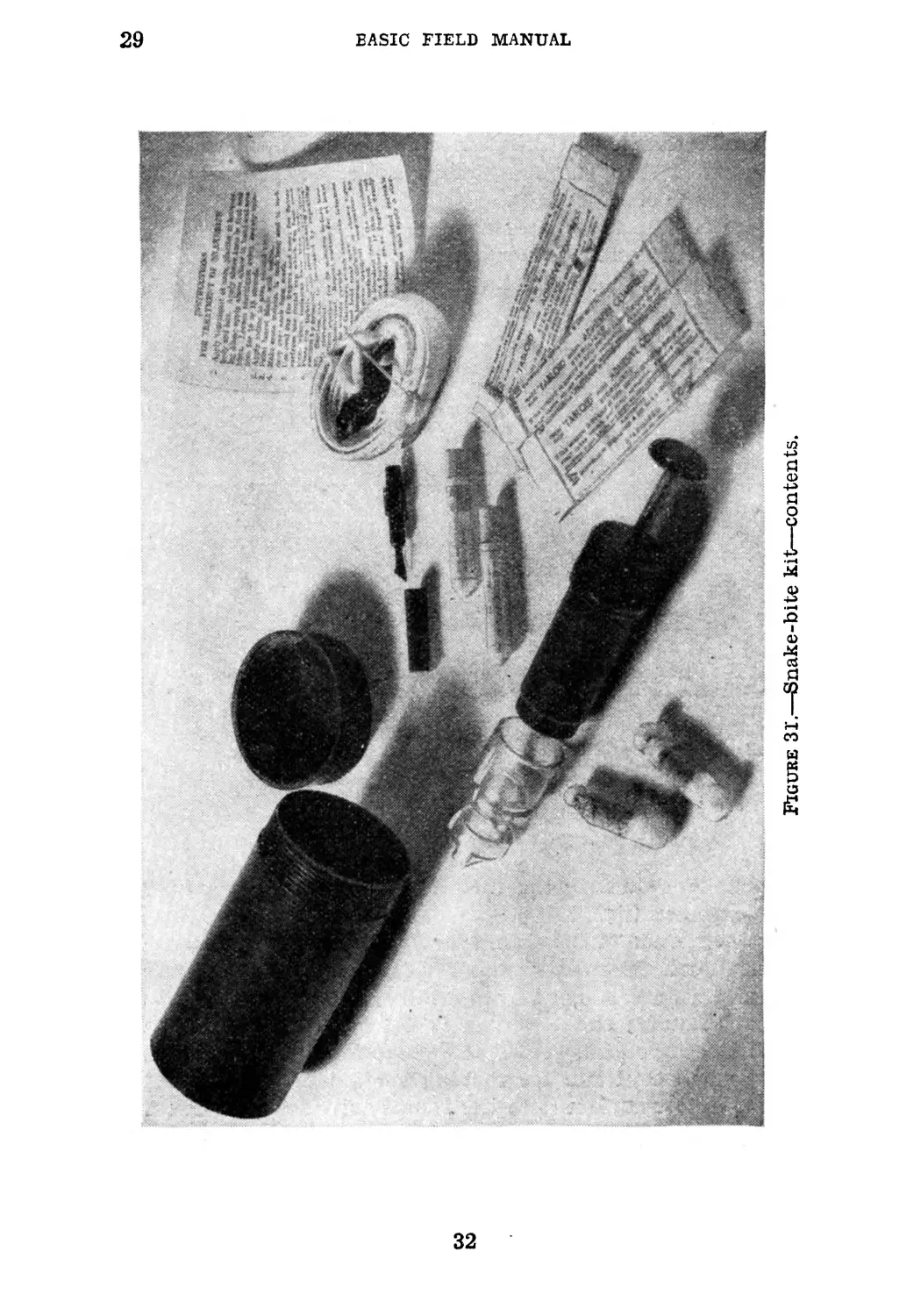
d.	Paint with iodine, either the lancet in the snake-bite kit
(figs. 30 and 31), the blade of a pocket knife, or a razor blade.
Figure 30.—Snake-bite kit—outside view.
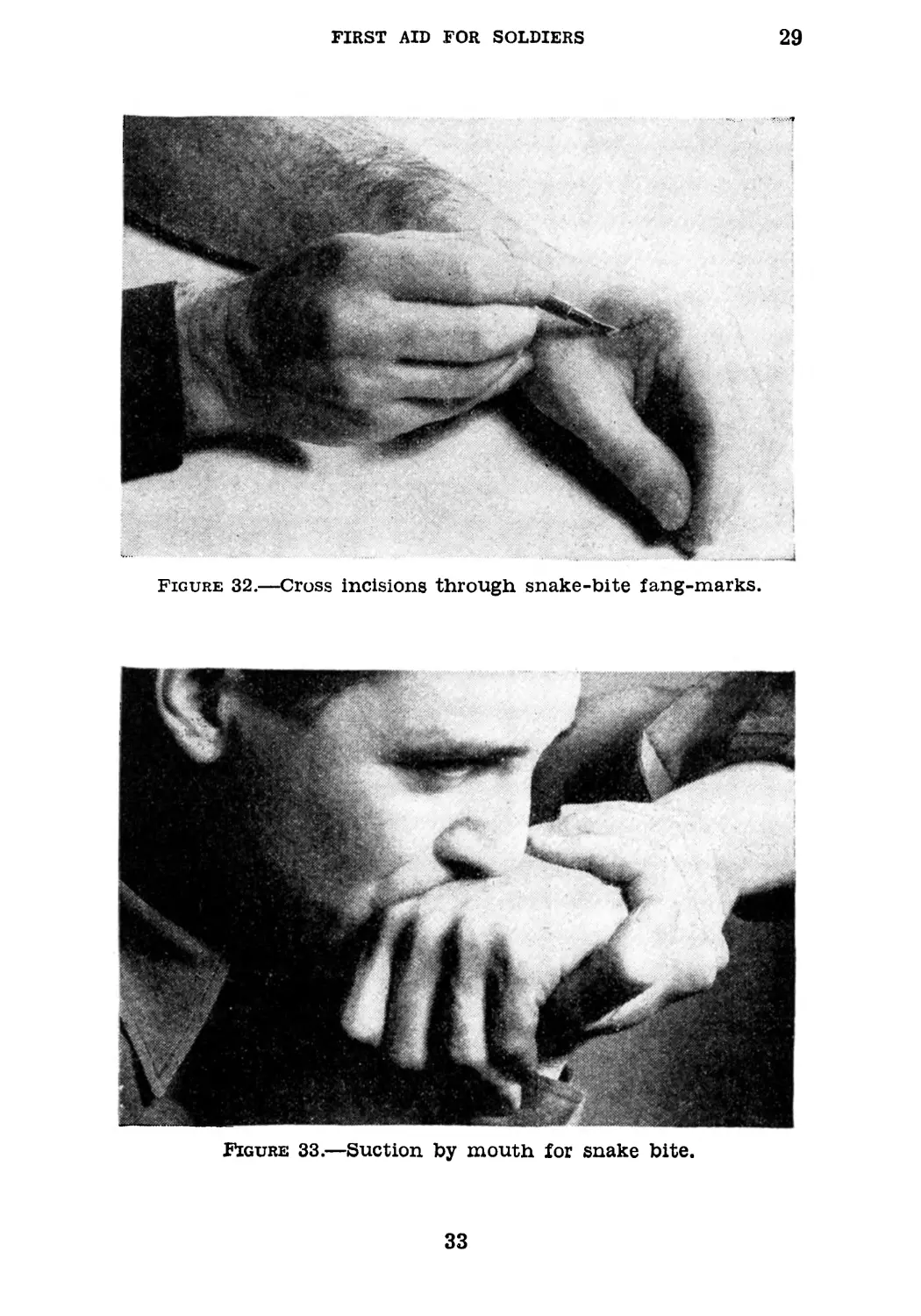
e.	Make cross incisions %L-inch long and ^-inch deep over
each fang mark (fig. 32).
/. Apply suction to the wound for 20 minutes before loosen-
ing tourniquet. Keep up suction for at least three 20-minute
periods. This can be done by mouth (fig. 33), if a snake bite
kit is not handy; snake venom is harmless in the mouth
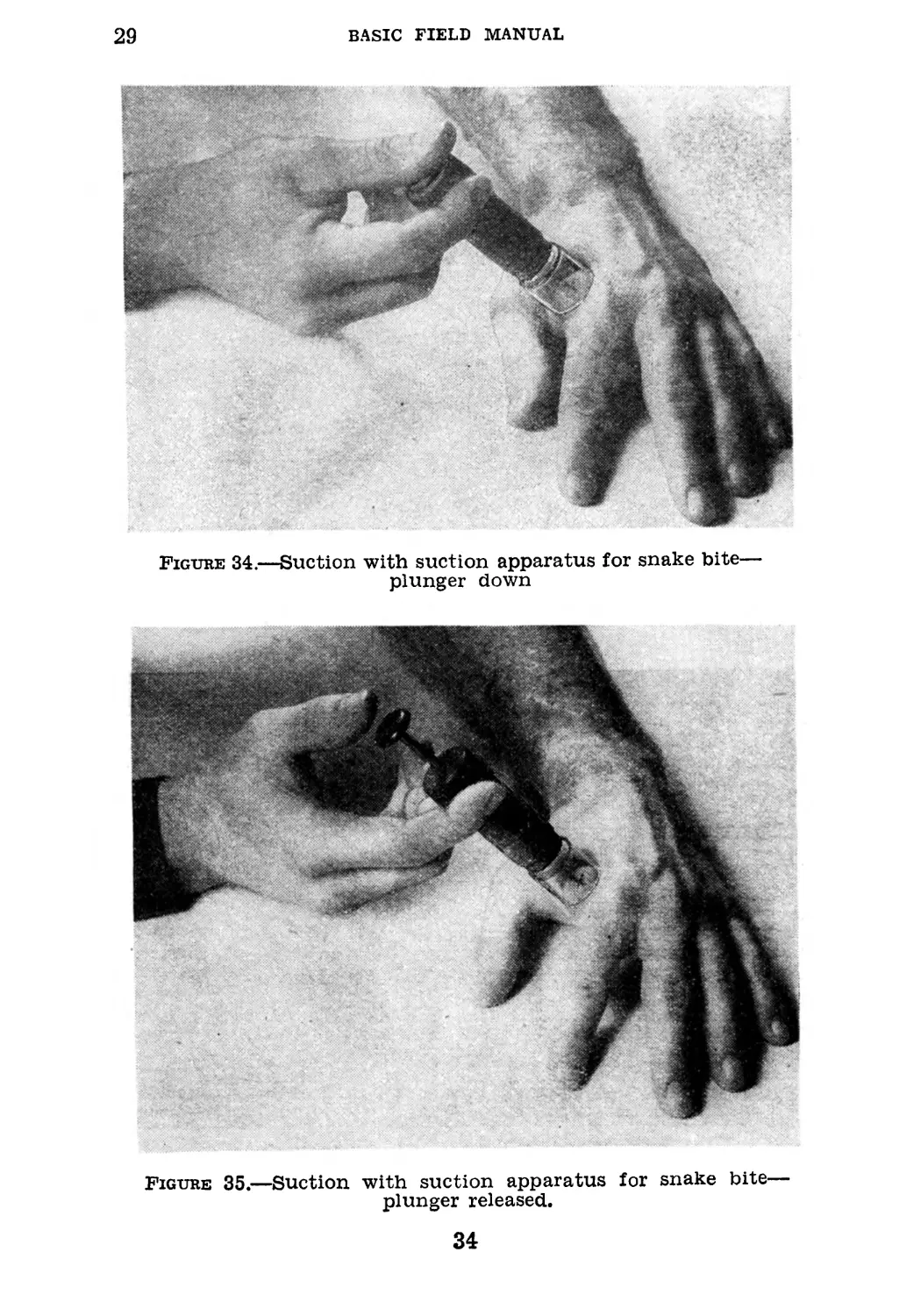
unless there are cuts or sores. If a snake-bite kit is available,
use the small oval cup for making suction on fingers and
toes; for flatter surfaces use the round cup (fig. 34). Press
the cup tightly over the incisions and press and release the
plunger to produce suction. Suction may be increased by
repeating this movement (figs. 34 and 35).
31
Figure 31.—Snake-bite kit—contents.
BASIC FIELD MANUAL
FIRST AID FOR SOLDIERS
29
Figure 32.—Cross incisions through snake-bite fang-marks.
Figure 33.—Suction by mouth for snake bite.
33
29
BASIC FIELD MANUAL
Figure 34.—Suction with suction apparatus for snake bite—
plunger down
Figure 35.—Suction with suction apparatus for snake bite—
plunger released.
34
FIRST AID FOR SOLDIERS
29
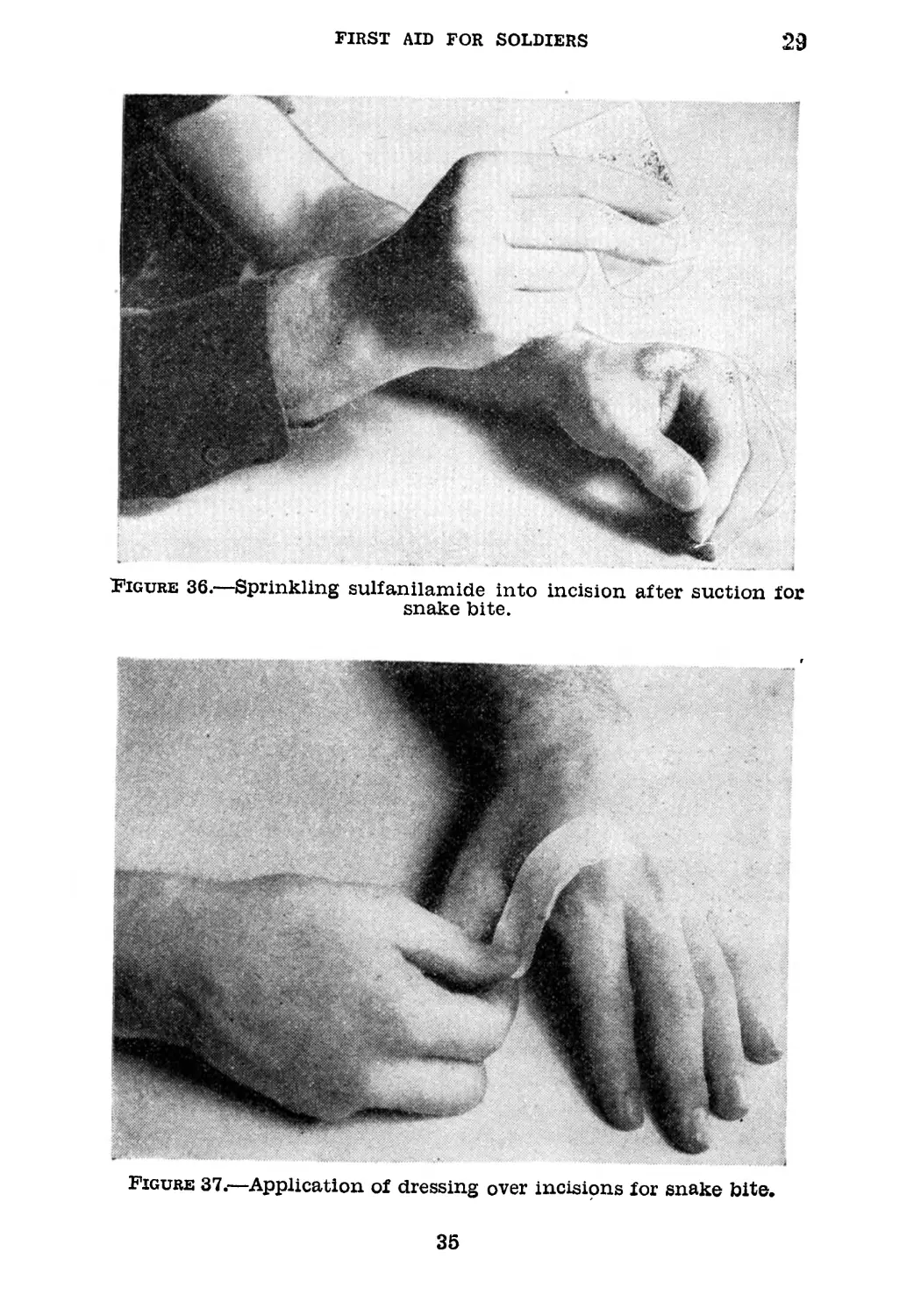
Figure 36.—Sprinkling sulfanilamide into incision after suction for
snake bite.
Figure 37.—Application of dressing over incisions for snake bite.
35
29-31
BASIC FIELD MANUAL
g. If the breathing of a person who has been bitten by a
snake becomes difficult or shows signs of stopping, give
artificial respiration as shown in figures 47 and 48.
h. If there is a great amount of bleeding from the incisions,
place a gauze compress on the wound and press the thumb
or one or more fingers firmly over the incisions.
г. After the last period of suction has been completed, re-,
move the torniquet; sprinkle sulfanilamide into the incisions
(fig. 36); and apply a sterile dressing (fig. 37).
 30. Insect Bites and Stings.—a. These can often be pre-
vented by sleeping under a mosquito net, wearing a head net
and gloves, and by using insect repellent (see pars. 76 and 77).
To apply insert repellent, turn the bottle upside down and
spread a small amount of the liquid over uncovered skin sur-
faces. One application will usually keep insects away for 2
hours.
b. For severe insect stings such as those caused by bees and
wasps, the application of a folded cloth thoroughly wet with
cold water will help relieve discomfort. Do not scratch the
stung area; to do this increases the danger of infection.
c. First aid for poisonous spider bites is the same as for
snake bites.
 31. Ticks, Fleas, and Lice.—When in a region infested with
these vermin, all clothing should be removed at least once a
day and the body and clothing carefully inspected. The use
of insecticide powder for body crawling insects (fig. 38) will
help greatly in keeping away vermin, especially lice. It is
furnished to the individual soldier through his unit com-
mander when in an area where it is likely to be needed. For
the destruction of lice in clothing, lightly dust the seams and
infested parts at weekly intervals. For the prevention of
chigger and tick bites, dust the belt line and the inner side
of the clothing of the lower extremities including the socks
and shoes. When troops are sleeping on the ground, their
bedding should be protected from infestation with crawling
insects by lightly dusting it with the powder at weekly in-
tervals. When removing ticks, be careful not to leave the
head of the tick in the skin, and do not crush the tick. The
tick may be removed properly by pulling gently but steadily
36
FIRST AID FOR SOLDIERS
31-34
upon its body or by placing a lighted cigarette close to its
body so that it releases itself from the skin. Paint the area of
a tick bite with iodine. Clothing in which fleas or lice are
found should be disinfected.
Figure 38.—Insecticide powder for body crawling insects.
 32. Jelly Fish, Portuguese Man-of-War, and Nettle
Stings.—a. To relieve the burning sensation caused by any
of these, dry the skin immediately and press one or both of
the hands firmly against the painful area.
b. Rubbing the skin with sand or scrubbing the skin with
soap and water to remove tentacles is also helpful.
	33. Leeches.—After marching through water, brush, or
grass where there are leeches, take off and examine shoes,
leggins, and socks. Remove any leeches which have become
attached to the body, and cover the bite with a small sterile
dressing. Oozing of blood may keep up for half an hour or
longer after a leech has been removed, but this is not serious.
	34. Animal Bites.—First aid for animal bites is the same
as for wounds from other causes.
37
35
BASIC FIELD MANUAL
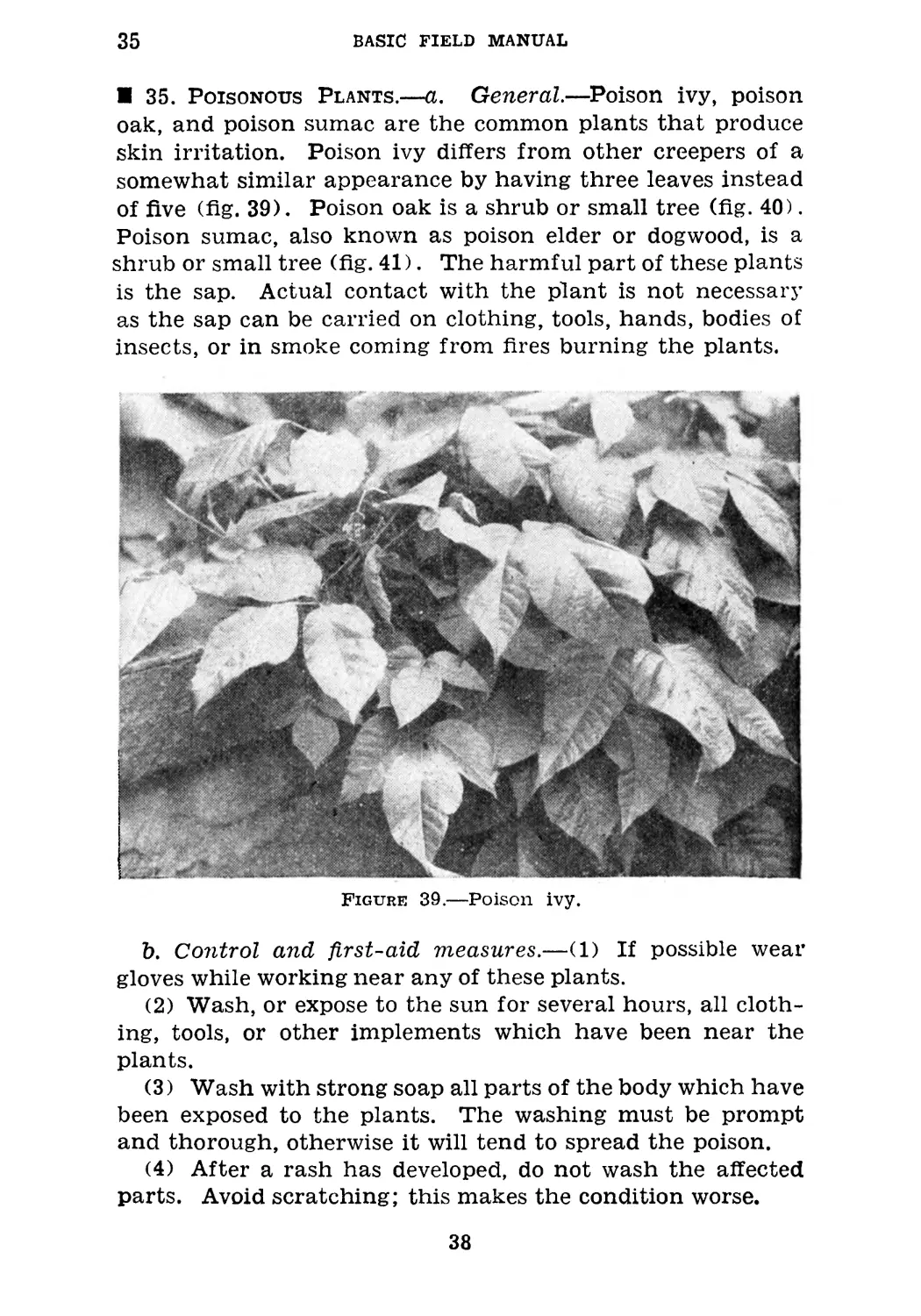
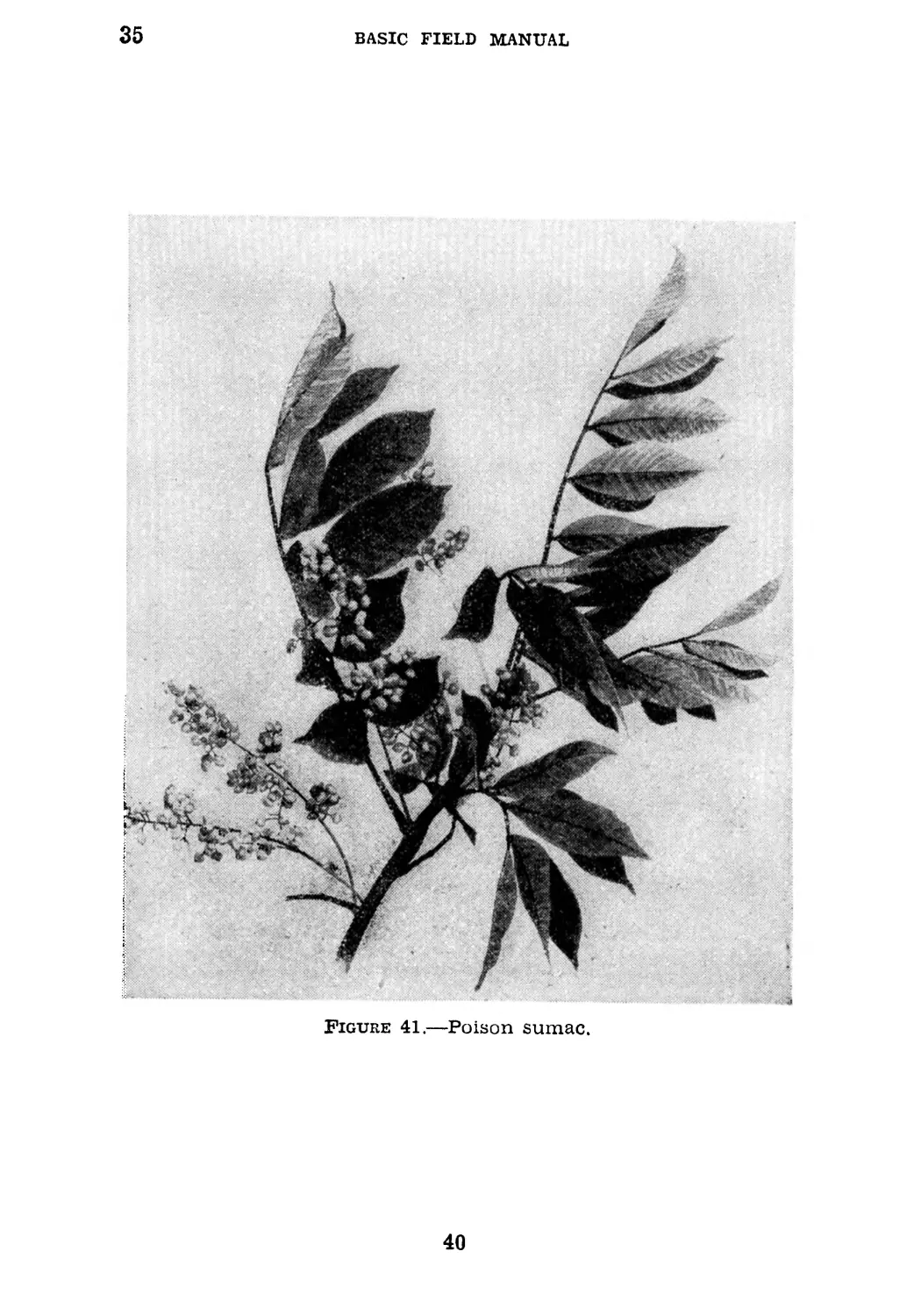
	35. Poisonous Plants.—a. General.—Poison ivy, poison
oak, and poison sumac are the common plants that produce
skin irritation. Poison ivy differs from other creepers of a
somewhat similar appearance by having three leaves instead
of five (fig. 39). Poison oak is a shrub or small tree (fig. 40).
Poison sumac, also known as poison elder or dogwood, is a
shrub or small tree (fig. 41). The harmful part of these plants
is the sap. Actual contact with the plant is not necessary
as the sap can be carried on clothing, tools, hands, bodies of
insects, or in smoke coming from fires burning the plants.
Figure 39.—Poison ivy.
b. Control and first-aid measures.—(1) If possible wear
gloves while working near any of these plants.
(2)	Wash, or expose to the sun for several hours, all cloth-
ing, tools, or other implements which have been near the
plants.
(3)	Wash with strong soap all parts of the body which have
been exposed to the plants. The washing must be prompt
and thorough, otherwise it will tend to spread the poison.
(4)	After a rash has developed, do not wash the affected
parts. Avoid scratching; this makes the condition worse.
38
FIRST AID FOR SOLDIERS
35
Figure 40.—Poison oak.
39
35
BASIC FIELD MANUAL
Figure 41.—Poison sumac.
40
FIRST AID FOR SCjlDIERS
36
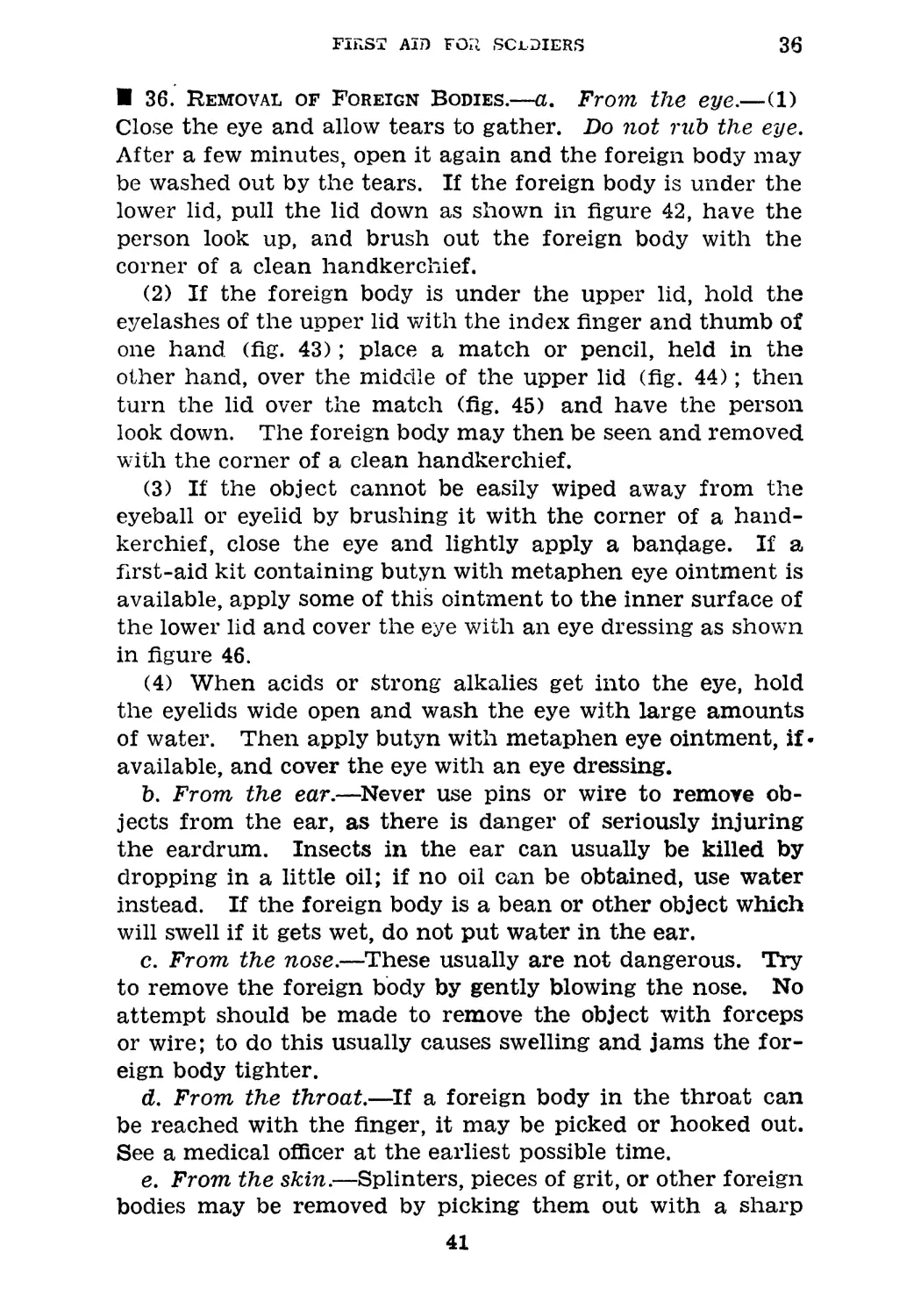
 36. Removal of Foreign Bodies.—a. From the eye.—(1)
Close the eye and allow tears to gather. Do not rub the eye.
After a few minutes, open it again and the foreign body may
be washed out by the tears. If the foreign body is under the
lower lid, pull the lid down as shown in figure 42, have the
person look up, and brush out the foreign body with the
corner of a clean handkerchief.
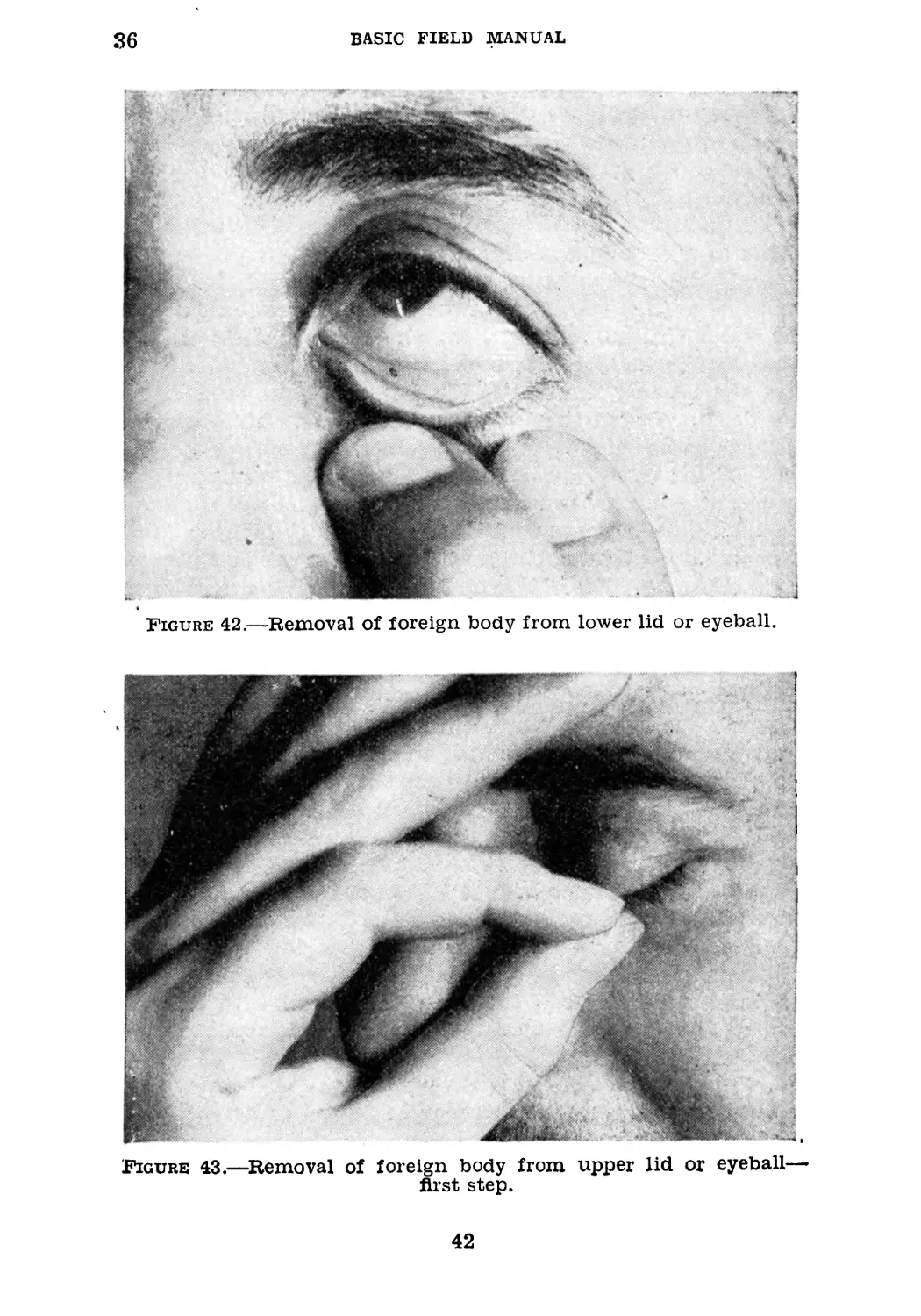
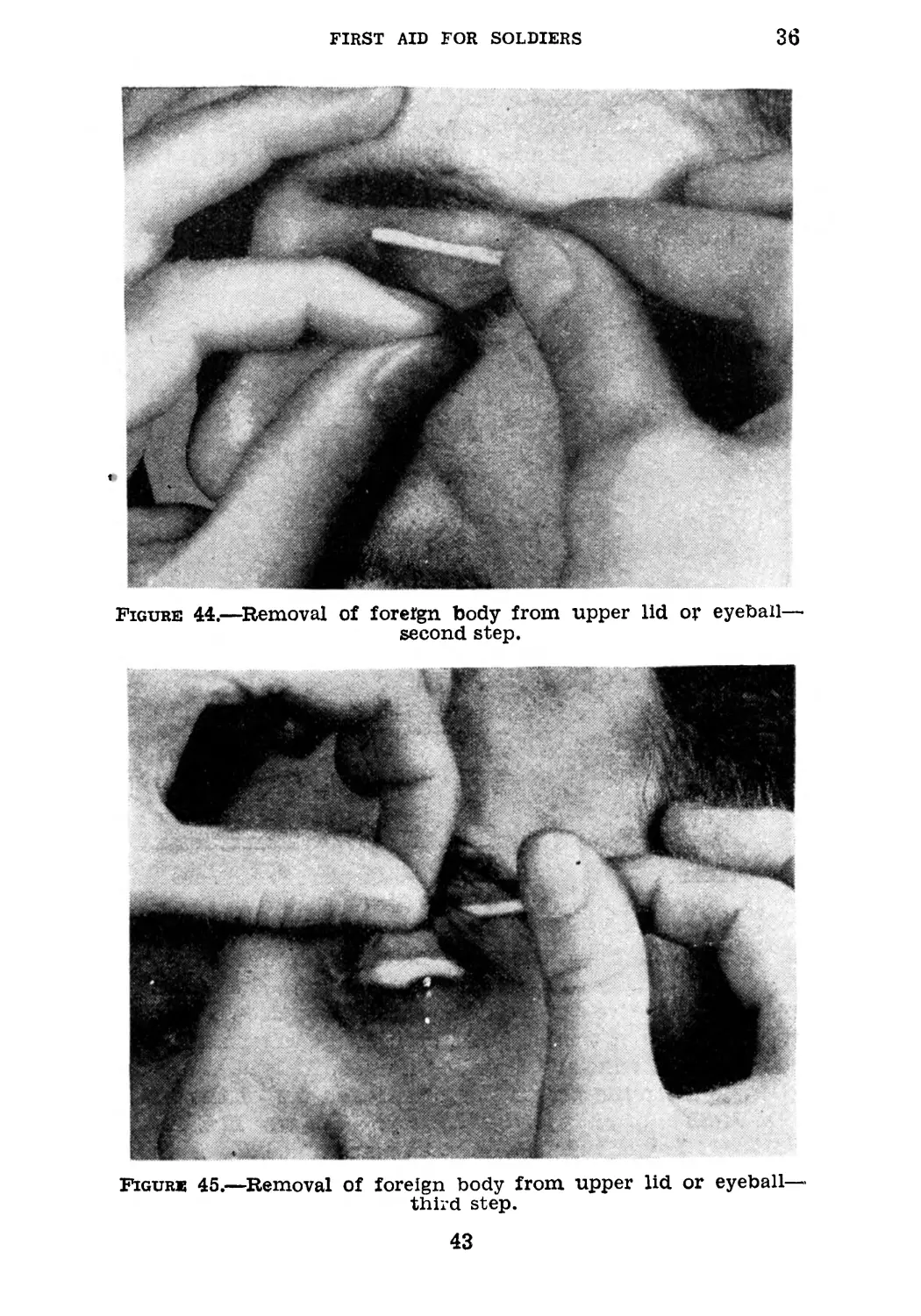
(2)	If the foreign body is under the upper lid, hold the
eyelashes of the upper lid with the index finger and thumb of
one hand (fig. 43); place a match or pencil, held in the
other hand, over the middle of the upper lid (fig. 44); then
turn the lid over the match (fig. 45) and have the person
look down. The foreign body may then be seen and removed
with the corner of a clean handkerchief.
(3)	If the object cannot be easily wiped away from the
eyeball or eyelid by brushing it with the corner of a hand-
kerchief, close the eye and lightly apply a bandage. If a
first-aid kit containing butyn with metaphen eye ointment is
available, apply some of this ointment to the inner surface of
the lower lid and cover the eye with an eye dressing as shown
in figure 46.
(4)	When acids or strong alkalies get into the eye, hold
the eyelids wide open and wash the eye with large amounts
of water. Then apply butyn with metaphen eye ointment, if •
available, and cover the eye with an eye dressing.
b.	From the ear.—Never use pins or wire to remove ob-
jects from the ear, as there is danger of seriously injuring
the eardrum. Insects in the ear can usually be killed by
dropping in a little oil; if no oil can be obtained, use water
instead. If the foreign body is a bean or other object which
will swell if it gets wet, do not put water in the ear.
c.	From the nose.—These usually are not dangerous. Try
to remove the foreign body by gently blowing the nose. No
attempt should be made to remove the object with forceps
or wire; to do this usually causes swelling and jams the for-
eign body tighter.
d.	From the throat.—If a foreign body in the throat can
be reached with the finger, it may be picked or hooked out.
See a medical officer at the earliest possible time.
e.	From the skin.—Splinters, pieces of grit, or other foreign
bodies may be removed by picking them out with a sharp
41
36
BASIC FIELD MANUAL

Figure 42.—Removal of foreign body from lower lid or eyeball.
Figure 43.—Removal of foreign body from upper lid or eyeball—
first step.
42
FIRST AID FOR SOLDIERS
36
Figure 44.—Removal of foreign body from upper lid or eyeball—
second step.
Figure 45.—Removal of foreign body from upper lid or eyeball—
third step.
43
36-37
BASIC FIELD MANUAL
blade which has been sterilized by heating in a flame, or by
means of the small forceps which are in some first-aid kits.
Paint with iodine the area from which the splinter has been
removed and then apply a sterile adhesive compress or other
small bandage. As soon as possible after the first-aid re-
moval of a foreign body, report the fact to a medical officer.
Figure 46.—Eye dressing.
 37. Drowning.—a. General,—Being under water for over
5 minutes usually causes death, but an effort should always
be made to revive a person who seems to be drowned unless
it is known that the body has been under water for a very
long time. Artificial respiration must be started as soon as
possible after the person has been taken out of the water.
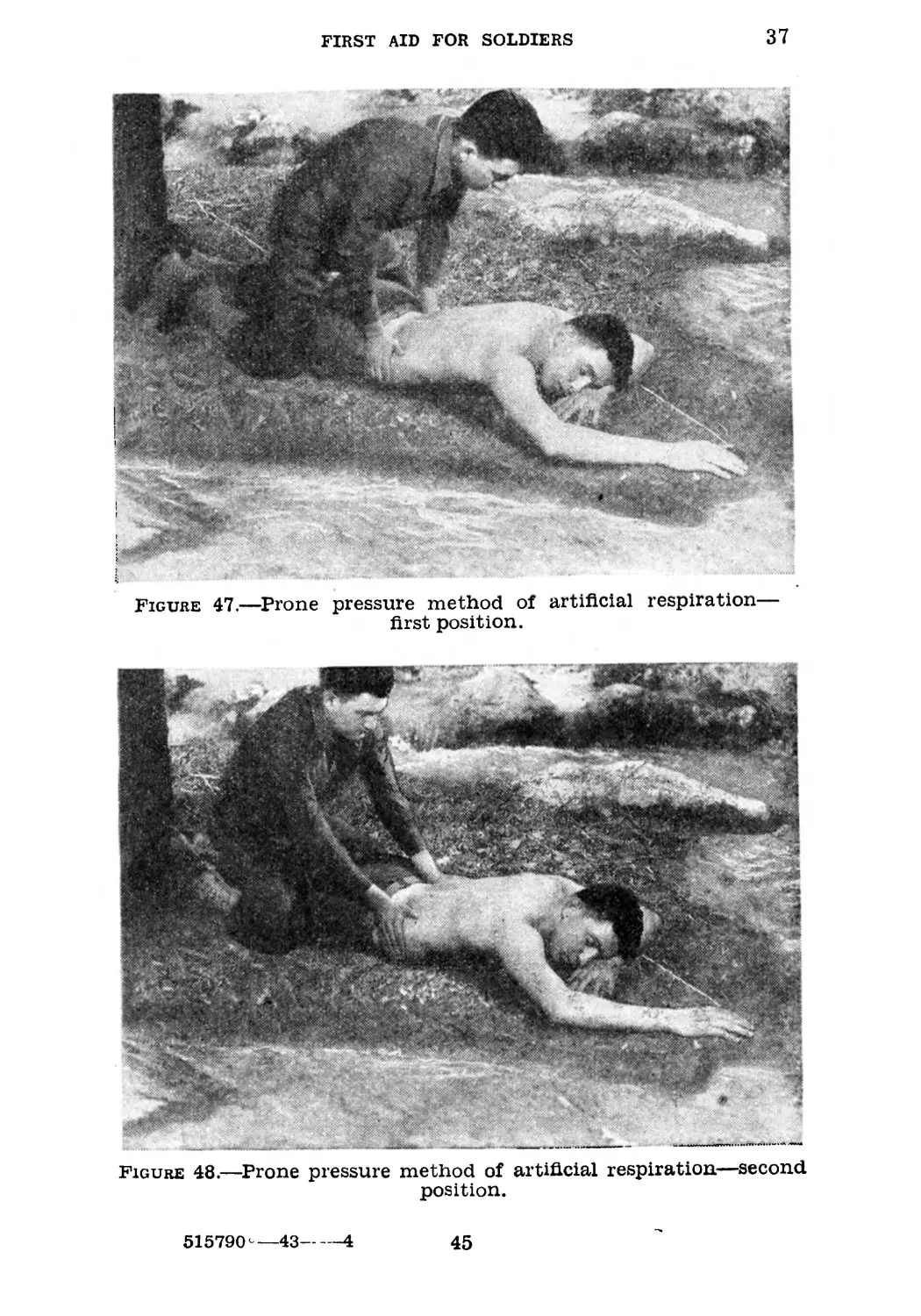
b. Method of giving artificial respiration (see figs. 47 and
48).—(1) Lay or turn the drowned person face down. Force
his mouth open, pull his tongue forward, and remove false
teeth, vomitus, or debris from his mouth and throat.
44
FIRST AID FOR SOLDIERS
37
Figure 47.—Prone pressure method of artificial respiration—
first position.
Figure 48.—Prone pressure method of artificial respiration—second
position.
515790 е—43-----4
45
37
BASIC FIELD MANUAL
(2)	Raise him by the hips to drain any water from his
lungs.
(3)	Lay him face down again, if possible at a nearby spot
where his head will be lower than his feet. One of his arms
should be extended above his head, the other should be bent
at the elbow so that one side of his face can rest on his hand.
(See fig. 47.)
(4)	Kneel astride the drowned person’s thighs, with the
knees far enough from his hips so that pressure can be made
on his lower ribs. Place the palms of the hands on the
small of his back with the fingers on his lower ribs, so that
the little fingers just touch his lowest rib, the thumbs and
fingers are in their natural position, and the tips of the
fingers are out of sight just around the sides of his chest.
The heels of the hands should be placed as far as possible
from his backbone without slipping off (fig. 47).
(5)	With arms held straight, swing forward slowly so that
the weight of the body is gradually brought to bear upon
the drowned person. (See fig. 48.) This procedure should
take about 2 seconds. Do not bend the elbows while giving
artificial respiration.
(6)	Now immediately swing backward so as to remove
all pressure completely and suddenly. Leave the hands in
place if possible.
(7)4 After about 2 seconds, repeat the procedure. The
combined period of pressure and release should take about
4 or 5 seconds and should be repeated 12 to 15 times a minute.
Do not increase the cadence above 15 times per minute.
(8)	Keep up artificial respiration without stopping for 2
hours or longer, unless the person to whom it is being given
begins to breathe normally before then or is declared by a
medical officer to be dead.
(9)	After artificial respiration has been started, the
drowned person should if possible have his clothing loosened
and he should be wrapped in a blanket or dry clothing.
(10)	When a drowned person regains consciousness, he
should be kept lying down. Hot tea or coffee can be given
as soon as complete consciousness has returned.
(11)	If breathing stops after it has once started begin
artificial respiration again at once.
(12)	Because of the length of time that artificial respira-
46
FIRST AID FOR SOLDIERS
37-39
tion may be necessary, more than one person may be required
to give it.
	38. Electrical Shock.—The rescue of a person from a live
wire is always dangerous. If the switch is near, turn off the
current, but do not lose time in looking for the switch. Use
a dry pole, dry clothing, dry rope, or some other material
which will not conduct electricity, when removing a person
from a live wire (fig. 49). If a pole of some sort is not close
at hand, a person in contact with a live wire can be dragged
Figure 49.—Rescue of a person from an electric wire.
from the wire by means of a loop of dry cloth. Start artifi-
cial respiration as soon as the person is freed from the wire.
Early stiffening of the body is not always a sign of death; keep
up artificial respiration for 2 hours unless the person to whom
it is being given begins to breathe normally before then or is
declared by a medical officer to be dead. Electrical shock due
to being struck by lightning is treated in the same manner as
electrical shock due to a live wire.
	39. Carbon Monoxide Poisoning.—Suffocation due to car-
bon monoxide occurs most often from inhaling motor vehicle
exhaust gas, or from being in a poorly ventilated tent or other
47
39-43
BASIC FIELD MANUAL
shelter in which a stove is burning. The first-aid measures
for carbon monoxide poisoning are discussed in paragraph 72.
	40. Fainting.—When a person who has fainted falls, it is
usually best to let him lie quietly; loosen any tight clothing.
If a person is about to faint or has actually fainted while
sitting up, lower his head between his knees.
	41. Unconsciousness.—a. General.—It is frequently im-
possible to find out the cause of unconsciousness; always
think of the possibility of bleeding, sunstroke, or injury to
the head.
b. First-aid measures.—Keep the person lying face down
with his head turned to one side. If his skin is very warm
and he might have heatstroke, give him first aid as described
in paragraph 51a. If he is cold, keep him warm. Do not move
the person unless absolutely necessary and then do so very
carefully. Do not pour liquids into the mouth of an uncon-
scious person; to do this may choke him.
	42. Convulsions or Fits.—Convulsions may be due to many
causes, including head injuries, epilepsy, poisoning, hysteria,
and various illnesses. It is often difficult to find out the exact
cause of convulsions. First aid for a person having convul-
sions consists of loosening his clothes, keeping him from
hurting himself while tossing about, and forcing a rolled
handkerchief or towel or a stick between his teeth to keep
him from biting his tongue. Do not use any more force than
necessary to keep him from injuring himself.
	43. Head Injuries.—a. General.—This is a term applied
when a person has been “stunned” or “knocked out” by a blow
on the head, or by being struck in the head by a bullet, shell
fragment, or other missile. In severe head injuries the per-
son cannot be awakened; there may be bleeding from the
nose or ears; the breathing is deep and snoring; and there
may be paralysis of part of the body. It is often impossible
to tell how serious a head injury is.
b. First-aid measures.—If the injured person is conscious,
he should be laid fiat, with his head slightly raised. Unless
a person with a head injury comes to in a few minutes, turn
him face down, with his head turned to one side. He should
be kept warm. No violent efforts should be made to wake
48
FIRST AID FOR SOLDIERS
43-48
him up. Shaking his head or slapping his face and neck are
dangerous things to do, because they make the injury worse.
	44. Abdominal Pain.—Pain in the abdomen or “stomach
ache” may be due to many causes, some of which are serious.
Whenever there is pain in the abdomen, think of the possi-
bility of appendicitis and remember that no food, only small
sips of water, and no laxatives should be taken.
	45. Purification of Drinking Water.—a. Do not drink
water which has not been declared safe, unless purified by
one of the following methods:
(1) Treat it with Halazone (water purification) tablets,
using the tablets as directed on the container.
(2) Boil it for 1 minute.
b. Caution: Do not feel that ice or water flowing under ice
is safe to drink without first treating it with water purifica-
tion tablets or boiling it.
 46. Care of the Feet.—a. Wash the feet with soap and
water and change socks daily. After washing the feet, dry
them carefully, especially the spaces between the toes; then
dust thoroughly with issue foot powder.
b. If a blister appears, wash the blistered area with soap
and water; then empty the blister by sticking it at the lower
edge with a pin which has been passed through a flame. Do
not remove the skin. Cover the emptied blister with ad-
hesive plaster bandage.
	47. Care of the Crotch.—Chafing of the inner sides of the
thighs and of the scrotum can usually be prevented by wash-
ing these parts every day, drying them thoroughly, and dust-
ing with issue foot powder. If there is rawness, do not use
the foot powder, but wash and thoroughly dry the parts
daily.
	48. Miscellaneous.—a. Poisonous weapon wounds.—Na-
tives in some parts of the world put poison on the barbs of
arrows and spears. First aid for wounds caused by poison
arrow or spear wounds is the same as for snake bite. (See
par. 29.)
b. Poisonous fruits and drugs.—When a poisonous fruit or
a poisonous drug has been swallowed, the important first-aid
measure is to cause vomiting as soon as possible. Drink one
49
48-50
BASIC FIELD MANUAL
to two canteenfuls of water, preferably lukewarm and salty,
as rapidly as possible, then tickle the throat with the finger as
far down the throat as it will reach, to start vomiting. Re-
peat these measures several times, then see that the person
who has been poisoned keeps quiet and warm.
c. Nosebleed.—Keep the person sitting up and quiet;
loosen the collar, tie, or anything tight around the neck;
have him breathe through his mouth and not blow his nose;
if possible put something cold over the nose and against the
back of the neck.
Section V
EFFECTS OF SEVERE HEAT AND MEASURES FOR USE
IN THE DESERT
	49. General.—Conditions caused by heat include burns on
the surface of the body, and also the general body effects of
heat such as heat stroke, heat exhaustion, and heat cramps.
People who have lived for several years in very hot climates
usually get along well in spite of the heat because they have
gradually become conditioned and have learned how to take
certain precautions about eating, drinking, dressing, and
exercising. Although the general body effects of heat are of
special importance to desert and jungle troops, the possible
bad effects of becoming overheated concern all troops, in-
cluding those in the arctic, where overheating can result
from wearing too many clothes while exercising.
	50. Burns.—Burns may be caused by dry heat, hot liquids,
chemicals, or electricity. Overexposure to the sun can pro-
duce very severe burns which require first-aid measures
similar to those necessary for burns due to other causes.
First aid for burns caused by acids, alkalies, or other com-
mon chemicals, is discussed in b below. First aid for burns
due to war gases is discussed in paragraph 69. Shock and
infection are frequent complications of burns and require
the same measures used for preventing or overcoming shock
and infection caused by wounds.
a.	First-aid measures.—(1) Do not pull clothes from a
burned part of the body; instead, cut or tear the clothes and
then gently lift them off. Do not try to remove pieces that
stick to the skin.
50
FIRST AID FOR SOLDIERS
50-51
(2)	Keep a burned person quiet and warm.
(3)	Do not break blisters which form following a burn.
(4)	Never apply iodine to a burn.
(5)	Do not touch a burn with dirty hands, clothes, or
anything else unclean.
(6)	If a first-aid kit containing burn ointment is handy,
apply boric acid, sulfadiazine, or other burn ointment, using
the wooden paddle applicator to spread the ointment over the
burn or onto the sterile dressings which are to be put on the
burn.
(7)	When burned, take by mouth, along with a large
amount of water, the eight sulfadiazine tablets (or the twelve
sulfanilamide tablets found in some packets instead of sulfa-
diazine tablets) which are in the sealed packet carried in
the first-aid pouch attached to the cartridge belt. If sweat-
ing has been great or if large amounts of water cannot be
taken both with the drug and for 24 hours afterwards, no
sulfadiazine or sulfanilamide tablets are to be taken.
(8)	If pain is very great, a dose of morphine may be given
as described in paragraph 110 and shown in figure 97.
(9)	Whenever a burn covers a large area of the body, three
or more canteenfuls of water to which salt has been added
(two salt tablets or % teaspoonful of table salt to each can-
teenful) should be taken every 24 hours.
b.	Acid, alkali, and other common chemical burns.—Burns
caused by acids, alkalies, or other common chemicals should
be washed with large amounts of water, lukewarm if pos-
sible, until the chemical is completely removed; then spread
boric acid, sulfadiazine, or other burn ointment, or sprinkle
sulfanilamide over the burn, and apply a sterile dressing.
 51. Heatstroke, Heat Exhaustion, and Heat Cramps.—All
these conditions are caused by heat, but differ in their symp-
toms and in the first-aid measures needed for them. The
general body effects of heat can usually be prevented by
avoiding unnecessary exposure to extreme heat; by keeping
living and working quarters as cool as possible; by keeping
the head and body covered when in the sun; by wearing
light, loose fitting outer clothes; by taking plenty of salt
with food, and by drinking enough water to which salt
tablets have been added. The bad effects of overheating
and sweating are less likely to happen if short rest periods
51
51
BASIC FIELD MANUAL
are taken during the heat of the day. It is better to drink
small amounts of water frequently instead of large amounts
all at once. Alcoholic and iced drinks, including ice water,
should be avoided. Do not eat large, heavy meals. Eat
sparingly during the heat of the day. Fruits and vegetables,
preferably cooked, and fruit juices are good types of food
in a hot climate. Avoid unnecessary physical exercise.
Keeping the skin clean and free from dust and grease helps
in the control of body heat.
a.	Heatstroke (also known as sunstroke).—(1) General.—
Heatstroke is often caused by direct rays of the sun, but
it can also happen even when a person has been under
cover. The symptoms are headache, dizziness, irritability,
seeing objects red or purple, and sometimes vomiting; the
skin is hot and dry; the face is flushed and there is high
fever. The pupils of the eyes are usually very small. Un-
consciousness usually occurs, and the body becomes limp;
sometimes there may be convulsions.
(2) First-aid measures.—Remove the person to a shady,
cool place if possible, and remove all clothing except light
underwear. Lay him on his back with shoulders raised.
Cool by sprinkling large amounts of cool water evenly over
the body, and fanning continuously to cause rapid evapora-
tion. Apply cool wet cloths to the head, changing them fre-
quently. Briskly rub the arms, legs, thighs, and trunk. Do
not overdo these things; stop every few minutes to note their
effects. When the person is conscious give cool water con-
taining two salt tablets to a canteenful of water. If the
skin gets hot again, repeat the measures.
b.	Heat exhaustion.—(1) General.—The first signs of heat
exhaustion are an “all in” feeling, dizziness, nausea, and
unsteady walking. The face is pale, the skin is cold, and
there is severe sweating. Fainting may occur. The pupils
of the eyes are usually very large.
(2)	First-aid measures.—Remove the person to a cool or
shady place, lay him on his back and have him drink three to
five canteenfuls of cool salt water (y4 teaspoonful of table
salt or two salt tablets to a canteenful of water) in a 12-hour
period.
c.	Heat cramps.—(1) General.—Heat cramps usually oc-
cur after a person has been sweating a great deal, especially
52
FIRST AID FOR SOLDIERS
51-54
if extra amounts of salt have not been taken. In this con-
dition there are muscle cramps, especially of the legs and
arms; the skin is cool, moist, and pale; breathing is shallow;
frequently there is vomiting. There may also be severe
weakness and dizziness.
(2) First-aid measures.—Heat cramps can usually be pre-
vented by taking extra amounts of salt on days when sweat-
ing a great deal. If cramps have already developed, rest
in a cool place and take three to five canteenfuls of cool salt
water (У4 teaspoonful of table salt or two salt tablets to a
canteenful of water) in a 12-hour period.
 52. Eye Irritation.—a. General.—Glare from water or
sand in bright sunlight often causes severe irritation of the
eyes, as does also wind or blowing sand. Wear sand goggles
whenever exposed to bright reflection from sand or water or
when there are strong winds or blowing sand.
b. First-aid measures.—Mild irritation of the eyes will us-
ually clear up by simply protecting them from further ex-
posure to bright light by the use of dark glasses. More
severe irritation of the eyes can be relieved by the use of
boric acid eye ointment,-in addition to protection from light.
Section VI
EFFECTS OF SEVERE COLD, AND MEASURES FOR USE
IN THE ARCTIC
 53. General.—In very cold weather first-aid measures may
be needed for frostbite and freezing of various parts of the
body, as well as for the general body effects of cold. These
conditions can be caused by exposure to snow, ice, cold air,
cold mud, or dampness. People who regularly live in cold
climates seldom suffer very ill effects from cold, because
they know how to protect themselves by proper dressing,
eating and habits of living.
H 54. Frostbite and Freezing.—Frostbite and freezing are the
terms applied to the effects of severe cold on various parts of
the body. Although frostbite is less severe than complete or
hard freezing of a part, it may cause very serious results.
If any of the bad effects of cold should occur, it is very im-
portant to recognize them and to know what to do at once,
because delay in giving proper first aid may cause perma-
53
54
BASIC FIELD MANUAL
nent injury. Frostbite and freezing may occur either grad-
ually or suddenly, without the person being aware of it, unless
certain precautions and warnings are kept in mind.
a.	Parts affected and methods of detecting.—(1) The parts
of the body most often affected by frostbite and freezing
are the feet, ears, nose, hands, cheeks, chin, and forehead.
Frostbite and freezing may occur on parts of the body that
are well covered as well as on exposed parts.
(2)	Men should frequently examine their own exposed
parts and those of their companions for signs of the effects
of cold.
(3)	A grayish or whitish waxy appearance of the skin is
an early sign of freezing. Whenever any part of the body
shows this sign, first-aid measures must be started at once.
(4)	Distinct pain is usually not present as a warning that
frostbite or freezing is occurring.
(5)	Loss of feeling when the skin is touched is another
important sign.
(6)	In very cold weather, by wrinkling the face from time
to time, stiffness caused by freezing can be discovered.
b.	Protective measures.— (1) Wear enough of the proper
clothes to keep comfortable, but do not wear more or heavier
clothes than required, as this will only cause unnecessary
weight and overheat the body. In very cold climates it is
frequently necessary to change the amount of clothing sev-
eral times a day, depending on how much the person is
moving about or exercising.
(2)	Many chilled hands and feet are due to overdressing
with tight clothing that does not permit proper circulation of
blood. Use only socks, shoes, and mittens or gloves which give
plenty of room and make it possible to wiggle the fingers
and toes. If leggings are being worn, do not lace them too
tightly. Avoid the use of garments which fit tightly at the
shoulder. Keep pack straps placed so that they do not press
on the arms or under the armpits. During cold winds,
protect the face by pulling a parka hood or coat collar
forward on the windward side, or by shielding the face
with a gloved hand.
(3)	Avoid long exposure of bare hands and wrists. If the
hands become extremely cold and stiff, it takes a long time
to get them back to normal. At temperatures below freezing,
54
FIRST AID FOR SOLDIERS
54
mittens which do not separate the fingers are preferable.
(4)	Keep every part of the body dry at all times when in
a cold climate. Damp or wet skin is much more likely to be-
come frostbitten, and one of the most frequent causes of
chilling and frostbite is wet clothing. Clothing may become
wet from perspiration or melted snow. If clothing, socks,
footgear, or gloves get wet from any cause, they must be
dried or changed at once. Spare dry socks, insoles for boots,
liners for mittens, and extra underclothes should always
be carried. When exercising, even in very cold weather, it
is possible to perspire a great deal; either shed some cloth-
ing or open the clothing and remove the parka hood to
allow air circulation so that the moisture of perspiration
may escape. If this is not done, clothing becomes soaked
with sweat. It then freezes stiff and becomes not only very
uncomfortable, but may cause the person wearing it to
suffer serious effects of cold.
(5)	Remember that overheating and sunburn can occur
in snow country.
(6)	Do not touch cold metal such as a canteen cap or
mouthpiece with the bare hands, tongue, or lips. The skin
immediately freezes to such surfaces and, to be released,
the metal should be warmed; otherwise the skin will be
pulled off. Metal whistles and the mouthpieces of bugles
must be carried in a pocket near the body so as to warm
them before they are placed against the lips.
(7)	Do not eat snow or ice; to do this may cause freezing
of the lips and tongue. Snow or ice which is to be used
to quench the thirst should be melted by placing its con-
tainer underneath warm clothes or over a fire. Melted ice
or snow which is to be used for drinking purposes should
be sterilized by boiling, or by using water purification tablets
as described in paragraph 45.
(8)	Prevent freezing of the penis when urinating by pro-
tecting it from the wind and afterwards by carefully button-
ing the clothes.
(9)	Hot food and nonalcoholic drinks, at frequent inter-
vals, are helpful.
(10)	In very low temperatures, deep and rapid breathing
while exercising sometimes causes frosting of the lungs. The
air entering the lungs will be less cold if a gloved hand is
55
54
BASIC FIELD MANUAL
held in front of the nose and mouth while breathing, or if
the bottom of a parka hood is pulled forward so that the
warm air near the body can be breathed.
(11)	Avoid any cramped positions which can interfere
with circulation of the blood.
(12)	Do not wash too often, because skin from which all
natural oil has been washed away freezes more easily.
(13)	It is usually best to keep moving while outdoors in a
very cold climate. If, however, a strong wind is blowing, or
especially if very tired, it is best to stop and rest, digging in
if possible.
c.	First-aid measures.—(1) Thaw a frostbitten or frozen
part slowly. Thawing can be done best by applying the
bared part to a warm part of the person’s own body or to
a warm part of the body of another person; and then cover-
ing it with blankets or extra clothing.
(2)	Do not bring a frostbitten or frozen part close to a
fire or anything hot. If a person who has been frostbitten is
brought indoors, the room into which he is brought should
be only moderately warm.
(3)	If pain becomes too severe during or shortly after
thawing, thawing should be slowed by exposing the part to
cool air or water.
(4)	Wrap the person in warm blankets and give hot non-
alcoholic drinks.
(5)	After thawing, keep the part at absolute rest and, if
an arm or leg, slightly raised. A hand which has been frost-
bitten or frozen should be carried in a sling. No weight
should be borne on feet that have been frostbitten or frozen.
(6)	Do not rub a frostbitten part and do not bend frozen
limbs or ears, as this will cause further injury to the already
damaged tissues. It is especially important not to rub or put
snow or ice on a frostbitten or frozen part of the body, as
this will increase the freezing.
(7)	In severe frostbite or freezing, even the gentlest mas-
sage can do great harm.
(8)	After thawing, wrap the part lightly with sterile
dressings, keep it at a reasonably cool temperature, and keep
heavy covers from pressing on it.
(9)	Thawing is often very painful, especially if a part
has frozen hard. The skin becomes red, or in severe cases,
56
FIRST AID FOR SOLDIERS
54-56
violet. In time, blisters may appear; these may not show up
until several days later and may be of great size. They
should not be opened except under supervision of a medical
officer.
(10)	Dust all blisters, open sores, or darkened areas of skin
with sulfanilamide and cover such areas with sterile dress-
ings.
 55. Wounds and Injuries.—a. When an accident happens
in the cold, shock is very likely to occur, especially if there
is considerable pain or severe bleeding. Prevent or overcome
shock by covering the injured person with a sleeping bag,
extra clothing, blankets, or a tarpaulin; by applying heat to
the chest, abdomen, or thighs; by keeping the head and upper
part of the body lower than the legs and lower part of
the body; and by giving warm nonalcoholic drinks. When
available, chemical heating pads are good for warming a
person.
b. When using a tourniquet in very cold weather, be careful
not to apply pressure for too long a time, otherwise freezing
will result. Even tight bandages may dangerously reduce
blood circulation, which is already below normal. If a tourni-
quet is necessary, keep the part beyond the torniquet warm,
but be very careful not to heat it above the normal body
temperature.
 56. Snow-Blindness.—a. General.—Snow-blindness is
caused by the reflection of light from snow surfaces. It is
most likely to occur on days when clouds are thick enough to
hide the sun but not thick enough to produce heavy overcast
weather. Snow glasses should always be worn during day-
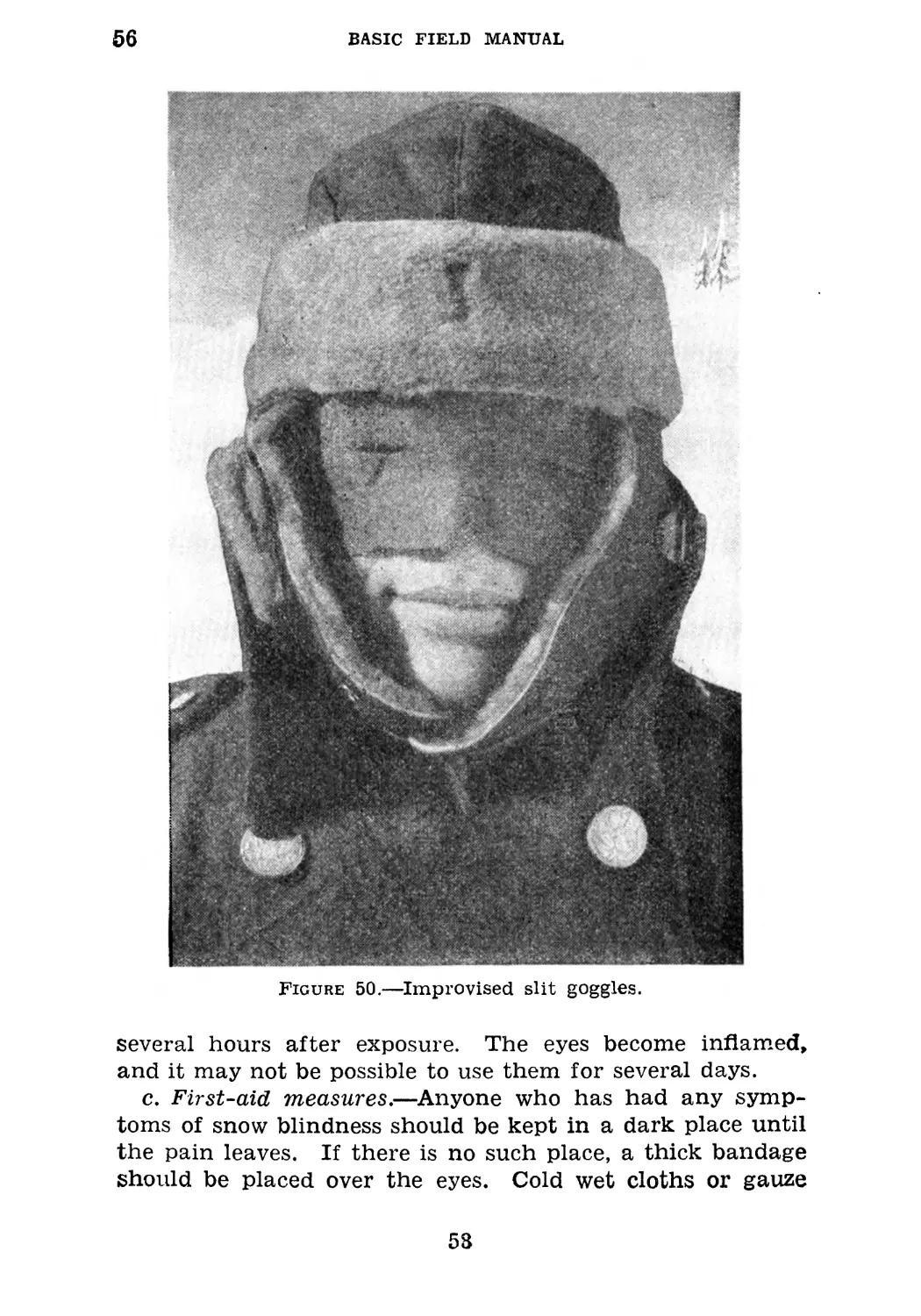
light. If no glasses or ready-made goggles are to be had, slit
goggles may be made by cutting slits in a piece of cloth or
paper (fig. 50) which can be fitted over the eyes. Blackening
the skin around the eyes, including the sides of nose and
cheek bone area, with the charred end of a stick also gives
some protection against the glare.
b. Signs and symptoms.—The first symptoms of snow
blindness are that the person who is developing it cannot
see distinctly; actual blindness usually does not occur at
once. Later, there is a burning sensation in the eyes, fol-
lowed by severe eye pain. The pain may not begin until
57
56
BASIC FIELD MANUAL
Figure 50.—Improvised slit goggles.
several hours after exposure. The eyes become inflamed,
and it may not be possible to use them for several days.
c. First-aid measures,—Anyone who has had any symp-
toms of snow blindness should be kept in a dark place until
the pain leaves. If there is no such place, a thick bandage
should be placed over the eyes. Cold wet cloths or gauze
58
FIRST AID FOR SOLDIERS
56-57
applied over the eyes will give some relief from the pain
but this can only be done when there is no danger of freez-
ing, If available, apply butyn and metaphen eye ointment^
and then put on an eye dressing.
 57. Carbon Monoxide Poisoning.—a. General.—(1)
Among all the dangers of arctic operations, the danger of
suffocation by carbon monoxide is one of the greatest. To
troops coming to Arctic regions for the first time, the dis-
comfort of cold is so great that common sense is often lost
in an attempt to keep warm. In temporary shelters, stoves
or fires should be used only for cooking and then shut off or
put out unless it is certain that draft and ventilation is
enough to carry off the gases that form; clothing must be
depended upon for warmth. If a stove is kept going even
for a half hour in an improperly ventilated shelter, a dan-
gerous amount of carbon monoxide may be generated. Car-
bon monoxide is odorless, and will overcome a sleeping person
without warning.
(2) When a closed vehicle becomes stalled in the snow,
the engine is generally left running to keep the occupants
warm and to avoid difficulty in again starting the motor.
If snow drifts over the exhaust pipe and carbon monoxide
fills the vehicle, the occupants may be overcome by the gas.
When in a stalled vehicle, always keep the exhaust pipe
open by getting out frequently and cleaning away the drifted
snow. If alone, do not go to sleep in a closed car while the
motor is running. It is possible to insure adequate ventila-
tion without chilling, if windows on the lee side of a car
are opened. If possible, at least two men should travel
together in a vehicle, so that when rest is necessary they
can take turns sleeping. When practicable, two or more
vehicles should travel together. A lantern and a blanket
will keep a person warm in a stalled vehicle, even in a bliz-
zard of several days duration. Wrap the blanket around
the body; light the lantern and place it between the feet.
b. First-aid measures.—(1) Remove the cause. If a stove
is burning or if a motor is running, turn it off.
(2)	Get outdoors or move the overcome person outdoors.
(3)	For persons who cannot get outdoors, secure proper
ventilation immediately and keep them quiet.
59
57-59
BASIC FIELD MANUAL
(4)	Breathe evenly, and do not move about.
(5)	If a person has been overcome by carbon monoxide and
is not breathing, give artificial respiration as described in
paragraph 37.
(6)	Once outside, to prevent freezing, it is important to
cover with blankets or get into a sleeping bag.
	58. Trench Foot; Shelter Foot; Immersion Foot.—These
three conditions are practically the same and are very much
like mild frostbite. They may occur, however, at much
higher temperatures and usually result from standing still
or sitting for long periods in a wet trench or shelter, or from
hanging of the feet for a long time in water after ship wreck.
Tight leggings and cramped positions of the legs increase the
liability of the occurrence of these several conditions. They
are best prevented by keeping the feet as dry as possible, and
by frequently exercising the legs to increase the flow of blood.
First-aid measures are the same as those for frostbite (par.
54c).
Section VII
MEASURES FOR USE IN THE JUNGLE AND TROPICS
	59. Malaria.—a. Malaria is caused by the bite of certain
mosquitoes which feed chiefly at night. For this reason,
when in a mosquito infested country, sleep under a mosquito
net. When out of doors at night protect yourself with leg-
gings, a head net and gloves, and by rolling down the sleeves.
Insect repellent furnished in jungle first-aid kits will help
keep mosquitoes and other insects away. To apply insect
repellent, turn bottle upside down and spread a small amount
of liquid over exposed skin surfaces. One application will
usually keep insects away for 2 hours.
b. When in a place where there is malaria, atabrine will be
taken for protection against the severe symptoms of malaria.
Take the first dose (one tablet) in the morning, and the
second dose (one tablet) in the evening, after meals, on 2
days of each week, skipping 2 or 3 days between the days of
taking atabrine. Start takin’g atabrine on the first day spent
in a malarial area and continue to take it as long as in the
area.
c. If quinine is in the jungle kit instead of atabrine, take
two quinine tablets each day, as long as in a malarial area.
60
FIRST AID FOR SOLDIERS
60-63
 60. Dysentery.—Dysentery is caused by impure drinking
water or food, and is very likely to occur in the jungle unless
certain precautions are taken.
a.	Prevention .—Dysentery may be avoided by purifying
alb drinking water in one of the ways described in paragraph
45, and by eating only food which has just been cooked or
taken from a sealed container.
b.	First-aid measures.—(1) If ill with dysentery, take only
liquid foods and stay as quiet as possible until well. Add two
salt tablets to each canteenful of drinking water if having
an attack of dysentery.
(2) In some of the first-aid kits there are sulfaguanadine
tablets for the treatment of dysentery. Take four tablets
every 4 hours, day and night, until the bowel movements
are normal. If there is no improvement in 4 days, stop
taking the tablets.
	61. Salt and Water Requirements.—The heat of tropical
areas requires that special attention be paid to the amount
of water and salt taken each day. The methods of prevent-
ing the bad effects of heat and sweating, and the habits which
should be formed when in a hot climate are described in
paragraph 51. If the suggestions given are followed, heat
stroke, heat exhaustion, or heat cramps will be less likely to
develop.
	62. Poisoned Bites and Wounds.—First-aid measures for
snake and spider bites are given in paragraphs 29 and 30;
those for poison weapon wounds are given in paragraph 48.
SECTION VIII
MEASURES FOR USE IN AIRCRAFT AND TANK
INJURIES
	63. First Aid for Persons Injured in Aircraft.—In general,
the same first-aid principles and measures apply to aircraft
crew members and persons on the ground. Bombing missions
are usually several hours in duration, and this makes it neces-
sary that any immediate first aid must be given by a member
of the combat crew while the airplane is in flight. All aircraft
carry one aeronautical first-aid kit for each station in the
aircraft (par. 75). In addition, crews of combat air-
5157900—43-5	61
63
BASIC FIELD MANUAL
planes often carry additional dressings, triangular bandages,
and improvised splints, as may be advised by the unit sur-
geon. The jungle first-aid kit (par. 76), and the Arctic first-
aid kit (par. 78), which are specially designed for use in trop-
ical and arctic areas, are carried in airplanes going over these
regions. The parachute kit, which is attached to the para-
chute harness, is a small first-aid kit to be used after a
parachute landing (par. 74).
a.	Oxygen supply.—When flying at high altitudes, the per-
son going to the aid of an injured crew member must first
be sure that his own portable oxygen equipment is function-
ing; there may be a bullet hole in .the “walk-around” oxygen
bottle. Upon reaching the injured crew member, first be sure
that his oxygen supply has not been cut off. If oxygen is not
available death may come within a few seconds or within 2
or 3 minutes, depending upon the altitude. If the injured
person is suffering from shock or hemorrhage, special atten-
tion should be given to the oxygen supply even at low alti-
tudes; if a dilution-demand system is being employed, it may
be necessary to shift to “auto-mix-off” at relatively low alti-
tudes. If the oxygen supply of the injured person is damaged,
a new supply must be provided, either from a walk-around
bottle or by a new connection into the oxygen supply system.
The injured person may be moved to a new location, where
he can be fitted with a new oxygen mask; if this cannot be
done, the airplane must drop to a lower level. If the injured
person is unconscious, an open stream of oxygen may be
played upon his face and artificial respiration given in order
to revive him before moving. Wounded crew members are
frequently flown directly to the nearest hospital after com-
pletion of the mission.
b.	Air sickness.—Air sickness is particularly likely to fol-
low injury. The development of air sickness will add to the
discomfort of a wounded air crew member and may consti-
tute a serious hazard. It may produce vomiting which will
often interfere with or entirely prevent the use of oxygen
equipment. It is, therefore, important to take precautions
to prevent air sickness. To do this, the person should be
placed as near as possible to the center of gravity of the air-
plane. If the air is rough, he should be fastened securely
to prevent rolling and tossing. If possible, he should be
62
FIRST. AID FOR SOLDIERS
63
placed so that he can see outside the ship. All available
measures should be taken to keep the person warm; hot
drinks should be given and he should be well covered. As
much ventilation as is consistent with warmth should be
maintained. Leaning the head forward and keeping it in a
fixed position in relation to the aircraft during turns and
maneuvers is helpful.
c.	Removal of wounded and injured from airplanes.—(1)
It is usually not difficult to remove an injured person from a
nondisabled airplane. If the airplane is large enough and
a litter is available, the person should be placed on it inside
the airplane. Before this is done, however, make sure that
the door is wide enough for the litter to be brought out flat.
A parachute harness frequently can be used as a convenient
means of support, if it is impossible to use a litter in removing
a person from the airplane, as the straps of the harness
furnish excellent hand holds. If several persons are present,
one person should be responsible for supporting any injured
limb, while the others take care of lifting the injured person
from the airplane.
(2)	In the event of an airplane crash, remove the injured
person f'-’om the crashed or wrecked airplane with the great-
est possible speed and the least possible injury and suffering
to the injured person, regardless of the damage that may
result to the airplane in the process. Whether the injury
is due to a crash or to enemy gunfire, careful planning of
removal is necessary in order to avoid additional injury. If
there is no fire hazard, it is advisable to apply first aid before
attempting removal, especially the use of splints and meas-
ures for the relief of pain, including morphine if necessary.
(3)	The fear of fire frequently has resulted in persons
being removed with unnecessary haste and lack of care. If
fire is to result from the crash, it usually will start before
the aircraft can be reached or within a period of about 5
minutes. If fire appears probable, all efforts should be di-
rected toward immediate removal of the injured. The pres-
ence of live ammunition and bombs will influence the speed
of the action and determine whether drastic measures must
be undertaken.
(4)	It is well to direct the fire extinguisher on any danger
area where fire is likely to break out. All members of the
63
63-64
BASIC FIELD MANUAL
airplane crew and of the crash crew should be familiar with
the operation and use of carbon dioxide and other fire ex-
tinguishers. Because of the danger of igniting spilled gaso-
line, cigarettes, exposed lights, matches, or other open fire
should not be allowed near damaged aircraft under any
circumstances.
(5)	To remove an injured man from a cockpit type air-
plane, arrange the available men two on one side of the
cockpit and any others on the opposite side. Make certain
that each man has a firm footing either on the wing, on
boxes, on the back end of the ambulance or truck, or on
some other solid support. Be certain that the safety belt,
which holds the man in his seat, has been unfastened, as
failure to do this may result in very serious injury. Be sure
that no part of the injured person or persons is trapped or
caught by some portion of the airplane. If the injured is
so trapped, that portion of the airplane resting against the
body must be cut away with an ax, shears, or a hacksaw.
(6)	If the airplane has been crushed so that the wounded
person cannot be immediately released, give such first aid
as can be given in the airplane, make him as comfortable
as possible, and then take steps to release him. Be sure to
place some protection between the injured person and the
structures that are to be cut by torch, ax, or other cutting
tools, in order to avoid additional injury. Be sure that the
injured person is supported so that he does not fall and
sustain further injury when the part of the airplane pinning
him is removed. This is especially applicable when the plane
has ground-looped and the crew member is suspended by
his safety belt.
 64. First Aid for Persons Injured in Tanks.—First-aid
measures for persons injured in tanks must often be given
very hurriedly, or delayed until removal of the person from
the tank has been accomplished. Whenever the situation
permits, tank casualties who are suffering much pain should
be given an injection of morphine, should be kept warm, and
should be moved as little as possible, evacuation being ac-
complished at the rallying point. If practicable, wounds
should be dressed and simple splinting such as tying an
injured leg to the uninjured leg, should be done before
64
FIRST AID. FOR SOLDIERS
64-66
evacuation from the vehicle. When there are severe in-
juries which will cause the person to suffer much pain during
his removal from the tank, an injection of morphine should
be given before he is removed, unless morphine has been
given within the last 2 hours (see par. 10). Removal can be
accomplished either with or without the aid of belt straps,
slings, harness, or other special equipment, always being
very -careful to avoid causing further injury during
evacuation.
Section IX
TRANSPORTATION OF THE SICK AND INJURED
	65. General.—Correct transportation of a seriously in-
jured person is one of the most important parts of first aid.
Careless or rough handling can increase the seriousness of
an injury and may even cause death. Whenever possible,
give whatever first aid is needed before moving an injured
person. If there is no absolute need for moving him at once,
it is usually best to let him stay where he is until he can be
moved by litter, ambulance, or some other means. Unless
he is already overheated, an injured person should be kept
warm both while waiting to be moved and during transporta-
tion.
	66. Without Litters.—Sometimes situations require trans-
portation without litters or other equipment. If this should
be necessary it can be done by one or another of several
ways.
a.	Movement by one bearer.—Movement of an injured
person by a single bearer may be done by the fireman’s carry
(figs. 51 to 57, inch), supporting carry (fig. 58), arms carry
(fig. 59), saddle-back carry (fig. 60), pack-strap carry (fig.
61) or fireman’s drag (fig. 62). The first three steps of the
fireman’s carry, illustrated in figures 51, 52, and 53 are also
preliminary steps to the accomplishment of other carries
listed in this paragraph with the exception of the fireman’s
drag.
b.	Movement by two bearers.—Movement of an injured
person by two bearers may be done by the supporting carry
(fig. 63), arms carry (fig. 64), saddle-back carry (fig. 65),
or pack-saddle carry (figs. 66 and 67).
65
66
BASIC FIELD MANUAL
Figure 51.—Fireman’s carry—first step.
Figure 52.—Fireman’s carry—second, step.
66
66
BASIC FIELD MANUAL
Figure 54.—Fireman’s carry—fourth step.
68
FIRST AID FOR SOLDIERS
66
Figure 53.—Fireman’s carry—third step.
67
FIRST AID FOR SOLDIERS
66
Figure 55.—Fireman’s carry—fifth step.
69
66
BASIC FIELD MANUAL
Figure 56.—Fireman's carry—sixth step.-
70
FIRST AID FOR SOLDIERS
66
Figure 57.—Fireman’s cany—final step.
71
66
BASIC FIELD MANUAL
Figure 58.—Supporting carry—one bearer.
72
FIRST AID FOR SOLDIERS
66
Figure 59.—Arms carry—one bearer.
73
66
BASIC FIELD MANUAL
Figure 60.—Saddle-back carry—one bearer.
74
FIRST AID FOR SOLDIERS
6G
Figure 61.—Pack-strap carry.
75
66
BASIC FIELD MANUAL
Figure 62.—Fireman’s drag.
76
FIRST AID FOR SOLDIERS
66
Figure 63.—Supporting carry—two bearers.
515790°—43----6	77
66
BASIC FIELD MANUAL
Figure 64.—Arms carry—two bearers.
78
FIRST AID FOR SOLDIERS
66
Figure 65.—Saddle-back carry—two bearers.
79
66
BASIC FIELD MANUAL
Figure 66.—Pack-saddle carry.
80
FIRST AID FOR SOLDIERS
67
Figure 67.—Pack-saddle carry—close-up.
 67. With Improvised Litters.—a. Many objects and ma-
terials may be used to make improvised litters in an
emergency.
b.	The usual way to make a litter is with a blanket or shel-
ter tent, and poles about 7 feet long, as shown in figures 68,
69, and 70.
(1)	The blanket is spread on the ground.
(2)	One pole is laid across the center of the blanket which
is then folded over it.
(3)	The second pole is placed across the center of the new
fold.
(4)	The blanket is folded over the second pole as over the
first.
(5)	The free end of the blanket is fixed.
c.	A litter can be prepared by turning two or three blouses
inside out and buttoning them up, sleeves in, then passing
81
67
BASIC FIELD MANUAL
Figure 68.—Litter being made with poles and blanket—inter-
mediate step.
Figure 69.—Litter being made with poles and blanket—intermediate
step.
82
FIRST AID FOR SOLDIERS
67
Figure 70.—Litter made with poles and blankets—completed.
Figure 71.—Litter made with poles and coats.
83
67
BASIC FIELD MANUAL
poles through the sleeves, the backs of the blouses forming
the bed, as shown in figure 71.
d.	Camp cots, window shutters, doors, benches, ladders,
boards, or poles, tied together and preferably padded, serve
well as litters.
e.	Litters can be made by ripping the bottoms or cutting
off the corners of sacks, bags, or bedticks, then passing two
poles through them and tying crosspieces to the poles to keep
them apart.
Figure 72.—Rolled blanket used as a litter.
/. A shelter half, a blanket, a piece of matting, or a piece
of carpet can be fastened to poles by tacks or twine to make
a litter.
g.	Rope or wire can be woven between poles and this net-
work covered with a blanket.
h.	If no poles can be had, a blanket, rolled from two sides
and supported as shown in figure 72, can be used as a litter.
i.	In snow country, sleds will serve as a litter; if a regular
sled is not available, skis can be fastened together to serve
the same purpose.
84
FIRST AID FOR SOLDIERS
68-69
Section X
WAR GASES
 68. General.—a. The combat soldier, even if in an isolated
area, can either protect himself against gas attack or give
himself first aid for gas exposure with the following equip-
ment:
.(1) A gas mask.
(2)	Protective clothing.
(3)	Protective ointment M-4, with its cellulose paper
packing.
(4)	A piece of ordinary soap.
(5)	A canteenful of water.
(6)	A handkerchief for wetting burning phosphorous
particles.
(7)	A knife for cutting away contaminated clothing or
scraping phosphorous particles from burns.
b. For those soldiers who may be called upon to use more
elaborate gas casualty equipment, a list of the contents of
the special gas casualty first-aid kit is given in paragraph
79. Directions for the use of the contents of this kit are given
in paragraphs 85, 94, 96, 97, 99, 101, 106, 112, and 113.
H 69. Protective and First-Aid Measures.—a. Gas mask.—
A gas mask gives protection for the eyes, the breathing pass-
ages, and that part of the face covered by the mask. A gas
mask should be worn whenever a person is exposed to any
war gas.
b. Vesicant agents.—(1) Protective clothing will protect
the skin against the vapors and small droplets of vesicant
agents.
(2)	Protective ointment M-4 will prevent blistering if used
within 1 or 2 minutes after contamination of the skin with
liquid mustard or lewisite. Protective ointment is to be used
as follows, if a part of the body becomes contaminated with
a vesicant agent in liquid form:
(a)	Use quickly, within 1 to 2 minutes from the time of
exposure. If redness has already developed, do not use
protective ointment because at this stage protective ointment
85
69
BASIC FIELD MANUAL
is harmful, and thorough washing with water or, better still,
soap and water, is the best thing to do.
(b)	Tear off small pieces of the cellulose packing material
used to wrap the tube of ointment, and blot dry (dab, do not
rub) any liquid vesicant agent which may be on the skin.
Use a fresh piece of the packing material for each dabbing to
avoid spreading the chemical agent.
(c)	Unscrew the cap of the tube, reverse it, and use it to
punch a hole in the seal of the tube. Squeeze some ointment
on a piece of the packing material and rub the ointment into
the contaminated area for about 20 seconds.
(cZ) Use a clean piece of packing material to wipe off any
ointment which is left on the skin. Repeat this procedure,
using fresh amounts of ointment two or three times, wiping
off the extra ointment before each new application.
(e) After 10 to 20 minutes, wash away any remaining
ointment, using soap and water if possible.
(3) Any vesicant agent which gets into the eye must be
washed away at once with large amounts of water. The
cap of a canteen can be used as an eye cup, but in addition
the u^per eyelids should be lifted and flushed well with water.
Flushing of the eye within the first minute or two after
exposure is worth weeks of treatment later.
(4) Ordinary clothing contaminated with vesicant agents
should be removed as early as possible. Protective clothing
need be removed only if it is contaminated with large drops
or splashes of vesicant agents.
c.	White phosphorous.—Burning pieces of phosphorous on
the clothing or skin are to be smothered with a wet handker-
chief, and the phosphorous cut from the clothing or scraped
from the skin.
d.	Tear gas (lacrimators').—(1) Put on the mask. Squeeze
the outlet valve with the fingers and breathe out forcibly
one or two times to clear the facepiece of gas. Then keep
the eyes open as much as possible. The flow of tears and
the purified air will quickly rid the eyes of the irritating gas.
(2)	Liquid tear gas should be washed out of the eye with
water, or from the skin with soap and water. The clothing
must be aired or washed before being worn again.
e.	Irritating smoke (sternutators).—(1) Put on the gas.
mask as soon as gas is detected, and keep it on continuously
86
FIRST AID FOR SOLDIERS
69-71
unless it must be lifted away just long enough to vomit.
Although there may be many disagreeable symptoms, includ-
ing headache, nausea and vomiting, sneezing, and a burning
sensation in the nose and throat, the effects of this gas are
not really dangerous.
(2) When the situation permits, rinse nose, throat, and
eyes with water, and rest in the shade until the worst symp-
toms have passed. Recovery is usually rapid after an hour
or so. Air the clothing, and if any part of the skin feels
irritated, wash it with soap and water.
/. Lung irritants.—The immediate use of the gas mask is
of great importance in protection against these gases. If
not enough gas has been breathed in to cause any noticeable
effects, it will do no harm to carry on with the mission. If
tightness in the chest; coughing, or easy exhaustion appear,
absolute rest, warmth and evacuation for medical treatment
are necessary. Smoking of tobacco in any form after ex-
posure to this gas is very dangerous and must be avoided.
Section XI
DESCRIPTION OF FIRST-AID KITS AND PACKETS
 70. General.—In this section various first-aid kits or
packets and their contents are described. Some are sup-
plied to the individual soldier; others are made available to
certain groups of the armed forces, by being placed in ve-
hicles or airplanes. First-aid kits and packets vary in their
contents according to the requirements of the troops to whom
they are supplied.
 71. Individual Equipment.—a. First-aid packet, carried in
web pouch attached to cartridge belt (figs. 73 and 74), con-
tains—
(1) Wound dressing (1).
(2) Sulfanilamide (5 grams) in sterile, individual, double-
wrapped shaker-top envelope (1).
b. Sulfadiazine (or sulfanilamide) packet, carried in web
pouch attached to cartridge belt (figs. 75 and 76), contains
8 sulfadiazine tablets (0.5 gram each), or 12 sulfanilamide
tablets (0.5 gram each).
87
FIRST AID FOR SOLDIERS
71
Figure 75.—Sulfadiazine packet—outside view;
• Figure 76.—Sulfadiazine packet—opened.
89
71
BASIC FIELD MANUAL
Figure 73.—First-aid packet—outside view.
Figure 74.—First-aid packet—opened.
88
FIRST AID FOR SOLDIERS
72
Figure 79.—Motor vehicle first-aid kit (12-unit)—opened.
91
71-72
BASIC FIELD MANUAL
c. Protective ointment (M-4) packet carried in gas mask
carrier (fig. 77) contains—
(1) Tube of protective ointment M-4.
(2) Cellulose packing material,
Figure 77.—Protective ointment M-4 and cellulose packing material.
 72. Motor Vehicle First-Aid Kit (12-Unit) (figs. 78, 79).—
This kit, supplied to motor vehicles, usually one to every
fourth vehicle, contains—
a.	Burn injury set (boric acid ointment or 5 percent sul-
fadiazine ointment and wooden applicator) (2).
b.	Eye dressing set (1), consisting of—
(1)	Two-inch eye pads.
(2)	Double strip adhesive plaster packets.
(3)	Tube of boric acid ointment.
(4)	Tube of butyn sulfate and metaphen ophthalmic
ointment.
c.	Iodine swabs (1 package).
d.	Sulfanilamide (5 grams) in sterile individual double
wrapped envelope with shaker top (6).
e.	Adhesive compresses, 1 by 3 inches (16).
/. Bandage compress, 4 by 4 inches (1).
90
72-73
BASIC FIELD MANUAL
g.	Bandage compress, 2 by 2 inches (1).
h.	Gauze bandage, 4 inches by 6 yards (1).
i.	Triangular bandage (1).
j,	Tourniquet-scissors-forceps set (1).
. k. Ammonia inhalants (10).
Z. Safetypins (10).
m. Morphine tartrate syrettes (У2 grain) (may be added
to this kit upon direction of the commanding officer when
the military circumstances indicate its need).
И 73. Motor Vehicle First-Aid Kit (24 Unit) (figs. 80 and
81).—This kit, supplied to motor vehicles, usually one to every
armored vehicle, including half-track vehicles, contains—
a.	Burn injury set (boric acid ointment or 5 percent sul-
fadiazine ointment and wooden applicator) (4).
b.	Eye dressing set (2), consisting of—
(1)	Two-inch eye pads.
FIRST AID
Figure 80.—Motor vehicle first-aid kit (24-unit)—outside view.
92
FIRST AID FOR SOLDIERS
73
(2)	Double strip adhesive plaster packets.
(3)	Tube of boric acid ointment.
(4)	Tube of butyn sulfate and metaphen ophthalmic
ointment.
. c. Iodine swabs (1 package).
d. Sulfanilamide (5 grams) in sterile individual double
wrapped envelope with shaker top (12).
Figure 81.—Motor vehicle first-aid kit (24-unit)—opened.
515790 —43------7
93
73-76
BASIC FIELD MANUAL
e. Adhesive compresses, 1 by 3 inches (16).
/. Bandage compress, 4 by 4 inches (3).
g. Bandage compress, 2 by 2 inches (2).
h. Gauze bandage, 4 inches by 6 yards (1).
г. Triangular bandage (1).
j. Tourniquet-scissors-forceps set (1).
k. Ammonia inhalants (10).
Z. Safetypins (10).
m. Large wound dressing (2).
n. Morphine tartrate syrette (y2 grain) (may be added to
this kit upon direction of the commanding officer when the
military circumstances indicate its need).
И 74. Parachute First-Aid Packet (figs. 82 and 83).—This
packet, supplied to each parachute wearer, contains—
a.	Tourniquet (1).
b.	Wound dressing (1).
c.	Morphine tartrate syrette (%-grain) (1).
 75. Aeronautic First-Aid Kit (figs. 84 and 85).—This kit,
supplied to aircraft, one to each aircraft station, contains—
a.	Scissors (1).
b.	Wound dressings (3).
c.	Burn injury set (boric acid ointment or 5 percent sul-
fadiazine ointment and wooden applicator) (1).
d.	Eye dressing set (1), consisting of—
(1)	Two-inch eye pads.
(2)	Double strip adhesive plaster packets.
(3)	Tube of boric acid ointment.
(4)	Tube of butyn sulfate and metaphen ophthalmic
ointment.
e.	Halazone (water purification) tablets G/ie-grain) (100).
/. Sulfadiazine tablets (0.5-gram) (8).
g.	Morphine tartrate syrettes (^-grain) (2).
h.	Sulfanilamide (5 grams) in sterile individual double
wrapped envelope with shaker top (6).
i.	Tourniquet (1).
j.	Iodine swabs (1 package).
k.	Adhesive compresses (16).
 76. Jungle First-Aid Kit (Large) (figs. 86 and 87).—This
kit, supplied to aircraft going over jungle areas, contains—
94
FIRST AID FOR SOLDIERS
76
Figure 82.—Parachute first-aid packet—outside view.
Figure 83.—Parachute first-aid packet—contents.
95
76-77
BASIC FIELD MANUAL
a.	Aspirin (acid, acetylsalicylic) tablets (5-grain) (150).
b.	Aloin compound tablets (200).
c.	Atabrine tablets (0.1-gram) (100).
d.	Sodium bicarbonate and peppermint tablets (2 con-
tainers of 200 each).
e.	Halazone (water purification) tablets (ViG-grain) (200).
j. Insect repellent (12 bottles, 2У2 oz. each).
g. Suction kit for snake bite (1).
h. Iodine swabs (4 packages of 10 swabs).
2. Salt tablets (10-grain) (100).
Figure 84.—Aeronautic first-aid kit—outside view.
j.	Morphine tartrate syrettes (У2-grain) (2 packages of
12 syrettes).
k.	Sulfadiazine tablets (0.5-gram) (12 containers of 8
tablets).
I.	Sulfaguanidine tablets (0.5-gram) (90).
m.	Adhesive compresses (5 packages of 16 each).
 77. Jungle First-Aid Kit (Individual) (figs. 88 and 89).—
This kit supplied to each soldier in jungle areas and carried
96
FIRST AID FOR SOLDIERS
77-78
in a compartment of the jungle pack (waterproof rucksack),
contains—
a.	Aspirin (acid, acetylsalicylic) tablets (5-grain) (24).
Ъ.	Atabrine tablets (0.1-gram) (30).
c.	Halazone (water purification) tablets G/le-grain) (200).
d.	Insect repellent (1 oz.).
e.	Packet, first-aid (1).
/. Foot powder (2 oz.).
Figure 85.—Aeronautic first-aid kit—opened.
g.	Solution for athlete’s foot (Frazer’s solution) (1 oz.).
h.	Iodine (2%) (2 cc).
i.	Salt tablets (10-grain) (100).
Sulfadiazine tablets (0.5-grain) (8).
7c. Adhesive compresses (16).
Z. Adhesive plaster (1 inch X 5 yards) (1 spool).
 78. Arctic First-Aid Kit (figs. 90 and 91).—This kit, sup-
plied to aircraft going over Arctic areas, contains—
a.	Aspirin (acid, acetylsalicylic) tablets (5-grain) (150).
97
78
BASIC FIELD MANUAL
Яйзтл/п
Figure 86.—Jungle first-aid kit—outside view.
Figure 87.—Jungle fi^st-aid kit—opened.
98
FIRST AID FOR SOLDIERS
78
b.	Aloin compound tablets (200).
c.	Sodium bicarbonate and peppermint tablets (200).
d.	Halazone (water purification) tablets (Vio-grain) (200).
e.	Vitamins (multivitamin capsules or tablets) (300).
Figure 88.—Jungle first-aid kit (individual)—rolled, in a bag.
f.	Boric acid ointment (1 oz.).
g.	Bismuth subcarbonate tablets (5-grain) (200).
h.	Ammoniated mercury ointment, U. S. P. (1 oz.).
i.	Silver protein, mild, tablets (4%o grains) (100).
j.	Sulfadiazine tablets (0.5-gram) (96).
99
78-79
BASIC FIELD MANUAL
k.	Sulfaguaniadine tablets (0.5 gram) (90).
I.	Foille (%-oz. tubes) (6).
m.	Cotton, absorbent, compressed (1 oz.).
n. Iodine swabs (20).
o.	Morphine tartrate syrettes (У2-grain) (24).
p.	Sulfanilamide (5 grams) in sterile individual double
wrapped envelope with shaker top (12).
q.	Adhesive compresses (32).
r.	Adhesive plaster (1 inch x 5 yards) (1 spool).
s.	Salt tablets (10-grain) (100).
t.	Bandage, gauze (4-inch) (9).
Figure 89.—Jungle first-aid kit (individual)—opened.
 79. Gas Casualty First-Aid Kit (figs. 92 and 93).—This
kit, supplied in the theater of operations on the basis of one
to each 25 individuals, and usually carried in vehicles, con-
tains—•
a,	Dichloramine-T in triacetin.
b.	Hydrogen peroxide solution (8%).
c.	Copper sulfate solution (10%).
d.	Eye and nose drops.
e.	Eye solution M-l.
100
FIRST AID FOR SOLDIERS
79
Figure 90.—Arctic first-aid kit—outside view.
Figure 91.—Arctic first-aid kit—opened.
101
79
BASIC FIELD MANUAL
Figure 92.—Gas casualty first-aid kit—outside view.
Figure 93.—Gas casualty first-aid kit—opened.
102
FIRST AID FOR SOLDIERS
79-80
/. Cotton pads.
g.	Amyl nitrite.
h.	Pontocaine compound ointment.
i.	Protective ointment M-4.
 80. Parachute First-Aid Kit (Frying Pan Insert), Type
B-4 (figs. 94 and 95).—This kit is found in emergency jungle
kit attached to seat of parachute, and issued one per
parachute in tropical countries.
Figure 94.—Parachute first-aid kit (frying pan insert), Type B-4.
a.	Medical components.
(1)	Atabrine tablets (0.1-gram) (12).
(2)	Iodine swabs (6).
(3)	Sulfanilamide (5 grams) in sterile individual double-
wrapped envelope with shaker top (1).
(4)	Salt tablets (10-grain) (8).
(5)	Water purification (Halazone) tablets (1/i6-grain) (30).
(6)	Bandage gauze compress 2 by 2 inches (2).
(7)	Adhesive compress (6).
(8)	Boric acid ointment (1).
(9)	Sulfadiazine tablets (0.5-gram) (8).
(10)	Benzedrine tablets (5-mgm) (6).
b.	In addition to medical components the following items
are also contained in this kit:
(1)	Curved needle with thread (1).
(2)	Soap, cake, hotel size (1).
(3)	Tea, tablets, compressed (10).
103
81-84
BASIC FIELD MANUAL
Figure 95.—Emergency jungle kit, containing parachute first-aid kit
(frying pan insert).
Section XU
USES OF CONTENTS OF FIRST-AID KITS
AND PACKETS
	81. General.—The uses of the materials and pieces of
equipment contained in one or another of the first-aid kits
or packets which a soldier may be called upon to use in an
emergency are given in the succeeding paragraphs.
	82. Aloin Compound Tablets.—As a laxative. Take one
or two tablets at night, if constipated.
	83. Ammonia, Aromatic, Inhalant.—For fainting, crush and
hold near nose as directed on container.
	84. Ammoniated Mercury Ointment (Mercuric Ointment,
Ammoniated).—For mild skin infections. Spread thinly
over affected areas. Caution: Do not apply if iodine has
already been used.
104
FIRST AID FOR SOLDIERS
85-89
	85. Amyl Nitrite.—For use after exposure to hydrocyanic
acid gas (HCN). Break container in piece of cloth and
inhale fumes. Repeat three times if necessary.
	86. Aspirin (Acid Acetylsalicylic) Tablets (5-Grain) .—
For slight aches or pain. Take one to two tablets repeating
not oftener than every 3 hours, as needed. Do not take more
than 12 tablets in 24 hours.
	87. Atabrine Tablets (0.1-Gram).—For prevention of
symptoms of malaria. Take first dose (one tablet) in morn-
ing and second dose (one tablet) in evening, after meals,
on 2 days of each week; skip 2 or 3 days between the days of
taking atabrine. Start to take atabrine on. the first day spent
in a malarial area and continue to take it as long as located in
the area.
	88. Bandages and Dressings.—a. Wound dressing (dressing,
first-aid, Carlisle, small).—For dressing medium sized wounds.
b.	Wound dressing, large (dressing, first-aid, Carlisle,
large.)—For dressing large wounds.
c.	Bandage, gauze compress 4 by 4 inches.—For dressing
small wounds.
d.	Bandage, gauze compress 2 by 2 inches.—For dressing
small wounds.
e.	Adhesive compress (bandage, gauze, adhesive).—For
quick dressing of small cuts, scratches, or blisters.
/. Bandage, triangular.—For making slings and for band-
aging wounds or injuries requiring a large dressing. It can
also be used as a tourniquet and for holding splints in place.
g. Eye dressing.—For dressing eye wounds, or an eye with
a foreign body in it.
h. Bandage, gauze, 4 inches by 6 yards.—For holding dress-
ings or splints in place.
 89. Benzedrine Tablets (5-Mgm)—For relief of ex-
treme mental fatigue take one tablet. This dose may be
repeated at intervals of every 6 hours, if needed. A total of
only three such doses should be taken in 1 week except under
operations of extreme length when up to six such doses may
be used. For the relief of physical fatigue, take two tablets.
This dose may be repeated at intervals of every 6 hours, if
needed. Never take a total of more than three such doses
within a period of 1 week.
105
90-100
BASIC FIELD MANUAL
	90. Bismuth Subcarbonate Tablets (5-Grain).—For severe
diarrhea. Take 4 to 6 tablets, three to four times daily until
diarrhea stops.
	91. Boric Acid Ointment (Acid, Boric, Ointment).—For
burns, windburn, and chafing. Spread thinly over affected
area.
	92. Burn, Injury Set (Sulfadiazine Ointment (5%); or
Boric Acid Ointment; Wooden Applicator) .—Use wooden ap-
plicator to spread ointment evenly over burned surfaces or
onto dressing which is to be applied to these surfaces.
	93. Compresses.—See paragraph 88.
	94. Copper Sulfate Solution (10%).—For phosphorus
burns. Cover burns with cotton pads wet with copper sul-
phate solution. Then remove coated phosphorus particles
with forceps. Caution: Do not use in eyes.
	95. Cotton, Absorbent, Compressed.—For plugging ear
canals to protect against cold and wind, also as protection for
eardrums.
	96. Cotton Pads.—For removal of liquid vesicant agents,
and for application of gas decontaminating solutions.
	97. Dichloramine-T In Triacetin.—For liquid mustard on
skin. Blot skin dry. Dab cotton pad, dampened with solu-
tion, repeatedly on contaminated area. Caution: Do not use
in eyes.
	98. Dressings.—See paragraph 88.
	99. Eye and Nose Drops.—For relief of pain and conges-
tion in eyes and nose. Use one or two drops in eye or two
drops in nostril. Apply as often as needed.
	100. Eye Dressing Set (2-Inch Eye Pads; Double-Strip
Adhesive Plaster Packets; Boric-Acid Ointment; Butyn
Sulfate and Metaphen Ophthalmic Ointment) .—For eye dis-
comfort caused by exposure to wind or due to dust getting
into eyes, squeeze a small amount of boric acid ointment onto
the inner surface of the lower lid. If there is severe eye pain
due to a foreign body which is not easily removed, apply a
small amount of butyn sulfate and metaphen ophthalmic
106
FIRST AID FOR SOLDIERS
100-110
ointment onto the inner surface of the lower lid and cover
the eye with an eye pad held in place by strips of adhesive.
Caution: Do not rub the eye.
	101. Eye Solution M-l.—For lewisite in eyes. Open eye,
using gentle force if necessary. Drop two to four drops into
eye. Apply a little solution to eyelids. Caution: Apply only
once.
	102. Foille.—For burns or frostbite. Spread evenly over
injured surface or onto dressings which are to be applied
to these surfaces. Since in cold climates the temperature of
Foille may become extremely low without the ointment
solidifying, care must be taken before it is applied to be sure
that the ointment is warmed to near body temperature,
otherwise it may cause further harm to the burned or frost-
bitten part of the body.
	103. Foot Powder.—For protection of the feet, and for
athlete’s foot. Wash the feet; dry thoroughly; apply foot
powder, especially to soles of feet and between toes.
	104. Forceps.—For removing gravel, splinters, and other
foreign bodies from wounds.
	105. Halazone.—See paragraph 127.
	106. Hydrogen Peroxide Solution (8%).—For liquid lewis-
ite on skin. Blot skin dry. Dab cotton pad dampened with
solution repeatedly on contaminated area. Caution: Do not
use in eyes.
	107. Insect Repellent.—For keeping away insects. Turn
bottle upside down and spread a small amount of the liquid
over exposed skin surfaces.
	IBS. Iodine Applicator.—For application to small scratches.
	109. Iodine Swabs,—For stenlfiaation of the skin around a
wound. Remove cap from applicator; crush where marked
“Crush here.” Apply to edges of wound and surrounding skin.
Do not apply to wound itself.
	110. Morphine Tartrate Syrette (%-Grain).—For the re-
lief of severe pain. Remove transparent head of morphine
syrette. Grasp wire loop and push wire in to pierce inner seal,
turning if necessary. Take care not to touch needle with
107
110
BASIC FIELD MANUAL
Figure 96.—Morphine syrette.
Figure 97.—Method of injecting morphine.
108
FIRST AID FOR SOLDIERS
110-118
fingers or any other object. Pull out and discard wire, thrust
needle through skin at least half its length, and inject solu-
tion by slowly squeezing syrette from the sealed end as shown
in figure 97. That part of the body which can be most
quickly and easily exposed, such as the loose skin of the
abdomen, the thigh, or the upper arm, should be used for the
place of injection. Caution: The full effects of morphine
are not felt for 20 to 30 minutes after injection. A second
injection for continued severe pain should not be given sooner
than 2 hours after the first. Never give a second dose of
morphine to a person who is breathing 12 or less times a
minute. Never give morphine to an unconscious person.
	111. Plaster, Adhesive (1 Inch by 5 Yards) .—For holding
on dressings.
	112. Pontocaine Compound Ointment.—For relief of itch-
ing or pain caused by vesicant agents (war gases). Apply to
burned skin and gently rub in.
	113. Protective Ointment M-4.—For liquid vesicants (war
gases) on skin. Blot skin dry. Apply ointment with cotton
pad and rub in for 20 seconds; remove ointment; repeat
application, rubbing in and then removing ointment, three or
four times.
	114. Safetypins.—For fastening dressings and slings.
	115. Salt Tablets (10-Grain).—For prevention of heat
cramps and heat exhaustion. Also to be added to drinking
water if suffering with diarrhea or dysentery. Add two
tablets to each canteenful of drinking water, if sweating a
great deal, or if having diarrhea or dysentery.
	116. Scissors.—For cutting bandages, removing clothes
from wounds, and other emergency needs.
	117. Silver Protein, Mild, Tablets (4%0-Grain) .—For in-
flammation of the eye. Dissolve one tablet in a large spoon-
full of water. Pour solution in the eye every 3 hours.
в 118. Sodium Bicarbonate and Peppermint Tablets.—For
upset stomach or indigestion. Take two tablets every 30
minutes, for not more than three doses.
515790°—43-
-8
109
119-123
BASIC FIELD MANUAL
	119. Solution for Athlete's Foot (Frazier's Solution) .—
For athlete’s foot. Turn bottle upside down and apply a small
amount by rubbing open end on the affected surface. Cau-
tion: Do not use oftener than twice a day,
	120. Suction Kit.—For first aid for snake or poison insect
bites, and for wounds caused by poison arrows or other
missiles.
a.	Apply tourniquet between body and bite. Apply above
knee in foot and lower leg bites; above elbow in hand and
forearm bites. Loosen tourniquet every 20 minutes for 10
or 15 seconds.
b.	Apply iodine to area of bite and to blade for making
incision.
c.	Make cross incisions % inch long and % inch deep
through each fang mark.
d.	Apply suction to wound, using small size cup for fingers
and toes and larger size cup for other areas. Keep up suc-
tion for at least three 20-minute periods. If there is a great
amount of bleeding from the incision, tighten tourniquet
further, or place a gauze compress on the wound and press
the thumb or fingers firmly over the incisions.
e.	After suction has been completed, remove tourniquet,
sprinkle sulfanilamide into incisions, and apply a sterile
dressing.
 121. Sulfadiazine Tablets (0.5-Gram).—For prevention
of infection in wounds. Take eight tablets by mouth, fol-
lowed by a large amount of water. If sweating has been
great or if large amounts of water cannot be taken both
with the drug and for 24 hours afterwards, do not take any
of these tablets.
В 122. Sulfaguanidine Tablets (0.5-Gram) .—For bloody
diarrhea. Take four tablets every four hours day and night,
until bowel movements are normal. If no improvement in
4 days, take no more tablets.
В 123. Sulfanilamide (5 Grams) in Sterile Individual Dou-
ble Wrapped Envelope With Shaker Top.—For prevention of
infection in wounds. Sprinkle contents of one shaker-top
envelope into the wound.
110
FIRST AID FOR SOLDIERS
124-127
 124. Sulfanilamide Tablets (0.5-Gram) .—For prevention
of infection in wounds. Take 12 tablets by mouth, followed
by a large amount of water. If sweating has been great
or if large amounts of water cannot be takeh both with the
drug and for 24 hours afterwards, do not take any of these
tablets.
%
	125. Tourniquet.—For stopping bleeding and for snake
bite.
	126. Vitamins (Multivitamin Capsules or Tablets).—To
be taken when on very limited rations. Take two capsules
or tablets each day.
	127. Water Purification (Halazone) Tablets.—For puri-
fication of drinking water. Use according to direction on the
container.
Ill

INDEX
Paragraph
Page
Abdomen, pain in_.
Abdominal wounds
Acid, acetylsalicylic.
Adhesive compress..
___________ 44
__________ 13b
_______ 76-78,86
72, 73, 75-78,88e
49
Adhesive plaster_____________________________ 77, 78, 111
Aircraft casualties_____________________________ 63
Airplane casualties______________________________ 63
Aloin compound tablets________________________ 76, 78, 82
Ammonia, aromatic, inhalant___________________ 72, 73, 83
13
94,105
90, 92, 94,
105
Ammoniated mercury ointment_____________________78, 84
Amyl nitrite_____________________________________79, 85
Animal bites------------------------------ ----- 34
Ankle, fracture of____________________________ _	24
Application of compress bandage________________8a, lid
Application of splints_________________________ 12,	17
Arm, fracture of________________________________20-22
Arterial hemorrhage (bleeding)_____________________ 8
Artificial respiration____________________________ 37
Asphyxiation________________________________ 36, 39, 57
Aspirin______________________________________ 76-78, 86
Atabrine____________________________59b, 76, 77, 80, 87
96,97, 109
61
61
94,97,104
90, 92, 94,
104
Athlete’s foot______________________________________ 46
97,104
100,105
37
25
3,9
13,14
22
3
44
41, 47, 59
94,105
60,94, 96,
103,105
49
Back, fracture of_______________________________ 27	27
Bandaging________________________________________8a,	11	3
Benzedrine____________________________________   80,	89	103,105
Bismuth subcarbonate____________________________ 78,	90	97
Bites:
Animal__________________________________________ 34	37
Insect____________________________________30, 31	36
Snake_____________________________________ 29, 120	30,110
Bleeding:
Arterial_____________________________________________ 8	3
Venous__________________________________________ 8	8
Blindness, snow-------------------------------------- 56	57
Blisters______________________________________ —	46	49
Boric acid ointment_____________ 72, 73, 75, 78, 80, 91, 98 90,92,94,
97, 103,
106
Burn iniury set__________________________ 72, 73, 75, 78, 92 90, 92, 94,
97, 106
Burn ointment_____________ ______________ 72, 73, 75, 80 90,92,94,
103
Burns_________________________________________ 50, 69, 91 50, 85, 106
Chemical____________50b, 69, 94, 97, 106, 112, 113 51, 85, 106,
107,109
Butyn and metaphen ointment______36a (3), 56c, 72, 73, 75 41,58,90,
92, 94
113
INDEX
Paragraph
Carbonmonoxide poisoning-------------------- 39, 57
Care of feet_______________ ________________ 46, 58
Chafing------------- -------------- -------- 47
Chemical burns______ ___ 50b, 69, 94, 97, 106, 112, 113
Page
Chest wounds_________ __________________________ 13a
Chills and fever-------------------------------   59
Collarbone, fracture oi-----	  23
Combat injuries---------------------------------   5
Compound fracture_____________________________ 14, 19
Compress, adhesive___________________ 72, 73, 75-78, 88e
Compress bandage---------------------------8a, 11, 93
Control of hemorrhage (bleeding)_______________ 8
Convulsions____________________ _______________ 42
Copper sulfate solution._ _	_ ..	------ 79, 94
Cotton absorbent_______	______________ 78, 95
Cotton pads__________ _	---- ------ 79, 96
Cramps, heat_______	________________________ 51c
Crotch, care of________________________________ 47
47, 59
49, 60
49
51,85, 106.
107, 109
13
60
25
2
13, 22
90,
92,94,105
3,8, 106
3
48
100, 106
97, 106
100,106
52
49
Definition of first aid_________________________ 2
Diarrhea________________________________________ 60
Dichloramine-T in triacetin_____________________79, 97
Disinfecting water____________ 45, 73, 75, 76, 78, 80, 85
Dislocations.
Dressings____
28 29
8a,41,"~88~~98, ’100
Drowning------------ ------------------------ 37
Drugs_______________ -	. . -- -----------70-127
Dysentery___________ _ - . _. --------------- 60
1
61
100,106
49,
92, 94, 97,
103,105
30
3,8,
105, 106
44
87
61
Ear injuries_________________________ _____ ________
Elbow, fracture of________________ _ _______________
Electrical shock____________________________________
Electrocution_____________________ _________________
Equipment for first aid______________________3, 70-127
Exhaustion, heat________________________________ 51b
Eye and nose drops______________________________ 79, 99
Eye dressing_________________ ______ 36, 72, 73, 75, 100
Eye injuries____________________________________36, 52
Eye solution M-l_______________________________ 79, 101
36	41
21	22
38	47
38	47
1, 87
52
100,106
41, 90,
92,94, 106
41, 53
100,107
Face, wounds of___________ ____________________ 13c
Fainting__________________ . _	40
Feet, care of_________________ ________________46,58
First aid:
Definition of______________________________   2
In combat_______________________________      5
Kits______________________________________70—80
Packets____________________________8a, b, lid, 71
Rules fcr____________________________________ 4
Shoclc _ ________________________________     9
Supplies and equipment----------------3, 70-127
13
48
49, 60
1
2
87
3,4,9,87
1
7
1,87
114
INDEX
Paragraph
Fits----------------—------------------------ 42
Foille_______________________________________78,102
Foot powder____________________________ 46, 47, 77, 103
Forceps______________________________________72, 104
Foreign bodies, removal of___________________ 36
Fractures:
Back___________________________________ 27
Compound_______________________________ 14, 19
First aid for_____________________________ 16
Neck______________________________________ 27
Signs and symptoms________________________ 15
Simple___________________________________  14
Spine_____________________________________ 27
Splinting:
Ankle_______________________________ 24
Arm_______________.____________20, 21, 22
Collar bone_______-______________ 23
Elbow_______________________________ 21
Hip_________________________________ 25
Jaw_________________________________ 26
Knee________________________________ 24
Leg_________________________________ 24
Thigh_______________________________ 25
Transportation of________________ 24-27, 65-67
With	wounds_____________________________ 19
Freezing---------------------------------------- 54
Frost bite-------------------------------------- 54
Page
48
07
49,96,107
90,107
41
27
13,22
14
27
14
13
27
25
22,23
25
22
25
27
25
25
25
25, 65
22
53
53
Gangrene___________________________________ 8c	4
Gases:
Peacetime, poisonous_______________________ 39, 57	47,59
War__________________________________ 68, 69	85
Gunshot wounds_____________________________ 7	2
Halazone________________ 45, 73, 75, 76, 77, 78, 80, 105
Head injuries__________________________________13c, 43
Health measures:
General______________________________________4, 29-48
In the	Arctic__________________53-58
In the	desert__________________49-52
In the	jungle and Tropics__________________59-62
In Chemical Warfare____________________69d, e, /
Heat cramps--------------------------------------- 51c
Heat exhaustion___________________________________ 51b
Heatstroke_____________________________________ 51a
Hemorrhage:
Arterial______________________________________ 8
Control of____________________________________ 8
Venous________________________________________ 8
Hip, fracture of----------------------------------- 25
Hydrogen peroxide solution_____________________79, 106
49,92,
94, 96,97,
103,107
13,48
1,30
53
50
60
86,87
52
52
£2
3
3
3
25
100,107
Immersion foot.
Indigestion_______
58	60
76, 78, 118 94,97,109
115
INDEX
Paragraph Page
Infection---------------------------------------- 11
Injured:
Removal from tanks and aircraft____________ 63, 64
Transportation of___________________________65-67
Injuries:
In aircraft___________________________________ 63
In combat______________________________________ 5
In tanks______________________________________ 64
To head____________________________________ 13, 43
Insect bites and stings__________________________30, 31
Insect repellent__________________________ 30, 76, 77, 107
Insecticide powder___________________________________ 31
Iodine applicator_________________________________ 77,108
Iodine swabs_______________ 29, 72, 73, 75, 76, 78, 80, 109
Jaw. fracture of______________________________ 26
Jaw, wounds of________________________________ 13
8
61,64
65
61
2
64
13,48
36
36,
94, 96, 107
36
96, 107
30, 90,
92, 94, 97,
103,107
27
13
Kits, first aid:
Aeronautic______________________________________ 75	94
Arctic__________________________________________ 78	97
Frying pan____________________________________   80	103
Gas casualty____________________________________ 79	100
Individual______________________________________ 71	87
Jungle kit (individual)________________________  77	96
JunglQ kit (large)______________________________ 76	94
Motor vehicle (12 unit)_________________________ 72	90
Motor vehicle (24 unit)_________________________ 73	92
Packet, first aid______________________________  71	87
Parachute_____________________________________ 74	94
Snake-bite__________________________________ 29, 120	30, 110
Suction___________________________________ 29, 120	30,110
Knee, fracture of___________________________________   24	25
Leeches________________________________________________ 33	37
Leg, fracture of_______________________________________ 24	25
Lewisite___________________________________________69b (2)	85
Litters, transportation with--------------------------- 67	81
Lung irritants_________________________________________ 69	85
Malaria__________________________________________ 59
Mercuric ointment, ammoniated--------------------78, 84
Methods of removing casualties:
From airplanes_________________________________ 63c
From tanks___________________________________   64
With litters__________________________________ 67
Without litters______________________________   66
Method of water purification------------------ 45
Morphine tartrate__________10, 63c(2), 64, 74-76, 78, 110
Mouth, wounds of____________________________ 13c
Mustard gas--------------------------'-----69b(2)
60
97,104
63
64
81
65
49
8, 63, 64,
94, 97, 107
13
85
Neck, fracture of________________________________
Nosebleed_________________ ______________ _______
27	27
48c	50
116
INDEX
Paragraph
Ointments____________ 72, 73, 75, 78, 84, 91, 100, 102, 113
Oxygen------------------------------------------- 63a
Packet, first-aid___________________ 8, lid, 71
Pain:
Control of________________________________ 10
In abdomen________________________________ 44
Pins, safety_____________________________11, 18, 72, 73
Plaster, adhesive________________________________ 77, 78
Poison ivy and oak------------------------------- 35
Poisoned wounds_____________________________________ 29,	48a
Poisonous gases____________________________ 39, 57, 68, 69
Poisonous plants and fruits____________________ 35,	48b
Poisonous snakes____________________________________ 29
Poisons--------------------------------------------- 48
Pontocaine compound ointment-------------------------79,	112
Pressure bandage____________________________________ 8a
Protective ointment M-4------------- 68, 69a, b, 71c, 113
Purification of water---------- 45, 73, 75, 76, 78, 80, 105
Rations, limited_________________________________ 126
Removal of casualties:
From airplanes______________________________ 63c
From tanks______________ _ _______________ 64
With litters_______________________________   67
Without litters______________________________ 66
Removal of foreign bodies--------------------------- 36
Respiration, artificial_____________________________ 37
Rules for first aid---------------------------------- 4
Safetypins_______________________________
11, 18, 72, 73
Salt_________________________________________________ 50, 61
Salt tablets_____________50a, 51a, b(2), 61, 76-78, 80, 115
Scissors______________________________________ 72, 73, 75, 116
Shelter foot____________________________________ 58
Shock:
Electrical___________________________________ 38
Prevention and first aid______________________ 9
Signs and symptoms---------------------------- 9
Signs and symptoms:
Of fractures____________________________________________ 12
Of shock______________________________________ 9
Silver protein, mild____________________________ 78,117
Slings_____________________________________________ 18
Snake bite______________________________________29,120
Snake-bite kit__________________________________29,120
S iow blindness_________________________________ -	56
Sodium bicarbonate and peppermint tablets— 76, 78,118
Page
90,
92, 94, 97,
104,106,
107,109
62
3,9,87
8
49
8,
15, 90,92
96, 97
38
30,49
47, 59, 85
38, 49
30
49
100,109
3
85,90,109
49,
92, 94, 97,
103,107
111
63
64
81
65
41
44
1
8,
15, 90, 92
50,61
50,
52,61,94,
103,109
90, 92,
94,109
60
47
7
7
13
7
97,109
15
30,110
30,110
57
94, 97,109
117
INDEX
Paragraph
Solution for	athlete’s foot--------------------77,119
Splinting---------------------------------------- 12, 20-27
Splints____________________________________________12,17
Sprains______________________________________________ 28
Sterilization of water__________ 45, 73, 75, 76, 78, 80, 105
Stings_____________________________ ___________30-32
Strains_______________________ —- ------------- 28
Suction kit____________________________________29, 120
Sulfadiazine burn ointment_________ ___________ 72, 73, 75
Sulfonamide drugs______________________________ 11,
19, 29, 50, 54c, 60, 61, 71-73, 75-78, 80, 121-124
Sunburn________________________________________ 50
Sunstroke----------------- -------------------- 51a
Supplies, first aid----------------------------3, 70-127
Swelling__________________________________ 15,17, 21, 28
Syrettes, morphine_____________________________10,110
Page
96,110
13,22
13,14
30
49,
92,94,97,
103,107
36
30
30,110
90, 92, 94
8,
22
30, 50, 56*
61,87,94,
103,110
50
52
1,87
14, 22, 30
8,107
Tank casualties--------------------------------------- 64	64
Tear gas_____________________________________________ 69d	86
Thigh, fracture of------------------------------------ 25	25
Throat, wounds of______________________________________ 9	7
57, 90, 111
Transportation of casualties:
With back injuries----------------------------- 27	27
With face, jaw, and mouth injuries_____________ 13	13
With litters___________________________________ 67	81
With neck injuries_____________________________ 27	27
Without litters________________________________ 66	65
With spine injuries---------------------------- 27	27
Trench foot------------------------------------------- 58	60
Triangular bandage_______________________________ 72, 73, 88 90, 92,105
Unconsciousness______________________________ 41	48
Venous hemorrhage	(bleeding)____________________ 8	3
Vesicant agents_________________________________ 69b	85
Vitamins________________________________________ 126	111
War gases___________________________
Water purification_________________
__________________68,69
45, 73, 75, 76, 78, 80, 105
Water purification tablets_________
45, 73, 75, 76, 78, 80, 105
Water requirements____________________________51,61
Windburn_____________________________________ 52
Wounded:
Methods of removing from tanks and air-
planes______________________________63c, 64
Method of transporting__________________65-67
Wound dressings_______________________________88, 98
85
49,
92, 94, 97,
103, 107
49,
92,94,97,
103,107
51,61
53
63, 64
65
105,106
118
INDEX
Wounds:	Paragraph
Abdomen___________________________________ 13
Chest_____________________________________ 13
Exposure of______________________________   7
Face____________________________________   13
Gunshot___________________ __ __________ 7
Head____________________________________13,43
In cold climates________________________   55
Infected__________________________________ 11
Jaw_______________________________________ 13
Mouth_____________________________________ 13
Poisoned______________________ - ------- 29. 48
Throat____________________________________   9	.
With fractures__________________________   19
Page
13
13
2
13
2
13,48
57
8
13
13
30,49
7
22
119