/



Text
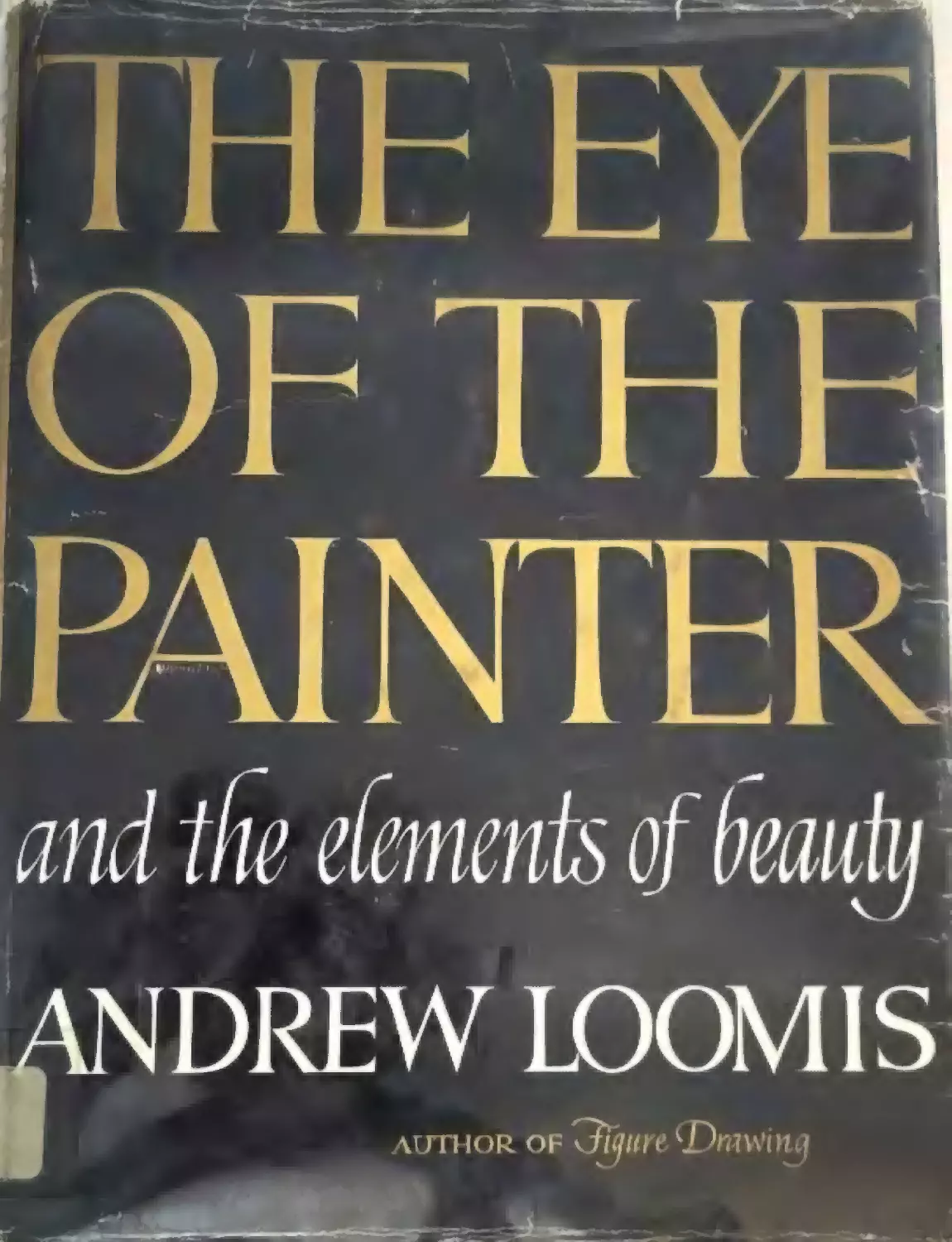
THE EYE
OF THE
PAINTER
and
the elements of beau
ty
ANDREW LOOMIS
H
author of
3^/<recDrawin^
THE EYE
OF THE PAINTER
AND THE ELEMENTS OF BEAUTY
Andrew Loomis
THE VIKING PRESS • NEW YORK
CONTENTS
Prologue
13
I
Seeing with the Painter's Eye
23
II
"What Shall I Paint?"
35
III
Unity
53
IV
Simplicity andHow to Achieve It
62
V
Design
71
VI
Proportion
84
VII
Color
101
Rhythm
108
IX
Form
114
X
Texture
121
XI
Values of Light
126
XII
Beauty ofSubject
135
Technique
138
VIII
XIII
ILLUSTRATIONS
The Gulf Stream, Winslow Homer
15
Movement. Sky and Sea, John Marin
16
Thinking Ahead. Yasuo Kuniyoshi
17
The Dull Fight, Francisco Goya
22
Figure with Shawl, George Grosz
Storm. Dean Fausctt
26
33
Fean and Pewter, Luigi Lucioni
37
The Lawyers, Honore Daumier
The Wyndham Sisters. John Singer Sargent
£gg Dealer V, Stuart Davis
38
Upside Down Table and Mask.
39
Expectation, Frederic Taubes
She<l in the Swamp. Charles Burchfield
Road with Cypresses. Vincent Van Gogh
X2
92
Marne at Nugent, Raoul Dufy
The Virgin with Saint Ines and Saint Tecla.
93
95
El Greco
109
Yasuo Kuniyoshi
While Canadian Darn, No. 2,
Georgia OKecHe
96
97
110
42
Young Henry Ford. Norman Rockwell
43
Kenia of Cirene
11X
Summer. John Koch
44
Music. Eugene Berman
119
Tile Hoof, Charles Burchfield
45
Paysage du Midi. Andre Derain
122
City Interior 1936, Charles Sheeler
46
Les Mouettes, Henri Matisse
123
The Outpost, William Thon
4X
Fruit Dish Class and Newspaper, Juan (iris
124
Trouble Ahead. Margery Ryerson
49
The Pearl Necklace. Jan Vermeer
127
Quiet Evening. Hobson Pittman
50
Man with a Magnifying (Hass. Rembrandt
132
Figeon, Zoltan Sepeshy
Cowles
Elephants, Russell
Winter in the Catskills. Doris Lee
Lilacs, Ernest
The Twelfth Night Feast. Jan Steen
133
51
I’eniis and Adonis. Peter Paul Rubens
I 36
54
Portrait of Madame Monet and Hazille.
56
Claude Monet
At the Moulin Rouge,
5 I
Fiene
Black Lace Parasol. Morris Kantor
William Kush Curving Allegorical Figure of
the Schuylkill River, Thomas Eakins
Portrait Study. Raphael Soyer
57
Seed Corn. Andrew Wyeth
Danger, Thomas Benton
59
64
Freezing Up, Winslow Homer
66
141
143
Henri Toulouse-Lautrec
COLOR PLATES
Young Woman, /.vabcl Bishop
67
The Cafe al Night,
Rehearsal on the Stage. Edgar Degas
68
Slumbering Fields, William Palmer
72
Vincent Van Gogh
Early Sunday Morning, Edward Hopper
73
Light in Autumn, William Thon
East River, Dong Kingman
A Stag at Sharkey’s. George
Bellows
I 17
76
Prophetic Plane. Mark Tobey
Portrait of Albert Wolff. Jules Bastien-Lepage 7X
La Femme a la Perle. Jean Corel
79
The Fish Kile. Robert Vickrey
XI
Following page 104
The Helicopter, Dong Kingman
Egg Dealer III, Stuart Davis
Portrait of an Old Man.
Andrew Loomis
The Cove. Andrew Loomis
Following page I2H
PROLOGUE
There can be little doubt that the chaotic con
within the complete concept but are only facets
dition of art today has caused confusion in the
of a whole movement. When we can grasp the
minds of artists, young and old. We are all ask
idea that art is an integral part of mankind itself,
ing: By what qualities, according to present
we need only to look back Io see that it has
standards, can a painting be judged? Is there still
existed since the dawn of intelligence. We find it
a solid foundation on which Io base the teaching
in all peoples. Art is an expression of mankind's
of art? Is art deteriorating, or is it being revital
effort to make a better world, and to bring beauty
ized by new concepts?
into life in one form or another. Il is a creative
It would seem (hat. the most important prob
force, and as such will naturally align itself with
lems now facing the artist are Io achieve a clear
the conditions and circumstances of the world in
personal understanding of what art is, to hew a
which man finds himself at any time. The pres
pathway for his own creativeness, and to con
ent revolution in art is a logical result of a period
centrate his efforts toward individual goals. He
of general revolt against traditions of all kinds.
must realize that art can no longer be bound by
Al the bottom of the national and political
theories other than individual theories; that is,
crises today is the struggle for individual liberty
it cannot be pigeonholed into prescribed method
and freedom of expression. It is therefore no
and practice. Art is having its growing pains. At
coincidence that art has moved with the times
long last, art has Hung open its doors Io indi
and given the artist more freedom of expression
vidual creativeness in a way it has never done
than was ever known in the history of art.
before. It has become a broader means of indi
vidual expression.
There is always the danger that freedom can
be abused. In art this means that the man with
If we choose to become practicing artists to
out knowledge or ability is granted the same
day, we must widen the scope of art itself to take
freedom as the skilled technician. Freedom is
in all forms of creative expression. Art is no
based on the assumption that the individual is
longer limited to traditional forms of painting
morally and socially responsible, and to grant it
and sculpture; it must be made an integral part
to irresponsibility is like opening the doors to
of life as it is lived in the present and will be in
everyone who ever perpetrated a crime against
the future. Art is also architecture, ceramics,
society. The new-found freedom in art has set
industrial design, weaving, and textiles. It is a
the pendulum of creativity swinging widely.
means of expression closely related to a new way
There are painters wielding the brush who do
of life.
not possess one iota of the fundamentals of art.
Let us al once clear our minds of the concept
We have "art" that would make the old masters
that art is an "ism" or a cult. Such things exist
jump back into their graves, were they to see it.
PROLOGUE
The gixxl seems almost hopelessly mixed with
dences itself every day in the selection of our
the bad. Yet in spite of all that, art is now in a
possessions, in self-ornamentation, and in the
healthier state than it would have been if nothing
beautifying of our surroundings. Whether it is
had changed. Art cannot and should not stand
creative or possessive, there is an innate desire
still. That is stagnation. There is little danger
for perfection, which broadly speaking is the
that art will perish; only forms of art die. Confu
basis for all progress. We seek to improve upon
sion will eventually give way to order, and here
the efforts, accomplishments, and worldly goods
and there new concepts of unquestionable value
of our neighbors. For the creative man there is
will develop. Meanwhile, instead of throwing
instinctive pride in doing something better than
out all the concepts and procedures of the past,
others have done. On the possessive side, man
let us search them for values that can be put to
wants the better product, the best craftsmanship,
use today. Let us assemble a whole stock of
knowledge gleaned from the past and add newer
this direction seem to be limited only by the power
concepts, and in tum join these to the concepts
to acquire, or the wherewithal Io purchase. This
that will come out of the future. Let us give art
the benefit of the techniques of scientific explora
as basic to our lives as the air we breathe.
the better home, the beautiful wife. His desires in
drive toward creating beauty or possessing it is
tion. The scientist does not throw away a theory
I cannot believe that the artist who establishes
until it lias been proved false or valueless. To
beauty as his fundamental approach to art can
condemn the past because it is not part of the
present would be as short-sighted as to stick only
go very far wrong. No one denies that beauty is
to the past for the sake of tradition. It would be
could encompass more than a small part of it,
short-sighted not to be alert to any new truth
The great danger lies in allowing beauty to get
broad in scope, so broad that no single lifetime
to add to our stock. Because certain forms of
bogged down in personal opinions, trends, and
art can become passe, there is no reason to believe
isms, in narrowing our individual understanding
that basic knowledge is passe also.
to the dogmas prated by the few. Beauty must
Why not look at art as a stream, flowing by
be free, belonging individually to you and me,
us like a river? Some has passed by. some is
passing now, and there is still plenty that has not
as far as we are capable of grasping it. Beauty
is all around us. waiting to be discovered, and
every artist interprets it on paper or canvas in his
reached us. We might think of a single picture as
one cup of water from this stream, reflecting in
own particular way. .
its surface some beautiful image, or representa
It is often asked how you can tell a good
tion of truth.
painting from a bad one. Vincent Price, the actor
There are two satisfying and basic concepts
and art collector, answered this question well
by which artists have always worked and prob
when he said. "A good painting is one that pleases
ably always will. Two-dimensional art—art ren
you." If that is true, then the next question might
dered on a flat plane—will survive as ornamen
tation of one kind or another. Three-dimensional
be. "How do you paint a good picture?" I believe
art will seek beauty of form. If we concede that
manner that pleases you. Forget the other fellow
that there is a parallel answer here- paint in a
ornamentation is the process of beautifying, then
and how he does it. unless you find his work
we find that beauty is the basis of both concepts.
particularly inspiring. Don't paint his way be
Mankind has from the beginning sought beauty,
cause of his arguments, his ambiguous explaining,
and by degrees added it to his env ironment. One
and his salesmanship. The pleasure you feel in
man has the urge to create beauty, another the
■"doing" is the very basts of any individual tech
desire to seek it or own it. a desire which evi
nique that you may develop.
14
PROLOGUE
It ’is to your especial advantage that you may
see beauty differently from the way others see it.
pression. All art. to be worth its salt, must be
individual. It must be creative. Realism can be
This difference will help you select subjects that
creative, in the selection of the subject, and in
arc attuned to your tastes. It will lead you on to
rendering that subject as it is seen and felt by you
new and exciting fields. The source of beauty is
as an individual. Whether your material exists in
endless, but the true capturing of it is rare; it is
reality or not is not significant. You may paint an
a constant challenge.
impression in broad leans or you may paint with
great fidelity to detail, and either way achieve a
In our search for subjects to paint we may go
beyond nature and concentrate our attention
fine creative work of art. The subject is not the
merely on beauty of form, texture, or color.
There is beauty to be found in pure geometrical
picture; it is the way in which it is rendered that
forms, in spacing, in creating surfaces, planes,
realistic art arc simply two different forms of
and abstract forms. We must therefore broaden
approach, and there is no one who can say that
one approach is any better than the other.
makes or breaks a work of art. Abstract art and
our scope, and should we choose to work in the
abstract, we will still find that beauty is our ulti
Art will always have its trends, derived from
mate goal. Rather than condemning what we can
not agree with, we should take our full measure
those who happen to be the greatest artisans of
of the freedom allowed to all creative effort; we
the moment. But the pendulum of creativeness is
never still, since no two people can see with the
should do things as we believe they should be
same eyes or reason with the same brain. No two
done, and give others the same freedom of ex
brains have identical receptivity or arc motivated
The Gulf Stream by Winslow Homer, metropolitan museum of
creative, in the selection of the subject, and in rendering that subject
15
art. new vork city
Realism can be
Movement, Sty and Sea by John Marin. THE
downtown
GALLERY, NEW YORK
city
You may paint an impewHxi in broad terms or you may paint with great fidelity to detail, and cither way
achieve a fine creative work of an
16
Thinking Ahead by Yawo Kuniyoshi. Phillips
memorial gallery.
Washington, d c
and influenced by environment in exactly the
beauty, that should be a part of any true work
same way. In fact, no two people could possibly
of art.
start from scratch and paint identical pictures.
Tt is hardly possible—or wise—for an artist
Today there seems to be a strong trend toward
to decide at the outset of his career which type
spontaneous, creative expression, without much
of painting he wants to do. The decision should
regard for classical training. The creative urge is
stronger than the will to study and acquire knowl
be made later on when he is qualified by knowl
edge and training to go either way he chooses.
edge as the masters did in the past. Therefore
One style is usually the outcome or. one might
we see paintings by men who have little or no
say. the refinement of another as the artist gains
academic knowledge, by men who are endeavor
ing to paint what they feel rather than what they
in experience and dexterity. Therefore he should
see. We cannot deny them their right to express
themselves in this manner, for it is entirely pos
rally. according to his ability and tastes.
sible that a thing of beauty may be achieved by
understand that many canvases are hung with
working from an emotional standpoint. In fact,
the lack of one element may be more than com
out the remotest expectation of ever being sold.
Many are exhibited for the sole purpose of edu
pensated tor by another, for, as everyone knows,
cating the public to new concepts in art. We
there are many academic and expertly painted
pictures that express so little emotion that they
cannot tell at this point how successful this pro
fail altogether as creative works of art. They can
justified. But if the viewer bears in mind that
be trite and stiff and lacking altogether in both
many such works by modern artists are more in
the nature of experiments than they are repre
not be impatient, but let his work evolve natu
In viewing gallery exhibitions today, we must
gram of education will be. or even whether it is
spirit and originality.
sentations of an ideal, his attitude toward modern
It is true, however, that the abstractionist will)
out a classical training works against greater odds
art is likely to be more lenient. My own opinion
than the experienced realist does. He is like a
is that the canvases that will stand the test of
man building a house without any knowledge of
time will be only those with inherent beauty,
the carpenter's trade. All knowledge must come
those which stand on their own merits and can
be appreciated without high-sounding literary-
by way of experiment and innate craftsmanship,
and he faces the extra hazard of being completely
misunderstood.
His
creativeness
must
explanations by the avant-garde reviewer. Cer
tainly people can and should be taught to accept
over
shadow his technical faults, and lack of technical
new concepts, but in the final analysis beauty is
knowledge is extremely difficult to conceal for
judged by the eye and not the mind.
long.
The soundest advice that can be given to any
which a painter can learn to be an abstractionist
young painter is first and foremost to learn his
craft well, to search constantly for beauty and
—no fundamentals of drawing, values, color, or
new ways of expressing it., and. relating effort to
the rendering of form. I suggest that a young
inner convictions, to let his individual style evolve
artist wishing to paint abstractions should be as
unhampered by any preconceived notions about
well grounded in the fundamentals of technique
as an objective painter must be. This has been
how he should paint or what the critics are likely
So far as 1 know, there is no basic training by
to say about it.
true in the case of Picasso and many other mod
ern artists. The student may then turn to the
If I have, as I hope, convinced you that beauty
abstract if he chooses, with some hope of captur
still is and always will be the source of art. we
ing the unity and organization, and finally the
can now turn our attention to the "whys" of
18
PROLOGUE
beauty. Though perhaps no one can give a com
6. Rhythm. Though this is often underestimated
plete definition of what beauty is. we do come to
or misunderstood, it is a quality that con
understand that there arc certain elements which
tributes greatly to the beauty of a paint
combine to make beauty, whenever or wherever
ing. There is rhythm in all animate and
we find it. To recognize these elements and learn
inanimate life, from the smallest forms
how they can serve us will greatly increase our
to the cycles of the universe. Without it.
prospects of achieving success as painters.
form is static and lifeless. The repetition
The elements of beauty are so well integrated
of similar colors or of lines or shapes of
that it is often very difficult to separate them for
increasing or diminishing size will create
purposes of analysis. In discussing one principle
rhythm in a painting just as it does in
or element it may be necessary to embrace an
other or even several others at the same time.
the repealing lines of trees with their
Nevertheless, the attempt should be made to
bong each one. separately, under our scrutiny.
These are the basic twelve:
I. Unity. The “oneness" which brings all the
pictorial qualities together into a single
or whole expression; the organization of
design, color, line, values, textures, and
subject into a combined and total expres
sion.
2. Simplicity, or Clarity. The subordination of
nature. For instance there is rhythm, in
branches and leaves, or in the lines of a
zebra's back, or in the petals or markings
of a flower.
7. Form The structure of form in relation to
the whole is a fundamental art principle.
Everything is cither form or space (solid
or void) and neither can exist without
the other. A painting is said to have
"form" when the shapes of the objects
contained in it are well outlined, well
composed, and properly contrasted with
all material and detail that is irrelevant
the open areas
to the main thought; the reduction of the
sky.
subject into the fundamentals of design,
form, and pattern.
3. Design. The over-all relationship of areas,
form, and color. Design makes the pic
ture.
such as a tree against the
8. Texture. The rendering of surface. There is
characteristic surface to all form, and this
is as important as its structure. We can
not achieve true beauty by painting all
form with the same type of surface, as if
4. Proportion. Harmonious relation of each
all things were made of the same material,
subject and each part of the picture.
which is precisely what happens too often
Distortion is the opposite of proportion,
though some distortion may be legiti
in otherwise good painting.
9. Values. Values and color are inseparably
mate. where an idea or an emotion might
dependent upon each other. Neither can
need greater emphasis.
be true or beautiful alone. The proper
5. Color. This is one of the strongest elements
relationship of values creates the effects
of beauty, and in using it the artist can
of light and contributes to the unity of
not simply be guided by tastes, likes or
the picture. Tncorrect relationships can
dislikes. The relationship of color to val
do more than anything else to destroy
ues must be understood, as well as the
beauty.
basic principles of mixing and producing
10. Quality of Light. An clement of prime im
colors for realistic and harmonious ef
fects.
portance. The quality of the light in a
painting blends with the actual light fall
PROLOGUE
ing upon the picture and becomes part
line and proportion, so that our renderings are
of it. There are many kinds of light
true and convincing.
indoor, outdoor sunlight, diffused light,
The artist will do well to direct his efforts
reflected light. The source of light must
toward pleasing the viewer rather than the critics,
be related to the modeling of form, to
for the viewer is the ultimate purchaser, and T
the kind and brilliancy of color, and to
assume that most artists are interested in selling
texture. Without a true understanding of
their work. While art dealers have done a great
light a picture can become mere planes
deal of exploitation, and monetary values of
of paint and canvas.
paintings have often been pushed to astronomical
11. Choice ofSubject. This offers the artist his
figures, in most cases the artists themselves have
greatest chance to exercise individual
never lived to receive these benefits. Today good
taste. The limitless sources of life and
art can find a good market, in commercial fields
nature are his to tap and from them he
as well as in the field of 'fine art." Paintings of
can select, design, and produce a con
the easel type, for hanging on the wall, will sel
centrated example of his own apprecia
dom bring the financial rewards that come from
tion of beauty.
illustration, advertising, and other commercial
work. But we have, fortunately, reached a stage
12. Technique. The means of expression rather
than the expression itself. Technique in
where the finest art is often used for commercial
cludes understanding of surface and tex
purposes. Industry is now providing a new outlet
ture. knowledge of medium and its many
for line art. and the artist bend upon perfecting
methods of application. It is the personal
his craft to the utmost is no longer considered too
rendering by which all the other elements
good for such a market, as was once believed.
While the strictly commercial artist may still
are brought together.
have Io work within limitations set by the pur
chasing agency or the ultimate user, such limits
This preview of the contents of the book should
are being greatly broadened, and the work of
help to put us on common ground. It is certainly
easel painters has been used in many advertising
not my intention here to try to set myself or my
campaigns.
work up as a shining example of the solution to
This development has come about gradually,
the problems of the artist. But I do want to stress
aided by the introduction of color photography
how important it is that every artist, be he pro
into commercial fields. When exact detail is im
fessional or amateur, should recognize what his
portant to the sale of the advertised product, the
job is all about. I say again that there is no single
advertiser naturally turns to photography and is
form of art. or single formula for producing it.
likely to do so for some time. Where no tangible
But when we find the elements that combine to
product can be pictured, as in advertising insur
create beauty in life, we can try to analyze, and
ance. services, industrial prestige, and in institu
apply them to create beauty in our paintings.
tional advertising in general, a market for fine
Beauty is not the special property of the artist.
art has developed. Magazine illustration con
Beauty is perhaps just as evident to others, who
tinues to provide a market for the artist, partly
may lack the knowledge and ability to re-create
because the use of paintings helps differentiate
it. The rhythm and grace of an animal must be
fiction from factual articles. For the latter, photo
just as apparent to the loser of animals as to the
graphs arc ordinarily used to substantiate the
artist. The difference is that we try to find out
text.
what makes the rhvthm and grace in terms of
It IS foolish for the artist to try to compete with
20
PROLOGUE
the camera in achieving fidelity of detail. Better
knowledge, or ability, and which we feel certain
that he use his creative and imaginative powers
that we could equal or better, has nothing to do
and direct his efforts toward design. Even if he
with the case. Much of the art exhibited today
uses a camera for working material, the artist can
would not buy a sack of potatoes.
still concentrate upon the things that a camera
Progress and development in art must always
cannot do: he can subordinate and eliminate, de
be the progress and development of the individ
sign and rearrange, simplify and take other lib
ual. One artist can help others to a degree only,
erties to project his idea more forcefully.
lie can call attention to facts that, over a period
The professional artist should prepare for his
of effort, he has found to be true. He can point
profession by as thorough training as possible, in
oul relationships that he has found to exist. He
art schools and classes, or from any sources he
can show that colors will mix with definite result,
can find available. It is a fallacy that no training
that values will unify and organize a subject. This
is necessary in order to make a living at drawing
is what 1 hope to do in this book. If 1 can show
or painting. The fact that we may often see pic
the beginner a lew "hows" and "whys." I will
tures in exhibitions that show no apparent talent.
have accomplished my purpose.
21
The Bull Fight by Francisco Goya, metropolitan museum or- art. new York city.
figure can often look more alive and real than one that has been painted in great detail
22
A lightly skctchcd-in
I. SEEING WITH THE PAINTER’S EYE
The artist's first step toward the ultimate beauty,
individuality, and. if you allow it to do so. it will
unity, and organization of painting is learning to
get into your work subconsciously. It is much
see everything in pictorial terms. This will mean
like handwriting, of which no two specimens are
the closest possible unification between the eye,
exactly alike.
the hand, and the medium with which we have
The best advice I can oiler is to paint what
chosen to work. In time most artists find that the
you see as you see it. And if you can suggest an
hand automatically works with the eye even to
object or a scene so that it is convincing, that may
the mixing and application of medium. In fact,
even be better than completely honing it out. Tn a
artists often are surprised—and delighted—to
landscape, for instance, a lightly sketched-in fig
discover that they have unconsciously used a cer
ure can often look more alive and real than one
tain technique to express exactly the impression
that has been painted in great detail. The truth is
they had intended. The artist either puts down a
that we can quite easily train the eye to see as we
suggestion of what he sees, or the object as he
want it to see; in fact it has already been trained
sees it. being at the moment unconcerned with
to do this. We can skim through a crowd and spot
technique. Technique is thus a result rather than
the face we are looking for. and hardly be con
a conscious manner of stroke. Yet every artist in
scious of any of the other faces there. If we are
lime develops a technical approach, if he is pa
painting warm sunlight, we may see it warm,
tient and has faith in his vision and emotional
possibly warmer than it actually is. If we are
reaction.
drawing in outline we see in outline, and are only
Of course, we all see shining examples of
faintly aware of anything else. If we are rendering
technique, some of which we admire very much,
a subject in tone, we begin to see values and re
and which the young especially—and sometimes
lationships that we had not noticed before. In the
the old—are tempted to copy for technique's
first case we are really looking primarily at out
sake alone. As a result technique actually gets in
line and see everything else as secondary; in the
our way and we end up by not seeing the subject
we are painting truly and often overlook many of
the other essential elements of painting as well.
second case, mass and tone become of primary
importance to us and edges and outlines more
incidental. When we look for color, we must
When a man is thinking in terms of technique
"somehow also keep values or tone very closely
he probably is not giving his best attention to
associated with it. and here is where the training
values, relationships, or even color. He is think
of the eye begins.
ing about the strokes he is making and not very
The tendency to see only one tiling or aspect of
much else. Technique is a strong indication of
a scene at a time is something we must educate
terns or composition in miniature is a good one.
our eyes not todo. Too many pictures are started
with line only, then the outlines are filled in with
Learning to see your subject in terms of simple
tone, without regard to the real edge, or what the
masses with a general relationship to one another
tone is doing, or what its relationship is to other
in color and value is the first law of good paint
tones. Tone and color are applied in a more or
ing. We can train our eyes to see mass without
less schoolbook manner, simply by filling areas
detail by deciding what the general value and
between outlined limits. This is not painting in
colors arc to be. Then, later on, we can raise the
the true sense.
The experienced painter studies his subject in
ows. What we are really seeking in this manner
all its aspects. The more he can see the total
is the approximate middle tone of the area or
effect before he starts, the better the painting w ill
mass, and this we set down quite flatly in simple
be. lie will look at mass with its edges or outlines,
poster terms. In cases where you want to main
seeing the mass in its value and color, and ac
tain the underdrawing, which is usually done with
cording to its relationship to other masses and
charcoal and fixed, or is a light drawing gone
colors. He does not single out one thing at a tune,
over with waterproof India ink. you can use thin
for all these things are closely connected and
turpentine washes over the drawing so that it
belong to or affect one another.
shows through. It is even better to learn to draw
value for the highlights and lower it for the shad
We may start a picture in outline, but only
within the mass, establishing planes, halftones,
after we have carefully noted where that outline
accents, highlights, or texture as you develop the
is going to merge and lose itself in other tone.
picture.
We may even indicate this on our drawing with
To see the general tone of the mass with less
short lines across the edge, which means that this
detail, tty squinting the eyes and looking through
edge is to be soft or lost. If we draw a hard outline
the lashes.
around everything, the chances are that we will
From the very beginning, line up the values in
forget all about the true edges and accept the hard
the order in which they appear. Look for the
edges we have set down. Then we end with a
lightest value and label it number one; the next
light, hard picture with no freedom of approach,
value will he number two, and so on until you
one that is unimaginative and not particularly
establish about eight gradations. Here we are
creative. Such a picture is really a colored draw
training the eye to see values in relationship to
ing. Working from photographs has a tendency
one another in (he black and white scale. Areas
to increase this tightness and hardness. We can
of the same value may appear lighter or darker
not see the life image; we simply copy what a
than they actually are because of a neighboring
sharp lens has recorded, putting in every detail.
color.. A light yellow may seem much lighter and
Before you look at your subject, before you
brighter than a light blue, although they have the
by a hand on the canvas, slop and realize that
same black and white ratio in the value scale. To
any picture starts as a Hat tone (the canvas)
recognize this takes a certain amount of training.
which is eventually broken up into more tones.
Though we do and must draw as we paint, let
Thus a pattern of arrangement of masses and
us think of drawing as associated with outline,
spots is created. This is actually the first thing
and painting as associated with mass values and
you should train your eyes to see—the picture
color. We do not want a painting to turn out to
as a whole with as much identification as possible
be a drawing, nor do we want a drawing to be
of the pattern or design. You should decide where
come a colored-over excuse for a painting. Much
the borders of the picture will be. and its shape
poor art is neither true draw ing nor true painting,
and dimensions. The habit of roughing out pat
but an unhappy confusion of both. A good draw-
24
SEEING WITH THE PAINTERS EYE
1. Ifwe copy nature as
we find her. our draw
ing will be something
like Number 1. Trac
ing an actual photo
would be much the
same.
2. Block in the forms
in simple terms like
this, eliminating de
tail.
3. This shows what
the masses would look
like if Number I were
to be accepted with
every form "as is."
4. In finishing Num
ber 2 more thought
is given to pattern and
design, less to edges
and outlines.
5. Further simplifica
tion of Number 4.
6. Here realism is
abandoned for the
sake of pure design.
Only a slight identifi
cation of subject re
mains. We may call
this an abstract inter
pretation.
7. In this rendering,
edges arc more clearly
defined.
8. With vertical and
horizontal lines the
design becomes even
more abstract and in
some respects even
more effective.
25
Figure With Shaul by George Grosz, walker galleries, new M2RK CITY. Art training usually start* wit
draw ing, foe the student must first train his eyes to proportion, and go as far as he can with form in a simple
black and white medium
26
SEEING WITH THE PAINTER'S EYE
ing should remain drawing by having the struc
to his students, the late Charles Hawthorne, one
ture and outline very much in evidence, and
leaving it at thai. A good painting should stress
made his students start their canvases in reverse
rone and pattern with an intermingling of forms
order. Instead of drawing the usual outline, they
and edges, with some edges stressed and others
started with patches of tone and color and fitted
subordinated. Line as line does not belong in
them together in the best proportion they could.
painting, for outlines do not actually exist in
His idea was that they could eventually learn to
nature, which is what a painting, or a classical
draw and get subjects designed within the canvas
painting, at any rate, attempts to represent as
shape, but that the ability to see things together,
closely as possible. In nature we see only contours
in relationship of tone and color, was far more
and edges. Forms are defined by values appearing
important. It really did not matter too much to
of the great American painters and instructors,
one against another, and there is no need to rep
him if the subject got onto the canvas minus
resent these divisions in any other way. I lowever,
hands or feet; the main thing was to learn to
in drawing we have no other way to define an
paint by educating the eye.
edge or the limits of the forms before us. except
Il is not a bad idea for the artist to make this
in line.
kind of experiment. Set up a still life, and without
This difference between drawing and painting
any preliminary drawing, start painting in areas
should be firmly understood. Good drawing, of
and masses of tone and color; then in these
course, underlies good painting, but the essence
masses develop the form. Drawing can be easily
of good painting goes beyond edges and contours
corrected in oil when it is dry. Where edges merge
into the rendering of the solid form as it appears
or are very close in value, keep them lost or soft.
in a given light, in its color and texture, sur
Where they stand out in contrast, make them so.
rounded by space and atmosphere. Such qualities
If you have never worked this way it may seem
cannot be reached in a subject where all units
difficult, for there are no lines to work up to;
and parts are separated by hard outline, or com
they will have to be established later as edges, or
pletely identified edges around everything.
lack of edge. This is one of the best ways of
training the eye.
Art training usually starts with drawing, for
the student must first train his eyes to proportion,
There is an in-between approach to drawing,
and go as far as he can with form in a simple
which can be beautiful and which still qualifies
black, and white medium. But he will not see true
as drawing. That is combining massed shadow
values until he starts to paint.
with outline. While we do not attempt all the
We train our eyes to perspective largely by
learning the rudiments of it. and recognizing the
subtleties of modeling and light and shadow, we
perspective before us as belonging to the law of
more as it would, be seen in very strong light, the
optics. Perspective is actually the science of draw
lights being white or the tone of the paper, and
ing form and space as it appears to the eye. as
the darks or shadows in simple areas being very
do delineate a strong effect of light and shadow,
opposed to mechanical projection drawing which
dark or black. If the drawing is made on tone
renders form on a flat plane or planes in actual
paper, white may be added with startling effects.
dimension. In order to paint we must know how
Actually this means drawing in about three or
to scale form and proportion in space; we must
four tones.
understand the complete principle of the eye-level
or horizon which is the cornerstone of all accu
artists whose work was basically drawing in paint,
rate representations involving perspective.
and definitely on the side of drawing. Outstand
There have been illustrators and commercial
Tn order to differentiate painting and drawing
ing among these was J. C Leyendecker. How-
27
Few artists ever stop to realize that in out
ground material between B and C. You
door painting they are really painting a
can lay stones at the points B and C and
huge pie-shaped slice of the stretch of
sight in vertical lines above them to find
landscape before them. The importance
how much distance you should include.
of realizing this is manifold.
The vertical lines arc the right and left
edges of your painting. These lines actu
First, the baseline of the painting repre
sents comparatively few feet, while the
ally fan out to the horizon and distance.
This keeps the foreground in correct re
distance may represent miles across the
lation to the distance. The horizon of the
picture. In the diagram above, note that
picture should be al the eye-level of the
the baseline of the picture represents only
painter, and you will find it easiest to paint
about ten feet. Approximate this line in
if you set your canvas so the two coincide.
front of you by sighting beyond the bot
Thus, by first establishing the actual
tom comers of your canvas to the ground
area of landscape to be incorporated into
with your eye opposite the middle line of
your canvas you can paint all material the
your canvas. (AB and AC). Draw fore
same size as you see it.
28
THREE-DIMENSIONAL EYE
TRAINING
The contours of any object will fit within a
rectangle or box. By studying the shape of the
object, we can visualize a box around it of ap
propriate proportions. First sketch the box,
then draw the object to fit within the box, in
similar perspective. You thus train your eye
to see the solidity of the form, rather than just
its contours. The child usually draws contours
without perspective.
This is particularly helpful when we arc
drawing round objects. It also aids us in draw
ing correct and tine ellipses in good perspec
tive as related to the eye-level at which we are
viewing the object. Everything in a picture
should lx? drawn from a single viewpoint or
eye-level.
If you learn to visualize the box, you won't
have much difficulty in rendering the object in
correct proportion. Try to locate the corners
of the box, just where they would appear
around the object. This is not always as simple
as it may seem.
SEE AND MENTALLY DRAW THE
IMAGE OF A CLOSE-FTTTING BOX
AS YOU STUDY THE FORM BE
FORE YOU. IT WILL HELP TO
ESTABLISH TRUE PERSPECTIVE.
29
THE EYE OF THE PAINTER
ever. I doubt if a close imitation of his style would
duced the effects we see. Understanding them
sell today. McClelland Barclay used strong out
will give character and a convincing quality to
line in his later work to good effect, as did Her
bert Paus, but the appeal in the work of these men
our picture. As we look at the ground we can
really came from design, pattern, and color.
good drawing which are used by commercial
to the surface. Here they have made grooves and
channels in the surface. There sediment has been
deposited in shapes that still define the flow.
trace what water courses and floods have done
There are many styles between true painting and
artists. The danger lies in being tricky, rather
Rocks have, been scraped and torn away, others
than doing work of basic excellence. Tricky ap
proaches can be easily copied or plagiarized,
show grinding by water, wind, and sand. We
whereas pictures based on sound knowledge and
perhaps to the distant mountains where melting
the individuality of the artist are hard to imitate.
snow even more than rain must have carved the
effects we see. We look for desert growth: is there
follow the slope by which the water came, back
In order to train the eye toward arrangement,
pattern, and good composition the artist can be
still some green, some vitality in it that through
gin in a more or less abstract way to play with
ages has learned to survive drought. What color
patterns in miniature. Without worrying about
subjects, he may simply try to spot masses and
is it? Are there lesser plants that are parched?
shapes of three or four different values within a
color? How docs it differ from the buttes and
squared off rectangle. Everyone has an inherent
terraces which rise above it? Does the whole
scene seem lighter or darker than the sky?
What is the nature of the soil and its general
sense of balance and order which varies im
mensely with the individual. But this sense must
Now we begin to look for arrangements. How
be developed by experiment, just as vision is by
practice. You are the only one who can do it.
can we utilize that sweep of the dry wash? Would
it be better if we were to move those bushes and
Reading books on composition can be helpful,
trees a little to the left or right? Have we nice
but in the end your own taste and selectiveness
patterns of light and shadows? We note the di
will plan your pictures.
rection of the sun. and the brightest planes which
The eye must also be trained to organize what
must stay at right angles to the source of light.
it sees in terms of a composition. Nature has a
way of strewing her material in a haphazard
We list our values from the lightest to darkest by
comparing them and realize that we must stick
fashion around the surface of the earth. With
to this sequence. If we are looking into the light,
wind and water, frost, and all the other elements
working over the surface it gets to be a rather
the sky will probably be brighter than we can
mixed-up affair. But an intelligent approach can
or two darker than we see them, to establish the
be developed as we come to understand nature.
same scale but in a lower key.
paint it. So we must make all the values a tone
What we see are effects due tor the most part to
We know the distant mountain is cool in color
causes that are often less evident. If we can grasp
because the same atmosphere which appears blue
the cause, it helps us greatly in understanding
the effect. Pictures are really effects.
in the sky is between us and that mountain, drop
ping a veil of blue over the actual or local color.
Suppose we are looking at a landscape. As
Now if the scene is crowded and "busy." with
sume for the moment that it is a desert scene.
rocks, forms, lights and shadows, we seek to
Before us is a profusion of forms, surfaces, and
simplify the profusion by actually eliminating
shapes of light and shadow. We can analyze the
some material, and grouping the rest of it into
patterns. It takes very little to make an effective
scene in a way that greatly helps us to paint it.
First let us try to determine the causes that pro
picture—nature usually provides too much. We
30
SEEING WITH THE PAINTER'S EYE
less flat plane. The third value will be found in
get out a pencil and pad and rough out several
small compositions. If one of them pleases us. we
sloping planes, slanting away from the light
are ready to make a sketch.
This is educating the eye by means of the
source, such as mountains, roofs, banks, and so
forth. The darkest patterns for the most part are
material before it and the brain behind it. We
found in the uprights, such as trees, cliffs, or
have thought about something more than outlined
anything that casts a shadow toward the ground.
shapes and paint strokes. Each time you study
You will usually find that all shadows go down
nature you will gain additional working knowl
in scale relative to the lights. This means that the
edge if you insist upon sizing up causes and ef
fects. and then set them down, instead of slavishly
lightest tone in the shadow will be found next to
the lightest tone in the light, the next darker tone
copying what you see as you might copy a photo
in the shadow will be on the next lower tone in
graph. You cannot put into the picture every
the light, and so on down to the darkest object in
thing that is there before you. in all its overa
the light, which naturally has the darkest shadow.
bundance of irrelevant detail and literal fact, and
The lightest shadow ordinarily starts about the
still paint a good picture. You might better use
your camera. You are making a lens of your eye
middle of the scale or very little above it. This
means that white normally has a shadow about
and an empty box of your head, doing the same
middle tone, or only slightly above, and that all
thing the camera does.
the lights and shadows scale down from there in
To help in the process of elimination, first paint
proper sequence. We must not forget, however,
'a very small color sketch. This should be so small
that some shadows may be lightened from their
that you cannot possibly include all the intricate
natural sequence, because of light reflected from
detail, but must settle for mass and general
planes. Then make a larger sketch, checking with
the ground or cast from some light surface
nearby.
the small one and leaving out much of the mate
rial you were forced to omit from it. Start with
Setting up a scale of values for your picture
helps you to train your eye to see color in a
the masses. When the mass becomes identified
pictorial sense. We all can see colors and their
enough to be convincing as ground, foliage, rock,
tints: we all can name them fairly accurately as
or cloud, try to leave it. You can always see more
long as they are more or less pure color. But pic
detail than you can paint, and you can watch a
torially we get into many nameless colors which
picture that started out as a striking and positive
are muted and softened as a result of the kind of
light or atmosphere in which they appear. Pic
approach deteriorate into a commonplace, over
worked nothing! How many times have we all
torially color is true only when its value is right,
done it? And we will keep on doing it until
when its wannness or coolness is right in relation
we learn the hard way that nature should be
to the neighboring color. We cannot mix sky
used as a source only, and that enough detail is
color or ground color, foliage color or even flesh
enough.
color and put it into a tube. Flesh under a blue
accepted facts about outdoor painting, and to
sky and within the shade appears totally differ
ent from the same flesh seen in warm sunlight.
look for them helps train the eye. The sky is
The reflected blue light of the sky. or the warm
ordinarily the lightest pattern or mass, unless
light of the sun, has altered the local or actual
there is a very bright pattern of buildings or other
color of the flesh and made it relative to all its
material that is white or nearly so.
surroundings.
There are a few tried and true and generally
The next lightest mass is usually the ground.
We look for cause and effect in color, as well as
This gets the direct light of the sun. on a more or
in form and other pictorial qualities. If there is
31
THE EYE OF THE PAINTER
ORGANIZATION AND GROUPING
The complexity and overabundance of form, texture, and material in nature is frustrating
and confusing unless some attempt is made to bring about order. This means simplification,
elimination, and grouping into pattern. The two pictures at left show literal renderings of a
landscape as they might appear in a photograph; the versions at right show how organiza
tion of the same forms results in a better picture.
32
Sio/m by Dean Fausctt, KRAUSHAAR GALLERIES. NEW YORK CITY. The sky is ordinarily the lightest pattern or
mass ... the next lightest inass is usually the ground ... the third value will be found in sloping planes, slanting
away from the light source
33
THE EYE OE THE PAINTER
bright sunlight on green grass, the bright green
Beauty does not exist for us until we become
is reflected upward to reach (he underplane of
any form above it. It may also reflect upward into
conscious of it. To some people all things exist
a shadow area as. for example, the shadow side
automobiles
of a barn. Al the same time the blue of the sky
alike until one gets particularly interested in a
may he hitting the same plane. So the shadow
will be warm at the bottom and cooler at (he top,
subject and makes a study of it. Should you be
come interested, in fine automobiles then you will
and it will also be affected by the local color of
sec each car individually, as a unit and with a
the barn itself.
character of its own. This is the way the eye of
more or less as groups
trees, flowers, animals,
each group looks more or less
Training the eye of the artist is to a large
the artist must work. He must see a tree as an
extent providing information as to what to look
individual tree, its growth, its particular forma
for. No one man can make as many observations
tions and branches, the groups of leafy forms
which make it that tree and no other. Nicholai
and pictorial discoveries on his own as have
been made by artists collectively. But each one
will make for himself many discoveries that he
Feschin told one of his students, "Paint the apple,
will then he able to recognize in other men's work.
many scenes involving Indians, but if he painted
These things are rarely learned by copying, but
an Apache it was an Apache, not just an Indian.
by direct contact with nature, which is the way
Such differences are important and lend authority
to a painting.
not an
artists of all lime have learned them.
34
apple."
Frederic Remington painted
II. "WHAT SHALL 1 PAINT?"
Superfluous as this question may sound, it poses
and tensions, with the door open to new experi
the biggest problem an artist fates. One reason
many artisls prefer commercial work is that
ence and new goals to reach for.
the subject is usually sealed upon before the
not be beautiful, or even qualify as fine art. The
artist is called in. In most cases there is material
to work from, at least in the form of layouts,
point is. has the artist, during his career of paint
ing for other people, done any painting for him
sketches, and theme. If the artist is required to
self? Has he attempted to express himself alone,
prepare his own working material, he has but to
has he tried to achieve the finest craftsmanship of
call in his model, get out his camera, go to his
files for suggestions, and then proceed with the
which he is capable, w ith no though! of money
job. This practice relieves him of the need of
noncommercial exhibitions?
This is not to suggest that commercial art can
in the process? Has he tried to show his work in
rinding subjects, but it also limits him. The
If he has. the step will not be so great. That is
chances are that he will build his picture accord
why. in my belief, every artist should keep reach
ing above himself. He should go out and acquaint
ing Io the client's tastes and wishes rather than
his own; he must deliberately subordinate him
self and much of his own creativeness to someone
himself with nature. He should sketch. He should
else's demands.
do only those he is being paid to do. Every young
do some of the things he wants to do, rather than
That is why many commercial artists turn to
artist should realize that his commercial career
line art in their later years, after the financial
pressures have lessened. But the step is actually a
inevitably reaches a peak, from which it must
go down, since style trends constantly change
big one. The artist who has never exercised his
as advertisers and agencies search for something
creative ability beyond the demands of an as
signment may find himself at a loss for ideas, for
new and different. The higher a man goes, and
avenues of expression for that extra creativeness
certain it is that his output will be replaced by
that is required Io become wholly original. To
search for subjects without regard for a precon
another’s to keep up with the desire for change.
Some men are capable ofchanging with the times,
ditioned cash value is something new. Painting
prolonging their usefulness, but eventually all
solely for the sake of beauty and craftsmanship
and the "joy of doing" is unfamiliar. If on the
must bow to the young, the new. and the differ
other hand, he has planned throughout his career
book -to urge the artist, young or old. to think
for this well-earned day of freedom, he will be
always in terms of beauty, of improvement, of
armed with new ambitions, relieved of pressures
the finest craftsmanship of which he is capable.
the more of his work that appears, the more
ent. This is one of the motivating reasons for this
35
THE EYE OF THE PAINTER
In the process of developing, one must cheerfully
lime for nothing else, at least jot down a descrip
accept limitations, but by doing so one earns the
right to the day of freedom. When (hat day comes,
tion of the general composition and color, and
instead of feeling that you are through, how much
(he scene in your studio later on. Put these in
your file of “Subjects to Paint."
more wonderful to feel that you are free! How a
any other notes that will be helpful in re-creating
man plans for that day is his own business. But
You can make a simple “finder” by cutting a
there are always new fields to conquer if he is
small opening in a black card, in about the pro
prepared. I hope I can instill in the reader an
awareness that his personal search for beauty is
portions you prefer to paint. Carry it in your coal
pocket. Looking through this finder as your eyes
his best slock in trade. Not only does it improve
range over a particularly "paintable" view can
his work, thus increasing his income and bring
help enormously in settling on the most suitable
ing interest and happiness in the doing, but it also
area to choose for a landscape composition.
builds up a reservoir of accomplishment and well
Develop the habit of drawing abstract patterns
being for the whole of his life. There is no end to
the search, no end to the source, no end to the
and shapes within a small rectangle. Three or
accomplishment. There is no age limit to the
four values are enough. If these suggest a sub
ject. rough one out. and save it.
start or finish other than the span of life itself.
There are many ways of finding or preparing
Painting from life is always better than faking.
If tune is limited, you can set up a still life. The
material for painting. Let me mention some of
more unusual the setup, the more varied the ma
them. One of the best ways is to build up a file of
terial. the more interesting the picture. Portrait
subjects that interest you. Even though these in a
sense arc "copy." the same kind that is used in
studies arc always possible, interesting, and a
commercial work, they do not need to be literally
You will he more interested in developing the
material you have prepared yourself, or seen for
means of increasing your skill.
copied and they provide necessary information.
This file may contain clippings, postcards show
yourself, than in using what you are given for a
ing interesting places, transparencies and photo
job. Besides training the eye to see the material
graphs you have taken yourself, art reproductions
before you. you can train yourself to be on the
that you can learn from, roughs and compositions
you have made up in your spare time, or actual
alert for material in any shape or form. If you
pencil sketches and notations you have made.
have the desire to paint, now or later on, you
will need material to work from. A file of material
When you get out in your car. or during vaca
waiting to he used is (he best "fresher-upper” an
tions, always have your camera and sketchbook
artist can have
with you.
go too well. A still life which contains no faking
especially if the last job did not
is a great restorer of confidence in your ability.
If you have the time and energy, try making
direct color sketches outdoors. Because light and
(io to art exhibitions; see what is being done.
weather conditions change so fast it is seldom
If you arc interested in abstract art. here is a
practical to attempt large paintings in the open,
unless the spot can be revisited under the same
whole new field for experiment, in which you can
play with design and color and create at will. If
conditions. Then there is the hazard of wind or
some abstract art appears ugly to you. see if you
rain. If your easel blows over, it is usually -alas
—with the canvas face down. But you can make
can do something more beautiful. You have the
whole range of the spectrum. Your design may
be geometrical or free-form. You can take con
sketches under almost any and all conditions.
crete or identifiable form, and reduce it to the
abstract. .
Sometimes you see by chance a scene that
strikes you as startling and effective. If you have
36
Pears and Pewter by Luigi Lucioni. nn mi ikokh.ii as museum of
art. NEW York < HY
Painting ftom life is always belter than faking.
If time is limited, you can set up a still life
37
Egg Beater J'by Stuart Davis. THE MUSEUM Of MODERN ART. Ni « YORK CITI
If you
arc interested in abstract art. here is a whole new field for experiment, in which you can
play with design and color and create at will
38
'WHAT SHALL 1 PAINT?"
A man who employs such freedom in his spare
and detail should he painted on a large canvas,
lime experiments may easily find that he can
but even in larger pictures simple patterns stand
apply some of his personal discoveries in his
out most effectively. Therefore the artist should
everyday work, and thus improve it.
There is one thing we must not do, and that is
select his subject with (his in mind. He has the
to let time go by without doing anything. Nothing
can lead to such frustration and discouragement.
cludes or of eliminating enough material to sim
plify the picture. Wide-vista subjects must usually
One may be tempted to look forward to the day
be simplified much more than more intimate
when one is nd of present responsibilities with
close-ups. In landscape, sometimes whole moun
nothing but idle freedom ahead, but idle freedom
tains may be eliminated, especially when they
is its own worst enemy. Where there is no achieve
occur in scries, for the sake of the larger, more
ment there is hale happiness.
dominant ones. In busy skies, about half the
In choosing a subject let us give great consid
eration to simplicity. Not only is a simple subject
clouds may give place to fewer and larger ones.
Sometimes as much as two-thirds of the scattered
more within the scope of the average artist, but
materia) may be eliminated without apparent
choice either of simplifying the material he in
the result, even from the best of painters, will be
loss. The aim of the artist is not to make a com
more forceful and telling. We have learned from
plete record of the place, but to create a beautiful
poster art that simplicity will make a design
"carry" when viewed from a greater distance. It
canvas.
is safe to say that the smaller the picture, the
signing pure pattern without reference to actual
simpler the design should be. A painting may be
material or subject. This can be done as well in
black and white as in color, and is an excellent
The student is urged to experiment with de
considered most effective if the viewer can stand
al least ten feet away and get the full impact. If
way of developing a "feel" for design.
it is exhibited in a gallery, the effect should carry
With any of the black-and-white mediums use
at least twenty to thirty feet.
for a background a white, gray, or black paper.
It follows that subjects with intricate pattern
Chalk may be used on the darker papers. Now
White Canadian Barn. No. 2 by Georgia OKeeffe, THE MUSEUM OF MODERN ART. NEW York CITY Not only
is a sunpie subject more within the scope of the average artist, but the result, even from (he best of painters, will
he more fixvefiil and telling
39
THE EYE OF THE PAINTER
dental compositions that are unusual and beauti
simply start to produce interlacing patterns of
about four values. The paper background may be
ful and they can be developed into whatever sub
the dominant pattern. Try to balance one area
with another. Try large, simple patterns at first,
and then some that are a little more intricate.
jects they suggest.
These pattern sketches need be no larger than
positions and subjects. Take two sheets of gray
three by four inches. Though you start these with
out any particular subject in mind, they will often
paper, one lighter than the other, a black sheet,
and a white one. Tear these into different-sized
There are other ways of arriving at abstract
designs which often lead to suggestions for com
suggest subjects. Try not to have any two areas of
pieces, shake them up in a box, then lay a finder
pattern the same size or shape.
over them as they happened to fall. If you get a
When we speak of three or four values of
pattern this does not mean distinct and separated
good design, sketch in on a pad beside the box
areas of pattern. If we have four spotted or inter
lacing patterns, they may be cut up into as many
of a box with scraps of colored papers, shake
them, and lay your finder over them. You may
separated areas as we wish, and still be consid
gel some very interesting patterns of color.
with a soft lead pencil. Or you can fill the bottom
ered a four-value pattern. One pattern may jump
Try moving a Under over a large photograph.
over another, be surrounded by or placed against
another. One pattern may be quite simple, and
You may either choose an actual bit of the sub
ject for a composition—which may be much
another considerably broken up. You may do
more interesting than the whole
anything you like to create design, but keep it all
the tinder and moving it around, discover some
in about four values.
fascinating abstract patterns.
or by turning
Some of the best pictures start out this way. If
You may come across a good color subject in
your design suggests something, try working it
out with further manipulation into the kind of
a magazine, perhaps one with a fairly large and
subject it suggests. Thus is an abstract approach
head and shoulders and an idea for a portrait
to which realism is added later. You might work
may be the result. These may also be interesting
out the design with colored pencils, crayons, or
accessories in a large picture which, when cut
chalk. Once in a while you will come up with a
down to a smaller surrounding area by the finder,
suggest excellent still lifes.
complete figure. Run the small finder over the
little gem. Save these for your subject file; they
can be life-savers.
I know one artist who carries a small black
Another trick which can be a help in finding
box around with him. It has a small round hole in
subjects is to take your palette scrapings and dab
the back, and a rectangular one, also quite small,
in the front, so that he can look through the small
them on a piece of paper, fairly close together.
Fold the paper and step on it to squeeze and blend
aperture in the back and on through the front
the palette scrapings together. They will pene
opening, which squares oft’ the view. This is like
trate the absorbent paper. Then with your palette
a camera finder and is a tremendous aid in pick
knife, scrape oft’ the surplus paint. The design
will remain as it first penetrated the paper. Now
ing out nice arrangements. It also helps to line
up the values of the subject, which are discussed
later.
take your little finder and move it over the col
ored areas. With a pencil, trace around the open
A most interesting way to create abstract pic
ing and mark off the little compositions that are
interesting. Then cut these out and mount them
tures is to take a color print and try to create a
design out of those colors only. Build your own
on gray or black paper. You will find some acci
shapes and patterns, or, if you wish, try to reduce
40
"WHAT SHALL 1 PAINT?"
----- .-------- 1------- 1-----MAKE OPENING
SKETCH
PANEL
THE SAME SIZE
AS YOUR SKETCH
------ 1------- 1-------- 1------
CUT A FINDER WITH THE
MARGINS FAIRLY WIDE
MARK OFF DIVISIONS ALL
AROUND THE OPENING
DO THE SAME WITH
THE SKETCH PANEL
TAKE TWO STICKS I'N I" x3’. MAKE
A SLIDING BOX AROUND THEM.
DRILL BOX AND STICKS FOR BOLT
AND WINGED NUT. THIS IS FOR
CONVENIENCE IN CARRYING.
SET UP STICK IN GROUND AND
THUMBTACK FINDER IN DESIRED
POSITION ON STICK.
HOW TO USE A FINDER
FOR THE BEST RESULTS
A small finder held fairly close to the eye is excellent for finding subjects. I lowever, once a
subject is decided upon, it is more helpful to have one with an opening exactly the same size
as your sketch. This can be thumbtacked to a stick next to the sketchbox. Place this so the
two are aligned, as shown above. In this manner you can keep viewing the real scene as you
make your sketch, and you will find it easier to draw all the objects in correct scale and pro
portion. The image is fairly constant if you keep the head in the same position for both view
ing and painting.
41
Pigeon by Zoltan Sepeshy. midtown galleries, new york cm'.
Children at the seashore can be a most attractive subject
the existing shapes into geometrical forms and
not be beautiful. Children at the seashore can be
planes. Use no perspective, and little or no mod
a most attractive subject. Animals have their
place in art. Motherhood has always been an
eling of form. Work only for beautiful color ar
rangement and striking design. If there is har
mony of color in the material, you can thus get
important theme. Other themes can be taken from
it into your design. Let one color dominate, and
cus, farm life, and city streets. Old barns, quaint
houses, factories can all be worthy subjects.
various human activities, such as sports, the cir
the rest play against it.
Pictures that attempt to tell a story are a dif
We can run through the category of human
ferent fonn of art. which might better be called
emotions and paint our own interpretations of
illustration, but there is no reason why they can
hope, faith, charily, sympathy, reverence, ainbi-
42
"WHAT SHALL I PAINT?”
lion, and so forth. We can also interpret grief,
sorrow, hunger, want, all of which have prompted
and put into pictures. The artist who cannot paint
great art in the past.
ern paintings arc really nothing more than pleas
hie may turn to color and design. So many mod
We can take human occupations and glorify
them
ing patterns of color and texture.
the man in the field, the miner, the steel
Perhaps the art which appeals most to most
people is that which conveys emotion of one
builder —anything, almost that comes to mind.
The artist, not the subject creates the art. Let
kind or another. This does not mean that we must
no artist ever say that he has nothing to paint.
always show people doing something emotional.
Let him strive to develop his understanding of
light form, color, and arrangement so that he can
There can be emotion or mood in any painting.
paint absolutely anything. This is not as difficult
ings. the mood of the day. like fresh sparkling
as it sounds, for all things are simply diverse forms
sunshine, or twilight and stillness. It may be a
in light and atmosphere, to be studied, arranged.
stream singing over the rocks, a peaceful pasture.
A landscape may carry the mood of the surround
Elephaituby Russell Cowies. kravslaar galleries, st w ygrk city
Animals have their place in art
43
Other themes can be taken from various human activities. such as sports
Summer by John Koch,
kralshaar galleries, se»
MKK CITY
44
Tile Roof by Charles Burchfield. frank k M
nek
rihn
YORK CITY
Old bams, quaint houses, factories can all be worthy subjects
45
City Interior 1936 by Churlcx Shcclcr, WORCESTER art
WORCESTER. MASS
46
museum,
"WHAT SHALL I PAINT?"
lhe glory of (he sunset, or long shadows cast over
pictures in children's books. They serve their
while snow. Il can be the hot and dazzling bril
liance of the desert, the fury of the surf, a lazy
purpose. Many prints are framed and sold and
stream rippling in a gentle breeze. There are
but they do not belong in the category of art. To
Hower, to brighten a wall, birds in gorgeous plum
age. villages nestled in the valleys. Getting into
be profound
make pretty pictures in the home and cottage,
and beautiful
a work of art must
be based on truth with little, if any. compromise.
It is obvious that the artist must manage to
lhe spirit is rinding the emotions in a subject and
trying to set them down with paint on canvas.
surround himself with the kind of beauty that
This is something you alone can fed and do and
inspires him most. If you hve in the United States,
no one else can tell you how. But the emotion
becomes the motivating force behind your effort
and this will show in the painting, provided you
no matter in what part, you are not far from
sources of enough natural beauty to keep any
artist busy for a lifetime.
do not bog down in technical difficulties.
In the East there is the beautiful and varied
Beauty is really an emotional force, and if we
find technical means to express it, such emotion
Atlantic coast. There are the mountains of New
will be fell. Beauty is so broad in its scope that it
streams and forests, where the changing seasons
would be hard to miss it entirely if we tried.
There is beauty in vigor and force, and there is
are so much more dramatically contrasted that
York State and northern New England, with their
tranquil beauty. There is voluptuous beauty,
they are in the Far West. There arc weatherbeaten farmhouses and picturesque historic vil
bizarre beauty, dignified beauty, serene beauty.
lages.
There is beauty in basic form, in planes, and in
In the center of the country the landscape is
textures. There is beauty in animated form, in
not so varied, and there is less sense of the past,
classic form. There is beauty in the elements, the
minerals, in all inanimate form. We are given
but the rolling farmlands and changing crops
have color and character, (io north and you find
the lakes, dunes, and timberlands. Go south and
such an abundance of beauty that we take it for
granted, and unless we focus upon it. we are not
there are fine old plantation houses and tropi
even conscious of it. We might say that a man
cal gardens, more wooded mountains, and the
could not move ten feet without seeing some kind
strange fascination of the swamplands.
of beauty, provided he has the eyes to see it.
In the West much of lhe ruggedness of (he
Even if this world had been but a barren desert,
frontier survives in ghost towns, mines, and
there still would have been beauty. A friend of
ranches. The deserts have their own beauty, and
mine paints nothing but the desert. To him there
is enough beauty there to paint for the rest of
his life. The beauty he finds is almost his religion,
so do the tremendous mountain ranges and the
and his heart is as young as it ever was.
With a world so full of it. how can we ever feel
so-called more sophisticated art. It can still be
that there is nothing to paint?
upon what the artists of our country make of it.
There is a big difference between "pretty art"
and beautiful art. Pretty art is usually not pro
Let us never fall into the error of belies mg that
art can be put into a single category, that it must
found. not truly studied or true to the beauty of
nature. It usually consists of pretty colors assem
be this or must be that. The galleries which are
bled as in a piece of embroidery, or a design on
should not close their doors to the non-objective,
wallpaper. We find "pretty" postcards that have
nor should the modem directors discount every
been doctored up in the engraving plant, pretty
thing but the abstract. One brand of art can no
magnificent views found along the coast.
All this beauty need not be abandoned for a
the basis of art. modern or otherwise. depending
at present still only sympathetic to objective art
47
1'he Oulpoit by William Ilion, midtown galleries, new York city
48
Trouble Ahead by Margery Rycnoa, national academy of DESIGN. new yo«l city
There can be emotion or mood in any painting
49
Quiet Evening by Hobson Pittman. WALKER GALLERIES. NEW YORK CITY
A landscape may carry the mood of the surroundings. the mood of the day
50
Winter in the Catskills by Dons Lee. WALKER GALLERIES, new YORK CITY
Lilacs by Ernest Ficnc. There
arc flowers to brighten a wall,
birds in gorgeous plumage, vil
lages nestled in the valleys
THE EYE OF THE PAINTER
talents. Anyone who believes that the utmost has
more be rationed out to the public to the exclu
sion of all others than can one brand of coffee
been reached in art is evidencing the first signs
of stagnation. Art can never stand still nor reach
or cigarettes or one kind of food.
Art itself is bigger than any artist, art dealer,
a slate where there is no more to be done. True
museum director, or critic. In art the job is
beauty never becomes obsolete; it may sutler
always bigger than the man. Few things have ever
under the tides of fashion, be tom down and
been done that could not have been done just a
buried for ages, but only to be rediscovered and
little better, and possibly by the very same artist,
if he had a longer life in which to develop his
revived again. The reason for this is that the
beauty lies in the mind of man.
52
III. UNITY
Unity in a painting is an intangible quality. While
broken. That means we must save until later the
it ts diflkult to set down a procedure for attain
variations of values within the mass, the high
ing it, an approach can nevertheless be suggested.
lights and accents of dark, adding them only after
Each picture presents a special problem in this
respect, but the initial conception of the subject
we have established a good design of flat pattern.
is always important.
Then as we break this down into planes, color,
and detail, we can keep the basic design in mind
It is obvious that the unity must begin with
the design and pattern, to bring about a relation
the design this way. you will be surprised at
ship and balance of the areas of the picture. Such
times to find how little must be added to the flat
balance is affected both by the distribution of
patterns to bring about a third dimensional feel
values
by the placement and amount of area of each in
ing or an appearance of receding into space. This
can often be done by color without much change
relation to the whole design.
of value within the pattern.
and not allow it to escape us. By approaching
the lights, middle tones, and darks—and
A light area can be brought into relationship
This is especially true of the middle ground
and distance in a landscape. The foreground car-
with a dark area in two ways, first by contrast,
and second by means of intermediate values be
tween the light and the dark. Through such ma
lies most of the detail and accentuation, and as
nipulation we form the masses and design of the
and hazier.
the material recedes, it becomes simpler, softer
subject. Nature docs a great deal toward setting
Perhaps the best way to begin in the study of
up these relationships before us. but nature pre
composition and pattern is by painting still lifes.
Here we are not so much concerned with space
sents us with loo wide an expanse ail at once.
And there is no assurance that when a bit of the
whole panorama is enclosed within a rectangle or
and depth, and can concentrate on the immediate
frame, the patterns within that particular area
the artist should have several heavy curtains. The
study of pattern. For use in still-life experiments,
will be in balance and in good design or arrange
color of these is a matter of choice but one should
ment. The artist must create such balance and
be of dark value though not black, another of a
low middle tone, a third of lighter middle tone,
design within his subject This is why we cannot
hope to produce good design without conscious
eflbrt in this direction. It is the reason why we
and a fourth of a light tone but not while. Two
can seldom reproduce nature exactly as we find
the other as a background.
should be used at a time, one as a ground and
it.
For light objects, a dark background is the
Of first importance is the necessity of training
logical choice, and for dark objects a light color
the eye to see masses flatly and more or less un
provides the necessary contrast. With a middle-
53
Black Lace Parasol by Moms Kantor. Phillips memorial gallery, Washington,
best way to begin in the study of composition and pattern is by painting still lifes
54
o. c.
Perhaps the
UNITY
even these may have to be arranged to fit into a
rhythmic pattern. People may be posed for grace
toned background, both light and dark objects
may be used. Subjects whose values are close
together may be set up against cither a light or
dark background. Experiment with both, and
ful and rhythmic line. Animals may be so placed
also with different colors until the most suitable
part of it. The contours of land and those of trees
pattern, tone, and color relationship is established
and other growing things may be set into design.
in the arrangement or design that they become a
with the objects at hand.
Any design is more effective when the half
The reason neither black nor white is desirable
tones within the design are minimized and the
for curtains is that some reserve should be kept
larger and flatter areas of tone take their place
for the highlights or dark accents within the sub
among other simple tones. For power and sim
plicity the large flat tones are best. The more
ject.
portance. let us talk for a moment about unity of
contrast, the more intense and dramatic effect.
The closer in values the masses are painted, the
line. Every picture, though not always obviously,
more reserved and quiet the subject will be. There
is basically composed of line. All lines in a sub
ject bear a relationship to one another in the
permit more variety of shape and contour, with
Since the unity of a subject is of prime im
is quiet unity and forceful unity. Close values
in the mood they convey. Horizontal lines are
out upsetting and destroying unity, than strongly
contrasting values do. But it is safe to say that
associated with tranquillity, vertical lines with
the stronger the contrasts in a subject, the simpler
growth, diagonal lines with drama, and curves
its patterns should be.
way they are placed in the composition and also
with graceful movement. The greater the curves
the more energy and motion are expressed. Sub
The same can be said of color. When colors are
close in value a wide range of colors may be used
with beautiful effect. But huge patches of con
jects may range from peaceful or restful ones all
the way to those of violent action according to
trasting color may easily become garish and over
powering. One way of achieving unity with colors
the kind of line used and how lightly or boldly it
is drawn. Here lies a way to unlimited variety.
is to mix a little of one color throughout all the
Such line either may be felt beneath the masses
colors of the subject.
or the movement of the masses, or may be in
To find the color values of your masses it is
actual contours within the masses or their edges.
best to experiment with shades of color on your
The boundaries of any form on a Hit canvas pro
duce cither stability or some kind of movement.
The eye follows line, any line, straight or curved,
palette, or on a separate piece of board, before
you actually start to paint. This will show you
the range of values at your disposal. Tf you arc
and it will stop at any crossing of straight lines
painting outdoors the chances are that you can
or merging of lines into a point. Lines radiating
not reach the whole range you see before you.
from a point lead the eye Io that point, and this
You then decide whether you wish to sacrifice
can be a very valuable device for establishing the
focal point, or point of interest, that every com
the values at the top or those at the bottom of
position should possess.
In nature we so often find unity in values, one
in your picture make the picture. People gener
ally do not like dark and dreary paintings. It has
perfectly related to another, that for the most
always seemed to me personally that low values
part values can be accepted as they are. so long
will not be missed as much as the bright ones. Tn
as we are able to reach them in our pigmentary
portraits, if you have to paint some values lower
range. This is not so true of line. We can of
course accept the contours of living forms, but
than they appear to the eye in order to maintain
your scale. But bear in mind that the light values
the brilliancy of your lights, this does not matter
55
William Rush Carving Allegorical Figure of the Schuylkill River (Final Version) by Thomas Eakins, PHILA
DELPHIA MUSEUM OP ART, PHILADELPHIA. People may be posed for graceful and rhythmic line
56
In portrails, if you have to paint some values lower than they appear to the eye in order to maintain the brilliancy
of your lights, this docs not matter ... so long as you have achieved brilliancy where it belongs
Portrait Study by' Raphael Soycr. ASSOCIATED ami «u an ARilsrs, NEW yore city
THE EYE OF THE PAINTER
too much, so long as you have achieved brilliancy
cannot absorb the red as it did the green. Because
where it belongs. Outdoors perhaps the reverse is
it is shining on more warm color, the sunlight
true. An over-all lightness and airiness in your
itself seems more golden in the fall.
The colors of winter arc consistent in their
subject may cause you to lose a little of the bril
drabness, even when they appear in sharp con
liance of the sky by contrast, but it keeps you
from making the kind of heavy, dark paintings
trast lo brilliant blue skies and glistening snow.
which were so common during the eighties and
In the spring color starts coming to life. The
nineties, and which are for the most part now
drab colors of winter become interspersed with
resting—face to the wall—in the storage rooms
bright new color. The budding trees take on more
of museums. It was to get away from this type of
red; the new grasses and mosses become brilliant
and the dark, wet ground oilers greater contrast
picture that Monet, Pissarro, and Van Gogh
turned to the high-keyed impression.
with the sky.
There is a great deal more latitude in respect
Midsummer usually sends the artist to the sea
to values in still life than in landscape. Still life
coast or to find subjects other than the pastoral
may be painted in a higher or lower key lo good
landscape, for when all is green the play of color
eflect either way. This is simply like raising or
is lacking. He seeks the collages, the mills, the
lowering the curtain of your studio window, or
barns, the stables, rather than the fields and the
woods. He finds streams, docks with boats and
seeing more or less light on your subject. In fact,
you might start a still life on a dark or cloudy
day and pick it up again on a brighter day to find
their reflections, rocks and surf—subjects with
all the light areas raised in value, while the dark
and flowers or occupy himself with portraits and
objects or areas seem even darker. That is simply
figure studies.
color and action. Or else he may paint still lifes
because light increases contrast between lights
It takes an observing eye to recognize the con
and darks. Darkness draws them closer and closer
sistency that is so vital to a picture. In this con
together until all is dark. Twilight is a good critic
of your canvas. If the patterns and design hold up
nection 1 would like to call attention to the work
of Andrew Wyeth, who is still a young man and
in twilight you may be sure they will in good
one of the most popular American painters of
light.
today. His work is popular not only with the pub
lic but with artists and the most exacting critics.
Consistency is another important element in
It is steeped in the interest of observation and is
the unity of a design. Whether your subject is
objective or abstract, lo make a good painting it
must have consistency. Realism should at least
consistently good all the way down to the last
carefully arranged detail. Wyeth finds drama and
be plausible. This sort of consistency always
excitement in ordinary things, proving that if the
seems to exist in nature. For instance, during the
artist has enough insight he need not go far to
seasons, there is a consistency of form, color, and
find a subject.
texture that quickly identifies the season. When
In the matter of lighting, consistency means
the leaves turn in color during the fall, the ground
has undergone a change also. The bright green of
that light from the same source pervades the sub
ject. and each value is related to it. In nature
the grass is gone with the green of the foliage.
everything seems to be just where it belongs in its
Reds, browns, and low-toned yellows appear on
scale of values, and unless the artist takes his
the ground along with the fallen leaves. And
cue from what nature teaches, his values are likely
because these leaves have changed to warm col
to appear jumpy and his colors dead. Consistency
ors. the mountains which looked blue in the sum
mer now appear purple, for the blue atmosphere
of light pertains not only to value, but to direc
tion. The direction of the light source will de-
58
SeedCorn by Andrew Wyeth. knohhir GALLERIES. Ntw YORK CITY.
It takes an observing eye to recognize the consistency that i* so vital
to a picture
59
THE EYE OF THE PAINTER
termine which planes can be in full light, which
jewelry and silting on a stool peeling potatoes.
in half-light, and which in shadow. Failure to
recognize this principle has cost many an artist
beauty. As stated above, abstract forms belong
the difference between a brilliant and mediocre
with other abstract forms, realism with realistic
piece of work.
forms. Where realism has been reduced to the
abstract, then all the realism of the subject should
Lack of consistency in design will detract from
If there is more than one light source, the prob
lem is that much more difficult, since two gen
be treated likewise. Realistic hands growing out
eral sets of values must be considered. When there
arc more than two light sources, the artist is al
of inanimate material can be little more than
glorified cartooning.
most certain to get lost, and had better either wait
From lhe mental or emotional side, consistency
until the light situation changes or select another
is plain good taste and common sense. There is
area or subject to paint.
nothing to stop anyone from doing the ridiculous,
and if he does so he naturally does so on his own.
Tf we have brilliant light, the reflected light will
usually take care of overly dark shadows. Re
We all have the same privilege.
flected light in a painting can be infinitely more
Another kind of consistency relates to lhe
beautiful than direct light. It has a way of bring
treatment of a subject. Flatness of treatment is
ing out form, especially in contrast to the more
one approach, and the round or modeled another,
flatly lighted bright planes.
If we recognize the qualities of direct and
and the two do not seem to belong together,
though we see many paintings in which such an
indirect light and translate these accurately onto
attempt has been made. We see rounded figures
canvas, our painting should have unity. We may
emerging from flat planes, like heads poking
say that if the light is right the values are right
through a piece of cardboard, bodies emerging
and the picture will be given unity by the light
from stone walls, or modeled clouds rising above
and values. Light establishes texture, and color
too. If the light is right but the picture persists in
buildings that have no third dimension. I have
being bad. then the fault must rather be in lhe
seen round smoke coming out of a perfectly flat
locomotive, round heads rising above perfectly
design, the drawing, or the pattern.
flat costumes and bodies. This seems hardly a
matter of artistic license, but plain inconsistency.
Every painting should display a consistency of
style. Abstract painting should be consistently
Were the heads also painted flat, as in early Egyp
abstract, and realism should be consistently true
to life. Though there may be exceptions, I ques
tian art. there would be some logic in the whole.
tion whether these two approaches—or any other
when painted toward the flat gain something by
ones—can be mixed satisfactorily in a single
having a belter relationship to the flat canvas
than those which are excessively modeled in the
It is frequently to be observed that pictures
painting.
If a picture has an idea, let the whole picture
round. For the same reason, in architecture bas
be consistent with that idea. However, to avoid
reliefs usually have more beauty than completely
monotony—and the completely orthodox picture
rounded sculpture, because they are more ap
can be trite and very ordinary—liberties may be
propriate to the flat planes of the building. Only
taken to give greater pictorial interest. Planned
contrasts have value. In a still life, an exquisite
when a sculptured figure is separated from the
flat plane, as a memorial figure on a pedestal,
piece of jewelry combined with some faded and
does it seem to call for the complete third dimen
worn slippers might stir the viewer’s imagina
sion.
tion. But it would be altogether too inconsistent
There is always the danger that a subject may
to paint a portrait of a woman wearing such
be so rigidly designed that it becomes static. Here
60
UNITY
should suggest (hat the painting was slopped
is where one or more accidental effects can pro
vide pleasing contrast. Accidental-looking effects
while the painter was still having a good time.
can also, in reality, be planned. They can be
This is difficult, as we all have a natural tendency
achieved technically by not linishing every pail of
to carry the finish to the last fingernail or pebble
on the ground. When the value within an area is
a picture completely. Just as a sculptor often
leaves traces of his chisel in places, especially in
garments or drapery where the lack of finish adds
correct, and (he color harmony is there, we can
rather than detracts, so the painter can do the
the point where it vies with everything else for
same kind of thing with his brush. In a portrait,
finish. In order to have form that we can leave
the garment may not be as linishcd as the head;
unfinished, we must approach the form simply at
in a still life one or two flowers may carry much
tiiM and in simple planes, and woik all over the
subject, bringing ii to completion simultaneously
be a little brutal with the form, before it gets to
more detail and finish than the rest, or the drapery
behind objects may be less completely painted
rather (han piecemeal. Finishing one part at a time
than the objects themselves. Planned contrasts
more or less excludes the possibility of a sponta
thus liave a very important place in painting and
neous and lively looking picture. If we can. we
need not detract at all from the unity of a picture.
must think of the whole picture all the time, and
An instructor once told me that a picture
of every part as it fits into the whole design.
61
IV. SIMPLICITY AND HOW TO ACHIEVE IT
(>ur aim for simplicity and clarity must logically
on color, tone, and pattern. Leave the detail for
start with the subject itself. In choosing our sub
pencil and camera.
ject we should first consider boss effective it
The writer has learned by experience that the
would be in a small sketch, say no larger than 5
artist has not much more than one hour to set
by 7 inches. Could the material be set dow n in a
sketch of that size? Could it be done without
down his subject before the light begins to
change. Ifyou try to paint too long and then have
to go back over your sketch to "warm it up."
using a very fine brush or would some of the
important details be too small? If it is impossible
because it looks too cold in the later light, the
to make a small sketch without infinite labor, then
original color relationships will be thrown out of
we can be pretty sure we are starting off on the
balance and the sketch will become progressively
wrong foot It is safe to say that any subject that
will look effective in an exhibition gallery or on
worse and inaccurate.
the wall of an average-sized living room is also
subjects anyway in the finished work, it is better
Since we are going to have to simplify most
definable in a 5-by-7-inch sketch at a distance of
to start eliminating in the sketch. If you take
6 feci or more.
photographs for reference you can always put
back a detail here or there in the final composi
Even though in a small sketch we would nor
mally only suggest the outlines and forms ofa sub
tion. should it seem to require it.
ject. the patterns should be simple enough to
make the design carry ten feet or more. If the
light of late afternoon. In this ease don't try lo
small sketch will do that we may be sure the
work over your original colors; start again or take
larger canvas will be effective under any circum
some color shots. The point is not to mix two
Sometimes a subject improves in (he warmer
stances. This is a very good reason for making a
separate color versions in your final painting.
small statement of any subject before we invest
Choose one or the other and stick to it. The one-
effort in a larger one.
o'clock lighting and color will never fit a live-
Assuming that you usually do most of your
o'clock version. If you are seeking late-aftemoon
oil painting indoors, you will need sketches of
effects, we can sometimes extend your lime limit
outdoor scenes for reference. Make a small sketch
for the sketch by starting out a little earlier and
for color alone.
with pencil
purposely nuking your colors a little warmer
sketches for detail, or photographs of the spot,
will provide much better source material for the
than they appear. However, this takes consider
final work than will an attempt to make a larger
should also be made for lengthening shadows.
and detailed preliminary painting in the limited
lime at your disposal outdoors. If your sketch
Just as colors change, so do shadows, as the after
box is large, try using large brushes. Concentrate
We can save ourselves a good deal of trouble
This,
coupled
able experience and skill, especially as allowance
noon wears on.
62
SIMPLICITY AND HOW TO ACHIEVE IT
by selecting simple subjects for our paintings.
what gives it life, why it is of interest to him. why
Scenes involving too many trees, rocks, moun
he wants to paint it. Tf the design or natural pat
tains. people, animals, buildings, clouds, or what
tern of a subject interests him most, let him stress
ever, can become complicated unless many are
that, or if it is chiefly the color that thrills him.
eliminated or minimized. Even if a very full
let that continue to be his main inspiration. Some
scene appeals to you. it is a good idea to see if it
is possible to group some of the units into simple
times a subject presents a fascinating design, a
happy combination of architecture, or a rhythmic
patterns. For instance, thousands of trees on a
grouping of figures, perhaps, yet the colors arc
mountainside might be so grouped that they could
drab. Here the artist can utilize the shapes he
be suggested in two or three patterns and painted
wants and add brilliance through broken or
with comparatively few strokes of a dry brush.
stepped-up color. He thus tries to put good color
There arc many such possibilities.
with good design.
The more complicated and intricate the pat
Taking a subject apart is rather like taking
terns, the larger the area of canvas you should
apart a machine whose performance is sluggish
use to accommodate your subject comfortably.
Busy patterns can be contrasted with simple pat
or otherwise less than satisfactory. If some parts
terns with good effect, but a picture that is busy
parts: we clean out the dirt and put everything
all over will always suffer in comparison to a
picture of simple and dramatic design.
back together so the machine operates more ef
fectively. It would be hard to find a subject in
As mentioned before, the artist should choose
nature where nothing detracts, and nothing needs
either to simplify what he sees or to select a
to be eliminated. In breaking down his subject
do not function well we replace them will) new
the artist must decide upon essentials, the things
simpler subject. Or he might choose to paint part
of what he sees rather than the whole subject. For
that really make the subject effective, and he
must weed out or minimize the rest.
example, he may select a bam rather than the
whole farm, or even a part of the barn with an
animal or two in front of it. Most amateur paint
The creative process is brought into play when
the artist looks at a subject and decides how to
ers try to include too much, while the experienced
make a good picture out of it. He does this in
painter knowingly focuses his attention on the
most interesting part of the scene before him.
much the same way that he would if he were look
Painting is very much like writing. There can
how it could be improved if it were to be re
be so many detailed passages in a book that the
reader who wants the story to move along be
painted. He translates what he sees into his own
creative terms. Approaching nature in this man
comes irritated. A conversationalist can get lost
ner. he may say to himself, here is a chance for
in detail and trivia too. and so can the artist.
rich contrasts, or here is a subject that calls for a
ing at a painting by another artist, asking himself
It is in massing and grouping (in creating de
very high, delicate key. And he will usually think
sign which did not exist before) that the artist
of the subject in terms of his own particular
can outdo the best results of color photography.
technique—one subject suggesting, possibly, a
If realistic or objective art is to continue, it will
strongly built underpainting, another a subtle
juxtaposition of colors or forms. Who knows pre
be largely because of this sort of crcativcncss. The
camera has already supplanted the kind of paint
cisely what the artist's thoughts are? But we
do know that a sense of exhilaration comes
ing which is a slavish copy of nature, and it is
left to the artist to paint the essence of what he
over all of us in anticipation of creating a work
sees, rather than the frozen exterior image. He
of art.
must take his subject apart. He must find out
More often than not. the final painting fails
63
THE EYE OF THE PAINTER
•iger by Thomas Benton, associated American artists, new York city. In breaking down his subject
artist must decide upon essentials, the things that really make the subject effective, and he must weed out
minimize the rest
64
SIMPLICITY AND HOW TO ACHIEVE IT
This may be so because at the time of the initial
them, you can sometimes simplify the problem
by suggesting ringers in an impressionistic man
visualization there is a minimum of thought about
ner, or painting a hand with the fingers closed.
to come offas well as the artist had anticipated.
the thousand and one things that usually happen
Look over your subject for the many little things
once the execution has begun. While he concen
that you can eliminate to bring you back to a
trates on true values, on color or form, some
where down the line, some of the effects an artist
larger, simpler composition.
may have hoped for will have been lost. His lint
grees. It cannot develop from rule and formula
look at the scene he wants to paint reveals unity
and beauty, with all things as they should be. The
alone. This may be helpful, but it is really intelli
gence dictated by taste and experience that helps
execution is simply a statement of ability and
us most. We can study for a while with a teacher,
comprehension. One process is completely visual.
the other completely technical. No man’s techni
but in actual fact there is not a teacher in the
world that is not limited to his own viewpoint
cal ability can ever quite reach the whole truth,
and ability. Art is stressed in schools today, and
even as he as an individual may see it.
there are many special art schools and summer
classes for amateurs and budding professionals.
We must also realize that in our lint appraisal
of a scene we usually look at the w hole and arc
Our power of analysis can only come by de
But the question is: How much creativeness can
moved by it. Then later, after our work starts,
be taught? This is something that is either inborn
we may notice the little things we overlooked
or developed by the unflagging interest, study,
and gradually, by concentrating on these increas
and hard «oik of lhe individual himself.
ingly bothersome details. lose sight of our original
Besides cutting down the amount of material
impression, the important impression that made
us select the subject in the first place. Therein
in a picture for the sake of simplification, we
lies the danger of missing the boat. The hand can
material we do put in. We find among artists,
become heavy and exhilaration turn to increas
especially artists with commercial experience, a
ing disappointment and at times frustration.
tendency to round out and finish every part of
There is only one antidote. Take a rest and try
the subject so that equal importance is given to
everything. This means that no part of the subject
should of course also look, and look well, at the
again. See if you can remember where it was you
began to go wrong, at what point you lost the
first impression. See if you can leave out every
has been subordinated and too many elements
compete for attention. Tt is almost imperative
tiling that interfered with your fust great sweep
that the artist search for a key motif and stress it.
of vision. Eliminate all but what you think must
All paintings should have a focal point. This
be in the picture to make it dramatic and intelli
will be the object or group of objects that you
gible. If your subject was a building, you might
not have noticed at first just how many little
feel is of most importance to your theme and
look you might paint these w indow s. or some of
your design. Concentrate your sharpest detail or
color here, and subordinate it elsewhere. If other
spots are too insistent, eliminate some of the high
them, very close in value to the main value of the
lights and accents, bring the values closer, fuse
building itself. Or if your scene encompassed a
the edges, or lessen the competing brilliancy of
large area of water, you might improve it the
color.
second time by eliminating many of the little
wavelets and by concentrating on the larger pat
An important means of simplification is to see
your patterns or areas of tone as flatly as possible.
terns. In figure studies, hands arc often trouble
They should not be broken up or overmodeled
some. and while you certainly can't eliminate
with too many obv ious planes. Think of light as
windows there were. To avoid a busy or crowded
65
Breezing Up by Winslow Homer, national galllrv or art. wash.
INGTON, 1» c. All paintings should have u focal point. This will be
the object or group of objecta that you feel is of most importance to
your theme and your design
6ft
Young Homan by Isabel Bishop. MBHOWN GALLERIES. NEW YOU
CITY
In figure studies, hands arc often troublesome, and while you
certainly can't eliminate them, sou can sometimes simplify the problem
by suggesting fingers in an impressionistic manner, or painting a hand
with the fingers closed
THE EYE OF THE PAINTER
one plane, halftone as another, and shadow as a
sis on design a picture looks weak from a dis
third, painted simply and almost Hat. I do not
tance. There may well be delicacies within the
mean that (he planes should gel "tinny" and per
patterns, the change of values may be subtle, but
fectly smooth. There can. and should, be varia
tion of color. But if you think of the whole light
the design should embrace these subtleties within
the stronger patterns. Perhaps no painter used
as opposed to the whole shadow, with the inter
more subtle values than Corot, but an examina
vening liaiftone as a means of uniting the two.
tion of his paintings shows (hat he held his pattern
your picture will be simpler and. as a rule, more
and design; in fact his work seems always to be
effective...
based upon design.
The importance of Hamess and simplicity is
Degas was a great master of pattern, color,
emphasized in the carrying power of a poster.
While a painting should not look like a poster,
and design. His pastels arc patterns of broken
color, with (he patterns lying nearly Hal. though
there is. nevertheless, a lesson to be learned here.
full of different colors which are close in value.
So often a painting suffers by the presence of too
He did not hesitate to let a figure disappear under
many subtle values throughout the value scale.
the frame if that helped the design.
With little separation of pattern and little empha
Howard Pyle was one of the first American
Rehearsal on the Stage, by Edgar Degas, mi ikopoi iian musi.um of aki si w vowc. city Degas was a great
master of pattern, color, and design. ... He did not hesitate to let a figure disappear under the frame if that
helped the design
68
SIMPLICITY AND HOW TO ACHIEVE IT
illustrators to realize the true pictorial value of
After considering the pattern areas of your
organized pattern. If we study his work, we note
subject, next think about the planes. These are
that he gave great consideration to keeping lights,,
the lines which characterize each object and make
middle tones, and darks generally separated into
large areas of each. In some pictures he built his
it recognizable. They should be kept as simple as
possible. Like the sculptor, the painter eliminates
lights and darks into a general overtone of gray;
unnecessary line. He may flatten his forms, work
in others he put his middle tones and lights into
a dominant field of dark. With four general val
tor masses, strive for rhythmic relationships, even
distort where distortion enhances his idea.
If a surface has many small and complicated
ues he shows us the following combinations:
(1)
planes an attempt should be made to reduce them
halftones and darks against light
to fewer and larger ones. A woman's dress looks
better after it has been ironed—when little wrin
(2) lights and darks against light gray
(3) lights, darks and light grays against dark
kles have been smoothed out and when the ma
gray
(4) lights and grays against dark
terial falls in fewer and more flattering folds. The
This is the key to pattern-making in pictures.
result is more beautiful because the simplicity of
Whole areas may be enveloped in shadow for the
line has been restored. If we paint a dress and
dark pattern or left very light to produce patterns
add so much detail that it begins to look messy
in a high key. In a landscape, the foreground
and in need of ironing, the painting will fail in its
attempt to be beautiful. A dress should be neither
might be in shadow and the distance in light. Or
the reverse might be true. Cloud shadows or cast
shadows on the ground can produce interesting
painted like sheet metal nor overmodeled. And
patterns, and so. at the other end of the scale, can
enough planes to define the form, then stop before
rays of direct or reflected light.
the area gets messy.
We can use busy patterns with simple ones in
the same picture. But never should all our pat
without loss of form. Just as you try to find the
the same principle holds for other subjects. Find
Even a head may be reduced to larger planes
underlying design of drapery as it hangs in folds,
terns be the same. Suppose you have decided to
paint a stream bed filled with rocks, and then you
watch for the same sort of pattern in hair. Con
find there are mountains above it with equally
nect the planes of light, halftone, and shadow.
broken up and busy formations, and above these
Then put in only as many smaller planes within
these areas as you need to suggest the character
mountains a sky broken up with many small
clouds. One or more of these areas will need
simplification in the painting. If the river bed is
of hair. The shadows will stand more simplifica
your main interest, concentrate detail here and
to the light, while shadows are more obscure and
keep the mountains and the sky areas relatively
opaque. Muddiness in a picture most often results
free of conflicting patterns. You might even omit
from too many and too dark halftones in the
the clouds entirely for a belter measure of con
lighted areas.
trast. Nature provides copious material for our
selection. We cannot effectively duplicate every
by the handling of edges. Too many sharply de
thing exactly as we see it: therefore it is in our
fined edges confuse a subject with patterns and
selection, first, in our ability to scale down and
organize contrasting areas of pattern into a har
reduce the picture's carrying power. They cut up
the material into small bits, where masses are
monious composition, second, and in our techni
called for. The "lost and found” edges of objects
cal skill with pencil or brush, third, that our sta
ture as an artist is weighed.
whole picture, and the artist's job is to pull these
tion than the lights, for detail and textures belong
Much can be done in the way of simplification
against a light or dark background—unify the
69
THE EYE OF THE PAINTER
together, to blend and interlace and modify pat
tion may require. Furthermore, some of the
terns that would otherwise remain hard and sepa
rate.
patterns may well be separated, more :by I he dif
ference of color than by value. The possibilities
of design, using even a limited range of colors
Finally, simplification can be achieved by re
ducing the number of values used. The picture
with three or four main values or masses will be
and values, are almost limitless.
simpler and more effective than one with many
trolled in portraits and still lifes than in any other
values. It is possible to produce fifteen to twenty
types of paintings. In portraits, the artist can
slight variations of value between black and
design his subject as he sets it up, placing his
white. But a few feel away these values will merge
patterns of lights, middle tones, and darks as he
wishes, through arrangement of costume, back
Arrangement and design are more easily con
into what seems an unseparated gradation of tone
from white to black. The same thing happens to
ground, and accessories. For example, knowing
a picture in which the values are not more widely
that he will be painting a subject in a white satin
separated. This, of course, practically eliminates
dress, he can choose cither a middle or a dark
pattern and design.
tone for the background. And the actual costume
values, with a division of two values to a pattern.
and head of the sitter may provide enough design
in itself for the elimination of all other patterns.
While this would mean using four patterns, il does
With still lite the problem is even easier, for the
not necessarily mean dividing a picture up into
artist can select anything he likes from a world
The best working plan is to use about eight
four separate areas, as the patterns may inter
full of material and arrange his objects and colors
weave or be broken up in any way the composi
at will.
70
V. DESIGN
Design may mean the presentation and expres
painted picture is at an advantage when hung on
sion of fonn itself, such as in sculpture, or of
some sort of Hat ornamentation applied to fonn,
(he plain background that most modern and con
such as in a surface decoration, or it may refer
temporary rooms provide. Few paintings, except
the classical type of portrait or flower study, look
to the particular arrangement of objects in a
well against a pattern (wallpaper) background,
painting where shading and the principles of per
and most pictures in elaborately ornamented gold
spective have been employed to give them a life
frames look correspondingly out of place in a
like, three-dimensional quality.
contemporary setting.
Since in painting our aim is to represent three-
The trends in interior decoration are toward
dimensional objects on a flat surface, it is this
light, airy treatments, with simple planes of wall,
type of design (hat concerns us here. We shall
ceiling, and floor, with splashes of color in tex
leave solid design to the fields of sculpture,
tiles, furniture, and accessories. The paintings
ceramics, and other three-dimensional objects.
However, no matter how it is used, design in
that suited the dark oak-paneled interiors of the
past do not fit a modern interior. Today's realistic
volves many of the same elements: simplicity of
paintings, if they are to compete with abstractions
form, planes, color, texture.
as wall decoration, must have more pronounced
For the moment, let us ignore halftone and
shadow as usually associated with the rendering
design, more vivid color, larger pattern, and less
halftone and modeling of form.
of solid fonn and consider the elements asso
Contemporary fashions in interior decorating
ciated with the flat-design treatment of light and
have also swung our taste away from the very
dark areas (chiaroscuro) in a picture.
What is the purpose of our design? Is it in
ornate rococo type of gilded picture frame and
toward simple, or at least simpler moldings tex
tended to be an entity within itself for the sole
tured with gesso. And flat, wide frames are more
purpose of creating beauty, or is it to serve as
ornament in a larger scheme, such as an interior?
The surroundings can sometimes be made to
often the artist's choice than the older narrow and
protruding types. Here again, simplicity is the
keynote.
harmonize with a pictorial design, but more often
a design is made
or chosen
Modern art is proving that it takes very little
to accent and em
material to make a picture. If a few well-balanced
bellish the environment. In any event, harmony
flat color areas can be so effective in an abstract
should exist between the finished design itself and
the background upon which it is either hung, or
painting, the same can be true of an objective one.
The more conservative painter can benefit bystudying modern art without prejudice and apply
(in the case of a mural) painted directly.
ing some of the same principles.
An abstract painting is a logical choice for a
What we paint is very important to us, hut how-
modem interior; on the other hand, any well-
71
Slumbering Fields ty William Palmer. miutown GALLERIES, NEW MSK city. Modem art is proving that it
takes vety little material to make a picture, if a few well-balanced Hat color areas can be so effective in an
abstract painting, the same can be true of an objective oik*
we paint it and to what purpose is equally im
ourselves to various styles of painting we learn a
portant. The treatment of a subject can be even
lesson from each.
more important than the subject itself. The artist
Today we might wish we could paint as well
is free to choose the subjects that interest him
as. let us say. Gainsborough, but our concept
most—he does not have to paint clowns or fat
nudes just because some modem artists do; he
would be entirely different. Portraits in them
selves are by no means passe. It is only the overly
does not have to stop painting landscapes or
formal approach that may at times make them
Howers if he likes painting landscapes or flowers,
seem so. We live in an era of informality and of
but he may learn new ways of doing it. Studying
speed, and unless our paintings have a light, spon
modem art does not mean copying it any more
taneous. impressionistic quality, they are likely to
than the study of Renaissance painting means
lhat a painter intends to reproduce a Titian or a
scon out of date.
Botticelli. Rather does it mean that by exposing
and styles that need not be adhered to today. We
The painters of yesterday used certain patterns
72
DESIGN
East River by IXing Kingman. midtown galleries, new york city. What we paint is vay imponant to
us. but how we paint it and to what purpose is equally important. The treatment of a subject can be even moiv
important than the subject itself
get to thinking that a woman must be painted in
a change of subject, that will help us most. And
her best low-necked gown, lingering her string of
with the change, new techniques may also de
pearls. A more modem approach might be to
velop.
paint her curled up in an easy chair with a book
or magazine, or to paint her arranging flowers, or
When we come to the actual design of a
subject it is easier to enumerate the things we
out walking with her dog. or astride a horse, or
should not do than to try to say precisely what
doing anything that is characteristic of her. We
to do. for every artist must develop his own in
don't have to imitate Sargent. William L. Chase,
dividual style. But there are some simple rules
or anybody else. Our paintings must be contem
which are more or less obligatory for success:
porary and as fresh and alive-kxiking as possible.
What is really needed in fine art is for the
be varied in form and color and unequal in size.
Shapes and areas of your composition should
artist’s conception to be overhauled to fit the
For instance, in an outdoor subject the sky area
times; it is a change in our attitude, rather than
should not equal the ground area.
73
THE EYE OF THE PAINTER
since we ordinarily dispense with much depth,
Avoid arrangements that split the subject down
and the eye rests upon the whole canvas as a Hat
or across the middle.
plane, as it would on any flat design.
Balance large units or spots with smaller ones.
A large unit in the foreground can be balanced
with a smaller one in the distance.
Sometimes the eye may be directed by cast
shadows and their edges, by a rut in the ground,
In realistic painting establish a point of view
and an eye-level and stick to it.
by puddles, small streams, bits of deadwood, or
In abstract painting, play up color and texture.
will follow an actual worn pathway—a road or a
patches of bare ground or flowers. It obviously
fence—and through association go directly to a
This is as important as the design itself.
Do not show extremes of proportion, such as a
gateway or door. But a pathway may be devel
very large head will) small figures behind it. It is
oped on a stretch of open country, such as a plain
or a desert, and even in a marine scene. In the
difficult for the eye—or even the camera—to
focus at the same time on an extreme close-up
latter there can always be jutting rocks, breaking
and great distance.
waves with sea spray, wave shadows, strips of
Every good composition gives a route for the
eye to follow and strives to hold the eye within
land, birds, boats, and clouds. Never let the eye
the subject as long as possible. This has been
called the line of sight, the line of vision, the eye
railroad track the eye goes straight to the horizon
and must come all the way back to see what is at
path. or the leading line. It is an effort to control
the sides. Let the eye wander easily from side to
the viewer’s eye. as it travels through the picture.
side, gradually getting up into the sky, where it
In general, we try to give the eye only one en
trance to the picture and one exit from it. It is
may also, perhaps, wander among an interesting
like choosing a natural path over the terrain as
we might do if we were actually walking into such
carry the eye out of the picture at the sides. If you
have a mountain crest running right to the frame,
a scene. We begin the path, or line, at the bottom
let a treetop show above it. or soften the edge
of the picture, and then by the arrangement of
with a bid of cloud. The eye might be coaxed
other lines, edges, spots, and accents our eye is
carried comfortably through the subject, and
from such an edge by a bird a little above it. by
finally, via a focal point, it finds an exit at the top.
path go straight up the middle. If we look along a
formation of clouds. Avoid anything that would
an overhanging branch at the top of the picture,
Should the eye be blocked near the middle of the
or by a line of a cloud swinging upward from the
mountain crest. Curling smoke is another useful
composition by some obviously impassable ob
device for this purpose. 'There can be no absolute
ject. it should be directed one way or the other
rules for such details as these; they are a matter
around the object by a logical pathway, by lines
of inventiveness. The main idea—or underlying
or spots, and then be directed upwards again by
the placement of smaller obstacles at the other
rule—is to be conscious of creating an eyepath.
side of the picture. If a tree is the obstacle in
question, low bushes or rocks might be added on
avoided. If we must have two, then one must
Subjects with two very similar objects are best
one side of it. while the other side is left open for
dominate the other. At no time should there be a
sense of divided attention, or of competition,
the eye to travel into the distance. With a portrait,
unless such competition actually exists, as in a
all lines lead toward the head, on the principle of
a focal point with radiating lines. Even a still life
painting of two prizefighters, two battling armies
or animals, or other opposing forces. Even in a
can be given a pleasing eyepath by arranging the
painting of two prizefighters, the picture will have
objects in an attractive sequence.
more unity if they are shown in a clinch (or one
In abstract art an eyepath is not so important.
up and one down) than if both are shown stand-
74
DESIGN
SEARCHING FOR ARRANGEMENTS
Design and pattern are essential to every painting. After selecting a
subject, the artist should make experimental sketches, breaking up a
rectangle with three or four tones, and manipulate the patterns until
a pleasing balance of masses is achieved. This is great fun.
A Slag al Sharks « by (korge Belk)»*. NATIONAL GALLERY or ARI. WASHINGTON. D. C. Even m a painting
of two prizefighter*. the picture will have more unity if they arc shown in a clinch (or one up and one down)
than if both arc shown standing with space between them
76
In abstract art. an eyepath is not so important, since wc ordinarily dispense with much depth, and the esc rests
upm the whole canvas as a flat plane, as it would on any flat design
Prophetic Plane by Mark Tobey. WILLARD GALLLRY. NiW YORK i ITY
Portrait ofAlbert Wolff, by Jules Busticn-Lqiagc. E & A.
mlbirman gai.II aits.
si* '<*•> «HY
Never pul a head or anything else of importance tn the exact center of a picture Drop it, lift it. or place it to
one side... and never place head and shoulders so they face the viewer squarely
78
La Femme a la Perle by Jean Corot,
louvri
79
THE EYE OF THE PAINTER
ing with space between them. Two rounded and
abrupt shores on a lake, with their reflections in
sweeping curves, big forms, and contrasting
the water, have been known to look more Iike two
sion. then we use bold strokes at opposing angles,
whales bumping noses than two shores on a lake.
spearlike shapes, and a dramatic juxtaposition of
colors.
colors. If the subject is one of combat and confu
Double portraits, especially of two men or two
women are equally difficult to bring off success
In composition, the "S" line, or reverse curve,
fully. A mother and child make a good subject
because one dominates the other in size. When
is a useful device when sheer beauty is our objec
tive. It is perhaps the most beautiful of all lines,
you must paint two people, have one standing and
suggesting both grace and rhythmic movement
the other sitting, or dress one in a dark costume,
at the same time. It flows in gentle rather than,
the other in a light one. Do anything to avoid
rapid motion. Nothing in art moves as last as a
giving two people or two similar objects equal
straight line. Even the line an arrow transcribes
importance in the painting.
The use of overlapping units is a very good
in the air as it leads lo a target is curved, and an
arrow's speed is about the maximum speed the
way to create unity of design. Il ties the picture
eye can follow. Anything of faster speed, such as
together and produces a stronger effect Almost
a bullet, is too fast.
any number of units can be overlapped or ar
The modem school is continually talking about
ranged into a few groups for the sake of simplifi
emotional impact, but this can also exist in
cation. This was explained in some detail in the
last chapter.
realistic art. Line has mood and emotion; so have
shapes, colors, and values, apart from the literal.
Never put a head or anything else of impor
We are daily affected by these, sometimes con
tance in the exact center of a picture. Drop it. lift
sciously. sometimes subconsciously. It is my be
it, or place it to one side. Center placement is
lief that the gray walls of a prison are punishment
particularly disturbing and irritating in a portrait.
in themselves. Man would go mad without sun
A head so placed is like the center point of a
target; the eye is held there almost by force and
light and color. To me. gray is associated with
death the rotting tree trunk and mold; gray is
has difficulty in settling elsewhere. In addition to
at once all colors mixed together and the absence
this it gives the impression that the figure has
of all those colors. It is ominous, like a leaden
slipped down and is about to fall out of the frame.
sky and waler. Yet gray exists in nature, and as
Make the spaces around the head unequal in
a foil for bright colors there is nothing to equal it.
three directions—upward, and to each side.
It is the most useful neutralizer and modifier.
One more don't. In a portrait, never place head
and shoulders so they face the viewer squarely.
Too much of any one color is unattractive, and
nature teaches us how to balance one with an
More often than not. this will make the subject
other. Warm colors are offset by the cool, just as
look as if he were facing a firing squad, or posing
tor a passport picture. While this seems obvious,
heat is relieved by cold. We only begin to know
failure to recognize it accounts for many bad
of grow th and erosion, life and death. The great
portraits.
est beauty in painting comes from this elusive and
subtle balance of forces.
nature when we begin to understand the balance
I believe a great deal can be accomplished in
design if we first try to analyze the feeling that a
Balance in a picture can be emotional as well
as structural. This completeness seems most
subject gives us. for in creating a painting both
mood and atmosphere are very important. If the
beautiful when contrasted in some way with in
subject is serene, we emphasize horizontal lines
and quiet, clear color; if it is exciting, we employ
completeness. Power in a composition is greatest
when bold lines arc contrasted with thin or un
80
DESIGN
Ute Fish Kile by Robert Vickrey, midtown galleries, new york city. Detail becomes more interesting when
a picture also contains simple, broadly painted areas
finished ones. Color is most effective when bril
can be conveyed better through the lines of its
liance is balanced by quiet colors. Detail becomes
body, its graceful movement, than by the most
exact duplication of its fur or markings. A tree is
more interesting when a picture also contains
simple, broadly painted areas. Form is more con
better represented by its lines of growth, its
vincing when there is a sense of underlying struc
struggle against the elements, its spacing and
ture. .And so on.
proportions, than by emphasis on the outlines of
We must give equally serious attention to char
individual leaves or the markings of bark. While
acter and ways of depicting it. Character should
be expressed in the simplest possible terms; other
such details are essential in the illustration of a
field guide book, they hamper the freedom of
wise its force will be lost. If superficial detail is
style necessary in the execution of a painting.
needed to portray the character of a subject, then
Where an illustrator's job is to be photographi
the time required to add such detail is well spent.
cally correct as to detail, an artist’s search for
But if structure is the main theme, then overly
character goes deeper.
detailed surface decoration will tend to detract
from rather than add to the main characteristic
than it can in abstract painting, for the latter is
we wish to portray. The character of an animal
largely an intellectual affair. There is a "feel"
Feeling can be expressed better in realistic art
81
A tree is better represented by its lines of growth, its straggle against the elements, its spacing and proportions,
than by emphasis on the outlines of individual leaves or the markings of bark
Shed in the S*amp by Charles Burchfield. CARNEGIE INSTITUTE. PITTSBURGH
82
DESIGN
about everything, even the time of day. Early
also cannot be governed by rules, our efforts arc
morning, midday, twilight; in each we find a very
hkely to produce an externally factual painting
different character of light and shadow, tone and
color. It is hard to define the point at which our
without spirit.
I personally consider design more important
analysis of such things leaves off and our emo
tional reaction begins. Both enter into the artist's
than idea or subject. If we think long enough and
hard enough, almost any subject can be made
conception. In any event, it is important that the
feeling of the subject be conveyed to the viewer.
into an interesting design. We may create the
design by placement, by pattern or value, by line
Light and color have much to do w ith conveying
and mov ement, by tonal key and color. And w ilh-
it, design and character still more, and emotion.
in lhe outlines of our design we add the intrinsic
I think, however we express it. most of all..
character of the thing we are painting.
other to express her in our paintings. By thinking
There has been considerable effort to reduce
design to a system of mathematics. There are
in big terms and by using big masses and planes
theories of dynamic symmetry and books on the
in a free, uninhibited manner the artist can ex
press himself and the "feel” of things most vividly.
subject. And while such study can be helpful,
Big truths can be obscured by many separate little
upper hand. The big truths in a landscape, surely,
nature itself. There we find design based upon
purpose and function. Fish move through waler,
birds through the air. and the design of their
arc that the sun is shining, that the shadows reveal
bodies is admirably adapted to this purpose. The
a blue sky overhead, that there is atmosphere
design of vegetation also results from its way of
between you and that distant tree, that the soil is
rich beneath the vegetation, that it is a certain
life.
time of day and a certain tune of the year. Tt does
tne, "My hoy, you have drawn a leg. but you have
It is one thing to copy nature, and quite an
there can be no substitute for lhe deep analysis of
ones if we allow the unimportant to gain the
Once in a life class George Bridgman said to
not matter how many trees or flowers or blades
missed the design of the leg." What he meant was
of grass there are. for their presence, en masse,
that every part is related in size and position to
can only be suggested in a representation of a
the function of the leg. The bones are curved and
of certain length to function together, and the
landscape.
muscles loo are positioned for the most efficient
operation. Where the movement requires most
1 speak of these things here because composi
tion and design cannot be governed by hard
and fast rules. Without inventiveness a certain
amount of it. al least
strength
such as in the calf of a leg—there is
the largest development. This is design.
and without feeling, which
83
VI. PROPORTION
Although proportion is related to design, it is a
fractions to help him reproduce the whole object
tangible quality which can be measured and con
in proportionate scale.
firmed. But there is more to the "creation" of
proportion than simple measurement. Actual pro
object we get the proportionate relationships of
portion can be measured with certainty, while
creative proportion must be accomplished by in
all the parts. A graph may be laid out on a piece
of glass and used as a finder, to arrive at propor
dividual experiment and taste.
tions. or the ordinary type of finder itself may be
Proportion is usually measured by the simple
use of a graph in one font» or another. We "scale”
across the opening at the middle and quarter
With a graph laid over or held in front of an
made to sene a double purpose by gluing threads
proportions one to another as they fall within the
graph. Whether the method is simple measure
ment by eye. or the use of a scaled elevation, as in
points of the open rectangle.
architectural and mechanical drawing, the same
looking along a straight edge and marking it.
principle is involved.
we
Thus the width can be compared to the height
and the middle points of both made to coincide.
must consider all sides as Hat design and then
Some artists measure with the thumbnail held
assemble the measurement. A house can be built
from ll.it designs of the floor plan, basement, and
over a brush handle; others make an open square
roof, coupled with flat designs of the sides or
the desired contours, and judge the relation of
elevations. Perhaps it has not occurred to the
width to height in this manner.
artist that he draws in exactly the same way.
While he introduces the third dimension by the
ings may be visually measured by noting how
In measuring three-dimensional forms,
Easiest of all. the eye may be trained to find
the middle point within any set of contours by-
with the fingers, or a rectangle that will fit around
It is fairly easy to visualize a square, and build
use ofperspective, he is really making a flat draw
many squares would fit into the area, or what
portion of a square would be required to fit
ing of a silhouette as his eye sees it.
around it.
To gel a drawing in proportion, the artist must
establish the middle points of the horizontal and
Another very good method of proportioning is
vertical lines and consider the height of the sub
to draw the object the same size you see it. by
ject in proportion to the width. By outlining the
boundaries of his picture and then by div iding the
sighting horizontal lines to the side of the board
to lake in the height, and vertical lines to the top
of the board to take in the width. (See Diagram.)
height al the middle with a horizontal line and
the w idth by a similar v ertical line, he div ides the
All these methods arc simply a means of arriv-,
picture into four quarters. After this he can go
ing at contours. When these arc blocked in. we
on to reduce the object to eighths and smaller
must look carefully again for structure. We start.
84
PROPORTION
FINDING PROPORTION
A square piece of glass ruled in squares
with a grease pencil (or eyebrow pencil) is
a useful instrument for determining the
proportions of a landscape or object. View
your subject through the glass—with one
eye—and note where the divisions (see
dots in center drawing) fall. Spaces be
tween the contours are as important as the
contours themselves. As you train your
eyes this device will become unnecessary';
meanwhile it oilers a way of learning to see
contours and shapes in relation to one an
other and to the whole. With this glass you
can also check your finished drawing with
the actual subject before you.
Also try to learn to see all parts without
using a glass. Imagine squares surround
ing the main objects of details of the
design.
85
THE EYE OF THE PAINTER
TRAINING THE EYE FOR
PROPORTION
Set down two points to indicate height of
the object. Measure the width and com
pare with the height (point W). Indicate
the width at half-point of the height (AB).
This gives the mid-point of the rectangle
which surrounds the object (-------- ). Di
vide the height and width into fourths
(-------- ). Make a mental note of how such
dividing lines would appear in front of the
object. Now note how the contours would
appear in this "mental graph." Try to set
down the general shapes in block fomi
within the over-all rectangle. Now look
for important points or features that op
pose one another on both the horizontal
and the vertical planes and note their re
lationships. Then fill in the contours be
tween these points.
In simple terms you are training your
eye to see the rectangle into which the
object you are drawing fits. Is it longer, or
is it shorter, than a square? Is the height
greater or less than the width, and how
much? Where is the middle line—up and
down or crossways? Where are the quar
ter-points? What points are opposite? How
do they fall beneath each other?
86
PROPORTION
with mass alone and then look for form within the
properly unified picture instead of making a
contour. In painting there is always the danger of
graphic catalogue of objects w ithin a given area.
being so much concerned with outline and con
In considering proportion in abstract art we
tour that we do not take in the quality of the form
face quite a different situation. Here the artist is
and character of the edges. We arc afraid to let
go of them as limits of the form, and fail to see
attempting to do something which cannot be done
with realistic proportion.
that the form merges with other forms.
Suppose he comes upon a scene which he
To return for a moment to the differences
wishes to interpret in an abstract design. Design
between drawing and painting (discussed in an
earlier chapter), in draw ing we usually see things
then is his motif and he is not interested in pro
portion. perspective, or the third dimension, but
singly, in outline, while in making a painting we
only in form as it contributes to design, and in
concentrate more on groups ofobjects and colors,
noting what each thing does in the whole effect of
values without regard to space or their relation
ship to one another. By eliminating so many of
11k- picture. Are there shadows? Do some parts of
the elements of beauty, he actually gives himself
an object stand out in contrast to the environ
ment? Docs a part of the surface form melt into
a tougher job than the realistic artist has to face.
He is likely to be guided by the things he feels
and become closely associated with the shadow?
rather than the things he secs.
Does pari of it seem to disappear altogether?
Van Gogh, whose work is only semi-realistic,
These things are of great concern to us w hen w e
must have approached his subjects in this way. It
paint.
is certain that this Dutch artist sacrificed much to
In drawing on a white surface we are naturally
the thing that seemed to enthrall him most-
concerned with the outlines as they must appear
vibrating color. And. like all artists. Van Gogh
on white, but we cannot transpose these edges to
was much more successful at some times than at
others. He maintained enough proportion and
a painting. We must consider what other elements
m the painting would affect the object and how.
drawing to make his subjects recognizable, and
We must be sure of the lighting and its direction,
his manner of reducing form to images painted in
and consider the possibility of the object's giving
bold, flat strokes results in paintings with a strong
oil’ or receiving reflected light. Of great impor
decorative quality. It will ever remain a question
tance are the values, which must be consistent
whether better drawing and proportion would
have contributed anything more to his canvases
with other values, and color, which must be con
sistent with other color.
—or. indeed. Io the popularity of his work. My
When material for a picture is gathered from
own opinion is that with accurate draftsmanship
several different sources and objects are arranged
much of his individualism would have been lost.
without consideration of basic relationships, there
Accurate proportions alone do not make art;
is an obvious lack of unity. We see this often in
they must be associated with fine value, color,
commercial art. Every student should make a
practice of painting subjects which he can set up
and design. Similarly, inaccurate proportions do
as a whole, and of studying nature outdoors,
where he can see what oneness means and leam
in which the drawing is distorted and unacademic
and yet the work soil qualifies as art. The
how to reproduce it.
point is that art is not entirely dependent on
In commercial work this is not always possible,
nevertheless the man who has experience in paint
drawing.
ing from life w ill be equipped to do a much better
draftsmen, and their paintings added little or
job of integration. He will be able to paint a
nothing to their stature. Diirer was essentially a
not necessarily nuke bad art. We fmd paintings
Some of the great draftsmen w ere great only as
87
THE EYE OF THE PAINTER
THE GRAPH
Nothing has ever excelled the graph as a incans
of locating contours and points. It is really a
two-dimensional procedure superimposed up
on a flat image. It can be applied as a mental
or actual means of stating graphically the re
lationship of parts.
Through the invention of a graph that would
cover a sphere, man has been enabled to define
all the areas of the earth, as well as any spot in
an area, by maps.
It becomes a most valuable asset to the artist
and draftsman wherever accurate drawing is
needed.
The eye can be trained to see a mental graph
in front of any object or scene. There is always
a middle line and also proportionate divisions
that can be used as a guide to accurate render
ing.
Almost anyone could draw the accompany
ing objects by first laying out the proportion
ate graphs. He could enlarge or reduce the
drawing by choice, by simply holding the pro
portions of the over-all rectangle.
Since it is easy to sec any square, all rec
tangles can be mentally compared to a square
and the variation noted. The rectangle can then
be divided as needed.
sx
PROPORTION
Suppose we are looking at this tree in real life.
We find it fits into a shape that is just a little
wider than a square. We look first for point A
as the middle point of our design. Then we
Establish points B.C.D.E as middle points of
the sides of the enclosing block, and finally AB.
AC.AD.AE. which are the quarter points.
Block in the four quarters. Next block in
lhe angles as they fall within the quarters. Now
place important points in the contours, in rela
tion to the angles and also to the quarter points.
It is easier thus to locate a point in a smaller
portion of the object than to guess w here it is in
relation to the whole object.
This is a method of teaching the eye to meas
ure and to see areas as they are related to each
other. Soon you learn to see with amazing ac
curacy. The eye will automatically look for
the enclosing block and big shapes. This is the
real secret of successful draw ing.
The same method applies to any shape. I lere
a taller and narrower tree has been blocked out
in similar fashion.
89
THE EYE OF THE PAINTER
TRAINING THE EYE FOR
PROPORTIONS
The use of a square also helps greatly in arriv
ing at the proportions of architectural objects.
In this drawing it was found that the church
nearly fitted into a square. The tower was about
one-fourth the width of the square, touching
the middle line. The rest of the church fell
just under the middle of the square. The tower
show s about 3 squares of facing and the roof
about 2'6 squares, the units of the roof being
just a little smaller than the tower units. The
smaller buildings were drawn in proportion to
the church. The close building was about a
square and a quarter high. The width was de
termined by comparison with the tower, being
equal to two squares.
90
PROPORTION
stead of going back to life. In the second drawing
we try to gel the essence of the first, taking liber
draftsman, whereas Van Gogh and (he impres
sionists were great colorists, their drawing having
little to do with the success of their work. It is not
often that a generation will produce a man who
ties in the streamlining of the contours, adding
excels in ever)’ department of art. or one who
of beauty. Da Vinci was remarkable in this re
ing forms to produce more design, changing the
proportions if we think we can make them more
expressive. Above all. we can eliminate much in
spect and so of course was Michelangelo, whose
significant detail and stress simplicity.
blockiness to forms that seem too round, flatten
produces work having all the combined elements
If you are using a photograph, instead of work
paintings and sculptures were equally masterful.
When we understand this we can have a great
deal more tolerance than most of us have at the
ing directly from it to the painting make your
own draw ings from the photograph first and work
sun for all art.
from them. In this way you arc carrying your own
We usually find that when a man is stimulated
individuality into the painting rather than merely
by the love of certain aspects of life, he becomes
duplicating the photograph. If you need to refer
proficient in presenting these. In the popular field
to lhe photograph to check values or other de
there is the English artist A. J. Munnings. whose
paintings of horses have brought him interna
tails. it is there to help you. But by making a free
interpretation, based on the images in the photo
tional fame. Munnings became popular not only
graph, you will get a better picture than you
because of his know ledge of horses but because
would by slavishly copying everything the photo
of his ability to put his horses into a setting with
graph shows.
total relationship and understanding, in lhe same
The way you draw characterizes your work. It
light with the same good observation throughout
the picture. There have been many painters of
is oik* of its chief means of identification, and has
horses, but I know of none in this century who
positive value for you and for no one else. For this
reason, if for no other, it is foolish to allow an
could paint them and their surroundings quite so
other artist's style of drawing to influence you too
well. On the other hand, artists like Degas and
much. Drawing continually from photographs
Manet, in the last century, made many studies of
can he equally bad. If you draw from life the
chances are that your work will contain much
more individuality than it ever will if you use
the racetrack tn a far livelier style than Mun
nings'.
ready-made drawings or paintings from which
Dufy, in this century, has furthered the impres
sionist tradition. Modem artists draw for expres
proportions can be traced and copied exactly.
sion and accentuation of poignant faces, and the
A drawing or painting is often more interesting
when parts are left unfinished; when certain de
result can be better than if they stuck entirely
to the actual. Their work departs from "photo
graphic" representation. In this respect, it has al
tails are merely suggested by a few pencil or brush
ways been my contention that proportion appears
will stand out m tine contrast.
to our two eyes quite differently from the way it
appears to the single lens of the camera. Cer
A fallacy to which many artists subscribe is
that a thing must be depicted so because it is so.
tainly the camera distorts considerably when it is
If this were necessary, it would deprive us all
too close to an object.
from using any imagination. Truth can be dra
strokes. Th.’ detail and finish in the other areas
An excellent way to draw is to make a most
matized. made simpler, glorified, and interpreted
careful draw ing in as true proportions as possible,
then make a second drawing from the first, in
according to individual appreciation. The good
w riter does this all the time. I le sticks to essential
91
Van Gogh ... sacrificed much to the thing that seemed to enthrall him most—vibrating color
Road with Cypreun by Vincent Van (iogh. museum OF modern art. new york cm
Marne at Nagent by Raoul Dufy,
impressionist tradition
bignou gallery. new
93
York CITY
Dufy, in this century, has furthered the
THE EYE OF THE PAINTER
truth, but expresses it in his own terms. To be
created heroic figures, enormous of chest, muscle,
outstanding the painter must strive to do the same
and body, as forcible symbols of man. Degas
stressed the undernourished frailty of some of his
thing. He will never stir up much commotion if
he paints the obvious in the obvious manner.
People are not interested in reproductions of what
little dancers. Daumier went all out to portray
they can see for themselves with their own eyes.
tortion in modem art are endless.
Or if they are. then the chances are they would
rather look at photographs, which arc likely to be
In most draftsmanship we sense a search for
the ideal. Even these artists who make a practice
more accurate.
of employing distortion tend to correct what they
character. And the examples of purposeful dis
and draw
see in the direction of idealization. We wonder if
ing as a whole—in the broadest possible terms,
the models who posed for Sargent always had the
making it expressive rather than completely
beautiful bodies we see in his portraits. Perhaps
authentic.
The charm of certain cartoons, especially some
his idealization accounted for his extreme popu
larity. His work brought much criticism from the
of the television commercials, lies in expressive
ultra-realists for this reason. My feeling is that
ness rather than in realism. The cartoonist would
Sargent idealized through his innate love of per
be hopelessly lost if such liberties were denied
fection. to make his portraits glorified interpreta
We should think about proportion
him. When the cartoonist uses too much realism,
tions of women in general. Some of the portraits
the flavor and essence of his art is usually lost,
and the result is commonplace and boring.
done by his contemporaries with great fidelity to
life seem rather ordinary by comparison. Most of
We must therefore consider drawing and pro
Sargent's sitters probably are no longer alive, but
portion as a means of expression rather than as a
the glorified interpretation still carries its original
blueprint of nature. How we see things and how
charm. Was it not better for lime to preserve the
interestingly we can draw will mean much more
beauty of his era than its literal fact?
to the viewer than how accurately we can draw.
Seeing accuracy in all the objects about him. the
is "prettiness." against which much of the revolt
viewer is much more likely to be interested in the
of modern art is directed. Idealization often pro
unseen things, the qualities that he has never
vokes the accusation of insincerity. But does not
the crux of the matter lie in whether the actual
The danger in loo much idealization, of course,
before attributed to the commonplace.
Only the artist hintself can be the judge of how
character of the subject has enough interest in
much to distort, how far from the exact to go to
itself? If an accurate portrayal would be insignif
stress the theme or spirit of the painting; only he
icant. then there seems to be no harm in the
can gauge the dividing line between expressive
artist's effort to make a more interesting paint
ness and crudity.
ing. Redesigning, simplification, characterization,
even idealization seem warranted. In Sargent's
Every artist must develop the ability to draw
accurately and well; then he may temper his
defense let us say that he was perhaps far more
knowledge to what seems best and most pleasing
interested in the inherent beauty of his canvas
to him. Distortion that appears in an artist's work
than in the beauty of his sitter. If this is a crime,
because he is unable to draw belter has a way of
the alternative is to preserve the ordinary.
showing up. and it is seldom expressive or inspir
We must decide in our own minds whether art
ing. To be deliberate in distortion takes a great
draftsman.
should be a thing of beauty. If we think so. we
El Greco lengthened his figures purposely to
ute to beauty. We must decide whether the thing
we are attempting is to be creative or merely to
must seek to understand what elements contrib
stress his unconventional designs. Michelangelo
94
PROPORTION
Ute i'irgin with Satin Inn and Saint Tecta (detail) by El Greco. NATIONAL gallery oi ART. WASHINGTON
D. c. El Greco lengthened his figures purposely to stress his unconventional designs
95
Daumier went all out to portray character
The Lmym by Honore Daumier. DiUMXUU. INC, new torn CITY.
96
The W\ndham Sulen by John Singer Sargent THE metropoiiias MUSEUM oi art si* York
CITY
We wonder a the models who posed for Sargent always had the beautiful bodies we see in
hts portraits Perhaps his idealization accounted for his extreme popularity
97
THE EYE OF THE PAINTER
angles before we accept it as so just because it
is so.
make a statement of fact, whether we can blend
creativeness with fact. Shall we draw as we see or
as we feel? What is there about the subject that
We may say that realism cannot be painted
we can stress? What can we subordinate and
simplify elsewhere to make that particular quality
without truth, but then why not enlarge our
understanding of truth? The truth is there to help
stand out? I low can we design our subject? What
us to greater truth, not to hinder us by the fear of
deviating from it. From my point of view, beauty
shall we omit and what shall we keep? Shall we
make it a composition of close values and quiet
beauty or shall we dramatize it with brilliant
should be the yardstick by which the artist meas
color and contrast?
their existence the verification of truth; they
ures truth. Pictures do not have as a reason for
What can we think of in the way of technique
should be painted to extend beauty in life and to
or texture Io make it unusual? Have we chosen
a subject that has any interest in itself outside
life. Naturally not all truth is beautiful; sordid
ness and ugliness exist. We may choose to paint
them in order to call attention lo them, but that
of the execution? Have we experimented with
sketches for different interpretations? Have we
is quite a dinerent matter. Many artists have
experimented with the drawing and proportions
painted ugliness merely as a protest against some
or with lhe fonn to make it more vital? Have we
particular society that perpetrated it, just as
Dickens wrote books to call attention to certain
considered the subject as a decoration? Are we
making just one more example of something we
social injustices of his time. This may result in
great art, but such works are destined for the
museum rather than as decorations for the living
have done before? Is there enough interest and
inspiration in the subject to make us anxious to
work on it? Most of all, will the picture stand on
room wall.
its own feet, self-sustaining as to its motif and
It is my contention that the artist seeking
completeness, or must it forever be explained?
beauty will find it and develop it. We all possess
it in some degree, and it enlarges and develops by
These are the questions that the objective
contact. I cannot believe anyone would try to be
painter may ask himself, and the answers in
evitably lead to more creativeness. Let us remem
come an artist unless he had some beauty in his
soul that he wanted lo express. And whether this
ber that a landscape need not be an authentic
expression takes the fonn of realistic or abstract
statement of locale. Leave that to the camera.
A portrait may well be an expression of a per
sonality rather than a highly accurate likeness. A
representation is a matter of personal taste.
In lhe actual laying of paint, which means set
still life may be an opportunity to express light,
ting down the masses, realistic and abstract art
fonn, and color in design, rather than a replica of
actual objects, hi the same way any subject may
start out in much the same way. The masses are
be the vehicle for the interpretation of light, at
mosphere, form, or color, or simply the means to
painted Hally, and while doing this the artist
makes a sort of abstraction of the subject to begin
with. In some examples of abstract art the artist
some sort of striking and unusual design. The
creativeness expressed always means more to art
goes vety little further; he makes this suggestion
of fonn. Then he adds a few lines, accents, and
than the material used to express it.
Proportion is closely related to rhythm. It is re
highlights. Often he merely lays a sketchy outline
drawing over the tones of the masses, without
lated to design, to character, and lo unity. There
fore let us try lo establish these relationships
concern that the tone stop at the outline unless he
specifically wants it to. There is no reason why
wherever our ingenuity can do so. When we con
the objective painter may not use the same
sider proportion we should approach it from all
method, or al least borrow the idea. The degree
9X
PROPORTION
3 TO 4
THE SAME SUBJECT ARRANGED
IN DIFFERENT PROPORTIONS
4 TO 5
The drawings above show how the same pictorial materials
may be arranged to lit proportionately into pictures of differ-
ent shapes. Divide the area into squares. Now align the pic
torial matter with these divisions. Your eye will tell you when
to use the lines or the spaces. Do not use the proportion of two
to four, since this results in equal spacing, which generally is
not good in any but very formal composition. Four to four and
five to seven usually seem to work out best.
99
THE EYE OF THE PAINTER
to which details are added and contours arc more
principles used in teaching it probably relate
clearly defined is the degree to which an artist is
judged as an abstract or realistic painter.
chiefly to dividing space, securing balance, and
Abstract art is young. It has hardly had tune to
ciples arc common to all forms of painting and
develop rules, methods, and formula, and the
employing harmonious colors. These basic prin
design.
1(M)
VII. COLOR
Perhaps the greatest progress art has made
The point is that we do not buy shades and
through the ages has been in the better under
lints and variations of color; we produce them on
standing and use of color. Color is one element
of beauty (hat stands on its own. When it is com
our palette from basic primaries. We actually
bined with design the result can stand alone as
lew earth colors and black to tone them, or raise
art, without adding anything else. But color add
or lower them in value and intensity.
deal with red, yellow, and blue, and possibly a
The only thing we need to know at the color
ed to all the other elements of beauty lilts beauty
to its highest peak.
counter is to avoid buying colors that will not
Pictorially, value, more than anything eke,
controls color.
mix chemically. Chromes and lead colors are
dangerous when not properly mixed, since chemi
Color cannot be good or correct pictorially
cal reactions lake place in the mixture. Lead
unless it has close and correct association with
value. Every pictorial color must take its proper
with other color. They can also produce lead
place in the value scale, which ranges from the
poisoning in people allergic to lead. These prob
lightest light to darkest dark in any picture. It
must belong to the "key" of the subject in order
lems are avoided by simply buying Zinc White or
Titanium White aiul mixing it only with cad
to fit within the chosen range of values. Key and
miums and colors listed as permanent. Linseed
range are discussed in Chapter Eleven, but before
we get to (hat point, there is much to be explained
oil has a tendency to yellow. Either turpentine or
about color.
nish for faster drying, is an excellent medium.
whiles discolor in time, especially when mixed
poppy oil, with a little retouch or dammar var
The colors of the paints we get from the art
Most pictures can be painted with a tube of
store bear little or no relationship one to another.
We can buy in tubes and jars a great assortment
red, one of yellow, one of blue, one toning agent
that is warm, such as burnt sienna or burnt um
of colors that are quite beautiful when laid out on
ber, and another that is cool, such as black or
the palette. These give us a very wide range for
choice and mixture, but unfortunately unity, re
blue-black. Which red, yellow, and blue you se
lationship, and harmony of color in a picture are
name of the color.
lect depends more on the subject than on the
not achieved that way.
A full palette contains a warm and cool of
When the artist is standing in the art store
each primary, plus toners. A warm yellow is a
selecting among these tubes with (heir intriguing
names, he has no way of knowing just what the
yellow that leans toward orange or red, such as
cadmium yellow or cadmium medium yellow. A
tones and color of his next subject will be. Of a
cool yellow leans toward green, as does cadmium
large collection of various colors only a few may
pale or cadmium lemon. A warm blue leans to
ever be used.
ward green, as cerulean blue, and the cobalts. A
101
THE EYE OF THE PAINTER
cool blue leans toward violet, as ultramarine blue
ever the source, and cannot be as brilliant as
or permanent blue. In the reds, cadmium red or
sunlight or any direct light.
Indian red is warm; Alizarin Crimson or Crimson
Colors in almost their pure state, when laid
Lake, cool.
This means two reds, two yellows, and two
side by side and at a little distance, will mix to
produce other colors in the eye. The difficulty
blues. Yellow ochre is really a low-toned yellow
lies in nuking the values of these colors nearly
and may be used in flesh tones and warm grays.
identical, so that the effect does not become
Burnt sienna may be added to the yellows, reds,
spotty and the tonal value of the area is main
and oranges to lower them in value and retain
tained. A pink laid next to a blue of the same
their brilliancy. Black has a tendency to neutral
ize the warm colors, but will lower the cool
value will produce a much lovelier lavender color
than can be obtained by mixing red. while, and
colors, the blues, greens, and violets, without de
blue on the palette. A red on the warm side can
stroying the identity of the color.
be laxi beside a red on the cool side with much
The greatest mistake in color, and one that
causes lack of unity and harmony , usually results
more beautiful effect than either would give
alone.
from having too many colors on the palette.
All this is known as "broken color." We can
When the secondary colors, the greens, oranges,
reduce or "gray" a color by using it with its com
and violets, are mixed from the primaries on the
plementary color in the same value, and intensify
palette, a relationship is established. It is better
not to buy an array of greens or violets. Cadmium
it by using it with a color lying close to it on the
orange, however, is related to cadmium red or
color wheel. Thus red is toned down by associat
ing it with its complement green, and intensified
cadmium yellow, since they are ground from the
by using orange or cooler ted in conjunction with
same pigment.
it. The same is true of the other colors: yellow
With a palette set up with a w arm and cool of
green and yellow orange intensify yellow; blue
each primary, plus white and the toning colors,
green and blue violet intensify blue. To neutralize
practically any color or tint of color may be
mixed. Any shade of every color in the light and
yellow we use violet; to neutralize blue, orange.
But we must match the values or the effect will
dark scales can be obtained. And color may be
lx* spotty and broken.
neutralized to produce any gray in any value.
For this discovery in the use of color. Van
A picture painted with one of each of the three
Gogh perhaps deserves a little more credit than
primaries will usually be more harmonious than
some other painters, but the whole group of
impressionist and postimprcssionist painters un
one painted with two of each. If all six colors
are used, the picture will be more intense and
questionably made great contributions.
brilliant. But. strangely enough, the more we
A great deal of experiment is needed to perfect
know about color, the fewer colors we use. Great
painters usually use quite simple palettes. When
this method of using color. The broken color
may be tried out on separate boards before being
we realize that all the color evident in some of
laid into the actual painting.
the brilliant color film of today springs from three
dyes we begin to understand the possibilities. But
The best procedure is to mix colors on the
palette to get a tone as close as possible in color
the color in film is transparent and is greatly in
and value to what we see, then set down a mass
creased in brilliance by the strong light of the
in this tone. Into this neutralized color we then
projector. Except for transparent watercolor, the
lay in separately, as broken color, the colors we
artist's color is for the most part opaque. The
mixed to get this tone. This, which I call the
light we see in a picture is reflected light, what
second painting, or the "go over” of the original
102
COLOR
masses, can be done either while the area is still
wet or after it has dried.
The impressionists often painted their broken
color directly onto the bare canvas. Tf we follow
It is also possible to combine these methods.
Where you have a smooth undersurface, perhaps
a sky. you can paint in your broken color. Where
this procedure we are likely to miss the value
the surface is rough, as in lhe foreground, you
may drag on the color. Variety of technique in a
that an undertone or mass will give us. Since
single painting is not only permissible, but often
values are very difficult to lighten or darken after
necessary to achieve the manifold textural effects
they have been painted with broken color, I be
that nature presents. I lowever they must be com
lieve the other approach is better as a general
practice. If broken color is to retain its brilliance
bined with care to give an all-over effect of unity.
and vitality it has to be left very much alone. If
undersurface, it should be planned so that the
the values are not right, it is better to scrape it
shadow areas can be painted thinly. You do not
out and start over, instead of trying to change
want a lot of points or bumps of pigment sticking
out in the shadow area and catching highlights.
the value. The latter procedure is almost sure to
In planning a picture, or when building up an
For the most part highly textured painting should
get messy.
In painting broken color into a tone, we have
be used for landscapes, marines, and still lifes.
the advantage of the grayer color underneath to
If you are painting flesh, too much texture (and
enhance and enrich the more brilliant color on
top. The undertone helps to hold the broken color
I speak of it here only in relation to color) can
be out of place.
together in unity.
Color harmony is vital to the success of any
If a canvas is to be varnished, the color can
painting, and to understand it we must analyze
the possible combinations of color. Any two of
be enriched after it dries by glazing pure color
diluted with varnish over the dry color. This can
the three primaries—red. yellow, and blue—can
only be done if the whole canvas is to be var
be combined lo produce one of the secondaries.
nished: otherwise part of the picture may have a
Red and yellow produce orange; red and blue,
mat finish, while the glazed color will dry shiny.
purple or violet: yellow and blue, green. Orange,
A picture should be either all mat or all var
purple or violet, and green are the complements,
respectively, of blue, yellow, and red. The ter-
nished.
A third way of producing broken color, and
tiaries are made up of two parts of one primary
one of the best, is to build up a surface on the
canvas, and drag color over it. so that it picks up
to one part of another. Two parts of red and
nodules of color from the brush, which are laid
and one of red. blue violet. Red orange is two
over other colors. The built-up surface can be
made by underpainting with a fast-drying white.
parts red and one part yellow; yellow orange, two
yellow and one red. Blue green is two parts blue
There are several of these underpainting mediums
and one yellow; yellow green two parts yellow
on lhe market. Gesso may be used if a good bond
is established between the gesso and the painting
and one blue. These arc all pure mixtures.
one of blue give red purple; two parts of blue
surface. After such a built-up surface is dry it may
Now if we mix a primary with its complement
we produce brown, or neutralized color. This will
be stained with an undertone, then the broken
be the same in each case if the mixture is equal.
color dragged over it. allowing the high points of
Yellow plus its complement purple is in reality
lhe underpainting to catch the paint from the
yellow plus red plus blue, since purple consists
brush. Such overpainting is done with thickly
mixed paint. Thin paint would only fill in the
of equal parts of red and blue. Red plus its com
rough surface flatly.
plus its complement orange is blue plus red plus
plement green is red plus yellow plus blue. Blue
103
yellow. Obviously they all add up to the same
thing and to the same color of brown. But we
black to a color to cool it. or at least a gray mixed
from black and white.
can tone a color with its complement to reduce it
The finest painters have handed down the rule
in intensity, and by degrees arrive at a tremen
that all three primaries should never appear in
dous range of colors, all of which are related,
their full strength within the same picture. Since
since each will contain some fraction of the origi
they are not basically related they have a tend
ency to light one another. They can easily be
nal three primaries. We can tone a color either by
this method or by adding actual brown or cold
black.
brought into harmony by mixing a little of one
into the other two. or at least into one of the
This is what happens in a color transparency.
others. This leaves one as dominant, and makes
The various degrees of mixture of the three colors
the other two related even if they are only slightly
produce every other color, even to browns, ap
reduced in brilliancy. This does not mean that
one primary color must dominate the picture or
parent blacks, and grayed tints. The same thing
is true of halftone printing in color. Reproduc
design. We are simply tempering the colors to
tions of paintings are printed with four separate
bring them into harmony. We can extend the
plates using red. yellow, blue, and black ink. The
influence if we wish by adding a little of one
black plate is used as a key plate to give these
secondary or tertiary color to all the others.
colors richness and depth.
Since the colors of the spectrum are easy to
A late-afternoon landscape could thus have a
touch of yellow or orange added to all the other
recognize, painting would not be difficult if every
colors. In this way we achieve the relationship
thing were pure in color. But only man-made
and unity brought about by the warmth of the
things are; in nature, the vast majority of colors
late-afternoon sun. and gain the "feel" of the
are grays which lean toward the primaries. We
scene.
separate them by considering them as warm and
This rule applies equally to all subjects, since
cool. We have, for example, gray greens, or
greens that are somewhat neutralized. We have
there should be unity in all painting. Painting
into wet tone does much the same thing in unit
greens that tend toward the yellow and those that
ing color, provided a little of the tone mixes with
lean toward the blue. In the same way. all the
the color. Tempering the white will) a little color
other secondary and tertiary colots may be neu
is another way of achieving unity.
tralized or may tend toward the primaries from
which they are produced. When we think of
we should first analyze its hue, or the color toward
colors in this way they arc much easier to "see"
which it seems to lean, and its value in the black-
and the eye can be trained to recognize the
and-white scale. Ordinarily the purer colors are
ingredients.
Whether we mix the colors on the palette or
kept for spots to be set into the more neutral
colors. This is exactly the procedure used by the
within the painting is a matter of choice. When
modem interior decorator. He may choose to
one area looks warmer than another area that is
supposed to match it in color, we can add some
the feeling of being closed in on four sides by the
red yellow or orange to the second area. The addi
same value and color. But brilliant color on all
tion may be very slight. Or when the color in one
four walls is hard to live with unless some relief
area appears cooler by comparison with another,
we can add a little blue, blue green, or violet to
in softer and grayer color accompanies it. We
might put a red carpet in a gray room, or a gray
the other. Since black mixes with white to form a
one in a red room, but we would be very uncom
rather bluish gray, we may even add a touch of
fortable if everything were red.
Before choosing a color to use in a painting
give one wall more color than the others, to avoid
104
The Cafe at Night by Vincent Van Gogh, Walter A. Curtin, photographer.
KKOI.I IM Ml I.I IK Ml SH M, O1II.RU». IKH.l.WI)
Larly Sunday Morning by Edward Hopper, collection Of nil. whitnev museum of American art
Light in Autumn by Willini Thon, dr and mrs MORTIMER N. hyams. new York
The Helicopter by Dong Kingman
city
COLOR
This leads us to color "balance." There was
a period of painting when all shadow was treated
reasons such work seldom achieves good rela
tionship. harmony, and unity. We cannot know
as brown, instead of as a deeper tone of the local
whether values are right and in proper brilliancy
color, or with the local color still in evidence in
and contrast until we see them together.
the shadow. This style of painting was known as
the "brown school." When all the color in a paint
dering of color is in color within shadow. Many
ing belongs to only one side of the color wheel,
artists simply lighten the pure color with white
muddiness, monotony, and lack of color appeal
tor the lights, and use the pure color for the
almost always result. Happily no one paints that
shadows. This is just the opposite of what occurs
way today.
Color balance means a happy relationship of
in life. The purest color belongs to the light, and
lhe shadows are more neutral, having less color
the warm versus the cool. The difference need
than the lighted areas. For example, to paint a
not extend to pure primaries, but some contrast
blue dress pale blue in lhe light, and a purer and
is needed tor balance. Outdoors the sky usually
takes care of this, along with the coolness brought
the shadow is entirely false. The dress must
Perhaps the biggest mistake made in the ren
more intense or darker tone of the same color in
finds its way into the shadows by reflection, and
cither be pale blue all over, or strong blue all over.
To paint the shadows in a pale blue dress we
the atmosphere of the distance provides cool
add the complement or a toner to the color. This
contrast to lhe warm colors of the foreground.
keeps the brighter, purer color in the light where
Indoors, shadows are more neutral. By con
trast with the cool north light of the studio, they
it belongs. If we use a stronger, purer blue in
may well appear somewhat warmer. However, in
black to the shadows.
parts of the house where sunlight enters and
In commercial art we often see pink lights on
red dresses. But red is reddest in the light. We
about by the atmosphere. The blue of the sky
the lighted areas, we probably need to add some
glimpses of the outdoors may be seen, the balance
of warm and cool is more evident.
see orange shadows on a yellow sweater, when
So we may consider the warmth and coolness
of the masses as opposed to each other but also
they should Ik yellow reduced with its comple
reach for lhe play of warm and cool color to
light and red in the shadow. All this is false and
gether and within lhe masses.
cheapens lhe finished work. It is based on a
mistaken idea that lightening the light areas keeps
ment. violet. We see flesh painted pink in the
It is much easier to determine the true color
and value of an area when it is seen in company
the color clean, whereas what really keeps color
clean is the right relationship of color and value.
with other tones. A single color on a card may
look very different from the same color laid into
When color is grayed and softened by the use
the picture. We should always start a picture by
of toners or complements it takes on quality. A
slating three or more adjacent values and colors,
color appears dull only it' its neighbors are too
rather than by laying in one area and filling it in.
brilliant or out of value. When a young artist is
then looking at another area and doing the same
thing. By finding a spot in the picture where two
advised to lone his colors, he often misinterprets
the advice and thinks that he has been asked to
use dull colors. Strangely, the toned color seems
or three values come together, we can then spread
these values one against another and establish
to end up wilh more over-all brilliance than the
the relationship of all the big masses. A young
pure colors, which actually work against one
painter will often fill in and almost finish one
another. Pictures are brightened much more by
area before starling another. This is the method
used in much commercial art and one of the main
contrasting good values than by piling in more
and more pure color. But this fact is hard to
105
THE EYE OF THE PAINTER
believe until it has been proved by personal
and reflecting it between the source and the sur
expenment.
face upon which it falls. In very bright light such
Once in a while in commercial art we see an
as sunlight or the beam of a searchlight or pro
underlying drawing in which all the shadows are
black or nearly black and the color has been put
jector we may sec the stream of light passing
through the atmosphere. But now think of the
into the lighted areas later. This technique some
surface that is being lighted. This becomes a
times results in powerful and attractive work.
secondary source of light, casting it away from
While all shadows are not black, (nor do we
the surface, so that it strikes the particles in the
always want to paint them that way), the effect
air around it.
is far better than that of pictures in which the
shadows are all painted in pure color. The reason
Thus a certain amount of halation, of which
is simply that it is more consistent and truthful to
we are not always aware, surrounds all lighted
surfaces. We see a blur of light around a head
have the color brightest in the light. The black
light. or even around a candle flame, and we
shadows are more neutralized. Again, in a very
would normally show this in painting. But a
powerful light the shadows may appear almost
lesser degree of this same halation is not so obvi
black by contrast, and because our value range in
pigment is limited.
ous. Such halation traverses its boundaries or the
In laying in the shadow masses of any picture
quite distinct and sharply defined, but the space
around the edge becomes lighted also.
edges of the lighted area. The edge itself may be
it is a good idea to paint them in richly and
darkly. They can all be lightened where neces
A bright moon may appear as sharply outlined
against the background of space. But if we look
sary. to bring the relationships of light and sha
dow to what they should be. While a white
shirt or any white object could never actually
carefully we see that there is a gradation of light
have a black shadow, the contrast in a brilliant
as it approaches the source. The same thing hap
light without much reflected light in the shadow,
pens with a strongly lighted head against a dark
can be quite surprising.
background. The dark lightens as it approaches
over the whole moonlit sky, which grows brighter
old masters knew how to reproduce, and which
the head, or a white area, or even any brightly
lighted surface. Such lightening is hardly per
most modem painters appear to have overlooked
or forgotten. There is a particular quality of
of it.
There are many qualities of color which the
ceptible until we train our eyes to be conscious
'radiance." for instance, which we find in the
What is more, the color of the light source
greatest works of the past. Rembrandt still real
extends itself into surrounding space. This is actu
ized this quality and went far in developing it.
ally a color influence rather than a repealed color.
but it seems to have gradually disappeared from
The color of the light blends into the color of the
background. Paintings can be given a wholly new
the work of later painters. This quality assuredly
exists in nature but is more felt than seen, except
by the most skillful and practiced eye. To de
quality of radiance when this phenomenon is
scribe it in words is extremely difficult. It is light
relating color to its environment and of unifying
visually cast into space by light itself. This does
the surrounding area.
studied and reproduced. It is a further method of
not mean the effect of reflected light on other ob
A colored spotlight projects color in a visible
jects. but light surrounding and emanating from
stream through the- dark of the theater to the
stage. The spotlight, of course, has been focused
its source.
We know that the air is filled with minute par
to condense the light rays. The lighted surface,
ticles which have the property of picking up light
however, sends its almost invisible rays in ail di
106
COLOR
ructions. Therefore the only way we can render it
the brightest color should be associated with the
is as a slight radiation of light into all surround
dominant figure or object. This does not mean
ing form and space.
A very go«>d example is to be found in the way
the entire object should necessarily be bright in
color, but some portion of it should be in high
the old masters painted a light emanating from
focus. Surrounding colors may be grayed or neu
the cradle of the Christ-child, and sometimes
from the body of Christ. Tf you study the work of
tralized to keep the emphasis where it is wanted.
Rembrandt carefully, you will find this under
trated in fruit or Howers. In landscapes, bright
standing of light even in his etchings. The quality
of radiance in his work is one reason for their
color may be concentrated in the sails of boats,
Howers, sunset clouds, costumes, or other such
recognition as great masterpieces.
features.
In still lifes, the bright color is usually concen
"Radiance" is a better term than "halation"
Color can also be intensified along the edges
to describe this phenomenon, for halation may be
of certain objects to make them stand out more
obvious and appear simply as a blurred edge.
strongly in a painting. Holes between branches
This use of light does not mean that the edge
should be blurred into the background. Tlie edge
through which sky appears may be surrounded
by more vivid blue than that of the sky showing
is held, but the background is lighter next to the
through, painted into the darks surrounding the
light than it is elsewhere. We should remember
opening. An area of color can be brightened con
that the sky casts this light and color down into
the landscape, wherever strong sunlight does not
siderably by adding its next neighbor in the color
overpower the effect. The ground plane also
patch of yellow can be intensified by pulling
yellow orange or yellow green at the edge where
throws its light and color upward into otherwise
wheel to the edge of the area. For example, a
dark shadows of underplanes, and even onto
it meets the next pattern. A sky can be made a
some of the vertical planes. In such a manner an
bit stronger in color where it meets a white
old barn can be united to the sunlil ground it
stands on, or a head can be united to a dark hair-
cloud. A red garment might have a little red
dress, or a white collar or bosom can be united
color of edges will brighten an otherwise dull sub
ject.
to a dark costume. Study Velasquez for this qual
purple introduced at the edges. Intensifying the
ity, and also Carolus Duran, Sargent, and Ver
Color lends itself to experiment more than
meer.
does any other element of beauty. If anyone were
Another consideration in connection with color
to ask me to list the greatest gills of nature to
is concentration. When possible, brilliant color
man, I would place color at the top, or very near
should be concentrated in the area of greatest
to it. Art without color would lose much of its
interest and not scattered. A vase of Howers will
command interest and attention in a room be
purpose. By devoting ourselves to color, we earl
enrich our art and our lives with it beyond
cause of its bright color; similarly in a painting.
measure.
107
Eai Healer III hy Stuart Davin, William II. Lane Foundation, courtesy of the downtown gallsry
VIII. RHYTHM
Rhythm in nature is another element of beauty,
give them stability by establishing contrasting
one that is perhaps more felt than seen. There is
horizontal, vertical, or diagonal lines in the pic
rhythm of line, of form, of color, and even of
values. In music rhythm is the tempo, the beat
ture. If there were nothing but curve and move
ment the result would be a veritable cyclone of
(he swing, as we call it now. In art it is the How of
movement which would be both unrealistic and
repetitious line, (he sweep oCnunc-mcnl within
unpleasant. However in most pictures rhythm is
(he design and arrangement. A line may con
more likely lo be missing than excessive. Com
tinue its movement, disappear, and be picked up
fortable rhythm in drawing is a happy combina
again elsewhere, lo carry out the main lines of a
design. This is (rue in almost any pose of the
tion of curved lines with straight. Sometimes
more solidity and structure is added by drawing
human figure. But there is rhythm in other forms,
curves with straight blocky lines. But the relation
as well. It is typical of all forms of grow th. There
of the rhythm of one form lo that of another
is rhythm in the arrangement of bark on a tree,
should always be in evidence.
as well as in the branches. There is rhythm of line
Rhythm is achieved hy noting how one part fits
and form in all animal life.
In order lo study rhythm in grow ing things we
into another, and thus joining all the parts to
create the whole. In the human body the limbs
look al the edges of mass and form to find the
unite beautifully with the torso, merging form
mam direction of line. Then we follow that direc
with fonn. We seek to unite the forms in the
tion, skipping across (he form if necessary, to find
whether the line can be picked up again, and
ground plane of a landscape, and lo join the hills
either continued in the same direction or swung
mountain usually has a sweep where the sharp
slant slopes oil’ gradually lo meet the lower
and mountains to these. The base of a hill or
gracefully in another direction.
The sparks Hying cff a pinwheel make a good
ground. We fmd this same sweep of line from the
illustration of rhythm. The circular motion is
vertical lo the horizontal in (he roots of a tree as
gently carried out into space. Rhythm is very ap
they spread lo meet the ground. There is rhythm
parent in the eddies and How of water. There is
in rock strata, and there is much of it to Ik- found
rhythm in (he strands and How of a woman's hair.
There is rhythm in the shavings curling off the
in cloud forms. Poetic license can be taken by the
artist in exaggerating (he rhythm of any object
carpenter’s plane. But we must do more than
where a more graceful or dramatic picture will
look for obvious rhythms. Sometimes we must
be the result.
deliberately create rhythm, by adjusting the
We should always group the material so that
line and form we see to include this unifying
the patterns of our subjects unite gracefully and
element.
beautifully and so the edges are woven together
in repetitive or long flowing lines.
In drawing rhythmic forms we must be sure to
108
Upside Down Table and Mask by Yasuo Kuniyoshi. doumown
GALLERY, neu
CHY. In drawing rhythmic farms wc mu»t be
sure lo give them stability* by establishing contrasling horizontal,
vertical, or diagonal lines in the picture
1 HE EYE OF I HE 1’AIMTER
Expectation by Frederic Taube*, associated American artists, new YORK city.
drawing is a happy combination of cursed lines with straight
110
Comfortable rhythm in
RHYTHM
A linear analysis of paintings by the old mas
ters can be useful. And so can the study of
natural sequence of the colors between them.
These need not necessarily touch, but be placed
oriental art. where rhythmic line plays such an
close enough to establish continuity and rhythm
important part in drawings and paintings. For
between the two unrelated colors. This applies to
actual practice, lake any photograph and trace
designs as well as to pictorial subjects, flood use
rhythmic lines over it to create a more unified
can be made of the transition of color at the edges
and exciting design.
of a pattern.
If you are painting a still life, watch for rhyth
The same sort of thing can be done with values.
mic lines in the arrangement. A line may be
picked up in the folds of a drapery, and allowed
When there are two widely separated values we
can contrive to get some of the intervening values
to flow gracefully out of the arrangement. In still
into the picture, to alleviate harshness. This oc
life the objects may be so placed that the contours
curs in nature with the halftone gradations be
of the group are suitably related to one another.
Flowers can be arranged so the blossoms and
tween light and shadow, and with reflected light.
stems repeat or extend the lines of the vase in
tion in tone. Although we try to keep our shadows
simple, we seldom paint them black or completely
Even within shadow there is usually some varia
which they are placed.
Hat in value.
T think one of the most beautiful instances of
rhythm is the uniting of the loose material of a
Both in values and in color, rhythm is also pro
costume with the more tightly iitted material over
the fonn of a body. This is really uniting the body
duced by repetition. A bright color is usually
with the costume. Because of this rhythmic rela
and not left as an isolated spot. By adding the
near relatives of the color somewhere else in the
repeated somewhere else, perhaps reduced a little
tionship. a garment is much more beautiful on a
body than by itself. Even the law of gravity seems
same subject we bring unity and rhythm to our
to create rhythm in the shapes that a fabric takes,
picture. For example, in a portrait the flesh colors
all in relationship to one another.
of the head and neck are usually repeated effec
tively on the arms and hands.
Rhythm in growth is illustrated by the way the
leaves of plants arc arranged around the stems or
Color rhythm is also produced by varying
stalks, and by the position of the petals on a
flower. Clouds arrange themselves with rhythmic
the color but sustaining the value, as in broken
color.
lines according to the direction of the wind.
Examine a flower closely and you will notice
Water does the same. If we cast a stone into still
that the color varies within the flower and is often
water the rhythmic motion begins. A second stone
repeated in the stems and foliage. This color pig
will cause rhythms that beautifully transverse the
ment has so to speak flowed through the plant to
first ones. The wake of a boat streams out in
beautiful rhythm in direct relation to the direc
appear in varying degrees through foliage and
tion and even to the speed of the boat.
flower in color. You could not transpose the
Hower of one plant to the stem and leaves of
flower. Thus the leaves become related to the
Rhythm is not confined to line; it exists in color
too. One is united to another through the colors
another variety and keep the same harmony.
of the spectrum. Thus we may move through red
The rhythm of color is something like that of
orange to orange, to yellow orange, to yellow.
sound. We know that sound travels in rhythmic
Then from yellow we move to blue by going
vibrations or waves. Color does the same thing.
through the intermediate tones in sequence.
Evety color has its individual rhythm of waves or
Therefore if you have two widely separated colors
in a subject, you may adroitly incorporate the
vibrations which register in the eye as that color.
There is a definite connection or relationship be
lli
THE EYE OF THE PAINTER
tween sound, color, and light. All operate on
vibrations but at tremendously different speeds.
(heir pure state, but softer reduced tones of these
brighter colors.
Today there are methods of drawing, some of
them quite remarkable, in which the artist, with
sequence of values which makes color seem to
out looking at the paper, tries to move his hand
in the rhythms he sees in the subject before him.
Always associated with these colors is a similar
flow through the subject rhythmically instead of
jumping about without relationship.
allowing the pencil to set these rhythms down
Let us also consider the emotional effects of
continuously on the drawing surface. T find that
rhythm. We know how painful it is to listen to a
I has e to look at the paper in order to hold one
part in proportion to another, because I have
pianist who has little or no sense of rhythm. While
rhythm in painting is much more subtle, its ab
never trained my hand to “feel" these rhythms as
sence can be equally unfortunate. Much modem
my eye sees them. But it can be done. Those who
art is constructed only upon straight lines, with
are interested in learning to draw in this manner
many sharp angles and little or nothing to relieve
should read The Natural Jlav to Draw by Knnon
Nicolaides.' It is a wonderful book.
them. Sometimes blocks are piled upon blocks
At first it is natural to think of scrolls or orna
without proper regard for structure. Such artists
should take greater note of how the bricklayer
ment of one kind or another in connection with
staggers
rhythm. But rhythm is more beautiful when it is
This
not obv ious. It is more concerned with the under
together, rhythmically, as well as making a
lying structure of a composition than with the
surface detail. This is what is meant by rhythm's
stronger wall.
being more fell than seen.
usually becomes monotonous when repeated over
It is good practice to lay a few curves that seem
related to each other on your drawing surface,
and over. Where it is necessary, such as in the
then see if you can subtly build in your subject
it. but if the rhythms in a mountain crest, for
over these curves. Paris, of course, may vary from
these lines, but the curve or line is picked up
instance, were made identical, we would find such
a picture very uninteresting. Furthermore it
his joints
staggering
for
actually
unity
and strength.
binds
the
shapes
However, exact duplication of line or form
pattern of a soundly constructed wall, we accept
somewhere beyond these protruding or overlap
would be inaccurate. Rhythms in nature repeat,
ping parts. See also how far you can go in in
cluding the natural sequences of color in the
but never in identical shape. There are always
spectrum or color wheel. A sky may be a purplish
with trees, and the forms in one tree, though
blue at the very top. where the deepest tone is to
be seen, and the color may then move downward
similar, never exactly duplicate those in another.
Big stones are strewn with small ones, all of dif
smaller waves with large ones. There are bushes
through blue into bluish green, and finally to a
ferent shapes. When there must be repetition of
greenish lone near the horizon. The distance
starts at the horizon with blues and blue purples,
line and form in a subject, the artist should strive
then nearer to us come the blue greens and
or in any other manner.
to give it variety by size, grouping, color, value,
warmer greens, and finally the yellows, oranges,
As we produce variety in the shapes and areas
and reds, associated with the near foreground.
of our patterns, this same kind of variety should
You will note that this includes most of the
appear in the pictorial material itself. Rhythm
spectrum colors; and this is one of the great
pictorially need not be a representation of actual
movement, but a suggestion of movement in line
secrets of nature's color. The colors you use in
your painting need not be the spectrum colors in
'
and form. This is in the sense that the letter S
suggests movement while the letters T and L are
lUattiua Mirtba (•■fin. IMI.
112
RHYTHM
static. Sometimes I think the letter S might have
the universe itself, pulsates with it. There is
derived from the movement of a snake. At least
rhythm in breathing, in walking or running. Days
the snake in movement is one of the most perfect
and nights, months and years, follow in rhythmic
examples of rhythm.
cycles. Rhythm is what gives life to a picture, and
The deeper we look into the subject of rhy thm,
the more we realize that everything living, and
when we realize this fully we will never again
allow ourselves to paint a static picture.
113
IX.
FORM
The subject of form is a controversial one today,
known to us by the eye. It must be touched in
and there is considerable leeway in its interpreta
tion. Among the modem painters there are some
order for us to sense its bulk and dimension*.
who argue that fonn should not be represented in
three dimensions on a flat plane because it is
own eyes and brain just as it is in the mirror. We
cannot be wrong by painting it as it looks, for
inconsistent with the two-dimensional surface.
we are concerned here w ith something else. We
These artists believe that three-dimensional form
may represent it in one of two ways, either by a
should be reserved for sculpture. The argument
is at least interesting and on the surface seems
the eye. Any pictorial representation of farm
Therefore form as seen is really an illusion of our
flat diagram as in a blueprint, or as it appears to
However the assertion that three-dimensional
must be one. the other, or some degree of varia
tion between the two. Il can be redesigned in
quite logical.
fonn cannot be represented on a flat plane is
either way; it can be visually Hue or it can be
based upon a very literal kind of truth. A paint
ing is not necessarily a matter of materialistic
purposely distorted. The artist may choose to
truth, requiring that a thing of bulk and dimen
or else to create the complete illusion of the solid
sion must actually be reduced to a plane as an
aspect of fonn within space.
ingot of iron is rolled into sheet metal. A paint
ing is a thing of illusion. A reflection of a face in
much a matter of personal approach that no in
represent the decorative quality of flattened form
Fonn as interpreted in abstract painting is so
a mirror literally and actually lies on a flat plane,
but it gives the illusion of a third dimension. A
struction can prove very helpful. But the elements
of beauty, which are themselves abstractions, give
us objectives to strive toward in this kind of paint
photograph also lies on a Hal plane and creates
the same illusion. So docs good painting. The
ing as in any other. There is no reason why the
men who argue that fonn should not be repre
color cannot be harmonious, the design and pat
sented on a flat plane have not searched deeply
tern beautiful, or why symbolism cannot be intro
enough for truth, they are accepting only matterial
fact. Beyond all this is the even bigger truth that
duced. the emotional effects of line injected, and
man's creativity must not and cannot be limited
throughout our abstract compositions.
the decorative quality stressed to achieve unity
to factual truth, for every now and then crea
tivity will transcend fact.
We know that basicallv fonn is substance, and
In dealing with fonn in realistic painting, we
must of course rely on the correct interpretation
of light and color. Front or back lighting pro
Three-
that it can be created in actuality or by illusion.
duces a simplified statement of form
Form need not lose its v isual properties in paint
quarter lightings produce more variations of light
ing. since it is only its appearance that is made
and shadow and therefore increase the solid or
114
FORM
NOT THIS
NOR THIS
ORGANIZE THE SHAPES
GET FULL RANGE OF VALUES
LOOK FOR BLOCK FORMS
TRY TO SEE THE MASSES
TRAINING THE EYE TO SEE THE FORM WITHIN CONTOURS
The difference between good and bad drawing or painting is not always in con
tour and detail, as many think, but in the way the subject has been seen. If one
looks only at contours and detail, the drawing may come out like the tree and the
head shown at left of the above illustration. We must learn to look for the masses
and values that define the form—light halftone, and shadow as they occur on
form. Sometimes we must go even further and attempt to group, design, or or
ganize what we see into even simpler planes and masses. Simple outline is better
than outline accompanied by unrelated and misunderstood values.
115
three-dimensional effect With diffused light the
before the interpretation is complete. We may do
gradations of light to shadow are much more
this by not filling in the mass entirely. We may
subtle and have less contrast. The important tiling
leave little breaks in the halftone, or not brush
is to choose the kind of lighting that will make
over it solidly and completely, or we may make a
our subjects most beautiful and suit the composi
sharper and more chiseled break into the shadow.
Brush strokes can be left showing where the
tion we have chosen to make.
When the light can be controlled, it is a good
actual fonn is perfectly smooth and edges can be
idea to experiment with the material at hand
lost where such omissions effectively emphasize
under different degrees and angles of light before
some other and more important feature.
Impressionistic painting makes use of many
you start to paint.
If you are making a simple design or pattern,
happy, accidental effects, and the wise artist will
direct front lighting or diffused light will serve
your purpose best. If you want a picture that is
train himself to leave well alone. If he does not
bright and sparkling with highlights, top or back
culously inch by inch, he is unlikely to produce
lighting would be a logical choice.
such accidentals which give spontaneity and life
approach his work in this way, but paints meti
usually have more sparkle than one he executes
to a subject. There is not much any artist can do
to retrieve the feeling of spontaneity in a painting
with the light behind him. This is because the top
once this quality has been lost.
An artist's painting made against the light will
planes will be brilliantly lighted, setting objects
It is best to think of each subject and each
out in relief. Just as sunlight or moonlight creates
a path of sparkling light on water, it will do soon
painting as an entirely separate affair. One sub
ject may call tor one kind of treatment and an
forms such as rocks, foliage, or figures.
other one for an altogether different technique.
subject into equal light and shadow, whereas
If the subject at hand calls for exactness, do not
refrain from using detail simply because you
most artists feel that one should dominate the
rather liked the lack of it in something else you
other.
did once. Norman Rockwell likes detail. He has
Direct side or right-angle lightings divide the
From the point of view of fonn. three-quarter
built a reputation from it. It is foolish to criticize
lighting, from either front or back, is perhaps the
his work for that reason. If Rockwell wants to
most interesting. This kind of lighting displays
forms in all their variety and shape. The accom
develop other qualities in his work, only he can
do it. But if he enjoys detail, he is being himself
panying technical problems presented under these
by painting it. which in lhe long run is the best
conditions are proportionately greater for the
artist, but he can only gain by making the experi
thing any artist can be. Raoul Duty was not inter
ment.
light and sunny colors to depict outdoor scenes
ested in detail. He liked to paint loosely, using
ing than fonn finished to the last detail, but such
on the shore, on the racetrack, and elsewhere in
France, lie too was being himself. If you are not
It is true that suggested form is more interest
interpretation requires a more imaginative ap
yourself, you cannot be anyone else, and can
proach and a looser technique. Some artists
easily end up by being nobody in particular.
achieve this technique easily: others slave for it
for years, and may never attain it. The reason
ing a wide range of different forms, from human
One can learn a great deal about fonn by paint
suggestion is often more effective than a literal
faces to glass bowls and from barns to city sky
scrapers. In each case, it is of fust importance to
statement is that it calls equally upon the imagi
try to make what we paint look convincing. A
nation of the viewer.
To create an impression of form we must stop
116
piece of pottery has an identifying character in
Younn Henry Ford by Norman Rockwell, ford MOTOR company
Norman Rockwell likes detail. . . .He is
being himself by painting it. which in the long run is the best thing any artist can be
117
This sort of idealization was carried out in Greek and Roman sculpture.
We call it "classic," which to me means the greatest possible beauty
that can be achieved with a certain kind of form
r«vti« of Ciiene (Greco-Roman), romf.
Music by Eugene Berman. JULIEN levy
It b true that suggested
fonn is more interesting than form finished to the last detail, but such
interpretation requires a more imaginative approach and a looser
technique. Some artists achieve this technique easily; other* slave for
it for years, and mas never attain it
119
its surface, its values, its color, and the way it
fonn to its environment. In a diffused light, there
looks in different kinds of light; Flesh, to look like
is still the change of plane, but being much more
subtle and without cast shadow, it must be re
flesh, must be painted very differently from the
way we would paint a piece of wood which in
lated to its environment by the relationship of
turn has its own characteristics. A cotton dress
its values to the values around it.
cannot be painted in the same way we would
paint one that was made of silk or satin. Each
idealized form, we must remember that by ideal
object has a characteristic color and texture as
izing it we may lose its inherent character, and
well as an identifiable shape.
that character actually may be more beautiful
To return for a moment to the question of
To the layman fonn is merely shape and ma
than any "improved" or "slicked over" effect we
terial. To the artist fonn is also light, halftone,
might add. Even if we paint only an impression,
and shadow, in subtle and refined relationships.
it should be an honest one. Beauty may be found
in idealization, but we must not forget that it also
The shape is there, but it underlies everything
else. An object in one light and in a certain loca
tion cannot be transposed to another setting with
is found in truth.
out a corresponding change in light and space
"prettying" a subject up; it may merely involve
the process of simplification. It can mean the
But the idealization of form need not mean
relationships.
In order to paint fonn with solidity we must
flattening of the round into planes; it can mean
seek out the planes and set them into the proper
stressing design or the elimination of nonessential
sequence of values. The plane at right angles to
and distracting details so that the basic structure
the source of light is the lightest and brightest.
of a beautiful object is properly revealed.
This sort of idealization was carried out in
As the planes turn from this source they change
in value until they reach the shadow. Thus the
solidity of the form becomes evident. The shape
Cireek and Roman sculpture. We call it "classic,"
which to me means the greatest possible beauty
of the shadow identifies the shape of the fonn.
that can be achieved with a certain kind of fonn;
and the shadow cast on other surfaces relates the
in ordinary language, it is "tops" in its class.
120
X. TEXTURE
Texture, since it is a matter of surface, is more
dragging the knife over the surface and letting the
closely related to character than it is to form.
paint cling to the high spots.
Light delineates texture as it does form, and its
reflection on a surface creates color. Without light
Some artists fed that if a palette knife is used
at all. the whole picture should be done with a
there is no color.
While color can always be applied in smooth
knife, for the sake of consistency in the treatment,
flat tones on the cans as. the rendering of different
textures requires a variety of brushes and tech
should be all with a brush. The idea is reasonable,
niques. However, texture can often be suggested
sary limitations on individual creativeness. There
are certainly great contrasts of texture in nature,
and. equally, that if a brush is used the painting
but again it seems to me that it places unneces
rather than copied in a detailed manner. If we
and I do not see why we may not try to achieve
follow the effect of a texture in light and color we
can come veiy close to rendering it. even on a
this quality by any means possible.
smooth canvas. Thus texture in painting does not
I have known artists to put sand in the priming
necessarily mean that the surface has to be built
medium while repriming old canvases. The object
up w ith layers of paint. At times, however, under
of this was to vary the grain of the canvas, and
the beautiful eftect in the final work was astonish
surface painting can greatly enhance certain tex
tural effects. Heavy underpainting usually pro
vides so-called "accidentals" which are textural
ing.
rather than flat in treatment, and which other
painting surface. They may be built up by patting
wise might have to be done very painstakingly
the underpainting medium onto the canvas with
with small brushes to no belter or less good effect.
a two or three inch housepainter's brush, lifting
The texture of the canvas itself may be transposed
the brush, and allowing the textures created by
lo the painting and fairly well controlled by the
way the paint is applied. In the parts of a rough
the suction of the brush to stay and dry that way.
Should texture not be wanted in some areas, the
canvas where we want a smooth texture, as in the
paint can be sanded down or scraped away with
sky. we simply till in the grain of the canvas sur
a sharp knife. Modern artists often paint several
face with thinner paint. Thicker, drier pigment is
used for heavy textural effects such as might be
each layer to dry before applying the next, and
needed for bushes or woodland foliage, and the
paint must be allowed to dry between layers of
then they scrape or sand the surface so that many
subtle colors show through. Frequently the
color.
resulting effect suggests an abstract composi
All sorts of textures may be prepared on the
layers of color on the canvas ground, allowing
tion that can be developed into an interesting
Some of the most interesting textures in paint
design.
ing can be achieved by using a palette knife.
121
Paysage du Midi by Andr6 Derain, bignol GALLMY. m:w y<MK CITY Some of the most interesting textures
in painting can be achieved by using a palette knife, dragging the knife over the surface and letting the paint
cling to the high spots
122
Les Mouettes by Henn Matisse,
liwisohn
COLL K T ION
123
Fruit Dish. Glass and Newspaper by Juan Gris, THE MUSEUM OF modern art. new York CHY
Texture in painting does not necessarily mean that the surface has to be built up with layers of paint
...so the ground cannot show through
124
TEXTURE
in painting is very much a matter of
brushes held at all possible angles and with dif
personal taste. In this, as in every other aspect,
ferent manipulation of wrist and arm reveal the
almost limitless textural effects that can be
achieved with paint or canvas.
Texture
the individual artist must be prepared to experi
ment. Since each applies paint in his own par
When you find yourself, your technical ap
ticular way, so will his method of building up
proach becomes more or less a habit. This can be
texture vary.
good, and it also can be bad. Tt is good in that
Besides underpainting, the use of different
types of brushes plays an important part in re
it helps to identify your work as you become
producing the smooth and rough textures found
known. It is definitely bad in that painting habits
in nature. The over-all effect produced by sable
too deeply ingrained can become monotonous
brushes is quite different from that of bristle
brushes, and that of round brushes from that of
and be difficult to change when a fresh approach
Is needed. One remedy lies in constant experi
Hat or square ones. Some artists paint with the
ment and another in frequent if only temporary,
Hat of the brush, often brushing sideways rather
than off the tip to increase the area covered at
changes of locale, where new places and people
one time. Others retain the blocky squareness left
and a fresh point of view. This in turn may give
by the square brush stroke. Experiments with
birth to interesting new techniques and uses of
color.
and collections of art can provide new inspiration
many textures of paint and with all types of
125
XI. VALUES OF LIGHT
The intrinsic quality of a painting, taking every
is shadow, and all the shadows bear a sequence
thing into account, is chiefly determined by the
quality of the light. This quality, of course, is the
result of a combination of factors in the whole
relationship to the lighted areas. When an area in
the light is lowered in value, the shadow must be
lowered correspondingly. Thus both the light
execution of the subject, but its importance lies
in the fact that it gives existence to the picture in
areas and the shadow areas are painted in se
quence from lightest to darkest. These two se
relation to life itself. When the light is right we
never question a painting's reason for being.
quences are separated by a degree of contrast
determined by the brilliancy of the light itself.
Thus contrast makes evident the separation of the
In order to achieve such quality we must focus
our attention on light itself. This means that we
whole set of lights from the whole set of shadows.
will not be painting the objects before us so much
In a dun light this separation may be only one or
as we will be painting light and the way it falls on
two tones. In a strong light the lights may be
these objects or brings them into our vision.
separated from the shadows by three or four
tones.
A fine painter once said, "A head is something
So we must analyze out subject in order to
you choose for the light to fall upon." I le meant
that a portrait is not a portrait until it exists in
light. The life-giving effects of light are far more
determine the over-all or general relationship of
light to shadow. How much darker is the shadow
important than wrinkles in flesh. How few por
area on tluit object than the light area? If we
decide it is two, three, or even four values darker
traits really exist as people, rather than as paint
ings? How few paintings of any kind exist as any
we accept this as our light-to-shadow scale
throughout the picture. Thus all shadows will be
the same number of values darker than the value
thing but paintings?
Vermeer must be credited with being one of
in the light. Since we are limited to eight or at
most ten values in our pigment, we may find that
the fust real painters of light. Though his work
seems full of detail and precision, close study re
veals that all detail has been subordinated to his
some shadows reach the bottom of the scale be
the feeling of light on the surface. Although color
fore we have reached the full scale of values in
the lighted areas; that is, we may have a value in
the light so low in tone that we cannot produce a
exists mostly in the light, it must never be allowed
value three or four tones lower. This is what is
to reduce the value of the light. Every lighted
area in a picture bears a scaled relationship of
meant by "sacrificing at the low end of the scale."
both value and color from the lightest area to the
darkest area appearing within the light. All else
below black.
one great aim, the interpretation of light. No
detail exists where its value might encroach upon
It really does not matter, since we cannot see
Once the over-all relationship is established.
126
VALUES OF LIGHT
lhe Pearl Necklace by Jan Vermeer, national gallery of art. Washington, d. c. Vermeer mini be credited
with being one of the first real painters of light. Though his work seems lull of detail and precision, close study
reveals that all detail has been subordinated to his one great aim. the interpretation of light
127
THE BASIC VALUES OF THE LANDSCAPE
I. When you are looking
into the light the Ay ts
painted as light as pos
sible. All other values are
painted a lone or two low
er Ilian you sec them
2. Sidelight: sky is the
lightest the ground next
uprights next. Paint light
ed areas somewhat lighter
and shadows just a bit
darker than seen.
3. Looking with the light:
sky lowered for bright
ness of clouds. Ground is
slightly lower tn tone than
sky. The values are closer,
softer.
We must remember that <Mir pigment range of light to dark is very much less than the range
we see in life. Our only chance to retain the brilliancy and contrast of the lights to the darks
is to drop the middle tones and darks in value. In Number 1 the ground plane lightens as it
recedes. In Number 2 it lightens from right to left. In 3 the ground lightens as it comes for
ward. This is important in landscape.
Working against the light produces strong contrast. Working with the light produces close
values within the patterns. I lowever, the patterns may contrast.
I. When white areas such
as buildings, roads, rocks,
sand, or clouds exist in
your subject, all other
values will usually have to
be lowered in order to pro
vide enough contrast.
2. In a side lighting the sky
is lighter than when the
source is behind you. The
shadows are darker than
the sky or ground. The
values are painted about
as you see them.
3. Against the light the
white drops below the sky
in tone. Study carefully to
establish the whole reblionship of the sky to the
rest of your subject. "Skies
make the picture."
Acquainting oneself with the changes of value that come to the same material on different
days, or even within the same day. becomes a fascinating study. When we manipulate values,
we are seeking the larger truths within our pigmentary limitations, just as we stop down
a camera lens for values.
Portrait of an Old Man by Andrew Loomis
The Cow by Andrew Loomn
VALUES OF LIGHT
you will begin to see your painting take on light.
but the latter is lower in scale. The number 3 has
I should perhaps qualify my statement that the
the same relationship to 5 as 2 has to 4; they are
degree of difference between light and shadow
will be the same for all shadows, for there is an
both two units apart, but the latter are less in
amount.
exception in the case of reflected light thrown
If you number the areas in your drawing.
back into the shadow. The original separation
making the lightest I, and the next 2, the scale
would be correct if we were to take away the
source of the reflected light. But the value of a
shadow on which light is reflected is of course
would run like this:
higher than that of the other shadows. It is very
I. Highest value
3.
important to study how much tlx.* value has been
2. Next
4. Next
raised. Also, has the whole value of the whole
3. Next
5.
Next
shadow been raised? Most often traces of the
4. Next
6.
Next
original value are left al the edges, between the
lighted area and the shadow. This is what artists
5. Next
7.
Next
6. Next
8.
Next
Shadow (two tones
Light
darker than the light)
Lightest value
call the "hump" (the fuming point of the form»,
It is a good idea to mix a black-and-white scale
which the reflected light may not be able to reach.
along a flat stick and use this alongside your color
To most artists, reflected light on shadow is a
palette to determine what the values of the vari
delight to paint, for it gives great luminosity to
ous colors are in terms of black-and-white. In this
manner you build the value scales in your picture
the shadow, if we paint reflected light too light,
it cuts down the brilliance of the neighboring
area of light. Sometimes reflected light in a warm
according to the black-and-white scale, or as they
light is even warmer in the shadow than ir is in the
and then transpose the correct value to color by
would appear in a black-and-white photograph,
light, for it is color reflected back upon itself. This
means of your value stick. Color can be very
is what makes the shadows in a flower so brilliant.
deceptive as to value. Because it is vivid, we arc
inclined to think it lighter than it really is. That
The pink of a rose seems more brilliant in the
shadows between the petals than it docs in the
light on the petals. This is a perfect example of
is why the black-and-white value scale is so help
ful.
color radiances, and we should strive to include
If you compare your value scale to nature you
a similar effect around the lighted areas of our
will no doubt find that the whole range of the
scale is lower than the colors appear in actual
paintings.
Values can be analyzed by comparison. Look
light. That is what is meant by the limitation of
for the lightest area in the light, then for the next
lower value, and on down the scale. Then look
pigment values. Our white is not as bright as sun
for the degree of contrast between the lightest
ships from lightest to darkest and paint them in
light. All we can do is to try to find the relation
area and its shadow. Set the value of this shadow
that order, even if a value has to be painted lower
down beside the lightest area. It is at the top of
than we see it to keep it in scale.
the value scale for the shadows, and all other
Much painting lacks quality because the artist
does not fully understand the value limitations of
shadows are lowered in the same ratio with the
scale of values in the light keeping the same
degree of contrast.
his pigments. Instead of arranging hts values in
Ifthis is not clear, some comparisons may help.
some like nature, some darker than nature, and
On the piano the relationship of E to G is the
so produces incorrect degrees of contrast in his
same as that of D to F; both are two notes apart.
work. His picture appears dull, and he does not
proper sequence, he gets some lighter than nature,
129
THE FOUR BASIC TONAL ARRANGEMENTS
Consider your subject as made up of four basic patterns of light, light gray, dark gray, and
dark. One of these values should dominate the rest. In the simple diagrams above, four
values in combination with four different backgrounds arc shown, in each case with a differ
ent value predominating. The four arrangements can be varied infinitely according to sub
ject, area, and distribution of pattern and pattern shapes. The extreme lights and darks may
be reserved for highlights and dark accents. You can experiment with toned papers, chalk,
and charcoal, to develop your sense of values and pattern arrangement.
BO
VALUES OF LIGHT
quite know why or what to do about it. Quality
light and shadow. But we can work only one way,
must come from relationships which in turn ex
which is downward from white. So to paint bright
light we must use more tonal difference between
press the true feeling of light.
It is evident from this that a fine painting may
light and shadow, because the darker the shadow
not always have true values, since we cannot
the brighter our top values in the light appear by
reach them, but does have true relationships and
sequences of values. It took me a long time to find
sheer contrast.
this out. for how could we paint true values when
we cannot reach them in pigment? This is what
spread over a large area—like the sky. or the
north light in a window—there is diffused shad
some of the impressionists went after, on the
ow. Shadow in diffused light docs exist, but only
theory that scintillating color applied thickly
a sharp turn in the plane can give this type of
When the light source is not condensed but is
would reach out into the light and so raise its
shadow a sharp edge. On a flat surface the shad
value, as it unquestionably does. Therefore their
pictures contained a new brilliance, which made
ow simply diffuses into the light. When we throw
the thinly painted, smooth pictures of their con
light on the ceiling, the ceiling then becomes the
light source of the room, and the effect is diffused
temporaries look dull and dark by comparison.
light, similar to that from a cloudy sky. The rays
Strangely enough, the technique of using paint so
are not condensed or concentrated as they are
it catches more light, and therefore increasing the
from the sun, from a searchlight, or even from an
value range of the pigment, was considered a
trick when it was first tried.
electric bulb, so the whole lighting becomes soft.
Relating the sequences of values according to
Surface texture becomes less evident. Soft light is
flattering to the face, because in it the face shows
the way the eye would sec them often adds a feel
as tone rather than as plane, texture, and detail.
ing of elegance that can be achieved in no other
But diffused light does the same thing to all form,
way. I feel that much of the elegance in Sargent's
firings are seen in mass and simple tone. Con
portraits can be attributed to this, apart from his
models and materials. Let us say that he painted
sistency of all the forms affected by such diffusion
elegantly the elegance of his time.
But we can, through color and values, attach
value and color, lends elegance to the picture.
Such a picture will harmonize with any interior
elegance to the commonplace. Part of the revolt
where diffused light is used, whether it is a gallery
of modem art is against the wrong son of ele
ora home.
gance. There is a difference between true elegance
and insipid formality. We certainly cannot sup
many lights which intermingle their rays. This
of light and shadow, with the proper sequence of
Diffusion also results from the use of a great
plant elegance with either mediocrity or the
accounts for the softness of many photographic
grotesque. We cannot ignore craftsmanship in art
portraits. Here the photographer keeps filling in
and relegate it to the past.
lights until cast shadows apparently disappear.
There are various qualities of light itself that
The single source of light, by contrast, produces
must be considered. Let us understand how light
truly operates. When there is strong light from a
more solidity of fonit since the form becomes evi
dent through the planes of light, halftone, and
concentrated or condensed source, then light casts
shadow.
shadows. The more condensed the source, the
sharper the shadow; also, the closer to the source
Rembrandt and other Dutch painters pur
the sharper the shadow. The more brilliant the
posely cut their light down to a small opening in
order to concentrate light where they wanted it.
light, the darker the shadow by contrast. This is
This was how Rembrandt caused his figures to
our means of obtaining brilliance, the contrast of
loom mysteriously out of darkness, but such
131
Man with a Magnifying Glass by Rembrandt. METROPOLITAN MUSEUM
01 ART. NEW YORK CITY
132
The Twelfth Night Feast by Jan Steen, mi en vi lanii MUSIUM OF
ART. CLEVELAND
Rembrandt and other Dutch painters purposely cut their light down
to a small opening in order to concentrate hghl where they wanted it.
This was how Rembrandt caused his figures to loom mysteriously out
of darkness, but such concentration also resulted in more solid form
133
concentration also resulted in more solid fonn.
itself. We simply state the lights, halftones, and
In photography we get a sharper picture when
shadows as they occur and where they occur. We
we cut down the aperture in a camera and in
have to worry only about correct sequences of
crease the exposure time. When we want softness,
value relationships and about getting the color
we open the aperture wide and shorten the ex
safely within these values.
posure. This lesson in the way light operates can
The reverse is also true: if we paint the form
be used to advantage in painting—for a soft pic
correctly in value and color, and on the proper
ture. a wide source of light; for a sharp and
planes, the brilliancy and beauty of the light will
brilliant picture, a concentrated source. In many
take care of itself.
subjects the right choice of lighting can make an
Light and its effects provide the best means of
bringing unity and consistency to a subject. Since
immense difference in the quality.
There are considerations in lighting besides
the same light falls on everything in the subject,
sharpness or diffusion: for instance, the color of
from the same direction, everything takes its rela
the light itself, and. with brilliant concentrated
tive place in the whole scheme, and all colors and
light, the direction from which light comes. Tf we
values are brought together into a single effect.
paint light correctly, the fonn will take care of
This unity is the first essential of true beauty.
134
XII. BEAUTY OF SUBJECT
In painting for beauty we have two courses open
satisfaction he is entitled to choose subjects that
to us. One is to give a beautiful interpretation and
rendering of a subject, regardless of the material,
give him the greatest joy to interpret. However
the danger that lies in continually choosing the
and the other is lo seek material which we con
same kind of subject is that the artist may narrow
sider beautiful in itself. The latter seems the more
his approach and fail to grow in stature. Or he
obvious choice. But what counts in the end
is the amount of beauty lhe artist can see and
may merely grow stale.
interpret.
it should not make too much difference what the
Among the work of lhe great masters we find
the extremes. Rubens sought beauty on a gran
diose scale while Chardin, for instance, with his
fonn is, or what material it is composed of. A
man can find as much pleasure in painting the
planes, values, and colors of a rock as he can in
Since we paint light and fonn in the same way,
still hfes, sought beauty in a simple loaf of bread.
painting flesh. I have heard instructors advise
We visualize Rubens in a huge studio, filled with
gorgeous accessories and enormous canvases,
their students to look at all material with a cold,
with a bevy of helpers grinding his paints, build
fonn and color we get all there is to paint. This
ing scaffolds, and possibly even laying in the
groundwork of his paintings. We think of Char
seems a little too methodical to me. It puts loo
much stress on craftsmanship and not enough on
din as sitting by lhe window of his bedroom, a few
emotion. It might work if all we intend to do is
dispassionate eye, on the theory that if we get the
objects set on a table before him. But both of
copy what we see, but to me a painting becomes
these men created immortal works.
art only when we recognize and stress the quali
ties that move us and stir our enthusiasm. A per
In the choice of subjects, a time may come
when the artist begins to be governed by his
sonal response is needed lo create an individual
expression.
technical skill. There are certain things he likes
to paint, not so much for themselves as because
Everyone must choose subjects that excite him
and immediately make him want to paint them.
they are suited to his technique. There are certain
types of lighting that he has mastered. And he
may simply have learned to find material tliat
He can only do that by getting out of lhe studio,
adapts itself to his way of painting. This probably
turn up material. Edward Hopper travels widely
in search of subjects that interest him -an old
seeing more, taking trips, doing things that might
comes largely as the result of experiment, through
which he has found out also what kind of subjects
give him most trouble. Though it is advisable to
gingerbread house, a bit of landscape. And so do
most other artists.
continue lo experiment and seek lo analyze new
problems, when a man is painting for his own
a sketch pad and a color camera. There are al-
No vacation should be embarked upon without
135
Rubens sought beauty on a grandiose scale
•«i and Adona by Peter Paul Rubens,
metropolitan
136
Muslim or art. NEW York city
BEAUTY OF SUBJECT
ways worth-while subjects to paint and sometimes
dience for his paintings. Otherwise he continues
we are lucky enough to be at hand when a spec
to work in a sort of vacuum. While at first he can
paint for himself, the time comes when he must
tacular effect or event occurs. We used to be told
lo avoid the spectacular, such as blazing sunset
effects, waterfalls, storms, or the brilliance of the
feel his work is appreciated, if not by the many,
sun against the dark clouds as a storm retreats.
people love, and interpret these things pictorially,
But perhaps the time has come for the painter of
we have made a long step toward having our
realism to be a little more spectacular. Why not
work accepted. Sonic of these things are material,
paint the unusual if it strikes you as beautiful?
some arc more or less intangible and abstract, and
some are purely spiritual.
then at least by the few. If we can find out what
Perhaps a shaft of brilliant sunlight makes a dar
ing and striking composition, something arresting
that you have never seen painted before. Have
Man is motivated to a large extent by experi
ence and memory . He is more inclined to remem
the courage to try it. When we look at the daring
ber happy experiences than unhappy ones. The
of the modernists, anything the realistic painter
latter he prefers lo forget. A man who has happy
might do must seem much tamer by comparison
memories of open country in his boyhood will
than it would have, done in the past. Good taste
can have force and vitality. It need not always be
probably like paintings of landscape. The boy
sedate and clothed in dignity. If a bullfight or the
who grew up on a farm will no doubt react to
farm scenes, cattle, horses, and other animals.
prize ring appeals to an artist, why should he not
The boy who went sailing grows into a man who
transfer some of the attendant excitement to his
loves marines and sailboats. The small-town boy
canvas?
probably likes "homey" subjects, the corner drug
While it is true that something peaceful and
store. the circus, the town hall, the village nestled
pleasant might be easier to live with, the tempo
in the hills. A man will like pictures that are re
of life today is not the peaceful seclusion of the
lated lo his hopes, his ambitions, his life, and his
loves. The appeal of portraits is perhaps the most
life of yesterday. We need not resort to shock
self-evident.
tactics, but some of the excitement of modern life
should be introduced into our work.
People are not likely to change greatly in their
Beauty of subject is not limited to realism,
basic habitual likes and dislikes, no matter what
modernism, or any other school. Tf you can pro
duce beauty by pouring paint on the canvas. I say
kind of art is served to them. They will always be
motivated by basic emotions, memories, and asso
do it. But make beauty as you see it your goal.
ciations of personal experiences. When we can
There is as much inward joy in creating beauty
add technical beauty lo something which is al
as in finding it.
ready appealing in its nature, we double the re
sponse of the view er.
Sooner or later every artist has to find an au
137
XIII TECHNIQUE
Technique contributes much to the inherent
beauty of a painting. But it is a result rather than
There arc two ways to go around a fonn, later
a conscious procedure. Unless an artist under
ally or crosswise, and vertically or up and down.
The first seems to be best done with small strokes,
stands tone, color, and form, technique can do
the latter with wider, simpler strokes. Zuloaga
little for him. But a rich technique which incor
and Tito, Benson and Tarbell are good examples
porates those qualities can call attention to an
of the lateral method, and Sargent of the vertical.
artist's individuality and make his work recogniz
In both cases the strokes arc left in evidence. Van
able.
Gogh employed small strokes in all directions.
These approaches result in very different techni
Imitation does not pay, no matter what the
temptation. We all tend to like another man's
work better than our own. What we do not know
cal character in paintings. You can go across the
is that he may struggle just as much with his work
produce sharpness and precision. Some painters
cage to produce softness and along the edge to
as we do with ours. After our own struggles, our
apply both techniques, and the combination can
work may look worse to us than it does to others.
be very pleasing.
We remember all the frustrations we have had in
The small stroke used laterally permits much
producing it. The artist himself is usually the last
more use of color, especially broken color. The
man capable of fair criticism of his own work.
up-and-down permits less color but much more
decided stressing of form.
Technique, then, provides the main opportu
nity for individuality. But the technique must be
There is another approach in which the whole
in the whole approach rather than a matter of
plane of the fonn is brushed in, usually with the
tricks. Tricks can be copied, but never a whole
approach, for the imitator has not the same
side of the brush, and the value and color is quite
knowledge, the same preferences, the same sense
was used very beautifully by Charles Hawthorne.
flat until it meets the next plane. This approach
Then there is the approach which leaves little
of design and color, or the same responses.
There are many effects of technique which the
or in* evidence of the brush stroke, except in
artist may use when they actually contribute to a
whole effect There is no real need of limiting one
accents and highlights, the rest being kept quite
smooth and flat with considerable merging of
self to a single technique. Do not say, "This is it,
tone and plane. This amounts to a very soft un
1 will do it this way forever." That leaves no room
derpainting with all the crispness in the accents.
for further discovery.
The edges are quite sharp where there is contrast
There are a few methods of pulling on paint
of tone and very soft where the values are close.
which may open new doors later when you arc
Since technique is so much a mailer of indi
vidual approach, some artists go so far as to say
looking for a fresh approach.
138
TECHNIQUE
that technique should never be taught, that tire
profound of mediums in the hands of the experi
student should be free to develop his own from
the start. This might work with students who were
enced. since it is the most flexible in regard to
well grounded in the other fundamentals of draw
manipulation and change and at lhe same time
the most durable and unfading. Perhaps because
design and values. There is hardly a chance
of its association with fine art through all the
of developing well-founded and good technique
until these fundamentals are fairly well mastered.
different periods of art. oil color seems to bring
ing
the highest prices of all mediums.
Only then will the need for an individual techni
There are those who prefer to start their sub
cal approach begin to show.. Normally the diffi
jects in tempera and finish up with oil paint.
culties caused by insufficient knowledge of the
This can give a great richness of effect Some
fundamentals lead to so much going over and
artists even start their canvases in a monotone of
repainting that any technical unity becomes lost
warm black to establish the patterns and values,
and then match these values in color over lhe
Paint begins to get tacky; values become muddy
because dark undertones come up through the
lighter tones, and lack of experience in handling
black-and-white underpainting. This is an excel
lent way of getting good values. However, unless
the medium plays havoc with the subject so far
lhe underpainting has had time to dry thor
as any clean color and directness is concerned.
oughly. the black can easily work up through
The artist has to leam gradually to work in steps.
the color and muddy it. Such paintings also
have a tendency to darken with time, unless the
Iiav ing the final effects in mind as he lays in the
fust color. These difficulties in connection with
overpainting is thick enough to prevent any
the medium of oil send many a student to water
transparency from developing later on. This is
color, either transparent or opaque, which has
much like matching values with color over a
the property of drying faster and is more man
photograph, but that should be done only for
ageable by the inexperienced.
There are several easier mediums for the begin
practice and matching values.
Here again I might mention the practice of
ner than oil paint. They can be classified as wet
applying an undertone of gray or of a color to
and dry. Dry mediums, so called since they are
the white canvas, in order to determine the val
the most part worked over a dry surface, include
ues more easily.
pastels, colored pencil, oil chalks, and at times
tempera and watercolor. Even though a water
color is wet at the time of application, much of
the painting is done with wet tones over dry
Another practice worth experimentation is
drawing in the subject with thin washes of blue
and then filling in the dark areas with strong blue
before overpainting in a warmer color. Warm
tones. With oil, however, most of the painting is
dark color painted over cool colors gives a desir
wet paint painted into wet. except when a subject
able vibration to areas which are to be kept dark
has been deliberately set aside to allow the paint
in the painting. Conversely, in areas that arc to
to dry and w et paint is bier dragged over the dry
be kept light, cool color painted over warm seems
surface. The watercolorist can also get many of
his best effects by painting wet color into wet or
richer than warm colors over cool. Often a blue
sky can be painted over a warm undertone, with
dampened surfaces. Some even keep a wet blotter
much more vitality than just the blue paint on
under the watercolor paper to hold the dampness
while canvas gives.
and allow painting of wet into wet over a longer
period. The finishing is then done over a dry
No one can tell the student what kind of tech
nique he should eventually develop, but it is
surface.
helpful to suggest experiments from which he can
choose his own course. Too many instructors
Oil paint, by and large, seems to be the most
139
THE EYE OF THE PAINTER
lowing experimentation. This may serve a pur
hasten the slow one or to slow down the fast one.
The slowing process is very welcome at times,
pose in developing at least one approach by
since underpainting may set and get tacky before
which the work can be carried through to a good
finish. But it is questionable whether most stu
one has a chance to get it all down.
dents will thereafter experiment themselves. They
technical effect. Where flatness or smoothness is
are more likely to think they have learned to paint
desired, the sable brush does a better job than the
and have acquired all the technical know-how
bristle. Where paint texture is desired, bristle
brushes arc best. Square brushes produce a very
teach their own style of approach instead of al
they need.
Brushes make a considerable difference in
There is a theory that if the student pays no
different technique from that produced by round
attention whatever to technique, he will probably
develop his own style. There is much truth in this,
or long bristles.. Different types of brushes may be
used in the same subject for different effects.
but it implies a great deal of native ability and
The artists' supply houses provide a great va
imagination. I do not know any artist who. in
riety of materials with which to experiment. As a
his student days and even during his professional
painting surface, for example. Masonite is much
output, has not been influenced many times over
cheaper than canvas, and can be sized with any
by the work of others. The very basis on which
an artist works is doing what he likes most. If he
kind of surface you like. To those who do not
mind having no ’give’ to the painting surface.
likes another man's work it helps him to shape
Masonite makes a durable and long-lasting base
his own opinions. This inevitably and sometimes
for a painting. Some painters, however, prefer the
unconsciously leads to the temptation to imitate.
resiliency of canvas.
If he realizes it. he can set a limit for himself and
There is a technical effect wherein the canvas
make sure that he goes to the source before he
is not solidly covered and bits of the bare canvas
gets too deep in mutation. If the man he admires
could make something individual, he can also. A
are allowed to show through. This is especially
particular technique rightfully belongs only to
the man who invents it. except when enough indi
ject sketchy and loose, as in the fust lay-in of
a painting. But it should be fairly consistent
vidual variation can evolve a different technique
throughout the subject, or one area may appear
effective in high-keyed pictures. It keeps the sub
from it. Short strokes and long strokes, as well as
spotty while another is painted in solidly, and
edges and accents, arc any artist’s properly. But
copying a man's mannerisms and individual style
the picture appears to be unfinished. This type
is like lifting his wallet from his pocket.
gustus John, among others.
of approach has been used effectively by Au
The preparation of painting surfaces, previ
In another approach, the paint is laid on very
ously mentioned, has much to do with technical
effect There arc so many possibilities here that
thickly, almost as if the tube itself had been
pressed against the canvas, or the brush loaded,
no one needs to imitate.
and the paint left untouched as it falls on the
A fast-drying white will give a very different
canvas. Examples of this approach are the work
effect in the application of paint than a slow-dry
of John Costigan. William Redfield, and the
ing one. The same is true of a thick, heavy white
paintings of the New England school. It is really
as contrasted to a softer, more buttery one. Both
derived from the French impressionists.
kinds of white may be used m the same subject,
so long as the whites arc the same chemically. A
and effective one. Examples may be found in the
fast-dry ing white may be mixed with a slow-dry
work of Abbot Thayer. Robert Henn. Frank
ing white of the same chemical compound, to
Duv eneck, and others.
The "square-brush" approach is a very virile
140
Portrait of Madame Monet and Baulk by Claude Monet. NATIONAL GallJRY Of ART. WASHINGTON. D C
in another approach, the paint it laid on very thickly, almost as if the tube itself had been pressed against
the canvas, or the brush loaded, and the paint left untouched as it falls on the canvas. ... It is really derived
from the French impressionists
141
THE EYE OF THE PAJN IhK
There is a very wonderful approach which is
found al its best in the work of Toulouse-Lautrec.
your forms fiotn having drawn them carefully
beforehand. Be decided about your patterns and
The canvas has a feeling of a color drawing on a
composition from having tried them out in sketch
lone but vibrates with color. Most of Toulouse-
form. Be sure you are lighting your material con
Lautrec's work was done in pastel, but the ap
proach has also been used with tempera and oil.
sistently throughout. Try out your color separ
ately first so that it goes down freshly and directly.
In this way. you leave the smallest possible
Experiment with all these approaches will help
the student find himself. I believe every artist
margin for error. When art fails, nine times out of
must go through a period of "feeling out" his
ten it fails for lack of preparation, just as anything
talent and ability to find their best expression.
Each must keep his own eyes and ears open for
else does. The good speaker is usually the one
who has prepared his talk, or at least knows
any means to give his work greater beauty. Let
thoroughly what he is talking about. Impromptu
him leam as much about art generally as he can
art seldom clicks any better than an impromptu
absorb, and his later work will take care of itself.
speech does.
Nothing is quite so fascinating as to get off on
a new track, to try a new kind of approach. It is
not enough to choose a variety of subjects, if you
We hear much from the layman about painters
with "natural-bom” ability. On investigation they
usually prove rather to be self-taught, to have
treat them all in the same way. Experimenting
keeps your woik young and your enthusiasm
expended much effort on their own in acquiring
working as nothing else can.
effort., though it may often appear to do so.
what they know. Real skill rarely comes without
All creative endeavor has its technique. In
In the end every artist must teach himself most
the broad sense technique covers method and
application of knowledge as well as dexterity in
of what he knows, whether he has instructors or
the handling of material. 1 have placed technique
gains his information, he constantly applies and
last in the list of the elements of beauty because
experiments with it.
learns from books or observation. However he
I think of it as a summing up and a combination
George Bridgman, who taught not only draw
of all the other elements. From this standpoint no
Iwo works of art can ever have exactly the same
ing but anatomy, once said to me: "Son, if you
technical approach.
best instructor with you at all times, your own
When you are not quite sure what you want
to do with a subject, small preliminary studies or
hands!” Of course this is true, for you can meas
are having trouble drawing hands, you have the
ure the comparative proportions of the lingers to
the palm, the shape and paddings of the palm,
sketches will help you decide and so add direct
and the placement of bones and knuckles in rela
ness in the final work. It is strange how much di
rection of execution can contribute to any effort.
tion to one another.
In business it may make the difference which
This thought can be extended much further.
causes one man to be promoted instead of an
The facts that we need to solve any problem are
other. The faltering individual may actually
right before us and have been all the time. It
know more, but the job usually goes to the man
simply doesn’t occur to us that knowledge is
who is decisive. We sense faltering in a work of
art as quickly as in any other expression. In paint
simply a matter of getting acquainted with them.
Only our own eyes and brains can actually leach
ing. much uncertainly may be avoided by know
us anything. At best instructors can only show
ing and planning your subject thoroughly. Do not
us how to see for ourselves and so start us on
start your subject until you have gathered to
gether all the necessary working material. Know
our own search for truth.
Talent is really a capacity for a certain type'
142
There ii a very wonderful approach which is found at its best in the work of Toulouse-Lautrec.
The canvas has a feeling of a color drawing on a tone but vibrates with color
At the Moulin Rouge by Henn Toulouse-Lautrec, THfc art INSUTUI OF CHICAGO. CHICAGO.
143
of knowledge and a consuming interest in the
worth little until we have proved the theory to
facts that contribute to that knowledge. It is sig
ourselves by. actual practice. But constant prac
tice also means little unless you keep adding to
nificant that those who acquire knowledge easily
seldom make as good use of it later on as those
your working knowledge. Doing the same thing
who had lo work hard to acquire it. I think the
reason may be that the former do not attach as
over and over without acquiring new facts be
much importance to the knowledge. I remember
’stars" in my classes who were never heard from
fortunately this happens all the time, and nothing
tween eforts also accomplishes very little. Un
later. But the strugglers and hard workers all
is so discouraging. We must spend as much lint;
seeking the "why*" as in doing the job. There is
seemed to come through.
always a source if we have the patience to seek it
out. We cannot just hope for miracles, we must
There is such a great difference between theory
somehow make them.
and practice. We must have theory, but it is
144