/



































Text
                    Praise for Making up the Mind
“Chris Frith is well known for his extremely clear thinking on very complex psychological matters, such as agency, social intelligence, and the
minds of people with autism and schizophrenia. And it is precisely such
questions, along with the understanding of how we perceive, act, choose,
remember, and feel, which are now being revolutionized by brain imaging.
In Making up the Mind, he brings all this together in a most accessible
and engaging way.”
Oliver Sacks, MD
“Making up the Mind is a fascinating guided tour through the elusive
interface between mind and brain written by a pioneer in the field. The
author’s obvious passion for the subject shines through every page.”
V.S. Ramachandran, MD
“I soon made up my mind that this is an excellent, most readable and
stimulating book. The author is a distinguished neuroscientist working
especially on brain imaging.”
R.L. Gregory, University of Bristol
“Chris Frith, one of the pioneers in applying brain imaging to study
mental processes, has written a brilliant introduction to the biology of
mental processes for the general reader. This superb book describes how
we recreate in our brains a representation of the external world. Clearly
and beautifully written, this book is for all who want to learn about
how the brain gives rise to the mental phenomenon of our lives. A must
read!”
Eric R. Kandel, Nobel Laureate
“Important and surprising. The brain will never seem the same again.”
Lewis Wolpert, University College London

Making up the Mind
How the Brain Creates our Mental World

Chris Frith

© 2007 by Chris D. Frith
BLACKWELL PUBLISHING
350 Main Street, Malden, MA 02148-5020, USA
9600 Garsington Road, Oxford OX4 2DQ, UK
550 Swanston Street, Carlton, Victoria 3053, Australia
The right of Chris D. Frith to be identified as the Author of this Work
has been asserted in accordance with the UK Copyright, Designs, and Patents
Act 1988.
All rights reserved. No part of this publication may be reproduced, stored in a
retrieval system, or transmitted, in any form or by any means, electronic,
mechanical, photocopying, recording or otherwise, except as permitted by the
UK Copyright, Designs, and Patents Act 1988, without the prior permission
of the publisher.
First published 2007 by Blackwell Publishing Ltd
1

2007

Library of Congress Cataloging-in-Publication Data
Frith, Christopher D.
Making up the mind : how the brain creates our mental world / Chris Frith.
p. cm.
Includes bibliographical references and index.
ISBN 978–1–4051–3694–5 (hardcover : alk. paper)—
ISBN 978–1–4051–6022–3 (pbk. : alk. paper) 1. Brain—Popular works.
2. Human behavior—Physiological aspects. 3. Neuropsychiatry—Popular
works. 4. Neuropsychology—Popular works. I. Title.
QP376.F686 2007
612.8′2—dc22
2006038336
A catalogue record for this title is available from the British Library.
Set in 10/13pt Galliard
by Graphicraft Limited, Hong Kong
Printed and bound in Singapore
by COS Printers Pte Ltd
The publisher’s policy is to use permanent paper from mills that operate a
sustainable forestry policy, and which has been manufactured from pulp
processed using acid-free and elementary chlorine-free practices. Furthermore,
the publisher ensures that the text paper and cover board used have met
acceptable environmental accreditation standards.
For further information on
Blackwell Publishing, visit our website:
www.blackwellpublishing.com

Contents

List of Abbreviations
Preface
Acknowledgments

ix
x
xi

Prologue: Real Scientists Don’t Study the Mind
The Psychologist’s Fear of the Party
Hard Science and Soft Science
Hard Science – Objective; Soft Science – Subjective
Can Big Science Save Soft Science?
Measuring Mental Activity
How Can the Mental Emerge from the Physical?
I Can Read Your Mind
How the Brain Creates the World

1
1
3
5
7
9
15
16
16

Part I

Seeing through the Brain’s Illusions

19

Clues from a Damaged Brain
Sensing the Physical World
The Mind and the Brain
When the Brain Doesn’t Know
When the Brain Knows, But Doesn’t Tell
When the Brain Tells Lies
How Brain Activity Creates False Knowledge
How to Make Your Brain Lie to You
Checking the Reality of Our Experiences
How Do We Know What’s Real?

21
21
22
24
27
29
31
34
36
37

1

vi

Contents

2

What a Normal Brain Tells Us about the World
Illusions of Awareness
Our Secretive Brain
Our Distorting Brain
Our Creative Brain

40
40
44
48
50

3

What the Brain Tells Us about Our Bodies
Privileged Access?
Where’s the Border?
We Don’t Know What We Are Doing
Who’s in Control?
My Brain Can Act Perfectly Well without Me
Phantoms in the Brain
There’s Nothing Wrong with Me
Who’s Doing It?
Where Is the “You”?

61
61
61
64
66
68
70
74
75
77

Part II

How the Brain Does It

4

Getting Ahead by Prediction
Patterns of Reward and Punishment
How the Brain Embeds Us in the World and Then Hides Us
The Feeling of Being in Control
When the System Fails
The Invisible Actor at the Center of the World

5

Our Perception of the World Is a Fantasy That
Coincides with Reality
Our Brain Creates an Effortless Perception of the
Physical World
The Information Revolution
What Can Clever Machines Really Do?
A Problem with Information Theory
The Reverend Thomas Bayes
The Ideal Bayesian Observer
How a Bayesian Brain Can Make Models of the World
Is There a Rhinoceros in the Room?
Where Does Prior Knowledge Come From?

83
85
85
100
105
107
109

111
111
112
116
117
119
123
125
125
127

Contents vii

6

How Action Tells Us about the World
My Perception Is Not of the World, But of My Brain’s
Model of the World
Color Is in the Brain, Not in the World
Perception Is a Fantasy That Coincides with Reality
We Are Not the Slaves of Our Senses
So How Do We Know What’s Real?
Imagination Is Extremely Boring

130

How Brains Model Minds
Biological Motion: The Way Living Things Move
How Movements Can Reveal Intentions
Imitation
Imitation: Perceiving the Goals of Others
Humans and Robots
Empathy
The Experience of Agency
The Problem with Privileged Access
Illusions of Agency
Hallucinating Other Agents

139
140
141
144
145
148
149
151
155
156
157

Part III
7

Culture and the Brain

Sharing Minds – How the Brain Creates Culture
The Problem with Translation
Meanings and Goals
Solving the Inverse Problem
Prior Knowledge and Prejudice
What Will He Do Next?
Other People Are Contagious
Communication Is More Than Just Speaking
Teaching Is Not Just a Demonstration To Be Imitated
Closing the Loop
Fork Handles: The Two Ronnies Close the Loop (Eventually)
Fully Closing the Loop
Knowledge Can Be Shared
Knowledge Is Power
The Truth

132
134
134
135
136
137

161
163
163
165
166
167
168
169
170
171
173
174
175
175
177
179

viii Contents

Epilogue: Me and My Brain
Chris Frith and I
Searching for the Will in the Brain
Where Is the Top in Top-Down Control?
The Homunculus
This Book Is Not About Consciousness
Why Are People So Nice (as Long as They Are Treated Fairly)?
Even an Illusion Has Responsibilities

184
184
185
186
188
189
190
191

The Evidence
Illustrations and Text Credits
Index

194
218
226

Abbreviations

BOLD
CAT
EEG
FFA
fMRI
MRI
PET
PPA
REM
TD

blood oxygenation level dependent
computerized axial tomography
electroencephalogram
fusiform face area
functional magnetic resonance imaging
magnetic resonance imaging
positron emission tomography
parahippocampal place area
rapid eye movement
temporal difference

Preface

Inside my head there is an amazing labor-saving device. Better even than
a dishwasher or a calculator, my brain releases me from the dull, repetitive task of recognizing the things in the world around me, and even
saves me from needing to think about how to control my movements.
I can concentrate on the important things in life: making friends and
sharing ideas. But, of course, my brain doesn’t just save me from tedious
chores. My brain creates the “me” that is released into the social world.
Moreover, it is my brain that enables me to share my mental life with
my friends and thereby allows us to create something bigger than any of
us are capable of on our own. This book describes how the brain makes
this magic.

Acknowledgments

My work on the mind and the brain has been possible through funding
from the Medical Research Council and the Wellcome Trust. The MRC
enabled my work on the neuropsychology of schizophrenia through its
support of Tim Crow’s psychiatry unit in the Clinical Research Centre
at Northwick Park Hospital in Harrow, Middlesex. At that time we
could only make indirect inferences about relationships between the
mind and the brain, but this all changed in the 1980s with the development of brain scanners. The Wellcome Trust enabled Richard Frackowiak
to create the Functional Imaging Laboratory and supported my investigations there into the neural correlates of consciousness and social
interactions. The study of the mind and the brain cuts across traditional
disciplines, from anatomy and computational neurobiology to philosophy
and anthropology. I have been fortunate that I have always worked in
multidisciplinary – and multinational – groups.
I have benefited greatly from my interactions with my colleagues and
friends at University College London, in particular Ray Dolan, Dick
Passingham, Daniel Wolpert, Tim Shallice, Jon Driver, Paul Burgess, and
Patrick Haggard. At the early stages of this book I had many fruitful
discussions on the brain and the mind with my friends at Aarhus, Jakob
Hohwy and Andreas Roepstorff, and at Salzburg, Josef Perner and Heinz
Wimmer. Martin Frith and John Law have argued with me about many
of the topics covered in this book for as long as I can remember. Eve
Johnstone and Sean Spence generously gave me expert advice on psychiatric phenomena and their significance for brain science.
Perhaps the most important impetus for writing this book came
from my weekly discussions with the breakfast group, past and present.
Sarah-Jayne Blakemore, Davina Bristow, Thierry Chaminade, Jenny Coull,

xii Acknowledgments

Andrew Duggins, Chloë Farrer, Helen Gallagher, Tony Jack, James Kilner,
Hakwan Lau, Emiliano Macaluso, Eleanor Maguire, Pierre Maquet, Jen
Marchant, Dean Mobbs, Mathias Pessiglione, Chiara Portas, Geraint Rees,
Johannes Schultz, Sukhi Shergill, and Tania Singer all have helped to
shape this book. I am deeply grateful to them.
Karl Friston and Richard Gregory read sections of the book and have
given me much help and useful advice. I am grateful to Paul Fletcher for
his encouragement at an early stage to create the Professor of English
and the other characters who argue with the narrator.
Philip Carpenter went well beyond the call of duty to provide incisive
comments.
Most of all I am grateful to those who read all the chapters and
provided detailed comments. Shaun Gallagher and two anonymous readers made many useful suggestions. Rosalind Ridley caused me to think
more carefully about my claims and to be more precise in my terminology. Alex Frith helped me to eliminate jargon and failures of continuity.
Uta Frith was closely involved in all stages of the development of the
project. Without her example and guidance this book would not exist.

Prologue: Real Scientists
Don’t Study the Mind

The Psychologist’s Fear of the Party
Just like any other tribe, scientists have a hierarchy. Psychologists are
somewhere near the bottom. I discovered this in my first year at university, where I was studying natural sciences. It was announced that, for
the first time, students would be able to study psychology in part 1 of the
natural sciences tripos. I went eagerly to my college tutor to ask him if he
knew anything about this new possibility. “Yes,” he replied. “But I didn’t
think any of my students would be crass enough to want to study psychology.” He was a physicist.
Possibly because I was not entirely sure what “crass” meant, I was
undeterred by this remark. I switched from physics to psychology. I have
continued to study psychology ever since, but I have never forgotten
about my place in the hierarchy. Inevitably the question will come up at
academic parties, “so what do you do?” and I think twice about replying,
“I’m a psychologist.”
Of course, much has changed in psychology over the last 30 years.
We have borrowed many skills and concepts from other disciplines. We
study the brain as well as behavior. We use computers extensively to
analyze our data and to provide metaphors for how the mind works.1
My university identity badge doesn’t say “Psychologist,” but “Cognitive
Neuroscientist.”
“So what do you do?” someone asks. I think she’s the new Head of
Physics. Unfortunately the reply, “I’m a cognitive neuroscientist” to the
1
I have to admit that there are a few diehards who deny that the study of the brain or of
computers can tell us anything about how the mind works.

2

Prologue
the human brain

back

front

a slice through the brain

right
hemisphere

left
hemisphere

cortex
gray matter (nerve cells)

ventricles (fluid-filled spaces)

white matter (connecting fibers)
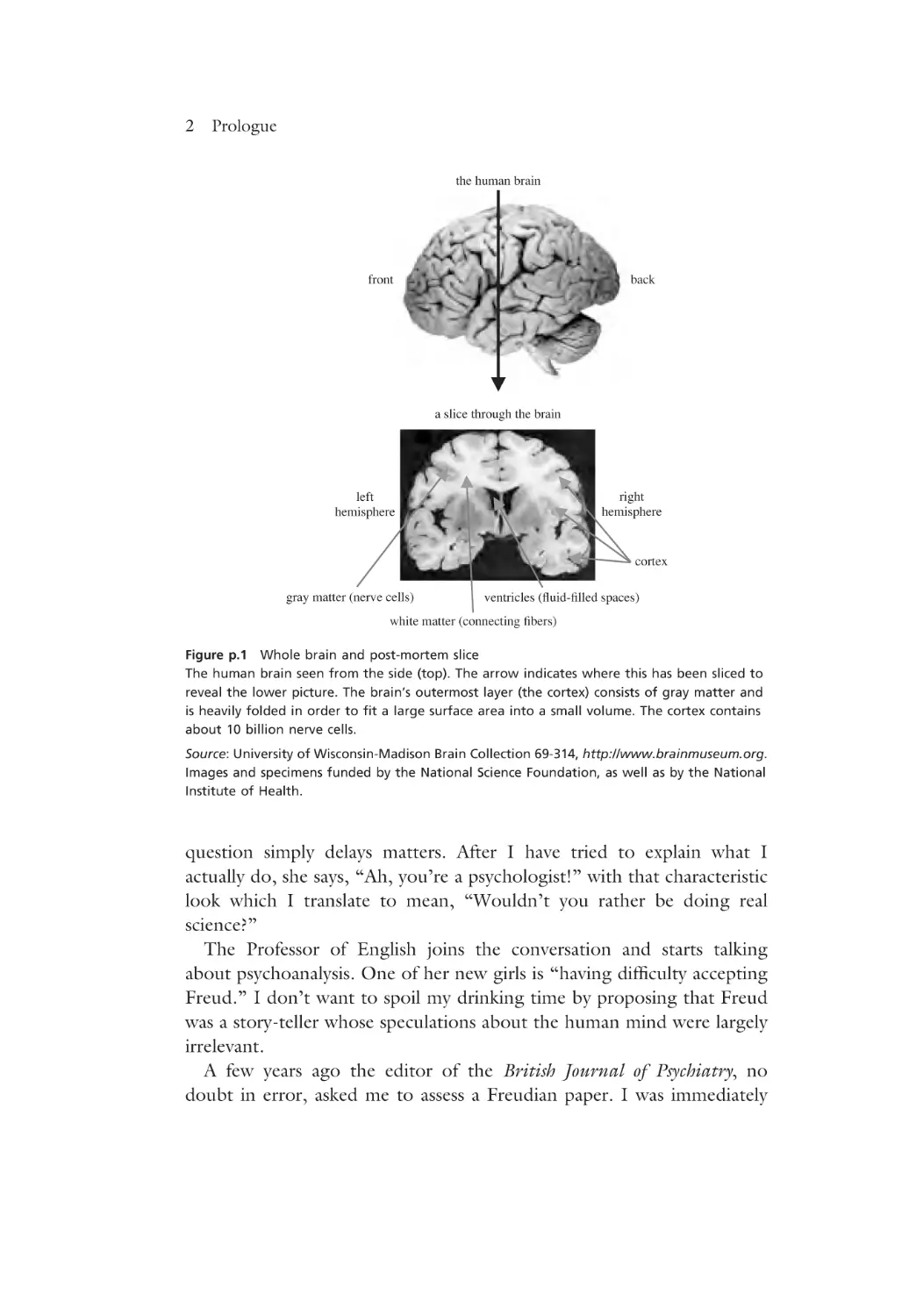
Figure p.1 Whole brain and post-mortem slice
The human brain seen from the side (top). The arrow indicates where this has been sliced to
reveal the lower picture. The brain’s outermost layer (the cortex) consists of gray matter and
is heavily folded in order to fit a large surface area into a small volume. The cortex contains
about 10 billion nerve cells.
Source: University of Wisconsin-Madison Brain Collection 69-314, http://www.brainmuseum.org.
Images and specimens funded by the National Science Foundation, as well as by the National
Institute of Health.

question simply delays matters. After I have tried to explain what I
actually do, she says, “Ah, you’re a psychologist!” with that characteristic
look which I translate to mean, “Wouldn’t you rather be doing real
science?”
The Professor of English joins the conversation and starts talking
about psychoanalysis. One of her new girls is “having difficulty accepting
Freud.” I don’t want to spoil my drinking time by proposing that Freud
was a story-teller whose speculations about the human mind were largely
irrelevant.
A few years ago the editor of the British Journal of Psychiatry, no
doubt in error, asked me to assess a Freudian paper. I was immediately

Prologue 3

struck by a subtle difference from the papers I usually assess. As in any
scientific paper, there were lots of “references.” “References” refer to
papers already published on the same topic. We make these references
partly to acknowledge the work of our predecessors, but mainly to support the claims we make in our own paper. “Don’t just take my word
for it. You will find my methods fully justified in Box & Cox (1964).”2
But no attempt was made to support the evidence in the Freudian paper.
The references were not about the evidence. They were about the ideas.
Using these references you could trace the development of these ideas
through the various followers of Freud back to the original words of the
master himself. No evidence was presented as to whether the ideas of
the master were right.
“Freud may have had a big influence on literary criticism,” I say to the
Professor of English, “but he was no scientist. He wasn’t interested in
evidence. I study psychology scientifically.”
“So,” she replies, “you use the monster of mechanical reason to kill off
our humanity.”3
From both sides of the cultural divide I get the same response,
“Scientists can’t study the mind.” So what’s the problem?

Hard Science and Soft Science
In the dominance hierarchy of science, the top sciences are “hard” while
those at the bottom are “soft.” “Hard” doesn’t mean that the science is
more difficult. “Hard” relates to the subject matter of the science and
the sort of measurements that can be made. Hard things like diamonds
have definite edges that can be measured precisely. Soft things like ice
creams have edges that are ill defined and may vary from one measurement to the next. The hard sciences, such as physics and chemistry, study
tangible things that can be measured very precisely. For example, the
speed of light (in a vacuum) is exactly 299,792,458 meters per second.
An atom of iron is 55.405 times heavier than an atom of hydrogen.
These numbers are very important. From the atomic weights of the

2
Believe it or not, this is a genuine reference to an important statistical method, which
you will find at the end of the book.
3
She is a specialist in the works of the Australian novelist Elizabeth Costello.

4

Prologue

various elements the periodic table could be constructed providing the
first clues about the sub-atomic structure of matter.
Biology used to be a rather softer science than physics and chemistry,
but this changed dramatically with the discovery that genes consist of
precise sequences of base pairs in DNA molecules. For example, the sheep
prion gene has 960 base pairs, starting ctgcagactttaagtgattcttacgtgggc,
etc., etc.
Confronted with this precision of measurement, I have to admit that
psychology is very soft. The most famous number in psychology is 7,
the number of items that can be held in working memory.4 But even
this number has to be qualified. The title of the original paper written
by George Miller in 1956 was “The Magical Number Seven, Plus or
Minus Two.” So the best measurement that psychologists have come
up with can vary by nearly 30%. The number of items you can hold in
working memory varies from time to time and from person to person.
I will remember fewer numbers if I am tired or anxious. As an English
speaker I can remember more numbers than a Welsh speaker.5 “What
did you expect?” says the Professor of English. “You can’t pin down
the human mind like a butterfly in a display case. Each one of us is
different.”
This remark misses the point. Of course each one of us is different. But
there are also properties of the mind that are common to us all. It is
these fundamental properties that psychologists are trying to discover.
Chemists had exactly the same problems with the rocks they were studying before the discovery of the chemical elements in the 18th century.
Every rock was different. In comparison with the “hard” sciences, psychology has had little time to discover what to measure or how to
measure it. Psychology has existed for just over 100 years as a scientific
discipline. I am confident that, in time, psychologists will have discovered
what to measure and will have developed the instruments that will help
us to make these measurements very precisely.

4

Working memory is a form of active short-term memory. This is the kind of memory we
use when we try to keep a telephone number in mind without writing it down. Psychologists and neuroscientists have studied working memory intensively, but have yet to reach
agreement about precisely what it is they are studying.
5
This statement does not reveal some anti-Welsh prejudice, but refers to one of the many
important discoveries psychologists have made about working memory. Welsh speakers
remember fewer numbers because sequences of numbers in Welsh take longer to say than
their English equivalents.

Prologue 5

Hard Science – Objective;
Soft Science – Subjective
These are optimistic words justified by my belief in the inexorable progress
of science.6 The problem is that, for psychology, this optimism may not
be justified. There is something fundamentally different about the things
we are trying to measure.
The measurements made by the hard sciences are objective. They can
be checked. “You don’t believe that speed of light is 299,792,458 meters
per second? Here’s the equipment. Measure it yourself.” Once we have
used the equipment to make the measurement, the numbers come from
dials and print-outs and computer screens that anyone can read. But
psychologists use themselves or their volunteers as measuring instruments. These measurements are subjective. They cannot be checked.
Here is a simple psychological experiment. I program my computer to
display a field of black dots that moves continuously downward from the
top to the bottom of the screen. I stare at the screen for a minute or two.
Then I press escape and the dots stop moving. Objectively the dots are
no longer moving. If I place the point of my pencil on top of one of the
dots, I can check that it is definitely not moving. But I have the very
strong subjective impression that the dots are moving slowly upward.7 If
you came into the room at that moment, you would see the stationary
dots on the screen. I would tell you that the dots seemed to be moving
upward, but how can you check this? The movement is only happening
in my mind.
Of course, everyone can experience this illusion of movement. If you
stared at the moving dots for a minute or two, then you would also see
movement in the stationary dots. But now the movement is in your mind
and I can’t check it. And there are many other experiences that we
cannot share. For example, I could tell you that, whenever I go to a
party, I find myself remembering the face of the professor with whom I
argued about Freud. What sort of an experience is this? Do I really have
an image of her face? Do I remember the event, or do I just remember

6

This belief is not shared by the Professor of English
This phenomenon is known as the waterfall illusion or the motion after-effect. If you
stare at a waterfall for a minute or two and then look at the bushes to the side, you will get
the distinct impression that the bushes are moving upward, even though you can also see
that they are clearly staying in the same place.
7

6

Prologue

writing about the event? Such experiences can never be checked. How
can they be the basis of scientific study?
A real scientist wants to make her own, independent check on the
measurements reported by someone else. “Nullius in verba” is the motto
of the Royal Society of London: “Don’t believe what people tell you,
however authoritative they may be.”8 If I followed this principle, then
I would have to agree that the scientific study of your mental life is
impossible because I rely on your report of your mental experience.
For a while psychologists pretended to be real scientists by studying
only behavior: making objective measurements of things like movements
and button-presses and reaction times.9 But studying behavior is never
enough. It misses out on everything that is interesting about human
experience. We all know that our mental life is just as real as our life in
the physical world. Rejection by the one we love causes as much pain
as a burn from a hot oven.10 Mental practice can cause improvements
in performance that can be measured objectively. For example, if you
imagine playing a particular piece on the piano, then your performance will improve. So why can’t I accept your report that you were
imagining playing the piano? Now we psychologists are back studying
subjective experiences: perceptions, recollections, intentions. But the
problem remains: The mental things that we study have a completely
different status from the material things that other scientists study. The
only way I can know about the things in your mind is because you
tell me about them. You press a button to tell me when you see the red
light. You tell me precisely what shade of red it is. But there is no way
I can get into your mind and check the redness of your experience.
For my friend Rosalind, numbers have special positions in space and
days of the week have special colors (see Figure CP1, color plate section).
But aren’t these just metaphors? I don’t have such experiences. Why
should I believe her when she says these are direct sensory experiences
that she cannot control? Her experiences are examples of something in
the mental world that I can never check.
8

Nullius addictus iurarae in verba magistri: “I am not bound to swear allegiance to the
word of any master.” Horace, Epistulae.
9
These were the behaviourists, of whom the most famous advocates were John Watson
and B.F. Skinner. The fervor with which they promoted their approach hints at its unsatisfactory nature. One of my tutors at college was an ardent behaviorist who later became a
psychoanalyst.
10
Indeed, brain imaging studies suggest that physical pain and the pain of social rejection
involve the same brain regions.

Prologue 7

Can Big Science Save Soft Science?
Hard science becomes big science when the measuring instruments used
are very expensive. Brain sciences became big when brain scanners were
developed in the last quarter of the 20th century. A brain scanner typically costs over £1000,000. By pure luck, by being in the right place at
the right time, I was able to use these machines as soon as they became
available in the mid-1980s.11 The first machines were based on the longestablished principle of the X-ray. The X-ray machine can show you the
bones inside your body because bones are much more solid (dense) than
skin and flesh. Few X-rays get through the bone, but many get through
the flesh. This variation in density is also found in the brain. The bony
skull around the brain is very dense; the brain tissue itself is much less
dense, like flesh. In the middle of the brain are spaces (the ventricles)
that are filled with liquid, so that these spaces are the least dense of
all. The breakthrough came with the development of the technique of
computerized axial tomography (CAT) and the construction of the CAT
scanner. This machine uses X-rays to measure density and then solves
a very large number of mathematical equations (needing a powerful
computer) to construct a three-dimensional image of the brain (or any
other part of the body) showing the variations in density. For the first
time it was possible to see the internal structure of the brain in a living
volunteer.
A few years later an even better technique was developed called
magnetic resonance imaging (MRI). This technique does not use X-rays,
but radio waves and a very strong magnetic field.12 Unlike X-rays, this
procedure poses no risk to health. The MRI scanner is far more sensitive
to differences in density than the CAT scanner is. The pictures it produces distinguish between different kinds of brain tissue. These pictures
of the living brain are of the same quality as a photograph of a brain after
death that has been removed from the skull, preserved with chemicals,
and cut into slices.
11
The decision of the Medical Research Council to close down the Clinical Research
Centre where I had worked for many years on the problem of schizophrenia gave me the
impetus to risk a major change in my career as a psychologist. Subsequently both the MRC
and the Wellcome Trust have shown great foresight in their support for the new brain
imaging technology.
12
No, I don’t really understand how MRI works, but here is a physicist who does. J.P.
Hornak, “The Basics of MRI,” http://www.cis.rit.edu/htbooks/mri/index.html.

8

Prologue

Figure p.2 Example of structural scan (MRI) alongside photo of a post-mortem brain slice
The upper picture shows a brain that has been removed from the skull after death and
sliced. The lower picture has been acquired from a living volunteer using magnetic
resonance imaging (MRI).
Source: Functional Imaging Laboratory; thanks to Chloe Hutton.

Structural brain imaging has had an enormous impact on medicine.
Brain damage, whether caused by a road accident, a stroke, or the growth
of a tumor, can have dramatic effects on behavior. There might be severe
loss of memory or a dramatic change in personality. Before brain scanners

damage

Figure p.3 Example of MRI scan revealing brain lesion
This patient had the misfortune to experience two successive strokes which destroyed his left
and right auditory cortex. The damage can clearly be seen in the magnetic resonance image.
Source: Figure 2 in: Engelien, A., Huber, W., Silbersweig, D., Stern, E., Frith, C.D., Doring, W.,
Thron, A., & Frackowiak, R.S. (2000). The neural correlates of “deaf-hearing” in man:
Conscious sensory awareness enabled by attentional modulation. Brain, 123(Pt. 3), 532–545.
Used with permission.

Prologue 9

existed the only way to discover exactly where the brain damage had
occurred was to open up the skull and look. This was mainly done after
death, but occasionally in life when neuro-surgery was required. Brain
scanners can now precisely locate the damage. All the sufferer has to do
is lie still in the scanner for about 15 minutes.
Structural brain imaging is hard science as well as big science. The
measurements of brain structure based on these techniques can be very
precise and objective. How are such measurements relevant to the problem with psychology?

Measuring Mental Activity
Help for the problem with psychology did not come from the structural
brain scanners. It came from the functional brain scanners that were
developed a few years later. These scanners detect the energy consumed
by the brain. Whether we are awake or asleep, the 10 billion nerve cells
(neurons) in our brain are continuously sending messages to each other.
This activity uses up energy. Indeed our brain consumes about 20% of
our body’s energy even though the brain is only 2% of our body in terms
of its weight. There is a network of blood vessels throughout the brain
through which energy can be distributed in the form of oxygen carried in
the blood. This energy distribution is finely tuned so that more energy is
sent to the region of the brain that is currently most active. If we are
using our ears, then the most active part of the brain will be two regions
at the side where neurons receive messages directly from the ears (see
Figure CP2, color plate section). When the neurons in this region are
active, there will also be greater local supply of blood. This relationship
between brain activity and local changes in blood flow was known to
physiologists for more than 100 years, but it was not possible to detect
the changes in blood flow until brain scanners were invented.13 The
functional brain scanners (positron emission tomography, PET and functional magnetic resonance imaging, fMRI) detect these changes in blood
supply that indicate which region of the brain is currently most active.
The major disadvantage of brain scanners is the discomfort experienced by the person being scanned. You have to lie flat on your back for
an hour or so, keeping as still as possible. There is very little you can
13

In 1928 someone was found who had an abnormality in the blood supply to the back
of his brain. It was possible to hear the change in blood flow in the visual area of his brain
as he opened and closed his eyes.

10

Prologue

A few nerve cells
with their fibers

nerve cell
bodies

connecting
fibers

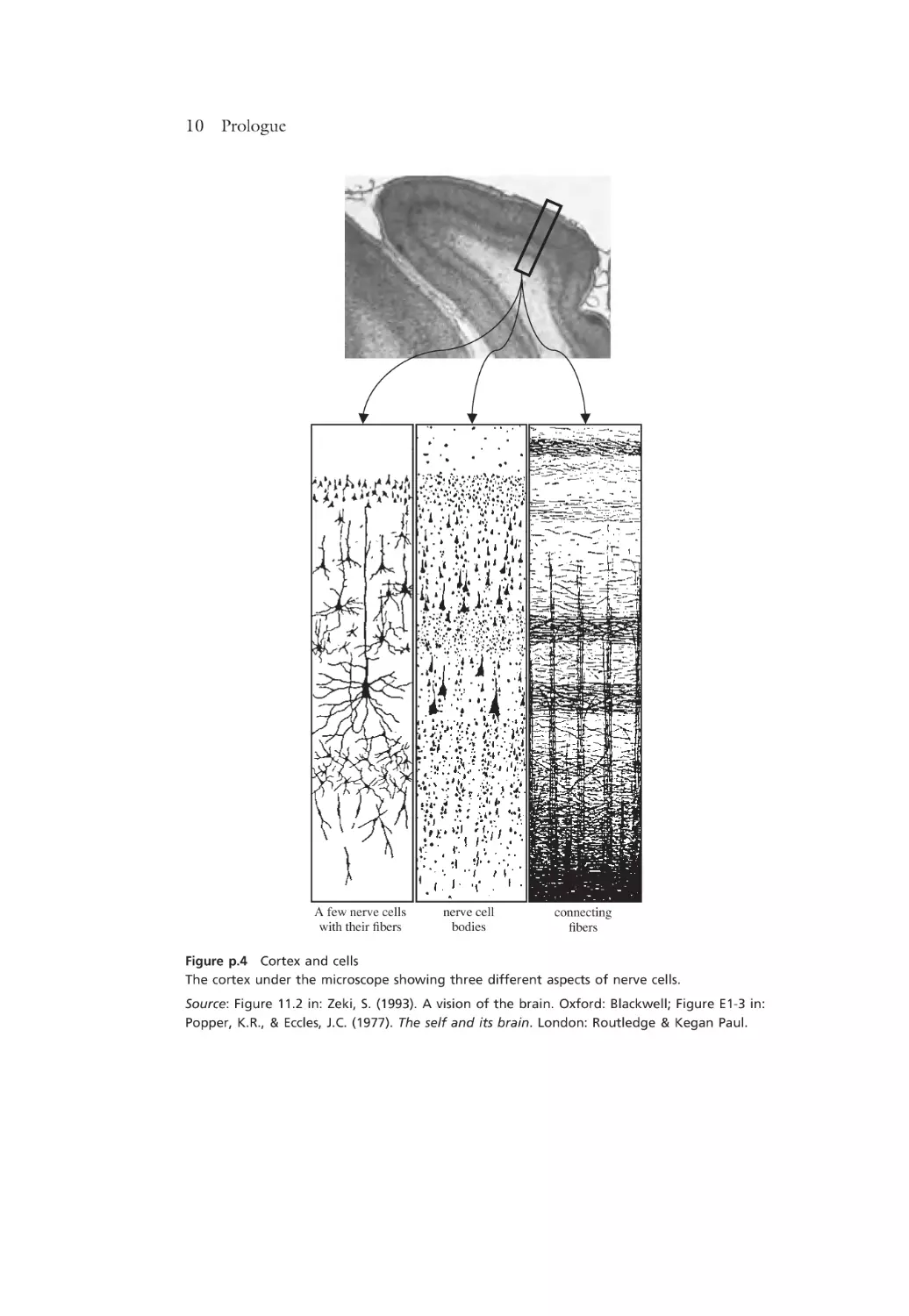
Figure p.4 Cortex and cells
The cortex under the microscope showing three different aspects of nerve cells.
Source: Figure 11.2 in: Zeki, S. (1993). A vision of the brain. Oxford: Blackwell; Figure E1-3 in:
Popper, K.R., & Eccles, J.C. (1977). The self and its brain. London: Routledge & Kegan Paul.

Prologue 11
The lateral (outer) surface
of the left hemisphere

The medial (inner) surface
of the right hemisphere

parietal lobe

frontal lobe

frontal lobe

parietal lobe

occipital
lobe

occipital
lobe

temporal lobe

temporal lobe
cerebellum

brain stem
motor cortex

6

8

motor cortex

4

6

5
9

24
33

3/1/2

48
10

47
38

41
42
22

18 17

11

12

37

26
29
27
35

25

18

30

17

34

18
28

38

21

36

37

19

20

20

auditory cortex

19

22
19

43

7
31

23

10

39

44

45
11

40

31
2
5

4

8

7

9

cerebellum

brain stem

visual cortex

visual cortex

Figure p.5 Brain regions and subdivisions
The upper pictures show the major brain regions.
The lower pictures show subdivisions of the cortex according to Brodmann (cerebellum and
brain stem removed). Brodmann’s subdivisions are based on the appearance of the cortex
under the microscope. His numbers are arbitrary.

actually do in a scanner except think, and even that is difficult with fMRI
since the noise it makes is equivalent to someone operating a small
pneumatic drill next to your head. In one of the very early, pioneering
studies using a primitive form of PET scanner, volunteers were asked to
imagine leaving their house and then to imagine turning left at every
street corner they came to.14 This purely mental activity was quite sufficient to activate many brain areas.
14

This pioneering work occurred in Scandinavia. David Ingvar and Niels Lassen developed the earliest form of functional brain scanning for people. In the first study they
injected radioactive material into each other’s carotid arteries! Subsequently Per Roland
used a more volunteer-friendly version of this technique to look at brain activity when
people imagined walking from their house.

12

Prologue

Figure p.6 A volunteer lying in a brain scanner
Source: Functional Imaging Laboratory; thanks to David Bradbury.

And this is where big science comes to the aid of soft psychology.
The person in the scanner imagines he15 is walking along the street. He
is not actually moving or seeing anything. These events are only in his
mind. I have no way of getting into his mind to check that he is really
doing what he was asked to do. But by using the scanner I can get into
his brain. And I can see that his brain shows a particular pattern of
activity when he imagines walking along the street and turning left.
Of course, most brain imaging studies are much more objective.
Real lights are flashed in the volunteer’s eyes and the volunteer presses
buttons to show that he is making real finger movements. But I (and a
few others) have always been more interested in the brain activity associated with purely mental events. We have found that when a volunteer
imagines that he is pressing a button, then the same brain areas become
active as when he is really pressing a button. If we had no brain scanner,
there would be absolutely no objective sign that our volunteer was
imagining pressing a button. We check that there are no tiny finger
15

Seeing the glint in the eye of the Professor of English, I must quickly state that this is
not sexist. The early functional imaging studies used PET rather than fMRI. With this
technique the volunteer is injected with small amounts of radioactive material. Because of
the health risks, most of these studies were restricted to men, or young, right-handed male
students, to be more precise.

Prologue 13

moving
the right hand

imagining
moving
the right hand

high brain slice

middle brain slice

Figure p.7 Brain images of real movement and imaginary movements
Top figures show positions (high and middle) of the brain cross-sections made to reveal
activity. Upper cross-sections show the activity when you move your right hand; lower ones
show the activity when you imagine moving it.
Source: Redrawn from Figures 1 and 3 in: Stephan, K.M., Fink, G.R., Passingham, R.E.,
Silbersweig, D., Ceballos-Baumann, A.O., Frith, C.D., Frackowiak, R.S. (1995). Functional
anatomy of the mental representation of upper extremity movements in healthy subjects.
Journal of Neurophysiology, 73(1), 373–386. Used with permission.

movements or twitches of the muscles. We assume that he is following
our instructions to imagine that he is pressing the button every time
he hears the signal. By measuring brain activity, we have an objective
confirmation of these mental events. By using a brain scanner, I could
probably tell whether you were imagining moving your finger or your
foot. But, as yet, I probably could not tell which finger you were thinking about.

14

Prologue
see

imagine

activity in
parahippocampal
place area

activity in
fusiform face area

Figure p.8 Imagining faces and houses
The brain is seen from underneath showing areas that respond differentially to faces and
places. The drawing on the right shows that activity in the face area increases when you see
a face or when you imagine a face. The same effect is also seen for the place area.
Source: Redrawn from Figure 3 in: O’Craven, K.M., & Kanwisher, N. (2000). Mental imagery
of faces and places activates corresponding stimulus-specific brain regions. Journal of
Cognitive Neuroscience, 12(6), 1013–1023.

I could do even better by studying vision. Nancy Kanwisher and her
group at MIT have shown that when you look at a face (any face) a
particular region of the brain consistently becomes active, whereas when
you look at a house (any house) another nearby brain region becomes
active.16 If you ask people to imagine the face or the house they have
seen a few seconds before, the same brain regions become active. The
location of the brain activity indicates whether the person is thinking
about a face or a house. If I am lying in her scanner, Dr Kanwisher can
tell me what I am thinking about (as long as I only think about faces or
houses).
16
An area of the brain that responds specifically to faces was first reported by Aina Puce
and colleagues in 1995. Subsequently Nancy Kanwisher confirmed this observation, coining the term fusiform face area (FFA) and, later, parahippocampal place area (PPA).

Prologue 15

So the problem with psychology is solved. We no longer need to
worry about these soft, subjective accounts of mental life. We can make
hard, objective measurements of brain activity instead. Perhaps now I can
admit that I am a psychologist.
Back at the party I can’t restrain myself from telling them all about the
big science of brain imaging. The physicist quite likes this new development in psychology. After all without physicists it would never have
happened. But the Professor of English doesn’t accept that studying
brain activity can tell you anything about the human mind.
“You used to think of the mind as a camera. Now you think of it as a
computer. Even if you can see inside this computer, you still have the
same tired metaphor. Computers are certainly cleverer than cameras.
Maybe computers can recognize faces and pick up eggs with their robot
arms.17 But they will never think of new ideas and communicate them to
other computers. They will never create a computer culture. This is
beyond the reach of mechanical reasoning.”
I move off to refill my glass. I don’t argue. I am not a philosopher. I
do not expect to persuade people of truth by the power of argument.
The only arguments I accept come from practical experiments. I have to
show how the impossible can be done.

How Can the Mental Emerge from the Physical?
Of course it is nonsense to think that we can just measure brain activity
and forget about the mind. Brain activity can indicate that mental activity
is occurring and, to that extent, provides an objective marker of subjective experience. But brain activity is not the same as mental experience.
With the right equipment I could probably find a neuron in my brain
that only responds when I experience the color blue. But, as the Professor
of English would delight in telling me, the activity isn’t blue. What the
brain imaging experiments reveal so starkly is the seemingly unbridgeable
gap between objective physical matter and subjective mental experience.
The hard sciences are concerned with material objects that can directly
affect our senses. We can see light. We can feel the weight of a lump of
iron. Hard sciences often involve hard physical work with the material
being studied. Marie Curie is the romantic model for such a scientist,
allegedly handling several tons of pitchblend in order to extract one17

In fact computers are not very good at recognizing faces or picking up objects.

16

Prologue

tenth of a gram of radium. It was her hard physical work that led to the
identification of radium, the medical use of X-rays, and, ultimately, the
development of brain scanners. Of course, special instruments have been
developed to help us make accurate measurements when we are dealing
with very rare elements like radium, very small things like the base pairs
in gene sequences, or very fast things like light. But these special instruments are, like magnifying glasses, simply extensions of our senses. They
help us to see what is really there. No such instrument can help us see
what is happening in the mind. The contents of the mind are not real.

I Can Read Your Mind
And then finally at the party comes the inevitable interaction that I fear
most of all. This time the question comes from a cocky young man with
no tie, probably a molecular geneticist.
“You’re a psychologist? So can you can read my mind?”
He must be clever. How can he say such a stupid thing? He just says
it to annoy me.
Only very recently did I come to realize that I was the stupid one. Of
course I can read people’s minds. And it’s not just psychologists who can
do this. We all read each other’s minds all the time. How else are we able
to exchange ideas and create culture? But how do our brains enable us to
enter those private worlds hidden in the minds of others?
I can see the edges of the universe with a telescope and I can see the
activity in your brain with a scanner, but I can’t “see” into your mind.
The mental world, we all believe, is quite distinct from physical reality.
And yet in everyday life we are at least as much concerned with other
minds as we are with physical reality. Most of our interactions with other
people are interactions between minds, not between bodies. You are
learning about my mind by reading this book. I am hoping to change the
ideas in your mind by writing this book.

How the Brain Creates the World
So is this the problem for psychologists? We try to study mental life
and mental events, while “real” science is concerned with the physical
world? The physical world is utterly different from the mental world. We
have direct contract with the physical world through our senses. But the

Prologue 17

mental world is private to each one of us. How can such a world be
studied?
In this book I shall show that this distinction between the mental
and the physical is false. It is an illusion created by the brain.
Everything we know, whether it is about the physical or the mental
world, comes to us through our brain. But our brain’s connection
with the physical world of objects is no more direct than our brain’s
connection with the mental world of ideas. By hiding from us all
the unconscious inferences that it makes, our brain creates the illusion that we have direct contact with objects in the physical world.
And at the same time our brain creates the illusion that our own
mental world is isolated and private. Through these two illusions
we experience ourselves as agents, acting independently upon the
world. But, at the same time, we can share our experiences of the
world. Over the millennia this ability to share experience has created
human culture that has, in its turn, modified the functioning of
the human brain.18
By seeing through these illusions created by our brain, we can
begin to develop a science that explains how the brain creates the
mind.
“But don’t expect me just to believe what you say,” says the Professor
of English. “Show me the evidence.”
And I promise her that, throughout this book, everything I say will
be supported by rigorous experimental evidence. If you wish to check the
sources for this evidence, you will find them laid out at the end of the
book.

18

The letters used to write English are very ambiguous. There are 1,120 ways of representing 40 sounds in English. There are only 33 ways to represent 25 sounds in Italian. As
a result, people brought up in English-speaking countries use slightly different brain areas
for reading than people brought up in Italy.

Part I
Seeing through the
Brain’s Illusions

Chapter 1
Clues from a
Damaged Brain

Sensing the Physical World
Chemistry was my worst subject at school. The only bit of science I
remember from those lessons was a trick to use in practicals. You are
confronted with a lot of little dishes of white powder that you are supposed to identify. Try tasting them. The one that tastes sweet is lead
acetate. Just don’t taste too much of it.
This is the ordinary person’s approach to chemistry, usually applied to
the contents of those jars at the back of the kitchen cupboard. If you
can’t tell what it is by looking at it, then try tasting it. This is how we
find out about the physical world. We explore it with our senses.
It follows that, if your senses are damaged, then your ability to explore
the physical world will be reduced. You are probably short-sighted.1 If
I ask you to take your glasses off and look around, you will no longer
be able to identify small objects that are more than a few feet away.
This observation is not very surprising. It is our sense organs, eyes, ears,
tongue, etc., that provide the link between the physical world and our
minds. Just like a video recorder, our eyes and ears pick up information2
about the physical world and transmit it to our minds. If our eyes or
ears are damaged, then the information can no longer be transmitted
properly. It will not be so easy for us to find out about the world.
The problem becomes more interesting when we start to wonder how
the information gets from the eyes to the mind. Let us for the moment
1

About one third of the general population is short-sighted. But short-sightedness is even
more frequent in people like you who do a lot of reading and are of high intelligence.
2
The development of a method of measuring information was of major importance in the
development of computers and in the understanding of brain function (see Chapter 5).

22

Seeing through the Brain’s Illusions
Light

Optic
nerve
fibers
Ganglion
cells

Bipolar
cells

Rods

Nervous
tissue
layer

Photoreceptors

Cone

Figure 1.1 The retina, where light creates brain activity
The retina at the back of the eye contains large number of special neurons (photo-receptors)
that become active when struck by light. In the middle of the retina (the fovea) are the
cones. There are three kinds of cone that are activated by different wavelengths of light
(corresponding to red, green, and blue). Around the fovea are the rods that respond to dim
light of any color. All theses cells send signals via the optic nerve to the visual cortex.
Source: Prof. W.S. Stark, Biology, St. Louis University, Missouri.

suppress our worry about how electrical activity in a photo-receptor in
the eye3 gets turned into a mental experience of color and simply note
that the information from my eye (and ear and tongue, etc.) goes to my
brain. It follows that damage to my brain can also reduce my ability to
find out about the physical world.

The Mind and the Brain
Before we explore how brain damage can affect our experience of the
world, we need to worry a bit more about the relationship between the
mind and the brain. The relationship must be close. As we discovered in
the Prologue, if I decide to think about a face, then a specific “face” area
3

Light has to pass through various blood vessels before it reaches the light-sensitive cells
in the retina. We are not aware of all these blood vessels that we have to look through in
order to see the world outside. But they may be the origin of the “pink elephants”
supposedly seen by some heavy drinkers.

Clues from a Damaged Brain 23

in my brain will become active. In this example, knowing about the
contents of my mind has enabled me to predict which brain area will be
active. As we shall discover in a moment, damage to the brain can have
profound effects on the mind. Indeed, knowing where the brain has
been damaged enables me to predict the contents of the person’s mind.
But the relationship between brain and mind is not perfect. It is not
one-to-one. There can be changes in the activity in my brain without
any changes in my mind. On the other hand I firmly believe that there
cannot be changes in my mind without there also being changes in
brain activity.4 This is because I believe that everything that happens
in my mind (mental activity) is caused by, or at least depends upon,
brain activity.5
So, if my belief is correct, the chain of events would be something like
this. Light strikes the sensory receptors in my eye causing the receptors
to send messages to brain. This mechanism is pretty well understood.
Then the activity in the brain somehow creates the experience of color
and shape in my mind. This mechanism is not understood at all. But,
whatever the mechanism, we can conclude that my mind can have no
knowledge about the physical world that isn’t somehow represented in
the brain.6 I can only know about that world through my brain. So
perhaps the question we should be asking is not, “How do I (or how
does my mind) know about the physical world?” Instead we should ask
“How does my brain know about the physical world?”7 By asking the
question about the brain, rather than the mind, I can put off for a
moment the problem of how knowledge about the physical world gets
into my mind. Unfortunately this trick doesn’t really work. The first
4

I am not a dualist.
I am a materialist. But I admit that I sometimes sound like a dualist. I talk of the brain
“not telling me everything it knows” or “deceiving me.” I use such phrases because this is
what the experience is like. Most of what my brain does never reaches my consciousness.
This is the stuff that my brain knows about, but I don’t. On the other hand I am firmly
convinced that I am a product of my brain, as is the awareness that accompanies me.
6
Neurophysiologists often talk of activity in neurons “representing” something outside in
the physical world. For example, neurons can be found that only become active when the
eye is stimulated by red light. Activity in such a neuron is said to represent the color red. It
has even been claimed that activity in certain neurons at the front of the brain “represents
to-be-attended information.”
7
The Professor of English doesn’t like this formulation. “Does the brain ‘know’ things?
Only minds can know things. An encyclopedia contains information about the world, but
we would not say that the encyclopedia knows about the world. Is the brain like an
encyclopedia with activity in neurons replacing letters on a page? If so, who reads it?”
5

24

Seeing through the Brain’s Illusions

thing I would do if I wanted to find out what your brain knew about the
outside would be to ask you, “What can you see?” I am using your mind
to find out what’s represented in your brain. As we shall see, this method
doesn’t always work.

When the Brain Doesn’t Know
Of all the sensory systems in the brain, we know most about the visual
system.8 The visual world is first represented in the neurons at the back
of the retina. Just as in a camera, the image is upside-down and mirrorreversed, so that neurons at the top left of the retina represent the
bottom right of the visual scene. The retina sends signals to the primary
visual cortex (V1) at the back of the brain via the thalamus, a sensory
relay station in the middle of the brain. The neurons conveying the signal
partially cross over, so that the left side of each eye is represented in
the right half of the brain, and vice versa. The “photographic” image is
retained in the primary visual cortex,9 so that neurons at the top left of
the cortical area represent the bottom right of the visual scene.
The effect of damage to the primary visual cortex depends upon where
the damage occurs. If the top left region of the visual cortex is damaged,
then the sufferer will experience a blank area in the bottom right of the
visual scene. In this part of the visual field they are blind.
Some people who suffer from migraines experience brief periods in
which part of the visual field goes blank due to a temporary reduction of
blood supply to the visual cortex. The experience often starts with a small
blank area that gradually gets larger and larger. The blank area is often
edged by flashing zig-zag lines described as fortifications.
Before information in the primary visual cortex is passed on to the next
processing stage in the brain, the visual scene is deconstructed into different features such as shape, color, and motion. These different features
are passed on to different brain areas. In rare cases damage can occur to
brain regions concerned with just one of these specific features while all
other areas remain intact. If the color area (V4) is damaged, then the
sufferer sees the world drained of color (achromatopsia). Since we have
8
If you want to learn more about the visual system of the brain, read Semir Zeki’s book
A Vision of the Brain.
9
This is called a retinotopic representation since activity in particular neurons represents
light hitting a particular part of the retina. This means that whenever I move my eyes, the
pattern of activity in the primary visual cortex will change dramatically. But I don’t see the
world changing.

Clues
from
left visual
field

a Damaged Brain 25

eye ball

optic nerve
optic chiasm

optic tract
lateral
geniculate
nucleus
optic radiation

left hemisphere
primary visual cortex

Figure 1.2 How neural activity gets from the retina to the visual cortex
Light from the left side of the visual field goes to the right hemisphere. The brain is seen
from underneath.
Source: Figure 3.3 in: Zeki, S. (1993). A vision of the brain. Oxford, Boston: Blackwell
Scientific Publications.

hemianopia

scotoma

quadrantanopia

Figure 1.3 How damage to the visual cortex affects experience
Damage to the visual cortex causes blindness in specific regions of the visual field. Loss of
the whole of the right visual cortex causes blindness in the left visual field (hemianopia).
Loss of a small area in the lower right visual cortex causes a spot of blindness in the upper
left visual field (scotoma). Loss of the whole of the lower right visual cortex cause blindness
in the upper right visual field (quadrantanopia).
Source: From figure 3.7 in: Zeki, S. (1993). A vision of the brain. Oxford, Boston: Blackwell
Scientific Publications.

26

Seeing through the Brain’s Illusions

0 minutes

3 minutes

7 minutes

10 minutes

Figure 1.4 The development of a migraine, described by Karl Lashley
At the beginning of his migraine an area of blindness appeared near the middle of his visual
field and then slowly increased in size.
Source: Lashley, K. (1941). Patterns of cerebral integration indicated by scotomas of migraine.
Archives of Neurological Psychiatry, 46, 331–339.

all seen black and white films and photographs, this experience is not too
difficult to imagine. It is more difficult to imagine the world of someone
with damage to the visual movement area (V5). From one moment to
the next, objects, such as cars, will appear in different positions – but
they don’t appear to move (akinetopsia). This experience must be something like the opposite of the waterfall illusion that I mentioned in the
Prologue. In that illusion, which we can all experience, objects stay in the
same place from one moment to the next, but we still see movement.
At the next stage of visual processing, information from features such
as shape and color is recombined in order to recognize the objects in
the visual scene. The brain regions where this occurs can sometimes be
damaged while the earlier visual processing regions remain intact. Some
people with this condition have a general problem recognizing objects.
They can see and describe the various features of the object, but they
don’t know what the object is. This problem is referred to as “agnosia”
or loss of knowledge.10 The basic sensory information is available, but it
can no longer be understood. Sometimes these people have a specific
problem with faces (prosopagnosia). They know it’s a face, but they have
no idea whose face it is. These people have damage to the face area that
I described in the Prologue.
10

The term “agnosia” was introduced by Freud before he got distracted by psychoanalysis.

Clues from a Damaged Brain 27

These observations all seem straightforward. Damage to the brain interferes with the transmission of information picked up by our senses from
the physical world. The effect upon what our mind can know about the
world is determined by the stage in transmission at which the damage
occurs. But sometimes the brain plays tricks on us.

When the Brain Knows, But Doesn’t Tell
It is the dream of every neuropsychologist11 to discover someone who
has such an unusual view of the world that we are forced to reconsider
our ideas about how the brain works. Two things are necessary to discover such a person. First, we have to be lucky enough to meet him or
her. Second, we have to be clever enough to recognize the importance of
what we are observing.
“I’m sure you’re both lucky and clever,” says the Professor of English.
Not so. I was lucky once, but not clever. As a young research worker
at the Institute of Psychiatry in south London, I was studying how
people learn. I was introduced to someone with severe loss of memory.
For a week he visited my lab12 every day in order to learn a simple motor
skill. His performance improved in a fairly normal manner and even after
a gap of a week he retained the new skill he had learned. But, at the same
time, his memory loss was so severe that each day he would claim that
he had never met me before and had never performed the task before.
“How strange!” I thought. But I was interested in problems of motor
skill learning. This man learned the skill I taught him normally and so I
wasn’t interested in him. Many others have, of course, recognized the
importance of people like this. Such people can remember nothing that
has happened to them even if it happened only yesterday. We assumed
that this was because the events that happened were not recorded in
the brain. But, in the person I studied, the experiences he had yesterday
clearly had a long-term effect on his brain since he was able to perform
the motor task better today than yesterday. But this long-term change in
the brain had no effect on his conscious mind. He could not remember
anything that happened yesterday. Such people show that our brain can
know things about the world that our mind does not know.
11

Neuropsychologists study, and sometimes try to help, people who have suffered brain
damage.
12
In the 1960s this was a small bathroom that had been converted into a “laboratory” by
putting a sheet of hardboard over the bath.

28

Seeing through the Brain’s Illusions

Mel Goodale and David Milner made no mistake when they met the
person known as DF. They immediately recognized the importance of
what they were observing. DF had the misfortune to suffer from carbon
monoxide poisoning as the result of a faulty water heater. The poisoning damaged part of the visual system of her brain concerned with the
recognition of shape. She has a vague impression of light, shade, and
color, but cannot recognize anything because she can’t see what shape
it is. Goodale and Milner noticed that she seemed to be able to walk
around and pick things up far better than would be expected given that
she was nearly blind. Over the years they have performed a whole series
of experiments with her. These confirm that there is a big discrepancy
between what she can see and what she can do.
One of Goodale and Milner’s experiments works like this. You hold
up a rod and ask DF about its orientation. She cannot say whether it is
horizontal or vertical or at an angle. It is as if she cannot see the rod and
is just guessing. Then you ask her to reach out and grasp the rod. She
does this normally. She rotates her hand so that her fingers have the same
orientation as the rod. She grasps the rod smoothly whatever its angle.
This observation shows that DF’s brain “knows” about the angle of the
rod and can use this information to control the movements of her hand.
But DF can’t use this information to see the orientation of the rod. Her
brain knows something about the physical world, while her conscious
mind does not.
Very few people have been found with precisely the same problem as
DF. But there are many people with brain damage where the brain plays
similar tricks. Probably the most spectacular dissociation is seen in people
with “blindsight,” a problem associated with damage to the primary
visual cortex. As we already discovered, this damage causes the person to
become blind for part of the visual field. Larry Weiskrantz was the first
to show that, in a few people, this blind area is not truly blind after all.13
In one experiment a spot of light is moved slowly across the part of the
visual field that is blind and the participant is asked to report what he
sees. As far as this participant is concerned, this is an extremely stupid
task. He can’t see anything. So instead he is asked to guess, “Was the
spot moving right or left?” This also seems a fairly stupid task, but the
participant assumes that this eminent Oxford professor knows what he is
doing. Professor Weiskrantz discovered that some people could guess
13
A handful of people with blindsight have now been identified. They have been intensively investigated by a considerably larger number of neuropsychologists.

Clues from a Damaged Brain 29

Brain region for recognizing
objects and the location of
DF’s lesion

Brain region
for grasping
objects

Posting task
correct
orientation
Aligning the
object

Posting the
object
DF

controls

Figure 1.5 Action without awareness
DF has a lesion in the part of her brain necessary for recognizing objects, while the part of
her brain necessary for grasping is intact. She can’t see whether or not the “letter” is lined
up with the slot. But she can orient the “letter” when she posts it through the slot.
Source: Lesion location: Plate 7; posting data: Figure 2.2 in Goodale, M.A. & Milner, A.D.
(2004). Sight unseen. Oxford: Oxford University Press.

much better than chance. In one experiment a participant was correct
more than 80% of the time, while still claiming to see nothing. So, if I
suffered from blindsight, my mind could have absolutely no visual content and yet my brain would know things about the visual world and
could somehow enable me to make accurate “guesses” about that visual
world. What sort of knowledge is this that I don’t know I have?

When the Brain Tells Lies
At least the unknown knowledge of the person with blindsight is correct.
Sometimes brain damage can cause the mind to have information about the
physical world that is completely false. A deaf old lady was woken up in
the middle of the night by loud music. She searched her flat for the source
of the music, but could not find it. Eventually she realized that the music
was only in her mind. Hearing this non-existent music became a nearly

30

Seeing through the Brain’s Illusions

Activity was seen here
during hallucinations of faces
Activity was seen here
during hallucinations of colors
fusiform face area

V4; the color area

Figure 1.6 Spontaneous brain activity associated with blindness (Charles Bonnet syndrome)
causes visual experiences. The nature of the experience depends upon the location of the
activity. The brain is seen from underneath.
Source: Redrawn from data given in: ffytche, D.H., Howard, R.J., Brammer, M.J., David, A.,
Woodruff, P., & Williams, S. (1998). The anatomy of conscious vision: An fMRI study of visual
hallucinations. Natural Neuroscience, 1(8), 738–742.

constant experience for her. Sometimes she heard a baritone voice accompanied by a guitar, sometimes a choir accompanied by a full orchestra.
Vivid auditory and visual hallucinations are experienced by about 10%
of elderly people who suffer from severe hearing or visual loss. The visual
hallucinations, associated with Charles Bonnet syndrome,14 are often just
colored patches or patterns. Sufferers describe very fine golden wire
netting, oval shapes full of brickwork patterns, or fireworks exploding in
vivid colors. Faces and figures are also seen. Faces are usually distorted
and ugly with prominent eyes and teeth. When figures are reported, they
are typically small and wearing hats or period costumes.
There’s heads of 17th-century men and women, with nice heads of hair.
Wigs, I should think. Very disapproving all of them. They never smile.

Dominic ffytche and his colleagues at the Institute of Psychiatry scanned
people with Charles Bonnet syndrome while these hallucinations were
occurring. Just before faces were seen, activity started to increase in the
face area. Likewise activity in the color area started to increase just before
the participant reported seeing a colored patch.
14
The Swiss philosopher Charles Bonnet first described visual hallucinations associated
with visual impairment. He reported his grandfather’s visual experiences and, later, developed
the disorder himself.

Clues from a Damaged Brain 31

How Brain Activity Creates False Knowledge
There are now many studies demonstrating that activity in the brain can
create a false experience of something happening in the outside world.
On example is found with epilepsy. Epilepsy affects about 1 person in
every 200. It is a disorder of the brain in which the electrical activity
in large numbers of neurons sometimes runs out of control, causing a
seizure or “fit.” In many cases the seizure is triggered by activity in a
particular brain region where a small area of damage can sometimes be
located. Uncontrolled electrical activity starts in this region and then
spreads to the rest of the brain.
Just before a seizure occurs, many sufferers start to have a strange
experience known as an “aura.” Sufferers rapidly learn exactly what their
own aura is like and, when it starts, they know that a seizure is about to
occur. The exact nature of the experience differs from one person to the
next. For one person it might be the smell of burning rubber. For
another it might be a buzzing noise. The sensation experienced is related
to the location in the brain where the seizure begins.
In about 5% of people with epilepsy the seizure starts in the visual
cortex. Just before the seizure, simple colored shapes are seen, which
sometimes spin or flash. We can get some idea of what the experience is
like from drawings made by sufferers after the seizure (see Figure CP3,
color plate section).
One, sufferer, Kathryn Mize, wrote a vivid account of the complex
visual hallucinations she experienced in association with seizures brought
on a by an attack of flu. These experiences occurred for several weeks
after the seizures had ceased.
Upon closing my eyes while seated during a lecture, red shimmering geometric forms appeared in the blackness.15 They startled me, but the shapes
were captivating so I watched them in absolute wonder. What I saw with
my eyes closed was fantastic. Vague circles and rectangles would coalesce
into beautiful symmetric geometric forms. There was a constant expansion,
reabsorption and expansion again about these forms. I remember what
seemed like an explosion of black dots in my right field of vision. The dots
gracefully floated outward from their origin and were superimposed upon
a red scintillating backdrop. Two red rectangular planes appeared and
15
A useful trick that anyone can use during boring lectures is to press your knuckles hard
into your eyes. This pressure causes activity in the neurons in the retina, creating shimmering and moving shapes and vivid colors.

32

Seeing through the Brain’s Illusions
moved in opposite directions. A red ball on a stick moved in a circular
fashion beside these planes. Then a red shimmering rippling wave appeared
in the lower field of my vision.

In a few sufferers the seizure starts in auditory cortex and the sufferer will
hear sounds and voices.
Singing, music, voices – maybe voices that I heard in the past – for a while
there I thought it was a specific singer – maybe Buddy Holly . . . it gets
louder and louder and then I just black out.

An aura can sometimes involve complex experiences in which past events
are relived:
[A] girl began to have seizures at the age of 11. [At the beginning of an
attack she would] see herself as a little girl of 7 walking through a field of
grass. Suddenly she felt as though someone from behind was going to
smother her or hit her on the head and she became terrified. The scene was
almost exactly the same on each attack and was clearly based on a real
incident [that had happened to her at the age of 7].

These observations suggest that abnormal neural activity that is associated with an epileptic seizure can cause the sufferer to acquire false
knowledge about the physical world. But to be sure about this conclusion we need to perform a proper experiment in which we control the
neural activity in the brain by direct stimulation.
In some severe cases of epilepsy the seizures can be controlled only
by cutting out the damaged area of the brain. Before cutting out the
damaged area, the neurosurgeon must be sure that removal of this area
will not interfere with some vital function such as speech. The great
Canadian neurosurgeon Wilder Penfield pioneered the technique in
which the sufferer’s brain is stimulated electrically in order to get some
idea of the function of a particular area. This is done by placing the tip
of an electrode on the surface of the exposed brain and passing a very
small current through the brain. The current causes the neurons close to
the electrode to become more active. There is no pain associated with
this technique, and it can be carried out while the participant is fully
conscious.
When the brain is stimulated in this way, people report experiences
very similar to those associated with epileptic seizures. The experience
depends upon where the brain is stimulated

Clues from a Damaged Brain 33

Figure 1.7 Direct stimulation of the brain causes sensory experiences
The upper figure shows the patient prepared for operation with the line of the incision
marked over the left ear.
The lower figure shows the brain surface with numbered tickets indicating the sites of
positive responses to stimulation.
Source: Case 2 (p. 613) from Penfield W., & Perot, P. (1963). The brain’s record of auditory
and visual experience. Brain, 86(Pt. 4), 595–696. By permission of Oxford University Press.

Case 21: He said “Just a minute. Like a figure, on the left side. Seems like
a man or a woman. I think it was a woman. She seemed to have nothing
on. She seemed to be pulling or running after a wagon.”
Case 13: He said, “They are saying something, but I cannot make it out.”
Stimulated at an adjacent site he said, “Yes, it is coming again. It is water,
It sounds like a toilet flushing or a dog barking. The toilet flushed first and
then the dog started to bark.” Stimulated at a third adjacent site he said,
“In my ears there seems to be music. It is a girl or a woman singing, but
I don’t know the tune. It came from a record player or a radio.”
Case 15: When the electrode was applied she said, “I imagine I hear a lot
of people shouting at me.” After stimulation of an adjacent site she said,
“Oh, everybody is shouting at me, make them stop!” She explained, “They
are yelling at me for doing something wrong, everybody is yelling.”

These observations confirm that we can create false knowledge about
the physical world by stimulating the brain directly in the appropriate

34

Seeing through the Brain’s Illusions

region. But in all these cases it was a damaged brain that was being
stimulated. Would the same thing happen with an undamaged brain?

How to Make Your Brain Lie to You
You can’t stick electrodes into people’s brains except in very special
circumstances. But, in all periods and in all cultures, many people have
felt the need to stimulate their brains with various substances. During
such stimulation the brain no longer tells us about the “real” physical
world, but about another place that some believe is better. Like every
one else who was a student in the 1960s, I read Aldous Huxley’s essay
on hallucinogenic drugs, The Doors of Perception. Perhaps my fascination
with that book led to my devoting so much of my subsequent career to
the study of hallucinations?16
Describing the effects of mescalin,17 Huxley said, “This is how one
ought to see, how things really are.” When he closed his eyes he saw
“brightly coloured, constantly changing structures.” Huxley also quotes
from the more detailed account of the effects of mescalin given by Weir
Mitchell.
He saw a host of “star points” and what looked like “fragments of stained
glass”. Then came “delicate floating films of colour”. These were displaced
by an “abrupt rush of countless points of white light,” sweeping across the
field of vision. Next there were zigzag lines of very bright colours, which
somehow turned into swelling clouds of still more brilliant hues. Buildings
now made their appearance, and then landscapes. There were Gothic towers of elaborate design with worn statues in the doorways or on stone
brackets. “As I gazed, every projecting angle, cornice and even the faces of
the stones at their joinings were by degrees covered or hung with clusters

16

There is a striking similarity between the visual hallucinations associated with blindness
in the elderly, epilepsy with a focus in the visual cortex, and drugs such as mescalin and
LSD. How is the same final effect on brain activity achieved by these very different routes?
17
The Mexican cactus Anhalonium Lewini was first introduced to Western science in 1886.
The root of this cactus, known as peyotl, had a major role in the religious ceremonies of the
early inhabitants of Mexico and the American Southwest. Western psychologists discovered
that mescalin, the active principle of this root, had profound effects upon consciousness. In
the 1950s interest in these effects was heightened by the synthesis of the closely related
substance LSD and an increased understanding of how these substances acted upon the
brain. It was widely believed that study of the effects of mescalin and LSD would lead to an
explanation of the symptoms of schizophrenia. It didn’t.

Clues from a Damaged Brain 35

Figure 1.8 The effects drugs can have on visual experiences
Source: By permission of Comité Jean Cocteau.

of what seemed to be huge precious stones, but uncut stones, some being
more like masses of transparent fruit.”

LSD can have very similar effects.
Now, little by little I could begin to enjoy the unprecedented colours
and plays of shapes that persisted behind my closed eyes. Kaleidoscopic,
fantastic images surged in on me, alternating, variegated, opening and then
closing themselves in circles and spirals, exploding in coloured fountains,
rearranging and hybridizing themselves in constant flux.

When the eyes are opened, the appearance of the “real” physical world
can seem strangely altered.
My surroundings had now transformed themselves in more terrifying ways.
Everything in the room spun around, and the familiar objects and pieces of
furniture assumed grotesque, threatening forms. They were in continuous
motion, animated, as if driven by an inner restlessness.18

18

The psychological effects of LSD were discovered by accident in 1943. A small amount
of the drug soaked through the fingers of research chemist Albert Hoffman during a
routine synthesis. During the following weeks he explored the effects of the drug and kept
detailed notes, such as those cited here and in the previous extract.

36

Seeing through the Brain’s Illusions
I noticed that the various creases and ripples in my blanket were moving all
over its surface, as if snakes were crawling around underneath it. I couldn’t
keep track of the individual “ripples” but I could quite clearly see them
moving all over. Suddenly, the ripples began to gather themselves in a
single area of my blanket’s surface.19

Checking the Reality of Our Experiences
I have to conclude that if my brain was damaged or its function was
interfered with by electrical stimulation or drugs I would have to be very
cautious about the knowledge I acquired about the physical world. Some
kinds of knowledge would no longer be available. Some kinds of knowledge might be represented in my brain, but I would not know about
it. Worst of all, some of kinds of knowledge might be false and bear no
relationship to the real physical world.20
Given this problem, my main concern must be to discover how to
distinguish the false experiences from the true ones. Sometimes this is
easy. If I see things when my eyes are closed, then these are visions and
not part of the real physical world. If I hear voices when I am alone in a
soundproof room, then they must be in my mind. I can dismiss these
experiences because I know that my senses must be in contact with the
world in order to acquire any information about it.
Sometimes I can dismiss an experience as being too bizarre to be real.
If I see a person a few inches high dressed in 17th-century costume and
pushing a perambulator, she is unlikely to be real. If I see hedgehogs and
small brown rodents crawling over the ceiling above me,21 I know that
these are unlikely to be real. I can dismiss these cases because I know
such things don’t happen in the real world.
But if the false experience I am having is perfectly plausible, then how
can I tell that it is false? When she first heard the music the deaf old lady
assumed it was real and searched her apartment for the source of the
19

LSD experience described in the Erowid experience vaults. Erowid.org is an online
library of information about psychoactive plants, chemicals, and related topics.
20
I believe that there is a real physical world.
21
A 54-year-old company director complained of excruciating headaches. A brain scan
showed damage to the left side of his brain in the region of the visual cortex. Over the next
few days he had visual hallucinations, lasting hours at a time, consisting of hedgehogs and
small brown rodents crawling over the ceiling above him. These recurred particularly when
he was drowsy. He found them curious and amusing.

Clues from a Damaged Brain 37

sound. Only when she could find no source did she conclude that the
music was in her mind. If she had lived in a flat with thin walls and
suffered from noisy neighbors, she might have concluded, quite reasonably, that they had the radio on too loud again.22

How Do We Know What’s Real?
Sometimes we can be absolutely convinced of the reality of what we are
experiencing, even though it is false.
I was haunted with a great many terrifying and disquieting Visions and
Voices; which tho’ (I believe) they had no Reality in themselves, yet they
seem’d to be such to me, and had the same Effect upon me, as if they had
been really what they appear’d to be.

This passage comes from “The Life of the Reverend Mr. George Trosse.”
This work was written by George Trosse himself and published by his
order in 1714 shortly after his death. The experiences he describes
occurred many years earlier when he was in his early 20s. With hindsight
Mr. Trosse knew that the voices were not real, but at the time of his
illness he believed completely in their reality.
I heard a Voice, as I fancy’d, as it were just behind me, saying, Yet more
humble; Yet more humble; with some continuance. . . . In Compliance with
it I proceeded to pluck down my Stockings, and then my Hose, and my
Doublet; and as I was thus uncloathing my self, I had a strong internal
Impression, that all was well done, and a full Compliance with the design
of the Voice.

Today, reports of such experiences would lead to a diagnosis of schizophrenia. We still don’t understand the cause of this disorder. But the
striking feature is that these people have false experiences that they firmly
believe are real. They put much intellectual effort into explaining how
such apparently impossible things can be real.
In the 1940s L. Percy King believed that he was pursued by a group of
young people through the streets of New York.

22

Ideas of persecution have been found to be more frequent in deaf, elderly people.

38

Seeing through the Brain’s Illusions
I could see them nowhere. I heard one of them, a woman, say, “You can’t
get away from us: we’ll lay for you, and get you after a while!” To add to
the mystery, one of these “pursuers” repeated my thoughts aloud, verbatim. I tried to elude these pursuers as before, but this time, I tried to
escape from them by means of subway trains, darting up and down subway
exits, and entrances, jumping on, and off trains until after midnight. But,
at every station where I got off a train, I heard the voices of these pursuers
as close as ever. The question occurred to me: How could as many of these
pursuers follow me as quickly unseen?

Not believing in Gods or Devils, Mr. King uses modern technology to
explain his persecution.
Were they ghosts? Or was I in the process of developing into a spiritual
medium? No! Among these pursuers, I was later to gradually discover by
deduction, were evidently some brothers, and sisters, who had inherited
from one of their parents, some astounding, unheard of, utterly unbelievable occult powers. Believe-it-or-not, some of them, besides being able to
tell a person’s thoughts, are also able to project their magnetic voices –
commonly called “radio voices” around here – a distance of a few miles
without talking loud, and without apparent effort, their voices sounding
from that distance as tho heard thru a radio head-set, this being done
without electrical apparatus. This unique, occult power of projecting their
“radio voices” for such long distances, apparently seems to be due to their
natural, bodily electricity, of which they have a supernormal amount. Maybe
the iron contained in their red blood corpuscles is magnetised. The vibration of their vocal chords [sic] evidently generates wireless waves, and these
vocal radio waves are caught by human ears without rectification. Thus, in
conjunction with their mind-reading ability, they are able to carry on a
conversation with a person’s unspoken thoughts, and then by means of
their so-called “radio voices”, answer these thoughts aloud audibly to the
person. . . . These pursuers are also able to project their magnetic voices
along a water pipe, which acts as an electrical conductor by talking against
it so that their voices seem to issue from the water running from the faucet
connected to the pipe. One of them is able to make his voice roar along
the large water mains for miles, truly a startling phenomenon. Most persons do not dare mention such things to their associates for fear of being
judged insane.

Unfortunately Mr. King did not heed his own advice. He knew that
“people who have hallucinations of hearing imagine that they hear things.”
But he was convinced the voices he heard were real and so he was not
hallucinating. He believed he had discovered “the greatest psychological

Clues from a Damaged Brain 39

phenomena extant” and he told people about it. In spite of his ingenuity
in explaining the reality of the voices, the psychiatrists were not convinced. Mr. King was held in a mental hospital.
Mr. King and many other people like him are convinced that their
experiences are real. If their experiences seem unlikely or impossible,
then they will change their ideas about how the world works rather
than deny the reality of their experiences.23 But there is a very interesting
feature of the hallucinations associated with schizophrenia. These experiences are not about the physical world. These people do not just see
colors and hear noises. Their hallucinations are about the mental world.
They hear voices commenting on their actions, making suggestions and
commands. Our brain can also create a false mental world.24
So, if my brain has been interfered with, I can no longer take my
experience of the world at face value. My brain can create a vivid experience that has no basis in reality. This reality is clearly false, but many
sufferers are convinced it is true.
“But there is nothing wrong with my brain,” says the Professor of
English. “I know what’s real.”
In this chapter I have shown that a damaged brain doesn’t just
prevent us from finding out about the world. It can also create in
our minds an experience of the world that is entirely false. But there
is no reason to feel smug. I shall show in the next chapter that, even
if your brain is intact and functioning perfectly normally, what it
tells you about the world may still be false.

23

Peter Chadwick is a psychologist who has written about his experience of a schizophrenic breakdown. At one point during this period of his life “I had to make sense, any
sense, out of all these uncanny coincidences. I did it by radically changing my conception
of reality.”
24
For as long as I can remember I have been fascinated with these false perceptions and
false beliefs about the world. Are they really false? Or is there another, parallel world out
there that I can’t quite reach? I would like this book to be like a Sherlock Holmes story:
What at first appears to be supernatural is shown in the end to have a rational, physical
explanation.

40

Seeing through the Brain’s Illusions

Chapter 2
What a Normal Brain Tells
Us about the World

Even if all our senses are intact and our brain is functioning normally,
we do not have direct access to the physical world. It may feel as if
we have direct access, but this is an illusion created by our brain.

Illusions of Awareness
I could blindfold you and lead you into a strange room. Then I take the
blindfold off and you look around. Even with the unlikely combination
of an elephant in one corner and a sewing machine in the other, you
would instantly become aware of the contents of the room. You would
experience no need for thought or effort in achieving this awareness.
In the early 19th century this experience of effortless and immediate
perception of the physical world was entirely consistent with what was
then known about brain function. The nervous system was known to
consist of nerve fibers that functioned using electricity.1 Electrical energy
was known to flow extremely fast (at the speed of light) and so our
perception of the world through the nerve fibers leading from our eyes
could well be almost instantaneous. As a young research student, Hermann
Helmholtz was told by his professor that it would be impossible to
measure the speed of nerve conduction. It would be too fast. But, like all
good students, he ignored this advice. In 1852 he was able to measure
1

Galvani had revealed the electrical nature of nerve-muscle function in 1791. In 1826,
Johannes Müller proposed the theory of “specific nerve energies.” This stated that different nerves (visual, auditory, etc.) carried a kind of “code,” which identified their origin to
the brain.

What a Normal Brain Tells Us about the World 41

the speed of nerve conduction and showed that it was rather slow. In
sensory neurons it takes about 20 msec for the nerve impulse to travel 1
meter. Helmholtz also measured “perception time” by asking people to
press a button as soon as they felt a touch on various parts of the body.
These reactions times turned out to be even longer, being more than
100 msec. These observations show that our perception of objects in the
outside world is not immediate. Helmholtz realized that various processes must be occurring in the brain before a representation of an object
in the outside world appears in the mind. He proposed that perception
of the world was not direct, but depended on “unconscious inferences.”2
In other words before we can perceive an object the brain has to infer
what the object might be on the basis of the information reaching the
senses.
Not only do we seem to perceive the world instantly and without
effort, we also seem to perceive the whole visual scene in vivid detail.
This too is an illusion. Only the middle of the visual scene that strikes the
center of our eye can be seen in detail and in color. This is because only
the middle of our retina (the fovea) has closely packed, color-sensitive
neurons (cones). Beyond about 10 degrees from the middle the neurons
are further apart and detect only light and shade (rods). The edge of our
view of the world is blurred and has no color.
We are not normally aware of this blurring at the edges of our vision.
Our eyes are in constant motion so that any part of the scene can be
become the center of vision where perception of detail is possible. But
even when we think we have looked at everything in the scene, we are
still deluding ourselves. In 1997 Ron Rensink and his colleagues described
“change blindness,” and, ever since, this has been every cognitive psychologist’s favorite demonstration at the department’s open day.
The problem for psychologists is that everyone knows about our
subject from their personal experience. I wouldn’t dream of telling a
molecular geneticist or a nuclear physicist how to interpret their data,
but they have no qualms in telling me how to interpret mine. Change

2
The notion of unconscious inferences was unpopular. This was seen as an attack on the
basis of morality since no blame could be attached when inferences were made unconsciously. Helmholtz later stopped using the term “unconscious inferences” “in order to
avoid confusion with what seems to me a completely obscure and unjustified idea which
Schopenhauer and his followers have designated by the same name” (e.g. Freud). Hermann
Helmholtz (1821–1894) was one the great scientists of the 19th century, making major
contributions to physics, physiology, and medicine. In 1882 he was made von Helmholtz.

42

Seeing through the Brain’s Illusions

Figure 2.1 Our vision is blurred, with only the center of the visual field clearly in focus
(Upper) What you think you see.
(Lower) What you really see.

blindness is exciting for us psychologists because we can use it to show
people that their personal experience is wrong. Here is something that
we know about their minds that they don’t know themselves.
The Professor of English has come to the open day and is making
an heroic effort not to look bored. I show her the change blindness
demonstration.
This consists of two versions of a complex scene that differ in one
respect. In my example the picture consists of a military transport plane
standing on an airport runway. In one of the two versions one of the
engines is missing. This is right in the middle of the picture, taking up a
large space. I show these two pictures repeatedly one after another on a
computer screen (but critically with a uniform gray screen in between
presentations). The Professor of English can see no difference. After a
minute I point to the difference on the screen and it becomes embarrassingly obvious.3
“It’s quite fun. But where’s the science?”
What this demonstration shows is that you rapidly perceive the gist
of the scene: a military transport plane on a runway. But you do not

3

Of course I have now ruined this demonstration for you. To see the effect you will have
to try it on a naïve friend (or find another example). This effect is difficult to illustrate in a
book, but many psychologists have examples on their website (e.g. http://www.usd.edu/
psyc301/Rensink.htm, which demonstrates the airplane example).

What a Normal Brain Tells Us about the World 43

Figure 2.2 Change blindness
How quickly can you find the difference between these two pictures?
Source: Ron Rensink: airplane: Department of Psychology, University of British Columbia.

actually have all the details in your mind. For you to notice the change
in one of these details, I have to draw your attention to it (“look at the
engine”). Otherwise you will not find the detail that changes until, by
chance, you happen to be attending to it at the moment of change. And
this is where a psychologist’s trick creates change blindness. Because of
the trick you don’t know where to look in order to see the change.
In real life our peripheral vision, though blurred, is very sensitive to
change. If my brain detects movement at the edge of my vision, my eye
will immediately move so that I can look at that part of the scene in
detail. But in the change blindness demonstration a blank gray screen is
displayed between each scene. As a result there is a big visual change
everywhere as every region on the screen goes from being multicolored

44

Seeing through the Brain’s Illusions

to gray and back again. My brain gets no signal to indicate where the
important change is occurring.
So we have to conclude that our experience of immediate and complete awareness of the visual scene in front of us is false. There is a short
delay in which the brain makes the “unconscious inferences” by which
we become aware of the gist of the scene. Furthermore, many parts of
the scene remain blurred and lacking in detail. But the brain knows that
the scene is not blurred and also knows that an eye movement can
rapidly bring any part of the scene into vivid focus. So our experience of
the visual world in rich detail is an experience of what is potentially
available to us rather than what is already represented in our brain. Our
access to the physical world is direct enough for all practical purposes.
But this access depends upon our brain, and even our intact, healthy
brain doesn’t always tell us everything it knows.

Our Secretive Brain
Is it possible that my brain is aware of the changes in the change
blindness demonstration even though my mind is not? Until recently this
was a very difficult question to answer. Let’s leave out the brain for a
moment. I am asking if I can be affected by a stimulus that I am not
aware of having seen. In the 1960s this was called subliminal perception
and was very controversial. On the one hand, many people believed
that advertisers could insert hidden messages into films that would cause
us to buy, say, more soft drinks, without knowing that we were being
manipulated.4 On the other hand, many psychologists believed that there
was no such thing as subliminal perception. If the experiments were done
properly, they claimed, effects would be found only when people were
aware of what they had seen. Since then, many experiments have been
performed, and there is no evidence that subliminal messages hidden in
films cause us to buy more soft drinks. Nevertheless, some subtle effects

4
In 1957 James Vicary claimed to have inserted two advertising messages, Eat Popcorn
and Drink Coca-Cola, in the film Picnic. The messages were shown repeatedly, but their
duration was so short that they were never consciously perceived. Vicary claimed that over
a six-week period the sales of popcorn rose by 58% and the sales of Coca-Cola rose by 18%.
No evidence was ever brought forward to substantiate these claims, and in 1962, Vicary
stated that he made up the whole story. Nevertheless many popular books were published
based on this report, with titles such as Subliminal Seduction.

What a Normal Brain Tells Us about the World 45

time

time

short
interval

first face not seen

long
interval

first face seen

Figure 2.3 Visual masking
Two faces are shown on the screen, one after the other. If the interval between the first
face and the second face is less than about 40 msec, you are not aware of the first face.
Source: Faces from: Ekman, P., & Friesen, W.V. (1976). Pictures of facial affect. Palo Alto, CA:
Consulting Psychologists.

can be found that are caused by objects of which we are unaware. But
these effects are very difficult to demonstrate. To make sure that you are
unaware of the object, I present it very briefly and “mask” it by presenting a second object immediately afterward in the same place.
Typically the objects will be words or pictures on a computer screen.
If the first object is presented sufficiently briefly, you will see only the
second object. But if the first object is presented too briefly, it will have
no effect on you at all. The timing of the experiment has to be exactly
right. And how can I measure the effects of objects that you are unaware
of seeing? If I ask you to make guesses about objects you can’t see, you
will find this a very strange request. You will try hard to catch a glimpse
of the briefly presented object. With practice you may eventually be able
to see it.
The trick is to look for effects that are still present after the object has
been presented.5 Whether I can detect these effects also depends upon
what question I ask you. Robert Zajonc (pronounced Zy-unce) showed
people a sequence of unknown faces, each masked by a jumble of lines so
that they were not aware of seeing the faces. Then he showed each face

5

The classic studies were conducted in the 1970s by the British psychologist Anthony
Marcel. Marcel showed that a word (such as nurse) would facilitate the perception of a
subsequent word of related meaning (such as doctor) even when people were not aware of
seeing the first word. This result has been confirmed in many subsequent studies.

46

Seeing through the Brain’s Illusions

again alongside a new face. If he asked you, “Guess which of these two
faces I showed you just now?” your guesses would be no better than
chance. But if he asked you, “Which face do you prefer?” you would be
more likely select the face that you had just seen “subliminally.”
When brain scanners became available, researchers could ask a slightly
different question about subliminal stimuli. “Does an object produce
a change in brain activity even when you are not aware of it?” This is
much easier to answer since I don’t need to ask you to respond in any
other way to the unseen object. I just look at your brain. Paul Whalen
and his colleagues used a fearful face as the unseen object.
front

The brain seen from underneath
showing the location of the
amygdala in the medial part of the
temporal lobes

back

a fearful face causes
activity in the amygdala

even if you’re not
aware of it

Fearful things cause activity in the amygdala (on the
right), even when we are not aware of seeing them.
Figure 2.4 Our brain responds to fearful things we are not aware of seeing
Sources: Whalen, P.J., Rauch, S.L., Etcoff, N.L., McInerney, S.C., Lee, M.B., & Jenike, M.A.
(1998). Masked presentations of emotional facial expressions modulate amygdala activity
without explicit knowledge. Journal of Neuroscience, 18(1), 411–418 (Figure 2). Faces from:
Ekman, P., & Friesen, W.V. (1976). Pictures of facial affect. Palo Alto, CA: Consulting
Psychologists Press. Society for Neuroscience with the assistance of Stanford University’s
Highwire Press.

What a Normal Brain Tells Us about the World 47

John Morris and his colleagues had previously found that when people
are shown fearful faces (as opposed to happy or neutral faces), activity
increases in the amygdala, a small part of the brain that seems to be
concerned with detecting dangerous situations. Whalen and his colleagues
repeated the experiment, but this time the fearful faces were presented
subliminally. Sometimes a fearful face was presented followed immediately
by a neutral face. At other times a happy face was presented followed by
a neutral face. On both these occasions you would say, “I saw a neutral
face.” But when the fearful faces were present, activity would occur in
the amygdala even though you were unaware of the fearful face.
Diane Beck and her colleagues also used faces as objects, but they put
them into the change blindness demonstration. On some occasions the
face changed from one person into another. On other occasions no
change occurred. The experiment was carefully designed so that you
would only detect the change on about half of the occasions on which it
actually occurred. For you, there would be no difference between the
occasions on which no change occurred and the occasions on which a
change occurred and you did not detect it. But your brain notices the
difference. On the occasions on which there is change in the face, there
is also an increase in activity in the face area of the brain.
So our brain doesn’t tell us everything it knows. And sometimes it
goes further and actively misleads us . . .

The brain seen from underneath
showing the location of an area in
the temporal lobe (on the right) that
responds to faces.

This area responds when one face is
replaced by another, even when we
are not aware of the change.

front

back

Figure 2.5 Our brain responds to changes we are not aware of seeing
Sources: Redrawing of data in: Beck, D.M., Rees, G., Frith, C.D., & Lavie, N. (2001). Neural
correlates of change detection and change blindness. Nature Neuroscience, 4(6), 645–656.

48

Seeing through the Brain’s Illusions

Figure 2.6 The Hering illusion
Even though we know the two horizontal lines are straight, we still see them as bowed.
Edwald Hering, 1861.

Our Distorting Brain
Before the discovery of change blindness, visual illusions were the psychologists’ favorite trick. Here again we have simple demonstrations that
what we see is not always what is really there. Most of these illusions have
been know to psychologists for more than 100 years, and to artists and
architects for much longer.
Here is a simple example: the Hering illusion.
The horizontal lines clearly appear bent. But if you hold a ruler against
them you will find that they are absolutely straight. There are many other
illusions like this in which straight lines appear to be bent or objects of
the same size appear to have different sizes. Somehow the background
on which the lines or objects appear prevents you from seeing them as
they really are. These distorted perceptions are not just found on the
pages of psychology textbooks. They are also found in objects in the real
world. The most famous example is the Parthenon in Athens. The beauty
of this building lies in the ideal proportions and symmetries of the lines
from which it is constructed. But in reality these lines are neither straight
nor parallel. The architects have built in curves and distortions precisely
calculated to make the building look straight and symmetrical.6
6
In 1846 the Society of Dilettanti sent Francis Penrose to measure the Parthenon in
order to test the theory of John Pennethorne that what appears as straight and parallel in
Greek architecture of the best period is generally curved or inclined, because this is the only

What a Normal Brain Tells Us about the World 49

Parthenon as it appears

Parthenon as it is built

Parthenon as it would
appear if built without corrections

Figure 2.7 The perfection of the Parthenon depends upon a visual illusion
Drawings based on John Pennethorne (1844) showing much exaggerated effects.

For me, the most striking aspect of these illusions is that my brain
continues to show me false information even when I know that the
information is false and even when I know what the object really looks
like. I cannot make myself to see the lines in the Hering illusion as
straight. The “corrections” built into the Parthenon still work after more
than 2,000 years.
The Ames room is an even more striking example of the lack of the
effect of our knowledge on our experience of the visual world.
I know that these men are really the same size. The one on the left
looks smaller because he is further away. The room is not really square.
The back wall on the left is much further away than the back wall on the
right. The windows in the back wall have been distorted so that they
look square (as with the Parthenon). And yet my brain prefers to see this
as a square room containing men of impossibly different sizes, rather
than three normal-sized men in a room someone has built with a peculiar
shape.
There is at least one thing in my brain’s favor in this example. The
Ames room is inherently ambiguous. There could be three unusual men
way to obtain the optical effect of a straight line. Immediately upon his return to England
in 1847 Penrose published, as the first result of his survey, a paper entitled “Anomalies in
the Construction of the Parthenon,” in which he proved that the lines of the stylobate of
the Parthenon are curved to the inside.

50

Seeing through the Brain’s Illusions

Figure 2.8 The Ames room
Invented by Adelbert Ames, Jr., in 1946, from an idea by Helmholtz.
The three men are the same size. It is the room that is distorted.
Sources: Wittreich, W.J. (1959). Visual perception and personality, Scientific American, 200(4),
56–60 (58): photograph courtesy of William Vandivert.

in a square room or there could be three normal men in a weird room.
My brain may be choosing an unlikely interpretation of the scene, but at
least it is a possible interpretation.
“There is no one correct interpretation,” protests the Professor of
English.
I argue that, though the evidence is ambiguous, this does not mean
that there is no correct interpretation. But, in addition, our brain hides
from us this ambiguity and only presents us with one of the possible
interpretations.
Furthermore, sometimes our brain takes no account of the evidence
about the physical world at all.

Our Creative Brain
Mixing the senses
There are a few people I know who seem perfectly normal. Yet they see
a world that is different from the one I see.

What a Normal Brain Tells Us about the World 51
As a synaesthete, I inhabit a world slightly different from that of the people
around me – a world of extra colours, shapes and sensations. Mine is a
universe of black “1”s and pink “Wednesdays”, numbers that climb skywards
and a rollercoaster-shaped year.7

For most of us the senses are kept strictly segregated. Light waves
strike our eyes and we see colors and shapes. Sound waves strike our ears
and we hear words or musical notes. But for some people, the synesthetes,
when sound waves strike their ears, they not only hear sounds, but
experience colors as well. DS, on hearing music, also sees objects – falling
gold balls, shooting lines, metallic waves like oscilloscope tracings – that
float on a “screen” six inches from her nose. The commonest form of
mixing is colored hearing.
Hearing a word elicits a color experience. In most cases it is the first
letter that determines the color of the word. For each synesthete every
letter and every digit has its own color and these colours remain constant
across a lifetime (see Figure CP1, color plate section).8
It is disturbing for a synesthete if a letter or a number is presented in
the “wrong” color. For a synesthete known as GS, 3 is bright red, while
4 is cornflower blue. Carol Mills showed GS a series of colored numbers
and asked her to name the colors as quickly as possible. When GS was
shown a number that was given the “wrong” color (e.g. a blue 3), then
she was slowed down. The synesthetic color elicited by the number
interfered with her perception of the actual color. This experiment provides objective evidence that the experiences described by synesthetes are
as real as the experiences of other people. It also shows that the experience happens whether they like it or not. In extreme cases this can cause
problems.
Listening to him, it was as though a flame with fibres protruding from it
was advancing right towards me. I got so interested in his voice, I couldn’t
follow what he was saying.9
7

About 1 in 2,000 people experience synesthesia. This is a quote from Alison Motluk.
Synesthetes do not agree about the colors of letters. For the Russian novelist Vladimir
Nabokov the letter M was pink while for his wife it was blue. A widespread family disagreement about the color of vowels was reported to Sir Francis Galton by Mrs. H, “the married
sister of a well known man of science.” “Of my two daughters, one sees the colours quite
differently from [me]. The other is only heterodox on the A and O. My sister and I never
agreed about these colours, and I doubt whether my two brothers feel the chromatic force
of the vowels at all.”
9
This is S, the synesthete studied by Luria, describing the voice of the film director Sergei
Eisenstein.
8

52

Seeing through the Brain’s Illusions

But it can also be helpful.
Occasionally, when uncertain how a word should be spelt, I have considered what colour it ought to be, and have decided in that way. I believe
this has often been a great help to me in spelling, both in English and
foreign languages.10

The synesthete knows that the colors are not really there, but still their
brain presents them with a vivid and compelling experience.
“But why do you say the colors are not really there?” asks the Professor of English. “Are colors out there in the physical world or are they in
the mind? If colors are in the mind, then why is your version of the
world any better than that of your friend with synesthesia?”
When my friend says the colors aren’t really there, I guess that what
she means is that I, and most other people, don’t experience them.

The hallucinations of sleep
Synesthesia is rather rare. But every one of us has had dreams. Every
night, while we are asleep, we experience vivid sensations and strong
emotions.
I dreamed I was coming into the room and I didn’t have a key. I walked
up to the building and Charles R was standing there. The thing was, I was
trying to climb in the window. Anyway, Charles was standing there by the
door and he gave me some sandwiches, two sandwiches. They were red
– it looked like Canadian bacon and his were boiled ham. I couldn’t
understand why he gave me the worst sandwiches. Anyway, we went on
into the room and it didn’t look like the right place at all. It seemed to be
some kind of party. I think it was at that point when I started thinking
how fast I could get out of the place if I had to. And there was something
about nitroglycerine, I don’t quite remember. The last thing was somebody throwing a baseball.11

Though dreams are so vivid, we remember only very few of them (5%).
“How can you possibly know that I am having all these dreams when
I can’t even remember them myself ?” asks the Professor of English.

10
11

This is Miss Stones, another of the informants in Galton’s study of synesthesia.
From a series of dreams collected by Richard Jones.

What a Normal Brain Tells Us about the World 53

awake

slow-wave
sleep

REM
sleep

brain
activity

muscle
activity

eye
movements

Figure 2.9 Sleep stages
Awake:
rapid, desynchronized neural activity
muscle activity
eye movements
Slow-wave sleep: slow synchronized neural activity
some muscle activity
no eye movements
few dreams
REM sleep:

rapid, desynchronized neural activity
paralysis, no muscle activity
rapid eye movements
many dreams

In the 1950s Aserinksy and Kleitman discovered a special stage in sleep
when rapid eye movements occur. Sleep stages are associated with different patterns of brain activity that can be measured with EEG. During
one stage of sleep your brain activity looks the same as when you are
awake. But all your muscles are effectively paralyzed and you cannot
move. The one exception is your eyes. During this stage of sleep your
eyes move rapidly from side to side although the eyelids remain closed.
This stage of sleep is therefore called rapid-eye-movement sleep (REM).
If I wake you up during REM sleep, then most of the time (90%) you
will report that you were in the middle of a vivid dream and will be able
to recall many features of this dream. However, if I wake you up five
minutes after the end of a period of REM sleep, you will not remember
any dreams. This shows how quickly our memories of dreams fade away.
Unless you happen to wake up during or just after a period of REM
sleep, you will not remember your dreams. But I can know that you are
having them by monitoring your eye movements and brain activity while
you are sleeping.

54

Seeing through the Brain’s Illusions

What the brain presents to us during dreams is not a representation of
the real physical world.12 But the experience is so vivid that some people
have wondered whether dreams were putting them in touch with another
reality. Twenty-four centuries ago Chuang Tzu dreamt he was a butterfly.
“I dreamt I was a butterfly flying through the air and knowing nothing of
Chuang Tzu.” When he awoke he said he did not know if he was a man
who had dreamt he was a butterfly or a butterfly dreaming he was a man.13

Robert Frost dreams about the apples he has just
been picking
...
And I could tell
What form my dreaming was about to take.
Magnified apples appear and disappear,
Stem end and blossom end,
And every fleck of russet showing clear.
My instep arch not only keeps the ache,
It keeps the pressure of a ladder-round.
I feel the ladder sway as the boughs bend.
...
(Extract from “After Apple Picking,” 1914)

In most of our dreams the content is sufficiently bizarre that we would
not confuse it with reality (see Figure CP4, color plate section). For
example, there is often a mismatch between the identity of characters seen
in dreams and their physical appearance. “I had a talk with your colleague
(in my dream), but she looked different, much younger, like someone
I went to school with, perhaps a 13-year-old girl.”14 Nevertheless, during
12
But during dreams, and especially while we are falling asleep, the brain often rerepresents what we have been doing during the day. Robert Stickgold asked people to play
Tetris™ for 7 hours over 3 days. On the nights after playing Tetris™ they reported seeing
Tetris™ shapes floating around. This even happened in people with severe amnesia who could
not remember that they had been playing Tetris™. “I see images that are turned on their
side. I don’t know what they are from. I wish I could remember, but they are like blocks.”
13
It was meditating upon dreams, among other things, that led Descartes to doubt
everything except his own thoughts. “I see plainly that there are never any sure signs by
means of which being awake can be distinguished from being asleep.”
14
This resembles the experience of certain people with brain damage. They recognize
unknown people as familiar even though there is no obvious physical resemblance (Frégoli
syndrome). Sophie Schwartz and Pierre Maquet suggest that, while dreaming, certain brain
regions are under-active so that the normal brain functions as if it were damaged.

What a Normal Brain Tells Us about the World 55

the dream we are convinced that everything that is happening to us is
real. It is only at the moment of waking that we realize, usually with
relief, that “It is only a dream. I can stop running away.”15

Hallucinations in the sane
Synesthetes are unusual people. When we dream, our brain is in an
unusual state. How creative is the brain of an ordinary sane, physically
healthy person who is wide awake? Precisely this question was investigated
at the end of the 19th century in a survey of 17,000 people conducted
by the Society for Psychical Research. The principal aim of the Society
for Psychical Research was to find evidence for the existence of telepathy:
the communication of messages directly from one mind to another without any obvious physical means. It was believed that such messages were
particularly likely to be transmitted at times of great emotional stress.
On October 5th, 1863, I awoke at 5 a.m. I was in Minto House Normal
School, Edinburgh. I heard distinctly the well-known and characteristic
voice of a dear friend, repeating the words of a well-known hymn. Nothing
visible. Lying quite awake in bed – in good health, and free from any
special anxiety. . . . at the very same time, almost to the minute, my friend
was seized suddenly with a mortal illness. He died the same day, and a
telegram reached me that evening announcing that fact.

Today psychologists treat such claims with extreme suspicion. But at
that time the Society for Psychical Research included a number of eminent
scientists among its members.16 The committee that oversaw the Census
of Hallucinations was chaired by Professor Henry Sidgwick, the Cambridge
philosopher and founder of Newnham College. The survey was conducted
with great care and the report, published in 1894, includes a detailed
statistical treatment. The compilers of the report tried to exclude experiences that might have been dreams or delirium associated with physical
illness or hallucinations associated with mental illness. They also went to
considerable trouble to distinguish between hallucinations and illusions.
15

The emotion of fear occurs more commonly in dreams than in the waking state.
The English Society for Psychical Research was organized in 1882, having as president
Prof. Henry Sedgwick of Cambridge University. Among the original vice-presidents and
subsequent prominent officials and investigators were Prof. Balfour Stewart, FRS, the Right
Honorable Arthur J. Balfour, Prof. W.F. Barrett of Dublin University, Mr. F.W.H. Myers,
Sir William Crookes, FRS, Sir Oliver Lodge, and the Bishop of Ripon. Of the value of the
work, Gladstone said: “It is the most important work which is being done in the world – by
far the most important.”
16

56

Seeing through the Brain’s Illusions

This was the exact question that they asked their informants:
Have you ever, when believing yourself to be completely awake, had a
vivid impression of seeing or being touched by a living being or inanimate
object, or of hearing a voice; which impression, so far as you could discover, was not due to any external physical cause?

The published report is nearly 400 pages long and consists mainly
of the actual words of the informants describing their experiences.
Ten percent of the informants had experienced hallucinations, and the
majority of these hallucinations were visual (over 80%).17 For me the
most interesting are those reports that have nothing obviously to do with
telepathy.

From Mrs. Girdlestone January 1891
I felt, more than I saw, many animals (principally cats) passing by me and
pushing me aside, as I went downstairs in broad daylight in our house at
Clifton during several months in 1886 and 1887.18

Mrs. G writes:
The hallucinations consisted of hearing myself being called by name, so
distinctly that I have looked around to hear whom the sound came from;
though, whether from imagination or the remembrance of this having
occurred before, the voice, if I may call it so, had a quite indefinable quality,
which invariably startled me and separated it from any ordinary sound.
This lasted for several years. I am quite unable to explain the circumstances.

Today her GP would probably suggest a neurological examination if she
described experiences like these.
I also find interesting the experiences that were classified as illusions.
They are classified as illusions because the experience clearly had its
origin in physical events in the real world.
17
As the authors of the census point out, this figure is strikingly different from that
associated with mental illness. “Among hallucinations of insane persons, there seems to be
no doubt that auditory cases are much more frequent than visual, the proportions being
estimated by some authorities as 3 to 1, by others as 5 to 1.”
18
A similar experience was reported by someone with Parkinson’s disease some 100 years
later. “There seemed to be numerous cats in the room. They were black or brown and
moved silently around the room. One jumped on my knee and I was able to stroke it.”

What a Normal Brain Tells Us about the World 57

From Dr. G.J. Stoney
Some years ago a friend and I rode – he on a bicycle, I on a tricycle – on
an unusually dark night in summer from Glendalough to Rathdrum. It was
drizzling rain, we had no lamps, and the road was overshadowed by trees
on both sides, between which we could just see the sky-line. I was riding
slowly and carefully some ten or twenty yards in advance, guiding myself
by the sky-line, when my machine chanced to pass over a piece of tin or
something else in the road that made a great crash. Presently my companion
came up, calling to me in great concern. He had seen through the gloom
my machine upset and me flung from it. The crash had excited the thought
of the most likely cause for it, and this involved a visual perception in the
mind, faint, but sufficient on this occasion to be seen with distinctness when
not overpowered by objects seen in the ordinary way through the eyes.

In this example Dr. Stoney’s friend saw something that did not actually
happen. As Dr. Stoney puts it, the expectation created a visual perception
in the mind sufficient to be seen as if through the eyes. In terms of my
metaphor, Dr. Stoney’s friend’s brain created a plausible account of what
had happened and this is what Dr. Stoney’s friend saw as reality.

From Miss W
One evening at dusk I went into my bedroom to fetch something I wanted
off the mantelpiece. A street lamp threw a slanting ray of light in at a
window, just sufficient to enable me to discern the dim outline of the chief
articles of furniture in the room. I was cautiously feeling for what I wanted
when, partially turning round, I perceived at a short distance behind me
the figure of a little old lady, sitting very sedately with her hands folded in
her lap, holding a white pocket-handkerchief. I was much startled, for I
had not before seen anyone in the room, and called out, “Who’s that?” but
received no answer, and, turning quite round to face my visitor, she immediately vanished from sight. . . .

In most reports of ghosts and visitations the story would stop here, but
Miss W is persistent.
Being very near sighted, I began to think my eyes had played me a trick; so
I resumed my search in as nearly as possible the same position as before,
and having succeeded, was turning to come away when lo! and behold!
there sat the little old lady as distinct as ever, with her funny little cap, dark
dress, and hands folded demurely over her white handkerchief. This time I
turned round quickly and marched up to the apparition. Which vanished as
suddenly as before.

58

Seeing through the Brain’s Illusions

So the effect could be replicated. And what was the cause?
And now being convinced that no one was playing me any trick, I determined to find out, if possible, the why and because of the mystery. Slowly
resuming my former position by the fireplace, and again perceiving the
figure, I moved my head slowly from side to side, and found that it did the
same. I then went slowly backwards, keeping my head still until I again
reached the place, when deliberately turning round the mystery was solved.
A small polished, mahogany stand near the window, which I used as a
cupboard for various trifles, made the body of the figure, a piece of paper
hanging from the partly-open door serving as the handkerchief; a vase on
the top formed the head and head dress, and the slanting light falling upon
it, and the white curtain of the window completed the illusion. I destroyed
and re-made the figure several times, and was surprised to find how distinct
it appeared when the exact relative positions were maintained.

Miss W’s brain had incorrectly concluded that a chance collection of
items in a dark room was a little old lady sitting sedately in a corner. Miss
W is not convinced. But note how much hard work she has to do to
uncover the illusion. First she doubts that what she sees can correspond
to reality. She doesn’t expect to find someone in that room. Her eyes
sometimes play tricks. Second she experiments with her perception by
looking at the “old lady” from different positions in the room. How easy
it would be to be fooled by such illusions. All too often there may be no
opportunity to experiment with our perception and no reason to think
that our perception is false.

Edgar Allan Poe is frightened by a sphinx

N

ear the close of an exceedingly warm day, I was sitting, book
in hand, at an open window, commanding, through a long
vista of the river banks, a view of a distant hill. . . . Uplifting my
eyes from the page, they fell upon the naked face of the hill, and
upon an object – upon some living monster of hideous confirmation, which was very rapidly making its way from the summit to the
bottom. . . . Estimating the size of the creature by comparison with
the diameter of the larger trees near which it passed . . . I concluded it to be far larger than any ship of the line in existence. . . . The
mouth of the animal was situated at the extremity of a proboscis

What a Normal Brain Tells Us about the World 59

some sixty or seventy feet in length, and about as thick as the
body of an ordinary elephant. Near the root of this trunk was an
immense quantity of black shaggy hair – more than could have
been supplied by the coats of a score of buffaloes. . . . Extending
forward, parallel with the proboscis, and on each side of it, was a
gigantic staff, thirty or forty feet in length, formed seemingly of
pure crystal and in shape a perfect prism, – it reflected in the most
gorgeous manner the rays of the declining sun. The trunk was
fashioned like a wedge with the apex to the earth. From it there
were outspread two pairs of wings – each wing nearly one hundred
yards in length – one pair being placed above the other, and all
thickly covered with metal scales. . . . I observed that the upper and
lower tiers of wings were connected by a strong chain. But the
chief peculiarity of this horrible thing was the representation of a
Death’s Head, which covered nearly the whole surface of its breast,
and which was as accurately traced in glaring white, upon the dark
ground of the body, as if it had been there carefully designed by an
artist. While I regarded the terrific animal, . . . I perceived the huge
jaws at the extremity of the proboscis suddenly expand themselves,
and from them there proceeded a sound so loud and so expressive
of woe, that it struck upon my nerves like a knell and as the
monster disappeared at the foot of the hill, I fell at once, fainting,
to the floor.
[Poe’s host explains] “Let me read to you an account of the genus
Sphinx, of the family Crepuscularia of the order Lepidoptera . . . :
‘. . . The Death’s-headed Sphinx has occasioned much terror among
the vulgar, at times, by the melancholy kind of cry which it utters,
and the insignia of death which it wears upon its corslet.’ ” He here
closed the book and leaned forward in the chair, placing himself
accurately in the position which I had occupied at the moment of
beholding “the monster.”
“Ah, here it is,” he presently exclaimed – “it is reascending the
face of the hill, and a very remarkable looking creature I admit it to
be. Still, it is by no means so large or so distant as you imagined
it. . . . I find it to be about the sixteenth of an inch in its extreme
length, and also about the sixteenth of an inch distant from the
pupil of my eye.”
(Extracts from “The Sphinx,” 1850)

60

Seeing through the Brain’s Illusions

In this chapter I have shown that even an ordinary, healthy brain
does not always give us a true picture of the world. Because we have
no direct connection to the physical world around us, our brains
have to make inferences about that world on the basis of the crude
sensations they receive from our eyes, ears, and all the other sense
organs. These inferences can be wrong. Furthermore there are all
sorts of things our brains know that never reach our conscious
minds.
But there is one bit of the physical world that we carry around
with us everywhere we go. Surely we must have direct access to the
state of our own body? Or is this too an illusion created by our
brain?

Chapter 3
What the Brain Tells Us
about Our Bodies

Privileged Access?
My body is an object in the physical world. But unlike other objects I
have a special relationship with my body. In particular my brain is part of
my body. Sensory neurons run directly into my brain from the various
parts of my body. Motor neurons run the other way from my brain to all
my muscles. The connections could not be more direct. I have immediate control over what my body does and I don’t need to make any
inferences about what state it’s in. I have almost instant access to every
part of my body whenever I need it.
So why do I still feel that slight shock when I see the plump elderly
person in the mirror? Do I not know so much about myself after all? Or
is my memory persistently distorted by vanity?

Where’s the Border?
My first mistake is to think that there is such a clear-cut distinction
between my body and the rest of the physical world. Here’s a party trick1
that was invented by Matthew Botvinick and Jonathan Cohen. You rest
your left arm on the table and I hide it behind a screen. I put a rubber
arm on the table where you can see it. Then I stroke your arm and the
rubber arm simultaneously with two brushes. You can feel your own arm
being stroked and you can see the rubber arm being stroked. But after
some minutes the feeling of being stroked will no longer be in your own
1

In this case the experiment really was first performed at a party.

62

Seeing through the Brain’s Illusions

Figure 3.1 The author as he appears

arm. Now the feeling is in the rubber arm. The feeling has somehow
moved out of your body and into a quite separate part of the physical
world.
This trick that our brain plays on us is not just good for parties. There
are neurons in the parietal cortex2 of monkeys3 (and presumably in humans
too) that become active when the monkey sees an object near its hand. It
doesn’t matter where the hand happens to be. The neurons will become
active when anything comes near the hand. Perhaps these neurons are
indicating the presence of an object that the monkey can reach. But if
you give the monkey a rake to use, then after a very short time these
same neurons start responding whenever the monkey sees something
close to the end of the rake.4 As far as this part of the brain is concerned,
the rake has become an extension of the monkey’s arm. And that is how

2

The location of the parietal lobe is shown in the Box about the brain in Figure p.5 in
the Prologue (p.[9ms]). The parietal lobe controls actions of reaching and grasping.
3
For a long time I was confused about the terms “primate,” “ape,” and “monkey.”
Primate is the big category. We are primates. Chimpanzees are primates. Monkeys are
primates. Lemurs and lorises are primates. Apes are a sub-category: gibbons, chimpanzees,
humans, etc. Monkeys are another sub-category: marmosets, macaques, baboons, etc.
4
It was long believed that monkeys, unlike chimpanzees, do not use tools. In 1996
Atsushi Iriki demonstrated that monkeys could be taught to use a rake to get food.

What the Brain Tells Us about Our Bodies 63

Figure 3.2 The monkey and the rake
If the monkey sees something within reach (in the circle), then neurons in the parietal cortex
become more active.
Atsushi Iriki taught monkeys to use a rake to get food that was out of reach. When the
monkey is using the rake, then neurons in the parietal cortex respond when the monkey
sees objects inside the much larger circle.
Source: Redrawn after Figure 1c: Obayashi, S., Suhara, T., Kawabe, K., Okauchi, T., Maeda, J.,
Akine, Y., Onoe, H., & Iriki, A. (2001). Functional brain mapping of monkey tool use.
Neuroimage, 14(4), 853–861.

tools feel to us. After a little practice we feel that our control over the
tool is as direct as if it were part of our body. This is the case with
something small like a fork or something large like a car.
So our body is extended out into the rest of the physical world whenever we use tools. But isn’t there still an obvious difference? These
bits of the outside world have no direct connections with our brain. I
can’t directly sense it if something touches the rake I am holding. I
can directly feel where my arm is because of the sense organs in my
muscles and joints. Yet, even though we do have these sense organs in
our limbs, there are situations in which my arm or my finger might as
well be a piece of wood considering how little I know about what each
is doing.

64

Seeing through the Brain’s Illusions

We Don’t Know What We Are Doing
Research in psychology changed dramatically when mini-computers
became available at the end of the 1960s.5 From then on the computer
was usually all the apparatus you needed. To perform a new experiment
you simply had to write another computer program. At that time I was
studying how people learned to make skilled hand movements. Before
computers, I had a special piece of equipment made from a gramophone
turntable. People held a metal stick and tried to keep it in contact with a
metal target that was glued to the edge of the turntable. This is quite
difficult when the turntable is rotating 60 times a minute. All I could
measure was whether the person was in contact with the target or not.
After computers, the target was a box that moved around on the computer screen. People followed the target by moving a joystick that controlled the position of a pointer in the screen. I could measure the exact
position of a person’s hand every few milliseconds.
And do people know where their hand actually is? I could have asked
this question, but the experiment was actually done many years later by
Pierre Fourneret in Marc Jeannerod’s lab in Lyons. People were asked to
draw a vertical line on the computer screen by moving their hand forward. But they couldn’t see their hand, only the line they were making
on the screen. The ingenious part of this experiment was the distortion
that could be created by the computer.6 Sometimes moving your hand
straight forward would not produce a vertical line on the screen, but one
that deviated to the side. When this happens it is very easy to modify
your hand movement (by deviating to the other side) so that you still
draw a vertical line on the screen. Indeed this is so easy that, unless the
distortion is very great, you don’t even know that you’re making this
deviant movement.
So, in spite of the direct connection from my hand to my brain, I am
unaware of what precisely my hand is doing. What does this observation
5

When I joined the Medical Research Council in 1975 I was given a PDP-11 computer
for my research. It was the size of a very large filing cabinet, cost about the same as a small
house, and had 16K of memory.
6
In fact this experiment was first done in 1965 by the Danish psychologist, T.I. Nielsen.
He didn’t have a computer. He built a special box with a mirror inside. The hand that
people saw in the mirror was not their own but that of the experimenter’s assistant. To
strengthen the illusion, both the experimental subject and the experimenter’s assistant wore
white gloves.

What the Brain Tells Us about Our Bodies 65
projector

computer

target
What I do

What I see

Distortion
introduced
by computer

Figure 3.3 We are not aware of what we are doing
I cannot see my hand, only the cursor on the screen. I am not aware that, in order to move
the cursor straight across the screen, I am actually moving to the left.
Source: Redrawing of experiment in: Fourneret, P., & Jeannerod, M. (1998). Limited conscious
monitoring of motor performance in normal subjects. Neuropsychologia, 36(11), 1133–1140.

tell us about the border where my body ends and the outside world
begins? Conventionally my body stops at the point where my hand touches
the joystick. But in terms of my feeling of control, the border seems to
be outside my body and stops with the pointer that I move across the
screen. The joystick, the computer, and the pointer have become for me
what the rake was for the monkey. And in terms of my awareness of what
I am doing, the border seems to be inside my body, stopping at the
point where I have the intention to draw a vertical line. My arm and

66

Seeing through the Brain’s Illusions

hand then carry out this intention as if they had become a tool in the
world outside.7
So how much do I really know about what my body is doing?

Who’s in Control?
Most of the work that scientists do is of little interest outside a very
narrow circle of other scientists in the same field. This is as true for
physicists as for psychologists. It is said that the great majority of research
papers are read by fewer than 10 other people. Many papers are never
read at all. But occasionally an observation is made that is so startling
that it is discussed widely outside the field of science. One such observation was published in 1983 by Benjamin Libet and his colleagues. The
experiment is delightfully simple. All the person in the experiment had to
do was lift one finger whenever he or she “felt the urge to do so.” At the
same time electrical activity in the brain was measured using EEG equipment. It was already well known that there is characteristic change in this
activity just before someone spontaneously makes any movement like
lifting a finger. This change in activity is very small, but it can be detected
by combining measurements from many movements. The change in brain
activity can be detected up to a second before the finger is actually lifted.
The novel aspect of Libet’s study was that he asked his volunteers to
tell him when they “had the urge” to lift their finger. They did this by
reporting the “time” that was displayed on a special clock at the moment
that they “had the urge.”8 The urge to lift the finger occurred about 200
msec before the finger was actually lifted. But the key observation that
caused so much fuss was that the change in brain activity occurred about
500 msec before the finger was lifted. So brain activity indicating that the
volunteer was about to lift a finger occurred about 300 msec before that
volunteer reported having the urge to lift his or her finger.
The implication of this observation is that, by measuring your brain
activity, I can know that you’re going to have the urge to lift your finger
before you know it yourself. This result had such a vast impact outside
psychology because it seems to show that even our simplest voluntary
7

A very intelligent tool that can change its functioning to suit the circumstances.
Pedantic psychologists have raised many objections to this method of measuring the
time at which “the urge” occurred. However, Patrick Haggard has recently repeated Libet’s
experiment using various different ways for measuring the time of “the urge” and confirmed Libet’s results.
8

What the Brain Tells Us about Our Bodies 67
awareness of
intention

mental events

physical events

awareness of
initiation

start of
movement

start of change
in brain activity

brain
activity
–1.5
sec

–1

–0.5

0

Figure 3.4 When we move, mental events don’t happen at the same time as physical events
The brain activity associated with a movement starts before we are aware of our intention
to move, but the movement starts after we are aware of initiating the movement. The
intention and the initiation are closer together in mental time than in physical time (see
Chapter 6).
Source: Redrawing from data in: Libet, B., Gleason, C.A., Wright, E.W., & Pearl, D.K. (1983).
Time of conscious intention to act in relation to onset of cerebral activity (readinesspotential): The unconscious initiation of a freely voluntary act. Brain, 106 (Pt. 3), 623–642.

actions are predetermined. We think we are making a choice when, in
fact, our brain has already made the choice. Our experience of making a
choice at that moment is therefore an illusion. And if we are deluded in
thinking that we are making choices, then we are also deluded in thinking that we have free will.
But does this result really demonstrate that we have no free will? One
problem is that the choices involved are very trivial. It doesn’t matter
what you choose. In Libet’s original experiment you simply had to decide
when to lift one finger. In other experiments you might be given more
freedom and be asked to choose between the left and the right finger.
But these actions are deliberately chosen because they are trivial. With
such acts we can look at the process of choosing without interference
from social pressures or moral values. The triviality of the action does not
alter the fact that when you take part in the experiment you have to
decide for yourself precisely when to lift your finger.
So Libet’s result still stands. At the moment at which we think we are
choosing an action, our brain has already made the choice. But this does

68

Seeing through the Brain’s Illusions

not mean that the action has not been chosen freely. It simply means
that we were not aware of making the choice at that earlier time. As we
shall discover in Chapter 6, our experience of the time at which actions
occur does not bear a fixed relationship to what is happening in the
physical world.
These unconscious choices are just like Helmholtz’s unconscious inferences. We do not perceive the object in front of our eyes until the brain
has made unconscious inferences about what that object may be. We
are not aware of the action we are about to perform until the brain has
made an unconscious choice about what that action should be. But this
action is determined by a choice that we have previously made freely and
deliberately. We have agreed to cooperate with the experiment. We may
not know precisely which action we are going to perform at any one
moment. But we have already selected the small set of actions from which
this precise action will be chosen.

My Brain Can Act Perfectly Well without Me
In Libet’s experiment we seem to lag behind what our brain is doing.
But we do catch up in the end. In other experiments our brain controls
our actions and we don’t even know about it. This is the case in the
“double-step” task developed in Lyons. Your task is to look out for a
target that is a vertical rod. As soon as it appears you reach for it with
your hand and grasp it. Reaching and grasping is something you can do
very easily and rapidly. Here, the trick is that on some occasions, as soon
as you start to move your hand, I move the target to a new position. You
can easily adjust to this and will accurately grasp the target in its new
position. On many of these occasions you will not notice that the target
moved. But your brain notices the movement. Your hand starts moving
toward the first position of the target and then, about 150 msec after the
target position changes, your hand movement changes in order to reach
the target in its new position. So your brain notices that the target has
moved and your brain alters the movement your hand is making so that
you can reach the new target position. And all this can happen without
you noticing anything. You don’t notice either the change in position of
the target or the change in your hand movement. You will tell me that
the target only moved once.9
9
This effect is seen even more clearly if you are tracking the target with your eyes rather
than your hand.

What the Brain Tells Us about Our Bodies 69

Figure 3.5 The Roelofs illusion
If the frame moves to right, the observer thinks the black spot has moved to the left even
though it stayed still. But if the observer reaches out to touch the remembered position of
the spot, he does not make an error.
Source: Redrawn after: Bridgeman, B., Peery, S., & Anand, S. (1997). Interaction of cognitive
and sensorimotor maps of visual space. Perception and Psychophysics, 59(3), 456–469.

In this case your brain can produce appropriate actions when you
don’t even know that such actions are needed. In other cases your brain
can produce appropriate actions even though these are different from the
actions you think should be made.
In this experiment you are sitting in the dark. I show you (briefly) a
target dot inside a frame. Immediately afterwards I show you (briefly) the
target inside the frame again. This time the target is still in the same
place, but the frame has moved to the right. If I ask you to describe what
happened, you will say, “The target moved to the left.” This is a typical
visual illusion in which your visual brain has wrongly decided that the
frame stayed still and so the target must have moved.10 But if I ask you to
touch where you think the target was, then you will touch the correct
point on the screen – your pointing is unaffected by any movements of
the frame. So your hand “knows” that the target has not moved even
though you think that it has.
These observations show that your body can interact with the world
perfectly well even though you don’t know what your body is doing and
10

An illusion originally described by Roelofs in 1935.

70

Seeing through the Brain’s Illusions

also when what you think you know about the world is wrong. Your
brain may be directly connected to your body, but the knowledge that
your brain gives you about the state of your body seems to be as indirect as the knowledge it gives you about the outside world. Your brain
doesn’t tell you when your body moves in a different way from what you
intended. Your brain can trick you into thinking that your body is in a
different place from where it really is. And these are all examples of a
normal brain interacting with a normal body. When things go wrong the
brain becomes really creative.

Phantoms in the Brain
If you have the misfortune to have one of your arms amputated you are
very likely to experience a phantom arm. You can feel your phantom arm
located in a particular position in space. In some cases you can move
your phantom hand and your phantom fingers. And yet you can see that
you have no arm and the sense organs in the arm are no longer there.
So these phantoms are created in your brain. With time your phantom
arm may disintegrate so that you experience a hand, but not a forearm.
You may lose the ability to move the arm. Worst of all, you may feel a
real pain in your phantom arm. Sometimes this pain seems to be the
result of your phantom hand being stuck in a very awkward position
from which you cannot move it. Such pains are very difficult to treat.
Up until the 1980s neuropsychologists were taught that, after about
the age of 16, our brains are mature and no new brain growth can occur.
If the fibers connecting neurons were damaged, then those neurons would
stay disconnected. If you lost a neuron, it would never be replaced. We
now know this is wrong. Our brains are very plastic, especially when we
are young, and remain so throughout our lives. Connections are constantly
being made and unmade in response to our changing environment.11
Muscles waste away if we don’t use them, but our brains respond in a
rather different way if parts are not used. If one of your arms is amputated,
then a small part of your brain will no longer receive any stimulation
from the sense organs that were in that arm. But these neurons do not
die. They are used for new purposes. Immediately next to this area of the
brain is the area that receives stimulation from the sense organs in the face.
11
In songbirds the region of the brain which is used for singing grows during the singing
season and then shrinks. Not only are new connections made during the singing season,
but new neurons appear only to disappear when the season is over.

What the Brain Tells Us about Our Bodies 71

Figure 3.6 A phantom hand
After a limb has been amputated, you often experience a phantom limb. In time the
phantom may shrink and change. Alexa North and Peter Halligan manipulated photographs
to give an impression of what the experience of a phantom limb is like. In this case the
experience of the hand remains, but the forearm has gone.

leg
hand
face

rs

Trunk

ge

central sulcus

Ha

Toe
s

Fin

Hi
Kn p
ee

nd

Source: From Wright, Halligan and Kew, Wellcome Trust Sci Art Project, 1997.

Face
Lips

Tongue

Figure 3.7 The sensory homunculus in the brain
Just behind the central sulcus there is a strip of cortex containing a “map” of different parts
of the body. The left side of the body is on the right side of the brain and vice versa. If your
leg is touched, then activity will be seen near the top of this strip, while if your face is
touched, activity will be seen further down. The amount of cortex assigned to these
different body parts depends on their sensitivity, so large areas are given to the lips and
fingers. The face and the hands are close together in this map.
Source: Modified from: McGonigle, D.J., “The body in question: Phantom phenomena and
the view from within” (http://www.artbrain.org/phantomlimb/mcgonigle.html).

72

Seeing through the Brain’s Illusions

little
finger

finger
tips

base of
fingers

elbow

lower arm

wrist
palm

fingers

little
finger

Figure 3.8 A phantom hand in the face
After her right arm was amputated, DM experienced a phantom limb. When the right side
of her face was touched with a Q-tip, she would experience the stimulation of her face
together with a distinct tingling sensation in specific parts of the phantom limb. There is a
systematic relationship between the location in the face and the location in the phantom.
Source: Figure 2 in: Halligan, P.W., Marshall, J.C., Wade, D.T., Davey. J., & Morrison, D.
(1993). Thumb in cheek? Sensory reorganization and perceptual plasticity after limb
amputation. Neuroreport, 4(3), 233–236.

If the hand area is no longer being, used then it can be taken over by
the face. The result is that when I touch your face, you will feel that
touch as usual, but you will also feel that part of your phantom hand
is being touched.12 Peter Halligan and his colleagues investigated this
effect systematically in a person with a phantom hand. Halligan touched
each part of the person’s face in turn and asked her to describe exactly
where she felt the touch in her phantom hand. In this way he was able
to generate a map showing the relationship between areas of the face
and the phantom hand. Even though these neurons were now responding to touches to the face, this person still experienced the touch as
being in a hand that no longer existed.
Most phantom limbs occur because a limb has been amputated. In
such cases there is no damage in the brain of the person who is experiencing the phantom. But phantom limbs can also occur after brain
12

This phenomenon was first described by V.S. Ramachandran and his colleagues.

What the Brain Tells Us about Our Bodies 73

Figure 3.9 The woman with three arms
After damage to the front of her brain, EP sometimes experiences an extra left arm (and
leg). This is her drawing of what this feels like when she is shopping.
Source: Figure 2 in: Hari, R., Hanninen, R., Makinen, T., Jousmaki, V., Forss, N., Seppa, M., &
Salonen, O. (1998). Three hands: Fragmentation of human bodily awareness. Neuroscience
Letters, 240(3), 131–134.

damage. EP is a Finnish woman who went into hospital with a severe
headache and paralysis of the left side of her body. The cause was found
to be a burst blood vessel at the front of her brain, and an operation was
performed to repair the damaged vessel. However, EP was left with
permanent damage in a small region at the front of her brain that is
concerned with the control of movements. I met EP several years after
her operation. She was fully recovered apart from one very unusual feature. She frequently experiences an extra “ghost” arm on the left side of
her body. This phantom arm appears in the same position that her real
left arm was in a minute or two before. When the phantom is present, it
feels to her as if she has three arms. The phantom left arm goes away if
EP looks at her real left arm. EP knows that she hasn’t really got three
arms and realizes that the experience is caused by damage to her brain.
However, the perception of the extra arm is so vivid that she sometimes
worries that she will bump into people when shopping because she feels
that she is carrying a large bag in each of her three hands.
I met EP when she flew over from Helsinki to the Functional Imaging
Laboratory in Bloomsbury, London so that Dave McGonigle could scan
her brain in order to discover which region became active when she was

74

Seeing through the Brain’s Illusions

experiencing her third arm. I met up with them and we all had a very
exciting Saturday in the imaging laboratory, which is not reflected at all
in the paper we wrote about it afterwards.13 EP was just about to go into
the scanner when, disaster, we discovered that she had a clip in her brain
that had been inserted to repair the damage to her blood vessel. Because
of the powerful magnetic field involved, it is dangerous to scan people
with pieces of metal in their brain.14 What was the clip made of ? EP went
off to do some shopping in Oxford Street while we tried to locate the
surgeon who performed the operation. Through skilled use of mobile
phones he was eventually located on a golf course somewhere in Finland.
The clip was titanium, non-magnetic, and therefore safe. And the result
of the experiment? EP experienced her third arm whenever there was an
increase in activity in a small region in the middle of her brain.15 But this
is not a region concerned with using sensation to detect the position of
the body. It is a region concerned with sending commands that control
the position of the body. This is an important clue for understanding
how our creative brain tells us about our body.

There’s Nothing Wrong with Me
EP is a very unusual woman because she is fully aware that her strange
experiences are not real and are caused by the small amount of damage in
her brain. A very different phenomenon is seen much more frequently
in people with damage toward the back of the brain, usually on the right.
The left arm of these people is often paralyzed and insensitive to touch.
But such people seem to be unaware of the paralysis and deny that there
is anything wrong with them (anosognosia). V.S. Ramachandran has
interviewed many of these people. His reports illustrate the remarkable
discrepancy between what these people believe and their actual abilities.
The left side of Mrs. F.D.’s body is completely paralyzed as the result
of a stroke.

13
Writing scientific papers is rather like writing poetry in an ancient verse form. Everything you want to say has to be forced into predetermined sections: introduction, method,
results, discussion. You must never say “I,” and the passive tense is preferred. Inevitably all
the interesting things get left out.
14
And also people with tattoos or permanent eyeliner.
15
If you really want to know, it was located on the right medial wall in the supplementary
motor area (SMA proper).

What the Brain Tells Us about Our Bodies 75
VSR: Mrs. F.D., can you walk?
F.D.: Yes.
VSR: Can you move your hands?
F.D.: Yes.
VSR: Are both hands equally strong?
F.D.: Yes, of course they are.

Some people seem to recognize that they are not using one arm and have
to explain why.
VSR:
L.R.:

Mrs. L.R., why aren’t you using your left arm?
Doctor, these medical students have been prodding me all day and
I’m sick of it. I don’t want to use my left arm.

Most remarkable of all are the people who believe they have moved their
paralysed arm when no such movement has taken place
VSR:
F.D.:
VSR:

VSR:
F.D.:

Can you clap?
Of course I can clap.
Will you clap for me?
She proceeded to make clapping movements with her right hand as if
clapping with an imaginary hand near the midline.
Are you clapping?
Yes, I am clapping.

Mrs. F.D.’s brain seems to have created the experience of moving her left
arm when no such movement actually occurred.

Who’s Doing It?
In these people it is not simply their knowledge about the positions of
parts of their body that is wrong. Their knowledge about whether or not
they are acting on the world is also wrong. They believe they are acting
on the world when, in fact, they are doing nothing. But imagine how
alarming it would be if you were sitting quietly doing nothing and one of
your hands started acting all by itself. This can sometimes happen in
people with brain damage. The willful hand is described as “anarchic.”
The anarchic hand grasps doorknobs or picks up a pencil and starts to
scribble with it. People with this syndrome are upset by the actions of the
hand: “It will not do what I want it to do.” They will often try to

76

Seeing through the Brain’s Illusions

Figure 3.10 The anarchic hand
In Stanley Kubrick’s 1964 film Dr. Strangelove, or How I Learned to Stop Worrying and Love
the Bomb, Dr. Strangelove (played by Peter Sellers) has a right hand with a mind of its own.
In this scene he is using his left hand to stop his anarchic right hand from strangling him.
Source: Columbia Pictures, 1964.

prevent it from moving by grasping it firmly with the other hand. In one
case the person’s left hand would tenaciously grasp any nearby object,
pull at her clothes, and even grasp her throat during sleep. She slept with
the arm tied to the bed to prevent such nocturnal misbehavior.
“But these are people with damaged brains,” says the Professor of
English. “I don’t have such problems with my body. I may be clumsy,
but I know what I am trying to do. And I know when I’m doing it.”
“I know it feels like that,” I reply. “But this is an illusion.”
Daniel Wegner has proposed that we have no direct knowledge of
causing our actions.16 All we know is that we have the intention to act,
and then, a little later, the action occurs. We infer that our intention
caused the action. But Wegner didn’t just stop with this speculation. He
did some experiments to test the idea. He predicted that, if an action
occurred after you had the intention to act, then you would assume that
you had caused the act even when it was actually caused by someone else.
The experiment is quite tricky in all senses of the term. When you take
part in this experiment you have a companion (who is really a stooge of
the experimenter). You and your companion place your right forefingers
16

Read all about it in his excellent book The Illusion of Conscious Will.

What the Brain Tells Us about Our Bodies 77

on a special mouse. By moving this mouse around you move a pointer
on a computer monitor.17 There are lots of objects on the screen. Through
earphones you hear someone name one of the objects. You think about
moving the pointer toward the object. If your companion moves the
pointer toward the object at that moment (he is also instructed through
earphones), then you are very likely to think that you made the movement. Of course the timing is critical. If the mouse moves just before you
had the thought, then you don’t feel you caused it. If the mouse moves
too long afterwards, then you don’t feel you caused it either. If the
interval is about 1 and 5 seconds between having the thought and the
mouse moving, then you will believe you have moved your arm even
when this is not actually the case.
The opposite effect can also occur. In this case you perform an action,
but are firmly convinced that you did nothing. Furthermore this effect is
not restricted to the psychology lab. This effect happens in “real-life”
situations and can have disastrous consequences. But I am not going to
tell you about it now. At the moment I am only concerned with how we
know about the physical world, including your own body. The illusion
that you are not performing an action occurs because you believe that
someone else is performing the action. This effect involves the mental
world – the world of other minds that we will not enter until Chapter 6.

Where Is the “You”?
My aim in this chapter is to convince you that you do not have privileged
access to knowledge about your own body. To do this I have presented
my observations from various stages in the hierarchy of knowledge through
which you make your body act on the world. At the bottom level there
is knowledge about the position of your body in space. This knowledge
is crucial when reaching for things. You are very good at reaching. Yet
you know very little about the exact position of the various parts of your
body in space, and what you know can sometimes be wrong. At the next
level there is knowledge about when and how to move, also crucial for
reaching. You are good at making rapid reaching movements and can
correct them in mid-flight. Yet you may not even know that you have
made these rapid and accurate corrections. At the next level there is
17
This experiment is really a version of the infamous ouija board, but you don’t mention
that in the grant application.

78

Seeing through the Brain’s Illusions

knowledge that you are the actor who is making the movements. Even
on this fundamental point you may sometimes be wrong. How will this
exercise end? Is there anything that you know about yourself ? What is
there left of “you” if you are not aware of your body or your actions?
Remember, the actions in all these examples are very simple. If someone throws a cricket ball at you, you don’t think about it. You just catch
it. But what about the kinds of acts that you do have to think about
because you are in a novel situation and have no fixed routines to fall
back on?
Elodie Varraine studies people as they walk on a treadmill. She can
vary the resistance of the treadmill to make the walking more or less
difficult. In one experiment she would tell you that after walking on the
treadmill for a few minutes, the resistance would start to slowly increase.
You had to detect when the resistance changed. In addition you had to
respond to the change in resistance by altering the way you were walking. If you were instructed to keep up the same walking speed, then you
would have to increase the effort you put into walking. If you were
instructed to keep your effort constant, then you would have to reduce
your walking speed. The important point about this experiment is that
the action you have to make is not an automatic response to the change
in resistance of the treadmill. The action has to be deliberately chosen on
the basis of the instruction you have just received. Dr. Varraine found
that people correctly changed their way of walking several seconds before
they noticed that the resistance of the treadmill had increased. In other
words your brain could detect the change in resistance and change your
way of walking without you knowing that the resistance had changed or
that you had changed your way of walking. Actions based on arbitrary
instructions can be chosen and implemented without your awareness.
The most extreme examples of people doing things without knowing
that they are doing them are associated with hypnosis. Here is a typical
anecdote.18
We sit down with the subject in the laboratory. As we are talking about the
latest boxing match the operator taps three times on the table with his
pencil. Instantly – and we mean instantly – the subject’s eyes close and he
18

The following passage is taken from George H. Estabrooks’s chapter on “hypnotism in
warfare” in his book Hypnotism. Estabrooks was a Rhodes scholar, a graduate of Harvard,
and a chairman of the Psychology Department of Colgate University. He was an authority
on hypnosis active during World War II. He is credited with the idea of using hypnotism to
create the perfect secret agent: the agent who doesn’t know that he is an agent.

What the Brain Tells Us about Our Bodies 79
is sound “asleep”. [The operator performs various hypnotic demonstrations
of the subject in his somnambulistic state.] Then we wake him up.
He immediately starts talking about that boxing match!
A visitor to the laboratory interrupts him.
“What do you know of hypnotism?”
The subject looks surprised, “Why, nothing.”
“When were you hypnotized last?”
“I have never been hypnotized.”
“Do you realize that you were in a trance just ten minutes ago?”
“Don’t be silly! No one has ever hypnotized me and no one ever can.”

Psychologists are very wary of hypnosis. The technique is tainted by
accusations of mysticism and fraud. Yet, at the same time, it was the
investigation of hypnosis that helped to establish psychology as a scientific
discipline. The problem starts with Anton Mesmer. Mesmer developed a
healing technique (subsequently called mesmerism) based on his theory
of animal magnetism. He achieved considerable success, first in Vienna
and then in Paris. In 1784 Louis XVI appointed a Royal Commission
of eminent scientists chaired by Benjamin Franklin (the American
ambassador) to investigate Mesmer’s claims. The commission concluded
that Mesmer’s cures were genuine, but that his theory was wrong. The
effects were due “to imagination and to imitation” (i.e. psychological
processes) rather than any physical force. Mesmer was discredited and
left Paris,19 but his technique continued to be used and, by the middle
of the 19th century, mesmerism had evolved into hypnosis. Hypnosis
was used to induce anesthesia before surgery and, later, to cure hysteria.
By using hypnosis it seemed possible to study how ideas turn into
actions. This psychological mechanism was of enormous interest, not
only to clinicians such as Sigmund Freud, but also to psychologists such
as William James.
During the ascendancy of behaviorism, hypnosis became a fringe topic
for psychology. By just looking at them, you can’t tell the difference
between someone who is acting as a result of a hypnotic suggestion and
someone who is simply doing what they have been told to do by a man
in a white coat. For the behaviourist, hypnotism was just play-acting. Of
course if you ask the person what the experience was like, then the two
situations are completely different. You know when you’re play-acting.
You don’t know when you’re acting under hypnotic suggestion.
19
As a result he avoided the Revolution, unlike some members of the Royal Commission,
who went to the guillotine.

80

Seeing through the Brain’s Illusions

Studies of hypnosis remain on the fringe of academic psychology, but
important experiments are being done using this technique. Here is one
described to me by John Morton.
A group of suggestible, but otherwise perfectly normal, university students were hypnotized. They were then given a word association task.
The experimenter read out a list of words and the subjects responded
with the first words that came into their heads (bed – pillow, bridge –
river, garden – lawn, etc., etc.). While they were still under hypnosis the
subjects were told that they could no longer remember doing this task.
Then the experimenter read out the same list of words and the subjects
again had to respond with the first word that came into their heads.
So this is the key question. If you had a “real” memory loss due to
brain damage so that you were unable to remember having done that
word association task just now, would you respond with different words
or would you give the same words again?
“Obviously I would give different words next time,” says the Professor
of English. “Which words you give is just a matter of chance. There are
so many different associations for the word tree that it is very unlikely
that you would give the same word again.”
“That’s what most people think,” I reply smugly. “Unless they have
attended some neuropsychology lectures.”
I know the Professor is wrong through studies of people with severe
amnesia who really can’t remember doing the task. These people tend to
give the same words that they gave just before. And they may give them
a little faster.20
The subjects in the hypnosis experiment gave different words when the
word association task was repeated. Like the Professor of English, they
thought that this is what happens if you can’t remember doing the task
before and they acted according to their belief. But they didn’t know
that this is what they were doing. So here’s what your brain has to do in
this experiment without you knowing anything about it. First, it must set
up a general strategy for performing the word association task, “give a
different word from last time.” Second, for this strategy to be successful,
it must remember which words were given last time in order to avoid
giving them again. Third, it must monitor each action to overcome the
strong tendency to give the same word again.
20
This is through a process of unconscious priming that is unaffected by the damage that
causes their loss of memory. A temporary trace remains in our brain of every response we
have just made. This makes it easier to repeat the same response again.

What the Brain Tells Us about Our Bodies 81

Figure 3.11

The author as he really is

So here we are near the top of a hierarchy for controlling action. And
we find that our brain can set up and monitor a complex strategy for
action with our knowing anything about it. My knowledge of my own
body and how it acts on the world is not direct. There is much about me
that my brain hides and much that it makes up. In which case, when I
look in the mirror, why doesn’t my brain show me as I truly am – young,
thin, and with abundant black hair?
At the end of this first part of my book, if all has gone to plan, you
should be feeling somewhat disconcerted. I have shown how our
experience of an effortless interaction with the world – through our
perceptions and actions – is an illusion. We have no direct contact
with the world or even with our own bodies. Our brain creates this
illusion by hiding from us all the complex processes that are involved in discovering about the world. We are simply not aware of
all the inferences and choices our brain constantly has to make.
When things go wrong, our experiences of the world can be completely false. But how can we ever be sure of what we experience?
And if our contact with the physical world is so tenuous, what hope
have we of entering the mental worlds of other people?
Now, having taken the brain and the mind apart, I have to try to
put them back together again and reassure you that we can be
confident of our experiences (most of the time).

Part II
How the Brain Does It

Chapter 4
Getting Ahead by
Prediction

Everything we know about the physical world, including what we
know about our own bodies, comes through our brain. In the first
part of this book I have shown that our brain does not simply
transmit knowledge to us like a passive TV set. Our brain actively
creates pictures of the world. We know how creative the brain is
because sometimes these pictures of the world can be completely
false. This discovery is shocking because it makes us wonder how we
can ever know whether what our brain tells us about the world is
true. The surprise is that our brain ever gets things right. The brain
creates its pictures of the world from the very limited and imperfect
signals provided by our senses. For example, the visual image on our
retina is in two dimensions only and yet our brain creates for us a
vivid experience of a world of objects arranged in three-dimensional
space. Thankfully, 99 times out of 100 the pictures our brain creates
about the world are correct. How is this possible?

Patterns of Reward and Punishment
Learning about the world without a teacher
Our brain is continuously learning things about the world. From moment
to moment it has to discover the identity of the things around it: should
they be approached or avoided? It has to discover where these things are:
are they nearby or far away? It has to discover how to reach for the fruit
and avoid being stung by the wasp. Furthermore, this learning occurs
without a teacher. We can’t have someone at our side continually telling
us whether we are doing the right or the wrong thing.

86

How the Brain Does It

Travel is one of the perks of being an academic. Every month there
is another conference that I could attend, often with all expenses paid.
And so I find myself walking through another town that I have never
visited before searching for the conference center where I shall meet
many people I have never seen before and will seek out the ones I already
know to talk to. Isn’t that the opinionated Professor of English over
there? I thought this was a scientific meeting.
I have never seen this town before and yet I walked through it without
difficulty. I like to visit new places and walk about the streets on my own.
I learn new things about the world, but I don’t need a teacher at my
side at every moment. Most learning in childhood happens without a
teacher. No one can teach you how to ride a bicycle. You have to learn
by doing it yourself. We learn the fundamentals of language before any
teaching occurs. Nine-month-old American infants can learn to distinguish
between different sounds in Chinese simply by being in the same room
as someone speaking Chinese.
So how do we learn without a teacher?

Learning about the future
When scientists gain a place in popular culture, it is because people find
something unusual or eccentric about them and what they do. We know
that Galileo dropped things from the top of the leaning tower of Pisa,
although we are not exactly sure why. We believe that Einstein made
some very important discoveries about space and time, although all we
actually know about him is that he had a funny hairstyle.
Ivan Petrovich Pavlov was another such scientist. Even though his
experiments were conducted 100 years ago, everyone knows that he
made dogs salivate by ringing a bell. There are all sorts of reasons why
this seems an eccentric experiment. Why study dogs when most scientists
study rats?1 Why measure salivation when it would be much easier to
measure an obviously visible movement? Why such an arbitrary signal as
the ringing of a bell? And, the most critical question of all, what on earth
is the point of such studies?
Pavlov’s studies are important because they reveal something fundamental about learning that applies equally to animals and to humans.
1
Albino rats were brought into laboratories for physiological studies as early as 1828. The
oldest strain of inbred rats dates from 1856, when the Jardin des Plantes reported a feeder
colony of black hooded rats. That colony was still in existence 132 years later in 1988.

Getting Ahead by Prediction 87

Figure 4.1 Ivan Petrovich Pavlov (1849–1936)
Pavlov (center) photographed with one of his dogs during a demonstration. He discovered
classical conditioning, the most basic form of associative learning
Source: RIA Novosti/Science Photo Library.

The effects that Pavlov observed are not restricted to dogs, salivation, or
the sound of bells.2 Pavlov studied salivation because his original interest
was in digestion. We all, like dogs, automatically start to salivate about 1
second after food is put into our mouths. This is the starting point of the
process by which food is digested. This is not very surprising. There is a
direct relationship between food and digestion. The food is only of any
value to us if we digest it. Pavlov called the process by which food caused
salivation an “unconditioned reflex.”
But Pavlov also discovered, possibly by accident, that an arbitrary
signal that occurred at the same time as food, for example the sound of
a ticking metronome, would also cause salivation. If the sound of the
metronome occurred just before the food was put in the dog’s mouth,
then, after this procedure had been repeated four or five times, the sound
of the metronome would cause salivation without any food being given.
2
The importance of Pavlov’s work was recognized almost immediately and he was awarded
the Nobel Prize for Physiology in 1904. Today Pavlov’s work is sometimes dismissed as
part of the behaviorist school, which, during much of the 20th century, held back the
progress of psychological research by denying possibility of the scientific study of mental
life. In fact, Pavlov’s approach differed fundamentally from behaviorism. Unlike the
behaviorists, he was passionately interested in discovering the physiological mechanisms
underlying psychic phenomena such as his conditioned reflex.

88

How the Brain Does It

Pavlov called this a “conditioned reflex.” Pavlov suggested that the sound
of the metronome had become a signal for food. The dog didn’t just
salivate at the sound of the metronome. She also turned in the direction
from which food usually came and began to lick her lips vigorously.
When the dog heard the sound, she expected the food to arrive.3
Since the sound of a ticking metronome is “quite alien to food,” it
doesn’t matter what it is. Pavlov tried many different stimuli. The smell
of vanilla, the buzzing of an electric bell, the sight of a rotating object –
all these stimuli could act as signals for the appearance of food.
As long as we are hungry, food is something we want. Food is rewarding. We approach it. We will shove our way through the inevitable crush
around the food table at the party, ignoring all attempts at conversation
until we have acquired a plateful. Pavlov showed that arbitrary stimuli
could become signals of food and lead animals to approach that stimulus.
That is why people at a party will automatically head for the area in the
room that is most crowded. We have learned that that is where the food
and drink will be.
Pavlov also showed that exactly the same kind of learning happens
with punishment. If an unpleasant substance was put into the dog’s
mouth, she would to try to get rid of it by shaking her head violently,
opening her mouth, and making tongue movements (and also salivating).
Arbitrary stimuli like the beating metronome could also become signals
for these punishing events that we, like dogs, will want to avoid.
Pavlov had found an experimental technique for studying a most basic
kind of learning. This is a form of associative learning because what is
learned is an association between an arbitrary stimulus and a rewarding
stimulus (food in the mouth) or a punishing stimulus (electric shock).
Such learning is an important mechanism for acquiring knowledge about
the world. Through this mechanism we can learn which things are nice
and which things are nasty. For example, color can be a signal that fruit
is ripe. As a fruit ripens, it tends to become redder, or, more accurately,
less green, as the chlorophyll breaks down. We prefer the nice ripe fruit
over the nasty unripe fruit. So we can learn about which are the nice and
nasty fruit from their color.
But the word “association” is misleading. Just putting the sound of
the bell and the food close together in time is not sufficient to cause
3
Strictly, the term “Pavlovian” or “Classical” conditioning applies only to the association
between the sound of the metronome and salivation. The head turning and expectation
involves a more complex process.

Getting Ahead by Prediction 89

learning. In one experiment Pavlov reports that even after 374 combinations of a loud buzzer and food, no learning took place. This was because
the sound of the buzzer always occurred 5 to 10 seconds after the food
was put into the mouth. An arbitrary stimulus is only interesting if it
predicts that something nice or nasty is going to happen in the future. If
the stimulus comes after the important event, it is of no interest at all. In
this case we already know about the important event. Such a stimulus
tells us nothing new, so we ignore it.
The learning discovered by Pavlov is precisely the sort of learning we
need in order to survive. This learning identifies all those useful stimuli in
the world outside that tell us what is going to happen in the future. But,
while learning which things are going to be nice and which things are
going to be nasty is very helpful, it is not sufficient for survival. We must
also learn what to do in order to get the nice things and avoid the nasty
ones.
At around the same as Pavlov was making dogs salivate in St. Petersburg,
Edward Thorndike in New York was putting cats in specially constructed
puzzle boxes. These were small cages with a door that the cat could open
in some way, for example by pulling a loop of string. Thorndike showed
that cats could learn to pull the string, escape from the cage, and eat the
fish that was just outside the cage. But the key question he wanted to
answer was: how did they learn? Thorndike recognized that it was important to show how cats did not learn. He showed that having a teacher did
not help.4 Cats did not learn by imitation. Repeatedly watching another
cat which had already learned how to get out of the box by pulling the
string was of no help. Thorndike also showed that cats did not learn by
demonstration. He took the cat’s paw and pulled the string with it so the
cat could get out and eat the fish. But, after many such demonstrations,
if the cat was then left alone in the box, he did not immediately pull the
string.
Thorndike concluded that the cats could learn to get out of the box
only by trial and error. As soon as the cat was put into the box, he tried
to escape and get at the fish. He tried to squeeze through any opening;
he clawed and bit the bars; he thrust his paws out through any opening
and clawed at everything within reach. By accident he eventually clawed
4

Teaching often occurs without language. We learn many skills better by demonstration
than through words. I foolishly spent some months trying to learn how to tie a bow-tie
with the aid of a verbal description and a diagram, but with no success. But even this kind
of teaching does not seem to occur in other animals. Baby chimpanzees learn to use tools
by watching their mothers, but the mothers make no attempt to teach them.

90

How the Brain Does It

Figure 4.2 One of Edward Thorndike’s puzzle boxes
Thorndike discovered instrumental learning, the other basic form of associative learning.
A cat has to learn how to get out of the box and get the fish which is just outside.
Source: Robert M. Yerkes Papers. Manuscripts & Archives, Yale University Library.

the loop of string and opened the door. Each time the cat was put back
in the box, he got out a little quicker. The act of pulling the string
occurred sooner, until, eventually, the cat pulled the string as soon as he
was put into the box.
Thorndike recognized that this also was learning by association. The
cat learned to associate an action (pulling the string) with a reward
(getting out of the box and getting the fish). All animals learn in this
way. We humans, like cats, are more likely to perform any act that is
followed by something nice. As with the learning studied by Pavlov, the
reverse is also true. We are less likely to perform any act that is followed
by something nasty. We can also unlearn an association (this is called
extinction). If pulling the string no longer opened the door, the cat
would eventual stop pulling.
By this learning mechanism we discover which of our actions influence
the future.

Getting Ahead by Prediction 91

Superstitious learning
When the cat has learned to get out of the puzzle box by pulling a string,
this does not mean that he has worked out how the string opens the
door. He would have learned just as well if the action had been “quite
alien” to the reward, just as in the kind of learning studied by Pavlov.
Any arbitrary action that occurs just before a reward is more likely to be
repeated.
A generation after Thorndike, Burrhus F. Skinner5 developed his
eponymous box, which is essentially a refined and mechanized version of
Thorndike’s puzzle box. The animal in the box presses a lever (if he is
rat) or pecks a key (if he is a pigeon), and rewards or punishments are
automatically delivered. The times of all these events are continuously
recorded.
Using his box, Skinner demonstrated the arbitrary nature of response
learning in a most elegant experiment on “superstition” in the pigeon. A
hungry pigeon was put into the Skinner box and food was presented at
regular intervals with no reference whatsoever to the bird’s behavior. After a
short time the pigeon was seen repeatedly performing some arbitrary
action. One pigeon turned counter-clockwise around the box, making
two or three turns between the appearances of food. Another repeatedly
thrust its head into one of the upper corners of the box. A third developed a “tossing” response, as if placing its head beneath an invisible bar
and lifting it repeatedly. The pigeons had learned to repeat whatever
action they happened to be performing just before the appearance of
food. Skinner called this “superstitious” behavior because the pigeons
acted as if they believed that their behavior caused the food to appear
when this was not the case. He suggested that superstitious behavior can
arise in humans in just the same way.
This may explain why so many sportsmen and their fans have lucky
mascots and important pre-game rituals. A tennis player might always
bounce his ball on the ground in a certain way before he makes a serve.

5
B.F. Skinner was the most eminent of the behaviorist psychologists. He had an interesting life to which many stories are attached. He wanted to write a stream-of-consciousness
novel, but became a behaviorist instead (True). He brought up his daughter in a Skinner
box and she later committed suicide (Untrue). I had the privilege of meeting Skinner when
he visited the lab where I was doing my Ph.D. He must have been utterly mystified by my
attempt to explain my interest in linking behaviorism with information theory. His politely
feigned interest has provided an important role model for me ever since.

92

How the Brain Does It

Reportedly, Goran Ivanisevic avoided touching his head or facial hair
throughout a tennis tournament.
This account of superstitious behavior has been eagerly taken up by
psychology students. A reliable informant from the Cambridge psychology class of ’68 tells me that they were able to cause an eminent
neuropsychologist to lecture from the far left side of the theater by
yawning and dropping their pencils whenever he moved to the right.
An interesting feature of such experiments is that they work only if the
target is unaware that he is learning about reward contingencies in the
environment. We don’t have to be aware of associations to learn them –
in fact it helps if we are not aware of them.
In the first part of this book I showed how much our brain knows
about the world without this knowledge ever reaching our awareness. This is especially true of what our brain knows as a result of
learning by association. This is what makes perception and action
seem so easy. We are not aware of all the knowledge that has been
acquired to help us interact with the world. When I say below that
“we learn to predict the future,” you must remember that this is not
normally something we do consciously or deliberately.

How does the brain learn?
Both kinds of associative learning are about the future. We learn that
certain signals tell us what is going to happen in the future. We learn that
certain actions will cause things to happen in the future. Of course, it is
not the signals that predict what is going to happen. It is the brain that
does the predicting. We can see the brain predicting in this way if we
look directly at the activity in nerve cells.6
Nerve cells are essentially signaling devices. Information is transmitted
from one end of the nerve cell to the other using electricity in much the
same way as information is transmitted through a telephone line (see
Chapter 5). But what happens when the signal gets to the end of the
nerve? How does the signal get from one nerve to the next? There is
a similar problem with a telephone. There is no electrical connection
6

Major advances in our understanding of how the brain works came from the ability to
record the activity in single nerve cells. In 1958 Hubel and Wiesel were the first to show
that cells in the visual cortex were tuned to respond to specific visual stimuli and received
the Nobel Prize for this work in 1981. For example, some cells respond strongly to vertical
lines, but not at all to horizontal lines.

Getting Ahead by Prediction 93
2

1

3

synaptic
vesicle

axon
terminal

synaptic
cleft
dendritic
spine
receptor

neurotransmitter

Figure 4.3 The synapse
Where one nerve cell communicates with another
1. A nerve impulse (action potential) arrives at the pre-synaptic nerve terminal.
2. This causes vesicles to move to the edge of the terminal and release the neurotransmitters
they contain into the synaptic cleft.
3. The neurotransmitters float across the cleft and bind with the receptors in the postsynaptic nerve (at a dendritic spine). If the synapse is strong and excitatory, this will
trigger a nerve impulse in the post-synaptic nerve cell. If the synapse is inhibitory, then
the post-ynaptic nerve cell becomes less active. However, each neuron typically connects
(or synapses) with many others so that what happens in the post-synaptic nerve will
depend on the total effect of these many different inputs.
Subsequently the neurotransmitters are reabsorbed back into the pre-synaptic terminal and
the whole process can occur again.

between the telephone and my ear. There is a gap. With telephones
this problem is solved by using air molecules to transmit the signal.
The receiver causes the air molecules to vibrate and this vibration is
transferred across the gap and picked up by my ear. With nerve cells the
mechanism for getting the signal across the gap between one nerve cell
and the next is much more complex. In simple terms, when the electrical
signal reaches the end of the nerve, it releases a chemical. This chemical
floats across the gap and stimulates the next nerve. The gap between one
nerve and the next is called the synapse (or, more accurately, the synaptic
cleft). The chemicals that bridge the gap are called neurotransmitters.
Many different neurotransmitters have been found in the brain, and
nerve cells can be classified into different types on the basis of which of
neurotransmitter they use.
One important class of nerve cells release the neurotransmitter known
as dopamine. These are often called reward cells, because they become
more active immediately after an animal is given food or drink. A rat will

94

How the Brain Does It

activity

(a)
time
no signal
activity

reward

(b)
time

activity

signal

reward

(c)
time
signal

no reward

Figure 4.4 Activity in dopamine neurons represents the error in our prediction of reward
Activity was recorded from dopamine neurons (in the basal ganglia) while monkeys learned
that a light flash (the signal) would be followed after half a second by a squirt of fruit juice
in their mouth (the reward).
(a) There was no signal so the monkey doesn’t know when the reward will come.
The unpredicted reward causes an increase in activity.
(b) The monkey knew when the reward would come. The reward causes no change in
activity. But the monkey doesn’t know when the signal will come. The unpredicted signal of
reward causes an increase in activity.
(c) The monkey expects the reward to come, but it doesn’t. The lack of the predicted reward
causes a decrease in activity.
Source: Figure 3 in: Schultz, W. (2001). Reward signaling by dopamine neurons.
Neuroscientist, 7(4), 293–302.

press a bar in order to stimulate these nerve cells and seems to find this
stimulation better even than food or sex. This is called self-stimulation.7
Wolfram Schultz recorded activity in these cells during a conditioning
experiment and found that they are not really reward cells. As in Pavlov’s
experiments, an arbitrary signal (a light flash) was followed after one
second by a squirt of fruit juice into the monkey’s mouth. At first the
dopamine nerve cells behaved like reward cells responding to the squirt
of juice, but after training they stopped responding at this time. Instead
7
In Michael Crichton’s novel The Terminal Man, a human has electrodes implanted in
his pleasure centres, with disastrous consequences.

Getting Ahead by Prediction 95

the cells responded immediately after the monkey saw the light flash, one
second before the juice arrived. The activity in the dopamine nerve cells
seemed to be signaling that juice would be coming soon. Rather than
responding to reward, they were predicting reward.
The importance of prediction was revealed even more clearly when
the monkey saw the light and then did not receive a squirt of juice. At
the time when the juice should have arrived, the dopamine nerve cells
became less active. The monkey’s brain had predicted exactly when the
juice reward should arrive, and the dopamine nerve cell signaled that the
reward had not arrived by reducing its activity.

How error can be our teacher
The activity in these cells does not signal reward. It does not even signal
that reward will be coming soon. The activity in these cells tells us that
there is an error in our prediction about reward. If the juice arrives
when we expect it to arrive, then there is no error in our prediction and
the dopamine nerve cells do not send out a signal. If the juice arrives
unexpectedly, then the reward is better then we expected and the nerve
cells send out a positive signal. If the juice fails to arrive when it should,
then the reward is worse than we expected and the nerve cells send out
a negative signal. These signals about the errors of our predictions enable
us to learn about the world without needing a teacher. If our prediction
about the world is wrong, then this is a sign to us that we need to do
something in order to make our prediction better.
Even before the discovery that activity in dopamine nerve cells signals
an error in our prediction, mathematicians had developed algorithms that
enable machines to learn in a similar way.
An important concept in this associative learning mechanism is “value.”
The unconditioned stimulus in Pavlov’s experiment has intrinsic value –
positive value for food (reward), and negative value for an electric shock
(punishment). The way this kind of associative mechanism works is that
whenever we get a reward, anything that happened just before the reward
becomes more valuable. Even things that happen quite a long time before
the reward become very slightly more valuable. Some of these things will
have occurred at this time by chance and will be irrelevant. The likelihood
is that the next time such irrelevant things occur, the reward will not
happen afterwards. This triggers the error signal. The anticipated reward
has not appeared and the irrelevant event will be devalued. But when
something occurs that correctly predicts reward, then there is no error

96

How the Brain Does It

signal and the event gains more and more value. In this way our brain
learns to attach a value to all the events and objects and places around us.
Many will remain neutral, but some will acquire high value and some will
acquire low value.
We experience this map of values within our brain when we return
from a long trip abroad – we feel a rising emotional response as the
streets we are moving through become more and more familiar.
If we approached the things with high value and avoided the things
with low value, we would obtain rewards and avoid punishments. But
this associative learning mechanism tells us only which things are valuable. It doesn’t tell us how to get these valuable things. Thorndike’s cat,
when first put in the puzzle box, knows that the fish is valuable, but it
doesn’t know what to do to get the fish.
A mechanism for learning exactly what to do to get rewards (or avoid
punishments) also exists. It’s called the temporal difference (TD) algorithm. This procedure allows a machine to discover the best sequence of
actions to perform in order to get something of value. This procedure is
also known as the Actor–Critic model. One part of the program, the
Actor, chooses the next action to perform. The other part of the program, the Critic, indicates how good this action was. This critic tells the
actor about any errors in the prediction. A good action is one in which
the situation we are in now has a value that is higher than the situation
we were in before performing the action. The critic is commenting on
the change in value from one time to the next (hence ‘temporal difference’). Value is higher after an action that gets you nearer to the reward.
This is a way of discovering the pathways that lead to reward. Value is
highest in the place right next to reward. As we move away from the
reward, the value gets smaller. By moving toward the places with higher
value, we will eventually reach the reward. Of course these values are not
actually marked on the real world. They are marked only on the internal
model of the world we have in our brains, the model that has been built
up by learning and experience.
Wolfram Schultz and the computational scientists Peter Dayan and
Reed Montague showed that the behavior of dopamine nerve cells was
exactly what you would expect if the monkey’s brain were using the
same learning methods as a machine using the TD algorithm. The activity in the dopamine nerve cells is the prediction error that enables the
monkey to learn without a teacher. This kind of learning doesn’t just
occur in the nerve cells of monkeys. Learning by prediction can explain
the behavior of bees looking for the best flowers and the behavior of

Getting Ahead by Prediction 97
Hospitality
lounge

The drinks table

Brain imaging
posters

partitions

Molecular
biology posters
Entrance to
conference center

Figure 4.5 The brain represents the world as a reward space
Upper picture: A map of the conference center.
My brain’s map of the conference center as a reward space.
Lower picture: I have arrived at an unknown conference center without a map. The drinks
table is hidden behind many partitions. I can find it only by trial and error.
After I have found the drinks table a few times my brain has created a map of the
conference center as a reward space. Lightness indicates value. As a long as I move towards
a lighter color, I shall eventually reach the drinks table. I am not aware of this map. I just go
to the drinks table.
Source: Modified from: Bugmann, G. (1996, March 26–28). Value maps for planning and
learning implemented in cellular automata. Proceedings of the 2nd International conference
on adaptive computing in engineering design and control (ACEDC’96), Plymouth (pp. 307–309).

humans gambling for money.8 In both cases learning by prediction creates a map of possible of actions indicating which actions are the most
likely to lead to reward.
8
A computer program using TD methodology can learn to play backgammon as well as
the best human players can.

98

How the Brain Does It

The brain’s map of the world
Through associative learning the brain constructs a map of the world.
This is essentially a map of value. The map locates the objects of high
value where I am likely to be rewarded and the objects of low value
where I am not likely to be rewarded. The map also indicates the actions
of high value that are likely to be successful and the actions of low value
that are likely to fail.
Standing on the threshold of the college refectory, I instinctively go
toward where the best food and drink will be found. I go to the tables
where my friends will be sitting and avoid those tables frequented by
molecular geneticists and Professors of English. I automatically push
open the door rather than pulling it and walk without thinking to the
hot food counter.9 From time to time the administrators will decide to
rearrange the tables and re-hang the doors. For a time I will persist in
pushing the door rather than pulling it, but eventually the map in my
brain will automatically get adjusted.
Having collected my lunch, I find myself, somewhat to my surprise,
sitting next to the Professor of English and trying to convince her that
these new accounts of how the brain learns about the world are interesting and important. For our brains, I tell her, this is not a buzzing
blooming confusion we see around us, but a map of signs about future
possibilities. And through this map of future possibilities our bodies are
intimately tied to the world immediately around us. I just have to look at
that mug over there and my brain starts tensing my muscles and curling
my fingers in case I should want to reach for it.
This is how our minds become embedded in the physical world, I
explain to the Professor. This is how our brains learn about the world
without needing a teacher. In particular I want to persuade her that these
ideas are not just words and hand waving. These ideas are supported by
rigorous mathematical equations.
“Are you really saying,” she replies, “that somewhere in my brain there
is a map of every place I have ever been and instructions for picking up
every object I have ever seen?”
I explain to her that this is perhaps the cleverest aspect of these learning algorithms. There is just one map, not a sequence of maps leading
9
This is an entirely fanciful example. In the competitive world of today’s academic I don’t
discuss exciting new ideas with my colleagues over lunch, but sit alone in my office with a
cup of calorie-free soup writing another grant application.

Getting Ahead by Prediction 99

A large grip aperture when
reaching for an apple

A small grip aperture when
reaching for a cherry

The grip aperture when
reaching for a cherry gets
larger if an apple is nearby

Figure 4.6 Our brain automatically prepares action programs for the objects around us
In a series of experiments, Umberto Castiello and his colleagues have demonstrated how
different objects in a visual scene automatically activate the responses needed to reach and
grasp them (the action program) without any conscious intention to act. They did this by
measuring very precisely the movements of the hand when people grasped objects. When
we grasp an object, the distance between fingers and thumb (the grip aperture) is adjusted
in advance to match the size of the object. When I reach for an apple, I open my hand more
than when I reach for a cherry. But if I reach for a cherry when there is also an apple on the
table, then I open my hand more than usual for a cherry. The action needed for grasping
the cherry is interfering with my action of grasping the apple. This distraction arising from
other objects in the visual world shows that the brain has implemented action programs for
all of them in parallel.
Source: Redrawn after: Castiello, U. (2005). The neuroscience of grasping. Nature Reviews
Neuroscience, 6(9), 726–736.

into the distant past. This map has no memory. It is like looking at the
world through a kaleidoscope. As long as our predictions are correct, the
pattern remains stable. A failure of prediction shakes up the pattern so
that a new one can emerge to replace the old one. In this way we can
adapt our behavior to an ever-changing world.
“You may be stuck in an eternal present,” she replies. “My experience is quite different. My mind is filled past regrets and future hopes
rather than present sensations. And also,” she adds, “your mind may be
embedded in the physical world, but my mind is embedded in the world
of culture, the world created by other minds. If I am aware of the
physical world at all it is precisely because it is not me. It is what hurts

100 How the Brain Does It

me when I stub my toe on the pavement.” Before I can reply she goes
off to give her final lecture on “The Stream of Consciousness.”10
This interjection from the Professor of English reminds us of the
dramatic discrepancy between what our brains know about the world
and our conscious experience of the world. Associative learning can
explain how our brains acquire knowledge about the world, but we
are hardly aware of this knowledge or its acquisition. What, then, is
the experience of the world that our brains create?

How the Brain Embeds Us in the World and
Then Hides Us
But I realize that she is right. Whatever my brain may be doing, like her
I do not experience myself embedded in the physical world. I experience
myself in the physical world, but detached from it. My brain may have
cleverly embedded me in the physical world, but I am not aware of this
embedding.
The problem with studying dogs and cats and pigeons is that we know
only about their behavior. We don’t know about their experience. Associative learning in humans has not been so widely studied, but we do
know that such learning occurs just as it does in other animals. So what
is the experience of such learning? The psychology lecturer who learns to
move to the left so that his students will listen to him seems to be
learning to move without being aware of what is going on. There are
also proper experiments showing the same effect.
In Chapter 2 I showed how secretive our brain can sometimes be. I
described the experiment by Paul Whalen and his colleagues in which
our brain responds to the sight of a fearful face even when we are not
aware of seeing that face. John Morris and his colleagues carried out a
second experiment in which they used faces as conditioned stimuli in an
experiment like Pavlov’s. They showed two angry faces. One was always
10
She starts with William James’ attempt to describe the inner life of the baby – a
blooming, buzzing confusion – leads on to William’s brother Henry James’ attempt to
create characters through describing their thoughts and feelings, and finishes with Virginia
Woolf ’s novel The Waves, in which reality is the perception of the world in individual
minds. This leads to a paradox. In this novel the characters exist in subjective and lonely
isolation from each other, yet the reader becomes intimately acquainted with all of them.

Getting Ahead by Prediction 101

followed by a loud noise while the other was not. The subjects soon
became conditioned to the face followed by the loud noise. The volunteer’s brain now responded to this angry face as if it was a loud noise.
But the volunteer himself was not aware of having seen the angry face,
because it had been masked with another face. The volunteer was learning a conditioned response even though he was not aware of seeing the
stimulus that elicited this conditioned response.11
Associative learning is vital for our survival. It embeds us in the physical world and allows us to respond quickly and efficiently to that world.
Through associative learning we acquire important knowledge about the
physical world. But we are hardly aware of this knowledge; our minds are
on higher things. And usually these higher things are our own private
wishes and desires.

The self and the world
So how do I experience myself in the world? Consider a very simple
action like walking round the room as I try to think of the next sentence.
There is me, and there is the world I am moving through, which is not
me. The big difference is that I move and the world stays exactly where
it is. And this is very odd because every time I move, this movement
produces dramatic changes in what my brain senses about the world.
Even just moving my eyes has a dramatic effect. On my retina, and again
on my visual cortex at the back of my brain, a picture of the world is
projected. But if I move my eyes this projection will change completely.
As I move my eye from left to right across the fir tree in the garden, the
projection of the fir tree moves from the right side to the left side of my
retina. This is a dramatic change of sensation. And it raises a problem for
my brain – is there a change in sensation because my eye is moving or
because the fir tree is moving?
We have all experienced how ambiguous movement can be when
traveling by train. I think my train has started moving again and then
find it was the train on the next platform going the other way. But we
rarely experience any ambiguity about whether it’s the tree moving past
my eye or me moving my eye past the tree. More than 100 years ago
Helmholtz was worried about this problem. He showed that we can

11
After conditioning, the “unseen” face that signaled the loud noise caused increased
activation in the amygdala and increased sweating – both signs of fear.

102 How the Brain Does It

sometimes be unsure even about our own eye movements. If he moved
his eye by poking it with his finger, then the world appeared to jerk from
side to side.12 So why does the world remain stable when we move our
eyes in the normal way?
Helmholtz realized that our brain already has detailed information
about an eye movement before the movement occurs. This is because it
is our brain that sends the signals to the eye muscles that cause the
movement. These signals can be used to predict exactly how our visual
sensations will change when an eye movement occurs.13 Here again the
brain learns important things about the world through prediction.
Our brain can use this prediction to make us perceive the world
as stable even though the image of the world is jumping around on
our retina as we move our eyes. This illusion of stability is important for
our survival. All animals are very sensitive to sudden changes of visual
sensation. Any sudden change in sensation is likely to be caused by
the movement of a small animal that we want to catch or a large animal
that we want to avoid. But visual changes caused by our own movements
are of no relevance at all. By predicting these unimportant changes of
sensation, the brain can suppress our response to them. We can then
devote all our attention to things happening in the outside world.

Why we can’t tickle ourselves
There was a time when scientists were very serious people, masters of
specialist knowledge that ordinary people did not expect to understand.
Scientists are not like this today. We have to be publicly accountable.
Our research must be relevant, understandable, and, best of all, fun.14
So, if there are many different ways to study the process of interest, why
not choose the one that is most fun. With this in mind, Sarah-Jayne

12
As long as you don’t poke your eye too hard, this is an experiment that can be tried out
at home. It really works.
13
So why can’t the brain predict exactly what will happen when we poke our eye with a
finger? Well, firstly, our brain has very little experience of this action and hasn’t had a
chance to learn how to predict. And, secondly, each time we poke our eye we are likely to
put our finger in a slightly different place so the prediction will never be quite the same.
14
In other words, likely to be taken up by the popular press. But be warned. If it’s
too much fun, you may get an igNobel prize. These prizes are for (a) “research that makes
you laugh and then makes you think” and (b) “research that cannot and should not be
reproduced.”

Getting Ahead by Prediction 103

Blakemore, Daniel Wolpert, and I decided to study tickling. It was
already well established by general experience, backed up by science,
that we can’t tickle ourselves. The reason lies in prediction. Our brain
can predict what we are going to feel because our brain is sending the
commands to the fingers that cause the tickling sensation.
There are receptors on our skin that detect when our body is
being touched. These receptors send signals to areas of the cortex that
are dedicated to representing touch (Figure 3.7 shows the primary
somatosensory area). If I start stroking the palm of your hand while you
are having your brain scanned, then I can observe a dramatic increase
of neural activity in these brain regions as they respond to the touch.
But if you stroked your own palm in just the same way,15 then I will
observe very little increase in activity. When you touch yourself your
brain suppresses your response.
The Professor of English removes her hand just as I am trying to tickle
it. “That’s not very surprising,” she says. “It feels much less intense when
I tickle my own hand. Obviously, my brain activity will correspond to my
subjective experience. You keep telling me that my experience depends
upon my brain.”
What the imaging study shows is the location in our brain where the
suppression occurs. It occurs in the region of the cortex where the
sensations of touch first arrive. For this to happen our brain must be
predicting the activity so that it is ready to counteract the signal as soon
as it arrives.
There is nothing special about tickling. We cause sensations whenever
we move even if we are not touching ourselves or anything else. There
are receptors in our muscles and joints that detect how tense our muscles
are and also measure the angles of our joints. These receptors are stimulated whenever we move our limbs, but the brain’s responses to this
stimulation are suppressed when we move the limb ourselves. If someone
else moves our limb (a passive limb movement), then the cortical responses are much greater. Our brain cannot predict what is going to
happen when someone else moves our limb, and so our sensations of
movement are not suppressed.

15

You rightly ask: how can I be sure that you stroke your own palm in exactly the same
way that I stroke it? We use a combination of sensitive movement detectors and robot
arms. A computer records the movements that you make and then reproduces them exactly
by controlling a robot arm which tickles you.

104 How the Brain Does It

Brain
activity
Being tickled
Tickling yourself

Moving, but
not tickling

Rest

Figure 4.7 The brain’s response to tickling
A slice through the middle of the brain showing an area that responds to touch: the
secondary somatosensory cortex.
Activity in this region of the brain is greater when someone else tickles you than when you
tickle yourself even though the touch is the same. The black vertical lines are error bars
indicating how variable the results were. Be suspicious of a figure with no error bars.
Source: From figures supplied by Sarah-Jayne Blakemore from data in: Blakemore, S.J.,
Wolpert, D.M., & Frith, C.D. (1990) Central cancellation of self-produced tickle sensation.
Nature Neuroscience, 1(7), 635–640.

Getting Ahead by Prediction 105

The Feeling of Being in Control
There are many reasons why prediction is a good thing. If we know what
is going to happen, then we can relax. We don’t have to keep making
new plans about what to do. We need to change our plans only when
something unexpected happens. Also if we know what is going to happen, then we feel that we are in control.
We all like the feeling of being in control. And the thing we control
best is our own body. Yet, paradoxically, because our brain suppresses
the bodily sensations it can predict, we feel most in control when we
don’t feel anything. I reach for my glass and all I experience is the look
and taste of the wine as I drink it. I don’t experience the various corrections made to the movements as my brain navigates my arm through the
various obstacles on the table to reach the wine glass. I don’t experience
the change in the angles of my elbow or the feel of the glass on my
fingertips as they adjust perfectly to the size of the stem. I feel in control
of myself because I know what I want to do (have a drink) and I can
achieve this aim without any apparent effort. As long as I stay in control,
I don’t have to bother with the physical world of actions and sensations.
I can stay in the subjective world of desires and pleasures.

The world of the imagination
The Professor of English thinks I am talking nonsense. “You may move
through the world like a zombie,” she says, “but I am certainly aware of
what I am doing.” “No,” I reply. “Most of the time you are not aware of
you are doing. What you are aware of is what you intend to do. As long
as your intentions are fulfilled, you are not aware of what movements you
are actually making.” Remember Pierre Fourneret’s experiment from
Chapter 3 (Figure 3.3)? The participants in this experiment thought they
were moving their hand in a straight line when, in fact, their hand was
deviating to the side. They intended to move their hand in a straight line
in order to reach the target. And they did reach the target. They were
not aware of the deviations their hand had to make in order to reach the
target. All they were aware of was the intended movement.
We can live in this world of intentions, this imaginary world, because
our brain can predict the consequences of our movements. Our brain
knows in advance how long a movement will take, what our hand will
look like at the end, and what the movement should feel like. And even
if we do not move at all, we can imagine making movements.

106 How the Brain Does It

Since the advent of behaviorism, psychologists have been very suspicious of the imagination. We don’t quite trust subjective reports. We
want some sort of objective measure in support. We are therefore pleased
because we can show that when someone imagines making a movement,
they take the same time to do it as when they really make that movement. We are even more pleased when we can show that when someone
imagines making movements, we can see activity in the relevant motor
regions of their brain. And we get really excited when we can show that
imagining making movements can actually increase our skill with real,
objective movements.
Yue and Cole asked one group of volunteers to train the muscle that
controls the little finger (the hypothenar muscle) for four weeks, five
sessions per week. Another group only imagined making these contractions, also for five sessions per week. A third group, the control group,
did not do any training at all. After five weeks, the average force that
could be exerted by the little finger had increased by 30% in the real
training group and by 22% in the imaginary training group. The change
in the control group was a trivial 2.3%. This study shows that practicing
movements in the imagination can increase strength almost as much as
real training can. How is this possible?
We learn by prediction. My brain predicts what is going to happen
when I move and uses the error in its prediction to do better next time.16
But if we don’t move, there is no final outcome to compare with the
prediction. There is no error. So how can I learn by simply imaging
making a movement? Learning in the imagination is possible because my
brain makes two different predictions about my movements. First, it can
predict which particular sequence of commands sent to my muscles will
generate the movement I want to make. This prediction is called the
inverse model because my brain has to reason backward from the output
of my motor system (my moving finger) to its input (the commands sent
to my finger muscles). Second, my brain can predict which exact movements will occur if it sends a certain sequence of commands to my
muscles. This prediction is called the forward model since my brain has to
reason forward from input (the commands to the muscles) to output
(the finger movements). My brain cannot test how good either of these
16

I continue with my convention of saying “my brain does . . .” to indicate those situations where I am not aware of what my brain is doing. In contrast, “I do . . .” indicates
those situations where I am aware of what my brain is doing. But the “I” in this case is still
my brain (see the Epilogue).

Getting Ahead by Prediction 107

predictions are without making movements. But we don’t need to make
movements to test whether or not the two predictions are consistent
with one another. The prediction from the forward model, which finger
movements will occur, should match the starting point of the inverse
model, which fingers movements I want to make. My brain can make
these two predictions and adjust them until they match without my
making any actual finger movements. As a result of such purely mental
practice my ability to make the real movements will improve.17

When the System Fails
Moving through the world and reaching for the things we want seems
easy. We take it for granted. In the normal state our feeling of being in
control of our actions is marked by a lack of awareness of the details of
the actions we are performing. We have little awareness of our sensation
when we move and we are rarely aware of having to make corrections to
our movements even though we are making them all the time. But, in
the background, our brain is working hard to achieve this sense of ease.

A daily marathon
IW, as the result of a viral infection, has lost all the sensations in his
limbs, apart from feeling temperature and fatigue. He only knows about
the positions of his limbs through his eyes. After such damage, people
usually do not move even though they still have control over their muscles. This is because our brain depends upon bodily sensations to control
our movements. In order to issue the right commands to the muscles our
brain needs to know where our hand is before the movement begins and
whether it has reached the right position after the movement has finished.
For people like IW this information is no longer available, except through
vision.
17

Machines can also learn to recognize objects in this way (see Chapter 5). These are
sometimes called Helmholtz machines because they use the same “unconscious inferences”
about which Helmholtz speculated. They use a technique called the wake–sleep algorithm,
which also makes two kinds of prediction: recognition, predicting what object would cause
these sensations (the inverse model); and generation, predicting what sensations this object
would cause (the forward model). There is speculation that, in the brain, dreaming occurs
during harmonization of the two kinds of predictions. This happens during sleep when
there are no sensory inputs.

108 How the Brain Does It

IW is very unusual. After years of effort and hard work he has learned
to walk again, but falls over if the lights go out. He has learned to pick
up objects as long as he can see both the object and his hand. He
depends on his vision to know where his hand is before the start of a
movement and he has to look to check that it has reached the right place
when the movement has finished. This is not the normal way that the
brain controls movements.
The control that IW has achieved does not happen automatically. He
has to think carefully about his movements all the time. No automatic
corrections occur. He has to think continuously about controlling his
movement through the whole course of an action.
This is quite different from our normal feeling of being in control.
Perhaps the nearest we can get to understanding what this might be like
for IW is when we force ourselves to move in spite of extreme tiredness.
Every inch of movement requires an extreme effort. This is how IW
himself describes the experience. He says his life is a daily marathon.

Alien forces
PH suffers from schizophrenia. One of her most disturbing symptoms is
the feeling that she is not controlling her own actions. “My fingers pick
up the pen, but I don’t control them. What they do is nothing to do
with me.” Psychiatrists call this a “delusion of control” because the
person believes that her actions are being controlled by alien forces. Of
course many of us might say that our actions are not under our own
control. We may feel constrained by the government or our employers.
There is a perfectly real sense in which many of my actions are controlled
by the Wellcome Trust.18 PH’s feeling of being controlled is much more
direct than this. When she moves her arm it feels to her as if she is not
controlling the movement.
PH’s experience is quite different from that of IW. She can control her
movements without too much thought. Her brain makes all the automatic corrections that are needed when she reaches for an object. So why
does she say that her movements are controlled by alien forces?
In the early part of the 20th century Karl Jaspers suggested that
many of the experiences described by psychiatric patients were simply not
understandable. Anxiety and depression are more extreme versions of
states that all of us have experienced, but having our actions and thoughts
18

That wonderful medical charity which has funded my research for the last 10 years.

Getting Ahead by Prediction 109

directly controlled by other people is beyond any experience most of us
have ever had. Jaspers was critical of claims linking brain function to
psychological processes. These claims were “brain mythology” that would
not help us to understand the experiences of psychiatric patients.
“He’s right,” interjects the Professor of English. “You need psychological theories to explain psychological experiences.” I take pleasure
in reminding that her that Jaspers also criticized the “mythology of
psychoanalysis.”
I believe we can now achieve some understanding of PH’s experiences
because of what we have discovered about the brain. In our normal state
we are hardly aware of the sensations that occur whenever we move. This
is because our brain can predict these sensations and suppress our awareness of them. But what would it be like if something went wrong with
the prediction and we became aware of the sensations? Normally I am
aware of the sensations only when someone else moves my hand. Such a
brain abnormality could explain why PH feels as if her arm is being
moved by someone else. She is abnormally aware of her bodily sensations
when she moves her hand. For her it really does feel as if someone else
were moving her hand.
The Professor of English looks very skeptical. “Are you going to tell
me that PH can tickle herself ?”
“Exactly.” I am delighted that she has hit on the key experiment. In
the lab we found that PH and people like her could tickle themselves. It
made no difference to them whether they stroked their palm themselves
or the experimenter stroked it. They reported that the tickliness of the
sensation felt the same. We may not yet fully understand the underlying
brain abnormality, but we are beginning to understand what the experience of movement is like for these people. Their brains no longer suppress awareness of the sensations that inevitably accompany movements.
For them it really does feel as if someone else is moving their limbs.

The Invisible Actor at the Center of the World
Through its ability to learn and predict, my brain ties me to the world
with many strong threads. Because of these threads, the world is not a
buzzing, confusing mass of sensations; instead, everything around me
exerts a push or a pull because my brain has learned to attach values to
them. And my brain creates more than mere pushes and pulls. It even
specifies all the actions I might need to perform to reach some things and

110 How the Brain Does It

Figure 4.8 We sometimes catch a glimpse of ourselves moving through the world
Source: M.C. Escher, Hand with Reflecting Sphere, 1935, lithograph. © 2006 The M.C. Escher
Company–Holland. All rights reserved. Http://www.mcescher.com.

avoid others. But I am not aware of these strong connections – my brain
creates the illusion that I am an independent being quite separate from
this physical world.
Whenever I act in the world, moving my limbs and moving myself
from one place to another, I cause massive changes in the signals striking
my senses. The pattern of sensations on the retina at the back of my eye
changes completely every few seconds. But the world outside has not
really changed. And my brain manages to create for me the experience of
a constant, unchanging world through which I move. I can choose to
attend to the various parts of my body, and then they too become part of
this external world. But most of the time I, the actor, move through the
world invisibly, a shadow that one can sometimes catch a glimpse of from
the corner of one’s eye before it moves on.
Through associative learning our brains discover the valuable things
in the world and what actions we need to take to get them.

Chapter 5
Our Perception of the
World Is a Fantasy That
Coincides with Reality
The kind of learning that Pavlov and Thorndike discovered may be
very useful for us, but it is very crude. Everything in the world is
placed in just two categories: nice or nasty. But we do not experience the physical world in terms of such crude categories. When I
look out of my window onto the garden below I am instantly aware
of a variety of colors and shapes so rich that it seems impossible that
I could ever convey the totality of the experience to anyone else.
But, at the same time as I experience all the colors and shapes, I can
also see them as objects which I can recognize and name: the newly
cut grass, the primroses, the old brick columns, and, at this particular moment, a magnificent green woodpecker with a bright red
crown. These experiences and recognitions go far beyond the simple
categories of nice and nasty. How do our brains discover what is
out there in the world? How do our brains discover what is causing
our sensations?

Our Brain Creates an Effortless Perception of
the Physical World
The remarkable thing about our perception of the physical world in all its
beauty and detail is that it seems so easy. In our experience, perception is
not a problem. But this very experience that our perception of the physical world is easy and immediate is an illusion created by our brains. And
we didn’t know about this illusion until we tried to make machines that
could “do” perception.

112 How the Brain Does It

The only way to find out whether perception is easy or difficulty is to
try to make an artificial brain that will perceive things. In order to make
such a brain, we need to identify the components from which it is built
and we need to know what these components do.

The Information Revolution
The components of the brain were discovered by neurophysiologists at
the end of the 19th century. The fine structure of the brain was revealed
by looking at thin slices of brain tissue through a microscope. These
slices were stained in various ways to reveal different aspects of brain
structure (see Figure p.4 in the Prologue). Studies showed that the brain
contains large numbers of nerve cells1 and a very complex network of
interconnecting fibers. But the key idea about the fundamental components of the brain came from the neuro-anatomist Santiago Ramón y
Cajal. Through careful observation he showed that this network of fibers
grew out of the nerve cells and, most importantly, that there were gaps
in this network. A fiber that grew out of one nerve cell came very close
to a fiber of the next nerve cell, but did not join it. These are the gaps
called synapses that I described in the previous chapter (see Figure 4.3).
From his studies Cajal concluded that the basic building block of the
brain was the neuron: the nerve cell with all its fibers and extensions.
This proposal was widely accepted and became known as “the neuron
doctrine.”2
But what do the neurons, these building blocks of the brain, actually
do? By the middle of the 19th century, Emil du Bois-Reymond had
demonstrated the electrical basis of nerve impulses. And by the end of
the century David Ferrier and others had shown that electrical stimulation of specific brain areas elicits specific movements and sensations. The
1
It is estimated that there are 12–15 billion neurons in the human cerebral cortex and
another 70 billion in the cerebellum, giving a total of close to 100 billion (1011).
2
The existence of these gaps was not confirmed definitively until 1954, when the electron
microscope became available. Santiago Ramon y Cajal was awarded the Nobel Prize in
1906 alongside Camillo Golgi, who had invented the method of staining brain tissue to
reveal its fine structure. In his acceptance speech Golgi rejected the neuron doctrine,
sticking to his idea that the brain consisted of a seamless network of interconnecting fibers.
Cajal was furious at Golgi for his “display of pride and self worship” for an ego “that was
hermetically sealed and impermeable to the incessant changes taking place in the intellectual environment.”

Our Perception of the World Is a Fantasy 113

Figure 5.1 The great unraveled knot
Nerve cells are the basic building block of the brain. This drawing by Santiago Ramón y Cajal
shows nerve cells in the cortex revealed by the method of staining developed by Camillo
Golgi. Many different kinds of nerve cells with their associated fibers can be seen.
Source: Figure 117, Coupe tranversale du tubercule quadrijumeau antérieur; lapin âgé de 8
jours, Méthode de Golgi. In Cajal, S.R. y. (1901). The great unraveled knot. (From William C.
Hall, (Image 2) Department of Neurobiology, Duke University Medical Center).

electrical impulses in the nerves carry energy from one brain area to another
where activity in other nerve cells can be enhanced or inhibited. But how
can such activity be the basis of a machine that can perceive objects?
The major advance did not come from students of brain physiology,
but from telephone engineers. Telephone lines are like neurons: electrical
impulses travel along both. The electrical impulses in a telephone line
activate the loudspeaker at the other end, just as the electrical impulses in
motor neurones can activate the muscles they are attached to. But we
know that what telephone lines transmit is not energy, but messages,
whether in the form of speech or as the dots and dashes that compose
Morse code.
Engineers in the Bell Telephone Laboratories wanted to discover the
most efficient way to transmit telephone messages. These studies led
to the idea that what is being transmitted is information.3 The whole
3

Proposed by Hartley in 1928.

114 How the Brain Does It

purpose of a message is that, when we receive it, we should know more
than we did before. Information theory4 provides a method for measuring
how much more we know after the message has arrived.
Before the start of a cricket match we do not know who will bat first
until the umpire has tossed a coin. Before this toss there are two possibilities: either England will bat first or Australia will bat first. After the
coin has been tossed, these two possibilities have been reduced to one
certainty: we know that England will bat. Such an increase in knowledge,
when two possibilities are reduced to one, is called one bit of information. If we throw a die, which has six possibilities – rather than tossing a
coin – then we gain more information because six possible messages are
reduced to one. In this case the amount of information we get is 2.58
bits.5 Using this definition we can measure how much information is
being transmitted through a telephone line and the rate (described in
bits per second or “baud”) at which it is being transmitted. At 300 baud
the line will transmit about 60 characters per second, since each character
carries about 5 bits of information on average.
Of course, some characters carry less information than others. In
written English, common letters like E carry much less information than
uncommon letters like Z. Worst of all is the U that comes after a Q. In
this position the letter U carries no information at all. This U is said to
be redundant. Wouldn’t communication be much more efficient if redundant letters were eliminated and letters like E were used more rarely?
In reality such efficiency is never helpful, because the real world is
never perfect: handwriting is full of errors and ambiguities; typesetters
make mistakes; telephone lines are noisy.6 By the time the message reaches
the other end of the line, some fragments of it will have been lost and
some irrelevant sounds will have been added. For the perfect message
in which no letters are redundant, this noise is disastrous. A different
4

Developed by Shannon in 1948.
Bits stand for binary digits. 2.58, which is the log of 6 to base 2, is the average number
of yes/no questions we would have to ask to discover which number on the die has been
thrown. I first ask, “Is it greater than 3?” If “Yes,” then it must be 4, 5, or 6. I then ask,
“Is it greater than 4?” If the answer is “No,” then the number is 4 and I have discovered
the answer in two questions. If the answer is “Yes,” then the number is 5 or 6 and I need
to ask one more question. I will always have to ask between two and three such questions
when there are six alternatives.
6
One of the most fundamental laws of nature is that, however hard you try, a proportion
of your effort will be wasted. The heat given out by a light bulb, the friction in a wheel
bearing, the noise in a telephone line, perhaps even human error, can never be eliminated.
5

Our Perception of the World Is a Fantasy 115

message would arrive at the other end of the line and there would be no
way of knowing that an error had occurred.
But if messages contain bits of information that are redundant, then
errors can be detected and the original message can be re-created. For
example, we could send the same message twice. The second message is
completely redundant, but if the two messages that arrive are different
then we know that errors have occurred. Of course, we still do not know
which is the correct message. If we send the same message three times,
and if two of the three messages agree, then we can use this as a rule for
deciding which is the correct message.
I remember the days when neither computers nor even electronic
calculators were available. Complex mathematical calculations had to be
done by hand, and it was almost inevitable that errors would be made.
The standard procedure to guard against this was to repeat the calculation three times. If the same answer came out twice, this was probably
correct since it was unlikely that exactly the same error would be made in
each calculation.
Our brain has to deal with exactly the same problem. The messages
about the outside world that come to us through our eyes and ears are
noisy and full of errors, so our brain is not sure what is “real” and what
is an “error.” To avoid this, our brain takes full advantage of redundancy.
When we are talking to someone face to face we are not just listening to
what they say – we are also closely watching the way their lips move. By
putting these two kinds of information together, our brain gets a better
idea of the original message that was sent. We are not usually aware of
using the lip movements in this way, but when we watch a foreign film
that has been dubbed into English (or an English film that has been
poorly sound edited), we are instantly aware that there is something
wrong because the lip movements do not match the sounds.
By using information theory, telephone lines were made more efficient
at transmitting messages.7 But information theory had an impact far
beyond the profits of telephone companies. The definition of information in terms of simple physical states (such as the on or off state of an
electronic switch) meant that it was now possible to store information in
7

While redundancy can be used to overcome the problem of noise and errors in a
telephone line, there is always a cost since more characters have to be transmitted. Using
information theory, it was possible to find optimal ways of using redundancy with minimal
cost. An example would be the cyclical redundancy checking used by the modems that
connect us to the internet.

116 How the Brain Does It

a physical device: a digital memory. For a long time information had
been stored in books in terms of written characters. But the new memory
devices could be written and read by machines, which did not need to
understand the meaning of the characters. And also, of course, the content of these new memory devices could be instantly changed.
Already by 1943 McCulloch and Pitts had proposed a new neuron
doctrine, in which the neuron was seen as the fundamental unit in the
brain with the function of processing information. McCulloch and Pitts
also proposed that an artificial brain could be constructed from large
networks of simple electronic “neurons.” These artificial neural networks
would store and process information. The first computers were not
modeled on neural networks, but, like the artificial neural networks, they
were devices that could store, transmit, and modify information according to specified rules. When these computers were first constructed in
the 1940s they were immediately referred to as electronic brains. These
machines were going to be able to do what brains do.

What Can Clever Machines Really Do?
In 1956 the science of making machines do clever things was named
Artificial Intelligence. In this, as in any research program, the easy problems were the first to be addressed. Perception seemed easy. Since almost
everyone can read handwriting and recognize faces, it should be easy to
build machines that can read handwriting and recognize faces. Playing
chess, on the other hand, is very difficult. Very few people can play chess
at the level of a Grand Master. Building machines that could play chess
would be left for later.
Fifty years have passed and a chess computer has beaten the world
champion.8 It is perception that turns out to be the hard problem.
Humans are still far better than machines at recognizing faces and reading handwriting. Why is perception so hard?
Even my ability to see that the garden below my window is full of
different objects turns out to be very hard for machines. There are many
reasons why this problem is hard. For example, objects overlap each
8

In 1997 IBM’s super-computer Deep Blue beat Garry Kasparov, considered by many to
be one of the world’s greatest ever chess players. The success of the computer was largely
due to number crunching. It can examine 200 million moves per second. This is not the
way people play chess.

Our Perception of the World Is a Fantasy 117

other and some of them move about. How do I know whether this patch
of brown is part of a fence or a tree or a bird? My brain solves all these
surprisingly hard problems and makes me think that I can perceive the
world effortlessly. How does my brain do this?
The development of information theory and the digital computer
revealed that perception is a hard problem to solve. But our brains
have solved this problem. Does this mean that the digital computer
is not a good metaphor for the brain? Or do we need to find new
kinds of computations for the computers to carry out?

A Problem with Information Theory
The development of information theory was very important. It enabled
us to see how a physical event, an electrical impulse, could become a
mental event, a message. But there was a fundamental problem in the
original formulation. The amount of information in a message or, more
generally, in any stimulus was entirely determined by that stimulus. This
way of defining information is all very well, but it can lead to paradoxical
results.
Remember that a letter in a message carries more information when it
is more surprising. So the letter Q usually carries a lot of information,
while the U that comes after it carries none. We can apply the same
argument to a picture. A picture is not made up of letters, but of picture
elements (or pixels), which can be of different colors. Consider a simple
picture of a black square on a white background. Which elements of this
picture will be most informative? When we move our eye across an area
of constant color there is no surprise, because there is no change. When
our eye meets an edge, there is an abrupt change of color and we are
“surprised.” So, according to information theory, it is the edges in the
picture that are most informative. This agrees with our intuition. If we
replace an object by its outline, in other words leaving only the informative edges, then we can still recognize the object.
But this formulation leads to a paradox. By this definition, the most
informative picture is one in which we can never predict what is going
to happen next as we move our eye across it. This a picture entirely
composed of random dots. These are the pictures we get when there
is something wrong with our television set and all we see is “snow.”
As the Professor of English rightly comments when I show her my

118 How the Brain Does It

Low spatial frequencies

Original

High spatial frequencies (edges)

Figure 5.2 We recognize an object best from its edges
The face is easy to recognize from just the edges (right panel), but the smile is easier to
recognize from the blurred picture (left panel).
Source: From: Livingstone, M.S. (2000). Is it warm? Is it real? Or just low spatial frequency?
Science, 290(5495), 1299.

Figure 5.3 An informative display of random dots
This picture carries the maximum amount of information since you cannot predict what color
each dot is going to be.

computer-constructed illustrations, these are the most boring pictures
she has ever seen.
The problem with the scheme provided by information theory is that it
takes no account of the viewer.9 In this scheme all viewers are the same
9

I have exaggerated the failure of information theory. The ideal Bayesian observer, whom
we will meet shortly, can also be described in terms of information theory: he maximizes
the mutual information between the world and himself.

Our Perception of the World Is a Fantasy 119

Figure 5.4 Black Square by Kazimir Severinovich Malevich, early 1920s (c.1923).
Source: St Petersburg, State Russian Museum/photo akg-images.

and their experience of the stimulus will be the same. But we know that
all viewers are different. They have different past experiences and different expectations. These differences affect how we perceive things.
Consider the black square in Figure 5.4. For some viewers this is not
just a black square. It is the Black Square exhibited by Kasimir Malevich
in 1913, the first example of the visionary, non-objective art of the Russian
suprematists. In this example, the knowledge that this is an important
work of art alters your perception of the object10 even though its information content has not changed. This is an extreme example illustrating
how our prior knowledge influences our perception.

The Reverend Thomas Bayes
How, then, can we modify information theory so that it can take account
of the different experience and expectations of viewers? We need to
retain the insight that a message (or a picture) is informative if it is
unexpected and surprising. But we must now add our new insight that
the message may be more surprising to one person than to another. An
objectively surprising and unexpected message may be defined as one
that changes our view of the world and hence our behavior.
10

Or maybe not.

120 How the Brain Does It

This evening I was looking forward to attending the seminar on neuroaesthetics, but it has been canceled. I can go and have a drink instead.
In the bar I meet the Professor of English. She was unaffected by the
message. She never goes to neuroscience seminars.
We can also say that a message is informative to the extent that it
changes the receiver’s beliefs11 about the world. In order to know how
much information the message conveyed to the receiver, we need to
know about the belief of the receiver before the message arrived. We can
then see how much this belief changed once the message was received.
But is it possible to measure prior beliefs and changes in beliefs?
The solution to this problem comes from someone who is probably
the most unlikely of all the scientific heroes in this book. The Reverend
Thomas Bayes was a non-conformist minister, who never published a
scientific paper in his lifetime (1702–1761), yet he became a Fellow of
the Royal Society of London in 1742. It was not until two years after
his death that his classic paper was finally published in the Philosophical
Transactions of the Royal Society. It was then forgotten for more than
100 years. Only in the 1920s did his reputation begin to grow. For
R.A. Fisher, then President of the Royal Statistical Society, Bayes was
a great hero, and after much lobbying from statisticians he was eventually included in the British Dictionary of National Biography. Still
he remained little known outside statistical circles. And even those who
had heard of Bayesian statistics often believed that it lacked proper
objectivity.
In the last 10 years Thomas Bayes has become a superstar. Multiple
websites explain Bayes’ theorem and tell us that “What matters is that
Bayes is cool, and if you don’t know Bayes, you aren’t cool.” And if you
don’t believe what they say on the internet, what about the New York
Times for January 20, 2004? “ ‘In academia, the Bayesian revolution is on
the verge of becoming the majority viewpoint, which would have been
unthinkable 10 years ago,’ says Bradley P. Carlin, a professor of public
health at the University of Minnesota.”
So what is all the fuss about?
Here is Bayes’ theorem:
p(A|X ) =

p(X |A)*p(A)
p(X )

11
This is using the word “belief ” in a rather special sense: the degree to which I believe
in some proposition reflects how probable I think the proposition is to be true.

Our Perception of the World Is a Fantasy 121

Figure 5.5 The tomb of the Reverend Thomas Bayes
The Reverend Thomas Bayes is buried in Bunhill Fields in the City of London. The cemetery
was used for the burial of nonconformists in the 18th century, but is now a public park. The
tomb was restored in 1969, through contributions “from statisticians throughout the world.”
Source: Photo taken by Professor Tony O’Hagan of Sheffield University.

Given some phenomenon (A) that we want to know about, and an
observation (X) that is evidence relating to A, Bayes’ theorem tells us
how much we should update our knowledge of A, given the new evidence
X. We don’t need to worry about the details of this equation. The
important thing is that this equation is precisely the mathematical formulation about beliefs that we are looking for. The mathematical term for
belief in this case is probability. Probability provides a measure of how
much I believe in something. When I am absolutely certain about something (like the sun rising every morning), the probability is 1 [this can be
expressed as an equation thus: p(sun rising) = 1.] Or the probability is
zero if I am confident that something will never happen [p(C. Frith will
win the Eurovision Song Contest) = 0]. Most of my beliefs are less
strongly held and lie somewhere between 0 and 1 [p(my train into work
will be delayed) = 0.5]. And these intermediate beliefs will be constantly
changing as I receive new evidence. Before I go to work I will check the
status of London’s Underground trains on the internet and this new
evidence will alter my beliefs about likely delays (but not by very
much . . . ).

122 How the Brain Does It

Bayes’ theorem indicates by precisely how much I should change my
belief about A given some new evidence X. Looking at the equation,
p(A) is my prior belief about A before the new evidence, X, arrives.
p(X |A) is the likelihood that evidence X will be obtained given that A is
indeed true. p(A|X) is my subsequent, or posterior, belief about A after
taking into account the new evidence. All this will become clearer with a
concrete example.
You will have been wondering why Bradley P. Carlin, a professor of
public health at the University of Minnesota, is so keen on Bayes’ theorem. This is because public health is one of the many areas where Bayes’
theorem can be applied.
Consider the problem of breast cancer.12 In particular consider the
problem of the importance of routine screening. We know (this is the
prior belief ) that by the age of 40, 1% of women will have breast cancer
(p(A)). We also have a good test (this is the new evidence) for the
presence of breast cancer – mammography. Eighty percent of women
with breast cancer will get positive mammographies (p(X |A), correct
hits), while only 9.6% of women without breast cancer will get positive
mammographies (p(X |∼A), false positives). This is the likelihood that the
evidence will be obtained given that our belief is true. From these figures
it seems obvious that routine screening for breast cancer should be a
good thing. So, if all women are screened, then what proportion of those
with positive test results will actually have cancer: expressed mathematically as p(A|X)?
Given that the cancer test seems to be a good one, what would you
believe about a woman who had just tested positive for breast cancer?
Most people believe it is highly likely that she has cancer. Application of
Bayes’ theorem shows that this assumption is wrong. We can see this
very easily if we forget about probabilities. Instead, let’s consider a group
of 10,000 women.
Before screening, the 10,000 women can be divided into two groups:
Group 1: 100 women with breast cancer.
Group 2: 9,900 women without breast cancer.

Group 1 is the 1% who have cancer: p(A).

12
This example is taken from Eliezer Yudkowsky, “An Intuitive Explanation of Bayesian
Reasoning,” http://yudkowsky.net/bayes/bayes.html.

Our Perception of the World Is a Fantasy 123

After screening, the women can be divided into four groups:
Group A: 80 women with breast cancer, and positive mammography.
Group B: 20 women with breast cancer, but with negative mammography.

Group A is the 80% correct hits: p(X |A)
Group C: 950 women without breast cancer, but with positive mammography.
Group D: 8,950 women without breast cancer, and with negative
mammography.

Group C is the 9.6% of false positives: p(X |~A).
So the screening gives a positive result in 950 women who don’t have
cancer and in only 100 women who do have cancer. To answer the question “What proportion of women who test positive have cancer?” we
divide Group A by the sum of Group A and Group C (the total number
of women who test positive). This gives an answer of 7.8%. In other
words, more than 90% of the women who test positive will not have
cancer. Even though mammography is a good test, Bayes’ theorem tells
us that this new evidence is not very helpful.13 The problem arises from
using the screening test blindly on all women over 40. For this group
the prior expectation of cancer is very low. Bayes’ theorem shows us that
the screening test would be much more useful if we applied it to a “highrisk” group, for example women who have a history of breast cancer in
their families.
By this time you probably feel you have learned more than you need
about how Bayes’ theorem actually works. How is the theorem
relevant for solving the problem of discovering what is out there in
the world?

The Ideal Bayesian Observer
The importance of Bayes’ theorem is it that provides a very precise
measure of how much a new piece of evidence should make us change
our ideas about the world. Bayes’ theorem provides a yardstick by which

13
This is why although, at first sight, screening for breast cancer seems like a good idea,
the whole issue has become very controversial.

124 How the Brain Does It

Digression on the Reverend Thomas Bayes and
homeland security: when the ideal observer is not ideal

A

s long as we don’t interfere, our brain behaves like an ideal
Bayesian observer. So why should this ideal system fail when
we start thinking about the problem? Might it be because there are
some circumstances when the “ideal observer” is not actually ideal?
An example comes from a study by Jeremy Wolfe and colleagues
in Boston. They used a task that was modeled on what security
workers have to do when screening baggage at airports – looking
for knives and explosives amongst all sorts of other objects. When
the target objects were often present, the screeners did quite well,
missing only 7% of objects, but when the targets were very rare the
screeners did very badly. In one experiment screeners missed more
than 50% of the target items when these were present in only 1% of
the bags. In this experiment the screeners were behaving like “ideal
observers.” When a target is very rare an ideal observer needs much
more evidence before he will believe that it is present. But when
the target is a bomb in a suitcase, the ideal observer is no longer
ideal. The consequences of missing the target are too great.

we can judge whether we are using new evidence appropriately. This
leads to the concept of the ideal Bayesian observer: a mythical being who
always uses evidence in the best possible way. As we have just seen from
the example about breast cancer, we are very bad at using evidence when
we think about rare events and large numbers. Psychologists have gained
much pleasure and profit by inventing problems which students, even
those studying statistics and logic, will always get hopelessly wrong.14 But
though we are not “ideal observers” when we think about these problems, there is now plenty of evidence that our brains are not misled by
large numbers or rare events. Our brains are ideal observers when making use of the evidence from our senses.
For example, one problem our brain has to solve is how to combine
evidence from our different senses. When we are listening to someone,
our brain combines the evidence from our eyes – the sight of their lips
moving – and from our ears – the sound of their voice. When we pick
something up, our brain combines the evidence from our eyes – what the
14

Stuart Sutherland has written an especially entertaining account of this work.

Our Perception of the World Is a Fantasy 125

object looks like – and from our sense of touch – what the object feels
like. When combining this evidence, our brain behaves just like an
ideal Bayesian observer. Weak evidence is ignored; strong evidence is
emphasized. When I am speaking to the Professor of English at a very
noisy party, I will find myself staring intently at her lips, because in this
situation the evidence coming though my eyes is better than the evidence
coming through my ears.

How a Bayesian Brain Can Make Models
of the World
But there is another aspect of Bayes’ theorem that is even more important for our understanding of how the brain works. The theorem has two
critical components: p(A |X ) and p(X |A). p(A|X ) tell us how much we
have to change our belief about the world (A) given the new evidence
(X ). p(X |A) tells us what evidence (X ) we should expect given our
belief about the world (A). We can look at these two components as
devices that make predictions and detect prediction errors. Now, on the
basis of its belief about the world, my brain can predict the pattern of
activity that should be detected by my eyes, ears, and other senses:
p(X |A). So what happens if there is an error in this prediction? These
errors are very important because my brain can use them to update its
belief about the world and create a better belief: p(A |X ). Once this
update has occurred, my brain has a new belief about the world and it
can repeat the process. It makes another prediction about the patterns of
activity that should be detected by my senses. Each time my brain goes
round this loop the prediction error will get smaller. Once the error is
sufficiently small, my brain “knows” what is out there. And this all
happens so rapidly that I have no awareness of this complex process.
Knowing what is out there in the world may seem easy to me, but my
brain never rests from this endless round of prediction and updating.

Is There a Rhinoceros in the Room?
There are various ways of talking about this belief that my brain has
about the world. For example, I can talk about causes. If I believe that
there is a rhinoceros in the room, then it this rhinoceros that is causing
the sensations that are striking my eyes and ears. My brain has searched

126 How the Brain Does It

for the causes of my sensations and has decided that a rhinoceros is the
most likely cause. I can also talk about models. My brain is able to
predict what sensations a rhinoceros would cause because it has some
prior ideas about what rhinoceroses are like. This prior knowledge has
created a model of a rhinoceros in my mind. In my case this is a very
limited model. It represents the size of the animal, its strength, its unusual horn, and very little else. It doesn’t matter that my knowledge is
limited, because a model is not an exhaustive list of facts about something. A model is like a map, a representation of the real world on a
reduced scale.15 Many aspects of the world are not found on a map, but
distances and directions are represented very accurately. Using a map, I
can predict that I shall find a turning to the left in 50 yards, and if it is a
map of the zoo, it may even predict that I am likely to see another
rhinoceros there. I can use a map to predict how long a journey will take
without having to actually make the journey. I can run a pedometer
along the route on the map, simulating the real journey and read off how
may miles it will take. My brain contains many such maps and models
and uses them to make predictions and simulate actions.
The English Professor is looking somewhat bemused. “There is no
rhinoceros in the room,” she says.
“Can’t you see it?” I reply. “You simply don’t have a strong enough
prior belief.”
In my brain, perception depends upon prior belief. It is not a linear
process like that which produces an image on a photograph or on a TV
screen. For my brain, perception is a loop. In a linear version of perception, energy in the form of light or sound waves would strike the senses
and these clues about the outside world would somehow be translated
and classified by the brain into objects in certain positions in space. It
was this approach that made perception so difficult for the first generation
of computers. A brain that uses prediction works in almost the opposite
way. When we perceive something, we actually start on the inside: a prior
belief, which is a model of the world in which there are objects in certain
positions in space. Using this model, my brain can predict what signals
my eyes and ears should be receiving. These predictions are compared
with the actual signals and, of course, there will be errors. My brain
welcomes these errors. These errors teach my brain to perceive. The
15
Borges imagined a country where geographers became so influential that they were
awarded a research grant to make a map “that was the same size as the country and
coincided with it at every point.” This map was completely useless.

Our Perception of the World Is a Fantasy 127

Figure 5.6 Is there a rhinoceros in the room?
This drawing of a rhinoceros by Conrad Gesner published in 1551 was based on a previous
drawing by Albrecht Dürer. Dürer himself had never seen such an animal, but had drawn it
after seeing a sketch and from descriptions in a letter.
Source: Gesner, C. (1551). Historia animalium libri I–IV. Cum iconibus. Lib. I. De
quadrupedibus uiuiparis. Zurich: C. Froschauer.

existence of the errors tells my brain that its model of the world is not
good enough. The nature of the errors tells the brain how to make a
better model of the world. And so we go round the loop again and again
until the errors are too small to worry about. Usually only a few cycles of
the loop are sufficient, which might take a brain only 100 milliseconds.
A system that constructs models of the outside world in this way will
use any information it can get to help it make better models. No preference is given to vision or sound or touch as long as they are informative.
And the system will make predictions about how the signals coming from
all the senses will change when I act on the world. So, when I see a glass
of wine, my brain is already making predictions about what the glass will
feel like and what the wine will taste like. Imagine the shock and horror
of picking up a glass of red wine and discovering that it is cold and sweet.

Where Does Prior Knowledge Come From?
But if perception is a loop that starts on the inside with prior knowledge,
then where does this prior knowledge come from? Haven’t we created a

128 How the Brain Does It

chicken and egg problem? We can’t perceive something unless we already
know something about it, but we can’t know anything about it until we
perceive it.
How does our brain acquire the prior knowledge needed for perception? Some of it is hard-wired into the brain through millions of years of
evolution. For example, in certain monkeys the color sensitivity of the
neurons in their eyes is ideally suited for detecting the fruit found in their
environment. Evolution has built into their brain a prior hypothesis about
the color of ripe fruit. Our brain is hard-wired during the first few
months of life as a result of our visual experiences. There are certain facts
about the world that do change very little and, therefore, become strong
prior hypotheses. We can only see an object when there is light that
reflects off its surface and strikes our eyes. This light also creates shadows
that provide clues about the shape of the object. For millions of years
there has only been one major source of light in the world – the Sun.
And the light of the Sun always comes from above. This means that
concave objects will be light at the top and dark at the bottom, while
convex objects will be light at the bottom and dark at the top. Our brain
has this simple rule built into its wiring. It uses this rule to decide
whether an object is concave or convex, which you can test by looking at
the figure below. The objects look unambiguous: the domino on the top
has five convex spots and one concave spot. The one on the bottom has
two convex spots and four concave spots. Or so it seems – in fact, the
page is completely flat. We interpret the spots as concave and convex
because the shading suggests there are shadows caused by light coming
from above. So if you turn the page upside down, the convex spots will
turn into convex spots because we assume the light is still coming from
above. If you turn the page on its side, the shadows no longer make any
sense and the spots start to look like holes through which we see a
complex shaded sheet of material.
If the brain has the wrong prior knowledge, our perception will be
false. With modern technology we can make many novel pictures that the
brain has not been designed to comprehend. We cannot avoid having
false perceptions of these pictures.
One object that it is almost impossible to perceive correctly is the
inside of a hollow mask of a face.
When we look inside this hollow mask (bottom right picture), we
cannot help but see it as a normal convex face. Our prior belief that faces
are convex and not hollow is too strong to be modified. If the mask is
slowly rotating, an additional illusion is caused. Because we see the mask

Our Perception of the World Is a Fantasy 129

Figure 5.7 The domino illusion
The top domino has five convex spots and one concave spot. The bottom domino has two
convex spots. In reality you are looking at a flat sheet of paper. The spots look concave or
convex because of the shading. You expect the light to come from above so that shadow
will be at the bottom of a convex spot and at the top of a concave spot. If you turn the
page upside down, the concave spots become convex, and vice versa.

Figure 5.8 The hollow mask illusion
The Charlie Chaplin mask is rotated as we move from top left to bottom right. The face in
the bottom right panel is concave since we are seeing the mask from the inside; we can’t
help but see it as convex with the nose sticking out. In this case our knowledge that faces
are convex overrides our knowledge about lighting and shadows.
Source: Professor Richard Gregory, Department of Experimental Psychology, University of
Bristol.

130 How the Brain Does It

inverted, the tip of the nose appears to be the nearest part of the face,
when it is in fact the part that is furthest away. As a result we misinterpret
the movement of the mask and see the direction of the rotation reverse
whenever we are looking into the hollow.16

How Action Tells Us about the World
For the brain, perception and action are intimately linked. We use our
bodies to learn about the world. We do things to the world with our
bodies and see what happens. This is another feature that early computers lacked. They just looked at the world. They did not do things.
They had no bodies. They did not make predictions. This is another
reason why perception was so difficult for them.
Even a simple movement can help us separate our perception of one
object from another. When I look into my garden, I can see a fence in
front of a tree. How do I know which patch of brown goes with the
fence and which with the tree? If my model of the world says that
the fence is in front of the tree, then I can predict that the sensations
associated with the fence and the tree will change in different ways if
I move my head. Because the fence is nearer to me than the tree, the
bits of the fence move past my eye faster than the bits of the tree.
My brain can link together all the bits of the tree because of their
common motion. But it is I, the perceiver, who am moving – not the
tree or the fence.
Simple movements help our perception. But movements with goals,
which I shall call actions, help our perception even more. If there is a
wine glass in front of me, I am aware of its shape and color. I am not
aware that my brain has already worked out how to shape my hand to
grasp the stem, anticipating the feel of the glass on my fingers. This
preparation and anticipation happens even when I have no intention of
picking up the glass (see Figure 4.6). Part of my brain represents the
world around me in terms of actions: the action needed to get from here
to the exit, the action needed to pick up the bottle on the table. My
16
The ideas presented in this chapter are all prefigured in the work of Richard Gregory,
whose marvelous lectures I attended in the 1960s. The hollow mask and other nice
demonstrations can be found on his website: http://www.richardgregory.org/experiments/
index.htm.

Our Perception of the World Is a Fantasy 131

Figure 5.9 We can discover where things are by moving
When we move past the two trees, the nearby pine tree moves faster than the distant
bushy-topped tree. This is called motion parallax. Through this phenomenon we know that
the pine tree is nearer to us than the bushy-topped tree.

brain is continuously and automatically predicting the best movements
for the actions I might need to perform. Whenever I perform an action,
these predictions are tested and my model of the world is refined on the
basis of the prediction errors. Through my experience of handling the
wine glass, I have a better idea of its shape. In the future I will be better
able to “see” its shape through the imperfect and ambiguous medium of
vision.
My brain discovers what is out there in the world by constructing
models of that world. These models are not arbitrary. They are
adjusted to give the best possible predictions of my sensations as I
act upon the world. But I am not aware of this complex mechanism.
So what is it that I am aware of?

132 How the Brain Does It

My Perception Is Not of the World, But of
My Brain’s Model of the World
What I perceive are not the crude and ambiguous cues that impinge from
the outside world onto my eyes and my ears and my fingers. I perceive
something much richer – a picture that combines all these crude signals
with a wealth of past experience.17 My perception is a prediction of what
ought to be out there in the world. And this prediction is constantly
tested by action.
Now, any system makes certain characteristic types of error when it
fails. Luckily, these errors are very informative. Not only are the errors
important for the system to learn, they are also important for us when we
observe the system for discovering how the system works. They give us
clues as to what kind of a system it is. What kind of errors will a system
that works by prediction make? It will have problems whenever there is
ambiguity: when two different objects in the outside world cause the
same sensations.18 This problem can usually be solved because one model
is much more likely than the other. It is very unlikely that there is a
rhinoceros in my room. But this means the system is fooled when the
unlikely situation is, in fact, the correct one. Many of the visual illusions
beloved of psychologists work because they trick the brain in this way.
In the very oddly shaped Ames room, the layout is arranged to cause
the same sensations to our eye as an ordinary square room (see Figure
2.8). A model of an oddly shaped room and a model of a square room
both predict the sensations at our eye equally well. But our experience
with square rooms is so much more frequent that we cannot help but see
the Ames room as square, while the people in it grow and shrink in an
impossible manner as they move from one side to the other. The prior
probability (expectation) that we will look at an Ames room is so small
that our Bayesian brain takes little account of this strange evidence.
17

When Whistler exhibited his Nocturne in Black and Gold: The Falling Rocket (see
Figure CP5, color plate section), Ruskin wrote that the artist had been impudent to ask
1,000 guineas for “flinging a pot of paint in the public’s face.” When Whistler sued him for
libel, he stated in court that the painting had taken only a “few hours.” Ruskin’s lawyer
said: “You asked 1,000 guineas for a few hours work?” Whistler replied: “No, I asked it for
the knowledge of a lifetime.”
18
In reality the situation is always ambiguous. There will always be more than one
possible cause for the pattern of activity in our sense organs. This is the “inverse problem.”
This is why prior knowledge is so important.

Our Perception of the World Is a Fantasy 133

But what happens if we have no prior reason to prefer one interpretation over another? This is the case for the Necker cube. We could see this
as a rather complex two-dimensional figure, but we have much more
experience with cubes. So we see a cube. The problem is that there are
two possible cubes. One has the front face at the top right, while the
other has the front face at the bottom left. We have no reason to prefer
one version over the other, and so our perception spontaneously switches
from one possible cube to the other.
Even more complex figures, like the Rubin vase figure and the wife/
mother-in-law figure, show the some spontaneous reversals from one
percept to another, again because both views are equally plausible. The
fact that our brains make this kind of response to ambiguous figures is

Is the front of the cube the left hand
square or the right hand square?

Is this a vase or two faces looking
at each other?

Is this the wife or the mother in law? (The young woman’s
chin becomes the old woman’s nose.)
Figure 5.10

Ambiguous figures

Sources: Necker cube: Necker, L.A. (1832). Observations on some remarkable optical
phenomena seen in Switzerland; and on an optical phenomenon which occurs on viewing a
figure of a crystal or geometrical solid. The London and Edinburgh Philosophical Magazine
and Journal of Science, 1(5), 329–337. Face/vase figure: Rubin, E. (1958). Figure and ground.
In D. Beardslee & M. Wertheimer (Ed. and Trans.), Readings in perception (pp. 35–101).
Princeton, NJ: Van Nostrand. (Original work published 1915.) Wife/mother-in-law figure:
Boring, E.G. (1930). A new ambiguous figure. American Journal of Psychology, 42(3), 444–
445. (Originally drawn by the well-known cartoonist W.E. Hill, and reproduced in the issue of
Puck for the week ending November 6, 1915.)

134 How the Brain Does It

further evidence that our brain is a Bayesian machine that discovers what
is in the world by making predictions and searching for the causes of
sensations.

Color Is in the Brain, Not in the World
But all these ambiguous figures have been invented by psychologists, you
might say. We don’t come across such objects in the real world. True.
But the real world also is inherently ambiguous. Consider the problem of
color. We only know about the color of objects from the light that is
reflected from them. The wave-length of the light is what makes the
color. Long wave-lengths give red, short wave-lengths give blue, with all
the other colors in between. There are special receptors in the eye that
are sensitive to these different wave-lengths of light. So does activity in
these receptors tell us what color the tomato is? There is a problem here.
The color isn’t in the tomato. It’s in the light reflected from it. When
illuminated with white light, a tomato reflects red light. That is why we
see it as red. But what if the tomato is illuminated with blue light? It
can’t reflect any red light, so does it now look blue? No. We still perceive
it as red. From the colors of all the objects in the scene our brain decides
that the scene is being illuminated by blue light and predicts what the
“true” color of the various objects must be. What we perceive is determined by this predicted color, not by the wave-length of the light striking our eye. Because we see the predicted and not the “real” color, we
can create striking illusions in which patches which are identical in terms
of the wave-length of the light seem to have quite different colors (see
Figure CP6, color plate section).19

Perception Is a Fantasy That Coincides
with Reality
Our brains build models of the world and continuously modify these
models on the basis of the signals that reach our senses. So, what we
actually perceive are our brain’s models of the world. They are not the

19

Some of these illusions can be found here: http://www.lottolab.org/.

Our Perception of the World Is a Fantasy 135

world itself, but, for us, they are as good as. You could say that our
perceptions are fantasies that coincide with reality. Furthermore, if no
sensory signals are available, then our brain fills in the missing information. There is a blind spot in our eyes where there are no light receptors.
This is the point where all the nerve fibers carrying the sensory signals
from the retina to the brain (the optic nerve) come together – so there is
no space for light receptors. We are not aware of this blind spot because
the brain makes something up to go into that part of our visual field.
Our brain uses the signals from the region immediately around the blind
spot to supply the missing information.
Put your finger straight in front of you and stare at it. Then close your
left eye and move your finger slowly to the right, but keep staring
straight ahead. There is a point where the tip of you finger will disappear
and then reappear beyond the blind spot. But inside the blind spot your
brain fills in the blank with the surrounding wallpaper pattern, not with
the tip of your finger.
Even at the center of my vision, what I see is determined by what
my brain expects to see combined with the actual sensory signals that
occur. Sometimes these expectations can be so strong that I see what
I expect and not what actually occurred. A striking laboratory experiment is to present people with visual stimuli, such as letters of the
alphabet, so rapidly that the sensory signals can only just be detected.
If you are strongly expecting to see the letter A, you may sometimes
be convinced that you saw this letter when, in fact, the letter B was
presented.

We Are Not the Slaves of Our Senses
You might think that this tendency to hallucinate was too high a price
to pay for our brains’ abilities to make models of the world. Couldn’t
the system be tuned so that sensory signals always dominated our experience? Then hallucinations could not occur. In fact, this is a bad idea,
for many reasons. Sensory signals are simply too unreliable. But more
importantly, such domination would make us slaves to our senses. Like
a butterfly, our attention would continually flit from one attraction to
the next. Such slavery to the senses can sometimes happen as the result
of brain damage. There are some people who cannot help but act on
everything they happen to see. They put a pair of spectacles upon their

136 How the Brain Does It

nose. But then they see another pair and put those on too.20 If they see
a glass, they must drink from it. If they see a pencil, they must scribble
with it. They are unable to carry out a plan or follow an instruction. It
turns out that these people usually have extensive damage to the front
part of the brain. Their strange behavior was first described by François
Lhermitte.
The patient . . . came to see me at my apartment. . . . We returned to the
bedroom. The bedspread had been taken off and the top sheet turned back
in the usual way. When the patient saw this he immediately began to get
undressed [including taking off his wig]. He got into bed, pulled the sheet
up to his neck and prepared to go to sleep.

Through its use of controlled fantasy, our brain escapes from the
tyranny of our environment. From out of the Babel of the academic
cocktail party I can pick out and follow the voice of the opinionated
Professor of English. I can find her face from among that sea of faces.
Brain imaging studies show that when we choose to attend to faces
there is an increase in neural activity in the “face area” of the brain even
before the face appears in our visual field. Even when I just imagine
a face, there is an increase of activity in this area (see Figure p.8). This
is the power of my brain’s ability to create controlled fantasies. I can
anticipate the appearance of a face. I can imagine a face when there is no
face there at all.

So How Do We Know What’s Real?
There are two problems with fantasizing the world. First, how do we
know that our brain’s model of the world is true? This is not a real
problem. For us to act upon the world it doesn’t matter whether or not
our brain’s model is true. All that matters is that the model works. Does
it enable us to make the appropriate actions and survive for another day?
On the whole, yes it does. As we shall see in the following chapters,
questions about the “truth” of the brain’s models arise only when one
20
This effect of prior knowledge occurs at a much higher level than the effect of prior
knowledge on the perception of objects. The Bayesian mechanism applies at all levels of
brain processing.

Our Perception of the World Is a Fantasy 137

brain communicates with another, and we discover that another person’s
model of the world is different from our own.
The other problem was revealed by that brain imaging study of faces.
The face area in my brain becomes active when I see a face and also when
I imagine a face. So how does my brain know when I am really seeing a
face, and when I am just imagining one? In both cases my brain has
created a face. How do we know when the model is of a real face “out
there”? This problem doesn’t apply just to faces, but to anything.
The solution is very simple. When we imagine a face, there are no
sensory signals to compare with our predictions. There are no errors.
When we see real faces, our brain’s model is never quite perfect. Our
brain is constantly updating the model to cope with those fleeting
shifts of expression and changes in light. Thankfully, reality is always
unexpected.

Imagination Is Extremely Boring
We have already seen how visual illusions reveal how the brain models
reality. The Necker cube, mentioned above, is a well-known visual illusion (see Figure 5.8). We may see it as a cube with its front edge
pointing to the left and down. And then our perception suddenly changes
and we see it as a cube with its front edge pointing to the right and up.
The explanation is simple. Our brain sees it as a cube rather than as the
two-dimensional drawing it really is. But, as a cube, it is ambiguous. It
has two possible three-dimensional versions. Our brain randomly switches
from one to the other in its continuous attempts to find a better fit for
the sensory signals
But what happens if I can find a naïve person who has never seen a
Necker cube before and doesn’t know about its tendency to reverse from
one form to another? I show him the figure for a short time so that he
does not see it reverse. Then I ask him to imagine the figure. Will it
reverse as he inspects it in his imagination? I find that, in the imagination, the Necker cube never reverses. The imagination is utterly uncreative.
It has no predictions to make and no errors to resolve. We don’t create
in our heads. We create by externalizing our thoughts with sketches and
doodles and rough drafts so that we can benefit from the unexpectedness
of reality. It is this continual unexpectedness that makes interacting with
the real world such a joy.

138 How the Brain Does It

In this chapter I have shown how our brains discover what is out
there in the world by constructing models and making predictions.
Our models are built by combining information from our senses
with our prior expectations. Both sensations and expectations are
essential for this process. We are not aware of all the work our brain
is doing. We are only aware of the models that result from this
work. This makes our experience of the world seem effortless and
direct.

Chapter 6
How Brains Model Minds

“So novels bore you and you hate poetry.” The Professor of English
seems almost concerned about me.
“Why should you think that?”
“You just said that only the physical world was exciting and that
imagination was utterly boring. You have dismissed everything creative
about the human spirit, the imaginary worlds of the great writers and
painters who have created our unique human culture.”
“I was talking about an imaginary world created by a single brain
working in isolation. You are talking about the world of other minds. I
agree with you. The world of other minds is even more exciting and
unpredictable than the physical world. But the world of other minds is
also revealed to us by our brains.”
“You can’t reduce culture to brain activity,” she says. “To know other
minds requires understanding. All science can do is explain.”
“I reject all this post-modern nonsense,1” interjects the new Head of
Physics, who has just joined us. “But the world of other minds is a private,
subjective world. You can’t study such a world scientifically.”
As you can imagine, we all found it too tiring to carry on our discussion at such a high level and soon reverted to academic gossip.
But, of course, I think that they are both wrong. It is our brain that
enables us to enter the world of other minds, and so it is legitimate to
ask: how can our brain do this?

1
She is teasing the Professor of English by referring to the spoof paper that the physicist
Alan Sokal published in Social Text, a serious literary journal. But, as we shall see in the
next chapter, we may be moving towards a hermeneutics of neuroscience.

140 How the Brain Does It

Science can attempt to explain how we can understand other minds.
This is no different from explaining how we, as individuals, understand
the physical world. This is much of what the science of psychology is all
about. And, as we have seen in the last chapter, our knowledge of the
physical world is essentially subjective. What I know about the physical
world is captured in a model of that world created by my brain. This
model is created from my prior knowledge and the cues provided by my
senses. My brain creates a physical world of trees and birds and people.
My knowledge of the mental world, the world of other minds, can be
created in exactly the same way. From the cues provided by my senses
my brain creates a model of a mental world of beliefs, desires, and
intentions.
But what are these signals that tell us about what is going on in the
minds of others? I am not talking about speech and language. We know
a lot about what is in the minds of others by simply observing the way
they act upon the world, by the way they move.

Biological Motion: The Way Living Things Move
Just by looking at the way something is moving you can tell whether it is
a living thing or just a leaf blowing in the wind. And you can do much
better than this. You can see that it is human and you can see what it is
doing. You don’t need much information to be able to do this. In 1973
Gunnar Johansson attached small lights to the major joints of one of his
students (about 14 lights on ankles, knees, elbows, etc., are sufficient)
and filmed her moving in the dark. All you can see on the film is the 14
spots of light moving about in a complex way. If you view just one of
these spots in isolation, nothing sensible emerges from the motion. If
you see all the spots, but they are not moving, then nothing sensible
emerges from this static display. But as soon as the spots start to move a
figure immediately emerges. You can tell whether it’s a man or a woman
and whether she is walking or running or dancing. You can even tell
whether she is happy or sad.2 While I can’t show you moving images in
this book, Figure 6.1 shows that when we join up the spots even these
simple static images give a strong impression of gender.
This ability to see biological motion is well established in the brain.
Already by 4 months of age, human infants prefer to look at moving
2

For some nice demonstrations, see, e.g., http://www.biomotionlab.ca/projects.php.

How Brains Model Minds 141

Figure 6.1 Even stick figures have a gender
For a moving version try http://www.biomotionlab.ca/Demos/BMLgender.html from Prof
Nikolaus Troje’s Biomotion lab.

spots of light that form a moving figure rather than spots moving in the
same way, but randomly placed in relation to one another. Even cats can
easily be trained to distinguish between spots of light that form a moving
cat and the same spots of light randomly arranged.

How Movements Can Reveal Intentions
Recognizing that something is a cat from the way it moves is no different
from recognizing a cat from its shape or from the sound it makes. Our
brains will use any cues available to find out what is out there in the
world. Complex motion is one of the many cues to which our brains are
exquisitely sensitive. Recognizing that one object is a cat and another
object is a woman dancing does not give us access to the mental world of
beliefs and intentions. But perhaps recognizing that something is a cat
stalking its prey or a women feeling sad does bring us to the edges of the
mental world. In these examples the movements we see tell us something
about what the cat is intending and what the woman is feeling.
Even very simple movements can reveal something about goals and
intentions. György Gergely and colleagues showed 12-month-old infants
a movie (see learning task in Figure 6.2). At the beginning there is a
small gray ball and a large black ball separated by a barrier. Then the

142 How the Brain Does It

learning task

testing task A

testing task B

Figure 6.2 Twelve-month-old infants know about the goals of actions
Watching the learning task, infants infer that the gray ball jumps over the barrier to get to
the black ball. When the barrier is taken away, the infants expect that the gray ball will go
straight to the black ball (testing task B), rather than carrying on jumping (testing task A).
Source: Redrawn from Figures 1 and 3 in: Gergely, G., Nadasdy, Z., Csibra, G., & Biro, S.
(1995). Taking the intentional stance at 12 months of age. Cognition, 56(2), 165–193.

small gray ball jumps over the barrier and stops next to the large black
ball. The infants watch this clip several times until they are fairly bored
with it. The barrier is then removed and two new movies are shown.
The idea behind experiments like this is that the bored infant will look
more at the clip that is unexpected. The unexpected clip is more interesting. It contains more information and requires us to change our beliefs
about what was happening in the previous clip.
So which clip is more unexpected? In task A the movement of the gray
ball is exactly the same as it was in the learning task. The gray ball jumps
and then stops by the black ball. In task B the movement of the gray ball
is quite different. The gray ball moves straight to the black ball. So, in
terms of movements, task B should be more unexpected. But this is not
what the infants thought. They were much more surprised by task A,
where the gray ball jumped over the non-existent barrier. What this
experiment shows3 is that the infants interpreted the movement of the
gray ball in terms of its goal: what the grey ball wants is to be next to the
black ball. If the barrier is in the way, then the gray ball has to jump over
it to reach the black ball. But when the barrier is gone, the gray ball will
reach the black ball by the easiest route. It doesn’t need to jump any
more. So this is the behavior we (and the infants) expect when the
3
To justify this interpretation, the authors used many more control tasks than I have
described here.

How Brains Model Minds 143

barrier is removed. The unexpected behavior is when the gray ball continues to jump when the barrier is not there. Now we have to change our
ideas about the goal of the gray ball. Perhaps it likes jumping?
Other people are much more interesting than small gray balls. We
watch their movements all the time and try to predict what they are
going to do next. Walking along the street, we must predict which way
the person coming toward us is going to dodge. We get this prediction
right so often that when we both dodge the same way this is a special
event marked by embarrassed smiles.
We pay particular attention to other people’s eyes. When watching
someone’s eyes, we can detect very small movements. We can detect an
eye movement of less than 2 millimeters when standing up to 1 meter
away from the face. This sensitivity to eye movements allows us to take
the first step into someone else’s mental world. From the position of a
person’s eyes we can tell very accurately where they are looking. And if
we know where people are looking, then we can discover what they are
interested in.
When we look at Figure 6.3, we know that Larry is interested in the
ball and we can’t help looking at it as well.
I see the Professor of English on the other side of the crowded room.
The first thing I notice is that she is not looking at me. So who is she

Figure 6.3 We know what Larry wants by looking at his eyes
We can see that Larry is looking at the ball. We also look at the ball before we look at the
other objects.
Source: Figure 1b, the Larry story, from: Lee, K., Eskritt, M., Symons, L.A., & Muir, D. (1998).
Children’s use of triadic eye gaze information for “mind reading.” Developmental
Psychology, 34(3), 525–539.

144 How the Brain Does It

interested in? I cannot help but follow the direction of her gaze. Surely it
cannot be that cocky young molecular biologist?

Imitation
It is not just eye movements that we follow so slavishly. Our brains have
an automatic tendency to imitate any movement that we see. The most
striking evidence for imitation in the brain comes from a study in which
electrical activity was measured in single neurons in monkeys. Giacomo
Rizzolatti and his colleagues in Parma were studying neurons involved in
making grasping movements. They found that different neurons were
concerned with different kinds of grasping movements. One neuron became more active when the monkey used a precision grip with finger and
thumb to pick up a small object like a peanut. Another neuron became
more active when the monkey used a power grip with the whole hand to
pick up an object like a pencil. In the part of the brain concerned with
motor control (the premotor cortex), there were neurons representing a
whole vocabulary of different grasping movements.
But, to the researchers’ surprise, some of these neurons didn’t become
active only when the monkey grasped something. They also became
active when the monkey saw one of the experimenters grasping something. The neuron that responded when the monkey picked up a peanut
also responded when the monkey saw the experimenter picking up a
peanut. These are now called mirror neurons. The vocabulary of actions
represented by these neurons applies to the observation of actions as well
as to the production of actions.
The same thing happens in the human brain. Whenever we move,
there is a characteristic pattern of activity in the motor areas of our brain.
One of the first surprises revealed by brain imaging was that this pattern
of activity is also seen when we prepare to make a movement or simply
imagine making a movement (see Figure p.7). The same thing happens
when we watch someone else move. Our own brain becomes active in
just those regions that would be active if we made the same movement
ourselves. The major difference, of course, is that we don’t actually move.
Our brain responds in this way when we see someone else move, even
though it will sometimes interfere with our own actions and can even be
embarrassing. An uncle of mine has one stiff leg. When I was a boy and
walked beside him I had to concentrate hard to stop myself from limping
as well. This tendency to imitate others can take an extreme form in

How Brains Model Minds 145

Neural
activity

Neural
activity

Time

Time

Figure 6.4 Mirror neurons
These neurons become more active when the monkey makes an action or sees someone else
making the same action.
Left figure: The monkey acts (without seeing its hand).
Right figure: The monkey sees the experimenter making the same action.
Source: Part of Figure 2 from: Rizzolatti, G., Fadiga, L., Gallese, V., & Fogassi, L. (1996).
Premotor cortex and the recognition of motor actions. Cognitive Brain Research, 3(2),
131–141.

people with Giles de la Tourette’s syndrome.4 These people often have
a compulsion to constantly imitate what others are doing: coughing,
sneezing, and scratching. This makes life very difficult for them and their
families.

Imitation: Perceiving the Goals of Others
Imitation is like perception. We do it automatically without having to
think about it. To us it seems easy. It is only when we try to make a
machine do it that we realize how difficult imitation is. When I see you
move your arm, I simply make the same movements. Your arm movement produces a changing pattern of light on my retina that is interpreted by my brain. But how does my brain manage to translate a series
of changing visual patterns into a series of muscle commands that will
produce the same movement in my arm? For one thing, I can’t see which
muscles are involved. Furthermore, if I am imitating a child, I will have
4

This is a disorder of the motor system in the brain, particularly associated with tics:
purposeless repetitive movements and shouts. The disorder was first described by the
French doctor Giles de la Tourette. This is his surname. His full name is Georges Albert
Edouard Brutus Giles de la Tourette.

146 How the Brain Does It

to send different commands to my muscles to get the same movement,
because my arm is much longer.
We have exactly this problem when we design a computer. In a voiceactivated word processing system, how does the machine translate the
pattern of acoustic vibrations made by my voice into the marks on paper
produced by the printer? The solution is to make internal models that
bridge the gap. In the example of the voice-activated computer these
internal models would be words. Once the input – the acoustic vibrations (or visual stimuli or key presses) – has been translated into words,
then these can be output (as strings of letters or patterns of dots) into
any printer.
In the case of movements, these internal models are the goals of the
action. Now, in themselves movements are ambiguous. As John Searle
has pointed out, if we meet someone walking toward the west, we don’t
know if he is going to the bakery across the street or walking to Patagonia.
But we are all Bayesians now. We can remove this ambiguity because we
know in advance which is his most likely goal.
We can demonstrate the importance of goals by studying the “errors”
made by children in imitation games. In one such game, I tell the
toddler sitting across the table from me to imitate everything I do. I lift
my right hand. She lifts her left hand. Is this an error? She isn’t moving
the same hand. But she is behaving like a mirror. I touch my left ear with
my left hand. She touches her right ear with her right hand, once again
imitating mirror fashion. Now I reach across myself and touch my right
ear with my left hand. She doesn’t reach across herself. She touches her
left ear with her left hand. Is this an error? She hasn’t copied the movement, reaching across herself. She has copied the goal, touching her left
ear. She has achieved this goal in the most sensible way – by reaching
with the nearest hand.
But now I really tax her. There is a big button in the middle of the
table. I bend down and press it with my forehead. What will she do now?
Why should I be pressing the button with my head? What she does
depends on my hands. If my hands are obviously restricted because I
have decided it was cold and I am holding a blanket round my shoulders,
then she will press the button with her hand. She assumes that my goal
is to press the button and that I would have used my hands if I hadn’t
already been using them for something else. If my hands are clearly free
for performing actions since they are resting on each side of the button,
then she will press the button with her head. She assumes that my goal
must be to press the button with my head.

How Brains Model Minds 147

Experimenter
“Do what I do”

Infant
“OK”

Figure 6.5 Infants imitate goals, not movements: left hand or right hand?
Children imitate the goal, touching the left ear, but not the movement, using the right
hand. They use the easier movement, touching the left ear with the left hand.
Source: Figure 1 from: Bekkering, H., Wohlschlager, A., & Gattis, M. (2000). Imitation of
gestures in children is goal-directed. Quarterly Journal of Experimental Psychology, section A,
53(1), 153–164.

Figure 6.6 Infants imitate goals, not movements: head or hand?
The child has to imitate the model, who presses the button with her head.
Top picture: When the model’s hands are wrapped in the shawl, the child presses the button
with her hand.
Bottom picture: When the model’s hands are free, the child presses the button with her head.
Source: Figure 1 from: Gergely G., Bekkering, H., & Kiraly, I. (2002). Rational imitation in
preverbal infants. Nature, 415(6873), 755. Reprinted by permission of Macmillan Publishers
Ltd: Nature, © 2006.

148 How the Brain Does It

To imitate someone, we watch their movements closely, but we don’t
copy these movements. We use the movements to discover something
in the mind of the person we are watching: the goal of their movement.
Then we imitate them by making a movement that achieves the same
goal.

Humans and Robots
As soon as we perceive movements in terms of goals, they become special. Anything can simply “move”: rocks can roll in the stream; branches
can thrash in the wind. But only certain creatures move of their own
accord in order to attain their goals. I will call these goal-directed movements actions. And it is only the actions of creatures with goals (which I
will call agents) that our brains will automatically imitate.
We don’t need to measure activity in the brain to show that our brains
automatically imitate the actions of other people. If I am just watching
another person move, I can’t tell that my brain is imitating the movement. The brain activity occurs, but there are no outward signs of this in
my behavior. But what if I am trying to make a movement while watching someone else? If I am making the same action as the person I am
watching, then I can perform my action more easily. This is the basis of
mass gymnastics. But if I am trying to make a different movement, it will
be more difficult to perform.
James Kilner performed a neat experiment in which people were asked
simply to move their arms up and down rhythmically while watching
someone else moving their arms from side to side. Careful measurement
showed that watching these different movements made the observer’s
own movements become more variable. This was a sign of the brain’s
automatic tendency to imitate the actions of others. But if a robot arm
was making the movements, then this did not interfere with the observer’s
movements. The brain does not automatically imitate a robot arm,
because the movements of this arm are subtly wrong; we see them as
mechanical rather than biological. The robot arm is not perceived as an
agent with goals and intentions. When a robot arm moves, my brain sees
only movements, not actions.5

5
But of course in special circumstances movements themselves can become goals. The
ballet dancer has the goal of producing a perfect grand jeté.

How Brains Model Minds 149

S

E

S

Subject (S) and experiment (E)
make the same movements

E

Subject (S) and experimenter (E)
make different movements

Recordings of the movements made by the subjects which
were repeated vertical or horizontal sweeps. These movements
are more variable (right-hand panel) when watching someone
else making different movements

Figure 6.7 Watching someone else move can interfere with our own movements
Source: Figures 1 and 2 in: Kilner, J.M., Paulignan, Y., & Blakemore, S.J. (2003). An
interference effect of observed biological movement on action. Current Biology, 13(6),
522–525.

Empathy
But imitation also gives us access to the private mental worlds of
others. We don’t just imitate gross movements of the arms and legs.
We also automatically imitate the subtle movements of faces. And this
imitation of faces makes us feel different. If I see a smiling face, I smile
a little too, and I feel happier.6 If I see a face filled with disgust, I
will feel disgusted too. So even these private feelings are automatically
shared through the ability of our brain to translate between perceptions
and actions.

6
There is an easy way to feel happier even if you don’t see a smiling face. Hold a pencil
between your teeth (withdrawing your lips). This forces your face into a smile and you feel
happier. If you want to feel miserable, hold the pencil between your lips.

150 How the Brain Does It

We often think of pain as the most private experience of all. I know
if I am in pain, but how can I ever know anything about your pain?
Philosophers like Wittgenstein have worried intensively about this problem, reaching conclusions that I find very hard to follow. We can know
something about other people’s pain by watching their behavior and
listening to what they say. Using brain imaging we have discovered a
network of areas, the pain matrix, that become active when someone
experiences pain. So the physiological correlates of this experience are
not private.
But the subjective experience of pain is not directly coupled to the
physical nature of the stimulus that causes it. A hot rod feels less painful if you are distracted, even though the temperature of the rod has
not changed. The subjective experience of pain can also be altered by
hypnosis or by taking a harmless pill that you have been told is a pain
killer. Activity in some parts of the brain matches with the physical
temperature of the rod. Activity in other parts matches with the subjective feeling of the pain. We might contrast these as the physical aspect
of pain and the mental experience of pain.
So what happens when we see someone else in pain? The same brain
areas become active as when we experience pain ourselves. Is this the
basis of empathy, our ability to share the inner feelings of others? Certainly people who are more empathic7 show greater brain activation when
they see another in pain.
How is this possible? How can I experience what you are feeling? We
can answer this question by looking at precisely which areas that light up
in the brain during empathy. As we have seen, activity in some brain
areas relate to the physical aspects of the pain: how hot the rod is, or
where it is touching you. These areas don’t light up when you know that
someone else is in pain.8 Activity in other areas relates to your mental
experience of the pain.9 These areas do light up in response to someone
7
This is assessed by asking people to endorse statements like: “Unhappy movie endings
haunt me for hours afterward.” Or to reject statements like: “I cannot feel much sorrow for
those who are responsible for their own misery.”
8
But if you see a needle being stuck into someone else’s hand, you will flinch, and there
are corresponding changes of neural activity that responds when a needle is stuck into your
hand.
9
The mental experience of pain is associated with activity in the anterior cingulate cortex.
People who suffer from severe chronic pain were sometimes treated by cutting out this area
of the brain (cingulotomy). After surgery these people still felt the pain, but they no longer
had an emotional response to it.

How Brains Model Minds 151
BOLD
signal

B

A

self
other

2 4 6 8 10 12 14 16
Time since pain (seconds)

2 4 6 8 10 12 14 16
Time since pain (seconds)

Anterior
cingulate
cortex

Figure 6.8 Experiencing the pain of others
The anterior cingulate cortex lies on the medial surface at the front of the brain. This region
becomes more active when we feel pain.
What happens in the anterior cingulate cortex when we know that a loved one is getting a
painful shock? At the back of the region (B) our brain only responds to our own pain. But,
further forward, there is a brain region which responds to the pain of another as much to
our own pain.
Source: From Figures 2 and 3 in: Singer, T., Seymour, B., O’Doherty, J., Kaube, H., Dolan, R.J.,
& Frith, C.D. (2004). Empathy for pain involves the affective but not sensory components of
pain. Science, 303(5661), 1157–1162.

else’s pain. So what we can share is the mental experience of the pain,
not its physical aspect. These brain areas also become active when you
anticipate pain, if you know that 5 seconds after hearing a tone you will
be touched by the hot rod. If you can anticipate the pain that you will
feel, is it so difficult to anticipate the pain that someone else will feel?
Of course we can’t experience the physical sensations that impinge on
others. But we can construct the mental models based on these stimuli.
It is because we make mental models of the physical world that we can
share our experiences in the mental world.

The Experience of Agency
There is another experience, more ubiquitous than pain, but equally
private. This is the experience of being in control, of deciding to do

152 How the Brain Does It

something and then doing it. Of being an agent in control of our destiny. We are all agents. But there is much more to our sense of agency
than performing actions to achieve goals. We make choices. We decide
which goals to aim for. We decide when to perform actions. We are not
just agents. We are free agents. At least for the small things in life, we all
believe that we are in control and can cause things to happen. My hand
is resting on the table and I am staring at my finger, waiting for it to
move. Nothing happens. And yet, whenever I want to, I can lift my
finger. This is the mystery of mind over matter: the way thought can
make things happen in the physical world.
“What mystery?” says the Professor of English. She has been watching
me staring at my hand and confirming her prejudice that I am very
peculiar. “Of course I can lift my finger when I want to. Are you one of
those neuroscientists that say free will doesn’t exist?”

It isn’t just scientists who wonder how we can control
our actions

S

he raised one hand and flexed its fingers and wondered, as she
had sometimes before, how this thing, this machine for gripping,
this fleshy spider on the end of her arm, came to be hers, entirely
at her command. Or did it have some little life of its own? She bent
her finger and straightened it. The mystery was in the instance
before it moved, the dividing moment between not moving and
moving, when her intention took effect. It was like a wave breaking. If she could only find herself at the crest, she thought, she
might find the secret of herself, that part of her that was really in
charge. She brought her forefinger closer to her face and stared at
it, urging it to move. It remained still because she was pretending,
she was not entirely serious, and because willing it to move, or
being about to move it, was not the same as actually moving it.
And when she did crook it finally, the action seemed to start in the
finger itself, not in some part of her mind. When did it know to
move, when did she know to move it?
Ian McEwan, Atonement
I don’t really want to answer the Professor’s question since my beliefs
on free will are very ambivalent. What I do know is that I have a very
strong experience of free will. I feel that I am in control of my actions.

How Brains Model Minds 153

However strong the pressure upon me to do something might be, I still
feel that I have the ultimate choice. Some of us will choose to die rather
than lose this freedom. But, most of the time, it is the small things in life
that give us the sense of being free agents; of being in control.
I can make the doorbell ring by pressing the button. I am a little
surprised by the chimes, but what the bell sounds like is not the point.
The ringing will cause the Professor of English to come and open her
door. This is the goal of my action. This is what makes me an agent.
Agents make things happen. Being an agent is all about cause and effect.
Now, our brains are very good at linking cause and effect. It is all a
matter of prediction and timing. The effect follows the cause. Having
observed the cause, we can predict what the effect will be and when it
will occur. This what the brain does. It makes predictions about the
world and then checks how well these predictions work. Through this
process of prediction the brain discovers which causes go with which
effects. These causes and effects are then bound together to form units
which, in this case, are actions performed by agents.10 (Just as color,
shape, and motion are bound together to form objects.)
This binding together of causes and effects in actions is revealed if
we ask people to tell us about the time at which the various components
of the action occur. For example, I can ask you to perform a very simple
action, like pressing a button that causes a bell to ring. Using a special
computerized clock-face, I can ask you to report the exact time when
you press the button and also the exact time when the bell begins to ring
(as in Benjamin Libet’s experiment described in Chapter 3). We can call
these the mental times. These are the times that the events happen in
your mind. I can also measure the times that these events occur in the
physical world. A computer records the exact time that you press the
button and the exact time that the bell starts to ring. We can call these
the physical times. These mental times and physical times are not the
same. In your mind the button press occurs slightly later and the bell
starts to ring slightly earlier. For you the cause and effect of your action
seem closer together. In mental time the components of your actions are
bound together.
Now we repeat the experiment, but this time change the agency. What
happens if you don’t press the button by yourself, but I make your finger
move by applying a strong magnetic pulse to the top of your head, over
10
This binding together of causes and effects to create actions was demonstrated in a
serious of ingenious experiments by Patrick Haggard.

154 How the Brain Does It

response
lever
55 60 5
10
15
20

50
45
40
35 30 25

box

wooden
shaft
superimposed
clock

cutout

hand

Event 1

250 msec

Tone

Physical time

Voluntary action

Tone

Mental time

Involuntary action

Tone

Figure 6.9 The brain binds together the causes and effects of actions
In this experiment, participants press a button with their finger which causes a tone 250
msec later. Using the virtual clock projected on top of their finger, participants report the
time at which these two events occur.
When participants press the button and cause the tone, the two events are closer together
in mental time than they are in physical time. The brain has bound together in time the
cause and its effect. When participants make an involuntary movement (because the
experimenter has stimulated their brain with a strong magnetic pulse), the movement and
the tone are further apart in mental time.
Source: Illustration from data in: Haggard, P., Clark, S., & Kalogeras, J. (2002). Voluntary
action and conscious awareness. Nature Neuroscience, 5(4), 382–385.

the motor cortex? When I do this you don’t feel that you are causing
the twitch of your finger. The movement happens without you intending
it to happen. When the bell rings after I make your finger move, you
don’t feel that you have caused the bell to ring. The finger twitch is
not an action. In this example, when your finger moves, but you are not

How Brains Model Minds 155

performing an action, your brain no longer binds together the finger
movement and the bell ring in your mental time. In this, case the mental
times of the two events are pushed apart so that the mental interval
between the events is now greater that the physical interval. Your brain
recognizes that you are not being an agent, and so does not recognize
you as causing an effect. It therefore reduces the binding of the events
in time.
But what happens when I see someone else pressing a button and
causing a bell to ring? Can I experience the sense of agency in someone
else?

The Problem with Privileged Access
There are things that I know about myself that I can never know about
you. When I perform an action, I have all sorts of sensations that I
cannot share with you. The effort I put into the press. The feel of the
button I am pressing. These signals, to which I have privileged access,
enable me to have an experience of my own agency that I can never have
about someone else’s sense of agency. This is an experience that is private. I cannot share this experience of my own movements with you.
And I cannot share your experience of your movements. Does this mean
that my experience of my own agency must be quite different from my
experience of your agency? Does this mean that I can know that I am an
agent, but can never know that you are one? Our everyday experience is
against this idea.
The brain creates my experience of agency by binding together the
causes and effects of the actions I perform. So what happens if, instead of
reporting the times of my own actions, I watch you pressing a button to
make a bell ring and report the exact times of these two events? In this
case I don’t have your experience of pressing the button. But in spite of
this lack, I still experience the two events as closer together in mental
time than they are in physical time. I bind together the causes and effects
of actions even when you are the agent, rather than me.
So it seems that even for my sense of my own agency I do not have to
rely upon the private sensations that accompany my acts. The sense of
agency simply relies on linking cause and effect through prediction. And
so I can sense my agency in the same way that I sense yours.
“I am getting confused,” says the Professor of English. “These private
sensations you are talking about, these are the feelings I have when I

156 How the Brain Does It

move my finger. But you already told me at great length when you were
trying to tickle me that these feelings are suppressed when we perform
actions. So we cannot use these private sensations.”
“Of course,” I say, not wishing to reveal that I hadn’t thought of this
myself.
The implications of her insight are most profound. It is precisely when
we are not being agents, when someone else is moving our arm, that we
are most aware of these internal signals. When we are being agents, these
private signals are suppressed. And this means that we perceive ourselves
as being agents in the same way that we perceive others as being agents:
we note the relations between actions and the effects they cause. We take
into account what we know about prior intentions. But we don’t take
account of the physical sensations experiences by agents. It is precisely
because we don’t have any direct connections with the physical world,
even the world of our own bodies, that we are able to enter the mental
worlds of others. The mechanisms that evolved within our brains to
understand the physical world also enable us to enter the mental worlds
of others.

Illusions of Agency
But our ability to create models of the mental world also creates problems. Just as our picture of the physical world is a fantasy constrained by
sensory signals, so our picture of the mental world, of our own or of
others, is a fantasy constrained by sensory signals about what we, and
they, are doing and saying. When these constraints fail, then we can have
illusions about our actions.
Sometimes I can think that I have caused something to happen when
I have actually done nothing. I described in Chapter 3 how Daniel
Wegner can make his subjects think they have moved a computer mouse
by putting the thought of making a movement into their minds just
before the movement occurs. Experiencing the thought of making a
movement just before the movement occurs is sufficient to make us think
we have caused the movement. But the opposite effect can also occur in
which we attribute our own actions to another person. We move, but we
believe that the movement was made by someone else.
There is technique called “facilitated communication” that was
developed as an alternative means of expression for people who cannot
speak, or whose speech is highly limited. The idea is to enable a person

How Brains Model Minds 157

with this disability to communicate by using a keyboard. The facilitator
places her hands over the hands of the disabled person on the keyboard.
The facilitator detects what the person wants to do and helps him to
make the necessary movements. Strong claims have been made for this
technique. It is possible that, in some cases, these claims are justified. But
it is also clear that in many other cases the communication comes from
the facilitator and not from the disabled person. For example, an examiner might present a series of questions for the disabled person to answer.
But he secretly arranges for the facilitator to see different questions from
the disabled person. From such experiments it is clear that it is the
facilitator who is answering the questions, not the person she is supposed
to be helping. But, until shown this evidence, the facilitator is convinced
that it is the disabled person who is answering the questions. The facilitator
has a strong illusion of agency. There is nothing special or odd about
these facilitators. These illusions of agency happen to anyone put in the
appropriate situation. They are like visual illusions.

Hallucinating Other Agents
For some unfortunate people the brain’s fantasies about the mental world
seem to become entirely unconstrained. Such people are typically diagnosed as suffering from schizophrenia.
Schizophrenia is one of the most misunderstood of all mental disorders. Firstly, schizophrenia is not split personality in which two minds
inhabit one body. The split is between one part of the mind and another:
between emotion and knowledge; between will and action. Secondly,
schizophrenia is neither rare nor dangerous. One in a hundred of us are
at risk for succumbing to this disorder.11 Perhaps most misrepresented of
all, while the disorder can cause terrible unhappiness for sufferers and
their families, it is rarely associated with violence.
There are no objective physical signs of schizophrenia. The diagnosis is
based on what the patient tells the doctor. Patients say that they hear
voices when no one is there (false perceptions – hallucinations). Patients
describe how they are persecuted by their colleagues at work when there
is no evidence that this is the case (false beliefs – delusions). Patients with
hallucinations and delusions are sometimes described as being out of
touch with reality. But it is the mental world, rather than the physical
11

About the same as the risk of developing rheumatoid arthritis.

158 How the Brain Does It

world, that they have lost touch with. In Chapter 1 I introduced you to
George Trosse and L. Percy King. They heard voices when no one was
there. But these were not just voices they heard. They were the voices of
agents giving commands and commenting on the hearer’s actions. Sometimes these agents take over. In Chapter 4 we met people who believe
that their actions were being caused by alien forces. I showed how these
people were aware of the sensations associated with movements that the
rest of us suppress. But rather than saying, “My arm feels funny when I
move it,” these people believe that the movement is being caused by
someone else. They are hallucinating about agents.
Peter sees agents everywhere. Even a leaf blowing in the wind has
intentions and is trying to tell him something.
Mani feels agents creating unwanted emotions in her. She shares other
people’s emotional experiences against her will.
It tries to put jealousy within me. I don’t feel jealous about the person.
There’s a particular girl that he [the evil spirit] tries to make me jealous of.
He tries to make her look striking. . . . I’m not jealous of that person, but
he tries to make me jealous.

Most mysterious of all are the agents that interfere with thoughts. This is
the experience described by Mary: her thoughts are not her own.
I look out the window and I think that the garden looks nice and the grass
looks cool, but the thoughts of Eamonn Andrews12 come into my mind. . . .
He treats my mind like a screen and flashes his thoughts onto it like you
flash a picture.

What does it mean to have thoughts in your mind that are not your
own? The French philosopher René Descartes is famous for his statement, “I think, therefore I am.” Descartes was trying to discover if there
is anything in our experience that we can be sure about. We can’t be sure
of our senses, because these sights and sounds might be hallucinations or
dreams created by our brains.13 We can’t be sure of our memories of the
past, because they might have been created a few seconds ago. Descartes
concluded that all we can be sure about are our thoughts. Contemporary

12
Eamonn Andrews was the leading television personality in Britain from the 1950s to
the 1980s.
13
Descartes imagined that they could be created by a malicious demon.

How Brains Model Minds 159

philosophers refer to this idea as “immunity to error through misidentification.” If a person has a toothache, then it makes no sense, philosophers
claim, to ask her, “Are you sure it is you that is having the toothache?”
The experience must be hers. It cannot be anyone else’s.
But when people with a diagnosis of schizophrenia report that thoughts
that are not their own are being inserted into their minds, this seems to
submerge our last remaining island of certainty about our experiences.
Where do thoughts come from? How do we know that our thoughts
are our own? These are the mysteries that we confront, not just when
thinking about schizophrenia, but whenever we worry about the mind.
My answer is that we have to worry about the brain as well. It is the
brain that makes the mental world of the mind, whether this is a normal
mind or one that has lost touch with reality.
One of my motivations to be a neuroscientist has been to understand
the problem of schizophrenia. I believe the key to the problem lies in the
mechanisms in the brain that enable us to build models of the mental
world and to use these models to predict what people are going to do.
But I still have no idea precisely what has gone wrong in schizophrenia.
“That’s not very surprising,” says the Professor of English. “You don’t
know very much about what’s going on in a normal brain either.”
I think that I have direct contact with the physical world, but this is
an illusion created by my brain. My brain creates models of the
physical world by combining signals from my senses and prior expectations, and it is these models that I am aware of. I acquire my
knowledge of the mental world – the minds of others – in the same
way. However it may seem to me, my contact with the mental world
is neither more nor less direct than my contact with the physical
world. Using cues acquired from my senses and prior knowledge
acquired from my experience, my brain creates models of the minds
of others.

Part III
Culture and the Brain

Chapter 7
Sharing Minds – How the
Brain Creates Culture

The Problem with Translation
We spend most of our time living in a mental world created by our brains
– even when we are assaulted by the real world around us. Every morning, I, along with thousands of others, travel to work on the London
Underground. But for most of this time I am oblivious of the physical
world around me. I am not day-dreaming in a private world of my own.
I am reading books and newspapers. I have entered someone else’s mental
world.
Without doubt our brain’s most remarkable achievement is to permit
communication between minds. The purpose of writing this book is to
transfer ideas from my mind into yours. The Professor of English is
devoting her life to the study of how we use words to create and communicate imaginary worlds. For the more practically minded there is
much money to be made by developing and manufacturing products for
communicating ideas. Not just books, but mobile phones and the internet.
Sending ideas from one mind to another seems vital, almost a compulsion, for us. But if each mind is a private place, then this process of
communication is impossible – isn’t it?
Consider the problem of translation. Figure 7.1 shows a famously
obscure Chinese poem by Li Shang-Yin (812?–858) that has been translated into English in many different versions. Even the titles of the poem
have different translations: “The Patterned Lute,” “The Inlaid Harp,” “The
Ornamented Zither.” Here are three versions of the ending of this poem:
Did it wait, this mood to mature with hindsight?
In a trance from the beginning, then as now.

164 Culture and the Brain

Figure 7.1 The problem of translation
“The Patterned Lute”: Li Shang-Yin (812?–858)

And a moment that ought to have lasted for ever
has come and gone before I knew.
This feeling might have become a thing to be remembered,
Only, at the time you were already bewildered and lost.

How do we decide which English version best reproduces the meaning
underlying the original Chinese? The problem is that we have no direct

Sharing Minds – How the Brain Creates Culture 165

access to this hidden meaning. We know about the meaning only through
the Chinese characters that represent this meaning. There will be many
English translations that are equally compatible with the original Chinese
characters and there is no basis for deciding that one version is “better”
than another. Therefore, the philosopher concludes, the notion that there
is an underlying meaning to be discovered is misguided.1
“Quite right,” says the Professor of English. “All we have is the text.”
But this argument applies equally well to a conversation between two
people.
I have in my mind some idea I want to communicate to you. I do this
by turning my meaning into spoken words. You hear my words and turn
them back into an idea in your mind. But how can you ever know that
the idea in your mind is the same as the idea in my mind? There is no
way you can get into my mind and compare the ideas directly. Communication is impossible.
And yet even at this moment we are having this vigorous interchange
about the problem of meaning. Our brains have solved this impossible
problem of communication.

Meanings and Goals
The problem of words and meanings is a more complex version of the
problem of movements and goals. When I see a movement, I read the
intention behind it. The Professor of English waves her hand and I see
that she is beckoning me or wants me to go away. I see her hand
movement as a goal-directed action. But movements are ambiguous.
Many different goals can lead to the same movement. As I noted in the
previous chapter, if we meet someone walking towards the west we don’t
know if he is going to the bakery or walking to Patagonia. Words are just
as ambiguous in their relationship with meanings. The same words can
mean different things. “Peter’s very well read” sounds like an innocent
remark describing Peter. But the next sentence, “He’s even heard of
Shakespeare,” makes us realize that the Professor of English is using
irony. She is telling us that Peter is not well read.2

1

This is the idea of the indeterminacy of translation proposed by Willard Van Orman Quine.
The problem of how we understand figures of speech, like this example of irony, has
been analyzed in great detail by Dan Sperber and Deidrie Wilson.
2

166 Culture and the Brain

Solving the Inverse Problem
Engineers refer to this ambiguity as the inverse problem. My arm is a
simple mechanical device of a kind well understood by engineers. It is
made of rigid rods (the bones) connected by joints. I move my arm by
applying forces to the rods via my muscles. What will happen when I
apply particular forces to this system? Finding an answer to this question
is called the forward problem. The forward problem can be solved. Given
a mechanical device like my arm, there is a direct relationship between
the cause (the forces I apply to the muscles) and the effect (where my
arm moves to). If an engineer knows about the forces, then he can
predict exactly where the arm will go.
But there is also an inverse problem. If I want my arm to finish up in
some particular position, then what forces should I apply? There is no
exact solution to this problem. I can follow a different path and go at
different speeds, yet still finish up in the same position. Many – indeed an
infinite number of – different force applications will cause the arm to
reach the final position I want. So how do I choose which forces to
apply? Luckily I am not aware of this problem when I move my arm. My
brain has solved the problem. Some solutions are better than others and,
from past experience, my brain is pretty good at choosing the best one.3
It is the same inverse problem that has to be solved when we listen to
words. Many different meanings can lead to the same words. So how do
we choose the best meaning?
The key point is that this is the same problem that our brains have
solved long ago in order to perceive the physical world. The meaning (in
this case, the cause) of the signals that strike our senses is ambiguous in
the same way. Many different objects in the world can lead to the same
sensory signals. What looks like a complex pattern of lines in two dimensions could be a simple cube in three dimensions (see Figure 5.10). As
we have seen, our brain solves this problem by using guesses about the
world to predict what will happen next as we act upon the world. The
errors in our predictions enable us to refine our guesses until we have a
good model of what is out there in the world. In the same way we (or
rather our brains) guess what someone’s goals may be and then predict

3
We don’t yet know precisely how the brain defines best for movements. The best
movement might be the one that uses least energy or it might be the one that is least
variable.

Sharing Minds – How the Brain Creates Culture 167

what they will do next. We guess what someone is trying to communicate to us and then predict what she will say next.

Prior Knowledge and Prejudice
So how do we start with our guessing? Making guesses about what
people are like before we have any information about them is prejudging
them. It is prejudice. Prejudice might be a dirty word these days, but it
is in fact crucial for our brains to function.4 Prejudice enables us to start
our guessing – and it doesn’t matter how accurate the guess is, as long as
we adjust our next guess in response to the error. To use an innocuous
example from Chapter 5, when we perceive objects in the physical world
our brain always expects the light to come from above (see Figure 5.7).
This is a prejudice that has been built in by evolution. When our brain
watches people moving, it expects them to achieve their goals with a
minimum of effort (remember the studies of imitation I described in
Chapter 6). This too is an innate prejudice. These prejudices enable us to
start the cycle of guesses and predictions through which our model of
the world becomes more and more accurate.
We are innately predisposed to be prejudiced. All our social interactions begin with prejudice. The content of these prejudices has been
acquired through our interactions with friends and acquaintances and
through hearsay. I talk quite differently with my work colleagues than
with the non-scientists at the party. There are so many things I expect
my brain imaging colleagues to know already, so much shared knowledge. I can use all that jargon about stimulation, and BOLD5 signals
and response suppression. But the Professor of English understands BOLD
and suppression in quite a different way. I must be careful what I say –
she undoubtedly thinks that all psychologists are Freudians.6
Our prejudices begin with stereotypes. The first clue I can get about
the likely knowledge and behavior of someone I know nothing about is

4
Long before neuroscientists became Bayesians, prejudice had already been rehabilitated
by Hans-Georg Gadamer in his development of hermeneutics (the theory of understanding). Rather than closing us off, he suggests, our prejudices (or prior knowledge) open us
up to what is to be understood.
5
Blood oxygen level dependent signal: what we measure with functional magnetic resonance imaging.
6
A regrettable sign of prejudice in our narrator.

168 Culture and the Brain

Measuring prejudice in children

H

ere are two children. This is Jack and this is Chloë. One of
these children has four trucks with which they play. Which
child plays with trucks?
Here are two children. This is Emily and this is Owen. One of
these children will become a nurse when they grow up. Which child
will be a nurse?
Here are two people. This is Ella and this is Jonathan. One of these
people makes all the food for dinner and then cleans the kitchen.
Which person makes the food and cleans the kitchen?

from their gender. Even children as young as 3 have already acquired this
prejudice. They expect boys to play with trucks and girls to become
nurses.
Social stereotypes provide the starting point for our interactions with
people we don’t know. They enable us to make our initial guesses about
the person’s intentions. But we know that these stereotypes are very
crude. The guesses and predictions we make from this limited knowledge
will not be very good. Once we notice that someone is different in some
way from our friends and acquaintances, then our brain expects that
communication will be more difficult. We will have less in common. Our
brain is less certain about what knowledge we share. So it is more difficult to predict what the other person will do and say. Of necessity, the
way we communicate will be subtly altered when we try to communicate
with someone different from us.

What Will He Do Next?
This is the problem with prediction. I predict what you are going to do
on the basis of what I would do if I were in the same situation. So if you
are different from me, my prediction may be wrong.
We are very good at recognizing our own actions, because we can
predict what will happen next. Pianists can recognize themselves playing
a keyboard in videos showing only the hands and keys made several

Sharing Minds – How the Brain Creates Culture 169

Figure 7.2 We can predict our own movements better than those of other people
This figure shows the number 2 and semi-circle in the author’s appalling handwriting.
If you watched the movements of the pen, would you be able to predict whether the stroke
was going to finish as a 2 or a semi-circle? You can predict very well, but only if what you
are watching is a recording of your own handwriting movements.
Source: Redrawn after: Knoblich, G., Seigerschmidt, E., Flach, R., & Prinz, W. (2002).
Authorship effects in the prediction of handwriting strokes: Evidence for action simulation
during action perception. Quarterly Journal of Experimental Psychology, Section A, 55(3),
1027–1046.

months earlier, even if there is no sound and differences in the tempo of
the playing are removed. If we see the beginning of a movement, we can
predict what is going to happen next. We can predict where the dart will
land if we only see the beginning of the throw. But we do this much
better if we are watching a video of our own throws. My predictions
work best for people who are exactly like me.
I see the Emeritus Professor of Physics at the party and I guess that he
wants a drink. I predict what he will do next. My brain runs a virtual
imitation. “If I wanted a drink, this is what I would do. I would reach for
the glass. My fingers would close around it in exactly 950 milliseconds
from now.” This is fine for my own actions, but someone else will make
a movement that is slightly different. If they are old and tired, then my
prediction may be very inaccurate.

Other People Are Contagious
Another of the many illusions that my brain creates is my sense of self. I
experience myself as an island of stability in an ever-changing world. The
Professor of English is hopelessly volatile, so sympathetic one minute, so

170 Culture and the Brain

critical the next. I am very different from her, but I can’t help reflecting
her changes in mood. She is contagious. I can’t help imitating her.
But it’s not just her. It’s everyone. We have already talked about
empathy in Chapter 6, how I automatically share the emotion that you
are experiencing. This makes me more like you. I have also told you
about how your brain automatically imitates the actions that you see
other people performing. Watch two people having an engrossing conversation and you see them gradually synchronizing their actions. Crossing and uncrossing their legs simultaneously. Leaning towards each other
at just the same moment. When we interact with someone, we imitate
them. We become more like them.
We don’t even need to see people for this contagion to occur. A
student comes into the social psychology lab and is tested for his “language
ability.” He has to turn random word lists into sentences. He is not told
is that most of the words relate to stereotypes of elderly people: worried,
Florida, old, lonely, gray, etc. The experimenter isn’t really interesting in
measuring language ability. He measures how quickly the student moves
when he leaves the lab and walks back to the lift. Students who have
been primed with the elderly words walk more slowly. They behave like
an older person. They don’t even know that they are doing it.
Other people are very contagious, even if you just think about them.
Your prejudices and your observations of their behavior automatically
make you become, for a moment, more like the person you are interacting with. This makes it easier for you to predict what they will do or
say next.

Communication Is More Than Just Speaking
But how does predicting what someone will do next solve the problem
of communication? However good my guesses and my predictions, however similar I become to you, I can never directly compare the meaning
in my mind against the meaning in your mind. So how can I check if
they are the same or not?
Remember, there is nothing special about the problem of minds. When
I look at a tree in the garden, I don’t have the tree in my mind. What I
have in my mind is a model (or representation) of the tree constructed
by my brain. This model is built up through a series of guesses and
predictions. In the same way, when I am trying to tell you something,
I can’t have your idea in my mind, but my brain, again through guesses

Sharing Minds – How the Brain Creates Culture 171

and predictions, can construct a model (a representation) of your idea in
my mind. Now I have two things in my mind: (1) my idea and (2) my
model of your idea. I can compare them directly. If they are similar, then
I have probably communicated my idea to you successfully. If they are
different, then I certainly haven’t.
I can know that my communication has been unsuccessful when my
prediction about what you will do next is not quite right. But the process
does not stop there. If I know that my communication has not been
successful, I can then change the way I communicate. I should also have
a clue as to how I should change the way I communicate. I compare my
idea and my model of your idea and I see that they are different. This is
the prediction error. But I can also look at the nature of the error. Where
precisely are the differences between my idea and my model of your idea?
The nature of the prediction error tells me how to change my communication: which points I should emphasize and which points are not
important. I don’t just choose my words because of what they mean;
I choose my words to suite the person I am talking to. The more I talk
to someone, the better an idea I get of what words will suit – just as I
get a better idea of how to perceive the world around me the more I
look at it.

Teaching Is Not Just a Demonstration
To Be Imitated
By modeling the mind of the person we are talking to we are able to alter
the way we communicate with them. We can take account of what they
know and what they are capable of understanding. Because people have
different knowledge and capabilities, we don’t communicate with everyone in the same way. This might seem obvious, but there are some
surprising and subtle ways that this happens without our realizing it.
When a mother talks to her baby she uses a special kind of voice. She
uses baby talk or motherese.7 A mother will also use a special voice for
talking to her pet cat. But there is a subtle difference between these two
kinds of voice. To both her pet cat and her baby a mother will speak at
a higher pitch. This special voice is more similar to the voices of the baby
and the cat since they are smaller than her and smaller creatures have
high-pitched voices. But only to her baby does the mother exaggerate
7

“Fatherese” seems to be different from motherese, but is much less researched.

172 Culture and the Brain
2,000

“Sheep”
Infant-directed speech

F2(Hz)

“Shoe”

“Shark”
Adult-directed
speech

1,200
300

F1(Hz)

Pet-directed
speech
900

Figure 7.3 How mothers teach their infants, but not their pets, to speak
Vowel sounds, like the “ee” in sheep, the “ah” in shark, and the “oo” in shoe are defined
by two frequencies (F1 & F2). The different vowel sounds can be placed in a vowel space
defined by F1 and F2. When mothers talk to their infants, they use a special language called
“motherese.” They exaggerate the vowel sounds so that they are further apart in the vowel
space. This helps the infants to recognize the differences between vowels in their native
language. Mothers also use a special voice for talking to their cats, but here they don’t
exaggerate the vowels; they simply speak at a higher pitch than normal.
Source: Figure 1c from: Burnham, D., Kitamura, C., & Vollmer-Conna, U. (2002). What’s new
pussy cat? On talking to babies and animals. Science, 296(5572), 1435.

the differences in the sounds of her vowels. She makes the ee and the oo
and the aa of sheep, shoe, and shark sound more different from one
another. This “stretching of the vowel space” produces a caricature of
speech, which exaggerates the distinctive features of the particular language spoken by the mother.
The baby learns the sounds of her native language by imitating her
mother. By producing this caricature of speech, the mother makes it
easier for her baby to learn her native language. When she talks to her
cat, the mother does not caricature the language. She knows that the cat
is not going to learn language.
Learning by imitation is not unique to humans. Mountain gorillas like
to eat nettles. These plants are very nutritious, but unpleasant to eat
because of the stings. Mountain gorillas have developed a complex technique for avoiding the worst stings by stripping the leaves from the stem
of the nettle and then folding the leaves so that worst stings are inside
the bundle that is popped into the mouth, avoiding the sensitive lips.
Infant gorillas learn this skill by watching their mothers. But there is a
critical difference from human mothers. The gorilla mothers show no

Sharing Minds – How the Brain Creates Culture 173

interest in encouraging the infants to learn. They make no attempt to
help the infant learn by altering their nettle-stripping procedure when
the infant is watching.8
When human mothers and babies interact, the communication loop is
fully closed. It is not just that the human mother is interested in what her
baby is doing. The baby knows when her mother is interested. Babies
prefer listening to motherese than to adult talk. They know the motherese
is directed at them. When a baby sees her mother drop a saucepan on the
floor and hears her say “bother,” the baby doesn’t learn that the word for
a saucepan is “bother.”9 The baby knows when her mother is teaching
her the names of things.

Closing the Loop
As you read this book, you respond to what I am saying, but your
response has no impact on me. This communication is a one-way process.
Face-to-face communication is a two-way process. You listen to what I
say and respond to it. But, in turn, I respond to your response. I call this
“closing the loop.”
The amazing thing about face-to-face communication is how well it
works most of the time. As a result, failing communications can be very
funny and are the mainstay of comedy double acts. Think of all those
bizarre interchanges between Groucho and Chico Marx.
Groucho:
Chico:
Groucho:

Now, here is a peninsula, and here is a viaduct leading over to the
mainland.
Why a duck?
I’m all right. How are you?

British comedy in the 1970s was dominated by Ronnie Barker and
Ronnie Corbett. Their TV sketch show The Two Ronnies ran for 15 years.
8

Dick Byrne has carried out beautiful work on the procedures by which gorillas prepare
nettles for eating and shown how this skill can be imitated. He does not comment on the
lack of teaching. I have inferred this from other studies suggesting that while infant gorillas
show great interest in what their mothers are doing, the mothers show little interest in
what the infants are doing. (See also Chapter 4, fn. 4 above.)
9
But this can happen in children with autism, such as Paul. One day Paul’s mother was
reciting the nursery rhyme “Peter, Peter pumpkin eater” while she was working in the
kitchen, when she suddenly dropped a saucepan. From that day on, Peter chanted “Peter
eater” whenever he saw anything resembling a saucepan.

174 Culture and the Brain

In 1999, ten years after the show had finished, “Fork Handles” was voted
as the all-time best sketch from the show.10 This interchange beautifully
illustrates the ambiguities of communications and how they can be resolved
by closing the loop.

Fork Handles: The Two Ronnies Close the Loop
(Eventually)
In a hardware shop. Ronnie Corbett is behind the counter, wearing a warehouse
jacket. He has just finished serving a customer.
Corbett (muttering): There you are. Mind how you go.
(Ronnie Barker enters the shop, wearing a scruffy tank-top and beanie)
Barker: Fork ’andles!
Corbett: Four candles?
Barker: Fork ’andles.
(Ronnie Corbett makes for a box, and gets out four candles. He places them on
the counter)
Barker: No, fork ’andles!
Corbett (confused): Well there you are, four candles!
Barker: No, fork ’andles! ’Andles for forks!
(Ronnie Corbett puts the candles away, and goes to get a fork handle. He places
it onto the counter)
Corbett (muttering): Fork handles. Thought you said “four candles!”
Barker: Got any plugs?
Corbett: Plugs. What kind of plugs?
Barker: A rubber one, bathroom.
(Ronnie Corbett gets out a box of bath plugs, and places it on the counter)
Corbett (pulling out two different-sized plugs): What size?
Barker: Thirteen amp!
(and so on and so on)

Ronnie B is trying to communicate his desire for fork handles, “Fork
’andles.” To check he has the right idea, Ronnie C repeats his request,
“Four candles?” Ronnie B hears “Fork ’andles.” Everything seems to be
all right. Ronnie C brings four candles. Ronnie B sees that his prediction
about what Ronnie C would do next (bring fork handles) was wrong. He
has not communicated his desire. He alters his communication, “ ’Andles
for forks.” Success! Ronnie C behaves as predicted.
10

In 2005 it was voted in the UK as the third funniest sketch of all time.

Sharing Minds – How the Brain Creates Culture 175

Fully Closing the Loop
Communication, when we confront each other face-to-face, is not a oneway process from me to you. The way you respond to me alters the way
I respond to you. This is a communication loop. But in addition it is not
just me who is trying to predict what you will say next on the basis of my
model of your idea. You also have a model of my idea in your mind. You
also are trying to predict what I will say next. You also will alter what you
say to indicate that your model of my meaning is not quite working to
predict what I am going to say.
This is the big difference from my interactions with the physical world.
The physical world is utterly indifferent to my attempts to interpret it.
But when two people interact face-to-face, their exchange of meaning is
a cooperative venture. The flow is never just one-way. Even when my
aim is to communicate an idea to you, inevitably the idea that is finally
communicated will have been colored by you. Meaning is like a gravitational field. The moon goes round the earth, but the movement of the
earth is also altered by the presence of the moon.
In a successful communication the point is reached where my model of
your meaning matches my own meaning, and I no longer need to show
you that there is a problem. And, critically, at the same time, you too
have reached that point where there is no discrepancy between your
model of my meaning and your own meaning. At this point of mutual
agreement communication has been achieved.11 By building models of
the mental world, our brains have solved the problem of how to get
inside the minds of others. And it is this ability to make models of the
mental world that has created the great gap between humans and all
other species. Without the ability to build and share mental models of
the world, there would be no such thing as language and culture.

Knowledge Can Be Shared
Our ability to make models of the mental world opens up an entirely
new way of changing the behavior of others. In the physical world,
behavior is changed by rewards and punishments. We stop doing things
that cause us pain. We repeat actions that lead to pleasure. We can alter
11
We are not aware of all these processes during most of our interactions. Is this because
people are so predictable, or because we are not aware of the complexity of understanding?

176 Culture and the Brain
Stage 1: Observation
(a)

teacher: moves
learner: thinks
Stage 2: Imitation

(b)

learner: moves
teacher: thinks
teacher: remembers
error
Stage 3: Teaching

(c)

teacher: moves
learner: thinks
learner: remembers
error

Figure 7.4 How we might learn about the hidden states of another person’s mind?
(a) The teacher makes a complex movement using a sequence of five different control states.
The learner watches and tries to “read” the control states from the movement. He misses
number four.
(b) The learner imitates the movement using only four different control states. The teacher
watches and “reads” the control states from the movement. She sees only four control
states. She remembers that she used five control states. She identifies the difference
between what she thinks is the learner’s intention and her own intention.
(c) The teacher moves and exaggerates the missing control state. The learner now correctly
reads the five control states. He remembers that he used only four control states. He
identifies the differences between what he thinks is the teacher’s intention and his own
intention. When he moves next time he will correct the error.

the behavior of others using pain and pleasure – this is how we train
animals. But in the mental world behavior is changed by knowledge. I
will take an umbrella with me, not because it is raining now, but because
I believe it is going to rain later this afternoon. And we can use knowledge to change the behavior of others. Imagine a remote beach in
Australia where the sea is infested with box jellyfish. You could learn by
trial and error and much pain to avoid swimming in the sea there. But
once you have learned this, you can put up sign saying “Beware of box
jellyfish.” Other visitors would not swim in the sea there. They have
benefited from the experience that you are able to share with them by
passing on your knowledge.
This sharing of experience is not just words. When I tell you of my
experience, your brain will change as if you had had that same experi-

Sharing Minds – How the Brain Creates Culture 177

ence. We can show this using Pavlov’s technique of conditioning. One
such paradigm is fear conditioning. Whenever you receive a painful shock
there will be an increase in activity in many brain regions. In Pavlov’s
terms, the shock is the unconditioned stimulus and brain activity is the
unconditioned response. No learning is involved. A painful shock causes
these changes in brain and body the very first time we experience it. In
the fear-conditioning paradigm a visual cue (a red square, the conditioned stimulus) is presented on a screen just before the shock. After the
experience of several such parings between the red square and the shock,
the subject, whether a rat or a human volunteer, will start responding to
the red square with fear. One aspect of this fear response is increased
activity in the amygdala.12 The fear associated with the shock has become
attached to this arbitrary visual cue.
But there is another way of attaching fear to the red square. This
method works only in human volunteers. I tell new, inexperienced volunteers that the red square will be followed by a shock. Before being told
this, they show no fear responses to the red square. After being told, they
immediately show fear responses to the red square, including activity in
the amygdala. My experience that the red square will be followed by a
painful shock has created fear in another person’s brain.

Knowledge Is Power
“There’s just one thing wrong with that experiment,” say the Professor
of English. “I don’t believe you actually experienced the shock yourself.
You only shock your volunteers, not yourself. You weren’t sharing your
experience. You were just telling them they would be shocked.”
In one way she’s wrong. I always want to find out what it’s like for my
volunteers, by trying out my experiments as a subject. But of course she
is right in a much more important way. What we tell people doesn’t need
to be the result of experience. It doesn’t even need to be true.
We can control people’s behavior by giving them false knowledge. I
can find a nice, quiet Australian beach that is perfectly safe. I can put up
a sign saying “Beware of box jellyfish.” This sign gives false knowledge.
But it can be useful to me because it will keep other visitors away.
12
As you will remember, this is a small, complex brain region inside the front of the
temporal lobe. It has key role in attaching value (niceness or nastiness) to objects (see
Figure 2.4).

178 Culture and the Brain
B

A

time

time

angry face

masked face

shock

shock

Unconscious conditioned
fear response in the right
amygdala (see Figure 2.4)

Figure 7.5 Unconscious fear conditioning
If the face is repeatedly followed by a shock, you will start making a fear response to the
face (a conditioned response). This happens even if you are not aware of seeing the face
because it has been masked.
Sources: From Figure 1 and Figure 2a in: Morris, J.S., Ohman, A., & Dolan, R.J. (1998).
Conscious and unconscious emotional learning in the human amygdala. Nature, 393(6684),
467–470. Reprinted by permission of Macmillan Publishers Ltd: Nature, © 2006. Faces from:
Ekman, P., & Friesen, W.V. (1976). Pictures of facial affect. Palo Alto, CA: Consulting
Psychologists.

We understand that people’s behavior is controlled by beliefs even
if these beliefs are false. And we soon learn that we can control
people’s behavior by giving them false beliefs. This is the dark side of
communication.
Without this awareness that behavior can be controlled by beliefs, even
when these are false, deliberate deception and lying are impossible. In
autism this awareness seems to be lacking, and people with autism can be
incapable of deception. At first thought the inability of the autistic person to lie seems to be a charming and desirable trait. But this trait is part
of a wider failure to communicate, which also makes people with autism
seem rude and difficult. It can often make them lonely and friendless. In

Sharing Minds – How the Brain Creates Culture 179

practice, friendly interactions are maintained by frequent little deceptions
and circumlocutions that sometimes hide our true feelings.
At the other extreme from autism lies the person with paranoid
schizophrenia who is aware of intentions that are invisible to rest of us.
For the person with paranoia every statement can be a deception or a
hidden message that has to be interpreted. Hostile statements can be
interpreted as friendly. Friendly statements can be interpreted as hostile.
One person heard voices saying “Kill yourself ” and “He’s a fool.” He
described these voices as two benevolent spirits who wanted him to go
to a better world. Another person heard voices saying “Be careful”
and “Try harder.” These were “powerful witches who used to be my
neighbours . . . punishing me.”
This hyperawareness of the intentions and feelings of other people can
be so intense as to be overwhelming.
The walk of a stranger in the street could be a “sign” to me that I must
interpret. Every face in the windows of a passing street car would be
engraved on my mind, all of them concentrating on me and trying to pass
me some kind of message. . . . The significance of the real or imagined
feelings of people was very painful. To feel that s stranger passing on the
street knows your innermost soul is disconcerting. I was sure that the girl
in the office on my right was jealous of me. I felt that the girl in the office
on my left wanted to be my friend but I made her feel depressed. . . . The
intensity with which I felt [these impressions] made the air fairly crackle
when the typists in question came into my office. Work in a situation like
that is too difficult to be endured at all. I withdrew farther and farther.

In such a state the possibility of meeting other minds has been temporarily
lost. This vivid experience of the minds of others no longer corresponds
to reality. Like the person with autism, the person with paranoia is alone.

The Truth
In the very distant past our ancestors too were alone, constructing their
models of the physical world, but unable to share them with others. At
that time truth had no relevance for these models. It did not matter
whether the model was a true reflection of the physical world. All that
mattered was that the model worked by predicting what would happen
next. But once we can share our models of the physical world, then
we discover that other people’s models are slightly different from our

180 Culture and the Brain

There are many experiments exploring which brain regions are involved in reading minds. Volunteers go
into the scanner and read stories about people who have false beliefs or they watch animations in which
characters are teased or deceived. Two brain areas are consistently activated by these tasks: the posterior
superior temporal sulcus and medial prefrontal cortex. But we have very little idea what these brain regions
are actually doing.
Julie Grèzes developed a simple and striking method for studying mind reading. She made videos of people
lifting up boxes of different weights. When you watch these videos it is quite easy to work out how heavy
the box is that is being lifted. You do it by watching the way the person moves. This doesnÕ t involve any
mind reading. On some occasions the people in the video were told that the box was heavy, when it was
actually light. It is not quite so easy, but you can also tell from their movements when the person in the
video has a false belief about the weight of the box. The box comes up more quickly if it is lighter than
they expect and they have to adjust their posture. Now you, the viewer, are using the movements to do
mind reading – to discover what the person in the video believed about the weight of the box.
On other occasions the people in the video were told to pretend that the box was heavy when it was really
light. In this case they are using their movements to communicate something to the person watching the
video. They are trying to make you, the viewer, think that the box is heavier than it really is. Again it is not
easy, but, since the people Dr. Grèzes recruited to make the video were neuroscientists rather than mime
artists, you can detect when they are trying to deceive you. This is a true interaction between minds. You
are trying to read the mind of someone who is trying to put a false belief into your mind.

Volunteers were scanned while they watched
these videos and tried to detect when the people
in the video had a false about the weight of the
box or when they were trying to deceive the
viewer about the weight of the box. The posterior
superior temporal sulcus was more active when
the volunteers saw the unusually movements
that occurred when the box was lighter than
expected or when there was an attempt to
deceive. This area may be concerned with
subtle analysis of the movements that give
us clues about others’ intentions.

right hemisphere,
lateral view

left hemisphere,
medial view
Activity was greater in the medial prefrontal cortex
when the observers believed that the actor had been
misled or was trying to deceive. But this activity was in
different places.
When the actor was believed to be making unintended
movements the activity was further back.
When the actor was believed to be deceptive the activity
was further forward.
Figure 7.6 Where our brain reads hidden intentions
Source: Figure 1 from: Grèzes, J., Frith, C.D., & Passingham, R.E. (2004a). Inferring false
beliefs from the actions of oneself and others: An fMRI study. Neuroimage, 21(2), 744–750;
plots of data by author from: ibid. and Grèzes, Frith, C.D., & Passingham, R.E. (2004b). Brain
mechanisms for inferring deceit in the actions of others. Journal of Neuroscience, 24(24),
5500–5505.

Sharing Minds – How the Brain Creates Culture 181

own. Some people are experts who clearly have better models of some
aspects of the world. By putting together the models of many people,
we can construct a new model that is better than any model produced
by a single individual. And our knowledge of the world is no longer
derived from a single lifetime – knowledge passes from one generation to
the next.
Can false models also be shared? A disordered brain can make a false
model of the physical or mental world. Such a brain can create visions
or the sound of voices when no one is speaking. But false models of
the physical world are not so easy to share. I am not going to hear the
voices created inside your brain. If I have a strange experience, I may
check it out by sharing. “Do you hear a strange ringing noise, or is it just
me?”
False models of the mental world are not easily so checked. And
sometimes these false models are successfully shared with others. In cases
of folie à deux, two or more people share the same psychotic delusions.
A 43-year-old housewife-writer was admitted to the hospital in a severely
agitated state. Her history revealed a delusional state of 10 years duration
regarding a conspiracy in the literary world. Her husband and three adolescent children shared these beliefs. Her primary diagnosis was paranoid state
with a schizophreniform psychosis. The patient responded quickly to drug
treatment. The children and husband agreed after two visits that they had
mistakenly gone along with the patient’s “over intense imagination.”

As long as this false model of literary world stayed within the family, the
“normal” members believed it to be true. But once they discussed their
beliefs outside the family, the lack of truth became immediately apparent.
But when false beliefs are shared by larger groups, truth becomes
more fragile. This seems to have been the case in the tragic “Jonestown
massacre.”
On November 18, 1978, in a cleared-out patch of Guyanese jungle, the
Reverend Jim Jones ordered the 911 members of his flock to kill themselves by drinking a cyanide potion, and they did.

Jim Jones was the charismatic leader of a religious cult. He was almost
certainly psychotic. He suffered from mysterious fainting spells, heeded
advice from extraterrestrials, practiced faith healing, and experienced
visions of a nuclear holocaust. He led his followers to a remote part of

182 Culture and the Brain

the Guyanese jungle, where they set up a community isolated from the
rest of society. The community lived in fear of an unnamed enemy and
destroyer. This enemy would descend upon them and kill them mercilessly.
The mass suicide occurred after the visit of a US Congressman investigating claims that people were being held in the community against their will.
After the mass suicide a tape was found that is believed to record the
final speech given by Jim Jones. Here is a fragment of that speech.
Jones:

It’s all over. The congressman has been murdered. Well, it’s all
over, all over. What a legacy, what a legacy. What the Red Brigade
doin’ that once ever made any sense anyway? They invaded our
privacy. They came into our home. They followed us six thousand
miles away. Red Brigade showed them justice. The congressman’s
dead.
Please get us some medication. It’s simple. It’s simple. There’s
no convulsions with it. It’s just simple. Just, please get it. Before
it’s too late. The GDF2013 will be here, I tell you. Get movin’, get
movin’, get movin’.
Woman: Now. Do it now!
Jones:
Don’t be afraid to die. You’ll see, there’ll be a few people land out
here. They’ll torture some of our children here. They’ll torture our
people. They’ll torture our seniors. We cannot have this.

Our brains’ ability to communicate ideas from one mind to another
can bring horror as well as benefit. We all know how is easy it is, at least
briefly, to be deceived by false beliefs.14 Our mental currency consists of
beliefs created by our brains. But I am optimistic. Whole communities
rarely embrace false beliefs so whole-heartedly as the people in Jonestown.
And beliefs are not as arbitrary as something like money. Our beliefs are
models of the world, and the real world out there is a gold standard for
our models. In the end false beliefs can always be discarded because they
make bad predictions.
I believe that the truth is out there. As long as we have ways of
showing that one model of the physical world works better than another,
then we can aspire to developing a series of better and better models.
13

The Guyanese Defense Force.
The chance of winning the UK National Lottery is about 1 in 14 million, which is
much lower than the risk of dying before the week’s lottery is drawn. How close to the
draw would you need to buy a ticket for the chance of winning to be greater than the risk
of dying? The answer is apparently about three and a half minutes (given in John Lanchester’s
novel Mr Philips). But still many of us still think it is worth buying lottery tickets.
14

Sharing Minds – How the Brain Creates Culture 183

At the end of this series, although it is infinite in the mathematical sense,
lies the truth – the truth of how the world really is. Reaching this truth
is the program of science. Science progresses by making models of the
world, making predictions on the basis of these models, and using the
errors in these predictions to construct better models. Now science is
revealing that our brains use the same principles to acquire knowledge
about the world. We are also beginning to understand how our brains
can make models of the mental world. It is by sharing these mental
models that the program of science becomes possible.
“I might have guessed,” says the Professor of English, “that you would
conclude with Science as the pinnacle of human achievements.”
It’s true. I love science. But there are other pinnacles.
There is something even more remarkable than our ability to share our
mental models of the world and create composite and better models.
This is the ability of a few extraordinary individuals to transmit their
experiences to us across time. To transmit their experiences even though
we can never meet them face-to-face and close the communication loop.
We may never find the “right” translation for Li Shang-Yin’s poem
about the patterned lute, but we feel his melancholy for a lost or impossible love.
We may never have experienced a storm at sea, but we know what the
experience is like when we look at the painting by J.M.W. Turner Snow
Storm – Steam-Boat off a Harbour’s Mouth Making Signals in Shallow
Water, and Going by the Lead (see Figure CP7, color plate section). In
order to paint this scene, Turner “got the sailors to lash me to the mast
to observe it; I was lashed for four hours, and I did not expect to escape,
but I felt bound to record it if I did.” Turner had no doubt that he could
paint his experience and that we could share it.
“You’ll never get inside my mind,” says the Professor of English.
“Too late,” I reply.
“Go back to sleep,” she says.
By making models of the minds of others (in the same way that it
makes models of the physical world), my brain enables me to enter
a shared mental world. By sharing my mental world with others, I
can also learn from their experiences and adopt the models of others
that are better than my own. From this process, truth and progress
can emerge, but so can deception and mass delusions.

184 Epilogue

Epilogue:
Me and My Brain

We are embedded in the mental world of others just as we are
embedded in the physical world. What we are currently doing and
thinking is molded by whomever we are interacting with. But this is
not how we experience ourselves. We experience ourselves as agents
with minds of our own. This is the final illusion created by our
brains.

Chris Frith and I
When I started writing this book, I did not expect to have companions
for my journey through the evidence. I found my companions at that
academic party in the Prologue and they stayed with me through the rest
of the chapters. Now those companions are gone. With my book completed, the Professor of English and the Professor of Physics, with their
very different ideas about science, dissolve back into nothing. They and
their world do not exist outside these pages. And neither does the narrator, whose attitude to the Professor of English changed so radically
during the course of the journey. The question “What happens next?”
does not arise. For them all, this is the end.
But the “I” who narrates this book and then vanishes on the final page
is no different from that other “I,” Chris Frith, who wakes from nothing
every morning at about 7 a.m. and vanishes again every night. I am not
sure which of us is writing these final pages, but in both cases this “I” is
created by my brain.
Throughout this book I have adopted the convention of distinguishing between me and my brain. So when objects are perceived and actions

Epilogue 185

are performed without thought or awareness, then I say that my brain
does it. But for conscious experience and conscious actions and decisions, then I say that “I” do it. But I am not a dualist. This “I” that
deliberately does things is also created by my brain.

Searching for the Will in the Brain
So is there an area in my brain that corresponds to this “I”? This would
be the area of the brain that decides what to do and then tells the rest of
the brain how to do it. If there is such a place,1 then it is the source
of the top-down control signals that can, amongst many other things,
activate the face area of the brain so that I can imagine seeing a face
when there is no face actually there.
The first experiment I did when I got access to a brain scanner was an
attempt to locate will in the brain. It had to be a very simple experiment
because our research budget had all been spent on the scanner. In most
experiments participants simply do what they are told: “Lift your finger
each time it is touched.” We can call this a stimulus-driven action. The
stimulus (the touch) activates the tactile system. The association system
converts the tactile signal into an action (lifting the finger that was
touched). Finally, the motor system performs the action. In the scanner
we can then see which areas of the brain are involved in stimulus recognition and response.
In my experiment, however, I wanted the participants to exert their
own free will. They had to decide for themselves what to do, rather than
being told. We can call this a willed action. At the same time they had to
make their responses within the strict limits of a well-controlled experiment. So the instruction for the experiment on willed action was, “When
your finger is touched, lift whichever finger you like.”2 To perform this
task the brain must take an extra step. It is not sufficient to activate the
tactile system, the association system, and the motor system. Now some
part of the brain has to decide which finger to lift. The idea behind this
simple experiment was as follows. When I compare willed action with
stimulus-driven action, I should be able to find the parts of the brain
where free choices are made. Amazingly, this experiment revealed one
1

Semir Zeki, who is an anatomist of the brain, has pointed out to me that there can be
no area in the brain devoted solely to “top-down” control. He says this because there is no
area where the neurons send only output signals and receive no input signals.
2
Only the first and second fingers of the right hand were involved in this experiment.

186 Epilogue
left hemisphere,
lateral view

When volunteers have to decide for themselves
what to do, then activity is seen in the
dorsolateral prefrontal cortex.
Figure e.1 Is this where free will is found in the brain?
Source: Drawn from data in: Frith, C.D., Friston, K., Liddle, P.F., & Frackowiak, R.S.J. (1991).
Willed action and the prefrontal cortex in man – a study with PET. Proceedings of the Royal
Society of London, Series B – Biological Sciences, 244(1311), 241–246.

part of the brain, the dorsolateral prefrontal cortex, that was more active
when participants had to select responses for themselves, rather than
simply making a prescribed response.
So is this where free will resides? Many other experiments suggest that
this region at the front of the brain is important for choosing what to do.
People with damage to their frontal lobes often become apathetic and do
little or nothing. Or they may become impulsive and give in to every
temptation. In both cases there is one basic problem. They can no longer
choose actions for themselves. They either do nothing or respond to the
next stimulus that comes along.
But there is something a bit paradoxical in my experiment. I am
instructing the volunteer in my scanner to demonstrate free will. The
participant has no choice in the matter but to make a freely selected
response. What sort of freedom is this?

Where Is the Top in Top-Down Control?
In Chapter 3, I described the experiment by Benjamin Libet in which
participants had to lift their finger whenever they felt the urge to do so.
In this case the participants choose when to lift a finger, rather than which
finger to lift, but the choice of the time is free. Here again we find the
paradox of a command to behave freely. This freedom is to some extent
illusory. The experimenter does not say so, but there are constraints on
what the participant may do. Each participant would have intuitively

Epilogue 187

known that Dr. Libet would not have been pleased if after half an hour
or so they had not lifted their finger even once “because the urge never
came.”3 So what are the implications of the instruction to “Lift your
finger whenever you feel the urge to do so”? To do what Dr. Libet really
wants, the participants need to severely curtail their free choice. They
need to instruct themselves to behave something like this: “I shall make
the interval between one finger lift and the next one different each time
(but not too different) in such a way that the experimenter cannot easily
predict when I will next lift my finger.”4 The participants are not actually
making free choices about action. They are playing a complex game with
the experimenter.
So where does the top-down signal come from that chooses the actions
in these experiments on will? Does it come from the frontal cortex, the
site of will in the brain? Or does it surreptitiously come from the experimenter through the constraints placed on the participant?
It all depends upon our point of view. If we look at a person and a
brain in isolation, then the frontal cortex is the ultimate source of control. But people and their brains are rarely found in isolation. Isolation is
bad for them. The human brain is exquisitely tuned for interactions with
other people. Concepts like will, responsibility, and even meaning arise
from these interactions. I showed in Chapter 7 how conveying meaning
from one mind to another depends upon interaction. We each predict
what the other will say and adjust our predictions until we reach mutual
agreement. As a result the final meaning agreed upon depends on both
people and therefore will be slightly different depending on whom we
are talking to. Meaning arises from the interactions between minds.
If we want to understand the neural basis of these interactions, it is no
good looking at just one brain. We need to study two brains as they
interact. This program of research is only just beginning. We don’t even
know yet how we are going to put together measurements taken from
two brains.

3

It is alleged that that the composer Karlheinz Stockhausen once wrote a piece for
orchestra in which the players are instructed to “do whatever they like” for two bars.
During the first rehearsal the composer interrupted at this point, saying, “That’s not what
I meant at all.”
4
In one of a series of experiments on will, my colleague Marjan Jahanshahi gave such
instructions explicitly – “Lift your finger once every 2–7 seconds” – and observed activation
in the same brain areas as in experiments where participants are told to select actions “for
themselves.”

188 Epilogue
Pasadena

Houston

client

Hyperscan server
and database

Houston

client

Figure e.2 The two-brain experiment
If we want to understand the neural basis of social interactions, we need to record activity
in both brains as two people interact. Read Montague and his colleagues linked scanners in
Pasadena and Houston while volunteers played a game of trust.
Source: Supporting Online Material Figure 1 from: King-Casas, B., Tomlin, D., Anen, C.,
Camerer, C.F., Quartz, S.R., & Montague, P.R. (2005). Getting to know you: Reputation and
trust in a two-person economic exchange. Science, 308(5718), 78–83.

The Homunculus
When we think about how our brain works, we often fall into the trap of
creating another smaller brain inside the brain we are trying to explain.
In my experiment on willed action, I suggested that a special part of the
brain, the prefrontal cortex, was involved in making free selections. Rather
then me making free selections, it was this part of the brain that made
the free selections for me. But this is just a little “me” inside my brain
that makes free selections. This little me is often referred to as the
homunculus. And inside this little me is there an even smaller region, an
even more remote me, that really makes the free selections?
Psychologists have done much hard thinking to try to get rid of this
homunculus inside the brain. Rather than a single area that makes choices,
perhaps there is a network of areas that apply constraints in order to
determine the final choice. These constraints come from many sources:
our bodies – there are some actions that are physically impossible to
perform; our emotions – there are actions that we may regret. Above all
there are constraints from the social world – there are actions that are
“not done” in front of a Professor of English.
But I am hardly aware of these constraints. For me it seems as if I
am fully in control of my actions. This is why it is so hard to get rid
of the idea of a homunculus. It is the dominant part of my experience
that I am in control. There is a physical world in which I act and in this
physical world there are other agents like me who are also in control of
themselves.

Epilogue 189

Figure e.3 The homunculus
The little alien inside Rosenberg’s head from the film Men in Black.

This is my brain’s final illusion: to hide all those ties to the physical
and social world and create an autonomous self.

This Book Is Not About Consciousness
When friends asked me what I was writing this book about, I told them
it was not about consciousness. After the age of about 50, many
neuroscientists feel that they have sufficient wisdom and expertise to set
about solving the problem of consciousness.5 Being neuroscientists, they
are concerned with the problem of identifying the neural correlates of
consciousness and to show how subjective experience can arise from
activity in a physical brain. Many solutions have been proposed, none of
which have proved very satisfying. I knew that I could do no better. That
is why this book is not about consciousness.
Indeed, rather than writing about consciousness, I have emphasized
how much my brain knows and does without me being aware of it. My
brain makes me afraid of things I am not aware of seeing and can control
complex limb movements without my knowing what I am doing. There
5

Whether or not they have ever done any experimental work on the topic.

190 Epilogue

seems very little left for consciousness to do. So, rather than asking how
subjective experience can arise from activity in neurons, I ask the question,
“What is consciousness for?” Or more particularly, “Why does my brain
make me experience myself as a free agent?” My assumption is that we
get some advantage from experiencing ourselves as free agents. So the
question is: “What is this advantage?” My answer is, for the moment,
pure speculation.

Why Are People So Nice
(as Long as They Are Treated Fairly)?
In comparison to other animals, people do many strange things. We speak.
We use tools. We sometimes behave altruistically. And, most strangely of
all, we sometimes behave altruistically to strangers.6 Economists study
this behavior by getting people to play simple games with money. One
such game is called the Dictator Game: one player is given $100 and
can choose to give as little or as much of this as he chooses to another
player; he doesn’t know the other player and will never meet him again.
There is nothing to stop the player (the Dictator) keeping all the money
for himself. But players typically give away about $30. Why? There is
another, very similar game, called the Ultimatum Game. Once again one
player is given $100 and can give some of this to the other player. But
now the other player can influence the outcome. If he rejects the offer,
then neither player gets any money. Here again the players don’t know
each other and will never meet again. If the second player rejects the
offer, he gets no money. But nevertheless players typically reject offers of
less than about $30. Why?
One explanation is that we all have a strong sense of fairness. It feels
unfair to offer the other player no money, but our self-interest ensures
that we keep a bit more than half. Likewise it seems unfair if we receive
much less than half. Therefore, in the Ultimatum Game, we punish the

6
The explanation of altruism is one of the major problems for evolutionary biology.
Natural selection leads us to expect animals to behave in ways that increase their own
chances of survival and reproduction, not those of others. The explanation of altruism in
terms of kin selection was a major advance in 20th-century biology. If we look after our
relatives, our genes may survive even if we don’t. As Haldane put it, “I’d lay down my life
for two brothers or eight cousins.” But why should we help strangers?

Epilogue 191

other player by rejecting his offer even though we lose out ourselves. We
are effectively paying money so that we can punish him. This is called
altruistic punishment.
What advantage is it to us to have this sense of fairness and this
willingness to punish people who behave unfairly? Ernst Fehr has studied
more complex economic games – called Common Good Games – in
which many people play together. If everyone cooperates by putting their
own money into the system, then everyone gains. But there are always a
few people who behave unfairly. These are the free riders, players who
realize that they can benefit from the fair behavior of other people without needing to donate any of their own money. Once free riders appear
in the group, people gradually stop cooperating. Even the most generous
player doesn’t see why she should go on supporting someone who is
putting nothing into the system. As a result the group finishes up with
less money than they could have gained with full cooperation.
This is where altruistic punishment comes in. Ernst Fehr and Simon
Gächter allowed players to punish the free riders. This was altruistic
punishment since it cost $1 to punish another player, but that other
player lost $3. When this punishment of the free riders is possible,7 then
cooperation in the group steadily increases and everyone gains.
But when we punish free riders, we are not deliberately trying to
increase cooperation or thinking about how the group will benefit in the
long term. We get immediate satisfaction from punishing people who
have behaved unfairly. We do not feel any empathy for the suffering of
these undesirable people. We have learned to dislike them. Our brain
even gives us pleasure from the punishment of free riders.

Even an Illusion Has Responsibilities
But what has all this got to do with the homunculus and my feeling that
I am a free agent? One important result of our experience of being free
agents is that we recognize that other people are free agents just like us.
And we believe that free agents are responsible for their actions. Already
by the age of 3, children make a strong distinction between deliberate
acts and events in which the outcome occurs by accident.

7

The punishment option introduces a further complication – the second-order free rider.
These are players who rely on other players to do the punishing and never do it themselves.

192 Epilogue
Each of the four players gets £10. If a player invests this in the group, the £10
is increased to £16 and shared equally between the group.

£10

£10

£16

£10

£14

£4

£16

£10

£14

£14

One player invests. She loses a little, but the group, as a whole, gains.
£10

£10

£16

£64

£10

£16

£64

£10

£16

£16

All players invest. Everyone gains.
£10

£10

£12

£48

£48

£10

£12

£10

£12

£22

One player, a free rider, does not invest. The free rider gains a lot,
but only because other players invest.
Figure e.4 A Common Good Game
Source: Drawing to illustrate: Fehr, E., & Gächter, S. (2002). Altruistic punishment in humans.
Nature, 415(6868), 137–140.

When people do something by accident, we do not consider that they
are behaving badly. When people are forced to do something against
their will, we do not consider that they are behaving unfairly. Only
deliberately undertaken, freely chosen acts can be unfair. Free riders
don’t just behave unfairly. They deliberately behave unfairly. And it is
only the deliberately wicked whom we wish to punish.

Epilogue 193

Tania Singer has shown how rapidly we come to dislike someone we
have never met before if they behave unfairly. After just four unfair
interactions we will show an emotional response just to the sight of their
face. But we don’t learn to dislike someone if we are told that they are
only following instructions.8
There is an intimate relationship between our experience that we are
free agents and our willingness to be altruistic, feeling pleased when we
are behaving fairly ourselves and feeling upset by the unfairness of others.
For these feelings to arise it is crucial that we experience ourselves and
others are free agents. We believe that all of us make deliberate choices.
Otherwise our willingness to cooperate would fall apart. This final illusion created by our brain – that we are detached from the social world
and are free agents – enables us to create together a society and a culture
that is so much more than any individual.
At the party with which this book began, our narrator had many
annoying interactions. But he was most embarrassed by the accusation that, since he was a psychologist, he could read people’s minds.
By the end of the book we have discovered that mind reading is
possible for all of us. It is possible because our creative brains will
use any and all signals available to make models of what is out there
in the physical world and also what is out there in the minds of
others. Our creative brains use these models to predict what will
happen next when we act upon the world and when we interact with
others. If our predictions about other people are right, then we have
successfully read their minds. But all this complex activity is hidden
from us. So there is no need to be embarrassed. Just go back to the
party and have fun.

8
Ironically, in these various experiments the unfair players, if they existed at all, were also
stooges of the experimenter who had been told to behave unfairly. It is what we believe
that counts. It’s all in the mind.

194 The Evidence

The Evidence

Prologue
A statistical inference
Box, G.E.P., & Cox, D.R. (1964). An analysis of transformations. Journal of the
Royal Statistical Society, Series B, 26(2), 211–243.

The capacity of working memory
Miller, G.A. (1956). The magic number seven, plus or minus two: Some limits
on our capacity for processing information. Psychological Review, 63, 81–97.

Working memory in Welsh
Murray. A., & Jones, D.M. (2002). Articulatory complexity at item boundaries
in serial recall: The case of Welsh and English digit span. Journal of Experimental
Psychology: Learning, Memory & Cognition, 28(3), 594–598.

Waterfall illusion
Mather, G., Verstraten, F., & Anstis, S. (1998). The motion aftereffect: A modern
perspective. Cambridge, MA: MIT Press. (Also: http://www.lifesci.sussex.ac.uk/
home/George_Mather/Motion/MAE.html.)

The pain of rejection
Eisenberger, N.I., Lieberman, M.D., & Williams, K.D. (2003). Does rejection
hurt? An fMRI study of social exclusion. Science, 302(5643), 290–292.

The Evidence

195

The value of mental practice
Yue, G., & Cole, K.J. (1992). Strength increases from the motor program:
Comparison of training with maximal voluntary and imagined muscle contractions. Journal of Neurophysiology, 67(5), 1114–1123.

A damaged brain
Engelien, A., Huber, W., Silbersweig, D., Stern, E., Frith, C.D., Doring, W.,
Thron, A., & Frackowiak, R.S. (2000). The neural correlates of “deaf-hearing”
in man: Conscious sensory awareness enabled by attentional modulation. Brain,
123(Pt. 3), 532–545.

Hearing changes in blood flow
Fulton, J.F. (1928). Observations upon the vascularity of the human occipital
lobe during visual acuity. Brain, 51(Pt. 3), 310–320.

Measuring blood flow
Lassen, N.A., Ingvar, D.H., & Skinhoj, E. (1978). Brain function and blood
flow. Scientific American, 239(4), 62–71.

Imagining walking along the street
Roland, P.E., & Friberg, L. (1985). Localization of cortical areas activated by
thinking, Journal of Neurophysiology, 53(5), 1219–1243.

Imagining movement
Stephan, K.M., Fink, G.R., Passingham, R.E., Silbersweig, D., Ceballos-Baumann,
A.O., Frith, C.D., & Frackowiak, R.S. (1995). Functional anatomy of the mental
representation of upper extremity movements in healthy subjects. Journal of
Neurophysiology, 73(1), 373–386.

The face area in the brain
Puce, A., Allison, T., Gore, J.C., & McCarthy, G. (1995). Face-sensitive regions
in human extrastriate cortex studied by functional MRI. Journal of Neurophysiology,
74(3), 1192–1199.
Kanwisher, N., McDermott, J., & Chun, M.M. (1997). The fusiform face
area: A module of extrastriate cortex specialized for face perception. Journal of
Neuroscience, 17, 4302–4311.

The place (house) area in the brain
Epstein, R., & Kanwisher, N. (1998). A cortical representation of the local visual
environment. Nature, 392(6676), 598–601.

196 The Evidence

Imagining faces and houses
O’Craven, K.M., & Kanwisher, N. (2000). Mental imagery of faces and places
activates corresponding stiimulus-specific brain regions. Journal of Cognitive
Neuroscience, 12(6), 1013–1023.

An effect of culture on the brain
Paulesu, E., McCrory, E., Fazio, F., Menoncello, L., Brunswick, N., Cappa, S.F.,
Cotelli, M., Cossu, G., Corte, F., Lorusso, M., Pesenti, S., Gallagher, A., Perani,
D., Price, C., Frith, C.D., & Frith, U. (2000). A cultural effect on brain function. Nature Neuroscience, 3(1), 91–96.

Chapter 1
Neurons that represent to-be-attended information
Miller, E.K. (2000). The neural basis of the top-down control of visual attention
in the prefrontal cortex. In S. Monsell & J. Driver (Eds.), Control of cognitive processes: Attention and Performance 18(pp. 511–534). Cambridge, MA: MIT Press.

Visual changes associated with migraine
Lashley, K. (1941). Patterns of cerebral integration indicated by scotomas of
migraine. Archives of Neurology and Psychiatry, 46, 331–339. (Also reprinted in:
Kapur, N. (Ed.). (1997). Injured brains of medical minds: Views from within
(pp. 121–127). Oxford: Oxford University Press.)

Vision in the brain
Zeki, S. (1993). A vision of the brain. Oxford; Boston, MA: Blackwell Scientific
Publications.

Loss of color experience
Zeki, S. (1990). A century of cerebral achromatopsia. Brain, 113(Pt. 6), 1721–
1777.

Loss of motion experience
Zeki, S. (1991). Cerebral akinetopsia (visual motion blindness): A review. Brain,
114(Pt. 2), 811–824.

Neuropsychology: The effects of brain damage on the mind
Broks, P. (2003). Into the silent land: Travels in neuropsychology. New York:
Grove Press.

The Evidence

197

Learning a motor skill without any memory of doing so
Brooks, D.N., & Baddeley, A.D. (1976). What can amnesic patients learn?
Neuropsychologia, 14, 111–122.

Patient DF
Goodale, M.A., & Milner, A.D. (2004). Sight unseen. Oxford: Oxford University
Press.

Blindsight
Weiskrantz, L. (1990). Blindsight: A case study and implications. Oxford: Clarendon
Press.

Musical hallucinations
Hammeke, T.A., McQuillen, M.P., & Cohen, B.A. (1983). Musical hallucinations associated with acquired deafness. Jourrnal of Neurology, Neurosurgery &
Psychiatry, 46(6), 570–572.

Charles Bonnet syndrome
ffytche, D.H. (2005). Visual hallucinations and the Charles Bonnet syndrome.
Current Psychiatry Reports, 7(3), 168–179.

Scanning visual hallucinations
ffytche, D.H., Howard, R.J., Brammer, M.J., David, A., Woodruff, P., & Williams,
S. (1998). The anatomy of conscious vision: An fMRI study of visual hallucinations. Nature Neuroscience, 1(8), 738–742.

Visual hallucinations in epilepsy
Panayiotololous, C.P. (1999). Elementary visual hallucinations, blindness, and
headache in idiopathic occipital epilepsy: Differentiation from migraine. Journal
of Neurology, Neurosurgery & Psychiatry, 66, 536–540.
Mize, K. (1980). Visual hallucinations following viral encephalitis: A self
report. Neuropsychologia, 18(2), 193–202. (“Upon closing my eyes . . .” (pp. 31–
32) from p. 194.) (Also reprinted in: Kapur, N. (Ed.). (1997). Injured brains of
medical minds: Views from within (pp. 129–137). Oxford: Oxford University Press.)

Auditory hallucinations and epilepsy
Winawer, M.R., Ottman, R., Hauser, A., & Pedley, T.A. (2000). Autosomal
dominant partial epilepsy with auditory features: Defining the phenotype. Neurology, 54, 2173–2176. (“Singing, music, voices . . .” (p. 32) from p. 2174.)

198 The Evidence

Hallucinations elicited by stimulating the brain
Penfield, W., & Perot, P. (1963). The brain’s record of auditory and visual
experience. Brain, 86(Pt. 4), 595–696. (“[A] girl began . . .” (p. 32) from
p. 629, Case 15; Case 21 (p. 33) from p. 634; Case 13 (p. 33) from pp. 627–
628; Case 15 (p. 33) from p. 630.)

Hallucinogens
Huxley, A. (1959). The doors of perception & Heaven and hell. Harmondsworth:
Penguin Books. (“This is how . . .” (p. 34) from p. 30; “brightly coloured . . .”
(p. 34) from p. 38; Weir Mitchell (p. 34) from pp. 81–82.)
Hoffman, A. (1983). LSD – My problem child (J. Ott, Trans.) Los Angeles: J.P.
Tarcher. (“Now, little by little . . .” and “My surroundings . . .” (p. 35) from
Section 1.5, “Self-Experiments,” available at: http://www.flashback.se/archive/
my_problem_child/chapter1.html#5.)

The similarity of visual hallucinations from different sources
ffytche, D.H., & Howard, R.J. (1999). The perceptual consequences of visual
loss: “Positive” pathologies of vision. Brain, 122(Pt. 7), 1247–1260.

Hedgehogs on the ceiling
Manford, M., & Andermann, F. (1999). Complex visual hallucinations. Brain,
121(Pt. 10), 1818–1840.

Deafness and ideas of persecution
Cooper, A.F. (1976). Deafness and psychiatric illness. British Journal of Psychiatry, 129, 216–226.

Hallucinations in schizophrenia
Trosse, G. (1982). The Life of the Reverend Mr. George Trosse, Late Minister
of the Gospel in the City of Exon, Who died January 11th, 1712/13. In the
Eighty Second Year of His Age, Written by Himself and Publish’d According to
His Order. Exon: Richard White, 1714. In D. Petersen (Ed.), A mad people’s
history of madness (pp. 26–38). Pittsburgh, PA: University of Pittsburgh Press.
(Original work 1714.) (“I was haunted . . .” (p. 37) from p. 32; “I heard a
Voice . . .” (p. 37) from pp. 29–30.)
King, L.P. (pseud.). (1964). Criminal complaints with probable causes (a true
account). Bound, circular letter, ca. 1940. In B. Kaplan (Ed.), The inner world of
mental illness. New York: Harper & Row. (Original work 1940.) (“I could see
them nowhere . . .” (p. 38) from p. 134; “Were they ghosts? . . .” (p. 38) from
pp. 134–136.)

The Evidence

199

Revising one’s conception of reality
Chadwick, P.K. (1993). The stepladder to the impossible: A first hand phenomenological account of a schizo-affective psychotic crisis. Journal of Mental Health,
2(3), 239–250. (“I had to make sense . . .” (fn. 23) from p. 245.)

Chapter 2
Unconscious inferences
Helmholtz, H. von. (1866). Handbuch der Physiologischen Optik. Leipzig: Voss.
Helmholtz, H. von. (1971). The facts of perception. In R. Kahl (Ed.), Selected
writings of Hermann von Helmholtz (pp. 366–381). Middletown, CT: Wesleyan
University Press. (Original work published 1878.) (“in order to avoid confusion
. . .” (fn. 2) from p. 381.)

Change blindness
Rensink, R.A., O’Regan, J.K., & Clark, J.J. (1997). To see or not to see: The
need for attention to perceive changes in scenes. Psychological Science, 8(5), 368–
373.
Noë, A. (Ed.). (2002). Is the visual world a grand illusion? Journal of Consciousness Studies, special issue, 9(5–6).

Subliminal perception
Marcel, A.J. (1983). Conscious and unconscious perception: An approach to the
relations between phenomenal experience and perceptual processes. Cognitive
Psychology, 15(2), 238–300.
Kunst-Wilson, W.R., & Zajonc, R.B. (1980). Affective discrimination of stimuli
that cannot be recognized. Science, 207(4430), 557–558.

Responding to fearful faces without awareness
Whalen, P.J., Rauch, S.L., Etcoff, N.L., McInerney, S.C., Lee, M.B., & Jenike, M.A.
(1998). Masked presentations of emotional facial expressions modulate amygdala
activity without explicit knowledge. Journal of Neuroscience, 18(1), 411–418.

The amygdala responds to fearful faces
Morris, J.S, Frith, C.D., Perrett, D.I., Rowland, D., Young, A.W., Calder, A.J.,
& Dolan, R.J. (1996). A differential neural response in the human amygdala to
fearful and happy facial expressions. Nature, 383(6603), 812–815.

200 The Evidence

Unconscious detection of changes
Beck, D.M., Rees, G., Frith, C.D., & Lavie, N. (2001). Neural correlates of
change detection and change blindness. Nature Neuroscience, 4(6), 645–650.

Synesthesia
Baron-Cohen, S., & Harrison, J.E. (Eds.). (1997). Synaesthesia: Classical and
contemporary readings. Oxford: Blackwell. (“As a synaesthete . . .” (p. 51) from
p. 269; “Listening to him . . .” (p. 51) from p. 103; “Of my two daughters . . .”
(fn. 8) from p. 47; “Occasionally . . .” (p. 52) from p. 45.)
Mills, C.B., Boteler, E.H., & Oliver, G.K. (1999) Digit synaesthesia: A case
study using a Stroop-type test. Cognitive Neuropsychology, 16(2), 181–191.

Examples of dreams
Jones, R.M. (1969). An epigenetic analysis of dreams. In M. Kramer (Ed.).
Dream psychology and the new biology of dreaming (pp. 265–283). Springfield, IL:
Charles C. Thomas. (“I dreamed I was coming into the room . . .” (p. 52) from
p. 268.)

The physiology of dreaming
Hobson, J.A. (1988). The dreaming brain. New York: Basic Books.

REM sleep
Aserinsky, E., & Kleitman, N. (1953). Regularly occurring periods of eye motility,
and concomitant phenomena, during sleep. Science, 118(3062), 273–274.

Recapitulation in dreams
Stickgold, R., Malia, A., Maguire, D., Roddenberry, D., & O’Connor, M. (2000).
Replaying the game: Hypnagogic images in normals and amnesics. Science,
290(5490), 350–353. (“I see images . . .” (fn. 12) from p. 353.)

Chuang Tzu’s dream as a butterfly
Borges, J.L. (1966). Other inquisitions (R.L.C. Simms, Trans.). New York: Washington Square Press. (“I dreamt I was a butterfly . . .” (p. 54) from p. 119.)

Descartes worries about dreams
Descartes, R. (1996). Meditations on First Philosophy – in which are demonstrated the existence of God and the distinction between the human soul and
the body. First Meditation – what can be called into doubt. In J. Cottingham
(Ed. and Trans.), Descartes: Selected philosophical writings (p. 13). Cambridge:

The Evidence

201

Cambridge University Press. (Original work published 1641.) (“I see plainly . . .”
(fn. 13) from p. 13.)

The bizarre content of dreams
Schwartz, S., & Maquet, P. (2002). Sleep imaging and the neuro-psychological
assessment of dreams. Trends in Cognitive Sciences, 6(1), 23–30. (“I had a talk . . .”
(p. 54) from p. 26.)

Fear in dreams
Revonsuo, A. (2003). The reinterpretation of dreams. In E.F. Pace-Schott, M.
Solms, M. Blagrove, & S. Harnad (Eds.), Sleep and dreaming (pp. 85–109).
Cambridge: Cambridge University Press.

Census of Hallucinations
Sidgwick, H. (with Johnson, A., Myers, F.W.H., Podmore, F., & Sidgwick,
E.M.). (1894). Report on the Census of Hallucinations. Proceedings of the Society
for Psychical Research, 10, 25–422. (“On October 5th, 1863 . . .” (p. 55) from
p. 256; “Have you ever . . .” (p. 56) from p. 33; “Among hallucinations of insane
persons . . .” (fn. 14) from p. 130; “I felt, more than I saw . . .” (p. 56) from
p. 161; “The hallucinations consisted of . . .” (p. 56) from p. 88; “Some years
ago . . .” (p. 57) from p. 178; “One evening at dusk . . .” (pp. 57–58) from
p. 95.)

Gladstone praises psychical research
Gauld, A. (1968). The founders of psychical research. London: Routledge & Kegan
Paul. (“It is the most important work . . .” (fn. 16) from p. 140.)

A hallucination of cats
Manford, M., & Andermann, F. (1999). Complex visual hallucinations. Brain,
121, 1818–1840. (“There seemed to be numerous cats . . .” (fn. 18) from p. 1823,
Case 3.)

Chapter 3
The rubber arm illusion
Botvinick, M., & Cohen, J. (1998). Rubber hands “feel” touch that eyes see.
Nature, 391(6669), 756.

The monkey and the rake
Iriki, A., Tanaka, M., & Iwamura, Y. (1996). Coding of modified body schema during tool use by macaque postcentral neurones. Neuroreport, 7(14), 2325–2230.

202 The Evidence

Lack of awareness of hand movements
Fourneret, P., & Jeannerod, M. (1998). Limited conscious monitoring of motor
performance in normal subjects. Neuropsychologia, 36(11), 1133–1140.
Nielsen, T.I. (1963). Volition – a new experimental approach. Scandinavian
Journal of Psychology, 4(4), 225–230.

Brain activity before will
Libet, B., Gleason, C.A., Wright, E.W., & Pearl, D.K. (1983). Time of conscious
intention to act in relation to onset of cerebral activity (readiness-potential): The
unconscious initiation of a freely voluntary act. Brain, 106(Pt. 3), 623–642.
Haggard, P., Newman, C., & Magno, E. (1999). On the perceived time of
voluntary actions. British Journal of Psychology, 90(Pt. 2), 291–303.

Movement without awareness
Hallett, P.E., & Lightstone, A.D. (1976). Saccadic eye movements to flashed
targets, Vision Research, 16(1), 107–114.
Pisella, L., Grea, H., Tilikete, C., Vighetto, A., Desmurget, M., Rode, G.,
Boisson, D., & Rossetti, Y. (2000). An “automatic pilot” for the hand in human
posterior parietal cortex: Toward reinterpreting optic ataxia. Nature Neuroscience,
3(7), 729–736.

Roelofs illusion
Roelofs, C. (1935). Optische Localisation. Archiv für Augenheilkunde, 109, 395–
415.
Bridgeman, B., Peery, S., & Anand, S. (1997). Interaction of cognitive and
sensorimotor maps of visual space. Perception and Psychophysics, 59(3), 456–469.

Brain changes in songbirds
Nottebohm, F. (1981). A brain for all seasons: Cyclical anatomical changes in
song control nuclei of the canary brain. Science, 214(4527), 1368–1370.

The phantom limb in the face
Ramachandran, V.S., Stewart, M., Rogers-Ramachandran, D.C. (1992). Perceptual correlates of massive cortical reorganization. Neuroreport, 3(7), 583–586.
Halligan, P.W., Marshall, J.C., Wade, D.T., Davey, J., & Morrison, D. (1993).
Thumb in cheek? Sensory reorganization and perceptual plasticity after limb
amputation. Neuroreport, 4(3), 233–236.

The woman with three arms
McGonigle, D.J., Hanninen, R., Salenius, S., Hari, R., Frackowiak, R.S., & Frith,
C.D. (2002). Whose arm is it anyway? An fMRI case study of supernumerary
phantom limb. Brain, 125(Pt. 6), 1265–74.

The Evidence

203

Denying disability (anosognosia)
Ramachandran, V.S. (1996). What neurological syndromes can tell us about
human nature: Some lessons from phantom limbs, capgras syndrome, and
anosognosia. Cold Spring Harbor Symposia on Quantitative Biology, 61, 115–134.
(Dialogue extracts (p. 75) from pp. 124 –125.)

The anarchic hand
Marchetti, C., & Della Salla, S. (1998). Disentangling the alien and anarchic
hand. Cognitive Neuropsychiatry, 3, 191–208.

Is will an illusion?
Wegner, D.M. (2002). The illusion of conscious will. Cambridge, MA: Bradford
Books.

Implementing arbitrary instructions without awareness
Varraine, E., Bonnard, M., & Pailhous, J. (2002). The top down and bottom up
mechanisms involved in the sudden awareness of low level sensorimotor behavior.
Cognitive Brain Research, 13(3), 357–361.

Hypnotic amnesia
Estabrooks, G.H. (1957). Hypnotism. New York: E.P. Dutton & Co. (“We sit
down . . .” (pp. 78–79) from p. 189.)
Kopelman, M., & Morton, J. (2001). Psychogenic amnesias – functional memory
loss. In G. Davies & T. Dalgleish (Eds.), Recovered memories: The middle ground
(pp. 219–246). Chichester: John Wiley.

Word priming in amnesia
Shimamura, A.P. (1986). Priming effects of amnesia: Evidence for a dissociable
memory function. Quarterly Journal of Experimental Psychology, A, 38(4), 619–
644.

Chapter 4
American infants learn Chinese by mere exposure
Kuhl, P.K., Tsao, F.M., & Liu, H.M. (2003). Foreign-language experience in
infancy: Effects of short-term exposure and social interaction on phonetic learning. Proceedings of the National Academy of Sciences USA, 100(15), 9096–9101.

204 The Evidence

Everything you could possibly want to know about
the laboratory rat
Krinke, G.J. (Ed.). (2000). The laboratory rat (Handbook of Experimental
Animals). London: Academic Press.

Pavlov’s experiments
Pavlov, I.P. (1927). Lecture II. In Conditioned reflexes (G.V. Anrep, Trans.;
pp. 17–32). London: Oxford University Press. (This can also be found in
the very useful web resource Classics in the History of Psychology: http://
psychclassics.yorku.ca/Pavlov/lecture2.htm.)

Color as a signal of fruit ripeness
Smith, A.C., Buchanan-Smith, H.M., Surridge, A.K., Osorio, D., & Mundy, N.I.
(2003). The effect of colour vision status on the detection and selection of fruits
by tamarins (Saguinus spp.). Journal of Experimental Biology, 206(18), 3159–
3165.

Thorndike’s experiments
Thorndike, E.L. (1911). An experimental study of associative processes in animals.
In Animal intelligence (pp. 20–154). New York: Macmillan. (This can also be
found in the very useful web resource Classics in the History of Psychology:
http://psychclassics.yorku.ca/Thorndike/Animal/chap2.htm.)

How superstitions are learned
Skinner, B.F. (1948). “Superstition” in the pigeon. Journal of Experimental
Psychology, 38(2), 168–172. (This can also be found in the very useful web
resource Classics in the History of Psychology: http://psychclassics.yorku.ca/
Skinner/Pigeon/.)

Learning can be better without awareness
Fletcher, P.C., Zafiris, O., Frith, C.D., Honey, R.A.E., Corlett, P.R., Zilles, K.,
& Fink, G.R. (2005). On the benefits of not trying: Brain activity and connectivity reflecting the interactions of explicit and implicit sequence learning, Cerebral
Cortex, 15(7), 1002–1015.

Recording activity in single neurons
Hubel, D.H., & Wiesel, T.N. (1959). Receptive fields of single neurons in the
cat’s striate cortex. Journal of Physiology, 148(3), 574–591.

The Evidence

205

The synapse and more
LeDoux, J. (2002). Synaptic self: How our brains become who we are. New York:
Viking.

Self-stimulation
Wise, R.A., & Rompre, P.P. (1989). Brain dopamine and reward. Annual
Review of Psychology, 40, 191–225.

Reward prediction in the brain
Schultz, W. (2001). Reward signaling by dopamine neurons. Neuroscientist, 7(4),
293–302.
Barto, A.G. (1995). Adaptive critic and the basal ganglia. In J.C. Houk, J.L.
Davis, & D.G. Beiser (Eds.), Models of information processing in the basal ganglia
(pp. 215–232). Cambridge, MA: MIT Press.
Schultz, W., Dayan, P., & Montague, P.R. (1997). A neural substrate of
prediction and reward. Science, 275(5306), 1593–1599.

Foraging in bees
Montague, P.R., Dayan, P., Person, C., & Sejnowski, T.J. (1995). Bee foraging
in uncertain environments using predictive Hebbian learning. Nature, 377(6551),
725–728.

Playing backgammon
Tesuaro, G. (1994). TD-Gammon, a self-teaching backgammon program, achieves
master-level play. Neural Computation, 6(2), 215–219.

Automatic preparation of action programs for grasping objects
in the visual scene
Castiello U. (2005). The neuroscience of grasping. Nature Reviews Neuroscience,
6(9), 726–736.

Consciousness and the novel
Lodge, D. (2002). Consciousness and the novel. London: Secker & Warburg.

Learning about “unseen” stimuli
Morris, J.S., Öhman, A., & Dolan, R.J. (1998). Conscious and unconscious
emotional learning in the human amygdala. Nature, 393(6684), 467–470.

206 The Evidence

The visual world stays still, despite eye movements
Helmholtz, H. von. (1866). Handbuch der physiologischen Optik, Bd. 3. Leipzig: Voss.
Bridgeman, B., Van der Hejiden, A.H.C., & Velichkovsky, B.M. (1994). A
theory of visual stability across saccadic eye movements. Behavioral and Brain
Sciences, 17(2), 247–292.

You can’t tickle yourself
Weiskrantz, L., Elliott, J., & Darlington, C. (1971). Preliminary observations on
tickling oneself. Nature, 230(5296), 598–599.

Self-tickling doesn’t activate the brain
Blakemore, S.J., Wolpert, D.M., & Frith, C.D. (1990). Central cancellation of
self-produced tickle sensation. Nature Neuroscience, 1(7), 635–640.

Active and passive movements
Weiller, C., Juptner, M., Fellows, S., Rijntjes, M., Leonhardt, G., Kiebel, S.,
Muller, S., Diener, H.C., & Thilmann, A.F. (1996). Brain representation of
active and passive movements. Neuroimage, 4(2), 105–110.

Learning through imagination
Yue, G., & Cole, K.J. (1992). Strength increases from the motor program:
Comparison of training with maximal voluntary and imagined muscle contractions. Journal of Neurophysiology, 67(5), 1114–1123.

Inverse and forward models
Wolpert, D.M., & Miall, R.C. (1996). Forward models for physiological motor
control. Neural Networks, 9(8), 1265–1279.

Helmholtz machines
Hinton, G.E., Dayan, P., Frey, B.J., & Neal, R.M. (1995). The “wake–sleep”
algorithm for unsupervised neural networks. Science, 268(5214), 1158–1161.

The story of IW
Cole, J. (1995). Pride and a daily marathon. Cambridge, MA: MIT Press.

Jaspers criticizes neuropsychology and psychoanalysis
Jaspers, K. (1956). On my philosophy. In W. Kaufman (Ed.), Existentialism from
Dostoyevsky to Sartre (pp. 131–158). New York: Penguin. (Original work published
1941.) (“brain mythology” and “mythology of psychoanalysis” (p. 109) from
p. 143.)

The Evidence

207

People with schizophrenia can tickle themselves
Blakemore, S.J., Smith, J., Steel, R., Johnstone, C.E., & Frith, C.D. (2000). The
perception of self-produced sensory stimuli in patients with auditory hallucinations and passivity experiences: Evidence for a breakdown in self-monitoring.
Psychological Medicine, 30(5), 1131–1139.

Chapter 5
The neuron doctrine
Jones, E.G. (1994). The neuron doctrine 1891. Journal of the History of the
Neurosciences, 3(1), 3–20.

Cajal criticizes Golgi
Cajal, S.R. y. (1996). Recollections of my life (E.H. Craig, Trans., with the assistance of Juan Cano). Cambridge, MA: MIT Press. (Original work published 1937.)
(“display of pride . . .” and “that was hermetically sealed . . .” (fn. 2) from p. 553.)

The development of information theory
Hartley, R.V.L. (1928). Transmission of information. Bell System Technical Journal,
7, 535–563.
Shannon, C.E. (1948). A mathematical theory of communication. Bell System
Technical Journal, 27, 379–423, 623–656.

Neurons as transmitters of information
McCulloch, W., & Pitts, W. (1943). A logical calculus of ideas immanent in
nervous activity. Bulletin of Mathematical Biophysics, 5, 115–133.

Bayes’ theorem
Bayes, T. (1763). An essay towards solving a problem in the doctrine of chances.
Philosophical Transactions of the Royal Society of London, 53, 370–418.

Breast cancer screening controversy
Gotzsche, P.C., & Olsen, O. (2000). Is screening for breast cancer with
mammography justifiable? Lancet, 355(9198), 129–134.

When people behave irrationally
Sutherland, S. (1992). Irrationality: The enemy within. Harmondsworth: Penguin
Books.

208 The Evidence

When being an ideal observer is not a good thing
Wolfe, J.M., Horowitz, T.S., & Kenner, N.M. (2005). Rare items often missed
in visual searches. Nature, 435(7041), 439–440.

The brain as an ideal Bayesian observer
Ernst, M.O., & Banks, M.S. (2002). Humans integrate visual and haptic information in a statistically optimal fashion. Nature, 415(6870), 429–433.

Building models of the world
Kersten, D., Mamassian, P., & Yuille, A. (2004). Object perception as Bayesian
inference. Annual Review of Psychology, 55, 271–304.

Evolution of color vision
Regan, B.C., Julliot, C., Simmen, B., Vienot, F., Charles-Dominique, P., &
Mollon, J.D. (2001). Fruits, foliage and the evolution of primate colour vision.
Philosophical Transactions of the Royal Society of London, Series B – Biological
Sciences, 356(1407), 229–283.

Early visual experience hard-wires the brain
Hensch, T.K. (2005). Critical period plasticity in local cortical circuits. Nature
Reviews Neuroscience, 6(11), 877–888.

What visual illusions tell us about perception
Gregory, R. (1997). Eye and brain: The psychology of seeing (5th ed.). Oxford:
Oxford University Press. (1st ed. published 1966.)

Perceiving masks and hollow faces
Hill, H., & Bruce, V. (1993). Independent effects of lighting, orientation, and
stereopsis on the hollow-face illusion. Perception, 22(8), 887–897.

Motion parallax (and other basic features of vision)
Gibson, J.J. (1950). The perception of the visual world. Boston, MA: Houghton
Mifflin Co.

Illusions of color
Lotto, R.B., & Purves, D. (2002). The empirical basis of color perception.
Conscious Cognition, 11(4), 609–629.

The Evidence

209

Filling in the blind spot
Ramachandran, V.S., & Gregory, R.L. (1991). Perceptual filling in of artificially
induced scotomas in human vision. Nature, 350(6320), 699–702.

Seeing an A when it was really a B
Jack, A.I. (1998). Perceptual awareness in visual masking. Unpublished Psychology Ph.D., UCL. (shame, shame.)

The patient who cannot resist the sight of the
turned-down bed-sheet
Lhermitte, F. (1986). Human autonomy and the frontal lobes. II. Patient behavior
in complex and social situations: The “environmental dependency syndrome.”
Annals of Neurology, 19, 335–343. (“The patient . . . came to see me . . .”
(p. 136) from p. 338.)

Attention activates sensory areas of the brain before
the stimulus arrives
Kastner, S., & Ungerleider, L.G. (2001). The neural basis of biased competition
in human visual cortex. Neuropsychologia, 39(12), 1263–1276.

An imagined Necker cube doesn’t reverse
Chambers, D., & Reisberg, D. (1985). Can mental images be ambiguous? Journal
of Experimental Psychology: Human Perception and Performance, 11(3), 317–328.

Chapter 6
Spoof paper
Sokal, A. (1996). Transgressing the boundaries: Toward a transformative
hermeneutics of quantum gravity. Social Text, 46/47, 217–252.

Hermeneutics and cognitive science
Gallagher, S. (2004). Hermeneutics and the cognitive sciences. Journal of Consciousness Studies, 11(10–11), 162–174.

Biological motion
Johansson, G. (1973). Visual perception of biological motion and a model for its
analysis. Perception and Psychophysics, 14(2), 201–211.

210 The Evidence
Pollick, F.E., Lestou, V., Ryu, J., & Cho, S.B. (2002). Estimating the efficiency of recognizing gender and affect from biological motion. Vision Research,
42(20), 2345–2355.

Perception of biological motion in infants
Fox, R., & McDaniel, C. (1982). The perception of biological motion by human
infants. Science, 218(4571), 486–487.

Perception of biological motion in cats
Blake, R. (1993). Cats perceive biological motion. Psychological Science, 4(1),
54–57.

Balls jumping over barriers
Gergely, G., Nadasdy, Z., Csibra, G., & Biro, S. (1995). Taking the intentional
stance at 12 months of age. Cognition, 56(2), 165–193.

The accuracy of detecting eye gaze direction
Anstis, S.M., Mayhew, J.W., & Morley, T. (1969). The perception of where a
face or television “portrait” is looking. American Journal of Psychology, 82(4),
474–489.

Using eye gaze direction to read minds
Lee, K., Eskritt, M., Symons, L.A., & Muir, D. (1998). Children’s use of triadic
eye gaze information for “mind reading.” Developmental Psychology, 34(3), 525–
539.

Mirror neurons
Rizzolatti, G., & Craighero, L. (2004). The mirror-neuron system. Annual
Review of Neuroscience, 27, 169–192.

Giles de la Tourette’s syndrome
Robertson, M.M. (2000). Tourette syndrome, associated conditions and the
complexities of treatment. Brain, 123(Pt. 3), 425–462.

Ambiguity of goal
Searle, J. (1984). Minds, brains & science: The 1984 Reith Lectures. British Broadcasting Corporation (published by Penguin Books in 1992).

The Evidence

211

Imitation of goals
Bekkering, H., Wohlschlager, A., & Gattis, M. (2000). Imitation of gestures in
children is goal-directed. Quarterly Journal of Experimental Psychology, Section A,
53(1), 153–164.
Gergely, G., Bekkering, H., & Kiraly, I. (2002). Rational imitation in preverbal
infants. Nature, 415(6873), 755.

Interference from action observation
Kilner, J.M., Paulignan, Y., & Blakemore, S.J. (2003). An interference effect of
observed biological movement on action. Current Biology, 13(6), 522–525.

Sharing disgust
Wicker, B., Keysers, C., Plailly, J., Royet, J.P., Gallese, V., & Rizzolatti, G.
(2003). Both of us disgusted in My insula: The common neural basis of seeing
and feeling disgust. Neuron, 40(3), 655–664.

The placebo effect in pain
Wager, T.D., Rilling, J.K., Smith, E.E., Sokolik, A., Casey, K.L., Davidson, R.J.,
Kosslyn, S.M., Rose, R.M., & Cohen, J.D. (2004). Placebo-induced changes in
fMRI in the anticipation and experience of pain. Science, 303(5661), 1162–1167.

Empathy for pain
Singer, T., Seymour, B., O’Doherty, J., Kaube, H., Dolan, R.J., & Frith, C.D.
(2004). Empathy for pain involves the affective but not sensory components of
pain. Science, 303(5661), 1157–1162.

Flinching when you see a needle stuck into someone’s hand
Avenanti, A., Bueti, D., Galati, G., & Aglioti, S.M. (2005). Transcranial magnetic stimulation highlights the sensorimotor side of empathy for pain. Nature
Neuroscience, 8(7), 955–960.

Anticipation of pain
Ploghaus, A., Tracey, I., Gati, J., Clare, S., Menon, R., Matthews, P., & Rawlins,
J. (1999). Dissociating pain from its anticipation in the human brain. Science,
284(5422), 1979–1981.

Cingulotomy reduces the unpleasantness of pain,
but not the sensation
Folz, E.L., & White, L.E. (1962). Pain “relief ” by frontal cingulotomy. Journal
of Neurosurgery, 19, 89–100.

212 The Evidence

The brain binds causes to effects in action
Haggard, P., Clark, S., & Kalogeras, J. (2002). Voluntary action and conscious
awareness. Nature Neuroscience, 5(4), 382–385.

Binding causes and effects in the actions of others
Wohlschlager, A., Haggard, P., Gesierich, B., & Prinz, W. (2003). The perceived
onset time of self- and other-generated actions. Psychological Science, 14(6), 586–
591.

Illusions of agency
Wegner, D.M., Fuller, V.A., & Sparrow, B. (2003). Clever hands: Uncontrolled
intelligence in facilitated communication. Journal of Personal Social Psychology,
85(1), 5–19.
Green, G. (1994). Facilitated communication: Mental miracle or sleight of
hand? Skeptic, 2(3), 68–76. (See also the resolution on facilitated communication
from the American Psychological Association.)

Schizophrenia
Frith, C.D., & Johnstone, E.C. (2003). Schizophrenia: A very short introduction.
Oxford: Oxford University Press.

Hallucinating a mental world
Cahill, C., & Frith, C.D. (1996). False perceptions or false beliefs? Hallucinations and delusions in schizophrenia. In P.W. Halligan & J.C. Marshall (Eds.),
Methods in madness (pp. 267–291). Hove: Psychology Press. (“It tries to put
jealousy within me . . .” (p. 158) from p. 281.)
Mellors, C.S. (1970). First-rank symptoms of schizophrenia. British Journal of
Psychiatry, 117(536), 15–23. (“I look out the window . . .” (p. 158) from p. 17.)

The immunity principle
Gallagher, S. (2000). Self-reference and schizophrenia: A cognitive model of
immunity to error through misidentification. In D. Zahavi (Ed.), Exploring the
self: Philosophical and psychopathological perspectives on self-experience (pp. 203–
239). Amsterdam/Philadelphia, PA: John Benjamins.

Chapter 7
Chinese poetry
Graham, A.C. (Ed.). (1977). Poems of the late Tang. Harmondsworth: Penguin.

The Evidence

213

The problem of translation
Quine, W.V.O. (1960). Word and object. Cambridge, MA: MIT Press.

How do we understand irony?
Sperber, D., & Wilson, D. (1995). Relevance: Communication and cognition
(2nd ed.). Oxford: Blackwell. (1st ed. published 1986.)

The inverse problem in motor control
Flash, T., & Sejnowski, T.J. (2001). Computational approaches to motor control.
Current Opinions in Neurobiology, 11(6), 655–662.
Harris, C.M., & Wolpert, D.M. (1998). Signal-dependent noise determines
motor planning. Nature, 394 (6695), 780–784.

The rehabilitation of prejudice
Gadamer H.-G. (1989). Truth and method (2nd rev. ed.; J. Weinsheimer & D.G.
Marshall, Trans.). New York: Crossroad. (1st English ed. published 1975.)

Prejudice in children
Williams, J.E., Best, D.L., & Boswell, D.A. (1975). Children’s racial attitudes in
the early school years. Child Development, 46(2), 494–500.

Predicting what I will do next
Repp, B.H., & Knoblich, G. (2004). Perceiving action identity: How pianists
recognize their own performances. Psychological Science, 15(9), 604–609.
Knoblich, G., & Flach, R. (2001). Predicting the effects of actions: Interactions
of perception and action. Psychological Science, 12(6), 467–472.

Contagion: becoming like an older person
Bargh, J.A., Chen, M., & Burrows, L. (1996). Automaticity of social behavior:
Direct effects of trait construct and stereotype-activation on action. Journal of
Personal Social Psychology, 71(2), 230–244.

Motherese
Kuhl, P.K., Andruski, J.E., Chistovich, I.A., Chistovich, L.A., Kozhevnikova,
E.V., Ryskina, V.L., Stolyarova, E.I., Sundberg, U., & Lacerda, F. (1997). Crosslanguage analysis of phonetic units in language addressed to infants. Science,
277(5326), 684–686.
Burnham, D., Kitamura, C., & Vollmer-Conna, U. (2002). What’s new pussy
cat? On talking to babies and animals. Science, 296(5572), 1435.

214 The Evidence

Imitation learning in mountain gorillas
Byrne, R.W., & Russon, A.E. (1998). Learning by imitation: A hierarchical
approach. Behavioral & Brain Sciences, 21(5), 667–721.
Maestripieri, D., Ross, S.K., & Megna, N.L. (2002). Mother–infant interactions in western lowland gorillas (Gorilla gorilla gorilla). Journal of Comparative
Psychology, 116(3), 219–227.

Babies know when their mothers are teaching them
Bloom, P. (2000). How children learn the meanings of words. Cambridge, MA:
MIT Press.

Autistic children learn idiosyncratic words
Frith, U. (2003). Autism: Explaining the enigma (2nd ed.). Oxford: Blackwell.

Modeling the hidden states of other people
Wolpert, D.M., Doya, K., & Kawato, M. (2003). A unifying computational
framework for motor control and social interaction. Philosophical Transactions of
the Royal Society of London, Series B – Biological Sciences, 358(1431), 593–602.

Fear conditioning in the amygdala
LeDoux, J.E. (2000). Emotion circuits in the brain. Annual Review of Neuroscience, 23, 155–184.
Morris, J.S., Ohman, A., & Dolan, R.J. (1998). Conscious and unconscious
emotional learning in the human amygdala. Nature, 393(6684), 467–470.

Fear conditioning by instruction
Phelps, E.A., O’Connor, K.J., Gatenby, J.C., Gore, J.C., Grillon, C., & Davis,
M. (2001). Activation of the left amygdala to a cognitive representation of fear.
Nature Neuroscience, 4(4), 437–441.

How brains read minds
Frith, C.D., & Frith, U. (1999). Interacting minds – a biological basis. Science,
286(5445), 1692–1695.
Grèzes, J., Frith, C.D., & Passingham, R.E. (2004a). Inferring false beliefs from
the actions of oneself and others: An fMRI study. Neuroimage, 21(2), 744–750.
Grèzes, J., Frith, C.D., & Passingham, R.E. (2004b). Brain mechanisms for
inferring deceit in the actions of others. Journal of Neuroscience, 24(24), 5500–
5505.

The Evidence

215

The interpretation of voices in schizophrenia
Chadwick, P., & Birchwood, M. (1994). The omnipotence of voices: A cognitive
approach to auditory hallucinations. British Journal of Psychiatry, 164(2), 190–
201. (“Kill yourself . . .” (p. 179) from p. 194; “Be careful . . .” (p. 179) from
p. 193.)

The overwhelming experience of schizophrenia
MacDonald, N. (1960). Living with schizophrenia. Canadian Medical Association Journal, 82, 218–221. (“The walk of a stranger . . .” (p. 179) from pp. 218–
219.)

Sharing delusions ( folie à deux)
Sacks, M.H. (1988). Folie à deux. Comprehensive Psychiatry, 29(3), 270–277.
(“A 43-year-old housewife-writer . . .” (p. 181) from Case 1, pp. 275–276.)

The Jonestown massacre
Vankin, J., & Whalen, J. (1995). The 60 Greatest Conspiracies of All Time. Secaucus,
NJ: Carol Publishing Group. (“On November 18, 1978 . . .” (p. 181) from
p. 288; the transcript of Jim Jones’ final speech is taken from “Alternative Considerations of Jonestown and Peoples Temple,” sponsored by the Department of
Religious Studies at San Diego State University: http://Jonestown.sdsu.edu/.)

Turner experiences a storm at sea
Clark, K. (1960). Looking at pictures. New York: Holt, Reinhart & Winston.
(“got the sailors to lash me . . .” (p. 183) from p. 145.)

Epilogue
The narrator and I
Borges, J.L. (1964). Borges and I. In Labyrinths: Selected stories and other writings (pp. 246–247). New York: New Directions.

The will in the brain
Frith, C.D., Friston, K., Liddle, P.F., & Frackowiak, R.S.J. (1991). Willed action
and the prefrontal cortex in man – a study with PET. Proceedings of the Royal
Society of London, Series B – Biological Sciences, 244(1311), 241–246.

216 The Evidence

The effect of frontal lesions on willed action
Shallice, T. (1988). The allocation of processing resources: Higher-level control.
In From neuropsychology to mental structure (pp. 328–352). Cambridge: Cambridge University Press.

Trying to please the experimenter by behaving unpredictably
Jahanshahi, M., Jenkins, I.H., Brown, R.G., Marsden, C.D., Passingham, R.E.,
& Brooks, D.J. (1995). Self-initiated versus externally triggered movements. I:
An investigation using measurement of regional cerebral blood flow with PET
and movement-related potentials in normal and Parkinson’s disease subjects.
Brain, 118(Pt. 4), 913–933.
Jenkins, I.H., Jahanshahi, M., Jueptner, M., Passingham, R.E., & Brooks, D.J.
(2000). Self-initiated versus externally triggered movements. II: The effect of
movement predictability on regional cerebral blood flow. Brain, 123(Pt. 6),
1216–1228.

The role of the experimenter in the participant’s will
Roepstorff, A., & Frith, C. (2004). What’s at the top in the top-down control of
action? Script-sharing and “top-top” control of action in cognitive experiments,
Psychological Research, 68(2–3), 189–198.

The first two-brain experiment
King-Casas, B., Tomlin, D., Anen, C., Camerer, C.F., Quartz, S.R., Montague,
P.R. (2005). Getting to know you: Reputation and trust in a two-person economic exchange. Science, 308(5718), 78–83.

Getting rid of the homunculus
Monsell, S., & Driver, J. (2000). Banishing the control homunculus. In S.
Monsell & J. Driver (Eds.), Control of cognitive processes: Attention and Performance XVIII (pp. 3–32). Cambridge, MA: MIT Press.

How can altruism evolve? Kin selection
Dawkins, R. (1976). The selfish gene. Oxford: Oxford University Press.

How can altruism evolve? Altruistic punishment
Boyd, R., Gintis, H., Bowles, S., & Richerson, P.J. (2003). The evolution of
altruistic punishment. Proceedings of the National Academy of Sciences USA, 100(6),
3531–3535.
Haldane, J.B.S. (1999). Altruism. In K. Connolly & M. Margaret (Eds.),
Psychologically speaking: A book of quotations 10. Leicester: BPS Books. (“I’d lay

The Evidence

217

down my life . . .” (fn. 6) from p. 10; originally New Scientist, September 8,
1974.)

The Dictator and Ultimatum Games
Henrich, J., Boyd, R., Bowles, S., Camerer, C., Fehr, E., & Gintis, H. (2004).
Foundations of human sociality: Economic experiments and ethnographic evidence
from fifteen small-scale societies. Oxford: Oxford University Press.

Altruistic punishment increases cooperation
Fehr, E., & Gächter, S. (2002). Altruistic punishment in humans. Nature,
415(6868), 137–140.

We experience reward when we punish free riders
de Quervain, D.J., Fischbacher, U., Treyer, V., Schellhammer, M., Schnyder, U.,
Buck, A., & Fehr, E. (2004). The neural basis of altruistic punishment. Science,
305(5688), 1254–1258.

We don’t feel empathy for free riders
Singer, T., Seymour, B., O’Doherty, J.P., Stephan, K.E., Dolan, R.J., & Frith,
C.D. (2006). Empathic neural responses are modulated by the perceived fairness
of others. Nature, 439(7075), 466–469.

Infants distinguish between accidents and deliberate acts
Shultz, T.R., Wells, D., & Sarda, M. (1980). Development of the ability to
distinguish intended actions from mistakes, reflexes, and passive movements.
British Journal of Social and Clinical Psychology, 19(Pt. 4), 301–310.

We learn to dislike free riders
Singer, T., Kiebel, S.J., Winston, J.S., Dolan, R.J., & Frith, C.D. (2004). Brain
responses to the acquired moral status of faces. Neuron, 41(4), 653–662.

218 Illustrations and Text Credits

Illustrations and
Text Credits

Illustrations
Color plate section
CP1: Thanks to Rosalind Ridley.
CP2: Thanks to Chiara Portas.
CP3: Panayiotopoulos, C.P. (1999). Elementary visual hallucinations,
blindness, and headache in idiopathic occipital epilepsy: Differentiation
from migraine. Journal of Neurology, Neurosurgery and Psychiatry, 66(4),
536–540. Reproduced with permission from the BMJ Publishing Group.
CP4: Figure 3 from: Schwartz, S., & Maquet, P. (2002). Sleep imaging
and the neuro-psychological assessment of dreams. Trends in Cognitive
Science, 6(1), 23–30. Copyright 2002, with permission from Elsevier.
CP5: Photo © 2004, Detroit Institute of Arts. Gift of Dexter M. Ferry,
Jr. (46.309). Photo akg-images/Erich Lessing.
CP6: Colour illusion from R. Beau Lotto, Lottolab.
CP7: Tate Britain. Photo akg-images/Erich Lessing.

Figures
p.1: University of Wisconsin-Madison Brain Collection 69-314, http://
www.brainmuseum.org. Images and specimens funded by the National
Science Foundation, as well as by the National Institutes of Health.

Illustrations and Text Credits 219

p.2: Functional Imaging Laboratory; thanks to Chloe Hutton.
p.3: Figure 2 in: Engelien, A., Huber, W., Silbersweig, D., Stern, E.,
Frith, C.D., Doring, W., Thron, A., & Frackowiak, R.S. (2000). The
neural correlates of “deaf-hearing” in man: Conscious sensory awareness
enabled by attentional modulation. Brain, 123(Pt. 3), 532–545. Used
with permission.
p.4: Based on Figure 11.2 in: Zeki, S. (1993). A vision of the brain.
Oxford: Blackwell. Reprinted by permission of Blackwell Publishing.
Figure E1-3 in: Popper, K.R., & Eccles, J.C. (1977). The self and its
brain. London: Routledge & Kegan Paul. Reprinted by kind permission
of Lady Helena Eccles, on behalf of her late husband Sir John Eccles.
p.6: Functional Imaging Laboratory; thanks to David Bradbury.
p.7: Redrawn from Figures 1 and 3 in: Stephan, K.M., Fink, G.R.,
Passingham, R.E., Silbersweig, D., Ceballos-Baumann, A.O., Frith, C.D.,
Frackowiak, R.S. (1995). Functional anatomy of the mental representation of upper extremity movements in healthy subjects. Journal of Neurophysiology, 73(1), 373–386. Used with permission.
p.8: Redrawn from Figure 3 in: O’Craven, K.M., & Kanwisher, N.
(2000). Mental imagery of faces and places activates corresponding
stiimulus-specific brain regions. Journal of Cognitive Neuroscience, 12(6),
1013–1023.
1.1: Prof. W.S. Stark, Biology, St. Louis University, Missouri.
1.2: Figure 3.3 in: Zeki, S. (1993). A vision of the brain. Oxford, Boston:
Blackwell Scientific Publications. Reprinted by permission of Blackwell
Publishing.
1.3: Based on Figure 3.7 in: Zeki, S. (1993). A vision of the brain.
Oxford, Boston: Blackwell Scientific Publications. Reprinted by permission
of Blackwell Publishing.
1.4: Based on Lashley, K. (1941). Patterns of cerebral integration indicated by scotomas of migraine. Archives of Neurological Psychiatry, 46,
331–339. Reprinted by permission of the American Medical Association,
copyright © 1941, all rights reserved.

220 Illustrations and Text Credits

1.5: Lesion location: Plate 7; posting data: Figure 2.2 in Goodale, M.A.,
& Milner, A.D. (2004). Sight unseen. Oxford: Oxford University Press.
Reprinted by permission of Oxford University Press – Journals.
1.6: Redrawn from data given in: ffytche, D.H., Howard, R.J., Brammer,
M.J., David, A., Woodruff, P., & Williams, S. (1998). The anatomy of
conscious vision: An fMRI study of visual hallucinations. Natural
Neuroscience, 1(8), 738–742.
1.7: Case 2 (p. 613) from Penfield W., & Perot, P. (1963). The brain’s
record of auditory and visual experience. Brain, 86(Pt. 4), 595–696. By
permission of Oxford University Press.
1.8: By permission of Comitè Jean Cocteau.
2.2: Ron Rensink: airplane: Department of Psychology, University of
British Columbia.
2.3: Faces from: Ekman, P., & Friesen, W.V. (1976). Pictures of facial
affect. Palo Alto, CA: Consulting Psychologists.
2.4: Figure 2 in: Whalen, P.J., Rauch, S.L., Etcoff, N.L., McInerney, S.C.,
Lee, M.B., & Jenike, M.A. (1998). Masked presentations of emotional
facial expressions modulate amygdala activity without explicit knowledge.
Journal of Neuroscience, 18(1), 411–418. Faces from: Ekman, P., &
Friesen, W.V. (1976). Pictures of facial affect. Palo Alto, CA: Consulting Psychologists Press. Society for Neuroscience with the assistance of
Stanford University’s Highwire Press.
2.5: Drawn from data given in: Beck, D.M., Rees, G., Frith, C.D., &
Lavie, N. (2001). Neural correlates of change detection and change
blindness. Nature Neuroscience, 4(6), 645–656.
2.8: From p. 58 in: Wittreich, W.J. (1959). Visual perception and personality, Scientific American, 200(4), 56–60: photograph courtesy of
William Vandivert. Used with permission of Scientific American.
2.9: Reprinted by permission of Eric H. Chudler, Ph.D.
3.2: Redrawn after Figure 1c: Obayashi, S., Suhara, T., Kawabe, K.,
Okauchi, T., Maeda, J., Akine, Y., Onoe, H., & Iriki, A. (2001). Func-

Illustrations and Text Credits 221

tional brain mapping of monkey tool use. Neuroimage, 14(4), 853–861.
Copyright 2001, with permission from Elsevier.
3.3: Redrawing of experiment in: Fourneret, P., & Jeannerod, M. (1998).
Limited conscious monitoring of motor performance in normal subjects.
Neuropsychologia, 36(11), 1133–1140.
3.4: Redrawing from data in: Libet, B., Gleason, C.A., Wright, E.W., &
Pearl, D.K. (1983). Time of conscious intention to act in relation to
onset of cerebral activity (readiness-potential): The unconscious initiation
of a freely voluntary act. Brain, 106(Pt. 3), 623–642.
3.5: Redrawn after: Bridgeman, B., Peery, S., & Anand, S. (1997).
Interaction of cognitive and sensorimotor maps of visual space. Perception and Psychophysics, 59(3), 456–469.
3.6: From Wright, Halligan and Kew, Wellcome Trust Sci Art Project,
1997. Used with permission.
3.7: Modified from: McGonigle, D.J., “The body in question: Phantom
phenomena and the view from within.”
3.8: Figure 2 in: Halligan, P.W., Marshall, J.C., Wade, D.T., Davey, J.,
& Morrison, D. (1993). Thumb in cheek? Sensory reorganization and
perceptual plasticity after limb amputation. Neuroreport, 4(3), 233–236.
Reprinted by permission of Lippincott, Williams and Wilkins.
3.9: Figure 2 in: Hari, R., Hanninen, R., Makinen, T., Jousmaki, V.,
Forss, N., Seppa, M., & Salonen, O. (1998). Three hands: Fragmentation of human bodily awareness. Neuroscience Letters, 240(3), 131–134.
Copyright 1998, with permission from Elsevier.
3.10: Columbia Pictures, 1964.
4.1: RIA Novosti/Science Photo Library.
4.2: Robert M. Yerkes Papers. Manuscripts & Archives, Yale University
Library.
4.4: Figure 3 in: Schultz, W. (2001). Reward signaling by dopamine
neurons. Neuroscientist, 7(4), 293–302. Reprinted by permission of the
publisher, Sage Publications.

222 Illustrations and Text Credits

4.5: Modified from: Bugmann, G. (1996, March 26–28). Value maps
for planning and learning implemented in cellular automata. Proceedings
of the 2nd International conference on adaptive computing in engineering design and control (ACEDC’96), Plymouth (pp. 307–309).
4.6: Redrawn after: Castiello, U. (2005). The neuroscience of grasping.
Nature Reviews Neuroscience, 6(9), 726–736.
4.7: From figures supplied by Sarah-Jayne Blakemore from data in:
Blakemore, S.J., Wolpert, D.M., & Frith, C.D. (1990). Central cancellation
of self-produced tickle sensation. Nature Neuroscience, 1(7), 635–640.
4.8: M.C. Escher, Hand with Reflecting Sphere, 1935, lithograph. ©
2006 The M.C. Escher Company–Holland. All rights reserved. Http://
www.mcescher.com.
5.1: Figure 117, Coupe tranversale du tubercule quadrijumeau antérieur;
lapin âgé de 8 jours, Méthode de Golgi. In Cajal, S.R. y. (1901). The
great unraveled knot. (From William C. Hall, Department of Neurobiology, Duke University Medical Center.)
5.2: From: Livingstone, M.S. (2000). Is it warm? Is it real? Or just low
spatial frequency? Science, 290(5495), 1299.
5.4: Kazimir Severinovich Malevich, Black Square, early 1920s (c.1923).
St. Petersburg, State Russian Museum photo akg-images.
5.5: Photo taken by Professor Tony O’Hagan of Sheffield University.
5.6: From: Gesner, C. (1551). Historia animalium libri I–IV. Cum
iconibus. Lib. I. De quadrupedibus uiuiparis. Zurich: C. Froschauer.
Courtesy of the United States National Library of Medicine.
5.8: Professor Richard Gregory, Department of Experimental Psychology, University of Bristol. Reprinted by permission.
5.10: Necker cube: Necker, L.A. (1832). Observations on some
remarkable optical phenomena seen in Switzerland; and on an optical
phenomenon which occurs on viewing a figure of a crystal or geometrical

Illustrations and Text Credits 223

solid. The London and Edinburgh Philosophical Magazine and Journal
of Science, 1(5), 329–337. Face/vase figure: Rubin, E. (1958). Figure
and ground. In D. Beardslee & M. Wertheimer (Ed. and Trans.),
Readings in perception (pp. 35–101). Princeton, NJ: Van Nostrand.
(Original work published 1915.) Wife/mother-in-law figure: Boring, E.G.
(1930). A new ambiguous figure. American Journal of Psychology, 42(3),
444–445. (Originally drawn by the well-known cartoonist W.E. Hill, and
reproduced in the issue of Puck for the week ending November 6, 1915.)
6.2: Redrawn from Figures 1 and 3 in: Gergely, G., Nadasdy, Z., Csibra,
G., & Biro, S. (1995). Taking the intentional stance at 12 months of
age. Cognition, 56(2), 165–193. Copyright 1995, with permission from
Elsevier.
6.3: Redrawn from Figure 1b, the Larry story, from: Lee, K., Eskritt,
M., Symons, L.A., & Muir, D. (1998). Children’s use of triadic eye gaze
information for “mind reading.” Developmental Psychology, 34(3), 525–
539. Reprinted by permission of the American Psychological Association
and by permission of Kang Lee, Ph.D.
6.4: Part of Figure 2 from: Rizzolatti, G., Fadiga, L., Gallese, V., &
Fogassi, L. (1996). Premotor cortex and the recognition of motor actions.
Cognitive Brain Research, 3(2), 131–141. Copyright 1996, with permission from Elsevier.
6.5: Figure 1 from: Bekkering, H., Wohlschlager, A., & Gattis, M.
(2000). Imitation of gestures in children is goal-directed. Quarterly Journal
of Experimental Psychology, section A, 53(1), 153–164, by kind permission of the Experimental Psychology Society. Reprinted by permission of
Professor Harold Bekkering and graph designer Christophe Lardschneider.
6.6: Figure 1 from: Gergely G., Bekkering, H., & Kiraly, I. (2002).
Rational imitation in preverbal infants. Nature, 415(6873), 755. Reprinted
by permission of Macmillan Publishers Ltd: Nature, © 2006.
6.7: Figures 1 and 2 in: Kilner, J.M., Paulignan, Y., & Blakemore, S.J.
(2003). An interference effect of observed biological movement on action.
Current Biology, 13(6), 522–525. Copyright 2003, with permission from
Elsevier.

224 Illustrations and Text Credits

6.8: Reprinted with permission from Figures 2 and 3 in: Singer, T.,
Seymour, B., O’Doherty, J., Kaube, H., Dolan, R.J., & Frith, C.D.
(2004). Empathy for pain involves the affective but not sensory components of pain. Science, 303(5661), 1157–1162. Copyright 2004, AAAS.
6.9: Illustration from data in: Haggard, P., Clark, S., & Kalogeras, J.
(2002). Voluntary action and conscious awareness. Nature Neuroscience,
5(4), 382–385.
7.2: Redrawn after: Knoblich, G., Seigerschmidt, E., Flach, R., & Prinz,
W. (2002). Authorship effects in the prediction of handwriting strokes:
Evidence for action simulation during action perception. Quarterly Journal
of Experimental Psychology, Section A, 55(3), 1027–1046.
7.3: Reprinted with permission from Figure 1c from: Burnham, D.,
Kitamura, C., & Vollmer-Conna, U. (2002). What’s new pussy cat? On
talking to babies and animals. Science, 296(5572), 1435. Copyright 2002,
AAAS.
7.5: From Figure 1 and Figure 2a in: Morris, J.S., Ohman, A., & Dolan,
R.J. (1998). Conscious and unconscious emotional learning in the human
amygdala. Nature, 393(6684), 467–470. Reprinted by permission of
Macmillan Publishers Ltd: Nature, © 2006. Faces from: Ekman, P., &
Friesen, W.V. (1976). Pictures of facial affect. Palo Alto, CA: Consulting
Psychologists.
7.6: Figure 1 from: Grèzes, J., Frith, C.D., & Passingham, R.E. (2004a).
Inferring false beliefs from the actions of oneself and others: An fMRI
study. Neuroimage, 21(2), 744–750; plots of data by author from: ibid.
and Grèzes, Frith, C.D., & Passingham, R.E. (2004b). Brain mechanisms for inferring deceit in the actions of others. Journal of Neuroscience,
24(24), 5500–5505.
e.1: Drawn from data in: Frith, C.D., Friston, K., Liddle, P.F., &
Frackowiak, R.S.J. (1991). Willed action and the prefrontal cortex in
man – a study with PET. Proceedings of the Royal Society of London, Series
B – Biological Sciences, 244(1311), 241–246.
e.2: Reprinted with permission from Supporting Online Material Figure
1 from: King-Casas, B., Tomlin, D., Anen, C., Camerer, C.F., Quartz,

Illustrations and Text Credits 225

S.R., & Montague, P.R. (2005). Getting to know you: Reputation and
trust in a two-person economic exchange. Science, 308(5718), 78–83.
Copyright 2005, AAAS.
e.3: Men in Black © 1997 Columbia Pictures Industries, Inc. All Rights
Reserved. Courtesy of Columbia Pictures.
e.4: Drawing to illustrate: Fehr, E., & Gächter, S. (2002). Altruistic
punishment in humans. Nature, 415(6868), 137–140.

Text
Extract from Atonement by Ian McEwan. Copyright © 2001 by Ian
McEwan. Published by Jonathan Cape, and NanTalese/Doubleday. Used
by permission of The Random House Group Limited, and Alfred A.
Knopf, Canada.
Extract from “After Apple-Picking” from The Poetry of Robert Frost
edited by Edward Connery Lathem. Copyright 1923, 1930, 1939, 1969
by Henry Holt and Company. Copyright 1958 by Robert Frost, copyright 1967 by Lesley Frost Ballantine. Reprinted in the US and Canada
by permission of Henry Holt and Company, LLC and in the UK and
Commonwealth (excluding Canada) by permission of The Random House
Group Limited.
Every effort has been made to trace copyright holders and to obtain their
permission for the use of copyright material. The publisher apologizes
for any errors or omissions in the above list and would be grateful if
notified of any corrections that should be incorporated in future reprints
or editions of this book.

226 Index

Index

achromatopsia 24
see also visual system: disorders of
action 76–8, 81, 90, 98, 109–10,
130, 142, 148, 152–6, 180,
185–8
involuntary 154, 191–2
monitoring 80–1
voluntary 66
willed 185
without awareness 29, 69
agency 148–57, 190
in others 155, 156, 193
in self 155–6, 184, 193
agnosia 26
akinetopsia 26
see also visual system: disorders of
altruism 190, 193
ambiguity 132, 137, 166
ambiguous figures 133–4
Ames room 49, 50, 132
amnesia 27, 80
amygdala 46–7, 177–8
see also brain: regions
anarchic hand 75, 76
anosognosia 74
artificial intelligence 116
aura, in epilepsy 30–1
autism 173n, 178–9
automatic processes 108, 131,
148–9, 170

awareness 40, 44, 131, 175n,
185
illusions of 40
of movement 64–5, 68, 189
baby talk 171–2
backgammon, played by computers
97n
Bayes, Rev. Thomas 119–24
Bayes’ theorem 120–5
Bayesian machine 132–3, 136n,
167n
Bayesian observer, ideal 118n,
123–5
behaviorism 6, 106
belief 120–1, 125, 140, 193
false 157, 178, 180–2
prior 120–2, 126
binding, intentional 153–5
Blakemore, Sarah-Jayne 102–3
blindness 25
see also Charles Bonnet syndrome
blindsight 28–9
blindspot 135
blood flow 9
blood vessels 9, 74
body 61, 77
sensations 105
BOLD signal 167
Borges, Jorge Luis 126n

Index
brain 2, 7, 11, 22, 67
activity 13, 15, 23, 66–7, 104,
150, 177, 180
EEG 53, 66
amnesia 27, 80
artificial 112, 116
damage, effects of 8–9, 21, 24–6,
29
anarchic hand 75–6
anosognosia 74
form agnosia 28
frontal lobe 186
occipital lobe 11
parietal lobe 11
prosopagnosia 26
superior temporal sulcus 180
temporal lobe 26, 28, 180
utilization behavior 136
energy use 9
imaging experiments
change blindness 47
empathy 150–1
hallucinations 30
imagining faces 14
imagining movement 12–13
punishing free riders 191
tickling 103–4
two-brain experiment 188
unconscious conditioning 177–8
unconscious fear 45–6
will 185–6
mythology 109
plasticity 70–2
regions
amygdala 46–7, 177–8
brain stem 11
Brodmann areas 11
cerebellum 11
face area 14, 22, 26, 30, 47,
136–7, 185
frontal lobe 11
place/house area 14
temporal lobe 11
thalamus 24

227

scanning, functional 9, 12–15, 46,
74, 185–6, CP2
blood flow 9
BOLD signal 167, CP2
computerized axial tomography
(CAT) 7
functional MRI (fMRI) 9–15,
46, 74, 185–6, CP2
positron emission tomography
(PET) 9–12, 185–6
scanning, structural 7–8
magnetic resonance imaging
(MRI) 7–9
stimulation 32–3, 36
structure 2
gray matter 2
synapse 93
ventricles 1, 7
white matter 1
see also neurons
breast cancer, screening for 122–3
Bridgeman, Bruce 69
Brodmann, Korbinian 11
Byrne, Richard 173n
Cajal, Santiago Ramón y 112–13
camera, as model of brain 15,
24
carbon monoxide poisoning 28
Castiello, Umberto 99
causation 77, 153–5
Chadwick, Peter K. 39n
chameleon effect 70
change blindness 41–3, 47
Charles Bonnet syndrome 30
chess, played by computers 116
choice 67–8, 152, 185–8, 193
Chuang Tzu 54
clapping, with one hand 75
Cocteau, Jean 35
color 22, 24, 128, 134, CP6
commands, motor 146
communication 114, 137, 163–5,
170–1, 175, 178, 180–2

228 Index
computer
as model of brain 15, 116–17
as tool 15, 64–5, 111–15, 126,
130, 146, 153
conditioning 87–8, 94, 101, 176
conditioned reflex 88
unconditioned reflex 87, 177
unconditioned response 177–8
stimulus 177
consciousness 27–8, 185, 189–90
stream of 100
contagion, social 169–70
control 66, 74, 108, 151, 176–8,
185, 188–9
delusion of 108, 158
feeling of 105, 108, 151
top-down 185n, 186–7
cooperation 68, 191
correspondence problem 145,
149
cortex 1, 10, 71, 113
anterior cingulate 151
auditory 8
dorsolateral prefrontal 186
frontal 187
medial prefrontal 180
motor 11, 144, 154
parietal 62–3
premotor 144
somatosensory 103–4
supplementary motor area 74n
temporal 14, 22, 26, 28, 30, 47,
136–7, 185
visual 11, 24–5, 101
Crichton, Michael 94n
culture 16, 99, 139, 163, 175
Curie, Marie 15
Dayan, Peter 96
deafness 29, 37
delusions of persecution in 37n
hallucinations in 29
deception 180, 183

delusions 157–8, 181
control 108, 158
folie à deux 181
group 181–3
persecution 37, 179
thought insertion 158
Descartes, René 54n, 158
desire 140
DF (patient with form agnosia)
28–9
dopamine 93–5
double-step task 68
dreams 52–4, CP4
fear in 55
function of 107n
drugs 34–5
dualism 23, 185
economic games 190, 191
Common Good Game 191–2
Dictator Game 190
Ultimatum Game 190
edge detection 117–18
EEG 53, 66
Eisenstein, Sergei 51n
electrical activity in neurons 40
emotions 149, 170, 188, 192
empathy 149–50, 170, 191
EP (woman with three arms)
73–4
epilepsy 30–4
aura 30–1, CP3
error 95, 115, 126, 132, 137, 146,
171, 176
error bars (statistics) 104
immunity to 159
prediction 95
Escher, M.C. 110
evidence 121–5, 184, 194–217
expectations, prior 138
experience 36, 39, 151, 183–4
sharing 176, CP7
eye movements 101–2, 143–4

Index
faces
area in the brain 14, 22, 26, 30,
47, 136–7, 185
fearful 46–7, 100
facilitated communication 77, 156–7
fairness 190–3
see also economic games
fantasy 111, 134–6
fatherese 171n
fear 101n, 177–8, 189
Fehr, Ernst 191–2
Fisher, Ronald 120
folie à deux 181
form agnosia 28
forward model 106–7
forward problem 166
Fourneret, Pierre 64, 105
Franklin, Benjamin 79
free riders 191–2
free will 67, 152–3, 185, 186–93
Frégoli syndrome 54n
Freud, Sigmund 2–3, 26n, 41n, 79,
167
Frost, Robert 54
Gächter, Simon 191–2
Gadamer, Hans-Georg 167n
Galton, Francis 51n, 52n
gap, explanatory 15
gaze direction 143–4
see also eye movements
Gergely, György 141
Giles de la Tourette, Georges 145
Gladstone, William Ewart 55n
goals 130, 142, 146–8, 152–3,
166
perception of 145, 165
Golgi, Camillo 112n, 113
Goodale, Mel 28
grasping 29, 99, 144
gravity 175
Gregory, Richard 129, 130n
Grèzes, Julie 180

229

grip 99
guessing 28–9, 46, 167, 170
Haggard, Patrick 66n, 153n
Haldane, J.B.S. 190n
Halligan, Peter 72
hallucinations 33, 55, 135, 157
auditory 32, 56, 181
musical 29
in schizophrenia 37, 39, 157, 179
visual 30–6, 56, CP3
hallucinogenic drugs 34–6
hand movements 64
Hari, Riitta 73
Hartley, Ralph 113n
Helmholtz, Hermann 40–1, 68,
101–2, 107n
hemianopia 25
see also visual system: disorders of
hidden states 176, 180
Hoffman, Albert 35
homunculus 188–91
sensory 71
Hubel, David 92n
Huxley, Aldous 34
hypnosis 78–80
illusions 56–60, 76, 81, 102, 111,
169, 184, 189–93
of agency 156–7
of awareness 40
domino 128–9
of freedom 186
Hering 48–9
hollow mask 128–30
Parthenon 128–9
Roelofs 69
rubber hand 61
visual 48–9, 69, 132–3, 137,
157
waterfall 5, 26
imagination 12–14, 105–6, 135,
137

230 Index
imitation 144–8, 167, 170–2, 176
learning by 89
infants 141–2, 173
information 21, 92, 112–19, 120,
135
baud rate 114
bits 114–15
information theory 114–19
Ingvar, David 11n
instructions 78, 185–6
intention 67, 76, 105, 140–1, 148,
179–80
interactions, social 16, 175n, 180,
187
internet 115n, 121, 163
introspection 5–6, 12, 14, 24
inverse model 106–7
inverse problem 132n, 166
Iriki, Atsushi 62n, 63
irony 165
Ivanisevic, Goran 92
IW (deafferented patient) 107
Jahanshahi, Marjan 187n
James, Henry 100n
James, William 79, 100n
Jaspers, Karl 108–9
Jeannerod, Marc 64–5
Johansson, Gunnar 140
Jonestown massacre 181
Kanwisher, Nancy 14
Kilner, James 148
King, L. Percy 37–9
Knoblich, Günter 169
knowledge, prior 126–8, 136n, 140,
177, CP5
Kubrick, Stanley 76
Lanchester, John 182n
language learning 86
Lashley, Karl 25–6
Lassen, Neils 11n

learning 27, 85–6, 89, 95, 132,
172–3, 177
algorithms
actor–critic model 96
temporal difference (TD) model
96
wake–sleep 107n
associative 88–92, 95–6, 98–101,
110
by imagination 106
by prediction 96
Lhermitte, François 136
Li Shang-Yin 163–4, 183
Libet, Benjamin 66–8, 153, 186–7
Livingstone, Margaret 118
loop 127
closing the 173–5
Lotto, Beau 134n, CP6
LSD 34–6
McCulloch, Warren 116
McEwan, Ian 152
McGonigle, Dave 73
Malevich, Kazimir Severinovich 119
maps 24, 71, 96–8, 126
retinotopic 24
Maquet, Pierre 54n
Marcel, Anthony 45n
Marx, Chico 173
Marx, Groucho 173
materialism 23
meaning 165–6, 187
Medical Research Council 7n, 64n
memory 27
activity 23
loss 27, 80
working 4
mental events 13, 153–4
mental practice 6, 15
mental world 16, 77, 140–3, 149,
156–9, 175–6, 181–4
mescalin 35
Mesmer, Antoine 79

Index
message 114–17, 120
migraine 24–5
see also visual system: disorders of
Miller, George 4
Milner, David 28
minds 21–2
reading 16, 193
sharing 163, 170, 175–6, 179,
182–3, 187
Mitchell, Weir 34
models 126, 138, 170, 179, 181,
183, 193
false 181
internal 146, 151
of minds 139, 171, 175, 183
of the world 130–7, 140, 159
money 190–1
monitoring action 80–1
monkeys 62–3, 94–5, 128
Montague, Reed 96, 188
Morris, John 100
Morton, John 80
motherese 171, 173
motion 140–1
biological 131, 140–1
parallax 131
motion after-effect 5
movement 13, 107–10, 130, 141,
147–9, 176
imaginary 13, 144
intended 105
lip 115
passive 103
muscles 63, 70, 106
Nabokov, Vladimir 51n
natural selection 190
Necker cube 133, 137, 166
see also ambiguity: ambiguous
figures
nerve cells, see neurons
nerve conduction, speed of 41
nervous system, see brain

231

neural activity 93–4
abnormal 32
electrical basis 112
neural correlates of consciousness
150
neural network, artificial 116
neurons 2, 9–10, 23–4, 62, 63, 70,
72, 92n, 94, 112–13, 135,
144, 190
doctrine 112, 116
mirror 144–5
motor 61
neuropsychology 27–8
neuro-surgery 9, 32, 74
neurotransmitters 93
Newnham College 55
Nielsen, T.I. 64n
noise 114–15
objectivity 5
other minds 139, 159, 179, 184,
193
other people 16, 137
ouija board 77n
pain 6, 70, 150–1, 177
subjective experience of 150
Parkinson’s disease 56n
Parthenon 48–9
Pavlov, Ivan Petrovich 86–90, 94–5,
100, 111, 177
Penfield, Wilder 32
perception 111–12, 116, 126–8,
130–5, 149
false 157
subliminal 44–6
phantom limbs 70–2
philistinism 119n
philosophy 15, 159
physical world 16, 21–2, 35, 40,
60–1, 77, 99, 101, 111,
140, 153, 156–7, 166, 175,
179–88, 193

232 Index
Pitts, Walter 116
plasticity, brain 70, 72
Poe, Edgar Allan 58–9
poetry, Chinese 164, 183
posting task 19
practice, mental 6, 15
predetermination 67
prediction 85, 89–109, 125, 126–7,
131–4, 153, 168–9, 182, 187,
193
error 95–6, 125, 171
prejudice 167–8, 170
in children 168
priming 80n
private experience 149–50, 155–6,
163
privileged access 61, 77, 155
probability 114, 121
prosopagnosia 26
psychology 1–6, 12–16, 66n, 140,
188, 193
Puce, Aina 14n
punishment 85, 88, 95–6, 192
altruistic 191–2
puzzle box 89–90
quadrantanopia 25
see also visual system: disorders of
Quine, Willard Van Orman 165n
rake, as extension of arm 62–3
Ramachandran, V.S. 72n, 74–5
rats 86n, 93
reaching 77
readiness potential 66
reading minds 180
reading words in English or Italian
17n
reality 36–9, 57, 111, 115, 134–7
recognition 26, 107n, 182
redundancy 114–17
Rensink, Ronald 41–3
responsibility 187, 191

retina 22, 24, 30, 41, 101–2, 110,
135
see also visual system
reward 85, 88, 93–8
prediction 93, 95
rhinoceros 125–7, 132
Rizzolatti, Giacomo 144
Royal Society of London 6, 120
Rubin vase 133
see also ambiguity: ambiguous
figures
Ruskin, John 132n
schizophrenia 34n, 35–9, 108–9,
157–9, 179, 181
symptoms
delusion of control 108, 158
folie à deux 181
hallucinations 37, 39, 157, 179
persecution 37, 179
thought insertion 158
tickling in 109
violence in 157
Schopenhauer, Arthur 41n
Schultz, Wolfram 94, 96
Schwartz, Sophie 54n
scotoma 25
see also visual system: disorders of
Searle, John 146
seizures 30, 32
see also epilepsy
self, sense of 101, 169, 189
self-interest 190
self-stimulation 94
Sellers, Peter 76
senses 21, 23, 63, 109–10, 134, 156
Shannon, Claude 114n
shape, from shading 128–9
shape recognition 28
sharing minds 163, 170, 175–6, 179,
182–3, 187
Sidgwick, Henry 55
signals 92–3, 110, 126–7, 134, 156

Index
simulation 126, 169
Singer, Tania 192
skills, motor 27
Skinner, Burrhus F. 6n, 91
sleep 52
EEG stages 53
function of 107n
rapid eye movement (REM) 41–2
social world 188–9, 193
Society for Psychical Research 55
Society of Dilettanti 48n
Sokal, Alan 139n
songbirds, neural connections in
70n
Sperber, Daniel 165n
stereotypes, social 167–8, 170
about the elderly 170
Stockhausen, Karlheinz 187n
subjective experience 5, 105–6, 150,
189–90
suicide, mass 182
superior temporal sulcus 180
superstitious behavior 91–2
Sutherland, Stuart 124n
synapse 93
see also neurotransmitters
synesthesia 6, 51, CP1
teaching 171–2, 176
telephones 92–3, 113–15
Thorndike, Edward 89–91, 96,
111
tickling 102–5, 156
in schizophrenia 109
time, mental 153–5
tools 63, 190
top-down control 185n, 186–7
transcranial magnetic stimulation
153–4
translation, problem of 149, 163
trial and error 89, 97
see also learning
Trosse, George 37

233

truth 136, 179, 182–3
Turner, Joseph Mallord William 183,
CP7
two-brain experiment 188
Two Ronnies, the 173–4
unconditioned response 177, 178
stimulus 177
see also conditioning
unconscious 17, 28, 178
unconscious inferences 17, 41, 44,
68, 107n
urge to act 66, 186–7
utilization behavior 136
value 95–8, 109
see also learning: associative
Varraine, Elodie 78
vision
blindspot 135
blurred 41–4
edge detection 117–18
visual masking 45, 101, 178
visual system 24–5
disorders of
achromatopsia 24
akinetopsia 26
hemianopia 25
migraine 24–5
quadrantanopia 25
scotoma 25
optic nerve 25
retina 22, 24, 30, 41, 101–2, 110,
135
cones 22, 41
eye 22–4, 41
fovea 22, 41
photo-receptor 22
rods 22, 41
V1 (primary visual cortex) 25
V4 (color area) 24, 30
V5 (movement area) 26
vowel space 172

234 Index
Watson, John 6n
Wegner, Daniel 76, 156
Weiskrantz, Laurence 28
Wellcome Trust 7n, 108
Welsh 4
Whalen, Paul 46, 100
Whistler, James McNeill 132n, CP5
Wiesel, Torsten 92n
wife/mother-in-law figure 133
see also ambiguity: ambiguous
figures

will 185–7, 192
Wilson, Deirdre 165n
Wittgenstein, Ludwig 150
Wolfe, Jeremy 124
Wolpert, Daniel 103
Woolf, Virginia 100n
X-rays 7, 16
Zajonc, Robert 45
Zeki, Semir 24n, 185n