/



Text
Z 392Й 29206
I
itherine Walter
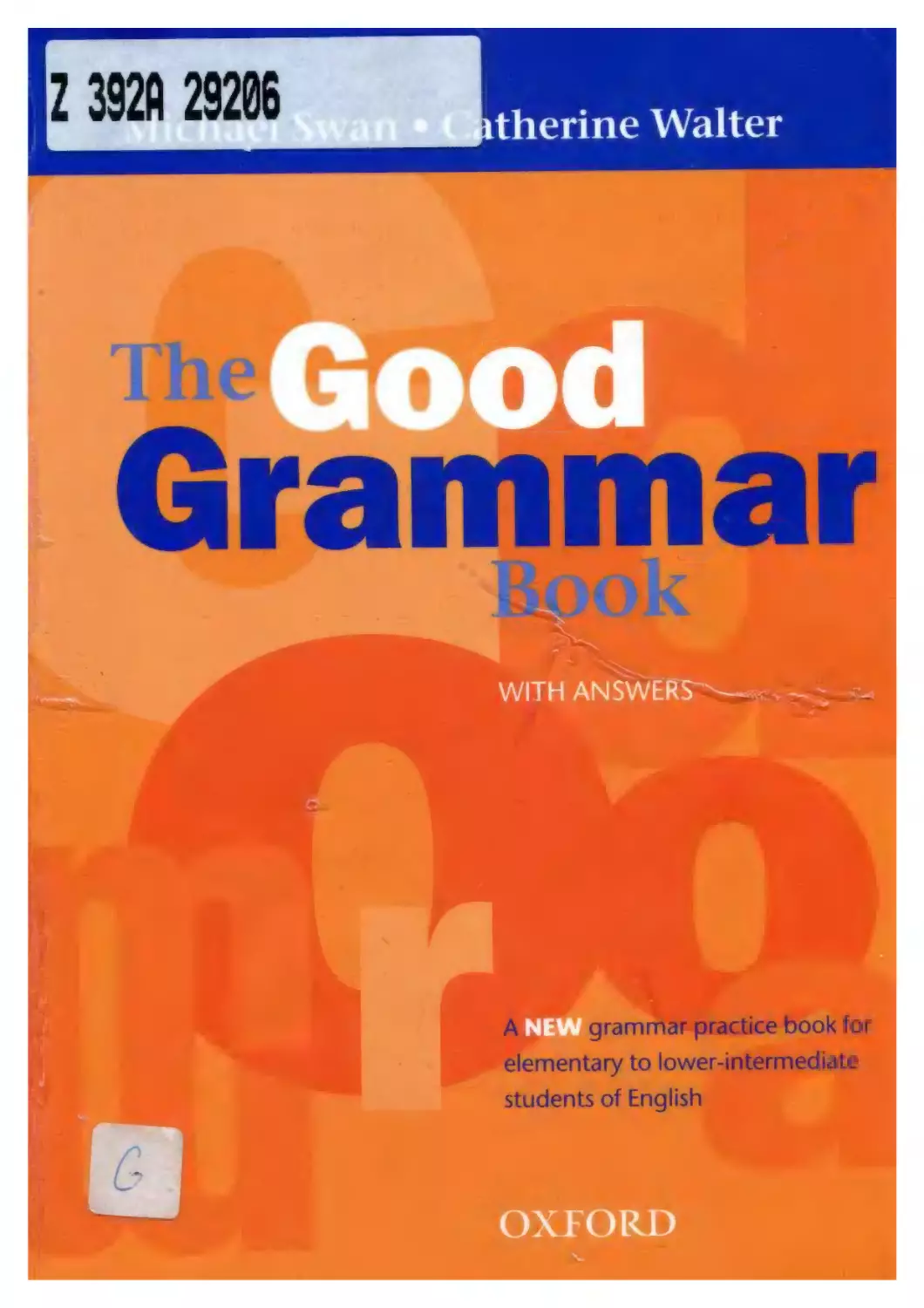
The
Good.
contents
introduction vi
words tor talking about grammar vii
list of units ix
units 1
appendices 275
pre-test answers 283
answer key 285
index 318
authors' acknowledgements
Teachers in several countries were kind enough to try out sections of the draft material with their classes and
send us their comments These were extremely helpful, enabling us to make a large number of corrections
and improvements. We are very grateful to the following individuals and institutions, and to their students:
- Renata Baranowska-Bogdan ot Warsaw
- | A Cabo of the IES Villaviciosa, Spain
- Irena Dominikova of the Bell School, Prague
- Margarita Herrero ot the IES Pedro Cerrada, Utebo, Spam
- Sumi Katsuura of Tokyo University of Technology
- Eimear Kelly-Wtodarczyk of English Unlimited, Gdansk, Poland
- Ewa Kubisz of the XIV L O., Warsaw
- Takuro Mannen ot Wako Kokusai High School, Saitama, japan
- Mana-jesus Marti of the IES Abat Oliba, Ripoll, Spain
- Daisy Rodrigues do Vale of the UNIT - Centro Umversitano do Triangulo, Uberlandia-MG, Brazil
- Ruth Swan and the staff of The English Academy of Macerata, Italy
- Eszter Timar-Honyek of the Bell School, Budapest
- Christiane Wimmer ot Munich, Germany
The book has benefited enormously from the hard work and professionalism of our editorial and design team
at Oxford University Press. Our thanks to them, and to the many other OUP staff in Oxford and elsewhere
who have provided help and advice. We owe a particular debt to our editor, Karl Clews, without whose
meticulousness, patience, good humour and stamina this would not be nearly such a Good Grammar Book.
Finally, our thanks Io Inge Bullock tor keeping us organised and fed, and to our children for once again
putting up with us while the writing was going on.
introduction
Who is this book for?
The Good Grammar Book is for all elementary and lower-intermediate level learners who want to improve their
knowledge of English grammar.
What kind of English does the book teach?
The Good Grammar Book teaches the grammar of spoken and written British English. But it can also be used
by students of American, Australian or other kinds of English - the grammatical differences are very small and
unimportant.
How is the book organised?
There are 21 sections. A section covers one part of English grammar (for example: making questions and
negatives; present tense verbs; problems with nouns). Each section contains a pre-test, several short units
with explanations and exercises, and a 'test yourself' revision page.
Using the book: particular problems
If you have a particular problem with grammar (for example present tenses, the difference between should
and must, or the position of adverbs), look in the index (pages 318-324) to find the right unit(s). Read the
explanations and do the exercises. Check your answers in the answer key (pages 285-317),
Using the book: systematic study
If you are working without a teacher, we suggest:
1 DON'T go right through the book from beginning to end - some parts will be unnecessary for you.
2 Decide which sections you most need to study. Section 1, 'be and have', for example? Section 8, 'questions
and negatives'? Section 18, 'relative pronouns'? Or other sections?
3 Choose a section, and do the pre-test at the beginning. Then look at the pre-test answers on pages 283-
284. These will tell you what your problems are, and which pages to study.
4 Go to the pages that you need. Read the grammar explanations, do the exercises, and check your answers
in the answer key (pages 285-317).
5 In some units there are 'grammar and vocabulary' exercises for students who would like to learn more
words. Try these as well if you want to.
6 Go to the 'test yourself' page at the end of the section, and try some or all of the questions.
7 Check your answers. If you still have problems, look at the explanations again.
If you know everything in the book, will you speak perfect English?
No, sorry!
1 Not many people learn foreign languages perfectly. (And not many people need to.) But this book will help
you to speak and write much more correctly.
2 Books like this give short practical explanations. They cannot tell you the whole truth about English
grammar. If you follow the rules in The Good Grammar Book, you will not make many mistakes. But if you
want more complete information about difficult points, you need to get a higher-level book (perhaps later,
when your English is more advanced).
3 Grammar is not the only important thing in a language. You also need a wide vocabulary, and - very
important - you need a lot of practice in listening and speaking, reading and writing. Remember: this is a
grammar practice book, not a complete English course.
We hope that you will enjoy using our book.
With our best wishes for your progress in English
words for talking about grammar
active and passive: I see, she heard are active verbs; I am seen, she was heard are passive verbs.
adjectives: for example big, old, yellow, unhappy.
adverbs: for example quickly, completely, now, there.
affirmative sentences or statements are not questions or negatives - for example I arrived.
articles: a/an ('indefinite article'); the ('definite article').
auxiliary verbs are used before other verbs to make questions, tenses etc - for example do you think; I have
finished, she is working. See also modal auxiliary verbs.
comparatives: for example older, better, more beautiful, more slowly.
conjunctions: for example and, but, because, while.
consonants: see vowels.
contractions- short forms like I'm, you're, he'll, don't.
conversational: see formal.
countable nouns: the names of things we can count - for example one chair, three cars; uncountable (or
'mass') nouns: the names of things we can't count, like oil, rice.
determiners: words like the, some, many, my, which go before (adjective +) noun.
double letters, pp, tt, ее etc.
formal, informal, conversational: We use formal language with strangers, in business letters etc: for example
'Good afternoon, Mr Parker. May I help you?' We use informal or conversational language with family and
friends: for example 'Hi, John. Want some help?'
future verbs for example / will go, Ann is going to write to us.
imperatives: forms like Go home, Come and sit down, Don't worry, which we use when we tell or ask people
(not) to do things.
indirect speech: the grammar that we use to say what people say or think: for example /ohn said that he was
tired.
infinitives: (to) go, (to) sleep etc.
informal: see formal.
-ing forms: going, sleeping etc.
irregular: see regular.
leave out: If we say Seen John?, we are leaving out Have you.
modal verbs or modal auxiliary verbs: must, can, could, may, might, shall, should, will and would.
negative sentences are made with not: for example / have not seen her.
nouns: for example chair, oil, idea, sentence.
object: see subject.
opposite hot is the opposite of cold; up is the opposite of down.
passive, see active.
past perfect tense see perfect tenses.
past progressive tense: see past tenses.
past tenses: for example went, saw, stopped (simple past); was going, were eating (past progressive).
past participles: for example gone, seen, stopped.
perfect tenses: forms with have/has/had + past participle: for example / have forgotten (present perfect); It
has been raining (present perfect progressive); They had stopped (past perfect).
plural see singular.
possessives: for example my, your, mine, yours; John's, my brothers'.
prepositions: for example at, in, on, between.
present participles: for example going, sleeping etc (also called -ing forms).
present perfect tenses: see perfect tenses.
present tenses: for example He goes (simple present); She is walking (present progressive).
progressive (or 'continuous'): for example / am thinking (present progressive); They were talking (past
progressive).
pronouns: for example I, you, anybody, themselves.
question tags: for example isn't it?, doesn't she?
reflexive pronouns: myself, yourself etc.
regular: plurals like cats, buses; past tenses like started, stopped; irregular: plurals like teeth, men, children; past
tenses like broke, went, saw.
relative pronouns: who, which and that when they join sentences to nouns: for example The man who
bought my car.
sentence: A sentence begins with a capital letter (A, В etc) and ends with a full stop (.), like this one.
simple past tense: see past tenses.
simple present tense: see present tenses.
singular: for example chair, cat, man; plural: for example chairs, cats, men.
spelling: writing words correctly: for example, we spell necessary with one c and double s.
subject and object: In She took the money, everybody saw her, the subjects are she and everybody, the objects
are the money and her.
superlatives: for example oldest, best, most beautiful, most easily.
tense: She goes, she is going, she went, she was going, she has gone are different tenses.
third person: words for other people, not / or you; for example she, them, himself, John, has, goes.
uncountable nouns: see countable nouns.
verbs: for example sit, give, hold, think, write.
vowels: a, e, i, о, и and their usual sounds; consonants: b, c, d, f, g etc and their usual sounds.
other useful words
Here are some other words that are used in this book. Find them in your dictionary and write the
translations here.
action..............................
choose...............................
common.................................
complete (verb) ..........................................
correct..............................
description..............................
difference..............................
event ..............................
exclamation................................
explain..............................
expression...............................
form (noun)...............................
go on, happen................................
in general..............................
introduction...............................
join..............................
mean (verb)...............................
meaning................................
necessary...............................
news...............................
normal...............................
normally...............................
particular..............................
plan..............................
polite...............................
politely.............................
possibility.............................
possible.............................
practise.............................
predict..............................
prefer...............................
probable................................
pronounce ..............................
pronunciation..............................
repeat...............................
report...............................
revision.............................
rule.............................
section..............................
similar..............................
situation............................
stressed (pronunciation)..............................
structure............................
unnecessary................................
unusual..............................
use (noun)..............................
use (verb) .............................
(word) order...............................
list of units
SECTION 1 be and hove pages 1-12
grammar summary and pre-test 1
be I am happy today. Are we late? 2-3
be: past Where were you?
1 was in Glasgow. 4
be-, future The bus will be full. 5
there is There's a dog in the garden 6-7
have with do do you have? 1 don't have 8-9
have without do: have got
Have you got a cat? 10
have, actions He's having a shower. 11
test yourself be and have 12
SECTION 2 present tenses pages IB-30
grammar summary and pre-test 13
simple present affirmative
/ work; you work, she works 14
simple present- use / work in a bank. 15
simple present questions
Do you remember me? 16-17
simple present negatives I don't know
She doesn't ski. 18-19
simple present; revision 20
present progressive: forms I'm reading,
I'm not working. 21
present progressive- use
I'm (not) working today. 22-23
present progressive questions
Is it raining7 24
present progressive- revision 25
the two present tenses, the difference 26-27
non-progressive verbs I don't understand 28-29
test yourself present tenses 30
SECTION 3 talking about the future •
pages 31-40 grammar summary and pre-test 31
going to Look - it's going to rain. present progressive 32-33
What are you doing this evening? the w/7/-future: forms / will work. 34
They won't come, will: predicting 35
/ think it will rain tomorrow. will: deciding, refusing, promising 36
I'll answer it. 37
which future7 will, going to or
present progressive7 38
simple present for future
Our tram leaves at 8.10 39
test yourself future 40
SECTION 4 past tenses pages 41-50
grammar summary and pre-test simple past: forms 41
/ worked. 1 did not work. 42 -43
simple past questions Did she pay? What did she say7 questions without did Who phoned7 44
What happened? 45
simple past: use 1 left school in 1990 46
simple past: revision past progressive 47
What were you doing at 8 00? simple past or past progressive? 48
/ walked / / was walking 49
test yourself past tenses 50
SECTIONS perfect tenses pages 51-70
grammar summary and pre-test 51
present perfect, forms I have paid
Has she forgotten? 52-53
finished actions: present perfect or
simple past? 54-55
present perfect, news
We've found oil in the garden! 56
present perfect and simple past:
news and details 57
up to now (1) How much7 How often? 58-59
already, yet and just 60
up to now (2)
I’ve been here since Tuesday. 61
up to now (3): present perfect progressive 62 -63
present perfect or
present perfect progressive? 64
simple past and present perfect: summary 65
present perfect and simple past:
revision exercises 66-67
past perfect
It haa already begun when we arrived. 68-69
test yourself perfect tenses 70
SECTION 6 modal verbs pages 71-92
grammar summary and pre-test 71
modal verbs: introduction
can, must, should etc 72
must You must be home by eleven.
Must you go? 73
mustn't and needn't
We mustn't wake the baby. 74
have to
Do you have to teach small children? 75
had to, will have to I didn't have to pay. 76
should What should I tell John? 77
can and could He can play the piano.
She couldn't write. 78-79
may and might It may snow.
I might have a cold. 80-81
must/can't: certainty She must be in.
He can't be hungry. 82
can and could: requests
Can you lend me a stamp? 83
can, could and may. permission
Can I use the phone? 84-85
shall in questions What shall we do? 86
had better You'd better take your umbrella. 87
would Would you like a drink?
I'd like to be taller. 88
used to I used to play the piano. 89
perfect modal verbs
/ should have studied harder. 90-91
test yourself modal verbs 92
SECTION 7 passives pages 93-104
grammar summary and pre-test 93
passives: introduction
English is spoken in Australia. 94
simple present passive
We are woken by the birds. 95
future passive
Tomorrow your bicycle will be stolen. 96
simple past passive
I was stopped by a policeman. 97
present progressive passive
It's being cleaned. 98
present perfect passive
The house has been sold. 99
verbs with two objects
We were given a week. 100
by with passives Who was it made by? 101
passive or active? which tense? 102-103
test yourself passives 104
SECTION 8 questions and negatives
pages 105-116
grammar summary and pre-test 105
yes/по questions Is the taxi here?
Do I need a visa? 106-7
question words When will you see her? 108-9
question-word subjects
Who phoned? What happened? 110-111
negatives Dogs can't fly.
I don't know why. 112-11 3
negatives with nobody, never etc
Nobody loves me. 114
negative questions Aren't you well? 115
test yourself questions and negatives 116
SECTION 9 infinitives and -ing forms
pages 117-134
grammar summary and pre-test 117
infinitives: using to I want to go.
Must you go? 118
infinitives of purpose
She went to Paris to study music. 119
verb + infinitive
I hope to be an airline pilot. 120-121
verb + object + infinitive
He wants me to cook. 122-123
adjective + infinitive
glad to find you at home 124-125
adjectives with enough/too + infinitive
too tired to sing 126
some letters to write; nothing to eat 127
it with infinitive subjects
It's nice to be here with you. 128
-ing forms as subjects
Smoking is bad for you. 129
verb + ...ing
I can't help feeling unhappy. 130-131
preposition + ...ing
Thank you for coming. 132-133
test yourself infinitives and -ing forms 1 34
SECTION 10 special structures with verbs
pages 135-144
grammar summary and pre-test 135
verbs with prepositions Wait for me. prepositions in questions 136
Who did you go with? phrasal verbs Come in, take off 137
your coat and sit down. 138-139
verbs with two objects
Take the boss these letters. 140
have something done
I have my hair cut every week. 141
imperatives Come in. Don't worry. 142
let's (suggestions) Let's go. 143
test yourself special structures with verbs 144
SECTION 11 articles: al an and the
pages 145-158
grammar summary and pre-test 145
a/an; pronunciation of the 146
countable and uncountable a car, cars; petrol 147
the and a/an Let's see a film.
I didn't like the film. 148-149
a/an She's a doctor. 150
a/an: describing people
She's got a nice smile. 151
talking in general without the
People are funny. 152-153
names Mary, Africa, the USA 154-155
special cases in bed; after lunch;
a hundred; ... 156-157
test yourself articles: a/an and the 158
SECTION 12 determiners pages 159-178
grammar summary and pre-test 159
this, that, these and those 160-161
some and any I need some sugar.
Have you got any? 162-163
any, not any, no and none 164
somebody, anything, nowhere, ... 165
some/any or no article
Have some toast. I don't like toast. 166
any = 'one or another - it's not
important which' 167
much and many How much milk?
How many languages? 168
a lot of and lots of 169
a little and a few a little English;
a few words 170
enough money, fast enough 1 71
too, too much/many and not enough 1 72
all (of) my friends; all of them;
they are all... 173
all children; every child 174
every and each; every one 1 75
both, either and neither 1 76
determiners and of most people; most of us 177
test yourself determiners 1 78
SECTION 13 personal pronouns; possessives
pages 179-186
grammar summary and pre-test 179
personal pronouns: / and me etc 180-181
possessives: my, your etc
This is my coat. 182-183
possessives: mine, yours etc
This is mine. 184
reflexive pronouns: myself, yourself etc 185
test yourself personal pronouns;
possessives 186
SECTION 14 nouns pages 187-198
grammar summary and pre-test 187
singular and plural nouns cat, cats;
box, boxes 188
singular/plural team, family,
jeans, scissors 189
more about countable and
uncountable nouns 190-191
one and ones a big one;
the ones on the chair 192
's and s' possessive: forms
son's, sons', men's 193
's and s' possessive: use
Ian's car, the boss's саг 194-195
noun + noun
Milk chocolate is a kind of chocolate 196-197
test yourself nouns 198
SECTION 15 adjectives and adverbs
pages 199-216
grammar summary and pre-test 199
adjectives a beautiful little girl who was
not stupid 200-201
adverbs He ate quickly.
It was badly cooked. 202-203
adverbs with the verb
often, certainly, etc 204-205
interested and interesting etc 206
fast, hard, hardly, well, friendly, ... 207
comparative and superlative
adjectives: forms 208
comparative or superlative? 209
comparatives: use
brighter than the moon 210-211
superlatives
the highest mountain in the world 212
comparison of adverbs
More slowly, please. 213
(not) as... as
Your hands are as cold as ice
test yourself adjectives and adverbs
214-215
216
SECTION 16 conjunctions pages 217-226
grammar summary and pre-test 217
conjunctions introduction
and, but, because ... 218
position of conjunctions
If you need help, ask me. 219
before and after
I talked to John before I phoned Peter. 220
tenses with time conjunctions
I'll see you before you go 221
because and so; although and but 222-223
and I speak Russian, English and Swahili. 224
double conjunctions both and;
(n)either... (n)or 225
test yourself conjunctions 226
SECTION 17 if pages 227-236
grammar summary and pre-test 227
ih position; unless 228
if. future
I'll phone you if I hear from Alice. 229
not real / not probable
If dogs could talk, .. 230-231
If I go ..., I will...; If I went..., I would ... 232
If I were you 233
could = 'would be able to1
We could go cycling if... 234
unreal past If a had happened,
b would have happened. 235
test yourself if 236
SECTION 19 indirect speech pages 245-252
grammar summary and pre-test 245
tenses and pronouns Bill said he was really happy. 246-247
indirect questions She asked him what his name was. 248
present reporting verbs She says she comes from London 249
here and now -» there and then 250
infinitives She told me to gel out. 251
test yourself indirect speech 252
SECTION 20 prepositions pages 253-264
grammar summary and pre-test 253
at, in and on (time) 254-255
from .. to, until and by 256
for, during and while 257
in and on (place) 258
at (place) 259
other prepositions of place 260-261
prepositions of movement 262-263
test yourself prepositions 264
SECTION 21 spoken grammar
pages 265-274
grammar summary and pre-test 265
question tags
This music isn't very good, is it? 266-267
short answers Yes, 1 have. No, they didn't. 268
reply questions Oh, yes? Did they really? 269
revision of spoken question and
answer structures 270
leaving out words Don't know if she has. 271
So arn 1 Nor can Pat. 272- -273
test yourself spoken grammar 274
SECTION 18 relative pronouns
pages 237-244
grammar summary and pre-test relative who and which 237
the keys which 1 lost 238-239
relative that a bird that cun't fly leaving out relative pronouns 240
the car (that) you bought 241
prepositions the man that she works for 242
relative what h was just what 1 wanted 243
test yourself relative pronouns 244
APPENDICES pages 275-282
appendix 1 common irregular verbs 275
apoendix 2 active and passive
verb forms 276
appendix 3 capital letters (А, В, C etc) 276
appendix 4 contractions 277
appendix 5 expressions with
prepositions 278-279
appendix 6 word problems 280 282
SECTION 1 be and have
grammar summary
be (am/are/is/was/were)
• We can use adjectives, nouns or expressions ot place after be
She is late. Гт hungry Are you a doctor? Is everybody here7
• We use a special structure with be - there is - to introduce things; to say that they exist.
There's a strange woman at the door. There are some letters for you.
• Be can be an auxiliary verb in progressive tenses (see page 21) and passives (see page 93).
She is working. It was made in Hong Kong.
have (have/has/had)
• We can use have or have got to talk about possession, relationships and some other ideas.
Do you have a car? I don't have any brothers or sisters. Ann has got a headache
• And we can use have to talk about some kinds of actions.
I'm going to have a shower What time do you have breakfast?
• Have can also be an auxiliary verb in perfect tenses (see Section 5).
/ haven't seen her all day. We knew that he had taken the money.
pre-test: which units do you need?
Try this small test. It will help you to decide which units you need. The answers are on page 283.
Q Circle the correct answer.
► Г arn)/ are tired.
1 Mary is I has very happy today.
2 Are I Have I Do you hot?
3 There is I It is a new secretary in the office.
4 Had you / Did you have a good journey?
Q Correct (/) or not (X)?
► I don't had lunch today.
„ 1 I'm not... 1 amn't... he's not... he isn't...
2 I not had lunch today .
3 Do you got a car? ..
4 My friends was late. ...
5 I don’t have many friends. ...
Q Make questions.
► The train was late.
was the traiw Late?
1 All the family will be at home...................................
2 There will be a meeting tomorrow....................................
3 Phil has got a headache....................................
4 Ann had a lesson yesterday. ..................................
To be or not to be,
that is the question.
(Shakespeare: Hamlet)
Is there life
before death?
(Seamus Heaney)
There's a thin man inside every fat man.
(Ceorge OrweH)
You can have it all,
but you can’t do it all
(Michelle Pfeiffer)
If you’ve got everything, you’ve got nothing.
____ (Leni MacShaw)
be I am happy today. Are we late?
Q
El
I am you are he/she/it is we are they are
am I? are you? is he/she/it? are we? are they?
I am not you are not he/she/it is not we are not they are not
I am a doctor. Are you American? We are not ready.
Q Put in am, are or is.
► You ............late.
1 We.............very well.
2 My sister............a doctor.
3 John and Ann...............in America.
4 I...............happy today.
5 I think you.............tired.
6 Our house..............very small.
In conversation and informal writing, we use contractions:
I'm you re he's she's it's John's the train's we re they're
I'm a doctor. You're late. John's in London. The shop's open. We're ready.
Q Write these sentences with contractions.
► Ann is ill. ...AlM'v'S.iLL....................
1 We are all tired..............................
2 They are here.................................
3 I am sorry....................................
4 My name is Peter...............................
5 You are early..................................
6 The shop is closed.............................
To make questions (B) with be, we put the verb before the subject.
STATEMENT Q:
QUESTION В:
/ am late.
Am I late?
The taxi is here.
Is the taxi here?
We are late.
Are we late?
Your keys are in the car.
Are my keys in the car?
Q Make questions.
► Bill / Scottish ...'s.^k.scottlsh?..........
1 Marie I from Paris .........................
2 We / very late .............................
3 John / in bed ..............................
4 The boss / in Japan ........................
5 His car / fast .............................
Do you know all these question words?
who what when where why how
Contractions with is: who's what's when's where's
Who's that? What's this? When is the party?
How are you?
how's why's
Where's the station? Why are we here?
ф Put in question words with are or's.
► 'Who's................that?' 'It's my brother.'
► 'Where are............joe and Ann?' Tn London.'
1 '....................your name?' 'Maria.'
2 '....................my glasses?' 'Here.'
3 '....................your English teacher?' 'Mrs Allen.'
4 '....................you late?' 'My watch is broken.'
5 '....................the exam?' 'On Tuesday.'
6 '....................your mother?' 'Very well, thanks.'
To make negative (Q) sentences with be, we put not after am/are is or n, re, s.
I am not Scottish. We are not ready. Гт not tired. She's not here. They re not my friends.
We can also make contractions with n t: you iren t, she isn r, etc (but not i amn't).
0 Write negative (£) ends for the sentences.
► It's winter, but (B cold) .........................
► I'm Greek, but (fl from Athens) Athens....................
1 She's tired, but (В Ш).........................................
2 They are in England, but (B in London)..........................................
3 You're tall, but (B too tall).....................................
4 We are late, but (B very late).......................................
5 It's summer, but (B hot)........................................
6 I'm a student, but (Q at university).......................................
We often use be with hungry, thirsty, cold, hot, right, wrong, afraid, interested, what colour?, what size?
And we use be with ages.
Have you got anything to eat? I'm hungry. Гт cold It's very hot here in summer.
'It's late.' 'You re right Let's go ' Are you afraid of spiders? What colour is her hair?
What size are your shoes? How old are you7' 'Гт 17. ' I'm interested in politics.
Q Put in words from the box.
afraid / colour interested right size
► He is a big man, but he is .ftfkf’.K......of her.
1 You think I'm wrong, but 1 know I'm...................
2 What................- small, medium or large?
3 What........
4 Sorry, I'm not
problems.
0 Read the text, and then write about yourself.
His name's Noureddin. He's from Rabat, in Morocco.
He's a student. 1 Ie's 21. He isn't married. He's interested
in music and politics. He isn't interested in sport.
My name's.....................................
is your car?
.......in her
be: past Where were you? I was in Glasgow.
□ в о / was you were he/she/it was we were they were was 1? were you? was he/she/it? were we? were they? 1 was not you were not he/she/it was not we were not they were not
Contractions: wasn't, weren't
Where were you yesterday? My mother was a singer. I wasn't well last week.
ф Put in was or were.
► In summer 1990 I ............in Brazil.
1 'We............very happy to see you yesterday.' 'And I.............happy to see you.'
2 Lunch..............OK, but the vegetables............not very good.
3 1 can't find my keys. They............here this morning.
4 It...........cold and dark, and we...........tired.
5 My grandmother..............a doctor, and her three children...........all doctors too.
6 '...........you in London yesterday?' 'No, I...........in Glasgow.'
7 ‘When.............your exam?' 'It.........yesterday.'
О Put the words in the correct order to make questions.
► Ann at home yesterday was ..........................
1 good party was the ........................................................
2 people were the interesting ......................................................
3 teacher father your was a ........................................................
4 everybody was late .......................................................
5 John's brother school was with at you .......................................................
Q Put in wasn't or weren't and words from
the box. Make sure you understand
actually. Use a dictionary if necessary.
a teacher in England interesting /
late well with Anna
► The lesson ......
Actually, it was very boring.
1 You.............................Actually,
you arrived 10 minutes early.
2 My father.............................
Actually, he worked as a bus driver.
3 I............................yesterday.
Actually, 1 was with Susan.
4 The children.............................
yesterday. The doctor came to see them.
5 We..............................last week.
We went to Scotland for a few days.
'And were you good while I was out?'
-> For the present perfect of be (/ have been etc), see page 61.
be: future The bus will be full.
E3 fi D l/you/he/she/it/we/they will be will l/you/she etc be? l/you/he etc will not be
Contractions; I'll, you'll etc, won't (= will not)
It will be cold this evening. I'll be at home all day tomorrow.
Where will we be ten years from now? The exam won't be difficult.
Q Look at the table and complete the text.
Tomorrow .{rS wi.ll.be.very hot in Cairo.
It..........hot in.........
...........warm in.........
.........................cold.......................in......................
.........................very cold in.
TOMORROW'S 1EMPERATURES
Cairo 35°
Rio 30’
Paris 23°
London 3°
Moscow -18°
Q Change these sentences to affirmative (Q) or negative ( ).
► The bus will not be full. ..\lLt.b^.wuLl. be.fuLL........................
► She'll be late. ..-Shf woiVt be.late...........................
1 I'll be sorry..................................................
2 It will not be hot.................................................
3 We won't be at home.....................................................
4 The shops will be closed...................................................
5 He'll be in Scotland..................................................
6 Ann will be at school...................................................
To make future questions with be, we put will before the subject.
STATEMENT Q:
QUESTION Q:
We will be late.
Will we be late?
Her brother will be here ai 10.00.
When will her brother be here?
The bus will be full.
Will the bus be full7
Q Make questions with will... be ...?
► you / at home I this evening ..................
when / lunch I readv Whew wlLL Lvcwch be
1 when I your father I in England .................................................
2 Ann / at the party / with John ................................................
3 everybody / here / at 8.00 ...............................................
4 the train I late / again ..............................................
5 when / Joe and Mary I in the office ...............................................
6 the weather I good / tomorrow .................... ..............................
7 where / you / on Tuesday .................................................
Q Complete the sentences.
1 (your age) This year 1 am.................................... In 2000 1 .............................
East year I ........................ Next year I....................... In 20... I..................
2 (a friend's axe) This year he/she............................ In 2000 ................................
Last year........................... Next year........................ In 20......................
there is There's a dog in the garden.
PRESENT PAST
□ Q a there is there are is there? are there? there is not there are not there was there were was there? were there? there was not there were not
Contractions: there's; isn't, aren't, wasn't, weren't
We use there is, there are etc to say that something or somebody exists
We often use there is, there are etc before а/an, some and any
J here's a dog in the garden. (NOT A dug is tn the garden) There are some letters for you
Is there any milk in the fridge? (not fs-anymdk ...?) There isn't much coffee
Were there any phone calls? (NOT Wen? any phene calls?) There was a good film last night.
Ф Make some sentences with words from the three boxes, using there is etc.
There is/are a lot of
There isn't much
There aren't many
There isn't/aren't any
There wasn't/weren't any
water air grass dogs
elephants trees cars
people computers ...
(you think of some more
things)
in Africa in the LTSA
in Antarctica in London
on the moon in 1600 ...
(you think of some more places or times)
> There are. a lot оТйигил-aLs цл. Africa._______________
There weren't arvy. cars iw i&oo.
1 ..................................................................
2 ..................................................................
3 ....................:.............................................
4 ..................................................................
5 ..................................................................
6 ..................................................................
To make questions with there is etc, we put is etc before there.
STATEMENT Ц:
QUESTION П
Therejs a letter for you
Is there a letter for me?
There were some problems
Were there any problems?
William says there are six eggs.
How many eggs are there?
Q Make present or past questions with there is etc.
► any fruit juice in the fridge (present) ..Js there ai^ fn^it^^ the fridge?................................................
► any letters for me (past) ....УУ^.ЛИсге.аууу .Letter for nee?.............................................................
► how many people I in your family (present) ...ttpwywgyty..................................................................
1 a doctor here (present) ....................................................... .........................................
2 any trains to London this evening (present) ............................................................................
3 much money in your bank account (present) ........................................................................ .....
4 how many students / in your class (present) ........................................................................................
5 a special price tor students (past) .....................................................................................
6 any mistakes in my letter (past) .......................................................................................
7 many children at the swimming pool (past) ...............................................................................
8 how many people / at the party (past) ..................................................................................
A RF AND HAVF
future: □ there will be В will there be? О there will not be
Contractions: there'll; won't (= will not)
0 Here is some information about an English town. Write sentences using there is etc,
1960 NOW 2050 ► Ihe^were soo&QQ. There are two ciwewcas. wiw.
people 300,000 50U,000 800,000 ► There.wiLL be 200 2050.
cinemas 11 2 0 1
theatres 1 1 1 2
nightclubs 0 12 20 3
restaurants 50 76 120 4
hotels 35 130 180 5
supermarkets 0 23 200 6
universities 1 2 3 7
0 Write questions about life in the year 2100, with Will there be ...?
► (cars) vvi.lL there be cars?
1 (trams)............................................................
2 (computers) .......................................................
3 (good food) ........................................................
4 (different countries) ...........................
5 (governments) ...................................
6 (your question) .................................
We don't use it is like there is We usually use it is for something that we have already talked about,
or that people already know about.
There's a car outside. It's a Ford (not #3 u ettfwcfe)
Q Circle the correct form.
1 It's I There's a new bookshop Ln East Street.
2 'Whose is that dog?' ‘It's / There's mine.'
3 Is it / there a bus stop in this street?
4 There isn't / It isn't a supermarket here.
5 'What's that?' ‘It's / There's my new calculator.'
6 ’How's your new job?' ‘It’s / There's interesting.'
0 GRAMMAR AND VOCABULARY: houses
Read the advertisement with a dictionary and complete the sentences.
► two......................... floors.
► kitchen.
1 living room.
2 ........................................ study.
3 ................................. cloakroom.
4 .......................two ....................
5 ......................four ..................
6 ..................... gas ....................
7 ...................................... garage.
8 ......................large............ .......
> For the present perfect (there has/have been), see Section 5.
Price: £ 250000 ref.no.671749
Large new house situated in
the village of Wickfield.
Modern kitchen, large living room,
small study, downstairs cloakroom
and shower room, 4 bedrooms,
2 bathrooms, gas central heating,
double garage, large garden.
have with do do you have? I don't have
PRESENT PAST
QBQ l/you/we/they have he/she/it has do l/you/we/they have? does he/she/it have? l/you/we/they do not have he/she/it does not have l/you/he/she/it/we/they had did l/you/he etc have? l/you/he etc did not have
Contractions: don't, doesn't, didn't
We can use have to talk about possession, family (and other) relationships and illnesses.
/ have a new car. Ann has two sisters. Pete has a nice girlfriend. joe had a cold last week.
We also say that people have hair, eyes etc; and that things have parts.
You have beautiful eyes. Our old car only had two doors, but the new one has four.
ф Circle the correct form.
► John / J have two brothers.
► Mary has KhadJa cold yesterday.
1 My father / My parents has two cars.
2 We all I Sally have blue eyes.
3 I have / had a headache yesterday evening.
4 I see that your brother had I has a new girlfriend.
5 You I Paul has very long hair.
6 These houses have / has big rooms.
7 1 can't read this book - it has / had 800 pages.
8 Ann had a good job last year / now.
We can make questions (B) and negatives (fl) with do/does/did + infinitive (without to).
(For questions and negatives without do, see page 10.)
STATEMENT П
/ have the keys,
joe has a car.
Ann had a cold.
QUESTION В
Do I have the keys?
Does joe have a car? (NOT Dees fee has ...)
Did Ann have a cold? (not Did Ann had...)
NEGATIVE □
I do not have the keys.
Joe doesn't have a car.
Ann didn't have a cold.
Make questions (B) or negatives (fl) with have.
► you / a cat В .......................................
► Eric / manv friends Ц Eklc docsw't hflx/S PVLflkvy frit.iA,cls
1 we / garden fl We don't............................................................
2 they / any children В .........................................................
3 Peter / a cold В .........................................................
4 my aunt / a dog В ..........................................................
5 Mary / any brothers or sisters В ........................................................
6 I / enough money В ............................................................
7 Sally / a boyfriend В .........................................................
8 Why / you / two cars В ...........................................................
Q Make sentences about Ann when she was six.
► a bicycle В ..T^.she.haye a bicycle?........... > a dOg g .she dydwt have .«.dog.........
1 a computer В......................................................
2 very fair hair Q..................................................
3 lots of friends R.................................................
4 many nice clothes fl...................................................
5 her own room В....................................................
Q- Write sentences about yourself with I had and / didn't have.
1 When I was a child, 1 had ....................................................
2 When 1 was a child, I didn't have ............................................
3 ..............................................................................
4 ..............................................................................
FUTURE
□ Q □ l/you/he/sheyit/we/they will have will l/you/he etc have? l/you/he etc will not have
Contractions I'll, you'll etc, won't (- will not)
We use will (not) have to talk about the future.
One day, everybody will have enough food. Mary says that she won't have children.
To make future questions with have, we put will before the subject.
statement Ц: john will have a car soon. The baby will have blue eyes.
question d: Will /ohn have a car soon? Will the baby have blue eyes?
0 Read the text and complete the sentences about John's future.
This year, John doesn't have money, a job, a house, a girlfriend, a suit or a car.
He has a small room, a bicycle, old clothes, a guitar and a cat. But next year:
► more money Q ......................
► a small room a . H?. .YZftbt.t. И.Й.УА .<?. Л-ЛУгй kk ЛР.РХ’Л.......
► a cat E ..y^Lk.h.C.h.ayf .a.cJrt:?.........................
1 a job Q ...................................................
2 a bicycle D ...................................................
3 a car Q ...................................................
4 a house R .....................................................
5 a girlfriend R ...................................................
6 old clothes В ....................................................
7 a suit Q .......... .........................................
8 a guitar Q ....................................................
0 GRAMMAR AND VOCABULARY: relations
Put in words from the box. Use a dictionary if necessary.
uncle aunt cousin niece nephew
1 Bill's sister has three daughters and a son, and Bill's brother has three sons. So Bill has three
............. and four....................
2 Bill's father has two brothers, both married; and his mother has two sisters, one married. So Bill
has three................... and four ..... . .. .
3 Bill's uncles and aunts have eight children. So Bill has...........................
4 And you? I have ......................................................................................
For auxiliary have, see page 52. -» For have a bath etc, see page i i. -> For have got, see page 10. -> For the present perfect (/ have had), see page 52 > For more about future tenses, see Section 3.
have without do: have got Have you got a cat?
□ l/you/we/they have got he/she/it has got
в have l/you etc got? has he/she/it got?
Ei l/you etc have not got he/she/it has not got
Contractions: I've, he's etc; haven't, hasn't
We often use got with have, especially in the present. This does not change the meaning: we use
have/has got like have/has to talk about possession etc.
/ have got is the same as / have.
Have you got? is the same as Do you have? (We don't use do/does with have got.)
She hasn't got is the same as She doesn't have.
I've got a cat. (more natural than I have a cat)
Has she got a dog? (NOT -Does-she have got...)
I haven't got a car. She's got a sister. You've got beautiful eyes. Have you got a cold?
Q Write about John's possessions etc.
► a bicycle: / John/s got«. bicycle,...............................
► suits: 2 ..............................
► a horse: X ...Hf.hasrv'tgot я horse...........................
► any children: X ..................
1 brothers: 2 ...................................................
2 a car: X ..................................................
3 dogs: 3 ...................................................
4 a dictionary: / ...................................................
5 long hair: X ...................................................
6 any sisters: X ..................................................
Q Write four sentences about your possessions etc. Use words from Exercise 1.
1 I've got.............................................. 3
2 ...................................................... 4
To make questions (B) with have got, we put have/has before the subject.
STATEMENT Q:
QUESTION В:
I have got a cold.
Have you got a cold?
Eric's got a fast car. Sue and /oejiave got tickets.
Has Eric got a fast car? Have Sue and joe got tickets?
Q Ann and Bill have got a lot of money. Ask questions with have got.
► they / big house tf.^yf.Ahey.got я.Ььд hoi<se?.................
1 they / big garden ..............................................
2 Ann / good job ................................................
3 Bill / big car .............................................
4 they I plane ...............................................
5 they / any horses ...............................................
Past forms (/ had got, etc) are unusual. We don't use got in the future.
She had a fast car. (more natural than She had got a fast саг.) I will have, (not / will have got)
> For auxiliary have, see page 52.
For have a bath etc, see page 11.
have: actions He's having a shower.
grammar and VOCABULARY: common expressions with have (use a dictionary if necessary)
have breakfast, lunch, dinner, (a cup of) tea/coffee, a drink, something to eat/drink
have eggs/toast for breakfast, have fish for lunch, etc have a wash, a shower, a bath
have a good time, a bad day, a nice evening, a party, a holiday, a game
have a good flight/trip/journey etc have a conversation have a baby
We use have in a lot of common expressions to talk about actions. (We don't use have got like this.)
/ usually have breakfast at seven o'clock, (not +-have-got breakfast...) I'm going to have a shower.
Would you like to have something to eat? If Bill comes this weekend we'll have a party.
Mary had a baby in June. Are you having a good time? 'Have a good flight.' 'Thanks.'
Q Complete the sentences. Use have, has or had with words from the box.
a baby coffee dinner a game a party / a shower toast
► The people next door .had a. jarty...............
last night and I couldn't sleep.
1 1............................with John yesterday evening.
2 My boss usually.............................at 11 o'clock.
3 Ann's going to..............................in August.
4 I usually...........................before breakfast.
5 We always...........................for breakfast.
6 Would you like to.............................of tennis?
We make simple present and past questions and negatives with do/does and did.
We don't have parties very often. Does Bill have eggs for breakfast?
Did you have a good journey? We didn't have a holiday.
Q1 Make questions (Q) and negatives (B).
► (good time Q) 'We went to Paris yesterday.' a.£ood.ti.K*<?'............
► (breakfast В) I got up late this morning, so I Have breakfast......................
1 (lunch П) What time............................................on Sundays?
2 (good trip В) Ann was in America last week........................................
3 (shower Q) The hotel bathroom was very dirty, so 1.......................................
4 (good flight Q) Welcome to England, Mr Garcia.........................................
5 (goodgame Q) 'Bill and I played tennis this morning.'.......................................
6 (coffee B).........................................before I go to bed.
test yourself be and have
ф Write these sentences with contractions.
► John is tired._..........................
1 They were not ready.......................
2 We are all here...........................
3 I am not a student........................
4 Where is your house?......................
ф Circle the correct answers.
*'Js)/Are your brother at home?
1 Where / Who / How is the station?
2 1 / We was in London yesterday.
3 Are / Have you thirsty?
5 Ann is not English, (two answers)
OR....................
6 She will not be late.
4 Alice is / has three brothers.
5 My sister is / has 25 today.
6 T am / have cold.' 'Put on a sweater.'
7 I want I won't be here next week.
Q Change the sentences to questions or negatives.
► It's Tuesday. В ...J.LU^,jUftsclfly..ORi it's uvot.Tuesday.........................................
1 There's a taxi outside. В.........................................................................
2 Chris has got a headache. Q ......................................................................
3 Joe has a car. В .................................................................................
4 Ann had a meeting yesterday. R ...................................................................
5 I had coffee for breakfast. Я ....................................................................
6 There will be an English lesson tomorrow. Q ......................................................
7 I'm hungry. В ....................................................................................
8 Ann's got a new car. В ...........................................................................
9 She had a nice time at the party. Q ..............................................................
10 The house has got a big garden. П ................................................................
Q Correct (/) or not (X)?
► I don't had breakfast today. Z.
1 Do you got a bicycle? ...
2 Had you a good journey? ...
3 Jane is having a shower. ...
4 Is there any eggs in the fridge? ...
5 It is a new supermarket in High Street. ...
6 There won't be a lesson tomorrow. ...
7 Do you have a bicycle? ...
Put in a suitable affirmative (O) or negative (’ ) form of be or have.
Helen i...................fourteen. She 2.................at a very nice school; she з...............
interested in the lessons - there 4.........only two teachers that she doesn't like - and she
5 got lots of friends. (Two years ago she 6...............at a different school;
the lessons 7..................very good, and she 8..................many friends, so she
9 very unhappy.) The school io...................twenty km from Helen's house,
so she gets up early. She u.................a quick wash, and then she 12..................breakfast -
cereal and fruit juice if she 13..............hungry. There 14...................a school bus, but if
it 15.................very cold her mother takes her by car. In the evenings she 16.............
school work; she 17................much difficulty with this, so she usually finishes quickly.
Then she is.................supper. At ten o'clock she 19................a bath and goes to bed.
On Saturdays and Sundays she gets up at 12.00, 20.................a quick lunch and goes straight
to her computer games.
[•J More difficult question
SECTION 2 present tenses
grammar summary
simple present: / work, she works, he doesn't work, etc
PRESENT PROGRESSIVE: I am working, she is working, he isn't working, etc
English has two 'present' tenses
• We use the simple present mostly to talk about things that are always true, and things that happen
repeatedly.
Dogs eat meat. My grandmother lives in Brighton. I work every Saturday.
• We use the present progressive (or 'present continuous') to talk about things that are happening just
around the time when we speak
Look! The dog's eating your shoe. I'm working hard these days.
• We can also use the present progressive to talk about the future (see page 34)
I'm seeing Lucy tomorrow.
f pre-test: which units do you need?
Try this small test. It will help you to decide which units you need. The answers are on page 283.
Q Correct (/) or not (X)?
► Look! It rains! Д
1 I'm geting tired, ...
2 I'm watching TV every evening. . .
3 'What are you doing?' 'I'm reading.' ...
4 Andy always drive too fast. ...
5 John flys to New York every Monday. ...
6 I do not want to see that film.
7 Where do she works? ...
8 Where does she works? ...
9 Where does your sister live? ..
10 Where do the manager and his wife live? ...
11 What you are doing? ...
12 I'm not knowing her address. ...
1 like myself
I believe in love
j Л. Songs of the 20th Century J • y.
She loves me
She loves you
Гт crying
!s she really going out with him?
Where are you going?
Smoke gets in your eyes
I love Paris in the springtime
I'm flying
Why do I love you?
Why du fools fail in love?
Why du lovers break each
other’s hearts?
I don't want to do it
simple present* affirmative I work; you work; she works
□ / work you work he/she/it works we work they work
1 live you live he/she/it lives we live they live
1 stop you stop he/she/it stops we stop they stop
I work in a bank. He works in a restaurant.
You live near my brother She lives in Liverpool.
We stop the lessons at 5.00. The train stops at York.
HOW TO MAKE he/she/it FORMS
• most verbs: + -s
• -s, -sh, -ch, -xt + -es
• exceptions:
work works know -> knows rain -> rains
pass -> passes wash -> washes teach -> teaches
go —> goes do —> does have has
mix -> mixes
Q Write the he/she/it forms.
catch У come / cook drink fetch fix live miss push
read run smoke stand start touch watch wish write
+ -5:
+ -ES: patches
VERBS ENDING IN -Y
• vowel + у
• consonant + у
-ay, -ey, -oy, -uy: + -s
-dy, -ly, -py, -ry, etc: -y -> -ies
say —► says
fly flies
0 Write the he/she/it forms.
buy / carry / copy enjoy fry marry play stay study try
+ -S: Ьи-ys...
-y —» -IES' octrries.
0 Put the words in the correct order.
► eats dog too your much
Your doc\ eats too w.n.ch.__________
1 live I that house in
2 bank Ann in a works
3 badly violin plays the very Susan
4 Scotland those from children come
S young very look you
‘ Also called 'present simple'
0 Circle the correct answers.
^We)/ My friend always wear old clothes.
► You /John always wears nice clothes.
1 We all / The boss thinks you're wonderful.
2 1/ Catherine want a new job.
3 Bread / Books costs a lot.
4 Andy / Andy and Pete sings very well.
5 Mary / Mary and Ian like parties.
6 You / She drive too fast.
7 Our cat / Our cats never catches mice.
8 That child / Children makes a lot of noise.
9 That bus /All those buses go to the station.
10 My father / My mother and father teaches
English.
simple present: use I work in a bank.
We use the simple present to talk about:
• things that are always true.
The sun rises in the east. My parents live near Dover.
• habits and things that happen repeatedly
Joe plays golf on Saturdays.
We often use the simple present with words that tell you how often: for example always, never, often,
sometimes, usually, once a day, twice a week, every year, all the time.
She always forgets my birthday. I often get headaches. You never listen to me.
We play basketball twice a week. It rains all the time here.
Q Complete the sentences with the correct forms of verbs from the boxes.
ask get up / go make play speak
► Peter always ......late on Sundays.
1 Ann and John sometimes................tennis at weekends.
2 My mother often................French at home.
3 Small children...............questions all the time.
4 Sarah...............to Oxford to see her mother twice a week.
5 I.................more mistakes in English when I'm tired.
say sit try wash watch
6 Andy always..................his clothes on Saturdays.
7 That child never.................'Thank you.'
8 He...................in the same chair every evening.
9 She..................to go skiing every year.
10 My father...................TV most evenings.
0 GRAMMAR AND vocabulary: seven useful things
Use a dictionary if necessary. Put the beginnings and
ends together. Put -(e)s on the verb if necessary.
1 A dishwasher wash.?£ A clothes. ...
2 A cooker make... В food cool. ...
3 Freezers keep... C food hot. ...
4 A fridge keep... D food very cold. ...
5 Washing machines wash... E copies of papers. ...
6 Photocopiers make... F plates, cups, etc. Л
7 A camera take... G photographs. ...
We do not use a present tense to talk about how long something has lasted (see page 61).
/ have known her since 1990. (NOT / know her since 1990.)
For word order with words like always, often, sometimes, see page 204.
simple present questions Do you remember me?
в
do I work? do you work? does he/she/it work? do we work? do they work?
We make simple present questions (B) with doldoes + subject + infinitive (without to).
STATEMENT Q QUESTION В
/ know Do 1 know?
You think Do you think? (NOT Think you?)
He likes Does he like? (not Does he likes?)
She remembers Does she remember?
It helps Does it help?
We want Do we want?
They understand Do they understand?
ф Put in do or does.
► .......you know my friend Andy?
► .....this bus go to Cambridge?
1 ...........Ann want to come with us?
2 ..........your parents live near here?
3 ...........you speak Chinese?
4 ..........Sarah go to school on Saturdays?
5 ..........this shop sell stamps?
6 ..........Bill and Harry play golf?
Ф Make questions.
► They smoke. ??.(>. ....................................
► Ann teaches French. ...........................
1 The Oxford bus stops here.....................................................
2 The teachers know her......................................................
3 You play the piano....................................................
4 John works in a restaurant....................................................
5 This train stops at York...................................................
6 We need more eggs.....................................................
7 Mary likes parties....................................................
8 Peter speaks Spanish well....................................................
Do you know all these question words?
what when where who why how how much how many what time
What do you think? (NOT What think you?) Where does Lucy live? (NOT Where lives Lucy?)
How much does this cost? (not How-much this costs?)
What time does the train leave? (NOT What time the train leaves?)
Q Choose the correct subject.
► How much does ...........cost? (the ticket / the tickets)
1 Where do........................live? (your daughter / your children)
2 What time does.........................start? (the lesson / the lessons)
3 What do.........................want? (you / the girl)
4 When does.......................finish? (the holidays / the holiday)
5 Why do..........................talk so fast? (that woman / those women)
6 What do.........................think of the new boss? (you /she)
•> For questions without do, like Who lives here?, see pages 110-111.
Q Choose the correct question word and put in do or does.
how / how many how much / what when where why
► ....the ticket cost?
► .............you pronounce this word?
1 your children live?
2 ...................she want?
3 ...................the holidays start?
4 ...................the teacher talk so fast?
5 ...................languages................he speak?
Q Make questions.
► Where / she live? .............................................
1 What / you want? ..............................................
2 What I this word mean?.............................................
3 What time I the film start? ...........................................
4 How much I those shoes cost? ...........................................
5 Why / she need money? .............................................
6 How I this camera work? ...........................................
7 Where I you buy your meat? .............................................
8 Who / you want to see? ............................................
Be careful when questions have long subjects - the word order does not change.
Where does Ann live?
Where does your other sister live?
Where does your sister's old English teacher live?
(not Where lives your sister's old English- teacher? OR Where-dees-Hve-yeur-. .)
ф Make questions.
► The President and his wife live in Madrid.
Where .?{?..th?.AtX?.?................................................................
1 Peter and Ann's children play football on Saturdays.
When....................................................................................
2 The film about skiing in New Zealand starts at 8.00.
What time ..............................................................................
3 The second word in the first sentence means 'kind'.
What....................................................................................
4 The man in the flat downstairs wants to change his job.
Why...................................................................................
5 A ticket for Saturday's concert costs €15.
How much................................................................................
grammar and vocabulary: common simple present questions
How do you pronounce this word7 How do you spell that? What does this word mean?
How much does it cost / do they cost? Do you know Ann? Where do you live/work?
What do you do? ( = 'What is your job?') How do you do? (= 'I'm pleased to meet you.')
What time does the train/bus/plane leave/arrive? What time does the film/concert/class start?
For more information about questions, see pages 106-111.
For short answers like Yes, I do / No, I don't, see page 268.
simple present negatives I don't know. She doesn't ski.
И / do not work You do not work? he/she/it does not work we/they do not work
Contractions: don't, doesn't
We make simple present negatives (□) with do!does not + infinitive (without to).
STATEMENT Q
/ know
You think
He likes
She remembers
It helps
We want
They understand
NEGATIVE D
/ do not know (not / know not)
You do not think
He does not like
She does not remember
It does not help
We do not want
They do not understand
О Make negative sentences. Use do not or does not.
► I play chess, (cards) •'................................
1 You speak Arabic. (Chinese).....................................................................
2 Bill plays the piano very well, (guitar).....................................................................
3 We agree about most things, (holidays).......................................................................
4 Alan and John live near me. (George and Andrew)............................................................................
5 My father writes novels, (poetry)....................................................................
6 Barbara works in London, (live)......................................................................
7 Henry likes old books, (parties).....................................................................
Q Make negative sentences. Use don't or doesn't.
1 1 like jazz, (pop music) .............................................................................
2 The train stops at Bristol. (Cardiff)....................................................................
3 Peter remembers names very well, (faces).........................................................................
4 We know our Member of Parliament, (his wife) .............................................................................
5 Alice teaches engineering, (mathematics).........................................................................
6 The children play football on Mondays, (hockey)............................................................................
7 The shops open on Sunday mornings, (afternoons)............................................................................
ф Complete the negative sentences, using words from the box.
You can use do not / does not or don't / doesn't, as you like.
fish in Britain much petrol ✓ much tennis
on Sundays Russian your phone number
► My car / use car doeswt ksc rvcizch petrol.
1 Our cat I like ................................................
2 Ann / speak ..................................................
3 11 remember ..................................................
4 Oranges I grow ..................................................
5 The postman / come ...................................................
6 We / play ..................................................
0 Choose one verb to make each sentence negative.
► It ........very often in San Francisco, (show, sing, play)
1 I like football, but 1...................cricket at all. (think, like, remember)
2 She lives in Japan, but she....................a word of Japanese, (sing, work, speak)
3 I'm sorry - 1.....................your name, (eat, remember, work)
4 He works in New York, but I.......................what he does, (know, use, come)
5 Mary's really tired, but she....................to go to bed. (help, want, walk)
6 We........................a big flat - just one bedroom, (work, play, want)
7 Phil......................very hard, but he makes a lot of money, (work, stand, stop)
8 Ann's parents.....................I'm the right man for rheir daughter, (write, read, think)
0 GRAMMAR AND VOCABULARY: games
Look at the table, and write five or more sentences like this:
Аиыл, plotewwcs, but she doesn't т>1яи cards.
tennis football 0 rugby basketball / baseball Й E cards / hockey badminton
chess
Ann ✓ X X ✓ ✓ X X X ✓
Pete X ✓ X X X ✓ ✓ X X
Joe ✓ X ✓ ✓ X X ✓ ✓ ✓
Sarah X ✓ X X ✓ ✓ X X X
0 What games do you play? And what games do you not play?
note: one negative word is enough (see page 114).
Nobody understands me. (not Nobody doesn-’t understand me)
She never phones me. (NOT She doesn't never phone me.)
-> For more information about negative structures, see pages 112-115
simple present: revision
Contractions: don't, doesn't
l/you/we/they work he/she/it works
do l/you/we/they work? does he/she/it work?
l/you/we/they do not work he/she/it does not work
Q Look at the picture, and complete the sentence correctly.
WHO 15 ТИ15/ЧАМ A<JO
A
В
C
D
what he does?
what does he does?
what does he do?
what does he to do?
Q Circle the correct answers.
1 Where do I does your sister live?
2 My cat / My cats don't like fish.
3 This car don't I doesn't go very fast.
4 This train stop I stops at every station.
5 Why do English people / English people do
6 The post office doesn't open I opens on Sundays.
7 When does your holiday start I start your holiday?
8 My parents both play I plays golf.
9 That cafe I Those cafes stays open all night.
10 Her letters don't say I to say very much.
drink so much tea?
ф Make sentences.
► Ann (live) in Birmingham Q ......<Aww.liyes.......................................
► you (speak) Chinese В........................................................
► Sarah (like) classical music Q....................................................
1 I (like) getting up early Q...................................................
2 you (want) something to drink В.......................................................
3 Joe (play) football on Saturdays Q....................................................
4 you (remember) her phone number В.........................................................
5 that clock (work) D ....................................................
6 she often (fly) to Paris on business Q ...................................................
7 it (rain) much here in summer Q.......................................................
8 elephants (eat) meat В......................................................
9 he (think) he can sing В......................................................
10 we (need) a new car Q ......................................................
Why computers are like women:
Nobody understands the language that they use when they talk to other computers.
They never tell you what is wrong; and if you don't know, you're in trouble.
They remember your smallest mistakes for ever.
Why computers are like men:
They know a lot of things but they are very stupid.
After you get one for yourself, you soon see a better one.
They like to go fast but they always crash.
present progressive*: forms I'm reading; I'm not working.
nu / am working you are working he/she/it is working we/they are working 1 am not working you are not working he/she/it is not working etc
Contractions: I'm, you're, he's etc (not) ...ing; you aren't, he isn’t etc ...ing What's he .ing7, Where's she ...ing7, When's it ...ing7 etc
We make present progressive verbs with be (I am, you are etc - see page 2) + ...ing
/ohn is studying Russian I'm not working today
We use contractions (I'm, john's, isn't etc) in conversation and informal writing
Make present progressive affirmative (Я) and negative ( ) sentences.
► The lesson .........now. (start Q}
► Joan .‘r?..SW?t.worteiwg..........today, {work Q)
1 You ............too fast, (talk Q)
2 The cat........................... a bird, (eat П)
3 Bill........................dinner now. (cook Q)
4 I ......................... this party, (enjoy fl)
5 I............................ a good book, (read Q)
6 It.................................... now. (rain fl)
7 You ...............................to me. (listen fl)
8 I........................very happy today, (feel П)
9 Peter ..................to school this week, (go El)
10 We .......................a bit of English, (learn JJ)
HOW TO MAKE -INC FORMS
• most verbs: + -ing
• verbs ending in -e: ()0 + ing
• -ie changes to у + -ing
work —> working
make -> making
sleep -► sleeping
hope^- hoping
lie -> lying
Q Write the -ing forms of these verbs.
break Ьгеа^и-д... clean............... come............... die............ enjoy
go............. live............... make............. play.............. sing.....
start................... wash.................... write .............
doubling (stopping, running, etc)
• one vowel + one consonant
double consonant + -ing
• two vowels, don't double
• two consonants: don't double
• Only double in STRESSED syllables
stop -> stopping (not stoping-) run -> running
sleep -* sleeping wait —* waiting (not wattling)
want -* wanting (not wamting) help -> helping
beCIN —> beginning BUT HAPpen -* happening
Q1 Write the -ing forms of these verbs.
get.....
jump ...
shout...
stand ...
ANswer
forGET
feel......
rain....
sit....
talk....
OPen
put..........
rob.......
slim ..... ..
turn.....
. .. Visit
hit....
shop .
dream
* Also called present continuous'
present progressive: use Гт (not) working today.
We use the present progressive to say that things are (not) happening now or around now.
I'm sorry, I can't come out. I'm working just now. (Compare: I work every day. - see page 15)
Look - it's raining again. (Compare: It rains every day here.)
jane's taking driving lessons. (Compare: A lot of people take lessons with that driving school.)
I'm not enjoying this party. (Compare: I usually enjoy parties.)
ф Make present progressive sentences.
► Ann / read / the newspaper. ..................
1 The baby / cry / again................................................
2 It / snow I again...............................................
3 You / look / very beautiful today...............................................
4 Your coffee / get / cold.............................................
5 I / play I a lot of football this year..........................................
6 We / wait / for a phone call..............................................
7 Chris and Helen / spend / a week in France...............................................
Ф Look at the pictures and use the verbs in the box to say what Helen is doing.
brush brush drink get up / go listen to open read read wash
0 Make negative (П) present progressive sentences.
► I I not ask for I a lot of money. ......................
1 He / not listen / to me........................................................
2 11 not work / today.........................................................
3 It / not rain I now.........................................................
4 She I not wear I a coat........................................................
5 They I not learn / very much..........................................................
6 We I not enjoy / this film........................................................
7 You / not eat / much these days.........................................................
0 GRAMMAR AND VOCABULARY: clothes
Use the words in the box to say what the people are (not) wearing. Use a dictionary if
necessary.
John Ann Sandra David
belt
blouse boots cardigan coat dress glasses hat jacket
raincoat shoes
shirt skirt socks suit sweater trousers
lohn is wearing a white shirt, я blue sweater, я blue jacteet, grey, trousers with a blue beltz blue
sootes«.KVfJ .Ь.^fe shoes... He is.not wearing. glass.es........................................................
Ann is wearing...........................................................................
Sandra....................................................................................
David...................................................................................
NOTE: We do not use a present tense to say how long something has lasted (see page 61).
I've been waiting since 9.00. (NOT I'm waiting since 9.00.)
> We often use the present progressive to talk about the future. See page 34.
present progressive questions Is it raining?
a am 1 working? are you working? is he/she/it working? are we/they working?
We make present progressive questions with am/are/is + subject + ...ing
STATEMENT Q:
QUESTION Q:
It is raining.
Is it raining?
Youjjre working.
Are you working?
The children are making something.
What are the children making?
Q Make questions.
► everybody / listen I to me ? ....................
1 you I wait / for somebody ?................................................
2 your boyfriend / enjoy / the concert ?..............................................
3 those men / take I our car ?...............................................
4 you / talk / to me ?...............................................
5 it / snow ?................................................
6 we / go / too fast ?...............................................
О Complete the questions.
► 'Those people aren't speaking English.' 'What language ..................'
1 'Bill's writing something on the wall.' 'I can't see - what.................................
2 'The train's stopping!' 'Why....................................'
3 'They're eating now.' ‘What.....................................'
4 'They're playing a game.' 'What game......................................'
5 'I'm going now. Goodbye.' 'Wait! Where.................................... '
Be careful when questions have long subjects - the word order does not change.
Is Ann working today?
Are Ann and her mother working today?
Are Ann and her mother and father and the others working today?
(not Are-working today Ann and her mother- and father-and-the-others?)
Q Put the words in the correct order.
► the President and his wife I are / staying / where I 2
Where are the President and his wi-fe statjin^?
► those people over there I French / are / speaking / 2
Are those •people over there siseakinfl French?
1 laughing / why / all those people / are / ?
2 is / eating I that big black dog / what I 2
3 going / everybody in your family / to Scotland / for Christmas I is / 2
4 what game I those children / playing / are I 2
5 Ann and her friends / studying / are / where / ?
> For more information about questions, see pages 106-111.
present progressive: revision
□ / am working you are working he/she/it/is working we/they are working
Q am 1 working? are you working7 is/he/she/it working? are we/they working?
a 1 am not working you are not working he/she/it/is not working etc
Contractions: I'm, you're, he's etc (not) ...ing-, you aren't, he isn't etc ...ing
What's he ing7 Where's she ing? When's it ...mg? etc
Q Put the words in the correct order.
► me you talking are to ? ...........................
1 getting are you up ?....................................................
2 you what drinking are ?...................................................
3 not you are listening.....................................................
4 going where you are ?.....................................................
5 talking fast too lam? ....................................................
6 I him enjoying not this am.....................................................
7 looking all those people at are what ? ..................................................
8 am for you I cooking this not.....................................................
Q Make present progressive sentences.
► 11 look for I the station Q .................
► you / work I tonight Q ... .................
► it / rain Ц ..it.ksK4'.t ...........................
1 Peter / try / to save money .............................................
2 why / those children / cry fl............................................
3 all your friends / play football I this afternoon fl.........................................
4 she I look / very well today Q...........................................
S I think she / make / a big mistake Q .............................................
6 you / wear / your usual glasses В.............................................
7 1/ hope / to get a new job Q ............................................
8 the 10.15 train from London to Edinburgh / run / today fl....................................
Q Complete the text with verbs from the boxes.
1-5: come / look not wear snow walk wear
And Mrs Alexander ► .....down the steps of the plane now. It is very cold and it
i................heavily, but she 2................very happy. She з..............a dark blue
dress with a black coat and boots, but she 4 ..............a hat. She really is a very beautiful
woman. Her husband 5..................down the steps with her.
6-11: kiss look return say stop try
Now Mrs Alexander and her husband 6...................at the crowd and smiling. The photographers
7................to get nearer, but the police are 8..............them. What a day! At last,
after twenty years, this wonderful woman 9................to her own country. Now the President
10.................her hand. What 11.................he................to her, do you think?
the two present tenses: the difference
SIMPLE PRESENT: / work etc
• things that are always true
• things that happen all the time,
repeatedly, often, sometimes, never, etc
The sun rises in the east.
She often wears red-
I play tennis.
PRESENT PROGRESSIVE: I'm working etc
• things that are happening now
• things that are happening around now
The sun is not shining today
She's wearing a blue dress.
I'm playing a lot of tennis these days.
Q Put the expressions in the correct places.
every day / just now nearly always now / on Fridays these days
this afternoon today very often when I'm tired
SIMPLE PRESENT: I work etc
eyerM.day,
present progressive: Гт working etc
Q Use the verbs in the box to complete the sentences
chase / chase drive eat fly play
Play ram sell speak work write
Cats ...........mice.
But
v^ot w-iu.
Planes................
But this.................
It often..............
But ................
...............now.
26 PRESENT TENSES
0 Verb forms and use: complete the sentences with the correct verb forms.
► ................'No, never.' (you / smoke)
► 'What ..ЙКС.ДОАЛЙ&яа?..................' 'A cheese sandwich.' (you / eat)
1 'Where....................................these days?' 'In a garage.' (she / work)
2 '...................................here in summer?' 'Not very often.' (it/rain)
3 'Bonjour.' 'Sorry, I....................................French.' (not speak)
4 'Your English....................................better.' 'Oh, thank you.' (get)
5 '...................................golf?' 'Yes, but not very well.' (you /play)
6 'Who......................................to?' 'My boyfriend.' (you / write)
7 ‘Where's Susan?''.....................................now.’ (she / come)
8 Well, goodnight........................................to bed. (I /go)
9 Water.....................................at 100’C. (boil)
10 '...................................?' 'Not yet.' (that water / boil)
0 grammar AND VOCABULARY: things to read
Look at the pictures and numbers, and write sentences with often and now.
Use a dictionary if necessary.
► (2, 1) .she.o^^r^^..^wsjjap^i7S/.buti^w>slif;s,re«di;Hyg.«,shpft.stf>n^.>......
► (3,4) « btogrflrphuj.....
1 (5,9) He.......................................................................
2 (8,10) She.....................................................................
3 (1,7) He.......................................................................
4 (4,2)1.........................................................................
5 (2,6) They.....................................................................
6 (3,5) He.......................................................................
-> For the position of adverbs like often, these days etc, see page 204.
non-progressive verbs I don't understand.
Some verbs are normally used in simple tenses, not progressive, even if we mean 'just now'.
I like this weather, (not I'm liking this weather.)
What does he want? (NOT Whet-is he wanting?)
THE MOST IMPORTANT NON-PROGRESSIVE VERBS
hate, know, like, love, mean, need, prefer, seem, understand, want
I hate this music. 'We're late.' 'I know. ’ I love that colour. Do you understand?
What does this mean? I need some help. 'Tea?' 'I prefer juice.' Ann seems unhappy.
Ф Complete the sentences with verbs from the box.
want / like need not understand prefer seem
► What does.... Paul .WJ?£... for his birthday?
1 'Przepraszam!' 'Sorry, I.......................'
2 'Would you like some coffee?' 'I..........................tea, if that's OK.'
3 'What do you think of this music?' 'I........................it.'
4 This room............................very cold. Is the heating on?
5 I'm going to the shops.........we.....................anything?
Q Make sentences.
► Ann / seem / unhappy today Q ...............
► you / need / help Q ..]?.o ujowhelp?............................
► 1 / know / her name .l.doify't.teizvp.vy her wente..............
1 what I this word / mean Q............................................
2 Rob / want / to see the doctor S ........................................
3 1 think / she I love / me Q..........................................
4 Peter / seem / tired Q .........................................
5 we / need / a new car Q ...........................................
6 you I know / that man П .............................................
7 1 / hate / cold weather Q .........................................
OTHER COMMON NON-PROGRESSIVE VERBS
agree, believe, depend, matter, mind, recognise, remember
'This is a terrible film.' 'I don't agree.' 'Sorry I'm late.' 'It doesn't matter.'
I recognise her, but I don't remember her name. 'Can I borrow the car?' 'It depends. Until when?'
'There's no more orange juice.' 'I don't mind. I'll have water.'
Ф Make negative (O) sentences with the verbs in the box.
agree •/ believe matter mind recognise remember
► Ann thinks you're right, but the boss .................
1 'I'm sorry - I've broken a glass.' 'It...............................
2 'What's Bill's phone number?' T..................................'
3 Perhaps I've seen her before, but 1...............................her.
4 Peter says he's a student, but I...............................him.
5 'Supper will be very late.' 'I...............................- I'm not hungry now.'
Think, see, look and feel can be progressive with one meaning but not with another
NON-PROGRESSIVE (/ think etc)
think {that ..) = 'have an opinion'
I think you're wrong.
see = 'understand'
I see what you mean.
look like = seem like1
That looks like our tram.
feel - 'have an opinion'
I feel you're making a mistake.
CAN BE PROGRESSIVE {I'm thinking etc)_______
think {about ..) = ‘plan, look at ideas'
I'm thinking about the holiaays.
see = ‘meet'
I'm seeing the doctor today.
look = 'turn eyes towards'
What are you looking at?
feel ill/tired etc (can be progressive or simple)
Гт feeling ill OR / feel ill.
0 Put in the correct verb forms.
1 We.........................the bank manager this afternoon, (see)
2 'I......................you’re crazy.' ‘I.................' {think; see)
3 'What...............................about?' 'Life.' {you / think)
4 Why................................. at me? {that woman / look)
5 She..........................your sister, {look like)
6 I.....................that she doesn't like me. {feel)
0 grammar and VOCABULARY; some useful answers with non progressive verbs
Make sure you know all the expressions in the box. Use a dictionary if necessary.
Then circle the best answers.
I hope so. 1 hope not. I don't remember. I don't understand.
It doesn't matter. I think so. I don't think so. I know.
I don’t know. I see. J don't mind. It depends.
► 'Is Ann enjoying her holiday?'1 'I hope so.’)/ '1 don't mind.'
1 'Agresti, min ruggide flochsch?' 7 don't think so.' / 'I don't understand.'
2 'We're not happy with your work.' 7 hope so.’/ 'I see.'
3 'Is Joe coming to dinner?' 7 see.'/ '1 hope not.'
4 'Do you like this music?' 7 think so. ' / 7 don't remember.'
5 'Is that Mary getting into the taxi?' 'I know.' / 'I don't think so.'
6 'Who wrote 'War and Peace'?' 'It depends.' / 7 don't know.'
7 'It's Tuesday'. 7 think so.' / 7 know.'
8 'Can you lend me some money?' 'It depends.'/ 'It doesn't matter.'
9 'We're too early.' 7 don't know.' / 'It doesn't matter.'
] 0 'What's Phil's address? 7 don't remember.' / 'It depends.'
11 'Sorry, this coffee isn't very good.' 7 don't mind.'/ 'I hope so.'
0 Write personal answers.
► Will everybody in the world speak English one day?
I hope wot. / t dow't wCcwd. / i dow't tewow
1 Is your English getting better?.............................
2 Will you be rich and famous one day?...............................
3 What were you doing at 8.00 in the morning on February 16th last year? 4
4 How many stars are there in the sky?...................................................
test yourself present tenses
ф Write the simple present he/she/it forms,
go .0.?f$.. live....... pass...... play....... stand........ teach...... try....... wash.......
Q Write the -ing forms,
call fly...... hold......... make......... play......... sit....... stop..........
Q Make simple present sentences.
► Ann (speak Chinese Q) ............................
► you (live here П) .I?.?...........................................
► this clock (work С) .........................
1 you (drive Q) to school ..................................................
2 Granny (drink Q) coffee ..................................................
3 I (travel Q) a lot in Europe .................................................
4 Alex (want Q) to be a doctor .................................................
5 The fast train (stop В) at this station ..............................................
6 you (speak English в) to your children ...............................................
Q Make present progressive sentences with expressions from the box.
cook not listen sell snow not work /
► 'Why aren't you at the office?' ...........today.'
1 I'm sorry - John can't come to the phone for the moment. He..............................lunch.
2 'It's raining.' 'No, it's not. It.....................'
3 You.............................to me.
4 There's a man at the door. He............................vegetables.
Q Circle the correct answers.
► 'Your English gets /(isgetting/better.' 'Oh, thank you.'
1 'Where's Susan?' ‘She comes I She's coming now.'
2 ‘Do you smoke?' I ‘Are you smoking?’ 'No, never.'
3 John cooks dinner now / every Sunday.
4 I'm reading a lot of magazines these days I when I go on holiday.
5 I work late all this week / most Tuesdays.
Q Make questions.
1 why / all those people I look at me / ?............................................................................
2 the 7.15 train to London / run / on Saturdays / ? ....:............................................................
3 where / you and Ann I have lunch / today / ? ....................................................................................
4 that man in the dark coat at the bus-stop / work / in your office / ?..............................................
Q Correct (/) or not (X)?
1 You're driving too fast....
2 What is this word meaning? ...
3 I'm not wanting a drink just now. ...
4 Where are you living now? ...
5 I'm thinking you're wrong. ...
6 Sorry, I'm not understanding. ...
SECTION 3 talking about the future
• grammar summary
There are three common ways to talk about the future in English:
• with the going to structure.
I'm really going to stop smoking.
• with the present progressive.
I'm seeing John this evening.
• with will.
Ann will be in the office from 10.00 till 2.00.
We use going to or the present progressive especially when the future has some present reality: for
example to talk about plans that we have already made.
In some cases we can use the simple present to talk about the future.
Her train arrives at 15.37. I'll phone you when I get home. (See page 221.)
• pre-test: which units do you need?
Try this small test. It will help you to decide which units you need. The answers are on page 283.
Correct (/) or not (X)?
► You eat with us this evening?
1 'There's somebody at the door.' 'I go.'...
2 Will Ann and Johnny be here tomorrow?
3 I promise I write again soon. ...
4 Look at those clouds - it will snow. ...
5 The car won't start. ...
6 I'm working in London next week. ...
7 The concert starts at 8.00 this evening. ...
8 Mary's going to have a baby. ...
9 Do you play tennis with Peter this weekend? ...
10 Do you think it's raining tomorrow? ...
11 I think it won't rain. ...
going to Look - it's going to rain.
□
в
/ am going to drive you are going to drive he/she is going to drive etc
am I going to drive? are you going to drive? is he/she going to drive? etc
I am not going to drive you are not going to drive etc
For contractions (I'm, aren't etc), see pages 2 and 277.
We often use going to when we can see the future in the present - when a future situation is starting,
or clearly on the way.
Look - it's going to rain.
Rebecca's going to have a baby next month.
ф Look at the pictures. What is going to happen? Use the words in the box.
► She is........................................
1 The woman............................................
2 He..........................................
3 She..........................................
4 The cars.........................................
5 He..........................................
6 The ball.........................................
break the window
crash
drink coffee
have breakfast
play the piano
post a letter /
read a letter
We often use going to to talk about intentions - things that people have decided (not) to do. This
structure is common in conversation.
I'm going to take a holiday next week. Peter's not going to study chemistry.
What are you going to wear this evening? Lucy is going to go to France next year.
Make questions with going to.
► you I cook supper su-jspxr?.......................
► when / your brothers / be here Vyh.?vy..?Xf..your,brpthj’rs.^oLw0.tp. b.e..hfrf?.........
1 Ann / change her school ..........................................................
2 where / you / put that picture .........................................................
3 what / you I buy for Bill's birthday .......................................................
4 Eric / play football I tomorrow ........................................................
5 when I you I stop smoking ..........................................................
6 Alice / go to university ........................................................
Q Ann is talking about her holiday next week Look at the pictures and complete the
sentences.
do any work drive to Italy / fly / learn some Italian read English newspapers
stay in a nice hotel swim a lot take photos visit museums write postcards
No, Tw. wot to-fllj. 4
► 1 to drive to italtj_________________________ 5
1 6
2 .......................................................... 7
3 ........................................................... «
О GRAMMAR AND VOCABULARY: twO-WOrd verbs
Make sure you know the verbs in the box. Use a dictionary if necessary. Then look at the
pictures and complete the sentences.
plug in unplug switch on/off turn on/off turn up/down
► She .Л?..ЗГЛ!?£1Л£...............switch on the radio.
1 She....................................off the radio.
2 ............................turn up..................
3 ............................down ...................
4 ...........................on .....................
5 .............................off.....................
6 ......................................turn on the tap.
7 ... . ......... ..........................the tap.
8 .................................... plug in the iron.
9 ....................................unplug the ......
10 ..................................... the hair-dryer.
11 ...........................................................
For more about two-word verbs ('phrasal verbs'), see pages 138-139.
NOTE: In informal speech (and songs), we often say gonna for going to
present progressive What are you doing this evening?
I am working you are working he/she/it is working we/they are working
am I working? are you working? is he/she/it working? are we/they working?
I am not working you are not working he/she/it is not working
For contractions (I'm, aren't, etc), see pages 2 and 277.
We can use the present progressive with a future meaning, especially when we talk about plans for
a fixed time and/or place.
'What are you doing this evening?' 'I'm staying in.' Where are you going on holiday?
Joe's coming round this evening. I'm starting a new job next week.
Q Look at Bill's diary and correct the sentences.
► He's staying in Berlin on Friday night.
No, he's back, to gnciland orv Fridaij
1 He's seeing John Parker on Sunday afternoon.
2 He's going to the Birmingham office by car.
3 He's having dinner with Stewart on Tuesday.
4 He's going to the theatre on Thursday evening.
5 His new secretary is starting on Friday.
Sunday
Johkv parker wu>rvu.kvg
Monday
to (i.is- traiw)
Tuesday
tukvch Stewart i.oo
Wednesday
theatre with a rut Joe
Thursday
ruew secretary startirvg
Friday
to KertiiA. Of 014 S.oo;
back LH 135 lfe.40
Saturday
Phil arvd Morvi-ca's wedding
6 Phil and Monica are going to his wedding on Saturday.
Q A friend of yours is going on holiday soon. Write questions.
► when / leave ......
► take / sister ..Are.
1 where / stay .................................
2 how long J stay ..............................
3 how / travel ..............................
4 take / dog ................................
S who / go with you .........................
6 when / come back ..........................
Q GRAMMAR AND VOCABULARY: five professions
(Use a dictionary if necessary.) Jane is seeing five people next week, one each day: her
bank manager, her solicitor, her accountant, her dentist and her doctor. Who is she
seeing when? Fill in the table and complete the sentences.
She's seeing her bank manager before her doctor. She's seeing her doctor on Tuesday. She's seeing
her dentist two days after her bank manager. She's seeing her accountant two days after her doctor.
1 She's seeing.......................on Monday.
2 ........................................ on Tuesday.
3 .......................................on Wednesday.
4 ........................................on Thursday.
5 ...........................................on Friday.
Monday
Tuesday doctor
Wednesday
Thursday
Friday
the will-future: forms I will work. They won't come.
l/you/he/she/it/we/they will work
will l/you/he etc work?
l/you/he etc will not work
Contractions: I'll, you'll, etc; won't (= will not)
0 Put the words in the correct order.
► here George be will .................................tomorrow.
► drive station to you the I'll ........................now.
1 begin class will the .....................................................at 9.30.
2 be they'll home ......................................................soon.
3 examination will the difficult be 1 think .................................................
4 walk we'll party the to .................................................
5 her not speak will I to .................................................
Q Make negatives (П) and questions (Q).
► 'I .......this work today.' 'When ...it?' (finish)
► ‘John ....'ft’P.tt'ft.!?.?..here tomorrow.''„УУкЛк/О.С.^Л.ЬЛГХ....on Tuesday?' (be)
1 'Annie......................here at ten.’ 'When......................here?' (be)
2 'I.......................time for lunch.''....................time for a sandwich?' (have)
3 'You........................any pens in there.' 'Where.....................one?' (find)
4 'The children......................to school in Ely.' 'Where......................?' (go)
5 'Bob.......................much money if he sells that car.' 'How much...................?' (get)
Be careful when questions have long subjects - the word order does not change.
What time will you leave?
What time will the bus leave? (NOT What time will leave the bus?)
What time will the bus for the dinner and dance leave? (not What time the bus-.-.-.-will-leave?)
Q Make questions with will.
1 what time / tomorrow evening's concert I start?................................................
2 when / you and the family I get back from Paris?...............................................
3 you / be / here tomorrow?......................................................................
4 you and your mother / be / here tomorrow?......................................................
5 where /you / be / this evening?................................................................
6 the children I have enough money / for the journey?............................................
7 how soon I you know / the answer?..............................................................
8 John and Susan / want / to play golf tomorrow?.................................................
NOTE: After / and we, some people say shall instead of will. The meaning is the same; will is more common in
modern English.
Contractions: / shall -> I'll we shall we'll etc shall not -> shan't
-> For shall in offers, see page 86.
will: predicting I think it will rain tomorrow.
We use will + infinitive to predict - to say things that we think, guess or know about the future, or to
ask questions about the future.
I think it will snow tomorrow. Be quick, or you'll miss your train.
Ann won't be here this evening. When will you know your exam results?
О These are sentences from real conversations. Put in forms of will with expressions from
the box. (C: the speaker used a contraction: 'II or won't.)
change not snow start tell go to sleep soon
1 You make me so unhappy: I.........................................crying in a moment. (C)
2 Do you think that all this money.......................................... your life?
3 It.......................................tonight, will it, John? (C)
4 And they said ‘Benjamin's tired, he.....................................' (C)
5 She......................................you how to do it.
We usually say I don't think ... will, NOT / think ... won't.
I don't think she'll be late. (NOT USUALLY / think she won't be late.)
О What do you think will happen? Make your own predictions, with / think or / don't think.
► Lth.Mfyfe...........it ..У'СкккХйк’Л.....tomorrow, (rain)
► LtfPiyt.th.ktyfe....I.'kk.0&..............money in the post tomorrow, (get)
1 it...................................tomorrow, (snow)
2 ....................I....................a letter from .America tomorrow, (get)
3 ....................I....................rich in ten years, (be)
4 ....................1....................famous in ten years, (be)
5 ....................people.....................English everywhere in the year 2100. (speak)
0 GRAMMAR AND vocabulary: giving directions
Complete the letter. Put 7/ with the verbs and put in the words from the box.
Use a dictionary if necessary.
apple trees bridge door house key old house the road / great time
Dear Pamela and Simon
To find the house: when you get to Llanbrig, drive through the town and take
► .tye.rgad............for Caernarvon. After about 6 km, you (pass) ► Лк}?#?$?•...............an
i......................on the left. Immediately after that, you (come to) 2................a
bridge. Turn left after the 3.................; very soon you (come to) 4.....................
a crossroads. Go left again, and you (see) s...................our 6.....................on the
right in about 300m. You (recognise) 7....................it because it's got a green
8.....................and four 9.......................You (find) io..................the
и......................under a mat outside the back door.
Enjoy your holiday. I'm sure you (have) 12.......................a 13...................
Love
Susan
-> For present tenses after if, when etc (I'll phone you if/when I have time), see pages 221 and 229.
36 talking about the future
will: deciding, refusing, promising answer it.
We can use will when we decide or agree to do things, and when we talk about refusing (saying 'no') and
promising We don't use the simple present in these cases.
OK, I really will stop smoking. She won't speak to me. I'll phone you. (NOT I phone you.)
Things can 'retuse'
Fhe car won't start. This pen won't write.
We often use will at the moment when we decide something.
'There's someone at the door. ’ 'I'll go.' (NOT l~ge) 'That's the phone.' 'I'll answer it.'
Put in words from the box with 'II or won't.
do go shopping go to bed / help start stop tell / wash
► I'm tired. 1 think 1
► I don't know what he wants.
He us.
1 I.................the cups; can you dry them?
2 'Can somebody post my letters?'
'I...............it.'
3 'My motorbike.................' ‘No petrol?'
4 The baby...........crying. Can you sing to her?
5 'There's no food in the house.'
T........................'
6 T can’t move this table.' '1.............you.'
ф It's time to change your life. Look at the ideas in the box and write six promises with will
or won't - the most important first.
always think before 1 speak be nice to everybody drive too fast
fall in love every week go for a walk every day go to bed early
leam another language / a musical instrument read more relax
smile at everybody smoke study English every day talk more slowly
talk to strangers think about myself too much work harder {your own promise)
► 3
► l.yyowT d.i^ye 4
1 .............................................. 5
2 .............................................. 6
Q grammar and VOCABULARY: useful expressions with I'll
Look at the expressions in the box. Use a dictionary if necessary.
Then circle the best answers.
I'll think about it I'll see. ( = 'I'll think about it.') (I'll) see you tomorrow/later.
(I'll) see you I'll give you a ring/call. ( = 'I'll phone you.') I'll tell you tomorrow/later.
1 'Can J use your car?’ A '1'11 see.' В ’I'll see you.’
2 'When do you want to play tennis?' A 'I'll see you tomorrow.' В 'I'll tell you tomorrow.'
3 'I've got to go now.' A 'I'll see you,' В 'I'll think about it.'
4 'Would you like to come dancing with me?' A 'I’ll think about it.’ В '1'11 see you later.'
5 ‘Can we talk about it some more?' A 'I'll give you a ring.' В 'I'll see you.'
b 'Goodbye now.' A 'See you tomorrow.' В '1'11 see.'
which future? will, going to or present progressive?
There are some differences between these three ways of talking about the future. The differences are not
always important, often we can use two or three different forms to talk about the same thing.
PREDICTIONS
Going to: we can see the future in the present we see things coming or starting.
Will: we think or believe things about the future.
Look out! You're going to break that glass!
(I can see it now.)
Don't give him a watch - he'll break it.
(I think so, because I know him.)
0 Circle the best form.
► Mary is going to J will have a baby.
1 Perhaps we are going to I will meet again one day.
2 Be careful, or you are going to I will fall.
3 Look - Andy is going to I will fall off his bike!
4 I think you are going to I will love Scotland.
5 Look at those clouds: it's going to / will ram.
DECISIONS
Will: we are making decisions. Going to: decisions are already made.
‘We've got a letter from fan.' 'OK, I'll answer it. '
‘There are a lot of letters to answer.’ 'I know. I'm going to do them all on Tuesday.'
Q Put in I II or I'm going to.
► I've decided. ...stop smoking.
1 '1 don't want to cook tonight.' 'All right, then...............cook.'
2 '1 haven't got any money.' 'No? OK..................pay.'
3 'Do you want to go out tonight7’ 'No,................... wash my hair.'
4 ‘Those trousers are dirty.' 'Really? Oh, yes, they arc................wash them.'
5 'Is Ann eating with us?' "Wait a minute...................ask her.'
PLANS
Going to and the present progressive are often both possible when we talk about plans
We use the present progressive mostly for fixed plans with a definite time and/or place
I'm going to see Ann some time soon. I'm meeting Pat at the theatre at 8.00
I think )ohn's going to study biology. Sarah's starting university on September 17th.
Ф In three of these sentences, the present progressive is possible. Which three?
Rewrite them with the present progressive.
Jack is going to arrive at 4.00. I'm going to learn Spanish one of these days.
I'm going to fly to Glasgow tomorrow. Al's going to tell me about his problems.
We're going to spend next week in Ireland. Are you going to answer those letters?
1 .............................................................................................................
2 ..............................................................................................................
3 ..............................................................................................................
simple present for future Our train leaves at 8.10.
We can use the simple present to talk about timetables, cinema/theatre programmes and dates.
Our tram leaves at 8.10. What time does your flight arrive? The film starts at 7 30
My birthday is on a Tuesday this year.
Q Make sentences.
► ГЬе Hight I leave / at 9.30 E at^:3O.........................................
► What time / the film I start Q . What start?................................
► This bus / stop / at Mill Road S .7bks..b^.do^;t stoj.at MhU. Rpad..........................
1 The next lesson / start / at 2.00 U .........................................................
2 This term I end I on March 12th Q ..........................................................
3 When / the concert / finish Q ..............................................................
4 We / have / a lesson / next Thursday В .....................................................
5 This train / stop / at Reading [J ..........................................................
6 The play I start / at 8.00 Q ...............................................................
7 What time I you / airive / in Rome В ........................................................
8 The banks I close / at 3.00 tomorrow П .....................................................
9 The 7.15 train / stop / at every station u .................................................
Ф Complete the sentences under the pictures.
EIPT1 of 1
ISO
SITI CB
INVALID AFTER
PASSENGER COUPON
1
NAME OF PASSENGER
JAMIESON/LINOA MISS
FROM
LONDON HEATHROW
UA919Q04FEB DLPQ8 15
TO
WASHINGTON DULLES
UA 7705 C WEB ARR1545
HARAMB£
00X3131815
016 5778365270 0
1 The flight.........................
at.......................
live on stage with support from
»w.c.SAR6£ <£ ^.J.GFRBS
Saturday S4th march 2001
doors 9pm
stage time 10pm
2 The concert..........at...........
3 The train
at Oxford
at......................
For simple present after if, when etc, see pages 229 and 221.
test yourself future
Q Write the contracted forms.
► I am going to ..КИЬ.ЗйИ'фЛР.
1 I will .................
2 She will ..................
3 It will not ...............
Ф Make statements (Q), questions (Q) or negative sentences (O) with going to.
► John I start work I tomorrow Q . towyorrovy.......................
1 Mary / phone / this evening В.............................................................
2 1/ stop / smoking Q ......................................................................
3 Peter I marry I his boss Q................................................................
4 It / rain Q...............................................................................
5 1 I cook steak I this evening Q...........................................................
6 When / you I have a haircut В.............................................................
7 When / you and your wife / come and see us В .............................................
Q1 Make statements, questions or negative sentences with will.
1 1 / be / here next week □ ..................................................................
2 We I have / enough money for a holiday П ..................................................
3 Where / 1 find / the key В..................................................................
4 John / pass I his exams В .................................................................
5 I think / the train / late П ................••.............................................
6 all this money / change your life В ..................
Q Make statements, questions or negative sentences with the present progressive.
► When I you I leave FJ ...............................................
II/ see / Andrew tonight Q ...................................................................
2 How I you / travel to Ireland В ...........................................................
3 JI use / the car tomorrow В ................................................................
4 John and Sylvia / stay / with us tomorrow П - ..............................................
5 What time / the people from London / arrive H ..............................................
Q Circle the best form.
1 Ann is going to I will have a baby.
2 Perhaps I will see I am seeing you again one day.
3 ‘There's someone at the door.' 7go.' I 'I'll go.’
4 I promise 1 tell I I'll tell you tomorrow.
5 1 will see I am seeing the doctor tomorrow at 10.30.
6 Look - Joe is going to I will show us something interesting.
7 ‘1 don't want to drive.' 'OK. I'm going to / I'll drive.'
8 'Shall we go out?' 'No, I'll I I'm going to wash my clothes.'
9 I think I’m taking / I'll take guitar lessons one day.
SECTION 4 past tenses
• grammar summary
simple past: / worked, she worked, he didn't work, etc
past progressive (or 'past continuous'): I was working, she was working, he wasn't working, etc
English has two 'past' tenses.
• We use the simple past tor complete finished actions. We often use it in stories.
I wrote ten letters yesterday. A man walked into a police station and asked .
• We use the past progressive to talk about actions which were unfinished at a past time.
'What were you doing at 10.00 last night?' 'I was writing letters.'
pre-test: which units do you need?
Try this small test. It will help you to decide which units you need. The answers are on page 283.
0 Which is correct - A, В or both?
► A I losed your address. ® I lost your address.
► (АД broke a window, .gjohn broke a window.
1 A The rain stoped. В The rain stopped.
2 A You never visitted me in hospital. В You never visited me in hospital.
3 A I didn't know the answer. В I didn't knew the answer.
4 A Where did everybody go? В Where everybody went?
5 A When John and his family did arrive? В When did John and his family arrive?
6 A Who said that? В Who did say that?
7 A At ten o'clock last night I read. В At ten o'clock last night I was reading.
8 A When I saw John, he was playing tennis. В When I saw John, he played tennis.
9 A When Ann came home, John was cooking supper. В When Ann came home, John cooked
supper.
◄ About 6,000 years ago, somebody
painted this picture on a cave wall in
Namibia, south-west Africa.
Stonehenge, in southern England, is
about 4,800 years old. Who built it?
Nobody knows.
◄ About 1,200 years ago, Vikings from
Scandinavia made this beautiful ship.
About 2,200 years ago,
Shi Huangdi completed
the Great Wall of China.
simple past: forms I worked. I did not work.
REGULAR VERBS AN IRREGULAR VERB
QU l/you/he/she/it/we/they worked l/you/he/she/it/we/they did not work l/you/he/she/it/we/they went l/you/he/she/it/we/they did not go
Contraction: didn't
HOW TO MAKE REGULAR SIMPLE PAST FORMS
• most verbs: + -ed work —► worked help —> helped rain —> rained
• after -e + -d hope -> hoped like -* liked
Q Write the simple past.
walk .......... arrive................... change................ cook..........
hate.............. live........... pass.............. shave.................... watch
VERBS ENDING IN -Y
• vowel (a, e, o) + y—> -yed
• consonant (d, I, r etc) + у -> -ied
play -> played
try -* tried
enjoy enjoyed
reply -> replied
ф Write the simple past.
stay............. study.............. cry.............. annoy............. carry
hurry............. pray....!......
doubling (stopped, planned, etc)
• one vowel + one consonant
—► double consonant + -ed
• two vowels: don't double
• two consonants: don't double
• only double in STRESSED syllables
stop —> stopped (not stoped)
seem —> seemed
want -> wanted (NOT wantted)
preFER -> preferred
plan —> planned
wait -> waited (not wctitfed)
help -» helped
but WONder -* wondered
ф Write the simple past.
‘ shop............ rain................... start.............. , rob........... < slim.............
jump............ shout................... slip.............. / fit.............. turn...........
Visit......... > reGRET........... deVElop............ GALlop
OPen............. ANswer........... r reFER........
With irregular verbs, you have to learn the simple past forms one by one (see page 275).
go -* went see -> saw buy -> bought pay paid
Q Write as many of the simple past forms as you can. Check them on page 275, and learn
the ones that you don't know.
become........ begin......... break......... bring.......... catch......... come..........
drink....... eat........ fall........ feel....... forget......... get......... give.......
hear........ hold....... keep........ know......... learn........ leave........ let.......
make........ pay........ put......... read......... say.......... shut........ sit........
speak......... stand......... take.......... tell....... think.......... write........
We make simple past negatives (fl) with did not/didn't + infinitive (without to).
STATEMENT □
He cleaned the car.
He started early.
She saw you.
John went to Rome.
NEGATIVE Q
He did not clean the car. (NOT He did not cleaned the car.)
He did not start early. (NOT He did not starts early.)
She didn't see you. (NOT She didn't saw you.)
John didn't go to Rome.
0 Circle the correct form.
► I break /(proke a cup yesterday.
► Ann did not play I played tennis this morning.
1 Harry work I worked last Sunday.
2 I didn't know / knew where 1 was.
3 I didn't feel I felt well last night.
4 Ann come I came to see us at the weekend.
5 I didn't see I saw Bill at the party.
6 Peter didn't write I wrote to me for a long time.
7 The train did not arrive / arrives on time.
8 Mary didn't like / likes / liked her teacher.
0 Make simple past negative sentences.
► I played hockey, (football) ...............................
1 We spoke Spanish together. (Arabic)...................................................................
2 My uncle taught mathematics, (science) .............................................................................
3 Bill cooked the potatoes, (the fish).................................................................
4 I took my mother to the mountains, (my father)........................................................................
5 We told our parents everything, (the police)...................................................................
6 I wrote to my sister, (my brother)................................................................
7 I liked the party, (the music)...............................................................
8 We knew her address, (phone number)......................................................................
Ф Complete the sentences with affirmative (Q) or negative (fl) verbs.
► I didn't break this window, but (the other one Q) ...l.^.lTP^.thc.pther owe...................................
► I worked last week, but (the week before fl) ......................................
1 He didn't change his trousers, but (his shirt Q) ..............................................................
2 She answered the first question, but (the others fl) .........................................................
3 He phoned her, but (go to her house fl) ......................................................................
4 I didn't bring any flowers, but (some chocolates Q)...........................................................
5 She didn't buy a coat, but (a very nice dress Q)..............................................................
6 I ate the vegetables, but (the meat fl).......................................................................
7 We kept the photos, but (the letters fl i ....................................................................
8 They didn't speak English, but (German П).....................................................................
9 My grandfather shaved on weekdays, but (at weekends fl).......................................................
Q Write five things that you didn't do yesterday.
1 I didn't .....................................................................................
2 .............................................................................................
3 .............................................................................................
4 .............................................................................................
5 .............................................................................................
simple past questions Did you pay? What did she say?
В did 1 work? did you work? did he/she/it work? did we work? did they work?
We make simple past questions (B) with did + subject + infinitive (without to).
STATEMENT Q
He cleaned the car.
The class went to Rome.
QUESTION Q
Did he dean the car? (NOT Did he-deaned the ear?)
Where did the class go? (NOT Where did the class went?)
О Circle the correct form.
► I take /(took)my father to Spain last week.
► Did you hear I heard me?
1 Did John bring I brought his wife with him?
2 When did Ann start I starts school?
3 I see I saw Eric in the supermarket yesterday.
4 Why did you leave I left your job?
5 Did Fred speak / spoke to you about Andy?
6 Where did that woman keep I kept all her money?
7 Derek learn / learnt English when he was young.
8 Sorry - I forget / forgot to buy milk.
ф Make simple past questions.
► John enjoyed the food, but (the music B) dkd.he.e^oy.the.iwusl&?.......................
1 She listened to everything, but (remember it Q)..............................................
2 You didn't pay Andy, but (the others Q >...............................................
3 You liked the book, but (the film B)................................................
4 He played football, but (well Q)................................................
5 You gave them some help, but (any money Q)...................................................
ф Make simple past questions with what, who and where.
► Pete saw somebody. ..Who. did.he see?..............................
1 John went somewhere...................................................
2 Bill bought something.................................................
3 Alice married somebody................................................
4 Mary broke something..................................................
5 Mike stayed somewhere.................................................
Be careful when questions have long subjects - the word order does not change.
Where did Ann stay?
Where did Ann and her mother stay?
Where did Ann and her mother and the children stay? (NOT Where stayed Ann—? OR Where did stay...?)
Q Make simple past questions.
► Jake and his wife went to Moscow. .^h?.t?..dldj«.l^.«wd.h.l.s wife............................
1 Mrs Potter's two boys played football yesterday.
When............................................................................................
2 All the people in the class felt tired.
Why...........................................................................................
3 The big man with the grey beard said something.
What..........................................................................................
4 The people who were sitting at the back of the bus started to sing.
Why.............................................................................................
questions without did Who phoned? What happened?
When who and what are subjects, we make questions without do/does/did Compare:
'Who5081 phoned?' 'Sue5081 phoned. ' (NOT 'Who did phone7 В * )
'Who12 did you see?' 'I saw Sue0*.'
'What508* happened?' 'Something5081 nice happened.' (NOT '-Whetr did happen?')
'What0Bl did he say?' 'He said something081 nice.'
Q Circle the correct form.
► Who / did give you that ring?
► What wanted John? /did John wanp?
1 Who said / did say that?
2 What made / did make that noise?
3 Who asked she / did she ask?
4 Who told / did tell you?
5 What fell / did fall out of your hag?
6 What put you / did you put in the soup?
0 Complete the questions.
► 'Somebody heard me.' 'Who Q9.W?.......................'
► 'I heard somebody.' 'Who .&£.у9.“!м.?Х.'............’
1 'I phoned somebody.’ 'Who.............................'
2 Somebody wrote to me.' 'Who..............................'
3 ’Something broke the window.' 'What............. ...............
4 'I broke something.’ 'What............................'
5 'Mary played something.' 'What.............................
6 'Something fell off the table.’ 'What........................'
0 grammar and vocabulary: beginnings
Make sure you know all the words in the first box. Use a dictionary if necessary.
Then complete the questions, and see if you can put in the answers.
build compose direct discover / invent paint
A Patty and Mildred Hill, in 1893. D Alexander Fleming, in 1928. /
В Stone Age people, about 15,000 years ago. E Probably the Chinese, about 1,000 years ago.
C Alfred Hitchcock, in 1963. F King Khufu of Egypt, about 4,60U years ago.
penicillin? £
1 Who...............
the Great Pyramid? .
2 Who........
gunpowder? ...
this picture? ...
4 Foi more about questions like these, see page 110
Hap-py Birrh-day to you,
4 Who..................
tile film 'The Birds'? ...
5 Who................
'Happy Birthday To You'? ...
simple past: use I left school in 1990.
We often use the simple past to talk about when things happened.
/ left school in 1990. I didn't see Ann yesterday. What time did you arrive?
\Ne use the simple past, not the present perfect (have seen, etc) with finished time-expressions.
/ saw that film last week. (NOT -hhave-seen that film last week.)
Did you pay William on Sunday? (NOT Have you paid William on--Sunday?)
Q Put the beginnings and ends together, using the verbs in the box.
die / forget learn like read speak stop
1 Shakespeare ...AUd A birthday on Monday. ...
2 I my girlfriend's В in 1616. .4=
3 That's a really good book. C so 1 my lessons last week. ...
4 When we were children D I it last year. ...
5 I didn't my piano teacher E we always French at home. ...
6 When did you F to speak Spanish so well? ...
Note the word order with ago.
I started this job three years ago (NOT ... ago three years.)
It happened a long time ago.
Q How long ago was your last birthday? Ten days ago? Five weeks ago? Eight months ago?
Write the answer, and answer the other questions.
1 my last birthday ..........................
2 last Tuesday ..............................
3 last January ..............................
4 my third birthday .........................
We often use the simple past for things that happened one after another, tor example in stories
He parked his car, went into the station and bought a ticket. Then he had a cup of coffee and...
Q Put simple past verbs into the story.
1-6: come hear open say not see stand
7-10: give hold not read take
11-15: run say not speak turn write
He i.......................outside her door for a long time. Then he 2.........................her
footsteps inside the house. She з.........................the door and 4.......................out.
At first she s......................him, but then she 6.......................'Oh, hello, Harold.'
He 7.......................a paper out of his pocket and 8.......................it to her.
She 9......................it in one hand, but io........................it. 'Listen,'
he и.........................She 12.......................'I 13........................you this letter
because She 14...........................back into the house. He 15........................and walked
slowly down the street.
4A PAST TFNJSFS
simple past: revision
REGULAR VERBS AN IRREGULAR VERB
лав l/you/he/she/it/we/they worked did l/you/he etc work? l/you/he/ etc did not work l/you/he etc went did l/you/he etc go? l/you/he etc did not go
Contraction, didn't
0 Complete the sentences with affirmative (Q) verbs, questions (El) or negatives (H)
► She didn't feel well last night, but (OK this morning Q) ................
► ‘I bought a new coat yesterday.' ('shoes El') ShP.SS?...............................
► We saw the Eiffel Tower, but (see Notre Dume Q) .....................
1 I didn't learn much French at school, but (a lot of Latin Q) . ... ..........................
2 I remembered to buy the bread, but (the milk В) ................................................
3 I spoke to Ann's father, but (her mother В) ....................................................
4 'Peter didn't phone yesterday.' ('this morning Q ') ............................................
5 I didn't take the bus to London; (the train Q) .................................................
6 I know you went to Singapore, but (Malaysia H) .................................................
7 The train stopped at Edinburgh, but (Glasgow Ц) ................................................
8 'Did the children see a film?' ('two films Q') .................................................
9 'I ate your cake.' ('my chocolates Ei') ........................................................
0 Make simple past questions.
► Ann and her brother went to Beijing. Where ...................
1 Sarah and her baby came out of hospital this morning. When..................................
2 Peter's friends from the office gave him a bicycle. Why.....................................
3 The small woman with long hair said something. What ........................................
4 The children bought something. What ........................................................
5 Somebody left a bicycle in the garden. Who .................................................
6 Something fell off the table. What .........................................................
7 Bill found a cat in his office. Who ........................................................
0 Look at the picture, and complete the sentence correctly.
A did you remember
В did you remembered
C do you remembered
D did you to remember
'That reminds me, dear -..........................the sandwiches?'
past progressive* What were you doing at 8.00?
□
и
0
/ was working you were working he/she/it was working we/they were working
was I working? were you working? was he/she/it working? were we/they working?
I was not working you were not working he/she/it was not working etc
Contractions: wasn't, weren't
We make the past progressive with was/were + ...ing. (For spelling rules, see page 21.)
At 8 o'clock I was waiting for a train. What were you doing?
We use the past progressive to say what was (not) happening around (before, at and perhaps after)
a past time.
'What were you doing at 8.00? Were you watching TV?' (NOT What did you do ...?)
'At 8.00? No, I wasn't watching TV. I was playing cards.' (NOT T-played...)
PAST 8.00 NOW
Q What were the people doing yesterday evening?
Look at the pictures and complete the sentences
with words from the box.
Use past progressive verbs.
cook supper dance drive home
not watch TV play cards /
► At 9.15 Sarah rsards.............
1 At 10.30 Fred and Alice.............................
2 At 8.20 Keith.............................
3 At 7.50 Mary..............................
4 At 11.00 Oliver.............................
We make past progressive questions with was/were + subject + ...ing.
STATEMENT D:
QUESTION Q:
It was raining.
Was it raining?
You were working.
Were you working?
All the children were singing.
What were all the children singing?
Q Write questions.
► 'At 10.00 I was reading.' (a newsaper) ...,'.W?re.^pw.read.i.i^.B.|^w£jia^frr.........................
► 'When I saw Peter he was eating.' (what) ...................................
1 'When I went into Pat's office, she was writing.' (letters) .........................................
2 'At lunchtime Joe was shopping.' (where) ............................................................
3 'At 8.30 Ann was cooking.' (what) ...................................................................
4 'When I arrived, all the children were crying.' (why) ...............................................
5 'At midnight, Mary and Jack were driving.' (to Scotland) ............................................
ф What were you doing at 10 o'clock last night?
* Also called 'past continuous'
simple past or past progressive? 1 walked /1 was walking
We use the simple past to talk about a complete action (long or short).
We use the past progressive for actions which were not complete at a past time.
joe got up at 7.00 and worked from 9.00 to 4.00.
At 8.00, when Joe came home, I was reading
work
PAST 7*00 9.00 4.00 NOW
PAST
8.00
NOW
____j
0 Simple past or past progressive?
► I lived / was living in France for eight years.
► Sue lived / was living in France when her uncle died.
1 At 6.15, when you phoned, 1 had / was having a shower.
2 We watched I were watching TV all evening.
3 Bill watched / was watching TV when Ann came in.
4 My father worked / was working hard all his life.
5 They got married while they studied I were studying at London University.
6 Yesterday we drove / were driving from Oxford to Edinburgh and back.
7 It was a nice evening, so she walked / was walking home from work.
We often use the past progressive and the simple past together, for example with while.
Past progressive: longer action or situation.
Simple past: complete shorter action that happened during the longer action.
While I was having a bath,
While I was talking to my brother,
PAST
NOW
PAST
NOW
the phone rang
Bill came in.
Q Put in the simple past or the past progressive.
► While 1 down the road, I ..5ЯУ/.........Bill, (walk; see)
1 While I..................the newspaper, the cat..................on to the table, (read; jump)
2 Alan.................Helen while he...................in Morocco, (meet; travel)
3 Sally................her leg while she..................(break; ski)
4 While I................., somebody....................my car. (shop; steal)
We can use when in different ways with past tenses.
When Ann came home, John was cooking supper. (Ann came home during the cooking.)
When Ann came home, John cooked supper. (First Ann came home; then John cooked supper.)
0 Put in the correct tense (simple past or past progressive).
► When I went out, it ....(rain) 3 When we asked, they....................'No', (say)
► When Mary got home, she .№&<&.. tea. (make) 4 When I walked in, they..............(talk)
1 When 1 saw John, he ....................(shop) 5 When I dropped the glass, it.......(break)
2 When John saw me, he....................(stop) 6 When I phoned him, he ............(work)
test yourself past tenses
О Write the simple past forms.
like bring......... cry........... feel........... stay.......... stop............
Make simple past sentences.
► the train / stop / at every station Q .......................
► when / my letter I arrive Q .....................................
► the doctor / remember I my name El .................
1 what / all those people I want В ..........................................................
2 all your brothers I send I birthday cards Q ..............................................
3 the baby I eat / some toothpaste this morning Q ...........................................
4 the teacher / answer / my question В .....................................................
Q Make questions.
► John did something, (what) ...whet ........................................
1 Peter telephoned, (why) ..............................................................................
2 Mary expected something, (what)..............................................................................
3 Something happened, (what) ..............................................................................
4 Somebody took the car. (who).......................................................................................
Q Complete the sentences with past progressive verbs.
► When I walked in (children fight Q) .........
1 At 9.00 on Sunday (we watch TV Q)......................................
2 When I saw him he was holding a paper, but (read В)......................................
3 When you heard them, (they speak English Q)......................................
ф Put in simple past or past progressive verbs.
► They ..JpW.................the police that they .........cards at 10.00. (tell; play)
1 When I.......................out of the house I took my umbrella because
it......................(go; rain)
2 This morning I..................... the newspaper before I went out. (read)
3 .....................you........................the football match last night? (watch)
4 When I......................into the room they.......................
about clothes, (walk; talk)
5 At 8 o'clock yesterday morning 1....................in the sea. (swim)
Put verbs from the box (simple past or past progressive) into the text.
drive open pass pull run shine / sing start turn wait
It was a beautiful morning The sun ► ......and birds i....................
About five thousand people 2....................in front of the Palace. At 10.00, the guards
3.....................the Palace gates, and the President's car 4.................out and
5....................left into Democracy Street. The crowds 6.....................to sing the
National Anthem. Then suddenly, just as the President's car 7.....................the Ritz Hotel,
a man 8.......................out in front of it and 9...................a gun from his pocket.
f*i More difficult question
SECTION 5 perfect tenses
grammar summary
(SIMPLE) PRESENT PERFECT: / have worked, she has worked, he hasn't worked, etc
present PERFECT PROGRESSIVE: / have been working, he has been working, etc
PAST PERFECT: I had worked, she had worked, etc
We use the present perfect to talk about past actions with some importance now
I've written to John, so he knows what's happening
We use the present perfect progressive mostly to say how long things have been going on up to now.
/ have been writing letters since breakfast time.
When we are already talking about the past, we use the past perfect to talk about an earlier time.
Yesterday I found some old letters that Kate had written to me from Germany.
pre-test: which units do you need?
Try this small test It will help you to decide which units you need. The answers are on page 283.
Q Which is correct - A, В or both?
► A Yesterday I broke a cup. В Yesterday I broken a cup.
►(a The postman has already come. В The postman has just come.
1 A You haven't drank your tea. В You haven't drunk your tea
2 A Have Mary and her children arrived? В Have arrived Mary and her children7
3 ‘What's the problem?’ A 'I lost my keys.' В 'I have lost my keys.'
4 A When have you lost your keys? В When did you lose your keys?
5 A I bought a mountain bike last week. В I have bought a mountain bike last week.
6 A I went Io London twice this week. В I've been to London twice this week.
A Did you ever visit Dublin7
A Angela has gone to Ireland.
A We know Julia since 1996
7
8
9
В Have you ever visited Dublin?
В Angela has been to Ireland.
В We have known Julia since 1996.
10 A I've had this sweater for years. В I've had this sweater since years.
11 A 1 knew that I have seen her before В I knew that I had seen her before.
12 A Has Bill phoned yet? В Has Bill phoned today?
13 A It's rained for hours. В It's been raining for hours.
He's not here.
He's gone to Paris.
I’ve made a cake.
Would you like some?
Look what I’ve found!
Have you ever been
to Canada?
Who’s taken my coat?
Bill hasn't come in yet.
I've already read it.
I've been studying English
for three years.
She’s been here since Monday.
Nobody was there.
They had all gone home.
present perfect: forms I have paid. Has she forgotten?
REGULAR VERBS AN IRREGULAR VERB
a / have worked you have worked he/she/it has worked etc 1 have seen etc
Q have 1 worked? have you worked? has he/she/it worked? etc have 1 seen? etc
в / have not worked you have not worked etc 1 have not seen etc
For contractions (I've, he's, haven't), see page 277.
To make the present perfect, put have/has with the past participle (worked, seen, etc).
Regular past participles end in -ed, like simple past tenses (for spelling rules, see page 42).
work -> worked hope-*- hoped stop -* stopped try —► tried
With irregular verbs, the past participle is often different from the simple past tense
You have to learn the forms one by one (see page 275).
see -> seen speak -> spoken go —► gone buy -> bought
Q Write as many of the irregular past participles as you can. Check them on page 275,
and learn the ones that you don't know.
become . begin... break bring
come drink eat fall forget
give hear hold . keep know.
learn leave let make pay •
put read say . . . shut sit..
stand take tell think write
Q Write affirmative (Q) or negative (O) present perfect sentences.
► 1 (speak Q) Io the boss .....’..h.«Y.e.spo^xv.to the.opss....................
► they (eat B) anything .......................................................
1 she (forget Q) my address ........................................................
2 1 (make □I a mistake .......................................................
3 you (shut O) the door ......................................................
4 Alan (work Q) very hard .......................................................
5 I (heat В) from Mary .............................. ........................
6 John (learn B) anything .......................................................
7 I (break 3) a cup ......................................................
8 we (remember Q) Ann's birthday ........................................................
9 The rain (stop Q) ......................................................
10 l(secB)a newspaper today .........................................................
'Somewhere with no irregular verbs'
We make present perfect questions with have/has + subject + past participle
STATEMENT П • You have paid. The rain has stopped The children have gone to Dublin.
QUESTION H Have you paid? Has the rain stopped7 Where have the children gone?
0 Make present perfect questions.
► John / leave ? .................................
► why / Mary / go home ? .................
► where I you / put the keys ? ..\У.4хТ.е..ПЬт.С^.|Л.Р.^к.,-.!:1?..,.:Г^-;......
1 we I pay ?.................... .............................
2 Bill / phone ?.................................................
3 you I hear the news ?..................................................
4 the dogs / come back ?...................................................
5 what / Barbara tell the police ?.................................................
6 why / Andy and Sarah / bring the children ?................. .. .... - ........................
7 what / you / say to Mike ?...................................................
Be careful when questions have long subjects - the word order does not change.
Has Ann arrived7
Have Ann and her mother arrived?
Have Ann and her mother and father and the others arrived?
(NOT Have arrived Ann--and her mother and-fathet and- the others?)
Q Make present perfect questions.
1 the Sunday newspapers I arrive ?
2 all those people / go home ?
3 the secretary from your father's office I telephone ?
4 where / the family in the flat upstairs / go ?
5 why / all the students in Mr Carter’s class / give him presents ?
0 Look at the picture and put the words in the correct order.
seen I ball sorry your haven't no ✓
finished actions: present perfect or simple past?
PRESENT PERFECT: WE THINK ABOUT THE PAST AND THE PRESENT TOGETHER
When we think about the past and present together, we normally use
the present perfect.
I've written to john, so he knows what's happening now.
I've made a cake. Would you like some?
Look - I've bought a new dress.
FINISHED ACTION
letter (yesterday) —
cake (this morning)
PRESENT PERFECT
-> I've written to John. <--------------
-> I've made a cake. Would you like some?-*—
new dress (last Tuesday) —> Look - I've bought a new dress. *
PRESENT
john knows now.
Гт offering you some now.
I'm showing you now.
SIMPLE PAST: WE THINK ONLY ABOUT THE PAST, NOT THE PRESENT
When we think only about the past, we most often use the simple past
My grandfather wrote me a lot of letters.
(He's dead now; I'm not thinking about the present.)
/ made a cake for the children, but they didn't like it.
(I'm not talking about the present.)
/ bought a new dress for the party last Tuesday.
(I'm thinking only about last Tuesday)
Ф Read the sentences and the questions, and circle the correct answers.
► Ann has bought a new coat. Has she got the coat now? \YE$;/ perhaps
► Grandma came to stay with us. /5 Grandma with us now? YES /( probably not)
1 I made a cup of tea. Is there tea now? yes I probably not
2 Eric has made a cake. Is there a cake now? yes / probably not
3 Jane went to France. Is she there now? YES I don't know
4 Alan has gone to Scotland. Is he there now? yes / don't know
5 Pat and Al started a business. Is the business still running? yes / don't know
6 Sue has started guitar lessons. Is she taking lessons now? YES / don't know
7 The cat has run away. Is the cat at home now? NO I don't know
8 The doctor sent Bill into hospital. Is he there now? YES / don't know
9 Pete lost his glasses. Has he got his glasses now? no / don't know
10 Ann has cut all her hair off. Has she got any hair now? no / don't know
We don't normally use the present perfect with words for a finished time.
I've seen Ann. OR / saw Ann yesterday. BUT NOT I've seen Ann yesterday.
Q What are the people saying? Look at the pictures
and complete the sentences with verbs from the
box. Use the present perfect.
break / buy cut send stop
► ‘Somebody .Ийй.Ь.ГйкЛ*'.........the window.'
1 'John........................us a postcard.'
2 'I..................... a hat.'
3 'I.....................my finger.'
4 'The rain.......................'
Q Put the beginnings and ends together, and put in the present pertect verbs.
break / forget leave lose see
1 Joe ........ his leg, A 'Sorry. I know him, but I.... his name.
2 Ann can't get into her house В 'Yes, his girlfriend him.' ...
3 'He's looking unhappy.' C because she . her keys. ..
4 ‘Who's that?' D 'No, I it.' .
5 'That's a good film. Shall we go?' E so he can't go skiing. 4-.
Note the difference between gone {to) and been (to) in present perfect sentences.
'Where's John?' 'He's gone to Paris.' (He's there now.) Mary's gone swimming. She'll be back at 6.00.
I've been to Italy lots of times (and come back) but I've never heen to Spain.
0 Put in been or gone.
1 'Where's Ann?' 'She's........shopping.’
2 Peter's..........shopping: the fridge is full.
3 Have you ever...........to China?
4 They're not here. They've all.........out.
5 1 haven't...........to the cinema for weeks.
6 Joe's...........to live in Greece.
We use the simple past, not the present perfect, in stories (see page 46).
0 GRAMMAR AND VOCABULARY: housework
Put simple past verbs into the story. Use a dictionary if necessary.
Once upon a time there was a beautiful girl called Cinderella. Her two sisters made her do all the
housework. Every day she (get) ► ..3P.t.........up early, she (sweep) ► ....^УУ.?рк..the floors,
she (make) 1.............the beds, she (polish) 2............the furniture, she (wash)
3.......... . and (iron) 4..............the clothes, she (wash up) 5.............all the dishes
and (put) 6...............them away. She (tidy) 7...........all the rooms, and she (do)
8.............. hundreds ol other jobs.
0 Now put present perfect verbs into the conversation.
sisters: Well, Cinderella, ► .......everything? i..........................
the floors? 2......................the beds? з..........................the furniture?
4.........................the clothes? 5.........................them?
6.........................the dishes? And 7...................... them away?
8.........................all the rooms?
Cinderella; No, 1 9..........................anything. I'm going to marry the Prince. Goodbye!
PFRFFCT TFNSFS SS
present perfect: news We've found oil in the garden!
We often use the present perfect to give news: to tell people about new things that have happened.
The Prime Minister has arrived tn Washington tor talks with the President Ann has bought a new car.
A plane has crashed at Heathrow Airport Some new people have moved into the house next door.
0 When John Wells arrived home from work, his family gave him a lot of news. Complete
the sentences.
► Hello, dear. We .ZYA.fo.^A'rf?.
oil in the garden!
2 Hi, John Mary
to Australia with a soldiei!
1 Dad! The cat
your supper!
come die eat find / go steal win
4 Hi! Somebody
the car!
Surprise! Grandma
to stay for a month!
3 Dad! You........
lot of money in the lottery!
6 Daddy! The goldfish
Q Here are some sentences from radio news broadcasts. Put in the correct verbs.
arrive / close die leave marry stop
► England footballers ..............back in Britain after their match in Rome.
1 Singer Alex Haverty............................his long-time girlfriend Katy Bowen.
2 Charles Blackstock, Member of Parliament for East Chilbury,............................
at the age of 57.
3 Once again, bad weather............................ the tennis final at Wimbledon.
4 The Foreign Minister .............................London for a two-day visit to Berlin.
5 Heavy snow ..................... ... hundreds of roads in Scotland.
We don't normally use the present perfect with words for a finished time.
We ve found oil in the garden, but not We've found oil in the garden ves^rdav.
A plane has crashed at Heathrow Airport. BUT NOT A plane has crashed at-i IS rhis ahernoon.
Q Circle the words for a finished time.
a few days ago always this week last week
never now then today yesterday in 1990
Q Correct (/) or not (X)?
► My father has changed his job. ...
► Andy has gone to Scotland last week. ...
1 Look what Peter has given me yesterday! ...
2 I've seen a great programme last night. ...
3 I think everybody has arrived now. ...
4 Mary has written to me three weeks ago. ...
5 Sorry - I've forgotten your name. ...
6 I've forgotten Mike's birthday last Tuesday.
7 Everybody has gone home at 10 o'clock.
8 There's nobody here! What has happened ?
present perfect and simple past: news and details
1 When we first give news,
we often use the present perfect.
2 When we give or ask for more past
details, we change to the simple past.
Д plane has crashed in Yorkshire.
The Prime Minister has met business leaders.
Mary has gone to Australia.
'I've found your keys.'
It came down in a field outside York.
They talked for four hours.
She left last night.
'Thanks. Where were they?'
REMEMBER: we don't normally use the present perfect when we give or ask about a finished time.
foe has left home. OR /oe left home last week. BUT NOT foe has left home last week.
Have they arrived? OR When did they arrive? but NOT When have they arrived?
Q Put in present perfect and simple past verbs.
► The cat ....your supper. She ....’?.k.........it off the table when I was out. (eat; take)
1 Ann................her job at the bank. She.....................her boss, (leave; not like)
2 I...............a beautiful dress. I................it at Parker's yesterday, (buy; find)
3 Cathy and Sam....................their house. They..................a very good price, (sell; get)
4 'Dad...............his glasses.' 'Where....................he..................them?' 'Under his
pillow.' (find; find)
5 Mrs Collins..................into hospital. She.................to the doctor this morning, and he
................her straight in (£o; go; send)
6 Bill...............an accident. He..................off his bike last night, (have; fall)
7 1...............from Jan. She...................us a postcard from Peru, (hear; send)
8 'I..............your mother about us.' 'What.......................she...............?' 'She was very
nice about it.' (tell; say)
9 Two climbers...................in the Alps. They................their way in bad weather, (die; lose)
10 John and Sue................yet. They................the wrong train, (not arrive; take)
0 Make questions to ask for more details.
► 'I've bought a new jacket.' 'Oh, yes? bucy.itj...............> (where /you /buy it)
1 'Joe's passed his exam.'..........................................(he /get /good marks)
2 'Cathy's moved to London.'...............................................(when / she /go)
3 ‘Andy's lost his job.' 'I know.'.........................................(when / he / tell you)
4 'My brother's been to San Francisco.'..........................................(where/he/stay)
5 'Mark's sold his car.'.........................................(why / he / sell it)
6 'Phil's bought a bike.'..........................................(how much / it / cost)
7 'Bob's found a new girlfriend.’..................................... (where /he / meet her)
8 'I've given up smoking.'...........................................(why / you / stop)
up to now (1) How much? How often?
We often use the present perfect to say how much we have done up to now.
I've done six different jobs since Christmas. I've done no work at all so far (= 'up to now') today,
joe is saving €20 a week He started 8 weeks ago. Up to now he's saved € 160.
€20 +€20 +€20 +€20 +€20 +€20 +€20 +€20 = €160
ф Look at the pictures and complete the sentences.
► I .Ияуг washed u^thLrtLj.........glasses this morning, (wash up)
1 I..................................cups of coffee today, (drink)
2 I...............................letters since breakfast, (write)
3 I.................................books this week, (read)
4 Joe..................................kilometres so far this year, (drive)
5 I.................................in............different houses in my life, (live)
We can use the present perfect to say how often things have happened up to now.
That's a wonderful film. I've seen it three times. Sally has only been to Ireland once.
We've often wanted to come and see you.
We can use the present perfect to ask if things have
happened up to now, or to say that they haven't
happened up to now.We often use ever and never
in these sentences.
She's never written to me. Has the boss phoned?
We haven't been to Scotland this year.
Have you ever seen a ghost?
past]
’EVER
EVER
EVER?
EVER
NOW
ф Make present perfect sentences.
► 1 / never/ read I Shakespeare ..................................
► I / break I my arm / three times ............................
► Peter / pay / for his lessons ? ................................
1 Joe I change I his job I twice this year .................................................
2 you / ever I write / a poem ? ...........................................................
3 11 never I climb / a mountain ...........................................................
4 how often / she / ask / you for money ? .................................................
5 11 often I try / to stop smoking .........................................................
6 Alex I phone I me / six times this week .................................................
7 Charles / speak / to you / today ? .......................................................
8 Mary / not / tell / me / her new address ................................................
9 you I ever / break I your leg ? .........................................................
10 We / not / play / football / this year ..................................................
> Гог word order with often, never etc, see page 204.
When we are talking about a finished period of time, we use the simple past to say how much happened
or how often things happened. Compare:
/ haven't done any work this afternoon. (Said in the afternoon.)
/ didn't do any work this afternoon. (Said in the evening.)
0 Read the sentences and circle the correct answers.
► ‘A lot of people came to see me in hospital.1 Was the speaker in hospital when he/she said this?
A Yes Bi No
1 4 didn't enjoy school.’ Was the speaker at school when he/she said this?
A Yes В No
2 'I've been to sleep three times during the lesson.’ When did the speaker say this?
A During the lesson В After the lesson
3 7 didn't travel much in December.1 When did the speaker say this?
A In December В Later
4 ‘My computer has crashed three times this morning.’ When did the speaker say this?
A In the morning В Later
5 ‘Joseph Adams made many friends during his life.’ Was Joseph Adams alive when the speaker said this?
A Yes В No
0 Circle the correct answers.
► Our team won /(fras wonfrwo matches this year.
► Our team wottfr has won two matches last year.
1 Did you ever go / Have you ever been to Wales?
2 I never read / have never read any of his books.
3 Carol stayed / has stayed with us last week.
4 All my life I wanted / have wanted to fly a plarje.
5 I haven't bought any clothes this year / last year.
6 I worked very hard this week / last week.
0 Write three things that you didn't do yesterday, and three things that you have never
done.
1 I didn't...................................................yesterday.
2 ...................................................
3 ...................................................
4 I have never....................................................
5 ...................................................
6 ...................................................
0 GRAMMAR AND vocabulary: entertainments
Make sure you know all the words in the box. Use a dictionary if necessary.
the cinema the circus the opera the theatre
a rock / jazz / classical music concert a rock / jazz festival
How often have you been to the different kinds of entertainment? Write sentences.
Example:
► ........................................................................................
! 'У?. .^УйГ. )?£?.Иг Лй .У?.?. Р.ТЛГУ,-................................................
already, yet and just
\Ne often use the present perfect with already (= 'earlier than somebody expected1).
Note the word order: already comes after have.
'Newspaper?' 'No, thanks. I've already read it.' You're late. We've already started.
Q Complete the sentences with already and verbs from the box (present perfect).
cook finish get up go / leave pay
► 'Where's Pete?' 'He's ....home.'
1 ‘Shall I pay?' 'No, 1..........................'
2 'What time's the train?' 'It...................'
3 'Can you wake Helen?' 'She ................'
4 'Let's have fish.' 'I..............chicken.'
5 'When's the film?' 'It.....................'
We also often use the present perfect with yet (= ’up to now’) in questions and negatives.
Note the word order: yet usually comes at the end of a sentence.
'Have you spoken to john yet?' 'No, not yet. He hasn't come in yet.'
Q Make questions (Q) and negatives (fl) with yet.
► my sister I phone В ypt?....................
► the postman I come fl йриле ....................
1 Bill I find a job fl .............................................
2 you / finish that book Q ................................................
3 I / start work fl .............................................
4 you / have supper Q .................................................
And we often use the present perfect with just (= 'a short time ago'), just comes after have.
I've just come back from Spain. The rain has just stopped.
ф Do these things, and then write sentences to say what you have just done.
► (touch your ear)......................................................................
1 (look at the floor).............................................................................
2 (think about your home).........................................................................
3 (move your feet)......................................................................
4 (put your hand on your head)...........................................................................
Q It is eight o'clock in the morning. Look at the table and say what Ann has (not) done. Use
present perfect verbs with already, yet and just.
► She .....................
► She ..h.flsw't,0pt.dr§ss?d.ujet...........................
► She .w.riR-.................
1 She............................................letters.
2 She.............................................mother.
3 She............................................kitchen.
4 She...............................newspaper ..............
5 She............................................ some toast.
6 She...............................radio ..................
have a cup of coffee 7.55 /
get dressed D /
do a lot of work □ J
write letters three
telephone mother 7.57
clean kitchen □
read newspaper
make toast 7.59
listen to the radio fl
up to now (2) I've been here since Tuesday.
TUESDAY
I've been here since Tuesday
NOW
We use the present perfect, not the present, to say how long something has continued up to now.
I've been here since Tuesday, (not I am here since Tuesday.)
I've known /ohn for ten years. (NOT / know fohn for ten years-.)
We can say how long with since or for.
We use since when we give the beginning of the time (for example since Tuesday).
We use for when we give the length of the time (for example for three days).
I've been here since Tuesday.
I've known Mary since 1980.
I've had this car since April.
I've been here for three days, (not ... since three days-)
I've known Mary for a very long time.
I've had this car for six months.
0 Put in since or for.
1 ........six weeks
2 ........Sunday
3 ........ 1996
4 ........ten years
5 .........yesterday
6 .........breakfast time
7 .........a long time
8 .........five minutes
9 .........July
10 .........last week
11 .........a day
12 .........this morning
0 How long have you known people? Write sentences.
t've feMwn. rviy eivgli-sh teaohfr si-uvce septernber.
1 I've known................................for................................
2 I've.........................................................................
3 .............................................................................
4 .............................................................................
0 How long have you had things? Write sentences.
1 l.'kf. thesj?.shpes .for s.yc rwovyths....
2 I've had my..........................since...........................
3 .............................................................................
4 .............................................................................
5 .............................................................................
Q Make present perfect questions with How long ...?
► you I be I in this country ..ЧйУУ. ........................
► Mary / have / her job ,.ttP.'Y.k?v0.has.Mary. had herjob?...................................
1 you / know / Mike .........................................................................
2 you / be / a student ......................................................................
3 your brother / be / a doctor ..............................................................
4 Andrew / have / that dog ..................................................................
5 David and Elizabeth / be / together .......................................................
Be, know and have are non-progressive verbs (see page 28). With most other verbs, we use the present
perfect progressive (see page 62) to say how long things have continued up to now.
How long have you been waiting?
up to now (3): present perfect progressive*
□
в
I have been working you have been working he/she/it has been working etc
have I been working? have you been working? has he/she/it been working? etc
/ have not been working you have not been working etc
For contractions (I've, he's, haven't etc), see page 277.
We make the present perfect progressive with have/has been + ...ing.
We have been living here since April. John's been working in the bank for three months.
We use the present perfect progressive (with most verbs) to say how long things have been continuing
up to now. (For be, have and know, see page 61.)
I've been learning English for four years. It's been raining all day.
Have you been waiting long?
We've been travelling for six hours.
PAST WWWfcWfeWWfe NOW W.WK
Q Make present perfect progressive sentences. Use for or since (see page 61).
► John started learning Chinese in February. Now it's July, (for)
Job^..h«s .............................
► It started raining on Sunday. It's still raining, (since)
[t.s. beevy гя .si nuce.Su.H-clay.............................................
1 Mary started painting the house on Monday. Now it's Friday, (for)
2 We started driving at six o'clock. Now it's ten o'clock, (for)
3 Ann started working at Smiths in January, (since)
4 Joe started building boats when he was 20. Now he's 40. (for)
5 We started waiting for the bus at 8.30. (since)
6 Prices started going up last year, (since)
0 Make questions beginning How long ...?
► you / study / maths Ьееи. ..............
1 Jane I talk / on the phone ......................................................
2 your brother / work / in Glasgow ......................................................
3 Eric I drive / buses .....................................................
4 that man / stand / outside ......................................................
5 you / play / the piano ......................................................
ф How long have you been learning English?
* Also called 'present perfect continuous'
We don't use present tenses to say how long things have been going on.
They've been living here since 1998. (not They are living here since 1998.)
I've been learning English for three years. (NOT I'm-learning English for 3 years.)
О Correct (/) or not (л)?
► I'm waiting for her since this morning. ...
► I'm still waiting for her now. ./
► I've been waiting for her for four hours. ./
1 We have been driving for about six hours. ...
2 How long are Ann and Peter working here? ...
3 Sue has been talking on the phone all day. ...
4 I have been sitting in this office since 9.00. ...
5 She's working here since 1998. ...
6 Are you studying hard these days? ...
We often use the present perfect progressive when we say how we have been filling our time
(up to now).
We've been playing a lot of tennis in the last few weeks.
Sorry I haven't written to you - I've been travelling.
'You look tired.' 'Yes, I've been working in the garden.'
0 Look at the pictures and say what the people have been doing. Use the verbs in the box
(present perfect progressive).
play play swim teach travel / write
► Shft. has. be.?w trai v$ .....................
1 the piano.
2 .............................................football.
3 .............................................
4 .............................................letters.
5 .............................................
present perfect or present perfect progressive?
We use the present perfect mostly for finished actions.
We use the present perfect progressive mostly for unfinished actions continuing up to now (often
when we say how long).
present perfect: / have written etc
PRESENT PERFECT PROGRESSIVE: / have been writing etc
finished actions
unfinished actions -* now
Mike has learnt how to cook spaghetti. Jane has been learning Greek since August.
I've written to John, so he knows everything. The children have been writing letters all day.
We use the present perfect to say how much or how often. Compare:
We've travelled to nine countries this year. We've been travelling all this year.
Q Circle the correct form.
► How long have you learnt / been learning
the piano?
► Look! I have fought / been buying a coat.
1 It has rained I been raining since Tuesday.
2 John has broken I been breaking his leg.
3 He hasn’t told / been telling me his address.
4 How long have we driven I been driving now?
5 Have you ever read / been reading this book?
6 Hello! I've waited / been waiting for you for hours!
7 How long have you played / been playing tennis?
8 How many games have you played? / been
playing?
We don't use the progressive with be, have (meaning 'possess'), know and other non-progressive verbs
(see page 28).
I've been here since Tuesday, (not I've been being ...)
How long have you had your car? (NOT How long have-you been having ...?)
We’ve only known each other for two weeks. (NOT We've-only been knowing ...)
Q Put in the present perfect or present perfect progressive.
► I ..ЬйУР.МЙ........these shoes for a year, (have)
► How long .h/?.Y.£.. you (wait)
1 It .
2 We
..........all day. (snow)
this dog for years, (have)
Ann .........
John ........
How long.....
Andrew? (know)
...all day. (work)
...ill this week, (be)
you ..
3
4
5
We prefer the present perfect for very long, unchanging situations. Compare:
He's been standing there for hours. The castle has stood on this hill for 900 years.
Circle the best answer. (Both are correct, but one is more usual.)
1 We've lived / been living in London since January.
2 They've lived I been living in London all their lives.
3 My father has worked / been working here for 47 years.
4 I've worked / been working here for two weeks.
simple past and present perfect: summary
SIMPLE PAST: / worked/wrote/drove etc
finished actions
• finished actions, no connection with present
My grandfather worked for a newspaper I drove back from York last night.
• with words for a finished time, like yesterday, in 1990, ago, then, when
I saw Ann yesterday. (NOT / have seen Ann yesterday:) Bill phoned three days ago.
When did you stop smoking? (not When have you stopped smoking?)
• stories
A man walked into a cafe and sat down at a table. The waiter asked ...
• details (time, place etc) of news
The cat has eaten your supper. She took it off the table.
Bill has had an accident. He fell off his bicycle when he was going to work.
(simple) PRESENT perfect: I have worked/written/driven etc
A finished actions
• thinking about past and present together
I've written to John, so he knows what's happening now. Jane has found my glasses, so I can see again.
• news
A plane has crashed at Heathrow airport. The Prime Minister has left for Paris.
• up to now: how much/many; how often
I've drunk six cups of coffee today. My father has often tried to stop smoking.
• up to now: things that haven't happened; questions; ever and never
John hasn't phoned. Has Peter said anything to you? Have you ever seen a ghost? I've never seen one.
• already, yet and Just
'Where's Peter?' 'He's already gone home.' Has the postman come yet? 'Coffee?' 'I've just had some. ’
• NOT with words for a finished time
I saw Penny yesterday. She's getting married, (not l-have seen Penny yesterday:)
В unfinished actions continuing up to now
(only with be, have, know and other non-progressive verbs)
• to say how long (often with since and for)
How long have you been in this country? We ve had our car for seven years.
I've known Jake since 1996. (not / know Jake since 1996.)
PRESENT perfect progressive: I have been working/writing/driving etc
unfinished actions continuing up to now (most verbs)
• to say how long (often with since and for)
Have you been waiting long? I've been learning English since last summer.
We've been driving for three hours - it's time for a rest
don't use a present tense to say how long.
I've been living here since January, (not I'm living here since January.)
• to say how we have been filling our time up to now
Sorry I haven't written. I've been travelling. 'You look tired.' 'Yes, I've been working in the garden.'
• NOT USUALLY to talk about long, unchanging situations
The castle has stood on this hill for 900 years.
present perfect and simple past: revision exercises
Ф Put in the correct form (one word).
► I wrotg....to my brother yesterday, (write)
► I have just wyvtteiv.... to my sister, (write)
1 The lessons............last week, (begin)
2 You've..............three cups today, (break)
3 Why have you..................home early? (come)
4 Who has................my coffee? (drink)
5 We..............too much last night, (eat)
6 John............off his bicycle yesterday, (fall)
7 I'm sorry, I've............your name, (forget)
8 I've.............my address to the police, (give)
9 We.............what they wanted, (know)
10 Somebody has................my umbrella, (take)
Q Make questions (Q) or negatives (Ц)-
► She finished the book. Q Jjhf..*?.<?£&....................
► The rain has stopped. Q .............................
1 All those people went home. Q......................................................
2 Peter has told us everything. О ...................................................
3 The postman has been. Q ....................................................
4 Pat has been working all day. Q ...................................................
5 Eric and Angela bought a new house. Q .....................................................
6 Mary's boyfriend forgot her birthday. Q ...................................................
Q Make questions.
► The letter arrived, (when) .......................
► Somebody told her. (who) ..УУИо told „her?................................
1 Everybody has gone home, (why)...................................................
2 Ann's been learning Chinese, (how long).................................................
3 George closed the door, (why).................................................
4 The people in the big house have gone on holiday, (where)
5 The President and his family visited Russia, (when)
6 Jan's father and mother have been travelling in Scotland, (how long)
7 Something has happened, (what)..................................................
Q Somebody has just said these sentences. Read the questions and circle the correct
answers.
®/ PERHAPS
YES /(PROBABLY^NQJz
► 'Joe has found a new girlfriend.' Has he got the girlfriend now?
► 'Then a cat came into the house.' Is the cat in the house now?
1 'I've made coffee.' Is there coffee now? yes / probably not
2 ‘So Eric made soup.' Is there soup now? yes / don't know
3 'And Bill has started Japanese lessons.' Is he taking lessons now? YES / don't know
4 'Jill and Bob opened a driving school.' Is the school still running? YES / don't know
5 '... because Pete lost his glasses.' Has he got his glasses now? no / don't know
6 'Alan has gone to America.' Is he there now? YES / don't know
7 'We had a good time in Italy.' Are they there now? yes / NO
8 'July has been a good month for business.' Is it still July? YES / NO
ф Put in the verbs from the boxes (simple past or present perfect).
not be / happen have lose not pass spend
Last year ► .....a good year for Pete and Sonia. Pete i..............a car accident and
2..............a month in hospital, Sonia з...............her job, the children 4...........
their school exams, and a lot of other bad things 5............
be buy change have open pass
This year 6..................much better. Pete 7...............his job, and is making much more
money. They 8...................a new house. Sonia 9.................a small restaurant, and it's going
very well. They io.................a baby. And the other children и...................all their exams
this time.
0 Put in the simple past, present perfect or present perfect progressive.
► 'Where's the car?' 'Bill .......it. He ................it to go shopping.' (take; need)
► I .....tickets for the match. Do you want to come with me? (buy)
► My grandfather .....W.e.^.......to school in Ireland, (go)
► How long ....ЬйУ?.........you there? (stand)
1 'I...................my job.' 'Why?' T.................the hours.' (change; not like)
2 'Look - I.................some money.' 'Where....................you....................it?'
(find; find)
3 Mike............................his new watch, (already lose)
4 The company..............................a lot of money last year, (lose)
5 .............................Andrew............................to the boss yet? (speak)
6 It............................since Sunday, (snow)
7 You can have the newspaper. I ............................it. (finish)
8 I..............................mathematics from 1996 to 1998. (study)
9 'You're looking happy.' 'Yes, I.........................my exam.' (pass)
10 How long..............................you............................Mary? (know)
11 ..........................you ever............................a poem? (write)
12 We.............................for the electrician all day yesterday, (wait)
13 'Where's Robert?' 'He............................out.' (justgo)
14 ‘Do you like skiing?' 'I.........................it.' (not try)
15 That child............................chocolate all day. (eat)
0 Circle the correct answers.
I ► know /(have knowtyAdrian for a very long time - we
i are / have been friends since our first day at school, thirty
years 2 ago / before / since. He з came / has come round to see
me last night to ask for my advice. His company 4 did / has
been doing very well for the last few years, and they s opened
/ have opened several new offices. They 6 just asked / have just
asked Adrian to move to Scotland, to run an office there. He
7 didn't decide / hasn't decided what to do yet. He doesn't
really want to move: he 8 never lived / has never lived outside
Manchester, and he 9 bought / has bought a new house there
last year. But the new job would be interesting, and very
well paid. We 10 talked / have talked / have been talking about
it for a long time last night, but of course I couldn't tell
him what to do.
past perfect It had already begun when we arrived.
□ R S / had seen you had seen he/she/it had seen etc had 1 seen? had you seen? had he/she/it seen? etc / had not seen you had not seen he/she/it had not seen etc
Contractions: I'd, you'd etc; hadn't
To make the past perfect, put had with the past participle (seen, lost etc).
(For irregular past participles, see page 275.)
She didn't phone Alan because she'd lost his number. It was a film that I hadn't seen before.
ф Make past perfect sentences.
► I couldn't get in because I .....my keys, (forget Q)
► Ann wasn't at home. Where.....................she....................? (go Q)
► The telephone wasn't working because we .......the bill, (pay Q)
1 The woman told me that she.....................in China a few years before, (work Q)
2 Everything in the garden was brown because it.................(rain fl)
3 The bathroom was full of water. What...................? (happen Q)
4 I knew I...................that man somewhere before, (see П)
5 We were surprised to see Mark, because we.................his letter, (get fl)
6 After three days the dogs came back home. Where...................? (be Q)
7 They gave me some money back because I.....................too much, (pay Q)
8 There was nothing in the fridge. I could see that Peter...............the shopping, (do fl)
We use the past perfect when we are already talking about the past, and want to talk about an earlier
past time.
Our train was late, and we ran to the cinema. But the film had already begun.
I got out of the car and went into the school. It was empty. Everybody had gone home.
I was glad that I had caught the early bus. Anna wondered if anyone had told Jim.
We couldn't understand why Sue hadn't locked the door.
ф Circle the correct answers.
► 1 didn't recognise I hadn't recognised Helen, because she cut /(had cut her hair very short.
1 No one understood I had understood how the cat got I had got into the car.
2 Joe didn't play / hadn't played in the game on Saturday because he hurt I had hurt his arm.
3 When I looked / had looked in all my pockets for my keys, I started / had started to get very
worried.
4 Liz never travelled I had never travelled by train before she went / had gone to Europe.
5 I arrived / had arrived at the shop at 5.30, but it already closed I had already closed.
6 I didn't have I hadn't had much money after I paid / had paid all my bills last week.
©Put in the simple past or the past perfect.
► Bill . anybody how he .h.?d..0pt......into the house, (not tell; get)
► Emma to France last week. Before that, she .had. never outside Ireland, (go; be)
1 When their mother.........home, the children...........all the sweets, (get; eat)
2 Yesterday I........a man who............at school with my grandmother, (meet; be)
3 It........to rain, and I............that J..........my window, (start; remember; not close)
4 I..........a letter on my desk that I.......never........(find; open)
5 I.........Bob 1 couldn't go to the theatre, but he.......already..........the tickets, (tell; buy)
We use the past perfect after when to show that something is completely finished.
When I had watered all the flowers, I sat down and had a cool drink.
When Susan had done her shopping, she went to visit her sister.
Q Make sentences using the past perfect after when.
► Jan finished her dinner. Then she sat down to watch TV.
whetvjatv find fLwlshed her dirvrver, she sat dowuv to watch tv.
► David phoned his girlfriend. Before that he did his piano practice.
.............................
1 George ate all the chocolate biscuits. Then he started eating the lemon ones.
2 1 turned off the lights in the office. Then I locked the door and left.
3 I borrowed Karen's newspaper. Before that she read it.
4 Mark had a long hot shower. Before that he did his exercises.
5 Barry phoned his mother with the good news. Then he went to bed.
NOTHING HAD CHANGED
When I went back to my old school nothing had changed. Well, OK, the place had closed down. Doors stood wide, windows had lost their glass, ceilings had fallen Travellers had camped in the dining-room, and left their names on the walls. > For the past perfect in reported speech, see page 247. Wind blew through the rooms where I had sat for so long and learnt so little. Rubbish piled up in the corners. But nothing important had changed. Evan Stabetsi
test yourself perfect tenses
О Put in the past participles.
go .0P.*£ break...............
forget.......... give..........
stop.......... take............
bring .
leave
think .
come .
make
try..
drink .
stand
eat..
stay
Q Make affirmative (Q) sentences, questions (E) or negatives (И).
► She has not studied French. (Russian Q) ............................
► It hasn't snowed today, (rained Q) ................................................
► They've been to Greece. (Turkey Q) ................................
1 We've been swimming, (walking Q) .................................................................
2 They haven't written, (phoned Q).................................................................
3 I had seen her before, (spoken to J)..............................................................
4 She hasn't been to New York. (Chicago Я) .........................................................
5 He hasn't bought a motorbike, (car Q) ............................................................
6 She's been studying German. (Italian Я)...........................................................
Q Circle the correct answers.
► Have you saw /{seeiythis film before?
1 Our football team lost / has lost all its games this year. It lost I has lost all its games last year too.
2 Did you ever drive I Have you ever driven a bus?
3 My brother speaks good English, but he has never had I never had lessons.
4 Did you see I Have you seen Paul yesterday?' 'No, but he just phoned / has just phoned.’
5 Have you done the shopping yet / yesterday I
6 I started this job for eight weeks I eight weeks ago I ago eight weeks.
7 Гт I I've been in this school for I since five years.
8 'What time does the lesson start?' ’It's already started.' / ’It already started.’
ф Circle the correct answers.
1 We know I We've known I We've been knowing John and Andy for / since years.
2 I work I I'm working I I've been working here since last summer.
3 'Good news! John passed I has passed his exam.' ‘Has he got I Did he get good marks?'
4 'Mary went / has gone to London.' 'When did she leave? I has she left?’
5 This house has stood / been standing here for 500 years.
ф Put in the simple past or past perfect.
1 When 1..............................him, I..........................that
I...........................him before, (see; know; meet)
2 He...............................enough money for food because he............................
so many clothes, (not have; buy)
3 The meeting.............................when I.............................(already start; arrive)
4 The car............................down because I...........................
to put oil in. (break; forget)
5 I...........................Mary for the first time thirty years ago. (meet)
® More difficult questions
SECTION 6 modal verbs
grammar summary
MODAL VERBS: can could may might shall should will would must (ought to)
past and FUTURE of modalS: be able to have to
verbs that are like modals: used to had better needn't
The modal verbs are a special group of auxiliary verbs. We use them before other verbs to express certain
meanings - tor example permission, ability, possibility, certainty
Modals have different grammar from other verbs For exampie, they have no -s on the third person singular:
we say he can, NOT -he-eons.
Used to, had better and needn’t are similar to modals in some ways, and they are included in this section.
A less common verb - ought to - is not practised here. For will, see pages 35-37.
pre test: which units do you need?
Try this small test. It will help you to decide which units you need. The answers are on page 283.
О Correct (/) or not (X)?
► She cans play the piano.
1 Can you to sing? ...
2 I may not be here this evening. ..
3 You don't must open that door. ...
4 Must you go? ...
5 Last year I must work on Saturdays. ...
6 When do you have to leave? ...
7 You will have to get the 10.15 train. ...
8 You have better go home now. ...
9 We mustn't pay now, but we can if we want to. ...
10 Where did you use to live? ...
Ill use to play a lot of tennis. ...
12 Would you like coming out with us? ...
13 Shall I make coffee? ...
14 I should have told you everything. ...
Ф Complete the sentences. (More than one answer may be possible.)
1 I use your phone?
2 ...............you lend me a pen?
3 She has very good clothes. She . ..............have a lot of money.
4 She doesn't answer the phone. She............... be at home.
5 People................smile more often.
6 One day, people.................to go to the moon on holiday.
Are TV chefs
creating a nation
that can’t cook?
BBC Cood Food
modal verbs: introduction can, must, should etc
can, could may, might shall, should will, would must
The modal verbs are a special group of auxiliary verbs.
They are different from most other verbs in four ways.
+ INFINITIVES WITHOUT TO
After modals, we use infinitives without to. (After other verbs, we use infinitives with to.)
Can I use your phone? (not Can-l-te-use-...) Joe can't swim. I may be out tonight,
бит I want to use her phone. I'd like to go home. Joe seems to have a cold.
О Circle the correct answers.
► Can you play/ to play the guitar?
► I don't want play /do play football today.
1 Ann seems be / to be very tired.
2 Peter hasn't phoned. He must be / to be away.
3 Could you pass / to pass the orange juice?
4 We hope get / to get a bigger flat soon.
5 Chris may be / to be here at the weekend.
6 I want speak / to speak to the manager.
NO -5
Modal verbs have no -s on the third person singular (he/she/it form). (Other verbs have -s.)
John can speak Korean, (notJehn-eans ...) Barbara may be late. This must be your coat.
BUT John knows my father. Ann seems to be ill. The cat wants to go out.
Q Add -s or nothing (-).
► Ann play.S tennis. ► Bill can." swim. 1 Our cat like... fish. 2 It may... rain.
3 She must... pay now. 4 Harry work... in London. 5 Sue should... phone her mother.
6 The train seem... to be late. 7 Bill might... come and see us. 8 Joe want... to go home.
NO DO
We make modal questions (B) and negatives (B) without do. (Other verbs have do.)
Can you help me? (NOT Do you can help me?) You must not tell Philip.
Do you know my friend Jeremy? Sally doesn't cook very well.
ф Make questions (B) or negatives (fl).
(Negatives in this exercise: cannot/can't; must not/mustn't; may not)
► Ann can't speak Russian. (Chinese B) ...........................
► Mary must wash her clothes, (do it now fl) ..........................
1 Mike can't swim, (ski B).......................................................
2 John can play football, (poker fl).....................................................
3 Maria must play the piano, (sing fl).....................................................
4 Robert may go to Italy, (go this week fl)....................................................
5 Ann must work on Saturday. (Sunday B)........................................................
NO INFINITIVES OR PARTICIPLES
Modal verbs have no infinitives or participles: to can, maytng, musted.
Instead, we use other verbs: can -> be able to (see page 79); must -> have to (see page 76).
must You must be home by eleven. Must you go?
D I must go you must go he/she/it must go etc (NOT I mast logo, NOT Pre'she'tt musts go)
El must I go? must you go? must he/she/it go? etc (NOT «to 4 must go?)
In affirmative (□) sentences, we use must when we mean: ‘This is necessary
I must get up early tomorrow. You must till in this form (not Yea must to-fHt .)
Q Complete the sentences with must and verbs from the box.
be ✓ go hurry pay speak stop study write
► father: You ...W-AtSt home by eleven. 4 TAX OFFICE: You the tax now.
1 TEACHER: You in ink. 5 TEACHER: Your daughter . harder.
2 FRIEND: We - we're late. 6 BOSS: You politely on the phone.
3 DOCTOR: You smoking. 7 MOTHER; That child to bed now.
In affirmative (□) sentences, we also use must when we mean 'This is a very good idea.'
Vou must visit us while we're in Paris. Pat and /an are so nice — we must see them again.
Put the beginnings and ends together. Add must and verbs from the box,
go have phone read / see
1 Smith's latest book is her best, I think. 2 I haven't heard from Annie for ages. 3 The woods are full of flowers. 4 This cake is delicious. 5 'Velocity' is a wonderful film. A I her tonight. ... В You it. Shall I lend it to you? 3: C My mother made it; you a piece. ... D You it. It's a cinema classic. ... E We for a walk this weekend. ...
In questions (П), we use must when we mean; 'Is this really necessary?'
To make questions with must, we put must before the subject.
Must we tell the police when we change addresses? Must you talk so loud? Must you go?
Q A new student is asking some questions about next week's exam. Complete the
questions. Use Must I ...? and verbs from the box.
answer bring </ come pay sit stay
► ............any paper?
1 .....................any money?
2 ..................... to this room?
3 ............................in my usual place?
4 ............................every question?
5 ............................if J finish early?
Have to (see pages 75-76) means the same as must.
Must has no past (masted) or infinitive (to-must). Instead, we use had to and (to) have to (see page 76).
О For another use ot must, see page 82
mustn't and needn't We mustn't wake the baby.
fi! / must not go 1 need not go you must not go you need not go he/she/it must not go etc he/she it need not go etc
Contractions: mustn't; needn't
Must has two negatives (П): we use mustn't when we mean 'Don't do this.'
we use needn't when we mean 'This isn't necessary.'
You mustn't smoke here. You mustn't take pictures here. We mustn't wake the baby
You needn't pay now; you can pay when the work is finished. We needn't hurry - we're early.
Q Complete the sentences with mustn't and the verbs in the box.
light Z make smoke use wash
At a campsite: ► ught......fires.
1 ......................... dishes in the showers.
2 ........ ... ... noise after 10 pm.
On a plane: 3 ..............................a mobile phone.
4 .........................in the toilets.
Put the beginnings and ends together. Add needn't and verbs from the box.
drive give make make wake Z
1 You me up; A I can walk. ...
2 You breakfast for me; В I'll buy The Times at the station. ...
3 You . lunch for me; C I'll have lunch in the canteen .
4 You me to the station; D I'll just have coffee. ...
5 You me your newspaper; E I've got an alarm clock. .1
Ф Mustn't or needn't?
► We .......hurry - we'll get too tired.
► We .................hurry - we're early.
1 You...................stay up late - you've got school tomorrow morning.
2 You..................stay up late to wash the dishes - 1'11 wash them m the morning.
3 We....................leave the door open - the rain will come in.
4 We....................leave the door open - Peter has got a key.
5 You...................write to John about this - I've already written to him.
6 You...................write to John about this - if you do, he'll tell everybody.
7 You...................drive so fast - the police will stop you.
8 You...................drive so fast - we've got a lot of time.
9 I.................. look in the cupboard again - I've looked in there twice.
10 I................. look in the cupboard - Ann has put my birthday present in there.
Affirmative (Q) need is not a modal verb.
He needs to go now (not fie need go new.)
Don't/doesn't have to (see page 75) means the same as needn't.
have to Do you have to teach small children?
Have to is not a modal verb, but we use have to like must (see page 73), and we use don't have to like
needn't (see page 74).
l/you/we/they have to go he/she/it has to go
do l/you/we/they have to go? does he/she/it have to go?
l/you/we/they do not have to go he/she/it does not have to go
Contractions: don't; doesn't
We use have to when we want to say 'This is necessary' I 'Is this necessary?' (like must).
You have to drive on the left in Britain. I have to go to New York for a meeting every month.
My sister has to work on Saturdays. Do your children have to take lunches to school?
0 Complete the sentences with has to and expressions from the box.
be / be be carry have wear
► An accountant .has to.bf. good with numbers. 3 A politician.................... good at speaking.
1 A cook.......................very clean hands. 4 A builder....................... heavy things.
2 An army officer...................a uniform. 5 A secretary................... good at spelling.
0 Put the beginnings and ends together. Add Do/Does ... have to.
1 'I'm a swimming teacher.' A ‘ finish it today?'...
2 'Here is some work for you and Ian.' В ' speak Spanish?' ...
3 'I want you to go to your aunt's party.' C ' tell you now?' ...
4 'Jo and Alec work for a Mexican firm.' D ' stay until the end?' ...
5 'When would you like your holiday?' E '.P.9. teach small children?' X.
We use don't/doesn't have to when we want to say 'this is not necessary' (like needn't).
You don't have to phone jean; she knows already, (not You mustn't phone ...: see page 74)
Complete the sentences with don't/doesn't have to and verbs from the box.
arrive close give / go post speak water
► You . dpw;t ha.Y'.C.te.gAYe.........................any food to the fish; they only eat in the morning.
1 You...................................the windows; I’ll close them later.
2 Emma...................................the flowers; I watered them earlier.
3 Alice................................those letters; Cathy's going to the post office.
4 You..................................by train; Marianne will drive you.
5 You..................................French; everyone here understands English.
6 Oliver.................................early; he can come at 10.
NOTE: We normally use have to, not must, when we talk about rules and laws.
You have to drive on the left in England, (not usually You must drive onthe-left...)
had to, will have to I didn't have to pay.
past: had to future: will have to
□ a l/you/he etc had to go did l/you/he etc have to go? l/you/he etc did not have to go l/you/he etc will have to go will l/you/he etc have to go? l/you/he etc will not have to go
Contractions: I'll, you'll etc; didn't; won't
We use had to for the past and will have to for the future of must and have to (see pages 73-75).
(Had to and will have to are not modals.)
My mum had to leave school at sixteen. Did you have to tell Jo? I didn't have to pay.
Alice will have to start school next September. Al won't have to come.
ф Write about the things that John had to do (Q), and didn't have to do (B), at school.
► (learn French Q) Learn..French.,.....................................
► (play tennis fl) teuynus...............................
1 (learn Russian fl) ...............................................................
2 (learn maths Q) .................................................................
3 (learn music fl) ................................................................
4 (play football Q) ...............................................................
5 (writepoems fl) .................................................................
6 (write stories Q) ...............................................................
Q Make questions with Did ... have to ...?
► you / learn French at school ...........................
► Annie / work last Saturday ...........................
1 John I pay for his lessons .................................................................
2 Mary / take an exam last year .............................................................
3 Joe and Sue / wait a long time for a train ................................................
4 you / show your passport at the airport....................................................
5 the children I walk home ..................................................................
6 Peter / cook supper .......................................................................
Complete the sentences. Use 7/ have to, will... have to ...? or won't have to with the verbs
in the box.
ask get get go learn play study / work
► Cara wants to be a doctor. She.'kLh?.v?.to study.,. hard.
1 Ann needs a new passport. She.................................a form from the post office.
2 Bob's got a new car, so he...............................to work by bus.
3 'I've got a job with a Spanish company.''...................you............................Spanish?'
4 'John wants to be a pianist.' 'He..............................for hours every day.'
5 'Can I go home early?' 'I don't know. You..................................the boss.'
6 I'm working next Sunday, but 1..................................on Saturday.
7 'Liz wants to go to the US.''..............she...............................a visa?'
should What should I tell John?
Q / should go you should go he/she/it should go etc (NOT 4 should t&go)
E should I go? should you go? should he/she/it go? etc (noi de-l shoald go?)
В I should not go you should not go he/she/it should not go etc
Contractions: shouldn't
We use should to talk about a good thing to do
You should be mote careful. Should I wear a tie? People shouldn't drive tost in the rain.
0 Complete the sentences with should and shouldn't and the verbs in italics.
► if someone doesn't speak your language very well, you .........fast; you
.............slowly and carefully, (speak; speak]
1 If you need a pen, you ..........................., 'Give me that pen'; you
..........................., 'Could 1 borrow your pen, please?' (say; say)
2 If people want to live until they're very old, they...........................a lot of fruit and
vegetables; they............................a lot of cakes and chocolate, (eat; eat)
3 In a big city, you..........................careful with your money, you
...........................your bag on a chair in a restaurant, (be; leave)
4 When you're driving, you.............................for hours and hours without stopping; you
...........................and walk round every two hours, (drive; stop)
5 When people are travelling by plane, they........................ lots of water; they
............................ uncomfortable shoes, (drink; wear)
Q Make questions with should I and the question words and verbs from the box.
QUESTION WORDS: What / What What time Where Where Who
verbs- arrive put phone sit fell / wear
► „I„tell..............................John?' 'Tell him I left early'
1 ...................................................'At about 7.00.'
2 '..................................................first?' ‘Mr Andrews.'
3 ...................................................'Your blue dress.'
4 .....................................................'At the end of the table.'
5 '..................................................this box?' 'On the shelf.'
We use must to talk about what's necessary, and we use should to talk about what's good.
/ must get a new passport- I'm travelling next month. I should eat more fruit, but I don't like fruit.
Q Put in should or must.
► 'Do I look all right?' 'You ........... get a haircut.'
1 1 can't leave; 1...........finish this work today.
2 I................take more exercise, but I'm too busy.
3 You...............n't smoke near babies.
4 The sign says we...............n't smoke here.
5 What................I do to get a visa7
6 You................be over 16 to buy cigarettes here.
7 'What music................1 play?' 'I'd like Mozart'
Letters to a magazine
Should I give up smoking?
Should I marry Bob?
Should I move to Woking?
Should I change my job?
Should 1 dye my hair green?
Should I tell his wife?
Should I ask a magazine
How to live my life?
Levis Mancha
can and could He can play the piano. She couldn't write.
DEJD / con go you can go he/she/it can go etc (NOT / can to go, NOT he cans go) can 1 go? can you go? can he'/she/ it go? etc (NOT de-f-c-en ge?) 1 cannot go you cannot go he/she/it cannot go etc (NOT -hcan-not go)
Contraction: can't
I can speak Italian. I can read Spanish, but I can't speak it. Can you sing?
ф Write sentences with but about what David can and can't do.
► (speak) ................ 4
1 (play) .............................baseball.
2 (play) ........................................................................................... violin.
3 (remember)........................................................................................
4 (eat) ................................................................................cherries.
To make questions (B) with can, we put con before the subject.
Can Bill swim? Can Alice speak Chinese? When can I pay?
Q Make questions with can.
► 'Little Mary is ten months old now.' (walk) ...'£.a.w shf.waLk?'....................................................................
► 'John is starting the violin.' (what /play) ........................................................................................
1 'My brother wants to work in a restaurant.' (cook) ..............................................................................
2 'My daughter's going to Spain.' (speak Spanish) ..................................................................................
3 'Bill and Lisa want to buy a house.' (how much /pay) .............................................................................
4 'Can I help in any way?' (drive a bus)............................................................................................
5 'Some colours look bad on me.' (wear red) ...........................................................................................
6 'Ann and I have got a lovely hotel room.' (see the sea) ..........................................................................
7 'I want to learn the piano.' (read music) ........................................................................................
8 'My brother is looking for a job.' (what/do) .....................................................................................
Q Write three things that you can do, and three things that you can't do.
1 I can.............................................................................................................................
2 1 can't...........................................................................................................................
Dance while you can.
(W H Auden)
You can do what you want, if you don't think you can't.
So don't think you can't; think you can.
(Charles Inge on the philosophy of Coue)
HDD 1 could go you could go he/she/it could go etc (NOT I could to-go) could 1 go? could you go? could he/she/it go? etc (NOT did 1 could go?) 1 could not go you could not go he/she/it could not go etc
Contraction: couldn't
To talk about the past, we use could.
I could talk when I was thirteen months old. I could walk when I was ten months old.
I couldn't understand the teacher yesterday How could you say that to me?
0 What could you do at six years old? Look at the words in the box. Use a dictionary if
necessary. Then make some sentences with I could or / couldn't.
climb trees dance fight play chess play the piano read run fast sing write
0 Use could with the verbs in italics to complete the story.
My brother's baby was unusual. When she was three months old she (say) ►
15 words. When she was a year old she (name) i................all the colours, and she
(count) 2................to 100. When she was three she (read) з..................easy books.
She (not write) 4................. but she (tell) 5...............wonderful stories, and
she (remember) 6................every story that she heard. She (not walk) 1................until
she was nearly two, though.
Can does not have an infinitive (to-een) or a past participle (t have could)
Instead, we use (to) be able and been able + infinitive with to. (These are not modals.)
/ want to be able to speak German. (NOT . to- can-speak-German.)
I'll be able to drive soon I have never been able to play ball games.
0 Put in to be able to or been able to.
1 1 hope............................give you an answer soon.
2 I've never..........................understand your mother.
3 Sue has always..........................do work that she liked.
4 Our cat would like......................... open the fridge door.
Q Complete the sentences with will be able to and verbs from the box.
LIFE IN THE FUTURE ___________________
do eat play remember travel
1 People 2 Eighty-year-olds 3 People 4 People won't forget. Everybody 5 All of this will cost money. -> For other uses of can and can’t, see pages 82- 85. a lot of food and not get fat. tennis and football. very fast. things clearly. everybody all these wonderful things? Or only rich people?
may and might It may snow. I might have a cold.
□ D / may go you may go he/she/it may go etc 1 may not go you may not go he/she/it may not go etc
No contractions: mayn't
We use may to say that things are possible - perhaps they are (not) true, or perhaps they will (not) happen.
'What's that animal?' 'I'm not sure. It may be a rabbit.' I may go to Wales at the weekend.
We may not be here tomorrow.
\Ne do not use may in this way in questions.
It may snow, but NOT -May it snow?
ф Rewrite the sentences with may.
► Perhaps Sarah's ill. ....................................................................
► Perhaps we'll go out. ....................................................
1 Perhaps it won't rain....................................................................
2 Perhaps we’ll buy a car. ...............................................................
3 Perhaps Joe is not at home...............................................................
4 Perhaps Ann needs help...................................................................
5 Perhaps the baby's hungry................................................................
6 Perhaps I won't change my job...........................................................
7 Perhaps she's married....................................................................
8 Perhaps he doesn't want to talk to you...................................................
ф Put the beginnings and ends together; put in may with words from the box.
not be give go/ not have snow stay
1 'What are your plans for next year?' A 'I'm not sure. I ..%йу..0й.... to America.' i
2 'Are you going to buy that coat?' В 'Not sure. We at home.' ...
3 'Where are you all going on holiday?' C 'It's early; he out of bed yet.' ...
4 'Shall we phone Pete now?' D 'Yes. I think it >
5 'It's getting very cold.' E 'Perhaps; I ... enough money.'...
6 'What are you giving Oliver for his F 'I don't know. I him a sweater.'...
birthday?'
Note the difference between may not be (= 'perhaps is not') and can't be (= 'is certainly not').
She may not be at home - I'll phone and find out. She can't be at home: she went to Spain this morning.
+ For the use of may to ask for and give permission (for example May I talk to you for a minute?), see page 85.
Q
Й
В
/ might до you might go he/she/it might go etc
might I go7 might you go7 might he/she/it go? etc
i might not go you might not go he/she/it might not go etc
Contraction: mightn't.
We can use might in the same way as may - especially if we are not so sure about things.
'Are you ill7' 'Not sure. I might have a cold. Or perhaps not.' / might not be here tomorrow.
Might is unusual in questions.
0 John has no money. He is thinking about things that might happen. Put in verbs from the
box with might.
buy fall find make send win
I ► a lot of money in the lottery. Or I 1.......................some money in the street.
Or Uncle Max 2......................me $ 1,000. Or a rich woman з........................in love with me.
Or the bank 4.....................a mistake. Or somebody 5........................my old car.
0 Might or might not? Circle the correct answers.
► Kate had a big lunch, so she might want I might not want to eat this evening.
1 It's getting late. I might finish I might nut finish this work on time.
2 If the traffic gets very bad we might miss / might not miss the tram.
3 If he's had a good day, your dad might give I might nut give you money for the cinema.
4 Andrew's story is so good that his teacher might believe I might not believe he wrote it.
5 Helen's not feeling well today - ]'m afraid she might pass / might not pass her exam.
6 Alan wasn't at the last meeting. He might know / might not know the new members.
Q GRAMMAR AND VOCABULARY: jobs
Complete the sentences with might be and words from the box. Use a dictionary if
necessary,
a businessman a chef a farmer / a gardener a lawyer
an opera singer a pilot a politician a vet /
► Little Henry likes animals. When he grows up he ....................
1 Angela loves aeroplanes. She might..............................................................
2 George is interested in money...................................................................
3 Ann likes singing and she has a very loud voice.................................................
4 Peter likes talking.............................................................................
5 Alice likes arguing.............................................................................
6 John likes cooking..............................................................................
7 Mary likes flowers..............................................................................
We may live without poetry, music and art;
We may live without conscience, and live without heart;
We may live without friends, we may live without books;
But civilised man cannot live without cooks.
(Owen Meredith)
Science fiction is the
literature of might be.
(J Cherryh)
must/can't: certainty She must be in. He can't be hungry.
We can use must to say that something seems sure/certain.
Ann's gone to bed. She must be tired. (= 'I am certain that she is tired.1)
Look at her clothes. She must have plenty of money. (= '/ feel sure that she has plenty of money.’)
Q Rewrite the sentences in italics with must.
► Her light's on. She's certainly in.................be Ck.....................................................................................
1 John's coming to see me. I'm sure he wants something. He ..................................................................................
2 Listen to her accent. / feel sure she's French............................................................................................
3 Look at all those books. He certainly reads a lot....................................................................................
4 So you're studying politics. I'm sure that's interesting...........................................................................
5 Are those his shoes? He certainly has very big feet.......................................................................................
6 Do you live in Barton? You certainly know Paul Baker. ....................................................................................
Q Read the text, look at the picture and complete the sentences with must.
A woman left her hotel room three days ago. Nobody has seen her since. The picture shows
some things that the police have found in her room. What do they know about her?
she must Li.tee chocolate.
she twu-st have small -feet.
1 ...............speak............or...........
2 .......................................hair.
3 golf.
4 money.
5 interested in...........
6 dog.
The negative of must (to talk about certainty) is can't.
It can't be true. (= 'It's certainly not true.’) (NOT It mustn't be true.)
She always wears old clothes. She can't have much money.
Q Rewrite the sentences in italics with can't.
► Her light's out. I'm sure she's not at home........................................................................................
1 Listen to his accent. He is certainly not American................................................................................
2 He has a very expensive car. Гт sure he's not a teacher. ........................................................................
3 She's very bad-tempered. I feel sure she doesn't have many friends...............................................................
4 I filled up the car yesterday. I'm sure we don't need petrol.....................................................................
5 He had lunch an hour ago. He's not hungry: it's impossible..................................................................
6 The cinema's half empty. I'm sure the film isn't very good.....................................................................
For more about must, see pages 73-74.
For more about can, see pages 78-79 and 83-85.
can and could: requests Can you lend me a stamp?
№ can ask people to do things (make requests) with can you ...?This is informal; we often use it when
we are talking to friends; and also, for example, in shops and restaurants.
loe, can you lend me a stamp? Can you bring me some more butler?
Could you ...? is more formal and polite; we often use it, tor example, when we are talking Io strangers,
older people, teachers or bosses. Could you possibly ...? is very polite.
Excuse me, Mr Andrews, could you lend me a stamp?
I'm sorry to trouble you, but could you possibly watch my luggage while I ger a coflee?
0 Complete the sentences with the words from the box.
clean drive give / hold lend pass tell </
► Can you ....01У?..
► Could you
1 Could you....... .
2 Can you..........
me a receipt?
... me your name?
. . me the rice?
my suit?
3 (Zan you..................this bag?
4 Could you................... me to the station?
5 Could you possibly....................me a pen?
0 Find better ways ot asking people to do these things. (I = informal, P = polite, PP = very
polite).
► Open the window (I) ..£Ял.ур«. pj.ery.the wCwdow?...........................
► Lend me a pen. (P) .........................
► Help me. (PP) ...?^L^..y.oi$.Jfl^.^.^..helj!.w$e?....................
1 Open the door. (I).......................................................
2 Give me an envelope. (P)........................................................
3 Pass me the sugar. (I).....................................................
4 Watch my children tor a minute. (P)........................................................
5 Tell me the time. (P)......................................................
6 Change some dollars for me (PP).........................................................
0 GRAMMAR AND VOCABULARY: buying and paying
Make sure you know the words in the box, and then use them in requests beginning
Can you ...?
bill catalogue / estimate menu price list receipt
► (You are telephoning a clothing company.') ..C-.?.ry.^?.ys.sewcl иле.......................
1 (You have just paid a taxi driver.)........................give me a........................
2 (You have just sat down in a restaurant.).......................... bring me the........................
3 (You are talking to a builder.)........................give me an........................
4 (You are in a car showroom and you want to know how much the cars cost.)
...........................give me your.......................
5 (You have finished a meal in a restaurant.).........................bring me the......................
4 For other uses of can, see pages 78-79 and 84 -85.
can, could and may. permission Can I use the phone?
We use can I...? or can we ...? to ask if it is OK to do things (to ask permission).
Can I use the phone, please? Mum, can I leave the table now? Can we wait here?
We often use Can I have ...? and Can we have ...? to ask for things.
Can I have your address, please? Can we have some water?
ф Make questions with Can I...? or Could I...?
don't say this!
► Lend me your pen.
1 I want a glass of water.
2 I'm going to use your pencil.
3 I want some more coffee.
4 I'll put my coat here.
say THIS (to your sister, a friend, a waiter, your secretary)
(borrow) i borrow tjou-rpeuv C please)?
(have)...............................................................................................
(use).............................................................................................
(have)...............................................................................................
(put).............................................................................................
Could ...? is more formal and polite than can ...?, so we use it, for example, with strangers, older people,
teachers and bosses. Could I possibly ...? is very polite.
Could we leave our luggage here until this afternoon? Could I possibly borrow your paper for a moment?
ф Make polite questions with Could I...?
don't say this! ► Lend me your pen. 1 I need to use your calculator. 2 I'm leaving early today. 3 I want to take your photo. 4 Lend me your newspaper. 5 I'm going to turn on the TV. say this (to a stranger, a teacher, a boss, an older person) (borrow) .ITP.W.pe.ptense? (use) (leave) (take) (borrow) (turn on)...............................................................................
We use can (Q)/can't (H), but not could/couldn't, to say that it is or isn't OK to do things
(You can't is like you mustn't - see page 74.)
You can leave your books here if you want, (not You could leave youf books...)
You can't use the gym between 1.00 and 2.00.
О Put the beginnings and ends together. Add can and verbs from the box.
borrow / eat park play turn on watch
1 If you don't have a torch, A in this car park. ...
2 The children В they the cake in the kitchen. ...
3 Tell the boys that C you ...?/?borrow mine, X
4 If you're cold, D you the heating. ...
5 If you're bored, E in the garden. ...
6 Only teachers F you television. ...
0 What do the signs tell you? Use You can't... herewith words and expressions from the
box.
cycle park / smoke take photos use mobile phones
We use Con l/we 1 to offer help.
Con / help you? Can we book the tickets for you? Can I carry those for you?
0Use Can I ...?to otter help in these situations.
► Your friend has just come home from hospital. Offer to do some shopping for her.
QRyc. t. do.spwu shopptjvgr,урw?................................................
1 You're going to make a cup of tea for yourself. Offer to make one for your sister.
2 You work in a shop. A customer walks in. Offer to help her.
3 Offer to drive your brother to the station.
4 Your friend has got a headache. Offer to get some aspirins for her.
In very formal situations, and in schools, we often use May I ...?to ask if something is OK, or You may
(not) to say that something is/isn't OK.
Moy I have your name, please, sir? May I use the toilet please, Mrs Roberts7
You may open your books now. You may ask questions otter the Prince has finished speaking.
This is a tourist visa: you may not take a paid job. You may not leave until the bell rings.
Q A teacher is telling her class what to do. Complete the text with may and verbs from
the box.
Please work in groups. You ► .ЛНЯуЛЯ.Уй.....in your group, but please talk quietly.
You 1.......................to another group, and you 2.........................
the room. You з........................your dictionaries. If you want to use other
books, you 4.......................them from the shelf; but only one person
5 the group at a time. Each group 6.....................
the computer for twenty minutes; I will tell you when it is your turn. If you
finish before the time is up, you 7.....................other work, but please
work quietly.
do
leave
not leave
take
talk Z
not talk
use
use
•) Foi other uses ul can and could, see pages 78- 79 and 83.
•У For offers with shall, see page 86
-> For the use of may to talk about possibility, see page 80
shall in questions What shall we do?
We often use shall I...? or shall we ...? when we are asking or suggesting what to do.
Shall I put the lights on? Where shall we meet tomorrow? Shall we go and see Bill?
Q Make sentences with Shall I...?
► put / the meat / in the fridge ? . shaLL.i.pnt the wzat.lwthe.-fridge?...............
► what / tell I the police ? ...what sh л LL.i.teLL .the police?.................
1 what I buy / for Sandra's birthday ?......................................................
2 when I phone you ?.........................................................
3 pay / now ?........................................................
4 clean / the bathroom ?........................................................
5 how many tickets / buy ?......................................................
6 where I leave the car ?.......................................................
7 what time / come this evening ?.......................................................
8 shut / the windows ?.......................................................
ф Make sentences with Shall we ...?
b- timp / Ipavp ? Whflt ttkvce shflll we LeOvd?
► watch / a video tonight ? . .•shflll.we.yy?.tch.«.vi.G(eo tpnvi.Qht?...............
1 go out / this evening ?...........................................................
2 have / a game of cards ?..........................................................
3 how / travel to London ?..........................................................
4 what / do at the weekend ?............................................................
5 where / go on holiday.............................................................
6 look for I a hotel ?..........................................................
7 what time / meet Peter ?..........................................................
8 how much bread / buy ?............................................................
We can use Shall I...? to offer politely to do things for people.
Shall I take your coat? Shall I make you some coffee?
Q Make sentences offering to:
► carry somebody's bag Ьяи?............................
1 post somebody's letters ...............................................
2 do somebody's shopping ................................................
3 make somebody's bed ...................................................
4 read to somebody ...................................................
5 drive somebody to the station ..............................................
6 make somebody a cup of tea .................................................
For offers with can, see page 85.
For I shall (meaning the same as I will), see page 35.
had better You'd better take your umbrella.
□ / had better go you had better go he/she/it had better go etc
| / had better not go you had better not go he/she/it had better not go etc
Contractions I'd better, you'd better, etc
l/you/etc had better do this means 'This is a good thing to do now.'
You'd better take your umbrella. I’d better not stay any longer; I've got work to do.
We use had better to talk about the present, not the past.
You'd better stop that, young lady. (NOT You've better..)
Q Put the beginnings and ends together. Use'd better with the verbs in the box.
not drink go phone / phone not sit stop
1 My husband worries if I'm late; A I it. ..
2 This milk smells bad; В i him.
.3 That chair looks very dirty; C we the doctor. ...
4 The baby's temperature is 40°; D we and get some. . .
5 You have to get up early tomorrow; E you to bed. ...
6 There's almost no petrol in the car; F you on it. ...
We use both had better and should to say ‘This is a good thing to do now.'
We use should, BUT NOT had better, to say 'This is a good thing to do in general.'
We're late (now) We'd better phone Mum. OR We should phone Mum.
You should always drive very carefully near schools, (not Kou had better always dnve .)
Ф Write 'd better where it's possible; in other places write should.
► ‘I can't move the fingers of my left hand.’ 'You .....go to hospital.'
► Everyone in the world ..............get enough food to eat.
1 If you don't like cats, you ............not come with us to Ann's house.
2 If you see an accident, you.............remember the time.
3 Oh, no, look - my car window's broken. I...............call the police.
4 Teachers.................mark homework and give it back as soon as possible.
5 The swimming pool closes in ten minutes; we..................swim now.
6 People...............drive more slowly when it's raining.
NOTE: we don't use You'd better... to ask people politely to do things.
Could you open the door tor me? (NO! You'd better open the door for me.)
Would you like to wait here for a minute? (not You'd better wait here .)
And note that we don't usually say You had better... to customers, teachers or bosses.
You might want to try a larger size. (NOT You'd better fry ..)
would Would you like a drink? I'd like to be taller.
We often use would in the expression I'd like (= 'I would like'), to ask for things. It is more polite than I want.
I'd like a return ticket, please. I'd like a seat by the window.
\Ne can offer things with would you like ...?
Would you like a drink? How many eggs would you like?
Q Make sentences with I'd like ..., please or Would you like ...?
► two tickets £31 ?k??.?.?.-.......................
► coffee EL .............................
1 a black T-shirt Q .......................................................
2 an aspirin В........................................................
3 the newspaper Q .........................................................
4 an ice cream Q...........................................................
5 some more toast Q .........................................................
6 a receipt Q.........................................................
We can use would like to to talk about things that people want to do.
I'd like to learn Chinese. What would you like to do on Sunday?
Would you like to have lots of brothers and sisters? I wouldn't like to be an astronaut.
ф Which of these things would you like to be or do? Write sentences beginning I'd like to ...
or / wouldn't like to ...
► be shorter kk^?..^P..b.?.shorter..................
1 be taller ..........................................................................................
2 be younger .........................................................................................
3 be older ...........................................................................................
4 go to the moon .....................................................................................
5 live in a different country.........................................................................
6 have a lot of dogs..................................................................................
7 write a book .......................................................................................
8 (your sentence).....................................................................................
We often use Would you like to ...? in invitations.
Would you like to come to Scotland with us?
Don't confuse would like (= 'wanf) and like (= 'enjoy'). Compare:
I'd like some coffee, please. (NOT / like some coffee, please.) I like coffee but I don't like tea.
Would you like to go skating today? (not Do you like to go ...?) Do you like skating?
Q Circle the correct forms.
1 Do / Would you like to come to dinner
with us?
2 I like / would like mountains.
3 Do / Would you like to go out now?
4 Do you like dancing? Yes, J do. / Yes, please.
5 I like / would like to get up late tomorrow.
6 1 don't I wouldn't like old music.
7 I don't / wouldn't like to be an animal.
ф ф
For sentences like I'd like you to come early tomorrow, see page 122.
For would in sentences with if, see page 230
used to I used to play the piano.
Я / used to play you used to play he/she/it used to play etc
|] did I use to play? did you use to play? did he/she/it use to play? etc
Q / did not use to play you did not use to play he/she/it did not use to play etc
We use used to + infinitive tor finished habits and situations: things that were true, but are not now.
(Used to is not really a modal: we make questions and negatives with did.)
I used to play the piano, but I stopped Pat used to have long fair hair.
Where did you use to live before you came here? I didn't use to like fish, but now I do.
0 Make sentences about people hundreds of years ago. Begin (Most) people used to ... or
(Most) people didn't use to ... or A lot of people used to ..
► be farmers r^kc.tssed ........................
► have cars ...Т?р.р.1£.€*Л4^'Л.........................................
1 travel on foot or on horses
2 go to school ...............
3 learn to read ..............
4 cook on wood fires .........
5 live very long ..........
6 work very long hours .......
To talk about present, habits and situations, we use the simple present, not use to.
I play a lot of tennis, (not k-use-to-play a kit of tennis-)
0 Make sentences about past and present habits and situations.
► John / rugby / tennis . johHi.ws^.tp.p.l;a.y.ru0bbj..Npw he.p.lnyb.tewi^S;....................
1 Ann / study German / French ..................................................................
2 Bill / live London / Glasgow ................................................................
3 Mary I read a lot / TV ......................................................................
4 Joe / driver / hairdresser ..................................................................
5 Alice / coffee / tea ........................................................................
6 Peter / lots of girlfriends / married .......................................................
0 Make questions about a very old person's past.
► where / go to school where dud you use t.o qo to school ? ...............
1 have dark hair Did ...........................................................................
2 play football ...............................................................................
3 where / work ................................................................................
4 enjoy your work .............................................................................
5 go to a lot of parties ......................................................................
0 Write a sentence about your past.
I used to.............................................
perfect modal verbs / should have studied harder.
I should have gone you should have gone he/she/it should have gone etc
should I have gone? should you have gone? should he/she/it have gone? etc
/ should not have gone you should not have gone etc
Contraction: shouldn't
If somebody didn't do something that was important, we can say he/she should have done it.
Ann should have gone to the doctor yesterday, but she forgot.
I should have studied harder when I was at school.
Q Look at the pictures and complete the sentences with should have, using the verbs in
the box.
arrived been brought brought locked put told /
► You .................................me that you were coming.
1 He ...........................................................his car.
2 You ..........................................................here at 2 o'clock.
3 She ..........................................................more sugar in.
4 We ...........................................................a map.
5 They .........................................................at the station earlier.
6 I ...........................................................my umbrella.
If somebody did something wrong, we can say he/she shouldn't have done it.
You shouldn't have told the policeman that he was stupid.
For would have with if, see page 235.
Q Look at the pictures and complete
the sentences with shouldn't have,
using the words in the box.
eaten gone played spent
1 I...............................
so much.
2 He................................
all his money on clothes.
3 I...............................
to bed so late last night.
4 We................................
poker with that nice man.
If somebody didn't do something that was possible, we can say he/she could have done it.
I could have gone to university, but I didn't want to.
Q Complete the sentences with could have, using words from the box.
been gone lent married studied won
1 Ann....................................John or Peter, but she didn't love either of them.
2 Why didn't you ask me for money? I....................................you some.
3 I..................................mathematics, but I decided to do languages instead.
4 Our team....................................the match, but they didn't try hard enough.
5 The holiday was OK, but it................................better.
6 We...................................to Paris last weekend, but we thought this weekend
would be better.
If we say something may have happened, we mean that perhaps it (has) happened.
Pat isn't answering the phone. She may have gone out. (= 'Perhaps she's gone out.')
Q Rewrite these sentences with may have.
► Perhaps Shakespeare went to Italy. .............................
1 Perhaps she's broken her leg...........................................................................................
2 Perhaps I've lost my keys.............................................................................................
3 Perhaps Alice has gone back home.......................................................................................
4 Perhaps my great-grandfather was a soldier. ..........................................................................
5 Perhaps I've found a new job...........................................................................................
6 Perhaps this house was a school once..................................................................................
If we say that something must have happened, we mean that we feel sure that it (has) happened.
Q Rewrite the sentences in italics with must have.
► The exam was easy. I'm sure I've passed. ............................................
1 Her office is locked. I'm sure she's gone home.......................................................................................
2 I can't find my umbrella. 1 feel sure I left it on the bus.........................................................................
3 Ann hasn't come. I'm sure she's forgotten.............................................................................
4 The car isn't here. I'm sure John has taken it........................................................................
test yourself modal verbs
О Correct (/) or not (X)?
► John cans swim. Z.
► I must go now.
1 I don't must see Andrew today. ...
2 Anna can't to speak English. ...
3 Last year I must sell my car. ...
4 Would you like to have some coffee? ...
5 It may rain tomorrow. ...
6 I mustn't work on Saturdays, but I can if I like....
Q Circle the correct answers.
►(Cun)/ Should I Mustn't I help you?
1 If you travel to Morania you can I should I must have a visa.
2 You shouldn't / don't have to I couldn't laugh at old people.
3 Passengers must I must not I should not smoke in the toilets.
4 I think you should / must / may eat less and take more exercise.
5 You mustn't / may not I needn't tell me if you don't want to.
6 You may / have to drive on the left in Britain.
Q Change the times of these sentences.
► Helen can ski. ....................when she was 3 years old.
1 I can speak French now...................................soon.
2 Everybody must fill in a big form..................................last year.
3 Everybody must fill in a big form..................................next year.
Choose the correct verbs to rewrite the sentences with the same meaning.
► I know how to swim, (can / may) ................................................
1 It is necessary for you to phone Martin, (must / might).....................................
2 It is possible that Ann will be here this evening, (can / might)...........................
3 It is not necessary for you to wait, (mustn't / needn't) ..................................
4 It's not good for people to watch TV all the time, (mustn't / shouldn't) ..................
5 Do you want me to open a window? (shall / will) ...........................................
ф Correct (/) or not (X)?
1 Where did you use to go to school? ...
2 I often use to go skiing. ...
3 You should had told me before. ...
4 You have better to stop smoking. ...
Ф Circle the correct answers.
1 She has new clothes every week. She can / could I must have plenty of money.
2 She doesn't answer the phone. She mustn't I can't I shouldn't be in her office.
3 Bill isn't here. He may has gone / may have gone / may have go home.
Make these sentences more polite. (Different answers are possible.)
► Give me some water. ............................
1 I want a cup of coffee...................................................
2 Can I take a photograph of you? ..................................................
3 Close the door, John....................................................
[•] More difficult questions
SECTION 7 passives
ф grammar summary
When A does something to Б there are often two ways to talk about it: 'active' and passive'
• We use active verbs if we want A to be the subject.
Mrs Harris cooks our meals Andrew broke the window
• We use passive verbs if we want В to be the subject.
Our meals are cooked by Mrs Harns. The window was broken by Andrew.
We make passive verbs with be (am, are, is etc) + past participle (cooked, broken etc).
Passive verbs have the same tenses (simple present, present progressive, present perfect etc) as active verbs.
For a list ot active and passive tenses, see page 276
pre-test: which units do you need?
Try this small test. It will help you to decide which units you need. The answers are on page 283.
► English is spoken in New Zealand.
► J born in Manchester.
1 1 was studied German for three years. ...
2 Ann invited to a paity by her boss. ...
3 How is written your name? ...
4 'Where's your coat?' 'It's being cleaned.' ...
0 Correct (✓) or not (л)?
5 Our car has been stolen. ...
6 When is that window broken? ...
7 This book was written from my father....
8 I was given your name by a friend of mine. ...
9 The new road will finished in July. ...
0 Circle the best way to continue.
1 She lives in an old house. A Somebody built it in 1730. В It was built in 1730.
2 My friend Andrew takes photographs of animals and birds.
A He sells them for a lot of money. В They are sold by him for a lot of money.
DO YOU KNOW? (Answers at the bottom of the page)
1 Which of these is used to boil water? A a fr'dge В a sink C a settle D a hot water bottle
2 Which US President was killed in a theatre? A Lincoln В Kennedy C Eisenhower D Nixon
3 Which game is played with a racket? A golf 8 cricket C football D tennis
4 If you are being served, where are you? A in a shop i- in a church C in the sea D in hospital
5 The Olympic Games have never been held in. A Melbourne В Tokyo C London D Chicago
6 Which of these metals was discovered by Mane Curie? A uranium В radium C gold D platinum
7 Which of these was not written by Shakespeare? A Hamlet В The Sound of Music C Otnello D Julius Caesar
8 Which country was governed by the Pharaohs? A Sweden В China C Egypt D Japan
38 az. 99 as ‘vt’ ’ae 'v; 'di «««suv
passives: introduction English is spoken in Australia.
When A does something to B, there are often two ways
to talk about it: 'active' and 'passive'.
We use active verbs if we want A to be the subject. A В
We use passive verbs if we want В to be the subject.
We make passive verbs with be (am, are, is etc) + past participle (cooked, seen etc).
ACTIVE
A
PASSIVE
(A)
Mrs Harris cooks our meals.
Somebody saw her in Belfast.
The government will close the hospital next year.
Our meals are cooked by Mrs Harris.
She was seen in Belfast.
The hospital will be closed next year.
Passive verbs have the same tenses (simple present, present progressive, present perfect etc) as active
verbs. For a list of active and passive tenses, see page 276.
ф Which picture goes with which sentence?
► The policeman helped the old lady. A
1 The policeman was helped by the
old lady. ...
2 The car hit a tree. ...
3 The car was hit by a tree. ...
4 Annie loves all dogs. ...
5 Annie is loved by all dogs. ...
6 The Queen photographed the tourists. ...
7 The Queen was photographed by the
tourists. ...
ф Circle the correct answer.
1 English speaks I spoken I is spoken in Australia.
2 I studied I was studied French for three years at school.
3 We spent I was spent too much money on holiday.
4 This window broke / was broken by your little boy.
5 Her clothes made I are made in Paris.
6 This book written I was written by my brother.
7 The new university will open I will opened / will be opened by the Prime Minister.
8 Ann was driving / was driven much too fast, and she stopped / was stopped by the police.
Sometimes we make passives with get instead of be, especially in spoken English.
/ get paid on Fridays. My window got broken by the wind.
simple present passive We are woken by the birds.
E3SBD 1 am woken you are woken he/she/it is woken etc am 1 woken? are you woken? is he/she/it woken? etc / am not woken you are not woken he/she/it is not woken etc
For contractions (I'm, isn't etc), see pages 2, 277.
We use the simple present passive like the simple present active, for things that are always true, and
things that happen all the time, repeatedly, often, sometimes, never etc (see page 15).
/ am paid every two weeks. Is /eremy liked by the other children? Stamps aren't sold here.
4 For spelling rules for adding -ed to verbs, see page 42; for irregular past participles, see page 275.
0 Complete the sentences with am/are/is.
► A lot of paper .Л?... made from wood.
1 What..........this called in English?
2 I........paid on the first of every month.
3 Jane........often sent to the Singapore office.
4 .........any classes taught on Wednesdays?
5 More chocolate.........eaten in the US than in any other country.
6 Not very much..........known about Shakespeare's childhood.
7 We..........woken by the birds every morning.
8 .........you seen by the same doctor every week?
Q Put simple present passive verbs into these sentences.
► A lot of olive oil .AS....in Greek cooking, (use)
1 Arabic.......................from right to left, (write)
2 Those programmes.........................by millions of people every week, (watch)
3 Stamps.......................in most newsagents in Britain, (sell)
4 The police say that nothing.....................about the child's family, (know)
5 In English, 'ough'.....................in a lot of different ways, (pronounce)
6 Spanish......................in Peru, (speak)
7 Cricket......................by two teams of eleven players, (play)
8 Our windows........................once a month, (clean)
Q Make simple present negatives and questions.
► 'Jaguar cars 'Where ..£?.<$Л.Иеу..ии.«о1е? 1 'My name 'How 2 'That kind of bird 'Where 3 ’Where 'How 4 'Diamonds 'Where 5 'My sister 'How much in America.' (not make) ' Tn the UK.' with a Y.' (not spell) ’ 'L, E, S, L, I, E.' around here.' (not usually see) ’ Tn warmer countries.' like were? (not pronounce) ' 'Like wear? in Scotland.' (not find) ' Tn South Africa, for example.' very well.' (not pay) ’ T don't remember.'
future passive Tomorrow your bicycle will be stolen.
□
Q
fl
I will be woken you will be woken he/she/it will be woken etc
will I be woken? will you be woken? will he/she/it be woken? etc
/ will not be woken you will not be woken he/she/it will not be woken etc
For contractions: (I'll, won't etc), see page 277.
We use the future passive like the future active (see page 35), to say things that we think, guess or
know about the future, or to ask questions about the future.
One day all the work will be done by machines. Where will the match be played?
О Make future passive sentences with the verbs from the box.
clean close / finish open send speak
► The motorway .УУЛкк.^Р.-рАР^Р.^.................................................for three days
1 The museum
by the Queen.
2 One day English
3 This job.........
4 Your room........
5 Your tickets.....
.......everywhere.
in a few days.
... while you're out.
...to you next week.
Q Make future passive negatives and questions.
► 'The football match .WP.ykkt.be jtayed.............on Saturday.' (play)
'When ..*4ккЛк.be.p.Uiyecf?.........> 'On Sunday.'
1 'The visitors..............................to the hotel by bus.' (take)
'How..............................' 'By taxi.'
2 'The new library...............................in the Central Square.' (build)
'Where..............................' 'Behind the Police Station.'
3 'English...............................at the conference.' (speak)
'What language................................' 'Chinese.'
Ф Make five future passive sentences from the table.
Next year Tomorrow Next week Tonight One day In 20 years your bed / bicycle / breakfast / food 1 clothes / dinner / glasses / house / room / work clean / cook / do / eat / make / send to Canada / steal / wash / take away by a small man in a raincoat / a black cat / two old ladies / a beautiful woman / people from another world / the President / a big dog / your old friend Peter / a machine
rrow, QQkl-X. JtfUk be .Skolei/y .by. P.lP*. .PP.tP.V.
simple past passive I was stopped by a policeman.
ПВП / ivos woken you were woken he/she/it was woken etc was 1 woken? were you woken? was he/she/it woken? etc / ivos not woken you were not woken he/she/it was not woken etc
For contractions: (wasn't etc), see page 277.
We use the simple past passive like the simple past active, for complete finished actions and events
(see page 46).
This table was made by my grandfather. Was the letter signed? We weren't met at the door.
0 Complete the sentences with was/were.
1 The fire................seen in Renton, a kilometre away.
2 Most of the matches.................won by Indian teams.
3 These keys................found in the changing room - are they yours?
4 We couldn't find the station, but we...............helped by a very kind woman.
5 I.................stopped by a policeman in Green Road this morning.
6 Yesterday a man..................caught trying to burn down the Town Hall.
0 Put simple past passive verbs into these sentences.
1 Our passports.............................by a tall woman in a uniform, (take)
2 These books..............................in the classroom yesterday, (leave)
3 1 don't think this room...............................yesterday, (clean)
4 We.............................at the airport by a driver from the university, (meet)
5 Nobody...............................what was happening, (tell)
6 He..............................away to school when he was twelve, (send)
0 Make simple past passive negatives and questions.
► 'We ...werfWt -paid............................when we finished the work.' (not pay)
'When ..........................’ 'Two months later.'
1 'My father..........................................in England.' (not educate)
'Where.........................................' 'In Germany.'
2 'The letters.........................................on Tuesday.' (not post)
'When..........................................' 'On Thursday.'
3 'This..........................................in butter.' (not cook)
'How........................................' 'In margarine.'
4 'My suit........................................in England.' (not make)
'Where......................................' 'In Hong Kong.'
5 'The restaurant bill
'How..................
...............in cash.' (not pay)
'With a credit card.'
We use a passive structure - to be born - to give somebody's date or place of birth.
/ ivos born in 1964. (NOT+bom in 1964.) My sister was born in Egypt.
0 Write a sentence about your date and place of birth.
I....................................................................................
present progressive passive It's being cleaned.
s
в
/ am being watched you are being watched he/she/it is being watched etc
am I being watched? are you being watched? is he/she/it being watched? etc
/ am not being watched you are not being watched he/she/it is not being watched etc
For contractions (I'm, isn't etc), see pages 2 and 277.
We use the present progressive passive like the present progressive active, for things that are happening
now (see page 22), or for things that are planned for the future (see page 34).
'Where's the carpet?' 'It's being cleaned ' When are you being seen by the doctor?
О Questions and answers. Use the words in the box to complete answers to the questions.
Use the present progressive passive.
grass / cut / I / send it / clean my hair / cut she / interview watch / repair
► 'Can we play on the football pitch?' 'No, Л.Ье_ grass........................................’
1 'Can't you wear your blue suit tonight?' 'No,..................................................'
2 'Did Alice get that new job?' 'Not yet -..................................................today.'
3 'What time is it?' 'Sorry, I don't know:..................................................'
4 'Why the big smile?''....................................................to Hawaii for a week.'
5 1 usually read a magazine while...................................................
0 grammar and vocabulary: travelling by air
Make sure you know the words in the box. Use a dictionary if necessary. Then make six or
more sentences about what is being done in this airport.
SUBJECTS: baggage boarding passes business people cars departures
passengers / passports reservations tickets
verbs: announce check check in / make meet park print sell x-ray
passem^ers are bein^ checked lw.
present perfect passive The house has been sold.
□
в
/ have been seen you have been seen he/she/it has been seen etc
have I been seen? have you been seen? has he/she/it been seen? etc
/ have not been seen you have not been seen he/she/it has not been seen etc
For contractions (I've etc), see page 277.
We use the present perfect passive like the present perfect active (see pages 54-61), to talk about past
actions and events which are important now - for example, when we give people news.
The house on the comer has been sold We haven't been invited to Ann's party.
0 News: put the verbs into the present perfect passive.
► A new university ...h.?.£.b«w opened..................in Kew today by the Prince of Wales, (open)
1 Lord Retlaw..........................................for drunk driving, (arrest)
2 An old painting from a school in Wales..........................................for $250,000
by an American museum, (buy)
3 An 18-year-old soldier ............................................in an accident in Devon, (kill)
4 The two lost children......................................alive and well in a London park, (find)
5 An unknown actor......................................to star in the new film of 'Macbeth', (choose)
Q 'It's never been done.' Make a sentence for each picture.
4 ..............................................
5 .................................................
verbs with two objects We were given a week.
Some verbs (for example give, lend, promise, send and show) can have two objects: a person and a thing
(see page 140). If the person is last, we use to.
They gave Susan a prize. OR They gave a prize to Susan.
We sent Andy a birthday card. OR We sent a birthday card to Andy.
These verbs have two possible passive structures.
Susan was given a prize. OR A prize was given to Susan.
Andy was sent a birthday card. OR A birthday card was sent to Andy.
The structure with the person first (Susan was given ...) is very common.
£) Put the beginnings and ends together.
1 Jack has been promised a trip to Mexico A to finish our English homework. ...
2 Ann has been shown several houses, В while mine is being repaired. ...
3 We've been given three days C but she hasn't seen one she likes. ...
4 1 was sent an invitation to Alex's party, D if he passes his exams, i
5 I'm being lent a new car E but I don't think I'll go. ...
ф Make two sentences with each set of words. Use the simple past passive.
► lend / everyone / skis / for the day ^ery9.Hrf..WHS.j-Swt.slgi.s.^?r the day,.,,, ^9ЙМ.М6И1.14пА.к1.
г у о Й’Х. the .dИ y..............
1 give / the younger children I picture books .......................................................
2 lend / Anna and Joe / a car / by the Watsons ......................................................
3 promise / Nathan / a new computer .................................................................
4 send / some people I two invitations / by mistake .................................................
5 show / most of us / a film about Wales ............................................................
Q Make simple past passive negatives and questions.
► My class / not give I a test .My.c.La.^.wasWfc.gtyf.wa.t$st,..................................
Who ..was. t^st?.............................../ .was. anybody ..QWJM'.A t£$t?..............
1 Cathy / not promise / a place................................................................
Who......................................I......anybody
2 We / not give I enough time ............................
Who......................................I......anybody
3 Jon I not show I the hall ..............................
Who.....................................................
I......any of the musicians ............................
4 11 not give I an explanation............................
Who......................................I......anybody
by with passives Who was it made by?
With passives, we are mostly interested in the action - in what happens.
The missing child has been found. The ear-rings were made in the first century BC.
German is spoken in Austria Thousands of fish were killed, but no one knows how.
If we want to say who or what does the action, we use by.
The missing child was found by a French family. The ear-rings were made by a Roman goldsmith.
Urdu is spoken by a lot of people in London. Thousands of fish were killed by the chemicals.
0 Complete each sentence with by ... and the best expression from the box.
a farmer a tree loud music my granddaughter a committee / the government
► The name of the new school is being decided . .......................of parents
and governors.
1 Most of the cost of university education is paid.......................................
2 All the neighbours were woken up..........................................coming from the flat.
3 I'm being taught how to use a computer..........................................
4 A big box of Roman jewellery has been found in a field.........................................
in Kent.
The window was broken
that fell over in the storm.
In passive questions, we usually prefer Who ... by?, especially in spoken English.
I really like the statue in the square. Who was it made by? Who were you invited by?
By whom ...? is also possible, especially in writing.
0 Ask past questions with Who ... by?
► 'Look at this beautiful photo.' (take) ...IWho.was.tt tateAkv Ь.уГ..........
1 ‘Dune is my favourite science fiction book.' (write).......................................
2 'Do you remember that song Over the Rainbow?’ (sing)......................................
3 That's a wonderful picture, (paint)........................................
4 ‘Casablanca is the greatest film of all time.' (direct)...................................
5 'Our village school is a beautiful building.' (build).....................................
6 T really like the name of the new school.' (choose).......................................
We only use by ... if it is really necessary. (80% of passive sentences are made without by ...)
0 Cross out the expression in italics if you feel it gives no useful information.
► A 54-year-old accountant was arrested for drunk driving last nightbythepehce.
1 'Romeo and Juliet' was written by Shakespeare.
2 All of these birds have been seen in Britain by people who watch birds.
3 Everest was first climbed in 1953 by mountain climbers.
4 This house was built by Frank Lloyd Wright.
5 My sister’s books have been translated into thirty languages by translators.
6 Sugar is made from sugar cane and sugar beet by sugar companies.
7 This letter wasn't written by an English person.
passive or active? which tense?
We choose passive or activ so that we can start the sentence with the thing or person that we are
talking about
PASSIVE: St Poul's Cathedral was built between 1675 and 1710 (talking about the Cathedral)
passive: St Paul's Cathedral was built by Christopher Wren, (talking about the Cathedral)
ACTnfc: Christopher Wren built Si Paul's Cathedral, (talking about Christopher Wren)
St Paul's Cathedral
was built between
1675 and 1720
HBU»i
Q Make active and passive sentences.
► Shakespeare I 'Hamlet' / 1601 / write
Write about Shakespeare. ....•sh.A^esjjeare wrote vw ifeoi......................................................
Write about 'Hamlet'. wyij&oi................................................
1 this sweater / Ann's mother / make
Write about Aim's mother.......................................................................................................................
Write about this sweater..........................................................................................................................
2 Janet / the electricity bill / last week / pay
Write about Janet...................................................................................................................................
Write about the electricity bill..................................................................................................................
3 the first television / J. L. Baird I 1924 / build
Write about the first television. .. .. ............. .. ......................................................................
Write about J. L. Baird............................................................................................................................
We choose passive or active to continue talking about the same thing or person.
S( an is a useful language for travelling It is spoken in most of Central and South America.
(Better than People speak it in most. )
We've got two cats. Thev catch a lot of mice. (Better than A lot -f mice are caught by them.)
ф Circle the best way to continue.
1 This ice cream has a very unusual taste. A I think someone makes it with coconut milk.
В I think it's made with coconut milk.
2 Rice is important in Cajun cooking. A People serve it with every meal.
В It's served with every meal.
3 Barry is very good to his parents. A He visits them two or three times a week.
В They are visited by him twTo or three times a week.
4 Carlo Vane is very popular at the moment. A They play his songs on the radio every7 day.
В His songs are played on the radio every day.
5 Alice is a very good poet. A She won a national poetry prize last year.
В A national poetry prize was won by her last year.
Q Put each verb into the simple present passive or active
Gorillas (find) ► ...RXLf.Qttfd*.... in several countries in central Africa. They are about 1.6 metres tall,
and they (cover) t........................with black or brown hair.
Gorillas' lives (spend) 2....................in groups. Each group (have) 3...........*.............five
to ten gorillas in it. The gorillas in a group (walk) 4.....................about 0.5 to 1.0 km per day,
looking for food. They (not eat) 5.......................all the leaves in one part of the forest before
moving on; some leaves (leave) 6.........................on the trees and plants. At night gorillas (sleep)
i.......................in nests; these nests (make) я.....................of branches and leaves.
The number of gorillas living in Africa today (not know) 9........................., but it is certain
that this number is getting smaller Why? Because in the countries where the gorillas (live)
10.................., more and more trees (cut down) 11............................every year.
© The Dian Fossey Gorilla Fund International 2001
0 Revision of passives: circle the correct tense in each sentence.
► Baseball is being played /as playe^by two teams of nine players.
1 How many languages are spoken / will be spoken in 2100?
2 Yesterday; letters are sent / was sent / were sent to all the members of the club.
3 What kind of oil is used / has been used in Mexican cooking?
4 'Where's your car?' ‘It's repaired.' / ‘It's being repaired.’ / ‘It's been repaired.’
5 Oh, dear, I'm late - is my name / has my name been called yet?
0 Revision of passives: write the passive verbs in the correct tenses
► Potatoes .....wArf.Orpwght..........to Europe from South America in the 1500s. (bring)
1 Your class.........................by Mrs Nash on Monday next week, (teach)
2 Five hundred years ago, Latin ........................by people all over Europe, (speak)
3 I'm working at home today because my office...........................(paint)
4 Someone's been using my desk - all my papers..........................(move)
5 'Two' and 'too'........................the same. (pronounce)
test yourself passives
Q Circle a passive or active verb form
1 Derek posted I was posted his letter to the university today.
2 We did a lot of work for the school, but we didn't pay I weren't paid.
3 My friend Douglas speaks I is spoken seven languages.
4 1'he letter H doesn't pronounce I isn't pronounced in French.
5 A new hospital will build I will be built in the town centre.
6 You can't come in here - the room is cleaning I is being cleaned.
7 We have invited I have been invited to John's party' tonight.
Q Put simple present, simple past or future passive verbs into these sentences.
► 'Frankenstein' ...whs wrltteny........ by Mary Shelley, (write)
1 Butter...........................from milk, (make)
2 Last night two men........................... in a fight in a nightclub, (kill)
3 One day all our work............................by machines, (do)
4 English..........................as a second language by millions of people, (speak)
Q Circle the best way to continue.
1 I was really hungry. A 1 ate six eggs. В Six eggs were eaten by me.
2 George Yeo's new book is very good. A People bought 10,000 copies in the first week.
В 10,000 copies were bought in the first week.
3 This milk tastes funny, A 1 think someone has left it out of the fridge for too long.
В I think it's been left out of the fridge for too long.
4 Zoe takes good care of her car. A She checks the oil and tyres every week.
В The oil and tyres are checked by her every week
ф Put present perfect or present progressive passive verbs into these sentences.
► 'Is the Army Museum still in Green Street?' 'No, it .................' (close)
1 Don't look now, but I think we........................................(follow)
2 Hello, police? I’d like to report a theft My handbag......................................(steal)
3 'Why did you take the bus?' 'My car........................................' (repair)
4 I think someone's been in my room - some books.............................................(move)
S 'There's nobody here.' 'No, all the students........................... . .. home.' (send)
6 'When................you....................................' ‘Tomorrow morning.' (interview)
Use the words in italics as the subjects and verbs of passive sentences.
► Nedjma is sure she's going to get a pay rise. (promise)
NedjHA-a Has beeev pronxised я -patj rise.
1 AU the passengers received meal tickets, (give)
2 Ellen has seen the plans for the new building, (show)
3 Someone has promised all the office workers a week's holiday, (promise)
4 Someone sent a bill for the repairs to Laura, (send)
>•] More difficult questions
SECTION 8 questions and negatives
• grammar summary
To make questions, we normally put an auxiliary verb before the subject.
John has gone -> Has fohn gone? She's leaving. -> When is she leaving?
To make negatives, we put nor or n't after an auxiliary verb (be, have, can etc).
lohn is working. —• John is not working I could swim -* / couldn't swim
If there is no other auxiliary verb, we use do.
I live in Manchester -* Where do you live? He said 'Hello' —>• What did he say?
She likes cold weather —» She doesn't like cold weather.
We do not use do when a question word is the subject.
What happened? (noi What did heppen?)
pre-test: which units do you need?
Try this small test. It will help you to decide which units you need. The answers are on page 283.
Q Correct (/) or not (Л)?
► I not speak English. Л
1
2
3
4
5
6
Does she works in London? ...
Will Ann and her family arrive by train? ...
Did you knew John at school? ...
Play you tennis? ...
Why you are tired? ...
How well do you know him? ...
7
8
9
10
11
12
13
What time does the film start? ...
What is your new boyfriend like? ...
Who did tell you that? ...
I won't be here tomorrow. ...
I couldn't find my glasses nowhere. ...
Isn't she beautiful! ...
'Aren't you coming?' ’Yes, I am.’ ...
'I married you for your money, Leonard. Where is it?'
,iw
'It's an honest piece'
yes/по questions Is the taxi here? Do I need a visa?
AM I? HAVE YOU? CAN SHE? DO YOU? DOES HE?
All yes/по questions begin with a verb.
To make questions: put an auxiliary verb before the subject.
(Auxiliary verbs are be (am, are etc), have/has/had, will, would, can, could, shall, should, may, might and
must.)
STATEMENT Q:
QUESTION Q:
The taxi is here.
Is the taxi here?
Ann has arrived.
Has Ann arrived?
The train will be late.
Will the train be late?
You can pay.
Can you pay?
Ф Put the words in the right order to make questions.
► you ready are ..................................
► telephoned she has Mary ......................
► swim your brother can .........................
1 tired are you .................................................
2 he at is home .................................................
3 go must now you .....................................................
4 Spanish they speak can .................................................
5 tomorrow you be here will ..................................................
6 she will arrive by train ..............................................
7 forgotten her keys she has .................................................
8 your sister is playing tennis ..............................................
If there is no auxiliary verb: put do/does/did before the subject and use the infinitive (without to).
statement Q: / need a visa.
QUESTION ЕГ Do I need a visa? (NOT Need I a visa?, NOT Do I to need-a visa?)
statement Q: John wants to go home.
question Q: Does John want to go home? (NOT Dees John wants to go home?)
STATEMENT Q: She knew Mary.
QUESTIONQ: Did she know Mary? (NOT Dtdshe knew Mary?)
Q Make questions with you.
You want to know if somebody:
► understands ......... 3 knew Andrew .............
► called you .£*4 ijou илг?.................... 4 went skiing last winter
1 drinks coffee ........................... ...........................
2 likes jazz ................................. 5 works in London
ф Make questions with he.
You want to know if somebody:
► plays football h«.p.^.y..fpotb«LL?.........................
1 speaks Arabic ............................................
2 knows Mr Peters ............................................
3 works at home ............................................
4 lived in Birmingham .............................................
5 went home last week .............................................
We don't put do with other auxiliary verbs
Con you swim? (NOT Do you can swim?)
0 Circle the correct question.
► A Will you be ready soon? В Do you will be ready soon?
► A Live you in London? В Do you live in London? C Are you live in London?
1 A Do you are tired? В Do you tired? C Are you tired?
2 A Do you must go now? В Must you go now7
3 A Do you speak Japanese? В Speak you Japanese? C Are you speak Japanese?
4 A Do you have been to China? В Have you been to China?
5 A Were you go to work by car? В Did you go to work by car? C Went you to work by car?
6 A Can she sing? В Does she can sing?
7 A Is Ann looking for a job? В Does Ann looking for a job? C Is Ann look for a job?
Only put >ne verb before the subject.
Is her father working today? (NOT Is working her father today?)
Has your brother got children? (NOT Has got your brother children)
Did those people telephone again? (NOT Did telephone those people ogam?)
Be careful when questions have long subjects The word order does not change
Is Ann coming tomorrow?
Are Ann and her mother coming tomorrow?
Are Ann and her mother and father and Uncle George coming tomorrow?
(NOT Are coming tomorrow Ann and her mother- and father and Unde George?)
0 Make yes/по questions.
► The boss’s secretary’ travels a lot.
r>oes the boss's secretary travel a Lot?
► The President and her husband have arrived
f+aye the ayyd her husbawd ayriyed?
1 Your sister Caroline is talking to the police.
2 All the people here understand Spanish.
3 Most of the football team played well.
4 Everybody in the office is working late today.
5 The man at the table in the corner is asleep.
6 The 7.30 train for London leaves from Platform 2.
О For more about questions with have, see pages 8-11.
> For more practice with present questions, past questions etc, see Sections 2-5.
> For question tags like It's late, isn't it?, see pages 266 267
question words When will you see her?
WHERE IS ... ? WHEN CAN . . . ? WHY DOES . . . ?
Questions with where, when, why etc normally have the same word order as yes/по questions
(pages 106-107).
We put am/are/is/was/were or another auxiliary verb (have, will, can etc) before the subject.
statement G Anna is in Russia I will see her on Tuesday.
QUESTION в Where is Anna? When will you see her? (NOT When you wRf see hef?)
If there is no other auxiliary verb, we use do/does/did + infinitive (without to).
S1ATEMEN1 П
QUESTION n
He likes his job
How does he like his job?
I came here to learn English.
Why did you come here? (not Why you come here?)
Q Make questions with the words in the boxes.
how when z when where z where why
► (you staying?) .ZWhere are ^о.1л staycwa?.'..............................‘At the Park Hotel.'
► (you arrive?)..........................................................‘Last night.'
1 (you here?)............................................................'Io see Scotland.'
2 (you been today?) ........
3 (you going to Glasgow?) ..
4 (you like Scotland?) 'How
'To Edinburgh.'
.....'Next weekend.'
.....'It's great!'
how when when where why
5 (you come here?) ..............................................................................................'By car.'
6 (you come by car?)..........................................................................................'I like driving.'
7 (you live?) ........................................................................................ 'In Germany.'
8 (you leaving?) ...........................................................................................'Next Tuesday.'
9 (we see you again?) ........................................................................................
'I'll be back next summer.'
We often ask questions with how + adjective/adverb
How old is your sister? How tall are you? How fast can you run?
£) Here are some common expressions with how. Use them to complete the questions.
Huw old ...? Z How far ...? How long...? How tall ..?
How big ...? How fast...? How often ...? How well ...?
► '..................................you?' '37 next birthday.'
1 '..................................your house from here?' 'About 5 km.'
2 '.................................John?' 'Very tall - nearly two metres.'
3 '.................................she driving?' 'The police say she was doing 160 km/h.'
4 '.................................see your parents?' 'Every week.'
5 '........ ........................Ann's flat?' 'Very small - just one room and a bathroom.'
6 '.................................stay in China?' 'I was there for six months.'
7 '.................................speak Spanish?' 'Not very well.'
Some questions begin with what + noun.
What time is the film? What time does the train leave? (NOT usually At what time ...?)
IVhot colour are her eyes? (not Whatroiottr have...?) What colour is your car?
What size are you? (buying clothes) What size would you like?
What sort of books do you read? What sort of films do you like? (OR What kind of...?)
Q Put the beginnings and ends together, and put in an expression with What...
1 '. what tLMjz does her plane arrive?' 2 ' is the baby's hair?' 3 ' music do you play?' 4 ‘I'd like a packet of rice, please.' A 'Eight o'clock, if it's not late.' i В ' small or large?'... C 'She hasn't got any.'... D 'Pop, mostly.' ...
5 'Can I borrow one of your sweaters?' 6 ' holidays do you prefer?' 7 ' did you get home?' 8 'I need a sweater.'' are you?' E 'I don't remember - it was very late.'... F 'Sure would you like? Blue? Green?' ... G 'Extra large.' ... H 'We usually go to the mountains.' ...
To ask for descriptions, we often use What is/are/was/were ... like?
'Where have you been?' 'In Ireland.' 'What was the weather like7' 'OK.'
'What's your new boyfriend like?' 'He's very nice.'
'My brother writes detective stories.' 'Yes? What are they like?' 'Not very good, really.'
0 Make questions with What... like?, using expressions from the box.
your new girlfriend your new house your new car your new job
your new boss ✓ your new school your new neighbours
► .yvew:.bos£.lLig£?..........................'He's not very good at his job.'
1 'She's beautiful.'
2 .........................................................'Very noisy. They have parties all night.'
3 .........................................................'OK - it's a bit slow.'
4 .........................................................'Great - we've got much more room.'
5 .........................................................'It's interesting. I travel a lot.'
6 .........................................................'The teachers aren't much good.'
GRAMMAR AND vocabulary: some more useful questions
Where are you from? Where do you come from? (not from where ...? - see page 137)
How long have you been here? How long are you here for? (= 'Until when ...?')
How long does it take to get to London? How long does it take to learn English?
How do you spell that word? How do you pronounce this word?
> For questions with who, what and which, see page 110.
/ keep six honest serving-men
(They taught me all I knew):
Their names are What and Why and When
And Ною and Where and Who.
(Rudyard Kipling)
question-word subjects Who phoned? What happened?
We use who for people and what for things.
'Who did you see?' '/ohn.' 'What did he say?' 'Nothing much.'
When who and what are subjects, we make questions without do/does/did. Compare:
'Who5081 phoned?' 'Mike5081 phoned.' (NOT 'Who did phone?')
'Who081 did you see?' 'I saw Mike081. *
'WhatSUBI happened?' 'Something5081 terrible happened.' (not 'What did happen?')
'What081 did he say?' 'He said something081 terrible.'
The same thing happens when subjects begin with which, what, or how much/many.
Which team won? (not Which team-did-wtn?) What country won the World Cup in 1966?
How many people work here? (compare How many people081 did you5081 see?)
ф Circle the correct form.
► Who(/ivesz I does live in that house?
► What happened, / did happen to Joe?
1 Who plays / does play the piano?
2 What made / did make that noise?
3 Who married she? / did she marry?
5 What means this word? / does this word mean?
4 What said you? / did you say?
6 Who told / did tell you?
Q Complete the questions.
► 'I saw some dogs.' 'How many ................'
► 'One of those cars belongs to Mary.' 'Which car ................'
1 ‘A lot of people came to her party.' 'How many people......................................'
2 'Peter caught a train.' 'Which train...................................'
3 'One of those buses goes to the station.' ‘Which bus.....................................'
4 'Douglas speaks a lot of languages.' 'How many languages........................................
5 'Alice likes music.' 'What sort of music...................................'
Look at the picture and complete the sentences.
► Who loves Fred? ...
1 Who does Fred love?.....................
2 ................................Ann?...............
3 ................................love? Joe.
4 ................................Alice?..............
5 ................................love? Mary.
6 ................................love? Ann.
7 ................................Nobody.
Q Can you write four more questions and answers
about the picture?
1
2 .............................................
3 .............................................
4 .............................................
0 Make questions. Ask about the words in italics.
► (a) John broke the window, (b) John broke the window.
(я) What did John break? (b) who broke the window?
1 (a) Mary bought a coat, (b) Mary bought a coat.
2 (a) The bus hit that tree, (b) The bus hit that tree.
3 (a) Ann lost the office keys, (b) Ann lost the office keys.
4 (a) Fred is studying Arabic, (b) Fred is studying Arabic.
5 (a) Mike hates computers, (bj Mike hates computers.
0 Write questions about the pictures, using the words in the box. Do you know
the answers? (They are at the bottom of the page.)
build / build paint first reach write
► кУ И?. the .s.kffek jwer?...........................................
1 .........................................................................
2 .........................................................................
3 .........................................................................
4 .........................................................................
► The Eiffel Tower
3 The Great Wall of China
4 Sunflowers
0 Write questions about books, plays or songs. Ask some people.
Who wrote................................... ..................
•> For the difference between which and what, see page 281.
-> For whom, see page 282
(a[doad iaqio jo }O[ в pue) гр8ивпц tq$ totadurj aqi £
Xo)S]oi oaq j 6061 «! Хзеэа uaqoy I
qSofj иел fr
pjqg SABjsno 4
negatives Dogs can't fly. I don't know why.
AM NOT HAVE NOT WILL NOT CANNOT DO NOT
To make negative sentences: put not after an auxiliary verb.
(Auxiliary verbs are: be (am etc), have/has/had, will, would, can, could, shall, should, may, might, must.)
It is not raining. I have not seen Bill. She cannot understand me.
In conversation we usually use contractions (see page 277):
aren't isn't wasn't weren't haven't hasn't hadn't won't (= 'will not') wouldn't
can't couldn't shan't shouldn't mightn't mustn't
We say I'm not, NOT Eamr't. We can also say you're not (= you aren't), he's not, she's not, etc.
It isn't / It's not raining. We weren't at home. I haven't seen Bill.
She can't understand me. You mustn't tell anybody. I'm not ready.
ф Make negative sentences. Use contractions.
► Dogs can swim, (fly) ...T?fi0S.ca^.'t.fly.................................................................
1 Milk is white, (red)....................................................................................
2 The children are at school, (at home) ...................................................................................
3 Joe has been to Japan. (Egypt).........................................................................................
4 You must give this letter to Ann. (her mother)...............................................................................................
5 I'll be here tomorrow, (in the office) ...................................................................................
6 I could talk when 1 was two years old. (swim)................................................................................................
7 We were in London yesterday. (Birmingham).....................................................................................................
8 I'm Scottish. (English) ...................................................................................
0 Write five things that you can't do. Here are some suggestions.
dance draw drive play chess/bridge etc play the piano/guitar etc
remember faces remember names ride a horse sing
speak French/Chinese etc understand maths
i catvt speak __________________
1
2 ..............................................
3 ..............................................
4 ..............................................
5 ..............................................
There are three things that
I can't remember: names, faces,
and I've forgotten the other.'
О Write five things that you probably won't do next week. Here are some suggestions.
go to New York get married get rich play football become President
write a poem buy a car make a cake read Shakespeare climb Mount Everest
► ! Л?гоЬяbly. woи/t qо to.ря rts .ty&xt.week..............
1
2 ................................................................................................................
3 ................................................................................................................
4 ................................................................................................................
5 ................................................................................................................
If there is no auxiliary verb, we use do/does/did + not/n't + infinitive (without to).
/ like -> / don't like She knows —> She doesn't know (NOT She doesn't knows)
He arrived —> He did not arrive (NOT He did not arrived) It rained —> It didn't rain
0 Make negative sentences.
► Cats eat meat, (potatoes) ......................................................................
► Cervantes wrote 'Don Quixote'. (Mozart) ..............................
1 Shakespeare lived in London. (New York) .............................................................................................
2 Dictionaries tell you about words, (phone books) .........................................................................................
3 The earth goes round the sun. (round the moon) ..................................................................................
4 Most Algerians speak Arabic. (Russian) ...................................................................................................
5 Fridges keep food cold, (cookers) ........................................................................................................
6 The Second World War ended in 1945. (7955) ...............................................................................................
7 John knows my parents, (my sister) .......................................................................................................
Q Use expressions from the two boxes, and write five things that you don't do.
buy socks dance go to sleep play football play the violin ride a bicycle
sing speak English study mathematics write poetry
after breakfast at Christmas at school in London in the bath in the middle of the night
in the middle of the road in the sea on the bus on the telephone on Tuesdays
> I dovdt bubj socks LIA, t_OIA,doiA..
1 ....................................................................................................................................
2 ....................................................................................................................................
3 ....................................................................................................................................
4 ....................................................................................................................................
5 ....................................................................................................................................
0 Complete these negative sentences. Use aren't, haven't, doesn't etc.
1 'What's the time?' 'I.................know.'
2 'What was the film like?' 'It.................very good.'
3 'Would Ann like some coffee?' 'No, she...................drink coffee.'
4 I....................seen Joe for weeks. Is he OK?
5 Pat and Jim....................very happy with their new car.
6 'Can 1 see you tomorrow?' 'I..................be here. How about Tuesday?'
7 'Was the lesson any good?' 'I.................understand a word.'
8 She.....................buy the coat; it was too expensive.
9 The baby....................got much hair.
10 'Can we go?’ 'In a minute. I..................ready.'
0 grammar AND vocabulary: four words for people who can't do things
Put the beginnings and ends together. Use a dictionary if necessary.
1 Some handicapped people A can't see. ...
2 A blind person В can't hear. ...
3 A deaf person C can't read or write....
4 An illiterate person D can't move or work normally.
4 For more practice with present negatives, past negatives etc, see Section 2-5. For more about negatives with have, see page 8-11.
negatives with nobody, never etc Nobody loves me.
We can make negative sentences with nobody, nothing, nowhere, never, no, hardly (= 'almost not')
and similar words. With these words, we do not use not or do/does/did.
Nobody loves me. (NOT Nobody dvestrt -love me.)
He said nothing. (NOT He didrdt say nothtng.)
She never writes to me. (NOT She doesn't never write-to-me.)
I've got no money, (not I haven't got-no money:)
I can hardly understand him. (not / can't hardly understand him.)
Q Put the sentences in order.
► up father early my gets never ...My.father.wever.Qtts,ир. early,........
1 lives house nobody that in ...........................................
2 my understand I'll dog never ..........................................
3 children me the nothing told ...........................................
4 money I no have .............................................
5 the could road I see hardly ..........................................
ф Change the sentences.
► She didn't say anything, (nothing) .she said .pyothiw^i...................................................................................
1 I didn't see anybody, (nobody) .........................................................................................................
2 We didn't have any trouble, (no) .......................................................................................................
3 My parents don't go out. (never) ..........................................................................................................
4 1 looked for the dog, but it wasn't anywhere in the house, (nowhere)
5 I didn't eat anything yesterday, (nothing) ............................................................................................
6 It didn't rain for three months, (hardly) ..........................................................................................................
7 John didn't speak, Mary didn't speak, Bill didn't speak, (nobody)
Make the sentences negative.
► I drink coffee, (not) ......................................................................................
► I drink coffee, (never) ..........................................................................................
► Somebody telephoned, (nobody) ....WP.I?.Qdy, telejhoj^ed;.................................................................................................
1 My grandmother drives fast, (never) ...................................................................................................................
2 Andrew plays the guitar, (not) ...............................................................................................................
3 When she talked, I understood, (nothing) .............................................................................................
4 1 like Ann's new shoes, (not) .................................................................................................................
5 Something happened this morning, (nothing) .....................................................................................
6 There's somewhere to sit down in the station, (nowhere) ...............................................................................................
7 I watch TV. (hardly) ...............................................................................................................................
8 Somebody wants to play tennis, (nobody) ...............................................................................................................
I never hated a man enough
to give him diamonds back.
(Zsa Zsa Gabor)
I have nothing to say,
and I am saying it,
and that is poetry.
(John Cage)
Sometime they’ll give a war
and nobody will come.
(Carl Sandburg)
negative questions Aren't you well?
CONTRACTED (CONVERSATIONAL) UNCONTRACTLD (FORMAL, UNUSUAL)
n't after auxiliary verb not after subject
Why isn't it ready yet7 Doesn't she know? Why is it not ready yet? Does she not know?
We say aren't I?, not amn-'t P
Aren't I next?' 'No, I am ' (BU1 not I aren't next.)
0 Make these questions more conversational.
► Are you not well? АгеггЛ.уйи. weLU..........................
1 Can you not swim?............................................
2 Do you not speak Spanish?.........................................
3 Were the shops not open?..........................................
4 Has Ann not arrived?.........................................
5 Did she not know him? ..........................................
6 Why are you not working?..........................................
We olten use negative questions to make sure that something is true.
Didn't you go and see Peter yesterday? How is he? (= 'I believe you went and saw Peter ')
Q Make negative questions to make sure that these things are true.
► I think you went to Scotland last week. to i^st.wgfK,..
1 1 think you speak Arabic...............................................
2 1 think that's Bill over there............................................
3 1 believe you studied at Oxlord........................................ .
4 Perhaps this is your coat..............................................
5 I think her mother is a doctor..............................................
6 I thought Joe was at the party..............................................
We can use negative questions as exclamations
Isn't it cold! Doesn't your hair look nice! Weren't those children noisy!
0 Make exclamations.
► It's surprising. feVE.'t.it ..........
1 They're late.................................
2 She looks tired..............................
3 That child is dirty.............................
4 It's hot........................................
5 John works hard.................................
Notice how we use yes and no in answers to negative questions.
'Don't you like it?’ Tes (I like it).' 'Aren't you ready?' 'No (I'm not ready).'
0 Add Yes or No to the answers.
► ‘Aren't you ready?' '.Y~*...................., I am.'
1 'Don't you like her?' '................... I don't.'
2 'Can't you help me?' '....................., 1 can't.'
3 'Isn't this nice?' '........................... it is.'
4 'Hasn’t she paid?' '................., she has.
5 'Wasn't he at home?' '..............., he was
6 'Didn't she phone?' '............. she didn't
QUESTIONS AND NEGATIVES 115
test yourself questions and negatives
Q Make questions with she.
► live in England? ................
1 been to America?...................................
2 like dancing?...................................
3 can swim?.....................................
4 be here tomorrow?....................................
5 watch TV yesterday?..................................
ф Make negative sentences.
► I can speak French. (Spanish) ...............................
1 Ann is at home, (at work) .............................................................................
2 I've forgotten your name, (your face) ....................................................................................
3 Peter drives buses, (taxis) .............................................................................
4 We went to Spain. (Portugal) .................................................................................
5 You must use this phone, (that one) .............................................................................
Q Put in suitable question words.
► 'What trwie.........is the film?' 'Eight o'clock.'
1 '.......................is her hair?' Black.'
2 '......................are you?' '1 metre 84.'
3 '.....................music do you like?' 'Pop.'
Ф Correct (/) or not (x)?
► I did not understand. Z
1 Does your brother living with you? ...
2 Are coming to the party all your friends? ...
3 Did you see Bill yesterday? ...
4 Play you football? ...
5 Why you are tired? ...
6 What time does the lesson start? ...
7 What is your boss like? ...
Ask about the words in italics.
► She said something, .whp.sard sokytethikyg?...................................
► She said something. ..yyMt.dkd.sh?.saij?......................................
1 Julia cooked dinner...................................................................................
2 Julia cooked eggs..............................................................................
3 The ball hit Joe.................................................................................
4 The ball hit Joe.................................................................................
5 Ann plays the guitar..............................................................................
6 Ann plays the guitar..................................................................................
ф Put in Yes or No.
1 'Isn't she coming?''......, she isn't.'
2 'Aren't you tired?’ '....., I am.'
3 'Didn't Bill phone you?''......, he did.'
4 'Can't you find your keys?''......., I can't.'
Correct (/) or not (X)?
1 Who did tell you that? ...
2 Isn't the weather nice! ...
3 Nobody didn't help me. ...
4 I had no money. ...
5 Will be there tomorrow both your parents? ...
[•] More difficult questions
SECTION 9 infinitives and -ing forms
• grammar summary
infinitives: (to) go, (to) break, (to) see etc
-INC forms (also called 'gerunds'): going, breaking, seeing etc
We can use both -ing forms and infinitives as subjects (but -ing forms are more common).
Smoking is bad for you. (More natural than To smoke is bad for you.)
We can use infinitives to say why we do things.
/ got up early to catch the 7.15 train.
After some verbs we use infinitives; after others we use -ing forms.
/ expect to pass my exams. (NOT i expect passing-...) I'll finish studying in June, (not I'll finish to study...)
We can use infinitives after some adjectives and nouns.
She's ready to leave. I'm glad to see you. I've got work to do.
After prepositions we use -ing forms, not infinitives.
You can't live without eating. (NOT ...-without to eat.)
I usually watch TV before going to bed. (not ... befere-to go to bed.)
Infinitives often have to before them; but not always.
/ want to go home, but I can't go now.
. pre-test: which units do you need?
Try this small test. It will help you to decide which units you need. The answers are on page 283.
Q Correct (/) or not (x)?
► I want see you. .f. ► Can I help you? /. 1 It's necessary to get a visa. ... 2 1 hope to not have problems at university. ... 3 I went to Mexico for learning Spanish. ... 4 His parents wanted him to be a doctor. ... 5 You can get there faster by take the train. ... 6 I'm too tired for working now. ... TH PIT CfYT WPVVTF I I T® (ro / ] Г -If- / fflj Н7/ / fl ‘° в л. Д 7 I stopped to smoke last year. ... 8 She keeps telephoning me. ... 9 We decided going by bus. ... 10 I'm glad seeing you. ... 11 The lesson was easy to understand. ... 12 We had nowhere to sleep. ... 13 Learning languages is difficult. ... sgr J^-il f-F' Tjl. \S--’ л'в/т w.frfy Ж 1// шт This one's for not asking, and this one's for not telling.' INFINITIVES AND -INC FORMS 117
infinitives: using to I want to go. Must you go?
We usually put to with infinitives.
/ want to go home. (NOT / want go home ) It's important to get enough sleep.
I telephoned my sister to say sorry.
But we use infinitives without to after do/does/did in questions and negatives (see pages 106 and 113).
Does fohn speak Russian? (NOT Dees fohn to speak ...) / didn't understand.
We also use infinitives without to after the modal verbs can, could, may, might, will, would, shall, should,
must and had better (see Section 6).
/ can't swim. (NOT / can't to swim.) Must you go now? We had better find a hotel.
О ?ut <n t° or nothing (-).
► I don't want .tfl.. stay at school.
► What time does the train.....leave?
1 Do you.....play golf?
2 It's nice...be at home again.
3 It may...snow this weekend.
4 1 must...remember......phone Andy.
5 Do we....need.....buy petrol?
6 Jane seems...be tired today.
ф Put in words from the box, with or without to.
ask ✓ buy go hear help learn lend / see
► I'm writing..................for your help.
► Can you ...................me some money?
1 Maria went to America ............English.
2 Can you...............me with the cooking?
3 I'd like ....................you for a minute.
4 Where did you....................those boots?
5 I expect.................from my family soon
6 I don't want...........................by bus.
We make negative infinitives with not (to) + verb.
Try not to forget your keys. (NOT ... to not forget...) Be careful not to wake Peter up.
I told you not to telephone me here. I'm sorry not to stay longer.
The company did not make any money last year. You must not park in front of the school.
Q Put in not to with infinitives from the box.
break go to sleep have have laugh / make talk
► Please try ..fW.ttff.Uiu.gh...................................................................................................................................................when Bill sings.
1 It's nice.................................a headache any more.
2 Be careful..................................those glasses.
3 Please try..................................in the lessons.
4 Tell the children.................................so much noise.
5 I'd like..................................so much work.
6 Bill must learn...................................about himself all the time.
ф ф
For infinitives without to after let, make, see and hear, see pages 280-281.
For sentences like No, I don't want to, see page 271
infinitives of purpose She went to Paris to study music.
We use an infinitive with to to say why we do something.
/ turned on the TV to watch the news. Joanna went to Pans to study music.
© Complete the sentences with the infinitives of the verbs in the box.
ask for buy catch drive finish meet learn turn on / wait for
► Use this button ..............the computer.
1 Oliver got up eaily ............................Mark to the station.
2 1 was late, so I ran........................my bus.
3 Ann wrote to me.............................Joe's address.
4 I sat in the waiting room...........................the doctor.
5 Bob's gone to the airport........................... his uncle.
6 I went to town on Saturday.......................... a present for my cousin's birthday.
7 I stayed up late last night ........................ my English homework.
8 Alice went to Beijing..........................Chinese.
©Write sentences with infinitives.
* We wanted to go to the cinema, so Mum gave us some money.
Mix-ил. ctfwe. ил sovuz to go to the cikvewtn.
1 I wanted to clean the top of the fridge, so I stood on a chair.
2 Roger wants to buy a book, so he's gone to town.
3 We wanted to get warm, so we moved closer to the fire.
4 If you want to open the front door, use this key.
5 I wanted to tell George about the meeting, so I left a note.
6 Jane wanted to earn some pocket money, so she got a part-time job.
©GRAMMAR AND VOCABULARY: COOking
Make sure you know the words in the box. Use a dictionary if necessary. Then complete
the sentences.
VERBS; bake boil cut fry measure / mix weigh
NOUNS: bowl frying pan jug knife oven saucepan scales
► You use a measuring jug
1 You use scales.........
2 You use an oven........
3 You use a frying pan
4 You use a saucepan.....
5 You use a bowl.........
6 You use a knife........
.......water, milk etc.
.......things.
..........things.
..............things.
..............things.
.......things.
..........things.
verb + infinitive I hope to be an airline pilot.
After some verbs we use an infinitive with to.
I hope to go to Ireland later this year. Did Jeremy agree to help you with your work?
Q Read the texts, and write down the verbs that are followed by an infinitive with to.
I'm eighteen, and I hope to be an airline pilot. My parents have agreed to
pay for lessons if I do well in my exams. My brother says girls shouldn't be
pilots, but I refuse to listen to him.
► ...........
> agreed to
1 ............
When I started to work here, my boss promised to give me interesting work,
travelling to Europe and Asia. I expected to enjoy my job. But all my work is
boring, and I don't do any travelling. I've tried to talk to my boss, but she
doesn't listen. Now I’ve decided to look for another job.
I've always been afraid of water. Then one day last year I thought, 'I don't
want to live like this'. So I found some special lessons for people like me.
I'm learning to swim, and next summer I plan to take water-skiing lessons.
I needed to be at work early this morning. But I forgot to
set my alarm clock, and I woke up at 7.30 instead of 6.30.
Then everything seemed to go wrong. I had no clean shirts,
the bus was late, ...
I began to learn karate four years ago, and I've continued to go to lessons
twice a week since then. I love it. I've visited some other karate clubs, but
I prefer to learn at my own club, because the teaching is so good.
2
3
4
5 ...........
6
7 .............
8 .............
9 .............
10 ............
11 ............
12 ............
13 ............
14 ............
15 ............
After begin, start, continue and prefer we can also use -ing forms with the same meaning.
When did you begin to learn / begin learning karate?
I started to have / started having these headaches about a month ago.
The President continued to speak / continued speaking for an hour and a half.
I prefer to live / prefer living in the country - the city is too noisy.
For -ing forms after try and forget, see pages 281-282.
Love... Everyone feels it,
has felt it, or expects to feel it.
(Anthony Trollope, 1883)
\Ne must learn to live together as brothers ...
(Martin Luther King, 1964)
He preferred to be good
rather than to seem good.
(Sallust, of Cato, 54 B.C.)
War will stop when men refuse to fight.
(Pacifist slogan, 1936)
Gentlemen always seem
to remember blondes.
(Anita Loos, 1925)
Stop the world, I want to get off!
(Anthony Newley, 1961)
Q Complete the sentences with verbs from the boxes and to.
1-4: agree decide expect / need plan / try
► ALICE: 'The exam seemed easy. I was surprised when 1 got a low mark.'
Alice to...............pass the exam; she was surprised when she got a low mark.
► David and Cathy have got plane tickets and hotel reservations for Corsica.
David and Cathy are ............go to Corsica.
1 Annie is going to Singapore. A visa is necessary, and she hasn't got one.
Annie..........................get a visa.
2 JANE: 'Could you possibly lend me £5?' Andy: 'Sure.'
Andy has..........................lend £.5 to Jane.
3 JOE 'Shall I go to the cinema or stay at home? Cinema, perhaps? No, I'll stay at home.'
Joe has...........................stay at home.
4 Lizzie was expecting a call from Sarah. Sarah rang the number, but it was engaged.
Sarah..........................phone Lizzie, but the number was engaged.
5-10: forger learn promise retuse start want
5 Oliver lives in the US, but he took all his driving lessons in France.
Oliver........................... drive in France.
6 Patrick: '1 will write to you every day, Barbara.’
Patrick has...........................write to Barbara every day.
7 BOB 'I was going to post a birthday card to my mother, but 1 didn't remember.'
Bob .............................post his mother's birthday card.
8 Philip: ‘Please, please lend me your car.' AGNES: ‘No, no, no and no.'
Agnes has............................. lend her car to Philip.
9 Helen's parents are sending her to England for two weeks. Helen is not happy.
Helen doesn’t............................go to England.
10 Susan said her first word when she was seven months old.
Susan.......................... talk when she was seven months old.
11-15: begin continue hope prefer seem
11 Mark plays the piano and the trumpet. The trumpet is his favourite.
Maik can play the piano, but he.................................play the trumpet.
12 Annie usually stops work at 5.00, but yesterday she didn't stop until 7.00.
Annie.................................work until 7 00 yesterday.
13 John swims every day; he's going to try for the national team next year.
John..................................be in the national swimming team next year.
14 'I’m not sure, but I think Rebecca was worried yesterday evening.'
Rebecca................................ be worried yesterday evening.
15 Lee sat down to write a letter to her brother yesterday, but she didn't finish it.
Lee...............................write a letter to her brother yesterday.
> For infinitives in indirect speech (aftei tell, ask etc), see pages 123 and 251,
•> For sentences like I don't wont to, see page 271.
verb + object + infinitive He wants me to cook.
We often say that we want somebody to do something.
My boyfriend wants me to do all the cooking, (not ... wants- that I do all the cooking.)
\Ne can use would like in the same way.
I'd like you to listen to this song. (NOT I'd like that you listen ...)
Make sentences with want or would like.
► MRS lewis: Ann, can you post my letters, please? (want)
Mrs Lewis wants Ann to post her letters.
1 SARAH: John, could you cook tonight? (would like)
2 POLICEMAN: Please move your car, sir. (want)
...............................................the man...................................................
3 mother: Helen, please wash your face, (want)
Helen's mother............................................her..............................................
4 bill: Andy, can you help me? (would like)
................................................................................................................... him.
5 ROGER: Karen, could you lend me some money? (would like)
..........................................................lend him.........................................
6 JAKE: Be quiet for a minute, Peter, (want)
7 david: Alice, can you have dinner with me? (would like)
8 MIKE: The government should put more money into schools, (would like)
Q Different people want Alice to do different things. Complete the sentences.
buy a better guitar buy him
go to Russia with her lend her
do something / go to America with him
spend every weekend take him for work
► Everybody wants her to do something
1 Her boss.....................................................harder.
2 Her little brother.....................................................a bicycle.
3 Her dog.......................................................a walk.
4 Her boyfriend......................................................
5 Her friend Martha......................................................a blue dress.
6 Her guitar teacher.....................................................
7 Her mother......................................................at home.
8 Her sister...................................................
We can use some other verbs like this. For example: ask, expect, help, need, tell.
I asked Peter to work with me. The doctor told me to take a holiday.
0 Change the sentences.
► They thought that we would be late, (expect) .They..^c?Ted uls to.be tote......................................................
1 I didn't say to Alan 'Go home.' (tell) ......................................................................................
2 1 said to Fred 'Please be quiet.' (ask) .....................................................................................
3 Do you think she'll phone? (expect) ...................................................................................................
4 I carried the books with Joe. (help) I helped ...............................................................................
5 The policewoman said to me 'Show me your driving licence.' (tell)
.........................................me...........................her ....................................................
6 Ann finished the work with me. (help) Ann ...................................................................................
7 1 said to the shop assistant 'Can you help me?' (ask) .......................................................................
8 You must stay with me. (need) I need ........................................................................................
0 What do/did your parents want you to do/be in life?
► My .'p.C.re.VyJi?. &t.J??. .я doctor.....................................................................................
> My yarewts waited vwe, to study tvygiv^eerir^.
0 grammar and vocabulary: vehicles
Make sure you know the words in the box. Use a dictionary if necessary. Then look at the
advertisements and say what the advertisers want you to buy.
bike motorbike motorboat plane tractor ✓ yacht
► .Jbfiy. ЛР. Ьи-у ...............................................
1 ............................................................................
2 ............................................................................
3 ............................................................................
4 ............................................................................
5 ............................................................................
products, contact Trakta for the
address of your nearest dealer.
TRAKTA TRACTORS
Quality & Performance
Trakta Tractors (UK) Ltd.,
Belmarsh Court, Belmarsh Park, Cheltham Y0
Marissini Yachts offers a selec
NEW SPEC MACHINES ARRIVING
NOW
CALL US FOR THE BEST DEALS
BARRIES
4 For let, make, hear, and see + object + infinitive, see page 281.
CELGA 11 ЗА
1000 hours AF/E. CofA to
4 November. New leather seats
MACHINES TO CLEAR
DVR300.....£5590
ALPHA.......£5450
adjective + infinitive glad to find yon at home
We can use adjective + infinitive (with to) to say what we think of things that people do. We do this with
adjectives like clever, crazy, right, silly, stupid and wrong.
You're crazy to think you can get there in an hour. You were clever to bring an umbrella.
Ф Write sentences with infinitives.
► Angela carries all her money in one bag. She's wrong.
Aivgela's. YYX.QiyQ .to. WW.HjCM Aft ,4*41 .bag..............................................
► Annie got to the airport early. She was clever.
AwnXe was clever to get to the airport tarty.
1 Eleanor listens to Mark. She's silly.
2 Elizabeth took the train without a ticket. She was wrong.
3 1 sat on my glasses. I was stupid.
4 1 washed a white shirt with a red one. I was wrong.
5 You believe Luke. You’re silly.
6 You eat a good breakfast. You're right.
7 You lent money to Chris. You were crazy.
We can also use infinitives (with to) after adjectives for feelings, like afraid, glad, happy, pleased,
sad, surprised, unhappy.
Mum will be glad to find you at home. I'm pleased to meet you.
Q Complete the text with expressions from the boxes.
1-4: glad to leave / happy not to have pleased to find
sorry to say unhappy to think
Five years ago, I went to Australia to start a new job. I was ► iegve........London,
but I was very i .....................goodbye to my friends and family, and my mother was
2 that I would be so far away.
I was a bit afraid of my new life, so I was з..........................any problems when I
arrived. Sydney was beautiful, and I was 4..........................friendly people in the office,
an interesting job and a lovely apartment.
5-7: happy to be pleased to see surprised to find
Everything went well in Australia, but I never felt really at home there, and in the end 1 decided to
come back. Today 1 arrived in London, for the first time in five years. I was
s.........................so many changes, but I am really 6.........................here
again. On the way from the airport I started to cry - I was so 7.................. a big red
London bus.
Some adjectives describe the following infinitive, not the subject. This happens with difficult, easy, hard,
impossible, good, nice and interesting
He is often difficult to understand. (= 'It is often difficult to understand him.')
They are very interesting to watch (= 'It is very interesting to watch them.')
Languages are hard to learn perfectly. Tickets for the match are impossible to buy
Do you think the meat is still good to eat1 2 3 4 5 6 7 8
Q Join the beginnings and ends, and put in verbs from the box.
dislike / eat find open read
1
1 Everybody likes my uncle; he's A impossible i
2 'Are these apples В difficult . . , isn't it? ...
3 Good restaurants aren't C good ?' 'No, don't eat them.'...
4 Thank you for that book - it was D very interesting
5 This door is E easy in this town. ...
0 Make sentences with the infinitives of verbs from the box.
clean climb pronounce remember / see you understand wear
► My phone number I easy .number js.^sy. to .............................
1 It / good ........................................................................................
2 Grammar / sometimes difficult ....................................................................
3 That mountain / impossible .......................................................................
4 This shirt / nice ................................................................................
5 The word 'sixth' I hard ..........................................................................
6 This furniture / easy ............................................................................
0 grammar and vocabulary: school subjects
Make sure you know the words in the box. Use a dictionary if necessary. Then write five
or more sentences to say what you think about some of the subjects.
biology chemistry English geography history literature
mathematics / maths (singular) philosophy
1 ..........................................is easy to learn.
2 ......................................... is hard to learn.
3 ..........................................is easy to understand.
4 ..........................................is difficult to understand.
5 ..........................................is interesting to study.
6 ....................................................................
7 ....................................................................
8 ....................................................................
adjectives with enough/too + infinitive too tired to sing
After adjective + enough, we can use an infinitive (with to). Note the word order - see page 171.
Julie's old enough to drive now. (NOT Julie's enough old ...)
John isn't strong enough to carry that.
ф Make sentences with is/isn't old enough to ...
IN BRITAIN - AT WHAT AGE CAN YOU ...?
When you are you can
13 work part-time
16 leave home
16 leave school
17 drive a car
18 vote
18 change your name
21 drive a bus
Alice is 13. Mark is 16. Cathy is 17.
John is 18. Liz is 21.
John oLd to dwve j car
► Alice .........a car.
1 Alice...............................part-time.
2 Alice....................................home.
3 Mark...................................school.
4 Cathy....................................home.
5 Cathy....................................vote.
6 John..................................his name.
7 Liz......................................a bus.
After too + adjective, we can use an infinitive (with to).
I'm too tired to sing. Alice was very afraid - too afraid to speak.
Q Change two sentences into one. Use too ... to ...
► I'm very sleepy. I can't drive. ..........................................
1 Helen is very ill. She can't work............................................................
2 My grandfather is very old. He can't travel.................................................
3 I'm very bored. I can't listen any longer...................................................
4 Cara's very hot. She can't play tennis......................................................
5 I'm very hungry. I can't work...............................................................
We can use too + adjective + infinitive in a different way.
They're too big to carry. (= 'Nobody can carry them, because they're too big.')
It's too cold to drink. (= 'Nobody can drink it, because it's too cold.')
Q Make sentences with too ... to ...
► This homework I difficult / do ............................
1 This box / heavy I lift .......................................................................
2 This soup / salty / eat.......................................................................
3 This book / boring / finish...................................................................
4 That plate / hot / touch .....................................................................
5 Some animals / small / see ...................................................................
6 That sign / dirty / read......................................................................
Middle age: the age when you’re too old to
play tennis and too young to play golf.
(Ansel Adams)
some letters to write; nothing to eat
We can often use infinitives with to after nouns.
I've got some letters to write. Sorry - / haven't got any money to lend you.
Q Complete the sentences with the expressions from the box.
dress to wear friend to see homework to do letters to post
shopping to do stories to tell / video to watch
► My uncle always has very interesting ..............about his year in Nepal.
1 Please can I go out tonight, Dad? I've got no.....................................
2 I'm going to the post office - have you got any......................................
3 I think I’ll stay at home tonight. I'm a bit tired, and I've got a good......................................
4 Have you got a...................................to the party, or will you have to buy one?
5 If you've got any................................we can go to the supermarket later.
6 I'll be home a bit late tonight - I've got a...................................after work.
We can use infinitives with to after words like somebody, anything and nowhere (see page 165).
Would you like something to drink? I haven't got anything to read; can I borrow this book?
There's nothing to eat in the fridge. Those poor people have nowhere to live.
0 Complete the sentences with somebody etc and the verbs in italics.
► policeman: Move on, please. There's (see) ....................
1 I can’t go to the party: 1 don't have (wear) .......................................................
2 Could I possibly use this table? I need (work) .......................................................
3 When I arrived, there was (do).............................................- all the work was finished.
4 Everyone in our class was ill today, so our teacher had (teach)..............................................
5 I'll be with you in a few minutes - I have (finish)............................................
6 All my friends are out of town tonight, and I've got (go)..............................................
7 Everybody needs (love)...........................................
8 My brother couldn't find (stay) 9 Have you found {help) 10 Your arms are full - give me (carry) NOTHING TO EAT She had nothing to eat. They made a film about her because she had nothing to eat. Her husband was killed in the war. They wrote a book about how he was killed in the war. Her mother and brother were executed by the revolutionaries. There was an opera about it. in Bristol. you with the disco on Saturday? Both her children died (there was no hospital). You can see the photographs at an exhibition in London. Then somebody wrote a poem. Still she had nothing to eat. Lewis Mancha
it with infinitive subjects It's nice to be here with you.
We don't often begin sentences with infinitive subjects (like To be here with you is nice).
More often, we begin with it and put the infinitive later.
The structure It is/was/etc + adjective + infinitive (with to) is very common.
It's nice to be here with you. It was good to see you again. It's important to remember people's names.
Ф Complete these sentences about a summer holiday. Use It was and words from the box.
a bit hard to understand dangerous to swim expensive to eat impossible to be
interesting to see nice to have really good to get away / very easy to make
► It WHs.reaLL^.gopd to.getflwfly...............from home and work.
1 sunshine every day.
2 .............................................how other people live.
3 Sometimes.................................................the language if people talked fast.
4 .............................................friends.
5 ..............................................in restaurants, but the food was wonderful.
6 The sea was beautiful, but..............................................
7 There were so many things to do that...............................................bored.
ф GRAMMAR AND vocabulary: learning and using a language: what is important?
Make sure you know the words in the box. Use a dictionary if necessary.
Then make sentences with It's important to It's not necessary to ... or It's important not to....
Different answers are possible: for ours, see the answer key.
bilingual comprehension correctness immediate mistake practise
pronunciation regularly results rules translate vocabulary
LEARNING
► study regularly ...........................................
► study six hours a day .we&tssoyvj.tosturdy, .syc hourrs.«.d«bj.......................
► expect immediate results. .....................
1 practise grammar ...........................................................................
2 translate everything .......................................................................
3 read a lot .................................................................................
4 read things that interest you ..............................................................
PRONUNCIATION
5 have perfect pronunciation .................................................................
6 have good enough pronunciation .............................................................
GRAMMATICAL CORRECTNESS
7 make too many mistakes .....................................................................
8 speak without mistakes .....................................................................
COMPREHENSION
9 practise listening to English ..............................................................
VOCABULARY
10 know 3,000-5,000 words ....................................................................
11 know 50,000 words .........................................................................
12 have a good English-English dictionary ....................................................
13 have a good bilingual dictionary ..........................................................
-ing forms as subjects Smoking is bad for you.
We often use -ing forms (also called 'gerunds') as subjects - more often than infinitives.
Smoking is bad for you. (More natural than To smoke is bad for you.)
Swimming is good exercise. Driving makes me tired. Travelling takes a lot of my time.
0 Complete the sentences.
► .........is slower than ........ (running; swimming)
1 is more dangerous than.........................................(reading; skiing)
2 ....................is faster than......................(flying; going by train)
3 ....................costs more than.........................(washing; eating)
4 ....................is easier than......................(speaking; writing)
5 ....................is harder than......................(listening; understanding)
6 ....................is more interesting than........................(shaving; shopping)
0 Make three more sentences like the ones in Exercise 1. Use some of the words in the box.
cycling learning running shopping sleeping teaching thinking writing
1 ...................................................................................................................
2 ...................................................................................................................
3 ...................................................................................................................
We can put objects after -ing forms.
Learning languages is difficult and takes time. (NOT ... -are-difficult... - learning is singular.)
Eating chocolate does not make you slim.
0 Complete this list of activities with verbs from the box (use -ing forms). Then number
them in order of interest: 1 = most interesting (for you); 8 = least interesting.
buy cook learn listen to look after meet play read
cards ... ...............poetry ... music ...
meals ... ...............languages........................friends ...
children ... ...............clothes ...
In notices, you often see NO before -ing forms.
NO SMOKING NO WAITING
0 GRAMMAR AND VOCABULARY: public notices
Which words go with which notice?
Use a dictionary if necessary.
NO PARKING Л. NO SMOKING ...
NO FISHING ... NO CYCLING ...
NO CAMPING ...
-> for comparatives (more dangerous, faster etc), see page 208.
verb + ...ing I can't help feeling unhappy.
After some verbs we use -ing forms.
Some of these verbs are: keep (on) (= 'continue', ‘not stop'), finish, stop, give up (= 'stop', for habits), go,
can't help (= 'can't stop myself), suggest, practise, enjoy, love, like, (not) mind (= '(not) dislike'), dislike, hate.
I can't help feeling unhappy. Do you mind sharing a room? Alex has gone swimming.
Q Do you remember how to spell -ing forms of verbs? Look at the rules on page 21 if you
are not sure. Then complete the sentences with -ing forms.
► We enjoy ..........tennis in the morning, (play)
1 Has Ann finished....................her photos? (take)
2 John's given up.....................sweets, (eat)
3 'Where's Helen?' 'She's gone..................' (shop)
4 I have to practise..................so I can pass my test, (drive)
5 Alec suggested....................at the supermarket, (stop)
Q Write sentences using the expressions in the box with -ing forms.
He can't help She enjoys Z They've just finished He's given up They're going
All that week, it kept She's practising She's suggesting / It's just stopped
X t t t * X
о
hate
dislike
don't mind
like
love
0 Put in -ing forms of the verbs in the box.
get up / play study wash watch wear work
► I hate ...............in the winter before the sun is up.
1 George dislikes............................ dishes, so he often eats out.
2 I don't like playing baseball, but 1 like..........................it.
3 1 don't mind........................... late if my boss asks me.
4 Joe's two-year-old sister loves..... ..... ...........with her toys in the bath.
5 Jan and her sister like............................each other's clothes.
b When I was at school, I hated............................. history.
0 Write about six things you love/hate etc doing Use expressions from the box or write
about other things.
cooking dinner for friends dancing until 1 a.m.
listening to loud music lying on a sunny beach
travelling to new places walking in the mountains
► 1. ки#. Lfe V wq. Wr.t.he. iwouwtn ।i ws.
1
2 .....................................................
3 .....................................................
4 .....................................................
5 .....................................................
6 .....................................................
eating out with friends getting up early
reading novels swimming in the ocean
walking in the rain watching old films
'I love walking in the rain.'
After love, like and hate we can also use infinitives with to with the same meaning
/ love singing = I love to sing Ann likes to go out / going out with friends.
Mum hates to cook / cooking on an electric cooker
(Bin not к dislike to-listen-to opera, and not Do you mind to wait fora few minutes?')
preposition + ...ing Thank you for coming.
When we have preposition + verb, we must use an -ing form
The children are tired of going to the same place every summer. (NOT ... are bred of-to go io ...)
She spoke for an hour without using notes. (NOT . without to use ...)
Thank you for coming I worry about spending loo much money.
+ For spelling ot ing forms, see page 21.
Q Put the beginnings and ends together.
1 Every morning, my dad worries about A working all my life. ...
2 Please don't leave without В watering my garden while I'm on holiday. ...
3 1 don't like the idea of C telling me that you're going. ...
4 Are you interested in D going to Vienna with us next weekend? ..
5 1’11 pay you for E being late for his train. .4-.
Ф Add -ing forms of the verbs in the box.
be / go hear smoke wash watch
► Alice dreams of ....................an opera singer, but she can't sing very well.
1 I’m tired of...................the same old stories; doesn't John realise he's boring us?
2 Which British Prime Minister was famous for ............ .......big cigars?
3 I'm thinking of....................to Greece next summer - have you ever been there?
4 Eric's interested in.................football on television, but not in playing it.
5 Don't worry about.................... the dishes - I'll wash them in the morning.
Q Make sentences with very / quite / not very good at ..ing or bad at.. ing
RUN SWIM CYCLE DRAW SING
|ANE ★ • ☆ О ☆
BOB ☆ • О ★ ☆
SUE * * ☆ о ☆
MARK ★ ☆ ’ft О
KEY
* VERY GOOD
QUITE GOOD
Q NOT VERY GOOD
• BAD
► (Jane/run, swim) ..J.P.^..^..y.^^.&QP.d.atxycv^Mv^_bu,t)ggdat.&wi^w.iycQ..........................................................................
► (Sue /run cycle) Sue very good at mi/vi/uruj, nrvcf Qood nt eijcL av>,.
1 (Boh / run, cycle) .............................................................................................................................
2 (Sue / draw, sing) ............................................................................................................................
3 (Mark / swim, run) .................................................................................................................................
4 (Bob / swim, sing) ............................................................................................................................
5 (Jane / run, cycle).............................................................................................................................
6 (Mark / sing, draw) ...........................................................................................................................
Q What are you good or bad at? Write two or more sentences about yourself.
We use by ing and without ...ing to say how people do something,
/ earn my pocket money by working in a petrol station She passed her exams without studying
Q Make sentences with by . .ing or without ..ing
> When I left the house this morning, I didn't close the windows,
.th?. .Уз.<£. .'JVSP.WctfkS ywg. the. yylwciovys...........................
► Al got a wonderful job. He was in the right place at the right time.
al .0p.t. e. by .h?kw0. .tvy. the fiah.t.plflp.?. flt th?. tt***4-..............
1 Ellie stayed awake. She drank lots of coffee.
2 Eric drank three glasses of water. He didn't stop.
3 Charles woke us up. He turned the TV' on.
4 You can find out the meaning of a word Use a dictionary.
5 Mike paid for his new house. He didn't borrow any money.
6 Sue lost her driving licence. She drove too fast, too often.
7 Carl did all his homework. He didn't ask for any help.
8 Teresa cooks all her food. She doesn't use any salt.
After before, after and since, we can use an -ing iorm or subject + verb
I usually read the paper before going to work. OR before I go to work.
Ann always felt better after talking to Pete, or after she hod talked to Pete.
Bill has changea a lot since getting married. OR . since he got married
0 Rewrite the expressions in italics, using -ing forms.
► Jack usually has a cup of hot milk before he goes to bed. .^.€^?.r?.S?.t,.W0.tP..h.?^...................................................
1 I always wash my hair after 1 swim....................................................................................................
2 Since she passed her exam, Cynthia has seemed much happier...........................................................................
3 We always phone Aunt Jane before we visit her......... ............................... ..................................................
4 My grandmother was never really well after she broke her leg..............................................................
5 Refore he crashed his car, Luke always drove too fast.................................................................................
6 Jane's bought a lot of new clothes since she got her new job.................................................................
Sometimes to is a preposition (for example / look forward to your answer).
In this case we must use -ing forms of verbs after to
I look forward to hearing from you (NOT I look-forward te hear frem-yeu )
test yourself infinitives and -ing forms
Q Circle the correct answer.
1 I would like see I to see you again.
2 Can you help I to help me?
3 Is it necessary buy I to buy a ticket now?
ф Put in the correct form of the verb.
► I promise Лй.рИРЛУй.... you every day. (phone)
► She suggested ...5?.?к‘Л0..a doctor, (see)
1 We agreed...............together, (work)
2 I didn't expect..............John there, (see)
3 I'm really going to stop..............(smoke)
4 1 can't keep............- I'm too tired, (drive)
5 Ann has decided.................a car. (buy)
ф Circle the correct answer.
► We need ... tickets.
(АДо get В getting
1 It is important... 'No' sometimes.
A to say В say C saying
2 ... to work takes a lot of time.
A To drive В Drive C Driving
4 I hope go I to go to America in July.
5 Try not to / to not forget your keys.
6 The boss refused..............to me. (talk)
7 I thought of...............you a birthday card,
but I forgot, (send)
8 They still haven't finished...........(talk)
9 Bill doesn't want.............with us. (come)
10 Your English is good, but you must practise
...............(speak)
3 You can't live without ...
A to eat. В eat. C eating.
4 I came here ... my sister.
A to see В for see C for seeing
5 After ... work, I went home.
A finish В to finish C finished D finishing
Rewrite the sentences with infinitives.
► I saw Mary. I was happy. to ...........................................
1 I found a cat in my bed. I was surprised.....................................................
2 1 didn't have time to phone you. I was sorry.................................................
3 You can easily remember my phone number. My phone number is .................................
Circle the correct answer.
1 Can you lend me something ...
A to read? В for read? C for reading?
2 I can't come out - I've got a lot of letters ...
A to write. В writing. C for writing.
Rewrite the sentences with too or enough.
1 It's very heavy. Nobody can lift it. (too) It's too.............................................
2 He’s 18, so he can vote, (enough) He's ...................................................................
3 I'm very tired. I can't drive, (too)......................................................................
Write sentences with want or would like.
1 BOSS: Mary, can you answer the phone? (want) The boss..............................
2 ann: Pat, could you look after the children? (would like) ..........................................................
!•] More difficult questions
SECTION 10 special structures with verbs
grammar summary
Several different structures are practised in this section:
• verbs followed by prepositions
Look at this.
• prepositions in wh-questions
Who are you writing to?
• phrasal verbs
Hurry up - we're late.
• verbs with two objects
Can you lend me some money?
• to have something done
I have my hair cut every week.
• imperatives
Come in and have some coffee.
• let's
Let's go and see a film tonight.
• pre-test: which units do you need?
Try this small test. It will help you to decide which units you need. The answers are on page 283.
Q Put in the correct preposition.
► Listen .........this. 1 1 don’t agree..............you. 2 What happened...........your car?
3 What time do we arrive...........the station?
Q Write the question for this answer.
1 '.............................. ?' 'I'm from Germany.'
0 Which is/are correct? Circle the letter(s) of the correct sentence(s).
►(a She's looking for a hotel. В She's looking at a hotel. C She’s looking a hotel.
1 A She put on her coat. В She put her coat on. C She put on it. D She put it on.
2 A Peter gave Mary a rose. В Peter gave a rose to Mary.
3 A Did you have my coat cleaned? В Did you have cleaned my coat?
C Did you let clean my coat?
4 A Park not here. В Do park not here C Do not park here. D Not park here.
5 A Let’s not go. В Let's don't go. C Let’s go not.
Buy 1 and get
2 FREE!
Amazing introductory offer
to T304 Professional Stai
£1J4.85 of Professional Cookware for
Who are у ou laughing at?
MUSIC TO COOK BY
verbs with prepositions Wait for me.
With some verbs, we put a preposition (for, to, at etc) before an object.
Wait for me! (NOT Watt me!) I listen to a lot of music. (not-I listen a lot of music.)
Ф Put the beginnings and ends together, and put in verbs from the box.
1-5: ask believe / belong laugh wait
6-10: happened listen look talks think
1 Do you 2 1 know my English is bad, but please don't 3 If you're late, I'll 4 If you want anything, just 5 Does this coat A at my pronunciation. ... В for it and I'll give it to you.... C for you. ... D in life after death? % E to you? ...
6 I've got something important to say: please 7 Their garden is wonderful 8 Jan lives from day to day. She doesn't 9 He's very boring: he always 10 Paula's an hour late. What's F about himself. . . G about the future. ... H at those roses! ... I to her? ... J to me....
Q Look again at Exercise 1, and write the preposition after each verb.
► ask fy.C... 1 believe......... 2 belong ......... 3 happen.............. 4 laugh
5 listen........ 6 look......... 7 talk........ 8 think.......... 9 wait.........
You arrive at/in a place (not To).
The train arrives at Oxford Station at 17.15. When did you arrive in Britain?
You get into / out of a car; you get on/off a bus, train, plane or ship.
I got out of the taxi at Piccadilly Circus. We got off the bus at Trafalgar Square,
look after = 'watch and take care of'; look for = 'try to find'
Could you look after the children this evening? I'm looking for my glasses.
You pay a person or a bill; you pay for something that you buy.
'Have you paid joe?' 'Yes, I paid his bill last week.' Can you pay for the drinks?
Q Put in the prepositions.
ф ф
1 Don't wait.......me if I'm late.
2 What time did you arrive........the airport?
3 Please listen......me - this is important.
4 I'm looking.......John's house while
he's away.
5 We're looking........a bigger house.
6 Did you ask........coffee?
7 We need to talk.......money.
8 'Whose is that car?' 'It belongs........Carola.'
9 I forgot to pay.....the tickets.
10 1 don't want to think..........the future.
11 She got..........her car and drove away.
12 I couldn't get.........the bus because it was
full.
13 'What's happened............your hand?'
'1 cut it on some glass.'
For more about at, in and to, see pages 258-262.
For more about prepositions, see pages 253-264.
For phrasal verbs like come in, sit down, see page 138.
prepositions in questions Cho did you go with:''
We often put a preposition (with, at, for etc) at the end of a question with Who ...? or What... ?, especially
in spoken English.
Who did you go with? (More natural than With whom did you go?) Who is that letter for?
What are you looking at? What's she talking about?
We also ask questions with Where ... from? and Where ... to?
'Where do you come from?' (or 'Where are you from?') 'Malaysia.' Where shall I send the letter to?
О Jut in prepositions from the box.
about for / for from to to with
► What are you looking .fP.Y..?
1 Who did Ann send the money........?
2 Where is your wife......?
3 What's your book.......?
4 Who are you in love.............now?
5 What are you all waiting..........?
6 Who are you writing...........?
Q Write questions beginning Who/What and ending with prepositions.
> 'Who did ijou. ypu.r carfrowC?' ** •---1-x — c-------TI—
'I bought my car from Henry.'
1
2
3
4
5
6
'I'm thinking about life.'
'She works for my aunt .'
‘We were talking about you.'
'I'm interested in most things.'
‘We're looking at that aeroplane.'
'1 stayed with Eric.'
In conversation, we often ask short questions with Who/What/Where + preposition
'I'm going camping.1 ’Who with?' ‘Peter wants to talk to you.' 'What about?'
Ф Complete the questions.
1 'I'm thinking.''..........about7'
2 'I've got a letter.''....... from?'
3 'She hit him,''..........with?'
4 'I'm writing postcards.' ’Who..............?
5 'I’ve bought a present.' 'Who..............?
6 'Jane has arrived.' '...........from?'
Q GRAMMAR AND VOCABULARY: sharp tools
Make the questions and write the answers.
► cut bread ..........
1 cut wood ............................................... ?
..............................or...........................
2 shave....................................................?
3 make holes ............................................ ?
4 cut hair.............................................. ?
For more about prepositions, see pages 253- 264
phrasal verbs Come in, take off your coat and sit down.
Some verbs have two parts. The second part is a small adverb (back, away, out etc).
These verbs are called 'phrasal verbs'.
The small adverbs are not the same as prepositions (but some of them look the same).
SOME COMMON PHRASAL VERBS _____________________
be in/out/away/back get out get up go away go/come back go on (= 'continue') go in/out
hurry up lie down look out look round sit down stand up turn round wake up
'Can I speak to Ann?' 'She's not in.' Come back soon. This headache won't go away.
Look out! Come in and sit down. It's time to get up.
ф Complete the sentences.
► The door opened and I went ..TJO:-....
► ........back and see us soon.
1 1 usually.............up at seven o'clock in the morning.
2 Shall we............out this evening?
3 I heard a noise behind me and turned............
4 I can't go............Can we stop for a minute?
5 I'm going home for a bit. I'll be....... after lunch.
6 Hurry.............! We're late.
7 I'm not feeling well. I'm going to............down for an hour.
8 T love you.''...........away!'
ф Look at the pictures and complete the captions.
3 Come........!
Some phrasal verbs can have objects.
SOME COMMON PHRASAL VERBS THAT CAN HAVE OBJECTS
bring back fill in (a form) fill up give back give up (= 'stop doing') let in
look up (something in a dictionary etc) pick up put down put on (clothes)
switch/turn on/off (lights, electrical appliances) take away take off (clothes)
throw away turn up/down (radio, TV, heater) wash up (cups, plates etc)
Please fill in this form and post it. I'm trying to give up smoking
I put on my best clothes for the interview. Shall I switch on the lights?
Could you turn down the radio? Don't throw away the newspaper.
In phrasal verbs, up often means 'completely'.
I'll cut up the wood. Let's clean up the house. Fill up your glass. I tore up her letter.
Q Here are some sentences from books and conversations. Complete the phrasal verbs with
words from the boxes.
back down down off on on up
1 It was a good feeling to put..........dry clothes and eat a large cooked breakfast.
2 Switch.............the kettle and sit on that chair while 1 make tea.
3 Put.............your paper and listen to me.
4 Switch.............the lights when you are not using them.
5 It's hot in here. Do you mind if I turn...........the heater a bit?
6 If you find a cafe, could you bring............a couple of sandwiches?
7 I think I'll wash............the plates and cups now.
break fill give let look pick take
8 If you want to know what grammar is,..............up the word in the dictionary.
9 You can't.............up a newspaper these days without reading about terrible things.
10 She got ill and had to.............up her job.
11 He..............in six goals in four games.
12 Why did you have to............in the form?
13 I..........off my shoes whenever I can.
14 ............up the firewood into little pieces, can you?
The small adverb can usually go before or after the object.
Switch on the kettle. OR Switch the kettle on. He let in six goals, or He let six goals in.
When the object is a pronoun (him, her, it etc), the small adverb must go after it.
Switch it on. (not Switch on-it.) He let them in. Take it away.
Q Change the sentences twice.
► She put on her coat. ..She put her coat.pu;....she.put Ct оил.............................................
► I washed up the plates. .Lushed the p.lJitfs, up., l.W.^.hed thevu.up.....................................
1 Could you turn down the TV? .............................................................................
2 You can throw away the potatoes.........................................................................
3 Why don't you take off your glasses? ...................................................................
4 Please put down that knife..............................................................................
5 Shall I fill up your glass?.............................................................................
6 I'll switch on the heating..............................................................................
> Гог verbs with prepositions (for example look at, listen to), see page 136.
verbs with two objects Take the boss these letters.
bring buy cook fetch find get give lend make offer pass
pay promise read send show teach take tell write
Some verbs can have two objects. Two different structures are possible:
1 VERB 4- PERSON + THING______________
I gave Peter lunch yesterday.
Could you take the boss these letters?
I've made everybody tea.
2 VERB + THING + TO/fOR + PERSON__________
/ gave lunch to Peter yesterday.
Could you take these letters to the boss?
I've made tea for everybody.
Most often, we use verb + person + thing, especially with personal pronouns (me, you etc).
Can I show you my photos? I wrote her a long letter, but she never answered.
I'm going to put John to bed and tell him a story. I've bought you a present.
Q Change the structure.
► Send Mary the bill. tp Marv).................,...................................
► 1'11 make some tea for you. ............................................
1 I lent Joe my bicycle yesterday. ..............................................................
2 I often read stories to Lucy...................................................................
3 Carol teaches small children mathematics.......................................................
4 Ruth showed the photo to the others............................................................
5 Sue often gives her mother flowers.............................................................
6 Could you buy a newspaper for me?..............................................................
7 I tried to find a hotel room for my parents....................................................
8 Could you pass this paper to Mr Andrews? ......................................................
9 Bob has written a ten-page letter to Ann.......................................................
10 I want to get a good watch for Peter for Christmas.............................................
Q Who gave who what? Write sentences. Put the person before the thing.
JOE: chocolates -> SALLY: a book -> FRED: flowers -> ANNIE: a picture —> LUKE: a sweater
—> MARY: a camera —> JOE
>____|of.,0«ve «sally.chocolates.................. 3
1 Sally........................................... 4
2 ................................................ 5
Q Can you complete these quotations with words from the box?
buy find give give lend /
► Friends, Romans, countrymen, ...............me your ears. (Shakespeare: ‘Julius Caesar')
1 A four-year-old child could understand this. Run out and...............me a four-year-old child.
(Groucho Marx: 'Duck Soup')
2 .................me liberty or..............me death. (Patrick Henry)
3 Money can't.....................you love, (traditional)
We don't use describe, explain, say, suggest or borrow in the verb + person + thing structure.
(NOT Explain me this, -She-said me '-hello', NOT Can I borrow you a stamp?)
have something done I have my hair cut every week.
If you have something done, you don't do it yourself, somebody does it tor you.
I have my hair cut every week I have my car serviced at the garage every 10,000 km.
Fred cuts his hair himself.
Eric has his hair cut at Franco's.
Q Ann is very practical: she likes doing things herself. Bill is not so practical: he has things
done by other people. Complete the sentences.
► Ann checks her oil herself.
1 Ann checks her tyres herself.
2 Ann changes her oil herself.
3 Ann repairs her car herself.
4 Ann cleans her shoes herself.
5 Ann does the gardening herself.
Bill ...Ms hy.%. oi-A.&Heftteed......................at the garage.
Bill........................................at the garage.
Bill..................................... .at the garage.
Bill........................................at the garage.
Bill........................................on the way to work.
Bill.......................................for him.
Make sentences with should have ...
► John's car is running badly, (check) ...H?.sh.ouW ...........
1 Mary's watch isn't going, (repair) ............................................
2 Mike's trousers are dirty, (clean)...........................................
3 John and Helen's kitchen window is broken, (repair)................................................
4 Pete's hair is getting very long, (cut)...........................................
5 Tom and Janet's new car has done 10,000 km. (sendee).................................................
> Foi should, see page 77
imperatives Come in. Don't worry.
Imperatives are like infinitives without to. We use them, for example, to tell people what to do, to give
them advice, or to give them friendly invitations.
Turn left at the next crossroads. Always hold the tennis racket like this. (NOT Hold always ...)
Pay here. Try again. Come and have dinner with us. Have some more meat.
Negative imperatives begin do not, don't or never.
Please do not park here. Don't listen to him. Never tell her that she's wrong, (not TeH--her never...)
Q Which words go with which picture?
► DRIVE SLOWLY A
1 TURN LEFT ...
2 DON'T TOUCH ...
3 DO NOT PICK FLOWERS ...
Q How do you get from the station to Church Street?
Complete the directions.
go / go take turn turn turn
► ..Q.Q......out of the station, i............right, and
2............down Station Road. 3.............left into
Platt Street, then 4............the first on the right.
After the car park, s.........left, and Church
Street is the second on the right.
ф grammar AND vocabulary: some common imperative expressions
Make sure you know the expressions in the box. Use a dictionary if necessary.
Then complete the sentences.
1-5: Be careful! Have a good journey/holiday. Help! Hurry up! Lookout!/ Sleep well.
6-11: Come in. Don't forget... Don't worry. Follow me. Have some (more) ...
Make yourself at home. Sit down. Wait for me!
► .................................There's a child crossing the road in front of you!
1 .....................................We're going to be late.
2 ...'.......................................There's ice on the steps.
3 ............................/..............I can't swim!
4 '..........................................' 'Thanks. 1'11 send you a postcard.'
5 'I'm going to bed.' 'Goodnight.............................................'
6 'I'll be home late tonight.' 'OK............................................your keys.'
7 ...........................................I can't walk as fast as you!
8 '...........................<.... coffee.' 'No thanks. If I drink any more I won't be able to sleep.'
9 'I'd like to speak to the manager, please.' 'Of course, sir.................................., please.'
10 'Jill's gone into hospital.' ‘........................i........;.^.............................. She'll be all right.'
11 Hello................... '................in and ...................................... down. Please
We don't use imperatives, even with please, to ask for things politely (see page 83).
Could you tell me the time? (NOT Tell me the time, -pleaser)
let's (suggestions) Let's go.
We can make suggestions with let's (or let us - very formal) + infinitive without to.
I'm tired. Let's go home Let's eat out this evening. Let's see what's on TV.
The negative is Let's not... or Don't let’s... (informal).
Let's not go camping this summer. Let's not tell )ohn about Mary and Pete.
Don't let's invite that fool Raymond
Qlook at the pictures and complete
the suggestions, using Let's (not) ...
► fyr.a walk..............................
1 Let's not............................
2 play...........................
3 cards.
4 go .......................ing.
5 .....................................
6
7 watch ..................
3 ..........go ....................
ф Grammar AND VOCABULARY: cities and countries
Do you know the English names for cities and countries round the world? Complete the
conversations using names in the box. Use a dictionary if necessary.
Athens Bangkok Beijing Copenhagen Istanbul Lisbon / Marrakesh
Mexico City Moscow Prague Rio Vienna Warsaw
► Td like to visit Portugal.' ..................
1 'I'd like to visit Greece.’ 'Let's go to ................................ '
2 'It would be nice to see Denmark.' ‘Let's go.................................... '
3 'I want to see Austria.' 'Let's.....................................'
4 'I've always wanted to see the Czech Republic.' .........................................
5 'I'm interested in seeing Poland.' ........................................
6 ‘What about a holiday in Russia?' .........................................
7 'Morocco sounds interesting.' .........................................
8 'I've never been to Turkey.' .......................................
9 'What about Thailand this year?' ..........................................
10 ‘I'd love to see China.' ........................................
11 'It's lime to see Mexico.' .......................................
12 Brazil this summer, OK?' ..........................................
test yourself special structures with verbs
Q Put in the correct preposition or - (= no preposition).
1 What's happened...............Bill? He's an hour late.
2 I usually arrive............the station at 8.30.
3 ‘Have you lost something?' I'm looking..............my keys.'
4 'You look happy.' 'Yes, I'm thinking............my holiday.'
5 1 had to wait.............the bus for half an hour this morning.
6 Have you paid................the tickets?
7 Could you look...............the children for half an hour?
8 Who's paying................the bill for lunch?
9 My parents don't like me to ask.............money.
10 I got.............the bus and sat down.
Write the questions for these answers, using prepositions (from, for etc).
1 'I'm from Japan.'
2 .............................................. 'I'm waiting for a phone call.'
3 .............................................. 'I'm writing to Alex.'
4 .............................................. 'I'm looking at some photos.'
5 .............................................. 'We're talking about you.'
Q Which is/are correct? Circle the letter(s) of the correct sentence(s). One, two
answers may be correct for each question.
1 A He picked up the plate.
В He picked the plate up.
C He picked up it.
D He picked it up.
2 I don't repair my car myself. I ...
A repair it in the garage.
В let it repair in the garage.
C let repair it in the garage.
D have repaired it in the garage.
E have it repaired in the garage.
F have it repair in the garage.
3 A I sent some flowers to my mother.
В I sent some flowers my mother.
С I sent to my mother some flowers.
D I sent my mother some flowers.
or more
4 A DO NOT OPEN THIS WINDOW
В NOT OPEN THIS WINDOW
C DON'T OPEN THIS WINDOW
D OPEN NOT THIS WINDOW
5 A Let's to play cards.
В Let's playing cards.
C Let's play cards.
6 A Let's not go home.
В Let's don't go home.
C Not let's go home.
D Let's go not home.
Q Put in the missing words.
1 Hurry.........! We're late.
2 Don't turn........., but somebody is
following us.
3 Can you..........in this form?
4 The radio's too loud. Can you.........it
down?
5 It's dark. )'II switch..........the lights.
6 It's cold.............on your coat.
7 Shall I wash.............these plates?
8 She borrowed my shoes and never brought
them.............
9 Be........when you're driving. There's a lot of
ice on the roads.
10 ..........in and sit down.
11 Don't...........Everything will be all right.
12 Goodbye!...........a good journey.
13 Look..........! There's a car coming.
14 ..........yourself at home.
SECTION 11 articles: a/an and the
grammar summary
A/an shows that we are talking about one person or thing. We often use a/an;
• in descriptions
She's an interesting person. He's got a loud voice.
• when we say what something is, or what somebody's job is
This is a return ticket. I'm an engineer.
The usually means 'You know which one(s) I'm talking about.'
Can I use the phone? (The hearer knows that this means ‘your phone1.)
Nouns used without articles often have a special meaning.
/ dislike cats. (This means ’all cats'.)
Most Western European languages have articles. So if you speak (for example) French, German, Spanish or
Greek, you will not have too many problems with a/an and the-, they are used mostly in the same way as
your articles. There are a few differences: see pages 150-155. If you speak a non-Western-European language
(for example Russian, Polish, Arabic, Chinese, Japanese), you may find articles more difficult. Study all of this
Section, especially pages 148-149.
pre test: which units do you need?
Try this small test. It will help you to decide which units you need. The answers are on page 283.
Q A or an?
► ,<?.w..egg ► .....dog 1.........house 2...........hour 3..........idea
4......university
0 Correct (/) or not (X)?
► a day /. ► a days Л. la book ... 2 a milk ... 3 a films ...
0 No article (-), the or a?
► Where did you put the...butter? ► 1 speak French. 1 I often listen to................... music.
2 phone's downstairs in..........kitchen. 3 Canada is..........big country.
4 My sister's.......hairdresser. 5 She's got........nice face and.........blue eyes.
6 This table is made of.......glass.
0 Correct (/) or not (x)?
1 She's from the Texas. ... 2 I'm at Oxford Station.... 3 He was in the bed at 10.00. ...
An Englishman, an Irishman,
a Scotsman and a Welshman went
into a pub. The Englishman ...
Shut the door and turn
off the lights when you
go, will you?
We’ve got offices in
Australia, Canada and
the United States.
He's a doctor and
she's an engineer.
I’ll meet you at the
Palace Hotel in Clark
Street at 8.00.
He's got a very nice smile.
You have beautiful eyes.
a and an; pronunciation of the
We use о before a consonant sound (for example, the normal sound of b, c, d, f, g, h).
a book a coat a house a letter a new idea
We use an before a vowel sound (for example, the normal sound of a, e, i, o, u).
an address an egg an idea an old house
ф Put in a or an.
► .ft... ticket ► Я.К4. afternoon 1.......bicycle 2.........airport 3.......shop
4 ....holiday 5.........exercise 6........day 7.........American 8..........student
We choose u or an because of pronunciation, not spelling.
• a house, a hand, a head BUT an hour /аиэ/ (the h is silent, so hour is like our)
• an uncle, an umbrella, but a university (pronounced 'you-niversity'), a European (pronounced 'you-ropean'),
a uniform (pronounced 'you-niform'), a useful book
• an orange, an opera, an office BUT a one-pound stamp (pronounced 'wun ...')
Ф Put in adjectives.
► a car (expensive) c«r........
► an address (new) ........
1 a friend (old) ................................
2 an apple (big)..................................
3 a child (unhappy) .......................................
4 a train (early)................................
5 an uncle (rich)....................................
6 a job (easy) .......................................
7 an exercise (hard) ....................................
8 a language (European).......................................
9 a book (small) ....................................
Before a consonant sound we pronounce the as /дэ/ (like the end of mother).
Before a vowel sound we say /di/ (it rhymes with see).
Pronounce:
the beginning the woman the child the time the place the house the horse
the end the old man the office the address the American
the hour the one the university the European the uniform
Q GRAMMAR AND vocabulary: seven useful things
Complete the sentences with words from the box. Use a or an.
3 You can see at night with
► You use .л.Лк*Л’.-.(ф.С‘«!Г..to open tins.
► ....................wakes you up
in the morning.
1 You can use........................when you
send a letter.
2 ....................is useful for mathematics.
4 You can put nails into wood with
5 ......................is useful for
cutting things
countable and uncountable a car, cars; petrol
Countable nouns are words like cor, book, chair They are the names of things
that you can count: you can say 'one car', 'two books', 'three chairs' They can be
singular (a cat, one book) or plural (two chairs, lots of books).
Uncountable nouns are words like smoke, rice, water, petrol. These are things that you
can't count: you can say ‘smoke', but not 'one-smoke' or ме wees' or 'three waters'.
Uncountable nouns are only singular (For more information, see page 190.)
o fill in the table with the words from the box.
bird / bottles ✓ blood / children У flower / love / meat mountains
music nose oil photos piano river snow songs table windows
SINGULAR COUNTABLE PLURAL COUNTABLE UNCOUNTABLE
birrt bottles blood
flower... ohildrew Love
We use a/an only before singular countable nouns.
(A/un is a bit like one: you can't say one houses or one air.)
SINGULAR COUNTABLE PLURAL COUNTABLE UNCOUNTABLE
a house a car houses (NOT a houses) air (not an atr) cars petrol
We often use an uncountable noun (without a/ari) to say what something is made of
The walls in the house were all made of glass This sweater is made of silk.
Q Put in a/an or nothing (-).
► Jake's father makes ...~...films.
► 1 need .......new bicycle.
1 I never drink.........milk.
2 Jane is........old friend.
3 Their house is made of..........wood.
4 I often listen to.......music.
5 The police are looking for him with
..........dogs.
6 My room has got..........really big window.
7 That child wants.........new shoes.
8 She was wearing.........orange skirt.
9 The table is made of........glass.
We use one instead of a/an when the exact number is important. Compare:
Сал / have a cheese sandwich? (not Can I have one cheese sandwich?)
No I asked for one sandwich, not two! I only want one sandwich.
Q Put in a/an or one.
► She's got .Й........nice coat.
► She's only got ?.*&......coat.
1 Can I have..............boiled egg?
2 No, I said............egg, not two.
3 I've got ... ...... problem. Can you help?
4 She's only got............child
5 John's got.............beautiful sister.
6 ...........girlfriend is enough
the and a/an Let's see a film. I didn't like the film.
\Ne use the, not a/an, to talk about somebody or something, when the speaker and hearer both know
about this person or thing; when they both know which one(s). In other cases we use a/an.
THE_______________________________________________
Could you dose the door?
(You know which door.)
I'm going to the post office.
(You know which one - the one near here.)
Con / use the phone? ( = ’your phone")
I didn't like the film. (= 'the one that we saw')
He looked at the moon. (There's only one.)
She's in the front room.
(You know which room - I'm telling you.)
She came on the 8.15 train.
(You know which train - I'm telling you.)
How much is the red coat?
(You know which coat - I'm telling you.)
a/an__________________________
Could you open a window?
(I don't mind which window.)
Is there a post office near here?
Have you got a phone?
Let's go and see a film.
He looked at a tree.
I need a room for tonight.
She arrived in an old taxi.
I've just bought a new coat.
Q Put in a/an or the.
► I walked up to her house, rang Shf.bell
and opened ...Kh.C.... door.
► He lives in .....?..small village.
1 Look - that's John walking across........street.
2 Can 1 use........bathroom?
3 I need........English-French dictionary -
have you got one?
4 I know.........good restaurant - shall 1
reserve........table for tonight?
5 Where's........teacher? She's very late.
6 I want........long holiday in.........sun.
7 Who's.........man in your office?
8 I'm leaving on........4.30 bus.
9 'Which is your coat?''........green one.'
10 Ann's looking for..........new job.
11 Why are you looking at............sky?
12 I'll meet you at 4.30 at.........bus stop
outside..........police station.
We use the before only, first, second etc; and superlatives like oldest, most (see page 208).
She's the only woman for me. I live on the second floor.
It's the oldest restaurant in Glasgow. He bought the most expensive one.
Q Put the beginnings and ends together, and put in a/an or the.
1 Sarah's .’.df A cup of coffee? ...
2 I've got В first train tomorrow morning? ...
3 John's C hottest day of the year. ...
4 What time is D most intelligent person in our family.
5 Yesterday was E only boy in the class. ...
6 Would you like F present for you. ...
We often use a/an to talk about a person or thing lor the first time; and the when we talk about the
oerson or thing again.
A man walked up to a policeman. The man look out a map and asked the policeman ...
Q Put in a/an or the.
A BAG IN A BAG
This is ► .<?...true story. Last year I went into i....... big sports shop because 1 wanted
2......sports bag. з........assistant came up to me, and I told him what 1 wanted. 4.........
assistant brought me three different bags. I chose 5....smallest one and paid for it. 6........
assistant put 7.....bag in 8......large plastic bag. 1 told him one bag was enough, and asked
him to take 9.......bag out of io.......other bag. He did so, but he looked very unhappy as 1
walked out of n........shop.
Remember: we don't use a/an with plurals. We can use the with plurals.
She's wearing black shoes. (NOT ...-o-b/ecA shoes.) She bought the shoes last week.
0 grammar AND vocabulary: animals, birds and other creatures
Make sure you know the words in the box. Use a dictionary if necessary. Then look at the
groups of pictures and complete the sentences. Put in a/an or the.
ant camel / eagle frog monkey mouse (plural mice)
parrot pigeon snake spider
GROUP A
► This is a .........................................................It's .....the....................................biggest animal in ... .th*............................................................................group.
1 This is..........It's...........smallest animal in.............group.
2 This is............ It's........most intelligent.......................
GROUP В
3 This is..........It's...........fastest bird in...........group.
4 This is..........It's...........only blue and yellow..............in .
5 This is..........It's...........smallest...............................
GROUP C
6 This is..........It's...........only creature with eight legs in.......
7 This is..........It's.......................creature with six legs in .
8 This is..........It's...................................with no legs...
9 This is..........It's.......................green creature.............
a/an She's a doctor.
We use a/an when we say what something is, or what job somebody does.
A pony is a small horse. Canada is a big country. My sister is an electrician.
Remember: we don't use a/an with plurals.
Ponies are small horses. (NOT ...a small horses.)
0 Say what these people's jobs are. Use the words in the box.
builder cook dentist doctor / driver hairdresser
musician photographer shop assistant teacher
► .•s.h^'s я. doctor.......
1 He's a......................
2 He's........................
3 She's.......................
4 He..........................
5 She.........................
6 She.........................
7 He..........................
8 She.........................
9 He..........................
0 Complete the sentences with your own ideas.
1 is a good film.
2 .......................is a bad film.
3 .......................is a terrible singer.
4 .......................is an interesting book.
5 .......................is a great man/woman.
6 .......................are beautiful animals.
7 .......................is a/an.................
0 GRAMMAR AND VOCABULARY: kinds Of things
Look up these words in a dictionary if necessary:
building, (musical) instrument, vehicle, tool, container.
Now change these to true singular sentences.
► Cars are buildings. ..........................
► Houses are instruments. .......................
1 Bags are vehicles..............................................
2 Hammers are containers...............................................
3 Pianos are buildings..............................................
4 Buses are tools..............................................
5 Screwdrivers are containers..............................................
6 Guitars are tools..............................................
7 Boxes are instruments................................................
8 Hotels are vehicles............................................
a/an-. describing people She's got a nice smile.
We often use a/an in descriptions.
She's got a quiet voice. (NOT ...
He's got a friendly face.
Remember: we don't use a/an with plurals or uncountable nouns.
She's got blue eyes. (NOT ...-a-bkte-eyes/) He's got long hair, (not ... e long hair.)
Ф Look at the pictures and complete the sentences. Use the words in the box, and add
a/an if necessary.
big beard big ears big nose / long neck loud voice nice smile / dark hair
She's got ./?. .W.Q?. .?.*??'.tk?-...........
► He's got ...................
1 She's got ...................................
2 He's got ...................................
3 She's got ..................................
4 He's got ...................................
5 She's got ...................................
Q Here are two descriptions of the same person. Put in a/an or nothing (-).
A 'My name's Sandra. I'm tall and slim. I've got ► ......blue eyes, ► ./?... small nose, i....big
mouth and 2......dark hair. I think I've got з...nice smile. I wear 4......glasses.'
В 'Sandra's got i...very friendly face with 2.......big smile. She's got з....long dark hair and
4....blue eyes. She's got 5....long legs, and she's very pretty. She's wearing 6.....blue dress
today. She's got 7....nice voice.'
ф Write a short description (two or three sentences) of a friend of yours. Use some words
from Exercises 1 and 2.
DESCRIPTIONS WRITTEN BY ENGLISH 7-YEAR-OLDS
___W
He; got we* /h.
He ктл oft Ци bhrv-л КоЯ
th
Mu FrW
Mu TfWvJL Lb Anrct LqJLcoirL ^rjdjbS’ bkort
кайг- a*zt LotC6 korse£>. Ah/Яй. bU/C.
talking in general without the People are funny.
We do not normally use the to talk about people or things in general The does not mean 'all'. We use the
to talk about particular people or things (see page 148).
GENERAL____________________________
People are funny.
I like music.
Sugar is fattening.
She's interested in dogs and horses.
PARTICULAR _ ______________
The people in that house are funny
The music's too loud - can you turn it down?
Could you pass the sugar?
‘Why are the dogs barking?' 'There's somebody outside.'
0 Make some sentences from the words in the boxes.
Artists Builders Cats
Dogs Horses
Photographers Pianists
Shop assistants
Students Teachers
build don't eat don't like
eat learn like
paint play sell take
teach
cats dogs grass
houses meat
music photos
pictures things
> dokv't Lir^ &nts 4
► teach tnikugs. 5
1 6 .................................................
2 .................................................... 7 .................................................
3 ..................................................... 8 .................................................
Ф Circle the correct forms.
► The old people / Old people often forget the things / things.
► I like talking to the old ladies J old ladies who live in that house.
1 The books I Pooks are expensive in my couniry.
2 'Where shall 1 put the books I books?' 'On the floor.'
3 Japanese is a difficult language for the English people / English people.
4 The flowers I flowers are beautiful. Thank you very much!
5 The life / Life is sometimes hard.
6 1 don't understand the words / words of that song.
7 The food / food in this restaurant is very expensive.
8 The water I Water turns into the ice I ice at 0°C.
9 Why are the windows / windows open m this room?
Q Here are some common sayings about men and women (not all true!). Complete the
sentences with words from the box, and give your opinion.
drivers lost 7 money things things think think understand understand
► Men never ask the way when they're ..!#&-......................... true / not TRUE
1 Men are better.........................than women. TRUE / NOT TRUE
2 Women are more careful with......................... . than men. true / not true
3 Women.........................men. Men don't...........................women, true / not true
4 Women.........................that men will change, but they don't, true / NOT true
5 Men don't........................ that women will change, but they do. true / not true
6 Men pay too much for.......................... that they want. Women buy...........................
that they don't want because they're cheap, true / not true
0 Read the two texts and then write one yourself.
1 love snow.
I like poetry, art and walking.
I don't like football, big dictionaries or hot weather.
1 hate telephones, banks, vegetable soup, pop music and small dogs.
1 hate writing letters.
J don't like swimming or opera.
I like children, apples, sport, television and cheese.
I love computers, history, dancing, cats, nice clothes and shopping.
0 GRAMMAR AND VOCABULARY: interests
Choose some words from the box to complete the sentences. Use a dictionary if
necessary. Don't use the\
art chess dancing football history music opera photography
poetry politics (singular) skating swimming tennis travel
1 I like.........................
2 I don't like...................
3 1 like ...................better than.....................
4 1 love....................., but I hate.....................
5 I enjoy....................
6 I think ... ................is interesting, but.....................is boring.
7 .....................is difficult.
8 I'm good at......................but I'm not so good at.........................
9 I prefer......................to.....................
10 I'm not interested in......................
11 Most people are interested in........................
12 Not many people are interested in........................
names Mary, Africa, the USA
NAMES WITHOUT THE: PEOPLE, LANGUAGES, MOST PLACES
• people: the
Mary works for Dr Andrews. (NOT The Maty ... the Dr Andrews.)
General Parker Prince Charles Aunt Elizabeth
• languages: the:
Sorry I don't speak Russian. (NOT ... the Russian.)
• most place-names (for example continents, countries, states, lakes, mountains, towns, streets): the
Barry's from Texas. (NOT ... the- Texas:)
Africa Cuba Queensland Dublin Lake Geneva Mount Everest
Wall Street Piccadilly Circus Hyde Park Times Square
Q Complete the sentences with words from the boxes.
Lake Superior London Oxford Street Peru Queensland / Spanish Uncle Eric
► .......is in Australia.
1 They speak.....................in....................
2 Here's a postcard from...................He's been swimming in....................
3 ...................is in the centre of.................
Africa France Kilimanjaro Napoleon Switzerland
4 ..................was a very small man.
5 ..................is the highest mountain in.................
6 ..................is next to..................
names with the: some places__________________________________________________________
• deserts, rivers, seas and oceans (but not lakes!): the
the Sahara Desert the Thames the Rhine the Mediterranean the Atlantic
• plural names: the
the Netherlands the United States / the USA the Alps
• expressions with Republic/Kingdom/etc: the
the Czech Republic the United Kingdom
• large areas of the world: the
the West the Middle East the Far East
Q Circle the correct answers.
► 1 once went on a boat on thejfhme)/ Lake Victoria.
► We're going to drive right across [Europe J Sahara Desert.
1 Ann's just come back from the Himalayas / Mount Everest.
2 My sister works in Netherlands / Denmark.
3 I'd like to learn Japanese / the Japanese.
4 My parents are on holiday in the South Africa I People's Republic of China.
5 Here's a photo of Max in USA / Trafalgar Square.
6 Alan’s living in a small town near the Barcelona J Mediterranean.
7 We have friends in Ireland I Republic of Ireland.
8 Wales is the smallest country in the Great Britain I United Kingdom.
9 There are a lot of Spanish-speaking people in the USA I America.
BUILDINGS WITH THt
• most names of buildings: the
the Hilton Hotel
the Globe Theatre
the Eiffel Tower
the Great Pyramid
the Old Mill Restaurant
the British Museum
the Taj Mahal
EXCEPTIONS
• place-name + Airport, Station, Cathedral,
University, Palace, Castle, School: the
Oxford Airport Glasgow Central Station
Exeter Cathedral Cambridge University
Buckingham Palace Didcot /unior School
• name + possessive's: the
St Paul's Cathedral McDonald's
Edinburgh Castle
0 Put the before five of these buildings, and nothing (-) before three.
► the...Taj Mahal ► Halloran's Restaurant 1.................Old Steak House
2 National Gallery of Modem Art 3.......Central Museum 4..........Binningham Airport
5 Sheraton Hotel 6...........New Theatre 7.........Jenner's Hotel
8 Canterbury Cathedral
0 Put in the or nothing (-).
1 ......American English 2..........Asia 3..........Blue Train Restaurant
4 ......Dominican Republic 5...........Florida 6..........Gobi Desert
7.......Lake Michigan 8 ..........Metropolitan Museum 9...........Mississippi (River)
10 .....Mount Kenya 11............New York 12...........North Sea 13...........Paris
14 .....Regent Street 15..........Rocky Mountains 16...........Trafalgar Square
17 .....Egypt 18...........White House 19...........Whitehall Theatre 20.........Far East
special cases in bed; after lunch; a hundred; ...
NO ARTICLE COMMON EXPRESSIONS WITHOUT THE (1)
• meals: the
to have breakfast/lunch/dinner; before/at/after/for breakfast etc
• days, months and public holidays: the
on Tuesday(s); in July; at Christmas
• next/last + a period of time: the
next month; last year
Ф Complete the sentences with words from the box.
breakfast / Easter lunch next September Tuesday
► I usually just have toast and coffee for breatefast....
1 Let's have................together on...................
2 We usually go to Scotland at.................and in................
3 I'm working at home...................week.
NO ARTICLE (Уме): COMMON EXPRESSIONS WITHOUT THE (2)
• places and activities: the
to/at/from school/university/college; to/in/out of church/prison/hospital/bed; at home; to/at/from work;
on holiday
• transport: expressions with by. the
by car/bus/bicyde/plane/train/underground/boat and on foot
Q Complete the sentences with words from the box.
bed car church hospital university work
1 I usually stay in..............late at the weekend.
2 Jake's going to................to study business.
3 Most of the people in our village go to................on Sundays.
4 I've never been in.................in my life.
5 If I go to...............by...................it takes half an hour.
ф Write descriptions under the pictures using the words boat, hospital, school and work.
a/an
We use a/an (before singular countable nouns):
• after with, without and as: a/an
I did the translation with a dictionary, (not ... with dictionary.)
You can't get in without a ticket, (not ... withet# -ticket.)
She's working as a bus-driver.
• after haven't/hasn't got: a/an
We haven't got a fax. (NOT We haven't got fax.)
• in exclamations with What...!: a/an
What a crazy idea!
• before hundred/thousand/million: a/an
a hundred days a thousand people a million dollars
ф Put the beginnings and ends together, and put in a/an.
1 What A . American passport. ...
2 I didn't listen to the programme; I haven't got В . terrible day! Ж
3 I want a house with C . garden. ...
4 I went to sleep on the sofa and used my coat as D . hundred times. ...
5 I've told you E . million people in our city. ...
6 There are about F . blanket. ...
7 You can't work there without G . radio. ...
the: common expressions with the
the same; the country/sea/mountains; on the right/left; at the top/bottom/side/front/back; in the middle; at the
cinema/theatre; on the radio (BUT on TV)
Her hair is the same colour as her mother's. (NOT Her-hair is same colour ...) We live in the country.
I prefer the mountains; she prefers the sea. Our house is the second on the right.
Write your name at the top of the page. I don't often go to the cinema.
ф Make sentences.
► Anne's house I the first /left .. A.wyvrs howie.bs the.flrst ............................
1 Pat and I work / same office ................................................................
2 We / going / theatre / tonight .............................................................
3 My room / top / house .......................................................................
4 Would you like I live / country? ...........................................................
5 We usually go / mountains / Christmas .......................................................
POSSESSIVES___________________________________________________________________________
We don't use a/an or the with my, your etc (see page 182).
your address (NOT the your address) my friend / a friend of mine (not a my friend)
test yourself articles: a/an and the
ф Put in a or an.
1 ....address 2........student 3........English student 4........university student
5 ....bus 6........old woman 7..........house 8.........hour's lesson
9 ....one-pound coin
ф How many countable and uncountable nouns can you find in these advertisements?
A DIAMOND IS
for ever/TV
Beautiful hair
today!
We have the best coffee
Learn to take better photos!
For information, call 13462
For a great snow holiday at a
great price, call us now!
You'll find all
the music you
love at our
London shop.
V
countable: ...............................................................................................
uncountable: .........................................................................................
О Put in a, an, the or nothing (-).
1 My sister lives in......big flat.
2 'Where's........phone?' 'In.........kitchen.'
3 My brother has got.........loud voice.
4 Most people like.....animals.
5 Do you play........tennis?
6 .....music's too loud - please turn it down.
7 Have you ever seen........Eiffel Tower?
8 My brother is.......doctor.
9 Andy works at........Apollo Theatre.
10 .......River Rhone runs into.........
Mediterranean Sea.
11 All our furniture is made of.......wood.
Q Put in a, an, the or nothing (-).
A TRUE STORY
In 1 ...... 1969, in 2......Portland, з.......Oregon, 4.........man went to rob 5..........bank.
He didn't want 6........people in 7........bank to know what was happening, so he walked up
to one of 8.......cashiers, wrote on 9.........piece of io.......paper 'This is 11.......robbery
and I've got 12......gun', and showed 13..........paper to 14........cashier. Then he wrote 'Take
all is......money out of your drawer and put it in 16.........paper bag.' 17.......cashier read
18.......message, wrote at 19........bottom of 20........paper 'I haven’t got 21......paper bag'
and gave 22.......paper back to 23..........robber. 24........robber ran out of 25.........bank.
Put in a/an or the.
There is 1....mountain far away.
And on 2........mountain stands 3.......tree.
And on 4........tree there is 5.....branch, l
And on 6........branch there is 7.......nest. *
And in 8........nest there is 9.....egg.
And in 10.......egg there is 11.....bird.
One day 12......bird will fly.
One day we will be free. *
(old folk song)
[•] More difficult questions
SECTION 12 determiners
• grammar summary
this, that, these, those some, any, no
much, many, a little, a few a lot, lots
enough all, each, every, both, either, neither
(a/an, the my, your etc)
Determiners are words that come at the beginning of noun phrases, before adjectives. Determiners help to
show which or how many people/things we are talking about.
this old coat some strange ideas all English words enough people
Most determiners are explained and practised in this section. A/an and the have a separate section on
pages 145-158. My, your etc are explained together with pronouns on pages 182-183.
Somebody, anything, nowhere etc are included here. These are not determiners, but it is more convenient to
deal with them in this section.
pre-test: which units do you need?
Try this small test. It will help you to decide which units you need. The answers are on page 284.
Q Circle the correct answer.
► Come here and look at this / (these'photos.
1 Could you pass me this I that plate?
2 I don't need some I any help.
3 Everything is I are very difficult.
4 He's got dark I some dark hair.
5 Would you like little / a little more coffee?
6 This tea is too I too much hot.
7 1 think you're driving too I too much fast.
8 All / Every foreign language is difficult.
9 I like all I every kinds of music.
10 1 can write with both / either hand - let me
show you.
Q Correct (/) or not (X)?
► This is my brother. /. ► I understand all. Z 1 I haven't got no time. ...
2 I've got any time. ... 3 Could I have some water? ... 4 You can come on any day. ...
5 She has much money. ... 6 There aren’t many girls here. ... 7 A lot of us was there. ...
8 Most of people think so. ... 9 He was carrying a heavy bag in every hand. ...
Q Put the words in the correct order.
1 petrol got enough haven't we ................................................................
2 driving not enough fast you're ..............................................................
this, that, these and those
We can use this and these to talk about things that are here, near to us.
We can use that and those to talk about things that are there, not near.
ф Put in this or these.
► Do you like ................dress?
1 Do you like...............shoes?
2 cat sleeps all day.
3 tomatoes are not very good.
4 .............letters are for you.
5 1 don't understand...........word.
Q Put in that or those.
► Ann lives in .............house over there.
1 Who are................people?
2 Could you pass me................papers?
3 I don’t think..............train is ours.
4 ..............glasses look very nice.
5 Why is she running after................man?
ф grammar and vocabulary: cutlery and crockery
Use the words in the box to make ten or more sentences about the colours of the things
in the picture. Use a dictionary if necessary.
cup plate saucer knife / fork spoon glass napkin jug bowl
itus kwl-fc us falac.^. those feuvuves are silver.
We can use this and these to talk about things that are happening now or starting now.
We can use that and those to talk about things that are finished.
/ like this music. Listen to these sentences.
That lesson was boring. Did you answer those letters yesterday?
ф Circle the correct answer.
► Do /(Did,you like that film?
1 I'm enjoying /1 enjoyed these lessons.
2 This game was / will be hard.
3 These / Those potatoes weren't very nice.
4 That holiday is / was great!
We can use this, that, these and those without nouns.
/ don't like this. Look at these. Who said that? Those are pretty.
We can use this to introduce people, and to introduce ourselves on the telephone.
This is my friend Doris. This is Alex. Can I speak to Fred?
ф Put in this, that, these or those.
► I don't like living in .t.h.U........country.
1 Could you bring..................box to me, please?
2 Why did you say..................?
3 .................is Peter - is Mary at home?
4 Who are...................people over there?
5 Listen - you will like..............story.
6 Wait -1 can't walk fast in..............shoes.
7 '................is my sister Helen.' 'How do you do?'
8 ................was a wonderful meal - thanks.
9 I’m not enjoying.................conversation.
10 Do you remember.................people that we met in Greece?
'It's no use, Cyril, I don't understand this camera. I can only see your feet.'
some and any I need some sugar. Have you got any?
He's got some problems.
She hasn't got any problems.
We use some and any, not a/an, with uncountable and plural nouns.
They mean 'a limited number or quantity'.
We use some in affirmative (Q) sentences.
We use any in negative (Q) sentences, and in most questions.
I'd like some water.
I haven't got any money.
Have you got any sugar?
Here are some flowers for you.
There aren't any trains today.
Do you speak any other languages?
Q Circle the correct answers.
► I'd like^ome)/ any help.
1 There aren't some / any letters for you.
2 Have you got some / any brothers or sisters?
3 We need some / any more milk.
4 She's got some / any interesting friends.
5 Are there some / any restaurants near here?
6 I'm having some / any problems with my car.
7 I didn't have some / any breakfast today.
8 He hasn't done some / any work for ten years
9 Do you know some / any Americans?
Q Complete the sentences with any and words from the box.
English newspapers games foreign languages help ✓ more to drink sleep
► Ann likes to do things by herself: she doesn't want .......
1 No, I'm not thirsty - I don't want......................................
2 Joe doesn't speak....................................
3 Our team hasn't won.......................................this year.
4 I didn't get.....................................last night.
5 I couldn't find.....................................at the shop.
We use some in questions which expect the answer 'Yes' - for example offers or requests.
Would you like some more coffee? Could I have some bread?
Q Write sentences with some.
1 (Ask for coffee) Could I have.................................................................
2 (Offer bread) Would you like.................................................................
3 (Offer rice)..............................................................
4 (Ask for tomatoes)...............................................................
5 (Offer more potatoes)...............................................................
6 (Ask for more milk)
We use any with words like never, without or hardly, which have negative meanings.
They never give me any help I got there without any difficulty.
You made hardly any mistakes.
0 Put the beginnings and ends together.
1 I finished the work without A any rain ...
2 1 was tired, so 1 went to bed without В some ram. ...
3 I'm going to do C any work in the garden ..
4 In August we had D some work in the house. ...
5 In July we hardly had E any supper. ...
6 She never does F some supper. ...
7 You're hungry. I'll make you G any help, i
We can use some and any without nouns if the meaning is clear
'Can you lend me some money7' 'Sorry, I haven't got any '
'I need some more envelopes. ‘ Til bring you some.'
Complete the answers with words from the box and put in some or any.
buy good got Z more Z put tomorrow want you
► 'How many children has he got?' ‘He hasn't awy...............'
► 'This is wonderful soup.' 'Have ........'
1 'How much did the flowers cost?' '1 didn't.............................'
2 'We need light bulbs.' 'I'll get..........................'
3 'Where's the sugar?' 'There's..............in front of.............'
4 'Why didn't you buy any cheese?' 'Because 1 didn't..............................
5 'Shall we go to the cinema?' 'There aren't.............................films.'
6 'The car needs oil.' 'But I've just..........................in.'
0 GRAMMAR ANO VOCABULARY: possessions
Have you got any of the things in the box? Use a dictionary if necessary. Write some
sentences with some or any.
aspirins ballpoint pens dollars jewellery keys love letters
make-up red shoes stamps string ties white socks
jcia-s..J. h.nyxw't.gpt «wy.n’d.shoes.
> For of after some and any, see page 1 77
any, not any, no and none
Any is used in negative sentences, but is not negative Not... any is negative.
Sorry, I haven't got any time now. (not Sorry, I've got any trme new.)
Q Complete the sentences with negative past-tense verbs. Use words from the box.
ask be do find get / have
► I cirt............any letters today.
1 There...................any fruit in the shops.
2 John.................. any work at university.
3 The hotel....................any free rooms.
4 The policeman..................me any questions.
5 We...................any open petrol stations.
We can use no instead of not . any No is more emphatic - stronger. Note the sentence structure.
Sorry, I've got no time, (not f haven't got no ttme.)
Q Change not... any to no, or no to not... any.
► I haven't got any American friends. ..............
► There's no bread. .There.«к/Л.Ялу. Br.?nd..................
1 She speaks no German. She doesn't...........................................
2 He's written no letters to her. .....................................
3 We don't get any rain here...........................................
4 There isn't any post on Sundays..........................................
5 She hasn't got any brothers or sisters.......................................
In conversation, we often make short incomplete sentences with any and no
'Can you help me?' Sorry, no time ' 'Any letters for me?' 'Yes.'
Make short sentences.
► news El
Arvij wews?
► 'It's dark.' 'electricity' £
'. Nft ........
1 Sorry, milk Q
2 phone calls for me f]
3 more money Q
4 problems today El
Before of (see page 177), we use none, not no. And we use none, not no, without a noun.
None of them phoned. (NOT Ne-ef them ..) There's none in rhe house. (NOT There's no ...)
Ф Pul in no or none
► M₽.*£... of these telephones work.
► I had ....‘I'rft.... difficulty' understanding her.
1 'How many children has he got?'................
2 There are...........trains after midnight.
3 Did you buy milk? There's..........in the fridge.
4 ....... of us can play the piano.
5 There are.........palm tiees in Antarctica, and
there are.......in Greenland.
somebody, anything, nowhere, ...
somebody someone something somewhere anybody anyone anything anywhere
nobody no one nothing nowhere everybody everyone everything everywhere
Somebody and someone mean the same; so do anybody and anyone, etc.
The difference between somebody etc and anybody etc is the same as the difference between
some and any (see pages 162-163). For every, see page 174
Somebody telephoned tor you.
I've got something for you.
He lives somewhere in London.
Has anybody seen my keys? She didn't speak to anyone
Do you want anything from the shops? I didn't say anything
Have you seen lohn anywhere? She never goes anywhere
Nothing happened. Everyone knew that.
After nobody/no one, everybody/everyone, everything and nothing we use singular verbs.
Everybody knows, (not Everybody know) Everything is OK. Nothing happens here
0 Complete the words.
► Is.....«fty. body at home?
1 'What did you say?' 'No.......'
2 I haven't seen Ann........where.
3 There's..........one at the door.
4 Can 1 do any..........to help?
5 You can find Coca-Cola every......
6 No...........understands me.
7 'Where did you go at the weekend?'
'...........where - we stayed at home.'
8 I want to tell you some.........
9 Every...........in my family has blue eyes.
10 I don't know............body who plays rugby.
11 Every...........in this shop is expensive.
12 I want to live ........where warm.
Q These are sentences from real conversations. Can you complete them with somebody,
anything etc ?
1 Does............want to speak about that?
2 The poor woman has..............to go.
3 It doesn't cost.........
4 ........... said 'thank you': not one man.
5 Ten people in one room with no bath, no
water,............
6 What can you buy for a woman who has
7
0 grammar and vocabulary: word order with somebody etc; common adjectives
Do you know all the adjectives in the box? Use a dictionary if necessary.
boring hot intelligent interesting nice sour / sweet useful useless warm
Write your own examples for:
► something sour ...«.^ywoyv.........
1 something sweet ....................
2 something interesting ...................
3 something boring ....................
4 somewhere warm ......................
S somewhere very hot ...................
6 something useful ..................
7 something useless ..................
8 somebody nice ...................
9 somebody intelligent ..................
One negative word (like nothing, never, not") is normally enough (see page 114).
She never says anything (not She never says nothing. OR She doesn't never ..)
Note the difference between no one and none. No one means 'nobody'; none means 'not any'.
No one can help me. I wanted some plums, but there were none in the shop.
some/any or no article Have some toast. 1 don't like toast.
We use some and any to talk about limited numbers or quantities. Compare:
LIMITED NUMBERS/QUANTITIES
NOT LIMITED
'Have some toast'(‘one or two pieces')
I need some new clothes.
Is there any water in the fridge?
'No thanks. I don't like toast.' ('toast in general')
She always wears nice clothes.
Is there water on the moon7
We don't normally use some in descriptions.
She's got black hair. (NOT She’s get some-black heir.)
We don't use some when we say what people/things are.
Andy and John are students (NOT Andy and John are seme students.)
Q Join the beginnings and ends.
1 'What are those?' A 'Chocolates.' .i
2 'What did she give you?' В any money with you? ...
3 Cheese is made from C some milk in my coffee? ...
4 Could I have I) 'Some chocolates.' ...
5 Why does she always talk about E milk. ...
6 Have you got F money? ...
7 Her children are both G air. ...
8 In the pub we met H doctors. ...
9 Let me show you I good photos. ...
10 Open the window and let in J some fresh air. ...
11 This camera takes К some photos of the children. ...
12 You can't live without L some students. ...
GRAMMAR AND VOCABULARY: buying food
A man went shopping and bought some food. Complete the sentences.
Learn the words for food. Use a dictionary if necessary.
cheese
pepper
. vinegar
cornflakes
grapes mustard
A'dtard
carrots
► grapes □ He bought some grapes, because he likes ..............
► cheese Q He didn't buy..................., because he doesn't like cheese.
1 mustard □ He bought some mustard, because he likes....................—
2 mushrooms □ He bought.........................................., because
he likes ...............................................................
rice
3 carrots EF He didn't buy any carrots, because he doesn't like ......................
4 vinegar & .........................................................................
5 rice Q ............................................................................
6 pepper t .........................................................
7 cornflakes Q.......................................................................
8 oil H ........................................................................... oil
mushroom1
any = ‘one or another - it's not important which’
\Ne can use any to mean 'one ot another - it's not important which'
With this meaning, any is common in affirmative (П) sentences.
'When shall I come and see you?' 'It doesn't matter - any time.'
'What newspaper do you want?' 'I don't mind Any paper is OK.'
You can get a passport form in any post office.
GRAMMAR and VOCABULARY: two useful expressions
It doesn't matter. I don't mind.
Q Complete each sentence with any and a word from the box.
bank boy bus colour day doctor / problems question supermarket
► ...............will tell you to stop smoking
1 He gets angry with.... who talks to his girlfriend.
2 'Would you like red. blue, ...?' 'It doesn't matter.........................is OK.'
3 You can get this kind of rice in................. ...
4 I think she knows everything She can answer..............................; it doesn't matter
how difficult it is.
5 If you have..............................come and ask me for help.
6 "When shall we meet?' 'I don't mind. ................. .......this week.'
7 'Where can I change money?' 'In ...........................'
8 ‘Which bus should I get to the station?''............................- they all go there.'
We can use anybody anything and anywhere to mean 'it's not important who/what/where.'
It's easy. Anybody can do it. That dog eats anything - meat, bread, shoes, ...
'Where shall I sit?' 'Anywhere you like.'
Put the beginnings and ends together and put in anybody, anything or anywhere.
1 It's not hard to dance. A '1 don't mind. I'm sc hungry
2 'Where would you like to live?' I'll eat /
3 What would you like for lunch?' В 'It's true. Ask
4 'I don't believe you.' C 'Yes. Put it you like '...
5 'Can I park the car behind your D can do it. X
house?' E He can play
6 Joe's a brilliant pianist. F / in America.' ...
www. blackstar. co. и к
Any Video. Any DVD. Any Time.
much and many How much milk? How many languages?
We use much with singular (uncountable) nouns, and many with plurals
Do you listen to much music? Do you go to many concerts?
Q Put in much or many.
► She doesn't speak ............English.
► She doesn't buy ........... clothes. So many worlds,
1 I haven't got .............time. so much to do,
2 Do you play................football? so little done.
3 There aren't...............people here. (Alfred Lord Tennyson)
4 Are there.................Americans in your company?
5 We don't have................rain in summer.
6 1 don't eat............. meat.
7 Have you travelled to...............countries?
8 We don't go to...............films.
9 Was there...............traffic on the road?
10 Not...............tourists visit our town.
11 Do you know .............. songs?
We use how much with singular (uncountable) nouns, and how many with plurals
How much milk do you want? How many languages are there in the world?
ф Write the questions. Do you know the answers? (See the bottom of the page.)
► play's I Shakespeare / write ..How.W-^wy.jh?.................................................
1 symphonies / Beethoven / write ..............................................................
2 cents / in a dollar .................. are there ..........................................
3 kilometres I in a mile .....................................................................
4 states I in the USA ........................................................................
5 blood / in a person's body .....................is there ...................................
6 air / we breathe / every minute ...................do we ..................................
We can use much and many without nouns if the meaning is clear.
'Have you got any money?' 'Not much.' ‘How many people were there?' 'Not many.'
Much and many are used mostly in questions and negatives They are unusual in affirmative (Q)
sentences. In an informal style, we prefer expressions like a lot of (see page 169).
Do you get much snow in winter?' 'Not much, but we get a lot of rain ' (not ... we get much rem.)
'Have you got many English friends?' 'No, I haven't got many English friends. But I've got a lot of American
friends.'(not usually .. I’ve got many American friends.)
ф ф
tor too much and too many, see page 172
For of after much and many, see page 177
U0A9S/xts 9 sown xis/элу $ Ajjy t 91 £ parpunq в £ auiu t uaAas-Xrqqj «
a lot of and lots of
A lot of and lots of are common in an informal style They mean the same
/ haven't got a lot of time just now. He's got lots of money and lots of friends.
We can use both expressions before singular (uncountable) or plural nouns.
• a lot of / lots of + singular subject: singular verb
A lot of his work is good Lots of his work is good (NOT Lots ef hrs work are good)
• a lot of / lots of+ plural subject: plural verb
A lot of his ideas an good. (NOT A-tet-ef-hh ideas A geod.)
Lots of his ideas are good.
Circle the correct answer.
1 Lots of people have / has computers now.
2 There is / are lots of cinemas near here.
3 Lots of snow has / have fallen today.
4 A lot of my friends work / works in London.
5 There is / are lots of food in the fridge
6 A lot of things need / needs to change.
In affirmative (D) sentences in
conversation, a lot of and lots of are
more natural than much/many
(see page 168,).
This car uses lots of petrol
(not This ear uses much petrol.)
We eat a lot of vegetables.
(NOT We eat many-vegetables.)
not much hair not many teeth
a lol of / lots of hair
teeth
Q Make these expressions affirmative (Q).
► not much time ...........
► not many people ..«ltt,.''.lpts.of.^cq]sLe......
1 not much work...................................
2 not many ideas..................................
3 not much football ........... ...............
4 not many languages ...........................
5 not many houses ..............................
6 not much sleep ...............................
Q GRAMMAR AND VOCABULARY: towns
Make sure you know the words in the box. Use a dictionary if necessary. Then write three
sentences about a town, using a lot of / lots of / not much / not many.
bookshops cinemas hotels industry’ libraries markets nightlife
parks restaurants theatres traffic
► It?. .th ere.a re. a. Lot of. ^.i^euwts;. there .is .ryot rvcicch. fwdixstrvj ................
1 In ................................................................................................
2 ...................................................................................................
3 ...................................................................................................
If we use a lot or lots with a noun, we always use of
If we use a lol or lots without a noun, we don't use of
'Have you got a lot of work?' (not ... -a-lot work.) 'Yes, a lot' (NOT 'Yes, a 4m-of ’)
a little and a few a little English; a few words
We use a little with singular (uncountable) nouns, and a few with plurals.
If you're hungry, we've got a little soup and a few tomatoes.
Ф Put in a little or a few.
1
2
3
4
5
I know.............English.
And J speak..............words of Spanish.
I'll be on holiday in.........days.
Can you give me..............help?
Ann will be ready in ...........minutes.
6
7
8
9
10
Could I have.................more coffee?
I'd like to ask you............questions.
I'm having..............trouble with the police.
The soup needs..............more salt.
I'm going away for...........weeks.
Little and few (without o) have a rather negative (O) meaning (like not much/many).
A little and u few have a more positive (Q) meaning (like some).
We've got a little food in the house if you're hungry. (= 'some, better than nothing')
There was little food in the house, so we went to a restaurant. (= 'not much, not enough')
His lesson was very difficult, but a few students understood it. (= ‘more than I expected1)
His lesson was so difficult that few students understood it. (= 'not many, hardly any1)
Circle the correct answer.
► I have little/ a little time to read newspapers and no time at all to read books.
1 Come about 8 o'clock; I’ll have little / a little time then.
2 There was little / a little water on the mountain, and we all got very thirsty.
3 Foreign languages are difficult, and few / a few people learn them perfectly.
4 I'm going to Scotland with few / a few friends next week.
5 I've brought you few / a few flowers.
6 Life is very hard in the Arctic, so few / a few people live there.
Little and few are rather formal; in conversation we use not much/many or only a little/few.
There wasn't much food in the house. OR There was only a little food in the house.
The lesson was so difficult that not many / only a few students understood it.
Q Make these sentences more conversational.
► I speak little English. J..do^t5^ef!!ia.wtuch.ei^glish..............
1 There was little room on the bus.....................................................................
2 Few people learn foreign languages perfectly. .......................................................
3 She has few friends..................................................................................
4 We get little rain here in summer. ..................................................................
5 This car uses little petrol..........................................................................
6 There are few flowers in the garden..................................................................
We can use (a) little and (a) few without nouns if the meaning is clear.
'Have you got any money?' 'A little.' 'Did you buy any clothes?' 'A few.'
For of after little and few, see page 177.
enough money; fast enough
We put enough before singular (uncountable) or plural nouns.
Have you got enough money for the bus? There aren't enough plates for everybody.
Q Look at the pictures and complete the descriptions.
Q Use enough with words from the box to complete the sentences.
buses / chairs girls money salt time work
► You need a car in our village, because there aren't .........
1 Have you got.............................to finish the work?
2 There were plenty of boys at the party, but not...........................
3 We couldn't sit down because there weren't.............................
4 I won't pass the exam because I haven't done..............................
5 I've got just...........................for a ticket to America.
6 This soup isn't very nice. There's not...........................in it.
We put enough after adjectives and adverbs.
This room isn't big enough. (NOT ... enough big)
You're not walking fast enough.
0 grammar and vocabulary: common adjectives
Make sure you know the words in the box. Use a dictionary if necessary. Then complete
the list with not... enough.
bright clear comfortable deep easy fresh interesting / loud
POSSIBLE PROBLEMS
* a book
1 an alarm clock ..........................
2 a chair ........................
3 a lamp ........................
POSSIBLE PROBLEMS
4 an exercise .......................
5 an explanation ....................
6 eggs ................
7 a swimming pool ...................
Q Put enough with each word.
► old ..........
► people .....
1 warm....................
2 beds .......................
3 often.......................
4 quiet ......................
5 milk ......................
6 help ......................
7 sweet......................
We can use enough without a noun if the meaning is clear.
'More coffee?' 'No, thanks. I've got enough.'
too, too much/many and not enough
We use too with adjectives and adverbs. We use too much/many with nouns
This coffee's too cold (NOT ... -too much cold ...) He drives too fast
I've got too much work and not enough time. You ask too many questions
not hot enough too hot
Put in too, too much or too many.
1 old
2 ...............trouble
3 ...............problems
4 ...............money
5 ...............ill
6 .................work
7 .................hot
8 .................students
9 ..................cars
10 ............difficult
Q grammar and vocabulary: common adjectives
Make sure you know the words in the box. Use a dictionary if necessary. Then change the
expressions.
cheap dry expensive fast / hard heavy high light low
narrow short slow / soft tall thick thin wet wide
► not fast enough = ...tooslpw............
► too slow = euyough...............
1 not high enough =.......................
2 not tall enough =.......................
3 not heavy enough =......................
4 not hard enough =........................
5 too narrow =.............................
6 too expensive =..........................
7 too dry =................................
8 too thick =..............................
Q A man is going walking in the mountains for three days. Look at the things that he is taking
and give your opinion, using (not) enough or too much/many. Use a dictionary if necessary.
HE IS TAKING
1 packet of soup
1 camera
50 films
5 pairs of socks
1 pair of boots
3 pocket torches
1 tube of sun-cream
2 waterproof jackets
2 pairs of sunglasses
10 kg of bread
2 kg of cheese
100 cl of water
1 orange
1 bar of chocolate
1 small bar of soap
3 toothbrushes
YOUR OPINION
► ...................
► ...................
1 ...................
2 ...................
3 ...................
4 ...................
5 ...................
6 ...................
7 ...................
8 ...................
9 ...................
10 ...................
11 ...................
12 ...................
13 ...................
For infinitives after enough and too (for example old enough to work, too tired to speak), see page 126.
For the difference between much and many, see page 168. For enough, see page 1 71.
all (of) my friends; all of them; they are all...
We can often drop of after all. ALL WITHOUT OF before (adjective +) noun ALL (OF) before the, my/your etc, this/that etc ALL OF before it/us/you/them
All birds lay eggs, (not All of birds ..) / like all good music Did you eat all (of) the rice? All (of) my friends like music. 1 didn't eat all of it She's invited all of us
Ф Put in all, all {of) or all of.
► ..........cars break down sometimes.
► I've read ............these magazines.
► He wants .®.Ur.£f........ us to be there at ten o’clock.
1 Have you finished ................your work?
2 1 wrote to............. them.
3 ..............babies cry.
4 She telephones................ her friends every day
5 This is a present for............you.
6 I like nearly............music.
7 .............us felt the same.
8 .............the restaurants were full.
All human beings are born free
and equal in dignity and rights.
(Universal Declaration of Human Rights)
Justice is open to all people in the
same way as rhe Ritz Hotel.
(Judge Sturgess)
All animals are equal but some are
more equal than others.
(George Orwell)
All can also go with a verb
The trains all stop at Cardiff. We usually all work on Saturdays.
Q Change the sentences to put all with the verb.
► All my family like travelling. ...................................
1 All the buses run on Sundays....................................................................
2 All the films start at 7 o'clock................................................................
3 All our secretaries speak Arabic...............................................................
4 All these coats cost the same. .. ... .. ......................................................
All goes after auxiliary verbs (will, have, can etc) and after are and were
The visitors have all arrived (not ... aR-have-arrived-.) You are all late, (not-You all-are late.)
Q Change the sentences.
► AU the lessons will start on Tuesday- ....................
1 All these children can swim...............................................................
2 All our windows are dirty.................................................................
3 Sorry, all the tickets have gone..........................................................
4 All the shops will be open tomorrow.......................................................
We don't normally use all without a noun to mean 'everybody' or ‘everything’.
Everybody knows that, (not All know that.)
I've forgotten everything (NOT I've forgotten aR.) 'What did you tell him?' 'Everything. ’
-> for everybody, everything etc, see page 165,
For all and every, see page 174.
all children; every child
We can use all and every with similar meanings, but the grammar is different.
ALL + PLURAL EVERY + SINGULAR
All children are different. All teachers make mistakes. Every child is different, (not All child...) Every teacher makes mistakes.
We can use other determiners (the, my, this etc) after all, but not after every (see page 175).
All the shops were closed. Every shop was closed, (not Every the shop...)
all my friends all these bills every friend (NOT every my friend) every bill
Q Rewrite the sentences with every.
► All the buses were late. .................................................
1 All animals breathe air....................................................................
2 She's read all the books in the library...................................................
3 I paid all the bills......................................................................
4 All the computers are working today.......................................................
5 All languages have verbs..................................................................
6 All London trains stop at Reading.........................................................
ф Put in all or every.
1 Not..............birds can fly.
2 Not.............mistake is important.
3 1 played in nearly............match.
4 We lost nearly.............the matches.
5 .............office in this building has central heating.
6 .............babies cry.
7 .............the clocks in the house are wrong.
8 1 play tennis for an hour..............day.
9 .............cup in the house is broken.
10 .............languages are difficult.
11 .............his children have left home.
All women become like their mothers.
That is their tragedy.
No man does. That’s his.
(Oscar Wilde)
Every day, in every way, lam getting
better and better.
(Emile Coue)
12 'Do you believe me?' '1 believe...............word.'
All + singular means 'every part of'; it is different from every + singular.
She was there all day. (= 'from morning to night')
She was there every day. (= 'Monday, Tuesday, Wednesday, ...')
grammar and vocabulary: useful expressions with all and every
all day/morning/afternoon/evening/night/week She's been crying all evening.
every day (= ‘on Mondays, Tuesdays, Wednesdays, etc') / play tennis every day.
every three days, every two weeks, etc I go to see my father every two weeks.
every other day/week/etc (= 'every two days/weeks/etc') I phone her every other day.
all the time She worries about him all the time.
all my life All my life I've wanted to go to Peru.
all right = (= ‘OK’) 'I'm going home now.' 'All right.'
every and each; every one
Every and each mean the same. They are both used with singular nouns and verbs.
Every is more common.
Every/Each day brings a new problem.
We often use each when we want to say that things are separate or different. Compare:
We asked every politician the same question. Each politician gave a different answer.
We use every for three or more. We use each for two or more.
She had a nng on every finger. She had a bag in each hand. (NOT ... w every-hand.)
О Circle the best answer.
► I work each /(gyerj^day except Sunday.
1 Each / Every day is new and different.
2 Not each / every Canadian speaks English.
3 I looked for my keys in each / every pocket, one after the other.
4 She wrote a personal answer to each / every letter.
5 The doctor examined each / every patient very carefully.
6 Each / Every house in this street looks the same.
7 But inside, each / every house is quite different.
8 There's a shop at each / every end of the street.
Before of (see page 177), or with no noun, we use every one, not every.
She knows every one other students by name. (NOT ... ev'ery of her students ...)
He's got hundreds of books, and he's read every one. (NOT ... he's read every:)
Q Put in every or every one.
1 of these oranges is bad.
2 I learnt Latin for seven years at school, but I've forgotten................word.
3 'Can I have one of those chocolates?' 'Sorry, I've eaten.................'
4 ...................of his teachers said he was stupid; but he did well in.................
of his exams.
5 When the soldiers left the town they burnt down.....................house.
6 The questions were easy: I could answer....................
Every one is not the same as everyone meaning 'everybody1 - see page 165.
both, either and neither
We use both, either and neither to talk about two people or things
Both (• + • = 'one and the other') has a plural noun.
Either (• / • = ‘one or the other') has a singular noun.
Neither (Ж M ='not either, not one and not the other') has a singular noun.
‘Are you free on Monday or Wednesday?' 'I'm free on both days.'
'Which day is better for you?' 'Either day is OK.'
'About four o'clock?' 'No, sorry, I'm not free on either afternoon.'
'What about Thursday or Saturday, then?' 'No, neither day is any good.'
Q Put in both, either or neither.
1 children are very tall.
2 I'm busy on.................afternoons.
3 'Which room shall I use?' 'Number 6 or number 8:..................room is OK.'
4 .................students tried the exam, but................student passed.
5 I'm lucky - I can write with..............hand.
6 It's very heavy; use..............hands to carry it.
7 ...............coat will look good on you. Why don't you buy one?'
8 'No,.................colour really looks good. I don't like............coat.
And..................coats are very expensive.'
ф GRAMMAR AND VOCABULARY: things that come in twos
Make sure you know all these words. Use a dictionary if necessary. Then complete the
sentences, using both.
ankle / direction ear-ring end knee parent side sock team
► I hurt O.Qfch..........................playing football.
1 Cars are parked on...................................of the road.
2 ................................of her....................................are doctors.
3 Traffic on the road was very slow in................................
4 ................................are playing really badly.
5 She hurt...............................skiing.
6 I've lost................................of my...................................
- have you seen them anywhere?
7 Police were stopping cars at.................................of the bridge.
8 That child has got holes in..............................of his.............................
We can use both of before the, my/your etc and these/those, but we often leave out of or of the.
both of the children OR both the children OR both children both (of) my parents
We always use both of before us/you/them.
both of us (NOT -bethus)
Q Rewrite the expressions without of or of the if possible.
► both of my parents .WLy.pflrgwte............... 3 both of you ......................................
► both of the houses ..iQP.th.bpuifts............. 4 both of our jobs ..............................
► both of them thgiw..................... 5 both of the shops .............................
1 both of these books ............................. 6 both of my uncles ............................
2 both of the doors.............................
determiners and of most people; most of us
Sometimes we use determiners (some, any, much, many, few, enough etc) with of.
DETERMINER + OF
• before the: some of the people here
• before this etc: too many of those books
• before my etc: a few of our friends
• before it, us etc: enough of it most of them
DETERMINER WITHOUT OF
some people (not some of people)
too many old books
a few friends
enough milk most students
О Change the expressions.
► some houses (those)
1 not much time (the).......................................
2 any friends (my) .............................................
3 enough meat (that)....................................
Q Put in of or nothing (-).
► Some ...~. people don't like her.
► Some ..?f. the people in the class don't like
her.
1 Can you lend me some more...............money?
2 I've lost some........the addresses.
3 I don't like many.........his books.
4 She knows a few..........those people.
4 some big plates (the) ..........................
5 a few ideas (her)...............................
6 most mistakes (these) ..........................
5 There wasn't enough......food for everybody.
6 I didn't have much.....time to talk to her.
7 A few....us want to change things.
8 I spend a lot...my time in Scotland.
9 We haven't got any more......eggs.
10 She didn't eat much......it.
Note the difference between most people/things (in general) and most of the people/things (particular
ones).
Most people like dancing. Most of the people at the party were dancing,
You can pay by credit card in most shops Most of the shops here are open on Sundays.
Q Put in most or most of the.
1 people talk to themselves.
2 I know .....................people in our village.
3 .....................people on the bus had no tickets.
4 ....................people like music.
5 .....................cars are expensive.
6 There are students in....................houses in this street.
7 .....................cats eat fish.
8 Our cat eats......................things: fish, meat, biscuits, cheese, ...
9 I understand........................words in this book.
10 She's very friendly: she gets on well with......................people.
For a lot of, see page 169.
• > For both (of), see page 176.
> For all (of), see page 1 73.
For no and none (of), see page 164.
» For every and every one (of), see pages 174-175.
test yourself determiners
О Put >n this, that, these or those.
1 Listen to.................You'll love it! 3 Who are......................people in John's car?
2 I didn't like...............film yesterday. 4 '................is my friend Pat.' 'How do you do?'
ф Circle the correct answers.
1 I need /1 don't need some help.
2 There are no letters / any letters for you.
3 ‘What's the problem?' 'Any.' / 'Anything.' / 'Nothing.'
4 'Where shall I sit?' 'Anywhere.'/ 'Everywhere.'
5 She's got beautiful eyes / some beautiful eyes.
6 She didn't eat much / many breakfast.
7 Were there much / many people at the party?
8 James always has much / lots of money.
9 A lot of my friends think / thinks I'm wrong.
10 There is / are lots of time before the shop closes.
11 I don't go to a lot / many parties.
12 Am I driving too / too much fast?
13 Are those shoes big enough? / enough big?
14 Is / Are everybody ready?
Q Put in all, each, every, everybody or everything.
1 Not........................bird can fly.
2 I pronounced..........................word separately, very slowly.
3 We'll start when.......................student has arrived.
4 There's a pub at........................end of our street.
5 Tell me......................
6 She stayed in bed.......................day yesterday.
7 Do you know..........................here?
Put in the correct answers.
1 roads are closed. (Either / Neither / Both)
2 'Which car can I take?' 'It doesn't matter -................car is OK.' (either / neither / both)
3 The police questioned....................of the students, (every / every one)
4 ...................people like animals. (Most / Most of the)
5 I didn't like................those books, (many / many of)
6 'How many books have you got to read?''....................' (A lot / A lot of)
7 Can I give you my answer tomorrow? I need.....................time to think, (little / a little)
8 His ideas are so difficult that...............people understand them, (few/а few)
Make these sentences more conversational.
1 She has little money. ....................................................
2 I have many friends in Edinburgh.....................................................
[»| More difficult questions
SECTION 13 personal pronouns; possessives
В grammar summary
I, you, he, she, it, we, they me, you, him, her, it, us, them
my, you, his, her, its, your, their mine, yours, his, hers, yours, theirs
myself, yourself, himself, herself, itself, ourselves, themselves each other
\Ne use pronouns when it is not necessary, or not possible, to use a more exact noun phrase.
Mrs Parker phoned. She said ... (The speaker uses the personal pronoun she because it is not necessary to
repeat Mrs Parker.)
Ann talks to herself all the time. (It is unnecessary to repeat Ann.)
In this section we explain personal pronouns (/, me, you etc); possessives (my, your etc and mine, yours etc);
reflexive pronouns (myself, yourself etc), and each other
Indefinite pronouns (somebody, anything etc) are explained in Section 12 together with some and any,
on page 165.
Relative pronouns (who, which etc) are explained in Section 18 on pages 237-244.
t pre test: which units do you need?
Try this small test It will help you to decide which units you need. The answers are on page 284.
Correct (/) or not (X)?
► We were early. ► Them were all late. ... 1 'Did you like France?' 'I thought it was wonderful.' ... 2 'Where are your gloves?' 'I've lost it.' ... 3 'Shall we go out?' 'No, is snowing.' ... 4 ‘Where's John?' ‘That's he over there.'.. 5 'Who said that?' ‘It was me.'... Q His, her or their? ► Ann lives with .h.Sr. mother. 1 Mary's gone to see brother. 2 Cathy's lost keys. CANADIANS BELIEVE WHEN YOU LOSE YOURSELF YOU FIND YOURSEIF 6 Where's mine car? ... 7 This isn't my coat. It's her. . 8 Joe and Pat think our house is nicer than theirs.... 9 Ann and Peter write to themselves every week. ... 10 Joe and Mary telephone each other every day. ... 11 I'm teaching myself to play the guitar.... 12 The President himself answered my letter. ... 3 John needs to phone wife. 4 Joe and Pat want to sell house. Presents for him, her, you and . ,4 them! - - - ' - claries Worthington 1 Fj! wl 41^ к LONDOb
personal pronouns: I and me etc
SUBJECTS / you he she it we they
OTHER USES me you him her it us them
subjects: i, he etc
objects: me etc
after prepositions: me etc
AFTER BE: ME ETC
INFORMAL ANSWERS: ME ETC
/ like Mary. He needs help. They want your address.
Mary doesn't like me. Help him. Don't tell them anything.
Look at me. Why is Jane with him? Is that for us?
'Who's there?' 'It's me.'(NOT USUALLY 'It is I.')
'Is that Joe?' 'Yes, that's him.'
'Who said that?' 'Me.' 'I'm tired.' 'Me too.'
О Circle the correct answer.
► 1 / Me don't understand.
1 'Who said that?' 'It was she / her.’
2 Tell we / us your address.
3 This isn't for you, it's for he / him.
4 1 don't think they / them are here today.
5 'Where's your brother?' 'That's he / him over
there.'
6 Where are the children? Can you
see they? / them?
7 Ask she / her why she / her is crying.
Q Put in he, him, she, her, they or them.
1 'Does your father speak English?''..........understands a little.'
2 'I'm seeing Lucy and Pete on Tuesday.' 'Oh, give.............my love.'
3 'Mr Carter's here.' 'Ask...........to wait downstairs.'
4 Where are your friends?............'re very late.
5 'Have you spoken to Mrs Lewis?' 'Not yet. I'm going to phone.............this evening.'
6 'Where's Ann?''............'s in Germany all this week.'
We use it, they and them for things, including (usually) countries and animals.
I like Scotland, but it's cold in winter. She sold her horse because it cost too much.
Q Put in it, they or them.
1 'Where are my keys?''............'re on that chair.'
2 'Where did that cat come from?''..............came in through the window.'
3 'What did you think of the film?' '...........'s not very good.'
4 'What shall I do with these letters?' 'Just put...........on the table.'
5 'Can I have John's address?' 'I'll give...........to you this afternoon.'
6 'Did you enjoy your holiday in Ireland?' 'Yes.............'s a wonderful place.'
7 'Where are your glasses?' 'I've lost.........'
8 'Would you like tickets for the concert?' 'How much do...............cost?'
We use it to talk about times, dates, distances and the weather.
It's five o'clock. It's Tuesday. It's December 17 th today. It's my birthday.
It's 20 miles from my house to the centre of Oxford. It's cold today. It's raining.
Q Write true answers to these questions beginning It's ...
1 What time is it? It's ................... 3 What's the date?......................
2 What day is it?.......................... 4 How far is it to London?..............
We don't usually leave out personal pronouns. (For exceptions in spoken English, see page 271.)
jan arrived in America in 1976 He found a )ob in a clothes shop. (NOI Aetmd a job ..)
'What languages do you know?' 'I can speak some German.' (not 'Can speak . .')
'Is your room OK?' 'Yes, I like it.' (NOT 'Vies, -I like.')
0 Write answers, using I, you, etc.
► 'What time is the next train?' (8.30, leaves, at)
;it .LAf?y .....
1 'Where's John?' (has, London, to, moved)
2 'Have you seen my glasses?' (on, chair, are, that)
3 'What do you think of my new shoes?' (like)
4 'What's Elisabeth going to do?' (medicine, study, to, is)
5 ‘I'm learning Greek.' 'Is it easy?' (Nu, difficult, is)
0 grammar and vocabulary: weather
Make sure you know the adjectives and verbs in the box. Use a dictionary if necessary.
Then label the pictures.
adjectives: cloudy cold foggy / hot sunny warm windy
VERBS: hail / rain snow
4 .................. 5 ............... 6 ................... 7 ............... 8 ................
In conversation, we often use me after and in subjects Many people feel this is incorrect.
John and me saw a great film last night. (More 'correct': John and I ..)
possessives: my, your etc This is my coat.
/ > my
you - > your
he - > his
she - > her
it * its
we - * our
they - > their
who? - > whose?
This is my coat.
That's your problem.
John's visiting his mother.
Ann looks like her brothers.
The dub has its meetings on Tuesdays.
Our friends joe and Pat are staying with us.
The children have spent all their money.
Whose coat is this?
Possessives don't change for singular and plural.
our friend our friends (not ours friends)
Note how we use his and her. if a boy or man has something, we use his; if a girl or woman has
something, we use her.
I saw john and his sister yesterday. (NOT ... fohn and her sister...)
Mary and her brother are students, (not Mary and his brother...)
We often use possessives with parts of the body and clothes.
Phil has broken his arm. (not Phil has broken the arm.)
She stood there with her eyes dosed and her hands in her pockets.
О Ри* *n correct possessives.
► Ann's lost.....her....keys.
► Would you like to wash ....^?.l*.r.... hands?
1 Peter says...........wife is ill.
2 We're taking..............holiday in June.
3 ...........car is that outside?
4 My bank has changed..............name.
5 I'm going to sell............motorbike.
6 My students have got.............exam next week.
7 John writes to............girlfriend every day.
8 Ann lives with...........father in Portugal.
9 Please put...........coats upstairs.
10 Robert broke............leg skiing last winter.
11 'What film did you see?' 'Sorry, I've forgotten...........
name.'
'Your loving son,'
Q Who sold what to who? Make sentences.
ANN: саг -* JOHN: bike -* peter dog -* MARY: house -> pat and Sam: motorbike -> BILL: piano -►
Al ICE: coat -> MICHAEL: camera -*• HELEN: guitar -> MARilYN: hair-dryer -> TOM: dictionary -> ANN
Atw. sold her car to John.
1 John sold................................ to Peter.
2 Peter.............................................
3 ...................................................
4 ...................................................
5 ...................................................
6 ...........................................
7 ......................... .................
8 ...........................................
9 ...........................................
10 ............................................
Q Look at the picture and complete the text.
► ..............and ► ..went on holiday with 1.....................
and 2....................in з...................There's room for six in the van, so Ann invited
4....................to go wiih them, but she didn't ask 5................... because Bill
doesn't get on with Lucy. Bill asked 6..............., but she said no, because she doesn't like
Frank. Then Bill asked 7................, but he wasn't tree. However, в................
was happy to go with them, so everything was OK.
► Ann's husband
1 Bill and Ann's son |oe
3 Bill and Ann's camper van
8 Bill and Ann's
friend Pete
2 Bill and Ann's
daughter Emma
4 Ann's brother
Frank
7 Bill's brother
Eric
5 Ann's sister
Lucy
6 Bill's sister
Mary
We don't use a/an, the, this or that before possessives
my car (not the my car ) this idea OR my idea (NOT mis -my idea)
Don't confuse its (possessive) and it's (= 'it is' or ‘it has' - see page 277). Compare.
The company had its annual meeting yesterday. It's losing a lot of money.
possessives: mine, yours etc This is mine.
DETERMINER PRONOUN
my coat mine
your car yours
his chair his
DETERMINER PRONOUN
her book hers
our house ours
their problem theirs
We use mine, yours etc without nouns. Compare:
That's not my coat. This is mine, (not This is the mine.) Is that your car? I thought yours was a Ford.
Their garden is much bigger than ours.
We can use the question word whose with or without nouns.
Whose coat is that? Whose is that coat?
О Change the sentences.
► That's my newspaper. ..............................
1 I prefer our house to their house. I prefer our house to...................................................
2 Her hair looks better than your hair. Her hair...................................................
3 Your hair looks terrible.................................................
4 That dog looks like our dog..............................................................
Q grammar and vocabulary: the bathroom
Look at the pictures of John and Mary's bathroom, and use the words in the box to make
sentences with his, hers or theirs. Use a dictionary if necessary.
dressing-gown hair-dryer make-up razor shampoo soap toothbrush
toothbrush toothpaste towel washcloth / washcloth
► 6 1 The is not theirs. 7 2 8 3 9 4 10 5 11 f 2 John's ► John's / r^~~ — / Ta* ' • ' \ p> oi Mary's * 6 Mary's 8Mar/7 3 John's "" ^Mary's tU d z a 5 John and Mary's FMv J л i |( Дч/ IV Vj 10 John's 11 John and Mary's
reflexive pronouns: myself, yourself etc
/ -> myself you yourself he -> himself she - > herself it - > itself
we -► ourselves you —* yourselves they -> themselves
We use myself, yourself etc when an object is the same person/thmg as the subject.
/ cut myself shaving this morning. (NOT 4 eut-me-...) We must ask ourselves some questions.
He tried io kill himself. (Different from He tned to kill him.)
Q Circle the correct answer
1 She doesn't love him / himself.
2 She likes looking at her / herself in the mirror.
3 Old people often talk to them / themselves.
Q Put in myself, yourself etc.
1 I'm teaching...............to play the guitar.
2 'Who's John talking to?'..............
3 Get a drink for..............
4 We really enjoyed...............last night.
4 I'm going out tonight, so you will all have to
cook for yourself / yourselves.
5 I like Bill, but I don't understand him / himself.
5 Mary talks about.............all the time.
6 Find chairs for.............and sit down.
7 They just want to make money
for...............
We can also use myself etc to emphasise - to say 'that person/thing and nobody/nothing else'.
It's best if you do it yourself. I want to speak to the manager himself, not his secretary.
Q Put in myself, yourself etc.
1 Did you cut your hair .......................?
2 Peter and Ann built their house ...............
3 I answer all my letters........................
4 Can you repair this, or must we
do it ............................................. ?
5 We got a letter from the Queen.......................
Note the difference between ourselves etc
and each other
They're looking
at themselves.
They're looking
at each other.
Ф Each other or selves?
1 Henry and Barbara write to.................
every week.
2 Joe and Pat have bought a flat
for ...................
3 Do y7ou and Mary tell.................
everything?
4 You'll need photos of...............for
your passports.
5 Ann and I have known...................
for years.
grammar AND vocabulary: some common expressions with reflexive pronouns
by myself/yourself etc ( = 'alone') en/oy myself/yourself etc Take care of yourself.
Help yourself. ( = 'Take what you want.') Make yourself comfortable.
test yourseli personal pronouns; possessives
Q Complete the table.
I me my mine myself
you
he his
hers
it —
our
yourselves
they
Circle the correct answers.
1 John and his / her / their wife have gone
to Greece.
2 Ann's lost his / her / its keys.
3 That's not me / my / mine coat.
4 This coat is me / my / mine.
5 Their house is much bigger than
our / ours / my.
6 Who / Who's / Whose is this bag?
7 That dog has hurt it's / its / their ear.
8 They've taken my car: they / their / theirs
isn't running.
9 'Who did that7' 'It was / / me.’
10 'What about this music?' 7 like.'/ 'I like it.’
11 'Which is your sister?' 'That's she / her in the
red dress.'
12 There are / It is five miles to the nearest station.
13 It is / We are Tuesday.
14 1 got up /got myself up very late this morning.
15 Ann and I write to ourselves / each other every
week.
16 Let's meet / meet ourselves / meet each other at
8.00 this evening.
17 I really enjoyed / enjoyed myself at your part}’
18 Don't help me - ] want to do it I / me / myself.
19 Peter's here with his / her / their two sisters.
20 Its / It's / They are five o'clock.
Q Choose words from the boxes to complete the text.
each other her his its themselves they your
My brother and 1...............girlfriend have known 2.................for about five years,
but 3..............'ve only been going out together for six months.
-------------------------- f________________________________________________________________________
he her him she their they we
Before that, he didn't like 4............and 5................didn't like him, but later
6..............became good friends, and started going out together.
her hers his its it's our their they they're
7..............both have small flats. His flat is in the centre, and 8.............very comfortable.
9..............is a long way out, and it's not so nice. So they spend most of to..............free
time at n...............place.
he her hers herself him himself its it's she's
He works in a garage, and 12................a teacher, but she doesn't let 13...........
touch 14...............car - she looks after it 15..........
each other I my they them their themselves they're
I like 16.............both very much, and 1 think 17................good for 18............,
so 19.................hope 20............will stay together.
SECTION 14 nouns
• grammar summary
Nouns are mostly words for things and people - for example house, tree, driver, child, water, idea, lesson.
Most nouns can come after the.
English nouns can be countable (we can say two houses) or uncountable (we can't say two waters).
Countable nouns have plurals (houses), and we can use a/an with them (o house, an idea).
Uncountable nouns have no plurals, and we can't use a/an before them.
Some English uncountable nouns are countable in some other languages (like furniture).
We can join two nouns:
• with a possessive's or s' (for example my brother's wife, my parents' house).
• with a preposition (for example a piece of cake).
• directly one after the other (for example chocolate cake, a shoe shop).
The differences between these three structures are hard to learn - this is one of the most difficult points in
English grammar. There are some basic rules in this section.
pre-test: which units do you need?
Try this small test. It will help you to decide which units you need. The answers are on page 284.
Q Write the plurals.
dog home woman child ф Correct (?) or not (X)? ► There are two mans outside. Л ► This is my father’s house. .? 1 My family have moved to Manchester.... 2 I bought two new blue jeans yesterday. ... 3 People are all different.... 4 I'd like a one with pockets. ... 1< A/an or some? ► ..<? chair ► furniture 2 baggage 3 journey 5 bread 6 idea СНЛ.РЯЕЧ ,yS day family leaf 5 1 don't like the ones without pockets. ... 5 Here's a photo of my parent's wedding. ... 7 I think that's the John's car ... 8 Do you have the address of Mary? ... / Have you got the telephone's book? ... 3 This shoe shop is very expensive. ... 1 information 4 petrol ht® ‘"г
singular and plural nouns cat, cats; box, boxes
Countable nouns have different forms for singular and plural
one car four cars one day ten days one baby four babies one child six children
HOW TO MAKE PLURALS
• most nouns: + -s
• -5, -sh, -ch, -xt + -es
book —* books
bus -> buses
home -> homes
wish -> wishes
car-* cars
church —* churches
fox —> foxes
О Write the plurals.
apple / boss / box brush cat chair church class dress garden
gas glass hotel plane ship table time tree watch wish
+ -S:
+ -ES: bosses
NOUNS ENDING IN -У
• -ay, -ey, -oy, -uy: + -s
• -by, -dy, -fy, -gy, etc: -y -* -ies
day —* days
baby -* babies
monkey —> monkeys
lady -* ladies
toy—* toys
lorry -* lorries
Q Write the plurals.
boy / city / copy country family guy holiday key party way
+ -5: .........................................
-У -> -IES: .........................................
COMMON IRREGULAR PLURALS
mouse —> mice
foot -* feet
tooth -> teeth
man -* men
woman —* women
child -> children
penny -* pence
person -* people
potato —* potatoes
tomato —► tomatoes
half- * halves
knife - -* knives
leaf— > leaves
life -* lives
loaf- * loaves
self ► selves
shelf-* shelves
thief-* thieves
wife -* wives
sheep —* sheep
fish -> fish
Simple present verbs have different forms after singular and plural nouns (see page 14).
This bus runs at weekends.
My brother has a small flat.
Most of the buses run at weekends.
Both my brothers have good jobs.
О Put in plural nouns or simple present verbs.
► Their homes...........in Scotland, (be)
1 Our...........play a lot of football, (child)
2 Those...........don't look English, (student)
3 Some people............to talk to you. (want)
4 Big..........are always dirty, (city)
5 Their..........are travelling with them, (wife)
6 These knives...........n't cut very well, (do)
7 My............are giving me trouble, (tooth)
8 Those............cost too much, (watch)
9 Most............cry at night, (baby)
10 The............are all wet. (match)
11 Who are those............? (guy)
12 My parents............at home, (work)
13 How many..............live here? (person)
188 NOUNS
singular/plural team, family; jeans, scissors
Words for groups of people can have singular or plural verbs in British English.
We often use plural verbs when we talk about personal actions (for example play, want, think).
The team is/are playing badly. My family want/wants me to study.
The government think/thinks taxes are too low.
Note the difference between England (the country) and England (the football team).
England has got a new prime minister. England have got a new manager.
Police is always plural.
The police are looking for a tall 30-year-old woman, (not The police is looking...)
Q Group nouns (/) or not (X)?
army / audience Z beach X class club Communist Party company
crowd idea lunch question room school train
Q Put the beginnings and ends together, and put in plural verbs from the box.
haven't need Z play say want
1 The club A her to go to university. ...
2 The company В only classical music. ...
3 Her family C scored a goal this year. ...
4 The orchestra D that they're losing money.
5 This team E a bigger room for their meetings. 3-.
Some nouns are always plural. Some common examples:
trousers jeans tights shorts pants pyjamas glasses scissors
Those trousers are too short. (NOT That trouser ...) Where are my glasses?
Q Complete the sentences. Use the words in the box.
blue jeans Z dark glasses silk pyjamas scissors shorts black trousers
► Every time I see her she's wearing ..............
1 I can't see very well with these.........................
2 It's hot today. I'm going to put on.........................
3 These............................don't cut very well.
4 You'd better put on your best...........................for the interview.
5 She always sleeps in..........................
We can also use the expression a pair of with these nouns.
three pairs of jeans (NOT threejeans) two pairs of pyjamas (not Ewe-pyjamas)
There is a pair of scissors on your chair. (NOT ...-a-seissaFS-...)
more about countable and uncountable nouns
-> For an introduction to countable and uncountable nouns, and some basic exercises, see page 147.
Countable nouns are words like car, book, chair. They can be singular or plural.
Uncountable nouns are words like petrol, rice, water. They are only singular.
Q Revision.(Cirde'the uncountable nouns.
cup dog flower guitar love meat music ear oil photo river
salt snow sugar women wool
The following words are uncountable in English (but countable in some other languages). They are
normally only singular, and we cannot use a/an with them. (NOT a travel, a furniture)
advice baggage bread furniture hair information knowledge luck luggage
news spaghetti (and macaroni etc) travel work
This furniture is too expensive. His hair is very long. Travel teaches you a lot.
ф Put a with the countable nouns and some with the uncountable nouns.
5.<? .%£... bread ..«..cheque ...........baggage ...........fridge ..........furniture
......handbag ............holiday ...........knowledge ...........luck
......newspaper ..........problem ...........station ..........travel ..........work
ф Put in suitable uncountable nouns from the box.
advice baggage furniture information / news spaghetti travel work
► Can you give me some .........about the school?
1 'Have you got much.......................?' 'No, just one small bag.'
2 I live 50 kilometres from my work, so I spend a lot of money on..................
3 This.......................isn't very good. You cooked it for too long.
4 I've stopped reading the papers. The....................is always bad.
5 I don't know what to do. Can you give me some......................?
6 All this......................is from my mother's house.
7 I've got too much.......................and not enough free time.
To give a countable meaning, we usually use a longer expression or a different word.
Can you give me a piece of advice? Did you have a good journey?
Q Put in words or expressions from the box.
a piece of advice a piece of baggage / a piece of information a piece of news a job a journey
► a suitcase ....................
1 selling newspapers ..........................................
2 driving from London to Edinburgh ............................................
3 'Don't marry him, dear.' ..........................................
4 'The next train leaves at 10.15.' ........................................
5 'There has been a big train crash.' .........................................
Some words can be countable or uncountable, with different meanings.
A light was on in the house. (= 'a lamp') Light travels at 300,000 km a second.
I've seen that film three times. Time goes fast when you're having fun.
I had a strange experience yesterday. We need a secretary with experience.
Three coffees, please. (= 'cups of coffee') I drink too much coffee.
0 Look at the pictures and put in descriptions from the box.
a chicken chicken a chocolate chocolate a glass glass an iron
iron a paper paper
0 GRAMMAR AND VOCABULARY: containers
Make sure you know the words in the box. Use a dictionary if necessary. Then use them
to complete the descriptions under the pictures.
bag bottle box can cup glass jar jug mug packet
1 a........................... 2 a.......................... 3 a.......................... 4 a.....................
5 a...............
of coffee
of water
of water
of chocolates of tea
one and ones a big one; the ones on the chair
We often use one instead of repeating a countable noun.
'What sort of car would you like?' 'A big one.' (= 'A big car.') (not 'A big.')
That was a great party. Let's have another one soon.
The plural is ones.
'Which are your gloves?' 'The ones on the chair.'
Ф Complete the sentences with one(s), using words from the box.
another green / blue last new this small
► I bought a blue shirt and two
1 That shop isn't as good as...............
2 My TV's broken. I must get...............
3 She's finished her apple. She wants
4 That bus is the..................tonight.
5 'Another piece of cake?'
'Just a...................'
6 I don't like the red shoes. I prefer
the.....................
maximum speed maximum speed
250 km/h 50 km/h
ф Look at the picture and answer the questions.
Use words from the box.
big black blue fast glass / green red
slow small white wooden / yellow
► Which table do you prefer? .Thf„2l«ss.owf......................
QRThe .......
1 Which house do you prefer?....................................
2 Which sweater do you prefer?..................................
3 Which car do you prefer?......................................
4 Which dog do you prefer?......................................
5 Which flower do you prefer?...................................
We say one, not о one, when there is no adjective.
'What sort of cake would you like?' One with a lot of cream.' (NOT 'A one with ... )
'Is there a garage near here?' 'There's one in Weston Street.'
Q Write some true sentences. Use the expressions in the box.
I've already got one. I haven't got one. I need one. I need a new one.
I don't need one. I'd like one. I don't want one.
► a computer ..[$.9.Q'.T..............................
1 a bicycle .........................................
2 a fast car .......................................
3 a camera .........................................
4 a cup of coffee ...............................
5 a tennis racket ...............................
6 a raincoat ....................................
7 a rich uncle ..................................
We only use one for countable nouns (see page 190).
'Would you like some coffee?' 'Yes, black (coffee), please.' (not 'Yes, black one ...')
's and s' possessive: forms son's, sons', men's
HOW TO MAKE POSSESSIVE FORMS
• singular nouns: + 's
• most plural nouns: + '
• plurals without s: + 's
my son's car John and Iris's flat the cat's leg
those boys'passports the babies'toys our wives'stories
most children's poems three men's names the people's voices
Q Make possessive forms by adding 's or '.
► my mother.'^ nose 10 my aunt and uncle... shop
► my sisters... names 11 Patrick... books
1 Alice and John... house 12 a photographer... job
2 artists... ideas 13 our postman... cat
3 my dog... ears 14 postmen... uniforms
4 those dogs... ears 15 Joyce... pen
5 those men... faces 16 the thief... bag
6 his girlfriend... piano 17 the thieves... car
7 their grandchild... birthday 18 that woman... brother
8 their grandchildren... school 19 most women... desks
9 ladies... hats 20 your mum and dad... bedroom
Q 'Police are looking for two young girls.' Complete the news story. Don't forget to
add 's or '.
The two girls disappeared from (their grandmother) ► ...garden in Ilkley
yesterday evening. Josie and Cara Sharp, aged 7 and 9, were staying at (their grandparents)
i............................. house for a week. They were in Ilkley for a (children)
2 theatre course. The police have asked the course teachers for (the other
children) з.......................... names and addresses, and they have also put Josie (and Cara)
4 photos on local television. (The two girls) s.......................
mother, Mrs Jenna Sharp, has appeared on TV as well. A shopkeeper thinks she saw Josie and Cara
getting into (a man) 6........................... car; police officers have asked for (the shopkeeper)
7 help with a photofit picture of the man. The police have also got (local
people) 8.......................... help in looking for the girls near the town.
We can use more than one possessive noun.
John's mother's cat Helen's boss's car
Q Write the possessive expressions.
► My son has got a teacher. She has got a husband. ..............................
1 My sister has got a secretary. She has got an office...................................................................
2 Jane has got children. They have got bicycles..........................................................................
3 Rob has got a family. They have got a holiday flat.....................................................................
's and s' possessive: use Ian's car; the boss's car
Possessive nouns with's or s' take the place of the.
the car that belongs to Ian -> Ian's car (not Ian's the car)
the shoes that belong to Jo -> Jo's shoes
But a possessive noun can have its own article.
the car that belongs to the boss -* the boss's car
the shoes that belong to the children -> the children's shoes
Q Make 's or s' possessive structures.
► The dog belongs to Joe. . ..........................
► The dog belongs to the postman. .................
1 The house belongs to Ann...............................................
2 The house belongs to the doctor...............................................
3 The book belongs to Oliver.............................................
4 The car belongs to the teacher............................................
5 The money belongs to the children................................................
6 The money belongs to Susan................................................
£) Change the sentences.
► The classes are using the new books, (the French teachers)
The French teachers' classes яге usin^ the new books._______________________________
1 The car is parked in front of the house, (the builder; Anna)
............................................................................ car is parked in front of.v..house.
2 Do you know the address? (the tall woman)
3 Their bedtime is eight o'clock, (the children)
4 The brothers are both in the army. (Alice and Pat)
We use possessive's and s' mostly to talk about possession, experience and relationships (family, friends
etc). We usually put's or s' after the names of people and animals.
Ann's purse Ann's English lessons Ann's husband Ann's friend Ann's boss
my dad's book (not the--book--ofmy -dad) my horse's ears (NOT the ears of my horse)
BUT the roof of the house (not the-house's roef) the top of my desk (NOT my desk's top)
Q Write two sentences for each item.
► Is the door open? (Paul; the library)
is Paul's door open? (s the door of the Library) open?
1 What's the name? (your brother; that book)
2 Is there anything in the pockets? (the children; that coat)
3 You can see the church from the window. (Emma; the living room)
4 Why are the arms so dirty? (John; your chair)
With some common time words, we add "s to say how long something takes.
a second's thought a minute's silence
О Choose a time expression for each sentence. Use the words in the box.
second / minute houi day week year
► 'Who was it?' I asked. There was a pause before she answered, a........................................................
1 After university, Eric took a course to become a teacher....................................................................
2 Lin had a holiday with her mother earlier this year..................................................................
3 Oxford is nearly 600 km from Edinburgh - that's a journey............................................................
4 Sita’s new job will mean a drive to work every morning...............................................................
5 There was a wait while the computer started up.................................... ............................
We can use noun + 's or s'without another noun, if the meaning is clear
‘Whose coat is that?' Harry's.' My hair is dark, but my children'$ is fair.
We also use noun + 's or s'without other nouns for offices, churches and some shops
/ bought this at Adder's I hate going to the dentist's. She sings at St John's.
0 Look at the pictures and complete the sentences.
► The green skirt is ........bought it at ........
1 The grey pullover is..........................bought it at................
2 The black leather jacket .......................................................................
3 The blue shirt ... .............................................................................
4 The brown leather jacket .......................................................................
5 The navy blue pullover .........................................................................
6 The red shirt ..................................................................................
7 The yellow scarf ...............................................................................
We often noun + s or s' without other nouns to talk about people's homes.
/ sow Monica at June and Barry's on Friday Lee is going to his sister's next weekend.
0 Other people's homes: write about two or more things in your past. Use at ...'s or at ...s'.
.............................................................................................
noun + noun
Milk chocolate is a kind of chocolate.
We can put one noun before another when we are talking about a kind of thing or person.
The first noun is usually singular.
milk chocolate = a kind of chocolate, with milk in it chocolate milk = a kind of milk, with chocolate in it
flower shop = shop that sells flowers (NOT flowers shop) corner shop = a shop on a corner
hotel receptionist = a receptionist in a hotel history teacher = a teacher who teaches history
Q Use the words in the box to make noun + noun structures. You can use some of the
words more than once.
army aspirin business comer e-mail flower garden home
jazz kitchen milk opera perfume police pop prison village
► 3 kinds of shop fb.W.shflp/......................................................................
1 3 kinds of address ..............................................................................
2 3 kinds of bottle ...............................................................................
3 3 kinds of singer ...............................................................................
4 3 kinds of wall .................................................................................
5 3 kinds of uniform ....................................................................
6 2 kinds of chair .............................................................................
0 Change the expressions in the box to noun + noun structures, and put the beginnings
and ends together. Remember, don't make the first noun plural.
clothes for babies make-up for eyes / building with offices in it food for dogs
engineer who works on computers school of languages drawer for knives
1 Judy wears too much to the office A but he couldn't repair it. ...
2 They're going to put a big В I want to learn Japanese. ...
3 Our dog won't eat ; C - does she think she's at a party? X.
4 The looked at my printer, D he only wants fresh meat or fish....
5 Do you know of a good ? E when my brother was born. ...
6 My aunt made some lovely F at the corner of our street. ...
7 Why are the spoons in the ? G And who put them there? ...
We often use noun + noun structures to talk about what things are made of.
ф Write noun + noun names for these.
► soup with chicken in it ....Qhk<?l?1cw spu$..............
1 a box made of metal ...................................
2 cakes with chocolate in them ...................................
3 a fork made of plastic .................................
4 soup made of vegetables ...................................
5 a jacket made of leather ..................................
6 shirts made of cotton ..................................
7 a plate made of paper ..................................
8 salad with tomatoes in it .................................
9 a wall made of stones ..................................
We often use noun + noun structures when the second noun is made from a verb + er.
a truck driver - a person who drives a truck a hair dryer = a machine for drying hair
Q What do we call these people or things?
► This person drives a bus. ...................
1 This person manages an office..............................
2 This machine makes coffee...............................
3 This person drinks coffee.............................
4 This person loves animals...........................
5 This stuff cleans floors...........................
6 This person plays tennis..............................
7 This thing opens letters..............................
8 This person smokes cigars...............................
9 This person climbs mountains...............................
NOUN + NOUN STRUCTURE OR 'S / S' POSSESSIVE STRUCTURE
We mostly use i or s'when the first noun possesses, experiences or has a relationship with the second
noun. We use a noun + noun structure for other kinds of meaning So things do not usually take's /s'.
Compare:
the dog's name (possession: the dog has a name) Rita s accident (experience: Rita had an accident)
Ed's brother (relationship: Ed has a brother) Annie's secretary is Ellen's best friend, (relationships)
but a shoe brush (the shoe doesn't possess or experience the brush; shoes don't have relationships)
0 Circle the correct answers.
1 Could 1 borrow your telephone's book I telephone book for a minute?
2 Is that your teacher's book I teacher book, or is it yours?
3 Elizabeth's journey I Elizabeth journey took her to five continents.
4 The train's journey I train journey from Huntsville to Victoria was very boring.
5 My aunt's home I aunt home is full of beautiful furniture.
6 Our holiday's home / holiday home is in the French Alps.
7 My brother's interview I brother interview with the president will be on the radio today.
8 I was very nervous about my job’s interview / job interview.
grammar and vocabulary: one-word noun + noun structures
Some noun + noun structures are so common that we write them as one word, tor example:
armchair bathroom bedroom bookshop businessman businesswoman hairbrush
handbag raincoat postman postwoman schoolchild suitcase toothbrush toothpaste
test yourself nouns
Q Write the plurals.
bus ................
match ..............
person..............
fox .................
book ................
knife ...............
journey ............ country...............
table............... foot..................
mouse ..............
Q Correct (/) or not (X)?
► My friends are playing well.
1 He buys too much clothes. ...
2 He's bought two new trousers. ...
3 the Peter's house ...
4 the mother of James ...
5 That building is a boy's school
6 She writes children's books. ...
Q Countable or uncountable? Put in a/an or some.
► We need ./?........new bed. 3
► We need ...........new furniture. 4
1 Can you give me............advice? 5
2 I found.......... money in the street
this morning. 6
I've got............difficult job to do today.
Ann gave me.................good news.
I need a taxi, because I've got........
heavy luggage.
Did you have.............good journey?
Q Which nouns can be plural? Write the plural or x.
► note ..vyfit.es........... 3 idea ........................... 7 furniture ................
► money .................... 4 luck ........................... 8 government ...............
1 information .............. 5 knowledge ...................... 9 class ....................
2 bread .................... 6 journey ....................... 10 traffic ..................
0 Put in three different nouns.
1 a pair of............... 2 a pair of....................... 3 a pair of..............
Correct (/) or not (X)?
1 The team are playing well. ...
2 The police don't usually carry guns in Britain. ...
3 How much are the blue ones? ...
4 I'd like a one with a radio. ...
5 the house's door...
6 the teacher's book ...
7 the telephone book ...
8 a journey of a day ...
9 two shoes shops ...
10 We're going round to Jan and Peters place....
11 I like eating chocolate milk. ...
12 I've bought a new leather jacket. ...
What are these people?
[•] More difficult questions
SECTION 15 adjectives and adverbs
| grammar summary
Adjectives are words like easy, slow, sorry, important They usually tell you more about people or things
They can go before nouns, or after be, seem, look, etc.
Adverbs are words like easily, slowly, yesterday, there. Adverbs tell you, lor example, how, when or where
something happens
We can compare people and things with as ... os, -er than or more ... than.
foe's as tall as me. Jane's taller than me. She works more carefully than me
We can use -est or most to compare people and things with all of their group.
Mary's the most intelligent person in the class John is the oldest of his children.
We use -erand -estwith shorter adjectives and some short adverbs.
pre-test: which units do you need?
Try this small test. It will help you to decide which units you need The answers are on page 284.
0 Write the adverbs.
nice ........................ complete........................ easy
beautiful......................... probable....................
Correct (/) or not (X)?
► She asked some difficults questions.
1 She was wearing a green, beautiful dress. ...
2 You are certainly right. ...
3 He speaks very well Russian
ф Circle the correct words.
► He talks very fast}! fastly.
1 I'm terrible I terribly sorry.
2 It looks beautiful I beautifully.
3 I drove very careful I carefully on the snow.
4 She spoke to me in perfect / perfectly English.
4 I often play tennis. ...
5 I'm not as tall as my sister. ...
6 Can you drive slowlier, please? ...
7 I'm very interesting in politics. ...
5 He doesn't work very hard / hardly.
6 This is the more I most expensive hotel in / of
the country.
7 Ann is much older as I than I that I of her
husband.
О Write the comparatives.
old aider
late..................
fat....................
good......................
happy ....................
interesting........ ..........
Great books for young readers!
Best sports car of the year’ - it’s bigger,
lighter, stronger and faster.
100% organic soup.
Nothing could be more comforting.
London’s
For smaller kitchens,
the smallest dishwasher
in the world
adjectives a beautiful little girl who was not stupid
Adjectives go before, not after nouns.
12 12
o long journey (NOT -g journey -long) loud music (NO i music -foud)
Adjectives don't change for singular and plural
a fast car fast cars (not tests cars)
Before nouns, we don't usually put and between adjectives,
a big bad wolf (not a big -end-bad wolf)
Colour adjectives usually come after others.
beautiful red apples (not ted beautiful apples')
Q Put in the adjectives and write the story.
One day, a time ago, (long fine)
a girl (beautiful little)
in a coat (red)
was walking though a forest (dark)
with a bag (big)
of ap]lies (red wonderful)
to see her grandmother, (old)
Under a tree (tall green)
she saw a wolf (big bad)
with teeth, (white long)
1
2
3
4
5
6
7
8
9
cw dan, а (оещ ti-лсе agpt
Q Put the words in the correct order and continue the story.
good little, girl morning', said
big the bad wolf.
'going you where are
that with bag heavy
day this fine on?'
going my see to grandmother I'm old'
girl the said little.
'lives small she in house a
new the supermarket near.'
1 'Good ............................................
2 ............................................
3 ..................................................
4 ..................................................
5 ..................................................
6 ..................................................
7 ..................................................
8 ..................................................
9 ..................................................
Q Put in adjectives from the box to finish the story.
big friendly stupid little
'OK,' said the wolf in a i.......................voice.
'1'11 see you later.' 'I don't think so,' said
the 2.....................girl, who was not
3....................She took a 4.......................
pistol out of her bag and shot the wolf dead.
{from an idea by James Thurber)
'I don't think so,' said the little girl.
Adjectives can go after be, become, get, seem, look (= 'seem') and feel.
The water is cold. Everything became clear. It's getting late. You seem tired.
She looks happy. I feel hot
After these verbs, we put and before the last of two or more adjectives.
He was tall, dark and handsome. (NO i He was laU, dark, handseme.)
You look well and happy.
Ф Look at the pictures and complete the sentences, using words from the box,
and and beautiful cold hungry intelligent tired
1 She is.......................................... 2 He looks....................................
Q Make sentences.
► 'Bill / be / very / tall.' .......................'Yes, he's nearly 2 metres.'
1 'That car I look / expensive.' .....................................'No, it's cheap.'
2 'Jane / seem I happy.' ......................................'She's in love again.'
3'1/ feel I ill.' ...................................... ‘Shall 1 call the doctor?'
4 It / get / dark / very early here in winter. ....................................
5 My parents / getting / old.........................................
Q Make sentences with adjectives from the box.
Australian bad beautiful hot / late rich
► This water / not be very /.........................................
1 'The train / be / ...' ...................................'No. it's on time.'
2 'He / look I...' .....................................'No, he's American.'
3 'Your hair / look / ...' ....................................'Oh, thanks.'
4 My memory / getting very /...........................................
5 1 want / become ... / and tamous ......................................
We don't usually use adjectives without nouns.
'Ann's ill.' 'The poor girl.' (NOT 'The peer.')
-> For word order in sentences like Is Bill very tain, see page 106.
adverbs He ate quickly. It was badly cooked.
ADJECTIVES AND ADVERBS
Adjectives are connected with nouns and pronouns. They usually tell you more about people or things.
They can go before nouns, or after be, seem, look, etc (see pages 200-201).
Adverbs are connected with other words - for example verbs.
Some adverbs tell you how something happens. These often end in -ly.
It's an easy language.
The music is slow.
Her ideas are interesting.
Joe looked hungry.
You can learn this language easily.
The pianist is playing slowly.
She spoke interestingly about her ideas.
Joe ate hungrily.
Q Choose an adjective or an adverb.
► Could I have a .^“k/rfe................quick word with you? (quick / quickly)
► She walked away .^И-кс^Ау,-..........(quick / quickly)
1 This is a...................train - it stops everywhere, (slow / slowly)
2 He talked very......................about his work, (interesting / interestingly)
3 You've cooked the meat..........................(beautifiil I beautifully)
4 I've got an.........;...........job for you. (easy I easily)
5 She writes in........................English, (perfect / perfectly)
6 1 sing very.....................(bad I badly)
7 I feel.......................today, (happy I happily)
8 You seem very..........................(angry I angrily)
9 Anne's a......................swimmer, (strong I strongly)
10 Could you talk more........................., please? (quiet / qirietly)
HOW TO MAKE -LY ADVERBS
• usually: adjective + -ly.
• -y-> -Uy.
• -ble -* bly.
quick —► quickly
easy -> easily
possible —> possibly
real really (not realy)
complete -* completely
happy -> happily
Q Write the adverbs.
► wrong 4
1 final....................... 5
2 sincere..................... 6
3 loud........................ 7
thirsty....................
probable...................
usual......................
nice.......................
8 wonderful.................
9 cold......................
10 unhappy ................
11 comfortable.............
Some adverbs tell you when or where something happens.
I'm going away tomorrow. We ran downhill. The accident happened there.
Others tell you how much: for example much (especially in negatives and questions - see page 168),
a lot, a bit (conversational), a little.
We don't go out much. I watch TV a lot. I play the guitar a bit. He sings a little
Adverbs that say how, where, when or how much often come at the end of a sentence
(Some can also come at the beginning.) They do not come between the verb and the object.
VERB OBJECT ADVERB
She speaks English well. (NOT She speaks well English.)
They make very good bread here. (NOT They make here very good bread.)
1 bought a lot of clothes yesterday. (NOT 1 bought yesterday a lot of-clothes.)
We didn't enjoy the holiday much. (NOT We didn't enjoy much the holiday:)
Q Make sentences with adverbs from the box. (Different answers are possible.)
carefully clearly correctly perfectly slowly tomorrow much yesterday
► soup I cook I the the soixy sLowLlj. or C-oofe the soup carefuLLuj,.
1 the / read /11 letter .....................................................
2 computer / bought / a /1 ........................................................
3 name / your / write .......................................................
4 see / must / the / doctor / you ......................................................
5 languages / speaks / he / four .......................................................
6 the I you / write / address / didn't .....................................................
7 skiing / don't like / I ...................................................
Very much can be used in affirmative (ЕЭ) sentences as well as negatives and questions.
Be careful of the word order.
I like sport very much, (not 4 like very much sport.)
ф Write about four things that you like very much.
1 1 like.....................very much. 3
2 .................................... 4
Adverbs can go before adjectives, and before past participles (for example broken, finished).
terribly sorry (NOT tert гЫе sorry) nearly ready completely finished
Q Complete the sentences with words from the box.
cooked empty finished interesting married / sorry tired written
► Joe and Ann have been happily ...........for twenty-five years.
1 I'm terribly....................to tell you that we have no more tickets.
2 There's nothing to eat - the fridge is completely..................
3 The book's very well.................... but it's not terribly................
4 After walking all day, Peter was extremely...................
5 The food here is very well..................., but they don't give you enough.
6 'Is your new house ready yet?' 'It's nearly................'
adverbs with the verb often, certainly, etc
Some adverbs, for example always or certainly, usually go with the verb.
how often: always often usually sometimes ever hardly ever (= 'almost never') never
how certainly: certainly definitely probably
other:
already also just still even only
These adverbs go before most verbs, but after auxiliary verbs (have, will, can, must etc) and after
ат/аге/is/was/were
She always comes here at weekends.
I certainly like London.
Andy often gets ill.
We already know each other.
She hardly ever sees him.
I have already read that book.
It will probably rain tomorrow.
She can certainly help you.
I am only here to see Barbara.
You are certainly right.
ф Put the adverbs in the correct places.
► I speak French, but people know that I'm English, (often; always)
i ofteuv speafe but petrpjz aLwnijs tekvow that i'w. FvvgLLsh.
1 Jake eats fish. He eats fish for breakfast, (always; even)
2 Ann plays tennis, but she plays in the evenings, (often; only)
3 Ed puts tomato sauce on everything. He puts it on ice cream, (usually; probably)
4 Your sister is a good singer. She is a very interesting person, (certainly; also)
5 My mother is asleep. I think she is ill. (still; probably)
6 I get to the station on time, and the train is late, (always; always)
In questions, these adverbs usually go after auxiliary verb + subject.
Do you ever write poems? Has Mary always lived here? Are you often in London?
ф Put the adverbs in the correct places.
1 Do you play cards? (often) ......................................................................
2 Have you been to Tibet? (ever) ..................................................................
3 Are you happy? (always) .........................................................................
4 Does the boss take a holiday? (ever) ............................................................
5 Do you eat in restaurants? (usually) ............................................................
6 Is Barbara ill? (still) .........................................................................
Longer expressions usually go at the end of a sentence, Compare:
She often plays tennis. She plays tennis two or three times a week.
She hardly evet wins a game She wins a game once or twice a month.
She always practises in the afternoon. Does she practise every afternoon?
Q Look at the table and make some sentences with often, once a day etc.
ACTIVITY ANN BILL AkU/V SWl/UtH/CLlAZ}.
Алл, C]oe£ swh»wkwi.izycj. o.^ce a .day / everyday; "Bill c\ots> to the theatre two or three towes a near.
goes swimming 1/d* 1/m
plays football — 3/w
plays tennis 1/w 1/y
crops ski in a S ft/v
J 0/ у 2-3/y
goes to the theatre 1/w
goes to the cinema 3-4/y 2/m
goes to concerts - 1/w
*l/d = once a day;
2/m = twice a month; etc
О grammar and vocabulary: go with spare-time activities
Look at the pictures, and put the correct numbers with the activities. Use a dictionary if
necessary.
IN YOUR SPARE TIME YOU CAN:
go walking
go climbing.....
go swimming.....
go sailing .
go wind-surfing....
go skiing...
go skating .. .
go fishing..
go shopping.....
go to the opera , ..
go to the theatre..
go to concerts..
Q Write some sentences about your spare-time activities. Use words from Exercises 1-4.
> I wever о о cAindCww.______________________________ 3
> I c\o swiiwku.'i.kv^ every day. 4
1 .................................................... 5
2 .................................................... 6
interested and interesting, etc
Interested, bored, excited etc say how people feel.
Interesting, boring, exciting etc describe the things (or people) that cause the feelings.
She's very interested in the lessons. (NOT She's very interesting tn the lessons.)
The lessons are always interesting, (not The lessons are always mterested.)
i'm often bored at work, because I've got a boring job.
Q Put in words from the box.
annoyed (= 'a little angry') / annoying excited exciting frightened
frightening surprised surprising
1 Somebody phones you late at night. You are ..........He/she is....................
2 Л woman hears noises at night. She is..................The noises are..................
3 Л family makes................. . holiday plans. The children are very................
4 Youi exam mark is very good. This is...................And you are.....................
Q Here are the beginnings of five books. Write what you think of the books. Use very
interesting, quite interesting, not very interesting, quite boring or very boring.
1 After King Leofric died in 1342,...
I think this book is probably .........................................................................
2 The moment Olga walked into Alan's office, he realised his life had changed for ever .
1 think................................................................................................
3 Since the beginning of history, cats
4 The man in black had already killed five people that morning The sixth
5 Four billion years ago. our world ...
Ф grammar and vocabulary: adverbs of degree; subjects of study
Make sure you know the words in the box. Use a dictionary if necessary. Then write how
interested you are in some of the subjects. You can use extremely ( = +++), very, quite, not
very, not or not at all ( =-).
art biology' economics history literature mathematics philosophy physics politics
I'm extremely interested in....................... I'm......................... ..................
I'm very bored by.................................................................................
I'm not at all......................................................................................
fast, hard, hardly, well, friendly, ...
Fast, hard, late, early, daily, weekly and monthly are adjectives and adverbs.
He's got a fast car
It's hard work.
He drives fast
She works hard.
I got an early flight.
It's a weekly paper.
I went home early.
I buy it weekly.
The train was late Trains are running late
Hardly and lately have different meanings from hard and late.
Hardly = ‘almost not'; lately = ‘recently’, ‘not long ago'
He hardly works these days - maybe one day a week Have you heard from John lately?
Well can be an adjective (the opposite of ill) or an adverb (the opposite of badly).
'How are you7' 'Very well, thanks.' The team are playing well.
Q These are sentences from real conversations. Put in words from the boxes.
early hard hardly weekly well
1 And 1 really understand Italian quite..............
2 You've got no playschool tomorrow so you haven't got to get up................. have you?
3 Why should I work.................when you never do anything?
4 Departures from the UK are .............., mid-morning on Sundays from Dover.
5 She was really, you know, nervous, and................came out ot her flat at all
Q Choose the best answer.
► You look .............., Mike, (early / lately I well)
1 Your father read the..............Express when he was alive, (hardly I Daily I lately}
2 You haven't seen the window cleaner................, have you? (lately I hard / weekly)
3 1 ran as..............as I could, along the Tottenham Court Road, (early I fast I hardly)
4 I..............sleep - an hour at a time, (well I hard I hardly)
5 I got up..............to finish some work, (well / hardly I early)
Friendly, 'onely, lovely, silly are adjectives, not adverbs.
She gave me a friendly smile (but not She-smiled friendly.)
He was very lonely (but not He walked lonely -through the streets.)
Her voice is lovely. (BUT not She sings lovely.) Don't be silly.
There are no adverbs-fnendfUy, loveMy etc. Instead, we use other words or expressions
She spoke in a friendly way She sings beautifully
Ql Put in adjectives and adverbs from the box.
daily early / fast friendly hard hardly late lonely silly
I don't like getting up ► .......so I usually stay in bed too long, and then have to eat
breakfast very i........... ... and run for my train. On the train I read the 2.............paper,
because after I get to work there's no more time for reading. The boss is nice, but she makes us work
very з.............., and I often have to stay 4.............to finish everything. There’s a nice
new secretary in the office. I 5.............. know her, but she always gives me a 6..............
smile when 1 arrive. She hasn't lived here long. Perhaps it's a 7............idea, but I wonder if
she's 8..............I think I'll ask her out
comparative and superlative adjectives: forms
Comparative adjectives are forms like colder, more famous.
Superlative adjectives are forms like coldest, most famous.
• most short (one-syllable) adjectives: + -er, -est
• short adjectives ending in -e: + -r, -st
old -> older, oldest
nice -> nicer, nicest
ф Write the comparative and superlative adjectives.
► cold ....................... 5 strange ........................................
► late latest.............................. 6 fine ...........................................
1 green .................................... 7 high ...........................................
2 safe .................................... 8 wide ...........................................
3 rich..................................... 9 near ...........................................
4 small.................................... 10 white .........................................
• short adjectives ending in one vowel + one consonant:
double consonant + -er, -est fat^> fatter, fattest thin-*- thinner, thinnest
but don't double w: low-* lower, lowest
Q Write the comparative and superlative adjectives.
► red ......... 2 hot......................... 4 wet.....................
► slow slowest....... з new......................... 5 slim....................
1 big............................
• two-syllable adjectives ending in -y: y—>i + -er, -est happy—* happier, happiest
Q Write the comparative and superlative adjectives.
► friendly 3 sleepy..................................
1 lazy..................................... 4 angry....................................
2 hungry .................................. 5 dirty....................................
• most other longer adjectives: + more, most hopeful -> more hopeful, most hopeful
Q Write the comparative and superlative adjectives.
► famous ......
1 careful .....................................
2 beautiful ..................................
3 intelligent ................................
4 dangerous ...................................
5 important ...................................
6 boring ......................................
7 interested ..................................
• irregular adjectives:
good^* better, best
bad —* worse, worst
far —> further, furthest OR farther, farthest
ф Put in irregular comparative adjectives.
► 1 know that my handwriting is bad, but Jenny's is ..W£rSP.-...
1 I'm so tired. Is the bus stop much.............?
2 I don't enjoy train travel here, but I do in France - the trains are......there.
3 'How's your toothache today?' 'It's............' 'You should see a dentist.'
comparative or superlative?
We use comparatives to compare people and things with other people and things.
A is bigger than B. A is bigger than В and c.
)ohn is a more careful driver than Robin.
◄ Dawn is
taller
than
Leah. ►
◄ Dawn is
taller than
all the
other
players. ►
We use superlatives (usually with the) to compare people and things with all of the group that they are in.
A is the biggest of the three letters А. В and c. john is the most careful driver in the family.
◄ Dawn is
the tallest
player in
the team.
Ф Circle the correct answer.
► Dawn is older,/ the oldest than all of her sisters.
► Leah is toiler /'.the talTesi}peison in her family.
1 All of your friends are nice, but George is certainly the nicer I the nicest.
2 This is the better / the best women's basketball team in the country.
3 Basketballs are more expensive / the most expensive than footballs.
4 Ice hockey is a more dangerous / most dangerous sport than basketball or tennis.
5 Of all the sports in the Olympics, which sport is more dangerous? / the most dangerous?
6 A basketball court is usually bigger / the biggest than a tennis court.
Q Choose a comparative or a superlative. Remember to use the before the superlatives.
► 'The Marriage of Figaro' is ..........of all Mozart's operas, (beautiful)
► My new car is ...faster.........................than my old one. (fast)
1 My mother and her sisters are all.................................than their children, (short)
2 I think Annie is.................................person in our class, (intelligent)
3 Let's meet in the library - it's...............................than all the other rooms, (quiet)
4 My bedroom is..................................room in the house, (cold)
5 A 3-year-old's voice is................................than 200 people in a busy restaurant, (loud)
6 Brazil is.............................. South American country, (big)
comparatives: use brighter than the moon
We use than after comparative adjectives.
Russia is bigger than China, (not ... that €Ыгю-.) Rob and Tina are older than Emma.
Q Compare each pair of things in the box. Write two sentences for each pair.
compare: the sun and the moon / dogs and cats train travel and air travel
the Sahara and the Himalayas
adjectives: bright / cheap cold fast friendly hot intelligent small /
> The su.tA. is brighter thaw the w.oow___ 3
> The iwoow i.s swcalLer than. the su.w. 4
1 5 ................................................................................
2 ......................................... 6 ............................................
Q Use comparative adjectives with ... than all the other ...
► Alaska's area is 1,518,700km2. No other US state is so large.
Alastea is Larger thaw all the other KS states._____________________________________
1 The Amazon is 6,670km long. No other river in South America is so long.
2 Blue whales can weigh 120 tonnes. No other whales are so heavy.
3 Mont Blanc is 4,807m high. No other mountain in the Alps is so high.
4 Cheetahs can run 1 lOkm/h. No other big cats are so fast.
whales
With comparatives, we can say ... than I am / than you are / than John is etc.
But in informal spoken English, we usually prefer... than me/you/him/her/it/us/them.
Q Write two endings for each sentence: one with than me, than you etc and one with than I
am, than you are etc.
► Bob was angry, but I ....y/.^.^.w^rtcctbaw,h_i._wt_/ thaw.he.was.
1 John's very careful with money, but Maria............................................
2 I'm hungry, but you must be.............................................
3 You're not very short. Tony's...........................................
4 We're excited, but our children...........................................
5 My girlfriend is so beautiful. No other woman............................................
We can use a lot / a bit (more conversational) or much / a little before comparatives.
Your cooking is much better than my sister's. (NOT .. very-better AND NOT ...-tee-better .)
This book is a lot more interesting than that one You sound a bit happier today.
much longer
Q Use the table. Write sentences about Mark and Simon with a bit / a little and a lot / much
with the adjectives from the box.
short / / tall old / young rich fast / slow comfortable quiet / noisy
How fast? How comfortable? How quiet?
Mark's car 190km/h ★★★ ★ ★
Simon's car 130km/h ★* ★★★★★
How tail? How old? How rich?
Mark Im95 35 €900.OOO/year
Simon 1m85 36 €250,000/year
.Suwon Is я bit (or я Lettie) shorter than, Marte.
1 .........................................................
2 ..........................................................
3 ..........................................................
4 ..........................................................
5 ..........................................................
6 ..........................................................
7 . ......................................................
8 ................................... ......................
9 ..........................................................
We can use more than and less than without adjectives.
Liz spent more than a week's pay on that dress. It took us less than ten minutes to get home
0 GRAMMAR AND VOCABULARY: time
Make sure you know the words in the box. Use a dictionary if necessary. Then answer the
questions.
century day decade fortnight hour minute month second week year
How much is a minute? .........................
1 How much is a decade? ...................................................................
2 How much is a month? ....................................................................
3 How much is a fortnight?.................................................................
4 How much is a week?......................................................................
superlatives the highest mountain in the world
After superlatives, we normally use in before the names of places.
Everest is the highest mountain in the world
Jan is the most intelligent person in the office.
Sirius is the brightest star in the sky.
After superlatives, we also use in before singular words for groups of people.
Sam is the youngest player in the orchestra.
Wilkins is the oldest minister in this government.
In most other cases, we use of after superlatives.
Ann's the tallest of the three sisters. This is the shortest day of the year.
ф Put the beginnings, middles and ends together.
1 Jonathan is A the biggest state ... m in the group. ...
2 My great-great-aunt is В the longest river ... n in my family. ...
3 London is C the best musician ... о in the team, i
4 Alaska is D the fastest runner i p in Africa. ...
5 The guitar player is E rhe biggest city ... q in Britain. ...
6 The Nile is F the oldest person ... r in the USA. ...
7 My parents' room is G the most expensive ... s of the four bedrooms. ...
8 The Mercedes is H the longest day ... t of the five girls. ...
9 Sarah is 1 the youngest ... u of the three cars. ...
10 June 21st is J the biggest... v of the year. ...
ф Write sentences with superlatives.
► In my job, Friday / busy day I week
Iia. HAij job, Fri-datj is the bixsuest day of-the weefe.
1 In the 1970s, the Beatles I rich musicians I world
2 Eric says that Eleanor / good singer / group
3 When I was a child, my father / tall man / our town
4 In this country, February / cold month / year
5 Who / old / your three aunts?
6 Helen is very intelligent, but she / quiet person / my class
There is so much good in the worst of us,
and so much bad in the best of us.
(Author unknown)
comparison of adverbs More slowly, please.
To make the comparative of most adverbs: more + adverb (... than)
Can you speak more quietly, please? I'm working more slowly today than yesterday.
Angela writes more dearly than Ellie.
Q Write sentences with comparative adverbs and than.
► Jo drives / dangerously / Sam .......................
1 Lee talks to people / politely I Ben ........................................................
2 Liam works I carefully I John ..............................................................
3 Simon goes swimming I often / Karen ........................................................
4 My car runs / quietly / my sister's car ....................................................
5 Annie talks / slowly / Rob .................................................................
Early, late, fast, hard, near and soon have comparatives with -er, like adjectives.
/ got to the station earlier than Mary. Bill lives nearer to school than Pete, so he gets up later.
Irregular comparatives and superlatives: well -* better badly worse
far—* further/farther
little —* less a lot / much —> more
My mother drives better than my father. He sings badly, but I sing worse.
She talks less than he does, but she thinks more. I live further from the centre than you.
ф Use the comparatives of the adverbs in the box to complete the advice.
early fast hard / late little much near
► '1 want to earn more money.' 'Work ...............'
1 'I want to eat my breakfast slowly in the morning.' 'Get up.....................
2 'I want to get more sleep.' 'Get up...................'
3 'I want to be stronger.' 'Exercise................'
4 'I hate driving to work.' 'Live...................to your work and walk.'
5 'I get a lot of headaches.' 'Try to worry..................'
6 'I'm afraid I'm going to miss the train.' 'Walk..................'
Sentences with superlative adverbs (for example John drives the most dangerously) are not very common.
From Annie Get Your Gun.
Words and music by Irving Berlin
(not) as ... as Your hands are as cold as ice.
We use (not) as ... as to say that people and things are (not) the same in some way.
/ don't think Tom is going to be as tall as his sister. Your hands are as cold as ice.
Can you read this for me? My eyes aren't as good as yours.
Q Read the sentences and decide: which picture is Jean and which picture is Cassie?
Jean isn't as old as Cassie. Cassie's hair isn't as long as Jean's.
Jean's hands aren't as small as Cassie's. Jean isn't as fair as Cassie.
Picture В is..................
Picture A is...................
Now write some more sentences about Jean and Cassie with not as ... as.
1 slim ...............................................................
2 tall ...............................................................
3 skirt / long ..............................................................
4 bag I big ...............................................................
5 coat / heavy ..............................................................
6 glass / big .............................................................
With as ... as, we can say ... as I am / as you are / as John is etc. But in informal spoken English, we usually
prefer... as me/you/him/her/it/us/them.
Q Change the sentences in two ways, but keep the same meaning.
► Joan's prettier than her sister. sister isWt as pretty, as her............
J.oaWs.sistf.r isWt «s.pretty.as.shfj-s........................................
1 You're nicer than the other doctor. The other doctor...........................
2 He's more interesting than his boss...........................................
3 I'm slimmer than my mother. ..................................................
4 We're more careful than the Browns............................................
We can put just, nearly, not quite and half, twice, three times etc before as ... as.
He's just as handsome as his brother. My hair is not quite as fair as my sister's hair.
The twins are nearly as tall as their mother. Brazil is half as big as Russia.
just as big
just as big
nearly as big
not quite as big
half as big
twice as big
three times as big
Q Think of a member of your family. Compare yourself to him or her, using as ... as and
some of the words and expressions from the box. Write five sentences.
BEFORE AS: just nearly not quite half twice three times etc
adjectives: dark fair friendly handsome happy intelligent kind nice
old pretty quiet short slim tall
Гии. as, tflLl as, Atw-ie. 3
Ги< uwt quite as, old as her._______________ 4
1 5 .............................................
2 ............................................... 6 .............................................
We can use as much as and as many as with nouns.
Deborah doesn't work as many hours as I do, but she makes just as much money as me.
Q Make sentences with as ... as or not as ... as, and some of the expressions from Exercise 3.
► Alice has $200 and Matt has $100. . ................
1 Eric has 20 cousins, and Tony has 10. Eric................................................
2 Ben eats 3 sandwiches every day; Jo eats 1................................................
3 Helen has 23 computer games and Adrian has 25 .........................................
4 Liz drinks 6 cups of coffee a day; Chris drinks 12........................................
5 Mike has 600 books, and David has 600 too.................................................
6 Nedjma only has a little free time; Ali has a lot.........................................
test yourself adjectives and adverbs
Q Write the adverbs,
quick real........
complete.........
possible........... happy..............
Q Write the comparatives and superlatives.
tall tfllLcr, tallest easy
interesting........................................ bad...................................................
thin............................................... far ..................................................
cheap ............................................. good..................................................
Ф These sentences are all wrong (Л). Can you correct the mistakes?
► She was wearing a red beautiful coat. ...-.•.•.fl. .................
1 There are films interestings on TV tonight...............................................
2 There's a good and cheap restaurant in Dover St.................................................
3 He's tall, dark, good-looking.............................................
4 She's the best pianist of the world..............................................
5 My sister is much taller that me..............................................
6 Anna is the more beautiful person here................................................
7 I am very interesting in the lessons..............................................
ф Where do the adjectives and adverbs go?
► I am ready, (nearly)
1 He was wearing dirty trousers, (black)
2 She speaks Chinese, (very well)
3 I lost my keys, (yesterday)
^Circle the correct answers.
1 You are making a terrible / terribly mistake.
2 She walked up the steps slow / slowly.
3 I cook very bad I badly.
4 Ann looks very unhappy / unhappily.
ф Where do the adverbs go?
1 They've been married for 15 years, (happily)
2 We go to New York, (often)
Ann and Simon are late, (always)
She's an interesting person, (certainly)
3
4
Circle the correct answers.
1 It was raining hard I hardly when I got up.
2 The boss is a really friend / friendly person.
I'm terrible / terribly sorry I arrived so late I lately.
Please drive slowlier / more slowly.
3
4
Look at the pictures and make sentences.
► В / fast / A
К# is. f aisr t И я A..
1 A / fast / В A is not as..............................
2 C / expensive / A ................................
ЗА/ expensive / В ..................................
4 В / expensive В is the................................
5 B/big/C .....................................
6 C/big/A .....................................
7 C/big ...................................
[•] More difficult questions
A £14,999
Maximum speed
120 km/h
В £29,999
Maximum speed
200 km/h
C £19,999
Maximum speed
150 km/h
SECTION 16 conjunctions
grammar summary
after although and as soon as because before but so until when while
both ... and either... or neither... nor (-» For if, see Section 17.)
(If necessary, use a dictionary to check the meanings of these conjunctions.)
We use conjunctions to join sentences together.
/ went to Germany because Emma was there. We went home after the concert finished.
Some conjunctions (and the words that follow them) can go in two places.
/ cleaned my room before I went out. Before I went out, I cleaned my room.
We use present tenses to talk about the future with time-conjunctions.
I'll phone you when I arrive. Let's wait here until somebody comes.
We can use and to join sentences, shorter expressions or single words. We don't need to repeat unnecessary
words with and.
I went downstairs and (I) opened the door. I've got friends in Canada and (in) Australia.
Could I have a knife and (a) fork?
ф pre-test: which units do you need?
Try this small test. It will help you to decide which units you need. The answers are on page 284.
ф Correct (/) or not (X)?
► We started without her because of she was late. Л
1 Although it was raining, 1 went out. ...
2 I went to London soon after I got to England. ...
3 After Jake will get here, we'll all go out....
4 Will you still love me when I'm old? ...
5 Because it was cold, so I put on a coat. ...
6 1 got the job in spite of my English was bad, ..
7 You are beautiful, intelligent, kind. ...
8 You can either come in my car or walk home. ...
9 I need a knife and I need a fork. ...
• We stayed in v because it was raining. •
After fr'T* she got married, •
& she changed her job. •
• Ann phoned e when t - о you were out. •
• I won't be happy о until Ml о I leave school •
conjunctions: introduction and, but, because ...
Conjunctions are words like and, but, because, although, if, while, so, until.
We use conjunctions to join sentences together.
It was cold and
1 like him but
He got up although
1 didn't buy it because
I'll phone you if
Andrew called while
It was raining so
1 waited until
Let's go out < as soon as
/ wanted to go home.
I don't like her.
he was ill.
it was too expensive,
the train is late,
you were out.
I took my umbrella.
Mary was ready.
Peter arrives.
Ф Circle the best conjunction.
► I'll phone you although / so / when J arrive.
1 The party was boring, although / because / so I went home.
2 The weather was nice, although /or / until it was a bit cold.
3 She speaks good French, after / because / but she has a strong English accent.
4 I enjoyed my month in Argentina, although / and / but I learnt a lot of Spanish.
5 I'll tell you my plans because / so / while we're having lunch.
6 I helped him after / because / or he was a good friend.
Q Choose the best conjunction to join the sentences. Use a dictionary if necessary.
► I lived in Liverpool. I left school, (if, although, until')
I. . kKV. LkY?.<p.QP.k W-.Vytkk J. . SP.h.PPk-.........................................
1 I'll be glad. This job is finished, (when, or, while)
2 I'll be very angry. You do that again, (and, if, but)
3 I'd like to talk to you. You go home, (before, and, although)
4 1 watched TV. John came home, (if, until, or)
5 I'll see you again. We come back from holiday, (while, after, and)
Put conjunctions from the box into the text.
although although and and and because because before so until when
Andy Probert was bored at school, i...............he left 2............he was sixteen
3.............got a job in a travel agency. He did not stay there very long, 4..........he liked
the work. He decided to move 5.............the pay was very low 6........... the hours were
too long. His next job was in an import-export company. He liked that much better, 7..............
he travelled to America a lot 8..............the work was very well paid. He worked there for three
years, 9............he really understood the business; then he started his own company. Now he
is doing very well, io.........the work is sometimes very hard. He says he wants to make
enough money to stop working и.............he is 50.
position of conjunctions If you need help, ask me.
When we use conjunctions, there are often two possibilities.
1 Start with the conjunction (and the part that follows it). CONJUNCTION bbbbb, aaaaa 2 Put the conjunction between the two parts of the sentence. Aaaaa(/) CONJUNCTION bbbbb
IF you need help, please ask me. WHEN you are in London, phone us. ALTHOUGH it was raining, 1 went out. AS SOON AS she could, she went to bed. Please ask me IF you need help. Phone us WHEN you are in London. 1 went out, ALTHOUGH it was raining hard. She went to bed A5 SOON AS she could.
Note that we often put commas (,) in sentences with conjunctions, especially in longer sentences.
We usually use a comma if we start with the conjunction.
Q Put these sentences together in two ways.
► I enjoyed the film. The beginning was boring, (although)
i ewjcijed the 7г1ил, although the was boring.
Although the beglwulug was borluvg, i enjoyed the flint.
1 I put on two sweaters. It was very cold, (because)
2 I'm going to work in Australia. I leave school, (when)
3 I go and see Felix. I want to talk to somebody, (if)
4 Ann made coffee. Bill fried some eggs, (while)
5 I was interested in the conversation. I didn't understand everything, (although)
6 We went to a restaurant. There was no food in the house, (because)
7 We'll have a big party. John comes home, (when)
8 I stayed with friends. My parents were travelling, (while)
9 I go for long walks at the weekend. The weather's fine, (if)
10 Come and see us. You arrive in Scotland, (as soon as)
before and after I talked to fohn before I phoned Peter.
Note how we use before and after.
(1) A HAPPENED, THEN (2) В HAPPENED.
A happened before В happened. OR Before В happened, A happened.
After A happened, В happened. OR В happened after A happened.
/ talked to John before I phoned Peter. Before I phoned Peter, I talked to John.
(Both sentences say that I talked to John first.)
Ann moved to York after she got married. After Ann got married, she moved to York.
(Both sentences say that Ann got married first.)
Q Put these sentences together in two ways with before or after.
► (1) I have tea. (2) I go to bed. (before)
................
1 (1) We get back from holiday. (2) There's always a lot of work, (after)
2 (1) I usually clean the house. (2) My mother comes to visit, (before)
3 (1)1 listen to music for half an hour. (2) I start work, (before)
4 (1) I left school. (2) I got very ill. (after)
5 (1) 1 stopped playing football. (2) I started playing hockey, (after)
6 (1) We moved to London. (2) We got married, (before)
Q GRAMMAR AND VOCABULARY: wars
Make sure you know the words in the box; then read the sentences and put in 1 and 2 to
show what happened first.
ally army attack battle declare war (on) defeat general invade
► The Moronians prepared for war (£.) after Fantasia invaded Kayland (.1.).
1 Before the Moronians declared war on Fantasia (....), the Moronian President went to Fantasia
(....) for talks with General Zunk.
2 After the President returned from Fantasia (....), Moronia declared war on Fantasia (....).
3 The Fantasian army invaded Zedland (....) soon after Moronia declared war on Fantasia (....).
4 Before Moronia attacked Fantasia (....), the Moronians defeated Fantasia's ally Beeland (....).
5 Zunk flew to Ruritania (....) after Moronia defeated Fantasia at the battle of Quark (....).
-> For -ing forms with before and after, see page 133.
tenses with time conjunctions I'll see you before you go.
\Ne use the simple present with a future meaning after before, after, while, until, when and as soon as.
I'll see you before you go. (NOT ... before you will go.) We'll talk about it after I get back.
You can use my car while I'm in Ireland. Don't move until I tell you.
He'll phone you when he arrives. (NOT ... when-he-will arrive.)
We'll start the party as soon as justin gets here.
Ф Put in verbs from the box. Use the simple present.
hear leave make open / write
► Wait here until Jane ....?$(*&.....the door.
1 Call me as soon as you..................about the exam.
2 Can you hold the baby while I................coffee?
3 What's John going to do when he..................school?
4 Give my love to Sue when you..................to her.
Q Put in verbs from the box (simple present or will).
find give / help start travel
► ......you my address before I say goodbye.
1 Ann's going to live here until she...........a job.
2 We're going to look after Sue’s flat while she...........round America.
3 I..............you after I get back from work.
4 We're early - we've got half an hour before the lesson..........
Look at Bill and Ann's summer dates and complete the conversation.
BILL AND ANN'S SUMMER DATES
The children will get out of school at midday on July 8th.
Bill's brother will be in England from July 12th to July 14th.
Bill and Ann's new car will be ready on July 17th.
Eric will go back to work on July 20th.
Ann's father will go into hospital on July 25th.
bill: Let's go to Eric's from the 4th to the 30th.
ANN: No, we can't leave until the 8th. The children, remember?
BILL: OK. We'll leave (at midday on the 8th) as soon as the children i......................out of school.
ANN: That won't work, because we'll have to be here (from the 12th to the 14th)
while 2.......................................................
BILL: Then we'll go from the 15th to the 30th.
ANN: No, we'll have to be back (before the 25th) before з...................................................
BILL: OK. The 15th to the 24th it is.
ANN: Well, in that case, let's wait (until the 17th) until 4................................................
bill: The 17th to the 24th. Right.
ANN: But we can't stay with Eric (after the 20th) after s...................................................
BILL: Fine. The 17th to the 20th.
ANN: No, because ...
For tenses with if see page 229.
because and so; although and but
We can say why things happen with because or so (but not both).
Because Sue was tired, she went to bed. / Sue went to bed because she was tired.
OR Sue was tired, so she went to bed. (BUT NOT-Because Sue was tired, so she-went to bed.)
We usually put a comma (,) before so. For more about commas with conjunctions, see page 219.
Q join the sentences with because (twice) and with so.
► He passed the exam. He had a good teacher.
.h.C.£$pod .passed,th.?,fixavw.............................
th?..?хя vw bfca jxs.?.hf. had .a.gpp.d tjjachjjr......................
ktf..had.a.good .te.ac.h?^ ,sp. h.?j >assed .th?........................
1 I changed my hotel. The rooms were dirty.
2 The taxi was late. We missed the train.
3 I didn't like the film. I walked out of the cinema.
We can say that things are not as we expect with although or but (but not both).
Although Pete was tired, he didn't go to bed. / Pete didn't go to bed, although he was tired.
or Pete was tired, but he didn't go to bed. (but NOT Although Pete was tired, but he didn't go to bed.)
We usually put commas before although and but.
Q join the sentences with although (twice) and with but.
► She passed the exam. She had a bad teacher.
/^Ithou.0h,shf. had..я d .tgach^.shf. passed th?. e&gvw.
shp. .p.flssfd. thf. SPS£Xwt. ,sh? .had.a. bad, tfflchf.f..
s h had .я. ba pi. t&a p.h.?/;. but .sh?_ passed. th?. &.a.yw..
1 I felt ill. I went on working.
2 She was very kind. I didn't like her.
3 He's a big man. He doesn't eat much.
Because (conjunction) and because of (preposition) are different.
We stayed in because it was raining. We stayed in because of the rain.
He was able to go to university because his uncle helped him / because of his uncle's help.
Although (conjunction) and in spite of (preposition) are different.
We went out, although it was raining. We went out in spite of the rain.
I got the job, although my English was bad / in spite of my bad English.
Q join the beginnings and ends.
1 Although I knew her well, 2 Although it was cold, 3 Ann arrived late because of 4 Ann only arrived at 11 o'clock because 5 It was very cold, A a problem at the airport. ... В but he went out without a coat. ... C he went out without a coat. ... D her plane was late. ... E she never talked to me about her problems, i.
6 Because I was an old friend, 7 We were old friends, 8 She stayed in the company, although 9 She went on working there in spite of F so he asked me to help him. ... G the bad pay and conditions. ... H she asked me to help her. ... I the pay and conditions were bad. ...
Ф GRAMMAR and vocabulary: related nouns, verbs and adjectives
The words in the boxes are all nouns. Make sure you know them. Use a dictionary if
necessary. Then change the sentences.
heat hunger illness / rain snow ✓ unhappiness
► We drove slowly because it was snowing.
..........................................................................
► She went on working, although she was ill.
S И f. Wf.uyt .Qw.kVr. 5$ iSc. &f. .ЬЛГ.ШлЛШ:...........................
1 Because I was unhappy, I didn't want to see anybody.
Because of my ............................................................
2 Although she was hungry, she didn't eat anything.
3 We had to drink a lot because it was hot.
4 We had to stop playing because it was raining.
cold interest (in something) thirst tiredness work
5 She kept all the windows open, although it was cold.
6 1 couldn't go away last weekend because I was working.
7 Although he was interested in the lesson, he went to sleep.
8 I couldn't understand her because I was tired.
9 Although I was thirsty, I didn't drink anything.
and I speak Russian, English and Swahili.
We can use and to join sentences, shorter expressions or single words.
Sylvia won the first game and Pete won the second.
'What's she interested in?' 'Scottish dancing and mountain climbing.'
'What shall we have for supper?' 'Fish and chips.'
In lists, we usually put and between the last two things, and commas (,) between the others.
We need soap, bread, orange juice, tomatoes and sugar.
She was beautiful, intelligent and kind. (NOT ... beautiful, intelligent; kind.)
Q Write the sentences using and and commas.
► She speaks (French German Japanese Arabic).
slq p. .$££.€!&$. Jtxvd. ASlfeift-..................................
1 My company has offices in (London Tokyo New York Cairo).
2 I've invited (Paul Alexandra Eric Luke Janet).
3 I'll be here on (Tuesday Thursday Friday Sunday).
4 She's got (five cats two dogs a horse a rabbit).
5 He plays (golf rugby hockey badminton).
6 She (addressed stamped posted) the letter.
When we use and, we do not usually repeat unnecessary words.
She sings and she plays the violin. —> She sings and plays the violin.
He plays tennis and he plays badminton. -> He plays tennis and badminton.
They have offices in Britain and in America. -* They have offices in Britain and America.
We stayed with my brother and my sister. -> We stayed with my brother and sister.
The house and the garden were full of people. —* The house and garden were full of people.
I've been to Greece and I've been to Turkey. —*• I've been to Greece and Turkey.
I washed my shirt and I dried my shirt. -> I washed and dried my shirt.
Q Cross out the unnecessary words, and put in commas if necessary.
► I speak Russian, and-! speak English and 1 speak Swahili.
1 She has painted the kitchen and she has painted the living room and she has painted the dining
room.
2 Bob was wearing a pink shirt and Bob was wearing blue jeans and Bob was wearing white
trainers.
3 Can you give me a knife and can you give me a fork and can you give me a spoon, please?
4 Many people speak English in India and many people speak English in Singapore and many
people speak English in South Africa.
5 I've written six letters and I've posted six letters this morning.
We use or in similar ways.
You can come with me or wait here.
I don't speak German, French or Spanish.
double conjunctions both ... and; (n)either... (n)or
We can make and more emphatic ('stronger') by using both ... and.
He's both a top sportsman and a famous writer. She both sings and dances.
We can make or more emphatic by using either ... or.
You can either come with me now or find your own way home.
We have time to see either the museum or the cathedral, but not both.
Neither... nor means 'not one and not the other'.
The lessons were neither interesting nor useful. He speaks neither English nor French.
ф Make sentences with both ... and, either... or or neither... nor.
► She speaks (Chinese Q Japanese Q i
.she speaks both c-hikiese awd yxpavves.e.
► You can have (coffee I tea)
................
► I can (draw Q sing Q)
l c.aw kvei-ther draw wor siwg.
1 I think that she's (Scottish / Irish)
3 He did well in (mathematics Q history П)
4 This car is (fast Q comfortable П)
5 She (looked at me Q said anything Q)
6 I've got problems (at home Q in my job Q)
2 I'd like to work with (animals / children)
grammar and vocabulary: musical instruments
Look at the table and make sure you know the names of the instruments. Then make
sentences. Put the with the names of the instruments.
► (Steve, trumpet, violin) ......................................
► (Joanna, David, trombone)..................................................................................................
1 (Karl, trombone, saxophone).................................................................................................
2 (Melanie, cello, drums) ...................................................................................................
3 (Steve, Karen, violin)................................................................................................................................
4 (Joanna, Charles, guitar)..................................................................................................
5 (Karen, piano, trumpet) ....................................................................................................
6 (Sophie, guitar, trumpet) .................................................................................................
7 (Charles, Steve, saxophone) ................................................................................................
8 (Sophie, Steve, trumpet) ...................................................................................................
cello diums trombone guitar piano saxophone trumpet violin
Joanna / / X X X X X X
Karl X X / X X ✓ X X
David ✓ X X / X X X X
Steve X X X X X X / /
Melanie X X / X ✓ X X X
Sophie X X X ✓ X X / X
Karen X X X X X / X
Charles X ✓ X X / X X X
test yourself conjunctions
О Put in the correct tenses (simple present or will).
► 1.....1?.h.Q!'k?...you when I..........ягил/е.......(phone; arrive)
1 1 think I.................some tea before I.........................to bed. (have; go)
2 I....................here until your train.....................(wait; come)
3 When you.........................again, Ann.....................here, (come; be)
4 We......................sorry when Anne..........................back home, (be; go)
О Complete the sentences with words from the box. You don't need to use all the words.
although because but so until when while
1 she spoke very fast, I understood nearly everything.
2 I couldn't read.....................it was too dark.
3 The food wasn't very good,......................he ate everything.
4 The lesson finished early,......................we went for a walk.
5 ....................I got his letter I went round to see him.
Q Use the conjunctions to put these sentences together in two ways.
► The weather's good. 1 go fishing at weekends, (if)
i-f the weather's good, I qo at weekends.
i go -fisht-kvq at weeteervds i-f the weather's cw>d._____________
1 The teacher was ill. The children had a holiday, (because)
2 I was in China. I made a lot of friends, (when)
3 They built the new road. It was difficult to get to our village, (until)
Circle the correct answers.
1 I had a drink with Andrew before / after he left.
2 Before / After I took my examinations, I studied very hard.
3 Lucy went out with her friends although / in spite of she wasn't feeling well.
4 I went into the house although / in spite of there was nobody there.
5 Although / In spite of the rain, the streets were full of people.
6 Because / Because of the bad weather, we couldn't play the match.
7 I couldn't understand them because / because of their accent.
Q Correct (/) or not (X)?
1 You can either stay here or come with me. ...
2 He plays neither the piano nor he plays the guitar. ...
3 Carol went on working in spite of her illness. ...
4 Although the train was late, but I got there in time. ...
5 The house was small, cold, dirty. ...
6 The table and chair were very dirty. ...
SECTION 17 if
• grammar summary
Most tenses are possible in sentences with if.
If you're happy. I'm happy. He won't come tomorrow if he came yesterday.
If you've been to Paris, you've seen the Eiffel Tower.
Note the following three important structures:
• present tenses for future:
With if, we use present tenses to talk about the future,
I'll phone you if I have time (NOT . if-1 will have time.)
• if + past,... would...
We can use past tenses with if to show that something is not real or not probable now.
(We normally use would in the other part of the sentence.)
If I had more money, I would buy a car now.
• if+ past perfect,... would have ...
To talk about unreal past events - things that did not happen - we use if + past perfect.
(We normally use would have + past participle in the other part of the sentence.)
I'm sorry you had all those problems. If you hod asked me, I would have helped you.
pre-test: which units do you need?
Try this small test. It will help you to decide which units you need. The answers are on page 284.
0- Correct (/) or not (X)?
► If I would have gone to London, 1 had seen Alex.
1 If I'm sleepy, 1 drink a cup of coffee....
2 If I could drive, I could get a better job. ..
3 We'll go and see Max and Chris if we’ll be in Berlin. ...
4 If he's from Switzerland, he probably understands French. ...
5 If we left early tomorrow morning, we would arrive before 12.00 ...
6 You can't come in here unless you don't have a ticket. ...
7 If he would work harder, he passed his exams ...
8 I wouldn't do that if 1 were you ..
9 If you didn't help me, I would have been in trouble. ...
If it's Tuesday, this must be Belgium.
(Title of film about American tourists in Europe)
If you were the only girl in the world,
and I were the only boy ...
(Song by Clifford Grey)
If you can keep your head when all
about you are losing theirs,
... you’ll be a man, my son.
(Rudyard Kipling)
If you can keep your head when all
about you are losing theirs,
you just don’t know what's going on.
(British Army saying)
if: position; unless
When we use if, there are two possibilities.
1 Start with if and use a comma (,). 2 Put if between the two parts of the sentence.
/fbbbbb, aaaaa Aaaaa if bbbbb
If you're too hot, take your coat off. Take your coat off if you're too hot.
If Ann saw us, why didn't she say 'hello'? Why didn't Ann say 'hello' if she saw us?
О Use if to put these sentences together in two ways.
► Joe works at Brown's. He probably knows Annie.
i-f Joe works at Krown's., he probable, Annie________________________________________
Joe probabltj knows Annie if he works at Krown's.______________________________
1 I can't sleep. I get up and read.
2 You take books from my room. Please tell me.
3 You're hungry. Why don't you cook some soup?
4 She arrived this morning. She will probably phone us this evening.
5 We catch the first train. We can be in London by 9.00.
We can use unless to mean 'if... not', 'except if.
You can't come in unless you have a ticket. (= 'You can't come in if you don't have a ticket.')
Unless I'm very tired, I go to bed about midnight. (= 'Except if I'm very tired ...')
ф Rewrite these sentences with unless.
► Children can't go in if they are not with an adult.
Children can't Qp in unless the^j are wtth an adult.
► If you don't give me my money, I'm going to the police.
Knless цои aiive псе или nconec,, t'nc ^oin^ to the •police.__________
1 You can't park here if you don't live in this street.
2 If you are not over 15, you can't see this film.
3 I don't drive fast except if I'm really late.
4 If I'm not going fishing, I get up late on Sundays.
5 We usually go for a walk after supper if there isn't a good film on TV.
For the difference between if and when, see page 280.
if: future I'll phone you if I hear from Alice.
Most tenses are possible in sentences with if
If you're happy. Гт happy He won’t come tomorrow if he came yesterday.
If you've been to Paris, you've seen the Eiffel Tower
But after if, we normally use a present tense to talk about the future.
If it is sunny tomorrow, we'll eat in the garden. I'll phone you if I hear from Alice.
I'll be sorry if I don't pass this exam
О Make sentences with if.
I'm afraid the bus will be late.
p. |O wori(; iate again tbe bus is Late, I'll c^et U worte late aoai^.
► —» lose my job l-f1 get to work late agauv, i'll lose тиуоЬ.
1 -> not find another job ........................................................................
2 -> lose my flat ...............................................................................
3 -> move back to my parents' house ..............................................................
4 -> get very bored ..............................................................................
5 —*• go swimming every day ........................................................... ..
6 -> look very good ..............................................................................
7 —f meet interesting people .....................................................................
8 -* go to lots of parties .......................................................................
9 -> have a wonderful time .......................................................................
0 Put in the correct verb forms.
► If it ............., we ..УУЛкк.Ь?.^?.the party inside, (rain; have)
1 I................happy if I...............my exam, (be; pass)
2 If you..............now, you............. .. the train, (leave; catch)
3 John says he...............as a taxi-driver if he.............money, (work; need)
4 If I .............free tomorrow evening. I................ you on Friday, (not be; see)
5 Mary..............Chinese next year if she.................time, (study; have)
6 I .............you to the station if I...........find my car keys, (drive; can)
7 If he........... her, he.............a happy life, (marry; not have)
8 .............. you.............smoking if the doctor .............. you that you must? (stop; tell)
9 If we...............to the boss very politely,.............he..............to us? (talk; listen)
0 GRAMMAR AND vocabulary: names of languages
Anna is going to work in another country next year. See if you can make sentences with
the correct language names. Use a dictionary if necessary.
Arabic Chinese ✓ Dutch German Greek Portuguese Swahili
► (China) &he goes to C-hiwa, she will have to leart*. chiwese.
1 (Egypt) If she ...I'.^J.k....................................................................................................................
2 (Brazil) ...................................................................................................................................................
3 (Holland)...................................................................................................................................
4 (Kenya) ....................................................................................................................................
5 (Greece)....................................................................................................................................
6 (Austria) ..................................................................................................................................
> We also use present tenses lor the future after time conjunctions see page 221.
not real / not probable If dogs could talk, ...
We use if + past tense + would to talk about things that are not real or not probable now.
IF ... + PAST TENSE
If I had a million dollars,
If you were the President,
If dogs could talk.
If he didn't travel so much,
WOULD + INFINITIVE (WITHOUT TO)
I would build a big swimming pool,
what would you do?
they would tell some interesting stones
he'd have more money.
Contractions (see page 277): / would -+ I'd, you would you'd, etc
О 'n the correct forms of the verbs.
► If people .Ий?!.....four arms, life easier, (have; be)
1 If my cat.........open the fridge, it..........all my food, (can; eat)
2 If Ann and Bill.........here, they..........what to do. (be; know)
3 If 1........the answer, I..........you. (know; tell)
4 If your boss...... you to work on Sunday,.............you.............it? (ask; do)
5 If you.........read people's thoughts, what .. you ..................? (can; do)
ф Complete each sentence with the correct forms of the correct verbs.
1 I................a car if I..............enough money, (have, buy)
2 If 1.............. you to marry me, what. ..............you...... .......? (say, ask)
3 Alex................his work on time if he.............so much, (finish, not talk)
4 I...............Chinese if I........... more time, (have, study)
5 If the programmes...............better, I..............more TV. (be, watch)
6 This...............a nice country if it ............so much, (not rain, be)
7 I................Carola better if she.............about herself all the time, (not talk, like)
Q Make sentences in two ways.
► My parents don't live near here, so I don't see them at weekends.
if wcij parervts Lived v^ear here, ! would see them. at weeteewds.
I would see ncy parents at weekends tf theij lived wear here.
1 We won't play cards because Jane and Peter aren't here.
if tawe and Peter were here, we would plan cards.
We......................................................................................
2 We haven't got enough money so we won't buy a new car.
3 Fred doesn’t answer letters, so 1 don't write to him.
4 I won't take your photo because I can't find my camera.
5 I don't enjoy opera because I can't understand the words.
Q questionnaire: what would you do if ...?
Write sentences. Use a dictionary if necessary.
1 If you heard a strange noise in your house in the night, would you:
A go and look? В phone the police? C hide under the bedclothes?
If I heard a strange noise in my house in the night, I would ..............................
2 If you found a lot of money in the street, would you:
A keep it? В try to find the person who had lost it? C take it to the police?
5 If you saw a child stealing from a shop, would you:
A tell the child to stop? В tell a shop assistant? C do nothing?
4 If a shop assistant gave you too much change, would you:
A tell him/her? В take the money and say nothing?
5 If you found a dead mouse in your kitchen, would you:
A throw it out? В ask somebody to throw it out? C run?
6 If you found a suitcase on the pavement outside a bank, would you:
A take if into the bank? В take it to the police? C take it home? D leave it?
7 If you found a friend's diary, would you:
A read it? В give it to him/her without reading it?
О What would you do if you had a free year and a lot of money? Write three or more
sentences.
travel round the world study........ go to ............. (other answers)
1 If I....................................................................................................
2 If 1...................................................................................................
3 If 1...................................................................................................
After I and we, we can use should with the same meaning as would in British English.
If I had more time, I should/would learn the saxophone.
If I go I will...; If 1 wentI would ...
The difference between if I go and if I went (for example) is not a difference of time
We can use both if I до/see etc and if I went/saw etc to talk about the present or future.
With if, a past tense does not mean 'past time'; it means 'not real' or 'not probable'.
PROBABLE/POSSIBLE
If I go to London, I'll visit Tony.
If I see Ann, I'll give her your address
NOT real/not probable
If I went to the moon, I would take a lot of pnotos.
if I saw the Prime Minister, I would say 'hello'.
ф Choose the best sentence beginning.
► If I dive/lived to be 75, ...
1 If I live / lived to be 175, ...
2 If dogs can/could talk, ...
3 If I go / went shopping next week, ...
4 If Switzerland starts / started a war against Australia, ...
5 If the government gives / gave everybody a month's holiday with pay, ...
6 If you need / needed help one day, ...
7 If everybody gives /gave 10% of their money to poor countries, ...
8 If everybody thinks / thought the same as me, ...
9 If ] am / was the most intelligent person in the world.
10 If prices go / went up next year, ...
Ф Choose the best way to continue the sentences.
► I'm not going to open the window. If I open /opened)the window, it will / would be too noisy.
► Maybe I'll open a window. But if Topen/ opened a window, it will / would be very noisy.
1 I'm going to get up early tomorrow. If I have /had time, I'll / I'd walk to work.
2 If 1 have / had time, I'll /I’d walk to work, but it's just not possible.
3 'I may get a job in Germany.' 'If you get/got it, what will / would your boyfriend say?'
4 'There's a job in Germany, but I don't think I'll get it.' 'If you get/got it, what will / would your
boyfriend say?'
5 We never leave food on the table. If we do / did, the cat will / would eat it.
6 'Shall I put this on the table?' 'If you do / did, the cat will / would eat it.'
7 I'll probably go to university. But if 1 go / went, I won't / wouldn't earn any money for three years.
8 I'm not going to go to university. If I go / went to university, I won't / wouldn't earn any money for
three years.
The laws of work
1. If anything can go wrong, it will go wrong.
2. If a job looks easy, it's difficult. If it looks difficult, it's impossible.
3. If you think a job will take two hours, it will take four days. If you think it
will take four days, it will take eight weeks. And so on.
4. It you throw something away, you will need it the next day.
5 If you do what everybody wants you to do, somebody won't like it.
6. If you explain so clearly that nobody can misunderstand,
somebody will.
If I were you,
We sometimes use were instead of wns after if. This is usually rather formal.
If I were tailer I would play basketball. If lohn were here, he would know what to do.
We often say If I were you, I would / I'd when we want to give people advice.
If I were you, I'd get a new car I wouldn t stand there if I were you
Q Write sentences with if I were you, using the expressions in the box.
call the police at once fly not sell it join a club see a doctor / take a holiday
► 'I feel ill.' .........................................................
1 'I'm really tired.' 'If.........................................................................'
2 'I haven't got any friends.' 'If................................................................'
3 'Shall I take the train to Scotland?' 'I would.................................... .. .........’
4 'Somebody has stolen my car.' 'If...............................................................'
5 'John wants to buy my motorbike.’ 'I............................................................'
Q John Baker has won a lot of money in the lottery. His family and friends are giving him
advice. Look at the pictures and use the words in the box to complete the sentences.
buy a sports car buy a house / give the money away have a big party
put ihe money in the bank start a business stop work travel round the world
► JOHN'S GIRLFRIEND: .................................................
1 HIS MOTHER: ......................................................................................
2 HIS FATHER: . . ...... ... .......................................................................
3 HIS BROTHER. .....................................................................................
4 HIS GRANDMOTHER' .................................................................................
5 HIS SISTFR: ......................................................................................
6 HIS FRIEND JOE: ..................................................................................
7 HIS FRIEND STEPHANIE: .................................. ................. .......................
(Н₽ойГ/
ХЪйГи»,
could = 'would be able to’ We could go cycling if...
We can use could to mean 'would be able to'.
If you arrived early, we could talk about the meeting. If Joe came, he could help with the dog.
Sometimes we use could twice: once as a past tense (to say that something is not real / not probable), and
once for would be able to.
If I could sell ту саг, I could buy a computer.
Q Complete the sentences with could and expressions from the box.
ask her to help / get up late
go and see him
have breakfast in the garden
read the paper /
go cycling
watch a film
go to the cinema more often
write to Henry
► If Alice was here, Лй....................
► If I could find my glasses, ..L.QP.hW. ................
1 If John was at home, we...........................................
2 If the TV was working, we.........................................
3 If we had bikes,.........................................
4 If it was Saturday, I........................................
5 If it was warmer, we.........................................
6 If I could find my address book,.........................................
7 If we lived in a town,.......................................
ф Andy is reading the job advertisements. Unfortunately he can't do much (see the box).
Look at the advertisements and write sentences with if he ... he could ...
Andy doesn't speak Japanese / he doesn't have a passport he can't drive
he can't cook he doesn't like children he doesn't like animals he can't swim
► ...........at the Grand Hotel.
1 If he could drive,..................................at Calloway Ltd.
2 ............................................................................. at Patterson Travel.
3 .............................................................................. at Fred's Cafe.
4 .........................................................................at Crowndale School.
5 .............................................................................. at the City Zoo.
6 .........................................................................at the Leisure Centre.
RECEPTIONIST
required immediately
at the Grand Hotel.
Must speak Japanese.
Phone 69423.
Calloway Ltd
needs energetic young
SALES ASSISTANT.
Must have driving
licence. Phone 33446.
* jflgr < -4f
Courier needed by
Patterson Travel.
Must have passport.
Phone 44576.
ASSISTANT COOK
needed at Fred's
Cafe. Phone 65712.
Welfare Officer The City Zoo requires The Leisure Centre s
required at Assistant Keeper. needs Attendant,
Crowndale School. pqo experience necessary, starting immediately.
Must like children. 1 but must like animals. Must be able to swim.
unreal past If a had happened, b would have happened.
When we use if to talk about unreal past events - things that didn't happen - we use the past perfect
and would have + past participle.
IF ... + PAST PERFECT
WOULD HAVE + PAST PARTICIPLE
if the weather had been better, we would have gone to the sea. (But it wasn't, so we didn't.)
If you had asked me, If Mary had seen you If she hadn't gone skiing, 1 would have helped you. (But you didn't, so 1 didn't.) what would you have said? (But she didn't.) she wouldn't have fallen and broken her leg. (But she did.)
ф Put in the correct verb forms.
1 If I..................here yesterday, I would have come to see you. (be)
2 If Joe................harder, he would have passed his exams, (work)
3 If you...................a map with you, you wouldn't have got lost, (take)
4 We would have won the game if we.......................so badly, (not play)
5 If I had gone to university, I...................medicine and become a doctor, (study)
6 ..................you..................if you had driven more slowly? (crash)
7 You....................badly if you hadn't drunk all that coffee, (not sleep)
8 If you....................on holiday with us, you..................a wonderful time, (come; have)
9 If my car.................... I................here at 8 o'clock, (not break down; be)
10 .............you............harder at school last year if you..........the teachers? (study; like)
11 She...................married if she...................to leave home, (not get; not want)
12 .................you....................me if I.................you? (help; ask)
ф Getting up early is bad for you. Read the text in the box and make sentences.
get up early -> catch the 8.15 train -> sit by a beautiful foreign woman
-> fall in love and marry her -* go to live in her country -*• work in her father's diamond business
-> become very rich —*• go into politics —* die in a revolution
> if I Had с\о1 u-p early, I would have caught the S.15~ traiw.
1 If I had caught............................................................
2 ...........................................................and married her.
3 ..........................................................................
4 ..........................................................................
5 ..........................................................................
6 ..........................................................................
7 ..........................................................................
Hot weather is good for you. Read the text and complete the sentences.
It was hot, so my mother opened the door. A cat came in and ate her supper, so she went to the
shop to buy food. In the shop she saw an advertisement for a secretary. So she got a new job,
and met my father. I'm glad it was a hot day!
► if Lt hadn't beeu. ^ot ил-lj kwother wouldn't have oj>ewed the door
1 If she hadn't opened the door, the cat..............................her supper.
2 ......................her supper,...................................the shop.
3 ......................the shop,..............................the advertisement.
4 ......................the advertisement,............................a new job.
5 ......................a new job,....................................my father.
test yourself if
Ф Use if to put these sentences together in two ways.
I need help. I ask my brother.
1 If.....................................................
2 ..........................if...........................
Q Put in the correct verb forms.
► I'm sure John ..wAAk.^Ap.........you if you ask him. (help)
1 If you.................your glasses, you would see much better, (clean)
2 I................and see you tomorrow if I have time, (come)
3 If she spoke more slowly, perhaps I................her. (understand)
4 If you................at 12.00, you will arrive at 3.20. (leave)
5 I................my car if I needed money, (sell)
Ф Correct (/) or not (X)?
► I get up and watch TV if I can't sleep. ./
1 I'll be very happy if I'll pass the exam. ...
2 If she's from Greece, she speaks Greek. ...
3 If he would eat more, he wasn't so thin. ...
4 If I don't see you today, I see you tomorrow. ...
Q Choose the best way to continue the sentences.
1 I'm not going to buy a car. If I buy / bought a car, I will / would spend all my money on it.
2 Maybe I'll go and see Sandra. But if I go / went and see /saw her, I'll /I'd have to talk to her stupid
brother.
3 My parents live a long way away. If they live / lived nearer, I will / would see them more often.
4 We're going to stay at home this evening. If we go / went out, we won't / wouldn't do anything
interesting.
Rewrite these sentences with unless.
1 You can't go there if you don't have a visa. ...............................................
2 If you don't go now, I'll call the police...................................................
Correct (/) or not (X)?
1 If I could cook, I could get a job in a restaurant. ...
2 You won't catch the bus unless you don't run. ...
3 If it didn't rain, I would have played tennis. ...
4 I would put on a sweater if I were you. ...
5 Everything would have been OK if I hadn't lost my keys. ...
Put in the correct verb forms.
1 If I.....................coffee last night, I......................better, (not drink; sleep)
2 If my parents.........................more money, I.......................to university
after I left school, (have; go)
3 Annie.......................to Brazil last year if she.....................Pete, (go; not meet)
[•] More difficult questions
SECTION 18 relative pronouns
• grammar summary
who (whom) which that what
We use relative pronouns to join sentences to nouns.
The mahwa^Welsh^e^won the prize The man^ho)wun the prize was Welsh.
We use who for people and which for things. We can also use that for people and things.
There's the man who/that sold me my bike. She said a word which/that I didn't hear
We often leave out object pronouns.
Do you remember those photos (that) I showed you?
Prepositions can often go in two places.
The woman about whom we were talking walked into the room, (formal)
The woman that we were talking about walked into the room, (conversational)
We can use what to mean 'the thing(s) which'.
The children always eat what I cook.
pre-test: which units do you need?
Try this small test. It will help you to decide which units you need. The answers are on page 284.
0 Correct (/) or not (X)?
► We stayed in a hotel who had a beautilul 4
garden. X.
1 I didn't like the man which my sister 5
married.... 6
2 Did I tell you about the film which we 7
saw?... 8
3 Eric said a word which I couldn’t 9
understand it. ... 10
People that live hi London are called
'Londoners'. ...
Is the book you're reading interesting? ...
I'm spending the day with some people 1 know
The people came to dinner stayed very late. ...
The girl I work with gave me some flowers. ...
I don't believe anything what she says. . .
Have you got what you need?
bee /bi:/ noun 1 a black and yellow flying insect that
can sting. Bees live in large groups and make honey (=
art-ist / artist: Arns art-/ noun 1 a person who creates
works of art. especially paintings or drawings an
exhib
builder noun 1 a person who builds things, esp one
whose job is building houses, etc 2 (in compounds) a
person who
cheese /tjiiz/ noun 1 [U, C] a type of food made from
milk that can be either soft or hard and is usually white
or yellow in colour; a particu
bus /Ьлб/ noun [pl buses, US also busses) a large
vehicle that carries passengers, esp one that travels
along a fixed route, stopping**^*^^^*^*»
plant1 /plant. US plaent/ noun 1 [C] a type of living
thing that grows in the earth and usu has a stem, leaves
and roots:
burg-lar /Ьз:д1э(г); AmE Ьз:гд-/ noun a person who
enters a building illegally in order to steal e> note at
sau*cer / so:satr)/ noun a small shallow round dish
that a cup stands on; an object that is shaped like this: ]
(Oxford Advanced Learner's Dictionary)
relative who and which the keys which I lost
We can use sentences to describe nouns.
To join sentences to nouns, we use relative pronouns: who (for people) and which (for things).
The man plays golf.(He)lives at No 10.
The man (whdilives at No 10 plays golf.
The letter is for me. You sawClt
The letter^which\/ou saw is for me.
I like the glrl.(She)works with Ann.
I've got those books. You wanted them
I like the gii
works with Ann.
you wanted.
Ф Put in who or which.
1 The people...............live downstairs are Irish.
2 The shop................sells that good bread is closed today.
3 The dictionary..............I bought yesterday isn't very good.
4 That cheese...............you like comes from Scotland.
5 Do you know the girls...............are standing by the window?
6 I can't find the key..............opens this door.
7 I've lost the ear-rings...........Harry gave me.
8 The police are looking for three men...............robbed the National Bank yesterday.
9 We know the woman..................teaches French at Jane's school.
We use who or which instead of he, him, she, it etc. Don't use both.
The woman who teaches me French is ill. Here's the address which you wanted Ж
Ф Circle the correct answer.
1 There's the man who took / he took your coat.
2 Do you know the people who live / they live next door?
3 I like that woman; she is / is very kind.
4 I've found the keys which I lost / lost them.
5 Do you like the new dress which I bought / bought it yesterday?
6 The car which is parked / it is parked outside belongs to Susan.
7 This is a new kind of knife: cuts / it cuts everything.
8 The poems which Mark writes / writes them are very hard to understand.
The man who makes no mistakes
does not usually make anything.
(EI Phelps)
Look at the picture and the information, and write sentences with who.
► Ihf. ,l?Ml tk .W. .W.h.Q. J-AY?. kW. ;fU?£.и*й-...............
1 ..............................................................
2 ..............................................................
3 ..............................................................
4 ..............................................................
5 ..............................................................
6 ..............................................................
7 ..............................................................
FLAT INFORMATION
1 play loud music all night
2 broke her leg skiing
3 play golf all day
4 haven't got much money
5 has three children
6 drives a Rolls-Royce
7 are hiding from the police
8 are from Scotland
Qjoin the sentences in the place marked *. Change he, it etc to who or which.
► Most of the people* speak German. They live in Austria.
Pf.ЛИ?. Whft AkYft Л!С-. ,ЗД?Мk ...........................
► I know a shop*. It sells really good meat.
J. .ft s.h.Qf. укИкчИ .Sfkte.tARAly. .0P.?A .................................
1 The bus* isn't running today It goes to Oxford.
2 Yesterday I met a man*. He works with your brother.
3 The child* was ill. She didn't come to the party.
4 Can you pick up the papers*? They are lying on the floor.
5 The eggs* were bad. I bought them yesterday.
6 Here's the book*. You asked me to buy it for you.
7 I don't like the man*. He is going out with my sister.
We can use whom for people when the relative pronoun is the object of the following verb.
I've fust got a postcard from a woman whom I met on holiday last year.
But whom is formal and unusual. In spoken English, we more often use that (see page 240), who or
nothing (see page 241).
I've just got a postcard from a woman who/that I met on holiday last year.
OR I've just got a postcard from a woman I met on holiday last year.
relative that a bird that can't fly
We can use that instead of who or which.
The man that lives at number 8 is getting married. You haven't drunk the tea that I made for you.
ф Join the sentences in the place marked *, using that.
► I'd like to speak to the person*. She wrote this letter.
l.'d.Л.°. .?.?.??.!?. f.Q. thf..persoky. that. wrote, th.is Ifttfr.....................
► The tomatoes* are all bad. I bought them yesterday.
toiwatoes that t bought yesterday are ait bad
1 Joe's got a motorbike*. It can do 200 km an hour.
2 Is that the computer*? It doesn't work.
3 Those are the trousers*. I use them for gardening.
4 A man* wants to marry my sister. He lives in New York.
5 The doctors* all said different things. They looked at my leg.
6 The flowers* are beautiful. You gave them to Aunt Sarah.
7 The children* have gone on holiday. They play football with Paul.
Ф grammar and vocabulary: things that fly
Write descriptions with that. Use a dictionary if necessary.
can fly straight up flies at night and hears very well
eats small animals and birds can fly to the moon
doesn't make honey and can bite you
► an insect ..that.rwalsfs.hp^y....................
1 an insect.......................................
2 a bird..........................................
3 a bird..........................................
4 an animal.......................................
can't fly doesn't have an engine
makes honey /
5 a machine................................
leaving out relative pronouns the car (that) you bought
When a relative pronoun (who/which/that) is the object of the following verb, we often leave it out.
But we can't leave out a relative pronoun when it is the subject of the following verb.
(I phoned a man.)
The man that I phoned spoke Spanish.
-* The man I phoned spoke Spanish.
The train that you want leaves at 10.00.
-> The train you want leaves at 10.00.
(A man phoned me.)
The man thar phoned me spoke Creek.
(NOT The man-phoned me spoke Creek.)
The train that stops at York goes at 8.00
(not The train stops at York goes at 8.00.)
Q Is the relative pronoun the subject
► the woman who wrote this letter 5
► the film that 1 saw /?.
1 the languages that she spoke ...
2 a woman who helped me ...
(S) or object (O) of the following verb?
3 a man who(m) I helped ...
4 the weather that we have had ...
5 a machine that makes paper...
6 that car which you bought ...
Ф Look at Exercise 1. Find the expressions with object relative pronouns and rewrite them
without who(m), which or that.
the fiLw, i saw________________ 3
2 ...............................
Ф Join the sentences in the place marked * without using who, which or that.
► The cup of coffee* is on the table. You wanted it.
The cwe of coffee you. waited is ow the table.
1 I'm working for a man*. I've known him for twenty years.
2 They played a lot of music*. I didn’t like it.
3 The campsite* was very dirty. We found it.
4 I'm going on holiday with some people*. I know them.
5 That book* is very good. You suggested it to me.
6 The ring* belonged to her grandmother. She lost it.
Q Write three sentences beginning Everybody I know...
► !. XP.9&.................................................................
1
2 ............................................................................................
3 ............................................................................................
prepositions the man that she works for
Some verbs have prepositions with them (see page 136) - for example look at, listen to.
When relative pronouns are the objects of these verbs, there are two possibilities:
• preposition before whom/which (very formal)
The woman smiled. I was looking at her. -> The woman at whom I was looking smiled.
The flat was dirty. He lived in it. -> The flat in which he lived was dirty.
• preposition after verb (more informal; we can leave out who(m)/which/that.)
The woman (whom/that) 1 was looking at smiled. The flat he lived in was dirty.
О Change these expressions to make them more conversational. Use that.
► a boy with whom I went to school .............................
1 the girl about whom I was talking ..........................................................
2 the people for whom I work ................................................................
3 the house in which I live .................................................................
4 the music to which you are listening ......................................................
5 the bus on which 1 go to work .............................................................
ф Rewrite the expressions from Exercise 1, but leave out that.
a boLj ( weuvt to school with 3
1 ............................................... 4
2 ............................................... 5
О Lo°k at the information about Helen, and then make sentences (like the example) about
the people in her life.
Helen lives in a big flat with a friend called Pam. She works for a man called Eric. At weekends
she plays tennis with a woman called Monica. Sometimes she reads to an 80-year-old woman
called Karen, or baby-sits for people called Ann and Joe. She is in love with a man called Bill.
► Pam is the friend she lives with.
1 Eric is ..................................................................................
2 Monica is................................................................................
3 Karen is.................................................................................
4 Ann and Joe are..........................................................................
5 Bill is...................................................................................
О Now write sentences (like the example) about Helen's birthday presents.
For Helen's birthday, Pam gave her a handbag, Eric gave her chocolates, Monica gave her a clock,
Karen gave her theatre tickets, Ann and Joe gave her a picture, and Bill gave her flowers and ear-rings.
► The friend she lives ..............................................
1 The man she works......................................................................
2 The woman..............................................................................
3 The 80-year-old woman..................................................................
4 The people.............................................................................
5 The man ...............................................................................
relative what It was just what I wanted.
We can use what to mean 'the thing(s) which/that’ or ‘anything that'.
Have you got what you need for your journey? (= "... the things that you need...')
I'm sorry about what happened 'Can I have something to eat?' 'Take what you like '
We use what with a singular verb.
What I bought was mostly very cheap. (NOT What I bought were ..)
О Change the words in italics to what.
► The things that she said weren't true..............................................................
1 The things that he did made everybody angry.......................................................
2 Take anything that you want.......................................................................
3 Soap - that's the thing that I forgot to pack! ...................................................
4 She gave me a watch. It was just the thing that I wanted..........................................
5 That child does anything that he likes............................................................
6 The thing that I need is some food..... ..........................................................
О Write a sentence beginning What I need is ...
We use that, not what, after anything, something, nothing, everything, all and the only thing.
You can take anything that you want. (NOT ... anything what yett want-.)
The shop had nothing that I wanted All that I could do was stand and watch.
Money is the only thing in the world that matters to him
Q Put in that or what.
1 I believe everything..........she says.
2 ....... she did surprised everybody.
3 I can't give you ..........you want.
4 He said nothing ..........was important.
5 I can't eat..........I like.
6 1 can't eat everything..........I like.
7 The only thing............1 forgot
was toothpaste.
8 Ask Peter - he'll tell you..........you need
to know.
Ф GRAMMAR AND VOCABULARY: jewellery
Read the text and complete the sentences. Use a dictionary if necessary.
Ann, Mary, Sally, Jane, Barbara and Helen have all got rich boyfriends. For Christmas, Ann
wanted a gold watch, Mary wanted a diamond brooch, Sally wanted sapphire ear-rings, Jane
wanted a pearl necklace, Barbara wanted a ruby ring and Helen wanted a silver bracelet. But:
► Ann got a diamond brooch. ....................................
1 Mary got a ruby ring........................................................................
2 Sally got a silver bracelet.................................................................
3 Jane got a gold watch. .....................................................................
4 Barbara got a pearl necklace................................................................
S Helen got sapphire ear-rings.................................................................
test yourself relative pronouns
О Correct (/) or not (X)?
1 The people which live next door have got five children. ...
2 Do you know a shop who sells good cheese? ...
3 1 didn't understand the language which she was speaking. ...
4 I didn't understand the language that she was speaking. ...
5 I've found the dictionary that I lost it yesterday. ...
6 The girls that I work with gave me flowers for my birthday. ...
7 Where's the paper you wrote the address on? ...
8 You can have anything what you like....
9 What she said made me very angry. ...
О Join the sentences in the place marked *, using who or which.
1 I know a man*. He writes film music.
2 Yesterday I saw a film*. You would like it.
3 The bus* got to London twenty minutes late. I took it.
4 The car* isn't very good. I bought it last month.
Q Join the sentences in the place marked *, using that.
1 The tickets* were very expensive. I got them.
2 These are the scissors*. I use them for cutting paper.
3 The woman* is from Brazil. She gives me tennis lessons.
4 The man* is always very friendly. He works in the corner shop.
Q Rewrite the sentences without relative pronouns if you can. If you can't, write 'can't
change'.
► Where's the book which I was reading? .........................
► The people who live next door are Italian. ........................................
1 The clock that 1 bought doesn't work...........................................................
2 I didn't like the film which I saw last night..................................................
3 Here's the letter that came for you............................................................
4 It was a journey that took twelve hours........................................................
Ф Change these expressions to make them more conversational.
1 a boy to whom I talked ...............................................
2 the people for whom I work ................................................
3 the hotel in which we stayed ..............................................
4 the place to which I drove ..............................................
SECTION 19 indirect speech
• grammar summary
When we tell people what somebody said or thought, we often use indirect speech.
Tenses, here-and-now words (like this, here, today) and pronouns (like /, you) may change in indirect
speech. This is because the time, place and speaker may be different.
7 really like it here.' Bill said that he really liked it there.
We often leave out that, especially after common verbs like soy and think.
Bill said he really liked it there.
Indirect questions have a different structure from direct questions.
'What is your phone number?' He asked me what my phone number was.
'Do you like cherries?' She asked me if I liked cherries.
We can use object + infinitive (with to) after ask and tell.
I asked him to make some coffee. She told the children not to make a noise.
pre-test: which units do you need?
Try this small test. It will help you to decide which units you need. The answers are on page 284.
Ф Correct (/) or not (X)?
► I said Peter where was he going. Z
1 A man asked me where the post office was. ...
2 I said I’m really tired. ...
3 John asked how did I feel. ...
4 I asked somebody where was the station? ...
5 Can you say me what the time is? ...
6 Mary asked me to help her....
7 I didn't know if I was late. ...
8 I didn't know whether I was late. ...
9 I told Ann to not worry. ..
10 Jake told that he wanted a holiday. ...
11 Do you know where all those people work? ...
12 Joe phoned me on Sunday and said he went
to a great party yesterday. ...
They told me, Heraclitus, they told me
you were dead,
They brought me bitter news to hear
and bitter tears to shed.
I wept, as I remembered how often you
and 1
Had tired the sun with talking and sent
him down the sky.
(William Cory)
There are so many kinds of awful men -
One can’t avoid them all. She often said
She’d never make the same mistake again:
She always made a new mistake instead.
(Wendy Cope)
tenses and pronouns Bill said he was really happy.
When we tell people what somebody said or thought, we often use indirect speech.
Tenses and pronouns (/, you etc) change in indirect speech if the time and speaker are different.
For example, present tenses become past; I may become he or she; my may become his or her.
SOMEBODY SAID/THOUGHT INDIRECT SPEECH
'I'm happy.'
'I have a problem.'
'She likes me.'
'My feet are cold. ‘
Bill said that he was happy. (NOT Bill said that I'm happy.)
I thought that I had a problem. (NOT / thought to have a problem.)
He knew that she liked him.
She said her feet were cold.
We often leave out that, especially after common verbs like say, think.
Bill said he was really happy. I thought it was a great party.
Q Put in the correct pronouns (/ etc) or possessives (my etc).
► 'She likes me.' He knew she liked .........
1 T speak French.' He said..........spoke French.
2 'I'm sorry.' She said.........was sorry.
3 'Ann phoned me.' She said Ann had phoned.............
4 'We want our money.' They said.............wanted............money.
We can use both say and tell in indirect speech. Tell must have a personal object: we tell somebody
something. Say doesn't need a personal object: we say something (to somebody).
She told me I was late. (NOT -She-tekl I was late.)
They told Ann the wrong time. (NOT They-told the wrong time to Ann.)
She said I was late, (not She said-те I was late.)
I said nothing to the police, (not I said the-police nothing.)
the correct answer.
1 I said / told the driver I wanted to stop.
2 My mother said / told there was a letter
for me.
3 Everybody said / told I looked beautiful.
4 Why did you say / tell the lessons were
expensive?
5 Eric said / told the waiter he couldn't pay.
6 I didn't say / tell Peter that I was going away.
7 Nobody said / told me that the shop
was closed.
8 Ann said / told that she would wait
at the bus stop.
ф Put the beginnings and ends together, and look at the use of tenses.
1 In 1896 Lord Kelvin said A aeroplanes were impossible. ..
2 In 1937 Hitler's nephew Willi said В he would never be a scientist. ...
3 When Columbus got to America he thought C his uncle was not interested in war. ...
4 When Albert Einstein was 10, a teacher told him D the sun went round the earth. ...
5 Hundreds of years ago, people believed E he had reached India. ...
When we tell people what somebody said in the past, there is a time difference
(For example, somebody said something on Sunday, and I tell you about it on Monday.)
Because of this, tenses usually change as follows:
DIRECT SPEECH ON SUNDAY TENSE CHANGE INDIRECT SPEECH ON MONDAY
The children are in Ireland. AM/ARE/lS - > WAS/WE RE Karen said her children were in Ireland.
My TV isn't working 1 have a meeting at 4.00. HAVE/HAS - > HAD He said his TV wasn't working. She said she had a meeting at 4.00
Sue has passed her exam 1 will probably be late. WILL - > WOULD Sally told me Sue had passed her exam. 1 thought 1 would probably be late
You can have three tickets. CAN - > COULD The man said 1 could have three tickets.
It doesn't matter, Martin. DO/DOES - -> DID 1 told Martin it didn't matter.
The tram leaves at 6 00 SIMPLE PRESENT - ♦ SIMPLE PAST The timetable said the train left at 6.00
We all speak English. 1 forgot my keys. SIMPLE PAST - * PAST PERFECT She said they all spoke English. He said he had forgotten his keys.
Ф Rewrite the sentences in indirect speech, changing the tenses. Begin He/She/They said ...
► SALLY: 'I'm tired.' .................................................
1 ANN: 'My sister needs a car.' .....................................................................
2 BILL: 'I have to phone Andrew.' ...................................................................
3 MARY: 'Nobody wants to help me.' ..................................................................
4 HELEN: 'The radio doesn't work.' ..................................................................
5 JOHN: 'J will be in Paris in July.' ...............................................................
6 mike: ‘I like the red sweater.' ...................................................................
7 DAVID: 'I can't swim.' ............................................................................
8 ALICE: 'My parents are travelling.' ...............................................................
9 MARiA: 'The lessons are very good.' ...............................................................
10 ERIC and SUE: 'We haven't heard from Joe.' .......................................................
Ф Look at the picture to see what John thought
when he was small. Write his thoughts in
indirect speech.
. ht?. £ SPAfkfil. .tPXfe-..............
ANIMALS LAN ТАК CATS HAVE NINE LIVES
MY FATHER KNOWS E¥6RYTHiN6. J
SPAGHETTI OROWS OH TREES )
THE TEACHER U4E$ IN THE SCHOOL -
I WIU. BE RICH ONE CAY Г.
> MY MOTHER HAS f ‘'
< ALWAYS BEEN OLD }
Ф What did you think when you were small? Write one or two sentences.
1 ..............................................................
2 ..............................................................
If somebody said something that is still true when it is reported, lenses don't always change
'My parents don't write to She told me that her parents didn't/don't write to her.
For tenses alter present reporting verbs (for example She says that she's tired} see page 249
indirect questions She asked him what his name was.
Indirect questions have a different word order from direct questions, and no question marks: TJX
direct question: Monica said, 'Where i$John?'
indirect question: Monica asked where John was.
(not Monica asked where was fohn?)
We don't use do in indirect questions.
direct question: 'What do you want?'
indirect question: She asked me what I wanted.
(not She asked me what did I want.)
I said, 'When can you come?'
I asked when she could come.
'Where does Andrew live?'
I asked him where Andrew lived.
ф A policewoman stopped a driver in London and asked him some questions. Write the
questions in indirect speech.
► ‘What is your name?' ................................
1 'Where do you live?' ..............................................................
2 'Where do you work?' ..............................................................
3 'Where are you going?' ............................................................
4 'Where have you been?' ............................................................
5 'What is the number of your car?' .................................................
6 'Why are you driving on the right?' ...............................................
With indirect yes/по questions we use if or whether. They mean the same.
DIRECT question: Do you know Tim? Are you French?
INDIRECT QUESTION: He asked me if/whether I knew Tim. She asked if/whether I was French.
^The policewoman asked some more questions. Write them in indirect speech with if or
whether.
► 'Are you British?' She asked him if ...Ил.was.Irtish,..........................................
1 'Is it your car?' She asked him whether.......................................................
2 'Do you have a driving licence?' .............................................................
3 'Do you have it with you?' ...................................................................
4 'Do you always drive with the door open?' ....................................................
5 'Are you listening to me?' ...................................................................
Q These are some of the questions from a woman's job interview. Write them in indirect
speech.
► 'How old are you?' .7h₽.y..^fed.hfiC.hflw.pLo(.<;hf.wf<s.......................................
1 'Are you married?' ...........................................................................
2 'Do you have children?' ......................................................................
3 'Where have you worked before?' ..............................................................
4 'Why do you want to change your job?' ........................................................
5 ‘Can you speak any foreign languages?' .......................................................
6 'What exams have you passed?' ................................................................
present reporting verbs She says she comes from London.
After present verbs (for example she says, I think) we don't change the tenses.
direct speech: 'Well, yes, I come from London.' 'Funny - she has a Scottish accent.'
indirect speech: She says she comes from London, but I think she^has a Scottish accent.
ф Complete the indirect speech sentences.
► 'I'm Irish.'
► 'Where is Peter?'
► 'Did John phone?'
1 'We live in Greece.'
2 ‘I went to Belfast yesterday.'
3 'I've been ill.'
4 'It's going to rain.'
5 'I'll ask my sister.'
6 'We're going to be rich.'
7 'Is lunch ready?'
8 'Where did I put my keys?'
He says .te.insh..................
She wants to know
I don't know .....
They say...................................................
She says...................................................
He says....................................................
She thinks.................................................
She says...................................................
They believe...............................................
He wants to know...........................................
I don't remember...........................................
We can ask questions politely by saying Do you know ...? or Con you tell me ...? + indirect question
(see page 248).
Where does she live? -* Do you know where she lives?
Is he at home? —► Con you tell me if he's at home?
ф Rewrite the questions.
► What does this word mean?
► Is there a lesson today?
1 Where can I buy tickets?
2 How much does it cost?
3 Has John phoned?
4 Must 1 pay now?
5 Does Maria like steak?
6 Where did I park the car?
Do улп know wHflt tints word inA-CflwS?
Can you tell me ...................
Can you ....................................................
Do .........................................................
Can ........................................................
Can ........................................................
Can ........................................................
Do .........................................................
We can also use indirect questions in answers.
Sorry, I don't know where she lives. I can't remember if he's married.
Q Don't give the answers! But write sentences beginning / know, I don't know, I'd like to
know, I don't want to know, I don't care or / can't remember.
► Who built the Eiffel Tower? ...........................
1 What languages do Irish people speak? ...................................................
2 What do elephants eat? ..................................................................
3 Does the British Museum open on Christmas Day? ..........................................
4 Was King William II a tall man? .........................................................
5 Do birds dream? .........................................................................
ЯпН Г7Л1Л/ —ЯТ»Н +110*1 _________
When we tell people what somebody said, we may have to change words like here, this, today and now.
This is because the place and time have changed since the words were spoken.
BILL IN IRELAND IN DECEMBER
/ like it here.
I'm going fishing this week.
I'm not working today.
What do you want to do now?
JOE IN LONDON IN MARCH
Bill said he liked it there / in Ireland.
He said he was going fishing that week.
He said he wasn't working that day.
He asked what I wanted to do then/next.
ф Match the direct and indirect speech expressions.
DIRECT speech: 'here and r iow' words indirect speech: 'there anc 1 then' words
1 here 6 today A that day ... F the next day ...
2 now 7 tonight В that night... G there .i
3 this 8 last week C that... H the week before ...
4 tomorrow 9 5 yesterday next week D the day before ... I E the next week ... then ...
ф A friend of yours said these sentences a month ago in another country.
Now you are telling somebody what she said.
Complete the sentences with the correct ‘there and then' words.
► 'I'm not happy here.'
1 'I hate this place.'
2 'I left home last week.'
3 'I wrote to my father yesterday.'
4 ‘Are you leaving today?'
5 'Where will you be tonight?'
6 'I'll phone you tomorrow.'
She said she wasn't happy ....$!«&.........................
She said she hated.........................................
She said she had left home ................................
She said she had written to her father.....................
She asked me if I was leaving..............................
She asked where I would be ................................
She said she would phone me................................
ф Another friend of yours said these sentences two weeks ago in another town.
Now you are telling somebody what he said. Write the sentences with the correct tenses
and 'here and now' words.
► 'I'm really happy here.' He said he ..................................
1 'I love this place.' ...........................................................................
2 'I saw a great film yesterday.' ................................................................
3 'I'm going to another party tonight.' ..........................................................
4 'Do you want to play tennis tomorrow?' .........................................................
5 'My girlfriend will be here next week.' ........................................................
infinitives She told me to get out.
We use ask or tell + object + infinitive (with to), to say what people want(ed) us to do.
DIRECT SPEECH INDIRECT SPEECH
'Please dose the door.' She asked me to close the door
'Could you phone Angela?' I asked John to phone Angela.
'Get out!' She told me to get out.
'Don't worry.' The doctor always tells her not to worry.
Ф Write past indirect speech sentences.
► JOHN: Peter, could you close the window? (ask)
Jphky «sfeecl.Pgter,to the wLwdow..................................................
► THE TEACHER: Andrew, don't talk so loud, (tell)
Т*!1.?.fed?her told. Ayydrew kvot to tnII?, so.low-cl.............................
1 ERIC: Sue, please give me your phone number, (ask)
2 THE BOSS: Joe, I'd like you to work late, (tell)
3 MARY: Sue, don't tell Karen about Bill, (ask)
4 mr SANDERS: Fred, please don't smoke in my car. (ask)
5 the general Colonel Walker, take 100 men and cross the river, (tell)
6 ann: Mary, you mustn't study so hard, (tell)
Q Joe left home for university. His family gave him
lots of advice. Look at the picture and complete
the sentences.
► His mother.wrvte......................every week
► His grandmother .h?Ld.huw;.vu?t to.-fj>rg,e;....
to brush his teeth.
I His girlfriend told...................every day.
2 His mother...............................clean.
3 His father............................... hard.
4 His sister ............................parties.
5 His brother...........................exercise.
6 His mother..............................every day.
7 His father................................late.
8 His brother..........................with money.
9 His sister............................for money.
10 His grandmother........................properly.
We don't use object + infinitive after say or suggest.
I told her to phone me. (but not I sard her to phone me.)
I suggested that he should take the train, OR I suggested taking the train.
(but NOT T suggested him to takethe-from.)
test yourself indirect speech
Ф Correct (/) or not (X)?
1 Shakespeare told his wife that you don't understand my work. ...
2 I don't know what does this word mean. ...
3 Please tell me what you want. ...
4 I asked what the time was. ...
5 Mary asked me where Bill lived? ...
ф Read the letter and then complete the text.
ъеаг aLL,
sorry i haven't written for a -Few weeks. I've been too busy.
I'm having a great time; I'm going to parties every night. I'm
doing a bit of work too. we had an exam Last week, i hope I'LL
get good marks.
i only have one shirt - I've Lost the others. Mum, can you buy
me six more? And I can't fond my raincoat. Is It at home?
My room here Isn't veiy nice - I'LL have to Look for a better one.
And the food here In college Isn't much good, so I'm Living on
hamburgers. I've spent Marty aLL my Lad, can you
send some more?
Can you give me Aunt Ellen's address? And i haven't heard
from Sarah. Where Is she Living? And doesJohn want to come
and spend two or three days down here with me?
That's aLL for now. Love to everybody.
Joe
In his letter Joe ► .?/?.l.d...............he was sorry that he ► ..hadn't.written.........for a few
weeks. It was because he i........................too busy. He 2...........................his family
that he 3........................a great time, but he 4...........................some work too. He
said he 5........................an exam 6............................week...........................
and he hoped he 7..........................get good marks.
Joe 8........................that he only 9...........................one shirt, because he
io..........................the others. He asked his mother n.........................him six
more. And he asked 12.........................his raincoat 13..........................at home.
His room 14........................not very nice, he said, so he is...................
have to look for a better one. And because of the bad college food he 16...................
on hamburgers.
He said he 17.......................nearly all his money, and asked his father
18........................him some more.
Joe also asked his family 19...........................him his Aunt Ellen's address. And he
20..........................them that he 21...........................from Sarah, and asked
22...........................she 23........................
At the end of the letter, Joe asked 24..........................John 25....................
to go and spend a few days with him.
SECTION 20 prepositions
grammar summary
above across against along at behind between by down during
for from in in front of into near off on opposite out of over
past round through to under until/till up
Some prepositions are difficult, because they have more than one meaning. (A preposition in one language
often has several different translations into another language.)
In this section, we explain and practise the most important prepositions: those that we use to talk about
time, place and movement.
•> For since and for, see page 61.
-> For the place of prepositions in questions, see page 137; in passives, see page 101; with relative pronouns, see page 242.
-> For -ing forms after prepositions, see page 1 32.
For verbs followed by prepositions, see page 136.
-> For lists of common expressions with prepositions, see pages 278-279.
pre-test: which units do you need?
Try this small test. It will help you to decide which units you need. The answers are on page 284.
0 Correct (/) or not (X)?
► I’ll see you on Tuesday afternoon. /.
1 What are you doing on next Thursday? ...
2 Are you going away at Christmas? ...
3 She was born at April 6, 1998. ...
4 We played tennis from 2.00 till 6.00. ...
5 Can you clean this jacket until Saturday? ...
6 What time does the lesson start? ...
7 Can 1 speak to you during a few minutes? ...
8 She felt ill during the journey. ...
9 There was a notice in the door that said
'CLOSED'. ...
10 1'11 wait for you at the cinema. ...
11 When did you arrive to the station? ...
12 There's a supermarket in front of our house. ...
13 I walked across the street and into the station. ..
14 A bird flew through my window. ...
BOOK TITLES
Out Of Africa
Karen Bhxen
DEAD
-- on --
SUNDAY
A J Orde
Puss in Boots
Under the Volcano
Malcolm Lowry
Death in the
Afternoon
Ernest Hemingway
ARTHUR KOESTLER
DARKNESS
at
NOON
FROM RUSSIA
with love
Ian Fleming
GoTl€ with
1 ‘ Wind
Margaret
Mitchell
From Here to Eternity
JAMES JONES
at, in and on (time)
We use at with clock times.
I'll see you at 4.15. The plane leaves at six. Call me at lunchtime.
But we say What time...?, NOT USUALLY At what time ...?
What time is the film?
We use on with days, dates and expressions like Monday morning and
Friday afternoon.
I'll be at home on Tuesday. We get up late on Sundays.
The meeting's on June 23rd. I'm always sleepy on Monday mornings.
I had to work on Christmas Day.
ф Put in at or on.
1 What are you doing........Saturday?
2 Can you wake me........6.30?
3 The classes start.....September 8th.
4 I'll be at work late....Tuesday morning.
5 I have my guitar lessons.....10.00........Wednesdays.
6 She got married......Easter Monday.
7 My new job starts........April 17th.
8 Can we meet........lunchtime.........Tuesday?
We say in the morning, in the afternoon, in the evening, but at night.
She was born at 6.16 in the morning. I work best in the evening.
This street is very quiet at night.
We use in with weeks, seasons, months, years and centuries.
We're going to Denmark in the first week of May.
I always get unhappy in the winter. My birthday's in March.
Shakespeare died in 1616.
There were terrible wars in the 17th century.
We say at the weekend, at Christmas, at Easter.
What are you doing at the weekend? Did you go away at Christmas?
ф Put in in, at or on.
1 We all went to Wales........the weekend.
2 1 usually go skiing.......February.
3 She finished school....... 1996.
4 My mother usually comes to stay........Christmas.
5 1 don't like driving......night.
6 Our garden looks wonderful..........the spring.
7 I usually stop work.......5.00.........the afternoon.
8 I'll finish university....June.
9 I last saw her...... 1998.
10 Carola was born........8.25.........the evening..........
Thursday 17th April 2000.
11 I'm never hungry' early........the morning.
12 It gets very hot here.......the summer.
We don't use prepositions before common expressions with this, next, last and every.
What are you doing this afternoon? Coodbye. See you next week.
Bill was here last Tuesday. We go on holiday to the same place every year.
Q Today is Wednesday March 15th 2002. Rewrite the sentences using this, next, last and
every.
► I met her in 2001. L«st.y.<?ar...................................................................
1 1'11 see you on March 22nd.........................................................................................
2 It rained non-stop from March 6th to March 12th..................................................................
3 Business was bad in February 2002................................................................................
4 Shall we go out on March 15th in the evening? ...................................................................
5 We're going to America in April 2002.............................................................................
6 Ann had a car crash on March 8th....................................................................................
7 I'm going to change my job in 2003...............................................................................
8 My holiday is in August 2002, 2003, 2004, 2005, 2006 etc.........................................................
9 I've spent too much money already in March.....................................................................................
10 The new school will be open in March 2003........................................................................
To say how long it takes to finish something, we use in.
They built our house in three months. Your soup will be ready in ten minutes.
Q My Australian friend Sheila is saving money because she wants to buy a sports car. She is
saving $1 a day, starting tomorrow.
► When will she have $2 in her savings account? .........
1 When will she have $5? .....................
2 When will she have $7? In a...................
3 When will she have $14? ...................
4 When will she have $30? ...................
5 When will she have $365? ..................
6 The car costs $36,500. When will she have it? ..............
GRAMMAR AND VOCABULARY: dates
WE WRITE WE SAY
1999 nineteen ninety-nine
17(th) March 2002 the seventeenth of March, two thousand and two
OR March 17(th) 2002 March the seventeenth, two thousand and two
OR 1 7 3.(20)02 OR 17/3/(20)02 American English: 3.17.2002 March (the) seventeenth, two thousand (and) two
ф Say these dates:
1 21.3.1999 2 14 February'1960 3 July 28 1846 46/5/03 5 May 9 1984
from ... to, until and by
We use until or till (informal) to say when an action or situation ends.
We played football until 5 o'clock. I'll be in London till Thursday.
ф Complete the sentences with until or till and expressions from the box.
the age of 14 July lunchtime six o’clock in the morning / Saturday the end
► It was a great party. We danced ..............................
1 I'm going to have a sandwich now. I can't wait ............................................
2 Granny's coming on Monday for a few days. She's going to stay..............................
3 When I was young, you had to go to school..................................................
4 I didn't like the film, so 1 didn't stay...................................................
5 I'm doing a three-month computer course; it goes on........................................
We can give the beginning and end of an action or situation with from .. to/until/till.
I worked from 8.00 to 6.00 yesterday. We'll be away from July 16 until/till August 4.
Q Make sentences about John's Sunday morning with to, till or until.
► read paper / 7.30 / 8.00 .thread thAp?.p.?^............................................................
OR i-te read the -paper-from. y.so u.wtt-1/tt.lL g.oo.
1 washed car / 8.00 / 9.00 ..........................................................................
2 talked to woman next door I 9.00 / 9.15 ...........................................................
3 played tennis / 10.00 I 11.00 .....................................................................
4 talked to friends / 11.00/ 11.30 ..................................................................
5 went for a walk / 11.30 / 12.45 ...................................................................
ф Write two sentences with from ... to/till/until about things you did yesterday.
1 ...............................................................................................................
2 ...............................................................................................................
We use by ( = ‘not later than') to say that something happens at or before a certain moment.
UNTIL
You can keep the car until Sunday.
BY
You really must bring it back by 12.00 on Sunday.
Q Put in by or until.
1 This book must go back to the library...............Tuesday.
2 The film goes on...............9.30.
3 Can you finish painting the room................Friday?
4 If I give you this coat to clean, can you do it............tomorrow?
5 I must find some money.................the end of the week.
6 Can you wait for my answer.................tonight?
for, during and while
For + period tells you how long; during tells you when.
/ slept for 20 minutes during the lesson.
The journey lasted for three days. There was a rainstorm during the night.
Q Put in for or during.
1 I lived in Mexico................six years.
2 I got a headache.................the examination.
3 We visited Kyoto..................our holiday in Japan.
4 The electricity went off................two hours..................the afternoon.
5 Alex and his wife met................the war.
6 Could I talk to you................a few minutes?
7 I usually get a lot of phone calls............the morning.
8 She and her boyfriend have been together...............a long time.
During is a preposition: we use during + noun.
While is a conjunction, we use while + subject + verb (often past progressive - see page 49).
They got into the house during the night. They got into the house while I was asleep.
He got ill during the journey. He got ill while he was travelling.
ф Change the expressions.
► during the meal (/ / eat) ......................................
► while I was travelling (journey) ..................................
1 during the game (they / play) .........................................................................
2 while we were listening (lesson) .........................................................................
3 while they were fighting (war) ..............................................................................
4 during her lesson (she / teach) ..............................................................................
5 during his speech (he / speak) .......................................................................
6 during the conversation (they / talk) ........................................................................
7 while she was in hospital (illness) ......................................................................
8 during the snowstorm (it/snow) ...........................................................................
0 grammar and VOCABULARY: useful expressions with for
Look at the expressions in the box, and choose suitable ones to complete the sentences.
Different answers are possible.
for a moment for a minute or two for a few minutes for an hour or so (= 'about an hour')
for a couple of hours for a long time for ages for years and years for ever for life
1 They waited................................. but the bus didn't come.
2 1 will love you...............................
3 Could 1 talk to you................................?
4 I played tennis................................and then went home.
5 I went to sleep................................during the opera.
6 She usually stops work at 11 o'clock................................and has a cup of coffee.
7 I often watch TV..................................before I go to bed.
8 They put him in prison..................................
in and on (place)
on the
on the wall
We use in with 3-dimensional spaces like boxes, rooms, towns or countries.
We use on with 2-dimensional surfaces like floors, tables, walls or ceilings.
'Where's Joe?' 'In the kitchen.' There's nothing in the fridge. Ann's in Poland.
Why are all those papers on the floor? The church has wonderful paintings on the ceiling.
She had photos of all her family on the wall.
People are in clothes. Clothes and jewellery (ear-rings etc) are on people.
Who is the man in the grey suit? That sweater looks good on you. She had a ring on every finger.
ф Put in in or on.
6 .......her arm
1 ......a bath
4 .......a table
9 ......your head
5 ......a cup
10 ......a door
We say in a book, in the newspaper, in a story (BUT on a page); in a street.
Is there anything interesting in the paper? Her photo is on page 4. They live in Park Street.
Q Put in words from the boxes with in or on.
children's stories / her first finger my diary the office the roof of the car the cupboard
► !.*?'. ............., animals can talk.
1 ‘Are you free next Tuesday?' 'Just a minute. I'll look...............................'
2 Is Sandra.................................today?
3 She had a wonderful diamond ring.....................................
4 'Where's the salt?'.................................
5 The cat likes to sleep................................
a little village his T-shirt my pocket a piece of paper the wall your car
6 Don't leave your keys....................................when you get out.
7 ............................... it said 'Aberdeen University Football Club'.
8 She had pictures of pop singers.................................in her room.
9 They live...................................near Belfast.
10 1 wrote her address..................................and put it
Note that we say in a car BUT on a bus/train/plane/ship.
Granny arrived in a taxi, as usual. I'm leaving on the 4.15 train.
I'll meet you at the cinema.
We often use at to show where something happens - for example, with meeting places or points on a
journey.
I'll see you this evening at Sarah's house. You have to change planes at Karachi.
I saw Ann waiting at the bus stop. Turn left at the next corner.
We often use at with words for things that people do, or the places where they do them.
at a football match at breakfast, lunch etc at a restaurant
at the .theatre at the cinema at the station at a party
at work at the office
at (the) college/university
Ф Put in words from the box with at.
a Chinese restaurant a theatre breakfast the cinema
work the party the station the traffic lights /
► Paul crashed his car because he didn't stop traffixi.Lughts.................................
1 Are there any good films................................................ this week?
2 Her train was terribly late - I spent hours waiting..............................................
3 Will you be................................................at Mike's house on Saturday?
4 We had a really good meal.................................................in Park Street last night.
5 I saw my first Shakespeare play............................................... in a small town in
Ireland.
6 The boss doesn't let us take personal phone calls................................................
7 Helen never says anything..................................................because she's still asleep.
We often use at with the top, the bottom, the side, the beginning and the end.
My room's at the top of the house. Begin at the beginning.
Q Put in at the top, at the bottom etc.
1 Their house is down....
2 I never have any money
3 I stopped for a minute ...
4 The best fruit is always ..
5 Maria wasn't there.....
.. of the hill.
....of the month.
....of the stairs to have a rest.
....of the tree, where you can't get it.
of the lesson; she came in late.
Sometimes in and at are both possible. We prefer at when we are thinking about the activity - what we
do in the place - and in when we think about the place itself.
We had lunch at the station restaurant. It was very hot in the big dining room.
other prepositions of place
above against behind between by in front of near opposite under
Come and sit by me. We camped by the lake.
Ann is sitting between Eric and Julia.
near
Montreal is in eastern Canada, near Ottawa.
I left my bicycle against the shop window.
opposite the
green arrow
Mike
Joe's car is parked in front of our house.
There's a bus stop opposite our house.
Lucy is in front of Pat.
Pat is behind Lucy.
Andy is opposite Mike.
The dog is hiding under the table.
The plane is flying above the clouds.
Q Choose the correct prepositions.
► 1 usually sit....fey.......a window in class, so 1 can look out if I get bored, (behind, by, in front of)
1 There was a big bird flying high up...............the trees, (above, against, opposite)
2 They live in a beautiful old house................a river, (above, by. under)
3 There's a big clock................the door of the station, (above, against, between)
4 I sat down ................Mary and looked into her eyes, (above, behind, by)
5 You can park your car.................the house, (against, behind, between)
6 I'll meet you at the station...............the clock, (against, between, under)
7 The door wouldn't stay shut, so I put a chair.................it. (above, against, near)
ф Put in the correct prepositions.
1 She put the money at the bottom of her suitcase, ....... ... her clothes.
2 Our house is...........a bank and a supermarket, and just...............the police station.
3 Please don't put your bicycle......... . our wall.
4 Sorry we're late - we were driving...........a slow bus all the way.
5 J work in a small town....................Birmingham.
6 In the theatre 1 couldn't see anything because there was a very tall man.........me.
7 We usually have lunch in a little cafe...........the school, about five minutes' walk away.
Q Look at the picture and put in the prepositions.
► ...?.feoyf...............the travel agent’s. 5 ................. .............
I .........................the supermarket. 6 .......................
2 the banks. 7 .......................
3 ......... the National Bank. 8 .........................................
4 ....................... the travel agent's. 9 ...............................
the two women.
the window.
the car.
the travel agent's.
the man.
prepositions of movement
across along down into off over
out of past round through under up
ф Write the expressions under the correct photos. Use a dictionary if necessary.
across the river along the yellow line down the mountain into the water
off the bike over the fence out of the shop past the cafe
round the corner through the gate under the bridge up the steps
Q Cross out the words that are wrong.
► across the road / the church
1 along the comer / the road
2 up the mountain / the table
3 down the church / the stairs
4 over the comer / the wall
5 into the bank / the bridge
6 round the comer / the road
7 through the door / the railway line
8 off tire police station / the table
9 out of the church / the stairs
10 under the bridge / the people
11 past the floor / the bank
12 across the river / the wall
Ф Choose the correct prepositions and put them in the correct places.
► I went ...KT...............the stairs and ..............the passage, (along, into, out of, up)
1 Mrs Andrews got..................the taxi and ran.................Oxford Street, (across, round, out of,
over)
2 Alice walked...............the steps to the river and................the bridge, (along, down,
through, over)
3 He walked slowly.................the road for a few minutes, then he stopped and went
................a small door..............a garden, (across, along, into, through)
4 Mary went..................the stairs and...... .... her office, took a letter...........the
table and started to read it. (into, off, out of, over, up)
5 Go.................the supermarket,...............the railway bridge,..............the first
corner, and the police station is on your right, (along, down, past, round, under)
We use to for movement, and at or in for position - where somebody/something is (see pages 258-259).
/ went to the bus stop to meet Helen. I waited at the bus stop for twenty minutes.
We can use from before to ...
He took five days to cycle from London to Edinburgh.
We get to a place, but we arrive at a place, or arrive in a big place (NOT arrive-to).
It took three hours to get to Cambridge. I was tired when I arrived at the station.
We arrived in London very early in the morning.
Q Put in from, to, at or in.
1 Let's go.........the country this weekend.
2 She spends hours..........the bathroom.
3 Shall we drive..........Scotland or go by train?
4 We flew directly...........Berlin.............Tokyo.
5 What time do we arrive..............Paris?
6 After six days' walking, they got............a river.
7 I saw Annie standing...........the bus stop.
8 When we arrived.............her house she had already left.
Note that we get into and out of cars BUT on(to) and off buses/trains/planes/ships.
test yourself prepositions
Q Put in in, at, on or nothing (-).
► I'll be here again.this afternoon.
1 I saw her....Tuesday.
2 We usually play golf...the weekend.
3 My birthday is....January.
4 The meeting is....June 18th.
Q Put in in, at, to or on.
► We live У.1*'.. a small town near Edinburgh.
1 'How do you know that?' T read it....
the newspaper.'
2 The train stopped...every station.
3 I'll meet you..the bus stop outside
the station.
4 Please don't put your feet..the table.
5 What's that black mark....the ceiling?
6 You will find the information...page 16.
5 Do you go away.....Christmas?
6 Let's go to Scotland..next weekend.
7 We always get up late....Sunday morning.
8 1 can't work...night.
9 The lesson starts..9.45.
7 I thought she was going to walk from the
station, but she arrived....a taxi.
8 Please write your name....the bottom of the
paper.
9 She has a ring...the third finger of her
left hand.
10 What time does this bus get....London?
11 She posted the letter in April; it arrived.
my house in June.
Put in in, from, by or until.
1 I'm going to stay in this job.........next year.
2 1 have classes tomorrow........... 9.30...........4.00.
3 You can borrow my bicycle, but I must have it back........Friday.
4 Do you think you can learn English...........two months?
5 Can you clean these trousers............tomorrow afternoon?
6 The train leaves..........ten minutes.
ф Put in for, during or while.
1 We travelled round America...................two months last year.
2 I couldn't sleep...............the night, so I got up and read a book.
3 Somebody got into the house and stole the TV...................we were asleep.
4 I'd like to see you..............a few minutes.
5 I went to sleep................the lesson.
©
Put in the correct prepositions. (More than one answer may be possible.)
► He sat .Ьу/к^йГ..........the window, and looked out from time to time.
1 C comes.................В and D in the alphabet.
2 I couldn't see the plane, because it was high..................the clouds.
3 I had to wait a long time at the post office, because the woman..................me wanted a lot
of different things.
4 There's a garage on the other side of the street just................our house.
5 Please don't put bicycles.................the shop window.
6 He turned round and walked away....................the trees.
7 We cycled.............„....a little road...................the river for about five kilometres.
8 Ann came.................. the church and walked slowly......................the square.
9 'Where's the swimming pool?' 'Drive...................the police station,..................
the railway bridge and..................the corner, and you'll see it on your left.'
<•, More difficult questions
SECTION 21 spoken grammar
• grammar summary
In spoken English, we often leave words out if the meaning is clear. This often happens after auxiliary verbs
She said she would phone, but she didn't. (= '... she didn't phone.')
I'll finish the work as soon as I can. (= '... as soon as I can finish the work.')
There are several common kinds of short spoken sentence made with subject + auxiliary verb.
• question tags: You're from Scotland, aren't you?
• short answers: 'Did you see Patrick?' 'No, I didn't.'
• reply questions: 'I've got a headache.' 'Have you? I am sorry.'
• so do I, nor can I etc: 'I was really cold on that bus.' 'So was I.'
We also often leave out infinitives (and other words) after to.
I've never seen the Taj Mahal, but I'd like to. (= '... I'd like to see the Taj Mahal.')
And we may leave out small words (pronouns, articles, auxiliary verbs) at the beginning of sentences.
Don't know. (= 7 don't know.') Train's late. (= 'The train's late.')
Been waiting long? (= 'Have you been waiting long?')
pre-test: which units do you need?
Try this small test. It will help you to decide which units you need. The answers are on page 284.
Q Correct (/) or not (X)?
1 Are you English, are you? ...
2 Eric passed his exam, didn't he? ...
3 There weren't enough chairs, were there? ...
4 'I didn't like the party much.' 'Didn't you?'...
5 'Can you swim?' 'Yes, 1 do.'...
6 'My father plays a lot of tennis.' 'So mine does.'...
7 The President didn't answer my letter, and neither did the Foreign Minister. ...
8 1 haven't seen many films this year, but my sister has seen. ...
9 'Can you walk a bit faster?' 'I'm trying to.' ...
10 Lost your key? ...
'Forgotten your key again, George?'
'It's all coming back to me now.
We were married once, weren't we?'
question tags This music isn't very good, is it?
Question tags are short questions that can follow sentences, especially in spoken English.
We make question tags with auxiliary verb (have, be, can etc) + pronoun (/, you etc).
We use question tags to ask if something is true, or to ask people to agree with us.
You haven't got my keys, have you? Ann will be here tomorrow, won't she?
This music isn't very good, is it? That child can run fast, can't he?
Question tags are usually negative (Q) after affirmative (Q) sentences, and not negative after negative
sentences. We don't put question tags after questions.
It is warm, isn't it? It isn't cold, is it? (BUT NOT-/5 it cold, isn't it?)
Negative tags are usually contracted (see page 277) - for example isn't it? (NOT USUALLY is it not?)
The negative tag for / am is aren't I? (see page 277)
I'm late, aren't I?
Q Question tag or nothing (-)? Circle the correct form.
► I'm late, am I? /(aren't I?)/ - ? 3
► You can't swim,(ели you?J/ can't you? / -? 4
► Has Ann phoned has she? / hasn't she? /(^ ? 5
1 You'll be here tomorrow, 6
will you? / won't you? /-? 7
2 The postman hasn't come, 8
Are you ready are you? / aren't you? /-?
It's dark in here, is it? / isn't it? /- ?
He can't speak Greek, can he? / can't he? /- ?
The train's late, is it? / isn't it? /- ?
The food wasn't bad, was it? /wasn't it? / - ?
Have you done it have you / haven't you? / -?
has he? / hasn't he? / -?
If the sentence has an auxiliary verb or be, we use this in the question tag.
You would like coffee, wouldn't you? I'm not talking too fast, am I?
Ann doesn't eat meat, does she? You aren't angry with me, are you?
If there is no auxiliary verb, we use do/does/didin the tag.
They went to Spain, didn't they? The lesson starts at 6.00, doesn't it?
ф Here are some sentences from real conversations. Put in the question tags.
► You're playing football tomorrow, .............
1 That's the answer, ........................
2 We're seeing Rebecca again tomorrow, .........................
3 She's a lovely baby, ........................
4 You'll be OK, ........................, Roger?
5 Your brother can tell us that, .....................
6 Margaret likes brown bread, ........................
7 This house gets hot in summer, .........................
Q Here are some negative sentences. Put in the question tags.
► They weren't at home, were they ?................
1 But he's not at school now, ............................
2 You can't remember anything, ...............................
3 They don't use much electricity, ...........................
4 She doesn't look happy, ............................
5 Those flowers don't need much water, .............................
Q Change these questions into statements with question tags.
► Do you work at Smith's? .dow't. you?,...................................
1 Have they lived in France? They've...........................................................
2 Did they all go home early? ................................................................
3 Did it rain all last week? ..................................................................
4 Does her brother write for the newspapers? .................................................
5 Do 1 need a visa? ...........................................................................
6 Would you like a holiday? ..................................................................
7 Was the train late? .........................................................................
8 Did Sarah forget your birthday? ............................................................
We can use there as a subject in question tags.
There's a letter for me, isn't there? There weren't any problems, were there?
Q Put in the question tags.
1 There was a phone call for me,.........................
2 There are six more lessons this year,.......................
3 There's a meeting this afternoon,.........................
4 There hasn't been any snow this year,.......................
5 There weren't many people at the party,.........................
If a tag asks a real question, we say it with a rising intonation: the music of the voice goes ,JP.
If a tag just asks for agreement, we use a falling intonation: the voice goes cjown.
We're meeting in Oxford, aren-\ we? Nice day, 'sn 1 ft?
фТгу to pronounce these tags.
1 The lesson begins at twelve, doesn’t it?
2 Your sister's gone to America, hasn't she?
3 Bill's a good singer, isn’t he?
4 It's cold, isn’t it?
5 You're from Scotland, aren't you?
6 She looks good in red, doesn’t she?
Q GRAMMAR and VOCABULARY: seven things from the office
What would you ask if you were not sure of the names of the things in the pictures?
► it?........................ 4 ..........................................
1 They're...................................... 5 ..........................................
2 ............................................. 6 ..........................................
► stapler 1 paper clips 2 diary 3 hole-punch 4 address
book
5 rulers 6 calculators
short answers Yes, I have. No, they didn't.
To answer just Yes' or 'No' is not always very polite.
We often prefer answers with pronoun (/, you etc) + auxiliary verb (be, have, can etc).
The auxiliary verb in the answer is usually the same as the one in the question.
'Are you coming?' 'Yes, I am.' 'Have you phoned home?' 'Yes, I have.'
'Can Ellie speak Spanish?' 'No, she can't' 'Did you watch the match?' 'No, I didn't'
Negative (П) short answers are usually contracted (see page 277): can't, didn't etc.
Affirmative (□) short answers are not contracted: we don't say Yes, I'm or Yes,-she's, for example.
Q Write short answers to these questions.
► 'Do you like jazz?' 'Yes, .........’
► 'Are they coming home?' 'No, .SheLj.flreWt.
1 'Is it raining?' 'No,..............'
2 'Has Joe phoned?' 'No,................'
3 'Do the children understand?'
'Yes,......................'
4 'Can I go now?'
'No,................'
5 'Does your brother like sport?'
'No,..........................'
6 'Do you want tickets?' 'Yes,.....................
7 ‘Would youi mother like coffee?'
'No,.....................'
8 'Was the film interesting?'
'No,......................'
9 'Are you ready?’ 'No,....................'
Ф Give your own personal short answers to these questions.
► 'Do you like coffee?'
1 'Are you thinking in English now?'............
2 'Do you live in a town?'......................
3 'Do you speak French?'........................
4 'Is it raining now?'..........................
5 'Is your English getting better?'...............
6 'Have you been to New York?'....................
7 ‘Did you watch TV yesterday?'...................
8 'Can you swim?'.................................
We can use short answers to agree or disagree with things that people say.
'It's hot today.''Yes, it is.' 'You didn't buy bread.' 'Yes, I did.' 'The train's late.' 'No, it isn't.'
If there is no auxiliary verb, we use do/does/did in the short answer.
'Her hair looks nice.' 'Yes, it does.'
Ф Write short answers to agree or disagree.
1 'You're early.' 'No,.............'
2 'It’s cold.' 'Yes,...........'
3 'She sings really well.' 'Yes,............'
4 'The lesson starts at 5.00.' 'No,...........
5 'Bill didn't phone.' 'Yes,..........'
Q grammar AND vocabulary: things that people can do
Answer with 'Yes, I can' or 'No, I can't’.
5 Can you dive?.....................
6 Can you draw?.....................
7 Can you shoot?....................
8 Can you ride a horse?...................
1 Can you knit?.......................
2 Can you cook?........................
3 Can you skate?.......................
4 Can you repair cars?.................
knit cook skate repair cars
reply questions Oh, yes? Did they really?
In conversation, we often ask short questions (auxiliary verb + pronoun) to show interest
'I've just had a letter from Eric ’ 'Have you?' 'Yes. He says he's coming back ...'
These 'reply questions' are not really questions: they mean 'Oh, yes? That's interesting.'
Some more examples
'John's getting married.' 'Is he really? Who to7'
Ann and Peter had a lovely time in Greece.' 'Did they?’ 'Yes. They went...'
We answer negative sentences with negative reply questions.
7 can't see very well with these glasses,' ‘Can't you? Maybe you should get new ones.'
Q Put the beginnings and ends together, and put in reply questions.
1 'Oliver didn't eat much.' A he? .... Perhaps he's ill.' ...
2 '1 don't like this bread at all.' В t .... I hope they're having a good time.' ...
3 'The Smiths are in America.' C t .... I'll get a different kind next time.' ...
4 'My French is getting very bad ' D t .... When's he going to bring it back?' ...
5 'John's taken the car.' E i .... I'll have a look at them.'...
6 'I can't understand these papers.' F t a few weeks.' .. .... You need to go to France for
grammar and vocabulary: showing our feelings
Complete the sentences with reply questions and expressions from the box. Use a
dictionary if necessary Different answers are possible.
Congratulations. Good luck. 1 am sorry. I don't believe it. /
Say 'hello' to him/her for me. That's interesting. That's terrible.
That's a surprise. What a nuisance. What a pity.
► ‘The Swiss have declared war on America.' ........................
1 'I've just passed my exams.'...................................................................
2 'I'm seeing Mary next week.' ..................................................................
3 'My job interview is tomorrow.'................................................................
4 ‘Some trees can live for thousands of years.'..................................................
5 'John didn't get into university.'.............................................................
6 'My computer has crashed again.'...............................................................
7 'I don't feel well.'...........................................................................
8 'Andy and Paula are getting married.’..........................................................
9 'I haven't got enough money to buy food.'......................................................
revision of spoken question and answer structures
QUESTION TAGS ___________
It is .., isn't it?
lam..., aren't I?
She has ..., hasn't she?
They like ..., don't they?
We aren't..., are we?
He didn't..., did he?
SHORT ANSWERS______________
'Are you ...?' 'No, I'm not.'
'Has she ...?' 'Yes, she has.'
'Do they ...?' 'Yes, they do.'
'Are we ...?' 'No, we aren't.'
'He wasn't...' 'No, he wasn't.'
'She didn't...' 'Yes, she did.'
REPLY QUESTIONS______________
'I'm ...' 'Are you?'
'He's ...' 'Has he?'
'They like ...' 'Do they?'
'We're...' 'Are we?'
'She wasn't...' 'Wasn't she?'
'He didn't...' 'Didn't he?'
О Circle the best answer.
► Ann can't sing at all, tain she? / she can't.
1 'I'm worried about Peter.' ‘You are?’/ 'Are you?' / 'Aren’t you?'
2 'Joe didn't phone yesterday.' / 'Joe phoned yesterday.’ 'Didn't he?'
3 'I'm feeling ill.' / 'I'm not feeling well.’ 'Are you?'
4 ‘Does John need help?'/ 'John needs help.’ ‘Does he?'
5 Do you remember David, / You don't remember David, do you?
6 'I've got a headache.' 'You haven't.' / 'You have.'/ 'Have you?'
7 They can stay with us, they can't? / can't they? / can they?
0 Read the conversation, and put in question tags (QT), short answers (SA) or reply
questions (RQ).
QT 'Hello, Carol. Lovely day, ► ........'
SA ' ► ..YfSf.kt.i'S.-.How are you?'
'Well, I've got a problem.'
RQ ' ► ....What's the matter?'
QT 'You remember my brother's boy Bill, 1...................'
SA; QT '2........................He went to Australia, 3.................'
SA 'No, 4..................He went to Canada. Anyway, he's coming back to England.'
RQ '5..................That’s nice.'
'Well, yes, but he wants to stay with me.'
RQ 'Oh, 6..................Is that the problem?'
SA '7..................I'm not very happy about it.'
RQ; QT '8..................Why? You like Bill, 9................'
SA '10.................-very much.'
QT 'And you've got a lot of room in that big house, 11................'
SA '12.................But would you like to have a young man living in your house all
the time?'
'No, I suppose not.'
'Well, I don't know what to do. I'm really very worried.'
RQ '13.................Would you like some advice?’
SA '14.................'
'Tell him the truth. Say you like him a lot, but you don't want people in your house.'
QT 'I can't say that, is...............'
SA '16.................He'll understand. I'm sure of it.'
RQ '17.................I don't know. Anyway, I'll think about it.'
leaving out words Don't know if she has.
We often use just an auxiliary verb instead of repeating a longer expression, if the meaning is clear. This
happens in question tags, short answers and reply questions (see pages 266-269), and in other sentences too.
'Get up!' 'I am' (= 7 am getting up.') Come round tomorrow evening, if you can.
I haven't seen that film, but my btother has (NOT ...-but my brother has seen.)
We use do/does/did if there is no other auxiliary verb to repeat.
David said he knew the address, but he didn't really.
Q Make these sentences more natural by crossing out unnecessary words.
► You said it wasn't raining, but it is raining.
1 He thinks I don't understand, but I do understand.
2 'You'd better eat something.' 'I have eaten something.'
3 Alice said she would lend me her car, but I don't think she will lend me her car.
4 Eric was sure he would pass his exam. I hope he has passed his exam.
5 'Will you write to me every day?' 'Of course I will write to you every day.'
6 I can't help you today, but I can help you tomorrow.
We often use to instead of a longer expression, if the meaning is clear.
'Would you like to stay with us next weekend?' 'I'd love to.' (= 'I'd love to stay with you.')
I don't play tennis, but I used to. 'Are you going to Scotland this summer?' 'We hope to.'
ф Complete the sentences, using the words in the box with to.
I'd like It's starting I'm trying / I used she didn't want Sorry, I forgot They hope
► 'Can't you go faster?' ..7.tP.-.........
1 'Are Sue and Dave getting married this year?'................
2 I asked her to dance, but...................
3 I've never learnt to ski, but.................
4 I don't speak German very well now, but..................
5 'Did you remember to phone Liz?'.....................
6 'Is it raining?'...................
In conversation, people may leave out 'small words' (for example pronouns, articles, auxiliary verbs) at
the beginnings of sentences.
Must go now. Can't help you, sorry. Don't know. Car's not going well.
Seen Bill? (= 'Have you seen Bill?') Nobody here. (= 'There's nobody here.')
Q Write the complete sentences.
1 Couldn't understand what he wanted from me................................................
2 Doesn't know what she's doing.............................................
3 Bus is late again..........................................
4 Speak French? ...........................................
5 Haven't seen them............................................
6 Don't think so..........................................
+ For sentences where we leave out that, see pages 241 and 246.
So am I. Nor can Pat.
To say that A is/does the same as B, we can use so + auxiliary verb (be, have, can, etc) + subject (note
the word order).
'I'm hungry.' 'So am I. (NOT -So Pam.') Sue's stopped her lessons, and so has Eric
If there is no auxiliary verb to repeat, we use do/does/did.
'My brother works in the theatre.' 'So does my cousin
Q Complete the sentences, using so.
► 'My job's boring.' (Q mine) .........................
► 'My room gets very cold at night.' (Q mine) '....................
1 'Ann is very interested in history.' (fl Alice)..................................................
2 'My grandfather plays golf all day.' (Q my father)......................................................
3 ‘I can swim under water.'(DD.....................................................
4 'Peter wants a bicycle for Christmas.' (П Mary)......................................................
5 'Joe has just got married.' (Q Eric).................................................
In negative sentences we use neither or nor + auxiliary verb + subject.
'Гт not working today.' 'Neither am I.' 'Mary can't drive. ’ 'Nor can Pat.'
Bill doesn't like the boss, and neither does Jan.
Q Complete the sentences, using neither/nor.
► Joe didn't play very well, and (fl the others) ..W.Cd.Ld the.othf^ OR.wtt.hxrd.j-d thf. others..............................
1 The soup wasn't very good, and (fl the meat) ..............................................................................
2 'Bill hasn't phoned yet.' (Q Annie).......................................................................................
3 ‘This dictionary doesn't show pronunciation.' (fl this one) ................................................................
4 'I can't cook.' (fl I)................................................................................................................................
5 His parents won't help him, and (fl his friends)..........................................................................
We can use short sentences (subject + auxiliary verb) to say that A is not the same as В
'Гт not going to school today.' 'I am.' Some people don't like modern art, but I do
'I like this music.' 'I don't.' The food was cheap, but the drinks weren't
Q1 Complete the sentences with expressions from the box.
her second one her sister my car my father /
our dog the back door the green ones / the train
► 'My father works too hard.’ ...................
► 'The red apples aren't very sweet.' ....................
1 'My car doesn't use a lot of petrol.'........................................
2 'Mary has passed all her exams.' 'Yes, but........................................
3 Most dogs can swim, but............................................
4 'The bus takes a long time to get to London.'.........................................
5 The front door wasn't open, but............................
6 ‘Her first book didn't sell very well.'.........................
Q Look at the table and write sentences.
LIKES DANCING HAS BEEN TO AMERICA PLAYS TENNIS CAN SKI IS TALL LAUGHS A LOT
ERIC / X / X /
JULIE ✓ / X X X /
PAUL X X X У X X
DAN ✓ у / / / z
DENISE X / X X у X
RACHEL / X X J
► (Eric Dan dancing) so rto&s cm^vv.
► (Julie, Rachel, ski) ___________........................................................................................................
► (Julie, Denise, laugh) .. .«.!&. .€<?«. VF.%......................................................
► (Eric, Julie, America) ...^!^p..b.€l%,!Y^..^?.,lV.t?.^n5^!^.?.?«..^'U!5-At?..h.?.?.-........................................................
1 (Eric, Dan, tennis).........................................................................................................................
2 (Julie, Denise, tall).......................................................................................................................
3 (Denise, Paul, laugh).......................................................................................................................
4 (Dan, Rachel, ski) .........................................................................................................................
5 (Julie, Denise, America) ...................................................................................................................
6 (Eric, Paul, tall)..........................................................................................................................
7 (Julie, Dan, tennis) .......................................................................................................................
8 (Paul, Rachel, dancing).....................................................................................................................
Q Here are some facts about Mike and Katy. Are you the same as them, or different? Write
your answers, using So am I, Neither/Nor do I, I have, I can't, etc.
► Katy has got blue eyes.
► Mike doesn't like fish.
so have I. OR f Иях/еи/t.
(Xi OR No r do
1 Katy is interested in politics...........................
2 Mike has been to Texas..............................
3 Katy can sing..............................
4 Mike likes old music..............................
5 Katy speaks French..............................
6 Katy isn't very rail............................
7 Mike hasn't got much hair................................
8 Katy can't drink milk.............................
9 Mike doesn't like hot weather...............................
10 Mike doesn't understand computers..........................
We can also use too or not either to say that A is/does the same as В
'I'm hungry.' 'I am too ' Lucy hasn't written, and Carol hasn't either.
In informal conversation we often say Me too instead of So do I, I do too etc.
'I'vegot a headache.' Me too.'(not 'I also.-)
test yourself spoken grammar
ф Put in the question tags.
► It's a nice day, ..........
1 You can play the piano,...
2 Ann will be here tomorrow,
3 You haven't got the keys,..............
4 Peter likes fishing,.............
5 There wasn't much rain in the night,
ф Change these questions into statements with question tags.
Do you live in Dublin? Live ыл. тхлЬЬоа, doiA/t you.?
1 Have they gone home? They've...................................................................................
2 Do we need tickets? ...........................................................................................
3 Would you like some more coffee?...............................................................................
4 Was Mike away yesterday?.......................................................................................
Q Write short answers.
► ‘Do you like swimming?' 'Yes, .....................' 3 'Would your sister like some tea?'
1 'Was Mary at home?' 'No,......................' 'No,..........................'
2 'Does Bill play cards?' 'No,..................' 4 'The plane arrives at 6.45.' 'No,..................'
Q Write reply questions.
► 'I've just passed my exam.' '..Н??У?..у£“-.?...........Congratulations.'
1 'Mary's getting a new job.' '..........................I hope she likes it.'
2 'Joe and Pat moved to London in March.''................................I didn’t know.'
3 'My father can speak four languages.''............................He must be very clever.'
4 'We were all ill after the club dinner.' '........................That's terrible.'
5 'I won't be here next week.''............................Come and see us the week after.'
Q Complete the sentences with So am I, Nor/Neither do I, etc.
► Arthur has gone home, and (Q Jane) so hasjRnve...........................................
1 Oliver can run very well and (Q Susan)......................................................
2 The 3.15 train hasn't arrived yet, and (Q the 3.45)....................................................
3 'I wasn't happy at school.' (Q I) ..................................................................
4 Ken didn't come to the lesson, and (B Sally) ..................................................................
5 Peter likes travelling, and (Q his brother).................................................
Q Make these sentences more natural by crossing out unnecessary words.
► You said you weren't late, but you were late.
1 She says I don't love her, but 1 do love her.
2 'You should phone Aunt Lucy.' 'I have phoned Aunt Lucy.'
3 Robert thought that he would get rich fast, but I don't think he will get rich fast.
4 ‘Help me.' 'I'm trying to help you.'
Q Write the complete sentences.
1 Car won't start. Don't know why. .........................................
2 'Seen my mother today?' 'Don't think so.'
t f < r
3 Sorry, can't come in here...........................................................
appendix 1 common irregular verbs
(These are the most common irregular verbs. For a complete list, see a good dictionary.)
INFINITIVE SIMPLE PAST PAST PARTICIPLE INFINITIVE SIMPLE PAST PAST PARTICIPLE
be was/were been let let let
become became become lie lay lain
begin began begun lose lost lost
break broke broken make made made
bring brought brought mean meant meant
build built built meet met met
buy bought bought pay paid paid
catch caught caught put put put
choose chose chosen read /ri:d/ read /red/ read /red/
come came come ride rode ridden
cost cost cost run ran run
cut cut cut say said said
do did done see saw seen
draw drew drawn sell sold sold
dream dreamt/dreamed dreamt/dreamed send sent sent
drink drank drunk show showed shown
drive drove driven shut shut shut
eat ate eaten sing sang sung
fall fell fallen sit sat sat
feel felt felt sleep slept slept
fight fought fought speak spoke spoken
find found found spell spelt spelt
fiy flew flown spend spent spent
forget forgot forgotten stand stood stood
get got got steal stole stolen
give gave given swim swam swum
9° went gone/been* take took taken
have had had teach taught taught
hear heard heard tell told told
hit hit hit think thought thought
hold held held throw threw thrown
keep kept kept understand understood understood
know knew known wake woke woken
lead led led wear wore worn
learn learnt/learned learnt/learned win won won
leave left left write wrote written
lend lent lent
• See page 55.
appendix 2 active and passive verb forms
ACTIVE PASSIVE: TENSE OF BE + PAST PARTICIPLE
INFINITIVE (to) watch (to) write (to) be watched (to) be written
-ING FORM watching writing being watched being written
SIMPLE PRESENT 1 watch 1 write 1 am watched It is written
PRESENT PROGRESSIVE 1 am watching 1 am writing 1 am being watched It is being written
SIMPLE PAST 1 watched 1 wrote 1 was watched It was written
PAST PROGRESSIVE 1 was watching 1 was writing 1 was being watched It was being written
PRESENT PERFECT / have watched 1 have written 1 have been watched It has been written
PAST PERFECT 1 had watched 1 had written 1 had been watched It had been written
WILL FUTURE 1 will watch 1 will write 1 will be watched It will be written
COING TO FUTURE 1 am going to watch 1 am going to write 1 am going to be watched It is going to be written
MODAL VERBS 1 can watch 1 must watch 1 should watch etc 1 can write 1 must write 1 should write etc 1 can be watched 1 must be watched 1 should be watched etc It can be written It must be written It should be written etc
-> For the use of the different tenses, see Sections 2-5.
For the use of passives, see Section 7.
For the spelling of -ing forms, see page 21.
-> For the spelling of third-person present forms (writes, watches, sits, goes etc), see page 14.
appendix 3
capital letters (А, В, C etc)
We use CAPITAL LETTERS to begin the names of people, places, nationalities, languages, days, months
and holidays.
Abraham Lincoln New York American Arabic Thursday September Christmas
We also use CAPITAL LETTERS for the most important words in the titles of books, films etc.
War and Peace Cone with the Wind
And we use a CAPITAL LETTER for the first word in a sentence, and for the pronoun /.
Yesterday I went for a long bike ride.
appendix 4 contractions
Contractions like he s, isn't show the pronunciation of informal speech.
They are common and correct in informal writing (for example, friendly letters), but are unusual in formal
writing.
AF FIRMATIVE (£4 ) CONTRACTIONS: PRONOUN + ‘M, 'RE, '$, 'VE, 'D, 'll negative (E ) contractions: BE, HAVE OR OTHER AUXILIARY -1- N'T
1 am -> I'm we are^* we're she is -* she's he has —> he's 1 have —* I've you had —* vou'd you would —» you d they will—* they II are not —► aren't shall not -> shan't is not—* isn't would not—* wouldn't have not -> haven't should not-* shouldn't has not-*' hasn't cannot-* can't had not —» hadn't could not —* couldn t do not -> don't might not—* mightn't does not -» doesn't must not—» mustn't did not —► didn t need not -* needn't will not —» won't
♦ With be, two negative forms are common: you're not / you aren ’t, she's not / she isn't, etc.
With have, had, will and would, the forms with n't are more common: we usually say / haven't, I hadn't etc,
not I've not, I'd not etc.
• There is no contraction amn't, BUT am not -» aren 't in questions.
I'm late, aren't I? (but / m not late, not f-eren'-t late.)
• The contraction's (- is or has) can be written after pronouns, nouns, question words, here and there.
It's late Your mother s gone home. Mary's got a headache How's joe these days7
Here's your money There's the telephone
• We don't use affirmative (□) contractions at the ends of sentences.
'You're early.' 'Yes, we are.'(not Yes, we're.)
7 think she's gone home.’ 'Yes, I tnink she has.' (NOT ... t thinkshe's,)
Negative (B) contractions are possible at the ends of sentences.
'It's raining.' 'No, it isn't.'
• Don't confuse it's (= it is/hus) with its (possessive - see page 182)
Ihe cat isn't hungry. It’s only eaten half of its food
Don't confuse who's (= who is/has) with whose (possessive - see page 182).
Who's the woman in the green coat? Whose car is that?
• In very informal speech, going to, want to and got to are often pronounced like gonna, wanna and gotta.
They are sometimes written like this, especially in American English.
appendix 5 expressions with prepositions
prepositions after verbs, adjectives and nouns
We use prepositions (at, in etc) after some verbs, adjectives and nouns. This is a list of the most common
examples.
afraid of
She's afraid of dogs.
agree with
I don't agree with you.
angry about something
We're all angry about the new working hours.
angry with somebody
Mary's very angry with you.
arrive at/in a place
I usually arrive at school at 8.30.
What time do we arrive in London?
ask for
If you want anything, just ask for it.
bad at
I'm bad at games.
believe in (= 'believe that something is real')
Do you believe in ghosts?
belong to
This book belongs to me.
depend on
We may arrive late this evening. It depends on the
traffic.
different from/to
You're different from (OR to) your sister.
difficulty in doing something
/ have a lot of difficulty in understanding her.
discuss something with somebody
We discussed our plans with the manager.
divide into
I divided the cake into four parts.
dream about something or somebody;
dream of doing something
I often dream about horses.
When I was young, I dreamt of becoming a pilot.
dressed in
She was dressed completely in black.
example of
Can you show me an example of your work?
explain something to somebody
Can you explain this word to me?
get into/out of a car;
get on(to)/off a bus, train, plane, ship
/ picked up my case and got into the taxi.
She got off the bus at the wrong stop.
get to a place
How do you get to Southport from here?
good at
He's good at tennis.
happen to
What's happened to Alice? She's an hour late.
the idea of doing something
We had the idea of starting a small business.
interested in
Are you interested in animals?
kind to
They have always been very kind to me.
laugh at
Please don't laugh at my French pronunciation.
listen to
I like to listen to music while I'm working.
look after children etc
Can you look after the children for half an hour?
look at
Look at that wonderful old car!
look for (= 'try to find')
'What are you looking for?' 'My keys '
married to
He's married to Jane Cordon, the novelist.
nice to
You weren't very nice to my mother.
pay somebody for something; pay a bill
Have you paid John for the tickets?
I forgot to pay the electricity bill.
pleased with
We are very pleased with his work.
polite to
It's best to be polite to policemen.
reason for
What was the reason for his change of plans?
smile at
In this job you have to smile at people all day.
talk about
Were you talking about me?
think about/of
I think about you all the time.
We're thinking of going to America.
translate into/from
I've got to translate this letter from French into
German.
typical of
She went out without saying 'Thank you'. That's just
typical of her.
wait for
/ waited for her for half an hour, and then went
home.
wrong with
What's wrong with the car?
-> For more about prepositions, see Section 20.
For more about prepositions with verbs, see page 136.
common expressions beginning with prepositions
at a party at the cinema at the theatre
at the top at the bottom at the side
at the beginning at the end of something in the end (= 'finally', 'after a long time')
by car/bus/train ere (BUT on foot)
a book by Dickens an opera by Mozart
in a raincoat/dress/hat
in the rain/snow
in the sky in the world
in a picture
in the middle
in a loud/quiet voice
write in pen/pencil
in my opinion
in time (= 'not late') on time (= 'at just the right time; not late or early')
on the phone on the radio on TV
on page 22
-> For expressions without articles like in hospital, at university, see page 156.
appendix 6 word problems
This section tells you about some words that are difficult to use correctly. We explain some other word
problems in other sections of the book: see the Index.
after We don't usually say and after, X happened. We prefer afterwards or after that.
We had a pizza, and afterwards / after that we went skating. (NOT ... and after, we went...)
ago Ago goes after a time expression. Compare ago with for and since (see page 61).
It's August 1st. I came here three months ago. I've lived here for three months, since May.
another is one word.
Would you like another glass? (not ... an other glass.)
as and like (similarity) To say that things are similar, we normally use like. But before subject + verb, we
prefer as in a formal style.
Your sister looks like you. Pronounce it like I do (informal) / as I do (formal).
as, not like (jobs) To talk about the jobs that people or things do, use as, not like.
He's working as a waiter, (not He's working ftke a waiter.) I used my shoe as a hammer.
born We say that somebody is/was born (passive).
I was born in London. Thousands of deaf children are born every year.
do and make Common expressions with do and make:
do work, a job, shopping, washing, ironing, business; do something, nothing, anything, everything
make a suggestion, a decision, a phone call, a noise, a journey, a mistake, money, a bed, a fire, love
do + ...ing Common expressions:
do the shopping; do some (o lot of / a bit of) walking, swimming, reading, climbing, sailing, skiing
else We use else to mean other after something, anything, somebody, nobody etc.
Something else to drink? Nobody else cooks like you.
ever is used mostly in questions, or with present perfect + superlative.
Do you ever play golf? Have you ever been to Ireland?
This is the best film I've ever seen. She says he's the nicest boy she's ever met.
explain is not used with two objects (see page 140).
Con you explain this word to me? (NOT Can you explain me this word?)
get get + adjective = 'become' get + noun = ‘receive’, ‘take’ etc
get + preposition/adverb = ’move’, ’change place’
She's getting old. I got a letter today. We get off the bus here. Get out!
get + past participle Common expressions: get married, get dressed, get lost
Ann and Bill are getting married next week. I got lost on my way back from the station.
hear and listen to We can hear something without trying. When we listen to something, we want to
hear it.
Suddenly I heard a noise in the garden. Are you listening to me? (not ... -listening me?)
We often use con with hear.
I could hear Mary and John talking in the kitchen.
home We leave out to before home.
Well, goodnight, I'm going home, (but Is anybody at home?)
hope We often use so and not after hope.
'Is David coming tomorrow?' 'I hope so ' 'Do you think it will rain?’ 'I hope not.'
if and when We use if for things that may happen, and when for things that will happen.
If I live to be 100 ... If it rains today ... When I die ... When it gets dark ...
just has several meanings: 1) right now 2) a short time ago (with present perfect, see page 60)
3) exactly 4) really 5) only
1) I'll phone you later. We're just having lunch. 2) Aunt Daphne has just arrived.
3) It's just four o'clock. 4) / just love your dress.
5) 'Put those chocolates down!' 'I was just looking at them, Mum.'
let and make If I let you do something, I say that you can do it. If I make you do it, I say that you must.
After let and make, we use object + infinitive without to.
Her parents let her go to the party. But they made her come home at midnight.
remember and forget + infinitive (with to) look towards the future.
remember and forget + -ing form look back to the past.
I must remember to buy bread. She always forgets to close the door.
I remember seeing the Queen when I was six. I'll never forget meeting you.
same We normally use the with same; and we say the same as ... (not the samedike-...).
We had the same idea. (NOT ...a same idea OR ... same idea) Her shoes are the same as mine.
see and hear + object + infinitive (without to)/...ing If you see/hear somebody do something, you see/hear
a complete action. If you see/hear somebody doing something, they are in the middle of doing it.
I saw her go into John's house. I heard her play Beethoven's violin concerto on the radio.
I looked up and saw Bill talking to Sue. I walked past Ann's room and heard her crying.
see, look and watch We can see something without trying. When we look at something, we want to
see it.
/ saw Bill in the supermarket yesterday. Look at that bird! (not took that bird!)
We often use con with see.
On the left of the photo you can see my grandmother.
We watch things that move, change or happen.
We watch TV most evenings. Did you watch the football match?
The police are watching him to see where he goes.
so and such We use so + adjective without a noun, and such when there is a noun.
so kind so big such kind people such a big mistake such a fool
still, yet and already We use still to say that something is continuing; yet to ask if it has happened
(or to say it hasn't); already to say it has happened earlier than we expected.
Granny's still on the phone. 'Has the postman come yet?' 'No, not yet.'
I've already spent the week's money, and it's only Tuesday.
than, as and that Use than after comparatives (see page 210); as in the structure as ... as (see page 214);
that after say, think etc and as a relative pronoun (see page 240).
She's taller than me. It's as cold as ice. The boss says that you're right.
Who's the woman that just came in?
think We often use so after think. Don't use an infinitive after think.
'Are you coming to the party?' 'I think so.' 'Is it raining?' 'I don't think so.'
I'm thinking of going to America. (NOT -/'ffi thinking to go ...)
try After try we can use an infinitive (with to) or an -ing form. We prefer an infinitive when we are talking
about trying difficult things.
Try to stop smoking - it's bad for you. 'It's really hot in here.' 'Try opening a window.'
very and too Too means 'more than we want"; very doesn't.
'It's very warm today.' 'Yes, a bit too warm for me.' 'Oh, it's OK for me.'
wait We often use wait for with object + infinitive (with to).
I'm waiting for the postman to come.
which? and what? We prefer which when we are choosing between a small number of things, and what
when there is a wider choice.
'I'd like a pair of those shoes.' 'Which ones - the blue or the red? And what size?'
whom In a very formal style, we use whom as an object in questions and relative clauses.
Whom did they elect? With whom did she go? She hated the man for whom she worked.
In an informal style, who is more normal in questions, and that (or nothing) in relatives.
Who did they elect? Who did she go with? She hated the man (that) she worked for.
why and because Why asks for a reason. Because gives a reason.
'Why are you late?' 'Because I missed the train.'
pre-test answers
SECTION 1 be and have
1 1 is (page 2) 2 Are (page 3) 3 There is
(pages 6-7) 4 Did you have (page 11)
2 1 /; X; /; / (page 3) 2 X (pages 8-9) 3 X
(page 10) 4 X (page 4) 5 / (page 8)
3 1 Will all the family be at home? (page 5)
2 Will there be a meeting tomorrow?
(page 7)
3 Has Phil got a headache? (page 10)
4 Did Ann have a lesson yesterday? (page 8)
2 1 Can/Could/May (pages 84-85)
2 Can/Could (page 83) 3 must (page 82)
4 can't (page 82) 5 should (page 77)
6 will be able (page 79)
SECTION 7 passives
1 1 X (page 94) 2 X (pages 94, 96) 3 X (page
95) 4 ✓ (page 98) 5 / (page 99) 6 X (page
97) 7 X (page 101) 8 / (page 100) 9 X
(page 96)
2 IB (page 102) 2 A (page 102)
SECTION 2 present tenses
1
1 X (page 21) 2 X (pages 15, 22, 26) 3 /
(pages 21, 24)
6 / (page 18)
9 / (page 16)
12 X (page 28)
4 X (page 14) 5 X (page 14)
7 X (page 16) 8 X (page 16)
10 / (page 17) 11 X (page 24)
SECTION 8 questions and negatives
1 IX (page 106) 2 / (page 107) 3 X (page
106) 4 X (page 106) 5 X (page 108) 6 ✓
(page 108) 7 / (page 109) 8 / (page 109)
9 X (page 110) 10 / (page 112) И X (page
114) 12 / (page 115) 13 / (page 115)
SECTION 3 talking about the future
1 IX (page 37) 2 / (page 35) 3 X (page 37)
4 X (pages 32, 38) 5 / (page 37) 6 / (pages
34, 38) 7 ✓ (page 39) 8 / (pages 32, 38)
9 X (page 34) 10 X (page 38) 11 X (page 36)
SECTION 4 past tenses
1 IB (page 42) 2 В (page 42) 3 A (page 43)
4 A (page 44) 5 В (page 44) 6 A (page 45)
7 В (pages 46-49) 8 A (page 49) 9 A, В (page
49)
SECTION 5 perfect tenses
1 IB (page 52) 2 A (page 53) 3 В (pages 54-
56) 4 В (page 56) 5 A (pages 54, 56) 6 В
(page 58) 7 В (page 58) 8 A, В (page 55)
9 В (page 61) 10 A (page 61) 11 В (page 68)
12 A, В (pages 58, 60) 13 В (pages 62-64)
SECTION 6 modal verbs
1 IX (page 72) 2 / (page 80) 3 X (page 74)
4 / (page 73) 5 X (pages 73, 76) 6 / (page
75) 7 / (page 76) 8 X (page 87) 9 X (page
74) 10 / (page 89) 11 X (page 89) 12 X
(page 88) 13 / (page 86) 14 / (page 90)
SECTION 9 infinitives and -ing forms
1 1 / (page 128) 2 X (page 118) 3 X (page
119) 4 ✓ (page 122) 5 X (pages 132-133)
6 X (page 126) 7 X (page 130) 8 / (page
130) 9 X (pages 120-121) 10 X (page 124)
11 / (page 125) 12 / (page 127) 13 / (page
129)
SECTION 10 special structures with verbs
1 (page 136) 1 with 2 to 3 at
2 1 'Where are you from?' (page 137)
3 1 A, B, D (pages 138-139) 2 A, В (page 140)
ЗА (page 141) 4 C (page 142) 5 A (page
143)
SECTION 11 articles: a/an and the
1 (page 146) la 2an Зап 4a
2 (page 147) 1 ✓ 2 X 3 X
3 1 - (page 150) 2 the; the (page 148) 3 a
(page 151) 4 a (page 150) 5 a; - (page 151)
6 - (page 147)
4 1 X (page 154) 2 / (page 155) 3 X (page
156)
SECTION 12 determiners
1 1 that (page 160) 2 any (page 162) 3 is
(page 165) 4 dark (page 166) 5 a little
(page 170) 6 too (page 172) 7 too (page
172) 8 Every (page 174) 9 all (page 174)
10 either (page 176)
2 IX (page 164) 2 X (page 164) 3 / (page
162) 4 / (page 167) 5 X (pages 168-169)
6 / (page 168) 7 X (page 169) 8 X (page
177) 9 X (page 175)
3 1 We haven't got enough petrol, (page 171)
2 You're not driving fast enough, (page 171)
SECTION 16 conjunctions
1 1 / (pages 219, 222) 2 / (page 220)
3 X (page 221) 4 / (page 221) 5 X (page
222) 6 X (page 223) 7 X (page 224)
8 / (page 225) 9 X (page 224)
SECTION 17 if
1 1 / (page 228) 2 / (page 234) 3 X (page
229) 4 / (page 228) 5 / (pages 230, 232)
6 X (page 228) 7 X (page 230) 8 / (page
233) 9 X (page 235)
SECTION 13 personal pronouns;
possessives
1 1 / (page 180) 2 X (page 180) 3 X (pages
180-181) 4 X (page 180) 5 / (page 180)
6 X (page 182) 7 X (page 184) 8 / (page
184) 9 X (page 185) 10 / (page 185)
11/(page 185) 12 / (page 185)
2 (page 182) 1 her 2 her 3 his 4 their
SECTION 14 nouns
1 (page 188) homes; days; families; women;
children; leaves
2 1 / (page 189) 2 X (page 189) 3 / (page
188) 4 X (page 192) 5 / (page 192) 6 X
(page 193) 7 X (page 194) 8 X (page 194)
9 X (pages 195-196) 10 / (page 195)
3 (pages 190-191) 1 some 2 some 3 a
4 some 5 some 6 an
SECTION 15 adjectives and adverbs
1 (page 202) completely; easily; beautifully;
probably
2 1 X (page 200) 2 / (pages 202, 204) 3 X
(page 203) 4 / (page 204) 5 / (page 214)
6 X (page 213) 7 X (page 206)
3 1 terribly (page 202) 2 beautiful (page 203)
3 carefully (pages 202-203) 4 perfect (pages
200, 202) 5 hard (page 207) 6 most; in
(page 209) 7 than (page 210)
4 (page 208) fatter; happier; later, better-
more interesting
SECTION 18 relative pronouns
1 IX (page 238) 2 / (page 238) 3 X (page
238) 4 / (page 240) 5 / (page 241)
6 / (page 241) 7 X (page 241) 8 / (page
242) 9 X (page 243) 10 / (page 243)
SECTION 19 indirect speech
1 1 / (page 248) 2 X (page 247) 3 X (page
248) 4 X (page 248) 5 X (pages 246, 249)
6 / (page 251) 7 / (page 248) 8 / (page
248) 9 X (page 251) 10 X (page 246)
11/ (page 248) 12 X (page 250)
SECTION 20 prepositions
1 IX (page 254) 2 / (page 254) 3 X (page
254) 4 / (page 256) 5 X (page 256)
6 / (page 254) 7 X (page 257) 8 / (page
257) 9 X (page 258) 10 / (page 259)
11 X (page 263) 12 X (page 260) 13 / (page
262) 14 / (page 262)
SECTION 21 spoken grammar
1 IX (page 266) 2 / (page 266) 3 / (page
267) 4 / (page 269) 5 X (page 268)
6 X (page 272) 7 / (page 272) 8 X (page
271) 9/(page 271) 10/(page 271)
answer key
pages 2-3
1 1 are 2 is 3 are 4 am 5 are 6 is
2 1 We're all tired. 2 They're here.
3 I'm sorry. 4 My name's Peter.
5 You're early. 6 The shop's closed.
3 1 Is Marie from Paris? 2 Are we very late?
3 Is John in bed? 4 Is the boss in Japan?
5 Is his car fast?
4 1 What's 2 Where are 3 Who's 4 Why are
5 When's 6 How's
5 1 she isn't / she’s not ill. 2 they aren't /
they're not in London, 3 you aren't /
you're not too tall. 4 we aren't / we're not
very late. 5 it isn't I it's not hot. 6 I'm not
at university.
6 1 He is thirsty. 2 She is cold. 3 They are
hot. 4 It is cold.
7 1 right 2 size 3 colour 4 interested
page 4
1 1 were; was 2 was; were 3 were 4 was;
were 5 was; were 6 Were; was 7 was; was
2 1 Was the party good? 2 Were the people
interesting? 3 Was your father a teacher?
4 Was everybody late? 5 Was John's brother
at school with you? (... with you at school?)
3 1 weren't late. 2 wasn't a teacher. 3 wasn't
with Anna 4 weren't well 5 weren't in
England
page 5
1 It will be hot in Rio. It will be warm in Paris.
It will be cold in London. It will be very cold
in Moscow.
2 1 I won't be sorry. 2 It will be hot.
3 We'll be at home. 4 The shops won't
be closed. 5 He won't be in Scotland.
6 Ann won't be at school.
3 1 When will your father be in England?
2 Will Ann be at the party with John?
3 Will everybody be here at 8.00?
4 Will the train be late again?
5 When will Joe and Mary be in the office?
6 Will the weather be good tomorrow?
7 Where will you be on Tuesday?
pages 6-7
2 1 Is there a doctor here? 2 Are there any
trains to London this evening? 3 Is there
much money in your bank account?
4 How many students are there in your class?
5 Was there a special price for students?
6 Were there any mistakes in my letter?
7 Were there many children at the swimming
pool? 8 How many people were there at
the party?
4 1 Will there be trains? 2 Will there be
computers? 3 Will there be good food?
4 Will there be different countries? 5 Will
there be governments?
5 1 There's 2 It's 3 there 4 There isn't
5 It’s 6 It's
6 1 There is a large living room. 2 There is
a small study. 3 There is a downstairs
cloakroom. 4 There are two bathrooms.
5 There are four bedrooms. 6 There is gas
central heating. 7 There is a double garage.
8 There is a large garden.
pages 8-9
1 1 My father 2 We all 3 had 4 has 5 Paul
6 have 7 has 8 last year
2 1 We don't have a garden. 2 Do they have
any children? 3 Does Peter have a cold?
4 My aunt doesn't have a dog. 5 Does Mary
have any brothers or sisters? 6 1 don't have
enough money. 7 Does Sally have
a boyfriend? 8 Why do you have two cars?
3 1 She didn't have a computer. 2 She had
very fair hair. 3 Did she have lots of friends?
4 She didn't have many nice clothes.
5 Did she have her own room?
5 1 He will have a job. 2 He won't have
a bicycle. 3 He will have a car. 4 Will he
have a house? 5 Will he have a girlfriend?
6 He won't have old clothes. 7 He will have
a suit. 8 Will he have a guitar?
6 1 nephews. 2 uncles; aunts.
3 eight cousins.
page 10
1 1 He's got two brothers. 2 He hasn't got
a car. 3 He's got three dogs. 4 He's got
a dictionary. 5 He hasn't got long hair.
6 He hasn't got any sisters.
3 1 Have they got a big garden? 2 Has Ann
got a good job? 3 Has Bill got a big car?
4 Have they got a plane? 5 Have they got
any horses?
page 11________________________________________
1 1 had dinner 2 has coffee 3 have a baby
4 have a shower 5 have toast 6 have a game
2 1 do you have lunch 2 She didn't have
a good trip. 3 didn't have a shower.
4 Did you have a good flight? 5 Did you
have a good game? I don't have coffee
page 12
1 1 They weren't ready. 2 We're all here.
3 I'm not a student. 4 Where's your house?
5 Ann isn't English, or Ann's not English.
6 She won't be late.
2 1 Where 2 I 3 Are 4 has 5 is 6 am
7 won't
3 1 Is there a taxi outside? 2 Has Chris got
a headache? 3 Joe doesn't have a car.
4 Did Ann have a meeting yesterday?
5 I didn't have coffee for breakfast.
6 Will there be an English lesson tomorrow?
7 I'm not hungry. 8 Ann hasn't got a new
car. 9 Did she have a nice time at the
party? 10 Has the house got a big garden?
4 IX 2X 3/ 4X 5X 6/ 7/
5 1 is 2 is 3 is 4 are 5 has 6 was 7 were
not 8 did not have 9 was 10 is 11 has
12 has 13 is 14 is 15 is 16 has 17 does
not have 18 has 19 has 20 has
page 14
1 + -st cooks, drinks, lives, reads, runs,
smokes, stands, starts, writes
+ -Est fetches, fixes, misses, pushes, touches,
watches, wishes
2 + -s: enjoys, plays, stays
-y -> -iEst copies, fries, marries, studies, tries
3 1 I live in that house. 2 Ann works in
a bank. 3 Susan plays the violin very badly.
4 Those children come from Scotland.
5 You look very young.
4 1 The boss 2 1 3 Bread 4 Andy 5 Mary
and lan 6 You 7 Our cat 8 That child
9 All those buses 10 My father
page 15
1 1 play 2 speaks 3 ask 4 goes 5 make
6 washes 7 says 8 sits 9 tries 10 watches
2 2 C; makes 3 D; keep 4 B; keeps
5 A; wash 6 E; make 7 G; takes
pages 16-17
1 1 Does 2 Do 3 Do 4 Does 5 Does 6 Do
2 1 Does the Oxford bus stop here? 2 Do the
teachers know her? 3 Do you play the
piano? 4 Does John work in a restaurant?
5 Does this train stop at York? 6 Do we
need more eggs? 7 Does Mary like parties?
8 Does Peter speak Spanish well?
3 1 your children 2 the lesson 3 you
4 the holiday 5 those women 6 you
4 1 Where do 2 What does 3 When do
4 Why does 5 How many; does
5 1 What do you want? 2 What does this
word mean? 3 What time does the film
start? 4 How much do those shoes cost?
5 Why does she need money? 6 How does
this camera work? 7 Where do you buy
your meat? 8 Who do you want to see?
6 1 When do Peter and Ann's children play
football? 2 What time does the film about
skiing in New Zealand start? 3 What does
the second word in the first sentence mean?
4 Why does the man in the flat downstairs
want to change his job? 5 How much does
a ticket for Saturday's concert cost?
pages 18-19
1 1 You do not speak Chinese. 2 Bill does not
play the guitar very well. 3 We do not agree
about holidays. 4 George and .Andrew
do not live near me. or Alan and John do not
live near George and Andrew. 5 My father
does not write poetry. 6 Barbara does not live
in London. 7 Henry does not like parties.
2 1 I don't like pop music. 2 The train
doesn't stop at Cardiff. 3 Peter doesn’t
remember faces very well. 4 We don't know
his wife. 5 Alice doesn't teach mathematics.
6 The children don't play hockey on Mondays.
7 The shops don't open on Sunday afternoons.
3 1 Our cat doesn't like fish. 2 Ann doesn't
speak Russian. 3 I don't remember your
phone number. 4 Oranges don't grow in
Britain. 5 The postman doesn't come on
Sundays. 6 We don't play much tennis.
4 1 don't like 2 doesn't speak 3 don't
remember 4 don't know 5 doesn't want
6 don't want 7 doesn't work 8 don't think
page 20
i c
2 1 does 2 My cats 3 doesn't 4 stops 5 do
English people 6 open 7 your holiday
start 8 play 9 That cafe 10 say
3 1 I don't like getting up early. 2 Do you
want something to drink? 3 Joe plays
football on Saturdays. 4 Do you remember
her phone number? 5 That clock doesn't
work. 6 She often flies to Paris on business.
7 It doesn’t rain much here in summer.
8 Do elephants eat meat? 9 Does he think
he can sing? 10 We need a new car.
page 21
1 1 are talking 2 is eating 3 is cooking
4 am not enjoying 5 am reading 6 is not
raining 7 are not listening 8 am feeling
9 is not going 10 are learning
2 cleaning, coming, dying, enjoying, going,
living, making, playing, singing, starting,
washing, writing
3 getting, feeling, putting, hitting, jumping,
raining, robbing, shopping, shouting, sitting,
slimming, dreaming, standing, talking, turning,
answering, opening, visiting, forgetting
pages 22-23
1 1 The baby's crying again. 2 It's snowing
again. 3 You're looking very beautiful
today. 4 Your coffee is getting cold. 5 I'm
playing a lot of football this year. 6 We're
waiting for a phone call. 7 Chris and Helen
are spending a week in France.
2 1 She's washing her face. 2 She's brushing
her teeth. 3 She's listening to the radio.
4 She's drinking coffee. 5 She's reading the
newspaper. 6 She's brushing her hair.
7 She's reading letters. 8 She's opening the
door. 9 She's going to work.
3 1 He isn't / He's not listening to me. 2 I'm
not working today. 3 It isn't I It's not
raining now. 4 She isn't / She's not wearing
a coat. 5 They aren’t / They're not learning
very much. 6 We aren't I We're not
enjoying this film. 7 You aren't / You're not
eating much these days.
4 (Possible answers:) Ann is wearing a black
blouse, a red jacket, a red skirt with a black
belt, a grey raincoat and black shoes. She is
not wearing a hat. Sandra is wearing a pink
dress, a pink cardigan, grey boots, a black
coat and a grey hat. She is not wearing
glasses. David is wearing a green shirt with a
green tie, a grey suit, a black belt, green
socks, black shoes and glasses. He is not
wearing a coat. (Other answers are possible.)
page 24
1 1 Are you waiting for somebody? 2 Is your
boyfriend enjoying the concert? 3 Are those
men taking our car? 4 Are you talking to me?
5 Is it snowing? 6 Are we going too fast?
2 1 is he writing? 2 is it stopping? 3 are they
eating? 4 are they playing? 5 are you going?
3 1 Why are all those people laughing?
2 What is that big black dog eating? 3 Is
everybody in your family going to Scotland
for Christmas? 4 What game are those
children playing? 5 Where are Ann and her
friends studying?
page 25
1 1 Are you getting up? 2 What are you
drinking? 3 You are not listening.
4 Where are you going? 5 Am I talking too
fast? 6 1 am not enjoying this film.
7 What are all those people looking at?
8 1 am not cooking this for you.
2 1 Peter is trying to save money. 2 Why are
those children crying? 3 Are all your friends
playing football this afternoon? 4 She is not
looking very well today. 5 I think she is
making a big mistake. 6 You are not
wearing your usual glasses. 7 I am hoping
to get a new job. 8 Is the 10.15 train from
London to Edinburgh running today?
3 1 is snowing 2 is looking 3 is wearing
4 is not wearing 5 is walking 6 are looking
7 are trying 8 are stopping 9 is returning
10 is kissing 11 is ... saying
1 simple present: nearly always, on Fridays, very
often, when I'm tired
present progressive: just now, these days, this
afternoon, today
2 1 eat; is not eating 2 fly; plane is not flying
3 rains; it is not raining 4 works; he / John
is not working hard 5 plays; she / Ann is
not playing tennis 6 speaks; he / John is
not speaking English now. 7 drives; he I
Bill is not driving a bus now. 8 sells;
this shop / it is not selling books now.
9 plays; is not playing the piano now.
10 writes; he / Simon is not writing poetry
now. 11 chase; dog is not chasing cats now.
3 1 is she working 2 Does it rain
3 don't speak 4 is getting 5 Do you play
6 are you writing 7 She's coming 8 I'm
going 9 boils 10 Is that water boiling
4 1 He often reads poems, but now he is
reading an autobiography. 2 She often
reads comics, but now she is reading
a grammar. 3 He often reads short stories,
but now he's reading a cookery book.
4 I often read biographies, but now I'm
reading a newspaper. 5 They often read
newspapers, but now they're reading a
notice. 6 He often reads magazines, but
now he's reading a poem.
pages 28-29
1 1 don't understand. 2 prefer 3 like
4 seems 5 Do ... need
2 1 What does this word mean?
2 Rob doesn't want to see the doctor.
3 I think she loves me. 4 Peter seems tired.
5 We don't need a new car. 6 Do you know
that man? 7 I hate cold weather.
3 1 doesn't matter. 2 don't remember
3 don't recognise 4 don't believe
5 don't mind
4 1 are seeing 2 think; see 3 are you thinking
4 is that woman looking 5 looks like 6 feel
S 1 'I don't understand.' 2 T see.' 3 'I hope
not.' 4 T think so.' 5 'I don't think so.'
6 'I don't know.' 7 T know.' 8 'It depends.'
9 'It doesn't matter.' 10 'I don't remember.'
11 'I don't mind.'
1 lives, passes, plays, stands, teaches, tries, washes
2 flying, holding, making, playing, sitting,
stopping
3 1 Do you drive to school? 2 Granny doesn't
drink coffee. 3 I travel a lot in Europe.
4 Alex wants to be a doctor. 5 The fast train
doesn't stop at this station. 6 Do you speak
English to your children?
4 1 's cooking 2's snowing 3 aren't listening
I 're not listening 4's selling
5 1 She's coming 2 'Do you smoke?' 3 every
Sunday 4 these days 5 most Tuesdays
6 1 Why are all those people looking at me?
2 Does the 7.15 train to London run on
Saturdays? 3 Where are you and Ann having
lunch today? 4 Does that man in the dark
coat at the bus-stop work in your office?
7 1/ 2X 3X 4/ 5X 6X
pages 32-33
1 1 The woman is going to eat breakfast.
2 He is going to read a letter. 3 She is going
to play the piano. 4 The cars are going to
crash. 5 He is going to drink coffee.
6 The ball is going to break the window.
2 1 Is Ann going to change her school?
2 Where are you going to put that picture?
3 What are you going to buy for Bill's
birthday? 4 Is Eric going to play football
tomorrow? 5 When are you going to stop
smoking? 6 Is Alice going to go to
university?
3 1 I'm going to stay in a nice hotel.
2 I'm going to swim a lot. 3 I'm not going
to do any work. 4 I'm going to take photos.
5 I'm not going to read English newspapers.
6 I'm going to learn some Italian. 7 I'm not
going to write postcards. 8 I'm not going to
visit museums.
4 1 She is going to switch off the radio. 2 She
is going to turn up the radio. 3 She is going
to turn down the radio. 4 She is going to
turn on the TV. 5 She is going to turn off
the TV. 6 She is going to turn on the tap.
7 She is going to turn off the tap. 8 She is
going to plug in the iron. 9 She is going to
unplug the iron. 10 She is going to plug in
the hair-dryer. 11 She is going to unplug
the hair-dryer.
page 34
1 1 No, he's seeing John Parker on Sunday
morning. 2 No, he's going to the
Birmingham office by train. 3 No, he's
having lunch with Stewart on Tuesday.
4 No, he's going to the theatre on Wednesday
evening. 5 No, his new secretary is starting
on Thursday, or No, he's going to Berlin on
Friday. 6 No, he's going to Phil and Monica's
wedding on Saturday.
2 1 Where are you staying? 2 How long are
you staying? 3 How are you travelling?
4 Are you taking the/your dog? 5 Who's
going with you? 6 When are you coming
back?
3 1 She's seeing her bank manager on Monday.
2 She’s seeing her doctor on Tuesday.
3 She's seeing her dentist on Wednesday.
4 She's seeing her accountant on Thursday.
5 She's seeing her solicitor on Friday.
page 35
1 1 The class will begin 2 They'll be home
3 1 think the examination will be difficult.
4 We'll walk to the party. 5 I will not speak
to her.
2 1 won't be; will she be 2 won't have; Will
you have 3 won't find; will 1 find 4 won't
go; will they go 5 won't get; will he get
3 1 What time will tomorrow evening's concert
start? 2 When will you and the family get
back from Paris? 3 Will you be here
tomorrow? 4 Will you and your mother
be here tomorrow? 5 Where will you be this
evening? 6 Will the children have enough
money for the journey? 7 How soon will
you know the answer? 8 Will John and
Susan want to play golf tomorrow?
page 36
1 1 '11 start 2 will change 3 won't snow
4 '11 go to sleep soon. 5 will tell
3 1 old house 2 '11 come to 3 bridge
4 '11 come to 5 '11 see 6 house 7 'll
recognise 8 door 9 apple trees 10 '11 find
11 key 12 'Il have 13 great time.
page 37
1 1 '11 wash 2 '11 do 3 won't start.
4 won't stop 5 '11 go shopping. 6 '11 help
3 1A2B3A4A5A6A
page 38
1 1 will 2 will 3 is going to 4 will
5's going to
2 1 I'll 2 I'll 3 I'm going to 4 I'll 5 I'll
3 1 Jack is arriving at 4.00. 2 I'm flying to
Glasgow tomorrow. 3 We're spending next
week in Ireland.
page 39
1 1 The next lesson starts at 2.00. 2 This term
ends on March 12th. 3 When does the
concert finish? 4 We don't have a lesson
next Thursday. 5 Does this train stop at
Reading? 6 The play starts at 8.00.
7 What time do you arrive in Rome?
8 The banks close at 3.00 tomorrow.
9 The 7.15 train stops at every station.
2 The flight leaves at 8.15. 2 The concert
starts at 10.00/10pm. 3 The train arrives
at Oxford at 12.58.
page 40
1 1 1'11 2 She'll 3 It won't
2 1 Is Mary going to phone this evening?
2 I'm going to stop smoking. 3 Peter is
going to marry his boss. 4 It's not/It isn't
going to rain. 5 I'm going to cook steak this
evening. 6 When are you going to have
a haircut? 7 When are you and your wife
going to come and see us?
3 1 I'll be here next week. 2 We won't have
enough money for a holiday. 3 Where will
I find the key? 4 John won't pass his exams.
5 1 think the train will be late.
6 Will all this money change your life?
4 I'm seeing Andrew tonight. 2 How are you
travelling to Ireland? 3 I'm not using the
car tomorrow. 4 John and Sylvia are staying
with us tomorrow. 5 What time are the
people from London arriving?
5 1 is going to 2 will see 3 'I'll go.'
4 I'll tell 5 am seeing 6 is going to
7 I'll 8 I'm going to 9 I'll take
pages 42-43
1 arrived, changed, cooked, hated, lived,
passed, shaved, watched
2 stayed, studied, cried, annoyed, carried,
hurried, prayed
3 shopped, rained, started, robbed, slimmed,
jumped, shouted, slipped, fitted, turned,
visited, regretted, developed, galloped,
opened, answered, referred
5 1 worked 2 know 3 feel 4 came 5 see
6 write 7 arrive 8 like
6 1 We didn't speak Arabic together.
2 My uncle didn't teach science.
3 Bill didn't cook the fish. 4 1 didn't take my
father to the mountains, or My father didn't
take my mother to the mountains.
5 We didn’t tell the police everything, or
The police didn't tell our parents everything.
6 I didn't write to my brother, or My brother
didn't write to my sister. 7 I didn't like the
music. 8 We didn't know her phone number.
7 1 he changed his shirt. 2 she didn't answer
the others. 3 he didn't go to her house.
4 I brought some chocolates. 5 she bought
a very nice dress. 6 I didn't eat the meat.
7 we didn't keep the letters. 8 they spoke
German. 9 he didn't shave at weekends.
page 44
1 1 bring 2 start 3 saw 4 leave 5 speak
6 keep 7 learnt 8 forgot
2 1 did she remember it? 2 did you pay the
others? 3 did you like the film? 4 did he
play well? 5 did you give them any money?
3 1 Where did he go? 2 What did he buy?
3 Who did she marry? 4 What did she
break? 5 Where did he stay?
4 1 When did Mrs Potter's two boys play
football? 2 Why did all the people in the
class feel tired? 3 What did the big man
with the grey beard say? 4 Why did the
people who were sitting at the back of the
bus start to sing?
page 45
1 1 said 2 made 3 did she ask 4 told 5 fell
6 did you put
2 1 did you phone? 2 wrote to you? 3 broke
the window? 4 did you break? 5 did she
play? 6 fell off the table?
3 1 built 2 invented 3 painted 4 directed
5 composed
page 46
1 2 A; forgot 3 D; read 4 E; spoke 5 C; like,
stopped 6 F; learn
3 1 stood 2 heard 3 opened 4 came 5 did
not see 6 said 7 took 8 gave 9 held
10 did not read 11 said 12 did not speak
13 wrote 14 ran 15 turned
page 47
1 1 I leamt/leamed a lot of Latin. 2 I didn't
remember to buy the milk. 3 I didn't speak to
her mother. 4 'Did he phone this morning?'
5 I took the train. 6 did you go to Malaysia?
7 it didn't stop at Glasgow. 8 'They saw two
films.' 9 'Did you eat my chocolates?'
2 1 When did Sarah and her baby come out of
hospital? 2 Why did Peter's friends from
the office give him a bicycle? 3 What did
the small woman with long hair say?
4 What did the children buy? 5 Who left
a bicycle in the garden? 6 What fell off the
table? 7 Who found a cat in his office?
3 A
page 48
1 1 were dancing 2 was cooking supper
3 was driving home 4 was not watching TV
2 1 'Was she writing letters?' 2 'Where was he
shopping?' 3 'What was she cooking?'
4 'Why were they crying?' 5 'Were they
driving to Scotland?'
page 49
1 1 was having 2 watched 3 was watching
4 worked 5 were studying 6 drove 7 walked
2 1 was reading; jumped 2 met; was travelling
3 broke; was skiing. 4 was shopping; stole
3 1 was shopping. 2 stopped. 3 said 4 were
talking. 5 broke. 6 was working.
page 50
1 brought, cried, felt, stayed, stopped
2 1 What did all those people want? 2 Did all
your brothers send birthday cards? 3 The
baby ate some toothpaste this morning.
4 The teacher didn't answer my question.
3 1 Why did Peter telephone? 2 What did
Mary expect? 3 What happened?
4 Who took the car?
4 1 we were watching TV. 2 he wasn't reading
(it). 3 were they speaking English?
5 1 went; was raining 2 read 3 Did ... watch
4 walked; were talking 5 was swimming
6 1 were singing 2 were standing 3 opened
4 drove 5 turned 6 started 7 was passing
8 ran 9 pulled
pages 52-53
2 1 She has forgotten my address. 2 I have
made a mistake. 3 You haven't shut the
door. 4 Alan has worked very hard.
5 I haven't heard from Mary. 6 John hasn't
learnt/learned anything. 7 I've broken
a cup. 8 We have remembered Ann's
birthday. 9 The rain has stopped.
10 I haven't seen a newspaper today.
3 1 Have we paid? 2 Has Bill phoned?
3 Have you heard the news? 4 Have
the dogs come back? 5 What has Barbara
told the police? 6 Why have Andy and
Sarah brought the children? 7 What have
you said to Mike?
4 1 Have the Sunday newspapers arrived?
2 Have all those people gone home?
3 Has the secretary from your father's
office telephoned? 4 Where has/have
the family in the upstairs flat gone?
5 Why have all the students in Mr Carter's
class given him presents?
5 No, sorry, I haven't seen your ball, or
No, I haven't seen your ball, sorry.
pages 54-55
1 1 probably not 2 yes 3 don't know
4 yes 5 don't know 6 yes 7 no
8 don't know 9 don't know 10 no
2 1 has sent 2 have bought 3 have cut
4 has stopped.
3 2 C; has lost 3 B; has left 4 A; have
forgotten 5 D; have seen
4 1 gone 2 been 3 been 4 gone 5 been
6 gone
5 1 made 2 polished 3 washed 4 ironed
5 washed up 6 put 7 tidied 8 did
6 1 Have you swept 2 Have you made
3 Have you polished 4 Have you washed
5 Have you ironed 6 Have you washed up
7 have you put 8 Have you tidied
9 haven't done
page 56
1 1 's eaten 2's gone 3've won 4's stolen
5's come 6 has died
2 1 has married or has left 2 has died or
has married 3 has stopped 4 has left
5 has closed
3 last week, then, yesterday, in 1990
4 IX 2X 3/ 4X 5/ 6X 7X 8/
page 57
1 1 has left; didn't like 2 have bought; found
3 have sold; got 4 has found; did ... find
5 has gone; went; sent 6 has had; fell
7 have heard; sent 8 have told; did ... say
9 have died; lost 10 have not arrived; took
2 1 ‘Did he get good marks?' 2 'When did
she go?' 3 'When did he tell you?'
4 'Where did he stay?’ 5 'Why did he sell
it?' 6 'How much did it cost?' 7 'Where
did he meet her?' 8 'Why did you stop?'
pages 58-59
1 1 have drunk eight 2 have written six
3 have read five 4 has driven 40,000
5 have lived ... eight 6 has eaten twenty
2 1 Joe has changed his job twice this year.
2 Have you ever written a poem?
3 I have never climbed a mountain.
4 How often has she asked you for money?
5 I have often tried to stop smoking.
6 Alex has phoned me six times this week.
7 Has Charles spoken to you today?
8 Mary has not told me her new address.
9 Have you ever broken your leg?
10 We have not played football this year.
3 1B2A3B4A5B
4 1 Have you ever been 2 have never read
3 stayed 4 have wanted 5 this year
6 last week
1 1 have already paid. 2 has already left.
3 has already got up. 4 have already cooked
5 has already finished.
2 1 Bill hasn't found a job yet. 2 Have you
finished that book yet? 3 I haven't started
work yet 4 Have you had supper yet?
3 1 I have just looked at the floor. 2 I have
just thought about my home. 3 I have just
moved my feet. 4 I have just put my hand
on my head.
4 1 She has already written three letters.
2 She has just telephoned her mother.
3 She has already cleaned the kitchen.
4 She hasn't read the newspaper yet.
5 She has just made some toast.
6 She hasn't listened to the radio yet.
page 61
1 1 for 2 since 3 since 4 for 5 since
6 since 7 for 8 for 9 since 10 since
11 for 12 since
4 1 How long have you known Mike?
2 How long have you been a student?
3 How long has your brother been a doctor?
4 How long has Andrew had that dog?
5 How long have David and Elizabeth been
together?
pages 62-63
1 1 Mary has been painting the house for four
days. 2 We have been driving for four
hours. 3 Ann has been working at Smiths
since January. 4 Joe has been building boats
for twenty years. 5 We have been waiting
for the bus since 8.30. 6 Prices have been
going up since last year.
2 1 How long has Jane been talking on the
phone? 2 How long has your brother been
working in Glasgow? 3 How long has Eric
been driving buses? 4 How long has that
man been standing outside? 5 How long
have you been playing the piano?
4 1/2X3 / 4/ 5X6/
5 1 She has been playing the piano. 2 He has
been playing football. 3 She has been
teaching. 4 He has been writing letters.
5 She has been swimming.
1 1 been raining 2 broken 3 told 4 been driving 5 read 6 been waiting 7 been playing 8 played
2 1 has been snowing 2 have had 3 has been working 4 has been 5 have ... known
3 1 been living 2 lived 3 worked 4 been working
pages 66-67
1 1 began 2 broken 3 come 4 drunk 5 ate
6 fell 7 forgotten 8 given 9 knew
10 taken
2 1 Did all those people go home? 2 Peter
hasn't told us everything. 3 Has the
postman been? 4 Has Pat been working all
day? 5 Eric and Angela didn't buy a new
house. 6 Did Mary's boyfriend forget her
birthday?
3 1 Why has everybody gone home?
2 How long has Ann been learning Chinese?
3 Why did George close the door?
4 Where have the people in the big house
gone on holiday? 5 When did the President
and his family visit Russia? 6 How long
have Jan's father and mother been travelling
in Scotland? 7 What has happened?
4 1 yes 2 don't know 3 yes 4 don't know
5 don't know 6 yes 7 no 8 yes
5 1 had 2 spent 3 lost 4 did not pass
5 happened. 6 has been 7 has changed
8 have bought 9 has opened 10 have had
11 have passed
6 1 have changed; didn't like 2 have found;
did ... find 3 has already lost 4 lost
5 Has ... spoken 6 has been snowing
7 have finished 8 studied 9 have passed
10 have ... known 11 Have ... written
12 waited 13 has just gone 14 haven't
tried 15 has been eating
7 1 have been 2 ago 3 came 4 has been
doing 5 have opened 6 have just asked
7 hasn't decided 8 has never lived
9 bought 10 talked
pages 68-69
1 1 had worked 2 hadn't rained. 3 had
happened 4 had seen 5 hadn't got
6 had they been 7 had paid 8 hadn't done
2 1 understood; had got 2 didn't play; had
hurt 3 had looked; started 4 had never
travelled; went 5 arrived; had already
closed 6 didn't have; had paid
3 1 got; had eaten 2 met; had been 3 started;
remembered; had not closed 4 found; had
... opened 5 told; had ... bought
4 1 When George had eaten all the chocolate
biscuits, he started eating the lemon ones.
2 When J had turned off Ihe lights in the
office, I locked the door and left.
3 I borrowed Karen's newspaper when she had
read it. 4 Mark had a long hot shower when
he had done his exercises. 5 When Barry had
phoned his mother with the good news, he
went to bed.
page 70
1 1 broken, brought, come, drunk, eaten,
forgotten, given, left, made, stood, stayed,
stopped, taken, thought, tried
2 1 We haven't been walking. 2 They've
phoned. 3 1 hadn’t spoken to her before.
4 Has she been to Chicago? 5 He's bought
a car. 6 Has she been studying Italian?
3 1 has lost; lost 2 Have you ever driven
3 has never had 4 Did you see; has just
phoned 5 yet 6 eight weeks ago
7 I've been; for 8 'It's already started.'
4 1 We've known; for 2 I've been working
3 has passed; Did he get 4 has gone; did
she leave 5 stood
5 1 saw; knew; had met 2 didn't have; had
bought 3 had already started; arrived
4 broke; had forgotten 5 met
page 72
1 1 to be 2 be 3 pass 4 to get 5 be 6 to
speak
2 1 likes 2 may 3 must 4 works 5 should
ft seems 7 might 8 wants
3 1 Can he ski? 2 He can't play poker.
3 She mustn't sing. 4 He may not go this
week. 5 Must she work on Sunday?
page 73
1 1 must write 2 must hurry/go 3 must stop
4 must pay 5 must study 6 must speak
7 must go
2 2 A; must phone 3 E; must go 4 C; must
have 5 D; must see
3 1 Must I pay 2 Must I come 3 Must I sit
4 Must I answer 5 Must 1 stay
page 74
1 1 You mustn't wash 2 You mustn't make
3 You mustn't use 4 You mustn't smoke
2
3
2 D; needn't make 3 C; needn't make
4 A; needn't drive 5 B; needn't give
1 mustn't 2 needn't 3 mustn’t 4 needn’t
5 needn't 6 mustn't 7 mustn't 8 needn't
9 needn't 10 mustn't
page 75
1 1 has to have 2 has to wear 3 has to be
4 has to carry 5 has to be
2 2 A; do we have to 3 D; Do I/we have to
4 B; Do they have to 5 C; Do I/we have to
3 1 don't have to close 2 doesn't have to
water 3 doesn't have to post 4 don't have
to go 5 don't have to speak ft doesn't have
to arrive
page 76
1 1 He didn’t have to learn Russian. 2 He bad
to learn maths. 3 He didn’t have to learn
music. 4 He had to play football. 5 He
didn't have to write poems. 6 He had to
write stories.
2 1 Did John have to pay for his lessons? 2 Did
Mary have to take an exam last year? 3 Did
Joe and Sue have to wait a long time for a
train? 4 Did you have to show your passport
at the airport? 5 Did the children have to
walk home? 6 Did Peter have to cook supper?
3 1 '11 have to get 2 won't have to go
3 Will ... have to speak 4 '11 have to play
5 '11 have to ask 6 won't have to work
7 Will ... have to get
page 77
1 1 shouldn't say; should say 2 should eat;
shouldn't eat 3 should be; shouldn't leave
4 shouldn't drive; should stop 5 should
drink; shouldn't wear
2 1 'What time should I arrive?' 2 Who should
I phone 3 'What should I wear?' 4 'Where
should I sit?' 5 Where should I put
3 1 must 2 should 3 should 4 must
5 must 6 must 7 should
pages 78-79
1 1 He can't play tennis, but he can play
baseball. 2 He can play the piano, but
he can't play the violin. 3 He can't remember
names, but he can remember faces. 4 He can
eat oranges, but he can't eat cherries.
2 1 ’Can he cook?' 2 'Can she speak
Spanish?' 3 'How much can they pay?'
4 'Can you drive a bus?' 5 'Can you wear
red?' 6 'Can you see the sea?' 7 'Can you
read music?' 8 'What can he do?'
5 1 could name 2 could count 3 could read
4 could not write 5 could tell 6 could
remember 7 could not walk
6 1 to be able to 2 been able to 3 been able
to 4 to be able to
7 1 will be able to eat 2 will be able to play
3 will be able to travel 4 will be able to
remember 5 Will ... be able to do
pages 80 81
1 1 It may not rain. 2 We may buy a car.
3 Joe may not be at home. 4 Ann may need
help. 5 The baby may be hungry. 6 I may
not change my job. 7 She may be married.
8 He may not want to talk to you.
2 2 E; may not have 3 B; may stay 4 C; may
not be 5 D; may snow. 6 F; may give
3 1 might find 2 might send 3 might fall
4 might make 5 might buy
4 1 might not finish 2 might miss 3 might
give 4 might not believe 5 might not pass
6 might not know
5 1 be a pilot. 2 He might be a businessman.
3 She might be an opera singer. 4 He might
be a lawyer or a politician. 5 She might be
a lawyer or a politician. 6 He might be
a chef. 7 She might be a gardener.
page 82
1 1 He must want something. 2 She must be
French. 3 He must read a lot. 4 That must
be interesting. 5 He must have very big
feet. 6 You must know Paul Baker.
2 1 She must speak Italian or English.
2 She must have long/fair hair. 3 She must
play golf. 4 She must have a lot of / lots of
/ plenty of money. 5 She must be interested
in Russia I history I Russian history.
6 She must have a dog.
3 1 He can't be American. 2 He can't be
a teacher. 3 She can't have many friends.
4 We can't need petrol. 5 He can't be
hungry. 6 The film can't be very good.
page 83
1 1 pass 2 clean 3 hold 4 drive 5 lend
2 1 Can you open the door? 2 Could you
give me an envelope? 3 Can you pass me
the sugar7 4 Could you watch my children
for a minute? 5 Could you tell me the
time? 6 Could you possibly change some
dollars for me?
3 Can you give me a receipt? 2 Can you
bring me the menu? 3 Can you give me
an estimate? 4 Can you give me your price
list? 5 Can you bring me the bill?
pages 84-85
1 1 Can/Could I have a glass of water
(, please)? 2 Can/Could I use your pencil
(, please)? 3 Can/Could I have some more
coffee (, please)? 4 Can/Could I put my
coat here (, please)7
2 1 Could I use your calculator, please?
2 Could 1 leave early today, please? 3 Could
] take your photo, please? 4 Could 1 borrow
your newspaper, please? 5 Could I turn on
the TV, please?
3 2 E; can play 3 B; can eat 4 D; can turn on
5 F; can watch 6 A; can park
4 1 You can't smoke here. 2 You can't take
photos here. 3 You can't cycle here.
4 You can't use mobile phones here.
5 1 Can 1 make a cup of tea (or one) for you?
2 Can I help you? 3 Can 1 drive you to the
station? 4 Can I get some aspirins for you?
6 1 may not talk 2 may not leave 3 may use
4 may take 5 may leave 6 may use
7 may do
page 86
1 1 What shall I buy tor Sandra's birthday?
2 When shall 1 phone you? 3 Shall I pay
now? 4 Shall 1 clean the bathroom?
5 How many tickets shall I buy? 6 Where
shall I leave the car? 7 What time shall
I come this evening? 8 Shall I shut the
window's?
2 1 Shall we go out this evening? 2 Shall we
have a game of cards? 3 How shall we travel
to London? 4 What shall we do at the
weekend? 5 Where shall we go on holiday?
6 Shall we look for a hotel? 7 What time
shall we meet Peter? 8 How much bread
shall we buy?
3 1 Shall I post your letters? 2 Shall I do your
shopping? 3 Shall 1 make your bed?
4 Shall I read to you? 5 Shall I drive you to
the station? 6 Shall 1 make you a cup of tea?
page 87
1 2 A; 'd better not drink 3 F; 'd better not sit
4 C; 'd better call 5 E; 'd better go
6 1); 'd better stop
2 1 'd better 2 should 3'd better 4 should
5'd better 6 should
page 88
1 1 I'd like a black T-shirt, please. 2 Would
you like an aspirin? 3 Would you like the
newspaper? 4 I'd like an ice cream, please.
5 Would you like some more toast?
6 I'd like a receipt.
2 1 I'd like / I wouldn't like to be taller. 2 I'd like
/1 wouldn't like to be younger. 3 I'd like I
I wouldn't like to be older. 4 I'd like I
I wouldn't like to go to the moon. 5 I'd like I
I wouldn't like to live in a different country.
6 I'd like 11 wouldn't like to have a lot of dogs.
7 I'd like / 1 wouldn't like to write a book.
3 1 Would 2 like 3 Would 4 Yes, I do.
5 would like 6 don't 7 wouldn't
page 89
1 1 People used to travel on foot or on
horses. 2 Most people didn't use to go to
school. 3 Most people didn't use to learn
to read. 4 People used to cook on wood
fires. 5 Most people didn't use to live very
long. 6 Most / A lot of people used to
work very long hours.
2 1 Ann used to study German. Now she
studies French. 2 Bill used to live in
London. Now he lives in Glasgow. 3 Mary
used to read a lot. Now she watches TV.
4 Joe used to be a driver. Now he's
a hairdresser. 5 Alice used to drink coffee.
Now she drinks tea. 6 Peter used to have
lots of girlfriends. Now he's married.
3 1 Did you use to have dark hair? 2 Did you
use to play football? 3 Where did you use to
work? 4 Did you use to enjoy your work?
5 Did you use to go to a lot of parties?
pages 90-91
1 1 should have locked 2 should have been
3 should have put 4 should have brought
5 should have arrived 6 should have brought
2 1 shouldn't have eaten 2 shouldn't have
spent 3 shouldn't have gone 4 shouldn't
have played
3 1 could have married 2 could have lent
3 could have studied 4 could have won
5 could have been 6 could have gone
4 1 She may have broken her leg. 2 I may
have lost my keys. 3 Alice may have gone
back home. 4 My great-grandfather may
have been a soldier. 5 I may have found
a new job. 6 This house may have been
a school once.
5 1 She must have gone home. 2 I must have
left it on the bus. 3 She must have
forgotten. 4 John must have taken it.
page 92
1 1 X 2 X 3 X 4 / 5 / 6 X
2 1 must 2 shouldn't 3 must not 4 should
5 needn't 6 have to
3 1 I will be able to speak French soon.
2 Everybody had to fill in a big form last
year. 3 Everybody will have to fill in a big
form next year.
4 1 You must phone Martin. 2 Ann might
be here this evening. 3 You needn't wait.
4 People shouldn't watch TV all the time.
5 Shall 1 open a window?
5 1/2X3X4X
6 1 must 2 can't 3 may have gone
7 1 Can/Could I have a cup of coffee (,please)?
2 Could I (possibly) take a photograph of
you, please? 3 Can/Could you close the
door, (please) John?
page 94
1 1B2E3H4C5F6G7D
2 1 is spoken 2 studied 3 spent 4 was
broken 5 are made b was written 7 will
be opened 8 was driving; was stopped
1 1 is 2 am 3 is 4 Are 5 is 6 is 7 are
8 Are
2 1 is written 2 are watched 3 are sold
4 is known 5 is pronounced b is spoken
7 is played 8 are cleaned
3 1 is not spelt; is it spelt? 2 is not usually
seen; is it seen? 3 is not pronounced; is it
pronounced? 4 are not found; are they
found? 5 is not paid; is she paid?
page 96
J 1 will be opened 2 will be spoken 3 will
be finished 4 will be cleaned 5 will be sent
2 1 won't be taken; will they be taken?
2 won't be built; will it be built? 3 won't be
spoken; will be spoken?
page 97
1 1 was 2 were 3 were 4 were 5 was
6 was
2 1 were taken 2 were left 3 was cleaned
4 were met 5 was told 6 was sent
3 1 was not educated; was he educated?
2 were not posted; were they post ed?
3 was not cooked; was it cooked?
4 was not made; was it made?
5 was not paid; was it paid?
page 98
1 1 it's being cleaned. 2 she's being
interviewed 3 my watch is being repaired.
4 I'm being sent 5 my hair is being cut.
2 (Possible answers:) Baggage is being checked,'x-
rayed. Boarding passes are being checked /
printed. Business people are being met. Cars
are being parked. Departures are being
announced. Passports are being checked.
Reservations are being made/checked. Tickets
are being sold / checked.
page 99
1 1 has been arrested 2 has been bought
3 has been killed 4 have been found
5 has been chosen
2 1 It's never been ridden. 2 It's never
been worn. 3 It's never been opened.
4 It's never been used. 5 It's never
been played.
1 2 C 3 A 4 E 5 В
2 1 The younger children were given picture
books. Picture books were given to the
younger children. 2 Anna and Joe were lent
a car by the Watsons. A car was lent to
Anna and Joe by the Watsons. 3 Nathan
was promised a new computer. A new
computer was promised to Nathan. 4 Some
people were sent two invitations by mistake.
Two invitations were sent to some people by
mistake. 5 Most of us were shown a film
about Wales. A film about Wales was shown
to most of us.
3 1 Cathy wasn't promised a place. Who was
promised a place? Was anvbody promised
a place? 2 We weren't given enough time.
Who was given enough time? Was anybody
given enough time7 3 Jon was not shown
the hall. Who was shown the hall? Were
any of the musicians shown the hall?
4 I was not given an explanation. Who was
given an explanation? Was anybody given
an explanation?
page 101
1 1 by the government. 2 by loud music
3 by my granddaughter. 4 by a farmer
5 by a tree
2 1 'Who was it written by?' 2 'Who was it
sung by?' 3 'Who was it painted by?'
4 'Who was it directed by?' 5 'Who was it
built by?' 6 'Who was it chosen by?'
3 1 by Shakespeare 2 by people svho watc-h
-birds- 3 by mountain climbers 4 by Frank
Lloyd Wright 5 by translators 6 by sugar-
-companies 7 by an English person
pages 102-103
1 1 Ann’s mother made this sweater.
This sweater was made by Ann's mother.
2 Janet paid the electricity bill last week.
The electricity bill was paid by Janet last
week. 3 The first television was built
by J. L. Baird in 1924. J. L. Baird built
the first television in 1924.
2 1B2B3A4B5A
3 1 are covered 2 are spent 3 has 4 walk
5 do not eat 6 are left 7 sleep 8 are made
9 is not known 10 live 11 are cut down
4 1 will be spoken 2 were sent 3 is used
4 'It's being repaired.' 5 has my name been
5 1 will be taught 2 was spoken 3 is being
painted. 4 have been moved. 5 are
pronounced
page 104
1 1 posted 2 weren't paid 3 speaks 4 isn't
pronounced 5 will be built 6 is being
cleaned 7 have been invited
2 1 is made 2 were killed 3 will be done
4 is spoken
3 1A2B3B4A
4 1 are being followed. 2 has been stolen.
3 is being repaired. 4 have been moved.
5 have been sent 6 are ... being interviewed.
5 1 Meal tickets were given to all the passengers.
2 Ellen has been shown the plans for the new
building. 3 A week's holiday has been
promised to all the office workers. 4 Laura
was sent a bill for the repairs.
pages 106-107
1 1 Are you tired? 2 Is he at home?
3 Must you go now? 4 Can they speak
Spanish? 5 Will you be here tomorrow?
6 Will she arrive by train? 7 Has she forgotten
her keys? 8 Is your sister playing tennis?
2 1 Do you drink coffee? 2 Do you like jazz?
3 Did you know Andrew? 4 Did you go skiing
last winter? 5 Do you work in London?
3 1 Does he speak Arabic? 2 Does he know Mr
Peters? 3 Does he work at home? 4 Did he
live in Birmingham? 5 Did he go home last
week?
4 1 С 2B 3 A 4B 5B 6A 7A
5 1 Is your sister Caroline talking to the police?
2 Do all the people here understand Spanish?
3 Did most of the football team play well?
4 Is everybody in the office working late
today? 5 Is the man at the table in the
corner asleep? 6 Does the 7.30 train for
London leave from Platform 2?
pages 108-109
1 1 'Why are you here?' 2 ‘Where have you
been today?' 3 'When are you going to
Glasgow’?' 4 'How do you like Scotland?'
5 'How did you come here?' 6 ‘Why did
you come by car?' 7 'Where do you live?'
8 'When are you leaving?' 9 'When will we
see you again?'
2 1 How far is 2 How tall is 3 How fast was
4 How often do you 5 How big is 6 How
long did you 7 How well do you
3 2 C; What colour 3 D; What sort/kind of
4 B; What size 5 F; What colour 6 H; What
sort/kind of 7 E; What time 8 G; What size
4 1 'What's your new girlfriend like?' 2 'What
are your new neighbours like?' 3 'What's
your new car like?' 4 'What's your new
house like?' 5 'What's your new job like?'
6 'What’s your new school like?'
pages 110-111
1 1 plays 2 made 3 did she marry? 4 does
this word mean? 5 did you say? 6 told
2 1 came to her party? 2 did he catch?
3 goes to the station? 4 does he speak?
5 does she like?
3 1 Alice. 2 Who loves Ann? Pete. 3 Who
does Ann love? Joe. 4 Who loves Alice?
Fred. 5 Who does Joe love? Mary. 6 Who
does Pete love? Ann. 7 Who loves Pete?
5 1 (a) What did Mary buy? (b) Who bought
a coat? 2 (a) What did the bus hit?
(b) What hit that tree? 3 (a) Who lost the
office keys? (b) What did Ann lose?
4 (a) What is Fred studying? (b) Who is
studying Arabic? 5 (a) Who hates
computers? (b) What does Mike hate?
6 1 Who first reached the North Pole? 2 Who
wrote War and Peace? 3 Who built the Great
Wall of China? 4 Who painted Sunflowers?
pages 112-113
1 1 Milk isn't red. / Milk's not red. 2 The
children aren't at home. 3 Joe hasn't been
to Egypt. 4 You mustn't give this letter to
her mother. 5 I won't be in the office
tomorrow. 6 I couldn't swim when I was
two years old. 7 We weren't in Birmingham
yesterday. 8 I'm not English.
4 1 Shakespeare didn't live in New York.
2 Phone books don't tell you about words.
3 The earth doesn't go round the moon.
4 Most Algerians don't speak Russian.
5 Cookers don't keep food cold. 6 The
Second World War didn't end in 1955.
7 John doesn't know my sister.
1 don't 2 wasn't
5 aren't 6 won't
8 didn't/couldn't
2 A 3 В 4 C
6
3 doesn't/can't 4 haven't
7 didn't/couldn't
9 hasn't 10'm not
7
page 114
7 IX 2/ ЗХ 4/ 5X
1 1 Nobody lives in that house. 2 I'll never
understand my dog. 3 The children told
me nothing. 4 I have no money. 5 I could
hardly see the road.
2 1 I saw nobody. 2 We had no trouble.
3 My parents never go out. 4 I looked for
the dog, but it was nowhere in the house.
5 1 ate nothing yesterday. 6 It hardly rained
for three months. 7 Nobody spoke.
3 1 My grandmother never drives fast.
2 Andrew doesn't play the guitar. 3 When
she talked, I understood nothing. 4 I don't
like Ann's new shoes. 5 Nothing happened
this morning. 6 There's nowhere to sit
down in the station. 7 I hardly watch TV.
8 Nobody wants to play tennis.
page 115
1 1 Can't you swim? 2 Don't you speak
Spanish? 3 Weren't the shops open?
4 Hasn't Ann arrived? 5 Didn't she know
him? 6 Why aren't you working?
2 1 Don't you speak Arabic? 2 Isn't that Bill
over there? 3 Didn't you study at Oxford?
4 Isn't this your coat? 5 Isn't her mother
a doctor? 6 Wasn't Joe at the party?
3 1 Aren't they late! 2 Doesn't she look tired!
3 Isn't that child dirty1 2 3 4 5 6 4 Isn't it hot!
5 Doesn't John work hard!
4 1 No 2 No 3 Yes 4 Yes 5 Yes 6 No
page 116
1 1 Has she been to America? 2 Does she like
dancing? 3 Can she swim? 4 Will she be
here tomorrow? 5 Did she watch TV
yesterday?
2 1 Ann isn't at work. / Ann's not at work.
2 I haven't forgotten your face. 3 Peter
doesn't drive taxis. 4 We didn't go to
Portugal. 5 You mustn't use that one.
3 1 What colour 2 How tall 3 What
sort/kind of
4 IX 2X3/ 4X5X6/ 7/
5 1 Who cooked dinner? 2 What did Julia
cook? 3 What hit Joe? 4 Who did the ball
hit? 5 What does Ann play? 6 Who plays
the guitar?
6 1 No 2 Yes 3 Yes 4 No
page 118
1 1 - 2 to 3 - 4 to 5 to 6 to
2 1 to learn 2 help 3 to see 4 buy 5 to hear
6 to go
3 1 not to have 2 not to break 3 not to go
to sleep 4 not to make 5 not to have
6 not to talk
page 119
1 1 to drive 2 to catch 3 to ask for
4 to wait for 5 to meet 6 to buy
7 to finish 8 to learn
2 II stood on a chair to clean the top of
the fridge. 2 Roger's gone to town to buy
a book. 3 We moved closer to the fire to
get warm. 4 Use this key to open the front
door. 5 1 left a note to tell George about
the meeting 6 Jane got a part-time job
to earn some pocket money.
3 1 to weigh 2 to bake 3 to fry 4 to boil
5 to mix 6 to cut
pages 120-121
1 1 refuse to 2 started to 3 promised to
4 expected to 5 ('ve) tried to 6 ('ve)
decided to 7 want to 8 ('m) learning to
9 plan to 10 needed to 11 forgot to
12 seemed to 13 began to
14 ('ve) continued to 15 prefer to
2 1 needs to 2 agreed to 3 decided to
4 tried to 5 learnt/learned to
6 promised to 7 forgot to 8 refused to
9 want to 10 started to 11 prefers to
12 continued to 13 hopes to 14 seemed to
15 began to
pages 122-123
1 1 Sarah would like John to cook tonight.
2 The policeman wants the man to move his
car. 3 Helen's mother wants her to wash
her face. 4 Bill would like Andy to help
him. 5 Roger would like Karen to lend him
some money. 6 Jake wants Peter to be quiet
for a minute. 7 David would like Alice to
have dinner with him. 8 Mike would like
the government to put more money into
schools.
2 1 Her boss wants her to work harder.
2 Her little brother wants her to buy him
a bicycle. 3 Her dog wants her to take him
for a walk. 4 Her boyfriend wants her to go
to America with him. 5 Her friend Martha
wants her to lend her a blue dress. 6 Her
guitar teacher wants her to buy a better
guitar. 7 Her mother wants her to spend
every weekend at home. 8 Her sister wants
her to go to Russia with her.
3 1 1 didn't tell Alan to go home. 2 I asked
Fred to be quiet. 3 Do you expect her to
phone? 4 I helped Joe to carry the books.
5 The policewoman told me to show her my
driving licence 6 Ann helped me to finish
the work. 7 I asked the shop assistant to
help me. 8 I need you to stay with me.
5 1 They want me to buy a yacht. 2 They want
me to buy a bike. 3 They want me to buy
a motorboat. 4 They want me to buy a plane.
5 They want me to buy a motorbike.
pages 124-125
1 1 Eleanor is silly to listen to Mark.
2 Elizabeth was wrong to take the train
without a ticket. 3 I was stupid to sit on my
glasses. 4 I was wrong to wash a white shirt
with a red one. 5 You're silly to believe
Luke. 6 You're right to eat a good breakfast.
7 You were crazy to lend money to Chris.
2 1 sorry to say 2 unhappy to think 3 happy
not to have 4 pleased to find 5 surprised to
find 6 happy to be 7 pleased to see
3 2 C; to eat 3 E; to find 4 D; to read
5 B; to open
4 1 It's good to see you. 2 Grammar is
sometimes difficult to understand.
3 That mountain is impossible to climb.
4 This shirt is nice to wear. 5 The word
'sixth' is hard to pronounce. 6 This
furniture is easy to clean.
page 126
1 1 Alice is old enough to work part-time.
2 Alice isn't old enough to leave home.
3 Mark is old enough to leave school.
4 Cathy is old enough to leave home.
5 Cathy isn't old enough to vote. 6 John is
old enough to change his name. 7 Liz is old
enough to drive a bus.
2 1 Helen is too ill to work. 2 My grandfather
is too old to travel. 3 I'm too bored to listen
any longer. 4 Cara's too hot to play tennis.
5 I'm too hungry to work.
3 1 This box is too heavy to lift. 2 This soup
is too salty to eat. 3 This book is too boring
to finish. 4 That plate is too hot to touch.
5 Some animals are too small to see.
6 That sign is too dirty to read.
page 127
1 1 homework to do. 2 letters to post?
3 video to watch. 4 dress to wear
5 shopping to do 6 friend to see
2 1 anything to wear. 2 somewhere to work.
3 nothing to do 4 nobody/no one to teach.
5 something to finish. 6 nowhere to go.
7 somebody/someone to love. 8 anywhere
to stay 9 anyone/anybody to help
10 something to carry.
page 128
1 1 It was nice to have 2 It was interesting to
see 3 it was a bit hard to understand
4 It was very easy to make 5 It was
expensive to eat 6 it was dangerous to
swim. 7 it was impossible to be
2 1 It's important to practise grammar.
2 It's important not to translate everything.
3 It's important to read a lot. 4 It's important
to read things that interest you. 5 It's not
necessary to have perfect pronunciation.
6 It's important to have good enough
pronunciation. 7 It's important not to make
too many mistakes. 8 It's not necessary to
speak without mistakes. 9 It's important to
practise listening to English. 10 It's important
to know 3,000 - 5,000 words. 11 It's not
necessary to know 50,000 words.
12 It’s important to have a good English-
English dictionary. 13 It's important to
have a good bilingual dictionary.
page 129
1 1 skiing; reading 2 flying; going by train
3 eating; washing 4 writing; speaking or
speaking; writing 5 understanding; listening
6 shopping; shaving
4 NO SMOKING 3 NO FISHING 5
NO CYCLING 4 NO CAMPING 2
pages 130-131
1 1 taking 2 eating 3 shopping. 4 driving
5 stopping
2 1 They've just finished playing tennis.
2 All that week, it kept raining. 3 It's just
stopped snowing. 4 He's given up smoking.
5 He can't help thinking of/about Annie.
6 They're going shopping. 7 She's
practising writing.
3 1 washing 2 watching 3 working
4 playing 5 wearing 6 studying
pages 132-133
1 2C3A4D5B
2 1 hearing 2 smoking 3 going 4 watching
5 washing
3 1 Bob is quite good at running, but not very
good at cycling. 2 Sue is not very good
at drawing, but quite good at singing.
3 Mark is quite good at swimming, and very
good at running. 4 Bob is bad at swimming,
but quite good at singing. 5 Jane is very
good at running, and quite good at cycling.
6 Mark is not very good at singing, but quite
good at drawing.
5 1 Ellie stayed awake by drinking lots of
coffee. 2 Eric drank three glasses of water
without stopping. 3 Charles woke us up
by turning the TV on. 4 You can find out
the meaning of a word by using a dictionary.
5 Mike paid for his new house without
borrowing any money. 6 Sue lost her
driving licence by driving too fast, too often.
7 Carl did all his homework without asking
for any help. 8 Teresa cooks all her food
without using any salt.
6 1 after swimming 2 Since passing her exam
3 before visiting her 4 after breaking her
leg 5 Before crashing his car 6 since
getting her new job
page 134
1 1 to see 2 help 3 to buy 4 to go 5 not to
2 1 to work 2 to see 3 smoking. 4 driving
5 to buy 6 to talk 7 sending 8 talking.
9 to come 10 speaking.
3 1A2C3C4A5D
4 1 I was surprised to find a cat in my bed.
2 I was sorry not to have time to phone you.
3 My phone number is easy to remember.
5 1 A 2 A
6 1 It's too heavy to lift. 2 He's old enough to
vote. 3 I'm too tired to drive.
7 1 The boss wants Mary to answer the phone.
2 Ann would like Pat to look after the
children.
page 136
1 2 A; laugh 3 C; wait 4 B; ask 5 E; belong
6 J; listen 7 H; Look 8 G; think 9 F; talks
10 I; happened
2 1 in 2 to 3 to 4 at 5 to 6 at 7 about
8 about 9 for
3 1 for 2 at 3 to 4 after 5 for 6 for
7 about 8 to 9 for 10 about 11 into
12 on 13 to
page 137
1 1 to 2 from 3 about 4 with 5 for 6 to
2 1 What are you thinking about? 2 Who
does she work for? 3 Who/What were you
talking about? 4 What are you interested
in? 5 What are you looking at? 6 Who did
you stay with?
3 1 What 2 Who 3 What 4 to 5 for
6 Where
4 1 What do you cut wood with? An axe or
a saw. 2 What do you shave with? A razor.
3 What do you make holes with? A drill.
4 What do you cut hair with? Scissors.
pages 138-139
1 1 get 2 go 3 round. 4 on. 5 back
6 up 7 lie 8 Go
2 1 up 2 down. 3 back
3 1 on 2 on 3 down 4 off 5 down
6 back 7 up 8 look 9 pick 10 give
11 let 12 fill 13 take 14 Break
4 1 Could you turn the TV down? Could you
turn it down? 2 You can throw the
potatoes away. You can throw them away.
3 Why don't you take your glasses off?
Why don't you take them off?
4 Please put that knife down. Please put
it down. 5 Shall I fill your glass up?
Shall I fill it up? 6 I'll switch the heating on.
I'll switch it on.
1 1 1 lent my bicycle to Joe yesterday.
2 I often read Lucy stories. 3 Carol teaches
mathematics to small children. 4 Ruth
showed the others the photo. 5 Sue often
gives flowers to her mother. 6 Could you
buy me a newspaper? 7 I tried to find my
parents a hotel room. 8 Could you pass
Mr Andrews this paper? 9 Bob has written
Ann a ten-page letter. 10 I want to get
Peter a good watch for Christmas.
2 1 Sally gave Fred a book. 2 Fred gave Annie
flowers. 3 Annie gave Luke a picture.
4 Luke gave Mary a sweater. 5 Mary gave
Joe a camera.
3 1 find 2 Give; give 3 buy
page 141
1 1 has his tyres checked 2 has his oil
changed 3 has his car repaired 4 has his
shoes cleaned 5 has his/the gardening done
2 1 She should have it repaired. 2 He should
have them cleaned. 3 They should have it
repaired. 4 He should have it cut. 5 They
should have it serviced.
page 142
1 TURN LEFT В DON'T TOUCH D
DO NOT PICK FLOWERS C
2 1 turn 2 go 3 Turn 4 take 5 turn
3 1 Hurry up! 2 Be careful! 3 Help!
4 Have a good holiday. 5 Sleep well.
6 Don't forget 7 Wait for me! 8 Have
some more 9 Follow me 10 Don’t worry.
11 Come; sit; make yourself at home.
page 143
1 1 Let's not go for a walk. 2 Let's play tennis.
3 Let's play cards. 4 Let's go swimming.
5 Let's not go swimming. 6 Let's go skiing.
7 Let's watch TV. 8 Let's go to France/Paris.
2 1 Athens. 2 to Copenhagen. 3 go to
Vienna. 4 'Let's go to Prague.' 5 'Let's go to
Warsaw.' 6 'Let's go to Moscow.' 7 'Let's go
to Marrakesh.’ 8 'Let's go to Istanbul.'
9 'Let's go to Bangkok.' 10 'Let's go to
Beijing.' 11 'Let's go to Mexico City.'
12 'Let's go to Rio.'
1 1 to 2 at 3 for 4 about 5 for 6 for
7 after 8 - 9 for 10 on
2 1 'Where are you from?' 2 'What are you
waiting for?' 3 'Who are you writing to?'
4 'What are you looking at?' 5 'What/Who
are you talking about?'
3 1A, B, D2E3A, D4A, C5C6A
4 1 up 2 round 3 fill 4 turn 5 on 6 Put
7 up 8 back. 9 careful 10 Come
11 worry. 12 Have 13 out 14 Make
page 146
1 la 2 an 3a 4a 5 an 6a 7 an 8a
2 1 an old friend 2 a big apple 3 an unhappy
child 4 an early train 5 a rich uncle
6 an easy job 7 a hard exercise
8 a European language 9 a small book
4 1 an envelope 2 A calculator 3 a torch.
4 a hammer. 5 A knife
page 147
1 SING. COUNT. PL. COUNT. UNCOUNT.
nose mountains meat
piano photos music
river songs oil
table windows snow
2 1 - 2 an 3 - 4 - 5 - 6 a 7 - 8 an 9 -
3 la 2 one 3 a 4 one 5 a 6 One
pages 148-149
1 1 the 2 the 3 an 4 a; a 5 the 6 a; the
7 the 8 the 9 The 10 a 11 the 12 the;
the
2 2 F; a 3 E; the 4 B; the 5 C; the 6 A; a
3 la 2a 3 An 4 The 5 the 6 The 7 the
8 a 9 the 10 the 11 the
4 1 This is a mouse. It's the smallest animal in
the group. 2 This is a monkey. It's the most
intelligent animal in the group. 3 This is an
eagle. It's the fastest bird in the group.
4 This is a parrot. It's the only blue and
yellow bird in the group. 5 This is a pigeon.
It's the smallest bird in the group. 6 This is
a spider. It's the only creature with eight legs
in the group. 7 This is an ant. It's the only
creature with six legs in the group. 8 This is
a snake. It's the only creature with no legs in
the group. 9 This is a frog. It's the only
green creature in the group.
1 1 He's a cook. 2 He's a builder.
3 She's a driver. 4 He's a teacher.
5 She's a photographer. 6 She's a dentist.
7 He's a hairdresser. 8 She's a musician.
9 He's a shop assistant.
3 1 A bag is a container. 2 A hammer is
a tool. 3 A piano is an instrument.
4 A bus is a vehicle. 5 A screwdriver is
a tool. 6 A guitar is an instrument.
7 A box is a container. 8 A hotel is
a building.
page 151
1 1 a long neck. 2 big ears. 3 a loud voice.
4 a big beard. 5 dark hair.
2 A: 1 a 2 - 3 a 4-
B: 1 a 2a 3- 4- 5 - 6a 7a
page 152
1 {Possible answers-.) Artists paint pictures.
Builders build houses. Cats don't like dogs.
Horses eat grass. Photographers take
photos. Pianists play music. Shop
assistants sell things. Students learn
things. Teachers teach things.
{Other answers are possible.)
2 1 Books 2 the books 3 English people
4 The flowers 5 Life 6 the words
7 The food 8 Water; ice 9 the windows
3 1 drivers 2 money 3 understand;
understand 4 think 5 think
6 things; things
pages 154-155
1 1 Spanish; Peru 2 Uncle Eric.; Lake
Superior. 3 Oxford Street; London.
4 Napoleon 5 Kilimanjaro; Africa.
6 France/Switzerland; Switzerland./France.
2 1 Himalayas 2 Denmark 3 Japanese
4 People's Republic of China 5 Trafalgar
Square 6 Mediterranean 7 Ireland
8 United Kingdom 9 USA
3 1 the 2 the 3 the 4 - 5 the 6 the 7 -
8-
4 1-2-3 the 4 the 5-6 the 7 -
8 the 9 the 10- 11- 12 the 13-
14- 15 the 16- 17- 18 the 19 the
20 the
1 1 lunch; Tuesday. 2 Easter; September.
3 next
2 1 bed 2 university 3 church 4 hospital
5 work; car
3 1 by boat 2 to school or at school
3 at work 4 in hospital
4 2 G; a 3 C; a 4 F; a 5 D; a 6 E; a 7 A; an
5 1 Pat and I work in the same office.
2 We're going to the theatre tonight.
3 My room is at the top of the house.
4 Would you like to live in the country?
5 We usually go to the mountains at
Christmas.
page 158
1 lan 2a Зап 4a 5a 6 an 7a 8 an
9 a
2 COUNTABLE: diamond; holiday; price;
photo; shop
UNCOUNTABLE: coffee; hair; snow;
information; music
3 1 a 8 a 2 the; the 3 a 4 - 5 - 9 the 10 The; the 11- 6 The 7 the
4 1- 2 - 3- 4a 5a 6 the 7 the 8 the
9a 10- Ila 12 a 13 the 14 the 15 the
16 a 17 The 18 the 19 the 20 the 21 a
22 the 23 the 24 The 25 the
5 1 a 2 the 3 a 4 the 5 a 6 the 7 а
8 the 9 an 10 the Ila 12 the
pages 160-161
1 1 these 2 This 3 These 4 These 5 this
2 1 those 2 those 3 that 4 Those 5 that
3 {Possible answers:) This plate is blue. That
plate is white. These glasses are green. Those
glasses are red. These spoons are black. That
spoon is silver. This saucer is blue. Those
saucers are white. This bowl is green. That
bowl is red. {Other answers are possible.)
4 1 I'm enjoying 2 will be 3 Those 4 was
5 1 that 2 that 3 This 4 those 5 this
6 these 7 This 8 That 9 this 10 those
pages 162-163
1 1 any 2 any 3 some 4 some 5 any
6 some 7 any 8 any 9 any
2 1 any more to drink. 2 any foreign
languages. 3 any games 4 any sleep
5 any English newspapers
3 1 Could 1 have some coffee? 2 Would you
like some bread? 3 Would you like some
rice? 4 Could 1 have some tomatoes?
5 Would you like some more potatoes?
6 Could 1 have some more milk?
4 2E3D4B5A6C7F
5 1 buy any. 2 some tomorrow. 3 some; you.
4 want any. 5 any good 6 put some
page 164
1 1 wasn't 2 didn't do 3 didn't have
4 didn't ask 5 didn't find
2 1 She doesn't speak any German.
2 He hasn't written any letters to her.
3 We get no rain here. 4 There's no post
on Sundays. 5 She's got no brothers or sisters.
3 1 Sorry, no milk. 2 Any phone calls for me?
3 No more money. Any problems today?
4 1 None. 2 no 3 none 4 None 5 no; none
page 165
2
1 Nothing 2 anywhere 3 no one
4 anything 5 everywhere. 6 No one
7 Nowhere 8 something 9 Everyone
10 anybody 11 Everything 12 somewhere
1 anybody/anyone 2 nowhere 3 anything.
4 No one / Nobody 5 nothing. 6 everything
page 166
1 2D3E4C5F6B7H8L9K
10J 111 12G
2 1 He bought some mustard, because
he likes mustard. 2 He bought some
mushrooms, because he likes mushrooms.
3 He didn't buy any carrots, because he
doesn't like carrots. 4 He didn't buy any
vinegar, because he doesn't like vinegar.
5 He bought some rice, because he likes rice.
6 He didn't buy any pepper, because he
doesn't like pepper. 7 He bought some
cornflakes, because he likes cornflakes.
8 He didn't buy any oil, because he doesn't
like oil.
page 167
1 1 any boy 2 Any colour 3 any supermarket.
4 any question 5 any problems 6 Any day
7 any bank. 8 Any bus
2 2 F; Anywhere 3 A; anything.
4 B; anybody./anyone. 5 C; anywhere
6 E; anything.
page 168
1 1 much 2 much 3 many 4 many
5 much 6 much 7 many 8 many
9 much 10 many 11 many
2 1 How many symphonies did Beethoven
write? 2 How many cents are there in
a dollar? 3 How many kilometres are there
in a mile? 4 How many states are there in
the USA? 5 How much blood is there in
a person's body? 6 How much air do we
breathe every minute?
page 169
1 1 have 2 are 3 has 4 work 5 is 6 need
2 1 a lot / lots of work 2 a lot / lots of ideas
3 a lot / lots of football 4 a lot / lots of
languages 5 a lot / lots of houses 6 a lot /
lots of sleep
page 170
1 la little 2 a few 3 a few 4 a little
5 a few 6 a little 7 a few 8 a little
9 a little 10 a few
2 la little 2 little 3 few 4 a few 5 a few
6 few
3 1 There was only a little room on the bus.
or There wasn't much room on the bus.
2 Only a few people learn foreign languages
perfectly, or Not many people learn foreign
languages perfectly. 3 She has only (got)
a few friends, or She hasn't (got) many
friends. 4 We only get a little rain here in
summer, or We don't get much rain here in
summer. 5 This car only uses a little petrol.
or This car doesn't use much petrol.
6 There are only a few flowers in the garden.
or There aren't many flowers in the garden.
page 171
1 1 enough 2 not enough 3 not enough
4 not enough water
2 1 enough time 2 enough girls. 3 enough
chairs. 4 enough work. 5 enough money
6 enough salt
3 1 not loud enough 2 not comfortable
enough 3 not bright enough 4 not easy
enough 5 not clear enough 6 not fresh
enough 7 not deep enough
4 1 warm enough 2 enough beds 3 often
enough 4 quiet enough 5 enough milk
6 enough help 7 sweet enough
page 172
1 1 too 2 too much 3 too many 4 too
much 5 too 6 too much 7 too
8 too many 9 too many 10 too
2 1 too low 2 too short 3 too light 4 too
soft 5 not wide enough 6 not cheap
enough 7 not wet enough 8 not thin
enough
3 (Possible answers:) 1 too many (pairs of) socks
2 enough (pairs of) boots 3 too many
pocket torches 4 not enough (tubes of) sun-
cream 5 too many waterproof jackets 6 too
many pairs of sunglasses 7 too much bread
8 too much cheese 9 not enough water
10 not enough oranges 11 not enough
chocolate 12 enough soap 13 too many
toothbrushes (Other answers are possible.)
page 173
1 1 all (of) 2 all of 3 All 4 all (of) 5 all of
6 all 7 All of 8 All (of)
2 1 The buses all run on Sundays. 2 The films
all start at 7 o'clock. 3 Our secretaries all
speak Arabic. 4 These coats all cost the same.
3 1 These children can all swim. 2 Our
windows are all dirty. 3 Sorry, the tickets
have all gone. 4 The shops will all be open
tomorrow.
page 174
1 1 Every animal breathes air. 2 She's read
every book in the library. 3 I paid every
bill. 4 Every computer is working today.
5 Every language has verbs. 6 Every
London train stops at Reading.
2 1 all 2 every 3 every 4 all 5 Every
6 All 7 All 8 every 9 Every 10 All
11 All 12 every
page 175
1 1 Each 2 every 3 each 4 each 5 every/
each 6 Every 7 each 8 each
2 1 Every one 2 every 3 every one. 4 Every
one; every one 5 every 6 every one.
page 176
1 1 Both 2 both 3 either 4 Both; neither
5 either 6 both 7 Either 8 neither; either;
both
2 1 both sides 2 Both; parents 3 both
directions. 4 Both teams 5 both knees
6 both; ear-rings/socks 7 both ends
8 both; socks.
3 1 both these books 2 both doors 3 both of
you 4 both our jobs 5 both shops 6 both
my uncles
page 177
1 1 not much of the time 2 any of my
friends 3 enough of that meat 4 some of
the big plates 5 a few of her ideas 6 most
of these mistakes
2 1- 2 of 3 of 4 of 5- 6- 7 of 8 of
9 - 10 of
1 Most 2 most of the 3 Most of the
4 Most 5 Most 6 most of the 7 Most
8 most 9 most of the 10 most
page 178
1 1 this. 2 that 3 those 4 This
2 1 I need 2 no letters 3 'Nothing.'
4 'Anywhere.' 5 beautiful eyes
6 much 7 many 8 lots of 9 think
10 is 11 many 12 too 13 big enough?
14 Is
3 1 every 2 each 3 every 4 each
5 everything. 6 all 7 everybody
4 1 Both 2 either 3 every one 4 Most
5 many of 6 A lot. 7 a little 8 few
5 1 She only has I She's only got a little
money, or She hasn't got / She doesn't have
much money. 2 I have I I've got a lot of
friends in Edinburgh.
pages 180-181
1 1 her 2 us 3 him 4 they 5 him 6 them?
7 her; she
2 1 He 2 them 3 him 4 They 5 her 6 She
3 1 They 2 It 3 It 4 them 5 it 6 it
7 them. 8 they
5 1 'He has moved to London.' 2 'They are on
that chair.' 3 'I like them.' 4 'She is going
to study medicine.' 5. 'No, it is difficult.'
6 1 It's warm. 2 It's windy. 3 It's snowing.
4 It's hot. 5 It's raining. 6 It's sunny.
7 It's cloudy. 8 It's cold.
pages 182-183
1 1 his 2 our 3 Whose 4 its 5 my 6 their
7 his 8 her 9 your 10 his 11 its
2 1 John sold his bike to Peter. 2 Peter sold his
dog to Mary. 3 Mary sold her house to Pat
and Sam. 4 Pat and Sam sold their motorbike
to Bill. 5 Bill sold his piano to Alice. 6 Alice
sold her coat to Michael. 7 Michael sold his
camera to Helen. 8 Helen sold her guitar to
Marilyn. 9 Marilyn sold her hair-dryer to
Tom. 10 Tom sold his dictionary to Ann.
3 1 their son Joe 2 their daughter Emma
3 their camper van. 4 her brother Frank
5 her sister Lucy 6 his sister Mary
7 his brother Eric 8 their friend Pete
page 184
1 1 I prefer our house to theirs. 2 Her hair
looks better than yours. 3 Yours looks
terrible. 4 That dog looks like ours.
2 1 The towel is not theirs. 2 The razor is his.
3 The red toothbrush is his. 4 The green
toothbrush is hers. 5 The toothpaste is
theirs. 6 The make-up is hers. 7 The soap
is hers. 8 The green washcloth is hers.
9 The hair-dryer is hers. 10 The dressing-
gown is his. 11 The shampoo is theirs.
page 185
1 1 him 2 herself 3 themselves
4 yourselves 5 him
2 1 myself 2 'Himself.' 3 yourself.
4 ourselves 5 herself 6 yourselves
7 themselves.
3 1 yourself 2 themselves. 3 myself.
4 ourselves 5 herself.
4 1 each other 2 themselves. 3 each other
4 yourselves 5 each other
page 186
I me my mine myself
you you you I yours yourself
he him his his himself
she her her hers herself
it it its — itself
we us our ours ourselves
you you your yours yourselves
they them their theirs themselves
2
1 his 2 her 3 my 4 mine 5 ours
6 Whose 7 its 8 theirs 9 me 10 I like it
11 her 12 It is 13 It is
15 each other 16 meet
14 got up
17 enjoyed myself
3
18 myself 19 his 20 It’s
1 his 2 each other 3 they 4 her 5 she
6 they 7 They 8 it's 9 Hers 10 their
11 his 12 she's 13 him 14 her
15 herself. 16 them 17 they're
18 each other 19 I 20 they
page 188
1 + -s: cats, chairs, gardens, hotels, planes,
ships, tables, times, trees
+ -es: boxes, brushes, churches, classes,
dresses, gases, glasses, watches, wishes
2 + -s: guys, holidays, keys, ways
-Y -> -ies: copies, countries, families, parties
3 1 children 2 students 3 want 4 cities
5 wives 6 do 7 teeth 8 watches 9 babies
10 matches 11 guys 12 work 13 people
page 189
1
2
3
class / club / Communist Party ✓
company / crowd ✓ idea X lunch X
question X room X school / train X
2 D; say 3 A; want 4 B; play 5 C; haven't
1 dark glasses. 2 shorts. 3 scissors 4 black
trousers 5 silk pyjamas.
pages 190-191
1
2
3
4
5
6
love, meat, music, oil, salt, snow, sugar, wool
some baggage a fridge some furniture
a handbag a holiday some knowledge
some luck a newspaper a problem
a station some travel some work
1 baggage 2 travel.
5 advice 6 furniture
1 a job 2 a journey
3 spaghetti 4 news
7 work
3 a piece of advice
4 a piece of information 5 a piece of news
1 a glass 2 glass 3 chocolate 4 a chocolate
5 paper 6 a paper 7 an iron 8 iron
9 a chicken 10 chicken
1 bottle 2 jug 3 box 4 cup 5 mug
6 jar 7 can 8 bag 9 glass 10 packet
page 192
1 1 this one. 2 a new one. 3 another one.
4 last one. 5 small one. 6 blue ones.
page 193
1 1 Alice and John's house 2 artists' ideas
3 my dog's ears 4 those dogs' ears
5 those men's faces 6 his girlfriend's piano
7 their grandchild's birthday 8 their
grandchildren's school 9 ladies' hats
10 my aunt and uncle's shop 11 Patrick's
books 12 a photographer's job 13 our
postman's cat 14 postmen's uniforms
15 Joyce's pen 16 the thief's bag
17 the thieves' car 18 that woman's brother
19 most women's desks 20 your mum
and dad's bedroom
2 1 their grandparents' 2 children's
3 the other children's 4 and Cara's
5 The two girls' 6 a man's
7 the shopkeeper's 8 local people's
3 1 My sister's secretary's office 2 Jane's
children's bicycles 3 Rob's family's holiday
flat
pages 194-195
1 1 Ann's house 2 the doctor’s house
3 Oliver's book 4 the teacher's car
5 the children's money 6 Susan's money
2 1 The builder's car is parked in front of
Anna's house. 2 Do you know the tall
woman's address? 3 The children's bedtime
is eight o'clock. 4 Alice and Pat's brothers
are both in the army.
3 1 What's your brother's name? What's the
name of that book? 2 Is there anything in
the children's pockets? Is there anything in
the pockets of that coat? 3 You can see the
church from Emma's window. You can see
the church from the window of the living
room. 4 Why are John's arms so dirty?
Why are the arms of your chair so dirty?
4 la year's course 2 a week's holiday
3 a day's journey 4 an hour's drive
5 a minute's wait
5 1 The grey pullover is Tamsin's. She bought
it at Fenwick's. 2 The black leather jacket is
Tamsin's. She bought it at Brown's. 3 The
blue shirt is Simon's. He bought it at Chell's.
4 The brown leather jacket is Simon's. He
bought it at Jimmy Choo's. 5 The navy
blue pullover is Simon's. He bought it at
Hunt's. 6 The red shirt is Tamsin's. She
bought it at Ben de Lisi's. 7 The yellow
scarf is Simon's. He bought it at Ungaro's.
pages 196-197
1 1 business address, e-mail address, home
address 2 aspirin bottle, milk bottle,
perfume bottle 3 jazz singer, opera singer,
pop singer 4 garden wall, kitchen wall,
prison wall 5 army uniform, police
uniform, prison uniform 6 garden chair,
kitchen chair
2 2 F; office building 3 D; dog food
4 A; computer engineer 5 B; language
school 6 E; baby clothes 7 G; knife drawer
3 la metal box 2 chocolate cakes 3 a plastic
fork 4 vegetable soup 5 a leather jacket
6 cotton shirts 7 a paper plate 8 tomato
salad 9 a stone wall
4 1 an office manager 2 a coffee machine
3 a coffee drinker 4 an animal lover 5 floor
cleaner 6 a tennis player 7 a letter opener
8 a cigar smoker 9 a mountain climber
5 1 telephone book 2 teacher's book
3 Elizabeth's journey 4 train journey
5 aunt's home 6 holiday home
7 brother's interview 8 job interview
page 198
1 foxes, journeys, countries, matches, books,
tables, feet, people/persons, knives, mice
2 1 X 2X 3X 4X 5X 6/
3 1 some 2 some За 4 some 5 some 6 a
4 1X2X3 ideas 4 X 5 X 6 journeys 7 X
8 governments 9 classes 10 X
5 (Possible answers:) trousers, shorts, pyjamas,
jeans, tights, pants, glasses, scissors
6 1/2V3/4X5X6/7/8X
9X 10 X 11 X 12/
7 la bus driver 2 a mountain climber
3 a tennis player
pages 200-201
1 la beautiful little girl 2 in a red coat 3 was
walking through a dark forest 4 with a big
bag 5 of wonderful red apples 6 to see her
old grandmother. 7 Under a tall green tree
8 she saw a big bad wolf 9 with long white
teeth
2 1 'Good morning, little girl', said
2 the big bad wolf. 3 'Where are you going
4 with that heavy bag 5 on this fine day?'
6 'I'm going to see my old grandmother'
7 said the little girl. 8 'She lives in a small
house 9 near the new supermarket.'
3 1 friendly 2 little 3 stupid. 4 big
4 1 beautiful and intelligent 2 cold, hungry
and tired
5 1 'That car looks expensive.' 2 'Jane seems
happy.' 3 'I feel ill.' 4 It gets dark very
early here in winter. 5 My parents are
getting old.
6 1 'The train is late.' 2 'He looks Australian.'
3 'Your hair looks beautiful.' 4 My memory
is getting very bad. 5 I want to become rich
and famous.
pages 202-203
1 1 slow 2 interestingly 3 beautifully.
4 easy 5 perfect 6 badly. 7 happy
8 angry. 9 strong 10 quietly
2 1 finally 2 sincerely 3 loudly 4 thirstily
5 probably 6 usually 7 nicely
8 wonderfully 9 coldly 10 unhappily
11 comfortably
3 1 1 read the letter carefully/slowly. 2 1 bought
a computer yesterday. 3 Write your name
carefully/clearly. 4 You must see the doctor
tomorrow. 5 He speaks four languages
correctly/perfectly. 6 You didn't write the
address clearly/correctly. 7 I don't like skiing
much.
5
1 sorry 2 empty. 3 written; interesting.
4 tired. 5 cooked 6 finished.
pages 204-205
1 1 Jake always eats fish. He even eats fish for
breakfast. 2 Ann often plays tennis, but she
only plays in the evenings. 3 Ed usually
puts tomato sauce on everything. He
probably puts it on ice cream. 4 Your sister
is certainly a good singer. She is also a very
interesting person. 5 My mother is still
asleep. I think she is probably ill.
6 I always get to the station on time, and the
train is always late.
2 1 Do you often play cards? 2 Have you ever
been to Tibet? 3 Are you always happy?
4 Does the boss ever take a holiday? 5 Do
you usually eat in restaurants? 6 Is Barbara
still ill?
3 (Possible answers:) Ann never plays football.
Bill plays football three times a week. Ann
plays tennis once a week. Bill hardly ever
plays tennis. Ann often goes skiing. Bill
never goes skiing. Ann goes to the theatre
every week. Bill goes to the theatre two or
three times a year. Ann goes to the cinema
three or four times a year. Bill goes to the
cinema twice a month. Ann never goes to
concerts. Bill goes to concerts every week.
(Other answers are possible.)
4 go climbing 1 go swimming 8
go sailing 4 go wind-surfing 12
go skiing 10 go skating 11 go fishing 3
go shopping 7 go to the opera 9
go to the theatre 2 go to concerts 5
page 206
1 1 boring 2 bored 3 interested 4 interesting
2 1 annoying. 2 frightened.; frightening.
3 exciting; excited. 4 surprising.; surprised.
page 207
1 1 well. 2 early 3 hard 4 weekly 5 hardly
2 1 Daily 2 lately 3 fast 4 hardly 5 early
3 1 fast 2 daily 3 hard 4 late 5 hardly
6 friendly 7 silly 8 lonely.
page 208
1 1 greener; greenest 2 safer; safest 3 richer; richest 4 smaller; smallest 5 stranger; strangest 6 finer; finest 7 higher; highest 8 wider; widest 9 nearer; nearest 10 whiter; whitest
2 1 bigger; biggest 2 hotter; hottest 3 newer; newest 4 wetter; wettest 5 slimmer; slimmest
3 1 lazier; laziest 2 hungrier; hungriest 3 sleepier; sleepiest 4 angrier; angriest 5 dirtier; dirtiest
4 1 more careful; most careful 2 more beautiful; most beautiful 3 more intelligent; most intelligent 4 more dangerous; most dangerous 5 more important; most important 6 more boring; most boring 7 more interested; most interested
5 1 further/farther 2 better 3 worse.
page 209
1 1 the nicest 2 the best 3 more expensive
4 more dangerous 5 the most dangerous?
6 bigger
2 1 shorter 2 the most intelligent 3 quieter
4 the coldest 5 louder 6 the biggest
pages 210-211
1 1 Dogs are friendlier than cats. 2 Dogs are
more intelligent than cats. 3 Train travel is
cheaper than air travel. 4 Air travel is faster
than train travel. 5 The Sahara is hotter
than the Himalayas. 6 The Himalayas are
colder than the Sahara.
2 1 The Amazon is longer than all the other
rivers in South America. 2 Blue whales are
heavier than all the other whales. 3 Mont
Blanc is higher than all the other mountains
in the Alps. 4 Cheetahs are faster than all
the other big cats.
3 1 is more careful than him. I than he is.
2 hungrier than me. I than lam. 3 shorter
than you. / than you are. 4 are more
excited than us. I than we are. 5 is more
beautiful than her. I than she is.
4 Mark is a bit / a little taller than Simon.
Mark is a bit / a little younger than Simon.
Simon is a bit / a little older than Mark.
Mark is a lot I much richer than Simon.
Mark's car is a lot / much faster than Simon's
car. Simon's car is a lot / much slower than
Mark's car. Mark's car is a bit / a little more
comfortable than Simon's car. Mark's car is
a lot I much noisier than Simon's car.
Simon's car is a lot / much quieter than
Mark's car.
5 1 More than a year and less than a century
2 More than a week/fortnight and less than
a year 3 More than a week and less than
a month 4 More than a day and less than
a fortnight/month
page 212
1 2 F; n 3 E; q 4 A; r 5 C; m 6 B; p 7 J; s
8 G; u 9 I; t 10 H; v
2 1 In the 1970s, the Beatles were the richest
musicians in the world. 2 Eric says that
Eleanor is the best singer in the group.
3 When I was a child, my father was the
tallest man in our town. 4 In this country,
February is the coldest month of the year.
5 Who is the oldest of your three aunts?
6 Helen is very intelligent, but she is the
quietest person in my class.
page 213
1 1 Lee talks to people more politely than Ben.
2 Liam works more carefully than John.
3 Simon goes swimming more often than
Karen. 4 My car runs more quietly than my
sister's car. 5 Annie talks more slowly than
Rob.
2 1 earlier. 2 later. 3 more. 4 nearer 5 less.
6 faster.
pages 214-215
1 Picture A is Jean; Picture В is Cassie.
1 Cassie is not as slim as Jean. 2 Cassie is
not as tall as Jean. 3 Jean’s skirt is not as
long as Cassie's. 4 Cassie's bag is not as big
as Jean's. 5 Jean's coat is not as heavy as
Cassie's. 6 Cassie's glass is not as big as
Jean's.
2 1 The other doctor isn't as nice as you. I as
you are. 2 His boss isn't as interesting as
him. / as he is. 3 My mother isn't as slim as
me. / as I am. 4 The Browns are not as
careful as us. I as we are.
4 1 Eric has twice as many cousins as Tony.
2 Ben eats three times as many sandwiches
every day as Jo. 3 Helen has nearly
as many computer games as Adrian. 4 Chris
drinks twice as many cups of coffee a day
as Liz. or Liz drinks half as many cups of
coffee a day as Chris. 5 Mike has just as
many books as David, or David has just as
many books as Mike. 6 Nedjma doesn't
have as much free time as Ali.
page 216
1 really, completely, possibly, happily
2 more interesting; most interesting thinner;
thinnest cheaper; cheapest easier; easiest
worse; worst farther/further;
farthest/furthest better; best
3 1 There are interesting films on TV tonight.
2 There's a good cheap restaurant in Dover
Street. 3 He's tall, dark and good-looking.
4 She's the best pianist in the world.
5 My sister is much taller than me.
6 Anna is the most beautiful person here.
7 I am very interested in the lessons.
4 1 He was wearing dirty black trousers.
2 She speaks Chinese very well. 3 1 lost my
keys yesterday.
5 1 terrible 2 slowly 3 badly 4 unhappy
6 1 They've been happily married for 15 years.
2 We often go to New York. 3 Ann and
Simon are always late. 4 She's certainly
an interesting person.
7 1 hard 2 friendly 3 terribly; late
4 more slowly
8 1 A is not as fast as B. 2 C is more expensive
than A. 3 A is not as expensive as B.
4 В is the most expensive. 5 В is not as big
as C. 6 C is (much) bigger than A. 7 C is
the biggest.
page 218
1 1 so 2 although 3 but 4 and 5 while
6 because
2 1 I'll be glad when this job is finished.
2 I'll be very angry if you do that again
3 I'd like to talk to you before you go home.
4 I watched TV until John came home.
5 I'll see you again after we come back from
holiday.
3 1 so 2 when 3 and 4 although
5 because 6 and 7 because 8 and
9 until 10 although 11 before
page 219
1 1 I put on two sweaters, because it was very
cold. Because it was very cold, I put on two
sweaters. 2 I'm going to work in Australia
when I leave school. When I leave school,
I'm going to work in Australia. 3 I go and see
Felix if I want to talk to somebody. If I want
to talk to somebody, I go and see Felix.
4 Ann made coffee while Bill fried some eggs.
While Bill fried some eggs, Ann made coffee.
or Bill fried some eggs while Ann made coffee.
While Ann made coffee, Bill fried some eggs.
5 1 was interested in the conversation, although
1 didn't understand everything. Although
I didn't understand everything, I was interested
in the conversation, or I didn't understand
everything, although I was interested in the
conversation. Although I was interested in
the conversation, I didn't understand
everything. 6 We went to a restaurant,
because there was no food in the house.
Because there was no food in the house,
we went to a restaurant. 7 We'll have a big
party when John comes home. When John
comes home, we'll have a big party. 8 I stayed
with friends while my parents were travelling.
While my parents were travelling, I stayed with
friends. 9 I go for long walks at the weekend
if the weather's fine. If the weather's fine, I go
for long walks at the weekend. 10 Come and
see us as soon as you arrive in Scotland.
As soon as you arrive in Scotland, come and
see us.
page 220
1 1 There's always a lot of work after we get
back from holiday. After we get back from
holiday, there's always a lot of work.
2 I usually clean the house before my
mother comes to visit. Before my mother
comes to visit, 1 usually clean the house. 3
I listen to music for half an hour before I
start work. Before I start work, 1 listen to
music for half an hour. 4 I got very ill after
I left school. After I left school, I got very
ill. 5 I started playing hockey after 1
stopped playing football. After I stopped
playing football, I started playing hockey. 6
We moved to London before we got married.
Before we got married, we moved to
London.
2 1 2, 1 2 1, 2 3 2, 1 4 2, 1 5 2, 1
page 221
1 1 hear 2 make 3 leaves 4 write
2 1 finds 2 travels 3 will help 4 starts.
3 1 get 2 your brother is in England. 3 my
father goes into hospital. 4 the/our new car
is ready. 5 he goes back to work.
pages 222-223
1 1 Because the rooms were dirty, I changed
my hotel. 1 changed my hotel because the
rooms were dirty. The rooms were dirty, so
1 changed my hotel. 2 Because the taxi was
late, we missed the train. We missed the
train because the taxi was late. The taxi was
late, so we missed the train. 3 Because I
didn't like the film, 1 walked out of the
cinema. I walked out of the cinema because
I didn't like the film. I didn't like the film,
so I walked out of the cinema.
2 1 Although I felt ill, I went on working.
1 went on working although I felt ill. I felt
ill but I went on working. 2 Although she
was very kind, I didn't like her. I didn't like
her although she was very kind. She was
very kind but I didn't like her. 3 Although
he's a big man, he doesn't eat much. He
doesn’t eat much, although he's a big man.
He's a big man, but he doesn't eat much.
3 2C ЗА 4D 5B 6H 7F 81 9G
4 1 Because of my unhappiness, I didn't want to
see anybody. 2 In spite of her hunger, she
didn't eat anything. 3 We had to drink a lot
because of the heat. 4 We had to stop
playing because of the rain. 5 She kept all
the windows open in spite of the cold.
6 I couldn't go away last weekend because of
(my/the) work. 7 In spite of his interest in
the lesson, he went to sleep. 8 I couldn't
understand her because of my tiredness. 9 In
spite of my thirst, I didn't drink anything.
page 224
1 1 My company has offices in London,
Tokyo, New York and Cairo. 2 I've invited
Paul, Alexandra, Eric, Luke and Janet. 3 I'll
be here on Tuesday, Thursday, Friday and
Saturday. 4 She's got five cats, two dogs,
a horse and a rabbit. 5 He plays golf, rugby,
hockey and badminton. 6 She addressed,
stamped and posted the letter.
2 1 She has painted the kitchen, the living
room and the dining room. 2 Bob was
wearing a pink shirt, blue jeans and white
trainers. 3 Can you give me a knife, (a) fork
and (a) spoon, please? 4 Many people speak
English in India, Singapore and South Africa.
5 I've written and posted six letters this
morning.
page 225
1 1 I think that she's either Scottish or Irish.
2 I'd like to work with either animals or
children. 3 He did well in both
mathematics and history. 4 This car is
neither fast nor comfortable. 5 She neither
looked at me nor said anything. 6 I've got
problems both at home and in my job.
2 1 Karl plays both the trombone and the
saxophone. 2 Melanie plays neither the
cello nor the drums. 3 Both Steve and
Karen play the violin. 4 Neither Joanna nor
Charles plays the guitar. 5 Karen plays
neither the piano nor the trumpet.
6 Sophie plays both the guitar and the
trumpet. 7 Neither Charles nor Steve plays
the saxophone. 8 Both Sophie and Steve
play the trumpet.
page 226
1 1 will have; go 2 will wait; comes. 3 come;
will be 4 will be; goes
2 1 Although 2 because 3 but 4 so
5 When
3 1 Because the teacher was ill, the children
had a holiday. The children had a holiday
because the teacher was ill. 2 When I was in
China, 1 made a lot of friends. I made a lot
of friends when I was in China. 3 Until
they built the new road, it was difficult to get
to our village. It was difficult to get to our
village until they built the new road.
4 1 before 2 Before 3 although 4 although
5 In spite of 6 because of 7 because of
5 1/2X3/ 4X5X6/
page 228
1 1 If I can't sleep, I get up and read. I get up
and read if I can't sleep. 2 If you take books
from my room, please tell me. Please tell me
if you take books from my room. 3 If you're
hungry, why don’t you cook some soup?
Why don't you cook some soup if you're
hungry? 4 If she arrived this morning, she
will probably phone us this evening. She will
probably phone us this evening if she arrived
this morning. 5 If we catch the first train, we
can be in London by 9.00. We can be in
London by 9.00 if we catch the first train.
2 1 You can't park here unless you live in this
street. 2 Unless you're over 15, you can't see
this film. 3 I don't drive fast unless I'm really
late. 4 Unless I'm going fishing, 1 get up late
on Sundays. 5 We usually go for a walk after
supper unless there's a good film on TV.
page 229
1 1 If I lose my job, I won't find another job.
2 If I don't find another job, I'll lose my flat.
3 If I lose my flat, I'll move back to my
parents' house. 4 If 1 move back to my
parents' house, I'll get very bored. 5 If I get
very bored, I'll go swimming every day.
6 If I go swimming every day, I'll look very
good. 7 If I look very good, I'll meet
interesting people. 8 If I meet interesting
people, I'll go to lots of parties. 9 If I go
to lots of parties, 1'11 have a wonderful time.
2 1 will be; pass 2 leave; will catch 3 will work;
needs 4 am not; will see 5 will study; has
6 will drive; can 7 marries; will not have
8 Will... stop; tells 9 talk; will ... listen
3 1 If she goes to Egypt, she will have to learn
Arabic. 2 If she goes to Brazil, she will have
to learn Portuguese. 3 If she goes to Holland,
she will have to learn Dutch. 4 If she goes
to Kenya, she will have to learn Swahili.
5 If she goes to Greece, she will have to learn
Greek. 6 If she goes to Austria, she will have
to learn German.
pages 230-231
1 1 could; would eat 2 were; would know
3 knew; would tell 4 asked; would ... do
5 could; would ... do
2 1 would buy; had 2 asked; would ... say
3 would finish; didn't talk 4 would study;
had 5 were; would watch 6 would be;
didn't rain 7 would like; didn't talk
3 1 We would play cards if Jane and Peter were
here. 2 If we had enough money, we would
buy a new car. We would buy a new car if
we had enough money. 3 If Fred answered
letters, I would write to him. I would write
to Fred if he answered letters. 4 If I could
find my camera, I would take your photo.
I would take your photo if I could find my
camera. 5 If I could understand the words,
I would enjoy opera. I would enjoy opera
if I could understand the words.
4 (Possible answers:) 1 If I heard a strange noise
in the night, I would phone the police.
2 If I found a lot of money in the street,
I would try to find the person who had lost it.
3 If I saw a child stealing from a shop,
I would tell the child to stop. 4 If a shop
assistant gave me too much change, I would
tell him/her. 5 If I found a dead mouse in my
kitchen, I would throw it out. 6 If I found
a suitcase on the pavement outside a bank,
I would leave it. 7 If I found a friend's diary,
I would give it to him/her without reading it.
(Other answers are possible.)
page 232
1 1 lived 2 could 3 go 4 started 5 gave
6 need 7 gave 8 thought 9 was 10 go
2 1 have; I'll 2 had; I'd 3 get; will 4 got;
would 5 did; would 6 do; will 7 go;
won't 8 went; wouldn't
page 233
1 1 'If 1 were you, I'd take a holiday.' 2 'If I
were you, I'd join a club.' 3 'I would fly if 1
were you.' 4 'If I were you, I'd call the
police at once.' 5 'I wouldn't sell it if I
were you.'
2 1 If I were you, I'd start a business. 2 If 1
were you, I'd put the money in the bank.
3 If I were you, I'd buy a sports car. 4 If I
were you, I'd have a big party. 5 If I were
you, I'd travel round the world. 6 If I were
you, I'd stop work. 7 If I were you, I'd give
the money away.
page 234
1 1 could go and see him. 2 could watch
a film. 3 we could go cycling. 4 could
get up late. 5 could have breakfast in the
garden. 6 I could write to Henry. 7 we
could go to the cinema more often.
2 1 If he could drive, he could get a job at
Calloway Ltd. 2 If he had a passport, he
could get a job at Patterson Travel. 3 If he
could cook, he could get a job at Fred's Cafe.
4 If he liked children, he could get a job at
Crowndale School. 5 If he liked animals, he
could get a job at the City Zoo. 6 If he could
swim, he could get a job at the Leisure Centre.
page 235
1 1 had been 2 had worked 3 had taken
4 had not played 5 would have studied
6 Would ... have crashed 7 wouldn't have
slept 8 had come; would have had
9 hadn't broken down; would have been
10 Would ... have studied; had liked
11 would not have got; had not wanted
12 Would ... have helped; had asked
2 1 If I had caught the 8.15 train, I would
have sat by a beautiful foreign woman.
2 If I had sat by a beautiful foreign woman,
I would have fallen in love and married her.
3 If I had fallen in love and married her,
I would have gone to live in her country.
4 If I had gone to live in her country,
1 would have worked in her father's
diamond business. 5 If I had worked in her
father's diamond business, I would have
become very rich. 6 If I had become very
rich, I would have gone into politics. 7 If I
had gone into politics, I would have died in
a revolution.
3 1 If she hadn't opened the door, the cat
wouldn't have eaten her supper. 2 If the cat
hadn't eaten her supper, she wouldn't have
gone to the shop. 3 If she hadn't gone to
the shop, she wouldn't have seen the
advertisement. 4 If she hadn't seen the
advertisement, she wouldn't have got a new
job. 5 If she hadn't got a new job, she
wouldn't have met my father.
page 236
1 1 If I need help, I ask my brother. 1 ask my
brother if I need help.
2 1 cleaned 2 will come 3 would
understand 4 leave 5 would sell
3 IX 2 / 3 X 4 X
4 1 bought; would 2 go; see; I'll 3 lived;
would 4 went; wouldn't
5 1 You can't go there unless you have a visa.
2 Unless you go now, I'll call the police.
6 1/ 2X3X4/ 5/
7 1 hadn't drunk; would have slept 2 had
had; would have gone 3 would have gone;
hadn't met
pages 238-239
1 1 who 2 which 3 which 4 which 5 who
6 which 7 which 8 who 9 who
2 1 took 2 live 3 she is 4 lost 5 bought
6 is parked 7 it cuts 8 writes
3 1 The man and woman who live in flat 1
play loud music all night. 2 The woman
who lives in flat 2 broke her leg skiing.
3 The three men who live in flat 3 play golf
all day. 4 The students who live in flat 4
haven't got much money. 5 The doctor
who lives in flat 5 has three children. 6 The
man who lives in flat 6 drives a Rolls-Royce.
7 The two women who live in flat 7 are
hiding from the police. 8 The man and
woman who live in flat 8 are from Scotland.
4 1 The bus which goes to Oxford isn't running
today. 2 Yesterday I met a man who works
with your brother. 3 The child who didn't
come to the party was ill. 4 Can you pick up
the papers which are lying on the floor?
5 The eggs which 1 bought yesterday were bad.
6 Here's the book which you asked me to buy
for you. 7 I don't like the man who is going
out with my sister.
page 240
1 1 Joe's got a motorbike that can do 200 km
an hour. 2 Is that the computer that doesn't
work? 3 Those are the trousers that I use for
gardening. 4 A man that lives in New York
wants to marry my sister. 5 The doctors that
looked at my leg all said different things.
6 The flowers that you gave to Aunt Sarah are
beautiful. 7 The children that play football
with Paul have gone on holiday.
2 1 an insect that doesn't make honey and can
bite you. 2 a bird that can't fly 3 a bird
that eats small animals and birds 4 an
animal that flies at night and hears very well
5 a machine that can fly straight up
6 a plane that doesn't have an engine
7 a thing that can fly to the moon
page 241
1 1O2S3O4O5S6O
2 1 the languages she spoke 2 a man I helped
3 the weather we have had 4 the car you
bought
3 1 I'm working for a man I've known for
twenty years. 2 They played a lot of music
I didn't like. 3 The campsite we found was
very dirty. 4 I'm going on holiday with
some people I know. 5 That book you
suggested to me is very good. 6 The ring she
lost belonged to her grandmother.
page 242
1 1 the girl that I was talking about 2 the
people that I work for 3 the house that
I live in 4 the music that you're listening to
5 the bus that I go to work on
2 1 the girl I was talking about 2 the people I
work for 3 the house I live in 4 the music
you're listening to 5 the bus I go to work on
3 1 Eric is the man she works for. 2 Monica is
the woman she plays tennis with. 3 Karen is
the woman she reads to. 4 Ann and Joe are
the people she baby-sits for. 5 Bill is the
man she is in love with.
4 1 The man she works for gave her chocolates.
2 The woman she plays tennis with gave her
a clock. . 3 The 80-year-old woman she reads
to gave her theatre tickets. 4 The people she
baby-sits for gave her a picture. 5 The man she
is in love with gave her flowers and ear-rings.
page 243
1 1 What he did made everybody angry.
2 Take what you want. 3 Soap - that's what
I forgot to pack! 4 She gave me a watch.
It was just what I wanted. 5 That child does
what he likes. 6 What 1 need is some food.
3 1 that 2 What 3 what 4 that 5 what
6 that 7 that 8 what
4 1 Mary got what Barbara wanted. 2 Sally got
what Helen wanted. 3 Jane got what Ann
wanted. 4 Barbara got what Jane wanted.
5 Helen got what Sally wanted.
page 244
1 IX 2X 3/ 4/ 5X 6/ 7/ 8X 9/
2 1 I know a man who writes film music.
2 Yesterday I saw a film which you would
like. 3 The bus which I took got to London
twenty minutes late. 4 The car which I
bought last month isn't very good.
3 1 The tickets that I got were very expensive.
2 These are the scissors that I use for cutting
paper. 3 The woman that gives me tennis
lessons is from Brazil. 4 The man that works
in the corner shop is always very friendly.
4 1 The clock I bought doesn't work.
2 1 didn't like the film I saw last night.
3 can't change 4 can't change
5 la boy (that) I talked to 2 the people (that)
I work for 3 the hotel (that) we stayed in
4 the place (that) I drove to
pages 246-247
1 1 he 2 she 3 her. 4 they; their
2 1 told 2 said 3 said 4 say 5 told 6 tell
7 told 8 said
3 2C3E4B5D
4 1 She said (that) her sister needed a car.
2 He said (that) he had to phone Andrew.
3 She said (that) nobody wanted to help her.
4 She said (that) the radio didn't work,
5 He said (that) he would be in Paris in July.
6 He said (that) he liked the red sweater.
7 He said (that) he couldn't swim. 8 She said
(that) her parents were travelling. 9 She said
(that) the lessons were very good. 10 The
said (that) they hadn't heard from Joe.
5 He thought (that) cats had nine lives. He
thought (that) his father knew everything.
He thought (that) spaghetti grew on trees.
He thought (that) the teacher lived in the
school. He thought (that) he would be rich
one day. He thought (that) his mother had
always been old.
page 248
1 1 She asked him where he lived. 2 She
asked him where he worked. 3 She asked
him where he was going. 4 She asked him
where he had been. 5 She asked him what
the number of his car was. 6 She asked him
why he was driving on the right.
2 1 She asked him whether it was his car.
2 She asked him if/whether he had a driving
licence. 3 She asked him if/whether he had
it with him. 4 She asked him if/whether he
always drove with the door open. 5 She
asked him if/whether he was listening to her.
3 1 They asked her if/whether she was
married. 2 They asked her if/whether she
had children. 3 They asked her where she
had worked before. 4 They asked her why
she wanted to change her job. 5 They
asked her if/whether she could speak any
foreign languages. 6 They asked her what
exams she had passed.
page 249
1 1 They say (that) they live in Greece.
2 She says (that) she went to Belfast
yesterday. 3 He says (that) he's been ill.
4 She thinks (that) it's going to rain.
5 She says (that) she'll ask her sister.
6 They believe (that) they're going to be
rich. 7 He wants to know if/whether lunch
is ready. 8 I don't remember where I put
my keys.
2 1 Can you tell me where I can buy tickets?
2 Do you know how much it costs? 3 Can
you tell me if/whether John has phoned?
4 Can you tell me if/whether I must pay
now? 5 Can you tell me if/whether Maria
likes steak? 6 Do you know where I parked
the car?
3 (Possible answers:) 1 I don't know what
languages Irish people speak. 2 I know
what elephants eat. 3 I don't care
if/whether the British Museum opens on
Christmas Day. 4 I don't want to know
if/whether King William II was a tall man.
5 I'd like to know if/whether birds dream.
(Other answers are possible.)
page 250
1 2 I 3 C 4 F 5 D 6 A 7 В 8 H 9 E
2 1 that place. 2 the week before.
3 the day before. 4 that day.
5 that night. 6 the next day.
3 1 He said (that) he loved that place.
2 He said (that) he had seen a great film the
day before. 3 He said (that) he was going to
another party that night. 4 He asked (me)
if/whether I wanted to play tennis the next
day. 5 He said (that) his girlfriend would be
there the next week.
page 251
1 1 Eric asked Sue to give him her phone
number. 2 The boss told Joe to work late.
3 Mary asked Sue not to tell Karen about
Bill. 4 Mr Sanders asked Fred not to smoke
in his car. 5 The general told Colonel
Walker to take 100 men and cross the river.
6 Ann told Mary not to study so hard.
2 1 His girlfriend told him to write to her every
day. 2 His mother told him to keep his room
clean. 3 His father told him to work hard.
4 His sister told him not to go to too many
parties. 5 His brother told him to get a lot of
exercise. 6 His mother told him to change
his shirt every day. 7 His father told him not
to go to bed late. 8 His brother told him to
be careful with money. 9 His sister told him
not to play cards for money. 10 His
grandmother told him to eat properly.
page 252
1 IX 2X 3/ 4/ 5X
1 had been 2 told 3 was having 4 was
doing 5 had had 6 the ... before 7 would
8 said 9 had 10 had lost 11 to buy
12 if/whether 13 was 14 was 15 would
16 was living 17 had spent 18 to send
19 to give 20 told 21 hadn't heard
22 where 23 was living. 24 if/whether
25 wanted
pages 254-255
1 1 on 2 at 3 on 4 on 5 at; on 6 on
7 on 8 at; on
2 1 at 2 in 3 in 4 at 5 at 6 in 7 at; in
8 in 9 in 10 at; in; on Ilin 12 in
3 1 I'll see you next Wednesday. 2 It rained
non-stop last week. 3 Business was bad last
month. 4 Shall we go out this evening?
5 We're going to America next month.
6 Ann had a car crash last Wednesday.
7 I'm going to change my job next year.
8 My holiday is in August every year.
9 I've spent too much money already this
month. 10 The new school will be open
next March.
4 1 In five days 2 In a week 3 In two weeks I
a fortnight 4 In a month 5 In a year
6 In 100 years
5 1 March the twenty-first / the twenty-first of
March, nineteen ninety-nine 2 February the
fourteenth I the fourteenth of February,
nineteen sixty 3 July the twenty-eighth /
the twenty-eighth of July, eighteen forty-six
4 May the sixth I the sixth of May, two
thousand and three 5 May the ninth I
the ninth of May, nineteen eighty-four
page 256
1 1 until/till lunchtime. 2 until/till Saturday.
3 until/till the age of 14. 4 until/till the
end. 5 until/till July.
2 1 He washed the/his car from 8.00 to/until/
till 9.00. 2 He talked to the woman next
door from 9.00 to/until/till 9.15.
3 He played tennis from 10.00 to/until/till
11.00. 4 He talked to friends from 11.00
to/until/till 11.30. 5 He went for a walk
from 11.30 to/until/till 12.45.
4 1 by 2 until 3 by 4 by 5 by 6 until
page 257
1
2
3
1 for 2 during 3 during
5 during 6 for 7 during
1 while they were playing
4 for; during
8 for
2 during the
lesson 3 during the war 4 while she was
teaching 5 while he was speaking 6 while
they were talking 7 during her illness
8 while it was snowing
(Possible answers:) 1 for a long time 2 for ever.
3 for a minute or two 4 for a couple of hours
5 for a moment 6 for a few minutes
7 for an hour or so 8 for life.
(Other answers are possible.)
page 258
1 1 in 2 on 3 in 4 on 5 in 6 on 7 on
8 in 9 on 10 on
2 1 in my diary. 2 in the office 3 on her first
finger. 4 Tn the cupboard.' 5 on the roof
of the car. 6 in your car 7 On his T-shirt
8 on the wall 9 in a little village
10 on a piece of paper; in my pocket.
page 259
1 1 at the cinema 2 at the station.
3 at the party 4 at a Chinese restaurant
5 at a theatre 6 at work. 7 at breakfast
2 1 at the bottom 2 at the end 3 at the top
4 at the top 5 at the beginning
1 1 above 2 by 3 above 4 by 5 behind
6 under 7 against
2 1 under 2 between; opposite 3 against
4 behind 5 near 6 in front of 7 near
3 1 by 2 between 3 opposite 4 near
5 behind 6 against 7 under 8 in front of
9 in front of
pages 262-263
1 1 up the steps 2 through the gate 3 over
the fence 4 past the cafe 5 round the
corner 6 out of the shop 7 across the river
8 along the yellow line 9 under the bridge
10 into the water 11 off the bike 12 down
the mountain
2 (Correct words:) 1 along the road 2 up the
mountain 3 down the stairs 4 over the
wall 5 into the bank 6 round the corner
7 through the door 8 off the table 9 out
of the church 10 under the bridge 11 past
the bank 12 across the river
3 1 out of; across 2 down; over 3 along;
through; into 4 up; into; off 5 past; under;
round
4 1 to 2 in 3 to 4 from; to or to; from
5 in 6 to 7 at 8 at
page 264
1 1 on 8 at 2 at 9 at 3 in 4 on 5 at 6- 7 on
2 1 in 2 at 3 at 4 on 5 on 6 on 7 in
8 at 9 on 10 to 11 at
3 1 until 2 from; until 3 by 4 in 5 by 6 in
4 1 for 2 during 3 while 4 for 5 during
5 1 between 2 above 3 in front of
4 opposite 5 against 6 through 7 along;
by/near 8 out of; round/across 9 past;
under; round
pages 266-267
1 1 won't you? 2 has he? 3 - 4 isn't it?
5 can he? 6 isn't it? 7 was it? 8 -
2 1 isn't it? 2 aren't we? 3 isn't she?
4 won't you? 5 can't he? 6 doesn't she?
7 doesn't it?
3 1 is he? 2 can you? 3 do they? 4 does
she? 5 do they?
4 1 They've lived in France, haven’t they?
2 They all went home early, didn't they?
3 It rained all last week, didn't it? 4 Her
brother writes for the newspapers, doesn't
he? 5 I need a visa, don't I? 6 You'd like a
holiday, wouldn't you? 7 The train was late,
wasn't it? 8 Sarah forgot your birthday,
didn't she?
5 1 wasn't there? 2 aren't there? 3 isn't
there? 4 has there? 5 were there?
7 1 They're paper clips, aren't they? 2 It’s a
diary, isn't it? 3 It's a hole-punch, isn't it?
4 It's an address book, isn't it? 5 They're
rulers, aren't they? 6 They're calculators,
aren't they?
page 268
1 1 it isn't I it's not. 2 he hasn't. 3 they do.
4 you can't. 5 he doesn't. 6 I do. 7 she
wouldn't. 8 it wasn’t. 9 I'm not.
3 1 I'm not. 2 it is. 3 she does. 4 it doesn't.
5 he did.
page 269
1 2 C; Don't you? 3 B; Are they? 4 F; Is it?
5 D; Has he? 6 E; Can't you?
2 (Possible answers:) 1 'Congratulations.'
2 'Say 'hello' to her for me.' 3 'Good luck.'
4 'That's interesting.’ 5 'What a pity.'
6 'What a nuisance.' 7 'I am sorry.'
8 'That's a surprise.' 9 'That's terrible.'
(Other answers are possible.)
page 270
1 1 'Are you?' 2 'Joe didn't phone yesterday.'
3 'I'm feeling ill.' 4 'John needs help.'
5 You don't remember David 6 'Have you?'
7 can't they?
2 1 don't you? 2 Yes, I do. 3 didn't he?
4 he didn't. 5 Is he? 6 does he?
7 Yes, it is. 8 Aren't you? 9 don't you?
10 Yes, I do. 11 haven't you?
12 Yes, I have. 13 Are you? 14 Yes, I would.
15 can I? 16 Yes, you can. 17 Will he?
page 271
1 1 ... but I do. 2 ... 'I have.' 3 ... but I
don't think she will. 4 ... I hope he has.
5 ... 'Of course I will.' 6 ... but I can
tomorrow.
2 1 'They hope to,' 2 she didn't want to.
3 I'd like to. 4 I used to. I I'd like to.
5 'Sorry, I forgot to.' 6 'It's starting to.'
3 1 I couldn't understand what he wanted
from me. 2 She doesn't know what she's
doing. 3 The bus is late again. 4 Do you
speak French? 5 I haven't seen them.
6 I don't think so.
pages 272-273
1 1 'So is Alice.' 2 'So does my father.' 3 'So
can I.' 4 'So does Mary.' 5 'So has Eric.'
2 1 neither/nor was the meat. 2 'Neither/Nor
has Annie.' 3 'Neither/Nor does this one.'
4 'Neither/Nor can I.' 5 neither/nor will his
friends.
3 1 'My car does.' 2 her sister hasn't.
3 our dog can't. 4 'The train doesn't.'
5 the back door was. 6 'Her second one did.'
4 1 Eric plays tennis, and so does Dan.
2 Julie isn't tall, but Denise is. 3 Denise
doesn't laugh a lot, and neither/nor does
Paul. 4 Dan can ski, but Rachel can't.
5 Julie has been to America, and so has
Denise. 6 Eric isn't tall, and neither/nor is
Paul. 7 Julie doesn't play tennis, but Dan
does. 8 Paul doesn't like dancing, but
Rachel does.
page 274
1 1 can't you? 2 won't she? 3 have you?
4 doesn't he? 5 was there?
2 1 They've gone home, haven't they?
2 We need tickets, don't we? 3 You'd like
some more coffee, wouldn't you? 4 Mike
was away yesterday, wasn't he?
3 1 she wasn't. 2 he doesn't.
3 she wouldn't. 4 it doesn't.
4 1 Is she? 2 Did they? 3 Can he?
4 Were you? 5 Won't you?
5 1 so can Susan 2 neither/nor has the
3.45. 3 'Neither/Nor was I.' 4 neither/nor
did Sally. 5 so does his brother.
6 1 ... but I do. 2 ...'I have.' 3 ... but I don't
think he will. 4 ... 'I’m trying to.'
7 1 The car won't start. I don't know why.
2 'Have you seen my mother today?' 'I don't
think so.' 3 Sorry, you can't come in here.
index
a/an 145-158
a and an: the difference 146
and one 147
and the: the difference 148
in descriptions 151
not used before my etc 183
with jobs 150
a bit with comparatives 211
(a) few
and (a) few of 177
and (a) little 170
a hundred/thousand etc 156
(a) little
and (a) few 170
with comparatives 211
a lot
a lot of 169
with comparatives 211
able 79
above 260
across 262-263
active or passive 94; 102-103
adjectives 199-201, 206-212,
214-215
+ infinitives with to 124-126
+ prepositions 278-279
after become, get, seem, look,
feel 201
and adverbs: the difference
202
comparatives and superlatives
208-212
position 200-201
with and 200-201
adverb particles (away, back, up
etc) 138-139
adverbs 202-205, 207, 213
comparatives 213
position 202-205
advice: uncountable 190
afraid
be afraid 3
afraid to... 124
after 220, 280
+ present with future meaning
221
after ...ing 133
against 260
age with be 3
ago 46
ago, since and for 280
agree
agree to ... 120
not used in progressive forms
28
all
all, everybody and everything
173
all (of) 173
and every 174
position 173
along 262-263
already
already, yet and still 281
position 204-205
with present perfect 60
also: position 204-205
although 218
and but 222
and in spite of 223
always: position 204-205
ant 2
am/are/is/was/were as passive
auxiliary (it is done etc) 94
am/are/is ...ing (present
progressive) 21-27
and 200-201, 218, 224
with adjectives 200-201
annoyed and annoying 206
another 280
any
and any of 177
and not any, no and none 164
and some 162-163, 166
meaning 'one or another - it's
not important which' 167
anybody 165, 167
anyone 165
anything 165, 167
anything to ... 127
anywhere 165, 167
are 2
aren't I? 115,277
arrive at/in 136, 263
articles (a/an and the) 145-158
see also a/an-, see also the
as and like 280
as I/me 214
as, than and that 281
as ... as 214-215
as much/many as 215
as soon as + present with
future meaning 221
ask
ask for 136
ask somebody to do something
123, 251
at
and in (place) 259
and to 263
at church/school etc without
the 156
at Christmas/Easter etc 254
at, in and on (time) 254-255
auxiliary verbs: see be, do,
have, tenses and modal
auxiliary verbs
baggage: uncountable 190
be 2-7
as passive auxiliary (it is done
etc) 94
be cold/hungry etc 3
be in/out/away/back 138
be able to 79
been and gone 55
I've been etc (present perfect)
61
because 218
and because of 223
and so 222
and why 282
become with adjectives 201
been and gone 55
before 220
+ present with future meaning
221
before ...ing 133
begin
begin ...ing 120
begin to ... 120
behind 260
believe
believe in 136
not used in progressive forms
28
belong to 136
better
better, best 208, 213
had better 87
between 260
boring and bored 206
bom 280
borrow: not used with two
objects 140
both
and both of 176
both ... and 225
both, either and neither 176
position 176
bread: uncountable 190
bring
bring back 138
with two objects 140
but 218
and although 222
buy with two objects 140
by
(place) 260
(time) 256
by car, bus etc 156, 279
by ...ing 133
by whom? and who ... by? 101
with passives 101
can 72, 78-9, 82-85
ability 78-79
can see 281
can hear 280
can't be and may not be 80
can't: certainty 82
can't help ...ing 130
permission 84-85
requests 83
see also could
certainly, position 204-205
chicken- countable or
uncountable 191
chocolate-, countable or
uncountable 191
cinema: the cinema 157
clever to... 124
coffee: countable or uncountable
191
cold: be cold 3
collective nouns 189
colour with be 3
comeback 138
commas with and 224
comparative
and superlative (faster, fastest
etc) 208-213
adjectives 208-212
adverbs 213
conjunctions 217-226
and 224
both ... and, either ... or, neither
... nor 225
because, because of, so,
although, but, in spite of
222-223
before and after 220
place of conjunctions 219
tenses with time conjunctions
221
continue
continue ...ing 120
continue to ... 120
contractions (I'm, don't etc)
277
forms of be (I'm, you're etc)
2-3
negative forms of be (he's not I
he isn't etc) 3
cook with two objects 140
could 79, 83-84, 90
ability 79
could have done 90
meaning ‘would be able to’ 234
permission 84
requests 83
countable and uncountable
nouns 147, 190-191
country: the country 157
crazy to ... 124
daily, adjective and adverb 207
decide to... 120
definitely: position 204-205
depend: not used in progressive
forms 28
describe: not used with two
objects 140
determiners (this, some, all etc)
159-178
did: auxiliary in questions and
negatives 42-44, 106
difficult to ... 125
dislike ...ing 130
do
auxiliary in questions and
negatives 16-19, 42-44, 46,
106
do ...ing 280
do and make 280
in negative imperatives (Do
not...) 142
in question tags and short
answers 266-268
with have 8-9, 11
down 262-263
dropping words: see leaving out
words
during, for and while 257
each
and every 175
each other 185
early: adjective and adverb 207,
213
easy to... 125
either
either, neither and both 176
either ...or 225
I'm not either etc 273
else 280
enjoy ...ing 130
enough 171
and enough of 177
enough to ... after adjective
126
not enough 172
even: position 204-205
ever 280
position 204-205
with present perfect 58
every
and all 174
and each 175
everybody 165
and all 173
everyone 165
and every one 175
everything 165
and all 173
everywhere 165
excited and exciting 206
expect
expect somebody to do something
123
expect to... 120
experience: countable or
uncountable 191
explain 280
not used with two objects 140
family: singular or plural verb
189
farther/further, farthest/furthest
208, 213
fast: adjective and adverb 207,
213
feel
progressive and non-
progressive forms 29
with adjectives 201
fetch with two objects 140
few, a few, little and a little 170
fill in, fill up 138
find with two objects 140
finish ...ing 130
first, second etc with the 148
for
and since 61
for, since and ago 280
for, during and while 257
forget
forget to... 120
forget to ... or forget ...ing 281
friendly, adjective ending in -ly
207
frightened and frightening 206
from ...to 256, 263
furniture: uncountable 190
future 31-40
future passive 96
going to 32-33, 38
present progressive 34, 38
present with future meaning
after when, etc 221
present with future meaning
after if 229
simple present 39
will 35-38
genitive: see possessive
get 280
get into / out of / on / off 1 Зе»
get out 138
get to 263
get up 138
have got 10
in passives 94
with adjectives 201
with two objects 140
give back 138
give up 138
give up...ing 130
with two objects 140
with two objects (passive) 100
glad to ... 124
glass: countable or uncountable
191
glasses 189
go
go away 138
go back 138
go in/out 138
go ...ing 130
go on 138
going to: future auxiliary 32-33,
38
gone and been 55
good to... 125
got
have got 10
see also get
government: singular or plural
verb 189
group nouns 189
had 8-11
auxiliary in past perfect 68
had better 87
had to 76
hair, uncountable 190
half as ...as 215
happen to... 136
happy to... 124
ha rd
adjective and adverb 207, 213
hard to ... 125
hardly 114
adjective and adverb 207
hardly ever: position 204-205
with any 163
hate
hate ...ing 130
hate to... 131
not used in progressive forms
28
have 8-11
auxiliary in perfect tenses 52,
62, 68
have got 10
have lunch/a shower etc 11
have something done 141
have to 75-76
have to and must 75
present perfect (I've had etc)
61
with do 8-9; 11
he 180-181
hear
and listen to 280
can hear 280
see/hear + object + infinitive
without to or -ing form 281
help somebody to do something
123
her
personal pronoun 180-181
possessive 182-183
here -» there in indirect speech
250
hers 184
herself 185
him 180-181
himself 185
his 182-183, 184
home 280
hope
hope so I not 281
hope to ... 120
hot. be hot 3
how 108
how long have you ...? 61-63
how much/many ... : subject in
questions 110
hundred: a hundred 156
hungry: be hungry 3
hurry up 138
1180-181
I or me etc after as 214
I or me etc after than 210
if 218, 227-236
+ present with future meaning
229
if I go and if I went: the
difference 232
//and when 281
if I were you ... 233
in indirect questions 248
in sentences with would
230-1
in sentences with would have
235
position 228
imperatives 142
in
and at (place) 259
and on (place) 258
in, at and on (time) 254-255
in bed/prison etc without the
156
in front of 260
in or of after superlatives 212
in spite of 223
indirect speech 245-252
here and now words 250
indirect questions 248
infinitives 251
present reporting verbs 249
pronouns 247
tenses 246-7
infinitives (to go etc) 117-128
after adjectives 124-125
after it is/was + adjective 128
after nothing 127
after some + noun 127
after adjectives with
too/enough 126
after verbs 120-123
after would like 88
indirect speech 251
infinitive of purpose 119
negative infinitives 118
not used after think 281
to instead of complete
infinitive 271
with and without to 118
without to after do 106, 113
without to after modal verbs
72
information: uncountable 190
-ing forms
after prepositions 132-133
after verbs 130-131
after to 133
as subjects 129
interested
and interesting 206
be interested 3
interesting to ... 125
into 262-263
iron: countable or uncountable
191
irregular
irregular plurals 188
irregular verbs 275
is 2
isn't it? etc 266-267
it 180-181
it is/was + adjective +
infinitive 128
its 182-183
and it's 183
jeans 189
just 281
just as ... as 215
position 204-205
with present perfect 60
keep (on) ...ing 130
know
not used in progressive forms
28
present perfect (I've known) 61
knowledge: uncountable 190
late
adjective and adverb 207
and lately 207
laugh at 136
learn to ... 120
leaving out
leaving out that 240
leaving out words in spoken
English 271
lend
with two objects 140
with two objects (passive)
100
less than 211,213
let
and make 281
let in 138
let's 143
lie down 138
light, countable or uncountable
191
like and as 280
like
like ...ing 130
like to... 131
not used in progressive forms
28
would like 88
listen
and hear 280
listen to 136
little, a little, few and a few 170
lonely: adjective ending in -ly
207
look
look after/for 136
look at 136
look out 138
look round 138
look, see and watch 281
look up 138
progressive and non-
progressive forms 29
with adjectives 201
lot. a lot of / lots of 169
love
love ...ing 130
love to... 131
not used in progressive forms
28
lovely: adjective ending in -ly
207
luck: uncountable 190
/ngyage: uncountable 190
make
and do 280
and let 281
with two objects 140
many
and many of 177
and much 168
too many 172
mass nouns: see countable and
uncountable nouns
matter: not used in progressive
forms 28
may
and might 80-81, 85
may have done 90
may not be and can't be 80
permission 85
possibility 80-81
me
and / 180-181
me or I etc after as 214
me or I after than 210
mean: not used in progressive
forms 28
might and may 80-81
million: a million 156
mind
mind ...ing 130
not used in progressive forms
28
mine 184
modal auxiliary verbs (can,
must etc) 71-92
monthly: adjective and adverb
207
more
comparatives (more interesting
etc) 208, 213
more than 211, 213
most
and most of 177
superlatives (most interesting
etc) 208
mountains: the mountains 157
much
and many 168
and much of 177
too much 172
with comparatives 211
must 72-74, 82
and have to 75
and should 77
certainty 82
must have done 90
mustn't and needn't 74
obligation 72-74
my 182-183
myself 185
names with or without the
154-155
near 260
nearer 213
nearly as ... as 215
need
need somebody to do something
123
need to ... 120
needn't and mustn't 74
not used in progressive forms
28
negatives 112-115
am/are/ is I was I were not 3, 4-7
contractions 277
have not / do not have 8-11
modal auxiliary verbs (mustn't,
can't etc) 72
negative infinitives 118
negative questions 115
not going to 33
past perfect 68
past progressive 48
present perfect 52
simple past 42-43
simple present 18-19
will not / won't 35
with nobody, never etc 114
neither
neither am I etc 273
neither, either and both 176
neither ... nor 225
never 114
position 204-205
with any 163
with present perfect 58
news: uncountable 190
nice to ... 125
no
determiner 164
in negatives 114
no ...ing 129
no, not any and none 164
no one 165
no and yes in answers to
negative questions 115
nobody 114, 165
non-progressive verbs 28-29
none 164
nor am I etc 273
not
after hope 281
not any, no and none 164
not as ... as 214
not either 273
not quite as ... as 215
not to ... 118
nothing 114, 165
nothing to... 127
nouns 187-198
countable and uncountable
147, 190-191
group nouns 189
noun +noun 196-197
noun + preposition 278-279
possessive's and s' 193-195
singular and plural 188-189
now -» then in indirect speech
250
nowhere 114, 165
nowhere to... 127
of
after all 173
after both 176
after determiners (some, most
etc) 177
of or in after superlatives 212
off 262-263
offer with two objects 140
often: position 204-205
on
and in (place) 258
on, at and in (time) 254-255
one and a/an 147
one(s) 192
only
position 204-205
with the 148
opposite 260
our 182-183
ours 184
ourselves 185
out of 262-263
over 262-263
pair 189
pants 189
paper: countable or uncountable
191
pass with two objects 140
passive (it is done etc) 93-104
by 101
future (it will be done etc) 96
passive or active 102-103
present perfect (it has been
done etc) 99
present progressive (it is being
done etc) 98
simple past (it was done etc)
97
simple present (it is done etc)
96
verbs with two objects 100
past: preposition 262-263
past continuous: see past
progressive
past participles (worked, broken,
seen etc)
in perfect tenses 52-53, 62, 68
in passives 94
past perfect (I had done etc)
68-69
with if 235
past progressive (I was ...ing)
48-49
past progressive or simple past
49
past simple: see simple past
past tenses 41-50
past progressive 48
past tense meaning ‘not real'
or ‘not probable' 230-233
simple past 42-47
simple past and past
progressive: the difference
49
and pay for 136
with two objects 140
people: most people or most of the
people 177
perfect tenses 51-70
present perfect 52-67
past perfect 68-69
personal pronouns (/, you etc)
180-181
phrasal verbs 138-139
pick up 138
place names with or without
the 154-155
plan to ... 120
pleased to ... 124
plural and singular nouns
188-189
police 189
possessive's and s’ 193-195,
197
possessives
mine, yours etc 184
my, your etc 182-183
practise ing 130
prefer
not used in progressive forms
28
prefer ...ing 120
prefer to... 120
prepositions 253-264
+ -ing form 132-133
after particular verbs,
adjectives and nouns 136,
278-279
at (place) 259
at, in and on (time) 254-255
common expressions
beginning with prepositions
279
for, during and while 257
from ... to, until and by 256
in and on (place) 258
movement 262-263
place 258-261
position in questions 137
position with relative
pronouns 242
present continuous: see present
progressive
present perfect (/ have worked
etc) 52-67
be, have and know 61
forms 52-53
news 56-57
present perfect continuous:
see present perfect
progressive
present perfect or simple past
54-55, 57, 65-67
present perfect passive (It has
been done etc) 99
present perfect progressive (I
have been ...ing) 62-63
present perfect progressive or
simple 64
up to now 58-59, 61-64
with already, yet and just 60
present progressive (lam ...ing)
21-27
forms 21
passive (it is being done etc) 98
present progressive or simple
present 27
questions 24
use 22-23
verbs not used in progressive
forms 28-29
with future meaning 34, 38
present simple: see simple
present
present tenses 13-30
present progressive 21-25
simple present 14-20
simple present and present
progressive: the difference
26-27
verbs not used in progressive
forms 28-29
with future meaning after
when 221
with future meaning after if
229
probably: position 204-205
promise
promise to ... 120
with two objects 140
with two objects: passive 100
pronouns: see personal
pronouns, relative
pronouns
progressive: see present
progressive, past
progressive, present
perfect progressive, non-
progressive verbs
put
put down 138
put on 138
pyjamas 189
question tags 266-267, 270
question words 108-109
questions. 105-111
am! are! is I was I were 2, 4-7
going to 32
have 8-11
indirect questions 248
modal auxiliary verbs (must,
can etc) 72
negative questions 115
past perfect 68
past progressive 48
present perfect 53
present progressive 24
simple past 44-45
simple present 16-17
will 35
without do 45, 110-111
word order with prepositions
137
yeslno questions 106-7
radio: the radio 157
read with two objects 140
recognise: not used in
progressive forms 28
reflexive pronouns (myself etc)
185
refuse to... 120
relative pronouns (who, whom,
which, that, what) 237-244
leaving out relative pronouns
240
that 240
what 243
who and which 238-9
word order with prepositions
242
remember
not used in progressive forms
28
remember to ... or remember
...ing 281
reply questions 269-270
reported speech: see indirect
speech
right
be right 3
right to... 124
round 262-263
's and s' 193-195, 197
sad to ... 124
same: the same 157,281
say
and tell 246
not used with two objects
140
scissors 189
sea: the sea 157
see
can see 281
progressive and non-
progressive forms 29
see + object + infinitive
without to or -ing form 281
see, look and watch 281
seem to ... 120
with adjectives 201
send
with two objects 140
with two objects (passive)
100
shall
future auxiliary 35
shall Uwe ...? in offers and
suggestions 86
she 180-181
short answers 268, 270
shorts 189
should 72, 77
and had better 87
and must 77
meaning 'would' in sentences
with if 231
should(n’t) have done 90
show
with two objects 140
with two objects (passive) 100
silly
adjective ending in -ly 207
silly to ... 124
simple past (1 worked etc)
42-47, 49
forms 42-43
passive (it was done etc) 97
past tense meaning 'not real' or
‘not probable' 230-233
negatives 42-43
questions 44
questions without did 45
simple past or past progressive
49
simple past or present perfect
54-55, 57, 65-67
use 46
simple present (1 work etc)
14-20; 26-29
forms 14
negatives 18-19
questions 16-17
passive (it is done etc) 95
simple present or present
progressive 26-27
use 15
with future meaning 39, 221,
229
since
and for 61
since, for and ago 280
since ...ing 133
singular and plural nouns
188-189
sit down 138
size with be 3
so
adverb after hope 281
and such 281
so am I etc 272-273
so
conjunction 218
so and because 222
some
+ noun + infinitive 127
and any 162-163
and some of 177
or no article 166
somebody 165
somebody to ... 127
someone 165
something 165
something to ... 127
sometimes: position 204-205
somewhere 165
somewhere to ... 127
sooner 213
spaghetti: uncountable 190
spelling
adverbs ending in -ly 202
comparative and superlative
adjectives 208
noun plurals 188
possessive 's and s’ 193
simple past 42
simple present -s/-es 14
spoken grammar 265-274
question tags 266-267, 270
reply questions 269-270
short answers 268, 270
stand up 138
start
start ...ing 120
start to... 120
still
position 204-205
still, yet and already 281
stop ...ing 130
stupid to ... 124
such and so 281
suggest
suggest ...ing 130
not used with two objects 140
superlative adjectives (oldest,
most interesting etc) 208-212
surprised
and surprising 206
surprised to ... 124
switch on/off 138
take
take away 138
take off 138
with two objects 140
talk about 136
teach with two objects 140
team: singular or plural verb
189
tell
and say 246
tell somebody to do something
123, 251
with two objects 140
tenses 13-70
future 31-40
in indirect speech 246-247,
249
past 41-50
past tense meaning ‘not real' or
'not probable1 230-233
perfect 51-70
present 13-30
present with future meaning
39, 221, 229
with if 229-235
with time conjunctions 221
than
than, as and that 281
than I/me 210
than with comparatives 210
that and this 160-161
that
leaving out that 241, 246
relative pronoun 240
that, than and as 281
the 145-158
and a/an: the difference 148
common expressions without
the 156-157
not used before my etc 183
not used with general ideas
152
pronunciation 146
the same 157, 281
with names 154-155
theatre: the theatre 157
their 182-183
theirs 184
them 180-181
there is 6-7
is there etc in question tags
267
these 160-161
they 180-181
think
not used with infinitive 281
progressive and non-
progressive forms 29
think about 136
think so 281
thirsty: be thirsty 3
this
not used before my etc 183
this -* that in indirect speech
250
this, that, these and those
160-161
thousand: a thousand 156
through 262-263
throw away 138
tights 189
till 256
time: countable or uncountable
191
to
infinitive with or without to
118
to instead of complete
infinitive 271
to
preposition + ...ing 133
and at 263
to school/church etc without the
156
too
+ adjective + infinitive with to
126
and too much!many 172
and very 282
too meaning ‘also’: I am too etc
273
travel: uncountable 190
trousers 189
try
try to ... 120
try to ... or try ...ing 282
turn
turn on/off 138
turn round 138
turn up/down 138
TV: without the 157
twice as ... as 215
uncountable nouns 147,
190-191
under 260, 262-263
understand: not used in
progressive forms 28
unhappy to ... 124
unless 228
until 218, 256
+ present with future meaning
221
up 262-263
• meaning 'completely' 138
us 180-181
used to 89
usually: position 204-205
verbs
+ adverb particle (out, away
etc) 138-139
+ infinitive 120-121
+ ...ing 130-131
+ object + infinitive 122-123
+ preposition 136, 278-279
not used in progressive forms
28-29
with two objects 140
with two objects: passive 100
very
and too 282
very much: position 203
wait
wait for 136
wait for something to happen
282
wake up 138
want
not used in progressive forms
28
want somebody to do something
122
want to... 120
wns 4
was/were ...ing (past
progressive) 48-49
wash up 138
watch, look and see 281
we 180-181
weekly: adjective and adverb
207
well: adjective and adverb 207
were 4
after if 233
what 109, 110
and which 282
subject in questions 45,110
what a...! 156
what... about? etc 137
what colour? with be 3
what... like? 110
what size? with be 3
what: relative pronoun 243
when
+ present with future meaning
221
and if 281
in questions 108
with past perfect 69
with past tenses 49
where
in questions 108
where ... to / from? 137
whether in indirect questions
248
which
and what 282
subject in questions 110
and who: relative pronouns
238-239
while 218
+ present with future meaning
221
while, during and for 257
who
and which: relative pronouns
238-239
and whom 282
subject in questions 45, 110
who ... by? 101
who ... for? etc 137
whom 239
and who 282
by whom? 101
whose? 182-183, 184
why
and because 282
in questions 108
will 35-38
in passives (it will be done etc)
96
without
with any 163
without ...ing 132-133
won't 35-38
word order
adjectives 200-201
adverbs 203-205
ago 280
all 173
already 60
both 176
conjunctions (when, because
etc) 219
enough 171
if 228
indirect questions 248
just 60
phrasal verbs (take away etc)
139
position of all 173
prepositions in questions 137
prepositions with relative
pronouns 242
questions 106-108, 110
questions with long subjects
17, 24, 35, 44, 53, 107
questions with who/what as
subject 110
verbs with two objects (give
etc) 140
very much 203
yet 60
work, uncountable 190
worse, worst 208, 213
would
with if 230-233
would have ... with if 235
would like 88
would like somebody to do
something 122
write with two objects 140
wrong
be wrong 3
wrong to ... 124
yes
and no in answers to negative
questions 115
yes/по questions 106-107
yet
yet, still and already 281
yet with present perfect 60
you 180-181
your 182-183
yours 184
yourself 185
yourselves 185
c J
&Z
I 392Й 29206
i у • Y ।
Grammar
The first choice for studying English
grammar in class and at home
The Good Grammar Book teaches all the grammar you need for speaking and
writing in English It explains the rules, shows you how the language works,
and gives you plenty of practice. It can improve your English every time you
use it, either with your coursebook in class, or as extra practice at home.
• Explanations are clear, simple, and easy to remember
• Real examples show you how rules work and how to avoid common mistakes
• Colour illustrations help you understand difficult grammar points
• Practice activities teach you to use the grammar
• Grammar and vocabulary are practised together in special exercises
• Tests at the beginning of each section show you what you need to practise
• Tests at the end of each section show your progress
Available with or without answers.
About the authors
Michael Swan and Catherine Walter are well-known English language specialists
who have written many best-selling books.
OXFORD
UNIVERSITY PRESS
www.oup.com/elt
OXFORD ENGLISH