/


Tags: weapons military affairs patent
Year: 1989

Text
                    United States Patent ня
Brattstrom et al.
[ii] Patent Number:	4,831,936
[45] Date of Patent:	May 23, 1989
[54] ARMOR PIERCING SHELL
[75] Inventors: Leif Brattstrom; Hans Gustafsson,
both of Karlskoga; Tommy Strom,
Degerfors, all of Sweden; Bertil
Arvidsson, Richmond, Tex.; Sture
Cergeus, Vallingby, Sweden
[73] Assignee: Aktiebolaget Bofors, Bofors, Sweden
[21] Appl. No.: 140,917
[22] Filed:	Dec. 31, 1987
Related U.S. Application Data
[63] Continuation of Ser. No. 822,569, Jan. 27, 1986, aban-
doned.
[30]	Foreign Application Priority Data
Jan. 31, 1985 [SE] Sweden.............. 8500426
[51]	Int. a.4..................... F42B	13/10
[52]	U.S. a................. 102/476;	102/216;
102/272; 102/499
[58]	Field of Search .. 102/216, 272, 476, 499,
102/517, 519
[56]	References Cited
U.S. PATENT DOCUMENTS
2Д98Д32 7/1957 Meister..................... 102/272
3,373,687 3/1968 Simmons .................. 102/476
4,209,146 6/1980 Mattson .
4,334,657 6/1982 Mattson .
4,353,305 10/1982 Moreau et al................ 102/519
4,463,678 8/1984 Wiemer .
4,487,130 12/1984 Brattstrom et al. .
FOREIGN PATENT DOCUMENTS
2605455 2/1976 Fed. Rep. of Germany .
1075129 10/1954 France ....... 102/216
2311271 12/1976 France .
Primary Examiner—Harold J. Tudor
Attorney, Agent, or Firm—Pollock, Vande Sande &
Priddy
[57]	ABSTRACT
An armor piercing explosive shell comprises a hollow
charge and an impact contact member placed in the
nose cone of the shell and arranged to provide electrical
contact for initiation of the hollow charge upon impact
of the shell against the target. To improve the penetra-
tive performance of the shell against targets protected
by active armor the nose cone of the shell is provided
with a reinforced tip for mechanical penetration of the
active armor and the impact contact member does not
extend all the way to the tip of the shell so that upon
impact of the shell against the active armor contact is
obtained only after the reinforced tip has penetrated the
active armor.
4 Claims, 2 Drawing Sheets
U.S. Patent May 23,1989
Sheet 1 of 2
4,831,936
U.S. Patent May 23,1989
Sheet 2 of 2
4,831,936
2
4,831,936
der charge, between the two charges in order to impart
to each of these its own velocity change.
It is realized that the penetrating ability against active
armor can be increased significantly through two such
interacting charges. It is also realized, however, that the
warhead of the projectile will be significantly more
expensive with two complete hollow charges, each
including its own ignition system and a parting charge.
The object of the present invention is therefore to
provide an armor piercing explosive shell in which
improved penetrative performance against active armor
has been accomplished in a considerably simpler man-
ner. Instead of providing an extra hollow charge which
is made to detonate the explosive in an active armor so
that the following hollow charge is then able to work
without disturbance, the invention is based on the abil-
ity of the nose cone of the shell to mechanically pene-
trate the active armor before the hollow charge is initi-
ated. This means that the penetration jet of the hollow
charge can pass undisturbed by the active armor so that
full penetrability is obtained in the main target.
A further object of the invention is to provide an
armor piercing explosive shell which can be manufac-
tured by modification of already existing anti-tank am-
munition, typically 9-cm ammunition.
According to the present invention the nose cone of
the shell has a reinforced tip for mechanical penetration
of active armor and the impact contact member is so
positioned in the nose cone that contact is obtained only
when the reinforced tip has penetrated aside the active
armor without detonating.
Preferably, the tip of the nose cone is solid and
sharper than in conventional anti-tank shells and the
impact contact member is not extended all the way to
the tip of the shell. By this means, the delay is accom-
plished which is required in order for the shell to have
time to penetrate the active armor before the hollow
charge is initiated.
Preferably, the casing in the nose cone cap of the
shell is also made of a harder material than in a conven-
tional shell, for example a high-strength steel.
In the present invention only the front part of the
shell, the nose cone or cap, is modified so that existing
ammunition can easily be adapted by replacement of the
nose cone or cap. A certain increase in the volume of
the shell of the nose cone is obtained, but this is not
believed to have any appreciable influence on the prop-
erties of the shell.
The invention will now be described in more detail
with reference to the accompanying drawings, in which
BRIEF DESCRIPTION OF THE DRAWINGS
FIG. 1	shows schematically the function of an armor
piercing explosive shell which penetrates an armoured
target equipped with active applique armor,
FIG. 2	shows a preferred embodiment of a divided
nose cone, i.e. a nose cone equipped with a cap, and
FIG. 3	shows an alternative embodiment of the nose
cone.
DESCRIPTION OF THE PREFERRED
EMBODIMENT
FIG. 1 shows an armor piercing explosive shell 1, for
example a 9-cm armor piercing explosive shell m/77,
which penetrates an armor target equipped with active
armour of applique type 2 placed in front of and at a
distance from the main armor 3 of the target. Such
active armour may typically comprise two steel plates
ARMOR PIERCING SHELL
This application is a continuation of application Ser.
No. 822,569, filed Jan. 27, 1986 now abandoned. 5
BACKGROUND OF THE INVENTION
The present invention relates to an armor piercing
shell of the kind comprising a shaped or hollow charge
and an impact contact member placed in the nose cone 10
of the shell and arranged to provide electrical contact
for initiation of the hollow charge upon impact of the
shell against a target.
Different types of anti-tank ammunition used for
combating of armored vehicles, particularly tanks, are 15
known in the prior art. Such ammunition is designed to
penetrate even thick armor plates. Armor piercing
shells comprise a special type of anti-tank ammunition
which is provided with a hollow charge warhead. In
principle, a hollow charge comprises an outer casing, a 20
metal cone and an explosive. When- the explosive deto-
nates, the metal cone is squeezed together and a metal
jet is formed which, with great force, penetrates even
very thick and hard armor. Due to its good effect in
armored targets, the hollow charges have long consti- 25
tuted a serious threat to armored vehicles.
In consequence of the development that has taken
place on the protection side through the introduction of
composite armor, active armor, etc., the importance of
improving the penetrability of the warhead has, how- 30
ever, increased. Developments have therefore led to
increasingly longer and heavier hollow charges. In
certain cases this can be accepted, typically for all-tar-
get shells etc., but for severely weight-optimized de-
signs, with limited space etc., this method is inappropri- 35
ate. With state-of-the-art technique, therefore, limit has
been reached in practice as regards the length and
weight of the charges.
In order to increase the penetrability, hollow charges
differing from conventional hollow charges have also 40
been developed in recent times. These charges can, for
instance, comprise an auxiliary body disposed in front of
or integrated with the metal cone of the charge so that
upon initiation of the charge it generates a slug which
follows behind the actual penetration jet and penetrates 45
and enlarges the hole made by the penetration jet. Al-
ternatively, the hollow charge may have a warhead
with two complete hollow charges, so-called tandem
hollow charges, which after the projectile is fired ac-
company each other as an integral unit during the 50
greater part of the travel towards the target, only to
separate at a predetermined distance from this and to
continue towards the target at mutually slightly differ-
ent velocities along largely the same trajectory and
thereafter to hit the target with a sufficient interval of 55
time to enable the charge which reaches the target first
to detonate the explosive in any active armour before
the second charge reaches the target, so that this latter
charge penetration jet is able to work without distur-
bance and also is assisted by the penetration work al- 60
ready performed by the first charge which has already
detonated within the same confined area of the charge.
See Swedish patent application No. 8302727-6.
In order to function in the intended manner each of
the two hollow charges in such a tandem hollow charge 65
must have its own ignition system with associated safety
device. To separate the two hollow charges, it is also
necessary to have a smaller parting charge, e.g. a pow-
4,831
3
4, 5 with an interlying layer 6 of pentyl explosive paste.
Normally, active armour of this kind will disturb the
hollow charge jets of the shell, its penetrative perfor-
mance being drastically reduced due to the fact that the
jet is broken up into fragments which tumble and are 5
dispersed. The angle of impact is typically in the range
of 20°-60°.
According to the present invention the shell 1 is,
however, provided with a new type of nose cone which
has the capability of penetrating the active armor before 10
the hollow charge function is initiated. By this means
the hollow charge jet can give its normal effect. The
active armor is in fact not initiated by the tip of the shell.
In a conventional armor piercing explosive shell, in
contrast, the hollow charge jet is initiated much earlier 15
and the tip does not have time to penetrate the active
armor. In this case the hollow charge jet will therefore
initiate the active armor.
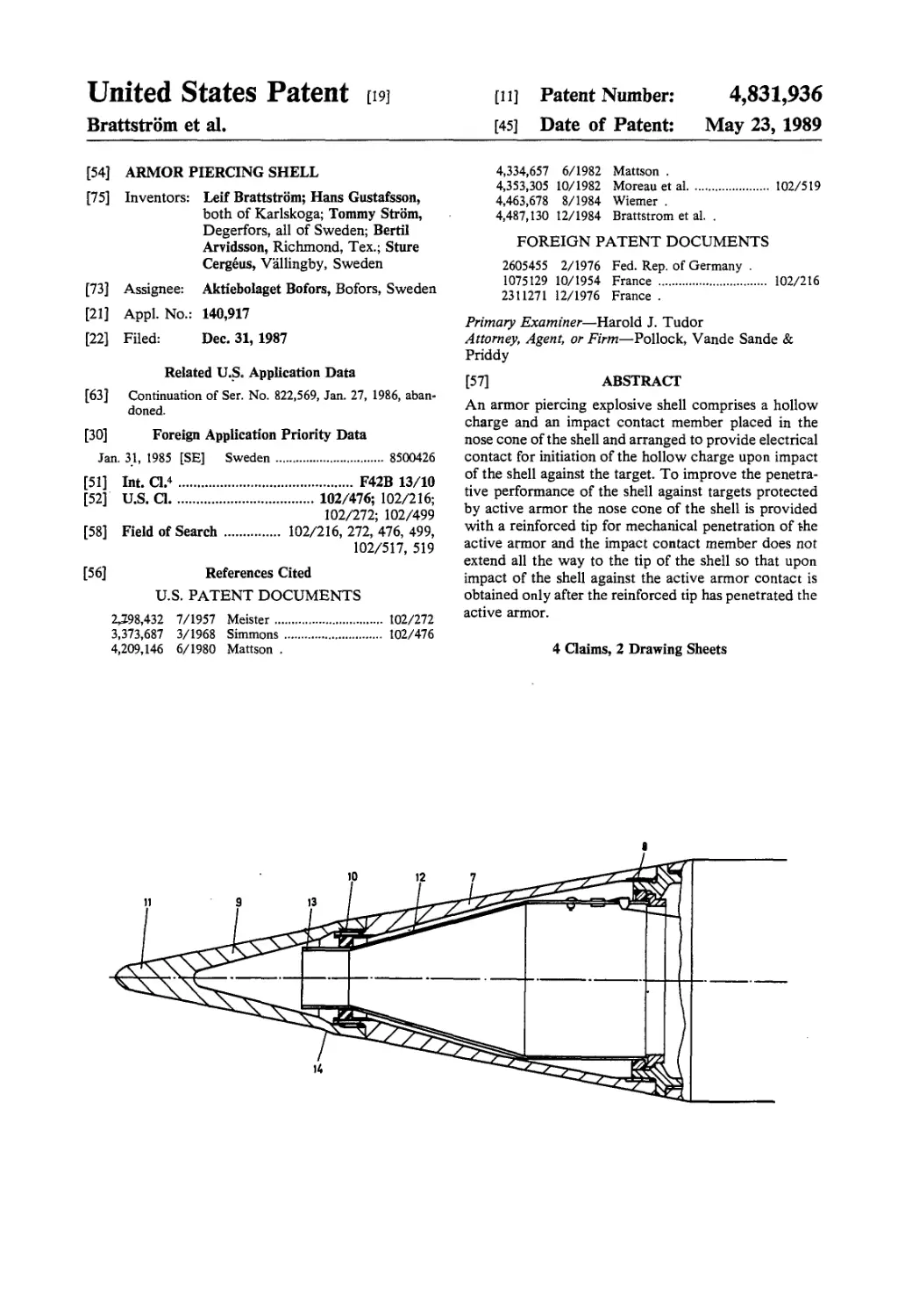
Shown in FIG. 2 is the front part of an armor piercing
explosive shell equipped with a first embodiment of a 20
nose cone with a reinforced tip according to the inven-
tion. The nose cone comprises two parts, a rear part 7
which is screwed onto the body of the shell by means of
'a thread 8 and a front part, the cap 9 which is screwed
onto the rear part 7 of the cone by means of a thread 10.
As evident from the figure the cap 9 is provided with
a solid tip 11 and has a conically rearward narrowing
wall thickness. The material thickness of the tip in the
longitudinal direction is thus at least 4-5 times the wall 30
thickness of the cap or nose cone otherwise. The tip has
a decidedly small tip radius, i.e. an appreciably sharper
tip than a conventional armor piercing explosive shell.
The tip is optimated to be able to penetrate aside the
active armor without this detonating.	35
The cap is made of a high-strength steel which has
been optimized in terms of hardness and plasticity. The
ruptural strength of the material should be of the order
of 1,000 N/mm2 in comparison with 250 N/mm2.
The nose cone also comprises an impact contact 40
member in the form of a full-caliber double sheath, an
outer sheath incorporated in the outer casing of the
shell and an inner sheath 12. The outer and inner sheaths
are disposed in an unused shell at a distance from and
isolated from each other so as upon impact of the shell 45
against the target to be able to enter into coaction and
make electrical contact with each other. The sheath
forms a passive end contact in the ignition system of the
shell (not shown) for initiation of the hollow charge.
In comparison with previously known, conventional 50
armor piercing explosive shells of this kind, the contact
member, the inner sheath 12, is not extended all the way
to the tip of the nose cone. This means that contact is
obtained first when the deformation reaches the rear
portion of the cap 9, i.e. the reinforced tip is able to 55
penetrate active armor before the hollow charge is
initiated. The front cylindrical portion 13 of the contact
member extends inside the cap, but only into its very
rearmost portion at the threaded joint 10.
,936
4
In modifying existing ammunition, only the cap 9 is
changed and the front portion of the contact member
removed. In order to impart greater strength to the cap
at the threaded joint 10, the cap has an increased cone
angle in the form of a “hunch” 14.
Illustrated in FIG. 3 is an alternative embodiment of
the nose cone. In this case also the tip is reinforced, solid
and with a material thickness of at least approx, four
times the wall thickness in the cone. In this case, how-
ever, the cone is an integral (undivided) unit and is
screwed onto the shell body by means of a thread 8. The
wall of the nose cone is made of a harder material than
in a conventional shell and the impact contact member
does not extend all the way to the tip of the shell, all in
accordance with the first embodiment according to
FIG. 2. The same reference designations have been used
for corresponding parts.
We claim:
1.	An armor-piercing explosive shell comprising in
combination:
(a)	a rear portion containing a hollow charge,
(b)	a front portion connected to said rear portion and
comprising a substantially cone-shaped outer cas-
ing defining an interior cavity, said outer casing
having a wall thickness extending rearwardly of its
forwardmost portion which is substantially greater
than the wall thickness rearwardly of said forward-
most portion to provide a reinforced tip,
(c)	said interior cavity containing an electrical
contact member which is of generally frustro-coni-
cal shape over at least a portion of its length,
(d)	and means for supporting said electrical contact
member within said front portion in such manner
that said frustro-conically shaped portion is closely
spaced from the interior surface of said first por-
tion, said electrical contact member stopping short
of extending into the forwardmost portion of said
front portion having said substantially greater wall
thickness,
(e)	and means effective only when said outer casing is
deformed to a sufficient extent rearwardly of its
forwardmost end by its impingement upon and at
least partial penetration of a target to result in elec-
trical contact being made between said front por-
tion and said electrical contact member to detonate
said hollow charge.
2.	An explosive shell according to claim 1 wherein at
least the front portion of the nose cone of the shell is
made of a hard material of a high-strength steel with a
ruptural limit of the magnitude of about 1,000 N/mm2.
3.	An explosive shell according to claim 1 wherein
said front portion comprises a forward portion consti-
tuting a separate cap with a solid tip connected to a rear
part of the front portion by a threaded joint.
4.	An explosive shell according to claim 1 wherein
the solid tip has a thickness in the longitudinal direction
of the shell of at least 4 times the ’wall thickness of the
shell casing of the front portion.
*****
65