/


Tags: mobility

Text
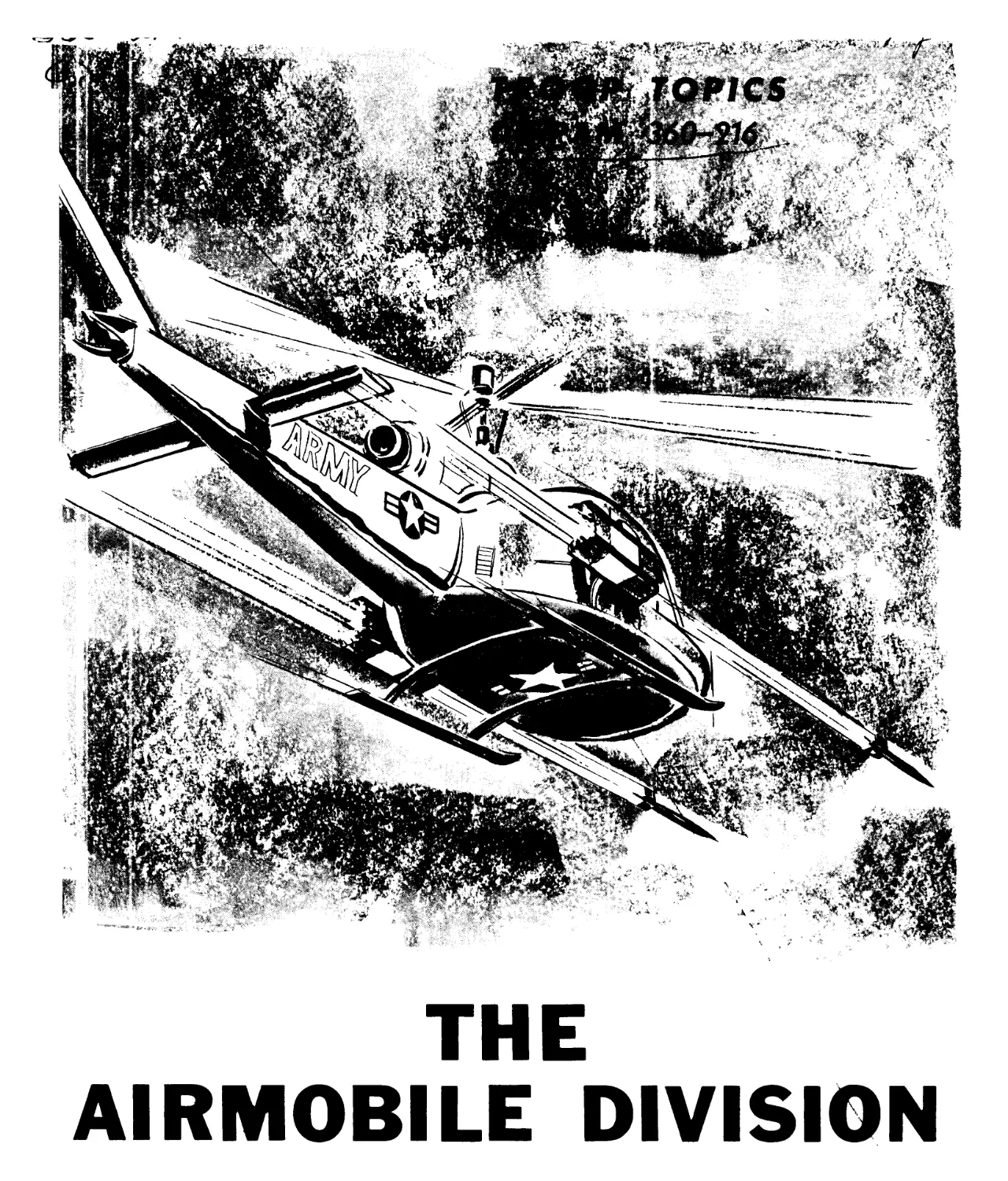
                    THE
AIRMOBILE DIVISION
TYPES AND DISTRIBUTION OF AIRCRAFT
in the
1ST CAVALRY DIVISION (AIRMOBILE)
Types
Helicopters
Light Observation (LOH)		93
Utility (UH)
UH-1B		111
UH-1D		176
Cargo (CH)
CH-47		48
Fixed Wing
OV-1		6
Distribution Brigade (3)
LOH 8 each	(24)
UH-1B 2 each	(6)
Air Cavalry Squadron
LOH	30
UH-1B	38
UH-1D	20
Division Artillery
LOH	12
UH-1B	43
Aviation Group
LOH	19
UH-1B	24
UH-1D	136
CH-47	48
OV-1	6
Medical Battalion
UH-1D	12
Aircraft Maintenance	Battalion
LOH	8
UH-1D	8
THE AIRMOBILE DIVISION
DA Pam 360-216
HEADQUARTERS
DEPARTMENT OF THE ARMY
Washington, D.C., 30 November 1965
The 1st Cavalry Division (Airmobile) was
activated in July 1965 at Fort Benning, Ga. This
gives the Army five types of combat divisions:
infantry, armored, mechanized, airborne, and
airmobile.
Establishment of the new airmobile division
required the following administrative actions:
•	The 2d Infantry Division at Fort Benning
was redesignated the 1st Cavalry Division
(Airmobile).
•	The 1st Cavalry Division in Korea was
redesignated the 2d Infantry Division.
•	The 11th Air Assault Division (Test) was
inactivated.
•	Personnel and equipment from the “old”
2d Infantry Division and the inactivated 11th
Air Assault Division were transferred to the
new 1st Cavalry Division (Airmobile).
In his statement announcing establishment of
the new division, Secretary of Defense Robert S.
McNamara said:
“The introduction of this new kind of divi-
sion into the Army will greatly increase our
growing capability to meet all kinds of
threats. It places our Army on the threshold
of an entirely new approach to the conduct
of the land battle. Use of the helicopter to
deliver men and weapons on the battlefield
will result in greater freedom of movement
and exploitation of the principles of surprise
to an unprecedented degree.”
The new airmobile division has a TOE strength
of about 15,800. This figure is for a division base
at 100 percent TOE strength, plus eight maneuver
battalions (five infantry and three airborne
infantry).
The airmobile division is authorized 434 air-
craft, all but 6 of them helicopters of three types.
For comparison, our infantry, armored, and mech-
anized divisions have 101 aircraft, and our air-
borne divisions 103.
The great increase in aircraft in the airmobile
division permits a corresponding reduction in the
numbers of organic ground vehicles. For ex-
ample, the trucks and armored personnel carriers
of an infantry division total almost 3,200, as
against only about 1,600 in the airmobile division.
1
WHAT IS AIR MOBILITY?
The designation Airmobile expresses the char-
acteristic—ability to move by air—that makes this
new division different from the other division
types. But the difference is relative, not abso-
lute—all our divisions have some degree of air
mobility. The airmobile division has a much
greater degree of air mobility than any of the
others.
This superiority in air mobility extends both to
strategic and tactical movement.
Strategically, the airmobile division can be
deployed almost twice as rapidly as a standard
infantry division. This is because the weight
(personnel and equipment) of the airmobile divi-
sion is only about one-third the weight of an
infantry division. The entire airmobile division
can be strategically deployed in Air Force C-130
aircraft, except that the largest helicopters (Chi-
nook) when fully assembled require the larger
C—133 aircraft.
In tactical situations, the distinctive capabilities
of the airmobile division are due primarily to its
greater strength in organic aircraft. The other
divisions, in varying degrees, can Ъе moved by air.
The airmobile division, more than any of the
others, can also move itself by air. This is what
enables the airmobile division, for example, to—
•	Move rapidly and directly to key objective
areas over any kind of terrain and deliver its
soldiers fresh and ready for immediate combat.
•	Maintain operations at a very rapid tempo
and high intensity, and respond swiftly to
changes in the tactical situation.
•	Withdraw from an engagement at one
point and move rapidly in any direction to fight
at another point a considerable distance away.
•	Operate in enemy areas using only the
enemy’s “vertical flank” to get in and out.
•	Exploit rapidly any opportunities pre-
sented by the enemy and any advantages
achieved by other friendly forces.
•	Traverse terrain obstacles and areas of
destruction and contamination that would stop
or delay forces limited to surface mobility.
•	Support itself logistically within the divi-
sion area by means of its organic aircraft.
These capabilities would be highly valued in
any kind of land warfare. They are particularly
desirable for operations against guerrilla forces,
including conventional military units that employ
guerrilla methods. This is why the 1st Cavalry
Division (Airmobile) was deployed to South
Vietnam soon after it was activated.
It may seem at first thought that a relatively
slow-flying helicopter at low altitude would pre-
sent an excellent target for enemy ground fire.
But this is not the case. During several years of
operations in Vietnam Army helicopters have
proven very difficult to knock out of action. The
rates of hit damage and loss from ground fire have
been exceptionally low. There are several rea-
sons for this, perhaps the most important being
short exposure time, suppressive fire, and surprise.
For example, in a typical airmobile operation in
Vietnam the helicopters appear suddenly in an
objective area at treetop level. Even then the
enemy has little chance to deliver fire because at
that moment he is more concerned with taking
cover against the suppressive fire from the armed
helicopters. And, before he is able to bring his
weapons to bear, the helicopters have landed their
troops in the objective area and are already out
of range.
Because helicopters can land almost anywhere
when disabled, a high percentage of the helicop-
ters downed in Vietnam have been recovered, re-
paired, and returned to service.
2
The Engineer Battalion
The engineer battalion consists of—
•	Headquarters and headquarters company
•	Three combat engineer companies
The Air Cavalry Squadron
The air cavalry squadron consists of—
•	Headquarters and headquarters troop
•	A cavalry troop
•	Three air cavalry troops
The Signal Battalion
The signal battalion consists of—
•	Headquarters and service company
•	A command operations company
The Maneuver Battalions
At the present time the 1st Cavalry Division
(Airmobile) has five infantry battalions and three
airborne infantry battalions. One of the three bri-
gade headquarters also has an airborne capability.
Both the infantry and airborne infantry battal-
ions consist of—
•	Headquarters and headquarters company
•	Three rifle companies
•	A combat support company
(While companies in infantry and airborne in-
fantry battalions are alike in structure, personnel
of the latter are trained and equipped for airborne
assault by parachute.)
OH-23 RAVEN. One of two types of light observation helicopters initially assigned to the 1st Cavalry Division
(Airmobile), the RAVEN can be used for reconnaissance, medical evacuation, command liaison, wire laying, and
resupply in the combat zone.
4
1ST CAVALRY DIVISION ( AIRMOBILE )
______XX______
DIVISION BASE
________________X___________________
BRIGADE
HEADQUARTERS & HEADQUARTERS COMPANIES
5
ORGANIC AIRCRAFT IN THE DIVISION STRUCTURE
Because greater strength in organic aircraft is
a central feature of the airmobile division, it is
worthwhile to take a closer look at how this
strength has been incorporated into the division
structure. It is especially instructive to compare
the airmobile division’s aviation elements with the
aviation elements of the other division types.
• In the infantry, armored, mechanized,
and airborne divisions the aviation battalion
has an aviation general support company and
an airmobile company. The aviation group
in the airmobile division has (as already
noted) two light helicopter battalions (each
battalion having three helicopter companies
and an aerial weapons company), a general
support aviation company, and a medium
helicopter battalion with three helicopter
companies.
•	In the other divisions the armored cav-
alry squadron has an air cavalry troop. In the
airmobile division the air cavalry squadron
has three air cavalry troops.
•	In the other divisions, the division artil-
lery has an aviation section assigned to the
headquarters battery. In the airmobile divi-
sion, the division artillery has both an aviation
battery and an aerial rocket artillery battalion
with three aerial rocket batteries.
UH-1 IROQUOIS. The airmobile division has two models of this utility helicopter: The UH-1B (shown here
armed with machineguns and the 2.75-inch rocket system) and the UH-1D.
The UH-1D IROQUOIS can transport 12 men plus the pilot, and can be armed with machineguns, the SS-11
missile, or the 2.75mm Barrage Rocket Kit. Other utility functions include medical evacuation, resupply, and
observation. This aircraft has been tested as a mobile command post and as a mobile medical aid station.
6
в
Й J*
IB	<LK - UT
* 1# •
CH-lfi CHINOOK is a cargo helicopter that can carry payloads of up to 6 tons on a radius-of-action mission of
100 nautical miles. Its payload compartment holds each major component of the helicopter-transportable version of
the PERSHING missile system. CHINOOK can transport 33 combat-equipped troops or 24 litter patients.
7
HOW THE ORGANIC AIRCRAFT ARE USED
• In all five division types organic aircraft have
the common function of increasing the Army’s
land combat capabilities. Army aircraft are em-
ployed on both tactical and logistical tasks.
Some of the tactical uses are—
•	Command, control, and communication
•	Battlefield surveillance and target acquisi-
tion
•	Reconnaissance, security, and screening op-
erations
•	Transport of infantry assault elements and
their support elements
•	Armed helicopter escort of transport heli-
copters
•	Providing suppressive fires as an integral
part of the land force maneuver and fire
plan
(The above uses are separate from, and do not
duplicate, the missions of close air support
and tactical air reconnaissance that are per-
formed by tactical air elements of the other
Services.)
The main logistical uses for Army aircraft are—
•	Movement of troops, equipment, and sup-
plies within the battle area
•	Evacuation of casualties
OV-1 MOHAWK is the only fixed-wing aircraft in the airmobile division. The tubelike object mounted beneath
one of the aircraft shown here is the side looking radar surveillance system which provides aerial radar maps of the
ground on either side of the flight path.
8
A “TYPICAL” AIRMOBILE OPERATION
During 1963 and 1964, the Army conducted ex-
tensive tests of the air mobility concept. A Tac-
tical Mobility Board first studied the many prob-
lems involved. Then two test units were formed—
the 11th Air Assault Division (Test), and the 10th
Air Transport Brigade (Test). Their mission was
to find out what airmobile units can and cannot do
in combat situations ranging from general war to
antiguerrilla operations. The test units, aug-
mented by other forces, engaged in several field
exercises, the last of which was completed in No-
vember 1964.
As already indicated, many of the capabilities
clearly demonstrated during the airmobile test
exercises are especially useful in operations against
guerrilla forces. The following description of a
hypothetical antiguerrilla operation will show
why.
The locale is a remote jungle area, secret head-
quarters and hideout for a large force of Com-
munist guerrillas. Some miles from the guerrilla
headquarters is their sizable and carefully camou-
flaged supply center.
The helicopters have landed and troops quickly move to their objectives in a surprise attack.
9
Unknown to the guerrillas, a U.S. Army surveil-
lance aircraft has located both the headquarters
and the supply center. Elements of an airmobile
division are now about to make full use of this
intelligence information.
The stillness of the jungle is suddenly shattered
by the sounds of approaching helicopters, flying
just above the treetops. Caught by surprise in
their hidden rest area, the guerrillas begin to seek
even more concealment. They hear machineguns
and air-to-ground rockets firing and realize that
the armed helicopters are laying down suppressive
fire. This fact tells them that fresh, ready-to-
fight, troops soon will be coming to earth all around
their position. They realize that the thing all
guerrillas fear—encirclement—is about to occur.
The suppressive fires increase as the troop-carry-
ing helicopters descend and quickly discharge their
battle-ready infantrymen. As the troops move out
toward their preplanned objectives, the armed
helicopters follow them with more suppressive fire.
The transport helicopters move back to their base
for additional troops and supplies. In a few hours
the surrounded guerrilla headquarters is taken.
But the operation is not yet complete. Now the
airmobile force turns its attention to the next ob-
jective—the supply center. By tortuous jungle
trail it would be many hours away; by helicopter
only minutes. According to plan, the transport
helicopters return to pick up most of the infantry-
men, leaving a contingent to guard the captive
guerrillas.
Although their headquarters has flashed them a
warning to expect an attack, the guerrillas man-
ning the supply center know that they cannot de-
fend the installation against such odds. They
have only one choice—disappear deeper into the
jungle carrying what few supplies they can.
When the airmobile elements arrive over the posi-
tion, suppressive fires prove to be unneeded. The
troops land unopposed and soon the large supply
dump is in flames.
As the final phase of this imaginary, but entirely
realistic, airmobile operation, troop-carrying heli-
copters return to the former guerrilla hideout, pick
up the guard contingent and their captives, and
return to base.
THE ULTIMATE VALUE
Air mobility (like ground mobility) has no in-
dependent military value. Movement of troops
and equipment to or on the battlefield does not by
itself produce the military decision. Only the ac-
tions of skilled and determined fighting men can
do that. It is clear then that the establishment of
an airmobile division improves the Army’s combat
ability by increasing the effectiveness of its most
potent weapon—the ground combat soldier.
10
DISCUSSION OUTLINE
I Introduction
1.	(See text for Sec. McNamara’s statement
about the 1st Cavalry Division (Airmobile).)
2.	Army now has five types of divisions: in-
fantry, armored, mechanized, airborne, and
airmobile.
3.	The new airmobile division base, plus eight
maneuver battalions (5 inf and 3 abn inf),
gives a personnel strength of 15,787.
4.	The new division has 434 aircraft, compared
to 101 in infantry, armored, and mechanized
divisions, and 103 in airborne divisions.
5.	The new division has about 1,600 trucks and
APC’s, as against almost 3,200 in an infantry
division.
4. An airmobile division can—
a.	Move rapidly to objective areas regardless
of terrain and in almost any kind of
weather.
b.	Maintain a high tempo of operations and
respond swiftly to changes in the tactical
situation.
c.	Break off action at one point and move
rapidly in any direction to fight at another
point.
d.	Operate in the enemy’s rear areas.
e.	Exploit tactical opportunities.
f.	Move across terrain obstacles and contam-
ination that would stop or delay other
forces.
II What Is Air Mobility?
1.	All our divisions have some air mobility; the
airmobile division has much more air mobility
than the other types.
2.	Strategically, the airmobile division can be
deployed twice as fast as an infantry division.
Air Force C-130 aircraft can carry every-
thing except the division’s largest helicopters
(Chinook), which are moved strategically by
the larger C-133 aircraft.
3.	Tactically, the other division types can Ъе
moved by air. The airmobile division, more
than the others, can move Itself by air.
Ill Structure of the Airmobile Division
1. Like the other four division types, the air-
mobile division consists of a division base and
maneuver battalions.
2. See text for outline of airmobile division
structure.
IV Organic Aircraft in the Division Structure
1. In the other four division types, the aviation
battalion consists of an aviation general sup-
port company and an airmobile company.
11
Contrast this with the aviation group of the
airmobile division, which has two light and
one medium helicopter battalions, each hav-
ing three helicopter companies.
2. In the other divisions the armored cavalry
squadron has an air cavalry troop. In the
airmobile division the air cavalry squadron
has three air cavalry troops.
V	How the Organic Aircraft Are Used
(See text for outline list of main tactical and
logistical uses for Army aircraft.)
VI	A “Typical” Airmobile Operation
1. During 1963 and 1964 two Army test units
(11th Air Assault Division and 10th Air
Transport Brigade) conducted several exten-
sive exercises. Mission: To find out what air-
mobile units can and cannot do in a variety
of combat situations.
2. (See text for account of a hypothetical air-
mobile operation against guerrilla forces.)
VII The Ultimate Value
Air mobility (like ground mobility) does not
by itself win battles—only skilled and determined
fighting men can do that. Air mobility improves
the Army’s combat strength by increasing the effec-
tiveness of its most potent weapon—the ground
combat soldier.
By Order of the Secretary of the Army:
Official:
J. C. LAMBERT,
Mayor General, United States Army,
The Adyutamt General.
HAROLD K. JOHNSON,
General, United States Army,
Chief of Staff.
Distribution:
To be distributed in accordance with DA Form 12-4 requirements for Troop Topics.
U.S. GOVERNMENT PRINTING OFFICE: 1965 О—794-905
12