/
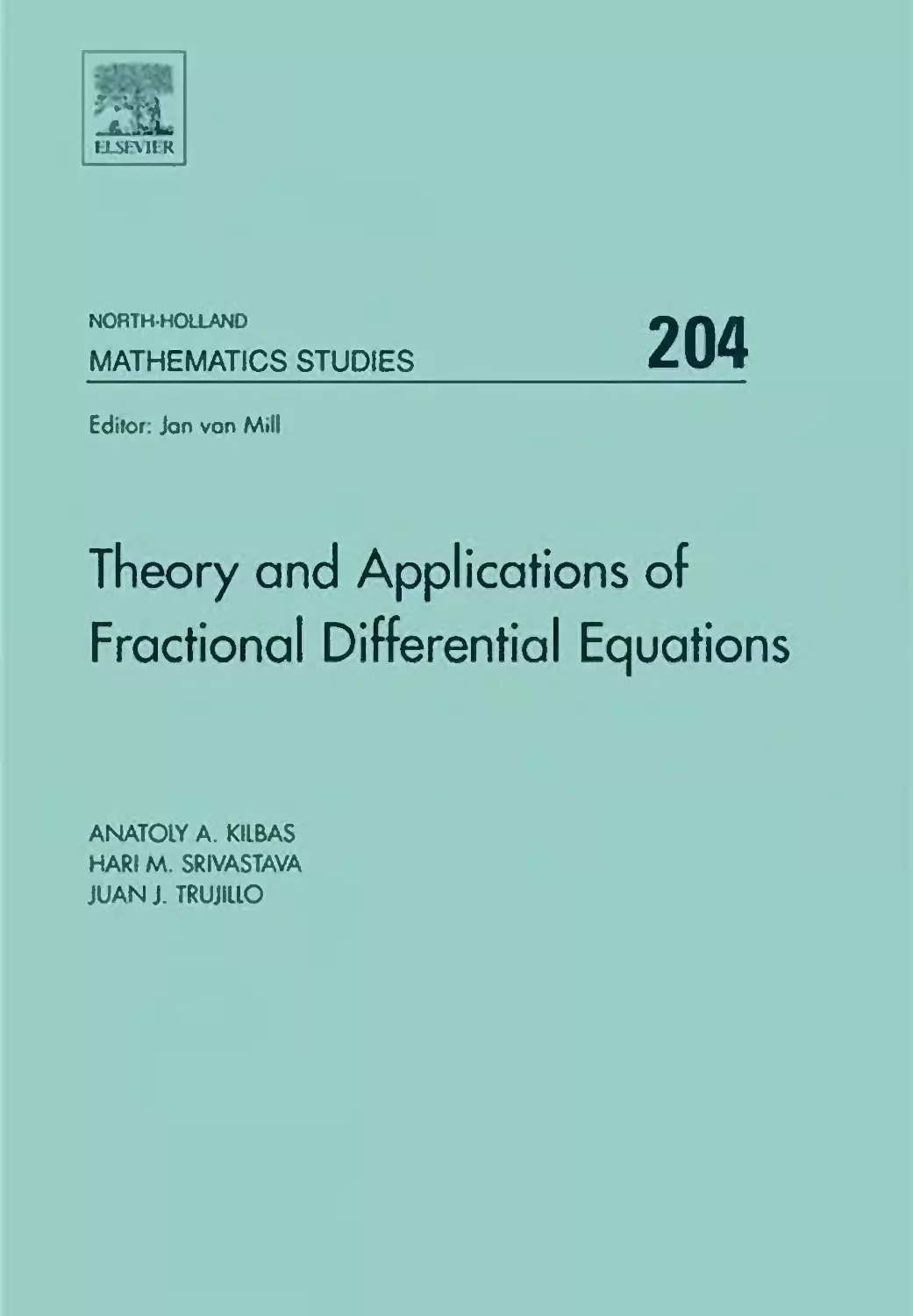


Author: Kilbas A.A. Srivastava H.M. Trujillo J.J.
Tags: mathematics mathematical analysis differential equations differential calculus
ISBN: 978-0-444-51832-3
Year: 2006

Text
                    ELSEVIER
NORTH-HOLLAND
MATHEMATICS STUDIES 204
Editor: Jon von Mill
Theory and Applications of
Fractional Differential Equations
ANATOLY A. KILBAS
HARI M. SRIVASTAVA
JUAN J. TRUJILLO

NORTH-HOLLAND MATHEMATICS STUDIES 204
(Continuation of the Notas de Matematica)
Editor: Jan van
Faculteit der Exacte Wetenschappen
Amsterdam, The Netherlands
ELSEVIER
2006
Amsterdam - Boston - Heidelberg - London - New York - Oxford
Paris - San Diego - San Francisco - Singapore - Sydney - Tokyo

THEORY AND APPLICATIONS
OF FRACTIONAL DIFFERENTIAL
EQUATIONS
ANATOLY A. KILBAS
Belarusian State University
Minsk, Belarus
HARI M. SRIVASTAVA
University of Victoria
Victoria, British Columbia, Canada
JUAN J. TRUJILLO
Universidad de La Laguna
La Laguna (Tenerife)
Canary Islands, Spain
Amsterdam - Boston - Heidelberg - London - New York - Oxford
Paris - San Diego - San Francisco - Singapore - Sydney - Tokyo

ELSEVIER B.V. ELSEVIER Inc. ELSEVIER Ltd. ELSEVIER Ltd.
Radarweg 29 525 B Street, Suite 1900 The Boulevard, Langford Lane 84 Theobalds Road
P.O. Box 211,1000 AE Amsterdam San Diego, CA 92101-4495 Kidlington, Oxford OX5 1GB London WC1X 8RR
The Netherlands USA UK UK
© 2006 Elsevier B.V. All rights reserved.
This work is protected under copyright by Elsevier B.V., and the following terms and conditions apply to its use:
Photocopying
Single photocopies of single chapters may be made for personal use as allowed by national copyright laws. Permission of the
Publisher and payment of a fee is required for all other photocopying, including multiple or systematic copying, copying for
advertising or promotional purposes, resale, and all forms of document delivery. Special rates are available for educational
institutions that wish to make photocopies for non-profit educational classroom use.
Permissions may be sought directly from Elsevier's Rights Department in Oxford, UK: phone (+44) 1865 843830, fax (+44)
1865 853333, e-mail: permissions@elsevier.com. Requests may also be completed on-line via the Elsevier homepage (http://
www.elsevier.com/locate/permissions).
In the USA, users may clear permissions and make payments through the Copyright Clearance Center, Inc., 222 Rosewood
Drive, Danvers, MA 01923, USA; phone: (+1) (978) 7508400, fax: (+1) (978) 7504744, and in the UK through the Copyright
Licensing Agency Rapid Clearance Service (CLARCS), 90 Tottenham Court Road, London W1P 0LP, UK; phone: (+44)
20 7631 5555; fax: (+44J0 7631 5500. Other countries may have a local reprographic rights agency for payments.
Derivative Works
Tables of contents may be reproduced for internal circulation, but permission of the Publisher is required for external resale
or distribution of such material. Permission of the Publisher is required for all other derivative works, including compilations
and translations.
Electronic Storage or Usage
Permission of the Publisher is required to store or use electronically any material contained in this work, including any chapter
or part of a chapter.
Except as outlined above, no part of this work may be reproduced, stored in a retrieval system or transmitted in any form or by
any means, electronic, mechanical, photocopying, recording or otherwise, without prior written permission of the Publisher.
Address permissions requests to: Elsevier's Rights Department, at the fax and e-mail addresses noted above.
Notice
No responsibility is assumed by the Publisher for any injury and/or damage to persons or property as a matter of products
liability, negligence or otherwise, or from any use or operation of any methods, products, instructions or ideas contained in the
material herein. Because of rapid advances in the medical sciences, in particular, independent verification of diagnoses and
drug dosages should be made.
First edition 2006
Library of Congress Cataloging in Publication Data
A catalog record is available from the Library of Congress.
British Library Cataloguing in Publication Data
A catalogue record is available from the British Library.
ISBN-13: 978-0-444-51832-3
ISBN-10: 0-444-51832-0
ISSN (Series): 0304-0208
@ The paper used in this publication meets the requirements of ANS1/NISO Z39.48-1992 (Permanence of Paper).
Printed in The Netherlands.

To
Tamara, Rekha, and Margarita

This Page is Intentionally Left Blank

Preface
The subject of fractional calculus (that is, calculus of integrals and derivatives
of any arbitrary real or complex order) has gained considerable popularity and
importance during the past three decades or so, due mainly to its demonstrated
applications in numerous seemingly diverse and widespread fields of science and
engineering. It does indeed provide several potentially useful tools for solving
differential and integral equations, and various other problems involving special
functions of mathematical physics as well as their extensions and generalizations
in one and more variables.
The concept of fractional calculus is popularly believed to have stemmed from a
question raised in the year 1695 by Marquis de L'Hopital A661-1704) to Gottfried
Wilhelm Leibniz A646-1716), which sought the meaning of Leibniz's (currently
popular) notation ^f- for the derivative of order n € No := {0,1,2,•••} when
n = | (What if n = |?). In his reply, dated 30 September 1695, Leibniz wrote to
L'Hopital as follows: "... This is an apparent paradox from which, one day, useful
consequences will be drawn. ..."
Subsequent mention of fractional derivatives was made, in some context or
the other, by (for example) Euler in 1730, Lagrange in 1772, Laplace in 1812,
Lacroix in 1819, Fourier in 1822, Liouville in 1832, Riemann in 1847, Greer in 1859,
Holmgren in 1865, Griinwald in 1867, Letnikov in 1868, Sonin in 1869, Laurent in
1884, Nekrassov in 1888, Krug in 1890, and Weyl in 1917. In fact, in his 700-page
textbook, entitled "Traite du Calcul Differentiel et du Calcul Integral" (Second
edition; Courcier, Paris, 1819), S. F. Lacroix devoted two pages (pp. 409-410) to
fractional calculus, showing eventually that
d*_ _ Vu
dvz V^
In addition, of course, to the theories of differential, integral, and integro-differen-
tial equations, and special functions of mathematical physics as well as their
extensions and generalizations in one and more variables, some of the areas of present-
day applications of fractional calculus include Fluid Flow, Rheology, Dynamical
Processes in Self-Similar and Porous Structures, Diffusive Transport Akin to
Diffusion, Electrical Networks, Probability and Statistics, Control Theory of Dynamical
Systems, Viscoelasticity, Electrochemistry of Corrosion, Chemical Physics, Optics
and Signal Processing, and so on.
Vll

viii
Theory and Applications of Fractional Differential Equations
The first work, devoted exclusively to the subject of fractional calculus, is the
book by Oldham and Spanier [643] published in 1974. One of the most recent
works on the subject of fractional calculus is the book of Podlubny [682]
published in 1999, which deals principally with fractional differential equations. Some
of the latest (but certainly not the last) works especially on fractional models of
anomalous kinetics of complex processes are the volumes edited by Carpinteri and
Mainardi [132] in 1997 and by Hilfer [340] in 2000, and the book by Zaslavsky [915]
published in 2005. Indeed, in the meantime, numerous other works (books, edited
volumes, and conference proceedings) have also appeared. These include (for
example) the remarkably comprehensive encyclopedic-type monograph by Samko,
Kilbas and Marichev [729], which was published in Russian in 1987 and in English
in 1993, and the book devoted substantially to fractional differential equations
by Miller and Ross [603], which was published in 1993. And today there exist at
least two international journals which are devoted almost entirely to the subject of
fractional calculus: (i) Journal of Fractional Calculus and (ii) Fractional Calculus
and Applied Analysis.
The main objective of this book is to complement the contents of the other
books mentioned above. Many new results, obtained recently in the theory of
ordinary and partial differential equations, are not specifically reflected in the book.
We aim at presenting, in a systematic manner, results including the existence
and uniqueness of solutions for the Cauchy Type and Cauchy problems
involving nonlinear ordinary fractional differential equations, explicit solutions of
linear differential equations and of the corresponding initial-value problems by their
reduction to Volterra integral equations and by using operational and
compositional methods, applications of the one- and multi-dimensional Laplace, Mellin,
and Fourier integral transforms in deriving closed-form solutions of ordinary and
partial differential equations, and a theory of the so-called sequential linear
fractional differential equations including a generalization of the classical Frobenius
method.
This book consists of a total of eight chapters. Chapter 1 (Preliminaries)
provides some basic definitions and properties from such topics of Mathematical
Analysis as functional spaces, special functions, integral transforms, generalized
functions, and so on. The extensive modern-day usages of such special functions
as the classical Mittag-Leffler functions and its various extensions, the Wright
(or, more precisely, the Fox-Wright) generalization of the relatively more familiar
hypergeometric pFq function, and the Fox H-function in the solutions of ordinary
and partial fractional differential equations have indeed motivated a major part of
Chapter 1. Chapter 2 (Fractional Integrals and Fractional Derivatives) contains
the definitions and some potentially useful properties of several different families of
fractional integrals and fractional derivatives. Chapter 1 and Chapter 2, together,
are meant to prepare the reader for the understanding of the various mathematical
tools and techniques which are developed in the later chapters of this book.
The fundamental existence and uniqueness theorems for ordinary fractional
differential equations are presented in Chapter 3 with special reference to the
Cauchy Type problems. Here, in Chapter 3, we also consider nonlinear and linear
fractional differential equations in one-dimensional and vectorial cases. Chapter

Preface
ix
4 is devoted to explicit and numerical solutions of fractional differential
equations and boundary-value problems associated with them. Our approaches in this
chapter are based mainly upon the reduction to Volterra integral equations, upon
compositional relations, and upon operational calculus.
In Chapter 5, we investigate the applications of the Laplace, Mellin, and Fourier
integral transforms with a view to constructing explicit solutions of linear
differential equations involving the Liouville, Caputo, and Riesz fractional derivatives with
constant coefficients. Chapter 6 is devoted to a survey of the developments and
results in the fields of partial fractional differential equations and to the applications
of the Laplace and Fourier integral transforms in order to obtain closed-form
solutions of the Cauchy Type and Cauchy problems for the fractional diffusion-wave
and evolution equations.
Linear differential equations of sequential and non-sequential fractional order,
as well as systems of linear fractional differential equations associated with the
Riemann-Liouville and Caputo derivatives, are investigated in Chapter 7, which
incidentally also develops an interesting generalization of the classical Frobenius
Method for solving fractional differential equations with variable coefficients and a
direct way to obtain explicit solutions of such types of differential equations with
constant coefficients. And, while a survey of a variety of applications of fractional
differential equations are treated briefly in many chapters of this book (especially
in Chapter 7), a review of some important applications involving fractional models
is presented systematically in the last chapter of the book (Chapter 8).
At the end of this book, for the convenience of the readers interested in further
investigations on these and other closely-related topics, we include a rather large
and up-to-date Bibliography. We also include a Subject Index.
Operators of fractional integrals and fractional derivatives, which are based
essentially upon the familiar Cauchy-Goursat Integral Formula, were considered by
(among others) Sonin in 1869, Letnikov in 1868 onwards, and Laurent in 1884. In
recent years, many authors have demonstrated the usefulness of such types of
fractional calculus operators in obtaining particular solutions of numerous families of
homogeneous (as well as nonhomogeneous) linear ordinary and partial differential
equations which are associated, for example, with many of the celebrated
equations of mathematical physics such as (among others) the Gauss hypergeometric
equation:
ci iv dw
z{l - z)— + [j - (a + 0 + l)z}— - a/3w = 0
and the relatively more familiar Bessel equation:
>d?w dw
z
2U *" | ,uw , / 2 ,,2
+ z— + (z2 -v2)w = 0.
dz2 dz
In the cases of (ordinary as well as partial) differential equations of higher
orders, which have stemmed naturally from the Gauss hypergeometric equation, the
Bessel equation, and their many relatives and extensions, there have been several
seemingly independent attempts to present a remarkably large number of
scattered results in a unified manner. For developments dealing extensively with such

X
Theory and Applications of Fractional Differential Equations
applications of fractional calculus operators in the solution of ordinary and
partial differential equations, the interested reader is referred to the numerous recent
works cited in the Bibliography.
This book is written primarily for the graduate students and researchers in
many different disciplines in the mathematical, physical, and engineering sciences,
who are interested not only in learning about the various mathematical tools and
techniques used in the theory and widespread applications of fractional differential
equations, but also in further investigations which emerge naturally from (or which
are motivated substantially by) the physical situations modelled mathematically
in the book.
Right from the conceptualization of this book project until the finalization of
the typescript in this present form, the authors have gratefully received invaluable
suggestions and comments from colleagues at many different academic institutions
and research centers around the world. Special mention ought to be made of the
help and assistance so generously and meticulously provided by Dr. Margarita
Rivero, Dr. Blanca Bonilla, Dr. Jose R. Franco, Ldo. Luis Rodriguez-Germa,
all at the Universidad de La Laguna. Special mention should be made also of
Engr. Sergio Ortiz-Villajos Eirfn and of Dr. Luis Vazquez at the Universidad
Complutense de Madrid.
The first- and the second-named authors would like to express their
appreciation for the kind hospitality and support by the Universidad de La Laguna during
their many short-term visits to the Departamento de Analisis Matematico
(Universidad de La Laguna) throughout the tenure of this book project. All three authors,
and particularly the second-named author, are especially thankful to the second-
named author's wife and colleague, Professor Rekha Srivastava, for her constant
support, encouragement, and understanding. The first-named author would also
like to thank his wife, Mrs. Tamara Sapova, for her support and encouragement.
We are immensely grateful to Professor Nacere Hayek Calil for his constant
inspiration and encouragement throughout the tenure of this book project.
Finally, the authors (particularly the third-named author) would like to
thankfully acknowledge the financial grants and support for this book project, which
were awarded by the Ministry of Education and Sciences (MTM2004/00327),
FEDER and the Autonomous Government of Canary Islands (PI 2003/133). This
book was prepared in the frame of joint collaboration of the first- and the third-
named authors supported by Belarusian Fundamental Research Fund under
Projects F03MC-008 and F05MC-050. This work was also supported, in part, by the
Universidad de La Laguna, the Academia Canaria de Ciencias, and the Natural
Sciences and Engineering Research Council of Canada.
September 2005 Anatoly A. Kilbas
Belarusian State University
Hari M. Srivastava
University of Victoria
Juan J. Trujillo
Universidad de La Laguna

Contents
1 PRELIMINARIES 1
1.1 Spaces of Integrable, Absolutely Continuous, and Continuous
Functions 1
1.2 Generalized Functions 6
1.3 Fourier Transforms 10
1.4 Laplace and Mellin Transforms 18
1.5 The Gamma Function and Related Special Functions 24
1.6 Hypergeometric Functions 27
1.7 Bessel Functions 32
1.8 Classical Mittag-Leffler Functions 40
1.9 Generalized Mittag-Leffler Functions 45
1.10 Functions of the Mittag-Leffler Type 49
1.11 Wright Functions 54
1.12 The if-Function 58
1.13 Fixed Point Theorems 67
2 FRACTIONAL INTEGRALS AND FRACTIONAL
DERIVATIVES 69
2.1 Riemann-Liouville Fractional Integrals and Fractional
Derivatives 69
2.2 Liouville Fractional Integrals and Fractional Derivatives on the Half-
Axis 79
2.3 Liouville Fractional Integrals and Fractional Derivatives on the Real
Axis 87
2.4 Caputo Fractional Derivatives 90
2.5 Fractional Integrals and Fractional Derivatives of a Function with
Respect to Another Function 99
2.6 Erdelyi-Kober Type Fractional Integrals and Fractional
Derivatives 105
2.7 Hadamard Type Fractional Integrals and Fractional Derivatives . . 110
2.8 Griinwald-Letnikov Fractional Derivatives 121
2.9 Partial and Mixed Fractional Integrals and Fractional
Derivatives 123
2.10 Riesz Fractional Integro-Differentiation 127
2.11 Comments and Observations 132

xii Theory and Applications of Fractional Differential Equations
3 ORDINARY FRACTIONAL DIFFERENTIAL EQUATIONS.
EXISTENCE AND UNIQUENESS THEOREMS 135
3.1 Introduction and a Brief Overview of Results 135
3.2 Equations with the Riemann-Liouville Fractional Derivative in the
Space of Summable Functions 144
3.2.1 Equivalence of the Cauchy Type Problem and the Volterra
Integral Equation 145
3.2.2 Existence and Uniqueness of the Solution to the Cauchy Type
Problem 148
3.2.3 The Weighted Cauchy Type Problem 151
3.2.4 Generalized Cauchy Type Problems 153
3.2.5 Cauchy Type Problems for Linear Equations 157
3.2.6 Miscellaneous Examples 160
3.3 Equations with the Riemann-Liouville Fractional Derivative in the
Space of Continuous Functions. Global Solution 162
3.3.1 Equivalence of the Cauchy Type Problem and the Volterra
Integral Equation 163
3.3.2 Existence and Uniqueness of the Global Solution to the
Cauchy Type Problem 164
3.3.3 The Weighted Cauchy Type Problem 167
3.3.4 Generalized Cauchy Type Problems 168
3.3.5 Cauchy Type Problems for Linear Equations 170
3.3.6 More Exact Spaces 171
3.3.7 Further Examples 177
3.4 Equations with the Riemann-Liouville Fractional Derivative in the
Space of Continuous Functions. Semi-Global and Local Solutions . 182
3.4.1 The Cauchy Type Problem with Initial Conditions at the
Endpoint of the Interval. Semi-Global Solution 183
3.4.2 The Cauchy Problem with Initial Conditions at the Inner
Point of the Interval. Preliminaries 186
3.4.3 Equivalence of the Cauchy Problem and the Volterra Integral
Equation . 189
3.4.4 The Cauchy Problem with Initial Conditions at the Inner
Point of the Interval. The Uniqueness of Semi-Global and
Local Solutions 191
3.4.5 A Set of Examples 196
3.5 Equations with the Caputo Derivative in the Space of Continuously
Differentiable Functions 198
3.5.1 The Cauchy Problem with Initial Conditions at the Endpoint
of the Interval. Global Solution 199
3.5.2 The Cauchy Problems with Initial Conditions at the End and
Inner Points of the Interval. Semi-Global and Local
Solutions 205
3.5.3 Illustrative Examples 209

Contents xiii
3.6 Equations with the Hadamard Fractional Derivative in the Space of
Continuous Functions 212
4 METHODS FOR EXPLICITLY SOLVING FRACTIONAL
DIFFERENTIAL EQUATIONS 221
4.1 Method of Reduction to Volterra Integral Equations 221
4.1.1 The Cauchy Type Problems for Differential Equations with
the Riemann-Liouville Fractional Derivatives 222
4.1.2 The Cauchy Problems for Ordinary Differential
Equations 228
4.1.3 The Cauchy Problems for Differential Equations with the
Caputo Fractional Derivatives 230
4.1.4 The Cauchy Type Problems for Differential Equations with
Hadamard Fractional Derivatives 234
4.2 Compositional Method 238
4.2.1 Preliminaries 238
4.2.2 Compositional Relations 239
4.2.3 Homogeneous Differential Equations of Fractional Order with
Riemann-Liouville Fractional Derivatives 242
4.2.4 Nonhomogeneous Differential Equations of Fractional
Order with Riemann-Liouville and Liouville Fractional
Derivatives with a Quasi-Polynomial Free Term 245
4.2.5 Differential Equations of Order 1/2 248
4.2.6 Cauchy Type Problem for Nonhomogeneous Differential
Equations with Riemann-Liouville Fractional Derivatives and
with a Quasi-Polynomial Free Term 251
4.2.7 Solutions to Homogeneous Fractional Differential Equations
with Liouville Fractional Derivatives in Terms of Bessel-
Type Functions 257
4.3 Operational Method 260
4.3.1 Liouville Fractional Integration and Differentiation
Operators in Special Function Spaces on the Half-Axis 261
4.3.2 Operational Calculus for the Liouville Fractional Calculus
Operators 263
4.3.3 Solutions to Cauchy Type Problems for Fractional
Differential Equations with Liouville Fractional Derivatives 266
4.3.4 Other Results 270
4.4 Numerical Treatment 272
5 INTEGRAL TRANSFORM METHOD FOR EXPLICIT
SOLUTIONS TO FRACTIONAL DIFFERENTIAL
EQUATIONS 279
5.1 Introduction and a Brief Survey of Results 279
5.2 Laplace Transform Method for Solving Ordinary Differential
Equations with Liouville Fractional Derivatives 283

xiv Theory and Applications of Fractional Differential Equations
5.2.1 Homogeneous Equations with Constant Coefficients 283
5.2.2 Nonhomogeneous Equations with Constant Coefficients . . . 295
5.2.3 Equations with Nonconstant Coefficients 303
5.2.4 Cauchy Type for Fractional Differential Equations 309
5.3 Laplace Transform Method for Solving Ordinary Differential
Equations with Caputo Fractional Derivatives 312
5.3.1 Homogeneous Equations with Constant Coefficients 312
5.3.2 Nonhomogeneous Equations with Constant Coefficients . . . 322
5.3.3 Cauchy Problems for Fractional Differential Equations . . . 326
5.4 Mellin Transform Method for Solving Nonhomogeneous Fractional
Differential Equations with Liouville Derivatives 329
5.4.1 General Approach to the Problems 329
5.4.2 Equations with Left-Sided Fractional Derivatives 331
5.4.3 Equations with Right-Sided Fractional Derivatives 336
5.5 Fourier Transform Method for Solving Nonhomogeneous
Differential Equations with Riesz Fractional Derivatives 341
5.5.1 Multi-Dimensional Equations 341
5.5.2 One-Dimensional Equations 344
6 PARTIAL FRACTIONAL DIFFERENTIAL EQUATIONS 347
6.1 Overview of Results 347
6.1.1 Partial Differential Equations of Fractional Order 347
6.1.2 Fractional Partial Differential Diffusion Equations 351
6.1.3 Abstract Differential Equations of Fractional Order 359
6.2 Solution of Cauchy Type Problems for Fractional Diffusion-Wave
Equations 362
6.2.1 Cauchy Type Problems for Two-Dimensional Equations . . 362
6.2.2 Cauchy Type Problems for Multi-Dimensional Equations . . 366
6.3 Solution of Cauchy Problems for Fractional Diffusion-Wave
Equations . 373
6.3.1 Cauchy Problems for Two-Dimensional Equations 374
6.3.2 Cauchy Problems for Multi-Dimensional Equations 377
6.4 Solution of Cauchy Problems for Fractional Evolution Equations . 380
6.4.1 Solution of the Simplest Problem 380
6.4.2 Solution to the General Problem 384
6.4.3 Solutions of Cauchy Problems via the H-Functions 388
7 SEQUENTIAL LINEAR DIFFERENTIAL EQUATIONS OF
FRACTIONAL ORDER 393
7.1 Sequential Linear Differential Equations of Fractional Order .... 394
7.2 Solution of Linear Differential Equations with Constant
Coefficients 400
7.2.1 General Solution in the Homogeneous Case 400
7.2.2 General Solution in the Non-Homogeneous Case. Fractional
Green Function 403

Contents xv
7.3 Non-Sequential Linear Differential Equations with Constant
Coefficients 407
7.4 Systems of Equations Associated with Riemann-Liouville and Ca-
puto Derivatives 409
7.4.1 General Theory 409
7.4.2 General Solution for the Case of Constant Coefficients.
Fractional Green Vectorial Function 412
7.5 Solution of Fractional Differential Equations with Variable
Coefficients. Generalized Method of Frobenius 415
7.5.1 Introduction 415
7.5.2 Solutions Around an Ordinary Point of a Fractional
Differential Equation of Order a 418
7.5.3 Solutions Around an Ordinary Point of a Fractional
Differential Equation of Order la 421
7.5.4 Solution Around an a-Singular Point of a Fractional
Differential Equation of Order a 424
7.5.5 Solution Around an a-Singular Point of a Fractional
Differential Equation of Order 2a 427
7.6 Some Applications of Linear Ordinary Fractional Differential
Equations 433
7.6.1 Dynamics of a Sphere Immersed in an Incompressible
Viscous Fluid. Basset's Problem 434
7.6.2 Oscillatory Processes with Fractional Damping 436
7.6.3 Study of the Tension-Deformation Relationship of Viscoelas-
tic Materials 439
8 FURTHER APPLICATIONS OF FRACTIONAL MODELS 449
8.1 Preliminary Review 449
8.1.1 Historical Overview 450
8.1.2 Complex Systems 452
8.1.3 Fractional Integral and Fractional Derivative Operators . . 456
8.2 Fractional Model for the Super-Diffusion Processes 458
8.3 Dirac Equations for the Ordinary Diffusion Equation 462
8.4 Applications Describing Carrier Transport in Amorphous
Semiconductors with Multiple Trapping 463
Bibliography 469
Subject Index 521

This Page is Intentionally Left Blank

Chapter 1
PRELIMINARIES
This chapter is preliminary in character and contains definitions and properties
from such topics of Analysis as functional spaces, special functions, and integral
transforms.
1.1 Spaces of Integrable, Absolutely Continuous,
and Continuous Functions
In this section we present definitions of spaces of p-integrable, absolutely
continuous, and continuous functions and their weighted modifications. We also give
characterizations of those modified spaces which will be used later.
Let fi = [a, b] (—oo ^ a < 6 ^ oo) be a finite or infinite interval of the real
axis IR = (—oo, oo). We denote by Lp(a, b) A ^ p ^ oo) the set of those Lebesgue
complex-valued measurable functions / on fi for which ||/||p < oo, where
\\f\\P=(fa\f(t)\pdtj (l^p<oo) A.1.1)
and
||/||oo=esssup0^6|/(a:)|. A.1.2)
Here ess sup|/(a;)| is the essential maximum of the function \f(x)\ [see, for example,
Nikol'skii [628], pp. 12-13)].
We also need the weighted Lp-space with the power weight. Such a space,
which we denote by X^(a,b) (c ? R; 1 ^ p ^ oo), consists of those complex-
valued Lebesgue measurable functions / on (a, b) for which ||/||xj < °°> with
ii/ii*? = (^V/wrf) (i^p<oo) (i.i.3)
i

2
Theory and Applications of Fractional Differential Equations
and
||/||x~=esssup0^6[xc|/(z)|]. A.1.4)
In particular, when c = 1/p, the space X^(a,b) coincides with the Lp(a, 6)-space:
Xi/P(aM =Lp(a,b).
Let now [a, b] (—00 < a < b < 00) be a finite interval and let AC[a, b] be the
space of functions / which are absolutely continuous on [a, b]. It is known [see
Kolmogorov and Fomin ([434], p. 338)] that >lC[a,&] coincides with the space of
primitives of Lebesgue summable functions:
f{x) ? AC[a,b] & f{x) =c+ J <p(t)dt (<p{t) € L(a,6)), A.1.5)
J a
and therefore an absolutely continuous function f(x) has a summable derivative
f'{x) = <p(x) almost everywhere on [a,b]. Thus A.1.5) yields
ip(t) = f'(t) and c = f(a). A.1.6)
For n € N := {1,2,3, • • •} we denote by ACn[a, b] the space of complex-valued
functions }{x) which have continuous derivatives up to order n — 1 on [a, b] such
that /("-1)(x) GAC[a,b]:
ACn[a,b] = If: [a, 6]-> C and (D71 f){x)} e AC[a, b] (D = j-)|, A.1.7)
C being the set of complex numbers. In particular, ACx[a, b] = AC[a, b].
This space is characterized by the following assertion [see Samko et al. ([729],
Lemma 2.4)].
Lemma 1.1 The space ACn[a, b] consists of those and only those functions f(x)
which can be represented in the form
n-l
f{x) = (IaV)(z) + Y, c*(* - <»)*, A-1-8)
where ip(t) E L(a, b), c* (k = 0,1, • • • , n — 1) are arbitrary constants, and
(?+?>)(*) = 7—4)! [{X ~ 0"-V@dt- (!-L9)
It follows from A.1.8) that
<p(t) = f{n)(t), cfc = ffl^ (fc = 0,l,---, n-l). A.1.10)
We also use a weighted modification of the space ACn[a, b] (n ? N), in which
the usual derivative D = d/dx is replaced by the so-called (^-derivative, defined by
S = xD ID = 4-)- A.1.11)
dx

Chapter 1 (§ 1.1)
3
Such a modification, which we denote by AC? [a, b] (n G N; /i?R), involves the
complex-valued Lebesgue measurable functions g on (a, b) such that x^g(x) has
E-derivatives up to order n-lon [a, b] and Sn~1[xfig(x)] is absolutely continuous
on [a, b]:
AC^[a,b] = lg : [a,b] -> C : «5n_1[x"p(ar)] ? j4C[o,6], /i6R, 6 = x^-\ .
A.1.12)
In particular, when /z = 0, the space .AC" [a, 6] := ACg0[a,b] is defined by
AC?[a,b] = L : [a,b] -> C : a"^*)] G i4C[a,6], <J = zjU . A.1.
13)
If fi = 0 and n = 1, the space ACj[a, b] coincides with AC[a, b].
When a > 0, the space ACg^[a, b] is characterized by the following result [see
Kilbas ([370], Theorem 3.1)].
Lemma 1.2 Let 0 < a < b < oo, n G N and jj, G K. TTie space ^4C™ [a, 6] consists
of those and only those functions g{x) which are represented in the form
g(x) = x"
A.1.14)
fc=0
w/iere y>(?) G L(a, 6) and dk (k = 0,1, • • • , n — 1) are arbitrary constants.
In particular, g(x) G AC$[a, b] if, and only if,
9^ = (^I)i f (los f) "_1 *V* + % * fa 9fc • (LL15)
We note that <p(t) and <4 in A.1.14) are given by
<fi(t) = 9'n-i(t), dk = °-^- (fc = 0,l,..-,n-l) A.1.16)
with
^(z) = Sk[x^g{x)] (k = 1, • • • , n - 1), ^(s) = ^(z), A.1.17)
while in A.1.15) they take the more simple forms
f(t) = jt[Sn-1[g(t)],dk = 6-^- (* = 0,1,•••,"-!). A.1.18)
Let Q = [a, b] (-co ^ a < b ^ oo) and m G No = {0,1, • • •}. We denote by
Cm (O) a space of functions / which are m times continuously differentiate on ft
with the norm
m m
ll/llc™=?||/(fe)||c=?m|x|/«(z)|, mGN0. A.1.19)
fc=0 fc=0

4
Theory and Applications of Fractional Differential Equations
In particular, for m = 0, C°(il) = C(fl) is the space of continuous functions / on
Cl with the norm
||/||c=max|/(z)|. A.1.20)
xEil
When fl = [a, b] is a finite interval and 7 6 C @ ^ ^G) < 1)> we introduce
the weighted space C^[a,b] of functions / given on (a, b], such that the function
(x - aIf(x) G C[a, b], and
ll/llc, =\\(x-a)y(x)\\c, C0[a,b] = C[a,b]. A.1.21)
For n ? N we denote by C"[a,b] the Banach space of functions f(x) which are
continuously differentiable on [a, b] up to order n—1 and have the derivative /("' (x)
of order n on (a, b] such that f^n\x) ? C7[a, 6]:
?>,&] = {/: ll/llc-=?1||/(*)||c + ||/(n)||c,}, G?[a,6]=C7[a,6].
I fc=o J
A.1.22)
From this definition we have the following characterization of the space C"[a, b]
[see Kilbas et al. ([375], Lemma 1)].
Lemma 1.3 Let n € N0 = {0,1, • ¦ •} and 7 ? C @ ^ ^G) < 1). The space
C"[a,b] consists of those and only those functions f which are represented in the
form
fW = r4w ["(* - *)n_V(*)d*+E c^x - a)*> (LL23)
where ip(t) ? C^[a, b] and Ck {k = 0,1, • • ¦ , n — 1) are arbitrary constants.
Moreover,
<p(t) = /W(t), ck = i^- (k = 0,1, • • • , n - 1). A.1.24)
In particular, when 7 = 0, the space Cn[a,b] consists of those and only those
functions f which are represented in the form A.1.23), where tp(t) ? C[a, b] and Ck
(k = 0,1,••• , n — 1) are arbitrary constants. Moreover, the relations in A.1.24)
hold.
We also introduce two subspaces C° [a, b] and C® [a, b] of the space C [a, b] defined
by
C°a[a,b] = {f(x) e C°a[a,b}; f(a) = 0, ||/||c. = ||/||c} A.1.25)
and
C°b[a,b] = {/(*) G C°a[a,b]; f(b) = 0, ||/||Ca = ||/||c}. A.1.26)
When fl = [a, b] @ < a < b < 00) is a finite interval and 7 ? C @ ^ 9tG) < 1),
we introduce the weighted space C7:\og[a, b] of functions g, given on (a, b] and such
that [\og{x/a)]"tg(x) ? C[a,b}:
^7,log
|(log^O/(z)|c, C0,log[a,b} = C[a,b}. A.1.27)

Chapter 1 (§ 1.1)
5
For n € N we denote by Cf [a, b\ the Banach space of functions g(x) which have
continuous ^-derivatives on [a, b] up to order n — 1 and derivative (S"g) (x) on (a, b]
of order n such that Fng)(x) e C7,i0g[a, b]:
n-l
C?„[a, b]=lg: \\g\\c^ = ? \\Skg\\c + ?ng\\c^ \ , C?,7[o, 6] - C7,log[a, 6].
A.1.28)
From this definition we have the following characterization of the space C$ [a, b].
Lemma 1.4 Let 0 < a < b < oo, n ? N0 and 7 6 C @ ^ 9^G) < 1). The space
Cg„[a,b] consists of those and only those functions g which are represented in the
form
1 fx / T\n~1 dt ^-J / r\k
^ = (^i)i/K) *'>7 + |>K)' <L1-29>
where ip(t) ? C7,iog[a>fr] and du (fe = 0,1, • • • , n — 1) are arbitrary constants.
Moreover,
<p(t) = (8ng)(t), dk = t&M (k = 0,1, ¦ • ¦ , n - 1). A.1.30)
In particular, when 7 = 0, the space Cg0[a,b] = Cg[a,b] consists of those
and only those functions g which are represented in the form A.1.29), where
<p(t) € C[a,b] and dk {k — 0, l,--- , n — 1) are arbitrary constants. Moreover,
the relations in A.1.30) hold.
For Banach spaces X and Y, we denote by X —> Y the continuous embedding:
(a) if / ? X, then / e Y; (b) \\f\\Y g tf||/||*, A.1.31)
where the constant K > 0 does not depend on /.
From the definitions A.1.22) and A.1.28) we derive the property of the spaces
C%[a,b]<mdC^[a,b].
Property 1.1 Let n 6 No, and let 71 and 72 be complex numbers such that
0 ^ 9tG!) ^ 9tG2) < 1. A.1.32)
The following embedding hold:
Cn[a,b] -> C?[a,b] -»¦ C?[a,6], A.1.33)
ll/llc»2 ^ KWfWc^, K = min [l, F - af ^"^] ; A.1.34)
C?[a, b] -»¦ C?7l [o, 6] -4 C4% [a, b], A.1.35)

6
Theory and Applications of Fractional Differential Equations
with
«G2-7l)'
||c?n2 ^||/||c?i7i, KS =min
>W
A.1.36)
In particular,
C[a,b]^C7l[a,b]^C^[a,b], with \\f\\c,2 g (b - a)m^-^\\f\\Cli; A.1.37)
C[a,b] -» C7l,iog[o,ft] -> C72,iog[a,6], wii/i ||/||cii72 ^ (loS-J ll/lk;71-
A.1.38)
1.2 Generalized Functions
In this section we present definitions and some properties of certain spaces of test
and generalized functions. More detailed information for such classical spaces can
be found in the books by Gel'fand and Shilov [276], Vladimirov [859] and Zemanian
[921], and for other ones in the books by Samko et al. [729] and McBride [566].
Let M.n be the n-dimensional Euclidean space, let x = {x\,--- , xn) and
t = (ti, ¦ ¦ ¦ , tn) be points in M", x • t = X\t\ H h xntn be their scalar product,
and |t| = (*? + ••• + 4I/2» dt = dt1---dtn. Let
Nn = {k = (A1,--
NJ = {k = (*!,-•
• , &„)> fej e N; j = I,--
• , fen), % € N0; j = 1, ••
, n},
¦ , n}
A.2.1)
A.2.2)
The elements k 6 NJ are called multi-indices. For xGl" and k 6 Nq we shall
use the notations
xk = x*l...a;*-, |k| =*!+•¦• + *„, A.2.3)
and
\OTi cten/ oxi---oxn
We denote by C™ (n € N) the n-dimensional space of n complex numbers
z = (zi, • • • , zn) (zj € C; j = 1, • • • , n).
We shall consider generalized functions over fi, where ft is a domain in E". We
choose test functions on fl as the infinitely differentiable functions at the interior
points of fl with prescribed behavior at the boundary points of fi. We denote
by < /, ? > the value of the generalized function / as a functional on the test
function (p. A generalized function / is called regular if it is a locally integrable
function such that fn f (x)ip(x.)dx. exists for each test function y(x) and
</,?>>= //(xMx)dx. A.2.5)

Chapter 1 (§ 1.2)
7
It is assumed that the bilinear form < /, ip > is chosen in such a way that it
coincides with A.2.5) in the case of a regular generalized function.
We assume that the space of test functions X = X(Cl) is a topological space
and denote by X1 = X'(Cl) the space of continuous linear functional space on X
which is called the topological dual of X.
First of all, we recall the notion of a generalized function concentrated at
a point. A generalized function / ? X' is said to be zero on open set G, if
< /, ip >= 0 for each test function <p ? X which is zero beyond G. The union Of
of all open sets where / = 0 is called a null set of the function f. The complement
of the null set with respect to Cl is called the support of the generalized function
and such a complement is denoted by supp(/) = Cl\ Of. The generalized function
is said to be concentrated at the point to, if supp(/) is this point to-
The classical Dirac function <S(t — to), to ? Cl, defined by
(<5(t-to),Y?)=p(t0) A.2.6)
and its derivatives defined as
<(Dk<5)(t - t0),<p) = (-l)|k|(DV)(to) (k 6 N"), A.2.7)
provide simple examples of generalized functions concentrated at the point to.
Any function with domain Cl in Rn or C" and range in R = R1 or C = C1
is called an ordinary function. An ordinary function is called smooth (or C°°) if
it is infinitely differentiable. An ordinary function cp on Rn is said to be of rapid
descent if (p(t) = o (|t|_ra) for every integer m ? Z = {0, ±1, ±2, • • •}. An ordinary
function <p is said to be of slow growth if there exists an integer m ? Z such that
ip(t) = o(|t|m). If an ordinary function <p(t) is defined and continuous on some
open set Cl in R", then the support of <p (denoted by supp(y)) is the closure with
respect to Cl of the set of points where <^>(t) ^ 0. The generalized function / e X'
is said to be zero on an open set CI if < /, ip >= 0 for every <p ? X(Cl) with
supp(y) C Cl. If Clf is the largest open set where / = 0, then the set Cl \ Clf
is called the support of the generalized function f and is denoted by supp(/). If
supp(/) C G C Cl, then / is said to be concentrated on G. If G is bounded, then
/ is called a generalized function with compact support.
When Cl = R, the support of an ordinary or generalized function / is said to
be bounded on the left or on the right if there exists a real number Tf ? R such
that f(t) —0 for t < Tf or t > Tf, respectively.
Now we give definitions and certain properties of some spaces of test and
generalized functions. First we present the Schwartz test-function space S = <S(R"),
defined on the whole space (Cl = R"), and its dual S' = <S'(R"). <S is the linear
space of all complex-valued smooth functions <p(t) on W1 such that
7m,k = sup [A + |t|2ro] |Dk<^(t)| < oo A.2.8)
teK»
for all nonnegative integers m ? No and k € Nq . The topology of <S is generated
by the countable collection of seminorms {7m,k}„ ik|=o- ^ follows from A.2.8)

8 Theory and Applications of Fractional Differential Equations
that every y?(t) ? S is a function of rapid descent, and therefore S is called the
space of smooth functions of rapid descent.
The Schwartz space of generalized functions S' is the dual space of S. Every
generalized function / ? S1 can be represented in the form
/(t) = DmF(t), A.2.9)
where m ? Nq and F(t) is a continuous function of slow growth as |t| ->¦ oo.
Therefore, S' is called the space of generalized functions of slow growth or the
space of tempered distributions.
When n — 1 and Q = [0, oo), the space 5+ = <S+([0, oo)) is defined as the
test-function space consisting of all smooth functions <p(t) on [0, oo) which are of
rapid descent as t —> +00. The corresponding space of generalized functions S'+ is
the dual space of <S-f..
Next we consider the test-spaces T>k, 2? and their dual spaces. Let Q, = K
be a compact (i.e. bounded and closed) set in R". We denote by T>k = T>k{^")
the linear space of all complex-valued smooth functions ip(t) that are equal to
zero outside K. The topology of T>k is generated by the countable collection of
seminorms {7k(y)}|k|=o> where
7kM = sup \BkV(t)\, <p(t) e VK, A.2.10)
t?R"
and k € Nq . The space of generalized functions V'K is the dual space of T>k-
Every function / ? V'K has a representation of the form
/(t) = DmF(t), A.2.11)
where F(t) is some ordinary function on K and m € Nq •
Let {Km}^^ be a sequence of compact sets Km in Mn such that
ifiCif2C-C^C-, K" = U~=1tfm. A.2.12)
The test space V = T>(Rn) is defined as the countable-union space of all T>Km ¦ V =
L)^=1T>Km ¦ This space consists of all smooth functions with compact supports.
The space of generalized functions V is the dual space of V. Every generalized
function / G T>' can be represented in the form
00
/(t) = Y, DP-Fm(t), A.2.13)
|m|=l
where m, pm E Nq, and Fm(t) are continuous functions with compact supports
such that the supports of Fm are separated from the origin as |m| —> 00 and are
contained in an arbitrary neighborhood of supp(/).
The elements of the spaces V'K and V are called distributions.

Chapter 1 (§ 1.2)
9
The notation of A.2.13) for every generalized function f ? V with compact
support can be simplified to
M
/(t) = Y, DmFm(t) (M e No),
A.2.14)
m=0
where m G Nq and Fm(t) are continuous functions concentrated in an arbitrary
neighborhood of supp(/). In particular, every generalized function f ? V
concentrated at the point to is expressed in terms of the Dirac delta function A.2.6)
and its derivatives A.2.7) by
M
/(t)= Y, «mDm<5(t-t0),
A.2.15)
|m|=0
where m?NJ and am are given constants.
When n = 1 and il = [0, oo), we denote by V+ = V+([0, oo)) the subspace of
V(M.) consisting of all <p(t) ? V(M) concentrated on [0, oo), and the corresponding
space of generalized functions V'+ is the dual space of T>+. We denote by V'R and
V'L the subspaces of P'(E) consisting of all generalized functions with supports
bounded on the left and on the right, respectively.
The test-function space ? = ?(M.n) is the linear space of all complex-valued
smooth functions on En. Its dual ?' = ?'(Mn) consists of all generalized functions
with compact supports. When n = 1 and Q = [0, oo), ?+ = ?+([0,oo)) is defined
as the space of all complex-valued smooth functions on [0, oo), and ?'+ is the dual
space of ?+.
The test-function space C =
(p(t) such that
.") is the linear space of all entire functions
&,,
i(</>) = sup
tec™
|<H(t|m|D1V(t)|exp
I>P(t)
< oo,
A.2.16)
where k, mENJ and the constants a,j (j = 1, • • • , n) depend on ip(t). The
topology of C is generated by the countable set of seminorms {?k,m(<?)}|k| |m|=o-
The space of generalized functions ?' = ?'(Rn) dual to C is called the space of
ultradistributions.
Other properties of the above spaces of test and generalized functions may be
found in the books by Gel'fand and Shilov [276], Vladimirov [859], and Zemanian
[921]. Now we indicate some spaces of test and generalized functions suitable for
fractional differentiation and integration operators.
First we present the Lizorkin spaces \&, $ and \I>', $' of test and generalized
functions on En; see Section 25.1 in the book by Samko et al. [729]. The former
test-function space ^ is a linear space of all complex-valued infinitely differentiable
functions (p(t) whose derivatives vanish at the origin:
9 = {<p{t): y>e5(R"), (DV)@)=0 (|k| e No).
A.2.17)

10
Theory and Applications of Fractional Differential Equations
Lastly, we introduce the test-function space <j> which is a subspace of the Schwartz
space (S(Mn). It consists of those Schwartzian functions <p G S which are orthogonal
to polynomials, that is,
/ tV(t)dt=0 (keNff). A.2.18)
The spaces of generalized functions \P' and $' are the spaces dual to Sk and $,
respectively.
Finally, we mention McBride spaces Tv^ and J7' of test and generalized
functions defined for 1 ^ p ^ oo and /i?R [see McBride [566]]. The test-function
space J-Ptlt is a linear space of all complex-valued functions <p{x) on R+ such that
tH?) = ll'WW]IU» < °°> A-2-19)
where J; ? No. The topology of TPtli is generated by the countable collection of
seminorms {/yl'fi(<p)}k^0- The space of generalized functions !Fp is the dual space
of Fp,!i-
1.3 Fourier Transforms
In this section we present definitions and some properties of one- and
multidimensional Fourier transforms in spaces of p-summable and generalized functions.
More detailed information may be found in the books by Sneddon [773] and Titch-
marsh [819] (one-dimensional case), Kolmogorov and Fomin [435], Nikol'skii [628]
and Stein and Weiss [802] (multidimensional case), and Brychkov and Prudnikov
[108] (generalized functions).
We begin with the one-dimensional case. The Fourier transform of a function
tp(t) of real variable fgt= (-oo, oo) is defined by
/oo
eixt(p(t)dt (x G K). A.3.1)
-oo
The inverse Fourier transform is given by the formula
1 1 P°°
^-^g)(x)=T-l[g{t)]{x) = —g{-x):=~J e^g^dt (xel), A.3.2)
The integrals in A.3.1) and A.3.2) converge absolutely for functions <p, g G i1(E)
and in the norm of the space L2(R) for <p,g G L2(E). The L1-theory and L2-
theory of the above Fourier integrals is described in the books by Sneddon [773]
and Titchmarsh [819].
In particular, each of these transforms is inverse to the other one for
"sufficiently good" functions cp, g:
T-lTy = V, TT-Xg = g, A.3.3)

Chapter 1 (§ 1.3)
11
and the following simple relation holds:
(TTip){x)=<p{-x). A.3.4)
The next properties of the Fourier transform give the connection between it and
the translation Th and dilation Tl\ operators defined by
(Thip){x) = ip{x - h) (x, h G R) A.3.5)
and
QI\<p){x) =<p{\x) (i?l; A>0), A.3.6)
respectively. The following relations are valid for <p G Is>(M) (j = 1,2):
(TTh<p){x) =e-ixh(T<p){x) (x,heR), A.3.7)
(Fll\<p)(x) = t-^(t) (zeR; Ael+), A.3.8)
f[ei"V(t)lW = (r-af)b](i)=^(i + «) (i,ael). A.3.9)
If <p(t) G Li(M), then (T(p)(x) is a bounded continuous function and, in
accordance with the Riemann-Liouville theorem, (Fip)(x) tends to zero as |a;| —> oo:
lim
|a:|—»oo
/oo
eiwt<p{t)dt = 0, <p(t) 6 Li(R). A.3.10)
-oo
The rate of decrease of {Tip) (x) at infinity is connected with the smoothness of
the function f(t). This connection is given by the following relations:
T[Dky{t)]{x) = {-ix)k{T<p){x) {k e N) A.3.11)
and
Dk{T<p){x) = {it)kT[p{t)](x) (fceN). A.3.12)
These equations are valid for "sufficiently good" functions (p; for example, for
functions ip{t) G C*(R) such that <p^{t) G Ll(R) (j = 0,1, • • • , k).
The Fourier convolution operator of two functions h and ip is defined by the
integral
/oo
h(x - t)tp(t)dt (x e K), A.3.13)
-oo
which has the commutative property
h*<p = <p*h. A.3.14)
The boundedness of the convolution operator in the space LP(M) is given by
the Young theorem.

12
Theory and Applications of Fractional Differential Equations
Theorem 1.1 If h{t) G Li(E) and ip{t) G LP(M), then (h * <p)(x) G LP(R)
A ^ p 5= oo) and ifte following inequality holds:
\\h*v\\p^\\h\\iM\P. A.3.15)
in particular, if h(t) G ?i(E) and <^(?) € L2{M), then (h * ^>)(a;) e -^(K) and
||ft*v||2g||/»||iN|2. A-3.16)
When h[t) G L2(R) and <?>(?) € ?2(K), then the convolution A.3.13) has the
following property: the function (h*ip)(x) is continuous, bounded, and vanishes
at infinity.
The Fourier transform of the convolution A.3.13) is given by the Fourier
convolution theorem.
Theorem 1.2 Let either h(t) G Li(E) and (p(t) G Li(E), or h(t) G Ia(R) and
<p{t) G L2(M), or h(t) G L2(E) and <p(t) G L2(M).
Then the Fourier transform of the convolution h * <p is given by
{T{h * >p)) (x) = (.F/i)(a:)(JV)(x). A.3.17)
We also indicate that the cosine- and sine-Fourier transforms of a function
<p(t) (t G E+) are defined by
/•OO
(Fc<p)(x) = / cos(xt)<p(t)dt (x G M+) A.3.18)
./o
and
/»oo
(^^(a;) = / sin(a:%(i)d? (x G E+), A.3.19)
./o
respectively, while the corresponding inverse transforms have the forms
2 1"°°
(^~1g)(x) = - / cos(xt)g(t)dt (x G E+) A.3.20)
and
{T-1g){x) = - / sin(ziM(i)di (x G E+). A.3.21)
7T Jo
Next we consider the multidimensional case. We shall use the notation given
in Section 1.2.
The n-dimensional Fourier transform of a function <p(t) of t 6 Rn is defined
by
(JV)(x) = JfaOOKx) = ?(x) := / eix'V(t)dt (x G E"), A.3.22)

Chapter 1 (§ 1.3)
13
while the corresponding inverse Fourier transform is given by the formula
(^-1S)(x) = J-^WKx) = i-p(-x) := —L_ ^ e-ixt9(t)dt (x 6 R»).
A.3.23)
The integrals in A.3.22) and A.3.23) have the same properties as those of the one-
dimensional ones in A.3.1) and A.3.2). They converge absolutely for functions
tp,g G Li{M.n) and in the norm of the space L2(Rn) for cp,g G L2(I"). The
Li-theory and the L2 -theory of the above Fourier integrals can be found in the
books by Kolmogorov and Fomin [434], Nikol'skii [628], and Stein and Weiss [802].
All of the above properties of the one-dimensional Fourier transforms are
extended to the multidimensional Fourier transforms. In particular, the relations
A.3.7)-A.3.9) take the following forms:
(^twXx) = e-»-h(^)(x) (x, heR"), A.3.24)
(mx<p){x) = ^ip(j) (xel"; A>0), A.3.25)
^[eia-V(t)](z) = (T_a;F)[<p](x) = JF(X + a) (x, a G Rn); A.3.26)
Th and IIa being defined by
Gb?>)(x) = ?>(x " h), (Hav)(x) = <p(Xx) (x,h G E"; A G R+); A.3.27)
while A.3.10)-A.3.12) are extended as follows:
lim f eixttp(t)dt=0, <p{t) G Li(R"), A.3.28)
J[DV(t)](x) = (-zx)k(^)(x) (x ?ln; ke Nn) A.3.29)
and
Dk(^)(x) = ^[(it)k<^(t)](x) (x G K"; k G N"), A.3.30)
respectively. If A is the n-dimensional Laplace operator
d2 d2
A = ^! + - + a4- (L3-31)
then A.3.29) yields
(.FAy>(t)](x) = -|af(JV)to (x e K"). A.3.32)
Analogous to A.3.13), the Fourier convolution operator of two functions h and
ip is defined by
h*<p:=(h*<p)(x)= f h(x - t)<p(t)dt (x G Kn), A.3.33)
which has the commutative property A.3.14). For such a convolution operator,
the Young theorem (Theorem 1.1) and the Fourier convolution theorem (Theorem
1.2) still apply.

14
Theory and Applications of Fractional Differential Equations
Theorem 1.3 // h{t) G LX(R.) and (p(t) G Lp(Rn) with 1 ^ p ^ oo, then (h *
f)(x) G Lp(M.n) and the inequality A.3.15) holds.
In particular, if h(t) G Li(R") and <p(t) G L2(M.n), then {h * ip)(x) G L2(Mn)
and the formula A.3.16) is valid.
Theorem 1.4 lei either h{t) G Li(R") and ip(t) G Ii(Kn), or h(f) G Li(Kn)
and </?(*) G L2(K"), or ft(i) G Z2(IR") and y>(?) G L2(Rn).
TTiere the Fourier transform of the convolution h * ip is given by the formula
A.3.17).
Now we present Fourier transforms of generalized functions denned in Section
1.2; see Section 2.2 in the book by Brychkov and Prudnikov [108]. First we present
the definitions by L. Schwartz of the Fourier transform in the space of generalized
functions <S'(Rn). Such a direct Fourier transform is defined by
< T[f], ?>> = </,T[ip] > (<peS), A.3.34)
while the inverse Fourier transform has the form
^-1[/(t)] = ^7^[/(-t)] (feS'). A.3.35)
When /(t) G Lx (W1)), it is easily seen that T[f] and J"_1[/] coincide with A.3.22)
and A.3.23), respectively.
T and T~x specify an automorphism of the generalized function space S' and
they are inverse to each other:
T~l[T\f]] = f, r[r-1\f]]=f (/es')- A.3.36)
The formulas A.3.24), A.3.26), A.3.29), and A.3.30) are valid for / G S':
^[rh/(t)](x) = e-ixh^[/](x) (x, hel"), A.3.37)
^pIA/(t](x) = ^T[f] (j) (xGRn; AGE+), A.3.38)
^[eia'V(t)](^) = (t_b^)M(x) = .F(x + a) (x,a G Kn); A.3.39)
^[Dk/(t)](x) = (-ix)kJ-[/](x) (xGlT; k G Nn) A.3.40)
?>kjF[/](x)=jT[(Jt)k^(t)](x) (xGEn; keN"). A.3.41)
Here Thf, Rsf and Dk/ are defined for / G <S' by
<rhf,<p> = <f,r-h<fi> ((peS), A.3.42)
<nA/,^>= i-</,n1/A^> (peS) A.3.43)
and
< Dkf,<p > = <f, (-1)Wd\ > {ip G S). A.3.44)

Chapter 1 (§ 1.3)
15
To obtain a convolution formula of the form A.3.33), we need to introduce the
Fourier transform in the space of generalized functions ?'. For / G ?', the Fourier
transform J-[f] can be represented in the form
^[/](x) = </(t),77(t)eixt>, A.3.45)
where 77 (t) is any function in the space T> of test functions that is equal to unity
in the neighborhood of supp/. Moreover, J-[f](x.) is an entire function of x, and
for any k e Nq , there exist numbers ^k ^ 0 and m ^ 0 such that
|Dknf](x)|^k(l + |x|2)™. A-3-46)
Now the convolution / * g of two generalized functions f €. S' and g 6 ?' is
defined as follows:
</*2,V > = </(*),< <?(u)>?>(t + u)>) (?>e?). A.3.47)
Here the right-hand side makes sense because < g(u),<p(t + u) > e <S. Such a
convolution / * g is a member of S' and the formula of the form A.3.17) holds:
F[f*9]=F[f\F\9] (/e5'; ge?'). A.3.48)
The Fourier transform A.3.22) is an isomorphism from the test space V onto
the other one C A function ip(t) € T> has the property that <p(t) is equal to zero
outside the domain
G = {t =(ti,---, *„) <E W1 : \tj\^aj, aj > 0 (j = 1, •••«)}, A.3.49)
dj > 0 (j = 1, • • -n) being positive numbers, if, and only if, its Fourier transform
^[(fiKz) is an entire function of z = x + iy satisfying the inequalities
\zuT[y}(z)\ ^ Bkea-X (a = (oi, • • • , an) e E") A.3.50)
for every nonnegative integer kgNJ and for some Bu ^ 0.
The above properties of functions <p € V were used by Gelfand and Shilov
[276] to define the direct and inverse Fourier transforms in the space of generalized
functions V by
<Tv[f],<P> = <f,T[y]> (ve?) A.3.51)
and
<??-\f\,<p> = <f,T-xM> (<ptC), A.3.52)
respectively. Analogous to A.3.51)-A.3.52), the Fourier transforms are defined in
the space V as follows:
<?c[f],<P> = <f,r[<p]> (veV) A.3.53)
and
<?Z1[f],<P> = <f,r-1[v]> (^D). A.3.54)

16
Theory and Applications of Fractional Differential Equations
These Fourier transforms have the properties A.3.37)-A.3.41) in the spaces V'
and C. The convolution / * g is defined by A.3.47) for / ? V and g ? ?', and
the formula A.3.48) holds for such a convolution.
To conclude this section, we present formulas for the Fourier transforms A.3.1)
and A.3.22) of some elementary and generalized functions. First we present the
one-dimensional case. The Fourier transform A.3.1) of power functions \t\x and
|i|Asgn(i) are given for x ? R (x ^ 0) by
^[|*|A](*) = 2A+V/a^^N-^-1
Ajr\„„ . .,, ,_A_i
= -2 sin I — I r(A + l)|ar|~ (A ? C; A ^ 0; A ± -1 - 2k; ke N0), A.3.55)
T [Itr2*-1] (x) = Ht±?x™ M2k + 1) - log(|z|)] (k ? No), A.3.56)
and
T [|t|Asgn(i)] (x) = 2zcos (^\ T{\ + l^r^sgn^) (A # -2*; A; ? N),
A.3.57)
T [t-2ksgn(t)} (x) = »(^_1),^2fc [^Bfc) - log(|ar|)] (k ? N), A.3.58)
ip(z) being the Euler psi function A.5.17) [see Brychkov and Prudnikov ([108],
formulas 10.1.11 and 10.1.12)]. The Fourier transform of generalized power functions
tk (k ? No) and of the polynomial Pm{t) of degree m ? N are expressed via the
Dirac delta function A.2.6) and its derivatives A.2.7):
-F[l](z) = 2tt6{x), T [tk] (x) = 2ir(-i)k5(-V{x) (k ? N), A.3.59)
and
F[Pm(t)](x) = 2nPm (-i—U(x) {x ? E; Pm(x) = ^ajX?, a™ ± 0; m ? N),
^ X' 3=0
A.3.60)
with a,- ? C (j = 0,1, • •• , m; am ^ 0) [see Brychkov and Prudnikov ([108],
formulas 10.1.1 and 10.1.5) and Gel'fand and Shilov ([276], formula D) in Table
1)]. The following relations hold for the one-dimensional Fourier transform A.3.1)
of the Dirac delta function A.2.6) and of its derivatives A.2.7):
^[<J(t)](a:) = 1 (areR), A.3.61)
T[5(t - a)]{x) = e~iax (x, a € E), A.3.62)
T[5^{t)}(x) = {-ix)k {x ? E; k ? N), A.3.63)
F[5k{t - a)](a:) = e~iax{-ix)k (i.aeR; k ? N). A.3.64)

Chapter 1 (§ 1.3)
17
The next formulas are extensions of the relations given in A.3.55) and A.3.59)-
A.3.62) to the multidimensional Fourier transform A.3.22) in En (n G N):
T [|t|A] (x) = 2^7r"/21^f |xrA-
Vn^n/2 V I )_\
I)
= _2A+n7r(n-2)/2 gin P?\ r f * + "\ rYl + ^) |z|-*-" A.3.65)
(\t\ = (tl+---+tlI/2)
(A G C; A ^ 0; A ^ -1 - 2k, fc?N0; x G Kn; n G N; x ^ 0 := @, • • • , 0)),
^[l,1, • • • , l](x) = 2tt5(x) (x G K", n G N), A.3.66)
^ [if • • • t*] (x) = B7r)"(-i)fcl+-+/!"<5(fcl) (xO • • • $(*») (in) A.3.67)
(x 6l",»6 N; fy € N, j = 1, • • • , n),
T[P\m\{tu---, tn)}(x) = Bn)nPlml (-iJ-,..., -iJL\S(x) A.3.68)
(x el", n G N),
F|TOj (x) being a polynomial of degree |m| = mi -\ h mn (rrij G N; j = 1, • • • , n)
m\ mn
P(xu---, *«)=?•••? ah...jmx{ •••4" A.3.69)
ji=o i„=o
with constant coefficients aj1...jm G C,
^[<5(ii,---, t„)](x) = l:=(l,---, 1) (xelVeN); A.3.70)
m\t\ ~ a)](x) = ^^^a"/2|x|B-")/2J(„_2)/2(a|x|); A.3.71)
(x ?l",ne N\{1}; a G K\{0})
^(n-2)/2(^) being the Bessel function of the first kind A.7.1); in particular, when
n = 3,
.F[<S(|t| - a)](x) = 47rQsln(alxl) (x e E3. a e R. a ^ o) . A.3.72)
lxl
[see Brychkov and Prudnikov ([108], formulas 707-709, 711, 713, 714)].
We also note that the relations in A.3.55) and A.3.65) for A = k G N take the
following forms:
T [|i|2fc] (x)=0 (lEl; fc G N), A.3.73)
F[\t\2k+1]{x)=2(-l)k+1{2k + l)\\x\-2k-2 (a; G K; fc G No), A.3.74)

18
Theory and Applications of Fractional Differential Equations
and
JT [|t|2fcl (x) = 0 (xGMn; n,k€N), A.3.75)
t [|t|2fe+1] (x) = 2"(-i)*+V»-1>/2^±^r (k + ^±1)
,x. -2fc-n-l
A.3.76)
(x G Mn; n G N; fc G N0),
respectively.
1.4 Laplace and Mellin Transforms
In this section we present definitions and some properties of one- and
multidimensional Laplace and Mellin transforms. More detailed information may be
found in the books by Ditkin and Prudnikov [195], Doetsch [198], [199],Sneddon
[773] and Titchmarsh [819] (for the one-dimensional case), and Brychkov et al.
[107] (for the multidimensional case).
The Laplace transform of a function <p(t) of a real variable t G M.+ = @, oo) is
defined by
/•OO
(?<p){s) = C[<p{t)]{s) = <p(a) := e-st<p{t)dt (s G C). A.4.1)
Jo
If the integral A.4.1) is convergent at the point sq g C, then it converges absolutely
for s G C such that Di(s) > 9t(so). The infimum a^ of values s for which the
Laplace integral A.4.1) converges is called the abscissa of convergence. Thus the
Laplace integral A.4.1) converges for 5R(s) > av and diverges for fR(s) < av.
The inverse Laplace transform is given for x G M.+ by the formula
(C-1g)(x)=?-1[g(s)}(x):=—j_ es*g(s)ds (j = K(s) > av). A.4.2)
The direct and inverse Laplace transforms are inverse to each other for "sufficiently
good" functions <p and g:
C~1Ctp = <p and CC~1g = g. A.4.3)
First we present some simple properties of the Laplace transform analogous to
those given in Section 1.3 by A.3.7)-A.3.9) and A.3.11)-A.3.12) for the Fourier
transform:
(?ThLp)(p)=e-rh(&p)(p) (hGR), A.4.4)
(CUx<p)(p) = ±c(Z) (AG1+), A.4.5)
?[e-°V(*)](p) = (r-aC){p) = C(p + a) (a G C), A.4.6)
?[Z?V(*)](p)=Pfc(^)(p) (*eN) A.4.7)

Chapter 1 (§ 1.4)
19
and
Dk(C<p){s) = (-l)*?[tV(f)](s) (k ? N). A.4.8)
These equations are valid for "sufficiently good" functions <p.
When <p ? Ck(R+), the Laplace transforms (&p)(s) and C[Dk<p(t)](s) exist
and limt^+00(Dtp)(fi(t) = 0 for j = 0,1, • • • , k — 1, then the relation in A.4.7) is
replaced by the more general one
k-\
C[Dkip(t)](s) = sk(C<p)(s) - 53**-J'-1(I>JV)@) (k e N). A.4.9)
j=o
The Laplace convolution operator of two functions /i(i) and ??(?), given on !+,
is defined for x G R+ by the integral
h * (p = (h * <p){x) := h{x - t)(fi(t)dt, A.4.10)
./o
which has the commutative property
h*(p — <p* h. A.4.11)
The Convolution Theorem 1.2 applied to A.4.10) yields the form
(C(h * V)(p) = (?/i)(p)(?^)(p), A.4.12)
which holds for "sufficiently good" functions h and ip.
We denote by K™...+ the region in W1 with positive coordinates:
»+...+ = {t = («i, •••, t„)€l": *i > 0 (i = l,---,n)}. A.4.13)
The n-dimensional Laplace transform of a function <p(t) of t € K" + is defined
by
(ZV)(s) = ?[?>(t)](s) = y>(s) := / e~sMt)dt (s e C"), A.4.14)
while the inverse Laplace transform is given for x G R+...+ by the formula
i /»7i4-ioo /•7.,+Joo
(C-1g)(x)=C-'[g(s)](x):=—— ¦¦¦ exs5(s)ds A.4.15)
yziil) J^-L—ioo J~fn — ioo
where jj — 9t(sj) > cr^j (cr^j 6l; j — 1, • • • , n). The theory of these
multidimensional Laplace transforms is found in the book by Brychkov et al. [107].
The integrals in A.4.14) and A.4.15) have some properties analogous to those
for the one-dimensional Laplace transforms given by A.4.1) and A.4.2). In
particular, they satisfy the mutually invertible relations in A.4.3) for "sufficiently good"
functions <p and g, and for such functions the above properties A.4.4)-A.4.8) of
the one-dimensional Laplace transforms are extended to the multidimensional case
as follows:
(?rh<p)(p) = e-P-h(^)(p) (heW1), A.4.16)

20
Theory and Applications of Fractional Differential Equations
(CUxip)(p) = -^Op (±) (A e R+), A.4.17)
?[e-aV(t)](p) = (r-a?M(p) = ?(p + a) (a G R»); A.4.18)
?[DV(t)](x)=pk(^)(p) (feGN") A.4.19)
and
Dk(?^)(x) = (-l)lkl?[tV(t)](p) (k e N"), A.4.20)
respectively.
Analogous to A.4.10), the Laplace convolution operator of two functions h and
if is defined by
h*<f = {h*<f)(x.)=[h(x-t)<f(t)dt (x e K+...+), A.4.21)
where
f := f ¦¦ [ and (/i(x - t) := /ifo - tu ¦ ¦ ¦ , xn - tn)). A.4.22)
Jo Jo Jo
The operation in A.4.21) has the commutative property A.4.11), and for such a
convolution the Laplace convolution theorem A.4.12) also holds.
The Mellin transform of a function <f(t) of a real variable t G M+ = @, oo) is
defined by
/»oo
{Mip)(p)=M[(p{t)](p)=ip*(s):= f_V@* (seC) A.4.23)
Jo
and the inverse Mellin transform is given for x ? M+ by the formula
1 /.7+ioo
(M^gXx) = M^lgis^x) := — / x-sg(s)ds G = JR(*)). A.4.24)
^^* Jf — ioo
These relations can be derived from A.3.1) and A.3.2) if we replace <p(t) by f(et)
and ix by s. Thus the conditions for the existence of the integrals in A.4.23)
and A.4.24) can be derived from the corresponding conditions for the direct and
inverse Fourier transforms.
The direct and inverse Mellin transforms are inverse to each other for
"sufficiently good" functions if and g:
M~1Mf = (f and MM~1g = g. A.4.25)
Two simple properties of the Mellin transform are connected with the
elementary operators Ma and Na defined by
(Maif){x) = xaif{x) (i?l; a e C) A.4.26)
and
(Na<p)(x) = f (xa) (i?l; a?l\{0}), A.4.27)

Chapter 1 (§ 1.4)
21
respectively. The following relations hold for "sufficiently good" functions ip:
(MMa<p)(s) = M-a{s) := M{s + a) (a e C) A.4.28)
and
(MNa<p)(s) = r^M (-) (a E K\{0}) A.4.29)
\a\ \a/
In particular,
(MN-ltp){8) = M{-s). A.4.30)
We also indicate some other properties for the Mellin transform which are valid
for "sufficiently good" functions ip:
(MH\<p)(s) = \~sM(s) (A e R+) A.4.31)
with the n^-dilation operator A.3.6);
M[Dm<p(t)]{s) = (-l)m(s - 1) • • • (a - m){Mtp)(s - m) A.4.32)
r(l + m-s)
F(l-s)
-(M<p){s-m) A.4.33)
= (-l)mr,r(a) AMp)(s-m), A.4.34)
1 (s — m)
M[Smv(t)}(s) = (-s)m(M<p)(s), A.4.35)
and
Dm(Mv){s) = M[(logt)mv(t)}(s), A.4.36)
with mEN and the ^-derivative A.1.11).
When tp ? Cm(K+), the Mellin transforms (M[<p(t)]{s-m) and M[Dm<p(t)](s)
exist, and limi_,.o+[*s_*_ V"-*-1^)] and Kmt^+0c[ts~k~1<p{m~k~1) {t)} are nnite
for k = 0,1, • • • , 771—1, then the relations in A.4.33) and A.4.34) are replaced by
the following more general ones:
M[Dm<p(t)]{8) = ^^Wh* - m)
+ ? r(rn!V)[a:S"fc'V(m"fc)(z)]o00 AA37)
k=0 ^ S'
M[Dm<p(t)](s) = (-l)'»flQ-j(M<p)(s - m)
m_1 r(«\
+ E (-l)*r7!i?TT[a;'"*_V(m-fc-1)(^]§0, A-4-38)
fc=o u* - *;
with m e N, respectively.
and

22
Theory and Applications of Fractional Differential Equations
The Mellin convolution operator of two functions h(t) and <f{t), given on R+,
is denned for x € R+ by the integral
Cx /x\ dt
h*<p=(h*<p)(x):= J /i(_jv(t)_, A.4.39)
which has the commutative property
h*tp = ip* h. A.4.40)
The Convolution Theorem 1.2 with respect to A.4.39) yields the form
{M{h * <p)) (s) = (Mh)(s){M<p)(s), A.4.41)
which holds for "sufficiently good" functions h and ip.
The n-dimensional Mellin transform of a function ip(t) of t G I&+...+ is defined
by
(Mip)(8)=M[tp(t)]{8)=(p*{B):= [ e—V(t)it (seC), A.4.42)
while the inverse Mellin transform is given for x € K+...+ by the formula
1 /»7i-(-ioo /»7n+«oo
(M-15)(x)=M-1[5(p)](x) = —— / •••/ x-fl(s)ds A.4.43)
with 7^ = 9i(sj) (j = 1,- • • , n). The theory for these multidimensional Mellin
transforms appears in the book by Brychkov et al. [107].
The integrals in A.4.42) and A.4.43) have some properties analogous to those
of the one-dimensional Mellin transforms given by A.4.23) and A.4.24). In
particular, the mutually invertible relations in A.4.25) are valid for "sufficiently good"
functions tp and g, and for such functions the above properties A.4.28)-A.4.36) of
the one-dimensional Mellin transforms are extended to the multidimensional case
as follows:
(MM*<p){b) = M-&{s) = M(s + a) (a e C"); A.4.44)
{MNaip){s) = ^-M (-) (a € Kn, a ^ 0); A.4.45)
\a\ \a/
(AtJV_i?>)(s) = M(s); A.4.46)
{MUx<p){8) = \~^M{s) (A ? R+); A.4.47)
M[D"V(t)](s) = (-l)lml(s - 1) • • • (s - m){M<p){a - m)
r(l + m-s)
T(l-s)
-(M<p)(s-m) A.4.48)
(-l)|m|r(sriS)m)(-M<p)(s-m) A.4.49)

Chapter 1 (§ 1.4)
23
(m = (mi, • • • , m„) G Nn := N x • • • x N; |m| = m\ H h mn);
M[8m<p(t)]{s) = (-s)m(.Mp)(s) (m € Nn) A.4.50)
and
Dm(>t^)(s) = M[(logt)m^(t)](s) (m€Nn). A.4.51)
Here the operators Ma and N& are defined by
(Map)(x) = x*V(x) (xeM";aGC") A.4.52)
and
GVav?)(x) = p (xa) (x el", a e ln; a ^ 0), A.4.53)
respectively, while
(-S)...(s-m) = f[(sj-l)...(sj-mj), (-sr = (-Sl)^-..(-an)m",
A.4.54)
Analogous to A.4.39), the Mellin convolution operator of two functions h and
tp is defined by
h*<p=(h*<p)(x):= J°° /i(^(t)^ (X6 1J...+), A.4.56)
where
<it dii dtn
t ti ?„
A.4.57)
The commutative property A.4.40) holds for such a convolution, as does the Mellin
convolution theorem A.4.41).
To conclude this section, we present formulas for the Laplace transform A.4.1)
and the Mellin transform A.4.23) of some elementary and generalized functions.
First we present the former. The Laplace transform A.4.1) of power function tx
is given by
? [*A] (p) = ^rr^ (^(A) > -1; W > °)> (!-4-58)
c [**] (p) = -?r (fc e N«; *(p) > °)> (L4-59)
C [r1-*] (p) = (-l)*+1^[log(p) - ^(* + 1)] (k e No; K(p) > 0), A.4.60)
where tj){z) is the Euler psi function A.5.17) [see Brychkov and Prudnikov ([108],
formulas 739 and 742)]. The Laplace transform A.4.1) of the Dirac delta function
A.2.6) and its derivatives A.2.7) have the following forms:
?{5{t)](s) = 1 (seC), A.4.61)

24
Theory and Applications of Fractional Differential Equations
C [<5(fc)(i)] («) = sk {s € C; k G N), A.4.62)
? [<*<*>(* - a)] (s) = e~assk (aeC; s 6 C; jfe e N); A.4.63)
[see Brychkov and Prudnikov ([108], formulas 732 and 733)].
The Mellin transform of the exponential function e~xt and the power function
A + t)~a is expressed in terms of the Euler Gamma function A.5.1) by
M [e~Xt] (s) = ^ (fR(A) > 0; 9t(s) > 0) A.4.64)
and
M [(t + 1)~°] (s) = r(*r((^~a) ( 0 < *(*) < 91(a)), A.4.65)
respectively. In particular, when A = 0, A.4.64) yields
M [e-*] (a) = r(a) (9t(a) > 0). A.4.66)
1.5 The Gamma Function and Related Special
Functions
In this section we present the definitions and some properties of the Euler gamma
function and of some special functions connected with this function. More detailed
information may be found in the book by Erdelyi et al. ([249], Vol. 1, Chapter I).
The Euler gamma function T(z) is defined by the so-called Euler integral of
the second kind:
T(z)= tz-xe-ldt (SR(z)>0), A.5.1)
./o
where tz~x = e^-1I08^. This integral is convergent for all complex z?C
@\(z) > 0). It follows from A.4.66) that the gamma function is the Mellin
transform of the exponential function:
X[e"'](z) = T(z) (<R(z) > 0). A.5.2)
For this function the reduction formula
F{z + 1) = zT{z) {V\{z) > 0) A.5.3)
holds; it is obtained from A.5.1) by integration by parts. Using this relation, the
Euler gamma function is extended to the half-plane 9t(z) ^ 0 by
T(z + n)
r(z) = \ T («(z)>-n; nGN; z$ Z0~ := {0, -1, -2, • • • }). A.5.4)
\z)n
Here (z)n is the Pochhammer symbol, defined for complex z6C and non-negative
integer n ? No by
(zH = l and (z)n = z(z+l)---{z + n-l) (n € N). A.5.5)

Chapter 1 (§ 1.5)
25
Equations A.5.3) and A.5.5) yield
r(n + l) = (l)n=n! (neN0) A.5.6)
with (as usual) 0! = 1.
It follows from A.5.4) that the gamma function is analytic everywhere in the
complex plane C except at z = 0, — 1, —2, • • •, where T(z) has simple poles and is
represented by the asymptotic formula
r(z) = ^—^r- [1 + 0{z + k)] {z^-k; k?N0). A.5.7)
z + k
We also indicate some other properties of the gamma function such as the
functional equation:
T{z)T{l-z) = ^— (z<tZo;0<ft(z)<l); T (±) = V*\ A-5-8)
sm{TTZ) \^J
the Legendre duplication formula:
22z-l
TBz)
Tr(z)Tlz + -) (zeC);
A.5.9)
and the more general Gauss-Legendre multiplication theorem:
-ymz — l
r(m*>=^(m-i)/3nr«+
B7r)(™-1)/
fc=o
(zeC; m€N\{l}); A.5.10)
1 + 01 \
the Stirling asymptotic formula:
T{z) = {2-K)ll2zz-1l2e-z
and its corollary for \T(x + iy)\ (x,y ? ffi):
\T(x+iy)\ = B7rI/2|a.|x-l/2e-x-^[l-sign(x)y]/2
In particular,
(|arg(z)|<7r; |z|-> oo); A.5.11)
1 + 0
(x-> oo). A.5.12)
n! = B7mI/2 (-)
1 + 0 (-
n
(n € N; n ->¦ oo)
A.5.13)
and
\T(x + iy)\ = {2TrI'2\y\x-1l2e-x-1'^l2
1 + 01 -
y
(y ->• oo); A.5.14)
the quotient expansion of two gamma functions at infinity:
r(z + q) = „_6
r(z + b)
l + 0[\
|(arg(z + a)| < w; \z\ -+ oo); A.5.15)

26
Theory and Applications of Fractional Differential Equations
and the equality:
T(n + l) ^{2n^l)'^' Bn-l)!!:=l-3--.Bn-l) (n e N), A.5.16)
which follows from A.5.3) and the second relation in A.5.8).
The Euler psi function is defined as the logarithmic derivative of the gamma-
function:
#*) = ?iogroo = ^ (zee). A.5.17)
This function has the following property:
m — 1 1
ip(z + m) = tp(z) + ^ —? {zeC;meN), A.5.18)
which, for m = 1, yields
k=Q
i>{z + 1) = il>{z) + - (zeC). A.5.19)
z
The beta function is defined by the Euler integral of the first kind:
B(z,w) = f i'-^l - t)w~ldt (9l(z) > 0; <R(w) > 0), A.5.20)
Jo
This function is connected with the gamma functions by the relation
B(Z,W)=T{Z)T{W) (z,wtZ?). A-5.21)
L [Z + W)
The binomial coefficients are defined for a G C and n G N0 := {0,1, • • • } by
the formula
a\ /a\=a(a-l)-(a-n + l) = (-ir(-q)„
0 ) \ n J n! n!
A.5.22)
In particular, when a — m (m 6 No), we have
m^ m! (m,ne No; m ^ n) A.5.23)
n / n!(m - n)\
and
m )=0 (m,neN0; 0 ^ m < n) A.5.24)
If a ? lr := {-1,-2,-3, •••} =: Zq\{0}, A.5.22) is represented via the
gamma function by
(*) = ir^Q + 1ln (QGC- a^Z~; neN°)- (L5-25)
\ n J n\r(a — n + 1)

Chapter 1 (§ 1.6)
27
Such a relation can be extended from n G No to arbitrary complex j3 G C by
( ? ) = r(a-T+W + l) (°^ C; a * Z"). A.5.26)
The incomplete gamma functions -y(z,w) and TB, w) are denned for z,w ?C
by
j(z,w) = tz-xe-ldt (m(z) > 0) A.5.27)
./o
and
/.oo
rB,w)= / f^e^dt, A.5.28)
respectively. The following relation is evident:
y(z, oo) = T(z,0) =T(z) =j{z,w) + T(z,w) (<K(z) > 0). A.5.29)
1.6 Hypergeometric Functions
In this section we present the definitions and some properties of Gauss, Kum-
mer, and generalized hypergeometric functions. More detailed information may
be found in the book by Erdelyi et al. ([249] Vol. 1, Chapters II, IV, and VI).
The Gauss hypergeometric function 2-F1 (a, b; c; z) is defined in the unit disk as
the sum of the hypergeometric series
2F1(a,b;c;z) = }^ —, A.6.1)
fc=0
(c)t fc!'
where \z\ < 1; a,b G C; c G C\Zq~, and (a)k is the Pochhammer symbol A.5.5).
The series in A.6.1) is absolutely convergent for \z\ < 1 and for \z\ — 1, when
<R(c — a — b) > 0, while it is conditionally convergent for \z\ = 1 (z =? 1) if
— 1 < 9l(c — a — b) ^ 0. For other values of z, the Gauss hypergeometric function
is defined as an analytic continuation of the series A.6.1). One such analytic
continuation is given by the Euler integral representation:
2F1 (a, b; c; z) = T{b^_b) [ ^^ ~ 'J0-6-1 A " **)~°d* (L6-2)
@ < 51F) < «R(c); I arg(l - z)\ < tt).
If c ^ Zg~, then 2F\(a, b; c; z) has another integral representation in terms of the
Mellin-Barnes contour integral.
2?rz r(a)rF) y7_ioo r(c - s)
Here | arg(—z)| < w and the path of integration starts at the point 7 — ioo G G M)
and terminates at the point 7+ioo, separating all the poles s = — k (k = 0,1,2 • • •)

28
Theory and Applications of Fractional Differential Equations
to the left and all the poles s = a + n (n G No) and s = b + m (m G No) to the
right.
The asymptotic behavior of 2-F1 (a, &; c; z) at infinity is given by
2F1(a,b;c;z) = A(-Zya
l + 0[-
z
+ B{-zy
l + O
A.6.4)
(\z\ -+ 00; |arg(-z)| < tt)
when a - b $ Z := {0, ±1, ±2, • • • }, and by
2F1(a,b;c;z)=C(-zyalog(z)
1 + 0
A.6.5)
(\z\ -+ 00; |arg(-z)| <tt)
when a — 6 G Z, where A, B, C G C are constants.
The Gauss hypergeometric function has the following simple properties:
2Fi(b,a;c;z) = 2Fi(a,b;c;z),
2F1{a,b;c;0) = 2^1 @,6; c; z) = 1,
2F1(a,b;b;z) = (l-z)-a,
2F1(a,6;c;l)=^c)r(c:a~^ (SR(c-a-b) > 0),
1 (c— a)l (c — 0)
the ?«ler transformation formula:
2FX(a, 6; c; 2) = A - zH"" 2*1 (c - a, c - 6; c; 2),
and the following differentiation relations:
-f] 2F1(a,b;c\z) = (a|"(&)" 2Fx(a + n,b + n;c+;z) (n G I
cte/ (c)„
A.6.6)
A.6.7)
A.6.8)
A.6.9)
A.6.10)
A.6.11)
and
/ d \
\~d~z) t^" 2^1 (a, 6; c; 2)] = (a)nza-12F1{a + n,b;c;z) (n ? N). A.6.12)
We also note that, if c is not an integer (c ^ Z), then the Gauss hypergeometric
function
ui(z) = 2Fi(a,b;c;z)
and the function
1*2B) =z1~c 2F1(a-c+l,b-c+l;2-c;z)
are two linearly independent solutions of the hypergeometric differential equation
. d2u r , , ,. . du , . ,
z{l-z)—^ + {c- (a + b+l)z]— -abu(z) = 0.
A.6.13)

Chapter 1 (§ 1.6)
29
The confluent hypergeometric Kummer function is also defined by the series
(a)k zk
$(a;c;z) = iJ\(a; c; z) := ^
k=0
(c)k k\ '
A.6.14)
where z, a ? C;, c ? C\Z0 ; but, in contrast to the hypergeometric series in A.6.1),
this series is convergent for any z ? C It has an integral representations similar
to A.6.2) and A.6.3):
$(a;c;z) = C
1 (a)l (c — a)
./o
ty-a-leztdt (q < g^ < f^)) (! 6 15)
and
ar ,_ j_r(c)_ r+^ixo-s)
$la'C'Z)-2^r(a)y7_ioo T(c-s)
(-z)-8T(s)ds,
A.6.16)
where | arg(—z)\ < w and the path of integration separates all the poles s = —k
(k = 0,1,2 • • •) to the left and all the poles s = a + n (n ? No) to the right.
The asymptotic behavior of $(a; c; z) at infinity has the form
${a;c;z)
r(c)
T(c-a) V z
a M
E
(a)„(a-c + l)n / 1\™
1 + 0
JV
r(c)_z_a_c^(c-a)ra(l-a)„ 1
T(a)
fe=0
n\
1 + 0
A.6.17)
when |z| —>¦ oo and | arg(z)| < 7r, and where e = 1 for 3(z) > 0, while e — — 1 for
3(^) < 0.
In particular,
*(^) = ^°-
l + 0(-
z
(«R(z) -> oo) A.6.18)
and
l + 0(-
2;
ER(z) -+ -oo).
A.6.19)
The following differentiation relations hold for Rummer's confluent
hypergeometric function:
— J $(a;c;z) = f^$(a + n;c + n;z) (n ? N),
02/ (c)„
A.6.20)
. \ n
— J [zc-1$(a;c;z)] = (-l)"(l-c)nzc-"-1$(a;c-n;z) (n 6 N), A.6.21)
^y[e-z*(a;c;z)]=(-ir^=^e-^(a;c + n;2) (n G N), A.6.22)

30
Theory and Applications of Fractional Differential Equations
and
(t) [e"C~°+"~1$(a;c5 *)] =(c~ o)Be"^c_1*(a - n; c;2) (n € N).
A.6.23)
The Kummer hypergeometric function U\(z) = $(a; c; 2) is the solution to the
confluent hypergeometric equation
d2u . du
2 + (c - z) — - au{z) = 0. A.6.24)
The other solution to this equation is given by Tricomi 's confluent hypergeometric
function ^(a; c; z) defined by
1 f°°
*(o; c; z) = —- / t0-1 A + tf-^e-^dt Mz) > 0; 9t(a) > 0). A.6.25)
r(a) J0
Using the (^-derivative defined in A.1.11), equations A.6.13) and A.6.24) can
be rewritten as
[5E + c-l)-z{8 + a){5 + b)]u{z) = 0 {5 = z^-) A.6.26)
dz
and
[5{5 + c - 1) - z{5 + a))}u{z) = 0 {5 = z-^-), A.6.27)
dz
respectively.
The Gauss hypergeometric series A.6.1) and the Kummer hypergeometric
series A.6.14) are extended to the generalized hypergeometric series defined by
pFq(ai,..., ap;bl,-.., 6,;Z) = g^_^L__ A.6.28)
where ai,bj ? C, bj ^ 0, — 1, — 2, ••• (I = 1, • • • , p; j = 1, ¦ • • , q). This series
is absolutely convergent for all values of z ? C if p ^ q. When p = q + 1,
the series in A.3.28) is absolutely convergent for \z\ < 1 and for \z\ = 1 when
91 [Y^Qj=i bj — Ym=i ai) > 0' while it is conditionally convergent for \z\ = 1 (z ^ 1)
if-l<*(E?=A-E?=1a*)^°-
If bj ? Zq (j = 1, • • • , q), this function has an integral representation in terms
of the Mellin-Barnes contour integral, generalizing those in A.6.3) and A.6.16),
given by
pFg(ai,- • • , ap; b\, ¦ ¦ ¦ , bq; z)
=i-m^m p nkifcii(_zr,rw<i,. A.6.29)
Here |arg(—z)| < 7r and the path of integration separates all the poles s = —k
(k = 0,1,2, • • •) to the left and all the poles s = a,j + n (n ? No; j = 1, • • • , p) to
the right.

Chapter 1 (§ 1.6)
31
If dj — ai $ % are not integers for all j,I = !,••-, p, then the asymptotic
behavior of A.6.28) at infinity, generalizing the one in A.6.4), is given by
'1
0Fq(au ¦¦¦ , ap; bu ¦ ¦ ¦ , bq; z) = ^ Aj(-z) a'
1 + 0
A.6.30)
(\z\ ->oo; |arg(-z)| < tt),
where Aj G C (j = 1, • • • , p) are constants. When aj — a,[ € Z for some of
j,l = 1,- ¦ ¦ , p, then, analogous to A.6.5), the corresponding (—z)~a> has to be
multiplied by \og(z).
For pFq(ai, ¦ ¦ ¦ , ap; &i, • • • , 6g; z) the following differentiation relation holds,
generalizing those in A.6.11) and A.6.20):
(. \ n
— I pFg(ai,- •• , ap;6i, • • • , bq;
(oi)n • "• (gp)n
(&l)n--- (bq)n
;*)
pFq(ai+n,--- i ap + n;bi+n,--- , bq + n;z) (n ? N). A.6.31)
The function w(z) = pFg(oi, • • • , ap; b\, ¦ ¦ ¦ , bq; z) is a solution to the generalized
hypergeometric equation
SHiS + bj-V-zYliS + CH)
i=i
u(z) = 0 F = z4-
dz
A.6.32)
We note that A.6.32) yields A.6.26) and A.6.27) in the cases where p = 2, q = 1,
a\ = a, a,2 = b, &i = c and p = 1, q = 1, oi = a, b± — c, respectively.
To conclude this section, we present formulas for the Laplace transform A.4.1)
and the Mellin transform A.4.23) of the functions considered here. First we
consider the former. Applying the relation A.4.59) to A.6.1), A.6.14), A.6.25), and
A.6.28), direct evaluation leads to the following relations for the Laplace transform
of the above hypergeometric functions:
C^-1 2F1(a,b;c;t])(s)
r(A)
3.F1 A, a, b;c;
1
A.6.33)
(a, b ? C; c? C\Z^; itt(s) > 0; SH(A) > 0),
where G2'3 [s \... ] denotes the Meijer G-function given by A.12.51);
/^-^(ajc; *)](«) = ^ 2F1 (x,a;c;-
s* \ s
A.6.34)
(a G C; c? C\Zj7; 5R(s) > 0; 91(A) > 0)
C[tx-^(a;c-t)](s) = W?!^—?±R2Fl^,X-c+l-,a-c+X+l-,l--) A.6.35)
l(o — c + A + 1) s

32
Theory and Applications of Fractional Differential Equations
(9t(A) > 0; SK(c) < 1 + «R(A); |1 - s\ < 1)
r(A)
Clt^pFglai,--- , ap;h,--- , bq;t)]{s) = -^-p+1Fq
r(A)
pFq[ai, • • • , ap; 6i, ¦ • • , o9; i)J(s) = —— p+i±-q *¦, "i, • ¦ ¦ , "p5 «i, • ¦
A.6.36)
s
@j 6 C, (i = 1,- • • , p); bj e C\Z~, (j = 1, • • • , g); p ^ l)
(91(A) > 0; 9t(s) > 0 when p < q; 9t(s) > 1 when p = q).
According to A.4.23) and A.4.24), from relations A.6.3), A.6.16), and A.6.29)
we derive the following formulas for the Mellin transform A.4.23) of the Gauss,
Kummer, and generalized hypergeometric functions A.6.1), A.6.14), and A.6.28):
(a, b, c, seC, c^Zq; 0 < 9t(s) < min[9t(a),9tF)]) ,
A<[^(a;c;-0]W = ^r(°-g™ A-6.38)
1 (a) 1 (c — s)
(a,b,c,seC; c ? Z^; 0 < 9t(s) < 91(a)) ,
A^rrr h k ,w ^ F(s) II'=i rF,-) nf=1 T(at - s)
AiWai,..,flf;il,.,tj;-#)= nfjr(fl<) n^rfe_g)
A.6.39)
(aj.fcjGC; b^Zo; (/ = 1,-- , p; j = l,---, <f); 0 < 9t(a) < min [9t(o,)]) •
V 1=1=p J
1.7 Bessel Functions
In this section we present the definitions and some properties of classical Bessel
functions and some of their modifications. More detailed information about the
Bessel functions may be found in the book by Erdelyi et al. ([249], Vol. 2).
The Bessel function of the first kind Jv(z) is defined by
where z 6 C\(—oo, 0] and vEC. This function can be represented in terms of the
hypergeometric function
00 i k
0F1{c;z)=Y/7-r^T (^eC; ceC\Z0-). A.7.2)
(c)k k\
by
^) = ^(f)\i^ + i;4)- t1-7-3)

Chapter 1 (§ 1.7)
33
and so the series in A.7.1) is convergent for all z € C. Thus Jv{z) is analytic in z.
In particular, when v — —1/2 and v — 1/2, we have
J-i/2(z)=(—) cos(z) and J1/2(z) = ( — ) sin(z). A-7.4)
\TTZj \7TZJ
The Bessel function Jv(z) is given by the Poisson integral representation:
jm=At+w)L{i-*y~inm™* (w>-0- (i-r-5)
The following lemma yields the other integral representation of J„(z) by the
Mellin-Barnes contour integral.
Lemma 1.5 For z ? C (| arg(z)| < 7r) there holds the relation
Jv(z) = —^ / —j- ,LL, r T7^z~Sds A-7.6)
"v J iv^F Vico r([i + ./ + *]/2)r(i + [i/-a]/2) v ;
w/iere the path of integration separates all the poles s — -v — n (n ? No) to the
left.
Proof. The usual technique for evaluating the Mellin-Barnes contour integral in
A.7.6) and thus prove Lemma 1.5 can be found (for example) in Erdelyi et al.
([249], Vol. 1, Section 1.19).
The main terms of the asymptotic behavior of Jv (z) near zero and infinity are
given by
Mz) = rvTT) ©"[1 + 0{z)] {z ~>0; ^ e Az_) (L7'7)
and
1/2
Mz) = (A
, 7r,z
('-T-l)+0©
(|z| -> oo), A.7.S
respectively.
The function u(z) = J^(^) is a solution to the Bessel differential equation
z2^ + z^- + (z2-v2)u(z) = 0. A.7.9)
dzi dz
The Bessel function of the first kind satisfies the differential recurrence relations
which, in terms of the 5-operator, have the forms
Sn \zv3v{z)\ = zv'nJ^n{z) and «5" \z~v3v{z)\ = (-l)nz-"-" Jv+n{z), A.7.10)
where S = z4- and n € N.

34
Theory and Applications of Fractional Differential Equations
The Bessel function of the second kind, or the Neumann function Yl,(z), is
defined via the Bessel function of the first kind by
y„(z)= . ] Acos{vit)Jv(z) - J-„{z)] (i/€C\Z). A.7.11)
Sin(J/7TJ
The integral representation of Yv[z) in terms of the Mellin-Barnes contour
integral is given by the following lemma.
Lemma 1.6 For z G C (| arg(z)| < it) the following relation holds:
Y M = ^Z r+i°° Tjv + a)T{[u - s]/2) z~>
A ' i^ y7-ioo ?([" + 1 + s]I2)T([v + 1 - S]/2)r(l + [u- s]/2) '
A.7.12)
where the path of integration separates all the poles s = v + 1m (m € No) to the
right and all the poles s = — v — n (n € No) to the left.
Proof. We can easily prove Lemma 1.6 by using the method based on the direct
and inverse Mellin transforms (see Section 1.4).
The Neumann function Yv(z) has the following asymptotic behavior near zero
and infinity:
Yv{z) = -T-^-{^j{l+0{z)] (|*|->0) A.7.13)
and
1/2
™=?) [-(-t-i)+°G)
\z\-too) A.7.14)
The functions J„(z) and Y„(z) are linearly independent solutions to the Bessel
differential equation A.7.9). The Neumann function satisfies the relations similar
to those in A.7.10):
Sn[zvYv{z)]= z"-nYv.n(z) and 5n [z-"Yv(z)] = (-l)nz-"-ny„+n(z), A.7.15)
diere 8 = z-^ and n e N.
The modified Bessel function Iv (z) is defined by
(z/2Jfc+t/
k\T(v + k + l)
'*(*) = E Lw/„lh + ,, (z e C\(-oo,0]). A.7.16)
fc=0
Such a function is expressed via the Bessel function of the first kind as follows:
h{z) = e"""/2 3V {e^l2z\ . A.7.17)
Analogous to A.7.5), Iv(z) has integral representations of the Poisson type:
w = Atlim I J1 ~ tr~1/2 cosh{zt)dt (*(l,)> -I)' (L7-18)

Chapter 1 (§ 1.7)
35
and by the contour integral
-J7T + 00
1 /U7T + 00
Uz) = — / ezcosh(')-"fdi i/€C; I argzl < -) . A.7.19)
2inJ_i7r+O0 \ 2)
The main terms of the asymptotic behavior of Iv(z) near zero and infinity are
given by
Mz) =
Y{v + 1)
(|) " [1 + 0(z)}, (z -+ 0; v G C\Z") A.7.20)
and
1/2
/.(•) = (?)"%
1 + 0
+ ie
-Z + ^7T«
1 + 0
z| -» oo; - - < arg(z) < —
A.7.21)
A.7.22)
The function u(z) — Iv(z) is a solution to the modified Bessel differential
equation
}d2u du
dz2 dz
The modified Bessel function satisfies the differential recurrence relations of the
form A.7.10):
z2^ + z^-{z2+v2)u{z)=0. A.7.23)
8n \zvIv{z)\ = z"-nIv-n{z) and Sn [z~v Iv{z)) = *-"-"/„+„(.?), A.7.24)
where 5 = z-^ and n e N.
The modified Bessel function of the third kind, or the Macdonald function
Ku{z), is denned via the modified Bessel function by
Kv(z)
[cos(i/7r)I_„(z) - Iv(z)] (y e C\Z). A.7.25)
2 sin(j/7r)
This function has the following integral representations:
t'"-1exp
but, when 0 < D\(z) < \, then
Kv{z)
z ( 1
 *+7
di, (9t(z) > 0), A.7.26)
A
r(-i/ + i/2)
(-) f°{?-\Yv-ll2e-ztdt A.7.27)
The following lemma presents the integral representation of Kv(z) by means
of the Mellin-Barnes contour integral.

36
Theory and Applications of Fractional Differential Equations
Lemma 1.7 For z G C (| arg(^)| < iv) the following relation holds:
^ ' iV^ J-i-ioo T([v + l + s]/2) V '
where the path of integration separates all the poles s = —v — n (n G No) and
s = v — 2m (m € No) to the left.
Proof. This lemma can be proved just as Lemma 1.6 by using the known Mellin
transform of K„(x), properties of the gamma function, and the inverse Mellin
transform.
The asymptotic representations of Kv(z) near zero and infinity are given by
Ku(z) = ^ 0) [1 + 0(z)\ (z ->¦ 0; VK{v) > 0) A.7.29)
and
e
l + 0[-
z
37TN
^|^oo;|arg(^)| < — ), A.7.30)
respectively.
The functions Iv(z) and Kv{z) are linearly independent solutions to the Bessel
differential equation A.7.23). The Macdonald function Kv{z) satisfies the relations
similar to those in A.7.24):
Sn[zvKv{z)] = {-\)nz"-nKv.n(z) {5 = z-f;neH) A.7.31)
az
and
Sn [z-"Kv(z)] = {-l)nz~v-nKv+n{z) (S = z?; ne N). A.7.32)
We also note that the functions Yn(z) and K„{z) have the symmetric property
with respect to indices:
Y-n(z) = Yn{z) (n G N) and K_v(z) = Kv{z) {v G »). A.7.33)
Now we present formulas for the Laplace transform A.4.1) and the Mellin
transform A.4.23) of the functions considered in this section. The Laplace transforms
of Bessel functions A.7.1), A.7.11), A.7.16), and A.7.25) are given by
?[Mt)]{8) = (s2 + l)/2 [s + (s2 + lI/2]"" , A.7.34)
when m{v) > -1 and <ft(s) > 0.

Chapter 1 (§ 1.7)
37
when \9\{v)\ < 1, v ^ 0, and 9t(s) > 0.
WAVKs) = (s2 ~ 1)/2 [a + (s2 - 1I/2] ~" A.7.36)
when *R(i/) > -1, and 9t(s) > 1, and
C[Kv(t)](s) = 7rcsc(^)(S2 - l)-1/2 | [a + (s2 + lI/2]" - [s - (s2 - lI/2]"'J
A.7.37)
when |<R(i/)| < 1, v ^ 0, and SK(s) > -1.
The Mellin transforms of the Bessel functions are given by
MUMW = ^ (mI'^V y) = S-j^ly A.7.38)
when -SR(i/) < SK(s) < |.
= 2s cot
(i/ — SOT
r(i + *=*
A.7.40)
when |9t(i/)| < SR(s) < |, and
M[K,ms) = 2—'V5F F(;|1fy) = 2-=T (i±^) r (i^) A.7.41)
when |9t(i/)| < <R(s).
We note that the formulas A.7.38), A.7.40), and A.7.41) are well known; [see,
for example, Prudnikov et al. ([689], Vol. 2, formulas 2.12.8.2, 2.13.2.2, and
2.16.6.1)].
Next we consider a function Zv(z) defined by
Zvp{z) = f tv"x exp (-*" - -) dt {v ? C; p G K), A.7.42)
with an additional condition %\{v) ^ 0 for p < 0. This function was introduced
by Kratzel [451] for p ^ 1 and investigated (for any real p G R) by Kilbas et al.
[401]. When p = 1 and z is replaced by z2/A, then in accordance with A.7.26), it
coincides with the Macdonald function K_v{z) with the exactness of the multiplier
2(z/2)":
zr (t) = 2 (Si K-v{z) {Hz) >0) • A-7-43)
The function Zv{z) is analytic with respect to z G C (9t(^) > 0). It has
different asymptotic estimates at zero and infinity for p > 0 and p < 0. Thus we
have
Zvp{z) = O (V"^.^)]) (p>0; 2^0), A.7.44)

38
Theory and Applications of Fractional Differential Equations
if the poles of the gamma functions T(s) and T([u + s]/p) do not coincide, while
if these poles coincide, the logarithmic multiplier log(,z) must be included in the
asymptotic estimate A.7.36);
Z;(z) ~ 1zV»-p)/(?p+2) exp [_/3^/(p+D] A.7.45)
where p > 0, \z\ —>• oo, | arg(z)| < 2„ — e5 and
7 = t-^) p-WW 0=(l + l) mP+1) , 0 < e < <" + M
,P+1/ \ PI 2p
A.7.46)
When p < 0 and |arg(z)| < \{p — lOr/Bp)], then the asymptotic estimates of
Zp(z) at zero and infinity are given by
Z;{z) = 0{l) (p<0; z^O) A.7.47)
and
Zvp(z) = O (z*M) (p<0; |*|->oo), A.7.48)
respectively. The results in A.7.44)-A.7.48) were established in Kilbas et al. [401].
We only note that the relations in A.7.44) and A.7.45) for p > 1 and x > 0 were
given by Kratzel [451].
The integral representation of Zvp{z) in terms of the Mellin-Barnes contour
integral is given by the following lemma.
Lemma 1.8 For z G C (| arg(z)| < it) the following relation holds:
W = ^-n / r(s)r -i- z-'ds, A.7.49)
where the path of integration separates all the poles at sn — — n (n ? No) and at
sm = —rap — v (m G No), to the left when p > 0, while for p < 0 it separates all
the poles at s„ = —n (n G No) to the left and at sm = —mp — v [m G No) to the
right.
Proof. This lemma is proved just as Lemma 1.6 by using the following known
Mellin transform M of Zp(x):
(MZ») (s) = ^T(S)r (^±i) Ct(8) > min[0, -<*(,/)]). A.7.50)
Such a relation for p > 0 was proved by Kilbas and Shlapakov [403], and for the
general case when p G R (p ^ 0) by Kilbas et al. [401].
Finally, we consider a function \>f\l (z) defined by

Chapter 1 (§ 1.8)
39
with @ > 0, <H(i/) > i - 1, a € C, and 91B:) > 0.
This function was introduced by Glaeske et al. [283]. It is an analytic function
with respect to z ? C. When z = x > 0, the asymptotic behavior of XlJ(x) at
zero and infinity is given by
«<*> ~ W^WM <"M <-!'-* 0+> <L7JB>
and
\W(x) ~ p*+i-i/Pe-*x(i/P)-'-i («r(„) > i _ I; ^ -j. oo). A.7.53)
The following lemma gives the integral representation of A?,,i(z) as a Mellin-
Barnes contour integral.
Lemma 1.9 For z G C (| arg(z)| < 7r) the following relation holds:
where the path of integration separates all the poles at s = —n (n € No) and at
s = -771)8 + vfi + a (m € N0) io tfte /e/t.
Proof. This lemma is proved just as Lemma 1.6 by using the following known
Mellin transform Ad of Aj,,j(:r):
O-)(s) = ^rii-^l'-tj/T (fH(s) > «H<U-0+*(*)]). A-7-55)
which was established in Glaeske et al. [283].
To conclude this section, we indicate that the function XlJ (z) is a
generalization of the function A^ (z) introduced by Kratzel [447] and defined by
w=&^(rf"-ir-"--* <—>
(n e N; «RG) > - - 1; 9t(z) > 0).
n
When n = 2, this function reduces to the Macdonald function l<f_7(.z) as follows:
\^{z)=2{^y K^{z) (K(*)>0; 3tG) > -I). A.7.57)
Therefore, in accordance with A.7.43) and A.7.57), functions such as Zv[x) and
Xv,l(x) are called Bessel-type functions.

40
Theory and Applications of Fractional Differential Equations
1.8 Classical Mittag-Leffler Functions
In this section we present the definitions and some properties of two classical
Mittag-Leffler functions. More detailed information may be found in the books by
Erdelyi et al. ([249], Vol. 3, Section 18.1) and Dzhrbashyan ([205], Chapter III
and in [208]).
The function Ea{z) denned by
EQ(z):=J2
k=0
T(ak + 1)
(z G C; 91(a) > 0),
A.8.1)
was introduced by Mittag-Leffler [604] and is, therefore, known as the Mittag-
Leffler function. The basic properties of this function were studied by Mittag-
Leffler ([604], [605] and [606]) and by Wiman ([890]). We present some properties
of this function. It is an entire function of z with order [9^(a)]_1 and type 1. In
particular, when a = 1 and a = 2, we have
Ei{z) = ez and E2(z) = cosh(^/z).
A.8.2)
When a = n e N, the following differentiation formulas hold for the function
En(Xzn):
X En (\zn) = XEn (Xzn) (n?N; AeC) A.8.3)
and
dz
zn'xEn —
zn
{-zS^En (A ) (^0; »eN; Ae C). A.8.4)
When a = 1/n (n ? N\{1}), the function E\/n(z) has the following
representation:
E1/n(z) = ez
1 +
rz /n-1
•'o V,._,
tk
dt
v*=1 F^
In particular, for n = 2, we have
E1/2(z) = e*2
which yields the asymptotic estimate
E1/2(z)~2e*' (|z|->oo; |arg(z)|<^).
(n e N\{1}). A.8.5)
2 f v
V* Jo
dt
A.8.6)
A.8.7)
The asymptotic behavior of En (z) for any a is more complicated. It is based
on the integral representation of Ea(z) in the form
Ea(z)
i r r-V
2tt Jc t*
¦dt.
A.8.S

Chapter 1 (§ 1.8)
41
Here the path of integration C is a loop which starts and ends at — oo and encircles
the circular disk \t\ ^ |2|1//a in the positive sense: | arg(i)| ^ n on C. The integrand
in A.8.8) has a branch point at t = 0. The complex t-plane is cut along the negative
real axis, and in the cut plane the integrand is single-valued: the principal branch
of ta is taken in the cut plane.
When a > 0, Ea(z) has different asymptotic behavior at infinity for 0 < a < 2
and q^2. If0<a<2 and p, is a real number such that
~KOL
— < fj, < min[7r,7ra], A.8.9)
then, for TV G N\{1}, the following asymptotic expansions are valid:
EM = !,('-»*. exp (,¦/«) - t j^ J, + O (p^) A.8.10,
with \z\ —> co, | arg(z)| ^ /i; and
^*> = -gi^F + 0G^) AA11)
with |,z| —> oo, p ^ | arg(z)| ^ 7r.
When a ^ 2, then (for N G N\{1}) the following asymptotic estimate holds:
E„w.l?J,,„P[e,(?=)^-i;f^i+o(^)
A.8.12)
with \z\ —>• oo, | arg(z)j ^ ^L, and where the first sum is taken over all integers n
such that
|arg(*) + 27m|^. A-8.13)
When a > 0, the following lemma yields the other integral representation of
Ea (z) as a Mellin-Barnes contour integral.
Lemma 1.10 For a > 0 and z G C (| arg(z)| < 7r), the following relation holds:
E„(!l=irKtii,.,r,,, A.8,4)
2« -Ay-ioc r(! - as)
where the path of integration separates all the poles at s = —k (k G No) to the left
and all the poles at s = n + 1 (n G No) to i/ie n'gM.
Proof. This lemma is proved just as Lemma 1.5.
According to A.4.23) and A.4.24), from A.8.14) we derive the Mellin transform
of the Mittag-LefHer function A.8.1):
M[Ea(-t)}(s) = ^fi1^ @<*(s)<l). A.8.15)

42
Theory and Applications of Fractional Differential Equations
The Laplace transform A.4.1) of Ea(t) has a more complicated form. It is
expressed in terms of the Wright function A.11.1) with s — 2 and q — 1 by
C[Ea(t)](s) = - 2*i
s
(9t(s) > 0).
A.8.16)
by
A,1), A,1)
(q,1)
The Mittag-Leffler function Ea^(z), generalizing the one in A.8.1), is defined
?M(^=Er(aL) (z,/3eQ *(a)>0).
k=0
A.8.17)
This function, sometimes called a Mittag-Leffler type function, first appeared in
a paper by Wiman [890], and its basic properties were investigated (almost five
decades later) by Agarwal [5], Humbert [353], Humbert and Agarwal [354], and
Dhrbashyan[205]. When /? = 1, Ea @(z) coincides with the Mittag-Leffler function
A.8.1):
EQtl{z) = Ea{z) (zeC; m(a)>0). A.8.18)
We also recall two other particular cases of A.8.17):
sinh(v/i)
ez - 1
#i,2 (z) = , and E2,2(z) =
A.8.19)
Like the Mittag-Leffler function Ea(z), Ea,p{z) is an entire function of z with
order pR(a)]-1 and type 1, and satisfies the following differentiation formulas
generalizing those in A.8.3) and A.8.4):
(?\ [z^Enj (Xzn)] = zP-n-lEnS_n (\zn) (n G N; A G C) A.8.
20)
and
^En3 ( A
(-l)nA
En,
X
{z^O; nGN; A G C).
zn+0 ¦-- yzi,
A.8.21)
It may be directly proved that the usual derivatives of Ea^(z) are expressed in
terms of the generalized Mittag-Leffler functions A.9.1) by
?) [EaS{z)]=n\E^+an{z) (nGN).
In particular, we have
A.8.22)
(?)[Ea{z)\=n\E»f+m{z) (nGN). A.8.23)
When q = 1/n (n G N), the function EXjn3{z) has a more general
representation than the one in A.8.5):
Ei/nA*) = zA~0)ne*n [z^-l)ne-*°E1/n^{z0) A.8.24)

Chapter 1 (§ 1.8)
43
+ n
dt
A.8.25)
for any zq 6 C\{0}.
The function Ea$(z) has the integral representation
E°*w = h!c
-dt,
A.8.26)
which generalizes the one in A.8.8) with the same path C.
The representation A.8.26) can be applied to obtain the asymptotic behavior
of Ea,p(z) at infinity, which is different for the cases 0 < a < 2 and a ^ 2. When
0 < a < 2 and for a real number \i satisfying A.8.9), then (for N ? N)
JV
1
JV+1
with \z\ —y oo, | arg(z)| ^ ii, and
Ea,p(z) = —zy
a
A.8.27)
^) = -E^^ + o(^r) d-8.28)
with |z| —>• oo and /x ^ | arg(z)| ^ 7r
If a ^ 2, then
^a,/3(^) = -^U1/aeXP
2nm
exp
exp (^ ,1/-
where the first sum is taken over all integers n satisfying the condition A.8.13).
In particular, when a — 2, we have
E2,[)(Z) = -Z^-P)l2 rev^ + e-«(l-/3)sign(arg2)e-y?'
N i i ( i A
-Ef^T^)^ + 0(^+rJ (N^oojIarg^l^Tr),
ttA-/3)
A.8.30)
and, for 2; = a; > 0, we have
E2.fi(-X) = X^-W2 COS I y/x +
N
-z^fc^+o' '
fc=l
r(/? - 2fc) xk
JV+1
(a; > 0; a: —>• 00).
A.8.31)
The following result, generalizing Lemma 1.10, provides the integral
representation for Ea,g(z) (a > 0) in terms of a Mellin-Barnes contour integral.

44
Theory and Applications of Fractional Differential Equations
Lemma 1.11 For a > 0 and z ? C (| arg(—z)\ < n) the following relation holds:
<-1+ix r(a)r(i - s),
/7-*oo T(/3 - as)
2 /-T+J
{-z)~sds,
A.8.32)
where the path of integration separates all the poles at s = —k (k ? No) to the left
and all the poles at s = n + 1 (n ? No) to the right.
From A.8.32) we arrive at the Mellin transform of the Mittag-Leffler function
Eafi{Z) in the form
A4[?a,M-0](*) = rfffA~S) @ <*(*)<!). A.8.33)
1 (p — as)
It can also be directly shown that the Laplace transform of Ea^{t) is given in
terms of the Wright function A.11.1) by
C[EaS{t)]{s) = -s 2*!
A,1), A,1)
(«(*) > 0).
A.8.34)
When /? = 1, the relations A.8.33) and A.8.34) coincide with the ones in A.8.15)
and A.8.16).
To conclude this section, we consider the Fourier transform A.3.1) of the
Mittag-Leffler function Ea^(\t\) in A.8.17) with a > 1. Making a term-by-term
integration of the series and using the formula A.3.55), we have
T[Ea^{\t\)]{x)=YJ
k=0
T{ak + p)
r[\tr+k](x)
2ir6{x) ^ (-l)*+1Bfc + l)!|z|-2fc-2
ros)
k=0
T{2ak + a + f3)
2w5(x)
r(/?)
2 ^ rBfc + 2)r(fe +1) / i \k i
— T
x2 ^ V{2ak + a + B)
k=0 v ^'
kV
A.8.35)
where 8(x) is the Dirac delta function A.2.6). Hence, in accordance with A.11.10),
the result is expressed in terms of the generalized Wright function 2*1B) by
r[EaJI(\t\)H*) = ?$$¦-? 2*i
B,2), A,1)
(q + C,2a)
(a > 1; 0 €
A.8.36)
According to Theorem 1.5 in Section 1.11, the Wright function is defined for a > 1.
In particular, when /3 = 1, in accordance with A.8.18), we have
F[Ea{\t\)](x)=2n8{x)
2*1
B,2), A,1)
(a + 1,2a)
1
(a > 1). A.8.37)

Chapter 1 (§ 1.9)
45
Since
EaM -f(p)= M^+^l'l
if a > 1, we find from A.8.36) and A.8.37) that
F[\t\Ea,a+p(\t\)](x) = -;2*l
B,2), A,1)
(a + /?, 2a)
A.8.38)
(/? 6 C), A.8.39)
and
^[|t|?a,a+i(|t|)](aO = -j2*i
B,2), A,1)
(a + 1,2a)
A.8.40)
respectively.
1.9 Generalized Mittag-Leffler Functions
In this section we present definitions and properties of some functions which
generalize Mittag-Leffler functions A.8.1) and A.8.17).
First we consider the generalized Mittag-Leffler function defined for complex
z e C, a, j3, p 6 C, and 9t(a) > 0 by
*?*(*):=?
(P)k
1
k=0
T{ak + p) k\ T{p)
1*1
[ (p,l)
[ 09, a)
z
A.9.1)
where (p)j, is the Pochhammer symbol A.5.5). This function, introduced by Prab-
hakar [687], is an entire function of z of order [9t(a)]_1. Its properties were
investigated by Prabhakar [687] and Kilbas et al. [400].
In particular, when p = 1, it coincides with the Mittag-Leffler function A.8.17):
El^z) = Ea,f,(z) (zGC).
A.9.2)
When a = 1, E^Jz) coincides with the Kummer confluent hypergeometric
function <^(p;j3;z) (see A.6.14)), apart from a constant factor [r(/3)]_1:
O) = W)
Hp;P;z),
A.9.3)
When a = m € N is a positive integer, EQm Jz) coincides with the generalized
hypergeometric function A.6.28) with p = 1 and q = m, apart from a constant
multiplier factor:
t?p < \ - _L w ( L i+1 P + m-1 J_
A.9.4)

46
Theory and Applications of Fractional Differential Equations
For the generalized Mittag-Leffler function A.9.1) the following differentiation
formulas hold:
[?f [KA*)] = (p)"E«7+«n(z) (« e N) A.9.5)
and
(J;y[zp-1Epai0(\za)]=z^n-1Epa<p_n{Xza) (AGC; n e N), A.9.6)
When p = 1, A.9.5) coincides with A.8.22); while for p = 1 and for a = 1, p = o,
C = c, A.9.6) coincides with A.8.20) and A.6.21), respectively.
The following relation is valid for the J-derivative A.1.11):
(f[8z^\E^{z) = z^-1E^_n{z) (* = z±; n e n) . A.9.7)
When p = 1, A.9.7) yields the corresponding formulas for the Mittag-Leffler
function A.8.17):
JJ 8zP-> EatP{z) = zp-n~lEaS-n{z); A.9.S
U=1 /
and, in particular,
J] Sz1^ Ea(z) = z-nEa,P-n(z); A.9.9)
where 6 = Zj? and n € N.
For a > 0, the integral representation for .E? ~(z) can be expressed in terms of
a Mellin-Barnes contour integral. Thus, just as we proved Lemma 1.5, we arrive
at the following result.
Lemma 1.12 For a > 0 and z ? C (| arg(—z)\ < n), the following relation holds:
where the path of integration separates all the poles at s = —k (k ? No) to the left
and all the poles at s = n + p (n ? No) to t/ie rig/it.
In accordance with A.4.23) and A.4.24), A.9.10) yields the Mellin transform
of the generalized Mittag-Leffler function A.9.1) as follows:
1 T{8)T{p-8)
T(p) Ttf-as)
M[E^(-t)](s) = — ;/„__, @ < 9t(s) < K(p)). A-9.11)

Chapter 1 (§ 1.9)
47
It may be directly verified that the Laplace transform A.4.1) of Epa At) is expressed
in terms of the Wright function A.11.1) with p = 2 and q = 1 as follows:
?[KAm*) = z 2*1
(p,l),(l,l)
(a, 13)
(*(«) > o).
A.9.12)
When p = 1, A.9.11) and A.9.12) coincide with A.8.33) and A.8.34), respectively.
The following formula also holds for the Laplace transform of the function
C [t^E^ (A**)] (•) = ^-r^ (l-S-W)
where <K(s) > 0, <K(/3) > 0, A G C, and |As"a| < 1.
The next function generalizing the one in A.9.1) is defined by
{p)k ~fc
Ep((«Mi,m;z) :- g n„ iT{akjk+Pj) k[
t(p)
l*r
A.9.14)
(P,l)
(ySljOl),--- ,(/?m,am)
where z,p,/3j G C, ?H(a.,) > 0, J = 1, • • • , n, and m 6 N.
When m = 1, A.9.14) coincides with A.9.1), that is, Ep ((ai,/?i); z) = E^0(z).
For this function the differentiation formula, generalizing the one in A.9.6), is
given by
d\ni „
n
i=i
dz
[Ep((<Xj>Pj)l,n
l-\ h/3m—"I "m-1
?*> ((Qj)/3j - n)i,m; z) {rij G N; j = 1, • • • , n).
A.9.15)
The following lemma, generalizing Lemma 1.12, presents the integral
representation of Ep ((a,/3)n; z) with a, > 0 (j = 1, • • • , m) via the Mellin-Barnes contour
integral.
Lemma 1.13 If ctj > 0 (j = l,--- , m), f/ien, /or z G C (|arg(—z)| < 7r), ifee
following relation holds:
Ep{{aj,^)^z) = ——- / ^y / (-,)-^, A.9.16)
27TZI (p) ]^ix [[j=1 r(/?j - CljS)
where the path of integration separates all the poles at s = —k (k G No) to the left
and all the poles at s = n + p (n G No) to the right.

48
Theory and Applications of Fractional Differential Equations
From A.9.16) we derive the Mellin transform of the generalized Mittag-LefHer
function A.9.14):
M[^((ait^)i,m;-t)](«)
1 T(s)T(p-s)
@ < 9t(s) < SR(p)).
r(p)nr=ir08i-«j«))
A.9.17)
The Laplace transform of _Ep ((a3¦., flj) i ,m; ?) is given in terms of the Wright function
A.11.1) with p = 2 and q = m by
4MK-,&)i,m; OK*)
i
2*ra
(P,l),(l,l)
(o?,/3j)i,m
(9t(s) > 0). A.9.18)
When m = 1, A.9.18) yields A.9.12).
The above functions A.9.1) and A.9.14), generalizing the classical Mittag-
Leffler function Ea(z), extend such properties of Ea^{z) as the differentiation
formula of the form A.8.20) and the integral representation A.8.32) via Mellin-
Barnes contour integrals. Now we consider the generalized Mittag-LefHer function
which extends the differentiation properties A.8.20) and A.8.21). Such a function
Ea,m,i{z), introduced by Kilbas and Saigo [392], is defined by the following series:
Ea,m,i{z) := ^2,ck<
k=0
with
c0 = 1 and ck = JJ
T[a{jm + Q + 1]
/i r[a(jm + J + 1) + 1]
(k e N).
A.9.19)
A.9.20)
Here an empty product is taken to be one, and a, I G C are complex numbers,
and m 6 E such that
m{a) > 0, m > 0, and a(jm + 1) fir {j G
A.9.21)
Ea,m,i{z) 1S an entire function of z of order [91(a)] : and type m [see Gorenfio et
al. [294], [295]].
In particular, if m — 1, the conditions in A.9.21) take the form
«R(a) > 0 and a(j + /) $ IT {j G N0),
A.9.22)
and A.9.19) is reduced to the Mittag-LefHer type function given in A.8.17), apart
from a constant factor T(al + 1):
Ea,i,i(z) = T{al + l)Ea,al+1{z).
When a = n G N, A.9.18) takes the form
oo / k — \ n 1
En,mAz)=i+e n n -,—TTvx-
A.9.23)
A.9.24)

Chapter 1 (§ 1.10)
49
(n€N; m>0; n(qm + I) $ Z~{q G N0))
The last function has the following differentiation properties:
?_ ^-m+DEnml (Xznm)] = \znlEn,mil (Xznm) A.9.25)
and
dn
dzn
z^-O-1^ (^)] = ^^En,m, (-4,) (z * 0), A.9.26)
with n G N and A G C. When m = 1 and nl + 1 = j3, then, in accordance with
A.9.23), the relations A.9.25) and A.9.26) coincide with A.8.20) and A.8.21),
respectively.
The so-called multivariate Mittag-Leffler function ?(„lr.: a„),b(zi, • • • > zn) of
n complex variables z\, ¦ ¦ ¦ , zn ? C with complex parameters ai, • • • , an, b G C is
defined by
oo i1+—+i„=k ( k \ y\n zl-
E{.„...,„,,,(.,.... fc) = gh Esj ^ (i_ ^ J fjiTf^y.
A.9.27)
in terms of the multinomial coefficients:
/ \ u\
(Mi, •••,*«€ No). A.9.28)
\ fcl 5 5 fcn /
1.10 Functions of the Mittag-Leffler Type
In this section we present the definitions and properties of special functions defined
in terms of the Mittag-Leffler function Ea,a{z) and the power function za~x and
its matrix analog. These functions will play the main role in investigating the
so-called subsequential differential equations of fractional order.
First we consider a function defined for z G C\{0} and a, A G C in terms of
the Mittag-Leffler function A.8.1) by
Ea {\za) (z G C\{0}; A G C; «H(a) > 0). A.10.1)
The following differentiation formulas hold for this function with respect to z:
— J [Ea (\za)] = z-nEa^n (\za) A.10.2)
and with respect to A:
(J^ " [Ea (\z")} = n\zanEna+a\+1 (Xza), A.10.3)

50
Theory and Applications of Fractional Differential Equations
where Ea (Xza) is the generalized Mittag-Leffler function A.9.1) and n G N.
Putting p = /3 = 1 in A.9.13) and taking A.9.2) and A.8.18) into account, we
obtain the Laplace transform of the function A.10.1):
C [Ea (Xta)] (a) = (<R(«) > 0; A G C; |A«-"| < 1), A.10.4)
sa - X
and differentiating A.10.4) n times with respect to A leads to the relation
*an[^) Ea(Xta)
(8)=- ——- (neN).
w (sa - A)"+1 v
A.10.5)
Next we consider a function, more general than that in A.10.1), defined by
,0-i
Ea,p (Xza) {z G C\{0}; a, f3, X G C; 91(a) > 0).
A.10.6)
The following relations, analogous to those in A.10.2)-A.10.5), are valid for the
function in A.10.6) (n G N):
(JA \z^Ea3 (Xza)] = zt-n-xEa3-n (Xza), A.10.7)
(J^j [z^Eafi (Xz<*)] = nW+^KSn+p (^°)> A-10.6
e<*-P
C [tP-iEcp (Xta)] (s) = -7—- (9t(«) > 0; A e C; |AS"a| < 1), A.10.9)
sa - X
and
tan+0~l(^x) Ea,0(Xta)
(«)
n\sa~p
(sa - X)n+
^ (|A*—| < 1). A.10.10)
Now we consider the special case of the function A.10.6) when j3 = a. This
special function, which we denote by e*2, and it is called a-Exponential functions,
is denned by
exaz:=za-lEa,a{Xza) A.10.11)
where z G C\{0}, m{a) > 0, and A G C.
According to A.8.17), e*z is a series of the form
eif = za~
fc=0
vafc
r[(* + l)a]
(9%) > 0). A.10.12)
Hence eXz is analytic with respect to z G C\{0} and
lim [z1-^] = —^
z-yO l a J T(a)
(<K(a) > 0).
A.10.13)

Chapter 1 (§ 1.10)
51
In particular, we have
lim \(x aI-^-")] = -L EH(a) > 0).
x->o+ L J 1 (a)
A.10.14)
When a = 1, then in accordance with A.8.18) and A.8.2), e\z coincides with
the exponential function eXz:
„\z „\z
(*,AeC),
A.10.15)
Therefore, the function in A.10.11) can be considered as a generalization of the
exponential function, and as such we can call e*z the a-exponential function. The
semigroup property for the exponential functions is well known:
\z p,z _ (\+n)z
e""e
(z,X,fi? C).
But the a-exponential function does not possess such a property:
A.10.16)
A.10.17)
For example, if a = 2 and z = 1, then in accordance with the second relation in
A.8.19), we have
e\ = v/Asinh(v/A), A.10.18)
but
[v/Asinh(VA)][1/^sinh(,/^)] ^ yf(X + n) sinh(-y/(A + /i).
A.10.19)
From A.8.27)-A.8.29) we derive the asymptotic estimates for A.10.11) at
infinity. If 0 < a < 2 and for a real number /j, satisfying A.8.9), then
At1-")/
JV-1
— exp (A/*)-? +
fc=l v ;
where \z\ -4 oo, N ? N\{1}, and | arg (Aza) | ^ ji\ and
O
,aW+l
A.10.20)
iV-l
# = -?
A
-fc-i
A=l
r(-afc) zak+l
+ 0
yCtN+1
A.10.21)
where \z\ ->• oo, 7V G N\{1}, and /u ^ |arg(A^a) | ^ 7r:
If a ^ 2, then
l-a
1
«z = i? AA~a)/Q
exp
2irni
a
exp
exp
a /
JV-l
A.10.22)

52
Theory and Applications of Fractional Differential Equations
where \z\ —» oo, N ? N\{1}, | arg(Aza) ^ 9f-, and the first sum is taken over all
integers n satisfying the condition
|arg(Aza) + 27m| ^
A.10.23)
Relations A.10.7)-(l.10.10) yield the corresponding formulas for the function
in A.10.11) as follows:
dz
[e*z] = za-n~lEa^n {\za) (neW, A 6
(jfi) &*] = ^an+a-'Kt+,)a (^
[n 6
C [eXJ] (
and
C
sa - A
d
(9t(«)>0; AeC; |As-Q|<l),
d\
„\t
^ = 7^
A)
n+l
n G
A.10.24)
A.10.25)
A.10.26)
A.10.27)
Formulas A.10.25) and A.10.27) above allow us to generalize the function in
A.10.11) to the form
lfaVK]
pXz =
a'n n\ \d\
where z e C - {0}, d\(a) > 0, A ? C, and n ? N0.
When n = 0, A.10.28) coincides with function A.10.11):
„\z _ \z
ea,0 — ca ¦
By A.10.25), the following relation holds:
e^„ = n\za-'Ena+l+1)a (Az«) (n e N),
and hence, in accordance with A.9.1), eXzn has the series representation
(n + 1,1)
(n±l 1)
\ a > a'
A.10.28)
A.10.29)
A.10.30)
,\z _ a-1 V^
fc=0
(fc + n)! (Aza)fc
r[(fe + n + l)a] fc!
1*1
Formulas A.10.26) and A.10.27) yield the Laplace transform of tane™n
\za
A.10.31)
? [tan<n\ (») =
n\
{sa - A)n+X
(n G N0; *R(s) > 0; |As~a| < l) . A.10.32)
If x > 0 and A = 6 + ic (b, c € M), then it directly follows that the real and
imaginary parts of e*xn are given by
r2ja
j=0
Bi)!
A.10.33)

Chapter 1 (§ 1.11)
53
and
°° TBj+l)a
^ [<n] = E(-1)Jc2j+1 (aTTT)!6^2^1' A-104)
respectively.
We also need a matrix analog of the function e*z. Let Mn(M) (n ? N) be a set
of all matrices A = [ajk] of order n x n with clju ? K (j = 1, • • • , n). By analogy
with A.10.12) for 2 6 C\{0} (<H(a) > 0), and A e Mn(K), here we introduce a
matrix a-exponential function defined by
„Az
xk
e'":='0"^Akrl(HiR- (L10-35)
When a = 1, then eAz coincides with the matrix exponential function eAz:
exz = eAz B G q A.10.36)
In general, the semigroup property of the form
eAzeBz = e(A+B)z (z ? c. A B g M„(l)) , A.10.37)
does not hold for the matrix exponential functions eAz and eBz. So neither does
such a property hold for the matrix a-exponential functions eAz and eBz:
eAzeBz ? eiA+BJ (z, a e C; A, B e M„(ffi)). A.10.38)
Similarly, the inversion formula
(eA2)-1=e"Az, A.10.39)
valid for the matrix exponential function eAz, is not true for matrix a-exponential
function eAz:
(e^r1 * e-Az. A.10.40)
We define the norm ||A|| of the matrix A with elements ajk ? K
{h k = 1, • • • , n) by
||A|| = maxM. A.10.41)
Then, from A.10.35), we derive the estimate for the norm of eAz. For any fixed
z € C, the following relation holds:
00 |_|«R(a)*
ii^giiAii'ifeir <1J»-42»
When z = x > 0 and a > 0, the above formula takes the more simple form
^ElWI'rKJTMR (L10-43)

54 Theory and Applications of Fractional Differential Equations
1.11 Wright Functions
In this section we present definitions and properties of the so-called Wright (or,
more appropriately, the Fox-Wright) functions given in Erdelyi et al. ([249], Vol.
1, Section 4.1), ([249], Vol. 3, Section 18.1), Kilbas et al. [402], and in Srivastava
and Karlsson [790].
The simplest Wright function <f>{a, /?; z) is denned (for z,a,j3 ? C) by the series
00 i k
If q > —1, the series in A.11.1) is absolutely convergent for all z € C, while
for a = — 1 this series is absolutely convergent for \z\ < 1 and for \z\ = 1 and
<H(/?) > -1 [see Kilbas et al. ([402], Corollary 1.2)]. Moreover, for a > -1,
<j>{a, P; z) is an entire function of z. The function <f>(a, /?; z) was introduced by
Wright [891], who in [892] and [896] investigated its asymptotic behavior at infinity
provided that a > — 1.
When a = 1 and /? = v + 1, the function (j>(l,P + l;±z2/4) is expressed in
terms of the Bessel functions Jv{z) and Iv{z), given by A.7.1) and A.7.16), as
follows:
^1,^ + 1;-^) = Q) Jv{z), 4>(\,v+ 1; j) = Q) I„(z). A.H.2)
The integral representation of A.11.1) in terms of the Mellin-Barnes contour
integral is given by
<Ka,P;z) =±-f r(l{s) A-z)-sds, A.11.3)
2m Jc T{p - as)
where the path of integration C separates all the poles at s = — k (k G No) to the
left. If C = G — 200,7 + *°°) G ? K), then the representation A.11.3) is valid if
either of the following conditions holds:
0 < a < 1, I arg(-*)| < A ~aOr, z ± 0 A.11.4)
or
a = 1, «R(/?) > 1 + 27, arg(-z) = 0, z # 0. A.11.5)
This result was established by Kilbas et al. ([402], Corollary 4.1). In their paper,
other conditions for the representation A.11.3) were also given for the case when
C = C-oo {Ceo) is a loop situated in a horizontal strip starting at the point
—00 4- i<pi @0 + iipi) and terminating at the point —00 + iif2 @0 + itp2) with
— OO < ipi < <f2 < 00.
In accordance with A.4.23) and A.4.24), the relation A.11.3) means that the
Mellin transform of A.11.1) is given by the formula
M[<f>(a,MKs) = rnr^ (*(«)> 0). A.11.6)
lip — as)
4>(a,/3;z) = 0*1
(p»

Chapter 1 (§1.11)
55
The Laplace transform A.4.1) of A.11.1) is expressed in terms of the Mittag-Leffler
function A.8.17):
C[<f>(a,/3;t)](s) = ^EatJ^\ (a > -1; /? € C; 9t(s) > 0); A.11.7)
[see Erdelyi et al. ([249], Vol. 3, Section 18.2)].
If z ? C and | arg(z)| ^ n — e @ < e < tt), then the asymptotic behavior of
<j>(a, C; z) at infinity is given by
<j>(a,/3;z)
l/(l+or)>
= aQ(az)
(l-/3)/(l+a)
exp
1 + - I (az)
\l/(l+a)
1 + 0
A.11.8)
where a0 = [2ir(a + 1)]-1^2 (z -+ oo).
The following differentiation formula for (p(a,f3;z) is a direct consequence of
the definition A.11.1):
<j>(a,/3-z) =4>{a, a + n/3;z) (n € N).
A.11.9)
When a = n, /3 = i/ + 1, and z is replaced by —z, the function <j>(a,/3;z) is
denoted by J„(z):
J?(z):=V(/i,i> + l;-*) = JT
(-*)*
r(Aifc + i/ + l) jfe! '
A.11.10)
and this function is known as the Bessel- Wright function, or the Wright generalized
Bessel function [see Prudnikov et al. ([689], Vol.3), and Kiryakova([417], p. 352)].
When [i=l, the Bessel function of the first kind A.7.1) is connected with A.11.10)
by
A.11.11)
¦/,(*) = (§)"' Jl
Using this definition, one may derive from A.11.3), A.11.6)-A.11.8), and A.11.9)
the representation of Jv[z) in terms of a Mellin-Barnes contour integral, its Mellin
and Laplace transforms, and the differentiation formula. We only note that if
\i = p/q is a rational expression, the function u(z) = Jl (z) is the solution to the
differential equation of order p + q:
l\P+^ A
i" i\U qj - v«
n
5-1 +
u-q+l-j
u(z) = 0
where 6 = z?. This equation can be rewritten in the alternative form as follows:
(-!)«*¦
HyVQ.1%
Izl-Q/P±
a dz
rq+vq/p
dz
«1
u(z) = 0
A.11.12)
is follows:
A.11.13)

56
Theory and Applications of Fractional Differential Equations
[see Kiryakova ([417], formula (E.37))].
The more general function p^q{z) is defined for z G C, complex ai,bj G C, and
real a/, fij G M. (I = 1, • • • , p; j = 1, • • • , q) by the series
vx*q\z) ~ p^q
(ai,ai)i,p
(bi,Pih,q
oo j-rp
_ y nf=i rK+aik) *
A.11.14)
where z, ai,bj E C, a;, j3j € K, Z = 1, • • • , p, and j = 1, • • • , q. This general Wright
(or, more appropriately, Fox-Wright) function was investigated by Fox ([263] and
[264]) and Wright ([893], [894] and [895]), who presented its asymptotic expansion
for large values of the argument z under the condition
2>-?>>-l.
j=i j=i
A.11.15)
If these conditions are satisfied, the series in A.11.14) is convergent for any zEC.
This result follows from the following assertion, which yields the conditions for the
convergence of the series A.11.14) [see Kilbas et al. ([402], Theorem 1)].
Theorem 1.5 Let a;, bj G C and on, j3j G M. (I = 1, • • -p; _?' = 1, • • • , q) and let
3=1 1=1
5=nia'i-a,ni?
„ft-
1=1
j=i
and
3=1 1=1
at +
p-q
A.11.16)
A.11.17)
A.11.18)
(a) If A > —1, then the series in A.11.14) is absolutely convergent for all
zGC.
(b) If A = —1, then the series in A.11.14) is absolutely convergent for \z\ < S
and for \z\ = 5 and SK(^) > 1/2.
Proof. A.11.14) is a power series of the form
$(Z)-vw* - -rnurfa+Qifc) i ihcn)
Mz)-2^Ckz, ^-UUT{bj+mk] ^N°)-
We investigate the asymptotic behavior of |cfc| as k —> oo. In accordance with
A.5.12), we have
\T(ai + aik)\ ~ At (^yk hr*^')-1/2, At = B7rI/2|a^K)-i/2)

Chapter 1 (§ 1.11)
57
with k —> oo, and I — 1, ¦ ¦ ¦ , p; and
ITibj+Pjk)] ~ Bj f *) ' |/?/ i*jfe«(»j)-i/2, B. = B7rI/2|/3i|^^)-1/2,
with fc —> oo and j = 1, • • • , q, while, by A.5.13), we have
k\ ~ B7TI/2 (-\ k1'2 (k -)¦ oo).
Using these estimates and taking A.11.16)-A.11.18) into account, we obtain
an estimate for \ck\, as k -» oo, of the form
/h\-{A+1)k
|c*|~A(-) r*fc-[iRW+i/2] (yfc^oo), A.11.19)
where
4 = B7T
,(p-?-1)/'
D/2 nr=i iQi
OT(o,)-l/2
A.11.20)
n;=iiftrj)-i/2'
Now the results in (a) and (b) follow from the known convergence principles for
power series, which completes the proof of Theorem 1.5.
When ai,/3j G R+, (I = 1, • • • , p; j = 1, • • • , q), the generalized Wright
function p^q{z) has the following integral representation as a Mellin-Barnes contour
integral.
>ai)i,P -i r rfsinp
(fc.fi
m,«
T(bj-M
where the path of integration C separates all the poles at s = — k (k € No) to the
left and all the poles at s — (a; + n{)/ai (I — 1, • • • , p; nj ? N) to the right. If
C = G — 200,7 + ioo) G G E), then the representation A.11.21) is valid if either
of the following conditions holds:
or
A<1, |arg(-z)|< A oA)?r, z^O
A = l, (A + lb+2 <W(/i), arg(-*)=0, z # 0.
A.11.22)
A.11.23)
This result was established by Kilbas et al. ([402], Theorem 4). In their paper,
other conditions for the representation A.11.21) were also given for the case where
C — C-oc (?00) is a loop situated in a horizontal strip starting at the point
—00 + iipi @0 + i<pi) and terminating at the point —00 + i(p2 @0 + i^p-i) with
— 00 < (fi < tp2 < 00.
By A.4.23) and A.4.24), A.11.21) yields the Mellin transform of the generalized
Wright function A.11.14):
M
p*q
(ai,ai)i,P
M=r(s)n^r(a'-QiS)
A.11.24)

58
Theory and Applications of Fractional Differential Equations
with a,,& eR+; / = 1, ¦ • • , p; j = 1, • • - , <?; 0 < 91(a) < min^,^, [^M].
It can be directly verified by using A.11.14) and A.4.59) that the Laplace
transform of the generalized Wright function A.11.14) is given by
p^q
(aj,aj)i,p
. (°j,Pj)l,q
-t
1
(«)=-„+!*,
A,1), (oj,a/)iiP
{bj'PjKq
(9t(s) > 0).
A.11.25)
To conclude this section, we note that when a; = /3j =1, with / = 1, • • • , p;
j — 1, • • • , q, and &, $ Zq , with j = 1,• • • , <j; then, in accordance with A.5.4),
the generalized Wright function p^q(z) in A.11.10) coincides with the generalized
hypergeometric function pFq(z) in A.6.28) as follows:
p^q
(a/,l)i,P
(^•,l)l,«
In particular, the representation A.11.21) yields the one in A.6.29)
nr=]r(a,)
n*=ir(&i) p^[ai''"' ap'01'
&,;*] A.11.26)
1.12 The ^-Function
In this section we present the definitions and properties of the so-called //-function
of Fox [264]. More detailed information may be found in the books by Mathai and
Saxena ([560] Chapter 1), Srivastava et al. ([789], Chapter 1), Prudnikov et al.
([689], Vol. 3, Section 8.2), and Kilbas and Saigo [398].
For integers m,n,p,q such that 0 ^ m ^ q and 0 ^ n ^ p, for a;, bj € C, and
for ai,/3j eR+(Ul,-,p;j = l,-,{), the //-function H™{z) is defined
via a Mellin-Barnes contour integral of the form
Zjm,n
~ HP,q
Tjm,n(^\ Tjm,n
Hp,q \Z) ~ Hp,q
(ai,ai),--- , {ap,ap)
Fi,/8i),---, (&„&)
(ai,oti)i,p
(bj'Pj)l,q
¦¦=hLH™{8)z~Sds (ii2-x)
with
np,q
(s):=
nr=ir^-+-m nr=i ra -a,- aiS)
n[=„+i r(a; + alS) n?=m+i r(i - bj - m ¦
An empty product in A.12.2), if it occurs, is taken to be one, and the poles
h - bj+l
Oil
A.12.2)
ft
(j = !,-•• , m; leNo)
A.12.3)

Chapter 1 (§ 1.12)
59
and the poles
ark=1~<lr + k (r = l,--.,n; k G N0) A.12.4)
do not coincide:
arFj+Z)^/?j(ar-A:-l) (r = 1, • • • , n; j = 1, • • • , m; k,l G N0). A.12.5)
C in A.12.1) is an infinite contour which separates all the poles at s = bji in
A.12.3) to the left and all the poles at s = ark in A.12.4) to the right of C, and C
has one of the following forms:
(a) C = ?-oo is a left loop situated in a horizontal strip starting at the point
—oo + iipi and terminating at the point — oo + iip2 with — oo < ifi < tp2 < oo;
(b) C = ?+oo is a left loop situated in a horizontal strip starting at the point
+oo + iipi and terminating at the point +oo + i</?2 with —oo < (p± < (f2 < oo;
(c)) C = G — ioo, 7 + ?00) G ? K) is a contour starting at the point 7 — too
and terminating at the point 7 + ioo.
The properties of the //-function A.12.1) depend on the numbers A, <5, and /j,,
which are expressed via m, n,p, q, ai,ai (I = 1, • • • , p) and bj,/3j (j — 1, • • • , q)
by the relations A.11.12)-A.11.14), and on the number a*:
n P m q
a* = ? ai - ? ai + ?& - ? &• (L12-6)
1=1 l=n+l j—1 j=m+l
The conditions for the existence of the H-function are given by the following result
[see Kilbas and Saigo ([398]; Theorem 1.1)].
Theorem 1.6 The H-function H™^n(z) defined by A.12.1) makes sense in the
following cases:
C = C-00, A>0, z/0; A.12.7)
C = C^, A = 0, 0<\z\<6; A.12.8)
L = C-x, A = 0, \z\ = 5, W(/i) < -1; A.12.9)
C = C+00, A<0, 2/O; A.12.10)
C = C+00, A = 0, |z|><5; A.12.11)
r = r+00, A = 0, \z\ = S, «R(Ai)<-l; A.12.12)
? = G-100,7 + 200), o*>0, |arg(z)|<^, ZytO; A.12.13)
? = G-100,7+100), a* = 0, 7A+fR(/z) <-1, arg(z) = 0, 0 ^ 0. A.12.14)
Let the conditions in A.12.5) be satisfied. If all poles at s = bji in A.12.3) are
simple, i.e., if
pj(br + k) ^ pr{br + I) (r^j; r,j = !,-••, m; k,l & N0), A.12.15)

60
Theory and Applications of Fractional Differential Equations
and either A > 0, and z / 0 or A = 0 and 0 < \z\ < S, then the ^-function
A.12.1) has the following power series expansion:
771 OO
Kf(*) = E E ^vFi+m", (i-i2.i6)
j=l 1=0
where
h*ji
i-iy nr=i,fc*jr(ft*-fo+*]g*) n*=ir (i - «*+&+1\%)
l]h ffi=n+ir(ak - to +1]%) tiUm+ir (i -h + [bj + t\%)'
A.12.17)
If all poles at s — a,.fc in A.12.4) are simple, i.e., if
aj(l-ar + k) ^ar(l-aj+l) (r ^ j; r,j = 1,--¦ , n; k,l eN0), A.12.18)
and either A < 0 and z ^ 0 or A = 0 and \z\ > 5, then the If-function A.12.1)
has a power series expansion of the form
n oo
H^n(z) = EE7^0""^' A.12.19)
r=lk=0
where
_ (_!)* nr=ir(fci + [i-°r+fc]ft) n;=i,^r(i-aj- - [i-Qr+$%)
Kk ~ k]ar I\U+l r (a, - [1 - aT + k]%) Uqj=m+1 r(l-bj-[l-ar+ k]^)
A.12.20)
Remark 1.1 When the conditions in A.12.5) are satisfied, but some of the poles
at s = bji in A.12.3) or at s = ark in A.12.4) coincide, the power series expansions
A.12.16) and A.12.19) are replaced by expansions containing two terms, one of
which has power series expansions of the form A.12.17) and A.12.19), while the
other has power-logarithmic expansions [see Kilbas and Saigo ([398], Section 1.4)].
The relation A.12.16) yields the power asymptotic expansion of the //-function
A.12.1) near zero. If the conditions in A.12.5) and A.12.15) are satisfied and either
A ^ 0 or A < 0 and a* > 0, then the principal terms of the asymptotic estimate
of H™>n(z) have the form
m
H™f{z) = Y, [h*zbj/l3> + o (>/^)] {z -> 0) A.12.21)
with the additional condition | arg(x)| < a*n/2 when A < 0 and a* > 0, where
* - * = in^,r(^^)n;„r(i-.,+^)
ft IEU+, r (o- - hit) n!,„+i r (i - fc + 6,ff)

Chapter 1 (§ 1.12)
61
The main term of this asymptotic estimate is given by
H™qn(z) = 0 (z?') (V:= min P^l) . A.12.23)
For the case where A < 0 and a* = 0, the H-function A.12.1) has exponential
asymptotic behavior near zero. If the conditions in A.12.5) and A.12.15) are
satisfied, the main part of such an expansion has the form
m
H?f{z) = ? [h^W' + o (>/^)]
+A*z-l»+lWM (eg exp [-(B* + C'z-VM) i] - d*0 exp [{b* + C*z~1^) i]
+o ^-(m+i/2)/|A|^j @_>O; |arg(z)|ge*). A.12.24)
Here ht A ^ j ^ m) are given by A.12.22), e* is a constant such that
0 <e* <
min
c* = (-27ri)"+m-«exp
J2 hj-J2ar
{j=m+\ r=l ,
Y^ bJ~Yar
i j=m-\-l r—1
dS = B7ri)n+m-9 exp
A* = 2lrTiAiB7r)('",H)/2|A|"'1 6 <"V2 t[PJbr+1/2 (|A||A|<5)
j'=i
b.= Bm+1)?) c. = (|A||A|^
1/|A|
In particular, when
min
D\(bj
Pi
m(/i) +1/2
A.12.25)
A.12.26)
A.12.27)
(M+l/2)/|A|
A.12.28)
A.12.29)
A.12.30)
the main term of the asymptotic estimate A.12.24) has the form
\X(bj) Mfc) + 1/2
HZf{z) = 0(z<') U=^i
Pj ' |A|
(z -> 0). A.12.31)
Formula A.12.19) yields the power asymptotic expansion of the iJ-function
A.12.1) near infinity. If the conditions in A.12.5) and A.12.18) are satisfied and

62
Theory and Applications of Fractional Differential Equations
either A ^ 0 or A > 0 and a* > 0, then the principal terms of the asymptotic
estimate of H^n(z) have the form
n
H?f{z) = Y, [hrz{ar-1)/ar + o (V^-i/a^l (|,2| _* oo), A.12.32)
r=l
with the additional condition | arg(z)| < a*7r/2 when A > 0 and a* > 0, where
h ._h i nr=i r (fcj + [i - Prig;) tiUj* r i1 - °j -11 -a^)
^ UU+1 r («i - [1 - ar}^) nUl r (l - bi -I1 - «r]?) '
A.12.33)
The main term of this asymptotic estimate is given by
H?f{z) = 0{z') [q*:= mm
1 l<r<n
SR(ar) - 1
(|z| -? oo). A.12.34)
For the case where A > 0 and a* = 0, the //-function A.12.1) has exponential
asymptotic behavior near infinity. If the conditions in A.12.5) and A.12.18) are
satisfied, the main part of such an expansion has the form
n
r=l
+ j42(M+l/2)/A ^ exp |(fJ + Czl/A^ ;] _ d() exp [_ ^ + Czl/A j ;]
+0^z(m+i/2)/!A|^ (^oq. |arg(z)|^e). A.12.35)
Here /ir A ^ r ^ n) are given by A.12.33), e is a constant such that
A.12.36)
0<e<-min [<*„&],
Yl ar~Y,bJ
,r=n+l j=l
4 =
c0 = B7ri)m+n-pexp
d0 = (-27ri)m+"-pexp
B7r)(P-9+l)/2A-^ -Q^-a. + l/a -Q^-l/2 /A^\
- Y, ar~Ylhi
\r=n+l j=l
A.12.37)
A.12.38)
A\ (M+l/2)/A
2?nA
BM + lfr /A'
A\l/A
A.12.39)
A.12.40)

Chapter 1 (§ 1.12)
63
In particular, when
mm
fH(or) - 1
*(/*) + 1/2
the main term of the asymptotic estimate A.12.35) has the form
~m(ar)-l <R(/i) + l/2
H?f{z) = 0{z°)
q := mm
A.12.41)
(\z\ -*• oo).
A.12.42)
Remark 1.2 When conditions in A.12.5) are satisfied, but some of the poles at
s = bji in A.12.3) or at s = aru in A.12.4) coincide, the logarithmic multipliers of
the form [log(z)]n (n € N) must be included in the asymptotic estimates A.12.21),
A.12.23), A.12.24), A.12.31) and A.12.32), A.12.34), A.12.35), A.12.42) [see
Kilbas and Saigo ([398], Sections 1.8, 1.9 and 1.5, 1.6)].
Now we present some simple properties of the i7-function A.12.1).
The Hp^n(z) in A.12.1) is symmetric in the set of pairs (ai,ai), •••, (on,a„),
in (an+i,a„+i), ••• , (ap,ap), in (&i,/?i), •••, (bm,Pm), and in (bm+i,/3m+i), •">
If one of (a,[,ai) (I = 1, • • • , n) is equal to one of (bj,/3j) (I = m + 1, • • • , q),
or if one of (ai,ai) (I = n + 1, • • • , p) is equal to one of {bj,f3j) (j = 1, • • • , m),
then the if-function reduces to a lower order //-function, that is, p, q, and n (or
m) decrease by one. For example, the following two reduction formulas hold:
iTm,n
(ai,"i)i,p
Fj,/3j)i,«-i,(ai,Qi)
Tjm,n — 1
- iip_ii9_!
and
irm.n
P,Q
ai,(*i)i,p-i, Fi,/?i)
[°j,Pj)l,q
The following relations are valid:
(ai,ai)itP
(fcj>/3j)i,?
H,
m — l,n
p-l,g-l
(a;,aiJ,p
(bj,/3j)l,q-l
{ai,ati)iiP-i
(bj>Pjh,g
A.12.43)
A.12.44)
THr„
Trm,n
P,Q
and
T7-m,n+l
¦"p+l.g+l
(• i \fc rrm+l,n
(-1) -"p+1,,+1
(a; + cra;,ai)iiP
(c,a), (aj,a/)iiP
ibj>Pj)l,q,{c+k>a)
(a;.a;)i,P)(c!Q)
(c + fc,a),Fj,^)i,g
(z € C) A.12.45)
A.12.46)

64
Theory and Applications of Fractional Differential Equations
where c e C; a e ffi+; k e Z.
The following translation formula holds:
Trm,n
HP,1
(aj,a/)i,p
HQ,P
A - a;,a;)iiP
A.12.47)
Next we present the differentiation formulas for the if-function A.12.1):
~ I J r,u Tjm,n
(a;,a;)i,p
(&j>/3j)i,«
Z -"p+l.g+l
CZ
(-w,a),(o;,a;)i,p
{bj,f3j)ltq,(k-w,o-)
(w,cGC; aGE+); A.12.48)
3=1
n 4-
(aj,ai)i,p
{bj,0j)l,q
bJ TT
m,n+k
p+k,q+k
CZ
(cj -w,a)i,k, (ai,ai)i,P
(bj,/3j)i,q,(cj + 1 - w,cr)i,fc
A.12.49)
where w, c, c,- G C; j = 1, • • • , k; a ?
dz' H™
(cz + d)°
cz-
h:
m,n+l
+ d "p+m+i
(cz + d)°
(ai,ai)i,P
(bj,Pj)l,q J
@,cr),(a;,a;)i>p
(bj,Pj)i,q,(k,°)
A.12.50)
where (c,d? C; a G B+).
Many special functions are a particular case of the ff-function A.12.1). When
ai — Cj = 1 (I = l,---p; j = 1, • • • , q), it reduces to the Meijer G-function
G%qn(z):
Tjm,n
HP,Q
(a/)l)l,P
Fi>l)l,3
/tm.n
z
(al)l,p
(bj)l,1 .
-GP,8
Z
0,1, • • • , <2p
i /• nr=ir(fci+s)nr=ir(i-«i-«)
2™ /c nr=„.
.+1r(aJ + *)nj=m+ir(i-6i-«)
2 sds.
A.12.51)

Chapter 1 (§ 1.12)
65
Most of the functions presented in Sections 6-9 and 11 can be expressed in
terms of the ^-function A.12.1). It follows from A.6.3) and A.6.16) that the
Gauss and Kummer hypergeometric functions are represented by
2Fi(a,b;c;z)
T(c)
T(a)T(b)
TT-1,2
¦,2
r(c) 1;2
r@)rF) 2-2
—z
and
<f>{a;c;z)
r(c) „i,i
(l-a,l)
@,1),A-C,1)
(l-o,l), 1-6,1
@,l),(l-c,l)
l-a,l-6 "
0,1 -c
r(c)„i,i
A.12.52)
T(a)
l-o
0,1 -c
A.12.53)
respectively.
From A.6.29) we have the following representation for the generalized
hypergeometric function:
pFq{a\, ¦ ¦ ¦ , av;b\, ¦ ¦ ¦ , bq;z)
nf=1r(aj) ™+i
—2;
nf=1r(o,r™+l
A -aj,l)i,p
@,1), A-6^,1I,,
A -a/)i)P
0,A-&j)i,,
1.12.54)
Formulas A.7.6), A.7.12), and A.7.28) yield the following results for the Bessel
function of the first kind, the modified Bessel function, and the Macdonald
function:
([1 +i/]/2,1/2)
Jv{z)=2-V^H{'°
Yv{z) = 2-v^E\\
(M),(-"/2,l/2)
A - I//2,1/2), ([1 + i/]/2,1/2)
(«/,l),(-"/2,l/2),((l-i/)/2,l/2)
and
Ku{z)=2'v'x^Hll
2,0
2
([1 + »/]/2,1/2)
(«/, 1), (-J//2,1/2)
A.12.55)
A.12.56)
A.12.57)
respectively.

66
Theory and Applications of Fractional Differential Equations
Remark 1.3 There are other known representations for the Bessel function of
the first kind, the modified Bessel function, and the Macdonald function given by
Uz)=\-X Hl»
nW = ('; ) Hl»
([o + i/]/2,l),([a-i/]/2,l)
(s=?=i,l)
(a e C) A.12.58)
([a + v]/2,1), ([a - v]/2,1), ([a-v- l]/2,1)
(aeC)
A.12.59)
and
^W = i(|')H?-°
([a-i/]/2,l),([a + i/]/2,l)
[see Kilbas and Saigo ([398], B.9.18)-B.9.20))].
(a ? C), A.12.60)
The following relations for the Bessel-type functions follow from A.7.49) and
A.7.54):
W =
1 rr2,0
p-,2
1 o-l.l
7^0,2
@,l),(i//p,l/p)
{l-v/p,-l/p)
@,1)
(P > 0),
(p < 0; 9l(i/) g 0)
A.12.61)
and
*$(*)=*??
(l-[a + l]//3,l/^)
@, !),(-*,-a//?, 1//?)
A.12.62)
From A.8.14) and A.8.32) we obtain the following representations for the
Mittag-Leffler functions A.8.1) and A.8.17):
and
Ea{z) = Hl$
Ea,p{z) — Hx'2
@,1)
@,1), @,a)
@,1)
@,1), A-/3, a)
A.12.63)
A.12.64)

Chapter 1 (§ 1.13)
67
while A.9.10) and A.9.16) yield the corresponding formulas for the generalized
Mittag-Leffler functions A.9.1) and A.9.14):
KA*) = r?o<*
and
Ep({<Xj,Pj)l,m;z) = pT-y-ffl.m+l
A-P.1)
@,1), A-/3, a)
A-p.l)
@,l),0--Pi,<*j)l,Tl
A.12.65)
A.12.66)
Finally, from A.11.3) we derive the representation for the Wright function
<p{a,/3;z) defined by A.11.1):
1,0
<Ha,P;z) = H$
—z
@,1), A-/3, a)
A.12.67)
and A.11.21) gives us the corresponding result for the generalized Wright function
A.11.14):
p*q
(ai,(*i)i,p
. (bj>Pj)l,q
z
— H,p
_ np,q+l
—z
A -ai,ai)iiP
(o.ij.a-t,-,^)!,,
A.12.68)
1.13 Fixed Point Theorems
In this section we present various existence and uniqueness theorems based on
classical theorems which assert the existence and uniqueness of fixed points of
certain operators. We shall use known definitions and notions from functional
analysis which can be found, for example, in the book by Kolmogorov and Fomin
[434].
First we present Schauder's fixed point theorem which yields only the existence
of a fixed point without its uniqueness.
Theorem 1.7 Let (D,d) be a complete metric space, let U be a closed convex
subset of D, and let T : U —>¦ U be the map such that the set Tu : u ? U is
relatively compact in D.
Then the operator T has at least one fixed point u* 6 U:
Tu*
A.13.1)
The necessary and sufficient conditions required for the set U to be relatively
compact in the space of continuous functions C[a,b] on a finite closed interval
[a, b] of the real axis M. are given by the Arzela-Ascoli theorem. To formulate this

68
Theory and Applications of Fractional Differential Equations
theorem, we recall the definitions of equicontinuous and uniformly bounded sets. A
set G is called equicontinuous if, for every e > 0, there exists some 5 > 0 such that,
for all g 6 G and all x\, X2 G [a, b] with \xi — a^l < S, we have \g(xi) — 5(^2)! < ?•
A set G is called uniformly bounded if there exists a constant M > 0 such that
Halloo ^ M for every g ? G. The following ^rze/a-^sco/i theorem can now be
recalled.
Theorem 1.8 Let G be a subset of C[a,b] equipped with the Chebyshev norm.
Then G is relatively compact in C[a,b] if, and only if, G is equicontinuous and
uniformly bounded.
Next we present the classical Banach fixed point theorem in a complete metric
space.
Theorem 1.9 Let {U,d) be a nonempty complete metric space, let 0 ^ u> < 1,
and let T : U —> U be the map such that, for every u,v G U, the relation
d(Tu,Tv) ^ wd(u,v) @ 1 w < 1) A.13.2)
holds. Then the operator T has a unique fixed point u* € U.
Furthermore, ifTk (k G N) is the sequence of operators defined by
T1 =T and Tk = TT^1 (k ? N\{1}), A.13.3)
then, for any uq € U, the sequence {TkUo}fL1 converges to the above fixed point
u*.
We note that the map T : U —>• U satisfying the condition A.13.2) is called a
contractive map or a contractive mapping.
We also indicate a generalization of the above Banach fixed point theorem
given by Weissinger [see Diethelm ([173], Theorem C.5)].
Theorem 1.10 Let (U,d) be a nonempty complete metric space, and let u>k ^ 0
for any k G No be such that the series YlT=o wk converges. Further, letT : U —>¦ U
be such a map that, for every k G N and for every u,v € U, the relation
d{Tku,Tkv)^ujkd(u,v) {keN) A.13.4)
holds. Then the operator T has a unique fixed point u* G U. Furthermore, for any
Uq G U, the sequence {Tkuo}'j?=1 converges to this fixed point u*.

Chapter 2
FRACTIONAL
INTEGRALS AND
FRACTIONAL
DERIVATIVES
This chapter contains the definitions and some properties of fractional integrals
and fractional derivatives of different types.
2.1 Riemann-Liouville Fractional Integrals and
Fractional Derivatives
In this section we give the definitions of the Riemann-Liouville fractional integrals
and fractional derivatives on a finite interval of the real line and present some of
their properties in spaces of summable and continuous functions. More detailed
information may be found in the book by Samko et al. ([729], Section 2).
Let fi = [a, b] (—oo < a < b < oo) be a finite interval on the real axis R. The
Riemann-Liouville fractional integrals 7"+/ and /?_/ of order a € C EH(a) > 0)
are defined by
DV)(*) := f^y [ j^L (* > a; *(«) > °) B-i-D
and
W-f)(*) - ~ [ JJ^L (* < * *(") > 0). B-1-2)
respectively. Here T(a) is the Gamma function A.5.1). These integrals are called
the left-sided and the right-sided fractional integrals. When a = n G N, the
69

70
Theory and Applications of Fractional Differential Equations
definitions B.1.1) and B.1.2) coincide with the nth integrals of the form
(#+/)(*) = r dh f1 <tt2~- fn_i f(tn)dtn
Ja Ja Ja
= j^r[y.0x~t)n~lmdt {neN) B'L3)
and
(I?_f)(x) = [ dh [ dt2--- [ f(tn)dtn
= ^4i)T J (* - xr-'fWt (n e N). B.1.4)
The Riemann-Liouville fractional derivatives D"+y and D?_y of order a € C
(<K(a) ^ 0) are defined by
(Daa+y)(x) := (±y {IS;ay)(x)
= f^{i)laX<^^ (» = !*<«)]+ !;«>-> B.1.5)
and
(Of- »)(*):=(--) (C"°»)W
= Fi^y (- s)" ? <^f^ (n=ma}]+1'x<bl B-L6)
respectively, where pH(a)] means the integral part of 9\(a). In particular, when
a = n ? No, then
(D°a+y)(x) = (D°b_y)(x) = y(x); (Dna+y)(x) = y^(x),
md(D^_y)(x) = (-l)ny^(x) (n G N), B.1.7)
where y("\x) is the usual derivative of y{x) of order n. If 0 < 9i(a) < 1, then
v^yw = w^aj-t[(X-$**™ @<*(Q)<v>x>a)' B1-8)
w-y^ = -r^)i[{t-T-^ (°<^)<^<fc)- ^-9)
When a € R+, then B.1.5) and B.1.6) take the following forms:
^^=^(^)nr(^P^(n=[a]+i: ^>a) B-lio)

Chapter 2 (§ 2.1)
71
1 / d\n fb y(t)dt
and
<^<*> = r(„-a)V *,
while B.1.8) and B.1.9) are given by
(-sliii^i-w^""""
'^""»=f(i^sr^<,<"<i">" B-m»
and
W.») W = -f^b) fr^ jf J^ @ «. < i: . < »), B.1.1s)
respectively.
If 91(a) = 0 (a ^ 0), then B.1.5) and B.1.6) yield fractional derivatives of a
purely imaginary order:
<**»><*>=ro^s r i^f <• ? ¦«•* *=¦ "• <2Li4»
«»)(*) = -fj^jf /' <0%S V e «\{0}i x < 6). B.1.15)
It can be directly verified that the Riemann-Liouville fractional integration and
fractional differentiation operators B.1.1), B.1.5) and B.1.2), B.1.6) of the power
functions (x — a)^^1 and (b — a;)'3-1 yield power functions of the same form.
Property 2.1 If 01(a) ^ 0 and /? 6 C (<K(/?) > 0), then
(l2+{t - a)?-1) (x) = r(^}a)(» - a)^+a_1 (*(*) > 0), B.1.16)
(D«+(t - a)^) (z) = T^a){x - af-a~i (fR(a) ? 0) B.1.17)
and
G?_F-^-1)(x) = f^LyF-a!)^Q-1 (W(a)>0), B.1.18)
(DgLF-t)^-i)(a;) = FI^(b-a;)^-i (<K(a)^0). B.1.19)
Zn particular, if ft = 1 and *R(a) ^ 0, f/ien ?/ie Riemann-Liouville fractional
derivatives of a constant are, in general, not equal to zero:
^) (*) = T(T^f. P?-1) (*) = Y0aj @ < w(a) < 1}' B"L20)
On i/ie other hand, for j = 1,2, • • • , [91(a)] + 1,
Kc-«row-o. (^(i-«)H)w = o. B.1.21)

72
Theory and Applications of Fractional Differential Equations
From B.1.21) we derive the following result.
Corollary 2.1 Let <R(a) > 0 and n = [91(a)] + 1.
(a) The equality (D"+y)(x) = 0 is valid if, and only if,
n
y(x) = ^Cjix-a)"-3,
where Cj ? R (j = 1, • • • , n) are arbitrary constants.
In particular, when 0 < ?H(a) ^ 1, the relation (D™+y)(x) — 0 holds if, and
only if, y(x) = c(x — a)a~l with any c?l.
(b) The equality (D"_y)(x) — 0 is valid if, and only if,
n
y{x) = Y,dj{b-x)a-\
j=i
where dj ? R (j = 1, • • • , n) are arbitrary constants.
In particular, when 0 < SK(a) 5; 1, i/»e relation (D?_y)(x) = 0 /jo/^5 i/, and
only if, y(x) = d(b — x)a~l with any rf?M.
We indicate some properties of the left- and right-sided fractional calculus
operators I"+, D"+ and I"_, D"_ basically presented in Samko et al. ([729],
Section 2). The first result yields the boundedness of the fractional integration
operators I"+f and If?_f from the space Lp(a, b) A ^ p ^ oo) with the norm ||/||p,
defined according to A.1.1) and A-1.2) with c = 1/p, by
II/IIp := (fa \f(x)\pdx\ A g p < oo), ||/||p := esssupa^b\f(x)\ (p = oo).
B.1.22)
Lemma 2.1 (a) The fractional integration operators I°+ and I"_ with !K(a) > 0
are bounded in Lp(a, b) A ^ p ^ oo);
\\^+f\\P^K\\f\\p, \\IU\\P^K\\f\P (K=n[a)^\)- B-1'23)
(b) IfO < a < 1 and 1 < p < 1/a, then the operators I"+ and I"_ are bounded
from Lp(a,b) into Lq{a,b), where q = p/(l — ap).
Remark 2.1 Lemma 2.1(a) was proved in Samko et al. ([729] Theorem 2.6),
while Lemma 2.1(b) is known as the Hardy-Littlewood theorem [see Samko et al.
([729], Theorem 3.5)].
The next result characterizes the conditions for the existence of the fractional
derivatives D°+ and D°_ in the space ACn[a,b] defined in A.1.7).

Chapter 2 (§ 2.1)
73
Lemma 2.2 Let 9t(a) ^ 0, and n - [<R(a)] + 1. If y(x) e ,4Cn[a,&], iften ifte
fractional derivatives D"+y and D"_y exist almost everywhere on [a,b] and can be
represented in the forms
n-l
[D° v)(x) - T y(k){a) (x - a)*- + 1 f y(")(t)dt B 1 24)
(x -1)°
and
r(i + fc - a)
+
(-1)
r(n
l)n Z16 y(")
- a) h (* - 3
y(n>{t)dt
ct — n-\r
T, B.1.25)
respectively.
Proof. Relation B.1.24) was established in Samko et al. ([729], Theorem 2.2) on
the basis of Definition B.1.5) and Lemma 1.1. Formula B.1.25) is proved similarly
by using Definition B.1.6) and the representation for the function g(x) € ACn[a, b]
of the form A.1.8):
n-l
k=0
where
»(*) = r~r^ f ('"*)""V@d* + X>(-i)*(&-xf,
gW(b)
4>{t) =g(n)(t) and 4
k\
Corollary 2.2 If 0 ^ EH(a) < 1 (a / 0) and y(x) e AC[a,b], then
and
(Daa+y)(x) =
(DS_y){x) =
r(i - a)
1
r(l-a)
2/(a)
(a; — a)
y'{t)dt
{x - t)a
y(b)
(b
b]__ fb?
y'(t)dt
(t-x)a
B.1.26)
B.1.27)
B.1.28)
B.1.29)
Remark 2.2 Relations B.1.28) and B.1.29) were proved in Samko et al. ([729],
Lemmas 2.2 and 2.3).
The semigroup property of the fractional integration operators I"+ and I"_ are
given by the following result [see Samko et al. ([729], Sections 2.3 and 2.5)].
Lemma 2.3 // 91(a) > 0 and $K{f3) > 0, then the equations
- I ra+P
(JaVa\/)(*) = DTV)(z), and (/?_/?_/)(*) = (I^pf)(x)
- ( Ta+P ,
B.1.30)
are satisfied at almost every point x ? [a,b] for f(x) € Lp(a,b) A ^ p ^ oo). //
a + /3 > 1, then the relations in B.1.30) hold at any point of [a,b].
The following assertion shows that the fractional differentiation is an operation
inverse to the fractional integration from the left.

74
Theory and Applications of Fractional Differential Equations
Lemma 2.4 // !>R(a) > 0 and f(x) ? Lp(a,b) A ^ p ^ oo), i/ierz ifte following
equalities
(DZ+IZ+f){x) = f(x) and (D?_I?_f)(x) = f(x) (91(a) > 0) B.1.31)
hold almost everywhere on [a,b].
Remark 2.3 The first relation in B.1.31) for f(x) ? L(a,b) was established in
Samko et al. ([729], Theorem 2.4). The second one can be proved similarly.
From Lemmas 2.2-2.4 we derive the following composition relations between
fractional differentiation and fractional integration operators.
Property 2.2 // 9t(a) > 9t(/?) > 0, then, for f(x) G Lp(a,b) A ^ p ^ oo), the
relations
CDf+4V)(z) = ?+"/(*) and (!>?_/?_/)(*) = I^Pf(x) B.1.32)
ftoW almost everywhere on [a,b].
In particular, when 0 = k € N and 9t(a) > fc; then
(Dki:+f)(x) = I^kf(x) and (DkI?_f)(x) = {-l)kI^kf(x). B.1.33)
Property 2.3 Let 91(a) ^ 0, m G N and D = d/dz.
(a) If the fractional derivatives (D"+y)(x) and (D"+my)(x) exist, then
[DmDaa+y){x) = (Daa+my)(x). B.1.34)
(b) If the fractional derivatives (D"_y)(x) and (D%*my)(x) exist, then
(DmD%_y)(x) = {-\)m(Dab+my){x). B.1.35)
To present the next property, we use the spaces of functions I™+(LP) and
I"_(LP) defined for 9t(a) > 0 and 1 ^ p ^ oo by
4"+(Lp) := {/: / = /aV, <psLp(a,b)} B.1.36)
and
tf_(Lp) := {/ : / = /?_</>, <? ? Lp(o, b)} , B.1.37)
respectively. The composition of the fractional integration operator I"+ with the
fractional differentiation operator D°+ is given by the following result.
Lemma 2.5 Let 9t(a) > 0, n = [91(a)] + 1 and let fn-a{x) = {I"+af)(x) be the
fractional integral B.1.1) of order n — a.
(a) If 1 ^ p ^ oo and f(x) ? I"+(LP), then
(l°+D°+f) (x) = /Or). B.1.38)

Chapter 2 (§ 2.1)
75
(b) If f(x) ? Li(a,b) and fn^a(x) ? ACn[a,b], then the equality
{iZ+D«a+f){x) = fix) - J2 r^y/^i)^ - a)°"j' B-L39)
holds almost everywhere on [a, b].
In particular, if 0 < fH(a) < 1, then
{i:+Daa+f){x) = f(x) - ^p(* ~ a)a~\ B.1.40)
where /i-a(a;) = (Ia+af)(x)> while for a = n ? N, the following equality holds:
"-1 f{k)/n\
(I2+Dna+f){x) = f(x) - ? Hfc! (a " a)K B-L41)
The following index rule Property is also easy to prove.
Property 2.4 Let a > 0 and f3 > 0 be such that n — 1 < a < n, m — \ < j3 <m
(n,m ? N) and a + /3 < n, and let f ? Li(a,b) and fm-a ? ACm([a, b]). Then
we have the following index rule:
{D«a+Di+f){x) = (Daaff)(x) - ^(jDf-V)(a+)A?_^__. B.1.42)
Proof. Since n > a + j3, then using B.1.5) and the semigroup property B.1.30),
we have
(D°a+DPa+f)(x) = ^?j\l^Di+f){x) = [^J {Ina^[lt+Di+f]){x).
B.1.43)
Since / ? Li(a,b) and fm-a ? ACm([a,b]), then by Lemma 2.4 (with a replaced
by /?) we have
{ipa+Di+f){t) = f{t) - Y, r(/lJ + 1) (' - °f-j- C2-1-44)
According to B.1.5), [(I?+Pf)](-m~i)(x) = {D%+jf)(x), and thus substituting
B.1.44) into B.1.44) using the relation B.1.7), we arrive at B.1.42).
Lemma 2.5 was proved in Samko et al. ([729], Theorem 2.4). The following
statement, which can be proved just as Lemma 2.5, characterizes the
composition of the fractional integration operator /"_ with the fractional differentiation
operator D"_.
Lemma 2.6 Let 91(a) > 0 and n = [SK(a)] + 1. Also let gn-a(x) = {l?~ag)(x)
be the fractional integral B.1.2) of order n — a.

76
Theory and Applications of Fractional Differential Equations
(a) // 1 ? p ^ oo and g(x) € I^_(LP), then
{I?-D?_g) {x) = g(x). B.1.45)
(b) If g{x) 6 Li(a,b) and gn-a(x) ? ACn[a, b], then the formula
(I?_DZ_g)(x) = g(x) - ]T ^''jf-J^ (b - x)a~i B.1.46)
holds almost everywhere on [a,b].
In particular, if 0 < 9\(a) < 1, then
{I?_D?_g)(x) = g(x) - i^l(b-x)a-\ B.1.47)
where gi-a(x) = (IbZag){x), while for a = n ? N, the following equality holds:
W_DZ_g){x) = g{x) - ? K }^ U (b - x)k. B.1.48)
k=0
Now we present the rules for fractional integration by parts, which were proved
in Samko et al. ([729], Corollary of Theorem 3.5 and Corollary 2 of Theorem 2.4).
Lemma 2.7 Let a > 0, p ^ 1, q ^ 1, and A/p) + A/g) ^ 1 + a {p ^ 1 and
q j? 1 in the case when A/p) + (l/<z) = 1 + a.)
(a) If <p(x) ? Lp(a,b) and ip(x) ? Lq(a,b), then
[ <p(x) {IZ+1>) (x)dx = f r/,(x) (l?-<p) (x)dx. B.1.49)
(b) If f{x) ? I?(L„) and g{x) ? I%+{Lq), then
J f(x) (D2+g) (x)dx = f g(x) G?_/) (x)dx. B.1.50)
J a J a
Now we consider the properties of B.1.1) and B.1.2) and fractional
derivatives B.1.5) and B.1.6) in the spaces Cy[a,b] and C™[a,b] defined in A.1.21) and
A.1.22), respectively. The existence of the fractional integrals /"+/ and /"_/
in the space C7[o, b] and the fractional derivatives D%+y and D"_y in the space
C™[a,b] are given by the following lemma.
Lemma 2.8 Let 9t(a) ^ 0 and 7 G C.
(a) Let m(a) > 0 and 0 ^ 91G) < 1-
If 91G) > 9^(a)> then the fractional integration operators I"+ and I"_ are
bounded from C-y[a,b] into C7_a[a, &]:
ll4Vlk_Q ^ feiH/llc, and ||/f_/||c,_„ g *i||/|c,, B-1-51)

Chapter 2 (§ 2.1)
77
_ r[9t(g)]|r(l-gtG))|
1 |r(a)|r[i + *(a-7)r
In particular I%+ and Ijf_ are bounded in C7 [a, b].
If 91G) fj 91(a), then the fractional integration operators J°+ and I?__ are
bounded from Cy\a,b] into C[a, b]:
\\i:+f\\c $ k2\\f\\c„ and \\IZ_f\\c g k2\\f\Cl, B.1.52)
ko-(b- a)*l°-* r[gt(a)]|r(l-9lG))|
k2~{b a) |r(a)|r[l + 5R(a-7)]-
In particular, I"+ and I"_ are bounded in C7 [a, b].
(b) // 91(a) ^ 0, n = [91(a)] + 1 and j/(x) 6 C7^[a,b], iften the fractional
derivatives D"+y and D"_y exist on (a,b\ and can be represented by B.1.24) and
B.1.25), respectively. In particular, D"+y and D"_y are given by B.1.28) and
B.1.29), respectively, when 0 ? 91(a) < 1 (a 52= 0) and y(x) G C7[a,b].
The following assertion for fractional calculus operators B.1.1), and B.1.2),
and B.1.5) and B.1.6), is analogous to those in Lemmas 2.3-2.6 and Property 2.2.
Lemma 2.9 Let 91(a) > 0, 91(/?) > 0 and 0 ? ^G) < 1. The following assertions
are then true:
(a) If f(x) G G7[a, b], then the first and second relations in B.1.30) hold at any
point x G (a, b] and x G [a, b), respectively. When f(x) G C[a, 6], i/iese relations
are valid at any point x G [a, 6].
(b) If f(x) G C7[a, f>], i/ien i/ie /irsi and second equalities in B.1.31) hold at
any point x G {a,b] and x G [a, b), respectively. When f(x) G C[a, b], then these
equalities are valid at any point x G [a, b].
(c) Let 91(a) > 91(/3) > 0. // f{x) G C^o^b], then the first and second
relations in B.1.32) hold at any point x G (a, b] and x G [a, b), respectively. When
f(x) G C[a,b], then these relations are valid at any point x G [a,b]. In particular,
when P = k G N and 91(a) > k, the relations in B.1.33) are valid in their respective
cases.
(d) Let n = [91(a)] + 1. Also let fn-a(x) = (!2+a f){x) the fractional integral
B.1.1) and gn-a(x) = {I^Iag){x) the fractional integral B.1.2) be, of order n — a.
V f(x) e C7[a, b] and fn-a(x) G C™[a,b], then the relation B.1.39) holds at
any point x G (a, 6]. In particular, when 0 < 91(a) < 1 and fi-a(x) G C^[a,b], the
equality B.1.40) is valid.
If 9{x) ? C7[a, b] and gn-a(x) G C0j[a,b], then the equality B.1.46) holds at
any point x G [a, b). In particular, when 0 < 91(a) < 1 and f\-a{x) G C^a, b], the
equality B.1.47) is valid.
If f(x) G C[a,b] and fn-a(x) G Cn[a,b], then B.1.39) and B.1.46) hold at
any point x G [a, b]. In particular, if f(x) G Cn[a,b], the relations B.1.41) and
B.1.48) are valid at any point x G [a, b].

78
Theory and Applications of Fractional Differential Equations
Remark 2.4 The assertions of Lemmas 2.8 and 2.9 for the left-sided fractional
calculus operators /"+/ and ^a+V were given in Kilbas et al. [375]. The results of
Lemmas 2.8 and 2.9 for the corresponding right-sided fractional calculus operators
If?_f and D1f_y are proved similarly.
To conclude this section, we give the formula which shows that the Riemann-
Liouville fractional integral B.1.1) of the Mittag-Leffler function A.8.17) with
special parameters also yields a function of the same kind.
(i:+(t - af-'E^ [X(t - af}) (x) = (x - a)a+^%,Q+/3 [X(x - a)"] B.1.53)
with A G C, 9t(a) > 0, «R(/3) > 0, and 9t(/i) ^ 0, [see, for example, ([729], Table
9.1, formula 23)]. A similar relation for the Riemann-Liouville fractional derivative
B.1.5) directly follows:
(Daa+{t - af-'E^p [X(t - a)"]) (x) = (x - af-^E^.* [X(x - a)"] B.1.54)
with A e C, 91(a) > 0, *K(/3) > 0, and «K(^) ^ 0.
In particular, when f3 = fj, = a, we can apply the well-known limit formula
lim^O B.1.55)
to derive from B.1.54) the following relation for the function ea defined in
A.10.12):
(l>o+ea(*"o)) W = Ae^~a) (91(a) > 0; A e C). B.1.56)
When P = 1 and \i = a, then B.1.54), in accordance with A.8.17) and A.8.18),
yields the following formula for the Mittag-Leffler function A.8.1):
(D°+Ea [X(t - a)a]) (x) = XEa [X{x - a)a] (<ft(a) > 0; A e C). B.1.57)
Finally, we give an analog of the well-known property from analysis
d_
dx
rx r d
/ K(x,t)dt= / — K{x,t)dt+ lim K(x,t), B.1.58)
Ja Ja OX t^x-0
which is valid provided that K(x, t) is continuous on [a, b] x [a, b] and that K(x, t)
has a continuous partial derivative (d/dx)K(x, t) with respect to ? € [a, b] for any
fixed t ? [a, 6], for the Riemann-Liouville fractional derivative (D"+y)(x) of order
a @ < a < 1) in the case when K(x,t) = k(x — t)f(t). For this we need the
so-called partial Riemann-Liouville fractional derivative of order a @ < a < 1)
with respect to a; of a function y(x, t) of two variables (x, t) ? [a, b] x [a, b] defined
by
m„ w ,s 1 d fx y(u,t)du ,„,„>
(Da+,xy)M = W—^Txja (T^p B-1-59)
with 0 < a < 1; x > a; t ? [a, b], (see Section 2.9 in this regard). The following
notation is also suitable for the Riemann-Liouville fractional derivative (D"+y)(x)

Chapter 2 (§ 2.2)
79
in B.1.8) and for the Riemann-Liouville fractional integral {ll+a f){x) denned by
B.1.1):
(Daa+y)(x) = DZ+\y(t)](x) and (/^a/)(x) = /^"[/(OK*) @ < « < 1).
B.1.60)
The following lemma can be proved fairly easily.
Lemma 2.10 Let a?l and 0 < a < 1. Also let the function f(x) and k(x) be
defined on [a, b] such that
f(x) e C[a, b] and L(x) = / T~ak{x - r)dr € C^a, b]. B.1.61)
Jo
Then, for any x 6 [a, b],
Da
r
k(t — u)f(u)du
(x)
= f DZ+[k(t-a)]{u)f(x + a-u)du + f{x) lim lt+a[k(t - a)](x). B.1.62)
Ja x^a+
Remark 2.5 Lemma 2.10 is stated here for 0 < a < 1, provided that the
conditions of B.1.61) are satisfied. In fact, this lemma also holds for a G C
@ < 9\(a) < 1) under conditions for functions f(x) and k(x) different from those
in B.1.61). For example, that f(x) can be Lebesgue measurable on [a, b] and that
k(x) can have a measurable derivative k'(x) almost everywhere on \a,b\.
Remark 2.6 For a = 0, the relation of the form B.1.62) was formally proposed
by Podlubny ([682], 2.213), together with its generalization of the form B.1.58) in
which the derivative d/dx is replaced by the Riemann-Liouville fractional
derivative D%+.
2.2 Liouville Fractional Integrals and Fractional
Derivatives on the Half-Axis
In this section we present the definitions and some properties of the Liouville
fractional integrals and fractional derivatives on the half-axis M+. More detailed
information may be found in the book by Samko et al. ([729], Section 5]).
The Riemann-Liouville fractional integrals B.1.1) and B.1.2) and fractional
derivative B.1.5) and B.1.6), defined on a finite interval [a, b] of the real line E, are
naturally extended to the half-axis M+. The fractional integration constructions,
corresponding to the ones in B.1.1) and B.1.2), have the following forms:
CoV) (*) := j^y [ J^L (x > 0; *(«) > 0) B.2.1)
and
(/-/)(*} := fr f v^h {x > 0; *(a) >0)' B-2-2)

80
Theory and Applications of Fractional Differential Equations
respectively, while the fractional differentiation constructions, corresponding to
those in B.1.5) and B.1.6), are defined by
(*&»>(.) =- (?)"<»)-^(?)"f ^f^ (-.3)
and
y(t)dt
<D"-»><*> := ("?)" <'="°"»<I» = fo^J (- as)"[
{t-x)a-n+1'
B.2.4)
with n = [91(a)] + 1; 91(a) ^ 0; oj > 0.
The expressions for I$+f and I°f in B.2.1) and B.2.2), and D$+y and D*y in
B.2.3) and B.2.4), are called the Liouville left- and right-sided fractional integrals
and fractional derivatives on the half-axis K+. In particular, when a — n € No,
then
(D°+y)(x) = (D°_y)(x) = y(x); {Dn+y){x) = y^{x),
{Dn_y){x) = {-\)ny^\x) (n € N), B.2.5)
where y^n\x) is the usual derivative of y{x) of order n.
If 0 < *H(a) < 1 and x > 0, then
and
r(l - a) dx Jx (t - a;)«-[«(Q)]'
v -s/a ; r'->-a)dxJx u ~^-™'^i k '
If V\{a) =0(a^ 0), then the Liouville fractional derivatives B.2.6) and B.2.7)
are of a purely imaginary order and have the following forms:
and
<*»><*>=-fubjir (Sf <"e k«o>; * > °>- B-2-9)
respectively.
The Liouville fractional calculus operators 7""+ and Dq+ satisfy the relations
B.1.16) and B.1.17) with a = 0, while the Liouville fractional calculus operators
I" and D°_ of the power function x&~x and the exponential function e~Xx yield a
power function of the same form and the same exponential function, respectively,
both apart from a constant multiplication factor.

Chapter 2 (§ 2.2)
81
Property 2.5 Let 9t(a) = 0.
(a) // <K(/?) > 0, iften
(/^i") (s) = rfffa)*/3+a~1 (*(«) > °; W > 0), B.2.10)
(b) IffieC, then
(I^-1) (x) = rA~a~/?)^+°-1
(9S(a) = 0; ?R(/3) > 0).
B.2.11)
(D°Lt0-1) (x) =
T(l-/?)
r(i + a-P)
r(i-p) '
(<R(a) > 0; 9t(a + /?) < 1), B.2.12)
,/3-a-l
(SK(a) = 0; «K(a + ? - [iK(a)]) < 1)
(c) 7/SK(A) >0, tten
(I°e-Xt){x) = \-ae-Xx (<K(a) > 0),
{D1e-Xt){x) = \ae~Xx (!K(a) = 0).
B.2.13)
B.2.14)
B.2.15)
When 0 < a < 1 and 1 ^ p < 1/a, ?/ie integrals Ift+f and I"f are defined for
a function f(x) 6 Lp{
Proof. Formulas B.2.10) and B.2.11) follow from B.1.16) and B.1.17) for ,9 = 0.
B.2.12) is known [Samko et al. ([729], Table 9.3.1)]. B.2.13) is proved by using the
definitions B.2.4) and B.2.12) with a being replaced by n—a, where n = pH(a)]+l.
Using these formulas and differentiating the obtained relation n times, we have
(B^-1)(*)=(-^)"(^-a«fl-1)(»
T(l-n + a-P) R+n-g-x
r(i-?)
dx J
= ( ^(l-n+a-^^ + n-a)^.,,!
T(l-/?)
T(P - a)
Also, by A.5.8), we have
7T (-1)T
F(l - „ + a - p)T(p + n-a) = ~r: —^ = .),'
sm[(P - a + n)ir\ sin[(/? - a)-K\
and
T{l+a-P)
r(l + a - P) sin[(/3 - a)ir]
T(P-a) T{P-a)T{l+a-p)
B.2.16)
B.2.17)
B.2.18)
Substituting these relations in B.2.16), we obtain B.2.13). Properties B.2.14) and
B.2.15) are well known [Samko et al. ([729],E.20))].

82
Theory and Applications of Fractional Differential Equations
Lemma 2.11 (Hardy-Littlewood Theorem). Let 1 ^ p ^ oo, 1 ^ q ^ oo,
and a > 0. Then the operators Iq+ and I" are bounded from LP(B.+ ) into Lq(M.+ )
if, and only if,
1 V
0 < a < 1, 1 < p < - and q= —-—. B.2.19)
a 1 — ap
The weighted analog of the assertion in the space Xf(M.+ ), defined in A.1.3)
and A.1.4), is given by the following result.
Lemma 2.12 [Samko et al. ([729], Theorems 5.3 and 5.4)]. Let 1 ^ p < oo,
/iGi and
0<a<m+ -, 0<m<Q, q=- ; —, v = (- - m) q, B.2.20)
p I — [a — m)p \p J
with m/0 for p = 1.
(a) If p < p — 1, then the operator Iq+ is bounded from X? +1w (M+) into
aoo \l/qy »co \ 1/p
x»\(lZ+f)(x)\odx) ^i(Jo x"\f{x)\pdxj , B.2.21)
where the constant k\ > 0 does not depend on f.
(b) If p > ap — 1, then the operator I" is bounded from X? +1w (IR+) into
*(,+i)/9(K+)-'
/oo \ l/g / /.oo \ l/p
xv\{lZf){x)\"dx\ ^k2(j x»\f{x)y>dx\ , B.2.22)
where the constant k2 > 0 does noi depend on f.
Lemma 2.13 Let 1 ^ p < oo.
(a) If 1 < p < oo and a > 0, ?/ien i/ie operator Iff+ is bounded from LP(M.+ )
into X*1/p_a(R+):
(fV-l CoV) Wl^I/P * rg^ (f l/(*)l^I/P. B-2.23)
(b) If 1 ^ p < 1/a and 0 < a < 1, tften i/ie operator I" is bounded from
Lp(R+)intoX?/p_a(R+):
i/p
(J"x-a*\{l?f){x)\>db) g r(r([/p)Q) (/°° \^x)\Pdx) ¦ B-2.24)
The following assertion, similar to Lemma 2.3, also holds [see Samko et al.
([729], Section 5.1)].

Chapter 2 (§ 2.2)
83
Property 2.6 Let a > 0, /3 > 0, p ^ 1 and a + f3 < I/p. If f(x) e Lp(R+), then
the semigroup properties
(Ig+lg+mx) = (C/)(aO, and (I^ff)(x) = {IZ+0 f)(x) B.2.25)
hold. The relations in B.2.25) are also valid for "sufficiently good" functions f(x).
The Liouville fractional derivatives (Dq+ij)(x) and (D"y)(x) exist for
"sufficiently good" functions y(x); for example, for functions y{x) in the space Cq°(M.+)
of all infinitely differentiable functions on R+ with a compact support. Therefore,
the following properties, similar to those in Lemma 2.4 and Properties 2.2 and 2.3,
are valid.
Property 2.7 If a > 0, then the relations
(D%+Ig+f)(x) = f(x), and (D1I1f)(x) = f(x) B.2.26)
are true for "sufficiently good" functions f(x). In particular, these formulas hold
forf(x)eL1(R+).
Property 2.8 If a > j3 > 0, then the formulas
(D0o+IZ+f)(x) = (I^f)(x) and (Dtllf){x) = (ITPf){x) B.2.27)
hold for "sufficiently good" functions f(x) such as (for example) f(x) ? Li(E+).
In particular, when f3 — k ? N and 9i(a) > k, then
(DkIZ+f)(x) = (IS+kf)(x) and [DkI1f){x) = {-if {F_-kf){x). B.2.28)
Property 2.9 Let a > 0, m € N and D = d/dx.
(a) If the fractional derivatives (DQ+y)(x) and (D^my)(x) exist, then
(DmD%+y)(x) = (D^mf)(x). B.2.29)
(b) If the fractional derivatives (D"y)(x) and (D"+my)(x) exist, then
{DmD°Ly){x) = {-l)m(Da_+mf){x). B.2.30)
The formulas for fractional integration by parts, analogous to those in Lemma
2.7, for the Liouville fractional integrals B.2.1) and B.2.2) and fractional
derivatives B.2.3) and B.2.4) are given by the following result.
Property 2.10 If a > 0, then the relations
/•oo /»oo
/ <p(x) [l%+i>) (x)dx = / ip(x) (I1<p) (x)dx B.2.31)
Jo Jo
and
/ f{x) (D%+g) (x)dx = / g(x) (Da_f) (x)dx B.2.32)
Jo Jo
are valid for "sufficiently good" functions ip, \p and f, g.
In particular, B.2.31) holds for functions tp(x) € Z/p(E+) and ip{x) G _Lg(R+),
while B.2.32) for f(x) € I°L (LP(R+)) and g(x) € I$+{Lq(M+)), provided that
p>l,q>\, (l/p) + (l/q) = l+a.

84
Theory and Applications of Fractional Differential Equations
Remark 2.7 Relation B.2.31) was given in Samko et al. ([729], E.16')). The
expression B.2.32) follows from B.2.31) by taking Iq+iI) = g and I"<p = f.
The next assertion yields the Laplace transform A.4.1) of the Liouville
fractional integrals and fractional derivatives Iff+f and Dg+y in B.2.1) and B.2.3)
[see Samko et al. ([729], Theorems 7.2 and 7.3)].
Lemma 2.14 Let SH(a) > 0 and f(x) 6 ?i@, b) for any b > 0. Also let the
estimate
\f(x)\ ^AeP0X (z>6>0) B.2.33)
hold, for constants A > 0 and po > 0.
(a) If f(x) G Li@,6) for any b > 0, then the relation
(?IZ+f)(s)=s-a(?f)(p) B.2.34)
is valid for 9\(s) > po-
(b) If n = pK(a)] + 1, y(x) G -AC"[0,6] for any 6 > 0, and the following
estimate of the form B.2.33)
\y(x)\ ^BeQ0X {x>b>0) B.2.35)
holds for constants B > 0 and qo > 0, and if j/W @) = 0 (k = 0,1, • • • , n — 1),
then the relation
(?D%+y)(s)=sa(Cy)(s). B.2.36)
is valid for 9l(s) > qo-
Remark 2.8 If <R(a) > 0, n = [«R(a)] + 1, y{x) G ACn[0,b] for any 6 > 0, the
condition in B.2.35) is satisfied and there exist the finite limits
lim \DklS7ay(x)] and lim \DkI^7ay(x)} = 0 (D = d/dx; k = 0,1, • • • , n - 1),
then from B.2.6) and A.4.9) we derive a relation, more general than that in
B.2.36), of the form
n-l
{CD%+y){s) = sa(Cy)(s) - ]Tan-k-1Dk(IS+ay){0+) Ct(s) > «,)• B.2.37)
fc=0
In particular, when 0 < 9\(a) < 1 and y(x) G ^4C[0, 6] for any 6 > 0, then
(?D%+y)(s) = sa(?y)(s) - (lfcay)@+). B.2.38)
The Mellin transform A.4.23) of the the Liouville fractional integrals Iq+<P
and I"tp and fractional derivatives D"+f and D"y are given by the following
statements [Samko et al. ([729], Theorems 7.4 and 7.5)].

Chapter 2 (§ 2.2)
85
Lemma 2.15 Let 91(a) > 0, s € C and }(x) e XS1+Q(R+).
(a) 7/9*(s) < 1-91(a), then
T{l-a-s)i
(MI?+f)(s) = ^ ^ (Mf)(s + a) (91E + a) < 1). B.2.39)
(b) Ifm(s) >0, tften
(MIZf)(s) = -P$—(Mf){s + a) (K(s) > 0). B.2.40)
1 (s + a)
Lemma 2.16 Let 9*(a) > 0, n = [?R(a)] + 1, s € C and y(x) 6 XS1_Q(K+).
(a) If 9l(s) < 1 + 91(a) and the conditions
lim [xs-k-\l^ay){x)\ = 0(ft = 0,l,---, n - 1) B.2.41)
lim [a;s-A:-1(/0n-ay)(a;)l = 0 (ft = 0,1,- •• , n - 1) B.2.42)
x —>oo L T J
(A^^+2/)(a) = r(^a"s)(My)(g - a) (*(* - a)< 1). B.2.43)
r(i-s)
(b) 7/9t(s) > 0 and the conditions:
lim \xs-k-1{ITay){x)] =0 (ft = 0,l,--- , n-1) B.2.44)
s—s-04-
lim \xs-k-l(I1-ay)(x)} = 0 (ft = 0,1, • • • , n-1) B.2.45)
I-JOO
are valid, then
{MD1y){s) = J{$) AMy){s - a) (SR(S) > 0). B.2.46)
1 (s — a)
Remark 2.9 If 91(a) > 0, n = [91(a)] + 1, and the conditions in B.2.41), B.2.42)
and B.2.44), B.2.45) are not satisfied, then from B.2.3), A.4.37), B.2.39) and
B.2.4), A.4.38), B.2.40) we derive the following formulas, more general than those
in B.2.43) and B.2.46):
{MDg+y)(8) = ^^1 s)S) (My)(s - a)
n-1r(i + ft-s)
jfc=0
and

86
Theory and Applications of Fractional Differential Equations
(MDa_y)(s)= F(S) (My)(s-a)
l (s — a)
+ E(-1)""*fT^ [x°-k-Hl--ay)(x)]7 , B-2-48)
respectively. In particular, when 0 < ?R(a) < 1, then
(MDZ+y)(s) = ^^ (My)(s - a) + [x*-'(Il0-ay)(x)]~ B.2.49)
and
(MD1y)(s) = JW—(My)(8 - a) + [a:-*-1^""^)]" . B.2.50)
1 (s — a) "
Formulas B.1.53) and B.1.54), involving the Mittag-Leffler function A.8.17), are
also valid for the Liouville fractional integrals B.2.1) and fractional derivatives
B.2.3):
(iS+tP^E^ (At")) (x) = x^-^Ew+p (As") B.2.51)
and
(D%+tP-lE^ (At")) (x) = x^-a-xE^_a (As") B.2.52)
where A € C; 9t(a) > 0, 9t(/3) > 0, and SR(jii) > 0.
When [i, = a, the formula B.2.52) can be rewritten as follows:
{D%+1?-lEaji [At"]) (x) = * " q + Xxfi^Ecf, (Xxa) (A e C). B.2.53)
A relation similar to B.2.53) is valid for the left-sided Liouville fractional derivative
B.2.4) with *R(a) > 0 and fR(/?) > [«K(a)] + 1:
(DZF-PEcp [Xt~a]) (x) = * _ + Xx-o-PEcf, (AaTa) (A € C). B.2.54)
The results in B.2.53) and B.2.54) for a > 0 and /3 > [a] + 1 were proved by
Kilbas and Saigo in [391] and presented in Kilbas and Saigo ([397] in 1997, [724]
in 1998). They can be extended to a complex a and /? by analytic continuation.
In conclusion we indicate the composition properties of the Liouville fractional
integration operators B.2.1) and B.2.2) with the operator of translation tt, and the
operator of dilation IIx, defined in A.3.5) and A.3.6), respectively. For "sufficiently
good" functions f(x), the following formulas hold:
Thtf+f = Ig+Thf, and rhI°f = I*Th} (a>0; fcel), B.2.55)
and
nAJ0V = A%a+nA/, and Uxllf = XaI«Uxf (a > 0; A > 0) B.2.56)
[seeSamkoet al. ([729], E.12)-E.14))].

Chapter 2 (§ 2.3)
87
2.3 Liouville Fractional Integrals and Fractional
Derivatives on the Real Axis
In this section we present the definitions and some properties of the Liouville
fractional integrals and fractional derivatives on the whole axis E = (—oo, oo).
More detailed information may be found in the book by Samko et al. ([729],
Section 5).
The Liouville fractional integrals and fractional derivatives on R are defined
similarly to those on the half-axis in Section 2.2. The fractional integrals have the
form
and
where x ? ffi and 91(a) > 0, while the fractional derivatives corresponding to those
in B.2.3) and B.2.4) are defined by
and
(Day)(x) :=[--) (In-ay)(x) =
1 / d\n f°° y{t)dt
)n «0
Jx
dxj " T(n-a) \ dxj Jx (t - x)a-n+1'
B.3.4)
where n = [fH(a)] + 1, 5H(a) ^ 0 and i?i, respectively.
The expressions for /"/ and Ilf in B.3.1) and B.3.2), and for D%y and D°_y
in B.3.3) and B.3.4), are called Liouville left- and right-sided fractional integrals
and fractional derivatives on the whole axis M. In particular, when a — n ? No,
then
(Dp+y){x) = {D°_y){x)=y(x);
{Dly){x)=y{n\x), (Dn_y)(x) = (-l)ny™{x) (n 6 N) B.3.5)
where y^n\x) is the usual derivative of y(x) of order n.
If 0 < <R(a) < 1 and x G K, then
w*M = w^>iL(z-T^ B-3-6)
and
<*=»'<" = -fob) i f (.-'jl'-w.,!- <2-«)
When <H(a) =0(a/0), the Liouville fractional derivatives B.2.38) and B.3.7)
of a purely imaginary order have the forms
w»™=f^w)iL <Bw{e e MU0}; x e M) B-3-8)

88
Theory and Applications of Fractional Differential Equations
and
respectively.
Analogous to Property 2.5(b), the Liouville fractional calculus operators 7"
and D" of the exponential function eXx yield the same exponential function, both
apart from a constant multiplication factor.
Property 2.11 Let 9t(A) > 0.
(a) //91(a) ^0, then
{I%ext){x) = X~aeXx. B.3.10)
(b) Ifm(a) ^0, then
{D%ext){x)=XaeXx. B.3.11)
When 0 < a < 1 and 1 ^ p < I/a, the integrals /"/ and /"/ are defined for a
function f(x) G LP(M). Indeed, the following Hardy-Littlewood theorem holds [see
Samko et al. ([729], Theorem 5.3)].
Lemma 2.17 Let 1 ^ p ^ oo, 1 ^ g ^ cxo and a > 0. TTie operators I" and 7f
are bounded from LP(R) into Lq(M.+ ) if, and only if, the conditions in B.2.14) are
satisfied.
Let R be the axis R supplemented by the one infinite point: R = R|J{oo}. We
denote by Lp%w A ^ p < oo) a space of functions f(x) with an exponential weight
w G R on R by defining the norm as follows:
LPtU(R) := U : \\f\\p>u = (J°° e-wt|/(t)|"dA P < co 1 , B.3.12)
with 1 ^ p < oo, while by 7oo,w = Cu the space of functions f(x) such that
e-"xf{x) G C(R) with the norm
Ax>,a,(M) = CUE) := {/: ll/IU = maxe^l/WI < oo) . B.3.13)
Spaces B.3.12) and B.3.13) are invariant with respect to the Liouville fractional
integration 7° and 7" [see Samko et al. ([729], Theorem 5.7)].
Lemma 2.18 Let 1 ^ p ^ oo, a > 0 and a; > 0.
(a) TTie operator 1° is bounded in the space Lv%u:
II/+/IU ^ *II/IIp,<-» * = (-)" A g P < oo), * = a/* (p = oo). B.3.14)
(b) The operator I" is bounded in the space Lp-U:
||7«/||p,_w g fc||/||p,_w, * = (j^j A ^ p < oo), k = \cj\a (p = oo). B.3.15)

Chapter 2 (§ 2.3)
89
The following assertions, similar to Property 2.6, hold [see Samko et al. ([729],
Section 5.1)].
Lemma 2.19 Let a > 0, /? > 0, and p ^ 1 be such that a + /3 < 1/p. If
f(x) G LP(M), then
(/?/?/)(*) = (n+0f)(x) and {Illif){x) = {I1+0l){x). B.3.16)
The Liouville fractional derivatives(Z>°y)(a;) and (D°Ly){x) exist for
"sufficiently good" functions y(x); for example, for functions y(x) in the space C?°(R)
of all infinitely differentiable functions on M. with compact support. Therefore, the
following properties, similar to Properties 2.7 and 2.10, are valid.
Lemma 2.20 If a > 0, then, for "sufficiently good" functions f(x), the relations
(DZI$f)(x) = /(a;), and (Da_I^f)(x) = f(x) B.3.17)
are true. In particular, these formulas hold for f(x) G Li(R).
Property 2.12 If a > /3 > 0, then the formulas
(D^f)(x) = (/oVVXz), and {Dtllf){x) = (I^0f)(x) B.3.18)
hold for "sufficiently good" functions f(x). In particular, these relations hold for
f(x) e Li(M).
Furthermore, when /? = k G N and y\{a) > k, then
(DkI«f)(x) = I«-kf(x), and (DkI°f)(x) = {-l)kIa_~k f{x). B.3.19)
Property 2.13 Let a > 0, m G N and D = d/dx.
(a) If the fractional derivatives (D"y)(x) and (D°^rmy)(x) exist, then
{DmDa+y){x) = {D%+mf){x). B.3.20)
(b) If the fractional derivatives (D"y)(x) and (D"+my)(x) exist, then
{DmDa_y){x) = (-l)m{Da_+mf){x). B.3.21)
Property 2.14 If a> 0, then the relations
/oc /»00
<p{x) (I%ip) {x)dx = / ip(x) (lZ<p) (x)dx B.3.22)
-OO J — OO
/OO /»CO
/(a;) {Dig) {x)dx = / <7(z) (Dlf) (x)dx B.3.23)
are valid for "sufficiently good" functions if, ip and f, g.
In particular, B.3.22) holds for functions <p{x) ? Lp(M) and iji{x) G Lq(BL),
while B.3.23) holds for f(x) G 12 (LP(R+)) and g{x) € IZ(Lq(R+)), provided
that p > 1, q > 1, and A/p) + A/g) = 1 4- a.
and

90
Theory and Applications of Fractional Differential Equations
Remark 2.10 Property 2.14 was given in Samko et al. ([729], E.16) and E.17)).
The Fourier transform A.3.1) of the Liouville fractional integrals /"/ and I°f
is given by the following result [see Samko et al. ([729], Theorem 7.1)].
Property 2.15 LetO < 9i(a) < 1 andf(x) e Li(K). Then the following relations
hold:
(J7)(*)
{-ix)a
{FI$f)(x) = ^4^ B.3.24)
and
Here (^fix)a means
{TI1f){x) = {-^r- B-3.25)
Tix)a = \x\ae^a"ri ^W/2. B.3.26)
Remark 2.11 When 9i(a) > 0, then, for "sufficiently good" functions f(x), the
equations B.3.24) and B.3.25) are valid as well as the following corresponding
relations for the Liouville fractional derivatives D"f and D°f:
(?D%f){x) = {-ix)a{Tf){x) B.3.27)
and
{TDa_f){x) = {ix)a{Tf)(x), B.3.28)
where (Tix)a is defined by B.3.26).
In conclusion, we give the composition properties of the Liouville fractional
integration operators B.3.1) and B.3.2), similar to those given in B.2.55) and
B.2.56) for the Liouville fractional integration operators on M+. The formulas
ThIZf = I$Thf, ThI°j = I°Thf (a>0; /.el), B.3.29)
and
Uxl^f = XaI^Hxf, nAJf / = XarUxf (a > 0; A > 0), B.3.30)
hold for "sufficiently good" functions f(x). In particular, they are true for f(x) €
LP(R), l^p< 1/a, when 0 < a < 1 [see Samko et al. ([729], E.12)-E.13))].
2.4 Caputo Fractional Derivatives
In this section we present the definitions and some properties of the Caputo
fractional derivatives. Let [a,b] be a finite interval of the real line K, and let
D%+[y(t)](x) = (D%+y)(x) and D^[y(t)](x) = (D%_y){x) be the Riemann-Liouville
fractional derivatives of order a G C EK(a) ^ 0) defined by B.1.5) and B.1.6),
respectively. The fractional derivatives (cD"+y)(x) and (cD?__y)(x) of order a G C

Chapter 2 (§ 2.4)
91
(91(a) ^ 0) on [a, b] are defined via the above Riemann-Liouville fractional
derivatives by
m+y)(x) := D%+
n-l
/(*) - E
y(*)(a)
fc!
(t-a)k
and
(cZ??_yHr) := D?_
n-l
(*)F)(
vW-Enr^-')'
A=0
A;!
(s)
(*),
respectively, where
n = [91(a)] + 1 for a g N0; n = a /or a e N0.
B.4.1)
B.4.2)
B.4.3)
These derivatives are called left-sided and right-sided Caputo fractional derivatives
of order a.
In particular, when 0 < 9t(a) < 1, the relations B.4.1) and B.4.2) take the
following forms:
{cDaa+y){x) = {Daa+[y(t) - y{a)\) (x),
(cDab_y){x) = (Dt_[y{t)-y{b)]){x).
B.4.4)
B.4.5)
If a 0 No and y{x) is a function for which the Caputo fractional derivatives
(cD%+y){x) and {cD%_y)(x) of order a € C (91(a) ^ 0) exist together with the
Riemann-Liouville fractional derivatives (D%+y)(x) and (D%_y)(x), then, in
accordance with B.1.7) and B.1.9), they are connected with each other by the following
relations:
{cD2+y){x)={Daa+y){x)-Y,
y(*)(o)
and
k=0
n-l
T(k-a + l)
x-ay-a (n = [51(a)]+ 1) B.4.6)
(CDZ_y)(x) = (DZ_v)(x) - g r(/!^| 1} (b-x)k~a (n = [91(a)] + 1). B.4.7)
k=0
In particular, when 0 < 91(a) < 1, we have
y(a)
m+y)(x) = (D-+y)(x) - fff^j{x - a)~a,
m_y)(x) = (D?_y)(x)
T(l-a
ib-x)
B.4.8)
B.4.9)
If a $ N0, then the Caputo fractional derivatives B.4.1) and B.4.2) coincide
with the Riemann-Liouville fractional derivatives B.1.5) and B.1.6) in the
following cases:
(°DZ+y)(x) = (D:+y)(x), B.4.10)

92
Theory and Applications of Fractional Differential Equations
if y(a) = y'{a) = ¦¦¦= y^n^(a) = 0(n = [91(a)] + 1); and
(CDZ_y)(x) = {D?_y)(x), B.4.11)
if y(b) = y'(b) - • • • - y(»-1)F) = 0(n = [91(a)] + 1).
In particular, when 0 < 91(a) < 1, we have
{cDaa+y){x) = (D«+y)(x), whenj,(a)=0, B.4.12)
(°D?-y)(x) = (D?_y)(x), when y(b) = 0. B.4.13)
If a = n E No and the usual derivative y^n\x) of order n exists, then (cD"+y)(x)
coincides with y(n'(x), while (CD™_y)(x) coincides with y^n\x) with exactness to
the constant multiplier (—l)n:
(CD:+y)(x) = y^(x) and (CD^_y)(x) = (-l)ny^(x) (n G N). B.4.14)
The Caputo fractional derivatives (cD"+y)(x) and (cD"_y)(x) are defined for
functions y(x) for which the Riemann-Liouville fractional derivatives of the right-
hand sides of B.4.1) and B.4.2) exist. In particular, they are denned for y(x)
belonging to the space ACn[a,b] of absolutely continuous functions defined in
A.1.7). Thus the following statement holds.
Theorem 2.1 Let 9t(a) ^ 0 and let n be given by B.4.3). If y(x) € ACn[a,b],
then the Caputo fractional derivatives ( D"+y)(x) and ( D"_y)(x) exist almost
everywhere on [a,b].
(a) If a ^ No, (cD"+y)(x) and (cD%_y)(x) are represented by
<°c«>"<*> = ?(^T /" (^TF^- == <Cr^>M B-4.15)
and
v^vw = i^o) [ {ty-T-n+, =¦ nnr^iw, B-4.16)
respectively, where D = d/dx and n — [91(a)] + 1.
In particular, when 0 < 91(a) < 1 and y(x) € AC[a,b],
and
(b) If a = n e No, then (cD2+y)(x) and (cD?_y)(x) are represented by
B.4.14). In particular,
(cD°a+y)(x) = (cD°b_y)(x) = y(x). B.4.19)

Chapter 2 (§ 2.4)
93
Proof. Let a g" No- Using B.4.1) and B.1.5), integrating by parts the inner integral
and differentiating (which is possible by the conditions of the theorem), we have
{°Daa+y){x)
(x - t)n~a
T(n — a) \dxJ I n — a
(x - t)n-a d
(*)(a)
kw-E^c-")
k\
+
f
J a
T(n — a) \dx
n — a dt
n-\
k=0
,+
fc=0
A!
dt
•>a
(x - ty
i
r(ra — a) dx
Using the above argument again, we derive that
j\x - t)n-a~l [y^-'Ht) - y^^Ha)] dt.
dt
(cDaa+y)(x)
— r
t - ") J a
(x - ty
-a-1 (n)
y(n,(t)dt,
r(n->
which yields the result in B.4.15). Relation B.4.16) is proved similarly.
If a = n ? No, then B.4.1), in accordance with the first formula in B.1.7),
takes the form:
m+y){x) =
i \ V^ y{h)(a), sit
fc=0
fc!
B.4.20)
and from Lemma 1.1 we derive (cD2+y)(x) = y^(x), which yields the first result
in B.4.14). The second one is proved similarly.
The following statement is analogous to that of Theorem 2.1 for functions y(x)
in the space Cn [a, 6] of continuously differentiable functions on [a, 6] up to order
n.
Theorem 2.2 LetfR(a) ^ 0 and letn be given by B.4.3). Also lety(x) ? Cn[a,b].
Then the Caputo fractional derivatives (cD%+y)(x) and (cD?_y)(x) are continuous
on [a,b]: {cD%+y)(x) ? C[a,b] and {cD?_y)(x) ? C[a,b].
(a) If a ? No, then {cD%+y){x) and (cD%_y){x) are represented by B.4.15)
and B.4.16), respectively. Moreover,
(°D?+y)(a) = (cX?gLy)F)=0.
B.4.21)
In particular, they have, respectively, the forms B.4.17) and B.4.18) for
0 < m{a) < 1.
(b) If a = n 6 No, then the fractional derivatives (cD™+y){x) and (cD?_y)(x)
have representations given in B.4.14). In particular, the relations in B.4.19) hold.

94
Theory and Applications of Fractional Differential Equations
Proof. Let a ? No- Formulas B.4.15) and B.4.16) are proved as in Theorem
2.1. The continuity of the functions (cD™+y)(x) and (cD^_y)(x) on [a, b] follows
from the representations B.4.15) and B.4.16), according to Lemma 2.8(a) with
/(?) = y(n)(t) ? C[a,b] and 7 = 0. The relations in B.4.21) follow from the
following inequalities:
II (")ll
K^™*)! ^ ir(n-alt'W) + l](* " ar~na) BA22)
and
which are valid for any x 6 [a, b] and proved directly by using B.1.1) and B.1.2)
(with n replaced by n - a), and B.1.6) and B.1.16) with 0 = 1, and A.1.19).
When a ? No, the first relation in B.4.14) follows from B.4.21) and Lemma
1.3 with 7 = 0. The second one is proved similarly.
Corollary 2.3 Let 9t(a) - 0 and let n be given by B.4.3).
(a) If a g" No, then the Caputo fractional differentiation operators CD"+ and
CD%_ are bounded from the space Cn[a,b] to the spaces Ca[a,b] and Cb[a,b]
respectively, defined by A.1.25) and A.1.26). Moreover,
II CDaa+y\\ca g Ml l/llc- and || CD^_y\\Cb = ka\\ y\\c«, B.4.24)
where
(b-a)n-m(a)
ka = \T{n-a)\[n-m{a) + lY BA25)
(b) If a = n ? No, then the operators CD2+ and CD?_ are bounded from
Cn\a,b] to C[a,b]. Moreover,
II CDna+y\\c = || l/llc- and \\ cD^_y\\c = || j,||c». B.4.26)
Proof. Assertion (a) follows from Theorem 2.2(a) if we take into account the
estimates D.2.22) and D.2.23), definitions A.1.25) and A.1.26) of the spaces Ca[a,b]
and Cb[a, b], definitions A.1.19) and A.1.20), and the estimate ||y'n^||c = IMIc1"-
Assertion (b) follows from Theorem 2.2(b) and from the relations in B.4.14), in
accordance with A.1.19) and A.1.20).
Remark 2.12 For n— 1 < a < n (n ? N), the derivative (cD"+y)(x) in the form
B.4.15) was defined by Caputo [121] and presented in his book [122], and therefore,
the derivatives (cD"+y)(x) and (cD%_y){x) are called Caputo derivatives. In this
regard, see also Mainardi [520] and Podlubny ([682], Section 2.4.1).
Remark 2.13 For a _• 0 and y(x) ? ACn[a,b], the relation of the form B.4.15)
was proved by Diethelm ([173], Theorem 3.1) for the Caputo derivative (D"ay)(x)
defined by B.4.1) with n = [a]:
Wav){x)=[DZ+
n —1 (k) I \ ~\\
jW-Eir(<-«I (*)• B-4-27)

Chapter 2 (§ 2.4)
95
The Caputo derivatives (c D"+y)(x) and (c D®_y)(x) have properties similar
to those of the Riemann-Liouville fractional derivatives (D%+y)(x) and (D%_y)(x)
given in B.1.17) and B.1.19), but different from those in B.1.20).
Property 2.16 Let 01(a) > 0 and let n be given by B.4.3). Also let SK(/?) > 0.
Then the following relations hold:
(cD-+(t - a)") (x) = f^^(x - af-1 Ct(/?) > n),
(cDZ_(b - tf-1) (x) = ^^(b ~ xH-1 (W > n)
and
(cD%+(t-a)k){x) = 0 and f D%_{t-a)k){x) = 0 (fc = 0,l,---,
In particular,
{CDaa+l){x) = 0 and (CD^_l)(x) = 0. B.4.31)
When ?H(a) 0 No and when a?N, the Caputo fractional differentiation
operators CD"+ and cD?_ provide operations inverse to the Riemann-Liouville
fractional integration operators I"+ and /"_, given in B.1.1) and B.1.2), from the
left. But they do not have such a property when 91(a) G No and 3(a) ^ 0. The
following analog of Lemma 2.4 and Lemma 2.9(b) is valid.
Lemma 2.21 Let ?H(a) > 0 and let y(x) G L^a,})) or y(x) G C[a,b].
(a) //m(a) Poraeff, then
(cDaa+I2+y){x) = y(x) and (cD^I?_y)(x) = y(x). B.4.32)
n-
-1).
B.<
B,
B,
1.28)
1.29)
1.30)
(b) IffR{a) ? N and 3(a) ^ 0, then
(cDaa+IZ+y)(x) = y(x) - "^ "I"(x - a)" B.4.33)
and
cD?_I2+y)(x) = y(x) - 6r(n_^ (&" *)"""• B-4.34)
Proo/. Let 2/B;) ? loo (a, 6) (y(z) ? C'fa.b]), and let <R(a) ? N, n = [?K(a)] + 1 or
n G N and fc = 0,1, • • • , n — 1. By Property 2.2 (Lemma 2.9(c)), we have
(i:+y)^(x) = (i:+ky)(x) (fc = 0,l,"-n-l). B-4.35)
Since y(a;) G L00(a,b) (y(x) G C[a, &]), then for a.e. (for any) x G [o, &], analogous
to B.4.22), we get
B.4.36)

96
Theory and Applications of Fractional Differential Equations
for any k = 0,1, • • • , n — 1 = pft(c*)L and nence
(Ia+y){k) («+) =0 (k = 0,1, • • • , n - 1). B.4.37)
Thus, using B.4.10) for <H(a) ? N and B.4.20) for n 6 N, with y(x) replaced by
(I"+y)(x), and applying Lemma 2.4 (Lemma 2.9(b)), according to which the first
relation in B.1.31) holds, we derive
{cDaa+I%+y){x) = (D°+I°+y){x) = y(x), B.4.38)
which yields the first formula in B.4.32). The second one is proved similarly.
Let now a = m + i6 (m G N; 8 7^ 0). Then n = m + 1 ^ 2 and, analogous to
B.4.35) and B.4.36), we have
(IZ+y)W(x) = (i:+ky)(x) (k = 0,1, • • • , n - 2) B.4.39)
and
\m — k
Urm+i6-kDn w n| < #fc ^
IU„+ ^ww| = |r(m + w_jfe)|(m_fc)
B.4.40)
where if = Hyll^ (= ||2/||c) (A = 0,1, • • • , m - 1) and hence
(/Q»(*> (o+) =0 (* = 0,1, • • • , n - 2). B.4.41)
Using this formula, from B.4.1) we obtain B.4.33). B.4.34) is proved similarly.
The next statement is an analog of Lemma 2.6(b) and Lemma 2.9(d).
Lemma 2.22 Let <R(a) > 0 and let n be given by B.4.3). If y(x) G ACn[a,b] or
y{x) G Cn[a,b], then
n—1 (j.)/ x
(i:+ CDaa+y){x) = y(x) - Y, Hfe! (a: _ o)* B-4>42)
fc=0
and
"-1 ' ^*„(fe)
G?_ <*>?_*,)(*) = y(z) - ? l J fcy, U (fc - xf. B.4.43)
fc=0
7n particular, if 0 < ?R(a:) ^ 1 and y(cc) G AC[a,b] or y(x) G C[a,&], then
(Ia+ CDaa+y){x) = y(x) - y{a), and (J?. cD^y)(x) = y(x) - y(b). B.4.44)
Proof. Let a ? N. If 3/@;) G ,4Cn[a,6] (y(s) G Cn[a,b]), then by Theorem 2.1(a)
(Theorem 2.2(a)), {cD%+y)(x) and (cD°y)(x) are represented by B.4.15) and
B.4.16), respectively. Then, using the semigroup property in B.1.30), being held
by Lemma 2.3 (Lemma 2.9(a)), and B.1.8), we have
{%+ °Daa+y)(x) = {m+I2+aDny){x) = {I*+Dna+y){x) B.4.45)
and
(/?_ CDZ_y){x) = (-l)n(IZ_lZ:aDny)(x) = (I?_D?_y)(x). B.4.46)

Chapter 2 (§ 2.4)
97
Then, by B.1.41) and B.1.48), from B.4.45) and B.4.46) we derive B.4.42) and
B.4.43), respectively.
If a e N, then applying Theorem 2.1(b) (Theorem 2.2(b)) and using B.1.41)
and B.1.48), we obtain B.4.42) and B.4.43).
Remark 2.14 For a > 0, the first formula in B.4.32) and the relation B.4.42)
for the Caputo fractional derivative (D"ay)(x) of the form B.4.23) were obtained
by Diethelm ([173], Theorems 3 and 4). We only note that these theorems are
formulated for a ^ 0, but the case a = 0 needs an additional explanation.
We have denned the Caputo derivatives on a finite interval [a, b] by B.4.1)
and B.4.2) and shown, in Theorems 2.1 and 2.2, that they can be represented
in the forms B.4.14) or B.4.15) and B.4.16), provided that f(x) € ACn[a,b] and
f(x) 6 Cn[a, b}. Formulas B.4.15) and B.4.16) can be used for the definition of the
Caputo fractional derivatives on the half axis M+ and on the whole axis E. Thus
the corresponding Caputo fractional derivative of order a ? C (with *R(a) > 0 and
a $_ N) on the half axis K+ and on the whole axis E can be defined as follows:
(CD° y)(x) = w 1 , f , ^[^S (x e !+), B.4.47)
v o+tfA ) r(n-a)J0 {x-t)a+1-n v ; K '
y{n)(j
(t - xy
and
B.4.49)
{cDa_y){x) = J ^" f° , * .v"'"" (i?l), B.4.50)
v yn ' T{n-a)Jx (t-*\<*+i-n v h v '
respectively.
When 0 < Dt(a) < 1, the relations B.4.47)-B.4.48) and B.4.49)-B.4.50) take
the following forms:
C^'W-rJI^r^'""'' <2-4-52)
(°D^» = f(i^)/.l(SF(K B453)
("^"w-ra^r^ "€K)- B4'54)
and

98
Theory and Applications of Fractional Differential Equations
For a — n 6 N, we define the Caputo derivatives (cDQ+y)(x), (c D™y)(x) and
(cDly)(x), (cD^y)(x) by
{CDn+y){x) := yW{x), CDn_y){x) := (-1) Vn)(s) (x ? R+) B.4.55)
and
(cD%y)(x) := y(n)(z)> (cI?!!i/)(a:) := {-l)ny{n)(x) (x € R). B.4.56)
The Caputo derivatives (c D+y)(x) and (cD"y)(x) have properties similar to
those in B.3.11) and B.2.13).
Property 2.17 //91(a) > 0 and X > 0, then
(GD%ext) {x) = \aeXx and (cD°^e~xt) {x) = Xae-Xx. B.4.57)
The Mittag-Leffler function Ea[X(x — a)a] is invariant with respect to the
Caputo derivative CD®+, but it is not the case for the Caputo derivative cD°_. In
fact, the following assertion holds.
Lemma 2.23 If a > 0, a ? R and AeC, then
(CDZ+Ea[\(t - a)a}) (x) = XEa[X(x - a)a] B.4.58)
and
(CDa_ta-lEa (Ara)) {x) = ^EaA_a (Xx~a) . B.4.59)
In particular, when a = n 6 N,
DnEn[X{x - a)n) = En[X{x - a)"] B.4.60)
and
Dn [tn-xEn (Xrn)) (x) = ^En,i-n (Ax"") = ^En (Xx~n) . B.4.61)
Proof. Relations B.4.58) and B.4.59) are proved directly by using the definition
A.8.1) of the Mittag-Leffler function Ea (z) and by the term-by-term differentiation
of the series in the left-hand sides of B.4.58) and B.4.59).
The following assertion, which yields the Laplace transform of the Caputo
fractional derivative G D^+y, is derived from Lemma 2.13(a) and A.4.9).
Lemma 2.24 Let a > 0, n - 1 < a ^ n (n 6 N) be such that y(x) € Cn(
y(n\x) ? Li(Q,b) for any b > 0, the estimate B.2.35) holds for y(n)(x), the
Laplace transforms (Cy)(p) and C[Dny(t)] exist, and limx^+00(Dky)(x) = 0 for
k = 0,1, • • • , n — 1. Then the following relation holds:
n-l
(CcD»+y)(s) = sa(Cy)(s) - ? sa-k-l(Dky)@). B.4.62)
In particular, if 0 < a ^ 1, then
k=0
(CcD%+y)(s) = sa(Cy)(s) - sa^y@). B.4.63)

Chapter 2 (§ 2.5)
99
Similarly, from Lemma 2.14, A.4.37)-A.4.38), and Remark 2.9, we derive the
Mellin transform of the Caputo fractional derivatives cD%+y and c D°_y.
Lemma 2.25 Let a > 0, n — 1 < a ^ n (n ? N) be such that y(x) ? C
y(x) € Xl+n_a(R+), and let there exist (My^){s + n — a) and (My)(s — a).
(a) If>R(s) < 1 - SK(n - a), then
(M CD%+y){s) = ^±^jl(My)(s-a)
n-1
+ Y. ( + wt a '^ " S) r^"-"-*-1^"-*-1^^ °° • BA64)
*-^ i(l — s) L Jo
In particular, when 0 < a < 1,
(M cD+y){s) = r{1T^a_s)S)(My)(s - a) + ^-il [x'-«y{x)]~ • B.4.65)
(b) // m(s) > 0, then
cnc.u^- *»
(M cDa_y)(s) = ^^(My)(s - a)
In particular, when 0 < a < 1,
(M cD"_y)(s) = -IW—(My)(8 -a)- ^W [a'-"^)]" . B.4.67)
1 (s — a) I (s + 1 — q) u
2.5 Fractional Integrals and Fractional
Derivatives of a Function with Respect to Another
Function
In this section we present the definitions and some properties of the fractional
integrals and fractional derivatives of a function / with respect to another function
g. Some of these definitions and results were given in Samko et al. ([729], Section
18.2).
Let (a,b) (—oo ^ a < b ^ oo) be a finite or infinite interval of the real line
E and *H(a) > 0. Also let g(x) be an increasing and positive monotone function
on (a, b], having a continuous derivative g'(x) on (a, b). The left- and right-sided
fractional integrals of a function f with respect to another function g on [a, b] are
defined by

100
Theory and Applications of Fractional Differential Equations
and
respectively. When o = 0 and b = oo, we shall use the following notations:
(z > 0; SK(a) > 0), B.5.3)
(a; > 0; 9t(a) > 0); B.5.4)
(a; G K; 91(a) > 0), B.5.5)
(x € E; 5K(a) > 0). B.5.6)
Integrals B.5.1) and B.5.2) are called the Riemann-Liouville fractional integrals on
a finite interval [a, b], B.5.3) and B.5.4) the Liouville fractional integrals on a half-
axis K+, while B.5.5) and B.5.6) are called the Liouville fractional integrals on the
whole axis M. If g'(x) ^ 0 (—oo ^ a < x < b ^ oo), then the operators in B.5.1)-
B.5.2), B.5.3)-B.5.4), and B.5.5)-B.5.6) are expressed via the Riemann-Liouville
operators B.1.1)-B.1.2), the Liouville operators B.2.1)-B.2.2) and B.3.1)-B.3.2)
by
(IZ+.J)(x) = (QgQa)+Q-lf)(x), (I?_.J)(x) = iQglZw-Q^mx), B.5.7)
(iZ+J)(x) = (Qgifw+Q^fH*), ('?*/)(*) = (Qoi^-QS1 !){*), B-5.8)
and
(/?„/)(*) = (Qgl^+Q-'fKx), (lZ.J)(x) = (Qgl^+^Q^Dix),
B.5.9)
where Qg is the substitution operator
(QJ)(x) = f[9(x)}, B.5.10)
and Q~x is its inverse operator. Therefore, the properties of the integrals B.5.1)-
B.5.6) follow from the corresponding properties of the Riemann-Liouville and
Liouville fractional integrals given in Sections 2.1-2.3. For example, the following
assertions hold, generalizing those in B.1.16), B.1.18), B.3.10), and B.2.14).
Property 2.18 Let 9t(a) > 0 and 9\(/3) > 0.
(a) Iff+(x) = [g{x)-g{a)f-\ then
(IZ+.J+)(x) = JM-\g(x) - g(a)]a+e-\ B.5.11)
(/« fMx)... 1 f 9'(t)f(t)dt
a* f)lx).=j-r 9'{mt)dt
{->°J,{ >¦ T{a)Jx [g(t)-g(x)}^
while, for a = — oo and b = oo, we have
(p. f)(x) - j_ r 3'^m
[+-'9j)[)-~r(a)J_00[g(x)-g(t)}^
\-<»I)( ' r(a)Jx [g{t)-g{x)Y-<*

Chapter 2 (§ 2.5)
101
(b)Iff.(x) = [g(b)-g(x)f-1, then
Property 2.19 Lei <R(a) > 0 and A >0. TTien
(/^;seA5(t))(a;) = \-aeX9^ B.5.13)
and
(r.3e-A9(*))(a;) = X~ae-X^x\ B.5.14)
The semigroup property also holds.
Lemma 2.26 Let 9i(a) > 0 and SK(/?) > 0. Tften ifte relations
{i:+,gIPa+.J){x) = {l??gf){x), (J?_;9/f_.fl/)(x) = (?_+?/)(*) B.5.15)
and
V%.ali.J)(x) = (/?+//)(*), {Higltgf){x) = {Ia-ff){x) B.5.16)
hold for "sufficiently good" functions f(x).
Let g'(x) ^ 0 (-00 ^ a < x < b ^ oo) and 5R(a) ^ 0 (a ^ 0). Also let
n = [SR(a)] + 1 and D = d/dx. The Riemann-Liouville and Liouville fractional
derivatives of a function y with respect to g of order a (91(a) ^ 0; a ^ 0),
corresponding to the Riemann-Liouville and Liouville integrals in B.5.1)-B.5.2),
B.5.3)-B.5.4), and B.5.5)-B.5.6), are defined by
(^;»«/)(»):=(^)B)" («»)(«)
_ i ( i nY fx g'(t)y(t)dt
i / i nV /•" g'(t)y(t)dt
and
(^o+;S2/)(-):=(^)nW+-»(-)
T(n-a)\g'(x) J J0 [g(x) - <?(i)]«-"+1 V ;' V ;
(jD"^)B;):=(-^D)n(/--a?/)(a;)

102
Theory and Applications of Fractional Differential Equations
i ( i ny r 9'{t)y{t)dt
= W^)VW)D) I WTW?^ ( >0)' ( 5 0)
and
(D°;gy)(x) := (-±-)Dy (Il-°y)(x)
_ 1 ( 1 nY fx 3'(t)y(t)dt
<*V)(*) = (-^)V»"y)(*)
-f[^a){-7?)D) L W) ~ 9{x)]°-<+1 ("GE)' B'5'22)
respectively.
When g(x) = x, B.5.17) and B.5.18) coincide with the Riemann-Liouville
fractional derivatives B.1.5) and B.1.6):
{Daa+,xy){x) = {Daa+y){x) and {D%_.xy){x) = (D^_y){x), B.5.23)
B.5.19) and B.5.20) coincide with the Liouville fractional derivatives B.2.3) and
B.2.4):
(D^xy)(x) = {D%+V){x) and {Da_.xy){x) = (Da_y)(x), B.5.24)
and B.5.21) and B.5.22) coincide with the Liouville fractional derivatives B.3.3)
and B.3.4):
(Dl;xy)(x) = (Dly)(x) and {D°L.,xy)(x) = (Da_y)(x). B.5.25)
When a = n € N, the above general fractional derivatives B.5.17)-B.5.22) have
the following forms:
(D2+.t9y)(x) = {D»igy)(x) = (-^±yv{x), B.5.26)
(D^gy)(x) = (D«;gy)(x) = (--Lf ?f y{x). B.5.27)
In particular, we have
(Dl+.tgy)(x) = (DX,gy)(x) = ^, B.5.28)
(Dl_.tgy)(x) = (D\igy)(x) = -||||. B.5.29)
The following results, generalizing those in B.1.17), B.1.19) and B.3.11),
B.2.15), are analogous to those in Properties 2.18 and 2.19:

Chapter 2 (§ 2.5)
103
Property 2.20 Let «R(a) ^ 0 (a jt 0) and <R(/?) > 0.
(a) 7/i/+(a:) = [p(z) - fl(a)f"\ then
(D"a+;gy+)(x) = ^(fl [g(s) - ffW—1. B.5.30)
(b) //i/_(a:) = [g(b) - g{x)f-\ then
{D%_,gy-){x) = j^LybF) - gWf-1. B.5.31)
Property 2.21 Let 9=t(a) ^ 0 (a # 0) and A > 0. Then
(D^.geX9^)(x) = XaeXg^ B.5.32)
and
{Da_.ge-Xg^){x) = Xae-X^x\ B.5.33)
Analogous to the properties of the Riemann-Liouville and Liouville fractional
derivatives, presented in Sections 2.1-2.3, there exist the corresponding properties
for the general fractional derivatives in B.5.17)-B.5.22).
In conclusion, we consider the following special cases of the general integrals
and derivatives B.5.3) and B.5.4) with g(x) = xa (a > 0):
WSW)(*) := f?o [ &-?)*- {x > 0; m{a) > 0)' B-5-34)
and
(91(a) ^ 0 (a # 0); n = [SR(a)] + 1; 2? = ^-)
ate
We note that Iq+.xc f and I".x<rf are connected with the fractional integrals
70V and /«/ by
and
(Io+^f)(^) = (lZ+f(t1/a)) [x") = {N^+Nl/af){x) (x > 0) B.5.38)
{I1,x,f){x) = (l«f{t1l°)) (**) = (NarN1/af)(x) (x > 0), B.5.39)
where Na is an elementary operator given by A.4.27).
As a particular case of B.5.11), B.5.30) and B.5.14), B.5.33), we have the
following results.

104
Theory and Applications of Fractional Differential Equations
Property 2.22 Let a > 0 and <R(a) ^ 0 (a ^ 0).
(a) // m{a) > 0 and 91(/?) > 0 , then
r(/3-l)w N _ _?W_ a{a+0-l)
'o+i*" ){X)-r(a + l3f
(I(H.;x'ta(P ')(*) = w_ m^' ' B.5.40)
and
(b) 7/<R(a) ^ 0 (a ^ 0) and A > 0, iften
(/f;;c.e-A*")(a;) = A-0^"*1' B.5.42)
and
{D1.x„e-M°)(x) = Xae~Xx\ B.5.43)
Using the representations B.5.38) and B.5.39) and the relation A.4.29), and
taking B.2.36) and B.2.37) into account, we obtain the Mellin transform of the
general fractional integrals B.5.34) and B.5.35).
Lemma 2.27 Let <R{a) > 0, a > 0 and f(x) ? XS1+CTQ(K+).
(a) IfW.{s) < a[l-fR(a)], then
(Mig+.x.f)(s) = r(r(^!~//)C7)(-M/)(s + «*)• B-5-44)
(b) Ifm(s) >0, then
(MH,x,f){8) = -p*M-(Mf)(s + aa). B.5.45)
1 (a + s/(T)
Remark 2.15 The formulas for the Mellin transform of the fractional
derivatives B.5.36) and B.5.37) are more complicated than the relations in B.5.44) and
B.5.45). For example, if 91(a) ^ 0, (a ^ 0), n = [91(a)] + 1, and a > 0, then the
Mellin transform of {Dq+ „y)(x) for "sufficiently good" functions y(x) is given by
T(l+a-s/a)t
r(i-«W '
(MD°+iX.y)(8) = -^l—j+J-lMvXs - era)
+E fn^'-*)) [*-(*+1)<v-<r-D)n-1-* (tf+^vH*)]^- B'5-46)
=i v=i
In particular, when
lim [xs-(fc+1)CT(a;1-'T?>)"-1-'!(/0"-^2/)(a;)] ^0 (fc = 0,l,---, n-1) B.5.47)

Chapter 2 (§ 2.6)
105
and
lim \xs^k+1^(x1'aD)n~1-k (lS+",y) (x)} = 0 (k = 0,1, • •• , n- 1), B.5.48)
the formula B.5.46) is simplified to the form
(MDg+.x.y){s) = ^±?-^M(My)(s - aa). B.5.49)
When a = 1, then B.5.49) coincides with B.2.43), and B.5.46) coincides with
B.2.47).
2.6 Erdelyi-Kober Type Fractional Integrals and
Fractional Derivatives
In this section we present the definitions and some properties of the Erdelyi-Kober
type fractional integrals and fractional derivatives and their special cases. Some of
these definitions and results were presented in Samko et al. ([729], Section 18.1),
Kiryakova [417] and McBride [566].
Let (a, b) (—oo ^ a < b ^ oo) be a finite or infinite interval of the half-axis
R+. Also let 9t(a) > 0, a > 0, and r] E C. We consider the left- and right-sided
integrals of order a ? C EH(a) > 0) defined by
CaWX*) == ^YiaT L W-/)i« <0 ^ < * < fc g oo) B-6.1)
and
C?W>(*> := ^) /x (y-^i-a @ g a < * < 6 <; oo), B.6.2)
respectively. When a = —oo and ft = oo, we shall use the following notations:
and
B.6.4)
Integrals B.6.1) and B.6.2), as well as B.6.3) and B.6.4), are called the Erdelyi-
Kober type fractional integrals. If a = 2, a = 0, and b — oo, then integrals B.6.1)
and B.6.4) are denoted by
2x-2(-a+^ fx t271+1 f(t)dt
(/„„/)(*) := (Jg^/X*) = -TjSp I (g2_^L (* > °) B-6-5)

106
Theory and Applications of Fractional Differential Equations
and
2xln f°° i1-2(a+r') f(t)dt
B.6.6)
These operators are called the Erdelyi-Kober operators. When a = 1, a = 0, and
6 = oo, the integrals in B.6.1) and B.6.4) take the forms
and
(K-J)(x) := (IZiliVf)(x) = W)jx \t _ /}r_7 (* > 0)- B-6-8)
These operators are known as the Kober operators or the Kober-Erdelyi operators.
Using the operators Ma and Na defined in A.4.26) and A.4.27), we can rewrite
B.6.1) and B.6.2) in terms of the Riemann-Liouville fractional integrals B.1.1)
and B.1.2) in the form
{Ia+-,aJ)^) = (A^M-^I^M^^/Hz) @ g a < x < b g co) B.6.9)
and
(I?_.a^f)(x) = (NaMvI?_M_a_riN1/af)(x) @^a<x<b^<x>), B.6.10)
respectively. Similarly, B.6.3) and B.6.4) have the following representations in
terms of the Liouville fractional integrals B.3.1) and B.3.2):
(*?;,,„/)(*) = {NaM_a_vI«MnNl/af){x) (x > 0), B.6.11)
('-„,„/)(*) = (NaMvI«M^vN1/(Tf)(x) (x > 0). B.6.12)
In particular, the integrals in B.6.5) and B.6.6) are represented via the Liouville
fractional integrals B.2.1) and B.2.2) as follows:
(Iv,af)(x) = {N2M-a-nI%+MnN1/2f){x)
(Kr,,af)(x) = {N2MvI«M_a_nNl/2f){x)
while B.6.7) and B.6.8) take the forms
Kaf)W = {M-a-nI%+Mnf){x)
(K-af)(x) = {MnIa_M_a^f){x)
In accordance with B.6.9)-B.6.10), the properties of the Erdelyi-Kober type
fractional integrals B.6.1)-B.6.2) can be derived from the corresponding properties
of the Riemann-Liouville fractional integrals. Similarly, from B.6.11)-B.6.12) and
the properties of the Liouville fractional integrals B.3.1)-B.3.2), we can obtain
the properties of the operators B.6.3)-B.6.4). In particular, the properties of the
operators B.6.5)-B.6.6) and B.6.7)-B.6.8) can also be derived from the properties
of Liouville fractional integrals B.2.1) and B.2.2). We now present some of these
properties. The boundedness of the operators /"+.„. „ and I"_.a „ in the space
Lp(a.b) is given by the following result.
(x > 0),
Or > 0),
{x > 0),
(x > 0).
B.6.13)
B.6.14)
B.6.15)
B.6.16)

Chapter 2 (§ 2.6)
107
Lemma 2.28 Let VK(a) > 0 and 1 ^ p < oo.
(a) If 0 < a < b < oo, i/iere i/ie operators I2+-a-,ri and ^b-a n are bounded in
Lp(a,b).
(b) If a = 0, b = oo, and 9\{r]) > -1 + l/(pcr), iften the operator /o+;CT?r)
is bounded in LP(R+). /n particular, the operators IVta and J+ are bounded in
LP(R+), provided that VK(r]) > —1 + l/Bp) and ^G7) > —1 + 1/p, respectively.
(c) If a = 0, b = 00, anrf ^G7) > — l/(pc)> i/jen ifce operator I".a is bounded
in LP(M.+ ). In particular, the operators Kv^a and K~a are bounded in LP(R+),
provided that 9\(r]) > —l/Bp) and 9^G7) > —1/p, respectively.
The semigroup property also holds.
Lemma 2.29 Let 9<t(a) > 0, <tt(/3) > 0, and 1 <; p < 00.
(a) If0<a<b<oo and f(x) € Lp(a,b), then
(I^+,^IPa+,^+J)(x) = (?+?,„/)(*) B.6.17)
and
W-^-m+JK*) = (I?--Lf)(x)- B-6.18)
(b) If a = Q,b= 00, f(x) ? Lp(R+), and 9%) > -1 + l/(pa), iften
(IS+^I^+J)^) = (#+?,/)(*)• B-6-19)
/n particular, if 9l(n) > —1 + l/Bp), ifoen
(/„,«» J„+a,/?/)(aO = (J„,a+/j/)(aO, B-6.20)
w/nte, for 91G7) > -1 + 1/p,
(C^/Hz) = (^a+^/)(»)- B-6-21)
(c) If a = 0, 6 = 00, /(z) G I<p(E+), and 9t(r?) > -l/(pa), then
{I%,vlt^+J){x) = (/?+?„/)(*)• B.6.22)
In particular, «/91G7) > — l/Bp), then
(Kv,aKv+atlsf){x) = {Kr,,a+pf)(x), B.6.23)
while, for ^G7) > —1/p,
(^a^"+a,^/)(») = (K-a+pf)(x). B.6.24)
The weighted analog of the relation of fractional integration by parts B.1.49)
also holds.

108
Theory and Applications of Fractional Differential Equations
Lemma 2.30 Let 9t(a) > 0 and 0 ^ a < b ^ oo. Then the following relations
are valid for "sufficiently good" functions f(x) and g(x):
[ x°-'f{x){Iaa+.^ng){x)dx = f x°-lg(x)(IZ_;rTJ)(x)dx. B.6.25)
J a J a
If a = 0 and b = oo, then
/»oo /"OO
/ x^1f{x){I^,^g){x)dx = / x"-lg{x){I1.^J){x)dx. B.6.26)
JO Jo
In particular,
/ xf(x)(Iv>ag)(x)dx = xg(x){K„,af){x)dx B.6.27)
Jo Jo
and
/ f(x)(I+ag)(x)dx = g(x)(K+af)(x)dx. B.6.28)
Let 9t(a) ^ 0, (a f 0) and n = [91(a)] + 1. Also let cr > 0 and r\ e C. Tfte
Erdelyi-Kober type fractional derivatives, corresponding to the Erdelyi-Kober type
fractional integrals B.6.1) and B.6.2), are defined, for 0 ^ a < x < b ^ oo, by
(Daa+.^ny){x) := x—' (-±-Dy x«n+* (lna^iJI+Qy) (x) B.6.29)
and
B??_;<r,„y)(s) := ^»+Q) ^-_L_i?y a."('-'-°) (/6"-^+a_n2/) (*), B.6.30)
respectively, with D — d/dx. When a — —oo and b — oo, these definitions are
written as follows:
(Da+.„„y){x) := x~<"> (—L^ V(»+i) {In^an+ay) (*), B.6.31)
(^„!/)W == ^("+a) (-^T^)"^"""' (^-r^+a-nJ/) (*)• B-6.32)
When a = 2, relations B.6.29) (with a = 0) and B.6.32) take the forms
(D+ay)(x) := {D-+.Xay){x) = aT2" (J-DJ x2^ {Iv+a,n-ay) (x), B.6.33)
(D-ay)(x) := (D!.,^)^)
= x2(n+n) (~hD) X2(n~n~a)^+^n,n-ay){x), B.6.34)

Chapter 2 (§ 2.6)
109
while, for a = 1, they are given by
(D+ay){x) := (^+;MJ/)(z) = x~Wnxn^ {In+a,n-ay) (x), B.6.35)
(D-ay){x) := {Dl.1<vy){x) = **>+"(-?) V"""" {Kv+a.n,n_ay) (x). B.6.36)
If we suppose a = n € N in B.6.29) and B.6.30), then we obtain
(Dna+.^y)(x) = {Dn+.^y){x) = x~"> (^r^) " x°^y(x), B.6.37)
(D2_.atny){x) = (Dn_^vy)(x) = x'^ (-—L^d)"'x~^y{x). B.6.38)
In particular, when a — 2, a = 0, and b = oo, we have
(D+ny)(x) =x-2« Q-Dy x*n+rty(x), B.6.39)
(D-ny)(x) = ^+") (-±.Dy x-2"y(*), B-6.40)
while, for a — 1, a = 0, and b = oo, we have
{D+ny)(x) = x-Wnxn+"y(x), B.6.41)
(?-»«)(*) = x^i-DYx-Oylx). B.6.42)
The Erdelyi-Kober type fractional differentiation operators in B.6.29) and
B.6.30) provide operations inverse to the Erdelyi-Kober type operators B.6.1)
and B.6.2) from the left.
Property 2.23 // 9^(a) > 0 and 0 ^ a < b ^ oo, then, for "sufficiently good"
functions f(x), the formulas
{DZ+.,a,nI2+.aJ) (x) = f{x), (D%_.^vIZ_.^f) (x) = f{x), B.6.43)
(?oV,r/oV,,/) (*) = /(*)• (D1.,a,vI?_iaJ) ix) = fix) B.6.44)
hold. In particular, when a = 2,
{D+J^f) ix) = fix), and {D^K^f) ix) = fix), B.6.45)
while, for a = 1,
(D+aI+,°f) (x) = f(x)and (D-aK-af) ix) = fix). B.6.46)
The Mellin transform A.4.23) of the Erdelyi-Kober type fractional integrals
^o+;<t,7)/ an(i ^-;<T,»)/ on the half-axis R+ are given by the following lemma.

110
Theory and Applications of Fractional Differential Equations
Lemma 2.31 Let 9t(a) > 0, a > 0 and n € C Also let f(x) G Lp(M+) with
1 ^ p 5; 2, and suppose that s = A/p) + it (t?1),
(a) 7/?R(t7 - s/<t) > -1, then
<" w> <•> = i^^-"^* (M'47)
7n particular, when d\{n — s/2) > — 1, then
(MI^ W = r(i(|^a-!/2)^^» B-6-48)
while, for 9K(r) — s) > — 1,
(b) J/ 9l(r? + s/a) > 0, then
^-,J)^-VlXfs,a){Mf){S)- B-6-50)
/n particular, when 9t(r7 + s/2) > 0, then
T(n + s/2)
^MK^ (S) = r(q + a + 3/2)(W)(j)' B-6-51)
w/ute, /or 9t(r7 + s) > 0,
2.7 Hadamard Type Fractional Integrals and
Fractional Derivatives
In this section we present the definitions and some properties of the Hadamard
type fractional integrals and fractional derivatives. Some of these definitions and
results were presented in Samko et al. ([729], Section 18.3), Butzer et al. ([113],
[112], [114]), Kilbas [370], and Kilbas and Titura [405].
Let (a,b) @ ^ a < b ^ oo) be a finite or infinite interval of the half-axis R+,
and let fH(a) > 0 and fj.eC We consider the left-sided and right-sided integrals
of fractional order a € C (^(a) > 0) defined by
and

Chapter 2 (§ 2.7)
111
respectively. When a = 0 and b — oo, these relations are given by
w^'fRfwr'^ <*>o> B-7-3»
and
^M'-^r Kr'^r (*>o>- <2j-4)
The fractional integrals, more general than those in B.7.3) and B.7.4) with /i?C,
are defined by
and
<-v><*>^f (?)>r'^ <-»>• <>•«»
The integral in B.7.3) was introduced by Hadamard [319] [J.Math.Pure et
Appl.A892)]. Therefore, the integrals B.7.1), B.7.2) and B.7.3), B.7.4) are often
referred to as the Hadamard fractional integrals of order a [see Samko et al. ([729],
Section 18.3 and Section 23.1, notes to Section 18.3)]. The general integrals B.7.5)
and B.7.6), introduced by Butzer et al. [113], are called the Hadamard type
fractional integrals of order a.
Let S = xD (D = d/dx) be the J-derivative A.1.11). The left- and right-sided
Hadamard fractional derivatives of order a € C (?H(a) ^ 0) on (a, 6) are denned
by
(V«a+y)(x) := 5n{J^ay){x)
( d\n 1 fX / l\n-a+l y(t)dt , „ ,n „ „.
and
(VS_y){x) := {-6)n{J^ay){x)
*b / . \ n-a+1
(-?)\ih> ?H) *f <•<¦< «• <-»
= -x
where n = [91(a)] + 1 [see Samko et al. ([729], Section 18.3)]. When o = 0 and
b = oo, we have
(Vg+y)(x) := Sn{J^ay)(x) (x > 0; 5 = x^j , B.7.9)
(Va_y)(x) := (-5)n(J?-ay)(x) (x > 0; 8 = x-^j . B.7.10)
The Hadamard type fractional derivatives of order a, more general than those in
B.7.9) and B.7.10) with ^6C, are denned for 9t(a) ^ 0 by

112
Theory and Applications of Fractional Differential Equations
(Vg+illy)(x) :=x-»5nx»(J0n-a»y)(x), B.7.11)
{Vt^y){x) := x"(-S)nx-HJ?-ay)(x), B.7.12)
where x > 0, 8 = x-?, 9t(a) ^ 0, and J+~"y, J-~"y are the Hadamard type
fractional integrals B.7.5) and B.7.6) of order n — a (n = [91(a)] + 1) [see Butzer
et al. [113, 112, 114]].
When a = m 6 N, then
(V™+y)(x) = Emy)(x) and (V«_y)(x) = (-l)mEmy)(x) B.7.13)
with 0^a<a:<6^ oo, and
V>0+,„V)(*) = x^mx-»y(x) and (V^y)(x) = x»(-5)mX-»y(x) B.7.14)
with x > 0.
It can be directly verified that the Hadamard fractional integrals and
fractional derivatives B.7.1), B.7.7) and B.7.2), B.7.8) of the logarithmic functions
[log(a;/a)]^_1 and [logF/x)]/3_1 yield logarithmic functions of the same form.
Property 2.24 //91(a) > 0, 9K(P, and0<a<b<oo, then
and
/n particular, if C = 1 and $H(a) ^ 0, ^ftera ifte Hadamard fractional derivatives
of a constant, in general, are not equal to zero:
^<*> = ra^) K)~" a"d ^ <*> = ru^) H)~*'
B.7.19)
when 0 < 9t(a) < 1. On ifte oi/ier /wnd, /or j = [9t(a)] + 1,
SK)
(a;) = 0 and [ ?>?_ (log - j | (a;) = 0. B.7.20)

Chapter 2 (§ 2.7)
113
From B.7.20) we derive the following result.
Corollary 2.4 Let 9t(a) > 0, n - [9t(a)] + 1, and 0 < a < 6 < oo.
(a) JTie equality (T>"+y)(x) = 0 «'s vafo'd if, and only if,
y(x) = SCJ (log^)
w/iere Cj € I (j = 1, • ¦ • , n) are arbitrary constants.
In particular, when 0 < 91(a) ^ 1, the relation (V"+y)(x) = 0 holds if, and
only if, y(x) = c (log |)a /or any eel.
(b) 77ie equality (D"_y)(x) = 0 is valid if, and only if,
n ( b\ a~j
y(x) = J2dj (l0s-j
where dj € B (j = 1, • • • , n) ore arbitrary constants.
In particular, when 0 < 9t(a) ^ 1, the relation (D"__y)(x) = 0 holds if, and
only if, y(x) = d (log ?)" /<"" «/ d e tt.
It can also be directly verified that the Hadamard and Hadamard type
fractional integrals and derivatives B.7.3)-B.7.6) and B.7.9)-B.7.12) of the power
function x® yield the same function, apart from a constant multiplication factor.
Property 2.25 Let 91(a) > 0, C ? C, and \i € C.
(a) // m(/3 + /j,) > 0, then
(Jo+,//3) (*) = (A* + P)~a^ and i^+y) (*) = (/* + PT^- B-7.21)
/n particular, if ?H(/3) > 0, then
(Jo+t13) (x) = /T0^ and (Zff+i") (a:) = Z?"^. B.7.22)
(b) Ifm(/3-n) <0, then
{J?J0) (x) = (/i - /J)^ and BT ,/) (i) = (/x - /?)a^. B.7.23)
/n particular, if 5H(/3) < 0, iften
(J"*'3) (x) = (-P)~aaP and B?^) (x) = {-p)ax^. B.7.24)
The Hadamard fractional integrals B.7.1)-B.7.2) with 0 < a < b < oo are
defined on Lp(a,b), and the Hadamard type fractional integrals B.7.3)-B.7.6) on
XP(M+). The next assertion is proved by using the Minkowski inequality.

114
Theory and Applications of Fractional Differential Equations
Lemma 2.32 Let 9t(a) > 0, 1 ^ p ^ oo, and 0 < a < b < oo.
Then the operators J^+ and J^+ are bounded in Lp(a, b) as follows:
\\J?+f\\p Si Ki\\f\\p and \\Jba_f\\p g K2\\f\\p, B.7.25)
where
-> flog{b/a) i Aog(b/a)
Kl = _L^ / tm(a)-iet/Pdt and K = _L^ / t^a)-ie-t/Pdu
|r(a)|J0 |r(a)|70
B.7.26)
In particular,
\\J?+f\\oo g ^ll/lloo «nd ||J61/|U ^ A-H/IU, B.7.27)
^* = ^(i°g?f(Q)-
Lemma 2.33 Lei 91(a) > 0, 1 ^ p ^ oo, c 6 E, and /j,eC.
(a) If 9\(fj,) > c, then the operator Jqj_ is bounded in XP(M.+ ) as follows:
\\JZ+J\\x> S ^2+ll/llxf (^2+ = [*(/0 - c]-«W). B.7.28)
7n particular, if c < 0, t/ie operator Jq+ is bounded in XP(R+) by
\\X+f\\x* $ K+\\f\\x, (K+ = [-c]-*M), B.7.29)
(b) If 9t(/j) > —c, i/ien ?/ie operator J- ^ is bounded in XP(R+) by
ll-ZVIIx? ^ ^ll/llx? (^ = TO + c]"^). B.7.30)
7n particular, if c > 0, i/ie operator J® is bounded in XP(R+) by
\\J&f\\x> ^ K^fWxs (*2~ = c"m(a)). B.7.31)
Remark 2.16 Lemma 2.33 was established in Butzer et al. ([113], Theorems 4
and 6).
The Hadamard and Hadamard type fractional integrals B.7.1)-B.7.6) satisfy
the following semigroup property.
Property 2.26 Let 91(a) > 0, 9t(/3) > 0, and 1 g p ^ oo.
(a) 7/0 < a < b < oo, then, for f G Lp(a,b),
J:+J?+f = J:ff (c g 0) and JSLflj = Jba_+0 f (c ^ 0). B.7.32)
(b) If fj, € C, c € M, a = 0 and b = oo, then, for f € XP(
JS+^bj = fl+,U (W > c) and J«MJi J = J^ff («(Ai) > -c).
B.7.33)
7n particular, when /j, = 0,
Jo+^o+/ = #+"/ (c < 0), JaJ0f = Ja+0f (c > 0). B.7.34)

Chapter 2 (§ 2.7)
115
The conditions for the existence of the Hadamard fractional derivatives B.7.7)
and B.7.8) are given by the following assertion, proved for a > 0 in Kilbas [370].
Here the space of functions A.1.13) is used.
Lemma 2.34 Let 91(a) ^ 0 and n = [91(a)] + 1. If y(x) G AC?[a,b] @ < a <
b < oo), then the Hadamard fractional derivatives 1>"+y and V"_y exist almost
everywhere on [a, b] and can be represented in the forms
and
(-i)"
n—a —1
1 nn-aj'i10^)^ ^^dt> ^
respectively.
In particular, when 0 < 91(a) < 1, then, for y{x) G AC[a,b],
<"•-"<¦> = r^ K)~" -W^[ WV™* <7»
and
<*!-"<" = ^ H)~"-w^? (*;)""'<• BJ'38)
When 2/(z) is an arbitrarily-often differentiable function and ^ G E, the
Hadamard type fractional integration B.7.5) and the Hadamard type fractional
differentiation B.7.11) can be expressed in terms of an infinite series involving the
generalized Stirling numbers [see Butzer et al. [115]].
Compositions between the operators of fractional differentiation B.7.7)-B.7.12)
and fractional integration B.7.1)-B.7.6) are given by the following property.
Property 2.27 Let a G C and P e C be such that 91(a) > 9t(/?) > 0.
(a) If0<a<b<oo and 1 ^ p ^ oo, then, for f € Lp(a, b),
Vi+J?+f = J^f and V%_J?_f = Jba_~0f. B.7.39)
In particular, if f3 = m 6N, then
V?+J?+f = j:+mf and T>?_Jb°_f = Jba_~mf. B.7.40)
(b) If fi G C, c G R, a = 0 and b = oo, then, for f G XP{R+),

116
Theory and Applications of Fractional Differential Equations
K+^X+J = J?+*f (W > c)i Vt^J = 3a_Jf (*(/0 > -c). B.7.41)
In particular, if /3 = m G N, then
B.7.42)
while, when fj, = 0 and m G N,
2??+ J0+/ = JoT"/ (c < 0); TPj?f = jrpf (c > 0), B.7.43)
2>SV Jo+/ = .7°+ (c < 0) and D™ J?/ = J°~m f (c > 0). B.7.44)
The Hadamard and Hadamard type fractional derivatives B.7.7), B.7.8) and
B.7.11), B.7.12) are operators inverse to the corresponding fractional integrals
B.7.1), B.7.2) and B.7.5), B.7.6).
Property 2.28 Let 91(a) > 0.
(a) If0<a<b<oo and 1 ^ p ^ oo, then, for / G Lp(a, b),
K+ Ja\ f = f (c ? 0) and Vab_X_ f = f (c Z 0). B.7.45)
(b) // n G C, c G 1, a = 0 and b = oo, fftera, for f G A"p(R+),
!>?+,„X+J = f (9t(/i) > c) and Vl^JlJ = f (9t(ji) > -c). B.7.46)
/n particular, if fj, = 0, then
V%+X+f = / (c < 0) and IT Jf / = / (c> 0). B.7.47)
The following result yields the formula for the composition of the fractional
differentiation operator J"+ with the fractional integration operator 2??+.
Theorem 2.3 Let SH(a) > 0, n = -[-91(a)] and 0 < a < fo < oo. j4/so let
(Ja+ay)(x) be the Hadamard type fractional integral of the form B.7.1). Ify(x) G
L(a,b) and (J?+ay)(x) G ACf[a,b], then
W^W-W-t^^M^D-V (,,48)
/n particular, if a = n G N and y(a;) G AC]'[a, 6], then
(Ja"+V:+ y)(x) = y(«) - ? ^ (log f )\ B.7.49)
Remark 2.17 For a real a > 0, the relation B.7.48) was proved in Kilbas and
Titiuora ([405], Theorem 9).

Chapter 2 (§ 2.7)
117
We now consider the following spaces of functions of the forms B.1.36) and
B.1.37):
J?+ {L") := {g := Ja> and <p G IS (a, b)} , B.7.50)
Jb°L (Lp) := {g := Jba_<p and if G Lp(a, b)} @ < a < b < oo), B.7.51)
Jo+tll (XPc) = {9 ¦¦= Jo+,,<P and ^ e A?(R+)} B.7.52)
and
^-,M (*?) := {9 ¦= J-^f and tp G XCP(E+)} (a = 0; b = oo). B.7.53)
In particular, if
JJ*+ (X?) := {g := J&<p and <p € XP(R+)} B.7.54)
and
Jf (X?) := {<? := JZ? and y> G X*(R+)} , B.7.55)
then the relation in B.7.48) can be simplified. From Property 2.28 we thus derive
the following assertion.
Lemma 2.35 Let 9t(a) > 0.
(a) If 0 < a < b < oo, then
(Jaa+Vaa+y)(x) = y(x) {y G Ja\ (L*)) , (Jba_V%_y)(x) = y(x) {y G Jba_ (L*)) .
B.7.56)
(b) // fj, G C, c G M., a — 0 and b — oo, then
(Joa+^+^y)(x) = y(x) {y G J0a+,M (XI); 3t(/i) > c) B.7.57)
and
(Jf .^.^X*) = y(z) (y G J^ (X?); <K(M) > -c) . B.7.58)
Tri particular, when /j, — 0,
(Jo+^o+,^)(^) = !/(*) B/ e JoQ+ (X?); c < 0), B.7.59)
(.7f X^l/H*) = y(x) (y G Jf (X?); c> 0). B.7.60)
Now we consider the properties of the Hadamard fractional integrals B.7.1),
B.7.2) and the Hadamard fractional derivatives B.7.7), B.7.8) in the spaces
C7,i0g[o,b] and Cgtl[a,b] defined in A.1.27) and A.1.28), respectively. The
existence of the fractional integrals J"+f, Jba_f in the space Cy,\og[a,b} and of the
fractional derivatives T>%+y, Vb_y in the space C"x [a, b] are given by the following
assertion.

118
Theory and Applications of Fractional Differential Equations
Lemma 2.36 Let 0 < a < b < oo, !SH(a) ^ 0, and 0 | <KG) < 1.
(a) If9\(-f) > 9\(a) > 0, then the fractional integration operators J~"+ and J"_
are bounded from C7iiog[a, 6] into C7_Q)iog[a, &]:
ll^aVllcv^ ^ fci||/||c7,log and ll^-/llc7_Q,log ^ *i||/|c„Iog B-7.61)
where
h = flogb-]^ rpt(o)]|r(i-9tG)|
In particular, J?+ and J?_ are bounded in C7iiog[a, 6].
// 9^G) ^ ^(a), i^en i/ie fractional integration operators J"+ and J^_ are
bounded from C^tiog[a,b] into C[a,b\:
where
\\Ja"+f\\c g M/lk,log and\\JSLf\\c g *2||/|c7.Iog, B.7.63)
fo - fiog ±\m(a_7) r[W(a)]|r(i-9K7)l ,2 7 64)
^-^ai |r(a)|r[l + 9l(a-7)]- ^^
/n particular, J^+ and J^_ are bounded in C7)i0g[a, 6].
(b) If<R(a) ^ 0, n = [91(a)] + 1 and j/(a;) € C?7[a,6], ifeen the fractional
derivatives T)%+y and V%_y exist on (a,b\ and can be represented by B.7.35) and
B.7.36), respectively. In particular, when 0 ^ 9{(a) < 1 (a ^ 0) and y(x) G
C7ji0g[a, b], then T>2+y andV?_y are given by B.7.37) and B.7.38), respectively.
Proof. Estimates B.7.61) and B.7.63) are proved by using the definition A.1.27)
of the space C7!\og[a, b]. Statement (b) of Lemma 2.36 is proved by using Lemma
1.5.
Assertions (a)-(c) of Lemma 2.37 below for fractional calculus operators B.7.1),
B.7.2) and B.7.7), B.7.8), being analogous to those in Properties 2.26 and 2.28
and Theorem 2.3, are proved directly.
Lemma 2.37 Let fR(a) > 0, <H(/3) > 0, and 0 ^ VK(j) < 1. The following
assertions are then true:
(a) // f(x) G Gy,iog[a,b], then the first and the second relations in B.7.32)
hold at any point x G (a, b] and x € [a, b), respectively. When f(x) € C[a, b], these
relations are valid at any point x G [a, 6].
(b) If f(x) G C7ji0g[a, b], then the first and the second equalities in B.7.33)
hold at any point x G (a, 6] and x G [a, b), respectively. When f(x) G C[a,b], then
these equalities are valid at any point x G [a, b].
(c) Let D\(a) > 9l(/3) > 0. If f(x) G C7ii0g[a, b], then the first and the second
relations in B.7.39) hold at any point x G (a, 6] and x G [a, b), respectively. When
f(x) G C[a, b], then these relations are valid at any point x G [a, b}. In particular,
whenf3 = k G N andd\{a) > k, the relations in B.7.40) are valid in their respective

Chapter 2 (§ 2.7)
119
(d) Let n = [«(«)] + 1. Ako fet /„-„(«) = (JZ+°7)(a0 <»"<* Sn-afc) =
(i7"Jafl)W 6e the fractional integrals B.7.1) and B.7.2) of order n — a.
If f(x) 6 CV.iogla, 6] and fn-a(x) G C^ [a, 6], i/ien i/ie relation B.7.48) Zio/ds
ai any pom? x G (a, 6]. in particular, when 0 < 91(a) < 1 and f\-a(x) G C^ [a, 6],
?/ien
(JC^+/) (*) = (*) " fj^ (tog If'1 • B.7.65)
// /(a;) G C[o, 6] and fn~a{x) G (^[a,6], iften B.7.48) /io/ds at any point
x G [a,b\. In particular, if f(x) G C™[a, b], the relation B.7.49) is valid at any
point x G [a,b\.
To conclude this section, we give relations for the Mellin transform A.4.23) of
the Hadamard type fractional integrals (Jottlf)(x), {Jc'.tlf){x) denned in B.7.5),
B.7.6) and for the corresponding Hadamard type fractional derivatives (Vq+ nf){x),
(Dltlif){x) given in B.7.11), B.7.12). First we consider the Mellin transforms of
the Hadamard type fractional integrals.
Lemma 2.38 Let 9i(a) > 0 and /i G C Also let a function f{x) be such that its
Mellin transform (A4f)(s) exists for s G C.
(a) If <R(fj, -s)>0, then
(MJ0a+J)(s) = (/, - s)-a(Mf)(s). B.7.66)
In particular, when ?H(s) < 0, then
(MJ0a+f)(s) = (-s)-a(Mf)(s). B.7.67)
(b) // m{fi + s) > 0, then
(MJ°J)(8) = (m + s)-a(Mf)(s). B.7.68)
In particular, when 9l(s) > 0, then
(MJ«f)(s) = s-a(Mf)(s). B.7.69)
Proof. Let a > 0 and s G R be such that ji - s > 0. Using A.4.23) and B.7.5),
changing the order of integration, and making the changes of variable log (j) = u
and u(fj,— s) — r, we have
= t^ / ts-xf{t)dt / e-"("-)ua-1du
r(a) Jo Jo

120
Theory and Applications of Fractional Differential Equations
= —(li-s)-a ra-le-Tdr{Mf){s), B.7.70)
r(a) Jo
which, in accordance with A.5.1), yields B.7.66). This formula remains true for
complex a € C and fi, s € C by analytic continuation. Relation B.7.68) is proved
similarly.
Remark 2.18 For a function f(x) belonging to the space Xj!(M.), defined in
A.1.3)-A.1.4), with 1 ^ p ^ 2 and c € R, the relations B.7.66), B.7.67) and
B.7.68), B.7.69) were proved in Butzer et al. ([114], Theorems 1 and 3).
The Mellin transforms of the Hadamard type fractional derivatives are given
by the following result.
Lemma 2.39 Let ?H(a) > 0 and /i?C. Also let a function y(x) be such that its
Mellin transform (My)(s) exists for s ? C.
(a) 7/*K(/i — s) > 0 and (M.T>Q+fxy)(s) exists, then
(MV^fly)(s) = (»-snMy)(s).
In particular, when ?K(s) < 0, then
{MVS+y)(s) = {-8)a(My){8).
(b) Ifm(/j, + s) > 0 and (MV^ttiy)(s) exists, then
(MV1^y)(s) = (» + snMy)(s).
In particular, when 9t(s) > 0, then
{MVa_y){s) = sa{My){s).
Proof. Let n = [9t(a)] + 1. By B.7.11) and A.4.26), we have
{MV^y) (a) = {MM.^M.iJ^y) (*). B.7.75)
Applying A.4.28), A.4.35) , A.4.28), and B.7.66), with a replaced by n - a, we
find that
{MV^y) (s) = {M5nM,(J0n-a,y) (a - »)
= (M-s)" {MM^J^y) (s-n) = (»-s)n (M(J0%;y) (s) = (/x-*)°(Mj/)(s),
B.7.76)
which yields B.7.71). The formula in B.7.73) is proved similarly.
B.7.71)
B.7.72)
B.7.73)
B.7.74)

Chapter 2 (§ 2.8)
121
2.8 Griinwald-Letnikov Fractional Derivatives
In this section we give the definition of the Griinwald-Letnikov fractional
derivatives and give some of their properties as presented in the book by Samko et al.
([729], Section 20). The above operation of fractional differentiation is based on a
generalization of the usual differentiation of a function y(x) of order n G N of the
form
9(»)(l) = lk™ B.8.1)
Here (A%y)(x) is a finite difference of order n G No of a function y(x) with a step
/i?l and centered at the point i€l defined in B.8.5).
Property B.8.1) is used to define a fractional derivative by directly replacing
n G N in B.8.1) by a > 0. For this, hn is replaced by ha, while the finite difference
(Arfly){x) is replaced by the difference (A%y)(x) of a fractional order a G M. defined
by the following infinite series:
(Afiy)(x):=f^(-l)k( ak\y{x-kh) (x,h€R; a>0), B.8.
2)
where I , ) are the binomial coefficients A.5.22). When h > 0, the difference
B.8.2) is called left-sided difference, while for ft < 0 it is called a right-sided
difference .
The series in B.8.2) converges absolutely and uniformly for each a > 0 and for
every bounded function y(x). The fractional difference (A?y)(;r) has the following
properties.
Property 2.29 If a > 0 and 13 > 0, then the semigroup property
(AZA0hy)(x) = (Aah+0y)(x) B.8.3)
is valid for any bounded function f(x).
Property 2.30 If a > 0 and y(x) G Li(ffi), then the Fourier transform A.3.1) of
A^ is given by
(FA%y)(x) = A - e™h)a {Ty){x). B.8.4)
In particular, when a = n G N, then, in accordance with A.5.23) and A.5.24),
B.8.2) coincides with B.8.5):
(Anhy)(x) = Y/(-l)k(nk)y(x-kh) (x,h G R; n G N). B.8.5)
fc=0
By A.5.22) and A.5.23), we can define the difference (A%y)(x) in B.8.2) for a = 0
by
(Alf)(x)=f(x). B.8.6)

122
Theory and Applications of Fractional Differential Equations
Following B.8.1), the left- and right-sided Grunwald-Letnikov derivatives y"(x)
and y_ (x) are defined by
?>(*):= lim^M (Q>0) B.8.7)
/i-t+O ft"
and
yl\X) := lnaj^0^ (a > 0), B.8.8)
A->+0 ft"
respectively. These constructions coincide with the Marchaud fractional
derivatives for y(x) eLp{R) A ? p < oo) [see Samko et al. ([729], Theorem 20.4)].
The definition B.8.2) of the fractional difference (A%y)(x) assumes that the
function y(x) is given at least on the half-axis. For the function y(x) given on a
finite interval [a, b], such a difference can be defined as follows by a continuation
of y(x) as a vanishing function beyond [a, b]:
(Aahy)(x) = (Aahy*)(x) := f>l)fc ( ? ) y*(x-kh) (x,heW;a> 0), B.8.9)
k=o ^ '
where
It is acceptable to rewrite the fractional difference B.8.9) in terms of the function
y(x) itself, avoiding its continuation as a vanishing function, in the forms
(*%a+y){x) := ?) (-!)* ( fc ) V(x ~ kh) (^ e R; ft > 0; a > 0) B.8.11)
and
(Agi6_i/)(a;) := ? (-1)* ( ? ) 1/A + kh) (x e 1; ft > 0; a > 0). B.8.12)
Then, by analogy with B.8.7) and B.8.8), the left- and right-sided Griinwald-
Letnikov fractional derivatives of order a > 0 on a finite interval [a, b] are defined
by
?)(*):= Jim {At«f){x) B.8.13)
and
<*) ( \ 1- (^h,b-y)(X) /r>0 -,A\
^-(*):=^o h« • B-8-14^
respectively. Such Grunwald-Letnikov fractional derivatives coincide with the
Marchaud fractional derivatives ([729], Theorem 20.6)] and can be represented in the
following form:

Chapter 2 (§ 2.9)
123
y*{x) = —JM + _^_ f y^-y^dt @ < a < 1) B.8.15)
ya+\ i Y{l-a){x-a)a T(l-a)ja (x - ty+a v > \ >
and
/¦b
"»-(x)=r(l-a)(i-*)-+r(Mi, (t-*)i+«* @ <«<!)¦ B-8-16)
Here the equalities are understood in the sense of a special convergence in the
norm of Lp(a,b).
From B.8.15) and B.8.16) we obtain the following formulas of the form B.1.20):
#<*> = &>* t (-Dfc ( : ) = r|T^F-*)-a (° < Q < !)¦ B-8-18)
2.9 Partial and Mixed Fractional Integrals and
Fractional Derivatives
In this section we give the definitions and some properties of multidimensional
partial and mixed fractional integrals and fractional derivatives presented in the book
by Samko et al. ([729], Sections 24.1). Such operations of fractional integration
and fractional differentiation in the n-dimensional Euclidean space Rn (n € N) are
natural generalizations of the corresponding one-dimensional fractional integrals
and fractional derivatives, being taken with respect to one or several variables.
For x = (»!,••• , xn) ?!"(«? N\{1}) and a = (air-- , a„) G C"
(n € N\{1}), we use the following notations:
*°:=*r-C; F(a):=(r(a1)-rK)); ? :=?...?; B.9.1)
[a, b] = [oi, 6i] x • • • x [an, &„]; a = (oi, • • • , an) G E"; b = {bu ¦ ¦ • , bn) G Kn,
B.9.2)
and by x > a we mean n > ai, • • • , xn > an.
On the basis of B.1.1) and B.1.2), the partial Riemann-Liouville fractional
integrals of order au G C (9t(aj;) > 0) with respect to the fcth variable Xk are
defined by
/to. t\i \ ! fX" f(xi>--- > a;fc-i,tfc,a;fc+i,--- , zn)
(I-+/)(X) := rw L (**-*>)— difc (*fc > afc)
B.9.3)

124
Theory and Applications of Fractional Differential Equations
and
G"-/)W:=rw/.t (t*-**I-- *' (*fc<M'
B.9.4)
respectively. These definitions are valid for functions /(x) = f(xi, • • • , a;„) defined
for Xk > ctk and Xk < bk, respectively. By analogy with the one-dimensional case,
the fractional integrals B.9.3) and B.9.4) are called left- and right-sided partial
Riemann-Liouville fractional integrals.
Next we define the mixed Riemann-Liouville fractional integrals of order a ?
Cn (SK(a) > 0) as
DVHX) = (?1+ • • • ^+/)(x) = ^ ? ¦ ¦ ¦ ? j^~a (x > a)
B.9.5)
and
(iE-ziw = he-• • • «-/)w-mC-C<^ {*<b>-
B.9.6)
The mixed fractional integrals can be applied with respect to a part of the variables,
i.e., ak = 0 for some k = 1, • • • , n. In this case we set ecu = 0 for k = m + 1, • ¦ • , n
and a^ 6 C (?H(afc) > 0) for fc = 1,•• • , m. Using the following notations,
x = (xi, • • • , ?m); x = \xm+i, • • • , xn); oc = (cti, • • • , otm); (x J = x-^ • • • xm
such mixed Riemann-Liouville fractional integrals of complex order a' are defined
by
and
Analogous to B.9.3) and B.9.4), the fractional integrals B.9.5), B.9.7) and B.9.6),
B.9.8) are called left- and right-sided mixed Riemann-Liouville fractional integrals.
The left- and right-sided partial Riemann-Liouville fractional derivatives of
order a^ € C EH(afc) ^ 0) with respect to the fcth variable Xk are defined by
(d%+v)(x) = (^y* (#+-afci/)M
1 ( d \Lk fXh y{xi,--- , a;fc_i,tfc,a;)t+i,--- , ?„)(&*
B.9.9)

Chapter 2 (§ 2.9)
125
and
Lk
TC-»)W = (-^) V?ra*»)(x)
__d_\ k fbk yjxx,--- , xk-i,tk,xk+i,--- , xn)dtk
:~T(Lk-ak)\ dxk) )Xk (ifc-x*)°*-L*+1
B.9.10)
where Lfc = [9t(afc)] + 1.
In particular, when 0 < ak < 1, the relations B.1.9) and B.1.10) take the
following forms:
dxk
(D%+V)(x) = _D-°*j,)(x)
_ 1 d /"** y(x\,--- , Xk-!,tk,Xk+1,--- , xn)dtk
- r(i - «,) ^fc Jak (Xk ~ tk)°> (Xk > akh
B.9.11)
(D%_y)(x) = - — (l?°>y)(x)
d G-l-afc
1 9 fXk y(xi,--- , xk-i,tk,xk+1,--- , xn)dtk
f k y(xi,--- , xk-i,tk,xk+1,--- , xn)dtk
L (h^Fk {Xk<bk)-
r(l - afc) dxk
B.9.12)
If ak = Lk ? No, B.1.9) and B.1.10) yield the usual partial derivatives as follows:
Lk
«*+I/)(x) = (^-) \(x) and {Dft_y){x) = {-1)L- (J^j %(x).
B.9.13)
The left- and right-sided mixed Riemann-Liouville fractional derivatives of
order ak € C ($H(ajfc) ^ 0), corresponding to the mixed fractional integrals B.9.5)
and B.9.6), are defined as
P2+y)(x) = (i?° + ...D?n+j/)(x)
_f_d_\Ll f 9 \Ln 1 fXl fx" y{t)dt
'-{dxj "\dxj r(L-a)Jai '"Jan (x-t)-^ (X>a)'
B.9.14)
and
(Z>§_y)(x) = (D?1_...D?n_y)(x)
_/ a_\Ll / 9 \Ln i /,hi rK y(t)dt
:_l, flaj "A 0*J T(L-a)Jxl'"JXn (t - x)-^ (X < }'
B.9.15)
where L = (la,--- , ?n) and Lfc = [^(a*)] + 1 (fc = 1,--- , n).
In particular, when 0 < a < 1, the relations B.9.14) and B.9.15) take the
following forms:
(DZ+y)(x) = (D?1+...D2n+y)(x)

126
Theory and Applications of Fractional Differential Equations
!=Sru^/,-/.^tF(l>") B9'16)
and
(I>g_l/)(x) = (!??_ •••D?n_j,)(x)
- (-D-a_j_ r... r vw* (x < b) B91?)
-( 1} dxr(l-a)JXl JXn (t-x)° (X<b)' B'9-17)
If a = L e Ng- := N0 x • • • x N0 (n times), then B.9.14) and B.9.15) are reduced
to
Pa+2/)(x) = (J^ J/(x) and (?>^)(x) = (-l)lml (|-) j,(x). B.9.18)
The left- and right-sided mixed Riemann-Liouville fractional derivatives of
order ctk € C (yi(ak) ^ 0), corresponding to the mixed fractional integrals B.9.7)
and B.9.8), are given by
«^ = (?)" • •' (i)*" fc~ai • • • fc~^)(x)
d \Ll ( 8 \Lm 1 fXl f" /(t',x")dt;
/^r1 /ay- 1 y81 r
v^i/ \dxmj nr=ir(Lt -a*)
(x' - t')a'-L'+1
B.9.19)
with (x' > a') and
Ii / ~ N L
_/ a_\Li / d y- i r61 /•*- /(t;,x")dt'
:_V axj "a ^J nr=ir(i*-«*)y^ '"Am (t'-xo«,-L'+i
B.9.20)
where (x' < b'), L' = (Li, • • • , Lm) and Lfc = pK(afc)] + 1 (fc = 1, • • • , m).
In particular, when 0 < a' < 1, the formulas B.9.19) and B.9.20) are reduced
to the following forms:
d d 1 /,X1 r™ y(t',x")dt'
1 L (*'-*r (x>a)
9a; i 9xmr(l-ai)---r(l-am)
B.9.21)
and
(^y)W = (-i)"^-~^--ai-^"*)W

Chapter 2 (§ 2.10)
127
=a j. i r fbm vw>*")<*' (x, < W)
dXl dxmT(l-a1)---T(l-am)JXl JXm (f - x')Q' l ''
B.9.22)
If a' = L' G N?\ then B.9.19) and B.9.20) are reduced to
«^=GyLi ••¦(?)L%w B-9-23)
and
(^,)(x) = (-1)—— (A)" ... (_jL) *" tf(x)> B.9.24)
respectively. We define above the partial and mixed Riemann-Liouville fractional
integrals and fractional derivatives on the finite domain
[a,b] = [ai,&i] x ••• x [an,bn].
The partial and mixed Liouville fractional derivatives of order a G C on the octant
K+...+ = {t = (h, ¦ ¦ ¦ , tn) e Kn : h ^ 0, • ¦ • , tn ^ 0} are similarly defined. For
this we must let ak = 0 and fcfc = oo in the formulas B.9.3)-B.9.8), B.9.9)-B.9.12),
B.9.14)-B.9.17), and B.9.19)-B.9.22). By having ak = -co and &jfe = co in these
relations, we define partial and mixed Liouville fractional derivatives of order a G C
on the whole Euclidean space W1. Most of the properties of the one-dimensional
Riemann-Liouville and Liouville fractional integrals and fractional derivatives,
presented in Sections 2.1-2.3, can be extended to these multidimensional cases. [See,
in this regard, Samko et al. ([729], Sections 24.1-24.2)].
2.10 Riesz Fractional Integro-Differentiation
In this section we give the definitions and some properties of multidimensional
Riesz fractional integrals and fractional derivatives presented in the book by Samko
et al. ([729], Sections 25 and 26). Such operations of fractional integration and
fractional differentiation in the n-dimensional Euclidean space K" (n G N) are
fractional powers (—A)Q/2 of the Laplace operator A.3.31). For a G C\{0} and
"sufficiently good" functions /(x) = f(x\, ¦ ¦ ¦ , xn), such fractional operations are
defined in terms of the Fourier transform A.3.22) by
(-A)"*/2/ = F-^-Tf = | ^ *?> > % B.10.1)
The operations Ia and DQ defined in B.10.1) for 9\(a) > 0 are called the Riesz
fractional integration and the Riesz fractional differentiation, respectively.
The Riesz fractional integration /" is realized in the form of the Riesz potential
defined as the Fourier convolution A.3.33) of the form
(Iaf) (x) = / fc„(x - t)/(t)dt (91(a) > 0). B.10.2)

128
Theory and Applications of Fractional Differential Equations
Here a function ka(x), called the Riesz kernel, is given by
if Wa-n, a-n^0,2,4,---,
Mx):=^(|xr«logfe), a-n = 0,2,4,.., ^^
and the constant 7n(a) has the form
f 2»W2r[a/2][r((n - a)/2)}~1, a - n + 0,2,4, ¦ • • ,
7nli" \ (-l)(n-°,)/22a-17rn/2r[l + (a-n)/2]r[a/2], a-n = 0,2,4,-.. .
B.10.4)
By the Fourier convolution theorem (see Theorem 1.4 in Section 1.3), we have
the following property.
Property 2.31 // !EH(a) > 0, then the Fourier transform of the Riesz potential
B.10.2) is given by
CF/a/)(x) = rW/Xx). B.10.5)
\x\
This formula is true for a function f belonging to Lizorkin's space $ defined in
Section 1.2.
Corollary 2.5 If 5R(q) > 2, then the following formula holds:
AIaf = -Ia-2f (<R(q) >2; /?$). B.10.6)
For functions / from the Lizorkin space $, presented in A.2.17), the semigroup
property is also valid [see Samko et al. ([729], Theorem 25.1)].
Property 2.32 The Lizorkin space $ is invariant with respect to the Riesz
potential Ia. Moreover, /"($) = $, and
jcjPj = jc+pj ER(a) > 0. ^ > 0. / e $). B.10.7)
When a — n 7^ 0,2,4, • • •, the Riesz potential B.10.2) takes the following form:
(/a/) (x)=^ L \^^ ma) >0;a -n* °'2'4' • • •}- B-10-8)
When a > 0, then the following assertion holds.
Property 2.33 IfO < a < n and 1 < p < n/a, then the Riesz potential (Iaf) (x)
is defined for f € LP(K").
The next statement, known as the Sobolev theorem, is a generalization of the
Hardy-Littlewood theorem given in Lemmas 2.10 and 2.15 [see Samko et al. ([729],
Theorem 25.2)].

Chapter 2 (§ 2.10)
129
Theorem 2.4 Let a>0, l^p^oo and 1 ^ q ^ oo. The operator Ia is bounded
from Lp(M.n) into Lq(M.n) if, and only if,
ti 1 1 d
0 < a <n, I <p < —, and - = . B.10.9)
a q p n
The next assertion is a generalization of Theorem 2.4 to a weighted Z/p-space
with power weight depending on |xj:
Lp(R»,|xP):=|/: ||/||m = QT ^H/MI'dx)* " (l?p<00)J.
B.10.10)
Theorem 2.5 Lei a > 0, 1 < p < oo, l<r<oo, and 7,/x ? K 6e s«cft i/iai
1 CK 1 1 ii~h77 T H- 71
ap - n < 7 < nip -1), <-<- and - = a. B.10.11)
p n ~ r ~ p r p
Then the operator Ia is bounded from Lp (M.n, |x|7) into Lq (Rn, |x|M) as follows:
(|Rjxn/a/(x)rdx^) r^c^jfjxn/(x)rdx) P, B.10.12)
iu/iere the constant c > 0 depends on a,n,p,r,~f, and /z.
Let En be a compactification of M™ by an infinite point, that is, IRn = En U{°°}i
and let p(x) be a nonnegative function onl". If 0 < a < 1, then the Riesz
potential B.10.8) is defined for /(x) belonging to a weighted space of Holderian
functions Hx (lkn,p\:
Hx (Rn,p) := {/(x) : p(x)/(x) € Hx (r») @ < A < 1)} , B.10.13)
where
Hx (kn)
:= |/(x) : /(x) E C (tn) , |/(x + h) - /(x)| ^ — C'h|A 1
+ |x|)A(l + |x + h|)A j
B.10.14)
with c > 0. The following assertion is valid [see Samko et al. ([729], Theorem
25.5)].
Theorem 2.6 Let 0<a<l, 0<A<1 and a + A < 1. Then the operator Ia is
isomorphic from HX (W1, A + |x|2)(n+a)/2\ Qnto jjX+a ^ (X + |x|2)(n-a)/2\ _

130
Theory and Applications of Fractional Differential Equations
When 0 < a < n and 1 < p < n/a, the Riesz potential B.10.8) is connected
with the Poisson and Gauss- Weierstrass transforms defined by
(Pt/)(x) := f P(y, t)/(x - y)dy (t > 0) B.10.15)
and
(Wtf)(x):= [ W{y,t)f(x-y)dy (t > 0), B.10.16)
respectively. Here -P(x, t) is the Poisson kernel:
^ t) := (|x|2 +%n+1)/2 and dn = ^^T (H±I) , B.10.17)
while W(x.,t) is the Gauss-Weierstrass kernel:
W{x,t) := {Airt)-n'2e-W2'At. B.10.18)
The following result holds [see Samko et al. ([729], Theorem 25.6)].
Theorem 2.7 If 0 < a < n and 1 < p < n/a, then the Riesz potential G"/)(x)
with /(x) € Lp(R.n) has the following representations:
(/°/)(x) = —-r / ta-\Ptf){x)dt B.10.19)
r(a) ^o
and
(Iaf)(x) = r(-py; t^-\Wtf){x)dt. B.10.20)
r(a/2) y0
Moreover, the compositional relations of the Poisson and Gauss-Weierstrass
transforms with the Riesz potential are expressed in terms of the Liouville fractional
integration operator B.3.2) as follows:
(Pi/a/)(x) = (/? (PT/)(x))) (t) B.10.21)
and
(WtJa/)(x) = (laJ2 (WV/)(x))) (i), B.10.22)
where the operators I" and IJ are applied with respect to r > 0.
For a > 0, the Riesz fractional derivative D" in B.10.1) is realized in the form
of the hypersingular integral defined by
(DQy)(x) := J * x / (At^Kx)dt (/ > q) B.10.23)
V yA ' dn{l,a)JRn |t|n+° V ' K '
Here (A[y)(x) is a finite difference of order I of a function y(x) with a vector step
t 6 M.n and centered at the point x?l":
(Aii/)(x) = (E - rt)'/(x) := ?(-1)* (M»(x- *t), B.10.24)

Chapter 2 (§ 2.10)
131
coinciding with that in B.8.5) for x,t € R, while d„(l,a) is a constant defined by
2~a l+n/2 A,(iy)
dn(l,a) = —, r—;—^—^iT, B.10.25)
V ; r(l + f)r(^)sin(^)' V ;
where
Ma) = ^(-l)^1 (lk)ka. B.10.26)
fc=o ^ '
Note that the hypersingular integral (Day)(x) does not depend on the choice
of I (I > a). Such a construction is also called the Riesz fractional derivative of
order a > 0 in the sense that
(rDay){x) = \x\a(?y)(x) (a > 0) B.10.27)
for "sufficiently good" functions y(x). In particular, this relation is valid for /
belonging to the Lizorkin space $. Equality B.10.27) is also valid for differentiable
functions y(x). The following property holds [see Samko et al. ([729], Lemma
25.3)].
Property 2.34 If y(x) belongs to the space C?°(E.n) of infinitely differentiable
functions y(x) on Rn with a compact support , then the Fourier transform of
(Day)(x) is given by
(FT>ay)(x) = \x\a(ry)(x) (a>0). B.10.28)
The conditions for the existence of Da/)(x) are given by the following assertion
[see Samko et al. ([729], Section 26.2)].
Lemma 2.40 Let a > 0 and [a] be the integer part of a. Also let a
function y(x) be bounded together with its derivatives (Dky)(x), (\k\ = [a] + 1).
Then the hypersingular integral (Da/)(x) in B.10.23) is absolutely convergent. If
I > 2[a/2], then this integral is only conditionally convergent.
The Riesz fractional derivative B.10.23) yields an operator inverse to the Riesz
potential B.10.2).
Property 2.35 The formula
DaIaf = f (a > 0) B.10.29)
holds for "sufficiently good" functions f; in particular, for f belonging to the
Lizorkin space $.
Moreover, the inversion B.10.29) is also valid for the Riesz potential B.10.2) in
the frame of Lp-spaces: /(x) 6 LP(E") for 1 ^ p < n/a. Here the Riesz fractional
derivative DQ is understood to be conditionally convergent in the sense that
Vay = lim D^y, B.10.30)

132
Theory and Applications of Fractional Differential Equations
where D"y is the truncated hyper singular integral defined by
(D«2/)(x) := -^1— f (f.*^(aX)dt (I > a; a > 0; s > 0), B.10.31)
and the limit is taken in the norm of the space Lp(Rn).
The following result holds [see Samko et al. ([729], Theorem 26.3)].
Theorem 2.8 Let 0 < a < n and let y = Iaf with /(x) G Lp(Rn) A ^ p < n/a).
Then
f(x) = (Dttj/)(x), B.10.32)
where (Daj/)(x) is understood in the sense of B.10.30), with the limit being taken
in the norm of the space Lp(Rn).
Corollary 2.6 If 0 < a < n and /(x) € Lp{Rn) A ^ p < n/a), then
/(x) = (D»f/)(x), B.10.33)
where (DaIaf)(x) is understood in the sense of B.10.30), and
(DT7)(x) = lim (D?r7)(x), B.10.34)
with the limit being taken in the norm of the space Lp(Rn).
2.11 Comments and Observations
A. In the preceding sections of this chapter, we have not dealt with the fractional
calculus operators which are based essentially upon the Cauchy-Goursat
Integral Formula. In recent years, these fractional calculus operators have
been used rather extensively in obtaining particular solutions to numerous
families of homogeneous (as well as nonhomogeneous) linear ordinary and
partial differential equations which are associated, among others, with many
of the celebrated equations of mathematical physics such as (for example)
the Gauss hypergeometric equation A.6.13) and the Bessel equation A.7.9).
In the cases of (ordinary as well as partial) differential equations of higher
orders, which have stemmed naturally from the Gauss hypergeometric
equation A.6.13), the Bessel equation A.7.9), and their many relatives and
extensions, there have been several seemingly independent attempts to present
a remarkably large number of widely-scattered results in a unified manner
(see, for details, the work of Tu et al.[829] and the references cited by them;
see also numerous other recent works on this subject, which are cited in the
Bibliography), item [B. ] From few years ago many interesting applications
of the so called Fractional Fourier Transform (FFT) have been published.
Under the name FFT are known several different definitions of
generalization of the ordinary Fourier transform. This fractional Transform have been
widely applied mainly in Optics and Signal Processing Theory. The excellent
book by Ozaktas et al. [658] is a good introduction in this matter (see, also,
[657], [664], [119], [784], [904], [904], [110], and [111])

Chapter 2 (§ 2.11)
133
C. In many recent investigations (especially those using fractional calculus in
specific problems of applied mathematics and mathematical physics), use is
frequently made of such analytical tools as the Laplace and Fourier
transforms (see Sections 1.3 and 1.4), and also of such generalized functions as
(for example) the Dirac delta function 6(t), which occur naturally in the
differential equations considered. In situations like these, it is important from
the viewpoint of mathematical analysis that we choose the proper
distributional test-function spaces which can conveniently validate not only the use
of the Laplace, Fourier, and other integral transforms as analytical tools,
but also the presence of the generalized functions in the differential equation
modeling the physical problem (see also Section 1.2).
D. A number of such not-so-common functions as the Weierstrass function are
known to emerge as solutions of fractional differential equations. Here we
have chosen not to develop a detailed investigation of these functions.
E. The recent monograph by Martinez and Sanz [558] provides an excellent
source-book for the theory and applications of fractional (especially
negative and imaginary) powers of many different families of non-negative
linear operators as well as such differential operators as (for example) those
of Riemann-Liouville and Weyl considered in this chapter, (see, also, [60],
[437], [253], [719], [876]).
F. Control theory has been discipline where many mathematical ideas and
methods have melt to produce a rich crossing point of Engineering and
Mathematics. Control theory is certainly one of the most interdisciplinary areas of
research and this field of Mathematics arises in most modern applications, for
example, in the control of Autonomous and Intelligent Robotic Vehicles (see,
[258], [691], and [814]). In particular, during the last years the Fractional
control models have produced very good solutions to so many interesting
control problems with applications in many branch of the Engineering.
Here we do not include explicit examples of such applications of the fractional
models, but we will included some references where the reader can find many
interesting theoretical and applied results (see, for example, [653], [815],
[204],[678], [565], [562], [612], [667], [683], [668], [816], [685], [685], [11], [357],
and [598])

This Page is Intentionally Left Blank

Chapter 3
ORDINARY FRACTIONAL
DIFFERENTIAL
EQUATIONS. EXISTENCE
AND UNIQUENESS
THEOREMS
This chapter is devoted to proving the existence and uniqueness of solutions to
Cauchy type problems for ordinary differential equations of fractional order on
a finite interval of the real axis in spaces of summable functions and continuous
functions. Nonlinear and linear fractional differential equations in one-dimensional
and vectorial cases are considered. The corresponding results for the Cauchy
problem for ordinary differential equations are presented.
3.1 Introduction and a Brief Overview of Results
In this section we give a brief overview of the results of existence and uniqueness
theorems for differential equations of fractional order on a finite interval of the
real axis.
Most of the investigations in this field involve the existence and uniqueness of
solutions to fractional differential equations with the Riemann-Liouville fractional
derivative (D%+y){x) defined for (VK(a) > 0) by B.1.5). The "model" nonlinear
differential equation of fractional order a (91(a) > 0) on a finite interval [a, b] of
the real axis R = (—oo, oo) has the form
{Daa+y){x) = f[x,y{x)} (m(a) > 0; x > a), C.1.1)
135

136
Theory and Applications of Fractional Differential Equations
with initial conditions
(D^-ky)(a+)=bk, 6fceC(fc = l,"-,n), C.1.2)
where n = 9\(a) + 1 for a &" N and a = n for a e N. The notation (D"+fc2/)(a-l-)
means that the limit is taken at almost all points of the right-sided neighborhood
(a, a + e) (e > 0) of a as follows:
(D--ky)(a+)= \im(D--ky)(x) A g k g n - 1), C.1.3)
(l?+ny)(a+) = ^Um^-^)^) (a # n); (D°+y)(a+) = y(a) (a = n), C.1.4)
where J™+ is the Riemann-Liouville fractional integration operator of order a G C
defined by B.1.1).
In particular, if a = n G N, then, in accordance with B.1.7) and C.1.4), the
problem in C.1.1)-C.1.2) is reduced to the usual Cauchy problem for the ordinary
differential equation of order n G N:
yW(x) = f[x, y{x)], y{n-k\a) = bk, bk e C (k = 1, • • • , n). C.1.5)
The problem C.1.1)-C.1.2) is therefore called, by analogy, a Cauchy type problem
[see Samko et al.([729], Section 42)].
When 0 < 91(a) < 1, the problem C.1.1)-C.1.2) takes the form
(D:+y)(x) = f[x,y(x)}, (I^ay)(a+) = b (b G C) C.1.6)
and this problem can be rewritten as the weighted Cauchy type problem
(D°+y)(x) = f[x, y(x)], lim (x - aI""^) = c (c G C). C.1.7)
x—>o+
We discuss investigations of the above problems following their historical
chronology. Essentially, they were based on reducing problem C.1.1)-C.1.2) to the
following nonlinear Volterra integral equation of the second kind:
™ -1 F<^TT> <* - «)" + F(b) f f?P " > "• <"«
Pitcher and Sewell [675] in 1938, first considered the nonlinear fractional
differential equation C.1.1) with 0 < a < 1, provided that f(x,y) is bounded in a
special region G lying inlxM and satisfies the Lipschitz condition with respect
to y:
\f(x,yi)-f(x,y2)\^A\yi-y2\, C.1.9)
where the constant A > 0 does not depend on x. They proved the existence of
the continuous solution y(x) for the corresponding nonlinear integral equation of
the form C.1.8) with 0 < a < 1, n — 1, and b\ — 0. But the main result given
in Pitcher and Sewell ([675], Theorem 4.2) for the fractional differential equation

Chapter 3 (§ 3.1)
137
C.1.1) with 0 < a < 1 was not correct because they used the compositional relation
I"+D"+y — y instead of the correct one given in B.1.40) to reduce the differential
equation to an integral equation. However, the work of Pitcher and Sewell [675]
did contain the idea of reducing the solution of the fractional differential equation
C.1.1) to that of a Volterra integral equation C.1.8).
Barrett [68] in 1954 first considered the Cauchy type problem for the linear
differential equation
(D%+y)(x) - \y{x) = f(x) (n - 1 g K{a) < n, a / n - 1), C.1.10)
where n € N is the smallest integer such that n > 9i(a) > 0, with initial conditions
C.1.2). He proved in Barret ([68], Theorem 2.1) that, if f(x) belongs to L(a,6),
then such a problem has the unique solution y(x) in some subspace of L(a, b) given
by
y(x) = J2 bkxa-kEa<a_k+1 (X(x - a)a) + [* {x - t)a^Ea,a [X(x - t)a] f(t)dt,
C.1.11)
where Ea^a-k+i{z) (k = 1, • • • , n) are the Mittag-Leffler functions defined by
A.8.17). Barrett's arguments were based on the formula B.1.39) for the product
Ia+D"+f¦ By applying this formula, he implicitly used the method of reducing
the Cauchy type problem C.1.10),C.1.2) to a linear Volterra integral equation of
the second kind of the form C.1.8) with f[x,y(t)] = \y(t) + f(t) and then applied
the method of successive approximations to derive the solution C.1.11).
Al-Bassam [17] first considered the Cauchy type problem C.1.6) for a real
0< a ^ 1
{Dt+y){x)= f[x, y(x)] @<a^l), C.1.12)
(IlaZay)(a+) = b, 6eE, C.1.13)
in the space of continuous functions C[a, b], provided that f(x,y) is a real-valued
continuous function in a domain Gclxl such that sup(x y\eG \f(x,y)\ ^ oo
and that it satisfies the Lipschitz condition C.1.9). Applying the operator I"+ to
both sides of C.1.10), and using the relation B.1.39) and the initial conditions
C.1.11), he reduced the problem C.1.12)-C.1.13) to the Volterra nonlinear integral
equation C.1.8) with n — 1:
, . bAx-a)a-x 1 fx f[t,y(t)]dt , „ . 1N ,„.,,.,,
yw = r(Q; + W) L V=^ {x >a; ° < Q=i}- C-L14)
Using the method of successive approximations, Al-Bassam [17] established the
existence of the continuous solution y(x) to the equation C.1.14). Moreover, he
was probably the first to indicate that the method of contractive mapping could
be applied to prove the uniqueness of the solution y(x) to C.1.14), and formally
presented such a proof. Al-Bassam [17] also indicated - but did not prove - the
equivalence of the Cauchy type problem C.1.12)-C.1.13) and the integral equation
C.1.14), and therefore his results on the existence and uniqueness of the continuous

138
Theory and Applications of Fractional Differential Equations
solution y(x), formulated in Al-Bassam ([17], Theorem 1), could be true only for
the integral equation C.1.14). We also note that the conditions suggested by Al-
Bassam [17] are not suitable for solving the Cauchy type problem C.1.12)-C.1.13)
in some simple cases; for example, for f[x,y(x)} = y{x).
The same remarks apply to the existence and uniqueness results formulated
without proof in Al-Bassam ([17], Theorems 2, 4, 5, 6) for more general Cauchy
type problems of the form C.1.1)-C.1.2) for a real a > 0:
(D2+y){x) = f[x,y(x)] (n - 1< a <\ n; n G N), C.1.15)
(D^ky)(a+)=bk, bkeM(k = 1,2, ¦¦¦ ,n), C.1.16)
where the corresponding Volterra equation is given by C.1.8) for the system of
equations C.1.12), and for more general nonlinear and linear fractional differential
equations than C.1.12). The above and some other results were presented in
Al-Bassam ([18]-[21]) [see also Samko et al. ([729], Section 42.1)].
Dzhrbashyan and Nersesyan [217] studied the linear differential equation of
fractional order
n-l
{Day){x) := (D°»y)(x) + ? ak{x)(D'-'-1y){x) + an(x)y(x) = f{x), C.1.17)
fc=0
with sequential fractional derivatives (Day)(x) and (Da"-k-1y)(x) (k = 0,1, • • • ,
n — 1) defined in terms of the Riemann-Liouville fractional derivatives B.1.5) by
D'- = D^D^-1 • ¦ ¦ D«l (k = 1, • • • , n), D°° = D^1, C.1.18)
where
k
<r* = ? ay - 1 (k = 0,1, • • • , n); ° < ai = 1 U = 0> 1. • • • . ») C.1.19)
j=o
(ak =ok- 0k-i (fc = 1, • • • , n); a0 = a0 + 1). C.1.20)
Dzhrbashyan and Nersesyan [217] proved that, for ag > 1 — an, the Cauchy type
problem
{Day)(x) = f(x), (D°>y){x)\x=0 = bk (k = 0,1, • • • , n - 1) C.1.21)
has a unique continuous solution y(x) on an interval [0,d], provided that the
functions Pk(x) @ ^ k ^ n — 1) and f(x) satisfy some additional conditions. In
particular, when pk(x) = 0 (k = 0,1, • • • , n), they obtained the explicit solution
vW = E T7TT—\ + FT^ / ^ - O^-VW* C.1.22)
^lU + CTfc) *-\°n)Ja
to the Cauchy type problem
(D^y){x) = f(x), (D°*y)(x)\x=0 = bk (k = 0,1, • • • , n - 1). C.1.23)

Chapter 3 (§ 3.1)
139
The Cauchy type problems C.1.1)-C.1.2), C.1.12)-C.1.13), and C.1.15)-
C.1.16) were studied by Al-Abedeen [12], Al-Abedeen and Arora [13], Arora and
Alshamani [37], Tazali [811], Tazali and Karim [812], Hadid and Alshamani [321],
Leskovskij [477], Semenchuk [757], Luszczki and Rzepecki [511], El-Sayed [222]-
[224] and [226]), El-Sayed and Ibrahim [232], El-Sayed and Gafar [231]-[230],
Hadid [320], and others. But the above investigations were not complete, however.
Most researchers have obtained results not for the initial value problems, but for
the corresponding Volterra integral equations. Some authors considered only
particular cases. Moreover, some of the results obtained contained errors in the proof
of the equivalence of initial value problems and the Volterra integral equations and
in the proof of the uniqueness theorem. In this regard, see the survey paper by
Kilbas and Trujillo ([407], Sections 4 and 5).
Delbosco and Rodino [164] considered the nonlinear Cauchy problem
(D%+y)(x) = f(x,y(x)); yik\0) = yk € R (k = 0,1,- • • , [a]), C.1.24)
with 0 ^ x ^ T, a > 0, and f{x,y) a continuous function on [0,1] x R. They
proved the equivalence of this problem to the corresponding Volterra equation and
used Schauder's fixed point theorem to prove that the equation considered has at
least a continuous solution y(x) defined on [0,6} for a suitable 0 < S ^ 1, provided
that xaf(x, y) is continuous on [0, l]xR for some a @ ^ a < a < 1). Applying the
contractive mapping method, Delbosco and Rodino ([164], Theorem 3.4) showed
that if, additionally, f[x, y(x)\ satisfies the following Lipschitz type condition,
\f[x,y(x)\ - f[x,Y(x)]\ $ ^\y(x) - Y(x)\, C.1.25)
then the equation in C.1.24) has a unique solution y(x) ? C[0,1]. They also proved
that if f[x, y{x)] = f[y(x)] is such that /@) = 0 and the Lipschitz condition C.1.9)
holds, then the Cauchy problem
{D%+y)(x) = f[y(x)}, y{a) = b @ < a < 1; a > 0; b 6 R) C.1.26)
and the weighted Cauchy type problem
{Dg+y)(x) = f{y{x)), limx^yix) = c @ < a < 1; c e M) C.1.27)
have a unique solution y(x) such that x1~ay(x) 6 C[0, h] for any h > 0.
Hayek et al. [335] investigated the following Cauchy type problem for a system
of linear differential equations:
(D%+y){x) = }{x,y(x)), y(a) = b @ < a g 1; a > 0; b 6 1") C.1.28)
with a real-valued vector function y(x), provided that f{x,y) is continuous and
Lipschitzian with respect to y. Applying the method of contractive mapping
defined on a complete metric space, they proved the existence and uniqueness of
a continuous solution y{x) to this problem. In particular, they obtained such a
result for a system of linear differential equations:
(D$+y)(x) = A(x)y{x) + B(x), y{a) = b @ < a ^ 1; a > 0; b ? Rn) C.1.29)

140
Theory and Applications of Fractional Differential Equations
with continuous matrices A(x) and B(x).
Using the approach of Al-Bassam [17] and Dzhrbashyan and Nersesyan [217],
Podlubny ([682], Section 3.2) considered the problem of the existence and
uniqueness for the nonlinear Cauchy type problem of the form
(D°y)(x) = f(x,y(x)), (D^y)(x)\x=0 = bk 6 C (* = 0,1,- • • , n - 1) C.1.30)
with the sequential fractional derivatives defined in C.1.17)-C.1.18) in the space of
continuous functions. Podlubny [682] tried to prove the equivalence of the problem
C.1.30) and the corresponding Volterra nonlinear integral equation, but he did not
give sufficient conditions for such an equivalence.
The Cauchy type problem C.1.1)-C.1.2) with complex a ? C (SR(a) > 0) on
a finite interval [a, b] of the real axis E was studied by Kilbas et al. ([376]-[374])
in the space of summable functions L(a, b). The equivalence of this problem and
the nonlinear Volterra integral equation C.1.8) was established. The existence
and uniqueness of the solution y(x) to such a problem was proved by using the
method of successive expansions. In particular, the corresponding results were
proved for the Cauchy problem C.1.5) and for the Cauchy type problems C.1.6)
and C.1.7). The results obtained were extended to the system of such problems
by Bonilla et al. [95]. The conditions for a unique solution y(x) to the Cauchy
type problem C.1.1)-C.1.2), in particular to the Cauchy problem C.1.5) and to
Cauchy type problems C.1.6) and C.1.7), in the weighted space of continuous
functions Cn-a[a,b] and C"_a[a,b], defined in A.1.22) and, [see, C.3.1)], were
established by Kilbas et al. [375] and by Kilbas et al. [389]. These results were
extended by Kilbas and Marzan [378] to the Cauchy type problem for nonlinear
fractional differential equations of order a G C EH(a) > 0), more general than
those in C.1.1) and C.1.17):
(DZ+y)(x) = f[x,y(x),(DZiv)(*),(D%y)(*)>- , (Daa^y){x)] C.1.31)
where 0 < 9S(ai) < SR(a2) < • • • < 9t(am_i) < ?R(a) and m ^ 2.
Diethelm ([173], Theorem 4.1) proved the uniqueness and existence of a local
continuous solution C@, h] to the Cauchy type problem C.1.15)-C.1.16), provided
that / is a continuous and Lipschitzian function. He used the above approach,
based on the equivalence of the problem C.1.15)-C.1.16) to the Volterra integral
equation C.1.8), and applied a variant of Banach's fixed point theorem presented
in Section 1.13, Theorem 1.10.
The above investigations were devoted to fractional differential equations with
the Riemann-Liouville fractional derivative D"+y on a finite interval [a, b] of the
real axis M.. Such equations with the Caputo fractional derivative cD"+y, defined
in Section 2.4, are not studied extensively. Gorenflo and Mainardi [303] applied
the Laplace transform to solve the fractional differential equation
(cD%+y)(x) - Xy(x) = f(x) (x > 0; a > 0; A > 0), C.1.32)
with the Caputo fractional derivative B.4.1) of order a > 0 and with the initial
conditions
y(fc)@) =bk {k = 0,1, • • -n - 1; n - 1< a ^ n; n ? N). C.1.33)

Chapter 3 (§ 3.1)
141
They discussed the key role of the Mittag-Leffler function A.8.17) for the cases
1 < a < 2 and 2 < a < 3. In this regard, see also the papers by Gorenflo and
Mainardi [304], Gorenflo and Rutman [311], and Gorenflo et al. [310]. Luchko and
Gorenflo [507] used the operational method to prove that the Cauchy problem
C.1.32)-C.1.33) has the unique solution
n-l pX
y{x) = V bkxkEa,k+1 {Xxa) + / (x - t)a~lEa,a [\{x - t)a] f(t)dt, C.1.34)
in terms of the Mittag-Lefler functions A.8.17) in a special space of functions on
the half-axis M+. They also obtained the explicit solution to the Cauchy problem
for the more general fractional differential equation
m
(CD%+y)(x) -^2ck(cD^y)(x) = f(x) (a > q: > • • • > am ^ 0) C.1.35)
via certain multivariate Mittag-Leffler functions.
Seredynska and Hanyga [758] considered the equation
y"(x) + k (CD%+) (x) + F{u) (O^t^T; 0 < a ^ 2) C.1.36)
with constant k, and proved the existence and the uniqueness of a solution y(x, a) €
C2[0, T] for the initial Cauchy conditions y@) = yo, y'{0) = vq- In this regard see
also Seredynska and Hanyga [759].
Diethelm and Ford [177] investigated the Cauchy problem for the nonlinear
differential equation of order a > 0
(cD$+y)(x) = f[x,y(x)} @ ^ x Z b < oo), C.1.37)
with initial conditions C.1.33). They proved the uniqueness and existence of a local
continuous solution y(x) e C[0, h] to this problem for continuous and Lipschitzian
/; in this regard, see also Diethelm ([173], Theorems 5.4-5.5). The dependence of
this solution y(x) on the order a, on the initial data C.1.33), and on the function
/ was investigated. Applications were given to present numerical schemes for the
solution y(x) to the simplest linear problem with 0 < a < 1:
(°D%+y){x) = Xy{x) + f(x) @ ^ x % b; A < 0), y@) = 661. C.1.38)
Kilbas and Marzan ([380] and [382]) investigated the Cauchy problem of the
form C.1.37)-C.1.33) with the Caputo derivative B.4.1) of complex order a 6 C
(9t(a) > 0):
(cDg+y)(x) = f[x,y(x)} (a^x^b), C.1.39)
j/fc) @) = bk e C (fc = 0,1, • • • , n-l) C.1.40)
where n = [fR(a)] + 1 for a ^ N and n = a for a ? N, on a finite interval [a, b]
of M. They proved the equivalence of C.1.38)-C.1.37) and the Volterra integral
equation of second kind of the form C.1.8)

142
Theory and Applications of Fractional Differential Equations
in the space Cn x [a, b] and applied this result to establish conditions for a unique
solution y(x) G Cn-1[a,&] to the Cauchy problem C.1.39)-C.1.40).
Daftardar-Gejji and Babakhani [153] have studied the existence, uniqueness,
and stability of solutions for the following system of fractional differential
equations:
{CD%+Y) (x) = AY(x), Y{0)=Yo, C.1.42)
where Dq+ is the Caputo derivative of order 0 < a < 1, Y(x) — [yi(x), ¦ • ¦ , yn(x)}T
and A is n x n real matrix, and investigated the dependence of solutions on the
initial data for the corresponding nonlinear system of the form C.1.42), in which
AY(x) is replaced by f[x,Y{x)]. In particular, they obtained the unique
solution of C.1.42) in the form Y(x) = Ea (Axa), where Ea(A) is a a Mittag-Leffler
function A.8.1) with matrix arguments:
00 \ k
k=0 v '
(see, also [91], [147], [174], [513], [148], [179], [190], [184], and [187])
Using the Adomian decomposition method, well-known for ordinary differential
equations [see, for example, the following papers [3],[4] and [318]] Daftardar-Gejji
and Jafari [154] derived analytical solutions of a more general system of differential
equations with Caputo derivatives and illustrated results obtained for equations
of the form D.1.65) and E.3.55).
Kilbas et al. [383] investigated the Cauchy problem for the nonlinear fractional
differential equation of the form C.1.1) with the Hadamard fractional derivative
B.7.7) of complex order a ? C (91(a) > 0):
(Vaa+y)(x) = f[x,y(x)} (a^x^b), C.1.43)
(V^ky)(a) = bkeC (k = 1,• • • , n) C.1.44)
where n = [91(a)] +1 for a $ N and n = a for a ? N, on a finite interval [a, b] of E.
They proved the equivalence of C.1.43)-C.1.44) and a Volterra integral equation
of the second kind of the form C.1.8)
vM = E r(n-i + D (log a) +W)L (log t) /[i'm~ {x > a)
C.1.45)
in the space Xq [a, b], defined by A.1.3), and applied this result to establish
conditions for a unique solution y(x) € X^a, b] to the Cauchy problem C.1.43)-C.1.44).
Fukunaga ([272] and [273]) considered the homogeneous linear differential
equation
m — 1
{D°?y) (x) +J2ck iDc-y) (x) =0 {x>0; am> am_i > • • • > ax > 0),
k=l
C.1.46)

Chapter 3 (§ 3.1)
143
containing the right-sided Riemann-Liouville fractional derivatives D"™y (k =
1, • • • , m) given by B.1.6). He gave the required conditions for special cases of
initial value problems associated with equation C.1.46), with c < 0, to have a
unique solution y(x) in a closed interval [0,T] (T > 0) of the real axis K and in
the half axis IR+.
A series of papers was devoted to the study of positive solutions of fractional
differential equations. Zhang [923] considered the Cauchy problem for a nonlinear
equation C.1.12) with a = 0 and 0 < a < 1:
(D$+y) (x) = f[x,y(x)]; y@) = 0, @ < x < 1), C.1.47)
with a continuous function /. Using the equivalence of this problem and the
corresponding Volterra integral equation, proved by Delbosco and Rodino [164],
he applied the so-called point theorem for the cone to prove the uniqueness of a
positive solution y(x) > 0 of C.1.47). Such a method was applied in Zhang [922]
to derive conditions for one or several positive solutions to the Cauchy problem
(p}'sy) (x) = x"f\y{x)] @ < x < 1; 0 < a < 1), y@) = 0, C.1.48)
with the generalized fractional derivative D^'Sy, inverse to the Erdeelyi-Kober
type integral I^.a1 defined by B.6.1). Babakhani and Daftardar-Gejji [42], [43],
studied the problem of the form C.1.47), where Dq+ is replaced by a linear
combination of such Riemann-Liouville derivatives, and used a fixed point theorem
to give conditions under which the problem has a unique positive solution and a
unique, but not necessarily positive, solution. Daftardar-Gejji [152] studied the
existence of positive solutions for the system of fractional differential equations
C.1.47). We note that Atanackovic and Stankovic [38] have analyzed lateral
motion of an elastic column fixed at one end and loaded at the other in terms of a
system of fractional differential equations.
Note that Grin'ko [315] studied the nonlinear equation of the form C.1.47),
where the Riemann-Liouville derivative D"+y is replaced by a more general
fractional differentiation operator involving the Gauss hypergeometric function A.6.1).
He proved the existence and uniqueness theorem for the solution of the
considered equation and constructed its approximate solution in the respective spaces of
Holder and continuous functions [see [729], Section 43.2]
In conclusion, we indicate the papers by Dzhrbashyan [206], Nakshushev ([613]
and [616]), Aleroev ([29] and [30]), Veber [853], and Delbosco [163], which are
devoted to the investigation of Dirichet-type problems for ordinary fractional
differential equations and papers by Veber ([847], [848], [849], [850], [852] and [851]),
Didenko ([168], [167] and [169]), Kochura and Didenko [430], and Malakhovskya
and Shikhmanter [541], where ordinary fractional differential equations were
studied in spaces of generalized functions. In this regard, see Sections 2 and 3 of the
survey paper by Kilbas and Trujillo [408]. Some authors constructed formal
partial solutions to ordinary differential equations with other fractional derivatives as
presented in Chapter 2. Nishimoto [[629], Volume II, Chapter 6], Nishimoto et al
[631], Srivatsava et al [792], [793] and Campos [118] constructed explicit solutions

144
Theory and Applications of Fractional Differential Equations
of some particular fractional differential equations with the so-called fractional
derivatives of complex order (see, for example, Samko et al [729], Section 22.1). A
series of papers by Wiener [8 79]-[888] were devoted to the investigation of ordinary
linear fractional differential equations and systems of such equations involving the
fractional derivatives defined in the sense of a finite part of Hadamard (see, for
example, Kilbas and Trujillo [408], Section 4).
We also note that many authors have applied methods of fractional integro-
differentiation to constructing solutions of ordinary and partial differential
equations, to investigating integro-differential equations, and to obtaining a unified
theory of special functions. The methods and results in these fields are presented
in Samko et al ([729], Chapter 8) and in Kiryakova [417]. We mention here the
papers by Al-Saqabi [25], by Al-Saqabi and Vu Kim Tuan [27] and by Kiryakova and
Al-Saqabi [418], [419] and [26], where solutions in closed form were constructed
for certain integro-differential equations with the Riemann-Liouville and Erdelyi-
Kober-type fractional integrals and derivatives given in B.2.1), B.2.3) and B.6.1),
B.6.29), respectively.
We also indicate the paper by Kilbas et al [399], where the explicit solution of
the Cauchy type problem for the equation
{D°+y) (x) = A f'(x - t)a-1EPPta [v{x - t)»] + f(x) (a<x<b) C.1.49)
with a G C, Re(a) > 0, and A,7,p,ui G C, and the initial conditions C.1.2), was
established. That solution involves the generalized Mittag-Leffler function A.9.1).
The homogeneous equation corresponding to C.1.49) (f(x) = 0) is a generalization
of the equation which describes the unsaturated behavior of the free electron laser
(see [156], [157], [106], [104], [102], [103], [105] and [28]).
3.2 Equations with the Riemann-Liouville
Fractional Derivative in the Space of Summable
Functions
In this section we give conditions for a unique global solution to the Cauchy type
problem C.1.1)-C.1.2) in the space La(a,b) defined for a € C (9t(a) > 0) by
La(a, b) := {y ? L(a, b) : Daa+y ? L(a, b)} . C.2.1)
Here L(a,b) := L\{a,b) is the space of summable functions in a finite interval
[a, b] of the real axis E defined by A.1.1) with p = 1. We also generalize the
obtained result to the Cauchy type problem for fractional differential equations
more general than C.1.1) and to the system Cauchy type problem C.1.1)-C.1.2).
Our investigations are based on reducing the problems considered to Volterra
integral equations of the second kind and on using the Banach fixed point theorem.

Chapter 3 (§ 3.2)
145
3.2.1 Equivalence of the Cauchy Type Problem and the Vol-
terra Integral Equation
In this subsection we prove that the Cauchy type problem C.1.1)-C.1.2) and the
nonlinear Volterra integral equation C.1.8) are equivalent in the sense that, if
y(x) G L(a, b) satisfies one of these relations, then it also satisfies the other. We
prove such a result by assuming that a function f[x,y] belongs to L(a,b) for any
y G G C C. For this we need the auxiliary assertion following from Lemma 2.1(a).
Lemma 3.1 The fractional integration operator I"+ with a G C (?K(a) > 0) is
bounded in L(a, b):
'"-»"¦ i s^Slwl- C-2'2)
In particular, for a > 0, the estimate C.2.2) takes the form
ii^+siii ^ r^nyiisiii- C-2-3)
Here, and elsewhere in this chapter, we shall understand all relations to hold
almost everywhere (a.e.) on [a, b].
First we consider the Cauchy type problem C.1.1)-C.1.2) with real a > 0 given
in C.1.15)-C.1.16):
(D%+y)(x) = f[x,y(x)} (a > 0), C.2.4)
(D2+ky)(a+) = bk, 6*€R(* = l,-",n = -[-a]). C.2.5)
Theorem 3.1 Let a > 0, n — —[—a]. Let G be an open set in IR and let
f : (a,b] x G —>• M be a function such that f[x,y] G L(a, b) for any y G G.
If y(x) G L(a,b), then y(x) satisfies a.e. the relations C.2.4) and C.2.5) if,
and only if, y(x) satisfies a.e. the integral equation C.1.8).
Proof. First we prove the necessity. Let y(x) G L(a, b) satisfy a.e. the relations
C.2.4) and C.2.5). Since f[x,y] G L(a,b), C.2.4) means that there exists a.e.
on [a, b] the fractional derivative (D"+y)(x) G L(a,b). According to B.1.10) and
B.1.7),
(D°+y)(x) = (?)" (i:+ay)(x), n = -[-a)], (I°a+y)(x) = y(x), C.2.6)
and hence, by Lemma 1.1, (I"^ay)(x) G ACn[a,b]. Thus we can apply Lemma
2.5(b) (with f(x) replaced by y{x)) and, in accordance with B.1.39), we have
n (n~j) ( \
(IZ+Daa+y)(x) = y(x) - ? Jbj=zJ?L.(x - a)a^, yn^(x) = {I^ay){x).
C.2.7)

146
Theory and Applications of Fractional Differential Equations
By B.1.5), we also have
J_j {I^+-i)-(«-i)y){x) = (Daa?y)(x). C.2.8)
Using this relation and C.2.5), we rewrite C.2.7) in the form
dS+D»+y)(x) = y(x) - ± {?f_f?]ix - a)°"'
= ^)-gr(^TI)(«--)a-J- C-2-9)
By Lemma 3.1, the integral (I2+f[t,y(t)])(x) € L(a,b) exists a.e. on [a, b].
Applying the operator I™+ to both sides of C.2.4) and using C.2.9) and B.1.1),
we obtain the equation C.1.8), and hence the necessity is proved.
Now we prove the sufficiency. Let y(x) ? L(a, b) satisfy a.e. the equation
C.1.8). Applying the operator D"+ to both sides of C.1.8), we have
{DZ+y)(x) = J2 r(a-jj + l) (D"+{t ~ ar~j) {X) + (^aVaVI^W]) (*)•
From here, in accordance with the formula B.1.21) and Lemma 2.4 (with f(x)
replaced by f[x,y(x)]), we arrive at the equation C.2.4).
Now we show that the relations in C.2.5) also hold. For this we apply the
operators D%+k (k = 1, • • • , n) to both sides of C.1.8). Ifl^fc^n-1, then,
in accordance with B.1.17) and B.1.21) and Property 2.2 (with f(x) replaced by
f[x,y{x)]), we have
(D^ky)(x) = J2 r(Q_^. + 1) (Da+Ht ~ a)*-*) (x) + {D^kI^f[t,y(t)])(x)
n l
= E v{k-j + i){x - a)k~3+J"+/[i'y{t)]){x)-
Hence
(D^ky)(x) = J2jj^^-a)k^ + ^^J\x-t)k-1f[t,y(t)]dt. C.2.10)
If k = n, then, in accordance with C.1.4) and B.1.16), similarly to C.2.10), we
obtain
(D^ny)(x)=^^^(x-a)n-' + ^-^Ja {x-t)n~'f[t,y{t)]dt. C.2.11)
Taking in C.2.10) and C.2.11) a limit as x -> a+ a.e., we obtain the relations in
C.2.5). Thus the sufficiency is proved, which completes the proof of Theorem 3.1.

Chapter 3 (§ 3.2)
147
Corollary 3.1 Let 0 < a < I, let G be an open set in R, and let f : (a, b] x G —> M.
be a function such that f[x,y] G L(a,b) for any y G G.
If y(x) G L(a,b), then y(x) satisfies a.e. the relations C.1.12) and C.1.13) if,
and only if, y(x) satisfies a.e. the integral equation C.1.14).
Corollary 3.2 Let n G N, let G be an open set in R, and let f : [a, b] x G —? M.
be a function such that f[x,y] € L(a,b) for any y € G.
If y(x) ? L(a,b), then y(x) satisfies a.e. the relations in C.1.5) with i^el
(k = 1, • • • , n) if, and only if, y(x) satisfies a.e. the integral equation
yW = E J^jjiS* ~ a)n'3 + Jn-^Tyjyx - 0n-V[*, !/(*)]*• C-2.12)
Theorem 3.1 is clearly extended from real a > 0 to a complex a G C (9t(a) > 0)
as follows:
Theorem 3.2 Let a ? C and n — 1 < ?R(o) < n (n e N). Let G be an open set
in C and let f : (a,b] x G —>• C be a function such that f[x,y] € L(a,b) for any
y&G.
If y{x) € L(a,b), then y(x) satisfies a.e. the relations C.1.1) and C.1.2) if,
and only if, y(x) satisfies a.e. the equation C.1.8).
In particular, if 0 < 9\(a) < 1, then y(x) satisfies a.e. the relations in C.1.6)
if, and only if, y(x) satisfies a.e. the equation C.1.14).
Remark 3.1 The results of Theorems 3.1-3.2 and Corollaries 3.1-3.2 were
obtained by Kilbas, Bonilla, and Trujillo ([376], Theorem 1 and Corollaries 1-2) and
([374], Theorems 1-2 and Corollaries 1-2).
Remark 3.2 Theorem 3.2 yields conditions for the equivalence of the Cauchy
type problem C.1.1)-C.1.2) and the Volterra integral equation C.1.8) in the space
L(a, b) for a € C and n — 1 < ?R(a) < n (n 6 N). The problem of the equivalence of
the Cauchy type problem C.1.1)-C.1.2) and the Volterra integral equation C.1.8)
for the case of complex order a = m + i9 (m ?N; 9 ?R; 6 ^ 0) is still open. We
only indicate that in this case the Cauchy type problem C.1.1)-C.1.2) takes the
form
(D™+i$y)(x) = f[x,y(x)}, (D™+il>-ky)(a+) = bk G C (k = 1,2,- • • ,m + 1),
C.2.13)
and it is clear that, for suitable functions y{x), this problem can be reduced, by
using B.1.39), to the Volterra integral equation of the form C.1.8) with n = m +1
and a = m + id:
v(x) - y1 h (x _ a)m-j+ie + i r ntMwt
y[X)~ 2^T(a-j + l)[X a) +T(m + i9)Ja (x - *)!-«-* (X>ah
C.2.14)

148
Theory and Applications of Fractional Differential Equations
3.2.2 Existence and Uniqueness of the Solution to the Cau-
chy Type Problem
In this subsection we establish the existence of a unique solution to the Cauchy type
problem C.1.1)-C.1.2) in the space LQ(a, b) denned in C.2.1) under the conditions
of Theorems 3.1 and 3.2, and an additional Lipschitzian-type condition on f[x, y]
with respect to the second variable: for all x ? (a, b] and for all j/i, ?/2 ? G C C,
\f[x,yi}-f[x,y2}\^A\yi-y2\ (A>0), C.2.15)
where A > 0 does not depend on x ? [a, b]. First we derive a unique solution to
the Cauchy-problem C.2.4)-C.2.5) with a real a > 0.
Theorem 3.3 Let a > 0, n = —[—a]. Let G be an open set in E and let f :
(a, b] x G —> M be a function such that f[x,y] ? L(a,b) for any y ? G and the
condition C.2.15) is satisfied.
Then there exists a unique solution y(x) to the Cauchy type problem C.2.4)-
C.2.5) in the space I>a(a,b).
Proof. First we prove the existence of a unique solution y(x) ? L(a,b).
According to Theorem 3.1, it is sufficient to prove the existence of a unique solution
y(x) ? L(a,b) to the nonlinear Volterra integral equation C.1.8). For this we
apply the known method, for nonlinear Volterra integral equations, of proving first
the result on a part of the interval [a, b]; [for example, see Kolmogorov and Fomin
[434]].
Equation C.1.8) makes sense in any interval [a,xi] C [a,b] (a < x\ < b).
Choose xi such that the inequality
AW% <' <3-2-16'
holds, and then prove the existence of a unique solution y(x) ? L(a,xi) to the
equation C.1.8) on the interval [a, x\\. For this we use the Banach fixed point
theorem given as Theorem 1.9 in Section 1.13 for the space L(a,xi), which is
clearly a complete metric space with the distance
d{y\,V2) = llj/i -2/2II1 := / \yi(x)-yi{x)\dx. C.2.17)
J a
We rewrite the integral equation C.1.8) in the form y(x) = (Ty)(x), where
1 [x f[t,y(t)
T(a)Ja (x-ty
(Ty)^)=yo(X) + ^[^m C-2.18)
with
^) = gr(a-i + i)(g-o)a"J- C-2-19)
J'=l

Chapter 3 (§ 3.2)
149
To apply Theorem 1.9, we have to prove the following: A) if y(x) G L(a, xi), then
(Ty)(x) G L(a,Xi); B) for any 2/1,2/2 € L(a, x\), the following estimate holds:
(x, — a)a
\\Ty1-Ty2\\1Zu>\\y1-y2\\l, oj = A(' C.2.20)
1 (a + 1)
It follows from C.2.19) that yo{x) G L(a, x\). Since f[x, y] G L(a, b), by Lemma
3.1 (with b = x\ and g(t) = f[t, y(t)]), the integral in the right-hand side of C.2.18)
also belongs to L(a, xi), and hence (Ty){x) G L(a, xi). Now we prove the estimate
C.2.20). By C.2.18)-C.2.19) and C.2.1), using the Lipschitzian condition C.2.15)
and applying the relation C.2.3) (with b = xi and g(x) = f[x, yi(x)} — f[x, 2/2B;)]),
we have
\\Tyi -Ty2\\L{atXl) ^ \\lZ+[\f[t,yi(t)] -/[t,»2)W]|]||L(o,Xl) i
^A||i^[|WW-w(*)|]||L(^0^A^j^||»1(*)-»a(*)||L(o,,l),
which yields C.2.20). In accordance with C.2.16), 0 < lj < 1, and hence (by
Theorem 1.9) there exists a unique solution y*{x) G L{a,x{) to the equation
C.1.8) on the interval [a, x{\.
By Theorem 1.9, the solution y* is obtained as a limit of a convergent sequence
(Tmy*0)(x):
lim \\Tmy* - y*|U(o,Xl) = 0, C.2.21)
m—>oo
where y$ (x) is any function in L(a, b). If at least one bk ^ 0 in the initial condition
C.2.5), we can take yo(x) = 2/0B:) with 2/0B:) defined by C.2.19).
By C.2.18), the sequence (Tm2/o)(a;) is defined by the recursion formulas
™w-»<.)^(*f^P <»-u..o.
If we denote ym(x) = (Tmyl)(x), then the last relation takes the form
Vm(x) = 2/0B:) + ^ [ f[ly-y-!dt (m G N), C.2.22)
and C.2.21) can be rewritten as follows:
lim ||2/m-y*|U(a,,1) = 0- C-2-23)
This means that we actually applied the method of successive approximations to
find a unique solution y*(x) to the integral equation C.1.8) on [a, xi}.
Next we consider the interval [3:1,2:2]) where x2 = Xi + hi and hi > 0 are such
that X2 < b. Rewrite the equation C.1.8) in the form
y(x) = J_[X /[«,»(')]* + Y bJ (x - a)-*

150
Theory and Applications of Fractional Differential Equations
, l rfhvwdt C224)
Since the function y(t) is uniquely defined on the interval [a, Xi], the last integral
can be considered as the known function, and we rewrite the last equation as
, x , x , i f f[t,y(t)]dt ,. _ __.
^) = J/0lW + i>)l(^F' C'2-25)
where j/oi(a;) as denned by
yoi()"^r(a-i + i)(a; aj + I»/a (a:-*I""
C.2.26)
is the known function. Using the same arguments as above, we derive that there
exists a unique solution y*(x) € L(x\1X2) to the equation C.1.8) on the interval
[?1,3:2]. Taking the next interval [x?, X3], where ?3 = X2 + h% and /12 > 0 are such
that X3 < b, and repeating this process, we conclude that there exists a unique
solution y*{x) 6 L(a, b) for the equation C.1.8) on the interval [a, b].
Thus, there exists a unique solution y(x) = y*(x) S L(a,b) to the Volterra
integral equation C.1.8) and hence to the Cauchy type problem C.2.4)-C.2.5).
To complete the proof of Theorem 3.3, we must show that such a unique
solution y(x) G L(a,b) belongs to the space La(a,b). In accordance with C.2.1),
it is sufficient to prove that (D"+y)(x) € L(a, b). By the above proof, the solution
y(x) G L(a,b) is a limit of the sequence ym(x) G L(a,b):
lim \\ym-y\\i=0, C.2.27)
m—»oo
with the choice of certain ym on each [a, xi], ¦ ¦ ¦ , [xL-i,b\. By C.2.4) and C.2.15)
we have
WK+Vm ~ Daa+Vh = \\f[x, Vm] - f[x, y}\\i ^ A\\ym - j/Hi. C.2.28)
Thus, by C.2.27), we get
lim \\D«+ym - ?0a+y||i = 0, C.2.29)
and hence (D"+y)(x) G L(a,b). This completes the proof of Theorem 3.3.
Corollary 3.3 Let n G N, let G be an open set in C, and let f : [a, b] x G —> C
be a function such that f[x,y] G L(a,b) for any y GG and C.2.15) holds.
Then there exists a unique solution y(x) to the Cauchy problem C.1.5) in the
space Ln (a, b):
Ln{a,b) = {yeL{a,b): yW G L(a,b)} . C.2.30)
Theorem 3.3 is extended from a real a > 0 to a complex a e C (9t(a) > 0).

Chapter 3 (§ 3.2)
151
Theorem 3.4 Let a € C, n — 1 < ?R(a) < n (n e N). Let G be an open set in C
and let f : (a,b] x G -> C be a function such that f[x,y] ? L(a,b) for any y ? G
and the condition C.2.15) holds.
Then there exists a unique solution y(x) to the Cauchy type problem C.1.1)-
C.1.2) in the space La(a,b) defined in C.2.1).
In particular, if 0 < ?R(a) < 1, then there exists a unique solution y(x) to the
Cauchy type problem C.1.6)
(DZ+y)(x) = f[x,y(x)} @ < 9t(a) < 1) (I1a+ay)(a+) =b€C C.2.31)
in the space La(a,b).
Proof. The proof of Theorem 3.4 is similar to the proof of Theorem 3.3, if we use
the inequality
"^)Cr<' C'232)
instead of the one in C.2.16).
3.2.3 The Weighted Cauchy Type Problem
When 0 < 5H(a) < 1, the result of Theorem 3.4 remains true for the weighted
Cauchy type problem C.1.7), with c 6 C
(DZ+y)(x) = f[x,y(x)}@<m(a)<l), \im\(x-aI-ay(x)]=c. C.2.33)
Its proof is based on the following preliminary assertion.
Lemma 3.2 Let a G C @ < 91(a) < 1) and let y(x) be a Lebesgue measurable
function on [a,b].
(a) If there exists a.e. a limit
lim \(x-aI-ay{x)\=c (cGC), C.2.34)
then there also exists a.e. a limit
(/i;a2/)(a+) := lim (J^ay)(aO = cl». C.2.35)
x—>a-\-
(b) If there exists a.e. a limit
lim(I1a+ay)(x)=b FGC), C.2.36)
x—J-a+
and if there exists the limit lima;_>.0_|_ [(x — aI~ay(x)], then
lim [(x - ay-ay(x)] = -f-. C.2.37)

152
Theory and Applications of Fractional Differential Equations
Proof. Choose an arbitrary e > 0. By C.2.34), there exists 5 = 6(e) > 0 such that
M-«..,* -I.. ir(i-")l
l(t-0) y(t)-c|<cr[W(a)]r[i-V)] C'2-38)
for a < t < a + S. According to B.1.16),
T(a) = {l%+(t - a)"-1) (x) @<9t(a)<l). C.2.39)
Using this equality and taking B.1.1) into account, we have
\(l?ay) (x)-cT(a)\ = \(l?ay) (x) - c (l^a(t - a)") (x)\
- |r(i-a) [{x-*)"K(a)l»W-c(i-a)Q|di
= |r(i
r [ (x-t)-*^(t-a)*^-1\(t-aI-ay{t)-c\dt.
~a) Ja
If we choose a < x < a + S, then a < t < x < a + S, and we can apply the estimate
C.2.26) and the formula B.1.16) to obtain
|(jj-y) (x) - cT(a)\ g f^L_ fa™(t - a)^) (x) = e,
which proves the assertion (a) of Lemma 3.2.
Suppose that the limit in C.2.37) is equal to c:
lim \(x - af-c'yix)} = c.
x—>a+
Then, by Lemma 3.2(a), we have
(Il+ay)(a+) := lim{l?ay){x) = c I»,
x—>a+
and hence, in accordance with C.2.36), c = b/T(a), which proves C.2.37).
From Theorem 3.4 and Lemma 3.2, we obtain the existence and uniqueness
result for the weighted Cauchy type problem C.2.33).
Theorem 3.5 Let a e C and 0 < 9\(a) < 1. Let G be an open set in C and let
f : (a, b] x G -? C be a function such that f[x,y] e L(a,b) for any y 6 G and
C.2.15) holds.
Then there exists a unique solution y(x) to the weighted Cauchy type problem
C.2.33) in the space La(a,b) defined in C.2.1).
Proof. If y(x) satisfies the conditions C.2.33), then, by Lemma 3.2(a), y(x) also
satisfies the conditions C.2.31) with b = cr(a):
(DS+y)(x) = f[x,y(x)} @ < 3t(a) < 1), (Ila+ay)(a+) = cF(a) € C.

Chapter 3 (§ 3.2)
153
According to Theorem 3.4, there exists a unique solution y(x) G La(a,b) to this
problem. By Lemma 3.2(b), y(x) is also a solution to the weighted Cauchy problem
C.2.33). This y(x) will be a unique solution to C.2.33). Indeed, if we suppose
that the weighted problem C.2.33) has two different solutions in La(a,b), then
by Lemma 3.2(a), there will be also two different solutions to the Cauchy type
problem C.2.31) in LQ(a, 6), which contradicts the uniqueness of the solution.
Remark 3.3 The results in Theorems 3.3-3.5 and Corollaries 3.3-3.4 were
established by Kilbas et al. in ([376], Theorems 2-6 and Corollaries 3-4) and ([374],
Theorems 3-6 and Corollaries 3-6) under stricter conditions in special function
spaces of y{x).
Remark 3.4 In Theorem 3.4, we gave conditions for a unique solution to the
Cauchy type problem C.1.1)-C.1.2) in the space LQ(o,b) for aeC with
n — 1 < !H(a) < n (n G N). The problem of a unique solution to the Cauchy
type problem C.1.1)-C.1.2) in the case of complex order a = m + i9 (m G N;
^6i; 9 ¦? 0) is still open [see Remark 3.2 in this regard].
3.2.4 Generalized Cauchy Type Problems
The results obtained in Sections 3.2.1-3.2.3 extend to Cauchy type problems more
general than C.1.1)-C.1.2) for the differential equation C.1.31) with initial
conditions C.1.1):
(Daa+y)(x) = f [x,y(x),mv)(x),-~ , (D%y)(x)] , C.2.40)
(D2+ky)(a+) = bk, bkGC (fe = l,...,n). C.2.41)
The following assertion generalizing Theorems 3.1 and 3.2 holds.
Theorem 3.6 Let a G C (n - 1< JR(a) < n; n G N) , and let n = [2K(a)] + 1
for a ? N and n = a for a € N.
Let I € N and a.j € C (j = 1, • • • , /) be such that
0 = a0 < fR(ai) < • • • < W{ai) < SH(a). C.2.42)
Let G be an open set in C'+1 and let f : (o, 6] x G —>• C be a function such that
f[x,y,yi,--- , Vi\ e L(a,b) for any {y,yu--- , yi) G G.
Ify{x) ? L(a,b), then y(x) satisfies a.e. the relations C.2.40) and C.2.41) if,
and only if, y(x) satisfies a.e. the integral equation
*)=EfDni("-)'-'
+ irnw,<wH^-An.m]* (I>B, („43)

154
Theory and Applications of Fractional Differential Equations
In particular, if 0 < 91(a) < 1, x > a and bo G C, then y(x) satisfies a.e. the
relations
(D*a+y)(x) = f [x,y(x),(D^y)(x),--- , {Daa'+y){x)} ; {ll+ay){a+) = b0
C.2.44)
if, and only if, y(x) satisfies a.e. the integral equation
y(x) = —^——rr- +
r(a + i) r(
[<*)L
* f[t,y(t),(D^y)(t),..., {Daa'+y)(t)]dt
(x-t)
l-a
C.2.45)
Proof. The proof of Theorem 3.6 is similar to that of Theorem 3.1, using the
properties of the Riemann-Liouville fractional integrals and derivatives.
The next statement generalizes Theorems 3.3-3.5.
Theorem 3.7 Let the conditions of Theorem 3.6 be valid, let f[x,y,yi, • • ¦ , y{\
satisfy the Lipschitzian condition:
\f[x,V,Vi,---, w)(*)]-/[z.r,lV--, Yft^At
j=0
C.2.46)
for all x G (a, b] and y, j/i, • • • , yi\ Y, Yi, • • • , VJeG, and where Ai > 0 does not
depend on x G [a,b], and let (D"\_ 'y)(a+) = byii G C (j = l,--- , n,j) be fixed
numbers, where nj — [^(a^)] + 1 for ctj ? N and rij = ctj for aj G N.
Then there exists a unique solution y(x) to the Cauchy type problem C.2.40)-
C.2.41) in the space L«(o,6).
In particular, if 0 < 9\(a) < 1 and (Ia+ !y)(a+) = bj G C (j = 1, • ¦ ¦ , /) are
fixed numbers, then there exists a unique solution y(x) G La(a,b) to the Cauchy
type problem C.2.44) and the weighted Cauchy type problem
(D2+y)(x) = f [x,y{x),{DaaXy){x),--- , (D?+y)(z)] ,
lim \{x - a)l-ay(xj\ = c G C.
x—>a+
C.2.47)
C.2.48)
Proof. Theorem 3.7 is proved in a way similar to the proofs of Theorems 3.3-3.5.
By Theorem 3.6, it is sufficient to establish the existence of a unique solution
y(x) G L(a,b) to the integral equation C.2.45). We choose xi G (a,6) such that
the condition
(xx - a)m(-a-a^
^E
f^ma-aj)\T{a-aj)\\
<1,
C.2.49)
generalizing the one in C.2.32), holds and apply the Banach fixed point theorem
to prove the existence of a unique solution y(x) — y*{x) G L(a,xi). We use the
space L(a,b) and rewrite the equation C.2.43) in the form y(x) = (Ty)(x), where
(Ty)(X) = yo(x) + f^l
f[t,y(t),(Daaly)(t),---, (D*y)(t)]
(x-t)
l-a
C.2.50)

Chapter 3 (§ 3.2)
155
By C.2.46), B.1.30) and B.1.39) we have
\{l2+{f{x,yuD^+yi,--- , D^yi]-f{x,y2,DT+y2,-.-
^ (Ca) \f[x,yi,D^+yi,.-., D:!hy1]-f[x,y2,D:iy2,-
D^y2]})(x)\
•, Daa>+y2]\){x)
iaC
(x)
X)z?:;(j/i-i/2)
3=0
j=0
Ji&f«(,_fl).r*.
fc,=i
r(Qj - *,. +1)
(x).
By the hypothesis of Theorem 3.7, (D™3+ kjyi)(a+) = (D"| *J'2/2)(«+). and
hence, for any x € [a.b],
\(r°+{f[x,yi,D^yi,.- , D^yi}-f[x,y2,D^V2,.-. , ?>^ya]})(ar)|
^AJ2(Ca-a3)\yi-y2\)(x). C.2.51)
Using this relation with x = Xi and C.2.2) with b = X\, we derive the estimate
' r (n - a)K<Q-^)
||(Ti/i)(a:) - (Ty2)(x)\\L{atXl) g w||yi - y2||i, w = ^^
j=0
Xia-aMTia-aAW
which, by C.2.49) and Theorem 1.9, yields the existence of a unique solution
y*{x) to the equation C.2.43) in L{a,X\). This solution is obtained as a limit
of the convergent sequence Tmyo(x) = ym{x), for which the relations C.2.21)
and C.2.23) hold. Next we show, using the same arguments as in the proof of
Theorem 3.3, that there exists a unique solution y{x) 6 L(a,b) to the integral
equation C.2.43) and hence to the Cauchy type problem C.2.40)-C.2.41) such
that D%+y G L(a,b), which completes the proof of Theorem 3.7 in accordance
with C.2.1).
In particular, if fK(a) < 1, then there exists a unique solution y(x) G LQ(a, 6) to
the Cauchy type problem C.2.44). Then the same result for the weighted Cauchy
type problem C.2.47) is proved as in Theorem 3.5.
The results in Theorems 3.1-3.2 and Theorems 3.3-3.5 can be also extended to
the system Cauchy type problem C.1.1)-C.1.2):
(Da+Vr)(x) = fr[x;yi{x),--- ,ym{x)] (r = !,-¦•, m),
C.2.52)

156
Theory and Applications of Fractional Differential Equations
{D^ jkyk)(a+)=bjh ,bjk?C (k = 1, • • • ,m; jk = 1,- • • ,nk), C.2.53)
in a product of the spaces Lai(a,6), ••• , LQm(a,b) denned by C.2.1). We shall
use the following notation:
Lm(a, b) := L(a,b) x • • • x L{a,b) (m times), C.2.54)
I>l [(a, b)m] = LQl {a, b) x ¦ • ¦ x La- (a, 6). C.2.55)
The following statements generalizing Theorems 3.1-3.2 and Theorems 3.3-3.5,
respectively, hold.
Theorem 3.8 Let k = !,¦¦¦ , m, ak G C, nk — 1 < ^{ctk) < nk {nk G N) or
ak ? N. Let G be open set in Cm and let fk ¦ (a, b] x G —> C 6e functions such
that fk[x,yi,--- , Vm] G L{a,b) for any (yi,--- , ym) ? G.
If Vk{x) G L(a,b), then yk(x) satisfy a.e. the system of relations C.2.52) and
C.2.53) if, and only if, yk(x) satisfy a.e. the system of integral equations
f-± r{ak -Jk + l)
Jk— J-
+ irh[f,m(t),--,ym(t)]dt (Jfe = lf...f m). C.2.56)
In particular, ifO< 9i(ak) < 1 and k = 1, • • • , m , then yk(x) satisfy a.e. the
relations
{D°\.yk){x) = fk[x;yi{x),--- ,ym{x)] C.2.57)
(Ila-akyk)(a+) = bk, bk G C, C.2.58)
if, and only if, yk {x) satisfy a. e. the system of integral equations
Vk(x)
T(a - 1)
for all k = 1, • • • , m
V ' T(ak)Ja {x-ty-^ y '
Theorem 3.9 Let the conditions of Theorem 3.8 be valid and let fk{x,yi,- ¦ ¦ , ym)
satisfy the Lipschitzian conditions
m
\fk(x,yi,--- , ym)-fk{x,Y1,--- , Ym)\ ^ ^ Ak\yk-Yk\ (Ak > 0; k = 1, • • • , m),
fc=i
C.2.60)
for all x G (a, b] and for all j/i, • • • , ym; Yi, • ¦ ¦ , Ym G G, and where Ak > 0 do
not depend on x G [a, b].
Then there exists a unique solution B/1, ••• , ym) to the system Cauchy type
problem C.2.52)-C.2.53) in the space LH [(a, b)m}.

Chapter 3 (§ 3.2)
157
In particular, if 0 < 9\(ak) < 1, then there exists a unique solution
(j/i)-" > Vm) ? LlQl[(o,6)m] (o the system Cauchy type problem C.2.57)-C.2.58)
and to the weighted Cauchy type problem
(D^yk){x) = fk[x;yi(x),--- ,ym(x)} (k = 1,-•• ,m), C.2.61)
lim [(a; - af-^y^x)} = bk, bk G C (k = 1, • • • ,m). C.2.62)
Proof. The proof of Theorem 3.8 is similar to the proofs of Theorems 3.1 and 3.2,
using the properties of the Riemann-Liouville fractional integrals and derivatives.
The proof of Theorem 3.9 is similar to the proofs of Theorems 3.3-3.5; we set
Xji 6 [a, 6] (j = 1, • • • , m) and use the inequality
f^ ?K(a,)|rM|
instead of the one in C.2.32).
Remark 3.5 The results in Theorem 3.8 were obtained by Bonilla et al. ([95],
Theorems 2.1-2-2).
Remark 3.6 The results of Theorems 3.9 were established by Bonilla et al. ([95],
Theorems 3.1-3.4).
Remark 3.7 The results presented in Theorems 3.6 and 3.7 can be extended to a
system Cauchy type problem C.2.40)-C.2.41) and to a system of Volterra integral
equations C.2.43).
3.2.5 Cauchy Type Problems for Linear Equations
Prom Theorems 3.4-3.5 we derive the corresponding results for the Cauchy type
problems for linear differential equations of fractional order a G C (^H(a) > 0).
Corollary 3.4 Let a = n G N or a G C be such that n - 1 < SR(a) < n (n G N)
and let g(x) G L(a, b).
If a(x) G Loola, b) or if a(x) is bounded on [a, b], then the Cauchy type problem
for the following linear differential equation of order a and bk € C (k = 1, • • • , n)
{Daa+y){x) = a(x)y(x) + g(x); (D^ky)(a+) = bk C.2.64)
has a unique solution y(x) in the space ~La(a,b).
In particular, there exists a unique solution y(x) G LQ(a, 6) to the problem
(D2+y)(x) = \(x - a)Py(x) + g(x); (D°+ky)(a+) = bk, C.2.65)
with complex A, /? G C (9t(/3) ^ 0).

158
Theory and Applications of Fractional Differential Equations
Corollary 3.5 Let a — 1 or a € C @ < 91(a) < 1). Letc,b0 € C andletg{x) G L(a,b).
If a(x) G Lrx(a,b) or if a(x) is bounded on [a,b], then the Cauchy type problem
{Daa+y){x) = a(x)y(x) + g(x), (Ja1+aj/)(a+) = 60 C.2.66)
and the weighted Cauchy type problem
(D°+y)(x) = a(x)y(x) + g(x), lim [(x - aI"^)] = c C.2.67)
have a unique solution y(x) in the space La(a,b).
In particular, either of the following Cauchy type problems,
(D2+y)(x) = X(x - afy(x) + g(x), (l?ay)(a+) = b0, C.2.68)
(D2+y)(x) = X(x - afy(x) + g(x), lim [(* - aI"^*)] = c C.2.69)
with A,/3 G C (tH(/3) ^ 0) has a unique solution y(x) G L"(a, 6).
The results given in Corollaries 3.4 and 3.5 can be extended to more general
fractional differential equations. Thus, from Theorem 3.7, we derive the following
assertions where we use the notation Daoy = y.
Corollary 3.6 Let a G C (n - 1< «K(a) < n; n G N), and let n = [91(a)] + 1 for
a g1 N and n = a for a G N. Let I G N and ctj G C (j = 1, • • • , I) be such that the
conditions in C.2.42) are satisfied, and let g{x) G L(a, b).
If a,j{x) G Loc{a,b) or if aj(x) (j = 0,1, • • • , I) are bounded on [a,b], then the
following Cauchy type problem for the linear differential equation of order a, with
bk G C and k = 1, • • • , n
i
(D°+y)(x) + ? aj(x)(D?+y){x) = g(x); (Daa;ky)(a+) = bk C.2.70)
j=o
has a unique solution y(x) in the space La(a, b).
In particular, there exists a unique solution y(x) G La(a, 6) to the Cauchy type
problem for the equation
i
(Daa+y)(x) + 5] Wx - af' {Daa^y){x) = g(x), (D^ky)(a+) = bk C.2.71)
3=0
with \j,Pj G C (<«(#,•) ^ 0) {j = 0, • • • , 0-
Corollary 3.7 Let a = 1 or a G C be such that 0 < 91(a) < 1. Let I G N and
olj G C (j = 1,- • • , I) be such that the conditions in C.2.42) are satisfied, and let
g\x) G L(a,b).

Chapter 3 (§ 3.2)
159
If dj(x) G L00(a,b) or if cij(x) (j = 0, !.,••• , I) are bounded on [a,b], and
c, bo G C, then the Cauchy type problem
i
{Daa+y){x) + Y,ai(x)(DZ+v)(x) = 9(x), (ll+Qy)(a+) = b0 C.2.72)
and the weighted Cauchy type problem
i
(Daa+y){x) + X>i(*)Wl/Hi0 = g(x), lim [(x -af-ay{x)} = c C.2.73)
3=0
have a unique solution y(x) in the space La(a,b).
In particular, either of the following Cauchy type problems,
i
(D-+y)(x) + ^Xj(x - afi(D%y)(x) = g(x), (ll+ay)(a+) = b0, C.2.74)
3=0
I
(Daa+y)(x) + J2^(x-*)l3i(Daa1+y)(x)=9(x), lim [(* - aI""^*)] = c
3=0
C.2.75)
with \j,/3j G C (9\(/3j) ^ 0) (j = 0,1, • • • , I) has a unique solution y(x) ? La(o,6).
Prom Theorem 3.9 we derive the results for the systems of Cauchy type
problems for linear differential equations of fractional order.
Corollary 3.8 Let j = 1, • • • , m. Also let a3- = Uj G N or ocj G C be such that
rij — 1 < 9^(ofj) < rij (rij G N), and let gj(x) G L(a,b).
If aj(x) G Loo(a, 6) or if a,j(x) are bounded on [a,b], then the system Cauchy
type problem
{Daa'+yj){x) = aj(x)yj(x) + gj(x) C.2.76)
(D^-k'y)(a+) = bkj€C(kj = l,---,nj; j = l,---, m) C.2.77)
has a unique solution (yi,--- , ym) in the space h'a'[(a,b)m].
In particular, the system Cauchy type problem
(D^y)(x) = \j(x - af'Vj{x) + 9j(x) C.2.78)
where \j,/3j G C; 9t(/?j) ^ 0; j = 1, • • • , m, and with the initial conditions
C.2.77) has a unique solution (j/i,--- , ym) ? Llal[(a,fe)ra].
Corollary 3.9 Let j = 1, • • • , m. Also let ctj = 1 or cij G C be such that
0 < 9\(aj) < 1, and let gj(x) G L(a, b).
Ifaj(x) G Loa(a,b) or ifctj(x) are bounded on [a,b], then the system of Cauchy
type problems, with bj, Cj G C and j = 1, • • • , m
(Daiyj)(x) = aj(x)yj(x) + 9j(x), {I^ Vj){a+) = bj C.2.79)

160
Theory and Applications of Fractional Differential Equations
and the system of weighted Cauchy type problems
{Daa'+yj){x) = aj(x)yj(x) + 9j(x), lim[(z - af-^yjix)) = c3 C.2.80)
x—>a
have a unique solution (yi,--- , ym) in the space L'™'[(o, b)m].
In particular, either system of the following Cauchy type problems,
(Daa^yj)(x) = Xj(x - a)^yj(x) + 9j(x), {I^"'yj){a+) = bjt C.2.81)
(D%yj)(x) = Xjix - afiyi{x) + 9j(x), lim[(z - a^'y^x)} = Cj C.2.82)
with j = l,--- ,m , Xj^j G C (<R@j) ^ 0) has (yi,--- , ym) G Va\[(a,b)m] as
the unique solution.
Remark 3.8 It follows from the proofs of the theorems in this section that the
method of successive expansion can be applied to construct exact unique solutions
for all Cauchy type problems considered in Section 3.2.5.
3.2.6 Miscellaneous Examples
In Sections 3.2.3-3.2.5 we gave sufficient conditions for the Cauchy type problems
and systems of such problems to have a unique solution in some subspaces of the
space of integrable functions. Actually these conditions show that the differential
equations of fractional order and systems of such equations can have integrable
solutions, provided that their right-hand sides are integrable. But these conditions
are not sufficient. Below we present two examples and discuss these examples in
connection with the results obtained in Sections 3.2.2 and 3.2.3.
Example 3.1 Consider the following differential equation of fractional order
a >0:
(D%+y)(x) = X(x - aH[y(x)}2 (x > a; A,/3gM;A^0). C.2.83)
It can be directly shown that if a+C < 1, then this equation has the exact solution
rt*»=^l:L"->->-<wtw <3-2-84'
and this solution belongs to the space L(a,b).
In this case the right-hand side of the equation C.2.83) takes the form
f[x,y{x)} = -
T(l-a-p)^
r(l-2a-/?)
(z-a)-Ba+/3\ C.2.85)
and this function, generally speaking, does not belong to the space L(a,b).
If we suppose that 2a + /3 < 1, then the right-hand side of the equation C.2.83)
belongs to the space L(a, b) and, since a + C < 2a + C, then a + 0 < 1, and the
equation C.2.83) has the exact solution C.2.84) which belongs to L(a,b).

Chapter 3 (§ 3.2)
161
Example 3.2 Consider the following differential equation of fractional order
a > 0:
(D2+y)(x) = \(x - aflyix)]1'2 (i>«;WeI;^ 0). C.2.86)
It can be directly shown that, if 2 (a + /3) > —1, then this equation has the exact
solution
y(x)
\T{a + 2/3 + V~'2
TBa + 2/3 + l)
and this solution y(x) belongs to the space L(a,b).
The right-hand side of the equation C.2.86) is given by
(ar - a)^a+t}) C.2.87)
f[x,y{x)}=\2
T{a + 2/3 + 1)
rBa + 2^ + 1)
{x-a)a+2fi, C.2.88)
which, generally speaking, does not belong to the space L(a, b).
If we suppose that a+2/3 > — 1, then the right-hand side of the equation C.2.86)
belongs to the space L(a, b) and, since 2(a + /3) > a + 2/3, then 2(a + /3) > 1, and
the equation C.2.86) has the exact solution C.2.87), which belongs to L(a,b).
The above examples show that even if the right-hand sides f[x,y(x)] of
fractional differential equations are not integrable on L(a,b), the solutions to these
equations can still belong to L(a, b).
On the other hand, it is possible to give a more detailed characterization of the
solution y(x) to fractional differential equations in the case when their right-hand
sides f[x,y(x)] are integrable. Namely, there are three possible cases:
1. The right-hand side f[x, y(x)] is integrable on [a, b] together with the solution
y(x), and they both have integrable singularities at the point a.
2. The right-hand side f[x,y(x)] is integrable on [a,b] with an integrable
singularity at point a and the solution y(x) is bounded on [a,b\.
3. The right-hand side f[x, y{x)} is bounded on [a, b] together with the solution
y{x).
The first one case is presented in Example 3.1 with 0 < 2a + j3 < 1 and
0 < a + /3 < 1, and in Example 3.2 with -l<a + 2/3<0 and -1/2 < a + /3 < 0.
The second case is presented in Example 3.1 with 0 < 2a+/3 < 1 and a+/3 ^ 0,
and in Example 3.2 with -Ka + 2/3<0 and a + /3 ^ 0.
The third case is presented in Example 3.1 with 2a + /3 % 0 (so that a + /3 ^ 0),
and in Example 3.2 with a + 2/3 ^ 0 (so that a + P ^ 0).
The spaces for f[x, y(x)] and y(x) in Examples 3.1 and 3.2 can be characterized
in more detail by using the space C[a, b] of continuous functions and the weighted
space C^[a, b] of continuous functions defined in A.1.21). Using these spaces, Cases
1-3 in Example 3.1 are characterized as follows:
1. If 0 < 2a + /3 < 1 and 0 < a + j3 < 1, then f[x,y(x)} 6 C2a+/3[a, b] and
y(x) e Ca+p[a,b];

162
Theory and Applications of Fractional Differential Equations
2. If 0 < 2a + /3 < 1 and a + /5 ^ 0, then f[x, y{x)\ G C[a, 6]C2«+/3[a, b] and
y{x) €C[a,b];
3. If 2a + j3 ¦? 0, then f[x,y(x)\ E C[a, b] and y{x) e C[a, b].
Similarly, Cases 1-3 in Example 3.2 are characterized as follows:
1. If -1 < a + 2/3 < 0 and -1/2 < a + /3 < 0, then f[x, y(x)\ 6 C_(a+2/a) [a, 6]
and y (x) G C_(Q+/3)[a,6];
2. If -1 < a + 2/5 < 0 and a + /5 ^ 0, then /[z,y(a;)] G C_(a+2/g)[a,6] and
j/(ar) eC[a,b];
3. If a+ 2,3^0, then /[a;,y(ar)] eC[a,b] and y(x) € C[a,b].
The above arguments show that the spaces of continuous functions are
preferable when considering solutions to differential equations of fractional order.
Remark 3.9 In this section, we established conditions for the existence of unique
summable solutions of Cauchy type problems for nonlinear differential equations
on the basis of their equivalence to the corresponding Volterra integral equations
and a Banach fixed point theorem. We began our investigation in Sections 3.2.1
and 3.2.2 from the case of equations of positive order a > 0 with a real-valued
function f[x, y] with y in a domain G of I and real parameters A and bk G M
(k = 1, • • • , —[—a]), and then extended them to the case of equations of complex
order a € C (n — 1 < 91(a) < n) with a complex-valued function f[x, y] with y in
a domain G of C and complex parameters A and bk G C (k = 1, • • • , n). As we
have seen, the proofs of the corresponding results are similar in both cases.
Therefore, further in this Chapter, we shall present results for the Cauchy type
problems for fractional differential equations in the first case. The corresponding
results in the second case can be derived analogously.
3.3 Equations with the Riemann-Liouville
Fractional Derivative in the Space of Continuous
Functions. Global Solution
In this section we give conditions for a unique solution y(x) to the Cauchy type
problem C.1.1)-C.1.2) in the space C%_a[a,b] defined for n - 1< a ^ n (n G N)
by
C?_„[a,&] = {y(x) G Cn-a[a,b] : {Daa+y){x) G Cn.a[a,b]}. C.3.1)
Here Cn-a[a, b] is a weighted space of continuous functions of the form A.1.21):
Cn-a[a, b] = {g(x) : (x - a)n-ag(x) G C[a, b], \\g\\Cn_a = \\(x - a)n-ag{x)\\c}.
C.3.2)
In particular, when a = n G N, C'o[a,b] coincides with the space C'n[a,b] of
functions g continuously differentiable up to order n on [a,b]: C"[o, b] := Cn[a,b\.
We give conditions for the existence of a global continuous solution y(x) to this
Cauchy problem on [a, b]. As in Section 3.2, our approach is based on reducing this
problem to a Volterra integral equation of the second kind of the form C.1.8) and

Chapter 3 (§ 3.3)
163
on using the Banach fixed point theorem. The arguments here are basically the
same as the ones used in the previous section, using the properties of the Riemann-
Liouville fractional integrals and derivatives in weighted spaces Cn-a[a, b] instead
of that in L(a,b). Therefore, we shall give schematic proofs in the main, except
for the proof of the uniqueness in Section 3.3.2 where the technique of working
with functions in the spaces Cn-a\a, b] is demonstrated.
3.3.1 Equivalence of the Cauchy Type Problem and the Vol-
terra Integral Equation
In this subsection we prove the equivalence of the Cauchy type problem C.2.4)-
C.2.5) and the nonlinear Volterra integral equation C.1.8) in the sense that, if
y(x) G Cn-a[a,b] satisfies one of these relations, then it also satisfies the other
one. To establish such a result, we assume that a function f[x,y] belongs to
Cn-a [a, b] for any y G G C E. For this we need the auxiliary assertion which
follows from Lemma 2.8(a).
Lemma 3.3 //7 6 E @ ^ 7 < 1), then the fractional integration operator I"+
with a G C (9t(a) > 0) is bounded in C-y[a,b]:
\\I2+9\\c^ ${b- °)ar(l + a-7)llg||c-- C-3'3)
First we establish the equivalence of the Cauchy type problem C.2.4)-C.2.5)
and the integral equation C.1.8) in the space C.3.2).
Theorem 3.10 Let a > 0, n = —[—a]. Let G be an open set in M. and let
f : (a,b] x G —>¦ E be a function such that f[x, y] G Cn-a[a, b] for any y G G.
If y(x) G Cn-a[a,b], theny(x) satisfies the relations C.2.4) and C.2.5) if, and
only if, y(x) satisfies the Volterra integral equation C.1.8).
Proof. First we prove the necessity. Let y(x) G C„_Q[a, 6] satisfy C.2.4)-C.2.5).
Since f[x, y] G Cn-a[a,b], C.2.4) means that there exists on [a,b] the fractional
derivative (D"+y)(x) G Cn-a[a, b]. According to B.1.10) and B.1.7), the
derivative (D%+y)(x) has the form C.2.6), and so by Lemma3.3, {I"+ay)(x) G C%_a[a, b}.
Hence we can apply Lemma 2.9(d) (with f(x) — y(x) and 7 — n — a) and in
accordance with B.1.39) relation C.2.7) holds. Using C.2.5) and taking the same
arguments as in the proof of Theorem 3.1, we represent C.2.7) in the form C.2.9):
(i:+D-+y)(x) = y(x) - ? r{a*jj + 1)(x ~ o)a~K C.3.4)
By Lemma 3.3, the integral {I%+f\t,y{t)\){x) G C„_a[a, 6]. Applying the
operator I°+ to both sides of C.2.4) and using C.3.4) and B.1.1), we obtain the
equation C.1.8), and hence the necessity is proved.

164
Theory and Applications of Fractional Differential Equations
Now we prove the sufficiency. Let y(x) G Cn-a[a, b] satisfy the equation C.1.8).
Applying the operator D"+ to both sides of C.1.8), we have
n ,
(D"a+y)(x) = ? r(a_^- + 1) (D^(t - a)""'') (*) + (D^+I^f[t,y(t)]) (x).
C.3.5)
From here, in accordance with the formula B.1.21) and Lemma 2.9(b) (with f(x)
replaced by f[x,y(x)]), we arrive at the equation C.2.4).
Applying the operators D^k (k = 1, • • • , n) to both sides of C.1.8) and using
the same arguments as in the proof of Theorem 3.1, we obtain relations of the
forms C.2.10) and C.2.11):
(D^ky)(x) = ]T jj^jyix - a)*"' + ^—^ j\x - t)* f[t,y(t)]dt C.3.6)
and
(D^ny)(x) = J2 J^T]ySx~a^~j + (^TijT fjx " *)n_1/[*, V(*)]*• C-3-7)
Applying the limit as x —> a+ in C.3.6) and C.3.7), we obtain the relations in
C.2.5). Thus sufficiency is also proved, which completes the proof of Theorem
3.10.
Corollary 3.10 Let 0 < a < \, let G be an open set in K. and let f : (a,b]xG —> M.
be a function such that f[x, y] G C\-a\a, 6] for any y G G.
If y{x) ? Ci-a[a,b], then y(x) satisfies the relations C.1.12) and C.1.13) if,
and only if, y(x) satisfies the integral equation C.1.14).
Corollary 3.11 Let n G N, let G be an open set in M. and let /:[a,i]xG->I
be a function such that f[x, y] G C[a, b] for any y G G.
Ify{x) 6 C[a, b], then y{x) satisfies the relations in C.1.5) if, and only if, y{x)
satisfies the integral equation C.2.12).
Remark 3.10 Theorem 3.10 and Corollaries 3.10-3.11 were proved in Kilbas et
al. ([375], Theorems 1 and 2).
3.3.2 Existence and Uniqueness of the Global Solution to
the Cauchy Type Problem
In this subsection we establish the existence of a unique solution to the Cauchy
type problem C.2.4)-C.2.5) in the space C%_Q[a, b] defined in C.3.1) under the
conditions of Theorem 3.10, and an additional Lipschitzian condition C.2.15).
We need the following preliminary assertion.

Chapter 3 (§ 3.3)
165
Lemma 3.4 Let 76R, a < c <b, g ? C7[a,c] and g G C7[c, b]. Then g G C7[a, b]
and
\\g\\c^[a,b] ^ max [llff|lc,[o,c]» llsllc,[c,f>]] •
There holds the following result.
Theorem 3.11 Let a > 0 and n = —[—a]. Let G be an open set in K and let
f : (a,b] x G ->¦ K be a function such that f[x,y] ? Cn-a[a,b] for any y G G and
the condition C.2.15) holds.
Then there exists a unique solution y(x) to the Cauchy type problem C.2.4)-
C.2.5) in the space C"_Q[a, 6].
Proof. First we prove the existence of a unique solution y(x) G Cn—a[a,b].
According to Theorem 3.10, it is sufficient to prove the existence of a unique solution
y(x) G Cn-a[a,b] to the nonlinear Volterra integral equation C.1.8). For this, as
in the proof of Theorem 3.3, we apply the known method for nonlinear Volterra
integral equations.
Equation C.1.8) makes sense in any interval [a,x\\ G [a, b] (a < Xi < b).
Choose xi such that the inequality
holds, and then prove the existence of a unique solution y(x) G Cn-a[a,x\] to
equation C.1.8) on the interval [a, x{\. For this we use the Banach fixed point
theorem (Theorem 1.9 in Section 1.13) for the space Cn-a[a, b], which is the complete
metric space with the distance given by
d{yi,V2) = H2/1 - y2\\cn-a[a,Xl] ¦= max |(i-b)""°[!/i(i) - y2{x)]\. C.3.9)
x?[a,xx\
We rewrite the integral equation C.1.8) in the form
y(x) = (Ty)(x), C.3.10)
where T is the operator denned in C.2.18) with yo{x) given by C.2.19). To apply
Theorem 1.9, we have to prove the following: A) if y(x) G Cn-a[a,x{\, then
(Ty)(x) G Cn -a\a,xi\; and B) for any 2/1,2/2 ? Gn-a[a,xi], the following estimate
holds:
\\Tyi-Ty2\\cn_a[a,x1} ^ w||j/i-j/2||c„_„[o,a!i]. u = An-a{xi - a)a r _n + i)-
C.3.11)
It follows from C.2.19) that yo{x) G Cn-a\a,x{\. Since f[x,y(x)] ? C
n—a [P'l ^lj)
then, by Lemma 3.3 (with 7 = n — a, b — x\ and g(t) = f[t,y(t)]), the
integral in the right-hand side of C.2.18) also belongs to C„-a[a,xi], and hence
(Ty)(x) G C„-a[a,xi]. Now we prove the estimate in C.3.11). By C.2.18)-
C.2.19) and B.1.1), using the Lipschitzian condition C.2.15) and applying the

166
Theory and Applications of Fractional Differential Equations
relation C.3.3) (with 7 = n — a, b = x\ and g(x) = f[x,yi(x)] — f[x,2/2 B)]) i we
have
IITyi -Tjte||CB_a[o>!ei] ^ ||^+[|/[t,yi@]-/[*,y2)(*)|]||
c„
^ ^ ||g+[|gi W - IfaWllllc,....!,,,,! ^ ^(»i -")arBa - n+1!) H^-^Hg—[^L
which yields the estimate C.3.11). In accordance with C.3.8), 0 < u> < 1, and
hence by Theorem 1.9, there exists a unique solution y*{x) = y*°{x) G Cn-a[a, xi]
to the equation C.1.8) on the interval [a,xi].
By Theorem 1.9, this solution y*(x) is a limit of a convergent sequence
(Tmy*0)(x):
lim \\Tmy*o-y*\\Cn_a[a,Xl]=0, C.3.12)
m—?OQ
where 1/0(x) is any function in C„-a[a,b]. If at least one bk 7^ 0 in the initial
condition C.2.5), we can take y${x) = yo(x) with yo{x) defined by C.2.19). The
last relation can be rewritten in the form
lim \\ym -y||c„_„[o,xi] = 0, C.3.13)
where
ym(x) := {Tmy*0)(x) = y0(x) + ^ ? f[t> ^f}^ (m G N). C.3.14)
Next we consider the interval [3:1,3:2]) where x^ = xi + hi and hi > 0 are
such that 3:2 < b. Rewrite the equation C.1.8) in the form C.2.25), where yoi(%)
defined by C.2.26) is the known function. Using the same arguments as above,
we derive that there exists a unique solution y*(x) G Cn-a[xi, X2] to the equation
C.1.8) on the interval [rri, 2:2]. Taking the next interval [3:2, ?3], where ?3 = X2 + h2
and hi > 0 are such that 3:3 < b, and repeating this process, we find that there
exists a unique solution y(x) to the equation C.1.8) such that y(x) = y*k(x) and
y*k{x) G C„-a[xk^i,xk] (k = l,--- , L), where a = x0 < xi < • • • < xL = b.
Then, by Lemma 3.4, there exists a unique solution y(x) G Cn-a[a,b] on the
whole interval [a, b].
Thus there exists a unique solution y{x) = y*(x) G Cn-a[a,b] to the Volterra
integral equation C.1.8), and hence to the Cauchy type problem C.2.4)-C.2.5).
To complete the proof of Theorem 3.11, we must show that such a unique
solution y(x) G Cn-a[a, b] belongs to the space C^_a[a, b]. In accordance with
the definition C.3.1), it is sufficient to prove that (D"+y)(x) G Cn-Q[a, b}. By the
above proof, the solution y(x) G Cn-a[a, b] is a limit of the sequence ym(x), where
ym{x):={Tmy*Q){x)eCn-a[a,b\-
lim \\ym - j/||c„_„[a,6] = 0, C.3.15)
n-+oc
with the choice of certain ym on each [a, 3:1], • •• , [xL-i,b]. By C.2.4) and C.2.15),
we have
\\D°+ym-D°+y\\cn.a=\\f[x,ym]-f[x,y]\\cn.a^An.a\\ym-y\\Cn_a.

Chapter 3 (§ 3.3)
167
Thus, by C.3.15),
lim \\D2+ym - DZ+y\\Cn_a[aM = 0,
n—KX L J
and hence (D"+y)(x) ? Cn-a[a, b]. This completes the proof of Theorem 3.11.
Corollary 3.12 LetO < a < 1, let G be an open set in K and let f : (a,b]xG ->¦ K
be a function such that f[x,y] ? Ci_Q[o, b] for any y ? G and C.2.15) holds.
Then there exists a unique solution y(x) to the Cauchy type problem C.1.12)-
C.1.13) in the space C°_a[a, b].
Corollary 3.13 Let n ? N, let G be an open set in E and let f : [a,b] x G -> R
be a function such that f[x,y] ? C[a, b] for any y ? G and C.2.15) is valid.
Then there exists a unique solution y(x) to the Cauchy problem C.1.5) in the
space Cn[a,b],
3.3.3 The Weighted Cauchy Type Problem
When 0 < a < 1, the result of Corollary 3.12 remains true for the following
weighted Cauchy type problem C.1.7), with c ? C:
(D°+y)(x) = f[x,y(x)}; lim [(a; - aI""^)] = c @ < 9t(a) < 1). C.3.16)
x—>a+
Its proof is based on the following preliminary assertion.
Lemma 3.5 Let 0 < a < 1) and let y(x) ? Ci-a[a,b\.
(a)//
lim \(x - aI_ay(a;)l = c, c ? E, C.3.17)
X—!-o+
then
(/Q1;ay)(a+) := lim (Ila+ay){x) = cT(a). C.3.18)
1 x—>a+
(b)//
lim !lllay)(x) = b, b ? E, C.3.19)
x—>a+
and «/ i/iere exists the limit lim^^a-i- [(a; — a I"ay(a;)], i/ien
lim Ux-aI-ay(x)]=-?-. C.3.20)
Proof. The proof of this lemma is similar to that of Lemma 3.2.
From Corollary 3.12 and Lemma 3.5, we obtain the existence and uniqueness
result for the weighted Cauchy type problem C.3.16).
Theorem 3.12 Let 0 < a < 1, let G be an open set in E and let f : (a,l]xG4l
be a function such that f[x,y] ? Ci-a[a, b] for any y ? G and the relation C.2.15)
holds.
Then there exists a unique solution y(x) to the weighted Cauchy type problem
C.3.16) in the space Cf_a[a, b].

168
Theory and Applications of Fractional Differential Equations
Proof. By applying Theorem 3.11 and Lemma 3.5, Theorem 3.12 is proved just as
Theorem 3.5.
Remark 3.11 The results in Theorems 3.11-3.12 and Corollaries 3.12-3.13 were
established by Kilbas et al. ([375], Theorems 3-6) under stricter conditions in some
special function spaces of y{x).
Remark 3.12 It follows from the proof of Theorem 3.11 that the method of
successive expansions can be applied to construct the unique solution
y(x)=y*(x) ?C n-«[a>fr] to the Cauchy type problems C.2.4)-C.2.5).
Remark 3.13 The particular case of the weighted Cauchy type problem C.3.16)
with a = 0, 0 < a < 1, f[x,y(x)\ = f[y(x)] in the form C.1.27) was considered by
Delbosco and Rodino [164], who proved its unique solution y(x) ? Ci-_a[0,/i] for
h > 0 [see Section 3.1 in this regard].
3.3.4 Generalized Cauchy Type Problems
The results obtained in Sections 3.3.1-3.3.2 are extended to the more general
Cauchy type problems C.2.40)-C.2.41) than C.1.1)-C.1.2).
The following assertion generalizing Theorem 3.10 holds.
Theorem 3.13 Let a > 0 be such that n - 1 < a ^ n (n ? N). Let I ? N\{1}
and ctj ? C (j — 1, • • • , I) be such that
0 = a0 < ax < ¦ ¦ • < at < a, C.3.21)
Let G be an open set in E'+1 and let f : {a,b] x G —> M be a function such that
f[x,y,yi,--- , yi] ? Cn-a[a,b] for any (y,yi,--- , yi) ? G.
If y(x) S Cn-a[a, b], then y(x) satisfies the relations C.2.40) and C.2.41) if,
and only if, y(x) satisfies the integral equation C.2.43).
In particular, if 0 < a < 1, then y(x) ? Ci-a[a,b] satisfies the relations
C.2.44)-C.2.45) if, and only if, y(x) satisfies the integral equation C.2.45).
Proof. The proof of Theorem 3.13 is similar to that of Theorem 3.10, using the
properties of the Riemann-Liouville fractional integrals and derivatives.
The next statement generalizes Theorems 3.11-3.12.
Theorem 3.14 Let the conditions of Theorem 3.13 be valid, let f[x,y,yi, ¦ ¦¦ , yi]
satisfy the Lipschitzian condition C.2.46), and let (-D"+~ 1y)ia+) = °kj ? K
(j = 1, • • • , nj) be fixed numbers, where nj = pK(<x,)] + 1 for a.j ^ N and n,- = ctj
for ctj ? N.
Then there exists a unique solution y(x) to the Cauchy type problem C.2.40)-
C.2.41) in the space C"_a[a,b].
In particular, ifO < a < 1 and (Ia+a'y)(a+) = bj ? E (j = 1, • • • , I) are fixed
numbers, then there exists a unique solution y(x) ? C"_a[a, b] to the Cauchy type
problem C.2.44) with bo ? M and the weighted Cauchy type problem C.2.47) with
c?R.

Chapter 3 (§ 3.3)
169
Proof. The proof of Theorem 3.14 is similar to the proofs of Theorem 3.11-3.12 in
the same manner as Theorem 3.7. By Theorem 3.13, it is sufficient to establish the
existence of a unique solution y(x) G C„-a[a, b] to the integral equation C.2.43).
We choose x\ G (a, b) such that the relation
a S^i \a-a- T{a - aj)r(a) - n + 1)
to = Ai> (xi - a)a a> ' .^," v ' '— < 1
^ r(aj)rBa-aj-n + l)
holds, and rewrite the equation C.2.43) in the form y(x) = (Ty)(x), where T
is operator C.2.50). Using the relation C.2.46) and the estimate C.3.3) (with
7 = n — a, b = xi and a being replaced by a — Qj), we have
\\Tyi - Ty2\\Cn-a[a,x1] S Ai Yl H-C+^'Us/i -2/2|]||c„_„[a)a!l]
3=0
s a v^/ \a-a- r(a-a,-)r(a)-n + 1) .. ..
g Al J> - a)- * rfoWa-aj-n + lI1'1 " Wllc-t-J'
which yields
IITyi - T^llc-ata,*!] ^ Hll/l - M||c„_a[o,x1] @ < W < 1).
Applying the Banach fixed point theorem (Theorem 1.9), we prove the existence of
a unique solution y{x) = y*(x) G Cn-a[a,x{\ for the equation C.2.43) on [o,x{\.
Further arguments are similar to those in Theorem 3.11.
The results of Theorem 3.10 and Theorems 3.11-3.12 can be also extended
to the system Cauchy type problem C.2.52)-C.2.53) in a product of the spaces
C?_ai[a,&], ••• , C?™_am[a,&] defined in C.3.1). We shall use the following
notation:
Cn.a {{a, b]m] = Cni _Q1 [a, b] x • • • x C„m _Qm [a, b] , C0 [[a, b]m] = C [[a, b]m],
C[T1„ [[a, b]m] = C%_ai [a, b] x ••• x C?_Qm [a, b]. C.3.22)
The following statements, generalizing Theorem 3.10 and Theorems 3.11-3.12,
respectively, hold.
Theorem 3.15 Let j = 1,-- , m, ctj E W., rij — 1 < ctj ^ rij (rij G N). Let
G be an open set in M.m and let fj : (a, b] x G —> E be functions such that
fj[x,yi,--- , Vm] e C„._a.[o,6] for any (j/i,--- , ym) G G.
If yj{x) G Cnj-aj[a,b], thenyj(x) satisfy the system of relations C.2.52) and
C.2.53) if, and only if, yj(x) satisfy the system of integral equations C.2.56).
In particular, if 0 < ctj < 1 and yj{x) G Ci_a. [a, 6], i/ien j/j(a;) satisfy the
system of relations C.2.57) and C.2.58) if, and only if, yj{x) satisfy the system
of integral equations C.2.59).

170
Theory and Applications of Fractional Differential Equations
Theorem 3.16 Let the conditions of Theorem 3.15 be valid, and let there hold
the Lipschitzian conditions C.2.60).
Then there exists a unique solution (yi,--- , ym) to the system Cauchy type
problem C.2.52)-C.2.53) in the space Cl„[a [[a,b}m].
In particular, ifO < ctj < 1 (j = 1, • • • , m), then there exists a unique solution
(yi, ¦ ¦ ¦ > Vm) G C^[a [[a, b]m\] to the system Cauchy type problem C.2.57)-C.2.58)
and to the system of weighted Cauchy type problems C.2.61)-C.2.62).
Remark 3.14 The results of Theorems 3.13 and 3.14 were proved by Kilbas and
Marzan ([378], Theorems 1 and 3) under stricter conditions on / in some special
function spaces of y(x).
Remark 3.15 The results presented in Theorems 3.15 and 3.16 can be extended
to the system Cauchy type problem C.2.40)-C.2.41) and to the system of the
Volterra integral equations C.2.43).
3.3.5 Cauchy Type Problems for Linear Equations
In this subsection we present the existence and uniqueness of solutions for linear
fractional differential equations considered in Section 3.2.5. First from Theorem
3.11, Corollary 3.12 and Theorem 3.12, we derive the corresponding results for the
Cauchy type problems for linear differential equations of order a > 0.
Corollary 3.14 Let a > 0 (n — 1 < a ^ n, n ? N), and let a(x) ? C[a, b] and
g{x) ? Cn-a[a,b].
Then the Cauchy type problem C.2.64) for the linear differential equation of
order a has a unique solution y(x) in the space C"_a[a, b].
In particular, there exists a unique solution y(x) ? C"_a[a, b] to the Cauchy
type problem C.2.65).
Corollary 3.15 Let 0 < a ^ 1, and let a(x) ? C[a,b] and g(x) € Ci-a[a,b].
Then the Cauchy type problem C.2.66) and the weighted Cauchy type problem
C.2.67) have a unique solution y(x) in the space C"_a[a,b].
In particular, either of the Cauchy type problems C.2.68) and C.2.69) has a
unique solution y(x) 6 C"_a[a, b].
The results of Corollaries 3.14 and 3.15 can be extended to more general
fractional differential equations. Thus, from Theorem 3.14, we derive the following
assertions.
Corollary 3.16 Let a > 0 (n - 1 < a ^ n; n € N). Let I 6 N and ctj > 0 (j =
1, • • • , I) be such that the conditions in C.3.21) are satisfied. Let aj(x) ? C[a, b]
(j = 0,1, • • • , /) and g(x) € Cn-a[a, b].
Then the Cauchy type problem C.2.70) for the linear differential equation of
order a has a unique solution y(x) in the space C"_a[a, b].
In particular, there exists a unique solution y(x) ? C"_a[a, b] to the Cauchy
type problem C.2.71).

Chapter 3 (§ 3.3)
171
Corollary 3.17 Let 0 < a ^ 1. Let I G N and ctj G K (j = 1, • • • , Z) fee such that
the conditions in C.3.21) are satisfied. Let a,j(x) 6 C[a,b] (j = 0,1, ¦ ¦ • , I) and
g(x) G d-a[a,b].
Then the Cauchy type problem C.2.72) and the weighted Cauchy type problem
C.2.73) have a unique solution y(x) in the space C"_a[a, b].
In particular, either of the Cauchy type problems C.2.74) and C.2.75) has a
unique solution y(x) G Cf_a[a, 6].
Theorem 3.16 yields the results for systems of Cauchy type problems of linear
differential equations of fractional order.
Corollary 3.18 Let j = 1, • • • , m, and let ctj > 0 be such rij — 1 < ctj ^ rij
(rij G N), and let aj(x) G C\a, b] and gj{x) G Cnj-aj [a, b].
Then the system Cauchy type problem C.2.76)-C.2.77) has a unique solution
(j/i, • • • , Vm) m the space c[?ia [[a, b]m].
In particular, the system Cauchy type problem C.2.78)-C.2.77) has a unique
solution B/1, • • • , ym) G c?lQ [[a, b]m].
Corollary 3.19 Let j = 1, ¦ • • , m, ctj > 0 be such that 0 < ctj ^ 1, and let
aj(x) G C[a, b] and gj(x) G C\-aj [a, b].
Then the system of Cauchy type problems C.2.79) and the system of weighted
Cauchy type problems C.2.80) have a unique solution (j/i,--- , ym) in the space
d?±a[[a,br\.
In particular, either of the systems of Cauchy type problems C.2.81) and
weighted Cauchy type problems C.2.82) has a unique solution
(yu---, ym) e C[ala[[a,b]m]
Remark 3.16 It follows from the proofs of the theorems in this section that the
method of successive expansions can be applied to construct exact unique solutions
to all Cauchy type problems considered in Section 3.3.
3.3.6 More Exact Spaces
In Sections 3.3.2 and 3.3.3, we gave sufficient conditions for the Cauchy type
problems C.2.4)-C.2.5) and for the weighted Cauchy type problem C.3.16) to have
a unique solution y(x) G C%_a[a, b], provided that the right-hand side f[x,y(x)]
of the fractional differential equation C.2.4) belongs to the same space Cn-a[a, b]
of weighted continuous functions y(x) on [a,b] defined in C.3.2). When n — 1 <
a < n (n G N), then f[x,y(x] and y(x) have a power singularity at the point
x = a and belong to the space L(a,b). This case reflects one of three possible
cases characterizing f[x,y(x] and y(x), indicated in Section 3.2.6 while considering
Examples 3.1 and 3.2:
Case 1. The right-hand side f[x, y(x)} is integrable on [a, b] together with the
solution y (x), and they both have integrable singularities at the point a.

172
Theory and Applications of Fractional Differential Equations
Two other possible cases reflected in Section 3.2.6 are the following:
Case 2. The right-hand side f[x,y(x)} is integrable on [a, b] with an integrable
singularity at the point a and the solution y(x) is bounded on [a, b].
Case 3. The right-hand side f[x,y(x)} is bounded on [a,b] together with the
solution y(x).
From the above, we can derive that the spaces Cn-a[a,b] for f[x,y(x)] and
y{x), considered in Section 3.3.2, can be characterized more precisely. This also
follows from the fact that the Riemann-Liouville fractional derivative D"+, as a
usual derivative, can transform "good" functions at point a into "bad" functions
at a. For example, by B.1.17),
(D2+l)(x)= *_ (x-aI-* (a>0), C.3.23)
so that, if 0 < a < 1, (x — aI_a has an integrable singularity at point a.
In fact, Theorems 3.10, Corollary 3.12 and Theorems 3.11-3.12 remain true
if the condition f[-,y] : C„_a[o, b] —> Cn-a[a, b] is replaced by a more general
condition. Indeed, there holds the following assertion.
Property 3.1 Let a > 0 be such that n — 1 < a ^ n (n G N). Let G be an
open set in M. and let f : (a, b] x G —» M. be a function such that, for any y G G,
f[x, y] G Gj[a, b] with Nl(n-a^7<l).
(a) If y{x) ? Cn-a[a,b], theny(x) satisfies the relations C.2.4) and C.2.5) if,
and only if, y(x) satisfies the integral equation C.1.8).
(b) Let f[x,y] satisfy the Lipschitz condition C.2.15).
Then there exists a unique solution y{x) to the Cauchy type problem C.2.4)-
C.2.5) in the space C™_a7[a,6];
Cn-a>, b] = {y(x) e Cn-a[a, b] : {Daa+y){x) G C7[a, 6]}. C.3.24)
In particular, if 0 < a < 1, then there exists a unique solution of the Cauchy
type problems C.1.12)-C.1.13) and C.3.16) inC"_aAa,b\.
(c) In particular, (a) and (b) hold for 7 = 0 when f[x, y] G C[a, b] for any
yeG.
Proof. The proof of (a) is similar to the proofs of Theorems 3.10 and 3.11 by using
Lemma 2.9(a) instead of Lemma 3.3 for the proof of necessity.
To prove (b), we note that if/[-,j/] : [a,J]xl4 Cy[a, b] with 7 G K @ ^ 7 < 1),
then the second term in C.1.8) given by
DV[^W])(-)~/a
' f[tMt)]dt
{x-ty-a'
in accordance with Lemma 2.9(a) and 2.9(b), belongs to C7_a[a,6] for 7 > a
and to C[a,b] for 7 ^ a. Thus it is clear that the first term yo{x) in the right-
hand side of C.1.8), defined by C.2.19), belongs to C n—a[a,b\. Since n G N, then

Chapter 3 (§ 3.3)
173
7 — a < n — a and n — a ^ 0. Then, by Property 1.1 in Section 1.1, the right-
hand side of C.1.8) belongs to Cn-a[a,b]. Therefore, the operator T defined by
C.2.18) maps Cn-a[a, b] onto C„-a[a, b]. Now we choose Xi G (a, b) such that the
condition C.3.8) is satisfied and repeat the proof of Theorem 3.11 to prove that
there exists a unique solution y(x) to the Cauchy type problem C.2.4)-C.2.5) in
the space Cn-a[a,b] such that C.3.15) holds.
Now we show that (D"+y)(x) G C7[o, 6]. Since 7 ^ n — a, then applying
C.2.4), C.2.15) and A.1.37), we have
H-Da+2/m - DZ+y\\C^[a,b] = 11/^,2/m] ~ f[x, 2/]||c7[a,6]
^ A\\Vm ~ y||c,[o,6] S Mb ~ ay-n+a\\ym - y||c«_a[o,6]-
Thus, by the above two estimates and C.3.15), we find that
lim \\Daa+ym-Daa+y\\Cl[aM=Q-
Hence a unique solution y(x) G Cn-a[a, b] has the property (D"+y)(x) G C7[a, b].
By C.3.24), this means that y(x) G C"_ [a, b]. This completes the proof of (b).
Prom Property 3.1 we obtain the fourth possible case characterizing f[x,y(x)]
and y(x) for the Cauchy type problems C.2.4)-C.2.5) and C.3.16).
Case 4. The right-hand side f[x,y(x)] is bounded on [a,b] and the solution
y (x) is integrable on [a, b] with an integrable singularity at point a.
A property, similar to Property 3.1, exists for the generalized Cauchy type
problem C.2.40)-C.2.41), C.2.47) and for systems of Cauchy type problems
C.2.52)-C.2.53), C.2.61)-C.2.62).
Property 3.2 Let a > 0 be such that n - 1 < a ^ n (n G N). Let I ? N\{1}
and oij > 0 (j — 1, • • • , /) be such that the condition C.3.21) is satisfied. Let G
be an open set in M.l+1 and let f : (a, b] x G —> R be a function such that for any
(j/,3/1, — 1 m) ? G, J[x,y,y!,--- , Vi] € C^b] with 7 G K (n - a ^ 7 < 1).
(a) If y(x) G C„_a[a,6], theny(x) satisfies the relations C.2.40) and C.2.41)
if, and only if, y(x) satisfies the integral equation C.2.43).
(b) Let the Lipschitz condition C.2.46) be satisfied, and for j = l,--- ,n,-, let
(Da+ J2/)(a+) = bkj E R be fixed numbers, where nj — —\—ocj\.
Then there exists a unique solution y(x) to the Cauchy type problem C.2.40)-
C.2.41) in the space C?_QO[a,6].
(c) In particular, (a) and (b) hold for 7 = 0 when f[x, y, y\, • • • , yi] G C[a, b]
for any (t/, 2/1, - - - , yi) G G.
Property 3.3 Let j = 1, • • • , m, ctj > 0 be such that nj — 1 < a,- ^ n^- (n^- G N).
Let G be an open set in KTO and let fj:(a,b]xG-^R be functions such that for
any (t/i, • • • ym) G G, fj[x, j/i, • • • , ym] G C7j [a, ft] wrtft 7,- G R (n, - a,- ^ 7^ < 1).
(a) If yj(x) G Cn-a-j [oj &]> i/ien 2/j(a;) satisfy the system of relations C.2.52)
and C.2.53) 2/, and only if, yj(x) satisfy the system of integral equations C.2.56).

174
Theory and Applications of Fractional Differential Equations
(b) Let fj(x,yi,- ¦ ¦ , ym) satisfy the Lipschitz conditions C.2.60).
Then there exists a unique solution (yi,--- , ym) to the system Cauchy type
problem C.2.52)-C.2.53) in the space C^la_7 [[a,b}m]:
cLQla,7[MH = C%_au7l[a,b] x ••• x C°»_ami7m[a,6], C.3.25)
where C a n [a,b] (j = !,¦¦¦ , m) are defined in C.3.24).
In particular, if 0 < ctj < I, then there exists a unique solution (j/i, • • • , ym) G
C[_a [[a, b]m] to the system Cauchy type problem C.2.57)-C.2.58) and to the
system of weighted Cauchy type problems C.2.61)-C.2.62).
(c) In particular, (a) and (b) hold for 7j = 0 when fj[x, j/i, • ¦ • , j/m ] eC[a,b]
for any (ylt--- , ym) G G.
Cases 2 and 3 above appear when we consider the Cauchy type problem C.2.4)-
C.2.5) with bn = 0. The results will be different for 0 < a ^ 1 and for a > 1.
First we consider the Cauchy type problem C.2.31) with 0 < a ^ 1:
{Daa+y){x) = f[x,y(x)] @ < a g 1), (I1a+ay)(a+) = 0 C.3.26)
and the weighted Cauchy type problem C.2.33):
(DZ+y)(x) = f[x,y(x)]@<a^l), lim(z - a)l-ay{x) = 0. C.3.27)
3:->a
The integral equation C.1.14), corresponding to the problem C.3.26), takes the
form
s(l) = F5)f 0^<x>OiO<<*S1)- C'3-28)
By Lemma 3.9(a), if f[x,y(x)] G C7[a,b] with any 7 G R @ ^ 7 < 1), then the
right-hand side of C.3.28) and hence the solution y(x) belong to C7_a[a,6] for
7 > a and to C[a, b] for 7 ^ a. From here we derive the result.
Property 3.4 Let 0 < a ^ 1 and 0 ?j 7 < 1. Let G be an open set in K and let
/: (a,i]xG-fR k a function such that f[x, y] G C7[a,b] for any y G G and the
Lipschitz condition C.2.15) holds.
(a) If j > a, then the Cauchy type problems C.3.26) and C.3.27) have a
unique solution y(x) in the space C7_Q7[o, 6]:
C?_a,7[a. b] = {g(x) G C7_a[a, b] : {D^+g)(x) G C7[o, b}}. C.3.29)
(b) If j ^ a, then the Cauchy type problems C.3.26) and C.3.27) have a
unique solution in the space Cg;7[a, b]:
C%„[a,b] = {g(x)€C[a,b]: {Daa+g){x) G C7[a,6]}. C.3.30)
(c) In particular, (b) holds for 7 = 0, provided that f[x,y] G C[a, 6] /or any
ycG.

Chapter 3 (§ 3.3)
175
Proof. The derivation of Property 3.4 for the Cauchy type problem C.3.26) is
similar to that of Property 3.1 due to the equivalence of this problem and the
integral equation C.3.28) in the spaces C^-a[a, b] and C[a, b] in Cases (a) and (b),
respectively, in accordance with Property 1.1. The result for the weighted Cauchy
type problem C.3.27) follows from that for C.3.26) on the basis of Lemma 3.5.
Next we consider the Cauchy type problem C.3.1)-C.3.2) with a > 1.
{Daa+y){x) = f[x,y{x)] (a > 1), C.3.31)
with initial conditions
(D°+ky){a+) = bk,bkeR{k = l,---,n-l), bn = 0, C.3.32)
where n — —[—a]. The Volterra integral equation C.1.8) corresponding to this
problem takes the form
»(x) - I ^J^i, - .)-< + rk [ ™ (x > .)¦ C.3.33,
If f[x,y(x)j € C-y[a,b] @ ^ 7 < 1), then, by Lemma 2.9(a), the integral in the
right-hand side of C.3.33) is a continuous function on [a, b] (because 7 < 1 < a).
The first term in the right-hand side of C.3.33) is also a continuous function on
[a, b]. Then we obtain the result.
Property 3.5 Let a > 1 and n = —[—a]. Let G be an open set in M. and let
f : (a, b] x G —>¦ E be a function such that for any y ? G, f[x, y] E C7[a, 6] with
7 € E @ ^ 7 < 1) and the Lipschitz condition C.2.15) is satisfied.
Then the Cauchy type problems C.3.31) and C.3.32) have a unique solution
l/(*)eC?i0[a,6].
In particular, this assertion holds for 7 = 0 when f[x,y] G C[a, 6] for any
y€G.
Proof. The proof of Property 3.5 is similar to that of Property 3.1 on the basis
of the equivalence of the Cauchy type problem C.3.31) and the integral equation
C.3.33) in the space C[a, b], by using Property 1.1 and Lemma 3.5.
Remark 3.17 Properties 3.4 and 3.5 contain Cases 2 and 3 above.
Properties, similar to Properties 3.4 and 3.5, are valid for the generalized
Cauchy type problems C.2.44), C.2.47) and C.2.40)-C.2.41), respectively.
Property 3.6 Let 0 < a ^ 1 and 0 ^ 7 < 1. Let I e N\{1} and ctj > 0
(j = 1, • • • , I) be such that the condition C.3.21) is satisfied. Let G be an open
set in E'+1 and let f : (a, b] x G —> R be a function such that f[x, y,yi,- • • , yi] G
C~f[a,b] for any (y,j/i,--- , yi) ? G, and the Lipschitz condition C.2.46) is
satisfied. Also let (J0+ 'y)(a+) — bj € M (j = 1, • • • , I) be fixed numbers.

176
Theory and Applications of Fractional Differential Equations
(a) If 7 > a, then there exists a unique solution y{x) to the Cauchy type
problems C.2.44) with bg = 0 and C.2.47) with c = 0 in the space C7_a7[a,b].
(b) If 7 ^ a, then there exists a unique solution y(x) to the Cauchy type
problems C.2.44) with bo = 0 and C.2.47) with c = 0 in the space C^7[a, b].
(c) In particular, (b) holds for 7 = 0, provided that f[x, y, j/i, • • • , yi] G C[a, b]
for any (y,yi,--. , yi) G G.
Property 3.7 Let a > 1 and n = -[-a)]. let / G N\{1} and a, > 0
(j = 1, • • • , /) oe smc/j i/ioi t/«e condition C.3.21) is satisfied. Let the fractional
derivatives Da'+y (j = 1, • • • , /) exist on [a, b]. Let G be an open set in M.l+1 and
let f : (a,b\ x G —>¦ E be a function such that f[x,y, j/i, • • • , yz] : C[a, b] —> Cy[a,b]
for any (y,yi,-- • , yi) G G and the Lipschitz condition C.2.46) is satisfied. Also
let Ga^ajy)(a+) = bj G M (j = 1, • • • , /) 6e fixed numbers.
Then the Cauchy type problem C.2.40)-C.2.41) with bn = 0 has a unique
solution in the space CQ0[a,fe].
In particular, this assertion holds for 7 = 0, for any (y,yi,--- , yi) G G,
provided that f[x,y,yi,- ¦ ¦ , y{\ G C[a, b].
Properties, similar to Properties 3.4 and 3.5, are also true for the systems of
Cauchy type problems C.2.61), C.2.62) and C.2.52)-C.2.53), respectively.
Property 3.8 Let j = 1, • • • , m, 0 < a,- _ 1, and 0 _ "fj < 1. Let G be
an open set in W71. Also let the functions fj : (a, b] x G —? M be such that
fj[x, j/i, •• • , ym] G G7j [a, 6] /or any (yi, • • • , ym) G G and the Lipschitz conditions
C.2.60) are satisfied.
(a) If'jj > cxj, then the systems of Cauchy type problems C.2.57)-C.2.58) and
C.2.61)-C.2.62) with bj — 0 (j — 1, • • • , m) have a unique solution (yi,--- , ym)
in the space C7_Qi7 [[a, b]™]:
C™an[[a,b]m] = C%_aini[a,b] x ... x C?_Qm>7m[a,6], C.3.34)
where the spaces C^1_a/y.[a,b] are defined in C.3.29).
(b) 7/7j ^ otj, then the systems of Cauchy type problems C.2.57)-C.2.58) and
C.2.61)-C.2.62) with bj = 0 (j = 1, • • • , m) have a unique solution (yi, • • • , ym)
in the space CJ^7 [[a, b]m}:
<i [[a, b]m] = C^ [a, 6] x ... x C«™m [a,b], C.3.35)
where the spaces C0'.[a, b] are defined in C.3.30).
(c) In particular, (b) holds for 7 = 0, provided that fj[x, y%, ¦ ¦ ¦ , ym] G C[a, b]
for any (yi,--- , ym) € G.
Property 3.9 Let j = 1, • • • , m, a,- > 1 and n^ = — [—otj], and let 0 _ 7^ < 1.
Let G 6e an open set in M171 and let the functions fj : (a, b] x G —>• R fee smc/i

Chapter 3 (§ 3.3)
177
that for any (j/i,--- , ym) G G, fj[x,y\,--- , ym) (E C7-[a,6], and ?/ie Lipschitz
conditions C.2.60) are satisfied.
Then the system Cauchy type problem C.2.52)-C.2.53) with bnj = 0
(j = 1, • • • , m) ftas a unique solution (y±, • • • , ym) ? C^l [[a, b]m].
In particular, this assertion holds for jj = 0 when the functions
fj :(o,i)]xG4E
are such that fj[x,yi,-,ym] ? C[a,b] for any (j/i,--- , ym) € G.
Remark 3.18 The results in Properties 3.1-3.9 remain true for the Cauchy type
problems of linear fractional differential equations and systems of such equations
considered in Section 3.3.5. In particular, Properties 3.1, 3.4, and 3.5 remain true
for the Cauchy type problems C.2.64)-C.2.69), Properties 3.2, 3.6, and 3.7 for the
Cauchy type problems C.2.70)-C.2.75), and Properties 3.3, 3.8, and 3.9 for the
systems of Cauchy type problems C.2.76)-C.2.82).
3.3.7 Further Examples
In Sections 3.2.3-3.2.5 we gave sufficient conditions for the Cauchy type problems
and systems of such problems to have a unique solution in some subspaces of
the weighted spaces of continuous functions. Indeed, these conditions show that
the differential equations of fractional order and systems of such equations can
have such solutions, provided that their right-hand sides are weighted continuous
functions. But these conditions are not sufficient. Below we present two examples
and discuss them in connection with the results obtained in Sections 3.3.2 and
3.3.3. The first example generalizes Examples 3.1 and 3.2 considered in Section
3.2.6.
Example 3.3 Consider the following differential equation of fractional order
a > 0:
(D%+y)(x) = X(x - aH[y(x)]m (x > a; m > 0; m ^ 1) C.3.36)
with real A,/? 6 K (A ^ 0). Using B.1.17), it is directly verified that, if
^^- > -1, C.3.37)
1 — m
then the equation C.3.36) has the explicit solution
y{x) =
Let
§±a , ,\ -|V("i-l)
(x-a)V3+a»V-m>. C.3.38)
7 = ^, 7-* = ^. C-3.39)
m — 1 m - 1

178
Theory and Applications of Fractional Differential Equations
The above solution y(x) G C7-a[a, b] for 0 < 7 — a < 1, while y(x) € C[a,6] for
7 — a ^ 0:
y(:r) e C7-a[a, b], if 0 < 7 - a = ?i^. < 1, C.3.40)
y(x)eC[a,b], if 7-a = ?±^g0.
m — 1
C.3.41)
In this case the right-hand side of the equation C.3.36) takes the form
f[x,y(x)} = A
r(?±2L + i)
\m —1 1
Ar(^f+ i)
m/(m —1)
(a;_a)(/3+«m)/(l-m).
C.3.42)
The function f[x,y(x)] G C7[a,6] when 0 < 7 < 1, and f[x,y(x)] ? C[a,6] when
7^0:
/[i,jW]€C7M], if 0<7=^^<1, C.3.43)
/[i,j(i)]6CM], if 7 = ^±^^0. C.3.44)
m — 1
In accordance with C.3.39), the following cases are possible for the spaces of
the right-hand side C.3.42) and of the solution C.3.47):
A) C.3.43) and C.3.40); B) C.3.43) and C.3.41); C) C.3.4) and C.3.41).
It is directly verified that the first case is possible when 0 < a < 1 and either of
the following conditions holds:
m > 1, —a < C < m — 1 — ma; C.3.45)
0 < m < 1, m - 1 - ma < C < -a. C.3.46)
The second case is possible when a > 0 and
m > 1, —ma < C < m — 1 — ma, C ^ —a;
or
0<m<l, m — 1 — ma < /3 < —ma, /? ^ —a.
When 0 < a < 1, these conditions take the following forms:
m > 1, -ma < j3 ^ -a; C.3.47)
0 < m < 1, -a?/3< -ma; C.3.48)
and if a ^ 1, then
m > 1, -ma < C < m - 1 - ma; C.3.49)
0 < m < 1, m- 1 -ma < f3 < -ma. C.3.50)

Chapter 3 (§ 3.3)
179
It follows from C.3.41) and C.3.44) that the third case in C.3.7) is possible for
a > 0 and either of the following conditions holds:
m > 1, P ^ -ma; C.3.51)
0 < m < 1, /3 ^ -ma. C.3.52)
It is directly verified that C.3.38) is the explicit solution to the following
Cauchy type problem:
{Daa+y){x)=\{x-af[y{x)]m, (/O1+aj/)(o+) = 0 @ < a < 1) C.3.53)
and to the following weighted Cauchy type problem:
{Daa+y){x) = \{x-af[y{x)]m, \\m+ [(x - aI"^*)] = 0 @ < a < 1), C.3.54)
provided that any of the conditions C.3.45),C.3.46), C.3.47), C.3.48), C.3.51)
and C.3.52) holds, and to the following Cauchy type problem
(D-+y)(x) = \{x-af[y{x)r, (D^ky)(a+) = 0 (a > 0; k = 1, • • • , n = -[-a]),
C.3.55)
provided that any of C.3.49), C.3.50), C.3.51) and C.3.52) is valid.
Now we establish the conditions for the uniqueness of the solution C.3.38) to
the above problems by using Properties 3.4 and 3.5. For this we have to choose
the domain G and check when the Lipschitz condition C.2.15) with
f{x,y) = \{x-afym C.3.56)
is valid. We choose the following domain:
D = {{x,y) eC: a < x ^ b, 0 < y < K{x - a)w; w € R; K > 0}. C.3.57)
This means that the domain G for y is unbounded for w < 0:
G = {yeR: 0<y< , \_ai <" < 0}, C-3.58)
and bounded for u ^ 0:
G = {yeR: 0 < y < K{x - a)w; w > 0}. C.3.59)
In particular, when w = 0,
G = {y€R: 0<y<K}. C.3.60)
To prove the Lipschitz condition C.2.15) with f[x,y] given by C.3.56), we
have, for any (x,yi), {x,y2) e D,
\f[x,Vl] - f[x,y2]\ i \\\{x - a)%? - yf\. C.3.61)

180
Theory and Applications of Fractional Differential Equations
There hold the following relations:
\y?-V?\^m[max[\y1\,\y2\]]m-1\y1-y2\ (m > 1), C.3.62)
Itfi" - 1/2*1 ^ "»[min[|yi|, |y2|]]ra_1 |l/i - Ite| @ < m< 1). C.3.63)
By C.3.57), \y\ < K(x - a)u. Therefore
max[|j/i|, \y2\] < K{x - a)u, min [\Vl\, \y2\] < K{x - a)w,
and hence, for any m > 0 (m / 0),
l2/iro - 2/2™I S m < mK(x - a)lm-Vu\y? - y?\. C.3.64)
Substituting this estimate into C.3.61), we obtain
\f[x,Vl] - f[x,y2]\ S \X\mK(x - af+^^^y, - y2\. C.3.65)
If /3 + (m — 1)oj ^ 0, then the last relation yields the following estimate:
|/[s,yi]-/[a;,{,2]|^|yi-!/2|, A=\X\mK(b-af+^-1^. C.3.66)
Thus the Lipschitz condition C.2.15) is satisfied, provided that /? + (m — l)cu ^ 0.
Using the above results and Properties 3.4 and 3.5, we derive the uniqueness
result for the Cauchy type problems C.3.53), C.3.54) and C.3.55).
Proposition 3.1 Let 0 < a < 1, A,j3 ? I (A / 0), ra > 0 (m / 1) and
7 = (/3 + ma)/(m — 1). Let D be the domain C.3.57), where uj € M. is such
that /? + (m - l)w ^ 0.
(a) // either of the conditions C.3.45) or C.3.46) holds, then the Cauchy type
problems C.3.53) and C.3.54) have a unique solution y(x) e C"_Q [a, b] given by
C.3.38).
(b) // either of the conditions C.3.47) or C.3.48) is satisfied, then the Cauchy
type problems C.3.53) and C.3.54) have a unique solution y(x) G Cg7[a, b] given
by C.3.38).
(c) // either of the conditions C.3.51) or C.3.52) is valid, then the Cauchy
type problems C.3.53) and C.3.54) have a unique solution y(x) € Cq 0[a,b] given
by C.3.38).
Proposition 3.2 Let a ^ 1, n = -[-a], A ? 1 () / 0), m > 0 (m / 1) and
!0et. Let D be the domain C.3.57), where w G K. is such that /3 + (m — l)w ^ 0.
If any of the conditions C.3.49), C.3.50), C.3.51) and C.3.52) holds, then
the Cauchy type problem C.3.55) has a unique solution y{x) e Cq0[o,b] given by
C.3.38).
Remark 3.19 In particular, when m = 2 and m = 1/2, the conditions in C.3.43)
and C.3.44) and the results in Propositions 3.1 and 3.2 yield more exact
characterizations of weighted and usual spaces of continuous functions for the right-hand
side C.3.42) and for the solution C.3.38) of the Cauchy type problems C.3.53)
and C.3.54) than was possible in Section 3.2 in the space of integrable functions.

Chapter 3 (§ 3.3)
181
Example 3.4 Consider the following nonlinear inhomogeneous fractional
differential equation of order a > 0:
(D°+y)(x) = \{x - af[y{x)]m + b{x - a)" (x > a; m > 0; m ^ 1) C.3.67)
with real a (A ^ 0), 6, /3 and v. We suppose that
v = ?±^», C.3.68)
1 — m
the condition C.3.37) is satisfied and the transcendental equation
r(r^ + 1-Q)[ar + 6]-r(r^ + 1)c = 0 C-3-69)
is solvable and ? = /i is its solution. Then it is easily verified that the equation
C.3.67) has the solution
y{x) = n{x - a)(/3+°)/(i-™). C.3.70)
In this case the right-hand side of C.3.67) takes the form
f[x,y{x)} = (A + b)(x - a)(/»+°™)/(i-m). C.3.71)
The above solution y(x) and the function f[x,y(x)} belong to the spaces C.3.40),
C.3.41) and C.3.43), C.3.44), respectively. Then, by using the same arguments
as in Example 3.3, from Properties 3.4 and 3.5 we obtain the uniqueness theorem
for the Cauchy type problem
{Daa+y){x) = \{x-aY[y{x)Yn + b{x-aY, (I^ay)(a+) = 0 @ < a < 1),
C.3.72)
for the weighted Cauchy type problem
{Daa+y){x) = \{x-af[y{x)]m+b{x-aY, ^lim [(* - aI""^)] = 0 @ < a < 1),
C.3.73)
and for the Cauchy type problem
(DZ+y)(x) = \(x-aY[y(x)}m + b(x-ay, {Daa+ky)(a+) = 0, C.3.74)
with a > 0 and k = 1, • • • , n (n = —[—a]).
Proposition 3.3 Let 0 < a < 1, A,/3 e R (A ^ 0), m > 0 (m ^ 1) and
7 = (/? + ma)/(m — 1). Lei -D fee ifte domain C.3.57), w/iere w ? K is suc/i
?/m? /? + (m — l)w ^ 0. Let v be given by C.3.68) and let the transcendental
equation C.3.69) have a unique solution ? = fi.
(a) // either of the conditions C.3.45) or C.3.46) holds, then the Cauchy type
problems C.3.72) and C.3.73) have a unique solution y{x) 6 C™_Q7[a, b] given by
C.3.70).

182
Theory and Applications of Fractional Differential Equations
(b) If either of the conditions C.3.47) or C.3.48) is satisfied, then the Cauchy
type problems C.3.72) and C.3.73) have a unique solution y(x) G CQ7[a, b] given
by C.3.70).
(c) // either of the conditions C.3.51) or C.3.52) is valid then the Cauchy type
problems C.3.72) and C.3.73) have a unique solution y(x) G Co0[a, b] given by
C.3.70).
Proposition 3.4 Let a > 0, A G K (A ^ 0), m > 0 (m ^ 1) and /? G K. Let
v be given by C.3.68). Let D be the domain C.3.57), where u> G K is such that
{3 ^ (m — l)ui, and let the transcendental equation C.3.69) have a unique solution
? = /i.
// any of the conditions C.3.49), C.3.50), C.3.51) and C.3.52) holds, then
the Cauchy type problem C.3.74) has a unique solution y(x) G Cq 0[a,b] given by
C.3.70).
Remark 3.20 It is directly verified that C.3.38) and C.3.70) are solutions of the
Cauchy type problems C.3.53)-C.3.55) and C.3.72)-C.3.74) provided that the
condition C.3.37) holds, or the equivalent one
C < m— 1 — a for m>l; or m — 1 — a < C for 0<m<l. C.3.75)
In Propositions 3.1-3.4 we have proved the uniqueness of the above solutions in a
domain D given in C.3.57), provided that welbe such that f3 + (m — l)w ^ 0.
The problem of the uniqueness of these solutions when C + (m — l)w < 0 is open.
It is also an open problem to prove the uniqueness theorems for other domains.
We also note that the problem of uniqueness of the solutions C.3.38) and
C.3.70) to the equations C.3.36) and C.3.67) was discussed by Kilbas and Saigo
[396]. The solvability of the nonlinear equation C.3.67) depends on the solvability
of the transcendental equation C.3.69). The positive solutions of such a
transcendental equation were investigated by Karapetyants et al. [362].
3.4 Equations with the Riemann-Liouville
Fractional Derivative in the Space of Continuous
Functions. Semi-Global and Local Solutions
In Sections 3.2 and 3.3 we established sufficient conditions for the Cauchy type
problems C.1.1)-C.1.2), C.1.6), and C.1.7), the generalized Cauchy type problems
C.2.40)-C.2.41), C.2.44), and C.2.47), and the systems of Cauchy type problems
C.2.52)-C.2.53), C.2.57)-C.2.58), and C.2.61)-C.2.62) to have a unique global
solution in spaces of integrable and continuous functions. This section is devoted
to the derivation of the conditions for the existence of a unique local continuous
solution to such problems when the initial conditions are applied at any point
Xy € [a, b]. We shall use the same methods which were developed in Sections 3.2
and 3.3 based on reducing the problems in question to Volterra integral equations
and using the Banach fixed point theorem. The results will be different in the
cases xq = a and x0 > a. We begin with the simpler case.

Chapter 3 (§ 3.4)
183
3.4.1 The Cauchy Type Problem with Initial Conditions at
the Endpoint of the Interval. Semi-Global Solution
In this section we give conditions for the existence of a unique continuous solution
y(x) to problem C.2.4)-C.2.5) in the right neighborhood around point a. Such
solutions given in part of the interval (a, b] we will call semi-global solutions. From
Property 3.1 we derive the first result.
Theorem 3.17 Let a > 0 be such that n — 1 < a 5= n (n ? N), and let bk ? K
(k = 1, • • ¦ , n). Let h ? M. be a fixed number such that 0 < h < b — a, and let
7 € M @ ^ 7 < 1). Let G be an open set in R and let f : [a, a + h] x G -» R be
a function such that, for any y ? G, f[x,y] ? C7[a,b] and satisfies the Lipschitz
condition C.2.15) for all x ? (a,a + h}.
If 7 ^ n - a, then there exists a unique solution y(x) to the Cauchy type
problem C.2.4)-C.2.5) in the space C"_a/r[a, a + h]:
C°
'%_a„[a,a + h]={y€Cn-a[a,a + h], D%+y ? C7[a,a + h}} . C.4.1)
The next result yields the semi-global solution to the Cauchy type problem
C.2.4)-C.2.5) in the set G C 1 involving real numbers bu ? IK in the initial
condition C.2.5).
Theorem 3.18 Let a > 0 be such that n — l<a^n(n? N), and let K > 0,
hi > 0 @ < hi < b — a) and bk ? R (k = 1, ¦ • • , n). Let G be the set given by
G = < (x, y) ? ffi2 : a<x^a + hi;
<K
C.4.2)
Let 7 ? K be such that n — a ^ 7 < 1. Let f[x,y] : G —> R be a function
such that (x — a)^f[x,y] ? C(G) and the Lipschitz condition is satisfied: for any
(x,yi), (x,y2) ? G:
|/[*,t/i]-/[a:,!/2]|^|yi-i/2| (A>0), C.4.3)
where the constant A > 0 does not depend on x.
Then there exists an h, 0 < h ^ hi, such that the Cauchy type problem C.2.4)-
C.2.5) has a unique semi-global solution y(x) in the space C°_Q7[a, 0+ h] given
in C.4.1).
Proof. As earlier in Section 3.3, first we prove the existence of a unique solution
y(x) ? Cn-a[a, a + h]. By Property 3.1(b), it is sufficient to prove the existence of
such a unique solution to the Volterra equation C.1.8). We again use the Banach
fixed point theorem (Theorem 1.9 in Section 1.13).
Let
M7= max \{x-a)"tf{x,y)\. C.4.4)
(x,y)eG

184
Theory and Applications of Fractional Differential Equations
We choose h such that
h = min
hi,
T(l+a--y)K
and
M7r(i - 7)
AT (a - n + 1
l/(n-7)'
C.4.5)
ft" <1.
TBa-n + l)
Let J7 = C„_a[a,a + /i] be the space A.1.21):
Cn-a[a,a + h} = |y(a;)GC(a,o + /i]: ||(s-a)n_ay(a;)||Cn_a[aH+h] < °o}
We introduce the subset C^_a[a, a + h] of Cn-a[a, a + h] as follows:
C°n_a[a,a + h]
C.4.6)
= < 2/(aj) ? C(a, a + /i] : max
x?[a,a-\-h]
bj(x-a)n-
(,-«)«-«y(,)-??^L_
.7=1
< A-
C.4.7)
It directly follows that Cn-a[a, a+h] is the complete metric space with the distance
given by
d(yi,V2) = 11J/i -2/2||c„_Q = max l(a: - a)n_a[j/i(a;) - y2(a;)]| C.4.8)
?6[a,a+h]
and that C°_Q[a, a + ft] is a complete subset of Cn-a[a, a + h].
We define in the space C°_a[a,a + /i] the operator T by C.2.18):
") Ja
(Ty){x)-Y^na_3. + ir -, ¦ T{a)Ja {x_tI-a
C.4.9)
Using Theorem 1.9, we shall prove that there exists a unique function
y*(x) G C°_a[a,a + h] such that
(Ty*)(x)=y*(x).
C.4.10)
For this it is sufficient to prove the following: A) if y(x) 6 C®_a[a, a + h], then
(Ty)(x) G C°_a[a,a + h]; and B) for any 3/1,3/2 G Cn-a[a,a + h], the following
estimate holds:
\\Tyi-Ty2\\Cn_a^uj\\y1-y2\\ca_a, 0 ^ w < 1. C.4.11)
Let j/(a; G Cjj_a[a,a + h]. Using C.4.9) and C.4.4), we have, for any
x G [a, a + h],
(x-ar-a(Ty)(x)-Y,
bjix-a)"-
-r(a-j + l)
<
(x-a)n-a [x \f[t,y(t)]\dt
- a)n-a r
r(a) ja
(x-t)
1-Q

Chapter 3 (§ 3.4)
185
(* - a)»-r(l - 7), a)Q_7 , ^„_7 r(i - 7)
= 7 r(i + a-7) l j = 7 T(+a-7)'
In accordance with C.4.5), we also have
7 r(l + a-7) " '
so that
max
3:6[a,a+/l]
(.-^-Pvjw-E^-j'li)
?K,
and hence (Ty)(a;) G C®_a[a,a + ft].
Now we prove the estimate C.4.11). Using C.4.9), applying the Lipschitzian
condition C.4.3), and taking C.4.8) into account, we have
\(x - ar-a[(Tyi)(x) - (Ty2)(x)}\ ^ A
(x - a)n
r(.
l)n~a j"
a)~Ja
[l/i@] - vi{t]dt
(x-ty-a
<A
(x — a)
- a)"-" r-
(t - a)a~ndt
(x-ty-a
\\yi -2/2||c„
<A
{x - a)n-a{x - aJa-"r(q - n + 1)
TBa-n + l)
Ar(a-n + l)
= rBa-n+l)M|yi-^l|c"
I2/1 -y2||c„
and hence
IITyx - rj,2||cB_a ^ w||l/i - i/2|Uc„_„, w = 59(a "^V
1 (za — n + lj
C.4.12)
According to C.4.6), to < 1, and hence, by Theorem 1.9, there exists a unique
solution y*(x) e C„_a[a, o + ft]. By Theorem 1.9, this solution is a limit of the
convergent sequence ym{x) = TmyQ(x):
lim \\ym - y*\\cn.a =0,
C.4.13)
where y${x) is any function in Cn-a[a, a + ft]. If at least one bk ^ 0 in the initial
condition C.2.5), we can take y?(x) = yo{x) with yo(x) defined by C.2.19).
Further, it is proved similarly as in Property 3.1, that, if 7 ^ n — a, then
Day e C~,[a, a + ft], and hence y(x) ? C"_Q;7[o, a + ft].
Corollary 3.20 Let a ? K @ < a < 1), and let K > 0, fti > 0 @ < fti < b - a)
and 6 6l. Let G be the set given by
= \{x,y)
: a < x "? a + hi;
{x-af^y
T(a)
^K\. C.4.14)

186
Theory and Applications of Fractional Differential Equations
Let 7 G K be such that 1 — a ^ 7 < 1. Lei /[a;, y] : G —> M. be a function such that
(x — oO/[a;,y] G C(G) and the Lipschitz condition C.4.3) is satisfied.
Then there exists an h, 0 < h ^ h\, such that the Cauchy type problem C.1.6)
and the weighted Cauchy type problem C.1.7) have a unique semi-global solution
y(x) 6C1QLai7[a,o + /i].
Remark 3.21 When the conditions of Theorem 3.18 are satisfied with 7 = 0,
Diethelm ([173], Theorem 4.1) proved the uniqueness of a solution y(x) G C@, h]
to the Cauchy type problem C.2.4)-C.2.5) by applying Theorem 1.10 (see Section
1.13) to the operator T denned by C.4.9). The result in Theorem 3.18 provides a
more precise characterization of the solution to the problem considered.
Remark 3.22 The results of Theorems 3.17-3.18 and Corollary 3.20 can be
extended to systems of Cauchy type problems C.2.52)-C.2.53), C.2.57)-C.2.58), and
C.2.61)-C.2.62).
3.4.2 The Cauchy Problem with Initial Conditions at the
Inner Point of the Interval. Preliminaries
In Subsection 3.4.1 we considered the Cauchy type problem for the differential
equation C.2.4) with the initial conditions C.2.5) and with the weighted initial
conditions given in C.1.7). It does not seem to be possible to consider the usual
Cauchy conditions at the point a, because a solution y(x) to this problem, in
general, has a singularity at a and therefore it is not bounded and continuous at
the point a. Such usual conditions can be imposed at any inner point xq G (a,b),
because in this case the solution y(x) does not have a singularity at this point.
In this subsection we consider the nonlinear fractional differential equation
C.2.4) with the initial conditions given at the inner point Xq of a finite interval
[a,b]:
(DZ+y)(x) = f[x,y(x)} (a > 0; x > a) C.4.15)
y{k)(x0) = bk?R{a<x0<b; k = 0,1,- •• ,n - 1), C.4.16)
In particular, for 0 < a < 1, the simplest such problem has the form
(D2+y)(x) = f[x, y(x)} @ < a < 1), y(x0) = b0 G R. C.4.17)
We give the conditions for the existence of a local continuous solution y(x) to this
Cauchy problem in a neighborhood around the point Xq¦
When n G N, then, by B.1.7), the problem C.4.15)-C.4.16) is reduced to the
Cauchy problem for the ordinary differential equation of order n G N on [a, b\:
y(n\x)=f[x,y{x)], y(-k\x0) = bkeR{a<x0<b; k = 0,1, • • • ,n-l). C.4.18)
The existence of a local continuous solution y(x) to this problem in a neighborhood
of xq is well known [see, for example, Erugin [251]]. The proof of this result is

Chapter 3 (§ 3.4)
187
based on the equivalence of C.4.18) to the Volterra integral equation of the second
kind of the form C.2.12):
?l-l
V(X) = 7-^ [X(x-t)n~1flt>v(t)]dt + Y,^(*-*o)i (aSx^b). C.4.19)
Therefore, we shall consider the Cauchy problem C.4.15)-C.4.16) for a g" N
with n = [a] + 1. We show that this problem, for the case when the point xq
does not coincide with the endpoint a, can also be reduced to a Volterra integral
equation. Such a Volterra integral equation has the form C.1.8):
n-l
y(x) = (i:+f[t,y(t)])(x) + Yl
3=0
T(a + j — n + 1) \ x — a
xq — a
C.4.20)
where I"+ is the Riemann-Liouville fractional integration operator B.1.1), and
constants dj (j = 0,1, • ¦ • , n — 1) are solutions to the following system of algebraic
equations:
3=0
T(a + j-n-k+l)
x0 - a)k [b„ - {I^kf[t, y(t)}) (*„)] C.4.21)
(fc = 0,l,--- , n-l).
The determinant An of this system is given by
A„ =
r(a-2n+2) r(a-2n+3) '" r(a-n+l)
Lemma 3.6 The following formula holds for the determinant A„:
n — 1 .,
1
r(a-n+l)
1
r(a-n)
1
1
T(a-n+2)
T(a-n+l)
1
1
T|a)
T(a-l)
1
A„ =
0!l!2!3!---(n-l)!
T(a)T(a - 1) • • • T(a - n + 1) 1=1 T(a - j)
= n
where 0! = 1 and j\ = 1 • 2 • 3- • -j (j ? N).
In particular,
1
Ai = —-r, A2 =
T(a)
1
r(a)r(a-i)
, A3
T(a)r(a-l)r(a-2)'
C.4.22)
(n G N), C.4.23)
C.4.24)
Proo/. The formula C.4.23) is proved fairly easily.
Using C.4.21) and C.4.23), the constants dj (j = 0,1, • • • , n - 1) in C.4.20)
can be found by Cramer's rule.

188
Theory and Applications of Fractional Differential Equations
Lemma 3.7 The constants dj (j = 0,1, • • • , n — 1) in C.4.20) are given by the
following relations:
[b0 - (l-+f[t,y(t)}) (x0)]
i
(so " a) [h - (iS^ffrylt)]) (x0)] 1 ••• -^
r(a-n+2) T(a)
1 1
r(a-n+l) '" r(a-l)
(xo - a)" [&„_! - {I?n+1f[t,y{t)]) (*o)] j^k
+3) r(a-n+l)
r(a-n+i) [6o-Uao+/[*,tf(<)])(*o)] ••• rR
r(a-2»+2) (*» " a)" [&»-! " (?T+1/[*, !/(<)]) (*(,)] • • • J^^y
dn-1= ~k
rl^Ti) r(^T2) • • • [&o - Da+/[«, v(*)]) (*(>)]
(xo-a)^-^1/!*,^)])^)]
r(a-n) r(a-n+l)
r(a-2n+2) r(a-2n+3) ¦" (^0 ~ a)" [6n_! - (^"+V[<, «(*)]) M
C.4.25)
In particular, when 0 < a < 1, then
do = &o-(!?+/[*, »(*)]) (*<>), C-4-26)
and the equation C.4.20) takes the following form:
v(x) = (l2+f[tMt)}) (x) + (f^I a [bo - (i:+f[t,y(t)}) (xo)] • C.4.27)
If 1< a < 2, then
do = p^y [6o - (/"+/[*,y(t)]) (so)] - ^ [6i - (i:+lf[t,y(t)]) (xo)] ,
C.4.28)
C.4.29)
and C.4.20) takes the following more complicated form:
y(x) = (lZ+f[t,y(t)]) (x)

Chapter 3 (§ 3.4)
189
where do and d\ are given by C.4.28) and C.4.29), respectively.
To prove the equivalence of the Cauchy problem C.4.15)-C.4.16) and the
Volterra integral equation C.4.20), we need a preliminary assertion which follows
directly from Lemmas 2.9(b) and 2.9(d).
Lemma 3.8 Let a > 0 and n = —[—a]. Also let (I™+ag)(x) be the Riemann-
Liouville fractional integral B.1.1).
(a) If g(x) ? C(a, b], then, at any point x ? (a, b], the following formula holds:
{Daa+I«+g) (x) = g(x). C.4.31)
(b) If g(x) ? C(a,b] and (I"+ag){x) € C(a,b], then a relation of the form
B.1.39):
(IZ+D"a+9)(x) = g(x) - g ^^±L{x - a)-*"" C.4.32)
holds at any point x ? (a,b\.
In particular, if0<a<l, then
{I2+Daa+g){x) = g(x) - (I^f[a+) (x - aH. C.4.33)
3.4.3 Equivalence of the Cauchy Problem and the Volterra
Integral Equation
The following statement yields the equivalence of the Cauchy problem C.4.15)-
C.4.16) and the Volterra integral equation C.4.20) in a neighborhood of a point
x0 E {a,b).
Theorem 3.19 Let a > 0 be such that n — 1 < a < n (n ? N), and let ^ el
(k = 0,1, • • • , n — 1) be given constants. Let a < xq < b and h > 0 be such
that [xo — h,xo + h] C (a, b], and let U be an open and connected set in M. Let
D — [xq — h,xo + h] x U and let f(x,y) be a function continuous in D.
If y(x) ? C[xq — h, x0 + h], then y(x) satisfies the relations in C.4.15) and
C.4.16) if, and only if, y(x) satisfies the Volterra integral equation C.4.20), in
which the constants dj (j = 0,1, • • • , n — 1) are given by C.4.25).
Proof. Let y(x) satisfy the relations C.4.15) and C.4.16). Since a < xq — h and
xo + h ^ b and y(x) ? C[x0 — h,xo + h], we can extend a function y(x) to the
continuous function y* on (a, 6]:
y*{x)?C{a,b], y*{x)=y{x) (x ? [x0 - h,x0 + h}). C.4.34)
Therefore, we can apply Lemma 3.8(b). Using C.4.32) with g(t) = y*{t), we have
{Iaa+D«a+y*){x) = y'(x) - J] igt-^-A^ _ a)^-»

190
Theory and Applications of Fractional Differential Equations
at any point x G (a, b]. Thus, in accordance with C.4.34), the relation
{I2+D"a+y){x) = y(x) - ]T ry+j;_ „ + !)(* " ar+i~n C.4.35)
holds at any point x 6 [xo — h, xq + h].
Applying the operator I"+ to both sides of C.4.14) and taking C.4.35) into
account, we obtain, for x G [xq — h, xq + h],
n-l
n—l ( Tn~a1,\(j) (n]\
vW = (%+f[t,v(t)]) (*)+? ru\Lir^x-a^+J~n (x°-6 = x = Xo+V-
C.4.36)
f^Tia + j-n + l)
Differentiation of this expression n — l times gives for k = 0,1, • • • , n — l
(ff+ay)(J)("+) |
"(a+j-n-k+1)
y{kH*o) = (i^kf[tMt)]) (xo) + E ^y^+l^'o -a)^—k.
j=0
C.4.37)
Multiplying both sides of this relation by (x0 — a)k and using C.4.16), we have
-1 G-^H) (q+)
Lr(Q+i_n_fc + 1)(-o-«)
= (xo - a)* [y(fc)(z0) - (I^kf[t,y(t)}) (x0)}
= (x0 - a)k [bk - [i:+kf[t,y(t)}) (xo)] (k = 0,1, • • • , n - 1). C.4.38)
Setting
dj = (i:+ay)U)(a+)(x0 - a)a+i~n (j = 0,1, • • • , n - 1), C.4.39)
from C.4.36) and C.4.38) we obtain the relations C.4.20) and C.4.21),
respectively. According to Lemma 3.8, the constants dj (j = 0,1, ¦ • • ,n — 1) in C.4.20)
are given by C.4.25). Thus the necessity is proved.
Now let the relation C.4.20) hold, in which the constants dj (j = 0,1, ¦ • • , n — 1)
are given by C.4.25). Then, in accordance with the proof of the necessity, these
constants satisfy the system C.4.21). By the above proof, C.4.21) is equivalent to
C.4.38), and substitution of C.4.38) into C.4.37) yields the relations in C.4.16).
Now we prove C.4.15). Since y(x) G C[xo — h,Xo + h] and f(x,y) is a continuous
function in D = [xo — h,xo + h] x U, the function f[x,y(x)] is also continuous
on [#0 — h, xo + h]. Then, similarly as C.4.34), we can extend f[x,y(x)] to the
continuous function f*[x,y(x] on (a, b}:
f*[x,y(x)]eC(a,b], r[x,y*(x)] = f[x,y(x)] (x G [x0 - Mo + h]). C.4.40)

Chapter 3 (§ 3.4)
191
Thus the integral equation C.4.20) can be extended from [xo — h, xq + h] to (a, b\.
n—1 , / \ n—a—j
»•(.) = <*/•[.„•<.>]) w+g r(e,+/l„ + 1) (???) (• <»s «¦
C.4.41)
We can apply Lemma 3.8(a) to the function g(t) = f*[t, y*(t)] and obtain,
according to C.4.31),
{DZ+%+r[t,V*(t)]) (x) = r[t,y*(x)}. C.4.42)
By B.1.21), we have
(DZ+(t-a)a+*-ny){x)=0 (j = 0,1, • • • ,n - 1). C.4.43)
Applying the operator D"+ to both sides of C.4.41) and using C.4.42) and
C.4.43), we obtain
(D:+y*)(x) = r[x,y*(x)\ (a<x^b).
From here, in accordance with C.4.34) and C.4.40), we derive C.4.15), and the
sufficiency is proved. This completes the proof of Theorem 3.19.
Corollary 3.21 Let 0 < a < 1 and bo ? R. Let a < xo < b, let h > 0 be such
that [xq — h, x0 + h] C (a, b], and let U be an open and connected set in BL Let
D = [xo — h, xo + h] x U and let f(x, y) be a continuous function on D.
If y{x) G C[x0 - h,x0 + h], then y(x) satisfies the relation in C.4.17) at any
point x ? [xo — h, Xq + h] if, and only if, y{x) satisfies the Volterra integral equation
C.4.27).
Remark 3.23 The results of Theorem 3.19 and Corollary 3.21 can be extended
to systems of the Cauchy type problems C.2.52)-C.2.53), C.2.57)-C.2.58), and
C.2.61)-C.2.62).
3.4.4 The Cauchy Problem with Initial Conditions at the
Inner Point of the Interval. The Uniqueness of Semi-
Global and Local Solutions
Now we establish the existence of a unique semi-global solution y(x) to the Cauchy
problem C.4.15)-C.4.16) in the neighborhood of an inner point Xo of (a, b) and of
a unique local solution at the point xq. We begin from the conditions for a unique
continuous solution y(x) G C[xq — h, Xq + h] under the conditions of Theorem 3.20,
and an additional Lipschitzian-type condition of f(x, y) with respect to the second
variable of the form C.4.3).
First we derive a unique solution to the Cauchy type problem C.4.17).
Theorem 3.20 Let 0 < a ^ 1, and let xq € (a,b), K > 0, and hi > 0 be such
that hi < min[a:o — a,b — x$], and let bo e R. Let D be a set
D = {{x,y)GR2: \x-x0\^hu \{x - af-^y - {x0 - af~abo\^ K} .
C.4.44)

192
Theory and Applications of Fractional Differential Equations
Let f(x, y) : D —>¦ R be a continuous function in D such that the Lipschitz condition
C.4.3) with constant A > 0 holds for any (x,yi), (x,y2) 6 D.
Then there exists an h, 0 < h ^ hi, such that the Cauchy type problem
{D*+y){x) = f[x,y{x)] {x e [x0 -h,x0 + h]), y(x0) = b0?R C.4.45)
has a unique semi-global solution y(x) ? C[xq — h, xo + h\.
Proof. Since f(x, y) : D —>¦ R is a continuous function in D, it is bounded in D,
and we have
M = \\f{x,y)\\c{D)= max \f(x,y)\. C.4.46)
(x,y)?D
We choose h > 0 such that
l/a
h =
min
x0-3 (T{a + 1)K V
*' 3 'V4M(zo-aO
44/?a
ft < 1. C.4.47)
' r(a + l
By Corollary 3.21, it is sufficient to prove the existence of a unique solution
y(x) e C(J) to the corresponding Volterra integral equation of the form C.4.27):
l-a
vto = (i2+g[t, y(t)}) (*) - (frf) [y(x0) - {iz+g[t, y(t)]) M • C.4.48)
For this we use the Banach fixed point (Theorem 1.9 from Section 1.13). We
denote Ju = [xo —h,xo + h]. We introduce the subspace U = Cha{J) of the space
c(jy.
Ch,a(J) = {!/(*) e C(J) : ||(a: - aI^*) - (a* - aI""^,,)!^./) ^ K} .
C.4.49)
It directly follows that Ch,a(J) is a complete metric subspace of C(J) with the
distance given by
d{yi,V2) = \\yi -V2\\c{J) :=max|yi(a;) - y2{x)\. C.4.50)
xE J
Let T be the operator defined, for y E Ch,ot{J), by the left-hand side of C.4.48):
(Ty)(x) = (lZ+g[t,y(t)}) {*) + (vff) a ^^o) ~ (Jo+fl[*, !/(*)]) M •
C.4.51)
Using Theorem 1.9, we shall prove that there exists a unique function
y*(x) € Cha{J) such that
(Ty*)(x)=y*(x). C.4.52)
It is enough to prove that (Ty)(x) € Cit,a{J) and that T : Ch,a(J) —> Ch,a(J)
satisfies the relation A.13.2), which, in accordance with C.4.50), takes the form
\\Ty1-Ty2\\c{J)^uJ\\y1-y2\\c(j) @ ^ w < 1). C.4.53)

Chapter 3 (§ 3.4)
193
First we show that (Ty)(x) G Ch,a{J)- Since y(x) G C(J), then
f[x,y(x)] G C(J) since it is a composition of two continuous functions. Thus, by
Lemma 3.3 (with 7 = 0), (l2+f[t,y(t)]) (x) e C(J), and hence (Ty){x) e C(J).
Now we establish the following estimate:
IKi - a)l-a(Ty)(x) - (a* - a)l-a(Ty)(x0)\\c{J) Z K. C.4.54)
Using C.4.51) and C.4.46), we have, for any x G J = [xq — S, xq + 8],
\x - oI-a(Ti,)(a;) - (x0 - a)l-a(Ty)(x0)\
<
M(x - a)
a) Jx0-h *-{a) Jx0-h
dt
M
l-OLal
x - a,y-a{x -x0 + h)a + {x0 - ay-ah'
T(a + 1)
Since x ^ Xq + h and, by the first relation in C.4.47), h ^ (xq — a)/3, then
IK* - aY-a{Ty){x) - (x0 - a)x-a{Ty){xQ)\\c(j)
M
<
T(a + 1)
[{x0 - 0 + hI-aBh)a + (x0 - ay-aha]
< — -{x0 -a + hI a <: (g0 - a)
T(a+1)
T(a + 1)
and
IK* - af-^TyKx) - (x0 - aI"^)^)!!^) ^ ^"^ 1} °}- C-4-55)
By the first relation in C.4.47), 4Mrfe°J*°~a) ^ K, and thus C.4.55) yields C.4.54),
and hence (Ty)(x) G Ch,a{J)-
Next we establish the estimate C.4.53) with
AAha
T(a + iy
C.4.56)
where A is the Lipschitz constant in C.4.3). Let y\(x),2/2B;) G Ch,a(J)- Using
C.4.51) and the Lipschitz condition C.4.3), we have, for any x G J,
\(TVl)(x) - (Ty2)(x
^ A\\yi -V2\\c(j)
+
1 rx
T(a) JX0_h
x-aj T(a) yxo_^ ;
dt
Xq — a
dt

194
Theory and Applications of Fractional Differential Equations
Mvi -V2\\c(j)
{x - x0 + h)a +
x0
T{a + l)
Since xq — h^x^xo + h and h ^ (xo — a)/3, then
\\(Tyi)(x) - (Ty2)(x)\\c{J)
x — a
l-a
<
Mvi -V2\\c(j)
{2hf
T(a + 1)
< Aha\\y1-y2\\c(j)
x0
a
T(a + 1)
< Aha\\Vl - y2\\c{j)
T(a + 1)
2 +
-I
<
xq — a — h
xo — a
xo — a — h
AAha
ha
T(a+1)
112/1 -V2\\c{jy
This proves the relation C.4.53) with w given in C.4.56).
According to the second formula in C.4.47), w < 1, and hence, by Theorem
1.9, there exists a unique function y*(x) S Ch,a{J) such that the formula C.4.52)
holds. Thus y(x) = y*(x) is a unique solution to the Volterra integral equation
C.4.52), and hence, in accordance with C.4.51), also to the integral equation
C.4.27).
From Theorem 3.20 we derive the existence of a unique continuous local
solution to the Cauchy problem C.4.18).
Theorem 3.21 Let 0 < a ^ 1. Let U be an open and connected set in E and
CI = (a,b) x U. Let f(x,y) : (a,b) x U —> E be a continuous function satisfying
the Lipschitz condition C.4.3).
Then, for any {xo,yo) € fi, there exists a positive number h > 0 such that
[xo — h, Xo + h] C (a, b) and there exists a unique function y(x) : [xo — h, Xo + h] —>• U
such that y(x) G C[xo — h, Xo + h] and
y{xo) = 2/o, C.4.57)
(D%+y)(x) = f[x,y{x)] for any x e [x0 - h,x0 + h]. C.4.58)
Proof. Let P = (xo,yo) ? fl be any point on Q. We fix this point P and choose
hi > 0 and K > 0, depending on P and such that hi < minfzo — a,b — x0],
and denote by D the closed set C.4.44). Since f(x,y) : (a, b) x U —> R is a
continuous function satisfying the Lipschitz condition C.4.3) on ft, this function
is also continuous and satisfies the Lipschitz condition on D. Then, on the basis
of Theorem 3.20, there exists a positive number h > 0, depending on the point P,
and there exists a unique continuous function y(x) € C[xq — h, xo + h] such that the
relations C.4.57) and C.4.58) hold. Since (xo,yo) is any point on fi, at any such
point there exists a local solution y(x) to the Cauchy problem C.4.57)-C.4.58).
The next result, generalizing Theorem 3.20, gives conditions for a unique semi-
global solution to the Cauchy problem C.4.15)-C.4.16).

Chapter 3 (§ 3.4)
195
Theorem 3.22 Let a > 0 be such that n — 1 < a ^ n (n G N). Let xq G (a,b),
K > 0, and hi > 0 be such that hi < min[a;o — a,b — xo], and let bk E K
(k = 0,1, • • • , n — 1). iei D be a set given by
D = {(x,y)?R2 : \x - x0\ ^ hi, \(x - a)n~ay - (x0 - a)n-ab0\ ^ K} .
C.4.59)
Let f{x, y) : D —)• M. be a continuous function in D such that the Lipschitz condition
C.4.3) with the constant A > 0 holds for any (x,yi), (x,y2) G D.
Then there exists an h, 0 < h ^ hi, such that the Cauchy type problem
{D2+y){x) = f[x,y(x)} [x e[x0-h,x0+h}), y^(x0) = h G R (* = 0,1," • , n-1)
C.4.60)
has a unique solution y(x) 6 Ct[xq — h, xo + h}.
Proof. When a — n G N, this theorem is well known. If a fi N, Theorem 3.22
is proved similarly as Theorem 3.20. Indeed, on the basis of Theorem 3.19, it is
sufficient to prove that there exists a unique solution y(x) G Cn~1[xo — h, xq + h]
to the integral equation C.4.20). For this we use the fixed point theorem by
introducing the subspace U = C^~1(J) (J = [xo — h,xo + h]) of the space Cn~1(J):
cV(J) = W) eC"_1(J): ?IK*-*)n+k-ay{k)(x)
I k=0
-(x0 - a)n+k-ay^(xo)\\c(j) ^ k) C.4.61)
and taking for T the operator in the right-hand side of C.4.20):
n—1 j s \ n~a~j
(Ty)(x) = (Kf[t,y(t)]) (,) + ? r(Q + /in + 1) (^) • C-4.62)
From Theorem 3.22 we derive the existence of a unique continuous local
solution to the Cauchy problems C.4.15)-C.4.16).
Theorem 3.23 Letn-l < a ^ n (n G N), andletbk 6l(fe = 0,l,- , n-1) be
given constants. Let U be an open and connected set in M and Cl = (a,b) xU. Let
f{x,y) : (a, 6) x U —> K. be a continuous function satisfying the Lipschitz condition
C.4.3).
Let r = n for a = n G N and r = n — 1 for a ^ N. Then, for any
(xo,yo) G Ct, there exists a positive number h > 0 such that [xq — h, Xq + h] C (a, b),
and there exists a unique function y(x) : [xq — h, xq + h] —> U such that
y(x) G C[xo — h, xo + h] and
y{x0) = b0, y'(x0) = b1, •••, ^""^(zo) = &„-i, C.4.63)
(D%+y)(x) = f[x,y{x)\ for any x G [x0 - h,x0 + h]. C.4.64)
Proof. Theorem 3.23 is proved similarly as Theorem 3.21 by using Theorem 3.22.

196
Theory and Applications of Fractional Differential Equations
Corollary 3.22 Let n - 1 < a ^ n (n ? N). Let x0 ? (a,b) and bk ? E
(fc = 0,1,- •• , n — 1). Lei a(a:),g(a;) ? C(a, b) and j3 ^ 0. Lei ?/ fee an open and
connected set in M and let f(x,y) : (a, b) x ?/ —> E fee a continuous function.
Let r — n for a — n ? N ami r = n — 1 /or a ^ N. Then, for any (xo,yo) ? fl,
inere exists a positive number h > 0 suc/a iftoi [zo — h, xq + h] C (a, 6) and t/iere
exists a unique function y(x) : [xo — h, xq + h] —t U such that
y(x) ? Cr[x0-h,x0 + h]; and y(k){x0) - bk ? E (ib = 0,1,• • • , n- 1), C.4.65)
(D%+y){x) = {x- afa{x)y{x) + g{x) [x ? [a;0 -h,x0 + h}). C.4.66)
In particular, if 0 < a < 1, then there exists a unique continuous function
y(x) ? C[xo — h, xq + h] such that y{xo) — b ? E, and
(D%+y){x) = {x- afa{x)y{x) + g(x) (x ? [x0 -h,x0 + h]). C.4.67)
Remark 3.24 The space Ch,a(J) (J = [x0-h,x0 + h]) withO < a < 1 in C.4.49)
characterizes the behavior of the unique solution y(x) to the Cauchy problem
C.4.17) near the point a in the case when h is chosen in such a way that xo is
near the point a. When 0 < a < 1 and a —> 1, then C.4.49) tends to the space
Sh,i(J) = Sh(J):
Ch(J) = {y(x) ? C(J) : \\y(x) - (x0)\\c(j) ^ K) . C.4.68)
Such a space is usually applied in the proof of a unique solution to the Cauchy
problem C.4.18) for the ordinary differential equation of order n ? N.
Similarly, the space C^~^~{J) in C.4.61) characterizes the behavior of the
unique solution y(x) to the Cauchy problem C.4.15)-C.4.16) and of its
derivatives j/*fc' (*) (k = 1, • • ¦ , n — 1) near the point a for the case when h is chosen in
such a way that xq is near the point a.
Remark 3.25 The results of Theorems 3.20-3.23 can be extended to the
systems of the Cauchy type problems C.2.52)-C.2.53), C.2.57)-C.2.58), and C.2.61)-
C.2.62).
The results of Theorems 3.20-3.23 can also be extended to the vectorial case
when a function y(x) is replaced by a vector-function y = (yi, 2/2, •'' > 2/m)- Such
an extension of Theorem 3.23 in the case 0 < a < 1 was established by Hayek et
al. ([335], Theorem 3.1).
3.4.5 A Set of Examples
In Sections 3.4.1 and 3.4.4 we gave sufficient conditions for a unique semi-global
continuous solution of Cauchy type problems with initial conditions at the end
and inner points of a finite interval, respectively. Below we present two examples.
The first one generalizes Examples 3.1 considered in Section 3.2.6.

Chapter 3 (§ 3.4)
197
Example 3.5 Consider the following Cauchy type problems for the differential
equation of fractional order 0 < a < 1:
(D2+y)(x) = \(x - a)<>[y(x)]m + g(x) (x > a), (I1a+ay)(a+) = b e R, C.4.69)
{Daa+y){x) = \{x - af[y{x)]m + g(x) (x > a), lim [(x - af^yix)} = 6 € E,
C.4.70)
with real m>0(ffl^l),Ael(A/0),j3el such that /? ^ m(l - a). C.4.69)
and C.4.70) are Cauchy type problem C.1.6) and C.1.7), respectively, with
f(x,y) = \(x-aHym+g(x). C.4.71)
Let K > 0, hi > 0 @ < hi < b - a) and G be the set C.4.14). Also let
g{x) ? C7[a, h{\ with 1 —a ^ 7 < 1. According to C.4.14), for {x,y) ? G, we have
\y\^A{x-a)a-\ A=-^-+K ((x,y) € G). C.4.72)
T(a)
By C.4.71) and C.4.72), \f(x,y)\ ^ \\\Am{x - aH+™(«-i) +_\g(x)\ for any
(x,y) G G, and hence, since /? ^ m(l — a), f(x,y) is bounded on G,
|/(a;,lO| ^M, M=|A|^m(fo-a)/3+™(a-1) + ||5||c ((i,»)eG). C.4.73)
We note that, according to C.4.72), \y\ ^ A{x — a)a~l. Using this relation and
the formulas C.3.62) and C.3.63) in respective cases m > 1 and 0 < m < 1 it is
directly verified that the Lipschitz condition C.4.3) holds for the f(x,y) given by
C.4.71). Thus, from Corollary 3.20, we derive the result.
Proposition 3.5 Let 0 < a < 1, m > 0 (m ^ 1) and /3 € M be such that
C ^ m(l-a), and Zei A e 1 (A ^ 0) and b G E. Let if > 0, /ii > 0 @ < hx < b-a),
and let G be the set C.4.14) and g(x) ? C7[a, a + hi] with 1 — a ^ 7 < 1.
Then there exists an h, 0 < h ^ hi, such that the Cauchy type problem C.4.69)
and the weighted Cauchy type problem C.4.70) have a unique semi-global solution
y(x) in the space C°_ay[a,a + h].
In particular, the Cauchy type problems C.4.69) and C.4.70) with g(x) = 0:
(DZ+y){x) = X(x - af[y(x)r A > a), (ll+ay)(a+) ^?l, C.4.74)
{D5+y){x) = \{x-af[y{x)]m (x > a), lim [(x - aI""^)] = b e R, C.4.75)
x —>a+
have a unique semi-global solution y(x) € C"_Q „[a,a + h].
Remark 3.26 It was proved in Example 3.3 that the homogeneous differential
equation C.3.36) has the explicit solution
y(x) =c(x-a) , w = , c =
1 — m \_XT(u} — a)
T{to + 1)
l/(m-l)
C.4.76)

198
Theory and Applications of Fractional Differential Equations
Applying the same arguments as in the proof of Proposition 3.1, we obtain the
following result.
Proposition 3.6 LetO < a < 1, 0 <m < 1 and C G R be such that j3 ^ m(l — a),
and let A G R (A ^ 0) and b G E. Let K > 0, hi > 0 @ < hi < b - a), let G be
the set C.4.14), and let 1 - a ^ 7 < 1.
JTien there exists an h, 0 < h 5; /ii, smc/i i/iai i/ie Cauchy type problem C.4.74)
and the weighted Cauchy type problem C.4.75) have a unique semi-global solution
y(x) G C"_a>7[a,a + h] and this solution is given by C.4.76).
Example 3.6 Consider the Cauchy problem for the following differential equation
of fractional order @ < a < 1):
(D2+y){x) = X(x - af[y(x)]m + g(x) (x > a), y(x0) = b0 G R (a < x0 < b),
C.4.77)
where m > 0 (m ^ 1), A G R (A ^ 0) and /3 G K such that C ^ m(l - a). C.4.77)
is Cauchy type problem C.4.45) with f(x,y) — X(x — a)^[y(x)]m + g(x) given in
C.4.71). Let K > 0 and hi > 0 be such that hi < min[a;o — a,b — x0], let D be the
set C.4.44), and let g{x) G C[x0 -hi,x0 + hi]. It is clear that f(x,y) G C(D). By
C.4.44), similarly as C.4.73), it is shown that f(x,y) is bounded on D: for any
(x,v) e?>,
\f(x, y)\ ^ M, M = \\\A?(b - af+^-V + \\g\\c, ^i = |6o|(a; - xo)^1 + K.
C.4.78)
Applying C.4.78) and using C.3.62) and C.3.63) in respective cases m > 1 and
0 < m < 1, it is directly verified that the right-hand side of C.4.77) satisfies the
Lipschitz condition C.4.3). Then Theorem 3.20 yields the following assertion.
Proposition 3.7 Let 0 < a < 1, m > 0 (m 7^ 1) and C G M. be such that
/3 ^ m(l-a), and let X G R (A ^ 0) ond60 G M. Let K > 0 and hx > 0 be such that
hi < mm[xo—a,b — Xo], and let D be the set C.4.44) andg{x) G C[xo — hi,Xo + hi].
Then there exists an h, 0 < h ^ hi, such that the Cauchy problem C.4.77) has
a unique semi-global solution y(x) G C[xq — h,xo + h\.
In particular, the Cauchy problem
(D°+y)(x) = X(x - af[y{x)]m (x > a), y{x0) = b0 G K (a < x0 < b) C.4.79)
has a unique semi-global solution y(x) G C[x0 — h, xq + h].
3.5 Equations with the Caputo Derivative in the
Space of Continuously Differentiable
Functions
In Sections 3.3 and 3.4 we gave the conditions for the existence of unique global and
semi-global and local continuous solutions for the Cauchy type problems C.2.4)-
C.2.5), C.1.6), C.1.7) and C.4.15)-C.4.16), and C.4.17) when the initial
conditions are given at the Endpoint a of a finite interval [a, b] and at any point

Chapter 3 (§ 3.5)
199
Xq G (a, b), respectively. Here we consider similar problems for the nonlinear
differential equations with the Caputo derivative (cD"+y)(x) defined in B.4.1). We
shall use the same methods which were developed in Sections 3.4 based on
reducing the problems considered to Volterra integral equations and using the Banach
fixed point theorem. The results will be different for the cases Xq = a and x0 > a.
We begin with the simpler case.
3.5.1 The Cauchy Problem with Initial Conditions at the
Endpoint of the Interval. Global Solution
In this section we consider the nonlinear differential equation of order a > 0:
(cD2+y)(x) = f[x,y(x)} (a > 0; a ^ x g b), C.5.1)
involving the Caputo fractional derivative (c D"+y)(x), defined in B.4.1), on a
finite interval [a, b] of the real axis R, with the initial conditions
y(k){a) = bk, 6fc€R(fc = 0,l,---,n-l; n =-[-a]). C.5.2)
We give the conditions for a unique solution y(x) to this problem in the space
C^[a, b] defined for a > 0, r 6 N and 7 6 R @ ^ 7 < 1) by
C°'r[a,b] = {y(x)€CT[a,b]: cDaa+y G Cy[a,b}} , C^r[a,b] = C;[a,b]. C.5.3)
As in Sections 3.2-3.4, our investigations are based on reducing the problem
considered to the Volterra integral equation
,w = gt(,-.y + i±Jjr^M,.S.s„. ,,,4,
When a G N, then, in accordance with B.4.14), (cD2+y)(x) = y^(x) for a
suitable function y(x), and hence C.5.1)-C.5.2) is the Cauchy problem for the
ordinary differential equation of order n G N:
y<-n\x) = f[x,y(x)](a^x^b), y(*)(o) - bk G E (k = 0,1, • • • ,n - 1). C.5.5)
The corresponding integral equation C.5.3) takes the form
^) = ^^-ar + —- (x-tr-if[t,y(t)}dt (a^x^b). C.5.6)
First we establish an equivalence between problem C.5.1)-C.5.2) and the
integral equation C.5.4) in the space Cr[a,b] of continuously differentiable functions.
Theorem 3.24 Let a > 0 and n — —[—a]. Let G be an open set in C and let
/ : (a, b] x G —)¦ C be a function such that, for any y G G, f[x,y] G C7[a,b] with
0 ^ 7 < 1 and 7 ^ a. Let r = n for a G N and r = n — 1 for a G" N.
If y{x) G Cr[a,b], then y(x) satisfies the relations C.5.1) and C.5.2) if, and
only if, y(x) satisfies the Volterra integral equation C.5.4).

200
Theory and Applications of Fractional Differential Equations
Proof. First we prove the necessity. Let a = n ? N and y(x) E Cn[a,b] be the
solution to the Cauchy problem C.5.5). Applying the operator I"+ to the first
relation in C.5.5) and taking into account B.1.41) and the second relation in
C.5.5), we arrive at the integral equation C.5.6). Inversely, if y(x) € Cn[a,b]
satisfies C.5.6), then, by term-by-term differentiation of C.5.6), we have
,(*)
(*) = E Jk^]ySx ~ a^ + ^hy. fjx - t)n-k~lf[tMWt C-5.7)
for k = 1,- • ¦ , n — 1. Taking the limit as x —> a, and taking into account the
continuity of the integrands in C.5.6) and C.5.7), we obtain t/fc'(a) = bk for
k = 0,1,-.- , n — 1. Differentiating the equation C.5.6) n times, we obtain
y(™)(x) — f[x,y(x)]. Thus Theorem 3.24 is proved for a G N.
Letnown-1 < a < n and y(x) € Cn-1[a, &]. According to B.4.1) and B.1.5),
m+y)(x) =
dx
fC>-?^C-«H
3=0 J'
(x).
By the hypotheses of Theorem 3.24, f[x,y] € C-,[a, b], and it follows from C.5.1)
that (cD"+y)(x) ? C7[a, b], and hence, by Lemma 1.3,
'o+
t/W-E^C-^
j=0
r-
(x)eC"[a,b].
Applying Lemma 2.9(d) to g(t) = y(t) — Y^j=o V \\ (t ~ aV'¦> we obtain
CS+ c-f."+y) M = ?+ CK
j=0 J-
n (n—k),
(x)
74—1 I i\ f \ 't \n — K)/ , \
j=0
where
yn-a{X) = i:+<
y(t)-n±y^M{t-ay
3=0 ¦>'
(x).
C.5.9)
Integrating C.5.9) by parts, differentiating the obtained expression, and using
the first formula in B.1.33) with k — 1, we have
*»-«<*)=?k-a
y(t)_gy^M(t_o)i-i
j=0
V-
(x)

Chapter 3 (§ 3.5)
201
jn—a
(x).
C.5.10)
Repeating this process n — k times (k = l,--- , n), we arrive at the following
relation:
y(n-a] (x)
La+
n-1 (,1/ X
(a;). C.5.11)
j=n — k
Making the change of variable t = a 4- s(# — a), we obtain, for k = 1, • ¦ • , n,
»?-""« }(«) =w:a)"T/1(l-^ra [y{n-% + a((x - a)]
T(n - a)
i!
C.5.12)
Since a < n and y(n &) (a;) € C[o, b] for k = 1, - • • , n, then the last relations
yield y(n~k^(a+) = 0 (k = 1, • • • , n), and hence C.5.8) takes the form
n-l (jj, >
(j«+ <toj+y) (x) = y(x) - ? *4P(* - a)j-
C.5.13)
Since f[x,y] e C7[o,6] and 7 ^ a, by Lemma 2.8(b),/^+[i,y(t)])(x) ? C[a,b}.
Applying the operator I"+ to both sides of C.5.1) and using C.5.13) and the
initial conditions C.5.2), we find that y(x) ? Cn_1[a, 6] is the solution to the
integral equation C.5.4), and thus the necessity is proved.
Now let y(x) G Cn_1[a, 6] be the solution to the integral equation C.5.4). Let
us first show that y(x) satisfies the initial conditions C.5.2). Differentiating both
sides of C.5.4) and taking B.1.33) into account, for all k = 1, • • • , n — 1, we have
•wM = |:(jV-'>" + f5rrii/
x f[t,y(t)]dt
(x - tI-a+k'
C.5.14)
Making the change of variable t = a + s(x — a) in the integrals in C.5.4) and
C.5.14), for all k = 1, • • • , n-l, we find that
y^(x) = J2
j=k
(J ~ k)\
[x — a)
j — k
+ -
(x - a)a k f1 f[a + s(x - a),y(a + s(x - a))]dt
I
T(a-k) J0 (x-ty~a+k
Since a > n — 1 and f[x,y(x)] is continuous, the integrands in these relations are
continuous, and by taking the limit as x —> a+, we obtain relation C.5.2).

202
Theory and Applications of Fractional Differential Equations
Now we show that y(x) satisfies the equation C.5.1). Applying the operator
D2+ to C.5.4), taking C.5.2) and B.4.2) into account and using the first relation
in B.1.31), we arrive at the equation C.5.1). Thus Theorem 3.24 is proved for
agN.
Corollary 3.23 Let neff, let G be an open set in R and let f : (a, b] x G -> M.
be a function such that, for any y G G, f[x, y] G C-y[a, b] with 0 ^ 7 < 1.
If y{x) ? Cn[a,b], then y(x) satisfies the relation C.5.5) if, and only if, y(x)
satisfies the Volterra integral equation C.5.6).
Corollary 3.24 Let 0 < a < 1 and 0 fs 7 ^ a. Let G be an open set in M. and let
f : [a,b] x G —>¦ E be a function such that, for any y G G, f[x, y] G C-y[a, b].
If y(x) G C[a,b], then y(x) satisfies the relations
(cD^+y)(x)=f[x,y(x)}, y(a)=b0??, C.5.15)
if, and only if, y(x) satisfies the Volterra integral equation
=bo+fW)L
f[t,y(t)}dt
(x-tI-"
y(x) = b0 + -^- i[,ZZ (a^x^b). C.5.16)
Now we establish the existence and uniqueness of the solution to the Cauchy
problem C.5.1)-C.5.2) in the space C"'n_1[a, b] under the conditions of
Theorem 3.24 and an additional Lipschitzian condition C.2.15). For this we need the
preliminary assertion similar to Lemma 3.4.
Lemma 3.9 Let n G N, a < c < b, g G Cn[a,c], and g G Cn[c,b]. Then
g GC">,6] and
llsllc"[a,6] ^ max [||fl||c"[o,c], llsllc"[c,i>]] • C.5.17)
Theorem 3.25 Let a > 0 and n = —[—a], and let 0 ^ 7 < 1 and 7 ^ a. Let G
be an open set in C and let f : (a, b] x G —» C be a function such that, for any
y GG, f[x,y] G C^a^b] and the Lipschitz condition C.2.15) holds.
(i) If n — 1 < a < n (n G N), then there exists a unique solution y(x) to the
Cauchy problem C.5.1)-C.5.2) in the space C"'n~1[a, b].
(ii)Ifa = n G N, then there exists a unique solution y(x) to the Cauchy problem
C.5.5) in the space C"[a,b].
(iii) In particular, when 7 = 0 and f[x, y] G C[a, b], there exist unique solutions
to the Cauchy problem C.5.1)-C.5.2) in the space Ca'n~1[a,b]:
C^-'^b] := CS,'n-1[o,6] = {y{x) e Cn-'[a,b] : cDaa+y G C[a,b]} , C.5.18)
and to the Cauchy problem C.5.4) in the space Cn[a,b].
Proof. Let n — 1 < a < n (n ? N). First we prove the existence of a unique solution
y(x) G Cr[a, b]. According to Theorem 3.24, it is sufficient to prove the existence
of a unique solution y(x) G Cr[a, b] to the Volterra integral equation C.5.4). For

Chapter 3 (§ 3.5)
203
this we use a method similar to that given in Theorems 3.3 and 3.11. Equation
C.5.4) makes sense in any interval [a, x\] G [a,b] (a < x\ < b). Choose x\ such
that the inequality
/y^-f"<l C.5.19)
holds, A being given in C.2.15), and prove the existence of a the unique solution
y(x) G Cn~1{a, xi] to the equation C.5.4) on the interval [a, xi\. For this we
use the Banach fixed point theorem (Theorem 1.9 in Section 1.13) for the space
Cn^1[a, b], which is the complete metric space with the distance given by
n-l
d{yi,y2) = IIj/i - y2\\c»-i[a,x1] := E '^ - J^lcKn]- C.5.20)
k=0
We rewrite the integral equation C.5.4) in the form y{x) = (Ty)(x), where
(Ty)(x) = y0(x) + fL.f' 0^* M*) = E hj(- - a)^ C.5.21)
To apply Theorem 1.9, we have to prove the following: A) if y(x) G Cn_1[a,:ri],
then (Ty)(x) G Cn_1[a,a;i]; and B) for any yuy2 G Cn-X\a,x±],
\\Tyi - Ty2\\c«-L[a,x1] ^ wllvi " y2||c-i[«l!Bl], C-5.22)
with w = A0 ?fc=0 rja-k-j+i) •
Let y(x) G C-1^,x{\. Differentiating C.5.21) ft times (ft = 1,• • • , n-l) and
using the first relation in B.1.33), which is true by Lemma 2.9(c) with 7 = 0, we
have, for k = 0,1, • • • , n — 1,
(T9)«,W.„«W + ^?_»L, (,5,3,
with j/o (z) = Xw=fc fj-fc)! (a — aV~k- For any ft = 0,1, • • • , n — 1, the first term
in the right-hand side of C.5.23) is clearly a continuous function on [a, Zi], and
by Lemma 3.3(a) (with 7 = 0 and a replaced by a — k — 1), the second term is
also continuous on [a, x{\ and the following estimates hold:
T{^k)Ja {x - t)i-«+* c[aixi] = T(a - ft + 1) IW'»(*Mllc[....]. C-54)
for all ft = 0,1, ••• , n - 1. Hence (Ty)(a;) G C"-1^,^]. Now we prove C.5.22).
Using C.5.20), C.5.23), C.5.24) and the Lipschitzian condition C.2.15), we have

204
Theory and Applications of Fractional Differential Equations
l|TW -Tj,2||c„-1[a,ai] = ]T ||(Tyi)W - (Ty2)«||c[a,Xl]
k=0
n-1 j -j
fc=0
n-1
/[t,i/i(t)]-/[t,y2)(t]
(a; - t)x~a
dt
C[a,xi]
g E wl-tdJ/t^yiW] -/[t,y2)(t]||c[a,xl]
fc=0
r(a-fc + l)'
<
n-1
fc=0
r(i-7)^-0)
I\a-&-7+1)
a — A;—7
II2/1 -2/2||c[o,a!i]»
and hence, in accordance with A.1.19),
\\Tyi - Tj/allc—Ma.zi] ^ ^o E Wa-fc + l)^1 ~ J/2Hc'n~1[»^i]'
fe=o *¦ '
which yields the estimate C.5.22). By C.5.19), 0 < w < 1, and hence, by Theorem
1.9, there exists a unique solution y*(x) — y*°(x) G Cn~l[a,x{\ to the equations
in C.5.4) on the interval [a, x{\.
By Theorem 1.9, this solution y*(x) is a limit of the convergent sequence
ym(x) = (Tmy*)(x):
lim ||2/m-2/*||c—Ma,si] = °>
m—»oo
where Vq(x) is any function in Cn-a[a,b]. If at least one 6^ ^ 0 in the initial
condition C.5.2), we can take y^{x) = yo{x) with yo(x) defined in C.5.21).
Applying the same arguments as in the proofs of Theorems 3.3 and 3.11, and
taking Lemma 3.9 into account, we prove that there exists a unique solution
y(x) ? Cn~1[a, b] to the Cauchy problem C.5.1)-C.5.2), and this solution y(x)
is a limit of the sequence ym(x) = (Tmy*)(x):
lim \\ym - j/||c»-i[a,6] = °- C.5.25)
Using this formula and taking C.5.1) and C.2.15) into account, we have
\\cDaa+ym -c Daa+y\\Ci{aM ^ \\f[t,ym{t)] - f[t,y(t)]\\c^M
^ A\\ym - y\\c^a,b] S A{b - aO||yra - y\\C[aM S A\\ym - y||c»-i[a,6]-
From this and C.5.25) we obtain
lim
771—>-OC
Cna
D«+ym- °Z?2'+y||c,[o,6]=0.
Thus cD%+y e C7[o, b], and hence, in accordance with C.5.3), y € C"'n 1[a, b].
This completes the proof of the assertion (i) of Theorem 3.25. The assertion (ii)
is proved similarly by using Corollary 3.23 and the Banach fixed point theorem.

Chapter 3 (§ 3.5)
205
Corollary 3.25 Let n G N. Let G be an open set in M. and let f : (a, b] x G —» WL
be a function such that, for any y G G, f[x, y] G C[a, b] and the condition C.2.15)
is valid. Then there exists a unique solution y(x) G Cn[a,b] to the Cauchy problem
C.5.4).
Corollary 3.26 Let 0 < a < 1 and 0 ^ 7 ^ a. Let G be an open set in M. and let
f : (a, b] x G —> C be a function such that, for any y G G, f[x,y] G C7[a,b] and
the relation C.2.15) holds.
Then there exists a unique solution y(x) to the Cauchy problem C.5.15) in the
space C"[a,b]:
C^[a,b] := C°'°[a,b] = {y(x) G C[a,b] : cDaa+y G C7[a,b}} . C.5.26)
Corollary 3.27 Let n — 1 < a ^. n (nGN) and 0 ^ 7 < 1 be such that 7 ^ a,
and let g(x) G Cj[a, b].
If a(x) G C[a,b], then the Cauchy problem
{CDZ+y){x) = a(x)y(x)+g(x), yW(a) = bk C.5.27)
with k = 0,1, ¦ • • , n — 1 and b^ G R, has a unique solution y(x) in the space
Ca'n~1[a,b] when a ^ N, and in the space C"[a,6] when a = n G N.
/n particular, the Cauchy problem
(CDZ+y)(x) = X(x - afy{x) + g(x); y(k\a) = 6fc, C.5.28)
with k = 0,1, • • • , n — 1, fefc G K, A G C and 0^.0, has a unique solution y(x) in
C°'n_1[o, b] when a $. N, w/w'/e in C"[a,6] w/ien a = n G N.
Remark 3.27 The results presented in Section 3.5.1 were proved by Kilbas and
Marzan ([380] and [382]).
Remark 3.28 The results of Theorems 3.24-3.25 and Corollaries 3.23-3.27 can
be extended to the systems of Cauchy problems C.5.1)-C.5.2), C.5.5), C.5.15),
and C.5.27)-C.5.28).
3.5.2 The Cauchy Problems with Initial Conditions at the
End and Inner Points of the Interval. Semi-Global
and Local Solutions
In this subsection we give the conditions for the existence of a unique semi-global
and local solution to Cauchy problems for differential equations with a Caputo
fractional derivative for the case where the initial conditions are given at any
point Xq of the interval [a, b\. The first result gives a unique continuous solution
y{x) to the Cauchy problem C.5.1)-C.5.2) in the right neighborhood of a.

206
Theory and Applications of Fractional Differential Equations
Theorem 3.26 Let a > 0, hx > 0, K > 0 and bk e 1 (k = 0,1, • • • , n - 1). Let
G be a set given by
G= < {x,y) el2 : a^x^a + hi, \y - ^ ^{x - a)j\ ^ K \ . C.5.29)
Let 0 ^ 7 < 1 be such that 7 ^ a, and let f : G —>¦ R be a function such that, for
any y ? G, f[x,y] ? C-y[a,b] and the Lipschitz condition C.2.15) holds.
Then there exists h, 0 < h ^ hi, such that the following assertions hold:
(i) If a ^ N and n = [a] + 1, then there exists a unique solution y(x) to the
Cauchy problem C.5.1)-C.5.2) in the space C"'"-1^^ + h].
(ii)Ifa = n?N, then there exists a unique solution y(x) to the Cauchy problem
C.5.5) in the space C"[a,a + h].
(iii) In particular, when 7 = 0 and f[x, y] G C[a, b], there exist unique solutions
to the Cauchy problem C.5.1)-C.5.2) in the space Ca,n~1[a,a + h] and Cauchy
problem C.5.4) in the space Cn[a,a + h\.
Proof. The proof is similar to that of Theorem 3.18. It is based on the equivalence
of the Cauchy problem C.5.1)-C.5.2) and the Volterra integral equation C.5.4) in
the space Cn~l[a,a + h] for a ? N, and of the Cauchy problem C.5.5) and the
integral equation C.5.6) for a € N. For this we take M — m.ax.(xy)eQ \f(x, y)\,
choose h as
T(a + l)K\1/a
h = min
hi,
M
C.5.30)
and apply the Banach fixed point theorem to the operator T given by C.5.21) to
prove the uniqueness of the solution y(x) ? Cr[a, a + h] to the equation C.5.4).
Corollary 3.28 Let 0 < a < 1, and let hi > 0, K > 0, and b0 e M.. Let G be the
set given by
G = {(x,y) ? E2 : a^ x ^a + hu \y - b\ ^ K} . C.5.31)
Let 0 5; 7 < 1 be such that 7 ^ a, and let f : G —>• E be a function such that,
for any y ? G, f[x,y] G Cj[a,b] and the Lipschitz condition C.2.15) holds. Then
there exists an h, 0 < h ^ hi, such that the Cauchy problem C.5.15) has a unique
solution y(x) ? C°[o, a + h].
Remark 3.29 When the conditions of Theorem 3.26 with 7 = 0 are satisfied,
Diethelm and Ford ([177], Theorems 2.1 and 2.2) proved the existence a local
continuous solution y(x) ? C[a,a + h] [see also Diethelm ([173], Theorems 5.4 and
5.5)]. The result in Theorem 3.26 characterizes more precisely the solution of the
problem considered.
The following result yields the conditions for a unique local continuous
solution to the Cauchy problem for the differential equation C.5.1) with the initial
conditions at any inner point xq € (a.b):
(CD%+y)(x) = f[x, y(x)] (a > 0; a ^ x g 6), C.5.32)

Chapter 3 (§ 3.5)
207
V(kHxo)=bk, bk eR(t = 0,l,- ,n-l). C.5.33)
Theorem 3.27 Letn-1 < a ^ n (n G N), andletbk G E (fc = 0,1,- • • , n-1) 6e
given constants. Let U be an open and connected set in M and Cl = (a, b) x U. Let
f(x,y) : (a,b) x U -* W be a continuous function satisfying the Lipschitz condition
C.2.15).
Then, for any (xo,yo) G Cl, there exists h > 0 such that [xq — h,Xo + h] C
(a, 6) and Zftere eM'sis a unique function y(x) : [a?o — ft,:ro + ft] —*• J7 sucft ?fta?
y(a:) G Cv[xq — ft, So + ft], where r = n for a = n G N and r = n — 1 /or a ^ N,
and
y(zo)=&o, y'(a;o)=6i, •••, V(n_1)(so) = &n-i, C-5.34)
(^o+J/)^) = /Kl/te)] /or ar*y X € [so-ft,a;o + ft]. C.5.35)
Proo/. When a G N, then, by the first relation in B.4.14), (cD%+y){x) = y^(x)
and the result of Theorem 3.27 follows from that of Theorem 3.23.
Let now a 0 N. First of all, we note that the constants y^k\a)
(k = 0,1, • • • , n — 1) can be expressed uniquely via the constants j/fc' (xo) = b^
(k = 0,1, • • • , n — 1). Indeed, by Theorem 3.24, the Cauchy problem
(cDZ+y)(x)=f[x,y(x)} (a^x^b), yW(a) G C (k = 0,1, - • • ,n - 1) C.5.36)
is equivalent to the following integral equation:
"-1 M)i
y{x) = ? y—p(x - ay + {lZ+f[t,y{t)]) (x) (a^x^ b). C.5.
i=o '
37)
Differentiating this relation k times (k = 1, • • • , n — 1) and using the first formula
in B.1.33), asserted by Lemma 2.9(c) (with 7 = 0), we have
*<>>(a)
y{kHx) = ^^^i{x-ay-k + {^kf[t,y(t)])(x) (* = o,i,--,n-i).
C.5.38)
Taking the limit as x —> xo, we obtain
yU)(g)
U - k)
«—1 (j) / \
2/(fc)(^) = Efcr^(:Eo-a)J"fc + G"+':^^)])(a;o) (* = 0,1,-", n-l),
or, in accordance with C.5.34),
bk = ^JJ-Z^i^o-ay-k + (l^+kf[t,y{t)])(x0) (fc = 0,l,---,n-l). C.5.39)
This formula yields the following recurrence relations for finding y^(a):
bn^ = y^Ha) + {I?n+1f[t,y(t)]) (*<>),

208
Theory and Applications of Fractional Differential Equations
n-1 (j) , >
6-2= E uV_n I iv (go ~ay-n+1 + (CiT^V^vW]) (*<>),••• ,
j=n-2 V + >'
&o = E ^-T^^o - o)J' + (/?+/[*, !/(*)]) fro) (fc = 0,1, • • ¦ , n - 1). C.5.40)
Since Xq G (a, 6), then, for any a; 6 (a, b), the existence of the Caputo fractional
derivative (cD°+y)(x) is equivalent to the existence of the Riemann-Liouville
fractional derivative (D%+y)(x). Then, by B.4.6),
n—1 if.\, \
(CDZ+y)(x) = {D«+y){x) - ]T r(*-a + l)C; " ^ (° ^ N°; n = ^ + ^
C.5.41)
with a g- No and n = [a] + 1. Now we rewrite C.5.35) in the form
(D%+y)(x) = g[x,y(x)}, C.5.42)
for any x E [xq — ft, xo + ft], and where
^^(z)] = f[x,y(x)} + ? —l^—(x - a)*-<\ C.5.43)
fc=o x ^ a + L>
Therefore, the problem C.5.34)-C.5.35) is equivalent to the following Cauchy
problem:
y(x0)=b0, y'(x0) = h, ¦•-, j/("-1)(a;o) = 6n-i, C.5.44)
(D"+2/)(:r) = g[x,y(x)] for any a; G [x0 - h,x0 + h]. C.5.45)
By the hypotheses of Theorem 3.27, f[x,y(x)] is a continuous function on (a, b),
the second term in C.5.43) is also continuous on (a, b), and thus the function
g[x,y(x)] € C(a,b). Therefore, by Theorem 3.23, there exists a positive number
h > 0 such that [xq — h, xo + h] C (a, b) and there exists a unique function
y(x) : [xo — h,xo + h] —? U such that y(x) € Cr[xo — h,xo + h], and the relations
C.5.44) and C.5.45) are valid. This completes the proof of Theorem 3.27.
Corollary 3.29 Let 0 < a < 1, and let bo G R be a given constant. Let U be an
open and connected set in M. and f2 = (a,b) x U. Let f(x,y) : (a,b) x U —> E be a
continuous function satisfying the Lipschitz condition C.2.15).
Then, for any (xo,yo) G ?1, there exists h > 0 such that the real interval
[xo — h,xo + h] C (a, 6) and there exists a unique function y(x) : [xo — h,xo + h] —? U
such that y(x) G C[xq — h, xq + h], and for any x G [x'o — h, Xq + h]
{cDaa+y){x) = f[x, y(x)]; y(x0) = b0. C.5.46)
Remark 3.30 The results of Theorems 3.26-3.27 and Corollaries 3.28-3.29 can
be extended to the systems of the corresponding Cauchy problems.

Chapter 3 (§ 3.5)
209
3.5.3 Illustrative Examples
In Sections 3.5.1 and 3.5.2 we gave the conditions when the Cauchy problems
for differential equations with Caputo derivatives have a unique global and local
solution in the space of continuously differentiable functions and a semi-global
solution in the space of continuous functions. Here we present several illustrative
examples.
Example 3.7 Consider the following differential equation of fractional order a
(a > 0):
{cD*+y)(x) = \{x - af[y{x))m (x > a; m > 0; m ^ 1) C.5.47)
with A,,8eI(A/ 0). Using B.4.28), it is directly verified that this equation has
the following explicit solution:
y{x) =
rG-a+l)
ArG + 1)
l/(m-l)
(* - a)—, 7 = Z±2±. C.5.48)
m — 1
By the definition B.4.1) of the Caputo derivative cD"+y, this solution must be
continuous and hence bounded in a right neighborhood [a, a+e) (e > 0) of a, which
yields the condition a — 7 ^ 0, or (/3 + a)/(m — 1) ^ 0, and hence y(x) € C[a, b].
The right-hand side of the equation C.5.47),
f[x,y{x)] = A
rG-a + l)
ArG + i)
m/(m — 1)
(x - a), C.5.49)
belongs to C7[a, b] and to C[a, b] in the respective cases 0 < 7 < 1 and 7^0. This
leads to Cases B) and C), given in C.3.7), which means that any of the conditions
C.3.47), C.3.48), C.3.49) and C.3.50) is satisfied in the first case, while either of
C.3.51) and C.3.52) in the second. The validity of the Lipschitz condition C.2.15)
was proved in Example 3.3 for the domain D defined by C.3.57). Then Theorem
3.25 yields the following results.
Proposition 3.8 Let 0 < a < 1, A,/? G R (A ^ 0) and m > 0 (m ^ 1). Let D be
the domain C.3.57), where w € M. is such that j3 + (m — 1)oj ^ 0.
(i) If either of the conditions C.3.47) or C.3.48) holds, then the Cauchy
problem
(cDZ+y)(x)=\(x-af[y(x)}m (x^a), y(a) = 0 C.5.50)
has a unique solution y(x) in the space C°[a, b], 7 = (C + ma)/(m — 1), and this
solution is given by C.5.48).
(ii) // either of the conditions C.3.51) or C.3.52) is valid, then the Cauchy
problem C.5.50) has a unique solution y(x) ? Cq[o,b] given by C.5.48).
Proposition 3.9 Let n - 1 < a < n (n G N\{1}), X,/3 ? K (A ^ 0) and m > 0
(m ^ 1). Let D be the domain C.3.57), where to ? ffi is such that C+(m—l)u) ^ 0.

210
Theory and Applications of Fractional Differential Equations
(i) // either of the conditions C.3.49) or C.3.50) holds, then the Cauchy
problem
(Daa+y){x) = \{x-af[y{x)]m (x^a), y™(a) = 0 (k = 0,1, • • • , n - 1)
C.5.51)
has a unique solution y(x) G C"'"_1[o, b], 7 = (/3 + ma)/(m — 1), and this solution
is given by C.5.48).
(ii) // either of the conditions C.3.51) or C.3.52) is valid, then the Cauchy
problem C.5.51) has a unique solution y(x) G Cq'"~ [0,6] given by C.5.48).
Example 3.8 Consider the following nonlinear inhomogeneous fractional
differential equation of order a > 0:
(cD2+y)(x) = X(x-afym{x) + b{x-a)v (x ^ a; m ? R; m # 1) C.5.52)
with A, b G K (A 7^ 0) and /?, ^Gl Applying the same arguments as in the proof
of Propositions 3.3-3.4, from Theorem 3.25 we obtain the uniqueness theorem for
the Cauchy problem for the equation C.5.51).
Proposition 3.10 Let 0 < a < 1, A, b G K. (A ^ 0), m > 0 (m ^ 1) and /? G E.
Let D be the domain C.3.57), where to G M. is such that j3 + (m — l)w ^ 0. Let
v = (j3 + am)/(I — m) and let the transcendental equation C.3.69) have a unique
solution ? = /i.
(i) // either of the conditions C.3.47) or C.3.48) holds, then the Cauchy
problem
{cDaa+y){x) = \{x-af[y{x)]m + b{x-aY, y(a) = 0 C.5.53)
has a unique solution y(x) in the space C"[a,b], 7 = (/? + ma)/(m — 1), and this
solution is given by
y(x) = fi{x - a)"- G C[a, 6], C.5.54)
(ii) // either of the conditions C.3.51) or C.3.52) is valid, then the Cauchy
problem C.5.53) has a unique solution y(x) G Ca[a, b] given by C.5.54).
Proposition 3.11 Let a ^ 1, A, b G R (A ^ 0), m > 0 (m ^ 1) and j3 G R.
Let D be the domain C.3.57), where u> G M. is such that /? + (m — l)w ^ 0. Let
v = (f3 + am)/(l — m) and let the transcendental equation C.3.69) have a unique
solution ^ — jj,.
(i) If either of the conditions C.3.49) or C.3.50) holds, then the Cauchy
problem
{Daa+y){x) = \{x-af[y{x)r+b{x-aY; yW(a) = 0 (x Z a), C.5.55)
for all k = 0,1, • • • , n — 1, has a unique solution y(x) G C"'n~1[a,b], where
7 = (/? + ma)/(m — 1), and this solution is given by C.5.54).
(ii) // either of the conditions C.3.51) or C.3.52) is valid, then the Cauchy
problem C.5.55) has a unique solution y(x) G Cq'"~ [a,b] given by C.5.54).

Chapter 3 (§ 3.5)
211
Remark 3.31 By Propositions 3.1-3.4 and 3.8-3.11, the Cauchy type problems
C.3.53)-C.3.55) and C.3.72)-C.3.74) for the differential equations C.3.36) and
C.3.67) with the Riemann-Liouville derivatives Z?"+ and the Cauchy problems
C.5.50)-C.5.51) and C.5.53), C.5.55) for the differential equations C.5.47) and
C.5.52) with the Caputo derivatives CD"+ have the same solutions as in C.3.38),
C.5.48) and as in C.3.70), C.5.54). But the solutions given in C.3.38) and C.3.70)
can be continuous on [a, b] or continuous on (a, b] with an integrable singularity
at the point a. The solutions in C.5.48) and C.5.54) can be only continuous on
[a,b].
Example 3.9 Consider the following Cauchy problems for the differential
equation of fractional order a > 0 (n — 1 < a ^ n, n G N):
{CD"a+y){x) = \(x - af[y(x))m + g(x), (a ^ x g b) C.5.56)
y{k)(a)=bk, C.5.57)
with bk G ffi, k = 0,1, • • • , n - 1, m > 0 (m ^ 1), A G 1 (A ^ 0) and /3 G M.
Let K > 0, hi > 0 @ < hi < b - a) and G be the set C.5.29). We suppose that
g{x) G C[a,a + hi] and the constants a, /3 and m are such that /3 ^ m(l — a).
C.5.56)-C.5.57) is the Cauchy problem C.5.1)-C.5.2). Analogous to Example
3.5, it is proved that the right-hand side of C.5.56): f(x, y) = X(x — a)®ym + g(x)
satisfies the Lipschitz condition C.2.15) on G. Then, from Theorem 3.26, we derive
the uniqueness of a semi-global solution y(x) of the Cauchy problem C.5.56)-
C.5.57).
Proposition 3.12 Let a > 0 (n - 1 < a < n; n G N), m > 0 (m ^ 1),
and f3 e M. be such that /3 ^ m(l - a), and let X E R (A ^ 0) and b,bk ? E
(k = 0,1, • • • , n - 1). Let K > 0, hi > 0 @ < hi < b - a), let G be the set
C.5.29) and let g(x) G C7[a,o + hi], where 0 ^ 7 < 1 is such that 7 ^ a.
Then there exists an h, 0 < h ^ hi, such that the Cauchy problem C.5.56)-
C.5.57) has a unique semi-global solution y(x) G C™'n_1[a,a + h].
In particular, if0<a<l, the Cauchy problem
(cD%+y)(x) = \(x - af[y{x)]m + g(x) (a g x g b; 0 < a < 1), y(a) = b0 G R,
C.5.58)
/ias a unique semi-global solution y(x) € C"_a [a, a + h\.
Example 3.10 Consider the Cauchy problems for the differential equation C.5.56)
of order a > 0 with the following initial conditions:
yik){x0) = bk?R (ft = 0,l,--- , n-1). C.5.59)
Here /(a;, y) = A (a;—a)^ym+g is a continuous function on (a, b) x fi and satisfies the
Lipschitz condition C.2.15). Then, from Theorem 3.27, we obtain the uniqueness
of a local solution of the Cauchy problem C.5.56), C.5.59).

212
Theory and Applications of Fractional Differential Equations
Proposition 3.13 Let a > 0 (n - 1 < a ^ n; neN),m>0(m/l) and ft G R
be such that ft ^ m(l - a), let XeM. (X^ 0) and let bk e K (fc = 0,1, • • • , n - 1)
be given constants. Let U be an open and connected set in R and g(x) G C{U).
Then, for any (#0,2/0) G (a, 6) x fi, iftere &ris(s an h > 0 such that the
real interval [xq — h, xq + h] C (a, b) and there exists a unique real function
y(x) : [xo — h,xo + h] —> U such that y{x) G Cr[xo - h,xo + h], with r = n for
a = n G N and r = n — 1 for a ? N, and i/ie relations C.5.56) and C.5.59) ore
In particular, if 0 < a < 1, bo E M. and a ^x ^b, theny(x) G C[xq — h, Xo + h]
and it satisfies the following equation:
{CDaa+y){x) = X(x - af[y{x)]m + g(x); y(x0) = b0. C.5.60)
3.6 Equations with the Hadamard Fractional
Derivative in the Space of Continuous
Functions
In this section we give the conditions for the existence of a unique global continuous
solution to the Cauchy type problem C.1.43)-C.1.44) in the space C".n_Q7[a, b]
denned, for n — 1 < a ^ n (n G N) and 0 ^ 7 < 1, by
C?;„_a,7[M] = {!/(*) G C„_a,log[a,6] : (V^+y)(x) G C7,iog[o,6]}. C.6.1)
Here T>"+y is the Hadamard fractional derivative B.7.7), and C7ii0g[a, 6] is the
weighted space of continuous functions A.1.27):
Cy,log[a,b} = {g{x): (log ^-Yg(x) G C[a, b], ||y||c7llog = (\og-Yg(x)\\ }.
C.6.2)
We consider the following Cauchy type problem C.1.43)-C.1.44):
(V%+y)(x) = f[x,y(x)} (x > a; a > 0), C.6.3)
{VZ+ky){a+) = bk, bk ?1 (k =1, ¦¦¦ ,n; n = -[-a]). C.6.4)
The notation (?>"+ j/)(a+) means that the limit is taken at all points of the right-
sided neighborhood (a, a + e) (e > 0) of a:
(D^ky)(a+)= lim(V*-ky)(x) (k = 1, • • • ,n - 1), C.6.5)
x—>a-\-
(V^ny)(a+) = lim(J^ay)(x) (a ^ n); B?2+j/)(a+) = ?/(a) (a = n), C.6.6)
where J^a is the Hadamard fractional operator of order n — a defined in C.1.45).
Using the properties of the Hadamard integration and differentiation operators
given in 2.35 and 2.36 and applying the same arguments as in the proofs of
Theorems 3.1 and 3.10, we prove the equivalence of the problem C.6.3)-C.6.4) and the
Volterra integral equation C.1.45).

Chapter 3 (§ 3.6)
213
Theorem 3.28 Let a > 0, n = —[—a] and 0 ^ 7 < 1. Let G be an open set in
M. and let f : (a, b] x G -> M. be a function such that f[x,y] G C7ii0g[a, b] for any
y&G.
If y(x) ? Gn—at\0g[a,b], then y(x) satisfies the relations C.6.3) and C.6.4) if,
and only if, y(x) satisfies the Volterra integral equation C.1.58).
In particular, if 0 < a ^ 1 and y(x) G Ci-a,iog[a, b], then y{x) satisfies the
relations
(V2+y)(x) = f[x,y(x)}, (J^ay) (a+) = b e E C.6.7)
if, and only if, y(x) satisfies the following integral equation:
To prove a uniqueness result for C.6.3)-C.6.4), we need a preliminary assertion.
Lemma 3.10 Let 76 C, a < c < b, g ? C7ji0g[a,c] and g ? C7,iog[c, b]. Then
g € C^a^b] and
H#llc7,log[a,&] ^ max [||ff||c7,iog[o,c]) IMIc7,log[c,&]] •
Theorem 3.29 Let a > 0, n = —[—a] and 0 5: 7 < 1 be such that 7 ^.n — a. Let
G be an open set in C and let f : (a,b] x G —> C be a function such that, for any
y ? G, f[x,y] ? C7,\os[a,b] and the Lipschitz condition C.2.15) holds.
Then there exists a unique solution y(x) to the Cauchy type problem C.6.3)-
C.6.4) in the space C";n_0]7[a, b\.
In particular, if 0 < a < 1 and 7 ^ 1 — a, then there exists a unique solution
y{x) to the Cauchy type problem C.6.7) in the space Cf.1_a [a,b].
Proof. The proof is similar to the proofs of Theorems 3.3 and 3.11 and is based on
Theorem 3.28 and the Banach fixed point theorem (Theorem 1.9 in Section 1.13)
for the space Cn-a^\og[a, x\], which is the complete metric space with the distance
given by
d{yi,y2) = ||yi - y2\\c„-a,los[a,Xl] ¦= max
xE[a,xi\
(log-J [yi(x) - y2(x)]
C.6.9)
Choosing xi (a < x\ < b) such that there hold the following inequalities:
ci := A (log ^P+" r(^-I}7) < 1 for 7 > a, C.6.10)
W2 := A (log ^ r(^^O) < 1 for 7 * «, C.6.11)
rewriting the equation C.1.45) in the form y(x) = (Ty)(x), where
(Ty)(x) = y0(x) + -L j* (log ^ f[t,y(t)]j, C.6.12)

214
Theory and Applications of Fractional Differential Equations
*>(») = Er, VnS!)'
f—' 1 (a — j + 1) \ a)
and applying Theorem 1.9, we prove that, if y(x) G Cn~a,log[fflj^i]) then
(Ty)(x) G Cn_Q,iog[a,a;i), and, for any yi,y2 G Cn-a,\og[a,Xi], there hold the
following estimates:
\\Tyi ~ Ty2\\cn-a,loe[a,Xl] ^Uj\\yi -2/2||c„_Q,log[oia;i], 0 < w, < 1 (j = 1,2).
C.6.13)
This means that there exists a unique solution y*(x) G Cn-ajog[a, x{\ to the
equation C.1.45) such that
lim \\ym{x) - y(x)\\Cn_a ioJa,Xl} = 0, C.6.14)
ym(x):=y0(x) + —j (log?) /[t.^-^J^j (meN). C.6.15)
Considering the interval [21,0:2], where x2 = x\ + hi and hi > 0 are such that
x2 < b, and applying the same arguments as in proofs of Theorems 3.3 and 3.11, we
prove, using Lemma 3.10, that there exists a unique solution
y{x) = y*{x) G Cn-a,i0g[a,b] to the integral equation C.1.45) and hence to the
Cauchy type problem C.6.3)-C.6.4). To complete the proof of Theorem 3.29, in
accordance with the definition C.3.1), it is sufficient to prove that
iT^a+y)ix) ? Cy[a,b]. By the above proof, the solution y(x) G Cn-atios[a,b] is
a limit of the sequence ym{x) G C„_a,iog[a, b], and it is directly proved that
lim ||D"+j/m - V^+y\\c , [a,6] = 0,
and hence (T>"+y)(x) G C7)iog[a,6]. This completes the proof of Theorem 3.29.
Corollary 3.30 Let n G N and 0 ^ 7 < 1. Let G be an open set in E and let
f : (a, b] x G —> R be a function such that, for any y G G, f[x,y] G C7iiog[a,6] and
the relation C.2.15) holds.
Then there exists a unique solution y(x) to the Cauchy problem
(Sny)(x) = f[x,y(x)}, En-ky)(a) = bk G R (k = 1,• • • , n) C.6.16)
in the space C$[a, b] = {y G C[a, b] : Sny G C[a, 6]}.
The spaces of the solution y(x) of the Cauchy type problem C.6.3)-C.6.4) are
characterized more precisely when bn = 0 and the results will be different for
0 < a ^ 1 and for a > 1. First we consider the first case:
{Vaa+y)(x) = f[x,y(x)\ @ < a g 1), (J^ay)(a+) = 0. C.6.17)
The integral equation C.6.8), corresponding to the problem C.6.17), takes the
following form:
1 fx / r\a~1 Ht
v(*) = r?j]a \logV ffov^T {x>a)- C-6-18)

Chapter 3 (§ 3.6)
215
By Lemma 2.36(a), if f[x,y(x)] G C7ii0g[a,b] @ ^ 7 < 1), then the right-hand
side of C.3.28) and hence the solution y{x) belong to Cy-a[a, b] for 7 > a and to
C[a, b] for 7 ^ a. From here we derive the result.
Theorem 3.30 Let 0 < a ^ 1 and 0 ^ 7 < 1. Let G be an open set in C and let
f : (a,b] x G -* M. be a function such that, for any y 6 G, f[x, y] G C7ii0g[a, b] and
the Lipschitz condition C.2.15) is satisfied.
(a) If j > a, then the Cauchy type problem C.6.17) has a unique solution
y(x)ec^_a^[a,b].
(b) 1/7 ^ a, then the Cauchy type problem C.6.17) has a unique solution
»WeC?.0i1M],
Similarly, we can prove the result for the problem C.6.3)-C.6.4) with a > 1:
(VZ+y)(x) = f[x,y(x)} (a > 1), C.6.19)
(^)(o+) = JteE(* = ll-)n-l;n = -[-a])] bn = 0. C.6.20)
Theorem 3.31 Let a > 1, n = —[—a]. Let G be an open set in E and let
f : (a, b] x G —>¦ IR be a function such that, for any y 6 G, f[x, y] G C7ii0g[a, b] and
the Lipschitz condition C.2.15) is satisfied.
Then the Cauchy type problem C.6.19)-C.6.20) has a unique solution
y(x)eCf[a,b].
In particular, if f[x,y] ? C[a, b] for any y ?G, then the Cauchy type problem
C.6.19)-C.6.20) has a unique solution y{x) ? C"[a,b].
When 0 < a < 1, the results of Theorem 3.29 remain true for the following
problem:
(V:+y)(x)=f[x,y(x)}@<a<l), lim
l-a
(log -) y(x)
= c G K. C.6.21)
Theorem 3.32 Let 0 < a < 1 and 0 ^ 7 < 1 be such that 7 ^ 1 - a. Let G be
an open set in K and let f : (a, b] x G —> M be a function such that, for any y G G,
f[x,y] G C7ii0g[a,&] and the Lipschitz condition C.2.15) is satisfied.
Then there exists a unique solution y{x) to the weighted Cauchy type problem
C.6.21) in the space C$.1_an[a, b].
Theorem 3.30 yields the result for the weighted problem C.6.21) with c = 0:
(Vaa+y){x) = f[x,y{x)] @ < a < 1), lim
K)
l-a
y{x)
0. C.6.22)
Theorem 3.33 Let 0 < a < 1 and 0 ^ 7 < 1. Let G be an nw -zi in M. and let
f : (o, b] x G -> M 6e 0 function such that, for any y ? G, f[x, y] G C7ii0g[a, b] and
the Lipschitz condition C.2.15) is satisfied.

216
Theory and Applications of Fractional Differential Equations
(a) If j > a, then the weighted Cauchy type problem C.6.22) has a unique
solution y(x) in the space C" [a,b\.
(b) // 7 ^ a, then the weighted Cauchy type problem C.6.22) has a unique
solution y(x) in the space C".0 [a, b].
(c) In particular, if for any y e G, f[x,y] G C[a,b], then the weighted Cauchy
type problem C.6.22) has a unique solution y(x) in the space C"[a,b].
The above results can be extended to the following equation, which is more
general than C.6.3):
(VZ+y)(x) = f [x,y{x),{Vaa\y){x),--- , (Vaa'+y)(x)] . C.6.23)
Theorem 3.34 Let a > 0, n = —[—a] and 0 ^ 7 < 1 be such that 7 ^ n — a. Let
I G N\{1} and ctj > 0 (j = 1, • • • , /) be such that the conditions in C.3.21) are
satisfied. Let G be an open set in M.l+1 and let f : (a, b] x G —> M. be a function such
that f[x, y, j/i, • • • , y{\ G C7,iog[o, b] for any (y, yu ¦ ¦ • , j/j) € G, and the Lipschitz
condition C.2.46) is satisfied.
Then there exists a unique solution y(x) to the Cauchy type problem C.6.23)-
C.6.4) in the space C%n_ay[a,b\.
In particular, if 0 < a < 1 and 7 ^ 1 — a, then there exists a unique solution
y(x) G C^.1_Q [a, b] to the Cauchy type problem for the equation C.6.23) with the
initial conditions (ja+ay) (a+) — b G R and lima^a (log -) y(x) — c € R.
Theorem 3.35 Let a > 0 and 0 ^ 7 < 1. Let I G N\{1} and ctj > 0 (j =
].,••• , I) be such that the condition C.3.21) is satisfied. Let G be an open set
in M.l+1 and let f : (o,6]xG->l be a function such that f[x,y,y\, ¦¦ ¦ , y{\ G
C~{,\o&\a, b] for any (y,yi,--- , yi) G G, and the Lipschitz condition C.2.46) is
satisfied.
(a) // 0 < a ^ 1 and 7 > a, then there exists a unique solution
y(x) G Cjj a [a, b] to the Cauchy type problem for the equation C.6.23) with
the initial conditions (J^ay) @+) = 0 and linx,^,, (log ^) ° y(x) = 0.
(b) // 0 < a ^ 1 and 7 ^ a, then there exists a unique solution
y(x) G C^.0 [a, b] to the Cauchy type problem for the equation C.6.23) with the
initial conditions {ja+ay) (a+) — 0 and lima:_).a (log-) y{x)\ — 0.
(c) If a > 1 and n = —[—a], then the Cauchy type problem for the equation
C.6.23) with the initial conditions
(V^ky)(a+) = bk, bk GC (k = 1,2,- •• ,n - 1), bn = 0. C.6.24)
has a unique solution y(x) G C"[a, b].
(d) In particular, ifforany{y,yi,--- , y{) G G, f[x,y,y±,--- , y{\ G C0)iog[a,6],
then the Cauchy type problems in (a)-(c) have a unique solution y(x) G C"[a, b].

Chapter 3 (§ 3.6)
217
Corollary 3.31 Let n,leN and aj > 0 (q;- < n; j = 1,• • • , I) 6e such that the
conditions in C.3.21) with a — n are satisfied. Let G be an open set in K'+1 and
let f : (a,b] x G —> M be a function such that f[x,y,yi, ¦ ¦ ¦ , y{\ ? Cojog[a,b] for
any {y,yi,--- , Vi) G G, and the Lipschitz condition C.2.46) is satisfied.
Then there exists a unique solution y(x) ? CJ0 [a, b] for the Cauchy problem
Eny)(x) = f [x, y(x), (V%_y)(x), ¦¦¦, (V&y)(x)] (x > a; S = x-^
C.6.25)
En-ky)(a) =6fc ?l (k = l,---,n). C.6.26)
Remark 3.32 The results in Theorems 3.28-3.35 can be extended to a system of
corresponding Cauchy type problems. In this regard, we note that Annaby and
Butzer [36] studied a first-order system of equations of the form
E + c)y{x) = fj[x,y1(x),---,yl(x)} (c ? E; j = 1, • • • , /)• C.6.27)
They developed the theory for C.6.27): existence and uniqueness of solutions,
linear systems, Sturm-Liouville problems, asymptotic of eigenvalues, etc., and
proposed an application to sampling theory. Indeed it will be an interesting problem
to develop such a theory for the generalized fractional equation C.6.23).
From Theorems 3.29-3.35 we can derive the corresponding results for the
Cauchy type problems for linear fractional differential equations. For example,
from Theorem 3.34 we derive the following assertion.
Corollary 3.32 Let a > 0, n = —[—a] and 0 ^ 7 < 1 be such that 7 ^ n — a.
Let I ? N\{1} and aj > 0 (j = 1, • • • , I) be such that the conditions in C.3.21)
are satisfied, and let a,j(x) ? C[a, b] (j = 1, • • • , I) and g(x) ? C7ii0g[a, b].
Then the Cauchy type problem for the following linear differential equation of
order a,
1
(T%+y)(x) + Y,aj(z)(K+v)(*)+ao(x)v(*)=9(x) (*><*) C.6.28)
with the initial conditions C.6.4), has a unique solution y(x) in the space
c?;n_a,>,&].
In particular, there exists a unique solution y(x) ? C^.n_Q [a, b] to the Cauchy
type problem for the equation with \j ? M. and /3j ^ 0 (j = 0,1, • • • , I):
1
(VZ+y)(x) + Y,*A*-afHKiv)(*) + *i(x-«fiv(*)=9(*) (x > «)• C-6-29)
Example 3.11 Consider the following differential equation of fractional order
a > 0:
{Daa+y){x) = A (log ^j0 [y(x)]m (x>a>0; m > 0; m # 1) C.6.30)

218
Theory and Applications of Fractional Differential Equations
with A,/3 G K (A ^ 0). Using B.7.16), it is easily verified that, if the condition
[(/? + a)/(l — m)] > —1 holds, then this equation has the explicit solution
y(x) =
,0+a , i\ 1 Vim-1)
nm+v
XT(S±^ + l)
;\(/3+«)/(l-m)
(log -) . C.6.31)
It is clear that C.6.31) is also the explicit solution to the following Cauchy
type problems:
(V2+y)(x) = A (log ^H [y(x)]m, (J^ay)(a+) =0 @ < a < 1), C.6.32)
(Vaa+y){x) = A (log l)* [y(x)]m, lim [(* - af-ay{x)] =0 @ < a < 1),
C.6.33)
provided that any of the conditions C.3.45), C.3.46), C.3.47), C.3.48), C.3.51)
and C.3.52) holds, and to the following Cauchy type problem of order a > 0:
(V-+y)(x) = A (log I)* [y(x)r, (V^ky)(a+) = 0 (A = 1, • • • , n = -[-a]),
C.6.34)
provided that any of the conditions C.3.49), C.3.50), C.3.51) and C.3.52) is valid.
We choose the following domain:
D= Ux,y) G<C: a < x ^ b, 0 < y < K (log -)" ; w?l, if > oj .
C.6.35)
It is directly verified that the Lipschitz condition C.2.15) is satisfied, provided
that C + (m — l)w ^ 0. Using the same arguments as in the proofs of Propositions
3.1-3.2, from Theorems 3.29-3.31 we derive the uniqueness result.
Proposition 3.14 Let 0 < a < 1, A G R (A ^ 0), m > 0 (m ^ 1), j3 G R and
0 = 7 = [W + rna)l{m — 1)] < 1. Let D be the domain C.6.35), where wGlis
such that P + (m — l)w ^ 0.
(a) If either of the conditions C.3.45) or C.3.46) holds, then the problems
C.6.32) and C.6.33) have a unique solution y(x) G C" [a, b] given by C.6.31).
(b) If either of the conditions C.3.47) or C.3.48) is satisfied, then the problems
C.6.32) and C.6.33) have a unique solution y(x) G C^.0 [a,b] given by C.6.31).
(c) If either of the conditions C.3.51) or C.3.52) is valid, then the problems
C.6.32) and C.6.33) have a unique solution y(x) G C"[o, 6] given by C.6.31).
Proposition 3.15 Let a ^ 1, n = -[-a], A G R (A ^ 0), m > 0 (m ^ 1),
C G ffi and 0 ^ 7 < 1. Let D be the domain C.6.35), where w G ffi. is such that
P + (m - l)w ^ 0.
If any of the conditions C.3.49), C.3.50), C.3.51) and C.3.52) holds, then the
problem C.6.34) has a unique solution y(x) G Co0[a, b] given by C.6.31).

Chapter 3 (§ 3.6)
219
Example 3.12 Consider the following nonlinear inhomogeneous fractional
differential equation of order a > 0:
(T%+y)(x)=\ (log-)* ym(x) + b (log-)" (x > a; m > 0; m ? 1) C.6.36)
\ (J, / \ CI /
with a, A ? K (A ^ 0), 6, /? and !/?l. Applying the same arguments as in the
proof of Propositions 3.3-3.4, from Theorems 3.29-3.31 we obtain the following
results.
Proposition 3.16 Let 0 < a ^ 1, A,/?,6 ? R (A ^ 0), m > 0 (m ^ 1) and
0 = 7 = [(/? + ma)/(m — 1)] < 1. Lei Z? &e ?/ie domain C.6.35), where w Elis
smc/i iftai ft + (m — l)w ^ 0. Xei v = (ft + ma)/(I — m) and let the transcendental
equation C.3.69) have a unique solution ? = \x.
(a) If either of the conditions C.3.45) or C.3.46) holds, then the Cauchy type
problems for the equation C.6.36) with the initial conditions (Jl+ay)(a+) = 0
and lim^o-). [(x — aI~ay(x)] = 0 have a unique solution y(x) € C" a [a, b].
(b) If either of the conditions C.3.47) or C.3.48) is satisfied, then the Cauchy
type problems in (a) have a unique solution y(x) ? C".0 [a,b].
(c) If either of the conditions C.3.51) or C.3.52) is valid, then the Cauchy
type problems in (a) have a unique solution y(x) ? C"[a,b].
In all cases (a)-(c), the unique solution y(x) is given by C.6.31).
Proposition 3.17 Let a > 1, X,ft, b € R (A ^ 0), m > 0 (m ^ 1) and
0 ^ 7 = [{ft + ma)/(m — 1)] < 1. Let D be the domain C.3.57), where to ? K is
such that ft + (m — l)ui ^ 0. Let v = (ft + ma)/(I — m) and let the transcendental
equation C.3.69) have a unique solution ? = ji.
If any of the conditions C.3.49), C.3.50), C.3.51) and C.3.52) holds, then the
Cauchy type problem for the equation C.6.36) with the initial conditions C.6.4)
has a unique solution y(x) ? C"[a, 6] given by C.6.31).

This Page is Intentionally Left Blank

Chapter 4
METHODS FOR
EXPLICITLY SOLVING
FRACTIONAL
DIFFERENTIAL
EQUATIONS
The present chapter is devoted to explicit and numerical solutions to fractional
differential equations and boundary problems associated with them. The approaches
based on the reduction to Volterra integral equations, on compositional relations,
and on operational calculus are presented to give explicit solutions to linear
differential equations. For simplicity, we give results involving fractional differential
equations of real order a > 0 and given real numbers. They also remain true for
fractional differential equations of complex order a (n — 1 < ?R(a) < n; n G N)
and complex numbers. Numerical treatment of fractional differential equations is
also discussed.
4.1 Method of Reduction to Volterra Integral
Equations
In this section we present the method for finding closed-form solutions to boundary
value problems for linear ordinary differential equations based on the reduction
to Volterra integral equations. We derive explicit solutions to the Cauchy type
and Cauchy problems for linear ordinary fractional differential equations involving
the Riemann-Liouville, Caputo, and Hadamard fractional derivatives on a finite
interval [a, b] of the real axis E. The problems considered have a unique solution
in accordance with the results obtained in Sections 3.3, 3.5, and 3.6.
221

222
Theory and Applications of Fractional Differential Equations
4.1.1 The Cauchy Type Problems for Differential Equations
with the Riemann-Liouville Fractional Derivatives
In this subsection we construct explicit solutions to linear fractional differential
equations with the Riemann-Liouville fractional derivative (D®, y) (x) of order
a > 0 given by B.1.10) in the space C"_a y[a,b] (n = —[-a], 0 ^ 7 < 1), defined
in C.3.24).
First we consider the Cauchy type problem for the fractional differential
equation C.1.10) of order a > 0 with the initial conditions C.1.2):
(DZ+y)(x) - Xy(x) = f(x) {a < x g b; a > 0; A ? E), D.1.1)
(D«+ky)(a+) =bk, (bk € K; k = 1, • • • , n = -[-a]). D.1.2)
We suppose that f(x) G C\[a,b] @ ^ 7 < 1). Then, by Property 3.1(a), D.1.1)-
D.1.2) is equivalent in the space Cn-a[a, b] to the following Volterra integral
equation:
f(t)dt
y[) ??(<*-3+ 1V ' r(a)/a (x-ty-° + r(a)Ja (x-ty-°
D.1.3)
We apply the method of successive approximations to solve this integral equation.
According to this method, we set
J=l \ " /
D.1.4)
A fx Vm-i{t)dt 1 fx f(t)dt . ^. lA , r,
Using B.1.1), D.1.4) and taking B.1.16) into account, we find for yi(x) that
Vi(x) = y0(x) + A (i:+y0) (x) + (/«./) (x)
that is,
bj , ,„_,• . , v^ 6i
n 2 \ k-l(„ _ n\ak-j 1 /•?
J'=l
Similarly, using D.1.4)-D.1.6), we find for yz{x) that
V*(x) = »„(*) + A (/a>i) A) + (/«+/) (!)
that is,

Chapter 4 (§ 4.1)
223
2/2
(*) = ?
j=i
r(a - j + 1
¦(a; — a)
a-]
X
k-1
+AE6i E r(Qfc _ ?- +1} (w - «r*-') (»)+(^/) (*)+(«+/) (*)
j=i k=i y j i
Taking into account the first relation in B.1.30), we get
2/2
(*) = 5>?
j=i *!=i
A*-1(g-o)a*~J
T(aA; - j + 1)
+
/'
J a
2 xk~1
afc —1
/(t)d*. D.1.7)
Continuing this process, we derive the following relation for ym{x) (m G N):
n m+1 yk-llx _ a\ak-j
ym(x) = J2bJY: T{ak_j + 1)
j=l k=l v J ' I
J a
m \k — l
.*=1
T(ak)
f(t)dt.
D.1.8)
Taking the limit as m —> oo, we obtain the following explicit solution y(x) to the
integral equation D.1.3):
j=i *!=i v j '
F
J a
00 ^fc-1
aft —1
/(i)di,
or, by replacing the index of summation k by k — 1,
n oo . j.
E
—' Tfafc + a)
(a;-t)
afc-t-a —1
,A=0
/(*)di.
D.1.9)
Taking into account the relation A.8.17), we rewrite this solution in terms of the
Mittag-Leffler function Ea^(z):
y(x
) = J2bj(x-a)Q-iEa,a-j+1 [X(x - a)a}+ f (x-t)a-lEa,a [X(x - t)a] f(t)dt.
3=1 a
D.1.10)
This yields an explicit solution to the Volterra integral equation D.1.3) and hence
to the Cauchy type problem D.1.1)-D.1.2).
It is clear that f[x,y] = Xy + f(x) satisfies the Lipschitz condition for any
a^i, ^2 S (a, 6] and any y ? G, where G is any open set of C If 7 ^ n — a, then,
by Property 3.1(b) and Remark 3.18, there exists a unique solution to the Cauchy
type problem D.1.1)-D.1.2) in the space C°_Q7[a, 6]. Equation D.1.10) yields
this solution. Thus we derive the following result.

224
Theory and Applications of Fractional Differential Equations
Theorem 4.1 Let a > 0, n — —[—a] and 7 @ ^ 7 < 1) be such that 7 ^ n — a.
j4Iso Zei AgE. /// G C7[a, 6], iften t/ie Cauchy type problem D.1.1)-D.1.2) has a
unique solution y(x) G C°_Q/y[o, b] and this solution is given by D.1.10).
In particular, if f(x) = 0, then the Cauchy type problem involving the
homogeneous differential equation D.1.1)
{D%+y){x) - \y(x) =0 (a < x ^ b; a > 0; A G K), D.1.11)
with the initial conditions D.1.2), has a unique solution y(x) ? C"_a[a,b]
(C°_Q[a, b] := C^_afi[a, b\) of the form
n
v(x) = Yl h^x - *)a~j Ea,a-j+i [K* - «n • I4-1'12)
J'=l
Remark 4.1 Barrett [68] first constructed the explicit solutions D.1.10) and
D.1.12) to the Cauchy type problems D.1.1), D.1.2) and D.1.11), D.1.2) in a
certain subspace of L(a, b).
Example 4.1 The solution to the Cauchy type problem
(D^y)(x)-\y(x) = f(x), (D^~1y)(a+)=b F G E) D.1.13)
with 0 < a < 1 and ASM has the following form:
y(x) = bix-a^E^ [X(x - a)a}+ f (z-i)"^ [X(x - t)a] f(t)dt, D.1.14)
J a
while the solution to the problem
(DZ+y){x) - Xy(x) = 0, (^12/)(a+) =b (iel)
is given by
y(x) = b(x - a)"-1^ [\(x - a)a].
In particular, the Cauchy type problem
(D1J*y)(x)-\y(x)=f(x), (lgy)(a+)=b (b e M)
has the solution given by
V{X) = (x -a)i/2EW [X{X ~ ^ + [ E^/> 1X{X ~ tI/2}
and the solution to the problem
(D1J*y)(x)-\y(x)=0, {I^y){a+)=b (b ? R)
is given by
y(x) = b(x - a)-^E1/2tl/2 [\(x - aI/2] .
D.1
D.1
D.1
f(t)dt
{x-ty>
D.1
D.1
D.1
.15)
.16)
.17)
12'
.18)
.19)
.20)

Chapter 4 (§ 4.1)
225
Example 4.2 The solution to the Cauchy type problem
(DZ+y)(x) - \y(x) = f(x), (D?1y)(a+) = b, (Daa^y)(a+) = d, D.1.21)
with 1 < a < 2 and A, b, d ? M. has the form
y{x) = b(x - a^E^a [\{x - a)a] + d{x - a)a~2?Q,Q_i [\{x - a)a]
+ f (x - t)a~lEa,a [\{x - t)a] f(t)dt. D.1.22)
J a
In particular, the solution to the problem
(D2+y)(x) - Xy(x) = 0, (Z?+1y)(a+) = b, {Daa~2 y){a+) = d D.1.23)
is given by
y(x) = b{x - a)Q_1?;Q,a [\{x - a)a] + d(x - a)a?;QiQ_i [\{x - a)a]. D.1.24)
Next we consider the Cauchy type problem for the following more general
homogeneous fractional differential equation than D.1.11):
(D%+y)(x) - X(x - afy{x) = 0 (a < x ^ b; a > 0; A G K), D.1.25)
(D2+ky)(a+) = bk (bk e M; k = 1, • • • , n; n = -[-a]), D.1.26)
with /? > -{a}. By Property 3.1 and Remark 3.18, the problem D.1.25)-D.1.26)
is equivalent in the space Cn-a[a, b] to the Volterra integral equation of the second
kind
We again apply the method of successive approximations to solve this integral
equation. We use the notation yo(x) in D.1.4) and set
„(.) - »(.) + -^ [ "-fyi'"" (m € N). D.1.28)
Using the same arguments as above, we find for y\{x) that
yi{x) = yo(z) + A (Ia+Vo) (x)
n , n ,
= E rtdrny <* - ¦>"-'+ * E ix^jTiy <« - <*»-) w-
By the condition /? > -{a}, all integrals (/"+(* - a)a+/3_J') (x) (j = 1, • • • , n) are
convergent, and applying the first relation in B.2.16) yields the following result:

226
Theory and Applications of Fractional Differential Equations
Vl(x) =X!
-r(o-i + i)
{x-a)a~
I X y hi I> + /? - j + 1) x2a+fl-i
+ ^r(a-i + i)rBa + ^-j + i)la; a)
irly, using D.1.28) with m = 2 and taking D.
ifete) = 2/o(z)+A (J^+yi) (*) = y0{x)+X {1%+yo) (x)
D.1.29)
^ T(a -j + 1) TBa + C - j
Similarly, using D.1.28) with m = 2 and taking D.1.29) into account, we derive
+*2E
T{a+p-j + 1)
- T(a -j + 1) TBa + p-j + l)
{i2+(t-aJa+e-t)(x)
= E r(tt-i + i)(*-o)a~'' I1 + Cl (A(* -a)a+P~J) + C2 (A(* - ar+'J]'
where
r(a + j9-j + l) r(a + /?-j + l) rBa + 2/3 - j + 1)
Cl ~ TBa + /3 - j + 1)' °2 ~ TBa + p - j + 1) TCa + 2j9 - j + 1)'
Continuing this process, we derive the following relation for ym(x) (m 6 N):
where
{x - a)a~
l + Y,ck{X{x-a)a+^y
k=i
Ci = T[^^±fLzl±^ikf:n.
D.1.30)
D.1.31)
r1=1ir[r(a +/?)+«-j + 1]
Taking the limit asm-> oo, we obtain the following explicit solution y(x) to the
integral equation D.1.27) and hence to the Cauchy type problem D.1.25)-D.1.26):
y(x) = E
j=i
T(a-j + l)
(x-a)a~
l + J2ck(\(x-a)a+P)'
k=l
D.1.32)
According to the relations A.9.19) and A.9.20), we rewrite this solution in terms
of the generalized Mittag-Leffler function EQ,m,i{z):
y(x) = E
\ r(a -j + 1)
(x -a)a JBa,i+/3/a,i
+(/3-j)/«
[\{x - a)a+fi] . D.1.33)
If /? ^ 0, then f[x, y] = X(x — aI3 satisfies the Lipschitz condition for any
?i>?2 6 (a, b] and any y € G, where G is any open set of C If 7 ^ n — a, then,
by Property 3-l(b) and Remark 3.18, there exists a unique solution to the Cauchy
type problem D.1.25)-D.1.26) in the space C"_a[a, b], and thus this solution has
the form D.1.33). This leads to the following result.

Chapter 4 (§4.1)
227
Theorem 4.2 Let a > 0, n = —[—a], A G E and p ^ 0. Then the Cauchy type
problem D.1.25)-D.1.26) has a unique solution y(x) in the space
C"_a[a,6] := C"_a0[a,b] and this solution is given by D.1.33).
Remark 4.2 For a — 0, the solution D.1.33) to the Cauchy type problem D.1.25)-
D.1.26) in the space lioc[0,d] of locally integrable functions on [0, d] @ < d < oo)
was first given by Kilbas and Saigo ([397], Equation 53).
Remark 4.3 If a > 1 and bn = 0, then, in accordance with Property 3.5, D.1.10),
and D.1.12) and D.1.33) are unique solutions to the respective Cauchy type
problems D.1.1), D.1.2), and D.1.11), D.1.2), and D.1.25), D.1.26) in the space
C?i0[a,6].
Remark 4.4 If f{x) G L(a, b), then, by Theorem 3.3, y(x) in D.1.10) and D.1.33)
would yield unique solutions to the Cauchy type problem D.1.1),D.1.2) and , by
D.1.25), D.1.26) in the space La(a,b) defined by C.2.1). In this case one may
formulate statements similar to those of Theorems 4.1 and 4.2.
Remark 4.5 Equation D.1.33) yields the explicit solution to the Cauchy type
problem D.1.25), D.1.26) for any /3 > —{a}, but, according to Theorem 4.2 and
Remark 4.2, this solution is unique in spaces C"_ [a, b] and La(a, b) when ft ^ 0.
The problem of the uniqueness of this solution in the case —{a} < /3 < 0 remains
open.
Example 4.3 The solution to the Cauchy type problem
(DZ+y)(x)-\(x-afy(x) = 0; (?^12/)(a+) = b (b G E) D.1.34)
with 0 < a < 1, /3 € M (/? > -{a}) and A G M is given by
V(x) = ~(z - ar-X.i-tf/a.i-K/J-U/a [A(* - a)a+/3] • D.1.35)
In particular, the Cauchy type problem
(<2y)(I)-A(i-fl)"!/(i) = fl; (D-l/2y)(a+) = b FeR) D.1.36)
has a unique solution given by
y(x) = -j={x - ay^E^+w^ [\(x - af+1/2\ . D.1.37)
Example 4.4 The solution to the Cauchy type problem
(D°+y)(x) - X(x - afy(x) = 0; {Daa^y){a+) = b, (D^2y)(a+) = d D.1.38)
with b, d G E, 1 < a < 2, /? G E (/? > -{a}) and A G K has the form
y{x) = f7^(x - a)""l?:a,i+/3/a,i+(/3-i)/a [A(a: - a)a+0]
+ T{ad_l)(X - a)^2?a,l+/3/a,l + (/3-2)/a [*(* " a)"*0] • D.1.39)

228
Theory and Applications of Fractional Differential Equations
Remark 4.6 When 0 — 0, then, Eailtl_j/a(z) = T(a - j + 1) Ea<a-j+i(z), by
A.9.23). Hence the solution D.1.33) to the Cauchy type problem D.1.26)-D.1.27)
yields the solution D.1.10) to the Cauchy type problem D.1.1)-D.1.2). In
particular, solutions D.1.35), D.1.37) and D.1.39) to the problems D.1.34), D.1.36) and
D.1.38) yield the solutions D.1.16), D.1.20) and D.1.24) to the problems D.1.15),
D.1.19) and D.1.23), respectively.
4.1.2 The Cauchy Problems for Ordinary Differential
Equations
In this section we use the results of Section 4.1.1 with a = n G N to derive the
explicit solutions to the Cauchy problems for ordinary differential equations of
order n on a finite interval [a, b]. First we consider the Cauchy problem
y(n){x)-Xy{x)=f{x); y{n-k\a)=bk (A, bk G E, n.fceN). D.1.40)
By B.1.7), this problem is a particular case of the problem D.1.1)-D.1.2) with
a = n & N. Therefore, from D.1.10) we derive the solution to D.1.40) in the
following form:
y{*) = 5Z^(^-a)"-^„,„_j+1 [X(x - a)n}+ / {x-t)n-lEn,n [\{x - t)n] f(t)dt.
i=i Ja
D.1.41)
This is the unique explicit solution to the Cauchy problem D.1.40) in the space
Cn[a,b\. In particular, when f(x) = 0, the solution to the problem
yW{x)-\y(x) = 0; yin~k)(a) = bk (X,bk € R, n,k EN) D.1.42)
is given by
n
y(x) = Y, bj(x - a)n-*En,n-j+1 [X(x - a)n]. D.1.43)
Example 4.5 The solution to the Cauchy problem
y'(x)-Xy(x) = f(x); y(a) = b (b G E) D.1.44)
is given by
y{x) = b ?1,1 [A(z -a)]+ [ Ehl[X{x - t)]f(t)dt,
which, in accordance with A.8.18) and A.8.2), takes the well-known form
y{x) = b eA(x"a) + f e^'-^f{t)dt. D.1.45)
J a
Example 4.6 The solution to the Cauchy problem
y"{x) - Xy(x) = f{x); y(a) = b, y'(x) =d(b,deR) D.1.46)

Chapter A (§ 4.1)
229
is given by
y{x) = b(x - a)E2t2[X{x - aJ] + dE2A[X{x - aJ} + f (x - t)E2t2[X{x - tJ]j{t)dt.
J a
D.1.47)
In particular, for f(x) =0 the solution to the problem
y"(x) - Xy(x) = 0; y(a) = b, y'(x) = d(b,deR) D.1.48)
has the form
y{x) = b{x - a)E2fi[X{x - aJ} + dE2tl[X(x - aJ]. D.1.49)
If A > 0, then, according to A.8.19), we can rewrite A.8.18) and A.8.2),
D.1.47) and D.1.49) in the respective forms
y(x) = —i={x - aI/2 sinh[\/A(:r - a)] + dcosh.[\f\(x — a)}
VA
+ -)= f {x - tI'2 sinh^x - t)]f{t)dt D.1.50)
V A J a
and
y{x) = -^=(x - aI12 sinh[^(z - a)] + dcosh[V\(x - a)}. D.1.51)
Next we consider the following Cauchy problem:
y^\x)-\{x-afy{x) = f(x); y^-k\a)=bk, (A, bk ? K, n, k G N) D.1.52)
with real A,/3 ^ 0. By B.1.7), this problem is a particular case of the problem
D.1.25)-D.1.26) with a = n, and D.1.33) yields the solution to D.1.52):
V(x) = E r^-i + l)^ " a)n~iE^+P/n,i+W-J)/n [Hx - a)n+e} . D.1.53)
It is directly verified, on the basis of the formula A.9.25), that D.1.53) is the
solution to the problem D.1.52) for any f3 > —n. By Property 3.1(b) (with
a = n and 7 = 0) and Remark 3.18, the solution D.1.53) is unique in the space
Cn[a,b]:=CS,0[a,b].
Remark 4.7 The problem of the uniqueness of the solution D.1.53) in the case
—n < /3 < 0 remains open.
Example 4.7 The solution to the Cauchy problem
y'{x) - X(x - afy(x) = f(x); y(a) = b(b e K) D.1.54)
with j3 > — 1 has the form
y(x) = bEhl+Pt0 [X(x - aI+0] . D.1.55)

230
Theory and Applications of Fractional Differential Equations
Example 4.8 The solution to the Cauchy problem
y"(x) - \(x - afy(x) = f(x), y(a) = b, y'(a) = d(b,d?
with f3 > — 2 is given by
D.1.56)
y(x) = b(x - a)E2A+p/2ti0+1)/2 [\(x - aJ+0] + d?2il+/3/2j/3/2 [\{x - aJ+0] .
D.1.57)
4.1.3 The Cauchy Problems for Differential Equations with
the Caputo Fractional Derivatives
In this section we construct the explicit solutions to linear fractional
differential equations with the Caputo fractional derivative (cD%+y) {x) of order a > 0
(a i N) given by B.4.1) in the space C^-^b] (n = [a] + 1), defined in C.5.3).
First we consider the Cauchy problem for the fractional differential equation
C.1.38) of order a > 0 with the initial conditions C.1.37):
(cD%+y){x) - Xy(x) = f(x) (a ^ x ^ b; n - 1< a < n; n € N; A e R), D.1.58)
y(k) (a) = bk (bk e R; k = 0, • • • , n - 1). D.1.59)
We suppose that f(x) G C7[a,b] with 0 ^ 7 < 1 and 7 ^ a. Then, by Theorem
3.24, the problem D.1.58)-D.1.59) is equivalent in the space C"_1[a,6] to the
Volterra integral equation of the second kind of the form C.5.4):
y{t)dt
(x-t)l~a ' r(
+
'(a) Ja
f(t)dt
{x - tI-"
D.1.60)
To solve D.1.60), we apply the method of successive approximations by setting
Vo{x) = ^2^(x-a)
D.1.61)
j=0
and
Arguments similar to those in Section 4.1.1 yield the following expression for ym(x):
n —1 m
j=0 k=0
^{ak + j + 1)
f
J a
^Mix~tr'
f(t)dt.
Taking the limit asm-} oo, and taking into account A.8.17), we obtain
y(x) = Yl bi(x ~ a)jEa,j+1 [X(x - a)a] + (x - t)a~lEa,a [\{x - t)a] f(t)dt.
3=0 Ja
D.1.62)

Chapter 4 (§ 4.1)
231
This yields an explicit solution y(x) of the Volterra integral equation D.1.60) and
hence of the Cauchy problem D.1.58)-D.1.59).
Since f[x,y] = Xy + f{x) satisfies the Lipschitz condition, by Theorem 3.25
there exists a unique solution y(x) to the Cauchy problem D.1.58)-D.1.59) in the
space C"'n_1[a, b] defined by C.5.3). From here we obtain the following result.
Theorem 4.3 Let n — 1 < a < n (n G N) and let 0 ^ 7 < 1 be such that 7^0.
Also let AeE. If f(x) G C^a.b], the Cauchy problem D.1.58)-D.1.59) has a
unique solution y(x) G C"'n~1[a, b] and this solution is given by D.1.62).
In particular, 1/7 = 0 and f(x) G C[a,b], then the solution y(x) in D.1.62)
belongs to the space Ca'n~1[a,b] defined in C.5.18).
The Cauchy problem D.1.59) involving the homogeneous differential equation
D.1.58)
iCDa+v)(x) - *y(x) =° (a ^ z ^ 6; n - 1< a < n; n G N; A G M) D.1.63)
has a unique solution y(x) G C"'n_1[a,b] of the form
n-l
y(x) = Y, bj(x - a)jEaJ+1 [X(x - a)a]. D.1.64)
i=o
Example 4.9 The solution to the Cauchy problem
(°DZ+y)(x)-\y{x) = f(x), y(a) = b(beR) D.1.65)
with 0 < a < 1 and A G M has the form
y(x) = bEa [X(x - a)a] + f (x - t)a-xEa,a [X{x - t)a] f(t)dt, D.1.66)
J a
while the solution to the problem
(cDZ+y)(x)-Xy(x)=0, y(a) = b(beR) D.1.67)
is given by
y{x) = bEa [X(x - o)Q]. D.1.68)
In particular, the Cauchy problem
{cD1J?y){x)-\y(x)=f(x), y(a) = b(b€R) D.1.69)
has the solution given by
y(x) = bEl/2 [x(x - aI'2] +f'(x- t)/2i?1/2,1/2 [x(x - fI/2] f(t)dt, D.1.70)
and the solution to the problem
(cD1a/2y)(x)-Xy(x)=0, y(a)=b(beR) D.1.71)
is given by
y(x) = bE1/2 [X(x - aI'2] . D.1.72)

232
Theory and Applications of Fractional Differential Equations
Example 4.10 The solution to the Cauchy problem
(CDaa+y)(x) - Xy(x) = f(x), y(a) = b, y'(a) = d(b,d?R)
with 1 < a < 2 and A 6 M has the form
y{x) = bEa [\{x - a)a] + d(x - a)Ea,2 [X(x - a)a]
+ f (x - ty-i-E^a [X(x - t)a] f(t)dt.
J a
In particular, the solution to the problem
(cDZ+y)(x)-\y(x)=0(Ka<2), y(a) = b, y'(a)=d(b,d?
D.1.73)
is given by
y(x) = bEa [\{x - a)a] + d(x - a)Ea,2 [\{x - a)a\.
D.1.74)
D.1.75)
D.1.76)
Now we consider the Cauchy problem for the following more general
homogeneous fractional differential equation than D.1.63):
(cD%+y)(x) - \{x - aHy{x) = 0 (a ^ x ^ b; n - 1 < a < n; n G N; A G R),
D.1.77)
y(k) @) = bk (bk e 1; * = 0, • • • , n - 1), D.1.78)
with /3 > —a. Note again that, in accordance with Theorem 3.24, the problem
D.1.77)-D.1.78) is equivalent in the space Cn~1[a,b] to the following Volterra
integral equation of the second kind:
*) = |:|<-«)J + rR{
A I" {t - afy{t)dt
{x-ty-a
D.1.79)
We again apply the method of successive approximations to solve this integral
equation. We use the notation yo[x) in D.1.61) and set
ym{x) =yo{x) +
A fx {t-afy^^dt
r(a) Ja
(m G N).
T(a) Ja (x - iI"
The same arguments as in Section 4.1.1 lead to the following expression for ym{x)
ra-l ,
Vm(x) =^2 -^(X-aY
3=0 J'
l + Y,dk(Hx-a)a+Py
k=l
where
4=n
T(ra +r/3 + /3 + j-a + l)
T(ra + rpa + f3 + 1)
(fcGN).
D.1.80)
D.1.81)
Taking the limit as m —> oo, and taking A.9.19) and A.9.20) into account, we
obtain the explicit solution y(x) of the integral equation D.1.79) and hence of

Chapter A (§ 4.1)
233
the Cauchy problem D.1.77)-D.1.78) in terms of the generalized Mittag-Leffler
function A.9.19):
n—l i
If p ^ 0, then f[x,y] = \(x — a)Py satisfies the Lipschitz condition. Hence,
by Theorem 3.25, D.1.28) is a unique explicit solution to the Cauchy problem
D.1.77)-D.1.78) in the space C^™^].
Theorem 4.4 Let n — 1 < a < n (n G N) and let 0 ^ 7 < 1 be such that 7 ^ a.
Also let A G E and /? ^ 0. 1/ / e C7[a,b], i/ien the Cauchy problem D.1.77)-
D.1.78) has a unique solution y(x) 6 C°'"_1[a, b] and this solution is given by
D.1.82).
Remark 4.8 Equation D.1.82) yields the explicit solution to the Cauchy
problem D.1.77)-D.1.78) for any ft > -{a}. But, in accordance with Theorem 4.4,
this solution is unique in spaces C"'n~1[a,b] when /? ^ 0. The problem of the
uniqueness of this solution in the case —{a} < /? < 0 remains open.
Example 4.11 The solution to the Cauchy problem
(cD°+y){x)-X{x-afy(x)=0, y(a) = b (b € K) D.1.83)
with 0 < a < 1, p > —a and Ael has the form:
y(x) = bEatl+p/ai0/a [X(x - a)a+P] . D.1.84)
In particular, the solution to the Cauchy problem
(cD1a/_?y)(x)-\(x-a)Py(x) = 0, y(a) = b(beR) D.1.85)
with p > —1/2 is given by
y(x) = bE1/2,20+h20 [\(x - af+1'2] . D.1.86)
Example 4.12 The solution to the Cauchy problem
(cDZ+y)(x)-\(x-afy(x)=0, y(a) = b, y'(a) = d (b,d el) D.1.87)
with 1 < a < 2, p > —a and A 6 M has the form
y{x) = 6?a,l+/3/«,/V" iX(X ~ a)a+0] + d(x ~ a)Ea,l+l3/a,(p+l)/a [Kx ~ a)a+P] .
D.1.88)
Remark 4.9 When /? = 0, in accordance with A.9.23) we have
Ea,lJ/a(z) = r(j + l)Eaj+i{z)
Thus the solution D.1.82) to the Cauchy problem D.1.77)-D.1.78) yields the
solution D.1.64) to the Cauchy problem D.1.58)-D.1.59). In particular, solutions
D.1.84), D.1.86) and D.1.88) to problems D.1.83), D.1.83) and D.1.87) yield
solutions D.1.68), D.1.72) and D.1.76) to problems D.1.67), D.1.71) and D.1.75),
respectively.

234
Theory and Applications of Fractional Differential Equations
4.1.4 The Cauchy Type Problems for Differential Equations
with Hadamard Fractional Derivatives
In this section we construct the explicit solutions to linear fractional differential
equations with the Riemann-Liouville fractional derivative (P"+y) (x) of order
a > 0 given by B.7.7) in the space Cf.n_a 7[a, b] (n = -[-a]; 0 ^ 7 < 1), defined
in C.6.1).
First we consider the following Cauchy type problem:
(V%+y){x) - Xy{x) = f(x) (a < x ^ b; a > 0; A G R), D.1.89)
(X?+*i/)(a+) = h (bk G K; k = 1, • • • , n; n = -[-a]), D.1.90)
with f(x) G C7ji0g[a,?>] @ <; 7 < 1) [see A.1.27)]. Then, by Theorem 3.28,
D.1.89)-D.1.90) is equivalent in the space Cn_ajiog[a, b] to the following Volterra
integral equation of the second kind:
/(*) = E
+
A
K)
a;\a-J
fia)L K) yit)T+na)L (l0gi) /Wr DL91)
Applying the method of successive approximations, we set
a*
\ rx , x\Q~1
Vm(x) = y0(x) +——J (togyj y
(*)
dt
r(a)yn v °^ "wt r(,
with m G N; and we derive the relation for yTO(:r) (m G N):
D.1.92)
w/. (logT) /((,T'
D.1.93)
n 7Ti+l
y»
>(^E^En^-TT)(^Dl
r [A a'-1 / x
aZ-1
,, ^dt
f(t)j.
D.1.94)
Taking the limit asm->oo, we obtain the solution to the integral equation D.1.91)
and hence to the problem D.1.89)-D.1.90) in terms of the function A.8.17):
n
y(x) = EbAx ~<~jEa,a-m [a (log|)°]
3=1
+ J* (log |)Q_1 Ea,a [A((log i)°] /(i)f. D.1.95)

Chapter 4 (§ 4.1)
235
It is clear that f[x, y] = Xy + f(x) satisfies the Lipschitz condition. If 7 ^ n — a,
then, by Theorem 3.29, there exists a unique solution to the problem D.1.89)-
D.1.90) in the space C".)n_ [a, &]. Equation D.1.95) yields this solution. Thus
we derive the following result.
Theorem 4.5 Let a > 0, n = —[—a] and let 7 @ ^ 7 < 1) be such thatj ^ n—a.
Also let A G R. /// G C7)iog[a, b], then the Cauchy type problem D.1.89)-D.1.90)
has a unique solution y(x) G C".n_ [a, b] and this solution is given by D.1.95).
In particular, the Cauchy type problem involving the homogeneous differential
equation D.1.89)
(V%+y)(x) - Xy(x) = 0 (a < x ^ b; a > 0; A G R), D.1.96)
with the initial conditions D.1.90), has a unique solution y(x) in the space
Cfin-a[a,b] := Cf.n_afi[a,b] of the form
n _ ¦
y(x) = ? bj (log X-)a ' EQ,Q_j+1 [A (log ^)a] . D.1.97)
Remark 4.10 The explicit solution D.1.95) to the Cauchy type problem D.1.89)-
D.1.90) was given by Kilbas et al. [383].
Example 4.13 The solution to the Cauchy type problem
(V2+y)(x) - \y(x) = f(x), (Z?+1y)(a+) = 6 (b G 1) D.1.98)
with 0 < a < 1 and A G B has the form
y(x) = b (log |)°_1 Ea,a [A (log ?)"]
+ f* (log|)a_1?Q,« [A(l°gf)"] fit)J> D-1-99)
while the solution to the problem
(T%+y)(x)-\y(x)=0; (D^1y)(a+)=b EeR) D.1.100)
is given by
y[x) = b (log ^Y'1 Ea<Q [A (log ?)"] . D.1.101)
In particular, the Cauchy type problem
(V^y)(x) - Xy(x) = f{x); B?a"+/2y)(a+) = b (b G 1) D.1.102)
has the solution given by

236
Theory and Applications of Fractional Differential Equations
z)=b (log -J ?1/2,1/2
K)
1/2'
K)
x\^/2
fit)
dt
D.1.103)
1/2'
D.1.104)
D.1.105)
+ / l IOS - I -Ca/2,1/2
and the solution to the problem
(p?y)(x)-\y(x)=0; {V~l'2y){a+) = b (be
is given by
y(x) = b (log -J ?1/2,1/2 A (log -J
Example 4.14 Let b, d ? E. The solution to the Cauchy type problem
(VZ+y)(x) - \y(x) = f{x); (V«+ly)(a+) = b, {Vaafy){a+)=d D.1.106)
with 1 < a < 2 and A6l has the form
y(x) = b (log ^)Q_1 Ea,a [\{x - a)a] + d(x - a)«-2?Q,a_i [a (log ^)°]
+ J' (log I)" Ea,a [A (log |)°] /(t)d*. D.1.107)
In particular, the solution to the problem
(VZ+y)(x)-\y{x)=0; (V^1y)(a+) = b, (V^2y)(a+) = d D.1.108)
with 1 < a < 2 and b,d ?R, is given by
y{x) = b (log |) a_1 Ea,a [A (log |) °] + d(x - a)»-2?Q,Q_i [a (log |) °] .
D.1.109)
Next we consider the Cauchy type problem for the following more general
homogeneous fractional differential equation than D.1.89):
(P%+y)(x) - \{x - afy{x) = 0 (a < x ^ b; a > 0; AG K)), D.1.110)
(K+ V)(a+) = bk(bkGR; k = !,-¦¦ ,n; n = -[-a]),
D.1.111)
with /? > -{a}. Again, by Theorem 3.28, the problem D.1.110)-D.1.11) is
equivalent in the space Cn-a,iog[a, b] to the following Volterra integral equation:

Chapter 4 (§ 4.1)
237
We again apply the method of successive approximations to solve this integral
equation. We use the notation yo(x) in D.1.92) and set
A fx ( x\a~1
Vm{x) = yo(x) + T{a)Ja rgl)
(t-a)V-i(*)j (meN). D.1.113)
Using the same arguments as above, we derive the following relation for ym(x)
(m e N):
Vm(x) = J2
- I> - j + 1)
K)~'¦!+!>(>(*§)
k=l
>a+P
, D.1.114)
where c^ are given by D.1.31). Taking the limit as m —> oo, we obtain the
solution y(x) to the integral equation D.1.112) and hence to the Cauchy type
problem 4.1.110)-D.1.111) in terms of the generalized Mittag-Lefffler function A.9.19)-
A.9.20):
V(x) = X!
bj
nK)
X\a-3
E,
a,l+P/a,l+{0-j)/a
K)
X\a+P
D.1.115)
If j3 ^ 0, then f[x,y] = X(x — aI3 satisfies the Lipschitz condition. If 7 2; n — a,
then, by Theorem 3.29, there exists a unique solution to the Cauchy type problem
D.1.110)-D.1.111) in the space C".n_a [a, b], and thus this solution has the form
D.1.115). This leads to the following result.
Theorem 4.6 Let a > 0, n = —[—a], A 6 K and ft ^ 0. Then the Cauchy type
problem D.1.110)-D.1.111) has a unique solution y(x) in the space
Cf.n_a[a,b] := Cf.n_a0[a,b] and this solution is given by D.1.115).
Remark 4.11 If a > 1 and bn = 0, then, in accordance with Theorem 3.31,
D.1.95), and D.1.97) and D.1.115) are unique solutions to the respective Cauchy
type problems D.1.89), D.1.90), and D.1.96), D.1.90), and D.1.110), D.1.111) in
the space C"[a,b] := C?.00[a,b.
Remark 4.12 Equation D.1.115) yields the explicit solution to the Cauchy type
problem D.1.110), D.1.111) for any /? > —{a}. But, in accordance with Theorem
3.29, this solution is unique in the space C".n_a [a, b] when j3 ^ 0. The problem
of the uniqueness of this solution in the case —{a} < f3 < 0 remains open.
Example 4.15 The solution to the Cauchy type problem
(V%+y)(x) - A (log -^ y(x) = f(x); {Vaa^y){a+) = b
with 0 < a < 1, b,/3 6 E @ > -{a}) and A € 1 is given by
y(X) = f^j (l0S f) ?a,l+/3/«,l + (/3-l)/a A (log |)
a+P
D.1.116)
D.1.117)

238
Theory and Applications of Fractional Differential Equations
In particular, the Cauchy type problem
(V^y)(x) - \(x - afy{x) = f(x); B?^/2J/)(a+) = b
D.1.118)
D.1.119)
with b e E, has a unique solution given by
b / i\-i/2 ^ T / x\0+V2'
y(X) = = ( lOg - J #1/2,1+2/3,2/3-1 A (log —J
Example 4.16 The solution to the Cauchy type problem
(VZ+y)(x)-\(x-afy(x) = f(x); (V^y){a+) = b, {Daa-2y){a+) = d
D.1.120)
with 1 < a < 2, b,d,P € K (/? > -{a}) and A € R, has the form
^rsyKr1*
T(a)
r(<T- l)
¦a,l+/3/a,l + (/?-l)/a
a-2
K)
a+/3'
+ r(^l)(l0K) B«.i+/»/-.i+W-2)/« A(log^)
, a+/3'
D.1.121)
Remark 4.13 When /? = 0, in accordance with A.9.23), the solutions D.1.115),
D.1.117), D.1.119) and D.1.121) to the problems D.1.110)-D.1.111), D.1.116),
D.1.118) and D.1.120) yield the solutions D.1.97), D.1.101), D.1.105) and D.1.107)
to the problems D.1.96), D.1.100), D.1.104) and D.1.106), respectively.
4.2 Compositional Method
In this section we present the method for solving, in closed form, some linear
fractional differential equations and boundary value problems for these equations
based on compositions of fractional integrals and derivatives with special functions
of the Mittag-LefHer and Bessel type. For simplicity, we present our results for
equations with fractional derivatives of order a > 0. The corresponding results for
equations with fractional derivatives of complex order are derived similarly.
4.2.1 Preliminaries
We illustrate the idea of the compositional method with the following formula for
the Riemann-Liouville fractional derivative B.1.6) given in B.1.17):
(DZ+(t-ar-i)(x)
m
-(x-aH-"-1 (/?>a>0).
D.2.1)
r(/3 - a)
From this equality we immediately derive that the simplest differential equation
(D-+y)(x) = (x- af-*-1 D.2.2)
has the explicit solution
T(/3 - a)
(x)
m
-{x-af-1 {C>a>0).
D.2.3)

Chapter 4 (§ 4.2)
239
Moreover, D.2.1) means that the composition of the Riemann-Liouville
fractional derivative D°+ with the power function (x — a)^-1 leads to the same function
except for a certain factor. It follows that
y{x) = {x- af^1 D.2.4)
is a solution to the homogeneous differential equation
(D"a+y)(x) = r{^-a)~ay(x). D.2.5)
These arguments lead us to the conjecture that compositions of fractional
derivatives with elementary functions can give solutions to fractional differential
equations. Moreover, from here we derive another assumption about the
possibility of such results for compositions of fractional calculus operators with special
functions of the type Mittag-Leffler and Bessel. Further in this section we develop
such an approach for solving, in closed form, certain classes of linear fractional
differential equations with the Riemann-Liouville and Liouville fractional
derivatives.
4.2.2 Compositional Relations
In this section we present compositions of the Riemann-Liouville and Liouville
fractional derivatives D°+ (a G E) and D°_ with the generalized Mittag-Leffler
function Ea<mti{z) defined in A.9.19)-A.9.20), and also compositions of D°L with
the Bessel type functions Zvp{z) and \i0)v,a(z) denned in A.7.42) and A.7.51),
respectively.
Compositions of D"+, D°_ with Ea,mj(z) are given by the following statements.
Proposition 4.1 Let a > 0 and m > 0 such that
l>m-l--, a{jm +1) $TT (j e N0). D.2.6)
Q
Then there holds the formula
(V2+ [(t - a)^l-m+^Ea,m<l (X(t - a)™)]) (x)
= rr[aG-m) + l]1](a; " ^^ + HX ~ a^Ea^1 ^X ~ a)°m) • D-2-7^
In particular, if a(l — m) = —j for some j = 1, • • • , —[—a], then
{Vaa+ [{t - a)a<'-m+1>?„,„,,, (X(t - a)am)]) (x) = X(x - a)alEa^ (X(x - a)am).
D.2.8)

240
Theory and Applications of Fractional Differential Equations
Corollary 4.1 If a > 0, /? > 0 and X ? R, then
(VZ+[(t-af-'Ea,0(\(t-ar)])(x)
HP - a)
In particular, if /3 — a ? Z^ , then
{V«+ [(t - af~lEaS (X(t - a)a)]) (x) = X(x - af~lEaS (X(x - a)a) . D.2.10)
Corollary 4.2 If a > 0 and Ael, then
(Vaa+ [Ea (X(t - a)a)]) (x) = r^^fr - a)~" + XE« Mx ~ a)a) ¦ I4-2-11)
In particular, if 0 < a < 1, then
(Vaa+ [Ea (X(t - a)a)}) (x) = (x- a)-aEa>1-a (X(x - a)a). D.2.12)
Proposition 4.2 Let X ? R and let a > 0 and m > 0 such that I > m — {a}/a,
where {a} is the fractional part of a.
Then there holds the formula
(vi[ta(m-l*>Eatmil(xram)Y)(x)
~ r[a(J-m) + l] + &a,m,i[.Xx ). D.2.1^)
Corollary 4.3 If a > 0 and C > [a] + 1, then
(pa [ta-0Ea<0 (Xt'a)]) (x) = r{f3l_a)x~0 + \x~a~?EaS (Xx~a) . D.2.14)
By B.1.7), when a = n ? N, {D™+y){x) = y^(x). Therefore, from Proposition
4.1 and Corollaries 4.1 and 4.2, we derive the following assertions.
Proposition 4.3 Let A,o?l. Also let n ? N, m > 0 and I ? E be such that
n(jm + I) ? -1, -2, • • • ,-n (j ? N0). D.2.15)
Suppose that D = d/dx.
Then there holds the formula
Dn [(x - a)n('-m+1)f;„,m,, (X(x - a)nm)]
n
= Y[[n(l -m)+ j](x - a)"('"m) + X{x - a)nlEn,m,i {X(x - a)nm). D.2.16)
i=i
In particular, if n(l — m) = —j for j = 1, • • • , n, then
Dn [(x - a)"(/-m+1)E„,m,i (X(x - a)nm)] = X(x - a)nlEa,m,, (X(x - a)nm).
D.2.17)

Chapter 4 (§ 4.2)
241
Corollary 4.4 If n e N, /? > 0 and Ael, then
Dn [{x - af~lEnS (A(x - a)n)]
= r^-n)^ - a)/3_n_1 + A(* - a^~lE^e (x(x ~ a)n) • D-2-18)
In particular, if C = 1, • • • , n, then
Dn [(x - af-xEnS (A(x - a)n)] = A(x - af^E^ (A(x - a)"), D.2.19)
D" [J5„ (A(x - a)")] = \En (A(x - a)n). D.2.20)
Remark 4.14 The condition I > m — 1 — 1/a in Proposition 4.1, needed for the
existence of the left-hand side of D.2.7), is omitted in Proposition 4.3.
The Proposition 4.3 can be proved directly by using the definition A.9.24) for
En,m,i(z). This definition is directly used to establish the next assertion.
Proposition 4.4 Let A,! 6 1 and let n 6 N and m > 0 such that the condition
D.2.14) is satisfied. Also let D = d/dx.
Then there holds the formula
Dn ^(m-l)^lEnmi (Aa.-nm)j
= I]>(m - ') - j]!-*"*-'-1)-1 + (-l)nAa;-"('+1)-1?:nimi( (AaT"m) . D.2.21)
In particular, if n(m — I) = j for some j = 1, • • • , n, then
Dn [>("»-0-i?;nimil (Aar"m)] = (-l)nAa;-n('+1)-1Bnim,, (Ax""ra). D.2.22)
Corollary 4.5 If n EN, p >Q and A G ffi, tfiera
?>" [x""^ (Ax"")] = [](j - /?)^y + (-l)"**"""^ (Ax"") . D.2.23)
In particular, if C = 1, • • • , n, then
Dn [xn-0Ent0 (Ax"")] = {-l)n\x-n-^EnS (Ax"n) , D.2.24)
2?" [/""?„ (Ax"n)] = (-l)"x-n-1Sn (Ax"n) . D.2.25)
Remark 4.15 By B.2.5), (D1y)(x) = (-l)"t/n)(x), and thus D.2.13) with
a. — n yields D.2.21). The condition I > m — {a}/a in Proposition 4.2, needed
for the existence of the left-hand side of D.2.13), is omitted in Proposition 4.4.

242
Theory and Applications of Fractional Differential Equations
Remark 4.16 Results presented in Propositions 4.1 and 4.4 and Corollaries 4.1
and 4.5 were established by Kilbas and Saigo [397] and Saigo and Kilbas [725] (see
also [391] and [724]).
Finally, we give the compositions of the operator of Liouville fractional
differentiation D°_ with the Bessel type functions ZvAz) and \J~l(z).
Proposition 4.5 If a > 0, v G K and p > 0, then there holds the formula
{D1Z;)(x) = Z;-<*(x). D.2.26)
In particular, if a = m G N, then
DmZ»{x) = {-l)mZ;-m(x). D.2.27)
Proposition 4.6 Let a > 0 and c?i. Also let /? > 0 and a G M be such that
a > A/C) - 1.
Then there holds the formula
(Da_\[^)(x)=\^l+a(x). D.2.28)
In particular, if a = m G N, then
Dm\W{z) = {-\r\H+m(x). D.2.29)
Remark 4.17 Results presented in Propositions 4.5 and 4.6 were proved by [373]
and by Glaeske et al. [283], respectively.
4.2.3 Homogeneous Differential Equations of Fractional
Order with Riemann-Liouville Fractional Derivatives
We consider the homogeneous differential equation D.1.25) of order a > 0:
{D%+y){x) = X(x - afy(x) (a<x<b^oo). D.2.30)
In what follows iioc(^) and Bioc(Q) denote spaces of locally integrable functions
on a subset 0 of R.
There holds the following result.
Theorem 4.7 Let n - 1 < a < n (n G N), /3 > -a and A G R.
(i) If 0 < a < 1, then equation D.2.29) has the solution given by
y(x) = (x- a)Q-1Ea,1+/3/o>1+(@_1)/a (X(x - a)a+0) G /,oc(a, b). D.2.31)
(ii) If a > 1 and
(a + p)(k + 1) ^ 1, • • • , [a] (k G No), D.2.32)
then the equation D.2.29) has n solutions given by
yj(x) = {x- a)a-iEaA+f3/aA+{/3_j)/a (X(x - a)a+B) (j = 1, • • • , n). D.2.33)
Moreover, yj(x) G B\oc(a, b) {j = 1, • • • , n - 1) and yn{%) € iioc(a, 6).

Chapter 4 (§ 4.2) 243
Proof. We apply Proposition 4.1 with m = 1 + f3/a and Z = lj = 1 + (/? — j)/a
(j = 1, • • • , n). Condition D.2.6) acquires the form
l+->0, (a + 0)(k + l)-j4Z- (fc e N0). D.2.34)
a
If 0 < a < 1, then j = 1, and condition D.2.34) is satisfied. If a > 1 (a <? N\{1}),
then D.2.34) is satisfied for (a+ /?)(& + 1) ^ j - 1; hence we obtain D.2.32). Since
i = ii = i + ^_i>i + ^-M±il>^_I = m_1_I
a a a a a a a
for any j = 1, • • • , n, then the hypotheses of Proposition 4.1 are satisfied.
Substituting y(x) — yj(x) given by D.2.33) into (D"+y)(x), and using D.2.8)
with m = 1 + /3/a and I — lj — 1 + (/? — i)/a (Zj = m — j/a), we have
{D<*a+yj){x) = (pt+ [(* - a)aC'-m+1)?;a,m,Jj (A(i - aH+")]) (x)
= X(x - a)a-j+l3Ea,mtlj (X(x - a)"+/3) = X(x - afVj(x)
for j = 1, • • • , [a] + 1. This means that Vj(x) in D.2.33) are solutions to D.2.30).
Now we prove that the solutions yj{x) in D.2.33) are linearly independent for
C > —{a}- For this we introduce the function Wa(x) defined by
Wa(x)=det((D^kyj)(x))nkj=l (n = [a] + l; a^x^b). D.2.35)
This function is an analog of the Wronskian suitable to ordinary linear n-order
differential equations [see, for example, Erugin ([251], p. 225)]. We have the
following statement, whose proof is similar to that of the corresponding theorem
for ordinary differential equations [see, for example, Erugin ([251], p. 226)].
Lemma 4.1 The solutions yi(x), y2{x),---, yn{x) in D.2.33) are linearly
independent if, and only if, Wa{xo) ^ 0 at some point xq G [a,b].
Now we prove the following uniqueness result.
Theorem 4.8 Let n - 1 < a < n (n G N) and A G R. If 13 > -a, then the
solutions yi(x),¦¦¦, yn(x) in D.2.33) are linearly independent.
Proof. Let k,j = 1, • • • , n. By D.2.8) and A.9.19), we find that
{D^kVj) (x) = {D^k [(t - ar-iEa<1+0/atl+@_j)/a {X(t - a)"**)]) (x)
OO
= ? cpX» (D«-\t - a)°-J+(°+f»p} {x)t
p=0
where Co = 1 and cp (p G N) are given in A.9.20) with m = 1 + /3/a and
I = I + (/J - j)/a. Using B.1.17) for 1 ^ p < n and B.1.16) for p = n, we
have
OO
(Daa+kVj) (x) = Y,dp(k>tiX"(x - a^+P)P+k~J U,k = l,---, n), D.2.36)
p=0

244
Theory and Applications of Fractional Differential Equations
where
In particular, when k = j = 1, • • • , n, we get
d0(k,k) = r(l + a-k), dp(fe,fc) = cpr[1 + "~f + (" + /3)P] ^eN)- D2-38)
1 [1 + (a + P)p\
If k < j, then d0(k,j) = 0 and D.2.36) takes the form
oo
{Daa+kVj) (x) = ? dp(fc,j)A"(z - a)(a+^+k-i (k, j = 1, • • • , n; k < j).
D.2.39)
If k ^ j, then, taking the limit as x —> a+ in D.2.36), we have
{Daa-kVj) (a) := Jun+ {D^yj) (x) = 0 (*, j = 1, • • • , n; k > j), D.2.40)
(D°-^fc) (a) := lim (L?+*i,*) (*) = T(l + a - k) (k = 1, • • • , n). D.2.41)
If fc < j, then (a + /3)p + A; — j ^ {a} + /3 > 0 for any p ? N and j, A; = 1, • • • , n,
in accordance with the condition /? > —{a}. Then, taking the limit as x —> a+ in
D.2.39), we derive
(D:~kyj) (a) := x\im+ {D^%) (x) = 0 (k,j = l,---,n;k< j). D.2.42)
It follows from D.2.40)-D.2.42) that
n
Wa{a) = Y[T(l + a-k)^Q
k=i
for an analog of the Wronskian D.2.35). Therefore, by Lemma 4.1, the solutions
yi(x), ¦ ¦ ¦, yn(x) in D.2.33) are linearly independent.
The next assertion follows from Theorems 4.7 and 4.8 when C — 0.
Corollary 4.6 If n — 1 < a < n (n ? N), then the equation
{Dl+y){x) = \y(x) (a<x^b<oo) D.2.43)
has n = [a] + 1 linearly independent solutions given by
Vj{x) = (x- a)"-*Ea,a+i-j {\(x - a)a) (j = 1,- • • , n). D.2.44)
Moreover, yj(x) ? J3ioc(a, b) (j = 1, • • • , n - 1] and yn(x) e 7ioc(a, &)•
in particular, for 0 < a < 1, i/ie unique solution has the form
y(x) = {x- a^Eca (\{x - a)a) 6 7loc(a, b). D.2.45)

Chapter 4 (§ 4.2)
245
Remark 4.18 If we consider the equation D.2.30) on a finite interval (a, b)
(b<oo), the spaces of the solutions D.2.31), D.2.45) and D.2.33), D.2.44) can be
characterized more precisely. Thus the solutions y{x) in D.2.31) and D.2.45)
belong to the weighted space Ci_a[a, b], while in D.2.33) and D.2.44) the solutions
Vj(x) 0 = !>•¦•) n - 1) G C[a,b] are continuous and y„(x) G C„_Q[a,b] with
n = —[—a].
4.2.4 Nonhomogeneous Differential Equations of Fractional
Order with Riemann-Liouville and Liouville Fractional
Derivatives with a Quasi-Polynomial Free Term
We consider the nonhomogeneous differential equation of fractional order a > 0
with a quasi-polynomial free term f(x) = ^r=i fr(x ~ a)Mr;
k
(D«+y){x) = X(x - afy(x) + Y fr(x - a)"' (a < x < b % co), D.2.46)
where X,/3 G K and /,., //,. G R (r = 1, • • • , A;) are given real constants.
Theorem 4.9 Let n - 1 < a < n (n G N), /? > -a, /v G K (r = 1, • • • , k) be
such that
A*r>-l-a, ^-j (J = V--. M+ 1; r = l, ¦••,*), D.2.47)
(j + l)(a + (8) + ^ f IT (r = 1, • • • , k; j G N0). D.2.48)
(i) Equation D.2.46) is solvable in the space Iioc(a,b) if there exists a
j G {1, ••• , k} such that fj,j < —a and in the space Bioc(a,b) if /J,r ^ —a for
all r G {1, • • • , k}. Furthermore, there is a particular solution of the form
k
*>(*) = E r(?+a + l){x - a^E«^/^H@+^/c {X{x - a)-+") .
D.2.49)
(ii) If /3 > — {a}, then the general solution to the equation D.2.46) is given by
n
y(x) = Y, cAx - a)a-jEaA+0/aA+@_j)/a (\(x - a)a+P) + y0(x), D.2.50)
where Cj (j = 1, • • • , n) are arbitrary real constants.
Proof. We use Proposition 4.1 with m = 1 + ft/a and I = lr = 1 4- (/? + Hr)
loir = 1, • • • , k). Condition D.2.6) acquires the form D.2.47)-D.2.48). Substituting
y(x) given by D.2.49) into (D%+y)(x) and using the formula D.2.7), we have
k
(Daa+y)(x) = Y, r^+a^l) (D°+ i{t ~ a)a(lr~m+1)E^i, (A(t - a)**)]) (x)

246
Theory and Applications of Fractional Differential Equations
k k
r=l r=l ^ '
k
= Y,fr(x-a)^+X(x-afy(x).
r=l
Thus y(x) in D.2.49) is a particular solution to the equation D.2.46), and (i) is
proved. The second assertion (ii) of Theorem 4.9 follows from Theorem 4.7.
The next assertion contains sufficient conditions for the validity of D.2.47) and
D.2.48).
Corollary 4.7 Let a > 0 (a <? N), 0 > -a, and /jrel(r = l,-, k). Also let
either of the following conditions be satisfied:
(i) nr > -1-a, nr > -l-a-0, fir ^ -j (r = 1, • • • , k; j = 1, • • • , n = -[-a]).
D.2.51)
(ii) fj,r>-l(r-l,---, n).
Then the first assertion of Theorem 4.9 is valid. If, in addition, 0 > —{a},
then the second assertion of Theorem 4.9 holds.
Setting 0 = 0, from Theorem 4.9 we derive the corresponding result for the
differential equation D.2.46) with 0 = 0:
k
(DZ+y)(x) = \y{x) + ^ fr(x - a)"- (a < x < b ^ oo). D.2.52)
r=l
Corollary 4.8 Let n — 1 < a < n (n ? N) and fj,r ? R (r = 1, • • • , fc) be such
that the conditions D.2.47)-D.2.48) are satisfied. Then the differential equation
D.2.52) is solvable in the space -Z/oc(&,6) and its gener&l solution has the form
n
y[x) = Y,ci(x ~ a)Q-jEa_j+1 (X(x - a)a)
3 = 1
+ J2 r(^ + l)/r(* " a)a+»-Ea:a+tir+1 (X(x - a)a), D.2.53)
r=l
where Cj (j = 1, • • • , n) are arbitrary real constants.
Example 4.17 Let n - 1 < a < n (n e N), 0 &M and \x > -1 - a be such that
M>-l-a, [i^-f {j = l,---,n), (r + l)(a + /?)+/j?Z-(reN0).
If 0 > —a, then the equation
{D°+y){x) = \{x - afy{x) + f(x - a)" (a < x < b ^ oo; A, / e R) D.2.54)

Chapter 4 (§ 4.2)
247
has a particular solution given by
MX) = roi +t +"l) ^ " °)a+/i^.l+^/a.l + ((^+M)/a (A(* " a)"^) • D-2.55)
If j3 > —{a}, then the general solution to equation D.2.54) is given by
n
y(x) = ? Cj(x - a)a-iEaA+fl/naHfi_j)/a (X(x - a)a+l3) + y0(x), D.2.56)
where Cj (j = 1, • • • , n) are arbitrary real constants.
Example 4.18 If n —1 < a < n (n e N), ^ > —1 —a and n ^ —j {j = 1, • • • , n),
then the differential equation D.2.54) with /3 = 0
CD°+I/)(a:) = Ay(z) + f(x - a)" {a < x < b g oo; A, / <E R) D.2.57)
has the general solution to the form
n
y(x) = ^Cj{x - a)a~jEa>a_j+l (X(x - a)a)
j=i
+r(M + l)f(x - a)a+»Ea,a+lx+1 (X(x - a)a), D.2.58)
where Cj (j = 1, • • • , n) are arbitrary real constants.
In particular, for 0 < a < 1 and fi > -1 - a (n ^ -1), the equation D.2.57)
has the explicit solution given by
y(x) = cix-aT^E^ {\{x - a)a) + +r(M + l)f(x-a)a+»Ea,a+ll+1 (X(x - a)a),
D.2.59)
where c is an arbitrary real constant.
Now we consider the following differential equation with the Liouville fractional
derivative (D"y)(x) defined in B.2.4):
i
(Da_y){x) = Xxl3y{x) + ^frx'"' @^d<x<oo), D.2.60)
r=l
where A,/3 G R and fr, jir ? K (r = 1, • • • , k) are given real constants.
Theorem 4.10 Letn—1 < a < n (n € N), /? < —a and fxr > n for r = 1, • • • , A;.
Equation D.2.60) is solvable in the space Iioc{d, oo) and has a particular solution
k
y{x) = ? r(^~J)/^"-^Ea,_1_g/Q,_2+(Mr_^_1)/a (Aa^). D.2.61)

248
Theory and Applications of Fractional Differential Equations
Proof. We use Proposition 4.2 with m = — 1 — C/a and, for r = l,--- , k,
I = lr = —2 + (fir—/3 — 1)/a. The condition I > m — a/{a} acquires the
form \iT > n. Substituting y(x) in D.2.61) into (D"y)(x) and using the formula
D.2.13), we have
(D1y)(x) = ? r(Air(~r°)/r (*>- [*a(m-'')-1^a,n,,J, (Ar™)]) (s)
fe fc A;
= E /«•»"'"• +A E r(Atw" f ^ ^-"-^^.m^ (A^am) = ?>*"'Wi/(*).
r=l r=l i^r' r=l
Thus j/(:e) in D.2.61) is a particular solution to the equation D.2.60).
Corollary 4.9 Let a > 0 (a <? N) and /j,r > [a] + 1 (r = 1, • • • , k). Then the
equation
k
(D°Ly)(x) = \x-2ay{x) + ]T /r^_M" @ % d < x < oo; A, fr ? R), D.2.62)
r=l
is solvable in the space I\oc (d, oo) and has a particular solution given by
k
y(x) = E r(A*r - a)/rzQ-^?Q,Mr (Aara) . D.2.63)
r=l
Example 4.19 Let a > 0 (a <? N), /3 < -a and /i > [a] + 1. Then the equation
(DZy)(x) = \{x-afy{x) + f(x-a)->M @ 1 d < x < oo) D.2.64)
with A,/el has a particular solution given by
V(X) = r(^)/^a"M^,^l-/3/a,-2+(M-/?-l)/a (A*a+") . D.2.65)
4.2.5 Differential Equations of Order 1/2
In this section we present solutions to the differential equations of order 1/2. First
we consider the differential equations D.2.30) and D.2.46) with a = 0:
(?>o+2/)(a;) = Xx0y(x) @ < z < 6 ^ oo), D.2.66)
(D$y)(x) = Xx^yix) + ^ frx^ @ < x < b ^ oo), D.2.67)
with given A, fr, fir G R (r = 1, • • • , /). Theorems 4.7 and 4.9 with a = 0 imply
the following result.

Chapter 4 (§ 4.2)
249
Theorem 4.11 There hold the following assertions:
(i) If /3 > —1/2, then the equation D.2.66) has the solution given by
y(x) = z-1/2?i/2,2/3+i,2/3-i (A^+1/2) g Iioc(a,b). D.2.68)
(ii) If 13 > —1/2 and fir > —3/2, /ur / — 1 (r = 1, • • • , /), then the equation
D.2.67) is solvable in the space I\oc(a,b). Its particular solution is given by
»>(*> = ? T(ur+a!\){X ~ °)"+1/2^/2,2.+i,2((/3^)+i O - a)*3^2) ,
r=l ^"r '
D.2.69)
and its general solution has the form
y(x) = cx-1'2E1/2^+l^_l (Xx^1'2) + y0(x), D.2.70)
where c is an arbitrary real constant.
Corollary 4.10 If p,r > —3/2 (fj,r ^ -1) (r = 1, • • • , I), then the equation
i
(D10/?y)(x) = \y(x)+J2fr^ @<x<b^oo), D.2.71)
r=l
has the general solution given by
i
y(X) = CX-^2El/2A/2 (XX1'2) +Y,T(»r + l)/rZM" + 1/2-EW+3/2 (Az1/2) ,
r=\
D.2.72)
where c is an arbitrary real constant.
Example 4.20 If /3 > -1/2 and fj, > -3/2 (fj, ^ -1), then the equation
{Dl/2y)(x) = \xPy{x) + fx" @ < x < b ^ oo; A, / e M) D.2.73)
has the general solution given by
y(x) = cc-1/^1/2i2/3+1>v_1 (xx^'2)
+r|i!++a+VM+1/2?l/2-2/3+1'2(^+;j)+1 (A:c/3+V2)' D-2-74)
where c is an arbitrary real constant.
In particular, the equation D.2.73) with C = 0
(Dl^y)(x) = Xy(x) + fx» @ < x < b ^ oo) D.2.75)
has the general solution given by
y(x) = cx~l'2E1/2,1/2 (Az1/2) + T(M + l)fx»+1/2E1/2^+3/2 (xx1'2) , D.2.76)
where c is an arbitrary real constant.

250
Theory and Applications of Fractional Differential Equations
Equations of the form D.2.73) arise in applications. For example, the voltmeter
equation in electrochemistry has the form
x1l2{DlJ^y){x) + xwy(x) = 1 @ < :r ^ 6 < oo; 0<w5^) D.2.77)
[see Oldham and Spanier ([643], p. 159 and [644])] and the equation of the po-
larography theory is given by
(?>o+2/)(z) = Xx0y(x) + x~1/2 (x>0; ~ < /3 ^ 0; A G rV D.2.78)
[see Wiener [881]]. From the above considerations, we derive the solutions to these
two equations as follows.
Corollary 4.11 A particular solution to the equation D.2.77) has the form
y„(x) = v^Ei/2,2^2™-! (-xw) D.2.79)
and the general solution to such a voltmeter equation is given by
y(x) = cx-V2E1/2t2w,2w_2 (-xw) + v^Si/2,2^,2«,-i (-xw), D.2.80)
where c is an arbitrary real constant.
Corollary 4.12 A particular solution to the equation D.2.78) has the form
yo(z) = v^S1/2i2/3+1>2/3 (Xx^1'2) D.2.81)
and its general solution is given by
,2/3+1,20 (Aa;'3/2) , D.2.82)
where c is an arbitrary real constant.
Remark 4.19 Using the definition A.9.19)-A.9.20) of the generalized Mittag-
Leffler function Eatm,i{z) and the relation T(l/2) = y/n (see the second formula in
A.5.8)), we can rewrite the particular solution yo(x) given in D.2.79) in the form
yo(z) = f> HO\ dk = fl TlT "Vff (keN0). D.2.83)
Such a form for a particular solution to the voltmeter equation D.2.77) was
obtained by Oldham and Spanier ([643], p. 160) by using the formal representation
of 2/o(x) in the form of a quasi-power series.
From Theorem 4.10 we obtain the following solution to the equation D.2.60)
with a = 1/2:
I
{D1_/2y){x) = Xxpy(x) + ^ frx~^ @ ^ d < x < oo), D.2.84)
where A, /3 G K and fr, /xr G R (r = 1, • • • , I) are given real constants.

Chapter 4 (§ 4.2)
251
Theorem 4.12 If ft < -1/2 and fir > 1 (r = 1, • • • , I), then the equation D.2.84)
25 solvable in the space Iioc{d, oo) and its particular solution has the form
y{x) = ^ F(/J'rJj2)/^-^+1/^1/2,_2/3_1,2(,r_/3)_4 (Ao^/2) , D.2.85)
Corollary 4.13 If /j,r > 1 (r = 1, • • • , I), the equation D.2.84) with /? = -1
(D1_/2y){x) = A^ + J2frx-** @ ^ d < z < oo) D.2.86)
r=l
/ias a particular solution given by
i
y(x) = ^r(w - lfflfrX-^+WEi^ (\x-1'2) . D.2.87)
r=l
Example 4.21 If C < —1/2 and /i > 1, then the equation
(-Di/2y)(z) = Aa^j/(a;) + /a;-" @ ^ d < a; < oo). D.2.88)
has a particular solution given by
V(x) = r{ti~^2)fx-"^E1/2,_2p.lt2{lt_p).4 (A^+V2) , D.2.89)
Moreover, the equation D.2.88) with C = -1
{D1!2y){x) = A^- + /a;-" @ ^ d < a; < oo) D.2.90)
has a particular solution given by
y{x) = IV - l/2)fx-»+1/2E1/2tfl (Ax/2) . D.2.91)
4.2.6 Cauchy Type Problem for Nonhomogeneous
Differential Equations with Riemann-Liouville Fractional
Derivatives and with a Quasi-Polynomial Free Term
We consider the Cauchy type problem for the differential equation D.2.46):
I
{D«+y){x) = \{x-a)^y{x)+Y,fr{x-a)li- (a < x < b ^ oo; A G 1), D.2.92)
r=l
{D«+ky){a+) = bk {bk G R; k = 1, • • • , n; n = -[-a]), D.2.93)
where A,/3 G R and /r, yur G R (r = 1,- • • , I), and 6fc G R (A; = 1,- • • ,n).

252
Theory and Applications of Fractional Differential Equations
Theorem 4.13 Let n - 1 < a < n (n G N), /? > -{a} and nr > -1 (r =
1,-.., /).
Then the solution to the Cauchy type problem D.2.92)-D.2.93) exists in
I\oc(a,b), is unique and given by the formula
V(x) = Yl Yil + a-j)^ ~ a)a~iE<*>1+0/o>1+@-J)/c< (x(x - a)a+e) + Vo(x),
D.2.94)
where
r=l ^ *
D.2.95)
Proof. By Corollary 4.7, D.2.94) is a solution to equation D.2.92). By Theorem
4.2 (in Section 4.1.1), the first term in D.2.94) is the solution to the Cauchy type
problem D.2.30), D.2.93) for the corresponding homogeneous equation, and thus
K+k
Yl r(l + a-j) E^+P/d+iP-J)/* (A(* ~ a)a+l3)
(a+) = bk
D.2.96)
for k = l,--- ,n. By A.9.19) and B.1.17), we have
{D^k [t - a)a+^Ea,1+0/aAH{f}+fir)/a (X(t - a)a+V)]) (x)
_ V r Anr[Q + ^ + (a+^)n + l] _ ^r+(a[+^)n+t
-2^c„a ^ a)
n=0
T[k + ixr + (a + P)n + 1]
for r = 1, ¦ • • , / and k = l,--- , n. By the condition p.r > — 1, we have
p,T + (a + j3)m + k > 0 for any r = 1, • • • , I; k = 1, • • • , n and m G No. Thus
{Daa~k [t - a)a+^Ea<1+0/ail+{W+^)/a {X(t - a)a+P)]) (o+) = 0
and hence (-D"+ yo) («+) = 0 for any fc = l,--- , n. Therefore, in accordance
with D.2.96), the solution D.2.94) satisfies the relations D.2.93). The uniqueness
of the solution follows from D.2.94)-D.2.95). This completes the proof of Theorem
4.13
When (a, 6) is a finite interval and \iT > — 1 (r = 1, • • • , I), the space Ii0c(o, b)
of the solution y(x) in D.2.94) can be characterized more precisely in terms of the
space C?_a>7[a,6] defined in C.3.24).
Theorem 4.14 Let a > 0 (a $ N), n = [a] + 1, /3 > -{a}, Hr > -1
(r = 1, • • • , I), and let (a, b) be a finite interval.
lfbn ^ 0, then the unique solution D.2.94) of the Cauchy type problem D.2.92)-
D.2.93) belongs to one of the spaces C"_Q 7[a, b] as follows:

Chapter 4 (§ 4.2)
253
(i) Let fir ^0 {r = l,--- , I). Then y{x) G C%_a0[a,b] for j3 ^ 0, wMe
l/(a;) e C».ai.fl[o, b] for -{a} < /? < 0.
(ii) Let there exist ri,--- , r* € {l,--, '} A = ^ = 0 SMC^ ^a* Mr3- < 0
(j = 1, • • • , fc) and let n be a minimum of such jjlTj :
fj, = min fj,r.. D.2.97)
Hrj<0; n,—, rfce{l,—, i}i 1^k=l
Then y(x) G C«_Q,->,&] for p Z 0, while y(x) G C°_a>_min[/li/J][a,&] for
-{a}<P <0.
Proof. By Theorem 4.13, the unique solution 2/B;) given by D.2.94) has the form
y[x) = y1{x) + y0{x),
where
yiW = X! rA + a-j)^ " a)Q_i?;«,i+/3/a,i+(/3-i)/a (M* - a)a+0).
and 2/0B:) is given by D.2.95). Since bn ^ 0, 2/1 (a;) G Cn-a[a, b]. Since /zr > —1,
/j.r + a > — 1 (r = 1, • • • , I). If \ir + a ^ 0, then 2/1 (s) G C[a, b], and hence
2/B) G Cn-a[a,b]. If there exist r0,r\,--- , ru G {l,--- , 1} @ ^ fc ^ Z) such
that /zr. + a < 0 (j = 0,l,--- , fc) and fi* is a minimum of such /j,r., then
2/1B;) G C_(M.+a)[a,&]. Hence 2/B;) G C7[a, 6], where 7 = max[n - a, —fj,* - a].
Since n = [a] + 1 ^ 1 > —/U*, 7 = n — a, and hence again 2/B;) G Cn_Q[a, b].
Further, since for any y G G C K the first term \{x — a)@y in the right-hand side
of D.2.92) belongs to the space C[a, b] for /? ^ 0, and to the space C-p[a, b] when
—{a} < 0 < 0. If /xr ^ 0 (r = 1, • • • , i), then the second term in the right-hand
side of D.2.92) belongs to C[a,b], but if there exist ro,ri,--- , ru G {1, ••• , /}
@ ^ fc ^ Z) such that /irj. < 0 (j = 0,1, • • • , k) and /i is a minimum of such /xr.,
then the second term of the right-hand side of D.2.92) belongs to C-^,[a, b\.
Thus, if fir ^ 0 (r = 0,1, • • • , I), then the right-hand side of D.2.92) and hence
D°+y belong to C[a, b] for j3 ^ 0, and to C-p[a, b] when -{a} < /3 < 0. If there
exist ro, ri, • • • , r* € {0,1, • • • , /} @ ^ fc ^ Z) such that /urj. < 0 (j = 0,1, • • • , fc)
and /x is a minimum of such /j,rj, then the right-hand side of D.2.92) and hence
D%+y belong to C-fj,[a,b] for /3 ^ 0, and to Cmax[-/i,-/3[a>&] = C_
min[/i,/3] when
-{a} < /? < 0.
By the definition C.3.4) of the space C"_art[a,b], the above arguments prove
the assertions (i) and (ii), and Theorem 4.14 is proved.
Corollary 4.14 Let n — 1 < a < n (n G N) and fj, G M. be such that either
(i > -1 - a, (i ^ -j (j = 1, • • • , n) or fi> -1.
Then the solution to the Cauchy type problem
i
{Daa+y){x) = \y{x) + ? fr(x - a)"' (a < a: < b ^ 00), D.2.98)
r—1

254
Theory and Applications of Fractional Differential Equations
(D°+*y){a+) = bk{bkeR; k = l,---,n) D.2.99)
has the form
n
y(x) = Y,bi^ ~ a)a->Ea,a-j+1 (X(x - a)a)
+ Y, r(M + l)fr(x - a)a+»Ea,a+^+1 (X(x -a)a). D.2.100)
r=l
In particular, if 0 < a < 1 and either \x > — 1 — a or /z > — 1, then the solution
to the Cauchy type problem
{Daa+y){x) = Xy(x) + f(x - a)"; (D?1y)(a+) = d D.2.101)
with a < x < b f= oo and del, is given by
y(x) = bd(x - aH JSQiQ (X(x - a)a) + T(fi + l)f(x- a)a+»Ea,a+ll+1 (X(x - a)a).
D.2.102)
Example 4.22 Let n - 1 < a < n (n G N), /? > -{a} and /i?lbe such that
either
A*>-l-a, /*>-l-o-/3, /i/-i(j' = l,-,n) D.2.103)
or n > — 1. Then the solution to the following Cauchy type problem for the
equation D.2.54) with the initial conditions D.2.93)
(D°+y)(x) = X(x - afy(x) + f(x - a)" {a < x < b g oo; A, / G E), D.2.104)
(Daa-ky)(a+) = bk feel; k = l,--,n). D.2.105)
has the form
n h-
yw = Yl T(i+a- j) ^x~a)a~'JEo^+t3/a,i+(p-j)/<* (*(* - «r+/3)
+r[/!++a+/i)(a;~a)Q+M^.i+^/«.i+((^)/« W*"a^a+P) • D-2-106)
In particular, if 0 < a < 1, j3 > — a and /j. G R be such that either of the
conditions D.2.103) or [i > —1 is satisfied, then the solution to the Cauchy type
problem
(DZ+y)(x) = X(x-afy(x) + f(x-ar; (D^1y)(a+)=d D.2.107)
with a < x < b ? oo and d G K, is given by
y(x) = w^y(K-a)a_1-Ka,i+/3/c«,i+(/3-i)/a (K* ~ a)a+0)
+r[/!++a+/i)(a! ~ a)a+"Ea'1+^1+w+^/a (x{x ~ a)a+0) ¦ D-2-108)

Chapter 4 (§ 4.2)
255
Setting a = 1/2 in Theorems 4.13 and 4.14, we derive the following assertions.
Theorem 4.15 Let C > -1/2 and fxr ? R (r = 1, • • • , I) be such that either of
the following conditions is satisfied:
(i)Hr>--, /ir >---/?, fir^-l{r = l,---,l), D.2.109)
(ii) /j,r > -1 (r = 1, ••• , I).
Then the solution to the Cauchy type problem D.2.92)-D.2.93) with a = 1/2
/
(D^y)(x) = X(x - afy{x) + ^ fr(x - a)"'; (^/22/)(a+) = d, D.2.110)
r=l
with a < x < b ^ oo and d ? M, exists in Iioc(a, b), is unique and given by
y(x) = ±(x - ar^E^p+w^ (x{x - af^'2)
+ ? TU+a!\^X ~ ar^1/2ElWh20 (X(x - 0)^/0) . D.2.111)
Theorem 4.16 Let C > -1/2, /ir > -1 (r = 1, • • • , I), and let (a, b) (-oo < a <
6 < oo) be a finite interval.
Ifb ^ 0, then the unique solution D.2.111) of the Cauchy type problem D.2.110)
belongs to one of the spaces Cf_Q7[a, b] as follows:
(i) Let nr^0 (r = l,--- , I).
Then y(x) ? Cf_a 0[o, b] for /? ^ 0, while y{x) ? C«_a _p[a, b] for -1/2 < p <
0.
(ii) Let there exist ri,--- , r-fc ? {1, ••• , Z} A ^ fc ^ Z) sucft i/iat //rj. < 0
(j = 0,1, • • ¦ , ft) and let fi be a minimum of such yurj given in D.2.97).
Then y(x) ? C?_a>_M[a,6] for 0 Z 0, *e y(x) ? C«_Q_min[M/3][a,6] /or
-l/2</3<0.
Example 4.23 If C > -1/2 and /j, > -3/2 (fj, ^ -1), then the Cauchy type
problem
(Dl^y)(x) = Xx0y{x) + fx» @ < x < b ^ oo) (D;+/2y)(o+) = d ? R D.2.112)
has the solution given by
y(x) = d-^El/2S+l^_1 (A^+V2
+%IZTiT Ei/2>20+i>2{0+>>)+1 (A^+1/2) • D-2-ll3)

256
Theory and Applications of Fractional Differential Equations
In particular, the Cauchy type problem for equation D.2.112) with /? = 0
(D^y)(x) = Xy(x) + fx"; (D;l/2y)(a+) = d D.2.114)
with del and 0 < x < b ^ oo, has the solution given by
y(x) = Az-i/2Ei/2ii/2 (Aa.i/2) + r(Ai + l)fx»+i/*El/2t„+3/2 (Az1/2) .
D.2.115)
Corollary 4.15 The following Cauchy type problem for the voltmeter equation
D.2.77) in electrochemistry
xV*(D)?y){x) + xwy(x) = 1; (D;l/2y)(a+) = d D.2.116)
with 0<x^b<oo,0<w^ 1/2 and d ? R, has the solution given by
y(x) = ~4=X~1/2El/2,2W,2W-2 i-XW) + V^l/2,2««,,2u,-l ("^) , D.2.117)
V71"
Corollary 4.16 The following Cauchy type problem for the polarography equation
D.2.78)
{D1?y)(x) = \xBy{x) + x-1'2; (I?^/22/)(a+) = d, D.2.118)
with x > 0, — !</3^0, and A,del, has the solution given by
y(X) = ^U-^i/^+M/J-l (A^+1/2) + V^^l/2,2/3+1,2^ (A^+1/2) ,
D.2.119)
Remark 4.20 Results presented in Sections 4.2.3-4.2.6 for differential equations
involving the fractional derivatives Dfi+y and D°y in spaces of integrable functions
-7ioc@, d) @ < d ^ oo) and I\oc(d, oo) @ ^ <i < oo), respectively, were established
by Kilbas and Saigo [397] [see also Kilbas and Saigo [393], [394] and Saigo and
Kilbas [724])].
Remark 4.21 Statements of Propositions 4.3 and 4.4 and Corollaries 4.4 and
4.5 can be used to find solutions to homogeneous and nonhomogeneous ordinary
nth-order differential equations of the form
y(n)(x) = X(x - afy(x), D.2.120)
;
yW(x) = X(x - afy(x) + ? fr(x - a)"" D.2.121)
r=0
and Cauchy problems for them. Such results were given in Saigo and Kilbas [725].

Chapter 4 (§ 4.2)
257
4.2.7 Solutions to Homogeneous Fractional Differential
Equations with Liouville Fractional Derivatives in
Terms of Bessel-Type Functions
In this section we apply the relations D.2.26) and D.2.28) to find explicit solutions
to certain homogeneous differential equations of fractional order in terms of the
Bessel-type functions Zp(z) and \„,l{z) defined in A.7.42) and A.7.51). Using the
usual notation D = d/dx, first we consider the fractional differential operators:
Lvpy := xv-p+lDxp-/Dp_y = -xD^y + (p- v)Dp_y, D.2.122)
Mvpy := xl-p+1Dx1-pDx2p-vDp_y
= x2D2_p+2y + {2v - 3p - l)xD2_p+1y + (v - p{v - 2p)D2_py. D.2.123)
When p = 1, the operator in D.2.122) is a differential operator of second order:
The Bessel-Clifford operator [see Kiryakova [417]]
Bvy := ^-xl-»^-x»y = x^f + A + v)^-, D.2.125)
dx dx dxz dx
and the operator of axisymmetric potential theory [see Gilbert [281]]
Lvy := ^^'J = % + ^^, D.2.126)
ax dx dxz x dx
are expressed in terms of the operator D.2.124) as follows:
Bvy = -x-vLvxxvy, Lvy = --L~2vy. D.2.127)
x
A function Zvp{x) is invariant with respect to the operators Lvp(z) and Mp,
apart from a constant multiplier factor.
Lemma 4.2 If v el and p > 0, then
{l;z;) (x) = -Pz;(x), D.2.128)
(M;Z?) (x) = -p2Z;(x). D.2.129)
In particular, if p = 1, then
{L\ZD (x) = {MIZD (x) = -Z?(x), D.2.130)
xv {Bvx-"ZVX) (x) = Zl D.2.131)
and
x {LvZ-2u) (x) = Z'2". D.2.132)

258
Theory and Applications of Fractional Differential Equations
Remark 4.22 Formula D.2.128) provides a more precise version of the result in
Rodriguez et al. [713]. Also Lemma 4.2 provides the explicit solutions to two
fractional differential equations.
Theorem 4.17 // v ? M. and p > 0, then the function y(x) = Zvp{x) is a solution
to the following differential equation of order p + 1:
x (pp+ly) (x) + (u - p) (Dp_y) (x) - py(x) = 0 D.2.133)
and to the following differential equation of order 2p + 2:
x2 (z?!.p+22/) (a:) + Bi/ - 3p - l)x (D2I+1y) (x)
+{v - p){v - 2p) (D2Jy) (x) + p2y(x) = 0. D.2.134)
In particular, y(x) — Z"(x) is the solution to the following differential equations
of the second and fourth orders:
xy"(x) + A - u)y'{x) - y(x) = 0, D.2.135)
zV4)(aO - 2(i/ - 2)xy^(x) + (v - l)i/ - 2)y"{x) + y{x) = 0. D.2.136)
Corollary 4.17 // Kv(x) (u G E) is the Macdonald function A.7.25), then the
function y{x) = x"Kv(x) is a solution to the differential equations
xy"(x) + A - 2v)y'{x) - xy{x) = 0, D.2.137)
x3yD\x) - 2Bu - l)yC)(x) + {Av2 - \)xy"(x) - {\v2 - l)y'{x) + x3y(x) = 0.
D.2.138)
Corollary 4.18 The functions y(x) = x~vZ"(x) and y(x) = Z^2"(x) with v &W.
are solutions to the Bessel-Clifford equation
xy"(x) + {v+ l)y'(x) - y{x) = 0, D.2.139)
and to the following equation of axisymmetric potential theory:
xy"{x) + Bv + l)y'{x) - y(x) = 0. D.2.140)
Now we consider the fractional differentiation operator L%^ defined by
L°'p := x (zT+/3+1 - IT+1) + (<r + a + 1 - 0)D°, D.2.141)
with a ^ 0, p > 0 and 7, a G K. There holds the following assertion.
Lemma 4.3 Let a ^ 0, /3 > 0 and v,o e R be such that v > A//3) - 1. Then,
for x > 0, the relation
{W^l-p) (*) = W+ * + <*) (Dl+fi\W_0) (x) D.2.142)
holds for the Bessel-type function \„a_g{x) defined in A.7.51).

Chapter 4 (§ 4.2)
259
order:
From Lemma 4.3 we derive solutions to two fractional differential equations.
Theorem 4.18 // a ^ 0, /3 > 0 and a, v G R are such that v > A//3) - 1, then
y{x) = Afl_p(x) is a solution to the following differential equation of fractional
x [(Da_+V+1y) (x) - (Dl+iy) (x)}
-(v/3 + a + a) (?>°+/3y) (a;) + (<r + a + 1 - /3) (D°Ly) (x) D.2.143)
and, in particular, to the following differential equation:
x [pt+1y\ (x) - (v/3 + a) (Dp_y\ (x) - xy'(x) + (a + 1 - C)y{x). D.2.144)
It is known that, if C = 1, v G C ($<{v) > 0), a G 1 and z € C (9t(;z) > 0),
then
\<?l(z) = e~z^(u, v + cr+l;z), D.2.145)
where ^(y, v + a + 1; z) is the Tricomi confluent hypergeometric function defined
in A.6.25). In particular
*&(*) = *-e- E ^f^ ("» e No). D.2.146)
(See, in this regard, Glaeske et al. [283], Kilbas et al. [406], Bonilla et al. [93] and
Kilbas et al. [390]). Then, from Theorem 4.18, we obtain the following assertions.
Corollary 4.19 // a ^ 0, v > 0 and a G E, then the following differential
equation of fractional order
x (D°L+2y) (x)-{v + a + a + x) {D1+1y) (x) + (a + a) (Da_y) {x) = 0 D.2.147)
has the solution y(x) = e~x^{v,v + a;x).
In particular, if a — m + 1 (m G No), then
y(x) = x-«e~* ± ^%^^ = A&(*) D.2.148)
fc=0
is the solution to the following fractional differential equation:
x {Da_+2y) {x)-{y + m + \ + a + x) {D°L+ly) (x) + (m + 1 + a) (D°Ly) (x) = 0.
D.2.149)
Corollary 4.20 If a ^ 0, v > —1/2 and m G No, then the following differential
equation
x (D°L+3y) {x)-Bv+m+a+l) (?>°+2t/) (x)-x {Da_+1y) {x) + (m+a) (Da_y) (x) = 0
D.2.150)
has the solution y(x) — Av^rn(x).

260
Theory and Applications of Fractional Differential Equations
Example 4.24 Taking m = 0 in Corollary 4.19, we see that y{x) = x ve x is
the solution to the fractional differential equation of fractional order
x {D°:+2y) (x)-(v + l+a + x) {D°:+1y) (x) + A + a) (DZy) (x) = 0. D.2.151)
Example 4.25 It is known (see, for example, Bonilla et al. [93]) that \),o(z) and
AJ, l(z) can be expressed in terms of the Macdonald function A.7.25):
ASM = 2"+17r-1/2z-".K-_I,(z)) \%(z) = 2»+^-z-»K„(u+1){z), D.2.152)
provided that z,v G C (fR(z) > 0; <K(i/) > -1/2). Therefore, taking m = 0
and m = 1 in Corollary 4.20, we derive that the following differential equation of
fractional order
x (?>"+3y) (x) - [2v + a + 1) (Da_+2y) (x) - x {Da_+1y) (x) + a (DZy) (x) = 0
D.2.153)
has the solution y(x) = x~vK-v{x), while y(x) = z~vK_^l/+-^){x) is the solution
to the following differential equation of fractional order:
x (D^+3y) {x)-Bv + 2 + a) (D^+2y) {x)-x (D^+1y) (x) + (l + a) (Dly) (x) = 0.
D.2.154)
Remark 4.23 The results in Theorem 4.18, Corollaries 4.19-4.20 and Examples
4.24-4.25 give solutions to ordinary differential equations, obtained from D.2.143),
D.2.144), D.2.147), D.2.149)-D.2.151) and D.2.153)-D.2.154) for a = m G N0
and j3 = I € N. For example, y(x) = x~ve~x is a solution to the equation
xy"{x) + (v + l + x)y'{x) + y{x) = 0, D.2.155)
being the equation of the form D.2.151) with a = 0.
Remark 4.24 Lemma 4.2, Theorem 4.17 and Corollaries 4.17-4.18 were
established by Kilbas et al. [373] for a G C (9t(a) > 0), j3 > 0 and v G C, while Lemma
4.3, Theorem 4.18 and Corollaries 4.19-4.20 were proved by Bonilla et al. [93] for
^ > 0 (j € R aid i/ e C (SR(i/) > A//3) - 1).
4.3 Operational Method
The usefulness of operational calculus in solving ordinary differential equations is
well known (see, for example, Ditkin and Prudnikov [195],[196],[197]). The basis
of such an operational calculus for the operators of differentiation was developed
by Mikusiriski [599]. It is based on the interpretation of the Laplace convolution
A.4.10)
{f*9){*)= fX f(x-t)g(t)dt D.3.1)
as a multiplication of elements / and g in the ring of functions continuous on the
half-axis E+. Mikusihski [599] applied his operational calculus to solve ordinary

Chapter 4 (§ 4.3)
261
differential equations with constant coefficients. We also mention that Mikusiriski's
scheme was used by Ditkin [193], Ditkin and Prudnikov [194], Meller [572] and
Rodriguez [712], to develop the operational calculus for Bessel-type differential
operators with nonconstant coefficients. The transform approach to the
development of operational calculus was considered by Dimovski [191],[192]. Rodriguez
et al. [713] were probably the first to apply operational calculus for a Kratzel
transform defined in [451] to solve the partial differential equation of fractional
order in the form F.2.4).
A series of papers was devoted to developing operational calculus for the
fractional calculus operators so as to solve differential equations of fractional order.
In Sections 4.3.1-4.3.2 we shall present an operational approach based on the
construction of the operational calculus for the Riemann-Liouville fractional derivative
D$+y in a special space C_i of functions y(x) such as x~p(DQ+)ky(x) G C[0, oo)
(k = 1,- • • , m) for some p > —1.
4.3.1 Liouville Fractional Integration and Differentiation
Operators in Special Function Spaces on the Half-Axis
For iitflwe denote by CM the space of functions f(x) given on the half-axis M+
and represented in the form f(x) = xpfi(x) for some p > /j, where the function
fi(x) is continuous on [0, oo):
CM = {f(x) : f[x) = xph(x), h{x) ? C[0,oo), for somep > /j, ? R}. D.3.2)
Let /q+/ and Dfi+y be the Liouville fractional integral and fractional derivative
of order a > 0 defined on E+ by B.2.1) and B.2.3), respectively. Using D.3.2),
we can directly prove the following properties of these operators.
Property 4.1 If a > 0, then the operator Iq+ is a linear map of the space C-\
into the space Ca—i, that is, 2q+ • ^—l —^ Ca—\. In particular, Iq+ is a linear map
ofC-i into itself: Iq+ : C-i ->• C_i.
Property 4.2 If a > 0 and ft > 0, then the semigroup property B.2.25) holds:
{IS+I$+f)(x) = (l?f>f)(x) (/Wed). D.3.3)
Property 4.3 For a > 0 and f(x) € C_i, then relation B.2.26) holds:
(D%+Ig+f)(x) = f{x). D.3.4)
For k € N we denote by J* and D^ the compositions of k operators Iq+ and
(/*/) (x) = (IS+ ¦ ¦ ¦ %+f) (x), {Dkay) (x) = (B°. • • • Dg+y) (x). D.3.5)
For a > 0 and m € N we introduce the space f2™(C_i) of functions f(x) ? C_i
such that (D*/) (x) ? C-\ for k = 1, • • • , m:
n™(C_i) = {/(*) 6 C_i: B?*/) (x) G C_! (fc = !,•••, m)}. D.3.6)
The following assertion follows from Property 4.3.

262
Theory and Applications of Fractional Differential Equations
Property 4.4 The space fi™(C-i) (a > 0; m € N) contains the functions
y(x) 6 C-\ which are representable in the form
V(x) = (I«f) (*) = (IS+fK*) (VW e C_!). D.3.7)
The next assertion gives sufficient conditions for the operator Dq+ to be a right
inverse of the operator Iff+.
Lemma 4.4 Let a > 0, m € N, f(x) € C_i and y{x) = {IS+f)(x). Then
(D%y)(x) = (D^y)(x) D.3.8)
and
(IZ+Dg+y)(x)=y(z). D.3.9)
Remark 4.25 It follows from D.3.9) that the operator D$+ is a right inverse of
the operator Ig+, but only in the subspace of fi* (C_i) which consists of functions
y(x) ? fi^(C_i) that are representable in the form
V(*) = VS+f)(x) (f{x)€C1).
In the case of the whole space B* (C_i), there holds the following statement
for the composition (I^+D^+y)(x).
Lemma 4.5 Let a > 0 be such that m — 1 < a ^ m (m E N).
7/y(aj)Gf2j,(C_i), then
(IS+DZ+y)(x) = y(x) - ? f^fl'l]'''-0- D-3.10)
Remark 4.26 If we denote by E an identity operator in the space f^(C_i), then
D.3.10) can be rewritten in the form
(E ~ IS,D^)y(x) = ± {^y^xk-a- D-3.11)
k=l ^ '
The operator E — Iq+Dq+ is called a projector of the operator Ift+.
Remark 4.27 Lemma 4.5 yields the formula for the composition (lQ+DQ+y)(x)
in the space fi^(C_i) of functions y(x) defined on the half-axis R+. It is
analogous to the formula B.1.39) in Lemmas 2.5(b) and 2.9(d) giving the composition
(I?+D"+y)(x) of the Riemann-Liouville fractional integrals and derivatives B.1.1)
and B.1.5) in special spaces of functions y(x) defined on a finite interval [a, b].

Chapter 4 (§ 4.3)
263
4.3.2 Operational Calculus for the Liouville Fractional
Calculus Operators
To construct the operational calculus for the Liouville fractional integral and
derivative operators Ia and Da, denned by B.2.1) and B.2.3), we construct an
analog of the Laplace convolution D.3.1). For this we use the general definition
of the convolution of a linear operator A in a linear space X given by Dimovski
[192]. Thus, a bilinear, commutative, and associative operation o : X x X —>• X
is said to be a convolution of the linear operator A if
A(f o g) = (Af o g) for any f,g e X.
Lemma 4.6 For A ^ 1 the operation o\ given by
(/ ox g)(x) = (/0A+ 7 * g) (x) := f \l^1 f)(x - t)g(t)dt D.3.12)
is the convolution (without divisors of zero) of the linear operator Iq+ (a > 0) in
the space C-\.
The following statement plays an important role in the further development of
the operational calculus.
Lemma 4.7 If a > 0 and 1 ^ A < a + 1, then the Liouville fractional integral
operator Iq+ has the following convolutional representation:
{IZ+f){x) = (h ox f)(x), Hx)=r{aX"~*_iy D.3.13)
Corollary 4.21 Let a > 0, n 6 N, and 1 ^ A < na + 1. Also let
rna-\
^ = ra + na-A)' D-314)
Then
(IZf) (x) = (hox ---oxhox f)(x) - (hn ox f) (x). D.3.15)
It is easily verified that the operations ox and + possess the property of dis-
tributivity in the space C_i, that is, that
(/ ox {g + h)) (x) = (/ ox g)) (x) + (/ ox h) (x), for any f,g,h? C_i. D.3.16)
By the property D.3.16) and Lemma 4.6, the space C_i with the operations
ox and + becomes a commutative ring without divisors of zero. This ring can be
extended to the quotient field V, along the lines of Mikusiriski [599]:
V = C-i x (C_i\{0})/ ~, D.3.17)

264
Theory and Applications of Fractional Differential Equations
where the equivalence relation (~) is defined, as usual, such that (/,g) ~ (/i,<h)
if, and only if, (/ o\ gx)(x) = (g o\ f\){x). Thus, we can consider the elements of
the field V as convolution quotients f /g and define the operations in V as follows:
/ , A _ (/ °a 9i) + (9 ox /1) ff\ ffi\ _ (/ °a /1) ,4 3 lg^
9 91 {9 o\ gi) \gj \gij (g ox gi)
It is clearly seen that the ring C~\ can be embedded in the field V by the
map: f(x) ->¦ {h "A?'1), where h{x) is given in D.3.13). Moreover, the field C of
complex numbers can also be embedded in V by the map: a —> ah/*\ ¦
On the basis of these facts we define the algebraic inverse of Ia as an element
S of the field V, which is reciprocal to the element h(x) in the field V; that is,
where / = h/h denotes the identity element of the field V with respect to the
operation of multiplication.
The relation between the Liouville fractional derivative operator Da and the
aforementioned algebraic inverse of Ia is contained in the following assertion.
Theorem 4.19 Let a > 0, m G N and f{x) G ft™(C_i). Then there holds the
following relation in the field V of convolution quotients:
m~ 1
(?>™/) (a;) = Smf - ]T Sm-kFDkJ, D.3.20)
fc=0
where F = E — IaDa is the projector of the operator Ia given by D.3.11). This
result means that the Liouville fractional derivative operator Da is reduced to the
operator of multiplication in the field V'.
Proof. We represent the identity operator E in fi™(C_i) in the following fashion:
m — 1
fc=0
Then, for f(x) G n™(C_i), we have
m — 1
m = E ^FDkJ) (*) + (CW) (x). D.3.21)
Multiplying both sides of D.3.21) by Sm and applying the relations D.3.15) and
D.3.19), we obtain D.3.20). This completes the proof of Theorem 4.19.
For applications it is important to know the functions of S in V which can be
represented by means of the elements of the ring C_i. One useful class of such
functions is given in the following assertion.

Chapter 4 (§ 4.3)
265
Property 4.5 // the power series
Y,CkZk (z,ck?C)
k=0
is convergent at a point Zq ^ 0, then the power series
oo oo
fc=0 k=0
where hk(x) (k ? No) are given in D.3.14), defines an element of the ring C-\.
Remark 4.28 Applying Property 4.5, we may obtain various functions of S in
the field V, which can be represented by using the elements of the ring C~\. In
particular, we have the following corollaries.
Corollary 4.22 If a > 0, 1 ^ A < a+1 andui ? C, then there holds the following
operational relation:
1 h =h(E + u)h + oj2h2 + ¦¦¦) =xa-xEa,a-X+i{uxa), D.3.22)
S — u> E — ujh
where Ea^a-\+i{z) is the Mittag-Leffler function A.8.17).
Furthermore, if m ? N, then
^mcx — X J?™-
E _ w)m = lM B:»-a+i (<"*")> D-3.23)
where E™ma_x+1(z) is the generalized Mittag-Leffler function A.9.1).
Corollary 4.23 If a > 0, 1 ^ A < a + 1 and w?C, then there hold the following
operational relations:
xa-\
S2+uj2 u
and
sinA,Q (ujxa) (w # 0) D.3.24)
5 xa~x cosA,Q {ujxa), D.3.25)
52+w2
where
oo / 1 \& 2&+1
Sin^B) = g r{2ak+Ya-X + l) = **W-^ H°) D-3-26)
and
oo / i\fc 2fc
C0S^Z) = g rBa* + 2a-A + l) = ^'^+1 ^2)" D-3-2?)
Remark 4.29 Other operational relations of the types contained in Corollaries
4.22 and 4.23 can be derived similarly from Property 4.5, especially for those
functions of S which can be represented as a finite sum of partial fractions.

266
Theory and Applications of Fractional Differential Equations
4.3.3 Solutions to Cauchy Type Problems for Fractional
Differential Equations with Liouville Fractional
Derivatives
In this section we apply the results of Section 4.3.2 to derive the explicit solution
to the Cauchy type problem for differential equations with the Liouville fractional
derivative Dq+.
Let Pm(z) be a polynomial of degree mgNinxgC with complex coefficients:
m
Pm(z) = ^2crzr, (cr ? C; Co ^ 0).
r=0
We consider the following boundary-value problem involving the Liouville
fractional derivative operator Dq+ of order a > 0 (n — 1 < a ^ n; n€N):
(Pm(D?+)y) (x) = f(x), (FDray) (x) = lr{x) D.3.28)
(r = 0,1, • • • , ?7i — l; 7r(a;) = ker Da),
where F = E—I§+Dq+ is the projector of the operator I§+, the function f(x) ? C-\
is given, and the unknown function y(x) is to be determined in the space fi™(C_i).
Making use of D.3.11), we rewrite the Cauchy type problem D.3.28) in the
following more familiar form:
(Pm(D%+)y) (x) = f(x), lim ((Da.kDra)y) (x) = brk D.3.29)
(r = 0,1, • • • m — 1; k = 1, • • • , n; drk G C)
Since y(x) ? f2™(C_i), by using the formula D.3.20), we reduce the Cauchy
type problem D.3.28) to the following algebraic equation in the field V:
m — 1
Pm(S)y = f + Y, P9(Shq, D.3.30)
q=0
where
m—r n j
P,(S) = Y, 7g+jgJ, 7, = E r(a Z + Dxa~r (<7 = 0,l,---,m-l). D.3.31)
j=l r=l ^ '
Equation D.3.30) has a unique solution in the field V given by
This leads us to the following result.

Chapter 4 (§ 4.3)
267
Theorem 4.20 If a > 0 (n — 1 < a ^ n; n € N) and m € N, i/ien i/je Cauchy
type problem D.3.29) has a unique solution y(x) in the space Q™(C_i) and this
solution is represented in the form
y(x) = e Ecju I kwW,m*-*n/w*+ETia r + 1fa~r
7=1 u=l ^ r=l
n ra-1 / m.
+ E E E E ^"« TV„ ^ ¦ U *Ua+a-rK,ua+a-r+l (z,Xa), D-3.33)
r=l q=0 j=\ u=l ^ ;
where the constants Zj, Cju and AjUq are given by
1 1 l ™i
—— = ; = E E , °JU v (m = rrn + • • • + m,), D.3.34)
D , \ ' m> A D ( \ l m' A
x ' ,7 = 1 u=l v J/ x ' .7 = 1 u=l x J/
D.3.35)
Proo/. Problem D.3.29) is equivalent to D.3.28). Above we have reduced D.3.28)
to the algebraic equation D.3.30) in the field V, which has a unique solution
D.3.32). Using D.3.22) and D.3.23), we express the rational functions 1/P(z)
and Pg/P(z) (q = 0,1, • • • , m — 1) as the sums of partial fractions, and then from
D.3.32) we derive, taking D.3.12) (with 1 ^ A < a + 1) into account, the solution
to D.3.28) in the form
k(*) = E Ec* (/(*) °a tua~xEiua_x+1 (Zjn) (x) + e r(Q_°;+1)^"r
j = l u=l r=l ^ '
n m — 1 I rnj ,
+ E E E E A^ r(a-rr + l)xUa+a~rE"'™+°-^ ^X°]' D-3-36)
r=l 9=0 j=l u=l M ;
where 1 55 A < a + 1. According to D.3.12), we have
(/(*) OA ^^a-A+l fen) (*) = (i"a-A^,ua-X+l (^") 0Xf(t)) (X)
= f (i^1 [tua-xEiua_x+1 (Zje)]) (* - t)f(t)dt.
Jo
From B.2.1) and A.9.1), by term-by-term fractional integration using B.2.10), we
get
{i^[tua-xEiua_x+1{Z]n]){X)
= (J* [tua~xElua_x+1 (Zjta)]) (x) = x^El^ (Zjx*)

268
Theory and Applications of Fractional Differential Equations
and hence
(nt) ox tua'xEiua_x+1 (Zjn) (X) = C Eua,ua (Zj(X - tr) mat.
Jo
Substituting this relation into D.3.36), we obtain D.3.33).
Setting -fr{x) = 0 (r = 0,1, • • • , m — 1) in D.3.28) and applying Lemma 4.4,
we obtain the following corollary.
Corollary 4.24 If a > 0 (n - 1 < a ^ n; n G N) and m G N, then the unique
solution to the Cauchy type problem
m
^Ar(D0™2/)(z) = /(*), Km(D™+°-ky)(x) = 0 D.3.37)
r=0
(r = 0,1, • • • , m — 1; k = 1, • • • , n)
m rTie space fi™(C_i) may be represented in the form
y(x) = (I™g)(x {g{x)€C1). D.3.38)
Example 4.26 We consider the Cauchy type problem
(D%+y)(x) - ojy(x) = f(x), lim(D^-ky)(x) = bk G C (A; = 1, • • • , n), D.3.39)
where uCC and {D^+y){x) is the Liouville fractional derivative B.2.3) of order
a > 0 such that n - 1 < a ^ n (n E N). Using the relations D.3.20) and D.3.11),
we reduce the problem D.3.39) to the following algebraic equation:
Sy - uy = f + Sfo, 70 = ^ r, *''¦ _Llx»°~J, D-3.40)
^T(a-j +1)
whose solution in the field V of convolution quotients has the form
V = ^—/ + ^-7o- D.3.41)
b — u) b — to
In order to evaluate the first term on the right-hand side of D.3.41) by means
of D.3.22) with A = 1, we observe that
1 xa-1Ea^a{ujxa). D.3.42)
S-u>
On the other hand, using D.3.40) and taking D.3.22) with A = 1 and A.9.1) into
account, we have, in accordance with A.8.17),
q n
70 = J2 t>rXa-rEa^r+1 (u>xa) D.3.43)
S — uj

Chapter 4 (§ 4.3)
269
Substituting the expressions D.3.42) and D.3.43) into the right-hand side of
D.3.41) and taking into account the convolution D.3.12), we obtain the solution
to the Cauchy type problem D.3.39) in the form
y(x)
/ (x-t^Ec a (ui{x - t)a) f(tdt+J2 Wxa~rEa tt_r+1 (uxa) . D.3.44)
Jo r=1
By Theorem 4.21, this solution is unique in the space fi^C-i), provided that
f(x) G C-i.
Remark 4.30 By Theorem 4.20, the relation D.3.44) yields the explicit solution
y(x) of the Cauchy type problem D.3.39) with f(x) G C_i in the space 0^(C_i):
f?(C_i) = {y(x) G C_i : (D»+y)(x) G d}. D.3.45)
By D.3.38), D.3.39) is the Cauchy type problem D.1.1)-D.1.2) with a = 0 and
A = to, and its solution D.3.43) coincides with D.1.10) (when a = 0 and A = cj).
Thus, by Theorem D.1), D.3.44) gives the explicit solution to the problem D.3.38)
with f(x) G C7[0, b] @ ^ 7 < 1) in the space C°_ [0, fo] of functions defined on
any finite interval [0, 6] C K and having, in accordance with C.3.24), the form
C?_Q,7[0, b] = {y{x) G Cn-a[0, b]: (D%+y)(x) G C7[0,6]}. D.3.46)
Example 4.27 We consider the following Cauchy type problem:
(D30/+2y)(x) - ojy'(x) + \2{D$y)(x) - ojXy(x) = f(x), D.3.47)
lim (D^y^x) = lim y(x) = limliltfyKx) = 0. D.3.48)
x~>0 x—>0 x—»0
This problem in the field V of convolution quotients (with a = 1/2) is reduced to
the algebraic equation
S3y - ujS2 + X2Sy - wX2y = /, D.3.49)
so that
y{x) = ZsTx? ("s4^ ~ wh?+ sh;) f- D3-50)
Now, using D.3.22), D.3.24) and D.3.25) with a = 1/2 and w = 1, we obtain
1_
w2TA2 V S2 + A2
K(x) ¦= - - - +
= ZPTV [x~1/2^/2,i/2 (ojx'/2)-x-'l2Eltl/2 (-AV) -a,?M (-X2x)] .
D.3.51)
Then, from D.3.12), we obtain the solution to D.3.47)-D.3.47)
y(x) = f K(x- t)f(t)dt, D.3.52)
Jo
where K{x) is given by D.3.50). By Theorem 4.20, this solution is unique in the
space fi|/2(C_i), provided that /(i) ? C_i.

270
Theory and Applications of Fractional Differential Equations
Remark 4.31 Results presented in Sections 4.1-4.4 were established by Luchko
and Srivastava [508].
Remark 4.32 Theorem 4.20 yields conditions for the unique solution y(x) of
the Cauchy type problem for the differential equation in D.3.28), involving integer
powers of the Liouville fractional derivative operator Day — D$+y. Such
constructions are known as sequential (see Section 3.1) and therefore, such an equation can
be considered as an equation with sequential fractional derivatives.
Remark 4.33 Elizarrazaz and Verde-Star [237] obtained the explicit general
solution to the differential equation in D.3.29) and the explicit solution to the Cauchy
type problem D.3.29) by using linear algebraic construction and classical
methods of operational calculus. Their approach was based on introducing divided
differences of fractional order, coinciding with the Riemann-Liouville fractional
derivative operator in a certain space of functions, and some generalized
exponential polynomials, which are related to Mittag-Leffler type functions.
4.3.4 Other Results
In Section 4.3 we presented the operational method for solving, in closed form,
differential equations of fractional order of the form D.3.52) involving integer powers
of the Liouville fractional derivative Day := Dq+ on the positive half-axis E+.
Such an approach was also applied to solving Cauchy type and Cauchy problems
involving other differential equations of fractional other.
Luchko and Yakubovich [509], [510] and Al-Basssam and Luchko [24]
developed operational calculus for the Erdelyi-Kober type fractional derivative
operator _Do+;<x,») defined in B.6.29) (with a = 0) on the half-axis E+ and applied
the results obtained to solve, in closed form and in a special function space, the
Cauchy type problems for fractional differential equations of the form D.3.52) in
which the Liouville fractional derivative Dft+y is replaced by the Erdelyi-Kober
type fractional derivative DQ+.any. The explicit solutions to the problems
considered were expressed via the generalized Mittag-Leffler function Ee((aj,/3j)m; z)
defined in A.9.14).
Hadid and Luchko [323] have applied the operational calculus of Section 4.2 to
solve the Cauchy type problem for the linear fractional differential equation
m
{D%+y) (a) - ? Ar {Dfcy) (x) + X0y(x) = f(x) (x > 0) D.3.53)
(??+*!/) (o+) = bk G K (k = 1, • • • , n; n = -[-a]). D.3.54)
involving the Liouville fractional derivatives Dfi+y, D^y (r = 1, • • • , m)
@ < ai < ¦ • • < am < a) and constant coefficients Ar € R; r = 0,1, ¦ • • , m.
They suggested that f(x) € C-\ and established a unique solution y{x) of the
Cauchy type D.3.53), D.3.54) in the space ft?(c-i) (see D.3.6)), in terms of the
multivariable Mittag-Leffler function -E@li...) a„),6(zi) ¦ • • > zn) denned by A.9.27).

Chapter 4 (§ 4.3)
271
Luchko and Gorenflo [507] developed the operational calculus for the Caputo
derivative (cDQy)(x) denned by B.4.1) with o = 0 in the space C-\ and gave an
application to solve the following Cauchy problem:
(cD%+y)(x) - Xy(x) = f(x) {x ^ 0; n - 1< a ^ n; n 6 N; A ? K), D.3.55)
y(fe)@)=^ F*GM; fc = 0,l,-""-l). D.3.56)
They introduced the space C™ (m ? No; a > 0) of functions in the following space:
Q = {VW : y(m\x) ed, m ? No; a > 0} D.3.57)
and established a unique solution y(x) 6 C"x of D.3.55)-D.3.56) in the form
y(x) = J2 bkxkEa,k+1 [\xa) + / f^Ec,* (\ta) f(x - t)dt, D.3.58)
k=o Jo
provided that f(x) e Cx_x for a ^ N and f(x) € C-i for a ? N.
Remark 4.34 When a ^ N, D.3.58) yields the explicit solution y(x) of the
Cauchy problem D.3.55)-D.3.56) with f(x) € Cix in the space C defined by
D.3.57). D.3.55)-D.3.56) is the Cauchy problem D.1.58)-D.1.59) with a = 0, and
its solution D.3.58) coincides with the solution D.1.62) (when a = 0). Thus, by
Theorem D.3), D.3.58) gives the explicit solution to the problem D.3.55)-D.3.56)
with f(x) ? C7[0,6] @ g 7 < 1) in the space C^™^] of functions defined on
any finite interval [0, b] C M. and having, in accordance with C.5.3), the form
C"'"-1^] = {y(x) G C„_i[0,6] : (cDg+y)(x) e C7[0,6]}. D.3.59)
Luchko and Gorenflo [507] also investigated the Cauchy problem for the
following more general fractional differential equation of the form D.3.53) than D.3.55):
m
(cD?y)(x)-YlK(CD^y)(x)=f(x) (xZO) D.3.60)
r=l
with the initial conditions D.3.56). Making the same assumptions for f(x) as in
the above Cauchy problem D.3.55)-D.3.56), they proved that a unique solution
y(x) of the Cauchy problem D.3.60), D.3.56) in the space C"i has the form
«-i pX
y(x) = y0{x) + J2bkyk(x), y0{x)= t^E^^x - t)f{t)dt. D.3.61)
k m
yk(x) = ^ + J2 ^xk+a-a^E(.)M+l+a_ar.{x) (fc = 0,l,---, n-1). D.3.62)
r=lk + l
Here yo{x) is a solution to the problem D.3.60), D.3.56) with zero initial conditions
bk = 0 (k = 0,1, • • • , n — 1), and the function
E(.)^(x)=E(Q_Qli...iQ_Qm)i/3(A/ia-Q1,---, a-am) D.3.63)

272
Theory and Applications of Fractional Differential Equations
is a particular case of the multivariable Mittag-Leffler function A.9.27), in which
the natural numbers Ik (fe = 0,1, ¦ • • , n — 1) are determined from the condition
mh ^ k + 1, mh+1 g k. D.3.64)
In the case when mr ^ k (r = 0,1, • • • , n — 1) we set Ik = 0, and if mr ^ k + 1
(r = 0,1, • • ¦ , n — 1), then Ik = m.
The above results of Luchko and Gorenflo [507] were also presented in a survey
paper by Luchko [502] where historical remarks and an extensive bibliography may
be found.
4.4 Numerical Treatment
In this section we discuss the numerical treatment of fractional differential
equations. We note that many authors have discussed numerical methods for Abel-
Volterra type integral equations of the first and second kind, called fractional
integral equations, which contain the Riemann-Liouville fractional integral B.1.1)
[see the book by Gorenflo and Vessella [312] and the paper by Gorenflo [291]].
However, such investigations into fractional differential equations began only
recently. Here we discuss the numerical treatment of fractional differential equations
based mainly on the available good approximations of the fractional derivatives,
analogous to the approximations of fractional integrals for fractional integral
equations.
Shkhanukov [762] first applied the difference methods to study the Dirichlet
problem for the differential equation
dx
*>;§'
r{x){D%+y)(x) - q(x)y{x) = -f{x) @ < x < 1; 0 < a < 1),
D.4.1)
2,@) = v(l) = 0; k{x) Z co > 0, r{x) ^ 0, q{x) ^ 0 D.4.2)
with the Riemann-Liouville fractional derivative B.1.5). His approach was based
on the following approximation of (Dq+ij)(x) by its discrete analog:
(?o»(z;) = AgBiy + O(h), A%Xiy = ^—^ ? (x\l?+1 - x\l^) yik D.4.3)
in a uniform grid {xj = jh : j = 0,1, • • • , N — 1} of the interval @,1) with
step h — 1/N. Using D.4.3), Shkhanukov obtained a one-parameter family of
difference schemes for the problem D.4.1)-D.4.2) and proved the stability and
convergence of these difference schemes in the uniform metric. Using the
approximation D.4.3), Shkhanukov [762] also constructed the difference scheme for the
first initial-boundary problem for the partial differential equation
d2u(x t)
(D%+.tu)(x, t) = ,\' ; + f{x, t) @ < x < 1; 0 < t < T; 0 < a < 1), D.4.4)

Chapter 4 (§ 4.4)
273
u@,t) = u(l,t) = 0 @ ^ t ? T); u(x,0) = 0,
(Z?S+;t«)(^*)lt=o=0 (Ogzgl), D.4.5)
with the partial Riemann-Liouville fractional derivative B.9.9), and proved the
stability and convergence of this difference scheme in the uniform metric.
Blank [91] applied the collocation method with polynomial splines in the
numerical treatment of the ordinary fractional differential equation
08+
y(t) - E
N y<*>
k=0
k\
@)t*
(x) = -Xay{x) + f{x) @<x< 1), D.4.6)
with the Caputo derivative B.4.1) of order a > 0 (N < a ^ N + 1; N ? N0),
where A > 0, y(fc@) {k = 0,1, • • • , Ar) are given initial data and f(x) is a given
function on [0,1]. Blank's method is based on replacing D.4.6) by
0o+
y{t) - JT V^p-t* J (Xn,i) = -Xay(xn,i) + f(Xn,i)
s=0 ' ' J /
D.4.7)
in the collocation points x„j = nh + Cjh (j = 1, • • • , k = m — (r + 1); n ? N) and
on evaluating the Riemann-Liouville fractional derivative (DQ+y)(xnti) at these
collocation points. Here ci,--- , c^ @ < c\ < •¦¦ < c^ ^ 1) are collocation
parameters, that are chosen for the r times continuously differentiable numerical
solution y(x) and for the spline y defined on any interval [xj,xj+\] (j e No) by
the piecewise polynomial
y(xj +vh)=^2 aiv1 (v G [0,1])
D.4.8)
;=o
with constants a\ (I = 0,1, • • • ,m — 1; j S No). In this way the systems of
equations characterizing the numerical solution to D.4.6) were determined. Such
a system was simplified for the case of an JV-times differentiable spline (i.e. r = N),
and numerical results were given for N = 1 and N = 2.
Diethelm [170] suggested another approach for the numerical treatment of the
fractional differential equation D.4.6) with 0 < a < 1:
(Dg+[y(t) - y@)})(x) = $y{x) + f(x) @ < x < 1; 0 S 0).
D.4.9)
For a = 1/2 such an equation describes the behavior of a damping model in
mechanics [see Gaul et al. [275]]. The algorithm suggested by Diethelm is based
on the interpretation of the Riemann-Liouville fractional derivative B.1.8) as a
Hadamard finite part integral
(DS+y)(x)=yaHx
r(
1 , f
-a) Jo
y(t)
[x-t)
1+a '
D.4.10)
in the sense of a finite part of Hadamard [see Samko et al. ([729], Section 5.1)], and
on the algorithm for the quadrature of finite-part integrals developed by Diethelm

274
Theory and Applications of Fractional Differential Equations
in [171]. Using D.4.10) the relation D.4.9) is discretized at the equispaced grid
Xj — j/N (j = 0,1, • • • , Ar — 1) with a given N, and then the obtained integral
r(
i p [y(t)-y(Q)]dt = ^_ /* vto-xg-yjo)
-a) F J0 (Xj - ty+<* T(-a) F J0 ri+« V ;
is replaced by a first degree compound quadrature formula with the equispaced
nodes 0,1/j, • ¦ ¦ , 1, which yields the resulting equation for the approximate values
%jj of y(xj) (j = 1, • • • , n) in the form
2J0
(?)" r(-a)/?] Vi = (?) T(-a)f(Xj) -^akjVj-k ~ |
D.4.12)
The error of this approximation method was found for sufficiently smooth involved
functions, and two numerical examples for f3 = —1 and j3 = — 2, with the choice
of f(x) such that the exact solutions to D.4.9) have the form y(x) = x2 and
y(x) = cos(wx), respectively, confirmed the obtained error bounds for a = 0.5,
a = 0.75 and a = 0.25.
The relation D.4.12) was used by Diethelm and Walz [189] to obtain the
asymptotic expansion for the sequence of approximate values {yn} in the form
Mi M2
yn = y{x„) + Y, aiTll~a + ]C bJn~2J + ° (x~Xm) (n-^oo), D.4.13)
i=i j=\
where the natural numbers M\ and M2 are defined by the smoothness of f(x)
(and therefore of y(x)), au (k = 2, • • • ,Mi) and bj (j = 1,- • • ,Mi) are certain
constants depending on k — a and 2j and M = min[a — Mi,2M2]. They applied
the asymptotic estimate in D.4.13) to state an extrapolation algorithm for the
numerical solution to the problem D.4.9) and illustrated the results by numerical
examples.
Diethelm and Freed [186] interpreted the nonlinear differential equation
(D%+[y(t) - 1,@)]) (x) = f[x,y(x)} @ < x < 1; 0 < a < 1) D.4.14)
as the Volterra integral equation of the second kind
»w = 9<0) + ^(Si^(SFt?,' <4A15)
and implemented a product integration method for the latter by using a product
trapezoidal quadrature formula with nodes tj (j = 0,1, • • • , n + 1) taken with
respect to the weight function (i„+i — t)a_1.
For the numerical solution to fractional differential equations, Podlubny ([681]
and [682], Chapter 8) has used the approach based on the approximation of the
Riemann-Liouville fractional derivative (?>o+2/) ix) °f order a > 0 by the relation
h~a(Aty)(x),
D.4.16)

Chapter 4 (§ 4.4)
275
where
(AM*) = a-i)ia('-1)";|('-^1)/(,-,t) D.4.17)
is the "truncated" difference of fractional order a > 0 of y(x) with a step /i > 0
and with a center at the point x [see Section 2.10 and Samko et al. ([729], Sections
5.6 and 20.1)]. Such a construction in D.4.16) for x = nh approximates (D"+y)(x)
with an accuracy 0(h). It should be noted that Zheludev [926] first applied such
a method to numerically solve the Abel integral equation (lQ+y)(x) = f{x), and
also a more general convolution integral equation.
Assuming that the step h and the number n € N of nodes are related by x — nh,
Podlubny ([681] and [682], Chapter 8) presented a numerical solution with order
of approximation 0(h) for the following Cauchy type-problems:
(D%+y)(x) + Ay(x) = f(x) (x > 0), i/(*>@) = 0 (k = 0,1, • • • , n - 1), D.4.18)
with the Riemann-Liouville fractional derivative A.1) of order a (n — 1 < a ^
n; n € N); the problem
ay"(x) + b(Dl'*y)(x) + cy(x) = f(x) (x > 0; a > 0), y@) = y'@) = 0, D.4.19)
with b, c ? M, first considered by Torvik and Bagley [820] while studying the
behavior of certain viscoelastic materials; also for the mathematical model which
describes the dynamics of certain gases dissolved in a fluid,
^ (f(x)[y(x) + 1]) + X(D10/+2y)(x) = 0 @ < x < 1), y@) = 0, D.4.20)
considered by Babenko [44]; and finally for the nonlinear problem of the form
(Dl'*y)(x) - a[u0 - y(x)]i = 0 (x > 0; «el; u0 E K), 2/@) = 0, D.4.21)
which models the dynamics of the cooling process of a semi-infinite body by
radiation. It should be noted that Podlubny claims that the order of approximation
of his algorithm is O (h), but he does not give a proof.
Numerical treatment of the equation D.4.19) was studied by Diethelm and
Ford [178] on the basis of the reformulation of this equation as a system of
fractional differential equations of order 1/2. This allowed them to propose numerical
methods for its solution which are consistent and stable and have an arbitrary high
order. In this way they especially looked at fractional linear multistep methods
and Adams type predictor-corrector methods. An Adams type predictor-corrector
method for the numerical solution of fractional differential equations, used for both
linear and nonlinear problems, was discussed by Diethelm et al. [182].
Edwards et al. [218] showed how the numerical approximation of the solution
to a linear multi-term fractional differential equation
m
J2 Ck {Do+y) (x) + c0y(x) = f(x) (x > 0; am < aTO_i > • • • > ai > 0) D.4.22)

276
Theory and Applications of Fractional Differential Equations
can be obtained by reducing the problem to a system of ordinary and fractional
differential equations each of order unity, at most. They solved the problem D.4.19)
as an example, and showed how the method can be applied to a general linear
equation D.4.22). Note that numerical solutions to multi-order fractional differential
equations were also discussed by Diethelm and Ford [179].
Ford and Simpson [261] used the fixed memory principle described by Podlubny
([682],Chapter 8) to numerically solve the Cauchy problem of the form C.5.1)-
C.5.2):
(CD«+y) (x) = f[x, y(x)} (x > 0); yW@) = bk (k = 0,1, ¦ ¦ • , n - 1) D.4.23)
with the Caputo derivative cDQ+y of order n — 1 < a < n (n 6 N) given by
B.4.15). Diethelm et al. [183] suggested an algorithm for the numerical solution
to D.4.23), which is a generalization of the classical one-step Adams-Bashforth-
Moulton scheme for first-order equations.
We also mention Boyjadziev et al. [106] who have applied the tau-method of
approximation to obtain the numerical solution of the fractional integro-differential
equation with the Liouville fractional derivative B.2.4) of order a > 0
(Dly) (x) = f y{x- t)teivtdt (aeC;ce E), D.4.24)
Jo
with the initial conditions C.1.2), and Boyadziev and Dobner [102] who computed
numerical values of the solution y(x) of this problem.
In concluding this section, we indicate that from our point of view the approach
suggested by Lubich ([499]-[501]) for the numerical treatment of the Abel-Volterra
integral equations and more general weakly singular Volterra integral equations,
can be also used to obtain numerical solutions for both ordinary and partial
fractional differential equations. This approach is based on the numerical
approximation of the Riemann-Liouville fractional integral {Io+f)(x) @ < a < 1), defined
by B.1.1), for x = nh (n ? N; 0 ^ nh ^ T < oo; h > 0) by a discrete convolution
quadrature:
n
haJ?"Z-iy(lh). D.4.25)
1=0
Here the weights uif are the coefficients of (l in the expansions of wQ(C), where
W(C) = <T(l/0/p(l/C) with polynomials a(z) and p(z). In particular, when
a{z) = 1 and p(z) = 1 - z, u(z) = 1/A - z) and u>(()a = A - z)~a and D.4.25)
takes the form D.4.16) with a replaced by —a. Such an approach was applied by
Sanz-Serna [732] to numerically solve the homogeneous partial integro-differential
equation
^jM = j\t- a)-^2uxx(x, t)dt @^^1;i>0) D.4.26)
with the boundary conditions
u@, t) = u(l, t) = 0(t^ 0), u(x, 0) = f{x) @ ^ x ^ 1). D.4.27)

Chapter 4 (§ 4.4)
277
We note that the above approach by Lubich as well as other known
numerical methods for solving Abel-Volterra integral equations will be useful for the
numerical treatment of initial value problems for fractional differential equations
which are equivalent to these integral equations. The results presented in
Chapter 3, which established an equivalence for Cauchy type problems for differential
equations with Riemann-Liouiville, Caputo, and Hadamard fractional derivatives,
and the corresponding Volterra integral equation, permit us to apply the above
mentioned numerical methods. For example, we could use successful the
corresponding routines of the known numerical mathematical libraries called NAG and
IMSL. In this regard we refer the reader to Kilbas and Marzan [379] and Marzan
[559], where approximate solutions were obtained to the Cauchy type problem
C.1.1)-C.1.2) and to the Cauchy problem D.4.31), respectively. In the
bibliography of this book, the reader can find more references on numerical methods to
solve fractional differential equation.

This Page is Intentionally Left Blank

Chapter 5
INTEGRAL TRANSFORM
METHOD FOR EXPLICIT
SOLUTIONS TO
FRACTIONAL
DIFFERENTIAL
EQUATIONS
The present chapter is devoted to the application of Laplace, Mellin, and Fourier
integral transforms to construct explicit solutions to linear differential equations
involving Liouville, Caputo, and Riesz fractional derivatives.
5.1 Introduction and a Brief Survey of Results
First we present a scheme for solving the one-dimensional fractional nonhomoge-
neous differential equation with constant coefficients of the form
m
Y,MD^y){x) + A0y{x) = f{x) {x>0) E.1.1)
fc=i
with m G N; 0 < 9t(ai) < • • • < 9t(am); Ao,Ai,--- , Am ?R, and involving the
Liouville fractional derivatives D^y (fe = 1, • • • , m), given by B.2.3). By B.2.38),
for suitable functions y, the Laplace transform A.4.1) of ?>o+2/ IS given by
(?D%+y)(s) = sa(Cy)(s). E.1.2)
279

280
Theory and Applications of Fractional Differential Equations
Applying the Laplace transform to E.1.1) and taking E.1.2) into account, we have
A0 + Y,Aksa"
*=i
(Cy)(s) = (?f)(s).
E.1.3)
Using the inverse Laplace transform C 1, given by A.4.2), from here we obtain a
particular solution to the equation E.1.1) in the form
y(x)
(Cf)(s)
K + E3r=i Ak*a-
(x).
E.1.4)
We note that the Laplace transform method was applied earlier by Hille and
Tamarkin [349] to solve the integral equation
<p(x)
T(a) J0
<p{t)dt
{x-ty-a
f(x) (x>0),
E.1.5)
with a > 0 and A G K, in terms of the
Mittag-Lefner function A.8.1):
<p(x) = ^JXEa [\(x - t)a] f(t)dt.
E.1.6)
Maravall [549], [550],[553], suggested a formal approach based on the Laplace
transform for obtaining the explicit solution to a particular case of the fractional
differential equation E.1.1). Probably he was first to present applied fractional
models, connecting with anomalous oscillatory phenomena (see, also, [551],[552],
[554], and [555]).
The Laplace transform was used by Oldham and Spanier ([643], Section 8.5)
to solve the homogeneous case of the following equation (f(x) = 0):
y'{x) + b{Dg+y)(x)+cy(x) = f(x) @ < a < 1; b,c ?
E.1.7)
with a = 1/2, 6=1 and c = —2, by Dorta [200] to obtain solutions to some simple
fractional differential equations D.1.11) with rational a > 0, and by Seitkazieva
[756] to construct the solution to the equation E.1.7).
Miller and Ross ([603], Sections V.5-V.9) applied the Laplace transform method
to give explicit representations of solutions for the particular case of the equation
E.1.1) with derivatives of orders a^ = ka (a = ^;n G N) for the homogeneous
equation
jrAk(Dfcy)(x)+Aoy(x)=0 (- G nV E.1.8)
and for the nonhomogeneous equation
jrAk(DkQ«y)(x)+A0y(x) = f(x) (- € nV E.1.9)

Chapter 5 (§ 5.1)
281
It should be noted that Miller and Ross ([603], Section V.6) practically found
linear independent solutions to the homogeneous equation E.1.8). This fact and
the results of Section 4.2.3 mean that the homogeneous linear differential equation
of the form E.1.1)
m
Y, MD^y)(x) + A0y(x) = 0 @ < 9t(ai) < • • • < 5t(am)), E.1.10)
k=i
can have nontrivial linearly independent solutions by analogy with the ordinary
differential equation of order m obtained from E.1.10) for ak = k (k = 1, • • • , m).
We note that Leskovskij [477] constructed linearly independent solutions to the
equation E.1.10) with specific distinct real exponents 0 < a& < 1 (k = 1, • • • , m)
in terms of the Mittag-Leffler function A.8.17).
Miller [see Miller and Ross ([603], Sections V.7-V.9)] introduced a fractional
analog of the Green function Ga(x) denned, via the inverse Laplace transform
A.4.2), by
/ r i -i\ m
Ga(x)={?-1[—)\)(x), P(s) = J?Aksk + A0, E.1.11)
represented a particular solution to the nonhomogeneous equation E.1.9) in the
form of the convolution of Ga(x) and f(x):
y(x)= f Ga{x-t)f(t)dt, E.1.12)
Jo
and proved that this formula yields a unique solution y(x) to the Cauchy problem
for the equation E.1.9) with the following initial conditions:
j/@) = 2/@) = • • • = j/™) @) = 0. E.1.13)
Miller and Ross ([603], Section VI.3) indicated that the Laplace transform can
be applied to solve homogeneous differential equations of the form E.1.8):
^2Ak(x)(D^y)(x)+Aoy(x) = 0 (- = 1,2,--- , E.1.14)
with polynomial coefficients ^.^(a;), and illustrated such an approach by solving
the following equation:
(D1?y){x) = Z (x>0). E.1.15)
Miller [600] obtained linearly independent solutions to the equation E.1.14) in
terms of an analog of the Green function E.1.11).
It should be noted that the relation E.1.15) was the first known differential
equation of fractional order discussed by O'Shaughnessay [650] and Post [686] [see
in this regard Samko et al. ([729], Section 42.1) and Kilbas and Trujllo ([407],
Section 3)].

282
Theory and Applications of Fractional Differential Equations
Miller and Ross [603] also solved the so-called sequential fractional differential
equations of the form E.1.9):
m /I \
{Pm(DS+)y)(x)=YiAk{(DS+)ky)(x) + c0y(x) = f(x) -GN, E.1.16)
by using the roots A = Xj of the characteristic polynomial Pm(X) = SfcLo AkXk.
In the case k = 2 the solution to such an equation was given by Miller [600].
The above investigations of Miller and Ross [603] were developed by Podlubny
[679], [681] [see also ([682], Chapter 5)], who denned a fractional analog of the
Green function Ga(x,t) for the equation C.1.17) and showed that a particular
solution y(x) of the Cauchy type problem C.1.22) with bk = 0 (k = 0, • • • , n — 1)
(Dcry)(x)=f(x), (D°"y)(x)\x=o = 0 (* = 0, • • • , n - 1) E.1.17)
can be expressed in terms of Ga{x, t) as follows:
y[x)= f Ga(x,t)f(t)dt. E.1.18)
Jo
When a,k(x) = ak € C are constants, Ga(x,t) = Ga(x — t), and the explicit
solution to the Cauchy type problem C.1.22) has the form
y(x) = J2 hVk(x) + / Ga(x - t)f(t)dt, yk(x) = (DfoD^-1 ¦ ¦-Dg±Ga)(x).
fc=o Jo
E.1.19)
In particular, for the equation E.1.1), Podlubny ([682], Section 5.6) constructed
the explicit formula for Ga(x) as a multiple series containing the Mittag-Lefner
functions A.8.17).
Examples of linear fractional differential equations of the forms E.1.8), E.1.9),
E.1.10), E.1.14) and E.1.16), solved by using the Laplace transform method and
the analogs of the Green function, were given by Miller and Ross ([603], Chapters
V and VI) and Podlubny ([682], Sections 4.1.1 and 4.2.1).
Gorenflo and Mainardi [304] applied the Laplace transform to solve the Cauchy
problem for the fractional differential equation with the Caputo derivative B.4.52)
(c?>?., y){x) + y(x) = f(x) (x > 0; m - 1< a ^ m; m G N), E.1.20)
with the initial conditions E.1.13), and the Cauchy problems
y'(x) + a(cD%+y)(x) + y{x) = /(re), 2/@) = c0 e R (a; > 0; 0 < a < 1; a > 0)
E.1.21)
y"{x) + a{cD%+y){x) + y{x) = f(x), y@) = c0 e R, y'@) =Cl?l E.1.22)
(x > 0; 1 < a < 2).
See also Gorenflo and Rutman [311], Gorenflo and Mainardi [303], Gorenflo et al.
[310] and Debnath [162].

Chapter 5 (§ 5.2)
283
Podlubny ([682], Section 6.1) indicated that the one-dimensional Mellin
transform A.4.23) can be applied to solve the Cauchy problem for the fractional
differential equation
g.a+1 (Da+1y) (x) + xa [Day) [x) = f(x) {x > 0) E.1.23)
with the Liouville Da+ky = D$ky or the Caputo Da+ky = cD%+ky (k = 0,1)
fractional derivatives B.2.6) and B.4.52) of order 0 < a < 1. Stankovic [800]
studied the Cauchy problem
y"(x)+a(D%+y)(x)+g{x)y(x) = f(x) (x > 0; 0 < a < 1) E.1.24)
y@) = 60, y'{0)=h F1,63 GR), E-1.25)
where a > 0, f(x) ? Li0C(R+) and g(x) is a real-analytic function on an open set
containing K+. He reduced the above problem to a differential equation of the
second order in a special space of hyperfunctions with support on E+ and used
the Laplace transform to prove the existence of a unique solution for the Cauchy
problem E.1.24)-E.1.25) in Lioc(R+). Stankovic showed that, in the case y@) = 0,
this solution y(x) belongs to C2(E+) and is a classical solution, while for y@) ^ 0,
y(x) G C1(K+) and is a solution in the sense of distributions. He also proved that
if f(x) is a continuous function such that |/(a:)| ^ KeXx for x ^ 0 with constants
K and A, then the solution y{x) will have the same estimate.
5.2 Laplace Transform Method for Solving
Ordinary Differential Equations with Liouville
Fractional Derivatives
Our discussion involving the Laplace transform method for the Liouville fractional
derivatives will be presented under several subsections as follows.
5.2.1 Homogeneous Equations with Constant Coefficients
In this section we apply the Laplace transform method to derive explicit solutions
to homogeneous equations of the form E.1.10)
m
J2 Ak (Dfcy) (x) + A0y{x) = 0 (a: > 0; m 6 N; 0 < ax < ¦ ¦ ¦ < am), E.2.1)
fc=i
with the Liouville fractional derivatives D^y (k = 1, • • • , m), given by B.2.3).
Here A^ ? E (k = 0, • • • , m) are real constants, and, generally speaking, we can
take Am = 1. We give the conditions when the solutions yi{x), ¦¦ ¦ , yi(x) of the
equation E.2.1) with I — 1 < a := am ^ I A ? N) will be linearly independent,
and when these linearly independent solutions form the fundamental system of
solutions, which (by analogy with the ordinary case) is defined by
@?+ kyj) @+) - 0 (k,j = 1,...,/; h + j),

284
Theory and Applications of Fractional Differential Equations
(D%-kyk) @+) = 1 (* = 1,..., f). E.2.2)
The Laplace transform method is based on the relation B.2.37) which, in
accordance with B.2.3), is equivalent to the following one:
l
{CD%+y) (s) = sa (?y) (s) - J2 djsi-1 (l-Ka^l; I e N), E.2.3)
dj = (DZ+iy)@+) 0'= !,-••, 0- E-2.4)
First we derive explicit solutions to the equation E.2.1) with m = 1 in the
form D.1.11)
{D%+y) (x) - Xy(x) =0 (x > 0; I - 1 < a ^ I; I G N; A e R), E.2.5)
in terms of the Mittag-Lefler functions A.8.17). There holds the following
statement.
Theorem 5.1 Let I - 1 < a ^ I (I &N) and A G R. Then the functions
yj(x) = xa->Ecc+lj {\xa) (J = 1,- • • , Z) E.2.6)
yield the fundamental system of solutions to equation E.2.5).
Proof. Applying the Laplace transform A.4.1) to E.2.5) and taking E.2.3) into
account, we have
(Cy)(s)=J2dj^:^, E.2.7)
where dj (j = 1, • • • , I) are given by E.2.4). Formula A.10.9) with /? = a + 1 - j
yields
C [t°-'X,a+i-i (AH] (s) = ^^ {\s-a\\ < 1) • E.2.8)
Thus, from E.2.7), we derive the following solution to the equation E.2.5):
i
y{x) = ^d^(z), y^x) = xa~jEa,a+i-j (Aza). E.2.9)
It is easily verified that the functions yj(x) are solutions to the equation E.2.5)
(!>?+ [t"-*Eca+t-j (Xta)]) (x) = Xx^'Eca+Lj (Xxa) (j = 1,• • • , 0 E.2.10)
and, moreover,
(^ ¦*> (" " S r(a„ + t + i-,/°'W- <5 211»

Chapter 5 (§ 5.2)
285
It follows from E.2.11) that
(D%+kyj)@+)=0 (k,j = l,--., I; k>j), {D%-kyk)@+) = l(k=l,---, I).
E.2.12)
If A; < j, then
an+k—j
i»rtiM=i:r|„tH,_/
n=l v •"
00 A"+1
= Y ™ ;—; xcn+a+k-i E.2.13)
-^ T(an + a + k + 1 - j) v y
and, since a + k—j^.a + 1 — l>0 for any k,j — 1,- • ¦ , /, the following relations
hold:
(D^kyj) @+) = 0 (k,j = 1, • • • , J; * < j). E.2.14)
By E.2.12) and E.2.14), Wa@) = 1 for the analog of the Wronskian Wa(x)
denned by D.2.34). Then the result of the Theorem 5.1 follows from Lemma 4.1
and E.2.2).
Corollary 5.1 The equation
{D$+y) (x) - Xy(x) = 0 {x > 0; 0 < a ^ 1; A G E) E.2.15)
has its solution given by
y{x) = xa~xEa,a (Xxa), E.2.16)
while the equation
{D%+y) (x) - Xy(x) =0 (x > 0; 1< a ^ 2; A ? R) E.2.17)
/ias tfte fundamental system of solutions given by
yi{x) = xa-lEa,a{\xa), y2(x) = xa-2Ea,a-1(\x"). E.2.18)
Example 5.1 The equation
(Dl-+,2y) (x) - \y(x) = 0 (x > 0; leN.AeM), E.2.19)
has the fundamental system of solutions given by
yj{x) = xl-'-1^2El_1/2,l_j+l/2 (Xx1-1'2) (j = 1,... , /)• E-2.20)
Example 5.2 The following ordinary differential equation of order I € N
y{l) (x) - Xy{x) = 0 (a; > 0; JeN) E.2.21)
has the fundamental system of solutions given by
yj(x) = d-'Em+i-j {Xx1) (j = 1,• • • , /). E-2.22)

286
Theory and Applications of Fractional Differential Equations
In particular, the equations
y" - \y(x) =0 (x > 0; A > 0)
and
y" + Xy{x) =0 (z > 0; A > 0)
have their respective fundamental systems of solutions given by
2/i (x) = —= sinh ( VXx J , j/2 (x) = cosh (VXx J
and
yi (x) = —=. sin I vAa; J , 2/2B;) = cos ( yXx I .
E.2.23)
E.2.24)
E.2.25)
E.2.26)
Next we derive the explicit solutions to the equation E.2.1) with to = 2 of the
form
(?>SVt/) (a?)-A (z^+2/) (a;)-W(s) = 0 (x > 0; l-l<a^l; I G N; a > /? > 0),
E.2.27)
with A, m G M, in terms of the generalized Wright function A.11.14) with p = q = 1
of the form
(n+1,1)
1*1
==?
T(n + j + l) ^ /<9\"
^—J T(an + /? + aj) j\ \dz
= — JE?Q,^(z). E.2.28)
(an + /?, a)
The following assertion follows from Theorem 1.5
Lemma 5.1 The generalized Wright function E.2.28) is an entire function of
z?Cfora>0.
Theorem 5.2 Let I - 1 < a ^ / (I G N), 0 < C < a and X, fj, G R. Then the
functions
Vi(X) = E ^Xan+a^ !*!
n=0
(n + 1,1)
(an + a + 1 — j, a — /3)
Az""
0'= i,---, 0
E.2.29)
are solutions to the equation E.2.27), provided that the series in E.2.29) is
convergent.
In particular, the equation
(D%+y) [x) - X (p$+y) (x) = 0 [x > 0; l-Ka^l; I G N; a > C > 0),
E.2.30)
/ias its solutions given by
yj(x) = za-'?«_?,„+!_,- {Xxa-P) (j = l,--.,/). E.2.31)
If a — l + l^./3, then yj(x) in E.2.29) and E.2.31) are linearly
independent solutions to equations E.2.27) and E.2.30), respectively. In particular, for
a — I + 1 > P they yield the fundamental systems of solutions.

Chapter 5 (§ 5.2)
287
Proof. Let m — 1 < ^ m (m ? N; m ^ I). Applying the Laplace transform to
E.2.27) and using E.2.3) as in E.2.7), we obtain
oJ-1
E.2.32)
where, for all j = m + 1, • • • , /
dj = (D?jy) @+) + (pt+'y) @+) (j = 1, • • • , m), d,- = (d?-^) @+).
For s ? C and si*iJ_A < 1, we have
1 s-P 1
^ns-P-l3n
sa - As'3 - u s"-" - A f i _i??Z^"\ ^ (sQ_/3 - A)
and hence E.2.32) has the following representation:
' ~ j-l-/3-/3n
D,) (s) = ]>>$>^
n+l '
E.2.33)
j=\ n=0
\)n
+1
E.2.34)
Using A.10.10), with a replaced by a — j3 and f3 by a + j3n + 1 — j, and taking
E.2.28) into account, for s 6 C and |As^3 a | < 1, we have
Sj-1-P-Pn s(a-0)-(a+Pn+l-j)
-\[c
n\
[sa-P - A)"+J (sa~? - A)™+1
— f C tan+a-3 ( — J Ea-p^+fin+i-j (Aia_/3)
(n + 1,1)
tan+a-j ^i
I (s). E.2.35)
| Ma-P
(an + a + 1 - j, a - j3)
From E.2.34) and E.2.35) we derive the solution to the equation E.2.27)
i
y{x) =Y,djyj(x), E.2.36)
7=1
where yj{x) (j = 1, • • • , I) are given by E.2.29). It is readily verified that these
functions are solutions to the equation E.2.27), which proves the first assertion of
Theorem 5.2.
For j,k = 1, • ¦ • , /, the direct evaluation yields
(n + 1,1)
\xa-P
n-o "" (an + k + 1 — j, a — j3)
E.2.37)
uu n
(D^kyj)(x) = J2^an+k-i 1*1

288
Theory and Applications of Fractional Differential Equations
It follows from E.2.37) that the relations in E.2.12) hold for k ^ j. If k < j, then,
in accordance with E.2.28), we rewrite E.2.37) as follows:
A'-1
.y!L.xan+k-j y
0)(q+l)+k+l-j]
(n + 1,1)
(an + k + 1 — j, a — 0)
Ja-0)g+a-0+k-j
Xxa-@
h(x)+I2(x).
E.2.38)
If a - I + 1 ^ 0, then (a - 0)q + a - 0 + k - j ^ a - 0 + 1 - I ^ 0 for any
j,k = l,--- , I and q G No- Thus limx_>o+ h(x) = 0 (k,j = l,--- , I; k < j)
except for the case a — l + 1 = 0 with k = 1 and j = I, for which lima;_>o+ h (x) — A.
Moreover, since an + k—j^.a+1 — l>0 for any j,k — 1,- ¦ ¦ , I and n € N,
then lima:_).o+ -^2B:) = 0 (k,j = l,---,l;k< j). Thus E.2.38) yields the relation
E.2.14) for any solution yj(x) in E.2.29), except for the case a — I + 1 = 0 with
k = 1 and j = I, for which
{D%~1yl) @+) = A. E.2.39)
According to E.2.12), E.2.14) and E.2.39) for the analog of the Wronskian Wa(x),
given by D.2.34), we have WQ@) = 1. Thus it follows from Lemma 4.1 that
the functions yj(x) in E.2.29) are linearly independent solutions to the equation
E.2.27). If a — I + 1 > 0, then the relations E.2.2) are valid, and hence yj(x) in
E.2.29) yield the fundamental system of solutions to the equation E.2.27). This
completes the proof of the Theorem 5.2 for the equation E.2.27).
Setting 11 = 0 and taking into account the formula
1*1
r (i,i)
L (M)
z
= E0<b(z) (b € C; 0 G
E.2.40)
we obtain the assertion of the Theorem 5.2 for the equation E.2.30).
Corollary 5.2 The equation
(DS+y) (x) - A (pg+y) (x) - ny{x) = 0 (x > 0; 0 < 0 < a g 1; A, M
has its solution given by
00 ,
*—' n!
n=0
in particular,
(n + 1,1)
(an + a, a — /?)
A*0""
j/1(z)=a;<*-1?;Q_/j)Q(A;Ea-/3)
is the solution to the following equation:
(Dg+y) (x) - A (d?+v) (z) = 0 (z > 0; 0 < 0 < a ^ 1; A €
E.2.41)
E.2.42)
E.2.43)
E.2.44)

Chapter 5 (§ 5.2)
289
Corollary 5.3 The equation
{Dg+y) (x) - A (p$+y) (x) -wifl) =0 (x > 0; 1< a Z 2, 0 < 0 < a; X,/i G M)
E.2.45)
has two solutions yi(x), given by E.2.42), and
y2(x) = V »x°"+°-2 l9l
t—' n!
n=0
As0""
E.2.46)
(n + 1,1)
(an + a — l,a — /?)
7n particular, the equation
(D%+y) (x) - A (-D^+y) (x) = 0 (cr> 0; 1 < a g 2, 0 < /3 < a; A G M) E.2.47)
foas too solutions y±(x), given by E.2.43), and
y2(x) = xa-2Ea-^a„x {\xa-P) . E.2.48)
If a ^ /3 + 1, then the above functions yi(x) andy2{x) are linearly independent
solutions of the equations E.2.45) and E.2.47), respectively. In particular, for
a > P + 1 these functions provide the fundamental system of solutions.
Example 5.3 The equation
y'(x) - A (d?+j/) (a:) - ny{x) = 0 (a; > 0; 0 < 0 < 1; A,/i G
has its solution given by
E.2.49)
y& = ? 7J*n ^
n=0
(n + 1,1)
(n + 1,1-/?)
Xx1-?
E.2.50)
In particular,
(Ms)" »
v(*) = Y,*=r*n&
n=0
(n+1,1)
(n +1,1/2)
Xx1'2
is the solution to the equation
y'{x) - X (Dl'+y) (x) - /j,y{x) = 0 (x > 0; A, ft ?
E.2.51)
E.2.52)
Remark 5.1 Oldham and Spanier ([643], Section 8.5) expressed the solution
E.2.51) of the equation E.2.52), with A = —1 and /i = 2, in terms of the
complementary error function erfc(,z) defined via the incomplete gamma function A.5.27)
by (Abramowitz and Stegun [1], formula 6.5.16)
eiic{z):=b(\>z2) = l!0
e^ dt.
E.2.53)

290
Theory and Applications of Fractional Differential Equations
Example 5.4 The equation
y"{x) - A (l??+y) (x) - ny{x) = 0 (x > 0; 0 < /? < 2; A, n G
has its two solutions given by
Vi(x) = Z
n=0
—a;2n+1
n!
1*1
2/2
(*) = E^2Bi*i
n=0
(n+1,1)
Bn + 2,2-/?)
(n + 1,1)
\x2-?
\x
2-/3
E.2.54)
E.2.55)
E.2.56)
Bn +1,2-/3)
These solutions are linearly independent when /3 ^ 1 and form the fundamental
system of solutions when /? < 1.
In particular, the equation
y"{x)-\(D$y)(x)-ny{x)=0 (x > 0; A,MG
has the fundamental system of solutions given by
(n + 1,1)
»i(*) = E?r*aB+1i*i
n=0
Xx3'2
»(*) = ? ^2n 1*1
n=0
Bn + 2,3/2)
(n+1,1)
Bn +1,3/2)
Xxz'
E.2.57)
E.2.58)
E.2.59)
Example 5.5 The following ordinary differential equation of order I € N
y^(x)-Xy^m\x)-^y(x)=0 {x > 0; Z,meN;m<Z; A,^?l) E.2.60)
has / solutions given by
(n + 1,1)
7x-"-~3 1*1 Xxl
(ln + I + 1 — j,l — m)
Vl
(*) = ?
n=0
n!
0" = !.¦••. 0-
E.2.61)
When m = 1, these solutions are linearly independent.
In particular, the following ordinary second order differential equation
y"(x)-Xy'(x)-iJ,y(x)=0 {x > 0; A,/j€
has two linearly independent solutions given by
oo n
n=0
(n+1,1)
Bn + 2,l)
Aa;
E.2.62)
E.2.63)

Chapter 5 (§ 5.2)
291
—i n\
n=0
(n+1,1)
Bn + l,l)
Ax
E.2.64)
Finally, we find the explicit solutions to the equation E.2.1) with any
m G N\{1, 2} in terms of the generalized Wright function E.2.28). It is convenient
to rewrite E.2.1) in the form
m-2
(D%+y)(x) - \(Dg+y){x) - ? Ak(D^y)(x) =0 (a; > 0) E.2.65)
k=0
(mGN\{l,2}; 0 = a0 < <*i < ¦¦ ¦ < am_2 < 0 < a; A, A0, ¦ ¦¦ , Am_2 G M).
Theorem 5.3 Letm G N\{1,2}, l—l < a ^ / (i 6 N), and let @ andalr-- , am_2
fee smc/j that a > j3 > ara_2 > • • • > Qi > qo = 0, and let X,Aq, ¦ ¦ • , Am_i € E.
T/ien ?/ie functions
nl. , ^ J k0\---km-2\
n=0 \fcoH hfcm-2=n/
"m-2
n^")
i/=0
Ja-ffln+a-j+Err/W-a.lfc
•1*1
(n + 1,1)
((a - 0)n + a + 1 - j + E?=o(fi ~ <*„)*¦,, a - /?)
\xa-P
E.2.66)
with j — 1, • • • , I, are solutions to the equation E.2.65), provided that the series in
E.2.66) are convergent. The inner sum is taken over all ko, ¦ ¦ ¦ ,k.m-2 G No such
that fco + • • • + km-2 = n.
Ifa — l + 1 ^.P, thenyj(x) in E.2.66) are linearly independent solutions to the
equation E.2.65). In particular, for a — I + 1 > /?, they provide the fundamental
system of solutions.
Proof. . Let
lm-i-K0^lm-i, Jfc-1 <ak gifc (*J = 1,--- ,m-2; Ogiig- ^ lm-i ^ 0-
Applying the Laplace transform to E.2.65) and using E.2.3) as in E.2.32), we
obtain
i j-i
(?y) (s) = ? dj —__2_____ E.2.67)
- V-AS/3-?™=-2.4^'
where
m-2
4 = (Dtfy) @+) - A (Z7^y) @+) - ? Afc (flST'tf) @+) (j = 1, • • • , M,
*=1

292
Theory and Applications of Fractional Differential Equations
m-2
dj = (D%-jy) @+)-A (Dg-iy) @+)-? Ak (d^v) @+) (j = l1 + l,--- , l2),
fc=2
• • • ,dj = (D«-jy) @+) - A (pfoly) @+) (j = Zm_2 + 1, • • ¦ , Zm-i),
dj = (Do+jy) @+) (j = lm-i + 1,• • •, 0;
< 1, just as in
nere Sfc=TO Ak '¦= 0 (m > n). For s G C and
E.2.33), we have
E^lA^l"-"
Sa~P-\
E
(Sa-(S _ j\)n+l
r E ^-*
E E
n=0 \feoH hkm-2=nj
n!
fc0!---A;m_2!
m-2
n (^)*
i/=0
Ti—. E-2.68)
(S«-/3_A)"+1
if we also take into account the following relation:
(x0-\—\-xm-2)n = Y^ [ E
nl
m-2
k0\---km-2\
JJ **", E.2.69)
where the summation is taken over all ko, • • • , fcm-2 6 No such that
ko + • ¦ • + km-2 = n [see, for example, Abramowitz and Stcgun ([1], p. 823)].
According to A.10.10) and E.2.28), just as in E.2.35), for s € C and
\\sP-a\ < 1, we have
,j-i-^-Er=o2^-«v)t s(«-/3)-(«+i-j+Er=o2(/3-«-)^)
(8a-P - A)
n+1
{s°-P - A)"+1
n! V L
5A) fia-fta+i-i+sr=".2(^-"»)
-o208-a„)fc„
•1*1
n! V L
(n+1,1)
((a - 0)n + a + 1 - j + X^O? - «-)fc- « " Z3)
(s)
\t°
E.2.70)

Chapter 5 (§ 5.2)
293
From E.2.67), E.2.68) and E.2.70) we obtain the solution to the equation E.2.65)
in the form E.2.36), where yj(x) (j = 1, • • • ,/) are given by E.2.66). It is easily
verified that these functions are solutions to E.2.65), and thus the first assertion
of the Theorem 5.3 is proved.
For j,k = 1, • • • , I, the direct evaluation leads to the following equations:
(SoV*^) (*)=**"'' 1*1
+E E
n=l \k0-\ \-km-2=n
•1*1
A,1)
l-j,a-0)
\xa~e
x(a-P)n+k-j+J2™-02(l3-al,)k„
((a-0)n + k + l-j + Er=o2(/? - <*v)kv, a-p)
\xa-V
E.2.71)
with j = 1, • • • ,1. If k ^ j, then the last formula yields the relations in E.2.12).
If k < j, then, by E.2.28), the first term in the right-hand side of E.2.71) takes
the form
A,1)
ck~j 1*1
\xa-?
= xk~-'+a~
rk-j
?
E
(fc + l-j,a-/3)
A^
-r[* + l-j + (a-/3)(/i + l)]
(a~0)n
(a-0)n
E.2.72)
If a — / +1 ^ /3, then, for any k < j, we have k — j + a—/3 ^ a — 0+1 — I ^ 0 and
{a-/3)n + k-j + J27Jo(P ~ av)K ^ a - /? + 1 - I > 0 for any n G N0. Then,
from E.2.71) and E.2.72), we derive E.2.14), except for the case a — I + I = /3
with k = 1 and j = I, for which the relation E.2.39) holds. By E.2.12), E.2.14)
and E.2.39), we have Wa@) = 1 for the analog of the Wronskian in D.2.34).
Thus it follows from Lemma 4.1 that the functions yj{x) in E.2.66) are linearly
independent solutions to the equation E.2.65). When a — / + 1 > /?, then the
relations in E.2.2) are valid, and thus yj(x) in E.2.66) yield the fundamental
system of solutions to the equation E.2.65). This completes the proof of Theorem
5.3.
Corollary 5.4 If I G N\{1,2} and X,A0,
nary differential equation of order I
A1-2 G K, then the following ordi-
y® (x) - AyC-1' (x) - Y, Wfc) (x) = 0 (x > 0) E.2.73)
1-2
k=0

294
Theory and Applications of Fractional Differential Equations
has I solutions given by
*(*) = ? E
i
k0\---h-2\
1-2
U(Av)k"
v=0
rn+l-j+Y:l~J0(l-^-v)K
1*1
Xx
(j = l,---,m). E.2.74)
n=0 yfcoH \-ki-2=n_
(n + 1,1)
. (n + I + 1 - j + Et=oC - 1 - ")h, 1)
Example 5.6 The equation
(D$+y) (x) - X (z^+y) (x) - 5 (D^y) (x) - ny{x) = 0 (x > 0; A, <J, /* e R)
E.2.75)
with I — 1 < a | J (i ? N) and 0 < 7 < /? < a, has Z solutions given by
yj(*) = E E
n=0 \g+f=n/
g!i/!
„(a-,3)n+a-j+/3g+(/3-7)i/
•1*1
(n + 1,1)
({a-/3)n + a + l-j+/3i + (/3- -y)u, a-p)
Xx
a-P
(j = !,-¦¦,I)-
E.2.76)
If a — Z + 1 ^ /?, then the functions yj(x) in E.2.76) are linearly independent
solutions to the equation E.2.75). In particular, for a — I + 1 > /? these functions
provide the fundamental system of solutions.
Example 5.7 The ordinary differential equation of order I € N
I/O (z) - Ay<"*) (x) - SyW (x) - fiy(x) = 0, E.2.77)
where x > 0; Z, m, k G N; fc < m < I; X, S, [i ? M, has Z solutions given by
?!
yj(X) = E E tL^d-^n+l-j+mg+im-k),
•1*1
n=0 \q+v=nj
(n+1,1)
((Z — m)n + I + 1 — j + mq + (m — k)u, I — m)
Xx'
l — m
E.2.78)
Remark 5.2 E.2.22) and E.2.61) yield new systems of linearly independent
solutions to the ordinary differential equation E.2.21) and E.2.60) (with m = 1) of
order I e N.

Chapter 5 (§ 5.2)
295
Remark 5.3 It was proved in Theorems 5.2 and 5.3 that, if a — I + 1 ^ /3, then
yj(x) in E.2.29) and E.2.66) are linearly independent solutions to the equations
E.2.27) and E.2.65), respectively. It would be interesting to see whether or not
they have the same property in the case a — 1 + I < /?. In particular, it would also
be interesting to see whether or not the functions yj(x) in E.2.74) yield a system
of linearly independent solutions to the ordinary differential equation E.2.73) of
order m ? N\{1,2}.
5.2.2 Nonhomogeneous Equations with Constant
Coefficients
In Section 5.2.1 we applied the Laplace transform method to derive explicit
solutions to the homogeneous equations E.2.1) with the Liouville fractional derivatives
B.1.10). Here we use this approach to find particular solutions to the
corresponding nonhomogeneous equations
m
^2Ak(D%Zy)(x)+A0y(x)=f(x) {x > 0; 0 < ax ¦ • ¦ < am; m e N) E.2.79)
with real A^ g M (k = 0, • • • , m) and a given function f(x) on R+. Our arguments
are based on a scheme for deducing a particular solution E.1.4) to the equation
E.2.79), presented in Section 5.1. Using the Laplace convolution formula A.4.12)
C ( jT k(x - t)f(t)dt) ) E) = (Ck)(s)(Cf)(p), E.2.80)
just as in E.1.11) we can introduce the Laplace fractional analog of the Green
function as follows
Gai,-,am{x)= (V1 [- rrlV*)' Pai,..,aAs)=Ao + Y,Ak8a*,
V LiQi,--1 am\S)\/ k=l
E.2.81)
and express a particular solution E.1.4) of the equation E.2.79) in the form of the
Laplace convolution of Gaii..., am{x) and f(x)
y(x)= f Gai,..,am{x-t)f(t)dt. E.2.82)
Jo
Generally speaking, we can consider the equation E.2.79) with Am = 1. First
we derive a particular solution to the equation E.2.79) with m = 1 in the form
D.1.1)
{D°+y) (x) - Xy(x) = f(x) {x > 0; a > 0) E.2.83)
in terms of the Mittag-Lefler function A.8.17).
Theorem 5.4 Let q > 0, A 6 1 and let f(x) be a given function defined on K+.
Then the equation E.2.83) is solvable, and its particular solution has the form
y(x) = f\x - ty^Eca, [X(x - t)a] f(t)dt, E.2.84)
./o

296
Theory and Applications of Fractional Differential Equations
provided that the integral in the right-hand side of E.2.84) is convergent.
Proof. E.2.83) is the equation E.2.79) with m = 1, cui = a, Ai = 1, A0 = —A and
E.2.81) takes the form
Ga(x)= [C-1
sa - X
(x).
By A.10.9) with /? = a, we have
1
? [ta-lEa,a (Xta)] = -jj—- (*(a) > 0; |As"a| < l) .
Hence
Ga(x)=xa-1Ea,a(\xa),
E.2.85)
E.2.86)
E.2.87)
and thus E.2.82), with GQu...t am{x) = Ga(x), yields E.2.84). Theorem 5.4 is
proved.
Example 5.8 The equation
(l>o+1/2y) (a;) - \y(x) = f{x) (x > 0; I € N; A 6 K), E.2.88)
has a particular solution given by
y(x) = j\x - «)'-3/2^_1/2,,_i/2 [\(x - tI-1'2] f(t)dt. E.2.89)
Example 5.9 The following ordinary differential equation of order I ? N
yW{x)-Xy(x)=f{x) {x > 0; I EN)
has a particular solution given by
y(x) = fX(x - t)l-lEu [X(x - tI] f(t)dt
Jo
In particular, the following second order equation
y"{x)-Xy{x)=f{x) (x > 0; A G R)
has different particular solutions for A > 0 and A < 0:
sin h[y/\(x - t)]
v{x) = L Va
j{x)= rxSin[(-X)^(x-t)}
Jo
(-AI/2
f(t)dt (A>0),
f(t)dt (A<0).
E.2.90)
E.2.91)
E.2.92)
E.2.93)
E.2.94)

Chapter 5 (§ 5.2)
297
Next we derive a particular solution to the equation E.2.79) with m = 2 of the
form
{D^y)(x)-\(p%+y)(x)-w{x) = j{x) (x > 0; a > /? > 0) E.2.95)
in terms of the generalized Wright function E.2.28).
Theorem 5.5 Let a > C > 0, A,/i € R and let f(x) be a given function defined
on R-|_. Then the equation E.2.95) is solvable, and its particular solution has the
form
(x) = f\x - t)a-1Ga,/3;AlM(j! - t)f(t)dt,
Jo
(n + 1,1)
Ga,frxA*) = E hz"n i*
n=0
Xz°
E.2.96)
E.2.97)
(an + a,a — /?)
provided that the series in E.2.97) and the integral in E.2.96) are convergent.
In particular, the equation
(D%+y){x)-\(p$+y){x)=f(x) (x > 0; a > /? > 0) E.2.98)
has a particular solution given by
y(x) = fix- t^Ecp^ [X(x - t)a-?] f(t)dt. E.2.99)
Jo
Proof. E.2.95) is the same as the equation E.2.79) with m = 2, 0.2 = ct, ai = f3,
A2 = 1, Ai = —A, Ao = —fi, and E.2.81) is given by
1X (*).
Ga,(,{z) = U
According to E.2.33) for s € C and
sa - Xsp - fi
us
< 1, we have
GaS{x) = C-1
5>n—
-0-/3n
\n+l
(X).
By A.10.10) and E.2.28), for s G C and (As'3! < 1, we have
E.2.100)
= -.\C
(sa~P - X)n+1 n\
i(Q_,)n+(Q+/3n)_1 /a_y Ea_pa+pn (Ar-^
(*)
= ALc
fa(n+l)-l ^i
(n + 1,1)
(an + a,a — /?)
A<
a-/3
C), E.2.101)

298
Theory and Applications of Fractional Differential Equations
and hence E.2.100) takes the following form:
(n + 1,1)
Ga,8(x) = ^vnxa{n+1)-1 1*1
ti=0
(an + a, a — /?)
AzQ"
E.2.102)
Thus the result in E.2.96) follows from E.2.82) with Gai,-, am(x) = Ga,p(x).
E.2.96) with fj, = 0 yields E.2.99) if we take E.2.40) into account. Note that, in
the limiting case /? —> 0, the solution E.2.99) of the equation E.2.98) coincides
with the solution E.2.84) of the equation E.2.83).
Example 5.10 The equation
y'(x)-\ (D0o+y) (x)-fiy(x) = f(x) (x > 0; 0 < Re(/3) < 1; X, fi ? R) E.2.103)
has a particular solution given by
y{x)= [ G1,p,x,ll{x-t)f(t)dt,
Jo
(n + 1,1)
(n + 1,1-/?)
giw*) = ?;^i*i
Xz
1-/3
n=0
In particular, the equation
yl{x)-\(Dl,*y){x)-ny{x)=f(x) (x > 0; A,MG
has a particular solution given by
y(x) = / G1,1/2;\,»(x-t)f{t)dt,
Jo
(n + 1,1)
Gi,1/3^w = EySL^i
ra=0
n!
(n +1,1/2)
Xz1'2
Example 5.11 The equation
y"[x) - X (Dl+y) (x) - w{x) = f{x) (x > 0; 0 < /3 < 2; A, p E
has a particular solution given by
y(x) = f (x- t)G2,0;\,»(x ~ t)f(t)dt,
Jo
(n + 1,1)
G2,/3;A,,W = E^2ni*l
n=0
Bn + 2,2-/3)
Az2-^3
E.2.104)
E.2.105)
E.2.106)
E.2.107)
E.2.108)
E.2.109)
E.2.110)
E.2.111)

Chapter 5 (§ 5.2)
299
Example 5.12 The following ordinary differential equation of order I G N
yw{x)-Xy{m){x)-fiy{x) = f{x) {x > 0; Z,m G N, m< Z : A^el) E.2.112)
has a particular solution given by
/•X
y(x) = (x- t)l-lGltm,x^{x - t)f{t)dt,
Jo
(n + 1,1)
n=0
In particular,
Xz
l—m
(In + 1,1 — m]
y{x)= f {x-t)G2,i;\A*-t)f(t)<to
Jo
(n+1,1)
E.2.113)
E.2.114)
G2.i;A.,W = E^"i*i
n=0
Bn + 2,1)
Xz
E.2.115)
E.2.116)
E.2.117)
is a particular solution to the equation
y"(x) - Xy'(x) - (iy{x) = f(x) (x > 0).
Finally, we find a particular solution to the equation E.2.79) with any
m G N\{1,2} in terms of the Wright function E.2.28). It is convenient to rewrite
E.2.79), just as E.2.65) in the form
ro-2
(D»+y)(x)-X(De0+y)(x)- ? Ak(D^+y)(x) -A0y(x) = f(x) (x > 0), E.2.118)
k=l
with m G N\{1,2}, 0 < ai < • • • < am_2 < C < a, and A, A0, ¦ ¦ ¦ , Am_2 G 1.
Theorem 5.6 Let m G N\{1,2}, a > /? > am_2 > • • • > c*i > a0 = 0, let
X,A0, ¦ ¦ ¦ , j4m_2 G E, and Zei /(a;) 6e a gwen function defined on R+. Tften tfie
equation E.2.118) is solvable, and its particular solution has the form
y(x) = f (x - t^Ga,,... ,am_a,p,a;x{x ~ t)f(t)dt, E.2.119)
Jo
Gai,..., am_2,0,a;\(z) = Y^\ Yl hn\..-h 7\
n=0 \ko-\ hfcm-2=n/
'ra-2
n ^)k
k=0
y(a-0)n+T.™Jo2W-av)k„
•1*1
(n+1,1)
((a -[3)n + a + J2?=oW - av)k„, a-p)
Xza~
E.2.120)
provided that the series E.2.120) and the integral in E.2.119) are convergent. The
inner sum is taken over all ko, • • • , km-2 G No such that kg + • • • + fcm_2 = n.

300
Theory and Applications of Fractional Differential Equations
Proof. E.2.118) is the same equation as the equation E.2.79) with am = a,
am-i = /?, Am = 1, .Am_i = -A, and with -Ak instead of Ak for k = 0, • • • , m—2.
Since cto = 0, E.2.81) takes the form
Gai,..,am(x)= [C-1
(x).
For s € C and
s°-f>-\
= C
s*-\sP-Y:T=oAkSa*
< 1, in accordance with E.2.68), we have
!
E E
n!
n=0 V&oH hfcn
ko\---km-2\
II(^)
*„
i/=0
s-^-S^d8-"-)*-
(s<*-^ - A)
n+l
(X).
E.2.121)
Using E.2.28) and A.10.10) just as in E.2.70), for s e C and \Xs0-a\ < 1, we
have
s-/3-E"=o2(-8-«-)^ 1
(sa-/3 _ A)«+l n!
Ja-H)n+a+Y.^o{P-a,)K-l I _^_\ E (Xfa-j3)]\ ,\
n! V L
•i*i
(n + 1,1)
((a -f3)n + a + E7=o(P ~ a»)k^ <*~P)
\ta~e
(s). E.2.122)
J
It follows from E.2.122) that Gai,..., am(x) in E.2.121) is given by
<?»!,-, a™ (*) = E E
n\
fc0!---fcm_2!
n=0 \ka-\ \-km-2=nl
.x(ct-/3)n+a+Z™S02(l3-a„)K-l
n (^)fc-
j/=0
•1*1
(n + 1,1)
((a - P)n + a + jy?=o(P ~ °-v)K-,ol - P)
\xa-?
E.2.123)
Hence E.2.82) yields the result in E.2.119), which completes the proof of Theorem
5.6.

Chapter 5 (§ 5.2)
301
Corollary 5.5 // I G N\{1,2} and X,Ao,--- , M-2 6 R, then the ordinary
differential equation of order I
y®(x) - XyV-Vix) - ^ W%) = f(x) (x > 0)
k=0
is solvable, and its particular solution has the form
y{x)= f (x - t^GxAx ~ t)f(t)dt,
Jo
\ 1
<*,«(*) = ? E
n=0 \k0-\ hfcl_2=">
•1*1
(n + 1,1)
1-2
II (^
,i/=0
(/n+Z-X]t=2i^i/,l)
Az
E.2.124)
E.2.125)
zln-T.l~Ji "K
E.2.126)
provided that the series E.2.126) and the integral in E.2.125) are convergent.
Example 5.13 The equation
(Dg+y) (x) - X (D0o+y) (x) - 5 {Dl+y) (x) - p,y{x) = f(x) (x > 0; A, 8, n G R)
E.2.127)
with I -1 < a ? I (I EN), 0 < 7 < /3 < a, has a particular solution given by
fX
y{x)= (x~t)a-lGlS,a-,x{x-t)f(t)dt, E.2.128)
Jo
ihA
•1*1
n=0 \i+v=n/
(n + 1,1)
\za-P
E.2.129)
((a - P)n + a + /3i + {j3 - j)v, a - /3)
Example 5.14 The following ordinary differential equation of order I G
y® (x) - \y(m) (x) - 6y{k) {x) - ny{x) = f{x) {x > 0; I, m, k G N; k < m < I)
with A, 5,11 G K, has a particular solution given by
px
y(x) = / (x - 0,_1Gfc,ro,i;A(a; - i)/(t)dt
7o
E.2.130)
E.2.131)
g^w = E E ^-V'"m)n+ra*"(m"*)"
¦1*1
n—0 \g+^=™/
(n + 1,1)
^ ^ Jl-m)n-\
q\ v\
((I — m)n + I + mgr + (m — k)v, a — C)
Xz1'
E.2.132)

302
Theory and Applications of Fractional Differential Equations
Remark 5.4 The equation of the form E.2.103) was considered by Seitkazieva
[756], of the form E.2.109) with 0 < /3 < 1 by Caputo [121], and of the form
E.2.109) with /? = 3/2 by Bagley and Torvic [52].
Remark 5.5 The results obtained in Theorems 5.5 and 5.6 were presented in
other forms by Podlubny ([682], Sections 5.4 and 5.6).
As in the case of ordinary differential equations, a general solution to the
nonhomogeneous equation E.2.79) is a sum of a particular solution to this equation
and of the general solution to the corresponding homogeneous equation E.2.1).
Therefore, the results established in this section and in Section 5.2.1 can be used
to derive general solutions to the nonhomogeneous equations E.2.83), E.2.95) and
E.2.118). The following statements can thus be derived from Theorems E.1), 5.4,
Theorems 5.2, 5.5 and Theorems 5.3, 5.6, respectively.
Theorem 5.7 Let I - 1 < a ^ I (! ? N), A 6 I and let f(x) be a given real
function defined on K+. Then the equation E.2.83) is solvable, and its general
solution is given by
y(x)= [ (x-t)a-1Ea,a[\(x-t)a]f{t)dt + Yicjxa-*Ea,a+1-j{\xa),
Jo 3=1
where Cj (j — 1,- ¦ ¦ , I) are arbitrary real constants.
E.2.133)
Theorem 5.8 Let I - 1 < a ^ I (I ? N), 0 < /3 < a be such that a-l+l^p, let
A, /j, ? M. and let f(x) be a given real function defined on K+. Then the equation
E.2.95) is solvable, and its general solution has the form
y{x
)= r{x-t)a-lGaS.XvL{x-t)f{t)dt
Jo
j = l n=0
(n + 1,1)
(an + a + 1 — j, a — /3)
\xa~
E.2.134)
where Ga^\^(z) is given by E.2.97) and Cj (j = 1, • • • , /) are arbitrary real
constants.
In particular, the general solution to the equation E.2.98) has the form
y(x) = r{x-t)a-lEa.p,a [X(x - t)a-P] f{t)dt+Yjcixa^Ea^a+^j (\xa^).
E.2.135)
Theorem 5.9 Letm e N\{1,2}, l-l < a | I (I e N), and let 0 andcti,--- , am_2
be such that a > C > am_2 > • • • > ai > ao = 0 and a — I + 1 ^ /?, and let

Chapter 5 (§ 5.2)
303
X,Aq,--- , Am_2 € R, and let f(x) be a given real function on M+. Then the
equation E.2.118) is solvable, and its general solution is given by
y(x)= f {x-t)a-1Gai,..,am_2,p,a,x{x-t)f{t)dt
Jo
l oo
•i*i
fto!---fcm_2!
(n + 1,1)
({a-P)n + a + l-j + ZZoO3 ~ a»)k», a ~ #)
TT(^y)fc"a;(a"/3)™+a~:'+^™=»2(/3"ai')fc''
A*""'3
E.2.136)
where Gai,--- ,am-2,p,a;x{z) is given by E.2.120) and Cj (j = 1,- • • , i) are arbitrary
real constants.
Remark 5.6 Using the formulas obtained in Examples 5.8-5.14 and Corollary
5.5, the general solutions to the fractional and ordinary differential equations
considered there can be found.
5.2.3 Equations with Nonconstant Coefficients
In Sections 5.2.1 and 5.2.2 we used the Laplace transform method to derive explicit
solutions to fractional homogeneous and nonhomogeneous equations of the forms
E.2.1) and E.2.79) with real constant coefficients Au {k = 0, • • • , m). Such a
method can be also applied to solve linear fractional differential equations with
nonconstant coefficients. We illustrate such an approach to derive the explicit
solution to the following fractional differential equation
(D$+y){x) = ^ (x>0; Xe
E.2.137)
of order a > 0 (I — 1 < a ^ I, I EN; I ^ 1). First we consider the case 0 < a < 1
and give the solution in terms of the generalized Wright function A.11.14) with
p = 0 and q = 1 of the form
0*1
(b,P)
F e C; p e
E.2.138)
The following assertion is derivable from Theorem 1.5.
Lemma 5.2 E.2.138) is an entire function of z G C for C > — 1.
The following assertion holds.

304
Theory and Applications of Fractional Differential Equations
Theorem 5.10 The differential equation E.2.137) with 0 < a < 1 and X G M. is
solvable, and its solution is given by
y(x) = cyi{x) = cxa 1 0*i
(a, a — 1)
A
1-a
E.2.139)
where c is an arbitrary real constant.
Proof. Rewrite the equation E.2.137) in the form
x (D$+y) (x) = Xy(x) (x > 0; 0 < a < 1, Ael).
Applying the Laplace transform to E.2.140), and using the relation
E.2.140)
Dk (Cy) (s) = (-l)fc {Ctky(t)) (s) (d = A; k G N) E.2.141)
with k = 1 and formula E.2.3) with / = 1, we have
D (Cy) (s) = - (as-1 + \s~a) (Cy) (s).
E.2.142)
From E.2.142) we derive the solution to this ordinary differential equation of the
first order with respect to (Cy) (s):
(Cy) (s) = cs a exp
1-a
E.2.143)
where c is an arbitrary real constant. Expanding the exponential function in a
series, we obtain
j=0 J v
-[a+(c-l)j]
By the formula
we have
(Cx?-1) (s) = T(C)s-e (/3 > -1),
E.2.144)
E.2.145)
[a+(a-l)j]
Ta+(a-l)j-l
C^—, — 1(S) 0'eNo),
r[a + (a - l)j]
and from E.2.143) we derive the following solution
l(x) = ex"-1 ?
(-1)'
3=0
X
A<*-i)j
j\ \l-aj r[a+{a-l)j]'
which, in accordance with E.2.138), yields the result in E.2.139). It is readily
verified that the function y\ (x) in E.2.139) is the solution to the equation E.2.137),
thus proving Theorem 5.10.

Chapter 5 (§ 5.2)
305
Example 5.15 The equation
(<2y) (
has its solution given by
\y(x) ,
x) = -^-^ (x >0; AG
x
y{x) = ^=e-x2/*,
C _^2,
where c is an arbitrary real constant. In particular, the equations
y(x)
X
and
(<,) (x) = ^(*>U6
(<2y) (x) =
have the same solution given by
y{x)
X
y{x) =
y/x
(x>0; AG
-l/x
E.2.146)
E.2.147)
E.2.148)
E.2.149)
E.2.150)
Note that E.2.147) follows from E.2.139), if we take into account the relation
0*1
(I _k)
. V2' 2)
W
-z2/4
E.2.151)
Remark 5.7 Solution E.2.150) of the equation E.2.148) was obtained by Miller
and Ross ([603], Chapter VI, Section 3). As mentioned in Section 5.1, this is the
first differential equation of fractional order 1/2 discussed by O'Shaughnessay [650]
and Post [686].
Next we consider the equation E.2.137) with I - 1 < a ^ I (I G N\{1}) and
express its solution in terms of the generalized Wright function E.2.138) and the
generalized Wright function A.1.16) with p = 1 and q = 2:
1*2
(a,6i,62GC; a,/?i,/32 G
E.2.152)
{a, on)
(&i,/3i),(&2,/32)
The following assertion can be derived from Theorem 1.5.
Lemma 5.3 E.2.152) is an entire function of z G C for Pi + fa — Qi > —1.
We also need the numbers Ck(a,m) defined, for a > 0, m = 2, ••• ,/
(a jk 2+^i, q ? N) and k G N0, by
ck(a,m)
E
(-i)9
Q,j=0,-k; q+j=k
These numbers have the following property.
q\j\[{l-a)q + m-l]'
E.2.153)

306
Theory and Applications of Fractional Differential Equations
Lemma 5.4 The numbers Ck(a,m), with a > 0, m = 2, • • • , I (a ^ l?+m 1,
q 6 N) and k e No satisfy the following recurrence relations:
' a —m
+ k ck+i(a,m) = ck(a,m),
a-1
which yield the explicit expression for Ck(a,m) in the form
p f a — m \
\c,-l)
Ck(a,m) =
(m-l)r(*E? + *)
(fc e No)
E.2.154)
E.2.155)
Now we can derive the explicit solution to the equation E.2.137).
Theorem 5.11 The differential equation E.2.137) with I-1 < a^l (I G N\{1})
and A 6 1 is solvable, and its solution is given by
y(x) =c1xa~1 o*i
J2 cmxn-m 1*2
m=2
(a, a — 1)
A.1)
a-1
(a+l-m,a-l),(^Er,l)
„a-l
a-1
, E.2.156)
where C\, • • • , cm ore arbitrary real constants.
In particular, the solution to the equation E.2.137) with 1 < a < 2 is given
y{x) = dxa o*i
(a, a — 1)
A
„a-l
a-1
+ C2Xa~' !*
A,1)
(a-l,a-l),(gff,l)
where c\ and c2 are arbitrary real constants.
„a-l
a-1
E.2.157)
Proof. Applying the Laplace transform to E.2.140), and using E.2.141) with k = 1
and E.2.3), we have
i
D (Cy) (s) + (as-' + \s~a) (Cy) (s) = ?) dm(m - l)sm~2~a,
rn—2
where dm = (D^my) @+) (m = 2, • • • ,1). From here we derive the solution to
this ordinary differential equation of the first order with respect to (Cy) (s):
(Cy) (s)
-—— J ci + 2J ^m(m - 1) / sm exp ( —— J ds

Chapter 5 (§ 5.2)
307
where C\ is an arbitrary real constant. Expanding the exponential function in the
integrand in a series and using term-by-term integration, we obtain
(Cy) (s) = c(CVl) (s) +Y,d™(m-1) (Cy*m) (s), E.2.158)
m=2
vhere
(Z3yi) (s) = s "exp
As1
1-a/'
As1
A
s(l-a)j+m-l
(Cy*J (s) =s-°exp (—J g ^—J -_ a). + m_m.
By the proof of Theorem 5.10,
2/i (x) = xa~1 o*i
(a,a-l)
A
= xa~l o*l
1-a
„a-l
a-1
E.2.159)
(a, a — 1)
Expanding the exponential term exp f >'^_1 J in power series, multiplying the
resulting two series, and taking E.2.153) into account, we have
(°° / \ \ J eC1"").?
J'!
y/ a y (-I)*
^oU-J rn-a
,(!-<*)</
[A - a)g + m - 1] q\
oo / A \fc
= ?Cfc(a,m)(——) s^-^+rn-a-l (m = 2, . . . ,/).
From here, by using the formula E.2.145) with/3 = (a — l)k + a + l—m, we derive
the following expression for y^{x):
A V r(fc + l) a-Ca-lJfc+a-m
{x) = Y\ck(a,m)[ -) ——
f—' V a — 1 / 11 a + 1 — m + (a
or, in accordance with E.2.155) and E.2.152),
1
(a - \)k) k\
y*m{x)
(m — 1) \ a — 1
r I I ym{x),
E.2.160)

308
Theory and Applications of Fractional Differential Equations
where
ym(x) = xa~m !*2
A,1)
(a + l-m,a-l),(^,l)
„a-l
a- 1
E.2.161)
It follows from E.2.158) that the solution to the equation E.2.137) has the form
y{x) = ciyx{x) + ^ dm(m - l)y*m(x),
m=2
where yi(x) and y^ix) (m = 2, • • • , I) are given by E.2.159) and E.2.160),
respectively.
It is easily verified that the functions yi(x) and ym{x) (m — 2,- ¦ ¦ , I) in
E.2.159) and E.2.161) are solutions to the equation E.2.137), and thus Theorem
5.11 is proved.
Corollary 5.6 The following ordinary differential equation of order I ? N\{1}
xy(l\x) = \y(x) (A e
E.2.162)
is solvable, and its solution is given by
y(x) = ax1'1 o*i
+ Y, CrnX1-™ 1*2
m=2
A,1-1)
A>1)
J-l
Z-l
(J+l-rM-l),(?a l)
E.2.163)
where Ci, • • • , cm are arbitrary real constants.
Example 5.16 The equation
\y{x)
(Dli2y) (x)
has its solution given by
(x > 0; AG
y(x) = cxx1/2 o*i
(- k)
^2' 2)
2\x^2
+ C2X'1/2 1*2
A,1)
(i|),(-l,l)
where C\ and C2 are arbitrary real constants.
E.2.164)
2A*1/2
E.2.165)
Remark 5.8 The generalized Wright functions 1*2B) in E.2.156) coincide with
special cases of the generalized Mittag-Leffler function Ea<T7l:i(z) defined in A.9.19)

Chapter 5 (§ 5.2)
309
except for the constant multiplier. Indeed, if A ? IR, then, for any m = 2,••• ,1,
we have
r(a-m)r E—^ + 1) !*2
A,1)
(a + l-m,a-l), (^f,l)
A .x0-1
a-1
= Ea,l-l/a,l-(l+m)/a (A^) (m = 2,- • ¦ ,1). E.2.166)
Therefore the explicit solutions ym(x) (m = l,--- , / {I ? N\{1}) in E.2.156)
can be expressed in terms of the generalized Mittag-Leffler functions presented in
the right-hand sides of E.2.16). Thus the solution E.2.156) is equivalent to the
following one:
i
y(x) = Y^ cmxa-mEaA_1/a^A+m)/o (Xx"-1). E.2.167)
Note that this solution can be derived from the solution D.2.33) of the equation
D.2.30) with p = -1.
5.2.4 Cauchy Type Problems for Fractional Differential
Equations
Explicit solutions to fractional differential equations, established in Sections 5.2.1-
5.2.3, can be applied to obtain solutions to initial and boundary problems for such
equations. Here we illustrate such an application to Cauchy type problems for
fractional differential equations of order a (I — 1 < o ^ I; I ? N) with initial
conditions of the form D.1.2)
{D%-ky){0+) = bk?R {k = l,---,1; l-Ka^l)). E.2.168)
The first results for the homogeneous equations E.2.5), E.2.27) and E.2.65) follow
from Theorems 5.1-5.3 if we take into account the relations E.2.12), E.2.14) and
E.2.39).
Proposition 5.1 Let I — 1 < a ^ I (I ? N) and A G K. Then the Cauchy type
problem E.2.168) for the equation E.2.5) is solvable, and its solution is given by
i
y(x) = J2 bjuT-'E^+lj (\xa). E.2.169)
Proposition 5.2 Let I - 1 < a ^ / (I G N) and 0 < /3 < a fee such that a -1 +1 ^
/?, and let X,/j G M.. Then the Cauchy type problem E.2.168) for the equation
E.2.27) is solvable, and its solution has the form
i
y(x)=Y,bjyj(x) (a-i+l>/3) E.2.170)

310
Theory and Applications of Fractional Differential Equations
or
I
y(x) = (b1-\bl)y1(x) + ^2bjyj(x) (a - I + 1 = /3), E.2.171)
3=2
where yj(x) (j = 1, • • • ,1) are given by E.2.29).
Proposition 5.3 Let m G N\{1,2}, I - 1 < a ^ I (I G N), and /e? /3 and
aii • • • > im_2 6e smc/i ifeai a > /3 > am-2 > ¦ ¦ ¦ > a.\ > ao = 0 and a — / + 1 ~_\ ft,
and let X,Ao,-" , Am_2 G R- 77ien t/ie Cauchy type problem E.2.168) /or ine
equation E.2.65) is solvable, and its solution has the forms E.2.170) and E.2.171)
for the cases a — I +1 > C and a — l + 1 — p respectively, where yj (x) (j = 1, • • • , I)
are given by E.2.66).
Our next results for nonhomogeneous equations E.2.83), E.2.95) and E.2.118)
follow from Theorems 5.7-5.9.
Proposition 5.4 Let I — 1 < a ^ I (I ? N), Ael and let f(x) be a given real
function defined on E+. Then the Cauchy type problem E.2.168) for the equation
E.2.83) is solvable, and its solution is given by
y(x)= [ (x-t)a-1Ea,a[\{x-t)a}f(t)cU + '?l>:*a~iE°,a+i-J&2a)-
E.2.172)
Proposition 5.5 Let I — 1 < a ^ I (I G N) and 0 < /3 < a be such that
a — l + 1 ^ P, let A,/i G R and let f{x) be a given real function defined on
ffi_l_. Then the Cauchy type problem E.2.168) for the equation E.2.95) is solvable,
and its solution has the form
y(x)= / (x-tr-'Ga^x^x-^f^dt + Tbjyjix) (a-l + l>/3), E.2.173)
Jo i=1
or
y(x) = f{x - t)a-lGa^Kll(x - t)f(t)dt + (h - A&,)vi(*)
Jo
i
+ X)*W(*) (a-l+l = C), E.2.174)
J'=2
where Ga,p;\,v(z) and Vj{x) U = 1>"* >0 ore flwen &2/ E.2.97) and E.2.29),
respectively.
Proposition 5.6 Let m G N\{1,2}, I - 1< a ^ I (I € N), and let 0 and
dit • ¦ ¦ j ttra-2 &e s«c/i i/iat a > /? > am_2 > • ¦ • > ai > ao = 0 and a — / + 1 ^ /3,
and let X,Aq,- ¦ • , Am-2 G K, and let f(x) be a given real function defined on E+.

Chapter 5 (§ 5.3)
311
Then the Cauchy type problem E.2.168) for the equation E.2.118) is solvable, and
its solution has the form
y{x) = / {x -t)a^Gai,..,am^s>a,x{x -t)f{t)dt + Y^bjyj{x) (a-l + l>p),
E.2.175)
or
y(x)= f (x-t)a-1Gai,..,am_2,0,a;x(x-t)f(t)dt
Jo
+ (h-Xbl)y1(x) + Y/bjyj(x) (a-1 + 1=/?), E.2.176)
where Gai,... iarn_2,pia]\(z) and yj(x) (j = 1, •••,/) are given by E.2.120) and
E.2.66), respectively.
Proof. The proofs of Propositions 5.4-5.6 follow from Theorems 5.7-5.9, on the
basis of the respective formulas E.2.133), E.2.134) and E.2.136) and the directly
verified relations
(d%-k j (t- tT-'E^ [X(t - r)a] f(r)dr ) @+) = 0 (k = 1, • • • , 0,
f ??+* J (t - Tr^Gc^xA* ~ r)f{r)dT \ @+) =0 (k = 1, • • • , I),
K [X
(t-r)a-'Gai
¦,p,aAt-T)f(T)dT
@+) = 0 (/c = !,-••, 0,
if we also take the relations E.2.12), E.2.14) and E.2.39) into account.
Remark 5.9 Results presented in Sections 5.2.1-5.2.4 were established in Kilbas
and Trujillo [411], [410]. Using the explicit formulas obtained in Examples 5.8-5.14
and Corollary 5.5, one may derive the solutions to the Cauchy type and Cauchy
problems for the corresponding fractional and ordinary differential the equations.
Remark 5.10 In Sections 5.2.1 and 5.2.2, we applied the Laplace transform to
derive explicit solutions to homogeneous and nonhomogeneous equations of the
forms E.2.1) and E.2.79) considered on the the positive half-axis E+. It is easily
verified that all obtained formulas remain true for these equations considered on
a finite interval [0,6] @ < b < oo). Moreover, these formulas also apply on any
finite interval (a, b] @ ^ a < b ^ oo), if the Liouville fractional derivative DQ+y
is replaced by the Riemann-Liouville derivative D"+y, and (in the corresponding
formulas for explicit solutions) xa is replaced by (x — a)a, and the integral f* by
la- The
same applies to the ordinary differential equations and Cauchy type and
Cauchy problems for fractional and ordinary differential equations. In particular,
in this way explicit solutions can be obtained for homogeneous and
nonhomogeneous fractional and ordinary differential equations with constant coefficients, and
for the corresponding Cauchy type and Cauchy problems, established in Sections
4.1-4.3 by other methods. For example, from E.2.6) we can derive the solution
D.2.44) to the equation D.2.43).

312
Theory and Applications of Fractional Differential Equations
5.3 Laplace Transform Method for Solving
Ordinary Differential Equations with Caputo
Fractional Derivatives
We present our development of the Laplace transform method for the Caputo
fractional derivatives in the following subsections.
5.3.1 Homogeneous Equations with Constant Coefficients
In this section we apply the Laplace transform method to derive explicit solutions
to homogeneous equations of the form E.2.1)
m
? Ak(cD^y)(x) + A0y(x) =0 (x > 0; m E N; 0 < an < • • • < am), E.3.1)
fc=i
involving the Caputo fractional derivatives cD^y (k = 1, • • • , m), given by B.4.1),
with real constants A^ € K (k = 0, • • • , m — 1) and Am = 1. We give the conditions
when the solutions y\ (x), ¦ ¦ ¦ , yi(x) of the equation E.3.1) with / — 1 < a := am <
I will be linearly independent, and when these solutions form the fundamental
system of solutions
yf)@) = 0 ftj = 0,-,I-l;Mi), 2/f@) = l (fc = 0,---,/-l). E.3.2)
The Laplace transform method is based on the formula B.4.67):
i-i
(?cDg+y)(s)=sa(Cy)(s)-^2dJsa-i-1 (l-Kagl, leN), E.3.3)
j=0
dj = yu)@) (i = 0,-.., i-l). E.3.4)
First we derive the explicit solutions to the equation E.3.1) with m = 1 in the
form E.2.5)
{cD$+y) (x) - \y(x) =0 (x > 0; l-Ka^l; I € N; A € K), E.3.5)
in terms of the Mittag-Lefler functions A.8.17). The following statement holds.
Theorem 5.12 Let I - 1 < a ^ / (i?N) and Ael. Then the functions
yj(x) = x'Eaj+i (Xxa) {j = 0, •••,/- 1) E.3.6)
yield the fundamental system of solutions to the equation E.3.5).
Proof. Applying the Laplace transform A.4.1) to E.3.5) and taking E.3.3) into
account just as in E.2.7), we have
(Cy)(s) = Y,djS-^-, E.3.7)

Chapter 5 (§ 5.3)
313
where dj (j = 0, • • • , I — 1) are given by E.3.4). Formula A.10.9) with /? = j + 1
yields
C [t*Ea,j+1 (Xta)] (s) = ^y (|s-*A|<l). E.3.8)
Thus, from E.3.7), we derive the following solution to the equation E.3.5):
y(x)= ^2^%(a;)' yi(x)= xJE<*,j+i (^Q) • E.3.9)
It is directly verified that the functions yj{x) are solutions to the equation
E.3.5):
(D%+ [tjEad+l (Xta)]) (x) = Xx^EaJ+1 (Xxa) (j = 0, ••-,/- 1), E.3.10)
and
yf\x) = xi-kEa,3-k+l (Xxa). E.3.11)
It follows from here that
2/f)@)=0 (k,j=0,---,l-l; j>k), yik)@) = l(k=0,---,l-l). E.3.12)
If j < k, then, on the basis of A.8.17), the relation E.3.11) takes the form
yf' (x) = \xa+i-kEa}Cl+j_k+l (Xxa), E.3.13)
and, since a + j — k > 0 for any k, j = 0, • • • , I — 1,
(k)
@) = 0 (fe,j =(),••• , Z-l; j<k). E.3.14)
By E.3.12) and E.3.14), the Wronskian
W{x) =det(y(jk)(x)) E.3.15)
\ J J k,j=0
at the point 0 is equal 1: W@) = 1. Then the result of the Theorem 5.12 follows
from the known theorem of classical analysis and E.3.2).
Corollary 5.7 The equation
(CD%+y) (x) - Xy(x) =0 {x > 0; 0 < a ^ 1; Ael) E.3.16)
has its solution given by
y{x) = Ea (Xxa), E.3.17)
while the equation
(CD%+y) (x) - Xy(x) =0 (a; > 0; 1 < a ^ 2; Ael) E.3.18)
has its fundamental system of solutions given by
yi(x)=Ea(\xa), y2(x) = xEa,2(Xxa). E.3.19)

314
Theory and Applications of Fractional Differential Equations
Example 5.17 The equation
(°Dq+1/22/) (x) - Xy{x) =0 (x > 0; I G N; A ? R) E.3.20)
has its fundamental system of solutions given by
y,-(a:) = aJ?;,_1/2,i+1 (Ai'/*) (j = 0, ••-,/- 1) E.3.21)
Next we derive the explicit solutions to the equation E.3.1) with m = 2 of the
form E.2.27):
{°DS+y) (x)-X (CD0o+y) (x)-fiy(x) = 0 {x > 0; Z-l< a g I; I e N; a > 0 > 0),
E.3.22)
with complex A,/U € C, in terms of the generalized Wright function E.2.28).
Theorem 5.13 Let a > 0 and C > 0 be such that
0< /? < a, l-Ka^l, m-l</3 ^m (l,m?N; m ^ /), E.3.23)
and let A,/i?l. Then {Ae functions
(n+1,1)
(an + j + 1, a - /?)
(n + 1,1)
n=0
oo n
.ArfLx«+i+M 1$1
Aa;
a-P
n=0
2/jl
(*) = E;r*aB+ii*i
n=0
(an +j + l+a — /3,a — p)
(j = 0, ••• ,m- 1),
(n + 1,1)
Aa;
a-/3
E.3.24)
Xx
a-0
U = m, ¦ ¦ ¦ , I -1)
(an + j + I, a -/?)
E.3.25)
are solutions to the equation E.3.22), provided that the series in E.3.24) and
E.3.25) are convergent.
In particular, the equation
{cD%+y) (x) - X (c^+y) (*) =0 (* > 0)
has its solutions given by
yj(x) = xiEa-0ij+1 (Xxa-?) - Xxa-P+JEa_0,a_0+j+1 (Xxa^)
(j = (),••• ,m- 1),
E.3.26)
E.3.27)
yj(x) = x3Ea-Pj+1 (Xxa P) (j = m,- • • , I- 1).
E.3.28)

Chapter 5 (§ 5.3)
315
Ifa-l + l^/3, then the functions yj(x) in E.3.24), E.3.25) and E.3.27),
E.3.28) are linearly independent solutions to the equations E.3.22) and E.3.26),
respectively. In particular, when a — I + 1 > /?, these functions provide the
fundamental system of solutions.
Proof. Applying the Laplace transform to E.3.22) and using E.3.3) as in E.3.7),
we obtain
i-i
„a-j-l
m — 1
0-j-l
3=0 P J=0 P
where dj (j = 0, • • • , I — 1) are given by E.3.4). For s G C and
accordance with E.2.33), we have
< 1, in
l-l oo
s(a-0)-@n+j+l) ™Z^ ™ s(a-0)-@n+j+l+a-0)
(Cy) (s) = l^dj^nn (sa-0_x)n+l ~ A ? ^2>" (ga_/3_A)w+1 •
j=0 n=0 v ' j=0 n=0 v '
E.3.29)
Using A.10.10) and taking E.2.28) into account, for s G C and \\sP~a\ < 1, we
have
s(a-0)-@n+j+l) l
(sa~V - A)"+! = n\
d_
tan+j ( _?_ | Ea_^0n+j+1 (\ta-P)
h"
(n + 1,1)
(an + j + I,a -/?)
s(a-0)-@n+j+l+a-0)
\ta-P
(s)
(s), E.3.30)
{sa~P - A)"+!
tan+j+a-0 (J_y Ea_^n+.+i+a_0 (At-fl)]) (s)
C
tan+j+a-0 ^
(n + 1,1)
(an + j + 1 + a - f3, a - j3)
Xta'
(s).
E.3.31)
From E.3.29)-E.3.31) we derive the following solution to the equation E.3.22):
t-i i-i
y(x) = ^djyjix) -xY,djy^x^
j=0 j=0
E.3.32)
where yj (x) (j = 1,- • • ,1) are given by E.3.24) for j = 0, •• • ,m — l and by E.3.25)
for j — m, ¦ ¦ ¦ ,1 — 1. It is directly verified that these functions are solutions to the
equation E.3.22) which proves the first assertion of the Theorem 5.13.

316
Theory and Applications of Fractional Differential Equations
For j, k = 0, • • • , / — 1, the direct evaluation yields
(n + 1,1)
V)
(X) = Y, ^jXan+j-k j*!
n=0
yf){x)=Yj^X™+i-k^1
(an + j + l — k,a — /3)
(j =(),••• ,m-l),
(n + 1,1)
(an + j + 1 - k, a — /?)
Xxo-e
Ax
o-/3
A/(z)
E.3.33)
E.3.34)
with (j = m, ¦ ¦ ¦ , Z — 1), and where
oo „
I{x) = ? ^-a;«»+J-*+«-^ !*!
n=0
(n + 1,1)
(an + j + 1 - k + a - 0, a - /?)
\xn-V
E.3.35)
It follows from E.3.33)-E.3.35) that the relations in E.3.12) hold for j ^ k. If
j < k, then, in accordance with E.2.28), we have
j(x) = E
Xi+i
T[(a-p)(i + l)+j + l-k]
(a-0)i+a-p+j-k
(n + 1,1)
(an +j + l — k,a — C)
\xa~?
If a - I + 1 ^ /3, then (a - /?)<? + a - /? + j - k ^ a - j3 + 1 - Z ^ 0 for
any j, k = 0, • • • , Z — 1 and g ? No- Moreover, an + j— ^ a + 1 — I > 0 for any
j, A; = 0, • • • , Z — 1 and n € N. Then limx_>o ^B) = 0 except for the case a—l+l = j3
with fc = I — 1 and j = 0, for which lim^-^o J(x) = A. If a — Z + 1 > /?, such that,
for any n € No and j, fc = 0, •¦• ,1 — 1, an + j — Ai + a— /3 > a — /? — 1 + Z > 0,
then lims-x) J(z) = 0. Thus E.3.33)-E.3.35) yield the relation E.3.14) except for
the case a — I + 1 = j3 with k = I — 1 and j = 0, for which
»r}(o)=A.
E.3.36)
According to E.3.12), E.3.14) and E.3.36) W@) = 1 for the Wronskian E.3.15).
Thus it follows from known theorems in mathematical analysis that the
functions yj(x) in E.3.24), E.3.25) are linearly independent solutions to the equation
E.3.22). If a — I + 1 > /?, then the relations in E.3.2) are valid, and hence yj(x)
in E.3.24), E.3.25) yield the fundamental system of solutions. This completes the
proof of Theorem 5.13 for the equation E.3.22). Setting // = 0 and taking the
formula E.2.40) into account, we arrive at the assertion of Theorem 5.13 for the
equation E.3.26).

Chapter 5 (§ 5.3)
317
Corollary 5.8 The equation
{cDg+y) (x) - A (c^+y) (x) - ny{x) =0 (a; > 0; 0 < 0 < a Z 1; A, n G R)
E.3.37)
has its solution given by
l/i(s) = ?H-sani*i
^-—' T1.I
(n + 1,1)
(an + l,a — /?)
(n + 1,1)
(an + 1 + a — 0,a — /?)
Az""
ArcQ-
n=0
/n particular,
yi(x) = Ea_p (Xxa-0) - Xxa-0Ea^,a-0+1 (\xQ-P)
is a solution to the equation
{cD%+y) (x) - A (cZ^+2/) (x)=0 (x > 0; 0 < /3 < a g 1; A G
Corollary 5.9 TTie equation
(cD%+y) (x) - A (c^+y) (*) - W(i) = 0
E.3.38)
E.3.39)
E.3.40)
E.3.41)
where x > 0; 1 < a ^ 2, 0 < /3 < a; A,/i G K, has one solution yi(x), given
E.3.38), and a second solution y2(x) given by
V2{X) = V ?jXan+1 1*1
—' n!
n=0
Ay/f_a,an+l+a-/3i^i
n=0
(n + 1,1)
(an+ 2, a - /3)
(n + 1,1)
\xa-
\xa-e
(an + 2 + a - /3, a - /?)
/or j = 0, • • • , m — 1 and 1 < /? < a, while, for 0 < C ^ 1, 6y
(n + 1,1)
j/aOc) = J] ^-zafl+1 1*1
n=0
n!
Ax°
E.3.42)
E.3.43)
(an + 2,a-/3)
/n particular, the equation
{CD%+y) (z)-A (C?>o+2/) (a;) = 0 [x > 0; 1< a g 2, 0 < /? < a; A G R) E.3.44)
/ias one solution yi(x) given by E.3.39), and a second solution 2/2B) given by
y2{x) = xEa_p>2 (\xa-P) - Az^-^-^+a-^ {\xa-?) , E.3.45)

318
Theory and Applications of Fractional Differential Equations
for 1 < 0 < a, while, for 0 < /3 ^ 1, by
y2{x)=xEa_^2(\xa-0)
E.3.46)
If a ^ 0 + 1, then E.3.38), E.3.43) and E.3.39), E.3.46) are linearly
independent solutions to the equations E.3.41) and E.3.44) respectively. When a > 0+1,
they provide the fundamental systems of solutions.
Example 5.18 The equation
y'(x) - A (c^+2/) (x) - ^y{x) =0 (x > 0; 0 < 0 < 1; A, /x e
has its solution given by
(n + 1,1)
i/iW = EVi$i
n=0
^—' n!
n=0
(n + 1,1 - 0)
(n+1,1)
(n + 2-0,1-0)
Xx1^
Xxl~P
In particular,
2/1
w = E^"'*i
n=0
-XY ^-Xn+ll2 !$!
n=0
(n + 1,1)
(n + 1,1/2)
(n + 1,1)
(n + 3/2,1/2)
Az1/2
Xx1'2
is a solution to the equation
y'(x) - X (°D^y) (x) - w(x) = 0 {x > 0; A, /x e R).
Example 5.19 The equation
y"(i) - A (CZ^+J/) (z) - M2/(^) = 0 (x > 0; 0 < /? < 2; A,/i6
has two solutions given by
(n + 1,1)
i/i(*) = ?n-*2ni*i
-*E
M ^2n+2-/3
1*1
n=0
Bn +1,2-/3)
(n+1,1)
Bn + 3-/3,2-/3)
Aa;J
Xx2-?
E.3.47)
E.3.48)
E.3.49)
E.3.50)
E.3.51)
E.3.52)

Chapter 5 (§ 5.3)
319
and
2/2
<*) = ?
V „2n+l
n=0
n\
1*1
(n + 1,1)
M 2n+3-/3
1*1
Bn +2,2-/3)
(n + 1,1)
Aa;2^
Aa;
2-0
(i = 0, ¦•• ,m-l),
E.3.53)
Bn + 4 - /?, 2 - /3)
for 1 < /3 < 2, while, for 0 < C ^ 1, the second solution y2{x) is given by
(n + 1,1)
2/2
(*) = ?
^ ^2n+l
*1
n=0
Bn + 2,2-/?)
\x'
E.3.54)
The solutions E.3.52) and E.3.54) are linearly independent, and when 0 < /? < 1
they provide the fundamental system of solutions to the equation E.3.51).
In particular, the equation
y"(x)-\(cD1o/_?y}(x)-fiy(x)=0 (x > 0; A,^e
E.3.55)
has the fundamental system of solutions given by E.3.52) and E.3.54) with /? =
1/2.
Finally, we find explicit solutions to the equation E.3.1) with any m ? N\{1,2}
in terms of the generalized Wright function E.2.28). It is convenient to rewrite
E.3.1) in the form E.2.65)
m-2
(cD^y)(x) - \{cD^y){x) - ? Ak(°D$y)(x) =0 (x > 0) E.3.56)
fc=0
(meN\{l,2}; 0 = a0 < ai < • • • < am_2 < /? < a; A, A0, ¦ ¦ ¦ , Am_2 G R).
Theorem 5.14 Lei a, /3, aTO_2, • • • , c*o a^d I, lm-ir •• , lo ? No (ra G N\{1,2})
be such that
0 = a0 < ai • • • < am_2 < P < a, 0 = Z0 ^ 'i ^ • • • lm-i ^ I,
l-Ka<:l, lm-i-l<p^lm-u h-Kak ^ lk (k = !,¦¦¦ , m-2), E.3.57)
and let A, Ao,--- , Am_2 G M. TTien ?/ie solutions to the equation E.3.56) are
given by the formulas
Vi
<*> = ? ?
1
n=0 \ ko-\ \-km-2=nj
k0\---km-2\
m-2
n ^)k
i/=0
>-ffln+J+Er=li2(p-a„)K
1*1
(n + 1,1)
((a - 0)n + 1 + j + ElTo2^ - <*„)&„ a - /?)
Aa;
<*-/3

320
Theory and Applications of Fractional Differential Equations
-Xx"-? 1*1
(n + 1,1)
_ ((a - p)(n + 1) + 1 + j + E"L"o2(/? - <*v)K, a-p)
m-2
- J2 Akxa~a«
Xx
a-0
k=i
•1*1
(n + 1,1)
((a - p)n + a - ak + 1 + j + Z7=o(P ~ <*»)*»,<* - /?)
when 0 ^ j ^ lm-2 — 1 wifft lq ^ j ^ lg+i — 1 /or g = 0,• • • , m — 3; fry
1
Ax"
E.3.58)
fco!---fcm_2!
II(^)
k„
i/=0
• <
1*1
n=0 VfeoH \-km — 2=n
(n + 1,1)
Ja - /3)n + 1 + j + ElTo2(/3 - a„)kv,a - p)
(n + 1,1)
((a - /3)(n + 1) + 1 + j + E™2(^ ~ a„)fc*,« - /?)
for /ro_2 ^ i ^ /m-i - 1, and by
a-/3)n+j+Er=_o2(/3-«-)fc-
As0"*
-Xxa~P 1*1
A*"
E.3.59)
%
(*) = ? E
i
n=0 \fcoH hfem-2=n>
fc0!---fcm_2!
II(^)
A*
L^=o
r{a~P)n+j+Y^=o(l3-au)K
•1*1
(n + 1,1)
((a - 0)n + 1 + j + Er=o2(/3 - a,)fc„a - /?)
Xxa-
E.3.60)
for lm-i ^ j' ^ / — 1, provided that the series in E.3.58), E.3.59) and E.3.60)
are convergent. The inner sums are taken over all ko,--- ,km-2 € No such that
k0 H h km-2 = n.
If a — I + 1 ^ /?, t/ien i/ie functions Vj{x) in E.3.58)-E.3.60) are linearly
independent solutions to the equation E.3.56). In particular, for a — I + 1 > /?,
these functions provide the fundamental system of solutions.
Proof. The proof of Theorem 5.14 is carried out along the lines of the proof of
Theorems 5.12 and 5.13 using relations E.3.3), E.2.68), A.10.10) and E.2.28),
which lead to the explicit solutions E.3.58)-E.3.60) of the equation E.3.56). When

Chapter 5 (§ 5.3)
321
a — I + 1 ^ p, then it is directly verified that the relations in E.3.12) hold in the
case j ^ k, while, for j < k, the formula E.3.14) is valid for any j, k = 1, • • • , I
except for the case a — I + 1 = /?, for which E.3.36) is true. This means that the
Wronskian W@) = 1, which implies the linear independence of the solutions yj{x)
in E.3.58)-E.3.60). If a - I + 1 > /?, then the relations in E.3.2) hold, so that
these functions form the fundamental system of solutions.
Corollary 5.10 The equation
{CD%+y) (x) - A (CD^y) (x) - S {cDl+y) (x) - w(x) = 0 (x > 0; A, S, M € R)
E.3.61)
with 0 < 7 < /? < a; h - 1 < 7 ^ h, l2 - 1 < P ?L l2, I - 1 < a ^ I
{h,h,l EN; Zi ^ I2 ^ 0, has I solutions given by
Vj(x) = ? ( X! ) f^lx(—P)n+J+m+(P-y)-
n=0 \i-\-v=n/
1*1
-Xxa~p 1*1
-Ea;Q-7 1*1
-/^Q 1*1
Xxa~0
(n + 1,1)
((a - p)n + 1 + j + pi + (/? - l)v, a-p)
(n + 1,1)
((a-p)(n + l) + l + j + pi + (p- 7I/, a - 0)
(n+1,1)
((a - /3)n + a - 7 + 1 + j + Pi + (/? - 7)!/, a - P)
(n + 1,1)
((a - P)n + a + 1 + j + /?« + (/? - 7I/, a - /?)
w/ien 0 ^ j' ^ l\ — 1, 6y
\xa-P
\x°
Xxa~
E.3.62)
Vj(x) = f^ ( X) ) ^z^-^+^'+c3-^
1*1
-Az0^ !*!
ra=0 Vi+f=n
(n + 1,1)
((a - /?)n + 1 + j + pi + (/? - 7I/, a-p)
(n + 1,1)
((a - /3)(n + 1) + 1 + j + pi + {p - 7I/, a-p)
Xxa~0
\xa~V
E.3.63)

322
Theory and Applications of Fractional Differential Equations
(a-0)n+j+0i+@-i)v
\xa-P
E.3.64)
((a - 0)n + 1 + j + 0i + (fi - 7I/, a - /?)
forh^j^l-l.
Example 5.20 The equation
(CD0%22/) (x) - X (cDl'>y) (x) - S {^Dl^y) (x) - w(x) =0 (x > 0; A,^?l)
E.3.65)
has three solutions yo{x), yi(x) and 2/2(#) given, respectively, by E.3.62), E.3.63)
and E.3.64) with a = 5/2, /? = 3/2 and 6 = 1/2.
Remark 5.11 In Sections 5.2.1 and 5.3.1 we constructed the explicit solutions
to linear ordinary homogeneous differential equations with constant coefficients
of the same forms E.2.1) and E.3.1) involving Liouville and Caputo fractional
derivatives, respectively. Moreover, we gave conditions for when the obtained
solutions are linearly independent and form fundamental systems of solutions.
The results obtained show that these equations, generally speaking, have different
solutions. This is due to the fact that Liouville and Caputo derivatives differ by a
quasi-polynomial term (see B.4.6)).
5.3.2 Nonhomogeneous
cients
Equations with Constant Coeffi-
In Section 5.3.1 we applied the Laplace transform method to derive explicit
solutions to the homogeneous equations E.3.1) involving Caputo fractional derivatives
B.4.1). Here we use this approach to find general solutions to the corresponding
nonhomogeneous equations
Y^ Ak(D%*_y)(x) + A0y{x) = f(x) (x > 0; 0 < ax ¦ ¦ ¦ < am)
E.3.66)
fe=i
with real coefficients Ak ? E (k = 0, •• • ,m) and a given function f(x) defined
on R+. As in the case of the equations with Liouville fractional derivatives, the
general solution to the equation E.3.66) is a sum of its particular solution and
of the general solution to the corresponding homogeneous equation E.3.1). It is
sufficient to construct a particular solution to the equation E.3.66). In fact, if
Ik — 1 < ak < h and 0 = Zo = ^1 = • • • = lm, then applying the Laplace transform
to E.3.66), taking E.3.3) into account and using the inverse Laplace transform,
we derive the general solution to the equation E.3.66) in the form
VW = Y, ciy^x) + / G«i.-, am (a - t)f(t)dt, E.3.67)

Chapter 5 (§ 5.3)
323
where yj{x) (j = 1, • • • , lm) are solutions to the corresponding homogeneous
equation E.3.1)
yj(x)= YjAkic-1
k=q ^
where lq ^ j ^ lq+i — 1 for q = 0, • • • ,m — 1, Fai,..., am(«) is given in E.2.81),
and Cj are arbitrary real constants.
The latter means that a particular solution to the nonhomogeneous equation
with Caputo fractional derivatives E.3.66) coincides with a particular solution
to the nonhomogeneous equation with Liouville fractional derivatives E.2.79).
Therefore from Theorems 5.12-5.14 and Theorems 5.4-5.6 we derive the
following statements.
Theorem 5.15 Let I — 1 < a ^ I (I g N), A e M. and let f(x) be a given real
function defined on R+. Then the equation
(cD%+y)(x)-\y(x)=f(x) (x > 0) E.3.69)
is solvable, and its general solution is given by
y(x) = / (x - i)" Ea>a [X(x - t)a] f[t)dt + V cjXiEa,J+1 (\xa), E.3.70)
Jo i=o
where Cj (j = 0, • • • , I — 1) are arbitrary real constants.
In particular, the general solutions to the equation E.3.69) with 0 < a ^ 1 and
1 < a ^ 2 have the forms
y(x) = [ (x - t)a_1^a,a [Hx - t)a] f(t)dt + ClEa (Xxa) E.3.71)
Jo
and
y(x) = f (x - t)a-1Ea,a [\{x - t)a] f(t)dt + cxEa (\xa) + c2xEa<2 {\xa),
Jo
E.3.72)
respectively, where c\ and c2 are arbitrary real constants.
Remark 5.12 Gorenflo and Mainardi ([304], Section 3) obtained the explicit
solution to the equation E.3.69) with A = —1 in a form different from E.3.70).
Their arguments were based on applying the Riemann-Liouville fractional
integration operator J"+ to both sides of E.3.69) and then using the Laplace transform.
They also discussed the solutions obtained in the cases 0 < a < 1 and 1 < a < 2
(see also Gorenflo et al. [310]).
Theorem 5.16 Letl-l < a ^ I {I ? N), 0 < C < a be such thata-l + 1 ^ C, let
A,/i G K, and let f(x) be a given real function defined on M.+ . Then the equation
{cD%+y)(x)-\(cD$+y)(x)-fiy(x) = f(x) (x > 0; a > 0) E.3.73)
,(»)
(x),
E.3.68)

324
Theory and Applications of Fractional Differential Equations
is solvable, and its general solution has the form
y(x)= [X(x-t)a-1Ga,fi.,x,lt(x-t)f{t)dt + YlCjVJ(x), E.3.74)
J° 3=0
where Ga^-\^(z) and yj(x) (j = 0,- • • ,1 - 1) are given by E.2.97) and E.3.24)-
E.3.25), respectively, and c3 (j = 0, • • • , I — 1) are arbitrary real constants.
In particular, the general solution to the equation
(cD%+y){x)-X^D0o+y)(x) = f{x) (x>0; a > 0) E.3.75)
is given by
y(x) = [X(x - tr^E^a [X(x - t)a-P] f(t)dt + Tcjyj(x), E.3.76)
J° j=0
where yj(x) (j = 0, • • • ,/ — 1) are given by E.3.27)-E.3.28).
Theorem 5.17 Let m G N\{1,2}, I - 1 < a ^ I (I G N), and let 0 and
a\, • • • , am-2 be such that a > 0 > am_2 > • • • > c*i > ao = 0 with a — l + 1 ^ 0,
and let X,Ao, • • • , Am~i G R, and let f(x) be a given real function defined on E+.
Then the equation
m-2
(CD%+y)(x) - \(CD0o+y)(x) - J2 Ak(cD^y)(x) = f(x) (x > 0) E.3.77)
*=o
(meN\{l,2}; 0 = a0 < ax < • - • < am_2 < 0 < a; A, A0, ¦ ¦ ¦ , Am_2 G R).
is solvable, and its general solution is given by
y(x)= / (x-t)a-1Gai,...,am_a,p,a;X(x-t)f{t)dt + ^2cjyj{x), E.3.78)
Jo i=o
where Gait...tam_2tpta-x(z) is given by E.2.120), yj(x) (j = 0, • • • ,1—1) by E.3.58)-
E.3.60), and Cj (j = 0, • • • , I — 1) are arbitrary real constants.
Example 5.21 The equation
y'Or) - A (cD0o+y) (x) - m(x) = f(x) (x > 0; 0 < 0 < 1; A,/x G E) E.3.79)
has its general solution given by
rx f °° n
y{x) = / GltP.,xAx-t)f(t)dt + c\y] ixn 1*1
Jo n=0 U-
(n + 1,1)
(n+1,1-0)
Xx1-0

Chapter 5 (§ 5.3)
325
z.—• rt)
n=0
(n + 1,1)
Xx1-?
E.3.80)
(n+ 2-0,1-0)
where Gi^p-x^z) is given by E.2.105) and c is an arbitrary real constant.
In particular,
y(x) = fX G1A/2.Xtll(x - t)f(t)dt + c [E..0 (Xx1-?) - Xx^Ex-p^-p (A*1-")]
Jo
E.3.81)
is the general solution to the following equation:
y'{x) - X (°Dg+y) (x) = f(x) {x>0; 0 < 0 < 1; A e R), E.3.82)
while
y{x)
fX G1A/2;Xtli(x - t)f(t)dt + c\jr ^rxn !*!
n=0
n=0
(n+1,1)
(n +3/2,1/2)
(n + 1,1)
(n+1,1/2)
Xx1'2
Xx1'2
E.3.83)
E.3.84)
E.3.85)
E.3.86)
is the general solution to the equation
y'{x)-x(cD10/+2y^(x)-ny{x) = f(x) (x > 0; A,MeM).
Example 5.22 The equation
y"(x) - X (C^+J/) (x) - w(x) = f(x) (x > 0; 0 < 0 < 2; A,/i G
has its general solution given by
2/(z) = / (x-t)G2,0;\,n(x-t)f{t)dt + c1y1(x)+c2y2(x),
Jo
where G2t/s-\tfi(z) is given by E.2.111), y\{x) by E.3.52), 2/2B) by E.3.53) and
E.3.54) for the cases 1 < 0 < 2 and 0 < 0 ^ 1 respectively, and Ci and C2 are
arbitrary real constants.
In particular, the equation
y"(x) - X (°Do+y) (*) - «/(*) = /(s) 0= > 0; A,M€K) E.3.87)
has its general solution given by
y(x) = [ (x- t)G2,i/2xxAx ~ t)f(t)dt + ciyi{x) + c2y2(x), E.3.88)
Jo
where G2ti/2-t\tll{z), yi(x) and 2/2B:) are given by E.2.111), E.3.52) and E.3.54)
with 0 = 1/2, and C\ and c2 are arbitrary real constants.

326
Theory and Applications of Fractional Differential Equations
Example 5.23 The equation
(cD$+y)(x)-\(cDP+y)(x)-5(cDZ+y)(x)-fiy(x)=f(x) (x > 0; A,^?l),
E.3.89)
with I — 1 < a ^ I (I G N) and 0 < 7 < C < a, has its general solution given by
y(x)= {x-t)a-1G1^,a,x{x-t)f{t)dt+YJcJyJ{-x^ E.3.90)
Jo 3=0
where G7^tC,;\(x) and yj(x) (j = 0, • • • ,1 — 1) are given by E.2.129) and E.3.62)-
E.3.64), respectively, and Cj (j = 0, • • • , I — 1) are arbitrary real constants.
5.3.3 Cauchy Problems for Fractional Differential Equations
The results giving the explicit solutions to fractional differential equations,
established in Sections 5.3.1-5.3.2, can be applied to obtain the explicit solutions
to initial and boundary problems for such equations. Here we illustrate such an
application to Cauchy problems for fractional differential equations of order a
(I - 1 < a ^ I; ieN) with the initial conditions of the form D.1.59)
2/(fc)@) =bk el (fc = 0,--- ,1-1; l-Kagl)). E.3.91)
The first results for homogeneous equations E.3.5), E.3.22) and E.3.56) follow
from Theorems 5.12-5.14 if we take relations E.3.12), E.3.14) and E.3.36) into
account.
Proposition 5.7 Let I — 1 < a ^ I (I G N) and Ael. Then the Cauchy problem
E.3.91) for the equation E.3.5) is solvable, and its solution is given by
1-1
y(x) = Y, bjXjEaJ+1 (Xxa). E.3.92)
3=0
Proposition 5.8 Let a > 0 and /3 > 0 be such that I — 1 < a ^ / (I ? N),
0 < 0 < a and a — I + 1 ^ /?, and let A,/j?l. Then the Cauchy problem E.3.91)
for the equation E.3.22) is solvable, and its solution has the form
1-1
y(x) = Ybjy3(x) (a-l-l>p) E.3.93)
3=0
or
1-2
y(x) = Yb3y3^) + (bi-i-^0)yl-1(x) (a-l-l=0), E.3.94)
j=o
where yj(x) (j — 0, •••,/ — 1) are given by E.3.24)-E.3.25).

Chapter 5 (§ 5.3)
327
Proposition 5.9 Let m G N\{1,2}, I - 1 < a ^ I (I G N), and let j3 and
«i > • • • > a»i-2 6e suc/i ?/m? a > /3 > am_2 > ¦ • • > c*i > «o = 0 and a — l + 1 ^ /?,
and Ze? A,j4o)--- j ^m-2 ? R- T/ien ?/ie Cauchy type problem E.3.91) /or tte
equation E.3.56) is solvable, and its solution has the forms E.3.93) and E.3.94)
in the respective cases a — l—1 > /3 and a —I —I = j3, where yj(x) (j = 0, • • • , I — 1)
are given by E.3.58)-E.3.60).
Our next results for nonhomogeneous equations E.3.69), E.3.73) and E.3.77)
follow from Theorems 5.15-5.17.
Proposition 5.10 Let I — 1 < a ^ I (I G N), A G M. and let f(x) be a given
real function defined on E+. Then the Cauchy problem E.3.91) for the equation
E.3.69) is solvable, and its solution is given by
y{x) = / (x - t)a~lEa,a [\{x - t)a] f(t)dt + V bjX>Ea,j+1 (Xxa). E.3.95)
Jo j=o
Proposition 5.11 Let I — 1 < a ^ I (I G N) and 0 < /3 < a be such that
a — I + 1 ^ /3, let X, fj, ? R, and let f(x) be a given real function defined on K+.
Then the Cauchy problem E.3.91) for the equation E.3.73) is solvable, and its
solution has the form
rx [~\
y(x)= / {x-t)a-lGa^,x^{x-t)f{t)dt + Y^bjyj{x) (a-l-l>C), E.3.96)
or
fx \~\
y{x) = (x- t)a-lGa^xAx ~ t)f(t)d* + T]bjyj(x) + F,_i - Xbo)yi-i(x),
Jo j=0
E.3.97)
with a — I — 1 = f3, where Ga,/3;A,/x(-z) and Vj{x) (j = 0, • • • , I - 1) are given by
E.2.97) and E.3.24)-E.3.25), respectively.
Proposition 5.12 Let m G N\{1,2}, I - 1 < a g I (I G N), and let /3 and
a\, • • • , am-2 be such that a > /3 > aro-2 > • • • > ai > ao = 0 and a — l + 1 ^ C,
let \,Aq,--- , Am-2 G M., and let f{x) be a given real function defined on R+.
Then the Cauchy problem E.3.91) for the equation E.3.77) is solvable, and its
solution has the form
y(x)= / {x-t)a-1Gai,..,am_2,p,a.,x{x-t)f(t)dt + Y^bjyj{x) (a-/-l>j8),
J° j=0
E.3.98)
or
y{x) = f {x-t)a-1Gai,...,am_2j),a.iX{x-t)f{t)dt
Jo

328
Theory and Applications of Fractional Differential Equations
1-2
+ J2bjVj{x) + {h-i - Xbo)yi-i(x) {a-I-1=0),
3=0
E.3.99)
where Gai>... ,am_2,/3,a;A(z) and yj(x) (j — 0, • • • ,1 — 1) are given by E.2.120) and
E.3.58)-E.3.60), respectively.
Proof. Propositions 5.10-5.12 follow from Theorems 5.15-5.17 on the basis of the
respective formulas E.3.70), E.3.74) and E.3.78) and the directly verified relations
dx
d_
dx
d_
dx
k
f (t-Tr^EaMt-TWftfdl
.JO
[ (t-T)a~lGa,0.tX,„(t-T)f(T)dT
JO
@) = 0 (fe = 0,--- ,/ — 1),
@) = 0 (k = 0,---,l-l),
@) = 0 (k = 0,---,l-l),
[X(t-T)a-1Gai,...,am_„(i,a.,X(t-T)HT)dT
.Jo
if we also take the relations E.3.12), E.3.14) and E.3.36) into account.
Example 5.24 The Cauchy problem
y'(x)-X (°Dg+y) (x)-w(x) = f(x), i/@) = b G K (x > 0; 0 < 0 < 1; A,/i € R)
E.3.100)
has its solution given by
y(x) = f G1AXtll(x - t)f(t)dt + b{j2 —x*n 1*1
Jo n-
n=0
(n + 1,1)
(n+l,l-/3)
\xl-e
oo n
„ n!
n=0
Ax1"'3
E.3.101)
(n + 1,1)
(n + 2 - j3,1 - /3)
where Gi^-\^(z) is given by E.2.105).
Example 5.25 The Cauchy problem
y"(x) - A (^+2/) (x) - fiy(x) = f(x) (x > 0; 0 < /? < 1; A, /i e 1) E.3.102)
y@) = 6o, y'@) = 6i (&0A el)
has its solution given by
y(x)= f {x-t)G2,P;xAx-t)f{t)dt
Jo
(n + 1,1)
Bn +1,2-/3)
E.3.103)
+ME?r*2Bi*
n=0
Ax2"'3

Chapter 5 (§ 5.4)
329
.xy ^-x^+^n l9l
n=0
(n+1,1)
Bn + 3 - 0,2 - /})
Aa;
2-/3
+&1v^V2"+i1*
^ ' 71 <
n=0
(n + 1,1)
Bn + 2,2-/?)
Az2
E.3.104)
where G2„g;A,M(z) is given by E.2.111)
Remark 5.13 Gorenflo and Mainardi ([304], Section 4) used the Laplace
transform to derive the explicit solutions to the Cauchy problems E.3.100) and E.3.102)-
E.3.103) with A < 0 in terms of the inverse Laplace transform ?_1 in A.4.2),
and discussed the solutions obtained by them. They also indicated that the
explicit solutions to Cauchy problem E.3.102)-E.3.103) will be different in the cases
0</?<landl<?<2 [see also Gorenflo et al. [310]].
Remark 5.14 Using Propositions 5.10 and 5.11, in Examples 5.24 and 5.25
we have presented the explicit solutions to two Cauchy problems E.3.100) and
E.3.102)-E.3.103). Using Propositions 5.7-5.9 and 5.10-5.12, we can also derive
the explicit solutions to Cauchy problems for particular cases of the homogeneous
equations E.3.5), E.3.22), E.3.56) and of the nonhomogeneous equations E.3.69),
E.3.73), E.3.77), considered in Sections 5.3.1 and 5.3.2.
5.4 Mellin Transform Method for Solving
Nonhomogeneous Fractional Differential Equations
with Liouville Derivatives
In the following subsections, we present our investigations of the Mellin transform
method involving the Liouville fractional derivatives.
5.4.1 General Approach to the Problems
In this section we apply the one-dimensional direct and inverse Mellin integral
transforms A.4.23) and A.4.24) to derive particular solutions to such linear non-
homogeneous differential equations as
yAkxa+k(D%+ky){x) = f(x) (x>0; a > 0)
k=0
and
yBkxa+k(DZ+ky)(x)=f(x) (x>0; a > 0),
E.4.1)
E.4.2)
k=0
with constants Ak, Bk G K (k = 0, • • • , m) and the left- and right- sided Liouville
fractional derivatives (D^ky) (x) and (D°L+ky) (x) given by B.2.3) and B.2.4),
respectively.

330
Theory and Applications of Fractional Differential Equations
First we present a scheme for solving such equations by using the direct and
inverse Mellin transforms M and M~1 given by A.4.23) and A.4.24), respectively.
The Mellin transform method for solving the equations E.4.1) and E.4.2) is based
on the following relations:
(Mx^D^y) (s) = T{1T_{l_SJ_k) (My) (
8),
(Mxa+kDa_+ky) (s) =
T(s + a + k)
(My) (s).
E.4.3)
E.4.4)
These formulas, being valid for suitable functions y(x), follow from B.2.43) and
B.2.46) if we take the property A.4.28) into account.
Applying the Mellin transform to E.4.1) and E.4.2) and using E.4.3) and
E.4.4), we obtain
s>
r(i - s)
\_k=0
T(l-s-a-k)
(My) (s) = (Mf) (s)
and
E*
T(s + a + k)
T(s)
(My) (s) = (Mf) (s)
E.4.5)
E.4.6)
respectively. Using the inverse Mellin transform in E.4.5) and E.4.6), we derive
the following solutions to the equations E.4.1) and E.4.2) in respective forms:
and
y(x)= [M-1
[PZ(s)
(Mf)(s)
)(.), P>(s) = ±BkT-^^. E.4.
8)
By analogy with E.2.81), we now introduce the Mellin fractional analog of the
Green function:
G1a{x)=[M-1
Gl(x)
M-1
1
r(s)
' k=0 v
¦ fc)'
P2*(s)
T(s + a + k)
)(,), p^)=Ey-^y
Applying the property A.4.41) for the Mellin convolution A.4.39):
M
(f*(?H
(s) = (Mk)(s)(Mf)(s),
E.4.9)
E.4.10)
E.4.11)

Chapter 5 (§ 5.4)
331
E.4.12)
we present the solution E.4.7) in the form
y(x) = / Gi(t)f(xt)dt,
Jo
and the solution E.4.8) in the form of the Mellin convolution of G^(x) and f(x)
»(*) = /°°^-G)/(*)*¦ E-4.13)
5.4.2 Equations with Left-Sided Fractional Derivatives
We consider the equation E.4.1) with m = 1:
xa+1 (DZ+iy) (x) + \xa (Dg+y) {x) = f(x) (x > 0; a > 0; A € K). E.4.14)
Particular solutions to this equation are different in the cases when A ^ n + 1
and A = n + 1 with n G No- In the first case a particular solution to E.4.14) is
expressed in terms of the generalized Wright function A.11.14) with p = 1 and
q = 2 of the form
1*2
(o,l)
F,-l),(c,l)
7(a)
7FO@)
The following assertion can be derived from Theorem 1.5
2Fi(a,l-b;c;-z) (a,b,c,z ? C). E.4.15)
Lemma 5.5 The generalized Wright function E.4.15) is defined for complex
z e C such that \z\ < 1 and when \z\ = 1, provided that ?HF + c — o) > 1.
Theorem 5.18 If a > 0 and A e I (A / n + 1; n e No), then the fractional
differential equation E.4.14) is solvable, and its particular solution is given by
Ga,x(*) = *~
r(a + 1 - A)
y(x) = f Glx(t)f(xt)dt,
Jo
A-A,1)
q,-1),B-A,1)
E.4.16)
r(i-A) _xX_,
1*2
E.4.17)
Proof. E.4.14) is the same as the equation E.4.1) with m = 1, A\ = 1 and Aq = X.
And E.4.5) takes the form
(A - s - a)T(l - s)
(My) (s) = (Mf) (s).
E.4.18)
r(l-s-a)
Hence the Mellin fractional analog of the Green function in E.4.9) is given by
T{s - a)
Gi(x)
Mr
(s-a-l + A)r(s)_
(x) =: Gix(x),
E.4.19)

332
Theory and Applications of Fractional Differential Equations
and, in accordance with E.4.12), a particular solution to E.4.14) has the form
V(x) = / Glx(t)f(xt)dt, E.4.20)
Jo
First we show that Gxa x(x) = 0 for x > 1. By E.4.19), we have
(MGlx) (s) = (MG,) (s) (MG2) (s), E.4.21)
where
(MG1)(s) = T{* *\ (MG2)(s)
E.4.22)
T(s) ' v' " '""' s-a-l + X
The direct application of the Mellin transform leads to the following relations
Gi(a;)
x a(l— x)°
0,
0 < x < 1,
x > 1;
G2(x)
/ x-a~1+x,
0 < x < 1,
x > 1.
Thus, according to E.4.11), we have
Glx{x)=j^Gl{^)G2{t)dl
E.4.23)
E.4.24)
and it follows from E.4.23) that G\ x{x) = 0 for x > 1. Therefore, E.4.20) yields
E.4.16).
Now we show that Gla x(x) is given by E.4.17). By E.4.19) and A.4.24), we
have
Gla'x{x) =2ri] <- - - ^^-'d*- E-4-25)
7 — iOO
(s-a-i + A)r(s)
Since A / n + 1 (n ? No), then the pole s = a + 1 — A of the integrand in E.4.25)
does not coincide with any pole Sk = a — k (fc 6 No) of T(s — a). If we choose
7 > max[a + 1 — 9K(A), a], then evaluation of the residues at the above poles yields
Gxa x{x) =Ress=Q+i_A
+ ]P Ress=Q_fc
fc=o
r(i-A) j_a+A_1
T{s - a)
r(s)(s-a-l + A)
T{s ~ a)
(s-a-i + A)r(s)'
r(a + 1 - A)
r(i-A)
+?
(-1)*
-a+A;
r(a +1 - A)
2,_Q+A_1 _ ?
k\ (X-k- l)r(a - fc)
(-i)fe r(fe + i-A)
fc=0
OO , -,sfe
a+fc
fc=0
fc! T(fc + 2-A)r(a-fc)'
Hence, by E.4.15) and A.11.14), Gx^x{x) is given by E.4.17), and Theorem 5.18
is completely proved.

Chapter 5 (§ 5.4)
333
Example 5.26 Equation E.4.14) with a = 1/2 and A ^ n + 1 (n G N0):
z3/2 (Dq+ J/) (a:) + Az1/2 (?>o+2/) (s) = f(x) (x > 0; « > 0; A ? K) E.4.26)
has a particular solution given by
y(x) = f G\/2iX(t)f(xt)dt, E.4.27)
Jo
where G\,2 x(x) is given by E.4.17) with a = 1/2, while
y(x)
1-AJo
tX~2 - j ) f{xt)dt
is a particular solution to the equation
x2y"(x) +\xy'(x) = f(x) (x > 0; A ^ 1; n G N0)
E.4.28)
E.4.29)
Note that, for A ^ n +1 (n G N0), E.4.16) with a = 1 yields the solution E.4.28),
but it is directly verified that E.4.28) satisfies the equation E.4.29) with any A ^ 1.
Now we give a particular solution to the equation E.4.14) with A = n + 1
(n?N0):
xa+1 (D^y) (x) + (n + l)xa {D%+y) (x) = f(x) (x > 0; a > 0; n G N„),
E.4.30)
in terms of the psi function ip(z) defined in A.5.17) and of the Euler constant 7
[see Abramowitz and Stegun ([1], formula 6.3.2)]:
7 =-</>(i) =-r'(i).
The results will be different in the cases n G N and n = 0.
E.4.31)
Theorem 5.19 (a) If a > 0 and n G N are such that a ^ 1, • • • , n, then the
fractional differential equation E.4.30) is solvable, and its particular solution has
the form
»(*)= f Gln+1(t)f(xt)dt,
Jo
E.4.32)
where
Ga,n+i\x) —
n — l^n — ct
n\r(a — n)
+ ?
n-l
log(a;) + ^^ ~ •" Tpi01 ~ n) + 7
(-l)*a;
*„*-
k\{n - k)T{a - k)'
E.4.33)
fc=0 (fc^n)
(b) If n — 0, then the fractional differential equation

334
Theory and Applications of Fractional Differential Equations
xa+1(DZ+1y)(x) + xa(D%+y)(x)=f(x) (x > 0; a > 0)
is solvable, and its particular solution is given by
Jo
{-l)kxk-a
E.4.34)
E.4.35)
E.4.36)
Proof. By the proof of Theorem 5.18, the solution to the equation E.4.30) has the
form E.4.16) with X - n + 1, which yields E.4.32) and E.4.35). To prove the
explicit representations for Glan+1{x), we use the relation E.4.25) with A = n+ 1:
Ga,n+l\x) —
1 n+io° T(s - a)
2ni
Jt
(s - a + n)T(s)
x sds.
E.4.37)
The integrand in E.4.37) has a pole of the second order at sn = a — n and
simple poles at s^ = a — k for k ? No, (k ^ n). If we choose 7 > a, then evaluation
of the residues at the above poles, using the relation A.5.4), yields
lim
00
+ ^2 Ress=a_fc
T(s -a + n+ l)x-"
T(s
T(s)(s — a + n)
Y{s - a)
(s - a + n)T(sY
(s - a) • • • (s - a + n - l)T(s)
+
?
{-l)kx
k ~,k — a
fc=0, (k^n)
k\(n - k)T(a - k)
= x
^rw-r^iog^-rd) [^ jh + r&$]
+
?
(-n)...(-l)r(a-n)
(-l)kxk~a
k\(n-k)T(a-k)'
k=0, (k^tn)
From here, in accordance with A.5.6), A.5.17) and E.4.31), G^ n+1(x) is given
by E.4.33), which completes the proof of the assertion (a) of Theorem 5.19. The
assertion (b) of Theorem 5.19 is proved similarly.
Example 5.27 Equations E.4.30) and E.4.34) with a = 1/2:
z3/2 (pffy) (*) + (« + l)z1/2 (#o+2/) (*) = /(*) (z > 0; a > 0; n e N)
E.4.38)

Chapter 5 (§ 5.4)
335
and
xz'2 (p30!?y) (x) + x1/2 (Dtfy) (x) = f(x) (x > 0) E.4.39)
have their respective particular solutions given by
y(x)= [ G[/2<n+1{t)f(xt)dt
Jo
E.4.40)
and
y{x) = f Gl/21(t)f{xt)dt, E.4.41)
Jo
where G\,2 n+1{x) and G\ ,21(s) are given by E.4.33) and E.4.36) with a = 1/2.
Example 5.28 The following ordinary differential equation of order n + m + 1:
xn+m+1y(n+m+V(x) + (n + l)xn+my(n+m\x) = f{x) (x > 0; a > 0; n,m?N)
E.4.42)
has a particular solution given by
V(x) = / Gl+ +1(t)f{xt)dt,
Jo
E.4.43)
where
Gn+rn,n+l\X) ~
n\{m- 1)!
/*— J. -
log(ai) + y^ h ip(m) + 7
3=0 J
n+m —1
+ E
(-l)*a;
fc~fc—n—m
A;!(n-fc)(n + m-fc- 1)!'
E.4.44)
k=0, (kjin)
Example 5.29 The following ordinary differential equation of order m + 1:
xm+ly(m+l)^ + xmy(m)^ = f^ ^ > Q. m ? N) E.4.45)
has a particular solution of the form
Jo
where
<4» =
In particular,
m—1
(-l)fcz
k ~k — m
¦ (^Ij! [1°S(^ + *(m) + 7] " ? Mfcfr-fc-1)!-
y(z) = - /
Jo
1 log(t)
t
f(xt)dt
is a particular solution to the equation:
x2y"(x)+xy'{x)=f{x) {x > 0).
E.4.46)
E.4.47)
E.4.48)
E.4.49)

336
Theory and Applications of Fractional Differential Equations
Remark 5.15 In Theorem 5.19 we obtained a particular solution to the equation
E.4.30) for all a > 0 and n € No, except for the case when n e N and a ^ 1, • • • , n.
This is due to the fact that the function G* n+i(x), given by E.4.33), is not defined
for such a = k (k = 1, • • • , n). This means that the Laplace transform method can
not be used to obtain a particular solution to the following ordinary differential
equation of order k (k = 1, - • - n):
xk+1y(k+1)(x) + (n + l)xky(k)(x) = f(x) (x > 0; n € N; fc = l,---,n). E.4.50)
Remark 5.16 The solution to the equation E.4.34) in the form E.4.35) was
obtained by Podlubny ([682], Example 6.1), but his formula F.10) for Gla t(x) is
in error. In fact, log(a;) + if)(a) should be replaced by — log(a;) — ip{a), as it is
given in the right-hand side of E.4.36).
5.4.3 Equations with Right-Sided Fractional Derivatives
We consider the equation E.4.2) with m = 1:
xa+1 (D1+1y) {x) + Xxa [Dly) {x) = f(x) [x > 0; a > 0; AG K). E.4.51)
As in the case of the equation E.4.14) with the left-sided Liouville derivatives, its
particular solutions will be different for a + X 7^ n and a + A = n (n G No). In
the first case, a particular solution is expressed in terms of the generalized Wright
function E.4.15).
Theorem 5.20 If a > 0 and A 6 C are such that a + A / n (n ? No), then the
fractional differential equation E.4.51) is solvable, and its particular solution has
the form
y{x) = j~Glx^)f(t)j, E-4.52)
where
Gl,x(x) =
r(-A-a) x
r(-A)
1*2
(-a-A,l)
(a,-l),(l-a-A,l)
E.4.53)
Proof. E.4.51) is the same as the equation E.4.2) with m = 1, Ai = 1, Aq = A.
The relation E.4.6) takes the form
(s + a + X)T(s + a)
(My){s) = (Mf)(s).
E.4.54)
Hence the Mellin fractional analog of the Green function in E.4.10) is given by
T(s)
Gi(x)
M-
{s + a + X)T(s + a)
(x) =: G'x{x),
E.4.55)
and, in accordance with E.4.13), a particular solution to the equation E.4.51) is
given by
y(x) = J~Gl(^)f(t)f. E.4.56)

Chapter 5 (§ 5.4)
337
We show that G2a x{x) = 0 for x < 1. By E.4.55),
where
{MGlJ (s) = (MGZ) (s) (MG4) (s),
(MGs)(s) = -P^—, (MGi)(s)= l
E.4.57)
E.4.58)
T(s + a)' '"" " v~' s + a + A
The direct application of the Mellin transform leads to the following relations:
0<x
G3ix)=| v' nT*' G4ix)={C' °>i<*' EA59)
Thus, according to E.4.11), we have
G2a,x(x) = j~ GzA)g&)j, E.4.60)
and it follows from E.4.59) that G2a x{x) = 0 for x > 1. Therefore, E.4.56) yields
E.4.52).
Now we show that G2a x(x) is given by E.4.53). By E.4.55) and A.4.24), we
get
2>7Tl J
7+ico
T(s)
(s + a + X)T(s + a)
x~°ds =: Glx(x).
E.4.61)
Since a + X ^ n (n ? No), then the pole s = —A — a of the integrand of
E.4.61) does not coincide with any pole Sk = —k (k ? No) of T(s). If we choose
7 > max[—a — fH(A), 0], then evaluation of the residues at the above poles yields
G2aAx) =Ress=-A-a
T{s)x-
(s + Q + A)r(s + a)
+y^ Ress=
fc=0
T(s)x-
T(-a - A) „Q+X
T(-A)
k=0
(-1)*
(s + a + X)T(s + a)
T{-X-a + k)
k\ T{l-X-a + k)T{a-k)
x .
Hence, by E.4.15) and A.11.14), G2a x(x) is given by E.4.53), and thus Theorem
5.20 is completely proved.
Example 5.30 The equation E.4.51) with a = 1/2 and A ^ n - 1/2 (n ? N0):
3.3/2 ^?>i/2y) (z) + Az1/2 (l^2?/) (i) = f{x) [x > 0; a > 0; Aei) E.4.62)
has a particular solution of the form
yix) = J~G2l/2,x(j)f(t)f, E.4.63)

338
Theory and Applications of Fractional Differential Equations
where G\ ,2 x(x) is given by E.4.53) with a = 1/2, while
¦m-i^jT H?r
f(t)dt
is a particular solution to the equation
x2y"(x)-\xy'(x)=f(x) (x > 0; A / -1).
E.4.64)
E.4.65)
Note that, for A ^ n - 1 (n G N0), E.4.53) with a = 1 yields the solution E.4.64),
but it is directly verified that E.4.64) satisfies the equation E.4.65) with any
A#-l.
Now we give a particular solution to the equation E.4.51) with A = n — a
(n G N0):
xa+i (^r+iy) (a;) _,_ (n _ a)a;« (^"y) C;) = f (x) (x > 0; a > 0; n G N0).
E.4.66)
As in the case of the equation E.4.30) with the Liouville left-sided derivatives, the
solution will be expressed in terms of the psi function ip(z) and the Euler constant
7, and the results will be different in the cases n € N and n — 0.
Theorem 5.21 (a) If a > 0 and n G N are such that a ^ 1,- ¦ • , n, then the
fractional differential equation E.4.66) is solvable, and its particular solution has
the form
y(x) = J~Gln_a(j)f(t)j, E-4.67)
where
G2ain-a(x) =
(-1)
n—1 ~n
n\T(a — n)
oo
n-1
1
log(a?) + ^J h if)(a - n) + 7
j=o J ~ n
(-l)kxk
k\{n - k)T{a - k)
E.4.68)
fc=0, k^n
(b) If n = 0, then the fractional differential equation
„«+i /n"+'
(D1+1y) (x) - axa (D°Ly) (x) = f(x) {x > 0; a > 0)
is solvable, and its particular solution is given by
»<*) = f<Mf)/«)f.
where
1 <^> ( 1 \ fe k
E.4.69)
E.4.70)
E.4.71)
*=i

Chapter 5 (§ 5.4)
339
Proof. By the proof of Theorem 5.20, the solution to the equation E.4.66) has the
form E.4.52) with A = n - a, which yields E.4.67) and E.4.70). To prove the
explicit representations for G2xn_a(x), we use the relation E.4.61) with A = n — a:
^a.n-aV^I
2m Jy
7-MOC
T(s)
(s + n)r(s + a
-x sds.
E.4.72)
The integrand in E.4.72) has a pole of the second order at sn = — n and simple
poles at Sk = —k for k G No (k ^ n). If we choose 7 > 0, then evaluation of the
residues at the above poles, using the relation A.5.4), yields
Gl
t(x) = Ress=_„
V(s)
lim
+ ^2 Res«=-.
fc=0, (kytn)
T(s+n + l)x-s
s • • • (s + n - l)T(s - a)
_(s + n)r(s-a)
' m x
(s + n)T(s — a)
+
E
(-l)kx
k„k
k\(n - k)T(a - k)
k=0, (k^n)
j'^-rwiog^-rq)^1-^ + ?g^]
+
E
(-„)... (-l)r(a-n)
(-l)kxk~a
k\(n - k)T(a - k)
k=0, (fc^n)
From here, in accordance with A.5.6), A.5.17) and E.4.31), Ga,n-a{x) is given
by E.4.68), which completes the proof of the assertion (a) of Theorem 5.21. The
assertion (b) of Theorem 5.21 is proved similarly.
Example 5.31 Equations E.4.66) and E.4.69) with a = 1/2:
3,3/2 [D^y\ (J.) + L _ l\ 3,1/2 ^/2yj (x) = f^ (;c > Q. a>Q. n e N)
E.4.73)
(DZ_I2y) (x) - \x (Dll2y) (x) = f(x) (x > 0)
and
r3/2
E.4.74)
have their respective particular solutions in the forms
yW = ^°°G?/2)n_1/2 (|)/(t)
dt_
7
and
2/(,) = ^0°G?/2i_1/2(|)/(t)^,
E.4.75)
E.4.76)
where G\i2n_1,2{x) and G\,2 _1,2{x) are given by E.4.68) and E.4.71) with
a = 1/2.

340
Theory and Applications of Fractional Differential Equations
Example 5.32 The following ordinary differential equation of order n + m + 1:
xn+m+1y(n+m+V(x) +mxn+my(n+m){x) = f(x) {x > 0; n,m G N) E.4.77)
has a particular solution given by
y{x)
("l)n imnf Gl+m,_m (|) /(t)|, E.4.78)
where
^n+m^—mV^I ~
-\y
n!(m-l)!
n-l
log(x) + ^ —— + ip{m) + 7
n+m —1
j=0
(-l)fczfc
fc!(n- fc)(n + m- k - 1)!'
fc=0, (A^n)
Example 5.33 The following ordinary differential equation of order m
xm+1y{m+1\x) + mxmy(m\x) = f(x) (x > 0; m G N)
has a particular solution given by
^JIm, — m\x)
Specifically,
(m
»(») = (-i)ra+1j[00Gara.-raG)/(t)f,
1 ^ (-l)*a;*
—— pog(a:) + V(m) + 7] - ?, ^y
fc(m-Jfe-l)!'
y(z)
7. l<i)mi
E.4.79)
hi:
E.4.80)
E.4.81)
E.4.82)
E.4.83)
is a particular solution to the equation E.4.49). It is clear that this solution
coincides with the solution given by E.4.48).
Remark 5.17 In Theorem 5.21 we obtained a particular solution to the equation
E.4.66) for all a > 0 and n G No, except for the case when n G N and a ^ 1, • • • , n.
This is due to the fact that the function G2a n-a{x), given by E.4.68), is not defined
for such a = k (k = 1, • • • , n). This means that the Laplace transform method can
not be used to obtain a particular solution to the following ordinary differential
equation of order k (k = 1, • • • , n):
xk+ly^k+1\x) + {n-k)xky{'k\x)=f(x) (x > 0; n G N; k = l,---,n). E.4.84)
Remark 5.18 Results presented in Sections 5.4.1-5.4.3 were proved by Kilbas
and Trujillo [408]. In Sections 5.4.2 and 5.4.3 we have applied a general approach,
developed in Section 5.4.1, to establish particular solutions to the equations E.4.1)
and E.4.2) with m = 1. Such an approach can be also applied to the equations
E.4.1) and E.4.2) with m G N\{1}.

Chapter 5 (§ 5.5)
341
5.5 Fourier Transform Method for Solving
Nonhomogeneous Differential Equations with
Riesz Fractional Derivatives
Our investigation of the Fourier transform method involving the Riesz fractional
derivatives will now be presented in the following subsections.
5.5.1 Multi-Dimensional Equations
In this section we apply the multi-dimensional Fourier transforms to derive
particular solutions to linear nonhomogeneous differential equations of the form E.1.1):
m
J2Ak(Daky)(x) + A0y(x)=f{x) (i€l"; n,m€n; 0 < on < • • ¦ < am),
k=l
E.5.1)
involving the Riesz fractional derivatives ~Daky (k = 1, • • • , m), given by B.10.23),
and constants Ak € M. (k = 0, • • • , m)
First we present a scheme for solving such an equation by using the direct and
inverse Fourier transforms T and T~l given by A.3.22) and A.3.23), respectively.
The Fourier transform method for solving the equation E.5.1) is based on the
relation B.10.27):
{JrDay) [x) = \x\a {Fy) [x) {x e E"; a > 0). E.5.2)
Applying the Fourier transform T to both sides of E.5.1) and using E.5.2), we
have
{Tv){x) = T?^tm™* E-5-3)
Applying the inverse Fourier transform T~l in E.5.3), we obtain a particular
solution to the equation E.5.1) in the form
"(I) = (^' [kl^w-W™"] )w- E 5'4)
By analogy with E.2.81) and E.4.9)-E.4.10), we now introduce the Fourier
fractional analog of the Green function:
G*,aJx)=[r-1
(x). E.5.5)
.Er=i^l*la*+^o]
Applying the property A.3.17) to the Fourier convolution A.3.33):
{T{k* /)) (x) := (? J k(x - t)f{t)dt\ (x) = (Tk){x){Tf){x), E.5.6)

342
Theory and Applications of Fractional Differential Equations
we present the solution E.5.4) in the form of the Fourier convolution of G„ ... „m (x)
and f{x):
»(*)= I Glu...<am{x-t)f{t)dt. E.5.7)
Next we find the explicit representation for G? am(i). For this we need
the following auxiliary assertion showing that the Fourier transform of a radial
function is also a radial function and that it can be expressed in terms of the
one-dimensional integral involving the Bessel function of the first kind Jv{z) given
in A.7.1) [see Samko et al. ([729], Lemma 25.1)].
Lemma 5.6 There holds the relation
p (9 \n/2 roo
/ eixM\t\)dt= \ / <p(p)pn'2J{n/2)-i(p\x\)dp E.5.8)
/r" ft ;/ Jo
for any function ip(p) such that the integral in the right-hand side of E.5.8) is
convergent.
Theorem 5.22 Let n,m 6 N, ct\,--- , am > 0, and Aq, ¦ ¦ ¦ , Am 6 R be such
that 0 < cti < ¦¦¦ < am, am > (n — l)/2; A$ ^ 0, Am ^ 0. Then the equation
E.5.1) is solvable, and its particular solution is given by E.5.7), where
|a.|B-n)/2 /-oo ^
<?.-.-(») = 12^75-y0 Err^R^^ipn/2j(n/2)-i(p|a;|)^
E.5.9)
Proof. By E.5.4) and A.3.23), we have
nF (x) = —_— / p-ixtdt
and E.5.9) follows from E.5.8) with p(p) = E™=1 ^feP"" + ^o] and with x
replaced by —x. According to A.7.7) and A.7.8), for any fixed x € M", there exist
the following asymptotic estimates of the integrand in E.5.9) at zero and infinity:
1 , 1 /lrl\(n~2)/2
Erl4i.i»+Aif',J-'"-(*i' ~ fmr, (t) """' c ^0)'
E.5.10)
[Er=1^i*i-+^]pn/2j("/2^i(p|:c|) ~
p[(n-l)/2]-Qm (p^oo). E.5.11)
By E.5.10) and E.5.11), and the hypotheses of Theorem 5.22, the integral in the
right-hand side of E.5.9) is convergent, and thus Theorem 5.22 is proved.
2
n\x\
J./*
p\x\ -
(n — l)ir

Chapter 5 (§ 5.5)
343
Corollary 5.11 If n G N, a > (n - l)/2, A ? I (A ^ 0), then the differential
equation
(Day)(x)+\y(x)=f(x) (x e R") E.5.12)
is solvable, and its particular solution has the form
y(x)= f GFa{x-t)f(t)dt, E.5.13)
|T|B-n)/2 i"x> i
G'(a:) = (b^ I ^tap J(-/2)-i(p|a;|)^ E-5-14)
Example 5.34 If n ? N, then the equation
(pz/2y) (x) + \y(x) = /(a;) (ar El"; A e R) E.5.15)
has its solution given by
J/(z) = / Gl2{x - t)f(t)dt, E.5.16)
where Gf,2(a;) is given by E.5.14) with a = 3/2.
When m G N\{1}, Aq> = 0 and 4i ^ 0, the equation E.5.1) takes the form
m
YtAk(Vaky)(x) = f(x) {xeE.n; nGN;mGN\{l}; 0 < a, < ¦ ¦ ¦ < am).
*=i
E.5.17)
Theorem 5.23 Letn G N, m ? N\{1}, ai,--- , am > 0, andAi,--- , Am G K be
such that 0 < ai < • • • < am, ct\ < n, am > (n —1)/2; Ai ^ 0, Am ^ 0. Then
the equation E.5.17) is solvable, and its particular solution is given by E.5.7),
where
G'x,-,-.(*) = lb)vr/ K^IpM'n,2j^~MA)dP. E-5.18)
Proof. The proof of Theorem 5.23 is similar to that of Theorem 5.22, using the
following asymptotic estimates:
1 1 /lrl\(n_2)/2
Er-^i-M^-'"-'*1' ~ wm: (V) '"""**("-<"•
E.5.19)
[ZzX\tMpn/2j(n/2)-liM) ~
n-1^\)p[(n-l)M-am („_>«,). E.5.20)
1
Am
( 2 '
—n
\ir\x\
,1/2
COS
/
n- bu cos d*

344
Theory and Applications of Fractional Differential Equations
Corollary 5.12 If n G N, a > 0 and /3 > 0 are such that j3 < a, a > (n - l)/2,
/? < n and A G M (A ^ 0), then the differential equation
(D«yHr)+A(D^)(z)=/(z) (igR") E.5.21)
«5 solvable, and its particular solution has the form
y(x)= f GFaS{x-t)f(t)dt, E.5.22)
|T|B-n)/2 /-co -,
GU') = {i^JT I j^^f'^nm-iipWdp. E.5.23)
Remark 5.19 It follows from the condition am > (n — l)/2 that the explicit
solutions to the equations of the form E.5.1) and E.5.17) with the Riesz derivative
of order am = 1/2 can be obtained only in the one-dimensional case n = 1.
5.5.2 One-Dimensional Equations
Substituting n = 1 in the results of Section 5.5.1, we derive particular solutions to
linear nonhomogeneous differential equations of the forms E.5.1) and E.5.17):
fc=i
J2 Ak {Ba"y) (x) + A0y(x) = f{x) (i?l; m G N; 0 < ai < ¦ ¦¦ < am),
E.5.24)
m
^2Ak(T>a»y){x) = f(x) (xeR; m G N\{1}; 0 < ai < ¦¦ ¦ < am), E.5.25)
fc=i
involving the one-dimensional Riesz fractional derivatives Daky given by B.10.23)
with n = 1:
(D^y) (*) = —^— f ^fl^dt (I > ak; k = 1, • • • , m), E.5.26)
di{l,ak) JR \t\L+°"<
where di(l,ak) is given by B.10.25) with n = 1 and a = ak. We note that
the relations E.5.9) and E.5.18) for the Fourier analogs of the Green function
Gj Qm (a;) are simplified in view of the familiar relationship
/ 2 \1/2
J_lf2(z) = — cos*. E.5.27)
The first result follows from Theorem 5.22 and E.5.27).
Theorem 5.24 Let m G N, a\, ¦ ¦ ¦ , am > 0 and Aq, • ¦ ¦ , Am G C be such that
0 < ai < • • • < am, A0 ^ 0, and Am ^ 0. Then the equation E.5.24) is solvable,
and its particular solution is given by
/oo
GZlt...,aJx-t)f(t)dt, E.5.28)
-CO

Chapter 5 (§ 5.5)
345
where
1 f°° 1
gZu-,*j*) = -Jo jr^M^TMC0S^)dp- E-5-29)
Corollary 5.13 If a > 0, A € E (A ^ 0), iften ifte differential equation
(T>ay)(x)+\y(x)=f(x) (xeR) E.5.30)
is solvable, and its particular solution has the form
/oo
G%{x-t)f{t)dt, E.5.31)
-OO
-I /-CO i
GFa(x)=-j^ 1-^—lCos(p\x\)dp. E.5.32)
Example 5.35 The equation
(D1/2y) (a;) + Xy(x) = f{x) (i?l; A ? K) E.5.33)
has its solution given by
/oo
Gf/2(z - t)f(t)dt, E.5.34)
-oo
where Gf/2(a;) is given by E.5.14) with a = 1/2.
Our next result follows from Theorem 5.23 and E.5.27).
Theorem 5.25 Let m 6 N\{1}, a±, ¦ • • , am > 0, and A±,- ¦ ¦ , Am 6 K be such
that 0 < cei < ¦ ¦ ¦ < am, a\ < 1; A\ ^ 0, ^4m 7^ 0. T/ien </ie equation E.5.25)
is solvable, and its particular solution is given by E.5.28), where
1 f°° 1
Ga1,-,am(x) = - cos(p|a:|)dp. E.5.35)
Wo [Ek=iAk\p\ak\
Corollary 5.14 If a > 0 and /3 > 0 are such that /3 < a and C < 1 and )el
(A ^ 0), then the differential equation
(Day)(x) + \(-DPy)(x) = f(x) (x€R) E.5.36)
is solvable, and its particular solution has the form
/oo
G^(x-t)f(t)dt, E.5.37)
-OO
1 f°° 1
G°*{x) = *J0 WTJwcos{p[xl)dp- E-58)

346
Theory and Applications of Fractional Differential Equations
Example 5.36 The equation
(p3/2y) (x) + A (D1/2^ (a;) = J(x) (a? e R, A G M) E.5.39)
has a particular solution given by
/oo
Gi/2A/2(x-t)f(t)dt, E.5.40)
-oo
where Gf/2 w2 {%) is given by E.5.37) with a = 3/2 and /3 = 1/2.
Remark 5.20 The Fourier and Mellin transforms were used in [370] and [372]
to present a scheme for solving linear one-dimensional nonhomogeneous equations
with constant coefficients of the form E.1.1) and E.4.1)-E.4.2) involving the Liou-
ville fractional derivative D+y and D°_y given in E.3.3)-E.3.4), and the Hadamard
fractional derivatives T>Q+y and Vty given in B.7.9)-B.7.10), respectively.

Chapter 6
PARTIAL FRACTIONAL
DIFFERENTIAL
EQUATIONS
The present chapter is devoted to the results for partial fractional differential
equations. We give a survey of results in this field and apply Laplace and Fourier
integral transforms to construct solutions in closed form of Cauchy type and Cauchy
problems for fractional diffusion-wave and evolution equations.
6.1 Overview of Results
In this section we consider methods and results for partial differential equations
and separately present the so-called fractional diffusion equations which arise in
applications. We also present investigations of more general abstract differential
equations of fractional order. More detailed information about some of these
results can be found in a survey paper by Kilbas and Trujillo ([408], Sections 5-7).
6.1.1 Partial Differential Equations of Fractional Order
Gerasimov [279] derived and solved fractional-order partial differential equations
for special applied problems. He studied two problems of viscoelasticity describing
the motion of a viscous fluid between moving surfaces, and reduced these problems
to the following two partial differential equations of fractional order:
edt2 -k\ v_
dx2
(x,t) @ <a < 1) F.1.1)
and
QX3
^-*s(",5(**-«»)@<o<1)' <612)
347

348 Theory and Applications of Fractional Differential Equations
with an unknown u = u(x,t), the given constants g and k, and a Caputo partial
fractional derivative with respect to t of the form B.4.53)
<"&»<.. 0 = FjT^) ? SfSJj* @ < « < J). FX3)
Zhemukhov ([927], [928]) studied the Darboux problem for the following second-
order degenerate loaded hyperbolic equations
n
ymuxx -uyy = ^2ak{x,y)Do^xf [u(x,0),ux(x,0),uxx(x,0)], F.1.4)
\
ymuxx-uyy + aux+buy + cu + '^2akDQltXf[T(x),T'(x)]\ = 0, F.1.5)
fe=i /
involving the partial Riemann-Liouville fractional derivatives with respect to x
defined in B.9.9)
W+,«) (...) - (?)W+1 FIT4M ? ?&$*. (, > * , > 0; „ > 0),
F.1.6)
[a] and {a} being the integral and fractional parts of a. He reduced these
problems to equivalent nonlinear Volterra integral equations of the second kind and
proved their solvability by the method of the contraction mapping principle, and
then solved Cauchy problems for these Volterra equations in order to obtain the
solutions u(x,y) to the Darboux problems considered.
Conlan [145] considered the following nonlinear partial differential equation
F.1.7)
and used the Banach contraction mapping principle; he proved local theorems
for the existence and the uniqueness of the solution u(x,y) of the corresponding
integral equation.
Fedosov and Yanenko [255] studied the following half-integer order partial
differential equation
J2 ak (Dk+'?zD^k)/2u) (x, y) = f(x, y), F.1.8)
k=0
where ak (k = !,••• ,n) are constants and D^x and D™~ '' are the partial
Liouville fractional differentiation operators of the form B.2.3) defined by B.9.11)
with n = 2 and a± = —oo:
(*?..«) (.,„) = (l)™1w±W)f^ ^L {x^,yeU;a> 0),
F.1.9)
dm I
Qym I

Chapter 6 (§ 6.1)
349
and similarly for Tr^ u. They proved that the operator in the left-side of F.1.8)
can be represented as the composition of n invertible operators of the form
T^+,x + ^J^+,3/' where Xj are the roots of a certain characteristic polynomial.
In particular, in the case n = 1, ao = 0 and oi = 1, they gave the relation for the
general solution of the equation F.1.8), which can contain an arbitrary function,
and investigated the case n — 2 in detail [see Samko et al. ([729], Section 43.2,
Note 42.13)]. Fedosov and Yanenko [255] also discussed a number of boundary
conditions for the uniqueness of the solution u(x,y) of the equation F.1.1). They
studied a similar problem in Fedosov and Yanenko [254] in connection with a mixed
problem for the wave equation in cylindrical polygonal domains.
Biacino and Miseredino [83] investigated the Dirichlet problem on a rectangle
[a, b] x [a' x b'] for a two-dimensional differential operator
Lu = Eu + Pu, F.1.10)
where ? is a uniformly strongly elliptic operator of the fourth order, while P
is an operator that contains a special partial derivative Dau of fractional order
a = (c*i, 0:2) (ctj > 0, j = 1,2), |a| = a\ + 02, and proved an alternative theorem
and an existence and uniqueness result for the Dirichlet problem for the operator
F.1.10). Biacino and Miseredino [84] obtained similar statements while
studying the Dirichlet problem on an interval [a, b] for a one-dimensional differential
operator F.1.10).
A Cauchy type problem for the following partial fractional differential equation
(Dg+,tu) (x, t) = (D^xu) {x,t) A = a Z 2; 1 ^ C ^ 2) F.1.11)
with
(D^tu) (x, t) = (|) W+1 ^-^ j^ j^ydr (xeR,t>0,a>0),
F.1.12)
was considered by Fujita [267]. He proved the existence and the uniqueness of
a solution u(x,t) and a representation for such a solution. In the case when
C = 2 and 1 ^ a ^ 2, he proved the positivity of the fundamental solution and
studied the asymptotic behavior of the solution u(x,t). The results obtained can
be interpreted as a phenomenon between the heat equation (a = 1; /? = 2) and
the wave equation (a = j3 = 2).
In connection with problems in fractals, the fractional partial differential
equations of the forms
(?>?+itu) (x,t) = -Ax-etM^ll (o<a^L A>0; p = 0J F.1.13)
and
(D^tu)(x,t) = -A
F.1.14)
du(x,t) k '
\ +-u{x,t)
OX X
0<a^-; A>0; k?

350
Theory and Applications of Fractional Differential Equations
with the Riemann-Liouville partial fractional derivative F.1.12), were considered
by Giona and Roman [282] and Roman and Giona [715], respectively. Applying the
Laplace transform A.4.1) with respect to t, they reduced these equations to certain
ordinary differential equations for U(x,p) = {Ctu{x,t))(p) = f0 u(x,t)e~ptdt,
obtained explicit solutions U(x, i) of these equations under a certain normalization
condition, and indicated that the solutions u(x,t) of F.1.13) and F.1.14) can be
obtained by using the inverse Laplace transform ?-1 with respect to t.
Kolwankar and Gangal [436] considered the following partial fractional
differential equation
T(a + 1) , .d2u{x,t)
4 axz
DWx.t) = V 7 Xn(t) 2; @ < a g 1; * 6 R; t >0), F.1.15)
where use is made of a special fractional derivative Df f(t) defined by
„./„). Ita '(|Y /•/<"-?«/'"">'• ""'/"a, F.U6)
tJXJ v^x+ Y{n - a) \dx J Jt (y - t)a-n+1 v '
where n = [a] + 1 and xn(t) is the characteristic function of a set ft C R+:
Xn{t) — 1 if t € CI andxn(i) — 0 if t ^ fi. They obtained the explicit solution of the
Cauchy problem for the equation F.1.16) with the initial condition u(x, 0) = S(x),
5(x) being the Dirac delta function. Kolwankar and Gangal [436] indicated that
the partial fractional differential equation F.1.15) is an example of more general
fractional differential equations of the form
Bfu{x, t) = L{x, t)u(x, t) F.1.17)
with the special operator L(x,t), which are called the local fractional Fokker-
Planck equations and which appear while studying a phenomenon taking place in
fractal space and time.
Atanackovic and Stankovic [38] and Stankovic [801] used the Laplace transform
in a certain space of distributions to solve a system of partial differential equations
with fractional derivatives, and indicated that such a system may serve as a certain
model for a visco-elastic rod.
Kilbas and Repin [388] studied the following equation of mixed type
?g*sl - (D?+.»u) (...) = 0 („ > 0), (-,)-f^J4 - q^ = 0 (, < 0)
F.1.18)
with m > 0 and the partial Riemann-Liouville derivative F.1.12) of order
0 < a < 1 in a special domain of R2. They investigated a non-local problem for
this equation with boundary conditions involving generalized fractional integro-
differential operators with the Gauss hypergeometric function A.6.1) in the kernel
and gave conditions for the uniqueness and existence of a solution of the considered
problem. Earlier, Kilbas and Repin [387] established similar results for an analog
of the Bitsadze-Samarskii problem for the equation of mixed type with the partial
Riemann-Liouville fractional derivative.

Chapter 6 (§ 6.1)
351
Nakhushev [615] and Nakhushev and Borisov [619] studied certain problems
for the following degenerate integro-differential equation:
n
uyy - {-y)muxx + aux + buy + ^ akD^^u{x, 0) + cu = d, F.1.19)
fe=i
and for the following so-called loaded parabolic equation:
n m
uy -kuxx + ^2^2ai{x,y)DQly[kj(x,y)u(x3,y)} = f{x,y), F.1.20)
J=i j=i
where Dq+ tu(x,0) are the partial Riemann-Liouville fractional derivatives or
integrals of order a& denned by B.9.9) and B.9.3), respectively, with n = 2.
To conclude this section, we note that the equations F.1.13) and F.1.14) for
a = 1/2 were first obtained by Oldham and Spanier in [641] and [642], respectively,
by reducing a boundary-value problem involving Fick's second law in electroan-
alytical chemistry to a formulation based on the partial Riemann-Liouville frac-
tional derivative D0'+ x in F.1.6). Oldham [640] and Oldham and Spanier ([643],
Chapter 11) gave other applications of such equations for diffusion problems.
6.1.2 Fractional Partial Differential Diffusion Equations
It was indicated at the end of the previous section that Oldham and Spanier ([643],
Chapter 11) first considered the partial fractional differential equations arising in
diffusion problems. A series of papers was devoted to investigating such so-called
fractional diffusion equations, and in most of them formal explicit solutions to
certain boundary- and initial-value problems for the considered equations were
obtained. Wyss [898] studied the following fractional differential equation
^1 * u{Xit) = A2^|M {x > o; 0 < a S 1; A > 0), F.1.21)
where a;^™ /T(a) is understood as a distribution in the space V of generalized
functions (see Section 1.2). He investigated two problems for the equation F.1.21)
with
u{x, 0) = 0, w@, T) = b{t>0) F.1.22)
When 6 = 0 and b = — 1. He sought a solution u(x, t) to these problems in the
form
u(x,t) = f{y), y = t~a^x, F.1.23)
and reduced F.1.21)-F.1.22) to the following one-dimensional problem:
A2-?lF = G-;a2/«,i/)B/) (V > 0), /@) = b, /(oo) = 1 + 6, F.1.24)

352
Theory and Applications of Fractional Differential Equations
where I_%/a XJ is the Erdelyi-Kober type fractional integral of the form B.6.4).
Applying the Mellin transform A.4.23) to the equation in F.1.24) and taking
into account the initial conditions in F.1.24), he arrived at the following relation:
^-^^W^8
F.1.25)
Applying the inverse Mellin transform A.4.24), Wyss [898] obtained the
following solutions to the above two problems in terms of the if-function A.12.1) in
their respective forms:
i(x,t)=n-l/2H*j
2A
A,1), (W2)
A/2,1/2), A,1/2), @,1)
and
2A
(l,l),(l,a/2)
@,1), A/2,1/2), A,1/2)
u(x,t) = -*-1/2H^
Schneider and Wyss [746] considered the equation
F.1.26)
F.1.27)
u(x,t) = ][>(*)** + -^ f f.UiX\S?d° (I ~ K a = I; I = 1,2), F.1.28)
where i ? R" (n ? N), t > 0, fk(x) are the initial data, i.e.,
(j?\ u{x,t)\t=Q = fk{x)@ = k = 1-1; 1 = 1,2), F.1.29)
and A is the Laplacian A.3.31). F.1.28) represents the fractional diffusion and
the wave equation when I = 1, 0 < a = 1 and / = 2, 1 < a = 2, respectively.
Applying the Laplace transform A.4.1) with respect to t in F.1.28), they reduced
F.1.28) to the form
i-i
AU(x,p) -paU(x,p) = -J2fk(x)p~k-1 (I = 1,2),
F.1.30)
k=0
where U(x,p) = (?tu(x,t))(p). Applying the inverse Mellin transform A.4.24) to
the general solution of F.1.30), Schneider and Wyss [746] obtained the solution
to F.1.28) in the form
i-i .
u{x,t) = YJ Gak{\x-y\,t)jk{y)dy, F.1.31)
k=ojRn
here y € R", Jar — ?/] = {Y^=1(xk — VkJ] , and the analogies of the Green
functions Gk(r,t) @ = k = I — 1; I = 1,2) are expressed via the if-function
A.12.1) by

Chapter 6 (§ 6.1)
353
-n/2 ,r.2k/a
Lt-a/2
(l,a/2)
(n/2-fc/a,l/2),(l
fc/a,l/2)
F.1.32)
Schneider and Wyss [746] also obtained an explicit solution to the fractional
diffusion equation F.1.28) with 0 < a ^ 1 in the half space D = E"_1 x M+ with
the boundary 3D = M™-1 x {0}, supplemented by a special boundary condition.
For 0 < a ^ 1 and m = 1, Schneider [745] gave a more elegant solution of
F.1.28):
/ ^ ,./ v 1 /*' Au(x,s)ds .„ , „. . „. ... ,„ „
i(x, t) = f(x) + f7^) /o (t_a)i-a (° < a = *)' u^'°) = Z^) F-L
33)
for a; € K." (n 6 N) and t > 0. Applying the Fourier transform A.3.22) with respect
to ? and the Laplace transform A.4.1) with respect to t, he reduced F.1.33) to
the form
{TxCtu(x,t)){y,p)
^r^(Ff)(y),y2 = yy- F.1.34)
Taking the inverse Laplace and Fourier transforms A.4.2) and A.3.23) to
F.1.34), Schneider [745] obtained the solution of the problem F.1.33) in the form
F.1.31)
u(x,t) =/ Ga(x-y,t)fk(y)dy,
where
Ga{x,t) = {A-Kta)
a^-n/2 o-2,0
¦,2
X ¦ X
4ta
A -an/2, a)
@,l),(l-n/2,l)
F.1.35)
F.1.36)
Wyss [898] and Schneider and Wyss [746] also investigated the properties of the
fractional analogs of the Green function given by F.1.32) and F.1.36). Schneider
and Wyss [746] indicated a physical application of F.1.28) to special types of
porous media as pointed out by Nigmatullin [623], and Schneider [745] constructed
a stochastic process called grey Brownian motion, based on a probability measure
called grey noise, and showed that such a process is related to fractional diffusion
as ordinary Brownian motion is related to ordinary diffusion. We also mention
de Arrieta and Kalla [159] who treated some fractional diffusion equations of the
forms F.1.21) and F.1.28) by using the Laplace transform A.4.1) and the Mellin
transform A.4.23) of the .ff-function A.12.1) and of special cases of the generalized
hypergeometric function pFg(ai, ¦ ¦ • , ap; &i, • • • , bq; z) given by A.6.28).
Kochubei [427] considered the following Cauchy type problem:
(CD{ta)uj (x, t) = Lu(x, t) @ < a < 1; x &Rn; 0 < t g T), F.1.37)

354
Theory and Applications of Fractional Differential Equations
u{x, 0) = f(x) (x € K"), F.1.38)
where [GD^'u\ (x,t) is the Caputo regularized partial fractional derivative with
respect to t:
(*!•'¦) <-'>-nibi?j(
d fl u(x,s)ds u(x,0)
(t - s)a ta
and L is the second-order elliptic differential operator in n variables:
F.1.39)
axkdxj *-^ oxk
where the summation is taken over repeated indices. Kochubei [427] proved that
the Cauchy type problem F.1.37)-F.1.38) has a unique solution u(x,t) under the
appropriate assumptions on f(x) and the coefficients a^, a; and a of the operator
L, and also indicated the conditions when this problem with f(x) — 0 has a
nonzero solution. In the case when L = A is the Laplacian A.3.31), he obtained
the explicit form for the fundamental solution u(x,t) in terms of the iJ-function
A.12.1), and showed its integralibility in t over M.n. The fundamental solution of
the Cauchy problem for the equation F.1.37), in which L is a uniformly elliptic
operator, was constructed in terms of the i?-function A.12.1) by Eidelman and
Kochubei [219] .
Fujita [269] studied the following two-dimensional equation F.1.33) with
Ka < 2
u(x, t) = /(*) + -L J* ^[*^dl (K a < 2; x ? 1; t > 0) F.1.41)
in a certain subspace of the Schwartz space of rapidly decreasing functions (see
Section 1.2). Using the Fourier transform, he obtained its solution u(x,t) as
follows:
u(x,t) = - / Pa{\x - t\,T)f(r)dT, F.1.42)
1 f00 r t 2
Pa(x,t) = — / exp _t|7f/«e-7T«ifln(T)i/2 e-iXTdT, 7 = 2 - -. F.1.43)
2?r J_00 L J a
Fujita [269] also showed that the fundamental solution of F.1.41) takes its
maximum value at x = ±cata/>2 for each t > 0, and hence these points propagate
with finite speed as in the wave equation
?^i)=A2^(M)

Chapter 6 (§ 6.1)
355
in the case a = 2, and that the support of u(-, t) is not compact for each t > 0 even
if / has compact support and thus, in that sense, there is an infinite propagation
speed as in the case a = 1 of the heat equation
du(x,t) _ ^2d2u(x,t) ,X>Q,
dt " dx2
Fujita [268] obtained the solution to the equation
tal2 , , 1 /¦' Au(x,r)dT
ta/2 1 r
u{x,t) = f{x) + ,0\9(x) + ivj /
r(l + o:/2) T(a) J0
with 1 < a ^ 2, x ? IR, and t > 0, in the form
a(t))+ f
(t
\l-a
u(x,t) = —
f(x + YQ(t))+f(x-Yc
x+Y„(t)
-Y«(t)
g(t)dt
F.1.45)
F.1.46)
F.1.47)
where Ya(t) is a continuous, non-decreasing and nonnegative stochastic process
with Mittag-Leffler distribution of order a/2, and E stands for the expectation.
Using the Fourier transform and probability methods, Fujita [270] proved the
energy inequalities for the integro-differential equations of the form F.1.41) and
F.1.46) which correspond to the energy inequality for the wave equation F.1.44).
The equation F.1.21) belongs to the so-called fractional diffusion equations
[see Nigmatullin [622], [623] and Westerlund [874]]. In the simplest case of the
one-dimensional diffusion, such an equation is given by
^2d2u{x,t)
F.1.48)
(D^tu)(x,t) = X2 dKJ ' (a > 0; A > 0),
with the partial Riemann-Liouville fractional derivative (D%+ tu)(x,t) defined in
F.1.12). When a = 1 and a = 2, F.1.48) coincides with the heat (diffusion)
equation F.1.45) and the wave equation F.1.44), respectively.
Mainardi [514], [517] [519] studied an equation of the form F.1.48):
(CD^tu)(x,t) = X2^^-
(a > 0; A > 0),
F.1.49)
with iel and t > 0 for 0 < a ^ 2. Here (cDq+ tu)(x,t) is the Caputo partial
fractional derivative with respect to t of order a > 0 (l — l < a < I; leN) defined,
for any a; € IR and t > 0, by
m+.tuXM)
T(n
— t
-*)J0
(dlu(x,T)/dTl)dT
(t
_ ~.\a-l + l
(^Dl0+ju)(x,t) =
dlu(x,t)
dt1 '
Mainardi [514] investigated the initial-value problem
2d2u(x,t)
(uD%+ttu)(x,t) = X2 gKJ ' (i6l;t>0;0<a<l),
F.1.50)
F.1.51)
F.1.52)

356
Theory and Applications of Fractional Differential Equations
u(x,0) = f(x) (x el), lim u(x,i) = 0(t>0). F.1.53)
Using the method suggested by Schneider [745] and applying the Laplace
transform A.4.1) with respect to t and the Fourier transform A.3.1) with respect to x,
he reduced the problem F.1.52)-F.1.53) to a form like F.1.34). And, by applying
the inverse Laplace and Fourier transforms, he found the solution u(x,t) of this
problem in the form F.1.35):
/oo
Ga{x-T,t)f{T)dT. F.1.54)
-CO
Here a fractional analog of the Green function Ga(x11) is given by
G"(x,t) = lf™Ea (-Wta) coS(yx)dy = ^t~^ (|, 1 - |; M*"*/2)
F.1.55)
in terms of the integral of the Mittag-Leffler function A.8.1) and the Wright
function A.11.1).
Mainardi ([517], [519]) used the same approach to find the fundamental
solutions of the Cauchy problem and of the so-called signaling problem for the equation
F.1.49) with 0 < a ^ 2 in terms of the Wright function A.11.1) with z = \x\t~a/2,
which reduces to the Gaussian function in the case a = 1 of the classical diffusion
equation. For 0 < a ^ 1, the initial conditions of the Cauchy problem are given
by F.1.53) with f{x) = S(x), while the initial conditions of the signaling problem
have the form
u(x,0) = S(x) (z > 0); u@, t) = g(t), u(+oo, t)=0 (t > 0). F.1.56)
When 1 < a ^ 2, the condition
-u(x,t)\t=o = 0 F.1.57)
must be added to the relations F.1.53) and F.1.56).
Podlubny [682] also applied such a technique to obtain the solution of the
Cauchy type problem for the equation F.1.48) with the following initial conditions:
(V^tu){x,t)\t=0 = f(x), lim u{x,t)=0, F.1.58)
|a:|->oo
and for the equation of Schneider-Wyss type
u(x,t) = /(*) + A2^^J*0^- (xER;0<a^l) F.1.59)
with the initial condition F.1.53), in the form F.1.54), where

Chapter 6 (§ 6.1)
357
<y{x,t) = Y/a'2)'\ (-f,f ;-x*-Q/2) - F-1-60)
which, for a = 1, is reduced to the classical expression
G(x,t) = 1(^-1/2 exp (--^j . F.1.61)
Gorenflo and Mainardi [305] considered the fractional diffusion equation F.1.49)
with A = 1 in the quarter-plane E++ = {(s,()?l2: x > 0, t > 0}
(cD^tn)(x, t) = ^|jM ((*,i) e E++; 0 < a g 2), F.1.62)
with the initial and boundary conditions of the form
u{x,0)=0, u@,t)=<f>{t) (f^O), F.1.63)
for 0 < a g 1, while, for 1 < a g 2,
u(ar, 0) = —u(a:, 0) = 0, —u@, t) = V(<) (t ^ 0). F.1.64)
They applied the Laplace transform to obtain the explicit solution to these
problems in the form F.1.54), where a fractional analog of the Green function
Ga(x,t) is the inverse Laplace transform with respect to t of exp (—xta/2) and
—?~°/2exp (—xta/2), respectively. In this regard we indicate the papers by
Mainardi [519, 520], Gorenflo and Mainardi [302], Gorenflo, Mainardi and Srivas-
tava [310], Mainardi and Tomirotti [535] and Mainardi and Paradisi [530], where
various relations of such a function Ga(x,t) with special functions and extremal
stable probability densities are worked out. We also mention Luchko and Gorenflo
[506] who considered scale-invariant solutions for some diffusion partial diferential
equations of fractional order, and Buckwar and Luchko [109] who investigated an
invariance of such equations relative to a certain Lie group.
Equations F.1.48) and F.1.49) are the simplest examples of the approach
to "fractalization" and unification of the classical diffusion and wave equations
suggested by Nonnenmacher and Nonnenmacher [636]. Another approach given
by Metzler et al. [581], in the simplest case, leads to the following partial fractional
differential equation:
(D%+>tu)(x,t) = Ax-P-^ (xpft&ty\ (Q > o; A > 0; 0 Z 0). F.1.65)
Agrawal [7] applied the direct and inverse Laplace transforms to obtain the
solution, in closed form, of the Cauchy problem F.1.53) and of the signaling problem
F.1.56) for the following fourth order fractional differential equation
{CD" tu){x,t) + b2 Qv; ; =0 (x ? E; t > 0; 0 < a g 2), F.1.66)

358
Theory and Applications of Fractional Differential Equations
with del and the Caputo partial fractional derivative F.1.50).
Hilfer [344] obtained a fundamental solution of the following multi-dimensional
equation of the form F.1.48) of order 0 < a < 1
(D%+tu)(x, t)=X (Axu) {x, t) (iei"; t > 0; A > 0) F.1.67)
with the Laplacian A.3.31) in terms of the H1 '2-function A.12.1).
Chechkin et al. [135] studied the diffusion-like equation with the Caputo time
partial fractional derivative of distributed order, proved the positivity of its
solution, and established the relation of the considered equation with the continuous-
time random walk theory.
Kilbas et al. [385] applied the direct and inverse Laplace and Fourier transforms
with respect to x G K and t > 0 to find the explicit solution to the Cauchy problem
(CD%+ tu)(x, t) = \{DP_ xu)(x,t) (i€l; * > 0; 0 < a < 1; /3 > 0; A 6 K \ {0})
F.1.68)
lim u{x,t)=0, u(x,0+)=g(x) F.1.69)
x—J-±oo
with the Caputo and Liouville partial fractional derivatives defined for x ? M. and
t >0 by
and
respectively. Such a method was also used in Kilbas et al. [386] to construct the
explicit solution for the following Cauchy type problem
(D%+ tu){x, t) = \{D<L xu){x, t) {x ? K; t > 0; 0 < a <j 1; /3 > 0; A ? M\{0},
F.1.72)
lim u(x,t) = 0, (D?7\u)(x,0+) = g{x) F.1.73)
x—>±oo ~r'
with the Riemann-Liouville partial fractional derivative (DQ+tu)(x, t) with respect
to t, given by F.1.12). Applications were given in the above two articles to the
analysis of diffusion mechanisms with internal degrees of freedom while studying
the square root of the standard linear diffusion equation in one space dimension,
ut — uxx = 0 [see Vazquez [842] and Vazquez and Vilela Mendes [845]].
Voroshilov and Kilbas ([861], [862]) used the direct and inverse Laplace and
Fourier transforms to derive explicit solutions of the Cauchy type problems for the

Chapter 6 (§6.1)
359
one- and multi-dimensional homogeneous fractional diffusion equations F.1.49)
and F.1.67) with 0 < a < 2, with the Cauchy type conditions F.1.58) in the case
0 < a <j 1, while, for 1 < a < 2,
(?>?+*«) {x, 0+) = fk(x) (x G M"; 1< a < 2; k = 1,2). F.1.74)
Here (Dq_j7*u) (#,?) is the partial Riemann-Liouville fractional derivative
defined by F.1.12), while (Dg+ju) (x,t) = (Iq+"u) (x,t) is the partial Riemann-
Liouville fractional integral of the form B.9.3)
(«M«><*-'>-f55jf??3&<">0). F.1-75)
In particular, for 0 < a < 1, the results obtained coincide with those proved
by Podlubny [682] for the Cauchy type problem F.1.48)-F.1.58).
Mainardi et al. [526] considered the fractional diffusion equation of the form
F.1.68) with the Caputo partial fractional derivative F.1.50) of order 0 < a <j 2
in which the Liouville partial derivative (D_xu\ (x,t) is replaced by the so-called
Riesz-Feller partial fractional derivative [Dg.xuj (x,t) denned, for 0 < /? ^ 2 and
\6\ <j min[/3, 2-/3] via the Fourier transform, by
(tx D0e.xu) {a, t) = \afei(siSn(a)en/2 (^ ((T) tj (ff6i;t> o). F.1.76)
They established the explicit solution of the form F.1.64) for the equation
considered with the initial condition F.1.69), where g(x) = S(x), in the case
0 < P ^ 1 and with the additional condition ^u(x,0) — 0 when 1 < j3 51 2.
Another representation for the fractional Green function Ga(x.t) in terms of the
H3 '3 -function was given by Mainardi et al. [529].
6.1.3 Abstract Differential Equations of Fractional Order
In this section we present investigations of certain abstract fractional differential
equations. First of all, we note that Berens and Westphal [79] first considered the
abstract Cauchy type problem for the Riemann-Liouville fractional differentiation
operator Dq+ @ < a < 1) defined in B.1.8), with a certain domain G(Da;p)
and range in Lp(E+) A < p < oo). The problem lies is finding a functional
Ua(x) = wa{x\ /o) ? G(Da;p), for a given /o G LP(E+), such that
—wa(x) + D$+wa(x) = 0 (a; > 0; 0 < a < 1), F.1.77)
lim ||Wa(a!) - /0|UP = 0 A ?, p < oo). F.1.78)
Berens and Westphal [79] proved that Dfi+ is a bounded linear operator whose
domain is dense in Lp(E+) and that {a : a > 0} belongs to the resolvent set
of Dq+ and showed, by using the Hille-Yoshida theorem, that the Cauchy type

360
Theory and Applications of Fractional Differential Equations
problem F.1.77)-F.1.78) has a unique solution u>a(x) for any given /o in terms
of a holomorphic contraction semigroup generated by Dq+. They constructed the
solution of this problem in the form u>a(x) = Wa fo(x), where Wa is a semigroup
of a class Co in LP(M+) for any x > 0.
Kochubei [424] studied the following Cauchy problem
(<fr(Q)y) (t) = Ay(t) @ < t < T), y@) = y0, F.1.79)
where A is a closed linear operator on a Banach space X, y0 6 X, and ?>("'
@ < a < 1) is the regularized Caputo fractional derivative of the form F.1.39):
C*w')(o = Rrby[ljf^-^]- <«¦'¦»>
He found conditions on the resolvent (A — XE)-1 of the operator A which yield
the existence and uniqueness of the solution y{t) to the problem F.1.78), and gave
a formula for this solution. Kostin [443] considered the Cauchy problem for the
following fractional operator equation
{D$+y)(t) = Ay(t) (t > 0), (D^ky)@+) = yk (k = 1,- • • ,n; n - 1< a ^ n),
F.1.81)
with the Riemann-Liouville fractional derivative B.1.10) of any a > 0 and obtained
the conditions for the uniform correctness on a compact set of this problem. When
0 < a < 2, he applied the obtained result to the operator A = A2ra+1, A being the
Laplacian A.3.31), in the Banach space of bounded uniformly continuous functions
on Rn.
Using ideas related to the theory of first- and second-order abstract
differential equations, Bazhlekova [75] gave necessary and sufficient conditions on an
unbounded closed operator A in a Banach space X with dense domain D C X
such that the abstract Cauchy problem for the following differential equation of
fractional order
(°DZ+y) (t) = Ay(t) @ ^ t ? T; 0 < a ^ 1), y@) =x?X, F.1.82)
with the Caputo derivative B.4.17), can be solved. Bazhlekova [75] gave the
conditions on A obtained for the solution y(t) to the problem F.1.82) to be holomorphic,
and relations between the solutions to this problem for different a @ < a fi 1). In
particular, these relations showed that F.1.82) has a holomorphic solution
whenever A generates a Co-semigroup. Gorenflo, Luchko and Zabreiko [301] considered
the Cauchy problem
{°Do+y) (t) = Ay(t) @ g t < T ^ oo; n - 1< a ^ n; n ? N), F.1.83)
yw@) = xk eX (fc = 0,---,n-l), F.1.84)
which is more general than F.1.82), with an unbounded linear operator A in a
Banach space X. They described those initial data of this problem for which the

Chapter 6 (§ 6.2)
361
solution may be represented via the Mittag-Leffler function A.8.17) in the form
n-l
y{t) = ^ xktkEa<k+1 (Ata). F.1.85)
fc=o
Perturbation properties of the solution y(t) to the problem F.1.83)-F.1.84) were
investigated by Bazhlekova [76], and the results obtained generalize the known
facts about Co-semigroups and cosine operator functions.
El-Sayed in [225] and [229] studied abstract Cauchy problems for the differential
equation of fractional order (D%+y)(t) = Ay(t) @ ^ t ^ T; 0 < 7 ^ 2) with a
linear closed operator A on a Banach space X. He reduced the problems considered
to certain integral equations containing the abstract operator A, and proved several
results for such integral equations. But he did not prove the equivalence between
the initial-value problems and the corresponding integral equations. The same
concerns his papers [227] and [228], where he studied some abstract equations with
the right-sided Riemann-Liouville fractional derivative D"_y and some nonlinear
differential-difference and functional-differential equations of fractional order.
Kempfle and Beyer [364] studied a formal linear operator of the form
m
A=Y,dkD!k F.1.86)
fc=0
with dk € K (k = 0, • • • , m) and 0 ^ ao < a\ < • ¦ • < am. They called F.1.86) a
fractional differential operator and studied the following equation
Ax(t) = f(t) (t G E; x{t) e L2(M)), F.1.87)
called the related differential equation. They defined the associated symbol p(ui)
of A by
m
p(s) = ^2dk(is)ai° F.1.88)
k=0
with the special choice of the branch of the power function (is)ak (k = 0, • • • , m).
Kempfle and Beyer [364] considered the representation of A as follows
A = F^pi-iD)?, D = 4~, F.1.89)
ax
in terms of the direct and inverse Fourier transforms A.3.1) and A.3.2). Using
F.1.89), they obtained the explicit solution x(t) e L2O&) of F.1.87) in the form
.(«-(>-'/)(*)-w-v"?[^-(^)'
, x , (r)f(t ~ r)dr. F.1.90)
Physical applications were considered, and a special case of the operator F.1.86)
in the form DM + aD" + b was studied. See also Beyer and Kempfle [82], Kempfle
and Gaul [365] and Kempfle [363] in this regard. Kempfle and Schaefer [366]
compared the above approach for certain fractional differential equations with the
usual approach based on the Riemann-Lioville fractional derivative B.1.10), and
they concluded that the results from both approaches coincide in the case of linear
equations with constant coefficients.

362
Theory and Applications of Fractional Differential Equations
6.2 Solution of Cauchy Type Problems for
Fractional Diffusion-Wave Equations
In this section we consider a fractional differential equation of the form
{D%+ttu)(x,t) = X2(Axu)(x,t) (i?l"; t > 0; 0 < a < 2; A > 0), F.2.1)
involving the partial Riemann-Liouville fractional derivative (Dfu)(x, t) of order
a > 0 with respect to t > 0 defined by F.1.12), and the Laplacian (Axu)(x,t)
with respect to a; ? I":
/» w s d2u(x,t) d2u(x,i) , .„ .„ „ „.
(Axu)(x,t) = v2' ' +¦••+ \' ' (nGN). F.2.2)
ox1 oxn
In particular, when n = 1, F.2.1) takes the form of the equation F.1.32) known
as the fractional diffusion-wave equation (see Section 6.1). Therefore, we call the
equation F.2.1) for n ^ 2 the multi-dimensional fractional diffusion-wave equation.
We apply the Fourier and Laplace transforms to obtain an explicit solution of the
equation F.2.1) with the Cauchy type initial conditions F.1.56):
(Dfc*u) (x,0+) = fk(x), F.2.3)
where x G Mn, k = 1 for 0 < a ^ l,and k = 2 for 1< a < 2.
First we consider the two-dimensional case n = 1.
6.2.1 Cauchy Type Problems for Two-Dimensional
Equations
We consider the partial differential equation F.1.31) of order 0 < a < 2
(??+,tu)(M) = A2^ ^'f) (i6l;f>0;A> 0), F.2.4)
with the Cauchy type initial conditions of the form F.2.3) for n = 1
(D^tu)(x,0+) = fk(x), F.2.5)
where x G M, k = 1 for 0 < a ^ l,and A: = 2 for 1 < a < 2.
To solve this problem, we apply the Laplace transform with respect to t:
/•OO
(?tu){x,s)= u(x,t)e~stdt (xGR;s>0) F.2.6)
Jo
and the Fourier transform with respect to x G R:
/OO
u(x,t)eixadx (ctGR;?>0). F.2.7)
-OO
Applying the Laplace transform F.2.6) to F.2.4), and taking into account the
formula of the form E.2.3)

Chapter 6 (§ 6.2)
363
{CtDS+itu) (x, s) = sa (Cu) (x, s)-Y, a*' (d^u) (x, 0+), F.2.8
j'=i
with i?l, I — 1 < a ^ I and I 6 N. If / = 1 and I = 2 in the respective cases
0 < a ^ 1 and 1 < a < 2, and the initial conditions in F.2.5), we have
s° (ctU) (x,s) = y^ sfc-1/fc(z) + a2 {hicA (*»*) a = 1.2).
Applying the Fourier transform F.2.7) and using the formula A.3.11) with
k = 2:
\{<j,t) = -\<j\2{Txu)(a,t), F.2.9)
d2u(x, t)
dx2
we arrive at the following relation:
i sk-i
[TxCtu) (a, s)=Y^ a,y2, ,2 ^xfk) (?) (a e 1; i > 0; / = 1,2). F.2.10)
*=i
Now we obtain the explicit solution u(x,t) by using the inverse Fourier
transform with respect to <r:
1 C00
(T-1u){x,t) = — u{a,t)e-taxda (<r e E; i >0) F.2.11)
¦^7r J — oo
and the inverse Laplace transform with respect to s:
1 rj+ioo
(C^u) (x,t) = — estu(x,s)ds (iel; 7 = 9t(s) > o>). F.2.12)
2"" J^-ioc
1 rj+ioo
'7—joe
From readily-accessible tables of the Fourier and Laplace transforms, we have
2c
fcC"eW) W = ?W (C>°; ^
F.2.13)
Hence the relation F.2.10) takes the form
(jFxCtu) (o, s) = I Tx
1 '
2A
2e A s2
fc=l
(<x) C^/fc) (a) (Z = l,2),

364
Theory and Applications of Fractional Differential Equations
or, in accordance with the convolution property A.3.17),
(FxCtu) (a,s) = ( Tx
Y,^'"-1-*'-*'* *• m*)
Jfe=l
(a) A = 1,2).
From here, applying the inverse Fourier transform F.2.11), we derive the
following relation:
' 1
M(x,s)=^-a*-1-^-^'* *x fk{x) (iel;s>0; J = 1,2). F.2.14)
k=l
Applying the inverse Laplace transform in F.2.14), we can obtain the explicit
solution to the Cauchy type problem F.2.4)-F.2.5). For this we need to know
the inverse Laplace transforms of the functions sft_1~§e~~sT (k = 1,2). These
functions are expressed via the Laplace transform of the Wright function A.11.1)
of the form </>(—a/2, b; —z). If 0 < a < 2, then <f>(—a/2, b; —z) is an entire function
of z (See section 1.11). It is easily proved by using F.2.6) and A.11.1) that
,±-k , I & 01 , \X\ a
(s)=s
k — 1— a —iSl«
F.2.15)
for fe = 1,2.
Applying the inverse Laplace transform in F.2.14) and taking F.2.15) and
A.3.13) into account, we obtain the following result.
Theorem 6.1 If 0 < a < 2 and A > 0, then the Cauchy type problem F.2.4)-
F.2.5) is solvable, and its solution u(x, t) is given by
i(x,t) = ]T / Gk(x-T,t)fk(T)dT (I = 1 for 0 < a <| 1; I = 2 /or 1< a < 2),
fc=l •'-oo
F.2.16)
G2(*,t) = ^"^ (-f, f - * +1; -^*-» ) (* = 1,2),
F.2.17)
provided that the integrals in the right-hand side of F.2.16) are convergent.
Corollary 6.1 7/0 < a ^ 1 and A > 0, then the Cauchy type problem
(D%+ttu)(x,t) = \2d2u^t], B>S» (x,0+) = f(x) (xER;t>0) F.2.18)
is solvable, and its solution has the form

Chapter 6 (§ 6.2)
365
/OO
G?(x-r,t)f{T)dT, F.2.19)
-OO
Or('.') = i«*-*(-f.fi-^rt), F.2.20)
provided that the integral in the right-hand side of F.2.19) is convergent.
Corollary 6.2 If 1 < a < 2 and A > 0, then the Cauchy type problem
(D%+ju) (x, t) = A2 92U^t] (xeR;t>0) F.2.21)
(Dfe*u) (x,0+) = Mx), (Dfc*u) (x,0+) = f2{x) (i?l) F.2.22)
is solvable, and its solution has the form
/oo />oo
G?{x-T,t)f1{T)dr+ G%{x-T,t)f2{T)dT, F.2.23)
-oo J — 00
where Gf(x,t) is given by F.2.20), that is, by
<%{*,*) = yx1*'2* ("f'\ -1;-T*"f) ' F'24)
provided that the integrals in the right-hand side of F.2.23) are convergent.
Example 6.1 The following Cauchy type problem F.2.18) with a = \
{Dl'ltu){x,t)=\2d2u^t)] (l10i2tu)(x,Q+) = f(x) (xeR;t>0) F.2.25)
has its solution given by
/oo
G\/2{x-T,t)f(T)dT, F.2.26)
-oo
where G\,2{x,t) is given by F.2.20) with a = 1/2.
Example 6.2 The following Cauchy type problem F.2.21)-F.2.22) with a = §
@)(M) = A2^^ (x€R;t>0) F.2.27)
(Dl?tu) (x,0+) = fax), (ll0i2tu) (x,0+) = f2(x) (zeE) F.2.28)
has its solution given by

366
Theory and Applications of Fractional Differential Equations
G31/2{x-T,t)f1(T)dT+ G32/2{x-T,t)f2{T)dT, F.2.29)
-OO J — OO
where G\/2{x,t) and G32/2{x,t) are given by F.2.20) and F.2.24) with a = f.
Example 6.3 The following Cauchy problem for the heat equation F.1.45)
du(x,t) _ 2d2u{x,t)
dt 8x2
= X2 av,' , u{x,0) = f{x) (i?l;t>0) F.2.30)
has its solution given by
/OO 1 1,12
G(x-T,t)f{r)dT, G(x,t) = —^r1/2e-^T. F.2.31)
-oo 2AV7T
This well-known result follows from Corollary 6.1, if we take into account the
following relation for the Wright function
1 1 \ 1 z2
-2'2:*J = VSFC~T' F-2-32)
which is readily verified by using A.11.1).
Remark 6.1 The explicit solution of the Cauchy type problem F.2.18) in the
form F.2.19) with Gf(x,t) given by F.2.20) was obtained by Podlubny ([682],
Example 4.4), who used a different notation.
6.2.2 Cauchy Type Problems for Multi-Dimensional
Equations
In this section we extend the results of Section 6.2.1 to the multi-dimensional
fractional diffusion-wave equation F.2.1) of order 0 < a < 2 with the Cauchy type
conditions F.2.3). To solve this problem, we apply the Laplace transform with
respect to t:
/¦OO
(?tu){x,s)= u{x,t)e~stdt (id"; s > 0) F.2.33)
Jo
and the multi-dimensional Fourier transform with respect to x G M.n:
(Fxu){a,t)= [ u(x,t)eix-"dx (a ? Mn; t> 0; / = 1,2). F.2.34)
Applying the Laplace transform F.2.33) to F.2.1), taking into account the
formula F.2.8) with iel" and the initial conditions in F.2.3), we have

Chapter 6 (§ 6.2)
367
sa (bit) (x,s)=J2 **~7*(s) + X2(AxCtu)(x, s) (I = 1,2).
4=1
Applying the Fourier transform F.2.34) and using a formula of the form A.3.32)
given by
(FxAxu) (a,t) = —|cr|2 (^.u) (a,t), F.2.35)
we arrive at the following relation of the form F.2.10):
l k — 1
(TxCtu) (a, s)=J] * (Fxfk) (a) (a G K"; t > 0; I = 1, 2). F.2.36)
K — 1 '
Now we obtain the explicit solution u{x,t) by using the inverse Fourier
transform with respect to a:
[T^u) (x,t) = —-1^ / u(a,t)e-iCT-da (cr ?!";*> 0) F.2.37)
and the inverse Laplace transform with respect to s:
-i /-7+ioo
'7—zoo
1 /-7+ioo
(?7^) (M) = — / estu(x, s)ds (x el"; 7 = Re(s) > c^). F.2.38)
2tt J7-J00
To apply the inverse Fourier transform F.2.37) to F.2.36), we need an auxiliary
assertion involving the Fourier transform of the Macdonald function if(n/2)-i(|z|)
defined by A.7.25).
Lemma 6.1 For ngN and c > 0, there holds the following relation:
[Tx [\x\^/*K{n_2)/2(c\x\)]) (a) ={j-)H2 j-^ {o 6l";ne N).
F.2.39)
Proof. Using A.3.32) and E.5.8), we have
{Tx[\x\^-ny'K(n/2)^{c\A)])^)
B7rW2 f°°
= U|(n-2)/2 J PK(n-2)/2(Cp)J(n-2)/2(.\0-\p)dp. F.2.40)
Using a known formula in Prudnikov et al. ([689], Vol. 2, formula 2.16.21.1)
and taking A.6.8) into account, we have
f°° lo-K")/2 (n n H2\
J pK{n_2)/2{cp)J{n_2)/2{\a\p)dp = c(n/2)+1 2F1 ^-, 1; -; --5-J

368
Theory and Applications of Fractional Differential Equations
|<7|\(n-2)/2 1
<?+ <T
2'
Substituting this relation into F.2.40) yields the result in F.2.39).
a/2
By F.2.39) with c = s1-, we have
x'*
ea(n-2)/4 /Ul
s i_iB-n)/2 i<- / lxl 0a/2
WF^I ^(n-2)/2 I TS
BA?r)"/
Hence F.2.36) takes the form
A
(a) =
sa+\2\a\2'
F.2.41)
{TxCtu){a,s) = Tx
?, gk-l+a(n-2)/4
?
J ABAtt)"/2
•k|B-")/2^(„-
e,«/2
(a) (^s/t) (a),
H"-2)/2 ^ A
with I = 1,2, or, in accordance with the convolution property E.5.6),
(FxCtu) (a, s)= \TX
' ' sk-l+a(n-2)/4
?i ABAtt)«/2
*/2
*z /fe(a;)
(CT).
l(«)/2 \ ^
Thus, by applying the inverse Fourier transform F.2.37), we derive that
_*-l+a(n-2)/4
(An) {x, s)=Yl ABA7t)"/2 la;lB"ra)/2^(n-2)/2 (^sa/2j ** AW, F-2.42)
with x € W1, s > 0, and I = 1, 2.
Applying the inverse Laplace transform in F.2.38), we can obtain the explicit
solution of the Cauchy type problem F.2.1)-F.2.3). For this we need to know the
inverse Laplace transform of the functions
sk-1+a(n-2)/4K{n_2)/2 Ofsa'A (k = 1,2). F.2.43)
We show that these functions are expressed in terms of the Laplace transform of
some special JJ-functions A.12.1) of the form
II:
2,0
2,2
(a, 1/2), F, a/2)
(c,l),(d,l/2)
Lf r(c + T)r(d+a z_Td^ F_2>44)
2m
f r(c + T
(o + |)rF+^)'
where a,b,c,d G R and an infinite contour C separates all poles of the gamma
functions T(c + r) and T (d + §) to the left. By A.11.16), A = B - a)/2. Thus
Theorem 1.4 yields the following assertion.

Chapter 6 (§ 6.2)
369
Lemma 6.2 If 0 < a < 2 and a,b,c,d ? WL, then the H-function F.2.44) is
defined for C = Ci100 and |arg(^)| < [B — aOr/4], z ^ 0.
The functions F.2.43) can now be expressed in terms of the Laplace transform
of the ff-function F.2.44).
Lemma 6.3 If 0 < a 5; 1 (k = 1) or 1 < a < 2 (k = 1,2), then there exist the
relations
,2
\x\
A
0M),(i-*-^i,f) ]1\
(f-i.i).A-5.1) \\)
2n/2n-l/2sk-l+^^lK I F
»-(n-2)/2 I "^
V-s2
F.2.45)
Proof. Use the representation F.2.44) for the H^-hmzXion in the integrand of
F.2.45) and choose C such that <tt(r) > f + ^. Then -fc-^^ + f <H(r) > -1
for 0 < a ^ 1 (k = 1) and 1 < a < 2 (& = 2), which ensure the convergence of the
integrals below. By F.2.33) and F.2.44), we have
t-k-^HW
\x\
(?,!),(i-*-^i,f)
f"_l 1) (l_»i)
V2 ' / ' ^2 4' 2^
w
2ni Jcr^ + ^T(l-k- ^1 + sT) V A J
T1 *
/
^
ij-fc-^^ + fr
di
= k-!*^J_ /¦ r(f-i + r)r(|-f + |) /^
2tt» //• r (? + Z) A
sfc_1+-i?21^2 o
r(f + l)
/n 1
(f-l>lL'2
dr
4> 2>
F.2.46)
By A.12.57), we get
Hi
2,0
,2
F s.
A
(R 1)
V4> 2,1
f" _ 1 1) fl _ 2L I)
V2 ' / ' V2 4 ' 11
= 2™/27r-1/2jFC(ri_2)/2 ( !jL8i ) . F.2.47)
Hence F.2.46) yields F.2.45), which completes the proof of Lemma 6.3.
Using F.2.45), rewriting F.2.42) in the form
2-nla,|B-n)/2
(?tu)(x,s) =
A1+2Gr)(™-1)/2
-fc-°("-2) u-2,0
¦,2
-i
(?fi),(i_*-2^a,f)
V.2 ±' x; ' V2 4 ' 2)
*x fk(x)
(s)

370
Theory and Applications of Fractional Differential Equations
and applying the inverse Laplace transform F.2.38) we get the following explicit
solution u(x,t):
. , 2-"|2;|B-")/2 ^ - ----
A^^tt)^)/2
*=1
•if;
2,2
*x /*(»),
F.2.48)
(?,I),(l_fc-H^,f)
f" _1 1) fl _ n I)
with / = 1 and / = 2 in the cases 0 < a ^ 1 and 1 < a < 2, respectively.
Thus we obtain the following result.
Theorem 6.2 If 0 < a < 2 and A > 0, then the Cauchy type problem F.2.1)-
F.2.3) is solvable, and its solution u(x,t) is given by
l /»oo
U(x,t)=J2 Gak(x-T,t)fk(T)dT,
fc=l,/-00
F.2.49)
with I = 1 for 0 < a ^ 1, I = 2 for 1 < a < 2, and
'2,2
A
(a§),(l-*-2fe?2l)f)
fs _i i) A_» 1)
^,2 ±'±/ ' V2 4' 2/
F.2.50)
(fc = 1,2), provided that the integrals in the right-hand side of F.2.49) are
convergent.
Corollary 6.3 If 0 < a ^ 1, n € N and A > 0, then the Cauchy type problem
(D%+ttu)(x,t) = \2(Axu)(x,t); (Z>?» (x,0+) = f(x), F.2.51)
with x € Kn, ? > 0, «'s solvable, and its solution has the form
c,t)= [ G?{x-T,t)f(T)dT, F.2.52)
ulx,
G?(x,t)
9-n|„|B-n)/2 , ,,
Z \x\ i_°("-2) rj-2,0
A^fTT*")/2
4 ffi
2,2
i-if-2
A
In 1\ f ct(n-2) g_\
U> 2^ ' I 4 '2/
(»-ii) a_ » i)
\2 A> V ' V2 4' 2/
F.2.53)
provided that the integral in the right-hand side of F.2.52) is convergent.
Corollary 6.4 If 1 < a < 2 and A > 0, then the Cauchy type problem
{D%+ju)(x,t) = X2(Axu){x,t) {x 6 E"; t> 0) F.2.54)
(D^tu)(x,0+) = h(x), (D^2u)(x,0+) = f2(x) (xGRn) F.2.55)

Chapter 6 (§ 6.2)
371
is solvable, and its solution has the form
u(x,t)= f G?(x-T,t)f1{T)dT+ f G%{x-r,t)f2{T)dT, F.2.56)
JR" JR"
where Gf {x,t) is given by F.2.53) and
G^t)^:n^:n)lt-^-^H^
Ai+iTrf"-1)/2
2,2
\x\ „
(n. k\ (—1 _ a("~2) a\
U> 2/ ' I 1 4 ' 2^
V2 A> V ' V2 4' 2/
F.2.57)
provided that the integrals in the right-hand side of F.2.56) are convergent.
Example 6.4 The following Cauchy type problem F.2.51) with a = 1/2, iel"
and t > 0:
(i^zOM) = A2(A^)(M); (/q1/2^) (z,0+) = /(*) () F.2.58)
has solution, and it is given by
u{x,t)= f G\/2{x-T,t)f{T)dT, F.2.59)
JRn
1 /2
where Gx' (x, t) is given by F.2.3) with a = 1/2.
Example 6.5 The following Cauchy type problem F.2.54)-F.2.55) with a = 3/2,
x e W and t > 0:
(D$itu)(x,t) = X2(Axu)(x,t) F.2.60)
(l>Si>) (*, 0+) = /i(x), (j^u) (a;, 0+) = /2(a;) F.2.61)
has solution, and it is given by
u(x,t)= [ Gl/2(x-T,t)f(T)dT+ f Gl/2(x-T,t)f2(T)dT, F.2.62)
where G\/2{x,t) and GZ2/2{x,t) are given by F.2.53) and F.2.57) with a = 3/2.
The result of Corollary 6.3 is simplified for a = 1. This is based on the following
assertion.
Lemma 6.4 The function G"(x,t) in F.2.53) for a = 1 has the form
G{x,t) --G\{x,t) =
2 g 4X2t .
-t-?e
BA0F)"
Proof. In accordance with the property A.12.43) of the .ff-function, we have
F.2.63)
G(x,t) :=G\{x,t)
2-nNB-n)/2 ,
Al+f7r(n-l)/2i; ^1,1
a; i
W' 2/1

372
Theory and Applications of Fractional Differential Equations
" Anff(n-l)/2f ^1,1 |_A* | @,1)
If 0 < a < 2, then the direct evaluation of the integrand in
H
1,0
1,1
(M)
(o,D
2m Jc
T(r)
rF + ^)
¦z rdT,
F.2.64)
F.2.65)
where a > 0, b G M and an infinite contour L = ?j7CO separates all poles s = —j
U € No) of the gamma function T(s) to the left, yields the following relation:
H
1,0
(M)
(o,i)
= 0(-|, &;-.).
Then F.2.64) takes the form
G(x,t):=G\(x,t) = —
2-n
¦f'l
1 1 Is I
An7r(n-l)/2^ ^ 2' 2' A
Thus the result in F.2.63) follows from F.2.32).
Example 6.6 The following Cauchy problem
du{x,t) _ 2
¦t~*
F.2.66)
F.2.67)
at
= \2(Axu)(x,t), u{x,0) = f(x) (xGRn;t>0)
has its well-known solution given by
t)= / G(x-T,t)f(T)dT, G(x,t) =
1
-a. K
-i 2g 4*2, .
F.2.68)
F.2.69)
BAV^F)"/2
Remark 6.2 If n = 1, then F.2.39) coincides with F.2.13), because (see A.7.27))
F.2.70)
*-*/»(*)=(?) ^
while the relations F.2.45) coincide with F.2.15). Indeed, by the property A.12.43)
of the i?-function, we have
H:
2,0
2,2
\X\ a
(I I),(l-A + a |)
f_i i) (I r\
V 2> / > U' 2/
= i?
1,0
F.2.71)
and, in accordance with F.2.70), the formula F.2.45) takes the form
1/2
t*-*^1;"
\X\ c
IJ.f-2
A
(S)=8
k — 1—2- —lil-92
By the property A.12.45) of the ff-function with a = 1/2, we have
1/2
F.2.72)
\X\ c.
tt1,0
¦,1
a; »
(i-* + f.f)
(-1.1)
-,1
1,0
^
@,1)
F.2.73)
Then, in accordance with F.2.66) and F.2.70), F.2.45) with n = 1 yields F.2.15).

Chapter 6 (§ 6.3)
373
Remark 6.3 When n — I, then, in accordance with F.2.71),F.2.73) and F.2.66),
the functions G%(x,t) (k = 1,2) in F.2.50) coincide with those in F.2.17). Thus
Theorem 6.1 and Corollaries 6.1-6.2 follow from Theorem 6.3 and Corollaries 6.3-
6.4, respectively. This also means that Examples 6.1-6.3 are particular cases of
Examples 6.4-6.6 for n = 1.
Remark 6.4 By analogy with Green functions for partial differential equations,
functions Gf (x, t) and Gf {x,t), given in F.2.20), F.2.53) and F.2.24), F.2.57) can
be called fractional Green functions (see Section 6.1). In particular, the functions
G\(x, t) yield the usual Green functions G{x,t) in F.2.31) and F.2.69).
Remark 6.5 The fundamental solution of the Cauchy type problem F.2.51) with
0 < a < 1 was obtained by Hilfer [345] in terms of the E\'"-function A.12.1).
Remark 6.6 Results presented in this section were given in Voroshilov and Kilbas
[861], [862] and Kilbas at al. [413].
6.3 Solution of Cauchy Problems for Fractional
Diffusion-Wave Equations
In Section 6.2 we established explicit solutions of Cauchy type problems for
fractional diffusion-wave partial differential equations involving the Riemann-Liouville
partial fractional derivatives (Dq+ tu)(x,t) of order a > 0 . In this section we
consider the fractional differential equation of the form F.2.1)
(cD?fi+u)(x,t) = \2(Axu)(x,t) (i?l"; t > 0; 0 < a < 2; A > 0), F.3.1)
involving the partial Caputo fractional derivative (cD+u)(x,t) with respect to
t > 0, and the Laplacian (Axu)(x,t) with respect to x G K" given in F.2.2). Just
as in B.4.1), the above Caputo derivative of order a > 0 and I — 1 < a < I (I €N)
is defined in terms of the Riemann-Liouville partial fractional derivative F.1.12)
by
(°J>8+,t«HM) = ??+,«
fc=0
(x,t). F.3.2)
When, for any fixed x ? E, u(x,t) € Cl(M.+) as a function of t > 0, then
(cD$+tu)(x,t) has the representation F.1.50). Following an approach developed
in Section 6.2, we apply the Fourier and Laplace transforms to obtain an explicit
solution to the equation F.2.1) with the Cauchy initial conditions
f)ku(r Q\
= fk(x) (xeM.n; k = 0 for 0 < a ^ 1; k = 1 for 1< a < 2). F.3.3)
dtk
d°u(x, 0)
:=u(x,0). F.3.4)
dt°
As in Section 6.2, we begin from the two-dimensional (case n = 1).

374
Theory and Applications of Fractional Differential Equations
6.3.1 Cauchy Problems for Two-Dimensional Equations
We consider the following partial differential equation F.2.1) of order 0 < a < 2
(^+itU)(M) = A2^^
{x G E; t > 0; A > 0),
F.3.5)
with the Cauchy conditions F.3.3).
Applying the Laplace transform F.2.6) with respect to t and the Fourier
transform F.2.7) with respect toi G 1 and using the following relation of the form
E.3.3)
(A °D^tu) (x, s) = s° (Cu) (x, s)-J2 s«-k^ ^gi^ F.3.6)
k=0
(x g E; I - 1< a <; l\ / ? N),
where xGW, I — l<a^l,lGN, and with I = 1 and / = 2 in the respective cases
0 < a 5; 1 and 1 < a < 2, the initial conditions in F.3.3) and the formula F.2.9),
we arrive at the relation of the form F.2.10)
/—l a—k—i
(TxCtu) (a, s) = Y, aa*+A2ig|2 (-^Z*) (a) (* 6 R; t >0; J = 1,2). F.3.7)
fc=o ' '
By F.2.13), we have
1
J~ X
s._j._l -Msf
2A
(*)
«CK — fc — 1
Sa+X2\<7\2
(fc = 0,l),
and hence F.3.7) takes the following form:
/ ri-i
(TxCtu) (a, s) = I Fx
.Jfe=0
2A'
^- —1- — 1 —iiicT
(<r) (^/*) (*) (/ = 1,2),
or, by the convolution property A.3.17),
(TxCtu) (<r, s) = Tx
2^ 9^
u=o
2A
S2 fc xe * s2 *z /fc
(a) A = 1,2).
Applying the inverse Fourier transform F.2.11) to this formula, we obtain the
relation
l~x 1
F.3.8)
k=o
When 0 < a < 2, then the functions s? k le * s2 (k = 0,1) are expressed
via the Laplace transform of the Wright function <f>(—ot/2, b; z) as follows:

Chapter 6 (§ 6.3)
375
Ct
tk~%<
a. , . a \x ,_«
-2'* + 1-2;-T' 2
(S)=Sf-fc-1e-^sf (ft = 0,1).
F.3.9)
Applying the inverse Laplace transform to F.3.8) and taking F.3.9) and A.3.13)
into account, we obtain the following result.
Theorem 6.3 7/0 < a < 2 and A > 0, then the Cauchy problem F.3.5), F.3.3)
is solvable, and its solution u(x, t) is given by
i{x,t) = Y^ / Gl{x-T,t)fk{T)dT (l = 0for0<a^l,l = lforl<a<2),
i n J — CO
F.3.10)
(fc = 0,l), F.3.11)
provided that the integrals in the right-hand side of F.3.10) are convergent.
Corollary 6.5 7/0 < a < 1 and A > 0, then the Cauchy problem
2d2u(x,t)
fc=0'
GS(..t) = ^-t^(-f,* + i-f;Mr
(^0ytM)(M) = A^
dx2
-, u(x,0) = f{x) (x G R- t > 0) F.3.12)
is solvable, and its solution has the form
/oo
G?(x-T,t)f(T)dT,
-OO
GU^)=-t ,^--,l-_;-Ut ,
provided that the integral in the right-hand side of F.3.13) is convergent.
Corollary 6.6 If 1 < a < 2 and A > 0, then the Cauchy problem
^2d2u(x,t)
F.3.13)
F.3.14)
^D^tu)(x,t) = y
dx2
(x € E; t > 0)
ufoO) = /„(*), ^ = /iW (*GR)
F.3.15)
F.3.16)
F.3.17)
is solvable, and its solution has the form
/OO /»CO
G?(z - T,t)f0(r)dT + / G?(z - T,*)/i(r)dT,
-oo «/ — OO
where Gf(x,t) is given by F.3.14) and
g?(m) = ^t1-*^ (-|,2- f ;-xr*) ' ^6-3-18)
provided that the integrals in the right-hand side of F.3.17) are convergent.

376
Theory and Applications of Fractional Differential Equations
Example 6.7 The following Cauchy problem F.3.12) with a = |
{cDl'ltu){x,t) = \2^^-; u(x,0) = f(x) (xeR;t>0) F.3.19)
has its solution given by
/oo
G\/2(x-T,t)f{T)dT, F.3.20)
-oo
where G{ (x,t) is given by F.3.14) with a = \.
Example 6.8 The following Cauchy problem F.3.15)-F.3.16) with a = §
(cDl?tu){x,t) = \2d2u^t] (x?l;O0) F.3.21)
u(x,0) = f0(x), ^0)=/l(a;) F.3.22)
has its solution given by
/OO /-OO
Gl/2(x-T,t)f0{T)dT+ Gz2/2(x-T,t)h{T)dT, F.3.23)
-OO J — OO
where G\,2{x,t) and G32/2{x,t) are given by F.3.14) and F.3.18) with a = §.
Remark 6.7 The explicit solution of the Cauchy problem F.3.12) in the form
F.3.13) with G®(x,t) given by F.3.14) was constructed by Mainardi [515] [see
also Gorenflo et al.[310] and Podlubny ([682], Example 4.5)].
6.3.2 Cauchy Problems for Multi-Dimensional Equations
In this section we extend the results of Section 6.3.1 to the multi-dimensional
fractional diffusion-wave equation F.3.1) of order 0 < a < 2 with the Cauchy
conditions F.3.3). Applying the Laplace transform F.2.33) with respect to t > 0
and the Fourier transform F.2.34) with respect to ? € Mn, and using the relation
F.3.6), the initial conditions F.3.3) and the formula F.2.35), we arrive at the
following relation of the form F.3.7):
/—i a_?_i
{TxCtu) (a, s) = V S (TJk) (a) (a e Kn; t > 0; I = 1,2). F.3.24)
fc=o ' '
According to F.2.39) with c = ^j-, this formula takes the form
(TxCtu)(a,s)
n-i . °<"+2) k j
J~ X
2, ABA7r)«/2 W K^'2 {-Xs )
(a) {Txfk) (<r)

Chapter 6 (§ 6.3)
377
with Z = 1, 2, or, in accordance with the convolution property E.5.6),
{TxCtu) (a,s)
-l
" X
l-l a(n+2)
S 4
.k=0
ABAtt)"/2
MB-">/2#(„_2)/2 ( ^W2 ) *x /*(*)
H-
Now, by applying the inverse Fourier transform F.2.37), we derive that
(_1 a(n+2)
(?tU) (*,«) = J2 SAB4A7r)"w/1|^lB"n)/2^(n-2)/2 (y^/2) ** /*(*) F.3.25)
(x SIR"; s > 0; Z = 1,2).
The functions
s 4
-fc-i
^(n-2)/2 (y W2") (fc = 0,l) F.3.26)
are expressed via the Laplace transform of the H2 '2-function F.2.44). There exists
the following assertion, which can be proved as Lemma 6.3.
Lemma 6.5 // 0 < a 5? 1 (k = 0,1) or 1 < a < 2 (k = 1), Z/ien i/iere ezisi iZie
following relations:
t*-^H2,0
a;
frt-ii) (I _ n I)
V2 ¦"¦' V ' V2 4 ' 2/
(«)
= 2"/27r-1/25it2^i-fc-1Jrf1
(n-2)/2 I —S2
F.3.27)
Using F.3.27), rewriting F.3.25) in the form
2-n|a.|B-n)/2
(?tu)(z,s) =
A1+fGr)(«-1)/2
A
j-i
k_Z<n±21 ^2,0
2,2
^V""^^.
.fc=0
CC a
(?^),(l+*-^,f)
(" _1 I) CI _ n I\
V2 ^ ^ ' V2 4' 2/
/*W
w,
and applying the inverse Laplace transform F.2.38), we are led to the explicit
solution u(x,t):
U(xt)= 2-HB-")/2 ytk-^
A1+fGr)("-1)/2
fc=i
¦H.
2,0
2,2
a; «
B-11) (l_a L)
\2 ±> -"-y ' \2 4' 2/
** /*(at), F.3.28)
with Z = 1 and Z = 2 in the respective cases 0 < a ^ 1 and 1 < a < 2.
Thus we obtain the following result.

378
Theory and Applications of Fractional Differential Equations
Theorem 6.4 If 0 < a < 2 and A > 0, then the Cauchy problem F.3.1), F.3.3)
is solvable, and its solution u(x, t) is given by
u{x,t) = ^I / G%{x-T,t)fk{T)dT {l = 0for0<a^l; I = 1 for 1< a < 2),
l.—n J-OO
F.3.29)
fc=0'
G%(x,t)
Al+f^n-l)^1 ,2
A
¦i
(« _1 l1) (l_»n
V2 1'1/M2 4' 2/
F.3.30)
w/iere k = 0,1, provided that the integrals in the right-hand side of F.3.29) are
convergent.
Corollary 6.7 //0<a<l, n?N and A > 0, then the Cauchy problem
{cD%+tu)(x,t) = \2(Axu)(x,t), u{x,0) = f{x) (iel";t>0) F.3.31)
is solvable, and its solution has the form
u(x,t)=f Gf{x-T,t)f(T)dT, F.3.32)
2-n\\B-n)/2
2,2
A
¦t
In 1\ (-, _ a(n+2) a\
W> 2^ ' I 4 ' 2 I
(n.-\\\ (I - » I)
\2 ' / ' V2 4 ' 2)
Al+f7r(n-l)/2
provided that the integral in the right-hand side of F.3.32) is convergent.
Corollary 6.8 If I < a < 2 and A > 0, then the Cauchy problem
(cD%+tu){x,t)=\2{Axu){x,t) {x?Rn; t > 0)
u(x,0) = f0(x), ^§^=f1(x) (xel»)
dt
is solvable, and its solution has the form
U(x,t)= [ G?(x-T,t)f0(T)dT+ f G%{x-T,t)h(T)dT,
JRn JRn
where G"(x,t) is given by F.3.33) and
F.3.33)
F.3.34)
F.3.35)
F.3.36)
9-n|_|B-n)/2 , ...
Xl+i7r(n-l)/2
2,2
M(-
a
' 2
(R 1\ (o — <*("+2) a\
U' 2) > lz 4 ' 2 I
(n_H) fl_Si)
V2 x' A/ ' V2 4 ' 2/
F.3.37)
provided that the integrals in the right-hand side of F.3.36) are convergent.

Chapter 6 (§ 6.4)
379
Example 6.9 The following Cauchy problem F.3.31) with a = 1/2
(cD10?tu)(x,t) = \2(Axu)(x,t), u(x,0) = f(x) (i?l",f>0) F.3.38)
has its solution given by
u{x,t)=[ Gl/2{x-T,t)f(T)dT, F.3.39)
where G-/ (x,t) is given by F.3.33) with a = 1/2.
Example 6.10 The following Cauchy problem F.3.34)-F.3.35) with a = 3/2
(cDl?tu)(x,t) = \2{Axu)(x,t) (x el"; t > 0) F.3.40)
u(x,0) = /„(*), ^^- = h(x) (xGW1) F.3.41)
has its solution given by
u(x,t)=f Gl/2(x-T,t)f(T)dT+ f G32/2(x-T,t)f2(T)dT, F.3.42)
where G/ (x,t) and G2 (x,t) are given by F.3.33) and F.3.37) with a = 3/2.
Remark 6.8 It can be verified, by using the properties A.12.43) and A.12.45)
of the ^-function A.12.1) and the relation F.2.73), that the formula F.3.27) for
n = 1 coincides with F.3.9).
Remark 6.9 When n = 1, then it is directly verified, by using the properties
A.12.43) and A.12.45) of the .^-function and the formula F.2.73), that the
functions G%{x, t) {k = 0,1) in F.3.30) coincide with those in F.3.11). Thus Theorem
6.5 and Corollaries 6.5-6.6 follow from Theorem 6.7 and Corollaries 6.7-6.8,
respectively. This also means that Examples 6.7-6.8 are particular cases of Examples
6.9-6.10 for n = 1.
Remark 6.10 The functions G?{x, t) and G%{x, t), given in F.3.14), F.3.33) and
F.3.18), F.3.37) provide two- and multi-dimensional fractional Green functions.
Remark 6.11 In Sections 6.2 and 6.3 we constructed explicit solutions to the
Cauchy type and Cauchy problems for the fractional diffusion-wave equations
F.2.1) and F.3.1) of the same form involving the Riemann-Liouville and Ca-
puto partial fractional derivatives, respectively. The results obtained show that
these problems have different solutions in the case of non-integer a G K (a $. N).
This is caused by the fact that the Riemann-Liouville and Caputo partial
fractional derivatives differ by a quasi-polynomial term (see definitions in F.1.12) and
F.3.2)).

380
Theory and Applications of Fractional Differential Equations
6.4 Solution of Cauchy Problems for Fractional
Evolution Equations
In this section we consider the fractional differential equation F.1.68):
(cD^tu)(x, t) = \(D0_<xu)(x, t), F.4.1)
with x?R, t>0, a>0, /3>0, \?R\ {0}, and involving the Caputo
partial fractional derivative (cDq+ tu)(x,t) with respect to t > 0 of order a > 0
(/ — 1 < a ^ /; I € N) and the Liouville partial fractional derivative (?>_ xu)(x, t)
with respect to x 6 E of order C > 0 defined by F.3.2) and F.1.71), respectively.
We apply the Fourier and Laplace transforms to establish the explicit solution of
the equation F.4.1) with the following Cauchy conditions of the form F.3.3):
u(x,0) = f0(x), dU^k,0) =fk(x), (A = l,...,/-l;ieR). F.4.2)
As in Section 6.3, we begin from the simplest case of the equation F.4.1) with
0 = 1.
{cD%+tu){x,t) = \ U^,i;' (iel;(>0; a > 0). F.4.3)
6.4.1 Solution of the Simplest Problem
In this section we consider the Cauchy type problem F.4.3)-F.4.2). Applying
the Laplace transform F.2.6) with respect to t > 0 and taking into account the
formula F.3.6) and the initial conditions in F.4.2), we have
sa(Ctu)(x,s) -XV-*/^) = X-^(Ctu)(x,s). F.4.4)
k=0
Applying the Fourier transform F.2.7) with respect to x € E and taking into
account the following formula for the Fourier transform of derivatives
(TxD™u) (a, s) = (-ik)m(Txu)(a, s) (Dx = —; m ? N) F.4.5)
with m = 1, we arrive at the relation for (TxCtu) (<j, s):
{TxCtu) (a, 8)=J2 S {Txfk) (a). F.4.6)
sa + iXa
k=o
Applying the inverse Fourier transform F.2.11) with respect to a 6 K and
the inverse Laplace transform F.2.12) with respect to s (9\(s) > o^) and taking

Chapter 6 (§ 6.4)
381
F.4.11) and F.4.12) into account, we obtain the solution of the problem F.4.2)-
F.4.3) in the form
<*. o=e h rr ^-^s /.: %$?-"*««
F.4.7)
If {Ffk){o) {k = l,-- ,1) satisfy some additional conditions, the inner integrals
in F.4.7) can be evaluated by using the residue theory [see, for example, Ditkin
and Prudnikov ([195], Chapter 2)].
On the basis of F.4.6), we can give another representation for the solution
u(x, t) in terms of the
Mittag-LefHer function Ea<p(z) defined in A.8.17). According to A.10.9) with
0 = k + 1, we thus have
(?[tkEatk+1(-i\ata)])= f (|Atr«-a|<l; k =!,-¦¦, I). F.4.8)
S ~T~ %AO~
Applying the inverse Laplace transform F.2.12) in F.4.6) and using F.4.8),
we obtain
i-i
(Txu){a, t)=Y, tkEa,k+i (-i\ata) {Txfk) (a). F.4.9)
ife=0
Then the inverse Fourier transform F.2.11) yields the following solution u(x,t):
/_1 j.k r+oo
u(x, *) = ? T- / Ea,k+1 (-i\ata) {Txfk) (a^^da. F.4.10)
k=o Z7r •/-°°
Thus we have established the following result.
Theorem 6.5 Let a > 0 be such that I — 1 < a ^ I (I ? N), Then the Cauchy
problem F.4.3), F.4.2) is solvable, and its explicit solution u(x,t) is given by
F.4.7) or F.4.10), provided that the integrals on the right-hand sides of F.4.7)
and F.4.10) exist.
Corollary 6.9 // 0 < a ^ 1, then the Cauchy problem
(cD%+<tu)(x,t) = A^^, u{x,0) = f(x) (i6l;i>0) F.4.11)
is solvable, and its solution has the form
(*, t)=± r+8°° *«-V*dSf r i^IMe-^da G G K) F.4.12)
or, equivalently,

382
Theory and Applications of Fractional Differential Equations
i r+°°
«(s. t) = 7T E<* (-&<*") (?*f) (a)e-*"dff, F.4.13)
provided that the integrals in the right-hand sides of F.4.12) and F.4.13) exist.
Corollary 6.10 If 1 < a ^ 2, then the Cauchy problem
{CD%+ tu)(x, t) = \duif^ (l?i; t > 0) F.4.14)
' ox
u(x,0) = f0(x), ^2) = fl{x) F.4.15)
is solvable, and its solution has the form
uix,t)=J- f+iov-v^-L r m-^
v 2tti i7_i0O 2tt ./^ sQ + i\o
+ — ^ sa-2estds±- I" iMMg-^^ G e R) F.4.16)
or, equivalently,
1 /¦+0°
+ T- / ^,2 (~iXata) {Txh) (o-)e-™xdo-, F.4.17)
provided that the integrals in the right-hand sides of F.4.16) and F.4.17) exist.
Example 6.11 The Cauchy problem
(cDl?tu){x,t) = A9^M), u(x,0) = f{x) (i?l; t > 0) F.4.18)
has its solution given by
u(x, t) = -^l E1/2 (-iXat1'2) {Txf) (a)e-^xda. F.4.19)
Example 6.12 The Cauchy problem
(cD30?tu)(x,t) = ^^ (i?l;t>0) F.4.20)
u(x,0) = f0(x), ^°l = /l(a.) {6.4.21)

Chapter 6 (§ 6.4)
383
has its solution given by
r»+oo
1 A0 / \
u(x, *) = ^ y ?3/2 (-iAat3/2) (Txh) {a)e-^xda
+ 7^ J ?3/2,2 {-iXat3'2) {Txf2) (<r)e-*xd*. F.4.22)
The solution u(x,t) of the Cauchy problem F.4.2)-F.4.3) can be represented
in a form different from that in F.4.7) and F.4.10), if the given functions fk{x)
(fe = 1, • • • , /) are analytic.
Theorem 6.6 Let a > 0 be such that I - 1 < a ^ I (I e N), and let fk{x)
(k = 1, • • • , I) be analytic functions of the real variable iff such that
lim f{ki] (x) = 0 {k = 1, •••,/; j e No). F.4.23)
T/jen ?/ie solution of the Cauchy problem F.4.3), F.4.2) is given by
»fe')=|''gr@f:T+i)^w- <6-4-24»
provided that the series in the right-hand side of F.4.24) converges for any x € R
and any t > 0.
Using F.4.10) and interchanging the order of integration and summation (which
is permissible by the uniform convergence of the series represented by the entire
Mittag-Leffler function), we have
*(*.*) = E^/_
?¦
{-i\atc
.=o F(aj + k + 1)
(^/*) (<7)e-*™d<7
' °° (\ta\i 1 /"+00
K — 1 J—U
By means of the formula A.3.11), we have, for the inverse Fourier transform,
— / {-iaye-^do- = (jr-ijrzfk)U){x) = fjf)(x) (fc = 1,... , /; j G N„).
F.4.26)
Using F.4.26), from F.4.25) we derive the representation for the solution u(x,t)
of the problem F.4.2)-F.4.3) in the form F.4.24).
Example 6.13 The following Cauchy problem
u(x,
dx
{cD%+^u){x, t) = \du(f'^ (a- e R>; t > 0; I - 1< a g Z; J ? N), F.4.27)

384
Theory and Applications of Fractional Differential Equations
9kU^k'0) =bke~^x\ (Ml;w>0; A = 0,••-,/-!) F-4.28)
has its solution given by
j-i
u(x, t) = X) bktke~'i-^Ea<k+1 (-aga(x)XiMkta). F.4.29)
k=o
In particular, if 0 < a ^ 1, then
u(x, t) = be-»WEa (sign(x)Xfita) F.4.30)
is the solution to the following Cauchy problem:
{cD%+tu)(x,t) = \du^l\ ufao) = be-"\'\ (i?l; t > 0). F.4.31)
6.4.2 Solution to the General Problem
In this section we generalize the results of Section 6.4.1 for the fractional differential
equation F.4.1) with the Liouvillefractional derivative (D_xu) (x,t) with respect
to x G R of any order /? > 0. For this we need the following formula for the Fourier
transform of such a derivative [see ([729], formula G.4))]:
(Tx(D0_tXu))(a,t) = {-iaf{Tu){a,t) @ > 0), F.4.32)
where the function (—ia)P is understood as
{-iaf := lafe-^'wM (a e R; /3 > 0). F.4.33)
Following Section 6.4.1, we apply the Laplace transform F.2.6) with respect to
t > 0 and the Fourier transform F.2.7) with respect to x ? E to the equation
F.4.1). Using the relation F.2.8) and F.4.32), we arrive at the following relation
of the form F.4.6):
/—l a—k—\
{J=xCtu) (a, s)=Y, a S_ x(_iaH (^A) (*)• F-4-34)
k=0 ^ '
Using the inverse Laplace and Fourier transforms and applying the same arguments
as in Section 6.4.1, we obtain the solution u(x,t) to the problem F.4.1)-F.4.2) in
the form F.4.7) and F.4.10) as follows:
*~1 -i /»7+ioo
and
F.4.35)
'_1 tk /'+00
u(x, t) = Y.^r E^+i {H-ivft") i?xfk) (a)e-'«da. F.4.36)
,._n ^ J -OO
fc=0
Thus we have proved the following result.

Chapter 6 (§ 6.4)
385
Theorem 6.7 Let a > 0 be such that I - 1 < a ^ I (I ? N) and let /3 > 0. T/ien
?/ie Cauchy problem F.4.1)-F.4.2) is solvable, and its explicit solution u(x,t) is
given by F.4.35) or F.4.36), provided that the integrals on the right-hand sides of
F.4.35) and F.4.36) exist.
Corollary 6.11 7/0 < a ^ 1 and /3 > 0, then the Cauchy problem
{cD%+ttu){x,t) = A (?-,,«) («>*), "(*>0) = /(a:) (z€l; t > 0) F.4.37)
is solvable, and its solution has the form
1 /-7+iOO -. /.oo c^r *w \
i p*" „«-i„«,„ i r <^./)w
'7 —joe
or, equivalently,
1 /"+0°
"(a:.*) = 5~ / ?« (A(-tV)pta) (J7,/) (a)e-lffIda, F.4.39)
provided that the integrals in the right-hand sides of F.4.38) and F.4.39) exist.
Corollary 6.12 If 1 < a ^ 2 and j3 > 0, i/ien i/ie Cauchy problem
(cD^tu)(x, t)=X (^,a«) (*, 0 (iel;t> 0), F.4.40)
u(M)=/o(*), ^^ = /i(*) (x 6 R) F.4.41)
is solvable, and its solution has the form
2« y7-ioo 2?r y-<
sQ - A(-io-)
?>--hiz^m— <-
F.4.42)
' 7—too
or, equivalently,
. /.+00
+ ^ / Ea<2 {K-iofta) (Txfi) (a)e-^da, F.4.43)
provided that the integrals in the right-hand sides of F.4.42) and F.4.43) exist.

386
Theory and Applications of Fractional Differential Equations
Corollary 6.13 If a > 0 (I — 1 < a ^ /, I ? N), then the Cauchy problem
(cD^tu)(x,t) = A^|^ (xel;t>0) F.4.44)
8ku(x 01
u(x,0) = f0(x), ^k' ' =fk(x)(k = l,---,l-l; xeR) F.4.45)
is solvable, and its solution has the form
'-1 ±k /-7+ioo
or, equivalently,
F.4.46)
/-i
u(a;, t) = J2^r E^k+i {-Xa2ta) {Txfk) (a)e~i(rxda, F.4.47)
fc=o Z7r ¦/-°°
provided that the integrals in the right-hand sides of F.4.46) and F.4.47) exist.
Example 6.14 The following Cauchy problem
(cDl^ttu)(x,t) = X (D-tXuj {x,t) u{x,0) = f{x) {x e R; t > 0; /? > 0) F.4.48)
has its solution given by
u(x, t) = —J E1/2 [X^iaft1'2) {Txf) (a)e-^da. F.4.49)
Example 6.15 The following Cauchy problem
(cDl^tu)(x, t) = X (pixv}j [x, t) (iel;(>0;^>0) F.4.50)
u(x,0) = f0(x), fM&V=f1(x) F.4.51)
ox
has its solution given by
u(x, t) = —J E3/2 (x{-iaftzl2) (Txfa) We-™da
+ 1LJ°° Es/2>2 (AH^)^3/2) (^A) W)e-iaxda. F.4.52)

Chapter 6 (§ 6.4)
387
Example 6.16 The following Cauchy problem
dlu(x,t) .dmu(x,t)
= X ^ ' ' (iel;(>0; l,meN), F.4.53)
dtl dxm
u(x,0) = f0(x), dU^0)=fk(x) (fc = !,-¦¦,I- 1; x e E) F.4.54)
has its solution given by
l~l +k />+°°
«(*. t) = YJV El^ (K~™)mtl) (Fxfk) (a)e-^da. F.4.55)
fc=o Z7r J-°°
Example 6.17 The following Cauchy problem
dlu(x,t) ,d2mu(x,t) , n , ^
—^r1 = x dX {xe R;t > 0; z>m e N)' FA56)
u(x,0) = f0(x), ^ = A(i)(i=l,..,l-l;ieR) F.4.57)
has its solution given by
1-1 fk />+oo
"(*. *) = ? T- / ^'.*+i [A(-l)ma2mi'] (Fxfk) i^e-™*do. F.4.58)
i=0 Z7r J-oo
In particular,
¦I /. + CXD
u(x, t) = —J E2 (-\a2t2) {Txh) (o)e-"xda
+ 2^ / E2'2 (~Xa2t2) ^'M (")e~'"<fr F-4-59)
is the solution to the following Cauchy problem:
d2u(x,t) ,d2u(x,t) m ,n , „„,
"~W = Xdx^~ {X e E; ' > 0)' F-460)
u(x,0) = f0(x), ^^-= h{x) (x e E). F.4.61)
Remark 6.12 If A > 0 and A is replaced by A2, then the relations F.4.46),
F.4.47) with I = 1 and I = 2 yield, in different form than F.3.13) and F.3.17),
explicit solutions of the Cauchy problems, F.3.12) and F.3.15)-F.3.16). It is easily
verified that these solutions coincide for "suitable" functions fo{x) and fi(x).

388
Theory and Applications of Fractional Differential Equations
Remark 6.13 The results of Corollaries 6.9 and 6.11 with 0 < a < 1 were given
by Kilbas et al., [385]. Similar results were established in Kilbas et al. [386] for
the Cauchy type problem for equations of the form F.4.11) and F.4.37), with
the Caputo derivative replaced by the Riemann-Liouville derivative, and with the
initial condition F.1.58).
6.4.3 Solutions of Cauchy Problems via the il-Functions
We show that, in the case I ^ 2m (I, m G N), the solution F.4.58) can be expressed
in terms of the iJ-functions A.12.1) of the form
H.
1,2
3,3
@,l),@,2m),@,m)
@,l),@,m),(-fe,Z)
2iriJc
T(s)T{l - s)T(l - 2ms)
r(ms)T(l - msm + * - Isf^ C ™ * N; 1 # 2m; * = 0, • • • , /-I),
F.4.62)
where a, b, c, d G M. and an infinite contour C separates all poles of the gamma
functions T(s) to the left and poles of gamma functions T(l — s) and T(l — 2ms)
to the right. By A.11.16), A = I - 2m. Thus Theorem 1.6 yields the following
assertion.
Lemma 6.6 If l,m € N (I ^ 2m) and k = 0, ••• ,1 — 1, then the H-functions
F.4.62) are defined in the following cases:
> 2m, C = C-
F.4.63)
/ < 2m, ? = C
+oo-
F.4.64)
Now we prove that the functions
El<k+1{X(-l)ma2mtl) (fc=0,---,J-l) F.4.65)
can be expressed in terms of the Fourier transform of the H-functions F.4.62).
Lemma 6.7 // l,m G N are such that I ^ 2m, then, for k = 0, • • ¦ ,/ — 1, there
hold the following formulas:
J~ X
1 B4'2
\x\ s's
(-l)r
\tl
,7.12m
@,l),@,2m),@,m)
@,l),@,m),(-M)
(")
= Ei,k+1 [(-l)m\o-2mtl]
F.4.66)

Chapter 6 (§ 6.4)
389
Proof. By F.2.7) and F.4.62), we have
J~X
tH.
3,3
(-1)*
\tl
-7.12m
@,l),@,2m),@,m)
@,l),@,m),(-k,l)
icr)
— f
2m Jc
r(s)r(i-s)r(i-2ms)
f°° pi-
-dx.
T(ms)T{\ - ms)V{\ + k - Is) L v ; J J.^ \x\1~'2ms
F.4.67)
Using E.5.8) and E.5.27), we find for the inner integral in F.4.67) that
rT^dx=2r^pidp. F.4.68)
We can choose s e C in F.4.67) such that 0 < 9l(s) < ^. Then, using
the following known formula [see, for example, Brychkov and Prudnikov ([108],
formula 7.12)]
f™ ^^-dp = sin (^) r(l - 7)A^J @ < 3tG) < 1) F.4.69)
and the functional equation A.5.8) for the gamma function A.5.1), we evaluate
the integral in F.4.68) as follows:
II —2ms
dx — lit
TBms)
i-2m
r(|-Hr(l+H
F.4.70)
Substituting F.4.70) into F.4.67), we have
Xtl @,l),@,2m),@,m)
J~x
rT^3 3
\x\ 6,i
(-l)r
12m
@,l),@,m),(-fc,I)
(*)

390
Theory and Applications of Fractional Differential Equations
2m Jc
ns)T(l - s)
T{l + k- Is)
2tiTA - 2ms)TBms)
r(ms)r(l - ms)T (| - ms) T (| + ms)
¦ [-\{-l)mtl\a\2m] $ds.
In accordance with the Legendre duplication formula A.5.9), we find that
2tiTA - 2ms)T{2ms)
V{ms)T{\ - ms)Y (\ - ms) T (| + ms)
= 1
and, therefore, that
#3,3 ("I)
1,2 / ,M
xtl
12m
@,l),@,2m),@,m)
@,l),@,m), (-*,/)
(*)
1 fT(s)T(l-s)
i
[-A(-l)miVl2m]
ds.
F.4.71)
2ttj Jc r(l + k - Is)
By A.8.32) with a = I, C = k + 1 and z = X(-l)mtl\a\2m, F.4.71) yields the
result in F.4.66), and thus Lemma 6.7 is proved.
By the convolution property A.3.17) and F.4.66), we obtain following result
analogous to F.4.58).
Theorem 6.8 Ifl,m ? N are such that I ^ 2m, then the Cauchy problem F.4.56)-
F.4.57) has its solution given by
u(x, t) = Y, Glmk{x - t, t)fk(r)dr, F.4.72)
I._1 J — oo
k-\
where
G'mk(x,t) = t-rHl*
\x\
r_iy»_^!_ @,l),@,2m),@,m)
*> I \~\2m
@,l),@,m),(-M
(* = 0,---,Z-l).
F.4.73)
Corollary 6.14 //1 6 N (I ^ 2), then the solution to the Cauchy problem,
dlu{x,t) d2u{x,t)
dtl
= X-
dx2
(iel;f>0; I e N\{2}),
F.4.74)
u{x,0) = f0(x),
dku{x,Q)
dtk
= fk(x) (k =!,•¦¦ ,1- 1; x €
F.4.75)
is given by

Chapter 6 (§ 6.4)
391
u(x, t)=Y, Qkix - r, t)f(r)dr,
F.4.76)
Gl2k{x,t) = ?:H°<t
At' 1 @,2)
\x\2 (-k,l)
(k = 0,---,l-l).
Example 6.18 The following Cauchy problem
du(x.t) sd2mu(x,t) , „v ,, * , m
Qt = dx2™ ' u(x>°) = f(x) (^eIE;i>0; m G N),
has its solution given by
/oo
Gm(x -T,t)f(j)dT,
-co
Gm{x,t) = ±rH% [l
\x\ [
K-lrr&r
@,2m), @,m)
@,1), @,m)
In particular, the solution to the Cauchy problem
du(x,t) d2u(x,t)
dt
= X-
dx2
-, u(x,0) = f{x) (x 6 1; t >0),
is given by
F.4.77)
/oo -,
G2{x - T,t)f(r)dT, G2(x,t) = --Hl'l
-oo F '
(-1)'
At
F.4.78)
F.4.79)
F.4.80)
F.4.81)
@,2)
@,1)
F.4.82)
Remark 6.14 The functions Glmk(x, t) (I, m ? N; k = 0, •••,/ — 1) and Gm(x, t)
(m G N), given in F.4.73) and F.4.80), yield the Green functions for the ordinary
partial equations F.4.56) and F.4.78).
Remark 6.15 The explicit solution F.4.72) of the Cauchy problem F.4.56)-
F.4.57), presented in Theorem 6.8 via the Green functions F.4.73), is valid for
I, m 6 N such that I y^ 2m. In particular, such Green functions cannot be
constructed for the classical Cauchy problem for the wave (diffusion) equation:
d2u(x,t) d2u(x,t) du(x,0)
8t2
dx2
dt
= /i(z), u(x,0) = f2(x).
F.4.83)
Therefore, the problem of constructing Green functions for the problem F.4.56)-
F.4.57) for the case I = 2m (in particular, for the problem F.4.83)) is still open.

This Page is Intentionally Left Blank

Chapter 7
SEQUENTIAL LINEAR
DIFFERENTIAL
EQUATIONS OF
FRACTIONAL ORDER
As mentioned in Chapter 3, the problem of studying linear differential equations
and systems of linear differential equations of fractional order has been dealt with
by numerous authors throughout history, particularly in recent years. We also
noted that many of the questions related to this topic have only been partially
resolved, and in a less than systematic fashion.
As for the problem of obtaining explicit solutions to linear differential equations
and to systems of linear differential equations of fractional order with constant
coefficients, Miller, Ross, Gorenflo, Mainardi , and Podlubny, mainly, have provided
in recent years some methods based primarily on the use of Laplace transforms
for certain equations associated with the Riemann-Liouville D%+ or the Caputo
CD0+ derivatives. This leaves certain problems with initial values involving the
fractional derivatives D"+ or Da+ (a € M), or those associated with boundary
conditions, for example, beyond their scope.
This chapter presents a general theory for sequential linear fractional
differential equations, and systems of these equations with Riemann-Liouville and Caputo
derivatives which provides a transparent and systematic approach for obtaining a
general solution for the corresponding cases with constant coefficients. The
contents of this chapter are based essentially on the works of Bonilla et al. [97, 98].
See also Dattoli et al. [155] and Vazquez [842], and Vazquez and Vilela Mendez
Vazquez [845].
Specifically, we will give the explicit solution, in the case of constant coefficients,
for both the homogeneous and the non-homogeneous problem, using a fractional
Green function which generalizes the corresponding ordinary function.
393

394
Theory and Applications of Fractional Differential Equations
Also in this chapter, we apply series of fractional order to investigate the
solutions of certain linear fractional differential equations with variable coefficients,
including a generalization of the well-known Frobenius theory.
In general, in this chapter it will be understood that 0<a^l,aGR,
A G Mnxn(M) and B G M„xi(K), Mmxn(M) being the set of real matrices of
order m x n. A real matrix function of order n x n with domain in M. will be
represented by A(x).
We will use frequently the Mittag-Leffler type functions e„* and e^'m, which
were introduced in Chapter 1; see A.10.11) and A.10.29) in Section 1.10.
7.1 Sequential Linear Differential Equations of
Fractional Order
This section introduces a general theory for the fractional case, analogous to that
of the normal case, applicable to Riemann-Liouville (R-L) sequential linear
fractional differential equations (LFDE). General methods, independent of the
integral transforms, are developed for obtaining the general solution to a LFDE with
constant coefficients, by using the roots of the characteristic polynomial of the
corresponding homogeneous equation, or for finding a certain Green function in
the non-homogeneous case.
It must be pointed out here that a theory, similar to that developed in this
chapter for the R-L fractional differential operator D°+, is feasible for the case of
LFDE with the differential operator of the Caputo cDa+ type, keeping in mind
properties of the Mittag-Leffler functions presented in Chapter 1. In any case, it is
also possible to connect this theory for the Riemann-Liouville derivative with the
corresponding theory for the Caputo derivative operator if we use the following
close connection between D"+y and cDa+y (see B.4.4) in Section 2.4):
(cDZ+y)(x) = {Daa+[y{t) - y{a)\) (x) @ < X(<*) < 1). G.1.1)
We begin this section with the following definitions.
Definition 7.1 Let n G N. We shall call linear sequential fractional differential
equation of order na the equations of the form
n
^bk(x)y(ka(x)=f(x) (a<x<b), G.1.2)
fc=o
where bk(x) are given real functions, y^°{x) := y{x) , and y^ka{x) :— (T>k"y) (x)
(k = 1, ...,n) represents a fractional sequential derivative. For example, for the
R-L derivative, T>"+y is
V-+y := Daa+y
Vka%y:=Vaa+V':+L)ay (fc = 2,3,--•)•
ka„ -na T>(fc-1)a., a_05 . _ .'\ G.1.3)

Chapter 7 (§ 7.1)
395
For the case k — 2 and 0 < a < 1/2, the relationship between T>^"y and D^+y
is given by
y(t)-(I1a+ay)(a+)^-a)a~11
{¦D%y)(x)=lD?
T(a)
(*),
G.1.4)
by applying Property 2.4.
If Va; 6 [a, 6], 6„(a;) ^ 0, equation G.1.2) may be expressed in its normal form
for the R-L derivative as follows:
[l>na(y)}{x)
n—1 n—X
¦¦= (K+y) (*) + ? a*W (v°+y) W = y{naW + ? ak{x)y{ka{x) = f(x).
fc=0 fc=0
G.1.5)
Note that the equation G.1.5) reduces to the system
{DZ+Y)(x)=A{x)Y(x)+B(x),
G.1.6)
with
A(x) =
( 0 1 0
0 0 1
\ -o0 -oi
G.1.7)
/ 0 \
0
B(x) =
; Y(x)
-an-i )
( »i(i) \
I/2(a;)
\ Vn(x) J
G.1.8)
V f(x) J
just by changing the variables
yi(x) = y(x); (?>„+%) (z) = yj+i(x) {j = l,...,n - 1).
G.1.9)
Definition 7.2 For a ? M., we call a-Wronskian of n functions Uj(x)
(j = l,...,n), having fractional sequential derivatives up to order (n — l)a in
the interval V C (a, b], the following determinant:
|Wa(ui,...,u„)(a;)|
ui(x) u2(x)
>
K
u\ {x) u\ (x)
Ba, \ Ba/ \
u\ (x) uy2 (x)
<(n-l)a,s ((n-l)a.
-1 (x)  (x)
To simplify the notation, this will be represented by |WQ(a;)|.
un(x)
uh(x)
Ba, -,
Uh, (X)
ui{n-1)a(x)
G.1.10)

396
Theory and Applications of Fractional Differential Equations
We will use W0 (a;) for the corresponding Wronskian matrix.
Definition 7.3 We shall call fundamental system of solutions of the equation
Lna(y) = 0 in V C [a, b] a family of n functions linearly independent in V, which
are solutions of this equation.
Definition 7.4 The term general solution of the fractional differential equation
Ijna(l') = /(#) refers to any solution to this equation, which depends on n
independent constants.
Next we will prove two theorems on the existence and uniqueness of global
solutions to the equation Lna(j/) = f(x) with certain initial conditions.
Theorem 7.1 Let xq > a , let y$ G R (k = 0,1,..., n — 1) be given real numbers,
and let a,j(x) G C[a, b] (j = 0, l,..,n — 1) and f(x) G C[a,b] be given continuous
functions on [a, b]. There exists a unique continuous solution y(x) G C(a, b] of the
Cauchy problem
[Lna(y)](x) = f(x) G.1.11)
(Vka%y){x0):=y^a(x0)=yk (k = 0,1, ...,n - 1), G.1.12)
In addition, this solution y(x) is a-singular of order a, that is,
lim (x - a)l-ay{x) < oo, G.1.13)
x—>a-t-
and satisfies the inequality (ll+ay) (x) < oo.
Proof. Theorem 7.1 follows immediately upon application of the corresponding
theory developed in Chapter 3 and the solution prolongation method until the
maximal solution is found.
Theorem 7.2 Let a,j{x) ? C{[a,b}) (j = 0,1,..,n - 1) and f(x) ? d-a([a,b}) be
given functions on [a, b]. Then there exists a unique continuous solution
y(x) G C(a,b] for the equation
[Lna(y)](x) = f(x), G.1.14)
such that, for k = 0,1,..., n — 1,
lim (i - aI-a(D^2/)(«) = bk (bk G E) G.1.15)
x—>a+
or
{ll+aVkaa+y){a+) = bk Ffc6E). G.1.16)
Proof. The proof of Theorem 7.2 is analogous to that of Theorem 7.1.
Proposition 7.1 Any linear combination of solutions of the homogeneous
equation
[Lna(y)}(x) = 0 G.1.17)
is also a solution to this equation.

Chapter 7 (§ 7.1)
397
Proof. This property is immediately evident keeping in mind the linearity of LnQ.
Proposition 7.2 Let xq G (a,b] (or xq — a) and let a,j(x) G C((a,b\)
(j = 0,1,..,n — 1) be such that (x — aI~aaj(x)\x=a < oo (j = l,...,n). Then
the homogeneous differential equation G.1.17) with the initial conditions
y(ja(x0) = 0 (or [(x - a)l-ay^a(x)]x=a+ = 0) (j = 0,1,..., n - 1). G.1.18)
has only the trivial continuous solution y(x) = 0.
Proof. Proposition 7.2 follows clearly from Theorems 7.1 and 7.2.
Proposition 7.3 Let {uj(x)}'j=1 be a family of functions which admit fractional
sequential derivatives up to order (n — l)a in (a,b\, satisfying for j — 1,2, ...,n
and k = 0, ...,n — 1, the condition
lim [(x-aI-aufa(x)} <oo,
x—J-a+
G.1.19)
that is, the functions {u\ a} j = i
fc = 0, 1, ..., T
are a-singular of order a.
If functions (x — aI aUj(x) (j = 1, • • -n) are linearly dependent in [a, b], then
for all x G [a, b],
(x - a)n-na\Wa(x)\ = 0, G.1.20)
where |Wa(a;)| is defined by G.1.10).
Proof. Since {(x — aI~aUj(x)}J=1 are linearly dependent in [a,b], there exist n
constants {cj}^=1, not all zero, such that, Va; G [a, b],
Y^Cj(x-aI aUj(x) =0,
G.1.21)
and therefore, Va; G (a,b],
^cfcw(:(a;) = 0.
G.1.22)
Successive application of the sequential derivatives T>^°f_ (k = l,...,n — 1) to
G.1.22) lead to the following relation:
Wa(a;)C = 0
G.1.23)
with
C =
C2
\Cn J
7^0,
G.1.24)

398
Theory and Applications of Fractional Differential Equations
and therefore, |Wa(a;)| = 0 Va: € (a, b].
In addition, by the hypothesis G.1.19), we can also conclude that
lim {x - aI_"WQ(a;)C = 0, G.1.25)
x~>a-f-
and hence
lim {x - a)n'na\Wa(x)\ = 0, G.1.26)
x—>a-\-
which proves Proposition 7.3.
Proposition 7.4 // the conditions of Proposition 7.3 are valid and there
exists an Xo G [a,b] such that [(x — a)n~na\Wa(x)\]x=Xo ^ 0, then the functions
{(x — aI~aUj(x)}J=1 are linearly independent.
Proof. By Proposition 7.3, Proposition 7.4 is proved by reductio ad absurdum.
Proposition 7.5 Let solutions Uj(x) (j = 1,- ¦ ¦ , n) of equation [LnQ(y)](:r) = 0
in (a, 6] be a-singular of order a. Then the functions
{(x - af-iujix)}]^ G.1.27)
are linearly dependent in [a, b] if, and only if, there exists an xq € [a, b] such that
(x - o)n-na|W0(a;)|]B=ao - 0. G.1.28)
Proof. If {(x — aI~aUj(x)}'j=1 are linearly dependent, G.1.28) follows as a
consequence of Proposition 7.3.
To demonstrate the converse, we will first consider the case xq ^ a and consider
the system of equations
Wa(z0)C = 0, G.1.29)
where C is given by G.1.24) and {c°}"=1 are independent constants, which yield
the solution Co ^ 0.
For the function
n
y(x) = Y,c°juj(x), G.1.30)
i=i
defined in (a, 6], which is a solution to Lna(j/) = 0 in (a, b] (because it is a linear
combination of solutions) it holds that
y(fca(a;o)=0 (Vfc = 0,1, ... ,n - 1) G.1.31)
Therefore, by Proposition 7.2, y(x) = 0 (Va; G (a, b]), or, equivalently, the
functions {uj(x)}™=1 are linearly dependent in (a, b] and consequently
{(x — aI~aUj(x)}1j=1 are linearly dependent in [a,b\.
For the case xq = a, the result is similarly obtained by considering the system
[(x-a)l-aWa(x)]x=XoC = 0.

Chapter 7 (§ 7.2)
399
Proposition 7.6 // the conditions of Proposition 7.5 are satisfied, then
Vx 6 [a, b],
(x - a)"-na\Wa(x)\ =0 or (x - a)n-na\Wa{x)\ ^ 0, G.1.32)
where W0(i) = Wa(ui,...,un)(x).
Proof. Proposition 7.6 follows from Propositions 7.3 and 7.5.
Proposition 7.7 If {uj(x)}™=1 is a fundamental system of solutions to the
equation [lina(y)](x) = 0 in a certain interval V C [a,b], then the general solution to
this differential equation in V is given by
n
y9{x) = Y.CkUk(x)' G.1.33)
fc=i
where {cfc}^=1 are arbitrary constants.
Proof. Since yg(x) is a solution to G.1.17), we need only show that any other
solution is a special case of yg{x). Let u(x) be a solution to the equation G.1.17)
which satisfies, for a given Xo € (a, b], the following conditions:
u(ka{x0)=u*€R (k = 0,l,...,n-l). G.1.34)
Then, applying Theorem 7.1, there exist certain particular constants {cj}^=1 such
that
n
u{x) = ^2,ckuk(x), G.1.35)
which proves the proposition.
Proposition 7.8 The set of all solutions of the differential equation
\^na{y)]{x) = 0, in a certain interval V C (a, b], is a vector space ofn dimensions.
Proof. Proposition 7.8 follows directly from Proposition 7.7.
Proposition 7.9 There exist a fundamental system of solutions of the differential
equation of fractional order [Lna(y)](x) = 0 in an interval V C {a,b\, such that
[(x - a)"-HWQ(z)|]*=a = ^p G.1.36)
Proof. Proposition 7.9 follows directly from Theorem 7.2.
Proposition 7.10 // yp(x) is a particular solution to the equation
[Lna(y)](x) = f(x)> then the general solution to this equation is given by
yg{x) = yh{x) + yp{x), G.1.37)
where yh(x) is the general solution to the associated homogeneous equation
[L„a(y)](z)=0.
Proof. Proposition 7.10 is evident.

400
Theory and Applications of Fractional Differential Equations
7.2 Solution of Linear Differential Equations with
Constant Coefficients
In this section we introduce a method independent of the Laplace transform,
analogous to that for the ordinary case, for obtaining a fundamental system of solutions
to the equation Lna(y) = 0, which also yields an explicit expression for the general
solution to the non-homogeneous equation LnQ,(j/) = f(x).
7.2.1 General Solution in the Homogeneous Case
Let
n-l
\Lua(y)]{x) := (X>?) (x) + ? ak (Vka«) y(x) = 0, G.2.1)
k=0
where the coefficients {dj^Zi are real constants.
As in the usual case, we shall seek the solution of G.2.1) in the form
y(x) = ea~ , where ea ' is defined by A.10.11). It follows from G.2.1)
and A.10.54) that
[L„Q (^(t-a))] (x) = Pn{\)e^-a\ G.2.2)
where
n-l
Pn{\)=\n + Y,ak\k G.2.3)
fc=i
is the characteristic polynomial associated with the equation [lina(y)](x) = 0.
The following assertion is true for complex A ? C.
Lemma 7.1 If X ? C is a root of the characteristic polynomial G.2.3), then
± [L„„ (.«">)] („ =
L [ AeMt-«)
¦'na
dX a
(x) G.2.4)
and
^('-) = (i-«.),ae;r)- G-2-5)
Proof. Lemma 7.1 follows from the linearity of the operators ^ and Lna and from
A.10.28).
Proposition 7.11 //Ai is a root of multiplicity ja\ of the characteristic
polynomial G.2.3), then the functions {yi,;(a;)}f2^1:
yiAx) = (x-a)laeXaf-a\ G.2.6)
where ea; *s defined by A.10.31), are solutions of the equation
\Laa(y)](x)'=0.

Chapter 7 (§ 7.2)
401
Proof. Taking G.2.2), G.2.4) and A.10.28) into account and using the classical
Leibniz rule, we have
¦s Lna I
d\1'
:>*(«-»)
5
j=0
l,l}fck={sw'?M)]l"}fcl, G-2'7)
av
a»
A=Ai
d\i
[PnW]
A=Aj
= 0.
G.2.8)
Since
<9A^
Pn(A)
= 0 0" = 0,l,...,/ii-l),
G.2.9)
A=Ai
by the hypothesis, then [Lna(ylj;)](a:) = 0, and the proposition is proved.
Corollary 7.1 Let {Aj}*=1 be k distinct roots of multiplicity {mj}j=1 of the
characteristic polynomial G.2.3). Then the functions
U{(*-°)'°c?i('"B)}
G.2.10)
are linearly independent solutions of the equation G.2.1).
Proof. Corollary 7.1 follows from Propositions 7.11 and 7.4.
Proposition 7.12 If Ai and Ai (Ai = b + ic, c ^ 0) are two complex solutions of
multiplicity 0\ of the characteristic polynomial G.2.3), then the functions
r2J
J2(-^j^(--a){2j+l)a^S
j=0
Bi)!
and
?(-Dj
r2j+l
,3=0
B; +1)!
H2j+1
ai-1
(=0
<7l-l
;=o
G.2.11)
G.2.12)
/orm 2Gi linearly independent real solutions of the equation [lina(y)](x) = 0.
Proof. Since Ai = b + ic is a root of multiplicity order o\ of the polynomial G.2.3),
it follows from Proposition 7.11 that V7 = 0,1,..., o\ — 1,
I,i,,(s) = (z-a)tae?<*-°>
G.2.13)
is a complex solution to G.2.1). Using similar arguments for Ai, and taking into
account A.10.33), A.10.34), and Proposition 7.4, we complete the proof of
Proposition 7.12.

402
Theory and Applications of Fractional Differential Equations
Corollary 7.2 Let {Am, Am} , Ara = bm + icm (cm ^ 0), be all distinct pairs
of complex conjugate solutions of multiplicity {o~m}^n=1 of the characteristic
polynomial G.2.3) for the fractional differential equation G.2.1). Then the functions
U \ B-1)'(jgjr(* - «)(a,+,H*?«') I G-2-14)
and
{\ o"m—l
?>1)J (^TI)!(* - °)(w+,+1)acSWi I G-2-15)
determine a linearly independent set of solutions to the equation G.2.1).
Proof. To derive Corollary 7.2, it is sufficient to apply Propositions 7.4 and 7.12.
Theorem 7.3 Let Pn(\), given by G.2.3), be the characteristic polynomial for the
linear fractional differential equation G.2.1). Let {Aj} =1 be all real and distinct
roots of G.2.3) of the multiplicity {/z,-}^=1, and let {rj,fj}?=1 (rj = bj + icj) be
the set of all distinct pairs of complex conjugate roots of G.2.3) of the multiplicity
{ajYj=\ such that Ylj=i A*j + 2 Sj=i °~j — n- Then the functions
[J {{x-a)lae%lx-a)Y^~\ G.2.16)
{¦\ crm—1
Ec-1)^^ - a)Bj+l)a^%a) G-2.17)
i=i
and
u \ Y.i-^y^TYy^ - -){2j+l+l)a^%-% \ G.2.18)
form the fundamental system of solutions of the differential equation G.2.1).
Proof. Theorem 7.3 follows from 7.1-7.2 and Proposition 7.4.
Note that in the case a = 0, operational methods such as the Laplace transform
may be also applied to solve the problem involving constant coefficients.
Example 7.1
1. Consider the fractional differential equation yBa(x) + /j?y(x) = 0 (/i > 0), with
y^a(x) = (T>l"y) (x). The characteristic polynomial G.2.3) for this equation has

Chapter 7 (§ 7.2)
403
the form P2(A) := A2 + fi2 = 0, and Ai = fii and A2 = — p.i are its roots. Therefore
from Corollary 7.2 we obtain the following fundamental system of solutions:
{cosQ[/i(x - a)], sinQ[/i(x-a)]}, G.2.19)
where
caiaMx - a)} = ?(-l)VW1) (* ~ ?'+ eg^ G.2.20)
j=o
and
^ } " W + D2a] G-2-21)
sina[M(* - a)] = f>l)V2» ^'"^"effl G-2-22)
2. The fractional differential equation yBa(x) — y(x) = 0 has the following
fundamental system of solutions:
{ea"a)>ea(X)}- G.2.24)
This result follows from Corollary 7.1 if we take into account that Ai = 1 and
A2 — —1 are the roots of the characteristic polynomial -P2(A) := A2 — 1 = 0.
3. The fractional differential equation yBa(x)—2y(a(x)+y(x) = 0 has the following
fundamental system of solutions:
{eix-a\(x-are{:~a)}. G.2.25)
Since Ai = 1 is the root of multiplicity two of the characteristic polynomial
P2(A) := A2 - 2A - 1 = 0, Corollary 7.1 yields the above result.
7.2.2 General Solution in the Non-Homogeneous Case.
Fractional Green Function
Consider the non-homogeneous linear differential equation of fractional order
[LM(y)](i) = f{x) G.2.26)
defined by G.1.5). As in the case of ordinary differential equations, the general
solution to this equation is a sum of a particular solution to the equation G.2.26)
and a general solution to the corresponding homogeneous equation G.2.1).
In this section we apply the operational method and the Laplace transform
method to derive a particular solution yp(x) of G.2.26). Note that the Laplace
transform method is valid only when a = 0, since methods similar to that of

404
Theory and Applications of Fractional Differential Equations
the variation of parameters are not applicable due to a noticeable lack of basic
properties in the R-L derivative. Note that a particular solution to the equation
G.2.26) may be also obtained by reducing this equation to a non-homogeneous
linear system.
A. Operational method.
Proposition 7.13 Let {Xj}j=1 be k different roots of the multiplicity {^}j=i
(X^=i Hj = n) of the characteristic polynomial Pn(X) = 0 associated with the
equation [Lna(y)](x) = 0, where y(ka(x) = (Vk"y)(x). Then the particular
solution to the equation G.2.26) with a given function f(x) on (a,b] is given by
VP{x) =
lij
nE(-yti)o /
j-l \n=0 J
{x) G.2.27)
provided that the series in the right-hand side of G.2.27) are uniformly convergent.
Proof. We can consider the inverse operator to the left for LnQ, in the form
^l = f[[{Daa+-\j)-T G-2-28)
3 = 1
k k I oo \I*J
=n {[^+(i - wr1}"'=n E(-A;)n/?+i)a > G-2-29)
j=l j=l \n=0 /
which yields the formal solution to the equation G.2.26) in G.2.27). Applying the
operator
k
Lna = II(jDa+-Aj)W G.2.30)
j=l
to the function yp in G.2.27) and using the uniform convergence of the series
considered, we derive that yp(x) is the solution to the equation [Jjna(y)](x) = f(x).
B. Laplace Transform Method
The Laplace transform method is only useful for the case a = 0, and has been used
by various authors as already discussed. We will apply this method to explicitly
derive a particular solution for the non-homogeneous equation
\Luc(y)](x) = f(x). G.2.31)
By B.2.36), the Laplace transform L of D^+f(x), for a suitable f(x), is given
by
{CD%+f)(S) = sa(?f)(s) G.2.32)
and, therefore,
(CVftf) (s)} = s™(Cf)(s). G.2.33)

Chapter 7 (§ 7.2)
405
Proposition 7.14 A particular solution to the non-homogeneous LFDE G.2.31)
with y(ka{x) — (Vk"y)(x) is given by
where
9j,7nyE) — -^
k P-j
Vp(x) = E E CJ>'»(9j,m * /)(a
j=0 m=l
G.2.34)
(*« - \j)r
d71
n\iX
" (m - 1)! a'm-1 (to - 1)! dX™-1 a '
G.2.35)
cj,m (J = 1,2,..., A;; m = 1,2,..., ju^) are constants defined by the following
decomposition into simple fractions:
P»W nL(A-A,)^ ^^(A-A,)»'
EE
^j,m
G.2.36)
and (g * f){x) represents the Laplace convolution of g(x) and f(x) defined by
A.4.10).
Proof. Applying the Laplace transform A.4.1) to the equation G.2.31), using
G.2.36) and taking the inverse Laplace transform A.4.2), we find the particular
solution to G.2.31) in the form
o(x) = C
-l
fe Mtt
(?/)(«)}
j=l m=l
(so-XjY
(x).
G.2.37)
This yields the result in G.2.34), if we take into account G.2.35) and the Laplace
convolution formula A.4.12).
C. Operational decomposition method
In this section we extend the result obtained in Proposition 7.14 for the equation
G.2.31) with y<-ka(x) = (V^y){x) to the case y^ka{x) = {Vka%y)(x) Va ? M. First
we consider the simplest equation.
Proposition 7.15 Let f(x) ? Li(a,b) H C[(a,b)]. Then the LFDE
y(a(x)-\y(x)=f(x) (x>a), G.2.38)
where y^a(x) = [D"+y) (x), has the general solution
yg(x)=ce^-^+yp(x), G.2.39)
where
yp(x) = (e? *a f)(x)
G.2.40)

406
Theory and Applications of Fractional Differential Equations
is a particular solution to G.2.38), *a being the following convolution:
(g *» f)(x) = f" g(x - t)f(t)dt. G.2.41)
J a
In addition, if f(x) is continuous in [a,b], then yp(a+) = 0, while if
f(x) e Ci_a([a,6]), then (ll+ayP) (a+) = 0.
Proof. By Proposition 7.7, y(x) = ceQ ' is the general solution to the
corresponding homogeneous equation G.2.38) y^a(x) — Xy{x) = 0. Therefore it is
sufficient to verify that yp(x) is a particular solution to G.2.38). Applying Lemma
2.10 and taking B.1.56) into account, we have
(Daa+yp) (x) = (d%+ ? eM'-r)/(r)dr) (x) G.2.42)
= [X{DZ+exJ*-^}(t)f(x - t + a)dt + f(x) \hn{fcae**-a)}(t) G.2.43)
Ja t^>a+
= X f eW-a)f(x + a- t)dt + f(x) G.2.44)
= A f e^*-«/(f)de + f(x) = Xy(x) + f(x). G.2.45)
Ja
This concludes the proof of Proposition 7.15,
Theorem 7.4 Let {Aj}*=1 be the k distinct complex roots of the multiplicity
{(jj}^=1 of the characteristic polynomial G.2.3) for the following non-homogeneous
LFDE:
[Lna(y)} (x) = I f{{Daa+ - Wv ] (x) = f{x) (x>a). G.2.46)
Then the particular solution to G.2.1) is given by
yP = (Ga*af)(x), G.2.47)
where Ga(x) is given by
Furthermore, if f(x) 6 Ci_Q([a, b]), then [l^ayp) (a+) = 0, while yp(a+) = 0
when f(x) is continuous in [a,b].
Additionally, (ll+aGa) (a+) = 0.

Chapter 7 (§ 7.3)
407
Proof. It is sufficient to apply successively the result of Proposition 7.15 while
taking into account the weak singularity of the function e^x.
The function Ga {x—?) plays the role of the fractional Green function associated
with the non-homogeneous LFDE [Lna(y)](:r) = f(x), analogous to the case of
ordinary differential equations with constant coefficients.
The result G.2.47) is given, in general, by the function of a complex variable.
Its real part will be a particular solution to G.2.46) and its imaginary part will be
a solution to the corresponding homogeneous equation [LnQB/)](:r) = 0.
7.3 Non-Sequential Linear Differential Equations
with Constant Coefficients
The results derived in Sections 7.1 and 7.2 may be applied to certain cases of
non-sequential fractional differential equations of the Riemann-Liouville type.
Without going into specifics, we consider the following case of order 2a:
(p\%y) (x) + ai(x) (D°+y) (x) + a0(x)y(x) = f(x) @ < a < i). G.3.1)
Recall that the relationship between (D%+y) (x) and (T>l°[_y) (x) for 0 < a < |
is given by G.1.4):
Kly) (x) = D%
9(()„te^±)(i_or_,
r(a)
(x) G.3.2)
and that
(D%+(t - a)"-1) (x) = 0. G.3.3)
Corollary 7.3 LetO < a < \, ak(x) G C([a,b\) {k = 0,1) andf{x) € d-a([a,b]).
Then the Cauchy type problem for the non-homogeneous LFDE G.3.1)
D\a+y + ai{x)Daa+y + a0(x)y = f(x) G.3.4)
limx^a+(x - aI-ay(x) = b0 ,_ „ _.
limB_a+(a; - aI"" (DS+y) (x) = b, ^'^
has a unique continuous solution y(x) ? C(a,b].
Proof. The above result follows from Theorem 7.2 and Property 2.4, because the
Cauchy type problem in G.3.4)-G.3.5) is equivalent to
{V2a%y) (x) +ai(x) (V°a+y) (x) + a0(x)y(x) = f(x) G.3.6)
limAx - aI'" (Vka»y) (x) - bk (k = 0,1). G.3.7)
x—>a+

408
Theory and Applications of Fractional Differential Equations
Corollary 7.4 Let 0 < a < | and / G Ci-a[[a,b]). T/ien the LFDE G.3.4) wii/i
rea/ constant coefficients ao and a\ has the solution given by
y(x) = Cizi{x) + C2z2{x) + zp(x)
C
T(a]
(x — a)
a-l
G.3.8)
Here Zj (j — 1,2) ore two linearly independent solutions of the homogeneous
sequential LFDE
(V2a%z) (x) + ai (Vaa+z) (x) + a0z(x) = 0, G.3.9)
and
zP(x) = (zi *a z2 *a [f{t) + a0C(t - a)"-1}) (x) G.3.10)
is a particular solution to the non-homogeneous equation
(V2a%z) (x) + ai (VZ+z) (x) + a0z(x) =f(x)+ a0C(x - a)"'1, G.3.11)
where C, C\ and C2 are real constants satisfying the following relationships:
a) C\ + C2 = C for the case when the roots of the characteristic polynomial
associated with G.3.9) are distinct;
b) C\ = C for any other case.
Proof. The result in the corollary follows from Theorems 7.3 and 7.4.
Example 7.2 Let 0 < a < \ and / G Ci_Q([a, b]). The equation
(D2a%y) (x) - y(x) = f(x) (x > a)
has the general solution
yg(x) = Cie<?-^ + (C- Ci)e-(*-°> + h(x)
C
T(a)
(x — a)
a-l
where
h(x) = e%-a> *° e,
(t-a) ±a -(t-a) .a
/(*)
c
T(a)
(t-a
,a—1
(x),
G.3.12)
G.3.13)
G.3.14)
C and C\ being two arbitrary real constants.
Example 7.3 Let 0 < a < | and / e C\-a([a, b]). The equation
(D2a%y) (x) - 2 (Daa+y) (x) + y(x) = f(x) (x > a)
has the general solution
C
yg(x) = Cet'a) + C2eix~a) + «(*) " pf^(* - «)
a-l
T(a)'
where
u(x)
= (*(*-°)*°>7a) *"
c
f{t) + -—{t-a)
a-l
r(ay
(x),
G.3.15)
G.3.16)
G.3.17)
C2 and C being two arbitrary real constants.

Chapter 7 (§ 7.4)
409
7.4 Systems of Equations Associated with
Riemann-Liouville and Caputo Derivatives
This section deals with the study of the following system of linear fractional
differential equations (SLFDE) associated with R-L and Caputo derivatives
(DaY) (x) := (y(°) (x) = A(x)Y(x) + B»,
where
A(x) =
( au(x)
\ ani(x)
ain(x) \
»(*) /
B(*) =
/ h(x) \
\ K(x) J
G.4.1)
G.4.2)
are matrices of known real functions and Da represents the R-L or Caputo
fractional derivative.
We give explicit solutions for the homogeneous equation with variable
coefficients and for the non-homogeneous equation with constant coefficients. In the last
case we use a fractional Green function generalizing the corresponding ordinary
function.
7.4.1 General Theory
First we prove two theorems which establish the existence and uniqueness of global
solutions for the system G.4.1), where Da = D"+, with certain initial conditions.
An analogous theory could be developed for the Caputo case.
Theorem 7.5 Let 0 < a < 1, let xq and % be fixed real numbers, and let
A(x) and~B(x) be continuous matrices on [a,b\. Then the SLFDE G.4.1) where
Da = D"+, has a unique continuous solution Y(x), defined in (a, b], which satisfies
Y(x0) = Yo.
This solution is a-singular of order a, that is,
lim [(a: - a)l-aY(x)\ < oo
x—>a+
G.4.3)
G.4.4)
and, in addition,
(l^aY) (a+) < oo. G.4.5)
Proof. Theorem 7.5 follows by applying the theory developed in Chapter 3.
Theorem 7.6 Let 0 < a < 1, let A.(x) be continuous in [a,b], and let
B(cc) € Ci_Q([a, b]). Then the SLFDE G.4.1) has a unique continuous solution on
(a, b] such that
hm+ [(x - ay-oYix)] = 6 (or {l^aY) (a+) = b),
G.4.6)
where 6 G E".

410
Theory and Applications of Fractional Differential Equations
Proof. The proof of Proposition 7.6 is analogous to that of Theorem 7.5.
Proposition 7.16 Any linear combination of solutions of the homogeneous
system
Y^a(x)=A(x)Y{x) G.4.7)
is also a solution to the system G.4.7).
Proof. The proof of Proposition 7.16 is evident.
Definition 7.5 We shall call the fundamental system of solutions of the
homogeneous sequential LFDE G.4.7) inVC (a, b] a family of linearly independent real
vectorial functions {Ui}?=1, which are solutions to G.4.7) in V.
Definition 7.6 We shall call the fundamental solution-matrix of the system G.4.7)
a square matrix X(a;) of order n, the columns of which form a fundamental system
in G.4.7), and which thus satisfies the matrix equation
X(Q(z) = A(z)X(x). G.4.8)
Definition 7.7 //X is a fundamental matrix solution for the system G.4.7), then
we shall call the general solution to G.4.7) the following relation:
Yh(x) = X(x)C, G.4.9)
where
( C! \
C =
G.4.10)
\cn J
is a vector whose components are arbitrary constants.
Theorem 7.7 The general solution to the non-homogeneous sequential LFDE
G.4.1) has the form
Yg(x)=X(x)C + Yp(x), G.4.11)
where X(rc) is a fundamental matrix of G.4.7) and Yp(x) is a particular solution
to G.4.1).
Proof. The proof of Theorem 7.7 is evident.
Theorem 7.8 The matrix
X(z) = e?(*-a> (A?Mm(l)) G.4.12)
is a fundamental solution-matrix for the system
Y^a{x) =AY{x). G.4.13)

Chapter 7 (§ 7.4)
411
Proof. It is sufficient to recall that
(D^+e^-a)) (x) = Ae?(«-<0 G.4.14)
and to note that
lim \{x-a)n-na\e^x-^\\ # 0. G.4.15)
x—)-a+ L J
Therefore, the general solution to G.4.7) is given by
Yh(x) = e^x-^C (C g E"). G.4.16)
Corollary 7.5 27ie following initial-value problem
Y^a(x) = A{x)Y{x) G.4.17)
r(io) = 0 (x0 > a) G.4.18)
has only the trivial solution Y(x) = 0.
Proof. Corollary 7.5 follow from Theorem 7.5.
Theorem 7.9 The following initial-value problem
Y^a{x)=AY(x) G.4.19)
Y(x0) = % (x0 > a), G.4.20)
where A € Mn(E) and Da = D"+, has a unique continuous global solution Y(x)
on (a, oo) C M., which is a-singular of order a, that is,
lim [(a; - aI_ay(a;)l < oo. G.4.21)
This solution is given by
Y(x) = e^{x-^ (e^-^Y1 y0. G.4.22)
Proof. Theorem 7.9 is proved by an application of Theorems 7.5 and 7.7.
Theorem 7.10 The following initial-value problem
Y^a{x)=AY(x) G.4.23)
lim [(a: - oI-ay(a!)l = Y0 (Y0 6 M"), G.4.24)
x~*a+
where A ? Mn(M.) and Da = D%+, has its unique continuous global solution
defined in (a, oo) C R, given by
Y(x) = e^x-a^Y0. G.4.25)
Proof. Theorem 7.10 is deduced by an application of Theorems 7.6 and 7.7.

412
Theory and Applications of Fractional Differential Equations
Example 7.4 Consider the following equation:
(Vfcy){x)+y{x)=0. G.4.26)
Making the substitutions
y(x) = Vi(x)
(J, , , 7-4.27
Vi (x) =V2{x)
we reduce equation G.4.26) to the following system of equations with constant
coefficients:
Y^a{x)=A{x)Y(x) G.4.28)
with
H-°i J)!'=(?)• G'4'29)
According to G.2.19), its general solution has the form
YJx) = <?*C = ( C°SaX SiUaX ) C. G.4.30)
y a \ -sinax cosaa; /
Then the general solution to G.4.26) is given by
y(x) = yi(x) = cicosQa; + C2sinQa;. G.4.31)
7.4.2 General Solution for the Case of Constant Coefficients.
Fractional Green Vectorial Function
We analyze the general solution to the following non-homogeneous sequential
LFDE
(DaY) (x) = AY + B(x). G.4.32)
with constant matrix A(x): A e Mnxn(R):
Theorem 7.11 The system
{Daa+Y) (x) = AY(x) + B(x), G.4.33)
where A ? Mnxn(B.),B ? Ci-a((a,b]) , has the general solution given by
Y{x) = et(x-a)C+ f e?(x-°B{Z)dt, G.4.34)
J a
where
GaOr-0 =<?<*-«> G.4.35)
is the Green function associated with G.4.33).
In addition, ifB(x) is continuous in [a,b], , then the particular solution
Yp(x) = (Ga *a B) (x) = fX Ga(x - OB@« G-4.36)
J a
satisfies the relation Yp(a+) = 0, while (la+aYp) (a+) = 0 ifB(x) ? Ci_Q([a, &]).

Chapter 7 (§ 7.4)
413
Proof. First we show that Yp(x) is a particular solution to G.4.33). For that we
use the following operational method:
(DZ+[1 - A7«+]y) Or) = B(x) G.4.37)
from where
Yp(x) = ({D?+[l - AJ^]}-1 B) (x) G.4.38)
= ([1 - AIZ+]-1 (J«+B) (*) + If [1 - Ai^]-^ - a)"}) (*)• G.4.39)
For the case K = 0, it follows that Yp(x) is equal to
? (l#1)aA'B) (*) = ? r[(j + 1)Q] /o (* - O^0 A*B«)de G-4.40)
= JaY,Ai(x- 6(i+1,Q r[(. + 1)Q]Bm = ja e^"«B(?R G.4.41)
= (Ga *" B) (a). G.4.42)
The above arguments are formal. Now we show that, in fact, Yp(x) is a
particular solution to G.4.33). For this we will use Lemma 2.10, and the relations
(z??+e?<*-°>) (x) = Ae?(*-»>, G.4.43)
lim+ (fe^'-l) (x) = E. G.4.44)
and
x—>a+
Then we have
{D:+Yp) (x) = (d^ ? e^(*-«B@de) (x) G.4.45)
= J* (z?+e?<*-°>) (?)B(z + a - fld? + B(z) jLim+ (i^e^^) (x) G.4.46)
= A f e?«-°>B(af + a - ?)d? + B(x) G.4.47)
J a
= A f e^-^BiOdt + B(x). G.4.48)
Ja
This concludes the proof of Theorem 7.11.
Example 7.5 The general solution to the following equation
?{a(x) = ( _°! I ) ?(*) + ( 0 ) • G-4-49)
is given by
Yg{x) = Yh(x)+Yp(x), G.4.50)

414
Theory and Applications of Fractional Differential Equations
where
cosaa; sirurr
and
Yh[x) = e^C = C°faX b "aX C G.4.51)
For the system of equations with constant coefficients involving the Caputo
derivatives, the following statement holds.
Theorem 7.12 The initial-value problem
(cDaa+Y) (x) = AY(x), G.4.53)
Y(a) = b {be Rn), G.4.54)
where A 6 Mnxn(M.), has a unique continuous global solution Y(x) in [a, oo) C M.
given by
Y(x)= f e^-^Abdt + b. G.4.55)
J a
Proof. Since (CD°+Y) (x) = (D°+\Y(t) - Y(a)]) (x), the system G.4.53)-G.4.54)
is equivalent to
(D°+Z) (x) = AZ(x) + Ab, G.4.56)
Z(a) = 0, G.4.57)
where Z(x) = Y(x) — b.
Theorem 7.13 The differential equation
(cDaa+Y) (x) = AY(x) + B(x), G.4.58)
where A e M„(K) and B e Ci-a([a, b]), has its general solution given by
Y(x) = f e?<*-«>[B@ + AY{a)]d? + Y{a) G.4.59)
J a
Proof. In order to establish Theorem 7.13 it is sufficient to use the definition of a
Caputo derivative A.4.1), the inequality y(a) < oo, and Theorem 7.7.
Theorem 7.14 The following initial-value problem
(cDaa+?) (x) = AY(x) + B(x), G.4.60)
Y{a) = b(be W1), G.4.61)
where A € M„(]R) and B € Ci_a([o,6]), has its unique solution given by
Y{x) = f e^-«)[B@ + Ab]d? + b. G.4.62)
J a
Proof. Theorem 7.14 is an immediate consequence of Theorem 7.13.

Chapter 7 (§ 7.5)
415
7.5 Solution of Fractional Differential Equations
with Variable Coefficients. Generalized
Method of Frobenius
In this section we will consider solutions around a point xo 6 [a, b\ for differential
equations of the form
[Wv)](aO = ff(aO, G-5-1)
where
n-l
\Ln*{v)]{x) = y{na(x) + Y, ak(x)y(ka(x), G.5.2)
where a 6 @,1]; n?l, real functions g(x) and ak(x) (k = 0,1, • • • ,n — 1) are
defined on the interval [a, b], and y(ka(x) represent sequential fractional derivatives
of order ka of the function y(x) (see G.1.3)).
We note that the series method, based on the expansion of the unknown
solution y (x) in the fractional power series to obtain solutions of fractional differential
equations, was first suggested by Al-Bassam [17]. Using that idea, he derived the
formal solution to the Cauchy type problem D.1.34) with a = 0. Al-Bassam in
[18], [19] [see also [21], [22] and [23]] considered more general LFDE of the form
G.5.16) and G.5.34) with series coefficients p(x) and q(x) given by G.5.17) and
G.5.36), respectively. Such a method for obtaining solutions for certain particular
cases of the equation G.5.16) was also used formally by Oldham and Spanier ([643],
p. 103) and by Hadid and Grzaslewicz [322]. In this regard see also Miller and
Ross ([602], Chapter VI, Section 3), Podlubny ([682], Example 3.2 and Sections
6.2.1-6.2.3.) and Kilbas and Trujillo ([408], Section 4 and [377]).
On the other hand, we must indicate that, so far we know, the study of
solutions around an environment of a singular point of linear fractional differential
equations has been no development till now, see [709]. Here, we point out that
the generalization of the power fractional series and the Frobenius methods could
be very interesting as a natural tool to apply the separation method to obtain the
solution to many fractional models connected with Complex Systems.
7.5.1 Introduction
In this section we analyze solutions of the homogeneous equation [LIia(j/)](a;) = 0,
which are expressed as a series of powers of xa. For this we introduce the concept of
a-analyticity which generalizes the concept of an analytic function in the ordinary
case; [in this regard see Bonilla et al.[94]].
Definition 7.8 Let a 6 @,1], f(x) be a real function defined on the interval [a, b],
and xo ? [a,b]. Then f(x) is said to be a-analytic at xq if there exists an interval
N(xo) such that, for all x € N(xo), f(x) can be expressed as a series of natural
oo
powers of (x — xo)a. That is, f(x) can be expressed as \_] cn(x — x0)na (cn?R),
n=0

416
Theory and Applications of Fractional Differential Equations
this series being absolutely convergent for \x — xq\ < p (p > 0). The radius of
convergence of the series is p.
Example 7.6 a) The Mittag-Leffler function A.8.1)
00 ( \%<X
«¦«—>¦>-Eft^u ff-">
is an a-analytic function around the point xo = a with radius of convergence
p = oo.
It follows from Example 4.9, that y(x) = CEa(xa) is the general solution to
the following FDE of order a 6 @,1):
{CD«+y) (x) = y(x) (x > a; a e R) G.5.4)
b) The function
oo a
z(x) = x1~ael = Y —— r G.5.5)
is a-analytic around the point xo = 0 with radius of convergence p = oo (see
A.10.12)).
By Corollary 4.6, y(x) = C exa is the general solution to the following FDE:
(X>S+») (*) = V(x); (x > 0; 0 < a < 1). G.5.6)
Definition 7.9 A point Xq G [a, b] is said to be an a-ordinary point of the equation
\^na{y)]{x) — 0, if the functions ak(x) (k = 0,1, • • • ,n — 1) are a-analytic in Xq.
A point xq G [a, b] which is not a-ordinary will be called a-singular.
By analogy with the ordinary case, we classify the a-singular points as regular
a-singular and essential a-singular as follows:
Definition 7.10 Let xo G [a, b] be an a-singular point of the equation
[^•na{y)](x) = 0. Then xq is said to be a regular a-singular point of this
equation if the functions (x — Xo)^n~k^aak(ct) are a-analytic in xo (k = 0,1, • • • ,n— 1).
Otherwise, xq is said to be an essential a-singular point.
If xq is a regular a-singular point, then the equation Lna(y) = 0 can be
expressed as follows:
n-l
(x - x0)nay^a{x) + ]T> - x0)kabk(x)y(ka(x) = 0, G.5.7)
fc=0
where the functions bk(x) (k = 0,1, • • • , n — 1) are a-analytic around Xq.

Chapter 7 (§ 7.5)
417
Example 7.7 a) Any point x = xq > 0 is an ordinary point for the following
equations:
y(a(x)-xay(x)=0 G.5.8)
yBa{x)-xay{x) =0 G.5.9)
x2a y{2a{x) - xay(a{x) + x2a y(x) = 0. G.5.10)
b) Any point x = Xq > 1 is an ordinary point for the following equations:
{x -l)ay(a(x)- y(x)=0 G.5.11)
(x - lJa y{2a(x) + (x- l)a y{a{x) + (x - lJa y(x) = 0 G.5.12)
c) The point x = 0 is a regular a-singular point for the equation G.5.10), while
the point x — 1 is a regular a-singular point for the equations G.5.11) and G.5.12).
In the previous examples, j/(" represents the R-L fractional derivative ?>"+ as
well as the Caputo fractional derivative CD%+.
Next for n = 1,2, we develop a generalization of the usual method used for
obtaining the power series solutions for a linear equation with variable coefficients
around ordinary points, as in the equation G.5.6), when the fractional derivatives
are of the Riemann-Liouville or Caputo type. We also extend the well-known
Frobenius method so as to obtain solutions to the equation G.5.7) around regular
a-singular points.
Remark 7.1 We should point out that we consider the case n = 1, since for linear
differential equations with variable coefficients of order a, a ? @,1), there is no
direct method for obtaining a general solution as there is for the case when a = 1.
We shall make use of the following property, whose general proof is analogous
to that in the case a = 1.
Property 7.1 Let a € @,1]. If f(x) is a-analytic at Xq, with convergence radius
p (p > 0), then
(oo \ oo
Daa+ (Ec«(* - a;°)nQ) (*) = Ec« w+v - ^)M) (*)
n=0 / n=0
G.5.13)
{X ? [x0,x0 +p)).
Next, on the basis of Property 2.1, we give the following definition:

418
Theory and Applications of Fractional Differential Equations
Definition 7.11 Let a € @,1], a 6 E and 9t(/3) ? !\Z". Then the derivative of
order a of [x - aI3 is defined as follows:
(D"+(t - a)?) (x) := fM±^{x _ a)P-* {x > a). G.5.14)
In accordance with this definition, we have the following property:
Property 7.2 Let a 6 @,1], a 6 1 and x0 ^ a. If9\(/3) <? Z, then
{D"a+{t ~ x0f) (x) = pff^^fr - xof~a (x > x0). G.5.15)
Proof. For x0 = a, G.5.14) holds. If x0 > a, notice that
(i-^=E(!)(-r.
n=0 X '
this series being uniformly convergent for \x\ < 1. Therefore,
(?>;, (f -»„)«) (x) = (d;, [(< - »)<* (i - jf^)"]) («)
f] (^ (-l)"^ - a)" (?>«+(* - a)'3"") (a,).
n=0
Since ?H(/3 — n) € R\Z (n € No), applying G.5.14) and taking the same arguments
as above we obtain G.5.15).
Remark 7.2 Properties 7.1 and 7.2 stay valid if the derivative D"+ is replaced
by the Caputo derivative cD^+.
7.5.2 Solutions Around an Ordinary Point of a Fractional
Differential Equation of Order a
In this section we analyze the existence of solutions for the equation
[La(i/)](a;) := y{a{x) +p(x)y(x) = 0 G.5.16)
around an a-ordinary point xq ? [a, b] , with p(x) defined in the interval [a, b] and
a ? @,1). We consider separately the cases where y^a represents the Riemann-
Liouville and Caputo fractional derivatives of order a of the function y(x). Since
Xq is an a-ordinary point, p(x) can be expressed as follows:

Chapter 7 (§ 7.5)
419
p{x) = YJPn{x-x0)na, G.5.17)
n=0
this series being convergent for x ? [xq, xq + p], with p > 0.
Theorem 7.15 Let a ? @,1] and do G R, and Je? xo ? [a,b] be an a-ordinary
point for the equation
[La(y)](x) := (Daa+y) (x) + p(x)y(x) = 0. G.5.18)
Then there exists a unique function
y{x) =(x- xo)"'1 J^ an{x - x0)na,
n=0
which is the solution to the equation G.5.18) for x ? (xo,xo+p) and which satisfies
the initial condition ao = lim (x — xoI~ay(x).
X—>XQ
Proof. We shall seek a solutions of G.5.18) as follows:
y(x) = (x- xo)"-1 JT «»(* - x0)na = JT a^x ~ «o)(n+1)Q-1. G.5.19)
n=0 n=0
Substituting G.5.19) in G.5.18) and using G.5.15), we obtain the following
recurrence formula which allows us to express an (n > 0) in terms of ao:
^l±Man+1 = -J2Pn-kak (& = 0,1,2,...) G.5.20)
T[(n + l)a] ^
We show that, for x ? (#0,2:0 + p), the series in G.5.19) converges.
Let r < p. Since G.5.17) converges, there exists a constant M > 0 such that
Mrka
\Pn-k\ ^
ipli
and, therefore,
r[(n + 2)a], M ^ „
T[{n + l)a\ rna f—i
>krna
Denoting 60 = |<2o|, by recurrence we define b„ (n ? N) as follows:
r[(n + 2)al M
1 rati u , ivi r—v ,
It is clear that 0 ^ \an\ ^ bn for n ? No- The series
00 00
9r(x) Y, bn{x ~ XoT^"-1 = (x - X0) ]? bn(x - X0)'
n=0

420
Theory and Applications of Fractional Differential Equations
is convergent for |ar — cco| < r, because in accordance with the asymptotic
representation A.5.15), there holds the following estimate:
lim
n—>oo
bn+1(x - z0)(n+1)Q
bn(x - Xo)r
\x-x0\ ,
This proves the convergence of G.5.19) for x € (xq, xq + p). The uniqueness of the
above solution follows from the corresponding existence and uniqueness theorem
in Chapter 3.
Theorem 7.16 Let a G @,1] and ao G E. Let xq G [a, 6] be an a-ordinary point
for the equation
M)](x) := (CDaa+y) (x) +p(x)y(x) = 0 G.5.21)
with p(x) defined in [a,b]. Then there exists a unique a-analytic function y(x) in
xo as a solution to G.5.21) for x G [xo,xq + p], such that the initial condition
y(xo) = ao is satisfied.
Proof. The proof is analogous to that of Theorem 7.15, by seeking the series
representation for the solution in the form y(x) = S^Lo an{% ~ xo)na and using the
following recurrence formula for coefficients an:
r[(n + l)a + 1] -A
an+i^V? Tu = ~ Z^Pn-kdk. G.5.22)
1 (na + 1) ^-^
Example 7.8 Consider the following FDE of order a @ < a < 1):
(D«+y)(x) + (x + l)ay(x) = 0 (o ^-1). G.5.23)
The point Xo = — 1 is an a-ordinary point for this equation. Let us find the general
solution to G.5.23) around the point xq = —1. We seek solutions of the form
y{x) = {x + IH Y, an(x + l)nQ. G.5.24)
n=0
Substituting G.5.24) in G.5.23), we have
a2k+i =0; (k G N), G.5.25)
a2k = (-l)k Q(k) ¦ a0, G.5.26)
with
m - n j^jg. (--)

Chapter 7 (§ 7.5)
421
Therefore, the general solution to G.5.23) has the form
y(x) = a0{x + 1)
a-l
1 + J2(-l)kQ(k)(x + l)
2ka
fc=l
G.5.28)
The particular solution to G.5.23) which satisfies y@) = 1 is given by G.5.28),
with ao given by:
a0
l + ?(-l)*Q(*)
k=l
G.5.29)
Example 7.9 The general solution to the following FDE of order a @ < a < 1)
(cD«y) (x) + (x + l)ay(x) =0 (a < -1) G.5.30)
is given by
with
y(x) = a0
i + J2(-1)kQ*(k)(x + lJka
*=i
T(Bj - l)a + 1)
«'«=n rWo+1,
G.5.31)
G.5.32)
The particular solution to G.5.30), which satisfies y@) = 1, is given by G.5.31)
with
oo = s^ • G-5-33)
l + ?(-l)fcQ*(fc)
fc=i
7.5.3 Solutions Around an Ordinary Point of a Fractional
Differential Equation of Order 2a
In this section we shall consider the solutions around an a-ordinary point
xq G [a, b] to the equation
[Wv)](aO := yBa(x) +P(x)y{a(x)+q(x)y(x) = 0
G.5.34)
where a G @,1], p(x) and q(x) are defined on an interval [a, b], and y2a and ya
represent the Riemann-Liouville or Caputo sequential derivatives of order la and
a, respectively, of the function y(x).
Since xq is an a-ordinary point of G.5.34), then by definitions 7.8 and 7.9,
p(x) = X] pn(x ~ x°)na (x e [x°' x°+Pl^ pl > °)
G.5.35)
n=0

422
Theory and Applications of Fractional Differential Equations
and
lix) — ^9n(z ~ x^na (s e No.^o +P2]; Pi > 0).
G.5.36)
n=0
Theorem 7.17 Let a G @,1], let ao,ai G R, and let xo G [a, 6] 6e an a-ordinary
point of the equation
\Lia{y)](x) := (P^y) (*) +p(x) {Daa+y) (x) + q(x)y(x) = 0. G.5.37)
Then there exists a unique solution to the equation G.5.37) given by
y{x) = (x- x0)a x ^2 an(x ~ XoY
n=0
for x G (:ro,2Jo + p) with p = min{gi,g2}, which satisfies the following initial
conditions:
lim [(x - x0I~ay(x)] = a0
and
r(a) lim [(x-x0I-a(D°+y)(x)]=a1
rBa) x-txo
Proof. We seek the solution to the equation G.5.37) in the form
00 00
y(x) = {x- xoY'1 Y, an(x - x0)na = ? an(x - xq)^1^-1. G.5.38)
n=0
n=0
Calculating (D"+y) (x) and (D^y) {x), taking G.5.15) into account and
substituting these values in equation G.5.37), we arrive at the following recurrence
formula for the coefficients an:
T[(n + 3)q] ^ r[(Jb + 2)a]
j-On+2 = ~ 2_^ tuj. 1 i\-..iP"-feafc+1 + In-kak- G.5.39)
T[(n + l)a]
fc=0
r[(fc + l)a]
Therefore the coefficients an (n ^ 2) are expressed in terms of do and a\.
We show that the series in G.5.38) converges for x G (a;o>?o + p) with
p = min{pi,p2}- Let us fix r @ < r < p). Since the series G.5.35) and G.5.36)
are convergent for x G [xq, xq + r], there exists M > 0 such that
Mrka
on.k\ ^ —^- (nGNo; 0 ^ k g n)
and
\Qn-k\ ^
Mr
ka
(n G N0; 0 ^ k ^ n)
G.5.40)
G.5.41)
According to G.5.39), G.5.40) and G.5.41), there holds the following estimate:
r[(n + 3)a],_ ,<i?v-
r[(n + l)a]|n+2| = r««^
V[(n + 2)a]
_r(n + l)a
|flfc+i| + | a* |
rRtt + M|an+1|rQ.

Chapter 7 (§ 7.5)
423
Let bo = |oo|, bi = |oi|, and let bk (k > 1) be defined by the following
recurrence formula:
r[(n + 3)a] _ M ^
r[(n + l)a] "+2 ~ r™ ^
T[(n + 2)a]
r[(n + l)a]
6fe+i + 6fc
rSQ +M&„+ira.
Since 0 ^ \an\ ^ 6„ (n G No), the series G.5.38) converges for x G (?o,:eo + p) if
the series
oo oo
gr(x) = Y, M* - xo)^"-1 = (x- xo)"-1 ? bn(x - x0)na
n=0 n=0
converges. This series is convergent because the estimate
lim
n—voo
bn+1(x - x0)(n+1)™
bn(x-x0)na
\X — Xq\
<1,
follows from the recurrence relation for bn, using the asymptotic relation A.5.15).
The uniqueness of the obtained solution follows from the corresponding
existence and uniqueness theorems in Chapter 3.
Theorem 7.18 Let a G @,1], and ao, ai G M, and let xq G [a, b] be an a-ordinary
point of the equation
[L2ay}(x) := (^j) (x) + p(x) (cD^+y) (x) + q(x)y(x) = 0. G.5.42)
Then there exists a unique solution y{x) of G.5.42), for x G {xq,xq + p) with p =
min{pi,p2}- This solution is a-analytic function in Xo and satisfies the following
initial conditions:
lim y(x) = a0
and
limx-+0 {CD"+y) (x) = <n.
Proof. Seeking a solution to equation G.5.42) in the form
V(x) = 'Y^anix-xo)™,
n=0
we arrive at the following recurrence formula for the coefficients a„:
T(n + 2)a+l) A r T[(k + l)a +1] i ,_ _ ...
«n+2 ^7—'u = - V \Pn-k ",, 'u* ak+1 + qn-k ¦ ak 7.5.43
Tina +1) *-^ L Fika + 1) J
fc=o
The rest of the proof is analogous to that in Theorem 7.17.
Example 7.10 Find the general solution to the following FDE of order 2a
@ < a < 1), which could be called the fractional Ayre equation:

424
Theory and Applications of Fractional Differential Equations
(V2ay) (x) - xay(x) = 0
G.5.44)
with VBay = DaDay, for Da := D%+ (case (a)), as well as for Day := cD%+y
(case (b)).
a) As shown earlier, we seek a solution in the form G.5.38)
y(x) = xa l *?2 an3
n=0
Substituting G.5.45) in G.5.44), we have
T((n + l)a)
O-n+2 —
an-i (n e
G.5.45)
G.5.46)
T((n + 3)a)
It follows from here that <22fc-i = 0 (k g N). Supposing that ao and a-i are
arbitrary constants, we obtain the following general solution to G.5.44):
y(x) = a0xa x
where
1 + J2akx3ka
k=i
+ CL\X
a-1
+ Y^bkX
Ck+l)a
fc=l
A rCj - l)a) ,
lr(Cj + l)a)'
n
rCja)
L T(Ci + 2)a)
G.5.47)
G.5.48)
b) The general solution to G.5.44) with Day :=cDQ+y is obtained similarly to the
previous case, and this solution is given by
y(x) = a0
i+?
akx
3ka
ft=l
+ Oi
ca + ^Tbkx{
3k+l)a
k=l
with
ak=n
rCj - 2)a + 1)
r(Cj - l)a + 1)
JA rCJQ + l) ' h llr(Cj+l)a + l)"
G.5.49)
G.5.50)
7.5.4 Solution Around an a-Singular Point of a Fractional
Differential Equation of Order a
In this section we obtain the fractional power series solutions of a homogeneous
LFDE of order a @ < a ^ 1), around a regular a-singular point xo of the equation.
It will be more convenient, for our purposes, to consider the differential equation
written as
\La(y)](x) := (x - x0)ay{a(x) + q(x)y(x) = 0, G.5.51)
where q(x), due to the regular a-singular character of xo, is an a-analytic function
around xq.

Chapter 7 (§ 7.5)
425
Theorem 7.19 Let xq ^ a be a regular a-singular point of the differential
equation G.5.51) of order a, and let
<l(x) = ^2<ln(x-x0)r
G.5.52)
be the power series expansion of the a-analytic function q(x). Then there exists
the solution
y(x; a, si) = (a; - x0)Sl ^ an(x - x0)
G.5.53)
71=0
of equation G.5.51) on a certain interval to the right of xq. Here a$ is a non-zero
arbitrary constant, s\ > — 1 is the real solution to the equation
T(s + 1)
+ 9o = 0
T(s-a + l)
and the coefficients an (n _¦ 1) are given by the following recurrence formula:
T{na + s - a + 1) n_1
T(na + s + 1)
2J ai 9n-l-
1=0
Moreover, if the series G.5.52) converges for all x in a semi-interval 0 < x — Xo <
R (R> 0), then the series solution G.5.53) of equation G.5.51) is also convergent
in the same interval.
Proof. Seeking a solution to equation G.5.51) in the form G.5.53), taking fractional
differentiation of y(x;a,Si) with using G.5.14) and substituting the result and
G.5.52) into G.5.51), we get
[La(y(x;a,s))]{x) := J^
n=l
T(na + s + 1)
2nT(na + s-a + l)
T(s + 1)
¦^aiqn-
1=0
+ ao[r(s-a + i)+q°}{x-xo)s = 0-
{x - x0)na+s
G.5.54)
If we now put fo(s) = — — 4- qo, then, from G.5.54), we obtain
T(s-a + l)
and
oo/o(s) = 0
n-l
an = -
1=0
f0(na + s) '
G.5.55)
G.5.56)

426
Theory and Applications of Fractional Differential Equations
Suppose that ao ^ 0, then /o(s) = 0. Thus, if s\ is the only real root of the
equation /o(s) = 0, then the expression G.5.56) provides, by recurrence, the coefficients
an of G.5.53) in terms of ao-
Now we prove the convergence of the series. Let 0 < r < R. Since the series
G.5.52) is convergent, there exists a constant M > 0, such that
Mrla
< -^— (n E N)
Applying now G.5.57) to the relation G.5.53), we have
M v-^ \a„-k\
G.5.57)
<
\fo(na ¦
E
¦8)\ *—' r
ka
Now we define cq = \ao\ and cn
Cn+l
M
E
ion-*
\fo{na + s)\^ rka
M f0(na + s)
for n > 1. Then
+
\fo((n + l)a + s)\ /0((n + l)a + s)
and using the asymptotic representation A.5.15), we get
cn+1(x - x0){n+1)a
cn(x-x0)na
(^T
when n —> oo. Therefore the series \^ cn(x — xo)na converges for all x such that
n=0
0 < \x - xo\ < r.
From this we conclude that G.5.53) converges for 0 < x — Xo < R-
Example 7.11 Consider the FDE
{x-l)ayla(x)-y{x) = 0, G.5.58)
where y^a(x) represents either the Caputo or the Riemann-Liouville fractional
derivative.
Since the point x = 1 is a regular a-singular point of G.5.58), we shall seek a
solution to this equation around the point x = 1 in the form
y(x) = (x-l)sY/an(x-iy
G.5.59)
n=0
As we have seen earlier, s must be a real solution (which always exists) of the
fractional index equation associated with G.5.58); namely, of the following equation:
r(* + i)
T{s-a + 1)
= 1 (s>-l)
G.5.60)

Chapter 7 (§ 7.5)
427
Suppose that the above-mentioned solution is s = /3, (—1 < /? < 0).
It is directly verified that an = 0 (n € N). Then the general solution to
equation G.5.58) has the following form:
y(x) = a0(x - lH (a0^0). G.5.61)
Naturally, the result would be the same if we directly seek a solution as
y{x) = c{x - l)s. G.5.62)
Lastly, let us see the general solution to equation G.5.58) for a = 0.01, 0.1, 0.3,
0.5, 0.6, 0.9, 0.95, 0.99. The solution is given by
y(x) = C(x - 1)P, G.5.63)
where the /? with the corresponding a are given in the following table:
a 0
0.01 0.46664
0.1 0.51201
0.3 0.61506
0.5 0.72118 G.5.64)
0.6 0.77539
0.9 0.94267
0.95 0.97124
0.99 0.99423
7.5.5 Solution Around an a-Singular Point of a Fractional
Differential Equation of Order 2a
We now focus our attention on the following homogeneous sequential linear
fractional differential equation of order 2a @ < a ^ 1):
[Wy)](*) == (* - zoJV2a(z) + (x- x0)ap{x)y(a{x) + q(x)y(x) = 0. G.5.65)
If xq ^ a is a regular a-singular point of equation G.5.65), then the functions p(x)
and q(x) are a-analytic around xq and, therefore, they have the following series
expansions:
oo
p{x) = YJPn{x~x0)na G.5.66)
n=0
and
q{x) = Y,1n{x-x0)na, G.5.67)
n=0
valid on a semi-interval 0 < x — xq < R for some R > 0. Our goal is to find a
solution to G.5.65) in the form
oo
y{x; a, s) = {x - x0)s ? an(x - x0)na G.5.68)
n=0

428
Theory and Applications of Fractional Differential Equations
with oo 7^ 0, s being a number to be determined.
Differentiating G.5.68) we get for 9t(s) > a — 1 and s ? Z~,
y(«(w) = ?««-^T7^ (,-,0)—
¦*—' 1 ma + s — a + 1)
T(na + s + 1)
'rip
n=0
and
y (x,<*,s)- 2^a"T(na + s_2a + l) [X Xo)
n=0 x '
Substitution of these expressions into the equation G.5.65) yields
[l<2a{y{t; a, s))](x) = a0f0{s){x - x0)s
oo n—1
+ E [anfo(na + s) + ? aifn-i(na + *)] (a; - x0)na+s = 0, G.5.69)
n=l 1=0
where
and
Therefore
and
A(«)=P*rfr(8 + !Ix+gfc. G.5.71)
1 (s — a + 1)
ao/o(«) = 0 G.5.72)
^]o//n_;(na + s
/o(na + s)
Since we assumed that ao ^ 0, then from G.5.72) we get
an = -^-r-, —: • G.5.73)
Equation G.5.74) is the so-called "fractional indicial equation" of the
differential equation G.5.65). We will assume that the equation G.5.74), for values s
with ?R(s) > — 1, has two roots which, if complex, must be complex conjugates
(because T{z) = T{z) for all z?C).
If si is the larger real root of fo(s), then we could get a solution to G.5.65) in
the form G.5.68), which we denote by y(x;a,si). The coefficients an, determined
by the recurrence formula G.5.73), for any n ^ 1 have the following explicit

Chapter 7 (§ 7.5)
429
representations:
(-1)"
fln(si) =
Mm)
/o(si + a)
/i(si +q)
0
/o(si+2a)
/n-i(si) /„-2(si + a) /„_3(si + 2a)
/n(si) /„-i(si + a) /n-2(si + 2a) .
0
0
/o(si + (n- l)a)
/i(si + (n-l)a)
/o(si + a) /0(si + 2a) • • • /0(si + na)a0
G.5.75)
If S2 is the other root of the indicial equation fa(s) = 0, then the expression
G.5.75) with si replaced by s2 yield a second solution to equation G.5.65), except
for the case si = s2 + na for all n ^ 0.
The above arguments can be summarized as follows:
Theorem 7.20 Let xq ^ a be a regular a-singular point of the equation G.5.65)
and let the series G.5.66) and G.5.67) be convergent on a semi-interval
0 < x — xo < R with R > 0. Let si, S2 > a — 1 be two real roots of the fractional
indicial equation G.5.74) with Si > S2 and si — S2 ^ na with n ? No- Then, in
the interval 0 < x — xq < R, the equation G.5.65) has two linearly independent
solutions:
oo
y1{s;a,s1) = (x~x0)Sl^2an{s1){x-x0)na, a0(Sl) f 0 G.5.76)
n=0
and
y2(s; a, s2) = {x - x0)S2 J^ a»(s2)(z - x0)na, a0(s2) + 0. G.5.77)
Here the coefficients an{s\) and an(s2) are given in terms of ao(si) and Oo(s2) by
the recurrence formula G.5.73) with s replaced by Si and s2, respectively.
Moreover, the series
E
n=0
and
71=0
an{si)(x - xo)r
an{s2){x - xqY
G.5.78)
G.5.79)
converge for 0 < x — xq < R.
Proof. By the above arguments, to complete the proof of this theorem we would
show the convergence of the series G.5.77) and G.5.78). The details of this proof
are analogous to those used to prove the convergence of the Frobenius series
solution near a regular singular point of an ordinary differential equation of second
order. In addition, we must take into account the above-mentioned asymptotic
relation A.5.15).

430
Theory and Applications of Fractional Differential Equations
There still remains the problem of how to find a second solution to equation
G.5.65) in the case when Si — s2 = na (n G No). The following theorem gives an
answer to these special cases.
Theorem 7.21 Let Xo ^ a be a regular a-singular point of the equation G.5.65),
and let the series G.5.66) and G.5.67) be convergent on a semi-interval
0 < x — xo < R with R > 0. Let si and S2 be two real roots of the fractional
indicial equation G.5.74) with si,s2 > a — 1 and si ^ s2. Then, in the interval
0 < x — xo < R, the equation G.5.65) has one solution of the form G.5.68):
oo
yi(x;a,Sl) = {x-x0yiY,an(si)(x-x0)na (ao(*i) ^ 0), G.5.80)
where the coefficients an(s\) are given in terms of ao(si) by the formula G.5.73)
with s replaced by si. The following assertions also hold:
a) // si = S2, then a second solution to G.5.65) has the following form:
oo
y2{x;a,Sl) =y1{a,s1) lg{x - x0) + Y,M* - x0)na+Sl, G.5.81)
n=0
where
bn = 7r(a„(*)) G.5.82)
OS s=si
and an(s) is given by G.5.73).
b) If si — S2 = na with n ? N, then a second solution to the equation G.5.65)
is given by
oo
y2{x; a, s2) = Vl{a, 8l) ¦ A{x) ¦ lg{x - x0) + ^ cn{s2){x - x0)na+S2, G.5.83)
n=0
where A(x) is a function obtained by evaluating the derivative
A(x) = -^-\(s-s2)y(x;a,s)\ G.5.84)
OS L J s=s2
Moreover, the series G.5.80)^), G.5.81), and G.5.82) are convergent for the
values of x on the semi-interval 0 < x — xq < R.
Proof. First consider the case a). It is clear that yi(x;a,si) in G.5.66) is the
solution to the equation G.5.65). To get the second solution we make arguments
analogous to the case of ordinary differential equations.
Consider s as a continuous variable and determine the coefficients an{s) of
y(x; a, s) as functions of s, using formulas G.5.73). Then
[L2a(y(t; a, s))](x) = aof0(s)(x - x0)s. G.5.85)
Since fo(s) — (s — siJg(s) (with analytic g(s)), then
[L2a[—y(t;a,s) ]](*)= 0, G.5.86)

Chapter 7 (§ 7.5)
431
G.5.87)
and so the second solution y2{x; 01, si) is obtained from specifying the derivative
-?- y(x;a,s)
OS s=si
In the case b) the proof is also analogous to that of the ordinary case. Consider
y*(x; a, s) = (s - s2) y(x; a, s), G.5.88)
where we again consider the coefficients an(s) of y(x; a, s) as functions of s given
by G.5.73). Then there exists a function A(x) such that
y*(x;a,s2) = A(x) t/(s;a,Si). G.5.89)
On the other hand, by using G.5.85), there also holds that
[L2a[^ y*(t;a,s)]s=J(x)=0, G.5.90)
and, therefore,
?[(s-«2)y(z;a,s)][=s2 G.5.91)
will be the second solution. Finally, evaluating the derivative G.5.91) and taking
G.5.88) into account, we obtain the desired result G.5.83).
Remark 7.3 Let us emphasize the fact that, for the case when the Riemann-
Liouville fractional derivative is replaced by the Caputo derivative, the results
obtained for solutions around regular a-singular points coincide exactly with those
in the Riemann-Liouville case.
Example 7.12 Consider the following sequential FDE of order 2a @ < a < 1):
[x - x0Jay^a(x) + P0(x - x0)ay(a(x) + Q0y(x) = 0, G.5.92)
where y^a(x) is the Riemann-Liouville fractional derivative (D°+y) (x) or the
Caputo derivative ^D^+y) (x), and Pq and Qo are constants. We shall seek at
least one solution to the equation G.5.92) around the regular a-singular point
x = Xq > a (a G K). Let us look for a solution in the form:
y = (x - x0y, G.5.93)
This expression with s — 0i, is the solution to the equation G.5.92), if 0i is a
solution to the fractional indicial equation associated with G.5.92):
r(S + 1) +Po^t^ + Qo = 0. G.5.94)
r(s-2a+l) T(s-a + l)
Depending on the values of Po, Qo, and a, the equation G.5.94) will have one
real solution, two distinct real solutions, two double real solutions, or two complex
conjugate solutions. If there are two real solutions, we take the greater one.

432
Theory and Applications of Fractional Differential Equations
Next we present a table where, for given values of Po, Qo and a, the
corresponding roots /3i and /?2 of G.5.94) are given.
a Po Qo Pi fa
G.5.95)
0.95
0.65
0.3
0.1
10
0.7
0.6
1
1
1
1
1
1
1.9
-1
-1
-1
-1
-1
0.7
1.2529
-0.82399
-.097981
-0.14703
-0.68953
-0.99699
-0.69651 + 0.23147 *
0.757083
0.93479
0.50594
-
—
—
-0.69651 - 0.23147 i
0.75783
So, for example:
a) If a = 0.95, Po = 1 and Qo = —1, then the following linearly independent
solutions of G.5.92) around x — xq exist:
^(^(z-zo)-0-82399 G.5.96)
y2(x) = (x - xQ)°-°3i7S G.5.97)
b) If a = 0.3, Po = 1 and Qo = — 1) then only one solution exists of G.5.92)
around x = xo, given by:
yi(x) = (x-x0)-°U703 G.5.98)
c) If a = 0.7, Po = 1 and Qo — 0.7, then two linearly independent solutions of
G.5.92) around x = xq exist:
l/i = Re[{x - xQ)c+di] G.5.99)
y2 = Im[(x - x0)c+di] G.5.100)
where c = -0.69651 and d = 0.23147.
d) If a = 0.6, P0 = 1.9 and Q0 = 1.2529, then the equation G.5.92) has the
following linearly independent solutions around x = xo'-
Vl = (x- xoH'757083 G.5.101)
V2(x) =-%-Ux - xQ)s] =(x-xo)°-757083L(x-x0) G.5.102)
OS L J s=0.757083
Example 7.13 Consider the following generalized Bessel equation of order v = 0:
x2ay{2a{x) + xayia(x) + x2ay(x) = 0 @ < a < 1) G.5.103)
Let us find two linearly independent solutions of G.5.103) around the regular
a-singular point x = 0.
The relations G.5.66) and G.5.67) with the corresponding constants pn and qn
(n ^ 0) take the following forms:
p(x) = 1 and po = 1; p„ = 0 (n ^ 1),

Chapter 7 (§ 7.6)
433
q(x) = x2a and q0 =0; qi = 0; q2 = 1; gn = 0 (n ^ 3).
Therefore, the indicial equation associated with G.5.103) is given by
r(s + i) , D r(/3 + i)
r(s-2a+l) T(/3-a + l)
This yields the following solutions for different values of a:
a fa fa
qa = 0. G.5.104)
0.99
0.8
0.65
0.628
10
-0.459
-.6784
-0.9629
-0.1312
-0.9999
0.08194
0.0535
-0.1051
-
—
G.5.105)
This table lets us obtain a solution around x = 0 of G.5.103) for a = 0.628 and for
a = 10~4, and two linearly independent solutions in the cases a = 0.99, a = 0.8,
and q = 0.65.
Remark 7.4 As in the case of LFDE, the theory presented above can be applied
to cases including non-sequential derivatives of Riemman-Liouville by the use of
the relation G.1.4).
7.6 Some Applications of Linear Ordinary
Fractional Differential Equations
As we have already indicated, there are various applications of fractional
differential equations in practically all areas of science and engineering.
It must be noted, however, that although there are many applications, there
is still no clear interpretation of the different concepts in the context of fractional
derivatives.
We will not try to present here an exhaustive resource of these applications. For
that we refer the reader to the works of Carpinteri and Mainardi [132], Podlubny
[682], Hilfer [340], Metzler and Klatfer [586], Schumer et al. [747], Zaslavsky
[911], Turchetti et al. [834], Sokolov et al [781], and Kilbas et al. [404], where an
important collection of the applications of fractional differential equations may be
found.
In this section we will solve some generalized differential models related to the
dynamics of a sphere immersed in an incompressible viscous fluid with oscillatory
processes that have fractional damping terms. It should be pointed out that the use
of damping terms also provides a very important tool in the study of fluid dynamics
across a porous boundary. Likewise, we will resolve the four-parameter model
proposed by Bagley and Torvik and Caputo and Mainardi (with different fractional
derivatives) for modeling the mechanical behavior, from a rheologic standpoint, of
certain new materials, especially polymers, which have viscoelastic properties.

434
Theory and Applications of Fractional Differential Equations
Lastly, we will formally consider two fractional models associated with slow
diffusion which are resolved through the method of separation of variables.
We note here the following property which will be of great use in some of the
applications that will be covered in this section.
(Dny)(t) = {Vpaa+y){t) (Vn,p G N; a = -; p > n; t > a). G.6.1)
This is an immediate remembering that, if y ? C([a, b]), then
(lf+y)(a+) = 0 (V0GR+). G.6.2)
From this we conclude that any ordinary differential equation can be expressed
as a sequential fractional differential equation.
For example, the following differential equation
x'{t) - a2x(t) = 0, G.6.3)
where x'{t) = (D1^D1^'x)(t) for t > 0, can be expressed as follows:
{Vl%x){i) - a2x(t) = 0 (a = 1/2). G.6.4)
By Corollary 7.1, its general solution is given by
x(t) = deaJ + C2e~at G.6.5)
and since ai@) < oo, we have C^ = —C\. Therefore,
*(*> = Cl L T[(j + l)a] ; G-6)
and since [1 — (—l)-7] = 0 for j — 2k (k G N), the solution G.6.6) takes the form
00 2 j j. 7
x{t) = 2C±a J2 ^~- = Cea2\ G.6.7)
.7 = 1 J'
which is the general solution to G.6.3), as expected.
7.6.1 Dynamics of a Sphere Immersed in an Incompressible
Viscous Fluid. Basset's Problem
The dynamics of a sphere immersed in an incompressible viscous fluid is a classical
problem with numerous applications in engineering and in the study of geophysical
flows. A particularly important problem is the study of a sphere subjected to
gravity, which was considered by Basset first in [70], and subsequently in [71], who
introduced a special hydraulic force, generally known as "Basset's force". This
force was interpreted by Mainardi [518] in terms of a fractional derivative of order
1/2 of the velocity of the particle relative to the fluid.

Chapter 7 (§ 7.6)
435
Mainardi et al. [533] introduced a new formulation of that force, called the
generalized Basset's force, based on the fractional Caputo derivative CD0+
@ < a < 1) and on a generalized model of the one originally considered by
Basset. That is, when the fluid is at rest and the particle moves vertically under
the effect of gravity with a certain initial velocity V@+) = Vo:
V'{t) + a (c?>o+f) (*) + V(t) = 1; V@+) = V0 {a > 0; 0 < a < 1). G.6.8)
This problem arises, in particular, from the following fractional relaxation
equation, also studied by Mainardi [518], using the Laplace transform [see also Gorenflo
et al. [310]]:
U'(t) + a (c?>o+^) (*) + U(t) = g(t); 17@+) = C0 @ < a < 1). G.6.9)
Equation G.6.9) can be solved explicitly for a 6 Q, without using integral
transforms, with the theory developed in this text and keeping in mind G.6.1),
similar to the method we will use here to solve Basset's original problem:
U'(t) + a{D\/+U){t) + U(t) = 1; (a > 0; t > 0) G.6.10)
[7@) = 0. G.6.11)
If we get U'(t) = (V2aU){t) (a = 1/2), the equation G.6.10) reduces to the
form
[L2a(U)](xt) = {Vl%U){t) + a(Dg+U)(t) + U(t) = 1. G.6.12)
This is a non-homogeneous sequential LFDE with constant coefficients, its solution
dependent on the roots of the characteristic polynomial m2 +am + l = 0 associated
with the corresponding homogeneous equation. These roots are the following:
1. Ai,2 = -^f^ (Ai > A2), if a > 2.
2. Ai = A2 = -| ? K, if a = 2.
3. A2 = Ai, with Ai = -a.+iVi^^ if a < 2.
Therefore, by applying Theorem 7.4, the solution U(t) of G.6.12) with the
initial condition U@) =0 is given as follows:
1. If o > 2,
Jo Jo
= 11 e^-^e^-Vdrjd^X^ f #(«-"> [Ea(XlVa) - l]dij
Jo Jt, Jo
_°°. _°°. f(j+k)a
= *"?(? --ED^rfiiW G'6-13)
j=0 N -1 ' j=0 (=0

436
Theory and Applications of Fractional Differential Equations
2. If a = 2,
3. If a < 2
U{t) = f e^'"") f (v- Oaea!i"#*?- G.6.14)
C/(t) = y Re [e^**-*)] |" Jm [c^("-«] d?*j. G.6.15)
7.6.2 Oscillatory Processes with Fractional Damping
In 1984, Bagley and Torvik [52] considered the following initial-value problem:
y"(t) + a (Dl'*y) (t) + by(t) = f(t) (t > 0),
2/@) = 0; i/'@) = 0,
G.6.16)
with a = S^P and fe = i, and solved this problem by using the Laplace
transform. This model is associated with the following problem.
Consider a thin, rigid plate of mass m and area s, immersed in a Newtonian
fluid of infinite extension with density p and viscoelastic constant fi, and connected
to a fixed point via a spring with spring constant k. In addition suppose that the
surface of the plate is sufficiently large so that the fluid slows the movement of the
plate.
Newtonian Viscous Fluid
<p = density
fj, = viscosity
f(t) — displacement of the plate
Figure 1
Another approach, using the Laplace transform, was studied by Mainardi [515]
for the following initial-value problem:
V"(t) + a [cDl+V) (t) + bV{t) = g{t) (a > 0, 0 < a < 2),
V@)=Co; V'@)=Cu
G.6.17)

Chapter 7 (§ 7.6)
437
as a model associated with damping processes with a fractional damping term.
Both models can be solved directly by applying the fractional differential
equation theory developed in Chapter 7 of this book.
Nigmatullin and Ryabov [625], Kempfle and Gaul [365], and Beyer and Kempfle
[82] also studied the model G.6.17), but they considered the fractional damping
term D+V or Dq+V instead of CD0+V, in order to use the Fourier transform.
Here we solve a special case of G.6.16).
Consider the function
8, if 0 ? t^ 1,
0, if t > 1,
/(*) = {
and the differential equation
y"(t) + 3 (P0%2y) (t) + y(t) = /(*) (t > 0),
with the initial conditions
2/@) = 0; t/'@)=0.
G.6.18)
G.6.19)
G.6.20)
We set y"(t) = lT>0+y) (t), taking into account that y is differentiable, and
the following Property:
Let n > 0 and let the functional series {/n}^L0 ^e suc^ ^at, for t 6 [a, b]
(DVa+fn)(t) < oo (Vn e No). // the series ??0/,•(*) and E,~o(^2+/i)(*) a«
uniformly convergent on any [a + e, b], e > 0, then
i=o j=0
G.6.21)
Then the equation G.6.19) reduces to the sequential LFDE given by
[Ua(y)}(t) := {V40%y) (t) + 3 (Vla+y) (t) + y(t) = f(t) (a = 1/2), G.6.22)
which can be written in vectorial form as follows:
{D%+Z) (t) = AZ(t) + B, G.6.23)
with the changes (V^y I (t) = Zj+i (j = 0,1,2,3), in which
A =
0
0
0
-1
1
0
0
0
0
1
0
0
0 \
0
1
-*)
B(*) =
/ 0 \
0
0
V /(*) J
Z(t) =
( zx(t) \
z2(t)
V Z4® J
G.6.24)
In addition, the initial conditions y@) = y'@) = 0, knowing that y(t) must be
differentiable in [0, t], guarantee that
y@) = (D%+y)@) = (D2?y)@) = (D$y)@) = 0
G.6.25)

438
Theory and Applications of Fractional Differential Equations
and therefore, the desired solution to G.6.23) must satisfy Z@) — 0.
Let P be the similarity matrix for the diagonalization of A, that is, it satisfies
the relationship
/ Ai 0 0 0 \
P1AP = J =
where Xj (j
0 A2 0 0
0 0 A3 0
\ 0 0 0 A4 /
1,2,3,4) are the eigenvalues of A. It is directly verified that
G.6.26)
P =
/ -3.363 + 0.556* -3.363 - 0.556* -0.038 -2.235 \
-0.911 + 2.073* -0.911 - 2.073i 0.114 1.709
0.822+1.260* 0.822-1.260* -0.338 -1.307
\ 1 1 11/
G.6.27)
and that its inverse matrix P 1 is equal to
/ -0.092-0.019* -0.050 - 0.131* 0.123 - 0.172a
-0.092 + 0.019i -0.050 + 0.131* 0.123 + 0.172i
0.351 -0.119 0.040
\ -0.168 0.220 -0.287
and also that the eigenvalues of A are given by
\i = 0.363 - 0.556*
A2 = 0.363 + 0.556*
A3 = -2.962
A4 = -0.765.
0.044-0.044* \_
0.044 + 0.044i
1.040
-0.128 /
G.6.28)
G.6.29)
If the transform Z(t) = PW(t) is applied to the equation G.6.23), it reduces
to
where
with
(DZ+W)(t)=JW(t) + B(t),
B(t) = p-^w = bf(t),
(bi)
/ 0.044 - 0.044* \
0.044 + 0.044*
1.040
-0.128
G.6.30)
G.6.31)
G.6.32)
and with the initial condition
W{0) = 0. G.6.33)
The only solution to G.6.30) which satisfies G.6.33), is obtained by applying
Theorem 7.11 and this solution is given by
W{t) = 8
f Z™
Jo
M? = 8
b2 /„ ea
b3 J0 ea
t Mt-0
t A3(t-€)
di
G.6.34)
\ln ?#»-»# J

Chapter 7 (§ 7.6)
439
Therefore,
Z(t)
= 8P / e^*-«MC = 8PJ_1
Jo
/ 6i?a(Axta) \
62JEa(A2iQ)
63JEa(A3r)
V hEa(\Ata) J
G.6.35)
where Ea(z) is the Mittag-Leffler function A.8.1), and hence the real part of this
solution has the following form:
y(t) = Re[zi(t)} = 10i?e[(-4.8 + 1.4i)Ea(Xita)
+@.9 - 7Ai)Ea{\2ta) + O.M8Ea(\3ta) - 0.59?Q(A4iQ)]. G.6.36)
7.6.3 Study of the Tension-Deformation Relationship of
Viscoelastic Materials
The appearance and proliferation of the so-called "new materials" beginning in the
middle of the 19th century, such as plastics, rubbers, fibers, resins, and polymers,
have provided a set of materials whose mechanical behavior cannot be explained
via the classical rheologic means, such as those contained in the theories of Kelvin
or Maxwell.
It should be noted that the field of rheology studies, among other things, the
flow and deformation of materials with unusual behavior, particularly the flow
of non-Newtonian fluids, the behavior of solids which can flow, or the flow of
substances across porous media with fractal geometry.
Viscoelasticity is an intrinsic property of many of the "new materials", and
it also constitutes an element of study within rheology. This property describes
varying degrees of behavior between elasticity and viscosity, depending on the
material (see, for example, Gonzalez [290], Podlubny [682] Mainardi [518, 520],
Rossikhin and Shitikova [718], Caputo and Mainardi [129, 130] and Christensen
[139]).
Depending on the temperature of the materials, these will achieve, in general,
four different states:
1. Vitreous state (in the vitreous region): this region contains organic crystals
which only allow small deformations;
2. Transition state (in the transition region): this region contains, among
others, linear thermoplastic and reticular polymers (cellulosic materials,
polyamides, polyesters ...);
3. Elastic state (in the elastic region): this region contains elastomeric materials
(rubbers, plastics...);
4. Fluid state (in the influence region).

440
Theory and Applications of Fractional Differential Equations
At ambient temperature, a given polymer may be found in one of these four
regions.
In this book we will only consider the models which attempt to explain the
viscoelastic deformation of certain materials.
Many rheologic models have been developed to study this behavior. In general,
we have the following model:
a)
Next, as an example, we will describe Burger's model.
If a sample of an amorphous polymer is subjected to a constant tension, an
instantaneous deformation will be observed when the force is applied. If
the force is immediately relaxed, the deformation disappears. This state is
called the "elastic domain". Mechanically, this behavior is represented with
a spring of modulus E\ which describes the instantaneous elastic response:
<y{t) = E1e(t) (Hooke's Law),
G.6.37)
where a(t) represents the tension (force/surface) and e{t) is the unit
deformation (AL/L).
Hook
Newton
Maxwell
E
de 1_ da_ _¦_ q_
dt ~ E dt ^ r)
t
<Z><?»7
r
4.
Voigt
a = Ee + rje'

Chapter 7 (§ 7.6)
441
Zener
Kelvin
da_
dt
+ oca =
Ei(dft+fc)
a - M1+M2
n
b)
As the tension is prolonged, we witness a transition to a "deformation as a
function of time". The deformation slows until it progresses at a constant
speed. This mechanism is represented as being made up of a Voigt type
element (E2, h2) and which corresponds to a "delayed elasticity". When the
tension is removed, the material begins to return to its original shape but the
recovery slows and finally disappears before it is completed. Mechanically,
this behavior is represented by the parallel grouping of a spring and a piston
a(t) = E2e{t) + 7]
de{t)
dt
(Voigt's model).
c) Lastly, a piston hi represents the viscous fluid
a(t) = r,
ds(t)
dt
(Law of Newtonian Fluids).
G.6.38)
G.6.39)
The corresponding mechanical representation of Burger's model is shown in the
following figure:
Ex
I
a = E\E
En
dt
hi
_?(*)
a = E2E + h2^§ <? = hi<§
dt
Figure 2
Therefore, this model has the following mathematical representation associated
with it:
a"{t) + aia'(t) + a0a(t) = b2e"(t) + bie'{t) + b0s(t),
G.6.40)

442
Theory and Applications of Fractional Differential Equations
where
Ei + E2 Ei Ei -E-i
en = — + —; a0 = -7-7— G.6.41)
Ai2 hi h\h,2
b2 = Ei; bi = ^r^-; b0 = 0. G.6.42)
h2
Thus the ordinary linear model was widely studied. For example, Caputo-
Mainardi [130] and Christensen [139]) have used the following model:
l + ?a*?>*
a{t) =
Q
e(t), G.6.43)
fc=i
where p = q or p=q+l.
This model represents a series or parallel combination of basic Zener or Kelvin
type units.
These models, however, did not adjust themselves well to the behavior
demonstrated by many viscoelastic materials. Gerasimov [279] was probably the first to
propose, in 1948, a study of models on the anomalous dynamics of the mechanical
behavior of these viscoelastic materials. He used a generalization of the classical
models which implied that the tension could be proportional to the R-L fractional
derivative to the right of D" of the material deformation, that is,
a{t) = E{D%e){t) @ < a < 1). G.6.44)
In 1947, Blair [752] suggested an analogous generalization using the R-L
fractional derivative Dfi+, while Caputo and Mainardi [130, 129] in 1971 and Goren-
flo and Mainardi [304] in 1997 suggested an analogous generalization based on
the Caputo derivative to the right CD" or that of Caputo cDq+ considering the
deformation and tension to be negligible for t ^ 0.
These observations were made based on the behavior, experimentally verified,
that the modulus of a viscoelastic material in relation to its frequency, that is, the
modulus
where a(is) and ?(is) represent the Fourier transform (or the Laplace transform,
as the case may be) of a(t) and s(t) respectively, adjusts itself better to real powers
of order a @ < a < 1) of the frequency s than to natural powers, as was classically
thought.
This drove many specialists, most notably: Nutting [639], Gemant [277, 278]
Blair [752, 753], Blair and CafFyn [754], Rabotnov [692, 693] and Meshkov and
Rossikhin [573] before 1950; between 1966 and 1969 Caputo [120, 121, 122],
Caputo and Mainardi [130, 129] (who, in addition, suggested the use of the fractional
derivative in seismological and metallurgical dissipation models); and, in the last
25 years, Lokshin and Suvorova [497], Caputo [123, 124, 125], Mainardi [516],
Mainardi and Bonetti [523], Smith and Vries [772], Scarpi [736], Stiassnie [803],
Bagley and Torvik [50, 51, 52, 53], Rogers [714], Koeller [431, 432] Koh and Kelly

Chapter 7 (§ 7.6)
443
[433], Friedrich [266], Nonnenmacher and Glockle [635], Glockle and Nomenmacher
[285], Makris and Constantinou [539], Fernander [257], Pritz [688], Rossikhin and
Shitikova [718], and Lion [490], to propose the following fractional model which
generalizes G.6.43)
aa"(t)+Y,akDa»a(t) = Y^bkD^s{t)
fc=i
k=0
G.6.46)
with ak,bk,au,Pk 6l (t = 0,1,...,p) and where Da represents the appropriate
fractional derivative such that the Fourier transform of G.6.46) becomes
(is)"» +<Tak(isy
k=l
a(is) =
Yjbk(isy
pk
.fc=0
?(is).
G.6.47)
Along these lines, Caputo and Mainardi proposed in [130] the following model,
based on four parameters, as the most adequate for representing the viscoelastic
behavior of certain materials from a rheologic point of view:
[1 + bDa] a(t) = [E0 + E1Da] e{t) @ < a < 1)
G.6.48)
Between 1979 and 1986, Bagley and Torvik [50, 51, 52, 53, 54] and Bagley [45]
made a series of fundamental contributions which would consolidate this as the
definitive model showing in 1986 [54] that, with the following restrictions
E0 ^ 0, E-i. > 0,b ^ 0; Ex ^ bE0,
G.6.49)
the model satisfies the First and Second Laws of Thermodynamics.
In [54], Bagley and Torvic also showed experimentally that this model is in
close agreement with the behavior of over 150 viscoelastic materials.
It must be noted that although Bagley and Torvik suggested the R-L fractional
derivative Dfi+, their work does not make clear which Da fractional derivative is
best suited to their model, since their only consideration was that the Fourier
transform should satisfy the relation
F{Daf{t)){s) = (is)af(is),
G.6.50)
where f{is) = !F(f(t))(s), and with this sole condition there are several definitions
of a fractional derivative which can be of use, such as that of Griinwald-Letnikov
GD+, that of Liouville D" or that of Caputo-Liouville cD+, over infinite intervals,
or that of R-L D%+f (if f(t) = 0 for t < 0) or D%+f (if f{t) = 0 for t < a), or
those corresponding to Caputo CD0+ and cDa+.
Here we present, as an example of the application of the theory developed in
the previous Chapters, the explicit solutions of diverse problems based on the four-
parameter model G.6.48). We propose a generalization of the same type which
is perhaps more representative of the behavior of certain viscoelastic materials
and whose explicit solution follows from the application of the theory presented
previously.

444
Theory and Applications of Fractional Differential Equations
It must be pointed out that the methods used for obtaining solutions do not
require the use of an integral transform, which in a way provides a certain degree
of flexibility.
Proceeding from the four-parameter model G.6.48), generally accepted,
a(t) + b(Dao){t) = E0e(t) + E1(Dae)(t) @ < a ^ 1), G.6.51)
with b ^ 0, Eq ^ 0, Ei > 0, b ^ ^ , and where Da represents an adequate
fractional derivative, we find that G.6.51) can be represented as follows:
a) For a known tension a(t),
(D<*z)(t) + \z(t) = f(t), G.6.52)
with z(t) = ±a(t) - e(t), A = ft, A = b-^§r1, and f(t) = Aa{t).
The general solution to G.6.52), when Da = D®+, if a is continuous
and integrable in (a, t), is given by
z(t) = Ce^-^ + A f eaA(*-«V(?K, G.6.53)
J a
where C is an arbitrary real constant.
Therefore the general solution to the equation G.6.51) has the form
e(*) = ^W ~ Ce* ]j2— J e« *@<?- G.6.54)
Moreover, if C = 0 and a € C([a, ?]), then e(o) = -J-<j(a). In particular,
e(a) — cr{a) — 0, if C — 0 and cr € C([a, ?]), while for the case when
limt_K,+ (t - oI^*) = fci,
limt^a+(i-aI-a?(i) = A;2, '
l-a.w _ fc_ , G.6.55)
the solution to the equation G.6.51) is given by G.6.54), where
C = T(a)[^k1-k2\. G.6.56)
In addition, by application of Theorem 7.13, we derive the general
solution to the equation G.6.52) with Day = cD™+y:
z(t) = f e-x^-^[Aa@ - \k]d$ + k. G.6.57)
If z(a) = k, then the corresponding solution to the equation G.6.51) has the
form
e(t) = ±-a(t) _ J* e-Ht-t) (^1,@ - Afc) d? + k. G.6.58)

Chapter 7 (§ 7.6)
445
b) For a known unit deformation e(t),
(D"y)(t) + 1y(t)=g(t), G.6.59)
with y(t) = f e(t) - a(t), 7 = \, B = ^^, and g(t) = Bs(t).
If e(t) is continuous and integrable in (as, t), then the general solution
to the equation G.6.59) with Day = D%+y is given by
y(t) = Ce-^-^ + B [ ?-*'-«?(#<*?. G.6.60)
Therefore the general solution to the equation G.6.51) can be represented as
follows:
a(t) = ^e(t) - Ce-J(t-a) - ^^ jf" e^^R- G-6.61)
In addition, if C = 0 and e 6 C([a, ?]), then a(a) = ^-s{a). In
particular, s(a) = a(a) = 0, if C = 0 and e G C([a, ?]), as expected.
In the case when the conditions in G.6.55) are satisfied, the solution
to the equation G.6.51) is given by G.6.61) with
C = V(a) (^-k2 - A* J . G.6.62)
Moreover, applying Theorem 7.13 to the equation G.6.59) with
Day = cDa+y, we obtain the following general solution:
V(t) = f <#*-« [?te(fl - 7*] d$ + ft, G.6.63)
if y(a) = ft, and the corresponding solution to the equation G.6.51) has the
form:
a(t) = ^-e(t)-j\
Mt-0
Ei - El
b2
e@ - 7fc
d? + ft. G.6.64)
As we have already noted, the model G.6.51) is the one proposed by Torvik-
Bagley with Da = D°+. Therefore in the case a = 0, G.6.54) or G.6.58) represent
the solutions of this model when the tension a(t) or the deformation e(t),
respectively, are known.
It seems natural, therefore, to propose the following more general "new
rheologic models" along the lines of G.6.46) based on the R-L sequential
fractional derivative D"+ and on that of Caputo cDa+.
Let TMay @ < a < 1) be the R-L or Caputo sequential fractional derivative.

446
Theory and Applications of Fractional Differential Equations
Model A.
n-l
(Vnaz){t) + 53 AiBV'a«)(t) = Ka(t), G.6.65)
j=o
if a(t) is known, with
*(i) = /3a(t) - e(t) G.6.66)
and with the parameters a, K, C, and \j ? R (j = 1,2,..., n — 1), or
n-l
(Vnaz)(t) + ? jftBVaz)(t) = J5e(i), G.6.67)
7=0
if e(t) is known, with
z(i) = 7e(t) - (r(t) G.6.68)
and with the parameters o, E, 7 and r/j ? W (j = 1, 2,..., n — 1).
The general solution to these models could be explicitly obtained
without difficulty by applying the theory developed above. For example, the
model given by G.6.65) can be expressed as follows:
{DaZ){t) = AZ{t) + B(i), G.6.69)
where Day is the Riemann-Liouville derivative D"+y or the Caputo
derivative GDa+y and
/ 0
0
A =
0 0
\ -A0 -Ai
0
-A2
0
0
0 \
0
G.6.70)
B(t) = K
( 0 \
0
0
0 1
"An-2 —Ara-i /
and Z(t) =
G.6.71)
\ zn{t) )
with Zj(t) = (D[>-1)az)(t) (j = l,...,n) or (Zj(t) = (cD(^1)az)(t)).
According to Theorem 7.11, the general solution to the system G.6.69) is
represented as follows:
Z(t) = e^-a)C + f e?(t-4)B@de, G.6.72)
where zi(t) = z(t) = j3a(i) — e(t) (/3 ? R) and C is an arbitrary constant
vector.
This representation suggests a new generalization of the model
presented in Model A.

Chapter 7 (§ 7.6)
447
Model B.
where
(DZ+Z)(t)=AZ(t) + B(t),
B(i)
and Z(t)
V °n{t) )
G.6.73)
G.6.74)
G.6.75)
V zn(t) J
and Zj(t) = \Va+ z) @ U = 1j 2,..., n - 1). The general solution to the
system G.6.73) can also be easily expressed by
Z(t) = e^t~^C+ f e?<'-«B@d?. G.6.76)
J a
The function G.6.76) is also the solution to the system of the form
G.6.73), with the Caputo fractional derivative CD"+Z instead of the Riemann-
Liouville one D%+Z.
Model C.
(cDaa+Z)(t)=AZ(t) + B(t),
G.6.77)
where A, B(?), and Z(t) are given in G.6.74)-G.6.75). The general solution
to the equation G.6.77), also obtained in Theorem 7.13, has the form
Z{t) = f e?(*-« [B@ + Ay(o)] d? + Y(a), G.6.78)
J a
In particular, the solution which satisfies Y(a) = b is given by
Z(t) = I <?<*-«> [B@ + Afc] df + b. G.6.79)
•/a

This Page is Intentionally Left Blank

Chapter 8
FURTHER
APPLICATIONS OF
FRACTIONAL MODELS
This chapter is devoted to some aspects of differential equations of fractional
order and their applications. The first part supports and explains the emergence of
fractional differential equations as a useful tool for the modeling of many
anomalous phenomena in nature and in the theory of complex systems. This conclusion
is already well known to many applied researchers, but it is not so evident to
many mathematical analysts and researchers. The main reason for the utility of
such fractional derivative operators is the strong relationship between these
operators and fractional Brownian motion, the continuous time random walk (CTRW)
method, the Levi stable distributions, and the generalized central limit theorem.
Moreover, the fractional derivative operators allow for the representation of the
long-memory and non-local dependence of many anomalous processes.
In the second part of this chapter, some useful properties of various fractional
integral and fractional derivative operators are presented. We give examples of
simple fractional models with boundary conditions in one dimension in connection
with anomalous diffusion, and explain why several specific fractional derivative
operators are suitable in the sub-diffusive case. We introduce here a new model
useful for simulating both sub-diffusion and super-fast diffusion processes. Such a
model involves a generalized Liouville fractional derivative operator over the time
variable.
8.1 Preliminary Review
In the following subsections we present the reader with a historical review of the
applications of the fractional calculus to complex systems, which is not intended
to be exhaustive. In the last subsection we introduce the properties of certain
449

450
Theory and Applications of Fractional Differential Equations
fractional operators which will be useful in later sections.
8.1.1 Historical Overview
Questions as to what we mean by, and where we could apply, the fractional calculus
operators have fascinated us all ever since 1695, when the so-called fractional
calculus was conceptualized in connection with the infinitesimal calculus [717]
[643]. We should like to recall the famous correspondence between Leibniz and
L'Hopital. Many great mathematicians have been interested in these questions
during the last 170 years, and some remarkable applications of fractional calculus
have emerged as a result. A reasonably adequate study of fractional calculus can
be found in [729] and some of its applications in [643] and [682].
The interest in the study of the fractional differential equations (FDE) as a
separate topic arose some 40 years ago. Questions about the existence of solutions
to Cauchy type problems involving the Riemann-Liouville operators D"+ (a ? C
and a € R) and some other problems have attracted the attention of several
mathematicians. A systematic and rigorous study of some problems of this kind
involving FDE can be found in recent literature [see [407] and [408] for a review].
Although numerous theoretical applications of the fractional calculus operators
have been found during their long history, many mathematicians and applied
researchers have tried to model real processes using FDE. However, except possibly
in a handful of applications, the literature on fractional calculus does not seem to
contain results of far-reaching consequences. This may be due, in part, to the fact
that many of the useful properties of the ordinary derivative D are not known to
carry over analogously for the case of the fractional derivative operator Da, such
as, for example, a clear geometric or physical meaning, product rules, chain rules,
and so on.
So then what are the useful properties of these fractional calculus operators
which help in the modeling of so many anomalous processes? From the point of
view of the authors and from known experimental results, most of the processes
associated with complex systems have non-local dynamics involving long-memory
in time, and the fractional integral and fractional derivative operators do have
some of those characteristics. Perhaps this is one of the reasons why these
fractional calculus operators lose the above-mentioned useful properties of the ordinary
derivative D.
It is known that the classical calculus provides a powerful tool for explaining
and modeling important dynamic processes in many areas of the applied sciences.
But experiments and reality teach us that there are many complex systems in
nature with anomalous dynamics, such as the transport of chemical contaminants
through water around rocks, the dynamics of viscoelastic materials as polymers,
atmospheric diffusion of pollution, cellular diffusion processes, network traffic,
signal transmission through strong magnetic fields, the effect of speculation on the
profitability of stocks in financial markets, and many more.
In most of the above-mentioned cases, these kinds of anomalous processes have
a macroscopic complex behavior, and their dynamics can not be characterized by

Chapter 8 (§ 8.1)
451
classical derivative models. Nevertheless, the heuristic explanation of the
corresponding models of some of these processes are often not so complicated when tools
from statistical physics are applied. For such an explanation, one must use some
generalized concepts from classical physics such as fractional Brownian motion,
the continuous time random walk (CTRW) method involving Levi stable
distributions (instead of Gaussian distributions), the generalized central limit theorem
(instead of the classical limit theorem), and non-Markovian (and thus non-local)
distributions (instead of the classical Markovian ones). From this approach it is
also important to note that the anomalous behavior of many complex processes
includes multi-scaling in the time and space variables, and therefore also in the
fractal characteristics of the media.
The above-mentioned tools have been used extensively during the last 30 years.
But the connections between these statistical models and certain FDE involving
the fractional integral and derivative operators (Riemann-Liouville, Caputo, Liou-
ville or Weyl and Riesz) had not been formally established until the last 15 years
and, more intensively, during the last 5 years, as we will show later. The mentioned
connections have been obtained in several ways. One of the most used approaches
is based on generalizing the propagator of the model through the use of Fourier
and/or Laplace transforms. In this approach the characteristic function of the
corresponding probability density function (pdf), which contains the exponential
function ex in the classical case, is replaced by the Mittag-Lefner, Wright, or Fox
functions which satisfy some of the main properties of ex. Using this concept,
many researchers have obtained useful fractional dynamic models where fractional
derivative operators in the time and space variables assume the long-memory and
non-local dependence characteristics of the anomalous processes [67], [66], [534],
[586], [429], [512], [135] and [873]. At present, the more commonly studied models
are connected with the anomalous diffusion processes. These models have
generated the fractional versions of the diffusion and advection-diffusion equations, the
Fokker-Planck and Kramer equations, and some others [see [586] for a review].
Here we should point out that the above-mentioned fractional integral and
fractional derivative operators have allowed for the modeling of some special
situations. But there are many other types of fractional calculus operators, fractional
pseudo-differential operators, and perhaps other singular operators that could help
us to remodel some of the anomalous processes. In this regard, we shall use a
generalized Liouville operator to obtain a new model for super-diffusion processes
where the fractional derivative operator only works over the time variable.
We may conclude from the foregoing presentation that it is important to work
out a rigorous theory of FDE analogous to that for ordinary differential equations
(ODE). In fact, there are many similar and new open questions in this subject,
the answers to which can help in the development of the applied sciences. Let us
mention here, as an illustrative historical example, that the delta function,
introduced by Dirac at the end of 19th century, has been used formally by physicists
in many of their ordinary derivative models for a long time. And their
investigations became rigorous only about 50 years later after using the distribution theory
presented by Laurent Schwartz in 1944 (see, for example, [750]).

452
Theory and Applications of Fractional Differential Equations
This section is organized as follows. The first part given in Subsection 8.1.2
is dedicated to an explanation of FDE as an emergent topic in the development
of complex system modeling. In Subsection 8.1.3 some properties of several The
second part includes a mathematical justification of new models for super-diffusion
processes in terms of Liouville-type fractional derivatives in the time variable. In
Section 3 some properties of several fractional integrals and derivatives,
considering i Chapter 2, are presented. Subsection 8.2 includes a mathematical justification
of a new models for superdiffusion processes in terms of Louiville-type fractional
derivatives in the time variable. Subsection 8.3 deals with the study of diffusion
mechanisms with internal degrees of freedom. Finally, in Section 4 examples of
simple partial FDE with boundary conditions are discussed in connection with
anomalous diffusion equations. Here, a new model useful in simulating both sub-
diffusion and super-fast diffusion processes is introduced. Such a model involves
a generalized Liouville fractional derivative operator in the time variable. In this
context we note also that some earlier authors have studied only the models of
super-diffusion processes involving the Riesz fractional derivative in the space
variables.
8.1.2 Complex Systems
The asymptotic approach to equilibrium of physical systems is captured by the
second law of thermodynamics, which states that the entropy of an isolated system
either remains fixed or increases over time. All physical states in equilibrium are
statistically equivalent and this is the endpoint of all physical activity. There are
many systems in nature which apparently contradict the second law of
thermodynamics. This apparent conflict with physical law arises mainly because there
are no systems which are completely isolated [see [868], [58], [78], [869], [771], and
[873]].
Schrodinger discussed the idea that macroscopic laws are the consequences of
the interactions between a large number of particles. Therefore, such laws can
only be described by means of statistical physics. For this reason, the Gaussian or
normal probability distribution, Brownian motion, and the classical central limit
theorem are important and useful. These tools have permitted important advances
in explaining many natural processes stemming from the classical physical models
which are based upon the use of the infinitesimal calculus, and which involve the
ordinary and local derivative operator D. One relevant example of such utility is
classical diffusion and Fokker-Planck equations [66], [586], and [62].
Complex systems are very familiar and occur often in nature. Examples of
this kind of dynamic process appear throughout science. In the majority of such
systems, classical models and analytical functions are often not sufficient to
describe their basic features. A familiar case is the so-called Brownian motion, which
describes the erratic path of a particle through space.
This Brownian motion in nature could be modeled as a random walk on a two-
dimensional plane, where the size of the jumps and the wait time before each jump
are random and not uniform. This is the background of the so-called "continuous

Chapter 8 (§8.1)
453
time random walk" (CTRW) method. Such a method is the basis for a heuristic
explanation of the physical behavior of normal and anomalous diffusion processes.
For example, we can see macroscopic dynamic processes of normal diffusion
that are modeled by a diffusion equation or by the Fokker-Planck equation, with
fixed parameters, by using the CTRW approach. That is, the above processes can
be seen as the mean line of the CTRW method applied to a set of microscopic
particles whose motions are random in the time-wait and in the space-jump, and
these random motions are governed by characteristic distributions. When both
random variables are independent and their pdf's are Gaussian and Markovian
(local process in the sense that the entire past of the system does not influence
the future and only the present determines the immediate future), we can apply
the classical central limit theorem. But when, for instance, the wait-time follows a
Levi stable distribution instead of a Gaussian one, we can describe more complex
processes such as sub-diffusion and super-diffusion by using the CTRW method
and the generalized central limit theorem.
The CTRW method can be characterized by the moments of the random mean
motion. If the process is non-local or has a memory wait-time, then the second
moment of the random variable X of the jumps < X2 > is proportional to a power
ta of order a of the time when the time is sufficiently large. This type of stochastic
model lets us characterize the sub-diffusion, normal-diffusion, and super-diffusion
processes as the cases where 0 < a <1, a = 1, and a > 1, respectively.
On the other hand, when the random variables of the jumps in space do not
follow a Gaussian distribution, then a certain relationship with the so-called fractal
media behavior of many complex phenomena can be obtained.
We should point out that close connections exist between fractional
differential equations and the dynamics of many complex systems, including anomalous
processes, CTRW method, fractional Brownian motion, fractional diffusion, and
fractal media.
Anomalous diffusion is perhaps the most frequently studied complex problem.
Richardson [705] was probably the first to consider the existence of such anomalous
kinetics in connection with turbulent diffusion in the atmosphere. Later on, other
authors observed the same phenomena in other areas, such as chemical and plasma
physics [835] and [445]. The characterization of the Levi stable distributions in
terms of the Fourier transform of their probability density functions (pdf), the
generalized central limit theorem, and fractional Brownian motion were introduced
by Levi [479] and [480]. The last concept was developed by Mandelbrot and
Van Ness [548]. Subsequently, Mandelbrot [546] found some connections between
fractals and the geometry of complex systems in nature.
The CTRW method was probably first introduced by Gnedenko and Kol-
mogorov in 1949 in the Russian version of their classical book [288]. Later on,
such an approach was applied by Montroll and Weiss [608] to study the
mechanical properties of lattices. A good introduction to the above statistical tools can
be found in the book by Feller [256].
Oldham and Spanier [643] wrote the first book dedicated specifically to the

454
Theory and Applications of Fractional Differential Equations
subject of fractional calculus and its applications. This book contains a very
good history written by B. Ross of the developments of fractional integration and
fractional differentiation and their applications from 1695 to 1974, and also some
of their applications to the chemical and physical sciences. In 1987 Samko et al.
published a book in Russian [729], where one can find an encyclopedic, detailed,
and rigorous study of the fractional calculus operators. The book by Miller and
Ross [603] presents the first introduction to fractional differential equations [see
also a more recent book by Podlubny [682]].
The first Ph.D. thesis to apply fractional differential equations in modeling the
behavior of viscoelastic materials was written by Bagley, advised by Torvik [45], at
the Air Force Institute of Technology and Material Laboratory of Ohio. After that
many researchers paid attention to the application of fractional differential
equations to viscoelastic materials and other complex processes, including anomalous
diffusion phenomena.
We shall classify a short selection of relevant applications in selected fields.
Additionally, we will provide some survey-type references on the topic of this
presentation which will give the reader an idea of the evolution of the mathematical
modeling of some Complex Systems. We begin with the articles published in the
period 1970-1990. Perhaps [641] [see also [643]] was the first to introduce the
fractional differential equation as a model for certain chemical processes.
The CTRW method was applied to some physical problems in [764], [767],
[422], and [866]; the last paper contains a survey of the results in this approach.
Anomalous Processes in Amorphous and Disordered Media were studied in [739],
[672], and [673]. Models of Viscoelastic Materials in terms of fractional differential
equations were discussed in [803], [51], [52], [431], and [54]. Problems involving
the Kinetics of Anomalous Diffusion were considered using random walk methods
in [332], [333], [420], [765], and [99]. A generalization of the entropy concept
was presented in [824] and [825], and this concept has a close connection with
the behavior of some complex systems. Fractional diffusion and fractional wave
equations, generalizing the classical ones, were investigated in [746] and [267].
Here, we present some of the many articles devoted to fractional models in
different applied sciences from 1991, Material Theory: [284], [537], [538], [775],
[240], [761], [92], [770] [594], and [39]; Transport Processes, Fluid Flow
Phenomena, Earthquakes, Solute Transport: [433], [358], [61], [80], [660], [540], [2], [165],
[659], [747] [748], [458], [570], [201], [59], and [351]; Chemistry, Wave
Propagation and Signal Theory: [326], [730], [348], [329], [806], [203], and [203]; Biology:
[287], [334], [33], [336], [813], [465], [838], [337], [854], and [468] Electromagnetic
Theory: [259], [241], [242], [244], [245], [247], [86], and [840]; Thermodynamics:
[142], [575], [776], [780], and [452]; Mechanics: [708], [718], and [676]; Geology
and Astrophysics: [536], [460], and [135]; Economics: [58], [534], [873], [457], and
[414]; Control Theory: [653], [678], [814], [668], [691],[815],[11], [204], and [598];
Chaos and Fractals: [911], [648], [918], [360], [463], [464], [649], [826] [922], [564],
and [915].
Models of some anomalous processes in terms of fractional differential equations

Chapter 8 (§ 8.1)
455
Table 8.1: Evolution in the Number of Publications in Connection with
Models of Complex Systems Considered by JCR
Descriptive Phrases
Fractional Brownian Motion
Anomalous Diffusion
Anomalous Relaxation
Super-Diffusion or Sub-Diffusion
Anomalous Dynamics or
Anomalous Processes or
Fractional Models or
Fractional Relaxation or
Fractional Kinetics
Fractional Diffusion Equation or
Fractional Fokker-Planck Equation
45-80
3
116
10
0
18
0
81-90
6
108
14
18
28
2
91-96
158
520
23
30
79
19
97-03
507
1047
51
202
105
129
Total
674
1791
98
250
230
150
were discussed in [270], [260], [286], [581], [140], [723], [67], [305], [310], [711], [65],
[66], [582], [512], [778], [834], [8], [327], [328], [327], [355], and [593],
Note also that the applications of the described fractional calculus methods
to modeling anomalous processes in the above and other sciences can be found in
the following books and survey papers: [666], [901], [620], [865], [352], [626], [766],
[352], [444], [100], [132], [67], [917], [547], [665], [751], [77], [340], [586], [638], [658],
[338], [345], [871], and [916]. See also [740], [768] and [421], where one may find
an introduction to anomalous phenomena.
We have mentioned a series of papers and books devoted to the modeling
of some complex systems through the use of different tools, including fractional
differential equations. We chose only some of the many publications in this field,
which appeared basically during the last few years. In Table 8.1 we show the
evolution in the number of these publications. We have used for this only those
papers in scientific journals which are included in the lists of the Science Citation
Index and Social Science Citation Index of the Institute for Scientific Information
(JCR) from 1945 to 2001.
We have not included here those papers that are devoted to applications of
the CTRW method, although they have close links with the fractional derivative
models we have considered in this table.
We can conclude from this study that the number of publications devoted
to the modeling of anomalous processes has considerably increased during the
last 10 years. We also note that the use of the fractional derivative operators
plays an important role in obtaining the corresponding derivative models of such
processes. These models include non-local and long-memory properties and are
strongly related with the CTRW method.
We note that, during the last few years, there has been a special interest
in the modeling of anomalous diffusion processes involving ultra-slow diffusion.
But the anomalous phenomena, such as super-diffusion, super-conductivity, wave

456
Theory and Applications of Fractional Differential Equations
propagation, and others, have not been studied thoroughly.
8.1.3 Fractional Integral and Fractional Derivative
Operators
In this section, we recall some properties of the known fractional integral and
fractional derivative operators from Chapter 2. Let / be a real function, a 6 C
and n ? N = {1, 2,3, • - • }. The classical Liouville (or Weyl) fractional integral I°f
of order a with ^(a) > 0 is defined by
where T(q) is the Euler Gamma function. The corresponding fractional derivative
D°Lf of order a (<K(a) ^ 0; a ^ 0) has the form
(D1f)(x) = (-D)n(r-af)(x) (x>a^-oo), (8.1.2)
with Dn = (d/dx)n and n = [9K(a)\ + 1, where pH(a)] means the integer part of
fJH(a).
The Liouville fractional calculus operators I" and D" of exponential function
yield the same exponential function, both apart from a constant multiplication
factor.
Lemma 8.1 Let a, A 6 C (<K(a) > 0; 9t(A) > 0). Then
(I1e~M){x) = \-ae~Xx and {D°^e-Xt)(x) = \ae~Xx. (8.1.3)
Now we present the so-called fractional integrals and fractional derivatives of a
function / with respect to another function g. Such operators play the main role
in the new model of sub- and super-diffusion processes. We shall introduce these
processes in the next section.
Let g(x) be an increasing and positive monotone function on (a, oo), having
a continuous derivative g'{x) on (a, oo). We define the general fractional integral
operator 7" / of a function / with respect to a function g, of order a EH(a) > 0)
If g'(x) 7^ 0 (a < x < oo), then the operator I" can be expressed viathe fractional
integral 7" by
IZ,gf = QgllQ^f, (8.1.5)
where Qg is the substitution operator (Qgf)(x) = f[g{x)} and Q is its inverse
operator. When g'(x) ^ 0 (a < x < b), the corresponding fractional derivative
Dt.gf of a function / with respect to g of order a (91(a) ^ 0; a ^ 0) has the form
(Da-J)(x) = (-—T^Vv/Xz) (8-1.6)

Chapter 8 (§ 8.1)
457
r(n-a)V <?'(*) J h W) ~ g{x)]a~n+1 V - h V )
where D = d/dx and n = [SR(a)] + 1.
When a = n ? N, the Liouville derivative (8.1.2) and the generalized derivative
(8.1.6) have the following forms:
(Dn_f)(x) = (-l)V^(x) and {D<L.gf)(x) = (--L^±J f(x). (8.1.8)
In particular, {Dlf)(x) = -f{x) and (Dl.J)(x) = - f (x) / g'(x).
The following properties will be important in the development of new dynamic
models of super-diffusion and sub-diffusion (see Properties 2.19 and 2.21 in
Subsection 2.5):
{I-;ge-XBW)(x) =\-ae-XgW (8.1.9)
and
(D°.ge-XgW)(x) = A°e-*«(*». (8.1.10)
where a 6 C (9t(a) > 0) and A > 0.
In particular, when a = 0 and g(x) = x" (a > 0), (8.1.4) and (8.1.6) yield the
following special cases of the fractional integral and fractional derivative operators
of order a with respect to the function xa:
(iz.x.f){x)=^ r /g~1/(y (x > o), (8.1.H)
v ,x jj\ j T(a) Jx {f-x"I-" K ' v '
when fR(a) > 0, and
(Dz.x.f)(X)=s~n x {-xx-aD\n r t^fm {x 0) ( }
v ,x j i\ i r(n-a) v ' Jx (ta - x'r)a-n+l v ' y '
when fR(a) ^ 0 (a # 0) im% n = [9t(a)] + 1.
We note that I™.x*f is related to the fractional integral I"f by
(JV/)(s) = (j?/(*1/<T)) (^) (*><>), (8.1.13)
and also that it is connected with the so-called Erdelyi-Kober type operator apart
from a power multiplier factor (see Section 2.6 for details).
Lemma 8.2 Let a > 0, A > 0, and a e C (<H(a) > 0). Then
(I«.x„e-xt")(x)=\-ac-Xx" and (DZ.x„e-xt'){x) = Aae"Aa;". (8.1.14)
Remark 8.1 The formula (8.1.10) and the second relations in (8.1.3) and (8.1.14)
are valid for a € C with 91(a) = 0 and q/0.

458
Theory and Applications of Fractional Differential Equations
The Riesz integral and Riesz derivative operators Ia and Da of order a G C
{9\(a) > 0) in the n-dimensional Euclidean space M™ deserve special attention.
These operators are defined as negative (—A)_a/2 and positive (—A)a/2 powers
of the Laplace operator
d2 d2 d2
A = d4 + d4+-+d^; (8-L15)
They can be represented in terms of the direct Fourier T and inverse Fourier T~x
transforms by
Iaf = {-A)-a/2f = ^-1\x\-aTf; Daf = {-&)a!2f = T-1\x\aTf, (8.1.16)
1 In
where x = (xi, ¦ ¦ ¦ , xn) G E" and \x\ = {x\ + ¦ ¦ ¦ + x2n)
When 0 < a < n, the Riesz fractional integration Ia can be represented for
sufficiently good functions / by the Riesz potential, given (for x G Kn) by
(/«/)(*) = 7(n,a) f , /(? dy G(„,a) = ^"""^fH • (8.1.17)
yR"l«-y|n"Q V 2a7T»/2r(a/2]/ ^ ;
We note that the Riesz potential (8.1.17) and the Riesz derivative operator Da,
expressed explicitly as a hypersingular integral by E. M. Stein in 1961, have been
sufficiently studied (see, for example [707], [728, 727] and Sections 25-27 in [729]).
In connection with the fractional diffusion processes such a multidimensional Riesz
fractional differentiation was used by Kochubei in [424], [425], [427], [428] and [429].
Although such a Riesz derivative operator was used by many applied researchers,
they only used its characterization in terms of Fourier transforms.
We conclude this section by noting that a great number of other fractional
calculus operators of one and several variables exist which preserve different
memory properties. Some fractional calculus operators, such as the Riemann-Liouville,
Griinwald-Letnikov, Marchaud, Erdelyi-Kober, Hadamard, etc., can be found in
Chapter 2. We also mention another smooth fractional calculus operator, known
as the Caputo derivative (see, for example [305] and [310]), which is often used
in many applied fractional calculus models, explicitly or implicitly (see for
details, Section 2.4). Furthermore, it is possible to introduce or define new singular
operators with long memory and non-local properties.
8.2 Fractional Model for the Super-Diffusion
Processes
As mentioned in the preceding section, many papers published during the last
ten years presented fractional calculus models for the kinetics of natural
anomalous processes in complex systems, which maintain the long-memory and non-local
properties of the corresponding dynamics. Special interest has been paid to the
anomalous diffusion processes, that is, super-slow diffusion (or sub-diffusion) and
super-fast diffusion (or super-diffusion) processes. Nigmatullin in [622] and [621]

Chapter 8 (§ 8.2)
459
was probably the first who considered the following diffusion equation with
memory:
?EpA = f K(t- t)AU(x,t)oIt (t > 0; x ? E"), (8.2.1)
where A is the Laplace operator (8.1.15). In the particular case when
K(t) = p2S(t — a), S(t — a) being the Dirac delta function, this relation
represents the classical diffusion equation
dU^ = p2AU(x, t) (t > 0; x g Rn). (8.2.2)
As we have seen in the first part of this presentation, there are many fractional
calculus models for the sub-diffusion processes, without and with an external force
field, such as the Fractional Diffusion Equation and the Advection-Diffusion or
the Fokker-Planck Equations, respectively. All these models include the Riemann-
Liouville and Caputo fractional derivative operators acting on the time variable,
and the Liouville (or Weyl) D" and Riesz Da fractional derivative operators acting
on the space variable.
The super-diffusion processes, however, are studied less frequently.
Furthermore, only a few papers include fractional calculus models, where the authors
introduce the Riesz derivative operator Da acting on the space variables by using
its definition, which is given in (8.1.16) in terms of the direct and inverse Fourier
transforms (see, for example, [250], [872], [474], and [135]).
We propose here a (presumably new) fractional derivative model, including the
generalized Liouville fractional derivative operator D" g, which acts on the time
variable. This model allows us to have strong control of both the sub- and super-
diffusion processes. It also has great flexibility due to the free function g, as well
as many other advantages from a purely technical point of view in the sense that
we can use the same methods as in the ordinary case (that is, those based upon
integral transforms and separation of variables) to solve boundary-value problems
associated with the fractional calculus models.
First we consider our fractional calculus model in the one-dimensional case.
We begin with a scheme for the solution of the classical problem associated with
the one-dimensional heat equation
^^-=p2-^U(x,t) (p>0; t>0; 0 < x < I), (8.2.3)
with the boundary conditions
17@, t) = U(l, t) = 0 (t > 0), (8.2.4)
(/ being a sufficiently smooth function on [0,1]) and with the initial condition
U{x,0) = f{x) {0<x<l). (8.2.5)
We note that the parameter p2 can characterize the thermal or diffusion
constant of the media.

460
Theory and Applications of Fractional Differential Equations
Using the method of separation of variables, we seek the solution to the problem
(8.2.3)-(8.2.5) in the form U(x,t) = X(x)T(t). Then
X"(x)_ T'{t) _ 2
W " 7W) ~ ~x ¦ (8-2'6)
Therefore, X(x) is a solution of the Sturm-Liouville problem
X"{x) + XX (x) = 0, X@)=X{1) = 0, (8.2.7)
for which the eigenvalues and the corresponding eigenfunctions are given by
T17T
A„ = a2; Xn{x) = sin(a;c); a = — (n e N). (8.2.8)
On the other hand, T{t) is a solution of the differential equation
T'(t) + (apJT(i) = 0, (8.2.9)
given by
Tn(t) =exp [~{apJt] (n€N). (8.2.10)
Finally, the solution of the problem modeled by (8.2.3) to (8.2.5) is obtained
as a series solution whose coefficients are found from the following Fourier
development of the function / involved in the initial condition (8.2.5):
oo
U(x, t) = J2 cnXn(x)Tn(t), (8.2.11)
n=l
where
, -I f
"" " I Jo
sin(ax)f(x)dx (n 6 N), (8.2.12)
and Xn(x) and Tn(i) are given in (8.2.8) and (8.2.10), respectively.
Thus we need only show the convergence on [0, /] x [0, oo) of the series for U(x, t)
in (8.2.11) and of the series for Uxx(x,t) and Ut(x,t) obtained from (8.2.11) by
term-by-term differentiation with respect to x and t, respectively.
Now we can see more clearly that a sub-diffusive process, associated with
the above problem, can be obtained by replacing the factor Tn(t) in the
solution (8.2.11) by some other function Tn(t, a) depending on the time t and a new
parameter a. Such a new parameter gives us the possibility of controlling the
decay of the process in the time variable; for instance, we have
Tn(i,Q)=exp[-(apJ/(i,a)] (n € N). (8.2.13)
In this case, (8.2.11) is extended to the form
oo
U{x,t) = YlCnXn(x)Tn{t,a), (8.2.14)

Chapter 8 (§ 8.2)
461
where Xn(t) and Tn(t, a) are given in (8.2.8) and (8.2.13), respectively. Thus a
sub- or super-diffusive process can be controlled via the function g(t, a).
For example, if g{t,a) = ta, we have sub-diffusion kinetics when 0 < a < 1
and super-diffusion kinetics when a > 1. This is in agreement with the CTRW
method.
In the above-mentioned way, by choosing a function g(t, a), we can obtain other
suitable solutions to our problem so as to control a very strong super-diffusion
process. For example, if we take g{t,a) = exp (ta) with a > 1, perhaps (8.2.14)
would yield a new model for the dynamics of the properties of super-conductivity
of some materials under certain boundary conditions.
Now we can express the corresponding differential model which has the
solution (8.2.14). The problem then becomes finding some derivative operator Da
(fractional, singular with a memory, or others) with the following property:
T>aT(t, a) = (apJT{t, a), (8.2.15)
where
T(i,a)sT„(i,a)=eXp[-(apJ/Q5(<,a)] (n e N). (8.2.16)
Such a problem is solved by taking Da = D°_ ,t ., where D™_ ,t .f, as a
function of t, is the fractional derivative of a function / with respect to g(t, a) defined
in (8.1.6). Indeed, if we suppose that g(t,a) (for any fixed a) is an increasing
and monotonic function of t € R+ = @, oo) having the continuous derivative
¦^g(t,a) ^ 0, then, in accordance with (8.1.10),
(D1.g{tia) exp [-(apJ/«5(r, a)] ) (t) = (apJ exp [-(apJ/Q9(i, a)] , (8.2.17)
and hence (8.2.15) holds true for Da = D^_ ,t *. Therefore, the new fractional
diffusion model can be presented by the fractional differential equation
D1.g{ta)U(x,t) = p2-^U(x,t) (a>0;t>0;xeM). (8.2.18)
If we additionally suppose that limt_>0+ g(t, a) = k{a) 6 E for any a > 0, then
the explicit solution to the problem modeled by (8.2.18), (8.2.4), and (8.2.5) has
the form (8.2.14)
U(x, t) = —— Y, Cn sin(ax) exp [-(apJ/Q5(i, a)] , (8.2.19)
n=l
provided that g(t,a) is chosen so that U(x,t), D° ,t a,U(x,t), and Uxx(x,t) are
convergent series on [0,/] x [0, oo), cn being given in (8.2.12).
For example, when g(t,a) = ta (a > 0), we can prove the above convergence
just as in the ordinary case when a = 1. In this case, D" (t a) = D°L.tc is the
fractional derivative (8.1.12), and the equation (8.2.18) takes the form
d2
D1.taU{x,t) = p2—U{x,t) {a > 0; t > 0; x ? E), (8.2.20)

462
Theory and Applications of Fractional Differential Equations
and the explicit solution of the problem modeled by (8.2.20), (8.2.4), and (8.2.5)
is represented by
U(x, t) = Y,cnsin(aa;) exp [-(a/?J/aia] . (8.2.21)
n=l
In a similar manner, we can consider the case when g(t, a) = exp (ta).
The model (8.2.18) can be extended to the space variable x 6 K™ if we replace
the partial derivative d2/dx2 by the Laplace operator (8.1.15) with respect to x:
D-;g(t,a)U(x>t) = p2^U{x,t) (a > 0; t > 0; i? Rn). (8.2.22)
In particular, the model (8.2.20) is extended to the form
D°L.t«U(x,t) = p2As;U{x,t) (a > 0; t > 0; x <E W1). (8.2.23)
Analogous to (8.2.19) and (8.2.21), the explicit solutions to these equations
under the corresponding boundary and initial conditions can be also derived.
It seems that the above approach, based on the use of the generalized fractional
derivative (8.1.6), can also be applied in order to construct the corresponding
generalized fractional calculus models for the Fokker-Planck and advection-diffusion
equations. We think that these models will be compatible with those for the
corresponding generalizations including, for example, the Riesz operator Da acting
on the space variable.
We note that there are many more possibilities for controlling the exponential-
type decay of the fundamental solutions of the generalized fractional diffusion
equations, and that (in this way) the same mathematical technique may be used to
study new fractional calculus models for the control of anomalous wave processes.
8.3 Dirac Equations for the Ordinary Diffusion
Equation
In this section we will apply the results obtained in Section 6.4 to the study of
diffusion mechanisms with internal degrees of freedom.
If, in Example 6.11, we set A = — 1 and A = 1, we obtain the following solutions:
r+oo
and
u(x, t) = ^l E1/2 (W/2J (?xf) (o)e-*™da (8.3.1)
u(x, t) = —J E1/2 (-icrt1/2) (Fxf) (a)e-^xda, (8.3.2)
to the respective Cauchy type problems
{cDl?tu)(x,t) + du^f) = 0, u{x,0) = f(x) (i?l;t>0) (8.3.3)

Chapter 8 (§ 8.4)
463
and
{cDl?tu){x, t) - ^j^- = 0, u(x,0) = f(x) (x e K; t > 0). (8.3.4)
Finally, we will apply the above results to equations of the forms (8.3.3) and (8.3.4)
which arise in the study of diffusion mechanisms with internal degrees of freedom
related to the square root of the one-dimensional diffusion equation Ut — uxx — 0
[see Vazquez [842] and Vazquez and Vilela Mendez [845]].
1/2 1/2
If we use the property dt' dt' u = dtu, which holds for "suitable" functions
u(x,t), then ut — uxx = 0 can be rewritten in the following form [see Vazquez
[842]]:
Adl/2 + B^il>(x,t)=0, <KM)= ( "?'*} ), (8-3.5)
where A and B are 2x2 matrices satisfying the conditions
A2 = 1, B2 = -I, AB + BA = 0, (8.3.6)
and I is the identity operator. One of the possible choices, according to Pauli's
algebra, is A — I .. _ ) and B — I 1 _ I, and, therefore, the system (8.3.6)
1 0 J \ -1 0 t
is reduced to the following Dirac type equations:
dy\(x,t) + d-^=0, (8.3.7)
0^(*,i)-^=O. (8.3.8)
Now, if we substitute dt = D0'+t, then the equations (8.3.7) and (8.3.8)
coincide with the equations (8.3.3) and (8.3.4), respectively. Hence (8.3.1) and
(8.3.2) are solutions of the equations (8.3.7) and (8.3.8) with the initial condition
u(x,0)=f(x).
8.4 Applications Describing Carrier Transport in
Amorphous Semiconductors with Multiple
Trapping
The physical analysis of dispersive transport was pioneered in the 1970s by Scher
and Montroll [739] and Pfister and Scher [673]. At that time, the main interest
of research was the operation of photocopy machines. In order to create the
printing image, carriers photogenerated by a flash of light in a sheet of organic
conductor must be separated by drift under a strong applied electrical field. It was
observed that the photocurrents departed markedly from that expected of gaussian
transport; instead, the photocurrents displayed a power law time dependence both

464
Theory and Applications of Fractional Differential Equations
at short and at long times with respect to the typical transit time of a carrier
through the film. Such behavior was attributed to the strong disorder of the
amorphous organic conductor, and the formalism of the CTRW was developed
to account for it [739] and [673], assuming a wide distribution of wait times for
an individual carrier to hop from one site to another. Such a distribution was
interpreted in terms of a significant number of traps for the carriers in the material
[see [744] and [637]]. In the early 1980s, the formalism of multiple trapping (MT)
was developed and applied in a variety of transport experiments [see [818], [817],
[646], and [596]]. The main assumption of MT is the distinction between a band
of transport states, where carriers can move freely, and a distribution of bandgap
(trap) states, where carriers remain immobile. Both kinds of states are able to
exchange carriers, so that these can be trapped from or released to the transport
states [see [818], [817], [646]]. Obviously, the rate of transport is reduced when the
fraction of trapped carriers increases. A formal connection was also established
between the MT model and the CTRW model [see [744] and [637]]. The CTRW
can be formulated rigorously in terms of a fractional diffusion equation (FDE) [344]
and [343]:
?/M) =Ka(D1-a0+,t-^\(x,t) (8.4.1)
This FDE has been amply studied in the literature ([344], [347], [140], [575],
[586], [336] and [62]). Another possible FDE that generalizes the ordinary Fick's
law is based on the replacement of the time derivative in the ordinary diffusion
equation with a derivative of non-integer order:
D^J(x,t)=Ca^^-. (8.4.2)
Here, / is a probability distribution and Ca is the fractional diffusion coefficient,
which takes the form
Ca = K0 Txa-a (8.4.3)
with respect to the ordinary diffusion coefficient Kq (in cm2/s) and a time constant
Ta. The fractional Riemann-Liouville derivative operator of order q@ < a ^ 1),
t?>o+> is defined (see B.9.3) and B.9.9)) as follows:
{tDZ+f)(x,t):=±tll+a, (8.4.4)
where
DQ+,t/)(M) = pTT / (*- vr-'ffay) dy (8.4.5)
T(a) Ja
is the partial Riemann-Liouville fractional integral operator of order a. The
fractional time derivative can be written by

Chapter 8 (§ 8.4)
465
and its Laplace transform is
(CtD%+f)(s) = saf(x,s)-f0 (8.4.7)
where [see [389]]
/o = (Io+"f) (x, t) n = lim t^fix, t) (8.4.8)
The equation (8.4.2) was discussed as a natural generalized diffusion equation,
suggesting that it could describe anomalous diffusion processes in [344], [575], [62],
[360], [342], [143] and [65]. However, those possible applications have been scarcely
developed because of a problem of physical interpretation, owing to the fact that
the function f(x,t) is not a normalized function ([575] and [62]) and the initial
condition could not be the usual one. Indeed, it was found in [344] that f(x,t) is
divergent for t —J- 0 , as described in the context of the Cauchy problem by Kilbas
et al. in ([389], Lemma 9). Hilfer related the nonlocal form of the initial condition
in [344] to the fractional stationarity concept [see [342] and [65]] which establishes,
in addition to the conventional constants, a second class of stationary states that
obey a power law time dependence. Ryabov in [720] discussed the solution and
initial conditions of (8.4.2) in different dimensions and concluded that "virtual
sources" of the diffusion agent are required at the origin, meaning that some mass
is injected at the origin. However, this injection is not denned by the boundary
conditions of the problem. Thus, Ryabov in [720] concluded that the presence of
such "virtual sources" in solutions is physically meaningless and that this
contradiction needed a resolution. The first interpretation of (8.4.2) in terms of carrier
transport was provided by Bisquert, who showed [86] that the FDE (8.4.2)
describes the diffusion of free carriers in MT with an exponential distribution of
gap states. This seems contradictory, because earlier papers had demonstrated an
equivalence of MT with CTRW [see [744] and [637]] as already mentioned, while
(8.4.1) and (8.4.2) are not equivalent. However, the earlier results [744], [637],
referred to the total injected charge in MT, which indeed undergoes a CTRW, as
confirmed by the analysis of Bisquert in [86]. In contrast, the equation (8.4.2)
describes only the diffusion of carriers in transport states [see [86]]. The motion of
the total charge is an important magnitude for those where the measured current
is a displacement current, corresponding to standard time-of-flight measurements.
However, in the 1990s another kind of system became highly visible: nanostruc-
tured semiconductors permeated with an electrolyte, particularly in connection
with dye-sensitized solar cells [see [645] and [89]]. In later systems, electrical fields
were shielded at the nanoscale in the transport layer, so that measured photocur-
rents corresponded with the arrival of diffusing carriers at an extracting contact
[see [160], [87] and [840]]. In this case, the magnitude of physical interest is the
diffusive flux of free carriers. Hence both equations (8.4.1) and (8.4.2) are
legitimate interpretations of MT transport, but the one that applies depends on the
kind of measurement. In further work [88], Bisquert clarified the question of the
non-conserved probability density of equation (8.4.2). This is a natural feature,
because the equation (8.4.2) refers to the transport of a fraction of the injected
carriers, those in transport states, which may decay to trap states. Hence, the
density of carriers described by (8.4.2) is not conserved. Indeed, considering the

466
Theory and Applications of Fractional Differential Equations
expression of the FDE (8.4.2) in Fourier-Laplace space (with x -> u variables and
t —> s), then
/(">') = a-l{0'" 2 (8A9)
Ta Sa + KoW
where /o,Q is a constant. The case g->0 describes a situation in which the carrier
density is homogenous, i.e., there is no diffusion at all, which gives
f{u,0)=fo,aT^-1 u~a. (8.4.10)
Therefore, the time decay of the probability in spatially homogeneous conditions
is given by
/@,*)=/o'ar[".a+1 t«-\ (8.4.11)
The last result, the decay law for (8.4.2), shows that the number of particles
decreases with time. The decay law in (8.4.11) can be explained physically by
the heuristic arguments for the evolution of free carrier density in MT provided
by Tiedje and Rose in [818] and [817], and by Orenstein and Kastner in [646].
In brief [for details see [88] and [90]], photogenerated carriers in a semiconductor
with an exponential distribution of traps will be rapidly trapped. Subsequently,
the carriers in shallow traps (close to the transport level) will be released and
retrapped, so that a time-dependent demarcation level exists which separates the
frozen charge below it from the thermalized charge above it, as indicated in Fig.
1. This demarcation level plays the role of a Fermi level, so that in effect the
density of free carriers decreases with time. These arguments explain and give a
simple interpretation for the temporal decay of the probability of the FDE, and
indeed (8.4.11) is confirmed by the experimental results of transient photocurrents
in conditions of homogeneous light absorption [see [646] and [289]].
It has been stressed in the literature [see [344] and [389]] that the equation
(8.4.2) requires an initial condition for the Green function of the form
tlfca[f(z,0+)]=fo,a8(x), (8.4.12)
where S(x) is the Dirac measure at the origin and /a>o is a constant. Indeed, in
the study of the Cauchy problem for (8.4.1), it has been shown rigorously in [389]
that the initial condition f(t) satisfies the condition
lim tl-af(t) < oo. (8.4.13)
x—>0+
It is clear that the temporal dynamics in the FDE imply the divergence of f(t)
as t -? 0 [see [344] and [389]]. However, it must be recognized that in the MT
interpretation discussed above, the decay law cannot be extrapolated to t = 0,
because the equation (8.4.11) makes no sense without a minimal time for initial
thermalization such that E^ < Ec (see Fig. 1).
In summary, the equation (8.4.2) describes a dissipative dynamics in which the
total energy (determined by the electrochemical potential of the electrons Ed(t))
decreases with time while the number density is conserved. The relaxation in

Chapter 8 (§ 8.4)
467
the full energy space is not considered explicitly in (8.4.2), which only contains
the resulting evolution of the carriers in extended states, in correspondence with
the requirements of the experimental techniques that monitor carrier transport by
detecting only the free carriers.
Example 8.1 Let us find the solution to the following model [see [90]]):
>g+tt u{x, t) = a ^J ' (t > 0; 0 < x < I)
r ux(p,t) = o
\ u(l,t) =K
lim/-MM)-M*) 2/ + r(Q + 1)>
M*>={;(^r<e
(8.4.14)
(8.4.15)
(8.4.16)
(8.4.17)
where e << I, y
To solve it we will not use the usual and powerful technique of integral
transforms; instead, we will reduce the problem (8.4.14)-(8.4.15)-(8.4.16) to one with
homogeneous boundary conditions via the usual change
Kx2
u(x,t) = -^- + V{x,t). (8.4.18)
Our problem thus becomes the following:
tD%+V(x, t) = aVxx + ^ (8.4.19)
Vx@,t) = 0; 1/@,0=0 (8.4.20)
lirn t^Vix, t) =hc(x)-^ + r(K[.v (8-4.21)
t-»o M l [a + 1)
Now we look for a solution V of (8.4.19) in the form
oo
V(X,t) = Y,Tn(t) C0S(^X) +ToW (8A22)
n=l
which satisfies (8.4.20) if T0(l) = 0.
Substituting (??) into (8.4.19) we have
2<tKi
[Tt(t) - ^-] + E [T"w + K^T»w) Mir) = ° <8-4-23)
and, therefore, since Tq = , it holds that
To{t) = rWTT)+lta~1 (8A24)

468
Theory and Applications of Fractional Differential Equations
Since T0 (/) = 0, then
Additionally, (8.4.23) requires that the following relation must be satisfied:
Tt(t)+a(^-JTn(t)=0, (8.4.26)
and imposing the initial condition (8.4.21) it holds that
M*) = 21 + E ^-"Tuit)] cos(^- x) (8.4.27)
n=l
Therefore, any function Tn(t) is established as a solution of the Cauchy type
problem
Tna(t) + °(T^JTn(t)=0 (8.4.28)
(l?aTn) @) = Jim ?~aTn{t) = y, (8.4.29)
By Example 4.2, the unique solution of this problem is given by
Tn(t) = ^-l-°(^-Jt; (nGN) (8.4.30)
Hence,in accordance with (8.4.18), (8.4.22), (8.4.25) and (??), the solution to
of the initial problem (8.4.14)-(8.4.16) has the form:
, , Kx2 K\ta-lta-1] r(a) ^ ,-„(»)'( /rnr \ ,„ A „,
«(*,t) = -w-+ [ + Ja ? ,a <«> ™(nx) (8-431)
v ' n=l

Bibliography
[1] Abramowitz, M. and Stegun, I. A., Handbook of Mathematical Functions with
Formulas, Graphics and Mathematical Tables, Dover, New York, 1972.
[2] Addison, P. S., Qu, B., Nisbet, A., and Pender, G., A non-Fickian particle-
tracking diffusion model based on fractional Brownian motion, Int. J. Numer.
Methods Fluids, 25A2), A997) 1373-1384.
[3] Adomian, G., A review of the decomposition method applied mathematics, J.
Math. Anal. Appl., 135, A988), 501-544.
[4] Adomian, G., Solving Frontier Problems of Physics: The Decomposition Method ,
Kluwer Acad. Publ., Boston, 1994.
[5] AGARWAL, R. P., A propos d'une note de M. Pierre Humbert, C. R. Acad. Sci.
Paris, 236B1), A953) 2031-2032.
[6] AGARWAL, R. and O'REGAN, D.(Eds.), Integral and Integro-Differential Equations,
in Nonlinear Analysis and Applications, Gordon and Breach, 1999.
[7] Agrawal, O. P., A general solution for the fourth-order fractional diffusion-wave
equation, Fract. Calc. Appl. Anal, 3A), B000) 1-12.
[8] Agrawal, O. P., A new Lagrangian and a new Lagrangian equation of motion for
fractionally damped systems, Trans. ASME J. Appl. Mech., 68B), B001) 339-341.
[9] Agrawal, O. P., Solution for a fractional diffusion-wave equation defined in a
bounded domain, in: Tenreiro-Machado, J. A. (Ed.), Special Issue of Fractional
Order Calculus and Its Applications, Nonlinear Dynamics, 29A-4), 2002, 145-155.
[10] Agrawal, O. P., Response of a diffusion-wave system subjected to deterministic
and stochastic fields, Z. Angew. Math. Mech., 83D), B003) 265-274.
[11] Agrawal, O. P., A general formulation and solution scheme for fractional optimal
control problems, in: Duarte, M.and Tenreiro-Machado, J. A.(Eds.), Special
Issue of Fractional Order Derivatives and their Applications, Nonlinear Dynamics,
38A-2), 2004, 323-337.
[12] Al-Abedeen, A. Z., Existence theorem on differential equation of generalized
order, Al-Rafidain J. Sci. Mosul University Iraq, 1, A976) 95-104.
[13] Al-Abedeen, A. Z. and Arora, H. L., A global existence and uniqueness theorem
for ordinary differential equation of generalized order, Canad. Math. Bull., 21C),
A978) 267-271.
[14] Al-Bassam, M. A., Concerning Holmgren-Riesz transform equations of
Gauss-Riemann type, Rend, del Circolo Mat. di Palermo, Serie II, 9, A962)
1-20.
469

470 Theory and Applications of Fractional Differential Equations
[15] Al-Bassam, M. A., On functional representation by a certain type of generalized
power series, Ann. della Scoula Norm. Sup. di Pisa, Ser. Ill, 16D), A962) 351-366.
[16] Al-Bassam, M. A., Some properties of Holmgren-Riesz transform in two
dimensions, Ann. della Scoula Norm. Sup. di Pisa, Ser. Ill, 16A), A962) 75-90.
[17] Al-Bassam, M. A., Some existence theorems on differential equations of
generalized order, J. Reine Angew. Math., 218A), A965) 70-78.
[18] Al-Bassam, M. A., Existence of series solution of a type of differential equation
of generalized order, Bull. College Sci. Baghdad, 9A), A966) 175-180.
[19] Al-Bassam, M. A., On the existence of series solution of differential equations of
generalized order, Portugal. Math., 29A), A970) 5-11.
[20] Al-Bassam, M. A., Fractional calculus and its applications, in: Ross, B. (Ed.),
International Conference (New Haven, 1974), Springer-Verlag, Berlin, 1975, 91-
105.
[21] Al-Bassam, M. A., On fractional calculus and its applications to the theory of
ordinary differential equations of generalized order, in: Nonlinear Analysis and
Applications, vol. 80 of Lect. Notes Pure Appl. Math., Dekker, New York, 1981,
pp. 305-331.
[22] Al-Bassam, M. A., On fractional analysis and its applications, in: Manocha,
H. L. (Ed.), Modern Analysis and its Applications, Prentice-Hall, New Delhi, 1983,
269-307.
[23] Al-Bassam, M. A., On Generalized Power Series and Generalized Operational
Calculus and its Applications, World Sci. Publishing, Singapore, 1987, 51-88.
[24] Al-Bassam, M. A. and Luchko, Y. F., On generalized fractional calculus and
its application to the solution of integro-differential equations, J. Fract. Calc, 7,
A995) 69-88.
[25] Al-Saqabi, B. N., Solution of a class of differintegral equations by means of
Riemann-Liouville operator, J. Fract. Calc, 8, A995) 95-102.
[26] Al-Saqabi, B. N. and Kiryakova, V. S., Explicit solutions of fractional integral
and differential equations involving Erdelyi-Kober operators, Appl. Math. Comp.,
95A), A998) 1-13.
[27] Al-Saqabi, B. N. and Tuan, V. K., Solution of a fractional differintegral
equation, Integral Transform. Spec. Fund., 4D), A996) 321-326.
[28] Al-Shammery, A. H., Kalla, S. L., and Khajah, H. G., A fractional
generalization of the free electron laser equation, Fract. Calc. Appl. Anal., 2D), A999)
501-508.
[29] ALEROEV, T. S., The Sturm-Liouville Problem for a second-order differential
equation with fractional derivatives in the lower terms, Differentsial'nye Uravneniya,
18B), A982) 341-342.
[30] Aleroev, T. S., Spectral analysis of a class of nonselfadjoint operators,
Differentsial'nye Uravneniya, 20A), A984) 171-172.
[31] Alfimov, G. L., Usero, D., and Vazquez, L., On complex singularities of
solutions of the equation HUx - U + Up = 0, Physica A, 33C8), B000) 6707-6720.
[32] Ali, I., Kiryakova, V., and Kalla, S. L., Solutions of fractional multi-order
integral and differential equations using a Poisson-type transform, J. Math. Anal.
Appl, 269A), B002) 172-199.

Bibliography 471
[33] Allegrini, P., Buiatti, M., Grinolini, P., and West, B. J., Fractional
Brownian motion as a nonstationary process: Analternative paradigm for DNA
sequences, Phys. Rev. E, 57D), A998) 558-567.
[34] ALONSO, J., On differential equations of fractional order, University Cincinnati,
Diss. Abstrs., 26D), A964) 947-1017.
[35] Anastasio, T. J., The fractional-order dynamics of Brainstem Vestibulo-
Oculomotor neurons, Biol. Cybernet, 72A), A994), 69-79.
[36] Annaby, M. and Butzer, P. L., Mellin-type differential equations and
associated sampling expansions, in: Proceedings of International Conference on Fourier
Analysis and Applications (Kuwait, 1998), vol. 21, New Delhi, 2000, 1-24.
[37] ARORA, H. L. and ALSHAMANI, J. G., Stability of differential equation of nonin-
teger order through fixed point in the large, Indian J. Pure Appl. Math., 11C),
A980) 307-313.
[38] Atanackovic, T. M. and Stankovic, B., Dynamics of a viscoelastic rod of
fractional derivative type, Z. Angew. Math. Mech., 82F), B002) 377-386.
[39] Atanackovic, T. M. and Stankovic, B., Dynamics of a viscoelastic rod of
fractional derivative type, Z. Angew. Math. Mech., 82F), B004) 377-386.
[40] Atanackovic, T. M. and Stankovic, B., On a system of differential equations
with fractional derivative arising in Rod theory, J. Phys. A: Math Gen., 37D),
B004) 1241-1250.
[41] Aydiner, E., Anomalous rotational relaxation: A fractional Pokker-Planck
equation approach, Phys. Rev. E, 71D), B005) 6103- 6107.
[42] Babakhani, A. and Daftadar-Gejji, V., Existence of positive solutions of
nonlinear fractional differential equations, J. Math. Anal. Appl, 252B), B000) 804-
812.
[43] Babakhani, A. and Daftardar-Gejji, V., Existence of positive solutions of
nonlinear fractional differential equations, J. Math. Anal. Appl., 278B), B003) 434-
442.
[44] Babenko, Y. I., Heat and Mass Transfer. The Method of Calculation for the Heat
and Diffusion Flows, Himaya, Moscow, 1986.
[45] Bagley, R. L., Applications of Generalized Derivatives to Viscoelasticity, Ph.D.
thesis, Air Force Institute of Technology, 1979.
[46] Bagley, R. L., The initial value problem for fractional order differential equations
with constant coefficients, Air Force Instit. of Tech., AFIT-TR-88-1.
[47] Bagley, R.L., Power law and fractional calculus model of viscoelasticity, AIAA
J., 27, A989) 1414-1417.
[48] Bagley, R. L., On the fractional order initial value problem and its engineering
applications, in: Nishimoto, K. (Ed.), International Conf. on Fractional Calculus
and its Applications, College Engrg. Nihon University, Japan, Tokyo, 1990, 12-20.
[49] Bagley, R. L. and Calipo, R. A., Fractional order state equations for the control
of viscoelasticity damped structures, J. Guid. Control. Dynam., 14B), A991) 304-
311.
[50] Bagley, R. L. and Torvik, P. J., A generalized derivative model an elastomer
damper, Shock Vibr. Bull, 49B), A979) 135-143.

472 Theory and Applications of Fractional Differential Equations
[51] Bagley, R. L. and Torvik, P. J., A theorical basis for the application of fractional
calculus to viscoelasticity, J. Rheol., 27C), A983) 201-210.
[52] Bagley, R. L. and Torvik, P. J., On the appearence of the fractional derivative
in the behavior of real materials, J. Appl. Mech., 51D), A984) 294-298.
[53] Bagley, R. L. and Torvik, P. J., Fractional calculus in the transient analysis of
viscoelastically damped strutures, AIAA J., 23F), A985) 918-925.
[54] BAGLEY, R. L. and TORVIK, P. J., On the fractional calculus model of viscoelastic
behavior, J. Rheol, 30A), A986) 133-155.
[55] Bagley, R. L. and Torvik, P. J., On the existence of the order domain and the
solution of distributed order equations., Int. J. Appl. Math., 2G), B000) 865-882.
[56] Bagley, R. L. and Torvik, P. J., On the existence of the order domain and
the solution of distributed order equations. II, Int. J. Appl. Math., 2(8), B000)
965-987.
[57] Bai, C. Z. and FANG, J. X., The existence of a positive solution for a singular
coupled system of nonlinear fractional differential equations, Appl. Math. Comp.,
150C), B004) 611-621.
[58] BAILLIE, R. T. and KING, M. L., Fractional differencing and long memory
processes, J. Econometrics, 73A), A996) 1-3.
[59] BAKUNIN, O. G., Quasi-diffusion and correlations in models of anisotropic
transport, Physica A: Stat. Mech. Appl, 337A-2), B004) 27-35.
[60] Balakrishnan, A. V., Fractional powers of closed operators and the semigroups
generated by them, Pacific J. Math., 10, A960), 419-437.
[61] BALESCU, R., Anomalous transport in turbulent plasmas and continuous time
random walks, Phys. Rev. E, 51E), A995) 807-822.
[62] Barkai, E., Fractional Fokker-Planck equation, solution and application, Phys.
Rev. E, 63D), B001) 6111.
[63] Barkai, E., CTRW pathways to the fractional diffusion equation, J. Chem. Phys.,
284A-2), B002) 13-27.
[64] Barkai, E. and Cheng, Y. C, Aging continuous time random walks, J. Chem.
Phys., 118A4), B003) 6167-6178.
[65] BARKAI, E., Metzler, R., and KLAFTER, J., From continuous time random walk
to the fractional Fokker-Planck equation, Phys. Rev. E, 61A), B000) 132-138.
[66] Barkai, E. and Silbey, R. J., Fractional Kramers equation, J. Phys. Chem. B,
104A6), B000) 3866-3874.
[67] Barlow, M. T., Diffusions on fractals, in: Lectures on Probability Theory and
Statistics, vol. 1690 of Lect. Notes in Math., Springer-Verlag, Berlin, 1995, 1-121.
[68] BARRETT, J. H., Differential equations of non-integer order, Canad. J. Math., 6D),
A954) 529-541.
[69] Barsegov, V. and Mukamel, S., Multipoint fluorescence quenching-time
statistics for single molecules with anomalous diffusion, J. Phys. Chem. A, 108A), B004)
15-24.
[70] BASSET, A. B., A Treatise on Hydrodynamics, vol. 2, Cambridge University Press.,
England, 1888.

Bibliography 473
[71] Basset, A. B., On the descent of a sphere in a viscous liquid, Quart. J. Math.,
41, A910) 369-381.
[72] Bhatia, D. and Kumar, P., On multiobjective fractional control problem,Asia-
Pacific J. Oper. Res., 13B), 1996, 115-132.
[73] Bhatt, S. K., An existence theorem for a fractional control problem ,J.
Optimization Theory Appl., 11, A973) 378-385.
[74] Baumann, G., Sudland, N., and Nonnenmacher, T. F., Anomalous relaxation
and diffusion processes in complex systems, Trans. Th. Stat. Phys, 29A-2), B000)
157-171.
[75] BAZHLEKOVA, E., The abstract Cauchy problem for the fractional evolution
equation, Fract. Calc. Appl. Anal, 1C), A998) 255-270.
[76] Bazhlekova, E., Perturbation properties for abstract evaluation equations of
fractional order, Fract. Calc. Appl. Anal., 2D), A999) 359-366.
[77] Ben-Avraham, D. and Havlin, S., Diffusion and Reactions in Fractals and
Disordered Systems., Cambridge University Press, Cambridge, 2000.
[78] BENSON, D. A., The Fractional Advection-Dispersion Equation: Development and
Applications, Ph.D. thesis, University of Nevada, Nevada, 1998.
[79] Berens, H. and Westphal, U., A Cauchy problem for a generalized wave
equation, Acta Sci. Math. (Szeged), 29A-2), A968) 93-106.
[80] Berkowits, B. and Scher, H., Theory of anomalous chemical transport in
random fracture networks, Phys. Rev. E, 57E), A998) 858-869.
[81] Berkowitz, B., Klafter, J., Metzler, R., and Scher, H., Physical pictures of
transport in heterogeneous media: Advection-dispersion, random-walk, and
fractional derivative formulations, Wat. Res. Res., 38A0), B002) 1191-11203.
[82] Beyer, H. and Kempfle, S., Definition of physically consistent damping laws
with fractional derivatives, Z. Angew. Math. Mech., 75(8), A995) 623-635.
[83] Biacino, L. and Miserendino, D., Perturbazioni di operatori elliptici mediante
operatori contenenti derivate di ordine frazionario, Matematiche (Catania),34A-2),
A979) 166-187.
[84] Biacino, L. and Miserendino, D., Derivatives of fractional order for functions in
W (Italian), Boll. University Mat. Ital. C, 6A), A982) 235-278.
[85] Birkoff, G. and Rota, G., Ordinary Differential Equations, Wiley and Sons,
New York, 1989.
[86] Bisquert, J., Fractional diffusion in the multiple-trapping regime and revision of
the equivalence with the continuous time random walk, Phys. Rev. Lett., 91A),
B003) 1602.
[87] Bisquert, J., Chemical diffusion coefficient in nanostructured semiconductor
electrodes and dye-sensitized solar cells, J. Phys. Chem. B, 108, B004) 2323-2332.
[88] BISQUERT, J., Interpretation of fractional difussion equation with nonconserved
probability density in terms of experimental systems with trapping or
recombination, Phys. Rev. Lett, 91A), B005) 10602-10606.
[89] Bisquert, J., Cahen, D., Ruhle, S., Hodes, G., and Zaban, A., Physical
chemical principles of photovoltaic conversion with nanoparticulate, mesoporous
dye-sensitized solar cells., J. Phys. Chem. B, 108, B004) 8106-8118.

474 Theory and Applications of Fractional Differential Equations
[90] Bisquert, J. and Trujillo, J. J., Transient photocurrents in anonmalous
diffusion (Preprint), Depto. Andlisis Matemdtico (Universidad de La Laguna), B005).
[91] Blank, L., Numerical treatment of differential equations of fractional order,
Nonlinear World, 4D), A997) 473-491.
[92] Blumen, A., Gurtovenko, A. A., and Jespersen, S., Anomalous dynamics of
model polymer systems, J. Lumin., 94-95, B001) 437-440.
[93] Bonilla, B., Kilbas, A. A., Rivero, M., Rodriguez-Germa, L., and
Trujillo, J. J., Modified Bessel-type function and solution of differential and integral
equations, Indian J. Pure Appl. Math., 31A), B000) 93-109.
[94] Bonilla, B., Kilbas, A. A., and Trujillo, J. J., Fractional order continuity and
some properties about integrability and differentiability of real functions. J. Math.
Anal. Appl, 231A), A999) 205-212.
[95] Bonilla, B., Kilbas, A. A., and Trujillo, J. J., Systems of nonlinear fractional
differential equations in the space of summable functions, Tr. Inst. Mat. Minsk, 6,
B000) 38-46.
[96] Bonilla, B., Kilbas, A. A., and Trujillo, J. J., Cdlculo Fraccionario y Ecua-
ciones Diferenciales Fraccionarias, Uned, Madrid, 2003.
[97] Bonilla, B., Rivero, M., and Trujillo, J. J., Theory of secuencial linear
differential equations. Applications (Preprint), Depto. Andlisis Matemdtico (Universidad
de La Laguna), B005).
[98] Bonilla, B., Rivero, M., and Trujillo, J. J., Theory of systems of linear
differential equations of fractional order. Applications (Preprint), Depto. Andlisis
Matemdtico (Universidad de La Laguna), B005).
[99] Bouchaud, J. P. and Georges, A., Anomalous diffusion in disordered media:
statistical, mechanics, models and physical applications, Phys. Rep., 195D-5),
A999) 127-293.
[100] Bouchaud, J. P. and Potters, M., Theory of Financial Risks, Cambridge
University Press, Cambridge, 2000.
[101] Boyadjiev, L. and Dobner, H. J., Analytical and numerical treatment of
multidimensional fractional FEL equation, Appl. Anal, 70A-2), A998) 1-18.
[102] Boyadjiev, L. and Dobner, H. J., On the solution of a fractional free electron
laser equation, Fract. Calc. Appl. Anal, 1D), A998) 385-400.
[103] Boyadjiev, L. and DOBNER, H. J., Fractional free electron laser equations,
Integral Transform. Spec. Funct., 11B), B001) 113-136.
[104] Boyadjiev, L., Dobner, H. J., and Kalla, S. M., A fractional integro-differential
equation of Volterra type, Math. Comput. Modelling, 10B8), A998) 103-113.
[105] Boyadjiev, L. and Kalla, S. L., Series representations of analytic functions and
applications, Fract. Calc. Appl. Anal, 4C), B001) 379-408.
[106] Boyadjiev, L., Kalla, S. L., and Khajah, H. G., Analytical and numerical
treatment of a fractional integro-differentiation equation of Volterra-type, Math.
Comput. Modelling, 25A2), A997) 1-9.
[107] Brychkov, Y. A., Glaeske, H.-J., Prudnikov, A. P., and Tuan, V. K.,
Multidimensional Integral Transformations, Gordon and Breach, Philadelphia, 1992.
[108] Brychkov, Y. A. and Prudnikov, A. P., Integral Transforms of Generalized
Functions, Gordon and Breach, New York, 1989.

Bibliography 475
[109] Buckwar, E. and Luchko, Y. F., Invariance of a partial differential equation
of fractional order under the Lie group of scaling transformations, J. Math. Anal.
AppL, 227A), A998) 81-97.
[110] Bultheel, A. and Martinez-Sulbaran, H., Computation of the Fractional
Fourier Transform, AppL Comp. Harm. Anal., 16 C), B004) 182-202.
[Ill] Bultheel, A. and Martinez-Sulbaran, H.,Recent developments in the theory
of the fractional Fourier transforms and linear canonical transforms, Bull. Belgian
Math. Soc. Simon Stevin (to appear), 2006.
[112] Butzer, P. L., Kilbas, A. A., and Trujillo, J. J., Compositions of Hadamard-
type fractional integration operators and the semigroup property, J. Math. Anal.
AppL, 269B), B002) 387-400.
[113] Butzer, P. L., Kilbas, A. A., and Trujillo, J. J., Fractional calculus in
the Mellin setting and Hadamard-type fractional integrals, J. Math. Anal. AppL,
269A), B002) 1-27.
[114] Butzer, P. L., Kilbas, A. A., and Trujillo, J. J., Mellin transform and
integration by parts for Hadamard-type fractional integrals, J. Math. Anal. AppL,
270A), B002) 1-15.
[115] Butzer, P. L., Kilbas, A. A., and Trujillo, J. J., Generalized Stirling functions
of second kind and representations of fractional order differences via derivatives, J.
Diff. Equal. AppL, 9E), B003) 503-533.
[116] Butzer, P. L. and Westphal, U., An access to fractional differentiation via
fractional difference quotients, in: Fractional Calculus and Its Applications, vol.
457 of Lect. Notes in Math., Springer-Verlag, Berlin, 1974, 116-145.
[117] BUTZER, P. L. and WESTPHAL, U., An introduction to fractional calculus., World
Sci. Publishing, 2000, 1-85.
[118] Campos, L. M., On the solution of some simple fractional differential equations,
Int. J. Math. Math. Sci., 13C), A990) 481-496.
[119] Candan, C, Kutay, M. A., and Ozaktas, H. M., The discrete fractional Fourier
transform IEEE Trans. Sig. Proc, 48, 2000, 1329-1337
[120] Caputo, M., Linear models of dissipation whose Q is almost frequency
independent, Anna, di Geofis., 19, A966) 3-393.
[121] Caputo, M., Linear models of dissipation whose Q is almost frequency
independent II, Geophys. J. Royal Astronom. Soc, 13, A967) 529-539.
[122] Caputo, M., Elasticita e Dissipazione, Zanichelli, Bologna, 1969.
[123] Caputo, M., Vibrations of an infinite viscoelastic layer with a dissipative memory,
J. Acoust. Soc. Amer., 56, A974) 897-904.
[124] Caputo, M., A model for the fatigue in elastic materials with frequency
independent Q, J. Acoust. Soc. Amer., 66, A979) 176-179.
[125] Caputo, M., Generalized rheology and geophysical consequences, Tectonophysics,
116, A985) 163-172.
[126] Caputo, M., Modern rheology and electric induction: multivalued index of
refraction, splitting of eigenvalues and fatigues, Anna, di Geofis., 39E), A996) 941-966.
[127] Caputo, M., Mean fractional-order-derivatives differential equations and filters,
Ann. University Ferrara, Sez. VII, 41, A997) 73-84.

476 Theory and Applications of Fractional Differential Equations
[128] CAPUTO, M., Distributed order differential equations modelling dielectric induction
and diffusion, Fract. Cole. Appl. Anal, 4D), B001) 421-442.
[129] Caputo, M. and Mainardi, F., Linear models of dissipation in anelastic solids,
Hiv. Nuovo Cimento, 1B), A971) 161-198.
[130] Caputo, M. and Mainardi, F., A new dissipation model based on memory
mechanism, Pure Appl. Geophys., 91(8), A971) 134-147.
[131] Carpinteri, A., Chiaia, B., and Cornetti, P., A disordered microstructure
material model based on fractal geometry and fractional calculus, Z. Angewandte
Math. Mech., 84B), B004) 128-135.
[132] CARPINTERI, A. and MAINARDI, F. (Eds.), Fractals and Fractional Calculus in
Continuum Mechanics, vol. 378 of CISM Courses and Lectures, Springer-Verlag,
Berlin, 1997.
[133] Carracedo, C. M. and Alix, M. S., The Theory of Fractional Powers of
Operators, vol. 187 of North-Holland Mathematical Studies, Elsevier Science Publishers,
Amsterdam, London and New York, 2001.
[134] Chechkin, A., Gonchar, V., Klafter, J., Metzler, R., and Tanatarov, L.,
Stationary states of non-linear oscillators driven by Levy noise, J. Chem. Phys.,
284A-2), B002) 233-251.
[135] Chechkin, A. V., Gonchar, V. Y., and Szydlowski, M., Fractional kinetics
for relaxation and superdiffusion in a magnetic field, Phys. Plasma, 9A), B002)
78-88.
[136] Chechkin, A. V., Klafter, J., and Sokolov, I. M., Fractional Fokker-Planck
equation for ultraslow kinetics, Europhys. Lett, 63C), B003) 326-332.
[137] Chen, Y. Q., VlNAGRE, B. M., and PODLUBNY, I., Fractional order
disturbance observer for Robust vibration suppression, in: DUARTE, M.and TENREIRO-
Machado, J. A.(Eds.), Special Issue of Fractional Order Derivatives and their
Applications, Nonlinear Dynamics, 38A-2), 2004, 355-367.
[138] Chow, C. W. and Liu, K. L., Fokker-Planck equation and subdiffusive fractional
Fokker-Planck equation of bistable systems with sinks, Physica A: Stat. Mech.
Appl., 341, B004) 87-106.
[139] Christensen, R. M., Theory of Viscoelasticity, Academic Press, New York, 1982.
[140] Compte, A., Stochastic foundations of fractional dynamics, Phys. Rev. E, 53D),
A996) 191-193.
[141] Compte, A., Continuous time random walks on moving fluids, Phys. Rev. E, 55F),
A997) 6821-6831.
[142] Compte, A. and Jou, D., Non-equilibrium thermodynamics and anomalous
diffusion, J. Phys. A: Math. Gen., 29A5), A996) 4321-4329.
[143] Compte, A. and Metzler, R., The generalized Cattaneo equation for the
description of anomalous transport processes, J. Phys. A: Math. Gen., 30B1), A997)
7277-7289.
[144] Compte, A., Metzler, R., and Camacho, J., Biased continuous time random
walks between parallel plates, Phys. Rev. E, 56B), A997) 1445-1454.
[145] CONLAN, J., Hyperbolic differential equations of generalized order, Appl. Anal,
14C), A983) 167-177.

Bibliography 477
[146] Copson, E. T., Some applications of Marcel Riesz's integral of fractional order,
Proc. Roy. Soc. Edinburg, A61, A943) 260-272.
[147] Cuesta, E., , Metodos lineales multipaso para ecuaciones integro-diferenciales de
orden fraccionario en espacios de Banach , Ph.D. thesis, Universidad de Valladolid,
2001.
[148] Cuesta, E. and Palencia, C, A numerical method for an integro-differential
equation with memory in Banach spaces: Qualitative properties , SIAM J. Numer.
Anal, 41, 2003, 1232-1241.
[149] Cuesta, E. and Palencia, C, Propiedades cualitativas de una discretization de
orden 1 para ecuaciones integro-diferenciales de orden fraccionario (Spanish), in:
Jornet, J. M., Lopez, J. M., Olive, C, Rami'rez, R. (Eds.) Proceeding of XVIII
CEDYA and VIII CMA, Univ. Rovira i Virgili, Tarragona, 2003, 40-52
[150] Cuesta, E. and Palencia, C, A fractional trapezoidal rule for integro-differential
equations of fractional order in Banach spaces, Appl. Numer. Math., 45 B-3), 2003,
139-159.
[151] Cunha, M. D., Konotop, V. V., and Vazquez, L., Small-amplitude solitons in
a nonlocal Sine-Gordon model, Phys. Lett. A, 221E), A996) 317-322.
[152] DAFTARDAR-GEJJI, V., Positive solution of as system of non-autonomous fractional
differential equations, J. Math. Anal. Appl., 302A), B005) 56-64.
[153] Daftardar-Gejji, V. and Babakhani, A., Analysis of a system of fractional
differential equations, J. Math. Anal. Appl, 293B), B004) 511-522.
[154] DAFTARDAR-GEJJI, V. and JAFARI, A., Adomian descomposition: A tool for
solving a system of fractional differential equations, J. Math. Anal. Appl., 301B),
B005) 508-518.
[155] Dattoli, G., Cesarano, C, Ricci, P. E., and Vazquez, L., Special polynomials
and fractional calculus, Math. Comput. Modelling, 37G-8), B003) 729-733.
[156] Dattoli, G., Gianessi, L., Mezi, L., Tocci, D., and Colai, R., FEL time-
evolution operator, Nucl. Instr. Methods, 304A-3), A991) 541-544.
[157] Dattoli, G., Lorenzutta, S., Maino, G., and Torre, A., Analytic treatment
of the high-gain free electron laser equation, Radiat. Phys. Chem., 48A), A996)
29-40.
[158] Davis, H. T., The applications of fractional operators to functional equations,
Amer. J. Math., 49A), A927) 123-142.
[159] DE Arrieta, U. X. and Kalla, S. L., Some results on the fractional diffusion
equation, Rev. Teen. Fac. Ingr. University Zulia, 16B), A993) 177-184.
[160] De Jongh, P. E. and Vanmaekelbergh, D., Trap-limited electronic transport
in assemblies of nanometer-size Ti02 particles, Phys. Rev. Lett., 77C), A996)
427-430.
[161] Debnath, L., Fractional integral and fractional differential equations in fluid
mechanics, Fract. Calc. Appl. Anal, 6B), B003) 119-156.
[162] Debnath, L., Recents applications of fractional calculus to Science and
Engineering, Int. J. Math. Appl. Sci., 54, B003) 3413-3442.
[163] Delbosco, D., Fractional calculus and function spaces, J. Fract. Calc, 6, A994)
45-53.

478
Theory and Applications of Fractional Differential Equations
[164] Delbosco, D. and Rodino, L., Existence and uniqueness for a nonlinear fractional
differential equation, J. Math. Anal. AppL, 204B), A996) 609-625.
[165] del Castillo-Negrete, D., Chaotic transport in zonal flows in analogous
geophysical and plasma systems, Phys. Plasma, 7E), B000) 1702-1711.
[166] del Castillo-Negrete, D.,Carreras, B.A., and Lynch, V. E., Front dynamics
in reaction-diffusion systems with Levy flights: A fractional diffusion approach
Phys. Rev. Lett., 91A), 2003, 8302-8309.
[167] Didenko, A. V., On the solution of systems of some convolution type
equations in the space of generalized functions, VINITI (Minsk, Bel. St. University),
11.09.84F170), A984) 1-10.
[168] Didenko, A. V., On the solution of the composite equation of Abel type in
generalized functions, VINITI (Odessa, Dep. in Ukrain.), 15.08.84A464), A984) 1-11.
[169] Didenko, A. V., On the solution of a class of the integro-differential equations of
fractional order, VINITI (Odessa, Dep. in Ukrain.), 01.04.85F62), A985) 1-13.
[170] DlETHELM, K., An algorithm for the numerical solution of differential equations of
fractional order, Electron. Trans. Numer. Anal., 5, A997) 1-6.
[171] DlETHELM, K., Generalized compound quadrature formulae for finite-part
integrals, IMA J. Numer. Anal, 17C), A997) 479-493.
[172] Diethelm, K., Estimation of quadrature errors in terms of Caputo-type fractional
derivatives, Fract. Calc. Appl. Anal, 2, 1999, 313-327.
[173] DlETHELM, K., Fractional differential equations. Theory and numerical treatment,
2000, (Preprint).
[174] Diethelm, K., Predictor-corrector strategies for single- and multi-term fractional
differential equations, in: LlPITAKIS, E. A. (Ed.) Proceedings of the 5th Hellenic-
European Conference on Computer Mathematics and its Applications,LEA Press,
Athens B002), 117-122.
[175] DlETHELM, K., Efficient solution of multi-term fractional differential equations
using P(EC)E-m methods, Computing, 71D), B003) 305-319.
[176] Diethelm, K. and Ford, N. J., Numerical solution methods for distributed order
differential equations, Fract. Calc. Appl. Anal, 4D), B001) 531-542.
[177] DlETHELM, K. and FORD, N. J., Analysis of fractional differential equations, J.
Math. Anal. Appl, 265B), B002) 229-248.
[178] Diethelm, K. and Ford, N. J., Numerical Solution of the Bagley-Torvik equation,
BIT, 42C), B002) 490-507.
[179] Diethelm, K. and Ford, N. J., Multi-order fractional differential equations and
their numerical solution, Appl. Math. Comp., 3A54), B004) 621-640.
[180] Diethelm, K., Ford, J.M., Ford, N. J., and Weilbeer, A comparison of
backward differentiation approaches for ordinary and partial differential equations of
fractional order, in: Le Mehaute, A., Tenreiro-Machado, J. A., Trigeassou,
J. C, and Sabatier, J. (Eds.) Proceedings of the 1st IFAC Workshop on Fractional
Differentiation and its Applications, ENSEIRB, Bordeaux, B004), 353-358.
[181] Diethelm, K., Ford, J.M., Ford, N. J., and Weilbeer, M., Pitfalls in fast
numerical solvers for fractional differential equations, J. Comput. Appl. Math.,
83A1) (to appear), 2005.

Bibliography
479
[182] Diethelm, K., Ford, N. J., and Freed, A. D., A predictor-corrector approach
for the numerical solution of fractional differential equations. Fractional order
calculus and its applications, in: Tenreiro-Machado, J. A. (Ed.), Special Issue
of Fractional Order Calculus and Its Applications, Nonlinear Dynamics, 29A-4),
B002) 3-22.
[183] Diethelm, K., Ford, N. J., and Freed, A. D., Detailed error analysis for a
fractional Adams method, Numer. Algorit, 1C6), B004) 31-52.
[184] Diethelm, K., Ford, N. J., Freed, A. D., and Luchko, Y. F., Algorithms for
the fractional calculus: A selection of numerical methods, Computer Meth. Appl.
Mech. Engin., 194F-8), B005) 743-773.
[185] Diethelm, K. and Freed, A. D., The FracPECE. Subroutine for the numerical
solutions of differential equations of fractional order, in: HEINZEL, S. and Plesser,
T. (Eds.), Forschung und wissenschaftliches Rechnen: Beitrage zum Heinz-Billing-
Preis 1998. Gesellschaft fur wissenschaftliche Datenverarbeitung, Gottingen, 1999,
57-71.
[186] Diethelm, K. and Freed, A. D., On the solution of nonlinear fractional
differential equations used in the modelling of viscoelasticity, in: Keil, F., MACKENS,
W., Vob, H., and Werther, J. (Eds.), Scientific Computing in Chemical
Engineering II. Computational Fluid Dynamics Reaction Engineering, and Molecular
Properties, Springer-Verlag, Heidlberg, 1999, 217-224.
[187] Diethelm, K. and Luchko, Y., Numerical solution of linear multi-term initial
value problems of fractional order, Fract. Gale. Appl. Anal, (to appear), 2005.
[188] Diethelm, K., Neville, J., Ford, A. D., and Freed, A., Predictor-corrector
approach for the numerical solution of fractional differential equations, in: Tenreiro-
Machado, J. A. (Ed.), Special Issue of Fractional Order Calculus and Its
Applications, Nonlinear Dynamics, 29A-4), 2002, 3-22.
[189] Diethelm, K. and Walz, G., Numerical solution of fractional order differential
equations by extrapolation, Numer. Algorit., 16C-4), A997) 231-253.
[190] Diethelm, K. and Weilbeer, Initial-boundary value problems for time-fractional
diffusion-wave equations and their numerical solution, in: Le Mehaute, A.,
Tenreiro-Machado, J. A., Trigeassou, J. C, andSABATiER, J. (Eds.)
Proceedings of the 1st IFAC Workshop on Fractional Differentiation and its Applications,
ENSEIRB, Bordeaux, B004), 551-557.
[191] Dimovski, I. H., Operational calculus for a class of differential operators, C.R.
Acad. Bulgar. Sci., 19A2), A966) 1111-1114.
[192] Dimovski, I. H., Convolutional Calculus, vol. 43 of Mathematics and Its
Applications, Kluwer, Dordrecht, 1990.
[193] Ditkin, V. A., The theory of operator calculus, Dokl. Acad. Nauk. SSSR, 116,
A957) 15-17.
[194] DlTKIN, V. A. and PRUDNIKOV, A. P., On the theory of operational calculus
Stemming from the Bessel equation, Z. Vychisl. Mat. i Mai. Fiz, 3, A963) 223-
238.
[195] Ditkin, V. A. and Prudnikov, A. P., Integral Transforms and Operational
Calculus, Pergamon Press, Oxford, 1965.
[196] Ditkin, V. A. and Prudnikov, A. P., Operational Calculus, Vysshaja Shkola,
Moscow, 1966.

480 Theory and Applications of Fractional Differential Equations
[197] Ditkin, V. A. and Prudnikov, A. P., Calcul Operationnel, Mir, Moscow, 1979.
[198] Dobtsch, G., Handbuch der Laplace-Transformation, Birkhauser-Verlag, Basel
and Stuttgart, 1955.
[199] DOETSCH, G., Introduction to the Theory and Application of the Laplace
Transformation, Springer-Verlag, Berlin, 1974.
[200] DORTA, J. A., Sobre ecuaciones diferenciales de orden no entero, Depto. Andlisis
Matemdtico. (Universidad de La Laguna).
[201] Dranikov, I. L., Kondratenko, P. S., and Matveev, L. V., Anomalous
transport regimes in a stochastic advection-diffusion model, J. Exper. Theoret. Phys.,
98E), B004) 945-952.
[202] Duarte, P. and Tenreiro-Maciiado, J. A., Chaotic phenomena and fractional-
order dynamics in the trajectory control of redundant manipulators, in: Tenreiro-
Machado, J. A. (Ed.), Special Issue of Fractional Order Calculus and Its
Applications, Nonlinear Dynamics, 29A-4), 2002, 315-342.
[203] DUARTE, M. and TENREIRO-MACHADO, J. A.(Eds.), Special Issue of Fractional
Processing and Applications, Signal Proces. J., 83A1), B003).
[204] Duarte, M. and Tenreiro-Machado, J. A.(Eds.), Special Issue of Fractional
Order Derivatives and their Applications, Nonlinear Dynamics, 38A-2), 2004.
[205] DZHERBASHYAN, M. M., Integral Transforms and Representations of Functions in
Complex Domain, Nauka, Moskow, 1966.
[206] Dzherbashyan, M. M., A boundary value problem for a Sturm-Liouville type
differential operator of fractional order, Izv. Akad. Nauk Armajan. SSR, Ser. Mat.,
5B), A970) 71-96.
[207] DZHERBASHYAN, M. M., Differential operators of fractional order and boundary
value problems in the complex domain, in: The Gohberg Anniversary Collection,
Vol II, vol. 41 of Oper. Theory Adv. Appl., Birkhauser-Verlag, Calgary, 1988, 153-
172.
[208] Dzherbashyan, M. M., Harmonic Analysis and Boundary Value Problems in the
Complex Domain, Oper. Theory Adv. Appl., Birkhauser-Verlag, Berlin, 1993.
[209] Dzherbashyan, M. M. and Nersesyan, A. B., Criteria of expansibility of
functions in Dirichlet series, Izv. Akad. Nauk Arm. SSR, Ser. Fiz-Mat. Nauk, 11E),
A958) 85-106.
[210] Dzherbashyan, M. M. and Nersesyan, A. B., Fractional derivatives and the
Cauchy problem for differential equations of fractional order, Izv. Akad. Nauk
Armajan. SSR, Ser. Mat., 3A), A968) 3-29.
[211] Dzherbashyan, M. M. and Rafaelyan, S. G., Singular boundary value problems
that generate systems of Fourier type, Izv. Akad. Nauk Armyan. SSR, Ser. Mat.,
23B), A988) 109-122.
[212] Dzhrbashyan, M. M., Interpolation and spectral expansions associated with
differential operators of fractional order, Izv. Akad. Nauk Armyan. SSR, Ser. Mat.,
19B), A984) 81-181.
[213] DZHRBASHYAN, M. M., Interpolation and spectral expansions associated with
differential operators of fractional order, Colloq. Math. Soc. Janos Bolyai, Budapest,
49, A987) 303-322.

Bibliography 481
[214] Dzhrbashyan, M. M., The basis property of systems of eigenfunctions that are
generated by a boundary value problem in a complex domain, Soviet J. Contemp.
Math. Anal, 23E), A988) 1-14.
[215] DZHRBASHYAN, M. M. and NERSESYAN, A. B., Expansions in special biorthogonal
systems and boundary value problems for differential equations of fractional order,
Dokl. Akad. Nauk SSSR, 132D), A960) 747-750.
[216] Dzhrbashyan, M. M. and Nersesyan, A. B., Expansions in certain biorthogonal
systems and boundary value problems for differential equations of fractional order,
Trudy Moskov. Mat. Obsc, 10, A961) 89-179.
[217] Dzhrbashyan, M. M. and Nersesyan, A. B., Fractional derivatives and the
Cauchy problem for differential equations of fractional order. (Russian), Izv. Akad.
Nauk Armyan. SSR, Ser. Mat, 3A), A968) 3-29.
[218] Edwards, J. T., Ford, N. J., and Simpson, A. C, The numerical solution of
linear multi-term fractional differential equations; systems of equations, J. Comp.
Math. Appl, 148B), B002) 401-418.
[219] Eidelman, S. D. and Kochubei, A. N., Cauchy problem for fractional diffusion
equation, J. Diff. Equat., 199B), B004) 211-255.
[220] El-Mesiry, A. E. M., El-Sayed, A. M. A., and El-Saka, H. A. A., Numerical
methods for multi-term fractional (arbitrary) orders differential equations, Applied
Mathematics and Computation, 160C), B005) 683-699.
[221] El-Raheem, Z. F. A., Modification of the application of a contraction mapping
method on a class of fractional differential equation, Appl. Math. Comp., 137B-3),
B003) 371-374.
[222] El-Saybd, A. M. A., Fractional differential equations, Kyungpook Math. J., 28B),
A988) 119-122.
[223] El-Sayed, A. M. A., On the fractional differential equations, Appl. Math. Comp.,
49B-3), A992) 205-213.
[224] El-Sayed, A. M. A., Linear differential equations of fractional order, Appl. Math.
Comp., 55A), A993) 1-12.
[225] El-Sayed, A. M. A., Fractional order evolution equations, J. Fract. Calc, 7,
A995) 89-100.
[226] El-Sayed, A. M. A., Finite Weyl fractional calculus and abstract fractional
differential equation, J. Fract. Calc., 9, A996) 59-68.
[227] El-Sayed, A. M. A., Fractional differential-difference equations, J. Fract. Calc,
10, A996) 101-107.
[228] El-Sayed, A. M. A., Fractional order diffusion-wave equation, Int. J. Theoret.
Phys., 35B), A996) 311-322.
[229] El-Sayed, A. M. A., Nonlinear functional-differential equations of arbitrary order,
Nonlinear Anal, 33B), A998) 181-186.
[230] El-Sayed, A. M. A. and Gaafar, F. M., Exact solution of linear differential
equations of fractional order, Kyungpook Math. J., 37B), A997) 181-189.
[231] El-Sayed, A. M. A. and Gaafar, F. M., Sturm-Liouville equation of fractional
order, Kyungpook Math. J., 37A), A997) 9-17.
[232] El-Sayed, A. M. A. and Ibrahim, A. G., Multivalued fractional differential
equations, Appl. Math. Comp., 68A), A995) 15-25.

482 Theory and Applications of Fractional Differential Equations
[233] El-Wakil, S. A. and Zahran, M. A., Fractional Fokker-Planck equation, Chaos
Solit. Fract., 11E), B000) 791-798.
[234] El-Wakil, S. A. and Zahran, M. A., Fractional representation of Fokker-Planck
equation, Chaos Solitons and Fractals, 12A0), B001) 1929-1935.
[235] El-Wakil, S. A., Zahran, M. A., and Abulwafa, E. M., The diffusion-drift
equation on comb-like structure, Physica A: Stat. Mech. Appl., 303A-2), B002)
27-34.
[236] Eldred, L. B.,Baker, W. P., and Palazotto, A. N., Numerical application of
fractional derivative model constitutive relations for viscoelastic materials,
Computers Struct, 60, 1996, 875-882.
[237] Elizarraraz, D. and Verde-Star, L., Fractional divided differences and the
solution of differential equations of fractional order, Adv. Appl. Math., 24C), B000)
260-283.
[238] Elwakil, S. A. and Zahran, M. A., Fractional integral representation of master
equation, Chaos Solit. Fract, 10(9), A999) 1545-1548.
[239] Elwakil, S. A., Zahran, M. A., and Abdou, M. A., The operator method for
solving the fractional Fokker-Planck equation, J. Quantit. Spectros. and Radiat
Transfer, 77C), B003) 317-327.
[240] Enelund, M. and Olsson, P., Damping described by fading memory: analysis
and application to fractional derivative models., Int. J. Solids Structures, 36G),
A999) 939-970.
[241] ENGHETA, N., On fractional calculus and fractional multipoles in electromag-
netism, IEEE Trans. Antennas and Propagation, 44D), A996) 554-566.
[242] Engheta, N., On the role of fractional calculus in electromagnetic theory, IEEE
Antenn. Propag., 39D), A997) 3546.
[243] Engheta, N., Fractional curl operator in electromagnetics, Microwave Opt. Tech.
Lett, 17B), A998) 86-91.
[244] ENGHETA, N., On Fractional paradigm and intermediate zones in electromag-
netism, I: Planar observation, Microw. Optim. Tech. Lett, 22D), A999) 236-241.
[245] Engheta, N., On Fractional paradigm and intermediate zones in electromag-
netism. II: Cylindrical and spherical observations, Microw. Optim. Tech. Lett,
23B), A999) 100-103.
[246] Engheta, N.,Phase and amplitude of the fractional-order intermediate wave,
Microwave Opt. Tech. Lett, 21E), A999) 338-343.
[247] Engheta, N., Fractional paradigm in electromagnetic theory, in: Werner, H.
and Mittra, R. (Eds.), Frontiers in Electromagnetics, IEEE Pres, 2000, 523-552.
[248] ERDELYI, A., Fractional integrals of generalized functions, J. Austral. Math. Soc,
14A), A972) 30-37.
[249] Erdelyi, A., Magnus, W., Oberhettinger, F., and Tricomi, F., Higher
Transcendental Functions, vol. I-III, Krieger Pub., Melbourne, Florida, 1981.
[250] Ertas, D. and Kardar, M., Dynamic roughening od directed lines, Phys. Rev.
Lett, 69F), A992) 929-932.
[251] Erugin, N. P., Reading Book on General Course of Differential Equations, Nauka
i Tekhnika, Minsk, 1970.

Bibliography 483
[252] Euler, L.,De progressionibus transcentibus, sev Quarum Termini Algebraice Dari
Nequeunt, Comment. Acad. Sci. Imperiales Petropolitanae, 1E), A738) 38-57.
[253] Fattorini, H. O., The Cauchy problem, vol.18 of Encyclopedia of Mathematics
and its Applications, Addison-Wesley, Massachussets, 1983.
[254] Fedosov, V. P. and Yanenko, N. N., Solution of a mixed problem for the wave
equation, Dokl. Acad. Nauk SSSR, 262C), A982) 549-553.
[255] Fedosov, V. P. and Yanenko, N. N., Equations with partial derivatives of half-
integral degree, Dokl. Akad. Nauk SSSR, 276D), A984) 804-808.
[256] Feller, W., An Introduction to Probability Theory and Its Applications, Wiley
and Sons, New York, 1971.
[257] Fernander, A. A., Modal synthesis when modelling damping by use of fractional
derivatives, AIAA J., 34E), A996) 1051-1058.
[258] Fernandez-Cara, E. and Zuazua, E., Control theory: History, mathematical
achievements and perspectives, Journal Systems Analysis Modelling Simulation,
26, B003) 79-140.
[259] Floriani, E., Trefan, G., Grigolini, P., and West, B. J., A dynamical
approach to anomalous conductivity, J. Statist. Phys., 84, A996) 1043-1066.
[260] Fogedby, H., Langevin-equations for continuous time levy flights, Phys. Rev. E,
50B), A994) 1657-1660.
[261] Ford, N. J. and Simpson, A. C., The numerical solution of fractional differential
equations: speed versus accuracy, Numer. Algorit., 26D), B001) 333-346.
[262] Fourier, J. B., Theorie Analytic de la Chaleur, vol. 1 of Oeuvres de Fourier,
Gautier-Villars, Paris, 1888.
[263] Fox, C., The asymptotic expansion of generalized hypergeometric functions, Proc.
London Math. Soc. (Ser. 2), 27, A928) 389-400.
[264] Fox, C, The G and H functions as symmetrical Fourier kernels, Trans. Amer.
Math. Soc, 98, A961) 395-429.
[265] Fremberg, N. E., A study of generalized hyperbolic potentials, in: Dissertation
Meddelanden Fran Lunds Universitets Matematiska Seminarium, Band 7, 1946.
[266] Friedrich, C., Mechanical stress relaxation in polymers: fractional integral versus
fractional differential model, J. Non-Newtton. Fluid Mech., 46B-3), A993) 307-
314.
[267] Fujita, Y., Cauchy problems of fractional order and stable processes, Japan J.
Appl. Math., 7C), A990) 459-476.
[268] Fujita, Y., Integro-differential equations which interpolate the heat equation and
the wave equation. II, Osaka J. Math., 27D), A990) 797-804.
[269] FUJITA, Y., Integro-differential equations which interpolates the heat equation and
the wave equation, Osaka J. Math., 27B), A990) 309-321.
[270] Fujita, Y., Energy inequalities for integro-partial differential equations with
Riemann-Liouville integrals, SIAM J. Math. Anal., 23E), A992) 1182-1188.
[271] Fujiwara, M., On the integration and differentiation of an arbitrary order, Tohoku
Math. J., 37, A933) 110-121.
[272] FUKUNAGA, M., On uniqueness of the solutionn of initial value problems for
ordinary fractional differential equations, Int. J. Appl. Math, 2A0), B002) 177-189.

484 Theory and Applications of Fractional Differential Equations
[273] Fukunaga, M., On uniqueness of the solutionn of initial value problems for
ordinary fractional differential equations II, Int. J. Appl. Math, 3A0), B002) 269-283.
[274] FUKUNAGA, M. and Shimizu, N., Role of prehistories in the initial value problems
of fractional viscoelastic equations, in: Duarte, M.and Tenreiro-Machado, J.
A.(Eds.), Special Issue of Fractional Order Derivatives and their Applications,
Nonlinear Dynamics, 38A-2), 2004, 207-220.
[275] Gaul, L., Klein, P., and Kempfle, S., Damping description involving fractional
operators, Mech. Syst. Signal Process., 5B), A991) 81-88.
[276] Gel'fand, I. M. and Shilov, G. E., Generalized Functions, vol. 1, Academic
Press, London, 1964.
[277] Gemant, A., A Method of analyzing experimental results obtained from elasto-
viscous bodies, Physics, 7(8), A936) 311-317.
[278] Gemant, A., On Fractional Differentials, Philos. Mag. Lett., 25, A938) 540-549.
[279] Gerasimov, A. N., A generalization of linear laws of deformation and its
application to problems of internal friction, Akad. Nauk SSSR, Prikl. Mat. Mekh., 12,
A948) 251-259.
[280] Giannantoni, C., The problem of the initial conditions and their physical meaning
in linear differential equations of fractional order, Appl. Math. Comp., 141A),
B003) 87-102.
[281] Gilbert, P. P., Function Theoric Methods in Partial Differential Equations,
vol. 54 of Mathematics in Science and Engineering, Academic Press, New York,
1969.
[282] Giona, M. and Roman, H. E., Fractional diffusion equation on fractals: One-
dimensional case and asymptotic behaviour, J. Phys. A: Math. Gen., 25(8), A992)
2107-2117.
[283] Glaeske, H.-J., Kilbas, A. A., and Saigo, M., Modified Bessel type integral
transform and its compositions with fractional calculus operators on spaces Fp^
and F;,m, J. Comp. Math. Appl., 118A-2), B000) 151-168.
[284] Glockle, W. G. and Nonnemacher, T. F., Fractional integral operators and Fox
functions in theory of viscoelasticity, Macromolecules, 24B4), A991) 6426-6434.
[285] Glockle, W. G. and Nonnemacher, T. F., Fox function representation of non-
Debye relaxation processes, J. Statist. Phys., 71C-4), A993) 741-757.
[286] GLOCKLE, W. G. and Nonnenmacher, T. F., Fractional relaxation and the time
temperature superposition principle, Rheol. Acta, 33D), A994) 337-343.
[287] Glockle, W. G. and Nonnenmacher, T. F., A fractional calculus approach to
self-similar protein dynamics, Biophys. J., 68A), A995) 46-53.
[288] Gnedenko, B. V. and KOLMOGOROV, A. N., Limit Distributions for Sums of
Independent Random Variables, Reading, Addison-Wesley, Massachusetts, 1954.
[289] Goel, E. O. and Graudszus, W., Optical detection of multiple-trapping
relaxation in disordered crystalline semiconductors, Phys. Rev. Lett., 48A), A982)
277-280.
[290] Gonzalez, E., Estudio Dimensional de la Teoria Viscoelastica, Ph.D. thesis, Univ.
Politecnica de Madrid, 1999.

Bibliography 485
[291] GORENPLO, R., Fractional calculus: Some numerical methods, in: CARPINTERI,
A. and Mainardi, F.(Eds.), Fractals and Fractional Calculus in Continuum
Mechanics, vol. 378 of CISM Courses and Lectures, Springer-Verlag, 1997, 277-290.
[292] Gorenflo, R., de Fabritis, G., and Mainardi, F., Discrete random walk models
for symmetric Levy-Feller diffusion process, Physica A, 269A), A999) 79-89.
[293] Gorenflo, R., Iskenderov, A., and Luchko, Y. F., Mapping between solutions
of fractional diffusion-wave equations, Fract. Calc. Appl. Anal, 3A), B000) 75-86.
[294] Gorenflo, R., Kilbas, A. A., and Rogosin, S. V., On the generalized
Mittag-Leffler type function, Integral Transform. Spec. Fund., 7C-4), A998) 215-
224.
[295] Gorenflo, R., Kilbas, A. A., and Rogosin, S. V., On the properties of a
generalized Mittag-Leffler type function, Dokl. Nats. Akad. Nauk Belarusi, 42E),
A998) 34-39.
[296] Gorenflo, R., Luchko, Y. F., and Mainardi, F., Analytical properties and
applications of the Wright functions, Fract. Calc. Appl. Anal, 2D), A999) 383-
414.
[297] Gorenflo, R., Luchko, Y. F., and Mainardi, F., Wright functions as scale-
invariant solutions of the diffusion-wave equation. Higher transcendental functions
and their applications, J. Comput. Appl. Math., 118A-2), B000) 175-191.
[298] Gorenflo, R., Luchko, Y. F., and Srivastava, H. M., Operational method
for solving integral equations with Gauss's hypergeometric function as a kernel,
Internat. J. Math. Statist. Sci., 6B), A997) 179-200.
[299] Gorenflo, R., Luchko, Y. F., and Umarov, S. R., On some boundary value
problems for pseudo-differential equations with boundary operators of fractional
order, Fract. Calc. Appl. Anal, 2B), B000) 163-174.
[300] Gorenflo, R., Luchko, Y. F., and Umarov, S. R., On the Cauchy and
multipoint problems for partial pseudo-differential equations of fractional order, Fract.
Calc. Appl. Anal, 4C), B000) 453-468.
[301] Gorenflo, R., Luchko, Y. F., and Zabreiko, P. P., On solvability of linear
fractional differential equations in Banach spaces, Fract. Calc. Appl. Anal., 2B),
A999) 163-176.
[302] Gorenflo, R. and Mainardi, F., Signalling problem and Dirichlet-Neumann map
for time-fractional diffusion-wave equations, in: NAVARRO, M. P. and GORENFLO,
R. (Eds.), International Conference on Inverse Problems and Applications,
Philippines University, Manila, Dilima (Philippines), 1988, 23-27.
[303] Gorenflo, R. and Mainardi, F., Fractional oscillations and Mittag-Leffler
functions, in: UNIVERSITY Kuwait, D. M. C. S. (Ed.), International Workshop on
the Recent Advances in Applied Mathematics (Kuwait, RAAM'96), Kuwait, 1996,
193-208.
[304] GORENFLO, R. and Mainardi, F., Fractional Calculus: Integral and Differential
Equations of Fractional Order, vol. 378 of CISM courses and lectures, Springer-
Verlag, Berlin, 1997, 223-276.
[305] Gorenflo, R. and Mainardi, F., Fractional calculus and stable probability
distributions, Arch. Mech. (Basel), 50C), A998) 377-388.
[306] Gorenflo, R. and Mainardi, F., Random walk models for space-fractional
diffusion processes, Fract. Calc. Appl. Anal., 1B), A998) 167-191.

486
Theory and Applications of Fractional Differential Equations
[307] Gorenflo, R. and Mainardi, F., Random walk models approximating symmetric
space-fractional diffusion processes, in: Elschner, J., Gohberg, I. and Silber-
MANN, B. (Eds.), Problems in Mathematical Physics, vol. 121, Birkhauser-Verlag,
Berlin, 2001, 120-145.
[308] Gorenflo, R., Mainardi, F., Moretti, D., Pagnini, P., and Paradisi, P.,
Fractional diffusion: Probability distributions and random walk models, non
extensive thermodynamics and physic applications, Physica A, 305A-2), B002)
106-112.
[309] Gorenflo, R., Mainardi, F., Moretti, D., and Paradisi, P., Time fractional
diffusion: A discrete random walk approach. Fractional order calculus and its
applications, in: Tenreiro-Machado, J. A. (Ed.), Special Issue of Fractional Order
Calculus and Its Applications, Nonlinear Dynamics, 29A-4), 2002, 129-143.
[310] Gorenflo, R., Mainardi, F., and Srivastava, H. M., Special functions in
fractional relaxation-oscillation and fractional diffusion-wave phenomena, in: The
Eighth International Colloquium on Differential Equations (Plovdiv, 1997), VSP
Publising Company, Utrecht, 1998, 195-202.
[311] Gorenflo, R. and RUTMAN, R., On ultraslow and intermediate processes:, in:
Rusev, I. P., Dimoski, I., and Kiryakova, V. (Eds.), International Workshop
on Transforms Methods and Special Functions, Bulgarian Acad. Sci., Sofia, 1994,
61-81.
[312] Gorenflo, R. and Vessela, S., Abel Integral Equations, vol. 1461 of Lect. Notes
in Math., Springer-Verlag, Berlin, 1991.
[313] Gorenflo, R., Vivoli, A., and Mainardi, F., Discrete and continuous random
walk models for space-time fractional diffusion, Nonlinear Dynam., 38A-4), B004)
101-116.
[314] Goto, M. and Ishii, D., Semidifferential electroanalysis, J. Electroanal. Chem.
and Interfacial Electrochem., 61, A975), 361-365.
[315] Grin'ko, A. P., Solution of a non-linear differential equation with a generalized
fractional derivative, Dokl. Akad. Nauk BSSR, 35A), A991) 27-31.
[316] Gripenberg, G., Londen, S.-O., and Staffans, O., Volterra Integral and
Functional Equations, Cambridge University Press, Cambridge, 1990.
[317] GRUWALD, A. K., Uber "begrenzte" derivationen und deren anwendung, Z. Angew.
Math. Phys., 12, A867) 441-480.
[318] Guellal, S., Cherruault, Y.,Pujol, M. J. and Grimalt, P. Decomposition
method applied to Hydrology, Kybernetes, 29D), B000), 499-504.
[319] Hadamard, J., Essai sur letude des fonctions donnees par leur developpement de
Taylor, J. Math. Pures Appl, 8(Ser. 4), A892) 101-186.
[320] Hadid, S. B., Local and global existence theorems on differential equations of
non-integer order, /. Fract. Calc, 7, A995) 101-105.
[321] Hadid, S. B. and Alshamani, J. G., Liapunov stability of differential equations
of non-integer order, Arab J. Math. Sci., 7A-2), A986) 7-17.
[322] Hadid, S. B. and Grzaslewicz, R., On the solution of certain type of differential
equations with fractional derivatives, in: NlSHIMOTO, K. (Ed.), International
Conference on Fractional Calculus and Its Applications (Tokyo, 1989), College Engrg.
Nihon University, Tokyo, 1989, 52-55.

Bibliography
487
[323] Hadid, S. B. and Luchko, Y. F., An operational method for solving fractional
differential equations of an arbitrary real order, PanAmer. Math. J., 6A), A996)
57-73.
[324] Hadid, S. B., Masaedeh, B., and Momani, S., On the existence of maximal and
minimal solutions of differential equations of non-integer order, J. Fract. Calc, 9,
A996) 41-44.
[325] Hadid, S. B., Ta'ani, A. A., and Momani, S. M., Some existence theorems on
differential equation of generalized order through a fixed-point theorem, J. Fract.
Calc, 9, A996) 45-49.
[326] Hanyga, A., Wave propagation in media with singular memory, Math. Comput.
Modelling, 34A2-13), B001) 1399-1421.
[327] HANYGA, A., Multidimensional solutions of space-time-fractional equations, Proc.
Roy. Soc. London, Ser. A, 458B018), B002) 429-450.
[328] Hanyga, A., Multidimensional solutions of time-fractional diffusion-wave
equations, Proc. Roy. Soc. London, Ser. A, 458B020), B002) 933-957.
[329] Hanyga, A., Wave propagation in poroelasticity: Equations and solutions, in:
Shang, E. C, Li, Q., and Gao, T. F. (Eds.), Theoretical and Computational
Acoustics, World Scientific, River Edge, 2002, 310-318.
[330] HARDY, G. H., Riemann's form of Taylor's series, J. London Math. Soc, 20A0),
A945) 48-57.
[331] Hardy, G. H. and Littlewood, J. E., Some properties of fractional integrals,
Math. Z., 27D), A928) 565-606.
[332] Haus, J. W. and Kehr, K. W., Diffusion in regular and disordered lattices, Phys.
Rep., 150E-6), A987) 263-406.
[333] Havlin, S. and Ben-Avraham, D., Diffusion in disordered media, Adv. Phys.,
51A), B002) 187-292.
[334] Havlin, S., Buldyrev, S. V., Goldberger, A. L., Mantegna, R. N., Ossad-
nik, S. M., Peng, C. K., Simon, M., and Stanley, H., Fractals in biology and
medicine, Chaos Solit. Fract, 6A), A995) 171-201.
[335] Hayek, N., Trujillo, J., Rivero, M., Bonilla, B., and Moreno, J. C., An
extension of Picard-Lindeloff theorem to fractional differential equations, Appl.
Anal, 70C-4), A999) 347-361.
[336] Henry, B. I. and Wearne, S. L., Fractional reaction-diffusion, Physica A,
276C-4), B000) 448-455.
[337] Henry, B. I. and Wearne, S. L., Existence of tuning instabilities in two-species
fractional reaction-diffusion system, SIAM J. Appl. Math., 62C), B002) 870-887.
[338] HERRCHEN, M. P., Stochastic Modelling of Dispersive Diffusion by Non-
Gaussian Noise, Ph.D. thesis, Swiss Federal Institute of Technology, 2001.
[339] Heymans, N. and Bauwens, J. C., Fractal rheological models and fractional
differential-equations for viscoelastic behavior, Rheol. Acta, 33C), A994) 210-219.
[340] Hilfer, E. (Ed.), Applications of Fractional Calculus in Physics, World Sci.
Publishing, New York, 2000.
[341] Hilfer, R., An extension of dynamical foundation for the statistical equilibrium
concept, Physica A, 221A-3), A995) 89-96.

488 Theory and Applications of Fractional Differential Equations
[342] Hilfer, R., Foundations of fractional dynamics, Fractals, 3C), A995) 549-555.
[343] Hilfer, R., On fractional diffusion and its relation with continuous time random
walks, in: Kutner, R., Pekalski, A., and Sznaij-Weron, K. (Eds.), Anomalous
Diffusion: From Basics to Applications, Springer-Verlag, Berlin, 1999, 77-82.
[344] Hilfer, R., Fractional diffusion based on Riemann-Liouville fractional derivatives,
J. Phys. Chem. B, 104C), B000) 914-924.
[345] HlLFER, R., Experimental evidence for fractional time evolution in glass forming
materials, J. Chem. Phys., 284A-2), B002) 399-408.
[346] Hilfer, R., On fractional diffusion and continuous time random walks, Physica.
A, 329A-2), B003) 35-40.
[347] Hilfer, R. and Anton, L., Fractional master equations and fractal time random
walks, Phys. Rev. E, 51B), A995) 848-851.
[348] Hilfer, R., Metzler, R., Blumen, A. and Klafter, J.(Eds.), Special Issue on
Strange Kinetics, Chemical Physics, 284A-2), 2002.
[349] Hille, E. and Tamarkin, J. D., On the theory of linear integral equations, Ann.
Math., 31C), A930) 479-528.
[350] Hoffmann, K. H., Essex, C, and Schulzky, C, Fractional diffusion and entropy
production, J. Non-Equilibrium Thermod., 23B), A998) 166-175.
[351] Huang, F. and Liu, F., The time fractional diffusion equation and the advection-
dispersion equation, ANZIAM J., 46, B005) 317-330.
[352] HUGHES, B. D., Random Walks and Random Environments, vol. I, Oxford
University Press, Oxford, 1995.
[353] Humbert, P., Quelques resultas relatifs a la fonction de Mittag-Leffler, C. R. Acad.
Sci. Paris, 236, A953) 1467-1468.
[354] Humbert, P. and Agarwal, R. P., Sur la fonction de Mittag-Leffler et quelques-
unes de ses generalisations, Bull. Sci. Math., 77B), A953) 180-185.
[355] HWANG, C, Leu, J. F., and Tsay, S. Y., A note on time-domain simulation of
feedback fractional-order systems, IEEE Trans. Automat. Control, 47D), B002)
625-631.
[356] Imanaliev, M. I. and Veber, V. K., Generalisation and applications of functions
of Mittag-Leffler type, Estud. IntegroDiff. Equat., 13, A980) 49-59, 378.
[357] Ingman, D. and Suzdalnitsky, J., Control of damping oscillations by fractional
differential operator with time-dependent order, Computer Meth. Appl. Mech. En-
gin., 193E2), B004) 5585-5595.
[358] IsiCHENKO, M. B., Percolation, statistical topography and transport in random
media, Rev. Modern Phys., 64D), A992) 961-1043.
[359] Jimenez, S., Pascual, P., Aguirre, C, and Vazquez, L., A panoramic view
of some perturbed nonlinear wave equations, Int. J. Bifur. Chaos, 14A), B004)
1-40.
[360] Jumarie, G., A new approach to complex-valued fractional brownian motion via
rotating white noise, Chaos, Solitons and Fractals, 9F), A998) 881-893.
[361] Jumarie, G., New results on Fokker-Planck equations of fractional order, Chaos
Solit. Fract., 12A0), B001) 1873-1886.

Bibliography 489
[362] Karapetyants, N. K., Kilbas, A. A., and Saigo, M., On the solution of
nonlinear Volterra convolution equation with power nonlinearity, J. Int. Equat. Appl,
8D), A996) 429-445.
[363] Kempfle, S., Causality criteria for solutions of linear fractional differential
equations, Fract. Calc. Appl. Anal., 1D), A998) 351-364.
[364] Kempfle, S. and Beyer, H., Global and causal solutions of fractional linear
differential equations, in: RUSEV, P., DlMOSKI, L, and Kiryakova, V. (Eds.),
International Workshop on Transform Methods and Special Functions (Varna'96),
Bulgarian Acad. Sci., Sofia, 1996, 210-226.
[365] Kempfle, S. and Gaul, L., Global solutions of fractional linear differential
equations, in: ICIAM 95, Z. Angew Math. Mech., 76 B), A996) 571-572.
[366] Kempfle, S. and Schaefer, I., Functional calculus method versus
Riemann-Liouville Approach, Fract. Calc. Appl. Anal, 2D), A999) 415-427.
[367] Kempfle, S. and Schaefer, I., Fractional differential equations and initial
conditions, Fract. Calc. Appl. Anal, 3D), B000) 387-400.
[368] Kempfle, S., Schaefer, I., and Beyer, H., Fractional calculus via funtional
calculus: theory and applications, in: Tenreiro-Machado, J. A. (Ed.), Special
Issue of Fractional Order Calculus and Its Applications, Nonlinear Dynamics,
29A-4), 2002, 99-127.
[369] Kempfle, S., Schaefer, L, and Beyer, H., Functional calculus and a link to
fractional calculus, Fract. Calc. Appl. Anal, 5D), B002) 411-426.
[370] Kilbas, A. A., Hadamard-type fractional calculus, J. Korean Math. Soc, 38F),
B001) 1191-1204.
[371] KlLBAS, A. A., Some problems in the theory of integral and differential equations
of fractional order, in: Samko, S., Lebre, A. and DOS Santos, A.F. (Eds.),
Factorization, Singular Operators and Related Problems, Kluwer Acad. Publ., London,
2003, 131-149.
[372] Kilbas, A. A., Some aspects of differential equations of fractional order, Rev. R.
Acad. Cienc. Exactas, Fis. Nat, 98A), B004) 27-38.
[373] Kilbas, A., Bonilla, B., Rodriguez, J., Trujillo, J. J., and Rivero, M.,
Compositions of fractional integrals and derivatives with a Bessel-type function
and the solution of differential and integral equations, Dokl. Nats. Akad. Nauk
Belarusi, 42B), A998) 25-29.
[374] Kilbas, A. A., Bonilla, B., and Trujillo, J. J., Existence and uniqueness
theorems for nonlinear fractional differential equations, Demonstr. Math., 33C),
B000) 583-602.
[375] Kilbas, A. A., Bonilla, B., and Trujillo, J. J., Fractional integrals and
derivatives, and diferential equations of fractional order in weighted spaces of continuous
functions (Russian), Dokl. Nats. Akad. Nauk Belarusi, 44F), B000) 18-22.
[376] Kilbas, A. A., Bonilla, B., and Trujillo, J. J., Nonlinear differential equations
of fractional order in space of integrable functions (Russian), Dokl. Akad. Nauk,
374D), B000) 445-449. Translated in Dokl. Math., 62B) B000), 222-226.
[377] Kilbas, A. A., Rivero, M., Rodriguez-Germa, L., and Trujillo, J. J., On
solutions in series of linear fractional differential equations with variable coefficients
(Preprint), Depto. Andlisis Matemdtico (Universidad de La Laguna), B005).

490
Theory and Applications of Fractional Differential Equations
[378] Kilbas, A. A. and Marzan, S. A., Nonlinear differential equations of fractional
order in weighted spaces of continuous functions (Russian), Dokl. Nats. Ahad. Nauk
Belarusi, 47A), B003) 29-35.
[379] Kilbas, A. A. and Marzan, S. A., Approximate method for solution of a class
of differential equations of fractional order (Rusian), Vesci Nats. Akad. Navuk
Belarusi, Ser. Fiz.-Mat. Navuk, no. 3, B004) 5-9.
[380] Kilbas, A. A. and Marzan, S. A., Cauchy problem for differential equations with
Caputo derivative (Russian), Dokl. Akad. Nauk, 399A), B004) 7-11.
[381] Kilbas, A. A. and Marzan, S. A., Cauchy Type problem for the differential
equation of fractional order in the weighted space of continuous functions (Russian),
Dokl. Nats. Akad. Navuk Belarusi, 48E), B005) 20-24.
[382] Kilbas, A. A. and Marzan, S. A., Nonlinear Differential equations with the
Caputo fractional derivative in the space of continously differentiable functions
(Russian), Differentsial'nye Uravneniya, 41A), B005) 82-86. Translated in Diff.
Equat, 41A) B005), 84-89.
[383] Kilbas, A. A., Marzan, S. A., and Tityura, A. A., Hadamard-type fractional
integrals and derivatives and differential equations of fractional order (Russian),
Dokl. Akad. Nauk, 389F), B003) 734-738. Translated in Dokl. Math., 67B) B003),
263-267.
[384] Kilbas, A. A., Pierantozzi, T., Trujillo, J. J., and Vazquez, L., On the
initial value problem for the fractional diffusion-wave equation, in: Proceedings of the
1st IFAC Workshop on Fractional Differentiation and its Applications, ENSEIRB,
Bordeaux, B004), 128-131.
[385] Kilbas, A. A., Pierantozzi, T., Trujillo, J. J., and Vazquez, L., On the
solution of fractional evolution equations, J. Phys. A: Math. Gen., 37(9), B004)
3271-3282.
[386] Kilbas, A. A., Pierantozzi, T., Trujillo, J. J., and Vazquez, L., On
generalized fractional evolution-diffusion equation, in: Le Meaute, A., TENREIRO,
J.A., TRIGEASSOU, J.C., and SABATIER, J. (Eds.), Fractionnal Derivatives an
their Applications: Mathematical tools, Geometrical and Physical aspects, Ubooks,
Germany, 2005, 135-150.
[387] Kilbas, A. A. and Repin, O. A., Analog of the Bitsadze-Samarskii problem for a
mixed type equation with a fractional derivative (Russian), Differentsial'nye
Uravneniya, 5C9), B003) 638-644, translation in Differential Equations, 5C9), B003)
674-680 .
[388] Kilbas, A. A. and Repin, O. A., A Non-Local Problem for the equation of mixed
type with the partial Riemann-Liouville derivative and operators of generalized
integration in boundary condition (Russian), Tr. Inst. Mat., Minsk, 2A2), B004)
76-82.
[389] Kilbas, A. A., Rivero, M., and Trujillo, J. J., Existence and uniqueness
theorems for differential equations of fractional order in weighted spaces of continuous
functions, Fract. Calc. Appl. Anal, 6D), B003) 363-399.
[390] Kilbas, A. A., Rodri'guez-Germa, L., and Trujillo, J. J., Asymptotic
representations for Hypergeometric-Bessel type function and fractional integrals, J.
Comp. Math. Appl, 149B), B002) 469-487.
[391] Kilbas, A. A. and Saigo, M., Fractional integrals and derivatives of functions of
Mittag-Leffler type, Dokl. Akad. Nauk Belarusi, 39D), A995) 22-26.

Bibliography
491
[392] Kilbas, A. A. and Saigo, M., On solution of integral equation of Abel-Volterra
type, Diff. Integr. Equat, 8E), A995) 993-1011.
[393] Kilbas, A. A. and Saigo, M., Solutions of Abel integral equations of the
second kind and of differential equations of fractional order, Dokl. Nats. Akad. Nauh
Belarusi, 39E), A995) 29-34.
[394] Kilbas, A. A. and Saigo, M., Application of fractional calculus to solve
Abel-Volterra nonlinear and linear integral equations, in: Rusev, P., DlMOSKI,
I., and KlRYAKOVA, V. (Eds.), International Workshop on Transform Methods and
Special Functions, Varna'96, Bulgarian Acad. Sci., Sofia, 1996, 236-263.
[395] Kilbas, A. A. and Saigo, M., On Mittag-Leffler type function, fractional calculus
operators and solutions of integral equations, Integral Transform. Spec. Fund.,
4D), A996) 355-370.
[396] Kilbas, A. A. and Saigo, M., On solution in closed form of nonlinear integral
and differential equations of fractional order, Surikaisekikenkyusho Kokyuroku 963,
Kyoto, vol. 963, 1996, 39-50.
[397] Kilbas, A. A. and Saigo, M., Solution in closed form of a class of linear differential
equations of fractional order, Differntial'nye. Uravnenija., 33B), A997) 195-204.
[398] KlLBAS, A. A. and Saigo, M., H-Transforms. Theory and Applications, Chapman
and Hall, Boca Raton, Florida, 2004.
[399] Kilbas, A. A., Saigo, M., and Saxena, R. K., Solution of Volterra integro-
differential equations with generalized Mittag-Leffler functions in the kernels, J.
Int. Equat. Appl, 14D), B002) 377-396.
[400] Kilbas, A. A., Saigo, M., and Saxena, R. K., Generalized Mittag-Leffler
function and generalized fractional calculus operators, Integral Transform. Spec. Fund.,
15A), B004) 31-49.
[401] Kilbas, A. A., Saigo, M., Saxena, R. K., and Trujillo, J. J., Asymptotic
behavior of the Krazel function and evaluation of integrals (Preprint), Depart.
Math, and Mech. (Belarusin State University), B005).
[402] Kilbas, A. A., Saigo, M., and Trujillo, J. J., On the generalized Wright
function, Frad. Calc. Appl. Anal., 5D), B002) 437-460.
[403] Kilbas, A. A. and Shlapakov, S. A., On the composition of a Bessel-type integral
operator with operators of fractional integro-differentiation and the solution of
differential equations, Differ. Equat, 30B), A994) 325-338.
[404] Kilbas, A. A., Srivastava, H. M., and Trujillo, J. J., Fractional differential
equations: An emergent field in applied and mathematical sciences, in: Samko, S.,
Lebre, A. and DOS Santos, A.F. (Eds.) Factorization, Singular Operators and
Related Problems, Kluwer Acad. Publ., London, 2003, 151-173.
[405] KlLBAS, A. A. and TlTJURA, A. A., Hadamard-type fractional integrals and
derivatives, Trudy Inst. Mat. Minsk, 11, B002) 79-87.
[406] Kilbas, A. A. and Trujillo, J. J., Computation of fractional integrals via
functions of hypergeometric and Bessel type, J. Comp. Math. Appl, 118A-2), B000)
223-239.
[407] Kilbas, A. A. and Trujillo, J. J., Differential equation of fractional order:
methods, results and problems. I, Appl. Anal, 78A-2), B001) 153-192.

492 Theory and Applications of Fractional Differential Equations
[408] KlLBAS, A. A. and TRUJILLO, J. J., Differential equation of fractional order:
methods, results and problems. II, Appl. Anal, 81B), B002) 435-493.
[409] Kilbas, A. A. and Trujillo, J. J., On solutions of a homogeneous fractional
differential equations with nonconstant coefficients (Preprint), Depto. Analisis
Matemdtico (Universidad de La Laguna), B005).
[410] Kilbas, A. A. and Trujillo, J. J., Solutions of homogeneous linear differential
equations with Caputo derivatives and constant coefficients (Preprint), Depto.
Analisis Matemdtico (Universidad de La Laguna), B005).
[411] Kilbas, A. A. and Trujillo, J. J., Solutions of homogeneous linear
fractional differential equations with constant coefficients (Preprint), Depto. Analisis
Matemdtico (Universidad de La Laguna), B005).
[412] Kilbas, A. A. and Trujillo, J. J., Solutions of nonhomogeneous linear fractional
differential equations with Caputo derivatives and constant coefficients (Preprint),
Depto. Analisis Matemdtico (Universidad de La Laguna), B005).
[413] Kilbas, A. A., Trujillo, J. J., and Voroshilov, Cauchy type problem for the
diffusion-wave equation with the Riemann-Liouville partial derivative, Fract. Calc.
Appl. Anal, (to appear), B005).
[414] Kim, K., Choi, J. S., Yoon, S. M., and Chang, K. H., Volatility and returns in
Korean financial markets, J. Korean Phys. Soc, 44D), B004) 1015-1018.
[415] Kim, K. and Kong, Y. S., Anomalous behaviors in fractional Fokker-Planck
equation, J. Korean Phys. Soc, 40F), B002) 979-982.
[416] Kirane, M., A wave equation with fractional damping, Zeit. Anal. Anw., 22C),
B003) 609-617.
[417] Kiryakova, V. S., Generalized Fractional Calculus and Applications, vol. 301 of
Pitman Res. Notes in Math., Wiley and Sons, New York, 1994.
[418] Kiryakova, V. S. and Al-Saqabi, B. N., Solutions of Erdelyi-Kober fractional
integral, differential and differintegral equations of second type, C.R. Acad. Bulgare
Sci., 50A), A997) 27-30.
[419] Kiryakova, V. S. and Al-Saqabi, B. N., Transmutation method for solving
Erdelyi-Kober fractional differintegral equations, J. Math. Anal. Appl, 211A),
A997) 347-364.
[420] Klafter, J., Blumen, A., and Schlesinger, M. F., Stochastic pathway to
anomalous diffusion, Phys. Rev. A, 35C), A987) 81-85.
[421] Klafter, J., Shlesinger, M. F., and Zumofen, G., Beyond Brownian motion,
Phys. Today, 49, A996) 33-39.
[422] Klafter, J. and Silbey, R., Derivation of the continuous time random walk
equation, Phys. Rev. Lett., 44B), A980) 55-58.
[423] Klimek, M., Stationarity-conservation laws for fractional differential equations
with variable coefficients, Physics A: Math. Gen., 35C1), B002) 6675-6693.
[424] Kochubei, A. N., Cauchy problem for equations of fractional order, Differ-
entsial'nye Uravnenija, 25(8), A989) 1359-1368.
[425] Kochubei, A. N., The Cauchy Pproblem for evolution equations of fractional
order, Differ. Equat., 25(8), A989) 967-974.
[426] Kochubei, A. N., Parabolic pseudo-differential equations, hypersingular integrals
and Markov processes, Math. USSR-Izv., 33B), A989) 233-259.

Bibliography 493
[427] Kochubei, A. N., Diffusion of fractional order, Differ. Equat, 26D), A990) 485-
492.
[428] Kochubei, A. N., Fractional Differentiation Operator over an Infinite Extension
of Local Field, vol. 207 of Lect. Notes in Pure and Appl. Math., Marcel Dekker,
New York, 1999, 167-178.
[429] Kochubei, A. N., Pseudo-Differential Equations and Stochastic over non-
Archimedean Fields, vol. 244 of Monographs and Textbooks in Pure and Appl.
Math., Marcel Dekker, New York, 2001.
[430] KOCHURA, A. I. and Didenko, A. V., On the solution of the differential equation
of fractional order with piecewise constant coefficients, NIINTI, Dep. in Ukrain.,
Odessa, 855, A985) 1-13.
[431] Koeller, R. C, Applications of fractional calculus to the theory of viscoelasticity,
Trans. ASME J. Appl. Mech., 51B), A984) 299-307.
[432] Koeller, R. C, Polynomial operators, Stieltjes convolution and fractional
calculus in hereditary mechanics, Acta Mech., 58C-4), A986) 251-264.
[433] Koh, C. G. and Kelly, J. M., Application of fractional derivatives to seismic
analysis of base-isolated models, Earthq. Engrg. Struct. Dynam., 19, A990)
229-241.
[434] Kolmogorov, A. N. and Fomin, S. V., Fundamentals of the Theory of Functions
and Functional Analysis, Nauka, Moscow, 1968.
[435] Kolmogorov, A. N. and Fomin, S. V., Elements of Theory of Functions and
Functional Analysis, Bibfismat, Dover, New York, 1984.
[436] Kolwankar, K. M. and Gangal, A. D., Local fractional Fokker-Planck equation,
Phys. Rev. Lett., 80B), A998) 14-17.
[437] Komatsu, H., Fractional powers of operators, Pacific J. Math., 19, A966),
285-346.
[438] Komatsu, H., Interpolation spaces, Pacific J. Math., 21, A967), 89-111.
[439] Komatsu, H., Fractional powers of operators. Negative powers, J. Math. Soc.
Japan, 21, A969),205-220.
[440] Komatsu, H., Fractional powers of operators. Potential operators, J. Math. Soc.
Japan, 21, A969),221-228.
[441] Komatsu, H., Fractional powers of operators. Dual operators, J. Fac. Sci. Univ.
Tokyo Sect. IA Math., 17, A970),373-396.
[442] Komatsu, H., Fractional powers of operators. Interpolation of non-negative
operators and imbedding theorems operators, J. Fac. Sci. Univ. Tokyo Sect. IA Math.,
19, A972),l-63.
[443] Kostin, V. A., The Cauchy problem for an abstract differential equation with
fractional derivatives, Dokl. Akad. Nauk, 326D), A992) 597-600.
[444] Kotomin, E. and Kuzovkov, V., Modern Aspects of Diffusion-Controlled
Reactions: Cooperative Phenomena in Bimolecular Processes, vol. 34 of Comprehensive
Chemical Kinetics, Elsevier, Amsterdam, 1996.
[445] Krall, N. and Trivelpiece, A. W., Principles of Plasma Physics, Academic
Press, New York and London, 1973.

494 Theory and Applications of Fractional Differential Equations
[446] KRASNOV, M. I., KlSELEV, A. I., and MAKARENKO, G. I., Integral Equations,
Nauka, Moscow, 1976.
[447] Kratzel, E., Bemerkungen zur Meijer-transformation und anwcndungcn, Math.
Nachr., 30, A965) 327-334.
[448] KRATZEL, E., Die faltung der Z-transformation, Wiss. Z. Friedrich-Schiller-
University Jena, 14, A965) 383-390.
[449] Kratzel, E., Eine Verallgemeinerung der Laplace- und Meijer-transformation,
Wiss. Z. Friedrich-Schiller- University Jena, 14, A965) 369-381.
[450] KRATZEL, E., Differentiationssatze der L-transformation und differentialgleichun-
gen nach dem operator (d/dt)t1/n-'(t1-1/nd/dt)n-1f+1-2/n, Math. Nachr., 35,
A967) 105-114.
[451] Kratzel, E., Integral transformations of Bessel-type., in: Rusev, P., Dimoski,
I., and Kiryakova, V. (Eds.), Generalised Functions and Operational Calculus,
Bulgarian Acad. Sci., Sofia, 1975, 148-155.
[452] Kupferman, R., Fractional kinetics in Kac-Zwanzig heat bath models, J. Stat.
Phys., 114A-2), B004) 291-326.
[453] Kutner, R., Hierarchical spatio-temporal coupling in fractional wanderings. (I)
-Continuous-time Weierstrass flights, Physica A, 264A-2), A999) 84-106.
[454] Kutner, R., Spatio-temporal coupling in the continuous-time Levy flights, Solid
State Ionics, 119A-4), A999) 323-329.
[455] Kutner, R. and Regulski, M., Hierarchical spatio-temporal coupling in
fractional wanderings. (II). Diffusion phase diagram for Weierstrass walks, Physica A,
264A-2), A999) 107-133.
[456] Kutner, R. and Switala, F., Study of the non-linear autocorrelations within the
Gaussian regime, Europhys. Lett, 33D), B003) 495-503.
[457] Kutner, R. and Switala, F., Remarks on the possible universal mechanism of
the non-linear long-term autocorrelations in financial time-series, Physica A: Stat.
Mech. Appi, 344A-2), B004) 244-251.
[458] Kun, Y., Li, L., and Jiaxiang, T., Stochastic seismic response of structures
with added viscoelastic dampers modeled by fractional derivative, . Earthquake
Engineering and Engineering Vibration, 2A), 2003, 133-140.
[459] Lacroix, S. F., Traite du Calcul Differential et du Calcul Integral, Courcier, Paris,
1819.
[460] Lagutin, A. A., Nikulin, Y. A., and Uchaikin, W., The "knee" in the primary
cosmic ray spectrum as consequence of the anomalous diffusion of the particles
in the fractal interstellar medium, Nuclear Phys. B (Proc. Suppl), 97A), B001)
267-270.
[461] Langlands, T. A. M. and Henry, B. I., The accuracy and stability of an implicit
solution method for the fractional diffusion equation J. Comput. Phys., 205B),
2005, 79-736.
[462] Laplace, P. S., Theorie Analytique des Probabilites, Courcier, Paris, 1812.
[463] LATORA, V., Rapisarda, A., and Ruffo, S., Superdiffusion and out-of-
equilibrium chaotic dynamics with many degrees of freedom, Phys. Rev. Lett.,
83B), A999) 104-107.

Bibliography 495
[464] Latora, V., Rapisarda, A., and Ruffo, S., Chaotic dynamics and super-
diffusion in a Hamiltonian system with many degrees of freedom, Physica A, 280A-
2), B000) 81-86.
[465] Lee, C, Hoopes, M. F., Diehl, J., Gilliland, W., Huxel, G., Leaver, E. V.,
McCann, K., Umbanhowar, J., and Mogilner, A., Non-local concepts and
models in biology, J. Theoret. Biol, 210B), B001) 201-219.
[466] LEE, C.-Y., SRIVASTAVA, H. M., and Yueh, W.-C, Explicit solutions of some
linear ordinary and partial fractional differintegral equations, Appl. Math.
Comp., 144A), B003) 11-25.
[467] Leibniz, G. W., Leibniz Mathematische Schriften, Olms-Verlag, Hildesheim, 1962.
[468] Leith, J. R., Fractal scaling of fractional diffusion processes, Signal Process.,
83A1), B003) 2397-2409.
[469] Lu, J.-F. and Hanyqa, A., Wave field simulation for heterogeneous porous media
with singular memory drag fore, J. Comput. Phys., 208B), 2005, 651-674.
[470] Le Mehaute, A. and Crepy, G., Introduction to transfer and motion in fractal
media: the geometry of kinetics, Solid State Ionics, 9-10, A983), 17-30.
[471] LENORMAND, R., Flow through porous media: limits of fractal patterns, Proc. Roy.
Soc. London Ser. A, 423, A989), 159-168.
[472] Lenzi, E. K., Malacarne, L. C., Mendes, R. S., and Pedron, I. T., Anomalous
diffusion, nonlinear fractional Fokker-Planck equation and solutions, Physica A:
Stat. Mech. Appl, 319, B003) 245-252.
[473] Lenzi, E. K., Mendes, R. S., Fa, K. S-, Malacarne, L. C., and da Silva,
L. R., Anomalous diffusion: Fractional Fokker-Planck equation and its solutions,
J. Math. Phys., 44E), B003) 2179-2185.
[474] Leoncini, X., Kuznetsov, L., and Zaslavsky, G. M., Chaotic advection near a
three-vortex collapse, Phys. Rev. E, 63C), B001) 6224.
[475] Leoncini, X., Kuznetsov, L., and Zaslavsky, G. M., Evidence of fractional
transport in point vortex flow, Chaos Solit. Fract., 19B), B004) 259-273.
[476] Leskovskij, I. P., Theory of fractional differentiation, Differ. Equations, 13,
A977) 118-120.
[477] Leskovskij, I. P., On the solution of the linear homogeneous differential equations
with fractional derivatives and constant coefficients, P.Tul'sk Politech. Inst., Tula,
1980, 85-88.
[478] LETNIKOV, A. V., Theory of differentiation with an arbitrary index, Mat. Sb., 3,
A868) 1-66.
[479] Levi, P., Theorie de I'Addition des Variables Aleatories, Gauthier-Villars, Paris,
1937.
[480] Levi, P., Processus Stochastiques et Mouvement Brownien, Gauthier-Villars, Paris,
1948.
[481] Lin, S.-D., Ling, W.-C, Nishimoto, K., and Srivastava, H. M., A simple
fractional-calculus approach to the solutions of the Bessel differential equation of
general order and some of its applications, Comput. Math. Appl, 49D9), B005)
1487-1498.

496 Theory and Applications of Fractional Differential Equations
[482] Lin, S.-D., Shyu, J.-C, Nishimoto, K., and Srivastava, H. M., Explicit
solutions of some general families of ordinary and partial differential equations
associated with the Bessel equation by means of fractional calculus, J. Fract. Calc, 25,
B004) 33-45.
[483] Lin, S.-D., Srivastava, H. M., Tu, S.-T., and Wang, P.-Y., Some families of
linear ordinary and partial differential equations solvable by means of fractional
calculus, Internat. J. Differential Equations AppL, 4D), B002) 405-421.
[484] Lin, S.-D., Tu, S.-T., Chen, I-C, and Srivastava, H. M., Explicit solutions of
certain family of fractional differintegral equations, Hyperion Sci. J. Ser. A Math.
Phys. Electr. Engrg., 2, B001) 85-90.
[485] Lin, S.-D., Tu, S.-T.. and Srivastava, H. M., Explicit solutions of certain
ordinary differential equations by means of fractional calculus, J. Fract. Calc, 20,
B001) 35-43.
[486] Lin, S.-D., Tu, S.-T., and Srivastava, H. M., Certain classes of ordinary and
partial differential equations solvable by means of fractional calculus, Appl. Math.
Comput, 131B-3), B002) 223-233.
[487] Lin, S.-D., Tu, S.-T., and Srivastava, H. M., Explicit solutions of some classes
of non-Fuchsian differential equations by means of fractional calculus, J. Fract.
Calc, 21, B002) 49-60.
[488] Lin, S.-D., Tu, S.-T., and Srivastava, H. M., A unified presentation of certain
families of non-Fuchsian differential equations via fractional calculus operators,
Comput. Math. Appl, 45A2), B003) 1861-1870.
[489] Lin, S.-D., Tu, S.-T., Srivastava, H. M., and Wang, P.-Y., Certain operators of
fractional calculus and their applications to differential equations, Comput. Math.
Appl, 44A2), B002) 1557-1565.
[490] Lion, A., On the thermodynamics of fractional damping elements, Contin. Mech.
Thermodyn., 9B), A997) 83-96.
[491] Lion, A. and KARDELKY, C, The Payne effect in finite viscoelasticity: constitutive
modelling based on fractional derivatives and intrinsic time scales, Internat. J.
Plasticity, 20G), B004) 1313-1345.
[492] Liouville, J., Memoire sur quelques question de geometrie et de mecanique et sur
un nouveau genre de calcul pour resudre ces question, J. Ecole Polytech., 13B1),
A832) 1-69.
[493] LlOUVILLE, J., Memoire sur le changemant de variables dans calcul des differen-
tielles d'indices quelconques, J. Ecole Polytech., 15B4), A835) 17-54.
[494] Liu, F., Anh, V., and Turner, I., Numerical solution of the space fractional
Fokker-Planck equation, J. Comput. Appl. Math., 166A), B004) 209-219.
[495] Liu, G. and Han, R. S., Dynamic behaviour of vortex matter, memory effect and
Mittag-Leffler relaxation, Chinese Phys. Lett, 18B), B001) 269-271.
[496] Liu, G., Li, B. G., Han, R. S., and Yang, S. D., The motion of repulsive
Brownian particles in quenched disorder, Commun. in Theoretical Phys., 35B),
B001) 241-244.
[497] Lokshin, A. A. and Suvorova, Y. V., The Mathematical Theory of Wave
Propagation in Media with Memory, Moskov. Gos. University, Moscow, 1982.

Bibliography 497
[498] Lu, S. L., Molz, F. J., and Fix, G. J., Possible problems of scale dependency
in applications of the three-dimensional fractional advection-dispersion equation to
natural porous media, Water Resources Research, 38(9), B002) 1165.
[499] Lubich, C, Fractional linear multisep methods for Abel-Volterra integral
equations of the second kind, Math. Comput., 45A72), A985) 463-469.
[500] Lubich, C, Discretized fractional calculus, SIAM J. Math. Anal, 17C), A986)
704-719.
[501] Lubich, C, Fractional linear multistep methods for Abel-Volterra integral
equations of first kind, IMA J. Numer. Anal, 1G), A987) 97-106.
[502] Luchko, Y. F., Operational method in fractional calculus, Fract. Calc. Appl.
Anal., 2D), A999) 463-488.
[503] LUCHKO, Y. F., Asymptotics of zeros of the Wright function, Z. Anal. Anwendun-
gen, 19B), B000) 583-595.
[504] Luchko, Y. F., On the distribution of zeros of the Wright function, Integral
Transform. Spec. Funct., 11B), B001) 195-200.
[505] Luchko, Y. F. and Gorenflo, R., The initial value problem for some fractional
differential equations with the Caputo derivatives, Fachbereich Math, und Inf. A,
8(98), A998) 1-23.
[506] Luchko, Y. F. and Gorenflo, R., Scale-invariant solutions of a partial
differential equation of fractional order, Fract. Calc. Appl. Anal, 1A), A998) 63-78.
[507] LUCHKO, Y. F. and GORENFLO, R., An operational method for solving fractional
differential equations with the Caputo derivatives, Acta Math. Vietnam., 24B),
A999) 207-233.
[508] Luchko, Y. F. and SRIVASTAVA, H. M., The exact solution of certain differential
equations of fractional order by using operational calculus, Comput. Math. Appl.,
29(8), A995) 73-85.
[509] Luchko, Y. F. and Yakubovich, S. B., Operational calculus for the generalized
fractional differential operator and applications, Math. Balkanica, 7B), A993) 119-
130.
[510] Luchko, Y. F. and Yakubovich, S. B., An operational method for solving some
classes of integro-differential equations, Differ. Equat., 30B), A994) 247-256.
[511] Luszczki, Z. and Rzepecki, B., An existence theorem for ordinary differential
equations of order a € @,1], Demonstr. Math., 20C-4), A987) 471-475.
[512] Lutz, E., Fractional Langevin equation, Phys. Rev. E, 64E), B001) 1106.
[513] Lynch, V. E., Carreras, B.A., del Castillo-Negrete, D., Ferreira, K.M.,
and Hicks, H. R., Numerical methods for the solution of partial differential
equations of fractional order, J. Comput. Phys., 192B), B003) 406-421.
[514] Mainardi, F., On the initial value problem for the fractional diffusion-wave
equation, in: Ruggeri, S. and Rionero, T. (Eds.), Waves and Stability in Continuous
Media, World Sci. Publishing, Singapure, Bologna, 1993, 246-251.
[515] Mainardi, F., Fractional relaxation and fractional diffusion equations of fractional
order, in: Ames, W. F. (Ed.), 12th IMACS World Congress, vol. 1, Atlanta, 1994,
329-333.
[516] Mainardi, F., Fractional relaxation in anaelastic solids, J. Alloys and Compounds,
211-212, A994) 534-538.

498 Theory and Applications of Fractional Differential Equations
[517] Mainardi, F., The time fractional diffusion-wave equation, Izv. Vyssh. Uchebn.
Zaved. Radiofiz., 38A-2), A995) 20-36.
[518] MAINARDI, F., The fractional relaxation-oscillation and fractional diffusion-wave
phenomena, Chaos, Solitons and Fractals, 7(9), A996) 1461-1477.
[519] Mainardi, F., The fundamental solutions for the fractional diffusion-wave
equation, Appl. Math. Lett, 9F), A996) 23-28.
[520] MAINARDI, F., Fractional calculus: Some basic problems in continuum and
statistical mechanics, in: CISM courses and lectures, vol. 378, Springer-Verlag, Berlin,
1997, 291-348.
[521] MAINARDI, F., Applications of fractional calculus in mechanics, in: RUSEV, P.,
Dimovski, I. and Kiryakova, V. (Eds.) Transform Method and Special Functions,
Varna'96, Bulgarian Academy of Sciences, Sofia, 1998, pp. 309-334.
[522] MAINARDI, F., Applications of integral transforms in fractional diffusion processes,
Integral Transform. Spec. Funct., 15F), B004) 477-484.
[523] Mainardi, F. and Bonetti, E., The application of real-order derivatives in linear
viscoelasticity, Rheol. Acta, 26(suppl), A988) 64-67.
[524] MAINARDI, F. and GORENFLO, R., Fractional calculus: special functions and
applications, in: D., C, Dattoli, G., and Srivastava, H. M. (Eds.), Advanced
Special Functions and Applications (Melfi, 1999), Aracne Edictrice, Rome, 2000,
165-188.
[525] MAINARDI, F. and GORENFLO, R., On Mittag-Lefner type functions in fractional
evolution processes, J. Comp. Math. Appl., 118A-2), B000) 293-299.
[526] Mainardi, F., Luchko, Y. F., and Pagnini, G., The fundamental solution of
the space-time fractional diffusion equation, Fract. Calc. Appl. Anal., 4B), B001)
153-192.
[527] Mainardi, F. and Pagnini, G., Space-time fractional diffusion: exact solutions
and probability interpretation, in: "WASCOM 2001 "-11th Conference on Waves
and Stability in Continuous Media, World Sci. Publishing, River Edge, New Jersey,
2002, 296-301.
[528] Mainardi, F. and Pagnini, G., The Wright functions as solutions of the time-
fractional diffusion equation, in : Srivastava, H. M., Dattoli, G., and Ricci, P.
E. (Eds), Advanced Special Functions and Related Topics in Differential Equations,
Appl. Math. Comp., 141A), B003) 51-62.
[529] Mainardi, F., Pagnini, G., and Saxena, R. K., Fox H functions in fractional
diffusion, J. Comp. Math. Appl, 178A-2), B005) 321-331.
[530] Mainardi, F. and Paradisi, P., Fractional diffusive waves, J. Comp. Acoust.,
9D), B001) 1417-1436.
[531] Mainardi, F., Paradisi, P., and Gorenflo, R., Probability distributions
generated by the fractional diffusion equation, in: Kertesz, J. and KONDOR, I. (Eds.),
International Workshop on Econophysics, Kluwer Acad Publishers., Dordrecht,
1998.
[532] Mainardi, F., Pironi, P., and Tampieri, F., A numerical approach to the
generalized Basset problem for a sphere accelerating in a viscous fluid, in: P.A.THIBAULT
and BERGERON, D. M. (Eds.), 3rd Annual Conference of the Computational Fluid
Dynamics Society of Canada, vol. 2, Alberta, Canada, 1995, 105-112.

Bibliography 499
[533] Mainardi, F., Pironi, P., and Tampieri, F., On a generalization of the Basset
problem via fractional calculus, in: TABARROK, B. and Dost, S. (Eds.), 5th
Canadian Congress of Applied Mechanics, vol. 2, Victoria, Canada, 1995, 836-837.
[534] Mainardi, F., Raberto, M., Gorbnflo, R., and Scalas, E., Fractional calculus
and continuous-time finance II: the waiting-time distribution, Physica A, 287C-4),
B000) 468-481.
[535] Mainardi, F. and Tomirotti, M., On a special function arising in the time
fractional diffusion-wave equation, in: Transform Methods and Special Functions
(Sofia 1994), SCTP, Singapore, 1995, 171-183.
[536] Mainardi, F. and Tomirotti, M., Seismic pulse propagation with constant Q
and stable probability distributions, Ann. Geofis., 40E), A997) 1311-1328.
[537] Makris, N. and Constantinou, M. C, Fractional derivative Maxwell model for
viscous dampers, J. Struct. Engrg. ASCE, 117(9), A991) 2708-2724.
[538] Makris, N. and Constantinou, M. C, Spring-viscous damper systems for
combined seismic and vibration isolation, Earthq. Engrg. Struct. Dynam., 21(8), A992)
649-664.
[539] Makris, N. and Constantinou, M. C, Models of viscoelasticity with complex-
order derivatives, J. Engrg. Mech. ASCE, 119G), A993) 1453-343.
[540] Makris, N., Dargush, G. F., and Constantinou, M. C, Dynamic analysis of
generalized viscoelastic fluids, ASCE J. Engrg. Mech., 119(8), A993) 1663-1679.
[541] Malakhovskaya, R. M. and Shikhmanter, E. D., Certain formulae for the
realization of operators, and their applications to the solution of integro-diferential
equations, Trudy Tomsk. Gos. University, 220, A975) 46-56.
[542] Mallamace, F. and Stanley, H. E. (Eds.), The Physics of Complex Systems,
vol. 134 of International School of Physics Enrico Fermi, IOS Press, Amsterdam,
1997.
[543] Mambriani, A., The derivative of any order and the solution of hyper-geometric
equation, Boll. University Mat. Hal, 2C), A940) 9 10.
[544] Mambriani, A., On the partial derivative of any order and the solution of Euler
and Poisson equation, Ann. Scoula Norm. Sup. Pisa, 2A1), A942) 79-97.
[545] Mandelbrojt, S., Sulla generalizzazione del calcolo delle variazione, Atti Accad.
Naz. Lincei. Rend. CI. Sci. Fis. Mat.-Natur. Ser. 6, 1, A925) 151-156.
[546] Mandelbrojt, S., The Fractal Geometry of Nature, Freeman, New York, 1982.
[547] Mandelbrot, B. B., Fractals and Scaling in Finance, Springer-Verlag, Berlin,
1997.
[548] Mandelbrot, B. B. and Van Ness, J. W., Fractional Brownian motions,
fractional noises and applications, SJAM Rev., 10D), A968) 422-437.
[549] Maravall, D., Nuevos tipos de ecuaciones integrales e integrodiferenciales. Nuevos
fenomenos de oscilaciones (Spanish), Rev. R. Acad. Cienc. Exactas, Fis. Nat.,
A956) 1-151.
[550] MARAVALL, D., Ingenieria de las Oscilaciones (Spanish), Dossat, Madrid, 1959.
[551] Maravall, D., Teoria e Aplicacao das Oscilacoes (Portuguese), Editora Globo
Porto Alegre, Brasil, 1964.
[552] Maravall, D., Mecdnica y Cdlculo Tensorial (Spanish), Dossat, Madrid, 1965.

500 Theory and Applications of Fractional Differential Equations
[553] Maravall, D.,Ecuaciones diferenciales lineales no enteras y oscilaciones frac-
cionarias (Spanish), Rev. R. Acad. Cienc. Exactas, Fis. Nat., 65A), A971) 245-
258.
[554] Maravall, D., Las soluciones exactas de las ecuaciones integrales de la rheologi'a y
de la viscoelasticidad y sus consecuencioas fi'sicas (Spanish), Rev. R. Acad. Cienc.
Exactas, Fis. Nat., A978).
[555] Maravall, D., Ecuaciones diferenciales e integrales fraccionarias. Relaciones entre
el calculo simbolico y el fraccionario (Spanish), Rev. R. Acad. Cienc. Exactas, Fis.
Nat, 98A), B004) 3-16.
[556] Maravall, D., Sistemas de ecuaciones diferenciales fraccionarias. Ecuaciones
diferenciales e integrales de orden infinito. Nuevas funciones trascendentes (Spanish),
Rev. R. Acad. Cienc. Exactas, Fis. Nat. (to appear), B005).
[557] Margolin, G. and Berkowitz, B., Continuous time random walks revisited: first
passage time and spatial distributions, Physica A: Stat. Mech. Appl., 334A-2),
B004) 46-66.
[558] Martinez, C. and Sanz, M. A., The Theory of Fractional Powers of Operators,
vol. 187 of North-Holland Mathematical Studies, Elsevier Science Publishers,
Amsterdam, London and New York, 2001.
[559] Marzan, S. A., Aproximate methods to solutions of fractional differential
equations, Vesti Nats. Akad. Nauk Belarusi, 48.
[560] MATHAI, A. M. and Saxena, R. K., The H- Function with Applications in
Statistics and other Disciplines, Wiley and Sons, New York, 1978.
[561] MATIGNON, D., Representations en variables d'etat de modeles de guides d'ondes
avec derivation fractionnaire, Ph.D. thesis, Universite Paris XI, Orsay, 1994.
[562] Matignon, D., Stability results on fractional differential equations with
applications to control processing, in: Computational Engineering in Systems and
Applications Multiconference, vol. 2, IMACS, IEEE-SMC, Lille, 1996, 963-968.
[563] MATIGNON, D. and MONTSENY, G., Fractional Differential Systems: Models,
Methods, and Applications, vol. 5 of ESAIM Proceedings, SMAI, Paris, 1998.
[564] Matsuzaki, T. and Nakagawa, M., A chaos neuron model with fractional
differential equation, J. Phys. Soc. Japan, 72A0), B003) 2678-2684.
[565] MBODJE, B. and MONTSENY, G., Boundary fractional derivative control of the
wave equation, IEEE Trans. Automat. Control, 40B), A995) 378-382.
[566] McBRIDE, A. C., Fractional Calculus and Integral Transforms of Generalized
Functions, vol. 31 of Research Notes in Math., Pitman, London, 1979.
[567] McBride, A. and Roach, G. (Eds.), Fractional Calculusand its applications, vol.
138 of Research Notes in Math., Pitman, London, A985).
[568] Meerschaert, M. M., Benson, D. A., and Baumer, B., Multidimensional ad-
vection and fractional dispersion, Phys. Rev. E, 59E), A999) 5026-5028.
[569] Meerschaert, M. M., Benson, D. A., Scheffler, H.-P., and Baeumer, B.,
Stochastic solution of space-time fractional diffusion equation, Phys. Rev. E, 65D),
B002) 1103.
[570] Meerschaert, M. M. and Tadjeran, C., Finite difference approximations for
fractional advection-dispersion flow equations, J. Comp. Appl. Math., 172A),
B004) 65-77.

Bibliography 501
[571] Melchior, P., Poty, A., and Oustaloup, A., Motion control by ZV shaper
synthesis extended for fractional systems and its application to CRONE control,
in: Duartb, M.andTENRElRO-MACHADO, J. A. (Eds.), Special Issue of Fractional
Order Derivatives and their Applications, Nonlinear Dynamics, 38A-2), 2004, 401-
416.
[572] Meller, N. A., Some applications of operational calculus to problems of analysis
(Rusian), J. Vychisl. Mat. i Mat. Fiz., 1C), A963) 71-78.
[573] Meshkov, S. and Rossikhin, Y. A., Sound wave propagation in a viscoelastic
medium whose hereditary properties are determined by weakly singular kernels,
in: RABOTNOV, Y. (Ed.), Waves in Inelastic Media, Technical Kishinev University,
Moldova, Kishinev, Moldova, 1970, 162-172.
[574] Metzler, R., Barkai, E., and Klafter, J., Anomalous diffusion and relaxation
close to thermal equilibrium: A fractional Fokker-Planck equation approach, Phys.
Rev. Lett., 82A8), A999) 3563-3567.
[575] Metzler, R., Barkai, E., and Klafter, J., Anomalous diffusion and relaxation
close to thermal equilibrium: A fractional Fokker-Plank equation approach, Phys.
Rev. Lett, 82C), A999) 563-567.
[576] Metzler, R., Barkai, E., and Klafter, J., Anomalous transport in disordered
systems under the influence of external fields, Physica A, 266A-4), A999) 343-350.
[577] Metzler, R., Barkai, E., and Klafter, J., Deriving fractional Fokker-Planck
equations from a generalised master equation, Europhys. Lett, 46D), A999) 431-
436.
[578] Metzler, R. and Compte, A., Stochastic foundation of normal and anomalous
Cattaneo-type transport, Physica A: Stat. Mech. Appl., 268C-4), A999) 454-468.
[579] Metzler, R. and Compte, A., Generalized diffusion-advection schemes and
dispersive sedimentation: A fractional approach, J. Phys. Chem. B, 104A6), B000)
3858-3865.
[580] Metzler, R., Glockle, W. G., Nonnenmacher, T. F., and West, B. J.,
Fractional tuning of the Riccati equation, Fractals Interdiscipl. J. Complex Geometry
of Nature, 5D), A997) 597-601.
[581] Metzler, R., Glokle, W. G., and Nonnenmacher, T. F., Fractional model
equation for anomalous diffusion, Physica A: Stat Mech. Appl, 211A), A994)
13-24.
[582] Metzler, R. and Klafter, J., Accelerating Brownian motion: A fractional
dynamics approach to fast diffusion, Europhys. Lett, 51E), B000) 492-498.
[583] Metzler, R. and KLAFTER, J., Boundary value problems for fractional diffusion
equations, Physica A: Stat. Mech. Appl, 278A-2), B000) 107-125.
[584] Metzler, R. and Klafter, J., The fractional Fokker-Planck equation: Dispersive
transport in an external force field, J. Molec. Liquids, 86A-3), B000) 219-228.
[585] Metzler, R. and Klafter, J., From a generalized Chapman-Kolmogorov
equation to the fractional Klein-Kramers equation, J. Phys. Chem. B, 104A6), B000)
3851-3857.
[586] Metzler, R. and Klafter, J., The random walk's guide to anomalous diffusion:
A fractional dynamics approach, Phys. Rep., 339A), B000) 1-77.

502
Theory and Applications of Fractional Differential Equations
[587] Metzler, R. and Klafter, J., Levy meets Boltzmann: strange initial conditions
for Brownian and fractional Fokker-Planck equations, Physica A: Stat. Mech. Appl,
302A-4), B001) 290-296.
[588] Metzler, R. and Klafter, J., From stretched exponential to inverse power-
law: fractional dynamics, Cole-Cole relaxation processes, and beyond, J. Non-
Crystalline Solids, 305A-3), B002) 81-87.
[589] Metzler, R. and Klafter, J., The restaurant at the end of the random walk:
recent developments in the description of anomalous transport by fractional
dynamics, Physics A: Math. Gen., 37C1), B004) 161-208.
[590] Metzler, R., Klafter, J., and Sokolov, I. M., Anomalous transport in external
fields: Continuous time random walks and fractional diffusion equations extended,
Phys. Rev. E, 58B), A998) 1621-1633.
[591] Metzler, R. and Nonnenmacher, T. F., Fractional diffusion: exact
representations of spectral functions, J. Phys. A: Math. Gen., 30D), A997) 1089-1093.
[592] Metzler, R. and Nonnenmacher, T. F., Fractional diffusion, waiting-time
distributions, and Cattaneo-type equations, Phys. Rev. E, 57F), A998) 409-414.
[593] Metzler, R. and Nonnenmacher, T. F., Space- and time-fractional diffusion
and wave equations, fractional Fokker-Planck equations, and physical motivation,
J. Chem. Phys., 284A), B002) 67-90.
[594] Metzler, R. and Nonnenmacher, T. F., Fractional relaxation processes and
fractional rheological models for the description of a class of viscoelastic materials,
Int. J. Plasticity, 19G), B003) 941-959.
[595] Metzler, R. and Sokolov, I. M., Superdiffusive Klein-Kramers equation:
Normal and anomalous time evolution and Levy walk moments, Europhys. Lett., 58D),
B002) 482-488.
[596] Michiel, H., Adriaenssens, G. J., and Davis, E. A., Extended-state mobility
and its relation to the tail-state distribution in &-Si : H, Phys. Rev. B, 34B),
A986) 486-499.
[597] MlCU, S. and ZUAZUA, E., On the control of a 1-d fractional order parabolic
equation, in: Proceeding of XVIII CEDYA, Tarragona, B003), 41-43.
[598] MlCU, S. and ZUAZUA, E., On the controllability of a fractional order parabolic
equation, SIAM J. Cont. Optim (to appear), 2005.
[599] Mikusinski, J., Operational Calculus, Pergamon Press, New York, 1959.
[600] Miller, K. S., Fractional differential equations, J. Fract. Gale, 3, A993) 49-57.
[601] Miller, K. S., Derivatives of non-integer order, Math. Mag., 68C), A995) 183-
192.
[602] Miller, K. S. and Ross, B., Fractional Green's functions, Indian J. Pure Appl.
Math., 22(9), A991) 763-767.
[603] Miller, K. S. and Ross, B., An Introduction to the Fractional Calculus and
Fractional Differential Equations, Wiley and Sons, New York, 1993.
[604] Mittag-Leffler, G. M., Sur la nouvelle function Ea, C.R. Acad. Sci. Paris, 137,
A903) 554-558.
[605] Mittag-Leffler, G. M., Sopra la funzione Ea{x), Rend. Accad. Lincei, ser. 5,
13, A904) 3-5.

Bibliography 503
[606] Mittag-Leffler, G. M., Sur la representation analytique d'une branche uniforme
d'une fonction monogene, Acta Math., 29, A905) 101-182.
[607] Momani, S. and Al-Khaled, K., Numerical solutions for systems of fractional
differential equations by the decomposition method, Appl. Math. Comp., 162C),
B005) 1351-1365.
[608] Montroll, E. W. and Weiss, G. H., Random walk on lattices. II, J. Math. Phys.,
6B), A965) 167-181.
[609] Montseny, G., Audounet, J., and Matignon, D., Diffusive representation
for pseudo-differentially damped nonlinear systems, in: IsiDORI, A., LAMNABHI-
LAGARRIGUE, F., and RESPONDEK, W. (Eds.) Nonlinear control, vol. 2, Springer-
Verlag, Berlin, 2000, 163-182.
[610] Moreau, X., Ramus-Serment, C, and Oustaloup, A., Fractional
differentiation in passive vibration control, in: Tenreiro-Machado, J. A. (Ed.), Special
Issue of Fractional Order Calculus and Its Applications, Nonlinear Dynamics, 29A-
4), 2002, 343-362.
[611] MORITA, T., Solution for the initial-value problem of a fractional differential
equation, J. Korean Phys. Soc, 46C), B005) 580-584.
[612] NAHAK, C. and NANDA, S., Duality for multiobjective fractional control problems
with generalized invexity Korean J. Comput. Appl. Math., 5B), A998) 433-446.
[613] Nakhushev, A. M., Inverse problems for degenerate equations and Volterra
integral equations of the third kind, Differentsial'nye Uravnenija, 10A), A974) 100-
111.
[614] Nakhushev, A. M., A certain mixed problem for degenerate elliptic equations,
Differentsial'nye Uravnenija, 11A), A975) 192-195.
[615] Nakhushev, A. M., The Darboux problem for a certain degenerate second
order loaded integro-differential equation, Differentsial'nye Uravnenija, 12A), A976)
103-108.
[616] NAKHUSHEV, A. M., The Sturm-Liouville Problem for a second order ordinary
differential equation with fractional derivatives in the lower terms, Dokl. Akad.
Nauk SSSR, 234B), A977) 308-311.
[617] Nakhushev, A. M., Continuous differential equation and their difference
analogues, Dokl. Akad. Nauk SSSR, 300D), A988) 796-799.
[618] Nakhushev, A. M., Mathematical Problems in Biology, Nauka, Moscow, 1996.
[619] Nakhushev, A. M. and Borisov, V. N., Boundary value problems for loaded
parabolic equations and their applications to the prediction of ground water level,
Differ. Equat., 13A), A977) 105-110.
[620] NAUMKIN, P. I. and SHISHMAREV, I. A., Nonlinear Nonlocal Equations in the
Theory of Waves, vol. 133 of Translations of Mathematical Monographs, A.M.S.,
Providence, Rhode Island, 1994.
[621] NlGMATULLIN, R.. R.., On the theory of relaxation with "remnant" memory, Phys.
Status Solidi B, 124A), A984) 389-393.
[622] Nigmatullin, R. R., To the theoretical explanation of the "universal" response,
Phys. Status Solidi B, 123B), A984) 739-745.
[623] Nigmatullin, R. R., The realization of the generalized transfer equation in a
medium with fractal geometry, Phys. Status Solidi B, 133, A986) 425-430.

504 Theory and Applications of Fractional Differential Equations
[624] Nigmatullin, R. R., A fractional integral ant its physical interpretation, J. The-
oret. Math. Phys., 90C), A992) 242-251.
[625] Nigmatullin, R. R. and Ryabov, Y. E., Cole-Davidson dielectric relaxation as
a self-similar relaxation process, Phys. Solid State, 39A), A997) 87-99.
[626] Nikias, C. L. and Shao, M., Signal Processing with Alpha-Stable Distributions
and Applications, Wiley and Sons, New York, 1995.
[627] Nikol'skii, S. M., The Approximation of Functions of Several Variables and the
Imbedding Theorems (Russian), Nauka, Moscow, 1977.
[628] NIKOL'SKII, S. M., Course of Mathematical Analysis (Russian), vol. 1-2, Nauka,
Moscow, 1983.
[629] NlSHIMOTO, K., Fractional Calculus: Integration and Differentiation of Arbitrary
Order, Vols. I-V, Descartes Press, Koriyama, 1984, 1989, 1991, and 1996.
[630] NlSHIMOTO, K., An Essence of Nishimoto's Fractional Calculus, Descartes Press,
Koriyama, 1991.
[631] Nishimoto, K., Owa, S., and Srivastava, H. M., Solutions to a new class of
fractional differintegral equations, J. College Engrg. Nihon Univ. Ser. B, 25, A984)
75-78.
[632] Nishimoto, K., Srivastava, H. M., and Tu, S.-T., Application of fractional
calculus in solving certain classes of Fuchsian differential equations, J. College
Engrg. Nihon Univ. Ser. B, 32, A991) 119-126.
[633] Nishimoto, K., Srivastava, H. M., and Tu, S.-T., Solutions of some second-
order linear differential equations by means of fractional calculus, J. College Engrg.
Nihon Univ. Ser. B, 33, A992) 15-25.
[634] NONNENMACHER, T. F., Fractional relaxation equations for viscoelasticity and
related phenomena, in: CASAS-VAZQUEZ, J. and Jou, D. (Eds.), Rheological
Modelling:Thermodynamical and Statistical Aproches, vol. 381 of Lect. Notes in Phys.,
Springer-Verlag, Berlin, 1991, 309-320.
[635] NONNENMACHER, T. F. and Glokle, W. G., A fractional model for mechanical
stress relaxation, Philos. Mag. Lett, 64B), A991) 89-93.
[636] Nonnenmacher, T. F. and Nonnenmacher, D. J. F., Towards the formulation of
a non-linear fractional extended irreversible thermodynamics, Acta Phys. Hungar.,
66A-4), A989) 145-154.
[637] Noolandi, J., Equivalence of multiple-trapping model and time-dependent
random walk, Phys. Rev. B, 16D), A977) 474-479.
[638] Novak, M. M., Paradigms of Complexity, World Scientific Publishing Company,
Singapore and London, 2000.
[639] Nutting, P. G., A new generalized law of deformation, J. Franklin Inst., 191,
A921) 679-685.
[640] Oldham, K. B., Diffusive transport to planar, cylindrical, and spherical electrodes,
J. Electroanal. Chem., 41, A973) 351-360.
[641] Oldham, K. B. and Spanier, J., The replacement of Fick's law by a formulation
involving semi-differentiation, J. Electroanal. Chem., 26, A970) 331-341.
[642] Oldham, K. B. and Spanier, J., A general solution of the diffusion equation for
semi-infinite geometries, J. Math. Anal. Appl, 39, A972) 655-669.

Bibliography 505
[643] Oldham, K. B. and Spanier, J., The Fractional Calculus, Academic Press, New
York, 1974.
[644] Oldham, K. B. and Spanier, J., Fractional calculus and its applications, Bull.
Inst. Politehn. Iasi. Sect. I, 24 B8)C-4), A978) 29-34.
[645] O'Regan, B. and Gratzel, M., A Low-Cost Hight-efficiency solar cell based on
dye-sensitized colloidal Ti02 films, Nature, 353, A991) 737.
[646] Orenstein, J. and Kastner, M., Photocurrent transient spectroscopy: Mesura-
ment of the density of localized states in &-As2Se?>, Phys. Rev. Lett., 46A), A981)
421-424.
[647] Orsoni, B., Melchior, P., Oustaloup, A., Badie, T., and Robin, G.,
Fractional motion control: Application to an XY cutting table, in: TENREIRO-
Machado, J. A. (Ed.), Special Issue of Fractional Order Calculus and Its
Applications, Nonlinear Dynamics, 29A-4), 2002, 297-314.
[648] Osada, H., Self-similar diffusions on a class of infinitely ramified fractals, J. Math.
Soc. Japan, 47D), A995) 591-616.
[649] Osada, H., A family of diffusion processes on Sierpinski carpets, Prob. Theory
Related Fields, 119B), B001) 275-310.
[650] O'Shaughnessy, L., Problem (t 433, Amer. Math. Monthly, 25, A918) 172-173.
[651] Otuk, V. Z. and Shkhanekov, M. H., Difference method for the differential
equation with fractional derivative, Indian J. Pure Appl. Math., 30E), A999)
517-523.
[652] Oustaloup, A., Systemes Asservis Lineaires d'Ordre Fractionnaire (French), Mas-
son, Paris, 1983 .
[653] OUSTALOUP, A., La Commande CRONE. Comande Robuste D'ordre Non Entiere,
Hermes Sci., Paris, 1991.
[654] Oustaloup, A., La Derivation non Entiere, Theorie Synthese et Applications,
Hermes Sci., Paris, 1995.
[655] Oustaloup, A. and Benhafsia, M., Active fractional order filters of any kind
and interest of their incorporation in feedback-control systems, Onde Electrique,
61C), A981) 31-37.
[656] Oustaloup, A., Pommier, V., and Lanusse, P., Design of a fractional control
using performance contours. Application to an electromechanical system Fract.
Cole. Appl. Anal., 6A), 2003, 1-24.
[657] Ozaktas, H. M., Kutay, M. A., and Bozdagi, G.,Digital computation of the
fractional Fourier transform , IEEE Trans. Sig. Proc, 44, 1996, 2141-2150.
[658] Ozaktas, H. M., Zalevsky, Z., and Kutay, M. A., The Fractional Fourier
Transform with Applications in Optics and Signal Processing, John Wiley and Sons,
New York, 2000.
[659] Pachepsky, Y., Benson, D., and Rawls, W., Simulating scale-dependent solute
transport in soils with the fractional advective-dispersive equation, Soil Sci. Soc.
Amer. J., 64D), B000) 1234-1243.
[660] Paradisi, P., Cesari, R., Mainardi, F., and Tampieri, F., The Fractional Fick's
law for non-local transport processes, Physica A, 293A-2), B001) 130-142.
[661] Pazy, A., Semigroups of Linear Operators and Applications to Partial Differential
Equations, Springer-Verlag, 1983.

506 Theory and Applications of Fractional Differential Equations
[662] PECaRic, J. E., Peric, I., and Srivastava, H. M., A family of the Cauchy type
mean-value theorems, J. Math. Anal. Appl., 306B), B005) 730-739.
[663] Pei, S.C. and Yeh, M.H., The discrete fractional cosine and sine transforms, IEEE
Trans. Sig. Proc, 49F), B001) 1198-1207.
[664] Pei, S.C, Yeh, M.H., and Tseng, C.-C, Discrete fractional Fourier-transform
based on orthogonal projections, IEEE Trans. Sig. Proc, 47E), A999) 1335-1348.
[665] Pekalski, A. and Sznajd-Weron, K., Anomalous Diffusion from Basics to
Applications, Springer-Verlag, Berlin, 1999.
[666] Peliti, L. and Vulpiani, A. (Eds.), Measures of Complexity, Springer-Verlag,
Berlin, 1988.
[667] Petras, I.,The fractional-order controllers: Methods for their synthesis and
application, J. Electrical Engineering, 50(9-10), A999) 284-288.
[668] Petras, I., Fractional Calculus in Control, Ph.D. thesis, Department of
Informatics and Process Control, Faculty BERG, Technical University of Kosice, 2000.
[669] Petras, I.,Control of fractional-order Chua's system, J. Electrical Engineering,
53G-8), B002) 219-222.
[670] Petras, I., Dorcak, L., and Kostial, I., Control quality enhancement by
fractional order controllers, Acta Montanistica Slovaca, 2, A998) 143-148.
[671] Petras, I. and Dorcak, L., Fractional-order control systems: Modelling and
simulation, Dynamics and Control, 1, B000) 1-8.
[672] Pfister, G. and Scher, H., Time dependent electrical transport in amorphous
solids-A525?;, Phys. Rev. B, 15B), A977) 62-83.
[673] Pfister, G. and Scher, II., Dispersive (non-Gaussian) transient transport in
disordered solids, Adv. Phys., 27E), A978) 747-798.
[674] Picozzi, S. and West, B. J., Fractional Langevin model of memory in financial
markets, Phys. Rev. E, 66D-5), B002) 6118.
[675] PITCHER, E. and SEWELL, W. E., Existence theorems for solutions of differential
equations of non-integral order, Bull. Amer. Math. Soc, 44B), A938) 100-107.
[676] Plonka, A., Recent developments in dispersive kinetics, Progr. React. Kinet.
Mech., 25B), B000) 109-127.
[677] Podlubny, I., Fractional derivatives: a new stage in process modelling and control,
in: 4th International DAAAM Symposium, Brno, Czech Republic, 1993, 263-264.
[678] Podlubny, I., Fractional-order systems and fractional-order controllers, Inst. Ex-
per. Phys. Slovak Acad. Sci., 3(94).
[679] Podlubny, I., The Laplace transform method for linear differential equations of
the fractional order, Inst. Exper. Phys. Slovak Acad. Sci., 2, A994) 1-35.
[680] Podlubny, I., Solution of linear fractional differential equations with constant
coefficients, in: Rusev, P., DlMOSKI, I., and KlRYAKOVA, V. (Eds.), 1st
International Workshop on Transforms Methods and Special Functions, Bulgarian Acad.
Sci., Sofia, 1994, 239-254.
[681] Podlubny, I., Numerical solution of ordinary fractional differential equations by
the fractional difference method, in: Advances in Differential Equations, Gordon
and Breach, Amsterdam, 1995, 507-515.
[682] PODLUBNY, I., Fractional Differential Equations, Academic Press, San Diego, 1999.

Bibliography 507
[683] PODLUBNY, I., Fractional-order systems and PIXD1'-controllers, Ieee Trans.
Automat. Control, 44A), A999) 208-214.
[684] Podlubny, I., Petras, I., O'Leary, P., Dorcak, P. and Vinagre, B.,
Analogue realization of fractional order controllers, in: TENREIRO-MACHADO, J. A.
(Ed.), Special Issue of Fractional Order Calculus and Its Applications, Nonlinear
Dynamics, 29A-4), 2002, 281-296.
[685] Podlubny, I., Petras, I., Vinagre, B. M., Chen, Y. Q., O'Leary, P., and
Dorcak, L., Realization of Fractional Order Controllers , Acta Montanistica Slo-
vaca , 8D), 2003, 233-235.
[686] Post, E. L., Discussion of the solution of (d/dxI/2y = y/x (|J problem 433), Amer.
Math. Monthly, 26, A919) 37-39.
[687] Prabhakar, T. R., A singular integral equation with a generalized Mittag-LefHer
function in the kernel, Yokohama Math. J., 19, A971) 7-15.
[688] Pritz, T., Analysis of four-parameter fractional derivative model of real solid
materials, /. Sound Vibrat., 195A), A996) 103-115.
[689] Prudnikov, A. P., Brychkov, Y. A., and Marichev, O. I., Integrals and Series,
vols. I, II and III, Elementary Functions, Gordon and Breach, New York, 1986.
[690] Prudnikov, A. P., Brychov, Y. A., and Marichev, O. I., Integrals and Series,
vols. 2 and 3, Fiziko-Matematicheskaya Literatura, Moscow, 2003.
[691] Quevedo, J. and ESCOBET, T.(Eds.), Digital Control 2000: Past, Present and
Future of PID Control, Elsevier Science, Holland, 2000.
[692] Rabotnov, Y. N., The Equilibrium of an elastic medium with after effect, Akad.
Nauk SSSR Prikl. Mat. Mekh., 12, A948) 81-91.
[693] Rabotnov, Y. N., Elements of Hereditary Solid Mechanics, MIR, Moscow, 1980.
[694] Rapaelyan, S. G., The basis property of certain biorthogonal systems in L2{ —a, a)
with weights, Izv. Akad. Nauk Armyan. SSR, Ser. Mat, 19C), A984) 207-218.
[695] Raina, R. K., Srivastava, H. M., Kilbas, A. A., and Saigo, M., Solvability of
some Abel-type integral equations involving the Gauss hypergeometric function as
kernels in the spaces of summable functions, ANZIAM J., 43B), B001) 291-320.
[696] Ramus-Serment, C, Moreau, X., Nouillant, M., Oustaloup, A., and Lev-
ron, F., Generalised approach on fractional response of fractal networks, Chaos
Solit. Fract, 14C), B002) 479-488.
[697] Rangarajan, G. and Ding, M. Z., Anomalous diffusion and the first passage
time problem, Phys. Rev. E, 62A), B000) 120-133.
[698] Rangarajan, G. and Ding, M. Z., First passage time distribution for anomalous
diffusion, Phys. Lett. A, 273E-6), B000) 322-330.
[699] Ren, F. Y., Liang, J. R., Qiu, W. Y., Wang, X. T., Xu, Y., and Nigmatullin,
R. R., An anomalous diffusion model in an external force fields on fractals, Phys.
Lett. A, 312C-4), B003) 187-197.
[700] Ren, F. Y., Liang, J. R., Qiu, W. Y., and Xu, Y., Fractional Fokker-Planck
equation on heterogeneous fractal structures in external force fields and its
solutions, Physics A: Stat. Mech. Appi, 326C-4), B003) 430-440.
[701] Ren, F. Y., Liang, J. R., Qiu, W. Y., and Xu, Y., Universality of stretched
Gaussian asymptotic behaviour for the fractional Fokker-Planck equation in
external force fields, Physics A: Math. Gen., 36B7), B003) 7533-7543.

508 Theory and Applications of Fractional Differential Equations
[702] Ren, F. Y., Qiu, W. Y., Xu, Y., and Liang, J. R., Answer to an open problem
proposed by E Barkai and J Klafter, Physics A: Math. Gen., 37D2), B004) 9919-
9922.
[703] Ren, P. Y., Xu, Y., Qiu, W. Y., and Liang, J. R., Universality of stretched
Gaussian asymptotic diffusion behavior on biased heterogeneous fractal structure
in external force fields, Chaos Solit. Fract., 24A), B005) 273-278.
[704] Ren, F. Y., Yu, Z. G., Zhou, J., Le Mehaute, A., and Nigmatullin, R. R.,
The relationship between the fractional integral and the fractal structure of a
memory set, Physica A, 246C-4), A997) 419-429.
[705] Richardson, L. F., Atmosphere diffusion shown on a distance neighbor graph,
Proc. Roy. Soc. London, Ser. A, 110, A926) 709-737.
[706] Riemann, B., Versuch einer allgemeinen auffasung der integration und
differentiation, Gesammelte Werke, A876) pp. 62.
[707] Riesz, M., L'integral de Riemann-Liouville et le probleme de Cauchy, Acta Math.,
81, A949) 1-223.
[708] Riewe, F., Mechanics with fractional derivative, Phys. Rev. E, 55C), A997) 581-
592.
[709] Rivero, M., Rodri'guez-Germa, L., and Srivastava, H. M., and Trujillo,
J. J., Generalized method of Frobenius for linear fractional differential equations
(Preprint), Depto. Andlisis Matemdtico (Universidad de La Laguna), B005).
[710] Robinson, D. A., The use of control systems analysis in neurophysiology of eye
movements, Ann. Rev. Neurosci, 4, A981), 462-503.
[711] Rocco, A. and West, B. J., Fractional calculus and the evolution of fractal
phenomena, Physica A, 265C-4), A999) 535-546.
[712] Rodriguez, J., Operational calculus for the generalized Bessel operator, Serdica,
15C), A989) 179-186.
[713] Rodriguez, J., Trujillo, J. J., and Rivero, M., Operational fractional calculus
of Krazel integral transformation, in: Differential Equations, vol. 118 of Lect. Notes
in Pure and Appl. Math, Xanthi (Greece), 1987, 613-620.
[714] Rogers, L., Operators and fractional derivatives for viscoelastic constitutive
equations, J. Rheol, 27, A983) 351-372.
[715] Roman, H. E. and Giona, M., Fractional diffusion equation on fractals: three-
dimensional case and scattering function, J. Phys. A: Math. Gen., 25(8), A992)
2107-2117.
[716] Ross, B.(Ed.), Fractional Calculus and Its Applications: Proceedings of the
International Conference, New Haven, June 1974, Springer Verlag, New York, 1974.
[717] Ross, B., The development of fractional calculus: 1695-1900, Historia Math., 4,
A977) 75-89.
[718] Rossikhin, Y. A. and Shitikova, M. V., Applications of fractional calculus to
dynamic problems of linear and non linear hereditary mechanics of solids, Appl.
Mech. Rev., 50A), A997) 15-67.
[719] Rubin, B., Fractional Integrals and Potentials, Addison Wesley Longman Ltd.,
1996.
[720] RYABOV, Y. E., Behaviour of fractional diffusion at the origin, Phys. Rev. E,
68A3), B003) 102.

Bibliography
509
[721] Sabatier, J., Oustaloup. A., Garcia, A., and Lanusse, P., CRONE control:
Principles and extension to time-variant plants with asymptotically constant
coefficients, in: Tenreiro-Machado, J. A. (Ed.), Special Issue of Fractional Order
Calculus and Its Applications, Nonlinear Dynamics, 29A-4), 2002, 363-385.
[722] Saha-Ray, S. and Bera, R. K. Solution of an extraordinary differential equation
by Adomian decomposition method, J. Appl. Math., 4, B004), 4331-338.
[723] Saichev, A. and Zaslavsky, G. M., Fractional kinetic equations: solutions and
applications, Chaos, 7D), A997) 753-764.
[724] Saigo, M. and Kilbas, A. A., On Mittag-Leffler type function and applications,
Integral Transform. Spec. Fund, 7A-2), A998) 97-112.
[725] Saigo, M. and Kilbas, A. A., The solution of a class of linear differential equations
in terms of functions of the Mittag-Leffler type, Differ. Equal., 36B), B000)
193-202.
[726] Sakakibara, S., Properties of vibration with fractional derivative damping of
order 1/2, JSME Internat. J. C, 40C), A997) 393-399.
[727] Samko, S. G., Spaces of Riesz potentials, Izv. Akad. Nauk SSSR, Ser. Math.,
40E), A976) 1143-1172.
[728] Samko, S. G., Hypersingular Integrals and their Applications, Taylor and Francis,
London, 2002.
[729] Samko, S. G., Kilbas, A. A., and Marichev, O. I., Fractional Integrals and
Derivatives: Theory and Applications, Gordon and Breach Science Publishers,
Switzerland, 1993.
[730] Sanchez, A. and Vazquez, L. M., Nonlinear wave propagation in disordered
media, Int. J. Modern Phys. B, 5A8), A991) 2825-2882.
[731] Sanz, M. A. and Martinez, C., Potencias fraccionarias de operadores y calculo
funcional (Spanish), Rev. R. Acad. Cienc. Exactas, Fis. Nat, 98A), B004) 39-53.
[732] Sanz-Serna, J. M., A numerical method for a partial integro-differential equation,
SIAM J. Numer. Anal, 25B), A988) 319-327.
[733] Saxena, R. K., Mathai, A. M., and Haubold, H. J., Unified fractional kinetic
equation and a fractional diffusion equation, Astrophys. Space Science, 290C-4),
B004) 299-310.
[734] Scalas, E., Gorenflo, R., and Mainardi, F., Uncoupled continuous-time
random walks: Solution and limiting behavior of the master equation, Phys. Rev. E,
69A), B004) 1107.
[735] Scalas, E., Gorenflo, R., Mainardi, F., and Raberto, M., Revisiting the
derivation of the fractional order diffusion equation. Scalling and disordered
systems, Fractals, ll(suppl), B003) 281-289.
[736] Scarpi, G. B., Sui modelli reologici intermedi per liquidi viscoelatici, Atti Accad.
Sci. Torino CI. Set. Fis. Mat.-Natur., 107, A973) 239-243.
[737] Scher, H., Margolin, G., and Berkowitz, B., Towards a unified framework
for anomalous transport in heterogeneous media, J. Chem. Phys., 284A-2), B002)
349-359.
[738] Scher, H., Margolin, G., Metzler, R., Klafter, J., and Berkowitz, B.,
The dynamical foundation of fractal stream chemistry: The origin of extremely
long retention times, Geophys. Research Lett., 29E), B002) 1029.

510 Theory and Applications of Fractional Differential Equations
[739] Scher, H. and Montroll, E. W., Anomalous transit-time dispersion in
amorphous solids, Phys. Rev. B, 12B), A975) 455-477.
[740] Scher, H., Shlesinger, M., and Bendler, J., Time-scale invariance in transport
and relaxation, Phys. Today, 44A), A991) 26-34.
[741] Schertzer, D., Larcheveque, M., Duan, J., Yanovsky, V. V., and Lovejoy,
S., Fractional Fokker-Planck equation for nonlinear stochastic differential equations
driven by non-Gaussian Levy stable noises, J. Math. Phys., 42A), B001) 200-212.
[742] Schiessel, H., Metzler, R., Blumen, A., and Nonnenmacher, T. F.,
Generalized viscoelastic models: Their fractional equations with solutions, Physics A:
Math. Gen., 28B3), A995) 6567-6584.
[743] Schiessel, H., Oshanin, G., and Blumen, A., Dynamics and conformational
properties of polyampholytes in external electrical fields, J. Chem. Phys., 103A2),
A995) 5070-5074.
[744] Schmidlin, F. W., Theory of trap-controlled transient photoconduction, Phys.
Rev. B, 16D), A978) 474-479.
[745] Schneider, W. R., Fractional diffusion, in: Dynamics and Stochastic Processes,
vol. 355 of Lect. Notes in Phys., Springer-Verlag, Lisbon, 1988, 276-286.
[746] Schneider, W. R. and Wyss, W., Fractional diffusion and wave equation, J.
Math. Phys., 30A), A989) 134-144.
[747] Schumer, R., Benson, D. A., Meerscaert, M. M., and Wheatcraft, S. W.,
Eulerian derivation of fractional advection-dispertion equation, J. Contam. Hydrol,
48A-2), B001) 69-88.
[748] Schumer, R., Benson, D. A., Meerschaert, M. M., and Baeumer, B., Fractal
mobile/immobile solute transport, Wat. Res. Res., 39A0), B003) 1296.
[749] Schumer, R., Benson, D. A., Meerschaert, M. M., and Baeumer, B., Mul-
tiscaling fractional advection-dispersion equations and their solutions, Wat. Res.
Res., 39A), B003) 1022.
[750] SCHWARTZ, L., Theorie des Distributions, Hermann and Cie., Paris, 1950-1951.
[751] Scott, A., Nonlinear Science: Emergence and Dynamics of Coherent Structures,
Oxford University Press, Oxford, 1999.
[752] Scott Blair, G. W., The role of psychophysics in rheology, J. Colloid ScL, 2,
A947) 21-32.
[753] Scott Blair, G. W., Survey of General and Applied Rheology, Pitman, London,
1949.
[754] Scott Blair, G. W. and Caffyn, J. E., An application of the theory of quasi-
properties to the treatment of anomalous strain-stress relations, Philos. Mag. Lett.,
40, A949) 80-94.
[755] SHLESINGER, M. F., Zalavsky, G. M., and KLAFTER, J., Strange kinetics, Nature,
363, A993) 31-37.
[756] Seitkazieva, A., Integro-differential equations with a kernel which has a weak
singularity, Stud. IntegroDiffer. Equat, 13, A980) 132-135.
[757] Semenchuk, N. P., A class of differential equations of nonintegral order, Differ-
entsial'nye Uravnenija, 18A0), A982) 1831-1833.

Bibliography 511
[758] SEREDYNSKA, M. and HANYGA, A., Nonlinear Hamiltonian equations with
fractional damping, J. Math. Phys., 4A4), B000) 1291-2156.
[759] Seredynska, M. and Hanyga, A., A nonlinear differential equation of fractional
order with chaotic properties, Int. J. Bifur. Chaos Appl. Sci. Engrg., 4A4), B004)
1291-1304.
[760] Shawagfeh, N. T., Analytical approximate solutions for nonlinear fractional
differential equations, Appl. Math. Comp., 131B-3), B002) 517-529.
[761] Shimizu, N. and Zhang, W., Fractional calculus approach to dynamic problems
of viscoelastic materials, JSME Internat. J. C, 42D), A999) 825-837.
[762] Shkhanukov, M. K., On the convergence of difference schemes for differential
equations with a fractional derivative, Dokl. Akad. Nauk, 348F), A996) 746-748.
[763] Shkhanukov, M. K., Kerefov, A. A., and Berezovskii, A. A., Boundary
value problems for the heat equation with a fractional derivative in the boundary
conditions, and difference methods for their numerical realization, Ukrain. Math.
J., 45(9), A993) 1445-1455.
[764] Shlesinger, M. F., Asymptotic solutions of continuous time random walks, J.
Statist. Phys., 10E), A974) 421-433.
[765] Shlesinger, M. F., West, B. J., and Klafter, J., Levi dynamics of enhanced
diffusion: Application to turbulence, Phys. Rev. Lett., 58A), A987) 100-103.
[766] Shlesinger, M. F., Zaslavsky, G. M., and Frisch, U., Levi Flight and Related
Topics in Physics, Springer-Verlag, Berlin, 1995.
[767] Shlesinger, M. F., Zaslavsky, G. M., and Klafter, J., Asymptotic solutions
of continuous time random walks, J. Statist. Phys., 10E), A974) 421-434.
[768] Shlesinger, M. F., Zaslavsky, G. M., and Klafter, J., Strange kinetics,
Nature, 363F424), A993) 31-37.
[769] Shushin, A. I., Kinetics of subdiffusion-assisted reactions: Non-Markovian
stochastic Liouville equation approach, New J. of Physics, 7, B005) 21-38.
[770] Sjoberg, M. and KARI, L., Non-linear behavior of a rubber isolator system using
fractional derivatives, Vehicle Syst. Dynam., 37C), B002) 217-236.
[771] Smirnov, I. P., Virovlyansky, A. L., and Zaslavsky, G. M., Theory and
applications of ray chaos to underwater acoustics, Phys. Rev. E, 64C), B001)
6221.
[772] Smith, W. and Vries, H., Rheological models containing fractional derivatives,
Rheol. Acta., 9, A970) 525-534.
[773] Sneddon, I. N., Fourier Transforms, Dover Publications, New York, 1995.
[774] So, F. and Liu, K. L., A study of the subdiffusive fractional Fokker-Planck
equation of bistable systems, Physica A: Stat. Mech. Appl, 331C-4), B004) 378-390.
[775] Soddemann, T., Schiessel, H., and Blumen, A., Molecular-dynamics
simulations of polyampholytes: Instabilities due to excess charges and external fields,
Phys. Rev. E, 57B), A998) 81-90.
[776] Sokolov, I. M., Thermodynamics and fractional Fokker-Planck equations, Phys.
Rev. E, 63E), B001) 6111.
[777] Sokolov, I. M., Blumen, A., and Klafter, J., Dynamics of annealed systems
under external fields: CTRW and the fractional Fokker-Planck equations, Euro-
phys. Lett., 56B), B001) 175-180.

512 Theory and Applications of Fractional Differential Equations
[778] Sokolov, I. M., Blumen, A., and Klafter, J., Linear response in complex
systems: CTRW and the fractional Fokker-Planck equations, Physica A, 302A-4),
B001) 268-278.
[779] Sokolov, I. M., Chbchkin, A. V., and Klafter, J., Distributed-order fractional
kinetics, Acta Phys. Polonica B, 35D), B004) 1323-1341.
[780] Sokolov, I. M., Klafter, J., and Blumen, A., Does strange kinetics imply
unusual thermodynamics?, Phys. Rev. E, 64B), B001) 1107.
[781] Sokolov, I. M., Klafter, J., and Blumen, A., Fractional kinetics, Phys. Today,
55A1), B002) 48-54.
[782] Sokolov, I. M. and Metzler, R., Towards deterministic equations for Levy
walks: The fractional material derivative, Phys. Rev. E, 67A), B003) 101.
[783] Sokolov, I. M. and Metzler, R., Non-uniqueness of the first passage time density
of Levy random processes, Physics A: Math. Gen., 37D6), B004) L609-L615.
[784] Solteiro, E. J., Tenreiro-Machado, J. A., and Moura, P. B., Fractional
order dynamics in a GA planner, J. Signal Proces., 83A1), 2003, 2377-2386.
[785] Srivastava, H. M., On an extension of the Mittag-Leffler function, Yokohama
Math. J., 16, A968) 77-88.
[786] Srivastava, H. M., Fractional calculus and its applications, Cubo Math. Ed., 5A),
B003) 33-48.
[787] Srivastava, H. M. and Buschman, R. G., Convolution Integral Equations with
Special Function Kernels, John Wiley and Sons, New York, 1977.
[788] Srivastava, H. M. and Buschman, R. G., Theory and Applications of
Convolution Integral Equations, vol. 79 of Kluwer Series on Mathematics, Kluwer Academic
Publishers, Dordrecht, Boston and London, 1992.
[789] Srivastava, H. M., Gupta, K. C., and Goyal, S. P., The H-Functions of One
and Two Variables with Applications, South Asian Publishers, New Delhi, 1982.
[790] SRIVASTAVA, H. M. and KARLSSON, P. W., Multiple Gaussian Hypergeometric
Series, Halsted Press (Ellis Horwood Limited, Chichester), John Wiley and Sons,
New York, Chichester, Brisbane and Toronto, 1985.
[791] Srivastava, H. M. and Owa, S. (Eds.), Univalent Functions, Fractional Calculus,
and Their Applications, Ellis Horwood Ltd., John Wiley and Sons, New York, 1989.
[792] Srivastava, H. M., Owa, S., and Nishimoto, K., A note on a certain class of
fractional differintegral equations, J. College Engrg. Nihon Univ. Ser. B, 25, A984)
69-73.
[793] Srivastava, H. M., Owa, S., and Nishimoto, K., Some fractional differintegral
equations, J. Math. Anal. Appl, 106B), A985) 360-366.
[794] Srivastava, H. M. and Saigo, M., Multiplication of fractional calculus
operators and boundary value problems involving the Euler-Darboux equation, J. Math.
Anal. Appl., 121B), A987) 325-369.
[795] Srivastava, H. M. and Saxena, R. K., Operators of fractional integration and
their applications, Appl. Math. Comput., 118, B001) 1-52.
[796] Srivastava, H. M. and Saxena, R. K., Some Volterra-type fractional integro-
differential equations with a multivariable confluent hypergeometric function in
the kernel, J. Integral Equations Appl., 17B), B005) 199-217.

Bibliography 513
[797] Stanislavsky, A. A., Fractional dynamics from the ordinary Langevin equation,
Phys. Rev. E, 67B), B003) 1111-1122.
[798] Stanislavsky, A. A., Subordinated brownian motion and its fractional Fokker-
Planck equation, Phys, Scripta, 67D), B003) 265-268.
[799] Stanescu, D., Kim, D., and Woyczynski, W. A., Numerical study of
interacting particles approximation for integro-differential equations , J. Comput. Phys.,
206B), 2005, 706-726.
[800] Stankovic, B., Differential equations with fractional derivatives and nonconstant
coefficients, Integral Transform. Spec. Fund., 6A3), B002) 489-496.
[801] Stankovic, B., A system of partial differential equations with fractional
derivatives, Math. Vesnik, 3-4E4), B002) 187-194.
[802] Stein, E. M. and Weiss, G., Introduction to Fourier Analysis on Euclidean Spaces,
vol. 32 of Princeton Mathematical Series, Princeton University Press, Princeton,
New Jersey, 1971.
[803] Stiassnie, M., On the application of fractional calculus for the formulation of
viscoelastic models, Appl. Math. Modell., 3, A979) 300-302.
[804] Suarez, J. I., Vinagre, B. M., Calderon, A. J., Monje, C. A., and Chen,
Y. Q., Using fractional calculus for lateral and longitudinal control of autonomous
vehicles, in: Pichler, F. R.and Moreno, R.(Eds.) Autonomous and Control
System , vol. 2809 of Lect. Notes in Comput. Sci., 2003, 337-348.
[805] Sun, J. P. and Zhao, Y. H., Multiplicity of positive solutions of a class of nonlinear
fractional differential equations, Computers. Math. Appl., 49A), B005) 73-80.
[806] Sung, Y. M., Barkai, E., Silbey, R. J., and Lee, S., Fractional dynamics
approach to diffusion-assisted reactions in disordered media, J. Chem. Phys., 116F),
B002) 2338-2341.
[807] Suzuki, N. and Biyajima, M., Fractional Fokker-Planck equation and oscillatory
behavior of cumulant moments, Phys. Rev. E, 65A), B002).
[808] TANABE, H., Equations of evolution, Pitman Press, London,1979.
[809] Tatar, N. E., The decay rate for a fractional differential equation, J. Math. Anal.
Appl, 295B), B004) 303-314.
[810] Tatar, N. and Kirane, M., Exponential growth for a fractionally damped wave
equation, Zeit. Anal. Anw., 22A), B003) 167-177.
[811] Tazali, A. Z., Local existence theorems for ordinary differential equations of
fractional order, in: Ordinary and Partial Differential Equations, vol.964 of Lecture
Notes in Math., Springer-Verlag, Berlin, 1982, 652-665.
[812] Tazali, A. Z. and Karim, I. F., Continuous dependence on a parameter and
continuation of solutions in the extended sense in ordinary differential equations of
fractional order, Pure Appl. Sci. B, 21A), A994) 270-280.
[813] TELBAN, R. J., CARDULLO, F. M., and Guo, L., Investigation of mathematical
models of otolith organs for human centered motion cueing algorithms, J. Amer.
Inst. Aeronaut. Astronaut, (No. AIAA-2000-4291).
[814] Tenreiro-Machado, J. A., Analysis and design of fractional-order digital control
systems, J. Systems Anal. Model. Simul, 27, 1997, 107-122.
[815] Tenreiro-Machado, J. A.(Ed.), Special Issue of Fractional Order Calculus and
Its Applications, Nonlinear Dynamics, 29A-4), 2002.

514 Theory and Applications of Fractional Differential Equations
[816] Tenrbiro-Machado, J. A., Implementing discrete-time fractional-order
controllers, J. Adv. Comput. Intelligence, 5E), 2001, 279-285.
[817] Tiedje, T., Cebulka, J. M., Morel, D. L., and Abeles, B., Evidence for
dispersive, Phys. Rev. Lett, 46A), A981) 425.
[818] Tiedje, T. and Rose, A., A physical interpretation of dispersive transport in
disordered semiconductors, Solid State Commun., 37, A981) 49.
[819] Titchmarsh, E. C, Introduction to the Theory of Fourier Integrals, Chelsea
Publishing Company, New York, 1986 (First Edition: Oxford University Press, Oxford,
1937).
[820] TORVIK, P. J. and BAGLEY, R. L., On the appearance of the fractional derivative
in the behavior of real materials, J. Appl. Mech., 51, A984) 294-298.
[821] Triebel, H., Interpolation Theory, Function Spaces and Differential Operators,
North-Holland, Amsterdam-New York, 1978.
[822] Trinks, C. and Ruge, P., Treatment of dynamic systems with fractional
derivatives without evaluating memory-integrals, Computat. Mech., 29F), B002) 471-
476.
[823] Trujillo, J., Rivero, M., and Bonilla, B., On a Riemann-Liouville Generalized
Taylor's Formula, /. Math. Anal. Appl., 231A), A999) 255-265.
[824] Tsallis, C, General statistical mechanics: connection with thermodynamics, J.
Phys. A: Math. Gen., 24B), A991) 69-72.
[825] Tsallis, C, Generalized entropy-based criterion for consistent testing, Phys. Rev.
E, 58B), A998) 1442-1445.
[826] Tsallis, C, Entropic nonextensivity: A possible measure of complexity chaos,
Chaos Solit. Fract., 13C), B002) 371-391.
[827] Tsallis, C. and Lenzi, E. K., Anomalous diffusion: Nonlinear fractional Fokker-
Planck equation, J. Chem. Phys., 284A-2), B002) 341-347.
[828] Tsallis, C. and Lenzi, E. K., Anomalous diffusion: Nonlinear fractional Fokker-
Planck equation (vol 284, pg 341, 2002), Chemical Physics, 287A-2), B003) 295-
295.
[829] Tu, S.-T., Chyan, D.-K., and Srivastava, H. M., Some families of ordinary
and partial fractional differintegral equations, Integral Transform. Spec. Fund.,
11, B001) 291-302.
[830] Tu, S.-T., Huang, Y.-T., Chen, I-C, and Srivastava, H. M., A certain family
of fractional differintegral equations, Taiwanese J. Math., 4, B000) 417-426.
[831] Tu, S.-T., Lin, S.-D., Huang, Y.-T., and Srivastava, H. M., Solutions of a
certain class of fractional differintegral equations, Appl. Math. Lett., 14B), B001),
223-229.
[832] Tu, S.-T., Lin, S.-D., and Srivastava, H. M., Solutions of a class of ordinary
and partial differential equations via fractional calculus, J. Fract. Calc, 18, B000)
103-110.
[833] Tuan, V. K. and Gorenflo, R., Extrapolation to the limit for numerical
fractional differentiation, Z. Angew. Math. Mech., 75(8), A995) 646-648.
[834] Turchetti, G., Usero, D., and Vazquez, L. M., Hamiltonian systems with
fractional time derivative, Tamsui Oxford J. Math. Sci., 18A), B002) 31-44.

Bibliography 515
[835] Turing, A. M., The chemical basis of morphogenesis, Philos. Trans. Roy. Soc.
London B, 237, A952) 37-72.
[836] UCHAIKIN, V. V., Multidimensional symmetric anomalous diffusion, J. Chem.
Phys., 284A-2), B002) 507-520.
[837] Uchaikin, V. V., Relaxation processes and fractional differential equations, Int.
J. Theor. Phys., 42A), B003) 121-134.
[838] Upadhyaya, A., Rieu, J. P., Sawada, Y., and Glazier, J. A., Anomalous
diffusion and non-Gaussian velocity distribution of Hydra cells in cellular aggregates,
Physica A, 293C-4), B001) 549-558.
[839] Usero, D. and Vazquez, L., Fractional derivative. A new formulation for damped
systems, in: Localization and Energy Transfer in Nonlinear System, World
Scientific, 2003, 296-303.
[840] Van de Lagemaat, J., Kopidakis, N., Neale, N. R., and Frank, A. J., Effect
of nonideal statistics on electron diffusion in sensitized nanocrystalline Ti02, Phys.
Rev. B, 71C), B005) 5304.
[841] Vazquez, L., Singularity analysis of a nonlinear fractional differential equation,
Rev. R. Acad. Cienc. Serie A. Mat. (to appear), B005).
[842] Vazquez, L., Fractional diffusion equations with internal degrees of freedom, J.
Comp. Math., 21D), B003) 491-494.
[843] Vazquez, L., Panoramic view of fractional calculus and its applications (Spanish),
Rev. R. Acad. Cienc. Exactas, Fis. Nat., 98A), B004) 17-25.
[844] Vazquez, L., Evans, W. A. B., and Rickayzen, G., Numerical investigation of
non-local Sine-Gordon model, Phys. Lett. A, 189F), A994) 454-459.
[845] Vazquez, L. and Vilela Mendes, R., Fractionally coupled solutions of the
diffusion equation, Appl. Math. Comp., 141A), B003) 125-130.
[846] Veber, V. K., On a differential equation of non-integer order, Sb. Trudov Aspir.
i Soiskat. Kirgiz. University Ser. Mat. Nauk, 10, A973) 7-14.
[847] Veber, V. K., A space of fundamental functions in the theory of Liouville
differentiation, Trudy Kirgiz. Gos. University, Ser. Mat. Nauk, 9, A974) 164-168.
[848] Veber, V. K., The structure of general solution of the system y^a' = Ay; 0 < a <
1, Trudy Kirgiz. Gos. University Ser. Mat. Nauk, Vyp., 11, A976) 26-32.
[849] Veber, V. K., Asymptotic behavior of solutions of a linear system of differential
equations of fractional order, Stud. IntegroDiff. Equat., 16, A983) 19-125.
[850] VEBER, V. K., Passivity of linear systems of differential equations with fractional
derivative and quasiasymptotic behaviour of solutions, Stud, in IntegroDiff. Equat.,
16, A983) 349-356.
[851] Veber, V. K., Linear equations with fractional derivatives and constant
coefficients in spaces of generalized functions, Stud. IntegroDiff. Equat., 18, A985)
306-312.
[852] Veber, V. K., On the general theory of linear systems with fractional derivatives,
Stud. IntegroDiff. Equat, 18, A985) 301-305.
[853] Veber, V. K., Solution of problem of Sturm-Liouville type, Stud. IntegroDiff.
Equat, 21, A988) 245-249.

516 Theory and Applications of Fractional Differential Equations
[854] Verkman, A. S., Solute and macromolecule diffusion in cellular aqueous
compartments of living cells, Trends Biochem. Sci., 27A), B002) 27-33.
[855] Vilela Mendes, R. and Vazquez, L., The dynamical nature of a backlash system
with and without fluid friction, Nonlinear Dynam. (to appear), B005).
[856] Vinagre, B. M., Petras, L, Podlubny, I., and Chen, Y. Q., Using fractional
order adjustment rules and fractional order reference models in model-reference
adaptive control, in: Tenreiro-Machado, J. A. (Ed.) Special Issue of Fractional
Order Calculus and Its Applications, Nonlinear Dynam., 29A-4), 2002, 269-279.
[857] Vlad, M. O., Ross, J., and Schneider, P. W., Levy diffusion in a force field,
Huber relaxation kinetics, and nonequilibrium thermodynamics: H theorem for
enhanced diffusion with Levy white noise, Phys. Rev. E, 62B), B000) 1743-1763.
[858] Vlad, M. O., Velarde, M. G., and Ross, J., Analogies between colored Levy
noise and random channel approach to disordered kinetics, J. Math. Phys., 45B),
B004) 736-760.
[859] Vladimirov, V. S., Generalized Functions in Mathematical Physics, Mir
Publishing, Moscow, 1979.
[860] Voroshilov, A. A. and Kilbas, A. A., Cauchy type problem for the diffusion
equation of fractional order (Russian), Dokl. Nats. Acad. Belarusi 49C), B005)
14-18.
[861] VOROSHILOV, A. A. and KILBAS, A. A., Cauchy type problem for the diffusion-
wave equation with partial Riemann-Liouville derivative (Russian), Dokl. Akad.
Nauk Belarusi (to appear), B005).
[862] Voroshilov, A. A. and Kilbas, A. A., Cauchy type problem to multi-dimensional
fractional diffusion-wave equation, Vestnik Beloruss. Gos. University Ser. 1 Fiz.-
Mat. Inform, (to appear), B005).
[863] Wang, P.-Y., Lin, S.-D., and Srivastava, H. M., Remarks on a simple fractional-
calculus approach to the solutions of Bessel differential equation of general order
and its applications, Comput. Math. Appl. (to appear), B005).
[864] WATANABE, Y., On some properties of fractional powers of linear operators, Proc.
Japan Acad., 37F), A961) 273-275.
[865] Weiss, G. H., Aspects and Applications of the Random Walk, North-Holland,
Amsterdam, 1994.
[866] Weiss, G. H. and Rubin, R. J., Random walks theory and selected applications,
Adv. Chem. Phys., 52, A983) 363-505.
[867] WERNER, D. H. and MlTTRA, R., Frontiers in Electromagnetic, IEEE Press and
John Wiley and Sons, New York, 1999.
[868] West, B. J., Fractal Physiology and Chaos in Medicine, World Scientific
Publishing Company, Singapore and London, 1990.
[869] West, B. J., Physiology, Promiscuity and Prophecy at the Millennium. A Tale of
Tails, World Scientific Publishing Company, Singapore and London, 1999.
[870] West, B. J., Comments on the renormalization group, scaling and measures of
complexity, Chaos Solit. Fract., 20A), B004) 33-44.
[871] West, B. J., BOLOGNA, M., and GRIGOLINI, P., Physics of Fractal Operators,
Springer-Verlag, New York and Berlin, 2003.

Bibliography
517
[872] West, B. J., Grigolini, P., Metzler, R., and Nonnenmacher, T. F.,
Fractional diffusion and Levy stable process, Phys. Rev. E, 55A), A997) 99-106.
[873] West, B. J. and Picozzi, S., Fractional Langevin model of memory in financial
time series, Phys. Rev. E, 65C), B002) 7106.
[874] Westerlund, S., Dead matter has memory!, Phys. Scripta, 43B), A991) 174-179.
[875] Westphal, U., Gebrochene potenzen abgeschlossener opertoren, definiert mit
Hilfe gebrochener differenzen. Linear operators and approximations II (German),
in: Birkhaser, B. (Ed.), Conf. Oberwolfach Marh. Res. Inst. (Oberwolfach, 1974),
vol. 25 of Internat. Ser. Numer. Math., 1974, 23-27 .
[876] Westphal, U., Fractional powers of infinitesimal generators of semigroups, in:
Hilfer, R. (Eds.) Applications of Fractional Calculus in Physics, World Scientific
Publishing Co., 2000, 131-170.
[877] Weyl, H., Bemerkungen zum begriff des differentialquotienten gebrochener ord-
nung (German), Zurich Naturf. Ges., 62, A917), 296-302.
[878] Whittaker, E. T. and Watson, G. N., A Course of Modern Analysis, Cambridge
University Press, Cambridge, 1969.
[879] Wiener, K., On solutions of boundary value problems for differential equations of
noninteger order, Math. Nachr., 88, A979) 181-190.
[880] Wiener, K., On a system of differential equations with derivatives of nonintegral
order, Beitrage Anal., 18, A981) 105-112.
[881] Wiener, K., On solutions of a differential equation of nonintegral order that occurs
in the theory of polarography, Wiss. Z. Martin-Luther- University Halle Wittenberg
Math.-Natur. Reihe, 32A), A983) 41-46.
[882] Wiener, K., On the asymptotic behavior of the solutions of differential equation
of nonintegral order from polarography, Wiss. Z. Martin-Luther- University Halle-
Wittenberg Math.-Natur. Reihe, 32E), A983) 75-86.
[883] Wiener, K., On the number of solutions for differential equations of nonintegral
order, Wiss. Z. Martin-Luther-University Halle-Wittenberg Math.-Natur. Reihe,
34C), A985) 112-120.
[884] Wiener, K., On the solutions of homogeneous differential equations of nonintegral
order, Wiss. Z. Martin-Luther-University Halle Wittenberg Math.-Natur. Reihe,
34D), A985) 54-58.
[885] Wiener, K., Solutions of inhomogeneous differential equations with derivatives of
nonintegral order. I, Wiss. Z. Martin-Luther-University Halle-Wittenberg Math.-
Natur. Reihe, 36C), A987) 22-29.
[886] Wiener, K., Solutions of inhomogeneous differential equations with derivatives of
nonintegral order. Ill, Wiss. Z. Martin-Luther-University Halle-Wittenberg Math.-
Natur. Reihe, 37C), A988) 127-131.
[887] Wiener, K., Solutions of systems of differential equations with derivatives of non-
integer order, Wiss. Z. Martin-Luther-University Halle Wittenberg Math.-Natur.
Reihe, 38E), A989) 13-19.
[888] Wiener, K., Solutions of inhomogeneous differential equations with derivatives of
nonintegral order. IV, Wiss. Z. Martin-Luther-University Halle-Wittenberg Math.-
Natur. Reihe, 40B), A991) 69-72.

518 Theory and Applications of Fractional Differential Equations
[889] WlLMES, G., On Riesz-type inequalities and if-functionals related Riesz potential
in Rn, Numer. Fund. Anal. Optim., 1A), A979) 57-77.
[890] WlMAN, A., Uberden fundamentalsatz in der theorie der funktionen Ea(x), Acta
Math., 29, A905) 191-201.
[891] Wright, E. M., On the coefficients of power series having essential singularities,
J. London Math. Soc, 8, A933) 71-80.
[892] Wright, E. M., The asymptotic expansion of the generalized Bessel function,
Proc. London Math. Soc, 38B), A934) 257-270.
[893] Wright, E. M., The asymptotic expansion of the generalized hypergeometric
function, J. London Math. Soc, 10, A935) 286-293.
[894] Wright, E. M., The asymptotic expansion of integral functions defined by Taylor
Series, Philos. Trans. Roy. Soc. London A, 238, A940) 423-451.
[895] Wright, E. M., The asymptotic expansion of the generalized hypergeometric
function II, Proc London Math. Soc, 46B), A940) 389-408.
[896] Wright, E. M., The generalized Bessel function of order greater than one, Quart.
J. Math. Oxford Ser., 11, A940) 36-48.
[897] Wu, J. L. and Chen, C. H., A new operational approach for solving fractional
calculus and fractional differential equations numerically, leice Transact. Fundament.
Electr. Comrnun. Computer Scienc, E87AE), B004) 1077-1082.
[898] Wyss, W., The fractional diffusion equation, J. Math. Phys., 27A1), A986)
2782-2785.
[899] Xu, Y., Ren, F. Y., Liang, J. R., and Qiu, W. Y., Stretched Gaussian asymptotic
behavior for fractional Fokker-Planck equation on fractal structure in external force
fields, Chaos Solit. Fract., 20C), B004) 581-586.
[900] Xue, D. and Chen, Y. Q., A comparative introduction of four fractional order
controllers, in: Proceedings of the 4th World Congress on Intelligent Control and
Automation, vol.4, 2002, 3228-3235.
[901] Yakushevich, L. V., Nonlinear Physics ofDNA, Wiley and Sons, New York, 1990.
[902] Yang, B. and Debnath, L., A strengthened Hardy-Hilbert's inequality, Proc.
Jangjeon Math. Soc, 6B), B003) 119-124.
[903] Yanovsky, V. V., Chechkin, A. V., Schertzer, D., and Tur, A. V., Levy
anomalous diffusion and fractional Fokker-Planck equation, Physica A: Stat. Mech.
Appl., 282A-2), B000) 13-34.
[904] Yeh, M.H. and Pei, S.C., A method for the discrete fractional Fourier transform
computation, IEEE Trans. Sig. Proc, 51C), B003) 889-891.
[905] Yuan, L. X. and Agrawal, O. P., A numerical scheme for dynamic systems
containing fractional derivatives, in: Proceedings of DETC 98, ASME Design
Engineering Technical Conferences, Atlanta, 1998, 1-4.
[906] Zaburdaev, V. Y. and CHUKBAR, K. V., Enhanced superdiffusion and finite
velocity of Levy flights, J. Exper. Theoret. Phys., 94B), B002) 252-259.
[907] Zahran, M. A., 1/2-order fractional Fokker-Planck equation on comb-like model,
J. Stat. Phys., 109E-6), B002) 1005-1016.
[908] Zahran, M. A., Abulwafa, E. M., and Elwakil, S. A., The fractional Fokker-
Planck equation on comb-like model, Physica A: Stat. Mech. Appl, 323, B003)
237-248.

Bibliography 519
[909] Zain, A. and Tazali, A., A global existence and uniqueness theorem for ordinary
differential equations of generalized order, Canad. Math. Bull, 21C), A978)
267-271.
[910] Zain, A. and TAZALI, A. Z., Local existence theorems for ordinary differential
equations of fractional order, in: 7th Conference on Ordinary and Partial
Differential Equations, vol. 964 of Lect. Notes Math., Springer-Verlag, New York,
1982, 652-665.
[911] Zaslavsky, G. M., Fractional kinetic equation for Hamiltonian chaos, Physica D,
76A-3), A994) 110-122.
[912] Zalavsky, G. M., Physics of Chaos in Hamiltonian Dynamics, Imperial College
Press, London, 1998.
[913] Zalavsky, G. M., Chaotic dynamics and the original of statistical laws, Phys.
Today, 8A), A999) 39-45.
[914] ZALAVSKY, G.' M., Chaos, fractional kinetics, and anomalous transport, Phys.
Rep., 371, B002) 461-580.
[915] ZASLAVSKY, G. M., Chaos and Fractional Dynamics, vol. 511 of Lect. Notes in
Phys., Oxford University Press, Oxford, 2005.
[916] Zaslavsky, G. M., Hamiltonian Chaos and Fractional Dynamics, Oxford
University Press, Oxford, 2005.
[917] Zaslavsky, G. M. and Benkadda, M., Chaos. Kinetics and Nonlinear Dynamics
in Fluids and Plasmas, vol. 511 of Lect. Notes in Phys., Springer-Verlag, Berlin,
1998.
[918] Zaslavsky, G. M., Edelman, M., and Niyazov, B. A., Self-similarity, renormal-
ization and phase space nonuniformity of Hamiltonian chaotic dynamics, Chaos,
7A), A997) 159-181.
[919] Zaslavsky, G. M., Edelman, M., Weitzner, H., Carreras, B., McKee, G.,
Bravenec, R., and Fonck, R., Large-scale behavior of the tokamak density
fluctuations, Phys. Plasmas, 7(9), B000) 3691-3698.
[920] Zaslavsky, G. M. and Niyazov, B. A., Fractional kinetics and accelerator modes,
Physics Re., 283A-4), A997) 73-93.
[921] Zemanian, A. H., Generalized Integral Transformations, vol. 18 of Pure Appl.
Math., Wiley and Sons, New York, 1968.
[922] Zhang, S., Existence of positive solutions for some class of nonlinear fractional
differential equations, J. Math. Anal. App., 278A), B003) 136-148.
[923] ZHANG, S. Q., The existence of a positive solution for a nonlinear fractional
differential equation, J. Math. Anal. Appl, 252B), B000) 804 812.
[924] ZHANG, W. and Shimizu, N., Damping properties of the viscoelastic material
described by fractional Kelvin-Voigt model, JSME Internat. J. C, 42A), A999)
1-9.
[925] Zheludev, V., The well-posedness of the certain class of convolution equations,
Zh. Vychisl. Mat. i Mat. Fiz., 14C), A974) 610-630.
[926] ZHELUDEV, V. A., Derivatives of fractional order and the numerical solution of a
class of convolution equations, Differentsial'nye Uravneniya, 18A1), A982)
1950-1960.

520
Theory and Applications of Fractional Differential Equations
[927] Zhemukhov, K. K., An Analogue of the Darboux Problem for a Higher-Order
Loaded Hyperbolic Equation, Acad. Nauk Ukrain. SSR (Inst. Mat.), Kiev, 1986,
97-101.
[928] Zhemukhov, K. K., The Darboux problem for a second-order degenerate loaded
integro-differential equation, emphDifferentsial'nye Uravneniya, 22A2), A986)
2174-2176.

Subject Index
Q - Exponential functions , 50 - 51 , 53
a - Wronskian of n functions , 395
Absolutely continuous function , 1 - 3 , 92
Amorphous polymer , 440
Analytic continuation , 27 , 86 , 120
Asymptotic behavior , 28 - 29 , 31 , 33 - 35 ,
39 - 41 , 43 , 54 - 56 , 61 - 62 , 349
Banach space , 4 , 5 , 360 - 361
Basset's problem , 434 - 435
Bessel function of the first kind , 17 , 32 - 35 ,
55 , 65 - 66 , 342
Beta function , 26
Binomial coefficients , 26
Burger's model , 440 - 441
Caputo fractional derivatives , 91 - 93 , 97 ,
99 , 230 , 312 , 322 323 , 418
Caputo sequential fractional derivative , 421 ,
445
Cauchy type problem , 135 - 140 , 144 - 145 ,
147 - 148 , 150 - 160 , 162 - 177 , 179 -
186 , 191 - 192 , 195 - 198 , 211 - 219 ,
222 - 228 , 234 - 238 , 251 - 256 , 266 -
270 , 275 , 277 , 282 , 309 - 311 , 327 ,
349 , 353 - 354 , 356 , 358 - 359 , 362 ,
364 - 366 , 368 , 370 - 371 , 373 , 380 ,
388 , 407 , 415 , 450 , 462 , 468
Commutative property , 11 , 13 , 19 - 20 , 22 -
23
Compact support , 7 - 9 , 83 , 89 , 131 , 355
Complex conjugate solutions , 402 , 431
Composition relations , 74
Continuous embedding , 5
Continuous global solution , 411 , 414
Delayed elasticity , 441
Differential operator , 380
Dirac function , 7 , 9 , 16 , 23 , 44 , 133 , 350 ,
451 , 459 , 462 - 463 , 466
Elastic region , 439
Elastic response , 440
Erdelyi - Kober type fractional operators ,
105 - 106 , 108 - 109 , 143 - 144 , 270 ,
352 , 457
Euler integral , 24 , 26 - 27
Euler Gamma function , 24 - 27 , 36 , 38 , 69 ,
289 , 368 , 372 , 388 - 389 , 456
Euler psi function , 16 , 23 , 26 ,
Euler transformation formula , 28
Exponential weight , 88
Fourier convolution operator , 11 , 13 , 127 ,
341
Fourier convolution theorem , 12 , 13 , 128
Fourier integrals , 10 , 13
Fourier transform , 10 - 18 , 20 , 44 , 90 , 121 ,
127 - 128 , 131 - 133 , 341 - 342 , 353 -
356 , 358 - 359 , 361 - 364 , 366 - 368 ,
374 , 376 - 381 , 383 - 384 , 388 , 437 ,
442 - 443 , 453 , 458 - 459
Fractal , 349 , 350 , 357 , 439 , 451 , 453 - 454
Fractional damping , 433 , 436 - 437
Fractional derivative , 69 - 80 , 83 - 105 , 108 -
112 , 115 - 127 , 130 - 131 , 135 , 138 ,
140 - 145 , 162 - 163 , 172 , 176 , 182 ,
199 , 205 , 208 , 212 , 221 - 222 , 230 ,
234 , 238 - 242 , 245 - 247 , 251 , 256 -
257 , 261 , 264 - 279 , 283 , 295 , 311 -
312 , 322 - 323 , 329 - 331 , 336 , 341 ,
344 - 355 , 358 - 362 , 373 , 379 - 380 ,
384 , 393 , 409 , 415 - 418 , 426 , 431 -
434 , 442 — 452 , 455 - 462
Fractional Green function , 359 , 373 , 379 ,
393 , 403 , 407 , 409 , 412
Fractional integral , 69 , 74 - 80 , 83 - 84 , 86 -
87 , 90 , 99 - 100 , 103 - 106 , 108 -
114 , 116 - 117 , 119 , 123 - 127 , 154 ,
157 , 163 , 168 , 189 , 238 , 261 -
263 , 272 , 276 , 352 , 359 , 449 -
452 , 456 - 457 , 464
Fractional integration by part , 76 , 83 , 107
Fractional relaxation , 435 , 455
Fractional sequential derivative , 394 - 395 ,
397
Frobenius method , 394 , 415 , 417 , 429
Fundamental system of solutions , 283 - 285 ,
288 - 291 , 293 - 294 , 312 - 316 , 319 -
321 , 396 , 399 - 400 , 402 - 403 , 410

522
Theory and Applications of Fractional Differential Equations
Gauss hypergeometric function , 27 28 , 30 ,
132 , 143 , 350
Gauss - Legendre multiplication theorem , 25
Gauss - Weierstrass transforms , 130
Generalized functions , 6 - 10 , 14 - 16 , 23 , 133 ,
143 , 351
Generalized hypergeometric functions , 27 ,
30 - 32 , 45 , 58 , 65 , 353
Generalized Stirling numbers , 115
Griinwald - Letnikov fractional derivatives ,
121 - 122 , 443 , 458
if - Function , 58 - 65 , 352 - 354 , 368 - 369 , 371 -
372 , 379 , 388
Holderian functions , 129
Hadamard type fractional derivatives , 111 ,
113 , 115 - 116 , 119 - 120 120 , 122 ,
123
Hadamard type fractional integral , 110 -
114 , 116 , 119
Hardy - Littlewood theorem , 72 , 82 , 88 , 128
Homogeneous linear FDE , 132 , 142 , 144 ,
197 , 224 - 225 , 231 - 232 , 235 - 236 ,
239 , 242 , 252 , 256 - 257 , 276 , 280 -
281 , 283 , 295 , 302 - 303 , 309 , 311 -
312 , 322 - 323 , 326 , 359 , 393 - 394 ,
396 - 397 , 399 - 400 , 403 , 406 - 410 ,
415 , 424 , 427 , 435 , 466 - 467
Hypergeometric series , 27 , 29 - 30
Hypersingular integral , 130 - 132 , 458
Incomplete gamma functions , 27 , 289
Incompressible viscous fluid , 433 - 434
Instantaneous deformation , 440
Integral representations , 29 , 34 - 35
Kummer hypergeometric functions , 29 - 30 ,
65
Kummer confluent hypergeometric
function , 29 , 45
Laplace convolution theorem , 20
Laplace transform , 18 - 19 , 23 , 31 , 36 , 42 ,
44 , 47 - 48 , 50 , 52 , 55 , 58 , 84 ,
98 , 140 , 279 - 284 , 287 , 291 , 295 ,
303 - 304 , 306 , 311 - 312 , 315 , 322 -
323 , 329 , 336 , 340 , 350 , 352 -
353 , 356 - 357 , 362 - 364 , 366 - 370 ,
373 - 377 , 380 - 381 , 384 , 393 , 400 ,
402 - 405 , 435 - 436 , 442 , 451 , 465
Laws of Thermodynamics , 443
Lebesgue measurable functions , 1 3 , 79 ,
151
Left - sided and right - sided Caputo fractional
derivatives , 91
Left - sided difference , 121
Left - sided Griinwald - Letnikov fractional
derivative , 122
Left - sided Liouville fractional derivative ,
88 , 336 , 338
Legendre duplication formula , 25 , 390
Linearly independent solutions , 28 , 34 , 36 ,
244 , 281 , 283 , 286 , 288 - 91 , 293 ,
294 - 295 , 315 - 316 , 318 , 320 , 401 ,
408 , 429 , 432 - 433
Liouville fractional derivatives , 80 , 83 , 87 ,
89 - 90 , 101 - 103 , 105 , 127 , 239 ,
245 , 257 , 266 , 270 , 279 , 283 , 295 ,
322 - 323 , 329
Liouville fractional integrals , 78 - 79 , 83 -
84 , 86 - 87 , 90 , 100 , 106 , 127 , 163 ,
189 , 261 , 263 , 359
Liouville left - and right - sided fractional
operators , 80 , 87 , 338
Lizorkin space , 9 , 128 , 131
Logarithmic derivative , 26
Marchaud fractional derivatives , 122 , 458
Mellin convolution operator , 22 - 23 , 330 -
331
Mellin convolution theorem , 23
Mellin transform , 18 , 20 - 24 , 31 - 32 , 34 ,
36 - 39 , 41 , 44 , 46 , 48 , 54 , 57 , 84 ,
99 , 104 , 109 , 119 - 120 , 283 , 329 -
330 , 332 , 337 , 346 , 352 - 353
Mellin - Barnes contour , 27 , 30 , 33 - 35 , 38 -
39 , 41 , 43 , 46 - 48 , 54 - 55 , 57 - 58
Minkowski inequality , 113
Mittag - Leffler Functions , 40 - 42 , 44 - 46 , 48 -
50 , 55 , 66 - 67 , 78 , 86 , 98 , 137 ,
141 - 142 , 144 , 223 , 226 , 237 - 239 ,
250 , 265 , 270 , 272 , 280 , 284 , 295 ,
308 - 309 , 312 , 355 , 361 , 381 , 383 ,
394 , 416 , 439 , 451
7j - dimensional Fourier transform , 12 , 17
rz - dimensional Laplace transform , 13 , 19
n - dimensional Mellin transform , 22
Non - Sequential Linear FDE , 407 , 433
Non - Constant or Varible Coefficients
linear FDE , 394 , 409 , 415 , 417

Subject Index
523
Non - Homogeneous linear FDE , 132 , 245 ,
251 , 256 , 279 - 281 , 295 , 302 - 303 ,
310 - 311 , 322 - 323 , 327 , 329 , 341 ,
344 , 346 , 392 , 394 , 400 , 403 -
410 , 412 , 435
Operational decomposition method , 142 ,
405
Operational methods , 141 , 260 , 270 , 402 -
404 , 413
Partial Liouville fractional derivatives , 348
Partial Riemann - Liouville fractional
operators , 78 , 123 - 124 , 273 , 348 ,
350 - 351 , 355 , 359 , 362 , 464
Pochhammer symbol , 24 , 27 , 45
Positive monotone function , 99 , 456
Purely imaginary order , 71 , 80 , 87
Riemann - Liouville fractional derivatives ,
70 - 71 , 90 - 95 , 93 - 95 , 124 - 126 ,
138 , 143 , 222 , 242 , 251 , 348 , 351
Riemann - Liouville fractional integration ,
71 , 95 , 136 , 187 , 323
Riesz , 127 - 131 , 279 , 341 , 344 , 359 , 458 -
459
Right - sided mixed Riemann - Liouville
fractional integrals , 124 - 126
Right - sided partial Riemann - Liouville
fractional derivatives , 124
Schwartz space , 8 , 10 , 354
Semigroup properties , 51 , 53 , 73 , 75 , 83 ,
96 , 101 , 107 , 114 , 121 , 128 , 261
Sequential , 138 , 140 , 270 , 282 , 393 - 397 ,
407 - 408 , 410 , 412 , 415 , 421 , 427 ,
431 , 433 - 435 , 437 , 445 ,
Sequential FDE , 282 , 393 - 397 , 427 , 433 -
435 , 437
Singular Points for linear FDE , 416 - 417 ,
424 - 427 , 429 - 431
Sobolev theorem , 128
Stirling , 25 , 115 , 475 , 521
Substitution operator , 100 , 456
Systems of linear FDE , 294 , 393 , 474
Tempered distributions , 8
Transition region , 439
Truncated hypersingular integral , 132
Viscoelasticity , 347 , 439
Vitreous region , 439
Weighted Lp - space , 1 , 129
Wright Function , 42 , 44 , 47 , 54 - 58 , 67 ,
286 , 291 , 297 , 299 , 303 , 305 , 314 ,
319 , 331 , 336 , 356 , 364 , 366 , 374
Young theorem , 11 , 13
Viscoelastic material , 442 , 519