/


ISBN: 5-09-004406-6

Text
THE
UNITED
KINGDOM
OF
GREAT
BRITAIN
AND
NORTHERN
IRELAND
0
He is Irish.
The symbol;
He is f r o m N o r t h e r n
Ireland.
Ireland is a
andaredM
Northern Ire!
She is Welsh.
She is f r o m W a l e s .
W H O ARE THE BRITISH?
WHY BRITISH
NOT ENGLISH?
T h e sy|
is a da1
Условные
обозначения:
— m e m o r y g a m e s ( и г р ы на т р е н и р о в к у п а м я т и )
— role-playing (ролевые игры)
— other g a m e s ( п р о ч и е и г р ы )
— key ( к л ю ч )
— A m e r i c a n English ( а м е р и к а н с к и й в а р и а н т а н г л и й с к о г о )
X>NDON
SIGHTSEEING
TOUR
T h e National Gallery
The Tower of London
and a R a v e n m a s t e r
st. P a u l ' s C a t h e d r a l
Covent Garden
St. J a m e s ' s Park
C h a n g i n g the Guard
at B u c k i n g h a m Palace
T h e H o u s e s of P a r l i a m e n t
and Big Ben
Westminster Abbe
Piccadilly Circus
Trafalgar Square
Barbican Arts Centre
Royal Courts
Leicester British Museum
of'Justice
Square
Museum of London
Covent
St Kathàhne*
' «,\U Rmal Exchange
National
Garden,
fkx'k
Limehou
A
«fe>
Gallery.
Monument Twer •
Oxford
ofljonaon
St Paul's
Cirrus% Cathedral £
<
Pii-catlilly
Cirrus
HVBSPABK
Kernel
foyaiAlbert
'alace
Hall
« P i
G u a r d s in H y d e Parle*
Kt.vsiScTöyy
Science
Museum
A m a p of London
№
>
j/vMtss
PARK
.
Wappi'
m
Hannes of
Westminster Parliament
Abbey
/Woe*
'ietoria & jVbert Museum
Natural History Museum
.1
T-5
LT t H A * E S Äjr
"Tmver
"«'MKKST
Sri,lui
1
;
: SS South Bank
Surrey Ihx-ks
ArtsCentrrSouthtearh Hits
Cathedral Belfast
'• Guani» Royal
fWES*MlNSrf;H Festival Hall
Buckingham
Oteenuïth
Main sh*
m- ni \ i
ng streets
Li!çfll972
A V i e w of L o n d o n
Li£al972
Т. Б. Клементьева
Б. Монк
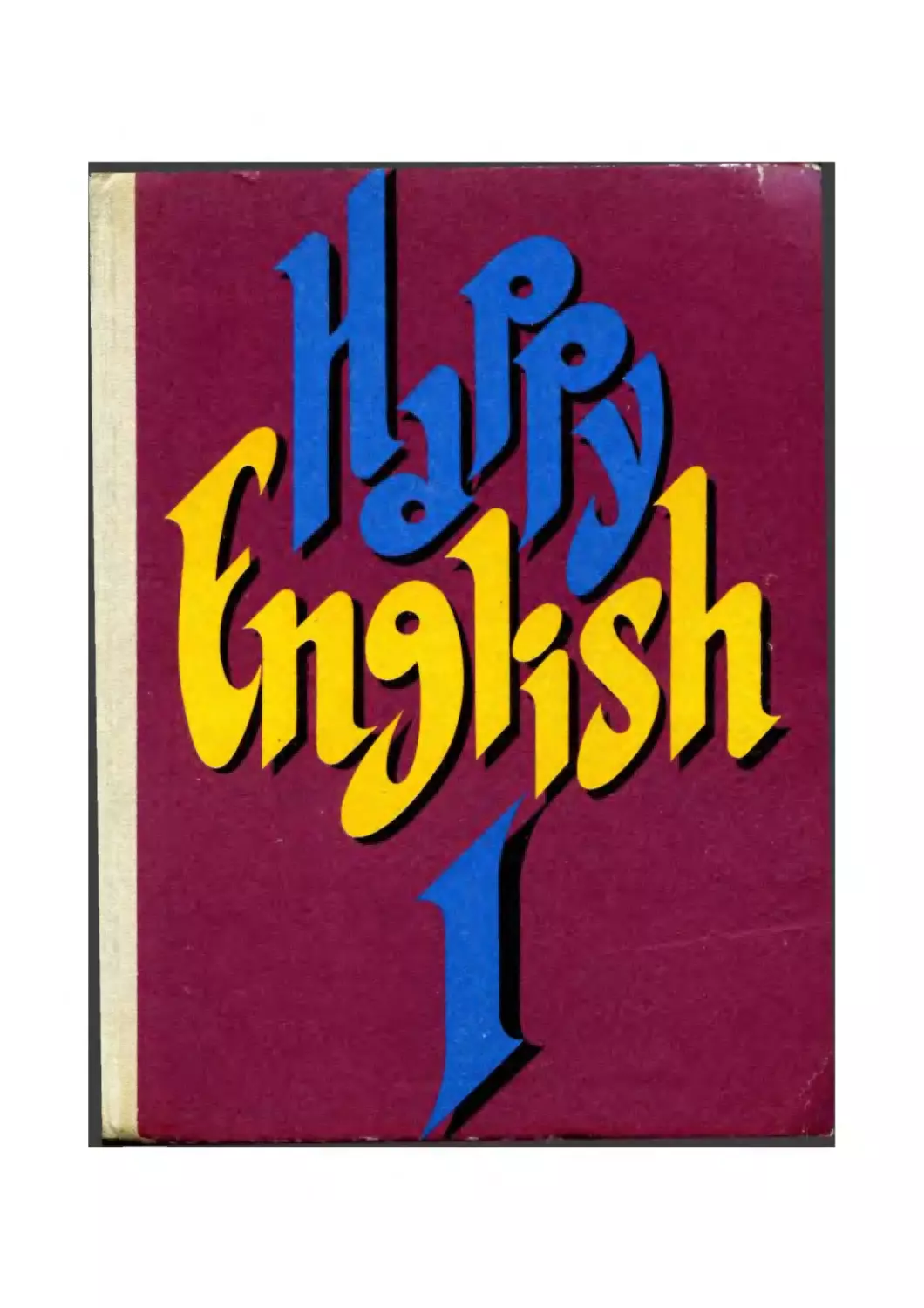
СЧАСТЛИВЫЙ
АНГЛИЙСКИЙ
Книга I
Учебник
для 5 - 6 классов
средней школы
Художник Е . В .
Ромашко
Рекомендовано
Министерством
образования
Российской
Федерации
МОСКВА •
ПРОСВЕЩЕНИЕ •
£іка1972
1992
ББК
81.2Англ-922
К48
The p u b l i s h e r s a r e deeply g r a t e f u l to the British Council f o r help in the
o r g a n i z a t i o n of this textbook p r o j e c t and f o r supplying m a t e r i a l s .
Photographs
by kind permission
of:
Mary Glasgow Publications
British Tourist Authority
Victoria and Albert M u s e u m
British Museum
National Gallery
Tate Gallery
Public Record Office
C e n t r a l O f f i c e of I n f o r m a t i o n
Dr M a r t i n M o n k
Philip and J o a n n a Kirk
Hamish and D o m i n i q u e N o r b r o o k
David Lambert
Bruce Monk
The publishers
would like to thank the
following:
M i c h a e l B i r d , J o n a t h a n C l a y d o n , D i a n e C o u r t n e y , N o r m a n E v a n s , B a r b a r a H a y , A n n e H o b b s , Ric h a r d H u m p h r e y s , J o a n n a K i r k , R o s e m a r y M i t c h e l l , Dr M a r t i n M o n k , J a n e M y l e s , H a m i s h a n d
D o m i n i q u e N o r b r o o k , Coririne Sharpe, Patsy Vanags, Collin W i g g i n s
Thanks are also due to:
Alison Atkins, Craig Ellinson, Richard Horsley, James Powell
Professor Svetlana
University)
К48
Grigorievna
Ter-Minasova
(Faculty
of F o r e i g n
Languages,
Moscow
State
Клементьева Т.Б., Монк Б.
С ч а с т л и в ы й а н г л и й с к и й . К н . I: У ч е б . д л я 5 - 6 кл. с р е д , ш к . /
Т . Б . К л е м е н т ь е в а , Б . М о н к . — М.: П р о с в е щ е н и е , 1992. —
416 с. ил. — ISBN 5-09-004406-6.
Впервые издаваемый в нашей стране новый учебник — совместный
труд российско-британского авторского коллектива. В нем использованы
современные подходы к обучению иностранному языку. Учебник написан
подлинным английским языком, личностно ориентирован, содержит жизненно важный, интересный, занимательный материал, включает вопросы
для самопроверки, ключи, различные приложения и англо-русский словарь.
„
4306021600 - 456
103 (03) - 92
ISBN 5-09-004406-6
инф. письмо - 92, доп. №1
ББК 81,2Англ-922
© Клементьева
Т.Б.,
Монк Б.;
художник Е.В.Ромашко,
1992
LH&1972
Contents
Unit
1.
Hello
Unît
2.
N i c e to M e e t You
45
Unit
3.
Meet the F a m i l y
72.
Unit
4.
Would You L i k e a C u p of Tea?
87
Unit
5.
At
Unit
6.
Asking
Unit
7.
8.
9.
10.
11.
12.
Unit
Unit
Unit
Unit
Unit
6
105
Home
the
131
Way
At a D e p a r t m e n t
Store
155
At a F o o d S h o p
178
T a k e a w a y s and C a f é s
210
A Look at British H i s t o r y
232
Sightseeing
258
in
London
P a r t i e s and H o l i d a y s
292
Phonetic
Support
315
Reading
Support
326
Grammar Support
331
Keys
372
Translation
of
Tasks
382
Irregular Verbs
396
Vocabulary
397
Likial972
1
1.
HELLO
L o o k , listen a n d r e p e a t . T h e n a c t o u t t h e d i a l o g u
I. Good M o r n i n g .
Goodbye
Morning
morning
[h] hi, h e l l o
[rj] m o r n i n g
Lifol972
II. G o o d M o r n i n g , G o o d A f t e r n o o n , G o o d E v e n i n g .
[h]
hi
hello
how
[q]
[6]
morning
evening
thanks
M*
w
fine
afternoon
night
[d]
goodbye
good morning
good evening
[t]
afternoon
night ^
/"/?•? i t J
12 Lifcal972
III. H o w A r e You?
H e l l o , Ben
Fine, thanks. And
thanks
and
goodbye
Pat
thanks
Li!çfll972
2.
Look, listen, repeat and r e m e m b e r .
Addressing People.
Hello, P e t e r .
Excuse me, sir.
mother
mummy
mum,
M rs^ I
madam«
I m Peter Claydon.
My n a m e is P e t e r .
My s u r n a m e 1 is Claydon,J
*
W h a t ' s your name?
oliceman
W h a t ' s your surname?
Hello, Pete.
H e l l o , Mr Claydon.
secretary
grandfather,
grandad,
grandpa
grandmother,
grandma, T
granny
I
z
[6] m o t h e r , f a t h e r , g r a n d m o t h e r , g r a n d f a t h e r
[as] d a d d y , dad, g r a n d m o t h e r , g r a n d m a , g r a n ny, g r a n d f a t h e r , g r a n d a d , g r a n d p a
^
Щ
1
2
[л] mother, mummy, mum
[a:] f a t h e r , grandfather
[э:] s i r s u r n a m e
СУР
p
last n a m e
m o m m y , mom
Li!çfll972
3.
Say how they address Mrs Mary Claydon.
My n a m e is Mary
My s u r n a m e
is C l a y d o n .
1. Hello, Mary. 2. Hello, Mum. 3. Hi, M u m m y . 4. Hello, Mary.
5. Excuse me, m a d a m . 6. Hello, Mrs Claydon.
10
Li£al972
4.
Look, listen, repeat and act.
Informal: Grandma, G r a n d p a / G r a n d a d , M u m / M u m m y , Dad/Daddy.
Thank you, M u m
You're welcome.
Tea, G r a n d p a ?
S o r r y , Grandma.
11
Lifcal972
Formal: Mr, Mrs, Miss, sir or madam.
Good m o r n i n g , Mr Hay
12
Lifcal972
5.
a). What would Alison say? b). Act out the d i a l o g u e s .
A l i s o n ' s Day.
! »M i'^ft J" 'À
Bye, A l i s o n
Mornin
Alison*
Hello, Alison
E v e n i n g , Alison
I'm fine
thanks.
Good afternoon
Alison. \b
s—rmvA,
V. Good m o r n i n g , Mr Claydon.
VI. Hello, Pat.
VII. G o o d n i g h t , Mummy.
VIII. Good evening, Dad.
I. How are you, Ben?
II. Good a f t e r n o o n , Granny.
III. Goodbye.
IV. Good morning, Mrs Claydon.
1 III, 2 V, 3 IV, 4 I, 5 II, 6 VI, 7 VIII, 8 VII
13
Lif(al972
6.
What would you say?
ipi
mnrzrzz
Goodbye
Fine, thanks. And you?
Thank you
A. How are you?
B. Bye.
C. Sorry.
D. Y o u ' r e welcome.
14
LH&1972
Look, listen and match
I. —
—
II. —
—
III. —
—
Thank you.
You're welcome.
Tea^Mum?
Yes, please.
Goodnight.
Night.
IV. —
—
V. —
—
VI. —
—
Coffee?
No, thank you.
H o w are you?
Fine, t h a n k s . And you?
Sorry.
That's OK.
1 III, 2 V, 3 II, 4 I, 5 VI, 6
Li£al972
8.
Listen, repeat, act and continue.
Drama: In the Morning.
Act 1. At Home.
Jane:
Grandfather:
Jane:
Father:
John:
Mother:
John:
Jane:
Grandfather:
Good morning, Grandpa.
Morning, Jane.
Good morning, Dad.
Good morning.
Tea, Mum?
Yes, please. Thank you.
You're welcome.
Oh, sorry.
T h a t ' s OK.
Act 2. In the Street.
Newspaper boy: Good morning, Mr
Mason. How are you?
Father: I ' m fine, thank you.
And you?
Newspaper boy: I ' m fine. Your newspapers, Mr Mason.
Father
Newspaper boy
Milkman
Mother:
Milkman:
Mother:
Milkman:
Jane:
John:
Mother
Father
Mrs Mason:
Thank you. Goodbye.
Bye.
Good morning, Mrs
Mason. How are you?
Fine, thanks.
And
you?
I ' m OK. Your milk,
Mrs Mason.
Thank you. Goodbye.
Goodbye.
Bye, M u m . See you,
Daddy.
Bye-bye,
Mummy.
Goodbye, Dad.
Goodbye.
See you.
Good morning, Mrs
Mason.
Good morning, ... .
LiHal972
9.
Listen, sing, read and write the letters.
A d B b C c D el Ee Ff
[ei]
[bh] '
[Si:]
[dl:J
G d\ Wh ! i
£ d 31 - ]
[eitj]
Cai]
[en]
Rr
Si
[a:]
[d3ei]
^ ^ K
[eks]
[ju:j
[wai ]
left-handed
—
Cto
[kju.]>
U f #
:
t'dAblju:]
[el]
[pi= J
[th]
Xx
iii
[kei]
Pp
[au]
[es]
[ef]
Jj m
Mm Mm Oo
[em]
[i:]
[vh]
2 s•
[zed]
right-handed
V
I
. Listen and practise.
[ei]
A,
H
J
K
PO
B
c
D
E
G
P
T
V
Z (Am.) [zi:]
[at]
[e]
I
F
Y
L
M
N
S
X
Z (Br.) [zed]
17
[9U]
0
Du:]
Q
U
W
Lital972
1 1 . Find the letters A to Z.
S h a k e s p e a r e ' s House.
23 Likal972
N O P Q R S
n
o
p
q
r
s
T U V W X Y Z
t
u
v
w
x
y
z
Li!çfll972
12.
Which ship has no pier?
f
m*
9 y P
p. 372
1 3 . Which parachutes are missing?
A B C D E F
G H 1 J K L
M N 0 P Q R
S T u V W X
y 2
p. 372
20
Likal972
14
Write these letters in alphabetical order. W h i c h letter is on this
balloon?
p. 372
15 .
a). Write small letters,
b). C o m p a r e capital and small letters and f i n d eight letters that
you write in the same way. Write and r e m e m b e r t h e m .
ABCDEFGHIJKLMNOPQRSTUVWXYZ
^
p. 372
Likal972
16.
a). Find 10 A, 2 B, 5 C, 2 D, 10 £ , 4 F, 3 G, 4 H, 7 I, 1 J, 2 K, 8 L,
3 M, 8 N, 10 O, 7 P, 1 Q, 8 R, 8 S, 10 T, 7 U, 1 V, 1 W, 2 X,
1 Y, 1 Z.
b). Listen and say which words you know.
c). Copy the words in alphabetical order.
d). Write these words in alphabetical order in small letters.
English Street.
HOTEL
OEANS
GALLERY
RESTAURANT
TELEPHONE
Aft
PARK]
p. 372
Lifcal972
17.
a). Look, listen and repeat.
b). Write the signs in small letters.
ENTRANCE
(•*
p. 372
18.
a). Look, listen and repeat.
b). Read and write the English n a m e s in a l p h a b e t i c a l order.
•-U.'M.,- „-UjHU;
llPS:
LH&1972
1 9 .
Look, n a m e t h e l e t t e r s a n d g u e s s .
2 0 .
Listen, repeat and l e a r n .
A POEM.
A, B, C, D, E, F, G,
J o h n is h i d i n g 1 f a r f r o m m e .
L o o k i n g 2 here, l o o k i n g there,
I c a n ' t 3 see him a n y w h e r e .
2 1 . Listen, repeat, learn and write.
Г2 3 4 5 6 7 8 Я 0
one
two
three
four
five
six
seven
eight
nine
1
is hiding ['haidiq] — п р я ч е т с я
looking — с м о т р ю
3
1 can't — Я не могу
2
24
Li & 19 72
zero
2 2 • Where must the spaceships land?
2 3 . a). Look and say.
0 7 1 - 9 3 8 8501, 071-938 9123, 071-636 1555, 071-821 1313, 071-839 3321
b). Listen and
match.
a) 0 7 1 - 8 2 1 1313
|
I ItW mSsS
'
• I
a
h
^
'
* i
b) 071-636 1555
r
«M
**< • ^
^mm
'
c) 0 7 1 - 9 3 8 9123
d) 071-839 3321
1) Natural History M u s e u m
2) National Gallery
e) 0 7 1 - 9 3 8 8501
3) Tate Gallery
4) British Museum
25
5) Victoria and
Albert Museum
30 Lifcal972
c). Listen and write.
(<•"
b). l c , 2d, 3a, 4b, 5e
c). 071-636 1555, 071-938 8501, 071-938 9123, 071-821 1313,
071-839 3321
2 4 . Listen, repeat aind act.
W h a t ' s Your Phone Number?
•' W h a t ' s your p h o n e n u m b e r , J o h n ?
H
It's six-double seven-nine-0.1
2 5 . a). Write down your telephone number.
b). Find out the phone numbers of 5 pupils in your class.
26. a). Listen, repeat and act.
L E T ' S GO TO THE CINEMA.
S O R R Y . I ' M BUSY.
Pat:
Mary:
Pat:
Mary:
Pat:
67190. Hello.
Hello, Pat.
Oh, hello, Mary. How are you?
Fine, thanks. And you?
I ' m fine. L e t ' s go to the cine m a 2 today.
Mary: Yes, all right. See you. Bye.
Pat: Bye, Mary.
Jane:
Mark:
Jane:
Mark:
Jane:
364 5328. Hello.
Hello, Jane. I t ' s Mark.
Oh, hello, Mark.
L e t ' s go to the club.
Sorry, I ' m busy. L e t ' s go to
morrow.
Mark: OK. See you, Jane.
Jane: Bye, Mark.
b). Look, listen, repeat and make new dialogues with these words.
It's six-seven-seven-nine-zero
movies
26
Litçal972
theatre
museum
concert
gallery
disco
circus
32 Lifcal972
Articles a/an.
2 7 .
a). Look, listen, repeat and remember,
b). Help the children to choose a or an.
a — 3, 4, 6,
7, 8, 10
an — 1, 2, 5, 9
28
Li£al972
Plurals.
2 8 .
(«•*
Help the children to choose a/an or
-s/-es.
a — 1 , 6 ; an — 7;
-s — 2, 4, 5, 8, 10; -es — 3, 9
29
Lifcal972
2 9 .
a). Listen, repeat and r e m e m b e r .
b). W r i t e y o u r o w n p o e m w i t h b a n a n a s , a p p l e s , etc.
O N E POTATO, T W O P O T A T O E S .
One p o t a t o ,
Two potatoes,
Three potatoes,
Four.
Five p o t a t o e s ,
Six p o t a t o e s ,
Seven potatoes more,
Bad o n e .
3 0 .
a). Listen, repeat and act. b). Make up your own d i a l o g u e s .
Two Bananas, Please.
Hello
Hello
^A p e a r , an a ppl and
t w o b a n a n a s , Pi ease
T h a n k you
y
Goodby
You're welcome
Goodbye.
Li£al972
3 1 .
a). Listen, sing and remember, b). Compose your own song.
COLOURS.
Brown and green and blue and white,
Blue and white,
Blue and white,
Brown and green and blue and white,
Red and black and yellow.
3 2 .
Look, listen a n d m a t c h A a n d B.
1)
2)
3)
4)
5)
A
black and white
yellow and red
blue and yellow and red
blue and yellow
blue and red
B
a) green
b) orange
c) brown
d) grey
e) purple
I d , 2b, 3c, 4a, 5e
LH&1972
. Listen, repeat and remember.
B L U E IS T H E S E A .
Blue is the sea,
Green is the grass,
White are the clouds,
As they slowly pass. 1
Black are the crows,
Brown are the trees,
Red are the sails
Of a ship in the breeze.
3 4 . Listen, repeat and answer.
Taxis are black in the UK.
Buses, post-boxes and telephone boxes are red in the UK.
What colour are taxis, buses, postboxes and telephone boxes in your
country?
1
as they slowly pass — когда они медленно п р о п л ы в а ю т
37 Lifcal972
Taxis are...
Buses are...
Post-boxes are...
Telephone boxes are...
3 5 . a). Name the colours.
b). Paint an abstract picture.
David B ö m b e r g (1890 — 1957)
(Tate Gallery, London)
2 Счастливый английский
33
Li!çal972
The Secrets of Some English Letters.
3 6 . a). Look, listen and r e p e a t .
b). F i n d the s e c r e t s of E n g l i s h letters.
pencil
watch
pen
.NL,
perfume
cat
1*
here
bee
r<4
£eîMo:l
C
e
F
gong
cage.
dog
car
hare
A.
pin
bird
pine
k i m
34
Li!çal972
Li!çfll972
3 7 .
a). Compare the vowels and find what is common among them,
b). Read and write out the phonetic s y m b o l s for the letters in
bold type.
plate [ ]
bee [ ]
pine [ ]
rope [ ]
tube [ ]
% []
3 8 .
car [ ]
perfume [ ]
bird [ ]
fork [ ]
turkey [ ]
flag [ ]
pen [ ]
P'n [ ]
box [ ]
tub [ ]
syringe [ ]
hare [ ]
here [ ]
fire [ ]
pure [ ]
Read and write out the phonetic symbols for the letters in bold
type. Check y o u r reading with the tape.
K a t e [ ] has
a "cat [ ].
Pete [ ] has
apetf],
Mike [ ] has
apig[],
Rose [ ] has
adog[],
Susan [ ] has
abus[].
3 9 . Make your own table of English vowels.
p. 329
40.
a). Find the secrets of the letter a and open the locks.
©K
ä
E ^ g M * © h ire
a
s
w
rreiV
36
Likal972
b). Read and r e m e m b e r . C h e c k with the tape.
K a t e has a cat and a car and a hare.
m-
a). 1 II, 2 I, 3 III, 4 IV
4 1 . Listen and practise.
Li£al972
4 2 .
Read and listen.
thanks
^ad
[r]
[6J
[t]
[d]
[n]
mother
1
father
it
1
two
1 dad |
1
daddy]
fine
1
nine
1 listen 1
1
look
nice
let's
ljl£äiIgJ|grandmotherir ten
r
gran dfather
tea
Ifand
,
|
I
Jl]
t h r e e |[morning|
I
!z=x=r
sorry evening
brown
E
ü l |Tit—II eleven I C H p £
CSTghO
lafternoonl
night
onion
I
red
carrot |
»
orange
38
Li£al972
C)
1
entrance
r
madam
exit
p
welcome
[a:]
l
sir
I
surname
[a:]
[A]
•
1
car
club
•
1
park
|mumm}
X
p u r p l e 1 | b u s 11 s m a r t ~"j
mother
1
onion I
1
colour
father
1
banana
1
tomato
|
lafternoon
39 -
:
Likal972
What would you say? Act out the dialogues.
A f t e r n o o n Tea.
1. — Please, sit down.
— Thank you.
2. —
—
3. —
—
4. —
—
5. —
—
6. —
—
7. —
—
8. —
—
Good afternoon.
Hello.
L e t ' s go to the club.
Yes, all right.
Goodbye.
Bye-bye.
Thank you.
You're welcome.
Tea?
Yes, please.
Coffee?
No, thanks.
Sorry.
T h a t ' s OK.
a2, b5, c l , d7, e6, f8, g3, h4
40
Likal972
Talk to Starkid
i .
Hello.
1) M y n a m e is S t a r k i d . 1
W h a t ' s your name?
2) M y s u r n a m e is G a l a x y .
W h a t ' s your surname?
3) M y t e l e p h o n e n u m b e r is 0 0 1 1 .
W h a t ' s your telephone number?
4) L e t ' s g o to the s p a c e 2 c l u b . — ...
5) C o f f e e ? - ...
6) Tea? - ...
7) L e t ' s g o to the s p a c e c i n e m a . — .
II.
1
2
3
4
5
6
7
8
9
10
11
12
H o w M a n y New Words f r o m Unit 1 Do You K n o w ?
one
two
three
four
five
black
blue
brown
green
grey
apple
apricot
banana
cabbage
carrot
cinema
circus
club
concert
disco
b u s stop
closed
open
entrance
exit
six
seven
eight
nine
ten
eleven
twelve
orange
purple
red
white
yellow
coffee
onion
orange
pear
potato
tea
tomato
gallery
museum
park
theatre
pull
push
telephone
0 zero
2
Starkid.
Galaxy.
0011.
busy
fine
please
sorry
thank
morning
afternoon
evening
night
today
tomorrow
Mr M r s M i s s sir m a d a m
m o t h e r m u m m y m u m (USA mommy,
f a t h e r d a d d y dad
grandmother grandma granny
grandfather grandad grandpa
mom)
80
S t a r k i d — З в е з д н ы й м а л ь ч и к (star — з в е з д а , kid — р е б е н о к )
space — космос, к о с м и ч е с к и й
Li!çal972
Do You Know These E x p r e s s i o n s from Unit 1?
Hello
Hi.
Good afternoon
Afternoon.
Good morning
Morning.
Good evening
Evening.
How are you?
Very well, thank you. And you?
Fine, thank y o u . / I ' m OK.
Goodbye
Bye.
Bye-bye. — Goodnight
See you. — Night.
Thank you very m u c h . / T h a n k s
You're welcome.
C o f f e e , Dad?
No, thank you
42
Likal972
f— Let's go to the cinema.
| - OK./Yes, all right.
- Sorry. I ' m busy./ No, thanks
See you.
TEST YOURSELF.
1. Write the missing n u m b e r s .
3
7
io
2. Write the missing letters.
Aa Bb
Zz
3. Write what these signs mean.
4. Add four more words to each list.
a) 1 , 2 , 3 , 4 , 9 , 12
one, two, ..., ..., ..., ...
b) black, blue, ..., ..., ..., ...
c) an apple, an apricot, ..., ..., ..., ...
5. Give the plurals.
apple — apples
banana, cabbage, club, museum, concert
6. Find the secrets of the letter a in the names Jane, Pat,
Mark and Clare.
Write the phonetic symbols for
the letter a.
XHçul972
7. H e l p J o h n to greet p e o p l e .
8. Listen and c h o o s e the c o r r e c t a n s w e r .
1)
2)
3)
4)
5)
Phone number a) 071-383 4792 b) 071-382 4792 c) 071-383 3792.
a) H e l l o , Pat. b) Hi, Pat. c) M o r n i n g , Pat.
L e t ' s go to the a) c i n e m a b) disco c) theatre.
a) Yes, O K . b) Sorry, I ' m b u s y , c) Yes, all right.
a) Bye, Pat. b) G o o d b y e , Pat. c) B y e - b y e , Pat.
9. Listen and write the letters.
See ( • * .
What's your score? 1
Mistakes
Score
1
0-1
2-3
4-5
>5
5
4
3
2
W h a t ' s y o u r score? — К а к о й счет?
49 Likal972
NICE TO MEET YOU
1.
Look, listen, repeat and read. T h e n act out the d i a l o g u e s .
I. At the A i r p o r t .
Mr Bell:
Svetlana:
Mr Bell:
Svetlana:
Mr Bell:
Svetlana:
Mr Bell:
Svetlana:
Mr B e l l :
Pat:
Alexander:
Pat:
Alexander:
1
Excuse me.
Yes.
Are you from M o s c o w ?
Yes, I a m .
A r e y o u t h e g r o u p leacjer? 1
Yes, I am.
M y n a m e is P a t r i c k
Oxford school.
H o w do you do? I ' m
H o w do you do? Nice
H e l l o , m y n a m e is Pat
H e l l o , I am A l e x a n d e r
N i c e to m e e t y o u .
N i c e to m e e t you too
group leader ['gru:pli:do]
— руководитель группы
LH&1972
II. What's Your Name?
—
—
—
—
—
—
—
—
—
—
—
—
What's your name?
My name's Mary.
What's your surname?
My surname is Hay.
H o w old are you?
I'm eleven years old.
Where are you from?
I am from Oxford.
What's your address?
25 Queen Street, Oxford.
What's your telephone number?
It's 6 3 3 9 1 .
Mr Jones, this is Svetlana.
How do you do?
Pleased to meet you.
H o w do you do?
N i c e to meet you too
Hello. My name is Mike.
Hello. I'm Alexander.
N i c e to meet you
Pleased to meet you too.
51 Lifcal972
2.
Listen, repeat, match and act.
Hello! Satellite Link Moscow - London.
Hello, I'm John.
What's your name?
Hello, Peter.
H o w are you?
/vw^
What s your hobby?
Pleased to meet you
Painting
I'm from London.
My name's
Kate.
Where are
you from?
I'm eleven
Fine, thanks.
And you?
Pleased to
meet you too
Moscow
London
A4, B6, C I , D5, 3E, 2F
Li!çfll972
3.
Open the front cover of the book. Look, listen, repeat and r e m e m b e r .
4.
Look, listen, repeat and r e m e m b e r .
He is f r o m Scotland.
It is f r o m
England too.
It is f r o m Scotland too.
She is f r o m Wales.
We are f r o m Great Britain.
They are f r o m Great Britain.
I ' m from America.
W h e r e are you f r o m ?
LiRal972
5.
Listeii and sing.
WE A R E HAPPY.
I am happy.
You are happy.
He is happy.
She is happy.
6.
We are happy.
You are happy.
They are happy too.
Where must the bees land? The letters will help you.
Aa, Bb, Cc, Dd, Ee, Ff, Gg
7.
Complete the table.
I
You
He
She
—
—
—
—
my
your
It
We
You
They
49
—
—
—
—
Lil^al972
8.
Look, listen, repeat and answer.
I. My hobby is painting. What is your hobby?
music
drawing
painting
collecting computer
games
reading
collecting stamps
collecting coins
photography
II. My favourite sport is badminton. What is your favourite
sport?
table tennis
(ping-^3
pong)V^N
basketball
gymnastics
chess
tennis
cricket
boxing
football
9.
Tell your classmates about your hobby and favourite sport.
Li!çfll972
10.
Read about these five children. Choose a pen-friend. Say why you
choose him/her.
Name
Age
Hobbies and
favourite sports
John Lewis
12 years old
music, reading,
drawing, tennis,
baseball
Name
Age
Hobbies and
favourite sports
Louisa Croft
Name
Age
Hobbies and
favourite sports
Oliver Myles
Name
Age
Hobbies and
favourite sports
Tom Clark
Name
Age
Hobbies and
favourite sports
Mike Brown
12
chess, collecting
computer gam.es,
badminton
10
music, collecting
stamps, football
11
music, gymnastics, reading,
drawing
12
collecting coins,
painting, reading,
cricket
Li!çfll972
1 1 . Interview your classmate about his/her hobby and
sport. Tell the class about it.
12.
favourite
Listen to the children and write down their names, telephone
numbers, favourite sports and hobbies, where they are from and
how old they are.
p. 372
A game: What is your naine? Choose a name for yourself.
D o n ' t tell your classmate. A s k each other questions and
guess each other's names. Good luck. Start the game.
Name
Surname
Address
Phone
number
Hobby
Favourite
sport
Where
from?
How
old?
Peter
Bell
5 Queen St.
57613
drawing
tennis
Oxford
10
Ann
Bell
5 Queen St.
57613
music
tennis
Oxford
12
James
Bell
5 Queen St.
57613
drawing
tennis
Oxford
11
Ben
Bell
5 Queen St.
57613
music
tennis
Oxford
9
Tony
Hay
7 O x f o r d St. 385 5721 drawing
judo
London
12
Kate
Hay
7 Oxford St. 385 5721 music
judo
London
10
David
Hay
7 O x f o r d St. 385 5721 drawing
judo
London
9
Pat
Hay
7 Oxford St. 385 5721 music
judo
London
11
Questions and A n s w e r s .
Q:
A:
Q:
A:
Q:
A:
Q:
A:
Excuse me.
Yes.
W h a t ' s your surname?
My surname is ...
W h a t ' s your address?
My address is ...
W h a t ' s your phone number?
My phone number is ...
Q: W h a t ' s your hobby?
A: My hobby is ...
Q: W h a t ' s your favourite sport?
A: My f a v o u r i t e sport is ...
Q: Where are you f r o m ?
A: I ' m f r o m ...
Q: How old are you?
A: I am ...
Your name is ...
52
Li!çal972
1 4 . Introduce yourself.
First n a m e
Surname
Age
Address
Telephone number
Hobbies
Favourite sports
1 5 . a). Work in a group of three. Find out as much as you can about
your classmates,
b). Tell the class about one of your classmates.
1 6 . a). Write your own story about the girl.
b). Listen and compare it with the real story of this girl.
The
Her
She
Her
Her
Her
girl is ... y e a r s old.
n a m e is ...
is f r o m ...
d a d ' s n a m e is ...
m u m ' s n a m e is ...
h o b b i e s are ...
p. 3 7 3
1 7 . Listen, repeat and remember.
SIX SERVING MEN.1
I h a v e six h o n e s t 2 s e r v i n g m e n .
T h e y t a u g h t 3 me all I k n e w . 4
T h e i r n a m e s are W h a t and W h y and W h e n
A n d H o w and W h e r e and W h o .
Rudyard
Kipling
1
2
3
4
s e r v i n g m e n ['so:viq men] — слуги
h o n e s t fomst] — честные
t a u g h t [to:t] — научили
k n e w [nju:] — знал
53
Litiial972
Look, listen, repeat, act and continue.
Drama: At Linda's Party.
LindaJohn:
Linda;
Mary:
Linda:
John:
Mary:
Linda:
Mary:
Linda:
Mary:
Linda:
John:
Linda:
Mary:
John:
Mary:
Linda:
Oh hello, John.
Hello, Linda. This is Mary.
Hello, Mary. Nice to meet you.
Hello, Linda. Nice to meet you too.
L e t ' s have tea.
Thank you.
Thank you.
Where are you f r o m , Mary?
I ' m f r o m Oxford.
How old are you?
I ' m eleven. How old are you, Linda?
I ' m eleven too.
W h a t ' s your hobby, Linda?
Painting.
And my hobby is sport.
W h a t ' s your favourite sport?
Gymnastics.
Hello, David. This is David.
Li/çal972
Be — Present Simple.
19.
a). Look, listen, r e p e a t a n d r e a d .
b). Pay attention to the forms of the verb to be.
C O M I C I. Alison and Tony.
A computer game. Match the planets and the spaceships.
1C, 2A, 3B, 4B, 5A, 6B, 7A
21.
Complete the table for column +.
AM/IS/ARE
I am ( I ' m )
He J.S
She is ( s h e ' s )
it
We ...
You are ( y o u ' r e )
They ...
I AM = I'M
Am I 9
I am ( ' m ) not
J.17
Is it?
Are we?
It is not ( i s n ' t )
We are not ( a r e n ' t )
You are not ( a r e n ' t )
They are not ( a r e n ' t )
Are they?
p. 332
56
Likal972
Hello, is Alison in?
Is that you, Alison?
Alison: Yes, it's me.
Tony: Are you all right?
Alison: Yes, I ' m fine, thanks.
Tony: Is your dad in?
Alison: No, he is not. He is at work.
Tony: Is your mum in?
Alison: No, she is not She's out.
i
Tony: Let's go to the park.
Alison: Yes, OK.
What?
I have no cat.
Sorry.
Wrong number
62
Lifcal972
2 3 . Complete the table for columns —, ?.
p.
332
2 4 . a). Look at the letters and compare them,
b). Copy letters for joined writing.
abcdefcjkljk l/n/icrpyrstunvxi/z
cub cdeftjkijIdmrvop yrsUv\rtvxyz
2 5 . Copy and write.
am
kcr
nq
ch
tif
ok
vtc
ru
wi
rk
oi>
2 6 . Watch out! You don't need to make a join after these letters.
Copy them.
b g j pq s
X
y z
58
Li!<ial972
A handwriting game. Who gets more capital and break
letters? Throw a dice and go through the alphabet.
a). Look, listen, repeat and then copy the letter;
20 Queui
Street,
Oxford,
UK
(uour aAdr&ss)
20th. April /772
Helio-,
My name
Us MiAe. My surname,
/ am from Oxford. My hobby Us ooUzctirig
sporùs
3//36.
What
are potbaJA,
and
And you, ? What
are your
favourUe.
ofwss. My telephone
ruomSer
Us your namz ? How oid are
sports and
h/rbbti<s ?
With, b&st
Moke
1
us Clay don.
/ am,
el&iwi
computer garrm.
Mypvovuriie.
Us 0865you, ?
washes/
With best wishes — с наилучшими пожеланиями
Li!çfll972
b). Fill in the letter.
HoussLa,
Moscow,
2 3 University
I Oth
Dear MUu,
, \\
My name
Moscow.
years
, A Im ander.
My phone
old.
My surname.
number...
My
favourite,
Wotk
best
/4-5 27
sportej;.
Mcuj
,
15.
Street,
m i
t ;yi
J. KryLov.
/ j ^
badminton
I f r o m
Uwlve
and
pvtbaM.
withe*,
Alexander
is, is, am, is, am, are
. Look at the picture, listen and compare British and Russian ad
dresses.
30.
Which address is correct?
UK
London SW/m
MlAS Ann Jones
Trafalgar Stredl
1,2
60
Lif(al972
3 1 • Write a first letter to your pen-friend about yourself. Write an
address on the envelope.
3 2 .
Look, listen, repeat and remember. Match the picture and the
words.
At School.
1.
2.
3.
4.
pen [pen]
pencil ['pensl]
pencil case ['pensl keis]
felt-tip pen [,felt tip
'pen]
5. desk [desk]
6. book [buk]
7. exercise book f e k s a s a i z
buk]
8.
9.
10.
11.
12.
map [masp]
bag [beeg]
lamp [lasmp]
blackboard ['blaekbo:d]
calculator
fkaelkjuleita]
13. pupil [ pju:pl]
14. computer [ k a m ' p j u : t 9 ]
15. paints [peints]
16.
17.
18.
19.
20.
21.
eraser [ l ' r e t z s ]
boy [boi]
girl [ga:l]
teacher ['ti:t/9]
brush, [brAj]
sharpener
[7ct:pana]
22. ruler f r u : l a ]
23. chalk [t/o:k]
Li!çfll972
N a m e the objects in your bag and in your c l a s s r o o m .
A m e m o r y game. Close the b o o k and write what there is
in the p i c t u r e . W h a t ' s y o u r s c o r e ?
Listen, repeat, learn and w r i t e .
A
21
twenty-one
nineteen
to50
70
seventy
sixty
thirty
BO
100 1,000 I t*©0,000
a hundred
1,000
1,000,000
a miilion
a thousand
3 6 .
seventeen
sixteen
.1
ninety
\1
V6
fourteen
eighty
a). Look, listen, repeat and r e m e m b e r .
MONTHS AND SEASONS.
D e c e m b e r , J a n u a r y and F e b r u a r y are
winter months.
M a r c h , A p r i l and M a y are s p r i n g
months.
J u n e , July and A u g u s t are s u m m e r
months.
S e p t e m b e r , O c t o b e r and N o v e m b e r
are a u t u m n m o n t h s .
A RHYME.
b). Fill in the r h y m e .
30 d a y s has S
er, A....
J... and N
,
All the rest h a v e 31
Excepting F
alone
W h i c h has 28 d a y s clear
A n d 29 in each leap year.
30 d a y s has S e p t e m b e r , A p r i l ,
J u n e and N o v e m b e r ,
All the rest h a v e 3 1
E x c e p t i n g F e b r u a r y alone
W h i c h has 28 days clear
A n d 29 in each l e a p year.
62
Li & 19 72
3 7 .
Look, listen, repeat and remember.
Cooking
Art
Science
Handicraft
TIMETABLE.
Time
Day
•
•
Monday
Tuesday
Wednesday
Thursday
Friday
äcföÜ.rd'GL^
3 8 .
9-10
10-11
History
Biology
Art
English
Computing
Geography
Sport
Science
Computing
Maths
11-12
v
Science
Music
English
History
Biology
13-14
L
U
N
C
H
^Literature
Art
v Handicraft
Geography
Literature
14-15
English
vCooking
Drama
Maths
Sport
Read and answer.
MY FAVOURITE S C H O O L SUBJECTS.
— Maths, Geography, Science and English are my favourite subjects.
— And my favourite school subjects are Cooking, History, Music and Art.
— What are your favourite subjects?
3 9 .
Interview your classmate about his/her favourite subject.
4 0 .
Write your timetable in English for Monday, Tuesday, Wednesday, Thursday and Friday.
4 1 .
Read the text and then write about your classmate.
MY CLASSMATE.
David is my classmate. His surname is Edwards. He is British. He
is f r o m the UK. His telephone number is 071-372 4681. His address
iS|9 Green Street, London SW7. His hobbies are tennis, reading and
drawing. He is eleven years old. His favourite subject at school is
English.
63
Lirais 72
. Read and listen.
[«]
[i:]
[i]
[e]
teacher
reading
three
Zealand
fourteen
fifteen
sixteen
seventeen
eighteen
nineteen
season
we
she
six ^
sixty
fifty
history
British
English
winter
spring
million
England
literature
his
pen
pencil
tennis
chess
when
pencil case
Wednesday
ten
twelve
seven
seventy
Welsh
February
September
No vember
December
collecting
desk
eleven
America
bag
maths
mathematics
badminton
lamp
map
Saturday
blackboard
Canada
calculator
stamp
handicraft
January
gymnastics
[u:]
M
Liu:]
[o:]
[o]
ruler
June
judo
who
book
cooking
football
July
Tuesday
pupil
music
computer
chalk
four
forty
sport
your
drawing
August
autumn
hobby
golf
photography
Scottish
boxing
what
[a:]
[A]
[a:]
girl
her
Thursday
thirty
Monday
Sunday
one
hundred
summer
colour
art
March
basketball
sharpener
64
Li!çal972
4 3 •
listen, repeat and match.
Countries and Nationalities.
1). G r e a t Britain (the
United Kingdom)
I
a). E n g l i s h
b). S c o t t i s h
6). the U n i t e d States
of A m e r i c a
c). British
d). Irish
e). A m e r i c a n
f). Welsh
g). a N e w
7). N e w Z e a l a n d
Zealander
h). C a n a d i a n
i). A u s t r a l i a n
I r^:
j). Russian
*
8). A u s t r a l i a
4). Wales
и
9). C a n a d a
Г
5). N o r t h e r n Ireland
W
10). R u s s i a
1 c, 2 a, 3 b, 4 f, 5 d, 6 e, 7 g, 8 i, 9 h, 10 j
3 Счастливый английский
Likal972
a). Listen, read and answer.
FLAGS AND COLOURS.
The f l a g s of the United Kingdom, the United States of America,
Australia and New Zealand are red, white and blue.
The f l a g of Scotland is blue and white.
The f l a g of Wales is green, red and white.
The f l a g s of England and Canada are red and white.
What colour is the f l a g of your country?
What nationality are you?
b). Can you find and name these flags on the first pages of
units 3-12?
Listen, sing and remember.
A GIRL FROM LONDON.
What is your name, what is your name?
Now tell me, please, what is your name?
My name is Jenny, my name is Jenny,
My name is Jenny, t h a t ' s my name.
How old are you, how old are you?
Now tell me, please, how old are you?
I am ten, I am ten,
I am ten, t h a t ' s my age.
W h e r e are you f r o m , where are you f r o m ?
Now tell me, please, where are you f r o m ?
I ' m f r o m London, I'm f r o m London,
I ' m f r o m London, t h a t ' s where I ' m f r o m .
A game: At the international school
party. Make a card like one of these.
Then interview each other. Good luck.
Start the game.
66
Mary
12
Great Britain
British
tel: ...
Li£al972
Scotland
Scottish
tel: ...
Barbara
13
England
English
tel: ...
Wales
Welsh
tel: ...
David
10
New Zealand
a New Zealander
tel: ...
James
11
Australia
Australian
tel: ...
Mark
12
the U S A
American
tel: ...
Jane
10
Canada
Canadian
tel: ...
Diana
11
Northern Ireland
Irish
tel: ...
Helen
12
Australia
Australian
tel: ...
Alexander
11
Russia
Russian
tel: ...
Andrew
Chris
11
America
American
tel: ...
Anne
11
10
Scotland
Scottish
tel: ...
Charles
12
W h a t ' s your name? How old are you? Where are you f r o m ? What
nationality are you? W h a t ' s your telephone number?
Lifcfll972
Talk to Starkid.
I.
Ask me:
Hello.
1) My n a m e ' s Starkid. W h a t ' s
1) - .? — My name is Starkid.
your name?
2) - .? — My surname is Galaxy.
2) My surname is Galaxy.
3) - ? — I am 132 years old.
W h a t ' s your surname?
4) - .? — 1 am from the Red Planet.
3) I ' m from the Red Planet.
5) - .? — Star tennis and badminton.
Where are you from?
4) My favourite sports are star tennis and badminton
What are your favourite sports?
5) I am 132 years old. How old are you?
II.
How M a n y New Words from Unit 2 Do You K n o w ?
classroom
bag
blackboard
book
brush
calculator
chalk
computer
desk
eraser
exercise book
felt-tip pen
lamp
map
paints
pen
pencil
pencil case
pupil
ruler
sharpener
boy
girl
teacher
school subjects
art
biology
cooking
English
geography
handicraft
history
literature
mathematics
(maths)
music
science
sport
numbers
eleven
twelve
thirteen
fourteen
fifteen
sixteen
seventeen
eighteen
nineteen
twenty
twenty-one
thirty
forty
fifty
sixty
seventy
eighty
ninety
a hundred
a thousand
a million
days
Monday
Tuesday
Wednesday
Thursday
Friday
Saturday
Sunday
11
12
13
14
15
16
17
18
19
months
January
20
21
February
30
March
April
40
May
50
60
June
70
July
80
August
September
90
October
100
1,000
November
1,000,000 December
Li!çfll972
countries
America
(the U S A )
Australia
Canada
England
Great Britain
(the United
Kingdom)
Northern Ireland
New Zealand
Russia
Scotland
Wales
favourite sports
badminton
baseball
basketball
boxing
chess
cricket
nationalities
American
Australian
Canadian
English
British
Irish
a New Zealander
Russian
Scottish
Welsh
hobbies
seasons
collecting coins,
spring
stamps and com- s u m m e r
puter g a m e s
autumn
drawing
winter
painting
year
photography
reading »
name
surname
address
telephone
number
gymnastics
judo
table tennis
(ping-pong)
tennis
football
golf
I
he
she
it
we
you
they
my
his
her
its
our
your
their
1 5 2
( + 8 0 )
Lifcfll972
Do You K n o w T h e s e E x p r e s s i o n s f r o m Unit 2?
—
—
—
—
V
NJ
<3
Hello, my name is Mike
Hello. I'm Pat.
Nice to meet you.
Pleased to meet you too.
W h a t ' s your name, please?
My name is Barbara.
W h a t ' s your surname?
My surname is Atkins.
Where are you f r o m ?
I ' m from London.
W h a t ' s your address, please?
23 Oxford Street, London.
3)
W h a t ' s your telephone number, Barbara?
071-236 7798.
What nationality are you?
I ' m British.
W h a t ' s your hobby?
Music and painting.
W h a t ' s your favourite sport?
Tennis.
How old are you?
I ' m eleven.
Hello. Is Mike in?
Just a minute... H e ' s out
Is that 12357?
Sorry, wrong number
70
Li!çal972
TEST YOURSELF.
1. Complete the table for the verb to be.
I' ...
we ...
I ...
y o u ' ..
you ...
you .
h e ' ...
they ...
he ...
s
h
e
'
...
she ..
it' ...
it ...
w e ' ...
y o u ' ...
t h e y ' ...
2. Here are some answers. Write the questions.
a) My n a m e ' s Ann. b) I'm twelve, c) 23 Queen Street, d) 12379.
3 a). Fill in the letter from Anthony Black.
b). Write A n t h o n y ' s address correctly on the envelope.
16 Quem. Street,
Oxford. UK
in Uiz
\
centre.
4. Write a list of the countries of the UK.
5. Write questions for an interview:
name, surname, address, phone number, how old he/she is, hobbies,
favourite sport and subjects at school.
6. Listen to the children and write down their names, addresses,
telephone numbers, hobbies, favourite sport and subjects at
school, where they are from and how old they are.
See
What's your score?
Mistakes
Score
0-1
2-3
4-5
>5
5
4
3
2
76 Li£al972
3
MEET THE FAMILY
. Look, listen, repeat, read and act.
I. Welcome to Britain.
Mother:
gander:
Mike:
tander:
Mother:
Mike:
xander:
Terry:
xander:
Come in. Welcome to Oxford.
Thank you.
Mum, this is Alexander.
How do you do, Mrs Claydon?
Hello, Alexander. Nice to meet you.
This is my brother Terry.
Hello, Terry.
Hello, Alexander.
I've got some presents from
my parents. Here they are,
Mrs Claydon.
Lif(al972
I I . HAVE Y O U G O T A C O M P U T E R ?
Mother
Mike: Come in. This is my room.
A l e x a n d e r : You have a nice room and y o u ' v e got a computer. Have
you got any computer games?
Mike: Yes, I have quite a lot.
Alexander : Have you " S p a c e transporters"?1
Mike : Yes. Here it is.
Alexander : Have you any chess computer games?
:
Mike No, I ' m afraid I h a v e n ' t .
Thank y o t f v ^ y muj
ot an
-Mike Have
broth i r s r siste
A l e x a n d e r : Yes, I ve jot one
sister cal ed Olg
Mike: How ibid s she?
Alexander: S h e ' s nin
Terry: And his is my log Meg.
It is / e n clevei . Come here,
Meg. Haj/e you jot any pets,
Sash *?
/е.
Alexander: Yes,
1 cat с allied Kitty.
I've
is it?
Terry How
Alexander: I t ' s t|iree years c
it has | o t
And
ens.
thre«
1
Space T r a n s p o r t e r s —
космический
транспорт
Lifcfll972
2.
Look, listen and repeat. Then answer the questions.
What Have You Got?
Have you a camera?
Have you got any
brothers or sisters?
Have you got
a dog?
Yes, I have./
No, I haven't
camera
IMLB ['kaemara]
calculator
ff'kaelkjuleita]
walkman
f'wo:kman]
bicycle
fbaisikl]
budgie
[bAd3l]
J * ^ goldfish
Q['gauldfiJ]
<L?
cassette
^recorder
[ka'setriko:da]
cassette
[ka'set]
Have
Have
Have
Have
Have
Have
Have
Have
got a camera?
got a walkman?
got a cassette recorder?
a calculator?
got a bicycle?
got a cassette?
a budgie?
got a goldfish?
you
you
you
you
you
you
you
you
GN
rabbit
I'raebit]
74
Have
Have
Have
Have
Have
Have
Have
Have
you
you
you
you
you
you
you
you
tortoise
[ to:t9s]
hamster
['haemsta]
parrot
fpasrat]
a rabbit?
a tortoise?
got a hamster?
got a parrot?
got a cat?
got a dog?
a sister?
got a brother?
Li & 19 72
3.
a). Read and say which things you have got with you today.
I have/I have got...
a pen, a pencil, an eraser, a sharpener, an exercise book, an English
book, a ruler, a brush, felt-tip pens, a pencil case, a bag
b). Has your classmate got the same?
He (she) has got/He (she) has...
4.
Look, listen, repeat and read. Pay attention to the expression
have got.
C O M I C . What a Nice Camera.
What a nice camera
you've got.
Let me take your picture.
H a v e you got your hat with you'
LUUtU
a5ona
You haven't got your
hat but y c u ' v e got your sunglasses. Put them
on and sit down there.
^
iobal" ooa
SWaHjii t r
. v-v-v
ddo
ooo
Lifcfll972
/"
Fine.
Have you got your sunshade?
:—
F ^ N o , I haven't b u r '
I've got my umbrella
That's fine. Put it up.
Have you got a book?
No, I
haven't
h a v e n ' t got
you've got
Open it.
What film have you got?
Colour or black and white?
Li!çfll972
A computer game: Space transporters. Finish the
question codes, write the questions and help the space
t r a n s p o r t e r s to land.
1
Have
1
Have
4
I?
4
I
He
29
—
14
3
got?
143
She
28
We
You
...
...
—
153
—
They
17
—
1 HAVE
p. 373
6.
Complete the table.
HAVE/HAS GOT
+
y
He ... ;}<
She ...
It has ('s) got.
We have ( ' v e ) got.
You ...
They ...
I HAVE = I ' V E
?
Has he got?
Have we got?
—
I . . . ( . . . ) got.
He ...(...) got.
She has not (hasn't) got.
I t . . . ( . . . ) got.
We have not ( h a v e n ' t ) got.
You ... (...) got.
They have not ( h a v e n ' t ) got.
p. 340
Li!çfll972
Possessives 1 's or s'.
7 . Choose between 's or s'.
The parrot's [s] apple
T h e p a r r o t s ' [s] a p p l e
T h e d o g ' s [z] h o u s e
The d o g s ' f z ] h o u s e ^ f ?
The b u d g i e ' s [z] cage
The budgies' [z] cage
IflQfâk
[(Si4
со )
1
4p"%
i r i
/Barbar;
1)
2)
3)
4)
5)
1
Mrs C l a y d o n ' s calculator
M i k e ' s computer
the rabbits' carrot
the b o y s ' parrot
the cats' basket
6)
7)
8)
9)
10)
Terry's hamster
Mr C l a y d o n ' s camera
B a r b a r a ' s cassette recorder
the d o g s ' house
P a t ' s tortoise
possessives — п р и т я ж а т е л ь н ы й п а д е ж
Lirais 72
8.
Look, listen, repeat and remember. Match the picture and the
words.
1- mother ['mA&a]
2. father f f c i : 5 a ]
3. son [sAn]
4. daughter f d o : t a ]
brother ['brASa]
sister f s i s t a ]
7.
8.
9.
10.
11.
12.
aunt [ci:nt]
uncle ['Aqkl]
nephew [ ' n e v j u : ]
niece [ni:s]
cousin ['kAzn]
parents [ ' p t a r a n t s ]
13. grandmother ['grsen,mA6a]
14. grandfather [ ' g r £ e n d , f a : 5 a ]
15. great-grandmother f g r e i t
'graen,mA6a]
16. great-grandfather f g r e i t
'graend,fci:5a]
LH&1972
A memory game. Close the book and write who there is in
the picture. W h a t ' s your score?
Listen and read. Then say who is who in your family.
T H E FAMILY.
Your father and your mother are your parents. You are their son
or daughter. Your m o t h e r ' s father and your f a t h e r ' s father are your
grandfathers. Your m o t h e r ' s mother and your f a t h e r ' s mother are
your grandmothers. Your g r a n d m o t h e r ' s or g r a n d f a t h e r ' s mother is
your great-grandmother. Your g r a n d f a t h e r ' s or g r a n d m o t h e r ' s father
is your great-grandfather.
Your m o t h e r ' s or your f a t h e r ' s sister is your aunt. Your f a t h e r ' s
or your m o t h e r ' s brother is your uncle. Your a u n t ' s or your u n c l e ' s
children are your cousins. The child of a brother or a sister is a niece
or a nephew. Girls are nieces, boys are nephews.
Read and answer: Has Alexander got a g r a n d m o t h e r ?
This is my family. I ' v e got a sister. My s i s t e r ' s name is Olga. She
is nine years old. Her hobby is collecting stamps. I ' v e got two
cousins. Their names are Andrew and Helen. Helen is eleven and
Andrew is f i f t e e n . H e l e n ' s favourite sport is tennis. A n d r e w ' s
favourite sport is football. I ' v e got a father and a mother but I
h a v e n ' t got a grandmother.
Listen and answer: How many sisters has Mike got?
Look at the family tree and draw your family tree. Write about
yourself and your family. A s k your family to help you.
me
Name — Pat Claydon
1
2
Date of birth 1 — 5.10.82
Place of birth 2 —- London
d a t e of b i r t h [Ьэ:9] — д а т а р о ж д е н и я
place of b i r t h — место р о ж д е н и я
Litçal972
My g r a n d m o t h e r
My m o t h e r
N a m e ...
Date of birth ...
p l a c e of birth ...
My g r a n d f a t h e r
My f a t h e r
N a m e ...
Date of birth ...
Place of birth ...
My g r e a t grandmother
My sister
My g r e a t grandfather
My b r o t h e r
1 4 .
Write about your family.
. Look and answer.
1. W h o has got a family tree? 2. How many pets have they got?
3. How many pictures have they got?
William Hogarth (1697 — 1764)
" T h e Marriage Contract" 1 (National Gallery, London)
1
"The Marriage Contract" — «Брачный контракт»
Li!çfll972
Read and listen.
[as]
cat
have
black
camera
rabbit
parrot
[i:]
meet
niece
[i]
film
sister
children
bicycle
[e]
pet
clever
present
[Л]
[a:]
grandfather
aunt
[ei]
И
name
photo
game
great
afraid
eraser
calculator
son
brother
uncle
budgie
colour
cousin
[о:]
[o]
walkman
got
tortoise
cassette recorder
[w]
welcome
walkman
[v]
nephew
Listen, repeat and remember. Find the meaning of the underlined
words in the vocabulary.
M O T H E R A N D FATHER.
1
Mother is the dearest
Of all the friends I know.
She helps me work and helps me play.
T h a t ' s why I love her so.
Father is the kindest 2
Of all the friends I know.
He likes to take me out with him.
T h a t ' s why I love him so.
Listen and sing. Find the meaning of the underlined words in the
vocabulary.
A H A P P Y FAMILY.
I love mother, she loves me.
We love daddy, yes siree; 3
He loves us and so you see,
We are a happy family.
1
2
3
I love sister, she loves me.
We love brother, yes siree;
He loves us and so you see,
We are a happy family.
dearest — самая дорогая
kindest ['kaindost] — самый добрый
siree ['s9:'ri:] — сэр (ам., используется
82
в песнях
для
рифмы)
Li!çal972
Listen, repeat, act and continue.
Drama: A New Friend at Home.
Mrs Mason:
Jane:
Kate:
Mrs Mason:
Jane:
John:
Kate:
Mrs Mason:
John and Jane:
John:
Kate:
Jane:
Kate:
John:
Hello. Come in.
Mum, this is Kate.
How do you do, Mrs Mason?
Nice to meet you.
This is my brother John.
Hello, Kate.
Hi, John. I ' v e got some presents f r o m my parents.
Here they are, Mrs Mason.
Thank you very much. How nice.
Thanks a lot.
Kate, have you got any brothers and sisters?
Yes, I ' v e got a brother called Andrew.
And this is our dog Judy. Have you got any pets at
home, Kate?
Yes, I ' v e got a cat and a goldfish.
Dad, this is Kate.
Role - playing.
Roles: a Russian boy or girl and an English
friend.
1) Meet a friend from England at the airport. 2) Take him/her to school
to meet your classmates. 3) Take him/her home to meet your parents.
83
Lifcal972
Talk to Starkid.
I.
Hello. How are you?
1) I have a spaceship and in the
spaceship I ' v e got computers and
cameras. Have you got computers
at school? Have you got cameras at
home?
2) At home on the Red Planet I ' v e got
a big family: my parents, my grandparents, thousands of brothers, sisters and cousins. Have you got a
big family too?
3) My brothers, sisters and I have
starbudgies, hamsters,
goldfish,
rabbits, tortoises and parrots. What
pets have you got?
II.
How Many New Words from Unit 3 Do You Know?
family
aunt
brother
cousin
great-grandfather
great-grandmother
nephew
niece
parents
sister
uncle
pets
budgie
cat
dog
goldfish
hamster
kitten
parrot
rabbit
tortoise
presents
bicycle
calculator
camera
cassette recorder
film
walkman
clever
happy
friend
33 (+232)
Likfll972
Do You K n o w T h e s e E x p r e s s i o n s f r o m U n i t 3?
Have you got any brothers and sisters?
Yes, I ' v e got one sister called Mary.
[
\
1.
— Have you a dog?
— Yes, I have.
N.
— Have you M i k e ' s telephone number?
No, I h a v e n ' t .
Goodbye.
TEST YOURSELF.
1. W r i t e a b o u t y o u r s e l f . Use am, is, are, have, has.
My name ... . I ... f r o m ... . I ... years old. My father ... years old. My
m o t h e r ' s name ... . We ... a pet. I ... cousins.
2. A n s w e r t h e q u e s t i o n s .
W h o is Barbara?(Mike). Barbara
(Kate). Barbara
is Mike's
is Kate's
mother.
grandmother.
Tony - Barbara
Mike
Helen = Peter
Bill
Kate
Li!çfll972
a) W h o is Helen? (Tony, Kate)
b) W h o is Bill? (Barbara, Kate)
3. N a m e the m e m b e r s of your family.
4. Listen and write the answers.
a) How many brothers has Nick got?
b) Has he got a sister?
c) W h a t ' s his s i s t e r ' s name?
d) How old is she?
e) How many cousins has he got?
5. You meet a boy/girl from another 1 country.
a) Say 2 that you are pleased to meet him/her.
b) Introduce 3 your brother to him/her.
c) Say that it is a present f r o m your parents.
d) Say that you have two sisters and a brother.
See ( • * .
1
2
3
another [э'плбэ] — другая
say [sei] — с к а ж и
i n t r o d u c e [,intra'dju:s] — п р е д с т а в ь
Lifcfll972
WOULD YOU LIKE
A CUP OF TEA?
1.
Look, listen, r e p e a t , r e a d a n d a c t .
At Table.
Can I pour you s o m e m o r e tea?
Yes, p l e a s e .
C o u l d you p a s s
me a s c o n e , p l e a s e ?
Yes, h e r e you are
i f Would you like s o m e m o r e m i l k ?
No t h a n k s
LiHal972
Look, listen, repeat and remember,
Cream Tea
1)scones
2) cream
5) strawberries
a). Look, listen, repeat and make. b). Try and repeat the recipes
How to Make English Tea and Scones.
water
Fill the kettle
with cold water
iBoil the water
sugar
Warm the pot
teapot
ucers:
w
U l J o
Put one teaspoon
of tea in the pot
for each person and one extra for the pot
Pour hot water into the pot
Enjoy your tea.
Lifcfll972
For scones you need: 1
A
2.
Add the butter,
sugar, raisins,
an e g g and milk.
Mix the flour
and baking
powder.
3 5 0 g flour
1 teaspoon baking powder
75 g butter
1 cup of milk
1 teaspoon of sugar
1 teaspoon of salt
m
1 tablespoon of raisins
1 egg
3. Roll out the
pastry to about
1 cm thick.
5. Bake 1 5 - 2 0 minutes
in a hot oven.
4. Cut into
rounds.
Enjoy your
scones.
a). Listen, sing and remember. Find the meaning of the underlined words in the vocabulary.
I ' M A LITTLE TEAPOT.
I ' m a little teapot, short and stout.
H e r e ' s my handle, h e r e ' s my spout.
When I hear the teacups, hear me shout:
"Tip me over, pour me out." 2
I ' m a very clever pot, i t ' s true.
H e r e ' s an example of what I can do.
I can change my handle and my spout.
"Tip me over, pour me out."
1
2
need — н у ж н о
T i p me over, p o u r me out. — О п р о к и н ь т е меня, в ы л е й т е меня.
Litçal972
First you put your right hand on your hip.
That makes the handle that you can tip.
Then you make your left hand form the spout
To tip you over, pour you out.
Now l e t ' s see how clever you can be.
Reverse position and you will see. 1
You can change your handle and your spout
To tip you over, pour you out.
I ' m a little teapot, short and stout.
H e r e ' s my handle, h e r e ' s my spout.
When I hear the teacups, hear me shout:
"Tip me over, pour me out."
b). Look at the teapot A l e x a n d e r designed. Design your own
teapot.
5.
Look, listen and say who has good manners.
Table Manners.
Q
Help yourselves.
Thank you. j A ^ IS(
1
J)
Thank you
will see — у в и д и ш ь
Lifcfll972
Please, sit d o w n
1) Tony, 2) Tom, 3) Peter, 4) Richard.
6.
Listen, read and remember. Find the meaning of the u n d e r l i n e d
words in the v o c a b u l a r y .
W H O L E D U T Y OF CHILDREN.
A child should always say w h a t ' s true,
And speak when he is spoken to, 1
And behave mannerly at table:
At least as far as he is able. 2
Robert Louis
Stevenson
Hearts, like doors, will open with ease 3
To very, very little keys.
And d o n ' t f o r g e t 4 that two of these
Are "I thank y o u " and "If you please".
From "Mother Goose
1
2
3
4
Rhymes"
when he is spoken to — когда к нему обращаются
at least as far as he is able — в меру своих способностей
Hearts, like doors, will open with ease — Сердца, как двери, открываются с легкостью
don't forget [fa'get] — не забывай
Lifol972
. Look, listen, repeat and remember. Match the picture and the
words.
Breakfast Table.
1.
2.
3.
4.
5.
6.
7.
8.
9.
10.
ham [hœra]
napkin f n a s p k i n ]
tablemat f t e i b l m a e t ]
toast rack ['taust
rœk]
glass [ g l a : s ]
vase [vci:z]
marmalade ['ma:maleid]
pepper [ ' p e p a j
boiled egg f b o i l d eg]
fried egg ['fraid eg]
11. scrambled egg
fskraembld eg]
12. c u p [ k A p ]
13. honey ['hAni]
14. butter f b A t a ]
15. mushroomfi vfM^t1
fmAjrum]
16. fork [fo:k]
17. salt [so:lt]
18. saucer ['so:s9]
19. k n i f e [naif]
92
20.
21.
22.
23.
24.
25.
26.
27.
cereal f s i a r i a l ]
roll [raul]
coffeepot ['kofipot]
plate [pleitj
bacon f b e i k a n ]
toast [taust]
spoon [spu:n]
orange j u i c e ['orind3
d3u:s]
28. cheese [tfi:z]
29. flower [ f l a u a ]
Li!ial972
A memory game: Who has got the best memory? Close
the book and draw the table properly laid. Then write
what there is in the picture. W h a t ' s y o u r score?
Look and say what English people usually have for breakfast.
m- cereal, bacon and eggs, toast,
butter, m a r m a l a d e
1 0 .
a). What is healthy food?
b). Write your healthy menu for lunch.
1. butter 2. carrots 3. pepper 4. salt 5. an apple 6. sugar 7. j u i c e
8. honey 9 . t e a 10. c o f f e e 11. salad 12. cheese
A game: Who can lay the table quickest? You need a dice
and a counter. Choose the teatable or the b r e a k f a s t table,
throw the dice and move the counter a c c o r d i n g to the
n u m b e r on the dice. If the food can go on y o u r table, write down
the word and draw a picture if you like. If the food can't go on
your table, wait for the next turn. The person w h o lays the table
quickest is the winner. Good luck. Start the game.
93
Li!çal972
aucers
toast rack
spoons
vase
teapot
honey
,, '
scones
sugar
bacon
mus
ooms
orange
marma
lade
juice
toast
butter
Li!çfll972
1 2 .
Help the children to choose a/an or some.
A/An/Some
m-
a — 2 , 8, 10, 12, 17
an — 1, 4, 14, 15
some — 3 , 5, 6, 7, 9, 11, 13, 16, 1 8 -
f
Likfll972
13.
a). Look, listen, repeat and remember,
b). Try and repeat the recipes.
A Slice of Toast.
Put it in the t o a s t e r
Cut a slice of bread
Wait a m i n u t e
It's ready!
Put the toast on your plate.
Put s o m e butter on it.
Put s o m e jam on the toast. Enjoy it
Scrambled Eggs
Break three e g g s
and drop them in
a bowl.
Add s o m e salt and s o m e milk
Put it on the r t o v e
to heat it up.
Mix the e g g s
with a s p o o n .
Pour the e g g m i x t u r e
into the pan and cook it.
96
Put it on y o u r plate
and eat it. E n j o y it.
Lifcal972
Breakfast Cereal.
( 2 ) Put s o m e cereal
in y o u r b o w l .
Pour on s o m e cold milk.
Add s o m e s u g a r . I t ' s g r e a t .
E n j o y it.
©
Open
the box.
1 4 .
Write what you need to make toast, scrambled eggs, scones and
tea.
1 5 . a). Look, listen, read and remember.
b). Say what you can see in this lunch box.
PACKED LUNCHES.
British and A m e r i c a n boys and girls
take packed lunches in lunch b o x e s
to school. They like oranges, apples,
cheese and ham sandwiches, banana
sandwiches, jam sandwiches, raisins,
yoghurt and chocolate.
c). Say what packed lunch you would
like to have.
Lifcfll972
1 6 .
Look, listen, r e p e a t a n d r e a d . Pay a t t e n t i o n to the i m p e r a t i v e s .
COMIC: Be Careful.
Look! A new washing machine
P u t your washing in there.
Let's look at
the instructions.
Choose the programme!
Press the red button
Oh, Alison and Tony. Help us!
Please help us!
103 Li£al972
Listen, repeat, act and continue.
Drama: Breakfast Time.
Grandpa:
Mother:
Grandpa:
Mother:
Father:
Mother:
Father:
Mother:
Father:
Jane:
Father:
Jane:
John:
Father:
John:
Mother:
Grandpa:
Could I have a cup of tea, please?
With milk?
Yes, please, but no sugar.
And what would you like? Tea or c o f f e e ?
C o f f e e , please.
White or black?
White, please.
Sugar?
No sugar for me, thanks. Would you like tea or juice,
Jane?
I ' d like juice, please.
What j u i c e would you like? G r a p e f r u i t or orange?
Orange, please. Thanks, i t ' s great.
Could you pass me the butter, please, Dad?
Here you are. Help yourself to toast, John.
Thanks a lot.
Would you like another cup of tea?
No, thanks.
99
Lifcal972
iviuiiier: j o n n , j a n e . iaKe your pacKea luncnes. Jane, put an
orange in your lunch box. John, make some sandwiches. Cut some brown bread and some slices of
cheese and ham.
John: I ' d like raisins in my sandwiches. Can you make a
packed lunch for me, Jane?
1 8 .
R e a d a n d listen.
[9]
thank
W]
change
choose
cheese
[i:]
cheese
cream
tea
[A]
cut
butter
onion
mushroom
instruction
[h]
have
hear
honey
hot
hand
hip
№
enjoy
jam
juice
[i]
mix
milk
hip
biscuit
[w]
would
warm
wash
wait
waiter
[t]
take
try
tea
[1]
leave
look
like
[r]
roll
remember
raisins
[p]
pour
press
put
[f]
finish
fill
fruit
flour
fried
[e]
help
[ae]
jam
add
mat
rack
hand
packed
fbii]
pour
your
fork
salt
egg
pepper
left
[a:]
[19]
pass
cereal
vase
banana
marmalade
[ei]
bake
break
cake
make
bacon
100
[ai]
design
like
slice
Lf]
sugar
[o]
pot
hot
coffee
[O!]
oil
boil
[au]
open
bowl
stove
Li!çal972
Talk to Starkid.
I.
Hello.
1) Welcome to the Red Planet.
Would you like a cup of star tea?
2) Would you like some juice?
3) What would you like? Help yourself to Red Planet fruit.
4) Tell me what you like to make or
cook.
II.
How M a n y New W o r d s f r o m Unit 4 Do You K n o w ?
add
bake
boil
break
can
choose
cook
cut
eat
enjoy
fill
have tea
help
8 4
like
make
mix
need
oil
pass
pour
put
roll
take
wait
warm
( + 2 6 5 )
careful
cold
extra
hot
warm
certainly
breakfast
bacon
baking
powder
boiled egg
bread
butter
cereal
cheese
chocolate
cream
flour
fried egg
fruit
grapefruit
ham
honey
jam
marmalade
milk
mushroom
orange juice
packed lunch
pepper
raisins
roll
salad
salt
sandwich
scone
scrambled egg
slice of toast
strawberry
sugar
water
yoghurt
bowl
coffeepot
cup
fork
flower
glass
kettle
knife
napkin
plate
saucer
spoon
tablemat
tHpPPt
I
teaspoon
toast rack
vase
Lifcfll972
Please, come in.
Thank you.
Please, sit down. Would you like
cup of tea?
Yes, please.
Help yo.urself to scones.
Thank you.
How about some cream?
No, thank you. Could you pass me
the sugar, please?
Yes, here you are.
Can 1 have another cup of tea?
Yes, certainly.
Bye-bye.
TEST YOURSELF.
1. W r i t e these w o r d s in a l p h a b e t i c a l o r d e r .
bread, milk, flour, eggs, sugar, cake, honey, scone, jam
2. P u t t h e p i c t u r e s into t h e c o r r e c t o r d e r
a n d w r i t e how to m a k e tea.
1) Boil the water.
2) Warm the pot..
3) Put one teaspoon of tea
in the pot for each person
and one extra for the pot.
4) Pour hot water into the pot.
5) Fill the kettle with cold water.
102
Li£al972
3. Look a n d w r i t e how to m a k e c a r r o t b i s c u i t s .
4. W r i t e the n u m b e r s in w o r d s .
19 — nineteen
15 22 35 11
100
1,000
5. W r i t e w h a t you see on the t a b l e .
Lital972
6. Fill in a, an/some.
... apple, ... sugar, ... orange, ... tea, ... milk, ... carrot
7. F i n d t h e s e c r e t s of the l e t t e r e. W r i t e t h e p h o n e t i c s y m b o l s f o r t h e
l e t t e r e.
Lena has a pen in her hand.
Lena is here.
8. A s k politely f o r s o m e s c o n e s .
— Here you are.
9. O f f e r a c u p of t e a .
— Yes, please.
10. L i s t e n a n d c h o o s e t h e a n s w e r .
Make the lunch box. Put a) an orange b) an apple c) a banana in your
lunch box. Take d) a ham sandwich e) a cheese sandwich f) a jam
sandwich.
See
What's your score?
Mistakes
Score
0-1
2-3
4-5
>5
5
4
3
2
Likfll972
AT HOME
1.
Look, listen, repeat, read and act.
I. In the Hall.
Itoty a
M i k e : T h e r e is a light switch here. T h e r e is a t e l e p h o n e
T h e r e are k e y s there.
A l e x a n d e r : Is there a b a t h r o o m u p s t a i r s ?
M i k e : Yes, there is.
A l e x a n d e r : Is there a T V set u p s t a i r s ?
M i k e : N o , there i s n ' t . But there is a T V set in the living r o o m .
A l e x a n d e r : Are there T V p r o g r a m m e s f o r c h i l d r e n ?
M i k e : Yes, there are p r o g r a m m e s f o r c h i l d r e n every day.
A l e x a n d e r : Are there T V p r o g r a m m e s in R u s s i a n ?
I't.
II. Around the House.
H o w m a n y g a m e s are
there on the disc?
.There are
T h e r e is a k n o c k
at the door.
o and answer]
the d o o r . J
JJ2M&X
H o m e , sweet h o m e
2.
a). Look, listen and repeat. Match the picture on page 105 and the
words.
b). Say what there is in the hall.
In the hall (10) there is a rug (1), a cupboard (2), a mirror (3), a
„ - table (13) and a telephone (7), a light switch (5) and a door (11). In
/ the hall there are pictures (4) on the wall (12), lamps (8), keys (6),
( s t a i r s (14) and stools (9).
1.
2.
3.
4.
5.
rug [rAg]
cupboard ['kAbad]
mirror [ ' m i r a ]
picture f p i k t / o ]
light switch ['lait switf]
6.
7.
8.
9.
10.
key [ki:]
telephone f ' t e l i f o u n ]
lamp [leemp]
stool [stu:l]
hall [ho:l]
11.
12.
13.
14.
door [do:]
wall [wo:l]
table f t e i b l ]
stairs [stEaz]
A memory game. Close the book and write what there is
in the picture. W h a t ' s your score?
/^4.
^ ^ ^
1.
2.
3.
4.
5.
a). Look, listen and repeat. Match the picture on page 106 and
the words,
b). Say what there is in the house.
Upstairs in the house there is an attic (6) with a w i n d o w (2), a
v balcony (7) and a roof (9). There are b e d r o o m s (5), b a t h r o o m s (10)
and a study (8). D o w n s t a i r s in the house there is a hall, a kitchen (1),
a living room (3) and a cellar (4).
kitchen [ ' k i t / a n ]
window f w i n d a u ]
living room [Tiviq rum]
cellar f ' s e l o ]
bedroom f ' b e d r u m ]
6.
7.
8.
9.
10.
attic f'setik]
downstairs f d a u n ' s t e a z ]
balcony ['baelkani]
upstairs [Ap'steoz]
study f s t A d i ]
roof [ru:f]
bathroom [ ' b n : 9 r u m ]
A memory game. Close the book and write what there is
in the picture. W h a t ' s your score?
6.
a). Look, listen and repeat. Match the picture and the words,
b). Say what there is in the living room and in the b e d r o o m .
IN THE LIVING ROOM.
In the living room there is a carpet (4), a fireplace (10), a rug, a
Isofa (8), a stereo (9), a table, a television (2), a mirror and a lamp.
107
Li!<al972
T h e r e are a r m c h a i r s (5), c a n d l e s (3), c h a i r s (7), c u r t a i n s (6), pictures, s h e l v e s (1) and vases.
T h e r e is a s o f a near the w a l l . T h e r e is a stereo near the f i r e p l a c e .
T h e r e are v a s e s on the table and on the TV. T h e r e is a rug near the
lace. T h e r e is a cat u n d e r the table.
1.
2.
3.
4.
5.
6.
7.
8.
9.
10.
shelf [Jelf]
t e l e v i s i o n ['tellV139n]
candle f k c e n d l ]
c a r p e t ['kci:pit]
armchair f a : m t f E 9 ]
curtain [ ' k 9 : t n ]
chair [tjE9]
sofa f s 9 u f g ]
stereo [ s t i 9 r i 9 u ]
fireplace ffaigplets]
IN THE BEDROOM.
In the b e d r o o m there is a bed (3), a chest of d r a w e r s (4), a table, a
m i r r o r , a stool and a rug. T h e r e are c u r t a i n s , a b l a n k e t (5), a sheet (1),
p i l l o w s (2), c o m b s (7), b r u s h e s (6), a clock (8), a l a m p and a v a s e .
I««
Li!çal972
1.
2.
3.
4.
sheet [Ji:t]
pillow [ ' p i l a u ]
bed [bed]
jipj^'A
chest of drawers [,tfest av 'dro:z]
5.
6.
7.
8.
blanket ['blasqkit]
brush [brAj]
comb [kaum]
clock [klok]
^.warol^be*
7.
Fill in the text.
In the bedroom there is ... near the wall. There are two white ... on
the bed. There is a blue ... and a white ... on the bed. There is ... near
the bed. There is ... near the w i n d o w . There are ... and ... on the table.
There is ... near the table.
a bed, pillows, blanket, sheet, a lamp, a table, brushes, combs, a
stool
A memory game. Look at the pictures of a living room
and a b e d r o o m for two minutes. Then close the b o o k
and write what there is in the pictures. W h a t ' s your
score?
109
Lifcal972
9.
a). Look, listen, r e p e a t a n d r e m e m b e r .
Be Kind to Cats.
basket
L J M
2
) in
iMi.
the
basket
3)
0
r the
basket
nea
4) u n d e r the
basket
8) b e t w e e n
6) b e h i n d
the b a s k e t s / ]
the b a s k e t . ^ S B f T S i l f i p
mmmb athes k e t
10) to the left A
w T o f the H J '
fc^basketW3®£f
a m o n g the b a s k e t s
7) in f r o n t of the b a s k e t
to the right of the b a s k e t
b). W h e r e a r e t h e c a t s ?
There is a cat ...
Look, r e a d a n d m a t c h . T h e n say w h e r e the cats a r e
Lifcfll972
1. There
There
There
4. There
5. There
6. There
7. There
There
There
10. There
\l
is
is
is
is
is
is
is
is
is
is
a. in the fireplace.
b. on the armchair.
c. between two vases.
d. near the sofa.
e. under the table.
f. behind the curtain.
g. above the table.
h. among the pillows.
i. to the left of the fireplace,
j. in front of the sofa.
a red cat
a black cat
a white cat
a black and white cat
a grey cat
a grey and black cat
a red and black cat
a red, black and white cat
a grey and white cat
a black, grey and red cat
I d , 2b, 3a, 4f, 5i, 6c, 7g, 8j, 9e, 10h
11.
m
A guessing game. Choose any cat you like in the picture
and write down its colour. Don't tell your classmate
about it. Your classmate must guess where the cat is.
— There is a red cat under the table.
— Yes, there is./No, there isn't.
A magic card game. Look, listen and do
Put one picture of the dog on
the table. Put one to the left
Make 3 pictures of a dog
3 pictures of a cat and 3 pictures of a parrot
Put the three pictures of the cat on
the three pictures of the dog.
of cards on each other.
of that and one to the right
Put the three pictures of the parrot
on the three pictures of the cat.
Put the
cards
face down on the table.
111
A s k your
friend to cut
the pile.
Likal972
Put the top card on the table.
®
Put one to the right of it and one to the left of it.
Do the s a m e again and
again and you get three
piles.
Turn the piles f a c e up. W h a t can y o u see?
(4T"
a pile of pictures of the dog, a pile of pictures of the cat, a pile of
pictures of the parrot
1 3 .
Look, listen and repeat. Find the objects in the picture and read
the text.
My Room.
Li!(al972
There is one w i n d o w in my room. There are white curtains on the
w i n d o w . Under the w i n d o w there is a desk. T h e r e ' s a vase on it.
There are three roses in the vase. To the right of the w i n d o w t h e r e ' s a
lamp. In front of the desk there is a chair. There is a vase of f l o w e r s
on the floor near the lamp. T h e r e ' s a computer to the left of the desk
and there is a box of computer discs under the computer. On the wall
behind the computer there is a calendar. There are two pictures on the
wall to the left of the computer. There is a picture b e t w e e n the lamp
and the d o o r . \ T h e r e ' s a lamp above the picture. There is a bed near
the wall and there is a lamp above it. Near the wall there is a table
with a telephone on it. There are pillows on the bed. There is a rug
near the bed. There is a sofa near the door and there is a cat on the
sofa. There is a rug in front of the sofa. To the right of the w i n d o w
there is a stereo. On the wall behind the stereo t h e r e ' s a picture.
14.
Read the text again, choose and write sentences for each room.
W
p. 374
Lital972
1 5 . a). Draw your own room and write what there is in it.
b). Ask your classmate what there is in his/her picture.
Is t h e r e a s o f a in the r o o m ? — Yes, t h e r e i s . / N o , t h e r e i s n ' t .
A r e t h e r e a r m c h a i r s in the r o o m ? — Yes, t h e r e a r e . / N o , t h e r e a r e n ' t .
1 6 . Complete the table.
THERE IS = THERE'S
THERE IS/THERE ARE
+
There is ( t h e r e ' s )
There are ( t h e r e ' r e )
?
—
There is not ( i s n ' t )
...(...)
p. 342
1 7 . a). Look, listen, repeat and remember. Match the picture and the
words, b). Say what there is in the kitchen.
In the Kitchen.
Likfll972
I
cW-
j piece of soap [pi:s av ' s a u p ]
2. vacuum cleaner ['vaskjuam ' k l i : n a ]
3. washing m a c h i n e f w o / i q ma'J"i:n]
4. f r i d g e [ f n d 3 ]
5. dishwasher [ ' d i j w o j a ]
6. mixer [ ' m i k s a ]
7. mincer [ ' m i n s a ]
8. sink [siqk]
9. bread bin ['bred bin]
10. kettle ['ketl]
11. matches f m a s t j i z ]
12.
13.
14.
15.
16.
17.
18.
19.
20.
21.
mug [mAg]
cutting board fkAtii] bo:d]
bottle ['botl]
saucepan ['so:spsen]
broom [bru:m]
f r y i n g pan ['franij ,pasn]
m i c r o w a v e oven fmaikrauweiv
stove [stauv]
toaster [ ' t a u s t a ]
iron [ ' a i a n ]
Avn]
A memory game. Close the book and write what there is
in the kitchen. W h a t ' s your score?
A memory game. Look at the picture for two minutes,
then turn to page 117 and do exercise 24.
A memory game. Write five objects for each of the rooms:
a living room, a bedroom, a kitchen and a study. Add
more words to each list. W h a t ' s your score?
a sofa, a bed, a dishwasher, a desk, a blanket, an armchair, a f r i d g e , a
computer, a telephone, a fireplace, shelves, a cutting board, a chest
of drawers, a mincer, a television, a mirror, a mixer, a brush, a lamp,
a table
p. 374
115
Li£al972
Listen, look at the plan a n d find the r o o m s .
l
5
4
ï
1
1
2
i
11
J (3)
!_ \ 1 J!
3
Describe the d o l l ' s h o u s e .
What? Where? What colour? How many
Li!çfll972
2 3 .
Describe any of the four rooms in the doll's house to your classmate. Your classmate must draw the room. Then compare the
picture and the drawing.
1. How many cups, irons, spoons, mugs and plates are there in the
kitchen?
2. What is there on the table?
3. What colour are the plates on the shelf?
4. What is there on the wall to the right of the table?
p. 375
. Read and listen.
M
key
sheet
cleaner
machine
between
[i]
kitchen
\J
living room
window
switch
mirror
sin
HvW
bin
[e]
bec^oom
cellar
chest
bread
shelf
dishwasher
fridge
picture
mincer
mixer
pillow
117
set
bed
any
many
television
[as]
attic
balcony
blanket
pan
vacuum
candle
lamp
Li£al972
[A]
cup
rug
much
brush
study
cutting
cupboard
upstairs
under
mug
oven
front
some
above
among
[a:]
vase
bathroom
carpet
armchair
[o:]
door
drawers
board
saucepan
[u:]
roof
broom
[o]
lot
clock
bottle
washing
[ai]
light
frying
microwave
behind
[a:]
turn
curtain
[au]
sofa
close
stove
comb
soap
. Listen a n d sing.
TEN GREEN BOTTLES.
Ten green bottles h a n g i n g 1 on the wall,
Ten green bottles hanging on the wall.
If one green bottle should accidentally f a l l 2
T h e r e ' d be 3 nine green bottles h a n g i n g on the wall.
Nine green bottles hanging on the wall,
Nine green bottles hanging on the wall.
If one green bottle should accidentally fall
T h e r e ' d be eight green bottles hanging on the wall.
One green bottle h a n g i n g on the wall,
One green bottle hanging on the wall.
If that green bottle should accidentally fall
T h e r e ' d be no green bottles h a n g i n g on the wall.
1
2
3
hanging ['hasqiij] — висят
If... should accidentally feeksi'dentsli] fall — Если бы... с л у ч а й н о
упала
There'd be — было бы
118
Li!çal9T2
Articles a/an — the.
2 7 .
a). Look a n d r e m e m b e r .
I n d e f i n i t e 1 article a/an
D e f i n i t e 2 article the
a car, a bag, a house
the car, the bag, the house
b). Listen, read and think why a/an or the.
N
In space there is a galaxy.
In the galaxy there is a sun.
Near the sun there is a planet.
On the planet there is an ocean.
Near the ocean there is a continent.
On the continent there is a country.
In the country there is a city.
In the city there is a park.
In the park there is a house.
In the house there is a bedroom.
In the bedroom there is a bed.
And in the bed there is... me.
a / a n — n e w 3 information
the — o l d 4 information
1
2
3
4
indefinite [in'defmit] — н е о п р е д е л е н н ы й
definite ['defimt] — о п р е д е л е н н ы й
new [nju:] — новый
old [auld] — старый
119
Li!çal972
28.
Choose between there is/are and a lot/lots
pepper, salt, sugar, tea, butter, oil
of.
eggs, onions, carrots, apples
There is a lot of butter. There are a lot of onions.
There is lots of water. There are lots of apples.
29,
Help the children to choose.
1) There is some (a lot of) flour.
There are some (a lot of) apples.
2) Is there any (much) flour?
Are there any (many) apples?
3) There
There
There
There
isn't any sugar.
a r e n ' t any bananas.
isn't much flour.
a r e n ' t many apples
1) There is some (a lot of) cheese (butter, tea, oil, bread, fruit, flour,
toast, milk).
There are some (a lot of) eggs (pears, apples, carrots, tomatoes, bananas, oranges, onions, scones).
2) Is there any (much) cheese (butter, tea, oil, bread, fruit, flour,
toast, milk)?
Are there any (many) eggs (pears, apples, carrots, tomatoes, bananas,
oranges, onions, scones)?
3) There i s n ' t any (much) cheese (butter, tea, oil, bread, fruit, flour,
toast, milk).
There a r e n ' t any (many) eggs (pears, apples, carrots, tomatoes, bananas, oranges, onions, scones).
Likfll972
A game: Who is the best cook?
a) Make the chance cards (2 or 3 of each) and put them
face down on the table,
b) Take a chance card and go to the kitchen to cook. Say what
there is or there isn't for your chance card menu. If you have
what you need, move on to the next place in the kitchen and
wait for your next turn. If not, stay where you are and wait for
your next turn. Good luck. Start the game.
There
There
There
There
Tea
tea
water
is s o m e ...
i s n ' t any
are s o m e ...
aren't any...
Fruit S a l a d
apples
pears
oranges
bananas
grapefruit
cream
milk
sugar
Scones
Toast
flour
baking
powder
butter
sugar
eggs
bread
butter
jam
Scrambled
Eggs
Cereal
cereal
eggs
salt
milk
butter
milk
raisins
sugar
Make
some
tea.
Make
some
cereal.
Make
some
toast.
Make
some
fruit
salad.
Make
some
scones
Make
some
scrambled
eggs.
127 Lifcal972
3 1.
Look, listen, repeat and read. Pay attention to the expressions
there is/there
are.
C O M I C : Treasure Hunt. 1
Good morning, Mr Page.
Are there
Treasure Hunt.
There i s a house on a hill. There i s an attic in
the house. There i s a red roof on the house and a
balcony.
Downstairs t h e r e i s a kitchen and a living room.
In the kitchen t h e r e i s a table but there aren't any
chairs. On the table t h e r e a r e a lot of cups and some
saucers. There i s a cupboard and there are a lot of
mugs in it.
In the living room t h e r e are two armchairs and a
sofa. Upstairs t h e r e are two bedrooms. There i s n ' t a
bathroom in the house.
In One bedroom t h e r e i s a bed. There a r e n ' t any
curtains on the windows. In the other bedroom t h e r e
i s a fireplace. Near the fireplace t h e r e i s a box and
in the box there is... a key to your economy.
123
Lifçal972
32. Listen,
read and learn 3 magic words for your economy.
i
Close the door
(the w i n d o w , the fridge).
\
Turn off the water
Switch o f f / t u r n off the
light/the radio
(the gas).
£
124
(the TV, the toaster, the vacuum
cleaner, the washing machine, the
stove, the dishwasher, the microwave oven).
v
LiRal972
A game: How to be economical in the house. You need
a dice and a counter. Throw the dice and move your
counter according to the number on the dice. If you are
on an empty square, wait for your next turn. If you are on a
picture, tell us what to do. If you know how to be economical in
the house, have an extra go. If you don't know, you miss a turn.
Good luck. Start the game.
125
Lifcal972
Listen, repeat, act and continue.
Drama: Saturday Lunchtime.
Jane: Hello, Mum. Hello, Dad. Hi, John.
Robert: Hello, Mrs Mason. Hello, Mr Mason. Hello, John.
(John is reading
Robert:
John:
Robert:
John:
Jane:
Mum:
Jane:
Mum:
Jane:
Mum:
Dad:
Robert:
the
newspaper.)
Is there a football match on TV?
Yes, there is.
How many films are there this evening, John?
There are two or three good f i l m s .
M u m , what is there for lunch?
Ham and some salad.
Is there any g r a p e f r u i t j u i c e ?
I'm afraid there isn't. There's some apple juice and orange
juice in the f r i d g e .
Is there any fruit?
Yes, there are some b a n a n a s and pears.
Oh! There i s n ' t any bread.
John, l e t ' s go to the shop.
(Robert and John leave the house. There's
a knock at he
door.)
Dad: Jane, could you go and answer the door?
Jane: I t ' s the postman Are there any letters for us?
Postman: No, there a r e n ' t any letters but t h e r e ' s a very big parcel.
Li!çal972
Talk to Starkid.
I. Hello.
1) L e t ' s talk about our homes.
I ' v e got a nice house on the Red
Planet. In my house there is an
attic with telescopes, balconies
with gardens and a cellar with
space m u s h r o o m s . What is there
in your house?
2) There are three hundred and twenty-five rooms in my house.
How many kitchens, bathrooms, bedrooms, living rooms and
studies are there in my house? What is there in the rooms?
3) In front of my house there is a park. There are a lot of space
parrots in it. Is there a park in front of or behind your house?
4) In my gardens there is a lot of space fruit. There are many red
bananas, blue apples and orange pears. Are there red bananas,
blue apples and orange pears on your planet? What colour is the
fruit on your planet?
II. How Many New Words from Unit 5 Do You Know?
house
attic
balcony
bathroom
bedroom
cellar
door
home
kitchen
living room
roof
study
window
hall
cupboard
downstairs
key
light switch
mirror
rug
table
upstairs
living room
armchair
candle
carpet
chair
curtains
fireplace
lamp
picture
shelf
sofa
stereo
television (TV
set)
bedroom
bed
blanket
brush
chest of drawers
clock
comb
pillow
sheet
Likal972
kitchen
bread bin
bottle
broom
cutting board
dishwasher
fridge
frying pan
iron
matches
m i c r o w a v e oven
mincer
mixer
mug
saucepan
sink
soap
stove
vacuum cleaner
washing machine
parcel
postman
a lot of
any
lots of
many
much
some
on, under, in, near,
between, among, above,
behind, in front of,
to the left, to the right
•
close
switch o f f / o n
turn o f f / o n
89 (+ 349)
Do You Know These Expressions from Unit 5?
How many rooms are there in
your house?
Five.
How many people are there in
your family?
Four.
Is there a park near your
house?
Yes, there is.
See you.
TEST YOURSELF.
1. Read and find the object.
You are in the room. There is a sofa under the w i n d o w . To the left
of the sofa there is a table. There is a lamp on it. There is a picture
above the fireplace. There is a cat in front of the fireplace. There is an
object to the right of the cat. What is it?
133 Lifcal972
Look at the picture of a doll's house and write the names of the
objects.
3. Write how to be e c o n o m i c a l in the house.
Close... .
Turn off... .
Switch off... .
5 Счастливый
английский
134 Li£al972
4. Fill in a or the.
There is ... house in ... city. ... house is on ... hill. There is ...
bedroom in ... house. ... bedroom is very nice.
5. Fill in some, any, much,
—
—
—
—
—
—
—
—
many.
Are there ... bananas in your bag?
Yes, there are.
How ...?
Five.
Is there ... milk in the fridge?
Yes, there is ... .
How ...?
One bottle.
6. Listen and choose the answer.
— Is there any a) milk b) bread c) cheese at home?
— Yes, there is.
— Are there any a) oranges b) pears c) apples in the fridge?
— No, there aren't.
See
W
What's your s c o r e ?
Mistakes
Score
0-1
2-3
4-5
>5
5
4
3
2
6
1.
ASKING THE WAY
Look, listen, repeat, read and act.
I. At the Bus Stop.
Mike:
Alexander:
Mike:
Alexander:
Mike:
H e r e ' s the b u s stop.
Which bus should we take?
We can take b u s n u m b e r 5 or 6.
W h e r e must we get o f f ?
At the town c e n t r e . We
s h o u l d buy a b u s p a s s f o r you.
II. On the Bus.
132
Lifcal972
2.
1.
2.
3.
4.
5.
6.
7.
8.
a). Look, listen and repeat, b). Find the places in the street,
c). Say what there is in the street.
In the Street.
police station
bridge [brid3]
city library
hotel [hau'tel]
restaurant f ' r e s t a r o q ]
cafe f k a s f e i ]
bank [bseqkj
traffic light ['traefiklait]
9. s u b w a y f s A b w e i ]
10.
11.
12.
13.
14.
bus station
car [kct:]
car park f k n : pci:k]
market f m c u k i t ]
supermarket [sju:pa
,mn:kit]
15. hospital ['hospital]
16. bookshop [ ' b u k f o p ]
17. toy shop [ toi J"op]
133
18.
19.
20.
21.
22.
23.
24.
25.
26.
crossing ['krosiq]
crossroads ['krosraudz]
corner ['ko:na]
church [ t j a : t j ]
pavement [ ' p e i v m a n t ]
playground f ' p l e i g r a u n d ]
railway station
road f r a u d ]
post o f f i c e
Lifcal972
3.
A memory game. Close the book and write what there is
in the picture. W h a t ' s your score?
4.
Draw a map of your dream town. Write the names of the buildings.
5.
a). Look, listen and repeat. Find the places in the picture.
1) The café is in Queen Street.
2) The car park is at the end of the
street.
3) There is a restaurant at the crossroads.
4) There is a bank opposite the café.
5) The bus station is over there round
the corner.
6) The hotel is next to the m u s e u m .
7) The park is to the right of the
museum.
8) The hospital is on the corner.
i. Be a detective and follow this man around the town.
c). Work in pairs. Tell your classmate where the man is going.
He/she must show it on the map. Then change roles.
134
Lilçal972
6.
Listen, repeat, read and act.
How can 1 get to ...?
V
V
Excuse me.
Yes?
Where is the post o f f i c e , please?
It's over there.
Thank you very much.
T h a t ' s all right.
II.
Where can 1 buy stamps and send a
letter?
You can buy stamps at the post
o f f i c e round the corner.
Is it far f r o m here?
No, it's opposite the museum.
III.
— Excuse me.
— Yes, can I help you?
— Yes, could you tell me the way to the toy shop?
— I t ' s in Pembroke Street. Cross the street and turn right at the
corner.
— Thank you.
IV.
— Excuse me. Is this the right way to the bookshop?
— Yes, it is. Go straight ahead. I t ' s over there.
— Thank you very much.
— Not at a l l . 6 '
V/ v.
— Can you tell me how to get to the market?
— Well, you can take a taxi or a bus.
— How far is it?
— I t ' s about two miles.
VI.
— Can you help me, please? W h a t ' s the best way to get to this
address?
— I think by bus but you can go on foot.
VII.
— Can you tell me where the police station is?
— Turn right and go straight ahead.
135
— Thank you very much.
— T h a t ' s all right.
VIII.
— How can I get to the supermarket f r o m here?
— Go along Queen Street. Turn right. The supermarket is on your
left.
— Thank you.
— You're welcome.
IX.
— Excuse me.
— Yes?
— Is there a bus station near here?
— Yes, there is.
— Is it far?
— No, it i s n ' t very far. Go past the post o f f i c e and turn right into
Queen Street.
— Thank you.
— You're welcome.
A memory game. Look at the picture on page 22 (unit 1)
for two minutes. Close the b o o k and a n s w e r the questions.
W h a t ' s your score?
1)
2)
3)
4)
Where is the m u s e u m (the restaurant, the sports shop)?
How many cars are there in the street (in the car park)?
What is the name of the street?
What colour is the taxi?
p. 375
a). Read the directions 1 and find Mike's house.
b). Write directions from M i k e ' s house to the church (the bank).
You are at A l i s o n ' s house. Walk along North Street to Queen
Street. Then turn right and walk down Queen Street. Turn left. Cross
Queen Street and walk past the park to South Street. Cross South
Street and walk along West Road. Turn right and M i k e ' s house is in
front of you.
p. 375
1
direction [di'rekfn] — yKa3aHHe
Likal972
9.
a). Listen and repeat Mike's directions. Find where A l e x a n d e r
wants to go in Oxford.
They are near the City Library.
1) Go to the end of Queen Street. Turn right. Walk past the Information Centre and the Job Centre. It is next to the Job Centre on
the right.
2) Go along St. E b b e ' s Street. Take the first turning on the left. It is
on the corner of the street on your left.
3) Go along Queen Street. Take the first turning on the left. Go to the
end of the street, then turn left. Go along George Street to the
crossing. I t ' s on the corner on the left opposite the market.
b). Listen and help to find the place. C o m p a r e your answers with
the key.
You are near the City Library.
1) Excuse me. Can you tell me where the Information Centre is,
please?
2) Excuse me. Can you tell me where the Apollo Theatre is, please?
3) Excuse me. Could you tell me where the City Church is, please?
p. 375
142 Li£al972
. Open the back cover of the book, look at the map and find where
these people are in London and help them to get a) from Tooley
Street near Tower Bridge to St. Paul's Cathedral, b) from
St. Paul's Cathedral to T r a f a l g a r Square. Write the dialogues.
At Tower Bridge
**
At St. Paul's Cathedral
p. 375
Lital972
Role-playing.
Roles: a stranger1
Ask:
where... is
how to get to...
the best way to get to...
how far it is
which bus you should take
Modal Verbs
and a
passer-by.2
Tell:
turn right at the crossroads
cross the road and go straight on, it is opposite the.
go straight on, turn right at the corner
not very far, take the... turning on the left
take bus No...
Can, Could, May, Should, Must.
Can, Could
12.
Look, listen, repeat and say what you can do and what you can't
do.
pJay t e n n i s
|3
play c r i c k e t
I can't
k paint
roller-skate
g , ride a bike V
1
2
play the
q
.
piano
r
swim
0 m a k e tea
stranger fstreind3a] — н е з н а к о м е ц
passer-by fpaiso'bai] — п р о х о ж и й
139
Lifol972
. Look at the picture and interview your classmate about what he
can do. Find who can do what you can do.
Can you ride a bike? — Yes, I can./No, I can't.
1 4 .
Tell us about the talents in your class and in your family. What
sort of class are you: musical, sporty?
LET'S LEARN TO SPEAK POLITE ENGLISH.
1 5 . Listen, repeat, read, act and remember. Pay attention to the
meaning of the verbs can, could.
C a n you
a scone,
~J6
Thank
pass me
please?
11 L ) |
you.
Certainly
Could you a n s w e r
the p h o n e for me, p l e a s e ?
Yes, c e r t a i n l y
C o u l d vou switch
off thé light?
T h a n k s a lot
Li!çal972
May
. Listen, repeat, read, act and remember.
meaning of the verb may.
Pay attention to the
1 7 . Listen, repeat, read and act.
141
Li!çal972
a)
I.
— Can/May/Could I
— Yes, certainly.
II.
— Can/May/Could I
— Yes, of course.
III.
— Can/May/Could I
— Yes, of course you
open the w i n d o w ?
close the door?
have a cup of tea?
can/may.
Can
Can^
Could—I h e l p y o u ?
May
C o u l d —I h a v e your pen, p l e a s e ?
~ v r
No, thanks.
I ' m a f r a iidd
I t ' s all right.
I n e e d it at the
I'm fine.
moment.
b)
I.
— C a n / M a y / C o u l d I speak to Mr Atkins, please?
— I ' m sorry, h e ' s not in at the m o m e n t . Could you phone again
later?
II.
— C a n / M a y / C o u l d I help you, Miss?
— No, thank you. I t ' s all right.
III.
— C a n / M a y / C o u l d I have a look at your newspaper?
— I ' m afraid I need it at the m o m e n t . I can give it to you in a minute.
1 8 .
Speak polite English with your classmate and then write the
dialogues. You want to:
1. speak to Mary (on the phone)
2. help him/her
1. close the door
2. have another cup of tea
Answer — no
Answer — yes
142
Li/çal972
Should
9.
Listen, repeat, read, act and remember. Pay attention to the
meaning of the verb should.
—
—
—
—
—
—
2 0 .
When and where should we meet?
L e t ' s meet at the park entrance at eleven.
Should we take our roller-skates?
Yes, we should.
Should we have lunch first?
No, we can have it at one.
Look at the picture and say what he should/shouldn't
safe at home.
do to be
SAFETY AT HOME.
He should close the door of the cage. 1
He shouldn't turn on the gas (turn the gas on).
close the window, turn the gas o f f , turn the gas on, put the knife in
the drawer, turn the water o f f , close the door of the cage, play with
matches
p. 376
1
cage [keid3] — KjieTKa
143
Li£al972
. Listen, read and answer. Remember for life how to be safe in the
road.
ROAD SAFETY.
You should cross the street at the crossing.
You should cross the street when the light is green.
You should first look right when you cross the street
in Great Britain.
Should you first look left or right when you cross
the street in your country?
R e m e m b e r ! A l w a y s use this code when you cross
the road.
2 2 .
a). Look, listen, repeat and follow the directions.
go b e h i n d the pond
8 ° o v e r the b r i d g e
Likal972
\
Start here. You should first go across the road. Then go through
the entrance. Turn left. You should then go in front of the pond, not
behind it. Walk through the forest. You should then go under the
bridge and in front of the hill. Walk in front of the playground. Then
you should go up the stairs and down the stairs. Finish here.
1
m-
p. 376
Must
. Listen, repeat and remember. Pay attention to the meaning of the
verb must.
1) I m u s t go b a c k . I m u s t n ' t go there.
2) I m u s t go right. I m u s t n ' t go l e f t .
PASSPORT
3) S h o u l d I go by bus or by train?
24.
Choose between mustn't
1
and
4) P a s s e n g e r s m u s t
take t h e s e t h i n g s .
5) P a s s e n g e r s
m u s t n ' t take
these things.
should.
Danger ['deind33]! Thin ice. — О с т о р о ж н о ! Т о н к и й л^ц.
Lital972
You ...
obstruct
the
door.
You ... put litter
in the bin.
You ... keep
Britain tidy.
(<•*
mus 't — 1 , 3 , 4
should — 2, 5, 6, 7
1
2
3
4
5
6
Keep off the grass. — He ходите по т р а в е .
Poison fpoizan]! — Я д !
Do not obstruct the door. — He з а г о р а ж и в а й т е выход.
Give up your seat to old people. — У с т у п а й т е место пожилым
людям.
Keep Britain tidy. — С о д е р ж и т е В е л и к о б р и т а н и ю в чистоте.
Put litter in the bin. — К л а д и т е мусор в мусорный я щ и к .
146
Lifcal972
Look, listen, repeat and read. Pay attention to the modal verbs
C O M I C : A Dangerous Plastic Bag.
OK. Could you put
my bag up there?
Yes, certainly.
Look, there's a plastic bag here.
Listen.
Can you hear a noise from it?
What should we do?
Is it a bomb?
Should we stop the train or
call a policeman?
You're on a diet.
You shouldn't eat bread.
You shouldn't have coke.
You shouldn't eat ice cream
No, we must open the
window and throw it out
There. That's fine.
Now we can have lunch.
Yes, you should eat
more fruit and
vegetables.
Where's my bag?
LH&1972
26.
A game: Space traffic lights. Make five questions
and five answers and the spaceship can go. W h o is the
quickest?
Jinvum.
you
could
should
Can
Could
May
Should
Must
2 7 .
I
you
she
it
we
they
go?
it
we
2) I
You
She
It
We
They
can
could
may
should
must
go-
Complete the table.
CAN, COULD, MAY, SHOULD, MUST
+
I
can go.
He/she/it could ...
We
, may ...
You
must ...
should ...
They
?
Can
I go?
Could
he/she/it ...?
May
, we ...?
Must
you ...?
Should they ...?
—
I
cannot (can't) go.
He/she/it could not ( c o u l d n ' t ) . . .
We
i may not ...
You
must not ( m u s t n ' t ) ...
They
should not
(shouldn't)...
p. 344
Likfll972
2 8 .
Listen and sing. Find the meaning of the underlined words in the
vocabulary.
LITTLE RED ENGINE.
The little red engine is p u f f i n g along.
He comes to a great big hill.
He says, "I must puff and never stop.
I must p u f f , p u f f , puff
'Till I reach the top. 1
I think I can,
I think I can,
I think I can,
I think I can,
I think I can."
And he p u f f s right over the hill.
. a). Look, listen and do. You should come to the right place,
b). Make your own directions to the hotel and to the bank.
A Town Game.
W
p. 376
1
'Till I reach the top — Пока не достигну в е р ш и н ы
Li!çal972
Look, listen, repeat, act and continue.
Drama: What Should We Do?
Act I. On the Way to the Post Office.
John: I must send this letter. L e t ' s go to the post o f f i c e .
Jane: OK, l e t ' s stop for a m o m e n t and have a look at the map.
John: No, l e t ' s ask. Excuse me. Could you tell us where the
post o f f i c e is?
Passer-by: Yes, certainly. You should go straight ahead. Then take
the second turning on the right. You should go along the
street to the t r a f f i c lights. Turn left and the post o f f i c e is
at the end of that street on the right.
Jane: So, we should go straight ahead, take the second turning
on the right, then turn left...
Passer-by: No. You should go along the street to the t r a f f i c lights.
Then you should turn left.
Jane: Oh yes. The post o f f i c e is at the end of that street. Thank
you very much.
Passer-by: Y o u ' r e w e l c o m e .
Act II. At the Post O f f i c e .
Assistant:
John:
Assistant:
John:
Jane:
May I help you?
Yes, please. Could I send this letter to the USA?
Yes, certainly.
Thanks.
Oh, look! T h e r e ' s a bag there. What should we do?
150
Li!çal972
Talk to Starkid
I
Hello. May I ask you some questions?
1)
2)
3)
4)
5)
6)
7)
8)
9)
10)
I can play star ball. Can you play star ball?
I can star skate. Can you skate?
I can play star tennis. Can you play tennis?
I can make space tea with stars.
Can you make tea?
I can play the space piano and the guitar.
Can you play the piano and the guitar?
Can you play chess?
Can you swim and ride a bike?
Tell me what you can do and what you can't do.
What should I do to be safe in the streets of your town?
What should I do on your planet to be economical at home?
II.
How Many Words from Unit 6 Do You K n o w ?
bank
bookshop
bridge
bus pass
bus station
café
car park
church
city library
forest
hill
hospital
bus stop
crossing
crossroads
pavement
road
subway
town centre
traffic lights
turning
hotel
market
playground
police station
pond
post o f f i c e
railway station
restaurant
supermarket
toy shop
way
59 (+ 438)
151
can
could
cross
do
get off
may
must
phone
rollerskate
should
send
sit
ski
swim
tell
think
across
along
down
into
next to
opposite
out of
past
through
to
up
Lifcal972
Do You K n o w T h e s e E x p r e s s i o n s f r o m Unit 6?
1) to/on the left/right
straight on/ahead
on the corner/round
the corner
at the corner
at the crossroads
at the end of the
street
in/on ... street
over there
over the bridge
2) go as far as...
go to the end of the street
turn left/right
take the first/second
turning
take a taxi/ a bus
get off
3) by
by
by
on
bus
taxi
train
foot
— Is this the right way to the
museum?
— Yes, it is. Go straight ahead.
— Could you tell me the way to
the town centre?
— Turn left. It's over there.
How can 1 get to this address?
Go along Queen Street. It's
the end of the street.
—
—
—
—
Excuse me.
Yes.
Is there a bus station near here 9
Yes, there is. It isn't very
It's round the corner.
— Thank you very much.
— You're welcome.
Goodbye.
Lifcal972
TEST YOURSELF.
1. Fill in the p r e p o s i t i o n s .
Go ... the road. The telephone box is ... the bus stop. The museum
is ... the right of the telephone box. The bank is ... the corner. The
park is ... the end of the street. The b o o k s h o p is ... the bank.
2. F i n d S t a r k i d .
a) Starkid is in the star park. First you should go through the
entrance in front of you. Walk straight ahead past the houses. There
are three roads in front of you. Go along the road on your right. Then
you should go over the bridge. Where are you?
b) You should go up to the museum, then turn right and go into
the second door. Starkid is behind this door. Which door is it?
LH&1972
3. W r i t e w h a t you s h o u l d do to be safe in the r o a d .
4. W r i t e w h a t you can do a n d w h a t you c a n ' t do.
5. Fill in can, could, may, should
or
must.
1) — ... I speak to Miss Atkins, please?
— I'm sorry, s h e ' s not in at the moment.
— ... you phone back later?
2) ... I have a scone, please?
3) You ... put litter in the bin.
4) Danger! Thin ice. You ... not go there.
See '
What's your s c o r e ?
Mistakes
Score
0-1
2-3
5
4
4-5
3 '
>5
2
159 Li£al972
AT A DEPARTMENT
STORE
1.
Listen, repeat, read and act.
I. Cameras and Electrical Goods.
Mike:
Shop assistant:
Mike:
Shop assistant:
Mike:
§1,;
№ $ p assistant:
I
Can you s h o w me s o m e f i l m s , p l e a s e ?
C o l o u r or black and w h i t e ?
Colour.
Slides or prints?
S l i d e s , p l e a s e . I t ' s rather e x p e n s i v e .
H a v e you got a n y t h i n g c h e a p e r ?
H a v e a look at this one. I t ' s c h e a p e r
but not as good as that one.
II. SHOE DEPARTMENT.
Assistant:
Alexander:
Assistant:
Alexander:
Assistant:
Alexander:
Assistant:
Alexander:
Assistant:
Alexander:
Can I help you?
I'd like a pair of trainers, please.
What size?
Size 41, please.
Try this pair on. They are the cheapest, the lightest and
the most comfortable. T h e y ' r e very popular.
T h e y ' r e rather small.
Try these then. T h e y ' r e bigger.
How much are they?
£17.
I think t h e y ' r e great.
III. TOY DEPARTMENT.
Mike:
Assistant:
Mike:
Assistant:
Mike:
Can I see that toy dolphin, please?
This one?
No, the one to the left of it.
Here you are. I t ' s very nice.
Can you show me these dolls and those rubber rings,
please?
Assistant: These?
Mike: No, those. The red and blue ones.
IV. CLOTHES DEPARTMENT.
Alexander:
Assistant:
Alexander:
Assistant:
Alexander:
Assistant:
Alexander:
Assistant:
Mike:
Alexander:
Assistant:
Alexander:
Assistant:
Alexander:
Assistant:
Mike:
Hello, could you show me one of those T-shirts?
H e r e ' s a nice one. What size?
Size 44, I think.
Yes, h e r e ' s one.
How much is it?
£4.50.
H e r e ' s £5.00.
T h a t ' s 50 pence change.
Can I see your new T-shirt? Oh, i t ' s very smart but i t ' s
not your size. Let's go and change it.
Can you change this T-shirt, please?
Why? W h a t ' s wrong with it?
It's too big for me. Have you got them in a smaller size?
How about this one?
Can I try it on?
Certainly.
I think t h a t ' s better. Russian and British sizes a r e n ' t the same.
156
Li£al972
2.
Listen, repeat and remember.
British Money.
1.
2.
3.
4.
5.
6.
7.
8.
9.
10.
11.
one penny
two pence
five pence
ten pence
twenty pence
f i f t y pence
one pound (£1) =
100 pence
five p o u n d s (£5)
ten p o u n d s ( £ 1 0 )
twenty pounds (£20)
f i f t y pounds (£50)
3.
You are in a department store. Act out a dialogue with a shop
assistant. Then change roles.
4.
Look, listen, repeat and remember.
This, That, These, Those.
4
that
Can you show me
Qtt'
a)
b)
c)
d)
...
...
...
...
nil
those
book?
cassette?
pens?
brushes?
a) that, b) this, c) these, d) those
157
Lifcal972
. a). Look, listen, repeat and r e m e m b e r . M a t c h the picture and the
words.
b). Say w h a t t h e r e is in the d e p a r t m e n t store.
1.
2.
3.
4.
5.
6.
7.
j e a n s [d3i:nz]
slippers ['slipaz]
f i s h i n g rod f f i j i q rod]
sweater ['sweta]
d r e s s [dres]
teddy b e a r f t e d i b£a]
j a c k e t f d3a£kit]
8. hat [haet]
9. p a n t s [ p a i n t s ]
1 0 . handkerchief
['haeqkatfif]
11. gloves [glAvz]
12. rubber ring ['rAbariq]
13. scarf [skct:f]
158
14.
15.
16.
17.
18.
19.
mask [mn:sk]
p y j a m a s [pa'd3Ct:maz]
s o c k s [soks]
soldiers ['sauld3az]
doll [dol]
doll's house
f'dolz h a u s ]
Likal972
20.
21.
22.
23.
24.
25.
26.
ball [bo:l]
shirt [Ja:t]
T-shirt ['ti:Ja:t]
skirt [ska:t]
boots [bu:ts]
shoes [Ju:z]
balloon [ b a ' l u : n ]
27.
28.
29.
30.
31.
32.
33.
pullover f p u l a u v a ]
trainers ['treinaz]
blazer f ' b l e i z a ]
paints [peints]
train set ftrein set]
tie ftai]
tights [taits]
159
34.
35.
36.
37.
38.
39.
trousers ['trauzaz]
blouse [blauz]
coat [kaut]
raincoat f r e i n k a u t ]
suit [sju:t]
school u n i f o r m [sku:l
'ju:nifo:m]
Li£al972
7.
A memory game. Close the book and write what there is
in the picture. W h a t ' s your score?
8.
A game: Let's dress a man. You need a dice and a
counter. Draw a man, throw the dice and move y o u r
Likal972
j
counter according to the n u m b e r on the dice. W h a t e v e r clothes
you land on draw them on the man and write their names. You
can throw the dice 10 times. The person who dresses the man
properly first is the winner.
^acTjiHBbiii aHrjiHHcKHH
161
Lil<al972
n
9.
What can you buy here and what would you like to buy here? Act
out a dialogue.
10.
a). Listen and read. b). Compare these school uniforms with your
school u n i f o r m , c). Draw a uniform which you would like to have
and tell the class about it. Whose uniform is the best?
I. We wear a uniform at our school. I wear a black blazer, a black
skirt and a white blouse. We wear red and white hats, grey tights or
socks, black or brown shoes and white gloves.
Li£al972
II. Our school colours are blue and red. We wear black trousers,
black shoes, blue blazers with red stripes, blue pullovers, blue ties
with red stripes and white shirts.
III. Our school colours are blue, grey and red. We wear blue
skirts, red blazers with grey stripes, grey pullovers, blue or black ties
with white stripes and white blouses. We wear grey tights and black
shoes. Sometimes we wear grey and red scarves and gloves.
1 1 . a). Draw clothes which you would like to have and describe them,
b). Invent clothes for Starkid.
Comparison of Adjectives. 1
12.
a). Look, listen, repeat and remember.
b). Close the book and write as many words as you can.
dirty [ ' d o : t i ]
fat [feet] thin [Gin]
igh
[hai]J low 1[lau]J
B
1
big [big]
,
,
.
, „
, ,inl1
b e a u t i f u l [ bju:tiful] ugly [ л д Ь ]
old [ould] new [ n j u : ]
1
4
clean [kli:n
m e s s y
neat
little f ' l i t l ]
y o u n g [jAtj] old [ould]
|ni.tj
smar
,
[sma:t
c o m p a r i s o n of a d j e c t i v e s — с т е п е н и с р а в н е н и я п р и л а г а т е л ь н ы х
163
]
,
t
л:
.
jgeatjUwarm [wo:m]
hot [hot]
«лрНррНш
ffl
cold [keuld]
Д
яи р р п
щ
1
Ш
U1 ц щ
otall [to:l] short [Jo:t]
happy f h a s p i ] sad [seed]
,у
'
•
* « «
'
dry [drat] wet [wetl
&
long [log]
strong [stroij] weak [wi:k]
Ш1
short [ p : t ]
fast [fa:st] slow [slou]
*
bad
good [gud]
[ba2d]
large [Ict:d3]
1 3 . a). Write your own story and tell it to the class. Use as many
adjectives as you can. Whose story is the best?
b). Draw the characters in your story.
MY FIRST STORY OF OPPOSITES. 1
This story is about ... and ... . Their names are Tim and Tom. Tom
is ... . Tim is ... . Tom has got ... . Tim has got ... . They are happy
friends.
1
opposite — антоним (слово
с противоположным
164
значением)
LH&1972
1 4 .
Look, listen, repeat and read. Pay attention to the degrees of
c o m p a r i s o n of adjectives.
C O M I C : Tony and Alison.
My house is newer than your house
It is the newest in our street.
AWUwi
Yes, it is. But it is m o r e
beautiful. It's the most beautiful
.
garden in our city.
No, it isn't. Your house is older
than my house. Your garden is
smaller than my garden.
Our car is bigger, newer,
m o r e c o m f o r t a b l e and m o r e
expensive than your car.
Lifcal972
/
Yes, our car is older and
I smaller, but faster, c h e a p e r and/
\ more beautiful than your car.
I'm older,
taller and s t r o n g e r than you.
zmm
Alison is as fast and
clever as Tony.
f
l£>ok! This car is the biggest,
newest and the most beautiful.
I'm the strongest, the oldest,
the tallest and the fastest in our
.
class. Let's see.
Tony is as fast and
clever as Alison.
—
Likal972
1 5 . Fill in the table with the adjectives from the comic and guess the
rules.
Comparative 2
Positive 1
a) old
big
new
fast
tall
strong
small
cheap
messy
older
bigger
b) expensive
beautiful
comfortable
more expensive
c) C o m p a r i s o n 4
3
4
the most expensive
with as ... as
Short words: new
Long words: expensive
1
the oldest
the b i g g e s t
the messiest
a) n e w e r — t h e newest
f a s t e r — t h e fastest
taller—the tallest
stronger—the strongest
smaller—the smallest
c h e a p e r — t h e cheapest
messier It
2
Superlative 3
b) more b e a u t i f u l — t h e most b e a u t i f u l
more c o m f o r t a b l e — t h e most comfortable
c) as clever as
Jr
newer
more expensive
the newest
the most expensive
positive — п о л о ж и т е л ь н а я с т е п е н ь
comparative — с р а в н и т е л ь н а я с т е п е н ь
superlative — п р е в о с х о д н а я с т е п е н ь
comparison — с р а в н е н и е
167
Li!çal972
1 6 .
Listen, match the pictures and the proverbs and find the Russian
equivalents.
g o o d — b e t t e r — t h e best
a) Better late than never.
b) Two heads are better than one.
c) East or West home is best.
p. 376
17.
Write the degrees of comparison of the following adjectives.
dry — d n e r — t h e driest
f a t — f a t t e r — t h e fattest
low, slow, cold, high, long, w a r m , weak, neat, kind, young, short,
smart, light, strong, ugly, busy, happy, messy, big, sad, hot, wet,
popular, b e a u t i f u l , expensive, copifortable
«•*
p. 376
. Listen, read and answer the question: Is the lion clever and kind?
LH&1972
Little
lion: Who am I?
Mother
lion: You are the strongest, the fastest,
the cleverest, the best and the most
b e a u t i f u l of all the animals.
A bee: Hello. W h o are you?
Little
lion: Hello. I ' m the strongest, the fastest,
the cleverest, the best and the most
b e a u t i f u l of all the animals... Oh!..
A parrot: Hello. W h o are you?
Little
lion: Hello. I ' m the strongest, the fastest,
the cleverest, the best and the most
b e a u t i f u l of all the animals... Oh!..
An owl: Hello. Who are you?
Little
lion: Hello. I ' m the strongest, the fastest,
the cleverest, the best and the most
b e a u t i f u l of all the animals.
An owl: Never say that you are the strongest,
the fastest, the cleverest, the best
and the most b e a u t i f u l of all the animals. There are animals which are
stronger, faster, cleverer, better and
more b e a u t i f u l than you.
Little
lion: Thank you, Mr Owl.
^.„»flU/AI
D a n g e r ! N e v e r tell me that I ' m the
s t r o n g e s t , the f a s t e s t , the c l e v e r e s t ,
the best and the most b e a u t i f u l of
all the a n i m a l s . I m a y eat you up.
174 LiRal972
A young
lioness: You are the strongest, the fastest,
the cleverest, the best and the most
beautiful of all the animals.
19,
Look, listen and repeat. Choose the answer.
"" ЕАЛ
1
Scotland
•2
England
3 Mont Blanc 4807
4
Monaco
5 San Marino
I. CONTINENTS
Africa
North America
South America
Antarctica
Asia
Europe
Oceania
1
30,300,000 sq km 1
24,247,000 sq km
18,280,000 sq km
13,975,500 sq km
43,400,200 sq km
10,354,600 sq km
1,260,000 sq km
sq km — s q u a r e k i l o m e t r e — к в а д р а т н ы й к и л о м е т р
Lifcal972
1) a. Europe is the largest continent.
b. Asia is the largest continent.
JO
2) a. Africa is bigger than Europe.
b. Antarctica is bigger than Oceania.
3) a. North America is smaller than Europe. ^ •
b. Oceania is smaller than South America.
4) a. South America is as big as Antarctica,
b. Europe is as big as A f r i c a .
5) a. A f r i c a is the smallest continent,
b. Oceania is the smallest continent.
II. RIVERS
The
The
The
The
Nile
Mississippi
Amazon
Volga
6,670
6,420
6,437
3,530
km
km
km
km
1) a. The Volga is the longest river.
b. The Nile is the longest river.
2) a. The Amazon is longer than the Mississippi,
b. The Amazon is longer than the Nile.
3) a. The Mississippi is not as long as the Nile,
b. The Volga is not as long as the A m a z o n .
4) a. The Amazon is as long as the Mississippi,
b. The Volga is as long as the Mississippi.
III. MOUNTAINS
Everest
Elbrus
Kilimanjaro
Mont Blanc
1) a. Everest is higher than Kilimanjaro,
b. Elbrus is higher than Mont Blanc.
171
8,848
5,642
5,895
4,807
m
m
m
m
2) a. Elbrus is the highest mountain,
b. Everest is the highest mountain.
3) a. K i l i m a n j a r o is as high as Elbrus,
b. Mont Blanc is as high as Elbrus.
I. 1 b, 2 a, b, 3 b, 4 a, 5 b
II. 1 b, 2 a, 3 a, b, 4 a
III. 1 a, b, 2 b, 3 a
Do you know geography
answer.
well? Listen,
read and choose
the
1) Which river is longer?
a. the Mississippi, b. the Volga.
2) Which city is older?
a. London, b. New York.
3) Which is the biggest ocean on our planet?
a. the Indian, b. the Atlantic, c. the Pacific, d. the Arctic.
4) Which is the largest continent on our planet?
5) Which country is bigger?
a. the USA, b. the UK.
6) Which country is smaller?
a. Scotland, b. England.
7) Which is the smallest country?
a. Vatican City, b. Monaco, c. San Marino.
1) a, 2) a,
93,360,000
13,100,000
England —
Monaco —
3) c (the Pacific — 179,700,000 sq km, the Atlantic —
sq km, the Indian — 7 4 , 9 0 0 , 0 0 0 sq km, the Arctic —
sq km), 4) Asia, 5) a, 6) a (Scotland — 78,700 sq km,
131,000 sq km), 7) a (Vatican City — 0.4 sq km,
1.9 sq km, San Marino — 61 sq km)
Do you know astronomy
answer.
well? Listen,
read and choose
1) Which is the biggest planet in the solar system?
a. Jupiter, b. Mars, c. Venus.
2) Which is the smallest planet in the solar system?
a. Pluto, b. Neptune, c. Uranus.
172
the
3) Which planet is nearer to the Sun?
a. the Earth, b. Mars, c. Venus.
4) Which is smaller?
a. the Sun, b. Jupiter.
5) Which is the fastest planet?
a. Mercury, b. Mars, c. Saturn.
6) Which is the nearest planet to the Sun?
a. Neptune, b. Jupiter, c. Mercury.
7) Which is nearest to the Earth?
a. the Moon, b. Mars, c. Venus.
Uranus
1 a, 2 a, 3 c, 4 b, 5 a, 6 c, 7 a
Li£al972
2 2 .
Listen, repeat, act and continue.
Drama: Some Presents for Our Friends.
Shop assistant:
John:
Shop assistant:
John:
Jane:
Shop assistant:
Jane:
Shop assistant:
Jane:
John:
Can I help you?
Yes, please. Can I try these j e a n s on?
Certainly. Over there.
Thank you.
Have you got these j e a n s in another colour and a
larger size?
Here you are.
Thanks a lot. How much are they?
£20.
They are very smart. T h a n k you.
I must buy presents for my f r i e n d s in Scotland.
Jane, could you help me? Two heads are better ...
Li!çal972
Talk to Starkid
Hello a g a i n !
1) I ' m very strong. I can lift a London taxi.
Are you stronger or weaker than I am?
2) I am one metre tall.
Are you taller or shorter-than I am?
3) I ' m 132 years old.
Are you older or younger than I am?
4) Tell me about your family.
W h o is the oldest, the youngest, the tallest,
the shortest and the best at English in your family?
5) Tell me about your friends. Who is the tallest, the oldest, the best at
English and the best at sport in your class?
6) Tell me about your country. What is the biggest (the oldest) town in
your country? What is the longest river in your country? What is the
most b e a u t i f u l place in your country? What is the most popular sport
in your country?
II.
|
I
W-;
\1
II
SE
How Many New Words from Unit 7 Do You K n o w ?
clothes
blazer
blouse
coat
dress
gloves
handkerchief
hat
jacket
jeans
pants
pullover
pyjamas
raincoat
scarf
school
uniform
shirt
skirt
socks
suit
sweater
tie
tights
T-shirt
trousers
boots
shoes
slippers
trainers
buy
change
see
show
try on
wear
Li!çal972
toys
ball
balloon
doll
d o l l ' s house
fishing rod
mask
paints
rubber ring
soldiers
teddy bear
train set
continent
department
store
garden
goods
money
mountain
ocean
pence
planet
pound
river
size
North
South
East
West
101 (+497)
beautiful —
ugly
big - little
busy — free
clean — dirty
comfortable
dry — wet
expensive —
cheap
fast — slow
fat - thin
good — bad
happy — sad
high — low
large — small
light
messy — neat smart
popular
strong — weak
tall - short —
long
young — old —
new
Do You Know These E x p r e s s i o n s from Unit 7?
I'd like a pair of shoes, please.
What colour?
White.
And what size are you?
Seven. Can I try them on, please?
Certainly.
Can you show me a camera, p l e a s e T * ^
Yes, here you are.
How much is it?
£ 45.
T h a t ' s quite expensive. Have you
got anything cheaper?
Can you change this T-shirt, please?
W h y ? W h a t ' s wrong with it?
I t ' s too big for me.
T h a n k you. G o o d b y e .
176
4) Better late than never.
East or West home is best.
Two heads are better than one
Li£al972
TEST YOURSELF.
1. C o m p l e t e the table.
Superlative
Comparative
Positive
higher
...
high
big
good
the biggest
cheaper
...
comfortable
2. C o m p a r e Nick and Rick.
tall, short, fat, thin, strong, weak
3. Write the dialogue between you and a shop assistant.
You are in a shoe shop. Ask how much the black shoes are. Ask to
try them on. They are too small for you. Ask for another pair. They
are your size. Ask if they have any other colours. Choose the brown
shoes.
4. Listen and choose the answer.
1) Can you change this a) T-shirt, b) pullover, c) blouse?
2) Why, what's wrong with it? — It's too a) big for me,
b) small for me.
3) What size are you? - a) 10, b) 12, c) 14.
4) How much is this one? - a) £10, b) £12, c) £15.
5) Have you got anything a) in red, b) in blue,
c) in white? d) No, I ' m afraid I h a v e n ' t ,
e) Yes, try this one on.
See
What's your s c o r e ?
Mistakes
Score
0-1
2-3
4-5
>5
5
4
3
2
Li£al972
AT A FOOD SHOP
Look, listen, repeat, read and act.
Dialogue I.
Mrs Claydon: I'm looking for strawberries.
Have you got any?
A s s i s t a n t : Yes, I have. How many would you like?
Mrs C l a y d o n : I want two p o u n d s , p l e a s e .
A s s i s t a n t : Here you are.
Mrs C l a y d o n : T h a n k you.
D i a n a : Hi, Mary. What are you buy"
Mrs C l a y d o n : I'm b u y i n g some s t r a w b e r r i e s for tea.
A s s i s t a n l : Do you need a n y t h i n g else?
Mrs C l a y d o n : Yes, I'd like a loaf of b r e a d , a dozen eggs,
a tin of onion s o u p , a box of cereal,
a bottle of milk, a jar of honey,
a bunch of g r a p e s , a tube of m u s t a r d and
a bar of c h o c o l a t e . How much is that?
A s s i s t a n t : £ 6.42.
Mrs C l a y d o n : T h a n k s a lot.
Lil<fil972
DIALOGUE II.
Diana:
Shop assistant:
Diana:
Shop assistant:
How much are these bananas?
T h e y ' r e 70p a pound. 1
I ' d like three pounds, please.
T h a t ' s two pounds ten, please.
G O O D FOOD SHOP
STRAWBERRIES
. £1.30
2.00 lb at £0.65/lb
GRAPES
. £0.60
1.00 lb at £0.60/lb
. . £0.44
L O A F OF B R E A D
. £1.16
12 EGGS
1 TIN OF O N I O N SOUP. . . . . £0.35
. .£0.85
1 BOX OF C E R E A L
. £0.27
1 B O T T L E OF MILK
. . £0.65
1 JAR OF HONEY
. .£0.55
1 T U B E OF MUSTARD
1 BAR OF CHOCOLATE. . . . . . £0.25
. £6.42
TOTAL 2
£10.00
CASH3
CH ANfrF.
. £3.58
T H A N K YOU FOR YOUR C U S T O M 4
1
2
3
4
pound (lb) = 0.4 kg
total ['tautal] — общая сумма
cash [kasj] — н а л и ч н ы е деньги
Thank you for your custom. — С п а с и б о ,
что Вы п о к у п а е т е у нас.
Li!çal972
. Read, match and write.
1.
2.
3.
4.
5.
6.
7.
8.
3.
a
a
a
a
a
a
a
a
pound of ...
bottle of .
box of ...
bar of ...
jar of ...
loaf of ...
dozen ...
bunch of .
a)
b)
c)
d)
e)
bread
honey
chocolate
cheese
lemonade
f) eggs
g) cereal
h) grapes
a). Look, listen, repeat and remember. Match the picture and
the words,
b). Say what there is in the food shop.
Meat
Vegetables
$
CT^^
Fruit
180
Lifcal972
1.
2.
3.
4.
5.
6.
7.
8.
beef [bi:f]
peach [pi:tj]
beans [bi:nz]
peas [pi:z]
beetroot ['bi:tru:t]
chicken f t f i k i n ]
melon [ ' m e l a n ]
lemon f l e m a n ]
9.
10.
11.
12.
13.
14.
15.
16.
cherry [ ' t j e r i ]
lettuce [ letis]
spaghetti [ s p a ' g e t i ]
lamb [lasm]
plum [ p U m ]
raspberry [ ' r a : z b e r i ]
chop [tfop]
sausage f'sosid3]
17.
18.
19.
20.
21.
22.
23.
24.
pork [po:k]
strawberry ['stro:bari]
bacon f ' b e i k a n ]
grapes [greips]
steak [steik]
rice [rais]
pineapple [ ' p a i n a j p l ]
cucumber [ ' k j u : k a m b a ]
A memory game. Close the book and write what there is
in the picture. W h a t ' s your score?
. Look and say what you can and what
you would like to buy here. Act out a
dialogue.
6.
You've got £5. Look at the picture on
page 178. What can you buy for £5 at
a food shop?
I ' v e got ... I can buy ...
Role-playing.
Roles: a customer1
assistant.
and a shop
1) Say you would like a pound of
apples.
2) Ask how much a kilo of apples is.
3) Say that they are good and cheap.
4) Ask for a pound of cheese, a packet of biscuits, 2 a bottle of fruit
juice, a packet of tea, a dozen eggs, a pound of sausages and a
kilo of steak.
1
2
customer fkAstama] — п о к у п а т е л ь
biscuit fbiskit] — п е ч е н ь е
Li!çal972
5) Ask how much it is.
6) Say there is something wrong with...
Look at the picture on page 178. You must go to the food shop
and buy three or four things there. Act out the dialogue.
You've got a dream shop. Write what things there are in your
shop. Advertise' your shop on TV. Who has got the best shop?
Good, cheap products!
The best products in town!
Products without chemicals! 2
Listen and sing.
P E A S E 3 P U D D I N G HOT.
Pease pudding hot,
Pease pudding cold,
Pease pudding in the pot
Nine days old.
Some like it hot,
Some like it cold,
Some like it in the pot
Nine days old.
Pease pudding hot,
Pease pudding cold,
Pease pudding in the pot
Nine days old.
1
2
3
advertise fsedvotaiz] — р е к л а м и р о в а т ь
without chemicals [wi'5aut 'kemikalz] — без х и м и к а т о в
pease [pi:z] — с у ш е н ы й горох
187 Lifcal972
1 1 . Look, listen and remember.
12.
grandfather clock 1
a clock showing time
throughout the world
hourglass
mechanical clock
Look, listen, repeat and remember.
I t ' s a quarter to four/
three f o r t y - f i v e .
I t ' s one o ' c l o c k .
роьле.
I t ' s half past eight/
eight thirty.
1
I t ' s twenty to ten.
iMicAl
I t ' s a quarter past six/
six f i f t e e n .
I t ' s twenty past ten.
1 hour = 60 minutes
1 minute = 60 seconds
grandfather clock — высокие с т о я ч и е часы
183
Li!çal972
1 3
a). Look at the clocks and say what the time is.
b). Act out a dialogue with y o u r classmate.
— Excuse me, please. Could you
tell me the time?
— I t ' s ... .
— Thank you.
— You're welcome.
a) 1) 2.48 2) 2.03 3) 1.50 4) 5.42
184
Lifcal972
14.
Look, listen and answer the questions.
Time Zones.
a.m. — ante meridiem (before n o o n ) 1
p . m . — post meridiem (after noon) 2
a) It is 12 o ' c l o c k (noon) in London.
It is 2 p.m. in M o s c o w .
It is 7 a.m. in New York.
What time is it in: 1) St.Petersburg, 2) Vladivostok, 3) Tokyo,
4) Sydney, 5) San Francisco?
b) What is the time d i f f e r e n c e 3 b e t w e e n :
1) M o s c o w and Sydney, 2) London and Pretoria, 3) New York
and Rio de Janeiro?
a) 1) 2 p.m. 2) 9 p.m. 3) 9 p.m. 4) 10 p.m. 5) 4 a.m.
b) 1) 8 hours 2) 2 hours 3) 2 hours
1
2
3
before noon — до п о л у д н я
after noon — после п о л у д н я
difference ['difrans] — р а з н и ц а
185
Li!<ial972
Listen and write down the times.
1) 7.48 a.m. 2) 9.25 p.m. 3) 3.30 p.m. 4) 5.45 a.m. 5) 6.35 p.m.
Listen and sing. Find the meaning of the underlined words in the
vocabulary.
CUCKOO CLOCK.
My uncle has a cuckoo clock
To tell us all the time.
He pops out of his little house
And always sings this rhyme:
"Cuckoo, cuckoo."
The cuckoo says i t ' s two o'clock,
I t ' s telling us the time.
My uncle has a cuckoo clock
To tell us all the time.
He pops out of his little house
And always sings this rhyme:
" C u c k o o , c u c k o o , c u c k o o , cuckoo."
The cuckoo says it's four o'clock,
I t ' s telling us the time.
English Tenses.
Look, read
tenses. 1
1
and
pay
attention
tense — время (грамматическая
186
to
the
system
категория)
of
English
simple
1
I
past
у
« • • •
T h e S y s t e m of E n g l i s h Tenses
present
future
V r00
will -t T
shall V
«dl
(факт, регулярное
действие)
Ьаз
*ЬаУС VV : 3
perfect simple
had V З
will
cd
shall
v. V:
.
\ /
have
ed
(завершенное
действие)
progressive
\v-as
weгe V N
iTJ
аге
wil1
'п£
shall
• \jfjnj
be
(дляшсеся.
незаконченное
действие)
1
perfect progressive
iä"§
і been V
(действие,
длящееся в течение о п р е д е л е н н о г о
пери ода в р е м е н и )
t n
È
ЯЙШШР
»have
will
be en
V
have bcen
V ' n g
shall
і
i
Present Simple and Present Progressive.
18.
Look, listen, repeat and read. Pay attention to the simple and
progressive tenses.
COMIC: Alison and Tony.
Tony, Tony.
Where are
you?
I'm watching
a spaceship.
It's coming down
Really? I come here every day,
I often play under this tree but
I never see spaceships.
What's that?
What's the matter?
What's happening?
Tell me,
what'5
happening
now?
It'5 coming nearer,
it's coming down.
r ^ t t e ^ f
The door is opening.
There is somebody there
U^f coming out now.
19.
a). Look, listen and repeat.
b). Choose the tense and show it on the k e y b o a r d .
A. O f t e n
S t a r k i d p a i n t s h i s s p a c e s h i p e v e r y year.
B. N o w
S t a r k i d is painting
1)
2)
3)
4)
5)
6)
7)
8)
9)
his s p a c e s h i p n o w .
I'm watching a spaceship.
It's coming down.
I c o m e here every day.
I o f t e n play under this tree.
I never see s p a c e s h i p s .
W h a t are you d o i n g ?
W h a t ' s happening now?
It's landing!
The door is o p e n i n g .
present
future
perfect
p e r f e c t o.
Likal972
. Choose and write what people often do and what they are doing
now.
Often: he/she + Vs
Now: he/she + is Ving
paints, plays, watches, cooks, is painting, is playing, is watching, is
cooking
(•*
21.
often: 1 watches, 3 cooks, 6 plays, 8 paints
now: 2 is painting, 4 is playing, 5 is cooking 7 is watching
Choose which words go with which sentence.
1) She cooks...
2) She is cooking...
2 2 .
a) often
b) now
c) usually
d) at this moment
a). Act out progressive and simple actions
with these things.
a newspaper and many newspapers, a packet of biscuits and biscuits on a plate, some chalk
I drink milk every day.
b). Work in groups of three or four. Act out
progressive and simple actions with other
things. Let your classmates guess what tense
you are demonstrating.
I'm drinking
milk now.
LiHal972
Present Simple.
2 3 .
Look, listen, repeat and remember. Pay attention to the meaning
and the forms of the present simple tense.
What always (usually, often, sometimes, seldom, never) happens?
V, V s
+
-
I paint
you paint
he/she/it paints
we paint
you paint
they paint
I do not ( d o n ' t ) paint
you do not ( d o n ' t ) paint
he/she/it does not ( d o e s n ' t )
we do not (don't) paint
you do not (don't) paint
they do not ( d o n ' t ) paint
paint
Time t
wake u
go to h
go to
make
cinema
196 Lifcal972
Read, fill in and write.
m
1) 1 usually get up at
in the morning. 2) I have breakfast at ...
and then y I go to school. 3) I d o n ' t go to school by bus. I go on foot.
4) At 'tl. I have lunch. 5) At<5?. I go home. 6) I play badminton at ... .
7) I go to bed a t . . . .
^oyc&vk.
1 ) 7 o'clock, 2 ) 7 . 3 0 ,
7) 10 o ' c l o c k
4) 1 o ' c l o c k ,
5)3.30,
6) 5 o ' c l o c k ,
Tell us about your morning. Use the following words.
It is Monday morning.
wake up, get up, wash, take a shower, take a bath, have b r e a k f a s t , eat,
go to school
I wake up at 7.30. I get up, wash my face and hands. I take a shower.
I d o n ' t take a bath in the morning. I have b r e a k f a s t at 8 o ' c l o c k . I
usually eat cereal and toast. I go to school at 8.30.
Tell us about your day. Say when you get up, wash, eat, work,
enjoy yourself, go to bed. Draw a clock and show the time on it.
Use brown for work, red for playtime, yellow for meals, blue for
sleep.
Tell Starkid about your dream day.
Listen, read and say what the mother does in the evening.
K
My mother comes f r o m the North of England. Now she lives in
Oxford. She works in a bank. She usually goes to work at 9 o ' c l o c k .
She is at the bank f r o m 10 a.m. till 5 p.m. She gets up at 8 o ' c l o c k and
cooks breakfast for all of us but she d o e s n ' t like cooking. There is a
good café near the bank and she has lunch there at half past one.
Every day she c o m e s home at 6 o ' c l o c k . S o m e t i m e s she goes
shopping after work. In the evening she sometimes goes to see my
Lital972
grandparents or goes out. She d o e s n ' t like to watch TV. She goes to
bed at about 11 o ' c l o c k .
2 9 .
Say how different members of your family spend their day.
3 0 .
Work in a group of three. Tell the class about any pupil in your
group. The class niust guess who it is.
3 1 . Write a story about Starkid's day.
3 2 .
Look, listen and repeat. Pay attention
answers.
to the questions
and
Yes/No Questions.
3 3 .
Listen and answer. Then test yourself and see how good you are.
A R E Y O U G O O D AT HOME?
1) Do you help at home?
2) Do you make your bed?
? Счастливый английский
193
Lifcal972
3) Do you help your mother in the kitchen?
4) Do you help your father in the garden?
5) Do you cook dinner for your family?
6) Do you go shopping?
Score
Score
Score
Score
6
4-5
1-3
0
You are very good!
Sometimes you are good.
Sometimes you are good, sometimes you are not.
You are terrible! (Very bad!)
A question game. Work in a group of three. Look at exercises 23 and 32 and write 10 questions. Use I, you, we,
they, do. W h o is the fastest?
Interview your classmates about his/her interests and studies.
Ask if he/she
(•*
likes music (strawberries)
plays the guitar (the piano, an instrument)
learns Russian (English, German) 1 ^U-kcL
often works with a computer
goes to school on Saturdays
lives in M o s c o w (in Oxford)
Do
Do
DO
Do
Do
Do
you
you
you
you
you
you
like ...?
play ...?
learn ...??
work ...?
go ...?
live ...?
Starkid interviews you about your mother. Answer his questions.
1) Does your mother often make toast for breakfast?
2) Does she often boil eggs?
3) Does she like cooking?
4) Does your mother work?
5) Does she learn English?
6) Does she play an instrument?
A question game. Work in a group of three. Look at exercises 23 and 32 and make 10 questions. Use he, she, does.
W h o is the fastest?
1
German ['d3a:man] — HeMenKHH h3hk
194
Li!çal972
3 8 .
Interview Starkid about his parents (grandparents, sisters and
brothers).
Ask if his mother (...)
works (in an o f f i c e , at home)
likes space music
cooks well
plays an instrument (star tennis)
collects stamps (coins)
likes to go to the space theatre (disco, club)
3 9 .
Does
Does
Does
Does
Does
Does
your
your
your
your
your
your
mother
mother
mother
mother
mother
mother
work ...?
like ...?
cook ...?
play ...?
collect ...?
like ...?
Look, listen and repeat. Compare these rockets with the rockets
on page 193. Pay attention to the questions and answers.
Wh-questions.
B
B W h e r e d o
i
S
you X f i
B
we
jH
I ^ H l they
S
^ ^ ^ ^ S s H M p
H
[
What
does
•
j f l
I
I in
spacej:
live?
w
W e
live
She
likes
in s p a c e . m
J B P B B J ^ - . / ; ^
B|
she ^
it
like?
1l i
lives
1
space.
jB
^ ^ g S H B H i
Starkid
Who I
live
he a
aflfagfllBl
•
1
in s p a c e ?
> does. H
^ Ê
Starkid 41
lives J
in s p a c e d
Li!çal972
4 0 .
a). A new pupil comes to your class. You want to know more
about him/her. A s k him/her:
1) where he/she lives,
2) when he/she goes to school,
3) what he/she does after school,
4) how he/she gets to school,
5) w h o speaks English in his/her family.
b). A s k your classmate about a new pupil.
p. 377
4 1 . Listen to a Russian boy and an English girl, read and answer the
girl's questions.
1) I like to get up at 7
o ' c l o c k . I wash my face
and brush my teeth.
1) I d o n ' t like to get up at 7 o ' c l o c k . What
about you?
2) I make b r e a k f a s t myself.
2) I d o n ' t make b r e a k f a s t myself. My mother
makes it for me. W h o m a k e s b r e a k f a s t for
you?
3) I usually have a cup of tea
with cheese sandwiches. I
o f t e n have scrambled eggs
too.
3) My mother usually boils eggs. I d o n ' t like
scrambled eggs. I like c o f f e e , ham sandwiches and toast with m a r m a l a d e . What do
you like for breakfast?
4) A f t e r b r e a k f a s t I go
school.
4) A f t e r breakfast I d o n ' t go to school. I go
to the bathroom to brush my teeth and then
I go to school. What do you do after breakfast?
to
Likal972
I
Present Progressive.
4 2 .
a). Look, listen, repeat and remember. Pay attention to the
m e a n i n g and the forms of the present progressive t e n s e ,
b). Look and say what they are doing now and what they are not
d o i n g now.
is w r i t i n g a l e t t e r
are drinking juice
s d o i n g her h o m e w o r k
W h a t is h a p p e n i n g n o w ?
be + Ving
+
-
I am p a i n t i n g
I am not ( ' m n o t ) p a i n t i n g
y o u are p a i n t i n g
you are not ( a r e n ' t / ' r e not) painting
h e / s h e / i t is p a i n t i n g
h e / s h e / i t is not ( i s n ' t / ' s n o t ) p a i n t i n g
we are p a i n t i n g
w e a r e not ( a r e n ' t / ' r e n o t ) p a i n t i n g
you are p a i n t i n g
you a r e not ( a r e n ' t / ' r e n o t ) p a i n t i n g
t h e y are p a i n t i n g
t h e y a r e not ( a r e n ' t / ' r e n o t ) p a i n t i n g
is h a v i n g a b a t h
is c o o k i n g d i n n e r
are speaking
o v e r the p h o n e
is m a k i n g c o f f e e
Li!çal972
. Act out the verbs and ask your classmates to say what you are
doing.
What am I doing?—You
are writing.
drink, eat, cook, mix, open, close, pull, push, walk, paint, play,
have a shower, watch, brush, speak, make your bed
. Look, listen and repeat. Pay attention
answers.
to the questions
and
Yes/No Questions.
. Listen and answer Starkid's questions.
1) Are you wearing a T-shirt (a sweater, an overcoat, trainers, slippers, jeans, school u n i f o r m ) ?
2) Are you having English (maths, literature, geography) now?
3) Are you reading a Russian (an English) book now?
. a). Act out the verbs. Your classmates must ask you what you are
doing.
Are you cooking?
— Yes, I am./No, I ' m not.
Li!çal972
b). Your c l a s s m a t e s must ask e a c h o t h e r w h a t you are d o i n g .
Is he/she cooking?
— Yes, he (she) is./No, he (she) isn't.
drink, eat, c o o k , m i x , open, close, pull, p u s h , w a l k , paint, play,
h a v e a s h o w e r , w a t c h , b r u s h , speak, m a k e your bed
4 7 .
Look,
listen
rockets
on
and
repeat.
page
198.
Compare
Pay
these
attention
to
rockets
the
with
the
questions
and
answers.
Wh-questions.
.» **
•.
t
*
•
T
^
^
:
A
W
i
•
I E
*
mmr
*
j
,
¥
.
•
L
J
i S Ü ^
^
B r
p r
*
•*
^
wmrnm
i m p
*
•
•
^smk.
JIWIW :
#
*
•
,
•
*
•
^
•
m
#
<
*
«
I
*
* «•* *•"
*
pPfflPBL
4
H
.
^
I
^
^
B
W
I
P
•
*
204 Lifcal972
. Your pen-friends from Great Britain and America have sent you
pictures of their schools. Write them letters and ask them about
their schools.
Who? What? Where?
In a British school.
4 9 .
In an American school.
Complete these tables.
PRESENT SIMPLE
?
+
I paint.
You ...
He/she/it ...
We ...
You ...
They ...
Do I paint?
... you ...?
Does he/she/it paint?
... we ...?
... you ...?
... they ...?
—
I do not ( d o n ' t ) paint.
You
(...) ...
He/she/it does not (doesn't) paint.
We
(...) ...
You
(...) ...
They
(...) ...
PRESENT PROGRESSIVEf C P ^
+
I am ( ' m ) painting.
You are ('re)...
He/she/it is('s) ...
?
Am I painting?
... you ...?
Is he/she/it ...?
(
HUOWS
—
I am ('m) not painting.
You ... not ( a r e n ' t / ' r e not) painting.
He/she/it ... not ( i s n ' t / ' s not) painting.
Likal972
Продолжение
+
We are ('re)...
You ... (...) ...
They ...С..)...
Щ-
?
—
( a r e n ' t / ' r e not) ...
... we ...?
9
... they ...?
They
(•••/...)...
(... /...) ...
pp. 355, 356
. There are five houses in Queen Street. Five people live in these
houses. Read about them and choose who lives in which house.
a) John lives in one of these houses. He usually gets up at 7. He
goes to school at 7.45. He goes to school every day by bus. He does
not go to school on Saturdays and Sundays. In the evening he plays
the piano or plays with his computer. Now he is wearing a blue
T-shirt and he is eating ice cream. John has a pet cat. I t ' s grey and
white.
b) Peter goes shopping e v e r y d a y . He buys fruit and vegetables.
He likes oranges and tomatoes. At lunchtime he goes home to have
lunch. He has a pet dog. I t ' s brown. Its name is Rover. In the evening Peter likes to watch videos. He goes to bed at 11. He is now
reading a newspaper and listening to the radio. Peter's favourite '
sport is tennis. His hobby is music.
c) Mike likes to go to cafés. He goes to a café every Saturday with
John and Peter. On Sundays he usually goes to the cinema. He likes
music, so he often buys cassettes. He has a cat. I t ' s black and white.
He is wearing brown trousers and an orange sweater. He is playing
chess now. He can play chess on his computer. His hobby is photography.
d) Colin goes out at six o ' c l o c k every morning and plays basketball. He plays basketball every day and tennis every Saturday. He
likes sports very much. He is playing tennis in the park now. He
usually has ham and eggs, some toast and a glass of orange juice for
breakfast. Colin has a pet dog. Its name is Fido. I t ' s black and grey.
Colin always goes to bed at 10 o ' c l o c k .
Li!çal972
v
e) David goes to school on foot. For breakfast he usually eats
grapefruit. He likes bananas too. He likes to go to the discos. David
can dance very well. He is listening to music and dancing now. His
hobby is cooking. In the evening he likes to watch videos. He has got
a hamster. I t ' s yellow.
a) B4, b) A5, c) D l , d) E3, e) C2
Li£al972
. a). Listen, read, choose and answer,
b). Write a story about the picture.
William Hogarth ( 1 6 9 7 — 1 7 6 4 )
"The Graham Children" (National Gallery, London)
William Hogarth is one of the most f a m o u s British painters. His
pictures tell stories.
1) The boy has got a) a music box b) a box of soldiers.
2) What are the children doing?
The boy is a) listening to music, b) dancing.
The girl to the left of him is a) playing music, b) dancing.
The little girl is looking a) at the cat, b) at the cherries.
The big girl is a) eating some grapes, b) playing with the
little girl.
3) How many birds 1 are there in the picture?
4) What is the cat doing?
a) It is eating, b) It is looking at the bird, c) It is sitting on the
chair.
5) What are the children wearing?
6) Do they wear these things every day?
7) What colours are their dresses?
8) Which child is the youngest?
9) Which child is the oldest?
10) Give the children, the cat and the bird names.
1
a bird [bs:d] — nTHu,a
203
Likal972
. a). Listen and guess the meaning of the words: prince,
organisation,
visit, formal,
polo.
b). Find the m e a n i n g of these words in the vocabulary:
palace, holiday, member, hard, other.
princess,
royal,
c). Listen, read and answer.
CHARLES AND DIANA.
Do you know who the Prince and Princess of Wales are? Do you
know their names? His name is Charles and her name is Diana. They
are m e m b e r s of the British Royal Family. They live in Kensington
Palace in London. They are very busy. They help a lot of organisations. They always work hard. Every year they visit other countries.
Do you know the names of their sons? Their names are William and
Henry. The two boys go to school.
Do the Prince and Princess have time for hobbies? The Prince
often paints and draws and s o m e t i m e s plays polo. The Princess
swims and dances very well. They d o n ' t have very much free time.
They often go to formal dinners. Princess Diana always wears very
b e a u t i f u l clothes.
The Prince and Princess also have family holidays. Look at the
picture. They are on holiday in the West of England. What is the
Princess wearing in this picture? What colour are her clothes? What
is Prince Charles wearing? What colour are the b o y s ' clothes? What
are they doing in this picture?
Li!çal972
1
5 3 .
Look, listen, repeat, act and continue.
Drama: Telephone Talk.
Mr Bell: Hello. Could I speak to Mr Mason, please?
Kate: Sorry, but he c a n ' t come to the phone. He is cooking in the
kitchen.
Mr Bell: W h a t ' s he cooking?
Kate: H e ' s making a cake. He often makes cakes on Saturdays.
Mr Bell: Could I speak to Mrs Mason then?
Kate: No, I ' m afraid you c a n ' t . S h e ' s working in the garden.
Mr Bell: W h a t ' s she doing?
Kate: S h e ' s watering the tomatoes. She waters them every day.
Mr Bell: Could I speak to John then?
Kate: No, I ' m afraid you c a n ' t . H e ' s at school.
Mr Bell: W h a t ' s he doing at school today?
Kate: He's playing football. He always plays football on Saturdays.
Mr Bell: Can I speak to Jane?
Kate: No, I ' m afraid you c a n ' t .
Mr Bell: Why not? Is she playing football too?
Kate: No, s h e ' s doing her h o m e w o r k at her f r i e n d ' s house. She
usually does her homework at her f r i e n d ' s house.
Mr Bell: W h o can I speak to then?
Kate: You can speak to me!
Mr Bell: Who are you?
Kate: I ' m ...
Mr Bell: What are you doing there?
Kate: I ' m ... I always ...
205
Talk to Starkid.
I.
Hello again. I'd like to ask you some questions.
1) I live in space. 1 live on the Red Planet. Where do
you live?
2) I live with 1,000,000 star brothers and sisters. How
many brothers and sisters do you have?
3) What does your mother, father, sister do?
4) What is your mother doing now?
5) What are you doing now?
6) Do you like to read?
7) What are you reading now?
8) How many hours do you sleep?
9) In the evening I usually like to watch the Earth.
What do you do in the evening?
10) I go to a space school. What school do you go to?
What do you like most at school?
11) I ' m wearing a spacesuit now. What are you
wearing now?
II.
How Many Words from Unit 8 Do You Know?
meat
beef
chicken
chop
lamb
pork
sausages
steak
fruit
cherry
grapes
lemon
melon
peach
pineapple
plum
raspberry
vegetables
bean
beetroot
cucumber
lettuce
pea
rice
spaghetti
bar
bunch
dozen
jar
loaf
packet
pound
tin
tube
time
hour
minute
second
Likal972
brush
clean
come
dance
fly
get up
happen
live
bath
dinner
face
hand
holiday
homework
look for
paint
sleep
w a k e up
wash
watch
work
palace
royal
shower
supper
teeth
weekend
6 5
( + 5 9 8 )
Do You K n o w T h e s e Ex r e s s i o n s from Unit 8?
1) go
go
go
do
to bed
to school
to sleep
(my) h o m e w o r k
make (my) bed
play g a m e s
t a k e / h a v e a bath
take/have a shower
A r e you g o i n g to the c i n e m a ?
Yes, what time d o e s the film start?
It starts at 7 p.m.
W h a t ' s the time n o w ?
It's 6 o'clock.
7 3 c
— Do you want a n y t h i n g else?
j — Yes, please. I ' m g o i n g to a party.
I ' d like a box of c h o c o l a t e s .
3)
212 Lifcal972
TEST YOURSELF.
1. C o m p l e t e the table.
Present Simple
+
9
I play
She ...
—
Do I play?
... she play?
I do not (don't) play.
She ... (...) ...
Present Progressive
+
I am ( ' m ) playing.
You ... (...) ...
She is (...) playing
7
Am I playing?
... you playing?
Is she playing?
—
I am ( ' m ) not playing.
You are not (aren't) playing.
She ... (...) playing.
2. Complete the sentences.
1) I am taking this test
2) I take tests
a) every week
b) right now
3. Ask questions.
1)
a)
2)
a)
She teaches English at a school.
Yes/No. b) Where? c) What? d) Who?
She is reading a book.
Yes/No. b) W h o ? c) What?
4. Choose and fill in the verb.
— David, it's time to go to the disco.
— I ('m writing, write) a letter to my granny. I ('m writing, write) a
letter to her every week.
Li!çal972
5.' A n s w e r the questions,
1) What do you like to read? 2) What are you reading now?
6. Listen and answer.
1) Where is the boy going? 2) Does he like classical music?
See <8T*.
What's your score?
Mistakes
Score
0-1
2-3
4-5
>5
5
4
3
2
Li£al972
9
1.
TAKEAWAYS AND
CAFÉS
a). Look, listen, repeat, read and act.
b). M a k e up y o u r own d i a l o g u e s using the m e n u .
I. At a H a m b u r g e r Bar.
Mike
What
r
Hamburger
£0.85
Kingsize
£1.25
Cheeseburger
£0.95
Fishburger
£0.95
Bacon and Egg in a Bun ....£1.00
Chicken in a Bun
£1.25
Hot Dog
£1.00
Chips
£0.60
Hot Apple Pie
£0.75
Coke: large
£0.75
small
£0.60
Milk Shakes
£0.75
Pure Orange Juice
£0.65
shall
we
have?
I
/
usually l>ave a hamburger
and a large coke. Bût today
I'll take a kingsize and a
strawberry
m i l k / shake
I'cd very hungr
Mexander:
ïnder I I I have the same.
I Assistant:
Assistant Hello.
Mike: Hello. T w o kingsize hamburgers and two strawberry
milk shakes, please,
Assistant : Anything else?
Vlexander: Yes. Chips, ' plfÊÈgfT
jà
Thank you very ffWidLjf I
Assistant: That'll be £ 4.60, pleâseu J
H A M B U R G E R BAR
W E L C O M E TO OUR H A M B U R G E R
BAR
2 KINGSIZE HAMBURGERS.
2 S T R A W B E R R Y MILK
SHAKES
1 CHIPS
TOTAL
CASH
CHANGE
TAKEAWAY
Small cheese and
£2.50
tomato
pizza
Any
£1.50
£0.60
£4.60
£5.00
£0.40
£1.10
3 toppings
All together
in a b o x .
OPENING
•95P
£
. . 2.75
TIMES
11.30 a.m. - 12.00 p.m.
|
7 days a week
| Srni^B
II. A P I Z Z A P L A C E .
Mike: L e t ' s go into this pizza restaurant. I ' d like some
takeaway pizzas. Hello. Could you show us the menu,
please?
A s s i s t a n t : Here it is.
Mike: Two cheese and tomato pizzas to take away, please.
A s s i s t a n t : Certainly. T h e y ' l l be ready in five minutes. Would
you like to take a seat?
A l e x a n d e r : I ' m thirsty. Shall we have a drink?
Mike: One large coke and a pure orange j u i c e , please.
A s s i s t a n t : Here you are. T h a t ' l l be £3.60, please. T h a n k you very
much. Goodbye.
Mike: Bye.
1
2
1
9 Op
Mixed salad
1
K E E P BRITAIN TIDY. 1 P L E A S E
P U T L I T T E R 2 IN ITS P L A C E .
MENU
Keep Britain tidy. — С о х р а н я й т е В е л и к о б р и т а н и ю в ч и с т о т е .
litter — мусор
Lital972
i
j
2.
a). Look, listen, repeat and r e m e m b e r ,
b). Find the food on the m e n u s .
KID'S
baked potato
MENU
PIZZAS
Cheese
'beiktpo'teitou]
%I
•
»»
and Tomato
£1.15
C h e e s e , T o m a t o and Ham
£1.40
Cheese, Tomato and Chicken
£1.40
Smiley Pizza with a Pineapple Face. . . £1.30
Extra Toppings
EACH £0.25
I
V
Cheese, ham, chicken, salami, sausage, onions,
mushrooms,
pineapple
TASTY BAKED
mineral water
'minaral'woita]
POTATO
Cheese
C h e e s e a n d H am
£1.00
£1.10
DRINKS
Coffee.
Tea
Milk
Mineral water
Juices
Coke
Hot chocolate
50p
50p
50p
40p
75p
75p
50p
fish and
chips
1'fi.f a n d t j i p s ]
»
pizza
['pi :tsa ]
roast chicken
fraust't.fikin]
212
Lilçal972
•
smiley
['smaili] pizza
with a pineapple
['painsepl] face
ice c r e a m [,ais
grapefruit segments
'kri:m]
['greipfru:t'segments]
MENU
Soup
Roast Chicken
Meat Pie
Fish and Chips
Ham Sandwich.
Cheese Sandwich
A p p l e Pie
Fruit Salad
fruit salad t $
[fru:t'sa:lad]/y
*
fizzy
drink
65p
£1.65
£1.55
£1.30
75p
65p
75p
75p
Vanilla Ice C r e a m
0 hot chocolate
[hot'tfokalit]
75p
paw
I « o
soup [su:pj
wmBÊÊÊtÊÊÊmmmÊÊmmÊÊmÊÊsmÊm
BREAKFAST
MENU
S e r v e d f r o m 7 a . m . u n t i l 10 a . m .
English Breakfast
Continental Breakfast
Fruit juice
g r a p e f r u i t or o r a n g e
or
H o t or c o l d c e r e a l
Bacon, mushrooms, sausage, tomato
w i t h f r i e d or s c r a m b l e d e g g s
Toast and butter
M a r m a l a d e or j a m
£7.50
Fruit juice
g r a p e f r u i t or o r a n g e
T o a s t , roll or s w e e t roll
and butter
M a r m a l a d e or j a m
Tea, c o f f e e or hot c h o c o l a t e
£5.50
"IHIMITT
mmmmmmm
213
Li!çal972
A memory game. Close the book and write what there is
on the m e n u s . W h a t ' s your score?
Write your own menus and draw them.
A guessing game. Choose any food on the menus. W r i t e
its name on a sheet of paper. Your c l a s s m a t e must ask
you q u e s t i o n s and guess what it is.
Look at the picture and act out a dialogue between the a s s i s t a n t
and the boys.
a). Listen, repeat and act.
b). M a k e up y o u r own d i a l o g u e s using the m e n u s .
AT A C A F E .
Alexander:
Mike:
Waiter:
Mike:
Waiter:
Mike:
Waiter:
Alexander:
W h e r e shall we sit?
L e t ' s sit over there near the w i n d o w .
Can I help you?
Yes, could you show us the menu, please?
Certainly. Here it is. Are you ready to order?
Yes, w e ' l l have fish and chips, please.
A n y t h i n g else?
Yes, please. An apple pie and a vanilla ice cream.
Li£al972
Waiter: What will you have to drink?
A l e x a n d e r : I ' l l have a g r a p e f r u i t j u i c e .
Mike: And I ' l l have a strawberry milk shake, please. How do
you like fish and chips?
A l e x a n d e r : I t ' s great. I t ' s really delicious.
Mike: How about the j u i c e ?
A l e x a n d e r : I t ' s very nice too, thank you.
Waiter: Here is your bill. T h a t ' l l be £5.50, please. Thank you.
Mike: Thank you.
Waiter: G o o d b y e .
Mike: G o o d b y e .
8.
«r
9.
Listen and say what the girl wants to order.
p. 378
a). Listen, repeat and remember, b). Make up your own dialogues.
1) Waiter: Would you like some ice cream?
Richard: Yes, I ' d love some. I t ' s lovely!
It's
It's
It's
It's
GOOD
It's
great!
It's
lovely!
delicious! It's
It's
fantastic!
wonderful!
very tasty!
very nice.
very good.
2) A l e x a n d e r : Do you like the salad?
Mike: Oh yes. I t ' s quite nice.
OK
I t ' s all right.
I t ' s quite nice.
I t ' s quite good. I t ' s OK.
3) Linda:
Mary:
H o w ' s the pizza?
I t ' s terrible!
BAD
I t ' s not very good.
I t ' s not very nice.
I t ' s terrible.
It's awful.
I t ' s really a w f u l .
I t ' s really bad.
Li!çal972
1 0 . a). Look at the picture and r e m e m b e r how to lay the t a b l e . 1
b). Close the book, draw the table properly laid and n a m e the
things on the table.
1 . s o u p spoon
2. big knife for meat or fish
3. glass
4. big f o r k for meat or fish
5. small plate for bread
6. small k n i f e f o r bread or cheese
7. spoon and fork for dessert
1 1 . Work in a group of three. Invite your friend to a café and act
out a d i a l o g u e b e t w e e n you and a w a i t e r .
1 2 .
a). What are the most typical dishes in your country?
b). Do you know any dishes that are typically British?
MF
P-378
. Listen and read the pizza recipe. Create your own pizza and
give it a n a m e .
Toppings
2 tomatoes
5Qg c h e e s e
PIZZA RECIPE
lOOg f l o u r
25g butter
pinch of salt
2 t a b l e s p o o n s of milk
1
E x t r a t o p p i n g s (salami,
mushrooms, ham)
lay [lei] the table — н а к р ы в а т ь на стол
216
Likal972
3.Cut the b u t t e r into small
p i e c e s and mix it with
the f l o u r .
on the dough.
14.
4. Add s o m e milk and
5. Put the d o u g h into
the oiled pan.
7. Bake for about
15 minutes
in a hot oven.
Read and answer the c o o k ' s q u e s t i o n s .
W H A T D O Y O U LIKE TO EAT?
1)
2)
3)
4)
W h a t do you usually have f o r b r e a k f a s t ?
Which drinks do you like and w h i c h d o n ' t you like?
Which fruit do you like?
What is your f a v o u r i t e f o o d ?
(pizza, f i s h and chips, roast c h i c k e n , meat pie, baked p o t a t o e s ,
hot dogs, h a m b u r g e r s )
5) What can you m a k e yourself and what c a n ' t you make?
(omelette, boiled eggs, s a n d w i c h e s , fish and chips, baked potatoes, scones, pizza, toast)
Li!çal972
Future Simple.
1 5 .
Look, listen, repeat and read. Pay attention to the future simple
tense.
C O M I C : Alison and Tony.
I ' m afraid.
What shall we do?
Will he c a t c h us?
We'll go into s p a c e
It'll be f a n t a s t i c .
First of all I'll s h o w yc
the Earth f r o m s p a c e
T h e n П 1 t a k e you to #
a star c a f e and y o u ' I ] , d r i n k a star
milk s h a k e .
/
T h e n I'll s h o w you our
giant s p a c e c o w .
Li!çal972
It l i v e s on the s t r a w b e r r y p l a n e t .
It g i v e s s t r a w b e r r y m i l k .
It is b i g g e r than
the b i g g e s t h o u s e in y o u r c o u n t r y .
CD
a
m
umT,,', .„
,.g|PI
T h e n I ' l l g i v e you star
s k a t e s and w e ' l l
s k a t e in s p a c e .
T h e n w e ' l l g o to the
p l a n e t w h e r e I live.
Then you'll go home.
^ Y o u ' l l be in'space for
o n l y six e a r t h s e c o n d s
T o n y , I w a n t to g o into s p a c e .
Yes, w e ' l l fly with you into s p a c e .
Likal
16.
Complete the table.
FUTURE SIMPLE
?
+
(C
—
I w i l l / s h a l l ('11) paint.
W i l l / s h a l l I paint?
You will ('11) paint.
He/she/it ... (...) paint.
We w i l l / s h a l l ('11) paint.
Will you ...?
... he/she/it ...?
Will/shall we paint?
You will (...) paint.
They ... (...) paint.
Will you ...?
... they paint?
I w i l l / s h a l l not ( w o n ' t /
s h a n ' t ) paint.
You will not (...) paint.
He/she/it ... (...) paint.
We
will/shall
not
( w o n ' t / . . . ) paint.
You will not (...) paint.
They ... (...) paint.
p. 359
1 7 . a). You will be very busy next week. Say four things you will
do. Use these verbs: see, go to, buy, meet.
b). Tell the class w h a t you will cook for an u n e x p e c t e d guest.
D e c i d e whose meal is the best.
. a). Look, listen and repeat. Pay attention to the questions and
answers.
Yes/No Q u e s t i o n s .
in
space
Yes, I w j l l / s h a l l . l
in s p a c e ?
jNo, we w o n 1
go
[into s p a c e ^ B j ^ ^ ^ d L ^ '
N o , she
1 1
J
won't.
Li!çal972
b). A s k Starkid if he will do the f o l l o w i n g t h i n g s t o m o r r o w . He
will a n s w e r your q u e s t i o n s .
get up at 7 o ' c l o c k
go to school
have lunch at school
have English
play space f o o t b a l l
go to the space disco
fly to the Red Planet
Will
Will
Will
Will
Will
Will
Will
you
you
you
you
you
you
you
get up at 7 o ' c l o c k t o m o r r o w ?
go to school t o m o r r o w ?
have lunch at school t o m o r r o w ?
have E n g l i s h t o m o r r o w ?
play space f o o t b a l l t o m o r r o w ?
go to the space disco t o m o r r o w ?
fly to the Red Planet t o m o r r o w ?
1 9 . a). Look, listen and repeat. C o m p a r e these rockets with the
r o c k e t s on page 220. Pay a t t e n t i o n to the q u e s t i o n s and
answers.
Wh-questions.
next
When
a
week
picture
Starkid
Li!çal97Z
b). A s k Starkid q u e s t i o n s about what he will do t o m o r r o w . He
will a n s w e r your q u e s t i o n s .
M
W h e n / h a v e your first lesson
W h e r e / h a v e lunch
W h a t / d o on Saturday
W h o / f l y to the Red Planet.
20.
When will you have your first lesson?
W h e r e will you have lunch?
What will you do on Saturday?
Who will fly to the Red Planet?
Write about what Starkid will do t o m o r r o w ,
2 1 . Work in a group of three and make up questions about what
your c l a s s m a t e s will do a f t e r the lessons. T h e n ask the other
groups.
2 2 . Listen and choose the answer.
I
— Are you ready to order?
—
—
—
—
—
Yes.
What would you like to drink?
I'll have a) pure orange j u i c e b) a coke c) m i n e r a l w a t e r .
What would you like to eat?
I ' l l have d) a kingsize e) a c h e e s e b u r g e r f ) a hot apple pie.
II
— Hello, could you show me the m e n u , please?
— Here it is.
— Two a) cheese and t o m a t o pizzas b) cheese, t o m a t o and ham
pizzas c) cheese, tomato and c h i c k e n pizzas, please.
— Certainly. T h e y ' l l be ready in ten minutes.
— A bottle of mineral water, please.
— Here you are. T h a t ' l l be d) £ 2 . 5 0 e) £ 2 . 8 0 f) £3.20, please.
— Thank you very much.
(i^
la, e
lib, d
Likal972
. a). Look, listen, repeat, act and c o n t i n u e .
Drama: At a Playday Party.
Act 1
To.. Robert.,
Please come to . .a. Play day Party. . ..
On. August
12
From . 5.00. .to. 7..0.0. p.m.
At. ihz. Hamburger
Bar, 5.Qu&e<i. St.
From . Jane.
Mum:
Robert:
Mum:
Robert:
Mum:
Robert:
Mum:
1
T h e r e ' s a card for you, Robert.
Can I go, M u m ? I t ' s a P l a y d a y . 1
Of course you can.
I ' l l be home about seven. What shall I wear?
W h a t about your blue pullover?
OK. Shall I write and say I ' m c o m i n g ?
Yes. Say that y o u ' l l be happy to go.
playday — д е н ь игр
223
Act 2
Party C l o w n : E n j o y your m e a l , 1 c h i l d r e n . I have some name
b a d g e s 2 and hats f o r you. Put them on. N o w I ' l l read
you a story. This story is about an elephant and a fly.
They live in the circus. The fly is very y o u n g but the
elephant is very old. The fly is very small and the
elephant is very big. The elephant is very slow but
the fly is very fast. The elephant is very fat and the
fly is very thin. The fly likes dry days and the elephant likes wet days. The fly likes to play and the
elephant likes to w o r k . The fly is very messy but the
elephant is very neat. The fly is always happy but the
elephant is always sad. W h y ? . . . b e c a u s e 3 he c a n ' t
leave the circus but the fly can fly w h e r e he likes.
Now write your own story of o p p o s i t e s . The winner can eat as many h a m b u r g e r s and drink as many
drinks as he likes. T h a t ' l l be the prize.
P l e a s e d o n ' t leave your b o x e s on the tables.
Please put litter in its place.
Robert: I ' m sorry I ' m late.
Jane: C o m e and join us, R o b e r t .
Robert: I ' d like...
The Party Clown asks two children what they will wear for the
P l a y d a y Party. Listen to the i n t e r v i e w s and draw the clothes.
C o m p a r e y o u r d r a w i n g s with those of y o u r c l a s s m a t e s .
p. 378
a). Listen and sing with the Party C l o w n and the children. Find
the m e a n i n g s of the u n d e r l i n e d w o r d s in the v o c a b u l a r y .
THE J O L L Y H E R R I N G .
1. Now what will I do with my h e r r i n g ' s head?
Aye, what will I do with my h e r r i n g ' s head?
1
2
3
meal |mi:lj
[mi:l] — e^a
badge [basd3] — 3HaqoK
because [bi'koz] — n0T0My m o
224
I'll make it into loaves of bread.
Herring's head? Loaves of bread?
Aye, and all manner of things. 1
Of all the fish that live in the sea
The herring is the one for me.
Well, what do you say to such a thing?
Have I done w e l l 2 with my jolly herring?
2. N o w what will I do with my herring's eyes?
Aye, what w i l l I do with my herring's eyes?
I'll make them into puddings and pies.
Herring's eyes? Puddings and pies?
Herring's head? Loaves of bread?
Aye, and all manner of things.
Of all the fish that live in the sea...
3. N o w what will I do with my herring's gills?
Aye, what will I do with my herring's gills?
I'll make them into windowsills.
Herring's gills? Windowsills?
Herring's eyes? Puddings and pies?
Herring's head? Loaves of bread?
Aye, and all manner of things.
Of all the fish that live in the sea...
1
2
all manner of tnings — и все тому подобное
Have I done [dAn] well... — Я хорошо обошелся...
|ивый английский
225
_
#
у.
,
_ •
LiKal972
SALT, M U S T A R D , V I N E G A R , P E P P E R .
Salt, mustard, vinegar, p e p p e r ,
F r e n c h almond rock,
Bread and butter f o r your supper
T h a t ' s all m o t h e r ' s got.
Fish and chips and Coca Cola,
Put them in a pan,
Irish stew and i c e - c r e a m s o d a , 1
W e ' l l eat all we can.
Egg and b a c o n ,
Put them into a
Pickled onions,
We will eat the
salted herring,
pot,
apple p u d d i n g ,
lot.
Salt, m u s t a r d , v i n e g a r , pepper,
P i g ' s head and trout,
Bread and butter for your supper
O U T spells out.
a). Draw your own space food, houses, transport and g a m e s .
Show y o u r p i c t u r e s to y o u r c l a s s m a t e s and d e s c r i b e t h e m .
b). M a k e y o u r own space recipes and m e n u s .
A game: F o r t u n e - t e l l e r . 2
a) Work in a g r o u p of f o u r or five. W r i t e on a sheet of p a p e r
one s e n t e n c e about what will h a p p e n to y o u r c l a s s m a t e s in
the f u t u r e . You can write s o m e t h i n g realistic or f a n t a s t i c .
Fold the p a p e r over and pass it on to each other. T h e n read
your fortune.
You will go to the circus next month.
1
2
ice-cream soda = lemonade and ice cream
fortune-teller ['fo:t/an'telo] — п р е д с к а з а т е л ь судьбы
231 Lifcal972
b) Work in the s a m e g r o u p s . E a c h g r o u p is r e s p o n s i b l e for
s o m e m o n t h s of the y e a r . W r i t e h o r o s c o p e s f o r these m o n t h s
on c a r d s and put them up in the c l a s s r o o m f o r e v e r y o n e to
read.
O n A u g u s t 2 2 y o u w i l l g o t o a P l a y d a y P a r t y in L o n d o n .
On January 1 you will fly into space with Starkid.
2 8 . a). Look at exercises 17 a), b) and 20. C o m p l e t e them using the
following:
I am going
to ( s e e a f i l m ) n e x t w e e k .
H e / s h e is going
to ( h a v e l u n c h a t s c h o o l ) .
b). Look at e x e r c i s e s 18 b), 19 b) and 21. C o m p l e t e them u s i n g
the f o l l o w i n g :
Are
y o u going
What
are
to ( p l a y f o o t b a l l ) t o m o r r o w ?
y o u going
to ( d o )
tomorrow?
An advertising game. Work in a group of three or four.
W r i t e a plan of a holiday on S t a r k i d ' s planet. A d v e r t i s e
the p r o g r a m m e . W h o s e p r o g r a m m e and a d v e r t i s e m e n t
are the best?
STARKID
CLUB.
Hi, K i d s !
I'd l i k e t o t e l l y o u a b o u t m y new s p a c e
club.
In m y c l u b y o u ' l l get a free b a d g e .
T h e s e are t h e t h i n g s y o u w i l l do in t h e
club.
You w i l l f l y t o a s t r a w b e r r y p l a n e t a n d
y o u w i l l have a s p a c e m i l k s h a k e .
You are g o i n g t o s t a r s k a t e a n d ...
Y o u ' l l get p r i z e s !
LH&1972
Talk to Starkid.
I.
Hello a g a i n . I want to ask you some
questions. What will life be like on
your planet in a hundred years?
1) What will a classroom be like?
a) pupils, a teacher and a computer
b) pupils and a robot teacher
c) a pupil at home with a computer
2) What will children learn?
a) English
b) m a t h e m a t i c s
c) the history and geography of
space
d) space cooking
e ) s p a c e languages
3) Where will people live?
a) in houses
b) in spaceships
c) under water
d) on the Moon
e) on other planets
4) What will people eat and drink?
a) pizza
b) space milk
c) star hamburgers
d) space fruit
e) moon chips
5) What sports will children play?
a) tennis
b) moon badminton
c) star skating
d) space chess
6) What transport will there be?
a) bicycles
b) buses
c) cars
d) spaceships
7) When will people live on the Moon?
a ) i n 1999
b ) i n 2050
c) in 2099
d) never
Likal972
II.
How Many New Words from Unit 9 Do You Know?
badge
bill
eye
kid
menu
catch
create
find
give
love
order
say
take away
write
48 (+663)
food
baked potatoes
bun
cheeseburger
fishburger
fish and chips
grapefruit segment
hamburger
hot dog
kingsize
pie
pizza (smiley pizza)
roast chicken
salad
soup
sweet
topping
vanilla ice cream
drinks
coke
fizzy drink
mineral water
continental
delicious
fantastic
hungry
lovely
quite nice
ready
really awful
tasty
terrible
thirsty
wonderful
Do You Know These Expressions from Unit 9?
1) — How do you find your salad?
GOOD
t ' s great!
t ' s delicious!
t ' s fantastic!
t ' s lovely!
t ' s very good,
t ' s very nice,
t ' s very tasty,
t's wonderful!
It's
It's
It's
It's
OK
all right.
OK.
quite good.
quite nice.
It's
It's
It's
It's
It's
It's
BAD
awful.
not very good.
not very nice.
really awful.
really bad.
terrible.
Li£al972
—
—
—
—
Are you ready to order?
Yes, a cheeseburger, please,
A n y t h i n g else?
A large coke, please. I ' m
very thirsty.
Could you show us the
menu, please?
Here it is.
I ' m very hungry. I ' d like
fish and chips.
And I think I'll have
cheese and tomato pizza.
It'll
be
ready
in
minutes.
T h a n k you.
See y o u .
TEST YOURSELF.
1. Write what Mike will do tomorrow.
Tomorrow I (get up) at seven. Then I (go to school). I (have
lunch) at one o ' c l o c k . I (come home) at three. Then I (play tennis).
A f t e r that I (do my h o m e w o r k ) .
2. A s k questions.
Peter will learn English in Oxford next year,
a) W h o ? b) What? c) W h e n ? d) Where?
3. Look and answer. You are having a meal in a café.
What thing is missing? How would you ask for it?
235 Lifcal972
4. Listen and choose the answer.
— What shall we have for dinner?
— I'll have a) chicken b) tomato soup c) pizza.
— And I'll have d) a hot dog e) h a m b u r g e r s f) baked potatoes.
5. Write your own menu.
K i d ' s Menu
Pizzas
Extra toppings
Drinks
What's your score?
Mistakes
Score
0-1
2-3
4-5
>5
5
4
3
2
236 Lifcal972
A LOOK AT BRITISH
HISTORY
1.
Look, listen, repeat, read and act,
I. On the Train.
Mike: Good morning, Mr Evans.
Mr Evans: Hello, Mike.
Mike: Mr Evans, this is Sasha.
H e ' s from M o s c o w .
Alexander: How do you do, Mr Evans?
Mr Evans: Hello, Sasha. N i c e to meet you.
... When did you c o m e to England?
jxar ' '
lr~EK
kend?
tiexalider; We went to a foojfeaJljnatch.
Ir E v \ n s : Where did yojr go yesterday?
1*»" jer: W e w | r e a t j f m u s g u m.
Mr Evans: Which museum w a s it?
Mike: The Modern Art Museum.
Mr Evans: Was it interesting?
Alexander: Yes, it was great.
Li£al972
II. W H A T IS T H E D O M E S D A Y B O O K ?
Mike: Mr Evans works in the Public Record
O f f i c e 1 in London.
Alexander: Really? What is that?
Mike: They keep all the oldest official documents of England there.
Alexander: I like history very much. What is the
oldest official document in England?
Mr Evans: The Domesday Book.
Alexander: What is the Domesday Book?
Mr Evans: It's detailed information about England.
Alexander: When did they write it?
Mr Evans: In 1086.
Alexander: Who ordered the book?
Mr Evans: King William the Conqueror. 2
Past Simple.
2.
Look, listen, repeat and read. Pay attention to the past tense of
the verb be.
1
2
Public Record Office — архив древних актов
King William the Conqueror ['koqkora] — король Вильгельм
Завоеватель
Lifo.1972
C O M I C I: A l i s o n and Tony.
We w e r e in space
In s p a c e ?
we were there^
with Starkid. He is a boy
from space.
W h a t time w a s it?
-
About six o'clock^""
I w a s under a tree and
Tony w a s in the tree.
He w a s short
W h a t c o l o u r w a s his suit?
It w a s blue
S o m e t i m e s they w e r e
U green, s o m e t i m e s
&s they w e r e blue, y
N o , it w a s n ' t blue
It w a s y e l l o w .
N o , they w e r e n ' t gree
They w e r e grey.
Lika.1972
A I , A2, A3, A4; B5, B6, B7
4.
C o m p l e t e the table.
WAS/WERE
?
+
I was
He/she/it was
We ...
You were
They ...
—
I was not (wasn't)
Was I?
Were we?
...
You were not (weren't)
Were they?
p. 365
5.
Listen, repeat and r e m e m b e r . Find the meaning of the u n d e r lined w o r d s in the v o c a b u l a r y .
JIM.
There was a boy whose name was Jim;
His friends were very good to him.
235
LH&1972
They gave him tea, and cakes, and jam,
And slices of delicious ham,
And chocolate with pink inside,
And little tricycles to ride.
H. Belloc
6.
Say where you and your family were.
Yesterday
Yesterday morning
Yesterday afternoon
Last night
Last week
Last month
Last year
Three days ago
1.
I
my mother
we
my grandparents
was
were
at
at
at
at
at
at
at
home,
school,
the library,
the shops,
work,
the cinema,
the club.
Look, listen, repeat and r e m e m b e r . M a t c h the pictures and the
words.
Li!<al972
7.
8.
9.
10.
11.
1. pop singer ['pop s i q g a ]
2. engineer [,end3i'nia]
3. actor f f f i k t a ]
4. actress ['sektris]
5. artist f a : t i s t ]
6. doctor f d o k t a ]
8.
sportsman ['spo:tsman]
writer f r a i t a ]
scientist ['saiantist]
composer [kam'pauza]
spaceman ['speismon]
M a t c h the names and the p r o f e s s i o n s .
1)
2)
3)
4)
5)
6)
7)
Tchaikovsky
Charlie Chaplin
Lewis Carroll
Michelangelo
Gagarin
Archimedes
Kasparov
a) a writer
b) an artist
c) a spaceman
d) an actor
e) a composer
f) a sportsman
g) a scientist
1 e, 2 d, 3 a, 4 b, 5 c, 6 g, 7 f
237
Lifcal972
W h o were these p e o p l e ?
1) Neil Armstrong was a) a composer b) an artist c) a spaceman.
2) Cleopatra was a) an actress b) a queen c) a prime-minister.
3) Caesar was a) a Roman general b) an artist c) a king.
4) William the Conqueror was a) a sportsman b) a king c) a scientist.
5) George Washington was a) a writer b) an engineer c) a president.
6) Hogarth was a) a composer b) a scientist c) an artist.
7) Isaac Newton was a) a scientist b) a doctor c) an actor.
8) Mozart was a) an engineer b) a scientist c) a composer.
9) Tchaikovsky and Stravinsky were a) writers b) composers
c) artists.
10) The Beatles were a) composers b) pop singers c) doctors.
1 c, 2 b, 3 a, 4 b, 5 c, 6 c, 7 a, 8 c, 9 b, 10 a, b
Look, listen and repeat. Pay attention to the questions
answers.
Yes/No Questions.
Interview y o u r classmate about a) his/her
b) h i s / h e r m o t h e r ' s day y e s t e r d a y .
day
and
yesterday;
243 Lifcal972
Ask if he/she was at school, at home, at a café, at work, at the
shops...
Were you...? Was your mother...?
. Look, listen, repeat and r e m e m b e r . C o m p a r e these rockets with
the r o c k e t s on page 2 3 8 . Pay a t t e n t i o n to the q u e s t i o n s and
answers.
Wh-questions.
1 3 . Do you know this man? Look, listen and a n s w e r
the q u e s t i o n s .
1) Who was this man?
2) What country was he from?
3) What was his profession?
4) Was he the first man in space?
5) When was it?
m*
p. 378
239
Li!çal972
. R e m e m b e r your early c h i l d h o o d and a n s w e r the q u e s t i o n s .
1) What was your favourite toy (food, fruit, drink, place to play)?
My f a v o u r i t e ... was ...
2) What were your favourite pets (sports, places to go)?
My f a v o u r i t e ... were ...
1 5 .
Interview a g r o u p of s p a c e m e n who were in space last year.
We were in space last year.
Where? When? Why? Who?
Where were you last year?
When were you in space?
Why were you in space?
Who was in space last year?
1 6 . Peter was away from school yesterday. A s k him questions a b o u t
his day.
Past Simple: Regular and Irregular Verbs.
1 7 . Look, listen, repeat and read. Pay attention to the past tense of
the verbs.
COMIC II. Alison and Tony.
Li!çal972
What did you do y e s t e r d a y ? Can you tell me?
Yes, certainly.
Starkid took us into space.
We c o u l d see the Earth from
tli£_spaceship.
„
We ate some space-hamburgers
and d r a n k «"star milkvshake.
Then we went to a star park,
the $ark we heard space music
We stojwJfid at a space cafe, « g
Then we left the space cafe i
and visited a giant space c o w l
which lives on the strawberry]
s*
planet.
i
aAlAI*
»Then Starkid g a v e us some
,space skates and w e s k a t e d
.from one planet to another.
We liked it very much.
?**»ij , hen w e c a m e home
• B P m We w e r e in space
ft
for only six earth
A L.
scconds.
LH&1972
1 8 . Find the past tense of the following verbs in the comic and write
the v e r b s .
I. Regular
verbs — Ved
stop visit skate
like —
I. stopped
visited
skated
liked
II. Irregular
Verbs — V 2
be — ...
take — ...
can — ...
go — ...
hear — ...
eat — ...
drink — ...
give — ...
come — ...
leave — ...
II. be — were
take — took
can — could
go — went
hear — heard
eat — ate
drink — drank
give — gave
come — came
leave — left
1 9 . Listen, read and r e m e m b e r .
Regular
verbs—Ved:
W
danced
brushed
cooked
finished
liked
pushed
want —
[id]
[d]
stopped
thanked
washed
watched
worked
switched
answered
cleaned
closed
enjoyed
happened
lived
20. Look and say what h a p p e n e d last
cook
wanted.
visit
242
opened
played
pulled
ordered
collected
painted
skated
started
visited
wanted
added
needed
created
waited
night.
like
Likal972
clear the table
watch TV, enjoy the evening
2 1 . Listen, repeat and r e m e m b e r .
Irregular
can —
do —
have —
hear —
go —
make —
buy —
think —
catch —
put —
could
did
had
heard
went
made
bought
thought
caught
put
verbs —V2:
come —
drink —
eat —
get —
give —
meet —
see —
take —
wake —
write —
come
came
drank
ate
got
gave
met
saw
took
woke
wrote
22. Look and say how your g r a n d m o t h e r
—came.
sleep — slept
wear — wore
keep — kept
flew
fly —
find — found
leave — left
swim — swam
ride — rode
break — broke
say — said
went shopping y e s t e r d a y .
Li!çal972
2 3 . Do y o u k n o w a n y f a m o u s B r i t i s h p e o p l e ?
match.
FAMOUS BRITISH PEOPLE.
I.
He w a s E n g l i s h . H e w a s b o r n 1 in
1 5 6 4 . He w a s a w r i t e r and an a c t o r .
He d i e d 2 in 1 6 1 6 .
a)
Listen,
read
and
A g a t h a Christie
*
Shakespeare
II. He w a s b o r n in L o n d o n in 1 8 8 9 .
L a t e r he l i v e d in t h e U S A . He w a s a
film actor.
b)
III. He was born in 1859. He was a
6) C h a r l i e C h a p l i n
w r i t e r . He w r o t e
Sherlock Holmes.
stories
about
*
- 0 ;
IV. She w a s b o r n in 1 8 9 1 . She w r o t e 75
d e t e c t i v e s t o r i e s . She died in 1 9 7 6 .
* *
1
2
d) Sir Arthur
Doyle
Conan-
lb, l i e , I l l d , IVa
w a s b o r n [bo:n] — р о д и л с я
d i e d [daid] — у м е р
249 Li£al972
Listen, repeat and r e m e m b e r Lisa Betts' poein. Change
u n d e r l i n e d words and write your own poem.
the
THE CAT.
O n e day I s a w
A cat.
A n d the cat s a i d ,
Who
Are you?
I am
Lisa.
Do you w a n t to be
My f r i e n d ?
Yes, said
T h e cat.
So that w a s
That.
Lisa Betts (age 7)
L i s t e n , r e p e a t a n d r e m e m b e r . F i n d t h e m e a n i n g of t h e u n d e r l i n e d w o r d s in t h e v o c a b u l a r y .
THE THREE FOXES.
O n c e u p o n a t i m e 1 t h e r e lived t h r e e little f o x e s ,
W h o k e p t t h e i r h a n d k e r c h i e f s in c a r d b o a r d b o x e s .
T h e y lived in the f o r e s t in t h r e e little h o u s e s ,
But t h e y d i d n ' t w e a r c o a t s and t h e y d i d n ' t w e a r t r o u s e r s .
From
"When We Were Very Young" by
A.A.Milne
W r i t e a s t o r y a b o u t w h a t y o u d i d l a s t S u n d a y . Use t h e p a s t t e n s e
of t h e f o l l o w i n g v e r b s .
get up, h a v e b r e a k f a s t , go f o r a w a l k , m e e t , v i s i t , b u y , c o m e h o m e ,
go to bed
1
once upon a time — ж и л и - б ы л и
245
Li!çal972
a). R e a d t h e s t o r y a n d fill in t h e v e r b s in t h e p a s t
b). A n s w e r t h e q u e s t i o n : W h y w a s t h e w o m a n h a p p y ?
tense.
A GINGERBREAD MAN.1
M a n y y e a r s a g o t h e r e (live) an old w o m a n . 2
O n e day she ( c o o k ) a g i n g e r b r e a d m a n . He ( b e )
v e r y h a p p y and (go) f o r a w a l k . On the w a y he
( m e e t ) a c o w and she ( g i v e ) h i m s o m e m i l k . H e
( t h a n k ) h e r and they (go) to the f o r e s t . In the
f o r e s t t h e y ( m e e t ) a d o g and (play) w i t h h i m . T h e n
t h e y (see) a cat. T h e cat ( w a n t ) to play w i t h t h e m
t o o . A n d they (play) g a m e s till e v e n i n g . T h e n the
g i n g e r b r e a d m a n (take) his n e w f r i e n d s h o m e and
t h e old w o m a n (be) v e r y h a p p y . N o w s h e ( h a v e ) a
c o w , a d o g and a cat.
p. 3 7 9
L o o k a t t h e v e r b s in e x e r c i s e s 19, 2 1 a n d w r i t e a s t o r y . U s e n o t
l e s s t h a n t e n v e r b s . W h o s e s t o r y is t h e m o s t i n t e r e s t i n g ?
R e a d a n d c h o o s e a, b, c o r d. F i n d w h a t t h e y m e a n in t h e k e y .
Tell t h e s t o r y t o y o u r c l a s s m a t e s a n d t h e n w r i t e i t .
1)
2)
3)
4)
5)
6)
1.
2.
3.
4.
1
2
W h e r e w a s it?
W h e n w a s it?
W h o m did you m e e t ?
W h e r e did you m e e t t h e m ?
W h a t did you f i n d ?
W h a t did you do a f t e r you f o u n d it?
a),
a),
a),
a),
a),
a),
b),
b),
b),
b),
b),
b),
c),
c),
c),
c),
c),
c),
d)
d)
d)
d)
d)
d)
It w a s in a) A m e r i c a , b) E n g l a n d , c) A u s t r a l i a , d) N e w Z e a l a n d .
a) y e s t e r d a y , b) last y e a r , c) t w o m o n t h s a g o , d) last w e e k e n d
a) a f r i e n d , b) my p a r e n t s , c) m y t e a c h e r , d) m y aunt
a) at a d i s c o , b) in the p a r k , c ) at my f r i e n d ' s h o u s e , d) at a tea
party
g i n g e r b r e a d ['d3ind3abred] m a n — и м б и р н ы й п р я н и к в ф о р м е
человечка
woman fwuman] — женщина
£И&1972
5. a) a b a g , b ) a p a r r o t , с) a c a m e r a , d) a s c o n e
6. a) I t o o k it h o m e , b ) I t o o k it to the z o o , с) I t o o k it to the p o l i c e
s t a t i o n , d) I t o o k it to s c h o o l .
. Listen and sing.
FIVE LITTLE DUCKS.
F i v e little d u c k s w e n t s w i m m i n g o n e d a y ,
O v e r the p o n d and f a r a w a y .
Mother duck said:
"Quack, quack, quack, quack."
But only f o u r little d u c k s c a m e b a c k .
F o u r little d u c k s w e n t s w i m m i n g o n e d a y ,
O v e r the p o n d and f a r a w a y .
Mother duck said:
"Quack, quack, quack, quack."
But only t h r e e little d u c k s c a m e b a c k .
T h r e e little d u c k s w e n t . . .
O n e little d u c k w e n t s w i m m i n g o n e d a y ,
O v e r the p o n d and f a r a w a y .
Mother duck said:
"Quack, quack, quack, quack."
A n d f i v e little d u c k s c a m e s w i m m i n g b a c k .
FIVE BROWN BUNS IN THE B A K E R ' S SHOP. 1
Five b r o w n b u n s in the b a k e r ' s s h o p
R o u n d and f a t w i t h s u g a r o n the t o p .
A little b o y c a m e w i t h a p e n n y o n e d a y ,
He b o u g h t o n e b u n and t o o k it r i g h t a w a y .
F o u r b r o w n b u n s in the b a k e r ' s s h o p
R o u n d and f a t w i t h s u g a r on the t o p .
A little g i r l c a m e w i t h a p e n n y o n e d a y ,
She b o u g h t o n e b u n and t o o k it r i g h t a w a y .
1
b a k e r ' s fbeikoz] shop — б у л о ч н а я
247
T h r e e b r o w n b u n s in the b a k e r ' s s h o p
N o b r o w n b u n s in the b a k e r ' s s h o p
R o u n d and f a t w i t h s u g a r o n t h e top.
A little b o y c a m e w i t h a p e n n y o n e d a y ,
T h e r e w e r e no b r o w n b u n s f o r h i m to t a k e a w a y .
3 1 . L o o k , l i s t e n , r e p e a t a n d r e m e m b e r . P a y a t t e n t i o n to t h e q u e s tions and answers.
Yes/No Questions.
I
< lived
in , s p a c e
A s k y o u r c l a s s m a t e w h a t h e / s h e d i d in t h e s u m m e r . T h e s e w o r d s
will h e l p y o u . Y o u r c l a s s m a t e m u s t a n s w e r t h e q u e s t i o n s .
e n j o y the s u m m e r , g o to the f o r e s t , p l a y f o o t b a l l and b a d m i n t o n
e v e r y d a y , g o to t h ^ r i v e r , p a i n t , t a k e p i c t u r e s
p. 3 7 9
Lifcftl972
3 3 . Look, listen, r e p e a t a n d r e m e m b e r . C o m p a r e these rockets with
the r o c k e t s on p a g e 248. P a y a t t e n t i o n to t h e q u e s t i o n s a n d
answers.
Wh-questions.
V.
.*
' *
0
*
ê
™
Ä g g p
1
•"»w
SÛÎ>
"T
.
IBWwF
jm&qwl«
" B M f
' J B S E
•
» »
*
Jgili%sf gji^awebM'iiL '
I
IHSL •
*
*
B
s
.
• ' •
„
m*
*•
•
H •
. ' •
E i B B ^ ^ mtrnpi^Ê^émmmÊÊ^
^ H I B H B l r
f S f f i ^ 1 1 !K f f B ^ ^ M i f H f i l M l S j f l B H ^
••
3 4 . A n s w e r these questions and write what you did y e s t e r d a y .
1)
2)
3)
4)
5)
6)
7)
8)
W h a t t i m e did you get u p y e s t e r d a y ?
H o w did you c o m e to s c h o o l ?
What was your first lesson?
W h e n did you h a v e l u n c h ?
W h e n did y o u g o h o m e ?
Did you do y o u r h o m e w o r k ?
Did you w a t c h T V last n i g h t ?
W h a t t i m e did you g o to b e d ?
249
Li!çal972
3 5 .
S t a r k i d went into space last week. I n t e r v i e w him a b o u t his t r i p .
He w e n t i n t o s p a c e last w e e k .
Where? When? Why? Who?
3 6 .
1)
2)
3)
4)
5)
6)
7)
8)
9)
10)
11)
12)
13)
14)
W h e r e did you go?
W h e n did you go i n t o s p a c e ?
W h y did you go t h e r e ?
W h o went into space?
L i s t e n , r e a d a n d c h o o s e t h e a n s w e r . F i n d t h e m e a n i n g of t h e
u n d e r l i n e d w o r d s in t h e v o c a b u l a r y .
W h o w a s the f i r s t m a n in s p a c e ?
W h e n did he go i n t o s p a c e ?
W h o f i r s t w a l k e d on the M o o n ?
W h e n did he w a l k on the M o o n ?
Who painted
"The
Marriage
Contract"?
W h o i n v e n t e d the t e l e p h o n e ?
W h e n did he i n v e n t the t e l e phone?
Who discovered penicillin?
W h e n did he d i s c o v e r it?
W h e r e w a s the f i r s t u n d e r g r o u n d
r a i l w a y in t h e w o r l d ?
W h e n did t h e y o p e n it?
W h e r e did the f i r s t s t a m p ( P e n n y
Black)1 come out?
H o w m u c h w a s it?
W h e n did it c o m e o u t ?
a)
a)
a)
a)
a)
A r m s t r o n g , b) G a g a r i n , c) N e w t o n
1 9 5 9 , b) 1 9 6 1 , c) 1 9 7 2
H o g a r t h , b) N e w t o n , c) A r m s t r o n g
1 9 6 9 , b) 1 9 6 1 , c) 1 9 5 3
C o n s t a b l e , b) Turner, c) H o g a r t h
a) N e w t o n , b) H o g a r t h , c) B e l l
a) 1 8 7 6 , b ) 1921, c) 1 8 1 0
a) Constable, b) Fleming, c) Armstrong
a) 1 8 1 2 , b) 1 9 2 9 , c) 1959
a) L o n d o n , b ) P a r i s , c) N e w Y o r k
a) 1 8 9 0 , b) 1901, c) 1 8 6 3
a) E n g l a n d , b) F r a n c e , c) Italy
a) 2p, b) l p , c) 5 p
a) 1 7 5 5 , b) 1 9 0 5 , c) 1 8 4 0
«•*
l b , 2b, 3c, 4a, 5c, 6c, 7a, 8b, 9b, 10a, 11c, 12a, 13b, 14c
3 7 .
A p e n - f r i e n d f r o m England visited your classmate and
w e n t to the c i n e m a . A s k y o u r c l a s s m a t e a b o u t it.
1)
2)
3)
4)
m*
they
( W h e n ) g o to the c i n e m a .
( W h a t ) see at the c i n e m a .
( H o w ) like it.
( W h o ) be in the f i l m .
p. 3 7 9
1
P e n n y B l a c k — н а з в а н и е п е р в о й м а р к и (она
цвета и стоила 1 пенни)
была
черного
Lifcftl972
. Listen, repeat and continue.
I WENT TO LONDON.
— I w e n t to L o n d o n to v i s i t t h e Q u e e n .
— A n d w h a t did you see w h e n you w e r e
there?
— I saw some soldiers when I was there.
— A n d w h a t did y o u b u y w h e n you w e r e
there?
— I bought a new coat when I was there.
— A n d w h a t did y o u d r i n k w h e n you w e r e
there?
— I drank a coke when I was there.
— A n d w h a t did y o u r e a d w h e n you w e r e
there?
— I read a newspaper when I was there.
— A n d w h a t did you ... w h e n y o u w e r e t h e r e ?
— I ... w h e n I w a s t h e r e .
3 9 . L i s t e n , r e p e a t a n d r e m e m b e r . F i n d t h e m e a n i n g of t h e u n d e r l i n e d w o r d s in t h e v o c a b u l a r y .
WILLY.
W i l l y b r o k e the w i n d o w p a n e .
W i l l y s p i l l e d the i n k .
W i l l y l e f t the w a t e r p i p e
R u n n i n g in the s i n k !
D i d his m o t h e r p u n i s h h i m ?
N o ! I ' l l tell you w h y .
W i l l y , he o w n e d up to i t , 1
A n d d i d n ' t tell a l i e !
W i l l y told his moth&r
B e f o r e s h e f o u n d it out.
H e s a i d : "I am so s o r r y ! "
S h e s a i d : "I h a v e n o d o u b t ! " 2
1
2
3
COFFEE AND TEA.
M o l l y , my s i s t e r ,
A n d w h a t d o you
She loved coffee
A n d that w a s the
and I f e l l o u t . 3
t h i n k it w a s a b o u t ?
and I l o v e d tea,
reason we couldn't agree.
o w n e d found] u p to it — о т к р о в е н н о п р и з н а л с я
I h a v e n o d o u b t [daut]! — H e с о м н е в а ю с ь !
fell o u t — п о с с о р и л и с ь
251
Li!çal972
4 0 . L i s t e n , d r a w six c l o c k s a n d s h o w t h e t i m e o n t h e m . W r i t e t h e
v e r b s in t h e p a s t s i m p l e t e n s e n e a r t h e c l o c k s .
got up
p. 3 7 9
4 1 . W r i t e Hb-.)a: o n e of t h e b e s t d a y s of y o u r l i f e , Wjhat h a p p e n e d ?
Use the w o r d s :
f i r s t , nest, t h e n , a f t e r that, at ... o ' c l o c k , l a t e r
4 2 ,
M r Evans asked Mike and A l e x a n d e r some questions about the
h i s t o r y of E n g l a n d a n d R u s s i a . T r y 1 t o a n s w e r t h e m .
1) W h o w a s the f i r s t E n g l i s h m a n in
Russia?
2) H o w did he c o m e to R u s s i a ?
3) W h e n w a s it?
4) Did he w a n t to visit R u s s i a ?
5) W h e r e did he w a n t to go to?
a) C a p t a i n C o o k , b) R i c h a r d
c e l l o r , c) F r a n c i s D r a k e
a) on f o o t , b) by s h i p
a) 1742, b) 1653, c) 1 5 5 3
a) Yes, b) No
a) to A m e r i c a , b) to C h i n a , 2 c) to
India
a) Sebastopol, b) Vladivostok, c) Near
Archangel3
a) Ivan IV (the Terrible), b) Catherine
the G r e a t , c) P e t e r I
a) K i n g J o h n , b) Q u e e n M a r y Tudor,
c) K i n g G e o r g e III
a) No, b) Yes
6) W h e r e did he stop in R u s s i a ?
7) W h o w a s the T s a r of R u s s i a
1553?
8) W h o w a s the K i n g / Q u e e n
England?
9) Did R i c h a r d C h a n c e l l o r m e e t
Russian Tsar?
10) Did the R u s s i a n T s a r and
English Queen write letters
each other?
Ш
Chan-
in
of
the
the
to
a) Yes, b) No
l b , 2b, 3c, 4b, 5b, 6c, 7a, 8b, 9b, 10a
1
2
3
t r y [trai] — п о п ы т а й с я
China ftfaina] — Китай
A r c h a n g e l fa:k,eind3al] — А р х а н г е л ь с к
252
Lifca.1972
. Listen and read about this historic period.
In 1 5 5 3 R i c h a r d C h a n c e l l o r w a n t e d to go to C h i n a a c r o s s the
A r c t i c O c e a n . W h e n he r e a c h e d A r c h a n g e l his s h i p had p r o b l e m s .
H e l e f t it and w e n t to M o s c o w to m e e t I v a n IV. T h e R u s s i a n T s a r
w a s v e r y n i c e to h i m . A f t e r that I v a n IV and M a r y T u d o r , the Q u e e n
of E n g l a n d , w r o t e l e t t e r s to e a c h o t h e r . W h e n M a r y ' s s i s t e r
E l i z a b e t h w a s Q u e e n of E n g l a n d s h e a l s o w r o t e to the T s a r . T h e
f i r s t t r e a t y 1 b e t w e e n E n g l a n d and R u s s i a w a s in 1 7 3 4 .
I v a n IV
Elizabeth I
t u * "TWUmm*
•mW »* Äww
r '^M. 'Akflt*
"
'
"
(J),.'.»! ••> tl»A*t# H (<••<"
'i"> ft KH
lW
i W »MMW»«
d ••Trr.ifr
Kl"» (J
( Ji'ittfr W
i <> «-in MhiJl IM'»
»KUtfiw*.--M^ M '•№«"/*<
-i. W«4«. „
MAtwiliJ j.A»ilw w/i» J-iitftii tum i» fitfoh'p
y"
.5 * * .«/„,, m pnünii* ",/WW,
f""'£'*• i f>J «I •on •»<»« Ji^iuit/i'Ui I^IUIJ
l'<l-"iHf fl.1t mJiIW*
r^Ji««^ itHt'r
Hjtml
Letters from Elizabeth I
1
t r e a t y ftri:ti] —
floroBop
Lital972
. Listen, repeat, act a n d c o n t i n u e .
Drama: Twenty Questions.
J o h n Y e s t e r d a y I r e a d a v e r y i n t e r e s t i n g b o o k " W h o Were T h e s e
P e o p l e ? " . In the b o o k I l e a r n e d h o w to p l a y the g a m e " T w e n t y
Q u e s t i o n s " . D o you k n o w h o w to p l a y t h i s g a m e ?
J a n e : N o , I d o n ' t . L e t ' s p l a y it.
J o h n : O K . You m u s t g u e s s w h o the p e r s o n is. You c a n only ask
twenty yes/no questions.
J a n e : I ' l l start the g a m e .
J o h n : I ' l l w r i t e t h e n a m e of a f a m o u s p e r s o n in h i s t o r y . You m u s t
g u e s s the n a m e .
J a n e : L e t ' s start. Did he live
in A m e r i c a ?
J o h n : No, he d i d n ' t .
J a n e : Did he l i v e in E n g l a n d ?
J o h n : Yes, he did.
J a n e : W a s he a c o m p o s e r ?
J o h n : N o , he w a s n ' t .
J a n e : W a s he a s c i e n t i s t ?
J o h n : No, he w a s n ' t .
J a n e : Was he a w r i t e r ?
1
John:
Jane:
John:
Jane:
John:
Jane:
John:
Jane:
John:
Yes, he w a s .
Did he w r i t e p o e m s ?
Yes, he did.
Did he h a v e a f a m i l y ?
Yes, he did.
Was he an a c t o r ?
Yes, he w a s .
Shakespeare?
Yes, t h a t ' s r i g h t . A n d n o w
it's your turn.1
i t ' s y o u r t u r n [ta:n] — т е п е р ь т в о я о ч е р е д ь
254
Li!çal972
Talk to Starkid.
I.
H e l l o ! I w a n t to ask you s o m e q u e s t i o n s
a b o u t the history of y o u r p l a n e t .
1)
2)
3)
4)
5)
6)
7)
8)
W h o w a s the first m a n in s p a c e ?
W h o w a s the first m a n on the M o o n ?
W h o i n v e n t e d the t e l e p h o n e ?
How many
detective stories
did
Agatha Christie write?
W h o w a s the first E n g l i s h m a n in
Russia?
W h e n did he g o there?
W h o w a s the R u s s i a n T s a r at that
time?
W h o w a s the E n g l i s h Q u e e n at that
time?
II.
H o w M a n y N e w W o r d s f r o m U n i t 10 Do You K n o w ?
professions
actress
actor
artist
composer
doctor
engineer
pop singer
scientist
spaceman
sportsman
writer
^
ago
hair
last
woman
yesterday
discover
guess
invent
stop
visit
Lital972
b r e a k — broke
buy — bought
can — could
catch — caught
c o m e — came
do — did
drink — drank
eat — ate
f i n d — found
fly — flew
get - got
give — gave
g o — went
h a v e — had
hear — heard
m a k e — made
m e e t — met
ride — rode
say — said
see — saw
s l e e p — slept
s w i m — swam
take — took
think — thought
w a k e — woke
w e a r — wore
write — wrote
4 9
( + 7 1 1 )
Do You K n o w T h e s e E x p r e s s i o n s f r o m U n i t 10?
H o w w a s your h o l i d a y ?
It w a s g r e a t . We went to Londo
H o w long w e r e you there?
We stayed for f i v e d a y s
Did you take any p h o t o g r a p h s ?
Yes, I did.
Goodbye.
• ft
TEST YOURSELF.
1. Fill in t h e v e r b s in t h e p a s t s i m p l e t e n s e .
I. Regular
verbs
visit a) My f r i e n d ... me yesterday.
bake b) My m o t h e r ... a cake,
watch c) We ... a film on TV.
II. Irregular
Verbs.
be
a) I t . . . S u n d a y a f t e r n o o n .
be
b) It ... in London.
go
c) I ... to a c a f é .
meet d) I ... some f r i e n d s there.
Li!çal972
eat
e) We ... h a m b u r g e r s and
chips.
drink f ) We ... c o k e and o r a n g e
juice.
h a v e g) We ... hot apple pies too.
leave h) We ... the café at about 9.
find
i) We ... a bag at the c a f é
door.
take j ) We ... it to the p o l i c e
station.
start d) The f i l m ... at 7 o ' c l o c k ,
f i n i s h e) It ... at 8.30.
like
f ) I ... the f i l m .
2. M a k e q u e s t i o n s .
H e w e n t to E n g l a n d last year,
a) W h o ? b) W h e r e ? c) W h e n ?
3. L i s t e n a n d a n s w e r : a) W h e r e w a s H e l e n ? b) W h e n w a s P e t e r a t
the sports centre?
4. W r i t e a l e t t e r to y o u r f r i e n d a b o u t y o u r v i s i t to t h e
theatre/zoo. Write about these things:
cinema/
W h e n you w e n t t h e r e .
W h o you w e n t w i t h .
W h a t you s a w . H o w m u c h it w a s .
H o w l o n g you w e r e there.
See N
What's your score?
Mistakes
Score
0-1
2-3
4-5
>5
5
4
3
2
9 Счастливый английский
Li!çal972
11
1.
SIGHTSEEING IN
LONDON
Listen, repeat, read and act.
I. At the S t a t i o n .
A l e x a n d e r : T h i s is g r e a t ! I h a v e h e a r d and r e a d so
much about London.
I ' v e a l w a y s w a n t e d to v i s i t it.
Mike:
Alexander:
Mike:
- Mary:
Alexander:
Mary:
Alexander:
Mary:
Alexander:
Maryr
Alexander:
Mary:
Alexander:
ML
y ° u e v e r b e e n to the B r i t i s h
ivfu-seum?
Yes, f f i a v © . ^ .
H o w m a n y timeTflra*£_you b e e n t h e r e ?
Several times.
_When did y o u last g o t h e r e ?
y. t h e r e t h r e e m o n t h s a g o .
H e l l o , lCTrih^44ia^£n't s e e n y o u f o r a g e s .
m ^ M a r y . .We've just^come,.f^orn^ O x f o r d
This is S a s n f f W f c f r o m M o s c o w .
H o w l o n g h a v e you
b e e n in O x f o r d , S a s h a ?
I ' v e b e e n in O x f o r d s i n c e T h u r s d a y .
H a v e you seen? a~ny places.a£..interesj,,yet?
Yes. I p a v e . f J ^ H P t ^ :
W h e r e h a v e you.-been? '
I ' v e b0en to scjnie Oxfold'jbollf | e s and ,
I ' v e seen the M o d e r n A r t M u s e u m .
j
H a v e you seen tfrfc-'Ashmoiean M u s e u m ^
No, we haven't yet.
j
!'
You m u s t go t h e r e . I ' m a f r a i d I m u s t g o .
Nice meeting you, Sasha.Qood|>ve.i
Bye.
|4V.
^ .
See ydu. T h e r e ' s so muchjto visit. Let's g o
to the Tourist I n f o r m a t i o n O f f i c e to get
some ideas about what wo'should see.
LiRal972
2.
You m a y see t h e s e s i g n s s h o w i n g
d i r e c t i o n s at a n y r a i l w a y s t a t i o n in
Britain. Listen, r e p e a t , guess and
r e m e m b e r w h a t they m e a n .
259
Li!çal972
a). L i s t e n , r e p e a t , r e a d a n d a c t .
AT A TOURIST INFORMATION OFFICE.
M i k e : H e l l o . C o u l d you g i v e us s o m e i n f o r m a t i o n
about London's most f a m o u s sights?
I n f o r m a t i o n O f f i c e r : W h a t h a v e y o u a l r e a d y s e e n in L o n d o n ?
A l e x a n d e r : We h a v e n ' t s e e n a n y t h i n g yet. We h a v e o n l y
just come.
I n f o r m a t i o n O f f i c e r : H a v e a l o o k at the l e a f l e t s 1 o v e r t h e r e and
t a k e w h a t you like.
A l e x a n d e r : L e t ' s start w i t h a L o n d o n s i g h t s e e i n g tour on
a double-decker bus.
M i k e : O K , f i n e . L e t ' s go to T r a f a l g a r S q u a r e . T h e
tour s t a r t s f r o m t h e r e . I h a v e n ' t b e e n to
Trafalgar Square for a long time.
b). L i s t e n , r e a d a n d m a t c h t h e t e x t a n d t h e l e a f l e t .
1. L o n d o n Z o o ,
2. M a d a m e T u s s a u d ' s ,
Regent's Park,
Marylebone Road,
London NW1.
London N W 1 5LR.
Open every day.
C o m e and f i n d out w h o ' s in and w h o ' s o u t .
L i f e - s i z e w a x f i g u r e s of f a m o u s p e o p l e .
M a d a m e T u s s a u d ' s is o p e n f r o m 10 a . m . to
5.30 p.m. every day.
1
l e a f l e t [Ti:flit] — ßpoiniopa
260
Li£al972
3. B e t h n a l G r e e n M u s e u m of C h i l d h o o d ,
Cambridge Heath Road,
L o n d o n E 2 9PA.
T h e r e is a l a r g e toy c o l l e c t i o n in the m u s e u m : d o l l s , d o l l ' s
h o u s e s , t o y s , toy t h e a t r e s and g a m e s .
O p e n i n g h o u r s : M o n d a y s to T h u r s d a y s and S a t u r d a y s : 10 a . m .
to 6 p . m . S u n d a y s : 4 . 3 0 p . m . to 6 p . m .
4. T h e N a t u r a l H i s t o r y M u s e u m ,
Cromwell Road,
London SW7 5BD.
T h e n a t i o n a l c o l l e c t i o n s of z o o l o g y and b o t a n y .
O p e n i n g t i m e s : M o n - S a t 10 a . m . to 6 p . m . S u n d a y 1 p . m . to
6 p.m.
Open every day.
5. S e e the s i g h t s f r o m a t r a d i t i o n a l red L o n d o n b u s .
c). C h o o s e w h a t y o u w o u l d l i k e t o see in L o n d o n a n d a c t o u t a
dialogue with your classmate.
a). O p e n t h e b a c k c o v e r 1 of t h e b o o k , l o o k a t t h e p i c t u r e s , l i s t e n
and repeat.
French
European
1
Admiral Nelson
Sir C h r i s t o p h e r W r e n
T h e H o u s e s of P a r l i a m e n t
B i g Ben
back cover — второй ф о р з а ц
261
266 Li£al972
The T h a m e s
Fleet Street
The Strand
Trafalgar Square
Piccadilly Circus
St. P a u l ' s C a t h e d r a l
Tower B r i d g e
T h e Tower of L o n d o n
The R a v e n M a s t e r
Covent Garden
The National Gallery
Buckingham Palace
Westminster Abbey
St. J a m e s ' s P a r k
Regent's Park
Hyde Park
C h a n g i n g the G u a r d
b). F i n d t h e m e a n i n g of t h e s e w o r d s in t h e v o c a b u l a r y .
anyone, battle, chapel, defeat, duck, early, fall, fortress, gove r n m e n t , h o p e , p o i n t , p r i s o n , r a v e n , t o m b , top
c). L i s t e n , r e a d a n d g u e s s t h e m e a n i n g of t h e w o r d s ,
architect, column, democratic, interesting, legend,
statue, tourist
pelican,
d). L i s t e n , r e a d a n d f i n d t h e p l a c e s o n t h e m a p i n s i d e t h e b a c k
c o v e r of t h e b o o k .
LONDON SIGHTSEEING TOUR.
H e l l o , l a d i e s and g e n t l e m e n . We w e l c o m e you to L o n d o n .
L o n d o n is one of the l a r g e s t c i t i e s in the w o r l d . A b o u t s e v e n m i l lion p e o p l e live here. L o n d o n is m o r e t h a n t w o t h o u s a n d y e a r s old.
L o n d o n ' s m o s t f a m o u s s i g h t s are Tower B r i d g e , Big B e n and the
H o u s e s of P a r l i a m e n t , T r a f a l g a r S q u a r e and St. P a u l ' s C a t h e d r a l .
Y o u ' l l see all t h e s e p l a c e s and m u c h m o r e of L o n d o n f r o m our red
double-decker.
We start f r o m T r a f a l g a r S q u a r e . On the c o l u m n in the c e n t r e
t h e r e is a s t a t u e of A d m i r a l N e l s o n w h o d e f e a t e d the F r e n c h at the
B a t t l e of T r a f a l g a r in 1805. To the l e f t of us you can see the N a t i o n a l G a l l e r y . It has a f i n e c o l l e c t i o n of E u r o p e a n p a i n t i n g s .
N o w we are c o m i n g to P i c c a d i l l y C i r c u s . It is the m e e t i n g p o i n t
of six s t r e e t s .
W e ' v e j u s t p a s s e d P i c c a d i l l y C i r c u s and n o w we are m a k i n g our
w a y to B u c k i n g h a m P a l a c e . L o o k r i g h t . We are p a s s i n g H y d e P a r k .
In the p a r k a n y o n e can s t a n d up and say w h a t they w a n t . It is a v e r y
democratic park.
N o w we are at B u c k i n g h a m P a l a c e . It is the L o n d o n h o m e of the
Q u e e n . W h e n the f l a g is f l y i n g on the top she is at h o m e . L o o k , they
are c h a n g i n g the G u a r d . It h a p p e n s e v e r y day at 11.30 a . m .
We h a v e j u s t t u r n e d l e f t and you can see St. J a m e s ' s P a r k . It is
o n e of the r o y a l p a r k s . H e r e you can see p e l i c a n s and d u c k s . T h e r e
are a lot of p a r k s and g a r d e n s in L o n d o n . In R e g e n t ' s P a r k t h e r e is
the L o n d o n Z o o . It is one of the b i g g e s t z o o s in the w o r l d .
262
In f r o n t of you you can see the
Houses of P a r l i a m e n t and Big Ben.
The Houses of Parliament is the seat of
the British g o v e r n m e n t . Big Ben is
one of the most f a m o u s c l o c k s in the
world.
In a m o m e n t you will see Westminster Abbey. It is a royal church.
Here you can see the t o m b s of many
British kings and queens and other famous people and the b e a u t i f u l Henry
VII Chapel. Now we are crossing
Tower Bridge over the river T h a m e s .
From here you can see the Tower of
London. It was a f o r t r e s s , a royal palace and later a prison. It is a m u s e u m
now. There are a lot of interesting collections in the Tower of London. The
ravens are another f a m o u s sight. The
legend says that without them the
Tower will fall. The Raven Master is
the person who gives them f o o d .
Earlier in our tour we saw a f a m o u s
royal church, Westminster A b b e y . We
are now m a k i n g our way to the second
f a m o u s church, St. P a u l ' s Cathedral.
It is the greatest work of the architect
Sir Christopher W r e n .
We a r e ' now going along Fleet
Street to the Strand. On the right
y o u ' l l see Covent G a r d e n . It was a big
f r u i t and v e g e t a b l e m a r k e t . It is now a
tourist s h o p p i n g centre with c a f é s and
r e s t a u r a n t s . W e ' l l stop here so that
you can go s h o p p i n g . Our tour has f i n ished. I hope very much that you have
e n j o y e d this tour of London. Thank
you and g o o d b y e .
Piccadilly Circus at night
London Zoo
Henry VII Chapel
Lifca.1972
5.
T h e t o u r i s t s h a v e j u s t finished t h e i r t o u r . Listen, r e a d a n d say
w h a t they h a v e a l r e a d y seen or visited a n d w h a t they have not
y e t s e e n in L o n d o n .
They have already seen (visited) Trafalgar Square.
They h a v e n ' t seen (visited) the Tate Gallery.
1)
2)
3)
4)
5)
6)
7)
8)
9)
10)
11)
London Zoo
Trafalgar Square
T h e H o u s e s of P a r l i a m e n t
The British Museum
St. J a m e s ' s P a r k
Madame Tussaud's
T h e Tower of L o n d o n
Buckingham Palace
T h e M u s e u m of C h i l d h o o d
C h a n g i n g the G u a r d
The Natural History Museum
12)
13)
14)
15)
16)
17)
18)
19)
20)
21)
22)
Piccadilly Circus
R e g e n t ' s Park
T h e Tate G a l l e r y
The Thames
Big Ben
Westminster Abbey
The National Gallery
St. P a u l ' s C a t h e d r a ]
Hyde Park
Tower Bridge
Covent Garden
T h e y h a v e a l r e a d y seen 2, 3, 5, 7, 8, 10, 12, 15, 16, 17, 18, 19, 20,
21, 22.
T h e y h a v e n ' t yet s e e n 1, 4, 6, 9, 11, 13, 14.
Present Perfect Simple.
6.
Look, listen, repeat and
perfect tense.
C O M I C : A l i s o n and Tony.
read. Pay attention
to t h e
present
Lifcal972
We p a s s e d it t w e n t y m i n u t e s
What's
happening
now?
H a v e you
p a s s e d the
Green Planet?
We are p a s s i n g
the Y e l l o w P l a n e t
Starkid,
w e are l a n d i n g
W h e n will
y o u get to my
Red Planet?
Starkid, Starkid,
we have landed!
Why haven't
/ou c o m e o u t ?
We h a v e p r e s s e d it
o and the d o o r is
^ opening now.
H a v e you p r e s s e d
the g r e e n b u t t o n ?
We c a n s e e it n o w ,
so w e ' l l b e t h e r e in
about twenty minutes
We landed five
minutes ago but
we can't open
the d o o r .
It h a s o p e n e d . Y o u r
p l a n e t is f a n t a s t i c '
7.
a). L o o k , listen a n d r e p e a t . M a t c h the p i c t u r e s a n d t h e sent e n c e s . b). C h o o s e t h e c o m p u t e r key to s h o w t h e r i g h t t e n s e .
a
1.
2.
3.
4.
The
The
The
The
A
spaceship
spaceship
spaceship
spaceship
h a s p a s s e d the G r e e n P l a n e t .
will p a s s the Red Planet in thirty m i n u t e s .
is p a s s i n g the Yellow P l a n e t .
p a s s e d the Blue P l a n e t thirty m i n u t e s ago.
B
C
D„
•'»WJHflllf—lli
i. 1. We p a s s e d it t w e n t y m i n u t e s ago.
2. We are p a s s i n g the Yellow Planet.
3. W e ' l l be there in about t w e n t y m i n u t e s .
4. We are l a n d i n g .
5. We have l a n d e d .
6 We landed five m i n u t e s ago.
7. W e ' v e just p a s s e d it.
8. Have you p r e s s e d the g r e e n b u t t o n ?
9. T h e door is o p e n i n g now.
10. It has o p e n e d .
present
fut
m, •
a. A 4, B 1, C 3, D 2
b. Past simple: 1, 6
Present perfekt simple: 5, 7, 8, 10
Present p r o g r e s s i v e : 2, 4, 9
Future simple: 3
266
Likal972
8.
Complete the table.
PRESENT PERFECT SIMPLE
+
I have ('ve)
painted.
You ... (...) ...
He/she/it has ('s)
painted.
We ...(...)...
You ... (...) ...
They have ('ve)
painted.
?
—
Have I painted?
I h a v e not ( h a v e n ' t ) p a i n t e d .
... you ...?
H a s h e / s h e / i t ...?
You
(...) ...
H e / s h e / i t has not
(hasn't) painted.
We h a v e not (...) ...
You
(...)...
They
(...) ...
H a v e we ...?
... you ...?
... they ...?
W
p. 3 6 3
9.
Act o u t p r o g r e s s i v e a n d p e r f e c t a c t i o n s w i t h t h e s e t h i n g s .
Vm drawing a p i c t u r e .
I h a v e d r a w n a picture,
g l a s s e s of w a t e r , n e w s p a p e r s , b o o k s , a p a c k e t of b i s c u i t s
. a). O p e n t h e b a c k c o v e r of t h e b o o k , l o o k a t t h e m a p i n s i d e a n d
m a k e u p a s i g h t s e e i n g t o u r f r o m a n y p l a c e y o u l i k e . Use t h e
following.
1) G o o d m o r n i n g , b o y s and g i r l s . W e l c o m e to our s i g h t s e e i n g t o u r .
We are n o w ...
2) We h a v e j u s t c r o s s e d ( p a s s e d , s e e n , t u r n e d l e f t / r i g h t into ...
s t r e e t ) ...
3) N o w w e ' r e m a k i n g our w a y a l o n g ( c r o s s i n g , p a s s i n g , g o i n g
a l o n g , t u r n i n g r i g h t / l e f t i n t o ... s t r e e t , g o i n g r o u n d ) ...
267
Li!çal972
4) S o m e m i n u t e s ago w e c r o s s e d ( p a s s e d , t u r n e d l e f t / r i g h t , w e r e ,
s a w ) ...
5) L o o k to the l e f t ( s t r a i g h t a h e a d , in f r o n t of u s ) and y o u ' l l see ...
W e ' l l s t o p h e r e f o r half an h o u r and you can do s o m e s h o p p i n g .
b). L i s t e n t o y o u r c l a s s m a t e ' s s i g h t s e e i n g t o u r a n d s h o w it o n
t h e m a p . W h o s e t o u r is t h e m o s t i n t e r e s t i n g ?
1 1 . Look, listen, repeat and r e m e m b e r .
Things People Do.
b u i l d [bild]
break fbreik|
t e a c h [ti:tf]
learn [ ! a : n ]
s l e e p [sli:p]
wake [weik]
say [sei]
tell [ l e i ]
w a l k [wo:k]
run [ t a n 1
talk fto:k]
listen [ ' l i s n ]
268
Likal972
smile [small]
begin [bi'gin]
shout fjaut]
finish [ ' f i n i j ]
give [giv]
stand [ s t a ; n d ]
keep [ki:p]
find [faind]
c o m e [k/\m]
whisper f'wisp^]
go [gou] /leave [li:v]
catch jkaetf]
drop [drop]
take [teik]
Likal972
a). L i s t e n , r e a d a n d r e m e m b e r .
WHAT IS IT ALL ABOUT?
First you c o m e and then you go.
Then you s m i l e and then you cry.
T h e n you w h i s p e r and then you s h o u t .
C a n ' t you tell me what i t ' s all a b o u t ?
Why do you sit and then s t a n d ?
Why do you s l e e p and then w a k e ?
Why do you w a l k and then run?
T h i s really i s n ' t very m u c h f u n !
Why did you go up and not c o m e d o w n ?
Why did you talk and not l i s t e n ?
W h y did you eat and not d r i n k ?
What really should I t h i n k ?
C o m e and go, s m i l e and cry,
In and out, w h i s p e r and s h o u t .
N o w you can tell me
W h a t i t ' s all a b o u t . . .
b). Fill in t h e p o e m o r w r i t e y o u r o w n ,
First you ... and then you ...
T h e n you ... and then you ...
Then you ... and then you s h o u t .
C a n ' t you tell me what i t ' s all a b o u t ?
W h y do you ... and then ...?
Why do you ... and then ...?
Why do you ... and then r u n ?
T h i s really i s n ' t very m u c h f u n !
Why did you ... and not ...?
Why did you ... and not ...?
W h y did you ... and not d r i n k ?
W h a t really s h o u l d I t h i n k ?
... and ..., ... and ...,
In and out, ... and s h o u t .
N o w you can tell me
W h a t i t ' s all a b o u t . . .
270
1 3 . Listen, read and r e m e m b e r .
Irregular
buy
- bought
(V-,)
bought
(V3)
get —
lose —
catch — c a u g h t —
teach — taught —
caught
taught
told
tell
told
s t a n d — stood — s t o o d
drink — d r a n k —
run —
ran —
s i n g — sang —
swim — swam —
begin — b e g a n —
drunk
run
sung
swum
begun
have sit —
make
sleep
leave
-ä do —
be —
go —
thought
bought -
done
did —
w a s / w e r e -—been
went
gone
break—broke—
wake — woke —
wear — wore —
take — took —
give — gave —
eat —
ate —
broken
woken
worn
taken
given
eaten
write — wrote —
ride — rode —
fly —
flew —
show—showed—
written
ridden
flown
shown
got lost
got
lost
thought
bo light
think
buy —
Uli
verbs:
had —
sat —
made slept left —*
k e e p — kept —
read — read —
say —
said —
build —
learn —
hear —
find —
had
sat
made
slept
left
kept
read
said
built — built
learnt — l e a r n t
heard — heard
found — f o u n d
come — came — come
276 Li£al972
1 4 . L o o k a t t h e s e c l o u d s a n d w r i t e t h e t h r e e f o r m s of e a c h v e r b a s in
the model.
t h i n k - thought -
thought
buy
get lose
tell
stand
got -
got
/
catch
teach
drink — drank — drunk
run
sing
swim
T
begin
/
\
make — made — made
sleep — slept — slept
leave
do - did - d o n e
be — w a s / w e r e — b e e n
go — went — gone
build — built
learn
hear — heard
break
wake
wear
take
give
eat
write
ride
show
heard
broke — broken
come — came — come
L i s t e n a n d s i n g . F i n d t h e m e a n i n g of t h e u n d e r l i n e d w o r d s in
the vocabulary.
THREE LITTLE KITTENS.
T h r e e little k i t t e n s
T h e y lost t h e i r m i t t e n s
A n d t h e y b e g a n to cry,
"Oh mother dear, we sadly fear
Our m i t t e n s w e h a v e l o s t . "
" W h a t ? Lost y o u r m i t t e n s ?
You n a u g h t y k i t t e n s .
T h e n you w i l l h a v e no p i e . "
The three little kittens
They found their mittens
A n d they b e g a n to cry,
" O h m o t h e r d e a r , see h e r e , see h e r e ,
Our mittens we have f o u n d . "
" P u t on y o u r m i t t e n s
You silly k i t t e n s
A n d you w i l l h a v e s o m e p i e . "
T h e t h r e e little k i t t e n s
Put on t h e i r m i t t e n s
A n d s o o n ate u p the pie.
"Oh mother dear, we greatly fear
Our mittens we have soiled."
"What? Soiled your mittens,
You n a u g h t y k i t t e n s . "
A n d they b e g a n to cry.
T h e t h r e e little k i t t e n s
They washed their mittens
A n d h u n g t h e m out to dry.
" O h m o t h e r d e a r , do you not h e a r ?
Our mittens we have washed."
"What? Washed your mittens,
You g o o d , little k i t t e n s .
N o w you w i l l h a v e m o r e p i e . "
273
16.
Look, listen a n d r e p e a t . Pay attention
answers.
Yes/No Questions.
Starkid
has
i
gone
' he
I
Has
H »
-
into
to t h e q u e s t i o n s
and
space.
I ^ M g W ^ B
Yes,
he
has.
•
NOT
it
hasn't]
they
haven't
J
/H^-V"- • ifeî Jp
gone
•
H
^ into
g
space?
H
Have
No,
1 7 . Listen, find the question, repeat
q u e s t i o n s h a v e n ' t we a s k e d ?
it a n d a n s w e r it. W h i c h
3
a) ... b e e n to a c h i l d r e n ' s t h e a t r e ?
... s e e n a s p a c e s h i p ?
... d r u n k c o k e ?
... been to L o n d o n ?
... eaten p i z z a ?
H a v e you ever l o s t your k e y s ?
... built a toy p a l a c e ?
... b r o k e n a w i n d o w ?
... f l o w n in a p l a n e ?
... h e a r d an o p e r a ?
... read any b o o k s by D i c k e n s ?
... w r i t t e n a p o e m ?
... f o u n d any m o n e y ?
... s w u m in the s e a ?
274
... m a d e a c a k e ?
LH&1972
b) ... go to a c h i l d r e n ' s t h e a t r e ?
... see a s p a c e s h i p ?
... d r i n k c o k e ?
... eat p i z z a ?
W h e n d i d you l e a r n a p o e m ?
... lose y o u r k e y s ?
Or
... b r e a k a w i n d o w ?
... fly in a p l a n e ?
W h a t o p e r a did you h e a r ?
W h a t b o o k s by D i c k e n s did you read?
P- 3 7 9
1 8 . K a t e is a t s c h o o l n o w . S h e l e f t h o m e a n h o u r a g o . L o o k a t w h a t
is h a p p e n i n g in h e r h o u s e a n d a n s w e r t h e q u e s t i o n s .
1)
2)
3)
4)
H a s she s w i t c h e d the iron o f f ?
H a s she s w i t c h e d the k e t t l e o f f ?
Has she c l o s e d the f r i d g e ?
H a s she t u r n e d the w a t e r o f f ?
Is the w a t e r r u n n i n g ?
5) H a s she s w i t c h e d the light o f f ?
6) H a s she t u r n e d the gas o f f ?
7) W h a t has she d o n e r i g h t ?
Lifca.1972
1 9 . a). L o o k , l i s t e n a n d r e p e a t w h a t y o u s h o u l d n o t d o in t h e p a r k ,
b). S a y w h o h a s b r o k e n w h i c h p a r k r u l e . 1
LUNCH IN THE PARK.
You s h o u l d not b r e a k b r a n c h e s , 2 p i c k 3 f l o w e r s , c a t c h d u c k s ,
l e a v e litter, s w i m in the l a k e , 4 r i d e b i k e s in the p a r k .
«T
P-: 379
2 0 . A s k y o u r c l a s s m a t e a b o u t w h a t h e / s h e h a s d o n e . Use t h e p r e s e n t
p e r f e c t of t h e f o l l o w i n g v e r b s :
be, see, p l a y , r e a d , w r i t e , b u y , s i n g
H a v e you e v e r ...?
1
2
3
4
Yes, I h a v e .
Yes, (very) o f t e n .
Yes, o n c e (three t i m e s ) .
No, I h a v e n ' t .
No, n e v e r .
r u l e [ru:l] — п р а в и л о
b r a n c h [brci:ntf] — в е т к а
p i c k [pik] — р в а т ь
l a k e [leik] — о з е р о
276
Lifol972
2 1 . W r i t e t h r e e t h i n g s t h a t y o u h a v e d o n e . T r y to f i n d t w o p e o p l e in
y o u r class who have done one or m o r e things that you have
written.
I have been to the zoo. Have you been to the zoo too?
2 2 . Look, listen and repeat. C o m p a r e these rockets with the rockets
on p a g e 274. P a y a t t e n t i o n to t h e q u e s t i o n s a n d a n s w e r s .
Wh-questions.
a spaceship
done [ i n space?;
has {helped
Starkid
When
I have
into
space?
b e e n T on a n o t h e r p l a n e t .
Starkid
has
Li!çal972
2 3 . A n s w e r S t a r k i d ' s q u e s t i o n s a n d tell him w h a t you h a v e d o n e
t o d a y . T h e n w r i t e a b o u t it a n d s e n d a l e t t e r t o h i m o n t h e R e d
Planet.
1)
2)
3)
4)
5)
What h a v e you e a t e n t o d a y ?
W h a t h a v e you d r u n k t o d a y ?
W h a t g a m e s h a v e you p l a y e d t o d a y ?
W h a t l e s s o n s h a v e you had t o d a y ?
W h o h a v e you met t o d a y ?
6)
7)
8)
9)
10)
W h a t h a v e you b o u g h t t o d a y ?
W h e r e h a v e you b e e n t o d a y ?
W h a t h a v e you learnt t o d a y ?
W h o have you p l a y e d with t o d a y ?
W h o has not c o m e to s c h o o l t o d a y ?
2 4 . A s k S t a r k i d w h a t he h a s d o n e t o d a y .
2 5
. I n t e r v i e w a B r i t i s h t o u r i s t in M o s c o w .
1) H o w l o n g h e / s h e has b e e n in M o s c o w .
2) If h e / s h e has b e e n s i g h t s e e i n g .
3) If h e / s h e has b e e n to the K r e m l i n .
4) If h e / s h e has b e e n to S u z d a l .
5) If h e / s h e has v i s i t e d o t h e r R u s s i a n t o w n s .
6) W h a t i n t e r e s t i n g p l a c e s h e / s h e has s e e n .
p. 3 8 0
26
. a). C o m p a r e t h e f o u r p i c t u r e s a n d a n s w e r t h e q u e s t i o n s . P a y
a t t e n t i o n to t h e f o r m s of t h e v e r b s .
... W h a t h a p p e n s every day (often)l
2. W h a t is h a p p e n i n g n o w ?
Lifcftl972
3. What h a s just (already)
happened?
4. W h a t h a p p e n e d
yesterday"!
b). W o r k in a g r o u p of f o u r a n d a c t o u t w h a t you see in t h e
pictures. Your classmates must guess the tense.
. a). L o o k a n d say w h a t g o o d t h i n g s R i c h a r d a n d J a n e d i d l a s t
week and what they have done this week,
b). M a k e y o u r o w n t a b l e to s h o w h o w g o o d y o u a r e .
HOW GOOD ARE YOU?
Last w e e k
Richard
help mum in the
kitchen
do all my h o m e work
w r i t e to my g r a n n y
This week
Jane
Richard
cook dinner
f
help dad in 1 1
the g a r d e n
give a present
to my g r a n d a d
\
Jane
w a s h up
m a k e my bed
)% go s h o p p i n g
cook breakfast
wash up
play with my
little sister
P- 3 8 0
Lifca.1972
. a). R e a d a n d r e m e m b e r h o w t o a s k q u e s t i o n s in d i f f e r e n t t e n s e s .
1)
2)
3)
4)
He
He
He
He
makes cakes very well.
is m a k i n g a c a k e n o w .
has m a d e a cake.
i'uA^L
m a d e a cake yesterday.
Yes/No Questions
Wh-questions
1)
2)
3)
4)
1)
2)
3)
4)
5)
D o e s he m a k e c a k e s w e l l ?
I s he m a k i n g a c a k e n o w ?
H a s he m a d e a c a k e ?
D i d he m a k e a c a k e y e s t e r d a y ?
W h e n d o e s he m a k e c a k e s ?
Who makes cakes?
W h a t is he m a k i n g n o w ?
Wlvy h a s he m a d e a c a k e ?
W h e n d i d he m a k e the c a k e ?
b). T r y a n d a s k q u e s t i o n s in d i f f e r e n t t e n s e s : Yes/No,
where, who,
when.
1) H e is e a t i n g b r e a k f a s t
in the k i t c h e n .
2) He r e a d s n e w s p a p e r s in
the k i t c h e n e v e r y m o r n ing.
3) She h a s w r i t t e n a letter.
4) She w r o t e
yesterday.
the
letter
what,
1) Is he e a t i n g b r e a k f a s t in the k i t c h e n ?
W h a t is he e a t i n g ?
W h e r e is he e a t i n g b r e a k f a s t ?
W h o is e a t i n g b r e a k f a s t ?
2) D o e s he read n e w s p a p e r s in the k i t c h e n e v e r y
morning?
W h a t d o e s he r e a d e v e r y m o r n i n g ?
W h e r e d o e s he read n e w s p a p e r s ?
W h o r e a d s n e w s p a p e r s in the k i t c h e n ?
W h e n d o e s he read n e w s p a p e r s ?
3) H a s s h e w r i t t e n a l e t t e r ?
W h a t h a s she w r i t t e n ?
Who has written a letter?
4) Did she w r i t e a letter y e s t e r d a y ?
W h a t did she w r i t e y e s t e r d a y ?
W h o w r o t e the l e t t e r ?
W h e n did she w r i t e a l e t t e r ?
c). A s k S t a r k i d q u e s t i o n s in all t h e t e n s e s . T h e w i n n e r is t h e
person who can ask the most questions.
280
LHçal972
. L i s t e n , r e p e a t a n d r e m e m b e r . F i n d t h e m e a n i n g of t h e u n d e r
l i n e d w o r d s in t h e v o c a b u l a r y .
PUSSY-CAT.
P u s s y - c a t , p u s s y - c a t , w h e r e h a v e you b e e n ?
I ' v e b e e n to L o n d o n to look at the Q u e e n .
P u s s y - c a t , p u s s y - c a t , w h a t did you do t h e r e ?
I f r i g h t e n e d a little m o u s e u n d e r a c h a i r .
. Look, listen, repeat, read and a n s w e r .
H e l l o , my n a m e is A n n e H o b b s . I
w o r k in the N a t i o n a l A r t L i b r a r y at
the V i c t o r i a and A l b e r t M u s e u m in
L o n d o n . I ' d l ; k e to s h o w you s o m e
famous English books for children.
H e r e they are.
Lifca.1972
Daniel Defoe "Robinson Crusoe" (1719)
Jonathan Swift "Gulliver's Travels" (1726)
L e w i s C a r r o l l " A l i c e ' s A d v e n t u r e s in W o n d e r l a n d " ( 1 8 2 5 )
Alan M i l n e " W i n n i e - t h e - P o o h " ( 1 9 2 6 )
B e a t r i x P o t t e r " T h e Tale of P e t e r R a b b i t " ( 1 9 0 2 )
Robert Louis S t e v e n s o n " T r e a s u r e I s l a n d " ( 1 8 8 3 )
J.M.Barrie "Peter Pan" (1906)
Rudyard Kipling "The Jungle Book" (1894)
H a v e you read
Robinson Crusoe by D a n i e l D e f o e ?
Gulliver's
Travels by J o n a t h a n S w i f t ?
Alice's Adventures
in Wonderland
by L e w i s C a r r o l l ?
Winnie-the-Pooh
by Alan Milne?
The Tale of Peter Rabbit by B e a t r i x P o t t e r ?
Treasure Island by R o b e r t Louis S t e v e n s o n ?
Peter Pan by J . M . B a r r i e ?
The Jungle Book by R u d y a r d K i p l i n g ?
A s k y o u r c l a s s m a t e s if they h a v e read t h e s e b o o k s .
L o o k a t t h e list of b o o k s a n d say w h e n t h e y w r o t e t h e s e b o o k s .
Alan Milne wrote Winnie-the-Pooh in 1926.
Answer Anne Hobbs' questions and then write about the book
y o u a r e r e a d i n g n o w . S a y w h y y o u l i k e it o r d o n ' t l i k e i t .
1)
2)
3)
4)
5)
5)
W h a t are you r e a d i n g n o w ?
W h o w r o t e the b o o k and w h e n ?
How m a n y p a g e s are there?
W h o are the c h a r a c t e r s in the s t o r y ?
H o w old are t h e y ?
Do you like t h e m ?
282
3 3
a). L o o k , l i s t e n , r e a d a n d a n s w e r .
H e l l o , my n a m e is C o l l i n W i g g i n s .
I w o r k at the N a t i o n a l G a l l e r y in
L o n d o n w h i c h has o n e of the f i n e s t
c o l l e c t i o n s of p a i n t i n g s in the w o r l d .
I ' d like to s h o w you a p i c t u r e f r o m the
g a l l e r y . It is " T h e C o r n f i e l d " 1 by
C o n s t a b l e . He is o n e of the m o s t
f a m o u s B r i t i s h a r t i s t s . I ' d like to ask
you s o m e q u e s t i o n s a b o u t the p i c t u r e .
C o n s t a b l e (1776 — 1837)
"The Cornfield",
(1824, N a t i o n a l G a l l e r y )
1)
2)
3)
4)
5)
6)
7)
8)
9)
H a v e you b e e n to an art g a l l e r y ?
H a v e you h e a r d of the N a t i o n a l G a l l e r y in L o n d o n ?
H a v e you s e e n this p i c t u r e b e f o r e ?
W h o p a i n t e d it?
W h e n did the artist paint it?
In w h i c h c o u n t r y did the artist live?
H o w old do you t h i n k the boy in the p i c t u r e is?
Is the w a t e r he is d r i n k i n g c l e a n ?
Can you see any of these t h i n g s in the p i c t u r e : litter, a p l a n e ,
a car?
10) Was B r i t a i n c l e a n and tidy in 1824?
11) Do you like the p i c t u r e ? W h a t do you l i k e ?
12) H a v e you e v e r p a i n t e d a p i c t u r e ?
1
c o r n f i e l d fko:nfi:ld]
— nuieHHMHoe no/ie
Lifca.1972
. Look, listen, repeat, act and continue.
Drama: Cops and Robbers.
Act I
J o h n : L e t ' s play c o p s and r o b b e r s . 1
K a t e : I h a v e n e v e r p l a y e d c o p s and r o b b e r s . H o w do you p l a y it?
R o b e r t : Y o u ' v e n e v e r p l a y e d c o p s and r o b b e r s ? E v e r y b o d y has
p l a y e d c o p s and r o b b e r s .
K a t e : Well, I h a v e n ' t ! S h o w m e h o w to p l a y .
J o h n : O K . Half of us are c o p s , and half of us are r o b b e r s . W h o
w a n t s to be a r o b b e r ?
Robert: Me!
Kate: Me!
J o h n : J a n e and I w i l l be c o p s . I ' l l go by car and J a n e w i l l b e at
the p o l i c e s t a t i o n . I ' l l t a l k to y o u , J a n e , by car r a d i o .
K a t e : R o b e r t , l e t ' s go and r o b a s h o p .
Act II
J o h n : Can you h e a r m e all r i g h t ?
J a n e : Yes, sir. W h a t ' s h a p p e n i n g ?
1
cops a n d r o b b e r s — п о л и ц е й с к и е и в о р ы
Li!çal972
J o h n : T h e r o b b e r s are c o m i n g up to the s h o p . T h e y ' v e b r o k e n the
s h o p w i n d o w and t h e y are in the s h o p n o w . They are o p e n i n g a s a f e . T h e y h a v e a l r e a d y o p e n e d it.
J a n e : W h a t are t h e y d o i n g n o w ?
J o h n : T h e y ' v e t a k e n all the m o n e y f r o m the s a f e . T h e y are g o i n g
out of the s h o p .
J a n e : S h a l l I h e l p you, sir?
J o h n : No, I ' v e a l r e a d y c a u g h t t h e m . I ' m t a k i n g t h e m to the
police station.
Act III
J a n e : C o m e in. W h a t is y o u r n a m e ?
The London game.
1) Work in a g r o u p of f o u r . P l a y in p a i r s . M a k e 9 c a r d s and c o p y
t h e t a s k s b e l o w 1 on o n e s i d e 2 of the c a r d s and the k e y s on the
other side.
2) Put t h e m on the t a b l e in a p i l e w i t h the t a s k u p w a r d s . 3
3) M a k e t w o c o u n t e r s .
4) Take the f i r s t c a r d , read the t a s k and m a k e up a d i a l o g u e w i t h
y o u r c l a s s m a t e . If you c a n b o t h 4 do it, you can m o v e y o u r c o u n ter o n e p l a c e f o r w a r d 5 on the m a p at the b a c k of the b o o k .
5) If you can or c a n ' t do the t a s k , put the c a r d b a c k at the b o t t o m 6
of the p i l e .
6) C o n t i n u e the g a m e u n t i l 7 s o m e o n e h a s g o n e r o u n d the m a p . W h o
is the f a s t e s t ?
1
2
3
4
5
6
7
t a s k s b e l o w ['tcusks bt'lau] — за;
side [said] — с т о р о н а
u p w a r d s ['Apwo:dz] — в в е р х
b o t h IbouQ] — оба (обе)
f o r w a r d ffo:wad] — вперед
bottom fbotam] — вниз
u n t i l [лп'и!] — до т е х п о р п о к а
285
, приведенные ниже
Li!(al972
Tasks:
1) Asking the way. Ask if there is an underground station near here
and if it is far.
2) Shopping.
You are in a b o o k s h o p . Ask for a book by B.Potter.
Ask how much it is.
3) Takeaway. You are near a pizza restaurant and a hamburger bar.
Decide w h e r e to go and then buy some takeaway food and
drinks.
4) Telephone talk. Phone your f r i e n d and invite him/her out. Say
w h e r e and w h e n you will meet.
5) At a museum. Find out what time the m u s e u m opens and closes.
Ask if the museum opens on Sundays.
6) At a post office. Y o u ' r e at a post o f f i c e . Buy some stamps.
7) At a bus stop. Find out what number bus you must take to get to
O x f o r d Street. Ask how far it is.
8) At a Tourist Information
Office. Ask if they have a map of
London. Ask for i n f o r m a t i o n about a London s i g h t s e e i n g tour.
9) Asking the time. Go and ask the time.
1) — Excuse me.
2)
— Yes.
— Is there an underground
station near here?
— Yes, there is
— Is it far?
— No, i t ' s |ust lound the corner.
— Thank you very much.
— T h a t ' s all right.
— Good m o r n i n g .
— Good m o r n i n g .
— Have you got a book by
B. Potter?
— Yes, we have.
— How much is it?
— I t ' s £2.95.
— Thank you very much.
3) — Where shall we go? To the h a m b u r g e r bar or the pizza restau
rant?
— Let's go to the hamburger bar.
— Hello. What would you like?
— T w o h a m b u r g e r s , please.
— Anything else?
— Yes, two orange j u i c e s , please.
— Here you are.
4) — Hello. Could 1 speak to Peter, please?
— Certainly, just a m o m e n t .
— Hello, Peter speaking.
Lifca.1972
—
—
—
—
—
—
—
—
5) —
—
—
—
—
H e l l o , i t ' s M i k e here. L e t ' s g o to a c o n c e r t t o n i g h t .
G o o d idea. W h e r e shall we m e e t ?
L e t ' s meet n e a r the concert hall.
What time?
At a q u a r t e r to s e v e n .
Fine.
See you later t h e n .
Bye.
E x c u s e m e . W h e n d o e s the m u s e u m o p e n ?
I t ' s o p e n f r o m 10 a.m. to 5 . 3 0 p.m.
Is it o p e n on S u n d a y s ?
Yes, it is.
T h a n k you very m u c h .
6) — C o u l d I h a v e six s t a m p s , p l e a s e ?
— H e r e you are.
— T h a n k you very m u c h .
7) —
—
—
—
—
—
—
Excuse me.
Yes.
D o e s this b u s go to O x f o r d S t r e e t , p l e a s e ?
No, it d o e s n ' t . You should take b u s n u m b e r . . .
A n d how f a r is it?
About four stops.
Thank you.
8) —
—
—
—
—
Hello.
Hello.
H a v e you got a m a p of L o n d o n , p l e a s e ?
H e r e you are.
T h a n k y o u . And w e ' d like s o m e i n f o r m a t i o n a b o u t L o n d o n
sightseeing tours.
— C e r t a i n l y , p l e a s e take o n e of these l e a f l e t s .
9) —
—
—
—
E x c u s e me, p l e a s e . C o u l d you tell me the t i m e ?
Yes, i t ' s half past ten.
Thank you.
You're welcome.
. C r e a t e y o u r o w n g a m e . Use a L o n d o n m a p a n d m a k e y o u r o w n
cards.
Ta lk to Starkid.
i.
H e l l o . I h a v e n ' t seen you f o r ages.
1) I h a v e b e e n to L o n d o n t o d a y . I h a v e
seen T r a f a l g a r S q u a r e ,
Piccadilly
C i r c u s and H y d e P a r k . I d i d n ' t have
time to see any other f a m o u s s i g h t s in
L o n d o n . Tell me w h e r e you h a v e been
and w h a t you h a v e seen in L o n d o n .
2) I ' v e heard that m a n y b i r d s live in
L o n d o n . W h i c h b i r d s live in the
Tower of L o n d o n and w h y do they
live there? W h i c h b i r d s live in
St. J a m e s ' s P a r k ?
3) I h a v e been in y o u r t o w n since this
m o r n i n g . I h a v e n ' t seen m u c h . W h a t
are the most f a m o u s s i g h t s in y o u r
town?
4) H a v e any f a m o u s actors, w r i t e r s ,
s c i e n t i s t s , s p o r t s m e n and a r c h i t e c t s
ever lived in y o u r t o w n ? Can you
name them?
5) W h e n did these p e o p l e live in y o u r
town?
II.
H o w M a n y N e w W o r d s f r o m U n i t 11 Do You K n o w ?
architect
cop
double-decker
robber
sight
sightseeing
tour
tourist
already
just
yet
be — was/were
— been
b e g i n — began — begun
b r e a k — broke — broken
cry — s m i l e
drop
finish
listen
shout
rob
talk
whisper
m a k e — made — made
meet — met — met
read — read — read
Li!çal972
build — built — built
b u y — bought — bought
catch — caught — caught
c o m e — came — come
do — did — done
d r i n k — drank — drunk
eat — ate — eaten
f i n d — found — found
fly — flew — flown
get - got - got
g i v e — gave — given
go — went — gone
h a v e — had — had
hear — heard — heard
k e e p — kept — kept
learn — learnt — learnt
leave — left — left
lose — lost — lost
ride — rode — ridden
run — ran — run
say — said — said
see — saw — seen
s h o w — showed — shown
sing — sang — sung
sit — sat — sat
s l e e p — slept — slept
stand — stood — stood
s w i m — swam — swum
take — took — taken
teach — taught — taught
tell - told - told
think — thought — thought
w a k e — woke — woken
w e a r — wore — worn
write — wrote
—written
3 3
( + 7 6 0 )
Do You K n o w T h e s e E x p r e s s i o n s f r o m I nit 11?
H a v e you ever been to B r i t a i n ?
Yes, I have.
H o w m a n y t i m e s h a v e you been there?
Once.
W h e n did you go?
I w e n t last year.
Bye-bye.
10 С ч а с т л и в ы й а н г л и й с к и й
Lifcal972
TEST YOURSELF.
1. C o m p l e t e t h e t a b l e s .
I. Present P e r f e c t S i m p l e
+
?
I...
He has cooked
—
H a v e I ...?
... he ...?
I have not ( h a v e n ' t ) ...
He ... (...) ...
II. Past S i m p l e
+
?
I cooked.
She ...
We ...
—
Did I ...?
... she c o o k ?
... we ...?
I did not ( d i d n ' t ) ...
She did not (...) ...
We . . . ( . . . ) . . .
2. M a k e q u e s t i o n s .
1) He went to O x f o r d y e s t e r d a y .
a) Y e s / N o . b) W h e n ? c) W h e r e ? d) W h o ?
2) He has n e v e r been to O x f o r d b e f o r e ,
a) Y e s / N o . b) W h o ? c) W h e r e ?
3. C o m p a r e t h e p i c t u r e s . P u t t h e v e r b s i n t o t h e p r e s e n t p r o g r e s s i v e
or present perfect.
eat
read
drink
open
paint
Lifca.1972
4. C h o o s e a n d fill i n .
W e l c o m e to B r i g h t o n . I h o p e that you (will e n j o y , e n j o y e d ) your
walk a r o u n d the t o w n . We (are, w e r e ) n o w in the centre of the t o w n .
We h a v e j u s t (passed, will p a s s ) the c r o s s r o a d s and n o w we (are
g o i n g , g o ) a l o n g N o r t h Street. Look d o w n N o r t h Street and you (will
see, s a w ) a small c h u r c h on the left.. Look b a c k a c r o s s the road to the
old p a l a c e . N o w we (are g o i n g , go) to a c a f é . I hope very m u c h that
you (have e n j o y e d , will e n j o y ) this w a l k a r o u n d B r i g h t o n . You (have
seen, see) a small c h u r c h , a p a l a c e and m a n y other p l a c e s of interest.
T h a n k you and g o o d b y e .
5. O p e n t h e b a c k c o v e r of t h e b o o k , l o o k a t t h e m a p i n s i d e , listen
a n d follow the d i r e c t i o n s .
What's your score?
Mistakes
Score
0-1
2-3.
4-5
>5
5
4
3
2
Li!çal972
PARTIES AND
HOLIDAYS
a). L i s t e n , r e p e a t a n d r e a d . b). C r e a t e y o u r o w n i n v i t a t i o n .
Invitations.
A l e x a n d e r : W h a t are you
Mike:
I'm making invitations for our
balloo
p a r t y . I ' v e m a d e s o m e . Havje a l o o k . D o
you like t h e m ?
A l e x a n d e r : Y e s , v e r y m u c h . H o w d o yo|u m a k e
Ihem?
Mike:
I c u t t h e c a r d in t h e f o r m d f a b a l l o o n ,
p i n e it t o t h e e n v e l o p e a n d l p u t a p i e c e
o f s t r i n g o n it. I t h e n w r i t e ! t h e
invita-
tion on the b a l l o o n .
Alexander: Shall I help you?
Mike: OK.
Alexander:
Look.
I've
made
my
t i o n . D o y o u like it?
.
Mike: Yes, it's very good.
own
ilnVita-
' Dear
John,
There will
a. balloon
be.
party
cw Friday
at
\
\
\
lOtA
35 Quun
Jidy\
St.
from 5p.m. to 8.50p.m.
\ Phase.
\
(/ you
\
/
/
Let rm,
can
know
come
/Wi^e
To Joan
X
С і т я м 6c? 3 5
Si\
on Friday /Oth July \
at 5p.m.
There. mAl be a baiUron
party.
\
Рігабе шаг
і
\
fancy drees. /
^ ^ A l m a n d e / y
Li!çal972
2.
1.
2.
3.
4.
5.
6.
7.
8.
9.
a) L o o k , l i s t e n , r e p e a t a n d r e m e m b e r . M a t c h t h e p i c t u r e
the words,
b) S a y w h a t t h e r e is in t h e p i c t u r e .
f o r t u n e t r e e ['fo:tfan t r i : ]
ice c r e a m s t i c k s f a i s k r i : m
string [striq]
scissors f s i z o z ]
envelope f e n v s l o u p ]
f a n c y d r e s s ['faenst d r e s ]
cracker f k r e e k a ]
lantern f l a e n t o n ]
plasticine ['plagstisi:n]
stiks]
10.
11.
12.
13.
14.
15.
16.
17.
18.
and
n a m e b a d g e ['neim b a s d j ]
parcel ['pa:sl]
thin card [Otn ' k o : d ]
i n v i t a t i o n card [ , i n v i ' t e i j a n k a : d ]
place marker ['pleisma:ka]
glue [glu:]
coloured paper fkAlod 'peipa]
s a f e t y pin f s e i f t t p i n ]
poster of a donkey f p a u s t o av 9 'doqki]
Lifca.1972
3.
4.
A m e m o r y g a m e . C l o s e t h e b o o k a n d w r i t e w h a t t h e r e is
in t h e p i c t u r e . W h a t ' s y o u r s c o r e ?
Listen, repeat and read.
I. PLACE MARKER.
Mum:
John:
Alexander:
John:
John, have you made place markers?
Yes, I m a d e t h e m y e s t e r d a y .
H o w did you m a k e t h e m ?
I t o o k a p i e c e of c a r d a b o u t 10 cm
by 10 cm and cut it in the f o r m of a
b a l l o o n . T h e n I w r o t e the n a m e and
f o l d e d the b a l l o o n in half so that it
s t a n d s up.
M u m : J o h n , put t h e m on the t a b l e in f r o n t
of the p l a t e s . T h e c h i l d r e n w i l l then
k n o w w h e r e to sit.
II. NAME BADGES.
Alexander:
John:
Alexander:
John:
W h a t do you w a n t to do n e x t ?
Let's make some badges.
H o w do y o u m a k e t h e m ?
I cut a p i e c e of card in the f o r m of a
b a l l o o n and g l u e a p i e c e of s t r i n g on
it. T h e n I w r i t e the n a m e of a g u e s t
on e a c h b a d g e so e v e r y b o d y k n o w s
w h o is w h o .
A l e x a n d e r : I ' l l h e l p you w i t h the n a m e b a d g e s .
5.
M a k e your own place m a r k e r s and n a m e b a d g e s .
Materials:
pins.
thin card, f e l t - t i p p e n s , s c i s s o r s , g l u e , s t r i n g , s a f e t y
295
Li£al972
L i s t e n , r e p e a t a n d r e a d h o w to p r e p a r e 1 a t a b l e f o r a p a r t y .
CAKES AND SWEETS.
M i k e : M a r y , w h e r e are y o u ? W h a t are you d o i n g ?
M a r y : I ' m m a k i n g a c a k e . I ' v e a l r e a d y put s a n d w i c h e s ,
b i s c u i t s , f i z z y d r i n k s , m i l k s h a k e s , s w e e t s and b u n s
on the t a b l e . I ' l l put the h a m b u r g e r s , hot d o g s and ice
c r e a m on the t a b l e l a t e r .
D a v i d : I ' v e m a d e s o m e t h i n g s p e c i a l . W h a t is it? Can you
guess?
A l e x a n d e r : N o , I c a n ' t . W h a t is it?
D a v i d : We call t h e m a p p l e s u r p r i s e s . F i r s t you t a k e a p p l e s
and w a s h t h e m . T h e n you p u s h an ice c r e a m stick i n t o
e a c h a p p l e l i k e this. M a k e s o m e s o f t c h o c o l a t e and put
e a c h a p p l e i n t o it. Turn the a p p l e r o u n d and r o u n d so
that t h e r e is c h o c o l a t e all o v e r it. T h a t ' s g r e a t ! Put t h e
a p p l e i n t o a p l a t e of n u t s , t h e n into the r e f r i g e r a t o r .
Delicious!
M a r y : I o f t e n m a k e s w e e t s l i k e t h i s . I t a k e g r a p e s and p i e c e s
of o r a n g e . T h e n I put half of the f r u i t into s o f t c h o c o late and I get w o n d e r f u l s w e e t s .
1
p r e p a r e [pri'pea] — roTOBMXb
296
Lifcal972
L i s t e n , r e p e a t a n d r e a d h o w to m a k e d e c o r a t i o n s 1 f o r a p a r t y .
F i n d t h e m e a n i n g of t h e u n d e r l i n e d w o r d s in t h e v o c a b u l a r y .
I. FLOWERS AND BALLOONS.
D i a n a : A l e x a n d e r , l e t ' s put s o m e f l o w e r s on the t a b l e . T h i s is
h o w w e ' l l do it. W e ' l l t a k e t h i s b o w l . I t ' s r o u n d and
not too h i g h . W e ' l l put t h i s i n t o it. N o w l e t ' s t a k e
t h e s e f l o w e r s and s m a l l b r a n c h e s . T h a t ' s f i n e . N o w w e
can f i l l the b o w l w i t h w a t e r and p u t it on the t a b l e .
D a d : You s h o u l d b l o w up the b a l l o o n s and h a n g t h e m on the
door.
Mike: OK.
A l e x a n d e r : W h y are t h e r e so m a n y b a l l o o n s ?
M i k e : B e c a u s e i t ' s a b a l l o o n p a r t y . T h e c h i l d r e n w i l l go
h o m e w i t h t h e m . W e ' l l g i v e o n e to e v e r y b o y and girl.
A l e x a n d e r : W h a t do you u s u a l l y w r i t e on t h e m ?
M i k e : We w r i t e a n a m e on e a c h b a l l o o n and " T h a n k y o u f o r
c o m i n g to the p a r t y " . H a v e a l o o k .
1
d e c o r a t i o n s [,dek9'reiJ"onz]
— yicpameHH»
Li£al972
IL CRACKERS.
A l e x a n d e r : >A(hat are you d o i n g , J a n e ?
J a n e : I ' m m a k i n g c r a c k e r s . We u s u a l l y
h a v e t h e m at C h r i s t m a s 1 but w e ' l l
m a k e t h e m f o r our p a r t y . I ' m w r i t i n g
j o k e s on p a p e r and p u t t i n g t h e m w i t h
the s w e e t s i n s i d e the c r a c k e r s .
A l e x a n d e r : I see. But h o w do you o p e n t h e m ?
J a n e : We p u l l t h e m .
. A FORTUNE TREE.
R o b e r t : I.'ve m a d e a f o r t u n e tree f o r the
p a r t y . First of all I put the c o l o u r e d
p a p e r on the b o w l and a l a r g e p i e c e
of p l a s t i c i n e into it. I then p u t the
b r a n c h into the p l a s t i c i n e . A f t e r that
I w r o t e f o r t u n e s on p i e c e s of p a p e r
and put t h e m w i t h the s w e e t s on the
tree.
e x a n d e r : W h a t h a v e you w r i t t e n ?
Robert: Have a look.
A l e x a n d e r : H o w very i n t e r e s t i n g !
Yesterday wo/s a good dbcuyforyou. Today you are
having a wry good, turn and tomorrow- will be even better.
You have had a good weeA. You had a. good day at
sohooi yesterday. Next wwk you wilt yet cl pn&serut.
Th/ùs summeryou wilt go- to- an uvtere^tbngpLcuœ. Vow'LL
vvsli another planet. Howe a good time,!
1
C h r i s t m a s f k r i s m s s ] — PoacflecTBO
298
Lifca.1972
IV. LANTERNS.
M i k e : A l e x a n d e r , h a v e you h e a r d of H a l lowe'en?1
A l e x a n d e r : No, I h a v e n ' t . W h a t is it?
M i k e : I t ' s on 31st O c t o b e r . We u s u a l l y
m a k e l a n t e r n s . We can m a k e s o m e
f o r our p a r t y and put t h e m in the
garden.
A l e x a n d e r : H o w do w e m a k e t h e m ?
M i k e : You t a k e a l a r g e p u m p k i n and cut o f f a p i e c e f r o m
top. T h e n t a k e out w h a t is i n s i d e w i t h a k n i f e
s p o o n . T h e n y o u cut out the e y e s , n o s e and m o u t h
put a c a n d l e i n s i d e t h e l a n t e r n . L o o k , you can see
c a n d l e l i g h t t h r o u g h the e y e s , n o s e and m o u t h .
8.
the
and
and
the
M a k e the things you need for y o u r balloon p a r t y .
Materials
Balloons:
Crackers:
A fortune
9.
balloons, felt-tip pens.
thin c a r d , g l u e , s c i s s o r s , p a i n t s , a p a i n t b r u s h , a p e n c i l ,
sweets.
tree: a b o w l , c o l o u r e d p a p e r , s w e e t s , p l a s t i c i n e , a
branch.
L i s t e n , r e p e a t , r e a d a n d p l a y . F i n d t h e m e a n i n g of t h e u n d e r l i n e d w o r d s in t h e v o c a b u l a r y .
PARTY GAMES.
Alexander:
Mike:
Alexander:
Mike:
Alexander:
Mike:
1
W h a t is this p o s t e r f o r ? W h a t is it?
It's a donkey.
A d o n k e y ? But w h e r e is its t a i l ?
I t ' s f o r the g a m e " P i n the Tail on the D o n k e y " .
H o w do you p l a y it?
First you m u s t put the p o s t e r on the w a l l . T h e n
e v e r y b o d y h a s a c h a n c e to pin the tail on the d o n k e y .
I t ' s not so easy: b e c a u s e y o u c a n n o t see. You h a v e a
scarf o v e r y o u r e y e s . T h e p e r s o n w h o p u t s the tail
n e a r e s t to the r i g h t p l a c e is t h e w i n n e r .
H a l l o w e ' e n fhaelau'i:n]
праздника)
— канун дня всех святых
299
(название
LH&1972
Richard: John, do you r e m e m b e r how we played it last year? It
was f a n t a s t i c .
A l e x a n d e r : And what is the parcel for?
Mike: T h a t ' s for the game " P a s s the Parcel". You w r a p a
small toy or a bar of chocolate in a lot of paper. We all
stand or sit in a circle and pass the parcel to the person
next to us. T h e r e ' s m u s i c playing when w e ' r e doing
this. When the m u s i c stops you take off one piece of
paper. Then the music starts again. The person w h o
takes the last piece of paper off w i n s the prize.
Listen, repeat, read, act and continue.
Drama: At a Party.
Mum:
Jane:
Ann:
Jane:
Richard:
Jane:
Richard:
Jane:
Richard:
Jane:
Ann:
Mary:
Jane:
Richard:
Jane:
Act I. S a y i n g H e l l o .
A n s w e r the d o o r , J a n e .
I ' m c o m i n g . Just a m i n u t e . H e l l o , A n n . C o m e in.
T h i s is my f r i e n d R i c h a r d .
Hello, Richard.
Hello, Jane.
T h i s is my b r o t h e r J o h n .
Hi, J o h n .
Act II. A t T a b l e .
H e l p y o u r s e l v e s to the c a k e , p l e a s e . W h a t sort of ice
c r e a m w o u l d you like?
Strawberry, please.
W o u l d you like s o m e m o r e c a k e ?
N o , t h a n k s . I h a v e n ' t e a t e n my f i r s t p i e c e yet.
May I have another biscuit?
Yes, c e r t a i n l y .
C o u l d you p a s s the s u g a r , p l e a s e ?
H e r e you are.
Li!çal972
Act III. L e t ' s P l a y a n d D a n c e .
J a n e : L e t ' s p l a y s o m e g a m e s . L e t ' s start w i t h " P i n the
Tail on the D o n k e y " . W h o w a n t s to s t a r t ?
N i c k : C a n I?
(The children play the game.)
John: Let's dance.
Ann: OK, fine.
R i c h a r d : W h a t p o p g r o u p do you l i k e ?
J a n e : I l i k e ...
Act IV. S a y i n g G o o d b y e .
A n n and R i c h a r d : T h a n k you f o r a n i c e p a r t y .
J a n e : P l e a s e t a k e y o u r b a l l o o n s and a p i e c e of c a k e .
R i c h a r d : B y e and t h a n k s a g a i n .
1 1 . L i s t e n a n d r e a d . F i n d t h e m e a n i n g of t h e u n d e r l i n e d w o r d s in
the v o c a b u l a r y . T h e n say w h a t you have l e a r n t a b o u t British
holidays.
SOME HOLIDAYS AND SPECIAL DAYS IN BRITAIN.
January
1 —New
Year's
Day
On D e c e m b e r 31 p e o p l e u s u a l l y visit t h e i r f r i e n d s . T h e r e is a
lot of d a n c i n g and e a t i n g . In S c o t l a n d p e o p l e b r i n g a p i e c e of c o a l
f o r g o o d l u c k in the N e w Year.
February
14 —St.
Valentine's
Day1
P e o p l e b u y or m a k e V a l e n t i n e c a r d s and send t h e m to p e o p l e
they l o v e . T h e y s h o u l d not w r i t e t h e i r n a m e s on the c a r d s . T h o s e
w h o get t h e m m u s t g u e s s w h o sent t h e m .
March
—Mother's
Day
On M o t h e r ' s Day c h i l d r e n h e l p t h e i r m o t h e r s at h o m e and g i v e
or send t h e m c a r d s and p r e s e n t s .
1
St. V a l e n t i n e ' s Day — д е н ь с в я т о г о В а л е н т и н а
Li!ial9T2
April
—Easter1
At E a s t e r c h i l d r e n eat c h o c o l a t e E a s t e r e g g s . S o m e t i m e s p a r e n t s h i d e t h e m in the h o u s e or in the g a r d e n and the c h i l d r e n l o o k
for them.
June —Father's
Day
On F a t h e r ' s Day c h i l d r e n g i v e or send t h e i r f a t h e r s and g r a n d f a t h e r s c a r d s or p r e s e n t s .
October
31
—Hallowe'en
T h e y say g h o s t s and w i t c h e s
c o m e out on H a l l o w e ' e n . C h i l d r e n
m a k e l a n t e r n s out of p u m p k i n s .
Some people have H a l l o w e ' e n parties and d r e s s as w i t c h e s and g h o s t s .
December
25 —Christmas
Day
In the w e e k s b e f o r e C h r i s t m a s p e o p l e are b u s y . T h e y m a k e or
b u y C h r i s t m a s c a r d s and send t h e m to t h e i r f r i e n d s , g r a n d p a r e n t s ,
c o u s i n s , a u n t s and u n c l e s . T h e y also buy C h r i s t m a s p r e s e n t s . M a n y
c h i l d r e n m a k e t h e i r C h r i s t m a s c a r d s at s c h o o l . P e o p l e b u y C h r i s t m a s t r e e s 2 and p u t t h e m in their l i v i n g r o o m s . T h e c h i l d r e n d e c o r ate the C h r i s t m a s t r e e w i t h t o y s and little c o l o u r e d l i g h t s . T h e r e are
b e a u t i f u l C h r i s t m a s d e c o r a t i o n s in the s t r e e t s .
On C h r i s t m a s E v e 3 e v e r y b o d y p u t s their p r e s e n t s u n d e r the
C h r i s t m a s t r e e . P e o p l e say that at n i g h t F a t h e r C h r i s t m a s p u t s p r e s -
1
2
3
E a s t e r fi:sta] — п а с х а
Christmas tree — рождественская елка
C h r i s t m a s Eve [i:v] — к а н у н Р о ж д е с т в а
303
e n t s into the s t o c k i n g s w h i c h c h i l d r e n u s u a l l y h a n g on t h e i r b e d s .
T h e t r a d i t i o n a l C h r i s t m a s m e a l is r o a s t t u r k e y and C h r i s t m a s
pudding.
a). L i s t e n , r e a d a n d m a t c h t h e g r e e t i n g a n d t h e c a r d .
b). M a k e y o u r o w n c a r d s .
C h r i s t m a s g r e e t i n g s 1 and b e s t w i s h e s f o r the N e w Year.
W i l l y o u be m y V a l e n t i n e ?
Happy Valentine's Day.
Best wishes for a happy Easter.
This comes
always.
Happy
with
Father's
love to wish you every
happiness2
for
today
,
and
Day.
Love you, Mummy, very much,
So here's a great big kiss3
For the nicest person in the world —
The one who's reading this!
Happy Mother's Day.
Happy
Birthday
and many happy
reiurns
1
of the
day.4
g r e e t i n g fgri:tii]] — п о з д р а в л е н и е
to wish you e v e r y h a p p i n e s s fhaepinis] — ж е л а ю с ч а с т ь я
3
kiss — п о ц е л у й
4
H a p p y B i r t h d a y a n d m a n y h a p p y r e t u r n s of t h e d a y . —
Поздравляю с днем рождения, ж е л а ю вам долгих лет жизни.
2
304
(JÖANW
Listen, read and sing.
My name is Rosemary Mitchell. I worl£
in London and I sometimes organise festivals for children to sing and make music
together. I have collected some of the songs
in this book for you because I know that
children in Britain enjoy singing them. I
hope that you will enjoy them too. The song
"Hot Cross Buns" is a traditional one.
People eat hot cross buns on Good Friday.
Good Friday is the Friday before Easter
Sunday. There is a white cross on a hot
cross bun.
HOT CROSS BUNS.
Hot cross buns,
Hot cross buns.
One a penny,
Two a penny,
Hot cross buns.
If you have no daughters
Give them to your sons.
One a penny,
Two a penny,
Hot cross buns.
a). Listen and read. Find the meaning of the underlined w o r d s
in the v o c a b u l a r y .
b). Say what English 9hildren like to celebrate.
CHILDREN'S PARTIES IN GREAT BRITAIN.
Hallowe'en parties have a theme.1 Children dress as witches
and ghosts. You've already read about a balloon party. Can you
guess the themes of these parties? Yes, they are celebrating a teddy
1
theme
[9i:m] — TeMa
Likal972
bear birthday party and a football birthday party. What have they
made for these parties? A cake in the form of a football field and a
cake in the form of a teddy bear. Look at this boy. What has he got
in his hands? It's a cake in the form of a ship. For this sort of theme
party children make a lot of things: fancy dress, partv masks, party
Lifca.1972
hats, place markers, name badges, invitations, cakes and posters.
The parties which children like to celebrate most of all are birthday
parties and Christmas parties. At a birthday party there is always a
cake on the table with candles. If you want to know how old the
child is you should count the candles.
c). Look at the pictures and a n s w e r the q u e s t i o n s .
1) What are the children wearing?
2) What is there on the tables?
3) What decorations are there in the rooms?
1 5 . Work in a group of five. Create your own party. Make all the
necessary things for it and act it out.
1 6 . Do you like to get presents and have parties? A n s w e r these
questions.
1)
2)
3)
4)
When do you give people presents?
What sort of presents do you like?
When do people give you presents?
When do people have parties?
1 7 . Look, listen, read and answer.
Hello. I'm Richard Humphreys
from the Tate Gallery in London. I
would like to show you a very beautiful picture by John Singer Sargent.
I ' l l tell you something about him. He
was an American painter who lived
and worked in England. He had friends
who had beautiful daughters and he
painted them. I would like to ask you
some questions about the picture.
Singer Sargent (1856 — 1925)
"Carnation, Lily, Lily, Rose"
(Tate Gallery, London)
308
Li£al972
1)
2)
3)
4)
5)
6)
7)
8)
9)
10)
What can you see in the picture?
Where are the girls?
How old are they?
What are they wearing?
Can you see how many sorts of
flowers there are?
What sorts of flowers are they?
What colour are the flowers?
What have the sisters got in their
hands?
What are they doing? Do you think
they are preparing for a party?
Do you like the picture and why?
A game "Everything Under the Sun". You can play this
game in two d i f f e r e n t ways. You can also create some
others yourselves.
a. 1) Make a roulette board with a large,
round piece of card and an arrow
which can spin.
2) Make folded question cards. Each
set of questions (Everything
Under
the Sun, Me and My World, At the
3)
4)
5)
6)
Station, On the Train) should have
different coloured cards.
Write the questions on the outside
of the cards and the answers on the
inside.
Place the folded cards round the
roulette board.
Take turns to spin the arrow.
Try and answer the question where
the arrow stops. If the answer is
correct, you can keep the card. If
the answer is wrong, you must put
309
the card back. The one who gets the most cards is the winner,
b. 1) Use the same 4 piles of coloured cards.
2) One of the pupils gives one card to each person.
3) Each person must answer the question on his/her card. If the
answer is correct, you can keep the card. If the answer is
wrong, you must give the card back.
4) The person who has the most cards at the end of the game is
the winner.
Good luck! Start the game.
I. Everything
Under the
Sun.
1) Say or sing A - Z or count 1-10.
2) Name 7 colours.
3) Count 10-20.
4) Name 5 sorts of fruit or 5 vegetables.
5) Name 5 objects in your bag.
6) Name 5 things in your classroom or 5 school subjects.
7) Name the days of the week.
8) Name the months of the year.
9) Name the 4 countries of the United Kingdom.
10) Name 5 hobbies or 5 sports.
11) Name 5 professions.
12) Name 5 things you put on the table for breakfast.
13) Name 5 things that boys wear or 5 things that girls wear.
14) Name 3 things you can do.
15) Name 3 things you must do to be economical.
II. Me and My
1) Tell
2) Tell
3) Tell
4) Tell
5) Tell
6) Tell
7) Tell
8) Tell
9) Tell
10) Tell
11) Tell
1
World.
us about yourself.us about your family.
us about your best friend.
us about your flat, 1 your ideal flat or your room.
us about the street or town where you live.
us what you did last week.
us what you have done this week.
us what you do in the evenings.
us what you are doing now.
us what you will do in the summer.
us about the happiest day of your life.
flat — квартира
310
III. What would you say in English?
Make up
dialogues.
You are going to Scotland.
At the
1)
2)
3)
4)
Station.
Ask for something in a souvenir 1 shop.
Order something in a café.
Phone somebody.
Say goodbye.
On the
Train.
5) Ask if the seat is free.
6) Ask if you can look at a magazine.
7) Introduce yourself: give your name, where you are from and
what you do.
8) Ask the other person: name/surname, where he or she is from,
what he or she does and his or her hobbies.
9) Ask him or her how many people there are in his or her family,
if he or she has any brothers or sisters, what their names are
and what they do.
10) Ask him or her if he or she has any pets.
11) Ask if this is his or her first visit to Scotland and how long he
or she will stay there. Ask if he or she has been to other countries and how he or she liked them.
12) Ask him or her if he or she wants something to eat.
13) Ask him or her what he or she is reading at the moment and
what he or she usually likes to read.
m-
PP- 380 — 381
. Write your own story and use all the tenses you have l e a r n e d .
1
souvenir ['su:vamo] — сувенир
311
Lifca.972
\
V
Talk to Starkid.
How Many Words from Unit 12 Do You Know?
birthday
card
carnation
chance
cracker
envelope
fancy dress
fortune tree
glue
group
guest
invitation
joke
lantern
lily
luck
mouth
name badge
nose
nut
paper
place marker
plasticine
poster
prize
pumpkin
rose
safety pin
scissors
string
surprise
tail
theme
turkey
blow up
bring
celebrate
count
decorate
decoration
fold
hang
pin
win
winner
wish
wrap
easy
soft
49 (+ 793)
Total 842
Li&1972
Do You Know These E x p r e s s i o n s from Unit 12
Have you had a good time at the party, John?
Yes, I've enjoyed myself very much.
2) Christmas greetings and best
wishes for the New Year.
3) Happy Valentine's Day.
4) With best wishes for a Happy Easter
5) Happy Father's Day (Mother's Day),
6) Happy Birthday.
TEST YOURSELF.
1. Read and complete.
Richard
Mrs Clark
Richard
Mrs Clark
Richard
Mrs Clark
Richard
N , Clark
Richard
Mrs Clark
Richard
Mum.
Yes, Richard.
Will we be here next Saturday?
On Saturday. I don't think so. We'll be at Aunty Peggy's.
Isn't that the week after?
What date is it next Saturday?
It's J uly 5. I've got an invitation to Peter's fancy dress
party. Can I go?
Where does Peter live?
At 54 Longwood Road.
What time does it start?
At six o'clock.
Lita 19 72
Phonetic Support
(Фонетический справочник)
Учимся правильно произносить английские звуки.
Дорогой друг!
Перед тобой волшебная звуковая ромашка. Н а ней все
звуки английского языка. Если ты научишься их произносить, то будешь говорить, как настоящий англичанин. Ж е лаем успеха!
The Secrets of Good English Pronunciation
(Секреты хорошего английского произношения)
Consonants (Согласные)
Давай учиться правильно произносить английские согласные звуки, которых нет в русском языке ([h], [q], [0], [б],
[w]) , которые сильно отличаются от звуков русского языка
1
Дифтонги — сочетания двух гдасных звуков, типичные для английского
языка.
Li!çal972
( [t], [d], [n], [1], [г]), а также звук [р]. Именно они и создают
особенности английского произношения. Вот первые секреты хорошего английского произношения.
Секрет первый
[h] Э т о т звук похож на легкий, еле слышимый выдох.
Подуй на руки, как будто греешь их. Когда в легких останется совсем мало воздуха, у тебя получится на выдохе
звук [h],
hi, hello, how, help
Секрет второй
[p] Э т о т звук произносится с придыханием. Поднеси лист
бумаги к губам (на расстоянии 5-6 см от них) и произнеси,
например, слово «папа» попеременно, то с придыханием, как
англичане, то без. Если ты произнесешь правильно по-английски, то лист бумаги от струи воздуха отклонится в сторону, зажженная свеча потухнет, а несколько маленьких
клочков бумаги, положенных на ладонь, разлетятся. Одуванчик тоже разлетится, если ты произнесешь этот звук правильно по-английски,
pen, pencil, picture
Секрет третий
[w] Вытяни губы вперед, как будто ты хочешь свистнуть
или затушить свечу,
white, well, welcome
Секрет четвертый
[9] При произнесении этого звука кончик языка находится
между зубами и немного виден. Верхние и нижние зубы
должны быть видны, как будто ты собираешься чистить их.
three, thanks, something
Будь осторожен со звуками [s] и [9], иначе англичане поймут тебя неправильно,
sink— тонуть, think— думать
[б] Звук [б] произносится как глухой [9], но с голосом,
mother, father, brother
Lifca.972
Секрет пятый
[t, d, n, 1] При произнесении этих звуков кончик языка
ставится на альвеолы (бугорки, находящиеся над верхними
зубами). Прочитай следующие русские имена, как прочитали бы их англичане: Нина, Таня, Лена. Ты уловил разницу
русского и английского произношения?
[t] it, ten, tea
[d] dad, red, daddy
[n] nine, fine, nice
[1] listen, lamp, small
Секрет шестой
[г] При произнесении этого звука отсутствует вибрация
кончика языка, типичная для русского [Р]. Произнеси Рита,
Лариса,
Рома,
Марина,
ворона,
к а к п р о и з н е с л и бы а н г л и -
чане.
sorry, brown, grandmother
Секрет седьмой
[q] При произнесении этого звука воздух проходит через
нос, звук напоминает удар гонга,
morning, evening, reading
Секрет восьмой
В русском языке звонкие согласные в конце слова всегда
оглушаются, но это не меняет значения слова. Если ты произнесешь по-русски «леф» или «лев», то все поймут, что речь
идет о льве. В английском языке звонкие согласные в конце
слова произносятся звонко. Оглушение звонкого согласного
изменяет смысл слова. Сравни:
bag [д] — сумка, back [к] — спина.
Секрет девятый
В английском языке нет мягких согласных. Сравни «лук»
и «люк». Англичанин произнесет «лук» вместо «люк»,
«лублу» будет звучать вместо «люблю».
Lifca.972
ВЫПОЛНИ И ЗАПОМНИ.
Прочитай следующие английские слова, обращая особое
внимание на произнесение согласных звуков.
[h] hamburger
fhcemb3:go]
hand [heend]
honey ['Ьлш]
harp [hn:p]
[р] picture
fpiktfs]
pen [pen]
pencil f'pensl]
pan [paen]
[w] walkman
fwoikman]
watch [wotj]
window ['windau]
woman ['wuman]
[8] three [9ri:]
thin [9in]
month [тлп9]
mouth [mau9]
[6] mother [ ' т л б э ]
father ['fa:5a]
318
brother ['Ьглбэ]
Lifcal972
[t] teapot ['ti:pot]
tennis f'tenis]
tie [tai]
tomato
[ta'mci:tau]
[d] desk [desk]
doll [dol]
door [do:]
dress [dres]
[n] nine [nain]
ocean faufan]
one [wAn]
onion fAnjan]
[1] lemon ['leman]
light [lait]
loaf [lauf]
melon fmelan]
[r] roll [raul]
ring [rig]
ruler fru:la]
recorder
[ri'ko:da]
|
I
[q] swimming
fswimiq]
long [log]
j r O w
morning ['mo:niq]
319
evening ['i:vniq]
Li£al972
Vowels (Гласные)
Секрет первый
Перед тобой волшебное дерево, которое поможет тебе
правильно произносить английские гласные звуки. Все листья на дереве показывают степень открытия рта при произнесении гласных звуков. З в у к и расположены сверху вниз от
наиболее закрытых до самых открытых. При произнесении
звуков, находящихся на левой ветке, губы должны быть растянуты. Н а правой — округлены, но не вытянуты вперед. Н а
стволе расположены звуки, при произнесении которых губы
нейтральны.
Секрет второй
Английское слово cheese [tfi:z] означает сыр и произносится с улыбь м. "Say cheese" у англичан — приглашение к
улыбке. Г; . го и-, у больше улыбайся, и у тебя будет прекрасное англ1 До
произношение. Не забывай говорить "please"
с улыбкой.
Lital972
Секрет третий
В русском языке долгота гласного не влияет на значение
слова. Например, П О Р Т — П О - О - О - Р Т . В английском
языке есть краткие и долгие гласные (см. «ромашку»), и замена долгого гласного кратким и наоборот влечет за собой
изменение значения слова. Например:
port [po:t] — порт
pot [pot] — горшок
Секрет четвертый
При произнесении английского гласного [е] рот более закрыт, чем при произнесении русского гласного [э]. Меньше
раскрывай рот и улыбнись, и ты произнесешь звук [е] верно.
При произнесении английского гласного [аз] рот открыт
шире, чем при произнесении русского [э]. При этом кончик
языка должен упираться в основание нижних зубов.
Нельзя путать звуки [е] и [ае]. Э т о может изменить смысл
слова. Например:
реп [реп] — ручка
pan [ржп] — сковорода
men [men] - мужчины
man [masn] - мужчина
Секрет пятый
При произнесении английского гласного [л] рот более закрыт, а английского [а:] — шире открыт, чем при произнесении русского [а]. Открой рот широко, как будто ты показываешь горло врачу, и у тебя получится правильный английский звук [а:]. Э т и звуки тоже нельзя путать. Сравни:
hut [hAt]
хижина
heart [hcr.t] — сердце
1 1 Счастливый английский
321
Likal972
ВЫПОЛНИ И ЗАПОМНИ.
Прочитай следующие английские слова, обращая особое
внимание на правильное произнесение гласных звуков.
[i:] bee [bi:]
three [0ri:]
[1] pig [р!д]
sea [si:]
green [gri:n]
chicken ftfikin]
[е] ten [ten]
red [red]
pen [pen]
telephone ftehfoun]
[as] cat [kast]
parrot fpasrat]
apple ['агр1]
carrot ['k£erat]
blue [blu:]
ruler ['ru:laj
[u:] shoe [Ju:]
[Ш:
[u] book [buk]
cook [kuk]
Lil<al972
[о:] four [fo:]
chalk [tfo:k]
door [do:]
ball [bo:l]
[o] dog [dog]
box [boks]
clock [klok]
sock [sok]
[э:] girl [дэ:1]
thirteen [,0o:'ti:n]
[э] camera ['кгетэгэ]
turkey fta:kt]
butter f'bAta]
[л] duck [dAk]
one [wAn]
[a:] glass [glct:s]
car [ka:]
bird [ba:d]
hamster fheemsta]
bus fbAs]
onion ['Anjan]
banana [ba'nct:na] tomato [to'mci:tau]
Секрет шестой
Дифтонги — звуки, состоящие из двух слитно произносимых в одном слове гласных звуков. Они отсутствуют в русском языке и характерны для английского языка. Первый
звук дифтонга более сильный, а второй — более слабый.
327 Li£al972
ВЫПОЛНИ И ЗАПОМНИ.
Прочитай следующие английские слова, обращая особое
внимание на правильное произнесение дифтонгов.
[et] plate [pleit]
cake [keik]
[ai] fly [fiai]
[au] house [haus]
blouse [blauz]
[au] coat [ksut]
nine [nain]
open ['эирэп]
Ш
[Di] boy [boi]
coin [koin]
ear [ia]
[19] deer [dis]
chair [t/еэ]
[ЕЭ] bear [Ьеэ]
[из] sure [/иэ]
English Intonation (Английская интонация)
В английском языке смысловую нагрузку несет на себе не
только содержание сообщения, но и интонация, с которой это
сообщение произносится. Так, если вместо необходимого повышения голоса в вопросах, требующих ответа Д а / Н е т , ты
произнесешь вопрос с понижением голоса, то беседующий с
тобой англичанин расценит твой вопрос невежливым.
Yes/No questions (Вопросы, требующие ответа Д а / Н е т )
1) Is it your first visit to the — Э т о ваш первый визит на
^ Earth?
Землю?
2) Do you live on the * Moon?
— Вы живете на Луне?
PfclliL
324
Li!<ial972
3) Have you been to our planet — Вы были на нашей планете раньше?
be ^ fore?
— Вам нравится наша пла4) Do you V like our planet?
нета?
— У вас есть семья?
5) Have you got a / family?
\Vh-questions (Вопросы, начинающиеся с вопросительных
слов где?, когда?
и т.д.)
Вопросы, начинающиеся с вопросительных слов, произносятся с понижением голоса.
1)
2)
3)
4)
5)
6)
How do you ** like it here?
What's your Sk name?
Where do you ^ live?
When did you ** come here?
Who is your N. friend?
Why did you N come here?
—
—
—
—
—
—
Вам здесь нравится?
Как вас зовут?
Где вы живете?
Когда вы приехали сюда?
К т о ваш друг?
Почему вы приехали сюда?
Polite requests (Вежливые просьбы)
Вежливые просьбы произносятся с повышением голоса.
1)
2)
3)
4)
5)
Можно вам задать вопрос?
Можно войти?
Мне читать?
Можно открыть окно?
Повторите, пожалуйста,
еще раз.
May I ask you a / question?
May I come * in?.
Shall I ^ read?
Can I open the S window?
Would you say it a^gain,
please?
Imperatives (Приказания)
Приказания произносятся с понижением голоса.
1)
2)
3)
4)
5)
Say it avgain.
Sit v down.
Stop N talking.
Go on "v reading.
Go to your V place.
—
—
—
—
—
Повторите.
Садитесь.
Прекратите разговаривать.
Продолжайте читать:
Идите на свое место.
Lital972
Reading Support
Clare
city
перед
orange
перед
.e, i, y,
kitten
(Справочник по ч т е н и ю )
Учимся читать по-английски.
Дорогой друг!
Т ы входишь в мир чтения на английском языке. Перед
тобой лужайка, покрытая волшебными цветами — буквами
(с. 326 — 327). П о ч т и каждая английская буква может читаться по-разному, в зависимости от того, какими буквами
она окружена. Давай разгадаем секреты английских букв, и
ты легко сможешь правильно читать английские слова. В добрый путь!
The Secrets of English Vowels
(Секреты английских гласных букв)
Давай соберем букет из гласных букв.
1) Сколько секретов (лепестков) имеет каждая гласная
буква?
2) Сравни слова в лепестках этих букв и найди то общее,
что объединяет эти слова.
Секрет первый
Т ы нашел лепестки, слова (слоги) в которых оканчиваются на гласную. Гласные в корне этих слов читаются как в
алфавите.
[ei]
Kate
[i:]
Pete
[ai]
Mike
[au]
Rose
[ju:]
Susan
Секрет второй
А вот лепестки, слова в которых оканчиваются на согласную. Гласные в корне этих слов читаются следующим образом:
[œ]
Pat
[е]
Ben
[i]
Nick, Syd
[о]
Tom
[л]
mum
Секрет третий
Слова (слоги) в других лепестках оканчиваются на гласную + г. В этом случае гласные в корне читаются так:
[а:]
Mark
[э:]
Bert
[э:]
bird
328
[о:]
Norman
[э:]
fur
Li!çal972
Секрет четвертый
Слова в оставшихся лепестках оканчиваются на гласную
+ г + е, а гласные в корне читаются так:
[ЕЭ]
Clare
[ia]
here
faia]
fire
[о:]
more
£ju э]
pure
Все эти правила приведены в следующей таблице.
Таблица чтения гласных букв
Алфавитное
название
jj гласная
гласных
a [ei]
—>
о [au]
u [ju:]
e[i:]
^
i/y [at]/[wai]
[ei] К а Ц
[эи] rose
[ju:] tube
[i:] Pete
[ai] Mike,
fly
В конце слога находится
гласная + r
согласная
(+ согласная)
h ' Kh
[ae] cat
[a:] car
[o:] fork
[0] dog
[a:] turkey
[Л] bus
[a:] perfume
[e] pet
[1] pig, system [a:] bird
()J-
/гласная + r + e
[ЕЭ] hare
[o:] more
[jua] pure
[ia] here
fata] fire
в ы п о л н и и ЗАПОМНИ.
Теперь, когда ты овладел некоторыми секретами чтения,
прочитай следующие предложения правильно по-английски.
<
a
0
u
e
1
Kate has a cat, a car and a hare.
Rose has a dog, a fork and an ore.
Susan has a cup, a turkey and pure orange juice,
Pete has a pet and a perfume here.
Mike has a pig, a bird and a fire.
Секрет пятый
Так читаются сочетания некоторых гласных:
оо [u] Look, here is a book. We can cook,
oo [u:] There is a pool near our school,
ее [i:] I see a bee in a tree,
ea [i:] I like tea and meat. I eat meat.
329
Li£al972
The Secrets of English Consonants
(Секреты английских согласных букв)
Секрет первый
Мы срываем лепестки с согласными eng.
Буква с читается
как [s] перед е, i, у — city, pencil, nice. В остальных случаях
буква с читается как [k] — cake, come, act, picture, music.
Буква g читается как [с1з] перед е, i, у — large, orange, page.
В остальных случаях буква g читается как [д] — bag, go, big,
gas.
Секрет второй
Найди лепестки со следующими буквосочетаниями: ch, ck,
ng, sh, ph, th, wh, kn, wr. Все они читаются как один звук.
ВЫПОЛНИ И ЗАПОМНИ.
Прочитай правильно следующие предложения и слова.
^
C
c h [tj]
ck [k]
ng [q]
Kyi sh [J]
ph [f]
th [6] [5]
wh [w]
Tqi [n]
^ r [r]
The children reach for a peach,
Nick has a stick.
Sing a song. Bring me a ring. The man is reading.
She is in the shop. The fish is in the dish.
Phone me. Give me a photograph and a book on geography,
This is a thick book. Thank you.
What, where, which, when, why?
I know where the knife is.
Wrong number. You are wrong. zArtM/j^ i^X-i fC I
Согласные на лепестках цветов нижнего ряда не вызывают особых трудностей у русских учащихся.
Likal972
Grammar Support
(Грамматический справочник)
Unit 1
Indefinite Article
(Неопределенный артикль)
А р т и к л ь — это служебное слово, которое не имеет самостоятельного значения и не переводится на русский язык.
Неопределенный артикль происходит от слова один (современное one) и означает один из многих, какой-то, любой. Он
употребляется перед поддающимися счету (исчисляемыми)
существительными в единственном числе. Отдельно от существительного артикль не употребляется.
an [an] перед гласными
а [а] перед согласными
banana
pear
tomato
an
apple
orange
apricot
Plural of Nouns
(Множественное число существительных)
Множественное число существительных образуется прибавлением к форме единственного числа окончания -s (-es).
Singular
(единственное число)
an apricot — персик- a B^ux^Oq
~~
Plural
(множественное число)
-S [S] — после глухих согласных
5 apricots — пять персиков
•s [г] — после звонких согласных и
гласных
a pear — г р у ш а
clKv etML г " М ^ у
3 pears — три г р у ш и
a box — коробка
2 boxes — два ящика
а
реасА. -
ШКЛЛЛІ
-es [iz] — после sh, ch, x, s, ss
I
tUre
331
peaches
335Li!çal972
Unit 2
Be — Present Simple
(Глагол to be — быть, находиться, являться
настоящем времени)
Am/Is/Are
I am = I ' m
7
+
— в простом
—
I am (I'm)
(я есть, нахожусь)
Не is (he's)
(он есть, находится)
She is (she's)
(она есть, находится)
It is (it's)
(оно есть, находится)
A m I?
I am ('m) not
Is he?
He is not (isn't)
Is she?
She is not (isn't)
Is it?
It is not (isn't)
We are (we're)
(мы есть, находимся)
You are (you're)
(вы есть, находитесь)
They are (they're)
(они есть, находятся)
Are we?
We are not (aren't)
Are you?
You are not (aren't)
Are they?
They are not (aren't)
Short Answers (Короткие ответы)
Yes, I am.
Yes, he/she/it is.
Yes, we/you/they are.
No, I'm not.
No, he/she/it isn't ('s not).
No, we/you/they aren't ('re not).
—
—
—
—
—
—
— Извините, Вы Барбара Хей?
-Да.
— Вы из Англии?
— Нет, я из Шотландии.
— Э т о Ваша сумка?
-Да.
Excuse me. Are you Barbara Hay?
Yes, I am.
Are you from England?
No, I'm not. I'm from Scotland.
Is this your bag?
Yes, it is.
Likal972
Pronouns (Местоимения)
Личные местоимения
Притяжательные местоимения
I [ai] — я
he [hi:] — он
she [|i:] — она
it [it] — оно
my [mai] — мой, моя, мое, мои
his [hiz] — его
her [ha:] — ее
its [its] — его, ее
(неодушевленный предмет или
животное)
our fauo] — наш, наша, наше,
наши
your [jo:] — ваш, ваша, ваше,
ваши
their [5ЕЭ] — их
we [wi:] — мы
you [ju:] — вы (ты)
they [5ei] — они
Numerals (Числительные)
К а к в русском, так и в английском языке числительные
делятся на количественные, отвечающие на вопрос сколько?,
и порядковые, отвечающие на вопрос который?.
C a r d i n a l Numerals (Количественные числительные)
1
2
3
4
5
6
7
8
9
10
one [wAn] — один
two [tu:] — два
three [0ri:] — три
four [fo:] — четыре
five [faiv] — пять
six [siks] — шесть
seven fsevn] — семь
eight [eit] — восемь
nine [nam] — девять
ten [ten] — десять
21
22
30
40
50
60
70
80
90
11 eleven [l'levn] — одиннадцать
12 twelve [twelv] — двенадцать
13Jhirteen [,0a:'ti:n] — тринадцать
14 fourteen [,fo:'ti:n] — четырнадцать
15 fifteen [,fifti:n] — пятнадцать
16 sixteen [,siks'ti:n] — шестнадцать
17 seventeen [,sevn'ti:n] — семнадцать
18 eighteen [,ei'ti:n] — восемнадцать
19 nineteen [,nain'ti:n] — девятнадцать
20 twenty ftwenti] — двадцать
twenty-one — двадцать один
twenty-two— двадцать два (и т. д.)
thirty f0o:ti] — тридцать
forty ffo:ti] — сорок
fifty ffifti] — пятьдесят
sixty fsiksti] — шестьдесят
seventy fsevnti] — семьдесят
eighty feiti] — восемьдесят
ninety fnainti] — девяносто
333
100 a (one) hundred fhAndrad] сто
101 a (one) hundred and one — сто один
200 two hundred — двести и т. д.
1,000 a (one) thousand fBauzand] — тысяча
1,000,000 a million fmtljan] — миллион
1,000,000,000 a billion ['biljan] — миллиард
О с о б е н н о с т и о б р а з о в а н и я к о л и ч е с т в е н н ы х числительных
1) От 13 до 19 количественные числительные образуются
прибавлением с у ф ф и к с а -teen к соответствующим названиям
единиц. Например: four — fourteen.
Некоторые различия в написании имеются у числительных 13, 15 и 18: three — thirteen, five —fifteen, eight —
eighteen.
Числительные от 13 до 19 имеют два ударения. Например:
seventeen [,sevn'ti:n].
2) Количественные числительные, обозначающие десятки от 20 до 90, образуются прибавлением с у ф ф и к с а -ty к
соответствующим названиям единиц. Например: six — sixty.
Некоторые отклонения в написании имеются у числительн ы х 20, 30, 5 0 , 80: two — twenty, three — thirty, four — forty,
five — fifty, eight — eighty.
3) Между десятками и единицами на письме с т а в и т с я
дефис. Например: twenty-one, fifty-six.
4) Между сотнями и десятками или, если нет десятков,
между сотнями и единицами всегда с т а в и т с я союз and. Н а пример: 358 — three hundred and fifty-eight.
5) Числительные hundred, thousand, million не принимают
окончания -s во множественном числе. Например: two hundred
books, three thousand radio sets.
6) Разряды целых чисел в английском языке разделяются
запятой (в отличие от русского языка, где ничего не с т а вится) . Например: 7,250 (в русском: 7250); 1,380,000 (в русском: 1 380 000).
Ordinal Numerals (Порядковые числительные)
1st first — первый
2nd second — второй
3rd third — третий
4th fourth — четвертый
5th
6th
7th
8th
334
fifth — пятый
sixth — шестой
seventh — седьмой
eighth — восьмой
9th ninth — девятый
10th tenth — десятый
11th eleventh — одиннадцатый
12th twelfth — двенадцатый
13th thirteenth — тринадцатый
14th fourteenth — четырнадцатый
15th fifteenth — пятнадцатый
16th sixteenth — шестнадцатый
17th seventeenth — семнадцатый
18th eighteenth — восемнадцатый
19th nineteenth — девятнадцатый
20th twentieth — двадцатый
21st twenty-first — двадцать первый
22nd twenty-second — двадцать второй
23rd twenty-third — двадцать третий
24th twenty-fourth — двадцать четвертый (и т. д.)
30th thirtieth — тридцатый
40th fortieth — сороковой
50th fiftieth — пятидесятый
60th sixtieth — шестидесятый
70th seventieth — семидесятый
80th eightieth — восьмидесятый
90th ninetieth — девяностый
100th (one) hundredth — сотый
101st (one) hundred and first — сто первый (и т. д.)
1,000th (one) thousandth — тысячный
1,001st (one) thousand and first —тысяча первый (и т. д.)
1,000,000th (one) millionth — миллионный
1,000,001st (one) million and first —миллион первый (и т. д.)
О с о б е н н о с т и о б р а з о в а н и я порядковых числительных
Все порядковые числительные, за исключением first, second и third, образуются от соответствующих количественных
числительных путем прибавления суффикса -th: fourth,
eleventh, twentieth, hundredth и т. д. Порядковые числительные обычно употребляются с определенным артиклем: the
first — 1st — первый, the second — 2nd — второй, the
tenth — 10th — десятый.
335
Некоторые различия в правописании имеются у следующих числительных:
five — fifth
eight —eighth
nine — ninth
twelve —twelfth
В числительных 20th — 90th буква у меняется на ie перед
суффиксом -th:
twenty —twentieth thirty —thirtieth seventy — seventieth ninety — ninetieth
Cardinal and Ordinal N u m e r a l s in Dates
(Количественные и порядковые числительные в датах)
1) При чтении четырехзначных чисел, обозначающих
годы, сначала читаются две первые цифры, а затем две последние:
1992 — nineteen ninety-two
1999 — nineteen ninety-nine
1853 — eighteen fifty-three
2) Даты пишутся так: 2nd Jan., или Jan. 2nd., или 2.1.— и
ч и т а ю т с я : the second
of January
или January
the
second.
Часто указывается также и год. Пишется: May 15th, 1943
и л и 15.5.43.
Ч и т а е т с я : May the fifteenth
nineteen
forty-three.
В письмах обычно названия следующих месяцев пишутся
сокращенно:
January — Jan.
February — Feb.
March — Mar.
April — Apr.
August — Aug.
September — Sept.
October — Oct.
November — Nov.
December — Dec.
3) Американцы пишут даты по-другому. Они вначале
указывают месяц, а затем число: 15th of May — 5.15. Т а к , the
fifteenth
of May nineteen
forty-three
в американском варианте
будет 5.15.43.
4) Когда необходимо указать в дате день недели, то пишется так: Monday, 9th November. Таким образом обычно записывается число на классной доске и в тетради, а читается
т а к : Today
November).
is Monday,
November
the ninth
(или the ninth
of
Wh - questions
(Вопросы, начинающиеся с вопросительных слов
Who? What? When? Where? Why? How?)
what? (что?, какой?), where? (где?, откуда?),
(когда?), why? (почему?), how? (как?), who? (кто?)
336
when?
Lifcal972
1)
2)
3)
4)
5)
What is your name?
Where are you from?
Why are you here?
Who are you?
How do you do?
Как тебя зовут?
Откуда ты?
Почему ты здесь?
К т о ты?
Здравствуйте (только при первом
знакомстве).
Prepositions (Предлоги)
Prepositions of Time (Предлоги времени)
When? (когда?)
1. ten (minutes) past —десять минут...
a quarter past —четверть ...
half past — половина ...
2. five (minutes) to — без пяти минут ...
twenty (minutes) to —без двадцати минут.
3. at 9 a.m. — в 9 часов
утра
в пол-
at noon
день
4. on Friday — в пятницу
on 5th May (on the fifth of May) — 5-го мая
in 1992 — в 1992 году
in May — в мае
in the morning —утром
(Ш'
at 7 p.m. — в 7 часов вечера
VSMMKEZ.
SUNDAY
т
у
MONDAY
TUE5EAY
И/EDNESBAY
THURSDAY
FRIDAY
SATURDAY
? 1<< 21 23
1 8 1Я1 »
A 9 1« И 30
3 10 1? 24 31
4 11 1S 25
5 1Z 19 Г.Ь
s 13 го г.?
З а п о м' н и !
by 3 o'clock — к 3 часам
for 2 days — в течение двух дней
in a day — через день
after school — после школы
since yesterday — со вчерашнего дня
337
Li£al972
Prepositions of Place (Предлоги места)
Where? (где?)
at, by - у , о к о л о
next to - р я д о м с * J
between - между
among - среди
Prepositions of Movement (Предлоги движения)
Where? ( к у д а ? )
Li!çal972
Unit 3
Possessive Case of Nouns
(Притяжательный падеж существительных)
Притяжательный падеж существительных в единственном числе образуется путем прибавления к существительному апострофа и буквы s — 's.
Притяжательный падеж существительных во множественном числе образуется путем прибавления только апострофа — ' . В обоих случаях буква s читается как [s] после глухих согласных (cat's, cats') и как [z] после звонких согласных (dog's, dogs') и гласных (boy's, boys').
Singular
(единственное число)
Plural
(множественное число)
cat's [kaets] basket —
корзина кошки
cats' [kaets] basket —
корзина кошек
dog's [dogz] house —
дом собаки
dogs' [dogz] house —
дом собак
boy's [boiz] game —
игра мальчика
brother's рЬгл&эг] book —
книга брата
parrot's ['peerats] cage —
клетка попугая
boys' [boiz] game —
игра мальчиков
brothers' ['Ьглбзг] book —
книга братьев
parrots' fpasrats] cage —
клетка попугаев
Lifca.343
Have / have got — Present Simple
(Глагол have (got) —иметь, обладать — в простом
настоящем времени)
H a v e / H a s got
I have = I've
?
+
—
Have I got?
I have not (haven't) got
Has he got?
He has not (hasn't) got
Has she got?
She has not (hasn't) got
Has it got?
It has not (hasn't) got
Have we got?
We have not (haven't) got
Y o u have('ve) got
Have you got?
Y o u have not (haven't) got
(вы имеете)
They have('ve) got
(они имеют)
Have they got?
They
I have('ve) got
(я имею)
He has('s) got
(он имеет)
She has ('s) got : r > S f
(она имеет)
It has ('s) got
(оно имеет)
We have('ve) got
(мы имеем)
have not
(haven't)
got
— Have you got any brothers and
sisters?
— У тебя есть братья и сестры?
— Yes, I have. (No, I haven't.)
— Да. (Нет.)
Глагол have и выражение have got переводятся одинаково — иметь, обладать.
Не has got a sister.
.
( У него есть сестра.
тт ,
Не has a sister.
J
Наиболее распространенным в современном английском
языке является вариант с have got. В вопросительных и отрицательных предложениях возможны следующие три варианта.
У тебя есть сестра?
1) Have you got a sister?
У меня нет сестры.
I haven't got a sister.
2) Do you have a sister?
I don't have a sister.
LiHal972
I haven't a sister.
(I have no sister.)
3) Have you a sister?
(менее
употребительно)
У нее есть сестра?
1) Has she got a sister?
У нее нет сестры.
She hasn't got a sister.
2) Does she have a sister?
She doesn't have a sister.
3) Has she a sister?
She hasn't a sister.
(She has no sister.)
(менее
употребительно)
Наиболее распространенным в американском
ском является вариант Do you have ...?
англий-
Unit 4
Countable and Uncountable Nouns
(Исчисляемые и неисчисляемые существительные)
В английском языке, как и в русском, есть исчисляемые
(поддающиеся счету) и неисчисляемые (неподдающиеся
счету) существительные.
an apple, a bag
some milk, some tea
В единственном числе перед исчисляемыми существительными употребляется неопределенный артикль а/ап, а перед
неисчисляемыми — местоимение some (немного, некоторое
количество).
Unit5
There is/there are — Present Simple
(Конструкция there islthere are — находится,
имеется,
есть — в простом настоящем времени)
Конструкция there is/there are употребляется, когда необходимо сообщить о наличии в данном месте какого-нибудь
предмета или лица.
There is an apple on the plate. —
Н а тарелке есть (имеется, находится) яблоко.
There are three apples on the plate. —
На тарелке есть (имеются, находятся) три яблока.
341
There is = T h e r e ' s
There is/There are
+
?
There is
(there's)
There are (there're)
(есть, имеется, находится)
Is there?
Are there?
(есть ли, имеется ли,
находится ли)
—
There is not (isn't]
There are not (aren't,
(нет, не имеется, НС
находится)
При перечислении существительных в предложении,
если первое существительное стоит в единственном числе,
употребляется there is, если во множественном числе — there
are.
There is a book and a lot of pencils on the desk.
There are a lot of pencils and a book on the desk.
К а к ты заметил, перевод данной конструкции начинается
с конца — с обстоятельства места.
Indefinite and Definite Articles
(Неопределенный и определенный артикли)
В английском языке имеется два вида артикля — неопределенный а/ап и определенный the.
Определенный артикль происходит от слова тот (современное that). Неопределенный артикль происходит от слова
один
(one).
1) Give me an apple, please. — Дайте мне, пожалуйста,
яблоко (все равно какое).
Give me the apple, please.— Дайте мне яблоко,
пожалуйста (это, определенное).
2) There is a cat on a chair.
Новая
информация
— a/an
The cat is black.
Старая
информация
— the
Мы употребляем неопределенный артикль перед исчисляемыми существительными, если говорим о них впервые, а
определенный, если они упоминаются повторно.
Lital972
A Lot of, Much, Many (Много)
В английском языке имеется несколько слов, передающих
понятие много.
Для существительных, поддающихся счету, — many fmeni].
Для существительных, не подда
ющихся счету, — much [mAtf],
Many употребляется с существительными во множественном
числе.
There are too (so) many books on
the table.
How many children are there in the
class?
Much употребляется с существи
тельными в единственном числе.
There is too (so) much ice cream.
How much ice cream is there?
Словосочетание a lot of [э 'lot ov] является синонимом
many и much. A lot of употребляется как с существительными
в единственном, так и во множественном числе в утвердительных предложениях.
В вопросительных и отрицательных предложениях, а
также в утвердительных предложениях после so, as и too в
основном употребляются many и much.
There are a lot of people in the hall.
Are there many people in the hall?
There aren't (so) many people in the hall.
There is a lot of ice cream.
Is there much ice cream?
There isn't much ice cream.
Some, Any (Немного, сколько-нибудь)
Местоимение some употребляется перед неисчисляемыми
существительными в утвердительных предложениях.
There is some milk in the bottle.
В вопросительных и отрицательных предложениях вместо
него.употребляется местоимение any.
Is there any milk in the bottle?
There isn't any milk in the bottle.
343
Li£al972
Unit 6
Modal Verbs Can, Could, May, Must, Should
(Модальные глаголы can, could, may, must, should)
Can — могу, умею
— Can you play chess? — Т ы умеешь играть в шахматы?
— No, I can't. (Yes, I can.) — Н е т . ( Д а . )
Can, could — не могли бы вы (вежливая просьба)
Could you open the window? — He могли бы вы открыть окно?
Can you pass me the salt, please? — He могли бы вы передать мне соль?
May — могу (разрешение)
— May I ask you a question? — Можно задать вам вопрос?
— Please do. — Да, пожалуйста.
Must — должен
— Must we read the text? — Должны мы читать текст?
— Yes, you must. (No, you needn't.) — Д а . ( Н е т . )
Should — следует
You should turn off the gas. — Тебе следует выключить газ.
Can, could, may употребляются в вежливых просьбах.
May — более вежливая форма, чем сап.
Can/Could/May/Must/Should
?
+
I
He/she/it
can go.
could go.
" may go.
must go.
We
You
They
should go.
>
Can
Could
"S
May
Must
Should
—
I
I go?
he/she/it go? He/she/it
> we go?
you go?
they go?
We
You
They
-
cannot (can't) go.
could not
(couldn't) go.
• may not go.
must not
(mustn't) go.
should not
(shouldn't) go.
О с о б е н н о с т и м о д а л ь н ы х глаголов
1) Глагол в неопределенной форме, следующий за модальным глаголом, употребляется без частицы to.
I must write a letter.
They should be there at 3.
Li£al972
They can swim well.
You may come in.
2) Модальные глаголы образуют отрицательную и вопросительную форму без вспомогательных глаголов.
6) You mustn't go there.
1) Must I go there?
7) No, you may not.
2) May I come at 12?
8) No, you s h o u l d n ' t .
3) Should I take my skates?
9) No, I can't.
4) Can you play volleyball?
10) No, I c o u l d n ' t .
5) Could you open the window?
Англичане редко используют краткие отрицательные
ответы с модальными глаголами, так как они могут звучать
грубо.
a) — Can I speak to Mrs Atkins,
please?
— I'm afraid she's not in at the
moment.
b) — May I use your pen?
— I'm sorry, I need it at the moment. You can have it in a minute.
3) В 3-м лице единственного числа к модальным глаголам не добавляется окончание -s.
Не reads
Не can read.
She plays
She must go.
He may take this.
She should cross the road at the crossing.
Unit 7
Demonstrative Pronouns (Указательные местоимения)
this these
This [5is] этот
These [5i:z] э т и
н а х о д я щ и й с я рядом, з д е с ь
1) I have a book in my hand.
This book is blue.
2) I see a book on the shelf.
That book is brown.
that
those
That [5ast] тот
Those [5auz] те
находящийся не рядом, далеко, там
— У меня в руках книга.
— Э т а книга голубая.
— Я вижу книгу на полке.
— Т а книга коричневая.
345
Li!çal972
Comparison of Adjectives
(Степени сравнения прилагательных)
1) Односложные и двусложные
Comparative
(сравнительная)
Positive
(положительная)
short —
короткий
fat —
толстый
happy —
счастливый
shorter —
короче
fatier —
толще
happier —
счастливее
Superlative
(превосходная)
(the) shortest —
самый короткий
(the) fattest —
самый толстый
(the) happiest —
самый счастливый
К прилагательным, которые оканчиваются на букву е,
прибавляются суффиксы -г, -st.
white — whiter — the whitest
В односложных прилагательных, оканчивающихся
одну согласную, конечная согласная удваивается.
на
red — redder — the reddest
hot — hotter — the hottest
Если односложное или двусложное прилагательное оканчивается на букву у, то при образовании сравнительной и
превосходной степеней буква у заменяется буквой i, а затем
прибавляется соответствующий суффикс,
dirty — dirtier — dirtiest
messy —messier — messiest
2) Многосложные
Positive
(положительная)
interesting —
интересный
comfortable —
удобный
Comparative
(сравнительная)
more interesting —
более интересный
more comfortable —
более удобный
Superlative
(превосходная)
(the) most interesting—
самый интересный
(the) most comfortable —
самый удобный
Likal972
3) Некоторые прилагательные образуют степени сравнения не по правилу. И х нужно запомнить.
Positive
(положительная)
good —
хороший
many —
много
Comparative
(сравнительная)
better —
лучше
more —
больше
bffioi
Superlative
(превосходная)
(the) best —
самый лучшии
(the) most —
больше всего
WO г,se
( t f j t J Wo
r-Ii Ь
4) При сравнении степени качества одного предмета со
степенью качества другого употребляется союз than (чем).
This room is larger than that.
Two heads are better than one.
—
—
Э т а комната больше, чем та.
Две головы лучше, чем одна.
5) При сравнении двух предметов одинакового качества
употребляется союз as... as (так же... как, такой же... как).
Прилагательное в положительной степени ставится между
as...
as.
This book is as interesting as that.—Эта книга такая же интересная, как и та.
Unit 8
Secrets of the English Verb
(Секреты английского глагола)
Как русские, так и англичане могут с помощью различных глаголов рассказать о действиях в настоящем, прошедшем и будущем времени. Сравни и найли главный секрет английского глагола.
Он пишет ежедневно,
writes
Li£al972
Он пишет сейчас.
is writing
Он уже написал.
has written
Он пишет уже час.
has been writing
Э т и формы английского глагола показывают, что действие протекает по-разному. Главный секрет английского
глагола заключается в том, что он показывает, как протекает действие.
Обрати внимание, что в русском языке трем английским
формам глагола соответствует одна.
пишет
•
ежедневно
.1
writes
J
сейчас
. 1 . .
is writing
348
1
уже час
.1.
u
u
has been writing
Li£al972
Значит, глагол в русском языке не показывает, как протекает действие.
Запомни! Каждый английский глагол не только обозначает действие, но и показывает, как протекает это действие.
Н а характер действия указывают различные окончания и
вспомогательные глаголы.
Для обозначения различных времен в учебнике используются следующие символы.
simple (факт, регулярное действие)
Vs/Ved/will V
• • • •
progressive (длящееся, незаконченное
действие)
perfect simple (завершенное действие)
be Ving
perfect progressive (действие, длящееся в
течение определенного периода времени)
have been Ving
have V 3
Разобраться в формах английского глагола тебе поможет
следующая таблица.
^
Формы а н г л и й с к о г о глагола
Основа гла- Прошедшее
гола
простое
Base
время
Past Simple
Стандартные глаголы
V
ask
спрашивать
Нестандартные глаголы
Причастие
прошедшего
времени
Participle II
Ved
asked
спросил
спрашивал
V
v2
write
писать
wrote
написал
Причастие
настоящего
времени
Participle I
Ving
asked
спрошенный
asking
спрашивающий
v3
Ving
written
написанный
writing
пишущий
При образовании видовременных форм следует иметь в
виду, что английские глаголы делятся на две группы:
349
£И&1972
1) стандартные (правильные) глаголы и 2) нестандартные
(неправильные) глаголы. К первой группе относится большинство английских глаголов. Вторая группа немногочисленна, в ней всего около двухсот распространенных глаголов.
Прошедшее время стандартных глаголов образуется
путем прибавления суффикса -ed и совпадает по форме с
причастием прошедшего времени (Participle II). Например:
to ask — asked —asked,
to visit — visited — visited,
to play — played — played.
Нестандартными глаголы называются потому, что формы
прошедшего времени и причастия прошедшего времени
(Participle II) образуются не по общему правилу. Э т и формы
надо запомнить. Например:
to write — wrote — written,
to speak — spoke — spoken,
to begin — began — begun.
Действия могут совершаться в различное время: в настоящем (present), прошедшем (past) и будущем (future), поэтому
глаголы имеют форму времени. Время (tense) и вид (aspect)
английского глагола представлены в следующих таблицах.
В р е м я глагола
Время действия показывает первый вспомогательный глагол
Настоящее
Прошедшее
Будущее
am, is, are,
have, has, do, does
was, were,
had, did
shall, w: 11
Вид глагола
be Ving
длящееся, незаконченное действие (процесс в
настоящем, прошедшем и будущем)
have V 3
завершенное действие (в настоящем, прошедшем и будущем)
Li^al972
Система времен английского глагола
past s i m p l e
p r e s e n t simple
Starkid painted his
spaceship yesterday.
Starkid paints it every
Starkid will paint it to-
year.
morrow.
Звездный мальчик
красит его каждый
год.
Звездный мальчик
будет красить его завтра.
Звездный мальчик
вчера покрасил свой
космический корабль.
f u t u r e simple
past p e r f e c t s i m p l e
present perfect simple
f u t u r e p e r f e c t simple
Starkid had painted his
spaceship before he saw
Starkid has just painted it.
Starkid will have painted
you.
Звездный мальчик
Звездный мальчик по- только что покрасил
красил свой космичес- его.
кий корабль до того,
как увидел тебя.
it by the time you see
him.
Звездный мальчик покрасит его к тому времени, когда ты увидишь его.
Продолжение
Система времен английского глагола
past progressive
present progressive
Starkid was painting his Starkid is painting it
spaceship when we saw now.
him.
future progressive
Starkid will be painting
it when you come
morrow.
to-
Звездный мальчик сейЗвездный мальчик
час красит его.
Звездный мальчик
будет красить его завкрасил свой космичетра, когда вы приеский корабль, когда
дете.
мы увидели его.
past p e r f e c t p r o g r e s s i v e
present perfect
progressive
future perfect
progressive
Starkid had been painting his spaceship for two
hours when we saw him.
Starkid has been
painting it for two hours.
painting it for two hours
Звездный мальчик краЗвездный мальчик кра- сит его уже два часа.
сил свой космический
корабль уже два часа,
когда мы увидели его.
S t a r k i d will have b e e n
by the time we see him.
Звездный мальчик
будет красить его в течение двух часов к
тому моменту,когда
мы увидим его.
Present Simple and Present Progressive
(Настоящее простое и настоящее длительное)
Сравните русское и английское предложения.
Starkid is painting his spaceship now.
Звездный мальчик красит свой
космический корабль сейчас.
Starkid paints his spaceship every
year.
Звездный мальчик красит свой
космический корабль каждый год.
Он красит
каждый год
paints
Vs
сейчас
is painting
is Ving
В русском предложении глагольная форма одна — красит.
В английском языке характер действия передается разными формами глагола (регулярное действие — paints, процесс — is painting).
Мы употребляем present simple, если мы хотим сказать о
том, что происходит регулярно, повторяется или происходит
все время (all the time) или в любое время (at any time).
Мы употребляем present progressive, если мы хотим сказать
о том, что происходит сейчас, в данный момент.
В ы б о р present
simple
и л и present
зависит
progressive
от
того, как говорящий смотрит на события. Если ты хочешь
сказать о действии, которое происходит сейчас, когда ты говоришь, употребляй present progressive. Если ты хочешь сказать о регулярном повторяющемся действии, употребляй present
simple.
Не is painting.
(
now
12 С ч а с т л и в ы й а н г л и й с к и й
Не paints. Не paints. Не paints.
_
_ _ _
а
1
»
every year
Li!çal972
Present Simple (Настоящее простое)
Употребление настоящего простого времени
Случаи
употребления
Общеизвестная
истина
Обычные,
регу- Последовательлярно повторяю- ность собйтий, действий в настоящем
щиеся действия
времени
aiwcius
every day — к а ж - first — сначала
Возможные у к а з а тели времени
дый день
usually — обычно
often — часто
then — затем
after t h a t — потом и
ДР-
on Mondays — по
понедельникам и
ДР(.
№. - рйЪКО
Примеры
The sun rises in the
East.
Солнце восходит
на востоке.
Starkid paints his
spaceship
every
year.
Звездный
мальчик красит свой
Starkid gets up at 7
космический коo'clock, watches the
рабль
каждый
space news on T V and
год.
then flies to star
school.
Звездный мальчик
встает в 7 часов,
смотрит
космические новости по телевизору и потом
летит в звездную
школу.
354
Lifcal972
Образование настоящего простого времени
Present Simple
V, Vs
?
+
—
I paint.
You paint.
He/she'it paints.
Do I paint?
Do you paint?
Does he/she/it paint?
We paint.
You paint.
They paint.
Do we paint?
Do you paint?
Do they paint?
I do not (don't) paint.
You do not (don't) paint.
He/she/it does not (doesn't)
paint.
We do not (don't) paint.
You do not (don't) paint.
They do not (don't) paint.
Present Progressive (Настоящее длительное)
Употребление настоящего длительного времени
Случаи употребления
Длительные действия (процессы), происходящие в настоящий момент (в момент речи)
Возможные
указатели
времени
now — сейчас
V
at present — в настоящее время
at the present moment — в данный момент
Примеры
What are you doing now?
I'm painting my spaceship.
Что ты делаешь сейчас?
Я крашу свой космический корабль.
355
Look! Starkid's spaceship is landing.
Посмотри! Космический корабль Звездного мальчика приземляется.
Li!çal972
Следующие глаголы не употребляются в
present
progressive. Вместо этого глагольного времени употребляется
present
simple.
forget
hear
know
like
love
remember
see
understand
want
1) I hear her now.
2) Do you like London?
3) Now I understand what you want to say.
Образование настоящего длительного времени
Present Progressive
+
?
I am ('m) painting.
You are ('re) painting.
Am I painting?
Are you painting?
He/she/it is ('s) painting.
Is he/she/it painting?
We are ('re) painting.
Are we painting?
You are ('re) painting.
Are you painting?
They are ('re) painting. Are they painting?
—
I am ('m) not painting.
You are not (aren't/'re
painting.
He/she/it is not (isn't/'s
painting.
We are not (aren't/'re
painting.
You are not (aren't/'re
painting.
They are not (aren't/'re
painting.
not)
not)
not)
not)
not)
Lifca.360
ВЫПОЛНИ и ЗАПОМНИ.
1. П р е д с т а в ь , что ты смотришь в окно. Р а с с к а ж и о том,
что п р о и с х о д и т в данный м о м е н т на п л а н е т е З в е з д н о г о
мальчика.
It is a fine spring morning.
What is happening on Starkid's planet at this moment?
be Ving
Starkid's Planet
a) play space tennis
b) go to star school on a space bike
c) drink space cola in a space café
d) land
a) Some space people are playing space tennis.
b) The children are going to star school on a space bike.
c) Young spacemen are drinking space cola in a space café.
d) Some spaceships are landing.
Li%al972
2. С к а ж и , как о б ы ч н о п р о в о д и т
мальчик и как е г о п р о в о д и ш ь ты.
свой д е н ь
Звездный
What does Starkid do every day?
What do you do every day?
he Vs
he doesn't V
I V
I don't V
Starkid's Day
d) eat in a s p a c e c a f é b e t w e e n
12 and 1 o ' c l o c k ( u s u a l l y )
e) play s p a c e t e n n i s
a f t e r lunch ( o f t e n )
f) go to see a n o t h e r
p l a n e t in the
afternoon (sometimes)
a) Starkid usually gets up at seven o'clock in the morning.
I usually get up at ... o'clock.
b) He always flies to star school at 8 o'clock.
I don't fly to school, I walk to school. I usually go at ... o'clock.
c) He often learns about other planets in the morning.
I sometimes learn about other planets.
d) He usually eats in a space café between 12 and 1 o'clock.
I usually go home for lunch.
e) He often plays space tennis after lunch.
I don't play space tennis. I play ...
f) He sometimes goes to see another planet in the afternoon.
I never go to other planets.
Lifca.362
Unit 9
Future Simple (Будущее простое)
Употребление будущего простого времени
Случаи употребления
Действие, относящееся к будущему
Возможные
указатели
времени
tomorrow — завтра
in a week — через неделю
Примеры
The first spaceship
will land on Starkid's planet in five
minutes.
Первый космический корабль приземлится на планете
Звездного
мальчика
через
пять минут.
next year — через год и др.
The second spaceship will land in
half an hour.
Второй космический
корабль
приземлится
через полчаса.
The third spaceship
will land in an hour.
Третий космический корабль приземлится
через
час.
Образование будущего простого времени
Future Simple
will/shall V
+
I will/shall ('11) paint.
You will ('11) paint.
He/she/it will ('11) paint.
We will/shall ('11) paint.
You will ('11) paint.
They will ('11) paint.
?
—
Will/shall I paint?
I will/shall not (won't/shan't)
paint.
You
will not (won't) paint.
Will you paint?
He/she/it
will not (won't) paint.
Will he/she/it paint?
We
will/shall
not (won't/shan't)
Will/shall we paint?
paint.
You will not (won't) paint.
Will you paint?
They
will not (won't) paint.
Will they paint?
^ LH&1972
Вспомогательный глагол will употребляется со всеми лицами, shall —с местоимениями I и we. Когда мы спрашиваем
совета или предлагаем что-то, то в вопросительных предложениях с местоимениями I и we употребляется глагол shall, а
не will.
I will/shall go to the club. Shall I read this book? What shall
we do? Shall I help you?
ВЫПОЛНИ И ЗАПОМНИ.
С к а ж и , когда п а р а ш ю т ы п р и з е м л я т с я .
will/shall V
a) in one minute
[ф*
b) in two minutes
c) in three minutes
a) The first parachute will land in one minute.
b) The second parachute will land in two minutes.
c) The third parachute will land in three minutes.
Будущее время также может быть выражено с помощью be
going to (собираться), когда речь идет о планах или намерениях.
I am going to go to the museum on Saturday.
She is going to play the piano this evening.
Are you going to visit your friends tomorrow?
Lifca.364
Units 10-11
Present Perfect and Past Simple
(Настоящее завершенное и прошедшее простое)
Сравните русские и английские предложения под двумя
картинками.
I've bought a new space suit.
When did you buy your new suit?
I bought it yesterday.
Ч т о ты купил?
Я купил новый космический костюм.
Когда ты купил свой новый космический костюм?
Я купил его вчера.
What have you b o u g h t ?
Я купил
В ы б о р present
только что
have bought
have V 3
вчера
bought
v2
perfect
и л и past simple
з а в и с и т от т о г о , к а к
говорящий смотрит на событие.
Если ты хочешь сказать о действии, которое уже произошло, но результат связан с настоящим моментом, употребляй present
perfect.
Li£al972
Если ты хочешь сказать, когда точно действие произошло в прошлом, употребляй past simple, даже если это было
всего одну секунду тому назад.
I have bought.
before now
( « « • • » > -
The
first
spaceship
I bought.
now
yesterday
( Ш 1 1 )
The
second
now
«€t'»V»>
space-
The
has already left.
ship has left.
It left half an hour ago.
It left fifteen minutes ago.
third
spaceship
has left.
It left five minutes ago.
Present Perfect (Настоящее завершенное)
Употребление настоящего завершенного времени
Случаи употребления
Действие, совершившееся в прошлом, но имеющее непосредственную связь с настоящим моментом
Без уточнения времени
Возможные
указатели
времени
нет
С наречиями неопределенного времени
J 1/ ГЛ... —
п . <Л/,
Л И
already — у ж е
yet — 1) еще (в
отрицательных
предложениях)
2) у ж е (в
вопросительных предложениях)
и др.
Li/(al972
Продолжение
Примеры
— What has happened?
— I've lost part of my spaceship.
— Что случилось?
— Я потерял часть моего
космического корабля.
Look! Starkid has already
landed.
Смотри! Звездный мальчик уже приземлился.
Образование настоящего завершенного времени
Present Perfect Simple
have/has V 3
+
?
I have ('ve) painted.
You have ('ve) painted.
He/she/it has ('s)
painted.
We have ('ve) painted.
You have ('ve) painted.
They have ('ve)
painted.
Have I painted?
Have you painted?
Has he/she/it
painted?
Have we painted?
Have you painted?
Have they painted?
—
363
I have not (haven't) painted.
You have not (haven't) painted.
He/she/it has not (hasn't)
painted.
We have not (haven't) painted.
You have not (haven't) painted.
They have not (haven't)
painted.
Li!çal972
/
Past Simple (Прошедшее простое)
Употребление прошедшего простого времени
Случаи употребления
Факты, отдельные действия Последовательность
тий в прошлом
в прошлом
собы-
Возможные
указатели
времени
yesterday —вчера
two days ago — два дня назад
last year — в прошлом году
и др.
first — сначала
then —затем
Примеры
— When did you land, Starkid?
— I landed an hour ago at four
o'clock.
— Когда ты приземлился,
Звездный мальчик?
— Я приземлился час назад
в 4 часа.
First I bought new space
shoes, then a new space bag.
After that I bought a new
space suit.
Сначала я купил новые космические
туфли,
затем
новую космическую сумку. Потом я купил новый
космический костюм.
after that — п о т о м
и др.
Образование прошедшего простого времени
Past Simple
Ved
+
?
I painted.
You painted.
He/she/it painted.
Did I paint?
Did you paint?
Did he/she/it paint?
We painted.
You painted.
They painted.
Did we paint?
Did you paint?
Did they paint?
—
I did not (didn't) paint.
You did not (didn't) paint.
He/she/it did not (didn't)
paint.
We did not (didn't) paint.
You did not (didn't) paint.
They did not (didn't) paint.
Likal97Z
Be — Past Simple
was/were
?
+
I was
He/she/it was
We were
You were
They were
Was I?
Was he/she/it?
Were we?
Were you?
Were they?
—
I was not (wasn't)
He/she/it was not (wasn't)
We were not (weren't)
You were not (weren't)
They were not (weren't)
Внимание!
Если англичане говорят о том, что какое-либо действие
произошло сегодня утром до 12 часов, т.е. утро еще длится,
то надо употреблять present perfect.
Если же о действии, которое совершилось утром, говорят
после 12 часов, то употребляется past simple.
Have you seen him today?
Yes, I've seen him this morning.
Yes, I saw him this morning.
ВЫПОЛНИ И ЗАПОМНИ.
1. Скажи, какие к о с м и ч е с к и е корабли у ж е
лись, а какие только п р и з е м л я ю т с я .
приземли-
Which spaceships have already landed?
have/has V 3
Li!çal972
(W*
The second spaceship has already landed.
The third spaceship has landed.
The fifth spaceship has landed too.
The first and fourth spaceships haven't landed yet.
They are still landing.
2. С к а ж и , к о г д а с т а р т о в а л и к о с м и ч е с к и е к о р а б л и .
When did they go?
v2
Timetable
l
3-50
2
340
5
345
k
3-55
((leiJ)
Jf I I X
T
The
The
The
The
first spaceship left half an hour ago.
second spaceship left twenty minutes ago.
third spaceship left fifteen minutes ago.
fourth spaceship left five minutes ago.
3. Н а й д и с о о т в е т с т в и е м е ж д у клавишами и п р е д л о ж е н и ями на э к р а н е к о м п ь ю т е р а .
Ш*
past simple — 1, present perfect simple — 2, present simple —3,
present progressive — 4, future simple — 5
Lifca.370
1. The spaceship left
fiv
5. The spaceship
will land in five
minutes.
Li!çal972
Порядок слов в английском п р е д л о ж е н и и
От чего, по-твоему, зависит смысл предложения в английском языке? Сравни.
Русские говорят так:
1) Звездный мальчик красит космический корабль.
2) Космический
корабль
красит
Звездный мальчик.
3) Красит
космический
корабль
Звездный мальчик.
Англичане говорят только так:
Starkid is painting his spaceship,
В русском языке при изменении порядка слов в предложении смысл высказывания не меняется. В английском языке
обязателен строгий порядок слов в предложении. Н а первом
месте стоит подлежащее, потом сказуемое, затем второстепенные члены —дополнение и обстоятельство.
1
2
4
3
подлежащее
сказуемое
дополнение
обстоятельство
Starkid
is painting
his spaceship
now.
Starkid lives in space.
It is very warm on his planet.
Звездный мальчик живет в космосе.
Н а его планете очень тепло.
ВЫПОЛНИ И ЗАПОМНИ.
Построй предложение сам.
1
study
warm
raining
2
I
It
is
3
Ш-
at school
is
It
2 13
2 31
3 21
368
Lifcal972
Место в предложении обстоятельства времени.
Такие обстоятельства времени, как every morning (day), on
Saturdays (Mondays), могут находиться в начале или в конце
предложения.
Например:
подлежащее
обстоятельство времени
сказуемое
дополнение
обстоятельство времени
every morning
I
have
breakfast
every morning
he
reads
the newspaper
on Saturdays
on Saturdays
Обстоятельства времени, выраженные наречиями always,
usually, sometimes, often, употребляются после подлежащего.
подлежащее
обстоятельство
времени
сказуемое
другие
члены
предложения
I
always
usually
sometimes
often
get up
takes us
write
go
at 7 o'clock.
to school.
dictations.
to concerts.
Dad
We
We
Порядок следования определений в английском предложении.
Определения, относящиеся к подлежащему или дополнению, употребляются перед ним в следующем порядке:
1)
2)
3)
4)
количество
размер
цвет
место происхождения
three
big
white
English
Например: Three big white English cats.
ВЫПОЛНИ И ЗАПОМНИ.
Н а з о в и о п р е д е л е н и я в правильной п о с л е д о в а т е л ь н о с т и .
(Ж*
Two long red pencils
^ LH&1972
Порядок слов в вопросительных предложениях.
Учимся правильно задавать вопросы с глаголами:
be (быть, являться, находиться)
have (иметь)
сап (мочь)
come, want (приходить, хотеть)
Глаголы be и сап образуют вопросительную форму самостоятельно и стоят на первом месте. Э т о «короли».
Глагол have образует вопросительную форму либо самостоятельно, либо с помощью вспомогательного глагола do,
который стоит в начале предложения. Э т о «королева». Она
может действовать самостоятельно, но иногда ей необходим
и помощник (do).
370
Li£al972
Все остальные глаголы (come, want,
go, read, see и т.д.) образуют вопросительную форму в разных временах
только с помощью вспомогательных глаголов. Э т о «пешки», которые не могут
самостоятельно действовать.
С вспомогательным глаголом
DO
I w a n t to eat.
I c o m e h o m e late.
D o I w a n t to eat? D o I ' c o m e h o m e late?
ВЫПОЛНИ И ЗАПОМНИ.
1. П о д б е р и п р е д л о ж е н и я к к а ж д о й к о л о н к е .
а) Т ы ж и в е ш ь
а
в Москве?
б) Т ы у ч и ш ь с я
б
в школе?
в) Т ы л ю б и ш ь
в
животных?
г) У т е б я е с т ь с о б а к а ?
Д> К а к ее з о в у т ?
г
д
2. О п р е д е л и , как о б р а з у ю т с я вопросы, и з а д а й о б щ и е вопросы.
a) Anne is a pretty girl.
b) She is very kind.
c) She lives in Saratov.
d) She has a small garden.
Самостоятельно
a) Is Anne a pretty ...?
b) Is she very kind?
d) Has she ...?
e) Has she ...?
g) Can she play the piano?
e) She has lots of flowers.
f) She speaks English well.
g) She can play the piano.
С помощью do/does
c) Does she live in ...?
d) Does she have ...?
e) Does she have ...?
f) Does she speak English well?
Lifca.375
Keys
Unit 1
Key to some exercises:
12. z, 13. d, x 14. q, 15. Cc, Oo, Pp, Ss, Vv, Ww, Xx, Zz
16. c) AIRPORT, BANK, B A S K E T B A L L , BUS STOP, CAFÉ, C A R
PARK, C E N T R E , CINEMA, C L O S E D , E N T R A N C E , EXIT,
F O O T B A L L , FRUIT, G A L L E R Y , GARAGE, HOSPITAL,
INFORMATION, JEANS, MUSEUM, OPEN, P U L L , PUSH,
QUEEN ST., RESTAURANT, SPORT, TAXI, T E L E P H O N E ,
TENNIS, THEATRE, ZOO
d) airport, bank, basketball, bus stop, eafé, car park, centre, cinema,
closed, entrance, exit, football, fruit, gallery, garage, hospital,
information, jeans, museum, open, pull, push, Queen St., restaurant, sport, taxi, telephone, tennis, theatre, zoo
17. pull, push, entrance, exit, telephone, bus stop, open, closed
Key to the test:
1. 1 2 4 5 6 8 9
2. Cc Dd Ee Ff Gg Hh Ii Jj Kk L I Mm Nn Oo Pp Qq Rr Ss Tt Uu V V Ww
Xx Y y
3. a) T E L E P H O N E b) BUS STOP c) PUSH d) P U L L e) OPEN
f) C L O S E D g) E N T R A N C E h) E X I T
4. a) three, four, nine, twelve
b) red, yellow, green, brown
c) an orange, a pear, a carrot, a banana
5. bananas, cabbages, clubs, museums, concerts
6. [ei] [ae] [a:] [ea]
Jane Pat Mark Clare
7. 1) Hi, ... .
5) Hello, Granny.
2) Good morning, ... .
6) How are you, ...?
3) Good morning, ... .
7) Good evening, Dad.
4) Goodbye.
8) Goodnight, Mummy.
8. lb, 2c, 3c, 4b, 5a
9. HAPPY E N G L I S H . T H A N K YOU.
Unit 2
Key to some exercises:
12. a) Mary, 071-385 3577, reading, tennis, from London, eleven
b) Tom, 59651, collecting computer games, cricket, from Oxford,
twelve
Li!çal972
16. This girl is twelve years old.
Her name is Jenny Johnson.
She is from London.
Her dad's name is Philip.
Her mum's name is Lisa.
Her hobbies are collecting coins and photography.
Key to the test:
1. am, are, is, is, is, 'm, 're, 's, 's, 's, are, are, are, 're, 're, 're
2. a) What's your name? b) How old are you? c) What's your address?
d) What's your telephone number?
3. a) are, is, am, are, is, is
b) Anthony Black,
25 Queen Street,
Oxford,
UK
4. England, Scotland, Wales, Northern Ireland
5. What's your name? What's your surname? What's your address?
What's your phone number? How old are you? What are your hobbies, favourite sport and subjects at school?
6. a) Pat; twelve; 35 Victoria Road, London; 071-935 0016; History,
music, gymnastics
b) Susan; Australia, 21 Green Street; 484 3877; eleven; collecting
stamps and reading; Literature and English; badminton
Unit 3
Key to some exercises:
5. He — (29) Has he? (293) Has he got? She — (28) Has she? (283) Has
she got? We — (15) Have we? (153) Have we got? You — (16) Have
you? (163) Have you got? They — (17) Have they? (173) Have they
got?
Key to the test:
1. is, am, am, is, is, have got (have not got), have (have no)
2. a) Helen is Tony's daughter. Helen is Kate's mother,
b) Bill is Barbara's grandson. Bill is Kate's brother.
4. a) one b) Yes, he has. c) Her name is Mary, d) She is ten. e) two
5. a) Pleased to meet you.
c) Here is a present from my parents,
b) This is my brother.
d) I've got two sisters and a brother.
Unit 4
Key to the test:
1. bread, cake, eggs, flour, honey, jam, milk, scone, sugar
2. 5, 1, 2, 3, 4
373
Li£al972
3. Mix the flour and baking powder.
Add sugar, an egg, some salt, boiled carrots, some raisins and some
oil.
Roll out the pastry.
Cut into rounds.
Bake for twenty minutes in a hot oven.
4. fifteen, twenty-two, thirty-five, eleven, a hundred, a thousand
5. tea, sugar, cream, milk, scones, jam, cups, saucers, spoons, knives, a
teapot
6. an, some, an, some, some, a
7. [i:]
[e] [a:] [ia]
Lena pen her here
8. — Could you pass me a scone, please?
9. — Would you like a cup of tea?
10. a), e)
Unit5
KeyJ to some exercises:
14.
I
There is one window in my room. Under the window there is a desk.
There is a vase on it. There are three roses in the vase. In front of the
desk there is a chair. There is a computer to the left of the desk and there
is a box of computer discs under the computer. On the wall behind the
computer there is a calendar. There are two pictures on the wall to the
left of the window. There is a bed near the wall and there is a lamp above
it. There are pillows on the bed. There is a rug near the bed. Near the wall
there is a table with a telephone on it.
II
There is one window in my room. There are white curtains on the
window. To the right of the window there is a lamp. There is a vase of
flowers on the floor near the lamp. There is a picture between the lamp
and the door. There is a lamp above the picture. There is a sofa near the
door and there is a cat on the sofa. There is a rug in front of the sofa. To
the right of the window there is a stereo. On the wall behind the stereo
there is a picture.
20. A living
room:
a sofa, an armchair, a fireplace, a television, a table...
A
bedroom:
A
kitchen:
a bed, a blanket, a chest of drawers, a mirror, a brush...
a dishwasher, a fridge, a cutting board, a mincer, a mixer...
A study:
a desk, a computer, a lamp, a telephone, shelves...
374
Li£al972
21. the bedroom — 5, the living room — 2, the study — 4, the
kitchen — 3, the bathroom — 1
24. 1. three cups (two irons, twelve spoons, five mugs, eleven plates);
2. a teapot, three cups, a cake, sugar, milk and a plate; 3. blue and
white; 4. a mirror
Key to the test:
1. a vase
2. a) a sofa, a table, a cupboard, a chair, a stool, a piano, a lamp, a
picture, curtains, a carpet, a pillow, a vase
b) a bed, a sofa, a chest of drawers, a table, a chair, a blanket, a
pillow, a mirror, rugs, a picture, hats, curtains
3. Close the door (the window, the fridge).
Turn off the water (the gas).
Switch off/turn off the T V (the radio, the light, the toaster, the vacuum cleaner, the washing machine, the stove, the dishwasher, the
microwave oven).
4. a, a, the, a, a, the, the
5. any, many; any, some, much
6. c, b
7. 1) The museum is near the hospital (next to the bank). The restaurant
is under the cafe (opposite the car park). The sports shop is opposite
the car park (hotel). 2) There is one car in the street. There are three
cars in the car park. 3) Queen Street. 4) The taxi is black.
8. b) Go along West Road as far as South Street. Turn left and go
straight ahead along South Street. The church is opposite the third
house from the corner.
Go along West Road as far as South Street. Cross South Street at the
crossing and walk past the park as far as Queen Street. Cross Queen
Street. The bank is next to the house on the corner.
9. a) 1) Post Office 2) Museum of Modern Art 3) Computer Centre
b) 1) Go to the end of Queen Street. Turn right. It is next to the Job
Centre on the right.
2) Go along Queen Street. Take the first turning on the left. Go to the
end of the street and then turn left. Go along George Street. The
Apollo Theatre is on the right opposite the restaurant.
3) Go to the end of Queen Street. Turn left and go along Corn Market
Street to the end. The City Church is on the corner to the right.
10. a) — Excuse me, can you tell me the way to St. Paul's Cathedral?
— Go to the end of Tooley Street. Turn right and go across
London Bridge. Turn left into Cannon Street. St. Paul's
Cathedral is at the end of Cannon Street.
375
—
—
b) —
—
Thank you very much.
That's all right.
Excuse me, is this the right way to Trafalgar Square?
Yes. Go straight ahead to Fleet Street. Go to the end of Fleet
Street and then along the Strand. Trafalgar Square is at the
end of the Strand.
20. 1. He should close the window.
2. He should turn off the gas (turn the gas off).
3. He shouldn't turn on the gas (turn the gas on).
4. He should put the knife in the drawer.
5. He should turn off the water (turn the water off).
6. He should close the door of the cage.
7. He shouldn't play with matches.
22. b) Preposition.
29. a) At the bookshop.
b) Start here. Walk along the street to the corner. Turn left and walk
as far as the first crossing. Turn right and cross the street at the
crossing. Turn left and go to the corner. Turn right at the corner and
walk as far as the end of the street. The hotel is in front of you.
Start here. Walk straight ahead along the street. At the end of the
street there is a bank.
Key to the test:
1. along, next to, to, on, at, opposite
2. a) in front of the museum, b) D
3. You should cross the street at the crossing.
You should cross the street when the light is green.
You should first look right when you cross the street in Great Britain.
You should first look left when you cross the street in our country.
4. I can write... I can't play the piano...
5. 1) can/could/may, can/could 2) can/could/may 3) should 4) must
Unit 7
Key to some exercises:
16. lb. Две головы лучше, чем одна.
2а. Лучше поздно, чем никогда.
Зс. В гостях хорошо, а дома лучше.
17. lower — the lowest
weaker — the weakest
slower — the slowest
neater — the neatest
colder — the coldest
kinder — the kindest
higher — the highest
younger — the youngest
longer — the longest
shorter — the shortest
warmer — the warmest
smarter — the smartest
Li£al972
lighter - - the lightest
stronger — the strongest
uglier — the ugliest
busier — the busiest
happier —- the happiest
messier -- the messiest
bigger — the biggest
sadder — the saddest
hotter — the hottest
wetter — the wettest
more popular — the most popular
more beautiful — the most beautiful
more expensive — the most expensive
more comfortable — the most comfortable
Key to the test:
Positive
Comparative
Superlative
high
big
good
cheap
comfortable
higher
bigger
better
cheaper
more comfortable
the highest
the biggest
the best
the cheapest
the most comfortable
3. — Could you show me those black shoes? How much are they?
— £25.
— Can I try them on?
— Yes, certainly.
— They're rather small (too small for me).
— Can I see another pair? (Have you got them in a larger size?)
— Yes, here you are.
— They're fine. (I think that's better.)
— Have you got them in another colour?
— What colour?
— Brown, please. Thank you.
4. 1) a, 2) b, 3) b, 4) c, 5) a, e
Unit 8
Key to some exercises:
40. a) 1) Where do you live?
2) When do you go to school?
3) What do you do after school?
4) How do you get to school?
5) Who speaks English in your family?
b) 1) Where does he/she live?
2) When does he/she go to school?
3) What does he/she do after school?
4) How does he/she get to school?
5) Who speaks English in his/her family?
Lifca.381
Key to the test:
l.
Present Simple
?
+
She plays.
—
Does she play?
She does not (doesn't) play.
Present Progressive
?
+
You are ('re) playing.
She is ('s) playing.
Are you playing?
—
She is not (isn't) playing.
2. 1 b, 2 a
3. 1) a) Does she teach English at school? b) Where does she teach
English? c) What does she teach? d) Who teaches English?
2) a) Is she reading a book? b) Who is reading a book? c) What is she
reading?
4. 'm writing, write
5. 1) I like to read... 2) I'm now reading...
6. 1) The boy is going to a concert. 2) Yes, he does.
Unit 9
Key to some exercises:
8. grapefruit juice, bacon and tomatoes, tea
12. b) scones, bacon and eggs, toast and marmalade, tea with milk
24. 1) a long yellow dress, a white hat with yellow flowers, long white
gloves, white shoes, a small white bag
2) blue jeans, a grey jacket, a red T-shirt, white trainers, white socks
Key to the test:
1. I'll get up, I'll go to school, I'll have lunch, I'll come home, I'll play
tennis, I'll do my homework.
2. a) Who will learn English?
c) When will Peter learn English?
b) What will Peter learn next year?
d) Where will Peter learn English?
3. Could you give me a fork, please?
4. c, f
Unit 10
Key to some exercises:
13. 1) Gagarin. 2) He was from the Soviet Union. 3) He was a spaceman.
4) Yes, he was. 5) It was on April 12th, 1961.
378
27. a) lived, cooked, was, went, met, gave, thanked, went, met, played,
saw, wanted, played, took, was, had
b) Now she had a cow, a dog, a cat and a gingerbread man.
32. 1) Did you enjoy the summer?
2) Did you go to the forest?
3) Did you play football and badminton every day?
4) Did you go to the river?
5) Did you paint in the summer?
6) Did you take pictures?
37. 1) When did you go to the cinema? 3) How did you like it?
2) What did you see at the cinema? 4) Who was in the film
40. 1) got up — 7 o'clock; 2) had breakfast — 7.30; 3) went to school
— 8 o'clock; 4) got to school — 8.30; 5) had lunch — 1 o'clock;
6) got home — 4 o'clock.
Key to the test:
1. I. a) visited
II. a) was
f) drank
b)baked
b) was
g) had
c) watched
c) went
h) left
d) started
d) met
i) found
e) finished
e) ate
j) took
f) liked
2. a) Who went to England? b) Where did he go?
c) When did he go?
3. a) At the club, b) From seven to eight.
2. Way out — выход
1 to 4, 10 and 11 — указатель платформ
Left luggage — камера хранения
Car rental — прокат автомобилей
Information — информация
17. a) 1) Have you ever found any money?
2) Have you ever swum in the sea?
3) Have you ever made a cake?
b) 1) When did you fly in a plane?
2) What opera did you hear?
3) What books by Dickens did you read?
19. b) 1) A has broken a branch.
4) A has left litter on the grass.
2) В has picked some flowers. 5) С has ridden his bike.
3) A has caught a duck.
6) D has swum in the lake.
379
25. 1)
2)
3)
4)
5)
6)
26. a)
How long have you been in Moscow?
Have you been sightseeing?
Have you been to the Kremlin?
Have you been to Suzdal?
Have you visited other Russian towns?
What interesting places have you seen?
1) He reads. She eats. He writes.
2) He is reading. She is eating. He is writing.
3) He has read. She has eaten. He has written.
4) He read. She ate. He wrote.
27. a) Last week: Richard helped, did, wrote.
Jane cooked, helped, gave.
This week: Richard has washed up, has gone shopping, has
cooked.
Jane has made, has washed up, has played.
Key to the test:
1. I. I have cooked. Have I cooked? I have not (haven't) cooked.
Has he cooked? He has not (hasn't) cooked.
II. Did I cook? I did not (didn't) cook.
She cooked. Did she cook? She did not (didn't) cook.
We cooked. Did we cook? We did not (didn't) cook.
2.
1) a) Did he go to Oxford yesterday? 2) a) Has he been to Oxford before?
b) When did he go to Oxford?
b) Who has been to Oxford?
c) Where did he go?
c) Where has he been?
d) Who went to Oxford?
3. is eating, has eaten; is reading, has read; is drinking, has drunk; is
opening, has opened; is painting, has painted
4. will enjoy, are, passed, are going, will see, are going, have enjoyed,
have seen
5. the British Museum
Unit 12
Key to some exercises:
III. 1) — Could you show me that 2) —Hello. Can I help you?
calculator, please?
— Yes. A cheeseburger, please.
— Certainly. It's a very good
—Anything else?
one.
—Yes. A cola, please.
— How much is it?
— Large or small?
— £ 10.50.
— Large, please.
— Thanks very much.
380
Li£al972
9) — How many people are there in
3) — Hello, 233 4761.
— Hello, could I speak to Jim,
your family?
please?
— Speaking.
— Have you any brothers or sisters?
— Hi, Jim. It's Mike here.
— Oh, hello, Mike. How are you?
— What is his/her name?
— Fine, thanks and you?
— Fine.
— What does he/she do?
4) — Goodbye, Mike.
— Bye, Dad.
10) — Have you got any pets?
— Have a good time.
— OK. Bye.
11) — Is this your first visit to Scot5) — Is this seat free?
land?
— Yes, it is.
— How long will you stay there?
6) — Excuse me. Could I look at your
magazine for a moment, please?
— Have you been to any other
— Certainly.
countries?
7) My name is Roger. I'm from Bristol.
I'm a schoolboy.
— Did you like them?
8) —What's your name?
— Where are you from?
— What do you do?
— What are your hobbies?
12) — Would you like something to
eat?
— Yes, please.
13) — What are you reading at the moment?
— I'm reading...
— What do you usually like to
read?
— I like to read...
Key to the test:
1. To: ... Richard
From: ... Peter
Please come to my fancy dress party
on ... 5 July
at... six o'clock
Address: 54 Longwood Road
I hope you can come.
2. 1) Easter 2) Christmas
3. am, came, 'm living, are, have been, '11 be, '11 write, stop, is
Likfl-1972
Translation of Tasks (Перевод заданий)
Компьютерная игра. Подбери
пары планет и космических кораблей.
Компьютерная игра: «Космический транспорт». Закончи коды вопросов, напиши вопросы и помоги
космическому транспорту приземлиться.
Проиграй действия в длящемся
и простом (длящемся и завершенном) временах, используя эти предметы.
Проиграйте диалоги.
Проиграй глаголы.
Добавь по четыре слова в каждый список.
Игра:
«На
международном
школьном вечере». Сделайте карточки наподобие одной из данных.
Затем возьмите друг у друга интервью. Желаем удачи. Начинайте
игру.
Игра «Все под солнцем». Вы
можете играть в эту игру двумя способами. Вы также можете создать
другие игры сами,
а. 1) Сделайте рулетку: поле из
круглого куска картона и стрелку,
которая может вращаться.
2) Сделайте двойные карточки для
вопросов. Каждая группа вопросов
(«Все под солнцем», «Я и мой мир»,
«На станции», «В поезде») должна
быть на карточках разного цвета.
3) Напишите вопросы на верхней
стороне карточек, а ответы —на
внутренней.
4) Разложите карточки чистой стороной вверх вокруг рулетки.
A computer game. Match the planets
and the spaceships.
A computer game: Space transporters. Finish the question codes, write
questions and help the space transporters to land.
Act out progressive and simple
(progressive and perfect)1 actions with
these things.
Act out the dialogues.
Act out the verbs.
Add four more words to each list.
A game: At the international
school party. Make a card like one of
these. Then interview each other. Good
luck. Start the game.
A game: Everything under the sun.
You can play this game in two different
ways. You can also create some others
yourselves.
a. 1) Make a roulette board with a large,
round piece of card and an arrow which
can spin.
2) Make folded question cards. Each set
of questions (Everything Under the Sun,
Me and My World, At the Station, On the
Train) should have different coloured
cards.
3) Write the questions on the outside of
the cards and the answers on the inside.
4) Place the folded cards round the
roulette board.
1
В скобках даны части заданий, имеющих одинаковое начало.
382
5) Take turns to spin the arrow.
6) Try and answer the question where
the arrow stops. If the answer is correct,
you can keep the card. If the answer is
wrong, you must put the card back. The
one who gets the most cards is the winner.
b. 1) Use the same 4 piles of coloured
cards.
2) One of the pupils gives one card to
each person.
3) Each person must answer the question
on his/her card. If the answer is correct,
you can keep the card. If the answer is
wrong, you must give the card back.
Good luck! Start the game.
A game: Fortune-teller, a) Work in
a group of four or five. Write on a sheet
of paper one sentence about what will
happen to your classmate in the future.
You can write something realistic or
fantastic. Fold the paper over and pass it
on to each other. Then read your
fortune.
b) Work in the same groups. Each group
is responsible for some months of the
year. Write horoscopes for these
months on cards and put them up in the
classroom for everyone to read.
A game: How to be economical in
the house. You need a dice and a counter. Throw the dice and move your counter according to the number on the dice.
If you are on an empty square, wait for
your next turn. If you are on a picture,
tell us what to do. If you know how to be
5) Крутите стрелку по очереди.
6) Попытайтесь ответить на вопросы тех карточек, где останавливается стрелка. Если ответ правильный, вы можете оставить карточку у себя. Если ответ неправильный, вы должны положить карточку обратно. Выигрывает тот, кто
наберет больше карточек.
б. 1) Используйте те же 4 набора
цветных карточек.
2) Один из учеников раздает
остальным по одной карточке.
3) Каждый ученик должен ответить
на вопрос на карточке. Если ответ
правильный, вы можете оставить
карточку у себя. Если ответ неправильный, вы должны отдать карточку. Желаем удачи! Начинайте
игру.
Игра: «Предсказательница судьбы». а) Работайте в группах из четырех или пяти человек. Напишите
на листке бумаги предложение, в
котором говорится о том, что случится с вашим одноклассником в
будущем. Вы можете написать чтонибудь реальное или фантастическое. Сверните листки бумаги и передайте их друг другу. Затем прочитайте свою судьбу,
б) Работайте в тех же группах.
Каждая группа отвечает за какойнибудь месяц года. Напишите гороскопы на эти месяцы на карточках
и развесьте их в классе, чтобы все
смогли их прочитать.
Игра: «Как быть экономным в
доме». Тебе понадобятся кубик и
фишка. Бросай кубик и передвигай
фишку в соответствии с показаниями кубика. Если ты попал на пустой квадрат, жди следующего
хода. Если ты на к^ад^/ге ^ к ^ ^ ^
economical in the house, have an extra
go. If you don't know, you miss a turn.
Good luck. Start the game.
A game: Let's dress a man. You
need a dice and a counter. Draw a man,
throw a dice and move your counter according to the number on the dice.
Whatever clothes you land on draw
them on the man and write their names.
You can throw the dice 10 times. The
person who dresses the man properly
first is the winner.
A game: Space traffic lights. Make
five questions and five answers and the
spaceship can go. Who is the quickest?
A game: What is your name?
Choose a name for yourself. Don't tell
your classmate. Ask each other questions and guess each other's names.
A game: Who can lay the table
quickest? You need a dice and a counter. Choose the tea table or the breakfast table, throw the dice and move the
counter according to the number on the
dice. If the food can go on your table,
write down the word and draw a picture
if you like. If the food can't go on your
table, wait for the next turn. The person
who lays the table quickest is the winner. Good hick, Start the game.
A game: Who is the best cook?
a) Make the chance cards (2 or 3 of
each) and put them face down on the
table.
кой, скажи, что нужно делать. Если
ты знаешь, как быть экономным в
доме, ты получаешь дополнительный ход. Если не знаешь, то пропускаешь ход. Желаем удачи. Начинай игру.
Игра: «Давайте оденем человечка». Тебе понадобятся кубик и
фишка. Нарисуй человечка, бросай
кубик и передвигай фишку в соответствии с показаниями кубика.
Нарисуй на человечке ту одежду,
на которую попадет фишка, и напиши ее название. Ты можешь бросать кубик десять раз. Победит тот,
кто первый правильно оденет человечка.
Игра: «Космический светофор».
Составь пять вопросов и пять ответов, и космический корабль сможет взлететь. Кто сделает это быстрее?
Игра: «Как тебя зовут?» Выбери
себе имя. Не называй его своему однокласснику. Задайте друг другу
вопросы и догадайтесь, как кого
зовут.
Игра: «Кто быстрее накроет на
стол?» Тебе понадобятся кубик и
фишка. Выбери чайный стол или
стол, накрытый к завтраку, бросай
кубик и передвигай фишку в соответствии с показаниями кубика.
Если еда подходит для твоего стола, запиши слово и нарисуй картинку, если хочешь. Если еда не
подходит для твоего стола, жди следующего хода. Победитель тот, кто
накроет стол быстрее всех. Желаем
удачи. Начинай игру.
Игра: «Кто лучший повар?»
а) Сделай карточки (по 2 или 3
каждого вида) и положи их лицевой
стороной вниз на стол.
£И&1972
b) Take a chance card and go to the kitchen to cook. Say what there is or there
isn't for your chance card menu. If you
have what you need, move on to the next
place in the kitchen and wait for your
next turn. If not, stay where you are
and wait for your next turn. Good luck.
Start the game.
A guessing game. Choose any cat
you like in the picture and write down
its colour. Don't tell your classmate
about it. Your classmate must guess
where the cat is.
A guessing game. Choose any food
in the menus. Write its name on a sheet
of paper. Your classmate must ask you
questions and guess what it is.
A handwriting game. Who gets more
capital and break letters? Throw a dice
and go through the alphabet.
do.
A magic card game. Look, listen and
A memory game. Close the book and
draw the table properly laid. Then write
what there is in the picture. What's your
score?
A memory game. Close the book and
write what there is in the picture.
What's your score?
A memory game. Don't look at
exercise ... and answer the questions
about the picture. What's your score?
A memory game. Look at the picture
for two minutes, then turn to page ... and
do exercise ... .
б) Возьми одну карточку и иди в
кухню готовить. Скажи, что есть
или чего нет для приготовления
того, что написано у тебя на карточке. Если есть все, что тебе
нужно, передвигайся на следующее
место в кухне и жди следующего
хода. Если нет, оставайся на прежнем месте и жди следующего хода.
Желаем удачи. Начинай игру.
Игра на догадку. Выбери на картинке любую кошку и запиши ее
цвет. Не говори своему однокласснику, какого она цвета. Он должен
угадать, где эта кошка находится.
Игра на догадку. Выбери любое
блюдо в меню. Напиши его название на листке бумаги. Твой одноклассник
должен задать тебе
вопросы и угадать, что это за
блюдо.
Игра на правописание. Кто наберет больше заглавных букв и
букв без соединения. Бросай кубик
и двигайся по алфавиту.
Игра в волшебные карты. Посмотри, послушай и сделай.
Игра на проверку памяти. Закрой книгу и нарисуй правильно
накрытый стол. Затем напиши названия нарисованных предметов.
Какой у тебя счет?
Игра на проверку памяти. Закрой книгу и напиши, что есть на
картинке. Какой у тебя счет?
Игра на проверку памяти. Не
смотри на упражнение ... и ответь
на вопросы по картинке. Какой у
тебя счет?
Игра на проверку памяти. Посмотри на картинку две минуты,
затем открой книгу на с. ... и выполни упражнение ... .
Li£al972
A memory game. Write five objects
for each of the rooms: a living room, a
bedroom, a kitchen and a study. Add
more words to each list. What's your
score?
An advertising game. Work in a
group of three or four. Write a plan of a
holiday on Starkid's planet. Advertise
the programme. Whose programme and
advertisement are the best?
Answer the questions.
Ask politely for some biscuits.
Ask your classmate what there is in
his/her picture.
Be a detective and follow this man
around the town.
Can you find and name these flags
on the first pages of units 3-12?
Игра на проверку памяти. Напиши названия пяти предметов для
каждой из комнат:
гостиной,
спальни, кухни и кабинета. Добавь
еще слова к каждому списку. Какой
у тебя счет?
Рекламная игра. Работайте в
группах из трех или четырех человек. Напишите план каникул на
планете Звездного мальчика. Разрекламируйте программу. Чья программа и реклама лучше?
Ответь на вопросы.
Вежливо попроси печенье.
Спроси своего одноклассника,
что находится на его картинке.
Будь детективом и проследуй за
этим человечком по городу.
Можешь ты найти и назвать эти
флаги на первых страницах уроков
3-12?
Choose between...
Choose the tense and show it on the
keyboard (which words go with which
sentence).
Compare capital and small letters
and find eight letters that you write in
the same writing. Write and remember
them.
Compare the vowels and find what is
common among them.
Complete the sentences.
Complete the table (for column +, ?,
Compose your own song.
Copy and write.
Copy the words in alphabetical
order.
Create your own game (invitation).
Use a London map and make your own
cards.
Выбери из...
Выбери грамматическое время и
покажи его на клавиатуре (какие
слова соответствуют этим предложениям) .
Сравни заглавные и строчные
буквы и найди восемь букв, которые имеют одинаковое начертание.
Напиши и запомни их.
Сра%ни гласные и найди, что общего между ними.
Закончи предложения.
Заполни таблицу (колонки +, ?,
-).
Сочини
свою
собственную
песню.
Спиши.
Спиши слова в алфавитном порядке.
Придумай свою собственную
игру (приглашение). Используй
карту Лондона и сделай свои собственные карточки.
Li & 19 72
Describe any of the four rooms in
the doll's house to your classmate. Your
classmate must draw the room. Then
compare the picture and the drawing.
Describe the doll's house.
Do
you
know
geography
(astronomy) well? Listen, read and
choose the correct answer.
Do you know these expressions from
unit ...?
Draw a map of your dream town.
Write the names of the buildings.
Draw clothes which you would like
to have and describe them. Invent
clothes for Starkid.
Draw your own room and write what
there is in it.
Fill in the letter (the rhyme).
Fill in the letter from Anthony
Black.
Write Anthony's
address
correctly on the envelope.
Fill in... (the prepositions).
Fill in the table with the adjectives
from the comic and guess the rules.
Find the letters A to Z (the secrets of
English letters).
Find the meaning of the underlined
words in the vocabulary.
Find the objects in the picture (the
places in the street, the things in the
shop, the food in the menus).
Find the secrets of the letter A (and
open the locks).
Give the plurals.
Help John to greet people.
Опиши своему однокласснику
любую из четырех комнат кукольного дома. Он должен нарисовать
эту комнату. Затем сравни рисунок
и иллюстрацию.
Опиши кукольный дом.
Ты хорошо знаешь географию
(астрономию)? Послушай, прочитай и выбери правильный ответ.
Ты знаешь эти выражения из
урока ...?
Начерти карту воображаемого
города. Напиши названия зданий.
Нарисуй одежду, которую ты
хотел бы иметь, и опиши ее. Придумай одежду для Звездного мальчика.
Нарисуй свою комнату и напиши, что в ней находится.
Заполни пропуски в письме (в
стихотворении).
Заполни пропуски в письме Антони Блэка. Напиши адрес Антони
правильно на конверте.
Заполни пропуски... (предлогами) .
Заполни таблицу прилагательными из комика, догадайся о правиле образования степеней сравнения прилагательных.
Найди буквы А-Ъ (секреты английских букв).
Найди значение подчеркнутых
слов в словаре.
Найди предметы на картинке
(места на улице, вещи в магазине,
еду в меню).
Найди секреты буквы А (и открой замки).
Образуй множественное число.
Помоги Джону поприветствовать людей.
Li£al972
Help the children to choose...
Here are some answers. Write the
questions.
How many words from unit ... do
you know?
Interview your classmate about his/
her hobby and favourite sport (favourite
subjects, interests and studies). Tell the
class about it.
Introduce yourself.
Listen and answer (match, practise,
sing, write the answers).
Listen and help to find the place.
Compare your answers with the key.
Listen and read. Compare these
school uniforms with your school uniform. Draw a uniform which you would
like to have and tell the class about it.
Wfiose uniform is the best?
Listen and read (then say who is
who).
Listen and say which words you
know (and choose the correct answer).
Listen, look at the plan and find the
rooms.
Listen, match the pictures and the
proverbs and find the Russian equivalents.
Listen, read and answer. Remember
for life how to be safe in the road.
Listen, read and learn 3 magic words
for your economy.
Listen, read and say what the mother
does in the evening.
Listen, read and say which words
you know.
Помоги ребятам выбрать...
Вот несколько ответов. Напиши
к ним вопросы.
Сколько слов из урока ... ты
знаешь?
Спроси своего одноклассника о
его хобби и любимом спорте (любимых школьных предметах, интересах и занятиях). Расскажи об этом
классу.
Представь себя.
Послушай и ответь (подбери
пару, потренируйся, спой, напиши
ответы).
Послушай и помоги найти нужное место. Сравни свой ответ с ключом.
Послушай и прочитай. Сравни
эту школьную форму со своей. Нарисуй, какую бы школьную форму
ты хотел иметь, и расскажи классу
об этом. Чья форма лучше?
Послушай и прочти (затем
скажи, кто есть кто).
Послушай и скажи, какие слова
ты знаешь (и выбери правильный
ответ).
Послушай, посмотри на план и
найди комнаты.
Послушай, подбери пословицы к
картинкам и найди русские эквиваленты пословиц.
Послушай, прочитай и ответь.
Запомни на всю жизнь, как соблюдать правила безопасности на дороге.
Послушай, прочитай и выучи
три волшебных слова, чтобы быть
экономным.
Послушай, прочитай и скажи,
что мама делает по вечерам.
Послушай, прочитай и скажи,
какие слова ты знаешь.
Lifol-972
Listen, read and think why a/an or
the.
Listen, repeat, act and continue.
Listen, repeat and act (answer,
learn, remember, say).
Listen, repeat, learn and write
(match and act).
Listen, repeat, read, act and remember. Pay attention to the meaning of the
verbs can, could (may, should,
must).
Послушай, прочитай и подумай,
почему a/an или the.
Послушай, повтори, проиграй и
продолжи.
Послушай, повтори и проиграй
(ответь, выучи, запомни, скажи).
Послушай, повтори, выучи и напиши (подбери пару и проиграй).
Послушай, повтори, прочитай,
проиграй и запомни. Обрати внимание на значения глаголов сап,
could (may, should,
Listen, sing, remember (read and
write the letters).
Listen to the children and write
down their names (addresses), telephone numbers, hobbies, favourite
sport and subjects at school, where
they are from, how old they are.
Look and answer (remember).
Look and answer. You are having a
meal in a café. What thing is missing?
How would you ask for it?
Look and say (what you can buy
here).
Look and write how to make carrot
biscuits.
Look at the family tree and draw
your family tree. Write about yourself
and your family. Ask your family to
help you.
Look at the letters and compare
them. Copy letters for joined writing.
Look at the picture and say what he
should/shouldn't do to be safe at home.
Look at the picture, listen and
compare British and Russian addresses.
Look at the picture of a doll's house
and write the names of the objects.
must).
Послушай,
спой,
запомни
(прочти и напиши буквы).
Послушай детей и запиши их
имена (адреса), телефоны, хобби,
любимый вид спорта и любимые
школьные предметы, откуда они,
сколько им лет.
Посмотри и ответь (запомни).
Посмотри и ответь. Ты ешь в
кафе. Какого предмета не хватает?
Как ты его попросишь?
Посмотри и скажи (что ты можешь здесь купить).
Посмотри и напиши, как приготовить морковное печенье.
Посмотри на фамильное дерево
и нарисуй свое фамильное дерево.
Напиши о себе и о своей семье. Попроси членов твоей семьи помочь
тебе.
Посмотри на буквы и сравни их.
Спиши буквы с соединениями.
Посмотри на картинку и скажи,
что ему следует (не следует) делать, чтобы находиться дома в безопасности.
Посмотри на картинку, послушай и сравни британский и русский
адреса.
Посмотри на картинку кукольного дома и напиши названия предметов.
Li!çal972
Look at these clouds and write three
forms of each verb as in the model.
Look at the teapot Alexander designed. Design your own teapot.
Look at the verbs in exercises ... and
write a story. Use not less than ten
verbs. Whose story is the most interesting?
Look, listen and match (repeat).
Look, listen and repeat. (Compare
these rockets with the rockets on
page ... .) Pay attention to the questions
and answers.
Look, listen and repeat. Find the objects ih- the picture and then read the
text.
Look, listen and say who has good
manners.
Look, listen, read and answer (remember).
Look, listen, repeat, act and continue.
Look, listen, repeat and act (answer,
compare, match, remember, make).
Look, listen, repeat and make new
dialogues with these words.
Look, listen, repeat and read. Pay
attention to question and negative forms
of the verb to be
(the simple and progressive tenses,
the degrees of comparison of adjectives,
the expression have got,
the expressions there is/there
the forms of the verb to be,
the future simple tense,
the imperatives,
are,
Посмотри на эти облака и напиши три формы каждого глагола,
как в образце.
Посмотри, какой чайник придумал Александр. Придумай свой чайник.
Посмотри на глаголы в упражнениях ... и напиши рассказ. Используй не менее десяти глаголов. Чей
рассказ самый интересный?
Посмотри, послушай и подбери
пару (повтори).
Посмотри, послушай и повтори.
(Сравни эти ракеты с ракетами на
с
) Обрати внимание на вопросы
и ответы.
Посмотри, послушай и повтори.
Найди предметы на картинке,
затем прочитай текст.
Посмотри, послушай и скажи, у
кого хорошие манеры.
Посмотри, послушай, прочитай
и ответь (запомни).
Посмотри, послушай, повтори,
проиграй и продолжи.
Посмотри, послушай, повтори и
проиграй (ответь, сравни, подбери
пару, запомни,сделай).
Посмотри, послушай, повтори и
составь новые диалоги с этими словами.
Посмотри, послушай, повтори и
прочитай. Обрати внимание на вопросительные и отрицательные
формы глагола to be
(простое и длящееся времена,
степени сравнения прилагательных,
выражение have got,
выражения there is/there
are,
формы глагола to be,
будущее простое время,
повелительное наклонение,
£Ща1972
the modal verbs,
the past tense of the verbs,
the past tense of the verb to be,
the present perfect tense).
Look, listen, repeat (and read). Then
act out the dialogues.
Look, listen, repeat and remember.
Match the picture and the words.
Look, listen, repeat and then copy
the letter (find the places in the picture.
Write as many words as you can).
Look, listen, repeat, read and act.
Look, name the letters and guess.
Look, read and pay attention to the
system of English tenses.
Make up your own dialogues (table
of English vowels).
Name the colours (the members of
your family).
Name the objects in your bag and in
your classroom.
Offer a cup of tea.
Open the back cover of the book,
look at the map and find where these
people are in London. Help them to get
a) from Tooley Street near Tower
Bridge to St. Paul's Cathedral, b) from
St. Paul's Cathedral to Trafalgar
Square. Write the dialogues.
Open the front cover of the book.
Look, listen, repeat and remember.
Paint an abstract picture.
Pay attention to the meaning and the
forms of the present simple tense.
модальные глаголы,
прошедшее время глаголов,
прошедшее время глагола ґо Ье,
настоящее завершенное время).
Посмотри, послушай, повтори
(и прочитай). Затем проиграй диалоги.
Посмотри, послушай, повтори и
запомни. Подбери слова к предметам на картинке.
Посмотри, послушай, повтори,
затем спиши письмо (найди места
на картинке. Напиши как можно
больше слов).
Посмотри, послушай, повтори,
прочитай и проиграй.
Посмотри, назови буквы и догадайся.
Посмотри, прочитай и обрати
внимание на систему английских
времен.
Составь свои диалоги (таблицу
английских гласных).
Назови цвета (членов своей
семьи).
Назови предметы в твоем портфеле и в классе.
Предложи чашку чая.
Посмотри на второй форзац
книги, найди на карте, где в Лондоне находятся эти люди. Помоги
им добраться а) от Тулей-стрит
около Тауэрского моста до собора
святого Павла, б) от собора святого
Павла до Трафальгарской площади. Напиши диалоги.
Посмотри на первый форзац
книги. Послушай, повтори и запомни.
Нарисуй абстрактную картину.
Обрати внимание на значение и
формы глагола в простом настоящем времени.
Lifca.395
Put the pictures in the correct order
and write how to make tea.
Расположи картинки в нужном
порядке и напиши, как приготовить чай.
Прочти об этих пяти ребятах.
Выбери друга по переписке. Скажи,
почему ты выбрал его/ее.
Прочитай и ответь (послушай,
найди предметы).
Прочитай и выбери а, Ь, с или d.
Найди в ключе, что они значат. Расскажи своим одноклассникам, а
затем запиши.
Read about these five children.
Choose a pen-friend. Say why you
choose him/her.
Read and answer (listen, find the objects).
Read and choose a, b, c or d. Find
what they mean in the key. Tell the story
to your classmates and then write it.
Read and remember. Check with the
tape.
Read and say which things you have
got with you today. Has your classmate
got the same?
Прочитай и запомни. Проверь
себя с помощью кассеты.
Прочитай и скажи, какие предметы у тебя сегодня с собой. У твоего одноклассника с собой те же
предметы?
Прочитай и напиши фонетические значки для букв, выделенных
жирным шрифтом. Проверь себя с
помощью кассеты.
Прочитай и напиши английские
имена в алфавитном порядке.
Прочитай текст еще раз, выбери
и напиши предложения, подходящие для каждой комнаты.
Прочитай текст и напиши о
своем однокласснике.
Вспомни свое раннее детство и
ответь на вопросы.
Ролевая игра.
Скажи, как различные члены
твоей семьи проводят свой день.
Скажи, как они обращаются к
миссис Мэри Клейдон.
Скажи, что бы ты хотел взять с
собой на завтрак в школу.
Скажи, что находится в холле (в
доме...).
Скажи, что ты видишь в этой коробке со школьным завтраком.
Read and _write out the phonetic
symbols for the letters in bold type.
Check your reading with the tape.
Read and write the English names in
alphabetical order.
Read the text again, choose and
write sentences for each room.
Read the text and then write about
your classmate.
Remember your early childhood and
answer the questions.
Role-playing.
Say how different members of your
family spend their day.
Say how they address Mrs Mary
Claydon.
Say what packed lunch you would
like to have.
Say what there is in the hall (in the
house...).
Say what you see in this lunch box.
392
£И&1972
Talk to Starkid.
Tell the class what you will cook for
an unexpected guest. Decide whose
meal is the best.
Tell your classmates about your
hobby and favourite sport.
Test yourself.
Try and repeat the recipes.
Watch out! You don't need to make a
join after these letters. Copy them.
What are the most typical dishes in
your country? Do you know any dishes
that are typically British?
What can you buy here and what
would you like to buy here? Act out a
dialogue.
What is healthy food?
What's your score?
What would Alison say?
What would you say? (Act out the
dialogues.)
Where must the bees (the spaceships) land? The letters will help you.
Which address is correct?
Which parachutes are missing?
Which ship has no pier?
Work in a group of three. Find out as
much as you can about your classmates.
Tell the class about one of your classmates.
Work in groups of three or four. Act
out progressive and simple (progressive
and perfect) actions with other things.
Let your classmates guess what tense
you are demonstrating.
Work in pairs. Tell your classmate
Поговори со Звездным мальчиком.
Расскажи классу, что ты приготовишь для неожиданного гостя.
Решите, чье блюдо лучше.
Расскажи своим одноклассникам о своем хобби и любимом виде
спорта.
Проверь себя.
Попытайся повторить рецепты.
Внимание! Не нужно писать эти
буквы с соединениями. Спиши их.
Какие наиболее типичные блюда
в твоей стране? Ты знаешь какиенибудь национальные английские
блюда?
Что ты можешь здесь купить и
что ты хотел бы здесь купить? Проиграйте диалог.
Какая пища полезна для здоровья?
Какой у тебя счет?
Что бы сказала Элисон?
Что бы ты сказал? (Проиграйте
диалоги.)
Где должны приземлиться пчелы
(космические корабли)? Буквы помогут тебе.
Какой адрес правильный?
Каких парашютов не хватает?
У какого корабля нет пирса?
Работайте в группе из трех человек. Узнайте как можно больше о
своих одноклассниках. Расскажите
классу об одном из них.
Работайте в группах по три-четыре человека. Проиграйте действия в длящемся и простом (длящемся и завершенном) временах,
используя другие предметы. Пусть
ваши одноклассники догадаются, в
каком времени вы проигрываете
действия.
Работайте в парах. Расскажи
^ LH&1972
where the man is going. He/she must
show it on the map. Then change roles.
Write about your family
healthy menu for breakfast).
(your
Write about yourself. Use amlisl
своему однокласснику, куда идет
этот человечек. Он должен показать его путь на карте. Затем поменяйтесь ролями.
Напиши о своей семье (свое полезное для здоровья меню на завтрак).
Напиши о себе. Используй атЦ$1
are/have/has.
агеЦгауеЦгаз.
Write a first letter to your pen-friend
about yourself. Write an address on the
envelope.
Write a list of the countries of the
U K (your telephone number, questions
for an interview).
Напиши первое письмо о себе
своему другу по переписке. Напиши адрес на конверте.
Напиши список стран, входящих в Соединенное Королевство
(твой телефон, вопросы для интервью) .
Запиши свой номер телефона.
Узнай номера телефонов пяти учеников из твоего класса.
Напиши, как быть экономным в
доме.
Напиши строчные буквы (пропущенные
буквы,
пропущенные
цифры).
Напиши степени сравнения следующих прилагательных (диалог
между тобой и продавцом).
Напиши цифры словами.
Напиши фонетические значки
для буквы а.
Напиши знаки строчными буквами (что означают эти знаки).
Напиши эти буквы в алфавитном порядке. Какая буква на этом
шаре?
Нациши эти слова в алфавитном
порядке (строчными буквами).
Напиши, что нужно, чтобы приготовить тост, яичницу-болтунью,
булочки с изюмом и чай.
Напиши, что ты видишь на
столе.
Write down your telephone number.
Find out the phone numbers of 5 pupils
in your class.
Write how to be economical in the
house.
Write small letters (the missing letters, the missing numbers).
Write the degrees of comparison of
the following adjectives (the dialogue
between you and the assistant).
Write the numbers in words.
Write the phonetic symbols for the
letter a.
Write the signs in small letters (what
these signs mean).
Write these letters in alphabetical
order. Which letter is on this balloon?
Write these words in alphabetical
order (in small letters).
Write what you need to make toast,
scrambled eggs, scones and tea.
Write what you see on the table.
Li!çal972
Write your own poem with bananas,
apples, etc.
Write your own story about the girl.
Listen and compare it with the real story
of this girl.
Write your own story and tell it to
the class. Use as many adjectives as you
can. Whose story is the best? Draw the
characters in your story.
Write your timetable in English for
Monday,
Tuesday,
Wednesday,
Thursday, Friday.
You may see these signs showing
directions at any railway station in
England. Listen, repeat, guess and remember what they mean.
Your pen-friends from Great Britain
and America sent you pictures of their
schools. Write them letters and ask
them about their schools.
Напиши свое стихотворение, используя слова «бананы», «яблоки»
и т.д.
Напиши свой рассказ о девочке.
Послушай и сравни его с настоящим рассказом о ней.
Напиши свой рассказ и расскажи его классу. Используй как
можно больше прилагательных.
Чей рассказ лучше? Нарисуй героев своего рассказа.
Напиши по-английски свое расписание уроков на понедельник,
вторник,среду,четверг и пятницу.
Ты можешь видеть эти знаки,
указывающие
направления,
на
любой железнодорожной станции в
Англии. Послушай, повтори, догадайся и запомни, что они означают.
Твои друзья из Великобритании
и Америки прислали тебе фотографии своих школ. Напиши им
письма и задай вопросы об этих
школах.
Li&1972
Irregular Verbs (Неправильные глаголы)
be [bi:]
begin [bi'gin]
b r e a k [breik]
build [bild]
buy [bai]
catch [kaetj"]
come [ к л т ]
do [du:]
drink [driqk]
eat [i:t]
find [faind]
was/were [woz/wa:]
began [bi'gaen]
broke [brauk]
built [bilt]
bought [bo:t]
caught [ko:t]
came [keim]
did [did]
drank [draeqk]
fly [flai]
get [ g e t ]
give [giv]
go [ g a u ]
h a v e [haev]
hear [ h i a ]
flew [flu:]
got [ g o t ]
gave [geiv]
went [went]
keep [ki:p]
leave [li:v]
learn [ l a : n ]
lose [ l u : z ]
make [meik]
read [ri:d]
ride [raid]
run [глп]
say [sei]
show [Jau]
sing [siq]
sit [sit]
sleep [ s l i : p ]
speak [spi:k]
stand [stasnd]
swim [swim]
take [teik]
teach [ti:tj]
tell [tel]
think [6113k]
understand
[,Anda'staend]
wake [weik]
wear [wea]
ate [et]
found [faund]
had [hasd]
heard [ h a : d ]
kept [kept]
left [left]
learnt [ l a : n t ]
lost [lost]
made [ m e i d ]
read [red]
rode [ r a u d ]
ran [rasn]
said [sed]
showed [Jaud]
sang [sasq]
sat [saet]
slept [slept]
spoke [ s p a u k ]
stood [stud]
swam [swasm]
took [tuk]
taught [to:t]
told [tauld]
thought [ 9 o : t ]
understood
[,Anda'stud]
woke [wauk]
wore [wo:]
been [bi:n]
begun [bi'gAn]
broken ['braukan]
built [bilt]
bought [bo:t]
caught [ko:t]
c o m e [kAm]
done [dAn]
drunk [drAqk]
eaten [ ' i : t n ]
found [faund]
быть
начинать
ломать
строить
покупать
ловить
приходить
делать, выполнять
пить
есть
находить
flown [flaun]
got [ g o t ]
given f'givn]
летать
получать
давать
идти, ходить
иметь
слышать
держать
покидать,оставлять
учиться
терять
делать, совершать
gone [gon]
had [heed]
heard [ h a : d ]
kept [kept]
left [left]
learnt [ l a : n t ]
lost [lost]
made [ m e i d ]
read [red]
ridden f r i d n ]
run [rAn]
said [sed]
s h o w n [J"aun]
sung [SAIJ]
sat [saet]
slept [slept]
spoken [ ' s p a u k a n ]
stood [stud]
swum [swAm]
taken [ ' t e i k a n ]
taught [to:t]
told [ t a u l d ]
thought [9o:t]
understood
[,Anda'stud]
woken ['waukan]
worn [wo:n]
396
читать
ехать верхом
бежать
говорить, сказать
показывать
петь
сидеть
спать
говорить
стоять
плавать
брать
учить
рассказывать
думать
понимать
просыпаться
носить (одежду)
Lifcal972
Vocabulary
A
a [э], an [an] неопределенный
тикль
ар-
A B C алфавит
about [a'baut] приблизительно, около, о, об
above [ Э ' Ь Л У ] над
across [a'kros] через
act [aekt] 1) действие 2) играть, проигрывать
actor fffikta] актер
actress ftektns] актриса
add [aed] добавлять, прибавлять
address [a'dres] адрес
afraid [a'freid] испуганный
be afraid of бояться
Africa *x faefrika] Африка
after fa:fta] после
afternoon [,ci:fta'nu:n] время после полудня
again [a'gein] снова, опять
age * [eidj] возраст
age [э'даи] тому назад
agree * [a'gri:] соглашаться
airport ['fapo:t] аэропорт
all [э:1] весь, вся, всё, все
almond rock * fa:mand rok] леденцовая миндальная карамель
alone [a'laun] один, одинокий
along [a'brj] вдоль, по
a lot of [a'lot av] много, масса
already [o:l'redi] уже
always ['o:lwaz] всегда
America [a'merka] Амер ика
American [a'mcnkanj 1) американец
2) американский
among [a'mAi]] среди, между
and [send] и, да
angry fasqgri] сердитый
animal fsemmal] животное
another * [э'плбэ] другой, еще один
answer ['a:nsa] 1) ответ 2) отвечать
Antarctica * [asn'tci:ktika]
Антарктида
any ['еш] какой-нибудь, сколько-нибудь, никакой, любой
anyone * f e m w A n ] любой, всякий
anything * f e m Q i q ] что-нибудь
anywhere * f e n i w E a ] где-нибудь,
куда-нибудь
apple faspl] яблоко
apricot feiprikot] абрикос
April feipnl] апрель
architect fci:kitekt] архитектор
Arctic Ocean * ['ci:ktik 'au/an] Северный Ледовитый океан
armchair ['ci:mtf£a] кресло
around [a'raund] вокруг
arrival [a'raival] прибытие
art [a:t] искусство
artist fcutist] художник
as [гег] 1) как 2) когда, в то время
как; так как
as... as... так же... как
as far as до (какого-л.
сколько
Asia * feija] Азия
ask [a:sk] спрашивать
места)-,
на-
ask questions задавать вопросы
asleep * [a'sli:p] спящий
to be asleep спать
a' іstant * [a'sistant] продавец
Зі [eet] у, около
Atlantic Ocean * [at'Iasntik 'aufan] А т лантический океан
attic ['aetik] чердак
August fo:gast] август
aunt [cunt] тетя
Australia [o:s'treilja] Австралия
Li!<ial972
Australian [o:s'treiljan] 1 ) а в с т р а л и е ц
2) австралийский
autumn f o : t a m ] о с е н ь
a w f u l ['o:ful] у ж а с н ы й
В
b a c o n ['beikan] бекон
b a d [ba2d] п л о х о й
b a d g e [bsed3] з н а ч о к
b a d l y * fbaedli] о ч е н ь с и л ь н о
b a d m i n t o n fbaedmintan] б а д м и н т о н
b a g [baeg] п о р т ф е л ь , с у м к а
bake [beik] п е ч ь
b a k e d [beikt] п е ч е н ы й
baking powder f b e i k i q ,pauda] п е к а р ный
порошок
(заменяющий
дрожжи),
сода
balcony ['baslkani] б а л к о н
ball [bo:l] мяч
b a l l o o n [ba'lu:n] в о з д у ш н ы й ш а р
banana [ba'ncuna] б а н а н
banister* ['basnista] п е р и л а
(лест-
ницы )
bank [Ьагдк] б а н к
bar of chocolate [,bci: av
'tfokalit]
плитка шоколада
baseball ['beisbo:l] б е й с б о л
basket fbcuskit] к о р з и н а
basketball fbci:skitbo:l] б а с к е т б о л
bath [ba:0] 1 ) в а н н а 2) к у п а т ь
bathroom ['ba:0rum] в а н н а я к о м н а т а
battle * fbastl] б и т в а , с р а ж е н и е
beak * [bi:k] к л ю в
bean [bi:n] боб
b e a n s t a l k * ['bi:nsto:k] бобовый с т е бель
bear [ЬЕЭ] м е д в е д ь
b e a u t i f u l fbju:tiful] к р а с и в ы й , п р е красный
because [bi'koz] п о т о м у ч т о , т а к к а к
b e d [bed] к р о в а т ь , п о с т е л ь
b e d r o o m fbedrum] с п а л ь н я
b e d t i m e * fbedtaim] в р е м я л о ж и т ь с я
спать
bee [bi:] п ч е л а
beef [bi:f] г о в я д и н а
beetroot fbi:tru:t] с в е к л а
before * [bi'fo:] до (какого-л.
времени)', п е р е д ; р а н ь ш е
begin [bi'gin] (began [ bi'geen], begun
[Ы'длп]) н а ч и н а т ь ( с я )
behave * [bi'heiv] в е с т и себя
behind [bi'haind] с з а д и
b e t w e e n [bftwi:n] м е ж д у
b i c y c l e fbaisikl] в е л о с и п е д
b i g [big] б о л ь ш о й , к р у п н ы й
bike [baik] сокр. разг. от bicycle в е лосипед
bill [bil] счет
b i n [bin] к о н т е й н е р ; м у с о р н о е в е д р о
bread bin хлебница
b i o l o g y [bai'oladji] биология
bird [ba:d] п т и ц а
birthday f b a : 9 d e i ] д е н ь р о ж д е н и я
b i s c u i t fbiskit] п е ч е н ь е
b l a c k [blaek] ч е р н ы й
blackberry * fblaekban] е ж е в и к а
blackboard
fblaekbo:d]
классная
доска
blanket fblaeqkit] о д е я л о
blazer f b l e i z a ] п и д ж а к
blouse [blauz] б л у з к а
blow [blau] (blew fblu:], blown [blaun])
Дуть
blow up раздувать
blue [blu:] г о л у б о й , синий
boil [boil] в а р и т ь , к и п я т и т ь
bomb * [bom] бомба
bone * [baun] к о с т ь
book [buk] к н и г а
bookcase * fbukkeis] к н и ж н ы й ш к а ф
bookshop ['buk/op] к н и ж н ы й м а г а з и н
boot [bu:t] ботинок
botany * ['botarn] б о т а н и к а
both * [bauQ] оба
bottle f b o t l ] б у т ы л к а
bowl [baul] чаша
b o x [boks] к о р о б к а , я щ и к
Lifca.402
boxing f b o k s i q ] б о к с
b o y [boi] м а л ь ч и к
b r e a d [bred] х л е б
break [breik] (broke [brauk], broken
['braukn]) р а з б и т ь , с л о м а т ь
b r e a k f a s t fbrekfast] з а в т р а к
breeze * [bri:z] бриз
bridge [brid3] м о с т
b r i l l i a n t * fbriljant] б л е с т я щ и й , в ы дающийся
bring [briq] (brought [bro:t], brought
[bro:t]) п р и н о с и т ь
B r i t i s h ['bntij] б р и т а н с к и й
b r o o m [bru:m] м е т л а , в е н и к
b r o t h e r ['Ьглбэ] б р а т
b r o w n [braun] к о р и ч н е в ы й
b r u s h [Ьгл/] 1) щ е т к а 2 ) ч и с т и т ь
(
щеткой)
budgie ['Ьлёз1] м а л е н ь к а я п т и ч к а , п о х о ж а я на п о п у г а я
build [bild] (built [bilt], built [bilt])
строить
b u n [Ьлп] с д о б н а я б у л о ч к а
b u n c h [bAntf] г р о з д ь
b u n n y * ['Ьлш] к р о л и к
b u s [bAs] а в т о б у с
bus stop а в т о б у с н а я о с т а н о в к а
busy f b i z i ] з а н я т о й
butter f b A t a ] м а с л о
button * fbAtn] п у г о в и ц а
buy [bai] (bought [bo:t], bought [bo:t])
покупать
С
c a b b a g e ['kasbidj] к а п у с т а
café f k a e f e i ] к а ф е
cake [keik] п и р о г , т о р т
calculator ['kaslkjuleita] к а л ь к у л я т о р
call [кэ:1] н а з ы в а т ь , з в а т ь
camera f k a e m a r a ] ф о т о а п п а р а т
c a n 1 * [кагп] л е й к а
can 2 [ksenj (could [kud]) м о ч ь , у м е т ь
Canada f k a e n a d a ] К а н а д а
Canadian [ka'neidian]
1) канадец
2) канадский
candle fkaendl] свеча
candlelight * fksendllait] свет горящей свечи
car [kci:] (легковой) автомобиль, машина
card [kci:d] карточка, открытка;
игральная карта
cardboard * fkci:dbo:d] картон
care [kea] забота
take care of заботиться о
careful * fkEaful] заботливый; осторожный
carnation [kcii'neij'an] гвоздика
carpet fka:pit] ковер
carrot fkgerat] морковь
cassette [ka'set] кассета
cassette recorder [ka'set n'ko:da] магнитофон
cat [kffit] кошка
catch [kaetf] (caught [ko:t], caught
[ka:t]) ловить, поймать
celebrate fselibreit] праздновать, отмечать праздник
cellar fsela] подвал
centre ['senta] центр
cereal fsianal] каша (кушанье из
круп)
certainly fsa:tanli] конечно
chair [tjea] стул
chalk [tfo:k] мел
champion * ftfaempjan] чемпион
chance [tja:ns] случай, возможность,
шанс
change [tjeind3] 1) сдача 2) менять,
заменять
chapel * ftfaepal] часовня, церковь
character * ['k^erikta] действующее
лицо
cheap [tji:p] дешевый
cheese [tfi:z] сыр
cheeseburger ftfi:zba:ga] чизбургер
cherry ft/en] вишня
Li/çal972
chess [tfes] шахматы
chest of drawers [,tjest av'dro:z] комод
chicken ftfikin] цыпленок
child [tjaild] ребенок
childhood * ['tfaildhudj детство
children ftfildran] дети
chips [tfips] жареная картошка
chocolate ftjokalit] шоколад
choose [tfu:z] (chose [tjauz], chosen
ftjauzn]) выбирать
chop [tfop] 1) отбивная
(котлета)
2) рубить
chop off отрубать
Christmas fkrismas] 1) рождество
2) рождественский
church [tfaitf] церковь
cinema fsinama] кино, кинотеатр
circle * fsa:kl] круг
circus ['sa:kas] цирк
city ['siti] город
classmate * fklcusmeit] одноклассник
classroom ['klci:srum| классная комната
clean [kli:n] 1) чистый 2) чистить,
убирать
clear * [klia] зд. полный
clear the table убирать со стола
clever ['kleva] умный
climb * [klaim] подниматься, влезать
clock [klok] часы (настенные, настольные)
close [klauz] закрывать
closed [klauzd] закрытый
clothes [klau5z] одежда
cloud [klaud] облако
club [к1лЬ] клуб
coal * [kaul] уголь
coat [kaut] пальто
code * [kaud] код
coffee fkofi] кофе
coffeepot fkofipot] кофейник
coin [koin] монета
coke [kauk] кока-кола
cold [kauld] холодный
collect [ka'lekt] собирать
collection * [ka'lekfn] коллекция
college * fkolid3] колледж
colour ['кл1э] цвет
column * fkolam] колонна
comb [kaum] расческа
come [клт] (came [keim], come [клт])
приходить, приезжать
come in войти
come out выйти
comfortable fkAmfatabl] удобный
compare * [kam'pea] сравнивать
complete * [kam'pli:t] полный, законченный
compose * [kam'pauz] сочинять
composer [kam'pauza] композитор
computer [kam'pju:ta] компьютер
concert fkonsat] концерт
continent fkontinant] континент
continental [,konti'nentl]
континентальный
continue * [kan'tinju:] продолжать
cook [kuk] 1) повар 2) готовить, варить
cooking fkukir)] кулинария
cop [kop] разг. полицейский
copy * [ kopi] переписывать, списывать
core * [кэ:] сердцевина
corner ['кэ:пэ] угол
count [kaunt] считать
country fkAntri] страна
cousin fkAzn] двоюродный брат, двоюродная сестра
cow [kau] корова
cracker ['кгагкэ] хлопушка
cradle * fkreidl] колыбель
cream [kri:m] сливки
create * [kri(:)'eit] творить, создавать
cricket ['knkit] крикет
cross [kros] крест
crossing fkrosiq] переход
crossroads ['krosraudz] перекресток
Likal972
crow * [кгэи] ворона
cry [krai] кричать, плакать
cuckoo clock ['kuku: kbk] часы с кукушкой
cucumber ['kju:k3mb9] огурец
cup [клр] чашка
cupboard fkAbad] шкаф, буфет
curious* fkjuarias] странный
curtain ['ka:tn] занавеска
cut [kAt] (cut [kAt], cut [kAt]) резать,
отрезать
cutting board fkAtii] bo:d] разделочная доска
dirty fda:ti] грязный
d i s a p p e a r * [,disa'pig] и с ч е з а т ь
disc * [disk] д и с к , к р у г
disco fdiskau] дискотека
discover [dis'kAvo] у з н а в а т ь , о т к р ы вать
dishwasher ['diJ",woJ"a] п о с у д о м о е ч ная м а ш и н а
do [du:] (did [did ], done [dAn]) д е л а т ь ,
выполнять
doctor ['doktg] в р а ч
document * fdokjumant] д о к у м е н т
d o g [dog] с о б а к а
doll [dol] к у к л а
doll's house кукольный дом
D
dad [deed] nana
daddy fdaedi] папочка
тельное
от
(уменьши-
папа)
dance [da:ns] танцевать
dangerous * ['deind39ros] опасный
dark * [dci:k] темный
day [dei] день
dear [dig] дорогой, милый
December [di'semba] декабрь
decide * [di'said] решать(ся)
decorate ['dekareit] украшать
decoration [,deka'rei/an] украшение
deep * [di:p] глубокий
defeat * [dffi:t] наносить поражение
delicious [driij9s] восхитительный,
очень вкусный
democratic * [,dem9'kraetik] демократический
department [di'pcutmgnt] отдел
department store [di'pa:tm9nt sto:]
универмаг
design * [di'zain] конструировать
desk [desk] парта, письменный стол
dessert * [di'z9:t] дессерт
detailed * ['di:teild] подробный
dialogue ['daialog] диалог
diet * [ daigt] диета
dinner ['ding] обед
dolphin * fdolfin] дельфин
door [do:] д в е р ь
double * fdAbl] д в о й н о й
d o u b l e - d e c k e r [,dAbl'dekg] д в у х э т а ж ный а в т о б у с
dough * [dgu] тесто
down [daun] в н и з
downstairs [,daun'st£9z]
внизу
d o z e n ['dAzn] д ю ж и н а
d r a w i n g ['dro:ii]] р и с о в а н и е , р и с у н о к
d r e s s [dres] 1 ) п л а т ь е 2 ) о д е в а т ь с я
drink [dnqk] (drank [drgeqk], drunk
[drAijk])
пить
drop * [drop] р о н я т ь
d r y [drai] 1 ) с у х о й 2 ) с у ш и т ь
d u c h e ss * fdAtfis] герцогиня
d u c k [dAk] утка
duty * ['dju:ti] д о л г , о б я з а н н о с т ь
be on duty д е ж у р и т ь , б ы т ь д е ж у р ным
E
each [i:tj] к а ж д ы й
each other ['i:tj ' л б э ] д р у г д р у г а
e a r l y * ['э:li] р а н н и й
earth [э:0] земля
east [i:st] в о с т о к
easy [i:zi] легкий
Likal972
eat [i:t] (ate [et], eaten ['i:tn]) есть
economical * [,i:ka'n3mikal] экономный, бережливый
economy * [i(:)'konami] экономия, бережливость
egg [eg] яиДоboiled egg ['boild eg] вареное яйцо
fried egg ['fraid eg] яичница
scrambled egg ['skrasmbld eg] яичница-болтунья
eight [eit] восемь
eighteen [,ei'ti:n] восемнадцать
eighty ['eiti] восемьдесят
electrical * [l'lektrikal] электрический
eleven [l'levn] одиннадцать
else [els] еще
end [end] конец
engine * fendjin] паровоз
engineer [,end3i'nia] инженер
England fiqgland] Англия
English ['lqglij] английский
enjoy [m'd33i] получать удовольствие, наслаждаться
enough [l'nAf] достаточно
entrance fentrans] вход
envelope fenvalaup] конверт
eraser [l'reiza] ластик, резинка
Europe ['juarap] Европа
European * [juara'pian] 1) европеец
2) европейский
ever ['eva] когда-либо
every f'evri] каждый, всякий
everybody* ['evribodi] каждый, всякий
everything * fevnGiq] всё
example * [ig'zci:mpl] пример
excellent * feksalant] превосходный,
отличный
excepting * [ik'septiij] за исключением
excuse [iks'kju:z] извинять, прощать
exercise book ['eksasaiz buk] тетрадь
exit feksit] выход
expensive [iks'pensiv] дорогой, дорогостоящий
expression * [iks'pre/an] выражение
extra ['ekstra] дополнительный
eye [ai] глаз
F
face [feis] лицо
fairy * ['feari] фея, волшебница
fairy tale *['ftariteil] сказка
faith * [feiQ] вера
fall * [fori] (fell [fel], fallen ['fo:lan])
падать
family ['fas milt] семья
famous f'feimas] знаменитый, известный
fancy dress [,faensi 'dres] маскарадный костюм
fantastic * [fasn'taestik] фантастический
far [fa:] далекий
fast [fcust] быстрый
fat [feet] толстый
father ffci:5a] отец
favourite ffeivant] любимый
fear * [fia] бояться
February ['februan] февраль
feel [fi:l] (felt [felt], felt [felt]) чувствовать
feet [fi:t] ступни
felt-tip pen ['felt tip 'pen] фломастер
fifteen [,fif 'ti:n] пятнадцать
fifty [ fifti] пятьдесят
figure * ['figа] фигура
fill [fil] наполнять
film [film] пленка, фильм
find [faind] (found [faund], found
[faund]) находить
fine [fain] хороший, прекрасный
finish ['finij'] заканчивать
fire * ['faia] огонь, костер
fireplace ['faiapleis] камин
first [fa:st] первый
Likal972
fish [fij] рыба
fishburger ffijba:ga] фишбургер
fishing rod ['fijiq rod] удочка
fishmonger * ['й/тлцдэ] торговец
рыбой
fishmonger's * рыбный магазин
five [faiv] пять
fizzy f'fizi] газированный
flag [flseg] флаг
flat [fleet] квартира
floor * [flo:] пол
flour fflaua] мука
flower ['flaua] цветок
flowerpot * ['flauapot]
цветочный
горшок
fly [flai] 1) муха 2) (flew [flu:], flown
[flaun]) летать
fold [fauld] складывать
food [fu:d] пища
foolish * ['fu:hf] глупый
foot [fut] ступня
on foot пешком
football ffutbo:l] футбол
for [fo:] для
forest fforist] лес
forget * [fa'get] (forgot [ fa'got], forgotten [fa'gotn]) забывать
fork [fo:k] вилка
form [fo:m] 1) форма 2) придавать
форму
formal * ['fo:mal] официальный
fortress * ffo:tris] крепость
forty ffo:ti] сорок
fortune ffo:tfan] судьба
four [fo:] четыре
fourteen [,fo:'ti:n] четырнадцать
fox * [foks] лиса
free [fri:] свободный
French * [frentf] французский
Friday ffraidi] пятница
fridge [fnd3] холодильник
friend [frend] друг
friendly * ffrendli] дружеский, дружелюбный
frighten * ffraitn] пугать
frog * [frog] лягушка
from [from] из, от
fruit [fru:t] фрукт
frying pan ['franq ,paen] сковорода
fun * [fAn] веселье
have fun веселиться
fur [fa:] мех
G
galaxy fgaelaksi] галактика
gallery ['gaslari] галерея
game [geim] игра
garden fga:dn] сад
gardener * fga:dna] садовник
gather * ['джбэ] собирать
genius *['d3i:njas] гений
gentleman * fd3entlman] джентльмен
geography [d3i'ografi] география
get [get] (got [got], got [got]) получать, доставать
get up вставать
get off сойти
ghost [gaust] привидение
giant *['d3aiant] 1) великан 2) гигантский
giantess * fd3aiantes] великанша
gills * [gilz] жабры
girl [дэ:1] девочка
give [giv] (gave [geiv], given ['givn])
давать
glass [gla:s] 1) стакан, стекло 2) стеклянный
glue [glu:] 1) клей 2) клеить
go [дай] (went [went], gone [доп]) идти
go back возвращаться
goat * [gaut] козел
gold * [gauld] золото
golden * f'gauldan] золотой
goldfish fgauldfij - ] золотая рыбка
golf [golf] гольф
gong * [goq] гонг
good [gud] хороший
Lifca.407
goods [gudz] товары
government * fgAvnmant] правительство
grandad f'grgendsd] разг. дедушка
grandfather fgr£end,fa:6o] дедушка
grandma ['graenmci:] разг. бабушка
grandmother ['дгагп,тлбэ] бабушка
grandpa ['graenpci:] разг. дедушка
granny ['grasm] ласк, бабушка
grape [greip] виноград
grapefruit fgreipfru:t] грейпфрут
grass * [gra:s] трава
great [greit] большой; разг. восхитительный, великолепный
Great Britain [,greit 'bntn] Великобритания
great-grandfatherfgreit 'graend,fci:6a]
прадед
great-grandmother ['greit 'дгагп,тлба]
прабабушка
green [gri:n] зеленый
greet * [gri:t] приветствовать
grey [grei] серый
group * [gru:p] г р у п п а
grow * [дгэи] (grew [gru:], grown
[дгаип]) расти
guard [ga:d] охрана, караул
guess [дes] угадать
guest [gest] гость
guita,r [gi'tci:] гитара
gymnastics
[d3im'n£estiks]
гимнастика
H
hair [hta] волосы
half[hci:f] половина
hall [Ьэ:1] зал
ham [ham] ветчина
hamburger fh£emba:ga] гамбургер
hamster ['hsemsta] хомяк
hand [hasnd] рука
handicraft fh£endikra:ft] ручной труд
handkerchief fhaegkatfif]
носовой
платок
handle * fhasndl] ручка
handsome * fhasnsam] красивый
hang * [haeq] (hung [Ьлц], hung [hAq])
висеть, вешать
happen fhsepan] случаться, происходить
happily ['haepili] счастливо
happy fhaepi] счастливый
hard * [ha:d] трудный, тяжелый
work hard много работать
hare * [hea] заяц
harp * [ha:p] арфа
hat [h£et] шляпа
have [hasv] (had [heed], had [haed])
иметь
he [hi:] он
head [hed] голова
hear [hia] (heard [ha:d], heard [ha:d])
слышать
heat * [hi:t] нагревать
hedgehog * fhed3hDg] еж
hello [he'lau] привет
help [help] 1) помощь 2) помогать
hen [hen] курица
her [ha:] ее, ей
here [hia] здесь
herring * fheriij] селедка
hi [hai] привет
hide * [haid] (hid [hid], hidden fhidn])
прятать(ся)
high [hai] высокий
hill [hil] холм, гора
him [him] его, ему (косе, падеж от
he)
hip * [hip] бедро
his [hiz] его, свой
history f'histan] история
hobby fhobi] любимое занятие,
хобби
hole * [haul] нора, дыра
holiday fholidi] праздник, день отдыха
home [haum] дом, очаг
Likal972
homework ['haumwa:k] домашнее задание
honey ['Ьлпі] мед
hope [haup] надеяться
horse * [ho:s] лошадь
hospital ['hospital] больница
hot [hot] горячий
hot dog ['hot dog] бутерброд с горячей сосиской
hotel [hau'tel] отель, гостиница
hour f'aua] час
hourglass * fauaglci:s] песочные часы
house [haus] дом, здание
how [hau] как, каким образом
hundred ['hAndrad] сотня
hungry ['Ьлгідгі] голодный
hurrah * [ha'rei] ура
husband * f'huzband] муж
I
I [ai] я
ice cream [,ais 'kri:m] мороженое
idea * [ai'dia] идея, мысль
ideal * [ai'dial] 1) идеал 2) идеальный
if [if] если
in [in] в
Indian Ocean * [,indian 'aujan] Индийский океан
informal * [in'fo:ml] неофициальный
information * [,infa'meij'9n] 1) информация 2) информационный
in front of [in 'frAnt av] впереди
ink * [iqk] чернила
inside * [ln'said] внутрь, внутри
instruction * [m'strAkJan] инструкция
instrument * fmstrumant] инструмент
interest * ['intrist] интерес
interesting ['mtristiq] интересный
interview * fintavju:] 1) интервью
2) интервьюировать
into ['into] в(о),на, к
introduce * [,intra'dju:s] представлять, знакомить
invent [in'vent] изобретать
invite * [m'vait] приглашать
invitation [,invi'tei/an] приглашение
Ireland faialand] Ирландия
Irish ['aianf] 1) ирландец 2) ирландский
iron faian] утюг
it [it] он, она, оно (о предметах
вотных)
и жи-
its [its] его, ее, свой (о предметах и
животных)
J
jacket ['d3aekit] куртка
jam [d3aem] джем
January fd3®njuari] январь
j a r [d3Ci:] банка, кувшин
jeans [d3i:nz] джинсы
joke [d3auk] шутка
jolly * fd3oli] веселый
judo fd3u:dau] дзюдо
juice [d3u:s] сок
July [d3u:'lai] июль
jump * [d3Amp] прыгать
June [d3u:n] июнь
Jupiter * fd3u:pita] Юпитер
just [d3Ast] только что, едва
К
keep [ki:p] (kept [kept], kept [kept])
держать, хранить
kettle ['ketl] чайник (для кипячения
воды)
key [ki:] ключ
kid [kid] разг. ребенок
kind [kaind] добрый
king * [kit]] король
king-size ['kiqsaiz] очень большой
kitchen ['kitfin] кухня
kitten fkitn] котенок
knife [naif] нож
knock * [nok] стук
^
LH&1972
know [пэи] (knew [nju:], known [noun])
знать
L
ladder * ['laeda] лестница
lady* ['leidi] дама
lamb [laem] мясо молодого барашка
lamp [1агтр] лампа
land [laend] приземляться
language * flaei]gwid3] язык
lantern [Taentan] фонарь
large [lci:d3] большой
last [lci:st] последний
late [leit] поздний
lay * [lei] (laid [leid], laid [leid])
класть, положить
lay the table накрывать на стол
lay eggs нести яйца
lazy * [Teizi] ленивый
lead [li:d] вести, руководить
leaf * [li:f] (pi leaves) лист
leaflet * fli:fht] тонкая брошюра
learn [1э:п] (learnt [la:nt],
learnt
[la:nt]) учить(ся)
leave [li:v] (left [left], left [left]) покидать, уезжать
left [left] левый
legend * ['led3and] легенда
lemon fleman] лимон
letter f'leta] буква; письмо
lettuce [Tetis] салат
library [Taibrari] библиотека
lie * [lai] ложь, обман
life * [laif] жизнь
life-size * [Taifsaiz] в натуральную величину
lift [lift] поднимать
light 1 [lait] свет
light 2 [lait] легкий
like [laik] нравиться
lily [Till] лилия
lion * [Taian] лев
lioness * [Taianis] львица
list * [list] список
listen [Tisn] слушать
literature [Titaritfa] литература
litter [Tita] мусор
little [Titl] маленький
live [liv] жить
living room [Tivnj rum] гостиная
loaf [lauf] буханка
lobster * [Tobsta] омар
lonely * ['launli] одинокий
long [log] длинный
look [luk] смотреть
look for искать
lose [lu:z] (lost [lost], lost [bst]) терять
lots of ['lots av] огромное количество
(кого-либо,
чего-либо)
love [IAV] 1) любовь 2) любить
lovely * [ T A V I I ] красивый, прекрасный
low [lau] низкий
luck * [1лк] удача
lunch [L\ntf] обед; легкая закуска
packed lunch школьный завтрак в
упаковке
М
madam fmasdam] мадам
magic * fmaed3ik] волшебный
make [meik] (made [meid], made
[meid]) делать, совершать
man [maen] человек, мужчина
manner * ['maena] манера
mannerly * ['maenali] воспитанный, с
хорошими манерами
many ['теш] много
map [masp] карта
March [ma:tj] март
market fmcukit] рынок, базар
marmalade ['ma:maleid] джем, повидло
marry * ['maen] жениться, выходить
замуж
Mars * [ma:z] Марс
Likal972
marvellous * ['mci:v9las] изумительный
mask [mci:sk] маска
match * [maetf] 1) матч 2) подбирать,
сочетать
matches ['mastfiz] спички
mathematics [,mas6i'maetiks] математика
matter * fmaet9] дело, вопрос
What is the matter? В чем дело?
may [mei] мочь, иметь возможность
May [mei] май
me [mi:] мне (косе, падеж от I)
meal * [mi:l] еда
mean [mi:n] иметь в виду; значить
meat [mi:t] мясо
mechanical * [mi'kasmkal] механический
meet [mi:t] (met [met], met [ met])
встречать
melon ['melon] дыня
member * fmemba] член
menu fmenju:] меню
Mercury * ['m9:kjun] Меркурий
messy ['mesi] грязный
mice [mais] мыши
microwave fmaikrauweiv] микроволновый
mile * [mail] миля
milk [milk] молоко
milkman * ['milkman] продавец молока
milk shake fmilkfeik] молочный коктейль
million fmiljan] миллион
mincer ['minsa] мясорубка
mineral ['minaral] минеральный
minute fminit] минута
mirror ['mira] зеркало
miss [mis] мисс, барышня ( п р и обращении к девушке или
незамужней
женщине)
mitten * [ mitn] рукавица
mix [miks] смешивать
mixer ['miksa] смеситель, миксер
mixture * ['mikstja] смесь
modern * ['modan] современный
moment fmaumant] момент
Monday ['mAndi] понедельник
money [ т д ш ] деньги
month [тлпб] месяц
moon * [mu:n] луна
more [тэ:] больший
morning ['mo:niq] утро
mother ['тлбэ] мать
mountain fmauntin] гора
mouse [maus] (pi mice) мышь
mouth [mau9] рот
Mr ['mists] (сокр. от mister) мистер,
господин (ставится
перед фамилией или названием
должности и
полностью в этом случае
никогда
не
пишется)
Mrs fmisiz] (сокр. от mistress) миссис, госпожа (ставится
перед фамилией замужней женщины и полностью в этом случае никогда не
пишется)
much [mAtf] много
mug [тлд] кружка
mum [ т л т ] (сокр. от mummy) мама
mummy [ ' т л г т ] детск. мама
museum [mju:'ziam] музей
mushroom ['тл/гит] гриб
music ['mju:zik] музыка
classical music классическая
музыка
pop music популярная музыка
muslin * fmAzlin] муслин
must [mAst] должен
mustard* ['mAstad] горчица
my [mai] мой, моя, мое, мои
myself * [mai'self] себя, меня самого
N
name [neim] имя
nanny * ['naeni] нянюшка
7
£И&1972
napkin ['naepkin] салфетка
national * fneejanl] национальный
nationality [,паг/э'паг1ш] национальность
natural * ['naetfral] естественный,
природный
naughty * ['no:ti] непослушный
near [шэ] близко, поблизости
neat [ni:t] чистый, аккуратный
need [ni:d] нуждаться; требоваться
nephew fnevju:] племянник
Neptune * fneptju:n] Нептун
never fneva] никогда
new [nju:] новый
newspaper fnju:s,peipa] газета
New Zealand [nju:'zi:land] Новая Зеландия
New Zealander [nju:'zi:landa] новозеландец
next [nekst] 1) следующий 2) потом,
затем
next to рядом,около
nice [nais] хороший, приятный
nieee [ni:s] племянница
night [nait] ночь
nine [nam] девять
nineteen [,nain'ti:n] девятнадцать
ninety ['nainti] девяносто
no [паи] нет
nobody* fnaubadi] никто
noise * [noiz] шум
none * [плп] ни один
nonsense * fnonsans] вздор, чепуха
north [пэ:9] 1) север 2) северный
nose [nauz] нос
nothing ['плби]] ничто, ничего
November [nau'vemba] ноябрь
number ['плтЬэ] число, количество;
номер
nursery * ['na:sari] детская (комната )
nut [nAt] орех
О
ocean ['эи/эп] океан
Oceania * [,aufi'einja] Океания
October [ak'tauba] октябрь
office * fafis] контора
officer * fofisa] служащий
official * [a'fijal] официальный
often fofn] часто
oil [oil] 1) масло
(растительное)
2) смазывать
old [auld] старый
omelette * ['omlit] омлет
on [эп] на
once * [wAns] 1) однажды 2) один раз
one [wAn] один
onion ['Anjan] лук
only * faunli] 1) единственный
2) только
open faupan] 1) открывать 2) открытый
opposite fopazit] напротив
orange forind3] 1) апельсин 2) оранжевый
order fo:da] 1) порядок 2) заказывать
organisation * [,o:ganai'zeiJan] организация
other * ['лба] другой
our faua] наш
out of faut av] из
oven ['ЛУП] духовка
over ['auva] над, через
owl * [aul] сова
own [aun] свой, собственный
P
Pacific Ocean * [pa'sifik'aufan] Тихий
океан
packet fpaskit] пакет
page * [peid3] страница
paint [pemt] 1) краска 2) красить
painter * ['peinta] художник
painting ['peintiq] живопись
pair * [pea] пара
408
Li£al972
palace ['peelis] дворец
pan [pasn] кастрюля
paper ['peipa] бумага
parcel fpcusl] посылка
parent ['pearant] родитель
park [pci:k] парк
parrot ['paerat] попугай
party f'pci:ti] званый вечер, вечеринка
pass [pa:s] 1) пропуск 2) проходить;
передавать
passage * ['peesid3] коридор
passenger * fpa2sind3a] пассажир
passer-by * [,pci:sa'bai] прохожий
past [pcust] мимо
pavement fpeivmant] тротуар
pay * [pel] (paid [peid], paid [peid])
платить
pea [pi:] горох
peach [pi:tf] персик
pear [р£э] груша
pelican * fpelikan] пеликан
pen [pen] ручка
pence [pens] pi от penny
pencil fpensl] карандаш
pencil case fpenslkeis] пенал
pen-friend * fpenfrend] друг по переписке
penicillin * [,peni'silin] пенициллин
penny fpeni] (pi pence — о
денежной
сумме) пенни, пенс
people [ pi:pl] люди
pepper [ рерэ] перец
perfume * ['pa:fju:m] духи
person * fpa:sn] человек, личность
pet [pet] любимое животное
phone [faun] 1) телефон 2) звонить
по телефону
photography [fa'tografi] фотографирование
piano fpjffinau] пианино
pickled * [ pikld] соленый
picture fpiktfa] картина
take pictures ф о т о г р а ф и р о в а т ь
pie [раї] пирог
piece [pi:s] кусок
pig [pig] свинья, поросенок
pile * [pail] груда, кипа
pillow ['pilau] подушка
pin * [pin] 1) булавка 2) прикалывать
pine * [pain] сосна
pineapple ['pamsepl] ананас
ping-pong ['pirjpoq] пинг-понг, настольный теннис
pink * [piqk] розовый
pipe * [раїр] труба
pizza fpi:tsa] пицца
place [pleis] место
place marker карточка, указывающая место гостя за столом
plan * [plaen] план
planet fplasmt] планета
plaster * ['plci:sta] гипс
plastic * ['plasstik] пластмассовый
plasticine ['plasstisi:n] пластилин
plate [pleit] тарелка
platform * ['plastfo:m] платформа,
перрон
play [plei] играть
playground ['pleigraund]
площадка
для игр
please [pli:z] пожалуйста, будьте
добры
pleased [pli:zd] довольный
plum [рілт] слива
Pluto * ['plu:tau] Плутон
pocket * fpokit] карман
poem ['pauim] поэма, стихотворение
point * [point] точка; место, пункт
poison * fpoizn] яд
policeman * [pa'li:sman] полицейский
police station [pa'li:s 'steijan] полицейский участок
polite * [pa'lait] вежливый
politely * [pa'laith] вежливо
pond [pond] пруд
pop out * внезапно появиться
)
pop singer fpopsiqga] популярный
певец
popular fpopjula] популярный
pork [рэ:к] свинина
porridge * fpond3] (овсяная) каша
position * [pa'zi/an] положение, местоположение
possibly * fposabli] возможно, вероятно
post-box * fpaustboks]
почтовый
ящик
poster fpausta] плакат, афиша, объявление
postman fpaustman] почтальон
post office fpaust,ofis] почта
potato [pa'teitau] картофель
pound [paund] 1) ф у н т (единица
веса,
англ.=453,6 г) 2) фунт стерлингов
pour [ро:] лить(ся), наливать
practise * fpraektis] тренироваться,
упражняться
present1 fpreznt] настоящее время
present2 ['preznt] подарок
president * fprezidant] президент
press * [pres] жать, нажимать
pretty * fpriti] хорошенький; приятный
prince [pnns] принц
princess [pnn'ses] принцесса
print * [print] фотоотпечаток (с негатива)
prison * fprizn] тюрьма
prize [praiz] приз
problem * fproblam] проблема, вопрос, задача
profession * [pra'fejan] профессия
programme * ['ргэидгагт] программа
pudding * fpudiq] пудинг
puff * [pAf] пыхтеть
pull [pul] потянуть к себе
pullover fpulauva] пуловер, свитер
punish * ['pAniJ*] наказывать
pupil ['pju:pl] ученик
pure [pjua] чистый
purple ['pa:pl] пурпурный; фиолетовый цвет
push [puj] т о л к а т ь (от себя )
pussy-cat * ['pusikaet] детск.
ко-
шечка, киска
put [put] (put [put], put [ put]) класть,
положить
pyjamas [pa'd3ci:maz] пижама
Q
queen [kwi:n] королева
question fkwestjan] вопрос
quick * [kwik] быстрый
quickly * fkwikli] быстро
quietly fkwaiotli] спокойно, тихо
quite [kwait] вполне, совершенно
R
rabbit frasbit] кролик
radish * f r s d i j ] редиска
railway station [Teilwei'steijn] железнодорожная станция
raincoat freinkaut] плащ
raisins freiznz] pi изюм
raspberry frcuzban] малина
rather* [То:5э] скорее, предпочтительно, лучше
raven * freivn] ворон
reach [ri:tT] достигать
read [ri:d] (read [red], read [red]) читать
reading ['ri:dii]] чтение
ready fredi] готовый
ready-made [,redi'meid] готовый
real * [rial] действительный, настоящий
really fnali] действительно, в самом
деле
reason * fri:zn] причина
recipe * ['resipi] рецепт
red [red] красный
Likal972
remember * [ri'memba]
помнить,
вспоминать
repeat * [ri'pi:t] повторять
rest * [rest] остальной
restaurant ['restaroq] ресторан
reverse * [ri'va:s] менять, изменять
rhyme * [raim] рифмованный стих
rice [rais] рис
ride [raid] (rode [raud], ridden ['ridn])
ехать верхом на чем-л.
ring * [rig] звонок
(телефонный)
river ['riva] река
road [raud] дорога
roast [raust] жареный
rob [rob] грабить
robber froba] грабитель, разбойник,
вор
roll [raul] 1) булочка 2) скатывать
roller-skate fraulaskeit] кататься на
роликах
roller-skates ['raulaskeits] коньки на
роликах
roof [ru:f] крыша
room * [ru:m] комната; место
rope * [raup] канат, веревка
rose [rauz] роза
round [raund] 1) круг 2) вокруг
round the corner за углом
royal froial] королевский, царский
rubber ring ['глЬэпд] резиновый круг
rug [глд] ковер, коврик
ruler fru:la] линейка
run [глп] (ran [raen], run [глп]) бегать
Russia ['гл/а] Россия
Russian ['гл/ап] русский
S
sad [seed] печальный, грустный
sadly * fsasdli] разг. ужасно
safe [seif] сейф
safety * fseifti] безопасность, сохранность
safety pin ['seiftipin] безопасная английская булавка
sail * [sell] парус
salad fsaslad] салат, винегрет
salt [so:lt] соль
same * [seim] тот (же) самый, одинаковый
sandwich fsasnwid3] бутерброд
satellite * ['sffitalait] спутник
Saturday fsaetadi] суббота
Saturn * fsastan] Сатурн
saucepan fso:span] кастрюля
saucer ['so:sa] блюдце
sausage ['sosid3] колбаса, сосиски
say [sei] (said [sed], said [sed]) говорить, сказать
scarf [ska:f] шарф, галстук
school [sku:l] школа
science fsaians] наука
scientist fsaiantist] ученый
scissors ['sizaz] ножницы
scone [skaun] булочка с изюмом
Scotland ['skotland] Шотландия
Scottish fskotij] шотландский
sea * [si:] море
season ['si:zn] время года
seat [si:t] место для сидения, местонахождение
second 1 f'sekand] секунда
second 2 fsekand] второй
secret * ['si:kritj секрет, тайна
see [si:] (saw [so:], seen [si:n]) видеть
seem * [si:m] казаться
segment fsegmant] часть, кусок
seldom * ['seldom] редко
sell * [sel] (sold [sauld], sold [sauld])
продавать
send [send] (sent [sent], sent [sent]) посылать, отправлять
September [sep'temba] сентябрь
seven ['sevn] семь
seventeen [,sevn'ti:n] семнадцать
seventy fsevnti] семьдесят
several * ['sevral] несколько
shake * [feik] (shook [fuk], shaken
fjeikan]) сотрясать (ся)
Likal972
sharpener ['/а:рапа] точилка
she [fi:] она
sheet (Ji:t] простыня
shelf [Jelf] полка
shine * [fain] (shone [Jon], shone [Jon])
светить
ship * [fip] корабль
shirt [Ja:t] рубашка
shoe [Ju:] туфля, полуботинок
shop [Jop] магазин
shop assistant * fjорэsistant] продавец
short [fo:t] короткий
should [Jud] следует (выражает
комендацию,
пожелание)
ре-
shout [Jaut] кричать
shovel * [ ' J A V I ] лопата
show
[Jau]
(showed
[Jaud],
shown
[Jaun]) показывать
shower [ Jaua] душ
have/take a shower принимать душ
side * [said] сторона
sight [salt] достопримечательность
sightseeing fsait,si:iq] осмотр достопримечательностей
sign [sain] знак, символ
silly * ['sill] глупый
since [sins] с тех пор
sing [siq] (sang [saeq], sung [sArj]) петь
sink [siqk] 1) раковина (водопровода) 2) тонуть, утопать
sir [sa:] сэр
sister fsista] сестра
sit [sit] (sat [seet], sat [saet]) сидеть
six [siks] шесть
sixteen [,siks'ti:n] шестнадцать
sixty fsiksti] шестьдесят
size [saiz] размер
skate [skeit] кататься на коньках
ski [ski:] кататься на лыжах
skirt [ska:t] юбка
sleep [sli:p] (slept [slept], slept [slept])
спать
slice [slais] ломтик
slide * [slaid] 1) слайд 2) (slid [slid],
slid [slid]) скользить
slippers ['slipaz] тапочки, комнатные
туфли
slow [slau] медленный
slowly * ['slault] медленно
small [smo:l] маленький
smart [smci:t] элегантный
smile [small] 1) улыбка 2) улыбаться
smiley fsmaili] улыбающийся
so * [sau] так, такой
soap [saup] мыло
sock [sok] носок
sofa ['saufa] диван, софа
soft [soft] мягкий
soil * [soil] пачкать(ся)
soldier fsauld3a] солдат
some [sAm] некоторое количество
somebody * ['sAmbadi] кто-нибудь,
кто-то
something * fsAmGii]] что-нибудь,
что-то
sometimes * ['sAmtaimz] иногда
song * [soq] песня
soon * [su:n] скоро
sorry ['son] огорченный, полный сожаления
sort * [so:t] сорт
soup [su:p] суп
South [sauG] юг
space [speis] 1) космос 2) космический
spaceman ['speisman] космонавт
spaceship * ['spetsjip] космический
корабль
spacesuit * ['speissju:t] костюм космонавта
spaghetti [spa'geti] спагетти
speak [spi:k]
(spoke [spauk],
spoken
['spaukan]) разговаривать
special * fspejal] специальный, особенный
spell * [spel] писать или произносить
слово по буквам
Lifca.972
spill * [spil] проливать, разливать
spoon [spu:n] ложка
sport [spo:t] спорт
sportsman ['sportsman] спортсмен
spout * [spaut] носик (у чайника)
spring [spriq] весна
stairs [stEaz] лестница
stalk * [sto:k] стебель
stamp [staemp] марка
stand [steend] (stood [stud], stood
[stud]) стоять
start [stci:t] начинать
station fsteijan] станция
bus station ['bAs'stei/an] автобусная станция
police station [pa'li:s'steijan] полицейский участок
railway station freilwei'steijan]
же-
лезнодорожный вокзал
statue ['stastju:] статуя
steak [steik] бифштекс
stereo fstiariau] стерео
stew * [stju:] тушеное мясо
stick * [stik] палка
still * [stil] еще, по-прежнему
stop [stop] 1) остановка 2) останавливать (ся)
story * fsto:n] рассказ
stout * [staut] полный, дородный
stove [stauv] кухонная плита
straight [streit] прямой
strange * [streindj] странный
strawberry ['stro:bari] 1) клубника
2) клубничный
street [stri:t] улица
string [striq] веревка
stripe [straip] полоска
strong [stroq] сильный
study fstAdi] изучать, учиться
subject fsAbd3ikt] предмет
subway fsAbwei] подземный переход
such * [sAtf] такой
suddenly * fsAdnli] вдруг
sugar ['Juga] сахар
suit [sju:t] костюм
summer fsAma] 1) лето 2) летний
sun * [sAn] солнце
Sunday ['sAndi] воскресенье
sunglasses * ['sAnglci:siz] очки от
солнца
sunshade * ['sAnJeid] зонтик от
солнца
super * ['sju:pa] первоклассный
supermarket ['sju:pa,mci:kit] универсам
supper ['sApa] ужин
surname ['sa:neim] фамилия
surprise [sa'praiz] удивление
be surprised быть удивленным
sweater ['sweta] свитер
sweet [swi:t] 1) конфета 2) сладкий
swim
[swim]
(swam
[swasm],
swum
[swAm]) плавать
switch [switf] выключатель
switch off выключать
switch on включать
syringe * fsirmd3] шприц
T
table fteibl] стол
tablemat fteiblmast]
горячее
подставка (под
блюдо или
тарелку)
tablespoon * fteiblspu:n]
столовая
ложка
table tennis fteibltems] настольный
теннис
tail [teil] хвост
take [teik] (took [tuk], taken ['teikan])
брать, взять
takeaway fteikawei] 1) магазин или
кафе, где продается еда, которую
можно брать с собой 2) горячая
еда, которую можно брать из кафе
с собой
talk [to:k] 1) разговор, беседа 2) разговаривать, беседовать
tall [to:l] высокий
з
Likal972
tart * [ta:t] торт
tasty fteisti] вкусный
taxi ftaeksi] такси
tea [ti:] чай
teach [ti:tf] (taught [to:t], taught [to:t])
учить,обучать
teacher ftKtfa] учитель
teapot fti:pot] чайник
tear * [tia] слеза
teaspoon * fti:spu:n] чайная ложка
teddy bear ftedi'bta]
медвежонок
(детская
игрушка)
telephone ftelifaun] телефон
telephone box * ftehfaunboks] телефонная будка
telescope * fteliskaup] телескоп
television f t e l l V 1 3 9 n ] телевизор
tell [tel] (told [tauld], told [tauld]) сказать, рассказывать
ten [ten] десять
tennis ['tenis] теннис
terrible fterabl] ужасный, страшный
than [багп] чем
thank [Qaeqk] благодарить
that [5aet] тот
theatre ['9iat3] театр
their [S£э] их
them [5em] их, им ( к о с в е н н ы й падеж
от they)
theme [9i:m] 1) тема 2) тематический
there [без] там, туда
these [6i:z] э т и
they [6ei] они
thief* [0i:f] вор
thin [9in] тонкий, худой
thing [9irj] вещь, предмет
think [0ii)k] (thought [9o:t], thought
[0o:t]) думать
thirsty
['Qa:sti]
испытывающий
жажду
thirteen [,9a:'ti:n] тринадцать
thirty ['9a:ti] тридцать
this [6is] этот
those [6auz] те
thought * [0o:t] мысль
thousand ['9auzsnd] тысяча
three [9ri:] три
through * [9ru:] через
throw [9гэи] (threw |9ru:], thrown
[9r3un]) бросать
Thursday ['0a:zdi] четверг
tidy ftaidi] аккуратный, чистый
tie [tai] галстук
tights [taits] колготки
time [taim] время; раз
timetable ftaim,teibl] расписание
tin [tin] консервная банка
tired * ftaisd] усталый
to [tu:] к, на
toast [t3ust] ломтик хлеба, подрумяненный на огне;гренок, тост
toaster ftausta] тостер (прибор для
поджаривания
гренков)
toast rack ['tsustraek] подставка для
гренков
today [ta'dei] сегодня
together * [ts'gefts] вместе
tomato [t3'ma:t3u] помидор
tomb * [tu:m] могила
tomorrow [ta'morau] завтра
tonight * [ta'nait] сегодня вечером
too [tu:] тоже, слишком
tool-shed* ['tu:lfed] сарай, где хранятся инструменты
tooth [tu:9] (pi teeth) зуб
toothbrush *['tu:9brA/] зубная щетка
top [top] верх
topping ['topiqj верхушка, верх
tortoise fto:tas] черепаха
tour [tus] путешествие, поездка
tourist ftuanst]
турист, путешественник
town [taun] город
toy [toi] игрушка
traditional * [tra'dijanl] традиционный
traffic light ftraefiklait] светофор
Likal972
train [trein] поезд
train set игрушечная железная дорога
trainers ['treinaz] кроссовки
tree [tri:] дерево
trial * ['traial] суд
tricycle * ['traisikl] трехколесный велосипед
trousers ['trauzaz] брюки
trout * [traut] форель
true * [tru:] верный, настоящий
try [trai] стараться, пытаться
try on примерять
T-shirt fti:Ja:t] футболка
tub * [Ub] лохань, бадья, бочонок
tube * [tju:b] труба, трубка
Tuesday ['tju:zdi] вторник
turkey ['ta:ki] индюк
turn [ta:n] 1) очередь 2) поворачиваться)
turn off выключать
turn on включать
turning ['tainiq] поворот
TV set ['ti:'vi:set] телевизор
twelve [twelv] двенадцать
twenty ['twenti] двадцать
two [tu:] два
United Kingdom [ju'naitid 'kiqdam]
Соединенное Королевство
until * [an'til] 1) до 2) (до тех пор)
пока (не)
up [лр] вверх
upstairs [Ap'stfaz] наверх, наверху
Uranus * [ju'reinas] Уран
U
wake
ugly f'Agli] безобразный
umbrella * [лт'Ьге1э] зонт
uncle ['лг)к1] Д Я Д Я
under ['Anda] под
/
underground * ['AndagraundJ/iMeTpoполитен
understand [,Anda'steend]
(understood
[,Anda'stud], understood
[,Anda'stud])
понимать
undress * [An'dres] раздевать(ся)
unhappily [An'haspili] несчастливо
unhappy * [An'heepi] несчастный
uniform
fju:nifo:m]
форменная
одежда
us [AS] нас, нам ( к о с в е н н ы й падеж от
we)
usually ['ju:3ali] обычно
V
vacuum cleaner ['vaekjuam ,kli:na] пылесос
vanilla [va'nila] 1) ваниль 2) ванильный
vase [vct:z] ваза
vegetable ['ved3tabl] овощ
Venus * fvi:nas] Венера
very f'ven] очень
vinegar * ['viniga] уксус
visit fvizit] 1) посещение, визит
2) посещать
W
wait [weit] ждать
waiter * ['weita] официант
[weik]
(woke
[wauk],
woken
['waukan]) 1) просыпаться 2) будить
wake up просыпаться
Wales [weilz] Уэлс
walk [wo:k] 1) прогулка 2) идти
( пешком )
walkman ['wo:kman] маленький кассетный плейэр
want [wont] хотеть
warm [worm] 1) теплый 2) греться,
согревать
wash [woj] мыть(ся), стирать
wash up мыть посуду
washing machine ['wo/iqinaJi:n]
ральная машина
5
сти-
Li^al97Z
watch [wotf] I) часы 2) следить, наблюдать
water fwo:ta] 1) вода 2) поливать
wax * [weeks] 1) воск 2) восковой
way [wei] путь, дорога
way out выход
we [wi:] мы
weak [wi:k] слабый
wear [wea] (wore [wo:], worn [wo:n])
носить одежду
Wednesday fwenzdi] среда
week [wi:k] неделя
weekend fwi:kend]
конец недели;
время отдыха с пятницы до понедельника
welcome fwelkam] приветствовать
well [wel] хорошо
Welsh [welj-] уэльский
west [west] запад
wet [wet] мокрый
what [wot] что, какой
when [wen] когда
where [wea] где, куда
which [witj] который
whisper fwispa] шептать
white [wait] белый
who [hu:] кто
whole * [haul] целый, весь
why [wai] почему
wife * [waif] жена
will [wil] (would [wud])
вспомогательный глагол, служит для образования
формы будущего
времени во 2-м и 3-м л.
win [win] (won [wAn], won [wAn]) ВЫИграть
wind * [wind] ветер
window fwindau] окно
windowsill * fwindausil] подоконник
windowpane * ['windaupein] оконное
стекло
wine * [wain] вино
wing * [wiq] крыло
winner ['wina] победитель
winter fwinta] зима
wish [wij-] 1) желание 2) желать
witch * [witj] колдунья, ведьма
with [wi5] с
without [wi'Saut] без
woman fwuman] женщина
wonderful fwAndaful]
замечательный, чудесный
word [wa:d] слово
work [wa:k] 1) работа 2) работать
work hard работать усердно
world [wa:ld] мир
worm * [wa:m] червяк
would [wud] past от will
wrap * [ггер] завертывать
write [rait] (wrote [raut],
written
fntan]) писать
writer ['raita] писатель
wrong [roq] неверный, неправильный
Y
year [ja:] год
leap year * fli:pja:] високосный год
yellow ['jelau] желтый
yes [jes] да
yesterday fjestadi] вчера
yet [jet] еще, все еще
yoghurt fjogat] йогурт
кваша)
you [ju:] ты, вы
young [JAIJ] молодой
your [jo:] твой, ваш
yourself * [jo:'self] сам (a)
(просто-
Z
zero fziarau] нуль, ноль
zoo [zu:] зоопарк
zoology * [zau'olad3i] зоология
Likal972
СВЕДЕНИЯ О П О Л Ь З О В А Н И И У Ч Е Б Н И К О М
№
Фамилия и имя
ученика
Учебный
год
Состояние учебника
в начале
года
в конце
года
1.
2.
3.
4.
Учебное издание
Клементьева Татьяна Борисовна
Монк Брюс
СЧАСТЛИВЫЙ АНГЛИЙСКИЙ
К ниг а1
Учебник для 5 - 6 классов средней школы
З а в . р е д а к ц и е й Н.Н.Кузнецова
Р е д а к т о р Л.М. Узу нова
Х у д о ж н и к и Е.В.Ромашко, В.Чугуевский
Оформление
Л.М.Чернышева
Макет
Н.В.Зотовой
Х у д о ж е с т в е н н ы й р е д а к т о р Л.Ф.Малышева
Т е х н и ч е с к и е р е д а к т о р ы Е.С.Юрова, И.Ю.Щукина,
К о р р е к т о р Л.П.Батакова
Операторы
Е.Р.Михальчук,
Н.В.Карпова,
С.В.Китаева
Л.В.Федина
ИБ № 14618
Набор и верстка выполнены на компьютерной технике с использованием
редакционно-издательской системы Wave4™ Bestinfo, Inc.
Подписано к печати 24.04.92. Формат 7 0 x 9 0 ' / 1 6 . Бумага офсетная №1. Печать офсетная.
Гарнитура тайме. Усл. п.л. 3 0 , 4 2 + 0 , 4 4 форз. Усл. кр.-отт. 123,66. Уч.-изд. л. 23,33 + 0,37 форз.
Тираж 2315000 экз. (1-й завод 1 — 1415000 э к з . ) . З а к а з № 926
Ордена Трудового Красного Знамени издательство «Просвещение» Министерства
печати и информации Российской Федерации. 127521,
Москва, 3-й проезд Марьиной рощи, 41.
Тверской ордена Трудового Красного Знамени полиграфкомбинат детской литературы
им. 50-летия СССР Министерства печати и информации Российской Федерации.
170040, Тверь, проспект 50-летия Октября, 46.
£
Li4al972