/



















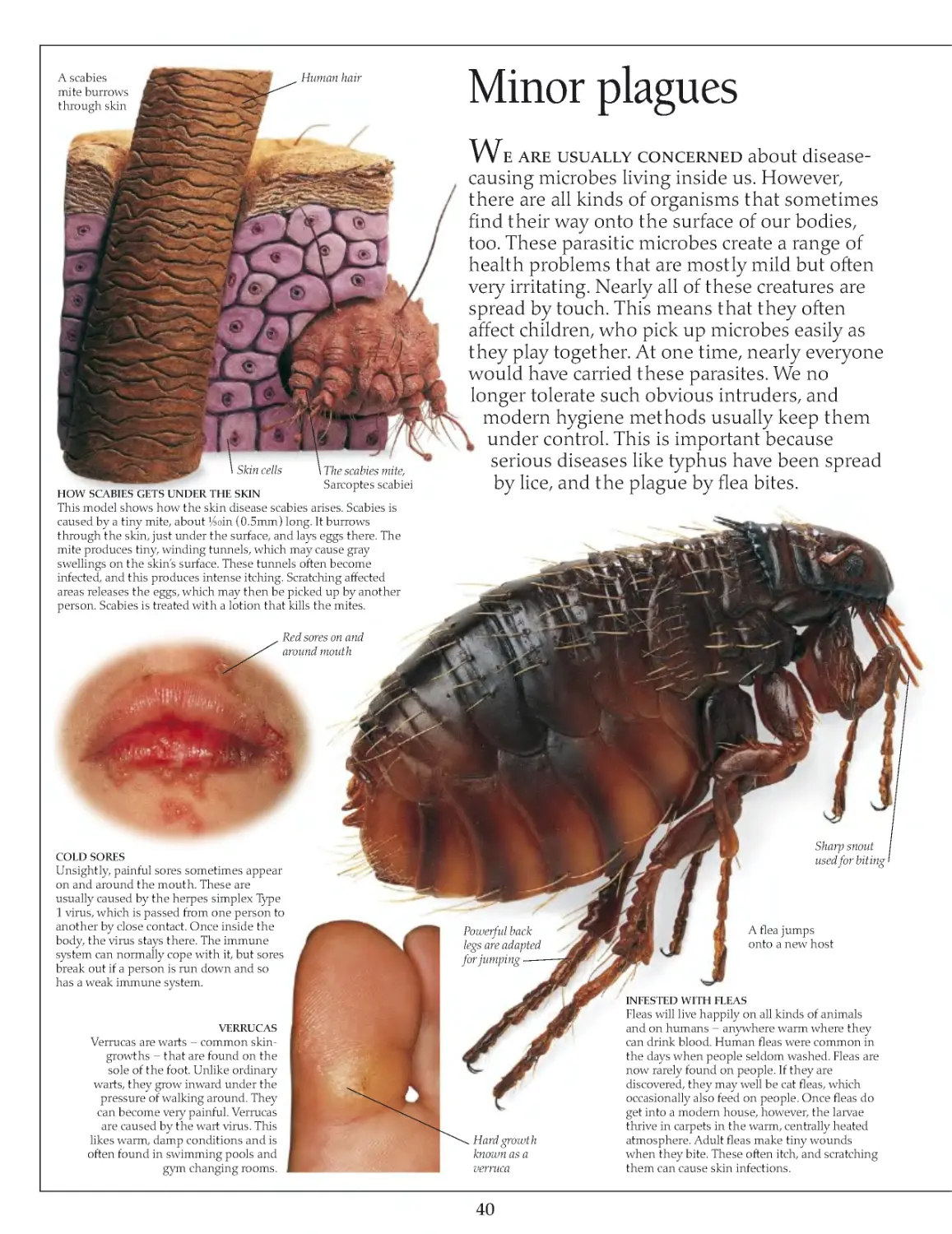

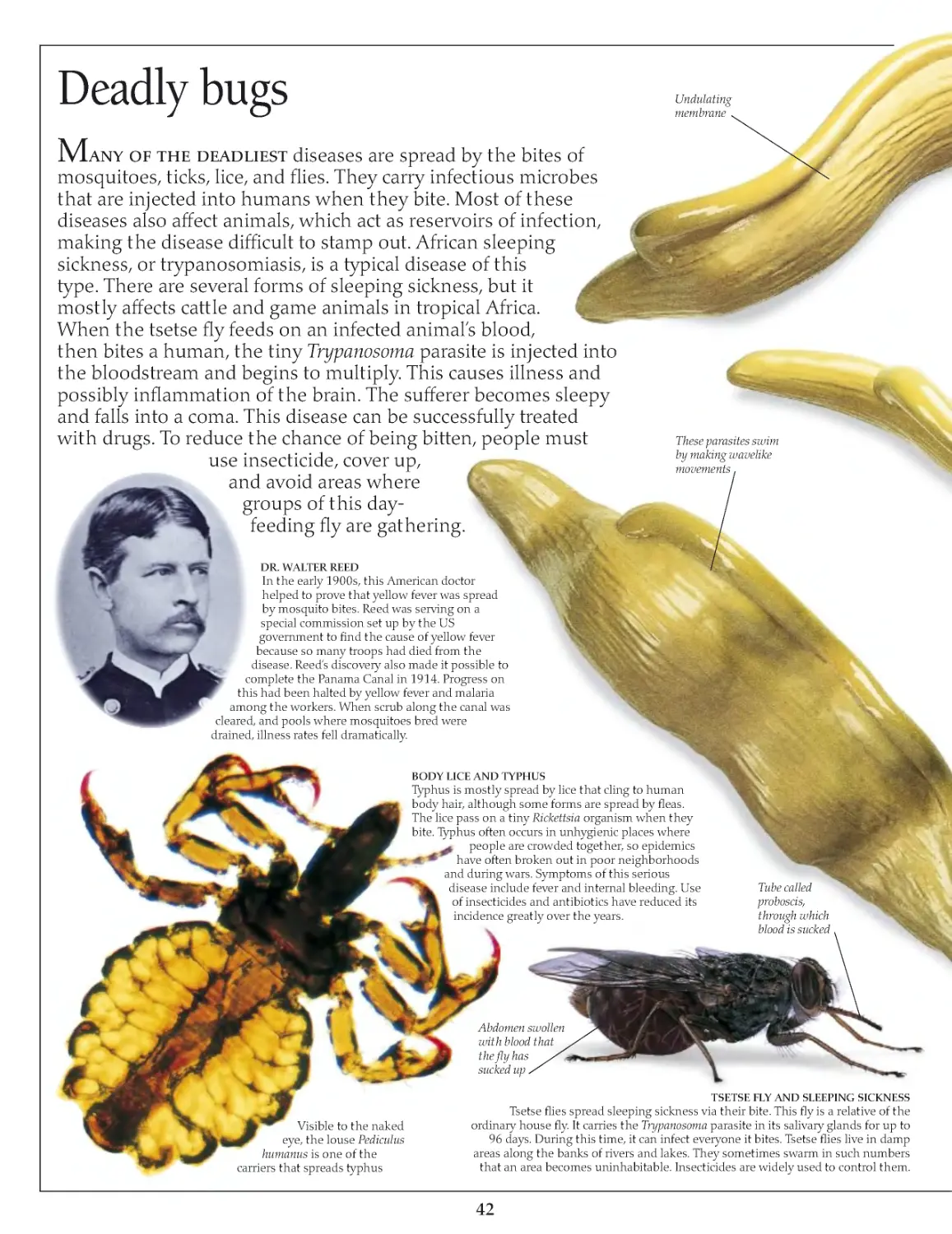

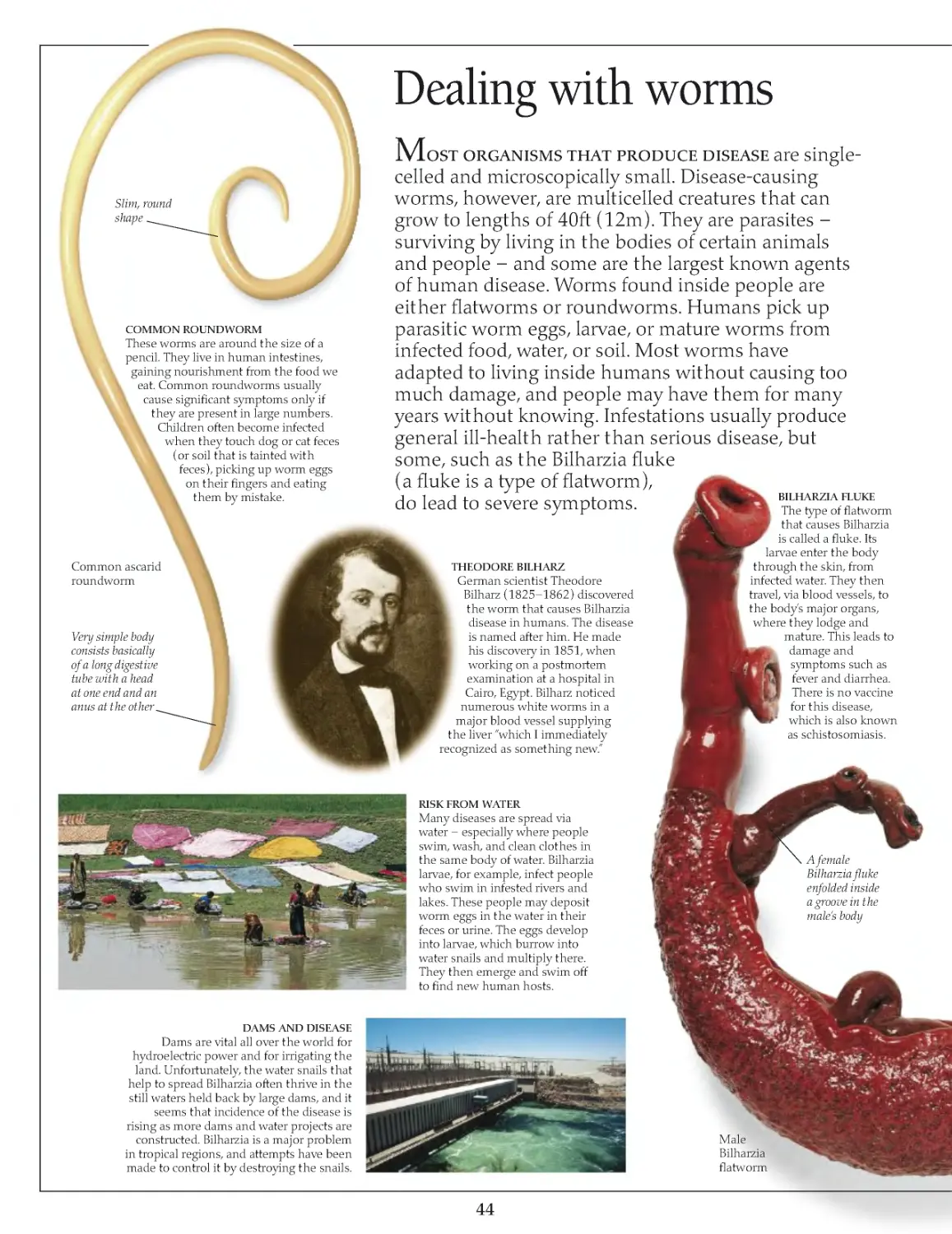

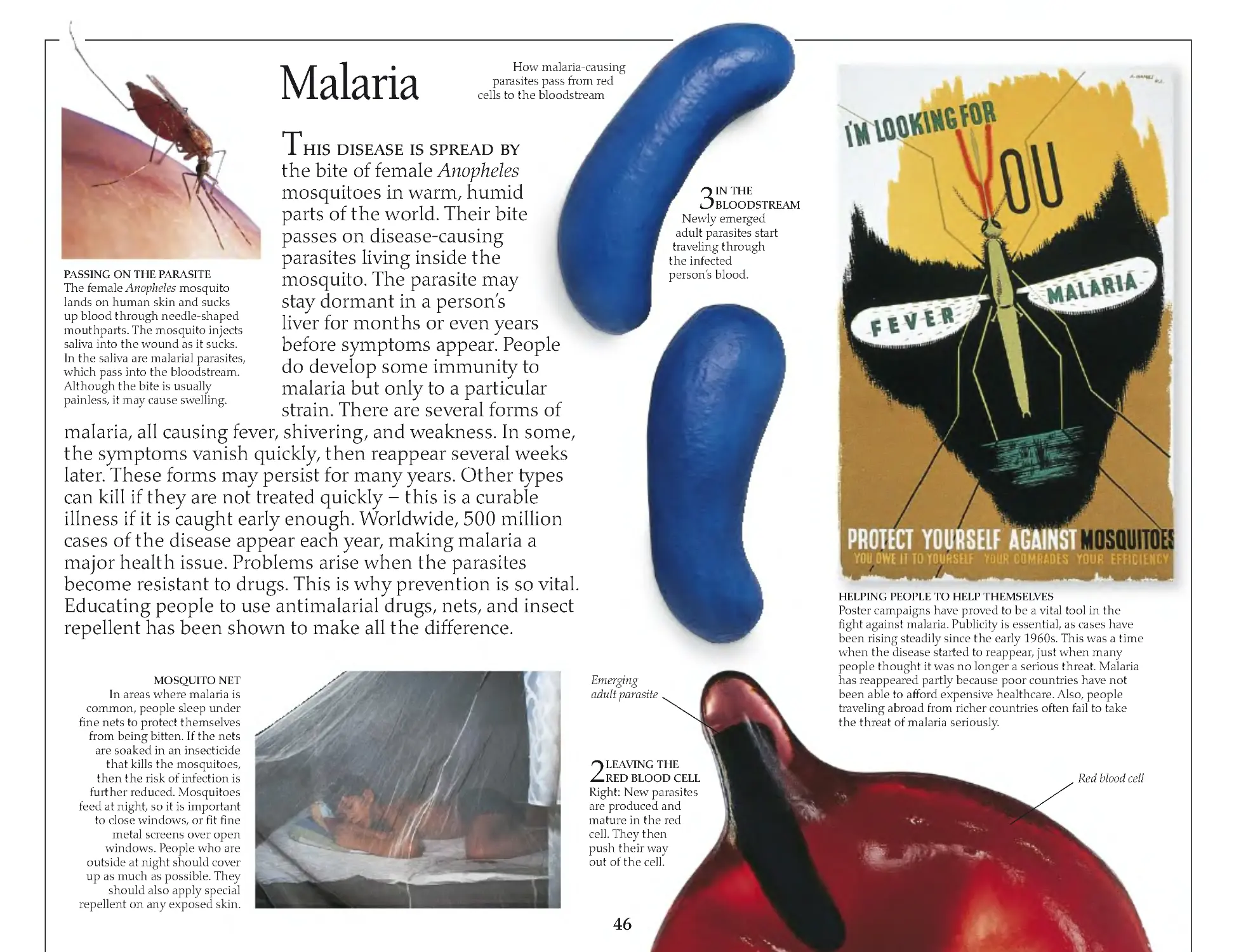














Text
Eyewitness
Epidemic
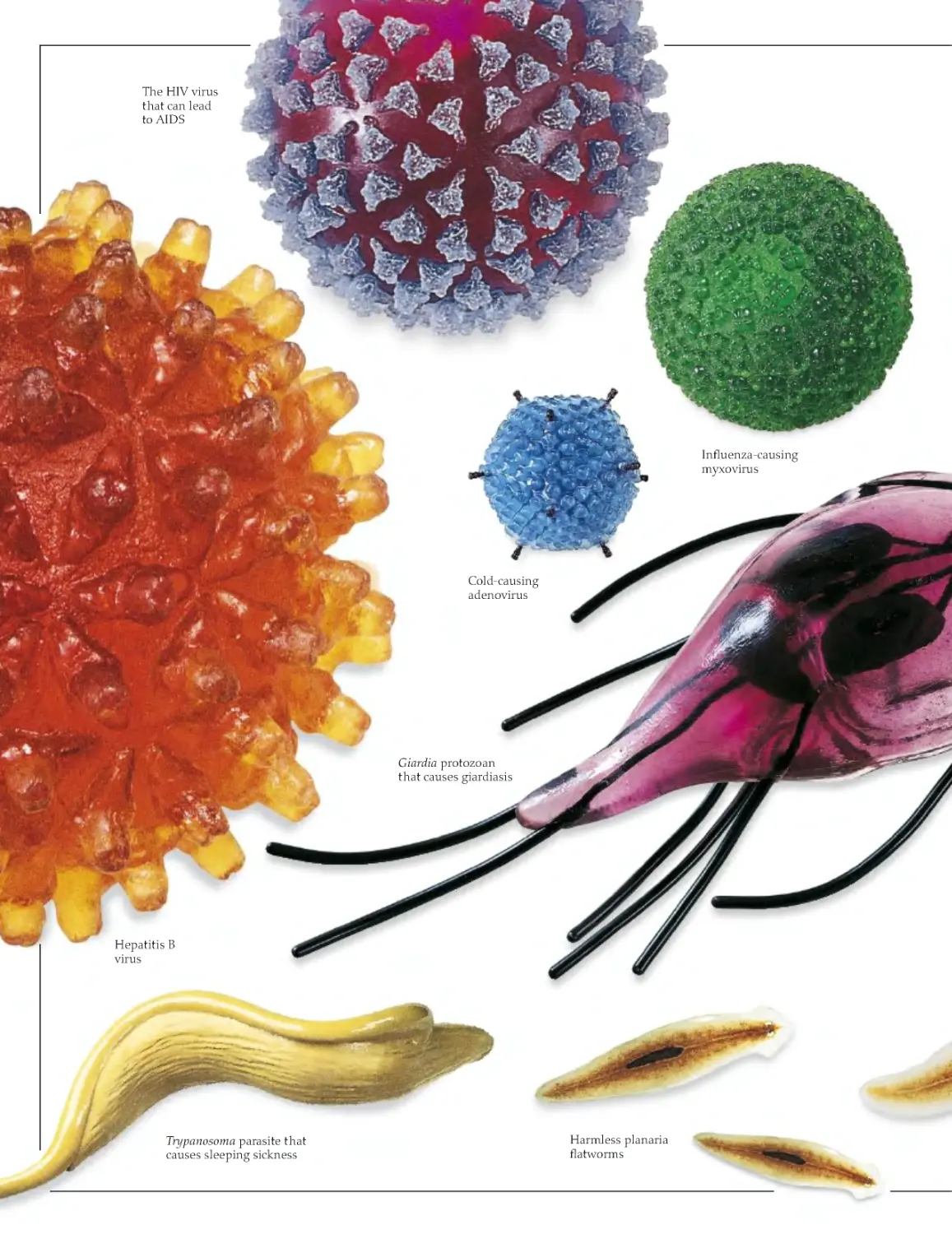
Hepatitis B
virus
Cold-causing
adenovirus
Influenza-causing
myxovirus
The HIV virus
t hat can lead
to AIDS
Giardia protozoan
t hat causes giardiasis
Trypanosoma parasite t hat
causes sleeping sickness
Harmless planaria
flatworms
Eyewitness
Epidemic
Written by
BRIAN WARD
E-coli bacteria
Chief Editorial Consultant
DR. ROB DeSALLE
Curator, American Museum of Natural History
DK Publishing , Inc.
London, new York,
MeLbourne, Munich, and deLhi
Project editors Ann Kay and Carey Scott
Project art editor Joanne Connor
Managing editor Sue Grabham
Senior managing art editor Julia Harris
Production Kate Oliver
Picture research Samant ha Nunn
Senior DTP designer Andrew O’Brien
Jacket designer Margherita Gianni
Special photography Denis Finnin, Jackie Beckett, and
Craig Chesek from the American Museum of Natural History
US editor Chuck Wills
This Eyewitness ® Book has been conceived by
Dorling Kindersley Limited and Editions Gallimard
Copyright © 2000 Dorling Kindersley Limited
First American edition
Published in the United States by
Dorling Kindersley Publishing , Inc.
95 Madison Avenue
New York, NY 10016
468109753
All rights reserved under International and Pan-American Copyright Conventions.
No part of this publication may be reproduced, stored in a retrieval system, or
transmitted in any form or by any means, electronic, mechanical, photocopying ,
recording, or otherwise, without the prior written permission of the copyright owner.
Published in Great Britain by Dorling Kindersley Limited.
Dorling Kindersley books are available at special discounts for bulk purchases for sales
promotions or premiums. Special editions, including personalized covers, excerpts of
existing guides, and corporate imprints can be created in large quantities for specific
needs. For more information, contact Special Markets Dept. , Dorling Kindersley
Publishing, Inc., 95 Madison Ave., New York, NY 10016; Fax: (800) 600-9098
Library of Congress Cataloging-in-Publication Data:
Brian, Ward R.
Epidemic / by Brian Ward.
p. cm. — (Dorling Kindersley eyewitness books)
Summary: Discusses what an epidemic is, how it evolves, various causes and carriers,
and efforts to prevent epidemics.
ISBN-13: 978-0-7894-6989-2 (ALB)
ISBN-13: 978-0-7894-6296-1 (PLC)
1. Epidemics– History–Juvenile literature. [1. Epidemics—History.] I.Title. II. Dorling
Kindersley eyewitness.
RA643 .W27 2000
614.4’9—dc21 00-027948
Color reproduction by Colourscan, Singapore
Printed in China by Toppan Printing Co., (Shenzhen) Ltd.
Discover more at
Bilharzia
flatworm
Disposal unit for
biohazardous
waste
Streptococcus
bacteria
Adenovirus
Shigella
bacteria
Sample tubes
Light
microscope
Sterilization unit
for disease
research
equipment
Immunity testing equipment
Laboratory
equipment
Contents
6
What is an epidemic?
8
How an epidemic evolves
10
Continental spread
12
The Plague
14
Fighting infection
16
Epidemics and the city
18
Food poisoning
20
Water and raw foods
22
Cholera
24
TB – t he coughing plague
26
Lepers and leprosy
28
Outsmarting the smallpox virus
30
Raging rabies
32
Coughs and colds
34
Influenza
36
Attacking the brain
38
Childhood diseases
40
Minor plagues
42
Deadly bugs
44
Dealing wit h worms
46
Malaria
48
Fungal attack
50
Friendly fungi
52
Nature’s medicine cabinet
54
Animal plagues
56
Hot viruses and superbugs
58
HIV and AIDS
60
Germ warfare
62
The continuing war
64
Index
Head of a
tapeworm
What is an epidemic?
Infectious disease has always existed around
both humans and animals. Ever since people
began living in communities, disease could pass
easily from one person to another. Often, only a
few people become ill. When, however, the
problem spreads outside a limited group, affecting a
large number of people and lasting for some time,
it is called an epidemic. If it becomes established
right across t he world, t hen it is a pandemic.
Diseases that are present all of the time are said
to be endemic – for example, malaria is
endemic in certain tropical regions. Infectious
disease is caused by microorganisms such as
viruses invading the body. Also
known as microbes, these
microorganisms are carried in
various ways, such as via
animals or t hrough the air.
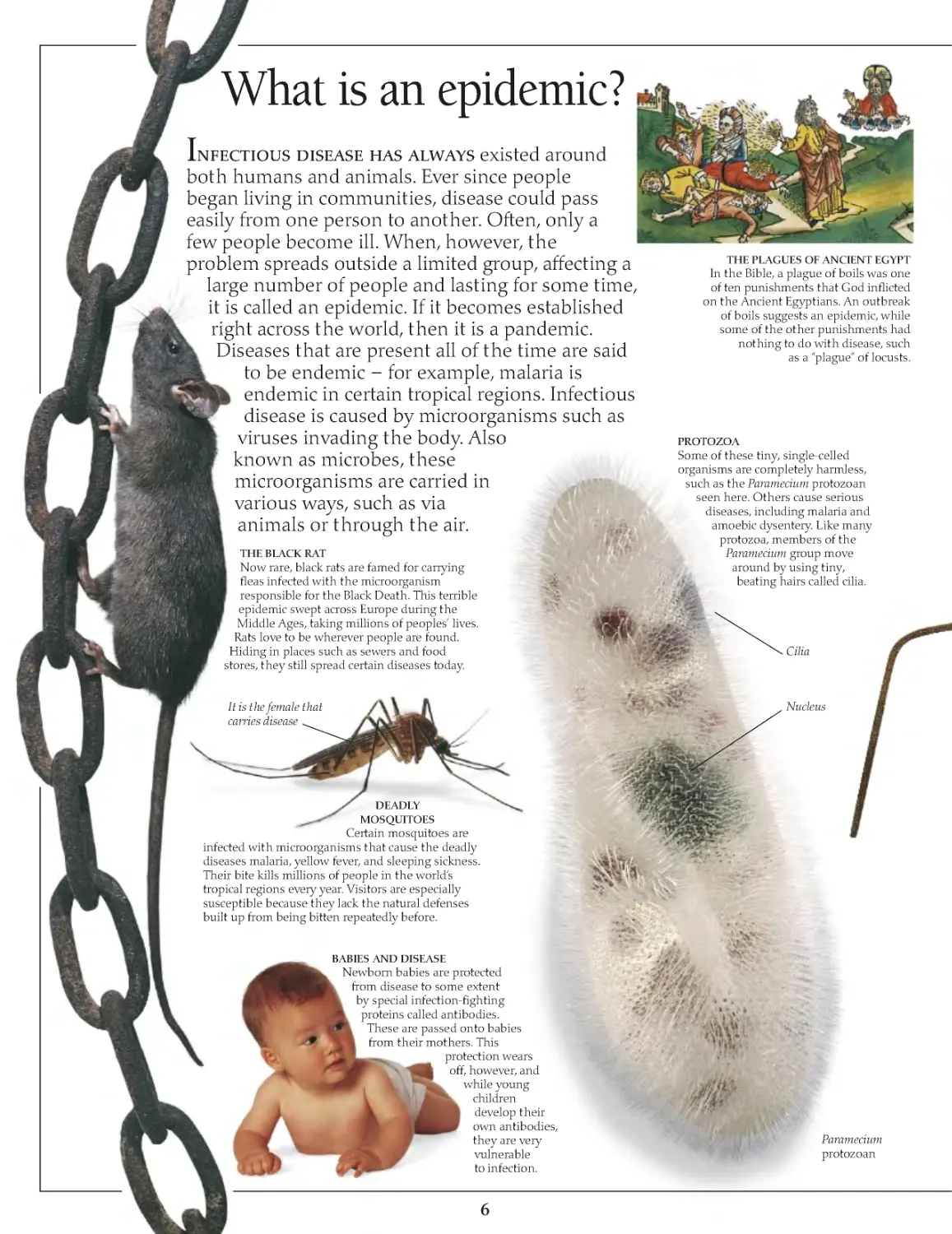
THE PLAGUES OF ANCIENT EGYPT
In the Bible, a plague of boils was one
of ten punishments that God inflicted
on t he Ancient Egyptians. An outbreak
of boils suggests an epidemic, while
some of the ot her punishments had
not hing to do wit h disease, such
as a “plague” of locusts.
PROTOZOA
Some of these tiny, single-celled
organisms are completely harmless,
such as the Paramecium protozoan
seen here. Others cause serious
diseases, including malaria and
amoebic dysentery. Like many
protozoa, members of the
Paramecium group move
around by using tiny,
beating hairs called cilia.
THE BLACK RAT
Now rare, black rats are famed for carrying
fleas infected with the microorganism
responsible for the Black Death. This terrible
epidemic swept across Europe during t he
Middle Ages, taking millions of peoples’ lives.
Rats love to be wherever people are found.
Hiding in places such as sewers and food
stores, t hey still spread certain diseases today.
It is the female that
carries disease
DEADLY
MOSQUITOES
Certain mosquitoes are
infected wit h microorganisms t hat cause the deadly
diseases malaria, yellow fever, and sleeping sickness.
Their bite kills millions of people in the world’s
tropical regions every year. Visitors are especially
susceptible because they lack the natural defenses
built up from being bitten repeatedly before.
BABIES AND DISEASE
Newborn babies are protected
from disease to some extent
by special infection-fighting
proteins called antibodies.
These are passed onto babies
from their mot hers. This
protection wears
off, however, and
while young
children
develop t heir
own antibodies,
they are very
vulnerable
to infection.
Cilia
Nucleus
Paramecium
protozoan
POLLUTION
All kinds of pollutants pour into t he world’s
waterways and water supplies, creating a
breeding ground for microbes. Water t hat
has been contaminated with sewage (human
waste) is especially dangerous. This can
cause deadly infectious diseases such as
typhoid and cholera, which develop rapidly
in unhygienic conditions.
VIRUSES
These are the smallest
microbes of all, and many
have geometric shapes such
as t his one. Viruses cause
some of the world’s most
troublesome diseases – flu,
polio, yellow fever, and
smallpox. To survive, t hey
need to take over other living
cells. This is why they are
such a problem – t hey can
only be destroyed by killing
the cells they have invaded.
Tail fibers
grip the
cell t hat is
under attack
Head
contains
genetic
material
A type of
virus t hat
attacks
bacteria
CROWDED CONDITIONS
Many common disease-causing microorganisms love
crowded places. This packed Tokyo commuter train
provides perfect conditions for infectious diseases to
spread rapidly. Viruses, for example, are spread via
water droplets sneezed or coughed out and t hen
inhaled by another person. Most viruses become
infectious before people actually feel ill, so epidemics
such as influenza can gain a hold all too easily.
Hollow tube through
which genetic material is
injected into bacteria, thus
destroying the bacteria
Shigella bacteria
Cilia
BACTERIA
Every surface that we touch
is covered with invisible,
microscopically small bacteria.
The air we breat he is also filled
wit h bacteria. Most are totally
harmless or even beneficial. For
example, billions of bacteria live happily in
our mouths, stomachs, and intestines,
helping to destroy ot her, harmful microbes.
How an epidemic evolves
Why is it that epidemics appear, then gradually die
out? This process has been going on for t housands of
years, with new diseases causing widespread illness
and then seeming to disappear. One reason for this
is t hat t he microbes that cause disease are constantly
changing. Another important reason becomes clear
when diseases that previously lived only in animals
suddenly spread to humans. Our immune systems
have no resistance to t hese new diseases. If the
outbreak occurs in a crowded city, sickness spreads
rapidly and the infection quickly develops into an
epidemic. As an increasing number of people become
exposed to the disease, t he immune system learns to
fight off the infection. As more people become immune,
t he disease becomes less of a threat.
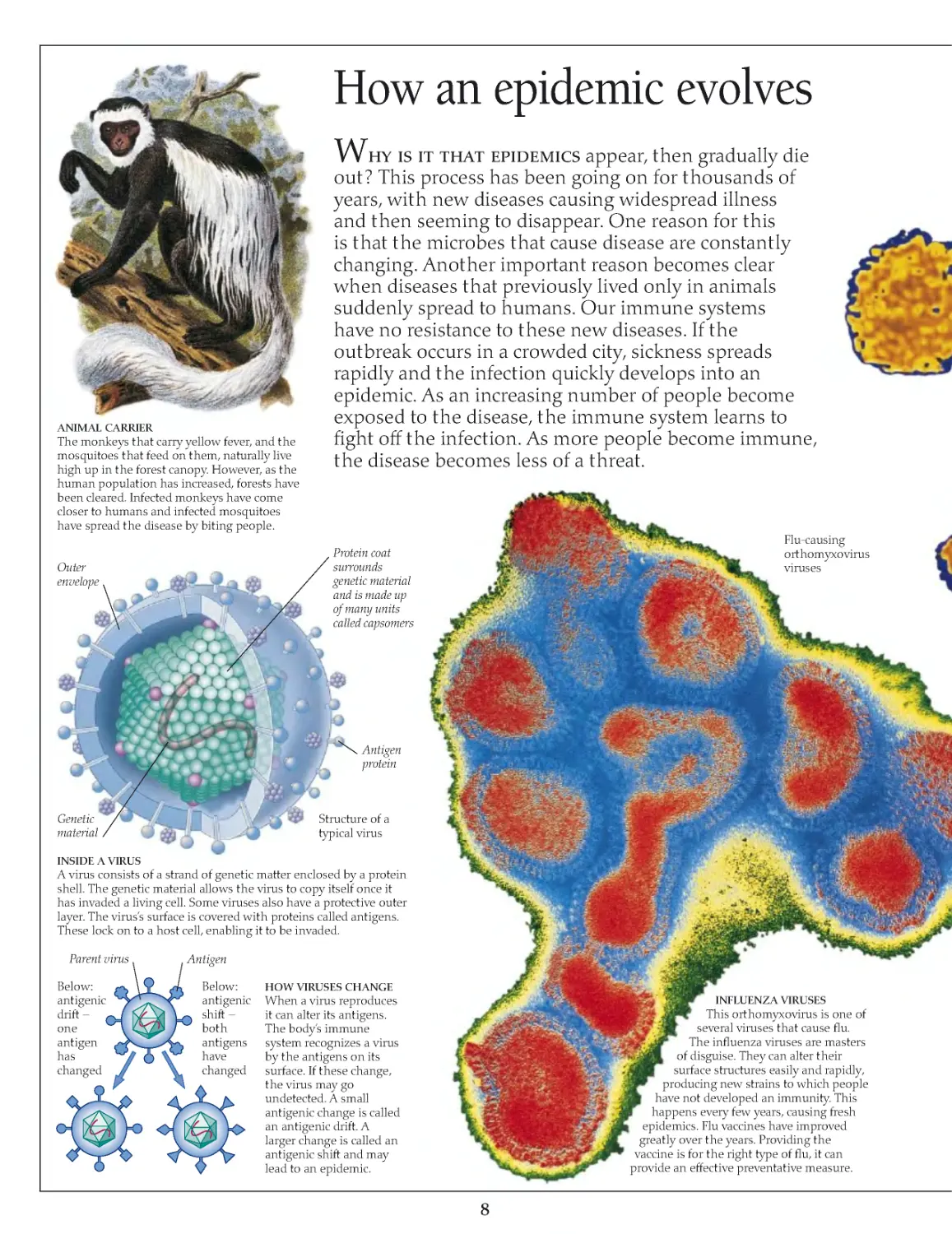
ANIMAL CARRIER
The monkeys t hat carry yellow fever, and t he
mosquitoes t hat feed on t hem, naturally live
high up in t he forest canopy. However, as t he
human population has increased, forests have
been cleared. Infected monkeys have come
closer to humans and infected mosquitoes
have spread t he disease by biting people.
Protein coat
surrounds
genetic material
and is made up
of many units
called capsomers
Outer
envelope
Flu-causing
ort homyxovirus
viruses
Antigen
protein
Structure of a
typical virus
Genetic
material
INSIDE A VIRUS
A virus consists of a strand of genetic matter enclosed by a protein
shell. The genetic material allows the virus to copy itself once it
has invaded a living cell. Some viruses also have a protective outer
layer. The virus’s surface is covered with proteins called antigens.
These lock on to a host cell, enabling it to be invaded.
Parent virus
Antigen
Below:
antigenic
shift –
bot h
antigens
have
changed
HOW VIRUSES CHANGE
When a virus reproduces
it can alter its antigens.
The body’s immune
system recognizes a virus
by the antigens on its
surface. If t hese change,
t he virus may go
undetected. A small
antigenic change is called
an antigenic drift. A
larger change is called an
antigenic shift and may
lead to an epidemic.
Below:
antigenic
drift –
one
antigen
has
changed
INFLUENZA VIRUSES
This ort homyxovirus is one of
several viruses that cause flu.
The influenza viruses are masters
of disguise. They can alter t heir
surface structures easily and rapidly,
producing new strains to which people
have not developed an immunity. This
happens every few years, causing fresh
epidemics. Flu vaccines have improved
greatly over t he years. Providing the
vaccine is for the right type of flu, it can
provide an effective preventative measure.
Cubic shape,
despite looking
rounded here
RICE-PADDY BREEDING GROUNDS
Water-filled rice paddies provide ideal conditions for
mosquitoes to breed. Mosquitoes can carry yellow
fever, malaria, and dengue fever, which t hey pass on
when they bite people working in t he fields. Rice is
a staple food for half t he world’s people. As t he
human population increases, more tropical areas are
cleared for farmland. Awareness of this problem has
done much in recent years to help halt disease.
Flagellum, to help
bacterium move
Cytoplasm
Some
bacteria
have a
protective
coat
Most bacteria
have a rigid
cell wall
Nucleoid, containing
genetic matter
Hairlike pili anchor
bacterium to other cells
Bacillus (rod-
shaped bacterium)
INSIDE A BACTERIUM
A bacterium is a complete living cell, unlike a virus. Some bacteria
cause disease by releasing toxins into the body. Ot hers directly invade
our cells. Different types target specific kinds of body cells. Bacteria
can also change t heir genetic makeup. This often means t hat drugs
that once combatted the bacteria may no longer work against t hem.
NEW TOWNS
This town lies in t he heart of
t he Brazilian rain forest in
South America. Various
towns and cities have been
built in clearings cut in rain
forest. Such towns have
suffered many problems. For
example, insect-borne disease
is common in tropical forests.
In order to prevent disease,
pools of stagnant water
where dangerous insects
breed have to be drained.
Any scrub where they may
rest during the day must be
cleared. When planning a
new city, t he life cycles of any
local disease-causing insects
must be considered.
FOREST DANGER
Felling forests is just one of the factors t hat can cause
disease. When trees are cut down, microbes and
parasites can easily move from forest animals to
humans. Disease-causing organisms usually live in
t heir original hosts wit hout too much harm. However,
if they come into contact wit h people who have no
immunity to them, they can go on to cause disease.
The ways in which environmental changes can affect
t he course of disease is a vast area of current research.
YELLOW FEVER VIRUS
This virus was once found only in animals.
Yellow fever in humans was first described in
1684. The spread among humans was started by
travelers and explorers who had been
bitten by mosquito carriers while
overseas and then took t he
disease back to their
homeland. Yellow fever is
often mild, but it may be fatal.
Symptoms include fever and
jaundice, which makes the
skin turn yellow – hence
t he name. One attack
gives immunity for
life. The yellow fever
vaccine has been
highly successful in
controlling t his disease.
Several yellow fever
viruses, which belong
to t he flavivirus
group of viruses
10
COLUMBUS AND THE “NEW WORLD”
Italian explorer Christopher Columbus and his men first set foot
in t he Americas in the 1490s, as depicted in t his 19th-century
print. These men carried diseases such as smallpox and
measles, which they passed on to the Native Americans.
Those t hat were weakened by disease were
often enslaved and whole populations died.
Continental spread
Syphilis
sores
Fifteenth-
century
print by
Albrecht
Dürer
GLOBAL PROBLEMS
This man has fallen prey to syphilis,
a once-fatal sexually transmitted
disease. The globe deals with an
out break of plague. Syphilis was
common from the 1500s to the
1800s, and t he plague raged through
much of the world from t he 1300s to
1600s. Soldiers and explorers played a
huge role in spreading bot h diseases.
LȰȯȨȢȨȰȱȦȰȱȭȦȵȦȯȥȦȥ
to stay in one area, or migrate
slowly when t he population
became too large. Once t he
Roman Empire started to
spread across t he world, around
200 Żż, t hings changed. People
began to travel more freely, and
merchants traded wit h nomads
bringing silk and spices from Asia.
When t hese merchants came home,
t hey brought diseases with them
t hat Europeans had never met
before, and for which t hey had no
immunity – such as t he plague. The same t hing happened when
Europeans made t heir way to new lands. Great voyages of exploration
from t he 1300s to t he 1600s spread European diseases like measles to
vulnerable peoples such as Pacific islanders. Today, travel is an everyday
t hing. Thanks to airplanes, we cross continents in a matter of hours – and
so does disease. Experts know t hat t hey must always take travel patterns
into account when trying to unravel the course of any new out breaks.
SMALLPOX IN MEXICO
This scene, taken from an old Mexican document,
shows native people suffering from smallpox.
When t he Spanish colonized Mexico in the 1500s,
t hey brought smallpox wit h t hem. By 1521, half
t he native population was dead and t he great
civilizations of t he Aztec, Maya, and Inca people
fell easily to t he European invaders.
In t he 1500s, it
was thought t hat
this arrangement
of the planets had
caused an outbreak
of plague in 1484
11
SLAVE SHIPS
This is t he kind of ship used to transport Africans during t he
days of t he slave trade. This trade reached a height around
1800 but ended shortly afterward. Wealthy Europeans who
owned huge cotton and sugar plantations in America and the
Caribbean shipped out thousands of slaves from Africa to work
on t hem. In t hese cramped, unsanitary ships, many died.
Survivors often took diseases like yellow fever from Africa to
t he plantations for which t hey were bound.
Sago from Southeast Asia being loaded
onto barges in England in 1922
IMPORTED GOODS AND DISEASE
Transporting foods around t he world has also helped to spread
disease. As transportation has improved, bringing foodstuffs from
fart her afield, the potential healt h risk has increased. Moist foodstuffs
may be contaminated by disease organisms carried in water. Even a
dry food such as rice can occasionally carry diarrhea-causing microbes.
Disease-carrying rats, mice, and insects can easily hide among t he
cargo in a ship. In many countries, strict health laws control t he
conditions under which food is brought in from abroad.
TAKING TO THE SKIES
Air travel means that a person suffering from
a disease can travel thousands of miles in a
few hours. This spreads disease to another
continent far faster than was possible in
t he days when people traveled by ship.
“Airport malaria” is now a recognized
healt h hazard. The malarial mosquitoes
are carried on an aircraft to a destination
where t he disease never occurs naturally.
Worldwide air travel can
spread disease very rapidly
BACKPACKING THE WORLD
Modern transportation makes it increasingly
easy to reach remote parts of the world, and
to come into contact with all kinds of
diseases. Some of these take a while to
develop. The traveler may return home
feeling healthy, but fall ill some weeks later.
All travelers should take precautions such as
protecting against insect bites, avoiding
untreated water, and getting vaccinated.
Metal “cautery” tool,
which was heated and
used to burn away the
sores suffered by people
infected with the plague
KEEPING THE PLAGUE AWAY
In t he 17th century, torches like t his
were carried to protect against t he
plague. They were filled with burning
aromatic herbs. People at t he time
believed, wrongly, t hat t he plague was
spread by foul odors. They t hought
that t hese fumes would keep it away.
Seventeent h-century
fumigating torch
12
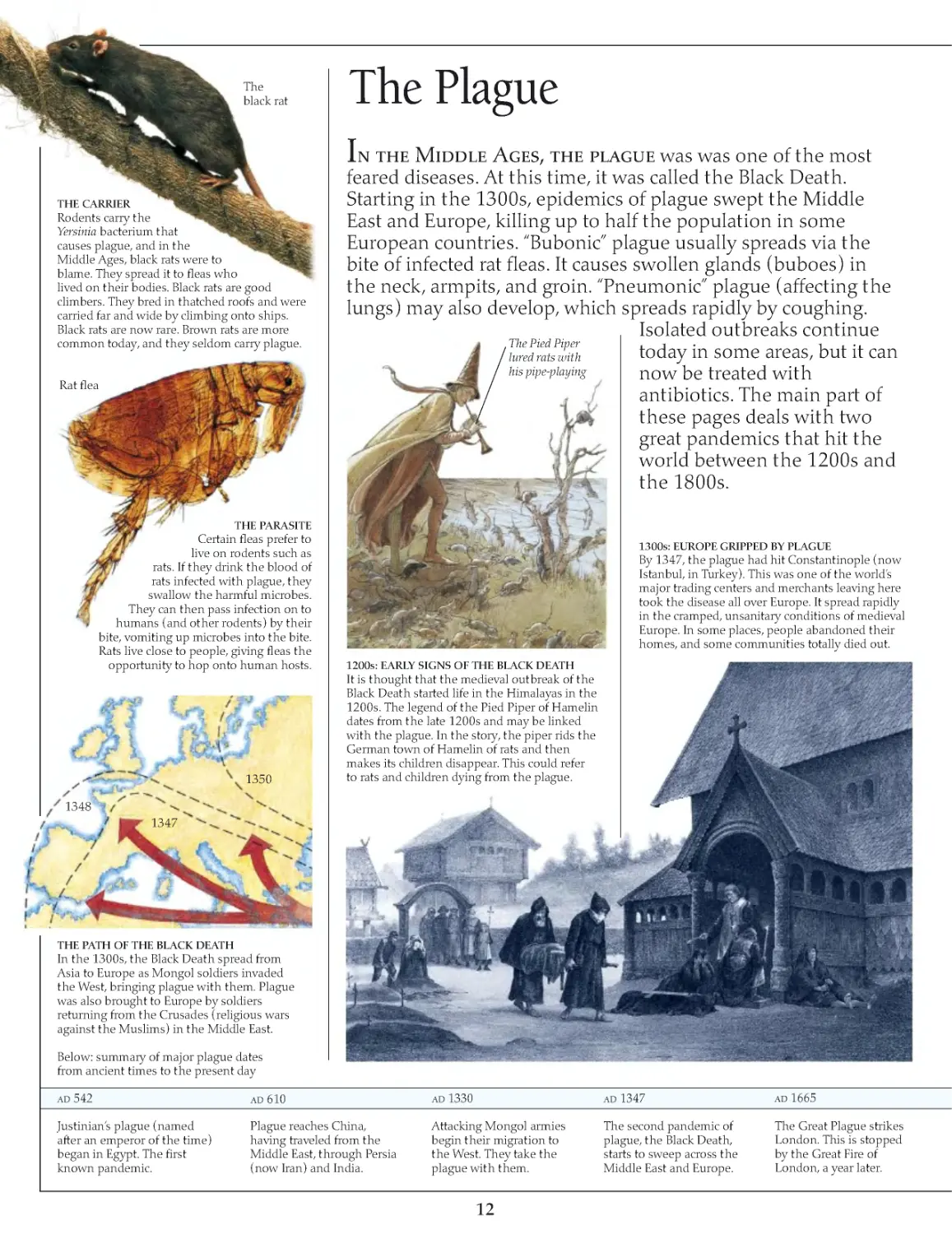
The
black rat
The Plague
THE CARRIER
Rodents carry t he
Yersinia bacterium t hat
causes plague, and in t he
Middle Ages, black rats were to
blame. They spread it to fleas who
lived on t heir bodies. Black rats are good
climbers. They bred in thatched roofs and were
carried far and wide by climbing onto ships.
Black rats are now rare. Brown rats are more
common today, and they seldom carry plague.
In the Middle Ages, the plague was was one of the most
feared diseases. At this time, it was called the Black Death.
Starting in the 1300s, epidemics of plague swept the Middle
East and Europe, killing up to half the population in some
European countries. “Bubonic” plague usually spreads via t he
bite of infected rat fleas. It causes swollen glands (buboes) in
the neck, armpits, and groin. “Pneumonic” plague (affecting the
lungs) may also develop, which spreads rapidly by coughing.
Isolated outbreaks continue
today in some areas, but it can
now be treated with
antibiotics. The main part of
these pages deals with two
great pandemics that hit the
world between the 1200s and
the 1800s.
Rat flea
THE PARASITE
Certain fleas prefer to
live on rodents such as
rats. If they drink the blood of
rats infected with plague, t hey
swallow the harmful microbes.
They can then pass infection on to
humans (and ot her rodents) by their
bite, vomiting up microbes into t he bite.
Rats live close to people, giving fleas the
opportunity to hop onto human hosts.
1200s: EARLY SIGNS OF THE BLACK DEATH
It is thought that the medieval outbreak of the
Black Deat h started life in the Himalayas in the
1200s. The legend of t he Pied Piper of Hamelin
dates from t he late 1200s and may be linked
with the plague. In the story, the piper rids the
German town of Hamelin of rats and then
makes its children disappear. This could refer
to rats and children dying from the plague.
1300s: EUROPE GRIPPED BY PLAGUE
By 1347, the plague had hit Constantinople (now
Istanbul, in Turkey). This was one of the world’s
major trading centers and merchants leaving here
took the disease all over Europe. It spread rapidly
in the cramped, unsanitary conditions of medieval
Europe. In some places, people abandoned their
homes, and some communities totally died out.
THE PATH OF THE BLACK DEATH
In the 1300s, t he Black Death spread from
Asia to Europe as Mongol soldiers invaded
t he West, bringing plague with them. Plague
was also brought to Europe by soldiers
returning from t he Crusades (religious wars
against t he Muslims) in t he Middle East.
Below: summary of major plague dates
from ancient times to t he present day
ad 542
Justinian’s plague (named
after an emperor of the time)
began in Egypt. The first
known pandemic.
ad 610
Plague reaches China,
having traveled from t he
Middle East, t hrough Persia
(now Iran) and India.
ad 1330
Attacking Mongol armies
begin t heir migration to
t he West. They take the
plague wit h them.
ad 1347
The second pandemic of
plague, t he Black Death,
starts to sweep across t he
Middle East and Europe.
ad 1665
The Great Plague strikes
London. This is stopped
by the Great Fire of
London, a year later.
1348
1347
1350
The Pied Piper
lured rats with
his pipe-playing
13
1400s: THE PLAGUE RETURNS
After t he first huge wave of deaths in
Europe during t he mid-1300s, the disease
faded and returned every few years. This
probably depended on how many rats t here
were around to spread infection. Generally,
these outbreaks were not as severe. In 1479,
however, all of England was overwhelmed
wit h plague once more. This time, it killed
as many as one person in every five.
Lead crosses
were placed
on the
bodies of
many victims,
as there were
too few coffins
to go
around
100s: FLEEING THE TERROR
In 1665, the Great Plague struck
London. Royalty and wealt hy
people did what many had
done before when faced with the
plague – they fled the city for the
country (t he picture above dates from
t he 1630s). Sadly, t his did not help. No
one suspected the rats that ran around
freely in towns and villages, but t hey
still carried infected fleas. Another
disaster followed in 1666, when a huge
fire swept t hrough London. However,
t his burned down many infected
buildings in its wake and brought t his
major plague outbreak to a halt.
Silver “book” pomander from
around 1700. Pomanders like
t his were carried in a futile
attempt to ward off the plague.
1500s: TEMPORARY RESPITE
By t he 1500s, the population of some countries
had recovered to their pre-Black Deat h levels.
However, t he plague was still a very real t hreat,
as t his manuscript illustration shows. Here, t he
figures of Death, War, and Plague are seen
threatening a king , reminding him of his
mortality. Outbreaks were still occurring in the
1500s, and they caused many deat hs, but t hey
were now less frequent than before.
ad 1721
The second great pandemic
finally fades out, in France.
However, plague continues
in t he Middle East.
Third great plague pandemic
starts in China. In 1890s, the
bacterium is isolated and a
vaccine is developed.
ad 1855
ad 1900
A nine-year out break of
plague hits Sydney and San
Francisco. It fades when
many rats are killed.
ad 1960s and 1970s
ad 1994
Vietnam becomes the world’s
leading trouble spot for
plague, especially during the
Vietnam War (1965–1973).
Pneumonic plague
epidemic breaks out
in Surat, India. It kills
around 800 people.
100s: NEW ADVANCES
Several serious outbreaks occurred this
century. A huge pandemic began in China,
killing 20 million over 75 years. However, t he
bacterium that causes plague was identified
in 1894, and a vaccine developed in 1896.
100s: KEEPING THE
PLAGUE AT BAY
During t he 1700s,
out breaks continued, notably
in Austria and t he Middle East. It
was around t his time that people
carried pomanders like t he one
above. As it was t hought that t he plague
was caused by foul air, t hey believed that
fragrant fumes would keep it away. Many
also sought the advice of unscrupulous
“doctors,” who sold all kinds of bogus cures.
Perforated
and filled with
fragrant herbs
Rat image
suggests
link with
the plague
Elaborate
antiplague
mask
Quack
plague
“doctor,”
1700s
14
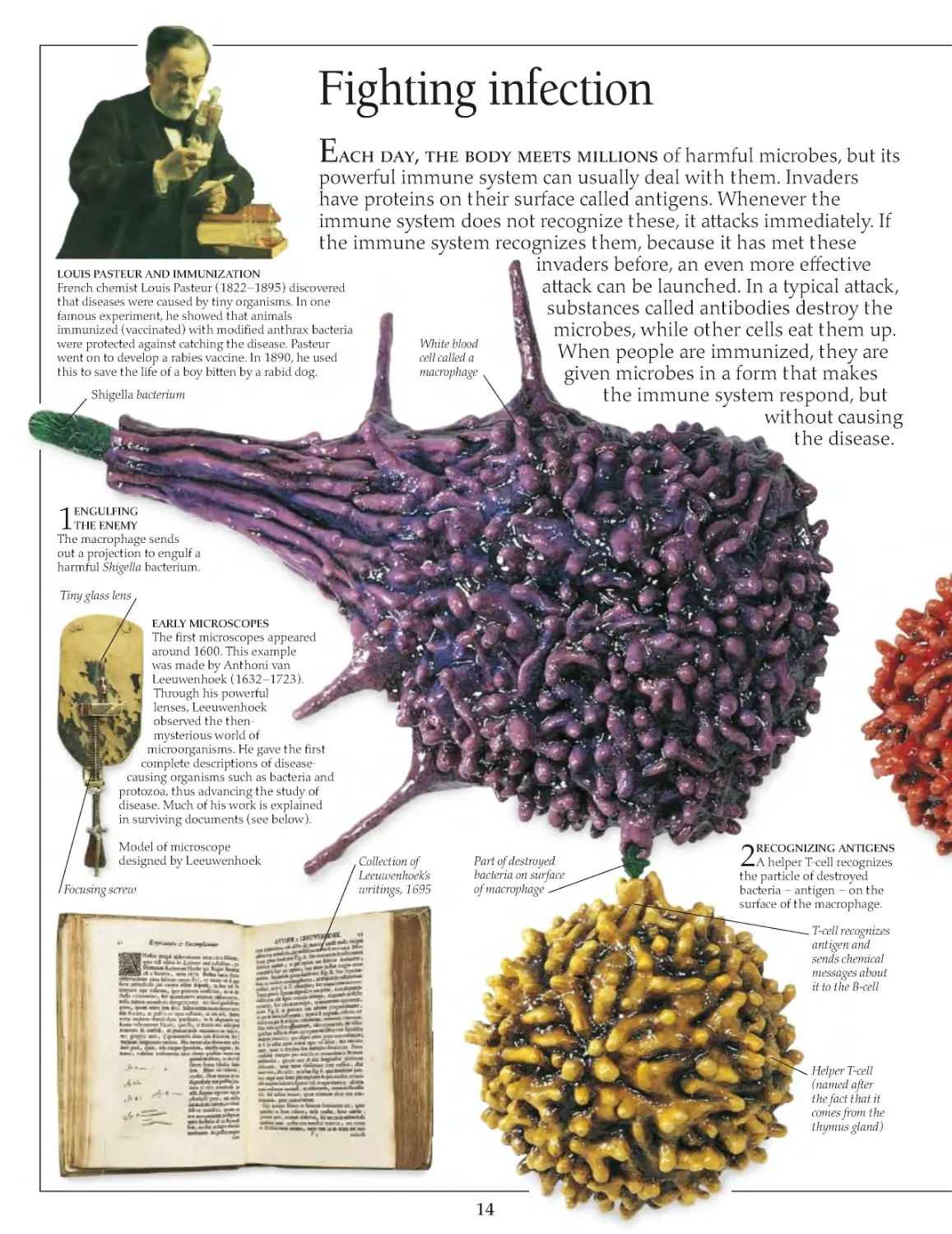
Fighting infection
Each day, the body meets millions of harmful microbes, but its
powerful immune system can usually deal with them. Invaders
have proteins on t heir surface called antigens. Whenever the
immune system does not recognize t hese, it attacks immediately. If
the immune system recognizes t hem, because it has met t hese
invaders before, an even more effective
attack can be launched. In a typical attack,
substances called antibodies destroy the
microbes, while other cells eat t hem up.
When people are immunized, they are
given microbes in a form t hat makes
the immune system respond, but
without causing
t he disease.
LOUIS PASTEUR AND IMMUNIZATION
French chemist Louis Pasteur (1822–1895) discovered
t hat diseases were caused by tiny organisms. In one
famous experiment, he showed that animals
immunized (vaccinated) wit h modified ant hrax bacteria
were protected against catching the disease. Pasteur
went on to develop a rabies vaccine. In 1890, he used
this to save the life of a boy bitten by a rabid dog.
Shigella bacterium
1ENGULFING
THE ENEMY
The macrophage sends
out a projection to engulf a
harmful Shigella bacterium.
Tiny glass lens
EARLY MICROSCOPES
The first microscopes appeared
around 1600. This example
was made by Ant honi van
Leeuwenhoek (1632–1723).
Through his powerful
lenses, Leeuwenhoek
observed the t hen-
mysterious world of
microorganisms. He gave t he first
complete descriptions of disease-
causing organisms such as bacteria and
protozoa, thus advancing the study of
disease. Much of his work is explained
in surviving documents (see below).
Model of microscope
designed by Leeuwenhoek
Focusing screw
Collection of
Leeuwenhoek’s
writings, 1695
Part of destroyed
bacteria on surface
of macrophage
2RECOGNIZING ANTIGENS
A helper T-cell recognizes
t he particle of destroyed
bacteria – antigen – on t he
surface of t he macrophage.
T-cell recognizes
antigen and
sends chemical
messages about
it to the B-cell
Helper T-cell
(named after
the fact that it
comes from the
thymus gland)
White blood
cell called a
macrophage
15
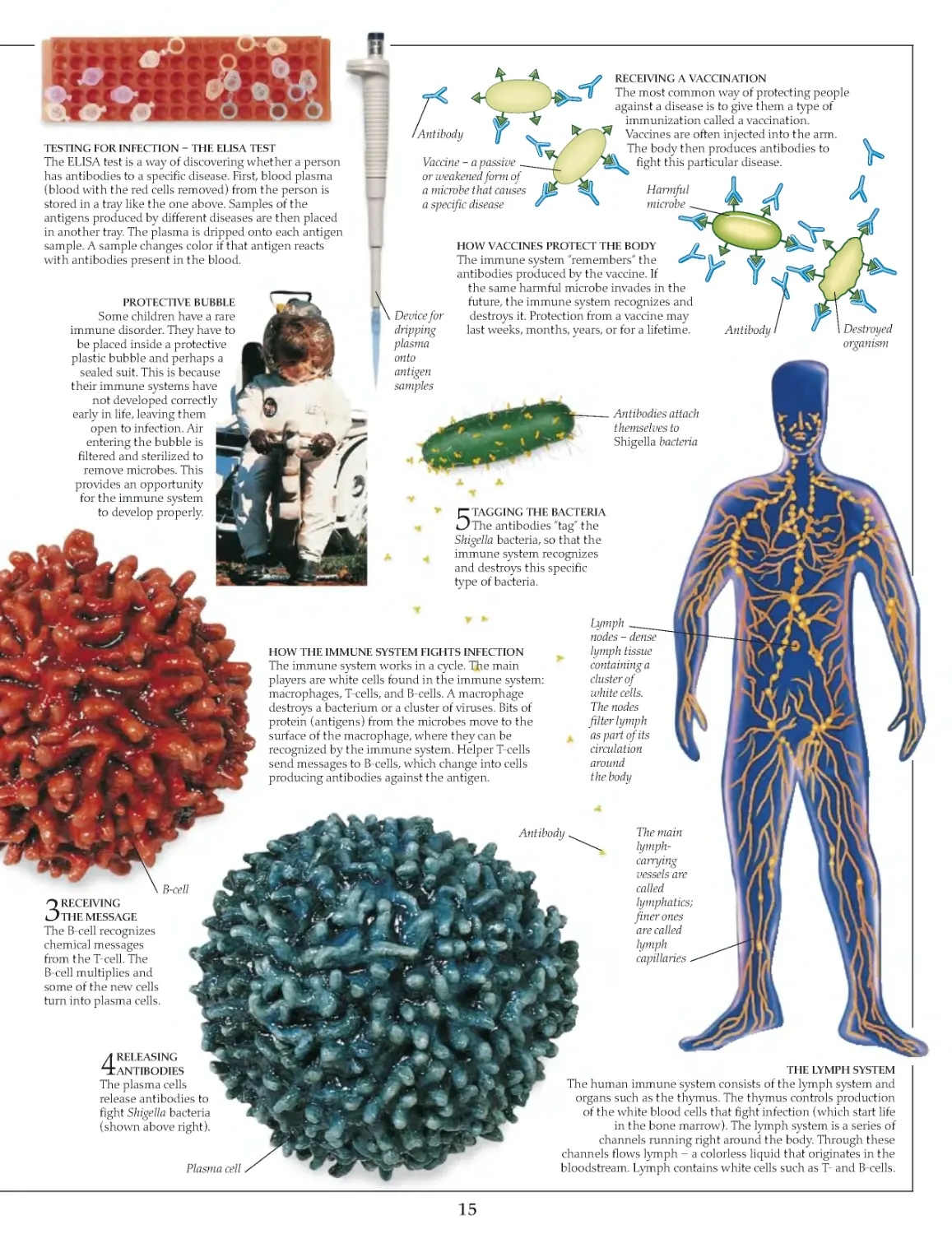
3RECEIVING
THE MESSAGE
The B-cell recognizes
chemical messages
from t he T-cell. The
B-cell multiplies and
some of the new cells
turn into plasma cells.
4RELEASING
ANTIBODIES
The plasma cells
release antibodies to
fight Shigella bacteria
(shown above right).
Plasma cell
THE LYMPH SYSTEM
The human immune system consists of the lymph system and
organs such as t he thymus. The thymus controls production
of the white blood cells that fight infection (which start life
in t he bone marrow). The lymph system is a series of
channels running right around t he body. Through these
channels flows lymph – a colorless liquid that originates in t he
bloodstream. Lymph contains white cells such as T- and B-cells.
The main
lymph-
carrying
vessels are
called
lymphatics;
finer ones
are called
lymph
capillaries
Antibody
B-cell
HOW THE IMMUNE SYSTEM FIGHTS INFECTION
The immune system works in a cycle. The main
players are white cells found in the immune system:
macrophages, T-cells, and B-cells. A macrophage
destroys a bacterium or a cluster of viruses. Bits of
protein (antigens) from the microbes move to the
surface of the macrophage, where they can be
recognized by t he immune system. Helper T-cells
send messages to B-cells, which change into cells
producing antibodies against t he antigen.
Lymph
nodes – dense
lymph tissue
containing a
cluster of
white cells.
The nodes
filter lymph
as part of its
circulation
around
the body
5TAGGING THE BACTERIA
The antibodies “tag” t he
Shigella bacteria, so that the
immune system recognizes
and destroys this specific
type of bacteria.
PROTECTIVE BUBBLE
Some children have a rare
immune disorder. They have to
be placed inside a protective
plastic bubble and perhaps a
sealed suit. This is because
t heir immune systems have
not developed correctly
early in life, leaving t hem
open to infection. Air
entering the bubble is
filtered and sterilized to
remove microbes. This
provides an opportunity
for the immune system
to develop properly.
Device for
dripping
plasma
onto
antigen
samples
TESTING FOR INFECTION – THE ELISA TEST
The ELISA test is a way of discovering whet her a person
has antibodies to a specific disease. First, blood plasma
(blood wit h t he red cells removed) from t he person is
stored in a tray like t he one above. Samples of the
antigens produced by different diseases are t hen placed
in anot her tray. The plasma is dripped onto each antigen
sample. A sample changes color if that antigen reacts
wit h antibodies present in t he blood.
Antibody
Vaccine – a passive
or weakened form of
a microbe that causes
a specific disease
HOW VACCINES PROTECT THE BODY
The immune system “remembers” the
antibodies produced by the vaccine. If
the same harmful microbe invades in the
future, t he immune system recognizes and
destroys it. Protection from a vaccine may
last weeks, months, years, or for a lifetime.
Antibodies attach
themselves to
Shigella bacteria
Antibody
Destroyed
organism
Harmful
microbe
RECEIVING A VACCINATION
The most common way of protecting people
against a disease is to give t hem a type of
immunization called a vaccination.
Vaccines are often injected into t he arm.
The body t hen produces antibodies to
fight this particular disease.
1
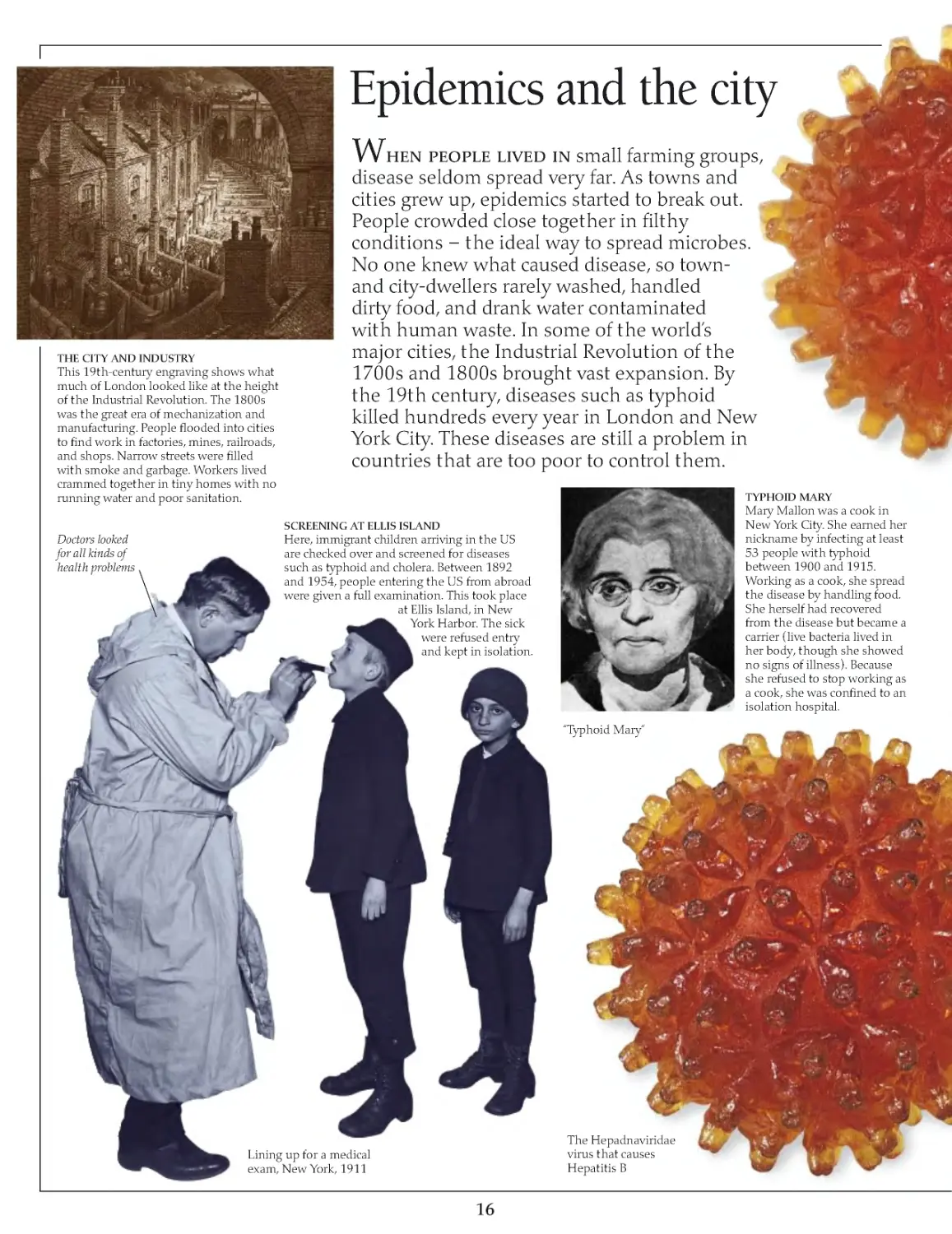
The Hepadnaviridae
virus t hat causes
Hepatitis B
Lining up for a medical
exam, New York, 1911
“ Typhoid Mary”
SCREENING AT ELLIS ISLAND
Here, immigrant children arriving in t he US
are checked over and screened for diseases
such as typhoid and cholera. Between 1892
and 1954, people entering the US from abroad
were given a full examination. This took place
at Ellis Island, in New
York Harbor. The sick
were refused entry
and kept in isolation.
Doctors looked
for all kinds of
health problems
TYPHOID MARY
Mary Mallon was a cook in
New York City. She earned her
nickname by infecting at least
53 people wit h typhoid
between 1900 and 1915.
Working as a cook, she spread
t he disease by handling food.
She herself had recovered
from the disease but became a
carrier (live bacteria lived in
her body, t hough she showed
no signs of illness). Because
she refused to stop working as
a cook, she was confined to an
isolation hospital.
THE CITY AND INDUSTRY
This 19t h-century engraving shows what
much of London looked like at the height
of t he Industrial Revolution. The 1800s
was t he great era of mechanization and
manufacturing. People flooded into cities
to find work in factories, mines, railroads,
and shops. Narrow streets were filled
wit h smoke and garbage. Workers lived
crammed toget her in tiny homes with no
running water and poor sanitation.
Epidemics and the city
When people lived in small farming groups,
disease seldom spread very far. As towns and
cities grew up, epidemics started to break out.
People crowded close together in filthy
conditions – t he ideal way to spread microbes.
No one knew what caused disease, so town-
and city-dwellers rarely washed, handled
dirty food, and drank water contaminated
with human waste. In some of the world’s
major cities, t he Industrial Revolution of the
1700s and 1800s brought vast expansion. By
the 19th century, diseases such as typhoid
killed hundreds every year in London and New
York City. These diseases are still a problem in
countries that are too poor to control them.
1
CONTAMINATED WATER
A town or city needs a huge supply of
drinking water. This must be free of
microbes to stop the diseases t hat
spread rapidly when people are
crammed together. In some
countries, t he same water is used
for a variety of different purposes,
and t his can spread disease. The
standard of water supplies in cities
has improved dramatically over t he
last 100 years. Aid organizations
always make t his a priority,
wherever t hey are working.
The rod-shaped Salmonella
typhi bacteria that cause typhoid
TYPHOID BACTERIA
The typhoid bacterium is a member of
t he Salmonella family, a very common
cause of food poisoning. Unlike many
bacteria, typhoid microbes live only in
t he human digestive system. The
disease causes a fever, pain, a rash of
spots, and severe diarrhea. It is
spread when infected sewage
contaminates water or food.
REFUGEE CAMPS
Other large sett lements, such as refugee camps,
suffer many of t he same problems as cities. People
end up living in crowded temporary camps when
war causes t hem to flee their homes. They are often
starving when they arrive, making them vulnerable
to disease. Typhoid, typhus, and cholera almost
always accompany such camps. It is a race to
vaccinate people and provide adequate shelter,
water, food, and sanitation before disease strikes.
The hepatitis
virus targets
the body’s
liver cells
DISCARDED NEEDLES
Used, discarded needles are a
danger in many cities, where
needle-borne diseases such as
hepatitis B t hrive. The hepatitis B
virus, for example, can survive
outside t he body for a year.
Needles must be disposed of
carefully to prevent people from
accidentally handling t hem. Drug
addicts often use needles
repeatedly or share t hem.
Distributing once-only,
disposable syringes has helped.
However, these may also be
shared and t heir design makes
them difficult to clean properly.
For hepatitis B, three
vaccines like t his are given
over a period of six months
HEPATITIS B VACCINE
People likely to be exposed to hepatitis B
can now receive a vaccine to protect them
from t he infection. Vaccination is usually
recommended for people such as doctors
and police officers, who may come into
contact wit h infected blood during t heir
normal work. There are not yet effective
vaccines for all types of hepatitis, only
against hepatitis B and hepatitis A.
HEPATITIS B VIRUS
The virus t hat causes hepatitis B is transmitted by sexual contact
and infected blood. Like HIV, t his disease is common among
drug abusers who share needles, but is far more infectious.
Fever, jaundice, and sickness are common symptoms. Hepatitis
means inflammation of the liver and comes in various forms.
The types caused by viruses are called hepatitis A, B, and C.
Hepatitis A is spread by contaminated food and water.
Hepatitis C usually originates wit h infected blood.
Food poisoning
When people talk about food poisoning, they
usually mean one of several common bacterial
infections caught from eating contaminated food.
Likely culprits include t he bacteria Salmonella and
E. coli (Escheriscia coli). Symptoms vary from a
mild stomach upset to cramps, vomiting, and
diarrhea. This can be serious if it goes on for
too long, as the body loses a lot of water and
valuable tissue salts. Salmonella and E. coli
are commonly found existing harmlessly in
farm animals, but may cause illness when
passed on to us in foods such as meat and eggs
–
especially if they have not been cooked well
enough to kill the bacteria. Listeriosis is anot her bacterial
disease. It may come from animals, although this bacteria
also harms t heir health in various ways. Our immune
system can learn to deal with certain bacteria, but will still
be vulnerable to related forms.
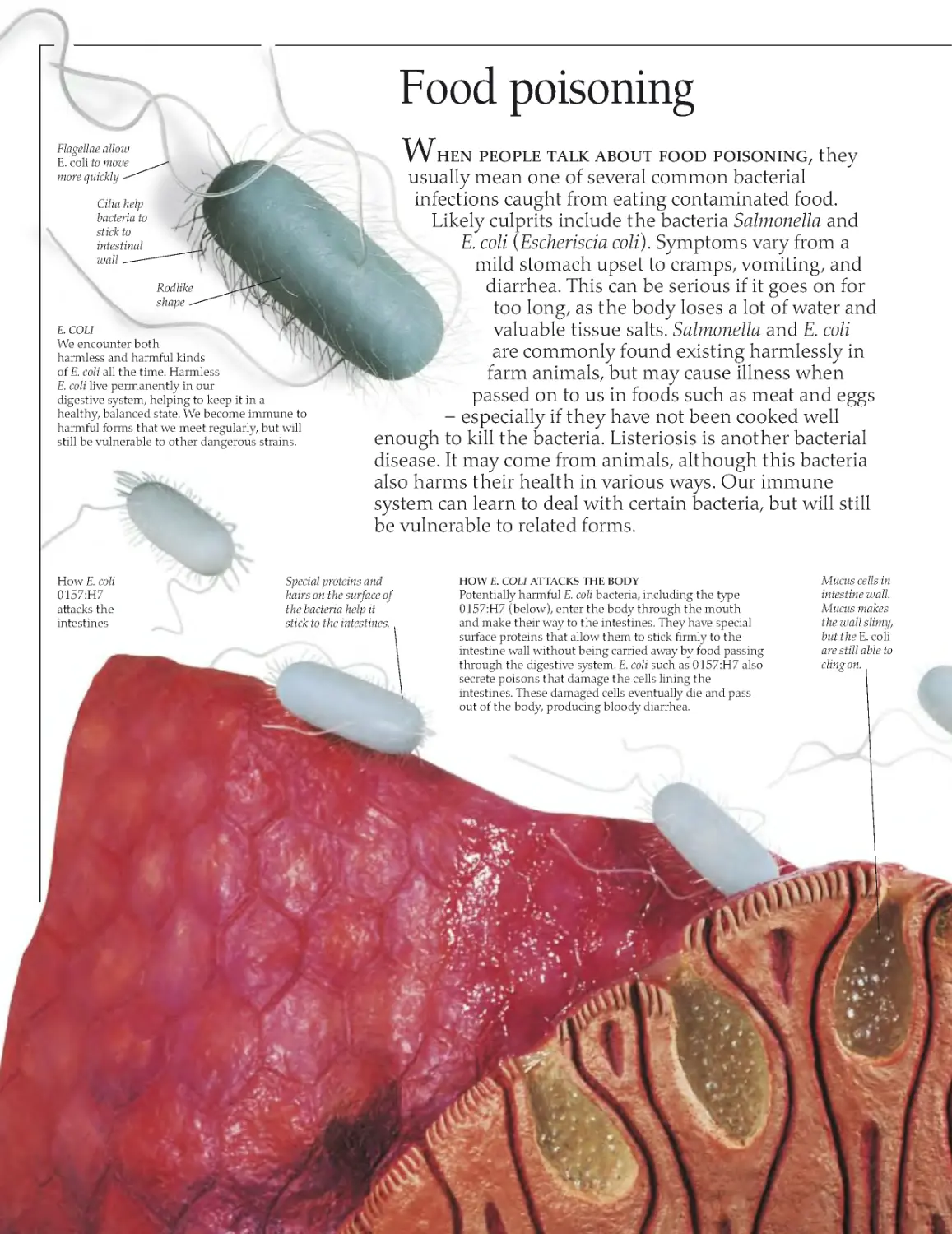
E. COLI
We encounter both
harmless and harmful kinds
of E. coli all t he time. Harmless
E. coli live permanently in our
digestive system, helping to keep it in a
healthy, balanced state. We become immune to
harmful forms t hat we meet regularly, but will
still be vulnerable to ot her dangerous strains.
Rodlike
shape
Cilia help
bacteria to
stick to
intestinal
wall
Flagellae allow
E. coli to move
more quickly
How E. coli
0157:H7
attacks the
intestines
Special proteins and
hairs on the surface of
the bacteria help it
stick to the intestines.
HOW E. COLI ATTACKS THE BODY
Potentially harmful E. coli bacteria, including the type
0157:H7 (below), enter t he body through the mouth
and make t heir way to t he intestines. They have special
surface proteins that allow t hem to stick firmly to t he
intestine wall without being carried away by food passing
through the digestive system. E . coli such as 0157:H7 also
secrete poisons t hat damage t he cells lining t he
intestines. These damaged cells eventually die and pass
out of the body, producing bloody diarrhea.
Mucus cells in
intestine wall.
Mucus makes
the wall slimy,
but the E. coli
are still able to
cling on.
Destroyed
intestinal cells
CHECKING UP ON OUR FOOD
Many countries have official food inspectors
who check for any contamination in food
bound for public consumption. They make
regular checks on food supplies, storerooms, and
restaurant kitchens to ensure that all production
methods and food-handling practices are as
healt h-conscious as possible. There can be heavy
penalties if people fail to pass these inspections.
SALMONELLA AND EGGS
Chicken eggs are common sources
of Salmonella bacteria. Egg-linked
food poisoning has risen rapidly in
recent years. Many recent cases are
due to bacteria right inside t he
eggs, passed on from the
mother hen. All t he reasons
for this are unclear. To avoid
food poisoning from eggs,
store them for a short time in
a cool place. Cook t horoughly
so that the yolk is not runny.
SOFT CHEESE
Some soft cheeses are made from
unpasteurized milk (milk that has not
been heat-treated to kill any bacteria).
Huge numbers of Listeria bacteria may
breed in these cheeses. There are fears
t hat t hese could cause illness, such as
possible brain damage in unborn babies
whose mothers have eaten such cheese.
The bacteria release
harmful toxins (here
shown green-brown)
that attack the wall
Hair-fringed villi
– “fingers” – in the
wall. These absorb
nutrients and
increase the
absorbant surface
area of the intestine
LISTERIA
The common Listeria
bacterium is found in bot h soil
and livestock. It causes a disease called listeriosis.
Although listeriosis may affect t he brain, heart, and
lungs, it often produces only fairly mild, flulike
symptoms. Newborn babies, pregnant women, and
the elderly are particularly susceptible.
Listeria
monocytogenes –
the bacterium
that causes
listeriosis
Gray coating
of mold
COOKED AND UNCOOKED MEATS
Never store already-cooked foods such as
these meats close to uncooked meat.
Bacteria from t he raw meat may pass to
t he cooked meat, where it will not get
anot her chance to be destroyed. Of
all foods, meat and poultry are
especially dangerous if not cooked
thoroughly. Always defrost t hem
completely before cooking, and
never warm up cooked leftovers
gradually – bot h of these bad habits
encourage the presence of bacteria.
This bacterium
can be destroyed
by antibiotics
20
Water and raw foods
CȰȯȵȢȮȪȯȢȵȦȥȥȳȪȯȬȪȯȨȸȢȵȦȳ is a
major cause of sickness and diarrhea. If
disease-carrying water is used to wash
foods such as salads, which are not cooked
to destroy microbes, t hen t his too can lead
to problems. Contamination of water and
uncooked food often comes from microbes
in human waste, so hygiene plays a huge
role. Microbes love dirty, crowded places
with no proper sanitation and spread
rapidly when food-handlers do not wash
t heir hands. Major microbes t hriving in
t hese kinds of conditions include Giardia
protozoa and Shigella bacteria. Giardia is
often found in t he intestines doing no
damage at all, but it can also cause
unpleasant diarrhea, while Shigella can
produce a serious illness called dysentery.
GERM CARRIER
The common housefly is
responsible for a great deal of
bacterial food contamination,
t hanks to its feeding habits.
Flies are attracted to dead and
decaying matter, including
human waste. Picking up
bacteria as t hey walk over
infected material, t hey then
transfer it to any piece of
food, crockery, or cutlery that
t hey might land on.
COMMON PROBLEM FOODS
Raw foods such as fruit and salads may harbor
microbes t hat have not been destroyed by cooking.
Rinsing them in water can make matters worse if
the water itself is contaminated. The problem is
most acute in parts of the world where warm,
humid temperatures encourage disease to flourish
and where sanitation standards are poor. In these
places, avoid salads and peel fruit before eating it.
Giardia lamblia
are single-celled
Avoid
unpeeled
fruit where
sanitation
is poor
A glass of tap water
can be risky in some
parts of the world,
so take only bottled
water if in doubt –
even for cleaning
your teeth
Shigella bacteria
One of two nuclei,
positioned side by side
Even washed salad
leaves may carry germs
where sanitation
standards are very low
Giardia lamblia
protozoan t hat
may cause
intestinal illness
GIARDIA PROTOZOA
These protozoa
(microscopic, single-
celled animals) are
common in dirty, untreated
water. They swim by using
hairlike flagellae. Giardia cause
the intestinal disease giardiasis.
Symptoms include sickness and
diarrhea. Malnutrition may
follow if the intestine wall is
damaged and so becomes less
efficient at absorbing nutrients.
Flies spread germs
by walking
over cutlery,
crockery,
and food
21
SHIGELLA BACTERIA
Rod-shaped Shigella bacteria are common
inhabitants of t he intestines. Some types,
however, can cause an unpleasant illness
called dysentery. Like many bacteria, they are
able to extend a special tube toward each
other. They do t his every so often in order to
exchange genetic material. This is one of t he
reasons why certain microbes are becoming
resistant to antibiotics. If new strains of
bacteria develop t hat are immune to drugs,
then t hey can rapidly pass t his resistance on
to ot her bacteria via the tubes.
Tube (pilus) through which
genetic information is passed
Pear-shaped
cell body
Rod-shaped, hair-
covered cell bodies
Here, the clear cytoplasm
has been dyed purple-red
to assist observation
Shapeless
body
ENTAMOEBA PROTOZOAN
This protozoan parasite causes an illness
called amoebic dysentery. Common in the
tropics, it is also found in cooler places that
are crowded and dirty. It can be a particular
problem because certain people are carriers –
passing the microbe on to ot hers wit hout
showing any symptoms themselves.
HAZARDS OF WAR
Soldiers in t he trenches during
World War I were crammed
toget her in circumstances where
good personal hygiene and clean
food preparation was impossible.
These were perfect conditions for
diseases such as dysentery and
gastroenteritis to flourish. The situation was
even worse for soldiers who were captured
and placed in prison camps. Many of t hose
in t he camps died from amoebic dysentery.
Up until relatively recent ly, diseases caught
during war probably caused more deat h
t han t he fighting itself.
Giardia lamblia’s
eight flagellae
make them very
good swimmers
22
Cholera
A waterborne disease, cholera occurs when water
supplies are contaminated by the bacterium Vibrio
cholerae. Once swallowed, t he bacteria multiply in
the intestines and release toxins. Symptoms
include vomiting and diarrhea, which may lead to
the body losing large amounts of fluid and vital
body salts. The first major cholera epidemic occurred
in India in the early 1800s. Sailors and traders visiting
the area picked up the disease and carried it rapidly
around the world by ship. It soon spread to
Asia and the Middle East, reaching Europe and
the US in 1832. By the end of the 19th century,
however, improved sanitation had freed Europe
and Nort h America from t he disease. The
importance of fresh water and proper
sanitation was realized after an out break
in London, in 1854. A certain Dr. Snow
traced the outbreak to a public
drinking water pump in Broad Street.
Water here was contaminated by a
faulty sewer pipe. Once the pump
was closed, the cholera stopped.
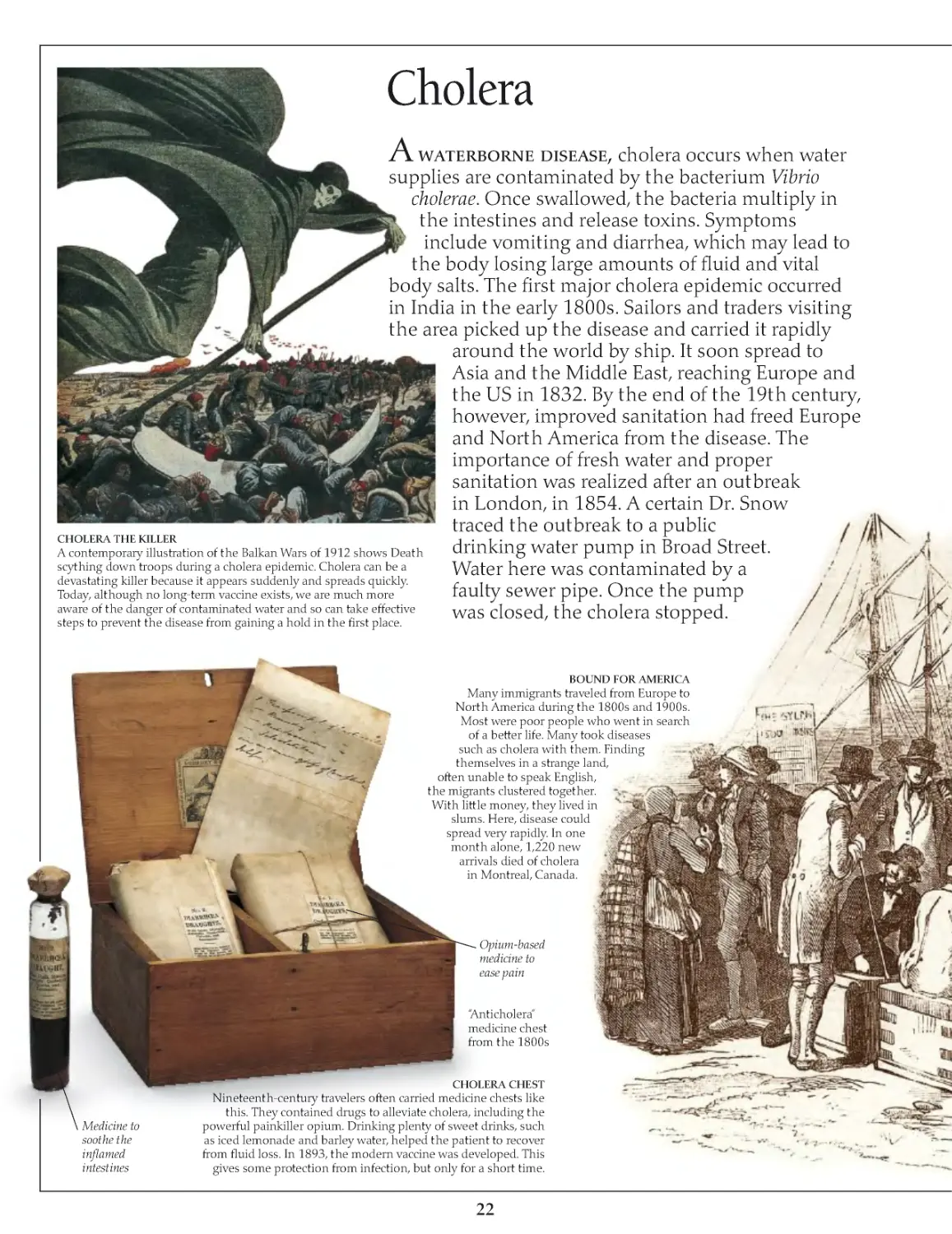
BOUND FOR AMERICA
Many immigrants traveled from Europe to
Nort h America during the 1800s and 1900s.
Most were poor people who went in search
of a better life. Many took diseases
such as cholera with them. Finding
themselves in a strange land,
often unable to speak English,
t he migrants clustered toget her.
With litt le money, they lived in
slums. Here, disease could
spread very rapidly. In one
mont h alone, 1,220 new
arrivals died of cholera
in Montreal, Canada.
Opium-based
medicine to
ease pain
“Anticholera”
medicine chest
from t he 1800s
CHOLERA CHEST
Nineteent h-century travelers often carried medicine chests like
this. They contained drugs to alleviate cholera, including t he
powerful painkiller opium. Drinking plenty of sweet drinks, such
as iced lemonade and barley water, helped t he patient to recover
from fluid loss. In 1893, t he modern vaccine was developed. This
gives some protection from infection, but only for a short time.
Medicine to
soothe the
inflamed
intestines
CHOLERA THE KILLER
A contemporary illustration of t he Balkan Wars of 1912 shows Deat h
scyt hing down troops during a cholera epidemic. Cholera can be a
devastating killer because it appears suddenly and spreads quickly.
Today, alt hough no long-term vaccine exists, we are much more
aware of t he danger of contaminated water and so can take effective
steps to prevent the disease from gaining a hold in the first place.
23
EARLY FILTERING DEVICES
This water filter was made around
the end of t he 19t h century. Water
filters made their appearance after
it was discovered how dangerous
microbes could be spread by
water. Inside t he eart henware jar
is a carbon filter element. The
filter removes bacteria, but needs to be
replaced frequent ly. Modern water
filters follow the same principle.
NATURAL DISASTERS
Here, World Healt h Organization workers
react rapidly to give a short-term vaccination
to t hose at risk after a cyclone strikes India
and Bangladesh. Cholera is often a t hreat
after a natural disaster. The fierce winds of a
cyclone, for example, cause tides to push
back coastal waters. Rivers flood vast areas of
low-lying land, destroying villages and
drowning people and animals as they go. In
these conditions, cholera quickly takes hold
as people are exposed to contaminated or
untreated drinking water.
REHYDRATION KIT
A simple kit of powdered
medicine and a dosing
spoon has saved millions
of people across t he world
from the effects of cholera.
The most dangerous
symptom is loss of body
salts and fluid from
sickness and diarrhea. If a
powder containing sodium
and potassium salts and
sugar is dissolved in clean
water and drunk, this will
help to get the body back
on course. Once
rehydrated, t he body’s
immune system is better
able to fight infection.
Compact dosing
“spoon”
The sachets of powder
are mixed with water
CHOLERA TODAY
Some poorer countries still have a
cholera problem, especially in t he
cities. The poor often live in slums
where inadequate sanitation
contaminates drinking water. Less
strict hygiene laws also allow the
disease to spread. In Lima, Peru in
1991, ships from India emptied
their ballast tanks in the harbor.
Thousands of gallons of water
were released that contained a
cholera bacterium. This
contaminated t he fish that local
people loved to eat, and cholera
swept t hrough Latin America.
Around 1850,
emigrants gat her on
a dock in Cork, Ireland
before embarking for t he US
24
TB – the coughing plague
Tuberculosis (tb) has been with us for
many centuries. Caused by bacteria, it
spreads when infected people cough,
sneeze, or talk. This releases tiny water
droplets filled with microbes t hat are
inhaled by ot her people. TB thrives in
dirty cities where people are crammed
toget her. In the 1700s and 1800s, the
world’s major industrial cities were in
t he grip of “consumption,” as TB was t hen
called. By the early 1900s, better living
conditions had brought it under control. In
1922 a vaccine appeared and the first anti-TB
drug , streptomycin, was developed in 1944.
Widespread pasteurization of milk also helped
greatly by killing the TB bacillus in cows’ milk. Today,
TB is still present in crowded areas with poor health
care and sanitation, but aid agencies are working
hard to combat its spread.
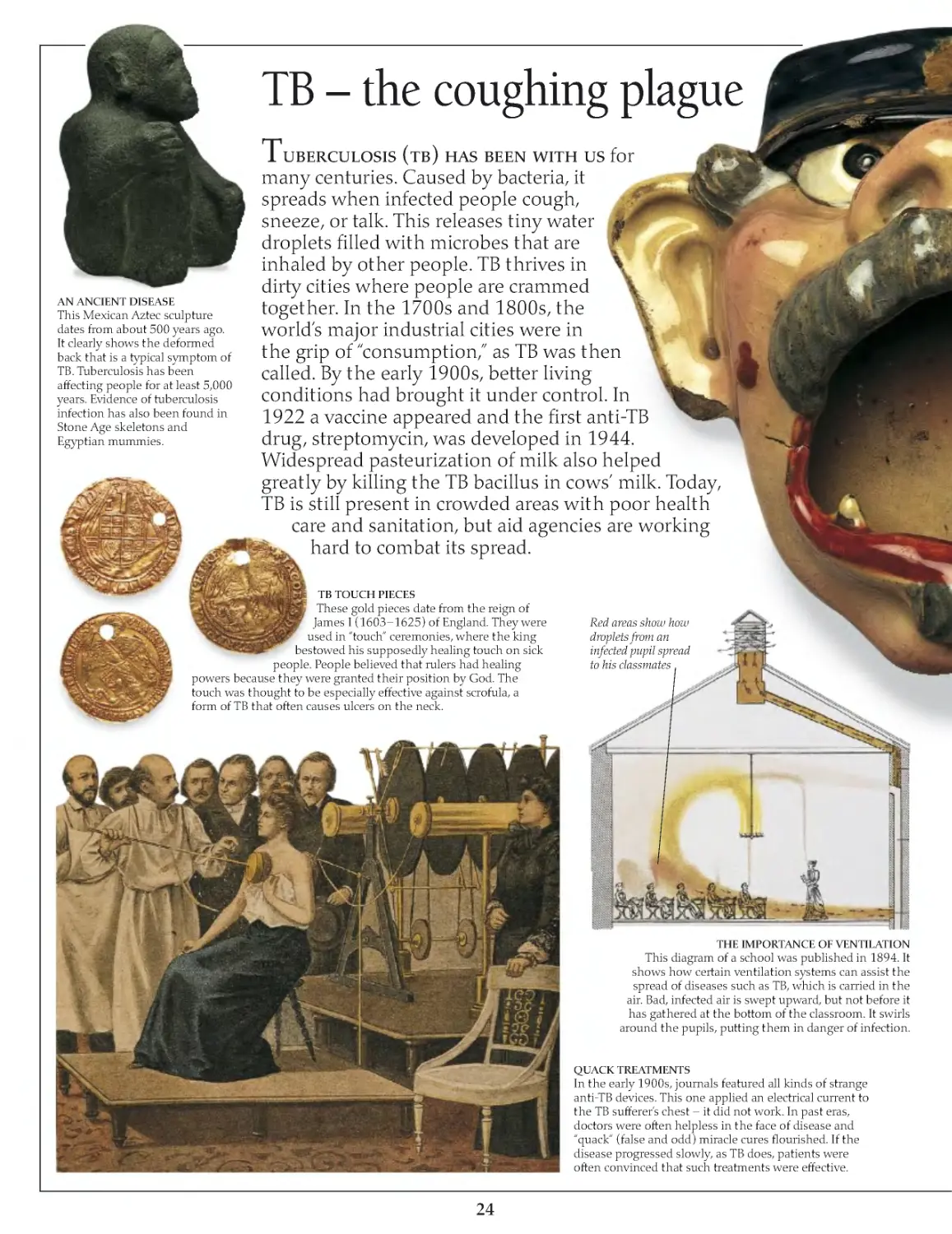
AN ANCIENT DISEASE
This Mexican Aztec sculpture
dates from about 500 years ago.
It clearly shows t he deformed
back that is a typical symptom of
TB. Tuberculosis has been
affecting people for at least 5,000
years. Evidence of tuberculosis
infection has also been found in
Stone Age skeletons and
Egyptian mummies.
TB TOUCH PIECES
These gold pieces date from the reign of
James I (1603–1625) of England. They were
used in “touch” ceremonies, where t he king
bestowed his supposedly healing touch on sick
people. People believed that rulers had healing
powers because t hey were granted t heir position by God. The
touch was t hought to be especially effective against scrofula, a
form of TB that often causes ulcers on the neck.
Red areas show how
droplets from an
infected pupil spread
to his classmates
THE IMPORTANCE OF VENTILATION
This diagram of a school was published in 1894. It
shows how certain ventilation systems can assist t he
spread of diseases such as TB, which is carried in t he
air. Bad, infected air is swept upward, but not before it
has gat hered at the bottom of the classroom. It swirls
around the pupils, putting t hem in danger of infection.
QUACK TREATMENTS
In t he early 1900s, journals featured all kinds of strange
anti-TB devices. This one applied an electrical current to
t he TB sufferer’s chest – it did not work. In past eras,
doctors were often helpless in t he face of disease and
“ quack” (false and odd) miracle cures flourished. If the
disease progressed slowly, as TB does, patients were
often convinced that such treatments were effective.
25
COUGHING AND SPITTING
TB was so common in the 19th century that
special, decorative “sputum cups” were made.
Painful, racking coughing is one of t he
symptoms of tuberculosis. Large amounts of
sputum, or saliva, are coughed up. This
was routinely examined by
doctors to diagnose how the
disease was progressing.
The 19t h century also
saw a fashion for
people looking
pale and delicate.
This was perhaps
due to t he weight
loss and pale skin
caused by TB.
The bacteria
that cause TB
in humans
Rodlike shape
Bacteria have
a tough outer
wall that
protects them
against t he
body’s defenses
Bacterium
reproducing
by splitting
into two
Decorative
19t h-century
“sputum cup,”
for spitting into
PASTEURIZATION
In many countries, cows’
milk is now pasteurized and
put into sterilized bottles. Cows
carry a form of TB t hat can spread
to anyone drinking t heir milk.
Pasteurization is a process t hat
kills microbes in food and drink
by heat. It was invented by French
scientist Louis Pasteur in the late
1800s. Pasteurized milk is heated
very quickly and kept hot long
enough to kill t he bacteria.
BADGER CARRIER
Badgers may be infected with an
animal form of t he tuberculosis
microbe. It has been suggested
that they could spread the
disease to cows. This in
turn could spread it to
humans who drink the
cows’ milk. The badger
link is difficult to prove.
It is strongly opposed by
environmentalists who wish to see
badgers protected as a threatened
species. Other animals t hat suffer
from TB include catt le, pigs, and
birds. Cows and pigs are affected by
a type that can also affect humans.
Badgers sometimes carry TB
TB BACTERIA
Mycobacterium tuberculosis
bacteria cause TB in
humans. Various features
have helped this microbe
to survive very well. It is
slow-growing and has
a tough outer wall to
protect it against attack
by the body’s immune
system. Some early
antibiotics proved very
effective against TB.
However, t he bacteria
have found ways of
resisting all kinds of
drugs and TB can now
be hard to treat.
2
Lepers and leprosy
The Middle Ages saw many terrible epidemics
spread across Europe and Asia. One of these
was leprosy, t hought to be among the oldest
of human diseases. This bacterial illness is
probably spread via droplets of nasal mucus,
but contrary to popular belief is extremely
hard to catch. This is part ly because t he illness is
only infectious in its early stages, and only
certain people are vulnerable. Leprosy progresses
very slowly, attacking the skin and nerves and
causing severe facial distortions. Parts of the
body become numb and prone to damage.
Infection and mutilation often follow, and many
people lose fingers, toes, ears, and noses. Now
rare in the West, t he disease affects about six
million people worldwide. Most of us carry
leprosy antibodies, which means that at some
time we have been exposed to t he bacterium
without becoming ill.
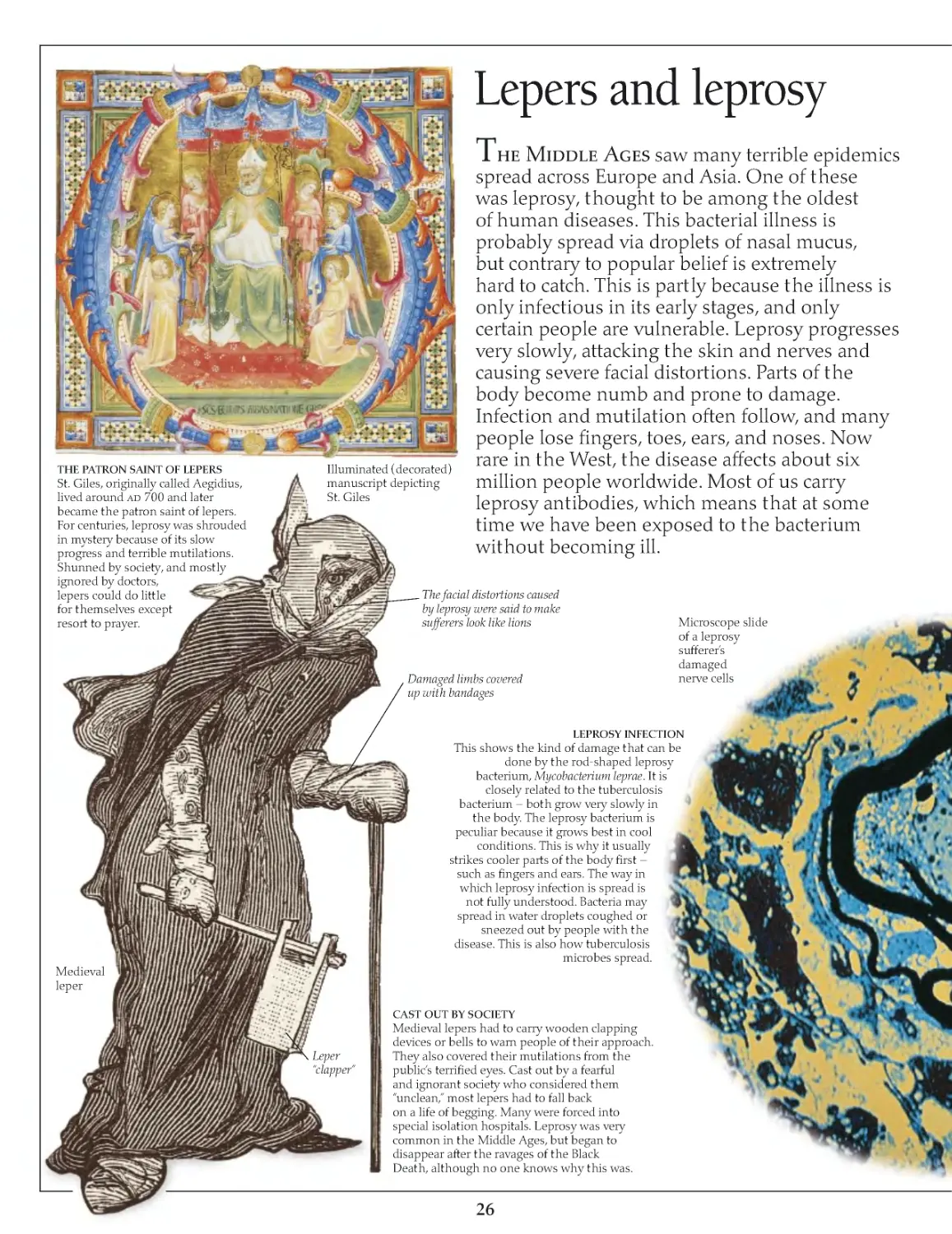
Illuminated (decorated)
manuscript depicting
St. Giles
THE PATRON SAINT OF LEPERS
St. Giles, originally called Aegidius,
lived around ad 700 and later
became the patron saint of lepers.
For centuries, leprosy was shrouded
in mystery because of its slow
progress and terrible mutilations.
Shunned by society, and most ly
ignored by doctors,
lepers could do litt le
for t hemselves except
resort to prayer.
The facial distortions caused
by leprosy were said to make
sufferers look like lions
Damaged limbs covered
up with bandages
LEPROSY INFECTION
This shows the kind of damage t hat can be
done by t he rod-shaped leprosy
bacterium, Mycobacterium leprae. It is
closely related to t he tuberculosis
bacterium – bot h grow very slowly in
the body. The leprosy bacterium is
peculiar because it grows best in cool
conditions. This is why it usually
strikes cooler parts of the body first –
such as fingers and ears. The way in
which leprosy infection is spread is
not fully understood. Bacteria may
spread in water droplets coughed or
sneezed out by people wit h the
disease. This is also how tuberculosis
microbes spread.
Microscope slide
of a leprosy
sufferer’s
damaged
nerve cells
CAST OUT BY SOCIETY
Medieval lepers had to carry wooden clapping
devices or bells to warn people of t heir approach.
They also covered t heir mutilations from the
public’s terrified eyes. Cast out by a fearful
and ignorant society who considered them
“unclean,” most lepers had to fall back
on a life of begging. Many were forced into
special isolation hospitals. Leprosy was very
common in t he Middle Ages, but began to
disappear after t he ravages of t he Black
Deat h, although no one knows why t his was.
Medieval
leper
Leper
“clapper”
2
SOUTH AMERICAN STEAM TREATMENT
A steam bath was one of the ways in which Native
Sout h Americans once tried to ease t he pain of leprosy
in its early stages. Along with many other diseases,
leprosy traveled to Nort h and South America wit h
European explorers and colonizers. It found a large
population who had never encountered t he leprosy
bacteria before. They had no immunity and t he
disease was able to spread rapidly.
Herbal oil
treatment
Nineteent h-
century
print of a
traditional
Sout h
American
leprosy cure
HANSEN’S DISEASE
The leprosy bacterium was first
described in 1874 by a Norwegian
physician called Armauer Hansen
(1841–1912). Up until this point,
many people had t hought t hat t he
disease was hereditary. Hansen
concluded that leprosy was
infectious and showed t hat it
could be controlled partly by
isolating sufferers. Leprosy has
often been referred to as Hansen’s
disease, because of t he stigma
attached to t he word “leprosy.”
Patient’s damaged
nose has collapsed
OUTER SIGNS AND SYMPTOMS
This man is showing t he early
effects of leprosy infection.
Bacteria have invaded the cells of
his nose. Destruction of the
rubbery cartilage t hat supports
the nose has caused it to collapse.
Later stages can include ulcers
and sores, which may become
infected and cause furt her
damage. There are different
forms of leprosy affecting certain
areas of the body.
NATURAL RELIEF
Chaulmoogra ointment is a natural,
traditional Hindu remedy for leprosy
sores. Based on an herbal oil extracted
from an Indian tree, it brings some
healing pain relief. Modern
antileprosy drugs work by killing t he
bacteria. They can produce rapid
results if they are used before the
disease is well established.
MODERN LEPROSY HOSPITALS
Specialized leprosy hospitals and clinics,
such as t his one in Brazil, are found in
countries where t he disease is still
common. Many leprosy sufferers in
these hospitals are long-term patients.
They need to live in for a while because
treatment of more advanced cases is a
slow process. Also, many sufferers are so
damaged by the infection that they can
no longer live independent lives.
The black band
is a nerve
fiber’s protective
sheath, seen
here breaking up
2
Outsmarting the smallpox virus
Smallpox is the only illness to have been wiped out as a human
disease. The official announcement of its eradication came in 1980.
Caused by a virus and highly infectious, smallpox produces flulike
symptoms. More serious problems such as kidney failure may
follow, and around half of its victims once died. The disease causes
pus-filled swellings of the skin that leave pitted scars. Cases were
so numerous in the 18th and 19th centuries that few people took
any notice of anyone with smallpox scars.
The disease was first described in
Roman times. Out breaks occurred
across Europe, Asia, and Africa,
and Europeans took it to
Nort h and Sout h America.
In the 1700s, a safe
vaccination was
developed and the
path to success began.
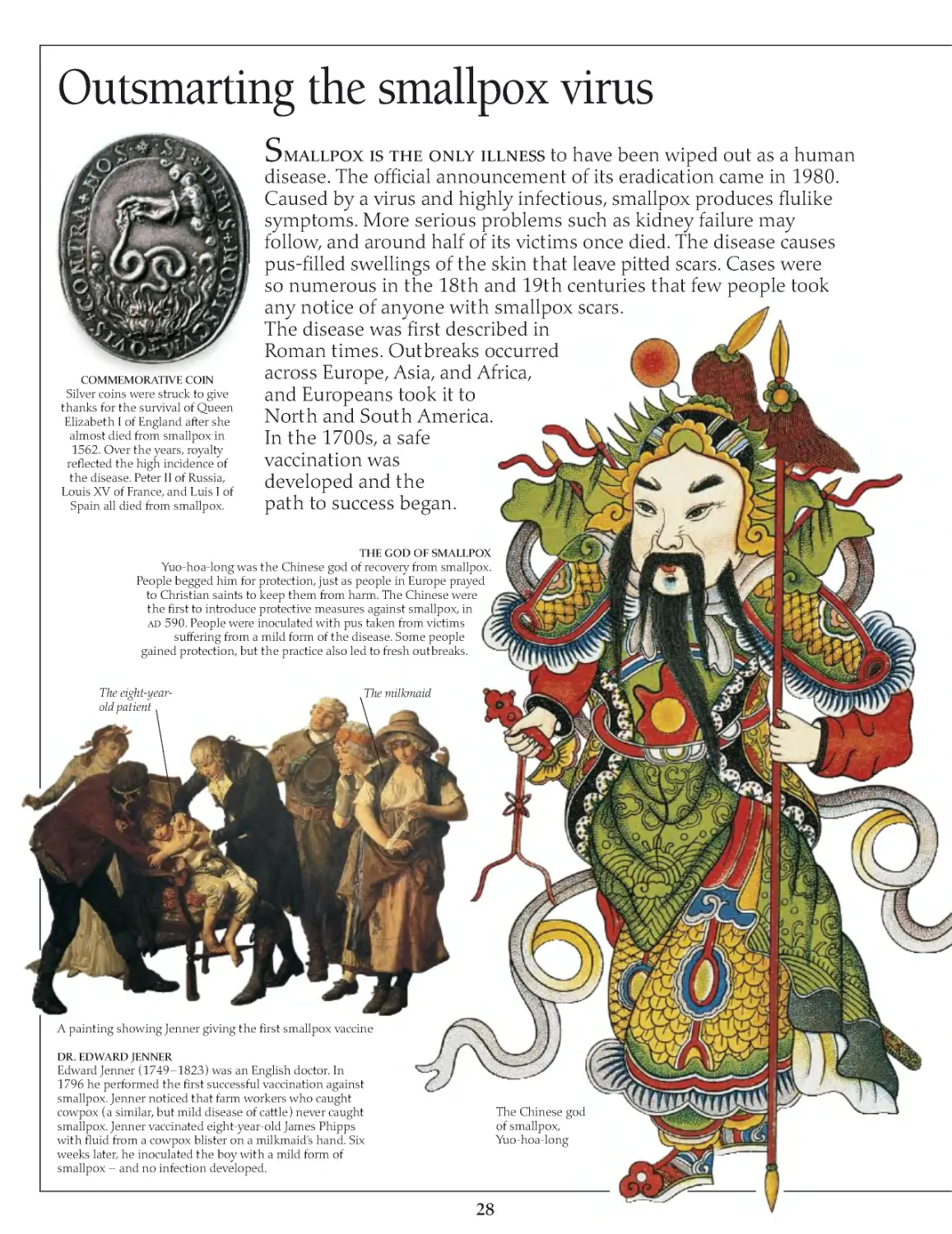
COMMEMORATIVE COIN
Silver coins were struck to give
t hanks for the survival of Queen
Elizabet h I of England after she
almost died from smallpox in
1562. Over the years, royalty
reflected the high incidence of
t he disease. Peter II of Russia,
Louis XV of France, and Luis I of
Spain all died from smallpox.
THE GOD OF SMALLPOX
Yuo-hoa-long was t he Chinese god of recovery from smallpox.
People begged him for protection, just as people in Europe prayed
to Christian saints to keep them from harm. The Chinese were
t he first to introduce protective measures against smallpox, in
ad 590. People were inoculated with pus taken from victims
suffering from a mild form of t he disease. Some people
gained protection, but the practice also led to fresh out breaks.
The eight-year-
old patient
The milkmaid
DR. EDWARD JENNER
Edward Jenner (1749–1823) was an English doctor. In
1796 he performed the first successful vaccination against
smallpox. Jenner noticed t hat farm workers who caught
cowpox (a similar, but mild disease of cattle) never caught
smallpox. Jenner vaccinated eight-year-old James Phipps
wit h fluid from a cowpox blister on a milkmaid’s hand. Six
weeks later, he inoculated t he boy wit h a mild form of
smallpox – and no infection developed.
A painting showing Jenner giving t he first smallpox vaccine
The Chinese god
of smallpox,
Yuo-hoa-long
2
THE LAST SMALLPOX OUTBREAKS
This picture of a child in Bangladesh was taken in 1973.
It shows the typical sores caused by smallpox infection.
A man in Somalia was t he last natural victim of the
disease, in 1977. In 1980 the World Healt h Organization
was finally able to declare that smallpox had been
eradicated worldwide – an extraordinary achievement.
A WORLDWIDE PROGRAM
A member of the Red Cross aid agency vaccinates a
Sudanese child against smallpox. In t he 1970s, t he World
Healt h Organization, working wit h international aid and
medical agencies, began a campaign to eradicate smallpox.
Even in t he most remote parts of t he world, people were
vaccinated wherever smallpox was reported.
Core of
genetic
material
The variola virus
that causes smallpox
THE SMALLPOX VIRUS
This electron micrograph shows t he structure of
the variola virus t hat causes smallpox. The
green outer layer is a protective protein coat.
The red core contains genetic material, which
this virus injects into human cells in order to
infect them. After smallpox was eradicated, t he
frozen virus was preserved under heavy guard
in a few laboratories around the world for
future research. Unlike most potentially fatal
diseases, there is no animal reservoir of
smallpox, so it can never reappear naturally.
“Mallam’s”
vaccinator,
1874, London
EARLY VACCINATOR
The sharp teet h on this
19t h-century vaccinator
were used to scratch t he skin so
t hat fluid from cowpox sores
could enter. This would produce a
mild infection of cowpox t hat gave
immunity against smallpox. The
device is curved so t hat it can
fit snugly over t he arm of a
small child.
Piece of cow horn
Tortoiseshell
lancet
Gilded steel teeth
instead of blades
JENNER’S COWHORN AND LANCET
Edward Jenner used t his lancet to puncture
two cuts in his patient James Phipps’ arm .
The piece of horn below belonged to a cow
from which Jenner obtained cowpox virus
to use in a vaccination against smallpox.
Jenner’s technique was widely adopted and
deat hs from smallpox fell dramatically. The
term vaccination was named after t he
Latin word vacca, meaning “cow.”
Raging rabies
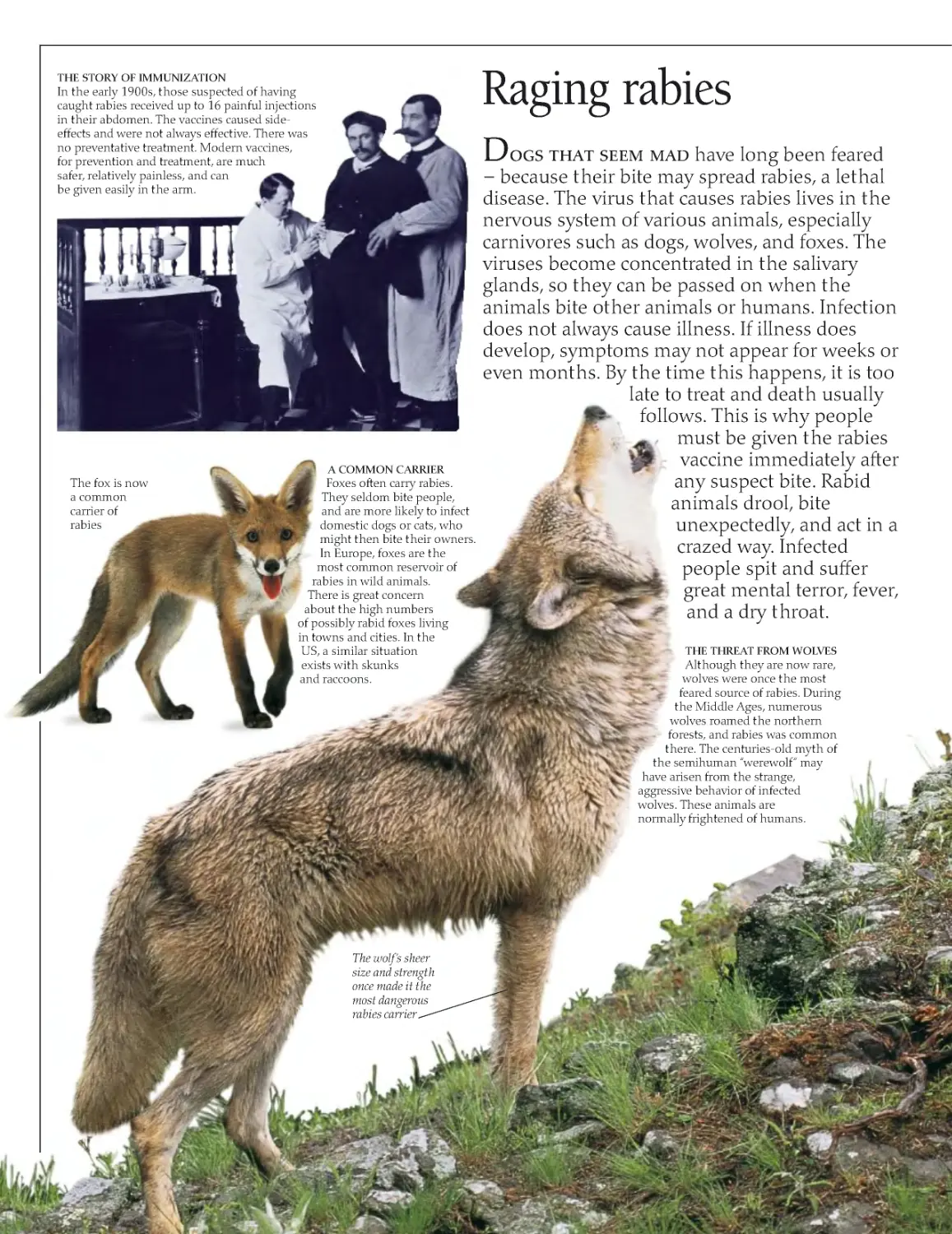
THE STORY OF IMMUNIZATION
In the early 1900s, t hose suspected of having
caught rabies received up to 16 painful injections
in their abdomen. The vaccines caused side-
effects and were not always effective. There was
no preventative treatment. Modern vaccines,
for prevention and treatment, are much
safer, relatively painless, and can
be given easily in t he arm.
Dogs that seem mad have long been feared
–
because t heir bite may spread rabies, a lethal
disease. The virus that causes rabies lives in the
nervous system of various animals, especially
carnivores such as dogs, wolves, and foxes. The
viruses become concentrated in the salivary
glands, so they can be passed on when the
animals bite other animals or humans. Infection
does not always cause illness. If illness does
develop, symptoms may not appear for weeks or
even months. By the time t his happens, it is too
late to treat and death usually
follows. This is why people
must be given t he rabies
vaccine immediately after
any suspect bite. Rabid
animals drool, bite
unexpectedly, and act in a
crazed way. Infected
people spit and suffer
great mental terror, fever,
and a dry throat.
THE THREAT FROM WOLVES
Alt hough they are now rare,
wolves were once t he most
feared source of rabies. During
t he Middle Ages, numerous
wolves roamed t he northern
forests, and rabies was common
t here. The centuries-old myth of
the semihuman “werewolf ” may
have arisen from the strange,
aggressive behavior of infected
wolves. These animals are
normally frightened of humans.
The wolf ’s sheer
size and strength
once made it the
most dangerous
rabies carrier
The fox is now
a common
carrier of
rabies
A COMMON CARRIER
Foxes often carry rabies.
They seldom bite people,
and are more likely to infect
domestic dogs or cats, who
might t hen bite t heir owners.
In Europe, foxes are t he
most common reservoir of
rabies in wild animals.
There is great concern
about t he high numbers
of possibly rabid foxes living
in towns and cities. In t he
US, a similar situation
exists with skunks
and raccoons.
31
VAMPIRE BATS
In tropical America, t hese tiny, blood-
drinking bats often carry the rabies
virus in their saliva. They spread
t he disease to catt le, which form
t heir main food, and cause heavy
losses to catt le herds. Vampire bats
also attack humans, causing many
cases of rabies each year. They
usually strike when people are
asleep, often biting exposed toes.
The vampire
bat – a tropical
rabies-carrier
Sharp teeth for
piercing skin
KEEPING RABIES OUT
Notices like this appear at ports, airports, and
borders. They explain which animals cannot
be brought into a country because t hey may
be infected wit h – and spread – diseases such
as rabies. Those that are let in may be held in
quarantine (secure pens) for a time to see if
any disease develops. This is most effective on
islands, where there is less chance of infected
wild animals wandering into the country. Now
t hat better vaccines exist, quarantine may no
longer be so important.
NATURAL RABIES REMEDY
The ancient Greeks tried to treat rabies with extracts
from the apt ly named dog rose plant. Other historical
treatments included burning out tissue around the
bite, which may have prevented infection from
developing. One doctor even suggested filling a
wound wit h gunpowder and setting it on fire!
Dog Rose
(Rosa canina)
VACCINATING DOGS
This veterinary team is traveling around an infected
part of Ethiopia, vaccinating every dog to reduce the
risk to humans. Because dogs mix so closely wit h
people, t hey can be a serious t hreat. New, effective
vaccines have been developed that stop t he disease
from spreading between dogs. In some countries,
vaccinated animals are given “passports” to show
t hat t hey are protected from rabies.
LATEST RABIES RESEARCH
One of the latest developments in the fight against rabies is a
vaccine for animals t hat can be given by mout h. This vaccine can be
incorporated into food pellets. The pellets are then dropped by
airplanes over areas where rabies affects foxes. Although a
vaccination for rabies has existed since Louis Pasteur developed one
in t he late 1800s, constant research is still being carried out into
better ways to protect bot h people and animals from the disease.
Vets who vaccinate
potentially rabid
dogs have to be
vaccinated against
rabies themselves,
in case the dogs
are already rabid
32
Coughs and colds
LȰȵȴȰȧȥȪȧȧȦȳȦȯȵȰȳȨȢȯȪȴȮȴ can
cause coughs and colds, even t hough
t he symptoms may feel much the
same. What all t hese conditions have
in common is t hat t hey are infections
of t he upper respiratory tract – t hat is,
t hey affect t he breat hing passages
above t he lungs. Viruses are usually
responsible – over 100 different types
cause coughs and colds – and these
cannot be destroyed by antibiotics.
Alt hough we quickly develop natural
immunity after a viral infection, we will
not be immune to t he next type of
virus we encounter. Some bacteria are
culprits, such as Staphylococcus, and
t hese will respond to drugs if
symptoms become too uncomfortable.
Young children may get several
different infections every year,
especially once t hey come into contact
with ot her children at school.
An adenovirus –
one of the viruses
that cause the
common cold
SYMPTOMS AND EFFECTS
In the event of a cold, it is usually the head
and t hroat t hat suffer most. Coughs and
colds usually start with a virus attack. This
produces fever and inflammation of the
lining of t he nose and of air filled
spaces called sinuses. The linings
produce lots of mucus as a result,
making the nose run and causing
uncomfortable blockage of the
sinuses. Bacteria may also attack
inflamed areas, leading to
painful sinuses, coughing ,
and sore throats.
Large protruding
proteins (antigens)
on surface trigger
the immune system
Spherical shape
Sinuses are
blocked and
swollen and
may become
infected
Nose and nasal
passages fill with
mucus and nose
starts running
Throat, or pharynx, may
become infected with
Streptococcus bacteria
121ʜ1$785$/&85(6
Drug treatments bought over
t he counter or prescribed by
doctors cost billions of dollars
each year. Most of these are
intended to ease or disguise
symptoms. They can reduce
inflammation, ease aches and
pains, and dry up runny
noses. They rarely tackle t he
root of the problem. The
body will usually cure itself
of viral infections after just a
few days. However, bacteria
may step in at this point,
preying on already
damaged tissues and
sometimes making medical
treatment necessary.
NATURAL REMEDIES
Eucalyptus is one of the
aromatic plants that can
soot he cold symptoms.
It is usually the natural
oils extracted from t hese
plants t hat are used in
remedies. They may be
included in soothing ,
anti-inflammatory
t hroat lozenges or
inhaled to help clear
passages blocked by
swelling and mucus.
33
COMMON COLD VIRUS
The adenovirus shown here is just one of the five families of
viruses that cause the common cold. This particular virus
produces symptoms t hat are very similar to those of influenza,
but shorter lived. Other cold viruses produce much milder
symptoms. When viruses attack cells they take the cells over in
order to reproduce t hemselves. The damaged cells then release
various materials t hat produce inflammation and fever.
SPREADING INFECTION
Sneezing occurs as the body
tries to get rid of irritation in
the air passages. A fine spray
of mucus and tiny water
droplets is produced, packed
wit h infectious particles. The
spray is shot out of t he
mout h and nose, traveling as
far as 6ft (2m) at speeds of up
to 100mph (160kmph).
These are easily inhaled by
ant her person, t hus
spreading t he infection.
STREPTOCOCCUS BACTERIA
These harmful bacteria cause infections
such as sore t hroats, tonsilitis (inflamed
tonsils), and pharyngitis (inflammation
of the back of the mouth). These
conditions are very similar to viral
ones. Streptococci are normally present in
the body, producing no ill effects. If,
however, t he immune system is weak or
tissues are harmed by viruses, the
bacteria invade cells and do damage.
Surface covered wit h 252
protein units, arranged
in a regular pattern
Streptococcus
bacteria
Individual bacteria
have rounded shape
Streptococcus
bacteria may
clump together
to form chains
PNEUMONIA
This lung tissue has been damaged
by pneumonia – severe inflammation
of t he lungs. The thin tissue around
the white areas (air spaces called
alveoli) is badly swollen. These
spaces also fill wit h fluid. Pneumonia
may be caused by bacteria, viruses, or
fungi, or by inhaling foreign matter.
The disease is very common among
elderly people whose immune
system is not working well.
34
Influenza
0ȢȯȺȱȦȰȱȭȦȤȭȢȪȮȵȰȩȢȷȦ
influenza, or flu, when all t hey actually
have is a bad cold. Like many colds, flu
is a viral illness, but it is more severe and
longer lasting. Symptoms are fever,
aching muscles, and a cough. Sufferers
usually feel tired and weak for a while
after t he symptoms have disappeared.
As with all viral diseases, any
medicines will only ease t he
symptoms, and cannot wipe out
t he cause. Flu tends to break out in
epidemics, and t here have been
some serious ones in t he past. Most
people can cope with flu, but t he very
young , t he elderly, and t hose wit h
respiratory problems can become very ill.
Many vulnerable people are encouraged
to have a flu vaccination each year.
FLU FUMIGATOR
Around 1900, people used
fumigators like this to try to
kill flu-causing microbes in
t he air. Various substances
were put inside and heated
to produce strong fumes.
People at t his time did not
understand the cause of flu
and other lung infections
and these devices were
completely ineffective.
THE FLU PANDEMIC
2)
ʛ
Taken in 1918, t his picture
shows an army isolation
hospital in Maine, where
troops are being treated
for flu. The flu pandemic
of 1918–1920 was t he
worst out break that
anyone at t he time could
recall. It swept t he whole
world and affected many
soldiers serving in World
War I (1914–1918). The
war killed 15 million
people, while the flu killed
at least 20 million.
Where it began, in February 1957
:KHUHʤXKDGVSUHDGDIWHUtPRQW KV
:KHUHʤXKDGVSUHDGDIWHUtPRQW KV
:KHUHʤXKDGVSUHDGDIWHUtPRQW KV
:KHUHʤXKDGVSUHDGDIWHUtPRQW KV
7+()/83$1'(0,&2)
ʛ
The spread of t his pandemic followed a
pattern that is common for flu epidemics. It first
appeared in Southeast Asia and traveled to cities such as
Hong Kong and Singapore. From t hese major ports it was
carried fart her afield on ships and aircraft and in a few
months was all over t he globe. Many epidemics start in
Southeast Asia because they often begin life in animals
such as ducks, chickens, and pigs. Flu viruses switch easily
from animals to humans, and t hese animals live in close
association with people in this part of the world.
How flu swept the world in 1957
North America
Europe
Africa
Asia
Australia
South
America
35
Generalized
model of a
myxovirus
ASIAN FLU VIRUSES
This is a group of the type of virus that has
caused “Hong Kong Flu,” just one of the forms of
flu t hat emerges from Asia every few years. Asian
flu viruses are all similar in appearance. A core of
genetic material is surrounded by a spiky coat of
protein. This coat helps t he virus to stick to cells in
t he lungs – flu viruses principally attack the lungs and
t he passages of t he respiratory system.
Surface covered
with antigens t hat
the immune system
may, or may not,
recognize
Protein coat
surrounds
each virus
FROZEN EVIDENCE
In 1998, scientists dug up the
bodies of Norwegian flu
victims from the 1918
pandemic. The bodies were
well preserved in Norway’s
frozen climate and contained
remains of the virus. These
findings have been studied by
experts as part of an ongoing
effort to stop this virus from
striking again. The 1918
outbreak has always puzzled
experts because it vanished as
mysteriously as it appeared.
The scientists used ground-
penetrating radar to locate
victims’ coffins
ANTIFLU MOUTHPIECES
This sanitary mout hpiece was designed to keep the
mouth away from a potentially infected telephone
handset. It was once thought that diseases such as flu
could be caught by contact with items t hat had been
used by an infected person. In practice, it is unlikely
t hat t he infection could be caught in t his way.
STOPPING THE SPREAD
These office workers were photographed during a flu
epidemic of the 1960s. Because t he virus is spread by
water droplets coughed up or sneezed out by infected
people, masks were once handed out to prevent
infection. Unfortunately, t his is ineffective as t he tiny
viruses can passes t hrough any type of filter.
THE FLU VIRUS
Flu is caused by strains of myxovirus. These are grouped as
types A, B, and C, with Type A being the most common cause.
Immunity from one strain does not protect against anot her.
Flu viruses can change form very rapidly, into strains for
which people have no immunity. Every 30 years or so a strain
appears t hat no one is immune to, and a pandemic occurs.
Round
shape
3
Attacking the brain
The delicate brain is generally well protected
against infection. A finely balanced exchange system
exists in the human brain which prevents most
harmful intruders from entering brain tissue via the
blood vessels that run t hrough it. However, some
diseases do get through and may cause severe brain
damage, even death. Meningitis, caused either by a
virus or a bacterium, is one of the most common
diseases affecting the brain. Even normally mild
childhood diseases such as measles occasionally
enter t he brain and cause harm, sometimes years
after the original infection. Today, t he use of
antibiotics usually stops a
disease from getting as far
as causing brain damage.
The cerebrum,
the largest part
of the brain
EAST ASIAN ENCEPHALITIS
Here, a Vietnamese technician prepares vaccines
against Japanese encephalitis B. This serious viral
disease can cause fever, drowsiness, and possible
brain damage. Mosquitoes pick the virus up from
infected birds and pigs and then pass it to humans by
biting. It causes major epidemics in eastern Asia,
where virus-carrying mosquitoes thrive around t he
rice fields. Ot her forms of encephalitis occur
elsewhere and most are caused by viruses.
Preparing
encephalitis
vaccines
Dura
mater
Arachnoid
Pia Mater
Skull
Cerebrum
Large
blood
vessel
Area t hat contains
cushioning cerebrospinal
fluid and blood vessels
Bone
of skull
Area that is shown
enlarged on right
THE BRAIN AND THE MENINGES
Three membranes – the meninges – protect the brain
and spinal cord. The outer layer (dura mater) is very
tough and contains many blood vessels. The middle
layer (arachnoid) is net like and rubbery, while t he inner
layer (pia mater) is thin and delicate. Meningitis is
named after t hese membranes. In this, and certain other
brain diseases, the infected membranes swell and press
painfully against the skull.
THE CENTRAL NERVOUS SYSTEM
The long spinal cord, and the brain
positioned at the top of it, make up t he
central nervous system, or CNS. A vast
network of interconnecting nerves within
t his system controls the functioning of
our whole body. Infections that get into
t he nervous system are particularly
dangerous because t hey prevent the rest
of t he body from working properly.
BACTERIAL MENINGITIS
Neisseria meningitidis is one
of t he bacteria t hat cause
meningitis. Bacterial forms
of t he disease can be very
serious, producing fever, a
stiff neck, rash, headache,
and vomiting, even deat h.
If caught early, t his can be
treated wit h antibiotics.
Viral meningitis is usually
much milder and flulike.
Each bacterium
consists of two cells
in a round capsule
Neisseria
meningitidis
bacterium
3
ENCEPHALITIS ON FILM
Awakenings depicts the results of a mysterious form of encephalitis t hat
swept t he world in the 1920s. It killed some people, while ot hers fell
into a coma or a zombielike state. A drug called levodopa brought
some patients “back to life,” but only for a short while. The problem
vanished as mysteriously as it arrived. We still do not know the cause
and, as far as is known, t his illness has never recurred.
Carnival in
Brazil, Sout h
America
From t he 1990 movie Awakenings, wit h
Robert DeNiro (left) and Robin Williams (right)
HAVING FUN SAFELY
Big international carnivals can provide a breeding
ground for dangerous microbes. When people go
home, t hey take diseases wit h them. In 1974, a huge
meningitis epidemic struck Brazil. There were great
fears that the annual Rio carnival would speed its
spread. A vast vaccination program was mounted –
three million people were vaccinated wit hin five
days – and this brought the epidemic to a halt.
MRI scan
of brain
affected
with
CJD
Artificially colored MRI
(Magnetic Resonance
Imaging) scan of a
brain affected
wit h meningitis
Red color
shows areas
of infection
Yellow
areas
indicate
infection
CJD AND
THE BRAIN
This shows t he brain of a
person suffering from CJD
(New Variant Creutzfeldt-Jakob Disease). This is thought to
be related to the cattle disease BSE (Bovine Spongiform
Encephalopat hy) and may be caused by eating infected
beef. As wit h cattle, t his fatal illness destroys brain cells,
causing a breakdown of all physical and mental functions.
HOW MENINGITIS
ATTACKS THE BRAIN
This scan shows a section
t hrough the brain of a woman
with meningitis. The way in which
the disease spreads is not fully
understood. It often occurs where
young people are crowded together in
schools and colleges, spread by coughing ,
sneezing, and close contact. It is not,
however, as infectious as colds and flu, and
t here is an effective vaccine available
against bacterial meningitis.
3
Childhood diseases
There is a particular group of diseases t hat
are common in children – including chicken pox,
mumps, and measles. Some of these are caused by
bacteria, ot hers by viruses. After children have
successfully recovered from one of these illnesses,
t hey usually have lifelong immunity from it. Most
childhood diseases are highly infectious and are
spread by contact – often when children play
toget her. Many such infections are easily prevented
by means of routine vaccinations. If they do cause
illness, it is seldom serious or may be treated with
antibiotics. It is not that long ago – the 1930s – that
certain infections killed children, even in medically
advanced countries. These infections included
diphtheria, scarlet fever, and whooping cough. They
can still be dangerous in poorer countries, so health
agencies do what t hey can to organize widescale
vaccination programs in vulnerable areas.
ANTIVACCINATION CAMPAIGNS
This envelope was part of an 1899 antivaccination campaign.
The flap states that vaccination is a “fraud.” There have always
been people who have opposed vaccinations, because some
children have become ill as a result of receiving t hem.
However, there is much less chance of this today, and a far
greater risk of deat h because people have not been vaccinated.
DIPHTHERIA VACCINE
A modern diphtheria vaccine. Diphtheria is
just one of the old killer diseases that can
now be routinely prevented by widescale
vaccination of children.
CHILD VACCINATION
These children are lining up in school to be vaccinated
against TB in t he 1950s. Widescale vaccination programs for
many common childhood diseases got off the ground
between the 1930s and t he 1960s. Once a majority of people
carry the antibodies to a disease,
t hat disease tends to die out
completely for a long time,
apart from isolated cases.
This vaccine combats
both diptheria and tetanus
Vaccines are
injected into an
area of muscle.
The upper arm is
usually the most
accessible place to
give a vaccination
3
MEASLES VIRUS
The virus that causes measles is
closely related to the viruses
causing distemper in dogs and
rinderpest in African catt le.
Once very common, measles is
now rare in t he world’s richer
countries due to widespread
vaccination. However, it does
still kill in poorer countries.
Because measles only affects
humans, there is no animal
reservoir of t he virus. This
means that there is a real
possibility t hat t he disease
could be wiped out by global
vaccination programs.
Applying
soot hing
calamine
lotion
DEALING WITH SYMPTOMS
Rashes are common wit h
childhood infections such as
rubella and chicken pox. These
rashes are nont hreatening but
may be very itchy. The irritation
can be reduced by dabbing on a
soothing preparation. Calamine
lotion is a traditional remedy t hat
has been used for many years.
Virus from t he
morbillivirus
group
ISOLATED COMMUNITIES
These are Inuit people from Alaska. In the past,
Inuit communities have been wiped out by
diseases such as measles. This is because remote
peoples who have never been affected before have
no immunity. Vaccination campaigns have done
much to help this situation.
POLIOMYELITIS (POLIO)
These partially paralyzed Vietnamese
children were not immunized against
polio. They are suffering from a severe
case of t his viral disease, which has
affected t heir nervous system. The polio
vaccine is dropped onto t he tongue or
taken on a lump of sugar.
WHOOPING
COUGH BACTERIUM
The Bordetella pertussis
bacterium causes a serious
infection of t he air passages.
Affecting mainly babies and young
children, it makes breathing difficult and
produces a cough with a strange “whooping” sound.
Vaccination normally occurs in a child’s first year.
GLOBAL IMMUNIZATION
Here, ordinary people in Zambia, southern Africa, show t heir
support for a child immunization (vaccination) program taking
place in t heir area. Disease control t hroughout t he world means
painstakingly checking, treating , and vaccinating people. As
diseases come under control in certain regions, medical teams go
out into ever more remote areas where t he illness persists,
vaccinating people and following up any reports of infection.
40
A scabies
mite burrows
t hrough skin
Human hair
Minor plagues
We are usually concerned about disease-
causing microbes living inside us. However,
t here are all kinds of organisms t hat sometimes
find their way onto the surface of our bodies,
too. These parasitic microbes create a range of
health problems that are most ly mild but often
very irritating. Nearly all of these creatures are
spread by touch. This means t hat t hey often
affect children, who pick up microbes easily as
t hey play toget her. At one time, nearly everyone
would have carried these parasites. We no
longer tolerate such obvious intruders, and
modern hygiene met hods usually keep them
under control. This is important because
serious diseases like typhus have been spread
by lice, and the plague by flea bites.
The scabies mite,
Sarcoptes scabiei
Skin cells
HOW SCABIES GETS UNDER THE SKIN
This model shows how t he skin disease scabies arises. Scabies is
caused by a tiny mite, about 1/50in (0.5mm) long. It burrows
t hrough t he skin, just under t he surface, and lays eggs there. The
mite produces tiny, winding tunnels, which may cause gray
swellings on t he skin’s surface. These tunnels often become
infected, and t his produces intense itching. Scratching affected
areas releases the eggs, which may then be picked up by anot her
person. Scabies is treated wit h a lotion that kills the mites.
Red sores on and
around mouth
Sharp snout
used for biting
A flea jumps
onto a new host
Powerful back
legs are adapted
for jumping
COLD SORES
Unsight ly, painful sores sometimes appear
on and around t he mout h. These are
usually caused by the herpes simplex Type
1 virus, which is passed from one person to
another by close contact. Once inside the
body, t he virus stays t here. The immune
system can normally cope with it, but sores
break out if a person is run down and so
has a weak immune system.
VERRUCAS
Verrucas are warts – common skin-
growths – that are found on the
sole of t he foot. Unlike ordinary
warts, t hey grow inward under the
pressure of walking around. They
can become very painful. Verrucas
are caused by t he wart virus. This
likes warm, damp conditions and is
often found in swimming pools and
gym changing rooms.
Hard growt h
known as a
verruca
INFESTED WITH FLEAS
Fleas will live happily on all kinds of animals
and on humans – anywhere warm where they
can drink blood. Human fleas were common in
the days when people seldom washed. Fleas are
now rarely found on people. If they are
discovered, they may well be cat fleas, which
occasionally also feed on people. Once fleas do
get into a modern house, however, the larvae
thrive in carpets in the warm, centrally heated
atmosphere. Adult fleas make tiny wounds
when they bite. These often itch, and scratching
them can cause skin infections.
41
PLAYGROUND CONTACT
Most minor plagues are common among children. This
is because parasites can simply step or jump from one
host to anot her and children spend a lot of time in close
contact wit h each other. They play toget her at home and
school. They mix closely in gyms and swimming pools –
warm, damp places t hat parasites love. At school, t hey
share toilet and washing facilities and can be careless
about washing their hands. Worm infections, for
example, are commonly spread when people do not
wash t heir hands properly after using t he toilet.
Special shampoos
need to be used
repeatedly over
a few days
Eye becomes red,
itchy, and sore,
and there may
be a discharge
CONJUNCTIVITIS
Conjunctivitis is painful inflammation of the
conjunctiva membrane. This membrane
covers both the white of the eye and the
inside of the eyelids. Bacteria or viruses may
be to blame, or allergies to substances such
as eye makeup. Often very infectious, t his
condition is commonly passed on by hand-
to-hand contact, so personal hygiene is vital.
CHECKING FOR LICE
Schoolchildren sometimes have their hair
examined for “nits.” These are t he tiny
eggs of lice that like living in human hair.
Nits are more often found on children
than adults because, apart from mixing
closely wit h ot her children, their heads
are checked more often. Treatments
include lotions and shampoos that kill lice
and nits. Combs and brushes should be
washed wit h hot water to kill any nits.
Hooked front legs
grip tightly to
human hairs
Shaft of
a human
hair
This image has
been brightly
colored so t hat
it stands out
under the
microscope
THE HUMAN HEAD LOUSE
The louse found on human heads is a flat,
crablike, gray-white creature about 1/8in (3mm)
long. Not easily seen wit h t he naked eye, it clings so
tightly to a human hair t hat it will not be dislodged, even
by brisk brushing. These lice feed on human blood. Saliva and
droppings from t he lice may enter the wounds that they make in
the skin as t hey feed. The skin may then break out in itchy bumps.
42
Deadly bugs
Many of the deadliest diseases are spread by the bites of
mosquitoes, ticks, lice, and flies. They carry infectious microbes
that are injected into humans when they bite. Most of these
diseases also affect animals, which act as reservoirs of infection,
making the disease difficult to stamp out. African sleeping
sickness, or trypanosomiasis, is a typical disease of this
type. There are several forms of sleeping sickness, but it
most ly affects cattle and game animals in tropical Africa.
When the tsetse fly feeds on an infected animal’s blood,
then bites a human, the tiny Trypanosoma parasite is injected into
the bloodstream and begins to multiply. This causes illness and
possibly inflammation of the brain. The sufferer becomes sleepy
and falls into a coma. This disease can be successfully treated
with drugs. To reduce t he chance of being bitten, people must
use insecticide, cover up,
and avoid areas where
groups of this day-
feeding fly are gat hering.
Undulating
membrane
These parasites swim
by making wavelike
movements
DR. WALTER REED
In t he early 1900s, this American doctor
helped to prove t hat yellow fever was spread
by mosquito bites. Reed was serving on a
special commission set up by t he US
government to find t he cause of yellow fever
because so many troops had died from the
disease. Reed’s discovery also made it possible to
complete the Panama Canal in 1914. Progress on
this had been halted by yellow fever and malaria
among t he workers. When scrub along the canal was
cleared, and pools where mosquitoes bred were
drained, illness rates fell dramatically.
BODY LICE AND TYPHUS
Typhus is mostly spread by lice t hat cling to human
body hair, although some forms are spread by fleas.
The lice pass on a tiny Rickettsia organism when t hey
bite. Typhus often occurs in unhygienic places where
people are crowded toget her, so epidemics
have often broken out in poor neighborhoods
and during wars. Symptoms of this serious
disease include fever and internal bleeding. Use
of insecticides and antibiotics have reduced its
incidence great ly over the years.
Tube called
proboscis,
through which
blood is sucked
Abdomen swollen
wit h blood that
the fly has
sucked up
TSETSE FLY AND SLEEPING SICKNESS
Tsetse flies spread sleeping sickness via their bite. This fly is a relative of t he
ordinary house fly. It carries t he Trypanosoma parasite in its salivary glands for up to
96 days. During this time, it can infect everyone it bites. Tsetse flies live in damp
areas along the banks of rivers and lakes. They sometimes swarm in such numbers
that an area becomes uninhabitable. Insecticides are widely used to control them.
Visible to t he naked
eye, the louse Pediculus
humanus is one of the
carriers that spreads typhus
43
The Trypanosoma
brucei protozoan
that causes
sleeping sickness
THE EFFECTS OF LYME DISEASE
This red rash is one of the first signs of Lyme
disease. It appears a few days after the tick
bite. The tick will feed for two to four days
before it drops off. The bite may be followed
by fever, headache, and tiredness, as well as
pains in muscles and joints. If caught early,
the disease is quickly cured wit h antibiotics.
The site of the
tick bite often
expands into a
large red area
TICKS AND LYME DISEASE
The Ixodes tick spreads Lyme
disease with its bite. Alt hough
they may bite humans, mature
ticks usually live and feed on
deer. Earlier in life, when they are
larvae, the ticks feed on white-
footed mice. These mice harbor
t he bacteria and this is how
the ticks become infested.
Strongly biting
mouthparts
HOMES FOR MOSQUITOES
Old tires seem an unlikely home
for t he mosquitoes t hat spread
malaria and yellow fever.
However, t hese insects breed in
the smallest body of water, even a
puddle forming inside an old tire
or tin can. These hidden places
can make insect control very
difficult. Locating and draining
stagnant water is a major way of
tackling t his problem.
The Ixodes tick
that spreads
Lyme disease
Old tires
may harbor
stagnant water
LYME DISEASE BACTERIA
The Borrelia burgdorferi bacteria t hat cause
Lyme disease are spread by the bite of
the Ixodes tick (a bloodsucking parasite).
Lyme disease is an art hritis-like illness. It
may become serious, lasting for some
years and harming several different
organs. The disease was first recognized in
1975, when a number of children in Old
Lyme, Connecticut developed fever and
aching joints. It is now t hought to have
been around for much longer, but was
simply not recognized.
SLEEPING SICKNESS PARASITES
Trypanosoma parasites have flexible, wormlike
bodies. A long , hairlike flagellum extends from
one end. It continues back along the body, joined
by a flexible sheet called an undulating membrane.
These protozoan parasites are injected into the top
layer of the human skin by a biting tsetse fly. They
burrow under t he skin and burst into the
bloodstream, swimming actively to t he heart and
particularly the brain. These organisms multiply in
huge numbers. The body finds it difficult to deal
wit h t he invaders because t he structure of t heir
outer layer constant ly changes.
The Borrelia burgdorferi
bacteria that cause
Lyme disease
Corkscrew
shape
Flagellum
Wormlike
shape
44
Dealing with worms
Most organisms that produce disease are single-
celled and microscopically small. Disease-causing
worms, however, are multicelled creatures that can
grow to lengths of 40ft (12m). They are parasites –
surviving by living in the bodies of certain animals
and people – and some are the largest known agents
of human disease. Worms found inside people are
either flatworms or roundworms. Humans pick up
parasitic worm eggs, larvae, or mature worms from
infected food, water, or soil. Most worms have
adapted to living inside humans without causing too
much damage, and people may have them for many
years without knowing. Infestations usually produce
general ill-health rather t han serious disease, but
some, such as t he Bilharzia fluke
(a fluke is a type of flatworm),
do lead to severe symptoms.
Slim, round
shape
COMMON ROUNDWORM
These worms are around t he size of a
pencil. They live in human intestines,
gaining nourishment from t he food we
eat. Common roundworms usually
cause significant symptoms only if
t hey are present in large numbers.
Children often become infected
when they touch dog or cat feces
(or soil that is tainted wit h
feces), picking up worm eggs
on t heir fingers and eating
t hem by mistake.
THEODORE BILHARZ
German scientist Theodore
Bilharz (1825–1862) discovered
t he worm that causes Bilharzia
disease in humans. The disease
is named after him. He made
his discovery in 1851, when
working on a postmortem
examination at a hospital in
Cairo, Egypt. Bilharz noticed
numerous white worms in a
major blood vessel supplying
t he liver “which I immediately
recognized as somet hing new.”
Common ascarid
roundworm
Very simple body
consists basically
of a long digestive
tube with a head
at one end and an
anus at the other
RISK FROM WATER
Many diseases are spread via
water – especially where people
swim, wash, and clean clot hes in
the same body of water. Bilharzia
larvae, for example, infect people
who swim in infested rivers and
lakes. These people may deposit
worm eggs in t he water in t heir
feces or urine. The eggs develop
into larvae, which burrow into
water snails and multiply t here.
They then emerge and swim off
to find new human hosts.
A female
Bilharzia fluke
enfolded inside
a groove in the
male’s body
Male
Bilharzia
flatworm
DAMS AND DISEASE
Dams are vital all over t he world for
hydroelectric power and for irrigating the
land. Unfortunately, the water snails t hat
help to spread Bilharzia often thrive in the
still waters held back by large dams, and it
seems that incidence of the disease is
rising as more dams and water projects are
constructed. Bilharzia is a major problem
in tropical regions, and attempts have been
made to control it by destroying t he snails.
BILHARZIA FLUKE
The type of flatworm
that causes Bilharzia
is called a fluke. Its
larvae enter the body
through t he skin, from
infected water. They then
travel, via blood vessels, to
t he body’s major organs,
where t hey lodge and
mature. This leads to
damage and
symptoms such as
fever and diarrhea.
There is no vaccine
for t his disease,
which is also known
as schistosomiasis.
45
Powerful jaws
gripping t he
blood-rich
wall of the
intestines
Pork
tapeworm
Reproductive pore where
sperm from another
segment or anot her
worm may enter
Each body
segment, or
proglottid,
contains both
male and female
reproductive
organs, so a
segment often
fertilizes itself
THE HOOKWORM AT WORK
Hookworms are small, bloodsucking
roundworms. They embed t hemselves in
the wall of t he small intestine, holding
on with hooked teeth. Their larvae enter
humans t hrough t he skin
and multiply. Several
hundred may consume
large amounts of
blood, making t heir
host very weak.
Worm eggs pass out
in t he host’s feces,
ready to infect a
new human.
THE VICTORIAN WORM “DIET ”
Some Victorian women practiced a rat her
eccentric habit. They deliberately infected
themselves wit h tapeworms so that they
would develop a tiny waist, which was very
fashionable. This worked because t he main
effect of tapeworm infestation is to rob t he
body of vital nutrients, causing malnutrition.
INSIDE A PORK TAPEWORM
Tapeworms are passed on to humans via
infected, undercooked meat. These worms
have no digestive system or muscles. They
simply stay still, absorb nutrients from food
passing t hrough their human host, and
produce large numbers of eggs t hat pass out in
t he host’s waste matter. Tapeworm infections
produce few symptoms.
Head, or
scolex, of
tapeworm
One of
the worm’s
four suckers
Strong ,
curved
spines
Male is larger
than female
THE GRIPPING DESIGN OF A TAPEWORM HEAD
This model of a tapeworm head, or scolex, shows
its circle of spines and large suckers. These features
mean that the worm is perfectly adapted to attach
itself firmly to the walls of human intestines. A firm
grip is vital if the worms are not to be dislodged by
peristalsis – t he strong muscular action of t he wall
that churns food t hrough our digestive system.
Anus of male
Bilharzia fluke
Malaria
How malaria-causing
parasites pass from red
cells to the bloodstream
3IN THE
BLOODSTREAM
Newly emerged
adult parasites start
traveling t hrough
t he infected
person’s blood.
HELPING PEOPLE TO HELP THEMSELVES
Poster campaigns have proved to be a vital tool in the
fight against malaria. Publicity is essential, as cases have
been rising steadily since t he early 1960s. This was a time
when the disease started to reappear, just when many
people thought it was no longer a serious threat. Malaria
has reappeared partly because poor countries have not
been able to afford expensive healthcare. Also, people
traveling abroad from richer countries often fail to take
the threat of malaria seriously.
Red blood cell
Emerging
adult parasite
2LEAVING THE
RED BLOOD CELL
Right: New parasites
are produced and
mature in the red
cell. They t hen
push their way
out of the cell.
This disease is spread by
the bite of female Anopheles
mosquitoes in warm, humid
parts of the world. Their bite
passes on disease-causing
parasites living inside the
mosquito. The parasite may
stay dormant in a person’s
liver for mont hs or even years
before symptoms appear. People
do develop some immunity to
malaria but only to a particular
strain. There are several forms of
malaria, all causing fever, shivering , and weakness. In some,
t he symptoms vanish quickly, t hen reappear several weeks
later. These forms may persist for many years. Other types
can kill if they are not treated quickly – t his is a curable
illness if it is caught early enough. Worldwide, 500 million
cases of the disease appear each year, making malaria a
major health issue. Problems arise when the parasites
become resistant to drugs. This is why prevention is so vital.
Educating people to use antimalarial drugs, nets, and insect
repellent has been shown to make all the difference.
MOSQUITO NET
In areas where malaria is
common, people sleep under
fine nets to protect t hemselves
from being bitten. If the nets
are soaked in an insecticide
t hat kills the mosquitoes,
then the risk of infection is
furt her reduced. Mosquitoes
feed at night, so it is important
to close windows, or fit fine
metal screens over open
windows. People who are
outside at night should cover
up as much as possible. They
should also apply special
repellent on any exposed skin.
PASSING ON THE PARASITE
The female Anopheles mosquito
lands on human skin and sucks
up blood t hrough needle-shaped
mout hparts. The mosquito injects
saliva into the wound as it sucks.
In the saliva are malarial parasites,
which pass into the bloodstream.
Although t he bite is usually
painless, it may cause swelling.
4
HOW MALARIA
ATTACKS THE BODY
The Plasmodia parasites t hat
cause malaria have a very
complex life cycle. Once they are
in a person’s bloodstream, they
travel to t he liver and multiply.
Bursting out of liver cells, t hey
pass back into t he bloodstream.
Here t hey enter red blood cells,
multiply, and burst out to invade
new red cells. In some cases, malaria
lies dormant and emerges occasionally.
This is because parasites sett le in the
liver, breaking out from time to time to
invade red cells and cause bouts of t he
disease. In all types of malaria, when
parasites are sucked up by a mosquito
biting an infected person, they enter the
insect and continue to multiply inside it.
SPRAYING WITH INSECTICIDE
Killing mosquitoes by spraying resting and breeding sites
wit h chemicals has been a major control met hod, especially
during the 1950s and 1960s. However, mosquitoes became
resistant to t he sprays. These chemicals also harm t he
environment. There are ot her control met hods that are both
environmentally friendly and effective in t he long term. They
include draining swamps and clearing grasses and bushes.
MASS-PRODUCTION FARMING METHODS
Modern farming methods help to spread malaria.
Large areas are planted with a single crop, rather
t han a mix. This encourages just one kind of crop-
attacking insect (not mosquitoes) to dominate. Crops
are then sprayed heavily with insecticide. In areas
where mosquitoes are also found, t he mosquitoes
develop resistance to the chemicals. These chemicals
can t hen no longer be used to control mosquitoes.
1INSIDE
THE CELL
New parasites
are formed inside a
human red blood cell.
Reproductive type of
parasite called a ring
form produces new
parasites by “budding”
SOURCE
OF QUININE
The bark of
cinchona trees, common
in Sout h America, contains
a substance called quinine. This
long-established malaria treatment
kills t he parasites when they are inside
red blood cells. Well known in South
America, t he bark reached Europe in
t he 1640s. Various natural and synt hetic
antimalaria drugs are now available.
Some have a similar action to quinine.
However, the parasite changes to avoid
t he effects of drugs, so t here is a
constant search to find new remedies.
Cinchona tree bark contains
quinine, a long-established
antimalaria treatment
4
(c) 2011 Dorling Kindersley, Inc. All Rights Reserved.
4
Fungal attack
When people talk about fungi (more
t han one fungus), you will probably think
immediately about mushrooms and
toadstools. There are, in fact, over 100,000
species of fungus, including yeasts, molds,
and mildews. Certain types of fungus are
microscopically small. Some exist as groups of
single cells, ot hers form fine t hreads, and
mushrooms and toadstools produce “fruiting”
bodies above the ground. Most fungi are
harmless and may even live in our bodies
without causing any ill effects at all. Others,
however, are poisonous if you eat them or
produce spores that cause problems if
inhaled. Some invade the body or multiply
inside it, leading to diseases of the skin,
membranes, or certain organs.
Fruiting
body –
produces
reproductive spores
MUSHROOMS
AND TOADSTOOLS
This is the kind of
fungus most people know well –
mushrooms and toadstools.
These are highly toxic fly agaric
toadstools. Underground,
they exist as a mass of tiny,
fine threads – as do many
fungi t hat cause illness.
TYPES OF FUNGUS
There are two basic
fungal types. First,
t hose t hat consist of
t hreads called hyphae –
such as mushrooms and
t he mold found on stale
bread. Secondly, simple,
rounded, single-celled types –
t he yeasts. Bot h kinds form
colonies. Some fungi have
features from both types.
Thread fungi reproduce via
spores, while yeasts use
“budding” or cell division.
Nucleus
Hypha
Cell wall
Cytoplasm
Nucleus
Air space
Cytoplasm
Threadlike
fungus
Yeast
YEAST CELLS
These Candida yeast
cells are “budding” –
reproducing by forming
outgrowt hs that develop into
new yeast cells. There are
yeasts living on and in our
bodies. They seldom cause
problems, except when t he
immune system is not
working well. For example,
Candida gives some children
a mouth infection that is
uncomfortable, but does no
real harm. Yeasts may also
cause skin infections that are
similar to ringworm, but
harder to treat.
Yeast cells
reproducing
RINGWORM
Worms have nothing at all to do with this skin
complaint. This is a fungal infection, which
forms round, red, ringlike patches as it
spreads out from the point where t he
infection started. Also known as tinea,
ringworm is an unsight ly, itchy condition,
but not a dangerous one. It is often picked
up from contact wit h pets or livestock.
If untreated, at hlete’s
foot may penetrate the
nails, making t hem
thick and rough
Itchy, red, ringlike
patch of ringworm
ATHLETE’S FOOT
This very common fungal complaint
usually strikes between t he toes,
making the skin itch and peel. As
it loves damp warmth, t he moist
areas between the toes offer an
ideal environment. This is also
why places such as gyms and
swimming pools are major
breeding grounds. Prompt
treatment is important in this
highly infectious condition.
New outgrowt h
budding off
main yeast cell
4
Fruiting body
known as
macroconidia
Threads, fruiting
bodies, and
sporelike bodies
of t he Histoplasma
fungus
Hypha
16th-century
depiction of a
traditional tale,
“ The Dance
of Deat h”
MEDIEVAL DISEASE
In the Middle Ages, many people
fell foul of a deadly illness known as
St. Anthony’s Fire. It is now
t hought t hat t hey had caught a
fungal disease called ergotism.
The ergot fungus grows on crops
such as corn. It produces poisons
t hat may pass into foods made from
t he affected plant. In t he 1800s, one
scientist listed over 100 outbreaks,
between t he 500s and 1800s, t hat he
considered to be epidemics.
Sporelike
bodies bud
off the
hyphae
HISTOPLASMOSIS
The spores released by the fruiting bodies
of the Histoplasma fungus cause a disease
called histoplasmosis. This fungus lives
on bird or bat droppings, spreading t he
hyphae t hat are typical of threadlike
fungi. People inhaling its spores may
find their lungs and respiratory system
badly affected, although many suffer
no adverse effects at all. Damage can
also spread to ot her internal organs.
Sporelike fruiting
body called
microconidia,
which can cause
infection if inhaled
PLANT DISEASE
Here, fruiting bodies rear up above
t he surface of a leaf. Fungi can also
cause epidemics in plants. When
spores contained in t he fruiting
bodies are released, t hey blow away.
This is how new colonies of fungi
start – and also how fungal disease
spreads to ot her plants. Cereals and
stored root vegetables such as
potatoes are often badly damaged.
Fungal attack may also produce
poisons t hat are dangerous if
affected plants are eaten.
Fruiting
body
Hypha
Breat hing hole
(stoma) in dock
leaf is a weak point
through which the
fungus emerges
51
50
F
r
i
e
n
d
l
y
f
u
n
g
i
A
l
t
h
o
u
g
h
s
o
m
e
f
u
n
g
i
h
a
r
m
o
u
r
h
e
a
l
t
h
,
o
t
h
e
r
s
a
r
e
v
e
r
y
u
s
e
f
u
l
t
o
u
s
.
Y
e
a
s
t
,
f
o
r
e
x
a
m
p
l
e
,
i
s
u
s
e
d
t
o
m
a
k
e
b
r
e
a
d
r
i
s
e
a
n
d
t
o
f
e
r
m
e
n
t
t
h
e
a
l
c
o
h
o
l
i
n
b
e
e
r
a
n
d
w
i
n
e
.
T
h
e
m
o
s
t
h
e
l
p
f
u
l
f
u
n
g
u
s
i
s
a
m
o
l
d
c
a
l
l
e
d
P
e
n
i
c
i
l
l
i
u
m
.
T
h
i
s
i
s
t
h
e
m
o
l
d
t
h
a
t
g
i
v
e
s
b
l
u
e
c
h
e
e
s
e
i
t
s
d
i
s
t
i
n
c
t
i
v
e
f
l
a
v
o
r
.
P
e
n
i
c
i
l
l
i
u
m
’
s
m
o
s
t
i
m
p
o
r
t
a
n
t
u
s
e
,
h
o
w
e
v
e
r
,
i
s
i
n
t
h
e
a
n
t
i
b
i
o
t
i
c
p
e
n
i
c
i
l
l
i
n
.
A
n
t
i
b
i
o
t
i
c
s
a
r
e
u
s
e
d
t
o
t
r
e
a
t
i
n
f
e
c
t
i
o
n
s
a
n
d
d
i
s
e
a
s
e
s
–
s
u
c
h
a
s
p
n
e
u
m
o
n
i
a
a
n
d
t
u
b
e
r
c
u
l
o
s
i
s
–
t
h
a
t
a
r
e
c
a
u
s
e
d
b
y
b
a
c
t
e
r
i
a
.
T
h
e
f
i
r
s
t
a
n
t
i
b
i
o
t
i
c
s
w
e
r
e
d
i
s
c
o
v
e
r
e
d
b
y
a
c
c
i
d
e
n
t
a
n
d
p
e
n
i
c
i
l
l
i
n
w
a
s
t
h
e
f
i
r
s
t
o
f
t
h
e
s
e
.
S
i
n
c
e
t
h
e
n
,
m
a
n
y
d
i
f
f
e
r
e
n
t
a
n
t
i
b
i
o
t
i
c
s
h
a
v
e
b
e
e
n
m
a
d
e
t
o
t
r
e
a
t
a
l
l
k
i
n
d
s
o
f
d
i
s
e
a
s
e
s
a
n
d
s
c
i
e
n
t
i
s
t
s
a
r
e
a
l
w
a
y
s
s
e
a
r
c
h
i
n
g
f
o
r
n
e
w
t
y
p
e
s
.
F
u
n
g
a
l
s
p
o
r
e
F
r
u
i
t
i
n
g
b
o
d
y
B
L
U
E
C
H
E
E
S
E
M
O
L
D
P
e
n
i
c
i
l
l
i
u
m
i
s
d
e
l
i
b
e
r
a
t
e
l
y
i
n
t
r
o
d
u
c
e
d
i
n
t
o
t
h
e
c
a
v
i
t
i
e
s
a
n
d
c
r
a
c
k
s
i
n
b
l
u
e
c
h
e
e
s
e
t
o
g
i
v
e
i
t
a
d
i
s
t
i
n
c
t
i
v
e
t
a
s
t
e
.
T
h
e
c
h
e
e
s
e
i
s
s
t
o
r
e
d
i
n
c
o
o
l
,
m
o
i
s
t
c
o
n
d
i
t
i
o
n
s
f
o
r
a
l
o
n
g
t
i
m
e
f
o
r
t
h
e
m
o
l
d
t
o
g
r
o
w
p
r
o
p
e
r
l
y
.
E
a
c
h
c
h
e
e
s
e
h
a
s
i
t
s
o
w
n
m
o
l
d
.
P
e
n
i
c
i
l
l
i
u
m
r
o
q
u
e
f
o
r
t
i
i
s
u
s
e
d
i
n
t
h
e
f
a
m
o
u
s
F
r
e
n
c
h
c
h
e
e
s
e
R
o
q
u
e
f
o
r
t
.
E
A
R
L
Y
P
E
N
I
C
I
L
L
I
N
S
A
L
E
S
O
n
c
e
p
e
n
i
c
i
l
l
i
n
’
s
p
o
w
e
r
w
a
s
r
e
c
o
g
n
i
z
e
d
,
d
e
m
a
n
d
w
a
s
e
n
o
r
m
o
u
s
.
A
t
f
i
r
s
t
,
p
e
n
i
c
i
l
l
i
n
w
a
s
v
e
r
y
d
i
f
f
i
c
u
l
t
t
o
m
a
k
e
i
n
l
a
r
g
e
q
u
a
n
t
i
t
i
e
s
.
D
u
r
i
n
g
W
o
r
l
d
W
a
r
I
I
,
t
h
e
n
e
e
d
f
o
r
a
n
t
i
b
i
o
t
i
c
s
l
e
d
t
o
t
h
e
d
e
v
e
l
o
p
m
e
n
t
o
f
m
e
t
h
o
d
s
f
o
r
p
r
o
d
u
c
i
n
g
p
e
n
i
c
i
l
l
i
n
i
n
b
u
l
k
.
B
y
1
9
4
3
,
t
h
e
r
e
w
a
s
e
n
o
u
g
h
t
o
t
r
e
a
t
w
a
r
c
a
s
u
a
l
t
i
e
s
,
a
n
d
b
y
1
9
5
0
t
h
e
r
e
w
e
r
e
s
u
f
f
i
c
i
e
n
t
a
m
o
u
n
t
s
t
o
m
e
e
t
w
o
r
l
d
w
i
d
e
d
e
m
a
n
d
.
I
t
w
a
s
s
u
c
c
e
s
s
f
u
l
l
y
u
s
e
d
t
o
t
r
e
a
t
d
i
s
e
a
s
e
s
s
u
c
h
a
s
d
i
p
t
h
e
r
i
a
,
p
n
e
u
m
o
n
i
a
,
a
n
d
m
e
n
i
n
g
i
t
i
s
.
F
r
u
i
t
i
n
g
b
o
d
y
–
m
a
n
y
s
e
e
n
t
o
g
e
t
h
e
r
a
p
p
e
a
r
a
s
g
r
e
e
n
-
b
l
u
e
p
a
t
c
h
e
s
A
L
E
X
A
N
D
E
R
F
L
E
M
I
N
G
I
n
1
9
2
8
,
S
c
o
t
t
i
s
h
s
c
i
e
n
t
i
s
t
A
l
e
x
a
n
d
e
r
F
l
e
m
i
n
g
w
a
s
g
r
o
w
i
n
g
S
t
a
p
h
y
l
o
c
o
c
c
u
s
b
a
c
t
e
r
i
a
i
n
a
d
i
s
h
i
n
h
i
s
l
a
b
o
r
a
t
o
r
y
.
H
e
n
o
t
i
c
e
d
t
h
a
t
t
h
e
b
a
c
t
e
r
i
a
s
t
o
p
p
e
d
g
r
o
w
i
n
g
a
f
t
e
r
a
m
o
l
d
f
o
u
n
d
i
t
s
w
a
y
i
n
t
o
t
h
e
d
i
s
h
.
I
t
s
e
e
m
e
d
t
h
a
t
t
h
e
m
o
l
d
,
P
e
n
i
c
i
l
l
i
u
m
n
o
t
a
t
u
m
,
p
r
o
d
u
c
e
d
a
s
u
b
s
t
a
n
c
e
t
h
a
t
d
e
s
t
r
o
y
e
d
t
h
e
b
a
c
t
e
r
i
a
.
F
l
e
m
i
n
g
c
a
l
l
e
d
t
h
i
s
p
e
n
i
c
i
l
l
i
n
.
I
n
1
9
4
0
,
i
t
w
a
s
d
e
v
e
l
o
p
e
d
i
n
t
o
a
n
a
n
t
i
b
i
o
t
i
c
d
r
u
g
b
y
H
o
w
a
r
d
F
l
o
r
e
y
a
n
d
E
r
n
s
t
C
h
a
i
n
.
H
o
w
p
e
n
i
c
i
l
l
i
n
d
e
s
t
r
o
y
s
b
a
c
t
e
r
i
a
P
E
N
I
C
I
L
L
I
U
M
M
O
L
D
T
h
i
s
c
o
m
m
o
n
m
o
l
d
i
s
o
f
t
e
n
f
o
u
n
d
g
r
o
w
i
n
g
o
n
s
t
a
l
e
b
r
e
a
d
.
I
t
f
o
r
m
s
c
i
r
c
u
l
a
r
c
o
l
o
n
i
e
s
o
f
f
u
r
r
y
,
g
r
e
e
n
-
b
l
u
e
p
a
t
c
h
e
s
.
T
h
i
s
i
s
o
n
e
o
f
t
h
e
f
u
n
g
i
t
h
a
t
p
r
o
d
u
c
e
t
i
n
y
w
h
i
t
e
h
y
p
h
a
e
,
f
r
u
i
t
i
n
g
b
o
d
i
e
s
,
a
n
d
s
p
o
r
e
s
.
I
t
i
s
p
o
s
s
i
b
l
e
t
o
m
a
k
e
p
e
n
i
c
i
l
l
i
n
a
r
t
i
f
i
c
i
a
l
l
y
.
M
o
s
t
o
f
i
t
,
h
o
w
e
v
e
r
,
i
s
s
t
i
l
l
p
r
o
d
u
c
e
d
b
y
c
u
l
t
u
r
i
n
g
(
g
r
o
w
i
n
g
)
t
h
e
m
o
l
d
i
n
l
a
b
o
r
a
t
o
r
i
e
s
.
51
50
,
p
r
o
d
u
c
e
d
a
s
u
b
s
t
a
n
c
e
t
h
a
t
d
e
s
t
r
o
y
e
d
t
h
e
b
a
c
t
e
r
i
a
.
F
l
e
m
i
n
g
c
a
l
l
e
d
t
h
i
s
p
e
n
i
c
i
l
l
i
n
.
I
n
1
9
4
0
,
i
t
w
a
s
d
e
v
e
l
o
p
e
d
i
n
t
o
a
n
a
n
t
i
b
i
o
t
i
c
d
r
u
g
b
y
H
o
w
a
r
d
F
l
o
r
e
y
a
n
d
E
r
n
s
t
C
h
a
i
n
.
H
o
w
p
e
n
i
c
i
l
l
i
n
d
e
s
t
r
o
y
s
b
a
c
t
e
r
i
a
1
G
R
O
W
I
N
G
B
A
C
T
E
R
I
A
H
e
r
e
,
c
o
l
o
n
i
e
s
o
f
b
a
c
t
e
r
i
a
a
r
e
b
e
i
n
g
g
r
o
w
n
i
n
a
p
e
t
r
i
d
i
s
h
o
n
a
l
a
y
e
r
o
f
j
e
l
l
y
c
a
l
l
e
d
a
g
a
r
.
T
h
e
j
e
l
l
y
p
r
o
v
i
d
e
s
a
l
l
t
h
e
n
u
t
r
i
e
n
t
s
t
h
a
t
t
h
e
b
a
c
t
e
r
i
a
n
e
e
d
t
o
g
r
o
w
.
C
o
l
o
n
y
o
f
P
e
n
i
c
i
l
l
i
u
m
m
o
l
d
2
I
N
T
R
O
D
U
C
I
N
G
P
E
N
I
C
I
L
L
I
U
M
A
P
e
n
i
c
i
l
l
i
u
m
m
o
l
d
i
s
i
n
t
r
o
d
u
c
e
d
i
n
t
o
t
h
e
d
i
s
h
.
T
h
e
f
u
n
g
u
s
q
u
i
c
k
l
y
g
r
o
w
s
i
n
t
o
a
s
p
o
t
o
f
b
l
u
e
-
g
r
e
e
n
m
o
l
d
.
I
t
i
s
c
o
m
p
e
t
i
n
g
w
i
t
h
t
h
e
b
a
c
t
e
r
i
a
f
o
r
f
o
o
d
.
H
y
p
h
a
o
f
P
e
n
i
c
i
l
l
i
u
m
f
u
n
g
u
s
D
a
r
k
r
i
n
g
s
h
o
w
s
w
h
e
r
e
b
a
c
t
e
r
i
a
l
c
o
l
o
n
i
e
s
n
e
x
t
t
o
m
o
l
d
h
a
v
e
d
i
e
d
o
f
f
T
h
e
m
o
l
d
f
r
o
m
w
h
i
c
h
p
e
n
i
c
i
l
l
i
n
i
s
m
a
d
e
3
K
I
L
L
I
N
G
B
A
C
T
E
R
I
A
T
h
e
b
a
c
t
e
r
i
a
a
r
o
u
n
d
t
h
e
f
u
n
g
u
s
a
r
e
d
e
s
t
r
o
y
e
d
a
s
p
e
n
i
c
i
l
l
i
n
i
s
r
e
l
e
a
s
e
d
f
r
o
m
t
h
e
m
o
l
d
.
T
h
e
p
e
n
i
c
i
l
l
i
n
k
i
l
l
s
t
h
e
b
a
c
t
e
r
i
a
b
y
s
t
o
p
p
i
n
g
i
t
s
c
e
l
l
w
a
l
l
s
f
r
o
m
f
o
r
m
i
n
g
.
T
h
e
c
e
l
l
s
b
u
r
s
t
a
n
d
d
i
e
.
B
i
r
c
h
b
r
a
n
c
h
k
i
l
l
e
d
b
y
f
u
n
g
u
s
S
E
A
R
C
H
I
N
G
T
H
E
W
O
R
L
D
S
c
i
e
n
t
i
s
t
s
a
r
e
c
o
n
s
t
a
n
t
l
y
s
e
a
r
c
h
i
n
g
r
e
m
o
t
e
a
r
e
a
s
o
f
t
h
e
w
o
r
l
d
,
s
u
c
h
a
s
t
h
e
r
a
i
n
f
o
r
e
s
t
,
f
o
r
n
a
t
u
r
a
l
s
u
b
s
t
a
n
c
e
s
t
h
a
t
m
i
g
h
t
p
r
o
v
i
d
e
n
e
w
c
u
r
e
s
.
T
h
e
y
t
e
s
t
p
l
a
n
t
s
,
b
a
c
t
e
r
i
a
,
a
n
d
o
t
h
e
r
m
i
c
r
o
o
r
g
a
n
i
s
m
s
t
o
s
e
e
i
f
t
h
e
y
h
a
v
e
t
h
e
a
b
i
l
i
t
y
t
o
t
r
e
a
t
i
n
f
e
c
t
i
o
n
s
.
M
a
n
y
c
o
n
v
e
n
t
i
o
n
a
l
a
n
t
i
b
i
o
t
i
c
s
s
u
c
h
a
s
p
e
n
i
c
i
l
l
i
n
a
r
e
n
o
l
o
n
g
e
r
a
s
e
f
f
e
c
t
i
v
e
a
g
a
i
n
s
t
b
a
c
t
e
r
i
a
l
i
n
f
e
c
t
i
o
n
a
s
t
h
e
y
o
n
c
e
w
e
r
e
.
P
e
n
i
c
i
l
l
i
n
h
a
s
b
e
e
n
u
s
e
d
s
o
w
i
d
e
l
y
t
o
t
r
e
a
t
b
o
t
h
h
u
m
a
n
s
a
n
d
a
n
i
m
a
l
s
t
h
a
t
m
o
r
e
a
n
d
m
o
r
e
b
a
c
t
e
r
i
a
h
a
v
e
a
p
p
e
a
r
e
d
t
h
a
t
a
r
e
r
e
s
i
s
t
a
n
t
t
o
i
t
.
N
e
w
a
n
t
i
b
i
o
t
i
c
s
a
r
e
n
o
w
c
a
r
e
f
u
l
l
y
c
o
n
t
r
o
l
l
e
d
a
n
d
t
h
e
i
r
u
s
e
l
i
m
i
t
e
d
t
o
t
r
y
t
o
s
t
o
p
t
h
i
s
h
a
p
p
e
n
i
n
g
a
g
a
i
n
.
A
N
C
I
E
N
T
A
N
T
I
B
I
O
T
I
C
T
h
e
b
i
r
c
h
-
t
r
e
e
f
u
n
g
u
s
P
i
p
t
o
p
o
r
u
s
b
e
t
u
l
i
n
u
s
h
a
s
b
e
e
n
c
a
l
l
e
d
t
h
e
f
i
r
s
t
a
n
t
i
b
i
o
t
i
c
.
B
i
r
c
h
-
t
r
e
e
f
u
n
g
u
s
w
a
s
t
r
a
d
i
t
i
o
n
a
l
l
y
u
s
e
d
a
s
a
n
e
f
f
e
c
t
i
v
e
w
o
u
n
d
d
r
e
s
s
i
n
g
,
s
i
n
c
e
i
t
c
o
n
t
a
i
n
s
a
n
t
i
b
a
c
t
e
r
i
a
l
o
i
l
s
.
T
w
o
p
i
e
c
e
s
o
f
t
h
i
s
f
u
n
g
u
s
w
e
r
e
f
o
u
n
d
w
i
t
h
t
h
e
m
u
m
m
i
f
i
e
d
r
e
m
a
i
n
s
o
f
a
S
t
o
n
e
A
g
e
m
a
n
.
H
e
w
a
s
f
r
o
z
e
n
i
n
a
g
l
a
c
i
e
r
i
n
t
h
e
A
l
p
s
a
r
o
u
n
d
5
,
3
0
0
y
e
a
r
s
a
g
o
.
T
h
e
m
a
n
m
a
y
h
a
v
e
u
s
e
d
t
h
e
f
u
n
g
u
s
a
s
a
t
r
e
a
t
m
e
n
t
f
o
r
p
a
r
a
s
i
t
i
c
w
o
r
m
s
t
h
a
t
w
e
r
e
f
o
u
n
d
i
n
h
i
s
g
u
t
.
B
i
r
c
h
-
t
r
e
e
f
u
n
g
u
s
a
l
s
o
h
a
s
a
l
a
x
a
t
i
v
e
e
f
f
e
c
t
a
n
d
w
o
u
l
d
h
a
v
e
e
x
p
e
l
l
e
d
t
h
e
w
o
r
m
s
.
L
o
c
a
l
p
e
o
p
l
e
’
s
k
n
o
w
l
e
d
g
e
a
b
o
u
t
a
n
t
i
-
b
a
c
t
e
r
i
a
l
p
l
a
n
t
s
i
s
o
f
v
i
t
a
l
u
s
e
t
o
s
c
i
e
n
t
i
s
t
s
F
r
u
i
t
i
n
g
b
o
d
y
o
f
b
i
r
c
h
t
r
e
e
f
u
n
g
u
s
52
Nature’s medicine cabinet
For thousands of years, plant-based remedies were the only
form of treatment available for most diseases. This situation
continued right into the 1900s, when scientists started making
drugs artificially and herbal medicine declined in importance.
From around the 1970s, interest turned back to plants. It
was realized that t here might be all kinds of “undiscovered”
substances in plants and fungi that could be used in new
drugs. Scientists now routinely screen plants for medical
properties. They also look closely at traditional plant
remedies used by different native peoples all over t he
world. Exciting advances have been made. It seems
t hat various plants can help in the fight against
infectious disease, and scientists are looking at ways
in which they can develop these for widespread use.
Dried branches of
sweet wormwood,
Artemisia annua
PAPAYA (PAW PAW) PLANT
The tropical papaya plant, Carica papaya, is
best known for its delicious fruit. However,
its leaves and young stems can be used to
expel intestinal worms. This plant also
contains a substance t hat may ease amoebic
dysentery and certain bacterial infections.
Page from a medieval herbal manuscript
Young stems
and leaves
have useful
medicinal
properties
Agrimony
leaf
Dried
agrimony
AGRIMONY HERB
This has been a popular natural
remedy for many centuries. It is
found growing wild across
Europe, Asia, and Nort h America.
An agrimony gargle can ease the
severe sore t hroat t hat comes
wit h colds and flu. Chinese
herbalists have long used it to
relieve symptoms of TB.
Fragrant
tropical fruits
are yellow
when ripe
SWEET WORMWOOD BUSH
The sweet wormwood plant is a traditional Chinese
treatment for malaria. In the late 20th century, when
malaria began to resist modern drugs, scientists examined
t his plant more closely. They isolated powerful antimalaria
substances called artemisinins. Drugs based on t hese
substances are now widely used around the world.
Unripe, green
fruits can be
eaten as a
vegetable
53
The fava bean plant,
common around
the Mediterranean
CHINESE BUGBANE
Bugbane is well known to
practitioners of traditional Chinese
medicine. The rhizome (underground
stem) is t he part used in remedies.
Extracts from this rhizome are known as
sheng ma in Chinese medicine. Among other
disorders, t hey are used to treat measles, colds,
headaches, and fevers caused by infections.
Seedpod
MORETON BAY CHESTNUT
The seeds of the Moreton
Bay chestnut tree are a
traditional food of Australian
aborigines. First, the seeds
must be soaked to remove a
dangerous poison. During t he
1980s, scientists discovered that
this same poison, castanospermine,
has an effect on certain viruses. It
may even help to control t he HIV
virus t hat leads to AIDS.
Seed of Moreton
Bay chestnut
Seeds
YARROW WEED
A common weed of European
wasteland, herbalists have
prescribed this plant since the days
of the ancient Greeks. The whole
plant is used, wit h or without t he
flowers. Yarrow contains various
healing substances, including a
volatile oil. It is effective in
lowering t he body temperature
and so is taken to ease fever,
flu, and the common cold.
Dried
flower head
of yarrow
Yarrow
leaves
Dried yarrow
Thyme
stems
FRAGRANT THYME
A popular herb in cooking , this fragrant
plant is used by herbalists to relieve a range
of healt h problems. Wit h respect to infectious
diseases, t hyme is prescribed for coughs, sore
throats, mouth infections, and lung complaints.
It contains a substance called t hymol, which
acts as a powerful antiseptic.
FAVA BEANS
Beans from the fava plant are
widely eaten by people living
around t he Mediterranean.
They are believed to have
antimalaria effects. The
beans ripen and are ready
to eat at the time of
year when malarial
mosquitoes are
most abundant.
However, t hose
wit h a rare genetic
disorder called
G6PD deficiency
should avoid
fava beans, as
they cause
anemia in
these people.
Bean pods
Slivers of
bugbane
rhizome
Animal plagues
Epidemics also strike t he animal world. Animals normally
develop some immunity to diseases that are common in their
region. However, if they are weakened by factors such as
starvation, then t hese diseases can take a hold. Severe epidemics
also break out among livestock. This usually occurs when they
are introduced into new areas where they have no immunity
to the diseases carried by wild animals
already living there. Animal infection
is controlled by quarantine and
slaughter. If livestock has been
affected by a locally common
disease, they often need to be
vaccinated against infection.
ROBERT KOCH
This comical cartoon from 1910 shows
t he pioneering German bacteriologist
Robert Koch (1843–1910) “lecturing” his
laboratory samples. Koch was t he first
person to show t he causes of anthrax and
rinderpest. He also developed a vaccine to
protect livestock from rinderpest.
SAVING THE SERENGETI LIONS
Here, a vet in Tanzania, East
Africa, fits a radio collar to a lion.
In t he mid-1990s, around 1,000
lions on t he East African
Serengeti Plain died from
t he feverish viral disease
distemper. They probably
caught it from wild dogs.
Monitoring t he movements
of lions in the area with
radio collars enabled experts
to follow the spread of t he
disease. The distemper
vanished of its own accord as
surviving lions became immune.
TAGGING ANIMALS WITH MICROCHIPS
Tiny microchips can be inserted under animals’
skin. This identifies t hem if t hey are captured
and allows t heir movements to be tracked. Tags
can also be used to identify pets t hat have been
vaccinated against diseases such as rabies. This
means they do not need to be held in quarantine.
ANIMALS ON THE AFRICAN PLAINS
Wildlife on t he African plains suffer a range
of diseases. Rinderpest is a very infectious
viral illness that causes total physical
breakdown. It has affected various animals,
including wild buffalo, antelope, and
domestic cattle. The disease has been
controlled by vaccination
and slaughter of animals.
A mystery disease that paralyzes
elephant trunks appeared in the 1990s
Needle used to
inject microchip
Electronic
microchip
Myxomatosis
produces skin
tumors and
inflamed mucous
membranes in the
European rabbit
SEAL DISTEMPER – ENVIRONMENTAL LINKS?
In recent years, huge numbers of seals, dolphins,
and whales across t he world have died from a
form of distemper. Water pollution may have
weakened their immune systems. Distemper is
a problem because it is highly infectious and
affects all kinds of animals.
RABBITS AND MYXOMATOSIS
The introduction of t he European
rabbit into Australia in t he 1850s was a disaster
for farmers. Wit hout natural predators to
control their numbers, the rabbits multiplied
rapidly. They ate so much greenery that sheep
and catt le starved to deat h. Then, in t he 1950s,
farmers introduced a viral disease called
myxomatosis. This killed millions of t he
rabbits. However, many rabbits have now
become immune. The same disease has
been introduced into Europe to control
rabbit pests.
BSE AND JUNK FOOD
In t he 1990s, eating beef “junk”
food probably passed on a form
of a fatal catt le disease to
humans. BSE, or Bovine
Spongiform Encephalopat hy,
fills cows’ brains wit h spongy
holes and makes them stagger
around. It may be caused by
feeding cattle wit h the remains
of sheep, which suffer from a
similar disease called scrapie.
BSE is believed to be spread by
an infectious agent called a prion.
LEATHER WORKERS AND ANTHRAX
People working wit h animal hides are sometimes
exposed to ant hrax bacteria. These cause a
dangerous and infectious disease t hat primarily
affects cattle. Humans become infected by skin
contact with diseased animals, and may develop
skin sores. If people inhale anthrax spores, they
can suffer a serious type of pneumonia.
Cloven-hooved animals such as
antelope have been struck by
viral “hoof and mouth” disease.
This causes fever and blistered
mouths, feet, and udders.
Eating infected
beef products
probably causes a
BSE-like disease
in humans
People working wit h
leather under very
basic conditions are
especially vulnerable
to anthrax infection
5
Hot viruses and superbugs
New bugs are emerging that resist attack by drugs or
our immune system. Some produce illnesses that we have
not met before. Others are new, highly resistant forms of
familiar microbes, and can even be caught in modern
hospitals. Drug-resistant “superbug” bacteria cause some
of the problems. However, most are caused by so-called
“hot” viruses t hat normally only affect certain animals, and
to which we have no immunity. People may be catching
t hese viruses because the human population is expanding
and clearing animal habitats for farming and housing,
bringing humans and animals into closer contact.
Fortunately, most animal bugs are poorly adapted to living
in humans and so far have caused no major epidemics.
HOSPITAL SUPERBUGS
Some of t he new diseases are developing wit hin
hospitals. One is called MRSA (Met hicillin-Resistant
Staphylococcus Aureus). S. aureus is a bacterium t hat
is found on t he skin. Recent ly, some strains have
developed resistance to even t he strongest
antibiotics. They can spread rapidly among hospital
patients, weakened by illness. Experts are making
sure t hat hospitals are as clean as possible, as
careless cleaning practices may also be a factor.
TAKING PROPER PRECAUTIONS
When highly infectious “new ” bugs
cause disease outbreaks, victims’ bodies
must be buried correct ly by equipped
personnel in order to prevent t he
microbes from spreading furt her. WHO
(the World Healt h Organization)
monitors out breaks of these diseases
closely and sends trained teams to take
control of t he situation.
INFORMING THE PUBLIC
Posters have been
displayed in areas where
diseases like Ebola fever
have previously broken
out. Their job is to explain
what people must do if the
disease breaks out again.
Poster used in a
French-speaking
part of Africa
The bodies of
victims should
not be washed by
untrained people.
This custom has
spread the Ebola
virus to relatives
in the past
Victims’
clothing is
burned in
order to kill
any microbes
All used syringes,
which might
contain infected
blood, have to
be destroyed
Contact wit h
infected blood must
be avoided. This
is how the Ebola
virus has usually
been spread
The Ebola
virus t hat
causes
Ebola fever
EBOLA VIRUS
The Ebola virus can cause a high fever,
rashes, and severe internal and external
bleeding. It may be fatal. The virus is
named after the Ebola River in Central
Africa. The first out breaks among humans
were recorded t here in 1976. Since t hen,
t here have been several more in Africa, as
well as outbreaks among primates. It is
not known how t he virus gets into human
bodies, or how it attacks cells, alt hough
we do know t hat it can be spread via
contact wit h t he body fluids of infected
people. The virus may produce proteins
t hat hinder t he human immune system,
allowing t he virus to reproduce rapidly.
A single Ebola virus,
looping back on itself
Long ,
threadlike
shape
MARBURG DISEASE
This viral disease first appeared in Europe in
1967, among laboratory workers in Marburg,
Germany and in Yugoslavia. The technicians
had been working wit h cells taken from green
monkeys found on the African grasslands.
Since then, more human cases have occurred,
all with an African link. The virus and its
disease are similar to Ebola. Like Ebola, few
facts are known about Marburg.
African
grassland
monkeys
SHOWERHEADS AND
LEGIONNAIRE’S DISEASE
Showerheads are one
of the places that the
bacteria t hat cause
Legionnaire’s disease –
Legionella pneumophilia –
gat her. This is because the
bacteria breed in hot water and are spread in
water droplets. Ot her common breeding sites
for t he bacteria include air conditioning and
ventilation systems found in hotels and office
blocks. These all use water and t his explains
why large numbers of people often fall ill at
the same time, in the same place.
THE STORY BEHIND LEGIONNAIRE’S DISEASE
The American Legion – a military veterans’
organization – has given Legionnaire’s disease
its distinctive name. In 1976, a meeting of the
American Legion was held in Philadelphia.
Many of t he delegates stayed in one hotel,
and soon t hey became ill wit h a flulike
disease t hat turned into pneumonia.
Several died. Since then, much has been
learned about t he disease and where it
strikes. It can be treated with antibiotics.
LASSA FEVER CARRIER
This rat was found to be t he cause of a “new ” disease outbreak in
Nigeria, Africa, in 1969. The disease was named Lassa fever, and its
symptoms were much like Ebola. There have been several African
outbreaks since t hen. Mastomys rats are often infected by t he Lassa
virus, and excrete it in t heir urine. Humans catch t he virus if they
come into contact with urine or droppings – in bedding for example.
The small
Mastomys rat
commonly lives
in and around
people’s homes
in West Africa
In the early 1980s, mysterious out breaks of pneumonia and rare
cancers appeared in t he US. These were the first signs of AIDS, a
new disease with no obvious cause. It spread rapidly, and
there were frantic efforts to find its origins. By 1985 it was
pandemic in the US and Africa, and by 1990 it affected the
whole world. The cause of AIDS is infection with HIV
(Human Immunodeficiency Virus), which attacks the
immune system. The virus is spread by contact with
infected blood and body fluids – mostly through sexual
intercourse and sharing syringes. Infection leaves the body
vulnerable to attack from conditions that would not usually
turn into serious problems. A group of diseases such as pneumonia
develop and these are called AIDS – Acquired Immunodeficiency
Syndrome. HIV cannot be dislodged from the body’s cells. Though
it may lie dormant for a long time, it eventually causes
potentially fatal disease. No cure has been found,
but new drugs stop the virus from reproducing and
allow t hose infected to live
almost normal lives.
HIV and AIDS
The HIV viruses
t hat can lead to
full-blown AIDS
MYSTERIOUS ORIGINS
The origins of HIV have been linked wit h
chimpanzees. Some think t hat AIDS emerged
from African chimpanzees, which can carry the
virus wit hout becoming ill. It may have crossed
to humans when chimpanzees were eaten by
hunters. Similar types of virus are also found in
cats, and cats can go on to develop an AIDSlike
disease. The original source has never been
found, alt hough research continues.
ATTACKING THE IMMUNE SYSTEM
Here, an HIV virus is breaking into a
human T-cell. These cells are part of the
body’s immune system, used normally to
fight all kinds of infection. Once inside
t he cell, t he virus releases its genetic
material. This finds its way to the nucleus
of t he T-cell and alters the T-cell’s
genetic material. As t he virus takes over
t he T-cell, the cell starts to produce viral
genetic material. This travels out of t he
nucleus and whole new viruses are
assembled – the virus is reproducing.
How HIV
infects a
human
T-cell
Nucleus of T-cell
An HIV virus releases
its core of genetic
matter. This matter
changes in type (here
shown changing from
red to blue) as it
passes into the
T-cell’s nucleus.
A virus attaches itself to t he
cell wall. Proteins on the
surface of the virus fuse wit h
proteins on the T-cell wall.
PUBLIC
CAMPAIGNS
These booklets about
HIV, in English and
Spanish, were part of a
New York City awareness
program. They dealt wit h
the facts in a down-to-eart h
way. Books, leaflets, and
posters have played a huge
part in educating people
about HIV. Prevention is t he
key until a cure is found.
People must know as much
as possible about how the
virus infects people.
Membrane
of T-cell
Viral genetic matter
(red strands) inserted
into the T-cell nucleus
A fully-formed new
virus “buds” off the
membrane of t he
cell wall
New viral
genetic
matter
starts to
form into a
new virus
THE SYRINGE LINK
Syringes are a common way of spreading HIV. People who
inject drugs and share their syringes with others can
easily spread t he virus. Also, if people use syringes for
medical purposes such as vaccinations, and the same
syringe is used for many people, disease can spread.
Medical people now use fresh, disposable syringes for
each person. Similarly, distributing free disposable
syringes to drug users has done much to control HIV.
LABORATORY RESEARCH
Laboratory tests have been devised to show the presence of the
HIV virus in human body fluids. If people know that they have
the virus, they can take measures t hat stop t hem from spreading
it accidentally to others. These tests are especially important for
pregnant women carrying HIV, as they might pass it to t heir
unborn child. If t he virus is detected in the mot her, treatment can
be given to prevent t he baby from becoming infected.
Lab worker wears gloves to
prevent her from coming
into contact with HIV
from the blood samples
HIV COMMEMORATIVE QUILT
This giant quilt was designed to remember some of t hose who had died
from AIDs. Here, it is on show for t he first time on t he Mall, Washington,
D.C ., in 1987. Each square of the quilt represents an individual or a group
of people who have died. The squares were sewn by friends and families of
the dead. Many ot her such quilts have been produced all over t he world,
helping to raise awareness of this modern disease.
EARLY FORMS OF GERM WARFARE
In 1098, Crusader armies besieging Nicaea (now
Iznik, in Turkey) are said to have catapulted
diseased human heads into the city in order to
spread disease. Mongol soldiers attacking t he
Black Sea port of Kaffa in t he 1300s apparent ly
did the same wit h plague-infected bodies.
(This helped to set off t he Black Deat h t hat
ravaged Europe during t he Middle Ages.) The
Russians are said to have used t he same weapon
against t he Swedes in the 18th century.
This expression refers to deliberate attempts to weaken
whole populations of people by infecting them, or their
livestock or crops, with disease. Forms of germ warfare have
existed for many centuries. Plague-infested bodies were used
to spread disease among the enemy in t he Middle Ages. In
the 1700s, whole tribes of Native Americans in modern-day
Canada were wiped out by smallpox caught from infected
blankets given to them by the British. In recent years, germ
warfare has been t hreatened but never used on a large scale.
The idea is for a country to develop strains of microbes that
are easily spread, while its own troops are protected by
vaccination. Germ warfare is
prohibited by international
conventions as one of the
greatest risks to human life.
Research is only allowed into
methods of protection against
possible germ attack.
0
Germ warfare
KEEP AWAY!
A black-bordered yellow triangle is a general
international warning symbol. With a skull and
crossbones on it, it is a warning of toxic
substances. In t he event of a germ out break, a
large area might have to have warning signs
posted for a long time afterward.
Skull and
crossbones
symbolizes
poisonous
substances
ANTHRAX WARFARE
This picture shows anthrax
bacteria in a human lung.
Anthrax is one of the
microbes that have been
considered for use in germ
warfare. Normally a
disease of livestock,
anthrax in humans can
cause eit her skin
ulceration or pneumonia.
Anthrax also forms spores
t hat can persist in the soil
for many years, so if used in
warfare it could make an area
permanently uninhabitable.
Bacillus
anthracis
Siege of Nicaea, 1098
THE GULF WAR
Here, a soldier fighting in
t he Gulf War (1990–91) is
given a very thorough
decontaminating wash.
This international war
broke out when Iraq
invaded Kuwait, in the
Middle East. The Western
nations involved feared
t he use of chemical and
bacteriological weapons
by Iraq. Some chemical
weapons were in fact
used, but t hey had no
serious effects.
Sealed suit to
protect against
contamination
1
ISOLATION SUIT
Scientists researching
highly hazardous
microbes wear special
“isolation” suits to protect
themselves against infection. A
long hose connects t he wearer
to an air supply unit in t he
laboratory. The air supply must
be sealed off so t hat no
microbes can enter t he suit.
The suit is kept constantly at a
certain pressure, as changes
might allow microbes to enter.
Biosafety Level 4
suit – the most
secure type of
isolation suit
Zipper is
covered
by a thick
seal to
prevent
microbes
from
entering
Suit totally
encases
entire body
Strong
material
protects
against
punctures
Gloves are
especially
tough, as
punctures
are much
more likely
when
working
constantly
with the
hands
Plugs
into air
supply
GERM LABORATORIES
High-security laboratories
are equipped so t hat
researchers can work with
dangerous bacteria and
viruses as safely as possible.
The organisms are often
handled inside cabinets,
wit h t he laboratory worker
wearing long protective
gloves. The air inside t he
cabinet is kept at a special
reduced pressure and is
constant ly extracted and
filtered. Any work on
producing germs for germ
warfare would be carried out
in t his type of laboratory.
Researchers working
wit hin these special sealed
cabinets do not need to
wear full safety suits
like the one on the left
ENVIRONMENTAL PROBLEMS
These children, from Ventspils in Latvia, are practicing how to
use gas masks. The masks filter out dangerous microbes and
must be worn once t he air we breat he becomes contaminated.
There have been severe problems around Ventspils because the
air and water have become severely tainted wit h industrial
waste. If people were planning a germ attack, contaminating the
water would be an effective way of causing rapid damage.
JAPANESE ATTACK
Here, workers
decontaminate
subway trains in
Tokyo, Japan. In
1995, commuters on t he
subway were attacked
with “nerve gas” (so-
called because it affects
t he nerves). Fortunately,
few people died. The
gas used was one that
had been developed in
Germany in World
War II. The leader of a
Japanese religious cult
called Aum was charged
wit h making t he attack.
Workers dressed
in safety suits
and gas masks
2
The continuing war
Our war against epidemics is not over yet, but new
advances are made all the time. The most extraordinary
achievements of recent years have been t he mass-vaccination
programs. These have done much to reduce diseases such as
polio, and to eradicate human smallpox altogether. The best
strategy we have is keeping a step ahead. Environmental
changes and disease patterns are now tracked very closely in
order to predict disease out breaks. We have also realized that
effective treatments come in many forms. Cost ly drugs may
prevent many deat hs, but simple measures such as giving
salts to children weakened by diarrhea also saves
huge numbers of lives each year.
EXPLORING GENETIC LINKS
The cells of every living t hing,
including bacteria and viruses,
contain information about that
organism in a chemical form
called DNA. Researchers
are now studying the
DNA of microbes in
order to discover
exact ly how t hey
attack t he body,
and why they
often become
resistant to drugs.
Model of
part of
a DNA
molecule
HANTAVIRUS INFECTION – ONE OF THE “NEW” DISEASES
This shows a type of hantavirus, which can cause severe symptoms
such as pneumonia and liver failure. The virus is spread by contact
wit h rodent droppings. Hantaviruses are among t he disease-causing
microbes that have suddenly “appeared” in recent years. Illness is
rare, and scientists have already discovered t hat simple measures to
keep rodents away can do much to limit t he risk of an epidemic.
Surface
proteins
FORECASTING FUTURE PLAGUES
This is a computer-manipulated version of an image
produced by satellites set up to survey the Eart h from
space. Such images may reveal details that help experts to
predict where and when disease outbreaks might occur.
For example, weather satellites can identify changes that
affect insect populations. An increase in damp conditions
causes mosquitoes to breed rapidly, which can lead to
more out breaks of malaria and yellow fever.
Computer-generated
satellite map
Image created
with two
satellites
GETTING HEALTH AID TO REMOTE AREAS
Here, a team of French aid workers has just flown supplies
into a remote part of Cambodia, Southeast Asia. Much of
t he hope for t he future lies with agencies like this, which
can treat people on the spot. They are increasing in number
and attract highly skilled medical professionals.
3
NATURAL DISASTERS AND DISEASE – NEW WAYS OF COPING
This ariel view of the Tana River Valley in Kenya, Africa, shows severe flooding
caused by torrential rain. Major floods often bring people into contact wit h sewage,
and drinking water becomes contaminated wit h dead animals that have drowned.
The result is often epidemics such as food poisoning, typhoid, and cholera.
International efforts are being made to control flooding. This is done wit h dams
and with massive tree-planting programs, which can
slow t he progress of water rushing down
from mountains to t he lowlands.
VACCINATION
PROGRAMS
“ Guns” like this have been
used for some of the highly
successful mass-vaccination
programs of recent years.
Today, widespread vaccination
is as important as ever. Simpler,
disposable syringes now tend
to be used rat her than guns.
Multiple-shot
gun for
large-scale
innoculation
Holder for
vaccine
Trigger
Injection head,
which fires vaccine
into skin under
high pressure
TREATMENT FOR ALL
These Amazonian people from Sout h
America are being given a vaccine orally
(by mout h). Doctors are experimenting with
giving people vaccines via mouth drops or
nasal sprays. These met hods do not involve
injections, which have to be managed with care
in order to avoid infection and which some
people find disturbing. Research is constantly
underway to find as many new, easy ways of
getting vaccines to people as possible.
CHANGING
PEOPLE’S HABITS
Simply getting people to
follow basic hygiene rules makes a
huge difference. Washing your hands after
using t he toilet and before preparing food is the
best way to reduce infections that cause diarrhea. Many areas
still have no access to clean washing and drinking water. Aid
agencies are working hard to provide wells in these regions.
EXPLAINING
THE ISSUES
Public healt h campaigns using posters
and leaflets must be simple, as many
communities around the world have
few reading skills. Campaigns
advising mothers how to
rehydrate babies suffering from
diarrhea have proved highly
successful, and there are hopes t hat
HIV programs will do just as well.
AIDS
poster
from
Senegal,
West
Africa
Poster promoting
immunization of
babies and toddlers,
from Nepal
Index
A
agrimony, 52
aid agencies, 62
AIDS, 53, 58-59
animals, 8, 18, 25, 30-31,
34, 56, 57, 58
diseases of, 42, 54-55
anthrax, 54, 55, 60
antibiotics, 21, 32, 36,
38, 50
antibodies, 6, 14, 15
antigens, 8, 14, 15
athlete’s foot, 48
B
babies, 6
bacteria, 7, 9, 50-51
common cold, 32, 33
food poisoning, 18-19
leprosy, 26
Lyme disease, 43
meningitis, 36
TB, 25
whooping cough, 39
badgers, 25
Bilharzia, 44
birch-tree fungus, 51
Black Death, 6, 12-13, 60
blood cells, 14-15, 46-47
brain-damage, 36-37
BSE, 37, 55
bugbane, 53
C
central nervous system, 36
cheese, 19, 50
chickenpox, 38, 39
childhood diseases, 38-39
chimpanzees, 58
cholera, 7, 17, 22-23
cities, 9, 16-17, 23, 24
CJD, 37
cold sores, 40
colds, 32-33, 53
Columbus, Christopher,
10
conjunctivitis, 41
Constantinople, 12
coughs, 32-33
cowpox, 28, 29
Crusaders, 60
D
dams, 44
dengue fever, 9
diphtheria, 38
distemper, 54, 55
DNA, 62
dog rose, 31
dogs, 30, 31
drug-resistance, 21, 51,
56-57
drugs, 32, 42, 46, 47, 52, 62
dysentery, 6, 21, 52
E
E. coli, 18
Eboia virus, 56-57
eggs, 19
ELISA test, 15
Elizabeth I, Queen, 28
encephalitis, 36
Entamoeba protozoa, 21
ergotism, 49
eucalyptus, 32
explorers, 10, 27
F
farming, 47
fava beans, 53
fleas, 6, 12, 40
Fleming, Alexander, 50
flies, 20, 42
flooding , 23, 63
flu, see influenza
food, 11, 19, 49
food poisoning, 17, 18-21
foot and mouth disease, 55
forests, 9
foxes, 30
fumigators, 11, 34
fungi, 48-51
GH
gas masks, 61
germ warfare, 60-61
Giardia protozoa, 20-21
Great Plague, 13
Gulf War, 60
Hansen, Armauer, 27
hantaviruses, 62
head lice, 41
hepatitis, 16, 17
histoplasmosis, 49
HIV, 53, 58-59
hookworms, 45
hospitals, 27, 34, 56
hot viruses, 56-57
hygiene, 40, 41, 63
I
immigrants, 16, 22
immune system, 8, 14-15,
32, 58
immunization, 14, 30, 39
Industrial Revolution,
16
infectious diseases, 7
influenza, 7, 8, 34-35, 53
insecticides, 42, 46, 47
Inuit peoples, 39
isolation hospitals, 34
isolation suit, 61
JKL
Jenner, Dr. Edward, 28,
29
Koch, Robert, 54
laboratories, 61
Lassa fever, 57
Leeuwenhoek, Anthoni
van, 14
Legionnaire’s disease,
57
leprosy, 26-27
lice, 41, 42
lions, 54
Listeria, 19
listeriosis, 18, 19
Lyme disease, 43
lymph system, 15
M
macrophages, 14-15
malaria, 6, 9, 11, 42,
46-47, 52, 53
Marburg disease, 57
masks, 35
measles, 10, 36, 38, 39
meat, 19, 45
meningitis, 36-37
Mexico, 10, 24
microbes, 6, 7
DNA of, 62
drug-resistant, 21, 51,
56-57
parasitic, 40
microchips, 54
microscopes, 14
Mongols, 12, 60
monkeys, 8, 57
Moreton Bay chestnut, 53
mosquito nets, 46
mosquitoes, 6, 9, 36, 37,
42, 43, 46, 62
mumps, 38
myxomatosis, 55
N
Native Americans, 10, 27,
60, 63
natural disasters, 23, 63
natural remedies, 31, 32,
51, 52-53
nerve gas, 61
P
Panama Canal, 42
pandemics, 6, 12, 34, 58
papaya, 52
parasites, 40-41, 42, 43,
44-45, 46
Pasteur, Louis, 14, 25, 31
pasteurization, 19, 24, 25
penicillin, 50-51
plague, 10, 11, 12-13, 40, 60
plagues of Egypt, 6
plants, 49
see also natural remedies
pneumonia, 33, 55, 58
polio, 7, 39, 62
pollution, 7
protozoa, 6, 20-21, 43
public health campaigns,
46, 56, 59, 63
QR
quarantine, 31, 54
quinine, 47
rabbits, 55
rabies, 14, 30-31
rashes, 39
rats, 6, 12, 57
Reed, Dr. Walter, 42
refugee camps, 17
rehydration kit, 23
rice paddies, 9
rinderpest, 54
ringworm, 48
roundworms, 44
rubella, 39
S
St. Anthony’s Fire, 49
Salmonella, 17, 18, 19
satellites, 62
scabies, 40
scarlet fever, 38
scrofula, 24
Shigella bacteria, 7, 15,
21
slave ships, 11
sleeping sickness, 6, 42-43
smallpox, 7, 10, 28-29,
60, 62
sneezing , 33
sputum cups, 25
steam baths, 27
Streptococcus bacteria,
33
superbugs, 56-57
syphilis, 10
syringes, 17, 59
T
T-cells, 14, 15, 58
tapeworms, 45
thyme, 53
ticks, 42, 43
travel, 10, 11
tsetse flies, 42, 43
tuberculosis (TB), 24-25,
38, 52
typhoid, 7, 16, 17
Typhoid Mary, 16
typhus, 17, 40, 42
V
vaccination, 15, 23, 62, 63
of animals, 54
of children, 38, 39
flu, 8, 34
hepatitis B, 17
meningitis, 37
plague, 13
rabies, 30, 31
smallpox, 28, 29
yellow fever, 9
vampire bats, 31
ventilation systems, 24,
57
verrucas, 40
viruses, 7, 8
common cold, 32-33
Ebola, 57
hepatitis B, 17
HIV, 58-59
influenza, 8, 35
measles, 39
smallpox, 29
yellow fever, 9
WY
war, 21, 22, 34, 60-61
water, 17, 20, 22, 44, 61,
63
water filters, 23
werewolves, 30
whooping cough, 38, 39
wolves, 30
World Health
Organization, 23, 29, 56
World War I, 21, 34
worms, 44-45, 52
wormwood, sweet, 52
yarrow, 53
yeasts, 48, 50
yellow fever, 6, 7, 9, 42
Dorling Kindersley would like to t hank:
All involved at t he AMNH for t heir patient
help, in particular: Dr. Rob DeSalle, Curator;
Maron L. Waxman, Director, Special Publishing;
Kathryn McGinley Coordinator, Special
Publishing; Larry Langham, AMNH’s Epidemic
exhibition designer; David Harvey, Exhibition
Director; and others listed elsewhere. Sheila
Collins, Laura Roberts, and Simon Holland for
design and editorial assistance. To West One for
the showerhead picture, 57r.
Index: Chris Bernstein.
Illustrator: Joanna Cameron.
Modelmakers: Chris Reynolds, BBC (40tl),
Peter Minister (40r); t he AMNH microbe
models: James Stoop and Barrett Klein.
DK photography: Peter Anderson, Geoff
Brightling, Jane Burton, Andy Crawford, Geoff
Dann, Jake Fitzjones, Steve Gorton, Frank
Greenaway, Dave King, Susanna Price, Jules
Selmes, James Stevenson, Clive Streeter, Harry
Taylor, Jerry Young (31t, 57bl), Science Museum
photographers: David Exton, John Lepine.
The publisher would like to t hank the
following for t heir kind permission to
reproduce t heir photographs:
a=above, b=below, c =center, l=left, r=right, t=top:
AKG London: 13r. Ardea London Ltd: P.
Morris 57br. Associated Press: NTB 35cr. Dr.
Edward C. Atwater, AIDS Education Archive:
63cr (far). Barnaby’s Picture Library: Colin
Underhill 31cl. BBC Natural History Unit:
Charlie Hamilton James 31bl. Bridgeman Art
Library, London / New York: Bibliot heque
Nationale, France Crusaders bombard Nicaea
with heads c.1098, by William of Tyre (c.1130-
85) Estoire d’Outremer, (12t h century) 60cl;
Central Saint Martin’s College of Art and
Design, London, UK Over London – By Rail,
from ‘London, a Pilgrimage’, written by
William Blanchard Jerrold (1826-94), engraved
by Stephane Pannemaker (1847-1930), pub.
1872 (engraving) by Gustave Doré (1832-83)
(after) 16tl; Library of Congress, Washington
D.C., USA The First Landing of Columbus on
t he Shores of the New World at San Salvador,
Oct. 12th 1492 by D. Puebla, pub. by Currier
and Ives 10b; Musee Condé, Chantilly,
France/Giraudon Nathan shows War, Plague
and Death to King David Hours of Nicolas
Le Camus, (Late 15th c.) 13cl; Musée d’Orsay,
Paris, France/Lauros-Giraudon Louis Pasteur
(1822-95) in his Laboratory, 1885 (oil on
canvas) by Albert Gustaf Aristides Edelfelt
(1854-1905) 14tl; Museo di San Marco
dell’Angelico, Florence, Italy Historiated initial
‘O’ depicting Aegidius (St. Giles) (d.c .700)
enthroned surrounded by angels, 1421
(vellum) Messale di Sant’Egidio, (1421) 26tl;
Private Collection The Seven Plagues of Egypt;
Moses and the plague of boils (printed book)
Nuremberg Bible (Biblia Sacra Germanaica),
(1483) 6tr; Private Collection/Chris Beet les,
London “Until they came to the River Weser,
wherein all plunged in”, illustration from ‘The
Pied Piper of Hamelin’, 1912 (w/c, pencil on
paper) by Margaret Tarrant (1888-1959) 12c;
Private Collection/Roger-Viollet, Paris The
First War of the Balkans: Cholera Epidemic,
from ‘Le Petit Journal’, 1st December 1912
(lit ho) by French School (20t h century) 22t l.
British Library, London: 52tl. BT Museum:
35ca. Corbis UK Ltd: Bettmann 16bl, 30t l, 34cl,
35tr; C. Moore 11cl; Lee Snider 59tr; Owen
Franken 19cr; Steve Raymer 36tr, 39cl;
The Purcell Team 44bc; Tim Page 62b. Sue
Cunningham Photographic: 9br, 26br, 37tr.
Environmental Images: Herbert Girardet 51tr;
Leslie Garland 25cl; Robert Brook 43b; Sue
Cunningham 47br. The Art Archive: 22-23;
Academie de Medecine Paris 28bl; British
Museum 28tl; Private Collection 38t l. Mary
Evans Picture Library: 10tr, 12b, 13tc, 24bl,
26bl, 27t l, 28r, 34tl, 49bc. Ronald Grant
Archive: Columbia Pictures 37tl. Hulton Getty:
11cr, 21br, 23tc, 38 -39 , 45cla. Hutchison Library:
29cl; Jesco Von Putt kamer 63bl. Museum Of
London: 13tl. N.A.S.A.: 62-63. N.H .P.A.:
Christopher Ratier 54cl; Martin Harvery 54-55 .
Oxford Scientific Films: Paul McCullagh 44clb.
Panos Pictures: Caroline Penn 39tr; Giacomo
Pirozzi 39br. Powerstock Photolibrary / Zefa:
William Bernard 30b. Rex Features: 54tr, 61br;
Aivars Liepins/AFI 61cr; Albert Facelly 17crb;
John Le Fevre 56cr, 56bl; Jonathan Shaul 60br.
Science & Society Picture Library: 11l, 13c;
Science Museum: London 17b, 22bl, 23c, 24cl,
24crb, 24-25 , 29tl, 29tc, 29tr, 63br. Science Photo
Library: 27tr, 42cl, 62cl; A. B . Dowsett 39cr,
60bl; A. Crump, TDR , WHO 27ca; Alfred
Pasieka 36bl; Barry Dowsett 56-57; Bernard
Pierre Wolff 29bl; BSIP Laurent 59tl; BSIP VEM
15r; CDC 9tl, 35br; Chris Priest & Mark Clarke
38c; CNRI 41b, 50tr; Custom Medical Stock
Photo 48bc; Dr Jeremy Burgess 40bl; Dr P.
Marazzi 41tr, 43cl; Dr P. Marazzi 40cl; Dr
Rosalind King 26-27; Dr. Karl Lounatmaa 19tl;
Eye of Science 29br; Geoff Tompkinson 32bl;
Institut Pasteur/CNRI 17tl; James King-
Holmes 61tr; John Bavosi 45bc; John Burbidge
12cla; John Hadfield 48bl; London School of
Hygiene and Tropical Medicine 21cr; Martin
Dohrn 32bc; Matt Meadows, Peter Arnold Inc
33tr; Microfield Scientific Ltd 49tl; Mike
Peres/Custom Medical Stock Photo 43crb;
NASA 15cla; National Library of Medicine
50cl; NIBSC 8br, 39tc; Philippe Plailly/
Eurelios 31br; Simon Fraser 7bl, 56tl; Simon
Fraser/Royal Victoria Infirmary, Newcast le-
Upon-Tyne 36-37, 37br; Sinclair Stammers 46bl;
Stevie Grand 42bl. Still Pictures: G. Griffit hs,
Christian Aid 63tl; Julio Etchart 17tr; Mark
Edwards 9tr, 9cr, 23crb, 46crb; Martin Specht
17cr; Shehzad Noorani 47bl. 55cl. Tony Stone
Images: Alan Wycheck 11b; Paul Chesley 7tc.
UNICEF: 63c (near). The Wellcome Institute
Library, London: 16c, 33br, 44cl, 46tl.
Wilberforce House, Hull City Museums: 11t.
Jacket:
AKG London: inside front tr. The Art Archive:
Private Collection back br. Bridgeman Art
Library, London / New York: Private
Collection/Roger-Viollet, Paris The First War
of the Balkans: Cholera Epidemic, from
‘Le Petit Journal’, 1st December 1912 (litho)
by French School (20th century) back bl.
Science & Society Picture Library: Science
Museum back cra. Science Photo Library:
St Mary’s Hospital Medical School front clb.
Still Pictures: Shehzad Noorani inside
front bl. The Wellcome Institute Library,
London: inside front crb.
Acknowledgements