/









Tags: military affairs military positions army
Year: 1959



Text
                    DEPARTMENT OF THE ARMY; PAMPHLET
No. 1-10
IMPROVE YOUR WRITING
HEADQUARTERS, DEPARTMENT OF THE ARMY
JANUARY 1959

FOREWORD
Much Army writing is stilted, verbose, and hard to understand.
It wastes manpower by wasting the time of writers and readers.
We must reduce this drain on our resources.
If you want to improve your writing, you can. Classroom in-
struction is available to many, but self-help is available to all.
This pamphlet will help you develop a feeling for clear, modern
style, and the ability to recognize gobbledygook in all its forms.
Commanders at every level should strive to improve their own
writing, and insist on equal effort by all members of their staffs.
The people who write well should be openly commended; those
who need help should get it. Impetus must come from the top.
Acknowledgement: Description of the Fog Index (par. 34) is adapted
from “The Technique of Clear Writing” (McGraw-Hill), copyright, Robert
Gunning, Blacklick, Ohio.

Pamphlet
No. 1-10 J
,/*/c> DA Pam 1-10
HEADQUARTERS,
DEPARTMENT OF THE ARMY
Washington 25, D. C., 9 January 1959
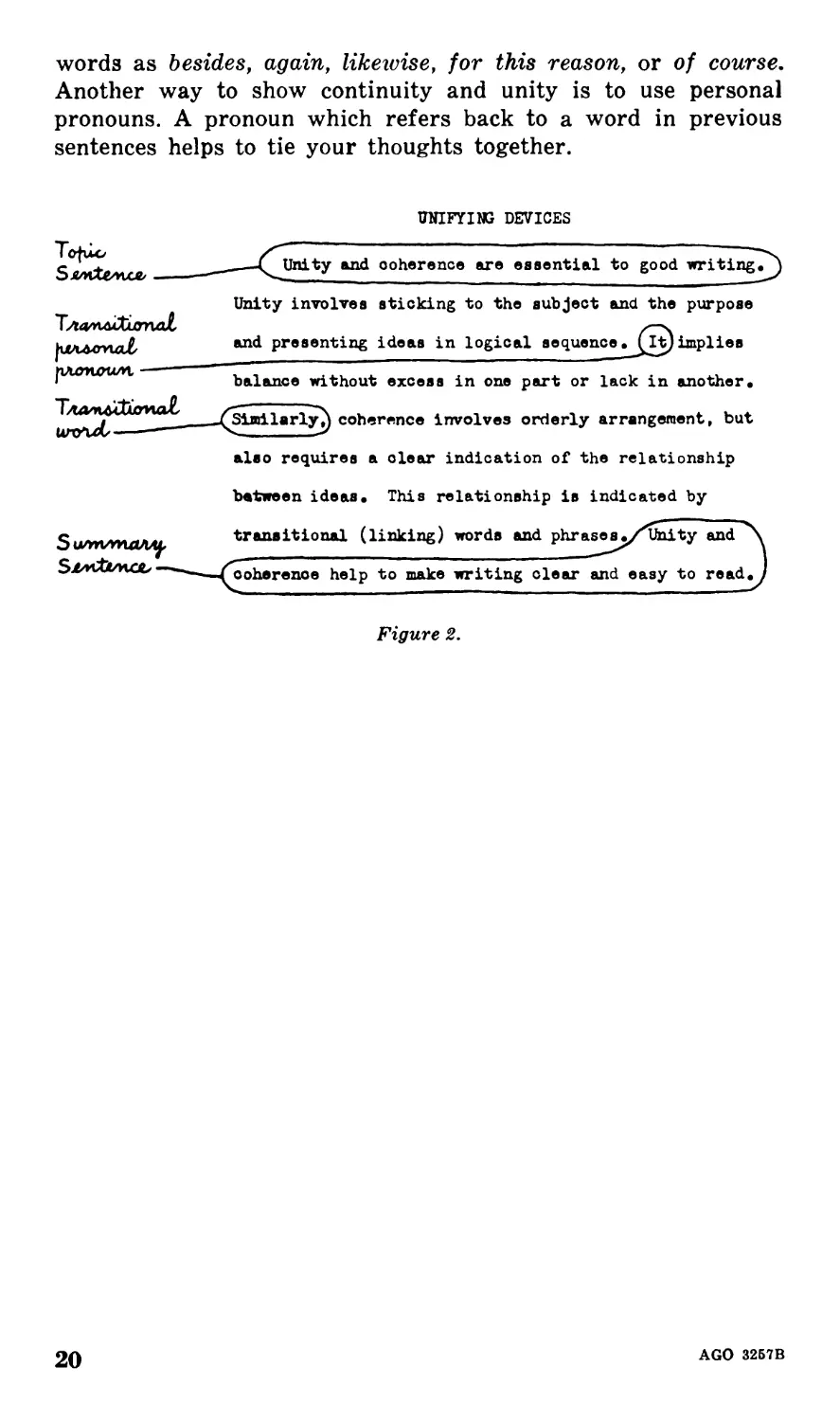
IMPROVE YOUR WRITING
Paragraph Page
Chapter 1.	IMPROVING ARMY WRITING
Purpose ______________________________________________________ 1	3
The personal viewpoint___________________________ 2	3
Changing with the times__________________________ 3	3
Government style_________________________________ 4	3
Modern style_____________________________________ 5	3
Chapter 2.	PREPARING TO WRITE
Lay a foundation______________________________________________ 6	5
Identify the reader______________________________ 7	5
Determine the purpose____________________________ 8	5
Identify main ideas______________________________ 9	6
Make an outline_________________________________ 10	8
Search and research_____________________________ 11	8
Write from your outline_________________________ 12	8
Review for objectivity__________________________ 13	11
Chapter 3.	WRITING
Section I. Words
Write modern_______________________________________________ 14	12
Vocabulary _____________________________________ 15	12
Verbs __________________________________________ 16	12
Specific words__________________________________ 17	13
Personal words _________________________________ 18	13
The law_________________________________________ 19	14
Obfuscation_____________________________________ 20	14
Exaggeration ___________________________________ 21	14
Pointer words___________________________________ 22	15
Crutch words____________________________________ 23	15
Deadheads_______________________________________ 24	15
II. Sentences
Good sentences______________________________________ 25	16
Sentence length_________________________________ 26	16
Brevity_________________________________________ 27	17
Clarity ________________________________________ 28	18
III. Paragraphs
Short paragraphs_____________________________________ 29	19
Topic and summary	sentences_____________________ 30	19
Transitional words and	phrases__________________ 31	19
Chapter	4.	WRITING FORMULAS AND YARDSTICKS
		Their value		32	21
		The 4S formula		33	21
		Fog index 			34	22
Appendix	I.	USEFUL TEXTS 		--	23
	II.	THE WATCHLIST		—	24
TAGO 3257B—Dec
1

CHAPTER 1
IMPROVING ARMY WRITING
1.	Purpose. This pamphlet aims to help Army writers recog-
nize and use a modern, more effective style of writing. It deals
with attitudes, methods, and techniques, rather than with rules
of grammar and composition. It offers methods and suggestions
which can be applied to Army letters, reports, staff papers, regula-
tions, and manuals.
2.	The personal viewpoint. Writing is intensely personal. Some
people feel that their writing style is an expression of individ-
uality. They are sensitive about it and reluctant to change from
an older to a modern style. Yet modern writing is just as personal
and individual, and represents the writer and his job more accu-
rately. Army writers must be as conscious of outdated writing
as they are of outdated dress or equipment. They must also be
as cost-conscious about their writing as they are about other
expenditures of time and money. The cost of writing, distributing,
reading, applying, and filing a single page is measured in tens,
hundreds, even thousands of dollars.
3.	Changing with the times. Business writing has evolved
steadily from the ornate formalism of past generations until to-
day it resembles the spoken language of commerce. The change
to shorter and simpler forms has been faster in recent years,
reflecting our preference for streamlined methods in business
and government. But it is even more a recognition of the fact that
writing is more effective when it is easy to read.
4	Government style. Some Government writers have been
slow to adopt a modern style because they have relied too long
on forms and phrases inherited from predecessors. Some have been
misled in believing that this tired jargon is both official and im-
pressive, when it is, in fact, only muddy and weak. It has well
earned the derisive names of “federalese” and “gobbledygook.”
It is never used in oral communication, where it would sound
ridiculous, but it appears often in writing.
5.	Modern style. Today’s style is characterized by a clear pur-
pose, clearly and simply expressed. It reflects the clean, functional
lines of modern design. There is a strong preference for short
AGO 3257B
3
words, short sentences, and short paragraphs. Chapter 2 suggests
a method for defining the purpose and for outlining a way to
achieve effective writing. Chapter 3 tells how to give your writing
clear, concise, and vigorous expression. A little extra effort in
applying these suggestions will produce measurable improve-
ment—for those who want to improve.
4
AGO 3257B
CHAPTER 2
PREPARING TO WRITE
6.	Lay a foundation. Effective writing is based on adequate
preparation—the analysis, selection, and organization of ideas.
You select a worthwhile objective, marshal your forces, and
organize the attack. This preparation may take a few seconds or
a few days, depending on the size of the problem, but either way
it will be the most important part of your total writing effort.
Preparation involves thinking the problem through before writ-
ing about it, and finding answers to the questions who, what, why,
and how.
7.	Identify the reader. You communicate effectively only when
you use words and ideas your readers understand easily. Whether
they “read you” with ease and understanding will depend on their
knowledge and experience—not on yours. Matter intended for
general distribution should be pitched at the educational level of
the great middle bracket of readers, and their reading skill may be
less than you think. You can use technical terms and abbreviations
when your readers are all technical people; but if what you write
is also intended for untrained men, use simple, nontechnical
language. Technical lingo, unfamiliar abbreviations, uncommon
words, and complicated sentences hide the meaning and make
hard reading. Many military directives are written at college
graduate levels of readability and comprehension, although men
of modest education must read and act on them. The first step in
preparing to write is to ask yourself: “Who must read and under-
stand this?” The answer will affect the ideas as well as the words
you use and must be kept in mind throughout the preparation and
writing phases.
8.	Determine the purpose. Every paper should have a worth-
while purpose, or remain unwritten. A purpose is worthwhile
when it is important enough to offset the substantial costs of
preparing, sending, reading, acting on, and recording it. But a
purpose is more than justification—it is the “big idea” on which
the writing is based. Each paper requires both a general purpose
and a specific objective, and together they make the writing more
direct, forceful, and concise.
a.	General purpose. Whatever the subject, Army writing has
AGO 3257B
5
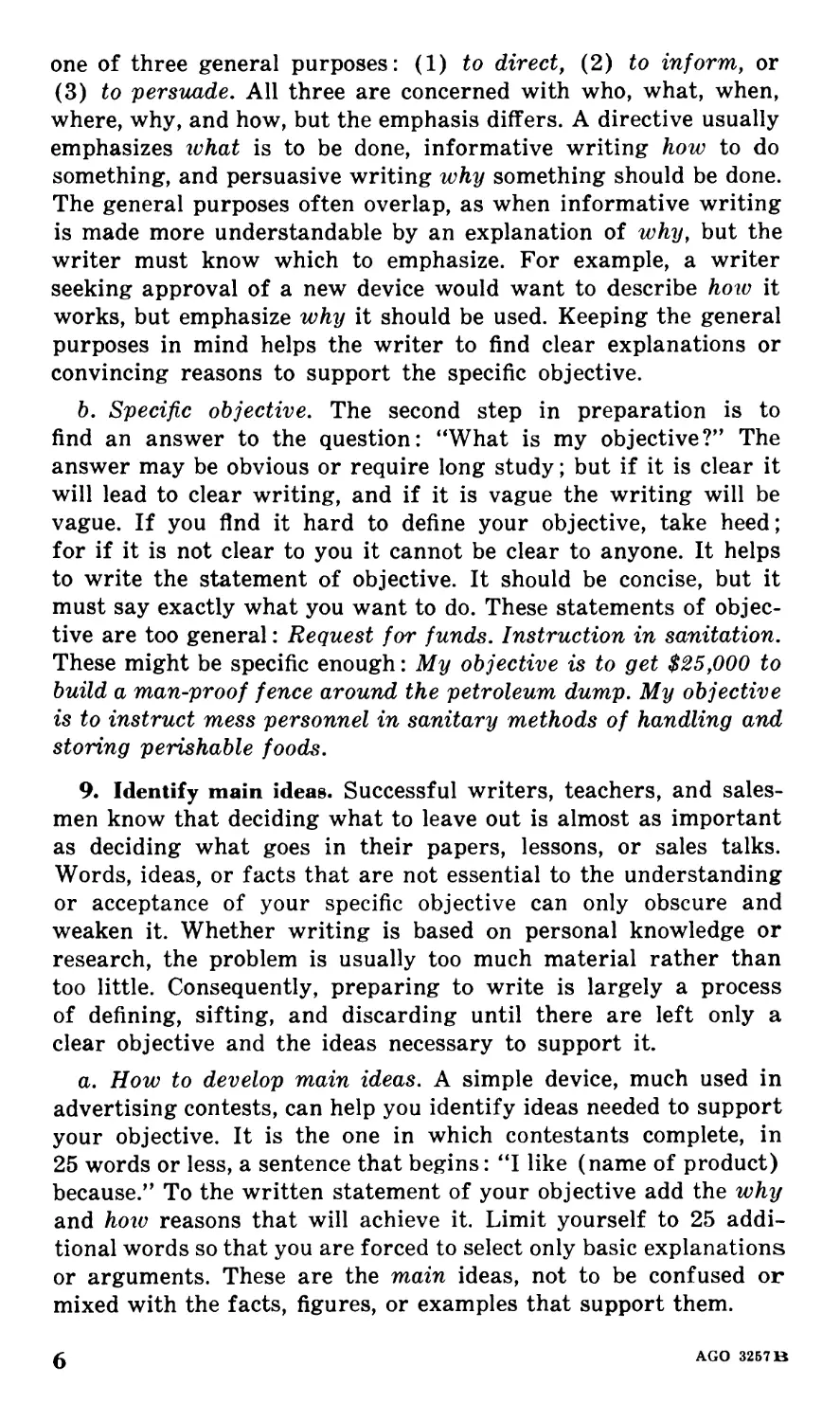
one of three general purposes: (1) to direct, (2) to inform, or
(3) to persuade. All three are concerned with who, what, when,
where, why, and how, but the emphasis differs. A directive usually
emphasizes what is to be done, informative writing how to do
something, and persuasive writing why something should be done.
The general purposes often overlap, as when informative writing
is made more understandable by an explanation of why, but the
writer must know which to emphasize. For example, a writer
seeking approval of a new device would want to describe how it
works, but emphasize why it should be used. Keeping the general
purposes in mind helps the writer to find clear explanations or
convincing reasons to support the specific objective.
b.	Specific objective. The second step in preparation is to
find an answer to the question: “What is my objective?” The
answer may be obvious or require long study; but if it is clear it
will lead to clear writing, and if it is vague the writing will be
vague. If you find it hard to define your objective, take heed;
for if it is not clear to you it cannot be clear to anyone. It helps
to write the statement of objective. It should be concise, but it
must say exactly what you want to do. These statements of objec-
tive are too general: Request for funds. Instruction in sanitation.
These might be specific enough: My objective is to get $25,000 to
build a man-proof fence around the petroleum dump. My objective
is to instruct mess personnel in sanitary methods of handling and
storing perishable foods.
9.	Identify main ideas. Successful writers, teachers, and sales-
men know that deciding what to leave out is almost as important
as deciding what goes in their papers, lessons, or sales talks.
Words, ideas, or facts that are not essential to the understanding
or acceptance of your specific objective can only obscure and
weaken it. Whether writing is based on personal knowledge or
research, the problem is usually too much material rather than
too little. Consequently, preparing to write is largely a process
of defining, sifting, and discarding until there are left only a
clear objective and the ideas necessary to support it.
a. How to develop main ideas. A simple device, much used in
advertising contests, can help you identify ideas needed to support
your objective. It is the one in which contestants complete, in
25 words or less, a sentence that begins: “I like (name of product)
because.” To the written statement of your objective add the why
and hoiv reasons that will achieve it. Limit yourself to 25 addi-
tional words so that you are forced to select only basic explanations
or arguments. These are the main ideas, not to be confused or
mixed with the facts, figures, or examples that support them.
6
AGO 3257 В
(1)	The example which follows contains a statement of
objective and the main ideas that sustain it. The general
purpose is to persuade.
My objective is to get $25,000 to build a
man-proof fence around the petroleum
dump—
(why?) Pilferage is costly and in-
creasing
(why?) Constant threat of sabotage 19
(why?) Location is vulnerable [ words
(why?) Guard is inadequate
(how?) Fence will solve problem
The emphasis is properly on why ideas, with the one how
idea serving as a conclusion and restatement of the
specific objective.
(2)	By changing the emphasis from why to how the same
technique can be applied to informative writing.
My objective is to instruct mess personnel in sanitary
methods of handling and storing foods—
(how?) Showing how to prevent
spoilage
(how?) Showing how to prevent
contamination
(why?) It saves lives and money
In this example the why idea would make a good intro-
duction because it attracts attention and motivates the
reader. The emphasis is on the two how items, and most
of the space would be devoted to these items.
(3)	A directive is simply a statement of purpose in impera-
tive form, expanded to include essential detail.
My objective is to get a man-proof fence built around
the petroleum dump—
(what?) Build a man-proof fence
(where?) Around the petroleum dump
(when?) By 30 November 1958
(who?) Post Engineer
(how?) Lump-sum contract
(why?) Reduce pilferage and threat
of sabotage
(why?) Avoid hiring additional
guards
AGO 3257B
7
b. Analyze ideas. It is important that you distinguish between
main and supporting ideas. The main ideas in any writing are
about equal in importance. They are so vital to the purpose that
leaving one out unbalances the rest, like taking one leg from a
table. If you find more than five main ideas in the body of your
outline, analyze it carefully to see if subordinate ideas have been
raised to main idea level. The main ideas in describing an automo-
bile might be engine, transmission, chassis, and body. If parts
such as pistons or seats are included as main ideas the organiza-
tion is impaired. For another purpose, the main ideas about an
automobile might be performance, economy, and reliability, while
110 miles an hour, 20 miles per gallon, and freedom from repairs
would be supporting ideas.
10.	Make an outline. Any paper can be written more quickly
and logically from an outline—either a simple outline in your
mind or a more complicated outline on paper. You can easily ex-
pand a statement of objective and main ideas into a working out-
line. Fill in the supporting ideas, then add the introduction and the
conclusion and recommendation. The statement of objective and
main ideas in paragraph 9a might be expanded into the working
outline shown in figure 1.
11.	Search and research. A writer encourages originality when
he searches among his own thoughts before researching among
the ideas of others. Doing this will also give direction to your
research by identifying subject areas in which you need more
information. During this research phase, your outline will under-
go many changes, often complete revision. An outline will help you
to recognize and catalog the significant pros and cons of your
subject. When you find significant facts or ideas, note them on
small cards or pieces of paper, together with the specific refer-
ences. This permits you to arrange them by subject and saves
time when you want to refer again to the source document.
12.	Write from your outline. A working outline is more a
sketch than a blueprint. It makes your writing plan easy to see—
and easy to change when better ideas occur. For every point on
your outline you do not necessarily have a paragraph; that is,
every idea shown on a working outline does not have to have
a paragraph or subparagraph by itself. On original drafts of
long papers, it helps to write each paragraph, double spaced, on
a separate half-sheet of paper. This enables you to rearrange
paragraphs easily and discourages long-winded paragraphs. A
letter based on the outline in figure 1 might look like this:
8
AGO 3257B
OUTLINE CHART
1.
2.
3.
Introduction.
a. Statement of Objective.
Body.
a.	Increased Pilferage.
;	(1)	Gasoline and	lubricants.
[	(2)	Equipment.
b.	Danger of Sabotage.
<	(1)	By contamination.
!	(2)	By fire.
c.	Vulnerable location.
•	(1)	Notorious neighborhood.
•	(2)	Many approach and escape	routes.
d.	Inadequate Guard.
i	kl)	Insufficient military guards.
!	(2)	Native guard unreliable.
।	(3)	Cost of adequate 24-hour	guard.
e.	Feasibility of Fence.
•	(1)	Advantages.
;	;	(a)	Reduce	pilferage.
J	:	(b)	Reduce	danger of sabotage.
|	•	(c)	Offset	disadvantages	of	location.
;	!	(d)	Eliminate	need	for additional guards.
[	(2)	Disadvantages.
;	;	(a)	Cost.
;	<	(b)	Expansion	hampered.
Conclusionjand Recommendation.
i	!	•	.	,
a.	Conclusions (summary of reasons why).
b.	Recommendation (objective restated).
!	;	'---Supporting details	All outline headings which
।	!--------Supporting ideas	fall on the same dotted
i-------------Main ideas	line should be of equal
importance.
Figure 1.
1.	Due to lack of adequate means of safeguarding our petroleum
storage area, pilferage and possible sabotage continue to
threaten its operation. We propose to solve this problem
through the erection of a suitable fence, and request the allo-
cation of $25,000 for this purpose.
2.	Theft is increasing in spite of many arrests. Losses to date
include several thousand gallons of gasoline and large quan-
tities of oil and grease. Last week, for example, thieves stole
200 5-gallon cans, several hoses, and a number of handtools,
all of which are still missing.
AGO 3257B
9
3.	Danger of sabotage is real and constant. There are unfriendly
elements and undoubtedly many enemy agents in the local
population. We find it impossible, with the means at our dis-
posal, to keep unauthorized persons from entering the area.
It would be possible for an enemy to set fires or to put acids
or other contaminants into fuels or lubricants.
4.	Because of its location the petroleum dump is especially
vulnerable to thieves or saboteurs. The nearby civilian area
harbors a criminal element which is bold and aggressive in
spite of numerous arrests. Petroleum products will attract
them as long as these products command high prices in black
markets. The many approach and escape routes between the
civilian area and the dump increase the difficulty of the
situation.
5.	The three military and twelve native civilian guards cannot
cover the area often enough, on a 24-hour basis, to keep all
intruders out. The local guards are not reliable unless they are
closely supervised. Our request for more military guards to
provide closer supervision was disapproved, and without
them we believe that increasing the civilian guard is neither
practical nor economical.
6.	The alternative to increasing the guard, and a better solu-
tion, is to build a man-proof fence around the storage area.
It will reduce pilferage enough to pay for itself in 2 years.
It will also reduce the danger of sabotage by making it more
difficult for unauthorized persons to enter the area. A fence
will offset to some extent the disadvantages of the location,
and additional guards will not be needed.
7.	The disadvantages of fencing the area are cost and limita-
tion of future expansion. We estimate the original cost will
be $25,000 and annual maintenance about $1,000. If we
attempt now to inclose all of the area that might be used for
future expansion, it would cost $40,000. Plans for expansion
of this area are uncertain. Therefore, we think it will prove
more economical to fence only the present area.
8.	The security of the petroleum storage area requires imme-
diate strengthening. We believe that the advantages in con-
structing a man-proof fence around the area outweigh the
disadvantages and that the fence will solve the problem
effectively. We recommend the allocation of $25,000 to permit
the construction of this fence. The attached drawings and
specifications show the details.
10
AGO 3257B
13. Review for objectivity. When you have finished your first
draft, you should review and revise your work. As you do this,
concentrate on the objectivity of your discussion. Military writing
in particular should be objective whether it be persuasive or in-
formative writing. When you present a decision or recommenda-
tion, your reader presumes that it is the result of objective think-
ing. Staff studies and reports require you to discuss disadvantages
and objections as fully as the advantages, and from them to draw
conclusions and recommendations. In letters and memorandums
you need to mention only briefly the disadvantages that you have
considered and set aside in favor of the recommended course of
action.
AGO 3257B
11
CHAPTER 3
WRITING
Section I. WORDS
14.	Write modern. When you have identified your audience,
defined your purpose, and outlined your ideas you are ready to
write. This section offers useful suggestions about the use of
words; sections II and III cover modern sentences and paragraphs.
15.	Vocabulary. An extensive vocabulary is a fine asset, but
better for catching than for pitching. It enables you to grasp
quickly the ideas tossed at you, but it may not help you to put your
ideas across to someone with a smaller or different stock of words.
Base your writing on the vocabulary of your readers. A word may
be precisely correct and still be undesirable if your audience finds
it hard to read. When the reader’s eye registers a long or un-
familiar word, his comprehension stops while the eye and mind
back up for another look. When this happens often, reading is
hard and dull. Simians indigenous to Zamboanga are destitute of
caudal appendages. That sentence is correct, but this one is easier
and better: Monkeys have no tails in Zamboanga.
16.	Verbs. Verbs are the most important words in any lan-
guage because they mean action. They are the voice of command.
They can make writing vigorous and direct, or flabby and
roundabout.
a.	Verb-icide. Active verbs are often converted into nouns,
which always require the addition of a weaker passive verb. A
simple sentence such as the doctor examined him is stretched into
his examination was conducted by the doctor. The simple state-
ment he decided swells up to the decision was made by him. Look
out for such nouns as examination, decision, action, preparation,
performance, accomplishment, and others derived from verbs.
Use the active verb itself whenever possible.
b.	Smothered verbs. Simple, straightforward verbs are often
smothered under useless phrases. Notice how correct and have are
buried in this sentence: It is requested that you take immediate
steps to accomplish the correction of your records and that you
transmit a request to your home office with a view to having them
make a similar correction. It is more straightforward to say:
Please correct your records promptly and ask your home office
to correct theirs.
12
AGO 3257B
17. Specific words. Use specific rather than general words.
Don’t say machine when you refer specifically to a bulldozer,
mimeograph, or sedan. Don’t speak of personnel if you mean men
or the men of Company B. Don’t say an official if you mean The
Adjutant General. It is usually better to refer to General Omar
Bradley than to a former Chief of Staff, or to Doctor Albert
Einstein than a famous mathematician.
18. Personal words, a. I and we. When you prepare official
correspondence to be signed by someone other than the com-
mander, you properly should avoid the use of 1. But you gain noth-
ing by using the impersonal it is in place of we or this headquar-
ters. In correspondence in which you speak for yourself, you
should refer to yourself as I. The self-conscious use of the writer,
this officer, and the undersigned is not dictated by any regulation
or valid custom of the service.
b. You. Some letter writers set the scene for a friendly letter
by saluting “Dear Mr. Jones,” and by referring to “your letter,”
and then lapse into completely impersonal references to applicants,
persons, individuals concerned, and those who—anything but you.
There is no place in official correspondence for the breezy famil-
iarity of some sales letters, but there is no objection to a personal
letter like this:
Dear Dr. Smith: We are glad that you want to become a con-
tract physician at an Army hospital near your home. We are
sending your letter to the commanding officer of the hospital
at Fort Ward and suggest that you call on him. There may
not be a vacancy, but he will be pleased to discuss this matter
with you.
c. Readability of personal words. One of the measures of human
interest in writing, and a factor in readability, is the number of
personal words and personal sentences. In The Art of Readable
Writing, Rudolf Flesch defines personal words as nouns or pro-
nouns that refer specifically to people and have natural masculine
or feminine gender: you, he, she, John Jones, Mary, iceman,
actress. Excluded are all the neuter words: it, its, itself, teacher,
employee. Personal sentences are spoken sentences, often with
speech tags such as “he said” or “I replied.” Personal sentences
are also those which are addressed directly to the reader such as
commands, questions, or requests. Writing style is described as
interesting when 15 percent of the sentences and 7 percent of
the words are personal (this is about equal to the Reader’s Di-
gest) . If 5 percent of the sentences and 4 percent of the words are
personal, the style rates as mildly interesting and compares with
AGO 3257В
13
the average trade journal. This does not mean that you should
count the personal words and sentences in every paper you write,
but you will find it pays to check representative samples.
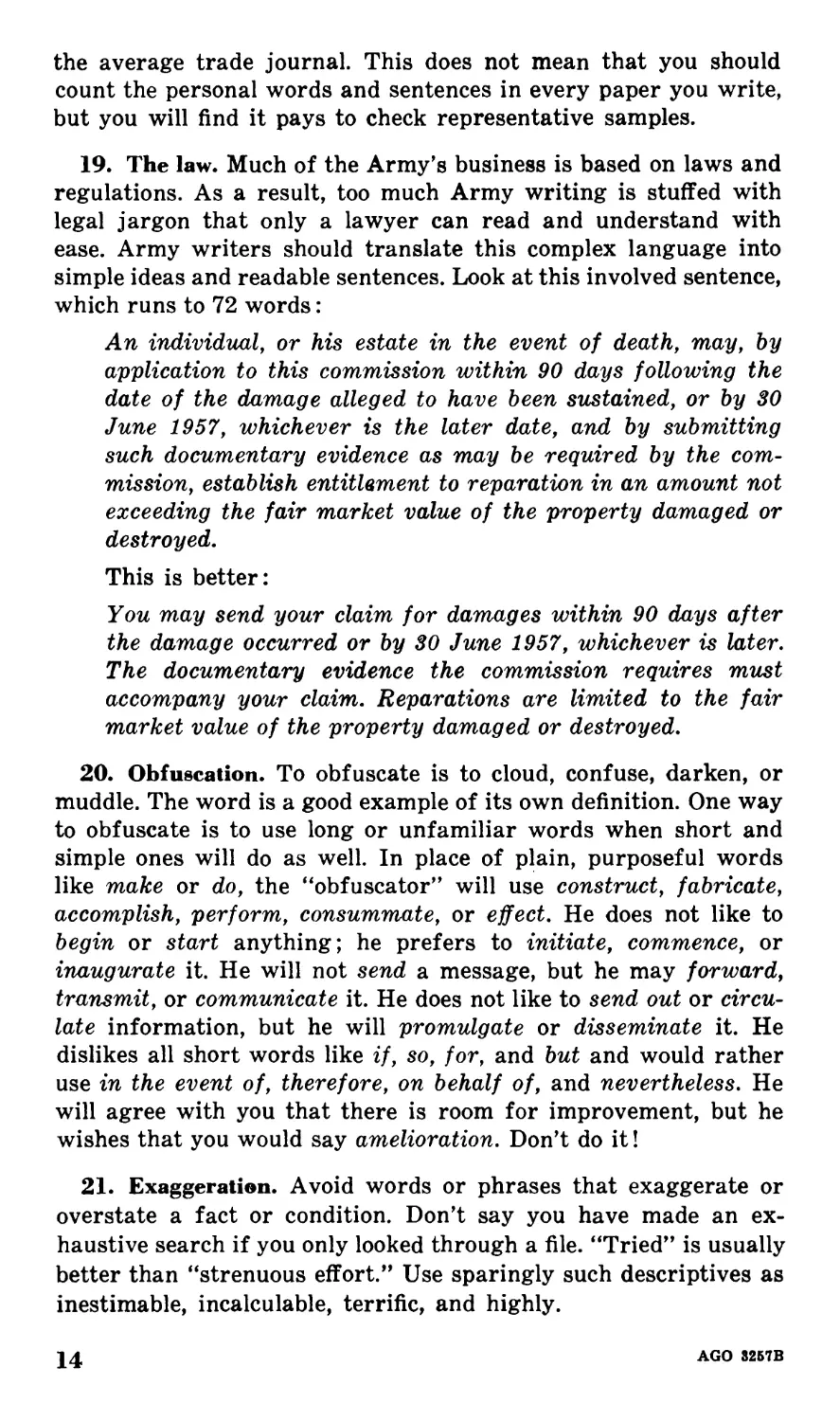
19.	The law. Much of the Army’s business is based on laws and
regulations. As a result, too much Army writing is stuffed with
legal jargon that only a lawyer can read and understand with
ease. Army writers should translate this complex language into
simple ideas and readable sentences. Look at this involved sentence,
which runs to 72 words:
An individual, or his estate in the event of death, may, by
application to this commission within 90 days following the
date of the damage alleged to have been sustained, or by 30
June 1957, whichever is the later date, and by submitting
such documentary evidence as may be required by the com-
mission, establish entitlement to reparation in an amount not
exceeding the fair market value of the property damaged or
destroyed.
This is better:
You may send your claim for damages within 90 days after
the damage occurred or by 30 June 1957, whichever is later.
The documentary evidence the commission requires must
accompany your claim. Reparations are limited to the fair
market value of the property damaged or destroyed.
20.	Obfuscation. To obfuscate is to cloud, confuse, darken, or
muddle. The word is a good example of its own definition. One way
to obfuscate is to use long or unfamiliar words when short and
simple ones will do as well. In place of plain, purposeful words
like make or do, the “obfuscator” will use construct, fabricate,
accomplish, perform, consummate, or effect. He does not like to
begin or start anything; he prefers to initiate, commence, or
inaugurate it. He will not send a message, but he may forward,
transmit, or communicate it. He does not like to send out or circu-
late information, but he will promulgate or disseminate it. He
dislikes all short words like if, so, for, and but and would rather
use in the event of, therefore, on behalf of, and nevertheless. He
will agree with you that there is room for improvement, but he
wishes that you would say amelioration. Don’t do it!
21.	Exaggeration. Avoid words or phrases that exaggerate or
overstate a fact or condition. Don’t say you have made an ex-
haustive search if you only looked through a file. “Tried” is usually
better than “strenuous effort.” Use sparingly such descriptives as
inestimable, incalculable, terrific, and highly.
14
AGO 3257B
22.	Pointer words. Pointer words are useful but seldom neces-
sary. You can usually dispense entirely with herein, herewith,
(inclosed herewith), hereunder, hereto, (attached hereto), here-
inafter, hereinbefore.
23.	Crutch words, a. Very. An overworked word is very. The
weather is never just hot, cold, or mild; it is always very. It has
worn so thin that saying something is very good is often less
emphatic than saying it is good.
b.	And/or. The use of and/or is justified only when the writer
is obliged to say “either one or both” in order to keep his meaning
straight. Unthinking writers use it in places where the use of
“either one or both” would be ridiculous. It is a fair example of
how gobbledygook is established. To write that the Quartermaster
procures and/or distributes uniforms illustrates improper use
of and/or.
c.	Such. Careless writers use such in place of this, that, and
these: Among the recruits are many high school graduates and
such men learn rapidly. Better: . . . and these men learn rapidly.
In these examples such is correctly used with as: such as (in place
of for example) and such men as these. There is a limited need for
as such: Riflemen, as such, are not entitled to extra pay. But it is
frequently and needlessly used in sentences such as this: Postmen,
as such, walk many miles a day. The as such in the sentence con-
cerning riflemen is justified because it implies that while the man
does not draw extra pay simply because he is a rifleman he might
draw extra pay for some other reason. It serves no purpose in
the sentence concerning postmen because walking is characteris-
tic of the postman’s job.
d.	Same. There is less objection in modern writing than former-
ly to repeating a word or name in the same sentence or paragraph.
This removes any excuse for the much used but never approved
use of same as a noun or pronoun. Same is not an acceptable sub-
stitute for building in this sentence: The new building will not be
used until the engineer releases same (it).
24.	Deadheads. In railroading, deadheads are nonpaying pas-
sengers or empty cars. In writing, deadheads are words or phrases
that add nothing to the meaning. Form the habit of cutting the
deadheads out of your writing.
a.	Appropriate action. Appropriate is a deadhead in this sen-
tence : Take appropriate action to move your unit to the new area.
It means the same if you say take action, but this whole phrase
is a deadhead and the sentence is better without it: Move your unit
to the new area.
AGO 3257B
15
b.	Take steps. Telling someone to take steps to do something
means literally that he should only prepare to do it. If it is your
intention that the reader prepare to do something but not
actually do it until you give him further instructions, tell him so.
If you want him actually to do the thing, tell him to do it and omit
reference to the steps.
c.	In case. In the case of and in the matter of are usually dead-
heads. In the case of Captain Burr's accident, a report will be
made to the safety officer. Better, but passive: Captain Burr's
accident will be reported to the safety officer. Still better and active
voice: You will report Captain Burr's accident to the safety officer.
d.	Other deadheads. In place of these deadheads use the words
in parentheses:
at all times (always)
at the present time (now)
at an early date (soon)
at your earliest convenience (soon, when convenient)
in compliance with your request (as you requested)
in the near future (soon)
in the event that (if)
in the amount of (for)
in order to (to)
in view of the fact that (as)
afford an opportunity (permit, let, enable)
There are many other empty phrases that you can omit without
the slightest loss, such as wish to take this opportunity, wish to
state, and for the information and guidance of all concerned.
These examples show how writing can be improved by cutting out
the deadwood: I wish to take this opportunity to express my appre-
ciation for your assistance. Better: Thank you for your help. I
wish to state that in my opinion the runway is not sufficiently long
for aircraft of this type. Better: I believe the runway is too short
for a C-5Jf.
Section IL SENTENCES
25.	Good sentences. We speak in sentences; we write in sen-
tences. A single word or phrase sometimes carries a complete
thought, but sentences are more often the real units of thought
communication. They are more important than words; but good
sentences are based on the right word in the right place. Using
plain words and short sentences will avoid most of the faults found
in bad sentences.
26.	Sentence length. Sentence lengths should vary. An occa-
sional long sentence is not hard to read if it is followed by shorter
16
AGO 32Б7В
ones. A fair goal for most letterwriters is an average of 21 words
per sentence, or less. For longer compositions, such as Army regu-
lations, sentences should average 17 to 19 words. The sentences
in opening paragraphs and in short letters may run a little longer
than the average. You will find it instructive to count represent-
ative samples of your writing occasionally. If a two-idea sen-
tence is divided by a colon, semicolon, or dash, you should count
it as two separate sentences.
27.	Brevity. Sentences written like 10-word telegrams are
hard to read. You cannot get the kind of brevity you want by
leaving out the articles (a, an, and the). You can get brevity by
dividing complex ideas into bite-size sentences and by avoiding
deadhead words and phrases, repetition, and elaboration. General
of the Army George C. Marshall once remarked critically that
“Americans are the greatest elaborators in the world?’ Here are
some suggestions that will help you to write short, straightline
sentences.
a.	Use verbs that work.
(1)	Active voice. Don’t rob your writing of its power by
using the passive voice when you can use the active
voice. (Passive means that the subject has something
done to it by someone; active means that the subject does
something to the object.) Nine out of ten sentences will
be shorter and stronger in the active voice; e.g.,Ow
patrol captured an enemy observer instead of An enemy
observer was captured by our patrol. Davy Crockett
killed a b’ar when he was only three is stronger than A
b’ar was killed by Davy Crockett when he was only
three.
(2)	Passive voice. Of course, situations exist in which the
passive voice is justified. If your previous sentences con-
cerned training and you wished to continue to emphasize
it, you might say that training will be supervised by
commanders; otherwise, you would say commanders will
supervise training. You should not use the passive voice
in directives because it does not identify the doer. For
example: This rule will be explained to each applicant
lets the reader guess who will do the explaining. The
adjutant will explain this rule to all applicants.
b.	Take a direct approach. Express your ideas immediately
and directly. Unnecessary expressions like it is, there is, and there
are weaken sentences and delay comprehension. They also tend to
place part of the sentence in the passive voice. It is the recommen-
AGO 32Б7В
17
dation of the provost marshal that the report be forwarded im-
mediately is more directly expressed The provost marshal recom-
mends that we send the report immediately.
c.	Change long modifiers to short
Colonel Barnes, who is the president
of the board, will preside.
Vehicles that are deadlined are . . .
They gave us a month for accom-
plishment of the task.
d.	Break up long sentences.
There is not enough time available
for the average commander to do
everything that might be done and
so it is necessary for him to deter-
mine wisely the essentials and do
them first, then spend the remain-
ing time on things that are “nice to
do.”
ones.
Colonel Barnes, the board
president, will preside.
Deadlined vehicles are . . .
They gave us a month to do
the job.
The average commander
lacks time to do everything
that might be done. He
must decide what is essen-
tial and do it first. Then he
can spend the remaining
time on things that are
“nice to do.”
28. Clarity. You do not need to be a grammarian to recognize
a good sentence. After all, the first requirement of grammar is
that you focus your reader’s attention on the meaning you wish
to convey. If you take care to make your meaning clear, your
grammar will usually take care of itself. Remember also that
proper punctuation is important to clear meaning. *
a.	Avoid wandering sentences. Unity exists when all parts of
a sentence contribute to one clear idea or impression. Long,
straggling sentences usually contain a hodgepodge of unrelated
ideas. You should either break them up into shorter sentences or
put the subordinate thoughts into subordinate form. Look at this
sentence: The sergeant, an irritable fellow who had been a truck
driver, born and brought up in the corn belt of Iowa, strong as an
ox and six feet tall, fixed an angry eye on the new recruit. You
can see that the main idea is “The sergeant fixed an angry eye on
the new recruit.” That he was an irritable fellow, strong as an
ox and six feet tall adds to the main idea. But the facts that he
had been a truck driver and had been born in Iowa add nothing
to the main thought, and the sentence is better without them.
The sergeant, an irritable fellow who was as strong as an ox and
six feet tall, fixed an angry eye on the new recruit.
b.	Avoid ambiguity. If a sentence can be misunderstood, it
will be misunderstood. A sentence which says that The truck fol-
lowed the jeep until its tire blew out may be perfectly clear to the
writer, but it will mean nothing to the reader until the pronoun its
18
AGO 3257B
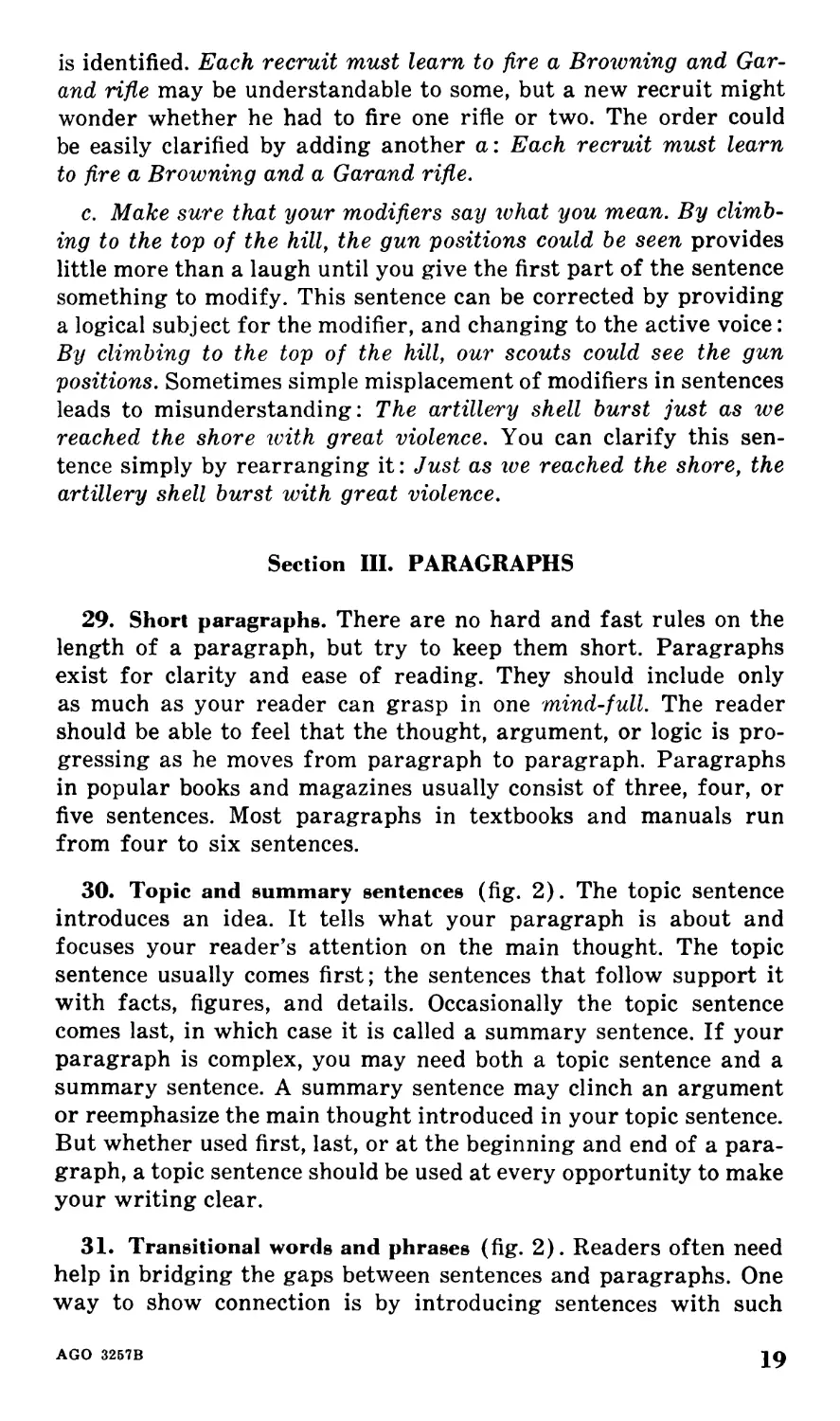
is identified. Each recruit must learn to fire a Browning and Gar-
and rifle may be understandable to some, but a new recruit might
wonder whether he had to fire one rifle or two. The order could
be easily clarified by adding another a: Each recruit must learn
to fire a Browning and a Garand rifle.
c.	Make sure that your modifiers say what you mean. By climb-
ing to the top of the hill, the gun positions could be seen provides
little more than a laugh until you give the first part of the sentence
something to modify. This sentence can be corrected by providing
a logical subject for the modifier, and changing to the active voice:
By climbing to the top of the hill, our scouts could see the gun
positions. Sometimes simple misplacement of modifiers in sentences
leads to misunderstanding: The artillery shell burst just as we
reached the shore with great violence. You can clarify this sen-
tence simply by rearranging it: Just as we reached the shore, the
artillery shell burst with great violence.
Section III. PARAGRAPHS
29.	Short paragraphs. There are no hard and fast rules on the
length of a paragraph, but try to keep them short. Paragraphs
exist for clarity and ease of reading. They should include only
as much as your reader can grasp in one mind-full. The reader
should be able to feel that the thought, argument, or logic is pro-
gressing as he moves from paragraph to paragraph. Paragraphs
in popular books and magazines usually consist of three, four, or
five sentences. Most paragraphs in textbooks and manuals run
from four to six sentences.
30.	Topic and summary sentences (fig. 2). The topic sentence
introduces an idea. It tells what your paragraph is about and
focuses your reader’s attention on the main thought. The topic
sentence usually comes first; the sentences that follow support it
with facts, figures, and details. Occasionally the topic sentence
comes last, in which case it is called a summary sentence. If your
paragraph is complex, you may need both a topic sentence and a
summary sentence. A summary sentence may clinch an argument
or reemphasize the main thought introduced in your topic sentence.
But whether used first, last, or at the beginning and end of a para-
graph, a topic sentence should be used at every opportunity to make
your writing clear.
31.	Transitional words and phrases (fig. 2). Readers often need
help in bridging the gaps between sentences and paragraphs. One
way to show connection is by introducing sentences with such
AGO 3257B
19
words as besides, again, likewise, for this reason, or of course.
Another way to show continuity and unity is to use personal
pronouns. A pronoun which refers back to a word in previous
sentences helps to tie your thoughts together.
UNIFYING DEVICES
Tofuc* Бх/иХе/иха,-		.^Unity and coherence are essential to good writing/)
	Unity involves sticking to the subject and the purpose and presenting ideas in logical sequence.^It) implies
рлопоип —	 un/ixC		balance without excess in one part or lack in another. ^Similarly) coherence involves orderly arrangement, but also requires a clear indication of the relationship between ideas. This relationship is indicated by
	transitional (linking) words and phrases^/^Unity and X -/coherence help to make writing clear and easy to read.J Figure 2.
20
AGO 32Б7В
CHAPTER 4
WRITING FORMULAS AND YARDSTICKS
32.	Their value. Formulas and yardsticks are often helpful to
writers who desire to improve their writing. Formulas are useful
in preparing better material; yardsticks test the readability of the
written material and indicate whether rewriting is needed. For-
mulas and yardsticks are helpful but are not a substitute for sound
judgment. This chapter describes a writing formula and a yard-
stick which are valid and which lend themselves readily to military
writing.
33.	The 4S formula. This formula is recommended by the Archi-
vist of the United States in the General Services Administration
handbook, Plain Letters. The principles of this formula are short-
ness, simplicity, strength, and sincerity. Following are the 17
rules for applying the 4S formula:
a.	For shortness—
(1)	Don’t make a habit of repeating what is said in a letter
you answer.
(2)	Avoid needless words and needless information.
(3)	Shorten prepositional phrases.
(4)	Watch out for nouns and adjectives that derive from
verbs.
(5)	Don’t qualify your statements with irrelevant “ifs.”
b.	For simplicity—
(1)	Know your subject so well you can discuss it confidently
and naturally.
(2)	Use short words, short sentences, and short paragraphs.
(3)	Be compact. Don’t separate closely related parts of
sentences.
(4)	Tie your thoughts together so your reader can follow
you from one to another without getting lost.
c.	For strength—
(1)	Use concrete, specific words.
(2)	Use more active verbs.
(3)	Give answer first, then explain if necessary.
(4)	Don’t hedge.
AGO 3257B
21
d.	For sincerity—
(1)	Be human.
(2)	Admit mistakes.
(3)	Don’t overwhelm your reader with intensives and
emphatics.
(4)	Don’t be arrogant or servile.
34. Fog index. Robert Gunning’s The Technique of Clear Writ-
ing (McGraw-Hill) contains the Fog Index for measuring the
readability of written material. This yardstick is based on word
and sentence length—the longer the words and the sentences,
the foggier the meaning. The figure obtained by applying the yard-
stick represents the number of years schooling the reader must
have to understand the writing with ease. The average high school
graduate can read, with ease, material with a Fog Index of 12 or
less. The Fog Index of this pamphlet is 11.8. Writing that has a
Fog Index of more than 12 is in the danger zone, and is likely to
be misunderstood. These are the steps in finding the Fog Index
of written material:
a.	Figure the average sentence length by dividing the number
of words by the number of sentences. Use a sample of 100 or more
words in figuring average sentence length. Sentences that have
two independent clauses separated by a semicolon are counted as
two sentences.
b.	Compute the percent of hard words. To do this, count the
number of words of three or more syllables in the sample, and
divide this number by the total number of words in the sample.
Omit the following from the count of hard words:
(1)	Verbs that are made three syllables by “ed” or “es,” like
“donated” or indorses.”
(2)	Combinations of short easy words, like “stockholder”
or “airliner.”
(3)	Words that are capitalized.
c.	Add the average sentence length and the percent of hard
words, and multiply by .4. The result is the Fog Index of the mate-
rial. For example, the Fog Index computation for a 150-word
letter containing 10 sentences and 15 words of three or more
syllables is as follows:
Average sentence length (150	10)	15
Percent hard words (15 -h 150)	+ 10%
25~
Fog Index factor	X .4
Fog Index	10
22
AGO 3257B
APPENDIX I
USEFUL TEXTS
Many excellent books devoted to better writing are available in
bookstores and libraries. This appendix lists only a few.
Getting Your Ideas Across Through Writing, by Milton Hall
for the Department of Health, Education, and Welfare
Harbrace College Handbook, By John C. Hodges (Harcourt,
Brace)
Language in Action, by Samuel I. Hayakawa (Harcourt,
Brace)
Plain Letters, by Mona Sheppard for the National Archives
and Records Service of the General Services Adminis-
tration
Techniques of Clear Informative Writing, by John McElroy
(Licensed to agencies of the U. S. Government)
The Army Writer, By David Klein (Military Services Pub-
lishing Co.)
The Art of Readable Writing, by Rudolph Flesch (Harper &
Bros.)
The Language of Audit Reports, by Laura Grace Hunter for
the General Accounting Office
The Technique of Clear Writing, by Robert Gunning (Mc-
Graw-Hill)
Your Most Enchanted Listener, by Wendell Johnson (Harper
& Bros.)
AGO 3257B
23
APPENDIX II
*THE WATCHLIST
Watch for the words and phrases on this list.
Some of them are overworked. Others are used
incorrectly. Many are longer than necessary.
ABOUT. He will arrive at about 1600 hours is not a correct sen-
tence. Use at or about, but not both.
ABOVE should not be used in the sense of more than. His pay is
more than (not above) $5,000 a year.
ACCOMPANIED BY. The preposition with is usually better, as
his letter with (instead of accompanied by) the application.
ADVISE. Tell, inform, and say are fresher words. You are advised
is a useless phrase.
AFFECT, EFFECT. Affect is always a verb meaning to modify
or influence. Effect may be a noun or a verb. As a verb it means
to accomplish or bring about; as a noun, outcome or result.
Both affect and effect are overworked, both correctly and
incorrectly.
AFFORD AN OPPORTUNITY. Allow is suggested as a replace-
ment for this overworked phrase.
ALL-AROUND is not correct. Use all-round.
ALL OF. Say all the soldiers, not all of the soldiers.
ALL READY, ALREADY. The first is an adjective phrase, cor-
rectly used in this sentence: When the hour came, they were
all ready. The second is an adverb that oftener than not
should be omitted: We have (already) written a letter.
ALTERNATIVE, CHOICE. Alternative refers to two only;
choice, to two or more. Since there is only one alternative to
another, don’t say the only other alternative; simply say the
alternative.
AMOUNT, NUMBER are often used loosely. An amount is a sum
total; number as a noun, refers to collective units. You have
an amount of money, and a number of errors.
ANTICIPATE means to foresee or prevent by prior action. Don’t
use it when you actually mean expect.
APT. Don’t use this word when you mean likely. Apt suggests
predisposition. A tactless person is apt to write a blunt letter,
but delayed replies are likely (not apt) to damage public
relations.
* Adapted from Plain Letters.
24
AGO 3257B
ASCERTAIN is a big word often used when the little word learn
is better. Don’t use ascertain unless you want to put over the
idea of effort in getting facts.
ATTACHED—
PLEASE FIND j
HERETO	Attached is adequate
HEREWITH )
ATTENTION IS INVITED OR ATTENTION IS CALLED
should be needless. If a sentence doesn’t make its point with-
out these emphatics, it needs rewriting.
BETWEEN, AMONG. Between properly refers to two only.
Among is used in referring to more than two.
BIANNUAL, BIENNIAL. Biannual, like semiannual, means
twice a year. Biennial means every 2 years.
BIMONTHLY means every two months. Semimonthly is used to
express twice monthly.
CANNOT BE OVEREMPHASIZED. A much overworked phrase
in military writing. Be careful when writing the importance
of this action cannot be overemphasized. The chances are its
importance can very easily be overemphasized.
COGNIZANCE. Avoid this big word both in its legal meaning of
jurisdiction and in its common meaning of heed or notice.
Instead of saying under the cognizance of this office, be spe-
cific, as this office does not audit travel vouchers.
CONTINUOUSLY, CONTINUALLY. The first word means with-
out interruption; the second, intermittently, at frequent
intervals.
DURING suggests continuously, throughout. In (not during) the
meeting he brought up the question of pay raises.
EVENT should not be used for incident, affair, and happening
unless the occurrence is particularly noteworthy.
EVERY EFFORT WILL BE MADE. In military writing this
phrase often means no effort will be made. If you intend to
make an effort, you will be able to say what effort, when, and
by whom.
FACILITATE is a popular military word. It means make easy,
but it makes hard reading for some people.
FARTHER, FURTHER. Farther indicates distance; further de-
notes quantity or degree. You go farther away; you hear
nothing further.
FEW, LESS. Few is for numbers; less is for quantities or amounts.
Write fewer pages and say less.
AGO 3257B
25
FULLEST POSSIBLE EXTENT. A meaningless padding.
INDICATE is overworked and show is a good substitute.
INFORMED. You are informed is a useless phrase in most corre-
spondence.
INITIAL is overworked, but first is not used enough.
INITIATE is an Army favorite for which begin is synonymous.
Sometimes the word can be omitted, as in the phrase initiate
a citation (cite).
INTERPOSE NO OBJECTION. Another fancy favorite. Be
direct. Say 1 approve or 1 do not object.
KINDLY should not be used for please. Please reply, not kindly
reply.
LAST and LATEST are not interchangeable. Last means final;
latest, most recent. The last page of a book, but the latest
book on the market.
LENGTHY means unduly or tediously long. Lengthy may de-
scribe some of our letters, but long is usually the word.
MEETS WITH OUR APPROVAL is a roundabout way to say
we approve.
NECESSARY is often used when need would do. For example,
you may shorten it is not necessary to you need not.
NOMINAL means in name, and by implication, small. Why not
say small?
NONE as a subject is usually plural unless a singular subject is
clearly indicated. None of the jobs are open. None of the work
is done.
NUMEROUS INSTANCES HAVE BEEN REPORTED. A well
worn Army favorite. Instead tell what instances apply to
whom, when, where, and in violation of what.
ON is superfluous in stating days and dates. He arrived Tuesday,
not on Tuesday.
OUT is superfluous in phrases like start out and lose out. He
started (not started out) as a private.
OVER should be avoided when you mean more than in referring
to a number. There were more than (not over) five hundred
people at the meeting.
PART. Our error is better than an error on our part.
PAST. Say last year, not past year, if you mean the preceding year.
PORTION. Part of the time, not portion of the time.
PREDICATED ON THE ASSUMPTION. Forget this one.
PREVENTIVE is better than the irregular doublet preventative.
26
AGO 3257B
PREVIOUS TO, PRIOR TO. Why not before?
PRINCIPAL, PRINCIPLE. The noun principal means head or
chief, as well as capital sum. The adjective principal means
highest or best in rank or importance. Principle means truth,
belief, policy, conviction, or general theory.
PROVEN should not be used as the past participle of prove. Use
proved. Proven may be used as an adjective.
PROMULGATE. A long word for issue.
PROVIDING should not be used for if or provided. Providing
low-cost houses is a problem but we will meet the problem
provided the builders get supplies.
PURSUANT TO. Under will usually take the place of this one.
QUITE means really, truly, wholly, positively. Avoid its use in
phrases like quite a few.
RECENT DATE is meaningless. Either give the date of the letter
or omit any reference to it.
RENDER. Use give in the sense of giving help.
RESIDE. The chances are you seldom use this word in talking.
The talk word live is the natural one for a letter.
STATE is more formal than say.
SOME should not be used in the sense of somewhat, a little, or
rather. His letters are somewhat (not some) better.
SORT. Never say these sort or those sort. Say this sort or those
sorts.
STILL REMAINS. Still adds nothing to the meaning of remains.
SUBSEQUENT TO. After.
TERMINATED. Ended may be just as final.
THIS—
IS TO INFORM YOU. Omit.
IS TO ACKNOWLEDGE AND THANK YOU. Thank you is
enough.
UNKNOWN should be avoided in the sense of unidentified.
UNTIL SUCH TIME AS. Until is enough.
UTILIZATION is an inflated word for use.
WISH TO APOLOGIZE, WISH TO ADVISE. Instead of the first
phrase, simply say we apologize. Instead of the second phrase,
start with what you have to say.
AGO 3257B
27
By Order of Wilber M. Brucker, Secretary of the Army;
MAXWELL D. TAYLOR,
General, United States Army,
Official:	Chief of Staff.
R. V. LEE,
Major General, United States Army,
The Adjutant General.
Distribution:
Active Army:
USofA (10)	CSigO (55)
CofS (15)	CofOrd (45)
DCSPER (25)	Boards (5)
ACSI (50)	USCONARC (25)
DCSOPS (40)	US ARADCOM (25)
DCSLOG (30)	US ARADCOM Rgn (10)
ACSRC (10)	OS Maj Comd (25)
TJAG (30)	Log Comd (5)
TIG (20)	MDW (25)
CNGB (20)	Armies (15)
CUSARROTC (20)	Corps (10)
CoA (15)	Div (10)
CofF (40)	Brig (5)
CMH (30)	Regt/Gp/bg (5)
CofCh (20)	Bn (5)
TPMG (10)	Co/Btry (2)
CINFO (20)	Instls (Class I & II) (10)
CAMG (10)	USMA (50)
CRD (10)	Svc Colleges (50)
TQMG (30)	Br Svc Sch (50)
TSG (40)	Joint Sch (50)
CCmIO (40)	Specialist Sch (20)
CofEngrs (30)	Sector Comd, US Army
PMST Sr Div Units (5)	Corps (Res) (5)
PMST Jr Div Units (2)	US Army Corps (Res) (11
PMST Mil Sch Div Units (2)	NG Unit Adgru (2)
Rcrt Dist (1)	USAR Unit Adgru (2)
Mil Dist (5)	MAAG (5)
CofT (40)	Mil Mis (5)
NG: State AG (3); units—none.
US AR: None.
For explanation of abbreviations used, see AR 320-50.
28
AGO 8257B