/




Author: George T. Heineman Gary Pollice Stanley Selkow
Tags: programming reference
ISBN: 978-0-596-51624-6
Year: 2009
Similar




Text
Vcdng qh Eqpvgpvu
Eqr{tkijv00000000000000000000000000000000000000000000000000000000000000000000000000000000000000000000000000000 3
Rtghceg00000000000000000000000000000000000000000000000000000000000000000000000000000000000000000000000000000000 4
Rctv K< K0000000000000000000000000000000000000000000000000000000000000000000000000000000000000000000000000000000 ;
Ejcrvgt 30 Cniqtkvjou Ocvvgt0000000000000000000000000000000000000000000000000000000000000000000000000000000000000000000000000000000000000000000000000000000000000000000000000000000 32
Ugevkqp 3030 Wpfgtuvcpf vjg Rtqdngo00000000000000000000000000000000000000000000000000000000000000000000000000000000000000000000000000000000000000000000000000000000000000000 33
Ugevkqp 3040 Gzrgtkogpv kh Pgeguuct{0000000000000000000000000000000000000000000000000000000000000000000000000000000000000000000000000000000000000000000000000000000000000000 34
Ugevkqp 3050 Ukfg Uvqt{0000000000000000000000000000000000000000000000000000000000000000000000000000000000000000000000000000000000000000000000000000000000000000000000000000000000000000 38
Ugevkqp 3060 Vjg Oqtcn qh vjg Uvqt{00000000000000000000000000000000000000000000000000000000000000000000000000000000000000000000000000000000000000000000000000000000000000000000 39
Ugevkqp 3070 Tghgtgpegu00000000000000000000000000000000000000000000000000000000000000000000000000000000000000000000000000000000000000000000000000000000000000000000000000000000000000 3:
Ejcrvgt 40 Vjg Ocvjgocvkeu qh Cniqtkvjou0000000000000000000000000000000000000000000000000000000000000000000000000000000000000000000000000000000000000000000000000000000000 3;
Ugevkqp 4030 Uk|g qh c Rtqdngo Kpuvcpeg0000000000000000000000000000000000000000000000000000000000000000000000000000000000000000000000000000000000000000000000000000000000000 3;
Ugevkqp 4040 Tcvg qh Itqyvj qh Hwpevkqpu0000000000000000000000000000000000000000000000000000000000000000000000000000000000000000000000000000000000000000000000000000000000 43
Ugevkqp 4050 Cpcn{uku kp vjg Dguv. Cxgtcig. cpf Yqtuv Ecugu000000000000000000000000000000000000000000000000000000000000000000000000000000000000000000000000000 47
Ugevkqp 4060 Rgthqtocpeg Hcoknkgu0000000000000000000000000000000000000000000000000000000000000000000000000000000000000000000000000000000000000000000000000000000000000000000 4;
Ugevkqp 4070 Okz qh Qrgtcvkqpu00000000000000000000000000000000000000000000000000000000000000000000000000000000000000000000000000000000000000000000000000000000000000000000000000 64
Ugevkqp 4080 Dgpejoctm Qrgtcvkqpu00000000000000000000000000000000000000000000000000000000000000000000000000000000000000000000000000000000000000000000000000000000000000000 65
Ugevkqp 4090 Qpg Hkpcn Rqkpv000000000000000000000000000000000000000000000000000000000000000000000000000000000000000000000000000000000000000000000000000000000000000000000000000000 67
Ugevkqp 40:0 Tghgtgpegu0000000000000000000000000000000000000000000000000000000000000000000000000000000000000000000000000000000000000000000000000000000000000000000000000000000000000 67
Ejcrvgt 50 Rcvvgtpu cpf Fqockpu0000000000000000000000000000000000000000000000000000000000000000000000000000000000000000000000000000000000000000000000000000000000000000000000000 68
Ugevkqp 5030 Rcvvgtpu< C Eqoowpkecvkqp Ncpiwcig00000000000000000000000000000000000000000000000000000000000000000000000000000000000000000000000000000000000000000 68
Ugevkqp 5040 Cniqtkvjo Rcvvgtp Hqtocv000000000000000000000000000000000000000000000000000000000000000000000000000000000000000000000000000000000000000000000000000000000000 6:
Ugevkqp 5050 Rugwfqeqfg Rcvvgtp Hqtocv0000000000000000000000000000000000000000000000000000000000000000000000000000000000000000000000000000000000000000000000000000000000 6;
Ugevkqp 5060 Fgukip Hqtocv0000000000000000000000000000000000000000000000000000000000000000000000000000000000000000000000000000000000000000000000000000000000000000000000000000000 72
Ugevkqp 5070 Gorktkecn Gxcnwcvkqp Hqtocv00000000000000000000000000000000000000000000000000000000000000000000000000000000000000000000000000000000000000000000000000000000 73
Ugevkqp 5080 Fqockpu cpf Cniqtkvjou00000000000000000000000000000000000000000000000000000000000000000000000000000000000000000000000000000000000000000000000000000000000000 75
Ugevkqp 5090 Hnqcvkpi/Rqkpv Eqorwvcvkqpu00000000000000000000000000000000000000000000000000000000000000000000000000000000000000000000000000000000000000000000000000000000 76
Ugevkqp 50:0 Ocpwcn Ogoqt{ Cnnqecvkqp00000000000000000000000000000000000000000000000000000000000000000000000000000000000000000000000000000000000000000000000000000000000 79
Ugevkqp 50;0 Ejqqukpi c Rtqitcookpi Ncpiwcig000000000000000000000000000000000000000000000000000000000000000000000000000000000000000000000000000000000000000000000 82
Ugevkqp 50320 Tghgtgpegu000000000000000000000000000000000000000000000000000000000000000000000000000000000000000000000000000000000000000000000000000000000000000000000000000000000000 83
Rctv KK< KK000000000000000000000000000000000000000000000000000000000000000000000000000000000000000000000000000 84
Ejcrvgt 60 Uqtvkpi Cniqtkvjou000000000000000000000000000000000000000000000000000000000000000000000000000000000000000000000000000000000000000000000000000000000000000000000000000000 85
Ugevkqp 6030 Qxgtxkgy0000000000000000000000000000000000000000000000000000000000000000000000000000000000000000000000000000000000000000000000000000000000000000000000000000000000000000 85
Ugevkqp 6040 Kpugtvkqp Uqtv00000000000000000000000000000000000000000000000000000000000000000000000000000000000000000000000000000000000000000000000000000000000000000000000000000000 8;
Ugevkqp 6050 Ogfkcp Uqtv00000000000000000000000000000000000000000000000000000000000000000000000000000000000000000000000000000000000000000000000000000000000000000000000000000000000 95
Ugevkqp 6060 Swkemuqtv000000000000000000000000000000000000000000000000000000000000000000000000000000000000000000000000000000000000000000000000000000000000000000000000000000000000000 :6
Ugevkqp 6070 Ugngevkqp Uqtv000000000000000000000000000000000000000000000000000000000000000000000000000000000000000000000000000000000000000000000000000000000000000000000000000000000 ;3
Ugevkqp 6080 Jgcr Uqtv000000000000000000000000000000000000000000000000000000000000000000000000000000000000000000000000000000000000000000000000000000000000000000000000000000000000000 ;4
Ugevkqp 6090 Eqwpvkpi Uqtv000000000000000000000000000000000000000000000000000000000000000000000000000000000000000000000000000000000000000000000000000000000000000000000000000000000 ;9
Ugevkqp 60:0 Dwemgv Uqtv000000000000000000000000000000000000000000000000000000000000000000000000000000000000000000000000000000000000000000000000000000000000000000000000000000000000 ;;
Ugevkqp 60;0 Etkvgtkc hqt Ejqqukpi c Uqtvkpi Cniqtkvjo0000000000000000000000000000000000000000000000000000000000000000000000000000000000000000000000000000000000 327
Ugevkqp 60320 Tghgtgpegu0000000000000000000000000000000000000000000000000000000000000000000000000000000000000000000000000000000000000000000000000000000000000000000000000000000000 32;
Ejcrvgt 70 Ugctejkpi00000000000000000000000000000000000000000000000000000000000000000000000000000000000000000000000000000000000000000000000000000000000000000000000000000000000000000000 333
Ugevkqp 7030 Qxgtxkgy0000000000000000000000000000000000000000000000000000000000000000000000000000000000000000000000000000000000000000000000000000000000000000000000000000000000000000 333
Ugevkqp 7040 Ugswgpvkcn Ugctej0000000000000000000000000000000000000000000000000000000000000000000000000000000000000000000000000000000000000000000000000000000000000000000000000 334
Ugevkqp 7050 Dkpct{ Ugctej0000000000000000000000000000000000000000000000000000000000000000000000000000000000000000000000000000000000000000000000000000000000000000000000000000000 33:
Ugevkqp 7060 Jcuj/dcugf Ugctej0000000000000000000000000000000000000000000000000000000000000000000000000000000000000000000000000000000000000000000000000000000000000000000000 344
Ugevkqp 7070 Dkpct{ Vtgg Ugctej00000000000000000000000000000000000000000000000000000000000000000000000000000000000000000000000000000000000000000000000000000000000000000000000 357
Ejcrvgt 80 Itcrj Cniqtkvjou000000000000000000000000000000000000000000000000000000000000000000000000000000000000000000000000000000000000000000000000000000000000000000000000000000 364
Ugevkqp 8030 Qxgtxkgy000000000000000000000000000000000000000000000000000000000000000000000000000000000000000000000000000000000000000000000000000000000000000000000000000000000000000 364
Ugevkqp 8040 Fgrvj/Hktuv Ugctej0000000000000000000000000000000000000000000000000000000000000000000000000000000000000000000000000000000000000000000000000000000000000000000000 36:
Ugevkqp 8050 Dtgcfvj/Hktuv Ugctej00000000000000000000000000000000000000000000000000000000000000000000000000000000000000000000000000000000000000000000000000000000000000000000 377
Ugevkqp 8060 Ukping/Uqwteg Ujqtvguv Rcvj00000000000000000000000000000000000000000000000000000000000000000000000000000000000000000000000000000000000000000000000000000000 37;
Ugevkqp 8070 Cnn Rcktu Ujqtvguv Rcvj000000000000000000000000000000000000000000000000000000000000000000000000000000000000000000000000000000000000000000000000000000000000000000 393
Ugevkqp 8080 Okpkowo Urcppkpi Vtgg Cniqtkvjou00000000000000000000000000000000000000000000000000000000000000000000000000000000000000000000000000000000000000000 397
Ugevkqp 8090 Tghgtgpegu000000000000000000000000000000000000000000000000000000000000000000000000000000000000000000000000000000000000000000000000000000000000000000000000000000000000 399
Ejcrvgt 90 Rcvj Hkpfkpi kp CK000000000000000000000000000000000000000000000000000000000000000000000000000000000000000000000000000000000000000000000000000000000000000000000000000000 39:
Ugevkqp 9030 Qxgtxkgy000000000000000000000000000000000000000000000000000000000000000000000000000000000000000000000000000000000000000000000000000000000000000000000000000000000000000 39:
Ugevkqp 9040 Fgrvj/Hktuv Ugctej00000000000000000000000000000000000000000000000000000000000000000000000000000000000000000000000000000000000000000000000000000000000000000000000 3:9
Ugevkqp 9050 Dtgcfvj/Hktuv Ugctej00000000000000000000000000000000000000000000000000000000000000000000000000000000000000000000000000000000000000000000000000000000000000000000 3;8
Ugevkqp 9060 C,Ugctej00000000000000000000000000000000000000000000000000000000000000000000000000000000000000000000000000000000000000000000000000000000000000000000000000000000000000 422
Ugevkqp 9070 Eqorctkuqp0000000000000000000000000000000000000000000000000000000000000000000000000000000000000000000000000000000000000000000000000000000000000000000000000000000000 432
Ugevkqp 9080 Okpkocz000000000000000000000000000000000000000000000000000000000000000000000000000000000000000000000000000000000000000000000000000000000000000000000000000000000000000 435
Ugevkqp 9090 PgiOcz0000000000000000000000000000000000000000000000000000000000000000000000000000000000000000000000000000000000000000000000000000000000000000000000000000000000000000 43;
Ugevkqp 90:0 CnrjcDgvc000000000000000000000000000000000000000000000000000000000000000000000000000000000000000000000000000000000000000000000000000000000000000000000000000000000000 445
Ugevkqp 90;0 Tghgtgpegu00000000000000000000000000000000000000000000000000000000000000000000000000000000000000000000000000000000000000000000000000000000000000000000000000000000000 452
Ejcrvgt :0 Pgvyqtm Hnqy Cniqtkvjou00000000000000000000000000000000000000000000000000000000000000000000000000000000000000000000000000000000000000000000000000000000000000000 454
Ugevkqp :030 Qxgtxkgy00000000000000000000000000000000000000000000000000000000000000000000000000000000000000000000000000000000000000000000000000000000000000000000000000000000000000 454
Ugevkqp :040 Oczkowo Hnqy000000000000000000000000000000000000000000000000000000000000000000000000000000000000000000000000000000000000000000000000000000000000000000000000000 457
Ugevkqp :050 Dkrctvkvg Ocvejkpi0000000000000000000000000000000000000000000000000000000000000000000000000000000000000000000000000000000000000000000000000000000000000000000000 467
Ugevkqp :060 Tghngevkqpu qp Cwiogpvkpi Rcvju0000000000000000000000000000000000000000000000000000000000000000000000000000000000000000000000000000000000000000000000 46:
Ugevkqp :070 Okpkowo Equv Hnqy00000000000000000000000000000000000000000000000000000000000000000000000000000000000000000000000000000000000000000000000000000000000000000000 474
Ugevkqp :080 Vtcpuujkrogpv0000000000000000000000000000000000000000000000000000000000000000000000000000000000000000000000000000000000000000000000000000000000000000000000000000 474
Ugevkqp :090 Vtcpurqtvcvkqp00000000000000000000000000000000000000000000000000000000000000000000000000000000000000000000000000000000000000000000000000000000000000000000000000000 475
Ugevkqp :0:0 Cuukipogpv0000000000000000000000000000000000000000000000000000000000000000000000000000000000000000000000000000000000000000000000000000000000000000000000000000000000 476
Ugevkqp :0;0 Nkpgct Rtqitcookpi0000000000000000000000000000000000000000000000000000000000000000000000000000000000000000000000000000000000000000000000000000000000000000000 477
Ugevkqp :0320 Tghgtgpegu000000000000000000000000000000000000000000000000000000000000000000000000000000000000000000000000000000000000000000000000000000000000000000000000000000000 478
Ejcrvgt ;0 Eqorwvcvkqpcn Igqogvt{000000000000000000000000000000000000000000000000000000000000000000000000000000000000000000000000000000000000000000000000000000000000000000 479
Ugevkqp ;030 Qxgtxkgy000000000000000000000000000000000000000000000000000000000000000000000000000000000000000000000000000000000000000000000000000000000000000000000000000000000000000 479
Ugevkqp ;040 Eqpxgz Jwnn Uecp000000000000000000000000000000000000000000000000000000000000000000000000000000000000000000000000000000000000000000000000000000000000000000000000 488
Ugevkqp ;050 NkpgUyggr000000000000000000000000000000000000000000000000000000000000000000000000000000000000000000000000000000000000000000000000000000000000000000000000000000000000 496
Ugevkqp ;060 Pgctguv Pgkijdqt Swgtkgu0000000000000000000000000000000000000000000000000000000000000000000000000000000000000000000000000000000000000000000000000000000000 4:8
Ugevkqp ;070 Tcpig Swgtkgu00000000000000000000000000000000000000000000000000000000000000000000000000000000000000000000000000000000000000000000000000000000000000000000000000000 4;:
Ugevkqp ;080 Tghgtgpegu00000000000000000000000000000000000000000000000000000000000000000000000000000000000000000000000000000000000000000000000000000000000000000000000000000000000 526
Rctv KKK< KKK0000000000000000000000000000000000000000000000000000000000000000000000000000000000000000000000 527
Ejcrvgt 320 Yjgp Cnn Gnug Hcknu0000000000000000000000000000000000000000000000000000000000000000000000000000000000000000000000000000000000000000000000000000000000000000000000000 528
Ugevkqp 32030 Xctkcvkqpu qp c Vjgog000000000000000000000000000000000000000000000000000000000000000000000000000000000000000000000000000000000000000000000000000000000000000 528
Ugevkqp 32040 Crrtqzkocvkqp Cniqtkvjou0000000000000000000000000000000000000000000000000000000000000000000000000000000000000000000000000000000000000000000000000000000 529
Ugevkqp 32050 Qhhnkpg Cniqtkvjou000000000000000000000000000000000000000000000000000000000000000000000000000000000000000000000000000000000000000000000000000000000000000000000 529
Ugevkqp 32060 Rctcnngn Cniqtkvjou0000000000000000000000000000000000000000000000000000000000000000000000000000000000000000000000000000000000000000000000000000000000000000000 52:
Ugevkqp 32070 Tcpfqok|gf Cniqtkvjou00000000000000000000000000000000000000000000000000000000000000000000000000000000000000000000000000000000000000000000000000000000000 52:
Ugevkqp 32080 Cniqtkvjou Vjcv Ecp Dg Ytqpi. dwv ykvj Fkokpkujkpi Rtqdcdknkv{00000000000000000000000000000000000000000000000000000000000000000 537
Ugevkqp 32090 Tghgtgpegu0000000000000000000000000000000000000000000000000000000000000000000000000000000000000000000000000000000000000000000000000000000000000000000000000000000000 53:
Ejcrvgt 330 Grknqiwg00000000000000000000000000000000000000000000000000000000000000000000000000000000000000000000000000000000000000000000000000000000000000000000000000000000000000000000 53;
Ugevkqp 33030 Qxgtxkgy00000000000000000000000000000000000000000000000000000000000000000000000000000000000000000000000000000000000000000000000000000000000000000000000000000000000000 53;
Ugevkqp 33040 Rtkpekrng< Mpqy [qwt Fcvc000000000000000000000000000000000000000000000000000000000000000000000000000000000000000000000000000000000000000000000000000000000 53;
Ugevkqp 33050 Rtkpekrng< Fgeqorqug vjg Rtqdngo kpvq Uocnngt Rtqdngou000000000000000000000000000000000000000000000000000000000000000000000000000000 542
Ugevkqp 33060 Rtkpekrng< Ejqqug vjg Tkijv Fcvc Uvtwevwtg0000000000000000000000000000000000000000000000000000000000000000000000000000000000000000000000000000000 543
Ugevkqp 33070 Rtkpekrng< Cff Uvqtcig vq Kpetgcug Rgthqtocpeg0000000000000000000000000000000000000000000000000000000000000000000000000000000000000000000000 544
Ugevkqp 33080 Rtkpekrng< Kh Pq Uqnwvkqp Ku Gxkfgpv. Eqpuvtwev c Ugctej0000000000000000000000000000000000000000000000000000000000000000000000000000000000 545
Ugevkqp 33090 Rtkpekrng< Kh Pq Uqnwvkqp Ku Gxkfgpv. Tgfweg [qwt Rtqdngo vq Cpqvjgt Rtqdngo Vjcv Jcu c Uqnwvkqp0000000000 545
Ugevkqp 330:0 Rtkpekrng< Ytkvkpi Cniqtkvjou Ku JctfÏVguvkpi Cniqtkvjou Ku Jctfgt00000000000000000000000000000000000000000000000000000000000 546
Rctv KX< KX00000000000000000000000000000000000000000000000000000000000000000000000000000000000000000000000 548
Crrgpfkz C0 Dgpejoctmkpi00000000000000000000000000000000000000000000000000000000000000000000000000000000000000000000000000000000000000000000000000000000000000000000000000000000 549
Ugevkqp C030 Uvcvkuvkecn Hqwpfcvkqp00000000000000000000000000000000000000000000000000000000000000000000000000000000000000000000000000000000000000000000000000000000000000000 549
Ugevkqp C040 Jctfyctg000000000000000000000000000000000000000000000000000000000000000000000000000000000000000000000000000000000000000000000000000000000000000000000000000000000000 54:
Ugevkqp C050 Tgrqtvkpi0000000000000000000000000000000000000000000000000000000000000000000000000000000000000000000000000000000000000000000000000000000000000000000000000000000000000 559
Ugevkqp C060 Rtgekukqp00000000000000000000000000000000000000000000000000000000000000000000000000000000000000000000000000000000000000000000000000000000000000000000000000000000000000 55:
Cdqwv vjg Cwvjqtu00000000000000000000000000000000000000000000000000000000000000000000000000000000000 562
Eqnqrjqp000000000000000000000000000000000000000000000000000000000000000000000000000000000000000000000000 562
Algorithms in a Nutshell
by George T. Heineman, Gary Pollice, and Stanley Selkow
Copyright © 2009 George Heineman, Gary Pollice, and Stanley Selkow. All rights reserved.
Printed in the United States of America.
Published by O’Reilly Media, Inc., 1005 Gravenstein Highway North, Sebastopol, CA 95472.
O’Reilly books may be purchased for educational, business, or sales promotional use. Online
editions are also available for most titles (safari.oreilly.com). For more information, contact
our corporate/institutional sales department: (800) 998 9938 or corporate@oreilly.com.
Editor: Mary Treseler
Production Editor: Rachel Monaghan
Production Services: Newgen Publishing
and Data Services
Copyeditor: Genevieve d’Entremont
Proofreader: Rachel Monaghan
Indexer: John Bickelhaupt
Cover Designer: Karen Montgomery
Interior Designer: David Futato
Illustrator: Robert Romano
Printing History:
October 2008:
First Edition.
Nutshell Handbook, the Nutshell Handbook logo, and the O’Reilly logo are registered
trademarks of O’Reilly Media, Inc. The In a Nutshell series designations, Algorithms in a
Nutshell, the image of a hermit crab, and related trade dress are trademarks of O’Reilly Media,
Inc.
Many of the designations used by manufacturers and sellers to distinguish their products are
claimed as trademarks. Where those designations appear in this book, and O’Reilly Media,
Inc. was aware of a trademark claim, the designations have been printed in caps or initial
caps.
While every precaution has been taken in the preparation of this book, the publisher and
authors assume no responsibility for errors or omissions, or for damages resulting from the
use of the information contained herein.
This book uses RepKover™, a durable and flexible lay flat binding.
ISBN: 978 0 596 51624 6
[M]
x | Preface
Principle: Use Real Code, Not Pseudocode
What is a practitioner to do with Figure P 1’s description of the FORD FULKERSON
algorithm for computing maximum network flow?
The algorithm description in this figure comes from Wikipedia (http://en.wikipedia.
org/wiki/Ford_Fulkerson), and it is nearly identical to the pseudocode found in
(Cormen et al., 2001). It is simply unreasonable to expect a software practitioner
to produce working code from the description of FORD FULKERSON shown here!
Turn to Chapter 8 to see our code listing by comparison. We use only docu
mented, well designed code to describe the algorithms. Use the code we provide
as is, or include its logic in your own programming language and software
system.
Some algorithm textbooks do have full real code solutions in C or Java. Often the
purpose of these textbooks is to either teach the language to a beginner or to
explain how to implement abstract data types. Additionally, to include code list
ings within the narrow confines of a textbook page, authors routinely omit
documentation and error handling, or use shortcuts never used in practice. We
believe programmers can learn much from documented, well designed code,
which is why we dedicated so much effort to develop actual solutions for our
algorithms.
Principle: Separate the Algorithm from the Problem
Being Solved
It is hard to show the implementation for an algorithm “in the general sense”
without also involving details of the specific solution. We are critical of books that
show a full implementation of an algorithm yet allow the details of the specific
problem to become so intertwined with the code for the generic problem that it is
hard to identify the structure of the original algorithm. Even worse, many avail
able implementations rely on sets of arrays for storing information in a way that is
“simpler” to code but harder to understand. Too often, the reader will under
stand the concept from the supplementary text but be unable to implement it!
Figure P 1. Example of pseudocode commonly found in textbooks
Preface | xi
In our approach, we design each implementation to separate the generic algo
rithm from the specific problem. In Chapter 7, for example, when we describe the
A*SEARCH algorithm, we use an example such as the 8 puzzle (a sliding tile puzzle
with tiles numbered 1–8 in a three by three grid). The implementation of
A*SEARCH depends only on a set of well defined interfaces. The details of the
specific 8 puzzle problem are encapsulated cleanly within classes that implement
these interfaces.
We use numerous programming languages in this book and follow a strict design
methodology to ensure that the code is readable and the solutions are efficient.
Because of our software engineering background, it was second nature to design
clear interfaces between the general algorithms and the domain specific solutions.
Coding in this way produces software that is easy to test, maintain, and expand to
solve the problems at hand. One added benefit is that the modern audience can
more easily read and understand the resulting descriptions of the algorithms. For
select algorithms, we show how to convert the readable and efficient code that we
produced into highly optimized (though less readable) code with improved
performance. After all, the only time that optimization should be done is when the
problem has been solved and the client demands faster code. Even then it is worth
listening to C. A. R. Hoare, who stated, “Premature optimization is the root of all
evil.”
Principle: Introduce Just Enough Mathematics
Many treatments of algorithms focus nearly exclusively on proving the correct
ness of the algorithm and explaining only at a high level its details. Our focus is
always on showing how the algorithm is to be implemented in practice. To this
end, we only introduce the mathematics needed to understand the data structures
and the control flow of the solutions.
For example, one needs to understand the properties of sets and binary trees for
many algorithms. At the same time, however, there is no need to include a proof
by induction on the height of a binary tree to explain how a red black binary tree
is balanced; read Chapter 13 in (Cormen et al., 2001) if you want those details.
We explain the results as needed, and refer the reader to other sources to under
stand how to prove these results mathematically.
In this book you will learn the key terms and analytic techniques to differentiate
algorithm behavior based on the data structures used and the desired
functionality.
Principle: Support Mathematical Analysis Empirically
We mathematically analyze the performance of each algorithm in this book to
help programmers understand the conditions under which each algorithm
performs at its best. We provide live code examples, and in the accompanying
code repository there are numerous JUnit (http://sourceforge.net/projects/junit) test
cases to document the proper implementation of each algorithm. We generate
benchmark performance data to provide empirical evidence regarding the perfor
mance of each algorithm.
xii | Preface
We classify each algorithm into a specific performance family and provide bench
mark data showing the execution performance to support the analysis. We avoid
algorithms that are interesting only to the mathematical algorithmic designer
trying to prove that an approach performs better at the expense of being impos
sible to implement. We execute our algorithms on a variety of programming
platforms to demonstrate that the design of the algorithm—not the underlying
platform—is the driving factor in efficiency.
The appendix contains the full details of our approach toward benchmarking, and
can be used to independently validate the performance results we describe in this
book. The advice we give you is common in the open source community: “Your
mileage may vary.” Although you won’t be able to duplicate our results exactly,
you will be able to verify the trends that we document, and we encourage you to
use the same empirical approach when deciding upon algorithms for your own
use.
Audience
If you were trapped on a desert island and could have only one algorithms book,
we recommend the complete box set of The Art of Computer Programming,
Volumes 1–3, by Donald Knuth (1998). Knuth describes numerous data struc
tures and algorithms and provides exquisite treatment and analysis. Complete
with historical footnotes and exercises, these books could keep a programmer
active and content for decades. It would certainly be challenging, however, to put
directly into practice the ideas from Knuth’s book.
But you are not trapped on a desert island, are you? No, you have sluggish code
that must be improved by Friday and you need to understand how to do it!
We intend our book to be your primary reference when you are faced with an
algorithmic question and need to either (a) solve a particular problem, or (b)
improve on the performance of an existing solution. We cover a range of existing
algorithms for solving a large number of problems and adhere to the following
principles:
When describing each algorithm, we use a stylized pattern to properly frame
each discussion and explain the essential points of the algorithm. By using
patterns, we create a readable book whose consistent presentation shows the
impact that similar design decisions have on different algorithms.
We use a variety of languages to describe the algorithms in the book (includ
ing C, C++, Java, and Ruby). In doing so, we make concrete the discussion
on algorithms and speak using languages that you are already familiar with.
We describe the expected performance of each algorithm and empirically
provide evidence that supports these claims. Whether you trust in mathemat
ics or in demonstrable execution times, you will be persuaded.
We intend this book to be most useful to software practitioners, programmers,
and designers. To meet your objectives, you need access to a quality resource that
explains real solutions to real algorithms that you need to solve real problems.
Preface | xiii
You already know how to program in a variety of programming languages. You
know about the essential computer science data structures, such as arrays, linked
lists, stacks, queues, hash tables, binary trees, and undirected and directed graphs.
You don’t need to implement these data structures, since they are typically
provided by code libraries.
We expect that you will use this book to learn about tried and tested solutions to
solve problems efficiently. You will learn some advanced data structures and some
novel ways to apply standard data structures to improve the efficiency of algo
rithms. Your problem solving abilities will improve when you see the key
decisions for each algorithm that make for efficient solutions.
Contents of This Book
This book is divided into three parts. Part I (Chapters 1–3) provides the mathe
matical introduction to algorithms necessary to properly understand the
descriptions used in this book. We also describe the pattern based style used
throughout in the presentation of each algorithm. This style is carefully designed
to ensure consistency, as well as to highlight the essential aspects of each algo
rithm. Part II contains a series of chapters (4–9), each consisting of a set of related
algorithms. The individual sections of these chapters are self contained descrip
tions of the algorithms.
Part III (Chapters 10 and 11) provides resources that interested readers can use to
pursue these topics further. A chapter on approaches to take when “all else fails”
provides helpful hints on solving problems when there is (as yet) no immediate
efficient solution. We close with a discussion of important areas of study that we
omitted from Part II simply because they were too advanced, too niche oriented,
or too new to have proven themselves. In Part IV, we include a benchmarking
appendix that describes the approach used throughout this book to generate
empirical data that supports the mathematical analysis used in each chapter. Such
benchmarking is standard in the industry yet has been noticeably lacking in text
books describing algorithms.
Conventions Used in This Book
The following typographical conventions are used in this book:
Code
All code examples appear in this typecase.
This code is replicated directly from the code repository and reflects real
code.
Italic
Indicates key terms used to describe algorithms and data structures. Also
used when referring to variables within a pseudocode description of an
example.
xiv | Preface
Constant width
Indicates the name of actual software elements within an implementation,
such as a Java class, the name of an array within a C implementation, and
constants such as true or false.
SMALL CAPS
Indicates the name of an algorithm.
We cite numerous books, articles, and websites throughout the book. These cita
tions appear in text using parentheses, such as (Cormen et al., 2001), and each
chapter closes with a listing of references used within that chapter. When the
reference citation immediately follows the name of the author in the text, we do
not duplicate the name in the reference. Thus, we refer to the Art of Computer
Programming books by Donald Knuth (1998) by just including the year in
parentheses.
All URLs used in the book were verified as of August 2008 and we tried to use only
URLs that should be around for some time. We include small URLs, such as http://
www.oreilly.com, directly within the text; otherwise, they appear in footnotes and
within the references at the end of a chapter.
Using Code Examples
This book is here to help you get your job done. In general, you may use the code
in this book in your programs and documentation. You do not need to contact us
for permission unless you’re reproducing a significant portion of the code. For
example, writing a program that uses several chunks of code from this book does
not require permission. Selling or distributing a CD ROM of examples from
O’Reilly books does require permission. Answering a question by citing this book
and quoting example code does not require permission. Incorporating a signifi
cant amount of example code from this book into your product’s documentation
does require permission.
We appreciate, but do not require, attribution. An attribution usually includes
the title, author, publisher, and ISBN. For example: “Algorithms in a Nutshell by
George T. Heineman, Gary Pollice, and Stanley Selkow. Copyright 2009 George
Heineman, Gary Pollice, and Stanley Selkow, 978 0 596 51624 6.”
If you feel your use of code examples falls outside fair use or the permission given
here, feel free to contact us at permissions@oreilly.com.
Comments and Questions
Please address comments and questions concerning this book to the publisher:
O’Reilly Media, Inc.
1005 Gravenstein Highway North
Sebastopol, CA 95472
800 998 9938 (in the United States or Canada)
707 829 0515 (international or local)
707 829 0104 (fax)
Preface | xv
We have a web page for this book, where we list errata, examples, and any addi
tional information. You can access this page at:
http://www.oreilly.com/catalog/9780596516246
To comment or ask technical questions about this book, send email to:
bookquestions@oreilly.com
For more information about our books, conferences, Resource Centers, and the
O’Reilly Network, see our website at:
http://www.oreilly.com
Safari® Books Online
When you see a Safari® Books Online icon on the cover of your
favorite technology book, that means the book is available
online through the O’Reilly Network Safari Bookshelf.
Safari offers a solution that’s better than e books. It’s a virtual
library that lets you easily search thousands of top tech books, cut and paste code
samples, download chapters, and find quick answers when you need the most
accurate, current information. Try it for free at http://safari.oreilly.com.
Acknowledgments
We would like to thank the book reviewers for their attention to detail and
suggestions, which improved the presentation and removed defects from earlier
drafts: Alan Davidson, Scot Drysdale, Krzysztof Duleba, Gene Hughes, Murali
Mani, Jeffrey Yasskin, and Daniel Yoo.
George Heineman would like to thank those who helped instill in him a passion
for algorithms, including Professors Scot Drysdale (Dartmouth College) and Zvi
Galil (Columbia University). As always, George thanks his wife, Jennifer, and his
children, Nicholas (who always wanted to know what “notes” Daddy was
working on) and Alexander (who was born as we prepared the final draft of the
book).
Gary Pollice would like to thank his wife Vikki for 40 great years. He also wants to
thank the WPI computer science department for a great environment and a great
job.
Stanley Selkow would like to thank his wife, Deb. This book was another step on
their long path together.
References
Cormen, Thomas H., Charles E. Leiserson, Ronald L. Rivest, and Clifford Stein,
Introduction to Algorithms, Second Edition. McGraw Hill, 2001.
Knuth, Donald E., The Art of Computer Programming, Volumes 1–3, Boxed Set
Second Edition. Addison Wesley Professional, 1998.
I
Chapter 1, Algorithms Matter
Chapter 2, The Mathematics of Algorithms
Chapter 3, Patterns and Domains
4 | Chapter 1: Algorithms Matter
Now Graham was really smart when it came to understanding operating systems
and how their internals work. He was an excellent programmer who could write
more working code in an hour than most programmers could write in a day. He
had studied algorithms, data structures, and all of the standard topics in college,
so why did the code execute so much slower with the wrappers inserted? In this
case, it was a problem of knowing enough to make the program work, but not
thinking through the details to make it work quickly. Like many creative people,
Graham was already thinking about his next program and didn’t want to go back
to his memory leak program to find out what was wrong. So, he asked Gary to
take a look at it and see whether he could fix it. Gary was more of a compiler and
software engineering type of guy and seemed to be pretty good at honing code to
make it release worthy.
Gary thought he’d talk to Graham about the program before he started digging
into the code. That way, he might better understand how Graham structured his
solution and why he chose particular implementation options.
Before proceeding, think about what you might ask Graham. See
whether you would have obtained the information that Gary did in
the following section.
Understand the Problem
A good way to solve problems is to start with the big picture: understand the
problem, identify potential causes, and then dig into the details. If you decide to
try to solve the problem because you think you know the cause, you may solve the
wrong problem, or you might not explore other—possibly better—answers. The
first thing Gary did was ask Graham to describe the problem and his solution.
Graham said that he wanted to determine whether a program had any memory
leaks. He thought the best way to find out would be to keep a record of all
memory that was allocated by the program, whether it was freed before the
program ended, and a record of where the allocation was requested in the user’s
program. His solution required him to build a small library with three functions:
malloc( )
A wrapper around the operating system’s memory allocation function
free( )
A wrapper around the operating system’s memory deallocation function
exit( )
A wrapper around the operating system’s function called when a program
exits
This custom library would be linked with the program under test in such a way
that the customized functions would be called instead of the operating system’s
functions. The custom malloc( ) and free( ) functions would keep track of each
allocation and deallocation. When the program under test finished, there would
be no memory leak if every allocation was subsequently deallocated. If there were
any leaks, the information kept by Graham’s routines would allow the
programmer to find the code that caused them. When the exit( ) function was
Experiment if Necessary | 5
AlgorithmsMatter
called, the custom library routine would display its results before actually exiting.
Graham sketched out what his solution looked like, as shown in Figure 1 1.
The description seemed clear enough. Unless Graham was doing something
terribly wrong in his code to wrap the operating system functions, it was hard to
imagine that there was a performance problem in the wrapper code. If there were,
then all programs would be proportionately slow. Gary asked whether there was a
difference in the performance of the programs Graham had tested. Graham
explained that the running profile seemed to be that small programs—those that
did relatively little—all ran in acceptable time, regardless of whether they had
memory leaks. However, programs that did a lot of processing and had memory
leaks ran disproportionately slow.
Experiment if Necessary
Before going any further, Gary wanted to get a better understanding of the running
profile of programs. He and Graham sat down and wrote some short programs to
see how they ran with Graham’s custom library linked in. Perhaps they could get a
better understanding of the conditions that caused the problem to arise.
What type of experiments would you run? What would your pro
gram(s) look like?
The first test program Gary and Graham wrote (ProgramA) is shown in
Example 1 1.
Figure 1 1. Graham’s solution
Example 1 1. ProgramA code
int main(int argc, char **argv) {
inti=0;
for(i=0;i<1000000;i++){
malloc(32);
}
exit (0);
}
6 | Chapter 1: Algorithms Matter
They ran the program and waited for the results. It took several minutes to finish.
Although computers were slower back then, this was clearly unacceptable. When
this program finished, there were 32 MB of memory leaks. How would the
program run if all of the memory allocations were deallocated? They made a
simple modification to create ProgramB, shown in Example 1 2.
When they compiled and ran ProgramB, it completed in a few seconds. Graham
was convinced that the problem was related to the number of memory allocations
open when the program ended, but couldn’t figure out where the problem
occurred. He had searched through his code for several hours and was unable to
find any problems. Gary wasn’t as convinced as Graham that the problem was the
number of memory leaks. He suggested one more experiment and made another
modification to the program, shown as ProgramC in Example 1 3, in which the
deallocations were grouped together at the end of the program.
This program crawled along even slower than the first program! This example
invalidated the theory that the number of memory leaks affected the performance
of Graham’s program. However, the example gave Gary an insight that led to the
real problem.
It wasn’t the number of memory allocations open at the end of the program that
affected performance; it was the maximum number of them that were open at any
single time. If memory leaks were not the only factor affecting performance, then
there had to be something about the way Graham maintained the information
used to determine whether there were leaks. In ProgramB, there was never more
than one 32 byte chunk of memory allocated at any point during the program’s
execution. The first and third programs had one million open allocations.
Example 1 2. ProgramB code
int main(int argc, char **argv) {
inti=0;
for(i=0;i<1000000;i++){
void *x = malloc(32);
free(x);
}
exit (0);
}
Example 1 3. ProgramC code
int main(int argc, char **argv) {
inti=0;
void *addrs[1000000];
for(i=0;i<1000000;i++){
addrs[i] = malloc(32);
}
for(i=0;i<1000000;i++){
free(addrs[i]);
}
exit (0);
}
Experiment if Necessary | 7
AlgorithmsMatter
Allocating and deallocating memory was not the issue, so the problem must be in
the bookkeeping code Graham wrote to keep track of the memory.
Gary asked Graham how he kept track of the allocated memory. Graham replied
that he was using a binary tree where each node was a structure that consisted of
pointers to the children nodes (if any), the address of the allocated memory, the
size allocated, and the place in the program where the allocation request was
made. He added that he was using the memory address as the key for the nodes
since there could be no duplicates, and this decision would make it easy to insert
and delete records of allocated memory.
Using a binary tree is often more efficient than simply using an ordered linked list
of items. If an ordered list of n items exists—and each item is equally likely to be
sought—then a successful search uses, on average, about n/2 comparisons to find
an item. Inserting into and deleting from an ordered list requires one to examine
or move about n/2 items on average as well. Computer science textbooks would
describe the performance of these operations (search, insert, and delete) as being
O(n), which roughly means that as the size of the list doubles, the time to perform
these operations also is expected to double.
*
Using a binary tree can deliver O(log n) performance for these same operations,
although the code may be a bit more complicated to write and maintain. That is,
as the size of the list doubles, the performance of these operations grows only by a
constant amount. When processing 1,000,000 items, we expect to examine an
average of 20 items, compared to about 500,000 if the items were contained in a
list. Using a binary tree is a great choice—if the keys are distributed evenly in the
tree. When the keys are not distributed evenly, the tree becomes distorted and
loses those properties that make it a good choice for searching.
Knowing a bit about trees and how they behave, Gary asked Graham the $64,000
(it is logarithmic, after all) question: “Are you balancing the binary tree?”
Graham’s response was surprising, since he was a very good software developer.
“No, why should I do that? It makes the code a lot more complex.” But the fact
that Graham wasn’t balancing the tree was exactly the problem causing the
horrible performance of his code. Can you figure out why? The malloc() routine
in C allocates memory (from the heap) in order of increasing memory addresses.
Not only are these addresses not evenly distributed, the order is exactly the one
that leads to right oriented trees, which behave more like linear lists than binary
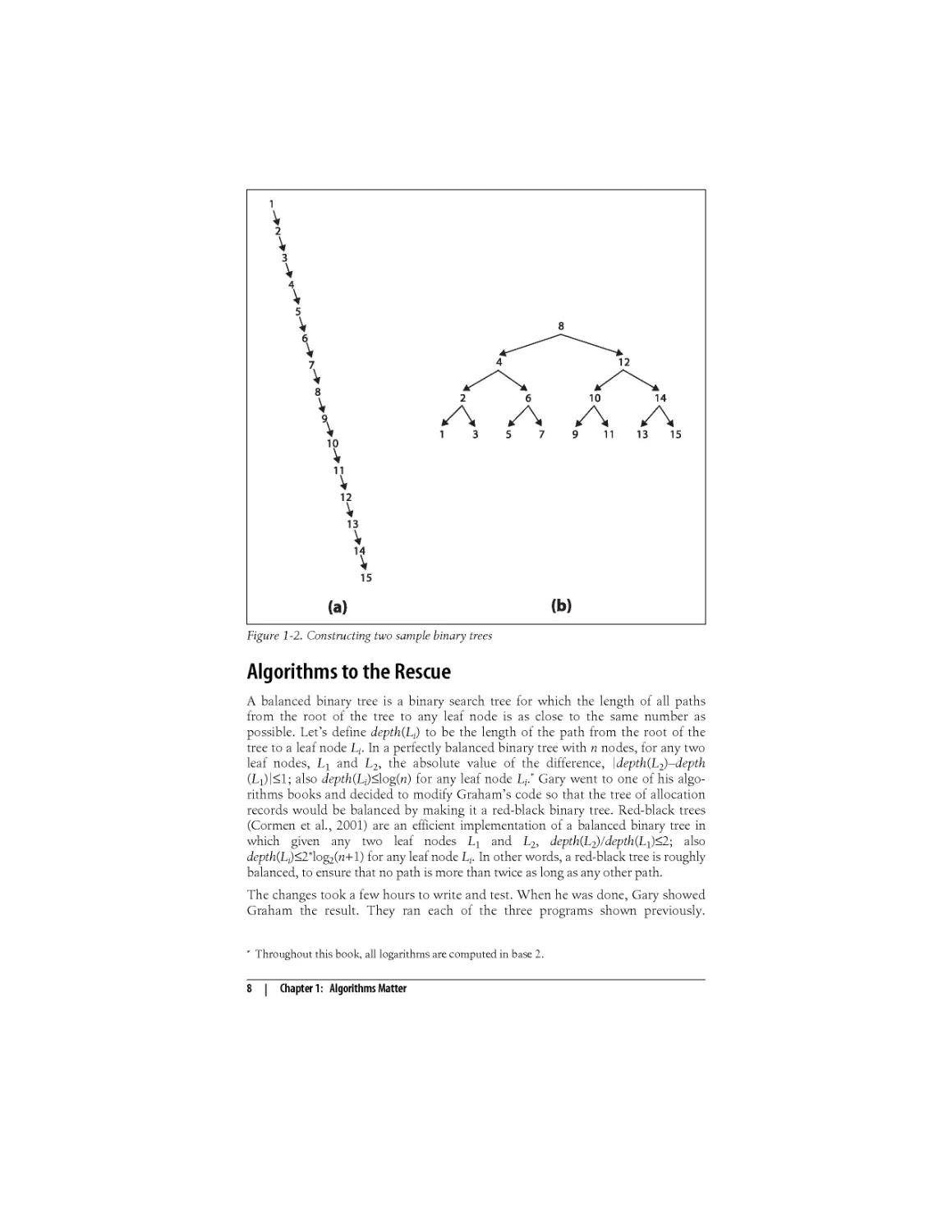
trees. To see why, consider the two binary trees in Figure 1 2. The (a) tree was
created by inserting the numbers 1–15 in order. Its root node contains the value 1
and there is a path of 14 nodes to reach the node containing the value 15. The (b)
tree was created by inserting these same numbers in the order <8, 4, 12, 2, 6, 10,
14, 1, 3, 5, 7, 9, 11, 13, 15>. In this case, the root node contains the value 8 but
the paths to all other nodes in the tree are three nodes or less. As we will see in
Chapter 5, the search time is directly affected by the length of the maximum path.
* Chapter 2 contains information about this “big O” notation.
8 | Chapter 1: Algorithms Matter
Algorithms to the Rescue
A balanced binary tree is a binary search tree for which the length of all paths
from the root of the tree to any leaf node is as close to the same number as
possible. Let’s define depth(Li) to be the length of the path from the root of the
tree to a leaf node Li. In a perfectly balanced binary tree with n nodes, for any two
leaf nodes, L1 and L2, the absolute value of the difference, |depth(L2)–depth
(L1)|≤1; also depth(Li)≤log(n) for any leaf node Li.
*
Gary went to one of his algo
rithms books and decided to modify Graham’s code so that the tree of allocation
records would be balanced by making it a red black binary tree. Red black trees
(Cormen et al., 2001) are an efficient implementation of a balanced binary tree in
which given any two leaf nodes L1 and L2, depth(L2)/depth(L1)≤2; also
depth(Li)≤2*log2(n+1) for any leaf node Li. In other words, a red black tree is roughly
balanced, to ensure that no path is more than twice as long as any other path.
The changes took a few hours to write and test. When he was done, Gary showed
Graham the result. They ran each of the three programs shown previously.
Figure 1 2. Constructing two sample binary trees
* Throughout this book, all logarithms are computed in base 2.
Side Story | 9
AlgorithmsMatter
ProgramA and ProgramC took just a few milliseconds longer than ProgramB. The
performance improvement reflected approximately a 5,000 fold speedup. This is
what might be expected when you consider that the average number of nodes to
visit drops from 500,000 to 20. Actually, this is an order of magnitude off: you
might expect a 25,000 fold speedup, but that is offset by the computation over
head of balancing the tree. Still, the results are dramatic, and Graham’s memory
leak detector could be released (with Gary’s modifications) in the next version of
the product.
Side Story
Given the efficiency of using red black binary trees, is it possible that the malloc()
implementation itself is coded to use them? After all, the memory allocation func
tionality must somehow maintain the set of allocated regions so they can be safely
deallocated. Also, note that each of the programs listed previously make alloca
tion requests for 32 bytes. Does the size of the request affect the performance of
malloc() and free() requests? To investigate the behavior of malloc(), we ran a
set of experiments. First, we timed how long it took to allocate 4,096 chunks of n
bytes, with n ranging from 1 to 2,048. Then, we timed how long it took to deallo
cate the same memory using three strategies:
freeUp
In the order in which it was allocated; this is identical to ProgramC
freeDown
In the reverse order in which it was allocated
freeScattered
In a scattered order that ultimately frees all memory
For each value of n we ran the experiment 100 times and discarded the best and
worst performing runs. Figure 1 3 contains the average results of the remaining 98
trials. As one might expect, the performance of the allocation follows a linear
trend—as the size of n increases, so does the performance, proportional to n.
Surprisingly, the way in which the memory is deallocated changes the perfor
mance. freeUp has the best performance, for example, while freeDown executes
about four times as slowly.
The empirical evidence does not answer whether malloc() and free() use binary
trees (balanced or not!) to store information; without inspecting the source for
free(), there is no easy explanation for the different performance based upon the
order in which the memory is deallocated.
Showing this example serves two purposes. First, the algorithm(s) behind memory
allocation and deallocation are surprisingly complex, often highly tuned based
upon the specific capabilities of the operating system (in this case a high end
computer). As we will learn throughout this book, various algorithms have “sweet
spots” in which their performance has no equal and designers can take advantage
of specific information about a problem to improve performance. Second, we also
describe throughout the book different algorithms and explain why one algo
rithm outperforms another. We return again and again to empirically support
these mathematical claims.
10 | Chapter 1: Algorithms Matter
The Moral of the Story
The previous story really happened. Algorithms do matter. You might ask
whether the tree balancing algorithm was the optimal solution for the problem.
That’s a great question, and one that we’ll answer by asking another question:
does it really matter? Finding the right algorithm is like finding the right solution
to any problem. Instead of finding the perfect solution, the algorithm just has to
Figure 1 3. Performance analysis of malloc/free requests
References | 11
AlgorithmsMatter
work well enough. You must balance the cost of the solution against the value it
adds. It’s quite possible that Gary’s implementation could be improved, either by
optimizing his implementation or by using a different algorithm. However, the
performance of the memory leak detection software was more than acceptable for
the intended use, and any additional improvements would have been unproduc
tive overhead.
The ability to choose an acceptable algorithm for your needs is a critical skill that
any good software developer should have. You don’t necessarily have to be able to
perform detailed mathematical analysis on the algorithm, but you must be able to
understand someone else’s analysis. You don’t have to invent new algorithms, but
you do need to understand which algorithms fit the problem at hand. This book
will help you develop these capabilities. When you have them, you’ve added
another tool to your software development toolkit.
References
Cormen, Thomas H., Charles E. Leiserson, Ronald L. Rivest, and Clifford Stein,
Introduction to Algorithms, Second Edition. McGraw Hill, 2001.
12
2The Mathematics of
Algorithms
In choosing an algorithm to solve a problem, you are trying to predict which algo
rithm will be fastest for a particular data set on a particular platform (or family of
platforms). Characterizing the expected computation time of an algorithm is
inherently a mathematical process. In this chapter we present the mathematical
tools behind this prediction of time. Readers will be able to understand the
various mathematical terms throughout this book after reading this chapter.
A common theme throughout this chapter (and indeed throughout the entire
book) is that all assumptions and approximations may be off by a constant, and
ultimately our abstraction will ignore these constants. For all algorithms covered
in this book, the constants are small for virtually all platforms.
Size of a Problem Instance
An instance of a problem is a particular input data set to which a program is
applied. In most problems, the execution time of a program increases with the
size of the encoding of the instance being solved. At the same time, overly
compact representations (possibly using compression techniques) may unneces
sarily slow down the execution of a program. It is surprisingly difficult to define
the optimal way to encode an instance because problems occur in the real world
and must be translated into an appropriate machine representation to be solved
on a computer. Consider the two encodings shown in the upcoming sidebar,
“Instances Are Encoded,” for a number x.
As much as possible, we want to evaluate algorithms by assuming that the
encoding of the problem instance is not the determining factor in whether the
algorithm can be implemented efficiently. Although the encodings are nearly iden
tical in size, they offer different performance on the key operation, which
determines whether x has an even or odd number of 1 bits in its binary
representation.
14 | Chapter 2: The Mathematics of Algorithms
Because we cannot formally define the size of an instance, we assume that an
instance is encoded in some generally accepted, concise manner. For example,
when sorting n numbers, we adopt the general convention that each of the n
numbers fits into a word in the platform, and the size of an instance to be sorted is
n. In case some of the numbers require more than one word—but only a constant,
fixed number of words—our measure of the size of an instance is off by a constant.
So an algorithm that performs a computation using integers stored in 64 bits may
take twice as long as a similar algorithm coded using integers stored in 32 bits.
To store collections of information, most programming languages support arrays,
contiguous regions of memory indexed by an integer i to enable rapid access to
the ith element. An array is one dimensional when each element fits into a word in
the platform (for example, an array of integers, Boolean values, or characters).
Some arrays extend into multiple dimensions, enabling more interesting data
representations, as shown in Figure 2 1. And, as shown in the upcoming sidebar,
“The Effect of Encoding on Performance,” the encoding could affect an algo
rithm’s performance.
Because of the vast differences in programming languages and computer plat
forms on which programs execute, algorithmic researchers accept that they are
unable to compute with pinpoint accuracy the costs involved in using a particular
encoding in an implementation. Therefore, they assert that performance costs that
differ by a multiplicative constant are asymptotically equivalent. Although such a
definition would be impractical for real world situations (who would be satisfied
to learn they must pay a bill that is 1,000 times greater than expected?), it serves
as the universal means by which algorithms are compared. When implementing
an algorithm as production code, attention to the details reflected in the constants
is clearly warranted.
Rate of Growth of Functions
The widely accepted method for describing the behavior of an algorithm is to
represent the rate of growth of its execution time as a function of the size of the
input problem instance. Characterizing an algorithm’s performance in this way is
an abstraction that ignores details. To use this measure properly requires an
awareness of the details hidden by the abstraction.
Every program is run on a platform, which is a general term meant to encompass:
The computer on which the program is run, its CPU, data cache, floating
point unit (FPU), and other on chip features
The programming language in which the program is written, along with the
compiler/interpreter and optimization settings for generated code
The operating system
Other processes being run in the background
One underlying assumption is that changing any of the parameters comprising a
platform will change the execution time of the program by a constant factor. To
place this discussion in context, we briefly discuss the SEQUENTIAL SEARCH algo
rithm, presented later in Chapter 5. SEQUENTIAL SEARCH examines a list of n≥1
Rate of Growth of Functions | 15
TheMathofAlgorithms
distinct elements, one at a time, until a desired value, v, is found. For now,
assume that:
There are n distinct elements in the list
The element being sought, v, is in the list
Each element in the list is equally likely to be the value v
To understand the performance of SEQUENTIAL SEARCH, we must know how
many elements it examines “on average.” Since v is known to be in the list and
each element is equally likely to be v, the average number of examined elements,
E(n), is the sum of the number of elements examined for each of the n values
divided by n. Mathematically:
The Effect of Encoding on Performance
Assume a program stored information about the periodic table of elements.
Three questions that frequently occur are a)“What is the atomic weight of
element number N?”, b)“What is the atomic number of the element named X?”,
and c)“What is the name of element number N?”. One interesting challenge for
this problem is that as of January 2008, element 117 had not yet been discov
ered, although element 118, Ununoctium, had been.
Encoding 1 of periodic table: store two arrays, elementName[], whose ith value
stores the name of the element with atomic number i, and elementWeight[],
whose ith value stores the weight of the element.
Encoding 2 of periodic table: store a string of 2,626 characters representing the
entire table. The first 62 characters are:
1 H Hydrogen 1.00794
2 He Helium 4.002602
3 Li Lithium 6.941
The following table shows the results of 32 trials of 100,000 random query invoca
tions (including invalid ones). We discard the best and worst results, leaving 30
trials whose average execution time (and standard deviation) are shown in
milliseconds:
Weight
Number
Name
Enc1 2.1±5.45
131.73±8.83
2.63±5.99
Enc2 635.07±41.19 1050.43±75.60 664.13±45.90
As expected, Encoding 2 offers worse performance because each query involves
using string manipulaton operations. Encoding 1 can efficiently process weight and
name queries but number queries require an unordered search through the table.
This example shows how different encodings result in vast differences in execu
tion times. It also shows that designers must choose the operations they would
like to optimize.
En
()1
n
i
i1
=
n
∑nn1
+
()
2n
1
2
n
1
2
+
==
=
16 | Chapter 2: The Mathematics of Algorithms
Thus, SEQUENTIAL SEARCH examines about half of the elements in a list of n
distinct elements subject to these assumptions. If the number of elements in the
list doubles, then SEQUENTIAL SEARCH should examine about twice as many
elements; the expected number of probes is a linear function of n. That is, the
expected number of probes is linear or “about” c*n for some constant c. Here,
c=1/2. A fundamental insight of performance analysis is that the constant c is
unimportant in the long run, since the most important cost factor is the size of the
problem instance, n. As n gets larger and larger, the error in claiming that:
becomes less significant. In fact, the ratio between the two sides of this approxi
mation approaches 1. That is:
although the error in the estimation is significant for small values of n. In this
context we say that the rate of growth of the expected number of elements that
SEQUENTIAL SEARCH examines is linear. That is, we ignore the constant multi
plier and are concerned only when the size of an instance is large.
When using the abstraction of the rate of growth to choose between algorithms,
we must be aware of the following assumptions:
Constants matter
That’s why we use supercomputers and upgrade our computers on a regular
basis.
The size of n is not always large
We will see in Chapter 4 that the rate of growth of the execution time of
QUICKSORT is less than the rate of growth of the execution time of INSER
TION SORT. Yet INSERTION SORT outperforms QUICKSORT for small arrays
on the same platform.
An algorithm’s rate of growth determines how it will perform on increasingly
larger problem instances. Let’s apply this underlying principle to a more complex
example.
Consider evaluating four sorting algorithms for a specific sorting task. The
following performance data was generated by sorting a block of n random strings.
For string blocks of size n=1–512, 50 trials were run. The best and worst perfor
mances were discarded, and the chart in Figure 2 2 shows the average running
time (in microseconds) of the remaining 48 results. The variance between the runs
is surprising.
One way to interpret these results is to try to design a function that will predict
the performance of each algorithm on a problem instance of size n. Since it is
unlikely that we will be able to guess such a function, we use commercially
available software to compute a trend line with a statistical process known as
1
2
n
1
2
n
1
2
+
≈
1
2
n
1
2
n
1
2
+
n
∞
→
lim
1
=
Rate of Growth of Functions | 17
TheMathofAlgorithms
regression analysis. The “fitness” of a trend line to the actual data is based on a
value between 0 and 1, known as the R2 value. Values near 1 indicate a high
fitness. For example, if R2 = 0.9948, there is only a 0.52% chance that the fitness
of the trend line is due to random variations in the data.
SORT 4 is clearly the worst performing of these sort algorithms. Given the 512
data points as plotted in a spreadsheet, the trend line to which the data conforms
is:
y = 0.0053*n2
–0.3601*n+39.212
R2 = 0.9948
Figure 2 2. Comparing four sort algorithms on small data sets
18 | Chapter 2: The Mathematics of Algorithms
Having an R2 confidence value so close to 1 declares this is an accurate estimate.
SORT 2 offers the fastest implementation over the given range of points. Its
behavior is characterized by the following trend line equation:
y = 0.05765*n*log(n)+7.9653
SORT 2 marginally outperforms SORT 3 initially, and its ultimate behavior is
perhaps 10% faster than SORT 3. SORT 1 shows two distinct behavioral patterns.
For blocks of 39 or fewer strings, the behavior is characterized by:
y = 0.0016*n2+0.2939*n+3.1838
R2 = 0.9761
However, with 40 or more strings, the behavior is characterized by:
y = 0.0798*n*log(n)+142.7818
The numeric coefficients in these equations are entirely dependent upon the plat
form on which these implementations execute. As described earlier, such
incidental differences are not important. The long term trend as n increases domi
nates the computation of these behaviors. Indeed, Figure 2 2 graphs the behavior
using two different ranges to show that the real behavior for an algorithm may not
be apparent until n gets large enough.
Algorithm designers seek to understand the behavioral differences that exist
between algorithms. The source code for these algorithms is available from open
source repositories, and it is instructive to see the impact of these designers’
choices on the overall execution. SORT 1 reflects the performance of qsort on
Linux 2.6.9. When reviewing the source code (which can be found through any of
the available Linux code repositories*), one discovers the following comment:
“Qsort routine from Bentley & McIlroy’s Engineering a Sort Function.” Bentley
and McIlroy (1993) describe how to optimize QUICKSORT by varying the strategy
for problem sizes less than 7, between 8 and 39, and for 40 and higher. It is satis
fying to see that the empirical results presented here confirm the underlying
implementation.
Analysis in the Best, Average, and Worst Cases
One question to ask is whether the results of the previous section will be true for
all input problem instances. Perhaps SORT 2 is only successful in sorting a small
number of strings. There are many ways the input could change:
There could be 1,000,000 strings. How does an algorithm scale to large input?
The data could be partially sorted, meaning that almost all elements are not
that far from where they should be in the final sorted list.
The input could contain duplicate values.
Regardless of the size n of the input set, the elements could be drawn from a
much smaller set and contain a significant number of duplicate values.
* http://lxr.linux.no/linux+v2.6.11/fs/xfs/support/qsort.c
Analysis in the Best, Average, and Worst Cases | 19
TheMathofAlgorithms
Although SORT 4 from Figure 2 2 was the slowest of the four algorithms for
sorting n random strings, it turns out to be the fastest when the data is already
sorted. This advantage rapidly fades away, however, with just 16 random items
out of position, as shown in Figure 2 3.
However, suppose an input array with n strings is “nearly sorted”—that is, n/4 of
the strings (25% of them) are swapped with another position just four locations
away. It may come as a surprise to see in Figure 2 4 that SORT 4 outperforms the
others.
The conclusion to draw is that for many problems, no single optimal algorithm
exists. Choosing an algorithm depends on understanding the problem being
solved and the underlying probability distribution of the instances likely to be
treated, as well as the behavior of the algorithms being considered.
Figure 2 3. Comparing sort algorithms on sorted and nearly sorted data
20 | Chapter 2: The Mathematics of Algorithms
To provide some guidance, algorithms are typically presented with three common
cases in mind:
Worst case
Defines a class of input instances for which an algorithm exhibits its worst
runtime behavior. Instead of trying to identify the specific input, algorithm
designers typically describe properties of the input that prevent an algorithm
from running efficiently.
Average case
Defines the expected behavior when executing the algorithm on random
input instances. Informally, while some input problems will require greater
time to complete because of some special cases, the vast majority of input
problems will not. This measure describes the expectation an average user of
the algorithm should have.
Best case
Defines a class of input instances for which an algorithm exhibits its best
runtime behavior. For these input instances, the algorithm does the least
work. In reality, the best case rarely occurs.
By knowing the performance of an algorithm under each of these cases, you can
judge whether an algorithm is appropriate for use in your specific situation.
Figure 2 4. Sort 4 wins on nearly sorted data
Analysis in the Best, Average, and Worst Cases | 21
TheMathofAlgorithms
Worst Case
As n grows, most problems have a greater number of potential instances of size n.
For any particular value of n, the work done by an algorithm or program may vary
dramatically over all the instances of size n. For a given program and a given value
n, the worst case execution time is the maximum execution time, where the
maximum is taken over all instances of size n.
Paying attention to the worst case is a pessimistic view of the world. We are inter
ested in the worst case behavior of an algorithm because of:
The desire for an answer
This often is the easiest analysis of the complexity of an algorithm.
Real time constraints
If you are designing a system to aid a surgeon performing open heart surgery,
it is unacceptable for the program to execute for an unusually long time (even
if such slow behavior doesn’t happen “often”).
More formally, if Sn is the set of instances si of size n, and t measures the work
done by an algorithm on each instance, then work done by an algorithm on Sn in
the worst case is the maximum of t(si) over all si∈Sn. Denoting this worst case
work on Sn by Twc(n), the rate of growth of Twc(n) defines the worst case
complexity of the algorithm.
In general, there are not enough resources to compute each individual instance si
on which to run the algorithm to determine empirically the input problem that
leads to worst case performance. Instead, an adversary tries to craft a worst case
input problem given the description of an algorithm.
Average Case
A telephone system designed to support a large number n of telephones must, in
the worst case, be able to complete all calls where n/2 people pick up their phones
and call the other n/2 people. Although this system will never crash because of
overload, it will be prohibitively expensive to construct. Besides, the probability
that each of n/2 people calls a unique member of the other n/2 people is exceed
ingly small. One could design a system that is cheaper and will very rarely
(possibly never) crash due to overload. But we must resort to mathematical tools
to consider probabilities.
For the set of instances of size n, we associate a probability distribution Pr, which
assigns a probability between 0 and 1 to each instance such that the sum, over all
instances of size n, of the probability of that instance is 1. More formally, if Sn is
the set of instances of size n, then:
Pr si
{}
si Sn
∈
∑
1
=
22 | Chapter 2: The Mathematics of Algorithms
If t measures the work done by an algorithm on each instance, then the average
case work done by an algorithm on Sn is:
That is, the actual work done on instance si, t(si), is weighted with the probability
that si will actually be presented as input. If Pr{si}=0, then the actual value of t(si)
does not impact the expected work done by the program. Denoting this average
case work on Sn by Tac(n), then the rate of growth of Tac(n) defines the average
case complexity of the algorithm.
Recall that when describing the rate of growth of work or time, we consistently
ignore constants. So when we say that SEQUENTIAL SEARCH of n elements takes,
on average:
probes (subject to our earlier assumptions), then by convention we simply say
that subject to these assumptions, we expect SEQUENTIAL SEARCH will examine a
linear number of elements, or order n.
Best Case
Knowing the best case for an algorithm is useful even though the situation rarely
occurs in practice. In many cases, it provides insight into the optimal circum
stance for an algorithm. For example, the best case for SEQUENTIAL SEARCH is
when it searches for a desired value, v, which ends up being the first element in
the list. A slightly different approach, which we’ll call COUNTING SEARCH,
searches for a desired value, v, and counts the number of times that v appears in
the list. If the computed count is zero, then the item was not found, so it returns
false; otherwise, it returns true. Note that COUNTING SEARCH always searches
through the entire list; therefore, even though its worst case behavior is O(n)—the
same as SEQUENTIAL SEARCH—its best case behavior remains O(n), so it is
unable to take advantage of either the best case or average case situations in
which it could have performed better.
Performance Families
We compare algorithms by evaluating their performance on input data of size n.
This methodology is the standard means developed over the past half century for
comparing algorithms. By doing so, we can determine which algorithms scale to
solve problems of a nontrivial size by evaluating the running time needed by the
algorithm in relation to the size of the provided input. A secondary form of perfor
mance evaluation is to consider how much memory or storage an algorithm
needs; we address these concerns within the individual algorithm chapters, as
appropriate.
Tac n
()1
Sn
tsi
()Pr si
{}
si Sn
∈
∑
=
1
2
n
1
2
+
24 | Chapter 2: The Mathematics of Algorithms
In each turn, depending upon the specific answers from the bartender, the size of
the potential range containing the hidden number is cut in about half each time.
Eventually, the range of the hidden number will be limited to just one possible
number; this happens after log (n) turns. The ceiling function x rounds the
number x up to the smallest integer greater than or equal to x. For example, if the
bartender chooses a number between 1 and 10, you could guess it in log (10) =
3.32, or four guesses, as shown in the table.
This same approach works equally well for 1,000,000 numbers. In fact, the
GUESSING algorithm shown in Example 2 1 works for any range [low,high] and
determines the value of n in log (high–low+1) turns. If there are 1,000,000
numbers, this algorithm will locate the number in at most log (1,000,000) =
19.93, or 20 guesses (the worst case).
3
Isit5?
TOO HIGH
Isit2?
TOO LOW
Isit3?
YOU WIN
4
Isit5?
TOO HIGH
Isit2?
TOO LOW
Isit3?
TOOLOW,soitmustbe4
5
Isit5?
YOU WIN
6
Isit5?
TOO LOW
Isit8?
TOO HIGH
Isit6?
YOU WIN
7
Isit5?
TOO LOW
Isit8?
TOO HIGH
Isit6?
TOOLOW,soitmustbe7
8
Isit5?
TOO LOW
Isit8?
YOU WIN
9
Isit5?
TOO LOW
Isit8?
TOO LOW
Isit9?
YOU WIN
10
Isit5?
TOO LOW
Isit8?
TOO LOW
Isit9?
TOO LOW, so it must be 10
Example 2 1. Java code to guess number in range [low,high]
// Compute number of turns when n is guaranteed to be in range [low,high].
public static int turns(int n, int low, int high) {
int turns = 0;
// While more than two potential numbers remain to be checked, continue.
while(high–low ≤2){
// Prepare midpoint of [low,high] as the guess.
turns++;
int mid = (low + high)/2;
if(mid==n){
return turns;
}elseif(mid<n){
low=mid+1;
}else{
high = mid 1;
Table 2 1. Sample behavior for guessing number from 1–10 (continued)
Number
First guess
Second guess
Third guess
Performance Families | 25
TheMathofAlgorithms
Logarithmic algorithms are extremely efficient because they rapidly converge on a
solution. In general, these algorithms succeed because they reduce the size of the
problem by about half each time. The GUESSING algorithm reaches a solution
after at most k=log (n) iterations, and at the ith iteration (i>0), the algorithm
computes a guess that is known to be within ±ε=2k–i from the actual hidden
number. The quantity ε is considered the error, or uncertainty. After each itera
tion of the loop, ε is cut in half.
Another example showing efficient behavior is Newton’s method for computing
the roots of equations in one variable (in other words, for what values of x does
f(x) = 0?). To find when x*sin(x)–5*x=cos(x), set f(x)=x*sin(x)–5*x–cos(x) and its
derivative f’(x)=x*cos(x)+sin(x)–5–sin(x)=x*cos(x)–5. The Newton iteration
computes xn+1=xn–f(xn)/f’(xn). Starting with a “guess” that x is zero, this algo
rithm quickly determines an appropriate solution of x=–0.189302759, as shown
in Table 2 2. The binary and decimal digits enclosed in brackets, [], are the accu
rate digits.
Discussion 2: Sublinear O(nd) Behavior for d<1
In some cases, the behavior of an algorithm is better than linear, yet not as effi
cient as logarithmic. As discussed in Chapter 9, the kd tree in multiple dimensions
can partition a set of n d dimensional points efficiently. If the tree is balanced, the
search time for range queries that conform to the axes of the points is O(n1–1/d).
Discussion 3: Linear Performance
Some problems clearly seem to require more effort to solve than others. Any eight
year old can evaluate 7+5 to get 12. How much harder is the problem 37+45?
}
}
// At this point, only two numbers remain. We guess one, and if it is
// wrong then the other one is the target. Thus only one more turn remains.
return 1 + turns;
}
Table 2 2. Newton’s method
n
xn in decimal
xn in bits (binary digits)
0
0.0
1
–0.2
[1011111111001]0011001100110011001100110…
2
–[0.18]8516717588…
[1011111111001000001]0000101010000110110…
3
–[0.1893]59749489…
[101111111100100000111]10011110000101101…
4
–[0.189]298621848…
[10111111110010000011101]011101111111011…
5
–[0.18930]3058226…
[1011111111001000001110110001]0101001001…
6
–[0.1893027]36274…
[1011111111001000001110110001001]0011100…
7
–[0.189302759]639…
[101111111100100000111011000100101]01001…
Example 2 1. Java code to guess number in range [low,high] (continued)
26 | Chapter 2: The Mathematics of Algorithms
In general, how hard is it to add two n digit numbers an … a1+bn … b1 to result in
a cn+1 … c1 digit value? The primitive operations used in this ADDITION algorithm
are as follows:
A sample Java implementation of ADDITION is shown in Example 2 2, where an
n digit number is represented as an array of int values; for the examples in this
section, it is assumed that each of these values is a decimal digit d such that
0≤d≤9.
As long as the input problem can be stored in memory, add computes the addi
tion of the two numbers as represented by the input integer arrays n1 and n2.
Would this implementation be as efficient as the following last alternative, listed
in Example 2 3?
Example 2 2. Java implementation of add
public static void add (int[] n1, int[] n2, int[] sum) {
int position = n1.length 1;
int carry = 0;
while (position >= 0) {
int total = n1[position] + n2[position] + carry;
sum[position+1] = total % 10;
if(total>9){carry=1;}else{carry=0;}
position ;
}
sum[0] = carry;
}
Example 2 3. Java implementation of last
public static void last(int[] n1, int[] n2, int[] sum) {
int position = n1.length;
int carry = 0;
while ( position >= 0) {
int total = n1[position] + n2[position] + carry;
if(total>9){
sum[position+1] = total 10;
carry = 1;
}else{
sum[position+1] = total;
carry = 0;
}
}
sum[0] = carry;
}
ci
aib
+ i carryi
+
()
mod10
←
carryi 1
+
1if ai bi carryi 10
≥
++
0 otherwise
←
Performance Families | 27
TheMathofAlgorithms
Do these seemingly small implementation details affect the performance of an
algorithm? Let’s consider two other potential factors that can impact the algo
rithm’s performance:
Programming language is one factor. add and last can trivially be converted
into C programs. How does the choice of language affect the algorithm’s
performance?
The programs can be executed on different computers. How does the choice
of computer hardware affect the algorithm’s performance?
The implementations were executed 10,000 times on numbers ranging from 256
digits to 32,768 digits. For each digit size a random number of that size was gener
ated; thereafter, for each of the 10,000 trials, these two numbers were circular
shifted (one left and one right) to create two different numbers to be added. Two
machines were used: a desktop PC and a high end computer, as discussed in
Chapter 10. Two different programming languages were used (C and Java). We
start with the hypothesis that as the problem size doubles, the execution time for
the algorithm doubles as well. We would like to also be reassured that this overall
behavior occurs regardless of the machine, programming language, or implemen
tation variation used.
Figure 2 5 contains a graph plotting problem size (shown on the X axis) against
the execution time (in milliseconds) to compute 10,000 executions (shown on the
Y axis). Each variation was executed on a set of configurations:
g
C version was compiled with debugging information included.
none
C version was compiled without any specific optimization.
O1, O2, O3
C version was compiled under these different optimization levels. In general,
increasing numbers imply better optimization and thus better expected
performance.
Java
Java version of algorithms.
PC Java
This is the only configuration executed on a PC; the previous ones were all
executed on the high end computer.
Note how each of the computed lines for the graphs on the left side of Figure 2 5
(labeled “Desktop PC”) can be approximated by a fixed linear slope, thus
supporting the view that there is a linear relationship between the X and Y values.
The computations using optimized code on the high end computer cannot so
simply be classified as linear, suggesting that the advanced processor has a signifi
cant impact.
Table 2 3 contains a subset of the charted data in numeric form. The code
provided with this book generates this information as needed. The seventh and
final column in Table 2 3 directly compares the performance times of the
28 | Chapter 2: The Mathematics of Algorithms
HighEnd C Last O3 implementation,* as listed in the sixth column. The ratio of
the performance times is nearly two, as expected. Define t(n) to be the actual
running time of the ADDITION algorithm on an input of size n. This growth
Figure 2 5. Comparing add and last in different scenarios
* That is, the C implementation of last when compiled using –O3 optimization level and executed
on the high end computer, as described in the appendix, which covers benchmarking.
Performance Families | 29
TheMathofAlgorithms
pattern provides empirical evidence that the time in milliseconds to compute last
for two n digit numbers on the high end computer using the C implementation
with optimization level –O3 will be between n/11 and n/29.
Computer scientists would classify the ADDITION algorithm as being linear with
respect to its input size n. That is, there is some constant c>0 such that t(n)≤c*n
for all n>n0. We don’t actually need to know the full details of the c or n0 value,
just that they exist. An argument can be made to establish a linear time lower
bound on the complexity of addition by showing that every digit must be exam
ined (consider the consequences of not probing one of the digits).
For the last implementation of ADDITION, we can set c to 1/11 and choose n0 to
be 256. Other implementations of ADDITION would have different constants, yet
their overall behavior would still be linear. This result may seem surprising given
that most programmers assume that integer arithmetic is a constant time opera
tion; however, constant time addition is achievable only when the integer
representation (such as 16 bit or 64 bit) uses a fixed integer size n.
When considering differences in algorithms, the constant c is not as important as
knowing the order of the algorithm. Seemingly inconsequential differences
resulted in different performance. The last implementation of ADDITION is
markedly more efficient after eliminating the modulo operator (%), which is noto
riously slow when used with values that are not powers of 2. In this case, “% 10”
is just not efficient since a division by 10 must occur, which is a costly operation
on binary computers. This is not to say that we ignore the value of c. Certainly if
we execute ADDITION a large number of times, even small changes to the actual
value of c can have a large impact on the performance of a program.
Table 2 3. Time (in milliseconds) to execute 10,000 add/last invocations on random digits
of size n
n
PC
Java Add
HighEnd
Java Add
HighEnd
C Add none
HighEnd
CAddO3
HighEnd
C Last O3
Ratio of last
column by
size
256
60
174
34
11
9
512
110
36
70
22
22
2.44
1,024
220
124
139
43
43
1.95
2,048
450
250
275
87
88
2.05
4,096
921
500
550
174
180
2.05
8,192
1,861
667
1,611
696
688
3.82
16,384
3,704
1,268
3,230
1,411
1,390
2.02
32,768
7,430
2,227
4,790
1,555
1,722
1.24
65,536
17,453
2,902
9,798
3,101
3,508
2.04
131,072
35,860
12,870
20,302
7,173
7,899
2.25
262,144
68,531
22,768
41,800
14,787
16,479
2.09
524,288
175,015
31,148
82,454
29,012
32,876
2
1,048,576
505,531
64,192
162,955
55,173
63,569
1.93
30 | Chapter 2: The Mathematics of Algorithms
Discussion 4: n log n Performance
A common behavior in efficient algorithms is best described by this performance
family. To explain how this behavior occurs in practice, let’s define t(n) to repre
sent the time that an algorithm takes to solve an input problem instance of size n.
An efficient way to solve a problem is the “divide and conquer” method, in
which a problem of size n is divided into (roughly equal) subproblems of size n/2,
which are solved recursively, and their solutions merged together in some form
to result in the solution to the original problem of size n. Mathematically, this
can be stated as:
t(n)=2*t(n/2)+O(n)
That is, t(n) includes the cost of the two subproblems together with no more than a
linear time cost to merge the results. Now, on the right side of the equation, t(n/2) is
the time to solve a problem of size n/2; using the same logic, this can be represented
as:
t(n/2)=2*t(n/4)+O(n/2)
and so the original equation is now:
t(n)=2*[2*t(n/4)+O(n/2)]+O(n)
If we expand this out once more, we see that:
t(n)=2*[2*[2*t(n/8)+O(n/4)]+O(n/2)]+O(n)
This last equation reduces to t(n)=8*t(n/8)+O(3*n). In general, then, we can say
that t(n)=2k*t(n/2k)+O(k*n). This expansion ends when 2k=n, that is, when
k=log(n). In the final base case when the problem size is 1, the performance t(1) is
a constant c. Thus we can see that the closed form formula for
t(n)=n*c+O(n*log(n)). Since n*log(n) is asymptotically greater than c*n for any
fixed constant c, t(n) can be simply written as O(n log n).
Discussion 5a: Quadratic Performance
Now consider a similar problem where two integers of size n are multiplied
together. Example 2 4 shows an implementation of MULTIPLICATION,a
n
elementary school algorithm.
Example 2 4. mult implementation of Multiplication in Java
public static void mult(int[] n1, int[] n2, int[] result) {
int pos = result.length 1;
// clear all values....
for (int i = 0; i < result.length; i++) { result[i] = 0; }
for (int m = n1.length 1; m>=0; m ) {
int off = n1.length 1 m;
for (int n = n2.length 1; n>=0; n ,off++) {
int prod = n1[m]*n2[n];
Performance Families | 31
TheMathofAlgorithms
Once again, an alternative program is written, alt, which eliminates the need for
the costly modulo operator, and skips the innermost computations when n1[m] is
zero (note that alt is not shown here, but can be found in the provided code
repository). The alt variation contains 203 lines of generated Java code to remove
the two modulo operators. Does this variation show cost savings that validate the
extra maintenance and development cost in managing this generated code?
Table 2 4 shows the behavior of these implementations of MULTIPLICATION
using the same random input set used when demonstrating ADDITION. Figure 2 6
graphically depicts the performance, showing the parabolic growth curve that is
the trademark of quadratic behavior.
Even though the alt variation is roughly 40% faster, both alt and mult exhibit the
same asymptotic performance. The ratio of mult2n/multn is roughly 4, which
demonstrates that the performance of MULTIPLICATION is quadratic. Let’s define
t(n) to be the actual running time of the MULTIPLICATION algorithm on an input
of size n. By this definition, there must be some constant c>0 such that t(n)≤c*n2
for all n>n0. We don’t actually need to know the full details of the c and n0 values,
just that they exist. For the mult implementation of MULTIPLICATION on our
platform, we can set c to 1.2 and choose n0 to be 64.
Once again, individual variations in implementation are unable to “break” the
inherent quadratic performance behavior of an algorithm. However, other algo
rithms exist (Zuras, 1994) to multiply a pair of n digit numbers that are
significantly faster than quadratic. These algorithms are important for applica
tions such as data encryption, in which one frequently multiplies large integers.
// compute partial total by carrying previous digit's position
result[pos off] += prod % 10;
result[pos off 1] += result[pos off]/10 + prod/10;
result[pos off] %= 10;
}
}
}
Table 2 4. Time (in milliseconds) to execute 10,000 multiplications
n
Multn (ms)
altn(ms)
mult2n/multn
21
50
41
51
51
8
62
15
4.13
16
297
218
4.80
32
1,187
734
4.00
64
4,516
3,953
3.80
128
19,530
11,765
4.32
256
69,828
42,844
3.58
512
273,874
176,203
3.92
Example 2 4. mult implementation of Multiplication in Java (continued)
32 | Chapter 2: The Mathematics of Algorithms
Discussion 5b: Less Obvious Performance Computations
In most cases, reading the description of an algorithm (as shown in ADDITION
and MULTIPLICATION) is sufficient to classify an algorithm as being linear or
quadratic. The primary indicator for quadratic, for example, is a nested loop struc
ture. Some algorithms defy such straightforward analysis, however. Consider the
GCD algorithm in Example 2 5, designed by Euclid to compute the greatest
common divisor between two integers stored using arrays of digits.
Figure 2 6. Comparison of mult versus alt
Example 2 5. Euclid’s GCD algorithm
public static void gcd (int a[], int b[], int gcd[]) {
if (isZero(a)) { assign (gcd, a); return; }
if (isZero(b)) { assign (gcd, b); return; }
// ensure a and b are not modified
a = copy (a);
b = copy (b);
while (!isZero(b)) {
// last argument to subtract represents sign of result which
// we can ignore since we only subtract smaller from larger.
if (compareTo(a, b) > 0) {
subtract (a, b, gcd, new int[1]);
assign (a, gcd);
}else{
subtract (b, a, gcd, new int[1]);
assign (b, gcd);
34 | Chapter 2: The Mathematics of Algorithms
MODGCD will arrive at a solution more rapidly because it won’t waste time
subtracting really small numbers from large numbers within the while loop. This
difference is not simply an implementation detail; it reflects a fundamental shift in
how the algorithm approaches the problem.
The computations shown in Figure 2 7 (and enumerated in Table 2 5) show the
result of generating 142 random n digit numbers and computing the greatest
common divisor of all 10,011 pairs of these numbers.
while (!isZero(b)) {
int[]t=copy(b);
divide (a, b, quot, remainder);
assign (b, remainder);
assign (a, t);
}
// value held in a is the computed gcd of (a,b).
assign (gcd, a);
}
Figure 2 7. Comparison of gcd versus modgcd
Table 2 5. Time (in milliseconds) to execute 10,011 gcd computations
n
modgcd
gcd
n2/modgcd
n2/gcd
modgcd2n/
modgcdn
gcd2n/gcdn
2
234
62
0.017
0.065
4
391
250
0.041
0.064
1.67
4.03
8
1,046
1,984
0.061
0.032
2.68
7.94
Example 2 6. ModGCD algorithm for GCD computation (continued)
Mix of Operations | 35
TheMathofAlgorithms
Even though the MODGCD implementation outperforms the corresponding GCD
implementation by nearly 60%, the performance of MODGCD is quadratic,or
O(n2), whereas GCD is exponential. That is, the worst case performance of GCD
(not exhibited in this small input set) is orders of magnitude slower than the
worst case performance of MODGCD.
More sophisticated algorithms for computing GCD have been designed—though
most are impractical except for extremely large integers—and analysis suggests
that the problem allows for more efficient algorithms.
Mix of Operations
As described earlier in the sidebar “The Effect of Encoding on Performance,” a
designer will have to consider multiple operations simultaneously. Not every
operation can be optimized; in fact, optimizing one operation may degrade the
execution of another operation. As an example, consider a data structure that
contains operations op1 and op2. Assume that there are two different ways by
which the data structure can be implemented, A and B. For the purposes of this
discussion, it is not important to know anything about the data structure or the
individual methods. We construct two scenarios:
Small data sets
On a base size of n=1,000 elements, mix together 2,000 op1 operations with
3,000 op2 operations.
Large data sets
On a base size of n=100,000 elements, mix together 200,000 op1 operations
with 300,000 op2 operations.
Table 2 6 contains the expected result of executing implementations A and B on
these two data sets. The first row of the table shows that the average cost of
performing op1 on implementation A with n=1,000 sized data is assumed to be
0.008 milliseconds; the other values in the second and third columns should be
interpreted similarly. The final column reflects the total expected time of execu
tion; thus, for option A on n=1,000 sized data, we expect the time to be
2,000*0.008+3,000*0.001=16+3=19 milliseconds. Although implementation B
initially outperforms the A implementation for small values of n, the situation
changes dramatically when the scale of the problem increases by two orders of
magnitude. Note how alternative A scales well, whereas option B performs
horribly.
16
2,953
6,406
0.087
0.040
2.82
3.23
32
8,812
18,609
0.116
0.055
2.98
2.90
64
29,891
83,921
0.137
0.049
3.39
4.51
128
106,516
321,891
0.154
0.051
3.56
3.84
Table 2 5. Time (in milliseconds) to execute 10,011 gcd computations (continued)
n
modgcd
gcd
n2/modgcd
n2/gcd
modgcd2n/
modgcdn
gcd2n/gcdn
36 | Chapter 2: The Mathematics of Algorithms
Benchmark Operations
The Scheme program in Example 2 7 computes 2n; a sample computation of 2851
is shown.
In Scheme, computations are relatively independent of the underlying platform.
That is, computing 2851 in Java or C on most platforms would cause a numeric
overflow. But a fast computation in Scheme yields the result shown in the
example. Is it an advantage or a disadvantage that the underlying architecture is
hidden from us, abstracted away? Consider the following two hypotheses:
Hypothesis H1
Computing 2n has consistent behavior, regardless of the value of n.
Hypothesis H2
Large numbers (such as shown previously in expanded form) can be treated
in the same way as any other number, such as 123,827 or 997.
To refute hypothesis H1, we conduct 50 trials that performed 10,000 evaluations
of 2n
. We discarded the best and worst performers, leaving 48 trials. The average
time of these 48 trials is shown in Figure 2 8.
There is clearly a linear relationship initially, as an increasing number of multiply
by 2 operations are performed. However, once x reaches about 30, a different
linear relationship takes place. For some reason, the computational performance
alters once powers of 2 greater than about 30 are used.
Table 2 6. Comparing operations from different implementations
Input Size
op1 (ms)
op2 (ms)
# op1
# op2
Total (ms)
A on 1,000
0.008
0.001
2,000
3,000
19
A on 100,000
0.0016
0.003
200,000
300,000
1,220
B on 1,000
0.001
0.001
2,000
3,000
5
B on 100,000
0.1653
0.5619
200,000
300,000
201,630
Example 2 7. Expensive computations
;; TwoToTheN: number > number
(define (TwoToTheN n)
(let loop ([i n]
[result 1])
(if(=i0)
result
(loop (sub1 i) (* 2 result)))))
;; the result of a sample computation
(TwoToTheN 851)
15015033657609400459942315391018513722623519187099007073355798781525263125238463
41589482039716066276169710803836941092523836538133260448652352292181327981032007
94538451818051546732566997782908246399595358358052523086606780893692342385292277
74479195332149248
Benchmark Operations | 37
TheMathofAlgorithms
To refute hypothesis H2, we conduct an experiment that pre computes the value
of 2n and then evaluates the time to compute 3.14159*2
n
. We executed 50 trials
that performed 10,000 evaluations of the equation 3.14159*2
n
. We discarded the
best and worst performers, leaving 48 trials. The average time of these 48 trials is
shown in Figure 2 9 (these results are essentially the same, even if we multiply by
1.0000001 instead of 3.14159).
Figure 2 8. Execution times for computing 2x
Figure 2 9. Execution times for computing large multiplication
38 | Chapter 2: The Mathematics of Algorithms
Why do the points in Figure 2 9 not appear on a straight line? For what value of x
does the line break? The multiplication operation (*) appears to be overloaded. It
does different things depending upon whether the numbers being multiplied are
floating point numbers, or integers that each fit into a single word of the machine,
or integers that are so large that they must each be stored in several words of the
machine, or some combination of these.
The first break in the plot occurs for x={30,31}, which cannot easily be
explained. The remaining plateaus offer more conventional explanations, since
they occur at the values (32, 64, 96, 128), which represent the size of the word on
the computer on which the trials were executed (namely, one, two, three, or four
32 bit words). As the numbers require more and more words of space to be
stored, the time needed to perform multiplication also increases.
A benchmark operation is essential to an algorithm, such that counting execu
tions of the benchmark operation offers a good prediction of the execution time of
a program. The benchmark operation of TwoToTheN is *, the multiplication
operation.
One Final Point
We have simplified the presentation of the “Big O” notation in this book. For
example, when discussing the behavior of the ADDITION algorithm that is linear
with respect to its input size n, we argued that there exists some constant c>0
such that t(n)≤c∗n for all n>n0; recall that t(n) represents the actual running time
of ADDITION. By this reasoning, we claim the performance of ADDITION is O(n).
The careful reader will note that we could just as easily have used a function
f(n)=c*2
n
that grows more rapidly than c*n. Indeed, although it is technically accu
rate to claim that ADDITION is O(2n), such a statement provides very little
information (it would be like saying that you need no more than one week to
perform a five minute task). To explain why, consider the notation (g(n)), which
declares that g(n)≤t(n) is a lower bound for the actual running time. One can often
compute both the upper (O) and lower ( ) bound for the execution time of an
algorithm, in which case the appropriate notation to use is Θ(f(n)), which asserts
that f(n) is asymptotically both an upper bound (as is the case for O(f(n)) and a
lower bound for t(n).
We chose the more informal (and widely accepted use) of O(f(n)) to simplify the
presentations and analyses. We ensure that when discussing algorithmic behavior,
there is no better f’(n) that can be used to classify the algorithms we have identi
fied as O(f(n)).
References
Bentley, Jon Louis and M. Douglas McIlroy, “Engineering a Sort Function,”
Software—Practice and Experience, 23(11): 1249–1265, 1993, http://citeseer.ist.psu.
edu/bentley93engineering.html.
Zuras, D. “More on Squaring and Multiplying Large Integers,” IEEE Transactions
on Computers, 43(8): 899–908, 1994, http://doi.ieeecomputersociety.org/10.1109/
12.295852.
39
3
Patterns and Domains
We build software to solve problems. During the decades since the first
programmed computer printed answers to previously unapproachable prob
lems—such as computing the 400,052,412,247th digit of π—programmers have
written countless programs to solve numerous problems. Programmers spent
hours happily writing code to solve the problem at hand, while at the same time
others also were coding solutions to identical, or very similar, problems. There are
several reasons programmers create unique solutions rather than seeking an
existing solution. One reason, of course, is the tendency to believe that we can
always build a better mousetrap. Programming for many of us has the same
appeal that the game of chess has for chess aficionados. Some reasons are more
important than others when considering why programmers continue to write the
same solutions for problems from scratch:
The programmer doesn’t realize that the problem has already been solved.
We’ll look into this further when we discuss problem domains.
Even if the programmer knows the problem has been solved in similar cases,
it’s not clear that the existing code will actually fit the specific problem fac
ing the programmer.
It’s not easy to find code that really solves the problem at hand or code that
can be easily modified to solve that problem.
Patterns: A Communication Language
In the late 1980s, a few visionary software developers began looking for new ways
to communicate their designs with one another. Some of them happened upon a
work by Christopher Alexander, a professor of architecture at the University of
California, Berkeley, called A Pattern Language: Towns, Buildings, Construction
(1977). In this seminal work, Alexander developed a theory for describing archi
tectural design. In 1987, Kent Beck and Ward Cunningham, two well known
leaders of the object oriented paradigm, introduced the idea of applying design
40 | Chapter 3: Patterns and Domains
patterns to programming at that year’s Conference on Object Oriented Program
ming Systems, Languages, and Applications (OOPSLA). The idea caught on and
people began to think about software design patterns. In 1995, the seminal Gang
of Four (GoF) book, Design Patterns: Elements of Reusable Object Oriented Soft
ware (Gamma et al., 1995) was published, and a frenzy of research activity and
application of patterns began.
As with any good idea, the software industry embraced patterns and their use
became ubiquitous, to the point where everything could be described by a
pattern. Using coding standards was a pattern. Sitting together with a partner to
debug a program was a pattern. Well, you get the idea. Patterns are a great way to
communicate precisely and concisely well formed concepts. We will—at the risk
of applying patterns to yet another area of computer science—use patterns as a
way to communicate the algorithms in this book.
Before describing how we structure the pattern language for the algorithms
herein, let’s look at what a pattern is and why it’s so good. We prefer the
following definition for design patterns:
A design pattern is a proven solution to a commonly occurring problem.
This definition is short and conveys the absolute essence of design patterns. First
and foremost, a design pattern is a solution to a real problem. In fact, it’s a solu
tion to a general set of problems. But, a pattern is not a template where you
simply fill in the blanks. It is an approach, or a plan, for solving a particular class
of problems. Armed with a set of design patterns in your toolbox, you are on your
way to becoming a master craftsman of software design.
We can think of algorithms in different ways. Many practitioners are happy to
look up an algorithm in a book or on some website, copy some code, run it,
maybe even test it, and then move on to the next task. In our opinion, this process
does not improve one’s understanding of algorithms. In fact, this approach can
lead you down the wrong path where you select a specific implementation of an
algorithm. Remember how in Chapter 1 Graham blindly selected a binary tree and
didn’t bother to balance it? That’s what can happen when you just take the first
idea that seems to solve your problem.
So, the question is, how do you locate the right algorithm for the job quickly and
understand it well enough to ensure that you’ve made a good choice? Patterns can
help. Algorithms are, in fact, proven solutions to known problems, so they fit our
definition of a pattern.
The Form of an Algorithm Pattern
Design patterns are typically presented in a stylized manner that makes it easy to
understand and communicate to others. Not all pattern writers or books on
patterns agree on the specific form, but they have many elements in common. We
have adopted a style for presenting algorithms as patterns that we believe will be
effective for the reader. Feel free to recast them to your favorite form if that helps
you get a better understanding of the material.
Algorithm Pattern Format | 41
PatternsandDomains
Each algorithm is presented using a fixed set of sections that conform to our
pattern language. Sometimes a section may be omitted if it adds no value to the
algorithm description. Sometimes we may add another section to the description
to illuminate a particular point.
Algorithm Pattern Format
Each algorithm is presented using the following pattern sections:
Name
A descriptive name for the algorithm. We use this name to communicate
concisely the algorithm to others. For example, if we talk about using a
SEQUENTIAL SEARCH, it conveys exactly what type of search algorithm we
are talking about. The name of each algorithm is always shown in SMALL
CAPS; all words typeset this way in this book refer to an algorithm.
Synopsis
A high level description of the algorithm and what it is designed to do.
Context
A description of a problem that illustrates the “sweet spot” for the algorithm.
Forces
A description of the properties of the problem/solution that must be
addressed and maintained for a successful implementation. They are the
things that would cause you to choose this algorithm specifically.
Solution
The algorithm description using real working code with documentation.
Where appropriate, UML class diagrams are also included.
Consequences
Identifies and discusses the advantages/disadvantages and anti patterns for
this algorithm.
Analysis
A synopsis of the analysis of the algorithm, including performance data as
well as other data that helps the reader understand the behavior of the algo
rithm. Although the analysis section is not meant to “prove” the described
performance of an algorithm, readers should be able to understand why the
algorithm behaves as it does. We will provide references to actual texts that
present the appropriate lemmas and proofs to explain why the algorithms
behave as described.
Related algorithms
Presents either slight variations of the algorithm or different alternatives.
The real power of using such a template for the algorithms is that you can quickly
compare and contrast different algorithms. At the same time, you can identify
commonalities in seemingly different algorithms.
42 | Chapter 3: Patterns and Domains
Pseudocode Pattern Format
Each algorithm in this book is presented with code examples that show an imple
mentation in a major programming language, such as C, C++, Java, Scheme, and
Ruby. For readers who are not familiar with all of these languages, we first intro
duce each algorithm in pseudocode with a small example showing its execution.
Consider the sample fact sheet shown in Figure 3 1. Each algorithm is named, and
its performance is clearly marked for all three behavior cases (best, average, and
worst). The upper right corner of the fact sheet lists a set of concepts used by the
algorithm. This is a place that can be used to rapidly see commonalities among
different algorithms (e.g., “these two algorithms use a priority queue”).
The “glyphs” that appear in this region of the fact sheet are depicted in Figure 3 2.
Some of these concepts relate to the data structure(s) used by the algorithm (e.g.,
“Queue”), while others refer to an overall approach to solving the problem (e.g.,
“Divide and Conquer”).
The pseudocode description is intentionally kept brief and should fill up no more
than 3/4 of a page. Keywords and function names are described in boldface text.
All variables are in lowercase characters, whereas arrays are capitalized and their
elements are referred to using A[i] notation. The indentation in the pseudocode
describes the scope of conditional if statements and looping while and for state
ments. All statements within a function are numbered for reference (if necessary)
in descriptions in the individual chapters.
Figure 3 1. Sequential Search fact sheet
44 | Chapter 3: Patterns and Domains
# (protected)
Declares that the attribute or method is visible to the class or any of its
subclasses; if the underlying implementation is Java, then the attribute or
method is also visible to classes within the same package. Note that in our
C++ implementations, we do not use multiple inheritance or friend classes,
so the semantics are nearly identical.
~ (package private)
Declares that the attribute or method is visible only to classes within the same
package; used only by Java designs.
–
(private)
Declares that the attribute is visible only to the class itself in which the
attribute is defined. We intentionally do not list in the class diagram any
private methods that may exist.
+ (public)
Declares that the attribute or method is visible and accessible to anyone.
Public attributes are, in general, assumed to be “final” as well, implying that
they are constant even within the same class.
Class methods declare their return type (which may be void) and parameter list
(which may be empty). Constructor methods have the same name as the class
within which they are defined. Destructor methods (only in C++) can be identi
fied by the “~” symbol in their name. Naturally the reader may be confused
between a C++ destructor and a Java package private method, since they use the
same symbol. Look to the accompanying text in the algorithm chapters, which
will help differentiate these two situations.
In Java, there is an additional type of relationship between a class and an inter
face that the class implements. For example, SegmentTreeNode implements
IInterval, which means that SegmentTreeNode must complete the implementation
of methods specified only in IInterval. This relationship is depicted in Figure 3 3
by means of a dashed line terminating in an open triangle.
Empirical Evaluation Format
The implementations of the algorithms are all executed with a series of bench
mark problems, appropriate for each individual algorithm. The appendix provides
more detail on the mechanisms used for timing purposes. In general, we execute
all algorithms on two different platforms: a common desktop environment and a
high end Linux cluster. Together these provide a range within which most
systems should exist. To properly evaluate the performance, a test suite is
composed of a set of k individual trials (typically k≥10). The best and worst
performers are discarded as outliers, the remaining k–2 trials are aggregated, and
the average and standard deviations are computed. Tables are shown with
problem size instances ranging from n=2 to 220.
Empirical Evaluation Format | 45
PatternsandDomains
Figure 3 3. Sample UML diagram
46 | Chapter 3: Patterns and Domains
Domains and Algorithms
Domains became popular in the late 1980s when researchers began to explore
how object oriented principles could be used to promote software reuse. In the
context of reuse, domains are application areas that share common traits. Each
domain has its own vocabulary that provides a language to describe the domain.
The language helps design systems and reusable components that are appropriate
for the particular domain. Domain specific languages (DSLs) are used to model
domains to generate domain specific software, rather than construct it manually.
Algorithms, like applications, have domains. These domains are orthogonal to
specific application domains. Algorithm domains provide us with knowledge
about the application domains that are most amenable to certain types of algo
rithms. For example, if one is developing an application to access web services
from a mobile phone, it would be appropriate to use algorithms optimized for
space usage and external storage rather than simply the best overall time
performance.
Algorithm domains are not as well defined as application domains; they are more
general and span several application domains. Algorithm domains map more
closely to standard computer science areas. We see, for example, search and
graph traversal algorithms used frequently in artificial intelligence applications,
whereas numerical algorithms seldom appear in such applications. Database
management systems have their own set of algorithms that appear frequently, as
do most other application domains.
In our algorithm patterns we do not indicate any specific domain set for each
algorithm, since no standard algorithm domain categorization exists. The context
for each algorithm does, however, offer the reader a particular domain where the
algorithm fits well. As one becomes familiar with algorithms and thinking of algo
rithms in terms of patterns, a natural taxonomy that maps application domains to
algorithm domains emerges.
Developing the mapping between algorithm domains and application domains is
an interesting and important research area. Obtaining an appropriate taxonomy
will aid us to develop and generate better software components and applications.
Researchers are applying advanced mathematical analysis to develop the categori
zations (Algorithm Formalization, 2007).
From a practitioner’s viewpoint, algorithm categorization comes from experien
tial tales, or war stories (Skiena, 1998). These informal anecdotes give the
practitioner a more intuitive insight and confidence about when to use a partic
ular type of algorithm. The literature, both academic and industrial, is full of such
war stories about algorithms, and we encourage you to develop your own. Such
an exercise can help you internalize the algorithms and make you a better soft
ware developer. The beauty of algorithms is that the connection between
algorithm domains and applicability is continually expanding. New algorithms are
being developed, but possibly more importantly, new applications for existing
algorithms are being discovered. Thinking of algorithm domains helps you
manage this ever complex relationship.
Floating Point Computations | 47
PatternsandDomains
Floating Point Computations
Computers are finite machines that have been designed to perform basic compu
tations on values stored in registers by a Central Processing Unit (CPU). The size
of these registers has evolved as computer architectures have grown from the
popular 8 bit Intel processors from the 1970s to today’s widespread acceptance of
64 bit architectures (such as Intel’s Itanium and Sun Microsystems Sparc
processor). The CPU often supports basic operations—such as ADD, MULT,
DIVIDE, and SUB—over integer values stored within these registers. Floating
Point Units (FPUs) can efficiently process floating point computations according
to the IEEE Standard for Binary Floating Point Arithmetic (IEEE 754).
Computations over integer based values (such as Booleans, 8 bit shorts, and 16
and 32 bit integers) have traditionally been the most efficient computations
performed by the processor. Efficient programs that execute on computer archi
tectures often take advantage of the performance differential between integer
based and floating point–based arithmetic. There are important issues that
developers must be aware of when programming using floating point arithmetic
(Goldberg, 1991). Next we focus on the important issues that we consider in the
algorithms and supporting code for this book.
Rounding Error
Any computation using floating point values may introduce rounding errors
because of the nature of the floating point representation. In general, a floating
point number is a finite representation that is designed to approximate a real
number whose representation may be infinite. Table 3 1 shows information about
floating point representations and the specific representation for the value 3.88f.
Table 3 1. Floating point representation
Primitive type
Sign
Exponent
Mantissa
Float
1 bit
8 bits
23 bits
Double
1 bit
11 bits
52 bits
Sample Representation of 3.88 as (0x407851ec)
01000000 01111000 01010001 11101100 (total of 32 bits)
s
mmmmmmm mmmmmmmm mmmmmmmm
eeeeeee e
The next three consecutive floating point representations (and values) are:
0x407851ec
0x407851ed
0x407851ee
0x407851ef
3.88
3.8800004
3.8800006
3.8800008
Here are the floating point values for three randomly chosen 32 bit values:
0x1aec9fae
0x622be970
0x18a4775b
9.786529E 23
7.9280355E20
4.2513525E 24
48 | Chapter 3: Patterns and Domains
One bit is used for the sign, 8 bits form the exponent, and 23 bits form the
mantissa (also known as the significand). In the Java float representation, “the
power of two can be determined by interpreting the exponent bits as a positive
number, and then subtracting a bias from the positive number. For a float, the
bias is 126” (Venners, 1996). The exponent stored is 128, so the actual exponent
value is 128–126, or 2.
To achieve the greatest precision, the mantissa is always normalized so that the
leftmost digit is always 1, so it is implied. In the previous example, the mantissa
is .[1]11110000101000111101100 = [1/2] + 1/4 + 1/8 + 1/16 + 1/32 + 1/1,024
+ 1/4,096 + 1/65,536 + 1/131,072 + 1/262,144 + 1/524,288 + 1/2,097,152 +
1/4,194,304, which evaluates exactly to 0.9700000286102294921875 if the full
sum of fractions is carried out.
Thus, when storing 3.88f using this representation, the approximate value is
+1*0.9700000286102294921875*22, which is exactly 3.88000011444091796875.
The error inherent in the value is ~0.0000001. The most common way of
describing floating point error is to use the term relative error, which computes
the ratio of the absolute error with the desired value. Here, the relative error is
0.0000001144091796875/3.88, or 2.9E–8. It is quite common for these relative
errors to be less than 1 part per million.
Comparing Values
Because floating point values are only approximate, even the most simple opera
tions in floating point become suspect. Consider the following statement:
if(x==y){
}
Is it truly the case that these two floating point numbers must be exactly equal?
Or it is sufficient for them to be simply approximately equal (for which we use the
symbol ≅)? Could it ever occur that two values are different though close enough
that they should be considered to be the same? Given three points p0=(a,b),
p1=(c,d) and p2=(e,f) in the Cartesian plane, they define an ordered pair of two
line segments (p0,p1) and (p1,p2). We can use the computation
(c–a)(f–b)–(d–b)(e–a) to determine whether these two line segments are collinear
(i.e., on the same line). If the value of this expression is zero, then the two
segments are collinear. To show how floating point errors can occur in computa
tions in Java, consider the three points in Table 3 2.
Table 3 2. Floating point arithmetic errors
float
double
a=1/3
0.33333334
0.3333333333333333
b=5/3
1.6666666
1.6666666666666667
c=33
33.0
33.0
d=165
165.0
165.0
e=19
19.0
19.0
f=95
95.0
95.0
(c–a)*(f–b) – (d–b)*(e–a)
4.8828125 E–4
–4.547473508864641 E–13
Floating Point Computations | 49
PatternsandDomains
As you can readily determine, these three points are collinear on the line y=5*x.
When computing floating point calculations, however, the errors inherent in
floating point arithmetic affect the computation. Using floats as the values, the
calculation results in 0.00048828125; using doubles, the computed value is actu
ally a very small negative number! Now we could introduce a small value δ to
determine ≅ between two floating point values. Under this scheme, if |a–b|<δ,
then we consider a and b to be equal. However, it may be the case that x≅y and
y≅z, but it might not be the case that x≅z. This breaks the principle of Transitivity
and makes it really challenging to write correct code.
Special Quantities
While all possible 64 bit values could represent valid floating point numbers, the
IEEE standard defines several values that are interpreted as special numbers (and
are often not able to participate in the standard mathematical computations, such
as ADD or MULT), shown in Table 3 3. These values have been designed to make
it easier to recover from common errors, such as divide by zero, square root of a
negative number, overflow of computations, and underflow of computations.
Note that the values of positive zero and negative zero are also included in this
table, even though they can be used in computations.
These special quantities are the result of computations that go outside the accept
able bounds. For example, the quantity positive infinity could result from the Java
computation double x=1/0.0. As an interesting aside, the Java virtual machine
would throw java.lang.ArithmeticException if the statement had instead read
double x=1/0, since this expression computes the integer division of two numbers.
Performance
It is commonly accepted that computations over integer values will be more effi
cient than their floating point counterparts. Table 3 4 lists the computation times
of 10,000,000 operations on our high end performance platform. A 1996 Sparc
Ultra 2 machine generated the values in the third column. As you can see, the
performance of individual operations can vary significantly from one platform to
another.
Table 3 3. Special IEEE 754 quantities
Special quantity
64 bit IEEE 754 representation
Positive infinity
0x7ff0000000000000L
Negative infinity
0xfff0000000000000L
Not a number (NaN)
0x7ff0000000000001L through
0x7fffffffffffffffL and
0xfff0000000000001L through
0xffffffffffffffffL
Negative zero
0x8000000000000000
Positive zero
0x0000000000000000
50 | Chapter 3: Patterns and Domains
Manual Memory Allocation
Most modern programming languages allow the programmer to allocate dynamic
memory from the Heap (as opposed to the Stack) during the execution of a
program. Consider the C program in Example 3 1.
When the program executes, variables that are local to a function (such as argc,
and argv for main) are assigned to locations on the Execution Stack, which stores
the progress of the program execution. Dynamically allocated memory (such as ar1
in main) is instead stored on the Heap, a separate region of memory available for
allocation. The address of the variable determines where the memory can be found.
In the example, one possible assignment of variables (on a Linux i686) is shown in
Table 3 5.
Table 3 4. Performance computations of 10,000,000 operations
Operation
Linux i686
(time in seconds)
Sparc Ultra 2
(time in seconds)
High end computer
(time in seconds)
32 bit integer CMP
0.0337
0.811
0.0553
32 bit integer MUL
0.0421
2.372
0.0723
32 bit float MUL
0.1032
1.236
0.0666
64 bit double MUL
0.1028
1.406
0.0864
32 bit float DIV
0.1814
1.657
0.0768
64 bit double DIV
0.1813
2.172
0.1005
128 bit double MUL
0.2765
36.891
0.2447
32 bit integer DIV
0.2468
3.104
0.3061
32 bit double SQRT
0.2749
3.184
0.2414
Example 3 1. Sample program that allocates memory
#include <stdlib.h>
#include <string.h>
void f(char *inner) {
char temp[11];
strcpy (temp, "algorithms");
int i;
for (i=0; i<11; i++) {
inner[i] = temp[i];
}
}
int main (int argc, char **argv) {
char *ar1 = malloc(132);
char *ar2 = malloc(132);
inti=17,j;
f (ar2);
return 0;
}
Manual Memory Allocation | 51
PatternsandDomains
Note how the address values are all near one another, signifying that they are co
located. The address of *main.ar1 is drawn from the Heap. In the traditional
computational paradigm, the Stack grows “downward” in memory, while the
Heap grows “upward” as shown in Figure 3 4.
The addresses reveal this behavior since the computation proceeds from main( ) to
f( ) and the addresses of the variables steadily decrease. If the Stack grows too
large, a program crashes because the memory for the individual stack frames will
overwrite memory that should be safely protected in the heap. When this cross
over occurs depends upon the hardware platform and the initial memory allocated
for the operating system process.
In Example 3 2, the infinite recursion caused a “Segmentation Fault” at the
393,060th recursive call, after the execution Stack had grown to over 12,577,888
bytes in size.
Table 3 5. Addresses for symbols and variables
f variables
Addresses
main variables Addresses
Global symbols Addresses
f.inner
3221222728
main.argc
3221222796
&f
4195576
f.temp
3221222704
main.argv
3221222784
&main
4195648
f.i
3221222700
main.ar1
3221222776
main.ar2
3221222768
main.i
3221222764
main.j
3221222760
*main.ar1
5246992
*main.ar2
5247136
Figure 3 4. Stack and Heap dynamic behavior
Example 3 2. Code exhibiting infinite recursion
#include <stdio.h>
int f(int n) {
printf (" n %d[%u] \n", n, &n);
return f(n+1);
}
52 | Chapter 3: Patterns and Domains
As a program executes, by calling and returning from functions, the execution
Stack grows and shrinks. All memory stored on the Stack is thus reclaimed auto
matically. However, memory stored in the Heap is under control of the
programmer and will only be released explicitly. In most cases, when a program fails
to release the memory, it may yet continue to function properly (when the program
terminates, the memory that it used is reclaimed by the operating system).
A program can run out of Heap space (although typically this is a sign of a serious
defect) if the Heap grows so large that it risks interfering with the execution Stack.
Consider the program in Example 3 3, which repeatedly generates new allocated
strings in memory.
The malloc invocation requests a fixed set of memory (in bytes) from the
memory allocation system. If there is sufficient Heap space, the address of the
allocated memory is returned to the programmer (otherwise the null address
0x0 is returned). In the example, no attempt is made to release memory, and
after 356,331,411 iterations, the program was manually terminated.
*
Since each
int main (int argc, char **argv) {
return f(0);
}
Example 3 3. Code with memory leak
#include <stdio.h>
#include <string.h>
#include <stdlib.h>
/** Return string "abcdef" as "fabcde". */
char *cycle (char *s) {
int n = strlen(s);
char *u = malloc (n+1);
strncpy (u, s+1, n 1);
u[n 1] = s[0];
u[n] = '\0';
return u;
}
int main (int argc, char **argv) {
char *s = strdup ("ThisStringHas25Characters");
int num=0;
for (;;) {
printf ("%d\n", ++num);
s = cycle(s);
}
}
* Be careful when executing this code on a shared machine, because it will temporarily consume all
CPU and operating system resources until the program eventually terminates.
Example 3 2. Code exhibiting infinite recursion (continued)
54 | Chapter 3: Patterns and Domains
References
Alexander, Christopher, A Pattern Language: Towns, Buildings, Construction.
Oxford University Press, USA, 1977.
“Algorithm Formalization,” Software Engineering Institute, last modified January
11, 2007, http://www.sei.cmu.edu/str/descriptions/algorithm.html, accessed June 9,
2008.
Gamma, Erich, Richard Helm, Ralph Johnson, and John M. Vlissides, Design
Patterns: Elements of Reusable Object Oriented Software. Addison Wesley Profes
sional, 1995.
Goldberg, David, “What Every Computer Scientist Should Know About Floating
Point Arithmetic.” ACM Computing Surveys, March 1991, http://docs.sun.com/
source/806 3568/ncg_goldberg.html.
Skiena, Steve S., The Algorithm Design Manual. Springer, 1998.
Venners, Bill, “Floating Point Arithmetic: Floating Point Support in the Java
Virtual Machine.”
JavaWorld, 1996, http://www.artima.com/underthehood/
floating.html.
II
Chapter 4, Sorting Algorithms
Chapter 5, Searching
Chapter 6, Graph Algorithms
Chapter 7, Path Finding in AI
Chapter 8, Network Flow Algorithms
Chapter 9, Computational Geometry
57
4
Sorting Algorithms
Overview
Given the list of states in Figure 4 1, how fast can you determine whether the state
“Wyoming” is in the list? Perhaps you can answer this question in less than a
second. How long would this task take in a list of 1,000 words? A good guess
would be 100 seconds, since the problem size has increased 100 fold. Now, given
the same list of states, can you determine the number of states whose names end
in the letter s? This task is surprisingly easy because you can quickly see that the
states are sorted in increasing order by their last character. If the list contained
1,000 words ordered similarly, the task would likely require only a few additional
seconds because you can take advantage of the order of words in the list.
Numerous computations and tasks become simple by properly sorting informa
tion in advance. The search for efficient sorting algorithms dominated the early
days of computing. Indeed, much of the early research in algorithms focused on
sorting collections of data that were too large for the computers of the day to store
in memory. Because computers are incredibly more powerful and faster than the
Figure 4 1. List of 10 states
58 | Chapter 4: Sorting Algorithms
computers of 50 years ago, the size of the data sets being processed is now on the
order of terabytes of information. Although you may not be called upon to sort
such huge data sets, you will likely need to sort perhaps tens or hundreds of thou
sands of items. In this chapter, we cover the most important sorting algorithms
and present results from our benchmarks to give specific guidance on which algo
rithm is best suited for your particular problem.
Terminology
A collection of comparable elements A is presented to be sorted; we use the nota
tions A[i] and ai to refer to the ith element of the collection. By convention, the
first element in the collection is considered to be A[0]. For notational conve
nience, we define A[low, low+n) to be the subcollection A[low]…A[low+n–1] of n
elements, whereas A[low,low+n] describes the subcollection A[low]…A[low+n]
of n+1 elements.
To sort a collection, the intent is to order the elements A such that if A[i]<A[j],
then i<j. If there are duplicate elements, then in the resulting ordered collection
these elements must be contiguous; that is, if A[i]=A[j] in a sorted collection, then
there can be no k such that i<k<j and A[i]≠A[k].
The sorted collection A must be a permutation of the elements that originally
formed A. In the algorithms presented here, the sorting is done “in place” for effi
ciency, although one might simply wish to generate a new sorted collection from
an unordered collection.
Representation
The collection may already be stored in the computer’s random access memory
(RAM), but it might simply exist in a file on the filesystem, known as secondary
storage. The collection may be archived in part on tertiary storage, which may
require extra processing time just to locate the information; in addition, the infor
mation may need to be copied to secondary storage before it can be processed.
Examples of tertiary storage include tape libraries and optical jukeboxes.
Information stored in RAM typically takes one of two forms: pointer based or
value based. Assume one wants to sort the strings “eagle,” “cat,” “ant,” “dog,”
and “ball.” Using pointer based storage, shown in Figure 4 2, an array of informa
tion (the contiguous boxes) contains pointers to the actual information (i.e., the
strings in ovals) rather than storing the information itself. Such an approach
enables arbitrarily complex records to be stored and sorted.
Figure 4 2. Sorting using pointer based storage
Overview | 59
SortingAlgorithms
By contrast, value based storage packs a collection of n elements into record
blocks of a fixed size, s (suitable for tertiary or secondary storage). Figure 4 3
shows how to store the same information shown in Figure 4 2 using a contiguous
block of storage containing a set of rows of exactly s=5 bytes each. In this example
the information is shown as strings, but it could be any collection of structured,
record based information. The “¬” character represents the termination of the
string; in this encoding, strings of length s do not have a terminating character.
The information is contiguous and can be viewed as a one dimensional array
B[0,n*s). Note that B[r*s+c] is the cth letter of the rth word (where c≥0 and r≥0);
also, the ith element of the collection (for i≥0) is the subarray B[i*s,(i+1)*s).
Information is written to secondary storage usually as a value based contiguous
collection of bytes. It is possible to store “pointers” of a sort on secondary storage
by using integer values to refer to offset position locations within files on disk.
The algorithms in this chapter can also be written to work with disk based infor
mation simply by implementing swap functions that transpose bytes within the
files on disk; however, the resulting performance will differ because of the
increased input/output costs in accessing secondary storage.
Whether pointer based or value based, a sorting algorithm updates the informa
tion (in both cases, the boxes) so that the entries A[0] … A[n–1] are ordered. For
convenience, in the rest of this chapter we use the A[i] notation to represent the ith
element, even when value based storage is being used.
Comparable Elements
The elements in the collection being compared must admit a total ordering. That
is, for any two elements p and q in a collection, exactly one of the following three
predicates is true: p=q, p<q,orp>q. Commonly sorted primitive types include
integers, floating point values, and characters. When composite elements are
sorted (such as strings of characters) then a lexicographical ordering is imposed
on each individual element of the composite, thus reducing a complex sort into
individual sorts on primitive types. For example, the word “alphabet” is consid
ered to be less than “alternate” but greater than “alligator” by comparing each
individual letter, from left to right, until a word runs out of characters or an indi
vidual character in one word is less than or greater than its partner in the other
word (thus “ant” is less than “anthem”). This question of ordering is far from
simple when considering capitalization (is “A” greater than “a”?), diacritical
marks (is “è” less than “ê”?) and diphthongs (is “æ” less than “a”?). Note that the
powerful Unicode standard (see http://www.unicode.org/versions/latest) uses
Figure 4 3. Sorting using value based storage
60 | Chapter 4: Sorting Algorithms
encodings, such as UTF 16, to represent each individual character using up to
four bytes. The Unicode Consortium (www.unicode.org) has developed a sorting
standard (known as “the collation algorithm”) that handles the wide variety of
ordering rules found in different languages and cultures (Davis and Whistler,
2008).
For the algorithms presented in this chapter we assume the existence of a compar
ator function, called cmp, which compares elements p to q and returns 0 if p=q,a
negative number if p<q, and a positive number if p>q. If the elements are complex
records, the cmp function might only compare a “key” value of the elements. For
example, an airport terminal has video displays showing outbound flights in
ascending order of the destination city or departure time while flight numbers
appear to be unordered.
Stable Sorting
When the comparator function cmp determines that two elements ai and aj in the
original unordered collection are equal, it may be important to maintain their rela
tive ordering in the sorted set; that is, if i<j, then the final location for ai must be
to the left of the final location for aj. Sorting algorithms that guarantee this prop
erty are considered to be stable. For example, the top of Figure 4 4 shows an
original collection A of flight information already sorted by time of flight during
the day (regardless of airline or destination city). If this collection A is sorted using
a comparator function, cmpDestination, that orders flights by destination city, one
possible result is shown on the bottom of Figure 4 4.
Figure 4 4. Stable sort of airport terminal information
Overview | 61
SortingAlgorithms
You will note that all flights that have the same destination city are sorted also by
their scheduled departure time; thus, the sort algorithm exhibited stability on this
collection. An unstable algorithm pays no attention to the relationships between
element locations in the original collection (it might maintain relative ordering,
but it also might not).
Analysis Techniques
When discussing sorting, invariably one must explain for an algorithm its best
case, worst case, and average case performance (as discussed in Chapter 2). The
latter is typically hardest to accurately quantify and relies on advanced mathemat
ical techniques and estimation. Also, it assumes a reasonable understanding of the
likelihood that the input may be partially sorted. Even when an algorithm has
been shown to have a desirable average case cost, its implementation may simply
be impractical. Each sorting algorithm in this chapter is analyzed both by its theo
retic behavior and by its actual behavior in practice.
A fundamental result in computer science is that no algorithm that sorts by
comparing elements can do better than O(n log n) performance in the average or
worst case. We now sketch a proof. Given n items, there are n! permutations of
these elements. Every algorithm that sorts by pairwise comparisons corresponds
to an underlying binary decision tree. The leaves of the tree correspond to an
underlying permutation, and every permutation must have at least one leaf in the
tree. The vertices on a path from the root to a leaf correspond to a sequence of
comparisons. The height of such a tree is the number of comparison nodes in the
longest path from the root to a leaf node; for example, the height of the tree in
Figure 4 5 is 5 since only five comparisons are needed in all cases (although in
four cases only four comparisons are needed).
Construct a binary decision tree where each internal node of the tree represents a
comparison ai≤aj and the leaves of the tree represent one of the n! permutations.
To sort a set of n elements, start at the root and evaluate the statements shown in
each node. Traverse to the left child when the statement is true; otherwise,
traverse to the right child. Figure 4 5 shows a sample decision tree for four
elements.
There are numerous binary decision trees that one could construct. Nonetheless,
we assert that given any such binary decision tree for comparing n elements, we
can compute its minimum height h; that is, there must be some leaf node that
requires h comparison nodes in the tree from the root to that leaf. Consider a
complete binary tree of height h in which all non leaf nodes have both a left and
right child. This tree contains a total of n=2h–1 nodes and height h=log (n+1); if
the tree is not complete, it could be unbalanced in strange ways, but we know that
h≥log (n+1).
*
Any binary decision tree with n! leaf nodes already demonstrates it
has at least n! nodes in total. We need only compute h=log (n!) to determine the
height of any such binary decision tree. We take advantage of the following prop
erties of logarithms: log (a*b)=log (a)+log (b) and log (xy)=y*log (x).
* Recall that if x is not already an integer, the ceiling function x returns the smallest integer not
less than x (e.g., it rounds the value of x to the next higher integer).
62 | Chapter 4: Sorting Algorithms
h=log (n!)=log(n*(n–1)*(n–2)*…*2*1)
h>log(n*(n–1)*(n–2)*…*n/2)
h>log((n/2)n/2)
h>(n/2)*log(n/2)
h>(n/2)*(log(n) –1)
Figure 4 5. Binary decision tree for ordering four elements
Insertion Sort | 63
SortingAlgorithms
Thus h>(n/2)*(log(n)–1). What does this mean? Well, given n elements to be
sorted, there will be at least one path from the root to a leaf of size h, which
means that an algorithm that sorts by comparison requires at least this many
comparisons to sort the n elements. Note that h is computed by a function f(n);
here in particular, f(n)=(1/2)*n*log(n)–n/2, which means that any sorting algo
rithm using comparisons will require on the order of O(n log n) comparisons to
sort. In the later section “Bucket Sort,” we present an alternative sorting algo
rithm that does not rely solely on comparing elements, and can therefore achieve
better performance under specific conditions.
Common Input
For each sorting algorithm, we assume the input resides in memory, either as a
value based contiguous block of memory or an array of pointers that point to the
elements to be sorted. For maximum generality, we assume the existence of a
comparison function cmp(p,q), as described earlier.
Insertion Sort
In the card game Bridge, each player is dealt 13 cards, all face down. One way to
arrange a hand is to pick up the cards one at a time and insert each card into the
hand. The invariant to maintain is that the cards in the hand are always sorted by
suit and then by rank within the same suit. Start by picking up a single card to
form a hand that is (trivially) already sorted. For each card picked up, find the
correct place to insert the card into the hand, thus maintaining the invariant that
the cards in the hand are sorted. When all the cards are placed, the invariant
establishes that the algorithm works. When you hold cards in your hand, it is easy
to insert a card into its proper position because the other cards are just pushed
aside a bit to accept the new card. When the collection is stored in memory,
however, a sorting algorithm must do more work to manually move information,
in order to open up space for an element to be inserted.
The pseudocode in Figure 4 6 describes how INSERTION SORT repeatedly invokes
the insert helper function to ensure that A[0,i] is properly sorted; eventually, i
reaches the rightmost element, sorting A entirely. Figure 4 7 shows how INSER
TION SORT operates on a small, unordered collection A of size n=16. The 15 rows
that follow depict the state of A after each pass. A is sorted “in place” by incre
menting pos=1 up to n–1 and inserting the element A[pos] into its rightful
position in the growing sorted region A[0,pos], demarcated on the right by a bold
vertical line. The elements shaded in gray were shifted to the right to make way
for the inserted element; in total, INSERTION SORT executed 60 transpositions (a
movement of just one place by an element).
Context
Use INSERTION SORT when you have a small number of elements to sort or the
elements in the initial collection are already “nearly sorted.” Determining when
the array is “small enough” varies from one machine to another and by program
ming language. Indeed, even the type of element being compared may be
significant.
Insertion Sort | 65
SortingAlgorithms
Forces
INSERTION SORT need only set aside space for a single element to function prop
erly. For a pointer based representation, this is trivial; for a value based
representation, one need only allocate enough memory to store a value (requiring
a fixed s bytes, as described in the earlier section “Representation”) for the dura
tion of the sort, after which it can be freed. There are no complicated nested loops
to implement, and a generic function can be written to sort many different types
of elements simply through the use of a cmp comparator function. For value based
representations, most language libraries offer a block memory move function to
make the algorithm more efficient.
Solution
When the information is stored using pointers, the C program in Example 4 1
sorts an array ar with items that can be compared using a provided comparison
function, cmp.
When A is represented using value based storage, it is packed into n rows of a
fixed element size of s bytes. Manipulating the values requires a comparison func
tion as well as the means to copy values from one location to another.
Example 4 2 shows a suitable C program that uses memmove to transfer the under
lying bytes efficiently for a set of contiguous entries in A.
Example 4 1. Insertion Sort with pointer based values
void sortPointers (void **ar, int n,
int(*cmp)(const void *,const void *)) {
int j;
for(j=1;j<n;j++){
inti=j1;
void *value = ar[j];
while (i >= 0 && cmp(ar[i], value)> 0) {
ar[i+1] = ar[i];
i;
}
ar[i+1] = value;
}
}
Example 4 2. Insertion Sort using value based information
void sortValues (void *base, int n, int s,
int(*cmp)(const void *, const void *)) {
int j;
void *saved = malloc (s);
for(j=1;j<n;j++){
/* start at end, work backward until smaller element or i < 0. */
inti=j1;
void *value = base + j*s;
while(i>=0&&cmp(base+i*s,value)>0){i ;}
66 | Chapter 4: Sorting Algorithms
Consequences
Given the example in Figure 4 7, INSERTION SORT needed to transpose 60
elements that were already in sorted order. Since there were 15 passes made over
the array, on average four elements were moved during each pass. The optimal
performance occurs when the array is already sorted, and arrays sorted in reverse
order naturally produce the worst performance for INSERTION SORT. If the array
is already “mostly sorted,” INSERTION SORT does well because there is less need
to transpose the elements.
Analysis
In the best case, each of the n items is in its proper place and thus INSERTION
SORT takes linear time, or O(n). This may seem to be a trivial point to raise (how
often are you going to sort a set of already sorted elements?), but it is important
because INSERTION SORT is the only sorting algorithm based on comparisons
discussed in this chapter that has this behavior.
Much real world data is already “partially sorted,” so optimism and realism might
coincide to make INSERTION SORT an effective algorithm for much real world
data. But sadly, if every input permutation is equally likely, then the probability of
having optimal data (every item being in its proper position) is only 1/n!; for
n=10, the odds are already 3.6 million to one. Note that the efficiency of INSER
TION SORT increases when duplicate items are present, since there are fewer
swaps to perform.
Unfortunately, INSERTION SORT suffers from being too conservative for “random
data.” If all n items are distinct and the array is “random” (all permutations of the
data are equally likely), then each item starts on average n/3 positions in the array
from its final resting place.
*
So in the average case and worst case, each of the n
items must be transposed a linear number of positions, and INSERTION SORT will
take quadratic time, or O(n2).
INSERTION SORT operates inefficiently for value based data because of the
amount of memory that must be shifted to make room for a new value.
/* If already in place, no movement needed. Otherwise save value to be
* inserted and move as a LARGE block intervening values. Then insert
* into proper position. */
if (++i == j) continue;
memmove (saved, value, s);
memmove (base+(i+1)*s, base+i*s, s*(j i));
memmove (base+i*s, saved, s);
}
free (saved);
}
* The program numTranspositions in the code repository empirically validates this claim for small
n up to 12; also see Trivedi (2001).
Example 4 2. Insertion Sort using value based information (continued)
Median Sort | 67
SortingAlgorithms
Table 4 1 contains direct comparisons between a naïve implementation of value
based INSERTION SORT and the implementation from Example 4 2. Here 10
random trials of sorting n elements were conducted, and the best and worst
results were discarded. This table shows the average of the remaining eight runs.
Note how the implementation improves by using a block memory move rather
than individual memory swapping. Still, as the array size doubles, the perfor
mance time approximately quadruples, validating the O(n2) behavior of
INSERTION SORT. Even with the bulk move improvement, INSERTION SORT still
remains quadratic since the performance of INSERTION SORT using bulk moves is
a fixed multiplicative constant (nearly 1/7) of the naïve INSERTION SORT. The
problem with INSERTION SORT is that it belongs to a conservative class of algo
rithms (called local transposition sorts) in which each element moves only one
position at a time.
When INSERTION SORT operates over pointer based input, swapping elements is
more efficient; the compiler can even generate optimized code to minimize costly
memory accesses.
Median Sort
Divide and conquer, a common approach in computer science, solves a problem
by dividing it into two independent subproblems, each about half the size of the
original problem. Consider the MEDIAN SORT algorithm (Figure 4 8) that sorts an
array A of n≥1 elements by swapping the median element A[me] with the middle
element of A (lines 2–4), creating a left and right half of the array. MEDIAN SORT
then swaps elements in the left half that are larger than A[mid] with elements in
the right half that are smaller or equal to A[mid] (lines 5–8). This subdivides the
original array into two distinct subarrays of about half the size that each need to
be sorted. Then MEDIAN SORT is recursively applied on each subarray (lines
9–10).
A full example of MEDIAN SORT in action is shown in Figure 4 9, in which each
row corresponds to a recursive invocation of the algorithm. At each step, there are
twice as many problems to solve, but each problem size has been cut in about half.
Table 4 1. Insertion Sort bulk move versus Insertion Sort (in seconds)
n
Insertion Sort bulk
move (Bn)
Naïve Insertion
Sort (Sn)
Ratio B2n/Bn
Ratio S2n/Sn
1,024
0.0055
0.0258
2,048
0.0249
0.0965
4.5273
3.7403
4,096
0.0932
0.3845
3.7430
3.9845
8,192
0.3864
1.305
4.1459
3.3940
16,384
1.3582
3.4932
3.5150
2.6768
32,768
3.4676
12.062
2.5531
3.4530
65,536
15.5357
48.3826
4.4802
4.0112
131,072
106.2702
200.5416
6.8404
4.1449
68 | Chapter 4: Sorting Algorithms
Since the subproblems are independent of each other, the final sorted result is
produced once the recursion ends.
The initial unsorted array is shown in the line labeled 1a, and the selected median
element, A[me], is identified by a gray square. A[me] is swapped (line 1b) with the
midpoint element (shown in the black square), and the larger elements (shown as
the gray squares in line 1b to the left of the midpoint) are swapped with the smaller
or equal elements (shown as gray squares in line 1b to the right of the midpoint) to
produce the divided array in line 1c. In the recursive step, each of the smaller
subarrays is sorted, and the progress (on each subarray) is shown in lines 2a–2c,
3a–3c, and 4a–4c.
Figure 4 8. Median Sort fact sheet
Median Sort | 69
SortingAlgorithms
Context
Implementing MEDIAN SORT depends on efficiently selecting the median element
from an unsorted array. As is typical in computer science, instead of answering
this question, we answer a different question, which ultimately provides us with a
solution to our original question. Imagine someone provided you with a function
p = partition (left, right, pivotIndex), which selects the element A[pivotIndex]
to be a special pivot value that partitions A[left,right] into a first half whose
elements are smaller or equal to pivot and a second half whose elements are larger
or equal to pivot. Note that left≤pivotIndex≤right, and the value p returned is the
location within the subarray A[left,right] where pivot is ultimately stored. A C
implementation of partition is shown in Example 4 3.
Figure 4 9. Median Sort in action on small array
70 | Chapter 4: Sorting Algorithms
How can we use partition to select the median efficiently? First, let’s review the
results of this method, as shown on a sample unsorted array of 16 elements. The
first step is to swap the pivot with the rightmost element. As the loop in partition
executes, the key variables from the implementation are shown in Figure 4 10.
store is the location identified by the circle. Each successive row in Figure 4 10
shows when the loop in partition identifies, from left to right, an element A[idx]
that is smaller than or equal to the pivot (which in this case is the element “06”).
Once there are no more elements smaller than or equal to pivot, the element in the
last computed store is swapped with the rightmost element, thus safely placing
the pivot in place.
After partition(0,15,9) executes and returns the location p=5 of the pivot value,
you can see that A[left,p) are all less than or equal to pivot, whereas A[p+1,right]
Example 4 3. C implementation to partition ar[left,right] around a given pivot
element
/**
* In linear time, group the subarray ar[left, right] around a pivot
* element pivot=ar[pivotIndex] by storing pivot into its proper
* location, store, within the subarray (whose location is returned
* by this function) and ensuring that all ar[left,store) <= pivot and
* all ar[store+1,right] > pivot.
*/
int partition (void **ar, int(*cmp)(const void *,const void *),
int left, int right, int pivotIndex) {
int idx, store;
void *pivot = ar[pivotIndex];
/* move pivot to the end of the array */
void *tmp = ar[right];
ar[right] = ar[pivotIndex];
ar[pivotIndex] = tmp;
/* all values <= pivot are moved to front of array and pivot inserted
* just after them. */
store = left;
for (idx = left; idx < right; idx++) {
if (cmp(ar[idx], pivot) <= 0) {
tmp = ar[idx];
ar[idx] = ar[store];
ar[store] = tmp;
store++;
}
}
tmp = ar[right];
ar[right] = ar[store];
ar[store] = tmp;
return store;
}
Median Sort | 71
SortingAlgorithms
are all greater than or equal to pivot. How has this made any progress in selecting
the median value? Note that p is to the left of the calculated location where the
median will ultimately end up in the sorted list (identified as the blackened array
element labeled “median location”). Therefore, none of the elements to the left of
p can be the median value! We only need to recursively invoke partition (this
time with a different A[pivotIndex] on the right half, A[p+1,right]) until it returns
p=median location.
Note that partition effectively organizes the array into two distinct subarrays
without actually sorting the individual elements. partition returns the index p of
the pivot, and this can be used to identify the kth element recursively in
A[left,right] for any 1≤k≤right–left+1, as follows:
if k=p+1
The selected pivot element is the kth value (recall that array indices start
counting at 0, but k starts counting at 1).
if k<p+1
The kth element of A is the kth element of A[left,p].
if k>p+1
The kth element of A is the (k–p)th element of A[p+1,right].
In Figure 4 10, the goal is to locate the median value of A, or in other words, the
k=8th largest element. Since the invocation of partition returns p=5, we next
recursively search for the second smallest element in A[p+1,right].
Such a definition lends itself to a recursive solution, but it can also be defined iter
atively where a tail recursive function instead can be implemented within a loop
(see the code repository for the example). selectKth is an average case linear time
function that returns the location of the kth element in array ar given a suitable
pivotIndex; its implementation is shown in Example 4 4.
Figure 4 10. partition(0, 15, 9) returns 5 and updates A accordingly
72 | Chapter 4: Sorting Algorithms
The selectKth function must select a pivotIndex for A[left,right] to use during the
recursion. Many strategies exist, including:
Select the first location (left) or the last location (right).
Select a random location (left≤random≤right).
If the pivotIndex repeatedly is chosen poorly, then selectKth degrades in the worst
case to O(n2); however, its best and average case performance is linear, or O(n).
Forces
Because of the specific tail recursive structure of selectKth, a nonrecursive imple
mentation is straightforward.
Solution
Now connecting this discussion back to MEDIAN SORT, you might be surprised
to note that selectKth works regardless of the pivotIndex value selected! In addi
tion, when selectKth returns, there is no need to perform lines 5–8 (in Figure 4 8)
of the MEDIAN SORT algorithm, because partition has already done this work.
That is, the elements in the left half are all smaller or equal to the median,
whereas the elements in the right half are all greater or equal to the median.
The MEDIAN SORT function is shown in Example 4 5 and is invoked on A[0,n–1].
Example 4 4. selectKth recursive implementation in C
/**
* Average case linear time recursive algorithm to find position of kth
* element in ar, which is modified as this computation proceeds.
* Note 1 <= k <= right left+1. The comparison function, cmp, is
* needed to properly compare elements. Worst case is quadratic, O(n^2).
*/
int selectKth (void **ar, int(*cmp)(const void *,const void *),
int k, int left, int right) {
int idx = selectPivotIndex (ar, left, right);
int pivotIndex = partition (ar, cmp, left, right, idx);
if (left+k 1 == pivotIndex) { return pivotIndex; }
/* continue the loop, narrowing the range as appropriate. If we are within
* the left hand side of the pivot then k can stay the same. */
if (left+k 1 < pivotIndex) {
return selectKth (ar, cmp, k, left, pivotIndex 1);
}else{
return selectKth (ar, cmp, k (pivotIndex left+1), pivotIndex+1, right);
}
}
Example 4 5. Median Sort implementation in C
/**
* Sort array ar[left,right] using medianSort method.
* The comparison function, cmp, is needed to properly compare elements.
*/
Median Sort | 73
SortingAlgorithms
Consequences
MEDIAN SORT does more work than it should. Although the generated subprob
lems are optimal (since they are both about half the size of the original problem),
the extra cost in producing these subproblems adds up. As we will see in the
upcoming section on “Quicksort,” it is sufficient to select pivotIndex randomly,
which should avoid degenerate cases (which might happen if the original array is
already mostly sorted).
Analysis
MEDIAN SORT guarantees that the recursive subproblems being solved are nearly
identical in size. This means the average case performance of MEDIAN SORT is
O(n log n). However, in the worst case, the partition function executes in O(n2),
which would force MEDIAN SORT to degrade to O(n2). Thus, even though the
subproblems being recursively sorted are ideal, the overall performance suffers
when considering n items already in sorted order. We ran MEDIAN SORT using a
randomized selectPivotIndex function against this worst case example where
selectPivotIndex always returned the leftmost index. Ten trials were run, and the
best and worst results were discarded; the averages of the remaining eight runs for
these two variations are shown in the first two columns of Table 4 2. Observe that
in the worst case, as the problem size doubles, the time to complete MEDIAN
SORT multiplies more than fourfold, the classic indicator for O(n2) quadratic
performance.
void mediansort (void **ar, int(*cmp)(const void *,const void *),
int left, int right) {
/* if the subarray to be sorted has 1 (or fewer!) elements, done. */
if (right <= left) { return; }
/* get midpoint and median element position (1<=k<=right left 1). */
int mid = (right left + 1)/2;
int me = selectKth (ar, cmp, mid+1, left, right);
mediansort (ar, cmp, left, left+mid 1);
mediansort (ar, cmp, left+mid+1, right);
}
Table 4 2. Performance (in seconds) of Median Sort in the worst case
n
Randomized
pivot selection
Leftmost
pivot selection
Blum Floyd Pratt Rivest Tarjan
pivot selection
256
0.000088
0.000444
0.00017
512
0.000213
0.0024
0.000436
1,024
0.000543
0.0105
0.0011
2,048
0.0012
0.0414
0.0029
4,096
0.0032
0.19
0.0072
8,192
0.0065
0.716
0.0156
16,384
0.0069
1.882
0.0354
Example 4 5. Median Sort implementation in C (continued)
Median Sort | 75
SortingAlgorithms
the actual median of that set. In brief, BFPRT groups the elements of the array of
n elements into n/4 groups of elements of four elements (and ignores up to three
elements that don’t fit into a group of size 4*). BFPRT then locates the median of
each of these four element groups. What does this step cost? From the binary
decision tree discussed earlier in Figure 4 5, you may recall that only five
comparisons are needed to order four elements, thus this step costs a maximum
of (n/4)*5=1.25*n, which is still O(n). Given these groupings of four elements, the
median value of each group is its third element. If we treat the median values of all
of these n/4 groups as a set M, then the computed median value (me)ofM is a
good approximation of the median value of the original set A. The trick to BFPRT
is to recursively apply BFPRT to the set M. Coding the algorithm is interesting (in
our implementation shown in Example 4 6 we minimize element swaps by recur
sively inspecting elements that are a fixed distance, gap, apart). Note that 3*n/8 of
the elements in A are demonstrably less than or equal to me, while 2*n/8 are
demonstrably greater than or equal to me. Thus we are guaranteed on the recur
sive invocation of partition no worse than a 37.5% versus 75% split on the left
and right subarrays during its recursive execution. This guarantee ensures that the
overall worst case performance of BFPRT is O(n).
* The BFPRT algorithm as described in the literature divides the set into groups of size 5, but in
benchmark tests our code using groups of size 4 is faster.
Example 4 6. Blum Floyd Pratt Rivest Tarjan implementation in C
#define SWAP(a,p1,p2,type) { \
type _tmp__ = a[p1];
\
a[p1] = a[p2];
\
a[p2] = _tmp__;
\
}
/* determine median of four elements in array
*
ar[left], ar[left+gap], ar[left+gap*2], ar[left+gap*3]
* and ensure that ar[left+gap*2] contains this median value once done.
*/
static void medianOfFour(void **ar, int left, int gap,
int(*cmp)(const void *,const void *)) {
int pos1=left, pos2, pos3, pos4;
void *a1 = ar[pos1];
void *a2 = ar[pos2=pos1+gap];
void *a3 = ar[pos3=pos2+gap];
void *a4 = ar[pos4=pos3+gap];
if (cmp(a1, a2) <= 0) {
if (cmp(a2, a3) <= 0) {
if (cmp(a2, a4) <= 0) {
if (cmp(a3, a4) > 0) {
SWAP(ar,pos3,pos4,void *);
}
}else{
SWAP(ar,pos2,pos3,void *);
}
76 | Chapter 4: Sorting Algorithms
}else{
if (cmp(a1, a3) <= 0) {
if (cmp(a3, a4) <= 0) {
if (cmp(a2, a4) <= 0) {
SWAP(ar,pos2,pos3,void *);
}else{
SWAP(ar,pos3,pos4,void *);
}
}
}else{
if (cmp(a1, a4) <= 0) {
if (cmp(a2, a4) <= 0) {
SWAP(ar,pos2,pos3,void *);
}else{
SWAP(ar,pos3,pos4,void *);
}
}else{
SWAP(ar,pos1,pos3,void *);
}
}
}
}else{
if (cmp(a1, a3) <= 0) {
if (cmp(a1, a4) <= 0) {
if (cmp(a3, a4) > 0) {
SWAP(ar,pos3,pos4,void *);
}
}else{
}
}else{
if (cmp(a2, a3) <= 0) {
if (cmp(a3, a4) <= 0) {
if (cmp(a1, a4) <= 0) {
SWAP(ar,pos1,pos3,void *);
}else{
SWAP(ar,pos3,pos4,void *);
}
}
}else{
if (cmp(a2, a4) <= 0) {
if (cmp(a1, a4) <= 0) {
SWAP(ar,pos1,pos3,void *);
}else{
SWAP(ar,pos3,pos4,void *);
}
}else{
SWAP(ar,pos2,pos3,void *);
}
}
}
}
}
Example 4 6. Blum Floyd Pratt Rivest Tarjan implementation in C (continued)
Median Sort | 77
SortingAlgorithms
/* specialized insertion sort elements with spaced gap. */
static void _insertion (void **ar, int(*cmp)(const void *,const void *),
int low, int right, int gap) {
int loc;
for (loc = low+gap; loc <= right; loc += gap) {
inti=locgap;
void *value = ar[loc];
while (i >= low && cmp(ar[i], value)> 0) {
ar[i+gap] = ar[i];
i=gap;
}
ar[i+gap] = value;
}
}
/**
* Find suitable pivotIndex to use for ar[left,right] with closed bound
* on both sides. Goal is to consider groups of size b. In this code, b=4.
* In the original BFPRT algorithm, b=5.
*
* 1. Divide the elements into floor(n/b) groups of b elements and
*
find median value of each of these groups. Consider this set of
*
all medians to be the set M.
*
* 2. If |M| > b, then recursively apply until <=b groups are left
*
* 3. In the base case of the recursion, simply use INSERTION SORT to sort
*
remaining <=b median values and choose the median of this sorted set.
*/
static int medianOfMedians (void **ar, int(*cmp)(const void *,const void *),
int left, int right, int gap) {
int s, num;
int span = 4*gap;
/* not enough for a group? Insertion sort and return median. */
num = (right left + 1) / span;
if(num==0){
_insertion (ar, cmp, left, right, gap);
/* BASE CASE */
num = (right left + 1)/gap;
return left + gap*(num 1)/2;
}
/* set up all median values of groups of elements */
for (s = left; s+span < right; s += span) {
medianOfFour(ar, s, gap, cmp);
}
/* Recursively apply to subarray [left, s 1] with increased gap if
* enough groupings remain, otherwise INSERTION SORT and return median */
if(num<4){
_insertion (ar, cmp, left+span/2, right, span); /* BASE CASE */
return left + num*span/2;
Example 4 6. Blum Floyd Pratt Rivest Tarjan implementation in C (continued)
78 | Chapter 4: Sorting Algorithms
Quicksort
If we reflect on the performance of MEDIAN SORT, we see that a random choice of
pivotIndex still enables the average case performance of selectKth to operate in
linear time. Is it possible to simplify the algorithm without incurring an extra
performance penalty? Would the simpler implementation perhaps be faster in
some situations? The QUICKSORT algorithm, first introduced by C.A.R. Hoare, is
indeed simpler than MEDIAN SORT, although it uses many of the same concepts,
which is why we introduced MEDIAN SORT first.
}else{
return medianOfMedians (ar, cmp, left+span/2, s 1, span);
}
}
/**
* Linear worst case time algorithm to find median in ar[left,right]. The
* comparison function, cmp, is needed to compare elements.
*/
int selectMedian (void **ar, int(*cmp)(const void *,const void *),
int left, int right) {
int k = (right left+1)/2;
while(k>0){
/* Choose index around which to partition. */
int idx = medianOfMedians (ar, cmp, left, right, 1);
/**
* Partition input array around the median of medians x. If kth
* largest is found, return absolute index; otherwise narrow to
* find kth smallest in A[left,pivotIndex 1] or (k p) th
* in A[pivotIndex+1,right].
*/
int pivotIndex = partition (ar, cmp, left, right, idx);
/* Note that k is in range 0 <=k <= right left while the returned
pivotIndex is in range left <= pivotIndex <= right. */
int p = left+k;
if (p == pivotIndex) {
return pivotIndex;
} else if (p < pivotIndex) {
right = pivotIndex 1;
}else{
k=k
(pivotIndex left+1);
left = pivotIndex+1;
}
}
/* If we get here, then left=right, so just return one as median. */
return left;
}
Example 4 6. Blum Floyd Pratt Rivest Tarjan implementation in C (continued)
Quicksort | 79
SortingAlgorithms
In QUICKSORT, we no longer seek the median value, and instead select an
element according to some strategy (sometimes randomly, sometimes the left
most, sometimes the middle one) to partition an array into subarrays. Thus
QUICKSORT has two steps, as shown in Figure 4 11. The array is partitioned
around a pivot value, creating a left subarray that contains elements less than or
equal to the pivot, and a right subarray that contains elements greater than or
equal to the pivot. Each of these subarrays is then recursively sorted.
The random nature of the algorithm as described makes it a challenge to prove
that the average case performance is still O(n log n). We do not cover here the
advanced mathematical analytic tools needed to prove this result, but further
details on this topic are available in (Cormen et al., 2001).
Figure 4 11. Quicksort fact sheet
80 | Chapter 4: Sorting Algorithms
Figure 4 12 shows QUICKSORT in action. Each of the black squares in the figure
represents a pivot selection in line 1 of partition. The first pivot selected is “2”,
which turns out to be a poor choice since it produces two subarrays of size 1 and
size 14. During the next recursive invocation of QUICKSORT on the right
subarray, “12” is selected to be the pivot, which produces two subarrays of size 9
and 4, respectively. Already you can see the benefit of using partition since the
last four elements in the array are, in fact, the largest four elements. Because of the
random nature of the pivot selection, different behaviors are possible. In a different
execution, shown in Figure 4 13, the first selected pivot nicely subdivides the
problem into two more or less comparable tasks.
Figure 4 12. Sample Quicksort execution
Quicksort | 81
SortingAlgorithms
Context
QUICKSORT exhibits worst case quadratic behavior if the partitioning at each
recursive step only divides a collection of n elements into an “empty” and “large”
set, where one of these sets has no elements and the other has n–1 (note that the
pivot element provides the last of the n elements, so no element is lost).
The choice of pivot strongly influences the relative sizes of the two subarrays after
the execution of partition. Instead of just choosing pivot to be a random element,
one can choose it to be the median (middle value) of k random elements for some
odd k. Later, in the “Variations” section, we discuss different strategies for
selecting the pivot.
Figure 4 13. A different Quicksort behavior
82 | Chapter 4: Sorting Algorithms
Solution
The QUICKSORT implementation shown in Example 4 7 can be defined in terms
of the functions already presented in “Median Sort.” We use a standard optimiza
tion technique that uses INSERTION SORT when the size of the subarray to be
sorted falls below a predetermined minimum size.
The choice of pivot is made by the external method selectPivotIndex(ar, left,
right), which provides the array element for which to partition.
Consequences
Surprisingly, the random algorithm for selecting a pivot enables QUICKSORT to
provide an average case performance that usually outperforms other sorting algo
rithms. In addition, there are numerous enhancements and optimizations
researched for QUICKSORT that have wrought the most efficiency out of any
sorting algorithm. The various options are discussed in detail later, in the
upcoming “Variations” section.
Example 4 7. Quicksort implementation in C
/**
* Sort array ar[left,right] using Quicksort method.
* The comparison function, cmp, is needed to properly compare elements.
*/
void do_qsort (void **ar, int(*cmp)(const void *,const void *),
int left, int right) {
int pivotIndex;
if (right <= left) { return; }
/* partition */
pivotIndex = selectPivotIndex (ar, left, right);
pivotIndex = partition (ar, cmp, left, right, pivotIndex);
if (pivotIndex 1 left <= minSize) {
insertion (ar, cmp, left, pivotIndex 1);
}else{
do_qsort (ar, cmp, left, pivotIndex 1);
}
if (right pivotIndex 1 <= minSize) {
insertion (ar, cmp, pivotIndex+1, right);
}else{
do_qsort (ar, cmp, pivotIndex+1, right);
}
}
/** Qsort straight */
void sortPointers (void **vals, int total_elems,
int(*cmp)(const void *,const void *)) {
do_qsort (vals, cmp, 0, total_elems 1);
}
Quicksort | 83
SortingAlgorithms
Analysis
In the ideal case, partition divides the original array in half; if this behavior is
consistent for each recursion, then the resulting behavior produces the same
results as MEDIAN SORT without incurring an additional performance penalty.
Let’s define t(n) to be the time to perform QUICKSORT on an array of n elements.
Because QUICKSORT is recursive, we can state that:
t(n) = 2*t(n/2)+O(n)
where O(n) captures the linear work needed to partition the subarrays. As shown
in Chapter 2, algorithms that behave according to this t(n) definition have perfor
mance of O(n log n). QUICKSORT is empirically faster than MEDIAN SORT simply
because the constants abstracted by O(n) are smaller. There is less overhead for
QUICKSORT because it does not have to find the median element when
constructing the subproblems; indeed, even a randomly selected pivot is shown, in
practice, to suffice, and this requires only a single execution of partition for each
recursive invocation of QUICKSORT (whereas MEDIAN SORT might need to recur
sively invoke partition multiple times when it seeks to compute the median
element).
In the worst case, the largest or the smallest item is picked as the pivot. When this
happens, QUICKSORT makes a pass over all elements in the array (in linear time)
to sort just a single item in the array. In the worst case, this process is repeated
n–1 times, resulting in O(n2) worst case behavior.
Variations
QUICKSORT is the sorting method of choice on most systems. On Unix and
Linux based systems, there is a built in library function called qsort.
*
Often, the
operating system uses optimized versions of the default QUICKSORT algorithm.
Two of the commonly cited sources for optimizations are by Sedgewick (1978)
and Bentley and McIlroy (1993).
Various optimizations include:
Create a stack that stores the subtasks to be processed to eliminate recursion.
Choose the pivot based upon median of three.
Set minimum partition size to use INSERTION SORT instead (which varies by
implementation and machine architecture; for example, on the Sun4 architec
ture the minimum value is set to 4 based on empirical evaluation).
When processing subarrays, push larger partition onto the stack first to mini
mize the total size of the stack by ensuring that the smaller problem is
worked on first.
It is important to recognize that none of these optimizations will eliminate the
O(n2) worst case behavior of QUICKSORT. The only way to ensure an O(n log n)
worst case performance is to use a selection algorithm such as BFPRT, described
* It is instructive that some versions of the Linux operating system implement qsort using HEAP
SORT, discussed in the upcoming section “Heap Sort.”
Selection Sort | 85
SortingAlgorithms
subarrays only, and use INSERTION SORT for small ones, as shown in
Example 4 7.
Sedgewick (1978) suggests that a combination of median of three and using
INSERTION SORT for small subarrays offers a speedup of 20–25% over pure
QUICKSORT.
IntroSort
Switching to INSERTION SORT for small subarrays is a local decision that is made
based upon the size of the subarray. Musser (1997) introduced a QUICKSORT
variation called INTROSORT, which monitors the recursive depth of QUICKSORT
to ensure efficient processing. If the depth of the QUICKSORT recursion exceeds
log (n) levels, then INTROSORT switches to HEAP SORT. The SGI implementa
tion of the C++ Standard Template Library uses INTROSORT as its default sorting
mechanism (http://www.sgi.com/tech/stl/sort.html).
Selection Sort
Given a pile of cards with numbers on them, a common way to sort the pile is to
select and remove the largest card, and then repeat the process until all cards are
gone. This approach describes SELECTION SORT, which sorts in place the
elements in A[0,n), as shown in Example 4 8.
Example 4 8. Selection Sort implementation in C
static int selectMax (void **ar, int left, int right,
int (*cmp)(const void *,const void *)) {
int maxPos = left;
int i = left;
while (++i <= right) {
if (cmp(ar[i], ar[maxPos])> 0) {
maxPos = i;
}
}
return maxPos;
}
void sortPointers (void **ar, int n,
int(*cmp)(const void *,const void *)) {
int i;
/* repeatedly select max in A[0,i] and swap with proper position */
for(i=n1;i>=1;i){
int maxPos = selectMax (ar, 0, i, cmp);
if (maxPos != i) {
void *tmp = ar[i];
ar[i] = ar[maxPos];
ar[maxPos] = tmp;
}
}
}
86 | Chapter 4: Sorting Algorithms
SELECTION SORT is the slowest of all the sorting algorithms described in this
chapter; it requires quadratic time even in the best case (i.e., when the array is
already sorted). It repeatedly performs almost the same task without learning
anything from one iteration to the next. Selecting the largest element, max,inA
takes n–1 comparisons, and selecting the second largest element, second, takes
n–2 comparisons—not much progress! Many of these comparisons are wasted,
because if an element is smaller than second, it can’t possibly be the largest
element and therefore had no impact on the computation for max. Instead of
presenting more details on this poorly performing algorithm, we now consider
HEAP SORT, which shows how to more effectively apply the principle behind
SELECTION SORT.
Heap Sort
We always need at least n–1 comparisons to find the largest element in an array
A[0,n), but we want to minimize the number of elements that are compared
directly to it. In sports, tournaments are used to find the “best” team from a field
of n teams without forcing the ultimate winner to play all other n–1 teams. One of
the most popular basketball events in the United States is the NCAA champion
ship tournament, where essentially a set of 64 college teams compete for the
championship title.
*
The ultimate champion team plays five teams before reaching
the final determining game, and so that team must win six games. It is no coinci
dence that 6=log (64). HEAP SORT shows how to apply this behavior to sort a set
of elements; its pseudocode description is shown in Figure 4 14.
A heap is a binary tree whose structure ensures two properties:
Shape property
A leaf node at depth k>0 can exist only if all 2k–1 nodes at depth k–1 exist.
Additionally, nodes at a partially filled level must be added “from left to right.”
Heap property
Each node in the tree contains a value greater than or equal to either of its
two children, if it has any.
The sample heap labeled (a) in Figure 4 15 satisfies these properties. The root of
the binary tree must contain the largest element in the tree; however, note that the
smallest element can be any of the leaf nodes. Although the ordering information
in the binary tree is limited to the fact that a node is greater than either of its chil
dren, HEAP SORT shows how to take advantage of the shape property to
efficiently sort an array of elements.
Given the rigid structure imposed by the shape property, a heap can be stored in
an array A without losing any of its structural information. Illustration (b) in
Figure 4 15 shows an integer label assigned to each node in the heap. The root is
labeled 0. For a node with label i, its left child (should it exist) is labeled 2*i+1; its
right child (should it exist) is labeled 2*i+2. Similarly, for a non root node labeled
i, its parent node is labeled (i–1)/2. Using this labeling scheme, we can store the
* Actually, there are 65 teams, with a “buy in” game to eliminate one team at the start of the
tournament.
Heap Sort | 87
SortingAlgorithms
heap in an array by storing the element value for a node in the array position iden
tified by the node’s label. The array shown in illustration (c) in Figure 4 15
represents the heap shown in that figure. The order of the elements within A can
be simply read from left to right as deeper levels of the tree are explored.
HEAP SORT sorts an array by first converting that array “in place” into a heap.
Indeed, the heap shown in Figure 4 15 results by executing buildHeap (whose
pseudocode is shown in Figure 4 14) on an already sorted array. The progress of
buildHeap is shown in Figure 4 16. Each numbered row in this figure shows the result
of executing heapify on the initial array from the midway point of n/2–1 down to
the leftmost index 0. heapify (A, i, n) updates A to ensure that element A[i]is
swapped with the larger of its two children, A[2*i+1] and A[2*i+2], should either one
be larger than A[i]. If the swap occurs, heapify recursively checks the grandchildren
Figure 4 14. Heap Sort fact sheet
88 | Chapter 4: Sorting Algorithms
(and so on) to properly maintain the Heap property for A. As you can see, large
numbers are eventually “lifted up” in the resulting heap (which means they are
swapped in A with smaller elements to the left). The grayed squares in Figure 4 16
depict the elements swapped in line 9 of heapify.
HEAP SORT sorts an array A of size n by treating it as two distinct subarrays,
A[0,m) and A[m,n), which represent a heap of size m and a sorted subarray of
n–m elements, respectively. As i iterates from n–1 down to 1, HEAP SORT grows
the sorted subarray A[i,n) downward by swapping the largest element in the heap
(at position A[0]) with A[i] (line 3 of sort in Figure 4 14); it then reconstructs
A[0,i) to be a valid heap by executing heapify (whose pseudocode is shown in
Figure 4 14). The resulting non empty subarray A[i,n) will be sorted because the
largest element in the heap represented in A[0,i) is guaranteed to be smaller than
any element in the sorted subarray A[i,n).
Context
HEAP SORT is not a stable sort. Because it moves elements around quite
frequently, it should not be used for value based data.
Forces
HEAP SORT avoids many of the nasty (almost embarrassing!) cases that cause
QUICKSORT to perform badly. Nonetheless, in the average case QUICKSORT
outperforms HEAP SORT.
Solution
A sample implementation in C is shown in Example 4 9.
Figure 4 15. (a) Sample heap of 16 unique elements; (b) labels of these elements; (c) heap
stored in an array
Heap Sort | 89
SortingAlgorithms
Figure 4 16. buildHeap operating on an initially sorted array
Example 4 9. Heap Sort implementation in C
static void heapify (void **ar, int(*cmp)(const void *,const void *),
int idx, int max) {
int left = 2*idx + 1;
int right = 2*idx + 2;
int largest;
/* Find largest element of A[idx], A[left], and A[right]. *
if (left < max && cmp (ar[left], ar[idx]) > 0) {
largest = left;
}else{
largest = idx;
}
if (right < max && cmp(ar[right], ar[largest]) > 0) {
largest = right;
}
/* If largest is not already the parent then swap and propagate. */
if (largest != idx) {
void *tmp;
tmp = ar[idx];
90 | Chapter 4: Sorting Algorithms
HEAP SORT succeeds because of the heapify function. It is used in two distinct
places, although it serves the same purpose each time.
Analysis
heapify is the central operation in HEAP SORT.InbuildHeap, it is called n/2–1
times, and during the actual sort it is called n–1 times, for a total of 3*n/2–2 times.
As you can see, it is a recursive operation that executes a fixed number of computa
tions until the end of the heap is reached. Because of the shape property, the
depth of the heap will always be log n, where n is the number of elements in the
heap. The resulting performance, therefore, is bounded by ( 3*n/2–2)*log n,
which is O(n log n).
Variations
Non recursive HEAP SORT implementations are available, and Table 4 4 presents
a benchmark comparison on running 1,000 randomized trials of both implemen
tations, discarding the best and worst performances of each. The average of the
remaining runs is shown for both implementations.
ar[idx] = ar[largest];
ar[largest] = tmp;
heapify(ar, cmp, largest, max);
}
}
static void buildHeap (void **ar,
int(*cmp)(const void *,const void *), int n) {
int i;
for(i=n/21;i>=0;i){
heapify (ar, cmp, i, n);
}
}
void sortPointers (void **ar, int n,
int(*cmp)(const void *,const void *)) {
int i;
buildHeap (ar, cmp, n);
for(i=n1;i>=1;i){
void *tmp;
tmp = ar[0];
ar[0] = ar[i];
ar[i] = tmp;
heapify (ar, cmp, 0, i);
}
}
Example 4 9. Heap Sort implementation in C (continued)
Counting Sort | 91
SortingAlgorithms
Counting Sort
An accountant is responsible for reviewing the books for a small restaurant. Each
night when the restaurant closes, the owner records the total sales for the day and
prints a receipt showing the date and the total. These receipts are tossed into a
large box. At the end of the year, the accountant reviews the receipts in the box to
see whether any are missing. As you can imagine, the receipts in the box are in no
particular order.
The accountant could sort all receipts in ascending order by date and then review
the sorted collection. As an alternative, she could grab a blank calendar for the
year and, one by one, pull receipts from the box and mark those calendar days
with an X. Once the box is empty, the accountant need only review the calendar
to see the days that were not marked. Note that at no point in this second alterna
tive are two receipts ever compared with each other. If the restaurant were open
for 60 years and the accountant had calendars for each year, this approach would
not be efficient if there were only five receipts in the box; however, it would be
efficient if 20,000 receipts were in the box. The density of possible elements that
actually appear in the data set determines the efficiency of this approach.
At the beginning of this chapter, we proved that no sorting algorithm can sort n
elements in better than O(n log n) time if comparing elements. Surprisingly, there
are other ways of sorting elements if you know something about those elements in
advance. For example, assume that you are asked to sort n elements, but you are
told that each element is a value in the range [0,k), where k is much smaller than
n. You can take advantage of the situation to produce a linear—O(n)—sorting
algorithm, known as COUNTING SORT.
Context
COUNTING SORT, as illustrated in Figure 4 17, does not require a comparison
function and is best used for sorting integers from a fixed range [0,k). It can also
be used whenever a total ordering of k elements can be determined and a unique
integer 0≤i<k can be assigned for those k elements. For example, if sorting a set of
fractions of the form 1/p (where p is an integer) whose maximum denominator p
is k, then each fraction 1/p can be assigned the unique value k–p.
Table 4 4. Performance comparison of non recursive variation (in seconds)
n
Non recursive Heap Sort
Recursive Heap Sort
16,384
0.0118
0.0112
32,768
0.0328
0.0323
65,536
0.0922
0.0945
131,072
0.2419
0.2508
262,144
0.5652
0.6117
524,288
1.0611
1.1413
1,048,576
2.0867
2.2669
2,097,152
4.9065
5.3249
92 | Chapter 4: Sorting Algorithms
Forces
COUNTING SORT succeeds only because the k values form a total ordering for the
elements.
Solution
COUNTING SORT creates k buckets that store the number of times the kth
element was seen in the input array. COUNTING SORT then makes two passes
over the input array. During the first pass, COUNTING SORT increments the
count of the kth bucket. In the second pass, COUNTING SORT overwrites the orig
inal array by processing the count values in the total ordering provided by k
buckets. The COUNTING SORT implementation in Example 4 10 relies on the
calling function to determine the proper value for k.
Figure 4 17. Counting Sort fact sheet
Bucket Sort | 93
SortingAlgorithms
Analysis
COUNTING SORT makes two passes over the entire array. The first processes each
of the n elements in the input array. In the second pass, the inner while loop is
executed B[i] times for each of the 0≤i<k buckets; thus the statement ar[idx++]
executes exactly n times. Together, the key statements in the implementation execute
a total of 2*n times, resulting in a total performance of O(n).
COUNTING SORT can only be used in limited situations because of the
constraints that the elements in the array being sorted are drawn from a limited
set of k elements. We now discuss BUCKET SORT, which relaxes the constraint
that each element to be sorted maps to a single bucket.
Bucket Sort
COUNTING SORT succeeds by constructing a much smaller set of k values in
which to count the n elements in the set. Given a set of n elements, BUCKET SORT
constructs a set of n buckets into which the elements of the input set are parti
tioned; BUCKET SORT thus reduces its processing costs at the expense of this
extra space. If a hash function, hash(Ai), is provided that uniformly partitions the
input set of n elements into these n buckets, then BUCKET SORT as described in
Figure 4 18 can sort, in the worst case, in O(n) time. You can use BUCKET SORT if
the following two properties hold:
Uniform distribution
The input data must be uniformly distributed for a given range. Based on this
distribution, n buckets are created to evenly partition the input range.
Ordered hash function
The buckets must be ordered. That is, if i<j, then elements inserted into
bucket bi are lexicographically smaller than elements in bucket bj.
Example 4 10. Counting Sort implementation
/** Sort the n elements in ar, drawn from the values [0,k). */
int countingSort (int *ar, int n, int k) {
inti,idx=0;
int *B = calloc (k, sizeof (int));
for(i=0;i<n;i++){
B[ar[i]]++;
}
for(i=0;i<k;i++){
while (B[i] > 0) {
ar[idx++] = i;
}
}
free(B);
}
Bucket Sort | 95
SortingAlgorithms
Solution
In the C implementation for BUCKET SORT, shown in Example 4 11, each bucket
stores a linked list of elements that were hashed to that bucket. The functions
numBuckets and hash are provided externally, based upon the input set.
Example 4 11. Bucket Sort implementation in C
extern int hash(void *elt);
extern int numBuckets(int numElements);
/* linked list of elements in bucket. */
typedef struct entry {
void
*element;
struct entry *next;
} ENTRY;
/* maintain count of entries in each bucket and pointer to its first entry */
typedef struct {
int
size;
ENTRY
*head;
} BUCKET;
/* Allocation of buckets and the number of buckets allocated */
static BUCKET *buckets = 0;
static int num = 0;
/** One by one remove and overwrite ar */
void extract (BUCKET *buckets, int(*cmp)(const void *,const void *),
void **ar, int n) {
int i, low;
intidx=0;
for(i=0;i<num;i++){
ENTRY *ptr, *tmp;
if (buckets[i].size == 0) continue; /* empty bucket */
ptr = buckets[i].head;
if (buckets[i].size == 1) {
ar[idx++] = ptr >element;
free (ptr);
buckets[i].size = 0;
continue;
}
/* insertion sort where elements are drawn from linked list and
* inserted into array. Linked lists are released. */
low = idx;
ar[idx++] = ptr >element;
tmp = ptr;
ptr = ptr >next;
free (tmp);
96 | Chapter 4: Sorting Algorithms
For numbers drawn uniformly from [0,1), Example 4 12 contains sample imple
mentations of the hash and numBuckets functions to use.
while (ptr != NULL) {
inti=idx1;
while (i >= low && cmp (ar[i], ptr >element) > 0) {
ar[i+1] = ar[i];
i;
}
ar[i+1] = ptr >element;
tmp = ptr;
ptr = ptr >next;
free(tmp);
idx++;
}
buckets[i].size = 0;
}
}
void sortPointers (void **ar, int n,
int(*cmp)(const void *,const void *)) {
int i;
num = numBuckets(n);
buckets = (BUCKET *) calloc (num, sizeof (BUCKET));
for(i=0;i<n;i++){
int k = hash(ar[i]);
/** Insert each element and increment counts */
ENTRY *e = (ENTRY *) calloc (1, sizeof (ENTRY));
e >element = ar[i];
if (buckets[k].head == NULL) {
buckets[k].head = e;
}else{
e >next = buckets[k].head;
buckets[k].head = e;
}
buckets[k].size++;
}
/* now read out and overwrite ar. */
extract (buckets, cmp, ar, n);
free (buckets);
}
Example 4 12. hash and numBuckets functions for [0,1) range
static int num;
/** Number of buckets to use is the same as the number of elements. */
int numBuckets(int numElements) {
Example 4 11. Bucket Sort implementation in C (continued)
Bucket Sort | 97
SortingAlgorithms
The buckets could also be stored using fixed arrays that are reallocated when the
buckets become full, but the linked list implementation is about 30–40% faster.
Analysis
In the sortPointers function of Example 4 11, each element in the input is
inserted into its associated bucket based upon the provided hash function; this
takes linear, or O(n), time. The elements in the buckets are not sorted, but
because of the careful design of the hash function, we know that all elements in
bucket bi are smaller than the elements in bucket bj, if i<j.
As the values are extracted from the buckets and written back into the input array,
INSERTION SORT is used when a bucket contains more than a single element. For
BUCKET SORT to exhibit O(n) behavior, we must guarantee that the total time to
sort each of these buckets is also O(n). Let’s define ni to be the number of
elements partitioned in bucket bi. We can treat ni as a random variable (using
statistical theory). Now consider the expected value E[ni]ofni. Each element in
the input set has probability p=1/n of being inserted into a given bucket because
each of these elements is uniformly drawn from the range [0,1). Therefore,
E[ni]=n*p=n*(1/n)=1, while the variance Var[ni]=n*p*(1–p)=(1–1/n). It is impor
tant to consider the variance since some buckets will be empty, and others may
have more than one element; we need to be sure that no bucket has too many
elements. Once again, we resort to statistical theory, which provides the following
equation for random variables:
E[ni2] = Var[ni] + E2[ni]
From this equation we can compute the expected value of ni
2. This is critical
because it is the factor that determines the cost of INSERTION SORT, which runs
in a worst case of O(n2). We compute E[ni2]=(1–1/n)+1=(2–1/n), which shows
that E[ni
2] is a constant. This means that when we sum up the costs of executing
INSERTION SORT on all n buckets, the expected performance cost remains O(n).
Variations
In HASH SORT, each bucket reflects a unique hash code value returned by the
hash function used on each element. Instead of creating n buckets, HASH SORT
num = numElements;
return numElements;
}
/**
* Hash function to identify bucket number from element. Customized
* to properly encode elements in order within the buckets. Range of
* numbers is from [0,1), so we subdivide into buckets of size 1/num;
*/
int hash(double *d) {
int bucket = num*(*d);
return bucket;
}
Example 4 12. hash and numBuckets functions for [0,1) range (continued)
98 | Chapter 4: Sorting Algorithms
creates a suitably large number of buckets k into which the elements are parti
tioned; as k grows in size, the performance of HASH SORT improves. The key to
HASH SORT is a hashing function hash(e) that returns an integer for each element
e such that hash(ai)≤hash(aj) if ai≤aj.
The hash function hash(e) defined in Example 4 13 operates over elements
containing just lowercase letters. It converts the first three characters of the string
into a value (in base 26), and so for the string “abcdefgh,” its first three characters
(“abc”) are extracted and converted into the value 0*676+1*26+2=28. This string
is thus inserted into the bucket labeled 28.
The performance of HASH SORT for various bucket sizes and input sets is shown
in Table 4 5. We show comparable sorting times for QUICKSORT using the
median of three approach for selecting the pivotIndex.
Example 4 13. hash and numBuckets functions for Hash Sort
/** Number of buckets to use. */
int numBuckets(int numElements) {
return 26*26*26;
}
/**
* Hash function to identify bucket number from element. Customized
* to properly encode elements in order within the buckets.
*/
int hash(void *elt) {
return (((char*)elt)[0] 'a')*676 +
(((char*)elt)[1] 'a')*26 +
(((char*)elt)[2] 'a');
}
Table 4 5. Sample performance for Hash Sort with different numbers of buckets, compared
with Quicksort (in seconds)
n
26 buckets
676 buckets
17,576 buckets
Quicksort
16
0.000007
0.000026
0.000353
0.000006
32
0.00001
0.000037
0.000401
0.000007
64
0.000015
0.000031
0.000466
0.000016
128
0.000025
0.000042
0.000613
0.000031
256
0.000051
0.000062
0.00062
0.000045
512
0.000108
0.000093
0.000683
0.000098
1,024
0.000337
0.000176
0.0011
0.000282
2,048
0.0011
0.000456
0.0013
0.000637
4,096
0.0038
0.0012
0.0018
0.0017
8,192
0.0116
0.0027
0.0033
0.0037
16,384
0.048
0.0077
0.0069
0.009
32,768
0.2004
0.0224
0.0162
0.0207
65,536
0.8783
0.0682
0.0351
0.0525
131,072
2.5426
0.1136
0.0515
0.1151
Criteria for Choosing a Sorting Algorithm | 99
SortingAlgorithms
Note that with 17,576 buckets, HASH SORT outperforms QUICKSORT for n>
8,192 items (and this trend continues with increasing n). However, with only 676
buckets, once n>32,768 (for an average of 48 elements per bucket), HASH SORT
begins its inevitable slowdown with the accumulated cost of executing INSER
TION SORT on increasingly larger sets. Indeed, with only 26 buckets, once n>256,
HASH SORT begins to quadruple its performance as the problem size doubles,
showing how too few buckets leads to O(n2) performance.
Criteria for Choosing a Sorting Algorithm
To choose a sorting algorithm, consider the qualitative criteria in Table 4 6. These
may help your initial decision, but you likely will need more quantitative
measures to guide you.
To choose the appropriate algorithm for different data, you need to know some
properties about your input data. We created several benchmark data sets on
which to show how the algorithms presented in this chapter compare with one
another. Note that the actual values of the generated tables are less important
because they reflect the specific hardware on which the benchmarks were run.
Instead, you should pay attention to the relative performance of the algorithms on
the corresponding data sets:
Random strings
Throughout this chapter, we have demonstrated performance of sorting algo
rithms when sorting 26 character strings that are permutations of the letters
in the alphabet. Given there are n! such strings, or roughly 4.03*1026 strings,
there are few duplicate strings in our sample data sets. In addition, the cost of
comparing elements is not constant, because of the occasional need to
compare multiple characters.
Double precision floating point values
Using available pseudorandom generators available on most operating
systems, we generate a set of random numbers from the range [0,1). There
are essentially no duplicate values in the sample data set and the cost of
comparing two elements is a fixed constant.
The input data provided to the sorting algorithms can be preprocessed to ensure
some of the following properties (not all are compatible):
Table 4 6. Criteria for choosing a sorting algorithm
Criteria
Sorting algorithm
Only a few items
INSERTION SORT
Items are mostly sorted already
INSERTION SORT
Concerned about worst case scenarios
HEAP SORT
Interested in a good average case result
QUICKSORT
Items are drawn from a dense universe
BUCKET SORT
Desire to write as little code as possible
INSERTION SORT
100 | Chapter 4: Sorting Algorithms
Sorted
The input elements can be presorted into ascending order (the ultimate goal)
or in descending order.
Killer median of three
Musser (1997) discovered an ordering that ensures that QUICKSORT requires
O(n2) comparisons when using median of three to choose a pivot.
Nearly sorted
Given a set of sorted data, we can select k pairs of elements to swap and the
distance d with which to swap (or 0 if any two pairs can be swapped). Using
this capability, you can construct input sets that might more closely match
your input set.
The upcoming tables are ordered left to right, based upon how well the algorithms
perform on the final row in the table. Each section has four tables, showing perfor
mance results under the four different situations outlined earlier in this chapter.
String Benchmark Results
Because INSERTION SORT and SELECTION SORT are the two slowest algorithms in
this chapter on randomly uniform data (by several orders of magnitude) we omit
these algorithms from Tables 4 7 through 4 11. However, it is worth repeating that
on sorted data (Table 4 8) and nearly sorted data (Tables 4 10 and 4 11) INSERTION
SORT will outperform the other algorithms, often by an order of magnitude. To
produce the results shown in Tables 4 7 through 4 11, we executed each trial 100
times on the high end computer and discarded the best and worst performers. The
average of the remaining 98 trials is shown in these tables. The columns labeled
QUICKSORT BFPRT4 MINSIZE=4 refer to a QUICKSORT implementation that uses
BFPRT (with groups of 4) to select the partition value and which switches to INSER
TION SORT when a subarray to be sorted has four or fewer elements.
Table 4 7. Performance results (in seconds) on random 26 letter permutations of the alphabet
n
Hash Sort
17,576 buckets
Quicksort
median of
three
Heap Sort
Median Sort
Quicksort
BFPRT4
minSize=4
4,096
0.0012
0.0011
0.0013
0.0023
0.0041
8,192
0.002
0.0024
0.0031
0.005
0.0096
16,384
0.0044
0.0056
0.0073
0.0112
0.022
32,768
0.0103
0.014
0.0218
0.0281
0.0556
65,536
0.0241
0.0342
0.0649
0.0708
0.1429
131,072
0.0534
0.0814
0.1748
0.1748
0.359
Table 4 8. Performance (in seconds) on ordered random 26 letter permutations of the
alphabet
n
Hash Sort
17,576 buckets
Quicksort
median of
three
Heap Sort
Median Sort
Quicksort
BFPRT4
minSize=4
4,096
0.0011
0.0007
0.0012
0.002
0.0031
8,192
0.0019
0.0015
0.0027
0.0042
0.007
Criteria for Choosing a Sorting Algorithm | 101
SortingAlgorithms
16,384
0.0037
0.0036
0.0062
0.0094
0.0161
32,768
0.0074
0.0082
0.0157
0.0216
0.0381
65,536
0.0161
0.0184
0.0369
0.049
0.0873
131,072
0.0348
0.0406
0.0809
0.1105
0.2001
Table 4 9. Performance (in seconds) on killer median data
n
Hash Sort
17,576 buckets Heap Sort
Median Sort
Quicksort
BFPRT4
minSize=4
Quicksort
median of
threea
a Because the performance of QUICKSORT median of three degrades so quickly, only 10 trials were executed; the table shows the average of
eight runs once the best and worst performers were discarded.
4,096
0.0011
0.0012
0.0021
0.0039
0.0473
8,192
0.0019
0.0028
0.0045
0.0087
0.1993
16,384
0.0038
0.0066
0.0101
0.0194
0.8542
32,768
0.0077
0.0179
0.024
0.0472
4.083
65,536
0.0171
0.0439
0.056
0.1127
17.1604
131,072
0.038
0.1004
0.1292
0.2646
77.4519
Table 4 10. Performance (in seconds) on 16 random pairs of elements swapped eight
locations away
n
Hash Sort
17,576 buckets
Quicksort
median of
three
Heap Sort
Median Sort
Quicksort
BFPRT4
minSize=4
4,096
0.0011
0.0007
0.0012
0.002
0.0031
8,192
0.0019
0.0015
0.0027
0.0042
0.007
16,384
0.0038
0.0035
0.0063
0.0094
0.0161
32,768
0.0072
0.0081
0.0155
0.0216
0.038
65,536
0.0151
0.0182
0.0364
0.0491
0.0871
131,072
0.0332
0.0402
0.08
0.1108
0.2015
Table 4 11. Performance (in seconds) on n/4 random pairs of elements swapped four
locations away
n
Hash Sort
17,576 buckets
Quicksort
median of
three
Heap Sort
Median Sort
Quicksort
BFPRT4
minSize=4
4,096
0.0011
0.0008
0.0012
0.002
0.0035
8,192
0.0019
0.0019
0.0028
0.0044
0.0078
16,384
0.0039
0.0044
0.0064
0.0096
0.0175
32,768
0.0073
0.01
0.0162
0.0221
0.0417
Table 4 8. Performance (in seconds) on ordered random 26 letter permutations of the alphabet
(continued)
n
Hash Sort
17,576 buckets
Quicksort
median of
three
Heap Sort
Median Sort
Quicksort
BFPRT4
minSize=4
102 | Chapter 4: Sorting Algorithms
Double Benchmark Results
The benchmarks using double floating point values (Tables 4 12 through 4 16)
eliminate much of the overhead that was simply associated with string compari
sons. Once again, we omit INSERTION SORT and SELECTION SORT from these
tables.
65,536
0.0151
0.024
0.0374
0.0505
0.0979
131,072
0.0333
0.0618
0.0816
0.1126
0.2257
Table 4 12. Performance (in seconds) on random floating point values
n
Bucket Sort
Quicksort
median of
three
Median Sort
Heap Sort
Quicksort
BFPRT4
minSize=4
4,096
0.0009
0.0009
0.0017
0.0012
0.0003
8,192
0.0017
0.002
0.0039
0.0029
0.0069
16,384
0.0041
0.0043
0.0084
0.0065
0.0157
32,768
0.0101
0.0106
0.0196
0.0173
0.039
65,536
0.0247
0.0268
0.0512
0.0527
0.1019
131,072
0.0543
0.0678
0.1354
0.1477
0.26623
Table 4 13. Performance (in seconds) on ordered floating point values
n
Bucket Sort
Heap Sort
Median Sort
Quicksort
median of
three
Quicksort
BFPRT4
minSize=4
4,096
0.0007
0.0011
0.0015
0.0012
0.0018
8,192
0.0015
0.0024
0.0032
0.0025
0.004
16,384
0.0035
0.0052
0.0067
0.0055
0.0089
32,768
0.0073
0.0127
0.015
0.0133
0.0208
65,536
0.0145
0.0299
0.0336
0.0306
0.0483
131,072
0.0291
0.065
0.0737
0.0823
0.1113
Table 4 14. Performance (in seconds) on killer median data
n
Bucket Sort
Heap Sort
Median Sort
Quicksort
median of
three
Quicksort
BFPRT4
minSize=4
4,096
0.0008
0.0011
0.0015
0.0015
0.0025
8,192
0.0016
0.0024
0.0034
0.0033
0.0056
16,384
0.0035
0.0053
0.0071
0.0076
0.0122
Table 4 11. Performance (in seconds) on n/4 random pairs of elements swapped four
locations away (continued)
n
Hash Sort
17,576 buckets
Quicksort
median of
three
Heap Sort
Median Sort
Quicksort
BFPRT4
minSize=4
References | 103
SortingAlgorithms
References
Bentley, Jon Louis and M. Douglas McIlroy, “Engineering a Sort Function,”
Software—Practice and Experience, 23(11): 1249–1265, 1993, http://citeseer.ist.
psu.edu/bentley93engineering.html.
Blum, Manuel, Robert Floyd, Vaughan Pratt, Ronald Rivest, and Robert Tarjan,
“Time bounds for selection.” Journal of Computer and System Sciences, 7(4):
448–461, 1973.
Cormen, Thomas H., Charles E. Leiserson, Ronald L. Rivest, and Clifford Stein,
Introduction to Algorithms, Second Edition. McGraw Hill, 2001.
32,768
0.0079
0.0134
0.0164
0.0192
0.0286
65,536
0.0157
0.0356
0.0376
0.0527
0.0686
131,072
0.0315
0.0816
0.0854
0.1281
0.1599
Table 4 15. Performance (in seconds) on 16 random pairs of elements swapped eight
locations away
n
Bucket Sort
Heap Sort
Median Sort
Quicksort
median of
three
Quicksort
BFPRT4
minSize=4
4,096
0.0007
0.0011
0.0015
0.0012
0.0018
8,192
0.0015
0.0024
0.0032
0.0025
0.004
16,384
0.0035
0.0051
0.0067
0.0054
0.0089
32,768
0.0071
0.0127
0.0151
0.0133
0.0209
65,536
0.0142
0.0299
0.0336
0.0306
0.0482
131,072
0.0284
0.065
0.0744
0.0825
0.111
Table 4 16. Performance (in seconds) on n/4 random pairs of elements swapped four
locations away
n
Bucket Sort
Heap Sort
Quicksort
median of
three
Median Sort
Quicksort
BFPRT4
minSize=4
4,096
0.0001
0.0014
0.0015
0.0019
0.005
8,192
0.0022
0.0035
0.0032
0.0052
0.012
16,384
0.0056
0.0083
0.0079
0.0099
0.0264
32,768
0.0118
0.0189
0.0189
0.0248
0.0593
65,536
0.0238
0.0476
0.045
0.0534
0.129
131,072
0.0464
0.1038
0.1065
0.1152
0.2754
Table 4 14. Performance (in seconds) on killer median data (continued)
n
Bucket Sort
Heap Sort
Median Sort
Quicksort
median of
three
Quicksort
BFPRT4
minSize=4
105
5
Searching
Overview
Given a collection C of elements, there are three fundamental queries one might
ask:
Existence: Does C contain a target element t?
Given a collection C, one often simply wants to know whether the collection
already contains a given value, t. The response to such a query is true if an
element exists in the collection that matches the desired target t,orfalse if
this is not the case.
Retrieval: Return the element in C that matches the target element t
When complex elements are stored in a collection, the definition of a
“matching” element can be based on a key value for the element or a subset
of that element’s attributes. For example, when searching a collection of
information for the department of motor vehicles, one might only need to
provide the driver’s license number to retrieve the full information for that
licensed driver.
Associative lookup: Return information associated in collection C with the target key
element k
It is common to store additional pieces of information for complex struc
tures. One can associate additional information with each key element k in
the collection, which can be retrieved (or manipulated) as needed.
For the algorithms discussed in this chapter we assume the existence of a set U
that contains values e∈U being sought. The collection C contains elements drawn
from U, and the target element being sought, t, is a member of U.Ift is instead a
key value, then we consider U to be the set of potential key values, k∈U, and the
collection C may contain more complex elements. Note that duplicate values may
exist within C, so it cannot be treated as a set (which only supports unique
membership).
106 | Chapter 5: Searching
As we will see, it is important to know whether one can randomly access any indi
vidual element in C or whether one can only iterate over the elements one by one.
When the collection allows for indexing of arbitrary elements, we use the nota
tion A to represent the collection and the notation A[i] to represent the ith element
of A. By convention, we use the value nil to represent an element not in U; such a
value is useful when a search is asked to return a specific element in a collection
but that element is not present. In general, we assume it is impossible to search for
nil in a collection—that is, t≠nil.
The algorithms in this chapter describe specific ways to structure data to more
efficiently process these kinds of queries. One approach to consider is to order the
collection C using the sorting algorithms covered in Chapter 4. As we will see, the
efficiency of the queries does improve, but there are other costs involved in main
taining a sorted collection, especially when there may be frequent insertions or
deletions of elements in the collection. You should choose an appropriate struc
ture that not only speeds up the performance of individual queries but also
reduces the overall cost of maintaining the collection structure in the face of both
dynamic access and repeated queries.
Sequential Search
SEQUENTIAL SEARCH, also called linear search, is the simplest of all searching
algorithms. It is a brute force approach to locating a single target value, t, in some
collection, C. It finds t by starting at the first element of the collection and exam
ining each subsequent element until either the matching element is found or each
element of the collection has been examined.
Consider the case of a moderate size restaurant with 10–20 tables that requires
reservations for all customers. The restaurant is close to a large medical center,
and many of its customers are medical staff of the center or family members of
patients at the center. The restaurant advertises that they will locate any patron in
case of emergency and deliver messages to that person promptly. When customers
are seated at a designated table, the hostess records the names of the customers
with that table and erases the names when the party leaves. To locate a patron in
the restaurant at any given moment, the hostess simply scans through the infor
mation for the collection of tables.
Input/Output
There must be some way to obtain each element from the collection being
searched; the order is not important. If a collection A supports indexing, then an
index value i can be used to retrieve element A[i]. Often a collection C is acces
sible by using a read only iterator that retrieves each element from C (as, for
example, a database cursor in response to an SQL query). Accessing the elements
by the iterator is described in the lower half of Figure 5 1.
Input
The input consists of a collection, C,ofn≥0 elements and a target item, t, that is
sought.
Sequential Search | 107
Searching
Output
Returns true if t belongs to C, and false otherwise.
Context
Sometimes you need to locate an element in a collection. You may have to find
elements in the collection frequently, and the collection may or may not be
ordered. With no further knowledge about the information that might be in the
collection, SEQUENTIAL SEARCH gets the job done in a brute force manner. It is
the only search algorithm you can use if the collection is accessible only through
an iterator that returns the elements of the collection one at a time.
Forces
SEQUENTIAL SEARCH might be the most effective search method, depending
upon n, the number of elements in the collection C, and the number of times you
will perform such a search. If n is relatively small or you won’t be performing the
search over C often, the cost of sorting the elements or using a complex data
structure might outweigh the resulting benefits.
If the collection is unordered and stored as a linked list, then inserting an element
is a constant time operation (simply append to the end of the list or prepend to
the beginning). Frequent insertions into an array based collection require dynamic
Figure 5 1. Sequential Search fact sheet
108 | Chapter 5: Searching
array management, which is either provided by the underlying programming
language or requires specific attention by the programmer. In both cases, the
expected time to find an element is O(n); thus, removing an element takes at least
O(n).
SEQUENTIAL SEARCH places the fewest restrictions on the type of elements you
can search. The only requirement is that there must be a match function to deter
mine whether the target element being searched for matches an element in the
collection; often this functionality is delegated to the elements themselves. No
additional ordering is required.
Solution
Often the implementation of SEQUENTIAL SEARCH is trivial. If the collection is
stored as an array, you need only start at the first element of the array and
compare it to the target, t. If it matches, return true. If not, go to the next element
and continue until you find the element you’re looking for. If you reach the end of
the array without success, return false.
The Ruby code in Example 5 1 searches sequentially through an array of
elements.
The code is disarmingly simple. The function takes in a collection and the target
item t being sought. The collection can be an array or any other collection that
supports the each method in Ruby. Elements involved in the search must support
the == operator; otherwise, you need to use one of the other types of equality
operators supported in Ruby. This same example written in Java is shown in
Example 5 2. The SequentialSearch generic class has a type parameter, T, that
specifies the elements in the collection; T must provide a valid equals(Object o)
method.
Example 5 1. Sequential Search in Ruby
def sequentialSearch(collection, t)
collection.each {
|i| if i == t then return true; end
}
return false
end
Example 5 2. Sequential Search in Java
package algs.model.search;
import java.util.Iterator;
public class SequentialSearch<T> {
/** Apply the brute force Sequential Search algorithm to search the
* indexed collection (of type T) for the given target item. */
public boolean sequentialSearch (T[] collection, T t) {
for (T item : collection) {
if (item.equals(t)) {
return true;
}
Sequential Search | 109
Searching
A C implementation of SEQUENTIAL SORT is shown in Example 5 3, where the
collection is stored in an array (ar) and the comparison function cmp returns 0 if
two elements match.
Consequences
For small collections of unordered elements, SEQUENTIAL SEARCH is easy to
implement and reasonably efficient. The worst case is when you search for an
item not in the collection, since you must inspect every element in the collection.
If the predominant result of a search is false, you may want to consider a
different search algorithm, even when the collection is relatively small.
Sometimes, you may have an indexed collection that has “holes” in it. That is,
there are index values in the collection where no element is stored.
*
In this case,
you must add code to your implementation to check each index value, in order to
ensure that there is an element in it. We would modify the code in Example 5 1
with an additional check, as shown in Example 5 4.
}
return false;
}
/** Apply the brute force Sequential Search algorithm to search the
* iterable collection (of type T) for the given target item. */
public boolean sequentialSearch (Iterable<T> collection, T t) {
Iterator<T> iter = collection.iterator( );
while (iter.hasNext( )) {
if (iter.next( ).equals(t)) {
return true;
}
}
return false;
}
}
Example 5 3. C implementation of Sequential Sort
int search (void *t, int(*cmp)(const void *,const void *)) {
int i;
for(i=0;i<n;i++){
if (!cmp(ar[i], t)) {
return 1;
}
}
return 0;
}
* To be more precise, a collection A may have its ith element A[i] equal to the special value nil.It
is quite rare for collections accessed using iterators to emit nil values.
Example 5 2. Sequential Search in Java (continued)
110 | Chapter 5: Searching
If time is critical and the collection is large, this extra comparison incurred for
each element will be noticeable, and so there is another solution. Instead of
placing a nil value in an empty slot, place a specially identified element known as
the sentinel. The sentinel always returns false when tested for equality to any
item. For example, if the searched for t is known to be a positive integer, you
might use –1 as a sentinel to avoid the extra comparison.
*
Analysis
If the item being sought belongs to the collection and is equally likely to be found
at any of its indexed locations (alternatively, if it is equally likely to be emitted by
an iterator at any position), then on average SEQUENTIAL SEARCH probes
elements (as we presented in Chapter 2). That is, you will inspect about half the
elements in the collection for each item you find. The best case is when the item
being sought is the first element in the collection. This algorithm exhibits linear
growth in the average and worst cases. If you double the size of the collection, this
should approximately double the amount of time spent searching.
To show SEQUENTIAL SEARCH in action, we construct an ordered collection of
the n integers in the range [1,n]. Although the collection is ordered, this informa
tion is not used by the searching code. We ran a suite of 100 trials; in each trial we
execute 1,000 queries for a random target t, and of these 1,000 queries, 1,000*p
are guaranteed to find t in the collection (indeed, the target t is negative for failed
searches). We aggregate the time to execute these queries and discarded the best
and worst performing trials. Table 5 1 shows the average of the remaining 98
trials at four specific p values. Note how the execution time approximately
doubles as the size of the collection doubles. You should also observe that for
each collection size n, the worst performance occurs in the final column where the
target t does not exist in the collection.
Example 5 4. Sequential search with check for empty slot
def sequentialSearch(collection, t)
collection.each {
|i| if (i != nil) && (i == t) then return true; end
}
return false
end
* In Ruby, you have the advantage that nil can be used as a comparison value for any object. So the
extra comparison in Example 5 4 is really not needed.
Table 5 1. Sequential Search performance (in seconds)
n
p=1.0
p=0.5
p=0.25
p=0.0
4,096
0.0081
0.0106
0.0111
0.0138
8,192
0.016
0.0223
0.0236
0.0297
1
2
n
1
2
+
Sequential Search | 111
Searching
In the best case, the first element in the collection is the desired target item, which
performs in O(1) constant time. The worst case for SEQUENTIAL SEARCH occurs
when you always search for an item not in the collection. In this case, you must
examine all elements in the collection, resulting in O(n) performance. In the average
case (as covered in Chapter 2 and shown in the table), the performance is O(n).
Variations
When the target element being sought is not uniformly distributed, there are vari
ations that have been shown at times to improve upon SEQUENTIAL SEARCH
without imposing an excessive burden on the programmer. Intuitively we want
the elements that reside near the front of the collection to be those that are most
likely to be sought. If you know something about the target items being sought
(especially the order in which you are looking for them), then perhaps the
following strategies can improve the performance of SEQUENTIAL SEARCH. These
strategies are useful only for indexed collections that can be modified as the
search progresses:
Move to front on success
This strategy is suitable if there is an increased likelihood that an item t being
searched for will be searched again. When t is found at location i, move the
elements from A[0,i–1] to A[1,i], and move t into A[0]. This intuition is the
basis for Most Recently Used (MRU) paging algorithms.
Move up on success
This strategy is suitable if there is an increased likelihood that an item t being
searched for will be searched again; additionally, there is a desire to avoid the
cost of moving lots of elements. When t is found at location i, swap element
A[i–1] with A[i] (except when i is already at the front of the collection). Intu
itively, as items are found more frequently, they eventually “bubble” their way
to the head of the collection with very little overhead (just a single array swap).
Move to end on success
If an individual element is unlikely to be searched for multiple times, then
moving it to the end when it is found will improve the performance of future
searches. Move A[i+1,n) to A[i,n–1), and move the found item into A[n–1].
These variations all perform differently, based upon the probabilities of the
individual search terms. Choosing one of these depends on a significant under
standing of your data collections and the items being sought. Analyzing such
algorithms is notoriously difficult, and requires mathematical techniques more
advanced than those presented in this book.
16,384
0.0324
0.0486
0.0524
0.0629
32,768
0.0624
0.0958
0.1141
0.1263
65,536
0.1304
0.2065
0.226
0.226
131,072
0.2627
0.3625
0.3779
0.4387
Table 5 1. Sequential Search performance (in seconds) (continued)
n
p=1.0
p=0.5
p=0.25
p=0.0
112 | Chapter 5: Searching
Binary Search
BINARY SEARCH (Figure 5 2) delivers better performance than SEQUENTIAL
SEARCH by sorting the elements in the collection in advance of the query. BINARY
SEARCH divides the sorted collection in half until the sought for item is found, or
until it is determined that the item cannot be present in the smaller collection.
Assume you have the telephone book for New York City and you need to find the
phone number for “David Mamet.” If you use SEQUENTIAL SEARCH as your algo
rithm, you might spend the better part of an afternoon trying to find the phone
number; worse, you would have to read every entry in the phone book before
determining whether the number is unlisted. Clearly, such an approach fails to
take advantage of the ordered arrangement of names in the phone book. As an
alternative, you would likely open the phone book to a page about halfway and
see whether “David Mamet” is on that page. If the entry for “David Mamet” is on
that page, then you are done; if not, and “Mamet” comes earlier in the alphabet
than any last name on the page, you need only search through the first half of the
phone book. Otherwise, you need to search through the back half of the phone
book. This process is a “divide and conquer” strategy that rapidly locates the
desired target. Note that if you get to a page on which “Mamet” should appear (if
it were a listed phone number) but it actually does not, then you know—without
looking at any other page—that Mamet’s phone number is not present in the
phone book.
Figure 5 2. Binary Search fact sheet
Binary Search | 113
Searching
Input/Output
The input to BINARY SEARCH is an indexed collection A of elements. Each
element A[i] has a key value ki that can be used to identify the element. These keys
are totally ordered, which means that given two keys, ki and kj, either ki<kj, ki=kj,
or ki>kj. We construct a data structure that holds the elements (or pointers to the
elements) and preserves the ordering of the keys. We must also be able to divide
the data structure into subsets as we search, so that we solve the search problem
in a “divide and conquer” manner. The output to BINARY SEARCH is either true
or false.
Context
Whether searching through a set of numbers or a list of names ordered alphabeti
cally, the method works. It can be shown that a logarithmic number of probes is
necessary in the worst case.
Forces
The keys for the elements in the collection must admit a total ordering that lets
you test whether an element is “greater than or equal” to another. Different types
of data structures support binary searching. If the collection is static, the elements
can be placed into an array. This makes it easy to navigate through the collection.
However, if you need to add or remove elements from the collection, this
approach becomes unwieldy. There are several structures one can use; one of the
best known is the binary tree, discussed later in “Variations.”
Solution
Given an ordered collection of elements as an array, the Java code in Example 5 5
shows a parameterized implementation of BINARY SEARCH for any base type T
(using the capability of Java generics). Java provides the java.util.Comparable
interface that contains a single method, compareTo. Any class that correctly imple
ments this interface guarantees a total ordering of its instances.
Example 5 5. Binary Search implementation in Java
package algs.model.search;
/**
* Binary Search given a pre sorted array of the parameterized type.
*
* @param T elements of the collection being searched are of this type.
*
The parameter T must implement Comparable.
*/
public class BinarySearch<T extends Comparable<T>> {
/* Search for target in collection. Return true on success. */
Binary Search | 115
Searching
We ran 100 trials of 524,288 searches for an item stored in a collection in memory
of size n (ranging in size from 4,096 to 524,288) with probability p (sampled at 1.0,
0.5, and 0.0) of finding each item. After removing the best and worst performers
for each trial, Table 5 2 shows the average performance for the remaining 98
trials.
These trials were designed to ensure that for the p=1.0 case all elements in the
collection are being searched for with equal probability; if this were not the case,
the results could be skewed. For both SEQUENTIAL SEARCH and BINARY
SEARCH, the input is an array of sorted integers in the range [0,n). To produce
524,288 search items known to be in the collection (p=1.0), we cycle through the
n numbers 524,288/n times.
Table 5 3 shows the times for performing 524,288 searches on a collection stored
on a local disk. The searched for item either always exists in the collection (e.g.,
p=1.0) or it never does (e.g., we search for –1 in the collection [0,n)). The data is
simply a file of ascending integers, where each integer is packed into four bytes.
The dominance of disk access is clear since the results in Table 5 3 are nearly 200
times slower than those in Table 5 2. As n doubles in size, note how the perfor
mance of the search increases by a fixed amount, a clear indication that the
performance of BINARY SEARCH is O(log n).
Table 5 2. In memory execution of 524,288 searches using Binary Search compared to
Sequential Search (in seconds)
n
Sequential Search time
Binary Search time
p=1.0
p=0.5
p=0.0
p=1.0
p=0.5
p=0.0
4,096
3.8643
5.5672
7.2143
0.0809
0.0773
0.0704
8,192
7.2842
10.7343
14.1308
0.0861
0.0842
0.0755
16,384
14.0036
20.9443
27.7101
0.0928
0.0902
0.0814
32,768
27.8042
40.7164
54.3972
0.0977
0.1065
0.1067
65,536
54.8484
81.1192
107.8211
0.1206
0.1155
0.1015
131,072
107.6957
161.6651
215.1825
0.1246
0.1251
0.1127
262,144
*
*
*
0.1373
0.1346
0.1232
524,288
*
*
*
0.1479
0.1475
0.133
Table 5 3. Secondary storage Binary Search performance for 524,288 searches (in seconds)
n
p=1.0
p =0.0
4,096
2.8403
2.8025
8,192
3.4829
3.4942
16,384
4.1842
4.0046
32,768
4.9028
4.7532
65,536
5.5598
5.449
131,072
6.4186
6.1808
262,144
7.1226
6.9484
524,288
7.8316
7.4513
116 | Chapter 5: Searching
Variations
If you wanted to support a “search or insert” operation, then the final value of ix
at line 10 in Figure 5 2 identifies the index value into which the missing element
can be inserted (and all higher indexed values would need to be bumped up).
There are two primary variations on BINARY SEARCH. The first involves dealing
with dynamic data where one must tune the implementation to allow efficient
insertions and deletions into the collection while maintaining acceptable search
performance. If an array is used to store the collection, insertions and deletions are
quite inefficient, since every array entry should contain a valid element. Therefore,
inserting involves extending the array (physically or logically) and pushing on average
half of the elements ahead one slot. Deletion requires shrinking the array and moving
half of the elements one index position lower. Neither of these is acceptable.
As long as the collection fits in memory, a good choice is to switch to a hash
based search approach using collision chaining. See the later section “Hash based
Search,” which describes a straightforward approach to searching dynamic data.
An alternate method is to create a binary search tree in memory. This approach
can be simple to implement if the insertions and deletions are random enough
that the tree does not become too biased. However, experience has shown that
this is rarely the case, and a more complex type of search tree—a balanced binary
search tree—must be used (Cormen et al., 2001).
The second variation addresses the case in which the data is both dynamic and
too large to fit into memory. When this occurs, the search time is dominated by
input/output operations to secondary storage. One effective solution is to use an
n ary tree called a B Tree. This is a multilevel tree that is fine tuned for perfor
mance on secondary storage. A complete analysis of B Trees can be found in
(Cormen et al., 2001). A helpful online B Tree tutorial with examples can be
found at http://www.bluerwhite.org/btree.
Hash based Search
The previous sections on searching apply in specific cases that require a small
number of elements (SEQUENTIAL SEARCH) or an ordered collection (BINARY
SEARCH). We need more powerful techniques for searching larger collections that
are not necessarily ordered. One of the most common approaches is to use a hash
function to transform one or more characteristics of the searched for item into a
value that is used to index into an indexed hash table. Hash based searching has
better average case performance than the other search algorithms described in this
chapter. Many books on algorithms discuss hash based searching under the topic
of hash tables (Chapter 11 in Cormen et al., 2001); you may also find this topic in
books on data structures that describe hash tables.
In HASH BASED SEARCH (Figure 5 3), the n elements of a collection C are first
loaded into a hash table A that has b bins. The concept of a key enables this to
happen. Each element e∈C can be mapped to a key value k=key(e) such that if
ei=ej then key(ei)=key(ej).
*
A hash function h=hash(e) uses the key value key(e)to
* Note that the reverse is not necessarily true since key values do not have to be unique.
Hash based Search | 117
Searching
determine the bin A[h] into which to insert e, where 0≤h<b. Once the hash table
A is constructed, then searching for an item t is transformed into a search for t
within A[h] where h=hash(t).
The general pattern for hash based searching is shown in Figure 5 4 with a small
example. The components of HASH BASED SEARCH are:
The universe U that defines the set of possible keys. Each element e∈C maps
to a key k∈U.
The hash table, A, which stores the n elements from the original collection C.
A may contain just the elements themselves or it may contain the key values
of the elements. There are b locations within A.
The hash function, hash, which computes an integer index h into the hash
table using key(e), where 0≤h<b.
There are two main concerns when implementing HASH BASED SEARCH: the
design of the hash function, and how to handle collisions (when two keys map to
the same bin in A). Collisions occur in almost all cases where b<<|U|, that is,
when b is much smaller than the number of potential keys that exist in the
universe U. Note that if b<n there won’t be enough space in the hash table A to
Figure 5 3. Hash based Search fact sheet
118 | Chapter 5: Searching
store all of the n elements from the original collection. When this happens, it is
common for A to store a set of elements (typically in a linked list) in each of its b
bins, as shown in options “store elements” and “store keys” in Figure 5 4.
*
Improper hash function design can lead to poor distribution of the keys in the
primary storage. A poorly designed hash function has two consequences: many
slots in the hash table may be unused—wasting space—and there will be many
collisions where the keys map into the same slot, which worsens performance.
There will inevitably be collisions with keys with most input. The collision handling
strategy has a significant impact on a search algorithm’s performance, especially
as the expected number of collisions increases.
Input/Output
To search for a target item t, it must have one or more properties that can be used
as a key k; these keys determine the universe U. Unlike BINARY SEARCH, the orig
inal collection C does not need to be ordered. Indeed, even if the elements in C
Figure 5 4. General approach to hashing
* Alternatively, if the elements themselves are stored directly in A (as shown by the “store elements,
no lists” option in Figure 5 4), then you need to deal with collisions; otherwise, elements inserted
into the hash table may be lost.
Hash based Search | 119
Searching
were ordered in some way, the hashing method that inserts elements into the hash
table A does not attempt to replicate this ordering within A.
The input to HASH BASED SEARCH is the computed hash table, A, and the target
element t being sought. The algorithm returns true if t exists in the linked list
stored by A[h] where h=hash(t). If A[h] is empty or t does not exist within the
linked list stored by A[h], then false is returned to indicate that t is not present in
A (and by implication, it does not exist in C). The pseudocode in Figure 5 3
shows the simplified version where A stores lists containing the elements them
selves as key values.
Assumptions
The variable n represents the number of elements in the original collection C and
b represents the number of bins in the indexed collection, A.
Context
Suppose we are creating a text editor and want to add a component that will
check the spelling of words as the user types. There are several free word lists
available that can be downloaded from the Internet (see http://www.wordlist.com).
Performance is essential for this application. We must be able to search the word
list quickly, or the program will be unusable for even the slowest typists. We will
probably check word spellings in a separate thread that must keep up with the
changes to the document or file.
*
We must keep the words in memory since disk access will degrade performance
too much. A typical English word list contains more than 200,000 words and
could be stored in an array that would use about 2.5MB memory (this includes
space for the words themselves and a list of pointers to the words, as shown in
Figure 5 5). We use pointers because word lengths vary and we want to optimize
memory usage.
We know from the earlier section “Binary Search” that we can expect about 18 string
comparisons† on average if we use BINARY SEARCH. String comparisons can be
expensive—even when we optimize the code, there is a loop that compares bytes.
* Hash based searches require the complete word before the search can begin. With a binary search
approach, one may search for the work incrementally as it is being typed, but this introduces ad
ditional complexity to the program.
Figure 5 5. Storing strings for hash based searching
† log (200,000) = 17.61
120 | Chapter 5: Searching
Sometimes we write these loops by hand in an assembly language to ensure that
we optimize for the specific architecture, such as making sure that we don’t stall
the instruction pipeline in the more common cases and unroll the loop to fill the
pipeline when possible. One goal, therefore, is to minimize the number of string
comparisons.
We first need to define a function to compute the key for a string, s, in the word
list. One goal for the key function is to produce as many different values as
possible but it is not required for the values to all be unique. A popular technique
is to produce a value based on each piece of information from the original string:
key(s)=s[0]*31(len–1)+s[1]*31(len–2)+ ... +s[len–1]
where s[i] is the ith character (as a value between 0 and 255) and len is the length
of the string s. Computing this function is simple as shown in the Java code in
Example 5 6 (adapted from the Open JDK source code), where chars is the array
of characters that defines a string.
*
By our definition, the hashCode() method for
the java.lang.String class is the key() function.
Because this hashCode method tries to be efficient, it caches the value of the
computed hash to avoid recomputation (i.e., it computes the value only if hash is 0).
Next, we construct the hash table. We have n strings but what should be the size
of the hash table A? In an ideal case, A could be b=n bins where the hash function
is a one to one function from the set of strings in the word collection onto the
integers [0,n). This does not occur in the normal case, so we instead try to have a
hash table that has as few empty bins as possible. If our hash function distributes
the keys evenly, we can achieve reasonable success by selecting an array size
approximately as large as the collection. We define hash(s)=key(s)%b, where % is
the modulo operator that returns the remainder when dividing key(s) by b.
The advanced reader should, at this point, question the use of a basic hash func
tion and hash table for this problem. Since the word list is static, we can do better
by creating a perfect hash function. A perfect hash function is one that guarantees
no collisions for a specific set of keys. In this case a perfect hash function can be
used; this is discussed in the upcming “Variations” section. Let’s first try to solve
the problem without one.
* The code can be downloaded from the Open JDK website at http://openjdk.java.net.
Example 5 6. Sample Java hashCode
public int hashCode( ) {
int h = hash;
if(h==0){
for (int i = 0; i < chars.length; i++) {
h = 31*h + chars[i];
}
hash = h;
}
return h;
}
Hash based Search | 121
Searching
For our first try at this problem, we choose a primary array A that will hold
b=218–1=262,143 elements. Our word list contains 213,557 words. If our hash func
tion perfectly distributes the strings, there will be no collisions and there will be only
about 40,000 open slots. This, however, is not the case. Table 5 4 shows the distribu
tion of the hash values* for the Java String class on our word list with a table of
262,143 slots. As you can see, no slot contains more than seven strings; for non
empty slots, the average number of strings per slot is approximately 1.46. Each row
shows the number of slots used and how many strings hash to those slots. Almost
half of the table slots (116,186) have no strings that hash to them. So, this hashing
function wastes about 500KB of memory—assuming that the size of a pointer is four
bytes and that we don’t fill up the empty entries with our collision handling strategy.
You may be surprised that this is quite a good hashing function and finding one with
better distribution will require a more complex scheme. For the record, there were
only five pairs of strings with identical key values (for example, both “hypoplankton”
and “unheavenly” have a computed key value of 427,589,249)!
Finally, we need to decide on a strategy for handling collisions. One approach is
to store a pointer to a list of entries in each slot of the primary hash table, rather
than a single object. This approach, shown in Figure 5 6, is called chaining.
The overhead with this approach is that you have either a list or the value nil
(representing “no list”) in each slot. When a slot has only a single search item, it
must be accessed using the list capability. For our first approximation of a solution,
we start with this approach and refine it if the performance becomes an issue.
Forces
Choosing the hashing function is just the first decision that must be made when
implementing HASH BASED SEARCH. Hashing has been studied for decades, and
there are numerous papers that describe effective hash functions, but they are
used in much more than searching. For example, special types of hash functions
are essential for cryptography. For searching, a hash function should have a good
distribution and should be quick to compute with respect to machine cycles.
* In this chapter, the hashCode method associated with each Java class represents the key function
described earlier. Recall that hash(s)=key(s)%b.
Table 5 4. Hash distribution using Java String.hashCode( ) method as key with b=262,143
Number of hits
Number of slots
0
116,186
1
94,319
2
38,637
3
10,517
4
2,066
5
362
65
3
73
122 | Chapter 5: Searching
Storage space poses another design issue for HASH BASED SEARCH. The primary
storage, A, must be large enough to hold all of the search keys with enough space
left over for storing the collision keys. The size of A is typically chosen to be a
prime number. However, we can use any number when we are not using open
addressing (see the upcoming “Variations” section). A good choice in practice is
2k–1, even though this value isn’t always prime. The elements stored in the hash
table have a direct effect on memory. Consider how Figure 5 3 stores each string
element in a linked list, so the elements of the array that serves as A are linked list
objects. These are pointers to objects on the heap. Each list has overhead storage
that contains pointers to the first and last elements of the list and, if you use the
LinkedList class from the Java JDK, a significant amount of additional fields and
classes that make the implementation quite flexible. One could write a much
simpler linked list class that provides only the necessary capabilities, but this
certainly adds additional cost to the implementation of the hash based searching
algorithm.
If you use the LinkedList class, each non empty element of A will require 12 bytes
of memory, assuming that the size of a pointer is four bytes. Each string element is
incorporated into a ListElement that requires an additional 12 bytes. For the
previous example of 213,557 words, we require 5,005,488 bytes of memory
beyond the actual string storage. The breakdown of this is:
Size of the primary table: 1,048,572 bytes
Size of 116,186 linked lists: 1,394,232 bytes
Size of 213,557 list elements: 2,562,684 bytes
Storing the strings also has an overhead if you use the JDK String class. Each
string has 12 bytes of overhead. We can therefore add 213,557*12 = 2,562,684
additional bytes to our overhead. So, the algorithm chosen in the example
requires 7,568,172 bytes of memory to support it. The actual number of char
acters in the strings in the word list we used in the example is only 2,099,075.
Figure 5 6. Handling collisions with lists
Hash based Search | 123
Searching
Our algorithm then requires approximately 4.6 times the space required for the
characters in the strings. One might argue that this is the price of using the classes
in the JDK. The engineering tradeoff must weigh the simplicity and reuse of the
classes compared to a more complex implementation that reduces the memory.
When memory is at a premium, you can use one of several variations discussed
later to optimize the memory usage. If, however, you have available memory, a
reasonable hash function that does not produce too many collisions, and a ready
to use linked list implementation, the JDK solution is usually acceptable.
As long as the hash function distributes the elements in the collection fairly
evenly, hash based searching has excellent performance. The average time
required to search for an element is constant, or O(1).
There are other forces that affect the implementation. The major ones deal with
the static or dynamic nature of the collection. In our example, we know how big
our word list is, and we are not going to add or remove words from the list—at
least not during a single program execution. If, however, we have a dynamic
collection that requires many additions and deletions of elements, we must
choose a data structure for the hash table that optimizes these operations. Our
collision handling in the example works quite well since inserting into a linked list
can be done in constant time and deleting an item is proportional to the length of
the list. If the hash function distributes the elements well, the individual lists are
relatively short.
Solution
There are two parts to the solution for HASH BASED SEARCH. The first is to create
the hash table. The code in Example 5 7 shows how to use linked lists to hold the
elements that hash into a specific table element. The input elements from collec
tion C are retrieved using an Iterator.
Example 5 7. Loading the hash table
public void load (Iterator<V> it) {
listTable = (LinkedList<V>[]) new LinkedList[tableSize];
// Pull each value from the iterator and find desired bin h.
// Add to existing list or create new one into which value is added.
while (it.hasNext( )) {
V v = it.next( );
int h = hashMethod.hash(v);
if (listTable[h] == null) {
listTable[h] = new LinkedList<V>( );
}
// Add element into linked list for bin 'h'
LinkedList<V> list = (LinkedList<V>) listTable[h];
list.add(v);
}
}
Hash based Search | 125
Searching
All HASH BASED SEARCH algorithms share the first two components; different
behaviors come about when variations to collision handling are employed.
The cost of computing the hash value must be bounded by a fixed, constant upper
bound. If you consider the example in this section, computing the hash value was
proportional to the length of the string. For any finite collection of words, there is
a longest string with length k.Iftk is the time it takes to compute the hash value
for the longest string, then it will require ≤ tk to compute any hash value.
Computing the hash value is therefore considered to be a constant time operation.
The second part of the algorithm also performs in constant time. If the table is
stored on secondary storage, there may be a variation that depends upon the posi
tion of the element and the time required to position the device, but this has a
constant upper bound.
If we can show that the third part of the computation also has a constant upper
bound, then we can easily prove that the time performance of hash based
searching is constant. When we use chaining, we use the load factor, α=n/b, where
b is the number of bins in the hash table and n is the number of elements stored in
the hash table. The load factor computes the average number of elements in a list
in the chain.
The worst case performance for finding an element by chaining is O(n), which
occurs when all elements hash to the same bin in the table. The average number
of bins to search is α. For a detailed analysis, see Chapter 11 of (Cormen et al.,
2001).
Table 5 5 compares the performance of the code from Example 5 8 with the
existing JDK class java.util.Hashtable on hash tables of different sizes. For the
tests labeled p=1.0, each of the 213,557 words is used as the target item to ensure
that the word exists in the hash table. For the tests labeled p=0.0, each of these
words has its last character replaced with a * to ensure that the word does not
exist in the hash table. Note also that we keep the size of the search words for
these two cases the same to ensure that the cost for computing the hash is iden
tical. We ran each test 100 times and discarded the best and worst performing
trials. The average of the remaining 98 trials is shown in Table 5 5. To under
stand these results we produce statistics on the hash tables we create, shown in
Table 5 6. As the load factor goes down, the average length of each element linked
list also goes down, leading to improved performance.
As the size of the hash table A approximately doubles, the time to find an item
decreases, because the linked lists of elements are shorter. Indeed, by the time
b=1,045,875 no linked list contains more than five elements. Because a hash table
can typically grow large enough to ensure that all linked lists of elements are
small, its search performance is considered to be O(1). However, this is contin
gent (as always) on having sufficient memory and a suitable hash function to
disperse the elements throughout the bins of the hash table. About 81% of the
213,557 words are mapped to unique hash table bins when b=1,045,875 using the
hash function from Example 5 6.
126 | Chapter 5: Searching
Table 5 6 shows the actual load factor in the hash tables we create as b increases.
Note how the maximum length of the element linked lists drops consistently
while the number of bins containing a unique element rapidly increases once b is
sufficiently large. You can see that the performance of hash tables becomes O(1)
when the size of the hash table is sufficiently large.
The performance of the existing java.util.Hashtable class outperforms our
example code, but the savings are reduced as the size of the hash table grows. The
reason is that java.util.Hashtable has optimized list classes that efficiently
manage the element chains. In addition, java.util.Hashtable automatically
“rehashes” the entire hash table when the load factor is too high; the rehash
strategy is discussed in the “Variations” section, next. It increases the cost of
building the hash table but improves the performance of searching. If we prevent
the “rehash” capability, then the performance of search in java.util.Hashtable is
nearly consistent with our implementation. Table 5 7 shows the number of times
rehash is invoked when building the java.util.Hashtable hash table and the total
time (in milliseconds) required to build the hash table. We constructed the hash
tables from the word list described earlier; after running 100 trials the best and
Table 5 5. Search time (in milliseconds) for various hash table sizes
b
Our hashtable shown in Example 5 8
java.util.Hashtable with default capacity
p=1.0
p=0.0
p=1.0
p=0.0
4,095
1143.33
2039.10
104.42
47.85
8,191
673.91
1095.67
99.48
45.26
16,383
433.87
615.63
111.74
48.60
32,767
308.03
364.88
107.11
47.33
65,535
237.07
245.86
98.53
45.14
131,071
194.37
172.81
98.53
44.47
262,143
164.85
118.93
96.62
44.32
524,287
144.97
79.87
94.24
44.97
1,048,575
136.97
62.42
96.77
43.22
Table 5 6. Statistics of hash tables created by example code
b
Load factor α
Min length of
linked list
Max length of
linked list
Number Unique
4,095
54.04
27
82
0
8,191
27.5
9
46
0
16,383
15
2
28
0
32,767
9.5
0
19
349
65,535
6.5
0
13
8,190
131,071
5
0
10
41,858
262,143
3.5
0
7
94,319
524,287
3.5
0
7
142,530
1,048,575
2.5
0
5
173,912
Hash based Search | 127
Searching
worst performing timings were discarded and the table contains the average of the
remaining 98 trials. The designers of this class perform extra computation while
the hash table is being constructed to improve the performance of searches (a
common tradeoff to make). In columns 3 and 5 of Table 5 7, there is a noticeable
cost penalty when a rehash occurs. Also note that in the last two rows the hash
tables do not rehash themselves, so the results in columns 3, 5, and 7 are nearly
identical. Rehashing while building the hash table improves the overall perfor
mance by reducing the average length of the element chains.
Variations
One main variation of HASH BASED SEARCH is to modify the way collisions are
handled. Instead of placing into a linked list all elements that hash to a slot in the
hash table, we can use the technique known as open addressing, which stores the
colliding items directly in the hash table A. This approach is shown in Figure 5 7.
With open addressing the hash table reduces storage overhead, such as pointers to
the next element in a list for collisions. To use open addressing, we change the
hash function to take two arguments, h(u,j)=i, where u∈U and i and j are integers
in the range [0,b), in which b is the size of A. In general we let h(u,0)=i=h’(u)
where h’ is a hash function, such as previously described. If the slot at A[i] is occu
pied and the item does not match the sought for item, we calculate the value of
h(u,1). If that slot is occupied and does not match the sought for item, we consider
slot h(u,2) and repeat until the item is found, the slot is empty, or the hash function
produces an index whose slot we have already visited (which indicates a failure).
Table 5 7. Comparable times (in milliseconds) to build hash tables
b
Our hash
table
JDK hash table (α=.75f)
JDK hash table (α=4.0f)
JDK
hash table
(α=n/b)
no rehash
Build Time Build Time #Rehash
Build Time #Rehash
Build Time
4,095
1116.08
165.77
7
166.81
4
644.31
8,191
647.32
162.96
6
165.48
3
364.56
16,383
421.57
164.20
5
162.85
2
230.42
32,767
332.82
164.36
4
149.29
1
164.08
65,535
273.77
155.62
3
131.19
0
131.05
13,1071
256.39
147.17
2
118.47
0
116.07
262,143
280.06
127.57
1
90.20
0
91.09
524,287
264.87
89.93
0
89.77
0
89.61
1,048,575
257.83
92.09
0
93.55
0
92.65
Figure 5 7. Open addressing
128 | Chapter 5: Searching
Assuming we ensure that we don’t revisit a slot, the worst case performance of this
approach is O(b). Open addressing performs well for searching. The expected
number of probes in an unsuccessful search is 1/(1–α), and the worst case
performance for a successful search is (1/α) ln (1/1–α);* see (Cormen et al.,
2001) for details. One finds two common types of probing with open addressing.
The first is linear probing, where our hash function is h(u,j)=(h’(u)+j) mod n.
When we have a collision, we simply look at the next slot in the hash table, using
it as a circular structure. This approach is susceptible to clusters of elements
forming that lead to long sequences of slots that must be searched—especially if α
is close to 1.0. To mitigate this clustering we might use quadratic probing,in
which our hash function is of the form h(u,j)=(h’(u)+f(j)) mod m, where f is a
quadratic function on j.
In Table 5 5 we saw that there is tremendous savings by enforcing that the hash
table does not rehash its contents. A rehash operation is made possible if the hash
table can be constructed with a target load factor before any elements are added
to it. When the hash table contains more elements than it was designed for, it can
resize itself. The typical way to do this is to double the number of bins and add
one (since hash tables usually contain an odd number of bins). Once more bins
are available, all existing elements in the hash table must be rehashed to be prop
erly placed in the new structure. This is an expensive operation that should reduce
the overall cost of future searches, but it must be run infrequently; otherwise, the
performance of the hash table will degrade. You should allow a hash table to
rehash its contents when you are unsatisfied with the ability of the hash function
to assign elements evenly within the hash table. The default target load factor for
the java.util.Hashtable class is .75; if you set this value to n/b, then the hash
table will never call rehash.
The example shown previously in the “Context” section used a fixed set of strings
for the hash table. When confronted with this special case, we can achieve truly
optimal performance by using perfect hashing. Perfect hashing uses two hash func
tions. We use a standard hash function to index into the primary table, A. Each
slot, A[i], points to a smaller secondary hash table, Si, that has an associated hash
function hi. If there are k keys that hash to slot A[i], then the Si will contain k2
slots. This seems like a lot of wasted memory, but judicious choice of the initial
hash function can reduce this to an amount similar to previous variations. The
selection of appropriate hash functions guarantees that there are no collisions in
the secondary tables. This means we have an algorithm with constant perfor
mance—O(1). Details on the analysis of perfect hashing can be found in (Cormen
et al., 2001). Doug Schmidt (1990) has written an excellent paper on perfect
hashing generation and there are freely available downloads of perfect hash func
tion generators in various programming languages.
In general, although there may be many potential elements ei associated with a
specific key value k, the hash table A might be designed to store just a single
one of these. That is, if ei∈C and ej∈C, then i=j if and only if key(ei)=key(ej).
The reason for this restriction is to enable lookup for a single element e when
* The ln function computes the natural logarithm of a number in base e.
Binary Tree Search | 129
Searching
given just its key value, key(e). If the original collection C contained two identical
elements, then only one of them would be properly stored by the hash table A.
*
Binary Tree Search
Binary searching on an array in memory is efficient, as we have already seen.
However, the effectiveness of searching on arrays is reduced greatly when the
underlying data in the search set changes frequently. With a dynamic search set,
one must adopt a different data structure in order to maintain acceptable search
performance.
Search trees are the most common data structure used to store dynamic search
sets. Search trees perform well in memory and when stored on secondary storage.
The most common type of search tree is the binary search tree, where each inte
rior node in the tree has at most two child nodes. Another type of search tree,
called a B Tree, is an n ary tree designed to be easily stored on disk.
Input/Output
The input and output to algorithms using search trees is the same as for BINARY
SEARCH. Each element e from a collection C to be stored in the search tree needs
to have one or more properties that can be used as a key k; these keys determine
the universe U. The elements must also have properties that distinguish them
from other elements in the set. The search tree will store the elements from C.
Context
Memory leaks are serious problems for programmers. When a program will run
for an extended period, such as many of the server applications used in today’s
systems, memory leaks will eventually cause the program to exceed the amount of
memory allocated to its process and then crash, often with disastrous
consequences.
One might write a program to monitor memory allocations and deallocations and
report on a program’s memory profile in order to detect the presence of memory
leaks. Such a memory profiler can be written quite simply by writing new
malloc() and free() functions that record the appropriate information before allo
cating and freeing memory. We want to record every memory allocation and
when that memory is freed, we must remove it from the set of active allocations.
In the context described, we have no a priori knowledge of how many elements
we need to store. A hash based search would work, but we may select a hash table
size that is much too small for effective resource usage. An alternate search
strategy is to use a search tree. When we plan on maintaining our search data set
in memory, we typically use a binary search tree. Binary search trees perform well
with dynamic data where insertions and deletions are frequent.
* GPERF for C and C++ can be downloaded from http://www.gnu.org/software/gperf/, and JPERF
for Java can be downloaded from http://www.anarres.org/projects/jperf/.
130 | Chapter 5: Searching
A binary search tree, T, is a finite set of nodes that are identified by an ordered
property, or key. The set of nodes may be empty, or it might contain a root node
nr. Each node n refers to two binary search trees, Tl, and Tr, and obeys the prop
ertythatifkisthekeyfornoden,thenallkeysinTlare≤kandallthekeysinTr
are ≥k. This property is called the binary search tree property (Cormen et al.,
2001). Figure 5 8 shows a small example of a binary tree. Each node has an
integer key that identifies the node. You can see that finding a key in the tree in
Figure 5 8 requires examining at most three nodes, starting with the root node.
The tree is perfectly balanced. That is, each node that has any children has exactly
two children. A perfectly balanced binary tree has 2n
–1 nodes for some n≥1 and a
height of n–1.
Trees may not always be balanced. In the worst case, a tree may be degenerate and
have the basic properties of a list. Consider the same nodes for Figure 5 8 arranged
in the way shown in Figure 5 9. Here the nodes were added in ascending order
and—although the structure fits the strict definition of a binary tree, with the left
subtree of each node being an empty tree—the structure is effectively a list.
Forces
If we simply need to locate a search item, the first choice should be a hash based
solution. Some factors that might alter our decision to use a binary search tree are:
The data set size is unknown, and the implementation must be able to han
dle any possible size that will fit in memory.
The data set is highly dynamic, and there will be many insertions and dele
tions during the data structure’s lifetime.
The application requires traversing the data in ascending or descending
order.
Once we decide to use a search tree, we must make the following decisions about
the tree’s details:
If we need to be able to traverse the data set in order starting at any specific
node, the appropriate pointers to parent nodes must be included in the node
structure.
If the data is dynamic, we must balance the tree.
Figure 5 8. A simple binary search tree
Binary Tree Search | 131
Searching
In most applications we need to balance the tree to avoid a skewed tree, where
there are a few branches that are much longer or shorter than the other
branches—or in the worst case a degenerate tree, as in Figure 5 9. Two popular
types of balanced trees can be used for binary search. One is the AVL tree,
proposed by Adel’son Vel’skii and Landis in 1962. An AVL tree obeys the
following balancing property: no node has subtrees that differ in height by more
than 1.
A more recent type of balanced binary tree is called a red black tree. Red black
trees are approximately balanced. Using a red black tree guarantees that no
branch has a height more than two times that of any other. A red black tree satis
fies the following conditions (Cormen et al., 2001):
Every node is labeled either red or black.
The root is black.
Every leaf node contains a null value and is black.
All red nodes have two black children.
Every simple path from a node to one of its descendant leaf nodes contains
the same number of black nodes.
In the diagrams that follow, we have not shown the null value leaf nodes in the
interest of space. When you look at the diagrams, you should imagine that each
leaf node in the diagram actually has two black children, and that these have null
values.
Figure 5 10 shows a valid red black tree containing seven different integers
inserted in the following order: 13, 26, 43, 17, 25, 15, and 16.
Figure 5 9. A degenerate binary search tree
132 | Chapter 5: Searching
Now we want to add a node with a key of 14. Using the standard semantics of
binary trees, 14 will be inserted as the right child of the node with value 13. The
red black tree insertion algorithm modifies the tree as shown in Figure 5 11; we
describe this process in the “Solution” section, next.
Solution
Searching a red black tree is no different than searching any binary tree. The code
to search for a value stored in a red black tree is shown in Example 5 9. Starting at
the root, we inspect each node for the given key value, traversing to the left child
if the key is smaller than the node’s key, and traversing to the right child if the key
is larger than the node’s key.
The key to the red black tree algorithm is maintaining the red black conditions
when values are inserted and deleted. We describe the insertion process here; the
deletion procedure is sufficiently complex that we leave the details for the imple
mentation, which you can find in the algs.model.tree.BalancedTree class. Further
details can be found in (Cormen et al. 2001).
Figure 5 10. Sample red black tree
Example 5 9. Java implementation of search
public V search(K k) {
BalancedBinaryNode<K,V> p = root;
while (p != null) {
int cmp = compare(k, p.key);
if(cmp==0){
return p.value;
}elseif(cmp<0){
p = p.left;
}else{
p = p.right;
}
}
// not found
return null;
}
Binary Tree Search | 133
Searching
To insert a node into a red black tree, we need to find the appropriate place in the
tree where the new node will be placed. When we add the value of 14 to the tree
shown in Figure 5 10, a new node containing 14 will become the right child of the
leaf node containing the value 13 (labeled “Step 1” in Figure 5 11). Once inserted,
the properties of the red black tree are violated so the tree must adjust itself. In
Step 2 the colors of the nodes are updated to ensure condition 4 of red black trees.
In Step 3 the tree is rotated to the right to ensure condition 5 of red black trees.
Finally, in Step 4 the colors of the nodes are updated to ensure condition 4 of red
black trees.
Figure 5 11. The four steps in adding key 14 to the red black tree
Binary Tree Search | 135
Searching
Consequences
Red black trees—as well as other balanced binary trees—require more code to
implement than simple binary search trees. The tradeoff is usually worth it in
terms of runtime performance gains. Red black trees have two storage require
ments as far as the data structures used for nodes:
Each node requires space to store the node’s color. This is a minimum of one
bit, but in practice, most implementations use at least a byte.
Every node must have a parent link, which is not a requirement for a binary
search tree.
Red black trees also require a node with a null value at the root. One can imple
ment this using a single null valued node and make all leaf pointers point to it.
Analysis
The average case performance of search in a red black tree is the same as a
BINARY SEARCH, that is O(log n). However, now insertions and deletions can be
performed in O(log n) time as well.
Variations
There are other balanced tree structures. The most common one is the AVL tree,
mentioned previously. Red black trees and other balanced binary trees are fine
choices for in memory searching. When the data set becomes too large to be kept
in memory, another type of tree is typically used: the n way tree, where each node
has n>2 children. A common version of such trees is called the B tree, which
performs very well in minimizing the number of disk accesses to find a particular
item in large data sets. B trees are commonly used when implementing relational
databases.
References
Adel’son Vel’skii, G. M., and E. M. Landis, “An algorithm for the organization of
information,” Soviet Mathematics Doklady, 3:1259–1263, 1962.
Cormen, Thomas H., Charles E. Leiserson, Ronald L. Rivest, and Clifford Stein,
Introduction to Algorithms, Second Edition. McGraw Hill, 2001.
Hester, J.H. and D.S. Hirschberg, “Self Organizing Linear Search,” ACM
Computing Surveys, 17 (3): 295–312, 1985.
Knuth, Donald, The Art of Computer Programming, Volume 3: Sorting and
Searching, Third Edition. Addison Wesley, 1997.
Schmidt, Douglas C., “GPERF: A Perfect Hash Function Generator,” Proceedings
of the Second C++ Conference”: 87–102, 1990. Available at http://citeseerx.ist.
psu/viewdoc/summary?doi=10.1.1.44.8511, accessed May 10, 2008.
136
6Graph Algorithms
Overview
Graphs are fundamental structures used in computer science to represent complex
structured information. The images in Figure 6 1 are all sample graphs.
In this chapter we investigate common ways to represent graphs and some associ
ated algorithms that occur frequently. Inherently, a graph contains a set of
elements, known as vertices, and relationships between pairs of these elements,
known as edges. In this chapter we consider only simple graphs that avoid (a) self
edges from a vertex to itself, and (b) multiple edges between the same pair of
vertices.
Graphs
A graph G = (V,E) is defined by a set of vertices, V, and a set of edges, E, over
pairs of these vertices. There are distinct types of graphs that occur commonly in
algorithms:
Undirected graphs
Model relationships between vertices (u,v) without caring about the direc
tion of the relationship. These graphs are useful for capturing symmetric
information. For example, a road from town A to town B can be traversed in
either direction.
Directed graphs
Model relationships between vertices (u,v) that are distinct from, say, the
relationship between (v,u), which may or may not exist. For example, a
program to provide driving directions must store information on one way
streets to avoid giving illegal directions.
Overview | 137
GraphAlgorithms
Weighted graphs
Model relationships where there is a numeric value known as a weight associ
ated with the relationship between vertices (u,v). Sometimes these values can
store arbitrary non numeric information. For example, the edge between
towns A and B could store the mileage between the towns; alternatively, it
could store estimated traveling time in minutes.
Hypergraphs
Model multiple relationships that may exist between the same two vertices
(u,v); in this chapter, however, we will limit our discussion to simple graphs.
Figure 6 1. (a) House of Tudor, (b) computer network, (c) airline schedule
138 | Chapter 6: Graph Algorithms
If a path exists between any two pairs of vertices in a graph, then that graph is
connected. A directed, weighted graph defines a nonempty set of vertices {v0,…,
vn–1}, a set of directed edges between pairs of distinct vertices (such that every
pair has at most one edge between them in each direction), and a positive weight
associated with each edge. In many applications, the weight is considered to be a
distance or cost. For some applications, we may want to relax the restriction that
the weight must be positive (for example, a negative weight could reflect a profit),
but we will be careful to declare when this happens.
Consider the directed, weighted graph in Figure 6 2, which is composed of six
vertices and four edges. There are two standard data structures to store such a
graph; both data structures explicitly store the weights and implicitly store the
directed edges. One could store the graph as n adjacency lists, as shown in
Figure 6 3, where each vertex vi maintains a linked list of nodes, each of which
stores the weight of the edge leading to an adjacent vertex of vi. Thus the base
structure is a one dimensional array of vertices in the graph. Adding an edge
requires additional processing to ensure that no duplicate edges are added.
Figure 6 4 shows how to store the directed, weighted graph as an n by n adjacency
matrix A of integers, indexed in both dimensions by the vertices. The entry A[i][j]
stores the weight of the edge from vi to vj; when A[i][j] = 0, there is no edge from vi to
vj. With the adjacency matrix representation, adding an edge takes constant time.
We can use adjacency lists and matrices to store undirected graphs as well. Consider
the undirected graph in Figure 6 5. We use the notation <v0, v1,…,vk–1> to describe
a path of k vertices in a graph that traverses k–1 edges (vi,vi+1) for 0≤i<k–1; paths in a
directed graph honor the direction of the edge. In Figure 6 5, the path <v3, v1, v5, v4>
is valid. In this graph there is a cycle, which is a path of vertices that includes the
same vertex multiple times. A cycle is typically represented in its most minimal form.
Figure 6 2. Sample directed, weighted graph
Figure 6 3. Adjacency list representation of directed, weighted graph
Overview | 139
GraphAlgorithms
In Figure 6 5, a cycle exists in the path <v3, v1, v5, v4, v2, v1, v5, v4, v2>, and this cycle
is best represented by the notation <v1, v5, v4, v2, v1>. Note that in the directed,
weighted graph in Figure 6 2, there is a cycle < v3, v5, v3>.
When using an adjacency list to store an undirected graph, the same edge (u,v)
appears twice—once in the linked list of neighbor vertices for u and once for v.
Thus the storage of undirected graphs in an adjacency list is twice as much as for a
directed graph with the same number of vertices and edges. When using an adja
cency matrix to store an undirected graph, you must ensure that the entry
A[i][j]=A[j][i]; no additional storage is necessary.
Storage Issues
There are several observations to make when using a two dimensional matrix to
represent potential relationships among n elements in a set. First, the matrix
requires n2 elements of storage, yet there are times when the number of relation
ships is much smaller. In these cases—known as sparse graphs—it may be
impossible to store large graphs with more than several thousand vertices because
of the limitations of computer memory. For example, using the standard Java
virtual machine heap size of 256MB, creating a two dimensional matrix new
int[4096][4096] exceeds the available memory. Although one can execute
programs on computers with more available memory, it is a fact that there is a
fixed upper size beyond which no matrix can be constructed. Additionally,
traversing through large matrices to locate the few edges in sparse graphs becomes
costly, and this storage representation prevents efficient algorithms from
achieving their true potential. Second, matrices are unsuitable when there may be
multiple relationships between a pair of elements. To store these relationships in a
matrix, each element would become a list, and the abstraction of A[i][j] being the
ijth element breaks.
Figure 6 4. Adjacency matrix representation of directed, weighted graph
Figure 6 5. Sample undirected graph
140 | Chapter 6: Graph Algorithms
Each of these adjacency representations contains the same information. Suppose,
however, you were writing a program to compute the cheapest flights between
any pair of cities in the world that are served by commercial flights. The weight of
an edge would correspond to the cost of the cheapest direct flight between that
pair of cities (assuming that airlines do not provide incentives by bundling flights).
In 2005, Airports Council International (ACI) reported a total of 1,659 airports
worldwide, resulting in a two dimensional matrix with 2,752,281 entries. The
question “how many of these entries has a value?” is dependent upon the number
of direct flights. ACI reported 71.6 million “aircraft movements” in 2005, roughly
translating to a daily average of 196,164 flights. Even if all of these flights repre
sented an actual direct flight between two unique airports (clearly the number of
direct flights will be much smaller), this means that the matrix is 93% empty—a
good example of a sparse matrix!
When representing an undirected graph using adjacency lists, there are opportuni
ties to reduce the storage space. To demonstrate, assume a vertex u has edges to
the following adjacent vertices: 2, 8, 1, 5, 3, 10, 11, and 4. First, the adjacent
vertices could be stored in increasing order to enable rapid failure when checking
whether an edge (u,v) exists. Under this scheme, checking whether edge (u,6)
exists would require only six comparisons, although eight adjacent vertices exist.
Of course, adding an edge no longer takes constant time, however, so there is a
tradeoff decision to be made. Second, to improve the performance of the check to
see whether edge (u,v) exists, the adjacency list could store the ranges of the adja
cent vertices; this example requires eight nodes in the adjacency list, which could
be reduced to three: 1–5, 8, and 10–11. This scheme also reduces the check to
determine whether an edge exists, while slowing down the performance when
adding or removing an edge.
Graph Analysis
When applying the algorithms in this chapter, the essential factor that determines
whether to use an adjacency list or adjacency matrix is whether the graph is
sparse. We compute the performance of each algorithm in terms of the number of
vertices in the graph, |V|, and the number of edges in the graph, |E|. As is
common in the literature on algorithms, we simplify the presentation of the
formulas that represent best, average, and worst case by using V and E within the
big O notation. Thus O(V) means a computation requires a number of steps that
is directly proportional to the number of vertices in the graph. However, the
density of the edges in the graph will also be relevant. Thus O(E) for a sparse
graph is on the order of O(V), whereas for a dense graph it is closer to O(V2).
As we will see, some algorithms have two different variations whose performance
changes based upon the structure of the graph; one variation might execute in
O((V+E)*log V) time, while another executes in O(V2+E) time. Which one is
more efficient? Table 6 1 shows that the answer depends on whether the graph G
is sparse or dense. For sparse graphs, O((V+E)*log V) is more efficient, whereas
for dense graphs O(V2+E) is more efficient. The table entry labeled “Break even
graph” identifies the type of graphs for which the expected performance is the
same O(V2) for both sparse and dense graphs; in these graphs, the number of
edges is on the order of O(V2/log V).
Overview | 141
GraphAlgorithms
Data Structure Design
The UML diagram in Figure 6 6 represents the core functionality we expect for
graphs in this chapter; see Chapter 3 for details on UML diagrams. The C++
Graph class stores a (directed or undirected) graph using an adjacency list repre
sentation implemented with core classes from the C++ Standard Template
Library (STL). Specifically, it stores the information as an array of lists, one list
for each vertex. For each vertex u there is a list of IntegerPair objects repre
senting the edge (u,v) of weight w.
Table 6 1. Performance comparison of two algorithm variations
Graph type
O((V+E)*logV)
Comparison
O(V2+E)
Sparse graph:
E is O(V)
O(V log V)
is smaller than
O(V2)
Break even graph:
E is O(V2/log V)
O(V2+V*log V) = O(V2)
is equivalent to
O(V2+V2/log V) = O(V2)
Dense graph:
E is O(V2)
O(V2 log V)
is larger than
O(V2)
Figure 6 6. Core graph operations
142 | Chapter 6: Graph Algorithms
The operations from Figure 6 6 are subdivided into several categories:
Create
A graph can be initially constructed from a set of n vertices, and it may be
directed or undirected. load(char *) updates the graph using the vertex and
edge information stored in a data file. When a graph is undirected, adding
edge (u,v) also adds edge (v,u).
Query
One can determine whether a graph is directed, find all outgoing edges for a
given vertex, determine whether an edge exists, and determine the weight
associated with an edge. One can construct an iterator that returns the neigh
boring edges (and their weights) for any vertex in the graph.
Update
One can add edges to, or remove edges from, the graph.
Problems
There are many problems that can be solved using graph structures. In this
chapter we will cover some of the more relevant ones, and you will have opportu
nities to find many of your own to investigate.
Given the structure defined by the edges in a graph, many problems can be
defined in terms of the shortest path that exists between two vertices in the graph,
where the length of a path is the sum of the lengths of the edges of that path. In
the “single source shortest path” problem (see Example 6 6), one is given a
specific vertex, s, and asked to compute the shortest path to all other vertices in
the graph. The “all pairs shortest path” problem (Example 6 7) requires that the
shortest path be computed for all pairs (u,v) of vertices in the graph. Some prob
lems seek a deeper understanding of the underlying graph structure. The
minimum spanning tree (MST) of an undirected, weighted graph is a subset of
that graph’s edges such that (a) the original set of vertices is still connected in the
MST, and (b) the sum total of the weights of the edges in the MST is minimum.
We show how to efficiently solve this problem later in this chapter, in the section
“Minimum Spanning Tree Algorithms.”
We begin by discussing ways to explore a graph. Two common approaches for
carrying out such a search are DEPTH FIRST SEARCH and BREADTH FIRST
SEARCH.
Depth First Search
Consider the maze shown on the left in Figure 6 7. After some practice, a child
can rapidly find the path that stretches from the start box labeled s to the target
box labeled t. One way to solve this problem is to make as much forward progress
as possible and assume that you are not far from the target location. That is,
randomly select a direction whenever a choice is possible and stridently set off in that
direction, marking where you have come from. If you ever reach a dead end or you
can make no further progress without revisiting ground you have already covered,
then reverse until a non traveled branch is found and set off in that direction.
Depth First Search | 143
GraphAlgorithms
The numbers on the right side of Figure 6 7 reflect the branching points of one
such solution; in fact, every square in the maze is visited in this solution.
We can represent the maze in Figure 6 7 by creating a graph consisting of vertices
and edges. A vertex is created for each branching point in the maze (labeled by
numbers on the right in Figure 6 7), as well as “dead ends.” An edge exists only if
there is a direct path in the maze between the two vertices where no choice in
direction can be made. The undirected graph representation of the maze from
Figure 6 7 is shown in Figure 6 8; each vertex has a unique identifier.
To solve the maze, we need only ask whether a path exists in the graph G=(V,E)
of Figure 6 7 from the vertex s to the target vertex, t. In this example, all edges are
undirected, but one could easily consider directed edges if the maze imposed such
restrictions.
The fact sheet in Figure 6 9 contains pseudocode describing DEPTH FIRST SEARCH.
The heart of DEPTH FIRST SEARCH is a recursive dfs_visit(u) operation, which
visits a vertex u that previously has not been visited before. dfs_visit(u) records its
progress by coloring vertices one of three colors:
Figure67.Asmallmazetogetfromstot
Figure 6 8. Graph representation of maze from Figure 6 7
Depth First Search | 145
GraphAlgorithms
Initially, all vertices are colored white, and DEPTH FIRST SEARCH invokes dfs_visit
on the source vertex, s. dfs_visit(u) colors u gray before recursively invoking
dfs_visit on all adjacent vertices of u that have not yet been visited (i.e., they are
colored white). Once these recursive calls have completed, u can be colored black,
and the function returns. When the recursive dfs_visit function returns, DEPTH
FIRST SEARCH backtracks to an earlier vertex in the search (indeed, to a vertex
that is colored gray), which may have an unvisited adjacent vertex that must be
explored.
For both directed and undirected graphs, DEPTH FIRST SEARCH investigates the
graph from s until all vertices reachable from s are visited. If there remain unvis
ited vertices in G that are not reachable from s,DEPTH FIRST SEARCH randomly
selects one of them to be the new source vertex and it repeats. This process
continues until all vertices in G are visited.
During its execution, DEPTH FIRST SEARCH traverses the edges of the graph,
computing information that reveals the inherent, complex structure of the graph.
DEPTH FIRST SEARCH maintains a counter that is incremented when a vertex is
first visited (and colored gray) and when DEPTH FIRST SEARCH is done with the
vertex (and colored black). For each vertex, DEPTH FIRST SEARCH records:
pred[v]
The predecessor vertex that can be used to recover a path from the source
vertex s to the vertex v
discovered[v]
The value of the incrementing counter when DEPTH FIRST SEARCH first
encounters vertex v; abbreviated as d[v]
finished[v]
The value of the incrementing counter when DEPTH FIRST SEARCH is
finished with vertex v; abbreviated as f[v]
The order in which vertices are visited will change the value of the counter, and so
will the order in which the neighbors of a vertex are listed. This computed infor
mation is useful to a variety of algorithms built on DEPTH FIRST SEARCH,
including topological sort, identifying strongly connected components, and identi
fying potential weak spots in a network. Given the graph in Figure 6 8 and
assuming that the neighbors of a vertex are listed in increasing numerical order,
the information computed during the search is shown in Figure 6 10. The vertices
of the graph show their color when the counter reaches 18, just when vertex 8 is
visited (line 2 of dfs_visit in Figure 6 9). Some parts of the graph (i.e., the
vertices colored black) have been fully searched and will not be revisited. Note
that (a) white vertices have computed d[]>18 (since they have not been visited
yet); (b) black vertices have computed f[]≤18 since they have been fully
processed; and (c) gray vertices have d[]≤18 and f[]≥18 since they are currently
being recursively visited by dfs_visit.
DEPTH FIRST SEARCH has no global awareness of the graph, and so it blindly
searches the vertices <5, 6, 7, 8>, even though these are in the wrong direction
from the target, t. Once DEPTH FIRST SEARCH completes, the pred[] values
can be used to generate a path from each vertex to the original source vertex, s.
146 | Chapter 6: Graph Algorithms
Note that this path may not be the shortest possible path—in this case the path
has seven vertices <s,1,3,4,5,9,t>, while a shorter path of five vertices exists
<s,6,5,9,t>.
*
Input/Output
Input
A graph G=(V,E) and a source vertex s∈V. The quantity n represents the number
of vertices in G.
Output
DEPTH FIRST SEARCH produces three computed arrays. d[v] determines the
depth first numbering of the counter when v is first visited; it is the value of the
counter when dfs_visit is invoked. pred[v] determines the predecessor vertex of
v based on the depth first search ordering. f[v] determines the depth first
numbering of the counter when v is determined to be completely visited; it is the
value of the counter when control returns from dfs_visit. If the original graph is
unconnected, then the pred[] values actually encode a depth first forest of depth
first tree search results. To find the roots of the trees in this forest, scan pred[] to
find vertices r whose pred[r] value is –1.
Figure 6 10. Computed d, f, and pred data for a sample undirected graph; vertices are
colored when counter reaches 18
* Here the notion of a “shortest path” refers to the number of decision points between s and t.
Depth First Search | 147
GraphAlgorithms
Assumptions
The algorithm works for undirected as well as directed graphs.
Context
DEPTH FIRST SEARCH only needs to store a color (either white, gray, or black)
with each vertex as it traverses the graph. Thus DEPTH FIRST SEARCH requires
only minimal overhead in storing information while it explores the graph starting
from s.
DEPTH FIRST SEARCH can store its processing information in arrays separately
from the graph. Indeed, the only requirements DEPTH FIRST SEARCH has on the
graph is that one can iterate over the vertices that are adjacent to a given vertex.
This feature makes it easy to perform DEPTH FIRST SEARCH on complex informa
tion, since the dfs_visit function accesses the original graph as a read only
structure. DEPTH FIRST SEARCH is a blind search that relies only on local infor
mation, rather than an intelligent plan, to reach the target vertex, t.
Solution
A sample C++ solution is shown in Example 6 1. Note that vertex color informa
tion is used only within the dfs_search and dfs_visit methods.
Example 6 1. Depth First Search implementation
#include "dfs.h"
// visit a vertex, u, in the graph and update information
void dfs_visit (Graph const &graph, int u,
/*in*/
vector<int> &d, vector<int> &f,
/* out */
vector<int> &pred, vector<vertexColor> &color, /* out */
int &ctr, list<EdgeLabel> &labels) {
/* out */
color[u] = Gray;
d[u] = ++ctr;
// process all neighbors of u.
for (VertexList::const_iterator ci = graph.begin(u);
ci != graph.end(u); ++ci) {
int v = ci >first;
// Compute edgeType and add to labelings. Default to cross
edgeType type = Cross;
if (color[v] == White) { type = Tree; }
else if (color[v] == Gray) { type = Backward; }
else { if (d[u] < d[v]) type = Forward; }
labels.push_back(EdgeLabel (u, v, type));
// Explore unvisited vertices immediately and record pred[].
// Once recursive call ends, backtrack to adjacent vertices.
if (color[v] == White) {
pred[v] = u;
dfs_visit (graph, v, d, f, pred, color, ctr, labels);
148 | Chapter 6: Graph Algorithms
If the d[] and f[] information is not needed, then the statements that compute
these values (and the parameters to the functions) can be removed from the code
solution in Example 6 1. DEPTH FIRST SEARCH can capture additional informa
tion about the edges of the graph. Specifically, in the depth first forest produced
by DEPTH FIRST SEARCH, there are four types of edges:
Tree edges
For all vertices v whose pred[v]=u, the edge (u,v) was used by dfs_visit(u)
to explore the graph. These edges record the progress of DEPTH FIRST
SEARCH. Edge (s,1) is an example in Figure 6 10.
}
}
color[u] = Black; // our neighbors are complete; now so are we.
f[u] = ++ctr;
}
/**
* Perform Depth First Search starting from vertex s, and compute the
* values d[u] (when vertex u was first discovered), f[u] (when all
* vertices adjacent to u have been processed), pred[u] (the predecessor
* vertex to u in resulting depth first search forest), and label edges
* according to their type.
*/
void dfs_search (Graph const &graph, int s,
/*in*/
vector<int> &d, vector<int> &f,
/* out */
vector<int> &pred, list<EdgeLabel> &labels) /* out */
{
// initialize d[], f[], and pred[] arrays. Mark all vertices White
// to signify unvisited. Clear out edge labels.
intctr=0;
const int n = graph.numVertices( );
vector<vertexColor> color (n, White);
d.assign(n, 1);
f.assign(n, 1);
pred.assign(n, 1);
labels.clear( );
// Search starting at the source vertex; when done, visit any
// vertices that remain unvisited.
dfs_visit (graph, s, d, f, pred, color, ctr, labels);
for(intu=0;u<n;u++){
if (color[u] == White) {
dfs_visit (graph, u, d, f, pred, color, ctr, labels);
}
}
}
Example 6 1. Depth First Search implementation (continued)
Breadth First Search | 149
GraphAlgorithms
Back edges
When dfs_visit(u) encounters a vertex v that is adjacent to u and is already
colored gray, then DEPTH FIRST SEARCH detects it is revisiting old ground.
The edge (8,s) is an example in Figure 6 10.
Forward edges
When dfs_visit(u) encounters a vertex v that is adjacent to u and is already
marked black, the edge (u,v) is a forward edge if vertex u was visited before v.
Again, DEPTH FIRST SEARCH detects it is revisiting old ground. The edge
(5,9) is an example in Figure 6 10.
Cross edges
When dfs_visit(u) encounters a vertex v that is adjacent to u and is already
marked black, the edge (u,v) is a cross edge if vertex v was visited before u.
Cross edges are possible only in directed graphs.
The code to compute these edge labels is included in Example 6 1. For undi
rected graphs, the edge (u,v) may be labeled multiple times; it is common to
accept the labeling the first time an edge is encountered, whether as (u,v)oras
(v,u).
Analysis
The recursive dfs_visit function is called once for each vertex in the graph. The
loop in the dfs_search function is executed no more than n times. Within dfs_
visit, every neighboring vertex must be checked; for directed graphs, each edge is
traversed once, whereas in undirected graphs they are traversed once and are seen
one other time. In any event, the total performance cost is O(V+E).
Breadth First Search
BREADTH FIRST SEARCH (shown in Figure 6 11) takes a different approach from
DEPTH FIRST SEARCH when searching a graph. BREADTH FIRST SEARCH system
atically visits all vertices in the graph G=(V,E) that are k edges away from the
source vertex s before visiting any vertex that is k+1 edges away. This process
repeats until no more vertices are reachable from s.BREADTH FIRST SEARCH does
not visit vertices in G that are not reachable from s.
BREADTH FIRST SEARCH makes its progress without requiring any backtracking.
It records its progress by coloring vertices white, gray, and black, as DEPTH FIRST
SEARCH did. Indeed, the same colors and definitions apply. To compare directly
with DEPTH FIRST SEARCH, we can construct a similar notion of a counter that
increments when a vertex is first visited (and colored gray) and when the vertex is last
visited (and colored black). Given the graph used earlier in Figure 6 8, in the same
amount of time (i.e., when the counter reaches 18), BREADTH FIRST SEARCH is able
to progress to the state shown in Figure 6 12, where vertex 12 has just been colored
gray. Note that BREADTH FIRST SEARCH is done with vertices {1,6,8}, which
are one edge away from s, and vertices {2,3}, which are two edges away from s.
150 | Chapter 6: Graph Algorithms
The remaining vertices two edges away from s, vertices {7,14,5}, are all in the
queue waiting to be processed. Some vertices three edges away from s have been
visited—vertices {11,10,12,4}—although BREADTH FIRST SEARCH is not yet
done with them. Note that all vertices within the queue are colored gray,
reflecting their active status.
Figure 6 11. Breadth First Search fact sheet
Breadth First Search | 151
GraphAlgorithms
Input/Output
Input
A graph G=(V,E) and a source vertex s∈V. The quantity n represents the number
of vertices in G.
Output
BREADTH FIRST SEARCH produces two computed arrays. dist[v] determines the
number of edges in a shortest path from s to v. pred[v] determines the prede
cessor vertex of v based on the breadth first search ordering. The pred[] values
will encode the breadth first tree search result; if the original graph is uncon
nected, then all vertices w unreachable from s have a pred[w] value of –1.
Assumptions
The algorithm works for undirected as well as directed graphs.
Context
BREADTH FIRST SEARCH stores the vertices that are still “at play” within a queue,
and thus there may be a non trivial storage space required for very large graphs.
BREADTH FIRST SEARCH is guaranteed to find a shortest path in graphs whose
vertices are generated “on the fly” (as will be seen in Chapter 7). Indeed, all paths
in the generated breadth first tree are shortest paths from s in terms of edge count.
Figure 6 12. Breadth First Search progress on graph when counter reaches 18
152 | Chapter 6: Graph Algorithms
Solution
A sample C++ solution is shown in Example 6 2. BREADTH FIRST SEARCH stores
its state in a stack, and therefore there are no recursive function calls.
Analysis
During initialization, BREADTH FIRST SEARCH updates information for all
vertices, and therefore the initialization cost is O(V). When a vertex is first visited
(and colored gray), it is inserted into the queue, and no vertex is added twice.
Example 6 2. Breadth First Search implementation
#include "bfs.h"
/**
* Perform breadth first search on graph from vertex s, and compute BFS
* distance and pred vertex for all vertices in the graph.
*/
void bfs_search (Graph const &graph, int s,
/*in*/
vector<int> &dist, vector<int> &pred) /* out */
{
// initialize dist and pred to mark vertices as unvisited. Begin at s
// and mark as Gray since we haven't yet visited its neighbors.
const int n = graph.numVertices( );
pred.assign(n, 1);
dist.assign(n, numeric_limits<int>::max( ));
vector<vertexColor> color (n, White);
dist[s] = 0;
color[s] = Gray;
queue<int> q;
q.push(s);
while (!q.empty( )) {
int u = q.front( );
// Explore neighbors of u to expand the search horizon
for (VertexList::const_iterator ci = graph.begin(u);
ci != graph.end(u); ++ci) {
int v = ci >first;
if (color[v] == White) {
dist[v] = dist[u]+1;
pred[v] = u;
color[v] = Gray;
q.push(v);
}
}
q.pop( );
color[u] = Black;
}
}
Single Source Shortest Path | 153
GraphAlgorithms
Since the queue can add and remove elements in constant time, the cost of
managing the queue is O(V). Finally, each vertex is dequeued exactly once and its
adjacent vertices are traversed. The sum total of the edge loops, therefore, is
bounded by the total number of edges, or O(E). Thus the total performance is
O(V+E).
Single Source Shortest Path
Suppose you want to fly a private plane on the shortest path from Saint Johns
bury, VT to Waco, TX. Assume you know the distances between the airports for
all pairs of cities and towns that are reachable from each other in one nonstop
flight of your plane. The best known algorithm to solve this problem, DIJKSTRA’S
ALGORITHM (illustrated in Figure 6 13), finds the shortest path from Saint Johns
bury to all other airports, although the search may be halted once the shortest
path to Waco is known. A variation of this search (A*SEARCH, discussed in
Chapter 7), directs the search with heuristic information when approximate
answers are acceptable.
DIJKSTRA’S ALGORITHM conceptually operates in greedy fashion by expanding a
set of vertices, S, for which the shortest path from s to every vertex v∈S is known,
but only using paths that include vertices in S. Initially, S equals the set {s}. To
expand S, as shown in Figure 6 14, DIJKSTRA’S ALGORITHM finds the vertex
v∈V–S (i.e., the vertices outside the shaded region in Figure 6 14) whose distance
to s is smallest, and follows v’s edges to see whether a shorter path exists to
another vertex. After processing v2, for example, the algorithm determines that
the distance from s to v3 is really 17 through the path <s,v2,v3>. Once S expands
to equal V, the algorithm completes.
Input/Output
Input
A directed, weighted graph G=(V,E) and a source vertex s∈V. Each edge e=(u,v)
has an associated positive weight in the graph. The quantity n represents the
number of vertices in G.
Output
DIJKSTRA’S ALGORITHM produces two computed arrays. The primary result is
the array dist[] of values representing the distance from source vertex s to each
vertex in the graph. Note that dist[s] is zero. The secondary result is the array
pred[], which can be used to rediscover the actual shortest paths from vertex s to
each vertex in the graph. You will need to review the solution in Example 6 3 to
see how pred is updated.
Assumptions
The edge weights are positive (i.e., greater than zero); if this assumption is not
true, then dist[u] may contain invalid results. Even worse, DIJKSTRA’S ALGO
RITHM will loop forever if a cycle exists whose sum of all weights is less than zero.
Single Source Shortest Path | 155
GraphAlgorithms
Solution
As DIJKSTRA’S ALGORITHM executes, dist[v] represents the maximum length of
the shortest path found from the source s to v using only vertices visited within the
set S. Also, for each v∈S, dist[v] is correct. Fortunately, DIJKSTRA’S ALGORITHM
does not actually compute and store the set S. It initially constructs a set containing
the vertices in V, and then it removes vertices one at a time from the set to compute
proper dist[v] values; for convenience, we continue to refer to this ever shrinking
set as V–S.DIJKSTRA’S ALGORITHM terminates when all vertices are either visited
or are shown to not be reachable from the source vertex s.
In the C++ solution shown in Example 6 3, a binary heap stores the vertices in the
set V–S as a priority queue because, in constant time, one can locate the vertex
with smallest priority (where the priority is determined by the vertex’s distance
from s). Additionally, when a shorter path from s to v is found, dist[v] is
decreased, requiring the heap to be modified. Fortunately, the decreaseKey opera
tion on priority queues represented using binary heaps can be performed on
average in O(log q) time, where q is the number of vertices in the binary heap,
which will always be less than or equal to the number of vertices, n.
Figure 6 14. Dijkstra’s Algorithm expands the set S
Example 6 3. Dijkstra’s Algorithm with priority queue implementation
#include "BinaryHeap.h"
#include "Graph.h"
/** Given directed, weighted graph, compute shortest distance to vertices
* (dist) and record predecessor links (pred) for all vertices. */
void singleSourceShortest(Graph const &g, int s,
/*in*/
vector<int> &dist, vector<int> &pred) { /* out */
// initialize dist[] and pred[] arrays. Start with vertex s by setting
// dist[] to 0. Priority Queue PQ contains all v in G.
const int n = g.numVertices( );
pred.assign(n, 1);
dist.assign(n, numeric_limits<int>::max( ));
dist[s] = 0;
BinaryHeap pq(n);
for (int u = 0; u < n; u++) { pq.insert (u, dist[u]); }
156 | Chapter 6: Graph Algorithms
Consequences
Arithmetic error also may occur if the sum of the individual edge weights exceeds
numeric_limits<int>::max( ) (although the individual values do not). To avoid
this situation, the computed newLen uses a long data type.
Analysis
In the implementation of DIJKSTRA’S ALGORITHM in Example 6 3, the loop that
constructs the initial priority queue performs the insert operation V times,
resulting in performance O(V log V). In the remaining while loop, each edge is
visited once, and thus decreaseKey is called no more than E times, which contrib
utes O(E log V) time. Thus, the overall performance is O((V + E) log V).
The fact sheet in Figure 6 15 describes a version of DIJKSTRA’S ALGORITHM suit
able for dense graphs represented using an adjacency matrix. The C++
implementation found in Example 6 4 is simpler since it avoids the use of a binary
heap. The efficiency of this version is determined by considering how fast the
smallest dist[] value in V–S can be retrieved. The while loop is executed n times,
since S grows one vertex at a time. Finding the smallest dist[u] in V–S inspects all
n vertices. Note that each edge is inspected exactly once in the inner loop within
the while loop. Thus, the total running time of this version is O (V2+E).
// find vertex in ever shrinking set, V S, whose dist[] is smallest.
// Recompute potential new paths to update all shortest paths
while (!pq.isEmpty( )) {
int u = pq.smallest( );
// For neighbors of u, see if newLen (best path from s >u + weight
// of edge u >v) is better than best path from s >v. If so, update
// in dist[v] and re adjust binary heap accordingly. Compute in
// long to avoid overflow error.
for (VertexList::const_iterator ci = g.begin(u); ci != g.end(u); ++ci) {
int v = ci >first;
long newLen = dist[u];
newLen += ci >second;
if (newLen < dist[v]) {
pq.decreaseKey (v, newLen);
dist[v] = newLen;
pred[v] = u;
}
}
}
}
Example 6 3. Dijkstra’s Algorithm with priority queue implementation (continued)
Single Source Shortest Path | 157
GraphAlgorithms
We can further optimize Example 6 4 to remove all of the C++ standard template
library objects, as shown in Example 6 5. By reducing the overhead of the
supporting classes, we realize impressive performance benefits, as discussed in the
“Comparison” section.
Example 6 4. Implementation of Dijkstra’s Algorithm for dense graphs
#include "Graph.h"
void singleSourceShortest(Graph const &graph, int s,
/*in*/
vector<int> &dist, vector<int> &pred) { /* out */
// initialize dist[] and pred[] arrays. Start with vertex s by setting
// dist[] to 0.
const int n = graph.numVertices( );
pred.assign(n, 1);
dist.assign(n, numeric_limits<int>::max( ));
vector<bool> visited(n);
dist[s] = 0;
// find vertex in ever shrinking set, V S, whose dist value is smallest
// Recompute potential new paths to update all shortest paths
while (true) {
// find shortest distance so far in unvisited vertices
intu= 1;
int sd = numeric_limits<int>::max( ); // assume not reachable
for(inti=0;i<n;i++){
if (!visited[i] && dist[i] < sd) {
sd = dist[i];
u=i;
}
}
if (u == 1) { break; } // no more progress to be made
// For neighbors of u, see if length of best path from s >u + weight
// of edge u >v is better than best path from s >v.
visited[u] = true;
for (VertexList::const_iterator ci = graph.begin(u);
ci != graph.end(u); ++ci) {
int v = ci >first;
// the neighbor v
long newLen = dist[u];
// compute as long
newLen += ci >second;
// sum with (u,v) weight
if (newLen < dist[v]) {
dist[v] = newLen;
pred[v] = u;
}
}
}
}
158 | Chapter 6: Graph Algorithms
Figure 6 15. Dijkstra’s Algorithm for dense graphs fact sheet
Example 6 5. Optimized Dijkstra’s Algorithm for dense graphs
/**
* Given int[][] of edge weights in raw form, compute shortest distance to
* all vertices in graph (dist) and record predecessor links for all
* vertices (pred) to be able to recreate these paths. An edge weight of
* INF means no edge. Suitable for Dense Graphs Only.
*/
void singleSourceShortestDense(int n, int ** const weight, int s, /* in */
Single Source Shortest Path | 159
GraphAlgorithms
Variations
If a shortest flight path has many hops, you might be solving the wrong problem.
For example, if the intent was to reduce gas consumption, an initial hypothesis is
that the shortest path would be the way to go. However, one must factor in the
gas consumed in landing and taking off. You’d figure out the extra fuel consump
tion in a landing and take off and convert this to the equivalent distance (say, D)
you’d have to fly in order to consume this much fuel. You then add D to the
distance between each pair of airports and find the shortest path in the modified
problem.
int *dist, int *pred) {
/* out */
// initialize dist[] and pred[] arrays. Start with vertex s by setting
// dist[] to 0. All vertices are unvisited.
bool *visited = new bool[n];
for(intv=0;v<n;v++){
dist[v] = numeric_limits<int>::max( );
pred[v] = 1;
visited[v] = false;
}
dist[s] = 0;
// find shortest distance from s to all unvisited vertices. Recompute
// potential new paths to update all shortest paths. Exit if u remains 1.
while (true) {
intu= 1;
int sd = numeric_limits<int>::max( );
for(inti=0;i<n;i++){
if (!visited[i] && dist[i] < sd) {
sd = dist[i];
u=i;
}
}
if(u== 1){break;}
// For neighbors of u, see if length of best path from s >u + weight
// of edge u >v is better than best path from s >v. Compute using longs.
visited[u] = true;
for(intv=0;v<n;v++){
int w = weight[u][v];
if (v == u) continue;
long newLen = dist[u];
newLen += w;
if (newLen < dist[v]) {
dist[v] = newLen;
pred[v] = u;
}
}
}
delete [] visited;
}
Example 6 5. Optimized Dijkstra’s Algorithm for dense graphs (continued)
160 | Chapter 6: Graph Algorithms
In this presentation we tried to minimize the distance traversed. In other applica
tions we might replace distance with time (e.g., deliver a packet over a network as
quickly as possible) or with cost (e.g., given the costs of legs of commercial flights,
find the cheapest way to fly from St. Johnsbury to Waco). Solutions to these prob
lems also correspond to shortest paths.
We may seek the most reliable path to send a message from one point to another
through a network where we know the probability that any leg of a transmission
delivers the message correctly. The probability of any path (sequence of legs)
delivering a message correctly is the product of all the probabilities along the path.
Using the same technique that made multiplication possible on a slide rule, we
can replace the probability on each edge with minus the logarithm of the proba
bility. The shortest path in this new graph corresponds to the most reliable path
in the original graph.
DIJKSTRA’S ALGORITHM cannot be used when edge weights are negative.
However, BELLMAN FORD (shown in Example 6 6 and Figure 6 16) can be used
as long as there is no cycle of negative weight—that is, a cycle in the graph whose
edge weights sum to a value less than zero. The concept of a “shortest path” is
meaningless when such a cycle exists. Although the sample graph in Figure 6 13
contains a cycle involving vertices {1,3,2}, the edge weights are positive, so
BELLMAN FORD and DIJKSTRA’S ALGORITHM continue to work.
Example 6 6. Bellman Ford algorithm for single source shortest path
#include "Graph.h"
/**
* Given directed, weighted graph, compute shortest distance to all vertices
* in graph (dist) and record predecessor links for all vertices (pred) to
* be able to recreate these paths. Graph weights can be negative so long
* as there are no negative cycles.
*/
void singleSourceShortest(Graph const &graph, int s,
/*in*/
vector<int> &dist, vector<int> &pred){ /* out */
// initialize dist[] and pred[] arrays.
const int n = graph.numVertices( );
pred.assign(n, 1);
dist.assign(n, numeric_limits<int>::max( ));
dist[s] = 0;
// After n 1 times we can be guaranteed distances from s to all
// vertices are properly computed to be shortest. So on the nth
// pass, a change to any value guarantees there is negative cycle.
// Leave early if no changes are made.
for(inti=1;i<=n;i++){
bool failOnUpdate = (i == n);
bool leaveEarly = true;
// Process each vertex, u, and its respective edges to see if
// some edge (u,v) realizes a shorter distance from s >v by going
// through s >u >v. Use longs to prevent overflow.
Single Source Shortest Path | 161
GraphAlgorithms
Intuitively BELLMAN FORD operates by making n sweeps over a graph that check
to see if any edge (u,v) is able to improve on the computation for dist[v] given
dist[u] and the weight of the edge over (u,v). At least n–1 sweeps are needed, for
example, in the extreme case that the shortest path from s to some vertex v goes
through all vertices in the graph. Another reason to use n–1 sweeps is that the
edges can be visited in an arbitrary order, and this ensures that all reduced paths
have been found. Indeed, visiting edges in a different order leads to a different set
of computations that reduce the dist[] values. Figure 6 17 shows two executions
of BELLMAN FORD on two graphs whose only difference is the labeling of vertices
v1 and v4. Both executions nonetheless arrive at the same result, if you consider
the relabeling.
BELLMAN FORD is thwarted only when there exists a negative cycle of directed
edges whose total sum is less than zero. To detect such a negative cycle, we
execute the primary processing loop n times (one more than necessary), and if
there is an adjustment to some dist[] value, a negative cycle exists. The perfor
mance of BELLMAN FORD is O (V*E), as clearly seen by the nested loops.
Comparison
The following list compares the expected performance of the three algorithms by
computing a rough cost estimate:
BELLMAN FORD: O(V*E)
DIJKSTRA’S ALGORITHM for dense graphs: O(V2+E)
DIJKSTRA’S ALGORITHM with priority queue: O((V+E)*log V)
We compare these algorithms under different scenarios. Naturally, to select the
one that best fits your data, you should benchmark the implementations as we
have done. In the following tables, we execute the algorithms 10 times and
discard the best and worst performing runs; the tables show the average of the
remaining eight runs.
for(intu=0;u<n;u++){
for (VertexList::const_iterator ci = graph.begin(u);
ci != graph.end(u); ++ci) {
int v = ci >first;
long newLen = dist[u];
newLen += ci >second;
if (newLen < dist[v]) {
if (failOnUpdate) { throw "Graph has negative cycle"; }
dist[v] = newLen;
pred[v] = u;
leaveEarly = false;
}
}
}
if (leaveEarly) { break; }
}
}
Example 6 6. Bellman Ford algorithm for single source shortest path (continued)
162 | Chapter 6: Graph Algorithms
Benchmark data
It is difficult to generate “random graphs.” In Table 6 2, we show the perfor
mance on graphs with V=k2+2 vertices and E=k3–k2+2k edges in a highly stylized
graph construction (for details, see the code implementation in the repository).
Note that the number of edges is roughly n1.5 where n is the number of vertices in
V. The best performance comes from using the priority queue implementation of
DIJSKTRA’S ALGORITHM but BELLMAN FORD is not far behind. Note how the
variations optimized for dense graphs perform poorly.
Figure 6 16. Bellman Ford fact sheet
Single Source Shortest Path | 163
GraphAlgorithms
Figure 6 17. Different executions of Bellman Ford have the same result
Table 6 2. Time (in seconds) to compute single source shortest path on benchmark graphs
V
E
Dijkstra’s
Algorithm
with PQ
Dijkstra’s
Algorithm
for DG
Optimized
Dijkstra’s
Algorithm
for DG
Bellman Ford
6
8
0.01
0.008
0.005
0.005
18
56
0.015
0.016
0.009
0.006
66
464
0.036
0.08
0.042
0.017
258
3,872
0.114
0.71
0.372
0.102
1,026
31,808
1
15.8
9.8
1.8
4,098
258,176
10.5
260.4
155.7
14.3
16,386
2,081,024
51.5
2113.7
1215.6
80.3
All Pairs Shortest Path | 165
GraphAlgorithms
All Pairs Shortest Path
Instead of finding the shortest path from a single source, we often want to find a
shortest path* between any two vertices (vi,vj). The fastest solution to this problem
uses a powerful problem solving technique called dynamic programming.
There are two interesting features of dynamic programming:
It solves small, constrained versions of the problem. When the constraints are
tight, the function is simple to compute, and then the constraints are system
atically relaxed until finally they yield the value of the desired answer.
Although one seeks an optimum answer to a problem, it is easier to compute
the value of an optimum answer rather than the answer itself. In our case, we
compute, for each pair of vertices (vi,vj), the length of a shortest path from vi
to vj and perform additional computation to recover the actual path.
The goal is to compute an n by n matrix dist such that for all pairs of vertices
(vi,vj), dist[i][j] contains the length of a shortest path from vi to vj. The
pseudocode for FLOYD WARSHALL is shown in Figure 6 18, together with its
execution on a small example.
Input
A directed, weighted graph G=(V,E). Each edge e=(u,v) has an associated positive
weight in the graph. The quantity n represents the number of vertices in G.
Output
FLOYD WARSHALL produces the matrix dist[][] of values representing the
shortest distance from each vertex u to every vertex in the graph (including itself).
Note that if dist[u][v] is ∞, then there is no path from u to v. The actual shortest
path between any two vertices can be computed from a second matrix, pred[][],
also computed by the algorithm.
Assumptions
The edge weights must be positive (i.e., greater than zero).
Solution
A dynamic programming approach will compute, in order, a series of matrices
distk for 0≤k≤n such that distk[i][j] will be the length of a shortest path from vi to vj
that may only pass through vertices v1, v2,…,vk in addition to vi and vj.† When
k=0, for instance, dist0[i][j] is the weight of the edge (vi,vj), or ∞ if no such edge
exists. To continue this example, when k=1, we can determine for all i and j
whether the path of two edges (vi,v1) and (v1,vj) is shorter than the direct edge
(vi,vj). If we continue this logic until k=n, then we can compute distn[i][j], which
represents the shortest distance from vi to vj passing through vertices v1, v2,…,vn.
* There may be several paths with the same total distance.
† These vertices are not necessarily distinct; that is, i may equal j or 1≤i≤k or 1≤j≤k.
166 | Chapter 6: Graph Algorithms
For values of k>0, we assume when computing distk that we have already
computed distk–1 (in dynamic programming, one must solve the subproblems in
an appropriate order).
FLOYD WARSHALL proceeds by incrementing k from 0 to n until distn[][] is
computed. When computing distk[i][j], we need to know whether a shortest path
from vi to vj (which may only pass through vertices v1,v2,…,vk in addition to vi
and vj) passes through vertex vk:
Figure 6 18. Floyd Warshall fact sheet
All Pairs Shortest Path | 167
GraphAlgorithms
If it does not, the result of our previous computation, distk–1[i][j], is still our
best result.
If it does, such a shortest path can be split into two subpaths: a shortest path
from vi to vk of length distk–1[i][k] plus a shortest path from vk to vj of length
distk–1[k][j]. The computed shortest path from vi to vj is then
distk–1[i][k]+distk–1[k][j].
Instead of trying to distinguish between these two cases, we compute both values
and take the smaller. When the smaller value is the second case, FLOYD
WARSHALL determines that a shorter path exists between vertex i and j than its
previous calculation. It may seem surprising that we don’t need to record what
that path is. Even more surprising is that we only need a single matrix dist rather
than n+1 matrices distk because we are only concerned with the total distance, not
the path that involves the fewest number of vertices. The surprisingly brief solu
tion is shown in Example 6 7.
Example 6 7. Floyd Warshall algorithm for computing all pairs shortest path
#include "Graph.h"
void allPairsShortest(Graph const &graph,
/*in*/
vector< vector<int> > &dist,
/* out */
vector< vector<int> > &pred) { /* out */
int n = graph.numVertices( );
// Initialize dist[][] with 0 on diagonals, INFINITY where no edge
// exists, and the weight of edge (u,v) placed in dist[u][v]. pred
// initialized in corresponding way.
for(intu=0;u<n;u++){
dist[u].assign(n, numeric_limits<int>::max( ));
pred[u].assign(n, 1);
dist[u][u] = 0;
for (VertexList::const_iterator ci = graph.begin(u);
ci != graph.end(u); ++ci) {
int v = ci >first;
dist[u][v] = ci >second;
pred[u][v] = u;
}
}
for(intk=0;k<n;k++){
for(inti=0;i<n;i++){
if (dist[i][k] == numeric_limits<int>::max( )) { continue; }
// If an edge is found to reduce distance, update dist[][].
// Compute using longs to avoid overflow of Infinity distance.
for(intj=0;j<n;j++){
long newLen = dist[i][k];
newLen += dist[k][j];
if (newLen < dist[i][j]) {
dist[i][j] = newLen;
pred[i][j] = pred[k][j];
168 | Chapter 6: Graph Algorithms
FLOYD WARSHALL computes a dist[i][j] matrix that stores the resulting
computations of the shortest path from vi to vj in the weighted, directed graph;
along the way, it computes a pred[i][j] matrix to be used to reconstruct an actual
shortest path between two vertices. The simple function shown in Example 6 8
constructs an actual shortest path (there may be more than one) from a given vs to
vt. It works by recovering predecessor information from the pred matrix.
Analysis
The time taken by FLOYD WARSHALL is dictated by the number of times the
minimization function is computed, which is O(V3), as can be seen from the three
nested loops. The constructShortestPath function in Example 6 8 executes in
O(E) since the shortest path might include every edge in the graph.
}
}
}
}
}
Example 6 8. Code to recover shortest path from the computed pred[][]
/**
* Output path as vector of vertices from s to t given the pred results
* from an allPairsShortest execution. Note that s and t must be valid
* integer vertex identifiers. If no path is found between s and t, then an
* empty path is returned.
*/
void constructShortestPath(int s, int t,
/*in*/
vector< vector<int> > const &pred, /* in */
list<int> &path) {
/* out */
path.clear( );
if (t < 0 || t >= (int) pred.size() || s < 0 || s >= (int) pred.size()) {
return;
}
// construct path until we hit source 's' or 1 if there is no path.
path.push_front(t);
while(t!=s){
t = pred[s][t];
if (t == 1) { path.clear( ); return; }
path.push_front(t);
}
}
Example 6 7. Floyd Warshall algorithm for computing all pairs shortest path (continued)
Minimum Spanning Tree Algorithms | 169
GraphAlgorithms
Minimum Spanning Tree Algorithms
Given an undirected, connected graph G=(V,E), one might be concerned with
finding a subset ST of edges from E that “span” the graph by ensuring that the graph
remains connected. If we further require that the total weights of the edges in ST are
minimized, then we are interested in finding a minimum spanning tree (MST).
PRIM’S ALGORITHM, illustrated in Figure 6 19, shows how to construct an MST
from such a graph by using a greedy approach in which each step of the algo
rithm makes forward progress toward a solution without reversing earlier
decisions. PRIM’S ALGORITHM grows a spanning tree T one edge at a time until
an MST results (and the resulting spanning tree is provably minimum). It
randomly selects a start vertex s∈V to belong to a growing set S, and it ensures
that T forms a tree of edges rooted at s.PRIM’S ALGORITHM is greedy in that it
incrementally adds edges to T until an MST is computed. The intuition behind
the algorithm is that the edge (u,v) with lowest weight between u∈S and v∈V–S
must belong to the MST. When such an edge (u,v) with lowest weight is found, it
is added to T and the vertex v is added to S.
The algorithm uses a priority queue to store the vertices v∈V–S with an associ
ated priority equal to the lowest weight of some edge (u,v) where u∈S. This
carefully designed approach ensures the efficiency of the resulting
implementation.
Solution
The C++ solution shown in Example 6 9 relies on a binary heap to provide the
implementation of the priority queue that is central to PRIM’S ALGORITHM. Ordi
narily, using a binary heap would be inefficient because of the check in the main
loop for whether a particular vertex is a member of the priority queue (an opera
tion not supported by binary heaps). However, the algorithm ensures that vertices
are only removed from the priority queue as it processes, so we need only main
tain a status array inQueue[] that is updated whenever a vertex is extracted from
the priority queue. In another implementation optimization, we maintain an
external array key[] that records the current priority key for each vertex in the
queue, which again eliminates the need to search the priority queue for a given
vertex identifier.
Example 6 9. Prim’s Algorithm implementation with binary heap
/**
* Given undirected graph, compute MST starting from a randomly
* selected vertex. Encoding of MST is done using 'pred' entries.
*/
void mst_prim (Graph const &graph, vector<int> &pred) {
// initialize pred[] and key[] arrays. Start with arbitrary
// vertex s=0. Priority Queue PQ contains all v in G.
const int n = graph.numVertices( );
pred.assign(n, 1);
vector<int> key(n, numeric_limits<int>::max( ));
key[0] = 0;
170 | Chapter 6: Graph Algorithms
Consequences
For dense graphs, the priority queue can be implemented instead with a Fibonacci
heap. This improves the performance to O(E+V*log V), a significant speedup over
the binary heap implementation.
Analysis
The initialization phase of PRIM’S ALGORITHM inserts each vertex into the
priority queue (implemented by a binary heap) for a total cost of O(V log V). The
decreaseKey operation in PRIM’S ALGORITHM requires O(log q) performance,
where q is the number of elements in the queue, which will always be less than
|V|. It can be called at most 2*|E| times since each vertex is removed once from
the priority queue and each undirected edge in the graph is visited exactly twice.
Thus the total performance is O((V+2*E)*log n) or O((V+E)*log V).
Variations
KRUSKAL’S ALGORITHM is an alternative to PRIM’S ALGORITHM. It uses a
“disjoint set” data structure to build up the minimum spanning tree by processing
all edges in the graph in order of weight, starting with the edge with smallest
weight and ending with the edge with largest weight. KRUSKAL’S ALGORITHM
can be implemented in O(E log E); with a sophisticated implementation of the
disjoint set data structure, this can be reduced to O(E log V). Details on this algo
rithm can be found in (Cormen et al., 2001).
BinaryHeap pq(n);
vector<bool> inQueue(n, true);
for(intv=0;v<n;v++){
pq.insert(v, key[v]);
}
while (!pq.isEmpty( )) {
int u = pq.smallest( );
inQueue[u] = false;
// Process all neighbors of u to find if any edge beats best distance
for (VertexList::const_iterator ci = graph.begin(u);
ci != graph.end(u); ++ci) {
int v = ci >first;
if (inQueue[v]) {
int w = ci >second;
if (w < key[v]) {
pred[v] = u;
key[v] = w;
pq.decreaseKey(v, w);
}
}
}
}
}
Example 6 9. Prim’s Algorithm implementation with binary heap (continued)
References | 171
GraphAlgorithms
References
Cormen, Thomas H., Charles E. Leiserson, Ronald L. Rivest, and Clifford Stein.
Introduction to Algorithms, Second Edition. McGraw Hill, 2001.
Figure 6 19. Prim’s Algorithm fact sheet
172
7Path Finding in AI
Overview
To solve a problem when there is no clear algorithm for computing a valid solu
tion, we turn to path finding. In this chapter we will cover two related path
finding approaches, one for game trees and the other for search trees. These
approaches rely on a common structure, namely a state tree where the root node
represents the initial state and edges represent potential moves that transform the
state into a new state. The searches are challenging because the underlying struc
ture is not computed in its entirety, due to the explosion of the number of states.
In a game of checkers, for example, there are roughly 5*1020 different board
configurations (Schaeffer, 2007). Thus the trees over which the search proceeds
are constructed on demand as needed. The two path finding approaches are char
acterized as follows:
Game tree
Two players take alternating turns in making moves that modify the game
state from its initial state. There are potentially many states in which either
player can win the game. There also may be some states that are “draws,” in
which case no one wins. A path finding algorithm maximizes the chances
that a player will win the game (or force a draw).
Search tree
A single agent is given a task to accomplish, starting from an initial board
state, with a series of allowed move types. In most cases, there is exactly one
goal state that is desired. A path finding algorithm identifies the exact
sequence of moves that will transform the initial state into the goal state.
Overview | 173
PathFindinginAI
Game Trees
The game of tic tac toe is played on a three by three board where players take
turns placing X and O marks on the board. The first player to place three of his
marks in a row wins; the game is a draw if no spaces remain and no player has
won. Any 10 year old child knows that the player making the first move can never
lose, even against a player who makes no mistakes. A computer program that
plays tic tac toe can be written to deliver the same result based on artificial intelli
gence (AI) algorithms developed for combinatorial games such as checkers and
chess (but not poker, which relies on chance). In a combinatorial game, there is an
initial game position, and each player makes alternating moves that update the
game state until some winning condition is achieved (or the game is drawn, with
no player winning).
In tic tac toe there are only 765 unique positions (ignoring reflections and rota
tions of the board state) and a calculated 26,830 possible games that can be
played (Schaeffer, 2002). The first player can always force a win or a draw, and
quite often undergraduate computer science students are asked to write tic tac toe
programs in an AI class. One need only construct the game tree, as shown
partially in Figure 7 1, and find a path from the current game state (represented as
the top node in this tree) to some future game state that ensures either a victory or
a draw for the player faced with the current game state.
A game tree is also known as an AND/OR tree since it is formed by two different
types of nodes. The game tree in Figure 7 1 is constructed for player O. The top
node is an OR node, since the goal is to select just one of the six available moves
in the middle tier. The middle tier nodes are AND nodes, since the goal (from O’s
perspective) is to ensure that all countermoves by X (as shown as children nodes
in the bottom tier) will still lead to either a victory or a draw for O. The game tree
in Figure 7 1 is only partially expanded since there are actually 30 different game
states in the bottom tier. The top game state is particularly interesting because
neither X nor O has won by the bottom tier (i.e., after two moves). Intuitively, this
means that a tic tac toe program must look at least three moves ahead to deter
mine how O should best respond in this circumstance.
Figure 7 1. Partial game tree given an initial tic tac toe game state
Overview | 175
PathFindinginAI
summarize the core concepts of game tree algorithms, which are illustrated in
Figure 7 2.
The IGameState interface abstracts the essential concepts needed to conduct
searches over a game state. It defines the interface for:
Interpreting the game state
isDraw( ) determines whether the game concludes with neither player
winning; isWin( ) determines whether the game is won.
Managing the game state
copy( ) returns an identical copy of the game state so moves can be applied
without updating the original game state; equivalent(IGameState) deter
mines whether two game state positions are equal.
The IPlayer interface abstracts the abilities of a player to manipulate the game
state:
Evaluating a board
eval(IGameState) returns an integer evaluating the game state from the
player’s perspective; score(IGameScore) sets the scoring computation the player
uses to evaluate a game state.
Generating valid moves
validMoves(IGameState) returns a collection of available moves given the
game state.
The IGameMove interface defines how moves can manipulate the game state. The
move classes are problem specific, and the search algorithm need not be aware of
their specific implementation. IGameScore defines the interface for scoring compu
tations. In this chapter, we use the BoardEvaluation scoring function for tic tac
toe, which was defined by Nil Nilsson (1971). Let nc(gs,p) be the number of rows,
columns, or diagonals on a tic tac toe game state, gs, in which player p may still
get three in a row. We then define score(IGameState gs, IPlayer player) to be:
+∞ if player has won the game in game state gs
–
∞ if the opponent of player has won the game in game state gs
nc(gs, player)–nc(gs, opponent) if neither player has won the game in game
state gs
Figure 7 2. Core concepts for game tree algorithms
176 | Chapter 7: Path Finding in AI
From a programming perspective, the heart of the path finding algorithm for a
game tree is an implementation of the IEvaluation interface shown in
Example 7 1.
Given a node representing the current game state, the algorithm computes the
best move for player assuming that opponent will play a perfect game in return.
Later we will investigate how MINIMAX,NEGMAX, and ALPHABETA can be used
to search game trees.
Search Trees
The 8 puzzle is formed using a three by three grid containing eight square tiles
numbered 1 to 8 and an empty space that contains no tile. A tile adjacent (either
horizontally or vertically) to the empty space can be moved by sliding it into the
empty space. The aim is to start from a shuffled initial state and move tiles to
achieve the goal state, as shown in Figure 7 3. There are no competing players
taking alternate turns for these problems, but the behavior is quite similar to game
trees. There is an initial state (the top node in the search tree), and a sequence of
moves transforms the board state until a goal state is reached (labeled “GOAL”).
The eight move solution in Figure 7 3 is recorded as the bold path from the initial
node to the goal node.
We use the term search tree to refer to the tree representing the set of interme
diate board states as the path finding algorithm progresses. The computed
structure is a tree because the algorithm ensures that it does not visit a board state
twice. The algorithm decides the order of board states to visit as it attempts to
reach the goal.
Often, the search tree rapidly explodes to contain (potentially) millions of states.
The algorithms in this chapter describe how to efficiently search through these
trees more rapidly than using a blind search. To describe the inherent complexity
of the problem, we introduce DEPTH FIRST SEARCH and BREADTH FIRST
SEARCH as two potential approaches to path finding algorithms. We then present
the powerful A*SEARCH algorithm for finding a minimal cost solution (under
certain conditions). We’ll now briefly summarize the core concepts, illustrated in
Figure 7 4, that will be used when discussing search tree algorithms.
The INode interface abstracts the essential concepts needed to conduct searches
over a board state. This interface groups together code for:
Generating valid moves
validMoves( ) returns a list of available moves for a board state.
Evaluating the board state
score(int) associates an integer score with the board state, representing the
result of an evaluation function; score( ) returns the evaluation result previ
ously associated with the board state.
Example 7 1. Common interface for game tree path finding
public interface IEvaluation {
IGameMove bestMove(IGameState state, IPlayer player, IPlayer opponent);
}
Overview | 177
PathFindinginAI
Managing the board state
copy( ) returns an identical copy of the board state (except for the optional
stored data); equivalent (INode) determines whether two board states are
equal (sophisticated implementations may detect rotational symmetries in the
board state or other means for equivalence). key( ) returns an object such that
if two board states have the same key( ) result, then the board states are
equivalent.
Figure 7 3. Sample 8 puzzle search
178 | Chapter 7: Path Finding in AI
Managing optional board state data
storedData(Object o) associates the given object with the board state to be
used by search algorithms; storedData( ) returns the optionally stored data
that may be associated with the board state.
The INodeSet interface abstracts the underlying implementation of a set of INodes.
Some algorithms require a queue of INodes, some a stack, and others a balanced
binary tree. Once properly constructed (using the StateStorageFactory class), the
provided operations enable the algorithm to manipulate the state of the INode set.
The IMove interface defines how moves can manipulate the board state; the
specific move classes are problem specific, and the search algorithm need not be
aware of their specific implementation.
From a programming perspective, the heart of the path finding algorithm for a
search tree is the implementation of the ISearch interface shown in Example 7 2.
Given such a solution, the moves that produced the solution can be extracted.
Given a node representing the initial board state and a desired goal node, an
ISearch implementation will compute a path representing a solution, or return
null if no solution was found. To differentiate from game trees, we use the term
“board state” when discussing search tree nodes.
Key Concepts
Given a problem that seems like a game, can it be solved using the path finding
algorithms in this chapter? We’ll now describe the key concepts that must be true
to use the algorithms described.
Representing state
Typically, the game state captures all state information known at that position
in the game. For example, in chess, the King can “castle” with the Rook only if
Figure 7 4. Core concepts for search tree algorithms
Example 7 2. Common interface for search tree path finding
public interface ISearch {
Solution search (INode initial, INode goal);
}
Overview | 179
PathFindinginAI
(a) neither piece has yet moved, (b) the intervening two squares are empty and
not currently attacked by an enemy piece, and (c) the King is not currently in
check. Note that (b) and (c) can be computed directly from the board state and
therefore do not need to be stored; however, the game state must separately store
which King and Rook have moved.
The game state stores information about the game at each node in the search tree.
For games with exponentially large game trees, the state must be stored as
compactly as possible. If symmetries exist in the state, such as with Connect
Four®, Othello, or the 15 puzzle, then the search tree can be greatly reduced by
detecting and eliminating identical states that may simply be rotated or reflected.
More complex representations called bitboards have been used for chess,
checkers, or Othello to manage the incredibly large number of states with impres
sive efficiency gains (Pepicelli, 2005).
Calculating available moves
At each game state, it must be possible to compute the available moves allowed to
the player making the move. The term branching factor refers to the total number
of moves that are allowed at any individual game state. For games such as tic tac
toe, the branching factor constantly decreases from its high of nine (at the start of
the game) as each mark is made. The original three by three Rubik’s cube has (on
average) a branching factor of 13.5 (Korf, 1985), whereas Connect Four has a
branching factor of 7 for most of the game. Checkers is more complicated because
of the rule that a player must capture a piece if that move is available. Based on
the analysis of a large number of checkers databases, the branching factor for
capture positions is 1.20, whereas for non capture positions it is 7.94; Schaeffer
computes the average branching factor during a game to be 6.14 (Schaeffer,
2008). The game of Go has an initial branching factor of over 360 (Berlekamp and
Wolfe, 1997).
Many of the algorithms are sensitive to the order by which the available moves are
attempted. Indeed, if the branching factor for a game is high and the moves are
not properly ordered based upon some evaluative measure of success, then blindly
searching a game tree is unlikely to lead to a solution.
Using heuristic information
An algorithm that performs a blind search does not take any advantage of the
game state, but rather applies a fixed strategy. A depth first blind search simply
iterates through all available moves, recursively applying each one until a solution
is found, backtracking to reverse bad decisions as it inexorably computes to the
finish. A breadth first blind search methodically explores all possible solutions
with k moves before first attempting any solution with k+1 moves.
There are several ways to add intelligence to the search (Barr and Feigenbaum,
1981):
Select board state to expand rather than using a fixed decision
Instead of always imposing a depth first or a breadth first structure, a search
algorithm might alternate between these two strategies.
180 | Chapter 7: Path Finding in AI
Select the order and number of allowed moves to be applied
When considering available moves at a board state, one should evaluate the
moves that are likely to lead to a successful outcome before other moves that
do not. In addition, one might want to discard out of hand specific moves
that do not seem to lead to a successful outcome.
Select board states to “prune” from the search tree
As the search progresses, new knowledge may be discovered that can be used
to eliminate board states that had (at one time) been selected to be part of the
search.
The most common approach is to define static evaluation functions to evaluate the
game state at intermediate points in the computation, to order the set of available
moves so that moves with a higher probability of leading to a solution are tried
first. Path finding algorithms are extremely sensitive to the evaluation functions
used. Indeed, poor evaluation functions can prevent these path finding algo
rithms from selecting the best moves to make. As the saying goes, “garbage in,
garbage out.”
Instead of restricting the evaluation to the current game state, an evaluation func
tion could temporarily expand the game tree a fixed number of moves and select
the move that may ultimately lead to a game state with maximum benefit to the
player. This is frowned upon in practice because of (a) the cost in performing the
operations, and (b) the sharing of code logic, which should otherwise be kept
separate.
In the discussion of A*SEARCH we will show sample searches over the 8 puzzle
using different evaluation functions, so you can appreciate the subtle art of
crafting effective functions.
A static function must take into account various features of the game tree posi
tion to return an integer score that reflects the relative strength of the position
from a player’s perspective. For example, the first successful program to play
checkers, developed by Arthur Samuel (1959), evaluated board positions by
considering two dozen features of a game, such as the “piece advantage feature”
(comparing the number of pieces a player has versus her opponent) and a
“winning trade feature” (trading pieces when winning but not when losing).
Clearly, a game solving engine can be a better player if its evaluation function is
more accurate than a weaker one.
Maximum expansion depth
Because of limited memory resources, some search algorithms choose to selec
tively limit the extent to which they expand the search and game trees. This
approach has its limits in games where a sequence of moves is intended to coordi
nate a strategy against an opponent. In chess, for example, a piece is often
sacrificed for a potential advantage; if the sacrifice occurs at the edge of the
maximum expansion, the advantageous game state would not be found. With a
fixed expansion depth, there is a “horizon” created beyond which the search
cannot see, often to the detriment of the success of the search.
Depth First Search | 181
PathFindinginAI
Assumptions
We assume that the problems all have game states that can be represented effec
tively, and that there are a finite number of possible moves at each game tree or
search tree node. The search space may actually be a graph, rather than a tree,
because there may be multiple move sequences that reach the same state. Even so,
the resulting path finding algorithms impose a tree like structure over the graph
by evaluating linear chains of moves.
We use a made up puzzle, which we call Tiny Puzzle, as an example within the
pseudocode descriptions of DEPTH FIRST SEARCH,BREADTH FIRST SEARCH,
and A*SEARCH. In Tiny Puzzle, a board state consists of two non negative
numbers, s0 and s1. There are two moves available at each board state—(1) incre
ment s0, and (2) increment s1—thus the branching factor is 2 for this game. For
example, given the initial state <s0=0,s1=0>, the goal state <s0=1,s1=2> can be
reached in three moves: increment s1, increment s0, and increment s1.
Depth First Search
DEPTH FIRST SEARCH (Figure 7 5) attempts to locate a path to the goal state by
making as much forward progress as possible without visiting the same state
twice. Because some search trees explore a high number of board states, DEPTH
FIRST SEARCH is practical only if a maximum search depth is fixed in advance.
DEPTH FIRST SEARCH maintains a stack of open board states that have yet to be
visited and a set of closed board states that have been visited. At each iteration,
DEPTH FIRST SEARCH pops from the stack an unvisited board state and expands
it to compute the set of successor board states given the available valid moves. If
the goal state is reached, then the search terminates. Any successor board states
that already exist within the closed set are discarded. The remaining unvisited
board states are pushed onto the stack of open board states and the search
continues.
Figure 7 6 shows the computed search tree for an initial 8 puzzle board state
using a depth limit of 9. Note how a path of eight moves is found to the solution
(marked as GOAL) after some exploration to depth 9 in other areas of the tree. In
all, 50 board states were processed and 4 remain to be explored (shown in light
gray).
Input/Output
Input
The algorithm starts from an initial board state and seeks a goal state that must be
reached. The algorithm assumes it can iterate through all valid moves given a
board state.
182 | Chapter 7: Path Finding in AI
Output
Return a sequence of moves that represents a path from the initial state to the goal
state (or declare that no such solution was found given existing resources).
Assumption
For the purposes of analysis, we assume that d is the maximum depth bound for
the DEPTH FIRST SEARCH. We define b to be the branching factor for the under
lying search tree.
Context
DEPTH FIRST SEARCH is a blind search that is practical only if the predicted
search space is within the memory space of the computer. One can restrict the
search to stop after a fixed depth bound is reached, which enables some control
over the resources used.
Figure 7 5. Depth First Search fact sheet
Depth First Search | 183
PathFindinginAI
Solution
DEPTH FIRST SEARCH stores the set of open (i.e., yet to be visited) board states in
a stack, and retrieves them one at a time for processing. In the implementation
shown in Example 7 3, the closed set is stored in a hash table to efficiently deter
mine when not to revisit a board state previously encountered within the search
tree; the hash function used is based on the key computed for each INode object.
Figure 7 6. Sample Depth First Search tree for 8 puzzle
Depth First Search | 185
PathFindinginAI
The implementation in Example 7 3 must be careful to store the closed set using a
structure that efficiently determines whether a board state is already contained
within that set. If, for example, a simple linked list were used, then the accumu
lated search times in locating an element in the closed set would begin to
dominate the performance of this algorithm. Note that as soon as a successor is
identified as the goal node, the search algorithm terminates (this is true for
BREADTH FIRST SEARCH as well).
Consequences
One difference between game trees and search trees is that search trees must store
copies of board states during the search (witness the open and closed sets). Search
algorithms over game trees typically execute and undo moves as the search
progresses.
Unbridled DEPTH FIRST SEARCH will blindly search through the search tree,
potentially visiting a tremendous number of nodes without attempting potentially
viable alternative paths. Ironically, using a fixed limit that is too small may result
in very large search trees and fail to arrive at a solution that exists just past the
depth limit of the tree.
Board states are stored to avoid visiting the same state twice. To increase perfor
mance of the algorithm, we assume there is an efficient function for the board
state to generate a unique key, such that if two board states compute to the same
key, then the board states are equivalent. This notion of equivalence can include
board state characteristics such as symmetry. For example, the board state:
is a 90 degree rotation of the board state:
and could be considered to be equivalent.
DEPTH FIRST SEARCH stores less information in its open set than BREADTH FIRST
SEARCH and therefore requires less space.
Analysis
The performance of the algorithm is governed by problem specific and generic
characteristics. In general, the core operations provided by the open and closed
sets may unexpectedly slow the algorithm down, since naïve implementations
would require O(n) performance to locate a board state within the set. The key
operations include:
813
245
76
356
147
82
186 | Chapter 7: Path Finding in AI
open.remove( )
Remove the “next” board state to evaluate
closed.insert(INode state)
Add board state to the closed set
closed.contains(INode state)
Determine whether board state already exists in closed
open.insert(INode state)
Add board state into the open set, to be visited later
Since DEPTH FIRST SEARCH uses a stack to store the open set, the remove and
insert operations are performed in constant time. However, if closed is simply a
linked list, then the execution of closed.contains(INode) may require O(n) perfor
mance, where n is the number of states in the closed set. This overhead can be
eliminated by using either a tree or hash structure to store the board states; in
both cases, a key value must be used (as provided by the board state class imple
menting INode).
The problem specific characteristics that affect the performance are the (a)
number of successor board states for an individual board state, and (b) the
ordering of the valid moves. Some games have a large number of potential moves
at each board state, which means that many depth first paths may be ill advised.
Also, the way that moves are ordered will affect the overall search. If any heuristic
information is available, make sure that moves most likely leading to a solution
appear earlier in the ordered list of valid moves. We can also take advantage of
symmetries within the board state during the search. Specifically, one can
compute a key from a board state that is the same regardless of the rotation of the
board (either 90, 180, or 270 degrees); additional symmetries exist (horizontal flip
or vertical flip). Now, we can’t affect the open state set, since for DEPTH FIRST
SEARCH this must be a stack based data structure; however, nothing prevents us
from using such space saving measures for the closed state set.
We discuss the performance of DEPTH FIRST SEARCH using a set of three exam
ples to show how capricious the search is with seemingly slight differences in
state. In each example, 10 tiles are moved from the goal state; Table 7 1 shows the
results of conducting a depth first search using varying depth bounds. Occasion
ally DEPTH FIRST SEARCH penetrates quickly to locate a solution, as shown in
Table 7 2; with a depth bound of 8 it finds an eight move solution for initial state
N1 after searching 25 board states (which is 2 moves better than the 10 moves we
used to create N1 in the first place). Figure 7 7 illustrates the search tree size for
depth first search as depth increases. In general, the size of the search tree grows
exponentially based upon the branching factor b. For the 8 puzzle, the branching
factor is between 1.6 and 3.81, based upon where the empty tile is located
(Reinefeld, 1993). The three approximation functions for the size of the search
tree with depth bound of d for each of the three initial positions are:
N1: size(n)=0.3429*d2.6978
N2: size(n)=.2403*d3.2554
N3: size(n)=0.2814*d3.044
Depth First Search | 187
PathFindinginAI
Table 7 1. Size of search tree (open + closed) for three initial positions
Depth bound d
1111
2333
3777
41
51
51
5
53
13
13
1
65
15
15
1
79
09
09
0
8
25
149
150
9
37
254
259
10
54
345
113
11
81
421
195
12
105
518
293
13
168
728
401
14
216
678
400
15
328
1,133
652
16
1,374
1,991
886
17
2,121
2,786
1,443
18
729
1,954
1,897
19
1,218
3,240
3,575
20
1,601
4,350
2,211
21
1,198
5,496
7,437
22
2,634
6,315
1,740
23
4,993
11,053
6,267
24
3,881
8,031
4,214
25
6,723
20,441
11,494
26
2,071
15,074
15,681
27
5,401
10,796
26,151
28
1,206
16,233
2,081
29
1,958
33,526
22,471
UNBOUNDED
53
1,962
67,808
Table 7 2. Solutions for depth first search tree by ply depth for three initial
positions
d
N1 moves
N2 moves
N3 moves
1000
2000
3000
188 | Chapter 7: Path Finding in AI
Given the size of the search trees in Figure 7 7, one wonders about the quality of
the solutions produced by this effort. We make the following two observations:
An ill chosen depth level may prevent a solution from being found
For initial position N2 and a depth of 25, no solution was found after searching
20,441 board states. How is this even possible? Because DEPTH FIRST SEARCH
will not visit the same board state twice. Specifically, the closest this particular
search comes to finding the solution is on the 3,451st board state:
4000
5000
6000
7000
8880
9880
1
0881
0
1
1881
0
12
12
12
10
13
12
0
10
14
8
14
14
15
8
14
14
16
10
0
14
17
10
0
10
18
12
18
10
19
12
18
10
20
20
18
10
21
20
0
14
22
20
18
22
23
20
18
10
24
24
14
22
2
5801
8
26
26
14
26
27
20
24
0
28
28
14
28
29
28
26
18
UNBOUNDED
30
1,029
37,980
123
784
65
Table 7 2. Solutions for depth first search tree by ply depth for three initial
positions (continued)
d
N1 moves
N2 moves
N3 moves
Depth First Search | 189
PathFindinginAI
which is inspected in the 25th level. This board is only three moves away from
the solution! Since it was visited and not expanded upon, it was added to the
closed set. Since the depth limit is reached, no further exploration from this state
is made, and if DEPTH FIRST SEARCH were to encounter this node at an earlier
level, it would not explore further since the node exists in the closed set.
As the depth level increases, the solution found may be suboptimal
Note how the discovered solutions grow as the depth limit increases, some
times to be two or three times larger than necessary.
Figure 7 7. Search tree size for Depth First Search as depth increases
190 | Chapter 7: Path Finding in AI
Interestingly, given the initial board state N1, an unbounded DEPTH FIRST
SEARCH will actually find a 30 move solution after processing only 30 board
states, with 23 left in its open set to be processed. However, this fortunate series of
events is unlikely to be repeated, as you can see from the solutions that
unbounded DEPTH FIRST SEARCH found for initial board states N2 and N3.
Breadth First Search
BREADTH FIRST SEARCH (Figure 7 8) attempts to locate a path by methodically
evaluating board states closest to the initial board state without visiting the same
state twice. BREADTH FIRST SEARCH is guaranteed to find the shortest path to
the goal state, if such a path exists.
In truth, the only difference from DEPTH FIRST SEARCH is that BREADTH FIRST
SEARCH maintains a queue of open states that have yet to be visited, whereas
DEPTH FIRST SEARCH uses a stack. At each iteration, BREADTH FIRST SEARCH
removes from the front of the queue an unvisited board state and expands it to
Figure 7 8. Breadth First Search fact sheet
Breadth First Search | 191
PathFindinginAI
compute the set of successor board states given the valid moves. If the goal state is
reached, then the search terminates. Any successor board states that already exist
within the closed set are discarded. The remaining unvisited board states are
appended to the end of the queue of open board states, and the search continues.
Using the example from the 8 puzzle starting at:
the computed search tree is shown in Figure 7 9. Note how a solution is found
with five moves after all paths with four moves are explored (and nearly all five
move solutions were inspected). The 20 dark gray board states in the figure are
board states in the open queue waiting to be inspected. In total, 25 board states
were processed.
Input/Output
Input
The algorithm starts from an initial board state and seeks a goal state that must be
reached. The algorithm assumes it can iterate through all valid moves given a
board state.
Output
Return a sequence of moves that represents a minimal cost solution from the
initial state to the goal state (or declare that no such solution was found given
existing resources).
Context
This blind search is practical only if the predicted search space is within the
memory space of the computer. Since BREADTH FIRST SEARCH methodically
checks all shortest paths first, it may take quite a long time to locate paths that
require a large number of moves. This algorithm may not be suitable if all that is
needed is some path from its initial state to the goal (i.e., if there is no need for it
to be the absolute shortest path).
Solution
BREADTH FIRST SEARCH stores the set of open (i.e., yet to be visited) board states
in a queue, and retrieves them one at a time from the front for processing. The
closed set is stored using a hash table. Each board state stores a back link, called a
Transition, that records the move that generated it and a reference to the previous
state. BREADTH FIRST SEARCH generates copies of each board state, since the
moves are applied directly to the boards and not undone. Example 7 4 shows the
implementation.
283
164
75
192 | Chapter 7: Path Finding in AI
Figure 7 9. Sample Breadth First Search tree for 8 puzzle
Example 7 4. Breadth First Search implementation
public Solution search(INode initial, INode goal) {
// Return now if initial is the goal
if (initial.equals(goal)) { return new Solution (initial, goal); }
Breadth First Search | 193
PathFindinginAI
Consequences
BREADTH FIRST SEARCH will blindly search through the search tree, potentially
visiting a tremendous number of nodes while attempting all alternative paths. It is
guaranteed to locate the shortest path to the solution, but to do so it maintains a
large set of open board states. Fortunately, the open board states are accessed as a
queue, so the removal and insertion can be performed in constant time.
Analysis
As with DEPTH FIRST SEARCH, the performance behavior of the algorithm is
governed by problem specific and generic characteristics. The same analysis
regarding the generic characteristics of DEPTH FIRST SEARCH applies here, and
the only difference is the size of the set of open board states. BREADTH FIRST
// Start from the initial state
INodeSet open = StateStorageFactory.create(StateStorageFactory.QUEUE);
open.insert(initial.copy( ));
// states we have already visited.
INodeSet closed = StateStorageFactory.create(StateStorageFactory.HASH);
while (!open.isEmpty( )) {
INode n = open.remove( );
closed.insert(n);
// All successor moves translate into appended OPEN states.
DoubleLinkedList<IMove> moves = n.validMoves( );
for (Iterator<IMove> it = moves.iterator( ); it.hasNext( ); ) {
IMove move = it.next( );
// make move on a copy
INode successor = n.copy( );
move.execute(successor);
// If already visited, search this state no more
if (closed.contains(successor) != null) {
continue;
}
// Record previous move for solution trace. If solution, leave
// now, otherwise add to the OPEN set.
successor.storedData(new Transition(move, n));
if (successor.equals(goal)) {
return new Solution (initial, successor);
}
open.insert(successor);
}
}
return new Solution (initial, goal, false); // No solution.
}
Example 7 4. Breadth First Search implementation (continued)
A*Search | 195
PathFindinginAI
Input/Output
Input
The algorithm starts from an initial board state in a search tree and a goal state that
must be reached. It assumes that it can (a) iterate through all valid moves for a given
board state, and (b) compute the evaluation function f*(n) on a board state n.
Output
Return a sequence of moves that represents the solution that most closely approx
imates the minimal cost solution from the initial state to the goal state (or declare
that no such solution was found given existing resources).
Figure 7 10. A*Search fact sheet
196 | Chapter 7: Path Finding in AI
Assumptions
If 0≤h*(n)≤h(n) and g*(n)≥g(n), then A*SEARCH will find the minimal cost solu
tion, if it exists.
Context
Using the example from the 8 puzzle starting at:
two computed search trees are shown in Figures 7 11 and 7 12. Figure 7 11 uses
the GoodEvaluator f*(n) function proposed by Nilsson (1971). Figure 7 12 uses the
WeakEvaluator f*(n) function also proposed by Nilsson. The light gray board states
depict the open set when the goal is found. Both GoodEvaluator and WeakEvaluator
locate the same eight move solution to the goal node (labeled “GOAL”) but
GoodEvaluator is more efficient in its search. Let’s review the f*(n) values associ
ated with the nodes in both search trees to see why the WeakEvaluator search tree
explores more nodes. Observe that just two moves away from the initial state in
the GoodEvaluator search tree, there is a clear path of nodes with ever decreasing
f*(n) values that lead to the goal node. In contrast, the WeakEvaluator search tree
explores four moves away from the initial state before narrowing its search direc
tion. WeakEvaluator fails to differentiate board states; indeed, note how the f*(n)
value of the goal node is actually higher than the f*(n) values of the initial node
and all three of its children nodes.
The h*(n) component of f*(n) must be carefully designed, and this effort is more of
a craft than a science. h*(n) must be efficient to compute; otherwise, the search
time becomes onerous. Much of the available A*SEARCH literature describes
highly specialized h*(n) functions for different domains, such as route finding on
digital terrains (Wichmann and Wuensche, 2004) or project scheduling under
limited resources (Hartmann, 1999). Pearl (1984) has written an extensive (and
unfortunately out of print) reference for designing effective heuristics. Korf (2000)
discusses further strategies for designing admissible h*(n) functions. Michalewicz
and Fogel (2004) provide a recent perspective on the use of heuristics in problem
solving, not just for A*SEARCH.
Solution
A*SEARCH stores the open board states so it can efficiently remove the board state
whose evaluation function is smallest. When compared with BREADTH FIRST
SEARCH and DEPTH FIRST SEARCH, there is a subtle difference in when A*SEARCH
determines that it reaches the goal. Recall that BREADTH FIRST SEARCH and
DEPTH FIRST SEARCH check when the successor board states are generated.
813
45
276
A*Search | 197
PathFindinginAI
Specifically, A*SEARCH checks whether the goal state is reached only when a
board state is removed from the set of open board states; this is done to ensure
that the solution represents the shortest number of moves from the initial board
state. Example 7 5 contains a sample Java implementation.
Figure 7 11. Sample A*Search tree in 8 puzzle using GoodEvaluator f*(n)
198 | Chapter 7: Path Finding in AI
Figure 7 12. Sample A*Search tree in 8 puzzle using WeakEvaluator f*(n)
Example 7 5. A*Search implementation
public Solution search(INode initial, INode goal) {
// Start from the initial state
INodeSet open = StateStorageFactory.create(StateStorageFactory.TREE);
INode copy = initial.copy( );
scoringFunction.score(copy);
open.insert(copy);
// Use Hashtable to store states we have already visited.
INodeSet closed = StateStorageFactory.create(StateStorageFactory.HASH);
while (!open.isEmpty( )) {
A*Search | 199
PathFindinginAI
// Remove node with smallest evaluation function and mark closed.
INode n = open.remove( );
closed.insert(n);
// Return if goal state reached.
if (n.equals(goal)) { return new Solution (initial, n); }
// Compute successor moves and update OPEN/CLOSED lists.
DepthTransition trans = (DepthTransition) n.storedData( );
int depth = 1;
if (trans != null) { depth = trans.depth+1; }
DoubleLinkedList<IMove> moves = n.validMoves( );
for (Iterator<IMove> it = moves.iterator( ); it.hasNext( ); ) {
IMove move = it.next( );
// Make move and score the new board state.
INode successor = n.copy( );
move.execute(successor);
// Record previous move for solution trace and compute
// evaluation function to see if we have improved upon
// a state already closed
successor.storedData(new DepthTransition(move, n, depth));
scoringFunction.score(successor);
// If already visited, see if we are revisiting with lower
// cost. If not, just continue; otherwise, pull out of closed
// and process
INode past = closed.contains(successor);
if (past != null) {
if (successor.score( ) >= past.score( )) {
continue;
}
// we revisit with our lower cost.
closed.remove(past);
}
// place into open.
open.insert (successor);
}
}
// No solution.
return new Solution (initial, goal, false);
}
Example 7 5. A*Search implementation (continued)
200 | Chapter 7: Path Finding in AI
As with BREADTH FIRST SEARCH and DEPTH FIRST SEARCH, board states are
entered into the closed set when processed. Because A*SEARCH incorporates
heuristic information that includes a g*(n) computational component, there is one
situation when A*SEARCH may review a past decision on boards already visited. A
board state to be inserted into the open set may have a lower evaluation score than
an identical state that has already been visited. If so, A*SEARCH removes the past
board state in closed so it can locate a minimum cost solution.
Each board state stores a back link, called a DepthTransition, to record (a) the
move that generated it, (b) a reference to the previous board state, and (c) the
depth from the initial position. In A*SEARCH, the depth value is frequently used
as the g*(n) component within the evaluation function. The algorithm generates
copies of each board state, since the moves are applied directly to the boards and
not undone.
Consequences
The success of A*SEARCH is directly dependent upon its heuristic function. If
h*(n) is always zero, A*SEARCH is nothing more than BREADTH FIRST SEARCH.
However, if h*(n)>h(n), A*SEARCH may not be able to find the optimal solution,
although it may be possible to return some solution, assuming that h*(n) is not
wildly off the mark.
One should use A*SEARCH only if a heuristic function h*(n) is found that is admis
sible. A heuristic function is admissible if 0≤h*(n)≤h(n). There are two sides to this
constraint. If h*(n) ever returns a negative number (stating, somehow, that the
board state n is “past” the goal state), then the contribution of g*(n) is negated
when computing f*(n). If h*(n)>h(n), the estimate is too high and A*SEARCH may
not find the optimal solution. However, it is difficult to determine an effective
h*(n) that is admissible and that can be computed effectively. There are numerous
examples of inadmissible h*(n) that still lead to solutions that are practical
without necessarily being optimal.
A*SEARCH will find an optimal solution if its heuristic function h*(n) is admis
sible. For the 8 puzzle, Table 7 3 shows the evaluation of three heuristic functions
over the sample board state:
148
73
652
Table 7 3. Comparing three evaluation h*(n) functions
Measure name
Description of h*(n)
Evaluation of h*(n) Statistics
GoodEvaluator P(n) + 3*S(n), where P(n) is the sum of the
Manhattan distances that each tile is from “home.”
S(n) is a sequence score that checks the non
central squares in turn, allotting 2 for every tile not
followed by its proper successor and 0 for every
other tile, except that a piece in the center scores 1.
13+3*11=46
13 move solution
closed:14
open: 12
A*Search | 201
PathFindinginAI
Forces
BREADTH FIRST SEARCH and DEPTH FIRST SEARCH inspect the closed set to see
whether it contains a board state, so we used a hash table for efficiency. However,
for A*SEARCH we may need to reevaluate a board state that had previously been
visited if its evaluated score function is lower. Why would this happen? Recall the
situation in DEPTH FIRST SEARCH where board states at the depth limit were
found to be (as it turned out) only three moves away from the goal state. These
board states were placed into the closed set, never to be processed again. In
A*SEARCH, if these same board states are revisited with a lower evaluated score,
they become available again.
A*SEARCH must be able to rapidly locate the board state in the open set with the
lowest evaluation score. Note that both BREADTH FIRST SEARCH and DEPTH
FIRST SEARCH were able to use a constant time operation to retrieve the next
board state from the open set because they were using a queue and a stack,
respectively. If we stored the open set as an ordered list, the performance suffers
because inserting a board state into the open set takes O(n); we can’t use a binary
heap to store the open set, since we don’t know in advance how many board states
are to be evaluated. Thus we use a balanced binary tree, which offers O(log n)
performance for retrieving the lowest cost board state and for inserting nodes into
the open set.
Analysis
The computational behavior of A*SEARCH is entirely dependent upon the
heuristic function. One recent result (Russel and Norvig, 2003) shows that if
|h(x)–h
*
(x)|≤log h*(x), then the performance is O(d), where d reflects the distance
to the computed solution, rather than O(bd), where b represents the branching
factor for the search tree. However, this condition is rather hard to satisfy;
GoodEvaluator, which works so well for the 8 puzzle, for example, does not meet
this criteria.
As the board states become more complex, heuristic functions become more
important than ever—and more complicated to design. They must remain effi
cient to compute, or the entire search process is affected. However, even rough
heuristic functions are capable of pruning the search space dramatically. For
example, the 15 puzzle, the natural extension of the 8 puzzle, includes 15 tiles in
a four by four board. It requires but a few minutes of work to create a 15 puzzle
WeakEvaluator Count number of misplaced tiles.
7
13 move solution
closed:145
open:110
BadEvaluator Take differences of opposite cells (across from
the center square) and compare against the
ideal of 16. Ignore blank cell.
(7–0) + (6–8) +
(5–4) + (2–1) = 7
Score is |16–7|=9
421 move solution
closed: 2499
open: 1583
Table 7 3. Comparing three evaluation h*(n) functions (continued)
Measure name
Description of h*(n)
Evaluation of h*(n) Statistics
202 | Chapter 7: Path Finding in AI
GoodEvaluator based upon the logic of the 8 puzzle GoodEvaluator. With the goal
state of:
and an initial state of:
A*SEARCH rapidly locates a 15 move solution after processing 39 board states
with 43 board states in the open set waiting to be explored, as shown in
Figure 7 13.
With a 15 move limit, DEPTH FIRST SEARCH fails to locate a solution after
exploring 22,136 board states. After 172,567 board states (85,213 in the closed set
and 87,354 remain in the open set), BREADTH FIRST SEARCH ran out of memory
with 64MB of RAM trying to accomplish the same task. Of course you could add
more memory or increase the depth limit, but you should not expect those to be
the reasons why you are able to solve these problems.
But do not be fooled by how easily A*SEARCH solved this sample 15 puzzle; when
attempted on a more complicated initial board, such as:
A*SEARCH runs out of memory. Clearly the rough evaluation function for the 15
puzzle is ineffective for the 15 puzzle, which has over 1025 possible states (Korf,
2000).
Variations
Instead of only searching forward from the initial state, some have proposed a
bidirectional search algorithm using forward and backward ordered searches
(Kaindl and Kainz, 1997). Initially discarded by early AI researchers as being
unworkable, Kaindl and Kainz have presented powerful arguments that the
approach should be reconsidered.
1234
5678
91
01
11
2
131415
21
083
16
4
5971
1
13141512
5124
1
4937
1310126
15118
A*Search | 203
PathFindinginAI
A common powerful alternative to A*SEARCH is known as ITERATIVEDEEPENINGA*
(or IDA*), developed by Korf (1985). It relies on a series of expanding depth first
searches with a fixed cost bound. For each successive iteration, the bound is
increased based upon the results of the prior iteration. IDA* is more efficient than
BREADTH FIRST SEARCH or DEPTH FIRST SEARCH alone since each computed
cost value is based on actual move sequences rather than a heuristic estimate. Korf
(2000) has described how powerful heuristics, coupled with IDA*, have been used
to solve random instances of the 15 puzzle, evaluating more than 400 million
board states during the search process.
Barr and Feigenbaum (1981) present several alternatives to consider when one
cannot efficiently compute an admissible h*(n) function.
Figure 7 13. Sample A*Search tree for 15 puzzle
Comparison | 205
PathFindinginAI
sample game, we created an initial state by randomly moving n tiles (ranging from
2, 4, 8, and 16); note that the same tile will not be moved twice in a row, since
that would “undo” the move. Once n reached 32, the searches ran out of memory.
For each board state, we execute BREADTH FIRST SEARCH,DEPTH FIRST
SEARCH(n), DEPTH FIRST SEARCH(2*n), and A*SEARCH. For each move size n:
We total the number of board states in the open and closed lists—this reveals
the efficiency of the algorithm in locating the solution. The columns marked
with # contain the average of these totals over all runs.
We total the number of moves in the solution once found—this reveals the
efficiency of the found solution paths. The columns marked with s contain
the average of these totals over all runs. The number in parentheses records
the number of trials that failed to locate a solution within the given ply depth.
Table 7 4 contains the aggregate results of 1,000 trials, where n random moves
were made (n=2 through 14). Table 7 4 shows two statistics: (a) the average
number of states of the generated search trees, (b) the average number of moves of
the identified solutions.
Note that as n increases by one, the size of the search tree grows exponentially for
all blind approaches, but the A*SEARCH tree remains manageable. To be precise,
the growth rates of these blind searches are estimated by the following functions:
DFS2(n) ≅ 0.2867*n4.0722
DFS(n) ≅ 0.2405*n2.9517
BFS(n) ≅ 0.2585*n3.4041
BREADTH FIRST SEARCH always finds the shortest path to the solution, but note
that A*SEARCH is not far behind (because of the GoodEvaluator heuristic) even
though it explores significantly fewer board states. In separate trials of A*SEARCH
Table 7 4. Comparing search algorithms
n
#A*
#BFS
#DFS(n)
#DFS
(2n)
sA*
sBFS
sDFS(n)
sDFS2(n)
2
5.0
4.5
3.0
6.4
2
2
2
2
3
7.0
13.4
7.0
26.8
3
3
3
3
4
9.0
25.6
12.3
66.1
4
4
4
5.0
5
11.1
46.3
21.2
182.5
5
5
5
5.9
6
12.5
77.2
31.7
317.8
6
6
6
9.5 (45)
7
14.9
136.5
57.4
751.4
6.8
6.8
6.92
9.6 (279)
8
17.1
220.5
85.6
1095.2
7.7
7.7
7.9 (40)
13 (209)
9
22.0
367.9
147.2
2621.7
8.8
8.7
8.8 (75)
13.1 (355)
10
25.5
578.8
211.7
3152.9
9.8
9.6
9.8 (236)
16.5 (316)
11
33.1
926.4
296.6
6723.3
10.6
10.4
10.6 (431) 17.1 (369)
12
42.3
1445.7
440.8
5860.5
11.9
11.3
11.6 (350) 20.7 (402)
13
56.6
2351.3
558.9
12483.1 13.2
12.2
12.3 (615) 21.7 (313)
14
60.7
3579.7
900.3
14328.1 14.5
13.0
13.3 (593) 25.1 (259)
206 | Chapter 7: Path Finding in AI
with up to 30 random moves, the growth rate of the search tree was O(n1.5147);
although not linear, this size is significantly smaller than for the blind searches.
The actual exponent in each of these growth rate functions is dependent upon the
branching factor for the problem being solved. The results of Table 7 4 are shown
graphically in Figure 7 14.
Figure 7 14. Comparing search tree size for random positions
Minimax | 207
PathFindinginAI
BREADTH FIRST SEARCH finds the shortest path to the solution, though the
resulting solutions for A*SEARCH are nearly identical. Finally, note how the
horizon effect prevents DEPTH FIRST SEARCH from solving numerous cases
(recall this happens when a board state node that is only a step or two away from
the goal is added to the closed set). In fact, in this example run of 1,000 trials,
DEPTH FIRST SEARCH failed more than 60% of the time when using a maximum
depth bound of 13.
This analysis focuses on the number of states searched as being the prime factor in
determining search efficiency. While all three searches have the potential to
explore an exponential number of states, A*SEARCH explores the smallest number
given an admissible h*(n) estimation function.
There are other known ways to solve n2
–1 sliding tile puzzles besides relying on
path finding. One ingenious approach proposed by Parberry (1995) is to use
divide and conquer. That is, given an n by n puzzle, where n>3, first complete the
leftmost column and topmost row and then recursively solve the resulting
(n–1)2–1 puzzle. When the inner problem to be solved is the three by three
square, then simply use brute force. This approach is guaranteed to find a solu
tion that uses at most 5*n3 moves.
We have now completed our discussion of search trees. The remaining algo
rithms in this chapter operate on game trees.
Minimax
Given a specific position in a game tree from the perspective of an initial player, a
search program must find a move that leads to the greatest chance of victory (or at
least a draw). Instead of considering only the current game state and the available
moves at that state, the program must consider any countermoves that its oppo
nent will make after it makes each move. The program must assume that the
opponent will select its best move choice and make no mistakes. The program
assumes there is an evaluation function score(state, player) that returns an
integer representing the score of the game state from player’s perspective; smaller
integer numbers (which may be negative) reflect weaker positions.
The game tree is expanded by considering future game states after a sequence of n
moves have been made. Each level of the tree alternates between MAX levels
(where the goal is to benefit the player by maximizing the evaluated score of a
game state) and MIN levels (where the goal is to benefit the opponent by mini
mizing the evaluated score of a game state). At alternating levels, then, the
program selects a move that maximizes score(state, initial), but when the
opponent is making its move, the program assumes the opponent is intelligent
and so selects the move that minimizes score(state, initial). Figure 7 15 illus
trates the MINIMAX algorithm.
208 | Chapter 7: Path Finding in AI
Input/Output
Input
The algorithm starts from an initial position in a game tree and assumes that it
can (a) iterate through all valid moves for a given player at a game state, and (b)
evaluate the game state to compute an integer representing the strength of the
game from a player’s perspective. Smaller integer numbers reflect weaker posi
tions. The algorithm looks ahead a fixed number of moves, called the ply depth.
Output
Return a move from among the valid moves that leads to the best future game
state for a specific player, as determined by the evaluation function.
Figure 7 15. Minimax fact sheet
Minimax | 209
PathFindinginAI
Assumptions
Evaluating the game state is complex, and one must resort to heuristic evalua
tions to determine the better game state. Indeed, developing accurate evaluation
functions for games such as chess, checkers, or reversi (also known as Othello) is
the greatest challenge in designing intelligent programs. We assume these evalua
tion functions are available.
Context
MINIMAX requires no additional bookkeeping other than the individual game
state. One need only define a score(state, player) method that evaluates the
game state from the perspective of a given player, where a negative number repre
sents a weak game state for the player and a positive number represents a strong
game state.
The size of the game tree is determined by the number of available moves at each
game state. Assume there are b moves valid at the initial game state and that each
move takes away a potential move from the opponent. If the ply depth is d, the
total number of game states checked is
where b! is the factorial of b. To give an example of the scale involved, when b=10
and d=6, the total number of game states that must be evaluated is 187,300.
MINIMAX depends on the accuracy of the state evaluation function, score(state,
player). During the recursive invocation within MINIMAX, this evaluation func
tion must be consistently applied to use the original player for whom a move is
being calculated; it must not be invoked with alternating player and opponent, or
the minimum and maximum recursive evaluations will not coordinate their
efforts.
Solution
The helper class MoveEvaluation pairs together an IMove and the int evaluation to
be associated with that move. MINIMAX explores to a fixed ply depth, or when a
game state has no valid moves for a player. The Java code in Example 7 6 returns
the best move for a player in a given game state.
Example 7 6. Minimax Java implementation
public class MinimaxEvaluation implements IEvaluation {
IGameState state; /** State to be modified during search. */
int ply;
/** Ply depth. How far to continue search. */
IPlayer original; /** Evaluate all states from this perspective. */
public MinimaxEvaluation (int ply) {
this.ply = ply;
}
b!
bi
–
()
!
i1
=
d
∑
210 | Chapter 7: Path Finding in AI
The MAX and MIN selectors simply evaluate scores to properly select the
minimum or maximum score as desired. This implementation is simplified by
defining an IComparator interface, shown in Figure 7 16, which defines MAX and
MIN and consolidates how they select the best move from their perspective.
Switching between the MAX and MIN selector is done using the opposite( )
method. The worst score for each of these comparators is returned by
initialValue( ); the actual value is different for MAX and MIN.
public IGameMove bestMove (IGameState s,
IPlayer player, IPlayer opponent) {
this.original = player;
this.state = s.copy( );
MoveEvaluation me = minimax(ply, IComparator.MAX,
player, opponent);
return me.move;
}
private MoveEvaluation minimax (int ply, IComparator comp,
IPlayer player, IPlayer opponent) {
// If no allowed moves or a leaf node, return game state score.
Iterator<IGameMove> it = player.validMoves(state).iterator( );
if (ply == 0 || !it.hasNext( )) {
return new MoveEvaluation (original.eval(state));
}
// Try to improve on this lower bound (based on selector).
MoveEvaluation best = new MoveEvaluation (comp.initialValue( ));
// Generate game states that result from all valid moves
// for this player.
while (it.hasNext( )) {
IGameMove move = it.next( );
move.execute(state);
// Recursively evaluate position. Compute Minimax and swap
// player and opponent, synchronously with MIN and MAX.
MoveEvaluation me = minimax (ply 1, comp.opposite( ),
opponent, player);
move.undo(state);
// Select maximum (minimum) of children if we are MAX (MIN)
if (comp.compare(best.score, me.score) < 0) {
best = new MoveEvaluation (move, me.score);
}
}
return best;
}
}
Example 7 6. Minimax Java implementation (continued)
Minimax | 211
PathFindinginAI
Consequences
This algorithm can rapidly become overwhelmed by the sheer number of game
states generated during the recursive search. In chess, where the average number
of moves on a board is often considered to be 30 (Laramée, 2000), to look ahead
only five moves (i.e., b=30, d=5) requires evaluating up to 25,137,931 board posi
tions. This value is determined by the expression:
MINIMAX can take advantage of symmetries in the game state (such as rotations
of the board or reflections) by caching past states viewed (and their respective
scores), but the savings are game specific.
Analysis
Figure 7 17 contains a two ply exploration of an initial tic tac toe game state for
player O using MINIMAX. The alternating levels of MAX and MIN show how the
first move from the left—placing an O in the upper left corner—is the only move
that averts an immediate loss. Note that all possible game states are expanded,
even when it becomes clear that the opponent X can secure a win if O makes a
poor move choice.
The depth of the game tree is fixed, and each potential game state in the ply depth
sequence of moves is generated for evaluation. When there is a fixed number b of
moves at each game state (or even when the number of available moves reduces
by one with each level), then the total number of game states searched in a d ply
MINIMAX is on the order of O(bd), which demonstrates exponential growth.
Given the results of Figure 7 17, there must be some way to eliminate the explora
tion of useless game states. MAX tries to maximize the evaluated game state
given a set of potential moves; as each move is evaluated, MAX computes a
maxValue that determines the highest achievable score that player MAX can ensure.
Figure 7 16. IComparator interface abstracts MAX and MIN operators
bi
i0
=
d
∑
212 | Chapter 7: Path Finding in AI
Because we assume the opponent makes no mistakes, MAX can stop searching a
MIN subtree once player MIN is able to counter with a move whose resulting
game state evaluates to less than this maxValue. Similarly, MIN tries to minimize
the evaluated game state given a set of potential moves; as each move is evaluated,
Figure 7 17. Sample Minimax exploration
NegMax | 213
PathFindinginAI
MIN computes a minValue that determines the lowest achievable score that player
MIN can ensure. MIN can stop searching a MAX subtree once player MAX is able
to counter with a move whose resulting game state evaluates to greater than this
minValue. Instead of trying to deal with both of these cases (one for MIN and one
for MAX), we first discuss an alternate arrangement for evaluating the game tree
that uses a consistent approach, regardless of level in the game tree.
Variations
The ply depth can be eliminated if the game tree is small enough to be repre
sented completely in memory.
NegMax
The NEGMAX algorithm replaces the alternative MAX and MIN levels of
MINIMAX with a single approach used at each level of the game tree. It also forms
the basis for the ALPHABETA algorithm presented next. In MINIMAX, the game
state is always evaluated from the perspective of the player making the initial
move (which requires that this piece of information is stored for use within the
evaluation function).
Instead of viewing a game tree as alternating levels where the original player must
maximize its score or minimize its opponent’s score, NEGMAX consistently seeks
the move that produces the maximum of the negative values of a state’s children
nodes. Intuitively, after a player has made its move, the opponent will try to make
its best move; thus, to find the best move for a player, select the one that restricts
the opponent from scoring too highly. If you compare the pseudocode examples
in Figures 7 15 and 7 18, you will see two identical game trees in MINIMAX and in
NEGMAX; the only difference is how the game states are scored. Note that the
first of the two available moves for the original player is the best choice, since the
opponent is restricted the most.
Input/Output
Input and output are the same as for MINIMAX.
Context
Context is the same as for MINIMAX.
Solution
In Example 7 7, note that the score for each MoveEvaluation is simply the evalua
tion of the game state from the perspective of the player making that move.
Reorienting each evaluation toward the player making the move simplifies the
algorithm implementation.
NegMax | 215
PathFindinginAI
Consequences
NEGMAX is useful because it prepares a simple foundation on which to extend to
ALPHABETA if required. Because board scores are routinely negated in this algo
rithm, we must be careful to choose values for the evaluation of winning and
losing states. Specifically, the minimum value must be the negated value of the
maximum value. Note that Integer.MIN_VALUE (in Java this is defined as
0x80000000 or –2,147,483,648) is not the negated value of Integer.MAX_VALUE (in
Java, defined as 0x7fffffff or 2,147,483,647). For this reason, we use Integer.MIN_
VALUE+1 as the minimum value, which is retrieved by the static function
MoveEvaluation.minimum( ). For completeness, we provide MoveEvaluation.maximum( )
as well.
Analysis
Figure 7 19 contains a two ply exploration of an initial tic tac toe game state for
player O using NEGMAX. Note that all possible game states are expanded, even
when it becomes clear that the opponent X can secure a win if O makes a poor
move choice. The scores associated with each of the leaf game states are evalu
ated from that player’s perspective (in this case, the original player O). Note how
the score for the initial game state is –2, because that is the “maximum of the
negative scores of its children.”
The number of states explored by NEGMAX is the same as MINIMAX, or on the
order of bd for a d ply search with a fixed number b of moves at each game state.
return new MoveEvaluation(player.eval(state));
}
// Try to improve on this lower bound move.
MoveEvaluation best = new MoveEvaluation (MoveEvaluation.minimum( ));
// get moves for this player and generate the boards that result from
// making these moves. Select maximum of the negative scores of children.
while (it.hasNext( )) {
IGameMove move = it.next( );
move.execute(state);
// Recursively evaluate position using consistent negmax.
// Treat score as negative value.
MoveEvaluation me = negmax (ply 1, opponent, player);
move.undo(state);
if ( me.score > best.score) {
best = new MoveEvaluation (move, me.score);
}
}
return best;
}
}
Example 7 7. NegMax implementation (continued)
216 | Chapter 7: Path Finding in AI
One last observation is how NEGMAX handles the leaf nodes in the game tree (e.g.,
when the decreasing value of ply finally hits zero). As you can see from the code in
Example 7 7, these leaf node game states are all evaluated from that final player’s
perspective, which means the selected MoveEvaluation for the parent nodes of
these leaf nodes is simply the maximum over these leaf nodes.
Figure 7 19. Sample NegMax exploration
AlphaBeta | 217
PathFindinginAI
NEGMAX streamlines the algorithm since there is no longer a need to alternate
between MAX and MIN nodes evaluating the common state function. Recall how
MINIMAX required the scoring function to always be evaluated from the perspec
tive of the player for whom the initial move is desired? In NEGMAX,itis
imperative that the game state is evaluated based upon the player making the
move. The reason is that the search algorithm selects the child node that is “the
maximum of the negative value of all children.”
AlphaBeta
The MINIMAX algorithm properly evaluates a player’s best move when consid
ering the opponent’s countermoves. However, this information is not used while
the game tree is generated! Consider the BoardEvaluation scoring function intro
duced earlier. Recall Figure 7 17, which shows the partial expansion of the game
tree from an initial game state after X has made two moves and O has made just
one move.
Note how MINIMAX plods along even though each of the subsequent searches
reveals a losing board if X is able to complete the diagonal. A total of 36 nodes is
evaluated. MINIMAX takes no advantage of the fact that the original decision for
O to play in the upper left corner prevented X from scoring an immediate victory.
Instead of seeking ad hoc strategies to use past information found during the
search, ALPHABETA (Figure 7 20) defines a consistent strategy to prune unpro
ductive searches from the search tree. Using ALPHABETA, the equivalent
expansion of the game tree is shown in Figure 7 21.
As ALPHABETA searches for the best move, it remembers that X can score no
higher than 2 if O plays in the upper left corner. For each subsequent other move
for O, ALPHABETA determines that X has at least one countermove that outper
forms the first move for O (indeed, in all cases X can win). Thus, the game tree
expands only 16 nodes (a savings of more than 50% from MINIMAX). More
importantly, there is no need to compute potential moves and modify state when
the end result is not going to matter.
ALPHABETA selects the same move that MINIMAX would have selected, with
potentially significant performance savings. As with the other path finding algo
rithms already described in this chapter, ALPHABETA assumes that players make
no mistakes, and it avoids exploring parts of the game tree that will have no
impact on the game under this assumption.
ALPHABETA recursively searches through the game tree and maintains two values,
α and β, that define a “window of opportunity” for a player as long as α<β. The
value α represents the lower bound of the game states found for the player so far
(or –∞ if none have been found) and declares that the player has found a move to
ensure it can score at least that value. Higher values of α mean the player is doing
well; when α=+∞, the player has found a winning move and the search can termi
nate. The value β represents the upper bound of game states so far (or +∞ if none
have been found) and declares the maximum board that the player can achieve.
When β drops lower and lower, it means that the opponent is doing better at
restricting the player’s options. Since ALPHABETA has a maximum ply depth beyond
which it will not search, any decisions that it makes are limited to this scope.
218 | Chapter 7: Path Finding in AI
The game tree in Figure 7 21 shows the [α,β] values as ALPHABETA executes;
initially they are [–∞,∞]. With a two ply search, ALPHABETA is trying to find the
best move for O when considering just the immediate countermove for X. Since
ALPHABETA is recursive, we can retrace its progress by considering a traversal of
the game tree. The first move ALPHABETA considers is for O to play in the
upper left corner. After all five of X’s countermoves are evaluated, it is evident
that X can only ensure a score of –2 for itself (using the static evaluation
BoardEvaluation for tic tac toe). When ALPHABETA considers the second move
for O (playing in the middle of the left column), its [α,β] values are now [–2,∞],
which means “the worst that O can end up with so far is a state whose score is
–2, and the best that O can do is still win the game.” When the first counter
move for X is evaluated, ALPHABETA detects that X has won, which falls outside
of this “window of opportunity,” so further countermoves by X no longer need
to be considered.
Figure 7 20. AlphaBeta fact sheet
AlphaBeta | 219
PathFindinginAI
Recall that ALPHABETA is based on NEGMAX, the MINIMAX variant that seeks to
maximize the negative score of the opposing player at each level. ALPHABETA
ensures that non productive nodes are not searched. To explain the way ALPHA
BETA prunes the game tree, Figure 7 22 presents a three ply search of Figure 7 17
that expands 66 nodes (whereas the corresponding MINIMAX game tree would
require 156 nodes).
Figure 7 21. AlphaBeta two ply search
220 | Chapter 7: Path Finding in AI
At the initial node n in the game tree, player O must consider one of six potential
moves. Pruning can occur either on the player’s turn or the opponent’s turn. In
the search shown in Figure 7 22, there are two such examples:
Figure 7 22. AlphaBeta three ply search
AlphaBeta | 221
PathFindinginAI
Player’s turn
Assume O plays in the middle of the left column and X responds by playing
in the middle of the top row (this is the leftmost grandchild of the root node
in the search tree). Now, from O’s perspective, the best score that O can
force is –1 (note that in the diagram the scores are shown as 1 since ALPHA
BETA uses NEGMAX to score its children). This value is remembered when
we try to determine what O can achieve if X had instead countered by playing
in the middle of the bottom row. Note that [α,β] is now [–∞ ,–1]. ALPHABETA
evaluates the result when O plays in the middle of the top row and computes
the score 1. Since this value is greater than or equal to the –1 value, the
remaining three potential moves for O in this level are ignored.
Opponent’s turn
Assume O plays in the middle of the left column and X responds by playing
in the upper right corner, immediately winning the game. ALPHABETA does
not have to consider X’s two other potential moves, since O will prune the
remaining search nodes in the search subtree “rooted” in the decision to play
in the middle of the left column.
The pruning of the search occurs when α≥β, or in other words, when the
“window of opportunity” closes. When ALPHABETA is based on MINIMAX, there
are two ways to prune the search, known as α prune and β prune; in the simpler
ALPHABETA based on NEGMAX, these two cases are combined into the one
discussed here. Because ALPHABETA is recursive, the range [α,β] represents the
window of opportunity for the player, and the window of opportunity for the
opponent is [–β,–α]. Within the recursive invocation of ALPHABETA the player
and opponent are swapped, and the window is similarly swapped. ALPHABETA
always returns the same move that MINIMAX (or NEGMAX, for that matter)
would have returned; it just requires less expansion of the game tree. ALPHABETA
still seeks to expand a tree to a fixed depth, and so in this regard it behaves simi
larly to DEPTH FIRST SEARCH.
Input/Output
Input and output are the same as for MINIMAX. The primary distinction is that
ALPHABETA takes advantage of the calculated states when determining whether
to continue searching a particular subtree.
Solution
The ALPHABETA implementation shown in Example 7 8 augments NEGMAX by
terminating early the evaluation of a set of game states once it becomes clear that
either the player can’t guarantee a better position (the α prune) or the opponent
can’t force a worse position (the β prune).
Example 7 8. AlphaBeta implementation
public class AlphaBetaEvaluation implements IEvaluation {
IGameState state; /** State to be modified during search. */
int ply;
/** Ply depth. How far to continue search. */
public AlphaBetaEvaluation (int ply) { this.ply = ply; }
222 | Chapter 7: Path Finding in AI
Consequences
Since the resulting moves will be exactly the same as if MINIMAX had executed,
the primary consequence is reduced execution time, since a number of states are
going to be removed from the expanded game tree.
Analysis
Because ALPHABETA returns the same computed move as MINIMAX and
NEGMAX, one way to measure the benefit of ALPHABETA is to determine the
savings from the size of the game tree. This task is complicated because ALPHA
BETA will show its most impressive savings if the opponent’s best move is
evaluated first whenever ALPHABETA executes. When there is a fixed number b of
moves at each game state, the total number of potential game states to search in a
d ply ALPHABETA is on the order of bd. If the moves are ordered by decreasing
public IGameMove bestMove (IGameState s,
IPlayer player, IPlayer opponent) {
this.state = s.copy( );
MoveEvaluation move = alphabeta(ply, player, opponent,
MoveEvaluation.minimum( ), MoveEvaluation.maximum( ));
return move.move;
}
private MoveEvaluation alphabeta (int ply, IPlayer player, IPlayer opponent,
int alpha, int beta) {
// If no moves, return evaluation of board from player's perspective.
Iterator<IGameMove> it = player.validMoves(state).iterator( );
if (ply == 0 || !it.hasNext( )) {
return new MoveEvaluation (player.eval(state));
}
// Select "maximum of negative value of children" that improves alpha
MoveEvaluation best = new MoveEvaluation (alpha);
while (it.hasNext( )) {
IGameMove move = it.next( );
// Recursively evaluate position.
move.execute(state);
MoveEvaluation me = alphabeta (ply 1, opponent, player, beta, alpha);
move.undo(state);
// If improved upon alpha, keep track of this move.
if ( me.score > alpha) {
alpha = me.score;
best = new MoveEvaluation (move, alpha);
}
if (alpha >= beta) { return best; } // search no longer productive.
}
return best;
}
}
Example 7 8. AlphaBeta implementation (continued)
AlphaBeta | 223
PathFindinginAI
favorability (i.e., the best move first), then we still have to evaluate all b children
for the initiating player (since we are to choose his best move); however, in the
best case we only need to evaluate the first move by the opponent. Note in
Figure 7 21 that, because of move ordering, the prune occurs after several moves
have been evaluated, so the move ordering for that game tree is not optimal.
In the best case, therefore, ALPHABETA evaluates b game states for the initial
player on each level, but only one game state for the opponent. So, instead of
expanding b*b*b*…*b*b (a total of d times) game states on the dth level of the game
tree, ALPHABETA may require only b*1*b*…*b*1 (a total of d times). The resulting
number of game states is bd/2, an impressive savings.
Instead of simply trying to minimize the number of game states, ALPHABETA
could explore the same total number of game states as MINIMAX, but instead this
would extend the depth of the game tree to 2*d, thus doubling how far ahead the
algorithm can look.
To empirically evaluate MINIMAX and ALPHABETA, we construct a set of initial
tic tac toe board states that are possible after k moves have been made. We then
compute MINIMAX and ALPHABETA with a ply of d=9–k, which ensures all
possible moves are explored. The results are shown in Table 7 5. Observe the
significant reduction of explored states using ALPHABETA.
Individual comparisons show the dramatic improvement of ALPHABETA and
some of these cases explain why ALPHABETA is so powerful. On the game state:
ALPHABETA explores only 47 game states (instead of 8,232 for MINIMAX, a 99.4%
reduction) to determine that player X should select the center square, after which
a win is assured. However, the only way to achieve such deep reductions is if the
available moves are ordered such that the best move appears first. Since our tic
tac toe solution does not order moves, some anomalies will result. For example,
given the same board state rotated 180 degrees:
ALPHABETA will explore 960 game states (an 88.3% reduction).
Table 7 5. Statistics comparing Minimax versus AlphaBeta
k
Minimax states
AlphaBeta states
Aggregate reduction Individual variation
1
549,945
27,565
95%
±1.3%
2
549,936
47,508
91%
±6.8%
3
549,864
112,086
80%
±10.2%
XΟ
ΟX
References | 225
PathFindinginAI
Russell, S. J. and P. Norvig, Artificial Intelligence: A Modern Approach. Prentice
Hall, 2003.
Samuel, Arthur, “Some Studies in Machine Learning Using the Game of
Checkers,” IBM Journal 3(3): 210–229, http://www.research.ibm.com/journal/rd/
033/ibmrd0303B.pdf.
Schaeffer, Jonathan, “Game Over: Black to Play and Draw in Checkers,” Journal
of the International Computer Games Association (ICGA), http://www.cs.unimaas.
nl/icga/journal/contents/Schaeffer07 01 08.pdf.
Schaeffer, Jonathan, Neil Burch, Yngvi Björnsson, Akihiro Kishimoto, Martin
Müller, Robert Lake, Paul Lu, and Steve Sutphen, “Checkers is Solved,” Science
Magazine, September 14, 2007, 317(5844): 1518–1522, http://www.sciencemag.org/
cgi/content/abstract/317/5844/1518.
Shannon, Claude, “Programming a Computer for Playing Chess,” Philosophical
Magazine, 41(314), 1950, http://tinyurl.com/ChessShannon pdf.
Wichmann, Daniel R. and Burkhard C. Wuensche, “Automated Route Finding on
Digital Terrains,” Proceedings of IVCNZ, Akaroa, New Zealand, pp. 107–112,
November 2004, http://www.cs.auckland.ac.nz/~burkhard/Publications/IVCNZ04_
WichmannWuensche.pdf.
226
8Network Flow Algorithms
Overview
There are numerous problems that can be viewed as a network of vertices and
edges, with a capacity associated with each edge over which commodities flow.
The algorithms found in this chapter are, in many ways, the direct product of the
need to solve these specific classes of problems. Ahuja (1993) contains an exten
sive discussion on numerous applications of network flow algorithms:
Assignment
Given a set of tasks to be carried out by a set of employees, find an assign
ment that minimizes the overall expense when different employees may cost
different amounts based upon the task to which they are assigned.
Bipartite Matching
Given a set of applicants who have been interviewed for a set of job open
ings, find a matching that maximizes the number of applicants selected for
jobs for which they are qualified.
Transportation
Determine the most cost effective way to ship goods from a set of supplying
factories to a set of retail stores selling these goods.
Transshipment
Determine the most cost effective way to ship goods from a set of supplying
factories to a set of retail stores selling these goods, while potentially using a
set of warehouses as intermediate stations.
Maximum Flow
Given a network that shows the potential capacity over which goods can be
shipped between two locations, compute the maximum flow supported by
the network.
Overview | 227
NetworkFlowAlgorithms
One way to explain how these specialized problems are solved is to describe the
relationship between network flow problems. Figure 8 1 shows the relationships
between these problems in thin, labeled rectangles, with brief descriptions in the
larger boxes. A more general instance of a problem is related to a more specific
instance of the problem by a directed edge. For example, the Transportation
problem is a specialized instance of the Transshipment problem because transpor
tation graphs do not contain intermediate transshipment nodes. Thus a program
that solves the Transshipment problem can be immediately applied to solve
Transportation problems.
In this chapter we present the FORD FULKERSON algorithm, which solves the
Maximum Flow problem. FORD FULKERSON can be immediately applied to solve
Bipartite Matching problems, as shown in Figure 8 1. Upon further reflection, the
Figure 8 1. Relationship between network flow problems
228 | Chapter 8: Network Flow Algorithms
approach outlined in FORD FULKERSON can be generalized to solve the more
powerful Minimal Cost Flow problem, which enables us to immediately solve the
Transshipment, Transportation, and Assignment problems.
In principle, you could apply Linear Programming (LP) to all of the problems
shown in Figure 8 1, but then you would have to convert these problems into the
proper LP form, whose solution would then have to be recast into the original
problem. We’ll show an example using LP to solve a flow network problem at the
end of the chapter. In practice, however, the specialized algorithms described in
this chapter outperform LP by several orders of magnitude for the problems
shown in Figure 8 1.
Network Flow
As depicted in Figure 8 2, the common abstraction that models a flow network is
a directed graph G=(V,E), where V is the set of vertices and E is the set of edges
over these vertices. The graph itself is typically connected (though not every edge
need be present). A special source vertex s∈V produces units of a commodity that
flow through the edges of the graph to be consumed by a sink vertex t∈V (also
known as the target or terminus). A flow network assumes that the supply of units
produced is infinite and that the sink vertex can consume all units it receives.
Each edge (u,v) has a flow f(u,v) that defines the number of units of the
commodity that flows from u to v. An edge also has a capacity c(u,v) that
constrains the maximum number of units that can flow over that edge. In
Figure 8 2, each vertex is numbered (with vertices s and t clearly marked) and
each edge is labeled as f/c, showing the flow over that edge and the maximum
possible flow. The edge between s and v1, for example, is labeled 5/10, meaning
that 5 units flow over that edge, which can sustain a capacity of up to 10. When
no units are flowing over an edge (as is the case with the edge between v5 and v2),
only the capacity is shown, outlined in a gray box.
The following criteria must be satisfied for any feasible flow f through a network:
Figure 8 2. Sample flow network graph
Maximum Flow | 229
NetworkFlowAlgorithms
Capacity constraint
The flow f(u,v) through an edge cannot be negative and cannot exceed the
capacity of the edge c(u,v), 0≤f(u,v)≤c(u,v). If an edge (u,v) doesn’t exist in
the network, then c(u,v)=0.
Flow conservation
Aside from the source vertex s and sink vertex t, each vertex u∈V must satisfy
the property that the sum of f(v,u) for all edges (v,u)inE (the flow into u)
must equal the sum of f(u,w) for all edges (u,w)∈E (the flow out of u). This
property ensures that flow is neither produced nor consumed in the network,
except at s and t.
Skew symmetry
For consistency, the quantity f(v,u) represents the net flow from vertex u to v.
This means that it must be the case that f(u,v)=–f(v,u); this holds even if both
edges (u,v) and (v,u) exist in a directed graph (as they do in Figure 8 2).
In the ensuing algorithms we refer to a network path that is a non cyclic path of
unique vertices <v1,v2,…,vn> involving n–1 consecutive edges (vi,vj)inE. In the
directed graph shown in Figure 8 2, one possible network path is <v3,v5,v2,v4>. In
a network path, the direction of the edges can be ignored. In Figure 8 3, a possible
network path is <s,v1,v4,v2,v3,t>.
Maximum Flow
Given a flow network, it is possible to compute the maximum flow (mf) between
vertices s and t given the capacity constraints c(u,v)≥0 for all directed edges
e=(u,v)inE. That is, compute the largest amount that can flow out of source s,
through the network, and into sink t given specific capacity limits on individual
edges. Starting with a feasible flow (a flow of 0 through every edge is feasible),
FORD FULKERSON (Figure 8 3) successively locates an augmenting path through
the network from s to t to which more flow can be added. The algorithm termi
nates when no augmenting paths can be found. The Max flow Min cut theorem
(Ford Fulkerson, 1962) guarantees that with non negative flows and capacities,
FORD FULKERSON always terminates and identifies the maximum flow in a
network.
Input/Output
In this presentation, we describe FORD FULKERSON using linked lists to store
edges. Each vertex u maintains two separate lists: forward edges for the edges
emanating from u and backward edges for the edges coming into u; thus each
edge appears in two lists, doubling the total storage. The code repository provided
with this book contains an implementation using a two dimensional matrix to
store edges, a more appropriate data structure to use for dense flow network
graphs.
230 | Chapter 8: Network Flow Algorithms
Input
The flow network is defined by a graph G=(V,E) with designated start vertex s
and sink vertex t. Each directed edge e=(u,v)inE has a defined integer capacity
c(u,v) and actual flow f(u,v).
Figure 8 3. Ford Fulkerson fact sheet
Maximum Flow | 231
NetworkFlowAlgorithms
Output
FORD FULKERSON computes for each edge (u,v)inE, an integer flow f(u,v) repre
senting the units flowing through edge (u,v). The resulting flow is the maximum
allowed from s to t given capacity constraints. As a side effect of its termination,
FORD FULKERSON computes the min cut of the network—in other words, the set
of edges that form a bottleneck, preventing further units from flowing across the
network from s to t.
Solution
FORD FULKERSON relies on the following structures:
FlowNetwork
Represents the network flow problem. This is an abstract class for two imple
mentations, one based on adjacency lists and the other using arrays. The
getEdgeStructure( ) method returns the underlying storage used for the
edges.
VertexStructure
Maintains two linked lists (forward and backward) for the edges leaving and
entering a vertex.
EdgeInfo
Records information about edges in the network flow.
VertexInfo
Records in an array the augmenting path found by the search method. It
records the previous vertex in the augmenting path and whether it was
reached through a forward or backward edge.
FORD FULKERSON is implemented in Example 8 1 and illustrated in Figure 8 4. A
configurable Search object computes the augmented path in the network to which
additional flow can be added without violating the flow network criteria. FORD
FULKERSON makes continual progress because suboptimal decisions made in
earlier iterations of the algorithm can be fixed without having to undo all past
history.
Example 8 1. Sample Java Ford Fulkerson implementation
public class FordFulkerson {
FlowNetwork network; /** Represents the FlowNetwork problem. */
Search searchMethod; /** Search method. */
// Construct instance to compute maximum flow across given
// network using given search method to find augmenting path.
public FordFulkerson (FlowNetwork network, Search method) {
this.network = network;
this.searchMethod = method;
}
232 | Chapter 8: Network Flow Algorithms
Any search method that extends the abstract Search class in Figure 8 5 can be
used to locate an augmenting path. The original description of FORD FULKERSON
uses DEPTH FIRST SEARCH while EDMONDS KARP uses BREADTH FIRST SEARCH
(see Chapter 6).
// Compute maximal flow for the flow network. Results of the
// computation are stored within the flow network object.
public boolean compute ( ) {
boolean augmented = false;
while (searchMethod.findAugmentingPath(network.vertices)) {
processPath(network.vertices);
augmented = true;
}
return augmented;
}
// Find edge in augmenting path with lowest potential to be increased
// and augment flows within path from source to sink by that amount
protected void processPath(VertexInfo []vertices) {
int v = network.sinkIndex;
int delta = Integer.MAX_VALUE;
// goal is to find smallest
while (v != network.sourceIndex) {
int u = vertices[v].previous;
int flow;
if (vertices[v].forward) {
// Forward edges can be adjusted by remaining capacity on edge
flow = network.edge(u, v).capacity network.edge(u, v).flow;
}else{
// Backward edges can only be reduced by their existing flow
flow = network.edge(v, u).flow;
}
if (flow < delta) { delta = flow; } // smaller candidate flow
v = u; // follow reverse path to source
}
// Adjust path (forward is added, backward is reduced) with delta.
v = network.sinkIndex;
while (v != network.sourceIndex) {
int u = vertices[v].previous;
if (vertices[v].forward) {
network.edge(u, v).flow += delta;
}else{
network.edge(v, u).flow = delta;
}
v = u; // follow reverse path to source
}
Arrays.fill(network.vertices, null); // reset for next iteration
}
}
Example 8 1. Sample Java Ford Fulkerson implementation (continued)
Maximum Flow | 233
NetworkFlowAlgorithms
The flow network example in Figure 8 3 shows the results of using DEPTH FIRST
SEARCH to locate an augmenting path; the implementation is listed in
Example 8 2. The path structure contains a stack of vertices during its search. A
potential augmenting path is expanded by popping a vertex u from the stack and
expanding to an adjacent unvisited vertex v that satisfies one of two constraints:
(i) edge (u,v) is a forward edge with unfilled capacity; (ii) edge (v,u) is a forward
edge with flow that can be reduced. Eventually, the sink vertex t is visited or path
becomes empty, in which case no augmenting path is possible.
Figure 8 4. Modeling information for Ford Fulkerson
Figure 8 5. Search capability
Example 8 2. Using Depth First Search to locate augmenting path
public boolean findAugmentingPath (VertexInfo[] vertices) {
// Begin potential augmenting path at source.
vertices[sourceIndex] = new VertexInfo ( 1);
Stack<Integer> path = new Stack<Integer>( );
path.push (sourceIndex);
// Process forward edges from u; then try backward edges
VertexStructure struct[] = network.getEdgeStructure( );
Maximum Flow | 235
NetworkFlowAlgorithms
Consequences
When FORD FULKERSON terminates, the vertices in V can be split into two
disjoint sets, S and T (where T is defined to be V–S). Note that s∈S, whereas t∈T.
S is computed to be the set of vertices from V that were visited in the final failed
attempt to locate an augmenting path. The importance of these sets is that the
forward edges between S and T comprise a “min cut” of the flow network. That
is, these edges form the “bottleneck” in the flow network because (a) the flow
network is separated into two sets of vertices, S and T, where the capacity that can
flow from S to T is minimized, and (b) the available flow between S and T is
already at full capacity.
Example 8 3. Using Breadth First Search to locate augmenting path
public boolean findAugmentingPath (VertexInfo []vertices) {
// Begin potential augmenting path at source with maximum flow.
vertices[sourceIndex] = new VertexInfo ( 1);
DoubleLinkedList<Integer> path = new DoubleLinkedList<Integer>( );
path.insert (sourceIndex);
// Process forward edges out of u; then try backward edges into u
VertexStructure struct[] = network.getEdgeStructure( );
while (!path.isEmpty( )) {
int u = path.removeFirst( );
Iterator<EdgeInfo> it = struct[u].forward( ); // edges out from u
while (it.hasNext( )) {
EdgeInfo ei = it.next( );
int v = ei.end;
// if not yet visited AND has unused capacity? Plan to increase.
if (vertices[v] == null && ei.capacity > ei.flow) {
vertices[v] = new VertexInfo (u, FORWARD);
if (v == sinkIndex) { return true; } // path is complete.
path.insert (v);
// otherwise append to queue
}
}
it = struct[u].backward( );
// edges into u
while (it.hasNext( )) {
// try to find an incoming edge into u whose flow can be reduced.
EdgeInfo rei = it.next( );
int v = rei.start;
// Not yet visited (can't be sink!) AND has flow to be decreased?
if (vertices[v] == null && rei.flow > 0) {
vertices[v] = new VertexInfo (u, BACKWARD);
path.insert (v);
// append to queue
}
}
}
return false; // no augmented path located.
}
236 | Chapter 8: Network Flow Algorithms
Analysis
FORD FULKERSON terminates because the units of flow are non negative integers
(Ford Fulkerson, 1962). The performance of FORD FULKERSON using DEPTH
FIRST SEARCH is O(E*mf) and is based on the final value of the maximum flow,
mf. Briefly, it is possible that in each iteration only one unit of flow is added to the
augmenting path, and thus networks with very large capacities might require a
great number of iterations. It is striking that the running time is based not on the
problem size (i.e., the number of vertices or edges) but on the capacities of the
edges themselves. When using BREADTH FIRST SEARCH (identified by name as
the EDMONDS KARP variation), the performance becomes O(V*E2). BREADTH
FIRST SEARCH finds the shortest augmented path in O(V+E), which is really O(E)
since the number of vertices is smaller than the number of edges in the connected
flow network graph. Cormen et al. (2001) prove that the number of flow augmen
tations performed is on the order of O(V*E), leading to the final result that
EDMONDS KARP has O(V*E2) performance. EDMONDS KARP often outperforms
FORD FULKERSON by relying on BREADTH FIRST SEARCH to pursue all potential
paths in order of length, rather than potentially wasting much effort in a depth
first “race” to the sink.
Optimization
Typical implementations of flow network problems use arrays to store informa
tion. We choose instead to present each algorithm with readable code so readers
can understand how the algorithm works. It is worth considering, however, how
much performance speedup can be achieved by optimizing the resulting code; in
Chapter 2 we showed a nearly 40% performance improvement in multiplying
n digit numbers. It is clear that faster code can be written, yet it may not be
easy to understand the code or maintain it if the problem changes. With this
caution in mind, Example 8 4 contains an optimized Java implementation of
FORD FULKERSON.
Example 8 4. Optimized Ford Fulkerson implementation
public class Optimized extends FlowNetwork {
int[][] capacity;
// Contains all capacities.
int[][] flow;
// Contains all flows.
int[] previous;
// Contains predecessor information of path.
int[] visited;
// Visited during augmenting path search.
final int QUEUE_SIZE; // Size of queue will never be greater than n
final int queue[]; // Use circular queue in implementation
// Load up the information
public Optimized (int n, int s, int t, Iterator<EdgeInfo> edges) {
// Have superclass initialize first.
super (n, s, t);
queue = new int[n];
QUEUE_SIZE = n;
capacity = new int[n][n];
Maximum Flow | 237
NetworkFlowAlgorithms
flow = new int[n][n];
previous = new int[n];
visited = new int [n];
// Initially, the flow is set to zero. Pull info from input.
while (edges.hasNext( )) {
EdgeInfo ei = edges.next( );
capacity[ei.start][ei.end] = ei.capacity;
}
}
// Compute and return the maxFlow.
public int compute (int source, int sink) {
int maxFlow = 0;
while (search(source, sink)) { maxFlow += processPath(source, sink); }
return maxFlow;
}
// Augment flow within network along path found from source to sink.
protected int processPath(int source, int sink) {
// Determine amount by which to increment the flow. Equal to
// minimum over the computed path from sink to source.
int increment = Integer.MAX_VALUE;
int v = sink;
while (previous[v] != 1) {
int unit = capacity[previous[v]][v] flow[previous[v]][v];
if (unit < increment) { increment = unit; }
v = previous[v];
}
// push minimal increment over the path
v = sink;
while (previous[v] != 1) {
flow[previous[v]][v] += increment; // forward edges.
flow[v][previous[v]] = increment; // don't forget back edges
v = previous[v];
}
return increment;
}
// Locate augmenting path in the Flow Network from source to sink
public boolean search (int source, int sink) {
// clear visiting status. 0=clear, 1=actively in queue, 2=visited
for (int i = 0 ; i < numVertices; i++) { visited[i] = 0; }
// create circular queue to process search elements
queue[0] = source;
inthead=0,tail=1;
previous[source] = 1;
// make sure we terminate here.
visited[source] = 1;
// actively in queue.
while (head != tail) {
Example 8 4. Optimized Ford Fulkerson implementation (continued)
238 | Chapter 8: Network Flow Algorithms
Related Algorithms
The PUSH/RELABEL algorithm introduced by Goldberg and Tarjan (1986)
improves the performance to O(V*E*log(V2/E)) and also provides an algorithm
that can be parallelized for greater gains. A variant of the problem, known as the
Multi Commodity Flow problem, generalizes the Maximum Flow problem stated
here. Briefly, instead of having a single source and sink, consider a shared network
used by multiple sources si and sinks ti to transmit different commodities. The
capacity of the edges is fixed, but the usage demands for each source and sink
may vary. Practical applications of algorithms that solve this problem include
routing in wireless networks (Fragouli and Tabet, 2006). Leighton and Rao (1999)
have written a widely cited reference for multi commodity problems.
There are several slight variations to the Maximum Flow problem:
Vertex capacities
What if a flow network places a maximum capacity k(v) flowing through a
vertex v in the graph? Construct a modified flow network G′ as follows. For
each vertex v in the network, create two vertices v′ and v″. Create edge (v″,v′)
with a flow capacity of k(v). For each edge (x,v) in the original graph with
capacity c(x,v), create new edge (x,v″) with capacity c(x,v) from original
graph G. For each edge (v,w) in the original graph G, create edge (v′,w)inG′
with capacity k(v). A solution in G′ determines the solution to G.
Undirected edges
What if the flow network G has undirected edges? Construct a modified flow
network G′ as follows. In a new graph, all vertices are the same. For each
edge (u,v) in the original graph with capacity c(u,v), construct a pair of edges
(u,v) and (v,u) each with the same capacity c(u,v). A solution in G′ deter
mines the solution to G.
int u = queue[head]; head = (head + 1) % QUEUE_SIZE;
visited[u] = 2;
// add to queue unvisited neighboring vertices of u with enough capacity.
for (int v = 0; v < numVertices; v++) {
if (visited[v] == 0 && capacity[u][v] > flow[u][v]) {
queue[tail] = v; tail = (tail + 1) % QUEUE_SIZE;
visited[v] = 1;
// actively in queue.
previous[v] = u;
}
}
}
return visited[sink] != 0; // did we make it to the sink?
}
}
Example 8 4. Optimized Ford Fulkerson implementation (continued)
Bipartite Matching | 239
NetworkFlowAlgorithms
Bipartite Matching
Matching problems exist in numerous forms. Consider the following scenario.
Five applicants have been interviewed for five job openings. The applicants have
listed the jobs for which they are qualified. The task is to match applicants to jobs
such that each job opening is assigned to exactly one qualified applicant. It may
be surprising to discover that we can use FORD FULKERSON to solve the Bipartite
Matching problem. This technique is known in computer science as “problem
reduction.” We reduce the Bipartite Matching problem to a Maximum Flow
problem in a flow network by showing (a) how to map the Bipartite Matching
problem input into the input for a Maximum Flow problem, and (b) how to map
the output of the Maximum Flow problem into the output of the Bipartite
Matching problem.
Input/Output
Input
A Bipartite Matching problem consists of a set of 1≤i≤n elements, si∈S; a set of
1≤j≤m partners, tj∈T; and a set of 1≤k≤p acceptable pairs, pk∈P, that associate an
element si∈S with a partner tj∈T. The sets S and T are disjoint, which gives this
problem its name.
Output
A set of pairs (si,tj) selected from the original set of acceptable pairs, P. These pairs
represent a maximum number of pairs allowed by the matching. The algorithm
guarantees that no greater number of pairs is possible to be matched (although
there may be other arrangements that lead to the same number of pairs).
Solution
Instead of devising a new algorithm to solve this problem, we reduce a Bipartite
Matching problem instance into a Maximum Flow instance. In Bipartite
Matching, selecting the match (si,tj) for element si∈S with partner tj∈T prevents
either si or tj from being selected again in another pairing. To produce this same
behavior in a flow network graph G=(V,E), construct G as follows:
V contains n+m+2 vertices
Each element si maps to a vertex numbered i. Each partner tj maps to a vertex
numbered n+j. Create a new source vertex src (labeled 0) and a new target
vertex tgt (labeled n+m+1).
E contains n+m+k edges
There are n edges connecting the new src vertex to the vertices mapped from
S. There are m edges connecting the new tgt vertex to the vertices mapped
from T. For each of the k pairs, pk=(si,tj), add the edge (i,n+j). Set the flow
capacity for each of these edges to 1.
240 | Chapter 8: Network Flow Algorithms
We claim that computing the Maximum Flow in the flow network graph G
produces a maximal matching set for the original Bipartite Matching problem;
proofs are available (Cormen et al., 2001). For an example, consider Figure 8 6(a)
where it is suggested that the two pairs (a,z) and (b,y) form the maximum number
of pairs; the corresponding flow network using this construction is shown in
Figure 8 6(b). Upon reflection we can improve this solution to select three pairs,
(a,z), (c,y), and (b,x). The corresponding adjustment to the flow network is made
by finding the augmenting path <0,3,5,2,4,7>.
Once the maximum flow is determined, we convert the output of the Maximum
Flow problem into the appropriate output for the Bipartite Matching problem.
That is, for every edge (si,tj) whose flow is 1, output that the pairing (si,tj)∈P is
selected. In the code shown in Example 8 5, error checking has been removed to
simplify the presentation.
*
Figure 8 6. Small Bipartite Matching instance reduced to Maximum Flow instance
* To find full details, see class algs.model.network.matching.BipartiteMatching in the repository.
Example 8 5. Bipartite Matching using Ford Fulkerson
public class BipartiteMatching {
ArrayList<EdgeInfo> edges; /* Edges for S and T. */
intctr=0;
/* Unique id counter. */
/* Maps that convert between problem instances. */
Hashtable<Object,Integer> map = new Hashtable<Object,Integer>( );
Hashtable<Integer,Object> reverse = new Hashtable<Integer,Object>( );
int srcIndex; /* Source index of flow network problem. */
int tgtIndex; /* Target index of flow network problem. */
int numVertices; /* Number of vertices in flow network problem. */
public BipartiteMatching (Object[] setS, Object[] setT, Object[][] pairs)
throws RuntimeException {
edges = new ArrayList<EdgeInfo>( );
Bipartite Matching | 241
NetworkFlowAlgorithms
// convert pairs into appropriate input for FlowNetwork. All edges
// will have capacity of 1.
for (int i = 0; i < pairs.length; i++) {
Integer src = map.get(pairs[i][0]);
Integer tgt = map.get(pairs[i][1]);
if (src == null) {
map.put(pairs[i][0], src = ++ctr);
reverse.put(src, pairs[i][0]);
}
if (tgt == null) {
map.put(pairs[i][1], tgt = ++ctr);
reverse.put(tgt, pairs[i][1]);
}
edges.add(new EdgeInfo(src, tgt, 1));
}
// add extra "source" and extra "target" vertices
srcIndex = 0;
tgtIndex = setS.length + setT.length+1;
numVertices = tgtIndex+1;
for (Object o : setS) {
edges.add(new EdgeInfo(0, map.get(o), 1));
}
for (Object o : setT) {
edges.add(new EdgeInfo(map.get(o), ctr+1, 1));
}
}
public Iterator<Pair> compute( ) {
FlowNetworkArray network = new FlowNetworkArray(numVertices,
srcIndex, tgtIndex, edges.iterator( ));
FordFulkerson solver = new FordFulkerson (network,
new DFS_SearchArray(network));
solver.compute( );
// retrieve from original edgeInfo set; ignore created edges to the
// added 'source' and 'target'. Only include in solution if flow == 1
ArrayList<Pair> pairs = new ArrayList<Pair>( );
for (EdgeInfo ei : edges) {
if (ei.start != srcIndex && ei.end != tgtIndex) {
if (ei.getFlow( ) == 1) {
pairs.add(new Pair(reverse.get(ei.start), reverse.get(ei.end)));
}
}
}
return pairs.iterator( );
}
}
Example 8 5. Bipartite Matching using Ford Fulkerson (continued)
242 | Chapter 8: Network Flow Algorithms
Analysis
For a problem reduction to be efficient, it must be possible to efficiently map both
the problem instance and the computed solutions. The Bipartite Matching
problem M=(S,T,P) is converted into a graph G=(V,E)inn+m+k steps. The
resulting graph G has n+m+2 vertices and n+m+k edges, and thus the size of the
graph is only a constant size larger than the original Bipartite Matching problem
size. This important feature of the construction ensures that we have an efficient
solution to the Bipartite Matching problem. Once a maximum flow has been
computed by FORD FULKERSON, the edges in the network with a flow of 1 corre
spond to pairs in the Bipartite Matching problem that belong to the computed
matching. To determine these edges requires k steps, so there is only an extra
O(k) processing required to “read” the solution to Bipartite Matching.
Reflections on Augmenting Paths
Solving the Maximum Flow problem does not help us to immediately solve any of
the remaining problems discussed earlier in this chapter. However, by solving the
Maximum Flow problem we are inspired to consider a class of similar problems
that seek to maximize the flow through a flow network while at the same time
minimizing the cost of that flow. If we associate with each edge (u,v) in the
network a cost d(u,v) that reflects the per unit cost of shipping a unit over edge
(u,v), then the goal is to minimize:
Σ f(u,v)*d(u,v)
for all edges in the flow network. Now, for FORD FULKERSON, we stressed the
importance of finding an augmenting path that could increase the maximum flow
through the network. What if we modify the search routine to find the least costly
augmentation, if one exists? We have already seen greedy algorithms (such as
PRIM’S ALGORITHM for building a Minimum Spanning Tree in Chapter 6) that
iteratively select the least costly extension; perhaps such an approach will work
here.
To find the least costly augmentation path, we cannot rely strictly on a breadth
first or a depth first approach. As we saw with PRIM’S ALGORITHM, we must use
a priority queue to store and compute the distance of each vertex in the flow
network from the source vertex. We essentially compute the costs of shipping an
additional unit from the source vertex to each vertex in the network, and we
maintain a priority queue based on the ongoing computation. As the search
proceeds, the priority queue stores the ordered set of nodes that define the active
searching focus. To expand the search, retrieve from the priority queue the vertex
u whose distance (in terms of cost) from the source is the smallest. We then locate
a neighboring vertex v that has not yet been visited and that meets one of two
conditions: either (a) the forward edge (u,v) still has remaining capacity to be
increased, or (b) the backward edge (v,u) has flow that can be reduced. If the sink
index is encountered during the exploration, the search can terminate success
fully with an augmenting path; otherwise, no such augmenting path exists. The
Java implementation of ShortestPathArray is shown in Example 8 6.
Reflections on Augmenting Paths | 243
NetworkFlowAlgorithms
Example 8 6. Shortest path (in costs) search for Ford Fulkerson
public boolean findAugmentingPath (VertexInfo[] vertices) {
Arrays.fill(vertices, null); // reset for iteration
// Construct queue using BinaryHeap. The inqueue[] array avoids
// an O(n) search to determine if an element is in the queue.
int n = vertices.length;
BinaryHeap<Integer> pq = new BinaryHeap<Integer> (n);
boolean inqueue[] = new boolean [n];
// initialize dist[] array. Use INT_MAX when edge doesn't exist.
for(intu=0;u<n;u++){
if (u == sourceIndex) {
dist[u] = 0;
pq.insert(sourceIndex, 0);
inqueue[u] = true;
}else{
dist[u] = Integer.MAX_VALUE;
}
}
while (!pq.isEmpty( )) {
int u = pq.smallestID( );
inqueue[u] = false;
/** When reach sinkIndex we are done. */
if (u == sinkIndex) { break; }
for(intv=0;v<n;v++){
if (v == sourceIndex || v == u) continue;
// forward edge with remaining capacity if cost is better.
EdgeInfo cei = info[u][v];
if (cei != null && cei.flow < cei.capacity) {
int newDist = dist[u] + cei.cost;
if (0 <= newDist && newDist < dist[v]) {
vertices[v] = new VertexInfo (u, Search.FORWARD);
dist[v] = newDist;
if (inqueue[v]) {
pq.decreaseKey(v, newDist);
}else{
pq.insert(v, newDist);
inqueue[v] = true;
}
}
}
// backward edge with at least some flow if cost is better.
cei = info[v][u];
if (cei != null && cei.flow > 0) {
int newDist = dist[u] cei.cost;
if (0 <= newDist && newDist < dist[v]) {
vertices[v] = new VertexInfo (u, Search.BACKWARD);
Reflections on Augmenting Paths | 245
NetworkFlowAlgorithms
no other way to meet the customer needs; indeed, when this happens, note how
the augmented path reduces the existing flows between Washington, D.C. (v2)
and Houston (v3), as well as between Washington, D.C. (v2) and Boston (v4).
Figure 8 7. Side by side computation showing difference when considering the minimum
cost flow
246 | Chapter 8: Network Flow Algorithms
Minimum Cost Flow
To solve a Minimum Cost Flow problem we need only construct a flow network
graph and ensure that it satisfies the criteria discussed earlier—capacity
constraint, flow conservation, and skew symmetry—as well as two additional
criteria:
Supply satisfaction
For each source vertex si∈S, the sum of f(si,v) for all edges (si,v)∈E (the flow
out of si) minus the sum of f(u,si) for all edges (u,si)∈E (the flow into si) must
be less than or equal to sup(si). That is, the supply sup(si) at each source
vertex is a firm upper bound on the net flow from that vertex.
Demand satisfaction
For each sink vertex tj∈T, the sum of f(u,tj) for all edges (u,tj)∈E (the flow
into tj) minus the sum of f(tj,v) for all edges (tj,v)∈E (the flow out of tj) must
be less than or equal to dem(tj). That is, the dem(tj) at each target vertex is a
firm upper bound on the net flow into that vertex.
To simplify the algorithmic solution, we further constrain the flow network graph
to have a single source vertex and sink vertex. This can be easily accomplished by
taking an existing flow network graph with any number of source and sink
vertices and adding two new vertices. First, add a new vertex (which we refer to as
s0) to be the source vertex for the flow network graph, and add edges (s0,si) for all
si∈S whose capacity c(s0,si)=sup(si) and whose cost d(s0,si)=0. Second, add a new
vertex (which we often refer to as tgt, for target) to be the sink vertex for the flow
network graph, and add edges (tj,tgt) for all tj∈T whose capacity c(tj,tgt)=dem(tj)
and whose cost d(t0,tj)=0. As you can see, adding these vertices and edges does
not increase the cost of the network flow, nor do they reduce or increase the final
computed flow over the network.
The supplies sup(si), demands dem(tj), and capacities c(u,v) are all greater than 0.
The shipping cost d(u,v) associated with each edge may be greater than or equal
to zero. When the resulting flow is computed, all f(u,v) values will be greater than
or equal to zero.
We are now ready to present the constructions that allow us to solve each of the
remaining flow network problems listed in Figure 8 1. For each problem we
describe how to reduce the problem to Minimum Cost Flow.
Transshipment
There exists m supply stations si, each capable of producing sup(si) units of a
commodity. There are n demand stations tj, each demanding dem(tj) units of the
commodity. There are w warehouse stations wk, each capable of receiving and
reshipping (known as “transshipping”) a maximum maxk units of the commodity
at the fixed warehouse processing cost of wpk per unit. There is a fixed shipping
cost of d(i,j) for each unit shipping from supply station si to demand stations tj,a
fixed transshipping cost of ts(i,k) for each unit shipped from supply station si to
Transportation | 247
NetworkFlowAlgorithms
warehouse station wk, and a fixed transshipping cost of ts(k,j) for each unit
shipped from warehouse station wk to demand station tj. The goal is to determine
the flow f(i,j) of units from supply station si to demand station tj that minimizes
the overall total cost, which can be concisely defined as:
Total Cost (TC) = Total Shipping Cost (TSC) + Total Transshipping Cost (TTC)
TSC = Σ i Σ j d(i,j)*f(i,j)
TTC = Σ i Σ k ts(i,k)*f(i,k)+ Σ j Σ k ts(j,k)*f(j,k)
The goal is to find integer values for f(i,j)≥0 that ensure that TC is a minimum
while meeting all of the supply and demand constraints. Finally, the net flow of
units through a warehouse must be zero, to ensure that no units are lost (or
added!). The supplies sup(si) and demands dem(ti) are all greater than 0. The ship
ping costs d(i,j), ts(i,k), and ts(k,j) may be greater than or equal to zero.
Solution
We convert the Transshipment problem instance into a Minimum Cost Flow
problem instance (as illustrated in Figure 8 8) by constructing a graph G=(V,E)
such that:
V contains n+m+2*w+2 vertices
Each supply station si maps to a vertex numbered i. Each warehouse wk maps
to two different vertices, one numbered m+2*k–1 and one numbered m+2*k.
Each demand station tj maps to 1+m+2*w+j. Create a new source vertex src
(labeled 0) and a new target vertex tgt (labeled n+m+2*w+1).
E contains (w+1)*(m+n)+m*n+w edges
The process for constructing edges from the Transshipment problem instance
can be found in the Transshipment class in the code repository.
Once the Minimum Cost Flow solution is available, the transshipment schedule
can be constructed by locating those edges (u,v)∈E whose f(u,v)>0. The cost of
the schedule is the sum total of f(u,v)*d(u,v) for these edges.
Transportation
The Transportation problem is simpler than the Transshipment problem because
there are no intermediate warehouse nodes. There exists m supply stations si, each
capable of producing sup(si) units of a commodity. There are n demand stations tj,
each demanding dem(tj) units of the commodity. There is a fixed per unit cost
d(i,j)≥0 associated with transporting a unit over the edge (i,j). The goal is to deter
mine the flow f(i,j) of units from supply stations si to demand stations tj that
minimizes the overall transportation cost, TSC, which can be concisely defined as:
Total Shipping Cost (TSC) = Σ i Σ j d(i,j)*f(i,j)
The solution must also satisfy both the total demand for each demand station tj
and the supply capabilities for supply stations si.
248 | Chapter 8: Network Flow Algorithms
Solution
We convert the Transportation problem instance into a Transshipment problem
instance with no intermediate warehouse nodes.
Assignment
The Assignment problem is simply a more restricted version of the Transporta
tion problem: each supply node must supply only a single unit, and the demand
for each demand node is also one.
Figure 8 8. Sample Transshipment problem instance converted to Minimum Cost Flow
problem instance
Linear Programming | 249
NetworkFlowAlgorithms
Solution
We convert the Assignment problem instance into a Transportation problem
instance, with the restriction that the supply nodes provide a single unit and the
demand nodes require a single unit.
Linear Programming
The different problems described in this chapter can all be solved using Linear
Programming (LP), a powerful technique that optimizes a linear objective func
tion, subject to linear equality and inequality constraints (Bazarra and Jarvis,
1977).
To show LP in action, we convert the Transportation problem depicted in
Figure 8 7 into a series of linear equations to be solved by an LP solver. We use a
general purpose commercial mathematics software package known as Maple
(http://www.maplesoft.com) to carry out the computations. As you recall, the goal
is to maximize the flow over the network while minimizing the cost. We associate
a variable with the flow over each edge in the network; thus the variable e13 repre
sents f(1,3). The function to be minimized is Cost, which is defined to be the sum
total of the shipping costs over each of the four edges in the network. This cost
equation has the same constraints we described earlier for network flows:
Flow conservation
The sum total of the edges emanating from a source vertex must equal its
supply. The sum total of the edges entering a demand vertex must be equal to
its demand.
Capacity constraint
The flow over an edge f(i,j) must be greater than or equal to zero. Also,
f(i,j)≤c(i,j).
When executing the Maple solver, the computed result is {e13=100, e24=100,
e23=200, e14=200}, which corresponds exactly to the minimum cost solution of
3,300 found earlier (see Example 8 7).
Example 8 7. Maple commands to apply minimization to Transportation problem
with(simplex);
Constraints := [
# conservation of units at each node
e13+e14
= 300,#CHI
e23+e24
= 300,#DC
e13+e23
= 300,#HOU
e14+e24
= 300,#BOS
# maximum flow on individual edges
0 <= e13, e13 <= 200,
0 <= e14, e14 <= 200,
250 | Chapter 8: Network Flow Algorithms
The SIMPLEX algorithm designed by George Dantzig in 1947 makes it possible to
solve problems such as those shown in Example 8 7, which involve hundreds or
thousands of variables (McCall, 1982). SIMPLEX has repeatedly been shown to be
efficient in practice, although the approach can, under the right circumstances,
lead to an exponential number of computations. It is not recommended to imple
ment the SIMPLEX algorithm yourself, both because of its complexity and because
there are commercially available software libraries that do the job for you.
References
Ahuja, Ravindra K., Thomas L. Magnanti, and James B. Orlin, Network Flows:
Theory, Algorithms, and Applications. Prentice Hall, 1993.
Bazarra, M. and J. Jarvis, Linear Programming and Network Flows. John Wiley &
Sons, 1977.
Cormen, Thomas H., Charles E. Leiserson, Ronald L. Rivest, and Clifford Stein,
Introduction to Algorithms, Second Edition. McGraw Hill, 2001.
Ford, L. R. Jr. and D. R. Fulkerson, Flows in Networks. Princeton University
Press, 1962.
Fragouli, Christina and Tarik Tabet, “On conditions for constant throughput in
wireless networks,” ACM Transactions on Sensor Networks (TOSN), 2 (3):
359–379, 2006, http://portal.acm.org/citation.cfm?id=1167938.
Goldberg, A. V. and R. E. Tarjan, “A new approach to the maximum flow
problem,” Proceedings of the eighteenth annual ACM symposium on Theory of
computing, pp. 136–146, 1986. http://portal.acm.org/citation.cfm?doid=12130.
12144.
Leighton, Tom and Satish Rao, “Multicommodity max flow min cut theorems
and their use in designing approximation algorithms,” Journal of the ACM, 46 (6):
787–832, 1999, http://portal.acm.org/citation.cfm?doid=331524.331526.
McCall, Edward H., “Performance results of the simplex algorithm for a set of
real world linear programming models,” Communications of the ACM, 25(3):
207–212, March 1982, http://portal.acm.org/citation.cfm?id=358461.
Orden, Alex, “The Transhipment Problem,” Management Science, 2(3), 1956.
0 <= e23, e23 <= 280,
0<=e24,e24<=350
];
Cost := 7*e13 + 6*e14 + 4*e23 + 6*e24;
# Invoke linear programming to solve problem
minimize (Cost, Constraints, NONNEGATIVE);
Example 8 7. Maple commands to apply minimization to Transportation problem (continued)
251
9
Computational Geometry
Overview
This overview introduces a set of problems from the field of computational geom
etry. Many of these problems were first investigated by mathematicians over the
past few centuries. Since the 1970s, computational geometry has been recognized
as the systematic study of geometric algorithms and data structures that enable
their efficient execution. These algorithms solve numerous real world problems,
some of which we will present in this chapter. Too often, the data structures and
algorithms presented in this chapter have been considered “too advanced” for the
undergraduate curriculum. Software professionals, however, will readily be able
to learn these structures and the principles behind the algorithms and apply them
to the challenging problems they must face.
Classifying Problems
A computational geometry problem inherently involves geometric objects, such as
points, lines, and polygons. More precisely, a computational geometry problem is
defined by (a) the type of input data to be processed, (b) the computation to be
performed, and (c) whether the task is static or dynamic. These classifications
help identify the techniques that can improve efficiency across families of related
problems.
Input data
A computational geometry problem must define the input data. The following are
the most common types of input data to be processed:
A set of points in the two dimensional plane
A set of line segments in the plane
A set of rectangles in the plane
A set of arbitrary polygons in the plane
252 | Chapter 9: Computational Geometry
Two dimensional structures (lines, rectangles, and circles) have three dimensional
counterparts (planes, cubes, and spheres) and even n dimensional counterparts
(such as hyperplanes, hypercubes, and hyperspheres). For advanced computa
tional geometry problems, the type of input data can expand to higher
dimensions.
We first describe a set of core interfaces for the computational geometry domain
and then introduce a set of classes that realize these interfaces. All algorithms are
coded against these interfaces to enable maximum portability.
The algorithms in this chapter depend upon a set of core concepts, shown in
Figure 9 1:
IPoint
Represents the basic Cartesian point (x,y) using double floating point accu
racy. Provides a default comparator that sorts by x, from left to right, and
breaks ties by sorting y, from bottom to top.
IRectangle
Represents a rectangle in Cartesian space; can determine whether it inter
sects an IPoint or contains an IRectangle.
ILineSegment
Represents a finite segment in Cartesian space with a fixed start and end
point. In “normal position,” the start point will have a higher y coordinate
than the end point, except for horizontal lines (in which case the leftmost end
point is designated as the start point). It can determine intersections with
other ILineSegment or IPoint objects; it can determine whether an IPoint
object is on its left or right when considering the direction of the line from its
end point to its start point.
Do We Need More Than Three Dimensions?
Computational geometry problem: Given a set of 14 million points in a 29
dimensional plane, find the closest neighbor for each point.
Real world service: The eHarmony matchmaking service (http://www.eharmony.
com) claims it is “the first relationship service on the Web to use a scientific
approach to match highly compatible singles.” Using their patented (U.S. Patent
No. 6,735,568) Compatibility Matching System™, eHarmony predicts the long
term compatibility between two people. All users of the system (estimated to be
14 million by February 2007) fill out a 436 question Relationship Question
naire. eHarmony then determines closeness of match between two people based
on 29 dimensions. eHarmony reported in November 2003 that 91% of its users
received 10 or more potential matches.
Data imputation problem: An input file contains 14 million records, where each
record has 29 fields with text or numeric values. Some of these values are
suspected to be wrong or missing. We can infer/impute “corrections” for the
suspicious values by finding other records “close to” the suspicious records.
Overview | 253
ComputationalGeometry
These concepts naturally extend into multiple dimensions, as shown in
Figure 9 2:
IMultiPoint
Represents an n dimensional Cartesian point with a fixed number of dimen
sions, with each coordinate value using double floating point accuracy; can
determine distance to another IMultiPoint with same dimensionality. Can
return array of coordinate values to optimize performance by some
algorithms.
IHypercube
Represents an n dimensional solid shape with [left, right] bounding values for
a fixed number of dimensions; can determine whether it intersects an
IMultiPoint or contains an IHypercube with the same dimensionality.
IMultiLineSegment
Represents a finite segment in n dimensional Cartesian space.
The allowed point values are traditionally real numbers, which forces an implemen
tation to use floating point primitive types to store data. In the 1970s, computations
over floating point values were relatively costly compared to integer arithmetic.
Figure 9 1. Core interfaces for computational geometry
Figure 9 2. Interfaces to represent multiple dimensional data
Overview | 255
ComputationalGeometry
In the sections of this chapter, we present the various computational abstractions
used to solve computational geometry problems. These techniques are by no
means limited to geometry problems and have many real world applications. For
example, the sweep technique shows how to organize objects into a complete
ordering for processing when those objects (such as points, line segments, or poly
gons) have no immediate ordering available.
Nature of the task
A static task requires only that an answer be delivered on demand for a specific
input data set. However, there are two important dynamic considerations that
alter the way that a problem may be approached:
Is the task to be requested multiple times over the same input data set? If so,
then one should preprocess the input set to improve the efficiency of future
task requests.
Might the input data set change after the task has been requested? If so, then
one should investigate data structures that gracefully enable such alterations.
Dynamic tasks require data structures that can grow and shrink as demanded by
changes to the input set. Arrays of fixed length might be suitable for static tasks,
but dynamic tasks require one to assemble linked lists or stacks of information
together to serve a common purpose. Refer to Chapter 6 for the benefits and limi
tations of the two ways to store graphs, namely adjacency lists and adjacency
matrices.
Assumptions
The most effective approach to develop or understand an efficient solution to a
problem is to analyze the assumptions and invariants about the input set (or the
task to be performed). For example:
Table 9 1. Computational geometry problems and their application
Computational geometry problem(s)
Real world application(s)
Find the closest point to a given point. Find the furthest
point from a given point.
Given a car’s location, find the closest gasoline station.
Given an ambulance station, find the furthest hospital
from a given set of facilities to determine worst case
travel time.
Determine whether a polygon is simple (i.e., two non
consecutive edges cannot share a point).
An animal from an endangered species has been tagged
with a radio transmitter that emits the animal’s location.
Scientists would like to know when the animal crosses its
own path to find commonly used trails.
Compute the smallest circle enclosing a set of points.
Compute the largest interior circle of a set of points that
doesn’t contain a point.
Statisticians use various techniques when analyzing data.
Enclosing circles can identify clusters, whereas large gaps
in data suggest anomalous or missing data.
Determine the full set of intersections within a set of line
segments, or within a set of circles, rectangles, or arbi
trary polygons.
Very Large Scale Integration (VLSI) design rule checking.
256 | Chapter 9: Computational Geometry
Given an input set of line segments, can there be horizontal or vertical segments?
Given a set of points, is it possible that three points are collinear (that is, can
be found on the same mathematical line in the plane)? If not, the points are
said to be in general position, which simplifies many algorithms.
Does the input set contain a uniform distribution of points? Or is it skewed or
clustered in a way that could force an algorithm into its worst case behavior?
Most of the algorithms presented in this chapter have unusual boundary cases
that are challenging to compute properly; we describe these situations in the code
examples.
Classic Problems in Computational Geometry
We motivate the algorithms described in this chapter by presenting several of the
classic problems that, in a sense, define the field of computational geometry. To
solve these problems efficiently, one must know several key data structures and
algorithmic techniques that will prove useful in other domains as well. We
describe each problem and briefly describe and analyze an initial intuitive algo
rithm to determine the expected running time to solve the problem. In the
remaining sections of this chapter, we present more elegant and efficient algo
rithms for solving these problems. As we have repeatedly said in this book, the
obvious solution can usually be improved by: (a) taking advantage of the unique
aspects of the problem, and (b) storing information using an appropriate data
structure that supports the algorithm.
Convex hull
Given a set of points P in a two dimensional plane, the convex hull is the smallest
convex shape that fully encloses all points in P; a line segment drawn between any
two points within the hull lies totally within it. The hull is formed by a clockwise
ordering of h points L0 … Lh–1
. The first point L0 is typically the leftmost point* in
the set P (although any point can be the start). Each sequence of three hull points
Li, Li+1, Li+2 creates a right turn; note that this property holds for Lh–2, Lh–1, L0 as
well.
Given n points, there are C(n,3), or:
different possible triangles. Point pi∈P cannot be part of the convex hull if it is
contained within a triangle formed by three other distinct points in P (for
example, in Figure 9 4 point p6 can be eliminated by the triangle formed by points
p4, p7, and p8). For each of these triangles ti, a brute force algorithm could elimi
nate from the convex hull any of the n–3 remaining points if they exist within ti.
Once the hull points are known, a clockwise ordering is determined by selecting
the leftmost point as the “base” (in this case p0) and sorting all remaining points
* If multiple points exist in P with the same x coordinate, then L0 is the one with the smallest y
coordinate.
n
3
nn1
–
()
n2
–
()
6
=
Overview | 257
ComputationalGeometry
by the angle formed with a vertical line. One must be careful when processing
collinear points.
The inefficiency of this approach is clear since it will require O(n4) individual
executions of the triangle detection step. This chapter presents an efficient
CONVEX HULL SCAN algorithm that computes the convex hull in O(n log n).
Computing intersections from a set of line segments
Given a set of line segments S in a two dimensional plane, determine the full set of
intersection points between all segments. One may also want to know if there is at
least one intersection (i.e., stop after reporting the first intersection). In the
example in Figure 9 5 there are two intersections (shown as small black circles)
found in this set of four line segments. The brute force algorithm shown in
Figure 9 6 computes the intersections of the line segments in S using O(n2) time.
Example 9 1 shows the implementation of BRUTE FORCE INTERSECTION. There
are C(n,2) segment pairs, or:
possible pairings. For each pair, the implementation outputs the intersection, if it
exists.
Figure 9 4. Sample set of points in plane with its convex hull drawn
Figure 9 5. Three line segments with two intersections
n
2
nn1
–
()
2
=
258 | Chapter 9: Computational Geometry
This computation requires O(n2) individual executions of its core step. Deter
mining the intersection between two line segments may involve trigonometric
functions or division, both computationally expensive operations; additionally, as
described in Chapter 3, such operations often introduce round off error into the
resulting computation. We implement a more efficient technique that detects
intersections using only addition, subtraction, multiplication, and comparison
(Cormen et al., 2001).
It is not immediately clear that any improvement over O(n2) is possible, yet this
chapter presents the innovative LINE SWEEP algorithm, which on average shows
how to compute the results in O((n+k) log n) where k represents the number of
reported intersection points.
Figure 9 6. Brute Force Intersection fact sheet
Example 9 1. Brute Force Intersection implementation
public class BruteForceAlgorithm extends IntersectionDetection {
public Hashtable<IPoint, ILineSegment[]> intersections
(ILineSegment[] segments) {
startTime( );
initialize( );
for (int i = 0; i < segments.length 1; i++) {
for (int j = i+1; j < segments.length; j++) {
IPoint p = segments[i].intersection(segments[j]);
if(p!=null){
record (p, segments[i], segments[j]);
}
}
}
computeTime( );
return report;
}
}
Overview | 259
ComputationalGeometry
Answering nearest neighbor queries
Given a set of points P in a two dimensional plane, answer nearest neighbor
queries of the form, “What point in P is closest to point x using Euclidean
distance?” Note that point x does not have to already exist in P.
Given query point x, compare its distance to all other points in P to find the
closest one. This requires O(n) linear steps. As we saw in Chapter 5, binary trees
helped to reduce the search by eliminating from consideration groups of points
that could not be part of the solution. We use trees to partition the points in the
two dimensional plane to reduce the search time as well. The extra cost of prepro
cessing all points in P into an efficient structure is recouped later by savings of the
query computations, which becomes O(log n). If the number of searches is going
to be small, then perhaps the obvious O(n) comparison is best.
Answering range queries
Instead of searching for a specific target point, a query could instead request all
points found within a given rectangular region of the two dimensional plane. The
obvious solution requires one to determine whether the target rectangular region
contains each point in the set, resulting in O(n) performance.
The same data structure developed for nearest neighbor queries also supports
these queries, known as “orthogonal range” because the rectangular query region
is aligned with the x and y axes of the plane. The only way to produce better than
O(n) performance is to find a way to both (a) discard from consideration a group
of points, and (b) include in the query result a group of points. Using a kd tree,
the query is performed using a recursive traversal, and the performance can be
where r is the number of points reported by the query.
Summary
The code solutions we present for these problems will conform to the API defini
tions shown in Table 9 2. For each problem, this table also summarizes the
performance of the algorithms discussed in this chapter.
Table 9 2. API definition of problems discussed in this chapter
Problem
API description
Convex Hull
public interface IConvexHull {
/** Compute ordered array of hull points. */
IPoint[] compute (IPoint[] points);
}
Obvious solution: O(n4)
Average case CONVEX HULL SCAN: O(n log n)
Intersecting Line Segments
public abstract class IntersectionDetection {
/** Determine all intersections. */
public abstract Hashtable<IPoint,ILineSegment[]>
intersections (ILineSegment[] segments);
}
Obvious solution: O(n2)
Average case LINE SWEEP: O((n+k) log n) with k=number of intersections found
Onr
+
()
260 | Chapter 9: Computational Geometry
Convex Hull Scan
To develop an efficient algorithm for computing the convex hull (whose fact sheet
appears in Figure 9 7) for a set of points P, we could choose an iterative approach,
as shown in Figure 9 8. To determine the next point in the hull, compute the
smallest angular difference formed by all non hull points with an infinite ray
determined by the last two discovered hull points. When the partial convex hull
contains h points, the angles must be computed for n–h points to determine the
next point; this approach is unable to prune away wasted computations that will
clearly not be needed.
Andrew’s CONVEX HULL SCAN divides the problem into two parts—constructing
the partial upper hull and the partial lower hull. First, all points are sorted by their
x coordinate (breaking ties by considering the y). Note that the points in
Figure 9 8 are already numbered from left to right along the x axis. The partial
upper hull starts with the leftmost two points in P. CONVEX HULL SCAN extends
the partial upper hull by finding the point p in P whose x coordinate comes next
in sorted order after the partial upper hull’s last point Li.
If the three points Li–1,Li and the candidate point p form a right turn, then CONVEX
HULL SCAN extends the partial hull to include p. This decision is equivalent to
computing the determinant of the three by three matrix shown in Figure 9 9, which
represents the cross product cp=(Li.x–Li–1
.x)(p.y–Li–1
.y)–(Li.y–Li–1
.y)(p.x–Li–1
.x). If
cp is negative, then the three points determine a right turn and CONVEX HULL
SCAN continues on. If cp=0 (the three points are collinear) or if cp>0 (the three
points determine a left turn), then the middle point Li must be removed from the
partial hull to retain its convex property. CONVEX HULL SCAN computes the
convex upper hull by processing all points up to the rightmost point. The lower
hull is similarly computed (this time by choosing points in decreasing x coordi
nate value), and the two partial hulls are joined together.
Figure 9 7 shows CONVEX HULL SCAN in action as it computes the partial upper
hall. Note that the overall approach makes numerous mistakes as it visits every
point in P from left to right, yet all of these are corrected by dropping—some
times repeatedly—the middle of the last three points.
Nearest Neighbor
public class KDTree {
/** Return closest point to target. */
public IMultiPoint nearest (IMultiPoint target);
}
Obvious solution: O(n)
Average case kd tree NEAREST NEIGHBOR: O(log n)
Range Queries
public class KDTree {
/** Return points within region. */
public ArrayList<IMultiPoint> search (
IHypercube space);
}
Obvious solution: O(n)
Average case kd tree RANGE QUERY:
with r=number of reported points
Table 9 2. API definition of problems discussed in this chapter (continued)
Problem
API description
Onr
+
()
Convex Hull Scan | 261
ComputationalGeometry
Figure 9 7. Convex Hull Scan fact sheet
Figure 9 8. Incremental construction of a convex hull
262 | Chapter 9: Computational Geometry
Input/Output
Input
A set of two dimensional points P in a plane.
Output
An ordered list L containing the h vertices of the convex hull of P in clockwise
order. The convex hull is a polygon defined by the points L0,L1,…,Lh–1, where h
is the number of points in L. Note that the polygon is formed from the h line
segments <L0, L1>, <L1, L2>, …, < Lh–1, L0>.
Assumptions
To avoid trivial solutions, we assume |P|≥3. No two points are “too close” to each
other (as determined by the implementation). If two points are too close to each
other and one of those points is on the convex hull, CONVEX HULL SCAN might
incorrectly select an invalid convex hull point (or discard a valid convex hull
point); however, the difference would be negligible.
Context
The Akl Toussaint heuristic (1978) can noticeably improve performance of the
overall algorithm by discarding all points that exist within the extreme quadrilat
eral (the minimum and maximum points along both x and y axes) computed from
the initial set P. Figure 9 10 shows the extreme quadrilateral for the sample points
from Figure 9 4, and the discarded points are shown in gray; none of these points
can belong to the convex hull.
To determine whether a point p is within the extreme quadrilateral, imagine a line
segment s from p to an extreme point at (p.x,–∞), and count the number of times
that s intersects the four line segments of the quadrilateral;* if the count is 1, then
p is inside and can be eliminated. This computation requires a fixed number of
steps, so it is O(1), which means applying the Akl Toussaint heuristic to all points
is O(n). For large random samples, this heuristic can remove nearly half of the
Figure 9 9. Computing the determinant of an array of three points to decide right turn
* The implementation handles special cases, such as when line segment s exactly intersects one of
the end points of the extreme quadrilateral.
Convex Hull Scan | 263
ComputationalGeometry
initial points, and since these points are discarded before the sort operation, the
costly sorting step in the algorithm is reduced.
Forces
CONVEX HULL SCAN requires only primitive operations (such as multiply and
divide), making it easier to implement than GRAHAMSCAN (Graham, 1972),
which requires using trigonometric identities. If CONVEX HULL SCAN uses
QUICKSORT to initially sort the points, its performance suffers because of the
well documented problems that QUICKSORT has with nearly sorted data (see
“Quicksort” in Chapter 4). CONVEX HULL SCAN can support a large number of
points since it is not recursive. The implementation in Example 9 2 uses arrays; if
it used linked lists, then it would use INSERTION SORT, which would worsen the
performance to O(n2). Using balanced binary trees to store the input points
instead of arrays would eliminate the sorting step, yet add extra complication to
the code requesting the convex hull. The fastest implementation occurs if the
input set is uniformly distributed and so it can be sorted in O(n) using BUCKET
SORT, since the resulting performance would also be O(n). The supporting code
repository contains each of the described implementations that we benchmark for
performance later in the “Analysis” section.
Solution
Example 9 2 shows how CONVEX HULL SCAN first computes the partial upper
hull before reversing direction and computing the partial lower hull. The final
convex hull is the combination of the two partial hulls. Figure 9 11 summarizes
the PartialHull class.
Figure 9 10. The Akl Toussaint heuristic at work
Convex Hull Scan | 265
ComputationalGeometry
Consequences
Because the first step of this algorithm must sort the points, we rely on HEAP
SORT to achieve the best average performance without suffering from the worst
case behavior of QUICKSORT as described in Chapter 4. However, in the average
case, QUICKSORT will outperform HEAPSORT, so you should consider the likeli
hood that the worst case for QUICKSORT will occur.
Analysis
We ran a set of 100 trials on randomly generated two dimensional points from
the unit square; the best and worst trials were discarded, and Table 9 3 shows the
average performance results of the remaining 98 trials. The table also shows the
breakdown of average times to perform the heuristic plus some information about
the solution.
Given a uniform distribution of n random points within the [0,1] unit square,
Table 9 3 describes statistics that reveal some of the underlying reasons for why
CONVEX HULL SCAN is so efficient.
As the size of the input set increases, nearly half of its points can be removed by
the Akl Toussaint heuristic. More surprising, perhaps, is the low number of
points on the convex hull. The second column in Table 9 3 validates the claim by
Preparata and Shamos (1985) that the number of points should be O(log n),
which may be surprising given the large number of points. One insight behind this
low number is that in a large random set, each individual point has a small proba
bility of being on the convex hull.
The first step in CONVEX HULL SCAN explains the cost of O(n log n) when the
points are sorted using one of the standard comparison based sorting techniques
described in Chapter 4. As previously mentioned, if the points are already sorted,
then this step can be skipped and the resulting steps require just O(n) processing.
Table 9 3. Example showing running times (in milliseconds) and applied Akl Toussaint
heuristic
n
Average
number of
points on hull
Average time
to compute
Average
number of
points
removed by
heuristic
Average time
to compute
heuristic
Average time
to compute
with heuristic
4,096
21.65
8.95
2,023
1.59
4.46
8,192
24.1
18.98
4,145
2.39
8.59
16,384
25.82
41.44
8,216
6.88
21.71
32,768
27.64
93.46
15,687
14.47
48.92
65,536
28.9
218.24
33,112
33.31
109.74
131,072
32.02
513.03
65,289
76.36
254.92
262,144
33.08
1168.77
129,724
162.94
558.47
524,288
35.09
2617.53
265,982
331.78
1159.72
1,048,576
36.25
5802.36
512,244
694
2524.30
266 | Chapter 9: Computational Geometry
The loop that computes the upper partial hull (lines 4–7 in Figure 9 7) processes
n–2 points; the inner while loop (lines 6–7) cannot execute more than n–2 times,
and the same logic applies to the loop that computes the lower partial hull (lines
9–12). The total time for the remaining steps of CONVEX HULL SCAN is thus
O(n).
Problems with floating point arithmetic appear when CONVEX HULL SCAN
computes the cross product calculation. Instead of strictly comparing whether the
cross product cp<0, PartialHull determines whether cp<δ, where δ is 10–9
.
Variations
The sorting step of CONVEX HULL SCAN can be eliminated if the points are
already known to be in sorted order; in this case, CONVEX HULL SCAN can
perform in O(n). Alternatively, if the input points are drawn from a uniform distri
bution, then one can use BUCKET SORT (see “Bucket Sort” in Chapter 4) to also
achieve O(n) performance. Another convex hull variation known as QUICKHULL
(Preparata and Shamos, 1985) uses the “divide and conquer” technique inspired
by QUICKSORT to compute the convex hull.
There is one final variation to consider. CONVEX HULL SCAN doesn’t actually
need a sorted array when it constructs the partial upper hull; it just needs to
iterate over all points in P in order, from smallest x coordinate to highest x coordi
nate. This behavior is exactly what occurs if one constructs a binary heap from the
points in P and repeatedly removes the smallest element from the heap. If the
removed points are stored in a linked list, then the points can be simply “read off”
the linked list to process the points in reverse order from right to left. The code for
this variation (identified as Heap in Figure 9 12) is available in the code reposi
tory accompanying this book.
The performance results shown in Figure 9 12 were generated from three data set
distribution types:
Circle data
n points distributed evenly over the unit circle. Note that all of these points
will belong to the convex hull, so this is an extreme case.
Uniform data
n points distributed evenly over the unit square. As n increases, the majority
of these points will not be part of the convex hull, so this represents another
extreme case.
Slice data
n points distributed unevenly; n–2 points are clustered in thin slices just to
the left of .502. The data set also contains the point (0,0) and (1,0). This set is
constructed to defeat BUCKET SORT.
We ran a series of trials using data sets of size n = 512 to 131,072 points,* the two
data set distributions, and the different implementations described in Example 9 2
* We limited the slice data set size to 2,048 because BUCKET SORT rapidly degenerated to O(n2)
performance.
Convex Hull Scan | 267
ComputationalGeometry
and the code repository. As a baseline for comparison, we include performance
results for using HEAPSORT simply to sort the points. We did not employ the Akl
Toussaint heuristic. For each data set size, we ran 100 trials and discarded the
best and worst performing runs. The resulting average time (in milliseconds) of
the remaining 98 trials is depicted in Figure 9 12. One can clearly see the direct
correlation between the sort time and the times to compute the convex hull.
Figure 9 12. Performance of convex hull variations
268 | Chapter 9: Computational Geometry
Also, the implementation using balanced binary trees shows the best perfor
mance of the approaches that use comparison based sorting techniques. Note that
the implementation using BUCKETSORT offers the most efficient implementation,
but only because the input set is drawn from a uniform distribution. In the general
case, computing a convex hull can be performed in O(n log n).
The convex hull problem can be extended to three dimensions and higher where the
goal is to compute the bounding polyhedron surrounding the three dimensional
point space. Unfortunately, in higher dimensions, more complex implementa
tions are required.
Melkman (1987) has developed an algorithm that produces the convex hull for a
simple polyline or polygon in O(n). Quite simply, it avoids the need to sort the initial
points by taking advantage of the ordered arrangement of points in the polygon itself.
Related Algorithms
Once a convex hull has been created, it can be maintained efficiently using an
approach proposed by Overmars and van Leeuwen (1981). Instead of storing the
convex hull simply as an array of points, the points are stored in a tree structure
that supports both deletion and insertion of points. The cost of either an insert or
delete is known to be O(log2 n), and so the overall cost of constructing the hull
becomes O(n log2 n) while still requiring only O(n) space. This result reinforces
the principle that every performance benefit comes with its own tradeoff.
One of the earliest algorithms to compute the convex hull is GRAHAMSCAN,
developed in 1972 using simple trigonometric identities. Using the determinant
computation shown earlier in Figure 9 9, an appropriate implementation needs
only simple data structures and basic mathematical operations. GRAHAMSCAN
computes the convex hull in O(n log n) since it first sorts points by the angles they
make with the point s∈P with the smallest y coordinate and the x axis. One chal
lenge in completing this sort is that points with the same angle must be ordered
by the distance from s.
LineSweep
There are numerous situations where one must detect intersections between
geometric shapes. In VLSI chip design, precise circuits are laid out on a circuit
board, and there must be no unplanned intersections. For travel planning, a set of
roads could be stored in a database as line segments whose street intersections are
determined by line segment intersections.
Figure 9 13 shows an example with seven intersections found between six line
segments. Perhaps we don’t have to compare all possible C(n,2) or n*(n–1)/2 line
segments. After all, line segments that are clearly apart from one another (in this
example, S1 and S4) cannot intersect. LINESWEEP is a proven approach that
improves efficiency by focusing on a subset of the input elements as it progresses.
Imagine sweeping a horizontal line L across the input set of line segments from
the top to the bottom and reporting the intersections when they are found by L.
Figure 9 13 shows the state of line L as the sweep occurs from top to bottom (at
nine distinct and specific locations).
LineSweep | 269
ComputationalGeometry
The innovation of LINESWEEP is recognizing that line segments can be ordered
from left to right at a specific y coordinate.
*
Line segment intersections can then
occur only between neighboring segments in the state of the sweep line. Specifi
cally, for two line segments Si and Sj to intersect, there must be some time during
the line sweep when they are neighbors. Indeed, LINESWEEP can efficiently locate
intersections because it maintains this line state efficiently.
Figure 9 13. Detecting seven intersections for six line segments
* Horizontal segments are addressed by considering the left end point to be “higher” than the right
end point.
270 | Chapter 9: Computational Geometry
Looking closer at the nine selected locations of the horizontal sweep line in
Figure 9 13, you will see that each occurs at (i) the start or end of a line segment,
or (ii) an intersection. LINESWEEP doesn’t actually “sweep” a line across the
Cartesian plane; rather, it inserts the 2*n segment end points into an event queue,
which is a modified priority queue, as shown in Figure 9 14. All intersections
involving start and end points of existing line segments can be detected when
processing these points. LINESWEEP processes the queue to build up the state of
the sweep line L to determine when neighboring line segments intersect; the logic
is shown in Figure 9 15.
Figure 9 14. LineSweep fact sheet (part I)
LineSweep | 271
ComputationalGeometry
Figure 9 15. LineSweep fact sheet (part II)
272 | Chapter 9: Computational Geometry
Input/Output
Input
A set of n line segments S in the Cartesian plane.
Output
The full set of k points representing the intersections (if any exist) between these
line segments and, for each of these k points, pi, the actual line segments from S
that intersect at pi.
Assumptions
There can be no duplicate segments in S. No two line segments in S are collinear
(that is, overlap each other and have the same slope). The algorithm supports
both horizontal and vertical line segments by carefully performing computations
and ordering segments appropriately. No line segment should be a single point (i.e.,
a line segment whose start and end point are the same).
Context
When the expected number of intersections is much smaller than the number of
line segments, this algorithm will handily outperform a brute force approach.
When there are a significant number of intersections, the bookkeeping of the algo
rithm may outweigh the benefits.
Forces
A sweep based approach is useful when you can (a) efficiently construct the line
state, and (b) manage the event queue that defines when the sweep line is inter
preted. There are numerous special cases to consider within the LINESWEEP
implementation, and the resulting code is much more complex than the brute
force approach, whose worst case performance is O(n2). You would only choose
this algorithm for the expected performance savings.
LINESWEEP produces partial results intermittently until the entire input set has
been processed and all output results are produced. In the example here, the line
state is a balanced binary tree of line segments, which is possible because we can
impose an ordering on the segments at the sweep line point. The event queue can
also simply be a balanced binary tree of event points, sorted lexicographically.
To simplify the coding of the algorithm, the binary tree used to store the line state
is an augmented balanced binary tree in which only the leaf nodes contain real
information. Interior nodes store min and max information about the leftmost
LineSweep | 273
ComputationalGeometry
segment in the left subtree and rightmost segment in the right subtree. The
ordering of segments within the tree is made based upon the sweep point, the
current EventPoint being processed from the priority queue.
Solution
The solution described in Example 9 3 depends upon the EventPoint, EventQueue,
and LineState classes depicted in Figures 9 16 and 9 17.
Figure 9 16. EventPoint class
LineSweep | 275
ComputationalGeometry
intersections (ILineSegment[] segs){
// construct Event Queue from segments. Ensure that only unique
// points appear by combining all information as it is discovered
for (ILineSegment ils : segs) {
EventPoint ep = new EventPoint(ils.getStart( ));
EventPoint old = eq.event(ep);
if (old == null) { eq.insert(ep); } else { ep = old; }
// add upper line segments to ep (the object in the queue)
ep.addUpperLineSegment(ils);
ep = new EventPoint(ils.getEnd( ));
old = eq.event(ep);
if (old == null) { eq.insert(ep); } else { ep = old; }
// add lower line segments to ep (the object in the queue)
ep.addLowerLineSegment(ils);
}
// Sweep top to bottom, processing each Event Point in the queue
while (!eq.isEmpty( )) {
EventPoint p = eq.min( );
handleEventPoint(p);
}
// return report of all computed intersections
return report;
}
// Process events by updating line state and reporting intersections.
private void handleEventPoint (EventPoint ep) {
// Find segments, if they exist, to left (and right) of ep in
// linestate Intersections can only happen between neighboring
// segments. Start with nearest ones because as line sweeps down
// we will find any other intersections that (for now) we put off.
AugmentedNode<ILineSegment> left = lineState.leftNeighbor(ep);
AugmentedNode<ILineSegment> right = lineState.rightNeighbor(ep);
// determine intersections 'ints' from neighboring line segments and
// get upper segments 'ups' and lower segments 'lows' for this event
// point. An intersection exists if > 1 segment is associated with
// event point
lineState.determineIntersecting(ep, left, right);
List<ILineSegment> ints = ep.intersectingSegments( );
List<ILineSegment> ups = ep.upperEndpointSegments( );
List<ILineSegment> lows = ep.lowerEndpointSegments( );
if (lows.size() + ups.size( ) + ints.size( ) > 1) {
record (ep.p, new List[]{lows,ups,ints});
}
// Delete everything after left until left's successor is right.
// Then update the sweep point, so insertions will be ordered. Only
// ups and ints are inserted because they are still active.
Example 9 3. LineSweep Java implementation (continued)
276 | Chapter 9: Computational Geometry
When the initial EventQueue is initialized with 2*n EventPoint objects, each stores
the ILineSegment objects that start (known as upper segments) and end (known as
lower segments) at the stored IPoint object. When LINESWEEP discovers an inter
section between line segments, an EventPoint representing that intersection is
inserted into the EventQueue as long as it occurs below the sweep line. In this way,
no intersections are missed and none are duplicated. For proper functioning, if
this intersecting event point already exists within the EventQueue, then the inter
secting information is updated within the queue rather than being inserted twice.
*
lineState.deleteRange(left, right);
lineState.setSweepPoint(ep.p);
boolean update = false;
if (!ups.isEmpty( )) {
lineState.insertSegments (ups);
update = true;
}
if (!ints.isEmpty( )) {
lineState.insertSegments (ints);
update = true;
}
// If state shows no intersections at this event point, see if left
// and right segments intersect below sweep line, and update event
// queue properly. Otherwise, if there was an intersection, the order
// of segments between left & right have switched so we check two
// specific ranges, namely, left and its (new) successor, and right
// and its (new) predecessor.
if (!update) {
if (left != null && right != null) { updateQueue (left, right); }
}else{
if (left != null) { updateQueue (left, lineState.successor(left)); }
if (right != null) { updateQueue (lineState.pred(right), right); }
}
}
// Any intersections below sweep line are inserted as event points.
private void updateQueue (AugmentedNode<ILineSegment> left,
AugmentedNode<ILineSegment> right) {
// Determine if the two neighboring line segments intersect. Make
// sure that new intersection point is *below* the sweep line and
// not added twice.
IPoint p = left.key( ).intersection(right.key( ));
if (p == null) { return; }
if (EventPoint.pointSorter.compare(p,lineState.sweepPt) > 0) {
EventPoint new_ep = new EventPoint(p);
if (!eq.contains(new_ep)) { eq.insert(new_ep); }
}
}
}
* It is for this reason that LINESWEEP must be able to determine whether the priority queue con
tains a specific EventPoint object.
Example 9 3. LineSweep Java implementation (continued)
LineSweep | 277
ComputationalGeometry
In Figure 9 14, when the event point representing the lower point* for segment S6
was inserted into the priority queue, LINESWEEP only stored S6 as a lower
segment; once it is processed, it will additionally store S4 as an intersecting
segment. For a more complex example, when the event point representing the
intersection of segments S2 and S5 is inserted into the priority queue, it stores no
additional information. Once this event point is processed, it will store segments
S6, S2, and S5 as intersecting segments.
The computational engine behind LINESWEEP is contained within the LineState
class depicted in Figure 9 17. LineState maintains the current sweep point as it
sweeps from the top of the Cartesian plane downward. When the minimum entry
is extracted from the EventQueue, the provided pointSorter comparator properly
returns the EventPoint objects from top to bottom. The true work of LINESWEEP
occurs in the determineIntersecting method of LineState: the intersections are
determined by iterating over those segments between left and right. Full details on
these supporting classes are found in the code repository accompanying this book.
Consequences
LINESWEEP achieves O((n+k) log n) performance because it can reorder the active
line segments when the sweep point is advanced. If this step requires more than
O(log s) for its operations, where s is the number of segments in the state, then the
entire performance of the overall algorithm will degenerate to O(n2). For example,
if the line state were stored simply as a doubly linked list (a useful structure to
rapidly find predecessor and successor segments), the insert operation would
increase to require O(s) time to properly locate the segment in the list, and as the
set S of line segments increases, the performance degradation will soon become
noticeable.
Similarly, the event queue must support an efficient operation to determine
whether an event point is already present in the queue. Using a heap based
priority queue implementation—as provided by java.util.PriorityQueue, for
example—also forces the algorithm to degenerate to O(n2). Beware of code imple
mentations that claim to implement an O(n log n) algorithm but instead produce
an O(n2) implementation!
Analysis
LINESWEEP inserts the 2*n segment end points into an event queue, a modified
priority queue that supports the following operations in time O(log q), where q is
the number of elements in the queue:
min
Remove the minimum element from the queue.
insert (e)
Insert the element into its proper location within the ordered queue.
* Actually the rightmost end point, since S6 is horizontal.
278 | Chapter 9: Computational Geometry
member (e)
Determine whether the given element is a member of the queue. Note that
this operation is not strictly required of a generic priority queue type.
Only unique points appear in the event queue; that is, if the same event point is
inserted, its information is combined with the event point already in the queue.
Thus when the points from Figure 9 13 are initially inserted, the event queue
contains only eight event points.
LINESWEEP sweeps from top to bottom and updates the line state by adding and
deleting segments in their proper order. In Figure 9 13, the ordered line state
reflects the line segments that intersect the sweep line, from left to right after
processing the event point. To properly compute intersections, LINESWEEP must
determine the segment in the state to the left of (or right of) a given segment Si.
LINESWEEP uses an augmented balanced binary tree to process all of the
following operations in time O(log t), where t is the number of elements in the
tree:
insert (s)
Insert the line segment s into the tree.
delete (s)
Delete segment s from the tree.
previous (s)
Return the segment immediately before s in the ordering (if one exists).
successor (s)
Return the segment immediately after s in the ordering (if one exists).
To properly maintain the ordering of segments, LINESWEEP swaps the order of
segments when a sweep detects an intersection between segments Si and Sj; fortu
nately, this too can be performed in O(log t) time simply by updating the sweep
line point and then deleting and reinserting the line segments Si and Sj.In
Figure 9 13, for example, this swap occurs when the third intersection (6.66, 6.33)
is found.
The initialization phase of the algorithm constructs a priority queue from the 2*n
points (start and end) in the input set of n lines. The event queue must additionally
be able to determine whether a new point p already exists within the queue; for this
reason, we cannot simply use a heap to store the event queue, as is commonly done
with priority queues. Since the queue is ordered, we must define an ordering of two
dimensional points. Point p1<p2 if p1.y>p2.y; however, if p1.y=p2.y, then p1<p2 if
p1.x<p2.x. The size of the queue will never be larger than 2n+k, where k is the
number of intersections and n is the number of input line segments.
All intersection points detected by LINESWEEP below the sweep line are added to
the event queue, where they will be processed to swap the order of intersecting
segments when the sweep line finally reaches the intersection point. Note that all
intersections between neighboring segments will be found below the sweep line,
and no intersection point will be missed.
As LINESWEEP processes each event point, line segments are added to the state
when an upper end point is visited, and removed when a lower end point is visited.
LineSweep | 279
ComputationalGeometry
Thus the line state will never store more than n line segments. The operations that
probe the line state can be performed in O(log n) time, and since there are never
more than O(n+k) operations over the state, our cost is O((n+k) log (n+k)).
Because k is no larger than C(n,2) or n*(n–1)/2, the inner equation can be simpli
fied as follows:
O((n+k) log (n+k)) = O((n+k) log (n*(n+1)/2))
Now, using the properties of logarithms, the following is true:
log(n*(n+1)/2)=logn+log(n+1)–log2≤logn+log(2n)–1≤2logn
which results in the following:
O((n+k) log (n*(n+1)/2)) = O(2*(n+k) log n)
therefore the overall performance is demonstrably still O((n+k) log n).
Because the performance of LINESWEEP is dependent upon complex properties of
the input (i.e., the total number of intersections, the average number of line
segments maintained by the sweep line at any given moment), we can only bench
mark its performance given a specific problem and input data. We’ll discuss two
such problems now.
An interesting problem from mathematics is how to compute an approximate
value of π using just a set of toothpicks and a piece of paper (known as Buffon’s
needle problem). If the toothpicks all are len units long, then draw a set of vertical
lines on the paper, d units apart from one another where d≥len. Randomly toss n
toothpicks on the paper and let k be the number of intersections with the vertical
lines. It turns out that the probability that a toothpick intersects a line (which can
be computed as k/n) is equal to (2*len)/(π*d).
*
When the number of intersections is much less than n2, the BRUTE FORCE INTER
SECTION algorithm will waste time checking lines that don’t intersect (as we see
in Table 9 4). When there are many intersections, the determining factor will be
the average number of line segments maintained by LineState during the dura
tion of LINESWEEP. When it is low (as might be expected with random line
segments in the plane), LINESWEEP will be the winner.
* http://mathworld.wolfram.com/BuffonsNeedleProblem.html
Table 9 4. Timing comparison (in milliseconds) between algorithms on Buffon’s needle
problem
n
LineSweep
Brute Force
Average number
of intersections
Estimate for π
16
479.5918
0
1.02
3.147541
32
153.0612
0
2.14
3.047619
64
469.3878
0
3.99
3.324675
128
316.3265
795.9184
8.53
3.213389
256
1255.102
3346.939
17.83
3.237092
512
4448.98
10357.14
40.48
3.191688
1,024
8448.98
44408.16
97.15
3.223505
280 | Chapter 9: Computational Geometry
In the worst case—that is, when there are O(n2) intersections among the line
segments—LINESWEEP will seriously underperform because of the overhead in
maintaining the line state in the face of so many intersections. Table 9 5 shows
how the BRUTE FORCE algorithm handily outperforms LINESWEEP, where n is
the number of line segments whose intersection creates the maximum of n*(n–1)/2
intersection points.
Variations
One interesting variation requires only that the algorithm report one of the inter
section points, rather than all points; it would be useful to detect whether two
polygons intersect. This algorithm requires only O(n log n) time, and may more
rapidly locate the first intersection in the average case. Another variation
considers an input set of red and blue lines where the only desired intersections
are those between different colored line segments (Palazzi and Snoeyink, 1994).
Nearest Neighbor Queries
Given a set of points P in a two dimensional Cartesian plane, answer nearest
neighbor queries of the form, “What point in P is closest to point x?” Note that x
does not have to be a preexisting point in P. These queries also extend to input
sets whose points are found in n dimensional space. The naïve implementation is
to inspect all points in P, resulting in a linear O(n) algorithm. Since P is known in
advance, perhaps there is some way to structure its information to speed up
queries by discarding from consideration large groups of points in P.
2,048
22122.45
172234.7
263.07
3.086274
4,096
61632.65
685438.8
789.46
3.152588
Table 9 5. Worst case comparison of LineSweep versus BruteForce (in ms)
n
LineSweep (avg)
BruteForce (avg)
200
4
0.1531
0
8
0.6429
0
16
0.6327
0
32
6.4082
0.6327
64
36.7959
0.6429
128
218.2551
3.2245
256
1566.4898
34.5918
512
9791.4592
209.0102
Table 9 4. Timing comparison (in milliseconds) between algorithms on Buffon’s needle
problem (continued)
n
LineSweep
Brute Force
Average number
of intersections
Estimate for π
Nearest Neighbor Queries | 281
ComputationalGeometry
Perhaps we could partition the plane into k2 bins of some fixed size m by m,as
shown in Figure 9 18(a). Here 10 input points in P (shown as circles) are placed
into nine enclosing bins (the large shaded number reflects the number of points in
the respective bin). When searching for the closest neighbor for a point x (shown
as a small black square), find its enclosing bin. If that bin is not empty, then we
only need to search the bins that intersect the focus circle whose radius is
In this example, however, there are no points in the target bin, and the three
neighboring bins will need to be examined. This approach may lead to gross inef
ficiencies because (a) most of the bins may in fact be empty, and (b) the algorithm
would still have to search multiple neighboring bins. In brief, partitioning P into
fixed bins is ineffective for resolving nearest neighbor queries.
An alternate solution is to construct the Voronoi diagram (Preparata and Shamos,
1985) of the set P, which partitions the plane into a set of n regions Ri (0≤i<n), each
of which is defined as “the set of points closer to pi than to any other point in P.”
Thus the regions self adapt to be as large as required.
*
In a two dimensional plane,
each region is a polygon (for higher dimensions, each region is an n dimensional
polyhedron). The image in Figure 9 18(b) shows the Voronoi diagram for the
same points used earlier in Figure 9 18(a). Once the structure is computed, the
result of a nearest neighbor query is immediate once the enclosing region Ri is
found. The algorithm for constructing Voronoi diagrams takes O(n log n)inthe
average case, but it is complicated to implement. With a Voronoi diagram, nearest
neighbor queries can be answered in O(log n).
In Figure 9 19(a), the same 10 points from Figure 9 18 are shown in a kd tree, so
named because it can subdivide a k dimensional plane along the perpendicular axes
of the coordinate system. The structure of the kd tree from Figure 9 19(a) is depicted
as a binary tree in Figure 9 19(b). For the remainder of this discussion we assume
a two dimensional tree, but the approach can be used for arbitrary dimensions.
* Note that in the Voronoi diagram, points on the convex hull have “open ended” regions that ex
tend outward to the edge of the diagram, whereas internal nodes have finite regions.
Figure 9 18. Bin and Voronoi approaches toward nearest neighbor
2m
282 | Chapter 9: Computational Geometry
A kd tree is a recursive binary tree structure whose nodes contain points and a
coordinate label (i.e., either x or y) that determines the partitioning line. The root
node represents the rectangular region [xlow=–∞, ylow=–∞, xhigh=+∞, yhigh=+∞]in
the plane partitioned along the vertical line V through point p1. The left subtree
further partitions the region to the left of V, whereas the right subtree further
partitions the region to the right of the V. The left child of the root represents a
partition along the horizontal line H through p2 that subdivides the region to the
left of V into a region above the line H and a region below the line H. The region
[–∞,–∞,p1.x,+∞] is associated with the left child of the root, whereas the region
[p1.x,–∞,+∞,+∞] is associated with the right child of the root. These regions are
effectively nested, and one can see that the region of an ancestor node wholly
contains the regions of any of its descendant nodes.
When these kd trees are properly constructed, nodes on level i reflect rectangles
that are roughly twice as large as the rectangles on level i+1. This property will
enable the NEAREST NEIGHBOR algorithm (depicted in Figure 9 20) to efficiently
search for a target point in O(log n) performance because it will be able to discard
entire subtrees containing points that are demonstrably too far to be the closest
point. In the upcoming section “Range Queries,” we will see how the structure
improves the performance of range queries over the points.
Input/Output
Input
A set of two dimensional points P in a plane. A set of nearest neighbor queries
(not known in advance) is issued one at a time to find the nearest point in P to a
point x.
Figure 9 19. Division of two dimensional plane using kd tree
Nearest Neighbor Queries | 283
ComputationalGeometry
Output
Given the points P, a kd tree is computed. For each query point x, a point in P is
output as being the closest neighbor to x.
Assumptions
If two points are “too close” to each other through floating point error, the algo
rithm may incorrectly select the wrong point; however, the distance to the actual
closest point would be so close that there should be no impact by this faulty
response.
Figure 9 20. Nearest Neighbor Query fact sheet
Nearest Neighbor Queries | 285
ComputationalGeometry
The select operation was described in the solution section of “Quicksort” in
Chapter 4. It can select the kth smallest number recursively in O(n) time in the
average case; however, it does degrade to O(n2) in the worst case. To avoid such
an occurrence, use the BFPRT selection algorithm, also discussed in Chapter 4,
whose worst case is guaranteed to be O(n), although it will be outperformed in
the average case by the standard select operation.
Solution
Figure 9 21 shows the UML design of the classes that implement kd trees. The
structure is based extensively on binary trees, the primary difference being the extra
information maintained by each DimensionalNode object, namely, the Hypercube
region for which the node is responsible and its below and above children.
Given an existing kd tree, the nearest neighbor for a target point x can be found
using the NEAREST NEIGHBOR algorithm coded in Example 9 5. The pseudocode
described earlier in Figure 9 20 shows the first few steps of a sample invocation of
the algorithm.
tree.setRoot(generate (1, maxD, points, 0, points.length 1));
return tree;
}
// generate the node for the d th dimension (1 <= d <= maxD)
// for points[left, right]
private static DimensionalNode generate (int d, int maxD,
IMultiPoint points[],
int left, int right) {
// Handle the easy cases first
if (right < left) { return null; }
if (right == left) { return new DimensionalNode (d, points[left]); }
// Order the array[left,right] so the mth element will be the median
// and the elements prior to it will all be <=, though they won't
// necessarily be sorted; similarly, the elements after will all be >=
int m = 1+(right left)/2;
Selection.select(points, m, left, right, comparators[d]);
// Median point on this dimension becomes the parent
DimensionalNode dm = new DimensionalNode (d, points[left+m 1]);
// update to the next dimension, or reset back to 1
if(++d>maxD){d=1;}
// recursively compute left and right sub trees, which translate
// into 'below' and 'above' for n dimensions.
dm.setBelow(maxD, generate (d, maxD, points, left, left+m 2));
dm.setAbove(maxD, generate (d, maxD, points, left+m, right));
return dm;
}
}
Example 9 4. Recursively construct a balanced kd tree (continued)
286 | Chapter 9: Computational Geometry
Figure 9 21. kd tree core concepts
Example 9 5. Nearest Neighbor Queries implemented with kd tree
// method in KDTree
public IMultiPoint nearest (IMultiPoint target) {
if (root == null) return null;
// find parent node to which target would have been inserted. This is our
// best shot at locating closest point; compute best distance guess so far
DimensionalNode parent = parent(target);
IMultiPoint result = parent.point;
double smallest = target.distance(result);
// now start back at the root, and check all rectangles that potentially
// overlap this smallest distance. If better one is found, return it.
double best[] = new double[] { smallest };
double raw[] = target.raw( );
IMultiPoint betterOne = root.nearest (raw, best);
if (betterOne != null) { return betterOne; }
return result;
}
// method in DimensionalNode. min[0] contains best computed shortest distance.
IMultiPoint nearest (double[] rawTarget, double min[]) {
// Update minimum if we are closer.
IMultiPoint result = null;
// If shorter, update minimum
double d = shorter(rawTarget, min[0]);
if(d>=0&&d<min[0]){
min[0] = d;
Nearest Neighbor Queries | 287
ComputationalGeometry
The key to understanding NEAREST NEIGHBOR is that we first locate the region
where the target point would have been inserted, since this will likely contain the
closest point. We then validate this assumption by recursively checking from the
root back down to this region to see whether some other point is actually closer
(this could easily happen because the rectangular regions of the kd tree were
created based upon the arbitrary input set). In unbalanced kd trees, this checking
process might incur an O(n) total cost, reinforcing the notion that the input set
must be properly processed.
The example solution has two improvements to speed up its performance. First,
the comparisons are made on the “raw” double[] array representing each point.
Second, a shorter method in DimensionalNode is used to determine when the
distance between two d dimensional points is smaller than the minimum distance
result = point;
}
// determine if we must dive into the subtrees by computing direct
// perpendicular distance to the axis along which node separates
// the plane. If d is smaller than the current smallest distance,
// we could "bleed" over the plane so we must check both.
double dp = Math.abs(coord rawTarget[dimension 1]);
IMultiPoint newResult = null;
if (dp < min[0]) {
// must dive into both. Return closest one.
if (above != null) {
newResult = above.nearest (rawTarget, min);
if (newResult != null) { result = newResult; }
}
if (below != null) {
newResult = below.nearest(rawTarget, min);
if (newResult != null) { result = newResult; }
}
}else{
// only need to go in one! Determine which one now.
if (rawTarget[dimension 1] < coord) {
if (below != null) {
newResult = below.nearest (rawTarget, min);
}
}else{
if (above != null) {
newResult = above.nearest (rawTarget, min);
}
}
// Use smaller result, if found.
if (newResult != null) { return newResult; }
}
return result;
}
Example 9 5. Nearest Neighbor Queries implemented with kd tree (continued)
288 | Chapter 9: Computational Geometry
computed so far; this method (found in this book’s code repository) exits immedi
ately when a partial computation of the Euclidean distance exceeds the minimum
found.
Consequences
Assuming the initial kd tree is balanced, the search can advantageously discard up
to half of the points in the tree during the recursive invocations. Note that there
will be times that two recursive invocations are required, but only in the case
where the computed minimum distance is just large enough to cross over the
dividing line for a node, in which case both sides need to be explored to find the
closest point.
Analysis
The kd tree is initially constructed as a balanced kd tree, where the dividing line
on each level is derived from the median of the points remaining at that level.
Locating the parent node of the target query can be found in O(log n)by
traversing the kd tree as if the point were to be inserted. However, note that the
algorithm at times makes two recursive invocations: one for the above child and
one for the below child. If the double recursion occurs frequently, the algo
rithm degrades to be O(n), so it is worth understanding how often it can occur.
The multiple invocations only occur when the perpendicular distance, dp, from
the target point to the node’s point is less than the best computed minimum. As
the number of dimensions increases, there are more potential points that satisfy
these criteria. Table 9 6 provides some empirical evidence to describe how often
this occurs. A balanced kd tree is created from n=4 to 131,072 random two
dimensional points generated within the unit square. A set of 50 nearest point
queries is issued for a random point within the unit square, and Table 9 6 records
the average number of times two recursive invocations occurred (that is, when
dp<min[0] and the node in question has both an above and a below child), as
compared to single recursive invocations.
Table 9 6. Ratio of double recursion invocations to single
n
d=2
#Recursions
d=2
#Double recursion
d=10
#Recursion
d=10
#Double recursion
4
1.54
0.54
1.02
1
8
2.8
1.08
1.04
3
16
4.3
1.36
1.48
6.84
32
5.66
2.14
1.86
14.58
64
8.08
2.58
3.54
30.42
128
9.24
2.58
8.64
60.06
256
10.36
2.42
25.42
109.9
512
11.76
2.8
52.44
222.44
1,024
13.2
3.06
122.32
421.68
2,048
15.48
3.22
244.54
730.84
Nearest Neighbor Queries | 289
ComputationalGeometry
From this random data, the number of double recursions appears to be on the
order of .3*log(n) for two dimensions, but this jumps to 342*log(n) for 10 dimen
sions (a 1,000 fold increase). The important observation is that both of these
estimation functions conform to O(log n). But what happens when d increases to
be “sufficiently close” to n in some way? The data graphed in Figure 9 22 shows
that as d increases, the number of double recursions actually approaches n/2. In
fact, as d increases, the number of single recursions conforms to a normal distri
bution whose mean is very close to log(n), which tells us that eventually all
recursive invocations are of the double variety. The impact this fact has on the
performance of nearest neighbor queries is that as d approaches log(n), the invest
ment in using kd trees begins to diminish until the resulting performance is no
better than O(n) since the number of double recursions plateaus at n/2.
Certain input set data sets force NEAREST NEIGHBOR to work hard even in two
dimensions. For example, let’s change the input for Table 9 6 such that the n
unique two dimensional points are found on a unit circle of radius r>1, but the
nearest query points still lie within the unit square. When n=131,072 points, the
number of single recursions has jumped 10 fold to 235.8 while the number of
double recursions has exploded to 932.78 (a 200 fold increase!). Thus the nearest
neighbor query will degenerate in the worst case to O(n) given specifically tailored
queries for a given input set.
We can also evaluate the performance of the NEAREST NEIGHBOR algorithm by
comparing its performance against a straight brute force O(n) comparison. Given
a data set of size n=4,096 points where 128 searches random are to be executed,
how large must the dimensionality d of the input set be before the brute force
NEAREST NEIGHBOR implementation outperforms the kd tree implementation?
We ran 100 trials and discarded the best and worst trials, computing the average
of the remaining 98 trials. The results are graphed in Figure 9 23 and show that
for d=10 dimensions and higher, the brute force nearest neighbor implementa
tion outperforms the NEAREST NEIGHBOR kd tree algorithm. If we increase the
number of points to n=131,072, the crossover occurs at d=12, so the specific
crossover point depends upon the machine hardware on which the code executes
the specific values of n and d, and the distribution of points in the input set. We
do not include in this crossover analysis the cost of constructing the kd tree since
that cost can be amortized across all searches; when done in this case the results
shown in Figure 9 23 still hold.
4,096
15.96
2.72
466.1
1183.1
8,192
17.18
3.3
925.22
1876.66
16,384
19.9
3.38
1552.98
2939.08
32,768
18.78
3.14
2769.72
5118.76
65,536
20.88
3.16
3272.24
4788.3
131,072
23.32
3.98
5376.06
7703.72
Table 9 6. Ratio of double recursion invocations to single (continued)
n
d=2
#Recursions
d=2
#Double recursion
d=10
#Recursion
d=10
#Double recursion
290 | Chapter 9: Computational Geometry
The results in Figure 9 23 confirm that as the number of dimensions increases, the
benefit of using NEAREST NEIGHBOR over brute force decreases. The cost of
constructing the kd trees is not a driving factor in the equation, since that is
driven primarily by the number of data points to be inserted into the kd tree, not
by the number of dimensions. On larger data set sizes, the savings is more
pronounced. Another reason for the worsening performance as d increases is that
computing the Euclidean distance between two d dimensional points is an O(d)
operation: as d increases, each computation simply takes more time.
Figure 9 22. Number of double recursions as n and d increase
Nearest Neighbor Queries | 291
ComputationalGeometry
Variations
In the described implementation, the method nearest traverses from the root back
down to the computed parent; alternate implementations start from the parent
and traverse back to the root, in bottom up fashion.
*
Figure 9 23. Comparing kd tree versus brute force implementation
* See http://www.codeproject.com/KB/architecture/KDTree.aspx.
292 | Chapter 9: Computational Geometry
Range Queries
Given a rectangular range R defined by [xlow, ylow, xhigh, yhigh] and a set of points
P, which points in P are contained within the rectangle R? A brute force algo
rithm that inspects all points in P can determine the enclosed points in O(n)—can
we do better? For the NEAREST NEIGHBOR problem, we organized the points into
a kd tree to process nearest neighbor queries in O(log n) time. Using the same
data structure, we now show how to process RANGE QUERY problems over the
Cartesian plane in
where r is the number of points reported by the query. Indeed, when the input set
contains d dimensional data points, the solution scales to solve d dimensional
RANGE QUERY problems in O(n1 1/d+r). Figure 9 24 illustrates.
Figure 9 24. Range Queries fact sheet
Onr
+
()
Range Queries | 293
ComputationalGeometry
Input/Output
Input
A set of n points P in d dimensional space and a d dimensional hypercube that
specifies the desired range query.
Output
The full set of points enclosed by the range query. The points do not appear in
any specific order.
Assumptions
The range queries are aligned properly with the axes in the d dimensional data set
since they are specified by d individual ranges, for each dimension of the input set.
Context
Because kd trees become unwieldy for a large number of dimensions, this algo
rithm and overall approach is likely to degrade accordingly.
Forces
Because of the versatility of kd trees, this approach is likely to afford other effi
cient algorithms. Note that both NEAREST NEIGHBOR and RANGE QUERY
problems operate more efficiently because of the kd trees.
Solution
The Java solution shown in Example 9 6 is a method of the DimensionalNode class,
which is simply delegated by the search(IHypercube) method found in KDTree. The
key efficiency gain of this algorithm occurs when the region for a DimensionalNode
is wholly contained within the desired range query. In this circumstance, all
descendant nodes of the DimensionalNode can be added to the results collection
because of the kd tree property that the children for a node are wholly contained
within the region of any of its ancestor nodes.
Example 9 6. Range Query implementation
public void search (IHypercube space, ArrayList<IMultiPoint> results) {
// Wholly contained? Take all descendant points
if (space.contains (region)) {
this.drain(results);
return;
}
// Is our point at least contained?
if (space.intersects (cached)) {
results.add(point);
}
Range Queries | 295
ComputationalGeometry
It is difficult to produce sample data sets to show the performance of RANGE
QUERY. We demonstrate the effectiveness of RANGE QUERY on a kd tree by
comparing its performance to a brute force implementation that inspects each
point against the desired query region. The d dimensional input set for each of
these situations contains n points whose coordinate values are drawn uniformly
from the range [0,s], where s=4,096. There are three situations we evaluate:
Figure 9 25. Expected performance for O(n1 1/d) algorithm
296 | Chapter 9: Computational Geometry
Situation 1: Query region contains all points in the tree
We construct a query region that contains all of the points in the kd tree.
This example provides the maximum speedup supported by the algorithm; its
performance is independent of the number of dimensions d in the kd tree.
The kd tree approach takes about 5–7 times as long to complete; this represents
the overhead inherent in the kd tree structure. In Table 9 7, the performance
cost for the brute force region query increases as d increases because computing
whether a d dimensional point is within a d dimensional space is an O(d)
operation, not constant. The brute force implementation handily outperforms
the kd tree implementation.
Situation 2: Fractional regions
Because the number of results found, r, plays a prominent role in deter
mining the performance of the algorithm, we construct a set of scenarios to
isolate this variable as the number of dimensions increases. Because of the
uniformity of the input set, we cannot simply construct a query region [.5*s,s]
for each dimension of input. If we did this, the total volume of the input set
queried is (1/2)d, which implies that as d increases the number of expected
points, r, returned by the query region decreases. Instead, we construct query
regions whose size increases as d increases. For example, in two dimensions
the query region with [.5204*s,s] on each dimension should return .23*n
points since (1–.5204)2=.23. However, for three dimensions the query region
must expand to [.3873*s, s] on each dimension since (1–.3873)3=.23. Using
this construction, we fix in advance the desired ratio k such that our constructed
query will return k*n points (where k ranges from .23, .115, 0.0575, 0.02875
and 0.014375). We compare the kd tree implementation against a brute force
implementation as n varies from 4,096 to 131,072 and d varies from 2 to 15,
as shown in Figure 9 26. The charts on the left side show the distinctive
behavior of the O(n1 1/d) kd tree algorithm while the right side shows the
linear performance of brute force. For a 0.23 ratio, the kd tree implementation
only outperforms for d=2 and n≤8,192; however, for a ratio of 0.014375, the
kd tree implementation wins for d≤6 and n≤131,072.
Table 9 7. Comparing Range Query execution times in milliseconds (kd tree versus brute
force) for situation 1
n
d=2RQ d=3RQ d=4RQ d=5RQ d=2BF d=3BF d=4BF d=5BF
4,096
51.4
73.9
94.3
124.5
10.5
13.0
12.7
13.6
8,192
199.6
204.3
215.6
228.8
17.8
20.8
25.4
26.0
16,384
354.3
375.1
401.7
422.9
33.7
44.4
55.7
66.1
32,768
678.5
765.8
780.7
827.0
90.8
116.3
129.9
145.3
65,536
1397.3
1482.2
1612.6
1817.8
189.7
226.6
266.4
315.0
131,072 2924.5
3146.4
3305.6
3738.9
378.3
458.9
534.5
638.9
Range Queries | 297
ComputationalGeometry
Situation 3: Empty region
We construct a query region from a single random point drawn uniformly
from the same values for the input set. Performance results are shown in
Table 9 8. The kd tree executes nearly instantaneously; all recorded execu
tion times are less than a fraction of a millisecond.
Figure 9 26. Comparing kd tree versus brute force for situation 2
298 | Chapter 9: Computational Geometry
References
Akl, Selim G. and Godfried Toussaint, “A Fast Convex Hull Algorithm,” Informa
tion Processing Letters, 7(5), 1978.
Cormen, Thomas H., Charles E. Leiserson, Ronald L. Rivest, and Cliffort Stein,
Introduction to Algorithms, Second Edition. McGraw Hill, 2001.
Graham, R. L., “An Efficient Algorithm for Determining the Convex Hull of a
Finite Planar Set,” Information Processing Letters 1: 132–133, 1972.
Melkman, A., “On line construction of the convex hull of a simple polygon,”
Information Processing Letters 25: 11–12, 1987.
Overmars, Mark and Jan van Leeuwen, “Maintenance of Configurations in the
Plane,” Journal of Computer and System Sciences, 23(2): 166–204, 1981.
Palazzi, Larry and Jack Snoeyink, “Counting and Reporting Red/Blue Segment
Intersections,” CVGIP: Graphical Models and Image Processing, 56(4): 304–310,
1994.
Preparata, Franco and Michael Shamos, Computational Geometry: An Introduc
tion. Springer Verlag, 1985.
Table 9 8. Brute force Range Query execution times in milliseconds for situation 3
n
d=2 BF
d=3 BF
d=4 BF
d=5 BF
4,096
9.625
10.5
10.125
10.25
8,192
20.75
20.875
21.875
23.875
16,384
41.375
46.125
46.375
51
32,768
90.75
97.25
97.875
105
65,536
201.875
187.125
198.375
217.25
131,072
400.5
386.375
400.375
411.375
III
Chapter 10, When All Else Fails
Chapter 11, Epilogue
301
10
When All Else Fails
This chapter is different from the others chapters in this book. While the other
chapters provide algorithms that solve common problems, here we present prob
lems that can be solved by algorithms that are interesting in their own right.
Knowledge of these algorithms should help designers determine how to apply
them to solve seemingly very different problems.
Another difference is that randomness and probability were used in previous chap
ters when analyzing the average case behavior of algorithms. Here the randomness is
an essential part of the algorithms. Indeed, the probabilistic algorithms we describe
here are interesting alternatives to deterministic algorithms. Running the same algo
rithm on the same input at two different times may provide very different answers.
Sometimes we will tolerate wrong answers, and sometimes we will tolerate an algo
rithm’s throwing up its (figurative) hands and saying it can’t solve the problem.
One strong assumption is that the algorithms have access to a stream of random
bits. It is hard to define randomness, though we have several tests that a sequence
of random bits must satisfy. And it is hard to generate a sequence of bits that
satisfy these tests.
Variations on a Theme
All the algorithms we considered in this book were expected to give exact answers
to an instance of a problem on a sequential, deterministic computer. Much inter
esting research has been done by relaxing each of these four assumptions:
Answers must be exact
Only one instance is being solved
The platform is sequential
The platform is deterministic
Relaxing these assumptions permits us to consider various other types of
algorithms.
302 | Chapter 10: When All Else Fails
Approximation Algorithms
An approximation algorithm seeks answers that are close to, but not necessarily as
good as, the true answer. The general tradeoff is to decrease the time by which the
answer is returned at the expense of accuracy.
As an example of the speed improvement of solving problems when exact answers
aren’t necessary but good answers are acceptable, we consider the Traveling
Salesman Problem (TSP). In TSP, we are given a set of cities to visit and the set of
distances between each pair of cities. We must determine the least cost tour that
starts at a city, visits each city exactly once, and returns to the originating city of
the tour. This problem is one of the most heavily researched of all problems in
computer science, and it is highly unlikely that there exists a polynomial time
algorithm that solves TSP; that is, no algorithm can solve TSP in O(nk) for fixed
integer k. It belongs to a large class of problems (the NP hard problems) for which
it is strongly believed that finding an exact answer is inherently very difficult.
But assuming it is known that the distances between locations satisfy the trian
gular inequality (i.e., for all triples of locations a, b, c, the distance from a to b is
never longer than the distance from a to c plus the distance from c to b), Christo
fides (1976) designed an efficient algorithm to solve the problem that constructs a
tour that is never more than 50% longer than a shortest tour.
Offline Algorithms
We may batch instances of a problem to be solved all at once, as opposed to the
more usual assumption of online algorithms, in which each instance must be
solved as soon as it is presented.
As an example of the improvements in allowing offline algorithms, assume we
intend to implement a dictionary in which we insert a set of n numbers y1 … yn
into an initially empty dictionary and then perform n/2 membership queries
contains(xi) for numbers x1 … xn/2. An optimal data structure to perform n insert
operations followed by a single contains(xi) operation is to insert each yj into an
unordered array Y, at a total cost O(n), and then implement the contains(xi) query
with a SEQUENTIAL SEARCH of xi in array Y at a worst case cost of O(n). The
total worst case cost of the n+1 operations is O(n).
Performing a sequence of n/2 executions of SEQUENTIAL SEARCH incurs a total
cost of O(n2). Since there is no way to predict the queries that are to be
performed, an online algorithm cannot proactively take steps to minimize the
costs of a specific future query (note that an adversary can always thwart such
speedup attempts). However, if we batch the sequence of n/2 contains queries for
offline processing, then we could sort the array Y containing y1 … yn and sort an
array X containing x1 … xn/2, each at a worst case cost of O(n log n), and then
scan the two sorted arrays to seek duplicates, at a worst case cost of O(n). By
permitting an offline algorithm to batch the n/2 searches, we can solve the
sequence of problems in worst case time O(n log n); our costs are O(n2)ifwe
insist upon the online version in which each query must be processed before the
next query is read.
Randomized Algorithms | 303
WhenAllElseFails
Parallel Algorithms
A computational process may spawn several computational processes to work
simultaneously on subinstances of a problem. Using the same example from the
previous section, “Offline Algorithms,” it is possible to speed up the performance
of n/2 SEQUENTIAL SEARCH executions by executing these searches in parallel on
n processors. The resulting worst case cost of the parallel n/2 searches is O(n). If
you are interested in pursuing this idea further, you should read the book by
Berman and Paul (2004) on the subject. You may also find it worthwhile to read
about actual systems that take advantage of parallelism afforded by multicore
processors; see Armstrong’s Programming Erlang: Software for a Concurrent
World (2007).
Randomized Algorithms
An algorithm may use a stream of random bits (numbers) in solving a problem.
Often we may find fast algorithms to solve a problem when we assume access to a
stream of random bits. For practical purposes, one should be aware that streams
of random bits are very difficult to generate on deterministic computers. Though
we may generate streams of quasi random bits that are virtually indistinguishable
from streams of truly random bits, the cost of generating these streams should not
be ignored.
Estimating the Size of a Set
As an example of the speedups that can be obtained in allowing probabilistic algo
rithms, assume we want to estimate the size of a set of n objects, {x1,…,xn}, with
distinct labels. That is, we want to estimate the value n. It would be straightfor
ward to count all the objects, at a cost of O(n). Clearly this process is guaranteed
to yield an exact answer. But if an incorrect estimate of the value of n is tolerable,
assuming it could be computed more quickly, the algorithm described in
Example 10 1 is a faster alternative.
Example 10 1. Implementation of probabilistic counting algorithm
public static double computeK (int n) {
// Make sure we use data structure with efficient lookup.
Hashtable<Integer,Boolean> setS = new Hashtable<Integer,Boolean>( );
// Repeatedly probe to see if already located
int y = 1+((int)(Math.random( )*n));
while (!setS.containsKey(y)) {
setS.put(y, Boolean.TRUE);
y = 1+((int)(Math.random( )*n));
}
// return estimate of original size
int k = setS.size( );
return 2.0*k*k/Math.PI;
}
304 | Chapter 10: When All Else Fails
The expected execution time of this algorithm is
That is, the expected number of executions of the while loop is
This algorithm is similar to the mark and release experiments biologists use to
estimate the size of a spatially limited population of organisms. Clearly the algo
rithm can never give the exact value of n, since 2*k2/π can never be an integer. But
the value 2*k2/π is an unbiased estimate of n; that is, the expected value of 2*k2/π
equals n.
In Table 10 1 we show a sample run of the algorithm that records the results of
the computations of a number of separate trials. The probabilistic algorithm
generated an estimate for n with t trials (32, 64, 128, and 256). From these trials,
the lowest and highest estimates were discarded, and the average of the remaining
t–2 trials is shown in the respective column. The final three rows show the accu
racy of these “average of estimations” by computing (a) the minimum ratio of
estimation/target, (b) the maximum ratio of estimation/target, and (c) the range
from minimum to maximum. For example, for 32 trials, the estimate of 353,998
for the target 524,288 exhibited the lowest ratio (.68), whereas the estimate
1,527,380 for 1,048,576 exhibited the highest ratio (1.46).
Table 10 1. Sample execution of probabilistic counting algorithm
n
Average for 32
Average for 64
Average for 128
Average for 256
256
314
210
296
362
512
511
684
643
664
1,024
941
905
1,150
1,314
2,048
2,611
3,038
2,405
2,532
4,096
3,779
6,068
4,812
5,378
8,192
7,858
10,656
8,435
10,860
16,384
22,786
21,617
19,169
19,809
32,768
33,509
40,549
36,395
38,863
65,536
85,421
77,335
80,119
93,807
131,072
131,728
172,175
148,549
160,750
262,144
270,187
421,345
375,442
299,551
524,288
353,998
463,923
736,396
642,986
1,048,576
1,527,380
1,417,047
1,299,312
1,334,487
2,097,152
2,291,903
2,106,072
2,615,379
2,445,086
4,194,304
5,348,730
4,565,833
5,653,524
5,132,245
8,388,608
8,017,734
9,791,002
12,220,879
10,064,671
16,777,216
23,006,070
28,363,383
20,316,904
19,470,289
Accuracy
Low: .68
Low: .82
Low: 1.03
Low: 1.14
High: 1.46
High: 1.69
High: 1.46
High: 1.43
Range: .78
Range: 0.87
Range: 0.43
Range: 0.29
On
()
πn
2
306 | Chapter 10: When All Else Fails
To count the number of exact solutions to the 4 Queens Problem, we expand a
search tree based upon the fact that each solution will have one queen on each
row. Starting with a partial solution of having 0 queens placed, Figure 10 1 shows
how there will be a direct extension corresponding to each of the four placements
of a queen on the first row.
Extending each of these partial solutions by all non threatening placements of a
queen on the second row yields Figure 10 2.
The first and last partial solutions cannot be extended by placing a queen on the
third row. The middle four can be extended to the third row, and of these, the
middle two can each be extended to a solution that includes all four rows. (See
Figure 10 3.)
Such an exhaustive elaboration of the search tree permits us to see that there are two
solutions to the 4 Queens Problem. Trying to compute the number of solutions to
19
4,968,057,848
4,931,587,745
4,642,673,268
4,931,598,683
20
39,029,188,884
17,864,106,169
38,470,127,712
37,861,260,851
Figure 10 1. Initial search tree for 4 Queens Problem
Figure 10 2. Extended search tree for 4 Queens Problem with two queens placed
Table 10 2. Known count of solutions for n Queens Problem with our computed
estimates (continued)
n
Actual number of
solutions
Estimation with
T=1,024 trials
Estimation with
T=8,192 trials
Estimation with
T=65,536 trials
Randomized Algorithms | 307
WhenAllElseFails
the 19 Queens Problem is much harder. Since there are 4,968,057,848 nodes at
level 19 of the search tree, and the entire tree has many more nodes, we’d expect
to spend a really long time to compute the answer.
Donald Knuth (1975) developed a novel alternative approach to estimate the size
and shape of a search tree. His method corresponds to taking a random walk
down the tree. For the sake of brevity, we illustrate his technique for the 4 Queens
Problem, but clearly it could just as easily be applied to approximate the number
of solutions to the 19 Queens Problem. Starting with the root of the search tree
(no queens placed), we estimate that there is one node at that level 0. The one
operation we must do at any node is to determine the number of children of that
node (the number of direct extensions of the partial solution at that node) and
then randomly choose one of them. We see that the root node has four children,
so we estimate (correctly) that there are four nodes at that level (level1). We then
randomly choose one of those four children, let’s say the first. This corresponds to
the path in Figure 10 4.
Figure 10 3. Final solution for 4 Queens Problem with four rows extended
Figure 10 4. Random path of length 2
308 | Chapter 10: When All Else Fails
To the lower node of the current random path, we apply the operation of deter
mining how many children it has (in how many ways can a non threatening queen
be placed on the second row?), and then randomly choose one of them. Noting
that there are two children, we estimate that the number of nodes at the next level
is two times the estimate of the number of nodes at level 1. That is, we estimate
that there are eight nodes at level 2, and we extend our current path by randomly
choosing one of the two children at the bottom of the current path, as shown in
Figure 10 5.
Now, to the lowest node of the current random path, we apply the operation of
determining how many children it has: in how many ways can a non threatening
queen be placed on the third row? Noting that there are 0 ways, we estimate that
the number of nodes at the next level is 0 times the estimate of the number of
nodes at level 2. That is, we estimate that there are 0*8 nodes at level 3, and hence
0 nodes at level 4. This implies that we estimate that there are 0 solutions to the 4
Queens Problem. In fact some of the random walks will lead to overestimates, and
if we do many random walks and average the estimates, we expect to get closer
and closer to the true value. And since each estimate can be computed quickly,
this refined (averaged) estimate can also be computed quickly. The expected value
of each estimate is the correct value, but the likelihood of the average of a number
of estimates being close to the true answer increases as the number of trials being
averaged increases. If you refer back to Table 10 2, we show the computed results
from our implementation for 1,024, 8,192, and 65,536 trials. No timing informa
tion is included, because all results were computed in less than a minute. The final
estimate for the 19 Queens problem with T=65,536 trials is within 3% of the
actual answer. Indeed, all of the estimations for T=65,536 are within 5.8% of the
actual answer. This algorithm has the desirable property that the computed value
is more accurate as more random trials are run. Example 10 2 shows the imple
mentation in Java for a single computation of the n Queens estimation. The full
code that generated Table 10 2 is available in the repository.
Figure 10 5. Random path of length 3
Randomized Algorithms | 309
WhenAllElseFails
Example 10 2. Implementation of Knuth’s randomized estimation of n Queens
problem
/**
* For an n by n board, store up to n non threatening queens and support
* search along the lines of Knuth's random walk. It is assumed the
* queens are being added row by row starting from 0.
*/
public class Board {
boolean [][] board; /** The board. */
final int n;
/** board size. */
/** Temporary store for last valid positions. */
ArrayList<Integer> nextValidRowPositions = new ArrayList<Integer>( );
public Board (int n) {
board = new boolean[n][n];
this.n = n;
}
/** Start with row and work upwards to see if still valid. */
private boolean valid (int row, int col) {
// another queen in same column, left diagonal, or right diagonal?
intd=0;
while (++d <= row) {
if (board[row d][col]) { return false; } // column
if (col >= d && board[row d][col d]) { return false; } // left d
if (col+d < n && board[row d][col+d]) { return false; } // right d
}
return true; // OK
}
/**
* Find out how many valid children states are found by trying to add
* a queen to the given row. Returns a number from 0 to n.
*/
public int numChildren(int row) {
int count = 0;
nextValidRowPositions.clear( );
for(inti=0;i<n;i++){
board[row][i] = true;
if (valid(row, i)) {
count++;
nextValidRowPositions.add(i);
}
board[row][i] = false;
}
return count;
}
310 | Chapter 10: When All Else Fails
Algorithms That Can Be Wrong, but with Diminishing
Probability
In this section we study algorithms that may be wrong, but with diminishing
probability. With a modest computation, we can assure that the likelihood of
producing a wrong answer can be made arbitrarily small.
/** If no board is available at this row then return false. */
public boolean randomNextBoard(int r) {
int sz = nextValidRowPositions.size( );
if (sz == 0) { return false; }
// select one randomly
int c = ((int)(Math.random( )*sz));
board[r][nextValidRowPositions.get(c)] = true;
return true;
}
}
public class SingleQuery {
public static void main (String []args) {
for(inti=0;i<100;i++){
System.out.println(i + ": " + estimate(19));
}
}
public static long estimate(int n) {
Board b = new Board(n);
intr=0;
long lastEstimate = 1;
while(r<n){
int numChildren = b.numChildren(r);
// no more to go, so no solution found.
if (!b.randomNextBoard(r)) {
lastEstimate = 0;
break;
}
// compute estimate based on ongoing tally and advance
lastEstimate = lastEstimate*numChildren;
r++;
}
return lastEstimate;
}
}
Example 10 2. Implementation of Knuth’s randomized estimation of n Queens
problem (continued)
Algorithms That Can Be Wrong, but with Diminishing Probability | 311
WhenAllElseFails
Testing Inequality of Databases
Suppose a company keeps multiple distributed copies of a very large database to
permit efficient queries from many sites. Queries of the database are much more
frequent than updates, and updates are applied at every copy. Also, an adversary
with access to the updates may change them. One approach to assuring coher
ence of the multiple copies in spite of potential adversaries is to send a copy of the
database from any site to every other site and test for inequality. But the size of
the database makes this transmission prohibitively expensive.
Another approach is to transmit a fingerprint of any copy to every other site and
then test whether the fingerprint at every other site is equal to the transmitted
fingerprint. More explicitly, we consider a database to be a (large) sequence of bits
(b0,…bn 1). The fingerprint of (b0,…bn 1)is(b0 + b1*21 + b2*22 +……bn 1*2
n1)
mod p for some randomly chosen prime number p. We only need to transmit on
the order of log (p) bits. If the transmitted fingerprint is different than the finger
print of the local database, then one can say with certainty that the databases are
different. If the fingerprints are the same, however, one can’t be certain that the
corresponding databases are identical. But the probability that two different data
bases have the same fingerprint is 1/p. In order to decrease the probability of
incoherent databases passing the fingerprint test, we can repeat the process for
several primes. Example 10 3 contains the pseudocode for the COHERENCE TEST
algorithm.
The probability that different databases slip through this test is 1/(p1*p2*…*pk),
which can be made diminishingly small by increasing the number of primes.
Zero Knowledge Proofs
Assume that Patti the Prover wants to convince Victor the Verifier of her identity,
but they are communicating over an insecure channel. They assume that Albert
the Analyst is listening and wants to be able to convince people that he is Patti. If
Patti and Victor know a secret password, “Rosebud,” and she identifies herself by
transmitting the password, then in the future Albert will be able to identify
himself as Patti to Victor. Patti wants a more secure protocol.
Example 10 3. Pseudocode for coherence test algorithm
Sub Fingerprint Generation
Generate a sequence of k primes p1, ..., pk
for each prime pk
transmit pk
transmit (b0 + b1*2 + b2*2^2 + b3*2^3 + ... bn 1*2^n 1) mod pk
Sub Coherence Test
for each prime pk and fingerprint fk
if(fk!=(a0+a1*2+a2*2^2+...an1*2^n1)modpk)then
return "database incoherent"
return "database coherent"
end sub
312 | Chapter 10: When All Else Fails
The following protocol assumes that the two problems of Graph Isomorphism
and Hamiltonian Cycle are too difficult to solve for large graphs:
Hamiltonian Cycle
Given a graph, is there a cycle to visit all the vertices exactly one time by
following edges, then returning to the starting vertex?
Graph Isomorphism
Given graphs G1=(V1,E1) and G2=(V2,E2), is there a relabeling of the vertices
of V1 that corresponds to the labels of V2 such that the graphs become
identical?
Figure 10 6 contains an example of two graphs that are isomorphic (i.e., iden
tical) with the given relabeling.
It is highly unlikely that either of these problems admits an efficient solution for
all large instances. We use the difficulty of these problems to develop a protocol
for Patti to convince Victor of her identity over an insecure line, while being confi
dent that Albert cannot pose as Patti in the future. Before starting the
identification process, Patti constructs a large graph G with a Hamiltonian cycle
that she knows. She can do this by starting with a cycle on every vertex, and then
adding edges until it would be hard for another person to construct a Hamilto
nian cycle. She then publishes this graph, Gpatti, in a public directory under her
name. Both Victor and Albert can read Gpatti, but only she can construct a Hamil
tonian cycle in Gpatti.
She could prove her identity to Victor by showing him the order of vertices of a
Hamiltonian cycle, but then Albert or Victor could pretend to be Patti in the
future (her proof is not a zero knowledge proof). She wants to convince Victor
that she knows the secret cycle, without Victor or Albert sharing her knowledge.
Example 10 4 contains her protocol.
Figure 10 6. Graph Isomorphism example
References | 313
WhenAllElseFails
No matter which question Victor asks Patti (for any flip of his coin), she can
answer his question easily, and Victor can verify her answer easily. In case Albert
wants to pose as Patti, he has two possibilities: he can construct and transmit his
own graph H, which somewhat resembles Gpatti (it could, for example have the
same numbers of vertices and edges) and for which he knows a Hamiltonian
cycle. But then if Victor the Verifier says “ShowIsomorphism,” he can’t answer.
Or Albert could relabel and transmit the vertices of Gpatti. But then if Victor the
Verifier says “ShowHamiltonianCycle,” Albert can’t answer. So Albert could fake
the protocol one half of the time. In order to be more confident, Victor could play
the protocol 100 times (it is efficient, after all). Patti would succeed easily, but the
probability that Albert could fake the protocol 100 times is 0.788*10
–30.
Even if Albert observes Patti and Victor playing the game 100 times, he learns
nothing that would help him play the game in the future.
References
Armstrong, Joe, Programming Erlang: Software for a Concurrent World. Pragmatic
Bookshelf, 2007.
Berman, Kenneth and Jerome Paul, Algorithms: Sequential, Parallel, and Distributed.
Course Technology, 2004.
Christofides, Nicos, “Worst case analysis of a new heuristic for the travelling
salesman problem,” Report 388, Graduate School of Industrial Administration,
CMU, 1976.
Knuth, Donald, “Estimating the efficiency of backtrack programs,” Mathematics
of Computation 29: 121–136, 1975.
Example 10 4. Protocol that does not reveal any information
Patti constructs graph H by randomly relabeling the vertices of G patti
Patti transmits H to Victor
Victor flips a coin with two sides (ShowIsomorphism, ShowHamiltonianCycle)
Victor then transmits the results of the flip to Patti.
if Patti receives ShowIsomorphism
she transmits the re labeling used to construct H
else
she transmits the Hamiltonian Cycle in H
314
11Epilogue
Overview
While we have reached the end of this book, there is almost no limit to how much
information you can find on algorithms in which you are interested. Indeed, there
is no end to the kind of problems to which you can apply the techniques
presented in this book.
We finally have the opportunity to step back and review the nearly three dozen
algorithms that we described in detail and by example. We hope you are satisfied
that we have accomplished what we set out to do. To show the breadth of mate
rial that we’ve covered, we’ll now summarize the principles behind the algorithms
presented in this book. In doing so, we can demonstrate the similarities of
different algorithms that were designed to solve different problems. Instead of
simply summarizing each of the previous chapters, we’ll end this book by focusing
on key principles that were instrumental in designing these algorithms in the first
place. We also take this opportunity to summarize the concepts used by each
algorithm; recall that these were listed in the algorithm fact sheets in the upper
right corner of those figures. In doing so, we provide a quick summary and make
it possible to cross index this book in terms of shared concepts across different
algorithms.
Principle: Know Your Data
We discussed a variety of common actions you might need to perform on some
data. You might need to sort data to produce a specific ordering. You might need
to search through data to locate a specific piece of information. Your data may be
accessible in random access (where you can fetch any piece of information at any
time) or sequentially using an Iterator (where each element is generated one at a
time). Without specific knowledge about your data, it is only possible to recom
mend algorithms in the most general way.
316 | Chapter 11: Epilogue
Problems often can be simply cut in half, leading to impressive performance
savings. Consider how BINARY SEARCH converts a problem of size n into a
problem of size n/2. BINARY SEARCH takes advantage of the repetitive nature of
the search task to develop a recursive solution to the problem.
Sometimes a problem can be solved by dividing it into two subproblems without
resorting to recursion. CONVEX HULL SCAN produces the final convex hull by
constructing and merging together two partial hulls (the upper and lower).
Sometimes a problem can be decomposed into the repeated iteration of a
different (seemingly unconnected) smaller problem over the same input data.
FORD FULKERSON computes the maximum flow in a flow network by repeatedly
locating an augmenting path to which flow can be added. Eventually, no
augmenting paths are possible and the original solution is solved. SELECTION SORT
repeatedly locates the maximum value in an array and swaps it with the rightmost
element in the array; upon completing n iterations, the array is sorted. Similarly,
HEAP SORT repeatedly swaps the largest element in the heap with its proper loca
tion in the array.
Table 11 2 contains a comparison of the searching algorithms discussed in
Chapter 5.
Principle: Choose the Right Data Structure
The famed algorithm designer Robert Tarjan was once quoted as saying that any
problem can be solved in O(n log n) time with the right data structure. Many algo
rithms need to use a priority queue to store partial progress and direct future
computations. One of the most common means of implementing a priority queue
is through a binary heap, which allows for O(log n) behavior for removing the
element with lowest priority from the priority queue. However, a binary heap
offers no ability to determine whether it contains a specific element. We expanded
on this very point in the discussion of LINE SWEEP (Chapter 9), since this algo
rithm can only provide O(n log n) performance because it uses an augmented
binary tree to implement the priority queue and still provides O(log n) perfor
mance for removing the minimum element. Another way of stating this principle
is to beware of selecting an inappropriate data structure that will prevent an algo
rithm from achieving its best performance.
Table 11 3 shows the graph algorithms discussed in Chapter 6.
Table 11 2. Chapter 5: Searching algorithms
Algorithm
Best
Average Worst
Concepts
Page
SEQUENTIAL SEARCH
1
nnArray, Brute Force
107
BINARY SEARCH
1
log n
log n
Array, Divide and Conquer
112
HASH BASED SEARCH
11n
Array, Hash
117
BINARY TREE SEARCH
1
log nn Binary Tree
Principle: Add Storage to Increase Performance | 317
Epilogue
Principle: Add Storage to Increase Performance
Many of the computations carried out by the algorithms are optimized by storing
information that reflects the results of past computations. PRIM’S ALGORITHM
for computing the minimum spanning tree for a graph uses a priority queue to
store the unvisited vertices in order of their shortest distance to an initial vertex s.
During a key step in the algorithm, one must determine whether a given vertex
has already been visited. Because the binary heap implementation of the priority
queue fails to provide this operation, a separate Boolean array inQueue is main
tained to record the status of each vertex. In the same algorithm, a duplicate key
array stores the computed distances to avoid having to search again through the
priority queue. This extra storage on the order of O(n) is required to ensure the
efficient implementation of the algorithm. In most situations, as long as the over
head is O(n), you are going to be safe.
Sometimes an entire computation can be cached to ensure that it never needs
to be recomputed. In Chapter 6, we discussed how the hash function for the
java.lang.String class stores the computed hash value to speed up its
performance.
Sometimes the nature of the input set demands a large amount of storage, such as
the dense graphs described in Chapter 6. By using a two dimensional matrix to
store the edge information—rather than using simple adjacency lists—certain
algorithms exhibit reasonable performance. Also, you may note that for undi
rected graphs, the algorithms are made simpler if we assume that we use twice as
much storage as necessary and store in the two dimensional matrix information
for edgeInfo[i][j] as well as edgeInfo[j][i]. Now it would be possible to elimi
nate this extra information if one always queried for edgeInfo[i][j] using i≤j, but
this would further complicate each and every algorithm that simply desired to
know whether edge (i,j) exists.
Table 11 3. Chapter 6: Graph algorithms
Algorithm
Best
Average Worst
Concepts
Page
DEPTH FIRST SEARCH
V+EV
+EV
+E
Graph, Array, Recursion,
Backtracking
144
BREADTH FIRST SEARCH
V+EV
+EV
+E
Graph, Array, Queue
150
DIJKSTRA’S ALGORITHM PQ
(V+E)
log V
(V+E)
log V
(V+E)
log V
Weighted Directed Graph,
Array, Priority Queue, Over
flow
154
DIJKSTRA’S ALGORITHM DG
V2+EV
2+EV
2+E
Weighted Directed Graph,
Array, Overflow
158
BELLMAN FORD ALGORITHM
V*EV
*EV
*E
Weighted Directed Graph,
Array, Overflow
162
FLOYD WARSHALL ALGORITHM V3
V3
V3
Dynamic Programming, 2D
Array, Weighted Directed
Graph, Overflow
166
PRIM’S ALGORITHM
(V+E)
log V
(V+E)
log V
(V+E)
log V
Weighed Graph, Binary Heap,
Priority Queue, Greedy, Array
171
318 | Chapter 11: Epilogue
Sometimes an algorithm is unable to operate without some higher than expected
storage. BUCKET SORT shows its ability to sort in linear time simply by storing up
to O(n) extra storage if the input set is uniformly distributed. Given that today’s
modern computers often have very large random access memory present, you
should consider BUCKET SORT even though its memory requirements are so high.
Principle: If No Solution Is Evident, Construct a Search
Early pioneers in the field of artificial intelligence (AI) were often characterized as
trying to solve problems for which no known solution existed. One of the most
common approaches to solve problems was to convert the problem into a search
over a (very large) graph. We dedicate an entire chapter to this approach because
it is so important, and it is such a general technique for solving numerous prob
lems. Be careful to apply it when no other computational alternative is available,
however! You could use the path finding approach to discover a sequence of
element transpositions that starts from an unsorted array (the initial node) and
produces a sorted array (the goal node), but you shouldn’t use an algorithm with
exponential behavior because numerous O(n log n) algorithms exist to sort the
data. Table 11 4 shows the path finding algorithms discussed in Chapter 7.
Principle: If No Solution Is Evident, Reduce Your Problem
to Another Problem That Has a Solution
Problem reduction is one of the fundamental approaches used by computer scien
tists and mathematicians in solving problems. As a simple example, suppose you
wanted an algorithm to locate the fourth largest element in a list. Instead of
writing this special purpose code, you could use any sorting algorithm to sort the
list and then return the fourth element in the sorted list. Using this approach, you
have defined an algorithm whose performance time is O(n log n); although this is
not the most efficient way to solve the problem—see the selectKth method
described in Chapter 4 instead—it is correct.
Chapter 8 presented a set of problems that all seemed related, but there didn’t seem
to be any easy way to tie them all together. It is possible to reduce all of these prob
lems into linear programming (LP) and use commercially available software
packages, such as Maple, to compute solutions, but the reductions are compli
cated; in addition, the general purpose algorithms used to solve LP problems can be
outperformed, often significantly, by the FORD FULKERSON family of algorithms.
Table 11 4. Chapter 7: Path finding in AI
Algorithm
Best
Average Worst
Concepts
Page
DEPTH FIRST SEARCH
b*db
d
bd
Stack, Set, Backtracking
182
BREADTH FIRST SEARCH
bd
bd
bd
Queue, Set
190
A*SEARCH
b*db
d
bd
Priority Queue, Set, Heuristics
195
MINIMAX
bply
bply
bply
Recursion, Backtracking, Brute Force 208
NEGMAX
bply
bply
bply
Recursion, Backtracking, Brute Force 214
ALPHABETA
bply/2
bply/2
bply
Recursion, Backtracking, Heuristics
218
Principle: Writing Algorithms Is Hard—Testing Algorithms Is Harder | 319
Epilogue
We show in Chapter 8 how to solve a single problem type, namely computing the
minimum cost maximum flow in a flow network. With this algorithm in hand,
the five other problems are immediately solved.
Table 11 5 shows the network flow algorithms described in Chapter 8.
Principle: Writing Algorithms Is Hard—Testing
Algorithms Is Harder
Because the algorithms we describe are predominantly deterministic (except for
those from Chapter 11), it was rather straightforward to develop test cases to
ensure that they behaved properly. In Chapter 7, we began to encounter difficul
ties because we were using path finding algorithms to locate potential solutions
that we did not know in advance. For example, although it was straightforward to
write test cases to determine whether the GoodEvaluator heuristic was working
properly for the 8 puzzle, the only way to test an A*SEARCH using that heuristic is
to invoke the search and manually inspect the explored tree to validate that the
proper move was selected. Thus, testing A*SEARCH is complicated by having to
test the algorithm in the context of a specific problem and heuristic. We have
extensive test cases for the path finding algorithms, but in many cases they exist
only to ensure that a “reasonable” move was selected (for either game or search
trees), rather than to ensure that a specific move was selected.
Testing the algorithms in Chapter 9 was further complicated because of floating
point computations. Consider our approach to test CONVEX HULL SCAN. The
original idea was to execute a BRUTE FORCE CONVEX HULL algorithm—whose
performance was O(n4)—and compare its output with the output from Andrew’s
CONVEX HULL SCAN. During our extensive testing, we randomly generated two
dimensional data sets uniformly drawn from the [0,1] unit square. However,
when the data sets grew sufficiently large, we invariably encountered situations
where the results of the two algorithms were different. Was there a subtle defect
exposed by the data, or was something else at work? We eventually discovered
that the floating point arithmetic used by the BRUTE FORCE algorithm produced
slightly (ever so slightly) different results when compared with CONVEX HULL
SCAN. Was this just a fluke? Unfortunately, no. We also noticed that the LINE
SWEEP algorithm produced slightly different results when compared against the
BRUTE FORCE INTERSECTION algorithm. Which algorithm produced the “right”
result? It’s not that simple, because using floating point values led us to develop a
consistent notion of comparing floating point values. Specifically, we (somewhat)
arbitrarily defined FloatingPoint.epsilon to be the threshold value below which it
becomes impossible to discern differences between two numbers. When the resulting
computations lead to values near this threshold (which we set to 10–9), unexpected
behavior would often occur. Eliminating the threshold entirely won’t solve the
Table 11 5. Chapter 8: Network flow algorithms
Algorithm
Best
Average Worst
Concepts
Page
FORD FULKERSON E*mf
E*mf
E*mf
Weighted Directed Graph, Array, Greedy
230
EDMONDS KARP
V*E2
V*E2
V*E2
Weighted Directed Graph, Array, Greedy
320 | Chapter 11: Epilogue
problem, either. We ultimately resorted to statistically checking the results of these
algorithms, rather than seeking absolute and definitive answers for all cases.
Table 11 6 summarizes computational geometry, covered in Chapter 9.
Table 11 6. Chapter 9: Computational geometry
Algorithm
Best
Average
Worst
Concepts
Page
CONVEX HULL SCAN
nn
log nn
log n
Array, Greedy
261
LINE SWEEP
(n+k) log n (n+k) log n n2
Priority Queue, Binary Tree 270, 271
NEAREST NEIGHBOR QUERY log n
log nn kd tree, Recursion
283
RANGE QUERIES
n1 1/d+rn
1 1/d+rn
kd tree, Recursion
292
IV
Appendix, Benchmarking
323
APPENDIX
Benchmarking
Each algorithm in this book is presented in its own section where you will find
individual performance data on the behavior of the algorithm. In this bench
marking chapter, we present our infrastructure to evaluate algorithm
performance. It is important to explain the precise means by which empirical data
is computed, to enable the reader to both verify that the results are accurate and
understand where the assumptions are appropriate or inappropriate given the
context in which the algorithm is intended to be used.
There are numerous ways by which algorithms can be analyzed. Chapter 2
presented the theoretic formal treatment, introducing the concepts of worst case
and average case analysis. These theoretic results can be empirically evaluated in
some cases, though not all. For example, consider evaluating the performance of
an algorithm to sort 20 numbers. There are 2.43*1018 permutations of these 20
numbers, and one cannot simply exhaustively evaluate each of these permuta
tions to compute the average case. Additionally, one cannot compute the average
by measuring the time to sort all of these permutations. We find that we must rely
on statistical measures to assure ourselves that we have properly computed the
expected performance time of the algorithm.
Statistical Foundation
In this chapter we briefly present the essential points to evaluate the performance
of the algorithms. Interested readers should consult any of the large number of
available textbooks on statistics for more information on the relevant statistical
information used to produce the empirical measurements in this book.
To compute the performance of an algorithm, we construct a suite of T indepen
dent trials for which the algorithm is executed. Each trial is intended to execute an
algorithm on an input problem of size n. Some effort is made to ensure that these
trials are all reasonably equivalent for the algorithm. When the trials are actually
identical, then the intent of the trial is to quantify the variance of the underlying
324 | Appendix: Benchmarking
implementation of the algorithm. This may be suitable, for example, if it is too
costly to compute a large number of independent equivalent trials. The suite is
executed and millisecond level timings are taken before and after the observable
behavior. When the code is written in Java, the system garbage collector is
invoked immediately prior to launching the trial; although this effort can’t guar
antee that the garbage collector does not execute during the trial, it is hoped to
reduce the chance that extra time (unrelated to the algorithm) is spent. From the
full set of T recorded times, the best and worst performing times are discarded as
being “outliers.” The remaining T–2 time records are averaged, and a standard
deviation is computed using the following formula:
where xi is the time for an individual trial and x is the average of the T–2 trials.
Note here that n is equal to T–2, so the denominator within the square root is
T–3. Calculating averages and standard deviations will help predict future perfor
mance, based on Table A 1, which shows the probability (between 0 and 1) that
the actual value will be within the range [x–k*σ,x+k*σ], where σ represents the
standard deviation value computed in the equation just shown. The probability
values become confidence intervals that declare the confidence we have in a
prediction.
For example, in a randomized trial, it is expected that 68.27% of the time the
result will fall within the range [x–σ, x+σ].
When reporting results, we never present numbers with greater than four decimal
digits of accuracy, so we don’t give the mistaken impression that we believe the
accuracy of our numbers extends that far. When the computed fifth and greater
digits falls in the range [0, 49,999], then these digits are simply truncated; other
wise, the fourth digit is incremented to reflect the proper rounding. This process
will convert a computation such as 16.897986 into the reported number 16.8980.
Hardware
In this book we include numerous tables showing the performance of individual
algorithms on sample data sets. We used two different machines in this process:
Table A 1. Standard deviation table
k
Probability
1
0.6827
2
0.9545
3
0.9973
4
0.9999
51
σ
xix
–
()
2
i
∑
n1
–
=
An Example | 325
Benchmarking
Desktop PC
We used a reasonable “home office” personal computer. This computer had
a Pentium(R) 4 CPU 2.8Ghz with 512 MB of RAM.
High end computer
We had access to a set of computers configured as part of a Linux cluster.
This computer had a 2x dual core AMD Opteron™ Processor with 2.6 Ghz
speed and 16 gigabytes of Random Access Memory (RAM).
The high end computer was made available because of work supported by the
National Science Foundation under Grant No. 0551584. Any opinions, findings,
and conclusions or recommendations expressed in this book are those of the
authors and do not necessarily reflect the views of the National Science
Foundation.
We refer to these computers by name in the tables of this book.
An Example
Assume we wanted to benchmark the addition of the numbers from 1 to n.An
experiment is designed to measure the times for n=1,000,000 to n=5,000,000 in
increments of one million. Because the problem is identical for n and doesn’t vary,
we execute for 30 trials to eliminate as much variability as possible.
The hypothesis is that the time to complete the sum will vary directly in relation
to n. We show three programs that solve this problem—in Java, C, and Scheme—
and present the benchmark infrastructure by showing how it is used.
Java Benchmarking Solutions
On Java test cases, the current system time (in milliseconds) is determined imme
diately prior to, and after, the execution of interest. The code in Example A 1
measures the time it takes to complete the task. In a perfect computer, the 30
trials should all require exactly the same amount of time. Of course this is unlikely
to happen, since modern operating systems have numerous background
processing tasks that share the same CPU on which the performance code
executes.
Example A 1. Java example to time execution of task
public class Main {
public static void main (String[]args) {
TrialSuite ts = new TrialSuite( );
for (long len = 1000000; len <= 5000000; len += 1000000) {
for(inti=0;i<30;i++){
System.gc( );
long now = System.currentTimeMillis( );
/** Task to be timed. */
long sum = 0;
for(intx=1;x<=len;x++){sum+=x;}
An Example | 327
Benchmarking
void execute( )
This method will contain the body of code to be timed. Thus there will
always be a single method invocation that will be part of the evaluation time.
When the execute method is empty, the overhead (on the high end
computer) is, on average, .002 milliseconds and is considered to have no
impact on the overall reporting.
The test case in Example A 2 shows the code task for the addition example.
Each execution of the C function corresponds to a single trial, and so we have a
set of shell scripts whose purpose is to execute the code under test repeatedly in
order to generate statistics. For each suite, a configuration file is constructed to
represent the trial suite run. Example A 3 shows the config.rc for the value based
sorting used in Chapter 4.
This specification file declares that the set of executables will be three variations
of QUICKSORT with one INSERTION SORT. The suite consists of problem sizes
ranging from n=1 to n=16,384, where n doubles after each run. For each problem
size, 10 trials are executed. The best and worst performers are discarded, and the
resulting generated table will have the averages (and standard deviations) of the
remaining eight trials.
Example A 4 contains the compare.sh script that generates an aggregate set of
information for a particular problem size n.
Example A 2. Task describing addition of n numbers
extern int numElements;
/*sizeofn*/
void problemUsage( ) { /* none */ }
void prepareInput( ) { /* none */ }
void postInputProcessing( ) { /* None */ }
void execute( ) {
int x;
long sum = 0;
for(x= 1;x<=numElements;x++){sum+= x;}
}
Example A 3. Sample configuration file to compare sort executions
# configure to use these BINS
BINS=./Insertion ./Qsort_2_6_11 ./Qsort_2_6_6 ./Qsort_straight
# configure suite
TRIALS=10
LOW=1
HIGH=16384
INCREMENT=*2
328 | Appendix: Benchmarking
Example A 4. compare.sh benchmarking script
#!/bin/bash
#
# This script expects TWO arguments:
#
$1
size of problem n
#
$2
number of trials to execute
# This script reads its parameters from the $CONFIG configuration file
# BINS set of executables to execute
# EXTRAS extra command line arguments to use when executing them
#
# CODE is set to directory where these scripts are to be found
CODE=`dirname $0`
SIZE=20
NUM_TRIALS=10
if[$#ge1]
then
SIZE=$1
NUM_TRIALS=$2
fi
if [ "x$CONFIG" = "x" ]
then
echo "No Configuration file (\$CONFIG) defined"
exit 1
fi
if [ "x$BINS" = "x" ]
then
if[ f$CONFIG]
then
BINS=`grep "BINS=" $CONFIG | cut f2 d'='`
EXTRAS=`grep "EXTRAS=" $CONFIG | cut f2 d'='`
fi
if [ "x$BINS" = "x" ]
then
echo "no \$BINS variable and no $CONFIG configuration "
echo "Set \$BINS to a space separated set of executables"
fi
fi
echo "Report: $BINS on size $SIZE"
echo "Date: `date`"
echo "Host: `hostname`"
RESULTS=/tmp/compare.$$
for b in $BINS
do
TRIALS=$NUM_TRIALS
# start with number of trials followed by totals (one per line)
echo $NUM_TRIALS > $RESULTS
while [ $TRIALS ge 1 ]
An Example | 329
Benchmarking
compare.sh makes use of a small C program, eval, which computes the average
and standard deviation using the method described at the start of this chapter.
This compare.sh script is repeatedly executed by a manager script, suiteRun.sh,
that iterates over the desired input problem sizes specified within the config.rc file,
as shown in Example A 5.
do
$b n $SIZE s $TRIALS $EXTRAS | grep secs | sed 's/secs//' >> $RESULTS
TRIALS=$((TRIALS 1))
done
# compute average/stdev
RES=`cat $RESULTS | $CODE/eval`
echo "$b $RES"
rm f $RESULTS
done
Example A 5. suiteRun.sh benchmarking script
#!/bin/bash
CODE=`dirname $0`
# if no args then use default config file, otherwise expect it
if[$# eq0]
then
CONFIG="config.rc"
else
CONFIG=$1
echo "Using configuration file $CONFIG..."
fi
# export so it will be picked up by compare.sh
export CONFIG
# pull out information
if[ f$CONFIG]
then
BINS=`grep "BINS=" $CONFIG | cut f2 d'='`
TRIALS=`grep "TRIALS=" $CONFIG | cut f2 d'='`
LOW=`grep "LOW=" $CONFIG | cut f2 d'='`
HIGH=`grep "HIGH=" $CONFIG | cut f2 d'='`
INCREMENT=`grep "INCREMENT=" $CONFIG | cut f2 d'='`
else
echo "Configuration file ($CONFIG) unable to be found."
exit 1
fi
# headers
HB=`echo $BINS | tr ' ' ','`
echo "n,$HB"
Example A 4. compare.sh benchmarking script (continued)
330 | Appendix: Benchmarking
Scheme Benchmarking Solutions
The Scheme code in this section measures the performance of a series of code
executions for a given problem size. In this example (used in Chapter 1) there are
no arguments to the function under test other than the size of the problem to
compute. First we list some helper functions used to compute the average and
standard deviation for a list containing execution times, shown in Example A 6.
# compare trials on sizes from LOW through HIGH
SIZE=$LOW
REPORT=/tmp/Report.$$
while [ $SIZE le $HIGH ]
do
# one per $BINS entry
$CODE/compare.sh $SIZE $TRIALS | awk 'BEGIN{p=0} \
{if(p) { print $0; }} \
/Host:/{p=1}' | cut d' ' f2 > $REPORT
# concatenate with , all entries ONLY the average. The stdev is
# going to be ignored
#
VALS=`awk 'BEGIN{s=""}\
{s=s ","$0}\
END{print s;}' $REPORT`
rm f $REPORT
echo $SIZE $VALS
# $INCREMENT can be "+ NUM" or "* NUM", it works in both cases.
SIZE=$(($SIZE$INCREMENT))
done
Example A 6. Helper functions for Scheme timing
;;foldl:(XY >Y)Y(listofX) >Y
;; Folds an accumulating function f across the elements of lst.
(define (foldl f acc lst)
(if (null? lst)
acc
(foldl f (f (car lst) acc) (cdr lst))))
;; remove number: (listof number) number > (listof number)
;; remove element from list, if it exists
(define (remove number nums x)
(if (null? nums) '( )
(if (= (car nums) x) (cdr nums)
(cons (car nums) (remove number (cdr nums) x)))))
;; find max: (nonempty listof number) > number
;; Finds max of the nonempty list of numbers.
(define (find max nums)
(foldl max (car nums) (cdr nums)))
Example A 5. suiteRun.sh benchmarking script (continued)
An Example | 331
Benchmarking
The helper functions in Example A 6 are used by the timing code in Example A 7,
which runs a series of test cases for a desired function.
;; find min: (nonempty listof number) > number
;; Finds min of the nonempty list of numbers.
(define (find min nums)
(foldl min (car nums) (cdr nums)))
;; sum: (listof number) > number
;; Sums elements in nums.
(define (sum nums)
(foldl + 0 nums))
;; average: (listof number) > number
;; Finds average of the nonempty list of numbers.
(define (average nums)
(exact >inexact (/ (sum nums) (length nums))))
;; square: number > number
;; Computes the square of x.
(define (square x) (* x x))
;; sum square diff: number (listof number) > number
;; helper method for standard deviation
(define (sum square diff avg nums)
(foldl (lambda (a number total)
(+ total (square ( a number avg))))
0
nums))
;; standard deviation: (nonempty listof number) > number
;; Calculates standard deviation.
(define (standard deviation nums)
(exact >inexact
(sqrt (/ (sum square diff (average nums) nums)
(length nums)))))
Example A 7. Timing Scheme code
;; Finally execute the function under test on a problem size
;; result: (number > any) > number
;; Computes how long it takes to evaluate f on the given probSize.
(define (result f probSize)
(let* ((start time (current inexact milliseconds))
(result (f probSize))
(end time (current inexact milliseconds)))
( end time start time)))
;; trials: (number > any) number number > (listof number)
;; Construct a list of trial results
(define (trials f numTrials probSize)
(if (= numTrials 1)
(list (result f probSize))
Example A 6. Helper functions for Scheme timing (continued)
332 | Appendix: Benchmarking
The largeAdd function from Example A 8 adds together a set of n numbers. The
output generated by (briefReport largeAdd millionplus 30 1000000 5000000) is
shown in Table A 2.
(cons (result f probSize)
(trials f ( numTrials 1) probSize))))
;; Generate an individual line of the report table for problem size
(define (smallReport f numTrials probSize)
(let* ((results (trials f numTrials probSize))
(reduced (remove number
(remove number results (find min results))
(find max results))))
(display (list 'probSize: probSize
'numTrials: numTrials
(average reduced)))
(newline)))
;; Generate a full report for specific function f by incrementing
;; one to the problem size
(define (briefReport f inc numTrials minProbSize maxProbSize)
(if (>= minProbSize maxProbSize)
(smallReport f numTrials minProbSize)
(begin
(smallReport f numTrials minProbSize)
(briefReport f inc numTrials (inc minProbSize) maxProbSize))))
;; standard doubler and plus1 functions for advancing through report
(define (double n) (* 2 n))
(define (plus1 n) (+ 1 n))
Example A 8. largeAdd Scheme function
;; helper method
(define (millionplus n) ( + 1000000 n))
;; Sum numbers from 1..probSize
(define (largeAdd probSize)
(let loop ([i probSize]
[total 0])
(if(=i0)
total
(loop (sub1 i) (+ i total)))))
Table A 2. Execution time for 30 trials of largeAdd
n
Execution time (ms)
1,000,000
382.09
2,000,000
767.26
3,000,000
1155.78
4,000,000
1533.41
5,000,000
1914.78
Example A 7. Timing Scheme code (continued)
Reporting | 333
Benchmarking
Reporting
It is instructive to review the actual results when computed on the same platform,
in this case a Linux 2.6.9 67.0.1.ELsmp i686 (this machine is different from the
desktop PC and high end computer mentioned earlier in this chapter). We present
three tables (Tables A 3, A 5, and A 6), one each for Java, C, and Scheme. In each
table, we present the millisecond results and a brief histogram table for the Java
results.
The aggregate behavior of Table A 3 is detailed in histogram form in Table A 4.
We omit from the table rows that have only zero values; all nonzero values are
shaded in the table.
To interpret these results for Java, we turn to statistics. If we assume that the
timing of each trial is independent, then we refer to the confidence intervals
described earlier. If we are asked to predict the performance of a proposed run for
n=4,000,000, then we can say that with 95.45% probability the expected timing
result will be in the range [32.9499, 34.6215].
Table A 3. Timing results of 30 computations in Java
n
average
min
max
stdev
#
1,000,000
8.5
8
18
0.5092
28
2,000,000
16.9643
16
17
0.1890
28
3,000,000
25.3929
25
26
0.4973
28
4,000,000
33.7857
33
35
0.4179
28
5,000,000
42.2857
42
44
0.4600
28
Table A 4. Individual breakdowns of timing results
time (ms)
1,000,000
2,000,000
3,000,000
4,000,000
5,000,000
8
1
50000
9
1
40000
16
0
2000
17
0
2
8000
18
10000
25
0
0
18
0
0
26
0
0
12
0
0
3
300070
3
400022
0
3
500010
4
2000021
4
300008
4
400001
334 | Appendix: Benchmarking
In raw numbers, the C implementation appears to be about three times faster. The
histogram results are not as informative, because the timing results include frac
tional milliseconds, whereas the Java timing strategy reports only integer values.
The final table contains the results for Scheme. The variability of the execution
runs in the Scheme implementation is much higher than Java and C. One reason
may be that the recursive solution requires more internal bookkeeping of the
computation.
Precision
Instead of using millisecond level timers, nanosecond timers could be used. On
the Java platform, the only change in the earlier timing code would be to invoke
System.nanoTime( ) instead of accessing the milliseconds. To understand whether
there is any correlation between the millisecond and nanosecond timers, the code
was changed as shown in Example A 9.
Table A 5. Timing results of 30 computations in C
n
average
min
max
stdev
#
1,000,000
2.6358
2.589
3.609
0.1244
28
2,000,000
5.1359
5.099
6.24
0.0672
28
3,000,000
7.6542
7.613
8.009
0.0433
28
4,000,000
10.1943
10.126
11.299
0.0696
28
5,000,000
12.7272
12.638
13.75
0.1560
28
Table A 6. Timing results of 30 computations in Scheme
n
average
min
max
stdev
#
1,000,000
1173
865
1,274
7.9552
28
2,000,000
1921.821
1,824
2,337
13.1069
28
3,000,000
3059.214
2,906
3,272
116.2323
28
4,000,000
4040.607
3,914
4,188
81.8336
28
5,000,000
6352.393
6,283
6,452
31.5949
28
Example A 9. Using nanosecond timers in Java
TrialSuite tsM = new TrialSuite( );
TrialSuite tsN = new TrialSuite( );
for (long len = 1000000; len <= 5000000; len += 1000000) {
for(inti=0;i<30;i++){
long nowM = System.currentTimeMillis( );
long nowN = System.nanoTime( );
long sum = 0;
for(intx=0;x<len;x++){sum+=x;}
long endM = System.currentTimeMillis( );
long endN = System.nanoTime( );
Precision | 335
Benchmarking
Table A 3, shown earlier, contains the millisecond results of the timings, and
Table A 7 contains the results when using the nanosecond timer. The clearest
difference is that the standard deviation has shrunk by an order of magnitude,
thus giving us much tighter bounds on the expected execution time of the under
lying code. One can also observe, however, that the resulting timings still have
issues with precision—note the large standard deviation for the n=5,000,000 trial.
This large deviation corresponds with the “spike” seen in this case in Table A 3.
Because we believe using nanosecond level timers does not add sufficient preci
sion or accuracy, we continue to use millisecond level timing results within the
benchmark results reported in the algorithm chapters. We also continue to use
milliseconds to avoid giving the impression that our timers are more accurate than
they really are. Finally, nanosecond timers on Unix systems are not yet standard
ized, and there are times when we wished to compare execution times across
platforms, which is another reason why we chose to use millisecond level timers
throughout this book.
Why such variation among what should otherwise be a rather consistent
behavior? Reviewing the data from Table A 3, there appear to be “gaps” of 15 or
16 milliseconds in the recorded trial executions. These gaps reflect the accuracy of
the Java timer on the Windows platform, rather than the behavior of the code.
These variations will appear whenever System.currentTimeMillis( ) is executed, yet
the values are significant only when the base execution times are very small (i.e.,
near 16 milliseconds).
The Sun engineers who developed Java are aware of the problem of timers for the
Windows platform, and have no immediate plans to resolve the issue (and this
has been the situation for nearly six years now). See http://bugs.sun.com/bugdata
base/view_bug.do?bug_id=4423429 for clarification.
tsM.addTrial(len, nowM, endM);
tsN.addTrial(len, nowN, endN);
}
}
Table A 7. Results using nanosecond timers
n
average
min
max
stdev
#
1,000,000
8.4833
8.436
18.477
0.0888
28
2,000,000
16.9096
16.865
17.269
0.0449
28
3,000,000
25.3578
25.301
25.688
0.0605
28
4,000,000
33.8127
33.729
34.559
0.0812
28
5,000,000
42.3508
42.19
43.207
0.2196
28
Example A 9. Using nanosecond timers in Java (continued)
having a well fitted shell stunts their growth. Because intact gastropod shells are
limited, shell competition is an issue.
Hermit crabs are decapod (which literally means “ten footed”) crustaceans. Of
their five pairs of legs, the first two are pincers, or grasping claws, the larger one of
which they use to defend themselves and shred food. The smaller claw is used for
eating. The second and third pairs of legs help them walk, and the final two pairs
help keep them in their shells.
Characteristic of crustaceans, hermit crabs do not have an internal skeleton but
rather a hard exoskeleton of calcium. They also have two compound eyes, two
pairs of antennae (which they use to sense smells and vibration), and three pairs
of mouthparts. Near the base of the their antennae is a pair of green glands that
excretes waste.
Sea anemones (water dwelling, predatory animals) are often found attached to
hermit crabs’ shells. In exchange for transportation and a helping of the hermit
crab’s leftovers, sea anemones help to ward off the hermit crab’s marine preda
tors, such as fish and octopus. Other predators include birds, other crabs, and
some mammals (man included).
Known as the “garbage collectors of the sea,” hermit crabs will eat mostly
anything, including dead and rotting material on the seashore, and thus they play
an important role in seashore cleanup. As omnivores, their diet is varied and
includes everything from worms to organic debris, such as grass and leaves.
The cover image is from Johnson’s Library of Natural History, Volume 2. The
cover font is Adobe ITC Garamond. The text font is Linotype Birka; the heading
font is Adobe Myriad Condensed; and the code font is LucasFont’s
TheSansMonoCondensed.