/



Text
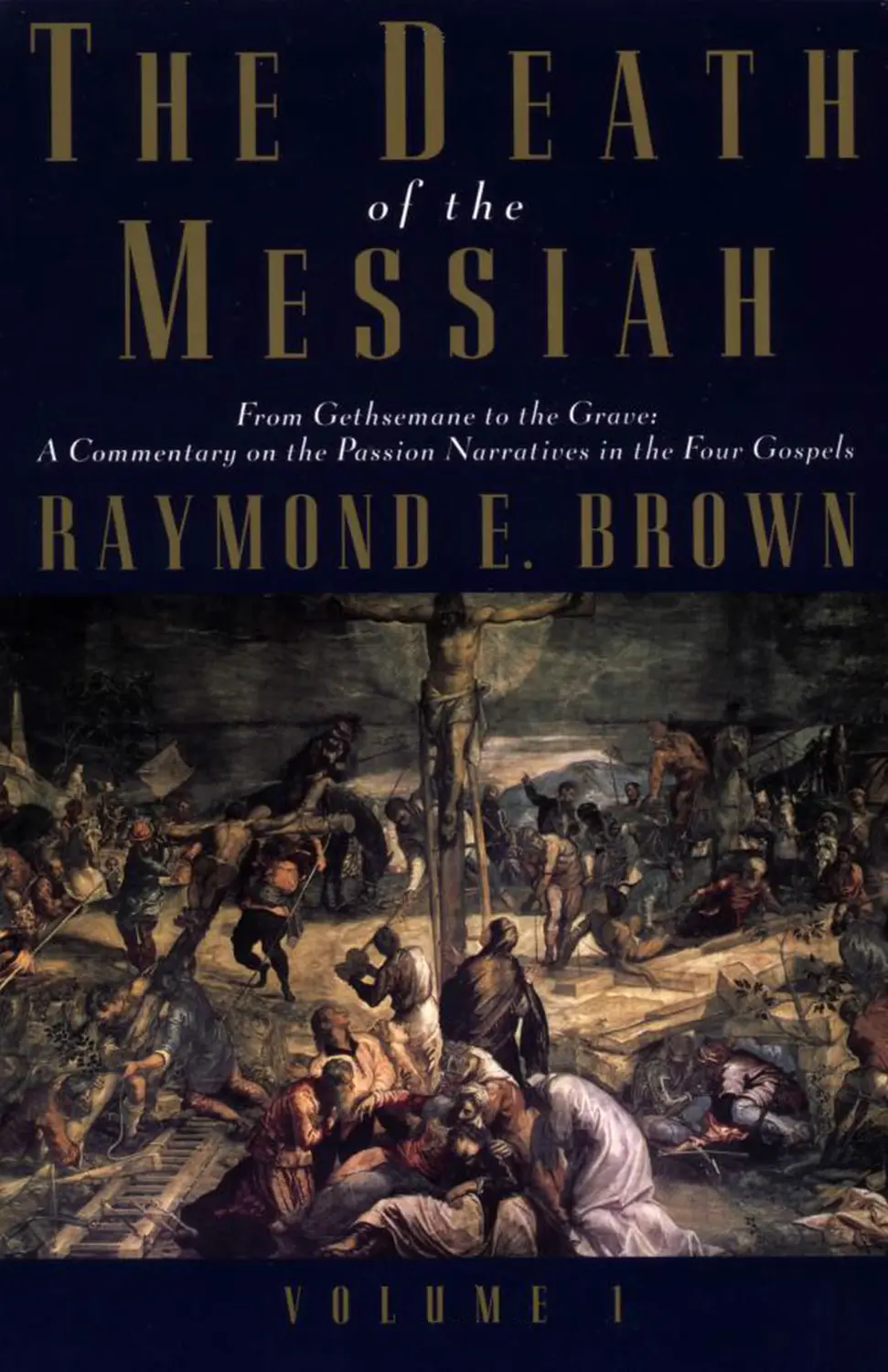
                    The Heath
ME SSI AH
brom (id hsemanc l о I he (irarc:
z\ ( ommenlart) on the Passion .\arral ires in the I'our (>ospcls
RAYMOND E. BROWN
The Death of the Messiah
Volume One
The Anchor Bible Reference Library is designed to be a third major
component of the Anchor Bible group, which includes the Anchor Bible
commentaries on the books of the Old Testament, the New Testament, and
the Apocrypha, and the Anchor Bible Dictionary. While the Anchor Bible
commentaries and the Anchor Bible Dictionary are structurally defined by
their subject matter, the Anchor Bible Reference Library will serve as a
supplement on the cutting edge of the most recent scholarship. The series
is open-ended; its scope and reach are nothing less than the biblical world
in its totality, and its methods and techniques the most up-to-date available
or devisable. Separate volumes will deal with one or more of the following
topics relating to the Bible: anthropology, archaeology, ecology, economy,
geography, history, languages and literatures, philosophy, religion(s), the-
ology.
As with the Anchor Bible commentaries and the Anchor Bible Dictionary,
the philosophy underlying the Anchor Bible Reference Library finds expres-
sion in the following: the approach is scholarly, the perspective is balanced
and fair-minded, the methods are scientific, and the goal is to inform and
enlighten. Contributors are chosen on the basis of their scholarly skills
and achievements, and they come from a variety of religious backgrounds
and communities. The books in the Anchor Bible Reference Library are in-
tended for the broadest possible readership, ranging from world-class schol-
ars, whose qualifications match those of the authors, to general readers, who
may not have special training or skill in studying the Bible but are as enthusi-
astic as any dedicated professional in expanding their knowledge of the
Bible and its world.
David Noel Freedman
GENERAL EDITOR
THE ANCHOR BIBLE REFERENCE LIBRARY
THE DEATH
OF THE MESSIAH
From Gethsemane to the Grave
A COMMENTARY
ON THE PASSION NARRATIVES
IN THE FOUR GOSPELS
Volume One
BY
Raymond E. Brown, S.S.
ABR L
Doubleday
NEW YORK LONDON TORONTO SYDNEY AUCKLAND
The Anchor Bible Reference Library
PUBLISHED BY DOUBLEDAY
a division of Bantam Doubleday Dell Publishing Group, Inc.
1540 Broadway, New York, New York 10036
The Anchor Bible Reference Library, Doubleday, and the portrayal
of an anchor with the letters ABRL are trademarks of Doubleday,
a division of Bantam Doubleday Dell Publishing Group, Inc.
Library of Congress Cataloging-in-Publication Data
Brown, Raymond Edward.
The death of the Messiah : from Gethsemane to the grave : a commentary on the
Passion narratives in the four Gospels I Raymond E. Brown.— 1st ed.
p. cm.—(The Anchor Bible reference library)
Includes bibliographical references and indexes.
ISBN 0-385-19396-3 (v. 1).—ISBN 0-385-19397-1 (v. 2)
1. Passion narratives (Gospels) I. Title. II. Series.
BS2555.3.B7633 1994
226'.07—dc20	93-9241
CIP
Nihil obstat
Myles M. Bourke, S.T.D., S.S.L.
Censor deputatus
Imprimatur
^Patrick J. Sheridan, D.D.
Vicar General, Archdiocese of New York
April 30, 1993
The nihil obstat and imprimatur are official declarations that a book or pamphlet is
free of doctrinal or moral error. No implication is contained therein that those who
have granted the nihil obstat and imprimatur agree with the contents, opinions, or
statements expressed.
ISBN 0-385-19396-3 (Volume 1)
ISBN 0-385-19397-1 (Volume 2)
Copyright © 1994 by The Associated Sulpicians of the U.S.
All Rights Reserved
Printed in the United States of America
March 1994
7 9 10 8 6
To
Union Theological Seminary (N.Y.C.)
and
Auburn Seminary (N.Y.C.)
as an inadequate expression of my gratitude
for encouragement, support, and friendship
during twenty years of teaching
from one who is privileged to have been
the Auburn Distinguished Professor
of Biblical Studies
at Union Theological Seminary
PREFACE AND ACKNOWLEDGMENTS
The Passion Narrative (henceforth PN), as it proceeds from arrest through
trial to condemnation, execution, and burial (thus from Gethsemane to the
grave), constitutes in each Gospel the longest consecutive action recounted
of Jesus. Aesthetically, more than any other section of the Gospels, indeed
even more than the infancy narrative, it has captured the attention and imagi-
nation of dramatists (passion plays), artists, and musicians. Literarily, pas-
sion vignettes have left their mark on language and imagery: thirty pieces of
silver, Judas kiss, cockcrow, washing one’s hands of blood. Historically, Je-
sus’ death was the most public moment of his life as figures known from
Jewish or secular history (Caiaphas, Annas, Pilate) crossed his path. Indeed,
alongside “bom of the virgin Mary,” the other phrase that made its way into
the creed, “suffered under Pontius Pilate,” has become a marker anchoring
Christian belief about the Son of God to a Jesus who was a human figure of
actual history. Theologically, Christians have interpreted the death of Jesus
on the cross as the key element in God’s plan for the justification, redemp-
tion, and salvation of all. Spiritually, the Jesus of the passion has been the
focus of Christian meditation for countless would-be disciples who take seri-
ously the demand of the Master to take up the cross and follow him. Pasto-
rally, the passion is the centerpiece of Lent and Holy Week, the most sacred
time in the liturgical calendar. The custom of Lenten preaching has made it
a most favored subject for homilies. In sum, from every point of view the
passion is the central narrative in the Christian story.
This centrality is recognizable in the immense literature devoted to the
passion, studying it from every angle. Although I wrote commentaries on
the Gospel and Epistles of John and on the Gospel infancy narratives, no
previous work has required research so lengthy or a bibliography so ample.
If I totaled my time, at least ten years of consistent work have gone into it.
The bibliographies (which take up some seventy pages) constitute a testa-
ment of my gratitude to all those from whom I have learned about the PN.
And yet, despite my efforts to be comprehensive in calling attention to previ-
ous work, I am certain that there are contributions I have missed—uninten-
tional oversights for which I apologize in advance to my reviewers, who
surely will render me the service of pointing them out.
Paradoxically, the very mass of PN writing creates need for a work that
viii	Preface and Acknowledgments
will bring together the scattered views and proposals, sift them for the truly
worthwhile, and organize them (with new contributions, I trust). I am not
aware of a full-scale commentary on the four Gospel PNs of the sort at-
tempted here—an undertaking not without peril and perhaps even foolhardy.
There have been many commentaries on the PNs of the Gospels studied
individually; but instead of producing another such consecutive or “vertical”
treatment of each PN, I made the controversial decision to work through the
passion “horizontally,” studying each episode in all four Gospels simultane-
ously. Personally I found such a reading absorbing, and it brought to light
important insights and nuances that I feared would be lost if I commented
on one whole PN before I turned to the next. (Let me assure those alarmed
by the thought of such a procedure that my “horizontal” readings have no
harmonizing goal, and I have made a major effort not to lose the “vertical”
chain of thought peculiar to each Gospel read consecutively.) The introduc-
tory chapter will sketch the extremely difficult problems presented by the
PNs. How many of them I have solved I do not know. Nevertheless, I hope
to have made available in one place insights of past and present that render
study of the passion a uniquely rewarding endeavor. Despite the taxing mag-
nitude of the project, the time consumed has been the most enriching of my
life. I shall be happy if I can share my enthusiasm.
A major concern has been to do justice to both scholarship and intelligi-
bility and thus to serve a variety of audiences: scholars, preaching clergy,
students of religion or theology and of the Bible, interested Christians, and
those of any persuasion who seek knowledge about the passion and death of
Jesus. So that this commentary may be widely useful, I have endeavored to
treat complicated subjects in a readable way, even if that required greater
length. For instance, in cross-references to biblical books, many commentar-
ies simply list the relevant passages by chapter and verse numbers, expecting
the readers who wish to follow the discussion to flip through the Bible, look-
ing them up. In an age that demands more user-friendly communication,
such an expectation is unrealistic. Most often I have preferred to give the
wording of the key cross-referenced passages, thereby making certain that
readers are aware of the biblical background. Although I have used a number
of abbreviations (all of them given in the list below), in the instance of eso-
teric ancient works, texts, and versions I have preferred to write out titles
rather than frighten away readers who would otherwise be faced with the
biblical equivalent of stock-market listings. The dating of years as вс and
ad, the pattern followed in The Birth of the Messiah, was followed here as
well, both for consistency and for general intelligibility and recognition
(which все and ce still lack).
Some pointers to the way I have arranged the material and a few prelimi-
nary suggestions may aid comprehension. First, whether one is planning to
read the commentary through or to consult it about particular passages, it
is essential to read the introductory §1 to understand my perspective and
presuppositions. Readers should know what the author thinks he is doing.
Second, after the Introduction, the passion is divided into four “Acts,”
several of which have two “Scenes.” The quadruple division (Prayer/arrest;
Jewish trial; Roman trial; Crucifixion/burial) surely does justice to the se-
quence in the Synoptic Gospels, even if one can debate whether John’s
briefer material in Acts I and II would warrant such a dividing line there.
The use of “Act” and “Scene” to designate the divisions reflects my under-
standing of the Gospel accounts as dramatic narratives, as will be explained
in §1. Third, beginning with the actual commentary on the text of the PN in
§5, I always present first a literal translation of the passages under discus-
sion. May I emphasize my awareness of how painfully literal is this transla-
tion—at times to the point of awkwardness. Probably most readers will not
be students of the Greek NT, and therefore without such a literal translation
important variations in the different Gospel descriptions of the same scene
would,be lost on them. For instance, my mechanical translation of the parti-
cles kai and de as “and” and “but” does not do justice in English to the
subtleties of the Greek language; but it does enable readers to detect sen-
tence patterns that scholars find important for discussions of source. The
translations of ОТ passages, whether from Hebrew or Greek, are also very
literal (even in passages where one would have preferred to be freer in order
to respect modem sensibilities about pronominal references to God); the
goal of such fidelity is to highlight the background that such passages offer
for the Gospel PNs. A translation of either the PNs or the ОТ into more
idiomatic English would disguise such patterns and parallels. Please con-
sider the PN translation as only a study tool, not to be read publicly and not
to be evaluated on its literary merit. (In order to appreciate the constraints
of literalness imposed here, where four Gospel accounts of the same scene
must be compared exactly, readers are invited to contrast the translation of
the Johannine narratives in this book with those offered in my Anchor Bible
commentary on John [BGJ].) Fourth, in discussing the actual Gospel text
of a passage, I have divided my remarks into comment and analysis. (The
pattern of initial informational notes, followed in The Birth of the Messiah,
proved impractical in this book since passages from four different Gospels
were being commented on in most sections. Footnotes cover the appropriate
information just as effectively.) The comment seeks to discover and explain
what the evangelist wanted to convey by the passage; it is by far the most
important part of my treatment and receives primary attention. After the
comment in each section (or at the end of a related group of sections) comes
X
Preface and Acknowledgments
the much shorter analysis. It studies possible dependence of one Gospel on
another, proposed preGospel traditions, and factors pertinent to historicity—
unavoidable questions, answered of necessity by theorizing, but scarcely the
heart of a commentary. Examination of the arrangement or structure of the
passage, which I consider very important, may play a role both in the Com-
ment and (more abstractly) in the analysis. Fifth, the General Bibliog-
raphy, which constitutes §3, lists writings pertinent to the passion in general
or to the whole PN of an individual Gospel. Before each major division (Act,
Scene) of the commentary there is a Sectional Bibliography covering all
sections therein. To facilitate usage of the latter, the final line of each section
indicates where in the appropriate Sectional Bibliography pertinent liter-
ature may be found. Citation of a writing listed in one of the bibliographies
is given by using the author’s family name and an abbreviation of the title
(usually the first word). If the cited work is not going to appear in a bibliog-
raphy (because, while pertinent to a particular point, it is only tangentially
related to the passion and will not be cited again), full information is given at
the moment of citation. The Bibliographical Index, the first of the indexes
supplied at the very end of this book, enables readers to find all works that
have been cited in either format. Sixth, the last of those indexes is designed
to be helpful in different ways. For commentary purposes I have divided the
PN into forty-eight sections, sometimes with a whole section devoted to a
passage found in only one Gospel. To find a continuous translation of a par-
ticular Gospel, readers should turn to the Gospel Passage Index, where the
complete PN of each Gospel is printed consecutively. In a column next to
that translation I have indicated the pages in the commentary where each
verse or group of verses receives its principal treatment. Therefore anyone
desiring information about a section of the PN can find directions very
quickly through this index.
By way of acknowledgments let me recall that over the years I have given
many short series of lectures and retreats on the PN and have taught semester
courses on them, once at the Roman Pontifical Biblical Institute and several
times at Union Theological Seminary. Never have I failed to be instructed
by the questions and papers of hearers and students. Two sabbatical semes-
ters were spent day in and day out reading in the library of the Pontifical
Biblical Institute in Rome; and the splendid librarians and staff of that insti-
tution, especially Henry Bertels, S.J., and Sister Colette Auger, P.M., helped
most hospitably as I worked through bibliography. Dr. Cecil White, the li-
brarian of St. Patrick’s Seminary (Menlo Park, California), and Seth Kasten,
reference librarian at Union Seminary, have been most adept in tracing what
I found untraceable. Eileen Tobin and Julie Galas retyped sections of my
own typescript while I was teaching at Union. In an earlier incarnation as
my student, Professor Jennifer Glancy of Le Moyne College moved my bib-
liography from bulky files of cards to a much more flexible computerized
list. Angela Bauer, a doctoral student at Union, checked the biblical refer-
ences in my typescript for accuracy. To all these friends who always did
more than I had a right to expect, warm thanks.
As a student writing a paper for a seminar that I was giving on the PN,
Professor Marion Soards of the Louisville Presbyterian Theological Semi-
nary composed in preliminary form a survey of theories of a preMarcan PN
that he has graciously consented to have appear in its fully developed form
as appendix IX of this book. I have learned much also from his doctoral
dissertation on the Lucan PN, his continued contributions to the field, and
his friendly advice. Professor David Noel Freedman, who supplied sage ad-
vice as editor of my Anchor Bible commentaries, most generously helped
here again by reading my ms. and supplying, in reference both to style and
content, an abundance of significant observations that I have incorporated. I
am greatly in debt to him. Professor John Kselman of Weston School of
Theology, selflessly rendering a service he has so often done for me before,
also read through the 2,700 pages of my typescript. There are many
smoother sentences and far fewer mistakes because of his keen perception.
I regard this Preface and §1 of the Introduction as crucial for setting the
intended tone; and when they had reached that stage of familiarity where I
could no longer see their defects, Professor Phyllis Trible of Union, looking
with a fresh eye, improved them significantly. There are many others who
responded to my requests for information and references, including the
members of seminars on the passion at the annual Society of Biblical Litera-
ture and Society of New Testament Studies meetings. Although I shall not
attempt to name them, it would be an injustice to overlook two who helped
significantly: Joseph A. Fitzmyer, S.J., a friend for forty years and always a
model of precision; and Professor Burton L. Visotzky of the Jewish Theo-
logical Seminary in New York, who over the years has been truly a rabbi to
me in matters of Judaica. The folk at Doubleday, Robert Heller and Theresa
D’Orsogna in earlier times, Thomas Cahill and Michael lannazzi more re-
cently, with Susan Higgenbotham as copy editor, have contributed patience,
encouragement, assistance, and editing in producing this book that over a
decade ago I agreed to write. To one and all, sincere gratitude.
The Birth of the Messiah appeared in 1977.1 found great encouragement
in the many letters from readers and clergy, both Protestant and Catholic,
who told me that the volume had given them a greater appreciation of the
wealth of the infancy narratives for spirituality, preaching, and an under-
standing of Jesus. I would like to think that this companion work, The Death
of the Messiah, will bear similar fruit. But whatever the judgment of others,
xii	Preface and Acknowledgments
I thank God’s providence that has permitted me to spend so many years of
my life in commenting on the biblical accounts of Jesus’ birth and death.
Not only have I learned more of the one for whom “Messiah” (Christos)
became a second name, but I have come to respect deeply the skill of the
evangelists without whose contribution that name would not be known in all
its profundity. In a small way may my work make their work better known.
As for the seeming antipodes represented by The Birth of the Messiah and
The Death of the Messiah, I am not the first writer to think that the two
constitute a compatible subject. A poem by John Donne, “Upon the Annun-
ciation and the Passion,”1 celebrated the coincidence that in 1608 the 25th
of March, the Feast of the Annunciation to Mary, was also Good Friday,
so that the conception and the crucifixion of the Messiah came together. A
perceptive friend of college days in Baltimore, Marco Gnerro, who called
the poem to my attention, marked off this stanza that is so expressive of the
continuity of the events:
All this, and all betweene, this day hath showne,
Th’Abridgement of Christs story, which makes one
(As in plaine Maps, the furthest West is East)
Of the ‘Angels Ave ’ and Consummation est.
A surprising number of people have asked if I plan a trilogy to conclude
with The Resurrection of the Messiah. Responding with mock indignation
that I have written two books on the resurrection (a response that conve-
niently ignores the fact that neither is truly a commentary), I tell them em-
phatically that I have no such plans. I would rather explore that area “face
to face.”
Ash Wednesday
February 24, 1993
'The Divine Poems of John Donne, ed. N. Gardner (2d ed.; Oxford: Clarendon, 1966), 29.
CONTENTS OF VOLUME ONE
(Before the Introduction and each “Act” and “Scene” of the Commentary,
a more detailed table will be given breaking the sections [marked by §]
into subsections.)
Preface and Acknowledgments	vii
Abbreviations	xvii
INTRODUCTION
§	1.	The Perspective of This Commentary	4-35
§2	.	General Gospel Issues	Pertinent to the Passion Narratives	36-93
§3	.	General Bibliography	94-106
COMMENTARY (in Four Acts)
ACT I: JESUS PRAYS AND IS ARRESTED IN GETHSEMANE ON
THE MOUNT OF OLIVES ACROSS THE KIDRON
(Mark 14:26-52; Matt 26:30-56; Luke 22:39-53; John 18:1-11)
SCENE ONE: Jesus Goes to the Site and Prays There (Mark 14:26-42;
Matt 26:30-46; Luke 22:39-46; John 18:1)
§4	. Sectional Bibliography: Jesus Praying in Gethsemane	110-116
§5	. Transitional Episode: Jesus Goes with Disciples to the Mount
of Olives (Mark 14:26-31; Matt 26:30-35; Luke 22:39;
John 18:1a)	117-145
§6	. Prayer in Gethsemane, Part One: Entry and Preparations
(Mark 14:32-34; Matt 26:36-38; Luke 22:40; John 18:1b)	146-162
§7	. Prayer in Gethsemane, Part Two: Jesus Prays to the Father
(Mark 14:35-36; Matt 26:39; Luke 22:41-42)	163-178
§8	. Prayer in Gethsemane, Part Three: The Strengthening Angel
(Luke 22:43-44)	179-190
xiv	Contents of Volume One
§9	. Prayer in Gethsemane, Part Four: Jesus Comes Back to His
Disciples the First Time (Mark 14:37-38; Matt 26:40-41;
Luke 22:45-46)	191-200
§10	. Prayer in Gethsemane, Part Five: Jesus Comes Back to
His Disciples the Second and Third Times (Mark 14:39-42;
Matt 26:42-46)	201-215
§11	. Analysis Covering All Five Parts of Jesus’ Prayer in
Gethsemane	216-234
SCENE TWO: Jesus Is Arrested (Mark 14:43-52; Matt 26:47-56; Luke
22:47-53; John 18:2-11)
§12	. Sectional Bibliography: The Arrest of Jesus	237-239
§13	. The Arrest of Jesus, Part One: The Initial Encounter (Mark
14:43-46; Matt 26:47-50; Luke 22:47-48; John 18:2-8a)	240-263
§14	. The Arrest of Jesus, Part Two: Accompanying Incidents (Mark
14:47-50; Matt 26:51-56; Luke 22:49-53; John 18:8b-l 1)	264-293
§15	. The Arrest of Jesus, Part Three: Naked Flight of a Young
Man (Mark 14:51-52)	294-304
§16	. Analysis Covering All Three Parts of the Arrest of Jesus 305-310
ACT II: JESUS BEFORE THE JEWISH AUTHORITIES
(Mark 14:53-15:1; Matt 26:57-27:10; Luke 22:54-23:1; John 18:12-28a)
SCENE ONE: Trial/Interrogation by Jewish Authorities (Mark 14:53-64;
Matt 26:57-66; Luke 22:54-55, 66-71; John 18:12-25)
§17	. Sectional Bibliography: The Jewish Trial/Interrogation
of Jesus	315-327
§	18. Introduction: Background for the Jewish Trial/Interrogation
of Jesus by the Priestly Authorities	328-397
§19	. Transitional Episode: Jesus Transferred to the Jewish Authorities;
Interrogated by Annas (Mark 14:53-54; Matt 26:57-58;
Luke 22:54-55; John 18:12-25a)	398-428
§20	. Sanhedrin Proceedings, Part One: The Gathered Authorities, Witnesses,
and the Claim that Jesus Would Destroy the
Sanctuary (Mark 14:55-59; Matt 26:59-61; Luke 22:66)	429-460
§21	. Sanhedrin Proceedings, Part Two: Question(s) about the Messiah,
the Son of God (Mark 14:60-61; Matt 26:62-63;
Luke 22:67-70a)	461-483
Contents of Volume One	xv
§22	. Sanhedrin Proceedings, Part Three: Jesus’ Response(s) and
Statement about the Son of Man (Mark 14:62; Matt 26:64;
Luke 22:67-70b)	484-515
§23	. Sanhedrin Proceedings, Part Four: Reaction of the Jewish
Authorities to Jesus’ Response (Mark 14:63-64;
Matt 26:65-66; Luke 22:71)	516-547
§24	. Analysis Covering the Composition of All Four Parts of the
Sanhedrin Proceedings	548-560
SCENE TWO: Mockery/Abuse of Jesus; Denials by Peter; Judas (Mark
14:65-15:1; Matt 26:67-27:10; Luke 22:54b-65; 23:1; John 18:15-
18,22-23,25-28a)
§25	. Sectional Bibliography: Jewish Mockery; Peter’s Denials;
Judas’ Suicide	563-567
§26	. The Jewish Abuse and Mockery of Jesus (Mark 14:65;
Matt 26:67-68; Luke 22:63-65; John 18:22-23)	568-586
§27	. The Three Denials of Jesus by Peter (Mark 14:66-72;
Matt 26:69-75; Luke 22:54b-62; John 18:15-18,25-27)	587-626
§28	. End of the Sanhedrin Proceedings; Transfer to Pilate
(Mark 15:1; Matt 27:1-2; Luke 23:1; John 18:28a)	627-635
§29	. Judas, the Chief Priests, and the Price of Innocent Blood
(Matt 27:3-10)	636-660
ACT III: JESUS BEFORE PILATE, THE ROMAN GOVERNOR
(Mark 15:2-20a; Matt 27:ll-31a; Luke 23:2-25; John 18:28b-19:16a)
§30	. Sectional Bibliography: The Roman Trial of Jesus	665-675
§31	. Introduction: Background for the Roman Trial of Jesus
by Pontius Pilate	676-722
§32	. The Roman Trial, Part One: Initial Questioning by Pilate
(Mark 15:2-5; Matt 27:11-14; Luke 23:2-5;
John 18:28b-38a)	723-759
§33	. The Roman Trial, Part Two: Jesus before Herod
(Luke 23:6-12)	760-786
§34	. The Roman Trial, Part Three: Barabbas (Mark 15:6-11;
Matt 27:15-21; Luke 23:13-19; John 18:38b-40)	787-820
§35	. The Roman Trial, Part Four: Condemnation of Jesus (Mark
15:12-15; Matt 27:22-26; Luke 23:20-25; John 19:l,4-16a)	821-861
§36	. The Roman Mockery and Abuse of Jesus (Mark 15:16-20a;
Matt 27:27-3la; John 19:2-3)	862-877
xvi
Contents of Volume One
ILLUSTRATIVE TABLES
1.	The Order in Which the Gospels Describe Incidents from the Arrest of Jesus to the Transfer to Pilate	418
2.	Comparing the Vocabularies of the Various Accounts of Mockery/Abuse	570
3.	Comparing Accounts of the Three Denials of Jesus by Peter	590
4.	Comparing the Marcan/Matthean Accounts of the Roman Trial	755
5.	Chiastic Structure of John’s Account of the Roman Trial	758
ABBREVIATIONS
AB AER AJBI AJEC	Anchor Bible American Ecclesiastical Review Annual of the Japanese Biblical Institute Anti-Judaism in Early Christianity; Vol. I: Paul and the Gospels, ed. P. Richardson (Waterloo, Ont.: Canadian Corp, for Studies in Religion and Wilfred Laurier Univ., 1986)
AJINT	Antijudaismus im Neuen Testament? eds. W. P. Eckert et al. (Munich: Kaiser, 1967)
AJSL AJT AnBib AnGreg ANRW Ant. AP	American Journal of Semitic Languages and Literature American Journal of Theology Analecta Biblica Analecta Gregoriana Aufstieg und Niedergang der romischen Welt The Antiquities of Flavius Josephus Apocrypha and Pseudepigrapha of the Old Testament, ed. R. H. Charles (2 vols.; Oxford: Clarendon, 1913)
AsSeign ASTI ATANT ATR A.U.C.	Assemblees du Seigneur Annual of the Swedish Theological Institute Abhandlungen zur Theologie des Alten und Neuen Testaments Anglican Theological Review anno urbis conditae or ab urbe condita (a specified year from the founding of Rome)
AUSS BA BAA	Andrews University Seminary Studies Biblical Archaeologist M. Black, An Aramaic Approach to the Gospels and Acts (3d ed.; Oxford: Clarendon, 1967)
BAG	W. Bauer, W. F. Arndt, and F. W. Gingrich, Greek-English Lexicon of the New Testament and Other Early Christian Literature (Cam- bridge Univ., 1957)
BAGD BARev	BAG revised by F. W. Danker (Univ, of Chicago, 1979) Biblical Archaeology Review
xviii
Abbreviations
BBM	R. E. Brown, The Birth of the Messiah (Garden City, NY: Double- day, 1977; new ed., 1993)
BDF	E Blass, A. Debrunner, and R. W. Funk, A Greek Grammar of the New Testament (Univ, of Chicago, 1961). Refs, to sections.
BEJ	R. E. Brown, The Epistles of John (AB 30; Garden City, NY: Dou- bleday, 1982)
BeO BETL BExT BGJ	Bibbia e Oriente Bibliotheca Ephemeridum Theologicarum Lovaniensium P. Benoit, Exegese et Theologie (4 vols.; Paris: Cerf, 1961-82) R. E. Brown, The Gospel According to John (2 vols.; AB 29, 29A; Garden City, NY: Doubleday, 1966, 1970)
BHST	R. Bultmann, History of the Synoptic Tradition (New York: Harper & Row, 1963)
BibLeb BibLit BJG BJRL BK BR BS BSac BSSNT	Bibel und Leben Bibel und Liturgie P. Benoit, Jesus and the Gospel (2 vols.; New York: Herder, 1973) Bulletin of the John Rylands Library, University of Manchester Bibel und Kirche Biblical Research Biblische Studien Bibliotheca Sacra K. Beyer, Semitische Syntax im Neuen Testament (Gottingen: Van- denhoeck & Ruprecht, 1962)
ВТ BTB BU BVC BW BWANT ByF BZ BZNW CB CBQ CC CCat CCER CD	The Bible Translator Biblical Theology Bulletin Biblische Untersuchungen Bible et Vie Chretienne Biblical World Beitrage zur Wissenschaft vom Alten und Neuen Testament Biblia у Fe Biblische Zeitschrift Beihefte zur ZNW Cultura В Mica Catholic Biblical Quarterly Corpus Christianorum (Series Latina) Civilta Cattolica Cahiers du Cercle Ernest Renan Cairo (Genizah text of the) Damascus (Document)
Abbreviations
xix
CH CKC	Church History Chronos, Kairos, Christos, eds. J. Vardaman and E. M. Yamauchi (J. Finegan Festschrift; Winona Lake, IN: Eisenbrauns, 1989)
ColB ConNT CQR CR CSA	Collationes Brugenses Coniectanea Neotestamentica Church Quarterly Review Clergy Review Chicago Studies (Anniversary Volume) 25 (#1; 1986: Passion, Death, and Resurrection of Jesus)
CSEL CT CTM CTom CurTM DACL DBG	Corpus Scriptorum Ecclesiasticorum Latinorum Christianity Today Concordia Theological Monthly Ciencia Tomista Currents in Theology and Mission Dictionnaire d’Archeologie Chretienne et de Liturgie M. Dibelius, Botschaft und Geschichte (2 vols.; Tubingen: Mohr, 1953, 1956)
DBS	H. Denzinger and C. Bannwart, Enchiridion Symbolorum, rev. by A. Schonmetzer (32d ed.; Freiburg: Herder, 1963). Refs, to sections.
DBSup DJ	Dictionnaire de la Bible, Supplement The Digest of Justinian, ed. T. Mommsen (4 vols.; Philadelphia: Univ, of Pennsylvania, 1985)
DJD DJS	Discoveries in the Judaean Desert A. Denaux, ed. John and the Synoptics (BETL 101; Leuven Univ., 1992). Analyzed by Denaux in ETL 67 (1991), 196-203.
DNTRJ	D. Daube, The New Testament and Rabbinic Judaism (London: Athlone, 1956)
DRev DSNT	Downside Review J.D.M. Derrett, Studies in the New Testament (4 vols.; Leiden: Brill, 1977-86)
DSS DSSW	Dead Sea Scrolls G. Dalman, Sacred Sites and Ways (New York: Macmillan, 1935; German orig. 3d ed., 1924)
EBib EH EJMI	Etudes Bibliques Eusebius, Ecclesiastical History Early Judaism and its Modem Interpreters, eds. R. A. Kraft and G.W.E. Nickelsburg (Atlanta: Scholars, 1986)
EKKNT	Evangelisch-katholischer Kommentar zum Neuen Testament
XX
Abbreviations
EQ ErbAuf EspVie EstBib EstEcl ETL ETR EvT ExpTim FANT	Evangelical Quarterly Erbe und Auftrage Esprit et Vie (later L’Ami du Clerge) Estudios Biblicos Estudios Eclesidsticos Ephemerides Theologicae Lovanienses Etudes Theologiques et Religieuses Evangelische Theologie Expository Times J. Finegan, The Archaeology of the New Testament (Princeton Univ., 1969)
FAWA	J. A. Fitzmyer, A Wandering Aramean (SBLMS 25; Missoula, MT: Scholars, 1979)
FB FESBNT	Forschung zur Bibel J. A. Fitzmyer, Essays on the Semitic Background of the New Testament (London: Chapman, 1971)
FGN	The Four Gospels 1992, eds. E Van Segbroeck et al. (F. Neirynck Festschrift; BETL 100; 3 vols.; Leuven Univ., 1992)
FRLANT	Forschungen zur Religion und Literatur des Alten und Neuen Testaments
FTAG	J. A. Fitzmyer, To Advance the Gospel (New York: Crossroad, 1981)
FV FZPT GCS GPet GVMF	Foi et Vie Freiburger Zeitschrift fur Philosophic und Theologie Die Griechischen Christlichen Schriftsteller (Berlin) The Gospel of Peter (see appendix I) Gottesverachter und Menschenfeinde ? Juden zwischen Jesus und friihchristlicher Kirche, ed. H. Goldstein (Dusseldorf: Patmos, 1979)
HeyJ HibJ HJPAJC	Heythrop Journal Hibbert Journal E. Schiirer, The History of the Jewish People in the Age of Jesus Christ (rev. by G. Vermes et al.; 3 vols.; Edinburgh: Clark, 1973-87)
HPG	The Holy Places of the Gospels by C. Kopp (New York: Herder and Herder, 1963)
HSNTA	E. Hennecke and W. Schneemelcher, New Testament Apocrypha (2 vols.; Philadelphia: Westminster, 1963, 1965; rev. ed., vol. 1, 1991)
Abbreviations
xxi
HTR HUCA IBS . IEJ IER ILS	Harvard Theological Review Hebrew Union College Annual Irish Biblical Studies Israel Exploration Journal Irish Ecclesiastical Record Inscriptiones Latinae Selectae, ed. H. Dessau (3 vols.; Berlin: Weidmann, 1892-1916). Cited by inscription number.
ITQ JAAR JANT	Irish Theological Quarterly Journal of the American Academy of Religion M. R. James, The Apocryphal New Testament (2d ed.; Oxford: Clarendon, 1953)
JBap JBL JBR JE JES JETS JEWJ	John the Baptist Journal of Biblical Literature Journal of Bible and Religion Jewish Encyclopedia Journal of Ecumenical Studies Journal of the Evangelical Theological Society J. Jeremias, The Eucharistic Words of Jesus (2d ed.; New York: Scribners, 1966)
JJC	Josephus, Judaism, and Christianity, eds. L. H. Feldman and G. Hata (Leiden: Brill, 1987)
JJS JJTJ	Journal of Jewish Studies J. Jeremias, Jerusalem in the Time of Jesus (Philadelphia: For- tress, 1969)
JPFC	The Jewish People in the First Century, eds. S. Safrai and M. Stem (2 vols.; Philadelphia: Fortress, 1974)
JPHD	Jesus and the Politics of His Day, eds. E. Bammel and C.F.D. Moule (Cambridge Univ., 1984)
JQR JRS JSJ	Jewish Quarterly Review Journal of Roman Studies Journal for the Study of Judaism in the Persian, Hellenistic and Roman Period
JSNT JSNTSup JTS KACG	Journal for the Study of the New Testament Journal for the Study of the New Testament—Supplement Series. Journal of Theological Studies H. Koester, Ancient Christian Gospels (Philadelphia: Trinity, 1990)
KBW KJV	Katholisches Bibelwerk (Verlag, Stuttgart) King James Version or Authorized Version of the Bible
xxii
Abbreviations
KKS	W. H. Keiber, A. Kolenkow, and R. Scroggs, “Reflections on the Question: Was There a Pre-Markan Passion Narrative?” SBLSP (1971), 2.503-86.
Kyr	Kyriakon, eds. P. Granfield and J. A. Jungmann (J. Quasten Fest- schrift; 2 vols.; Munster: Aschendorff, 1970)
LB LD LFAE	Linguistica Biblica Lectio Divina Light from the Ancient East by A. Deissmann (rev. ed.; New York: Doran, 1927)
LKS	H. Lietzmann, Kleine Schriften II (TU 68; Berlin: Akademie, 1958)
LS LumVie LXX MACM	Louvain Studies Lumiere et Vie (The) Septuagint Greek Translation of the ОТ H. Musurillo, The Acts of the Christian Martyrs (Oxford: Clarendon, 1972)
MAPM	H. Musurillo, The Acts of the Pagan Martyrs (Oxford: Clarendon, 1954)
MGNTG	J. H. Moulton (and N. Turner), Grammar of New Testament Greek (4 vols.; Edinburgh: Clark, 1908-76)
MIBNTG	C.F.D. Moule, An Idiom-Book of New Testament Greek (Cam- bridge Univ., 1960)
MM	J. H. Moulton and G. Milligan, The Vocabulary of the Greek New Testament Illustrated from the Papyri and Other Non-Literary Sources (repr.; Grand Rapids: Eerdmans, 1963)
MNTS	Die Mitte des Neuen Testaments, eds. U. Luz and H. Weder (E. Schweizer Festschrift; Gottingen: Vandenhoeck & Ruprecht, 1983)
ms., mss. MT MTC	manuscript(s) (The) Mas(s)oretic Text of the ОТ or standard Hebrew Bible В. M. Metzger, A Textual Commentary on the Greek New Testa- ment (New York: United Bible Societies, 1971)
MTZ NAB NDIEC NEB NEv	Milnchener Theologische Zeitschrift New American Bible (1970; Revised NT 1986) New Documents Illustrating Early Christianity New English Bible (1961) F. Neirynck, Evangelica, Gospel Studies—Etudes d’Evangile (2 vols.; Louvain: Peeters, 1982, 1991). Vol. 1 covers articles written in 1966-81; vol. 2, 1982-91.
Abbreviations
xxiii
NHL	The Nag Hammadi Library, ed. J. M. Robinson (3d ed.; New York: Harper & Row, 1988)
NICOT NJBC	New International Commentary on the Old Testament New Jerome Biblical Commentary, eds. R. E. Brown et al. (Engle- wood Cliffs, NJ: Prentice-Hall, 1990). Refs, to articles and sec- tions.
NKZ NorTT NovT NovTSup NRSV NRT NS NT NTA NTAbh NTS NTT OL OS OScur OSsin от OTP	Neue Kirchliche Zeitschrift Norsk Teologisk Tidsskrift Novum Testamentum Novum Testamentum, Supplements New Revised Standard Version of the Bible Nouvelle Revue Theologique new series (of a periodical) New Testament New Testament Abstracts Neutestamentliche Abhandlungen New Testament Studies Nederlands Theologisch Tijdschrift The Old Latin Version of the Bible The Old Syriac Version of the Bible The Curetonian tradition of the OS The Sinaitic tradition of the OS Old Testament The Old Testament Pseudepigrapha, ed. J. H. Charlesworth (2 vols.; Garden City, NY: Doubleday, 1983-85)
par.	parallel(s) in one or both of the other Synoptic Gospels to the pas- sage cited
PBI PEFQS PEQ PG PGJK	The Pontifical Biblical Institute (Rome) Palestine Exploration Fund, Quarterly Statement Palestine Exploration Quarterly Patrologia Graeca-Latina (Migne) Der Process gegen Jesus, ed. K. Kertelge (QD 112; Freiburg: Herder, 1988)
PIBA PILA	Proceedings of the Irish Biblical Association Political Issues in Luke-Acts, eds. R. J. Cassidy and P. J. Scharper (Maryknoll: Orbis, 1983)
PL PMK	Patrologia Latina (Migne) The Passion in Mark. Studies on Mark 14-16, ed. W. H. Keiber (Philadelphia: Fortress, 1976)
xxiv	Abbreviations
PN	Passion Narrative. Most often the Passion Narratives of the canoni- cal Gospels that this book considers to be Mark 14:26-15:47; Matt 26:30-27:66; Luke 22:39-23:56; John 18:1-19:42.
PNT	Peter in the New Testament, eds. R. E. Brown et al. (New York: Paulist, 1973)
Q	Quelle or source for material shared by Matt and Luke but absent from Mark
QD RA RArch RB RBen RDLJ	Quaestiones Disputatae Revue Apologetique Revue Archeologique Revue Biblique Revue Benedictine Reimaging the Death of the Lukan Jesus, ed. D. D. Sylva (Bonner Biblische Beitrage 73; Frankfurt: Hain, 1990)
REA RechBib RechSR REJ RevExp RevQ RevSR RHPR RHR RivB RQ	Revue des Etudes Anciennes Recherches Bibliques Recherches de Science Religieuse Revue des Etudes Juives Review and Expositor Revue de Qumran Revue des Sciences Religieuses Revue d’Histoire et de Philosophic Religieuses Revue de THistoire des Religions Rivista Biblica Romische Quartalschrift fur Christliche Altertumskunde und Kirchengeschichte
RSJ	G. Richter, Studien zum Johannesevangelium, ed. J. Hainz (BU 13; Regensburg: Pustet, 1977)
RSV RThom RTL RTP RTPL	Revised Standard Version of the Bible Revue Thomiste Revue Theologique de Louvain Revue de Theologie et de Philosophic Redaktion und Theologie des Passionsberichtes nach den Synop- tikern, ed. M. Limbeck (Wege der Forschung 481; Darmstadt: Wissenschaftliche Buch., 1981)
RV SANT SB SBB	The Revised Version of the Bible Studien zum Alten und Neuen Testament Sources Bibliques Stuttgarter Biblische Beitrage
Abbreviations
xxv
SBE SBFLA SBJ SBLA SBLDS SBLMS SBLSBS SBLSP SBS SBT SBU SC ScEsp SEA SGM SJT SNTSMS SO SPAW	Semana Biblica Espanola Studii Biblici Franciscani Liber Annuus La Sainte Bible de Jerusalem Society of Biblical Literature Abstracts Society of Biblical Literature Dissertation Series Society of Biblical Literature Monograph Series Society of Biblical Literature Sources for Biblical Studies Society of Biblical Literature Seminar Papers Stuttgarter Bibelstudien Studies in Biblical Theology Symbolae Biblicae Upsalienses Sources Chretiennes Science et Esprit Svensk Exegetisk Arsbok Secret Gospel of Mark Scottish Journal of Theology Society for New Testament Studies Monograph Series Symbolae Osloenses Sitzungsberichte der (koniglichen) Preussischen Akademie der Wissenschaften
SPNM	D. P. Senior, The Passion Narrative According to Matthew (BETL 39; Leuven Univ., 1975)
SRSTP	Society and Religion in the Second Temple Period, eds. M. Avi Yonah and Z. Baras (World History of the Jewish People 8; Jeru- salem: Massada, 1977)
ST St-B	Studia Theologica H. L. Strack and P. Billerbeck, Kommentar zum Neuen Testament aus Talmud und Midrasch (6 vols.; Munich: Beck, 1926-61)
StEv	Studia Evangelica (I = TU 73 [1959]; II = TU 87 [1964]; III = TU 88 [1964]; IV = TU 102 [1968]; V = TU 103 [1968]; VI = TU 112 [1973]; VII = TU 126 [1982])
SuS SWJT TalBab TalJer TBT TCSCD	Sein und Sendung Southwestern Journal of Theology The Babylonian Talmud The Jerusalem Talmud The Bible Today Theologia Crucis—Signum Crucis, eds. C. Andresen and G. Klein (E. Dinkier Festschrift; Tubingen: Mohr, 1979)
TD	Theology Digest
xxvi	Abbreviations
TDNT	Theological Dictionary of the New Testament, eds. G. Kittel and G. Friedrich (10 vols.; Grand Rapids: Eerdmans, 1964-76; Ger- man orig. 1928-73)
TG TJCSM	Theologie und Glaube The Trial of Jesus—Cambridge Studies in Honour of C.F.D. Moule, ed. E. Bammel (SBT, 2d series 13; London: SCM, 1970)
TJT TLOTC	Toronto Journal of Theology The Language of the Cross, ed. A. Lacomara (Chicago: Franciscan Herald, 1977)
TLZ TNTSJ	Theologische Literaturzeitung The New Testament and Structuralism, ed. A. M. Johnson, Jr. (Pittsburgh Theol. Monograph 11; Pittsburgh: Pickwick, 1976)
TPNL	V. Taylor, The Passion Narrative of St Luke (Cambridge Univ., 1972)
TPQ TQ TS TSK TTK	Theologisch-Praktische Quartalschrift Theologische Quartalschrift Theological Studies Theologische Studien und Kritiken Text and Testimony, eds. T. Baarda et al. (A.F.J. Klijn Festschrift; Kampen: Kok, 1988)
TToday TTZ TU TV	Theology Today Trierer Theologische Zeitschrift Texte und Untersuchungen Theologische Versuche, eds. J. Rogge and G. Schille (Berlin: Evangelische Verlag). In this annual a Roman numeral distinguish- ing the volume is part of the title.
TZ UBSGNT VC VCaro VD Vint VSpir VT WD WUNT ww ZAGNT	Theologische Zeitschrift United Bible Societies Greek New Testament Vigiliae Christianae Verbum Caro Verbum Domini Vie Intellectuelle Vie Spirituelle Vetus Testamentum Wort und Dienst Wissenschaftliche Untersuchungen zum Neuen Testament Wort und Wahrheit M. Zerwick and M. Grosvenor, An Analysis of the Greek New Testament (2 vols.; Rome: PBI, 1974, 1979)
Abbreviations
xxvii
ZAW ZBG ZBTJ	Zeitschrift fur die Alttestamentliche Wissenschaft M. Zerwick, Biblical Greek (Rome: PBI, 1963) Zur Bedeutung des Todes Jesu, ed. F. Viering (Gutersloh: Mohn, 1967)
ZDMG ZDPV ZKT ZNW ZTK ZWT	Zeitschrift der Deutschen Morgenlandischen Gesellschaft Zeitschrift des Deutschen Palastina-Vereins Zeitschrift fur Katholische Theologie Zeitschrift fur die Neutestamentliche Wissenschaft Zeitschrift fur Theologie und Kirche Zeitschrift fur Wissenschaftliche Theologie
Standard abbreviations are used for the biblical books and the Dead Sea Scrolls.
(For information about the major scrolls, see NJBC 67:82-95.) The ОТ in gen-
eral and the psalms in particular are cited according to Hebrew chapter and verse
numbers. This holds true even when the LXX is under discussion. It will help
readers to know that in the psalms the LXX number is frequently one lower than
the Hebrew number, e.g., Hebrew Ps 22 is LXX Ps 21. The KJV and RSV num-
ber of a psalm verse is frequently one number lower than the Hebrew, e.g.,
Hebrew Ps 22:2 is RSV Ps 22:1.
The names Mark, Matt, Luke, and John are used both for the writings and the
writers. No supposition is made about the identity of the individual evangelists;
thus when used for the writer, John means whoever was the principal writer of
the Gospel according to John. Mark/Matt is used where Mark and Matt (Gospels
or evangelists) are so close that they may be considered as presenting the same
data or view.
An asterisk after the name of a ms. of the Bible indicates a reading in the
hand of the original copyist as distinct from later additions or changes. Sections
(= chapters) in this book are marked by the § sign plus a numeral from 1 to 48
(see the list of Contents above). Cross-references within the book will employ
that sign with the appropriate section number; see the running head at the top of
pages for easy access to the section indicated.
INTRODUCTION
A description of the interpretative perspective from which this commentary
has been written, and a discussion of some general issues about the inter-
relationships of the Four Gospels and their Passion Narratives. A bibliogra-
phy is presented that deals with works on the passion in general and the
whole Passion Narrative in each of the individual Gospels.
CONTENTS OF THE INTRODUCTION
§	1. The Perspective of This Commentary	4-35
A.	Explaining What the Evangelists Intended and Conveyed to
Their Audiences by Their Narratives	4
B.	The Role of History	13
C.	The Role of Theology	24
§2	. General Gospel Issues Pertinent to the Passion Narratives	36-93
A.	The Extent and Context of the Gospel Passion Narratives	36
B.	Interdependence among the Synoptic Gospels	40
C.	Mark as a Gospel and the Issue of a PreMarcan Passion Narrative 46
D.	The Matthean Passion Narrative and Its Special Material	57
E.	The Lucan Passion Narrative and Its Possible Sources	64
E	The Origin of the Johannine Passion Narrative	75
§3	. General Bibliography	94-106
Part 1:	The Passion Narratives in General	94
Part 2:	The Passion Narrative of Mark	97
Part 3:	The Passion Narrative of Matthew	100
Part 4:	The Passion Narrative of Luke	102
Part 5:	The Passion Narrative of John	104
§1. THE PERSPECTIVE OF THIS
COMMENTARY
Let me express in one clause (with no pretension that it is elegantly enunci-
ated or philosophically profound) the primary aim of this book: to explain
in detail what the evangelists intended and conveyed to their audiences by
their narratives of the passion and death of Jesus. Examining phrase by
phrase this statement of goal can serve to introduce the problems of the PN.
Then we shall discuss the relationship of this statement to issues of history
and theology.
A. Explaining What the Evangelists Intended and Conveyed to Their
Audiences by Their Narratives
1.	The Evangelists
The subject for discussion is the passion of Jesus. Understandably there
is a desire to know what Jesus himself said, thought, and did in the final
hours of his life. Yet Jesus did not write an account of his passion; nor did
anyone who had been present write an eyewitness account. Available to us
are four different accounts written some thirty to seventy years later in the
Gospels of Mark, Matthew, Luke, and John,1 all of which were dependent
on tradition that had come down from an intervening generation or genera-
tions.2 That intervening preGospel tradition was not preserved even if at
iThe dating is approximate, but it is likely that all four Gospels were written in the last half of
the 1st cent. ad. The majority of scholars date Mark in the late 60s before the destruction of the
Jerusalem Temple, but the number of those who would date it shortly after 70 is increasing (Emst,
Gnilka, Pesch, Schmithals). The dating of Luke-Acts is more disputed than the dating of Matt, but
ca. 85 is the most often suggested date for both. John is customarily assigned to the 90s, with final
redaction in 100-110. (Occasionally there is a revisionist attempt to move all the Gospels back much
earlier, but none has been persuasive enough to gain much following in the scholarly world.) There
are also accounts in the “apocryphal gospels” such as GPet and The Gospel of Nicodemus (Acts of
Pilate). As will be maintained in the commentary (see appendix I for GPet), these are later than the
canonical Gospels and do not add a single historical fact to what we can know of the passion from
the canonical Gospels. They are important witnesses, however, to how the passion was perceived
and narrated at a later period.
2Any standard critical introduction to the NT will give the reasons for this conclusion. No Gospel
identifies its author. The common designations placed before the Gospels, e.g., “The Gospel ac-
cording to Matthew,” stem from the late 2d cent, and represent an educated estimate of authorship
by church scholars of that period who were putting together traditions and guesses pertinent to
attribution. To this a caution must be added: The ancient concept of authorship was often less rigor-
§ 1, Al Explaining “Evangelists”	5
times we may be able to detect the broad lines of its content. When we seek
to reconstruct it or, even more adventurously, the actual situation of Jesus
himself, we are speculating. On the other hand, when we work on the level
of the evangelists, we are on much more solid ground, for their accounts
need not be reconstructed.
The overall view of the passion presented by each evangelist is a major
factor in our study. Comparing the four PNs, we see a general similarity in
narrative sequence but considerable difference in content. Each evangelist
has organized the material to serve a different presentation of the passion.
Interpreting that view must take precedence over speculation about earlier
tradition or the situation of Jesus. Thus, for instance, Mark/Matt, Luke, and
John* 3 report three different sayings as Jesus’ last words from the cross. It is
tempting to speculate about the preGospel situation, going all the way back
to Jesus. Was he responsible for all three sayings (although only one can
have been last), or for only one, or for none (in which cases the origin must
be sought in the intervening tradition)? Despite that uncertainty, the primary
task of the commentator is to explain how the last words reported by Mark/
Matt, by Luke, and by John fit into the presentation of Jesus in PNs of
those Gospels.
The background of each evangelist may also affect what he was trying to
communicate. All four knew the Jewish Scriptures, but in what language?
The Hebrew Scriptures differ considerably at times from the LXX or ancient
Greek translation, and from the targums or Aramaic translations (most of
which were made later than the LXX). There is evidence that Matt and John
may have known Aramaic and/or Hebrew, while Mark and Luke may have
known only Greek. The PNs mention places in Jerusalem, e.g., the praeto-
rium, Golgotha. How many of the evangelists had ever been in Jerusalem?4
Those who had may have written with knowledge; those who had not pre-
sumably wrote with imagination. We can see the importance of this issue
from the example of the rent veil of the Temple sanctuary, mentioned in
three Gospels. There were a number of Temple veils with different functions
and decorations (described by Josephus); and scholars have developed dif-
ferent interpretations of the scene, depending on which veil they think was
rent and the significance of that veil. But did any evangelist or all of them
know that there were different sanctuary veils; had any one of them ever
ous than our own, at times amounting to identifying only the authority behind a work (however
distant) rather than the writer.
3Between Mark and Matt there is less difference than one finds in comparisons among Mark/
Matt, Luke, and John; and so very often there will be three distinct forms of a verse. On the use of
these names see the explanation at the end of abbreviations.
4Among the four, John manifests the most detailed knowledge of Palestine (BGJ l.xlii).
6	The Perspective of This Commentary
seen the Temple building or the decorated veil? If one writer had seen the
decorated veil while the others had not, the evangelists may have had differ-
ent understandings of the rending of the veil. In commenting on four presen-
tations of the same scene, therefore, similarities must not blind us to the
individuality of each evangelist.
2.	Intended and Conveyed
The evangelists wrote some nineteen hundred years ago in a social and
thought world quite different from our own. Literalist interpreters of the
Bible seem to think that the Gospel texts can be read as if Jesus were ad-
dressing himself to audiences today. In fact, however, Jesus was a Jew of the
first third of the 1st cent, ad who spoke, thought, and acted as such.5 From
the literature of his time we may acquire some knowledge of his likely mind-
set, but we cannot understand it in the way we understand our own thought
world. The same would be true of our relationship to the evangelists, al-
though with added difficulties, for we know more of Jesus than we know of
them. For instance, we know with probability that they lived in the last half
of the 1st cent., but whether they were Jews or Gentiles we are not sure.6
Granted those limitations, what the evangelists intended or conveyed by their
writings is not an unintelligible mystery. Their words and sentences for the
most part make sense, and the story is not complicated. Occasionally we
have to guess at motives or rationale, but it is possible to understand a good
part of what the evangelists intended to convey to their Ist-cent. audiences.
As for the relevance of knowing that, most today are interested in what
the Gospels mean for their own lives. Through the centuries Christian theol-
ogy and proclamation have sought to translate to new times and situations
the message proclaimed in the Gospels, and I hope this commentary will
help in that task. In the best of all possible worlds a commentary might itself
5Some might consider this a suspect thesis of historical criticism; yet it reflects the most orthodox
Christian understanding of the incarnation whereby God’s Son became man at a particular period of
history and was like all his contemporaries in everything except sin. Christian orthodoxy would not
have problems with what I have written above unless the adjective “only” were added before “a
Jew.” The Bible, as word of God, is believed to have meaning for all and in that sense to “speak” to
all; but the historical words of Jesus were spoken at a particular time in a particular language (Ara-
maic) to a particular audience, and reported in writing at a later time in another language (Greek) to
another audience, and are being read today in still another language by another audience. One must
take into account all those differences as they affect meaning.
6I am judging the Gospel authors from the traces left in the texts they wrote, not from any tradi-
tions about their identity. I see no major reason to think that those who wrote Mark, Matt, and John
were not Jews. The author of Luke knows the Greek Bible well but seemingly not family Jewish
customs (in 2:22 he indicates that both parents were purified after the birth of a male child); he
might have been a convert to Judaism before coming to believe in Jesus.
§1, А2 Explaining “Intended and Conveyed"	7
do the task of modernizing, not only by elucidating the ancient message
but also by theologizing and proclaiming to meet current needs. Certainly
commentators cannot afford to ignore the more general contemporary is-
sues; indeed those issues often shape questions they pose to the texts. (For
instance, this commentary will not ignore the way in which guilt and punish-
ment for the crucifixion of Jesus have been inflicted on Jews by Christians,
not the least in our own times.) Yet the readers of a commentary are diverse;
they live in different situations and perhaps even in different decades of rap-
idly shifting times. No single commentator can imagine the needs and inter-
ests of all who would read about the passion and death of Jesus. Therefore
my primary goal is to offer solid understanding of the meaning intended and
conveyed by the evangelists themselves in the 1st cent, and thus to supply
material for reflective interpretation of the passion by the readers them-
selves.
In that goal I am firmly resisting the idea that the only meaning is contem-
porary relevance. Instead, the meaning that current audiences take from the
Gospels must be related to (but not confined to or necessarily identical with)
the meaning intended and conveyed by the evangelists to their audiences.
This relationship belongs to the self-understanding of the religious groups
that gave us the Scriptures. Perhaps continuity with Shakespeare’s world is
not an essential factor in the interpretation of Shakespeare’s plays; but the
theological status of the Bible is quite different. Jews look on themselves as
being in continuity with the Israelites addressed by Moses and the prophets
and sages of the Hebrew Scriptures, and so they are bound by the same
divine word. Similarly, the theological insistence of Christians on apostolic-
ity implies continuity with the generation that proclaimed the content of the
Gospels in the 1st cent.—the distrust of a totally other gospel goes far back
(Gal 1:6-9). Those who believe that the biblical writers were inspired by
God to convey a message in writing will be all the more insistent that the
meaning for today has to be related to the meaning intended and conveyed
by the inspired authors. (Indeed, they may have to be convinced that there
can be a plus value, i.e., a meaning for today that goes beyond what was
envisaged in the 1st cent, because questions are being posed to the Scriptures
that never entered the minds of the ancient writers.)
In insisting that it is both possible and important to know the ancient mes-
sage, I have consistently used the two verbs “intend” and “convey.” This is
an attempt to do justice to a complex situation. The importance of “convey”
is relatively obvious. The evangelists certainly knew more of the Christian
tradition about Jesus than they chose to convey in their Gospels; John 21:25
affirms that. Therefore we should maintain a certain distrust of negative ar-
8	The Perspective of-This Commentary
guments from silence, as if the failure to write meant the failure to know.
Yet exegesis can expound only what the evangelists conveyed in writing. The
rest is speculation.
A more delicate issue is the relationship between what the written words
convey and what the evangelists intended. There is a span of possibilities:
According to the skill of the writer, a writing may convey what the author
wished it to convey, or something less, or the opposite, or something other
than the author wished or foresaw. The last instance is often exemplified in
what was called above the “plus value”—new generations see possibilities
in the text that are harmonious with but also beyond the author’s intention.
Though important, plus values are not a primary focus of this commentary.
My concern is above all with the meaning that emerges from positing a gen-
eral correspondence between what the author intended and what he con-
veyed. It is by exception, then, that I shall have to alert readers to instances
where what the words seem to convey may not be what the author intended.
One may well object, “How can a modem interpreter know that ancient au-
thors intended something different from what their words convey?” Some-
times the only key is in other passages. For example, Luke does not report
a scourging of Jesus by Roman soldiers as do Mark/Matt; accordingly, the
antecedent of the “they” in 23:26 who led Jesus away to be crucified is gram-
matically “the chief priests and the rulers and the people” of 23:13. Many
commentators would read this passage as a deliberate Lucan attempt to make
the Jews the agents of the crucifixion and to exculpate the Romans. Yet care-
less use of antecedents is not infrequent in writing. Indeed, Luke is some-
times a careless editor: In omitting the Roman scourging, he has not noticed
that Jesus’ own prophecy that he would be scourged (18:33) now remains
unfulfilled. Moreover, Luke eventually makes clear that there were (Roman)
soldiers involved in the crucifixion (23:36), and elsewhere he indicates that
the Gentiles killed Jesus (18:32-33; cf. Acts 4:25-27). Thus the grammatical
sense of what Luke wrote very likely was not what he intended to convey.
The commentator must take that difference into account.
Nevertheless, one should resort only rarely to such interpretation distin-
guishing between what was written and what was intended. Too often com-
mentators detect contradictions in the Gospel narratives and assume that one
writer could not have been responsible for the text as it now stands or that
the writer combined diverse sources without recognizing that they were ir-
reconcilable. Such a solution is not impossible, but probabilities lie in an-
other direction: The account as it now stands made sense to someone in
antiquity, and so what seems contradictory to modem interpreters may not
be really contradictory. For instance, some commentators contend that the
events placed by Mark/Matt between the arrest of Jesus and the crucifixion
§ 1, A3 Explaining “Audiences”
9
are too crowded to have happened in one night. Yet does not rearranging that
material over a longer period of time undo the intention of the evangelists to
describe the whole procedure as hasty and crowded because the authorities
wanted to have Jesus executed without any chance that the people would
react and thus cause a disturbance (Mark 14:2; Matt 26:5)? Again, some
would find a contradiction between Mark 14:50, which says of the disciples,
“And having left him, they all fled,” and Mark 14:51, which still has a certain
young man following Jesus, and Mark 14:54, which has Peter following him
from a distance. In this type of narrative are these really contradictory, or
are they cumulative ways of illustrating the failure of the disciples? All fled
or went away denying Jesus, including even those who, by still following,
attempted not to flee.
What the evangelists “intended and conveyed” is the key to the meaning
of their PNs and thus the primary concern of this commentary. Although we
can be quite positive about the possibility of determining that meaning, the
examples that I have given were meant to alert the readers to pitfalls and to
gain sympathy for what may seem lengthy attempts to avoid them.
3.	To Their Audiences
Another part of the description given above of the aim of the book pertains
to the audiences7 envisaged by the evangelists. Although it is difficult to
identify the locale of each Gospel’s audience, sometimes their background
or outlook can be detected from the evangelists’ presuppositions in dealing
with them.8 Working along those lines, I would argue that comprehensibility
by the ancient audience should play a role in our interpretative judgments.
If we may return to an example given above, I doubt that Luke’s audience
7Since the Gospels are written works, we may think of “readers.” However, since few copies of
the Gospels would have been available, probably most early Christians heard them read, hence
“hearers.” Hearing the Gospels read publicly rather than reading them personally and privately was,
arguably, the majority situation throughout most of Christian history. I use the word “audience”
(despite its root meaning) to cover both readers and hearers.
8Among the most frequently suggested sites for the addressees are Rome or Syria for Mark; the
Antioch area for Matt; Antioch or Asia Minor or Greece for Luke; and Ephesus or Syria for John.
The italicized sites would represent my preferences, but nothing in this commentary depends on
choosing one over another. Nevertheless, I shall point out that Rome, as the site where we know
there had been a major persecution of Christians before 70 (with some Christians betraying others),
would make great sense of Mark’s stress on failure in the testing provided by Jesus’ passion (see
R. H. Smith, “Darkness” 325-27). And it is important to ask how, given the address to Theophilus
in Acts 1:1, Luke’s PN would sound to an educated Hellenized audience in the Greco-Roman world
(see Капу, “Lukanische,” who would envisage Luke being read by someone in Ephesus ca. ad 170).
In literary criticism a distinction is made between “implied” readers (those envisaged by the text)
and the actual or historical audience. If the evangelists knew something about those addressed, there
would have been a certain coalescence of these potentially diverse readers. In almost all instances I
discern the audience from the text.
10
The Perspective of This Commentary
would have understood 23:26 (“They led him away [to the place where they
crucified him]”) to mean that the Jews crucified Jesus, despite the antecedent
thirteen verses earlier; for I think it plausible that all Christians learned from
the start that Jesus was crucified by the Romans. In defense of this view I
am not presupposing that Luke’s audience had Mark’s Gospel to fall back
on, but I do contend that the first time they read/heard what Luke wrote to
them was scarcely their initial encounter with the outline of Jesus’ passion.
Passages like I Cor 11:23 and 15:3 show that when Paul converted people
at Corinth, he shared with them some of the early tradition about Jesus’
death, and surely that would have included crucifixion by the rulers of this
age (2:8). Modem church audiences, hearing “They led him away [to the
place where they crucified him],” would never think of Jews as the “they”
unless the issue of an antecedent were called to their attention. They would
interpret what they hear through what they already know. I doubt that it was
different in antiquity, and so there will be many instances where the issue of
plausible audience comprehension helps us to decide which interpretation is
more likely.
By way of another example, let me recall the issue of different Temple
veils with their functions and symbolisms. I warned that one had to ask
whether a particular evangelist knew of such plurality. One also has to ask
whether an evangelist’s audience would know of it. In the case of Mark,
since simple Jewish customs had to be explained to the audience (7:3-4),
surely his audience did not. Therefore, in that Gospel I doubt that one can
interpret the rending of the veil of the sanctuary to mean more than the words
themselves would imply to anyone who had ever been in a temple, namely,
that a veil which partitioned off the sacred place in the Temple of Jerusalem
had been rent from top to bottom, thus depriving that place of what made it
God’s sanctuary, set off from other places in the enclave. Thus once again
the likely comprehension attributable to the audience affects exegesis.
A particular debate centers on the extent to which the audiences of the
individual evangelists understood “Scripture,” i.e., the sacred Jewish writ-
ings of the period before Jesus to which the evangelists frequently appeal.9
Would they catch a subtle allusion? If a passage is cited, would they be aware
of the ОТ context, so that more of the pericope than the cited line would
spring to mind? Would vocabulary used by the evangelist in a cited Scripture
passage evoke in the readers’ minds other passages of Scripture containing
the same vocabulary, as scholars sometimes assume in their comments?
9Most of these writings would be known by Christians as ОТ (provided that the term includes
the Roman Catholic deuterocanonical books or the Protestant apocrypha); yet occasionally there
may be an appeal to works of the intertestamental period that would be considered apocrypha by
Christians and Jews both.
§ 1, А4 Explaining “Narratives ”	11
Would the audiences know living Jewish tradition that had expanded the
meaning of a biblical text? (See, for instance, appendix VI and the redemp-
tive aspect in the Aqedah theme that would reinterpret the sacrifice of Isaac.)
One cannot simply assume affirmative answers; and the answer may be dif-
ferent for each Gospel, since early Christian audiences were not uniform.
Nevertheless, the authors of NT epistles often write as if they expect their
Gentile Christian audiences to possess a wide knowledge of the Scriptures;
and by analogy, therefore, interpretations of the PNs based on an audience
awareness of scriptural background deserve consideration. Overall, then,
combing the Gospel to detect the likely mentality of its audience is not an
easy task (and on a particular issue may be an impossible task); but it must
be attempted to supply a control on the tendency of scholarly commentators
to assume that what they have learned about Judaism in NT times was surely
known by the ancient audience to whom a Gospel was directed.
4.	By Their Narratives of the Passion and Death of Jesus
Readers of this commentary will be reminded repeatedly that we are deal-
ing with narratives. The division of the commentary into acts and scenes is
meant to underline my view that the passion accounts are truly dramatic
narratives. Lunn, “Christ’s,” argues that the PNs fit into the theatrical cate-
gory of “tragedy.” Indeed, at times John even supplies elements of staging,
e.g., in the outside-inside organization of the Pilate trial. The passion “from
Gethsemane to the grave,” as I alerted readers in the opening line of this
book, is the longest consecutive action recounted of Jesus, quite different
from the series of vignettes that constitute the ministry.10 That fact must play
a role in our interpretative judgments. For instance, an impressive number
of happenings occur in threes. In Mark/Matt at Gethsemane, he first comes
with the body of disciples and speaks to them; second, he takes along Peter,
James, and John and speaks to them; last, he goes off by himself and speaks
to God. After he has prayed, Jesus returns three times to find the disciples
sleeping. In all the Gospels Peter denies Jesus three times. In Mark the cruci-
fixion scene involves the third, sixth, and ninth hours; and in the Synoptics
Jesus is mocked three times as he hangs on the cross, even as in John three
groups of people deal with the crucified Jesus. The use of “three” is a well-
known feature in storytelling, most familiar to English-speaking audiences
^Occasionally a Synoptic evangelist has a theme connecting several episodes, e.g., Mark nar-
rates miracle stories as a way of pointing out the difficulty the disciples have in understanding. Yet
the people who are the subjects of the stories are not interrelated, and there is no development of
their characters. The long episodes in John (Samaritan woman, man bom blind, raising of Lazarus)
come closer to being short narratives.
12	The Perspective of This Commentary
in jokes (English-Irish-Scot, priest-minister-rabbi; etc.). Scholars rightly as-
sume that it is unlikely that everything happened so conveniently in threes
and so seek to reconstruct the preGospel history. On the Mount of Olives
Luke has Jesus come back only once to find the disciples sleeping. Was that
original, and do the three times of Mark/Matt represent a conforming to
storytelling patterns? Or has Luke simplified down to one to avoid portraying
the disciples in such a bad light? A factor to be considered in answering is
whether this episode ever circulated other than as a narrative. Is it likely
that the earliest preachers simply mentioned that the disciples slept? What
evangelistic function would such a report have? Or was the earliest reference
to it in a narrative form that brought out human inability to accept the cross?
If the latter, there may never have been in circulation a report that was not
already influenced by the rule of three that governs narratives. This type of
answer, it should be noted, does not solve the issue of history; it establishes
the oldest preGospel form traceable.
Neglecting the narrative form of the passion11 can give rise to questions
that miss the mark, e.g., how can the evangelist know what the Synoptic
Jesus prayed for in Gethsemane when the disciples were asleep? Such a
question (at times asked with a sneer) fails to understand the literary nature
of what is being related. In most narratives the omniscient narrator tells the
readers things about the protagonists without ever explaining where this in-
formation was gained. In the instance cited, the more apropos question
would concern the relationship of the Gethsemane prayer to wider traditions
about the way Jesus prayed, because a memory that Jesus cried out to God
when facing death (Heb 5:7) may, to suit the conventions of narrative, have
been filled in dramatically from memories of Jesus’ style of praying. To take
another example, in Mark/Matt as soon as Pilate sees Jesus, he asks, “Are
11 Although I shall stress the narrative aspect, I do not pretend to apply in my study the technicali-
ties of structural and/or literary criticism. I have read literature on the passion from experts in those
fields, and I am not overly impressed by the results some have achieved. To my embarrassment, at
times the jargon of the hermeneutical specialization leaves me behind. Bucher, “Elements,” casti-
gates traditional exegesis for not caring about the interaction of significant elements within the
global context of the PN. Then he explains (p. 836) what his structural analysis will do: “The analy-
sis would thus lead toward the construction of several homogeneous levels of meaning, correspond-
ing even, in certain cases, to the superposition of several partially autonomous layers of narratives.
Following Greimas’ method it will be furthermore necessary to describe the paradigmatic relations
existing at each level, or in other words to locate the structuring or disjunctive presence of the
positive and negative terms of the semic categories that analysis will be able to identify. The exis-
tence of partially independent layers of narrative will find its main verification in the discovery of
places of diachronic transformation. These places of transformation that [sic] make it possible for
narrative to generate a before vs. an afterwards. The second step would then consist in elucidating
the reciprocal places and function of these diachronic transformations. The concrete complex narra-
tive would then finally find its representation as an abstract system of interrelated levels.” Despite
my deep concern for narrative and its structure, I have no idea whether I meet what is envisaged in
those words.
§ 1, В The Role of History	13
you the King of the Jews?” How did Pilate find this out? Presumably he had
never encountered Jesus before, and we are told nothing of a report having
been made to him by the Jewish authorities. But is this a serious objection
in such a fast-flowing narrative that does not supply elaborate connectives?
Are not the readers expected to assume (as audiences have for centuries) that
the Jewish leaders supplied Pilate with material against Jesus (something
that Luke and John spell out in different ways)? These examples lead into
the next subsection, since a failure to recognize the thrust of narrative is
often based on a confused understanding of the role of history in the PN.
B. The Role of History
The statement is often made that Christianity is a historical religion, mean-
ing that it is not based on myths about gods who never existed but on the
story of someone who lived at a particular time in a particular place among
real people.12 (In application to the passion one can characterize as bedrock
history that Jesus of Nazareth was crucified at Jerusalem at the end of the
first third of the 1st cent, ad when Pontius Pilate was governor.) Too often,
however, that truth has led people to assume that everything related in the
NT about Jesus has to be historical. The problem is compounded when it is
assumed that the Gospels, the NT writings centered on his life, are historical
biographies, despite the fact that two of them tell us nothing about Jesus’
birth and relatively nothing about his parentage,13 and none of them tell us
about the many years of his life before he began his ministry. In this com-
mentary I shall work with the understanding that the Gospels are distillations
of earlier Christian preaching and teaching about Jesus.14 The individual
evangelists organized what they took over from such a background in order
to communicate to their audiences an interpretation of Jesus that would
nourish faith and life (as John 20:31 states explicitly).
12A sense attested in the oldest ecumenical creed, which speaks of the Son of God as one who
was bom of the virgin Mary and suffered under Pontius Pilate.
13Mark never gives the name of Jesus’ father; John never gives the name of his mother. I recog-
nize that Luke-Acts has something of the form and style of ancient biographies and histories; but
that structure does not mean that Luke’s goal is genuinely biographical or historical in the way we
understand those terms in contemporary literature. While the structure matches Luke’s professed
purpose in 1:3 to write an orderly account, that very statement of purpose indicates that Luke is
dealing with the same kind of tradition dealt with by other writers and that his purpose is evangelis-
tic (1:2,4).
14In John another factor is detectable. During arguments with synagogue leaders and trials that
led to the expulsion of Johannine Christians from the local synagogue (9:22; 16:2), the Jesus tradi-
tion was organized as testimony or witness to respond to questioning, e.g., 1:19-27; 5:16-47.
14
The Perspective of This Commentary
1. Is There History Underlying the Gospel Passion Narratives?
If this origin is true, what relationship have the Gospel reports to what
actually happened in Jesus’ lifetime? One can focus that question by asking
about the historical implications of insisting on the narrative form of the
passion. Opposite ends of the spectrum of contemporary Christian attitudes
toward the Bible often agree that the language of “narrative” (or of “story”)
means that what actually happened becomes irrelevant. For that reason
ultraconservatives tend to distrust stress on narrative and ultraliberals tend
to embrace it. I see no need for such a dichotomy between acknowledging
the narrative form of the passion and maintaining a respect for historical
issues.
I have already said that I do not think of the evangelists themselves as
eyewitnesses of the passion; nor do I think that eyewitness memories of Jesus
came down to the evangelists without considerable reshaping and develop-
ment. Yet as we move back from the Gospel narratives to Jesus himself,
ultimately there were eyewitnesses and earwitnesses who were in a position
to know the broad lines of Jesus’ passion. He was accompanied in his minis-
try by a group of disciples known as the Twelve,15 and there is no reason
whatsoever to doubt that the arrest of Jesus was the occasion of his being
separated from them. It is inconceivable that they showed no concern about
what happened to Jesus after the arrest. True, there is no Christian claim that
they were present during the legal proceedings against him, Jewish or Ro-
man; but it is absurd to think that some information was not available to
them about why Jesus was hanged on a cross. The whole purpose of cruci-
fixion, after all, was to publicize that certain crimes would be severely pun-
ished. (That is the sense in which I include “earwitness”: hearing what was
publicly said about the condemnation of Jesus.) The crucifixion itself was
public, and nothing suggests that the burial was secret. Thus from the earliest
days available historical raw material could have been developed into a PN
extending from the arrest to the burial, no matter what form it might receive
in the course of evangelistic use16 and how it might have been embellished
and added to by Christian imagination.
15Their existence at the time of the resurrection is fixed in a tradition that Paul received most
likely in the 30s (I Cor 15:5).
16Let us look at a possible instance of the form being given to material. There is clear parallelism
between Mark’s account of the Jewish trial and his account of the Roman trial: Each has a chief
interrogator and a key “Are you ... ?” question, followed at the end by a mockery. One group of
scholars would regard the contents of each as pure Marcan creation; another group would regard the
Jewish trial as a Marcan creation based on the pattern of Roman trial which embodied earlier tradi-
tion; still another group (with whom I agree) would regard both trial scenes as Christian composi-
§ 1, В1 The Role of History
15
Some scholars, however, insist that the evangelistic enterprise means that
Christians had no interest in historical raw material whether or not it was
available. In a series of important contributions, Dibelius gave primary atten-
tion to the formative role of ОТ Scripture in the development of the PNs.
Such a role is quite understandable if we remember that followers of Jesus
were interested in the significance of what happened: How was Jesus’ death
on the cross meaningful in the divine plans for God’s people? The only lan-
guage in which they could answer that question was scriptural, i.e., the de-
scriptions of the suffering just one in the psalms and the prophets. Too often
we tend to speak of the early Christians “turning to” Scripture, implying that
they turned to the Bible to look up relevant passages even as we do.17 Rather
their minds were imbued with biblical images and phrases, so that scriptural
motifs naturally oriented their interest and understanding. The first followers
of Jesus would have known many things about crucifixion in general and
almost surely some of the details about Jesus’ crucifixion, e.g., what kind of
cross was employed. Nevertheless, what is preserved in the narrative is
mostly what echoes Scripture (division of garments, offering of vinegary
wine, final words of Jesus).
The issue of scriptural background becomes more debatable in views like
those of Koester and J. D. Crossan, who have gone beyond Dibelius. While
he allowed the existence of tradition, these scholars dismiss any rooting of
the passion in Christian memory. Koester18 states with assurance that in the
beginning there was only belief that Jesus’ passion and resurrection hap-
pened according to the Scriptures so that “the very first narratives of Jesus’
suffering and death would not have made any attempt to remember what
actually happened.” Crossan (Cross 405) goes even further: “It seems to me
most likely that those closest to Jesus knew almost nothing about the details
of the event. They knew only that Jesus had been crucified, outside Jerusa-
lem, at the time of Passover, and probably through some conjunction of im-
perial and sacerdotal authority.” He does not explain why he thinks this
“most likely,” granted the well-founded tradition that those closest to Jesus
had followed him for a long period of time, day and night. Did they suddenly
tions (Marcan or pre-Marcan) based on a relatively simple tradition that involved in the death of
Jesus both the high priest and Pilate and that reported with translation the basic issues that worried
those two worthies (Messiah in relation to God, and Messiah equaling king).
17Actually, in some circles and sometimes at a later NT stage there does seem to have been a
studied inquiry of Scripture, as visible in the formula citations of Matt and John: All these things
happened in order to fulfill the words written by the prophet (followed by citation). Where in a
series, e.g., in Matt’s infancy narrative, those citations vary among the LXX and the MT (and perhaps
an unknown popular text), study is implied.
18‘Apocryphal” 127; see also Denker, Theologiegeschichtliche 58-77.
16	The Perspective of This Commentary
lose all interest, not even taking the trouble to inquire about what must have
been a most traumatic moment of their lives?
Frequently appeal is made to Paul in I Cor 15:3-5: “For I gave over to
you as of first importance what I received: that Christ died for our sins ac-
cording to the Scriptures, and that he was buried, and that he was raised on
the third day according to the Scriptures, and that he appeared to Cephas,
then to the Twelve . . .” Yet how does this passage support the thesis that the
earliest followers of Jesus knew or cared nothing about what happened and
created the whole narrative according to the Scriptures? Two of the basic
four facts mentioned in the passage (burial, appearances) are not designated
as “according to the Scriptures”; and so events without scriptural support
were indeed recalled. Paul’s listing of those to whom Jesus appeared was
presumably based in whole or part on their own testimony, and so there was
a place for eyewitness memories. As for the fact that Jesus “died for our sins
according to the Scriptures,” the proponents of scripturally oriented inven-
tion cannot seriously maintain that Jesus’ death on the cross was invented.
Is it not likely, then, that what was interpreted through the Scriptures is the
salvific aspect of the death—a horrible death that was paradoxically part of
God’s plan?19 And again is it not the “on the third day” aspect of the resur-
rection rather than the underlying event that has called forth the reference to
the Scriptures? In other words there is no evidence in the Pauline formula
that scriptural reflection caused the creation of the basic incidents of the
passion; far more plausibly it caused the selection and interpretation of cer-
tain features in an outline of death, burial, resurrection, and appearance that
had been dictated by the early Christian memory of what happened.20 More-
over, this appeal to I Cor 15 often overlooks the parallel Pauline passage in
11:23ff.: “For I received from the Lord what I also gave over to you: that the
Lord Jesus in the night in which he was given over took bread and, having
given thanks, broke ...” No reference to Scripture is made; yet there is a
tradition of a eucharistic meal on the same night in which Jesus was given
19See Bartsch, “Bedeutung” 88-90; he insists that from I Cor 15:3-5 we can learn about the
preGospel passion, for the Pauline formula is meant to identify the risen one with the crucified.
20In studying the Gospel use of Scripture there has always been an issue of “Which came first,
the chicken or the egg?” Did narrators create incidents to give scriptural flavor, or from incidents
that occurred did narrators select and dramatize those capable of echoing the Scriptures? Conceiv-
ably there were instances of each procedure, but several factors point to the latter as the dominant
practice. In the pesharim or commentaries of the Dead Sea Scrolls, which represent contemporary
Jewish procedure, actual events in the history and life of the Dead Sea community (verifiable from
their other works and elsewhere) are seen as fulfilling Scripture. In inner Synoptic comparisons there
are controllable examples where facts have been dramatized by the addition of a scriptural reference.
For instance, few scholars would deny the historicity of the tradition that Jesus started a ministry of
proclaiming the kingdom of God in Galilee, in the Capernaum area near the lake (Mark 1:14,16,21).
Matt (4:13-16) sees this happening to fulfill the Isaian passage (8:23-9:1) about Galilee of the
Gentiles. Observably he did not use the Scripture to invent the occurrence but to gloss and explain it.
§ 1, В 2 Methods for Detecting History	17
over, i.e., the basic Synoptic outline of the Last Supper and the arrest. The
early Christians, then, not only could but did remember basic items in se-
quence about the death of Jesus.
2. Difficulties in Detecting History
Nevertheless, as we seek to uncover aspects of how Jesus’ death actually
occurred, we must recognize that there are difficulties flowing both from
limitations in our methodology and from the subject matter itself.
Methods Used for Detecting Historical Material Underlying the Gospels.
Scholars have developed a number of criteria forjudging what comes from
Jesus’ ministry as distinct from developments of the picture of that ministry
attributable to early preaching and writing. Some of these criteria are of use
in studying the passion, provided we keep carefully in mind their limitations.
More of the Gospel PNs is likely to have been historical than our methods
allow us to prove; in particular the methods break down where the content
is substantially historical but the vocalization of the contents has been
adapted in the subsequent course of preaching to new generations.
(1)	Multiple Attestation. The criterion I shall invoke most frequently21 is
the appearance of an event or saying in many of the available independent
witnesses to the passion. This criterion has limitations, however. If besides
the NT writings one were to include under the rubric of independent wit-
nesses Jewish and Roman writings (see § 18E below), scarcely any aspect of
the passion except the crucifixion is attested by all witnesses.22 For instance,
neither Paul nor TalBab Sanhedrin 43a mention Pilate’s activity in the execu-
tion,23 and Tacitus (Annals 15.44) and I Tim 6:13 do not mention the Jewish
role. The use of this criterion is hindered by the fact that it is not easy to
determine which witnesses of the passion are truly independent. Among the
Gospels, in §2 below I shall explain why I accept the thesis that Matt and
Luke are dependent on Mark but John is not. Mark and John often narrate
the same event but with a significant difference that is hard to explain as a
deliberate change by the evangelists, and so their agreement may indicate an
early tradition that had developed in different directions by the time the Gos-
2 Фог the moment, let me speak of criteria that point to the preGospel period without being
specific as to whether they point to early tradition or, beyond that, to history. Later, I shall emphasize
that these are different stages, so that early preGospel tradition is not necessarily history.
22In digesting that fact one should remember that silence does not necessarily mean denial or
ignorance.
23This silence may be of limited significance. The postPauline passage in I Tim 6:13 does men-
tion Pilate (perhaps indicating knowledge of Pilate’s role within earlier Pauline tradition), and one
may doubt that TalBab Sanhedrin 43a is truly independent of the Gospels.
18
The Perspective of This Commentary
pels were written. Yet there are scholars who think John drew from Mark
and who accordingly would dismiss these agreements as not meeting the
criterion of multiple attestation.
(2)	Coherence. Sometimes a pertinent incident reported by a Gospel does
not have multiple attestation but is coherent with another element that does.
In my judgment this criterion needs to be used with extreme care since co-
herence could explain why the incident was imaginatively created. For in-
stance, when Jesus is arrested, John alone identifies as Simon Peter the per-
son who cuts off the servant’s ear. Such solitary bravado is coherent with
Peter’s speaking and acting on many other occasions as attested in all the
Gospels. That coherence gives the identification of Peter as the sword-
wielder verisimilitude:24 It is the kind of thing that Peter would do. All that
may mean, however, is that if one were going to guess who the unnamed
sword-wielder was, one might well guess Peter; it is not a real argument that
in fact Peter did wield the sword. There are times, however, where coherence
and multiple attestation can be helpfully combined. For example, in very
different ways Mark/Matt, John, and Acts agree in relating to Jesus’ death
his threatening attitude toward the Temple sanctuary. That is coherent with
solid historical evidence that in the period before ad 70 disputes over the
Temple constituted the most frequent single factor in religious violence
among Jews.
(3)	Embarrassment. If something reported about Jesus was embarrassing
to the early church, the early preachers or the evangelists are not likely to
have invented it. That Judas, one of the Twelve, gave Jesus over to his ene-
mies, that (most of) the disciples did not remain with Jesus during the pas-
sion, and that Peter denied him were all embarrassing to early Christians.
Consequently, it is argued that these elements, which are also multiply at-
tested, are likely to have been historical. While there may be truth in that,
one must always allow that it could have been useful to develop one or the
other scene of failure as a theological illustration. For instance, it seems
embarrassing to have Jesus as he faced death praying to be delivered from
the cup or the hour;25 yet one of the goals of the description may have been
to teach Christians that facing death constitutes a trial that may challenge
even sincere commitment.
(4)	Discontinuity or Dissimilarity. If an item pertinent to Jesus has no
parallel in Judaism or in early Christian thought, history is the most plausible
24Readers should be alerted that I shall use the term “verisimilitude” with the understanding that
it is not the same as historical likelihood.
25Determining what was embarrassing in the PNs becomes less subjective if we begin with items
fastened on by Jewish or pagan polemic against the plausibility of Christianity. The flight of the
§ 1, В2 Limitations in Historical Knowledge	19
origin for it. This is a criterion I hesitate to invoke since one must allow for
creativity. There is little evidence in the nonGospel literature of the NT that
early Christians confessed Jesus as the Son of Man or that there was a set
Jewish expectation centered on that title. Accordingly, some scholars would
argue that the appearance of “Son of Man” on the lips of Jesus in Mark, Q,
and John is best explained by positing that he himself did use the title. Yet
there is no way of knowing that Jesus’ usage was not magnified within the
development of the Gospel traditions, thus giving the title in the written Gos-
pels a frequency and applications that are not historical. A greater problem
about this criterion is that it is inapplicable to a very high percentage of
material that might well be historical. Since Jesus was a Jew of the first third
of the 1st cent., it is inconceivable that much of his language and symbolism
would not have had parallels in the Judaism of that time. Since those who
accompanied him later went forth to proclaim him and thus to shape much
of early Christian thought, it is to be expected that there would be much in
common between Jesus’ historical words and attitudes and those of the early
Christians. Exclusion of such common material from our discussion of the
historical Jesus (even under the rubric of being careful to the extreme) has
to distort the results. A particular problem concerns the use of Scripture.
Both Jews who did not believe in Jesus and early Christians who did believe
in him appealed to Scripture to interpret significant happenings. If we used
the criterion of discontinuity, it would mean that no use of Scripture involved
in the Gospel accounts of the passion could be attributed to Jesus with certi-
tude. Yet I judge it inconceivable that historically Scripture did not supply
background and vocabulary for Jesus’ self-understanding. Accordingly
when a particular scriptural theme, e.g., the mocked and despised suffering
just one, is widely and multiply attested in NT writings, there is reason to
think that the theme may well be in continuity with Jesus’ historical self-
understanding. I admit that certitude may not be possible; but in the matter
of historicity probability or likelihood is an important factor, protecting the
picture of Jesus from the distortions and unlikelihoods produced by too rig-
orous a quest for certitude.
Limitations in Our Knowledge of the Times in Which Jesus Died. Not sur-
prisingly, detailed information about Palestine two thousand years ago is
necessarily limited; but in treating the passion we encounter a special set of
problems. I have tried to treat these problems with proper sensitivity, but it
would be impossible to be expert in all. Let me illustrate in three key areas.
disciples, denials by Peter, betrayal by Judas, and Jesus’ prayer for deliverance were all objects of
scorn in such polemic.
20
The Perspective of This Commentary
(1)	Roman law certainly played a role when Jesus was tried and executed
by a Roman prefect of Judea. While later jurists of the empire supply us
with ample information about procedure in capital cases, virtually all of that
documentation comes under the heading of “ordinary law” dealing with the
treatment of Roman citizens, especially in Italy or well-established senato-
rial provinces. Jesus was not a Roman citizen; Judea was a newly established
imperial province: Rules guiding the actions of a Roman governor would
have been spelled out in the emperor’s edicts setting up the province of Judea
(an event of Jesus’ lifetime), but no copy of those edicts was preserved. Thus
even such an essential question as “Who in Judea held the right to execute
and for what crimes?” is subject to debate. From Josephus one gets the im-
pression that in handling the Jews Roman governors did whatever they
deemed necessary to preserve good order and Roman authority—correct-
able only later if the emperor thought the behavior of the officials had been
abusive. “Extraordinary law” (never codified) is the term often used to cover
the procedures they adopted. In analyzing the Roman legalities in the treat-
ment meted out to Jesus, then, we must proceed not so much from codified
Roman law26 as from analogies in historical accounts of the 1st cent, ad that
illustrate how governors acted.
(2)	Jewish law played a role in the execution of Jesus (see John 19:7: “We
have a law”). The Mishna (codified ca. ad 200) offers detailed information
about matters that are quite pertinent in a discussion of the passion, e.g.,
about the Passover meal and the legal procedure for trying capital cases. Yet
we are hampered at the moment by a major controversy among Jewish schol-
ars as to the applicability of mishnaic law to the period before ad 70.27 In-
deed, almost every aspect of Jewish polity in the time of Jesus is debated.
Were the Pharisees a major force? What relationship did the Pharisees have
to the later rabbis who produced the Mishna? To what extent were Galilean
peasants influenced by the religious authorities in Jerusalem? How fixed a
body was the Sanhedrin and what was its makeup? By what legal outlook,
Pharisee or Sadducee, did it judge? Was there another official Jewish execu-
tive and Jewish body, the Beth Din or Boule, consisting of scholars and thus
closer in makeup to the Sanhedrin described in the Mishna? How histori-
26Where appropriate the Digest of Justinian (DJ) will be cited, but with caution. There are un-
happy examples of experts in Roman law reading the Gospel accounts of Jesus’ trial and judging it
historical on the basis of much later opinions assembled in DJ. Beyond the danger inherent in finding
parallels between situations separated by centuries, insufficient attention is paid to the Gospel genre
and the possibility that in a retelling of the story, the picture of the trial of Jesus before Pilate might
have been made conformable to well-known practices of the ordinary law.
27Beyond the Mishna some commentators on the passion invoke examples from every stage in
the development of Jewish law and lore, bringing into the discussion examples from a period a
thousand years after Jesus’ time, on the grounds that often later documents reflect earlier situations.
I shall alert readers to the likely inapplicability of such later “parallels.”
§ 1, В2 Limitations in Historical Knowledge	21
cally reliable was Josephus in matters in which he was trying to influence
Roman polity, and are the differences between accounts in the War and the
Antiquities (written some twenty-five years later) accidental or deliberate?
To what extent was Philo writing propaganda when he criticized Pilate?
Christian critical scholars have spent a century and a half probing the ten-
dencies and reliability of the Christian records. The moment in which this
commentary is being written happens to be a time when the critical Jewish
examination of Jewish records has reached high tide.
(3)	The importance of the political and social scene has become a major
issue in the study of the Gospel PNs. Indeed, social study has reached a very
scientific level, involving social facts (information from archaeology and
various kinds of historical research), social history (combining the facts with
the history of the community known from literature), and social analysis
(discerning the forces that shaped the social history). Such a highly scientific
approach lies beyond the possibilities of this commentary, but I shall try to
take cognizance of some of the results applicable to the PNs. The issue is of
importance because books drawing on social studies of Palestine in Jesus’
time have been the subject of excited discussion even in the popular press,
especially when the picture of Jesus that emerges from these studies is found
sympathetic by movements on our contemporary scene, e.g., Jesus the revo-
lutionary executed by an oppressive regime because of the ferment produced
among ordinary people by what he advocated socially and politically for
the poor. However, analyzing the social and political scene in Jesus’ time is
complex; and some of the most popular books are, in my judgment, unreli-
able in their generalizations. I shall keep reminding readers that there were
two periods in the direct Roman governance of Jerusalem, the early prefec-
ture of Judea (ad 6-41) and the later prefecture of all Palestine (ad 44-66),
separated by the four-year reign of the Jewish king Herod Agrippa I. The
political atmosphere of those two periods was quite different, and so one is
not warranted to bring into the first period (when Jesus lived and died) politi-
cal groups and revolutionary movements attested only in the second period.
Judgments on the Roman governance of Judea in the first period should not
mix actions done by the Herodian princes outside Judea with those done by
the Roman prefect (a frequent phenomenon in the discussion), all as part of
judging the attitude of Jewish subjects toward the Romans. Nevertheless,
once proper care is exhibited, the detectable social and political atmosphere
in ad 30 or 33 helps to make intelligible what happened to Jesus. The way
he was treated was certainly motivated by religious issues; but contributing
factors, for instance, were the distrust on the part of the Jerusalem authorities
for outside or country religious figures, the economic dependence of a good
portion of the Jerusalem populace on the Temple, and the past relations be-
22
The Perspective of This Commentary
tween the Herodian kings of the Palestine area and the Roman prefect of
Judea, as well as the interplay between the Pharisees and the Sadducees.
3. History and PreGospel Tradition in Interpreting the PNs
I have accepted the likely existence of history and tradition behind the
heavily scripturally reflective, kerygmatically oriented, and theologically or-
ganized PNs of the Gospels, but have also acknowledged that there are se-
vere limitations imposed by method and matter in our ability to acquire certi-
tude about that history. Given that, what stance should be taken in a
commentary toward searching for history and preGospel tradition? Let me
make several observations.
First, we should keep clear that there is a difference between history and
tradition. What Paul reports in I Cor 1 l:23ff. about the tie-in between the
Last Supper and the giving over of Jesus is a tradition; but not all traditions
about what happened are historical. The implication that Paul received it
early and from those who would have been in a position to know makes it
probable that this is a historical tradition; but that very judgment suggests
greater certitude about the existence of the tradition than about the history
behind it. Readers of this commentary should not jump to conclusions about
historicity when they read my judgment that there is preGospel tradition
underlying some detail mentioned in the narrative. Such a judgment may
bring us back to the period of the late 30s to the 50s, but not necessarily to
Jerusalem of 30 or 33.
Second, there will be a range of judgments: certain, very probable, prob-
able, possible, not impossible. “Certain” has nothing to do with the certitude
of mathematics or the physical sciences; it refers to the certitude we have in
ordinary experience about the things we encounter or are reported to us in
writing or orally. When we are dealing with accounts written over nineteen
hundred years ago by noneyewitnesses about a death that had occurred some
thirty to seventy years before, certitude about the historicity of details is
understandably infrequent. Indeed, the fact that there is some certitude and
a good deal of probability is remarkable and encouraging.28
Third, the primary concern of a commentary is making sense of what the
biblical writers have given us, not in reconstructing preGospel traditions or
in detecting history. Nevertheless, since the Gospels have to be compared,
28I recognize that this positive judgment may seem inadequate and even skeptical to those who
assume that everything in the Gospels is historically certain—an assumption that is not factually
sustainable or, even for the most orthodox of Christians, theologically necessary. One can believe
that the Scriptures are the word of God without thinking that God chose to communicate only in
historical accounts. Imaginative poetry, parables, and didactic historical fiction are other possibil-
ities.
§ 1, ВЗ History and PreGospel Tradition	23
the issue of preGospel traditions is much closer to the goal of the commen-
tary than is the more difficult issue of historicity. As the next section will
stress, we do not have the tools to reconstruct detailed preGospel traditions;
and so even when the existence of preGospel tradition can be detected,
I shall practically never attempt to be precise about its wording. (See ap-
pendix IX for the many attempts to determine the contents of a preMarcan
PN down to the half-verse; the sharp differences among them suggest that
the project is self-defeating, for no theory will ever get wide or enduring
acceptance. I have no intention to add my views to the list.) We can learn
much about early Christian reflection on Jesus’ passion by moving from
even broadly outlined preGospel traditions to the existing Gospel accounts.
Fourth, the approach taken here will be very wary about harmonizing the
Gospel accounts of the passion. The tendency to harmonize is ancient, trace-
able to Tatian and the mid-2d cent. In recent scholarship Bomhauser is inces-
sant in his attempts to harmonize every disagreement in the passion, while
Benoit harmonizes at least major differences. Part of the justification for
such an approach is the thesis that each evangelist has preserved historical
memories, so that putting their accounts together will produce a fuller pic-
ture, closer to what happened historically.29 To the contrary, I would argue
that although the individual Gospels often do preserve memories of what
happened, changes and adaptations that occurred in the course of preaching
and writing about the passion usually mean that the end products are not
simply historical and that harmonizing them can produce a distortion. For
instance, after the arrest of Jesus, John has an interrogation by the high priest
Annas alone, Mark/Matt have a whole Sanhedrin trial at night (Matt: involv-
ing Caiaphas), and Luke has a Sanhedrin trial/interrogation in the morn-
ing—none shows clear awareness of the other two portrayals. Harmonizers
will try to fit together all three (or at least two of them), usually by positing
that the interrogation by Annas was followed at night by a Sanhedrin trial
which was resumed/repeated in the morning. Working with the criterion of
multiple attestation, I would note that all four Gospels agree that Jesus was
subjected to a Jewish legal inquiry (involving Temple priesthood) after he
was arrested and before he was given over to Pilate. All four also agree that
a Sanhedrin was involved in Jesus’ death, even though John places that many
days before he was arrested. Accordingly we must face the possibility that
29Sometimes underlying the tendency to harmonize is a theory of inspiration in which God guar-
antees the historicity of each Gospel account. Logically, however, it is dangerous to invoke inspira-
tion to support harmonization: If a harmonized account of the passion were the divine intent, God
could have inspired one such account instead of the four different accounts that actually exist. More-
over, since the canon of Scripture is related to the recognition of inspiration, it must be remembered
that the large church did not give public acceptance to Tatian’s Diatessaron, and that the Syrian
church which did ultimately abandoned its position in favor of the four Gospels.
24	The Perspective of This Commentary
the Synoptic accounts (stemming from Mark) have joined into one scene all
the significant Jewish legal action against Jesus, including charges gathered
from memories of objections raised during the public ministry—a simplified
picture, effective for preaching, but not a historical unit to be joined to John’s
theologized presentation of the brief interrogation of Jesus after his arrest.
Fifth, I know that some who consult this commentary will be more inter-
ested in historicity than in either what the evangelist conveyed or preGospel
traditions. While I have a deep respect for historical investigation, I regard
an obsession with the historical to be as great an obstruction to understand-
ing the Gospel PNs as the cavalier assumption that Christians knew nothing
about what happened. It is not tautological to insist that the Gospels are
primarily evangelistic; to make them dominantly reportorial is a distortion.30
I shall not avoid reflecting on historicity, but I have had to debate how I
might avoid pandering to that distortion. (I have no objection to studying the
history of the passion; I am objecting to confusing that study with dis-
covering the meaning of the Gospel PNs, which is the function of a commen-
tary.) In my commentary on the infancy narratives (BBM) I thought I had
the solution: I put studies of historicity in the appendixes, only to find that
some reviewers read nothing but the appendixes and evaluated my com-
mentary only on that issue.31 I have decided in this book to put discussions
of history in the short sections called analysis that follow the much longer
comments on the individual sections of the PNs. That should make more
difficult obsessive history-hunting and make clear that such discussions,
while a part of legitimate analysis, do not represent commentary on the text.
C. The Role of Theology
The Gospel PNs, in and through the story they tell, present theological views
of the suffering and death of Jesus, and so it is the duty of a commentary to
30In its “Instruction on the Historical Truth of the Gospels” (1964, section X) the Roman Pontifi-
cal Biblical Commission observed: “The doctrine and the life of Jesus were not simply reported for
the sole purpose of being remembered but were ‘preached’ so as to offer the church a basis of faith
and morals.”
31 It is sadly amusing that this distorted perception still goes on. Every year before Christmas I
am phoned by newspaper reporters who have hit on the bright idea of writing a Christmas column
on the stories of Jesus’ birth and have learned that I wrote a long commentary on them. Almost
unfailingly they tell me that the only focus of the article will be, “What actually happened?”; and
they insert this statement in an explanation that it might be nice at Christmas to further understanding
of the birth stories. With little success I try to convince them that they could further understanding
of the birth stories by concentrating on the message of those stories instead of on an issue that was
very far from primary in the detectable mind of the evangelists. That effort usually leaves the report-
ers convinced that they have been misdirected to a pious preacher who knows nothing about the
important issues.
§1, Cl The Role of Theology
25
explain the theology involved. Some may object to the term “theology” and
prefer “christology” since the PNs give portraits of Jesus. Yet what happens
to Jesus in the passion and the way he responds to it are revelatory of the
God whose rule or presence he proclaimed, and so “theology” is an appro-
priate term. We must be clear, however, about the specific focus of the pas-
sion theology with which we are concerned, namely, how the evangelists
understood the death of Jesus, not how Jesus understood his own death or
how his death was understood in the broad range of early Christianity. Be-
cause such distinctions are not always made, let me begin with brief remarks
about those other issues in the theology of the passion before turning to the
theological outlook of the individual evangelists that will be the focus of
this commentary.
1. Jesus’ Own Theology and General NT Theologies of the Passion
A considerable body of literature has been devoted to how Jesus under-
stood his own death,32 especially as to whether he understood it salvifically,
i.e., understood that he was laying down his life for others or for sins.
appendix VIII will treat of a somewhat different issue: whether Jesus fore-
saw that he would die a violent death. There I shall list Jesus’ predictions of
his death in the Gospels and point out how few times salvific phrases are
included, e.g., Mark 10:45 (= Matt 20:28); John 10:15. Yet one should not
confine the discussion of Jesus’ understanding of his death to whether or not
the salvific language of the NT appeared on his lips. Other questions would
include whether he foresaw his death as a martyr prophet; and if so, did that
have a salvific tone? (Thus Gnilka, Jesu; see appendix VIII.) Did he inter-
pret his own death as an essential step in the coming of the kingdom? If so,
the NT language of “he died for us” may represent a rephrasing of his own
insight, since the coming of God’s reign over all would bring salvation.
A considerable literature has also been devoted to the range of Ist-cent.
Christian understandings of Jesus’ death,33 e.g., apocalyptic event, messianic
32See A. George, “Comment Jesus a-t-il per^u sa propre mort?” LumVie 20 (101; 1971), 34-59;
H. Schiirmann, Jesu ureigener Tod (2d ed.; Freiburg: Herder, 1975), esp. 16-65; G. O’Collins, “Je-
sus’ Concept of His Own Death,” Way 18 (1978), 212-23; X. Leon-Dufour, Face a la mort. Jesus
et Paul (Paris: Seuil, 1979), esp. 53-167; J. P. Galvin, “Jesus’ Approach to Death: An Examination
of Some Recent Studies,” TS 41 (1980), 713-44; G. Segalla, “Gesii e la sua morte: Rassegna biblio-
grafica,” RivB 30 (1982), 145-56. A special area of research has been JeSus’ understanding of his
death exhibited in the Last Supper: R. Pesch, “The Last Supper and Jesus’ Understanding of His
Death,” Biblebhashyam 3 (1977), 58-76, and Das Abendmahl und Jesu Todesverstandnis (QD 80;
Freiburg: Herder, 1980); F. Hahn, “Das Abendmahl und Jesu Todesverstandnis,” Theologische Revue
76 (1980), 256-72; R. J. Daly, “The Eucharist and Redemption: The Last Supper and Jesus’ Under-
standing of His Death,” BTB 11 (1981), 21-27.
33For example, E. Lohse, Martyrer und Gottesknecht: Untersuchungen zur christlichen Verkiindi-
gung vom Suhntod Jesu Christi (Gottingen: Vandenhoeck & Ruprecht, 1955); H. Conzelmann (ed.),
26	The Perspective of This Commentary
“birthpangs,” atonement, justification, redemption, sacrifice, salvation, vi-
carious suffering, death for sins, death for all, death as a martyr, death as a
king, death as a priest, death as a prophet, death as a servant. An individual
NT writer may hold several of these views but not exhibit knowledge of the
others; later NT strata may have interpretations absent from the earliest
strata.34 Possibly there were views of the passion in the preGospel traditions
that have no prominence in the Gospels themselves; and while sometimes
the evangelists had views of the passion found in other NT writings, we
cannot always extrapolate.
2. The Passion Theology of the Evangelists
As for the theology in the Gospel PNs proper, although the commentary
will study the accounts horizontally (i.e., comparing the four Gospels scene
by scene), I shall make a major effort not to neglect the vertical impact (i.e.,
of the consecutive thought from scene to scene within the same Gospel35).
Running through each PN a consistent theological outlook is discernible.
Because I wish to orient readers to theological issues that are appropriate to
this commentary, I shall offer here a short preview of those outlooks, i.e., a
guideline that readers are urged to fill in and enrich as the commentary
moves from episode to episode.
Mark and Matt. These two Gospels present a Jesus who is abandoned by
his followers and has to face his hour alone, thus enduring the cross in a
particularly agonizing way. They come very close to the theology of Heb
5:8: “Despite his being Son, he learned obedience from the things that he
suffered.” Both Gospels have a Jewish trial of Jesus and a Roman trial. After
false testimony the Jewish authorities seek to convict Jesus of planning to
destroy the sanctuary. When he does speak, acknowledging that he is the
Zur Bedeutung des Todes Jesu: Exegetische Beitrage (Gutersloh: Mohn, 1967); W. Schrage, “Das
Verstandnis des Todes Jesu Christi im Neuen Testament,” in Das Kreuz Jesu Christi als Grund des
Heiles (Gutersloh: Mohn, 1967), 49-90; K. Kertelge (ed.), Der Tod Jesu: Deutungen im Neuen
Testament (QD 74: Freiburg: Herder, 1976); K. Grayston, Dying, We Live: A New Enquiry into the
Death of Christ in the New Testament (Oxford Univ., 1990).
34See G. Delling, Der Kreuzestod Jesu in der urchristlichen Verkundigung (Gottingen: Vanden-
hoeck & Ruprecht, 1972); J. Roloff, “Anfange der soteriologischen Deutung des Todes Jesu (Mk.
x.45 und Lk. xxii.27),” NTS 19 (1972-73), 38-64; M.-L. Gubler, Die friihesten Deutungen des Todes
Jesu (Fribourg: Universitatsverlag, 1977). Bartsch, “Bedeutung,” studies the earliest preSynoptic
emphases in the death. De Jonge, “Jesus,” reflects on the relationship of the early conception of
Jesus’ death for others to the death of the Maccabean martyrs.
35I remind the readers that the individual PNs are written out consecutively one by one in the
passage index at the end of the book. In the general bibliography (§3) there is a section on the
PN of each Gospel, and many of the writings cited there pertain to the passion theology of the
respective evangelist.
§ 1, С2 PN Theology of Mark and Matthew	27
Messiah, the Son of God (Mark: of the Blessed), they accuse him of blas-
phemy and abuse and mock him as a false prophet. Yet at that very moment
his various prophecies about his followers, especially about Peter (and Judas
in Matt), are proving true. The Roman trial is centered on Jesus’ being the
King of the Jews. Pilate knows he has been handed over out of envy (and in
Matt that he is a just man); yet he releases a criminal and gives Jesus over to
be crucified, allowing Roman soldiers to flog, mock, and abuse him as King
of the Jews. Thus neither authority, Jewish or Roman, grants Jesus justice;
and both parties physically maltreat him. No friend or supporter stands at
the cross; rather the three groups who are there (including passersby who
should have had nothing against him) mock him about the issues of the Jew-
ish trial (destroying the sanctuary, being the Messiah [the Son of God]), even
as an inscription picks up the Roman motif of “The King of the Jews.”
Jesus’ own pilgrimage through all this is brought out by his two prayers
with which Mark/Matt have framed the passion. At the beginning in Geth-
semane Jesus prays in Aramaic and Greek to his Father to let this cup pass
from him, a prayer that receives no overt answer. At the end on Golgotha
Jesus prays a second time in Aramaic and Greek but this time simply to “My
God” (the only time in all the Gospels), asking why he has been forsaken.
And even that heartrending cry is greeted with mockery by those present.
Finally, uttering a loud cry similar to that with which the vanquished demons
left the possessed, Jesus expires, seemingly vanquished by his enemies. But
then Jesus’ Father acts, the God who to all appearances had not answered
Jesus’ prayers and had forsaken him; and we learn that God was not absent
at all. God vindicates the Son who bore the cross by fulfilling the words for
which Jesus was mocked by the authorities of the Jewish people as a false
prophet. In the Jewish trial Jesus was accused and on the cross he was
mocked about destroying the sanctuary; at his death the veil of the sanctuary
is rent in two from top to bottom. Also in the Jewish trial Jesus was accused
and on the cross he was mocked about being the Messiah, the Son of the
Blessed God; at his death a Roman centurion says, “Truly this man was
God’s Son.”
A strong theme that occurred earlier in Mark and in Matt was the double
necessity for the Son of Man to suffer and for his disciples to take up the
cross to follow him. If Jesus proclaims the kingdom or rule of God, both in
life and in death he manifests a God whose very being is not acquisitive but
self-giving.36 In their PNs Mark/Matt dramatize how difficult it is for Jesus
to go through his crucifixion and how he is clearly recognized as belonging
36D. A. Lee-Pollard, “Powerlessness as Power: A Key Emphasis in the Gospel of Mark,” SJT 40
(1987), 173-88, stresses that the Marcan God’s ultimate power is the power to renounce power.
28	The Perspective of This Commentary
to God only after he has suffered to the full. This is meant both as a graphic
warning and a consolation to the readers of these Gospels. If the master
found it difficult, if the closest disciples all failed to follow Jesus in bearing
the cross, the readers too will find it difficult and will flee. Yet the God
who vindicated Jesus, though at times seeming to have forsaken them, will
ultimately be their vindicator as well when their final hour has come and
their Golgotha looms before them, if like him they get up and have the cour-
age to say “Let us go.”
I have discussed Mark and Matt together; their PNs are remarkably close,
and so inevitably the theological import is quite similar. Yet there are sig-
nificant differences, for the larger context of each Gospel differs. Let us
look briefly at the distinctive aspects, first of Mark, then of Matt. In Mark’s
relatively short Gospel, even if the demons can recognize who Jesus is, no
human being understands him to be the Son of God before his death on the
cross. More than any other Gospel, during the ministry Mark is insistent on
the failure of the disciples to understand Jesus because they have not under-
stood the necessity that he suffer. Thus the Marcan PN, where from the mo-
ment of leaving the supper until the moment of death Jesus receives no vis-
ible assistance, by its very starkness fits in with a consistent vision of what
must happen before one can come to faith in following Jesus. Mark is the
most graphic Gospel in describing both Jesus’ anguish in Gethsemane and
the disciples’ failure, culminating in the naked flight of the young man.
Eventually the women who used to follow him in Galilee and who have
observed his death from a distance fail too (see 16:8). One suspects strongly
that Mark’s addressees must include Christians who have suffered and
failed—a community to whom this Gospel offers hope since it points out
that Jesus himself did not want to drink the cup and that even his most inti-
mate disciples failed. Since evangelistic theology is geared to spiritual re-
sponse, this is a PN narrative that will have special meaning for those who
have sought to follow Christ but find insupportable the cross that they are
asked to bear in life, i.e., to those who at some time have been reduced to
asking from the bottom of their hearts, “My God, my God, for what reason
have you forsaken me?”
The starkness of the Marcan picture is partially attenuated in Matt when
we consider that Gospel’s PN in sequence with its account of the ministry. I
say “partially” because on the one hand some of the contrasts are even
sharper than in Mark. The very fact that in Matt (14:33) all the disciples
once confessed Jesus as God’s Son makes their flight from Gethsemane more
reprehensible. Similarly, that in his personal confession Peter, the rock of
faith, had hailed Jesus as “the Messiah, the Son of the living God” (16:16-
18) heightens the irony of his denying Jesus at the very moment the high
§ 1, С2 PN Theology of Matthew	29
priest is adjuring Jesus by “the living God” to say if he is “the Messiah,
the Son of God.” In Matt, when after Jesus’ death the centurion (accompa-
nied by other guards) confesses Jesus as truly God’s Son, he is no longer
the first human being to confess Jesus thus, but rather the first of the
Gentiles, taking up the faith of the disciples as expressed in their ministry
confessions. On the other hand, compared to Mark’s picture, the Matthean
Gethsemane picture both of Jesus’ inner agony and of the disciples’ failure
is softened; Jesus’ foreknowledge of what will happen to him is clearer,
illustrating his sovereignty; and Peter is not singled out for failing to
stay awake.
Yet the major Matthean difference from Mark is the introduction into the
PN of a haunting issue of responsibility, graphically portrayed in the ОТ
language of being guilty of the blood of the innocent who is wrongly con-
demned to death. In scenes peculiar to Matt, Judas, who gave Jesus over,
tries to shake responsibility for that deed by bringing back the thirty pieces
of silver; the chief priests do not want to be contaminated by the price for
blood and try to free themselves by buying with it the “Field of Blood”;
Pilate’s wife, moved by a dream, warns her husband not to have anything to
do with the just Jesus who is standing before him, and so Pilate declares his
innocence of the blood of this man by washing his hands. While none of
these attempts at escape is successful and all the characters involved are
marked by their part in shedding blood, clearly Matt thinks divine retribution
falls most clearly on “all the people” who volunteer: “His blood on us and
on our children.” We shall see from Josephus how the fall of Jerusalem and
the destruction of the Temple in 70 caused self-examination among God’s
people as to what they had done that could have caused God to punish them
thus.37 Matt, writing after 70 (§2 below), vocalizes a causal judgment that
arose among Jewish believers in Jesus, namely, that the decisive factor con-
tributing to the catastrophe was the giving over of the innocent Son of God
to crucifixion by the Romans. (A needed evaluation of such antiJewish judg-
ments will be given on pp. 63, 383-97, 526 below; but there is nothing to
be gained by denying that Matt and other Christians made them.38) In other
words, Matt’s PN, composed later than Mark’s, responds to the theological
37In the commentary I shall point out that an answer in terms of purely political realities such as,
“We made a tactical mistake in revolting; the Roman armies were stronger than we were; that is
why the Temple was destroyed,” would not have been adequate for Jews imbued with an understand-
ing that their history was guided by a just God. Such a political answer was not offered by the
chronicler of Israel’s history for the fall of the first Temple (II Chron 36:11-21).
38The crucial text, Matt 27:25, will be discussed in the commentary; but to those who may impa-
tiently judge that I am being careless since Matt says nothing in the scene about the destruction of
Jerusalem forty years after Jesus’ death, I call attention to the care of that text to include a subsequent
generation in the responsibility for the death of Jesus. See also Luke 23:28, which includes a subse-
quent generation in the punishment that God will send.
30	The Perspective of This Commentary
(and apologetic) concerns of the later era. That response is also apparent in
the peculiarly Matthean account of the guard at the sepulcher, which serves
to refute a false story that “has been spread about among the Jews until
this day.”
Still another element marking Matt’s theology of the passion is a corre-
spondence with the Matthean infancy narrative. There the remarkable phe-
nomenon of a rising star proclaimed the birth of the King of the Jews and
brought the Gentile magi to faith, while the destructive plans of Herod, the
chief priests, and the scribes were frustrated by divine providence. So too
the death of the King of the Jews is marked by remarkable phenomena (earth
shaken, rocks rent, tombs opened, bodies raised) that bring to faith Gentiles,
namely the centurion and those with him. The destructive plans of Pilate,
the chief priest, and the Pharisees to block the resurrection (27:62-66) are
frustrated by divine providence. God is consistent from beginning to end in
planning the story of the Son.
Luke. Most major episodes of the Lucan passion have a parallel in Mark
with the notable exceptions of Jesus before Herod, the women on the way to
the place of crucifixion, and the “penitent thief.” Nevertheless, both in struc-
ture and tone Luke diverges far more from Mark than does Matt. I mentioned
above that Mark/Matt are characterized (in varying degrees) by the isolation
of Jesus and the failure of the disciples. Not so Luke. Absent from the epi-
sode on the Mount of Olives are the Marcan references to Jesus’ being trou-
bled and sorrowful unto death; indeed, his prayer to his Father receives a
strengthening angelic response. Readers are given the sense that Jesus is in
communion with his Father throughout, so that appropriately the last words
of the crucified are not an anguished cry to his God by one who feels for-
saken, but a tranquil “Father, into your hands I place my Spirit.” As for Jesus’
followers, Peter is assured that Jesus has prayed for him in order that his
faith might not fail; and when Peter denies Jesus, the Master is there looking
on to remind him of that. The disciples as a whole are congratulated and
rewarded for having remained with Jesus in his trials (22:28-30); only
a discreet silence about them after Jesus’ arrest gives evidence that Luke
knows they fled.
These differences mean that there is much less of the negative in Luke’s
presentation of the passion. If for Mark/Matt victimization and failure domi-
nate a passion where sudden reversal by God comes only after Jesus’ death,
for Luke the healing and forgiving power of God is already active in the
passion before Jesus’ death. The Jesus who healed throughout the ministry,
as he goes to death, heals the ear wound of one who has come to arrest him,
as well as the antagonism that had existed between his judges (Pilate and
§ 1, С2 PN Theology of Luke
31
Herod). The Jesus who forgave throughout the ministry, as he goes to death,
forgives those who crucify him not knowing what they do, and rewards with
the promise of paradise a co-crucified wrongdoer who requests remem-
brance. Similarly in the Lucan passion there is less of the negative among
the Jewish participants. In the ministry of all the Gospels there were some
who accepted Jesus and some who rejected him; in the Mark/Matt PNs,
however, except for Jesus’ own followers, the Jews, whether authorities or
crowds, are hostile. In Luke a multitude of the people follow Jesus to the
place of execution, take no part in any mockery, and return striking their
breasts. The Daughters of Jerusalem beat themselves and lament for him.
Thus there are Jewish figures at the end of the Gospel to match the Jewish
figures at the beginning who were sympathetic to the child Jesus. If Luke’s
infancy narrative was more positive about Jews than Matt’s, so also his PN.
Nothing is said in the PN about the destruction of the Jewish sanctuary (even
though Jesus warns the Daughters of Jerusalem of oncoming punishment
that will affect them and their children), for this Gospel which began with
praise of God in the Jerusalem Temple will in its final verse (24:53) end
there with praise of God.
In discerning the message that Luke hopes to convey to his audience
through this outlook on the passion, we get help from Acts. There Luke
takes pains to portray the legal trials of Stephen and Paul as parallel to the
trials of Jesus. (Indeed, the appearance of Jesus before Herod as well as
Pilate, which is peculiar to Luke, is matched by Paul’s appearance before
both a Herodian king and a Roman governor.) Stephen dies forgiving his
enemies and entrusting his spirit to the Lord Jesus, even as Jesus forgave his
enemies and entrusted his spirit to his Father. In other words, Christians will
be persecuted just as Jesus was persecuted; and if they are truly his follow-
ers, they must manifest forgiveness and a sense of unbroken union with God
and Jesus. Their suffering and death then become salutary (for themselves
and others) even as were his. The success of the Lucan message is seen in
what most people mean when they speak of a “Christian death,” namely, the
kind of death, forgiving others and at peace with oneself, that the Lucan
Jesus died.
The Lucan PN also portrays Jesus as prophet and martyr. More than in
Mark, Jesus speaks and acts as prophet throughout Luke (4:24-27; 7:16;
9:8,19; 24:19), with frequent resemblances to Elijah and Elisha.39 That pro-
phetic role comes with foreboding, for the ancestors of the present genera-
tion persecuted and killed the prophets (6:23; Acts 7:52). Jesus goes to Jeru-
39The prophetic role is emphasized in A. Hastings, Prophet and Witness in Jerusalem: A Study
of the Teaching of Saint Luke (Baltimore: Helicon, 1958). See also Fitzmyer, Luke 1.213-15.
32	The Perspective of This Commentary
salem because a prophet cannot perish away from Jerusalem, the city that
kills the prophets (Luke 13:33-34). Indeed, Jesus’ death (terminating in his
ascension in 24:51) is referred to as his being taken up in imitation of Elijah
(9:51). Martyrdom is envisaged in 12:49-53; and the repeated Lucan PN
emphasis on Jesus as innocent means that he came to his death for God’s
cause as the suffering just and holy one (also Acts 7:52; 13:35)40 Arrayed
against him were not only kings and rulers (Acts 4:25-27), but also Satan
who has come back at this opportune time (kairos), embodying the power
of darkness (Luke 4:13; 22:3,31,53). Even though, unlike some roughly con-
temporary Jewish martyrs, Jesus does not cry out in defiance of his persecu-
tors or call God’s vengeance down on them,41 his death has the effect of
bringing the onlookers, both Gentile and Jew, to recognize the justice of his
cause. That the martyr image is intentional can be seen from the parallels
that Luke has established between the death of Jesus and the death of
Stephen.
Considerable discussion has centered on another theological aspect of
Luke’s passion. The Lucan Jesus heals and forgives as he suffers and dies
(Luke 22:51; 23:12,34a,43), but in Luke’s mind was Jesus’ death in itself
atoning or expiatory for sin? F. C. Baur and the Tfibingen school charged
that Luke had emptied the cross of its salvific value and made Jesus only a
parenetic model of forgiving. When Schneider still held the thesis that there
was a special preLucan PN, he wrote: “The oldest account of the crucifixion,
as the earliest step in the Passion tradition, was not acquainted with the
meaning of the death of Jesus on the cross as an expiatory offering or expia-
tory death” (Passion 26).42 A key factor in this view is that Luke does not
copy Mark 10:45b, that the Son of Man came to give his life as a ransom
for many. Nor in his references to Isaiah’s fourth Suffering Servant song
(52:13-53:12) does Luke (22:37; Acts 3:13; 8:32-33) ever cite 53:5: “By
his bruises we were healed.” Nevertheless, there are many Lucan scholars
40Dibelius stressed Luke’s portraying Jesus’ death as martyrdom; good expositions are found in
Beck, “Imitatio”; Stoger, “Eigenart”; Talbert, Reading 212-20; and a balanced critique in Green,
“Jesus” 39-41. Some scholars react against the martyrdom approach because often Jesus’ death as
a martyr is claimed to be Luke’s substitute for Jesus’ atoning death, but that is not a necessary
implication. IV Масс 6:27-30; 17:21-22 shows that the two ideas can be combined. More widely
Bartsch, “Bedeutung” 93, would reject a preGospel theology of Jesus’ martyrdom if that was under-
stood as a guarantee of glory, but again that is not a primary or necessary implication. The martyr is
first of all one who by accepting death bears witness to God’s supremacy, and that would fit a Jesus
who proclaimed God’s rule or kingdom.
41 When Jesus speaks of the inevitable divine chastisement to fall on Jerusalem because of what
has been done, he does so with reluctance and regret.
42Those who hold that atonement is absent from the Lucan picture of the death (also phrased as
an absence of the theologia crucis) include with variations Conzelmann, Creed, Dodd (absent from
the sermons in Acts), Haenchen, Kasemann, Kiimmel, Marxsen, Rese, Vielhauer, Voss, and
Wilckens.
§ 1, С2 PN Theology of John	33
who would maintain that there is an atoning outlook in the Lucan PN, even
if the stress is not strong and is not formulated in the language to which Paul
has accustomed us.43 From the beginning of his life Jesus was set “for the
rise [anastasis] of many in Israel” (2:34); the Lucan Jesus’ own words speak
of “my blood which is poured out for you” (22:20); and the Lucan Paul
speaks of “the church of God which He obtained with the blood of His own
Son” (Acts 20:28). Salvific value is implied in the passion prediction that
“the Son of Man must” suffer many things, be killed, and raised (Luke
9:22).44 But I do not plan to enter into this debate in any detail. It is a discus-
sion of theology that springs not directly from the Lucan PN but from a
comparison of Luke to Paul. I suspect that if one had Luke without Paul, the
issue would not occur to many.
John. In content the Johannine PN45 differs notably from the Marcan PN,
for only about 50 percent of the material can be considered the same; yet
often earlier in the Gospel story John has passages that match the other 50
percent in Mark. Therefore, perhaps more insistently than for any other Gos-
pel, one must interpret the theology of John’s PN in relation to preceding
episodes of hostility toward Jesus. The Jerusalem authorities have tried to
seize or kill Jesus several times. In the face of such hostility the Johannine
Jesus set the sovereign tone that governs the final attempt on his life: “I lay
down my life ... no one has taken it away from me; rather I lay it down of
my own accord” (John 10:17-18). After the raising of Lazarus and before
the PN there was a session of the Sanhedrin where the high priest won a
decision that Jesus must be killed (11:47-53). Jesus had given life; those
43See Feldkamper, Betende; Fitzmyer, Luke 1.22-23, 27-29; Fusco, “Valore”; George, “Sens”;
Zehnle, “Salvific.” There are intermediate views as well. D.A.S. Ravens, ExpTim 97 (1985-86),
291-94, holds that the Lucan Jesus’ death was not sacrificially atoning (because Luke distrusted
such Jewish religious concepts); but through Jesus’ role God did the required atonement. Pilgrim
{Death, esp. 374ff.) admits that Luke does not think of the passion as atoning or directly salvific or
of the death as vicarious, but contends that Luke does think of the passion and death as part of God’s
plan for the salvation of the world. M. Hengel, BJRL62 (1980), 454-75, distinguishes the expiatory
sacrifice of Christ from the ideas of atonement in the ancient world; it was an eschatological act
reconciling fallen creation. See also Hengel’s updated views in The Atonement (Philadelphia: For-
tress, 1981). Decrying the concentration on atonement as if it were the only model for interpreting
Jesus’ death, Garrett (“Meaning”) contends that Luke pictured Jesus dying as the “prophet like
Moses” leading an exodus from bondage to Satan, and as the second Adam who removed the curse
of death put on the descendants of the first Adam.
44Schweizer {Luke 338-39) would explain away most of these as not really referring to expiation;
but on 363 he has a halfway recognition that Luke’s writing in the Gospel medium makes analysis
of his thought on this point difficult: “In this sense he [Jesus] is crucified ‘for’ this criminal. One
may well ask whether a narrative can show this. Without the reserve of Mark and the didactic expla-
nation given by Paul, it would remain too vague.”
45I use the term “passion narrative” for John as I do for the other Gospels, even though I suspect
John would not think of it as a narrative of suffering (passion). For him it would be the narrative of
the lifting up of the Son of Man in victorious return to the Father.
34	The Perspective of This Commentary
opposed to the light would respond by giving him death. He and the Father
are one, and so Jesus cannot, as in the Synoptics, request that the hour or
cup of the passion pass from him; rather his whole purpose is to come to
this hour and drink this cup in order to glorify God’s name and fulfill the
Scriptures (12:27; 18:11). Entirely in control of all that will happen, Jesus
gives Judas instructions to do quickly what he is going to do, and Jesus is
waiting for Judas when he comes with the arresting party (13:27; 18:4). In
the garden across the Kidron the Johannine Jesus does not lie or kneel on
the earth as does the Synoptic Jesus; rather, as Jesus says, “I am,” those who
come to arrest him, Roman soldiers led by a tribune of the cohort and Jewish
attendants from the chief priests and Pharisees, fall back to the ground
helpless.
The Johannine Jesus is the Son of Man come down from heaven to whom
the Father has turned over all judgment; he can scarcely be judged by human
beings. When he is interrogated by the high priest Annas, Jesus turns the
interrogation back: “Why do you question me?” He tells Pilate, “You have
no power over me at all”; and Pilate is afraid when he hears that Jesus claims
to be God’s Son. Indeed, that scene is much more the trial of Pilate before
Jesus than vice versa. Everyone who is of the truth hears Jesus’ voice, and
the only suspense is whether Pilate will listen. As he shuttles back and forth
between “the Jews” who are outside the praetorium and Jesus who is inside,
Pilate is a man who tries to avoid making a decision for the truth and so
eventually decides for falsehood. But “the Jews” have not won, for Pilate
does not condemn Jesus until they have had to deny their messianic hope:
“We have no king but Caesar.” And in condemning Jesus at noon, the very
hour when the Passover lambs began to be killed in the Temple precincts,
Pilate fulfills at the end of the Gospel the word about Jesus spoken at the
beginning by John the Baptist, identifying him as the lamb of God who
would take away the world’s sin.
Whereas the Jesus of Mark/Matt is mocked on the cross, and the Jesus of
Luke is forgiving, the Jesus of John is triumphant. Indeed, this is the kind of
death that he foresaw: the Son of Man lifted up in return to the Father. The
title on the cross affirmed by Pilate becomes a trilingual proclamation of
Jesus’ kingship. The Roman soldiers fulfill Scripture by dividing his gar-
ments exactly as the psalmist foretold. Jesus does not die alone, for gathered
near the cross are followers, including the beloved disciple and his mother.
He relates them to one another in family bonds and thus leaves behind a
community of believers. Then, knowing that he has completed the Scriptures
and all that the Father has given him to do, Jesus says “It is finished” and
gives over his spirit to those believers, thus laying down his life of his own
accord as he said he would. And even after his death he remains active.
§ 1, С2 PN Theology of John	35
Paradoxically, the request of his Jewish enemies for his bones to be broken
leads a Roman soldier to stab his side from which come out blood and water.
This fulfills his own word that from within him would come rivers of living
water and the word of Scripture that not a bone of the paschal lamb should
be broken. He said that when the Son of Man was lifted up, he would begin
to draw all to himself; and now formerly timid adherents like Joseph from
Arimathea and Nicodemus come publicly and give him a magnificent burial.
The Synoptic Jesus is buried in haste, but the Johannine Jesus in a manner
worthy of a king who has ruled from the cross. It has been said that until the
moment he dies, the Marcan Jesus is a victor only in the eyes of God; the
Lucan Jesus is a victor in the eyes of his believing followers; but the Johan-
nine Jesus is a victor for all to see.
Readers who could identify with the other Gospel portraits of Jesus in his
passion may find it difficult to identify with the triumphant Jesus whose
power from God annuls all that his enemies can do to him. For some it may
seem scarcely a human way to die. Yet this is the narrative that has made
Good Friday good. It is a narrative for all those who in the course of history
have been persecuted by the powerful, but whose sense that God is with
them has made them realize how little power any worldly authority really
has. Those who believe in Jesus have eternal life, and like him they can say,
“No one takes it from me.” It is a passion seen so totally with the eyes of
faith that the victim has become the conqueror. An eloquent sentence from
I John (5:4) has caught the theological message that the fourth evangelist
would convey to readers through his portrayal of the elevation of the Son of
God on the cross: “Whoever is begotten by God conquers the world, and the
victory that conquers the world is our faith.”
(Bibliography for this section of the Introduction is found in §3.)
§2. GENERAL GOSPEL ISSUES PERTINENT
TO THE PASSION NARRATIVES
In the preceding section we discussed the Gospel PNs from the viewpoint
of hermeneutical perspective, history, and theology. Before beginning the
actual commentary, however, another introductory section devoted to the
Gospels is necessary, treating such topics as: What is the extent of the PN in
each Gospel, and how does it fit into the overall Gospel plan? How are the
three Synoptic PNs interrelated? Was there a preMarcan PN, and what were
Mark’s sources? Despite Matt’s dependence on Mark, how is Matt’s PN af-
fected by the special material added to the PN by Matt? Did Luke have as a
source another PN different from Mark’s? How are the PNs of John and
Mark related? I shall deal with these questions only in general here, laying
out the positions that I shall adopt. A few examples illustrating my reasoning
will be supplied, but the detailed proof for the reasonableness of those posi-
tions is in the commentary to follow. I recognize the danger that such a se-
quence gives the impression that I might have taken positions a priori and
bent the subsequent interpretation to suit; and so let me assure readers that
although this section is printed at the beginning of the book and thus will
normally be read before the commentary, it was the very last chapter of the
book to be written. Only after I had studied and commented on every line of
the PNs did I draw together my conclusions about the issues discussed here.
Indeed, in several instances my a posteriori positions differed from those
that I had held before I began.1
A. The Extent and Context of the Gospel Passion Narratives
I have chosen to write this commentary on that section of the Gospels that
begins with Gethsemane2 (the place of the arrest of Jesus) and ends with the
Un writing the second volume of my commentary on John (published 1970), I had to adopt
certain stances about the genesis of the Synoptic PNs. There (BGJ 2.787-90) I accepted the thesis
shared by Bultmann, Taylor, and Jeremias that Mark’s PN represented an amalgamation of two pre-
Marcan sources or traditions which could be reconstructed. I also thought it probable that Luke used
(in addition to Mark) a consecutive preLucan PN. After a decade of intensive work on all the PNs
it is now my opinion that neither of those positions offers the most likely explanation of the phenom-
ena encountered.
2Mark/Matt use this place-name; Luke speaks of the Mount of Olives, and John of a garden
across the Kidron—all referring to the same general locale where Jesus was arrested.
§2, A The Extent and Context of the Gospel Passion Narratives 37
grave (the burial of Jesus’ body), thus Mark 14:26-15:47; Matt 26:30-27:66;
Luke 22:39-23:56; John 18:1-19:42. Whether or not they posit a longer PN,
almost all scholars would accept that material as belonging to the passion.
My choice, however, was not dictated by scholarly consensus but by practi-
cality. To begin any earlier in the Gospel sequence would require a treatment
of the Last Supper; to continue further would require a treatment of the res-
urrection. Each of those would necessitate a volume in itself and so lengthen
my task beyond feasibility. My choice to limit the PN was also affected by
perceived utility. Those who wish to reflect, study, or preach about the pas-
sion generally do not think of the Last Supper or the resurrection as part of
the subject matter—“passion” means suffering, and Jesus’ “agony in the
garden” marks the beginning of his suffering which leads to the finale of his
death and burial. Another argument for commencing the PN with Gethsem-
ane comes from within the flow of the Gospel story: throughout the ministry,
including the Last Supper, Jesus has held the initiative and proclaimed God’s
kingdom as he deemed best; but now, at least on the visible level, others take
the initiative, for the Son of Man is given over into their hands.3 Despite the
defensibility of delimiting the area on which this book comments, I would
caution the readers that the evangelists themselves may have had a different
understanding of what constituted Jesus’ passion. One can detect that in part
from the way the passion fits into the structure of each Gospel, as we shall
now see.
John comes closest of all to presenting the sequence from the arrest to the
burial as a distinct unit.4 Most interpreters recognize that the second half of
this Gospel begins with 13:1 and ends with 20:31, i.e., the long hour in
which Jesus showed his love for his own as he passed from this world to the
Father. Within 13:1-20:31 there are three subdivisions: Chaps. 13-17 de-
scribe the supper of Jesus with his own where he delivers the Last Discourse;
chaps. 18-19 begin with the arrest of Jesus in the garden across the Kidron
and end with his burial in the garden tomb; chap. 20 portrays different re-
actions of belief in the risen Jesus by people at the empty tomb and in the
locked room. Thus the lines of demarcation on either side of what I call
the passion (chaps. 18-19), distinguishing it from the Last Supper and the
resurrection, are relatively clear. Alas, that is not true of the Synoptic
Gospels.
Mark. Discussions of the contours of the Marcan PN (which I am treating
as 14:26-15:47) are complicated by theories about a reconstructible preMar-
3It is no accident that two of the three detailed Synoptic predictions of the passion (see appendix
VIII, A2) begin with this giving over of the Son of Man, which happens at the arrest.
4The ancient division of the Gospel into chapters is not a definitive guide to structure, but only
in John does this sequence constitute complete chapters (18-19).
38	General Gospel Issues Pertinent to the Passion Narratives
can PN (see below under C). Pesch, for instance, positing virtual coexten-
sion between the two, would idiosyncratically begin the passion with 8:27
(when Jesus sets out for Caesarea Philippi to utter his first prediction of the
suffering death of the Son of Man). He ends it with the departure of the
women from the empty tomb after having heard that Jesus is risen. Ac-
cepting the same terminus, a number of scholars would start the PN with
11:1 when Jesus draws near for the first time to Jerusalem, the city where he
will die.5 The majority, however, start the passion with Mark 14:1, a verse
that, with Passover approaching, has the chief priests and scribes seeking to
arrest Jesus and put him to death.6 Extending the PN that far back into the
Gospel story brings the Last Supper (14:17-25) into the passion. Certainly
there is continuity between the Gethsemane scene and the Last Supper; in-
deed, I call attention to that below (§5) by calling the opening section on
which I comment (14:26-31) a “Transitional Episode,” as Jesus goes with
his disciples from the supper to the Mount of Olives. As for the end of the
Marcan PN, I agree with the majority of scholars in placing it at the end of
chap. 15. Some would extend it to include the story of the women coming
to the empty tomb (16:1-8), treating the burial account in 15:42-47 simply
as a connective to the proclamation of the resurrection in 16. The first part
of the burial account, namely, 15:42-46 which describes the interment of
Jesus’ body by Joseph of Arimathea, is primarily a terminus for the passion
and death that have preceded. The assurance in 15:47 that Mary Magdalene
and Mary of Joses saw where Jesus was placed and then rested on the Sab-
bath is indeed transitional to the resurrection proclamation because when
the Sabbath has passed, these same dramatis personae arrive to find the tomb
empty (16: Iff.). But I would treat what happens at the empty tomb as a
new subdivision that despite its brevity points forward to seeing Jesus in
Galilee (16:7).
Matt. I am treating the Matthean PN as 26:30-27:66. Although there are
various theories as to how Matt should be divided, most recognize that
chaps. 26-28 belong together as dramatic action after the long discourse of
chaps. 24-25.7 Matt 26:1-2 is a parallel for Mark 14:1, and so starting the
PN there once again includes the Last Supper.8 More difficult is discerning
5For instance, M. Black (“Arrest” 19) thinks of Mark 10:46-16:8 as a compressed unit.
6D. A. Priebe, “The Woman who Anoints Jesus with Oil in Mark’s Passion Narrative,” SBLA
1989, p. 26, S17, argues that 14:3-9 opens Mark’s PN by providing the framework for a soteriologi-
cal interpretation of Jesus’ death.
7Yet Kingsbury, Matthew, in his tripartite division of the Gospel starts at 16:21 the section dealing
with the suffering, death, and resurrection of Jesus the Messiah. This is not unlike Pesch’s approach
to the Marcan PN.
8One should notice that 26:1-2 makes a tight connection between the oncoming passion and
what has gone before: Only when Jesus has finished all the words of the public ministry does he
announce that within two days the Son of Man will be handed over to be crucified.
•§2, A The Extent and Context of the Gospel Passion Narratives 39
where Matt draws the demarcation between the passion and the resurrection.
Chap. 28 is longer than Mark 16:1-8 and more clearly able to stand as a
separate subdivision, so that many would treat chaps. 26-27 as the passion,
comparable to Mark 14-15. Although (for practical reasons, as I explained)
I shall stop my commentary with 27:66, which ends the chapter, and thus I
include the burial account in the passion, I doubt that Matt saw the structural
relationship of the passion to the burial and resurrection in that fashion. In
Table 9 (§48) I shall show that a pattern of five alternating episodes consti-
tutes an inclusion9 between the infancy narrative at the beginning of Matt
(1:18-2:23) and the burial-resurrection at the end (27:57-28:20). By inter-
weaving the story of the guard at the tomb (material peculiarly his own),
Matt has bound the burial to the resurrection in a way that goes beyond
Mark, so that one can argue for 26:1-27:56 as the passion unit in Matt’s
own view of the structure of the Gospel, with the burial (27:57ff.) beginning
the resurrection.
Luke. I am treating Luke 22:39-23:56 as the Lucan PN. The large amount
of nonMarcan material that Luke offers in the second part of his Gospel
means that scholars must go beyond Synoptic parallelism to determine the
Lucan conception of where the passion begins. In 9:51 Jesus sets his face
toward Jerusalem because the days are drawing near when he is to be taken
up (to heaven). In a certain sense the movement toward passion begins with
this journey to Jerusalem, as Jesus reminds his disciples at midpoint (13:33)
by affirming that no prophet must die outside Jerusalem. The termination of
his discourses given on the journey (19:27) leads into days of teaching at
Jerusalem (19:28-21:38) filled with controversies and predictions of coming
disasters. (Thus Blevins, “Passion,” begins the Lucan PN with 19:28.) De-
spite all that preparation, most scholars would speak of chaps. 22-23 as the
Lucan PN proper; for 22:1-2 is the Lucan parallel to Mark 14:1, concerned
with the approach of Passover and the desire of the chief priests and scribes
to put Jesus to death. Once again this brings the Last Supper into the passion,
even though the division in Luke between the Last Supper and episode on
the Mount of Olives is sharper than in Mark/Matt.10 At the other end, Luke
24 dealing with the risen Jesus is a very long chapter that more clearly than
the resurrection in Mark/Matt is a self-contained unit (similar in this to John
20) and so is distinguishable from the PN.
9“Inclusion” refers to a technique in writing whereby whole works or sections of a work are
“packaged” by having a theme or a structure at the end match a theme or structure at the beginning.
10Of the three negative predictions by Jesus about the fate of those who have followed him (Judas,
his disciples, and Peter), Mark has the first at the supper and the other two in the transition from the
supper to the Mount of Olives (§5 below). The three predictions (less negative) are all placed by
Luke at the Last Supper, and there is no transitional dialogue on the way to the Mount of Olives.
The Johannine equivalents are also all at the Last Supper.
40	General Gospel Issues Pertinent to the Passion Narratives
After these very general remarks on the diverse Gospel outlines and thus
the diverse ways in which the individual evangelists have treated the units or
subunits dealing with the passion, we are ready to broach the thorny issues
of interGospel relationships, beginning with the Synoptic problem.
B.	Interdependence among the Synoptic Gospels
This is a very complex and disputed issue. Some argumentation involves
evidence gleaned from comparing the Gospels in their entirety (e.g., the re-
spective order of episodes), and for that readers should consult standard NT
introductions.111 am concerned here only with the way in which discussion
of the Synoptic problem impinges on the PNs. Moreover, as I warned readers
at the beginning of the section, this will be a general discussion of the theo-
ries that I have found most workable; detailed reasoning as to why I have
rejected some theories and found others more satisfactory will appear in the
commentary itself. In particular, in this subsection I am concentrating on PN
passages shared by the Synoptics since material peculiar to Matt or to Luke
will be discussed in subsections to follow. In the shared material the wording
among the Synoptics is so much the same that we must posit a relationship
based in large part on one author’s having seen a written form of the other’s
work. Therefore, when I speak below of dependence, I am referring to writ-
ten dependence unless otherwise specified.
Amid a myriad of theories about Synoptic interdependence, the following
hypotheses are the most important when we consider the PNs:
 Marcan priority.12 Mark is the oldest of the Synoptic Gospels and was written
independently of the others. Matt and Luke drew the outline, substance, and
much of the wording of their PNs from Mark’s, making adaptations (grammat-
ical, stylistic, theological) and adding some special material. This is clearly
the majority view among scholars.
 (Modified) Griesbach hypothesis.13 Matt is the oldest of the Synoptic Gospels;
Luke wrote in dependence on Matt; and Mark depended on both, conflating
them and frequently omitting passages where the other two showed disagree-
11A concise survey with bibliography through 1987 is given by Neirynck, NJBC §40.
12Applied to the whole Gospels, this is often called the Two-Source theory. In order to explain
the large body of sayings material shared by Matt and Luke but absent from Mark, it is proposed
that they used independently a second source (Q) alongside Mark.
13J. J. Griesbach proposed this theory in 1789, but was not clear (as are most exponents today)
that Luke depended on Matt.
§2, В Interdependence among the Synoptic Gospels	41
ment. Prominent contemporary spokesmen for this hypothesis are W. R.
Farmer, B. Orchard, and D. L. Dungan.14
 ProtoGospel theories. The assumption that there existed earlier, unpreserved
forms of the Gospels known to us, and that the canonical evangelists drew on
these as well as on the other canonical Gospels, has many variants, of which
I shall mention four. First, L. Vaganay posits a protoMattX5 or the “logia” that
was used by Mark. Matt and Luke would then have drawn both on protoMatt
and on Mark. Second, while В. H. Streeter argued that Matt and Luke were
dependent on Mark, he posited that Luke first wrote protoLuke (by combining
Q and special Lucan material) and then years later added passages influenced
by Mark (whence differences in the Matthean and Lucan uses of Mark).16
Third, the theory of C. Lachmann and H. J. Holtzmann that Matt and Luke
drew on a protoMark (Urmarkus) rather than on the canonical Mark known
to us still has followers. Fourth, sometimes the proposals based on detectable
early editions of Gospels can become quite complicated, as in the theories of
X. Leon-Dufour and М.-Ё. Boismard.17
 Influence of oral tradition. In addition to the written Gospels, the oldest refer-
ence to Gospel composition (Papias in EH 3.39.4) points to the perdurance
well into the 2d cent, of oral tradition about Jesus. As I have indicated, the
amount of virtually identical parallelism among the Synoptics forces us to
think of written interdependence; but some theories would add to that as a
modifying factor the influence of orally transmitted remembrances. Scholars
differ on how much of this was memorized (on a rabbinic model) as distinct
from repeated word-of-mouth transmission, and on whether a written Gos-
pel was an attempt (perhaps unconscious) to control the vagaries of oral
tradition or simply a untendentious preservation. In different ways the names
of B. Gerhardsson and W. Keiber have been associated with the emphasis
on orality.18
,4For critical evaluation, see С. M. Tuckett, The Revival of the Griesbach Hypothesis (SNTSMS
44; Cambridge Univ., 1982); S. E. Johnson, The Griesbach Hypothesis and Redaction Criticism
(Atlanta: Scholars, 1990). In defense: H. Riley, The Making of Mark (Macon: Mercer, 1989).
15Often the justification for this is the statement of Papias (EH 3.39.16) that Matthew collected
the logia (“sayings”) of the Lord in the Hebrew (Aramaic?) language. Generally, however, protoMatt
is thought to have been a Greek translation of that work.
16The thesis that there were temporal stages in the composition of Luke is wider than the proto-
Luke hypothesis, e.g., the idea that the infancy chaps. 1-2 were prefixed in the last stage of Lucan
Gospel composition (BBM 239-40) or that within the infancy narratives, the canticles (Benedictus,
Magnificat, etc.) were added by Luke later (BBM 349).
17For a PN instance of Boismard’s approach (in conjunction with P. Benoit), see p. 553 below.
For an evaluation of Leon-Dufour’s theory, see NEv 1.724-28. Subsequently Leon-Dufour associ-
ated himself with the theory of A. Gaboury, La structure des evangiles synoptiques (NovTSup 22;
Leiden: Brill, 1970), evaluated in NEv 1.691-723.
18For debate between the two, see B. Gerhardsson, The Gospel Tradition (ConNT 15; Lund:
Gleerup, 1986). On orality see Jesus and the Oral Gospel Tradition, ed. H. Wansbrough (Sheffield:
Academic Press, 1991).
42	General Gospel Issues Pertinent to the Passion Narratives
From writing this commentary, I have come to the following general con-
clusions pertinent to the interrelationship of the Synoptic Gospel PNs:
(1*) In dealing with the Synoptic problem we are asking ourselves how
nineteen hundred years ago unknown evangelists composed their Gospels.
The only pertinent traditions about that composition are from a later period,
often secondhand, and perhaps not designed to answer the precise question
that concerns us. We have no firm knowledge of how in the 1st cent, the
evangelists physically composed (writing, dictation), what authority they
gave to their sources (a question related to how exactly they would have used
them), how and how many copies of their Gospel circulated. We can specu-
late about oral tradition but have available only vague indications of its con-
tents. From personal experience, in terms of read, annotated, and remem-
bered sources and of stages of editing, I can scarcely reconstruct how a book
of mine published twenty years ago was composed. Therefore, I, for one,
cannot hope to reconstruct with great exactitude the interrelationships of the
Synoptic Gospels.19
(2*) For that reason I am wary of overcomplicated Synoptic theories that
posit a new source or stage of editing to solve every difficulty. In all prob-
ability the lst-cent. composition of the Gospels was not simple; indeed, it
may have been more complicated than our most complex theory. But I think
that our chances of determining exactly the complex original process of
composition are so slim that it is better to adopt a simpler overall approach
that solves most difficulties and leaves some minor difficulties unsolved.
“What works best most of the time” has emerged in this commentary as
my standard attitude to Gospel interrelationships, and Marcan priority fits
that standard.
(3*) Some advocates of the Griesbach hypothesis have aggressively com-
plained that the theory of Marcan priority is so entrenched that their voices
are not heard and that the implausibilities of Marcan priority are suppressed
in a conspiracy of silence. For that reason, both in teaching the PN and in
preparing this commentary, I have for my own benefit tried over and over
again to see if I could explain the existing situation better by assuming the
modified-Griesbach premises, namely, that Luke drew on Matt while Mark
used Matt and Luke. I have come away utterly convinced that this hypothesis
produces more problems than it solves. In terms of Luke’s dependence on
Matt, I knew already from working with the infancy narratives that it takes
immense imagination stretched to the point of utter implausibility to contend
that Luke wrote knowing Matt’s infancy narrative. The difficulties are less
19This judgment is put in the first-person singular, for other scholars think that they can recon-
struct the relations quite exactly. Boismard does this down to the half-verse at times.
§2, В Interdependence among the Synoptic Gospels	43
obvious in the PN; but the failure of Luke to reproduce any of the vivid
Matthean special material (the casting of blood money into the sanctuary,
the dream of Pilate’s wife, Pilate’s washing his hands, “His blood on us and
on our children,” the earthquake, the tombs opening and the emergence of
the holy ones, the guard at the sepulcher), combined with Acts’ presentation
of a death of Judas that in details contradicts Matt’s account, militates most
strongly against Lucan dependence on Matt. Positing the dependence of
Mark on Matt and Luke means that in many individual verses, having read
in those Gospels a passage written in a Greek and in a sequence that made
comprehension easy, Mark proceeded to recast the phrasing in a less gram-
matical, jumbled, and even obscure way. Having corrected the term papers
of many students who in relation to their sources exhibited such a tendency
to the nth degree, I cannot rule out that possibility. Nevertheless, I remain
convinced that the greater likelihood is the vice-versa situation: Matt and
Luke read the uneven passages of Mark and improved them in copying. Also
I find weak the explanation that although Mark had read Matt and Luke and
knew all the PN material peculiar to each, he chose to report none of it from
either Gospel because it was material not reported by both. Why then does
he report items that neither Matt nor Luke report: the flight of the naked
young man, the names of the sons of Simon the Cyrenian, Pilate’s amaze-
ment that Jesus had already died? When years ago I dealt with the infancy
narratives (BBM), I could not explain why Mark, if he knew both Matt and
Luke, failed to report at the beginning of his Gospel at least those important
items about Jesus on which both Gospels agreed, e.g., angelic annunciation
before his birth, virginal conception, and birth at Bethlehem, and indeed
presented a view of Jesus’ relatives virtually irreconcilable with such knowl-
edge. As for the PNs, although there are no major episodes or smaller infor-
mational items common to Matt and Luke not reported in Mark, Matt’s and
Luke’s “minor agreements” of word and phrase have not been included by
Mark. If Matt and Luke were Mark’s main guide, why has Mark changed
words and omitted phrases used by both?
(4*) Those who know the field may be amused (or annoyed) that I have
used the “minor agreements” of Matt and Luke over against Mark as an
argument to controvert Griesbach, for the advocates of that hypothesis often
regard such Matt-Luke agreements as their strongest argument against Mar-
can priority. If independently of each other Matt and Luke were both using
Mark, how could it happen that they agreed negatively in omitting some-
thing that Mark reports, or positively in using words and phrases different
from those found in Mark? This is a key point; and my standard of “what
works best most of the time” forces me to interpret differently these two
types of Matt-Luke agreements over against Mark.
44	General Gospel Issues Pertinent to the Passion Narratives
In some ways, the Matt-Luke negative agreements in omitting Marcan
material are easier to deal with, especially when what was omitted offended
against the overall outlook of both Matt and Luke. For instance, at the arrest
of Jesus Matt and Luke omit the Marcan episode of the naked flight of the
young man who until he was seized would have followed Jesus. Consistently
throughout their Gospels these two evangelists are kinder to the disciples of
Jesus than is Mark, and independently both of them could have rejected this
as too scandalous a scene. Other instances where an attributable reason for
omission by Matt and Luke is less obvious will be treated in the commentary
and possible explanations proposed.20 Those explanations are certainly no
less convincing than the ones offered by Griesbachians as to why Mark
would have included items not in Matt and Luke (3* above).
(5*) The Matt-Luke positive agreements over against Mark are more im-
portant. A few may be explained relatively easily. For instance, Matt and
Luke may have happened independently on the same common word to re-
place a term in Mark that they found awkward or unusual. Thus, in describ-
ing how Joseph from Arimathea buried the body of Jesus, Mark 15:46 uses
eneilein (“to tie up”), a hapax legomenon in the NT; both Matt 27:59 and
Luke 23:53 replace it with entylissein (“to wrap”), perhaps independently
finding this verb more customary and reverent (since for them Joseph was
more unambiguously good than he was for Mark). Yet coincidence has
limited appeal as an explanation for many of the Matt-Luke “minor
agreements.”
We need not expect in every instance to understand the motivation of
ancient authors (1* above); but in my judgment some of the positive
agreements of Matt and Luke over against Mark force us to modify the thesis
of Marcan priority through the introduction of orality. Neirynck, an ardent
exponent of Marcan priority who has studied the “minor agreements” in
detail,21 greatly distrusts the introduction of oral dependence into explana-
tions of the phenomenon, as does his student Senior in reference to the
PNs.22 However, despite my agreement with their rejection of the Griesbach
hypothesis and of the appeal to dubiously reconstructed protoGospels, I
would argue against them both on a general level and in reference to particu-
lar PN passages that orality is a factor that cannot be excluded. On the gen-
20Omissions by Matt and Luke of items in Mark include the cock crowing twice in Peter’s denials;
names of the sons of Simon the Cyrenian; Pilate’s amazement that Jesus had already died.
^The Minor Agreements of Matthew and Luke (BETL 37; Louvain Univ., 1974); NEv, esp.
1.769-810; 2.3-18. Yet R. H. Stein, “The Matthew-Luke Agreements Against Mark: Insight from
John,” CBQ 54 (1992), 482-502, esp. 501, traces John’s agreements with the Synoptics not to a direct
use of them but to knowledge of common, oral traditions used independently by the evangelists.
22See his “Matthew’s Special Material.” As we shall find, Matt raises acutely the issue of oral tra-
dition.
§2, В Interdependence among the Synoptic Gospels	45
eral level, to imagine that Matt and Luke worked only with writings (Mark,
Q, perhaps the special material), much in the manner a modem scholar
works with copies of Mark, Matt, and Luke, staggers the imagination. Can
one seriously believe that Matt and Luke knew nothing of the passion before
they read Mark, and that what they already knew was not blended (perhaps
unconsciously) with what they read?23 Sealing off the evangelists by confin-
ing them to written dependence contradicts the ethos from which the Gospel
material came to them: from a Jesus whose message was oral and who never
recorded a word in writing, and from decades of preaching about Jesus
which gave rise to bodies of Jesus tradition. It conflicts with the kerygmatic
nature of what the evangelists were doing: Through the written word they
were preaching to communities; and, as we shall see, their writing still bears
the marks of orality. As for particular passages, I shall argue in the commen-
tary that an appeal to oral influence makes better sense than ad hoc hypothe-
ses about written sources. For instance, in the Jewish mockery of Jesus Matt
26:68 and Luke 22:64 have the question, “Who is it that hit you?” which is
absent from Mark. To explain this Neirynck and Senior have to suppose that
after Luke added the question to what he took over from Mark, later copy-
ists, influenced by what they saw in Luke, added it to Matt who like Mark
did not originally have it. None of this ad hoc creation of the history of
scribal copying is necessary.24 We know that the game of blindman’s buff
existed in Greek antiquity, and according to the Marcan story Jesus was be-
ing subjected to a brutal form of that game. It is not unusual for such a game
to be known popularly by its key question (as one can hear on a playground
the invitation to a tag game phrased as “Let’s play ‘Who’s it?’ ”), and “Who
hit you?” may have been the set question in this game. Independently, with-
out any influence from written documents but affected by oral ambience,
the two evangelists may have supplied that question instinctively as they
recognized the game, or in order to help reader recognition of the game, or
both. Obviously I cannot prove that, but I suggest the tone of the solution is
closer to the plausible living ambience in which the Gospels were produced
than are the overly bookish explanations demanded by attributing everything
to desktop copying. We shall see more of this issue of the orality of the
Gospels in the commentary and in the discussion of GPet in appendix I. For
23Similarly in § 1, АЗ I argued that the respective audiences of the evangelists knew of the passion
before they read the Gospels addressed to them and that this previous background colored the way
they would have understood Gospel passages.
24The forced character of the approach is increased when in relation to the preceding verse (Matt
26:67), to explain why Matt does not have the phrase about covering Jesus’ face which appears in
Mark, Senior has to appeal to another exceptional history of copying: The original Mark that Matt
read did not have the phrase, but later copyists added it to Mark to make the description more
intelligible! Full discussion of these verses is found in the commentary below.
46	General Gospel Issues Pertinent to the Passion Narratives
the moment I contend that the dimension it adds makes overall adherence to
Marcan priority more defensible.25
C.	Mark as a Gospel and the Issue of a PreMarcan Passion Narrative
Mark has a major role in the study of the PN, not only as the first of the
Synoptics (for those of us who accept Marcan priority) but as the Gospel
most frequently compared with John. Two major issues need to be con-
sidered here: the basic character of Mark as a Gospel and the issue of a
preMarcan PN.
1. Mark as a Gospel
Inevitably the interpretation of a Gospel PN is strongly influenced by
one’s understanding of the Gospel as a whole. This is particularly a problem
in Mark where, unlike Luke and John, there is no statement of purpose, and
where, unlike the situation of Matt and Luke using Mark, we cannot see the
changes the evangelist has made in copying from an earlier written source
and be instructed by the thrust of those changes. Our ignorance of what
preceded Mark has allowed widely divergent theorizing about the Gospel’s
import. A number of theories see Mark as constituting a radical change com-
pared to what went before, e.g., Mark as the initiator of the gospel genre and
thus the first work to put together Jesus’ words, deeds, and passion (the “Per-
rin school” and others); Mark as the first written Gospel and thus a break
with the previous orality of the message (W. Keiber); Mark the creator of
the (fictional) content of the story of Jesus and the inventor of the myth of
the redeemer over against an original “Jesus movement” about which we
know little or nothing (B. Mack); Mark as antiapostolic apologetic (showing
the Twelve as men who failed to take up the cross and thus lost their faith in
Jesus) that has the goal of correcting a triumphalist presentation of Christ
and the church preached by those who invoked the authority of the apostles
(T. J. Weeden, W. Keiber); Mark as a later composition based on Secret
Mark (see p. 295 below) or on an early form of that apocryphon, bowdleriz-
ing the wilder, more gnostic character of the original by omitting potentially
scandalous passages about Jesus (H. Koester; M. Smith). Over against these
theories is an approach that sees Mark in considerable continuity with what
went before (namely, a Jesus tradition, preached by those who had known
25Soards (Passion) found that he could explain intelligibly the Lucan PN as largely drawn from
Mark (with Lucan composition and some items of special material) by allowing for the influence of
oral tradition.
§2, Cl Mark as a Gospel
47
him and by others, which was already being shaped into an oral or written
Gospel format)—a development that was in part harmonious with that pre-
ceding tradition and yet had its own corrective thrust.26 27
It would be unreasonable to expect a PN commentary to discuss all these
theories about Mark, but let me explain why a developmental approach is
preferable to one that posits radical innovation and why that preference has
import for interpreting the passion. The originality of the gospel genre is
overstressed in the radical innovation theories. Judging from the Marcan out-
line, we see that a gospel narrates a career in which Jesus preaches the king-
dom (rule) of God and works miracles, suffers violence from those who
reject his preaching, and is vindicated by God who raises him up. If we leave
aside the unique Christian feature of the resurrection, antecedent patterns
for a gospel can be found in the prophetic books of the ОТ and the intertesta-
mental genre of the “lives of the prophets.” In what is related of ОТ prophets
there are collected proclamations of the word of God, cycles of miraculous
deeds (Elijah and Elisha, including healings, multiplication of loaves, raising
the dead), and a passion narrative where Jeremiah suffers violence from
those who oppose his teaching (see p. 396 below). The apocryphal Lives of
the Prophets21 extends the pattern of suffering and a martyr’s death to many
of the prophets. Since from an early stage Jesus was compared to the proph-
ets, it would not have been a great innovation to think that his preaching,
miracles, and suffering belonged together.
In part the contention that Mark was the first Gospel to have been com-
posed stems from the thesis that Matt and Luke made independent use of it
(and in the mind of some, so did John). Why was Mark so important and
influential unless it was the first writing to join the words and deeds of Jesus?
In its own figurative language antiquity offered a different reason for Mark’s
importance: Papias (EH 3.39.15) portrays Mark as the interpreter of Peter’s
proclamation of what was said and done by the Lord. Few today would ac-
cept that explanation taken literally, but with ancient traditions sometimes
one must go beneath surface vocalization to a more basic implication. Given
the tendency of the late 1st cent, to have Peter serve as the spokesman of the
Twelve, this may be an overly simplified way of acknowledging Mark as a
preeminent distillation of the way Jesus was proclaimed in apostolic or, at
least, traditional preaching.28 Paul (I Cor 15:11) offers us evidence that there
26A good diagnosis of the debate, especially with regard to Keiber and Mack, is offered by L.
Hurtado, “The Gospel of Mark: Evolutionary or Revolutionary Document?” JSNT 40 (1990), 15-
32. He rejects the understanding of Mark as revolutionary and, without minimizing its distinc-
tiveness, sees Mark as an evolution of what went before.
27Difficult to date but thought by some to be of lst-cent.-AD Jewish origin; see OTP 2.379-99.
28I take for granted, as I indicated in §1, that the formative process of the Gospels involved
decades of preaching and teaching, giving shape to units and collections of miracles stories, sayings,
48	General Gospel Issues Pertinent to the Passion Narratives
was a common apostolic preaching about Jesus: Having given a traditional
sequence about Jesus (died, buried, raised, appeared) and having mentioned
Cephas (Peter), the Twelve, James (the brother of the Lord), and all the apos-
tles, Paul says, “Whether then I or they, so do we preach [keryssein] and so
do you believe.” Although he does not quote Jesus or cite his individual
deeds, many have pointed to echoes of the Jesus tradition in Paul; and R. B.
Hays has argued that in Pauline argumentation one can see a basic narrative
pattern similar to that in the canonical Gospels.29 The older thesis that Mark
(particularly in its emphasis on the crucifixion) reflects Pauline theology
may be an inexact way of recognizing that Mark reflects the emphases of the
common “I or they” preaching that Paul spoke of in reference to the death,
burial, and resurrection of Jesus.30 That Matt and Luke, writing in different
places in the last third of the 1st cent., independently took Mark as their
basic guide is well explained if Mark reflected the gospel of the larger
church,31 i.e., the church that thought of itself as having been evangelized
by those who were now known as “the apostles.” For the purposes of our
study the key element in this approach to Mark does not lie in the precision
of the adjective “apostolic” but in an insistence that this Gospel embodied
a traditional or widely accepted pattern, i.e., that Mark constituted a good
summary of the main lines of the Jesus tradition familiar to major Christian
communities from earlier preaching.32
Is such a thesis defensible in the light of evidence offered by Weeden,
Keiber, and others (with variations) that Mark was highly critical of the
twelve apostles and was attempting to discredit the invocation of their
memory? Indisputably Mark does not report some significant positive pas-
sages praising the disciples’ faith and constancy that are found in the later
parables, etc. Consequently, when I speak of “apostolic or traditional preaching,” I am referring to
such a complex process but one that was associated in some way (perhaps in its origins) with im-
portant apostolic figures of whom Paul, the Gospels, and Acts speak.
19The Faith of Jesus Christ (SBLDS 56; Chico, CA: Scholars, 1983), 256-58.
30C. H. Dodd (ExpTim 43 [1931-32], 396-400) related the skeletal outline of Mark’s Gospel to
the kerygmatic outline of Jesus’ ministry attributed to Peter in Acts 10:37-39. That view probably
has the dependence reversed: Luke, who had read Mark, may well have supplied in the Acts sermon
an outline derived from Mark. Yet even in the latter explanation, we note that Luke’s association of
the Marcan outline with apostolic preaching may reflect an early attestation of the way in which
Mark was appreciated.
31 While the following fact is open to different interpretations, it is intriguing that neither later
Gospel dares to copy the way Mark opens: “Beginning of the Gospel [euaggelion] of Jesus Christ.”
(The Gospel of Luke never uses euaggelion; Matt 24:14; 26:13, using “this gospel,” may be referring
to Jesus’ proclamation as Matt was making it known.) If one used the phrase “The Gospel of Jesus
Christ” in association with a written document (even if one did not understand “gospel” to be the
content of the document; see H. Koester, NTS 85 [1989], 361-81), was it associated with Mark’s
presentation? Drawing on I John 1:5, I have suggested that the technical name for John’s Gospel
within the Johannine community may have been aggelia rather than euaggelion (BEJ 193).
32Tradition associates Mark with Rome; Matt, writing in the Antioch area, knew Mark; Luke,
writing in an area where the Pauline heritage was respected, also knew Mark. See n. 8 in § 1.
§2, Cl Mark as a Gospel
49
Synoptics (e.g., Matt 16:17; Luke 22:28). According to the Marcan-
priority thesis the later Gospels would have introduced these passages in
order to modify episodes describing the failure of the Twelve. Such pas-
sages are harmonious with the positive postresurrectional career of those
who had followed Jesus during the ministry; and Mark is characteristically
different from Matt and Luke in having a less overtly postresurrectional
atmosphere. By not including such ameliorating touches was Mark deny-
ing that the Twelve33 had a subsequent positive career, and did he wish
readers to think of the apostles as total failures who abandoned Jesus
definitively? That is a highly exaggerated interpretation nullifying an es-
sential element of Mark’s presentation of Jesus. As his first action in the
ministry the Marcan Jesus chooses Simon, Andrew, James, and John to
make them fishers of men (1:16-20). Surely, then, readers are meant to
think that their presence and activity is an important part of what he will
accomplish. This is confirmed in 3:13 where others are added to make up
the Twelve under the rubric that Jesus “called to himself those whom he
wanted.” In 3:34 they are designated as Jesus’ family constituted by doing
the will of God.
True, at the time of the arrest and passion of Jesus, Mark shows with brutal
clarity the failure of the Twelve, who are scattered and stumble in their faith
(14:27-29,50-52), and of Peter, who denies Jesus. That this is a definitive
failure, however, is impossible in the logic of what has gone before, for then
Jesus’ whole purpose in having selected companions would have been de-
finitively frustrated, and there would be no encouragement for thinking that
he would call others to himself whom he wanted. One of them, Judas, did
fail definitively; and that is spelled out by Jesus in 14:21: “Woe to the man
by whom the Son of Man is given over; it would have been better for that
man if he had not been bom.” But how different is Jesus’ attitude toward the
future of the other disciples enunciated at the very moment when their fail-
ure is most strongly predicted! He assures them that when the passion is
over and he is raised, he will go before them to Galilee (14:28). Jesus first
called them together there, and there he will call them together again after
this scattering. And since Peter failed in particular, the (angelic) young man
at the tomb who reminds the women of this promise specifies that it is to be
told to the disciples “and Peter” (16:7).34 Mark wishes to show his readers
33Without doubt, when Mark writes of the disciples, he is using figures from Jesus’ ministry to
make his audience think of a wider Christian discipleship; nevertheless in the story flow he does
this through describing the Twelve as disciples.
34Many scholars think that Mark added to earlier material the two verses containing the promise
that Jesus would go before them to Galilee where they would see him. That approach gives the verses
even greater importance for discerning Mark’s mind. For a balanced overall view of discipleship in
Mark, see Best, Following, esp. 199-203 on these verses.
50	General Gospel Issues Pertinent to the Passion Narratives
that without the strengthening made possible through Jesus’ victory over
crucifixion, even those closest to Jesus failed; yet with the resurrection they
will be brought back.35 If there were false missionaries who had proclaimed
to the Marcan community a Christ without a cross (the adversaries attacked
by Mark in the hypothesis under discussion) and if they had invoked the
authority of the apostles for this “gospel,” let them learn that without the
cross the apostles were a failure. But what makes the Marcan message truly
a gospel (good news) is the indication that after Jesus died on the cross and
with the strengthening that came from the reversal of that death by God, the
Twelve would once more become disciples and could serve as fishers of men
as Jesus intended. To leave out the positive postresurrectional role promised
and given to the Twelve (minus Judas) is to rewrite Mark as a jeremiad and
to reduce the Marcan Jesus to a failure in a primary project for proclaiming
the kingdom.36
Understanding Mark as a standardized presentation of the Jesus tradition
stemming from a chain of preaching that began in the early days of the Chris-
tian mission is in conflict with another thesis of Keiber, namely, that Mark
as the first written Gospel embodies a sharp break between orality and textu-
ality. In a laudable effort to remind scholars of the impact of orality on Gos-
pel background, Keiber pictures a very flexible, diversified oral communica-
tion about Jesus that was drastically narrowed down by Mark’s putting the
Gospel into writing. The relationship of textuality to orality varies, however.
Keiber’s models of orality are taken from a preliterate society, whereas Jesus
and those who proclaimed him lived in a Judaism where the paradigm for
preserving God’s word was Scripture, and thus in a religious context where
orality and textuality were combined.37 Moreover, in positing great flexibil-
ity in the oral stage, Keiber underplays the control exercised by the apostolic
norms attested by Paul’s “Whether I or they, so do we preach” (I Cor
35Mark ends in 16:8 without telling us that the disciples did go to Galilee and see the risen Jesus,
but this is a suspended ending where the readers are expected to complete the story from the hint
in the text. Mark affirms and communicates a postresurrection reunion without narrating it; see
Magness, Sense.
36The importance of the Twelve in Mark is a reason for thinking that in some way Mark is related
to apostolic preaching. (Contrast John who knows of the Twelve but never describes a calling of
them and never speaks of “apostles.”) In giving the Twelve even greater import by added positive
verses and by removing negative statements about them, Matt and Luke would be recognizing the
overall thrust of the Gospel they took over and adapting it to a more reverential atmosphere. Surely
that is more credible than that they took over Mark as their major source, either failing to understand
its antiapostolic intentions or wanting to correct them. The fact that Matt and Luke preserved so
much from Mark and with remarkable fidelity militates against an adversarial stance on such a
key issue.
37Hurtado, “Gospel” (n. 26 above) 11, points to models of combined orality and textuality in the
Greco-Roman world; see also P. J. Achtemeier, JBL 109 (1990), 3-27; R. Scholes and R. Kellogg,
The Nature of Narrative (New York: Oxford, 1966), esp. 1-56; and in rejection of Keiber’s outlook,
Boomershine, “Peter’s” 61.
§2, Cl Mark as a Gospel
51
15:11).38 Certainly there must have been a variety of stories about Jesus’
passion, and below I shall maintain that a strain of popular, imaginative pre-
sentation of the PN came into Matt; but Paul shows us the existence of a
traditional, standardized sequence in the passion that served as a guide to
preaching, and I would see Mark in continuity with that. One cannot state
with assurance that Mark was the first written Gospel, and most scholars
would insist that at least blocks of Jesus tradition existed in writing before
Mark. If so, Mark would have been in continuity with preGospel writing on
the level of textuality. There was also continuity on the oral level, for signs
of orality are evident in Mark’s writings, as J. Dewey has argued convinc-
ingly.39 This lends support to a point I made in § 1, n. 7, that we should think
of a Marcan audience, i.e., not merely readers but hearers, so that orality is
manifested not only in what Mark took over but in the way he presents it.
A factor in this orality may have been cultic celebration. Without ac-
cepting the elaborate thesis of P. Carrington that Mark consists of a series of
lessons used in the church according to a primitive Christian liturgical calen-
dar, scholars like Bertram, Schille, and Trocme have detected in the Marcan
PN signs of liturgical recitation, perhaps at the eucharist. It is introduced by
a Last Supper that has eucharistic words. The narrative dealing with Jesus’
sufferings opens on the way to the Mount of Olives with a reference to
hymns (14:26). Of particular interest is a time framework of one day (Thurs-
day evening to Friday evening), where from the beginning of the supper
to the burial almost every three-hour period is marked off (14:17,72;
15:1,25,33,34,42). Could these be Christian hours of prayer on an annual
sacred day recalling the death of the Lord? And could the context of a read-
ing during the eucharist on that day be where the recalled sequence of events
began to become a PN?
The appreciation of the influence of orality on Mark is very important in
giving nuance to the Gospel’s historicity, namely, that although it is the oldest
preserved Gospel, at times its PN is not historical in a precise or narrow
sense. In § IB I argued that there is history underlying the Gospel PNs—
there was no massive Christian indifference as to what actually happened at
the end of Jesus’ life; the PNs were not simply made up out of Scripture;
there was a core of memory that governed the shaping of the tradition, and
we have traces of that memory in the kerygmatic formulas of the preGospel
38Probably also by his rejection of any other gospel, even though there is no way to show that in
the relevant passages (Gal 1:8; II Cor 11:4) Paul was thinking of his own gospel in terms of the
sequence made part of the preaching in I Cor 15:11.
^Interpretation 43 (1989), 32-44; CBQ 53 (1991), 221-36. This is maintained also by T. P.
Haverly in his doctoral dissertation, “Oral Traditional Narrative and the Composition of Mark’s
Gospel” (Edinburgh Univ., 1983).
52	General Gospel Issues Pertinent to the Passion Narratives
period. At the same time I attempted to be forthright about the difficulties
in detecting history. In Mark’s PN (and the PNs of Matt and Luke influenced
by Mark) the heritage from oral proclamation and the continued goal of oral
communication even when the Gospel was written have honed down and
simplified drastically the picture that is given of the passion.
Let me illustrate that by reasoning from the larger context of Jesus’ public
ministry to the smaller context of his passion. For the ministry in general
John’s picture of Jesus going back and forth between Galilee and Jerusalem
and of many conflicts with the Jerusalem authorities may be closer to history
than Mark’s picture of Jesus’ entire ministry in the North with only one trip
to Jerusalem (set at the end of his life) and only one major conflict with
the Jerusalem authorities that begins the moment he arrives. Mark’s simpler
outline would have been easy to preach, as Acts 10:37-40 testifies, while
John’s outline would not; but then in my judgment, John was not a Gospel
primarily shaped by preaching.40 Concentrating on the small area of the
Gospel containing the passion, when I stressed its narrative element (§1, A4
above), I pointed to the presence of dramatic arrangements and of storytell-
ing features (such as the pattern of three, far more dominant in Mark’s PN
than in John’s). Those features, which could only occasionally have been
historical, facilitated oral communication and were continued in written
communication that retained an oral thrust. For example, it is quite unlikely
that historically the Jewish trial and the Roman trial were so neatly balanced
as Mark presents them: each centered on one crucial question (“Are you the
Messiah?” in the first and ‘Are you the King of the Jews?” in the second)
and each ending in mockery of Jesus (the first over a religious issue, the
second over a political issue). I am not implying that the stylization of the
Marcan presentation means that none of the content is historical. To the con-
trary, one can make a decent case for the historicity of an antagonism cen-
tered on such issues as messiahship and kingship and for the likelihood of
Jesus having been mocked. Yet the way that material has been shaped for
effective oral communication cautions us against easily taking the Marcan
arrangement as historical. In disputes scattered through the Gospel, John
reports that issues were raised by “the Jews” about Jesus being a king, Mes-
siah, and Son of God; and, although, of course, John has embedded those
disputes and issues in his own theologically structured outline, that disper-
40In the earlier stages of the Johannine tradition preaching may have played a role, but the need
to arrange the material for testimony when challenged in synagogue disputes was a more important
formative factor in the later stages. Moreover, as 20:30-31; 21:25 show, John is quite consciously a
written document that will be read. Many Johannine connectives assume that readers will remember
things that occurred some chapters before.
§2, С2 PreMarcan Passion Narrative
53
sion may be more historical than Mark’s concentration of them.41 Yet were
John read aloud, people would find it hard to remember the scattered de-
bates.
Again, before Jesus is finally arrested, John has several Sanhedrin ses-
sions with attempts to seize him and a decision on his death. That presenta-
tion, which may have been closer to reality, lacks the brilliant simplicity of
Mark’s one Jewish trial on the night before Jesus died, a trial in which the
whole spectrum of christological issues is brought together. Heb 5:7 vocal-
izes a tradition that as Jesus faced death, he prayed to the One who had the
power to save him. John has distributed over several chapters the motifs of
Jesus’ praying about death, his soul being disturbed, the oncoming hour, the
cup the Father had given him to drink, the forthcoming scandalizing and
scattering of his disciples. Mark has those dramatized in one scene. Indeed,
Mark divides up Jesus’ prayer to his Father and his God and uses it to
frame the passion by placing one form at the beginning and the other at
the end (14:36: Abba, ho pater; 15:34: Eldi ... ho theos той—each
time in transliterated Aramaic and in Greek). An essential step, then, in
appreciating the import of Mark’s PN is to recognize the effects of selec-
tion, compression, simplification, sharpening, and dramatization—pro-
cesses initiated in oral communication and preserved in a written narrative
for those who through hearing would have to comprehend the Marcan
Gospel read aloud.
2. A PreMarcan Passion Narrative
I have argued for the strong likelihood that Mark was in continuity with a
preached tradition about the death of Jesus and have pointed to elements of
sequence in that preached tradition, e.g., from I Cor 11:23; 15:3-5, that the
eucharistic words were spoken on the night that Jesus was given over (=
Last Supper, then the giving over of Jesus to his enemies) and that Jesus died
(on the cross), was buried, raised, and appeared. I Thess 2:14-15 speaks of
the Jews who killed the Lord Jesus, and references to death by crucifixion (I
Cor 1:23 and passim) suggest Roman involvement. Thus Paul mentions a
sequence and participants close to some of the main elements in Mark
14-16.42 Before Mark wrote, how fleshed out was that sequence? In an-
swering we need to recognize that in the passion, unlike the ministry, a
certain logical order was inevitable: Giving over or betrayal would have
41 See Brown, “Incidents,” an early article I did on this phenomenon.
42Beyond the Pauline evidence one might invoke as possibly reflecting early tradition the refer-
ences to Jesus’ prayer before death in Heb 5:7, and to Pontius Pilate in I Tim 6:13.
54	General Gospel Issues Pertinent to the Passion Narratives
to precede arrest; arrest would have to precede trial; trial would have to
precede sentencing; sentencing would have to precede execution (crucifix-
ion); etc. Thus there would have been a tendency to fill in the sequence.43
Moreover, some of the episodes that expand the sequence in Mark cannot
have circulated independently without a connection to the passion. The
episode of the physical abuse of Jesus had to have a context in which
Jesus had been taken into custody; because of the cockcrow element the
denials of Peter had to be set late on the night in which Jesus was given
over; the episodes involving Simon of Cyrene and Joseph of Arimathea
were localized by what these men did.
Yet the last point directs us to the heart of the problem. Those episodes
could not have circulated outside a passion context, but a passion sequence
could have circulated without those episodes, e.g., John’s sequence without
Simon of Cyrene carrying the cross. While the main sequence could have
been established by preaching, there could have been various ways of flesh-
ing out that sequence (e.g., in short or long narratives). Therefore, while one
might judge that probably there were narratives of the passion before Mark
wrote his, that does not necessarily settle the question of a preMarcan PN,
since that question concerns the particular PN that Mark would have used.
We can speak of the preMarcan PN in the strict sense only if there was one
PN (or several PNs) that Mark edited (or combined) to produce his PN. An
alternative is that on the model of a general sequence that had been fleshed
out in different ways in different places, Mark constructed his own PN with-
out copying from a source.44 If there was a preMarcan PN in the strict sense,
was it written or oral; and if there were more than one, could one have been
written and the other oral? If plural, could one have been more stereotyped
and the other more popular involving a vivid use of the imagination?45 Could
one of the sources have been more heavily influenced by reflection on Scrip-
ture than the other?
Today scholars may be almost evenly divided on whether or not to posit
the existence of the preMarcan PN(s), although I suspect that the majority
^Occasionally the scholarly literature speaks of the outline being “historicized” into a narrative
(see Lescow, “Jesus in Gethsemane” 141-43). That terminology can be misleading or ambiguous.
First, it creates the impression that there was nothing of history before the narrative was developed.
Whatever gave rise to the outline and for whatever purpose it served, it may have represented with
reasonable accuracy what happened. Second, the terminology gives the impression that the end
product was historical or had the appearance of history, an impression that need not be true.
44Another alternative is proposed in terms of various “free-floating” traditions that Mark com-
bined; but my argument above is that the situation could not have been that free. Many of the tradi-
tions had to be somehow related to linchpins in a general sequence.
45Both Taylor and Bultmann posited that the Marcan PN was composite, combining (A) a primi-
tive sequential account with (B) a collection of more vivid episodes. For Bultmann the material in В
was largely legendary; for Taylor it was the reminiscences of Peter and thus of great historical value.
§2, С2 PreMarcan Passion Narrative
55
still posit it (them).46 Those who do not posit Mark’s dependence on a pre-
Marcan PN often fail to distinguish this issue from the question of whether
there were PNs before Mark wrote his, even if he did not use them. Those
who do posit Mark’s dependence on a preMarcan PN (or PNs) often fail to
deal with the possibility that a modem scholar might not be able to recover
it (or them) in detail. Although I am convinced that there were sequential
narratives of the passion before Mark wrote, I have no intention of recon-
structing the preMarcan PN(s); for such an interest would deflect me from
the goal of this commentary, which is to interpret what Mark wrote. More
controversially, I am not sure that anyone can reconstruct the preMarcan
PN(s) or the exact sources that Mark used. Both a posteriori and a priori
reasoning lead me to this position.
The a posteriori reasoning is amply expounded in the charts supplied by
Soards in appendix IX below. There thirty-four scholars’ views of the pre-
Marcan situation are surveyed; not only are the reconstructions different, but
there is scarcely one verse that all would assign to the same kind of source
or tradition. Truly a staggering amount of scholarly energy has gone into
these reconstructions, some of them detailed to the half-verse; and none has
won wide, enduring agreement. That fact should make us at least skeptical
about the possibility of reconstructing the preMarcan PN in detail.
The a priori reasoning consists of doubts about the applicability of the
criteria employed by scholars in the process of determining what Mark con-
tributed to the no longer extant source(s) he is supposed to have used in
writing the existing PN.47 A debate on the applicable criteria would be
lengthy (and gratuitous, since I have decided not to attempt a preMarcan
reconstruction), so let me just sketch the problems.
(a) A simple and attractive criterion would be agreement between Mark
and John. Since, like many others, I think that John did not draw his PN
from Mark (or vice versa), agreement between them should point most of
the time to preGospel material. Yet there are many scholars who argue for
Johannine dependence on Mark, and that weakens the criterion. Moreover,
as I have mentioned above, often John has incidents scattered that Mark pre-
sents together; thus we would still have to determine which Gospel is more
likely to represent the preGospel tradition. Or if there were different preGos-
pel traditions and even written sources, did a particular difference observable
between Mark and John go back as far as we can trace? In other words, even
for those who hold Johannine independence of Mark, this criterion which
46Those who tend to reject the existence of a preMarcan PN would include К. E. Dewey,
Donahue, Keiber, Matera, Perrin, and Schille.
47 A convenient survey of these criteria in reference to the whole Gospel is offered by R. H. Stein,
“The Proper Methodology for Ascertaining a Markan Redaction History,” NovT 13 (1971), 181-98.
56	General Gospel Issues Pertinent to the Passion Narratives
points to the preGospel level does not necessarily establish the contents of
the preMarcan PN.
(b) There have been very careful studies of Marcan style, vocabulary, and
syntax,48 and they are most helpful in discussions of the Synoptic problem
in order to distinguish Mark’s writing from that of Matt and Luke. It is far
more difficult to be certain how to use the information gained from them in
recognizing Mark’s putative sources. If there was a written preMarcan PN,
was its style different from Mark’s style? It is not inconceivable that Mark
acquired his religious writing style from that of a source he considered au-
thoritative (and even sacred) enough to use, even as some modem English-
speaking evangelists consciously or unconsciously pick up their oratorical
phrasing and style from the KJV. If the style of the source was different from
Mark’s, did Mark copy it slavishly, thus enabling us to distinguish it from
his own additions? Or having read what was in the source, did he rephrase
its contents in his own style? The latter technique would make it virtually
impossible to distinguish between what he took over and what he origi-
nated.
(c) The presence of material in different styles and the signs of joining
(seams) are often appealed to as a guide to what is Marcan and what is
preMarcan. But this criterion too has its perils. In a context where orality
and textuality were mixed, was Mark always consistent in the way he treated
his putative source(s), or did he sometimes copy and sometimes rephrase,
especially where he was joining material from an oral background to mate-
rial from a written background? Did he deliberately vary his style according
to what he was describing?49 If Mark was not always consistent, the presence
of different styles is not a certain guide for distinguishing between the pre-
Marcan and the Marcan. Nor are “seams” as satisfactory an indicator as
many assume. Looking at Mark (or any Gospels), we can see that a certain
sequence is awkward because at a particular spot the transition from one
section to another is poor. If the material on either side of this “seam” is
somewhat dissonant, we might judge that the awkwardness comes not from
48For instance, J. C. Hawkins, Horae Synopticae (2d ed.; Oxford: Clarendon, 1909), 10-15 on
Marcan vocabulary; С. H. Turner, “Marcan Usage: Notes, Critical and Exegetical,” JTS 25 (1923-
24), 377-86; 26 (1924-25), 12-20, 145-56, 225-40, 337-46; M. E. Thrall, Greek Particles in the
New Testament (New Testament Tools and Studies 3; Leiden: Brill, 1962); E. J. Pryke, Redactional
Style in the Marcan Gospel (SNTSMS 33; Cambridge Univ., 1978); E Neirynck, “The Redactional
Text of Mark,” ETL57 (1981), 144-62, repr. in NEv 1.618-36; 2.339-46.
49Mark 14:61-62, in phrasing the Jewish high priest’s question to Jesus and the response it re-
ceives, uses two very unusual Semitic-sounding expressions: “Son of the Blessed” (never attested
elsewhere) and “at the right of the Power” (such an inactive use of “Power” for God unattested). In
describing the Roman governor’s giving over of Jesus to be crucified, Mark 15:15 uses a heavy
concentration of Latinisms: hikanon poiein (= satisfacere, “to satisfy”) andfragelloun (=flage Hare,
“to flog”). Is Mark adjusting the vocabulary to fit the ethos of the main protagonist?
§2, D The Matthean Passion Narrative	57
poor writing but because someone has joined two bodies of material that
originally did not go together. But here the questions begin. Was it Mark
who did the joining, or was the awkward union already in the source? Is the
joining really awkward, or is the awkwardness in the eye of the beholder?
On that point, one must recognize that the present text, which is deemed
awkward, made sense to Mark whether he copied it or composed it. Might
we be judging the awkwardness from a standpoint that never occurred to the
evangelist? (Once again, if we remember orality, a speech delivered without
notes often makes perfect sense and indeed appears eloquent; but when tran-
scribed from an audiotape, the written product may be marked by very awk-
ward transitions and grammatical joinings.) In §11, A2 I shall discuss the
theory of K. G. Kuhn that two sources (each with a different theological
thrust) are combined in the Marcan Gethsemane scene, a theory based on
the amount of awkward duplication. Beyond the fact recognized by Neirynck
and others that duality is often a feature of Marcan style, I am far from
certain that there is a telltale sign of joining in a duplication where Jesus
first separates himself from the body of disciples, saying “Sit here,” and then
from Peter, James, and John, saying “Remain here.” This could be simple nar-
rative designed to illustrate the increasing isolation of Jesus, awkward by our
standards of writing, perhaps, but not necessarily by the standards of oral/tex-
tual narrative used in evangelistic communication in early Christianity.
These are problems I see about the criteria used for detecting preMarcan
sources; others will not deem them so serious.50 In any case they are not
meant to depreciate the intensive study that has gone into establishing the
preMarcan PN(s). appendix IX should help those who are interested in pur-
suing the issue, for Soards explains both the rationale of each of the thirty-
four reconstructions and the contents. Also where a particular unit has been
seen as key in the debate, I shall in the analysis summarize some of the
main positions. My main concern is that the comment on Mark, which is
the substance of this book, be useful to all regardless of the position they
take on what preceded Mark.
D. The Matthean Passion Narrative and Its Special Material
In discussing Synoptic interdependence in В above, I explained briefly my
acceptance of the thesis that Matt knew Mark’s PN and followed it so closely
that many times there is no major difference in what they narrate. However,
50Those who regard as unlikely the complications implied in questions I ask are often judging
Mark’s procedure from the way a modem scholar uses sources; the mixture of what goes into a
sermon that is not a smooth composition might be a better parallel for judgment.
58	General Gospel Issues Pertinent to the Passion Narratives
the meaning of what otherwise would be the same episode in Mark and in
Matt may be influenced and differentiated by the context or outlook supplied
by the respective Gospel as a whole. Often even Matt’s minor changes of
Mark help us to diagnose the attitudes of the evangelist, both as to style51
and theology. Accordingly in §1, (C2) I presented the theology of the Mat-
thean PN with its unique aspects. Here I am concerned with the broader
aspects of the Matthean Gospel and of its PN special material relevant to
our study.
While Mark lists the “scribes” among those who were arrayed against
Jesus, Matt tends to leave them out. In what I have defined as the Matthean
PN the chief priests are mentioned fifteen times; and mentioned alongside
them in seven of those are the elders—but the scribes, only in two.52 Such
relative silence about scribes hostile to Jesus during his passion is often ex-
plained by the contention that the evangelist had himself been a Jewish
scribe. Now, however, as a believer in Jesus, he was no longer one of “their
scribes” who could not teach with authority (7:29); he was a scribe learned
in the kingdom of God because he could combine the new and the old
(13:51-52). Such a scribal mind-set may be attested in the Matthean pattern
of citing the Scripture by formally writing out a passage that sometimes
seems to echo the Hebrew ОТ, sometimes the Greek, and perhaps sometimes
even an Aramaic targum (translation).53 As for other aspects of the Gospel’s
background, Jesus’ differences from the Jewish authorities over interpreta-
tions of the Law are strongly emphasized in the ministry,54 a fact that sug-
gests that the Matthean Christian audience, whether predominantly Gentile
or Jewish, lived in an ambience where Jewish practices were known (unlike
the audience envisioned in Mark 7:3-4). Dahl (“Passion” 38) would place
Matt close to the Palestinian milieu; or more precisely, we might say, close
to a Greek-speaking Jewish milieu geographically near Palestine.55 In sup-
51 For example, Matt avoids Mark’s duplications, drops unintelligible words, rearranges to get a
smoother sequence. Punnakottil (“Passion”) summarizes in each scene the thrust of the Matthean
changes of Mark; SPNM comments on the Matthean redaction of the Marcan PN verse by verse.
Dahl (“Passion” 45-50), while wisely cautioning that not every Matthean change of Mark was moti-
vated ideologically, gives a useful survey of Matthean theological differences from Mark.
52Mark mentions scribes alongside the chief priests in five out of twelve PN instances.
53It was Matt’s pattern of formula citations that caused K. Stendahl to name his famous work:
The School of St. Matthew (2d ed.; Philadelphia: Fortress, 1968).
54In material absent from Mark, many of the views of the Matthean Jesus are explicitly or implic-
itly different from legal views held by others: 5:17-48; 8:21-22; 17:24-27; 23:1-26 (cf. Mark
12:28-39). Overman (Matthew’s) is helpful in setting Matt in the context of the Jewish attitudes of
the period.
55Dahl argues that Matt’s community also knew the Marcan Gospel or at least some passages of
Mark, so that the Matthean reworking of Mark took place in the setting of the community rather
than as the isolated work of an individual. Although I am sympathetic to this insistence on setting,
I would prefer to speak of the community’s knowledge of the larger Jesus tradition (of which Mark
was an effective summary), without positing knowledge of Mark.
§2, D Special Matthean Passion Material	59
port of this Dahl (pp. 43-44) points to Matthean Semitisms (26:51: “having
stretched out his hand”); and probable “historical” touches56 57 (26:57: naming
the high priest as Caiaphas; 27:16-17: personal name of Barabbas as “Je-
sus”; 27:28: scarlet color of the soldier’s cloak put on Jesus). To these may
be added etiological explanations of a local Jerusalem place-name and of a
Jewish polemical story (27:8; 28:15: still known “to/until this day”).
This brings us into the arena of Matt’s special material scattered through
the PN—the approximately one-sixth of the PN not found in Mark.51 This
material would include: the episode of Judas’ hanging himself (27:3-10)
with its thirty pieces of silver and the insensitivity of the chief priests and
the elders who care nothing for the guilt involved in giving over an innocent
man to death but are scrupulous about blood money, using it to buy what is
known as the “Field of Blood” to this day; Pilate’s wife’s dream about a just
man (27:19); Pilate’s washing his hands of the blood of an innocent man,
while all the people say, “His blood on us and on our children” (27:24-25);
after the death of Jesus the poetic quatrain that has the earth shake, the rocks
rent, the tombs opened, and the many bodies of the fallen-asleep holy ones
raised (27:51b-53); and the guard-at-the-sepulcher story with the chief
priest and Pharisees conspiring with Pilate to seal the tomb and thus prevent
the prophesied resurrection, only to be checked by an earthquake and an
angel, a check ultimately leading the Jewish leaders to pay silver pieces to
the soldiers to have them spread a lie known among the Jews until this day
(27:62-66; 28:2-4,11-15).
On the level of general Matthean practice, since Matt drew most of his
Gospel from two bodies of fixed Jesus tradition (Mark and Q), one would
assume that this body of special material came from a third fixed tradition.
Against that position, Senior (SPNM), who stresses almost exclusively
Matt’s written dependence on Mark in PN, would regard this nonMarcan
material as a Matthean creation, perhaps on the basis of vague tradition. Yet
is it likely that Matt, who elsewhere has worked in an almost scribal manner
with sources, suddenly releases a creative urge producing a product quite
56I have put “historical” in quotation marks to hint at the issue raised by Broer (“Prozess” 86-87),
who rightly warns of the danger of considering as historical what seems to us plausible and indeed
only that. We should not assume that the evangelists’ measure was the same as ours. Yet plausibility
(in our eyes) has to enter the picture when we ask what is historical since the question is being posed
from our point of view. Matt’s inclusion of popular material of a nonhistorical nature shows that the
evangelist had no strict historical interest in writing. Where he added de facto historical items absent
from Mark, he probably got them from the milieu in which he wrote (Dahl, “Passion” 44-45).
57As for what is found in Mark, Matt lacks only a few significant items: the naked flight of the
young man (Mark 14:51-52), the second cock crow (Mark 14:30, [68b], 72); the identifications of
the sons of Simon the Cyrenian (Mark 15:21b), and Pilate’s amazement that Jesus had died already
and his questioning the centurion about it (Mark 15:44-45a). Some would add the indirect form of
Jesus’ prayer about the hour in Gethsemane (Mark 14:35b), but Matt has that reused in 26:42.
60	General Gospel Issues Pertinent to the Passion Narratives
different in tone from his changes of Mark? I find in the special material
that Matt has grouped around the birth and the death of Jesus a consistency
that suggests a source, but one of another nature than Mark and Q—a source
that reflects popular dramatization through storytelling, much like expanded
infancy and passion narration ever since.58 The PN special material is dis-
tinctively vivid and imaginative in its portrayals, e.g., the unprincipled be-
havior by the Jewish authorities, the plotting against Jesus and the lies, silver
as a bribe, dream revelations, sympathetic Gentiles (Pilate’s wife, Pilate),
earthquakes and other extraordinary terrestrial phenomena, and the interven-
ing angel of the Lord. Many of these same features are found in the Matthean
infancy narrative (1:18-2:23, which is quite unlike Luke’s narrative): dream
revelations, interventions of the angel of the Lord, sympathetic Gentile magi,
extraordinary celestial phenomenon, plotting against Jesus and lies. I argued
in BBM 109-17 that for this infancy material Matt had tapped a vein of
popular stories wherein basic Christian perceptions about Jesus’ relation to
Israel’s past and his christological identity had been fleshed out through re-
flection on ОТ themes: the patriarch Joseph’s dreams, the birth of Moses, a
wicked Pharaoh slaying the Hebrew male children, Balaam the magus and
his companions. The term “popular” seemed to fit this peculiarly Matthean
material because the marvelous, vivid, and imaginative are so much stronger
there than in the body of Matthean ministry account drawn from Mark and
Q, which had been honed by a more formal transmission in preaching. I
would contend that this same vein of popular tradition supplied Matt mate-
rial for the PN. Once again there has been reflection on ОТ themes: the
patriarch Joseph sold at the suggestion of one of the twelve (Judah) for
pieces of silver, David betrayed by Ahithophel who hanged himself (after he
was outwitted), Jeremiah and/or Ezekiel (innocent blood; the potter’s field
bought with silver pieces), Ezekiel and Daniel (the raising of the bodies
of the fallen-asleep saints). In BBM I judged that the preMatthean popular
tradition that was the raw material for the infancy narrative consisted of sto-
ries already quite fixed in their format; and the same may be true of the
special preMatthean material that has found its way into the Gospel PN.59
Yet in both the infancy narrative and the special PN material, as they now
stand in Matt, one can also recognize elements of Matthean style and overall
vision. This is because Matt rewrote the popular tradition even as he rewrote
580ne might think of subsequent examples where the career and motives of the characters in the
canonical story are filled in, e.g., the magi, the shepherds, the villagers, Judas, Barabbas (“Amahl
and the Night Visitors,” passion plays).
59Punnakottil (“Passion” 45-47) contends that there is no reason to posit the presence of a written
story between the oral tradition and the appearance of the special material in Matt.
§2, D Special Matthean Passion Material
61
Mark. Matthean style, then, does not tell us that Matt created the special
material any more than it tells us that he created the material that he has
drawn and rewritten from Mark, appendix I, which discusses GPet, will
offer supporting reasons for positing the existence of this body of popular
PN tradition. That apocryphal gospel, besides drawing on remembrances of
canonical Gospels orally proclaimed, has tapped into this popular PN tradi-
tion at a later level, e.g., in a more elaborate story of the guard at the sep-
ulcher.60
In discussing Mark I stressed the preservation in that Gospel of signs of
orality reflecting the preached stage of the preMarcan passion tradition.
Matt, despite its somewhat bookish scribal overlay of Mark, did not erase
all marks of orality in what was taken from Mark. Indeed, in the body of the
Gospel Matt’s introduction of the material from Q, a sayings source, has had
the effect of increasing the atmosphere of orality. Similarly, Matt increased
the orality of its PN through the addition of the special material just dis-
cussed. By recounting the suicide of Judas and the blood money, the raising
of the fallen-asleep holy ones, and the frustration of the guards at the sepul-
cher, Matt has made the whole PN a more memorable story, even if he has
at the same time submerged the basic PN outline that he had borrowed from
Mark, who in turn had taken it from the preaching. With regard to the com-
mon Synoptic PN material I argued that ОТ allusions or citations did not
create the basic PN sequence but helped to fill in the established, skeletal
preaching outline. In the instance of the Matthean special material, however,
the ОТ background may have actually generated the stories, e.g., of the man-
ner of Judas’ death.
One final aspect of the Matthean special material needs to be discussed:
its strongly antiJewish character. Above we saw that Matt seems to reflect a
milieu more aware of Jewish issues than does Mark. The polemic in some
of the debates between Jesus and Pharisees plus the reference to being
scourged in “their synagogues” suggests that the Matthean community his-
tory involved struggles between Jewish Christians and other Jews over impli-
cations for the Law involved in adhering to Jesus. These struggles produced
a separation in which the Jewish Christians now had their own synagogue(s).
The puzzling references in Matt 16:1,6, and 12 that join the Pharisees and
Sadducees, as if they had one teaching, may reflect the confused period after
70 where the Jewish leaders at Jamnia (Yavneh), though closer to the Phari-
60At this later date of composition the author of GPet was not aware of how Judea was governed
in the early 1st cent, (he has Herod supreme over Pilate) or of the precise way in which Jewish feasts
were celebrated (he seems mixed up on the length of the Feast of Passover/Unleavened Bread).
62	General Gospel Issues Pertinent to the Passion Narratives
sees in their intellectual heritage, gained the public authority for the popu-
lace represented before 70 by the Sadducee chief priests.61 With oversimplic-
ity Jewish Christians could now couple their enemies as a conglomerate.
A dispute as to which Jews were the true Israel, those who believed in
Jesus or those who rejected him, is reflected in the Matthean special PN
material in several ways. The Gospel from the beginning has shown Jesus
fulfilling the prophets and the Law, and that role of fulfilling what was writ-
ten is highlighted in his death as well (26:24,54,56). Thus, even as Joseph,
his legal father, was acknowledged as a “just man” (Law-abiding) at the
beginning of the Matthean story (1:19), so at the end Jesus, despite his con-
demnation for blasphemy by the Jewish authorities, is a just man, as ac-
knowledged by Judas, by Pilate’s wife, and by Pilate (27:4,19,24: the theme
of “innocent blood”). The Jewish authorities are particularly malevolent, for
the chief priests and the elders are not concerned with innocence but only
with the thirty silver pieces (“the price of blood”) being spent in a legal way;
and later the chief priests and the Pharisees, foiled in their attempt to prevent
the fulfillment of Jesus’ promise to be raised after three days, pay silver to
have a lie spread about what happened (27:62-66; 28:11-15). The portrayal
of antagonists, however, includes more than the authorities. The Jewish
crowd is brought by the priests and elders to demand the crucifixion of “Je-
sus called the Messiah” (27:22), thus rejecting him under the very title with
which Jewish Christians hailed him; and “all the people” accept legal re-
sponsibility for putting Jesus to death as a criminal by saying, “His blood on
us and on our children” (27:25), thus inviting the divine punishment that in
the Jewish Christian outlook was embodied in the destruction of Jerusalem
and its Temple sanctuary. Yet despite the antiJewish polemic, the evangelist
does not forget that the God of Israel always holds out the possibility of
repentance for the convenanted people. The peculiarly Matthean theme of
the shedding of innocent blood does not erase Jesus’ last words about his
blood: it is poured out “for many [all] for the forgiveness of sins.”
Beyond the inner-Jewish issue, however, the Matthean special PN mate-
rial has a particular interest in the Gentiles. Jesus’ last directive, given in
face of the lie against the resurrection spread among the Jews, involves the
Gentiles. He instructs his followers to make disciples of all nations
(28:19)—a modification of the directive during the ministry to go only to
the lost sheep of the house of Israel (10:6). If Matt’s community has a strong
heritage from Jewish Christianity, many Gentiles have joined as well; and
6’Of the two names associated with early days of Jamnia, Yohanan ben Zakkai may have been a
priest while Rabban Gamaliel II represented the (Pharisee?) tradition of Hillel.
§2, D Special Matthean Passion Material	63
the special material in its storytelling anticipates that. In the infancy narra-
tive, besides Joseph the just Jew who is obedient to the Law and to God’s
angelic revelation over against the wicked Herod, the chief priests, and
scribes62 of the (Jewish) people who want to destroy Jesus, there are the
Gentile magi who, by divine guidance through the star, look for the King of
the Jews and hasten to worship him, once they are taught by the Scriptures
where the Messiah is to be bom. In the special PN material the Gentile wife
of Pilate receives revelation in a dream; and so, at the very moment that the
chief priests and elders are persuading the crowds to demand that Jesus
should be destroyed, she tells her husband that she wants nothing done to
that just man (27:19-20). Later the Gentile governor himself washes his
hands to symbolize that he is innocent of the blood of Jesus, prompting all
the people to accept responsibility for that blood (27:24-25). If before Jesus
dies the chief priests with the scribes and the elders challenge God to deliver
Jesus who said he was God’s Son (27:43), as soon as Jesus has died the
centurion and those guards who are with him form a Gentile chorus pro-
claiming, “Truly this was God’s Son.” Thus the Matthean PN, far more than
the Marcan, sets Gentiles over against Jews as those who recognize the truth
about Jesus. Such broad polemics against “the Jews” (not just against the
Pharisees), combined with enthusiasm for Gentiles, go beyond what is found
in the body of Matt’s Gospel. In my opinion, they reflect the unnuanced,
prejudiced theological judgments found among the ordinary people who are
the source of the stories that make up the Matthean special material. In the
later GPet, where one finds a popularization freer from the controls of the
standardized preaching and teaching discernible in much of Matt, the anti-
Jewish feeling is even more unnuanced. For instance, as in Matt, the scribes,
Pharisees, and elders get Pilate’s soldiers to guard the burial place lest the
disciples steal Jesus away (8:28-30). Beyond that, however, although present
with the Jewish crowd in the night when immense angels come down and
take Jesus from the tomb, they persuade Pilate to lie about it, acknowledging
that they are committing the greatest sin before God (11:47-49). It is not
clear whether such enmity reflects continued hostile contacts with Jews or
is now simply unexamined, accepted tradition vocalized even by Christians
who have no personal experience of Jewish hostility. In any case both the
Matthean special material and GPet suggest that at least in certain areas on
the popular level (perhaps for both Jews and Christians) intolerance may
have been more rampant than we can learn from the official spokesmen—a
sociological phenomenon that should not surprise us.
62Notice the plural in 2:20: “those who sought the child’s life.”
64	General Gospel Issues Pertinent to the Passion Narratives
E. The Lucan Passion Narrative and Its Possible Sources
The theory of Marcan priority (B above) posits Luke’s dependence on Mark
and on Q. The dependence on Q is detected through the fact that in some
230 verses Luke and Matt share material lacking in Mark.63 As for depen-
dence on Mark, over half the verses of that Gospel (350 out of 661) are
represented substantially in Luke. Luke at times transposes the order of indi-
vidual verses taken from Mark, mostly in order to improve the logic of the
narrative; but he does not split up the Marcan material into small units to be
sprinkled throughout his Gospel. Rather in his account of the public ministry
Luke takes over the Marcan material in four substantial blocks and uses them
in the same order in which they are found in Mark.64 The Lucan narrative of
the Last Supper, passion, and resurrection would constitute a fifth block
taken over from Mark, but here the end product is different. Mixed in with
passages that are very close to Mark are passages different or absent from
Mark. How do we explain those different or new passages?
1. General Observations on the Lucan Special Material
In part the answer to the special Lucan PN material must be related to
judgments passed on the rest of the material, constituting about one-third of
the Lucan Gospel, that prima facie cannot be explained as borrowing from
Mark and Q. In Luke’s account of the public ministry the best example of
this is found in the “Big Interpolation,”65 namely, the lengthy journey to Jeru-
salem in Luke 9:51-18:14. There peculiar to Luke one finds about a dozen
parables, a number of healings, and a few short episodes of connecting nar-
rative.66 Overall the healings and parables are not unlike what one finds in
63The statistics for much of what follows are documented conveniently in Fitzmyer, Luke 1.66ff.
That Luke and Matt put this common material in entirely different contexts makes it unlikely that
one evangelist borrowed it from the other. (Note also that Luke shows no knowledge of the Matthean
special PN scenes involving innocent blood.) The alternative, that they both borrowed it from a
common source (Q), is fortified by the fact that if one isolates this common material, frequently it
appears in the same order in both Gospels.
^Mark 1:1-15 = Luke 3:1-4:15; Mark 1:21-3:19 = Luke 4:31-6:19; Mark 4:1-9:40 = Luke
8:4-9:50; and Mark 10:13-13:32 = Luke 18:15-21:23.
^“Interpolation” because it is placed between two blocks of material borrowed from Mark;
“Big” to distinguish it from the “Little Interpolation” of Luke 6:20-8:3. Much of the material in the
Little Interpolation is found also in Matt and can be explained as stemming from Q. Peculiar to
Luke in the Little Interpolation, however, are the resuscitation of the son of the widow of Nain
(7:11-17), the forgiving of the woman who weeps over and anoints Jesus’ feet (7:36-50: but is that
a Lucan variant of the woman’s anointing Jesus’ head at Bethany in Mark 14:3-9 just before the Last
Supper?), and the listing of women (including Magdalene) who go with Jesus in Galilee and provide
for him (8:1-3). These last two items are important for PN discussions.
66Important for the PN are the description of a group of disciples wider than the Twelve who
follow Jesus in Galilee (“the seventy”: 10:1,17), the report that Pilate had mingled the blood of
§2, El Lucan Special Material in General
65
Mark and Q, so that some of them could have arisen from free Lucan compo-
sition imitating those sources. However, the large amount of peculiarly Lu-
can material causes many scholars to posit a third source of Jesus material
that Luke utilized along with Mark and Q—an L source.67 Another substan-
tial body of peculiarly Lucan material appears in the infancy narrative (Luke
1-2, which has only a few themes in common with Matt’s infancy narrative).
These two chapters are written in a highly Semitized style, at times notice-
ably different from the style(s) in the Lucan account of the public ministry,
even from the style of the special material in that account. Thus scholars
who posit an L source for the latter are divided as to whether to attribute the
infancy material to it or to opt for a number of special Lucan sources. There
are parallels to the motifs and style of the infancy narrative in the opening
two chapters of Acts, which are also set in Jerusalem; and this has caused
some to think of a special Jerusalem source.68 On the other hand, Luke is
generally conceded to have been adept in using different writing styles to
capture the setting of what he narrates. Although Luke probably drew on
a collection of hymns that supplied him with the canticles of the infancy
narrative,69 in my judgment Luke himself composed most of the infancy
story in Semitized Greek imitative of the LXX, precisely because he in-
tended the characters to resemble ОТ characters whose fidelity to the Law
and the Prophets made them open to the coming of Jesus. With the exception
of the canticles, then, loose traditions rather than a fixed source preceded his
efforts there.
Turning to the PN, we find that the nonMarcan material here differs from
that discussed in the preceding paragraph. Unlike the infancy narrative, the
Lucan PN does not stand as a completely nonMarcan block, nor is it written
in noticeably Semitized Greek. Unlike the account of the public ministry,
the Lucan PN interweaves small amounts of Marcan material with the non-
Galileans with their sacrifices (13:1-3), and the indication of Herod’s desire to kill Jesus met by
Jesus’ affirmation that a prophet cannot perish away from Jerusalem (13:31-33).
67Sometimes called S. Other factors invoked to justify positing this source include style, points
of disagreement with material taken from Mark and Q, seams left by joining, a strong theology of
God’s forgiveness, and an antagonism toward riches. Since most of these features could have come
from Luke himself whether he composed creatively without a source or rewrote L, not all scholars
find the criteria convincing. Schweizer (“Zur Frage” 84-85), in advancing seven factors supporting
a special Lucan source or sources, admits that they fall short of proof. Rehkopf (Lukanische) pro-
duced a list of seventy-eight words and four constructions characteristic of the preLucan special
source. Despite sympathy for the L-source theory, Taylor (TPNL 24-27) warns that the list has
defects; and H. Schumann (BZ 5 [1961], 266-86) reduces the word list to twenty-nine, most of
which he does not find to be totally convincing indicators.
68In some theories there is a family source (e.g., Mary, the main character of the infancy story, is
present at the beginning of Acts [1:14]); and/or a JBap source (given the detailed story of his concep-
tion and birth in Luke 1).
69BBM 346-55: perhaps the hymns of the early Christian community responsible for some of
the traditions in the first chapters of Acts.
66	General Gospel Issues Pertinent to the Passion Narratives
Marcan. Although stylistic details will be discussed in the commentary on
individual verses, overall the nonMarcan material in the PN is not startlingly
distinct from the style of the surrounding material that Luke borrowed from
Mark. If one had only Luke’s PN without a copy of Mark, I doubt that one
could successfully isolate two distinct sources behind it (Mark and another).
Before I describe different approaches to the special preLucan PN mate-
rial, let me list some preliminaries by way of clarification. To avoid confu-
sion about references to “source” and “tradition(s),” it will be clearer if we
confine “source” to a sequential (most likely written) account of the whole
passion or a good portion of it, and “tradition(s)” to isolated items of infor-
mation or brief episodes of various derivation, many of which would have
circulated orally. Unless one wishes to contend that everything in the Lucan
PN that is not of Marcan derivation was created ex nihilo by Luke, a non-
source approach will posit (in varying degrees) Luke’s use of tradition(s).
While Luke might have rewritten and reshaped in his own style what he took
over from a special source (even as he reshaped material from Mark) and/or
from traditions, presumably he would have followed the sequence of the
source, whereas he could have inserted traditions wherever they fit best into
his story flow. Many discussions tend to treat the Lucan PN as including the
Last Supper and Empty Tomb stories whereas I am not treating either in this
commentary; that difference may explain variant statistics quoted about the
PN. An issue in positing a special preLucan PN source is a number of PN
similarities between Luke and John that might be explained by a common
antecedent. While I shall note the similarities below, discussion of how to
explain them will be left to the next subsection when we look at the Johan-
nine PN. Let us turn now to the two opposing approaches to the origin of
the nonMarcan material in the Lucan PN: use of a PN source other than
Mark or free use of Mark’s PN combined with miscellaneous traditions.
Many scholars posit that beyond Mark’s PN, there was a second PN source
used by Luke, whether they think that it was the PN once attached to Q
(which Matt has not copied), or a PN that was part of L, or simply a PN on
its own (distinct from sources Luke used elsewhere in the Gospel).70 But
then why has Luke combined this source with Mark differently from the
way he has combined material from the L source earlier? The difficulty in
the special-source hypothesis is visible when one compares reconstructions
of it. Some (e.g., J. Weiss) tend to attribute to the source only Lucan material
that has no parallel in Mark; others (e.g., Taylor), in order to get a consecu-
70Scholars who posit a special Lucan PN source beyond Mark include Bacon, Bammel, Bartlet,
Black, Burkitt, Easton, Ernst, Feine, E Grant, Green, Grundmann, Haenchen, Hawkins, Jeremias,
Kuhn, Lagrange, Lescow, Marshall, Perry, Rehkopf, Sanday, Schlatter, Schiirmann, Schweizer,
Spitta, Streeter, Taylor, B. Weiss, J. Weiss, and Winter.
§2, Е2 Special Lucan Passion Features	67
tive story, attribute to the source Lucan material parallel to Mark but ap-
pearing in a changed form.71 In the latter approach sometimes Luke has cop-
ied almost verbatim from Mark’s PN; other times he has copied (almost
verbatim, one assumes) from the special source; other times he has inter-
woven in the same scene words from each (at times percentage-wise favoring
the Marcan wording, at times the source wording).
Other scholars contend that Luke had no special source for the PN but
simply edited Mark, rephrasing, transposing, deleting, and expanding (with
some elements from special traditions).72 But then why has Luke edited and
expanded here to a degree far beyond his editing of Mark elsewhere? For
instance, elsewhere when Luke is working with Marcan material he tends to
use slightly over 50 percent of Marcan wording, even as he does within the
PN in certain areas where there are Marcan parallels, e.g., the three denials
of Peter. But in other parts of the PN (where in this hypothesis Luke had no
nonMarcan source) Luke uses Marcan wording in a range of about only
30 to 10 percent.73 Transpositions of Marcan material in the Lucan PN are
estimated to be about four times more frequent than elsewhere.
The difficulty of deciding which approach is better (since each has prob-
lems) is illustrated by the fact that some scholars (including Hawkins and
myself) in their earlier writings posited a special Lucan PN source and then
gave up the hypothesis. The journey of Schneider, a major commentator on
the Lucan PN, has been particularly interesting. In the early 1960s in Ver-
leugnung, representing his postdoctoral (Habilitatiori) research, he sup-
ported a special PN source. By 1973, when he published Passion on the three
Synoptic PNs, he argued that there was not a special source for Luke 23. His
article “Verfahren” in 1988, dealing with the Jewish and Roman legal pro-
ceedings against Jesus, seems to have abandoned the source altogether.
2. Survey of the Special Lucan Features in the Passion Narrative
There is no way to solve the source issue with any certitude, but let us
look at the differences between Luke’s PN and Mark’s PN in order to see if
one can explain them without positing a Lucan special PN source. Such a
71In chap. 23 J. Weiss would attribute to the source vv. 6-9, 11-12, 27-31, 34-35, 39-43. Taylor
would attribute vv. 1-2, 4-24, 27-34a, 35-37, 39-43, 46-48, 55.
72Scholars who think that there was no separate Lucan PN source include Blinzler, Biichele,
Dibelius, Finegan, Fitzmyer, Holtzmann, Lietzmann, Lightfoot, Linnemann, Matera, Schmidt,
Schneider, Soards, and Untergassmair. They vary greatly in the amount of preLucan traditional ele-
ments they posit, and in some proposals the line between source and traditions seems vague.
73The figures provided by Hawkins were 53 percent and 27 percent respectively. Barr (“Use”)
points out that Luke tends to agree with Mark more closely in sayings than in narrative, and the
passion is mostly narrative. On this, see the precisions in TPNL 32-33.
68	General Gospel Issues Pertinent to the Passion Narratives
quest is not prejudiced, for it recognizes the validity of Occam’s razor: We
should not posit the existence of entities that are not necessary.74 Leaving
aside the minor stylistic tinkering that would be expected in one major au-
thor’s use of another, we find four significant types of differences between
Luke’s PN and Mark’s: additions, omissions, transpositions, and substitu-
tions. To discuss these I shall go through the Lucan PN, following the divi-
sion into four acts used in this book.
act i: Scene One: Jesus Goes to Gethsemane/Olivet and Prays There
(Luke 22:39-46; Mark 14:26-42). On the way to the place Luke does not
record the predictions of the Marcan Jesus about the negative future of the
disciples and of the denials by Peter. This is not an omission but a transposi-
tion, for the corresponding themes appeared earlier at the Last Supper
(22:28-34).75 There, in a more benevolent context, sayings about the imme-
diate future of the disciples and of Peter were phrased in a gentler form. The
Lucan disciples, instead of being told they would be scattered and scandal-
ized (as in Mark), were congratulated for having remained with Jesus. Be-
fore being warned that he would three times deny Jesus, Peter was assured
that Jesus would pray for him that his faith would not fail. Such a shift of
emphasis in the predictions befits a general Lucan outlook in which the dis-
ciples are treated more kindly than in Mark, an outlook consonant with Acts,
which shows the apostles as faithful confessors of Christ. In the prayer scene
itself there are Lucan omissions. The failure to mention the place-name
Gethsemane and the “Abba” of Jesus’ prayer is harmonious with Luke’s
avoidance of Aramaic expressions. Luke’s description of the disciples asleep
only once (not three times) and his explanation that they were doing this
“from sorrow” can be seen as another example of the benevolent outlook on
apostleship. Unlike Mark, Luke is silent about Jesus being “greatly dis-
traught and troubled” and his saying “My soul is very sorrowful unto
death”—an omission consonant with a Lucan christology that does not tol-
erate the human weaknesses allowed by Marcan christology. If Luke 22:43-
44 (the sole major addition to Mark’s account) was composed by the evange-
list as I suspect, it may be compared to other suggestions that angelic
assistance was given to Jesus in his hour of need (Matt 26:53; John 12:28b-
29)—an element of preGospel tradition that Luke has interpreted in light of
his theology of a Father who would always respond to Jesus and support
74We must apply this principle with care, however. It may well be used against positing written
sources of whose existence we have no outside indication. But the principle cannot be so easily used
against positing preGospel oral tradition, since in one form or another that certainly existed.
75John also has them at the Last Supper, a situation that may be more original than the Marcan;
and so we shall have to include that issue under John.
§2, Е2 Special Lucan Passion Features	69
him. These verses also are harmonious with the Lucan presentation of the
temptations of Jesus at the beginning of the Gospel where Mark’s “and the
angels ministered to him” was not reported; the ministering angel has been
kept until Gethsemane.
Scene Two: Jesus Is Arrested (Luke 22:47-53; Mark 14:43-52). Luke’s
account is shorter. He never states clearly, as does Mark, that Judas had
planned the kiss as a signal identifying Jesus or that Judas actually kissed
him. Nor does Luke narrate the naked flight of the young man who would
have followed Jesus. Both these omissions would once again be harmonious
with Luke’s greater benevolence toward the disciples of Jesus. As for addi-
tions, Luke has a word of Jesus to Judas showing that he knew what Judas
was about (harmonious with “higher” Lucan christology); Jesus’ reprimand
to the disciples for drawing a sword in defense and his healing the servant’s
ear (items harmonious with Luke’s picture of the gentle Jesus who always
remains a forgiving savior); and Jesus’ reference to “the power of darkness”
pertinent to Judas’ coming (harmonious with Lucan theology that Satan en-
tered into Judas [22:3]). The most difficult Lucan addition is the presence
on the Mount of Olives of “the chief priests and captains of the Temple and
elders,” come out against Jesus with swords and clubs. Is this to be compared
to John’s sequence where between the coming of Judas and the denials by
Peter, Jesus was interrogated by the high priest Annas with police present?
In both Gospels this takes place before Jesus is delivered to the Sanhedrin
(Luke) and Caiaphas (John).
act и (Luke 22:54-23:1; Mark 14:53-15:1). Mark has simultaneous
scenes in which Jesus is interrogated and abused by the Sanhedrin authori-
ties, while in another locale Peter denies Jesus three times. Despite the
drama of the Marcan contrast, the crowding of concurrent major events (in-
cluding a trial!) into the one-night period and the switching from the Sanhe-
drin to Peter and back again has created the thesis that Mark narrated two
legal sessions in the trial of Jesus76—a misinterpretation, in my judgment.
As previously in several instances in the public ministry, Luke’s reorganized
presentation of the same material improves on Marcan sequence and plausi-
bility.77 Peter’s denials take place first, at night with Jesus present (in har-
mony with the Lucan Jesus’ concern at the Last Supper that Peter’s faith
would not fail); then those who hold Jesus (not members of the Sanhedrin
as in Mark) abuse him; and the Sanhedrin session comes at the end, taking
76The second of these, narrated in one verse (15:1), appears to have taken place in the morning.
77Not a few interpreters have assumed that the more plausible sequence should be accepted as
historical, but that may be confusing verisimilitude with fact.
70	General Gospel Issues Pertinent to the Passion Narratives
place in the morning.78 In the prologue to his Gospel (1:3) Luke promised to
write an orderly account of what had been accomplished, and this reordering
through transposition is most likely an example of that. More intriguing is
Luke’s treatment of the Jewish interrogation of Jesus. First, compared to
Mark there are omissions: no references to false witnesses, or to a statement
by Jesus about the destruction of the Temple sanctuary, or to blasphemy by
Jesus.79 It is scarcely accidental that all these features appear, even if in
slightly altered form, in Acts 6:11-14 in reference to Stephen, the first Chris-
tian to die for (and in imitation of) Jesus. We must, therefore, take into con-
sideration that writing both a Gospel and Acts, Luke had more flexibility
than Mark as to where he would report these motifs. As for what Luke does
report in the Jewish legal action against Jesus, the basic christological issue
featured in Mark (the Messiah, the son of the Blessed) remains but now split
into two questions posed to Jesus, with the first (whether he is the Messiah)
given the very ambiguous response, “If I shall say to you, you will never
believe.” No motif of Lucan christology or of orderly arrangement that I
know really explains this as an adaptation of Mark. The same splitting of
the two issues,80 greeted by an ambiguous answer to the first, occurs in John
10:24-25,36; and this has to be brought into our explanation of where Luke
got his special material.
act in (Luke 23:2-25; Mark 15:2-20a). In the opening of the Pilate trial
Luke 23:2 adds to the Marcan picture that the Sanhedrin leaders listed three
charges against Jesus. Not only is this more orderly, but it matches the
Sanhedrin leaders’ listing of charges against Paul when he was brought be-
fore the prefect Felix (Acts 24:5-6). Only one of the three charges is selected
by Pilate for investigation, so that in 23:3 Luke rejoins Mark very closely in
the question, “Are you the king of the Jews?” There follows a major Lucan
addition (23:6-16) wherein, not finding Jesus guilty, Pilate sends him to
78Fitzmyer (Luke 1.71) is correct: “Here one can see Luke’s concern to unite the material about
Peter . . . and to depict only one appearance of Jesus before the Sanhedrin.” Schweizer (“Zur Frage”
58) objects that there is a sign that two different bodies of material have been joined: the “him” in
22:63 who is abused is logically Jesus, but the antecedent in the preceding verse (terminating the
denials) is Peter. That is just as easily explained as an awkwardness created when Luke transposed
Marcan material.
79Before the interrogation Luke 22:65 has blasphemy against Jesus by those who hold him. Luke
also omits Mark’s “they all judged against him [Jesus] as being guilty, punishable by death.” Much
has been made of this as indicating that Luke did not think that the Sanhedrin had decided that Jesus
should die. Such an interpretation is refuted by 24:20 and a number of statements in Acts (3:17;
4:8-10; 5:30; etc.) that attribute responsibility for Jesus’ death to Jewish leaders. This is another
instance to be added to those given in the text above where Luke’s longer work has enabled him to
spread more widely what Mark has concentrated.
80See the splitting of David’s heir and Son of God when in the infancy narrative Gabriel an-
nounces Jesus’ conception to Mary (Luke 1:32b,35).
§2, Е2 Special Lucan Passion Features	71
Herod (Antipas) for evaluation only to have him sent back, found not guilty
by the Jewish ruler as well—a sequence that makes Pilate want to let Jesus
go. Once more this is almost an exact parallel to the trial of Paul (Acts
25:13-26:31) where the Roman governor, not finding him guilty of a serious
crime, refers his case to (Herod) Agrippa II only to have Paul declared not
guilty by the Jewish ruler—a sequence that makes the Roman governor wish
he could let Paul go. Those who posit a special preLucan PN source, unless
they think that it continued in Acts and had a very similar Roman trial of
Paul, have to admit heavy Lucan conforming of the two trials. If one thinks
that Luke had some information about Paul’s arrest and trial, one may well
posit that to match it, he adapted Mark’s account of Jesus’ Roman trial in
order to show readers that the following of Jesus involves a fate similar to
his. Rather than a PN source that narrated a trial of Jesus by Herod, then,
Luke may simply have had a tradition of Herodian involvement81 that he
introduced here to create the parallelism. Another item in the Lucan addi-
tions to the Roman trial beyond Mark’s description is a pattern of three “not
guilty” statements (23:4,14,22). A similar pattern is found in John (18:38b;
19:4,6) and will be treated in the next subsection. If we turn to omissions,
the Lucan abbreviation of Marcan Barabbas information (about the custom
to release a prisoner at the feast) is interesting. In Acts Luke betrays a good
knowledge of the Greco-Roman world: Did he recognize the implausibility
of such a custom? The most serious Lucan omission is the failure to report
Mark’s account (15:15c-20a) of the scourging, mockery, and abuse of Jesus
by Roman soldiers at the end of the trial. This is really a transposition rather
than an omission, however. Earlier in the PN Luke moved the Jewish mock-
ery of Jesus from the end of the Sanhedrin trial (where it appears in Mark)
to the nighttime procedures in the courtyard before the morning trial. Now
he has moved the mockery by the Roman soldiers to the cross (23:36) for a
reason I shall explain in the next paragraph. This editing produced problems
that Luke did not notice, e.g., the scourging is never narrated, and so Jesus’
prediction that the Gentiles would not only mock him but spit on him and
scourge him (Luke 18:32-33) is never fulfilled!82
act iv: Scene One: Jesus Is Crucified and Dies (Luke 23:26-49; Mark
15:20b-41). The Lucan omissions are minor: the names of Simon the Cyre-
81 As I pointed out on pp. 64-65 above, Luke had such a Herod tradition in his special Gospel
material from L; and it recurs in Acts 4:25-28 where it is glossed with Scripture. See §33 below for
an expanded treatment of this issue.
82Another awkwardness produced by the transposition is that in handing Jesus over to “them,”
Pilate seems to hand Jesus over to the Jewish authorities and people (the last antecedent) to be
crucified; see the similar problem in n. 78 above. In §35 I shall argue that Luke did not intend to
convey such an antiJewish picture and that his audience probably would not have interpreted the
scene in that way—it was too well established that the Romans crucified Jesus.
72	General Gospel Issues Pertinent to the Passion Narratives
nian’s sons (presumably because they would not be of interest to the Lucan
audience), the place-name Golgotha (avoidance of Aramaic expressions),
and Mark’s very early time indication of the third hour (9:00 a.m.) for the
crucifixion (presumably because it conflicted with Luke’s chronology of a
morning Sanhedrin trial). Luke’s dislike for Marcan duplications probably
explains his reduction of Mark’s two wine offerings to one. Four Lucan addi-
tions are significant here. (1) On the way to the place of execution, Luke has
an episode that joins to Mark’s Simon of Cyrene a multitude of people and
lamenting women. He thus has a group of three parties favorable to Jesus
before the crucifixion, comparable to the group of three favorable parties
after Jesus’ death (23:47-49). At the beginning of his Gospel Luke showed
Jewish people favorable to Jesus; despite the hostility of the crucifixion he
wants to present the same picture at the end of the Gospel. The warning
about the fate of the Daughters of Jerusalem in the oncoming divine punish-
ment on that city is harmonious with previous Lucan warnings on this sub-
ject (11:49-50; 19:41-44; 21:20-24). (2) There is also a Lucan addition in
the setting of the crucifixion:83 a prayer of Jesus for his crucifiers: “Father,
forgive them, for they do not know what they are doing.” If this textually
dubious passage is authentically Lucan, it is another instance of a christol-
ogy where Jesus distributes forgiveness and grace during (not simply after)
the crucifixion. The theme of crucifixion through ignorance is found in Acts
(3:17); and the first believer to die for Jesus, Stephen, utters a similar prayer
(Acts 7:60). (3) The mocking of Jesus on the cross (Luke 23:35-43) exhibits
the skill of Lucan addition combined with transposition. Mark had three
mockers (passersby, authorities, co-crucified bandits). Luke wants to present
the Jewish people in a more favorable light, and so he does not have the
passersby mock Jesus. Rather his three mockers are the authorities, the sol-
diers (whom he has moved here from the Roman trial to take the place of
the passersby), and one of the co-crucified wrongdoers. As framework for
this hostile triad Luke has dramatis personae favorable to Jesus before and
after the mockings, namely, the people who do not participate but only watch
and the other co-crucified who speaks on Jesus’ behalf. The promise of Jesus
that this unlikely champion would this day be with him in paradise is a most
dramatic instance of continuing forgiveness during the PN. Dante (De mon-
archia 1:18) was perceptive in calling Luke scriba mansuetudinis Christi,
i.e., the writer who gave expression to the gentleness of Christ. (4) After
Jesus dies, to the presence of Mark’s centurion and the women at a distance,
830therwise, through the transpositions and omissions described above, Luke’s setting is shorter
than the Marcan setting.
§2, Е2 Special Lucan Passion Features	73
Luke adds the crowds striking their breasts in penance84—thus a triad favor-
able to Jesus matching the triad before the crucifixion, on the way to the
place of execution. The rending of the sanctuary veil that Mark places after
Jesus’ death is transposed by Luke to before Jesus’ death in order to clear
the way for this entirely favorable scene after death. As for the death itself,
a very visible substitution distinguishes Luke from Mark. The Marcan Jesus’
citation of Ps 22:2, “My God, my God, for what reason have you forsaken
me?” would be intolerable in Luke’s christology.85 Instead Jesus quotes an-
other psalm (31:6), “Father, into your hands I place my spirit,” last words
that are harmonious with Luke’s understanding of a Jesus at peace with him-
self and with God. These words also make Jesus’ death parallel to Stephen’s
death in Acts 7:59-60 (“Lord Jesus, receive my spirit”). Luke’s final substi-
tution in this scene is to have the centurion confess Jesus as “just” rather
than as “the Son of God” (Mark), presumably in order to offer after Jesus’
death another outsider’s certification of Jesus’ innocence, comparable to the
certifications before he died (by Pilate [three times] and by the co-crucified
wrongdoer).
Scene Two: Jesus Is Buried (Luke 23:50-56; Mark 15:42-47). Luke clari-
fies the Marcan picture of Joseph from Arimathea by stating that he had
not been in agreement with the decision and course of his fellow Sanhedrin
members. Luke omits Mark’s information that Pilate, amazed to hear that
Jesus was already dead, checked on his death. Perhaps Luke feared that this
would cast doubt on the reality of Jesus’ death and thus fuel the late-1st-
cent. apologetics against the resurrection that were developing among those
opposed to Christianity. Reorganization of the burial sequence and an added
reference to the preparation of spices and myrrh on the Sabbath help Luke
to point the role of the Galilean women followers more directly toward the
empty tomb to which they would go on Sunday to anoint the body. The
invocation of the Sabbath rest not only portrays them as pious Jews but helps
Gentile readers to understand why they waited a day to act on Jesus’ behalf.
If we work with the hypothesis that Luke had at his disposal only one PN
(Mark’s), the above survey shows that the omissions of Marcan PN material
can be explained without much difficulty: They are deliberate excisions of
84Luke expands the group at a distance by placing alongside the women males known to Jesus
(not the Twelve but a broader group of disciples); by the addition of Joanna he also has the women
correspond more closely to those already mentioned in the Galilean public ministry—changes pick-
ing up on the L material of that ministry (nn. 65 and 66 above).
85Also the Aramaic words of the psalm cited in Mark would not fit into Luke’s habit of sparing
his audience foreign words.
74	General Gospel Issues Pertinent to the Passion Narratives
items that do not fit in with the Lucan picture of the disciples or of Jesus.
The same motivations explain significant Lucan substitutions for what is
found in Mark.86 Luke’s changing (transposing) the Marcan order of events
generally fits easily into Luke’s stated preference for (logical) order and
achieves greater narrative coherence.
More difficulty is presented by Lucan additions to or expansions of Mark,
and probably they are to be explained in different ways. (1) Some are the
results of Lucan creativity, as the evangelist sought to illustrate theological
insights. Plausible examples in this category are Luke’s having Jesus present
while Peter denies him, and the introduction of multitudes/crowds favorable
to Jesus before, during, and after the crucifixion. (2) Some are random items
stemming from tradition known to Luke (most often, probably, in oral
form),87 which he reshaped and wove imaginatively into the main narrative
borrowed from Mark. Good examples would be traditions about Herod’s
hostility and about words of forgiveness uttered by the suffering Jesus. A
special subdivision in this category consists of items found also in the (pre)-
Johannine tradition (which will be discussed in the next subsection), e.g.,
the division of the Jewish inquiry about “the Messiah, the Son of the Blessed
[= God]” into two questions with an ambiguous answer to the first, and
Pilate’s triple affirmation of “not guilty.” (3) Some are related to Luke’s de-
sire to establish a parallel between Jesus’ arrest/trials and death and the
arrest/trials of Paul,88 the great missionary proclaimer of Jesus, and the death
of Stephen, the first Christian martyr. These parallels serve pastoral peda-
gogy, teaching Christians that it may be necessary literally to take up the
cross and follow Jesus (Luke 9:23). As for the significant details that the
scenes involving Stephen and Paul share with the Jesus scene, it is very dif-
ficult to know which way the influence went: from what Luke’s tradition(s)
860f course, knowing the motivation for the substitution does not tell us whence the substituted
material came; what I write in the next paragraph about additions would apply to that issue. For
instance, Schweizer (Luke 355) maintains that the Ps passage substituted in Luke for Jesus’ last
words (replacing Mark’s Ps 22:2) did not stem from Luke himself since he “often ignores references
to specific verses.” The vagueness of that reasoning makes it weak; but it is possible that before
Luke’s Gospel was written, Ps 31:6 was being employed as the dying Jesus’ sentiments and thus
constituted a tradition that Luke drew upon for his substitution.
87In the previous subsection I argued that Matt drew on a consistent body of tradition, heavily
marked by orality and imaginative reflection on the ОТ, that contained popular narrative expansions
pertinent to Jesus’ infancy and passion. I cannot trace the same consistency in the traditions that
Luke has added to Mark’s passion or relate most of them to traditions he used in the infancy narra-
tive. (The Daughters of Jerusalem on the way to the place of execution might be related to Simeon
and Anna greeting the child Jesus in Jerusalem.)
88This is an important motif; see A. J. Mattill, Jr., “The Jesus-Paul Parallels and the Purpose of
Luke-Acts,” NovT 17 (1975), 15-46. O’Toole (Unity 62-71) gives tables of the parallels both to
Stephen and to Paul.
§2, F The Origin of the Johannine Passion Narrative	75
told him about the death of Stephen and the trials of Paul to his description
of Jesus, or vice versa.89
These suggestions about Lucan differences from Mark agree substantially
with the results that Soards (Passion 116) obtained through his detailed
study of Luke 22. He found much material taken over from Mark, some with
little or no redaction, some thoroughly redacted. This was combined with
material that Luke himself composed and with oral tradition drawn on by
him. He found no compelling reason to posit that Luke used another PN
besides Mark’s; nor did Matera (“Passion”) in his short study of Luke
23:44-48; nor do I.
Parenthetically, I might add that the Lucan special material, not found in
Mark, presents a particular historical difficulty. Obviously incidents or de-
tails asserted by only one evangelist are always a problem for the historian
because they do not meet the criterion of multiple attestation, discussed in
§1, B2 above. Nevertheless, more than any other evangelist Luke has the
mien of a popular Hellenistic historian, in no small part because of his au-
thorship of Acts. Moreover, his additional material, whether in the infancy
narrative or the PN, does not have the folkloric character of Matt’s special
material. Yet scholars are sharply divided on how to evaluate him. On the
one side, Gaston (“Anti-Judaism” 153) holds that there was an early version
of Luke-Acts before the Lucan Gospel was influenced by Mark; and so if
we can recover that source, it is extremely important for reconstructing his-
torical circumstances. On the other side, Millar (“Reflections” 355) contends
that among the evangelists “Luke has the weakest grasp on the realities of
Palestine under Roman domination.” John “can bring us closer to the histori-
cal context and overall pattern of Jesus’ activities.” Faced with such dis-
agreement, I shall insist on evaluating Luke’s special material on its own
merits without any supposition about “Luke the historian.”
F. The Origin of the Johannine Passion Narrative
The origin of the Fourth Gospel itself is vigorously disputed by scholars,
and here I attempt only to give a respectable rationale for the way I treat the
origin of the Johannine PN. (I remind readers that since this book concen-
trates on the text as it now stands, the issue of origins affects only some
items in the analysis of the sections, not the much more important com-
89It is not impossible that a similar significant detail may have been present in early Christian
tradition both about Jesus and about Stephen or Paul; but such coincidence would hardly explain all
the parallels.
76	General Gospel Issues Pertinent to the Passion Narratives
ment.) From early days (Clement of Alexandria in EH 6.14.7) until the
1930s the dominant thesis was that John knew the Synoptic Gospels. What
was disputed is how the fourth evangelist related to them. According to the
view accepted for many centuries, he respected them and sought to supple-
ment them with his Gospel, which contained other valid tradition. According
to more recent theories, especially those that treat John as a sectarian or
gnostic work, the fourth evangelist represented a different and even hostile
outlook and sought to replace the Synoptics with his Gospel.90 The question
was also raised whether he composed a pseudo-gospel by imaginative re-
flection on Synoptic information without any valid tradition of his own.
Then a chain of Johannine studies (Bultmann, Gardner-Smith, Dodd) cre-
ated a new majority view that held the field for the second half of the 20th
cent.: The Fourth Gospel was written without substantial use of the Synop-
tic Gospels.91
Yet there have remained scholars who dissented and posited Johannine
dependence on the Synoptics or at least on Mark.92 In a thorough survey
summarizing the different theories, D. Moody Smith (John, esp. chap. 6)
judges that one can no longer speak of a consensus against Johannine depen-
dence on the Synoptics or, at least, on Mark. The reasons for the revival of
interest in favor of John’s dependence are varied. Some argue on the basis of
the (dubious) supposition that Mark invented the gospel genre, and therefore
John, if a Gospel, had to be imitating Mark. In particular, the view of Perrin,
Donahue, Keiber, and others (sometimes called the Chicago school) that
Mark created the narrative of the passion has implied to many that John’s
PN, with its narrative similarities to Mark’s, had to be derivative from Mark.
Neirynck, Sabbe, Denaux, and others (sometimes called the Leuven school)
90H. Windisch, Johannes und die Synoptiker (Leipzig: Hinrichs, 1926), was a major proponent
of the replacement theory.
9’Scholars holding this view would include Baum-Bodenbender, Becker, R. E. Brown, Buse,
Cullmann, Edwards, Fortna, Goodenough, Haenchen, Hahn, Higgins, Kasemann, H. Koester, Kysar,
Maddox, Martyn, Menoud, Nicol, Noack, Reim, Richter, J. M. Robinson, Schnackenburg, Schulz,
von Wahlde, and Wilkinson. Some of these posit that a final redactor, in touching up the work of the
evangelist, added minor touches from Mark. (I myself made that allowance in BGJ l.xlvii; but as I
have become more aware of the continuing influence of oral recitation and tradition after the Gospels
were written, I have become dubious whether the redactor had to have known written Mark.) Others
think that John was influenced by a putative preMarcan source. Unfortunately sometimes the thesis
of Johannine independence of the Synoptics has been confused (not the least by Dodd, Historical)
with a defense of Johannine historicity. Johannine independence of Mark can serve to show only the
antiquity of certain traditions shared by John and Mark. Yet D. M. Smith is correct in pointing out
that on select points where John differs from Mark, John may well be historical (“Historical Issues
and the Problem of John and the Synoptics,” in From Jesus to John, ed. M. C. de Boer [M. de Jonge
Festschrift; JSNTSup 84; Sheffield: Academic, 1993], 252-67).
92For example, Barrett, Boismard, Feuillet, Freed, Guthrie, Keiber, Kiimmel, R. H. Lightfoot,
Mendner, Neirynck, Perrin, and Sabbe. Dauer posits dependence on the preJohannine-source level.
F. Neirynck, “John and the Synoptics: 1975-1990,” DJS 3-62, surveys the last years from the view-
point of one thoroughly committed to Johannine dependence.
§2, Fl John's and Mark's Passion Narratives	77
have worked with more classic arguments employed in discussing the Syn-
optic problem to argue for John’s dependence; and DJS has articles exempli-
fying their reasoning.
I cannot enter the debate in exhaustive detail here, even in regard to the
PN; but I shall discuss the evidence for the relationship of John’s PN to the
PNs respectively of Mark, of Matt, and of Luke. In those three discussions
(particularly the first) the alternative theory of Johannine independence will
be expounded.
1.	John and Mark
Between the opening material pertaining to JBap in chap. 1 and the final
six days of the prePassover period beginning with chap. 12 (and so during
the whole account of the public ministry), John is truly close to Mark only
in chap. 6 (the multiplication of the loaves and the walking on the water)
and in some individual verses (cf. John 5:8; 6:7; 12:3; and Mark 2:9,11;
6:37; 14:3). The greater closeness of John to Mark in the PN therefore must
be explained.
The argumentation for Johannine dependence on Mark is based on simi-
larities (a few verbatim) and on parallelism of order. Frequently those who
advocate dependence ignore a third issue that Gardner-Smith and Dodd
made important: If John drew on Mark, one should be able to offer a rational
explanation for at least many of the changes he made in producing so differ-
ent a Gospel and PN.93 Let me now compare the Johannine and Marcan PNs,
bringing out the similarities in order and content and the dissimilarities as
well. Because there are important similarities in the PN Preliminaries I shall
begin with those, even if I refer to what I have written elsewhere on the epi-
sodes.
passion preliminaries:
	Order: Marcan order: (a) 11:1-10: Jesus acclaimed as he enters Jerusalem; (b)
11:15-19: Jesus drives out sellers from Temple; (c) 14:3-9: Woman anoints
Jesus; (d) 14:17-25: Jesus’ Last Supper. From the time that Jesus comes to
Jerusalem (Mark 11:1) until his passion (Mark 14:26) these are the only scenes
that Mark has in common with John, so that if John used Mark he has been
93In the preceding subsection I offered rational explanations for a large number of Lucan changes
of Mark’s PN, but the Lucan end product is much closer to Mark in the PN than is John.
78	General Gospel Issues Pertinent to the Passion Narratives
highly selective.94 The Johannine order of the scenes is (b), (c), (a), (d) and
thus quite different.95
	Content: (a) BGJ 1.459-61 offers a comparative study of the accounts of Jesus
entering Jerusalem and judges that John probably has not drawn from Mark
and indeed is closer to Matt in spots.96 (b) BGJ 1.116-20 compares the Synop-
tic and Johannine cleansings of the Temple and judges that the material in
John 2:13-22 is not taken from the Synoptic Gospels. Yet there is room for
scholarly difference.97 (c) BGJ 1.449-52 compares the anointing of Jesus in
John 12:1-8 with both Mark 14:3-9 and Luke 7:36-38. It concludes “that the
Johannine form of the story represents a somewhat confusing amalgamation
of details from two originally separate incidents,” i.e., an incident in Galilee
at the house of a Pharisee where a penitent woman weeps on Jesus’ feet and
wipes away her tears with her hair (originally no anointing) and an incident in
Bethany at the house of Simon the leper where a woman named Mary anoints
Jesus’ head. Between Mark 14:3-9 and John 12:1-8 there are both verbatim
agreements and significant differences.98 It is hard to find another passage that
has so confounded theories of Gospel relationship, (d) BGJ 2.557-58 com-
pares the Last Supper in John and in the Synoptics; but John’s account is about
eight times as long as Mark’s, so that any comparison limps. The most promi-
nent difference is the lack of eucharistic words in John, and the closest parallel
is in the prediction that one of those present would hand him over. In summary,
although there may be an unusual number of similarities between Mark and
John in these select sections of Passion Preliminaries, the differences between
Mark 11:1-14:25 and John 12:1-17:26 are formidable; and any theory of rela-
tionship must account for them.
ACT i: JESUS PRAYS AND IS ARRESTED:
	The prayer scene before the arrest appears in Mark but not in John, but the
situation is more complicated than first glance implies. The Johannine Jesus,
94John has no major parallel to Mark’s cursing of the fig tree, parable of the tenants in the vine-
yard, conflicts with Herodians and Sadducees, question about the commandment, warning about the
scribes, episode of the widow’s mite, eschatological discourse, bribing of Judas, and preparations
for the house in which to eat the Passover—an immense amount of the material in chaps. 11, 12,
13, and 14:1-25 that constitutes most of Mark’s account of Jesus’ Jerusalem ministry.
95To be specific: (b) John 2:13-22 (at the beginning of the public ministry); (c) 12:1-8; (a)
12:12-15; (d) 13:1-17:26.
96E. D. Freed, JBL 80 (1961), 329-38, argues that here John has simply rewritten the Synoptics;
see the refutation by D. M. Smith, JBL 82 (1963), 58-64. This scene is featured in an important
debate between P. Borgen and F. Neirynck on “John and the Synoptics” in The Interrelations of the
Gospels, ed. D. L. Dungan (BETL 95; Leuven Univ., 1990), 408-58, esp. 432-36, 447-50. In his
defense of Johannine independence of Mark, Borgen offers a theory of development of John and
Mark from oral tradition very close to the one I espouse in this section.
97S. Mendner, ZNW 47 (1956), 93-122, thinks John drew on the Synoptics; E. Haenchen, ZTK
56 (1959), 34-46, thinks he did not.
98Agreements: “Bethany”; “ointment made from real nard”; “300 denarii”; “leave her alone”;
“poor always with you”; “for burial.” Differences: anointing head (Mark) vs. feet and drying with
§2, Fl John's and Mark's Passion Narratives	79
like the Marcan, goes with his disciples from the supper to the area east of the
city; the place-names, however, are different: Mount of Olives and Gethsem-
ane in Mark, and “across the Kidron” in John. The predictions about the disci-
ples and Peter, placed by Mark on the way to the Mount of Olives, as well as
“Get up; let us go” at the end of the prayer (14:42), are found in John at the
Last Supper (16:1,32; 13:36-38; 14:31). Mark’s sorrow of Jesus’ soul and the
prayer to the Father about the hour are not found here in John but in 12:23,27-
29 at the end of the public ministry." In Mark 14:36 and John 18:11, but in
different contexts, Jesus mentions drinking the cup.
	In the arrest scene there is general similarity between Mark and John in having
Judas come with a party from the chief priests that takes Jesus into custody
and in having the ear of a servant of the high priest cut off. But numerically
more noticeable are the differences of John from Mark: In John the arresting
party consists of a cohort of (Roman) soldiers and (Jewish) attendants; the
recognition is accomplished by Jesus himself rather than by Judas with a kiss;
the initial dialogue is totally different and it is not with Judas, but with the
whole arresting party; the arresting party falls to the ground; the one who
cuts off the servant’s ear is Simon Peter and the servant is Malchus; Peter is
reprimanded; Jesus arranges the departure of the disciples rather than having
them flee (one of them naked). Overall, then, the agreement is in a very
small area.
act n: Jewish interrogation; peter’s denials:
	In the Jewish legal procedure Mark’s account is about twice as long as John’s.
Between the two there is a small general similarity: A question is asked by a
high priest and Jesus is abused. In detail, however, virtually nothing is the
same. By contrast with Mark, here John has no Sanhedrin trial (cf. John 11:47-
53), no witnesses, nothing about the destruction of the Temple sanctuary (cf.
John 2:19; 11:48) or about Jesus as the Messiah, the Son of the Blessed (cf.
John 10:24,36; 19:7), and a very different description of the abuse.
	Peter’s denials are synchronic with the Jewish interrogation in both Gospels,
but in different sequences (Mark: three denials afterward; John: one before
and two after). Overall the denials are reasonably alike except for Johannine
touches absent in Mark: the involvement of another disciple known to the high
priest (probably = the disciple whom Jesus loved) and the identification of
the third interrogator as a relative of the one whose ear Peter had cut off. *
hair (John and Luke). And there are points where Mark agrees with Luke (“Simon,” “alabaster”)
against John.
"There in the response to Jesus’ prayer involving an angel there is also a parallel to Luke’s Mount
of Olives scene.
80
General Gospel Issues Pertinent to the Passion Narratives
ACT Hi: THE PILATE TRIAL:
	The details common to Mark and John are Pilate’s question “Are you the King
of the Jews?”; Jesus’ answer “You say ..a custom of releasing a person at
the feast/Passover; a choice for Barabbas rather than Jesus that involves re-
jecting “the King of the Jews”; the giving over of Jesus; a flogging/scourging
and a mocking of Jesus by Roman soldiers in the praetorium (with a surprising
amount of verbal similarity, but placed at the end of the trial by Mark and in
the middle by John). However, John’s account is more than twice as long as
Mark’s and has an elaborate setting of outside/inside the praetorium, much
dialogue, and dramatic episodes (“Behold the man”; “not a friend of Caesar”;
Pilate on the judgment seat; “Look, your king”) that are lacking in Mark.
ACT IV: CRUCIFIXION AND BURIAL:
	In the crucifixion Mark and John agree on the place (Golgotha), and that Jesus
is crucified between two criminals (different vocabulary) and offered vinegary
wine just before he dies. John makes major scenes (with added information)
of three items that are only details in Mark: the title on the cross, the division
of clothes, and the women.100 John lacks the Marcan organization of the scene,
including the central episode of three mockeries of the crucified Jesus, as well
as a multitude of Marcan details: Simon the Cyrenian, the offering of wine
with myrrh, the third- and ninth-hour time notices,101 the darkness over the
whole earth, the scream in Aramaic quoting Ps 22:2, the misunderstanding
that Jesus is crying to Elijah, the rending of the sanctuary veil, the centurion’s
confession of God’s Son. John has three unique “words” of Jesus from the
cross embodying a vision of his death as triumphant completion, almost the
opposite of Mark’s picture of abandonment. The nonbreaking of the legs and
the flow of blood and water from the side of Christ are unique to John.
	In the burial, late on this preparation day before the Sabbath, John agrees with
Mark in having Joseph from Arimathea ask Pilate for the body of Jesus and
bury it. However, by way of difference in John: Joseph becomes a disciple;
there is no hesitation on Pilate’s part; Nicodemus appears with a hundred
pounds of spices; the place of burial is identified as a new tomb in a garden
near where Jesus died; there is no reference to its being hewn out of rock, to
a stone being rolled against the door, or to the women observing where Jesus
is placed.
Evaluation: The same general outline is shared by John and Mark. After
the supper, given over by Judas, Jesus is arrested in the area of the Mount of
100The women are mentioned in Mark after the death, observing from a distance; but in John
before the death, near the cross, and with the addition of two major figures: the mother of Jesus and
the disciple whom Jesus loved.
,0,Both Gospels mention the sixth hour: John 19:14 as the hour when Pilate sentences Jesus;
Mark 15:33 as the time when darkness comes, after Jesus has been on the cross since the third hour.
§2, Fl John's and Mark's Passion Narratives
81
Olives across the Kidron. He is brought to the high priest for questioning
during which Jesus is abused and Peter denies him three times. Then Jesus
is led to Pilate who questions him about being the King of the Jews, a ques-
tion to which Jesus replies with “You say (so).” In the context of the custom-
ary festal release of a prisoner the Jewish crowd chooses Barabbas over Je-
sus; so under pressure Pilate gives Jesus over to crucifixion. He is scourged/
flogged, mocked, and abused by Roman soldiers and then led to Golgotha.
There he is crucified between two others, as his clothes are divided up and
a notice mentioning “The King of the Jews” is put on the cross. Having been
offered vinegary wine, Jesus dies. Some Galilean women are in the vicinity;
Joseph from Arimathea asks Pilate for Jesus’ body and buries him late on
the preparation day before the Sabbath.
There are relatively few details mentioned in that outline, and the dissimi-
larities of items and wording between John’s PN and Mark’s far outnumber
the similarities. (Peter’s denials and the Roman mockery of Jesus would be
the exceptions.) In Acts I and II of the PN there is much difference of order
as well, with John having earlier in his Gospel what Mark has in the PN. No
one can doubt that many of the differences that separate John from Mark fit
into Johannine theology; but the same may be said on the other side: The
differences that separate Mark from John fit into Marcan theology. Each
evangelist has written a PN adapted to his own Gospel plan, and conformity
with the respective theology does not inform us about the origin of the mate-
rial peculiar to one or the other. For instance, if one looks back to the Passion
Preliminaries, John’s localization of the cleansing of the Temple at the begin-
ning of the public ministry fits into a Johannine theological pattern of having
a fundamental controversy with Judaism and its authorities run through the
Gospel. Yet such conformity does not show whether or not John knew (and
changed) the Marcan order where the cleansing of the Temple comes at the
end of Jesus’ life.102 That order fits into Mark’s plan, which has a prediction
about destroying the sanctuary appear in the Jewish trial of Jesus a few days
later. Yet this conformity does not show whether or not Mark knew and
changed an order resembling John’s where the event had occurred much ear-
lier. Independently both evangelists could have known a basic tradition about
the cleansing of the Temple, and each could have adapted it into his own
vision of the Gospel narrative.
If we concentrate on John, how can we know whether the evangelist dif-
fers from Mark because he changed Mark or because he had an independent
tradition? We cannot know; we can only judge what is more likely. The simi-
102If John did know Mark’s account of the Preliminaries, the switch of (a) and (c) is hard to
explain in terms of Johannine theological preference.
82	General Gospel Issues Pertinent to the Passion Narratives
larities of Matt’s PN and Luke’s PN to Mark’s PN are so strong that they are
most logically explained if the two authors knew Mark’s PN and used it.
True, some instances in which Matt and Luke agree with each other against
Mark are difficult to explain according to the theory of dependence on Mark;
but these instances are so few when compared with the overwhelming simi-
larities that they can be written off as examples of our ignorance of how
ancient authors worked. In the Johannine situation, however, the differences
outweigh the similarities, so that an inability to offer a logical explanation
for many of them as deliberate changes of Mark becomes a formidable ob-
jection to the theory of dependence. Throughout the commentary I shall
come again and again to what I regard as a completely illogical result if John
knew Mark.103 For that reason I shall work with the thesis that John wrote
his PN independently of Mark’s.
Yet then how would I explain the similarities between the two? If readers
will look back three paragraphs to the general outline shared by Mark and
John, they may recognize that its skeleton contains items attested or plausi-
ble in the early preGospel traditions about Jesus’ death, as discussed earlier
in this chapter (p. 48 above), namely, that Jesus was given over after a supper
with his disciples; there was Jewish and Roman involvement; he was cruci-
fied and buried. In other words one could get the elementary outline of the
four basic acts of the PN from what would be known widely by Christians.
Moreover, differences between the Marcan and Johannine sequence are ex-
plicable if we pay attention to where the tradition did not establish a fixed
order. If Heb 5:7 reports prayers of Jesus to the One who had the power to
save him from death, it leaves open whether the prayers could have been
uttered before the supper (John), before the arrest (Mark 14:35-36), and/or
just before he died (Mark 15:34). The early Pauline statement that Jews were
involved in the death of Jesus (I Thess 2:14-15), given the politics of the
Jerusalem situation, could easily mean that the high priest and a Sanhedrin
session were involved.104 But the time of the session was not necessarily
fixed in the Christian tradition. Accordingly Mark could place it on the night
before Jesus’ death (as part of his simplified outline shaped by preaching),
and John 11:47-53 could place it days before the Last Supper and arrest
(connecting it with the raising of Lazarus).
My comments thus far do not explain all the similarities visible when one
looks at the general outline of Mark and John. It is not implausible to sup-
pose that short informational items could have been part of a widely known
tradition and thus available independently in Marcan and Johannine circles,
103Those who wish to anticipate may look at pp. 125-26, 143, 154, 177, 554 below for examples.
104See Josephus, Ant. 20.9.1; #200, on the execution of James, the brother of Jesus. A full discus-
sion of the Sanhedrin issue will be presented in §18 below.
§2, Fl John's and Mark's Passion Narratives
83
e.g., place memories (site of the arrest, Golgotha), persons (Judas as the one
who gave Jesus over; Joseph from Arimathea as the one who buried him),
and key phrases (“The King of the Jews” as the Roman charge against him).
But if John did not draw on Mark, the similarity between them in the three-
fold denial of Peter and the Roman mockery would have to mean that certain
stories (and not just a general outline) had been shaped into a relatively fixed
form before the Gospels were written.105 Once again, however, we should
notice that the evangelists would have had freedom in arranging these sto-
ries. The denials of Peter (because of the cockcrow) had to be placed during
the night; but the evangelists could weave them around the Jewish interroga-
tion (placed in the same night) in different ways, as Mark and John have
done. The Roman mockery had to be somehow connected to the Roman
section of the passion; but it could be narrated at different moments of that
trial, as Mark and John have done.106 That, before the evangelists took them
over, such stories had been orally recited in different ways in different places
would account for the fact that the substance and some of the wording is
the same in Mark and John, but some of the details differ. Whether all the
differences were already present when the story was first brought into Mar-
can or Johannine circles, whether some differences developed as it was re-
told within the particular community circle, or whether some differences
were introduced in a final stage when the evangelist himself wrote is often
impossible to know. Nevertheless, such a projected history of widely circu-
lating stories and of independently developing variants (some of them hap-
hazard, others deliberate) is far more plausible in my judgment than the pic-
ture of the Johannine evangelist working directly on the written Marcan PN,
making dozens of inexplicable changes of order and words, and thus produc-
ing the very different PN that appears in John.107
To summarize, then, I would postulate that (as discernible from Pauline
and other nonGospel NT references to Jesus’ death) there was a basic se-
quence in early Christian tradition that connected supper to arrest, condem-
nation, crucifixion, and burial. Alongside this sequence, which guided ker-
ygmatic preaching and liturgical (eucharistic) memories, stories about
figures and incidents in the passion were told. At the early stages the se-
105The importance of Peter in the one and echoes of the ОТ in the other may have been contribut-
ing factors in such a process. But it is hopeless to attempt to decipher why, while other episodes
remained fluid, relatively minor episodes of the passion became so widely known and relatively
fixed, e.g., the role of Barabbas.
106I contend that Luke depends on the Marcan PN and at times has purposefully changed the
Marcan order. But one wonders whether the different Lucan placing of Peter’s denials (before the
Sanhedrin session) and of the Roman mockery (while Jesus is on the cross) was not facilitated by
the memory that the placement was not fixed in early tradition.
107I have postulated that the Matthean and Lucan evangelists did work directly on Mark’s PN,
but they emerged with end products far closer to Mark than is John.
84	General Gospel Issues Pertinent to the Passion Narratives
quence need not yet have been fleshed out into a consecutive narrative, and
the stories need not have been connected to precise points in it. Since I think
of this as a widespread tradition, it may be called “preGospel” in the sense
that it had not begun to be channeled toward any of the Gospels that would
emerge. Only when a form of it had entered into the particular community
and evangelistic history that led to the Gospels of Mark and John would I
speak specifically of features as belonging to preMarcan or preJohannine
tradition as distinct from preGospel tradition.
In the final preGospel stages before that step, were there already fleshed-
out passion sequences so that one can speak of “preGospel passion narra-
tive(s)” that came already formed into Marcan or Johannine circles? Story-
telling instincts may well have produced such early PNs; but if they existed,
I do not think that we have the tools to reconstruct them, although many
scholars have attempted to do so. In the next stage of development, within
the particular Marcan and Johannine history, was there a “preMarcan PN”
and a “preJohannine PN” that could be worked on by the evangelists to pro-
duce the respective PNs now known to us?108 Subsection C above has dis-
cussed this question in regard to Mark; it called attention to limitations in
the criteria used to establish what is preMarcan and took note of the very
divergent results produced by attempted reconstructions. The same criteria
(with their serious limitations) have been used to establish preJohannine
sources, including a preJohannine PN.109 Most who attempt this do so by
stripping off from the present Gospel what is distinctively Johannine by way
of wording, style, and theology and emerge with a source much closer to
the Synoptic Gospels. Some argue the other way around: The source was
distinctively Johannine and the final Gospel has been more thoroughly
adapted to the Synoptics.110
In BGJ l.xxxiv-xxxix I presented my own approach. Material taken from
the preGospel traditions (called Stage 1) was taken over and shaped within
the life of the Johannine community through preaching and teaching and the
influence of developing christology (Stage 2). Contributing factors in that
108Mohr (Markus) not only answers affirmatively but contends that the preJohannine PN repre-
sents an earlier stratum than the preMarcan.
109Those who think they can reconstruct in whole or in part the text of a preJohannine gospel,
book of signs, collection of discourses, or PN include Becker, Bultmann, Dauer, Fortna, Haenchen,
Kysar, Nicol, Schnackenburg, Thyen, and von Wahlde. D. M. Smith, John, gives a good survey of
the efforts and results; in an earlier study (JBL 95 [1976], 231-41) he offered reasons for thinking
that a collection of miracles or signs could scarcely have functioned as a missionary document to
prove to Jews that Jesus was the Messiah without having contained a PN, since the passion would
have been the point most controverted by the intended audience. W. J. Bittner, Jesu Zeichen im
Johannesevangelium (WUNT 2.26; Tubingen: Mohr, 1987), rejects the preJohannine signs source.
110Thus Thyen and his disciples. Bultmann maintained that the final contributor, the Ecclesiasti-
cal Redactor, added material that would give John greater resemblance to the Synoptics.
§2, F2 John's and Matthew's Passion Narratives
85
stage would have been the entrance into the community of new members
from different backgrounds (probably including Samaritans) and the ejec-
tion of community members from the synagogue amid disputes over the
openly divine way they described Jesus.111 In the course of the ejection, com-
munity members had to appear before synagogue authorities and give rea-
sons for their Christian assertions; and those trials gave a strong legal tone
to the Johannine tradition, marking it with an atmosphere of witness and
testifying as well as hostility toward “the Jews.” Eventually (Stage 3) this
tradition was gathered into the consecutive narrative that we call “the Gospel
according to John,”112 and it was here that the skill of the evangelist showed
itself in dramatic organization and dialogue. (The Pilate trial, with an
outside/inside locale used to catch the opposing moods of the dramatis per-
sonae, and face-to-face dialogue used to bring out the theological issues, is
an excellent example of the way the fourth evangelist outdistances the Syn-
optists in organizing a scene.) In reference to the period preceding the writ-
ten Gospel of John (Stages 1 and 2), I prefer to speak of “traditions” (both
preJohannine and preGospel) rather than “sources.” Perhaps those traditions
were organized into what could be called a consecutive source—I see no
way to be sure—but in either case I would argue that what the evangelist
took over was already very much shaped by Johannine community life and
theology. There is no convincing reason to posit an alien source that the
evangelist spent his time correcting.
Thus far I have been discussing the relationship of John’s PN to Mark’s,
favoring the conclusion that John did not use Mark. That still leaves open
the possibility of Johannine use of the Matthean and/or the Lucan PNs. Let
us turn our attention to that issue now, comparing John to Matt very briefly
and to Luke at length.
2.	John and Matthew
One should distinguish between the material that Matt took over from
Mark and the material peculiar to Matt. Usually those who do not think that
John drew on Mark’s PN find little reason to think that John is closer to
Matt’s presentation of the Marcan material. True, there are a number of small
items where Matt and John share PN information lacking in Mark, e.g., in
the arrest both have a reprimand by Jesus about the sword but in different
H,This whole history is sketched and the supporting evidence marshaled in R. E. Brown, The
Community of the Beloved Disciple (New York: Paulist, 1979).
112To accommodate what looked like interruptive additions to the text, I allowed a secondary
editing and a final redaction (Stages 4 and 5), but they need not concern us here since I did not
attribute anything major in the PN to those stages.
86	General Gospel Issues Pertinent to the Passion Narratives
wording (John 18:11: “Put the sword into the scabbard”; Matt 26:52: “Re-
turn your sword to its place”); both name the high priest Caiaphas (but have
him function differently); both include the name “Jesus” in the title on the
cross (but do not have the same wording for that title); both use disciple
language for Joseph from Arimathea (one using a verb, the other a noun);
both refer to Jesus’ tomb as “new” (but they differ on other information
about it). These few items could have come from the preGospel tradition, or
they could represent independent conclusions by the two evangelists;113 and
the fact that in every case the ambience is different works against a theory
of Johannine dependence on Matt.114
As we saw (p. 59), Matt has a body of separate material in the passion. In
my judgment, the fact that there is not a single plausible echo of that material
in John makes it extremely unlikely that John was aware of Matt’s PN.
3.	John and Luke
When above under “Luke” we considered areas in which the Gospel dif-
fered from Mark, Lucan parallels to John were noted but discussion of them
was postponed until here.115 Scholars who accept a special relationship be-
tween the two PNs have most often resolved the dependency in one of three
ways:116 (a) John’s knowledge of Luke or of the special preLucan PN (if one
113For instance, many think that Joseph from Arimathea’s name was remembered because later
he became a Christian; it would not have been unusual to simplify this and present him as a disciple
from the beginning when he did this burial service for Jesus’ body. Dahl (“Passion” 42) thinks of
preMatthean and preJohannine parallels or of the possibility that some Matthean features passed
into oral tradition and came to John that way. Buse (“St. John ... St. Matthew” 65-68) is not im-
pressed by the parallels between John and Matt.
114Nor are there really good examples of close relationship in the body of the Gospel. Changing
the Marcan description (6:3) of Jesus as carpenter, Matt 13:55 has: “Is not this the carpenter’s son?
Is not his mother called Mary?” That is only partially close to John 6:42: “Is not this Jesus, the son
of Joseph, whose father and mother we know?” These descriptions may be independent rephrasings
of the tradition that some Galileans did not accept Jesus because they knew the ordinary status of
his parentage. “A servant is not greater than his master” (John 13:16; 15:20) only partially resembles
Matt 10:24: “A disciple is not above his teacher” (see Luke 6:40), and again we may be dealing with
independent variants.
115Bibliography comparing the PNs of Luke and John is found in the general bibliography
(§3), under John. See there the contributions of Buse, Cribbs, Klein, Osty, and Schniewind. Besides
those treatments of the PNs, overall comparisons of John and Luke include J. A. Bailey, The Tradi-
tions Common to the Gospels of Luke and John (NovTSup 7; Leiden: Brill, 1963); F. L. Cribbs, “St.
Luke and the Johannine Tradition,” JBL 90 (1971), 422—50; A. Dauer, Johannes und Lukas (FB 50;
Wurzburg: Echter, 1984); Fitzmyer, Luke 1.87-89; F. C. Grant, “Was the Author of John Dependent
upon the Gospel of Luke?” JBL 56 (1937), 285-307; H.-P. Heerekens, Die Zeichen-Quelle der
Johanneische Redaktion (SBS 113; Stuttgart: KBW, 1984); R. Maddox, The Purpose of Luke-Acts
(FRLANT 126; Gottingen: Vandenhoeck & Ruprecht, 1982), 158-79. See also P. Parker, “The Kin-
ship of John and Acts,” in Christianity, Judaism, and Other Graeco-Roman Cults, ed. J. Neusner
(M. Smith Festschrift; 4 vols.; Leiden: Brill, 1975), 1.187-205.
116Without finely tuned cautions (“seemingly,” “sometimes”), I assign scholars on the basis of
their views about the principal evangelist, not on whether they posit that at the last moment there
was minor assimilation of Luke to John or vice versa by another hand. One should note that for
§2, F3 John's and Luke’s Passion Narratives	87
is posited), e.g., Bailey, Barrett, Boismard, Heerekens, Kiimmel, F. C. Grant,
Parker, Streeter, Thyen; a variant is Dauer’s thesis that John’s source drew on
Luke; (b) Luke’s knowledge of a preJohannine PN source or traditions,* 117
e.g., Cribbs, Schniewind; (c) Luke’s and John’s common knowledge of an
independent (oral) source or tradition(s), e.g., Hahn, Gunther Klein, Mad-
dox, Soards.
Arguments invoked for a special relationship between John and Luke in
the PN involve their having affinities in items or information, parallels in
order, and similarities of thought.
Affinities in PN items or information118 include the following:
ACT I: JESUS PRAYS AND IS ARRESTED:
	The place across the Kidron on the Mount of Olives as a customary meeting
place (John 18:2: “many times Jesus had come there”; Luke 22:39: “according
to his custom”).
	God answers Jesus’ prayer: In John 12:28-29 (at the end of the ministry) some
mistake God’s voice out of heaven for that of an angel; in Luke 22:43-44 an
angel appears from heaven to strengthen Jesus.
	The presence in the arresting party of some type of Jewish officers: (John
18:3,12: “attendants of the Jews”; Luke 22:52: “captains of the Temple”).
	The sword cuts off the right ear of the servant of the high priest (John 18:10;
Luke 22:50: different words for “ear”).
ACT IE JEWISH INTERROGATION OF JESUS; PETER’S DENIALS:
	A reference to starting a fire in the court of the high priest (John 18:18: “hav-
ing made a charcoal fire”; Luke 22:55: “when they had kindled a fire”).
	John mentions the high priest Annas, otherwise known only to Luke (John
18:13; Luke 3:2; Acts 4:6).
	Unlike Mark/Matt, which make Jesus’ (attested) prediction of the destruction
Thyen and his disciples (Langbrandtner, Heerekens) the final redactor of John is the principal evan-
gelist.
117Most scholars think that Luke was written before John and therefore do not posit Lucan depen-
dence on John itself.
,18Those to be presented in the list involve only the PNs. In the accounts of the public ministry,
the most significant affinities between John and Luke are the miraculous catch of fish (John 21:4—13;
Luke 5:4-11) and the mention of only one multiplication of loaves and fish. In the Passion Prelimi-
naries, John and Luke have these parallels: a knowledge of Mary, Martha, and Lazarus (John 12:1-3;
Luke 10:38-42; 16:20); the anointing of Jesus’ feet (not head) by the woman (John 12:3; Luke
7:38); Satan’s activity in or on Judas (John 13:2,27; Luke 22:3); and at the Last Supper, John 13:16,
“A slave is not greater than his master,” comparable to Luke 22:26, “Let the leader be as one who
serves.” After the burial, the two Gospels have Simon Peter go to the tomb (John 20:3-6; Luke
24:12 [textually dubious]), and Jesus’ appearance to members of the Twelve in Jerusalem on Easter
Sunday night.
88	General Gospel Issues Pertinent to the Passion Narratives
of the Temple sanctuary a major factor in the Jewish proceeding against Jesus
just before he dies, John and Luke do not mention it here. (But both introduce
the theme elsewhere: John 2:19-21; 11:48; Acts 6:13-14).
	The christological issue is split into two questions (Messiah, Son of God) with
an ambiguous answer to the first (John elsewhere: 10:24-25,33-36; Luke
here: 22:67,70).
	Neither John nor Luke reports that Peter cursed and swore, as affirmed in the
third denial in Mark/Matt.
ACT III: THE PILATE TRIAL:
	Pilate three times says that he finds no case against Jesus or finds nothing
guilty in him (John 18:38b; 19:4,6; Luke 23:4,14,22).
	The Jews or the people are the first ones to mention Barabbas, choosing not
“this fellow” (Jesus) but Barabbas (John 18:40; Luke 23:18).
	Pilate uses or proposes to use scourging as a halfway step toward releasing
Jesus (John 19:1,4; Luke 23:22).
	The double cry to crucify (John 19:6: “Crucify, crucify”; Luke 23:21: “Cru-
cify, crucify him”).
	“Caesar” is mentioned by the Jewish adversaries of Jesus in speaking to Pilate
(at the end in John 19:12: “If you release this fellow, you are not a friend of
Caesar”; at the beginning in Luke 23:2: “We have found this fellow . . . forbid-
ding the giving of taxes to Caesar”).
ACT IV: CRUCIFIXION AND BURIAL:
	The naming of the place (different nomenclature) is immediately followed by
the notice that there “they crucified him.”
	The crucified Jesus speaks three times, although the words are different (John
19:26-27,28,30; Luke 23:34a,43,46).
	Jesus is offered wine (vinegary) only once (John 19:29; Luke 23:36).
	Both John and Luke mention spices and myrrh in relation to the burial on
Friday; John’s Nicodemus already has them, while Luke has the women get
them ready when they return (home).
Evaluation of affinities of items or information: The most impressive of
these parallels are the splitting of the christological question in Act II and
Pilate’s three affirmations of innocence in Act III. The others, often in very
different contexts, involve small items, some of which may be accidental. In
none of them is there any significant vocabulary similarity.119 No knowledge
119The fact that in the resurrection narratives there is so much vocabulary similarity between
John 20:3-6 and Luke 24:12 has made many scholars suspect that Luke did not write 24:12 and that
a later scribe copied it from John! In comparing the whole of John to the whole of Luke, scholars
like Neirynck and Dauer who do micro-comparisons of vocabulary will sometimes point out as
characteristically Lucan (perhaps as stemming from Lucan redaction of Mark) a verb or noun form,
§2, F3 John's and Luke’s Passion Narratives	89
is shown by John of major peculiarly Lucan PN features: an actual angel
that strengthens Jesus, the presentation to Pilate of three charges against
Jesus, Jesus appearing before Herod, the Daughters of Jerusalem on the way
to the place of execution, the forgiveness of one wrongdoer. Luke shows no
knowledge of peculiarly Johannine features: a garden across the Kidron, a
Roman cohort in the arrest, the role of the disciple whom Jesus loved, the
dialogue between Pilate and Jesus, the presence at the crucifixion of the
mother of Jesus, blood from the side of Jesus, and the arrival of Nicodemus.
Parallels in PN order are exemplified by the following:
	While Mark/Matt have the prediction of Judas’ betrayal before the eucharistic
words, Luke (22:21-23) has it afterward; John (13:10-11,18-19), without eu-
charistic words, places the prediction of betrayal (not in the same words) after
the washing of the feet.
	During the night (after Jesus is led away from the place where he has been
arrested), before he is sent to Caiaphas, John (18:13-14,19-23) has Jesus in-
terrogated by Annas with attendants present; Jesus says that he always taught
in a synagogue and in the Temple. During the night (on the Mount of Olives
before Jesus is arrested and led away), before Jesus is led away to the Sanhe-
drin session, Luke (22:52) has the chief priests, captains of the Temple, and
elders arrive against Jesus; Jesus says that day after day he was with them
in the Temple. Notice that John and Luke disagree about the relationship to
the arrest.
	John and Luke do not report a session of the Sanhedrin during the night of
Jesus’ arrest, as Mark/Matt do. In fact, however, John reports no Sanhedrin
session at all between Jesus’ arrest and the Pilate trial, while Luke does. (We
do not know what John 18:24 envisaged during the night in having Jesus sent
bound to Caiaphas the high priest; and Luke’s sequence with a morning
Sanhedrin session most likely stems from rearranging Mark’s order.)
	Both have Peter deny Jesus before the Jewish interrogation (but John once and
Luke three times).
	Neither John nor Luke ends the Roman trial with scourging or mocking as do
Mark/Matt. But John has a scourging of Jesus, and Luke does not. John has a
mockery by Roman soldiers in the middle of the Roman trial; Luke has a
partial mockery by Roman soldiers while Jesus hangs on the cross.
a preposition, a placement of a word in a sentence—the appearance of these in John proves to them
Johannine dependence on Luke. Other scholars do not always have confidence in our ability to
determine exactly Lucan redaction and style that could come from no other source. Pointing to such
a small feature when the rest of the wording of a passage (the macro-comparison) is different also
casts doubt on the claim for dependence. In this book such detailed comparisons of Luke and John
are reserved for the commentary on the individual verses.
90	General Gospel Issues Pertinent to the Passion Narratives
Evaluation of parallels in PN order: They are extremely fragile, as my
comments indicate. Sometimes Luke follows the Marcan order whereas
John differs, e.g., in not having Jesus pray to his Father in the garden across
the Kidron. At other times both Luke and John differ from the Mark/Matt
order, but are not much like each other! At still other times they differ in
ordering from Mark/Matt and are like each other; but that need not mean
that one evangelist is being guided by the other’s sequence, since Mark’s
order is not necessarily the most ancient Christian order. A good case, for
instance, can be made that originally all Jesus’ passion predictions about his
disciples were set in the context of the Last Supper (where Luke and John
have them) and that Mark created his own order by moving two of the nega-
tive predictions to fill in the transitional scene where Jesus was making his
way to the Mount of Olives. The fact that John and Luke have very different
wordings in these predictions suggests that one evangelist did not borrow
from the other, but in terms of order they may be independently reflecting
an older tradition.
Similarities of PN thought are in general attitudes rather than in specific
descriptions or identical passages:
	When compared with Mark/Matt, Luke and John do not report that the disci-
ples fled when Jesus was arrested. Luke is silent, and John shows Jesus in
control, arranging for them to be let go. One should note that not only the
description but also the rationale is different. Preparation for the Book of Acts,
in which disciples like Peter and John become major heroes, suggested that
Luke should not be harsh on them in the immediately preceding PN. John’s
christology could not allow a failure that would imply Jesus’ enemies had real
power to undo his work.
	Luke and John give a briefer (but very different) account of the Jewish pro-
ceedings against Jesus, so that the Roman trial (longer in both, but again dif-
ferent in content) gets the focus. In it Pilate becomes a major spokesman for
Jesus’ innocence. Again the tonality is different. Luke wants to show his read-
ers that a series of objective witnesses testified that Jesus was not guilty: Jesus
was not a crucified criminal. John is interested in Pilate as an archetype, i.e.,
the man who does not have the courage to decide for the truth and hear Jesus’
voice (18:37) even though he knows Jesus is innocent.
	In the PNs of John and Luke one does not have the extreme turmoil, unan-
swered prayers, and abandonment by God found in Mark/Matt. Jesus remains
united with his Father. If one were to put Gospel christologies on a spectrum
showing the extent to which they allow the human weakness or the divine
power of Jesus to become apparent, Mark would be at one end and John at the
other, and in between Matt would be closer to Mark and Luke closer to John.
Yet the portrayal of Jesus in John and in Luke is not the same. The Johannine
§2, F3 John's and Luke's Passion Narratives
91
Jesus does not manifest the forgiveness and healing bestowed by the Lucan
Jesus; the Lucan Jesus does not exhibit the hauteur and the power evident in
the Johannine Jesus.
Evaluation of the similarities of thought: It is not surprising that a passing
of time and growing perception within the Christian movement would pro-
duce similarities of thought. However, the different nuances in the PNs of
John and Luke that I have indicated above caution against assuming that the
similarities were taken over from one Gospel to the other. In other aspects
the Gospels are quite diverse, e.g., Luke departs from Mark/Matt in showing
Jewish crowds or the multitude sympathetic to Jesus and penitent for what
was done to him; John makes no distinction between the hostility of the
authorities and that of “the Jews” and has all of them willing to deny their
messianic hopes rather than accept Jesus (19:15).
The evaluations I have given of the three types of evidence mean that I
see no convincing reason to think that the author of John knew the Lucan
Gospel (or vice versa). Furthermore, the parallels or similarities are not close
or consecutive enough to demand dependence respectively on a preLucan or
preJohannine continuous narrative (source) if either existed.120 In the discus-
sion of the Lucan PN under subsection E above, I judged it likely that Luke
drew his special PN material from oral traditions. The best way to explain
the parallels between John’s PN and Luke’s PN is to assume that the tradi-
tions that John drew on were at times similar to those that Luke drew on.
How could this contact have arisen? John differs from the Synoptics in
picturing that the first following of Jesus begins in Judea among disciples of
JBap, and that most of the ministry of Jesus takes place in Jerusalem. In
chap. 4 John pictures a second following of Jesus among Samaritans, who
are not brought to Jesus by the initiative of his Judean followers but by the
proclamation of the Samaritan woman who has heard Jesus affirm that a
time is at hand when God will not be worshiped in Jerusalem. If we take
into account the infancy narrative, Luke speaks more about JBap than do
Mark/Matt. The first five chapters of Acts are devoted to the initial following
of the risen Jesus in Jerusalem. Chaps. 6-8 concentrate on the Hellenist Jeru-
salem Christians (distinct from the Hebrew Christians among whom the
Twelve are prominent). Their first spokesman is Stephen, who denounces
the Jerusalem Temple on the grounds that God does not dwell in houses
made by hands (7:48). After Stephen is martyred, the Hellenist Philip brings
the proclamation of Jesus to Samaria, and is so successful that the apostles
120In the previous subsection dealing with Lucan PN, I favored the thesis of those scholars who
did not think there was evidence for a special preLucan PN. There may have been a preJohannine
PN, but I do not think one can reconstruct it in detail.
92	General Gospel Issues Pertinent to the Passion Narratives
at Jerusalem send Peter and John to investigate this mass conversion for
which they have not been responsible. In other words, Acts relates a history
of early Christian missionary expansion remarkably parallel to John’s
unique account of Jesus’ missionary activity that in all likelihood is by
double exposure the story of Johannine community history.121 Many schol-
ars maintain that Luke had special traditions about JBap and about the
Jerusalem stage of early Christianity,122 and so it is not at all farfetched
that the traditions on which Luke and John drew had certain similarities
and cross-fertilization. In my judgment this is more plausible than that
Luke wrote his PN supplementing what he took from Mark with additions
from a written Johannine source, or that John had access to a written
Lucan source.
To summarize, the thesis with which I shall work in this commentary is
that on the preGospel level (before tradition had been channeled into lines
of development leading to any one of the four Gospels) there existed at least
a sequence of the principal stages in the death of Jesus, along with some
stories about episodes or figures in that death. There may have been one or
more preGospel narratives of the passion composed from this material, but
neither the fact nor the wording of the contents of such a narrative can be
established persuasively. There was channeling of that traditional material
toward Mark (the preMarcan stage), but whether or not there was a shaped
preMarcan PN is uncertain. Mark wrote his PN without use of any of the
other canonical PNs. The Matthean PN drew heavily on Mark’s PN; yet Matt
has incorporated into the material taken from Mark a body of popular and
imaginative tradition (exemplified in the theme of the responsibility for in-
nocent blood that runs through several episodes and in the eschatological
incidents that follow the death of Jesus). The Lucan PN also drew heavily
but more freely on Mark’s PN. No other PN was used by Luke; but there
were oral traditions (e.g., about the hostility of Herod) that he combined in
orderly fashion with the material drawn from Mark. Some of those preLucan
traditions (perhaps in a preGospel form) were also known to John. John did
not use any of the Synoptic PNs in writing his own account, even though
some of the preGospel tradition on which he drew resembled material on
which Mark and Luke drew. Whether or not a preJohannine PN had already
been shaped is not possible to determine. Since Mark and John wrote inde-
pendently of each other, the agreement of their PNs is often an important
121 See R. E. Brown, Community, 25-54.
122As I noted in subsection E above, I have proposed that Luke drew the hymns found in his
infancy narrative from a collection of early Christian hymns, perhaps those of the Jerusalem commu-
nity. Parker has argued strongly for parallels between John and Acts.
§2, F3 Summary: the Four Gospel Passion Narratives	93
indicator of preGospel order and stories. Nevertheless, this criterion must be
used with caution, for accidentally similar developments in the preMarcan
and preJohannine situation are possible.
(Bibliography for this section of the Introduction is found in §3.)
§3. GENERAL BIBLIOGRAPHY
Information pertinent to all bibliographies in this book: The primary concern
is with what the evangelists wrote, intended, and understood about the pas-
sion and death of Jesus. An immense bibliography about how his death was
understood by Jesus himself, by Paul and other NT writers, by the Church
Fathers, and by modem theologians will not be represented. Works dedi-
cated to the Gospel PNs that are elementary explanations or principally
spiritual or homiletic will also not be included. In both areas I have found
judgments about what to include difficult, not only because the lines of de-
marcation are blurred, but also because of a personal interest in what is thus
excluded. Yet the number of writings on the Gospel PNs is very large, and
utility suffers if the tangential is included.
Authors’ names beginning with the prepositions de, di, du, van, or von are
found under “d” and “v” respectively. With rare exception, works by the
same author are listed alphabetically rather than chronologically.
In the present bibliography, Part 1 covers writings on the passion in gen-
eral. Some works using “Trial” in the title belong under this general rubric,
for they treat the whole passion; others use that designation more literally
for the Jewish and/or Roman legal process against Jesus and will be included
under §17 and/or §30. Parts 2-5 cover writings on the PN respectively in
Mark, Matt, Luke, and John. When a writing treats of two PNs, it is listed
under the first Gospel in the order just named, with the exception that treat-
ments comparing the Lucan and Johannine PNs are treated under John.
Part 1:	The Passion Narratives in General
Aletti, J.-N., “Mort de Jesus et theorie du recit,” RechSR 73 (1985), 147-60.
Avanzo, M., “El arresto, el juicio у la condena de Jesus. Historia у presente,” Revista
Biblica 35 (1973), 131-50.
Bartsch, H.-W., “Die Bedeutung des Sterbens Jesu nach den Synoptikem,” TZ 20
(1964), 87-102.
--------, “Historische Erwagungen zur Leidensgeschichte,” EvT ns 22 (1962),
449-59.
Beauchamp, P., “Narrativite biblique du recit de la Passion,” RechSR 73 (1985),
39-59.
§3 Part 1: Passion Narratives in General	95
Belser, J. E., History of the Passion (St. Louis: Herder, 1929). Free adaptation of
German orig. 1903, 1913 (2d ed.).
Benoit, P., The Passion and Resurrection of Jesus Christ (New York: Herder and
Herder, 1969).
Bertram, G., Die Leidensgeschichte Jesu und der Christuskult (FRLANT 32 ns 15;
Gottingen: Vandenhoeck & Ruprecht, 1922).
Bishop, E. F. E, “With Jesus on the Road from Galilee to Calvary: Palestinian
Glimpses into the Days Around the Passion,” CBQ 11 (1949), 428-44.
Bomhauser, K., The Death and Resurrection of Jesus Christ (Bangalore: C.L.’s
Press, 1958; German orig. completed in 1946).
Bovon, E, Les demiers jours de Jesus (Neuchatel: Delachaux & Niestle, 1974).
Brown, R. E., A Crucified Christ in Holy Week (Collegeville: Liturgical Press, 1986).
Calloud, J., “Entre les ecritures et la violence. La passion du temoin,” RechSR 73
(1985), 111-28.
Chabrol, C., “An Analysis of the ‘Text’ of the Passion,” TNTSJ 145-86. French orig.
in Langages 22 (1971).
Conzelmann, H., “History and Theology in the Passion Narratives of the Synoptic
Gospels,” Interpretation 24 (1970), 178-97. German orig. in ZBTJ 35-53.
Czerski, J., “Die Passion Christi in den synoptischen Evangelien im Lichte der
historisch-literarischen Kritik,” Collectanea Theologica 46 (Special Fascicle,
1976), 81-96.
de Jonge, M., “Jesus’ Death for Others and the Death of the Maccabean Martyrs,”
TTK 142-51.
Delorme, J., “Semiotique du recit et recit de la Passion,” RechSR 73 (1985), 85-109.
Dibelius, M., From Tradition to Gospel (London: Nicholson and Watson, 1934; Ger-
man orig. 1919, 1933), esp. 178-217 on the PN.
-------, “Das historische Problem der Leidensgeschichte,” ZNW 30 (1931), 193-
201. Also in DBG 1.248-57, and in RTPL 57-66.
-------, “La signification religieuse des recits evangeliques de la Passion,” RHPR
13 (1933), 30-45.
Evans, С. E, “The Passion of Christ” (four sections), Explorations in Theology 2
(London: SCM, 1977), 1-66.
Finegan, J., Die Uberlieferung der Leidens- und Auferstehungsgeschichte Jesu
(BZNW 15; Giessen: Tbpelmann, 1934).
Flusser, D., Die letzen Tage Jesu in Jerusalem (Stuttgart: Calwer, 1982).
Garland, D. E., One Hundred Years of Study on the Passion Narratives (Macon: Mer-
cer, 1990). The most complete bibliography, but with many misprints.
Girard, R., “The Gospel Passion as Victim’s Story,” Cross Currents 36 (1986),
28-38.
Green, J. B., The Death of Jesus: Tradition and Interpretation in the Passion Narra-
tive (WUNT 33; Tubingen: Mohr, 1988).
Guillet, J., “Les recits de la Passion,” LumVie 23 (119; 1974), 6-17.
Harvey, A. E., Jesus and the Constraints of History (Bampton Lectures 1980; Phila-
delphia: Westminster, 1982).
Haulotte, E., “Du recit quadriforme de la Passion au concept de Croix,” RechSR 73
(1985), 187-228.
96	General Bibliography
Hendrickx, H., The Passion Narratives of the Synoptic Gospels (2d ed.; London:
Chapman, 1984).
Hillmann, W., Aufbau und Deutung der synoptischen Leidensberichte (Freiburg:
Herder, 1941).
Horbury, W., “The Passion Narratives and Historical Criticism,” Theology 75
(1972), 58-71.
Innitzer, T, Kommentar zur Leidens- und Verklarungsgeschichte Jesu Christi (4th
ed.; Vienna: Herder, 1948).
Janssen, E, “Die synoptischen Passionsberichte,” BibLeb 14 (1973), 40-57.
Kiimmel, W. G., “Jesusforschung seit 1965. VI. Der Prozess und der Kreuzestod
Jesu,” Theologische Rundschau 45 (1980), 293-337.
Leon-Dufour, X., “Autour des recits de la Passion,” RechSR 48 (1960), 489-507.
Survey of literature.
-------, “Autour de la mort de Jesus,” RechSR 66 (1978), 113-24. Survey of liter-
ature.
-------, “Passion, Recits de la,” DBSup 6 (1960), cols. 1419-92.
Limbeck, M. (ed.), Redaktion und Theologie des Passionsberichtes nach den Synop-
tikern (Wege der Forschung 481; Darmstadt: Wissenschaftliche Buchge-
sellschaft, 1981). Abbreviated as RTPL.
Linnemann, E., Studien zur Passionsgeschichte (FRLANT 102; Gottingen: Vanden-
hoeck & Ruprecht, 1970).
Lohse, E., History of the Suffering and Death of Jesus Christ (Philadelphia: For-
tress, 1967).
Lunn, A. J., “Christ’s Passion as Tragedy,” SJT 43 (1990), 308-20.
Marin, L., The Semiotics of the Passion Narrative (Pittsburgh: Pickwick, 1980;
French orig. 1971).
Martinez, E. R., The Gospel Accounts of the Death of Jesus (Rome: Gregorian,
1970).
Matera, F. J., Passion Narratives and Gospel Theologies (New York: Paulist, 1986).
Mode, E., “Der Passionsweg Jesu Christi: Vom ‘Hosianna’ zum ‘Kreuzige,’ ” Forum
Katholische Theologie 7 (1991), 61-72.
Morgan, R., “ ‘Nothing more negative . . .’ A Concluding Unscientific Postscript to
Historical Research on the Trial of Jesus,” TJCSM 135-46.
O’Collins, G., “The Crucifixion,” Doctrine and Life 26 (1976), 247-63.
Peddinghaus, C. D., Die Entstehung der Leidensgeschichte (Dissertation, Heidel-
berg, 1965).
Pesch, R., “Die Uberlieferung der Passion Jesus,” in Rilckfrage nach Jesus, ed. K.
Kertelge (Freiburg: Herder, 1974), 148-73. Also in RTPL 339-65.
Pesch, R., and R. Kratz, So liest man synoptisch (7 vols.; Frankfurt: Knecht, 1975-
80). Vols. VI (1979) and VII (1980) treat the PN, respectively Mark 8:27-13:2
par.; and Mark 14:1-16:8 par.
Ramsey, (A.) M., “The Narratives of the Passion,” StEv II, 122-34. Also Contempo-
rary Studies in Theology 1 (London: Mowbray, 1962).
Richardson, P, “The Israel-Idea in the Passion Narrative,” TJCSM 1-10.
Ricoeur, P, “Le recit interpretatif. Exegese et Theologie dans les recits de la Pas-
sion,” RechSR 73 (1985), 17-38.
§3 Part 1: Passion Narratives in General	97
Riedl, J., “Die evangelische Leidensgeschichte und ihre theologische Aussage,”
BibLit 41 (1968), 70-111.
Rinaldi, B., “Passione di Gesii Cristo. Appunti di storia e di teologia,” Scuola Catto-
lica 114(1986), 716-28.
Schelkle, К. H., Die Passion Jesu in der Verkiindigung des Neuen Testaments (Hei-
delberg: Kerle, 1949).
Schenk, W., “Der derzeitige Stand der Auslegung der Passionsgeschichte,” Der
Evangelische Erzieher 36 (1984), 527-43.
-------, “Leidensgeschichte Jesu,” Theologische Realenzyklopadie 20 (1990),
714-21.
Schille, G., “Das Leiden des Herrn,” ZTK 52 (1955), 161-205. Also in RTPL
154-204.
Schmauch, W., “Auslegungsprobleme der Leidensgeschichte,” Zu Achten aufs Wort
(Gottingen: Vandenhoeck & Ruprecht, 1967), 56-64.
Schmidt, K. L., Der Rahmen der Geschichte Jesu (Berlin: de Gruyter, 1919), esp.
303-9 on the PN.
Schneider, G., Die Passion Jesu nach den drei altern Evangelien (Biblische Hand-
bibliothek 11; Munich: Kosel, 1973).
-------, “Das Problem einer vorkanonischen Passionserzahlung,” BZ 16 (1972),
222-44.
Schubert, K., “Studien zur Passionsgeschichte [von E. Linnemann],” BibLit 45
(1972), 33-41.
Soards, M. L., “Oral Tradition Before, In, and Outside the Canonical Passion Narra-
tives,” in Jesus and the Oral Gospel Tradition, ed. H. Wansbrough (JSNTSup
64; Sheffield: Academic, 1991), 334-50.
Suggs, M. J., “The Passion and Resurrection Narratives,” in Jesus and Man's Hope,
eds. D. G. Miller and D. Y. Hadidian (2 vols.; Pittsburgh Theological Seminary,
1971), 2.323-38.
Surkau, H. W., Martyrien in jiidischer und fruhchristlicher Zeit (FRLANT 54; Got-
tingen: Vandenhoeck & Ruprecht, 1938), esp. 82-105 on the PN.
Taylor, V., “Modem Issues in Biblical Studies: Methods of Gospel Criticism,” Exp-
Tim 71 (1959-60), 68-72. (Special ref. to the PN.)
Theissen, G., The Gospels in Context (Edinburgh: Clark, 1992), 166-99 on the
passion.
Trocme, Ё., The Passion as Liturgy (London: SCM, 1983).
Vanhoye, A. (et al.), La Passion selon les quatres Evangiles (Lire la Bible 55; Paris:
Cerf, 1981).
-------, Structure and Theology of the Accounts of the Passion in the Synoptic Gos-
pels (Collegeville: Liturgical Press, 1967).
Zehrer, E, “Jesus, der leidende Gerichte, in der Passion,” BibLit 47 (1974), 104-11.
-------, Das Leiden Christi nach den vier Evangelien (Vienna: Mayer, 1980).
Part 2:	The Passion Narrative of Mark
Commentaries on the whole Gospel of Mark are cited by the use of the author’s
name and the equivalent of “Mark” in the respective language. In particular, I used
98
General Bibliography
these commentators in the publication or edition of the indicated year: R. G.
Bratcher and E. A. Nida (1961); J. Gnilka (1978-79); W. Grundmann (1959); R. H.
Lightfoot (1950); E. Lohmeyer (1967); D. Luhrmann (1987); R. Pesch (1976); E.
Schweizer (Eng. 1970); V. Taylor (1959); J. Weiss (in Die Schriften des Neuen Testa-
ments, 1905; cited as Schriften); and J. Wellhausen (1909).
Anderson, С. P., “The Trial of Jesus as Jewish-Christian Polarization: Blasphemy
and Polemic in Mark’s Gospel,” AJEC 107-25.
Best, E., The Temptation and the Passion: The Markan Soteriology (SNTSMS 2; 2d
ed.; Cambridge Univ., 1990).
Black, С. C., The Disciples according to Mark (JSNTSup 27; Sheffield: Academic,
1989).
Buckley, E. R., “The Sources of the Passion Narrative in St. Mark’s Gospel,” JTS 34
(1932-33), 138-44.
Burkill, T. A., “St. Mark’s Philosophy of the Passion,” NovT 2 (1958), 245-71.
Bussmann, W, Synoptische Studien (3 vols.; Halle: Waisenhaus, 1925-31), esp.
1.192-	205 on preMarcan PN.
Chordat, J.-L., Jesws devant sa mort dans Tevangile de Marc (Paris: Cerf, 1970).
Cook, M. J., Mark's Treatment of the Jewish Leaders (NovTSup 51; Leiden: Brill,
1978).
Dewar, E, “Chapter 13 and the Passion Narrative in St Mark,” Theology 64 (1961),
99-107.
Donahue, J. R., “From Passion Traditions to Passion Narrative,” PMK 1-20. A his-
tory of Marcan PN research.
Dormeyer, D., Die Passion Jesu als Verhaltensmodell. Literarische und theologische
Analyse der Traditions- und Redaktionsgeschichte der Markuspassion (NTAbh
ns 11; Munster: Aschendorff, 1974).
-------, Der Sinn des Leidens Jesu. Historisch-kritische und textpragmatische Ana-
lysen zur Markuspassion (SBS 96; Stuttgart: KBW, 1979).
Ernst, J., “Die Passionserzahlung des Markus und die Aporien der Forschung,” TG
70 (1980), 160-80.
Fenton, J., “The Passion Narrative in St Mark’s Gospel,” in The Reality of God.
Essays in honour of Tom Baker, ed. J. Butterworth (London: Severn House,
1986), 21-32.
Genest, O., Le Christ de la Passion. Perspective structurale. Analyse de Marc 14,53-
15,47 des paralleles bibliques et extra-bibliques (Toumai: Desclee, 1978).
Heil, J. P, “Mark 14,1-52: Narrative Structure and Reader-Response,” Biblica 71
(1990), 305-32. For Mark 14:53-16:8, see Biblica 73 (1992), 331-58.
Houlden, J. L., Backward into Light: The Passion and Resurrection of Jesus ac-
cording to Matthew and Mark (London: SCM, 1987).
Jeremias, J., “A Comparison of the Marcan Passion Narrative with the Johannine,”
JEWJ 89-96.
Keiber, W. H., “From Passion Narrative to Gospel,” PMK 153-80.
-------, The Oral and Written Gospel (Philadelphia: Fortress, 1983), esp. 184-99.
§3 Part 2: Passion Narrative of Mark	99
-------(ed.), The Passion in Mark (Philadelphia: Fortress, 1976). Abbreviated as
PMK.
Keiber, W. H., A. Kolenkow, and R. Scroggs, “Reflections on the Question: Was
There a Pre-Markan Passion Narrative?” SBLSP (1971), 2.503-86. Abbrevi-
ated as KKS.
Kingsbury, J. D., “The Religious Authorities in the Gospel of Mark,” NTS 36 ,
(1990), 42-65.
Kolenkow, A., “Healing Controversy as a Tie between Miracle and Passion Material
for a Proto-Gospel,” JBL 95 (1976), 623-38.
Leon-Dufour, X., “Mt et Me dans le recit de la Passion,” Biblica 40 (1959), 684-96.
Lull, D. J., “Interpreting Mark’s Story of Jesus’ Death: Toward a Theology of Suffer-
ing,” SBLSP 1985, 1-12.
Luz, U., “Theologia Crucis als Mitte der Theologie im Neuen Testament,” EvT 34
(1974), 116-41. Compares Paul’s and Mark’s view of the passion.
Me Vann, M., “The Passion in Mark: Transformation Ritual,” BTB 18 (1988),
96-101.
Malbon, E. S., “The Jewish Leaders in the Gospel of Mark,” JBL 108 (1989),
259-81.
Mann, D., Mein Gott, mein Gott, warum hast du mich verlassen? Eine Auslegung
der Passionsgeschichte nach Markus (Neukirchen-Vluyn: Neukirchener,
1980).
Matera, F. J., The Kingship of Jesus: Composition and Theology in Mark 15 (SBLDS
66; Chico: Scholars, 1982).
Maurer, C., “Knecht Gottes und Sohn Gottes im Passionsbericht des Markus-
evangeliums,” ZTK 50 (1953), 1-38. Also in RTPL 112-53.
Mohr, T. A., Markus- und Johannespassion (ATANT 70; Zurich: Theologischer Ver-
lag, 1982).
Myllykoski, M., Die letzten Tage Jesu: Markus und Johannes, ihre Traditionen und
die historische Frage, Band 1 (Annales Academiae Scientiarum Fennicae
B/256; Helsinki: Suomalainen Tiedeakatemia, 1991); Band 2 (1994).
Navone, J., “Mark’s Story of the Death of Jesus,” New Blackfriars 65 (1984), 123-35.
Neirynck, E, “L’Evangile de Marc II. A propos de R. Pesch, Das Markusevangel-
ium, 2 Teil,” ETL 55 (1979), 1-42. Reprinted in NEv 520-64.
Nickelsburg, G.W.E., “The Genre and Function of the Markan Passion Narrative,”
HTR 73 (1980), 153-84.
Oberlinner, L., “Die Botschaft vom Kreuz als die Botschaft vom Heil nach Markus,”
BibLit 61 (1988), 56-65.
Patte, D. and A., Structural Exegesis: From Theory to Practice. Exegesis of Mark 15
and 16 (Philadelphia: Fortress, 1978).
Schenk, W., “Die gnostisierende Deutung des Todes Jesu und ihre kritische Interpre-
tation durch den Evangelisten Markus,” in Gnosis und Neues Testament, ed.
K.-W. Troger (Gutersloh: Mohn, 1963), 231-43.
-------, Der Passionsbericht nach Markus. Untersuchungen zur Ube rliefe rungs-
geschichte der Passionstraditionen (Gutersloh: Mohn, 1974).
Schenke, L., Der gekreuzigte Christus: Ver such einer literarkritischen und
100	General Bibliography
traditions-geschichtlichen Bestimmung des vormarkinischen Passionsgeschich-
te (SBS 69; Stuttgart: KBW, 1974).
-------, Studien zur Passionsgeschichte des Markus: Tradition und Redaktion in
Markus 14,1-42 (FB 4; Wurzburg: Echter, 1971).
Schlier, H., Die Markuspassion (Einsiedeln: Johannes, 1974).
Schreiber, J., Die Markuspassion (Hamburg: Furche, 1969). Brief history of PN re-
search.
-------, Theologie des Vertrauens. Eine redaktions-geschichtliche Untersuchung
des Markusevangeliums (Hamburg: Furche, 1967), esp. 22-86.
Scroggs, R., aspects of and scenes in the Marcan PN in KKS: 2.505-36, 543-50,
556-85.
Senior, D., The Passion of Jesus in the Gospel of Mark (Wilmington: Glazier, 1984).
Smith, R. H., “Darkness at Noon: Mark’s Passion Narrative,” CTM 44 (1973),
325-38.
Soards, M. L., “The Question of a Pre-Markan Passion Narrative,” Biblebhashyam
11 (1985), 144-69. Reprinted and updated in appendix IX below.
Telford, W. (ed.), The Interpretation of Mark (Issues in Religion and Theology 7;
Philadelphia: Fortress, 1985), esp. 1-41.
Temple, S., “The Two Traditions of the Last Supper, Betrayal, and Arrest,” NTS 7
(1960-61), 77-85. PreMarcan PNs.
Vellanickal, M., “The Passion Narrative in the Gospel of Mark (Mk. 14:1-15:47),”
Biblebhashyam 9 (1983), 258-78.
White, J. L., “The Way of the Cross. Was There a Pre-Markan Passion Narrative?”
Forum 3 (#2; 1987), 35-49.
Wrege, H.-Т., Die Gestalt des Evangeliums (Beitrage zur biblischen Exegese und
Theologie 11; Frankfurt: Lang, 1978), esp. 49-96 on the Marcan PN.
Zeller, D., “Die Handlungsstruktur der Markuspassion,” TQ 159 (1979), 213-27.
Part 3:	The Passion Narrative of Matthew
Commentaries on the whole Gospel of Matt are cited by the use of the author’s name
and the equivalent of “Matthew” in the respective language. In particular, I used
these commentators in the publication or edition of the indicated year: J. Gnilka
(1986-88); R. H. Gundry (1982); J. D. Kingsbury (Proclamation, 1977); M.-J. La-
grange (1948); J. P. Meier (1980); and E. Schweizer (Eng. 1975). Also G. Strecker,
Der Weg der Gerechtigkeit (FRLANT 82: Gottingen: Vandenhoeck & Ruprecht,
1971).
Bartsch, H.-W, “Die Passions- und Ostergeschichten bei Matthaus,” reprinted in
his Entmythologisierende Auslegung (Theologische Forschung 26; Hamburg:
Reich, 1962), 80-92.
Bligh, J., “Matching Passages 2: St. Matthew’s Passion Narrative,” The Way 9
(1969), 59-73.
Broer, I., “Bemerkungen zur Redaktion der Passionsgeschichte durch Matthaus,” in
Studien zum Matthausevangelium, ed. L. Schenke (Festschrift W. Pesch; SBS;
Stuttgart: KBW, 1988), 25-46.
§3 Part 3: Passion Narrative of Matthew	101
Bucher, G., “Elements for an Analysis of the Gospel Text: The Death of Jesus,”
Modern Language Notes 86 (1971), 835-44. Structural analysis of Matt
26-28.
Buck, E., “Anti-Judaic Sentiments in the Passion Narrative According to Matthew,”
AJEC 165-80.
Dahl, N. A., “The Passion Narrative in Matthew,” Jesus in the Memory of the Early
Church (Minneapolis: Augsburg, 1976), 37-51. German orig. 1955.
Descamps, A., “Redaction et christologie dans la recit mattheen de la Passion,” in
L’Evangile selon Matthieu, ed. M. Didier (BETL 29; Gembloux: Duculot,
1972), 359-415.
Fischer, К. M., “Redaktionsgeschichtliche Bemerkungen zur Passionsgeschichte
des Matthaus,” TV-II (1970), 109-28.
Gerhardsson, B., “Jesus livre et abandonne d’apres la Passion selon saint Matthieu,”
RB 76 (1969), 206-27. In German in RTPL 262-91.
Heil, J. P., The Death and Resurrection of Jesus. A Narrative-Critical Reading of
Matthew 26-28 (Minneapolis: Augsburg Fortress, 1991).
Lambrecht, J., “Het matteaanse lijdensverhaal,” Collationes 30 (1984), 161-90.
LaVerdiere, E., “The Passion Story as Prophecy,” Emmanuel 93 (1987), 84-98.
Lodge, J. C., “Matthew’s Passion-Resurrection Narrative,” CSA 3-20.
Martin, E, and L. Panier, “Devoilement du peche et salut dans le recit de la passion
selon Saint Matthieu,” LumVie 36 (1987), 72-88.
Miyoshi, M., “Die Theologie der Spaltung und Einigung Israels in der Geburts- und
Leidensgeschichte nach Matthaus,” AJBI 15 (1989), 37-52.
Overman, J. A., “Heroes and Villains in Palestinian Lore: Matthew’s Use of Tradi-
tional Polemic in the Passion Narrative,” SBLSP 1990, 592-602.
-------, Matthew's Gospel and Formative Judaism (Minneapolis: Fortress,
1990).
Przybylski, B., “The Setting of Matthean Anti-Judaism,” AJEC 181-200.
Punnakottil, G., “The Passion Narrative According to Matthew. A Redaction-critical
Study,” Biblebhashyam 3 (1977), 20-47.
Rieckert, S.J.P.K., “The Narrative Coherence in Matthew 26-28,” Neotestamentica
16 (1982), 53-74. Volume published as Structure and Meaning in Matthew
(Stellenbosch, R.S.A., 1983).
Senior, D., “Matthew’s Special Material in the Passion Story,” ETL 63 (1987),
272-94.
-------, The Passion Narrative According to Matthew (BETL 39; Louvain Univ.,
1975). Abbreviated as SPNM.
-------, The Passion of Jesus in the Gospel of Matthew (Wilmington: Glazier,
1985).
Trilling, W., “Die Passionsbericht nach Matthaus,” Am Tische des Wortes 9 (1965),
33-44.
van Tilborg, S., The Jewish Leaders in Matthew (Leiden: Brill, 1972).
Witherup, R. D., The Cross of Jesus: A Literary-Critical Study of Matthew 27, Union
Theological Seminary, Richmond, Ph.D. Dissertation (Ann Arbor: University
Microfilms International, 1986).
102
General Bibliography
Part 4:	The Passion Narrative of Luke
Commentaries on the whole Gospel of Luke are cited by the use of the author’s name
and the equivalent of “Luke” in the respective language. In particular, I used these
commentators in the publication or edition of the indicated year: J. A. Fitzmyer
(1981-85); W. Grundmann (1981); I. H. Marshall (1978); A. Plummer (1922); G.
Schneider (1977); and E. Schweizer (Eng. 1984). Treatments comparing the Lucan
and Johannine PNs are found under Part 5.
Barr, A., “The Use and Disposal of the Marcan Source in Luke’s Passion Narrative,”
ExpTim 55 (1943-44), 227-31.
Beck, В. E., “‘Imitatio Christi’ and the Lucan Passion Narrative,” in Suffering and
Martyrdom in the New Testament, eds. W. Horbury and B. McNeil (Studies for
G. M. Styler; Cambridge Univ., 1981), 28-47.
Blevins, J. L., “The Passion Narrative. Luke 19:28-24:53,” RevExp 64 (1967),
513-22.
Blinzler, J., “Passionsgeschehen und Passionsbericht des Lukasevangeliums,” BK
24 (1969), 1-4.
Brawley, R. L., Luke-Acts and the Jews (SBLMS 33; Atlanta: Scholars, 1987).
Biichele, A., Der Tod Jesu im Lukasevangelium. Eine redaktionsgeschichtliche Un-
tersuchung zu Lk 23 (Frankfurter Theologische Studien 26; Frankfurt:
Knecht, 1978).
Carlson, R. P, “The Role of the Jewish People in Luke’s Passion Theology,” SBLSP
1991, 82-102.
Cassidy, R. J., “Luke’s Audience, the Chief Priests, and the Motive for Jesus’ Death,”
PILA 146-67.
-------, “The Trial and Death of Jesus,” Jesus, Politics, and Society: A Study of
Luke's Gospel (Maryknoll, NY: Orbis, 1978), 63-76, 165-75.
Chance, J. B., “The Jewish People and the Death of Jesus in Luke-Acts,” SBLSP
1991,50-81.
Fransen, I., “Le bapteme de sang (Luc 22,1-23,56),” В VC 25 (1959), 20-28.
Fusco, V, “Il valore salvifico della croce nell’ opera lucana,” in Testimonium Christi.
Scritti in onore di J. Dupont (Brescia: Paideia, 1985), 205-36.
Garrett, S. R., “The Meaning of Jesus’ Death in Luke,” Word and World 12 (1992),
11-16.
Gaston, L., “Anti-Judaism and the Passion Narrative in Luke and Acts,” AJEC
127-53.
George, A., “Le sens de la mort de Jesus pour Luc,” RB 80 (1973), 186-217. Re-
printed in his Etudes sur Г oeuvre de Luc (SB; Paris: Gabalda, 1978), 185-212.
Gollwitzer, H., The Dying and Living Lord (London: SCM, 1960; German orig.
1941). A commentary on Luke 22:39-24:53.
Hawkins, J. C., “St. Luke’s Passion Narrative Considered with Reference to the Syn-
optic Problem,” ExpTim 15 (1903-4), 122-26, 273-76.
Капу, R., “Der lukanische Bericht von Tod und Auferstehung Jesu aus der Sicht
eines hellenistischen Romanlesers,” NovT 28 (1986), 75-90.
Karris, R. J., Luke: Artist and Theologian: Luke's Passion Account as Literature
(New York: Paulist, 1985).
§3 Part 4: Passion Narrative of Luke	103
Kiddle, M., “The Passion Narrative in St Luke’s Gospel,” JTS 36 (1935), 267-80.
Kloppenborg, J. S., “Exitus clari viri: The Death of Jesus in Luke,” TJT 8 (1992),
106-20.
Kodell, J., “Luke’s Use of Laos, ‘People,’ Especially in the Jerusalem Narrative (Lk
19,28-24,53),” CBQ 31 (1969), 327-43.
LaVerdiere, E., “The Passion-Resurrection of Jesus According to St. Luke,” CSA
35-50.
Matera, F. J., “The Death of Jesus according to Luke: A Question of Sources,” CBQ
47 (1985), 469-85.
-------, “Responsibility for the Death of Jesus according to the Acts of the Apos-
tles,” JSNT 39 (1990), 77-93.
Moule, C.F.D., Review of G. Schneider, Verleugnung, JTS ns 22 (1971), 194-97.
Mowery, R. L., “The Divine Hand and the Divine Plan in the Lukan Passion,”
SBLSP 1991,558-75.
Neyrey, J., The Passion According to Luke (New York: Paulist, 1985).
O’Toole, R. E, The Unity of Luke's Theology (Good News Studies 9; Wilmington:
Glazier, 1984), esp. 62-71.
Perry, A. M., The Sources of Luke's Passion Narrative (University of Chicago, 1920).
-------, “Luke’s Disputed Passion-Source,” ExpTim 46 (1934-35), 256-60.
Pilgrim, W. E., The Death of Christ in Lukan Soteriology (Princeton Theol. Seminary
Th.D. Dissertation, 1971).
Rehkopf, E, Die lukanische Sonderquelle: ihr Umfang und Sprachgebrauch (WUNT
5; Tubingen: Mohr, 1959). See also Taylor, “Rehkopf’s,” below.
Rese, M., Die “Stunde" Jesu in Jerusalem (Lukas 22,1-53). Eine Untersuchung zur
literarischen und theologischen Eigenart des lukanischen Passionsberichts
(Munster Univ., 1970-71).
Rice, G. E., “The Role of the Populace in the Passion Narrative of Luke in Codex
Bezae,” AUSS 19 (1981), 147-53.
Richard, E., “Jesus’ Passion and Death in Acts,” RDLJ 125-52, 204-10.
Schneider, G., Verleugnung, Verspottung, und Verhor Jesu nach Lukas 22,54-71
(Munich: Kosel, 1969).
Schutz, E, Der leidende Christus: Die angefochtene Gemeinde und das Christuske-
rygma der lukanischen Schriften (BWANT 89; Stuttgart: Kohlhammer, 1969).
Schweizer, E., “Zur Frage der Quellenbenutzung durch Lukas,” Neues Testament
und Christologie im Werden (Gottingen: Vandenhoeck & Ruprecht, 1982),
esp. 33-85.
Senior, D., The Passion of Jesus in the Gospel of Luke (Wilmington: Glazier, 1989).
Soards, M. L., The Passion According to Luke. The Special Material of Luke 22
(JSNTSup 14; Sheffield: JSOT, 1987).
Stoger, A., “Eigenart und Botschaft der lukanischen Passionsgeschichte,” BK 24
(1969), 4-8.
Sylva, D. D. (ed.), Reimaging the Death of the Lukan Jesus (Bonner Biblische Bei-
trage 73; Frankfurt: Hain, 1990). Abbreviated as RDLJ.
Talbert, С. H., Reading Luke: A Literary and Theological Commentary on the Third
Gospel (New York: Crossroad, 1982), esp. 212-25.
Taylor, V., The Passion Narrative of St. Luke (SNTSMS 19; Cambridge Univ., 1972).
104	General Bibliography
-------, “Rehkopf’s List of Words and Phrases Illustrative of Pre-Lukan Speech
Usage,” JTS ns 15 (1963), 59-62.
Tyson, J. B., The Death of Jesus in Luke-Acts (Columbia: University of South Caro-
lina, 1986).
Untergassmair, E G., Kreuzweg und Kreuzigung Jesu. Ein Beitrag zur lukanischen
Redaktionsgeschichte und zur Frage nach der lukanischen “Kreuzestheologie”
(Paderborn: Schoningh, 1980). On Luke 23:26-49.
-------, “Thesen zur Sinndeutung des Todes Jesu in der lukanischen Passions-
geschichte,” TG 70 (1980), 180-93.
Via, E. J., “According to Luke, Who Put Jesus to Death?” PILA 122-45.
Voobus, A., The Prelude to the Lukan Passion Narrative: Tradition-, Redaction-,
Cult-, Motif-Historical and Source-Critical Studies (Stockholm: ETSE, 1968).
Walaskay, P. W, “The Trial and Death of Jesus in the Gospel of Luke,” JBL 94
(1975), 81-93.
Wilson, S. G., “The Jews and the Death of Jesus in Acts,” AJEC 155-64.
Winter, P, “The Treatment of His Sources by the Third Evangelist in Luke xxi-xxiv,”
ST 8 (1954), 138-72, esp. 158-66 on the PN.
Winter, P., and V. Taylor, “Sources of the Lucan Passion Narrative,” ExpTim 68
(1956-57), 95.
Zehnle, R., “The Salvific Character of Jesus’ Death in Lucan Soteriology,” TS 30
(1969), 420-44.
Part 5:	The Passion Narrative of John
Commentaries on the whole Gospel of John are cited by the use of the author’s name
and the equivalent of “John” in the respective language. In particular, I used these
commentators in the publication or edition of the indicated year: С. K. Barrett (2d
ed. 1978); J. H. Bernard (1928); M.-E. Boismard (Jean = Synopse III, 1977); R. E.
Brown (BGJ, 1966-70); R. Bultmann (Eng. 1971); E. Haenchen (Eng. 1984); E.
Hoskyns (1947); M.-J. Lagrange (1948); A. Loisy (1921); R. Schnackenburg (Eng.
1968—82); B. F. Westcott (1880). Also the reconstructions of R. T. Fortna, The Gos-
pel of Signs (SNTSMS 11; Cambridge Univ. 1970); The Fourth Gospel and Its Pre-
decessors (Philadelphia: Fortress, 1988).
Blank, J., “Die Johannespassion. Intention und Hintergrunde,” PGJK 148-82.
Borgen, P., “John and the Synoptics in the Passion Narrative,” NTS 5 (1958-59),
246-59. Reprinted in his Logos was the True Light (Trondheim: Tapir, 1983),
67-80.
Braun, E-М., “La passion de Notre Seigneur Jesus Christ d’apres saint Jean,” NRT
60 (1933), 289-302, 385-400, 481-99.
Buse, I., “St. John and the Marcan Passion Narrative,” NTS 4 (1957-58), 215-19.
-------, “St. John and the Passion Narratives of St. Matthew and St. Luke,” NTS 7
(1960-61), 65-76.
Cribbs, F. L., “A Study of the Contacts That Exist between St. Luke and St. John,”
SBLSP 1973, 2.1-93, esp. 46-81.
Dauer, A., Die Passionsgeschichte im Johannesevangelium (SANT 30; Munich: Kd-
sel, 1972).
§3 Part 5: Passion Narrative of John	105
de la Potterie, L, The Hour of Jesus: The Passion and the Resurrection of Jesus
According to John (New York: Alba, 1989; French orig. 1983-84).
-------, La passion de Jesus selon Tevangile de Jean (Lire la Bible 73; Paris: Cerf,
1986).
Dodd, С. H., Historical Tradition in the Fourth Gospel (Cambridge Univ., 1963),
esp. 21-151 on the PN.
-------, The Interpretation of the Fourth Gospel (Cambridge Univ., 1953), esp. 423-
43 on the PN.
Fenton, J. C., The Passion According to John (London: SPCK, 1961).
Fuller, R. H., “The Passion, Death and Resurrection of Jesus According to St. John,”
CSA 51-63.
Granskou, D., “Anti-Judaism in the Passion Accounts of the Fourth Gospel,” AJEC
201-16.
Haenchen, E., “History and Interpretation in the Johannine Passion Narrative,” Inter-
pretation 24 (1970), 198-219. German orig. in ZBTJ 55-78.
Harvey, A. E., Jesus on Trial: A Study in the Fourth Gospel (Atlanta: Knox, 1977).
Janssens de Varebeke, A., “La structure des scenes du recit de la passion en Joh.
xviii-xix,” ETL 38 (1962), 504-22.
Klein, H., “Die lukanisch-johanneische Passionstradition,” ZNW 67 (1976), 155-86.
Also in RTPL 366-403.
Koester, C. R., “The Passion and Resurrection According to John,” Word and World
11 (1991), 84-91.
Kurichianil, J., “The Glory and the Cross: Jesus’ Passion and Death in the Gospel
of John,” Indian Theological Studies 20 (March 1983), 5-15.
Lacomara, A., “The Death of Jesus as Revelation in John’s Gospel,” TLOTC 103-27.
L’Eplattenier, C., “La Passion dans I’evangile de Jean,” FV 81 (#4; 1982), 25-30.
Lindars, B., “The Passion in the Fourth Gospel,” in God's Christ and His People,
eds. J. Jervell and W. A. Meeks (N. A. Dahl Festschrift; Oslo: Universitetsforla-
get, 1977), 71-86.
McHugh, J., “The Glory of the Cross: The Passion According to St John,” CR 67
(1982), 117-27.
Meeks, W. A., The Prophet-King (NovTSup 14; Leiden: Brill, 1967), esp. 55-80 on
John’s PN.
Muller, U. B., “Die Bedeutung des Kreuzestodes Jesu im Johannesevangelium,” Ke-
rygma und Dogma 21 (1975), 49-71.
Osty, E., “Les points de contact entre le recit de la passion dans saint Luc et dans
saint Jean,” RechSR 39 (1951: Melanges J. Lebreton), 146-54.
Pfitzner, V. C., “The Coronation of the King—Passion Narrative and Passion Theol-
ogy in the Gospel of St. John,” Lutheran Theological Journal 10 (1976), 1-12.
Riaud, J., “La gloire et la royaute de Jesus dans la Passion selon saint Jean,” BVC
56 (1964), 28-44.
Richter, G., “Die Deutung des Kreuzestodes Jesu in der Leidensgeschichte des Jo-
hannesevangelium (Jo 13-19),” BibLeb 9 (1968), 21-36. Reprinted in RSJ
58-73.
Schniewind, J., Die Parallelperikopen bei Lukas und Johannes (orig. 1914; reprint
Hildesheim: 01ms, 1958), esp. 37-85 on PN.
106	General Bibliography
Schwank, B., SuS 29 (1964), a series of eight articles commenting section by section
on the Johannine PN.
Senior, D., The Passion of Jesus in the Gospel of John (Collegeville: Liturgical
Press, 1991).
Smith, D. M., John among the Gospels: The Relationship in Twentieth-Century Re-
search (Minneapolis: Fortress, 1992), esp. chap. 5 comparing the PNs.
Staley, J., “Reading with a Passion: John 18:1-19:42 and the Erosion of the Reader,”
SBLSP 1992,61-81.
Stanley, D. M., “The Passion according to St. John,” Worship 33 (1958-59), 21-30.
Summers, R., “The Death and Resurrection of Jesus: John 18-21,” RevExp 62
(1965), 473-81.
Talavero Tovar, S., Pasion у Resurrection en el IV Evangelic (Salamanca Univ.,
1976).
Zumstein, J., “L’interpretation johannique de la mort du Christ,” FGN 3.2119-38.
COMMENTARY
ON ACT I:
JESUS PRAYS AND IS ARRESTED IN
GETHSEMANE ON THE MOUNT OF OLIVES
ACROSS THE KIDRON
(Mark 14:26-52; Matt 26:30-56; Luke 22:39-53;
John 18:1-11)
The first Act of the Passion Narrative describes how Jesus, having
left the Last Supper with his disciples, went across the Kidron to a place
(Gethsemane) on the Mount of Olives and prayed there to his Father
while his disciples slept. Judas arrived with an armed party; and, during
an incident where the ear of the servant of the high priest was cut off,
Jesus was arrested.
CONTENTS OF ACT I, SCENE ONE
SCENE ONE: Jesus Goes to the Site and Prays There (Mark 14:26-42;
Matt 26:30-46; Luke 22:39^16; John 18:1)
§4. Sectional Bibliography: Jesus Praying in Gethsemane (§§5-11) 110-16
Part 1: Jesus Goes across the Kidron to the Mount of Olives (§5)	110
Part 2:	The Prayer and Agony of Jesus in Gethsemane (§§6-11)	111
Part 3:	The Strengthening Angel in Luke 22:43-44 (§8)	115
§5. Transitional Episode: Jesus Goes with Disciples to the Mount of Olives
(Mark 14:26-31; Matt 26:30-35; Luke 22:39; John 18:1a)	117-45
Comment:
	Passion Preliminaries in Each Gospel	119
	Opening, Transitional Verse (Mark 14:26; Matt 26:30;
Luke 22:39; John 18:1a)	122
	Fate of the Disciples (Mark 14:27-28; Matt 26:31-32)	126
-	Fate of Peter (Mark 14:29-31; Matt 26:33-35)	133
Analysis:
A.	Jesus’ Predictions about the Disciples and Peter: Placing
and Role	139
B.	The Origins of the Predictions	142
§6	. Prayer in Gethsemane, Part One: Entry and Preparations
(Mark 14:32-34; Matt 26:36-38; Luke 22:40; John 18:1b)	146-62
	The Arrival of Jesus and His Disciples (Mark 14:32-33a;
Matt 26:36-37a; Luke 22:40; John 18:1b)	147
	Jesus Troubled and Sorrowful (Mark 14:33b-34;
Matt 26:37b-38)	153
	The Approaching Trial in Luke 22:40b (Peirasmos)	157
§7	. Prayer in Gethsemane, Part Two: Jesus Prays to the Father
(Mark 14:35-36; Matt 26:39; Luke 22:41-42)	163-78
	Jesus Goes Forward and Prostrates Himself or Kneels
(Mark 14:35a; Matt 26:39a; Luke 22:41)	164
Contents of Act I, Scene One	109
	The Prayer Concerning the Hour and the Cup
(Mark 14:35b-36; Matt 26:39b; Luke 22:42)	165
	Other Aspects of the Prayer	172
§8	. Prayer in Gethsemane, Part Three: The Strengthening Angel
(Luke 22:43-44)	179-90
	Question of Lucan Authorship	180
	Import of the Passage	186
§9	. Prayer in Gethsemane, Part Four: Jesus Comes Back to His
Disciples the First Time (Mark 14:37-38; Matt 26:40-41;
Luke 22:45-46)	191-200
	The Lucan Termination of Jesus’ Prayer (Luke 22:45-46)	192
	Sleeping, Watching, and the Coming Trial (Mark 14:37-38a;
Matt 26:40-4 la)	193
-	Spirit and Flesh (Mark 14:38b; Matt 26:41b)	198
§10	. Prayer in Gethsemane, Part Five: Jesus Comes Back to His
Disciples the Second and Third Times
(Mark 14:39-42; Matt 26:42-46)	201-15
	The Place of This Episode in the Structure of the Scene	202
	Second Incidence of Departure, Prayer, and Return
(Mark 14:39-40; Matt 26:42-43)	204
	Third Incidence and Jesus’ Words to His Disciples
(Mark 14:41-42; Matt 26:44-46)	206
§11	. Analysis Covering All Five Parts of Jesus’ Prayer in
Gethsemane	216-34
A.	Various Approaches to the Scene	216
1.	Scandal over the Content of the Scene	217
2.	Problems about the Composition of the Scene	218
3.	Factors That Are Likely To Be Early Tradition	223
B.	The Contribution of Heb 5:7-10	227
1.	The Prayer of Jesus in Hebrews and Its Origins	227
2.	Hebrews and the Prayers of Jesus in the Passion Narratives	229
3.	Development of the Different Prayers of Jesus	233
§4. SECTIONAL BIBLIOGRAPHY
for Scene One of Act I:
Jesus Praying in Gethsemane (§§5-11)
The subdivision into three parts is outlined in the immediately preceding list
of Contents. A separate Sectional Bibliography in §12 deals with the
arrest of Jesus in Gethsemane, but writings that cover both prayer and arrest
are listed in Part 2 below.
Part 1:	Jesus Goes across the Kidron to the Mount of Olives (§5)
Best, E., Following Jesus: Discipleship in the Gospel of Mark (JSNTSup 4; Sheffield
Univ., 1981), esp. 199-203 on Mark 14:28; 16:7.
Curtis, J. B., “An Investigation of the Mount of Olives in the Judaeo-Christian Tradi-
tion,” HUCA 28 (1957), 137-80.
Evans, С. E, “I Will Go Before You into Galilee,” JTS ns 5 (1954), 3-18.
Glasson, T. E, “Davidic Links with the Betrayal of Jesus,” ExpTim 85 (1973-74),
118-19.
Grass, K., “Zu Me 14,28,” ZNW 13 (1912), 175-76.
Hoskyns, E. C., “Adversaria Exegetica,” Theology 7 (Sept. 1923), 147-55 (on Mark
14:28).
Joiion, P., “Marc 14,31: ho de ekperissds elaleif RechSR 29 (1939), 240-41.
Lightfoot, R. H., “A Consideration of Three Passages in St. Mark’s Gospel,” in In
Memoriam Ernst Lohmeyer, ed. W. Schmauch (Stuttgart: Evangelisches Verlag,
1951), 110-15 (on Mark 14:28).
Magness, J. L., Sense and Absence (Semeia Studies; Atlanta: Scholars, 1986; in ref.
to Mark 16:7 and 14:28).
Munoz Leon, D., “ ‘Ire delante de vosotros a Galilea’ (Mt 26,32 у par). Sentido
mesianico у posible sustrato arameo del logion,” EstBib 48 (1990), 215-41.
Odenkirchen, P. C., “‘Praecedam vos in Galilaeam’ (Mt 26,32 [par]),” VD 46
(1968), 193-223.
Orge, M., “ ‘Percutiam pastorem et dispergentur oves,’ ” Claretianum 7 (1967), 271-
91 (on Mark 14:27).
Pieper, K., “Einige Bemerkungen zu Mt. 26.31 und Mk. 14.27,” BZ 21 (1933),
320-23.
Schmauch, W., “Der Olberg. Exegese zu einer Ortsangabe besonders bei Matthaus
und Markus,” TLZ 77 (1952), 391-96.
Schroeder, R. P., “The ‘Worthless’ Shepherd: A Study of Mark 14:27,” CurTM 2
(1975), 342-44.
§4 Parts 1-2: Jesus Crosses the Kidron; Prayer in Gethsemane 111
Soards, M. L., “Understanding Luke 22,39,” ВТ 36 (1985), 336-37.
Stein, R. H., “A Short Note on Mark xiv. 28 and xvi. 7,” NTS 20 (1973-74), 445-52.
Trudinger, L. P., “Davidic Links with the Betrayal of Jesus: Some Further Observa-
tions,” ExpTim 86 (1974-75), 278-79.
van lersel, B.M.F., “‘To Galilee’ or ‘in Galilee’ in Mark 14,28 and 16,7?” ETL 58
(1982), 365-70.
Part 2:	The Prayer and Agony of Jesus in Gethsemane (§§6-11)
Aagaard, A. M., “Doing God’s Will. Matthew 26:36-46,” International Review of
Mission 77 (1988), 221-28.
Aars, J., “Zu Matth. 26, 45 und Marc. 14, 41,” ZWT 38 (1895), 378-83.
Andrews, M., “Peirasmos—A Study in Form-Criticism,” ATR 24 (1942), 229-44.
Anonymous (F. A. Bomemann), “Erklarung einiger dunklen Stellen des Neuen Tes-
taments,” TSK 16 (1843), 103-40, esp. 103-6 on Mark 14:41.
Armbruster, C. J., “The Messianic Significance of the Agony in the Garden,” Scrip-
ture 16(1964), 111-19.
Baldwin, E.S.G., “Gethsemane: The Fulfillment of a Prophecy,” BSac 77 (1920),
429-36.
Barbour, R. S„ “Gethsemane in the Tradition of the Passion,” NTS 16 (1969-70),
231-51.
Beck, В. E., “Gethsemane in the Four Gospels,” Epworth Review 15 (1988), 57-65.
Bernard, J. H., “St. Mark xiv. 41,42,” ExpTim 3 (1891-92), 451-53.
-------, “A Study of St. Mark x 38,39,” JTS 28 (1927), 262-70 (in ref. to Mark
14:36).
Black, M., “The Cup Metaphor in Mark xiv. 36,” ExpTim 59 (1947-48), 195.
Blaising, C. A., “Gethsemane: A Prayer of Faith,” JETS 22 (1979), 333-43.
Boman, T, “Der Gebetskampf Jesu,” NTS 10 (1963-64), 261-73.
Bonnetain, P., “La cause de 1’agonie de Jesus,” RA 50 (1930), 681-90.
-------, “La crainte de la mort en Jesus agonisant,” RA 53 (1931), 276-95.
Boobyer, G. H., “Apechei in Mark xiv. 41,” NTS 2 (1955-56), 44-48.
Brandenburger, E., “Texte und Vorlagen von Hebr. V 7-10. Ein Beitrag zur Christo-
logie des Hebraerbriefs,” NovT 11 (1969), 190-224 (in ref. to Mark 14:33-35).
Braumann, G., “Hebr 5:7-10,” ZNW 51 (1960), 278-80 (in ref. to Mark 14:35-37).
-------, “Leidenskelch und Todestaufe (Me 10.38f.),” ZNW 56 (1965), 178-83 (in
ref. to Mark 14:36).
Brongers, H. A., “Der Zomesbecher,” Oudtestamentische Studie'n 15 (1969), 177-92.
Brown, R. E., “Incidents that are Units in the Synoptic Gospels but are Dispersed in
St. John,” CBQ 23 (1961), 143-60, esp. 143-52 on Gethsemane and the trial.
Reprinted in his New Testament Essays (New York: Paulist, 1982), 192-203.
-------, “The Pater Noster as an Eschatological Prayer,” TS 22 (1961), 175-208.
Reprinted in his New Testament Essays (New York: Paulist, 1982), 217-53.
Brown, S., Apostasy and Perseverance in the Theology of Luke (AnBib 36; Rome:
PBI, 1969), esp. 5-25 on peirasmos.
Carmignac, J., “‘Fais que nous n’entrions pas dans la tentation,’” RB 72 (1965),
218-26 (in ref. to Luke 22:40; Mark 14:38 and par.).
112	Sectional Bibliography: Act I, Scene One
Cavallin, A., “(to) loipon. Eine bedeutungsgeschichtliche Untersuchung,” Eranos 39
(1941), 121-44 (in ref. to Mark 14:41).
Chase, T, “To loipon, Matt, xxvi.45,” JBL 6 (June 1886), 131-35.
Couchoud, P.-L., “Notes de critique verbal sur St Marc et St Matthieu,” JTS 34
(1933), 113-38, esp. 129-31 on apechei in Mark 14:41.
Cranfield, C.E.B., “The Cup Metaphor in Mark xiv. 36 and Parallels,” ExpTim 59
(1947-48), 137-38.
Daube, D., “Death as a Release in the Bible,” NovT 5 (1962), 82-104 (in ref. to
Mark 14:34).
-------, “A Prayer Pattern in Judaism,” StEv I, 539-45.
-------, “Two Incidents after the Last Supper,” DNTRJ 330-35, esp. 332-35 (“The
Sleeping Companions”).
Davies, W. D., “Paul and the Dead Sea Scrolls: Flesh and Spirit,” in The Scrolls and
the New Testament, ed. K. Stendahl (New York: Harper, 1957), 157-82 (in ref.
to Mark 14:38).
Delling, G., “Baptisma, baptisthenai,” NovT 2 (1957-58), 92-115 (in ref. to Mark
14:36).
de Tuya, M., “La ‘agonia’ de Jesucristo en Gethsemani,” CTom 82 (1955), 519-67.
de Zwaan, J., “The Text and Exegesis of Mark xiv. 41 and the Papyri,” Expositor 6th
Ser., 12 (1905), 459-72.
Dibelius, M., “Gethsemane,” Crozer Quarterly 12 (1935), 254-65. In German in
DBG 1.258-71, and in RTPL 67-80.
Feldkamper, L., Der betende Jesus als Heilsmittler nach Lukas (Bonn: Steyler,
1978), esp. 224-50 on Luke 22:39-46; and 251-84 on 23:34,46.
Feldmeier, R., Die Krisis des Gottessohnes. Die Gethsemaneerzdhlung als Schlussel
der Markuspassion (WUNT 2.21; Tubingen: Mohr, 1987).
Feuillet, A., L’agonie de Gethsemani (Paris: Gabalda, 1977).
-------, “La coupe et le bapteme de la Passion (Me, x,35-40; cf. Mt, xx,20-23; Lc,
xii,50),” RB 74 (1967), 356-91 (in ref. to Mark 14:36).
-------, “L’evocation de l’agonie de Gethsemani dans 1’Epitre aux Hebreux (5,7-
8),” EspVie 86 (1976), 49-53.
-------, “Le recit lucanien de l’agonie de Gethsemani (Lc xxii.39-46),” NTS 22
(1975-76), 397-417.
Fiebig, P., “Jesu Gebet in Gethsemane,” Der Geisteskampf der Gegenwart 66
(1930), 121-25.
Fitzmyer, J. A., “Abba and Jesus’ Relation to God,” in A cause de I’evangile (Me-
langes J. Dupont; LD 123; Paris: Cerf, 1985), 1.15-38 (in ref. to Mark 14:36).
Flusser, D., “The Dead Sea Sect and Pre-Pauline Christianity,” in Scripta Hieroso-
lymitana IV: Aspects of the Dead Sea Scrolls, eds. C. Rabin and Y. Yadin (2d
ed.; Jerusalem: Magnes, 1965), 215-66, esp. 252-63 on flesh and spirit (in ref.
to Mark 14:38).
Friedrich, G., “Das Lied vom Hohenpriester im Zusammenhang von Hebr. 4,14-
5,10,” TZ 18 (1962), 95-115 (in ref. to Mark 14:35-37).
Galizzi, M., Gesu nel Getsemani (Biblioteca di Scienze Religiose 4; Zurich: Pas,
1972).
Giblet, J., “La priere de Jesus [Me 14,32-42],” in L’Experience de la Priere dans les
§4 Part 2: Prayer and Agony in Gethsemane	113
Grandes Religions, eds. H. Limet and J. Ries (Homo Religiosus 5; Louvain-la-
Neuve: Centre d’Histoire des Religions, 1980), 261-73.
Grassi, J. A., “Abba, Father (Mark 14:36): Another Approach,” JAAR 50 (1982),
449-58.
Green, J. B., “Jesus on the Mount of Olives (Luke 22.39-46): Tradition and Theol-
ogy,” JSNT 26 (1986), 29-48.
Hanson, A. T, The Wrath of the Lamb (London: SPCK, 1957), esp. 27-39 in ref. to
Mark 14:36.
Heitmiiller, E, “Gethsemane,” Jesu Dienst 17 (1938), 314-18.
Hering, J., “Simples remarques sur la priere a Gethsemane,” RHPR 39 (1959), 97-
102. Also in German in Neotestamentica etPatristica (O. Cullmann Festschrift;
NovTSup 6; Leiden: Brill, 1962), 64-69.
Holleran, J. W., The Synoptic Gethsemane (Analecta Gregoriana 191; Rome: Gre-
gorian Univ., 1973).
Hudson, J. T, “Irony in Gethsemane? (Mark xiv. 41),” ExpTim 46 (1934-35), 382.
Huppenbauer, H., “Bsr ‘Fteisch’ in den Texten von Qumran (Hdhle I),” TZ 13
(1957), 298-300 (in ref. to Mark 14:38).
Hutton, W. R., “The Kingdom of God Has Come,” ExpTim 64 (1952-53), 89-91,
on Matt 26:45.
Indemans, J.H.H.A., “Das Lukas-Evangelium xxii, 45,” SO 32 (1956), 81-83.
Jannaris, A. N., “Misreadings and Misrenderings in the New Testament,” Expositor
5th Ser., 8 (1898), 422-32, esp. 428-31 on Mark 14:41.
Jeremias, J., “Hbr 5.7-10,” ZNW 44 (1952-53), 107-11 (in ref. to Mark 14:33-35).
Keiber, W. H., “The Hour of the Son of Man and the Temptation of the Disciples
(Mark 14:32-42),” PMK 41-60.
-------, “Jesus in Gethsemane,” KKS 2.537-43.
-------, “Mark 14:32-42: Gethsemane,” ZNW 63 (1972), 166-87.
Kenny, A., “The Transfiguration and the Agony in the Garden,” CBQ 19 (1957),
444-52.
Kiley, M., “ ‘Lord Save My Life’ (Ps 116:4) as Generative Text for Jesus’ Gethsem-
ane Prayer (Mark 14:36a),” CBQ 48 (1986), 655-59.
Kruse, H., “ ‘Pater Noster’ et Passio Christi,” VD 46 (1968), 3-29.
Kuhn, K. G., “Jesus in Gethsemane,” EvT ns 12 (1952-53), 260-85. Also in RTPL
81-111.
-------, “New Light on Temptation, Sin, and Flesh in the New Testament,” in The
Scrolls and the New Testament, ed. K. Stendahl (New York: Harper, 1957),
94-113, 265-70. German orig. in ZTK 49 (1952), 200-22.
Le Deaut, R., “Gouter le calice de la mort,” Biblica 43 (1962), 82-86.
Leon-Dufour, X., “Jesus a Gethsemani. Essai de lecture synchronique,” ScEsp 31
(1979), 251-68.
-------, “‘Pere, fais-moi passer sain et sauf a travers cette heure’ (Jn 12,27),” in
Neues Testament und Geschichte, eds. H. Baltensweiler and B. Reicke (Me-
langes O. Cullmann; Zurich: Theologischer Verlag, 1972), 157-65.
Lescow, T, “Jesus in Gethsemane,” EvT ns 26 (1966), 141-59.
-------, “Jesus in Gethsemane bei Lukas und im Hebraerbrief,” ZNW 58 (1967),
215-39.
114	Sectional Bibliography: Act I, Scene One
Lods, M., “Climat de bataille a Gethsemane,” ETR 60 (1985), 425-29.
Lovestam, E., Spiritual Wakefulness in the New Testament (Lund: Gleerup, 1963),
esp. 65-67, 90-91 in ref. to Mark 14:38.
Lotz, W., “Das Sinnbild des Bechers,” NKZ 28 (1917), 396-407 (in ref. to Mark
14:36).
McMichael, W. E, J. Ross, and R. E. Wallis, “Our Lord’s Prayer in Gethsemane,”
ExpTim 7 (1895-96), 502-5.
Manns, E, “Le symbolisme du jardin dans le recit de la passion selon St Jean,”
SBFLA 37 (1987), 53-80.
Marchel, W., “‘Abba, Pater!’ Oratio Christi et christianorum,” VD 39 (1961),
240-47.
Martin, E, “Literary Theory, Philosophy of History and Exegesis,” Thomist 52
(1988), 575-604 (on Mark 14:32-42).
Mees, M., “Die Bezeugung von Mt. 26,20-40 auf Papyrus (P64, P53, P45, P37) und
ihre Bedeutung,” Augustinianum 11 (1971), 409-31.
Mohn, W, “Gethsemane (Mk 14:32-42),” ZNW 64 (1973), 194-208.
Muller, K. W, “Apechei (Mk 14:41)—absurda lectio?” ZNW 77 (1986), 83-100.
Neyrey, J. H., “The Absence of Jesus’ Emotions—the Lucan Redaction of Lk
22,39-46,” Biblical (1980), 153-71.
Omark, R. E., “The Saving of the Savior. Exegesis and Christology in Hebrews 5:7-
10,” Interpretation 12 (1958), 39-51 (in ref. to Mark 14:33-35).
Ott, W, Gebet und Heil (SANT 12; Munich: Kosel, 1965), esp. 82-90 on Luke
22:39-46.
Parrish, G., “In Defence of the Eleven,” Faith and Freedom 40 (119; 1987),
91-94.
Pelce, E, “Jesus a Gethsemani. Remarques comparatives sur les trois recits evan-
geliques,” FV 65 (4; 1966), 89-99.
Phillips, G. A., “Gethsemane: Spirit and Discipleship in Mark’s Gospel,” in The
Journey of Western Spirituality, ed. A. W. Sadler (Annual Publication College
Theology Society; Chico, CA: Scholars, 1981), 49-63.
Popkes, W, Christus Traditus (ATANT 49; Zurich: Zwingli, 1949), on paradidonai,
esp. 152-69, 180-81 (in ref. to Mark 14:41).
Radi, W, Paulus und Jesus im lukanischen Doppelwerk: Untersuchungen zu Paral-
lelmotiven im Lukasevangelium und in der Apostelgeschichte (Europaische
Hochschulschriften 23/49; Bern: Lang, 1975), esp. 159-68 on Luke 22:39-46,
and 211-20 on 22:47-23:25.
Robinson, В. P, “Gethsemane: The Synoptic and the Johannine Viewpoints,” CQR
167(1966), 4-11.
Robson, J., “The Meaning of Christ’s Prayer in Gethsemane,” ExpTim 6 (1894-
95), 522-23.
Sabbe, M., “The Arrest of Jesus in Jn 18,1-11 and its Relation to the Synoptic Gos-
pels. A Critique of A. Dauer’s Hypothesis,” in L’Evangile de Jean. Sources,
redaction, theologie, ed. M. de Jonge (BETL 44; Gembloux: Duculot, 1977),
203-44. Also in his Studia Neotestamentica: Collected Essays (BETL 98; Leu-
ven Univ., 1992), 355-88.
§4 Part 2: Prayer and Agony in Gethsemane	115
Schille, G., “Erwagungen zur Hohepriesterlehre des Hebraerbriefes,” ZNW 46
(1955), 81-109, esp. 95-104 in ref. to Mark 14:33-35.
Schrage, W., “Bibelarbeit liber Markus 14,32-42,” in Bibelarbeiten (Bad Godesberg:
Rheinischen Landessynode, 1967), 21-39.
Schiirmann, H., “Lk 22,42a das alteste Zeugnis fur Lk 22,20?” MTZ 3 (1952), 185-
88. Reprinted in his Traditionsgeschichtliche Untersuchungen zu den synop-
tischen Evangelien (Dusseldorf: Patmos, 1968), 193-97.
Schwartz, J. W., “Jesus in Gethsemane,” Lutheran Quarterly 22 (1892), 267-71.
Simpson, M. A., “The Kingdom of God Has Come,” ExpTim 64 (1952-53), 188 (on
Matt 26:45; Mark 14:41).
Skard, E., “Kleine Beitrage zum Corpus hellenisticum Novi Testament!,” SO 30
(1953), 100-3, esp. 100-1 on Luke 22:45.
Smisson, E. A., “Mark xiv. 41: apechei” ExpTim 40 (1928-29), 528.
Soding, T, “Gebet und Gebetsmahnung Jesu in Getsemani. Eine redaktionskritische
Auslegung von Mk 14,32-42,” BZ 31 (1987), 76-100.
Speier, S., “ ‘Das Kosten des Todeskelches’ im Targum,” VT 13 (1963), 344-45.
Stanley, D. M., Jesus in Gethsemane (New York: Paulist, 1980).
Staples, P., “The Kingdom of God Has Come,” ExpTim 71 (1959-60), 87-88 (on
Matt 26:45; Mark 14:41).
Starkie, W.J.M., “Gospel According to St. Matthew xxvi. 45, and xxviii. 2,” Herma-
thena 19 (1922), 141-43, esp. 141 on 26:45.
Strobel, A., “Die Psalmengrundlage der Gethsemane-Parallele Hebr. 5.7ff.,” ZNW
45 (1954), 252-66.
Summerall, H., Jr., “What Was the Cup That Jesus Had to Drink?” CT 14 (1969-
70), 937-40.
Szarek, G., “A Critique of Keiber’s ‘The Hour of the Son of Man and the Temptation
of the Disciples: Mark 14:32-42,’” SBLSP 1976, 111-18.
Thomson, A. E., “The Gethsemane Agony,” BSac 67 (1910), 598-610. Reprinted
as “Our Lord’s Prayer in the Garden,” BSac 97 (1940), 110-16.
Tremel, Y.-B., “L’agonie de Jesus,” LumVie 13 (68; 1964), 79-103.
van Unnik, W. C., “‘Alles ist dir moglich’ (Mk 14,36),” in Verborum Veritas, eds.
O. Bocher and K. Haacker (Festschrift G. Stahlin; Wuppertal: Brockhaus,
1970), 27-36.
von der Goltz, E. E, Das Gebet in der altesten Christenheit (Leipzig: Hinrichs,
1901), esp. 16-30 on the prayers of the PN.
Wiens, D., “The Passion History as Holy War,” Direction 13 (1984), 26-32.
Wilson, W. E., “Our Lord’s Agony in the Garden,” ExpTim 32 (1920-21), 549-51.
Zeydner, H., 'Apechei, Mark, xiv.41,” Theologische Studien Tijdschrift 23 (1905),
439-42.
Part 3:	The Strengthening Angel in Luke 22:43-44 (§8)
Arthus, M., and V. Chanson, “Les sueurs de sang,” RThom 6 (1898-99), 673-96.
Aschermann, H., “Zum Agoniegebet Jesu, Luk. 22,43-44,” Theologia Viatorum 5
(1953-54), 143-49.
116	Sectional Bibliography: Act I, Scene One
Brun, L„ “Engel und Blutschweiss, Lc 22,43-44,” ZNW 32 (1933), 265-76.
Duplacy, J., “La prehistoire du texte en Luc 22:43-44,” in New Testament Textual
Criticism, eds. E. J. Epp and G. D. Fee (В. M. Metzger Volume; Oxford:
Clarendon, 1981), 77-86.
Ehrman, B. D., and M. A. Plunkett, “The Angel and the Agony: The Textual Prob-
lem of Luke 22:43-44,” CBQ 45 (1983), 401-16.
Gamba, G. G., “Agonia di Gesu,” RivB 16 (1968), 159-66 (on Luke 22:44).
Hamack, A. (von), “Probleme in Texte der Leidensgeschichte Jesu,” SPAW (1901),
251-66, esp. 251-55 on Luke 22:43-44. Reprinted in his Studien zur Ge-
schichte des Neuen Testaments und der Alten Kirche (Berlin: de Gruyter,
1931), 1.86-104.
Holzmeister, U., “Exempla sudoris sanguinei (Lc. 22,44),” VD 18 (1938), 73-81.
Keen, W. W., “The Bloody Sweat of Our Lord,” Baptist Quarterly Review 14
(1892), 169-75.
-------, “Further Studies on the Bloody Sweat of our Lord,” BSac 54 (1897),
469-83.
Larkin, W. J., “The Old Testament Background of Luke xxii. 43-44,” NTS 25
(1978-79), 250-54.
Moffatt, J., “Exegetica: Luke xxii.44,” Expositor, 8th Ser., 7 (1914), 90-92.
Paton, W. R., “Agonia (Agony),” Classical Review 27 (1913), 194 (on Luke 22:44).
Schneider, G., “Engel und Blutschweiss (Lk 22,43-44).” BZ ns 20 (1976), 112-16.
Smith, H., “Acts xx.8 and Luke xxii.43,” ExpTim 16 (1904-5), 478.
van Lopik, T, “Tekstkritiek: telt het wegen of weegt het tellen,” Nederlands Theo-
logisch Tijdschrift 45 (1991), 101-6, esp. 103-4 on Luke 22:43-44.
§5. TRANSITIONAL EPISODE: JESUS GOES
WITH DISCIPLES TO THE MOUNT
OF OLIVES
(Mark 14:26-31; Matt 26:30-35; Luke 22:39; John 18:1a)
Translation
Mark 14:26-31:26And having sung a hymn/hymns, they went out to
the Mount of Olives. 27And Jesus says to them that: “You will all
be scandalized because it is written, T will strike the shepherd, and
the sheep will be scattered.’ 28However, after my resurrection I shall
go before you into Galilee.”
29But Peter said to him, “Even if all are scandalized, yet not I.”
30And Jesus says to him, “Amen, I say to you that today, this very
night, before a cock crows twice, three times you will deny me.”
31But he was saying vehemently, “Even if it be necessary for me
to die with you, I will not deny you.” And they were all saying
the same.
Matt 26:30-35: 30And having sung a hymn/hymns, they went out to
the Mount of Olives. 3lThen Jesus says to them, “All of you will be
scandalized in me this night, for it is written, T will strike the shep-
herd, and the sheep of the flock will be scattered.’ 32But after my
resurrection I shall go before you into Galilee.”
33But in answer Peter said to him, “If all are scandalized in you,
I will never be scandalized.” 34Jesus said to him, “Amen, I say to
you on this very night, before a cock crows, three times you will
deny me.” 35Peter says to him, “Even if it be necessary for me to
die with you, I will not deny you.” And so said all the disciples.
Luke 22:39: And having gone out, he proceeded according to his cus-
tom to the Mount of Olives; and the disciples too followed him.
[22:28-34 (at supper, Jesus speaking): 28“Now you are the ones
who have remained with me in my trials; 29and so I appoint for you,
118	Jesus Goes to the Mount of Olives
even as my Father appointed for me, a kingdom, 30so that you may
eat and drink at my table in my kingdom, and you will sit on
thrones judging the twelve tribes of Israel.
31“Simon, Simon, behold Satan asked to test you (pl.) like
wheat.” 32But I have prayed for you (sg.) that your faith might not
fail. And you, when you have turned around, strengthen your broth-
ers.” 33But he (Peter) said to him, “Lord, I am ready to go with you
both to prison and to death.” 34But he said, “I say to you, Peter, a
cock will not crow today until you have three times denied know-
ing me.”]
John 18:1a: Having said these things, Jesus went out with his disciples
across the Kidron valley. [2b . . . many times Jesus had come there
together with his disciples.]
[16:1,32 (at supper, Jesus speaking): '“I have said these things to
you lest you be scandalized.” ... 32“Why, an hour is coming—in-
deed has already come—for you to be scattered, each on his own,
leaving me all alone. Yet I am never alone because the Father is
with me.”]
[13:33,36-38 (at supper, Jesus speaking): 33“My little children ...
where I am going, you cannot come.” ... 36Simon Peter says to him,
“Lord, where are you going?” Jesus answered, “Where I am going
you cannot follow me now; but you will follow later.” 37Peter says
to him, “Lord, why can I not follow you now? I will lay down my
life for you.” 38Jesus answers, “So you will lay down your life for
me? Amen, amen, I say to you, ‘A cock will not crow until you
deny me three times.’”]
Comment
Since this is the first section of the book in which there is actual commentary
on PN texts, let me remind readers of the notification in the preface that
the translation supplied is deliberately kept very literal.1 Bracketed para-
•An instance is the exact, even if awkward, rendition of the historical present. Without that, in
comparing Mark 14:27,30 to Matt 26:31,34, one would not see that while Matt preserves the first
§5 Passion Preliminaries in Mark and Matt
119
graphs in the translation signal parallels found in another sequence that are
relevant to the text under discussion. Thus the Lucan dialogue parallel to
Mark 14:27-31 consists of the bracketed 22:28-34; but that dialogue is spo-
ken at the Last Supper, not when Jesus is going with his disciples to the
Mount of Olives, which is the setting of this episode.
As indicated in §2 above, I have chosen to begin the PN immediately after
the Last Supper. However, to provide context for such a beginning, let me
report briefly on what has preceded in each Gospel by way of immediate
preliminaries to the passion. Then I shall turn to comment verse-by-verse on
the present episode. The sequence of subsections is given in the list of Con-
tents that precedes §4.
Passion Preliminaries in Each Gospel
Mark 14 and Matt 26, the chapters that introduce the present episode,
have the same sequence. In previous chapters hostile encounters, debates,
admonitory parables, and forebodings of present and future destruction have
marked Jesus’ coming (for the first time) to Jerusalem.2 Now, with the Pass-
over (Mark: “and Unleavened Bread”) coming “after” only two days, the
Jewish authorities seek to seize and kill Jesus3—by stealth and not on the
feast lest there be a disturbance among the people (Mark 14:1-2; Matt 26:1-
5). Meanwhile at Bethany (Mark 14:3-9; Matt 28:6—13)4 a woman pours a
vessel of myrrh (myron) over the head of Jesus. Although some of the disci-
ples judge this a waste, Jesus sees it as a “beautiful deed” that will be told
in memory of her, for it represents an anointing (Mark: myrizein), preparing
his body for burial. Readers thus learn from Jesus’ own lips that the efforts
of the authorities to kill him will be successful. In confirmation of this (and
perhaps as part of a stubborn rejection of Jesus’ condoning the waste), Judas,
one of the Twelve, goes to the chief priests and helps their plot by offering
historical present (“says”), he shifts the second to an aorist—a warning against generalizations about
Matt’s style. Or again, the issue of whether a set of hymns was sung would be obscured if the Greek
verb hymnein in Mark 14:26; Matt 26:30 were not rendered “sung a hymn/hymns” to preserve the
ambiguity, even though that rendering lacks grace.
Respectively Mark 11:1 and Matt 21:1. Thus there are three Marcan chaps. (11-13) and five
Matthean (21-25) dedicated to Jesus’ activities in Jerusalem before the passion. These chaps, have
many relationships to the PN; see, e.g., R. H. Lightfoot {Mark 48-59) connecting Mark 13 to the PN.
3Matt has Jesus himself call attention to the oncoming Passover and predict that in it the Son of
Man will be given over—a touch that heightens Jesus’ awareness and control of what will happen.
Matt also formalizes the plot of the authorities by having them brought together in the court of the
high priest Caiaphas, and thus anticipates the place, personnel, and context in which Jesus will
shortly be sentenced to death (26:57-58).
4This is an instance of the Marcan “sandwich” technique: He inserts the Bethany episode to fill
in the time between the plotting of the authorities in vv. 1-2 and the activation of that plan through
Judas’ treachery in vv. 10-11. See appendix II, B2.
120	Jesus Goes to the Mount of Olives
to give Jesus over, a betrayal for which he is promised silver (Mark 14:10-11;
Matt 26:14-16).5 After this foreboding background, Mark/Matt jump ahead
a day or two (see appendix И, B2) to the first day of Unleavened Bread
when Jesus sends his disciples into the city to prepare the Passover meal in
a large upper room (Mark 14:12-16; Matt 26:17-19) to which he comes at
evening with the Twelve and eats at table. In that (Last) Supper (Mark
14:17-25; Matt 26:20-29) Jesus speaks twice. He announces that one of the
Twelve eating with him is going to give him over. Accordingly the Son of
Man goes as it is written of him, but it would be better if the one who is
giving him over had not been bom.6 Then, taking bread and a cup, Jesus
speaks of them as his body and as his blood of the covenant poured out for
many (Matt: for the forgiveness of sins); and he states (Mark: with an
‘Amen”) that he will not drink again of the fruit of the vine until he drinks
of it new in the kingdom of God (Matt: “of my Father”). Clearly this brief
account of the supper continues and heightens the foreboding and immi-
nence of Jesus’ death. Yet despite the misunderstanding by the Twelve (dis-
ciples) of the anointing with myrrh and the fact that one of them is giving
him over, Jesus shows a desire to eat his last meal, the Passover meal, with
them. He shares with them bread and wine symbolically related to his
death.7
Luke’s chapter (22) that contains the beginning of the PN (22:39) has a
sequence partially similar to that of Mark/Matt. Once more it follows a pe-
riod of controversy that greets Jesus’ appearance in Jerusalem,8 and opens
(22:1-6) with the nearness of Passover/Unleavened Bread and the Jewish
authorities seeking to put Jesus to death. But there is no interlude of an
anointing at Bethany, for Judas comes immediately on the scene offering to
give Jesus over to the authorities—an example of Luke’s sense of a more
clearly ordered narrative (Luke 1:3). Then, as in Mark/Matt, on the day of
5Matt dramatizes the iniquity of Judas: He asks for money rather than having the priests propose
it; and he is given thirty silver pieces.
6I pointed out in n. 4 above that Mark has left his mark in the organization of the first part of
chap. 14. Nevertheless, E W. Danker (JBL 85 [1966], 467-72) points to a literary unity in Mark
14:1-25, relating the anointing by the woman (objected to because the money could have been given
to the poor) and the betrayal by Judas predicted at the meal. In his judgment both echo Ps 41:2 (“The
one who has regard for the poor is blessed”); and 41:10 (The trusted friend who partook of the just
man’s bread raises his heel against him). Once more Matt heightens both Jesus’ sovereignty and
Judas’ iniquity. While the other disciples say, “Is it I, Lord?” Judas uses a forbidden term, “Is it I,
Rabbi?” (see Matt 23:8); and Jesus indicates that he knows it is Judas who will give him over, an
identity left vague in Mark.
7This makes incredible that their failure in Gethsemane represents a permanent rejection; the
eucharistic words include them in the “many” for whom Jesus’ death will be salvific.
8That occurs in Luke 19:28-29. Thus Luke has two and a half chaps, of Jerusalem activity; cf.
n. 2 above.
§5 Passion Preliminaries in Luke and John	121
the Feast of Unleavened Bread Jesus sends his disciples into the city to pre-
pare the Passover meal in a large upper room (22:7-13) where, when the
hour comes, he eats with his apostles. The Lucan account of the Last Supper
(22:14-38) is three times as long as that of Mark/Matt, with only 22:14-23
parallel to their account (in reversed order, however: the eucharist preceding
the warning about the one to give him over). Then follow predictions about
the disciples and Peter (22:24-34) that, as we shall see below, Mark/Matt
place in the transitional episode on the way to the Mount of Olives. The
Lucan predictions have a more positive tone, so that the supper dialogue
taken as a whole is less foreboding and tilts toward victory where the disci-
ples will sit on thrones in the kingdom of Jesus, and Simon Peter will turn
and strengthen his brothers. Finally (22:35-38), using symbolic language
Jesus warns the disciples to prepare themselves for the coming conflict, since
he is about to be counted among the lawless. The response that they have
two swords prepares readers for their wielding a sword against the arresting
party on the Mount of Olives (22:49-50).
John’s preliminaries to the PN are more complex. Jesus has come to Jeru-
salem or its environs many times (2:13; 5:1; 7:10; 11:17; 12:1); and scattered
over these visits are events similar to those that the Synoptics place during
Jesus’ single coming to Jerusalem, or on the last two days before Passover,
or even early on Friday after Jesus had been arrested. A Sanhedrin session
led by Caiaphas (11:45-53) takes place considerably more than a week be-
fore Passover (see 12:1); in it the authorities decide that the number of
people whom Jesus is attracting because of raising Lazarus presents a danger
that the Romans might destroy the sacred place (Temple sanctuary), and so
Jesus must be put to death. Then, at Bethany six days before Passover (12:1-
8), Mary the sister of Lazarus uses myrrh to anoint the feet of Jesus; Judas
protests, but Jesus speaks of her keeping it for the day of his burial. In
12:20-36 the coming of some Greeks indicates to Jesus that the hour has
come for the Son of Man to be glorified; his soul is troubled, but he
refuses to pray to the Father to be saved from the hour. The Last Supper
begins in 13:1 with Jesus knowing that the hour has come for him to
cross from this world to the Father; and it lasts through five chaps. (13-
17)—about eight times longer than Mark’s account. There is a prediction
of Judas’ iniquity (13:10-11,18-19), but no eucharistic words. A predic-
tion of Peter’s three denials (13:36-38) and sayings pertinent to the fate
of the disciples (16:1,32: scandal and scattering) occur during the supper,
as in Luke. Overall the atmosphere at the supper is one of Jesus’ love for
his own (13:1).
After these somewhat similar and somewhat different accounts of what
122
Jesus Goes to the Mount of Olives
led up to the Last Supper and of the supper itself, in all four Gospels Jesus
sets out to meet his death and thus begins his passion.
Opening, Transitional Verse (Mark 14:26; Matt 26:30; Luke 22:39;
John 18:1a)
In each Gospel the episode under discussion here constitutes the transition
just described—from a supper that had taken place somewhere in Jerusalem
to a site east of the walled city, across the Kidron (John) on the Mount of
Olives (Synoptics), a place called Gethsemane (Mark/Matt: §6 below). The
initial verse of this section is so transitional that, at least in Mark/Matt, some
interpreters would put it with the Last Supper as a termination. The gram-
matical connection with what precedes is apparent in the fact that in the
Synoptics the subject (“they” or “he”) does not need to be identified. In
Mark the immediately preceding verses (14:22-25) contain the eucharistic
words spoken by Jesus to his disciples over the bread and cup. Wellhausen
{Marcus 119) would connect our transitional verse 14:26 to 14:21 because
he regards the intervening eucharistic passage as a later stratum. While Well-
hausen’s arrangement would place the prediction of Judas’ betrayal (14:18-
21) adjacent to this scene’s predictions of the scattering of the disciples and
the denials by Peter, the theory is too strongly dependent on reconstructing
an original, sequential preMarcan account through excisions. The present
sequence offers no major difficulty, for 14:25 (with its implication that the
kingdom of God is not far off) conveys a sense of impending destiny that
this scene develops.
Using exactly the same Greek, Mark and Matt begin with an aorist plural
participle from the verb hymnein, a form that does not permit surety as to
whether there was one hymn or more. In the only other NT instances of the
verb (Acts 16:25; Heb 2:12) God is the object of the sung praise. Many
scholars connect the usage here with the thesis that the Last Supper was a
Passover meal after which the second group of Hallel psalms of praise (Pss
114/115-118) would have been sung. Indeed, although this is not the normal
verb that one would use for chanting those psalms, NEB translates hymnein
as “sung the Passover hymn”; and J. Ellington (ВТ 30 [1979], 445-46) sug-
gests such an identification: “the Psalms [of the feast or Passover].”9 D.
9Other candidates have been proposed for the hymnein of Mark 14:26. D. Cohn-Sherbok (NTS
27 [1980-81], 704-9), relying on the account of the Passover meal in Mishna Pesahim 10:1-7,
rejects the frequent identification of the eucharistic drink with the third Passover cup (“the cup of
blessing”), which would be followed by the Hallel psalms in relation to still a fourth cup. He identi-
fies the fourth cup as the eucharistic drink, after which the benediction song (brkh hsyr) would be
recited. H. Rusche (Wissenschaft und WeisheitSX [1988], 210-12) suggests Ps 136 because of v. 23:
God remembered us in our low estate, for God’s mercy endures forever.
§5 Opening Verse in Each Gospel
123
Daube points out that the rabbis allowed finishing the Passover meal in one
place and moving elsewhere to praise God.10 All this theorizing assumes
that: (1) the Mishna is a safe guide to Passover practice 150 years earlier in
Jesus’ time;11 (2) the Last Supper was factually a Passover meal; (3) Mark/
Matthew were giving a precise description evocative of the ceremonies of
that meal; and (4) the Marcan readers would have recognized such a Pass-
over reference without further explanation, despite their ignorance of Jewish
customs as indicated in Mark 7:3-4. Such a conglomeration of uncertainties
suggests that instead of identifying the hymnein of Mark/Matt with Passover
hymnology (or other variants) and of developing a theology or eschatology
based on the identification, one should recognize more simply and surely
that hymnein indicates a prayerful context as the meal closed. Mark’s first
readers/hearers (even as readers today) would have thought of hymn(s)-
singing familiar to them12 without reflecting about the historical situation
many years before.
In setting out from the place of the supper Jesus was accompanied by his
disciples, as indicated explicitly by Luke and John, and implicitly by the
plural subject in Mark/Matt.13 14 If one looks back to the Last Supper, it is clear
from Mark 14:17 and Matt 26:20 that the Twelve (minus Judas, as we shall
discover) are those who “went out” (eiserchesthai) with Jesus. Luke has
changed the Marcan expression to: “having gone out [eiserchesthai], he pro-
ceeded [poreuesthai]” Attention is thus focused on the initiative of Jesus;
and by the addition of poreuesthai^ Luke has connected this action to the
central geographical movement of the Gospel previously described by this
10“Two” 332. For an excellent summary of Daube’s connecting the Last Supper (and the PN)
with the Passover, see D. B. Carmichael, JSNT 42 (1991), 45-67.
HB. M. Bokser, The Origins of the Seder (Berkeley: Univ, of California, 1984) cautions on this
point, insisting that with the destruction of the Temple there was a major change in the manner in
which the Passover was celebrated since the sacrificial lamb, which was the centerpiece, was no
longer slaughtered in the Temple. Hymns in the Temple would have been sung by experts in connec-
tion with the sacrifice of the lambs. Philo {De specialibus legibus #148), writing in the diaspora
in Jesus’ time, mentions hymns at table during Passover; and Bokser (p. 45) is willing to allow that
the Hallel psalms may have had a place in the pre-70 rite. (See also J. Tabory, Immanuel 12 [1981],
32-43, esp. p. 42). Stemberger (“Pesachhaggada” 154-55), however, maintains that we cannot be
sure that the Hallel psalms were used in Jesus’ time in Jerusalem.
12Christian singing of hymns (Col 3:16; Eph 5:19) may have taken place at eucharistic meals and
have influenced the Gospel portrayal of the meal at which Jesus performed the eucharistic action.
13C. H. Turner, JTS 26 (1924-25), 225-26, 231, cites Mark’s tendency to use the plural to de-
scribe Jesus’ movement (in which practice Mark is not usually followed by Matt, as he is here).
Schenke {Studien 350) sees the plural as a generalization used to pull together diverse traditions.
14A Lucan favorite: 51 times in Luke, 37 in Acts, compared to 3 in Mark, 29 in Matt, 13 in John.
I shall on many occasions give vocabulary statistics; and to avoid getting the wrong impression,
readers should keep in mind throughout that the compared works are of different length: Mark about
11,000 words, Matt 18,000, Luke 19,000, Acts 18,000, John 15,000. Therefore, a word that occurs
3 times in Mark, 5 in Matt, 10 in Luke-Acts, and 4 in John would be used with roughly the same
proportionate frequency by each writer.
124
Jesus Goes to the Mount of Olives
verb: Jesus’ proceeding to Jerusalem where prophets must die (9:51,53;
13:33; 17:11) and where the Son of Man will go his way as destined (22:22).
As for the disciples who follow him, Luke 22:14 mentioned “the apostles”
at the supper; and 22:30, by envisioning them as judges of the twelve tribes
of Israel, made it clear that here as elsewhere, for Luke “apostles” means
the Twelve.15 Luke, anticipating the designation of these as disciples in Mark
14:32, writes “the disciples too followed him,” with a verb chosen to under-
line their character as disciples.16 The apostles and specifically members of
the Twelve were also called “disciples” when Jesus was proceeding with
them to Jerusalem (see 9:54 with 9:51-53; and 17:1,5 with 17:11).17
Again many scholars, imagining the Last Supper to have been a Passover
meal, point out that Jewish customs demanded that this holy night should be
spent within the confines of Jerusalem.18 Jeremias (JEWJ 43) presents evi-
dence that in order to accommodate large crowds, the city confines were
enlarged for Passover to include the environs as far as Bethphage on the
Mount of Olives,19 but not Bethany (Jesus’ normal residence in the area).
The four Gospels, however, use here exerchesthai, “to go out,” the same verb
Mark 11:11 used for going out to Bethany; and thus they show no explicit
awareness of Passover extensions. Luke 21:37 has Jesus regularly lodging
on the Mount of Olives, whence the reference to “his custom” here.20
Is there theological import in Jesus’ “going out” of Jerusalem here?
Schmauch (“Olberg” 392-94) invokes the theme of the red heifer being
slaughtered outside (exo) the camp (Num 19:2-3), which Heb 13:11-13 re-
lates to the sufferings of Jesus (and of Christians). That theme, however, is
more plausible background for another verse, namely, Mark 15:20: “They
lead him out [exagein] in order that they might crucify him.” Neither does
15Soards (“Understanding” 336, n. 2) is justified in stating that the claim that Luke thought of a
larger group at the Supper than just the Twelve “goes directly against the plain sense of the text.”
Acts 1:15-26 shows how, although Judas will not be among them, the apostles will be able to judge
the twelve tribes: Matthias will take Judas’ place.
16“Follow” is associated with the activity of disciples some eighteen times, beginning in 5:11.
17This is surely more likely than the suggestion that by “the disciples too" Luke is suddenly
introducing another group of people, without explaining where they came from. Soards (“Under-
standing”) is correct that Luke does know of disciples beyond the Twelve (6:13) and that at a distance
from the cross in 23:49 he will mention “all those known to him”; but neither of those points justifies
reading another cast of characters into the Mount of Olives scene. Luke does speak in this scene
(22:49) of “those about him [Jesus]”; but those are not a different group from the apostles who had
been present at the supper since they ask, “Lord, shall we strike with sword?” referring back to the
supper dialogue of 22:36-38.
18This interpretation embodies an exegesis of Exod 12:22 (none of those involved in the Passover
could go outdoors before morning) and Deut 16:7 (in the morning they could return to their tents),
combined with Neh 13:19 insisting that one could not leave Jerusalem during the Sabbath.
19Yet Tosepta Pesahim 8:8 indicates that to go out to Bethphage means not to spend the night in
Jerusalem, at least in regard to certain legal obligations; for a contrary view see Tosepta Menahot
11:1.
20For Acts 1:12 the Mount of Olives is within a Sabbath’s day journey of Jerusalem.
§5 Opening Verse in Each Gospel	125
the present verse plausibly echo an earlier saying of Jesus (Matt 10:14), “And
if anyone will not receive you or listen to your words, as you go out [exerch-
esthai] from that house or town, shake the dust from your feet,” for there is
no indication of anger at Jerusalem as Jesus leaves the supper.
The theology here is not attached to the verb but to the destination, the
Mount of Olives. In Luke particularly, Jesus has gone to mountains to pray
(6:12; 9:28), but this site has greater symbolism. There are six ОТ references
(II Sam 15:30; I Kings 11:7; II Kings 23:13; Ezek 10:23; Neh 8:15 [?]; Zech
14:4) to the spur of the mountain range that has three summits or mounts
running parallel to Jerusalem for some two and a half miles on the east,
separated from the city by the Kidron valley and rising some 300 ft. higher
than the Temple area. Although “Mount of Olives” can designate the whole,
often it is used for the central section, with Mount Scopus to the north and
the Mount of Offense to the south-southwest.21 Two of the six ОТ references
(the two that use the name “Olives”) function actively in NT thought. The
only explicit occurrence of the name “Mount of Olives” is in the apocalyptic
context of the great battle on the day of the Lord in Zech 14, when the feet
of the Lord stand on the Mount in the scene of judgment. That scene offers
background for Acts 1:9,12 where Jesus ascends to heaven from the Mount
with the promise that he will come back in the same way, and for Mark 13:3
where Jesus sits on the Mount to deliver his apocalyptic discourse about the
fate of Jerusalem. As we shall see below, Zech 14 is in mind implicitly in
the present Marcan scene as well.
More obviously, however, several of the evangelists are echoing the As-
cent of Olives reference in II Sam 15:30. Absalom had led Jerusalem to
revolt against David with the help of Ahithophel, David’s trusted counselor
who deserted him; and so David went out (15:16: exerchesthai), crossed “the
winter-flowing” Kidron” (LXX 15:23), went up the Ascent of Olives, wept
there, and prayed to God. As Glasson (“Davidic”), Trudinger (“Davidic”),
and others have pointed out, this David narrative in II Sam 15 constitutes the
background of the Synoptic scene where Jesus goes to the Mount of Olives,
soul sorrowful, praying to God, betrayed by a trusted member of the Twelve
(a parallelism that Matt 27:5 heightens by having Judas hang himself, even
as did Ahithophel in II Sam 17:23—the only two biblical figures to do so).
John, who does not mention the Mount of Olives, echoes II Sam 15 as well,
since “across the Kidron valley” is literally “across the winter-flowing
Kidron,” i.e., a wadi or arroyo that has flowing water only in the winter when
it rains. We shall see other instances of where John and the Synoptics echo
21For the geography, see J. B. Curtis, “Investigation” 137-38; also Le Monde de la Bible 55
(Aug.-Sept. 1988).
126	Jesus Goes to the Mount of Olives
the same ОТ traditions but in ways so different that only with great difficulty
can one imagine deliberate change of the Synoptic account by John. In the
independent development of the Synoptic and Johannine Gospels an older
appeal to II Sam’s picture of David has been articulated in different ways.
As we turn now to the contents of this episode that moves the scene from
the supper to the Mount of Olives, we find that it consists of two predictions
by Jesus, the first concerning the fate of the disciples, the second concerning
the fate of Peter.
Fate of the Disciples (Mark 14:27-28; Matt 26:31-32)
Jesus’ words to his disciples as they go out to the mount have both a
negative and positive tone. He warns them, citing Scripture, that they will
be scandalized and scattered, but then he promises that he will return after
the resurrection to go before them into Galilee.
Predicted Scandal and Scattering (Mark 14:27; Matt 26:31). In these
two Gospels the first thing that Jesus does upon leaving the supper is to utter
a foreboding prediction of the fate of his disciples. Matt’s differences from
Mark here are almost surely redactional, even in the Scripture citation
(SPNM 89-94), so that one is justified in speaking of a Mark/Matt account.
For purposes of comparison I have printed as part of the biblical translation
at the beginning of this section two passages, John 16:1,32 and Luke 22:28-
30, where at the Last Supper Jesus speaks of the fate of his disciples.22 The
Johannine passage, which consists of separated sayings, shares with Mark/
Matt the themes of scandal and scattering. Yet in John, while Jesus predicts
that the disciples will be scattered, he tries to prevent them from being scan-
dalized. The parallel, then, is only partial; and it is not obvious that John was
dependent on Mark (as we shall see when we discuss details). The outlook of
the Lucan passage is almost diametrically opposite to that of the other Gos-
pels, for it congratulates the disciples on their fidelity! It also predicts a
favorable future for them at Jesus’ table, but that is partially like the
Mark/Matt prediction that after the resurrection Jesus will go before them
to Galilee. In both Luke and Mark/Matt the prediction about the disciples
precedes the prediction about Peter, and there is no reason to think that
here Luke is drawing on a different narrative. Luke is consistently gentler
with the disciples than are the other evangelists and presumably is deliber-
ately omitting the Marcan prediction of their being scattered, even as he
will omit all reference to their flight. Retaining the tradition of a prediction
22In the analysis I shall discuss the composite nature of this scene in Mark and the fact that
these predictions are placed by Luke and John at the supper rather than as Jesus exits Jerusalem.
§5 Fate of the Disciples (Mark 14:27; Matt 26:31)	127
about the disciples, Luke has substituted a Q saying, which Matt (19:28)
places elsewhere, about the eschatological future of the Twelve, seated on
thrones judging the tribes of Israel. The congratulating of the disciples for
having remained faithful, which Luke uses here as a preface to the passion,
is postresurrectional in outlook, written from the perspective of what will be
narrated in Acts.
As we look at Mark/Matt, as pointed out above, the verse that preceded
the prediction of the fate of the disciples was grammatically transitional and
could be considered as the terminus of the supper scene. Thus the prediction
that introduces the coming failure of the disciples has the tone of starting a
new section. In particular Matt’s “Then” (tote) indicates a break.23 Unlike
the preceding verse in Mark/Matt, the subject here is clearly identified as
Jesus. Even the Scripture citation is presented as a statement of Jesus, and
this is the only formal, explicit citation of Scripture in the whole Marcan PN.
The prediction begins in Mark/Matt with the theme of the disciples being
scandalized. Matt adds “in me,” conformable to the Matthean preference for
using an “in” phrase to specify an absolute “scandalized”: 11:6; 13:57;
26:33; cf. Mark 6:3. This clarifies that their scandal will be focused on Jesus.
A further Matthean specification has the scandalizing take place “this night,”
so that the prophecy becomes parallel to the one to be uttered a few verses
later (Matt 26:34) about Peter’s denials to take place “on this very night.” As
for skandalizein, while the verb has the general sense of stumbling, falling,
and hence sinning, the absolute usage can connote a loss of faith (see Mark
9:42-47; Didache 16:5), especially in the face of tribulation or persecution,
as in Mark 4:17.24 Worthy of comparison is the Lucan Jesus’ prayer at the
supper (22:32) that Peter’s faith not fail, so that he might turn and strengthen
his brothers. The Johannine Jesus speaks beforehand lest his disciples be
scandalized in the sense of losing their faith; and in that context (John
15:18-16:4) there is emphatic reference to persecution, hatred, and trials.
The next verse in Mark/Matt will define the scandal in terms of being scat-
tered, i.e., fleeing when Jesus is arrested, and so the use of “scandalized”
suggests that in the Christian mind the flight of the disciples was on a par
with denying Jesus—something later followers did when brought before tri-
bunals.
The theme of scandal is followed by a citation from Zech 13:7 about the
23Seemingly this was recognized by the late-2d-cent. scribe of P64<67) who extended the pertinent
line of his written text to the left even as he had done at 5:21 (another section beginning); see
E. Bammel, JTS ns 24 (1973), 189.
24Orge (“Percutiam” 276ff.) argues for the loss-of-faith interpretation in Mark 14:27, citing in
support Lohmeyer, Schelkle, and Stahlin. In Matt 24:10 skandalizein describes the final apostasy.
Here Jesus’ prediction of the disciples being scandalized would refer to a serious but temporary loss
of faith.
128	Jesus Goes to the Mount of Olives
scattering of the sheep. Mark 14:27b-28, which contains this citation, is
attributed by many scholars to a late stage of redaction, so that 27a, “You
will be scandalized,” was once followed by Peter’s objection in 29: “Even if
all be scandalized. . . .” This section of Mark is certainly a collection of ma-
terial, and the suggested reconstruction reads well. Nevertheless, the tradi-
tion history is so complex that such a diagnosis of addenda is perilously
uncertain.25 John 16 has both themes, being scandalized and being scat-
tered—far enough apart to make Johannine dependence on Mark implaus-
ible, but in close enough proximity to challenge the thesis that a late Marcan
redactor first made the connection. We saw above that the story of David’s
flight underlay the reference to the Mount of Olives in Mark 14:26 (II Sam
15:30; also the Kidron reference in 15:23 as background for the Johannine
parallel). The theme of who would faithfully remain with David as he fled
is strong in II Sam 15:19-21, and so there is a scriptural connection in the
sequence Mark 14:26-27.
Another background for the Mount of Olives in Mark 14:26 was probably
the final judgment scene localized on the Mount in Zech 14. Mark’s preced-
ing chapter (13:3) has the Mount of Olives as the setting for Jesus’ apocalyp-
tic discourse about the endtimes. In that discourse (13:9-13) the persecution
of the disciples is predicted with a warning to endure to the end, a theme
related to the verse we are now discussing. Indeed, Dibelius (p. 15 above)
has argued that motifs from the last part of Zech were woven together with
great ingenuity in the PN so that they contributed to its shaping; see also
Bruce, “Book.” For instance, the beginning of Zech 13 speaks of a fountain
opened for the house of David, constituting a possible connection between
the mention of the Mount of Olives in Zech 14 and the mention of the Ascent
of Olives in the David story of II Sam 15, both used by the Gospels. Chaps.
9-14 of Zech are also in mind in other Gospel passages that precede and
follow the Olives/Gethsemane scene in the context of Jesus’ passion. In
Mark 11:1-10 Jesus entered Jerusalem seated on a colt and was received
with hosannas; the background is Zech 9:9: “Shout aloud, О Daughter of
Jerusalem: your king comes to you triumphant and victorious .. . riding on
a colt.” In the Last Supper (Mark 14:24) Jesus said, “This is my blood of the
covenant”; Zech 9:11 has the phrase, “the blood of my covenant with you.”
John has his own use of Zech; for when a soldier stabs the dead Jesus’ side
with a lance (19:34), this is said (19:37) to fulfill Zech 12:10: “They shall
look on him whom they have pierced”—cited in a form that does not corre-
spond to either the MT or the most frequent LXX reading (see also Rev 1:7).
25For instance, Linnemann and Wilcox think that the contents of 14:27b-28 may be older than
the prediction of Peter’s denials but, under the influence of that prediction, have been shaped to
illustrate the failure of the disciples.
§5 Fate of the Disciples (Mark 14:27; Matt 26:31)	129
With this awareness of the ways in which Zech 9-14 has influenced the
Gospel descriptions of Jesus’ last days, let us consider the wording of Zech
13:7, which is cited here by Mark/Matt as “I will strike the shepherd, and
the sheep [of the flock: Matt] will be scattered.” This is a form that once
again does not correspond to the MT or majority LXX reading of Zech 13:7:
“ ‘Arise, О sword, against my shepherd [shepherds: LXX] and against the
man who stands next to me,’ says the Lord of Hosts. ‘Strike the shepherd,
and the sheep are scattered; I will turn my hand against the little ones.’”
(The LXX has “and draw out the sheep” in place of “and the sheep are
scattered.”) The context in Zech leaves the passage obscure. Earlier, in Zech
11:4-14 God had instructed someone to become a shepherd, ready to care
for the sheep and be slain by those who traffic in sheep; yet at the end of
Zech 11 (vv. 15-17) God raises up a shepherd who does not take care of the
sheep—thus in one chapter a good shepherd and a worthless shepherd.26
Zech 12 begins with a threat against Jerusalem/Judah but ends with a spirit
of compassion being poured out on Jerusalem. The alternation between posi-
tive and negative seems to carry over to Zech 13:7-9, the passage that Mark/
Matt cite. In itself 13:7 is not a future prophecy but an invocation of destruc-
tion against the shepherd and the sheep; yet 13:9 describes a third of the
whole as a purified remnant of God’s people. In CD 19:8-9 (ms. B) it is
evident that the Qumran group read a future reference into Zech 13:7, but a
negative one whereby it threatened punishment; yet they also had the notion
of a remnant preserved (CD 19:10). As for the Mark/Matt citation,
Schroeder (“Worthless”) would find Zech’s negative aspect preserved in the
sense that Jesus’ suffering makes him assume the role of the worthless shep-
herd of Zech 11:15-17 who can no longer protect the sheep, a role to be
reversed after the resurrection. More likely, in my judgment, of the two Zech
shepherd roles, the NT has concentrated on the positive picture in Zech
11:4-14 for describing Jesus. For instance, John 10:1-18 pictures Jesus as
the model shepherd who does not abandon the sheep but lays down his life
for them; and John 18:8-9 has Jesus interceding for his disciples that they
be allowed to leave the garden peacefully lest they perish. (Jesus’ care for
the sheep is also exhibited in Luke 12:32; 15:3-7.) Mark 6:34 has Jesus
pitying the multitude because they were like sheep without a shepherd—a
picture close to the positive view of the shepherd in Zech and unlike the
worthless shepherd who does not care for those perishing (11:15-17).
26Amid the poetry of Zech 9-14 the more prosaic shepherd section in 11:4-14 is related to the
similarly prosaic shepherd section in 13:7-9; and some reconstructions would join them. On the
complexities see Josef Kremer, Die Hirtenallegorie im Buche Zacharias (Munster: Aschendorff,
1930); A. Gelin, “L’allegoric des pasteurs dans Zacharie,” in Etudes de critique et d’histoire reli-
gieuses (Offerts a L. Vaganay; Lyons: Facultes Catholiques, 1948), 67-78.
130	Jesus Goes to the Mount of Olives
The import of the Mark/Matt citation is that since Jesus the caring shep-
herd who brought the flock into being is to be struck down,27 the sheep will
no longer receive his care and will be scattered. For “scatter” John uses
skorpizein; Mark/Matt uses diaskorpizein (late Greek with the connotation
“scatter about”). While this reading does not agree with the majority
LXX tradition (ekspan, “draw out”), we are not certain whether “scatter”
represents an independent Christian rendering of the Hebrew or a literal
Jewish translation into Greek that was already in circulation in NT times.
(Diaskorpizein appears in certain LXX mss. [Codex Alexandrinus, correc-
tion of Sinaiticus, Codex Marchalianus], perhaps the remnant of such an
alternative Jewish translation.28) The prophecy of Jesus drawn from Zech
is seen to be fulfilled when all the disciples flee (Mark 14:50) or are let
go (John 18:8-9). This scattering is not primarily geographical in the
sense that they leave Jerusalem to go home to Galilee; for in John 20
they remain in Jerusalem, and that is hinted at also in Mark 16:7: “He is
going before you to Galilee; there you will see him.” Rather it is a scatter-
ing from Jesus and from one another so that there is no longer one
flock, as made explicit by Matt’s addition: “the sheep of the flock will
be scattered.”
Promise of Jesus’ Postresurrectional Return (Mark 14:28; Matt
26:32). Nevertheless, Jesus’ prediction concerning his disciples is not en-
tirely pessimistic in any Gospel. In Luke 22:28-30 the positive has com-
pletely suppressed the negative, for Jesus promises that the disciples will be
appointed a kingdom and sit on thrones judging Israel. In John, alongside
the negative elements of 16:1,32 there are counteracting positive elements
both in terms of Johannine christology (Jesus will not be left alone, for the
Father is always with him) and in terms of the fate of the disciples: “You
cannot follow me now; but you will follow later” (13:36; to be treated be-
low). In Mark 14:28/Matt 26:32 the positive promise, “However, after my
resurrection I shall go before you into Galilee,” may retain implicitly the
majority LXX reading of Zech 13:7 (“draw out the sheep”). The risen Jesus
going before (proagein) the disciples into Galilee is a reversal of the scatter-
ing, as suggested by the Marcan “However” (alia). In Mark 10:32, on his
27In the Zech passage the sword is told by God to strike the shepherd, but in Mark/Matt the “I”
who will strike the shepherd is God Himself. Has that reading been influenced by Isa 53:4,10 where
the Servant of the Lord is smitten or crushed by God?
28For the preservation in Codex Marchalianus of Jewish renditions of the ОТ into Greek differing
from the LXX renditions, see NJBC 68:97. Stendahl and Gundry, who have studied Matthean cita-
tions of the ОТ, doubt that copyists influenced by Mark/Matt produced this variant Greek rendering
of Zech 13:7; rather Christian reflection on different Jewish renditions of Zech into Greek may have
produced the Mark/Matt text (see SPNM 92-93).
§5 Jesus’ Promised Return (Mark 14:28; Matt 26:32)	131
way to die, Jesus went before (proagein) the disciples and they walked be-
hind him as a group going up to Jerusalem; after the resurrection he will
resume the role of leading, a shepherding role that will reconstitute the flock.
Mark does not necessarily mean that Jesus will walk before them on the road
back to Galilee (pace J. Weiss); nor does simple temporal priority do justice
to the Marcan idea (see the range of meaning in Odenkirchen, “Praece-
dam”); rather proagein here connotes both priority and authoritative leader-
ship (Evans, “Go Before” 9-11). The import of this prediction then fits well
a strong interest visible in the Gospel treatments of the postresurrectional
activity of Jesus who builds up the community or church. More precisely,
however, for Mark 14:28 the issue would be the restoration and renewal of
a community or flock that had already existed in Jesus’ lifetime. The risen
Jesus who had called disciples in 1:16ff. and 3:13ff. would renew his ini-
tiative.
The issue of whether that initiative would have new elements is involved
in the debate among scholars about the antiquity and meaning of Mark
14:28. The prediction, “After my resurrection I shall go before you into Gali-
lee” (virtually identical in Matt 26:32), is intimately related to the words
spoken in Mark 16:7 by the (angelic?) youth at the tomb after he has an-
nounced the resurrection of the crucified Jesus: “Go tell his disciples and
Peter that he is going before you into Galilee; there you will see him as he
told you.” (This is expanded and interpreted by the angel’s words in Matt
28:7: “Going quickly, tell his disciples that he is risen from the dead, and
behold he goes before you into Galilee; there you will see him. Behold I told
you.”) Various theories about these two verses have been proposed because
Mark closes in 16:8 without Jesus going to Galilee and without his being
seen there. (For a survey see Stein, “Short.”) For instance, van lersel, “To
Galilee,” labors to show that eis in both verses should be translated as “in”
Galilee, instead of “into,” so that what is anticipated is the retrieval of a
permanent spiritual relationship, not momentary appearances in a physical
Galilee. More idiosyncratic is the thesis of Munoz Leon (“Ire”) based on
his ability to recover an Aramaic substratum (in part interpreted through
references to targums, the preserved forms of which postdate the NT, some-
times by several centuries). Originally the supposed Aramaic original did
not refer to a vision of Jesus in Galilee. (In part, Munoz Leon wishes to
make room for the appearance of Jesus to his male disciples in Jerusalem,
attested by Luke and John, but significantly absent from Mark/Matt who
report this statement!) Underlying proagein is the pael conjugation of the
Aramaic verb debar, which means “to conduct”; and gelil was mistranslated,
for it does not mean Galilaia but a sheepfold or place in Jerusalem. There-
132	Jesus Goes to the Mount of Olives
fore, what Jesus promised was a messianic gesture to congregate the dis-
persed. I recognize the element of reassembling the scattered, but that does
not require such an unprovable hypothesis of misrendered Aramaic. A fre-
quent proposal (e.g., Bousset, Bultmann, Dibelius, Taylor) is that 16:7 is
a very late redactional insert to harmonize Mark with the idea of Jesus’
appearing in Galilee (an idea attested in Matt 28:16-20). Some who hold
that position argue that 14:28 is older and more original inasmuch as it
has no reference to seeing Jesus. Others think that 14:28 and 16:7 were
inserted into Mark at the same (late) moment. Still others argue that 16:7
antedated 14:28—we saw above the thesis that 14:27a was once followed
by 14:29.29 We cannot make our interpretation of Mark dependent on such
uncertain theorizing and must recognize that the presence in the text of
14:28 followed by 16:7 gives a positive thrust to Jesus’ future relationship
to his disciples.
Many scholars think that 16:7 in particular refers not to postresurrectional
appearances by Jesus but to his parousia in Galilee.30 The parousia of the
Son of Man, however, surely involves a manifestation to the world, and
strange indeed would be a parousia selectively directed to the disciples and
Peter. Moreover, references to Jesus’ resurrection in Mark 16:6 and in 14:28
make it far more plausible that 16:7 refers to the seeing of the risen Jesus by
the disciples and Peter (which is the way that Matt interpreted it). The ab-
sence of a reference to seeing in 14:28 has led some interpreters to stress
another aspect of the disciples’ predicted encounter with the risen Jesus,
namely, hearing and receiving his commission to teach the Gentile world
(see articles in §4, Part 1, by Evans, Hoskyns, Lightfoot, and Odenkirchen).
The idea would be that the disciples, called together by the risen Jesus,
would be empowered to evangelize the world. Various factors are cited to
support this interpretation of 14:28, e.g., that Mark 13:10 and 14:9 indicate
that the gospel is to be preached to all nations; that Zech 14 envisions the
judgment of the nations on the Mount of Olives; that a nations theme is
frequent in postresurrectional appearances (Matt 28:19; Luke 24:46-47;
Mark 16:15); and that Galilee is associated with Gentiles in Matt 4:15. Nev-
ertheless, I think that finding such a theme in Mark 14:28 is too subtle. Jesus
is mentioning Galilee to his disciples simply as a reminder that they were
29The absence of Mark 14:28 from the late-2d-cent. Fayum fragment (Rainer papyrus) may be
an early attempt to harmonize Mark’s presentation of Jesus’ postresurrectional career with the por-
trayal of Luke, John, and the Marcan Appendix where there are Jerusalem appearances of Jesus, not
only Galilean ones.
30So Lohmeyer, R. H. Lightfoot, Marxsen, Weeden, Keiber. See contrary arguments in Schenke,
Studien 437-60; Stein, “Short.”
§5 Peter's Protest (Mark 14:29; Matt 26:33)	133
originally called together in that place. Now they are being scattered; but in
leading them back to Galilee, he shall once more be calling them together
as his flock. There, as they shall learn (16:7), they shall see him again.
Fate of Peter (Mark 14:29-31; Matt 26:33-35)
Peter’s Protest (Mark 14:29; Matt 26:33). Although Jesus has spoken
to a group of disciples, in Mark/Matt it is Peter alone who vocalizes a chal-
lenge to Jesus’ statement. (The same group-Peter sequence appears in John
13:33,36, but there Peter asks a question of Jesus.) Mark begins the verse:
“But Peter said to him”—the “But” here renders de, unlike the strong alia,
“However,” in the preceding verse.31 Matt has the same introduction but
specifies that it is an answer to Jesus. It is not unusual that the words of the
Marcan Peter are phrased elliptically (“Even if all are scandalized, yet not
I”), nor that Matt makes minor redactional, stylistic improvements (“If all
are scandalized in you, I will never be scandalized”). The Matthean “in you,”
besides once more adding an “in” phrase to “scandalize” as happened two
verses before, emphasizes again that the scandal or loss of faith will be cen-
tered on Jesus.32 The Matthean “I will never be scandalized” is clearer and
more emphatic than Mark’s “not I.”
The ei kai (“Even if”) of Mark indicates that the condition is likely to be
fulfilled: All (except Peter) will be scandalized. (The reversed kai ei reading
in the Koine tradition, including Codex Alexandrinus, tends to make the
condition more improbable.) Thus Peter is not repudiating the likelihood of
Jesus’ prophecy, but only insisting on an exception. Speaking out from the
body of the Twelve or from the disciples is part of the common Gospel por-
trait of Peter. In Mark 8:27-34 Peter’s protest and Jesus’ corrective reaction
are not too dissimilar to the pattern here: After being confessed as the Mes-
siah by Peter, Jesus predicts the rejection and suffering of the Son of Man;
31 There has been considerable debate about the Marcan use of de. С. H. Turner, JTS 28 (1927),
152, suggests that at the beginning of a paragraph it marks a significant point in the narrative. The
usual interpretation is adversative, indicating contrast; yet kai (“and”) can also be adversative. Thrall,
Greek 50-63, points out that in classical and Hellenistic Greek de can be purely continuative, and
that the use of the definite article ho (as here before Petros) necessitates de rather than kai as a
connective, so that many or most ho de constructions are not truly adversative. Be that as it may, the
contrast (“But”) here is indicated by the context.
The sequence of tenses used for the verbs of saying in this section of Mark is worth noticing:
legei (v. 27: pres.), ephe (v. 29: aor.), legei (v. 30: pres.), elalei (v. 31: impf.), elegon (v. 31c: impf.).
Schenke (Studien 409) is probably right that (as with the alternation of kai and de) the alternation
of verbs and tenses is mostly a matter of style and not indicative of subtle nuances (or sources).
32Notice a similar prepositional phrase used by Peter in Matt 26:35 (Mark 14:31): “Even if it be
necessary for me to die with you?’
134	Jesus Goes to the Mount of Olives
Peter rebukes him; then Jesus rebukes Peter in return for playing a Satanic
role and having too human an outlook.
In his current objection Peter fastens on the “all scandalized” of Mark
14:27a, as if the intervening Scripture citation did not exist. While that has
led many to regard the citation as an insertion (see above), psychologically
the flow of the Marcan storyline is good. A Peter who overrode Jesus when
he said that the Son of Man must suffer (a divine plan) does not now hesitate
to override him when he quotes Scripture. (Linnemann, “Verleugnung” 17,
contends that if there were no Scripture citation, all the disciples would have
immediately objected as in 14:19; only Peter is not cowed.) Peter goes
straight to the point that threatens him: the “all” in Jesus’ prediction about
being scandalized. Peter’s negative ellipsis, “Yet not I,” is not unlike the
phrase in Mark 14:2, “Not during the feast.” His desire to exclude the “I”
resembles 14:19, “Surely not I?”
Jesus’ Prediction of Peter’s Denials (Mark 14:30; Matt 26:34). All
four Gospels (see Luke 22:34; John 13:38) have a solemn prediction by Je-
sus (an “Amen” saying, except in Luke) of a threefold denial by Peter before
the cock would crow. In Mark/Matt this takes place on the way to Gethsem-
ane as Jesus’ response to the verse just discussed: Peter’s protest that by
exception he would not be scandalized. It is followed by Peter’s insistence
that he is willing to die with Jesus (to be treated in the next subsection). In
Luke and John the prediction takes place at the Last Supper and is preceded
by Peter’s declaration that he is willing to die with or for Jesus. Let me first
discuss the peculiarities of the Johannine and Lucan passages (printed within
brackets in the translation at the beginning of this section) and then turn to
the prediction itself.
Johannine and Lucan Settings for the Prediction. As we saw, the Johan-
nine Jesus speaks to his disciples in chap. 16 about being scandalized and
scattered. Earlier in the Last Supper discourse (13:33,36-38) come the say-
ings pertinent to Peter. While phrased in Johannine language, these sayings
are evocative of Mark’s sequence in their logic. In Mark, following the pre-
diction of the scandalizing and scattering of the disciples, there is the prom-
ise, “After my resurrection I shall go before you into Galilee.” Then Peter
objects that he is an exception. In John, Jesus speaks to all the disciples
about their inability to come with him, but Simon Peter objects that he is an
exception. The interchange about not following now but following later is
similar in its thrust to the image of the risen Jesus going before the disciples
to Galilee.
Luke’s scene reflects his benevolent outlook on the disciples and on Peter.
In the passage 22:31-34, v. 34 about the triple denial reflects dependence on
Mark; v. 33 about Peter’s willingness to go to prison and death is similar in
§5 Prediction of Peters Demals (Luke and John)
135
theme to both Mark 14:31 and John 13:37, but the wording of all three is
different. Vv. 31-32 are unique and need discussion. As we saw, Luke
22:28-30 was a prediction of the fate of the disciples, not in terms of being
scandalized/scattered but in terms of fidelity and being rewarded; for that
Luke used an adapted Q saying of Jesus. Jesus’ words to Peter in 31-32 are
also positive even if they begin with an acknowledgment of danger for the
disciples: Satan has desired to sift them like wheat. The image, which in-
volves the throwing away of the chaff, is even more violent than that of
scattering the sheep: Satan entered into Judas (22:3; cf. John 13:27), and
now Satan is trying to destroy all the disciples. Jesus’ reassuring prayer for
Peter that will prevent this (v. 32) may well be from preLucan tradition (see
TPNL 65; Fitzmyer, Luke 2.1421). An address to Peter as Simon is not typi-
cal of Lucan style (24:34 has a preLucan reference to Simon);33 yet Luke
uses a repeated personal name, comparable to “Simon, Simon,” as intimate
persuasion in 10:41. The import, then, is that just as Matt 16:18 promises
Simon Peter a supportive role for the church to be built by Christ, and John
21:15-17 grants him a pastoral role in tending the sheep of Christ, so this
Lucan passage looks forward to his strengthening his brothers once he has
turned around (epistrephein taken intransitively), presumably after he has
recovered from the denials about to be predicted. The strengthening role
may be related to the leadership he shows among the Twelve in Acts. Thus,
even as Luke drew the positive prediction about the fate of the disciples from
earlier tradition, so seemingly he has drawn the positive promise from earlier
Peter tradition.
Of particular interest is that Luke and John, differing in this passage from
each other and from Mark/Matt, may echo in vocabulary and theme the
scene in II Sam 15 of the flight of David from Absalom, which we saw as
very influential background for the Mount of Olives motif. Just before David
crosses the Kidron valley and goes up the Ascent of Olives, he speaks to
Ittai the Gittite, warning him that he (David) is not certain where he will be
going, and so Ittai should not come along but turn around and take his broth-
ers (men) with him. Ittai objects, “Wherever my lord shall be, whether for
death or for life, there will your servant be.” Italics point out similarities to
Luke and John; but whereas in II Sam 15:22-37 David yields and has Ittai
and his companions come with him, only later will Peter and his companions
be able to follow Jesus. In the II Sam story another person, Hushai, the Ar-
chite, is sent back to Jerusalem to remain there and thus help David.
33Some scholars maintain that Luke has preferred “Simon” to “Peter” here because the figure
concerned does not yet have the firmness that would justify his being called by a name derivative
from petra (“rock”); he will get that firmness after he has been strengthened through Jesus’ prayer
and after his faith has survived the ordeal of the denials. That theory is not justified by other Lucan
136	Jesus Goes to the Mount of Olives
The Prediction. The heart of this subsection is the saying common to the
four Gospels about Peter’s threefold denial before cockcrow. Some differ-
ences of phrasing among the accounts deserve attention. Timewise John sets
the denials before the next cockcrow. Mark specifies both “today” and “this
very night”; Matt has “this very night,” and Luke has “today.” While the
Synoptic picture could favor the Griesbach hypothesis where Mark used
both Matt and Luke, combining their differences, it can also be explained in
terms of Marcan priority. By a Jewish reckoning in which day begins at
sunset, this night would already have been “today” (Passover for Mark? see
appendix II B). One suspects that this Jewish reckoning was the first to be
attached to the saying. It would not have been intelligible, however, to those
who were unfamiliar with this way of calculating; and so a more universally
intelligible “this very night” may have been added by Mark (see the pleonas-
tic time indication in Mark 16:1-2). Matt and Luke would each have simpli-
fied. The omission of “today” from Codices Bezae and Koridethi of Mark
was probably under the influence of the single time reference in Matt and
Luke.
The Gospel word for “cock” is alektor, a once poetic but now ordinary
short form of the alektrydn used in the Fayum papyrus (MM 21). The verb
translated “crow” is phonein, which refers simply to producing a sound or
tone and can be used of human or animal emissions.34 (The technical term
for the cock’s sound was kokkyzein, which appears in the Fayum fragment
of Mark.)
Mark has the cock crowing twice; the other Gospels lack that detail. The
first question is whether the duplication was a genuine part of the Marcan
text; the second is what meaning did it have if it was. Within Mark there are
four passages involved: 14:30,68,72a,72b. Textually, the most dubious is the
reference to the cock crowing (for the first time) in 14:68. One can argue
that since three passages mentioned the cock crowing twice and there was
no mention of a first crowing, a scribe tried to improve by inserting one in
14:68. Wenham argues the other way: A scribe interpolated a reference to a
cock crowing in 14:68 (why?); and since there was already mention of a
cock crowing in 14:72a, the idea that this was a second time spread to other
passages of Mark. In 14:30,72a,72b, although the phrase supporting the two
cockcrows is always omitted by Codex Sinaiticus and some Koine witnesses
(whence the UBSGNT rating which stresses the uncertainty of the “twice”
usage: Three verses later (22:34) the Lucan Jesus will address “Peter”; on the other hand, it is to
“Simon” that the risen Lord appears (24:34).
34D. Zuntz, JTS 50 (1949), 152-53, argues, largely on the basis of early papyri evidence, that
the original text of Matt 26:34 (and 26:75), instead of the Marcan “a cock crows” (alektora
phonesai), read “a cockcrow” (alektorophonia).
§5 Prediction of Peter's Demals (Mark 14:30, Matt 26:34)	137
evidence), it is supported impressively by Codex Vaticanus and most ancient
Syriac, Latin, and Sahidic witnesses. Accordingly, I judge MTC 114 correct
in arguing for its originality in these three passages and explaining the omis-
sion as an attempt by copyists to assimilate Mark to the other Gospels, which
had only one cockcrow. Presumably Matt and Luke omitted the Marcan
“twice” as a needless complication or considered such exact numbers poor
rhetorical style (so Turner, JTS 26 [1924-25], 338).
A more difficult question is the implication the “twice” had for Mark.
Mayo (“St. Peter’s” 369-70) suggests that dis, “twice,” was added by way of
assonance with tris, “thrice,” “three times.” Brady (“Alarm” 54) argues that
the Marcan pattern “two/three” in reference to the cockcrows and denials is
a feature of proverbs or parables, similar to the “three/four” in Prov
30:15,18,21,29. On the other hand, the Marcan “twice” could have been un-
derstood as a slight precision equivalent to “before the next dawn,” since
there is clear evidence in Greco-Roman writing that dawn or the rising sun
was associated with the second cockcrow (Aristophanes, Ecclesiazusae 30-
31, 390-91; Juvenal, Satire 9.107-8; Ammianus Marcellinus, Res Gestae
22.14.4). More will be said about the prediction and its implication in §27
on the denials.
The Synoptics employ for “deny” the compound verb apamesthai, which
is often considered stronger than the simple arnesthai used by John, so that
it could reflect both “disown” and “deny.” Yet the simple verb is used by all
the Gospels in the accounts of the actual denials (even if the compound verb
is kept when the prediction is recalled). There is no evidence that the evange-
lists saw any difference of meaning.
Luke excepted, the prediction is presented by the Gospels as an Amen-
saying of Jesus. The special pattern of “Amen” introducing a saying (rather
than constituting a response) is not found in the LXX, and in the Gospels is
found only on the lips of Jesus (13 times in Mark; 31 in Matt; 6 in Luke; 25
[always doubled] in John). In Mark/Matt the prediction of denial is the only
Amen-saying in the postsupper passion narrative; John has no Amen-saying
between the end of the supper and the death of Jesus; Luke has one from the
cross. Some have tried to argue that “Amen” guarantees that a particular
saying was historically uttered by Jesus; others see some of the Amen-
sayings as stemming from early Christian prophets. What is certain is that
“Amen” lends solemnity to the saying that follows it.
Peter’s Rebuttal (Mark 14:31; Matt 26:35). In Mark/Matt after the
solemn cockcrow prediction of Jesus, Peter offers a rebuttal in terms of
his willingness to die with Jesus (cf. Luke 22:33; John 13:37); and all
(the disciples) chime in like a chorus. While this rebuttal is meant to be
recognized by readers as unrealistic bravado, it ends the scene on a
138
Jesus Goes to the Mount of Olives
pathetically positive note of the desire of Peter and the disciples to stand
by Jesus at the price of their own lives. In Luke and John, where Peter
professed his willingness to die before Jesus’ words about denial before
cockcrow, that negative prediction terminates the direct dialogue with
Peter.
The words that Mark uses to introduce the rebuttal (“But he was saying
vehemently”) are ho de ekperissos elalei. The need to specify Mark’s ho
(“the one,” “he”) as Peter is recognized by Matt. Mark’s de, “But,” accompa-
nies these words of Peter even as it accompanied his previous words (14:29).
Matt, who usually avoids Mark’s historical-present usages (as in the previous
verse before Jesus’ prediction), curiously substitutes one in 26:35 for Mark’s
imperfect “was saying” and ignores Mark’s ekperissos (“vehemently”) be-
cause it was either difficult or exaggerated. The word is not found else-
where in the NT, nor in the LXX; nor is it classical. It is related to a
group of pmss-words with the meaning of being left over or abundant.35
In 7:37 Mark used the more easily intelligible hyperperissos, “superabun-
dantly.” Is then ekperissos, “from abundantly,” used here, an ungrammati-
cal mistake? Jofion (“Marc 14,31”) contends that it is a learned formation
with superlative force, since by this period perissos already had compara-
tive force (“more abundantly,” “excessively”). Thus Joiion would have it
mean “beyond all measure,” a contention that I have acknowledged by
rendering it “vehemently.”
Peter’s actual words to Jesus, “Even if it be necessary [dee] for me to die
with [syn] you,” involves a form of dei, a word used in the Gospels especially
for the divine will pertinent to Jesus. It appears in the first of the three predic-
tions of the sufferings of the Son of Man (appendix VIII, A2). Peter, who
once strongly rejected the necessity of that suffering (Mark 8:31-33), is now
more strongly professing his willingness to share it; but alas he is no more
realistic in one reaction than in the other. “Cosuffering” with other disciples
or with Jesus was an ideal of early Christians (II Cor 7:3; II Tim 2:11). A
parallel is found earlier in John (11:16) in the Lazarus story: “Let us go too
that we may die with [meta] him.” Peter’s generosity in meeting this ideal is
contagious in extracting from the other disciples a similar commitment, so
that as in times past, Peter has once more served as their spokesman. By the
end of the scene on the Mount of Olives the “all” who said the same will
have “all fled” (Mark 14:50).
35Scribes tended to substitute well-known words of that group in Mark 14:31, e.g., perissos (“ex-
ceedingly”) in Codex Alexandrinus; or ekperissou (“from an abundance”: Mark 6:51) in the Wash-
ington and Koridethi codices.
§5, A Analysis: Placing and Role of Jesus' Predictions
139
Analysis36
A.	Jesus’ Predictions about the Disciples and Peter: Placing and Role
Above (§2A) the reader was alerted that I decided on practical grounds to
begin the passion narrative discussion with the scene on the Mount of Olives
at a place that Mark/Matt calls Gethsemane. While this decision causes a
sharper division than the Synoptic evangelists intended between the Last
Supper and what followed on the Mount, there is, as we shall see, a coherent
viewpoint in the postsupper narrative of all the Gospels. Obviously the dif-
ficulty of sharp delineation from the supper is most acute in this transitional
scene that moves the action from the supper room to the Mount. Indeed,
only in Mark/Matt is it a scene; the other two Gospels are content with a
sentence describing the movement from one place to the other. The scene in
Mark (on which Matt is dependent) consists of two warning predictions by
Jesus, addressed respectively to the disciples (all will be scandalized and
scattered) and to Peter (threefold denial before the cock crows). Both Luke
and John place the prediction to Peter at the Last Supper, as well as their
own variants (very distant in Luke) of the prediction to the disciples.
W. M. Ramsay (ExpTim 28 [1916-17], 278) argued that setting these pre-
dictions at the supper rather than on the way to the Mount was more histori-
cal because the path down from Jerusalem to the Kidron was narrow and
steep, requiring Jesus and his disciples to walk one after the other in “Indian
file” and impeding sayings heard by all. The issue is not to be solved by such
historicizing, even if it is likely that as part of his somber view on the pas-
sion, Mark has fashioned a preface consisting of two negative predictions
that more traditionally would have been associated with the supper dis-
course.
Part of the Last Supper for the Synoptics was the eucharist (matched in
John by the washing of the feet) with its language of a covenantal self-
sacrifice by Jesus for many. The very positive attitude of Jesus toward his
disciples projected by the eucharist (and the foot washing) would inevitably
balance and neutralize any negative predictions of their fate.37 We can see
36While the comment deals with the Gospel passages verse by verse, the analysis covers the
whole scene; and there is a deliberate attempt to avoid repeating material from the comment perti-
nent to individual verses. After having worked through the detailed comment, before beginning the
analysis readers might profitably go back and read the Scripture translation given at the beginning
of the scene in order to remind themselves of the whole passage.
37In the two Gospels where the predictions about the disciples and about Peter are placed at the
supper, they become more positive—in Luke 22:28-34 positive in the wording itself; in John posi-
tive because of being subsumed in a five-chapter scene where, having loved his own, Jesus “now
showed his love for them to the very end” (13:1).
140	Jesus Goes to the Mount of Olives
this neutralization at work in regard to a third negative prediction by Jesus
concerning his followers, namely, that he would be given over by one of the
Twelve (specified as Judas in Matt)—a prediction that Mark/Matt have left
in the supper context (in agreement with Luke and John). Since it involved
a reference to the betrayer eating with Jesus and dipping a morsel in the dish,
it could not easily be moved from the table setting. The whole Last Supper
scene in Mark 14:17-25 and Matt 26:20-29 consists, then, of that betrayal
prediction followed by the eucharist showing the forgiving response of Je-
sus. Although before the supper we are told how the chief priests plotted to
put Jesus to death, and the pouring out of his blood mentioned in reference to
the cup suggests a violent death, the conclusion of the supper is the oracular
statement: “I tell you I shall not drink again of the fruit of the vine until that
day when I drink it new in the kingdom of God [Matt: “with you in the
kingdom of my Father”],” a statement with a triumphant ending.
This supper context scarcely prepares the reader for the agonizing experi-
ences that will follow in Mark/Matt, culminating in a shriek from Jesus on
the cross, “My God, my God, for what reason have you forsaken me?” Luke
and John do not need especially to prepare their readers, for they do not have
such a negative view of the human elements in the passion. In Luke, Jesus
is not abandoned by fleeing disciples; he remains composed and forgiving
throughout, and his last words are a trusting “Father, into your hands I place
my Spirit.” In John, the human actors are a foil for a sovereign Jesus who
lays down his own life only when he decides to do so (10:18) and whose
final words are his majestic decision to do so: “It is finished.” For Mark/
Matt, however, the passion is a descent into an abyss during which Jesus
himself will hesitate as he finds himself with no human support. He will be
betrayed, abandoned, denied, and cursed by his disciples; he will be calum-
niated in the presence of the chief authorities of his people, who are deter-
mined to use every artifice to put him to death; he will be sentenced to cruci-
fixion cynically by the representative of Roman justice, who knows he was
handed over out of envy. As Jesus hangs on the cross for six hours (Mark),
all will mock him; nature will be plunged into darkness; and his only words
on the cross, wrenched from the depth of his soul, will be greeted with con-
temptuous skepticism. It is understandable, then, that Mark, followed by
Matt, did not find in the Last Supper an introduction that could prepare the
reader for a passion thus conceived.
The present scene serves that purpose admirably. Leaving the supper
room, Jesus becomes decisively negative in outlook. Outside of one allusive
verse (Mark 14:28; Matt 26:32: “After my resurrection I shall go before you
into Galilee”), Jesus never makes another consoling promise to his disciples
before his death. The somber mood is established by the opening words,
§5, A Analysis: Placing and Role of Jesus' Predictions	141
“You will all be scandalized.” Why such pessimism? Why juxtapose two
such dire predictions, one about the disciples, the other about Peter? In §2,
Cl I rejected the thesis that Mark is hostile to the persons or the memories
of the disciples and Peter because of the type of Christianity they or their
adherents profess (based on miracles, power, and success), and that Mark
wants to demonstrate that they definitively abandoned their vocation before
Jesus died. Mark 14:28, just cited above, shows the contrary: Despite the
disciples being scandalized, Jesus would not abandon them but reassemble
them as his flock. I contend that Mark and his readers, like other early Chris-
tians, probably held Jesus’ disciples and Peter in esteem as saintly witnesses,
especially if by the time of writing Peter had been martyred. But Mark uses
the Gospel to stress that such witness to Jesus did not come easily or under
the disciples’ own impetus. Mark takes very seriously the saying quoted in
8:34 that following Jesus involves taking up the cross, and Mark does not
wish the reader to be deceived about the difficulty of that task. When the
disciples of Jesus who had walked with him most intimately, who indeed
had already begun their following of him, faced the issue of accompanying
him to the cross, they were scandalized and even denied him. Peter in partic-
ular underestimated the trial that faced him (“Even if all. .. yet not I”), and
he led all the others to state assuredly that they would not be scandalized.
Only after their failure and only after the death and resurrection of Jesus
called them together once more were they able finally to take up the cross—
a cross that Jesus had foreseen in 13:9 and that involved being delivered up
to courts, beaten in synagogues, and made to stand before rulers for Jesus’
sake. Mark is offering a pedagogy of hope based on the initial failure of the
most famous followers of Jesus and a second chance for them. He may well
have in mind readers who also failed initially or became discouraged by the
thought of the cross. He is issuing parenetic warnings against the danger of
being scandalized or falling away from faith38 and against overconfidence.
I pointed out that if Mark has moved these two dire predictions from the
supper setting to this scene transitional to the passion, he was not able to
move from the supper the prediction about betrayal by one of the Twelve
because it involved eating at table. But in light of what I have diagnosed as
Mark’s pedagogical and parenetic purposes, he may not have been interested
in relating the prediction about Judas to those about the other disciples and
Peter. Judas failed; these others succeeded. All three predictions are negative
as to what Jesus’ followers will do during the passion, but only in the case
of Judas is the ultimate outcome negative. Neither Mark 14:28 nor 16:7
38The danger of being scandalized (even in the face of lesser dangers than persecution) seems to
have been a widespread Christian concern; see Rom 14:21; I Cor 8:13; II Cor 11:29.
142	Jesus Goes to the Mount of Olives
holds out any hope that Judas will be among those whom Jesus will reas-
semble as a flock in Galilee after the resurrection.
The two predictions in this scene serve another purpose for Mark/Matt,
casting light not only on the course of discipleship but also on the mystery
of Jesus himself. In the next scene we shall be made privy to a remarkable
abasement of Jesus as he lies prostrate in Gethsemane begging his Father
that the hour might pass from him. That prayer beginning Jesus’ suffering,
when juxtaposed to the anguished prayer at the end (“My God, my God, for
what reason have you forsaken me?”), colors with tones of human weakness
and impotence the portrait of one who at the beginning and ending of his
ministry is hailed in Mark as the Son of God (1:1; 15:39). The various Gos-
pels present in different balance the combination of the human and more-
than-human in Jesus as he goes to his death. For Mark/Matt a counterbalance
to his anguished pleading is his prophetic foresight that shows to what extent
he is attuned to God’s control of all that will happen and knows that the
divine plan for victory cannot be frustrated. The two predictions uttered at
the beginning of the passion will have been proved true by the halfway mark,
at the very moment when Jesus is being tried and mocked as a false prophet
(Mark 14:65, followed by the three denials of Peter in 14:66-72). And two
prophetic themes introduced at that halfway point (themes of the destruction
of the Temple sanctuary and of Jesus’ divine sonship) will have been verified
by the end of the passion narrative (§§43,44 below). Thus there is an overall
atmosphere of Jesus’ attunement to the divine plan that is not to be forgotten
during Jesus’ pleas to God for deliverance—a combination that could be
pedagogic for Mark’s readers if, as they face their own cross, cries to be
spared by God are wrung from their lips.
B.	The Origins of the Predictions
We have seen that the two predictions fit very well into Marcan theology,
which here is adopted by Matt. The placing of the two predictions as transi-
tional to the scene in Gethsemane is a Marcan arrangement to provide an
introduction appropriate in tone to what follows. The wording of this scene
reflects what scholars diagnose as Marcan style.39 It is not surprising, there-
fore, that some would regard the two predictions (and even the third, about
the betrayer) as Marcan creations. In particular, many scholars of various
outlooks40 contend that the biblical quotation in 14:27b and/or the reference
39For instance, hoti recitativum (“that”—some fifty times in Mark) after a verb of speaking, even
in 14:27, 30 where there are direct quotations. See n. 31 above in regard to the alternation of kai and
de, and the verbal tenses for “say,” including historical presents.
40Bultmann, Dibelius, Gnilka, Grass, Marxsen, Schreiber, Scroggs, Suhl, Taylor, to name a few.
§5, В Analysis: Origins of Jesus' Predictions	143
to going before the disciples to Galilee in 14:28 are Marcan creations or
insertions, with a division as to whether the context that received these cre-
ated or inserted verses is preMarcan. I have cautioned (p. 131 above) that in
general I am skeptical about the absoluteness with which such an issue is
decided, especially since contradictory analyses are offered. I pointed to Jo-
hannine parallels phrased and situated without discernible dependence on
Mark.41 These incline me to judge that the predictions came to Mark from
earlier tradition, even if he reshaped and localized them to fit his own procla-
mation of Jesus. I would judge that John did the same, drawing from similar
(but not necessarily the same) earlier tradition.42
If the predictions in some form antedated both Mark and John, what is
their historicity? The idea of three predictions (Judas, disciples, Peter) made
at approximately the same time on the night before Jesus was arrested seems
artificial. For preaching purposes foreboding predictions made at different
times may have been gathered into the one Last Supper scene, where there
was a setting for Jesus’ speaking to his disciples. Only the Peter prediction
has an in-built time indication that would make an earlier setting implaus-
ible. Some scholars object to the historicity of the predictions on the ratio-
nalist grounds that foreknowledge is impossible. In fact, however, such an
objection applies only to the Peter prediction. The idea that the disciples
would scatter, and not stand up for Jesus were he arrested, could represent a
shrewd guess about their likely weakness under pressure. Since the betrayal
had been agreed upon before the supper (Mark 14:10-11), Jesus could have
got wind of it, without even knowing who the betrayer was (he is not identi-
fied in the Marcan prediction [14:18-21]). But the exactness of the Peter
prediction (three times before the cock crows) would require foreknowledge.
This whole approach, however, is dubious. The evangelists do not present
any of these predictions as shrewd guesses; all three are presented as indicat-
ing Jesus’ knowledge of the divine plan. Scholars have come to realize that
one cannot dismiss Jesus’ miracles simply on modem rationalist grounds,
41 If John is dependent on Mark, he has changed the Mount of Olives (better known) to “across
the Kidron valley” (18:1). From the prediction about the disciples, he has placed the “scandalized”
motif in 16:1, the “scattered” motif in 16:32, reformulating both; reshaped the “after my resurrection
... go before you” as “follow [me] later” in 13:33,36; and then placed the Peter prediction in 13:37-
38, in part considerably reworded. Why?
42In the preJohannine form of the early tradition the predictions were situated at the Last Supper
and, unlike Mark, John left them there. Luke shows no knowledge of the form in which the predic-
tions now appear in John, but there were preGospel contacts between Luke and the Johannine tradi-
tion (§2, F3 above). That would be one explanation for how Luke, although using Mark, was led to
place the predictions at the supper. As for the wording of the supper predictions, Luke drew upon
Mark in reference to Peter’s denials; but he softened that prediction by prefixing it with a saying
from material favorable to Peter’s role in the church. For the prediction about the disciples, Luke
used a Q saying about their enthronement (see p. 127 above).
144	Jesus Goes to the Mount of Olives
for the oldest traditions show him as a healer.43 Historically, the phenomenon
of Jesus is unintelligible unless one acknowledges that from the earliest days
he was recognized as one with more than human powers and that within the
range of powers attributed to him was prophetical foreknowledge. These
observations mean not that the three predictions under discussion must
be considered historical, but that their historicity cannot be dismissed on a
priori, rationalist grounds.
A discussion of the predictions involves the historicity of the events pre-
dicted. Finegan (Uberlieferung 69-70) thinks that the predictions are not
historical but the events are; yet not all would even agree on that. True, rela-
tively few would deny that Judas betrayed Jesus44 or that the disciples did not
support Jesus publicly during the period between his arrest and crucifixion.45
There is dispute, however, about the historicity of Peter’s denying Jesus three
times before cockcrow. Some judge the scene theatrical, especially when
three evangelists correlate these denials with the moment of Jesus’ bravely
giving witness before the priests—the chief disciple denies; the master con-
fesses. (A further striking touch is Mark/Matt’s having Jesus mocked as a
false prophet at the moment his prophecy about Peter is being verified.) This
dramatic contrast, however, which may well reflect preaching interests, is
not intrinsically related to the issue of the historicity of the denials. Nor are
the details of the denials essential to historicity (who asked the question;
what was the exact response; where was it given); for, as we shall see in
Table 3 (§27), they vary widely in the different Gospel accounts, as might
be expected under the influence of oral tradition. The lengthier discussion
in §27 will report the views of scholars who argue that the prediction of
Peter’s denials is ancient tradition and even historical, but the denials never
took place, for the narrative concerning them was a creation to fulfill the
prediction. Others hold just the opposite: The denials by Peter are ancient or
even historical and gave rise to a prediction that was never really uttered. We
shall also see the rebuttal argument that the early retention of a prediction
that never proved true is hard to explain, as is the gratuitous creation of the
denials and/or prediction that would have the effect of vilifying Peter.
43See the treatment of miracles in the NJBC 81:89-117.
^On the dubious grounds that Judas is consistently reidentified (which may be simply a matter
of theological emphasis) Grayston (Dying 399) contends that the Judas episodes did not belong to
the original PN. Yet I Cor 15:5 suggests that the group of the Twelve truly was in existence at the
time of the resurrection, and Judas’ name is firmly embedded in the four NT lists of the Twelve. It
is extremely unlikely that without basis in fact early Christians would have created a story so damn-
ing to one of the Twelve, with no suggestion of rehabilitation. Details in the story of Matthias being
chosen to replace Judas (Acts 1:13-26) are old, as is the Field of Blood association which is attested
also in Matt 27:8.
45This would not be refuted by Luke’s benevolent silence about their departure from Jesus’ pres-
ence during the passion or by the Johannine portrait of the beloved disciple at the cross.
§5, В Analysis: Origins of Jesus' Predictions	145
Clearly the role of Jesus’ predictions in the Gospels is much easier to discern
with some consensus than is their origin and historicity.
A key factor in this question is the interplay of ОТ motifs described at
length in the comment (and not repeated here). The account of Jesus’ words
and behavior in this episode and the next, which take place on the Mount of
Olives, has been influenced by the last chapters of Zech and by II Sam 15,
both of which are localized on that Mount. The influence is not so direct,
however, that one can easily imagine that the predictions (or their fulfill-
ment) were simply created from the ОТ passages. More plausibly the histori-
cal arrest of Jesus at Gethsemane involved failure by his disciples, eventually
specified in terms of flight, denial, and betrayal. How could one reconcile
such failure with God’s plan for Jesus? That Gethsemane was on the Mount
of Olives called attention to ОТ passages that had the same locale, and sev-
eral of those passages offered motifs that cast light on the role played by the
disciples (betrayal, departure) and thus contributed to the development of
that role into narratives, incorporating key sayings of Jesus. The fact that
different motifs from Zech or II Sam 15 appear in diverse ways in Mark and
John is best explained if much of the formation of the sayings and of the
basic data used in the narratives (but not the shaping of the data) antedated
the evangelists.
{Bibliography for this episode is found in §4, Part 1.)
§6. PRAYER IN GETHSEMANE, PART ONE:
ENTRY AND PREPARATIONS
(Mark 14:32-34; Matt 26:36-38; Luke 22:40; John 18:1b)
Translation
Mark 14:32-34: 32And they come into the plot of land the name of
which was Gethsemane; and he says to his disciples, “Sit here while
I pray.” 33And he takes along Peter, and James, and John with him,
and he began to be greatly distraught and troubled.34And he says
to them, “My soul is very sorrowful unto death. Remain here and
keep on watching.”
Matt 26:36-38: 36Then Jesus comes with them into the plot of land
called Gethsemane; and he says to the disciples, “Sit in this place
until, going away, I pray there.” 37And having taken along Peter and
the two sons of Zebedee, he began to be sorrowful and troubled.
38Then he says to them, “My soul is very sorrowful unto death.
Remain here and keep on watching with me.”
Luke 22:40: And being at the place, he said to them, “Keep on praying
not to enter into trial.”
John 18:1b: (after Jesus has gone out with his disciples “across the
Kidron valley”): Ibwhere there was a garden into which he entered
with his disciples.
[2aJudas ... knew this place 2bbecause many times Jesus had come
there together with his disciples.]
[12:27a (end of the public ministry when Greeks have come, mark-
ing the coming of the hour): “Now is my soul disturbed.”]
§6 Arrival of Jesus and His Disciples (Four Gospels)
147
Comment
Luke’s account of the prayer of Jesus on the Mount of Olives is considerably
briefer than that of Mark/Matt and, rather than standing by itself, constitutes
a composite scene with the arrest. John has a comparable prayer of Jesus,
not here but at the end of the ministry. For Mark/Matt, however, the prayer
of Jesus in Gethsemane has its own consistency as a scene in which there is
a discrete dramatic development. The structure of that scene is indicated by
the evangelists’ concentration on movement (see Martin, “Literary Theory”
582-87). In the first half of the scene, in three steps Jesus comes with his
disciples into the plot of land, takes along three of them, and finally goes
forward a little and prays. In the second half of the scene, three times Jesus
comes (back) to his disciples from praying. The prayer is central, for it helps
to articulate Jesus’ reaction to his fate as well as the reaction of his disciples.
A glance at the Contents listed before §4 will show that I have divided
my comments on Jesus’ prayer in Gethsemane into five parts (§§6-10), with
one analysis (§11) covering all five. This first part covers the entry of Jesus
with his disciples into “the place” (plot of land, garden) where he will pray
and later in the night be arrested.
The Arrival of Jesus and His Disciples (Mark 14:32-33a; Matt
26:36-37a; Luke 22:40; John 18:1b)
The disciples. This episode terminates the transition of Jesus and his
disciples from the Last Supper. Wilcox (“Denial” 428) suggests that Mark
14:32, where “they come” into the plot of land named Gethsemane, origi-
nally followed 14:26 where “they went out to the Mount of Olives,” and that
the intervening verses represent inserted independent material. Others who
think of Jesus’ prayer in Gethsemane as composed through the combination
of two separate accounts tend to treat 14:26 and 14:32 as duplication. When
we trace the “they” (Jesus and his disciples) from 14:32 back through 14:26
to the Last Supper, then the disciples are equivalent to the Twelve mentioned
at the supper in 14:17,20 (but now minus Judas who will come in 14:43).
But Mark makes no point of that, and interpreters are being inventive when
they speak of the Twelve in 14:32 and the Three in 14:33.1 In these verses
not only does Mark not use the term “Twelve” for Jesus’ companions, but
after 14:32 he does not use “disciples” again until after the resurrection
’When Mark mentions Peter, James, and John, he never separates them out of “the Twelve” but
always out of the disciples: see 5:31,37; 8:34 with 9:2; 13:1,3. Sometimes Andrew appears with
them (1:16-19, 29; 13:3), so that there is nothing fixed about “three.”
148	Prayer in Gethsemane, Part One
(16:7). While Jesus prays, they will not act in the manner of disciples; and
when he is arrested, they will flee and abandon him.
Matt 26:36 has Jesus coming “with them” into Gethsemane, thus giving
a picture of solidarity that is not broken when Jesus goes off from them to
pray. In v. 37 Matt speaks of “Peter and the two sons of Zebedee.” At the
Transfiguration Matt 17:1 named the three disciples: “Peter and James and
John”—the language Mark uses here—but for Matt in this scene only Peter
is important. In v. 41 the Matthean Jesus will address Peter in the plural, for
among the disciples only he has a representative role.
The site. There has been learned speculation about the route Jesus would
have followed from the site of the supper2 to the Mount of Olives and Geth-
semane. Suggestions include his coming down through the Temple area and
out an eastern gate (DSSW 320-21) or his descending the hill south of the
Temple area, using a flight of steps from Roman times that can be detected
just north of the church of St. Peter in Gallicantu. There are too many uncer-
tainties to take these suggestions seriously.
As we saw in the preceding scene, Luke reported no conversation while
Jesus was proceeding to the Mount of Olives (22:39). Similarly John re-
ported none while Jesus was going out with his disciples across the Kidron
valley (18: la). In neither of those Gospels is a further place-name now given.
Luke 22:40 speaks simply of “the place,” i.e., not a technical designation
but a customary place on the Mount of Olives where Luke 21:37 tells us that
Jesus used to go.3 The same term occurs in John 18:2.
In Mark/Matt intervening dialogue has separated the present verses from
Mark 14:26/Matt 26:30, which reported that they went out to the Mount of
Olives. (Indeed, Matt’s use of “Then” here gives the impression that a sepa-
rate scene is beginning.) Both these Gospels now introduce a new name, i.e.,
a plot of land called Gethsemane, which becomes a specification of the gen-
eral direction “to the Mount of Olives.” We saw that such designations as
“Mount of Olives” and “winter-flowing Kidron” had scriptural resonance
with the story of David’s flight from Jerusalem in II Sam 15. “Gethsemane”
(Greek Gethsemani, or in Codex Bezae Gesemanei) probably reflects
Hebrew/Aramaic Gat-semdni, “oil press,” and has no known theological im-
port.4 Thus there is good reason to regard “Gethsemane” as coming from
early tradition and, indeed, as a historical reminiscence. Luke’s omission
2This is generally presumed to have been on the southern summit of the western hill of Jerusalem,
i.e., the traditional site of the Cenacle near the place later identified as “the tomb of David.”
3For topos (“place”) as a location where Jesus prays, see Luke 4:42; 11:1. The expression used
here, “being at” (ginesthai epi), is quite Lucan (3:2; 24:22; Acts 21:35).
4To be rejected, in my judgment, are both the ancient attempt by Jerome (CC 72.136; 77.253) to
connect a form of the name with “valley of fatness” (Ge’-semanim: Isa 28:1,4), and the modem
suggestion of Stanley (Jesus 131) that there is a symbolic relationship between crushing olives and
§6 Arrival of Jesus and His Disciples (Four Gospels)	149
of the name is consonant with his avoidance of exotic Semitic names
and expressions. Mark places two scenes here: Jesus’ prayer and the
arrest. Those scholars who insist that these two parts had quite separate
histories (see analysis §16A) argue that the name was remembered as
the place of the arrest. The facts that Mark associates the name primarily
with the prayer, that Luke and John describe the general site as a place
to which Jesus had gone before (to pray?), and that John’s story of the
arrest does not contain the name suggest that more caution is required. If
the form of the tradition that was known to Mark contained already
attached to the story of the arrest at least an indication that Jesus prayed
on the night he was given over, “Gethsemane” may have belonged to the
compound story.
John refers to the site as a garden (kepos, applicable to a place with vege-
tables, flowers, or trees). Church Fathers made a connection between this
garden and the Garden of Paradise of Gen 1-3, and some modem scholars
would maintain that the evangelist had such symbolism in mind; but there
is little in the text to encourage such speculation.5 Combining plausible pre-
Marcan and preJohannine traditional elements, one may assume that on the
Mount of Olives there was a plot of land or garden with olive trees and an
oil press, bearing the name Gethsemane.6 Josephus (War 6.1.1; #6) reports
that the trees on the east side of the city were cut down in the Roman siege
of Jerusalem (some forty years after Jesus’ death), and so it is impossible
to be sure exactly where on the Mount of Olives Gethsemane was. Since
the 4th cent, a site at the bottom of the Mount (where olive trees grow
more abundantly than on the upper slopes) has been venerated and, in
particular, a rock formation or cave that might have housed an oil press
(DSSW 322-26).
The action. Mark’s beginning line, “And they come into the plot of land,”
illustrates well features of Marcan style. In 14:26,27,30 we have already
Jesus’ anguish. I see no reason to think that Mark’s readers would have understood the etymology
of “Gethsemane” to make such connections.
5Stanley and В. P. Robinson are among those who advocate this symbolism. If John had such a
reference in mind, he could have used the paradeisos of Gen 2:8 to indicate it. The contention that
Aquila substituted kepos in the Gen description is not really significant: This is the common Greek
word for “garden”; every time it is used are we to think of the Garden of Eden? True, John is a
Gospel that employs symbolism, but centuries separate John from Fathers like Cyril of Jerusalem
and Cyril of Alexandria, and we cannot assume that the evangelist shared their imaginative interpre-
tations. A similar problem bedevils the evidence brought forth by Manns (“Symbolisme” 63ff.) that
Jewish thought associated the Garden of Paradise with Jerusalem. The rabbinic evidence he cites is
considerably later than the 1st cent., and one cannot show that the evangelist thought in this fashion.
6Highly imaginative is the hypothesis that the country villa of John Mark and his mother Mary
(Acts 12:12) stood here, a thesis involving the extremely dubious identification of the lightly clad
young man of Mark 14:31 (assumed to have been roused from sleeping nearby) as John Mark. Thus
E. Petavel, Expositor 4th Ser., 3 (1891), 220-32.
150	Prayer in Gethsemane, Part One
encountered the frequent use of the “And” connective (coordinating kai)\
and this feature continues throughout the Marcan prayer scene with a fre-
quency greater than in the accounts of Matt and Luke together. Although
Taylor and Black would attribute it to Semitic influence, the kai usage is
probably popular Greek narrative style (even as “and” is frequent in English
oral recounting) and has no special significance. That Mark reports the ac-
tion in the plural suggests to some (Taylor, Cranfield, Galizzi) that this may
be an eyewitness account. As observed in reference to Mark 14:26, however,
Mark likes to use this construction to describe Jesus’ movements, and it
should not be pressed for particular significance. Already we saw the histori-
cal present tense in verbs of saying in 14:27,30; now a verb of motion is in
that tense. The preference for this tense in narrative style is not peculiar to
Mark (over 150 times in LXX I Sam; 160 in John); and in the Greek of this
period the tense had become increasingly characteristic for verbs of speak-
ing, seeing, coming, going, bringing, and sending. Matt and Luke generally
disdain it as somewhat vulgar, even if in this particular scene Matt imitates
the Marcan historical present a surprisingly high percentage of the time.
Although it will be impossible to discuss such stylistic features pertinent to
every verse of Mark, I have commented on this verse to stress that Marcan
style often tells us little about either Mark’s theology or his sources.
In the second part of 14:32 Mark moves from a “they” to a “he”; but,
avoiding such complication, the other evangelists make Jesus the main sub-
ject of the whole action. In the Synoptics, prayer seems to be Jesus’ main
goal in coming here. As for the disciples, they are to sit where they are
while Jesus goes off and prays,7 or they are to pray themselves (Luke—
an instruction that will be repeated after Jesus prays and so constitutes a
framework). Mark mentions Jesus praying only in 1:35 and 6:46. One should
not move too easily, then, toward the thesis of Marcan creation here and
should appreciate how strong are the repeated references to prayer in
14:32,35, and 39. Most of Matt’s changes of Mark here are purely stylistic;
but Feuillet (“Recit” 416) and SPNM 101-2 call attention to Matt’s unusual
substitution of “Sit in this place” (adv. autou, only four times in NT) for
Mark’s “Sit here” (hode). They point for background to Abraham’s words to
his servants as he prepares for the sacrifice of Isaac in Gen 22:5: “Sit in this
place [autou] with the donkey. I and the little boy shall go on farther; and
having worshiped, we shall return to you.” (See appendix VI on the sacrifice
of Isaac.)
7There is no real reason not to take kathizein (“to sit”) literally in Mark/Matt, but it could mean
“to stay” as in Luke 24:49.
§6 Arrival of Jesus and His Disciples (Four Gospels)
151
Some scholars would argue that when Jesus “takes along” (paralamban-
ein) Peter, James, and John, there is in Mark no movement away from the
“here” where the disciples are told to sit (presumably the entrance to the
plot of land, an implication clearer in Luke). Part of the reason for theoriz-
ing that the three remain in the same place as the rest of the disciples is
the desire to simplify where Jesus “comes” after his prayer in
14:37,40,43—he comes to where Peter is and yet some of what he says
seems directed to all the disciples. To make a problem of this issue,
however, is not to allow for the lack of detail in popular narrative: Mark
never expected the reader to ask whether Jesus returned only to the three
rather than to all the disciples. If there is separation, it has a dramatic
effect; but the behavior and the fate of the three and of all the disciples
are the same, so there is no need for differentiation in Jesus’ return to
them. In diagnosing Mark’s mind about farther separation, one must ask
whether the verb “take along” implies motion. Noteworthy is the context
involving motion in the other Marcan uses of paralambanein in relation
to the disciples, implicitly (walking) in 10:32, and explicitly in relation
to Peter, James, and John in 5:40 (see 5:37) and 9:2. By analogy with
those passages, then, Mark likely means that Jesus separated the three
from the rest by moving them along farther. This is certainly how Matt
26:36 (“going away”) understood Mark. The objection that two separa-
tions are illogical, since in Mark 14:35 Jesus immediately goes forward
from the three and so there is no point in his having taken them along,
does not take into account that Mark is dramatizing Jesus as increasingly
isolated from effective support, even from those who have been closest
to him.
The named disciples. In the analysis (§11,АЗ) I shall confess that I
think it impossible to decide with surety whether the mention of Peter,
James, and John is a Marcan creation, stems from preMarcan tradition,8 and/
or is historical. What is sure and more important is that the three disciples
are named because they are very important in the flow of the Marcan narra-
tive. The Gethsemane scene has often been compared with the Transfigura-
tion (Mark 9:2-10), where virtually the same vocabulary is used by Mark
(9:2) to describe Jesus taking along Peter, James, and John to a high moun-
tain. He is revealed to them by God as “my beloved Son” (9:7), even as at
Gethsemane he addresses God as ‘Abba, Father.” The reaction of Peter to
the transfigured Jesus is described thus: “for he did not know what to say,
8Scholars also argue about whether they are preMarcan in the other two passages in which they
appear: Mark 5:37; 9:2.
152	Prayer in Gethsemane, Part One
for they were very afraid” (9:6); the disciples’ reaction to Jesus later in Geth-
semane will be described: “for their eyes were very burdened and they did
not know what they should answer him” (14:40). (Kenny, “Transfiguration”
445-48, points out that Matt’s Gethsemane scene has parallels to Matt’s
Transfiguration [17:1-9], but not the same ones found in Mark. In Matt Jesus
falls on his face, even as at the Transfiguration the disciples fall on their
faces [17:6]; and “while he was still speaking” is shared by 17:5 and 26:47,
even if the speaker is different. Luke does not mention Peter, James, and
John on the Mount of Olives; and his scene has no obvious parallels to his
account of the Transfiguration [9:28-36]; yet 9:32 in Luke’s Transfiguration
is parallel to Mark’s Gethsemane statement [14:40] about the eyes of the
disciples being “burdened” with sleep.)
How should the parallels between the appearance of Peter, James, and
John in Mark’s account of Gethsemane and the previous appearances of
these three in Mark 5:37-43 and 9:2-10 be understood? From the compari-
son with the other two scenes, some (e.g., Keiber, “Mark 14” 169) relate the
appearance of the three at Gethsemane to the “Marcan secret” as if they were
receiving important revelation. But is that precise? Only in Mark 9:7 were
Peter, James, and John given a revelation by God about Jesus. In 5:37-43
they were witnesses of Jesus’ miraculous power over death; but was that
miraculous power so different from other manifestations of power over
storms, ailments, and demons (of which the disciples and others were wit-
nesses) that it should be considered a signal revelation coming under special
secrecy? In the Gethsemane scene there is no revelation at all given to the
three; rather they become witnesses to Jesus’ anguish. What is common to
the three scenes is not revelation but witness. Peter, James, and John saw
Jesus acting with full power in 5:41-42; they heard God speak of him as His
Son in 9:7 and they heard Jesus say that the Son of Man must suffer many
things in 9:12; but now they are close by at a time in which he is in anguish
and weakness, in which he is not answered verbally by the One whom he
calls Father, and in which he himself asks to be delivered from the hour or
cup of suffering. More specifically, Peter’s being close by is important: He
said he would not be scandalized (14:29); yet he will not be strong enough
to watch one hour. The close presence of James and John is important: They
were the very ones Jesus challenged in 10:35,38 (“Are you able to drink the
cup that I drink?”). Then they said they were able, but now they will find
themselves weak. And the Jesus who challenged them will himself pray,
“Take away this cup from me.” Besides portraying Jesus’ own struggle in the
face of evil, Mark shows that the best-known disciples never understood
either Jesus’ glory or his anguish.
§6 Jesus Troubled (Mark 14:33b-34; Matt 26:37b-38)	153
Jesus Troubled and Sorrowful (Mark 14:33b-34; Matt 26:37b-38)
If we concentrate on Mark/Matt, the atmosphere in the present episode
(§6) has suddenly changed from that of §5 which introduced it. There in a
series of prophecies Jesus showed himself prescient about the fate of his
disciples and thus about what would happen by God’s will: They would be
scattered and deny him. Now, despite such predictions, he seems to want
their human support as well as their prayer. This change is related to an
anguish of Jesus that Mark 14:33 describes graphically: “He began to be
greatly distraught [ekthambeisthai] and troubled [ademonein]7 Many times
in NT Greek “come to, begin” (erchesthai) is virtually a pleonastic auxiliary
to an infinitive9 and need not be translated. Here, however, Mark does not
wish simply to report that Jesus was greatly disturbed; he calls attention to
the beginning of that disturbance as Jesus faces his fate. (The state now de-
scribed in Mark/Matt has a partial parallel in the “strong clamor and tears”
mentioned in Heb 5:7.)
There are in the ОТ many descriptions of the sufferings of the just one
who pleads to God, especially in the Pss (22; 15; 31; 10; 39; 13; 43:2,5;
55:2-6; 116:10-15). In the next verse of Mark (14:34) Jesus himself will
echo such a psalm; but the two verbs employed by 14:33 to describe Jesus’
anguish are not derived from these passages. Ekthambeisthai, “to be greatly
distraught,” occurs in the LXX in Sir 30:9, and in the NT is peculiarly Mar-
can.10 It indicates a profound disarray, expressed physically before a terrify-
ing event: a shuddering horror. Ademonein, “to be troubled,” has a root con-
notation of being separated from others, a situation that results in anguish.
It is not found in the LXX but in the Symmachus version of Ps 61:3, where
Aquila reads thambeisthai. Not surprisingly, Luke (who would never attri-
bute psychological disarray to Jesus) omits the whole Marcan description;
and Matt softens the first verb to lypeisthai, “to be sorrowful” (which is
consonant with the following verse where Jesus’ soul is very sorrowful,
perilypos).
What is the cause in Mark (and with slight attenuation in Matt) for such
deep distress on Jesus’ part? It must involve his impending fate that has been
planned by his enemies since 14:1,11 and of which he has shown cognizance
in 14:20,24,27. While the vocabulary is different, one is close here to the
situation described in Ps 55:5-6: “My heart was disturbed within me; and
the horror of death fell upon me; fear and trembling came upon me, and
terror [LXX: darkness] covered me.” But what exact aspect of that fate an-
9J. W Hunkin, JTS 25 (1923-24), 390-402.
10Mark 9:15; here; 16:5-6; for thambeisthai (thambein) see 1:27; 10:24, 32.
154
Prayer in Gethsemane, Part One
guishes Jesus?11 In the present context Mark/Matt have not spoken of Satan
entering into Judas, and so one should not appeal to that. Is it the anticipation
of physical pain? The context offers support for centering on Jesus’ sense of
being abandoned by all who have been close to him. Other scholars focus
on the sense of enduring a cursed death (Gal 3:13) and of becoming sin (II
Cor 5:21). Still others view the situation synthetically: “The abandonment
of the Son of Man who is also the Suffering Servant of Isa 53:1” (Taylor,
Mark 552), or of Jesus’ finding himself without that good that could fill his
life, God (Leon-Dufour, “Jesus” 256). Szarek (“Critique” 114) would have
Jesus in anguish because of uncertainty about the value or meaning of his
death. In my judgment Jesus’ distress must be related to the eschatological
context of his suffering and death, to be established by 14:53-58 as Jesus
prays for deliverance from the hour and the cup and warns about trial (see
below).
In Mark 14:34 Jesus expresses his anguish in direct discourse, “My soul
[psyche] is very sorrowful [perilypos] unto death.” While Matt has the same
words, his initial “Then” gives the impression of another step in the anguish.
Earlier, in Mark 14:18-19 when Jesus predicted betrayal, his disciples began
“to be sorrowful [lypeisthai]”', now, as the result of the betrayal closes in on
him, Jesus is “very sorrowful.” The “soul” is the whole person, the “I,” as
can be seen from the parallelism in a psalm verse (42:6; see also 42:12), the
first line of which the Marcan Jesus is echoing:
Why are you very sorrowful [perilypos], my soul,
and why do you disturb [syntarassein] me?
The next verse (42:7) continues: “My soul is disturbed [tarassein]” (Inter-
estingly, these verses are echoed in a Qumran hymn perhaps written by the
Teacher of Righteousness himself: 1QH 8:32: “My soul is downcast within
me.”) Although Keiber (“Mark 14” 178) questions the connection between
Mark and this psalm, it is implicitly confirmed by an echo of Ps 42:7 in John
12:27 (a section of John with several parallels in this scene): “Now is my
soul disturbed [tarassein]” In §5 we saw that II Sam 15 was the source from
which the Marcan tradition drew the motif of the Mount of Olives and John
drew “across the winter-flowing Kidron.” If here from the same psalm Mark
echoes the “very sorrowful” while John echoes the “disturb,” most likely we
should think of a preGospel association of such Scripture passages with the
picture of Jesus’ anguish as he faced death. In John 12, of course, Jesus
11 See Luke 23:3,31 and John 13:2,27. The proposals discussed in the text are culled from a large
body of writings on the subject (see already J. W. Schwartz, “Jesus,” for a listing of solutions), most
of which analyze Jesus in Gethsemane psychologically (taking the PNs as history) or theologically
(often drawing on other NT or postNT christology).
§6 Jesus Troubled (Mark 14:33b-34; Matt 26:37b-38)	155
overcomes the disturbance instantly, so the scriptural echo becomes a foil
for a triumphant self-resolution (see §7 below).
If the first part of Jesus’ statement in Mark 14:34 comes from a psalm
describing the suffering just one, some like Schenke (Studien 546) would
trace “unto death” to the same source. Something like the idea can be found,
for instance, in Ps 31:10-11: “My eye is disturbed [tarassein] ... also my
soul; my life is worn out with grief.” But the vocabulary of “unto death” is
lacking in such passages. Suggested interpretations of the sense of that
phrase include: (a) Degree: sorrow on a level of that produced by an aware-
ness of imminent death, i.e., “so very sorrowful that I could die.” Ps 55:5 is
interesting in the light of the whole saying of the Marcan Jesus: “My heart
was disturbed [tarassein] within me, and the horror of death fell upon me.”
(b) Consecutive: sorrow bringing him close to death, i.e., “so very sorrowful
that it is killing me.” (c) Final: sorrow leading to a desire of death, i.e., “so
very sorrowful that I want to die.” In I Kings 19:4 Elijah leaves his servant
behind, goes into the wilderness, and states, “It is enough . .. take away my
life.” (d) Temporal: sorrow lasting till death, i.e., “very sorrowful until at last
I shall die.” This is reflected in the Vulgate.
In both (c) and (d), which somewhat overlap since a purely temporal sense
would be rather banal, death becomes an anticipated and longed-for libera-
tion from suffering. Close to Mark in wording is the LXX of Jonah 4:9 (ly-
peisthai heds thanatou) where (see 4:8) Jonah means, “I am so weighed
down by sorrow, I want to die.” Finegan (Uberlieferung 70) and Boman
(“Gebetskampf” 271) do not hesitate to claim that Mark 14:34 is a combina-
tion of Ps 42:6 and Jonah 4:9. Supporters of the final sense of “unto death”
include Bultmann, Gnilka, Hering, Klostermann, Lohmeyer, Schenke, and
Schweizer. Daube (“Death” 96-98) points to the model of the weary prophet
who asks for deliverance by death, e.g., Moses (Num 11:15), Elijah (I Kings
19:4), and Jeremiah (Jer 20:14-18). Nevertheless, J. Weiss (Schriften 1.194)
was correct in objecting that the final interpretation does not fit the context,
for Jesus does not go on to pray for death but to be delivered from death (so
too Pesch, Markus 2.389, rejecting both Hering and Daube). I find unpersua-
sive Hering’s attempt to answer this by claiming that while Jesus feared to
die on the cross, he would have been willing to die in Gethsemane.
The other interpretation, favored until recent times by most commentators
(Lagrange, Loisy, Swete, Taylor), lies in the range of (a) and (b). This has
good biblical support, e.g., we are told in Judg 16:16 that after Delilah per-
sisted in questioning him day after day, Samson’s soul was vexed to death.
Sir 37:2 asks, “Is it not a sorrow unto death when your companion or friend
is turned enemy?” (We remember that Jesus’ friend Judas is about to do
something hostile.) In the context of being surrounded op all sides by ene-
156	Prayer in Gethsemane, Part One
mies, Sir 51:6 affirms, “My soul has been close to death; my life has gone
down to the brink of Sheol.” If Jesus is the weary prophet in Mark/Matt, in
part it is because he foresees his disciples scandalized and scattered by his
arrest and death, after they have betrayed and denied him. The very thought
of this is enough to kill him, and he will ask God to be delivered from such
a fate.
Accordingly he tells Peter, James, and John, “Remain here and keep on
watching,” while he goes forward to make his request. “Remain here”
matches the “Sit here” addressed to the body of disciples in 14:32—aorist
imperatives of durative verbs, carrying in themselves the notion of continued
action. “Keep on watching,” a present imperative of gregoreinn putting
stress on the necessity of continuance, is an additional demand addressed to
the three. (Notice that Matt 26:38 has an added phrase: “watching with me,”
corresponding to the “comes with them” in 26:36 and expressing solidarity.)
What is the specific reason for which the three are told to watch? Sugges-
tions include: (a) As part of the Passover night watch, even as Exod 12:42
inculcates a “watch” to be kept to the Lord for all generations. Some would
appeal to (the later) rabbinic legislation that the Passover group or habura
could remain intact if some dozed but not if all fell asleep, whence Jesus’
concern about the disciples sleeping. However (see appendix II, A), it is
dubious to keep finding Passover motifs after the Last Supper, since Mark
and Matt seem to forget that feast once the supper is over. Is there any likeli-
hood that Mark’s readers, who seem to be ill-informed about Jewish cus-
toms, would make this connection? (b) So that they may witness his prayer
or his suffering. Although in fact the three disciples do become witnesses of
a low moment in Jesus’ career after previously having witnessed his glory,
“watch” is not clearly associated with that. Gregorein here does involve stay-
ing physically awake, but it also has a sense of religious alertness. The words
to all the disciples in 14:32, “Sit here while I pray,” lead more directly to a
witness of Jesus’ prayer than do the words “Keep on watching.” (c) As a
protection against being surprised when Jesus’ enemies arrive. Yet in Matt
26:51-54 Jesus will discourage resistance on their part, (d) As a companion-
able gesture so that Jesus will not be alone. Matt’s addition of “with me”
turns the phrase in this direction and underlines Jesus’ unity with his disci-
ples. (e) As an attitude required by the eschatological context of Jesus’ death.
Comparable to Mark’s triple use here of gregorein (14:34,37,38) is the triple
use of that verb in the parable of the doorkeeper that ends the eschatological
discourse of Mark 13. The atmosphere is set by the introductory line (13:33): 12 *
12Also in Matt 26:38. There, however, a form from the secondarily constituted verb egregorein
is read by P37 (ca. ad 300); and J. N. Birdsall, JTS ns 14 (1963), 390-91, argues that this is original.
§6 Approaching Trial in Luke 22:40b (Peirasmos)
157
“Keep your eyes open and stay awake, for you do not know when is the
appointed time [kairos]T The parable tells of a master who has gone away
leaving servants in charge and a doorkeeper admonished to watch. The mas-
ter may return at any of the four divisions of the night (late evening, mid-
night, cockcrow, early morning), and he must not find them asleep. Jesus
ends the parable (13:37) with the directive, “What I say to you, I say to all,
‘Keep on watching.’” Certainly the Gethsemane context in Mark where Je-
sus will come back three times and find the disciples sleeping (as well as the
later scene of Peter at [second] cockcrow) favors a connection with the para-
ble. While here, unlike the parable, there is no reference to the parousia, we
are in the atmosphere of the final trial, as will become apparent in the discus-
sion below. If the readers of Mark’s Gospel had already experienced another
form of the eschatological conflict in terms of Christian martyrdom, this
command to keep on watching would have had a special urgency. And even
independently of martyrdom, they could share the context of I Pet 5:8: “Be
sober and watch, for your adversary, the devil, as a roaring lion walks about
seeking whom he will devour.”
The Approaching Trial in Luke 22:40b (Peirasmos)
We turn now from the Mark/Matt presentation of Jesus as troubled, sor-
rowful, and enjoining his disciples to keep on watching to the very different
preparation that Luke 22:40 gives to Jesus’ prayer. Luke offers no portrait
of Jesus in distress; rather, very much in command, Jesus simply instructs
his disciples to pray by way of an anticipating accompaniment to his own
prayer. Before we discuss the content of their prayer (the peirasmos motif),
the suppression by Luke of the Marcan portrait of Jesus as troubled deserves
comment. Despite John’s high christology, that Gospel (12:27) does not hesi-
tate to have Jesus say, “Now is my soul disturbed,” precisely in the context
of vocalizing his decision about the hour. But Luke refuses any such report
as his Jesus prepares to pray about the cup. Luke can acknowledge the suf-
fering of the Son of Man (9:22,44) but refuses to describe Jesus’ inner reac-
tion to suffering. This Jesus, who is far from indifferent to the suffering of
others (7:13; 7:38 with 47-48; 10:41; 13:11-12), is so at peace with God that
he cannot be distraught by the sufferings that are inflicted on him (4:29-30;
6:11-12; 13:31-33). His only concern in that regard is the inevitable divine
judgment that such injustice to him will bring on Jerusalem (13:33-34;
23:28).
In part this Lucan portrait is colored by the desire to have Jesus in his
passion revealed as a model to Christian sufferers and martyrs. (For the
strong martyrological thrust in Luke’s PN, see p. 187 below.) In 12:11 Jesus
158	Prayer in Gethsemane, Part One
told his disciples, “When they bring you in to the synagogues and the rulers
and the powers [exousia', cf. 22:53], do not be anxious.” Obviously Jesus
could not be anxious himself or he would not set a good example. On p. 217
below, I shall show how aspects of the Mark/Matt scene caused scandal and
disbelief among Greco-Roman outsiders, and Neyrey (“Absence”) has ar-
gued persuasively that part of Luke’s reason for omitting the emotions of
Jesus described in Mark/Matt may have been because of the impact these
emotions could make. Neyrey cites Stoic passages, Cicero, and Philo to the
effect that passions like sorrow (type) in the face of suffering were irrational,
sinful, and the mark of one out of control. In the same line of thought Klop-
penborg (“Exitus”) would see Luke conforming Jesus’ approach to death to
the model of composure established in the Greco-Roman world by the death
of Socrates. Without going that far, one can find a dislike for exaggerated
sorrow in the LXX, for texts like Gen 3:17 and Isa 1:5 portrayed sorrow as
a punishment for sin. In I Масс 6:8 the very wicked King Antiochus Epi-
phanes was greatly disturbed anti fell into sickness out of sorrow, even as in
Mark 14:35 the very sorrowful Jesus falls on the ground. Luke cannot leave
Jesus so open to misunderstanding. Others can weep and be upset by Jesus’
suffering (23:27,48), but Jesus himself cannot. Telling his disciples to pray,
he kneels down and prays. It is not accidental that Luke describes Paul in a
similar way, for that missionary has learned from the Master. Knowing that
he is on the way to prison and affliction (Acts 20:22), and surrounded by
weeping disciples, Paul kneels down and prays with them (Acts 20:36-37;
see Radi, Paulus 159-68).
The words of the Lucan Jesus to his disciples in 22:40, “Keep on praying
not to enter into trial [peirasmos]?13 show the eschatological tone that Luke
found in Mark’s (14:34) “Keep on watching.” The theme of the disciples’
praying about peirasmos will come in Mark 14:38 and Matt 26:41 after Jesus
himself has prayed; Luke has anticipated it here. “Not to enter into [eiserch-
esthai eis] peirasmos” is the content of the prayer the Lucan Jesus urges on
his disciples. Among the Gospels, only in Luke (11:1) has Jesus received
from his disciples a request that he teach them how to pray; and in response
he gave them the Lord’s Prayer, which has the petition “Do not lead us into
peirasmos.” Now twice, before and after his own praying, the Lucan Jesus
does not hesitate to instruct the disciples to make not entering into peirasmos
their immediate petition. The double use of eis (“into”) both as part of the
verb and a preposition shows that the central issue is not one of help during
peirasmos but avoiding peirasmos altogether. Feldkamper (Betende 236),
,3Codices Sinaiticus and Koridethi and minuscule family 13 have “to pray not to enter” with an
infinitive functioning for the imperative; and H. N. Bate, JTS 36 (1935), 76-77, argues for that as
original and good Lucan style.
§6 Approaching Trial in Luke 22:40b (Peirasmos)	159
who classifies the expression as a Semitism, suggests that “falls into” ren-
ders the idea. But Carmignac (“Fais”), from a study of negated Hebrew posi-
tive verbs, argues that the phrase means “enter into the object of” and thus
“succumb to”: In other words, what may happen if they enter into peirasmos
is in view. Similarly, Leon-Dufour, “Jesus” 253-54, speaks of entering into
a trap—a force that can seize.
What is this peirasmos that presents such a perilous entanglement? Sev-
eral possible meanings stem from the word itself (see Holleran, Synoptic
37): “temptation” or solicitation to evil; “trial” or testing by affliction; some
specific danger. Let us note examples of general biblical usage before turn-
ing to Luke in particular. At the beginning of the public career of Jesus, the
Synoptic Gospels use the related verb peirazein for the tempting of Jesus
by the devil during the forty days in the desert. Andrews14 suggests an ОТ
background, beginning with such passages as Deut 6-8; 9:9; Exod 34:28;
I Kings 19:8, which involve Israel’s being tested in the desert, or Elijah’s
trials. It became a familiar view that God tests the righteous and they con-
quer. Abraham, in particular, gave an example of one who has been faithful
in peirasmos', and in Jubilees 19:1-9 the death of Sarah constitutes the tenth
test in his life. In II Chron 32:31, God left King Hezekiah on his own “in
order to test [peirazein] him and to know all that was in his heart.” In addi-
tion, there are many biblical examples of peirasmos/peirazein used for the
temptations met in ordinary or Christian life that test one’s fidelity to God
(James 1:2,13-14; I Tim 6:9). In the early period God was described as the
tester; but gradually other human beings (Wis 3:5; 11:9; Sir 2:1; 33:1; 44:20)
or Satan (Job 1:6-2:14; I Thess 3:5) assumed that role. It is probably in the
broad sense that Heb 4:15 describes Jesus as “one who in all things has
been tempted/tested as we are.” Few scholars, however, think that the present
context favors the broad interpretation of the word. When the disciples were
told to pray not to enter into peirasmos, something more dangerous must
have been meant.
There are a number of times in the NT where peirasmos refers to testing
in a specific way, namely, the great eschatological trial or struggle involving
divine judgment—a context that began with Jesus’ proclamation of the king-
dom, that continued in the proclamation of the gospel by his followers, and
that will culminate soon, as the Son of Man comes in power to destroy the
forces of evil. It is in this eschatological sense that, with different nuances,
most scholars interpret the peirasmos of the Gethsemane scene (Beasley-
Murray, Dibelius, Dodd, Grundmann, Holleran, Kuhn, Lohmeyer, Nineham,
^“Peirasmos” 230-34, drawing on Peirasmos by J. H. Korn (BWANT 72; Stuttgart: Kohlham-
mer, 1937).
160	Prayer in Gethsemane, Part One
Schniewind, Schweitzer, Taylor, etc.). In Mark the implied and in Luke the
explicit agent of the testing is Satan, who struggles with Jesus;15 but more
important, God is involved (Barbour, “Gethsemane” 244-48) by allowing
this great struggle so that the Son may be victorious (Heb 4:15; 5:8-9). K. G.
Kuhn (“New” 95-101) has pointed to a similarity between NT thought and
that of Qumran, where God allows the momentous struggle between the
forces of truth and falsehood, light and darkness (IQS 3:20-25; 4:16-19).
An example of the eschatological outlook is supplied by II Pet 2:4-9 where,
in a context of God’s judgment on the evil angels, on the generation of the
flood (from which Noah was preserved), and on Sodom (from which Lot
was preserved), we hear, “Thus the Lord knows how to rescue the pious
from peirasmos and to keep the unjust under punishment until the day of
judgment.” In Rev 3:10, One who is the first and last, and has the keys of
death and Hades (1:17-19), directs a message to the church in Philadelphia:
“Because you have kept my word of endurance, so I too will keep you from
the hour of trial [peirasmos] which is coming on the whole world to try
[peirazein] those who dwell on earth.” Using peirazein, Rev 2:10 relates the
sufferings of the church of Smyrna, especially imprisonment, to testing by
the devil; and 2:9 describes all this as thlipsis, a term for the tribulations of
the last time (Rev 7:14; Mark 13:19,24). I Pet 4:12 refers to “the fiery ordeal
that comes upon you for peirasmos.” In Acts 20:19 Paul speaks of the trials
(pl. peirasmos) which came upon him through the plots of the Jews. Prob-
ably, too, peirasmos had an eschatological meaning in the Lord’s Prayer
(R. E. Brown, “Pater” 248-53); for “Do not lead us into peirasmos” (Matt
6:13; Luke 11:4) is parallel to “but free us from the Evil One.”
The two basic uses of peirasmos just described are not totally independent
of each other in the NT, since after the coming of Jesus the trials of ordinary
Christian life have a relationship to the final great struggle for the kingdom.
(This duality of meaning may explain the tendency to use peirasmos without
the definite article.) In my “Pater” I argued that while the original focus of
“Do not lead us into peirasmos” was eschatological, gradually it was de-
eschatologized to refer to the temptations of ordinary life. Nevertheless, one
must ask where lies the emphasis in the Mount of Olives scene when the
Lucan Jesus instructs, “Keep on praying not to enter into peirasmos” How
15The Satanic presence is more obvious in Luke than in Mark. For Luke this is the more oppor-
tune time of Satan’s return anticipated in 4:13; Satan has entered Judas (23:3,21); and “the power of
darkness” makes itself felt on the Mount of Olives (22:53). In an important study Best (Temptation
xxiii) argues that Mark transferred to the temptation of Jesus at the beginning of the Gospel the
defeat of Satan and the cosmic powers presented by other NT writers in the passion. I do not think
that view does justice to the Marcan picture of a ministry marked by struggles with demons who
must be dispossessed (see p. 168 below). Although not as emphatically as for Luke, the peirasmos
in Gethsemane for Mark continues the peirazein by Satan in 1:13.
§6 Approaching Trial in Luke 22:40b (Peirasmos)	161
does Luke conceive of peirasmosl Conzelmann’s famous view of a Satan-
free ministry of Jesus in Luke after 4:13 (“When the devil had concluded
every peirasmos, he departed from Jesus until an opportune time [kairos]”)
is quite unsatisfactory.16 17 As in Mark/Matt, so also in Luke there is opposition
by the demon to Jesus’ proclamation of the kingdom (10:17; 11:14-22;
13:11-17). During the ministry, Satan may not have attempted the same kind
of face-to-face frontal attack that constituted the peirazein/peirasmos of
Luke 4:1-13; but skirmishes with the demons were serious enough to be
considered peirasmoi by Jesus (22:28)—indeed, fidelity during them won
for the Twelve thrones in Jesus’ kingdom. Now, in the Lucan account of the
passion, Satan has resumed a frontal attack: He has entered into Judas, tak-
ing him away from Jesus (22:3-4), and he has sought to have all of the dis-
ciples to sift them like wheat (22:31); his activity will make itself felt almost
tangibly as “the power of darkness” in the arrest of Jesus (22:53).
The scene on the Mount of Olives, then, is a crucial moment in the great
peirasmos. I do not find relevant the distinction that some scholars make that
this is a peirasmos not of Jesus but of the disciples—that distinction really
reduces peirasmos to personal temptation. If we think of peirasmos as the
final trial, both Jesus and the disciples are confronted with entering it. Jesus’
prayer to the Father (to be treated below), “Take away this cup from me”
(Luke 22:42), is a prayer not to enter intopeirasmos.^ His request will not
be granted; but he will be strengthened by an angel from heaven to go
through the trial successfully (22:43-44). His instruction urging his dis-
ciples to pray not to enter into peirasmos will have an effect. Luke does not
tell us that they fled or were let go, as do the other evangelists; but certainly
the Lucan silence about them (see discussion in §44 of “all his acquain-
tances” in 23:49) indicates that here they were not thought to have drunk the
cup that Jesus drank. The underlying idea is probably that they were not
strong enough before Jesus’ resurrection to survive the peirasmos, for Luke
8:13 conceives of the time (kairos) of peirasmos as one in which even those
who have heard the word and have received it with joy can fall away. Cer-
tainly, passages cited above (II Pet 2:4-9 and Rev 3:10) see peirasmos as a
superhuman trial, with only God’s help protecting Christians from its most
16S. Brown (Apostasy 5-7) has shown this well. I disagree, however, with Brown’s overrefine-
ments, which include confining the peirasmos of Jesus to chap. 4 despite 22:28, understanding the
present prayer to refer only to a future peirasmos of the disciples (not to the struggle of Jesus in his
passion), and arguing that the age of the church is not a time of peirasmos despite Acts 20:19.
17Hering (“Simples” 97-98), reviving a suggestion by Loisy, thinks that originally Jesus told his
disciples, “Pray that I do not enter into peirasmos” and that the “I” was dropped because of scandal
in the idea of Jesus asking for prayer for himself. There is no textual support for this theory; there is
no other example of Jesus asking his disciples to pray for him; and the whole idea is unnecessary:
Jesus prays for himself in relation to peirasmos when he prays about the cup.
162	Prayer in Gethsemane, Part One
destructive aspects (Eph 6:12-13). Mark 13: 19-20 warns that the thlipsis is
unlike any other since creation; if not shortened, it would destroy all flesh.
Divine angelic help, such as that given to the Lucan Jesus, was, as we shall
see, a feature of Jewish martyr stories and was to become a feature of Chris-
tian martyr stories. Therefore, when in God’s plan those who had prayed to
be allowed not to enter into peirasmos (part of the Lord’s Prayer in Luke)
were nevertheless forced to enter it, they too received assistance.
(Bibliography for this episode is found in §4, Part 2.)
§7. PRAYER IN GETHSEMANE, PART TWO:
JESUS PRAYS TO THE FATHER
(Mark 14:35-36; Matt 26:39; Luke 22:41-42)
Translation
Mark 14:35-36:35And having gone forward a little, he was falling on
the earth and was praying that if it is possible, the hour might pass
from him. 36And he was saying, “Abba, Father, all things are pos-
sible to you: Take away this cup from me. But not what I will but
what you (will).”
Matt 26:39: And having gone forward a little, he fell on his face pray-
ing and saying, “My Father, if it is possible, let this cup pass from
me. Nevertheless, not as I will but as you (will).”
Luke 22:41-42: 41And he drew away from them as if a stone’s throw;
and having knelt, he was praying, 42saying, “Father, if you desire,
take away this cup from me. Nevertheless, not my will but yours
be done.”
[John 12:27b-28a: 27b“And what should I say? Father, save me from
this hour? But for this (purpose) have I come to this hour. 28aFather,
glorify your name.”
18:11 (after Jesus has told Peter to put the sword back into the
sheath): “The cup that the Father has given me—am I not to drink
it?”]
Comment
The forward direction that began when Jesus arrived at the plot of land
(Mark/Matt) or place (Luke) on the Mount of Olives is continued in this
episode which brings us to the middle point of the scene, i.e., the prayer of
164	Prayer in Gethsemane, Part Two
Jesus to the Father. From this prayer he will in subsequent episodes come
back to his disciples, whom he has left behind. In discussing this episode we
shall begin with the position that Jesus takes in order to pray and then discuss
the contents of the prayer. The sequence of subsections is given in the list of
Contents that precedes §4.
Jesus Goes Forward and Prostrates Himself or Kneels (Mark
14:35a; Matt 26:39a; Luke 22:41)
Following his expression of sorrow and turmoil, the Jesus of Mark/Matt
is said to have moved “forward a little” from the three named disciples—an
unusual NT meaning for both proserchesthai, which normally means “to
come toward, approach,” and for mikron, which adverbially is more often
temporal than spatial. Luke describes a similar action (“drew away [apo-
span] from them [all the disciples] as if a stone’s throw”) in different vocabu-
lary, which for the most part is characteristically Lucan. Apospan (three of
four NT instances in Luke-Acts) has in classical Greek the sense of tearing
away violently. Plummer, Lagrange, and Feuillet would see that meaning
here: Jesus tore himself away from his disciples to enter into agony. In the
papyri, however (MM 68), apospan frequently has no such sense of vio-
lence; and in the other, intransitive NT instance (Acts 21:1) there is a peace-
ful separation, which better fits the Lucan conception of Jesus. “As if” (ho-
sei) is Lucan in sixteen of twenty-two NT usages. “A stone’s throw” occurs
in classical Greek, but not in the LXX.1 While that distance would allow the
disciples still to have contact with Jesus, it is not possible to judge whether
they would both have seen and heard him (Feuillet, “Recit” 400) or just have
seen him (Fitzmyer, Luke 2.1441), and whether “a stone’s throw” implies
less distance than indicated by Mark’s “a little” and thus solves for Luke
how the disciples were able to know how Jesus prayed (see Schrage, “Bibel-
arbeit” 24). Unconvincing is the attempt of Feldkamper (Betende 237) to
associate this description of Jesus’ distancing himself a stone’s throw with
the throwing of stones at the prophets (Luke 13:34) or at Stephen, Paul, and
Barnabas (Acts 7:58-59; 14:5).
Separation for prayer or contact with God is attested in the ОТ (Gen 22:5;
Exod 19:17; 24:2,14: Lev 16:17), but Mark’s description of Jesus moving
forward also implies alienation from the disciples, who no longer can come
with Jesus as he approaches the hour. Similarly, prostrating oneself on the
ground reverentially before the Divine Presence is attested in the ОТ;2 but
!A LXX equivalent might be “as if the distance of a bow shot” in Gen 21:16.
2Gen 18:2; also Gen 19:1 and Judg 13:20, which combine “on the earth” with the “on his face”
found in Matt.
§7 Jesus Goes To Pray (Luke 22:41; Mark 14:35-36)	165
Mark’s “was falling [impf.] on the earth” continues from the preceding
verses a portrayal of the distraught attitude of Jesus. (Some cite as a verbal
parallel to Mark the words of Jesus in John 12:24: “Unless a grain of wheat
falls into the earth and dies ...”; but that is a very different image.) By
substituting “on his face” (equally biblical: Gen 17:3; Luke 17:16) and by
using the aorist tense for the verb, Matt 26:39 slightly softens Mark’s picture
of Jesus’ distress. Matt did this previously in 26:37. Luke also softens the
Marcan picture by having Jesus kneel (tithenai ta gonata, “to place one’s
knees”), a position that is the more normal one for Christian prayer in Acts
7:60; 9:40; 20:36; 21:5 (contrasted with standing by the Pharisee and publi-
can in Luke 18:11,13). Luke is interested in Jesus as a model of prayer for
his future followers.
The Prayer Concerning the Hour and the Cup (Mark 14:35b-36;
Matt 26:39b; Luke 22:42)
While the three Synoptics have Jesus offer a prayer in his own words,
Mark alone first describes the prayer in indirect discourse and thus gives a
double prayer, indirect and direct.
The Twofold Marcan Prayer in Indirect and Direct Discourse. There
is a likeness between the indirect and direct descriptions that constitute the
heart of Jesus’ petition in Mark:
14:35: He was praying that if it is possible, the hour might pass from him
14:36: He was saying, “All things are possible to you: Take away this cup
from me”
We saw much the same phenomenon in Mark 14:33-34 where the distress
of Jesus was described first indirectly and then in his own words, even if
there the vocabulary of the two verses differed. (See also the mixture of the
direct and indirect in 6:8-11.) Inevitably there has been speculation whether
Mark found the content of both v. 35 and v. 36 separately in earlier tradition
and combined them, or found only one and created the other as a commen-
tary. Bultmann, Dibelius, Greeven, Linnemann, and Schrage are among
those who opt for the priority of v. 35, while Schenke and Wendling opt for
the priority of v. 36.3 This approach is cast into doubt when one recognizes
3E. P. Sanders, The Tendencies of the Synoptic Tradition (Cambridge Univ., 1969), 252-62, offers
statistics that show how difficult it is to guess whether a given evangelist would necessarily prefer
direct or indirect discourse. There are elements of Marcan style in both verses, e.g., hina introducing
indirect discourse and “if it is possible” (see 13:22) in v. 35; alia (“but”) and an ellipsis in v. 36. Yet
in both verses there are also elements not generally found in Mark, e.g., in v. 35 the introductory
action and in v. 36 the combination of transliterated Aramaic “Abba ” with a Greek ho Pater.
166
Prayer in Gethsemane, Part Two
that John has both a form of Jesus’ prayer about the hour (12:27-28) and a
reference to the cup (18:11, in the context of the arrest). Unless one thinks
John used Mark and divided the Marcan material in such a strange manner,
one should reckon with the possibility that the content of both Marcan verses
came from the preGospel tradition, even if Mark reshaped the material to
the present indirect/direct pattern. In any case, as in vv. 33-34, the repetitive-
ness of 35-36 is effective narrative style, impressing readers with the seri-
ousness of Jesus’ plight. Indeed, Phillips (“Gethsemane” 52) would contend
that there is a type of alternation throughout this whole scene between narra-
tive (vv. 32a,33,35,37a,39-40) and direct discourse (32b,34,36,37b-38,41-
42), and that the former brackets and draws attention to the latter. Whether
the organization is that perfect one can debate, but certainly Phillips is
largely correct in his perception; and in the analysis (§11)1 shall insist that
this literary artistry intended by Mark should not be undone.
The indirect petition (v. 35) is tempered by the condition “if it is possible”
(see also Mark 13:22); the direct petition in v. 36 has the qualification “not
what I will but what you (will).” Both the condition of 35 and the qualifica-
tion of 36 are necessary, since Jesus has three times indicated that the suffer-
ing, rejection, and crucifixion or killing of the Son of Man are by divine
plan (8:31; 9:31; 10:33-34). Some scholars find it impossible that having
acknowledged that these things must (dei in 8:31) happen, Jesus could have
prayed that they would “pass,” i.e., pass away or disappear (parerchesthai in
v. 35, as in Matt 5:18). Accordingly, there have been attempts to divorce the
hour/cup of 35-36 from the passion and death or to interpret the passage so
that Jesus is not trying to avoid crucifixion and death. Robson (“Meaning”)
reports one such attempt: What Jesus feared was that the suffering in Geth-
semane might be too much for him and that he might die before he reached
the cross (see also В. P. Robinson, “Gethsemane”; Baldwin, “Gethsemane”).
Or, it has been argued (Blaising, “Gethsemane” 337-38) that Jesus did not
pray that the hour would not come, but that it would pass quickly and not be
prolonged. Similarly, some would argue that the cup does not involve death,
but sin or some other bad result.
Such attempts to avoid having Jesus ask God to change the planned suffer-
ing and crucifixion of the Son of Man may stem from misunderstanding the
relationship between prayer and the divine will. In the biblical outlook, it is
not irreverent to ask God for a change of mind.4 Moses intercedes to change
4Daube (“Prayer”) would even argue for a set Jewish prayer pattern: (a) acknowledgment of
God’s controlling power and planning; (b) wish that nevertheless God would allow something that
is not part of the plan; (c) surrender to or acceptance of God’s will if the answer is negative. The
evidence for Daube’s pattern is later than the NT, and indeed, as the biblical evidence given above
indicates, not a necessary postulate.
§7 Jesus' Prayer about the Hour (Mark 14:35)	167
the Lord’s will about Israel after the incident of the golden calf (Exod 32:10-
14); Hezekiah prays to change God’s will about his death (II Kings 20:1-6).
David’s action in II Sam 15:25-26 is worth noting, since we have seen that
this chapter has definite parallels to Gethsemane. Having crossed the winter-
flowing Kidron, David sends Zadok with the Ark back to Jerusalem, implic-
itly as a prayer that the Lord would bring David back—but if not, “Let him
deal with me as he likes.” In I Масс 3:58-60 Judas encourages his followers
toward victory in battle: “But as His will in heaven may be, so He will do.”
In such instances, the prayer is not one of rebellion but of confidence in
God’s love and justice. God will listen and will grant the request if it is
reconcilable with overall Providence.
The Hour (Mark 14:35). Let us discuss the wording of the indirect peti-
tion of Jesus peculiar to Mark 14:35: “that if it is possible, the hour might
pass from him.” The condition at the beginning does not reflect Jesus’ doubt
about God’s power, for the next verse will assert “all things are possible to
you.” Rather the issue is one of reconcilability with God’s plan that has been
spelled out in the passion predictions. The key is the meaning of “the hour,”
a theme with which Mark will frame this pericope, since in 14:41 Jesus will
say, “The hour has come; behold the Son of Man is given over into the hands
of the sinners” and thus will indicate his awareness that God has not granted
the petition. In Mark an absolute “the hour” eschatologically used is found
previously only in 13:32: “But of that day or the hour no one knows, not
even the angels in heaven nor the Son, but only the Father.” Despite the fact
that 13:32 is offered as a leading example of the genuine sayings of Jesus
(since a limitation of the Son was scarcely invented by Christians), the pre-
Marcan absolute (eschatological) use of “the hour” has been challenged (see
Linnemann, Studien 28). Yet if “the hour” were Marcan rather than preMar-
can, one would have to explain John’s wide use of “the hour” as indirectly
or directly derivative from Mark’s three uses—a derivation that would
demand great imagination. Also indicative of preMarcan use is Rom
13:11, where Paul in an eschatological context dealing with salvation, i.e.,
the end of night and the day being at hand, writes: “You know the appointed
time [ho kairos], that it is already (the) hour for you to rise from sleep.”
While hora in the Romans passage does not have the definite article, it is
synonymous in meaning with the appointed time. See also “the hour” in
Rev 9:15.
This leads us into the question of the extent to which “the hour” in Mark
14:35 is eschatological.5 The kairos that is parallel to hora in the Romans
5Those favoring eschatology include Feldmeier, Grundmann, Phillips, Schrage, and Taylor; nega-
tive, Keiber, Kuhn, Linnemann, and Mohn.
168
Prayer in Gethsemane, Part Two
passage is clearly eschatological in Dan 11:35,40; 12:1,4, where it describes
the endtime with great battles and tribulation (thlipsis) and the intervention
of Michael to deliver God’s people. Mark’s use of “the hour” in 13:32 is in
specifying apposition with that day when all the eschatological signs are to
take place—the following verse (13:33) speaks of it as kairos. How much
of that atmosphere is carried over to Mark 14:35, or are we dealing here only
with the hour of Jesus’ destiny and the hour of his death in particular? We
must remember that the Marcan Jesus, in his predictions of the death of the
Son of Man in terms of the divine plan, somehow related this to the coming
of the kingdom. (Notice how Acts 1:6-7 translates Mark 13:32: The lack of
knowledge about the day or the hour of the endtime has become a lack of
knowledge about the restoration of the kingdom to Israel.) The idea that
the hour mentioned in Gethsemane is eschatological is reinforced when
we note that all through the Marcan Gospel Jesus has encountered the
opposition of Satan, of unclean spirits, and of demons while proclaiming
the kingdom (1:13,23,32,39; 4:15; 5:8; 6:7,13; 7:25, etc.) Particularly im-
portant is 3:22-27 where Jesus envisages a kingdom of Satan and the
conquest of that kingdom in terms of the strongest person taking away
possessions from the strong, and 8:33 where Peter’s idea that the Son of
Man need not suffer and die to accomplish his purpose is regarded as a
Satanic suggestion. (Wiens, “Passion,” contends that Mark/Matt saw the
passion of Jesus as comparable to the ОТ idea of holy war, but it cannot
be won in a traditional way, without the agony of crucifixion.) A few
verses after 14:35 the Marcan Jesus will interpret the hour in terms of the
Son of Man being given over to the hands of sinners. While for Mark the
death of Jesus is involved in “the hour,” the death is part of a struggle
with sinners that is an aspect of the coming of the kingdom. Mark is
presenting a moment that is both historical and eschatological. The suffer-
ing and crucifixion of Jesus are a physical trial for him but also part of a
cosmic struggle.
The Cup (Mark 14:36 and par.). The Marcan Jesus’ indirect request
that the hour pass from him must be seen as parallel to his direct words in
the next verse: “Take away this cup [р о ter ion] from me.” To some extent, as
D. N. Freedman pointed out to me, the two requests must have the literary
effect of a hendiadys, with the second specifying the first: “The hour when
the cup is to be drunk.” Nevertheless, we must ask about the tonality contrib-
uted by the idea of drinking a cup. Of five ОТ Hebrew words for “cup,”
with one exception (“a cup [sap] of reeling” in Zech 12:2), only kos is used
metaphorically (some twenty times; see Cranfield, “Cup” 137); and it is kos
that poterion translates in the LXX thirty out of thirty-two times. A. T. Han-
son (Wrath 27-36) shows that the idea of the cup of wrath is ancient in the
§7 Jesus' Prayer about the Cup (Mark 14:36)	169
Near East; and seventeen times in the ОТ kos/poterion describes figuratively
God’s wrath or punishment to be drunk by the guilty. Usually, concrete his-
torical punishments are meant (Isa 51:17; Jer 25:15-16; 51:7; Ezek 23:33;
Ps 75:9); but Rev 14:10 and 16:19 show that an apocalyptic cup of wrath
can also be envisaged. Are we to see Jesus as being asked to drink the
cup of God’s wrath against sin, as if God were going to make him the
object of anger?6 Some argue that by drinking it he changed it to a cup
of blessing (I Cor 10:16). Others see here a reflection of the idea that in
crucifixion Christ became a curse (Gal 3: 13) or sin (II Cor 5:21); but we
have no evidence that such Pauline ideas were known by Mark, and even
in Paul such passages do not establish that Jesus himself was the object
of God’s wrath.
Others have understood the cup about which Jesus prayed as his fate or
destiny. There is some ОТ evidence for kos as the positive good portion
allotted to the writer (Pss 16:5; 23:5; 116:13). By analogy, can “cup” also
refer to a negative fate, i.e., the cup of suffering and death as one’s destiny
(so Black, Davies, Fiebig, Surkau)? We find such usage in the targums or
Aramaic translations of the Bible, e.g., taste of “the cup of death” in Neofiti
of Deut 32:1 and in Neofiti, Yerushalmi II, and Fragmentary Targum of Gen
40:23. (See Le Deaut, “Gouter”; Speier, “Kosten”; Black, “Cup.”) “The bit-
ter cup of death” occurs in ms. A (but not in ms. B) of the Test, of Abraham
16:12. In the Martyrdom of Polycarp 14:2, the cup is a sharing in the martyr-
dom of Christ leading to resurrection; and the Martyrdom of Isaiah 5:13
(late 1st cent, ad?) has the prophet saying in reference to his being sawed in
half, “Only for me has God mixed this cup.” For earlier evidence of the cup
of painful death, some have argued that drinking the cup is equivalent to the
expression “taste death” in Heb 2:9; John 8:52; IV Ezra 6:26. Even more
pertinent would be Jesus’ question addressed to James and John in Mark
10:38-39: “Are you able to drink the cup which I drink, or to be baptized
with the baptism with which I am baptized?” When they say, “We are able,”
Jesus promises that they will drink the cup and be baptized. It is very difficult
to think that this can be the cup of God’s wrath over sin, for the disciples are
scarcely invited to drink that. Therefore, many who hold the wrath theory for
Mark 14:36 argue that a different cup is involved in 10:38—39.7 The simplest
interpretation of 10:38-39 is that the disciples are being challenged to drink
6This wrath interpretation has been held by (among others) Albertz, Blaising, Cranfield, Delling,
Feldmeier, Lane, Lotz, Summerall, and Taylor.
7E.g., Summerall and Cranfield, but not Delling. For Feuillet (“Coupe”) both cup and baptism in
Mark 10:38-39 refer to vicarious expiatory suffering, but does Mark think of the disciples playing
that role? Bernard (“Study”) argues that 10:38-39 must refer to the tribulation the disciples would
undergo; and he points to texts using baptizein for anguish, sin, or affliction flooding over a person
(Isa 21:4).
170
Prayer in Gethsemane, Part Two
the cup of suffering that Jesus has already begun to drink (note the present
tense in 10:38), a cup of suffering that will culminate in an anguished death
as a condemned criminal. They are being asked if they can accept being
plunged into the waters of affliction in their proclamation of the kingdom,
similar to those that are already beginning to engulf Jesus. (Note that Rom
6:3 speaks of being baptized into the death of Christ; and that Paul speaks
of bearing the suffering of Christ in himself.) In this challenge to James and
John, Jesus is not far from the earlier demand addressed to the disciples in
8:34, “If anyone would come after me, let him .. . take up his cross and
follow me.”
As for Mark 14:36, the cup about which Jesus prays would once more be
the suffering of a horrendous death as part of the great trial. Some of the
connotation of the classical cup of wrath or judgment may be preserved in
Mark, not in the sense that Jesus is the object of wrath, but inasmuch as his
death will take place in the apocalyptic context of the great struggle of last
times when God’s kingdom overcomes evil. “Hour” and “cup” thus have the
same general range of historical and eschatological meaning and can be re-
lated to the idea of peirasmos discussed above. By having Jesus in his own
words ask to be delivered from the cup that he had challenged James and
John to drink with him, Mark is confirming the wrenching crisis that Jesus
is undergoing and adding to the picture of him as greatly distraught, sorrow-
ful unto death, and prostrate on the earth.
The vividness of Mark’s portrayal of Jesus in Gethsemane praying about
the cup is enhanced if we remember a cup reference at the Last Supper.
When in Mark 14:36 Jesus says, “Take away this cup [to poterion touto]
from me,” his words echo the description in 14:23-24: Jesus “having taken
a cup [poterion], gave thanks [eucharistein] . . . and said to them, ‘This
[touto] is my blood of the covenant that is poured out for many.’”8 At the
supper a complete self-giving was symbolized by the cup of wine/blood, and
now Jesus asks the Father to take away the cup! To some interpreters such
an apparent rethinking is scandalous and must be explained away. To others
it exemplifies a human process of learning obedience through suffering from
which even God’s Son was not exempt (Heb 5:8—see analysis in §11):
a desire to avoid a peirasmos that involves death on a cross. It is not surpris-
ing that Mark 14:36, together with its parallels, especially Luke 22:42,
8The connection is even closer in Luke between 22:42,“Take away this cup [touto to poterion]
from me,” and 22:20, “This cup [touto to poterion] is the new covenant in my blood that is poured
out for you.” Indeed, Schiirmann (“Luke 22,42a”) thinks that the Lucan prayer on the Mount of
Olives may constitute the oldest witness for the genuineness of the textually disputed chalice saying
at the Lucan Last Supper.
§7 Jesus ’ Prayer about the Cup (Mark 14:36 and par.)	171
has become the classic text in theology for proving that Jesus had a human
will as well as a divine will (see Thomas Aquinas, Summa Theologiae III,
q. 18, a.l).
Overall the accounts of the prayer in Matt and Luke soften the starkness
of the Marcan Jesus. Both of them omit the prayer about the hour that was
phrased in indirect discourse, perhaps judging Mark to be tautological.
(From it Matt does preserve the clause “if it is possible” and makes it the
introduction to the cup prayer; he then negates the clause and uses it as a
preface to Jesus’ second Gethsemane prayer in 26:42: “if it is not possible.”9)
Even though all three Synoptics report Jesus’ prayer about the cup, the way
in which they preface it shows increasing softening of the demand:
Mark 14:36: “Abba, Father, all things are possible to you”
Matt 26:39: “My Father, if it is possible”
Luke 22:42: “Father, if you desire”
Luke’s introduction of “desire” (boulesthav, thirty-seven times in the NT
of which sixteen are in Luke-Acts) deserves comment. Several authors have
studied the difference in tone between “will, wish” (vb. thelein\ noun thel-
ema), used in other clauses of Jesus’ prayer (listed on p. 175 below), and
boulesthai, used only in the first clause of the Lucan prayer. Luke favors
boulesthai when God is the subject: It carries the tone of a preordained di-
vine decision, somewhat more deliberate than thelein (P. Joiion, RechSR 30
[1940], 227-38; Feldkamper, Betende 239). Thus the Lucan Jesus is first of
all concerned with the direction of the divine planning before he asks
whether in the execution of that plan the cup can be taken from him.10
John goes further than any of the Synoptics in modifying the tradition by
abolishing the distinction between what Jesus wishes and what is possible
or desirable to the Father. Even if, as in Mark/Matt, the Johannine Jesus’
soul is disturbed (12:27a), he works out for himself (and the reader) the issue
concerning the hour by refusing to pray to be saved from it (12:27b). The
reason for this change is that for John the hour is not primarily one of horren-
dous suffering and death on a cross, but one of the lifting up of the Son of
Man who will draw all to himself (12:32).11 Similarly for the cup: If Mark’s
Jesus prays to have it taken away, a rebuke is addressed to Peter by John’s
9Also in both the first and second prayers, Matt uses the verb “pass” from Mark’s hour prayer,
rather than “take away” from Mark’s cup prayer.
10The mss. are divided on whether to read an imperative or an infinitive of “take away” following
“desire,” but the choice makes no difference in meaning.
11 For this affirmative Johannine attitude toward the hour, see Leon-Dufour, “Pere” 157-59, 162,
even if I cannot accept his translation (165) of John 12:27b: “Father, make me pass safe and sound
through this hour.”
172	Prayer in Gethsemane, Part Two
Jesus (18:11) because use of the sword might interfere with his drinking the
cup the Father had given him.
Other Aspects of the Prayer
Thus far in discussing Jesus’ prayer, we have concentrated on the hour
and the cup. But there are two other elements in the prayer that require atten-
tion: the use of the term “Father” and the motif of God’s will being done.
“Abba, Father.” John’s treatment of Jesus’ prayer about the hour and all
four Gospels’ rendition of the cup saying use “Father”; indeed, Mark com-
bines transliterated Aramaic and Greek forms in the address 'Abba, Father.”
An immense literature has concentrated on Jesus’ use of the Aramaic term:
its historicity, its uniqueness, and its christological implications. The current
state of the discussion, especially from the viewpoint of Aramaic evidence,
has been presented with precision by Fitzmyer (“Abba”). Aramaic 'abba' is
not an otherwise unattested special vocative form with an adverbial ending,
but an irregular emphatic state of 'ab, “father” (one would have expected
'aba'). All three NT uses of abba (a Greek transliteration of the Aramaic:
Mark 14:36; Gal 4:6; Rom 8:15) seem to confirm it as an emphatic form
used vocatively, since they accompany it with the Greek equivalent ho pater,
a nominative used vocatively.12 Much of the discussion is in dialogue with
the position advocated by J. Jeremias13 that Jesus’ custom of addressing God
in Aramaic as 'abba' in prayer is distinctive and that the address is a carita-
tive (=“Dear Father” or “Daddy”) which implies intimate, family relation-
ship. Thus Jesus claimed a special, familiar relationship to God as his Father
beyond the general relationship postulated in contemporary Judaism. Other
scholars have challenged Jeremias, and qualifications are needed. Let us
look at the data.
We have now an example of the author of a Dead Sea Scroll prayer-psalm
addressing God in Hebrew as “My Father” (4Q372:’dZ?f), and in the Greek
ОТ there are several instances of Jews speaking to God as “Father” or “My
Father” as they prayed.14 In the Greek of the Gospels various expressions
are used by Jesus to address God as “My Father” and “Father” (pater той,
pater, pater), and we cannot simply assume that all represent Aramaic
12In the Gethsemane prayer, interestingly, Matt and Luke, who do not report the transliterated
Aramaic form, prefer the more normal Greek vocative form pater.
13His most concise treatment is “Abba,” in The Central Message of the New Testament (London:
SCM, 1965), 9-30; see also his Abba (Gottingen: Vandenhoeck & Ruprecht, 1966), 15-67; and R.
Hammerton-Kelly, Concilium 143 (3; 1981), 95-102.
14/// Масс 6:3; Wis 14:3; Sir 23:1. On these and the 4Q passage, see E. M. Schuller, CBQ 54
(1992), 67-79, esp.77.
§7 “Abba, Father” (Mark 14:36)	173
"abba".15 Indeed, in the Gospels the only example of the Aramaic term trans-
literated into Greek (Abba) is the Marcan Gethsemane prayer (14:36) under
discussion. In attested Aramaic for the period 200 bc-ad 200 ’abi is normal
for a child’s address, “My father”; and so the “Daddy” interpretation for
Jesus’ usage should be dropped.16 Only in literature to be dated after ad 200
does ’abba’ replace ’abi in addressing an earthly parent; and even then "abba"
is not used of God in the Mishna, and only once in the Onkelos and Jonathan
targums (Mai 2:10 is a statement, not an address).17 When all these observa-
tions are made, it should be admitted from the available evidence that if
historically Jesus did address God in Aramaic as ’abba’, this usage was
highly unusual. As Fitzmyer (“Abba” 28) phrases it: “There is no evidence
in the literature of pre-Christian or first-century Palestinian Judaism that
’abba’ was used in any sense as a personal address for God by an indi-
vidual.”18
Shifting the discussion from the frequency of the Aramaic term, let us
now evaluate the likelihood that Jesus did address God as “Father” and the
theological implication behind such a practice. Most biblical usage (Hebrew
or Greek) of “Father” for God is in relation to corporate Israel (Deut 32:6;
Isa 63:16). Usage by an individual appears very seldom and then only in
the last period before Jesus.19 Fitzmyer (“Abba” 27) challenges Jeremias’s
contention that “heavenly Father” was a widely used prayer form in 1st-
cent.-AD Judaism. How then do we account for the massive frequency of
“Father” used for God in the NT: 170 times in the Gospels alone, with Jesus
speaking of God as “Father” 3 times in Mark, 4 times in Q, 4 times in the
Lucan special material, 31 times in the Matthean special material, and some
100 times in John? On the one hand, those very statistics show that in the
later Gospel material there is a tendency to increase the usage by introducing
“Father” into sayings of Jesus. Yet the widespread attestation suggests that
no evangelist invented the usage and that it stems from preGospel tradition.
The combination of transliterated Aramaic and Greek (Abba, ho Pater) in
Gal 4:6; Rom 8:15 implies that Greek converts learned the Aramaic form as
15It is generally thought that the Greek pater in Luke 11:2 (“Father” as contrasted with “Our
Father” in Matt’s Lord’s Prayer) translates 'abba', since Luke 22:42 uses pater to express the abba
of Mark 14:36.
16J. Barr, “ ’Abba Isn’t Daddy,” JTS ns 39 (1988), 28-47.
,7Fitzmyer (“Abba” 29-30) challenges two passages proposed by G. Vermes, (Jesus the Jew
[Philadelphia: Fortress, 1981], 210-11). The reading in Mishna Berakot 5.1 is very uncertain, and
TalBab Ta'anit 23b comes from a much later period than the NT.
^Nevertheless, Jesus offered to share this relationship with his followers: He taught them to pray
to God as “Abba” (see Luke 11:2 in n. 15 above), and they carried this custom even into the Greek-
speaking world (Gal 4:6; Rom 8:15).
19Sir 23:1,4 (Greek; no Hebrew preserved), and in canticles like Sir 51:10 (Hebrew) and 1QH
9:35 where the individual may be speaking collectively.
174	Prayer in Gethsemane, Part Two
a venerated expression. Most plausibly, addressing God in Aramaic as ’abba>
was a historical and memorable (because unusual) practice of Jesus himself,
reflecting Jesus’ consciousness of what he had received from God. To recog-
nize that the usage had implicit christological content is not to state that
calling God “Father” in Aramaic was in itself equivalent to Jesus claiming
to be God’s only Son (monogenesy considerable development in Christian
insight led to the latter formulation. J. P. Meier (NJBC 78:31) is appropri-
ately cautious but not minimalistic in assessing the situation: “One is justi-
fied in claiming that Jesus’ striking use of Abba did express his intimate
experience of God as his own father and that this usage did make a lasting
impression on his disciples.”
Some would move from that observation to contend that the prayer attrib-
uted to Jesus in Gethsemane with its address “Father,” especially in the Mar-
can form “Abba, Father,” should be considered Jesus’ own words. Often they
point for confirmation to the tradition in Heb 5:7-8 that “with a strong cry
and tears” Jesus, despite his being Son, brought prayers to “the One having
the power to save him from death” and that he was heard “from fear.” That
is all too simple. In the analysis (§11)1 shall point out that the vocabulary
in the Hebrews passage is quite different from that of Gethsemane and that
a prayer to be saved from death which is heard is quite different from a
prayer to be delivered from the hour/cup which is not granted. To reach a
more nuanced judgment on the Gethsemane prayer, a few other simplifica-
tions should be identified. Against historicity, skeptics scoff that the only
witnesses to it were asleep at a distance (Jesus has moved “forward a little”
[Mark/Matt], “as if a stone’s throw” [Luke]). If one wishes to answer this
“village atheist” objection on its own low level, one can argue that perhaps
the disciples were still awake when Jesus prayed about the hour/cup. More
important, however, is to understand the setting given to the prayer in Mark/
Matt. The separation of Jesus from his disciples portrays symbolically that
he has no human support; the sleep of the disciples portrays their unreadiness
to face the trial (peirasmos). We have no idea whether Mark (or any evange-
list) asked himself whether the disciples, as he described them, could have
heard or seen Jesus praying. If he were dealing with that question, he might
have described the scene quite differently.20 The Hebrews passage shows at
least that the tradition of Jesus praying before death was widespread beyond
the Gospels and so has a claim to antiquity; and it is on the level of an
attested tradition of prayer that one should approach the Gethsemane prayer.
20A failure to appreciate the nature of the Gospel narrative is no less obvious in those who, in
order to answer the skeptical objection, propose that the risen Jesus, when he appeared to the dis-
ciples, told them what he had said and done while they were asleep!
§7 “Abba” and God's Will (Mark 14:36 and par.)	175
Indeed, Giblet (“Priere” 265-66) would see Jesus’ words as a standard
prayer pattern.
Moving in that direction, we should note that Mark’s Abba, ho Pater has
gone beyond the ipsissima verba of Jesus, for he certainly did not pray at the
same time in Aramaic and Greek. It reflects an Aramaic prayer form that he
probably did use, transliterated into Greek to be used in Christian prayers,
and then finally translated for those who spoke only Greek21—Matt and
Luke, who drop Mark’s Abba, represent a further development where the
foreign Semitic term is dispensed with in praying. That exactly the same
formula appears in Gal and Rom suggests strongly that Mark has placed on
Jesus’ lips a Hellenistic Christian prayer formula. A similar indication is
supplied by the second clause in the prayer of Mark 14:36, “All things are
possible to you,” which is parallel to “if it is possible” in the hour prayer of
14:35. Van Unnik (“Alles”) has shown that a statement of the potentiality of
a god (appropriate to be part of a prayer) is a Greek or Greco-Roman theme
rather than a Hebrew one, with examples in Homer, Virgil, and Aelius Aris-
tides. The LXX introduces it at times where it was lacking in the MT, e.g.,
Zech 8:6: “‘Even if this should seem impossible [MT: marvelous] in the
eyes of the remnant of the people, in those days shall it also be impossible
[MT: marvelous] in my eyes?’ says the Lord” (see also Gen 18:14). Philo
(De opificio mundi 14; #46) affirms: “All things are possible to God.” Thus
the opening of the prayer in Mark 14:36 would be most familiar to Greek-
speaking Christians (van Unnik, “Alles” 36).
God’s will be done. The ending of the prayer in 14:36 involves what God
wills (the last word in Mark 14:36 is not Jesus’ “I” but the “you” of God);
and a discussion of that motif furthers our comparison between the Geth-
semane prayer and early Christian prayers. Priority is given to what the Fa-
ther wishes in the three Synoptic forms of Jesus’ cup prayer (Luke twice)
and in Matt’s account of Jesus’ going away from his disciples a second time
and praying. The statements in reference to the divine will may be listed
as follows:
Mark 14:36: “But [alia] not what I will but [alia] what you (will)”
Matt 26:39: “Nevertheless [plen], not as I will but [alia] as you (will)”
Matt 26: 42: “Let your will be done”
Luke 22:42a: “If you desire”
Luke 22:42b: “Nevertheless [plen], not my will but [alia] yours be done”
A few remarks about details before I approach the issue of prayer back-
ground. Mark and the first Matt form are elliptic, having no verb governed
21 We find a similar bilingual prayer pattern in the nai amen of Rev. 1:7 and in a comparison of
the marana tha (“Our Lord, come”) of I Cor 16:22 and erchou kyrie (“Come, Lord”) of Rev 22:20.
176
Prayer in Gethsemane, Part Two
by “you”;22 Luke has avoided that. Luke has thoroughly cushioned Jesus’
“Take away this cup from me” by placing statements of the priority of God’s
will before and after it. Both Matt and Luke avoid Mark’s initial alia, perhaps
to avoid having that word (“but”) twice, a few words apart, within such a
short clause.23 Another agreement is between Luke 22:42b, “But yours [will]
be done,” and Matt’s second prayer (26:42), “Let your will be done”: Both
employ the noun thelema (“will”) and a form of the verb ginesthai (“to be,
become, be brought about”). Soards (Passion 71-72, 98) attributes these
agreements between Matt and Luke over against Mark to the influence on
the evangelists of common oral prayer tradition.
The Lord’s Prayer was surely part of that tradition. There is an enormous
literature on that prayer; my own article on its eschatological aspect offers
briefly the basic points of comparison between the two forms found in Matt
6:9-13 and Luke 11:2-4. Almost all agree that Luke’s “Father” (imperative
Pater) is more original than Matt’s “Our Father in the heavens.” We saw that
Abba, ho Pater in Mark’s cup petition stemmed from an early Christian
prayer form attested in Rom and Gal; similarly the imperative Pater found
in Matt’s and Luke’s cup prayer may well have been influenced by this usage
attested in the Lord’s Prayer.24
Three parallel petitions constitute the first half of the Lord’s Prayer in
Matt; two of them (asterisked below) appear also in Luke:
*Let your name be made holy
*Let your kingdom come
Let your will be done, as in heaven so on earth.
All the verbs are aorist forms; the passive implies divine agency; and so a
definitive eschatological action is envisaged when God will make the king-
dom come, will cause the nations to recognize the holiness of the divine
name (Ezek 36:22-23), and will bring about the divine will. We saw that
both the hour and the cup have an eschatological dimension in the
Gethsemane/Olives prayers. There is visible closeness between Matt’s third
petition in the Lord’s Prayer and the clause in the cup prayer emphasizing
22Feldmeier (Krisis 243) argues that Mark does not mean that Jesus is expressing a willingness
to subject his will to that of the Father. The negative is not me, which might connote willingness,
but ou, which is more factual. The supposition of the prayer is that what God wills is going to come
about; and, of course, Jesus wills that. His hopeful prayer is that it does not include the cup. This
interpretation fits in with the petition in the Lord’s Prayer to which I shall call attention.
23Thrall (Greek 67-70) comments on their both preferring plen to Mark’s alia. Plen gives the
sense of a possible but not inevitable conflict between the request and God’s will, or may even be
milder in thrust: “on condition that it be as you will” (LXX of Josh 1:17; Num 36:6).
24In the prayer Matt 6:9 added “in the heavens” to “Our Father” in order to make the address to
God by Christians more reverential. Such an addition was not necessary here where Jesus is praying.
For a treatment of Gethsemane in the light of the Lord’s Prayer, see Aagaard, “Doing.”
§7 Origins of the Prayer (Mark 14:36 and par.)	177
the divine will, especially Luke 22:42b and Matt 26:42, the latter passage
being verbatim the same as the petition. In the Johannine passage where
Jesus debates about praying to be saved from the hour, what he finally prays
in 12:28a is “Father, glorify your name,” which is very close to the first
Matt and Luke petition in the Lord’s Prayer. In other words, the Synoptic
equivalents of “Father, let your will be done” and the Johannine “Father,
glorify your name,” both found in Jesus’ prayer about his impending suffer-
ing and death, are parallels drawn from early Christian prayer patterns
known to us in the Lord’s Prayer. (Previously we saw that the Synoptic
Mount of Olives and the Johannine winter-flowing Kidron both reflected
II Sam 15; and the Mark/Matt “My soul is very sorrowful” and the Johannine
“My soul is disturbed” came from parallel lines in Ps 42:6-7.)
The sixth and final petition in Matt’s Lord’s Prayer has two parallel re-
quests, the first of which is found also in Luke:
*Do not lead us into trial [peirasmos]
but deliver us from the Evil One.
We have already discussed the Lucan preface to the cup prayer where Jesus
instructs his disciples, “Keep on praying not to enter into trial [peirasmos]?
In all three Synoptics after the cup prayer, Jesus instructs his disciples,
“Keep on praying lest you enter into trial [peirasmos]? A closeness to the
first part of the final petition of the Lord’s Prayer is obvious. As for John, if
we remember that chap. 17 is prayed by Jesus on the night before he dies,
even as is the Synoptic cup prayer, then John 17:15, “(I pray) that you keep
them from the Evil One,” is very close to the second line of the final petition.
Such parallels cannot be accidental; but once more they should not be too
simply explained, e.g., by the thesis that Mark had the Lord’s Prayer in his
preGospel source but, instead of reporting it as a unit, broke it up and used
part of it here; or by the thesis that Matt fleshed out his form of the Lord’s
Prayer by adding the petition “Let your will be done” taken from the ipsis-
sima verba of Jesus in Gethsemane; or by the thesis that historically the
Lord’s Prayer was composed in Gethsemane (Kruse, “Pater” 8,29). Rather
the Lord’s Prayer in Matt and in Luke is already a developed early Christian
prayer drawn from a formula and wording associated with Jesus himself. As
I shall explain more fully in the analysis (§11) when I discuss Heb 5:7-10,
there was an early Christian memory or understanding that Jesus struggled
with and prayed to God about his impending death. In Hebrews that prayer
struggle is phrased in hymnic and psalm language; but in the tradition that
led to the Gospels the prayer struggle found expression in terms of his being
spared the peirasmos, the coming of the hour, and the drinking of the cup.
Could not the Father bring about the kingdom in some other way that did
178	Prayer in Gethsemane, Part Two
not involve the horrendous suffering and crucifixion of the Son delivered to
the hands of sinners? As for giving wording to such a prayer, the early Chris-
tians did not need to worry whether there were disciples close enough to
Jesus and wide awake enough to hear and remember his words. Christians
knew how Jesus prayed because some of their prayers were traditionally his
prayers, reflecting his style and values.
When such prayers were used in part to phrase Jesus’ last prayer, a picture
that was highly persuasive for Christian life emerged. The readers of Matt
or of Luke, for instance, found Jesus telling his disciples during the ministry
how to pray and then using the same formulas as he faced death—a pattern
of consistency that told the readers how (or even enabled them) to pray in
life and death. They had adopted his custom of addressing God as “Father”;
so too they must appropriate his obedience, “Let your will be done” (see
Marchel, “Abba”). We see exactly this happening in Acts 21:14: Those who
loved Paul had begged him not to go to Jerusalem lest he be afflicted there,
but they are forced by him to say, “Let the will of the Lord be done.” As for
the readers of Mark, they have seen Jesus challenge James and John in 10:38,
“Are you able to drink the cup which I drink?” and yet at the end pray to the
Father, “Take away this cup from me.” Nevertheless the readers also know
that Jesus, just before he gave the disciples the challenge about drinking
the cup, had explained to them (when they wondered about the difficulty of
entering the kingdom and being saved): “All things are possible with God”
(10:27). If Jesus, facing death, has now hesitated about drinking the cup, he
poses a petition consistent with that principle: “Abba, Father, all things are
possible to you.” At the beginning of Mark (1:40) a leper placed himself at
Jesus’ mercy, “If you will, you can cleanse me”; at the end of the Gospel
Jesus places himself at the Father’s mercy, “Take away this cup from me .. .
but what you [will].” As Mark’s readers face their trial and find it too much,
emboldened by knowing that all things are possible with God, they may find
themselves, despite all their previous commitments, asking that this cup be
taken away. And they can do that in Jesus’ name provided that they add as
he did, “But not what I will but what you (will).” The readers of John, with
its atmosphere of facing expulsion from the synagogue and persecution
(9:22; 16:2), have been taught to avoid ambiguity and concealment in con-
fessing Jesus. As they face their moment of trial, it is not “Father, save me
from this hour,” but “Father, glorify your name” that must (and now can) be
their prayer.
(Bibliography for this episode is found in §4, Part 2.).
§8. PRAYER IN GETHSEMANE, PART THREE:
THE STRENGTHENING ANGEL
(Luke 22:43-44)
Translation
Luke 22:43-44: 43But an angel from heaven appeared to him,
strengthening him. 44And being in agony, he was praying more ear-
nestly. And his sweat became as if drops of blood falling down to
the earth.
[Matt 26:53: “Do you think that I am not able to call upon my Father,
and He will at once supply me with more than twelve legions of
angels?”]
[John 12:28b-29: 28bThen a voice came from heaven, “I have both
glorified it [my name] and will glorify it again.” 29So the crowd that
was standing there and had heard was saying that there had been
thunder; others were saying, “An angel has spoken to him.”]
Comment
Since these verses are textually dubious, we shall have to discuss that issue
before turning to the content. As extra assistance in this complicated section,
let me give a more detailed list of contents:
	Question of Lucan Authorship
Textual and Stylistic Evidence
Evidence from Structure and Thought Pattern
Hypotheses about Scribal Logic
Problem of the Bloody Sweat
	Import of the Passage
The Angel
Jesus’ Agony
Prayer in Gethsemane, Part Three
180
Question of Lucan Authorship
These two verses in Luke constitute a famous problem passage. Were they
a genuine part of Luke’s Gospel or were they added later (2d or 3d cent.) by
a copyist? The textual situation that provokes that question will be described
below; but even here we may note that the oldest reference to the passage
(mid 2d cent, in Justin, Dialogue 103.8) does not indicate where it may be
found. That is not an irrelevant issue, for it appears after Matt 26:39 in family
13 of minuscule mss. (see n. 4 below); and the 14th-15th-cent. Historia
passionis Christi attributes it to the Gospel of the Nazarenes.1 Today some
Bibles place the verses in the text of Luke; others relegate it to a footnote.
For Roman Catholics, at the Council of Trent on May 27, 1546, the Bishop
of Jaen named it as a “part” that was meant to come under the definition of
the council accepting the Bible “with all its parts”—an indication that the
passage was to be considered biblical but not necessarily a decision as to
whether it is Lucan. The Roman Pontifical Biblical Commission on June 26,
1912 insisted that the passage had to be considered genuinely Lucan, but a
statement of the secretary of that commission in 1955 gave Catholics “full
freedom” with regard to such earlier decisions (NJBC 72:25). In short, Lu-
can authorship is not a confessional issue for Catholics, although it may be
for conservative Protestants in whose theology apostolic authorship is an
essential element for inspiration or canonicity. Modem scholars are sharply
divided.2 Let us consider the evidence pro and con under several headings.
Textual and Stylistic Evidence. Textually, the passage is omitted from
P69 (apparently), P75, Codices Vaticanus and Alexandrinus, the first correc-
tion of Sinaiticus, Syr5*", and the Sahidic Coptic. It appears to have been
absent from the text of Luke used by Marcion, Clement of Alexandria, Ter-
tullian, and Origen; yet, as Duplacy (“Prehistoire” 78) points out, the failure
of early writers to refer to a passage does not always mean that they did not
know of it. The passage is included in Codices Sinaiticus (original and sec-
ond correction), Bezae, Koridethi, family 1 of minuscules, OL, Vulgate,
SyrCur, Peshitta, and many Bohairic copies. It was known to Justin, Tatian
(seemingly), Irenaeus, and Hippolytus.3 Thus the Alexandrian witnesses to
lOf six references to this apocryphal gospel in Historia, one at least may be verified from Jerome;
see Duplacy, “Prehistoire” 84.
2Among those opting for Lucan authorship are Arndt, Bertram, Brun, de Wette, Dibelius,
Duplacy, Galizzi, Goguel, Green, Grundmann, Hamack, J. R. Harris, Hirsch, Keim, Klostermann,
Knabenbauer, Kuhn, Lagrange, Larkin, Loisy, Marshall, Morgenthaler, Osty, Renan, Rengstorf,
Schlatter, J. Schmid, Schneider, Strauss, Surkau, and Zahn. Among those rejecting Lucan authorship
are Ehrman, Feldmeier, Fitzmyer, Hauck, Lescow (v. 44), Plunkett, Soards, Wellhausen, and West-
cott.
3U. Holzmeister, ZKT 47 (1923), 309-14, argues persuasively that Epiphanius knew the passage.
T. Baarda, NovT 30 (1988), 289-96, shows that Julian the Apostate knew even variant readings of it.
§ 8 Lucan Authorship ?—Evidence from Text, Style	181
the NT tend to omit it, while the Western, Caesarean, and Byzantine wit-
nesses tend to include it. It was already absent from some copies of Luke in
the late 2d cent., but also known to mid- and late-2d-cent. church writers
and translators. On purely textual grounds, because of P66 and P75,1 would
judge that the weight of the evidence moderately favors omission.4
On the basis of style Hamack (“Probleme” 252-53) and Schneider (“En-
gel” 113-15) have argued strongly for the Lucan authorship of 22:43-44,
but others insist that this criterion does not settle the issue definitively (see
Brun, “Engel” 266-67 on Hamack’s arguments; also Feldmeier, Krisis
12-17). If we consider v. 43, forms of ophthe (“appeared”) occur over twelve
times in Luke-Acts (in several instances for angelic appearances), as com-
pared with once each in Mark and Matt. The first four Greek words of the
verse, translated “But an angel appeared to him,” are found verbatim in Luke
1:11 and nowhere else in the NT. Enischyein (“strengthen”) occurs else-
where in the NT only in Acts 9:19 where, however, unlike here it is intransi-
tive. “From heaven” is Lucan style (17:29; 21:11); yet nowhere else in Luke-
Acts is an angel described as “from heaven” or left silent, without delivering
a verbal message. Is the latter feature explicable because God has assigned
a peculiar task to the angel here, to strengthen and not to reveal? That would
not be true silence.
In v. 44 there are several words that occur nowhere else in the NT: agonia
(“agony”), the comparative ektenesteron (“more earnestly”), hidros
(“sweat”), and thrombos (“drop”); but that statistic may stem from the pecu-
liar character of an event described only here. Thrombos and ektenesteron
never occur in the Greek ОТ either, and agonia and hidros occur in it only
three times each. Moreover, there are other undoubtedly genuine verses of
Luke with a high percentage of hapax legomena (6:38; 10:31). A ginesthai
(“being”) construction is frequent in Luke, several times as here used parti-
cipially at the beginning of a sentence and several times with en (“in”). Acts
22:17, “be in ecstasy,” offers a very close parallel. As for ektenesteron, ek-
tends (“earnestly”) is used in Acts 12:5 for a prayer on behalf of Peter, a
prayer that receives an answer from God through the appearance of an angel
of the Lord; see also en ekteneia in Acts 26:7. The verb proseuchesthai (“to
pray”), used here, occurs in Luke 19 times and in Acts 16 times, compared
4I say “moderately” because as van Lopik (“Tekstkritiek” 103-4) points out, some of the textual
arguments used against Lucan authorship are weak when considered critically. The omission of the
verses in many lectionaries reflects Byzantine dislike for liturgical repetition: Luke 22:43-45a was
read on Holy Thursday (between Matt 26:21-39 and Matt 26:40-27:2); when it became customary
to read 22:39-23:1 as a pericope on Tuesday of the last week before Lent, 22:43-44 was omitted
from it to avoid duplication. The placing of Luke 22:43-44 after Matt 26:39 in family 13 of the
minuscules (most of which are lectionaries) reflects the Holy Thursday arrangement and is not real
evidence of the “floating” character of the Lucan passage.
182	Prayer in Gethsemane, Part Three
with 15 in Matt and 10 in Mark. The verb agonizesthai, related to agonia,
occurs in the Gospels only in Luke 13:24. In the second half of v. 44 egeneto
(“became”) is frequent in Luke; and Luke-Acts has 15 of a total of 21 NT
occurrences of hosei (“as if”). While katabainein (“to fall down”) occurs 11
times in Matt, and 6 times in Mark, it occurs 32 times in Luke-Acts, includ-
ing the only other participial usage. Overall, then, in style and vocabulary
this passage is closer to Luke than to any other NT author. In the hypothesis
that a person other than Luke composed and added the passage, seemingly
one would have to posit a conscious or unconscious imitation of Lucan style
with the goal of making the passage fit the Lucan context into which it was
being inserted—something that, by contrast, the copyist who inserted the
story of the adulteress in John 7:53-8:11 did not do. While style may not
settle the issue, clearly the passage is more easily explained stylistically if
Luke wrote it.
Evidence from Structure and Thought Pattern. Does the scene in Luke
22:40-46 read better with or without the passage? Ehrman and Plunkett
(“Angel” 413-14) think that without the passage they can detect a beautifully
balanced chiasm; this chiasm, adapted and summarized below, is for them a
convincing reason for rejecting Lucan authorship.
(a)
(b)
(c)
v. 40: prayer about pei- =
rasmos
v. 41a: Jesus distances him- =
self from disciples
v. 41b: having knelt	=
(a') vv. 45c-46: prayer about
peirasmos
(b') v. 45b: Jesus goes back to
disciples
(c') v. 45a: having stood up
(d) vv. 41c-42: prayer to Father
Without wishing to be harsh (for otherwise the Ehrman-Plunkett article is
impressive), I judge most of the proposal to be another example of the exag-
gerated chiasm detection that plagues modem scholarship. I refer in particu-
lar to parts b, c, d, c', b'. In a paperback thriller with no literary pretensions
one can detect a meaningless chiasm of the same sort: (b) character Z comes
in; (c) Z sits down; (d) Z says something; (c') Z gets up; (b') Z goes out.
What is valid in the above analysis of 22:40-46 is that Jesus tells his dis-
ciples to pray about peirasmos before and after his own prayer, which is the
centerpiece of the scene—a fact that is visually obvious without reference
to chiasm. Does having Jesus’ prayer answered in vv. 43-44 add to or detract
from the flow of thought? Interestingly, Gamba (“Agonia” 161) detects a
chiastic structure that includes 43-44; and Feldkamper (Betende 232) argues
that structurally 44 is the center of the scene. (For those intrigued by chiasm,
§8 Lucan Authorship?—Evidence from Structure, Logic	183
it could be adapted thus: [d] vv. 41c-42: Jesus’ prayer to his Father; [e]
v. 43: Father’s response; [d'J v. 44: Jesus’ more earnest prayer in reaction.)
Luke stresses Jesus’ prayers, giving instances not found in the other Gos-
pels.5 With this predilection, he may have found it difficult to follow Mark
in not having Jesus receive a discernible answer to his prayer about the hour/
cup. Consequently Luke may have turned to another tradition (see below)
involving an answer through an angel. In that case the Father’s answer to the
prayer and the resultant strengthening of Jesus for the coming trial become
central—a development harmonious with Luke’s having Jesus pray success-
fully that Peter might become a source of strength by means of this crisis
(22:32). Schneider (“Engel” 115) suggests that Luke may have felt free to
shorten the Marcan Gethsemane structure, cutting from three to one the vis-
its by Jesus to the sleeping disciples, partly because he wanted to introduce
43-44 from his special tradition and thus lengthen the treatment of Jesus’
prayer. Brun (“Engel” 273-74) contends that in the passion Luke never
shortens Mark without compensating by adding special material of his own,
and Green (“Jesus” 33) supports and expands his reasoning. Including
vv. 43-44, Schneider (“Engel” 116) finds a parallel between the structure
here and that of the Lucan Transfiguration scene, where Jesus’ prayer (9:29)
is followed by the appearance (form of ophthe) of Moses and Elijah (9:30-
31), while Peter and the others were heavy with sleep (9:32).
Hypotheses about Scribal Logic. Would a later Christian copyist have
been more likely to add or to delete this passage? The question assumes that
the action that led to the present textual situation was deliberate, for the
passage is too long to have been omitted by accident. Moreover, the motiva-
tion for addition or deletion was probably theological, since it is unlikely
that a copier of Luke omitted it simply because he did not find it in Matt or
Mark; indeed in the latter part of the 2d cent., when the passage was already
known by some writers and ignored by others, all copyists may still not have
had the three Gospels for comparison. (If harmonization played any role, it
may have been in the insertion of the passage after Matt 26:39 in family 13
of minuscule mss. Because Matt was used most frequently in public reading,
it was supplemented from the other Gospels with passages that it hitherto
lacked [see n. 4 above and Feuillet, “Recit” 398].) Some arguments pro-
posed under this heading of scribal logic virtually cancel each other out. For
example, since angelic assistance plays a role in 2d-cent. Christian martyr
stories, some scholars suggest a copyist added the passage to Luke to
strengthen the conformity of Jesus’ death with that of the martyrs. But others
5Luke 3:21; 5:16; 6:12; 9:18,28-29; 11:1; 22:32; see Feldkamper, Betende.
184	Prayer in Gethsemane, Part Three
suggest that a copyist omitted the passage because it departed seriously
from the model of how a martyr should die, i.e., with serenity, joy, and
a certain imperviousness to pain (see Clement of Alex., Stromata 4.4;
GCS 15.254).
Those who regard the passage as an addition point out that there were
gnostic and docetic movements in the 2d cent., calling into question Jesus’
humanity, and so a copyist who knew of a tradition of Jesus’ bloody
sweat might have included it as a way of stressing that humanity. Both
Justin {Dialogue 103.8) and Irenaeus {Adv. Haer. 3.22.2) cite the passage
against docetists. One may wonder, however, how effective such an addi-
tion would have been since the Valentinian gnostics, for example, could
have countered the humanizing effect of the Gethsemane scene (which
already in Matt had Jesus troubled and prostrate) by denying that it was
the Savior who was present there (see Adv. Haer. 3.16.1). Moreover, would
a copyist not have hesitated about adding a passage that apparently made
an angel superior to Jesus, strengthening him? Certainly such a passage
might have seemed hard to reconcile with NT descriptions of Christ as
superior to angels (Col 1:18; 2:15,18; Heb 1:4-7,13-14; 2:5,9—if those
passages were known). This last point leads to a plausible reason why a
copyist might have dropped the passage from the form of Luke he was
copying, namely, fear that this passage might supply comfort to those who
challenged the divinity of Jesus. Origen’s Contra Celsum reflects Jewish
and pagan polemic against Christianity dating back at least to the latter
half of the 2d cent.; and Celsus (2.24) used the weakness of Jesus in
the Gethsemane scene, exemplified in the petition about the cup, as
an argument against divine claims for him. Epiphanius {Ancoratus
31.4-5; GCS 25.40) knew that Irenaeus used this passage in an anti-
docetic way; yet he explains the textual situation not as an addition for
the sake of such polemics but as an omission by the orthodox. True,
Epiphanius (ca. 374) was thinking of later orthodoxy struggling with Arian
heresy, but his assertion may reflect on how earlier “orthodoxy” would
have reacted to the danger that opponents might find ammunition in this
passage.
Problem of the Bloody Sweat. Schneider (“Engel” 116) thinks that some
modem rejection of this passage may stem from a distrust of the supernatu-
ral. One must be cautious, however, in judging what is described in this pas-
sage. (a) In deciding whether or not the passage is Lucan, the primary issue
is not the historicity of the event described (which is very difficult to decide
without other confirming evidence) but whether Luke would have thought it
plausible. Given what Luke says in 1:1-4, we may assume that Luke would
§8 Lucan Authorship?—Bloody Sweat	185
not have included what he considered unbelievable. Holzmeister (“Ex-
empla” 74) cites references in antiquity to a bloody sweat, e.g., Aristotle,
Historia animalium 3:19; #10.6 “Drops of blood” was ancient medical lan-
guage, and katabainein (“fall down”) was used by medical writers to de-
scribe the descent of humors. Probably, then, both Luke and his readers
would have found plausible what is described in 22:43-44. Holzmeister
(“Exempla” 75-78) points out that down to modem times various writers
have cited instances of a bloody sweat without any claim that something
miraculous was involved. Medical contributions by Keen, Arthus, and
Barbet cite instances of hematidrosis, involving intense dilation of subcuta-
neous capillaries that burst into the sweat glands. The blood then clots and
is carried to the surface of the skin by the sweat.
(b) One should ask whether the passage in fact describes a bloody sweat.
Whether or not they believe it happened, some scholars answer affirma-
tively;7 and that is how Irenaeus understood it (Adv. Haer. 3.22.2: “He . . .
sweat drops of blood”). Yet others, including ancient writers,8 argue that the
Greek is more subtle, constituting a metaphor or figurative comparison: Je-
sus sweat as profusely as if he were bleeding. Hosei (“as if, like”) can be
used to express identity, e.g., “Make me like one of your servants” (hos\
Luke 15:19; also 16:1). It can also be used for likeness short of identity, e.g.,
“tongues as if of fire” (Acts 2:3, a good comparison for the present passage)
or “as if a stone’s throw,” three verses earlier (22:41). Feuillet (“Recit” 403)
argues for identity, contending that the blood, not the sweat, fell to the earth;
but “falling” modifies thromboi, “drops.”9 There is no surety, therefore, that
the passage means that Jesus’ sweat became bloody; it could mean that the
sweat became so profuse that it flowed to the ground as freely as if it were
drops of blood. In the narrative Jesus does not appear to have been weakened
by this sweat, and there is no indication of pain. This “bloody sweat” issue
constitutes no argument against Lucan authorship.
While clearly the evidence available does not settle the issue of whether
Luke wrote 22:43-44, in my judgment the overall import of the types of
evidence or reasoning discussed above favors Lucan authorship; and hence-
forth I shall write as if Luke were the author. Let us see now how this passage
of Jesus praying more earnestly and being in agony after strengthening fits
6Aristotle (Problemata 2.31) also mentions sweat accompanying an agony.
7E.g., Strauss, Dibelius (a divine omen), Feuillet (miraculous).
8E.g., Photius, Theophylact, Euthymius Zigabenus: PG 101.991-92; 123.1081; 129.685.
9Except in Sinaiticus and some Lat and Syr evidence where “falling” is singular modifying
“blood.” Barbet (Doctor 70) would render thromboi as “clots” in harmony with the description of
hematidrosis.
186	Prayer in Gethsemane, Part Three
into the total Lucan scene—an issue that would be pertinent even if a copyist
added it, for presumably he thought the passage appropriate to the context.
Import of the Passage
In response to Jesus’ request (Luke 22:42), “Father, if you desire, take
away this cup from me,” an angel is sent from heaven to strengthen him: The
cup will not be taken away, but Jesus is fortified to drink it. That the initiative
comes from God is underlined by the passive construction, literally, “An
angel from heaven was seen by him [Jesus]”or “shown to him.” Where did
Luke get such a dramatic conception of divine help?
The Angel. In the scene of the temptation (peirazein) of Jesus by the
devil in the desert, both Mark (1:13) and Matt (4:11) report that angels min-
istered to him; Luke 4:13 simply has the devil depart until an opportune
time. In the present chapter Luke has twice called attention to Satan’s
work among the disciples (22:3,31); and when the Mount of Olives epi-
sode comes to its denouement, Jesus will acknowledge the presence of
“the power of darkness” (22:53). Apparently Luke conceives of this as
the opportune time of Satan’s return for further temptation/testing (peir-
asmos), and so he has placed here the angelic ministering found in Mark’s
and Matt’s accounts of the earlier peirasmos. Three times in Luke 4:4,8,12
Jesus answered Satan’s testing by citing Deut (8:3; 6:13,16); now Luke
22:43 echoes the language of the Song of Moses in Deut 32:43
(LXX): “Let all the angels of the Lord strengthen themselves in him”
(H. Smith, “Acts xx.8”).
Luke may have been encouraged in this by a tradition associating an an-
gelic response with the prayer that Jesus made to the Father concerning the
hour/cup. In the range of the Gospel treatments of that prayer, Mark portrays
external silence on the Father’s part, implying that in this silence Jesus recog-
nized a refusal which he obediently accepted, since shortly afterward he is
shown expressing a firm resolve to face the hour (14:41-42). Matt follows
Mark; but later in the course of the arrest (26:53) the Matthean Jesus will
state his assurance that if he had insisted, the Father would have responded
with angelic help: “Do you think that I am not able to call upon my Father,
and He will at once supply me with more than twelve legions of angels?” In
John 12:27b-28a Jesus answers his own musings about the prayer: He will
not ask the Father to save him from the hour because the whole purpose of
his life has been to come to this hour. Rather, he prays, “Father, glorify your
name.” To that prayer the Father responds vocally and positively, a voice that
is understood by some as coming from an angel (12:28-29). Thus, here as
elsewhere, Luke stands between John and Mark/Matt. Luke preserves the
§8 Import of the Strengthening Angel (Luke 22:42)	187
Marcan Father’s silence, but moves more radically beyond Mark than Matt’s
potential angelic assistance,10 for an angel is actually sent. That is not as
dramatic as John, where the Father speaks; and this assuring confirmation
of Jesus, coming from heaven, is heard publicly but mistaken for an angelic
response. Luke has the effect of actualizing the angelic assistance that is
potential or misunderstood in the accounts of Matt and John. Such actualiza-
tion may have been influenced by the impact of the earlier peirasmos in the
desert, where the tradition had angels ministering to Jesus.
We shall see later that Acts 7:55-60 highlights parallels between the death
of Stephen, the first Christian martyr, and the death of Jesus. Accounts of
the behavior of Christian martyrs during the Roman persecutions also echo
the behavior of the Lucan Jesus. Aschermann (“Agoniegebet” 149) and oth-
ers call attention to Lucan passages portraying Jesus as heir to the martyr
prophets of Israel (11:47-51; 13:34; 6:23).11 Accordingly, let us look at ele-
ments in Luke 22:43-44 that have martyrological parallels.12 We can begin
with the stories of the Jewish martyrs of the Maccabean period when the
Syrian king Antiochus IV Epiphanes tried to impose Hellenistic religious
practices on God’s people. Agonia (“agony”) appears in II Масс 3:14,16;
15:19; and a related term, agon, occurs IV Масс 13:15; 16:16; 17:11-16.
Words related to ektends (“earnestly”) are used in II Масс 14:38; III Масс
5:29; 6:41; Judith 4:9,12. In IVМасс 6:6 the martyr Eleazar is pictured as
“flowing with blood”; in 6:11 his face is “bathed in sweat”; in 7:8 he is held
up as an example for others to defend the Law “with their own blood and
with their noble sweat in sufferings unto death.”
Particularly interesting is the development of the role of the assisting
angel in martyrological writing. Of course, there are earlier examples of the
motifs of strengthening and of angelic help, e.g., in I Kings 19:5-8 an angel
gave Elijah strengthening food; in Ps 91:11-12, cited in the temptation of
Jesus (Luke 4:10), “He will put you in his angels’ charge to guard you ...
support you.”13 Yet the angel has a special prominence in Daniel and hence
in a martyr setting of the Maccabean period. According to Dan 3:20 three
10In later scenes (e.g., Judas’ death in §29 and the postcrucifixion happenings in §43) we shall
see that in the passion Matt taps a vein of popular material characterized by vivid imagination. Here
the exuberant number of angels (“twelve legions” = about 72,000) may reflect development of the
angel tradition within that same popular background.
uSurkau (Martyrien 90) states quite accurately: “The influence of martyr literature is by far more
strongly observable on the third evangelist than on Mark and Matthew” (also Feuillet, “Recit”
413-14).
l2We saw above the role of Deut 6 and 8 as Jesus responds to the devil from Scripture in Luke’s
temptation scene, and of Deut 32 (the Song of Moses) in Luke’s presentation of a strengthening
angel. The Song of Moses was cited in martyr literature (II Масс 7:6; IV Масс 18:18).
13Isa 42:6 promises the Lord’s strengthening (LXX: enischyein as in Luke 22:43). Larkin (“Old”
253) argues strongly for Suffering Servant influence on this passage in Luke.
188	Prayer in Gethsemane, Part Three
young Israelites were thrown into the fiery furnace for refusing to worship
the statue Nebuchadnezzar had erected; but an angel of the Lord joined them
(3:49 LXX), so that even the king recognized “God has sent his angel and
saved his servants” (3:95 LXX or 3:28). According to 10:16-19 Daniel was
troubled by the oncoming time of wrath: “Anguish overcomes me at this
vision, and the strength I had deserts me.” But the angel to whom he spoke
touched him and gave him strength (Theodotion: enischyein transitively).14
In III Масс 6:18, when the priest Eleazar is about to be martyred before an
Egyptian king, God answers his prayer by opening the gates of heaven from
which two angels come down.
The theme of the angel carries over to martyr stories of Christians dying
for their faith. In the martyrdom of Stephen (Acts 6:15), when the Sanhedrin
members looked at him, his face appeared like that of an angel. In Martyr-
dom of Polycarp 2:5 we are told that the martyrs, because they “were no
longer human but angels,” could see heavenly mysteries when they looked
upward; and (9:1) a voice from heaven strengthened Polycarp as he entered
the arena.15 This martyrological background offers insight as to how Luke’s
readers may have understood the presence of the strengthening angel in Je-
sus’ passion, i.e., as God’s loving response to his servant who was suffering
from unjust persecution.
In the Lucan passage some have wondered whether v. 44 follows logically
after v. 43: If Jesus has been strengthened by the angel, why does he pray
more earnestly and why is he in agony? Brun (“Engel” 273) is correct, how-
ever, in resisting the attempt to shift 44 before 43. The sequence in Mark
14:37-38 has Peter, who is not strong enough to watch and pray, urged to do
so: If he were stronger, he could pray without being urged. In Col 1:29 Paul
agonizes after being “energized” by God. The Lucan sequence of a first
prayer by Jesus about the cup and a second and more earnest prayer after
being strengthened makes perfect sense, provided that one understands the
second prayer to have a different focus. In 22:40 Jesus told his disciples to
pray not to enter into peirasmos (“trial,” in particular, the trial brought about
by the forces of evil); and according to my interpretation of 22:41-42 he
himself prayed not to enter into peirasmos when he asked that the cup might
be taken from him. The arrival of an angel from heaven (i.e., the presence
of a heavenly being, not a vision of someone in heaven) and the consequent
strengthening have told Jesus that he must enter the peirasmos but not with-
out divine help. Knowing that, he prays “more earnestly,” but this time with
14In the martyrdom story of the seven brothers (П Масс 7:6) there is an explicit reference to
divine support as promised in the Song of Moses (Deut 32:36).
15In a somewhat broader context Hermas (SimiL 5.4.4) addresses a specific group: “You who
were clothed with strength by the holy angel and received from him the gift of prayer.”
§8 Import of the Agony (Luke 22:43)	189
respect to the outcome of the peirasmos. Luke’s use of the comparative of
the adverb (“more earnestly”), plus the imperfect of the verb (“was pray-
ing”), portrays an inner intensity that is translated externally by profuse
sweat.
The approach just taken implicitly rejects a number of proposals that have
been made. Medieval exegesis of the passage was contorted by the theory
that Jesus could not gain knowledge from the angel’s presence since he al-
ready had the beatific vision or infused knowledge.16 Highly curious is the
thesis of J. Lightfoot (Opera Omnia [1686] 2.56IB) that the angel was a
manifestation of Satan come to tempt Christ. The frequently heard sugges-
tion that Jesus needed strengthening because he foresaw the sins of the
world has no support in the Lucan context. Related to that is Feuillet’s
point (“Recit” 402-3) that here Jesus was already shedding real blood
for redemption.
Jesus’ Agony. This is the central point of these Lucan verses. Paton’s brief
article raises the essential issue: In English “agony” often means extreme
pain; is that the idea of the Greek agonia? Crucial in the argument against
Lucan authorship of this passage (e.g., Ehrman-Plunkett) is that Luke, who
has avoided Mark’s description (14:33-34) of a Jesus greatly distraught with
a soul very sorrowful unto death, would never portray Jesus in such uncon-
trolled agony.17 Paton, however, urges that Greek agonia often meant the
kind of agony that a runner in an athletic contest experienced just before the
start (see also Neyrey, “Absence” 161-66). Agon originally meant the place
of an athletic contest, and then the contest itself. An athletic parallel offers
an explanation for the profuse sweat that follows: The runner is tensed up to
begin the trial, and sweat breaks out all over his body. In such an interpreta-
tion, the peirasmos or great trial, which Jesus now knowingly will enter,
resembles an athletic contest. Gamba (“Agonia” 162) compares the strength-
ening role of the angel to that of a trainer who readies the athlete; the prayer
of Jesus is the last-minute preparation. Unlike the disciples who sleep, Jesus
is now poised at the starting line.
Feuillet (“Recit” 401-2) dismisses the whole approach as a curious and
fantastic conjecture. Yet IV Масс compares the martyr Eleazar to a noble
athlete: 9:8 speaks of the prize of virtue to be won after severe suffering;
and 11:20 portrays torture as “a contest [agon] befitting holiness in which
so many of our fellows, because of their piety, have been summoned to an
arena [gymnasia] of suffering.” Paul’s use of athletic imagery is also apro-
pos. In I Thess 2:2 he writes: “We had courage in our God to proclaim to
16Aquinas, Summa Theologiae III, q. 11-12; and still de Tuya, “Agonia” 554-56.
17In fact, Luke does not exclude all cognizance of Jesus’ suffering: 13:31-33; 22:15,28,37;
24:7,20,26,46.
190	Prayer in Gethsemane, Part Three
you the gospel of God in the face of much opposition [agon]99; in I Cor 9:25
agonizomenos is equivalent to an athlete or contender in the games; in I Tim
6:12 and II Tim 4:7 agonizesthai agona means “fighting the good fight.” In
the analysis (§11) we shall study Heb 5:7-10 as a possible parallel to the
Mount of Olives prayer; and Heb 6:20 refers to Jesus as a “forerunner,” while
12:1 compares the Christian struggle to running the “race [agon] that is be-
fore us.” Moffatt (“Exegetica . .. xxii”), who challenges Paton by arguing
that in the Greek agonia there was an element of fear, presses too far by
contending that Luke was portraying Jesus in terror of death. Rather the
Paton approach should be seen as consonant with the fear or trepidation of
the athlete because of the unpredictable or inscrutable elements in the con-
test and its outcome: a physical and psychological tenseness. In II Масс
3:16-17 the high priest undergoes agonia of soul that leads to bodily
trembling: This is not from fear of death but from anxiety as he faces the
impending disaster of the profanation of the Temple by Heliodorus. Stauffer
(TDNT 1.139) writes of agonia in terms of a supreme concentration of one’s
power in face of the impending battle. Neyrey (“Absence” 160) discusses
Philo’s use of agonia:™ The good person, like an athlete in agonia, combats
a type (“sorrow”) that destroys strength and power. Understood against this
background, the agonia in Luke 22:44 is not the same as Jesus’ soul being
very sorrowful (perilypos) in Mark 14:34; it is rather an anguished tension
preparatory to entering into the peirasmos. The Father cannot spare Jesus
from drinking the cup, but the strengthening angel prepares Jesus so that he
arises from prayer in tense readiness for the combat with the approaching
power of darkness (Luke 22:53). The sweat that breaks forth and flows as
freely as blood is the visible sign of that readiness for the cup and hints at
martyrdom. (Feldkamper, Betende 246-47, points out that the references to
cup and blood in the prayer and answer of 22:42,44 come after 22:20: “This
cup which is poured out for you is the new covenant in my blood.”) Jesus
has warned and will again warn his disciples to pray not to enter into this
peirasmos; but personally, now knowing that he cannot be spared, Jesus has
returned to the attitude of 12:50: “I have a baptism to be baptized with, and
how I am constrained until it is completed.”
(Bibliography for this episode may be found in §4, Part 3.)
lsDe virtutibus 5.24; De praemiis 26.148; also agon in Quod omnis probus 21.
§9. PRAYER IN GETHSEMANE, PART FOUR:
JESUS COMES BACK TO HIS DISCIPLES
THE FIRST TIME
(Mark 14:37-38; Matt 26:40-41; Luke 22:45-46)
Translation
Mark 14:37-38:37And he comes and finds them sleeping; and he says
to Peter, “Simon, are you sleeping? Were you not strong enough to
watch one hour? 38Keep [pl.] on watching and praying lest you [pl.]
enter into trial. Indeed the spirit is willing, but the flesh is weak.”
Matt 26:40-41:40And he comes to the disciples and finds them sleep-
ing, and he says to Peter, “So you [pl.] were not strong enough to
watch one hour with me. 41Keep [pl.] on watching and praying lest
you [pl.] enter into trial. Indeed the spirit is willing, but the flesh
is weak.”
Luke 22:45-46: 45And having stood up from prayer, having come to
the disciples, he found them asleep from sorrow; 46and he said to
them, “Why do you sleep? Having stood up, keep on praying lest
you enter into trial.”
Comment
For Mark/Matt what we treat here is but the first of three times that Jesus
returns to find his disciples sleeping. For Luke, however, this one and only
time that Jesus comes to find his disciples sleeping terminates the prayer on
the Mount of Olives. The subdivisions of the episode are listed in the Con-
tents before §4.
192
Prayer in Gethsemane, Part Four
The Lucan Termination of Jesus’ Prayer (Luke 22:45-46)
Although Luke’s text here is parallel to Mark and (despite some stylistic
vocabulary changes) is surely drawn from Mark, overall the Lucan passage
has a distinctive thrust. In Mark/Matt Jesus’ prayer to the Father has received
no detectable answer, and so Jesus will pray several more times. This
struggle of the Marcan Jesus with his own destiny and that of his disciples
develops dramatically, helping to make the Gethsemane prayer episode a
unit with its own suspense—a scene distinct from that of the arrest which
will follow. In Luke the Mount of Olives prayer has been greatly truncated
and leads smoothly into an equally truncated arrest, so that one should prob-
ably speak of one Lucan scene involving both prayer and arrest. The short-
ened Lucan version, besides sparing the disciples, makes Jesus the dominant
figure spotlighted in both the prayer and the arrest. This is still not the sover-
eign Johannine Jesus, but the composed and masterful Jesus of Luke repre-
sents a move in that direction from Mark/Matt.
The Jesus of Luke 22:45 who comes (or “comes back” as some would
render the erchesthai found in all three Synoptics) has had his prayer to the
Father answered by the gift of the strengthening angel. Jesus comes “to
the disciples,”1 after “having stood up” and thus terminated his prayer. The
standing action is Lucan, not only in vocabulary (anastas, intransitive aor.
ptcp. of anistanai: 34 times in Luke-Acts, 6 in Mark, 2 in Matt, 0 in John)
but in outlook. The kneeling (22:41) and standing of Jesus are familiar to
Luke’s readers as prayer positions. The disciples, however, are sleeping,
clearly not a prayer position, even though they were told to pray (22:40). For
Mark/Matt sleep means not watching; for Luke it means not praying.2 We
remember that in Luke the disciples have not received a dire warning that
they will be scandalized and scattered but have been congratulated on their
'Coincidentally, Luke 22:45 and Matt 26:40 add this clarificatory phrase to Mark’s vague “he
comes”; but for Matt it also has the function of reuniting Peter and Zebedee’s sons with the larger
group of disciples left behind by Jesus upon arrival at Gethsemane (also 26:45). In the Gospel Luke
uses the phrase some ten times, and Matt tends to add to Mark phrases about the disciples.
2While Mark/Matt employ katheudein for “sleep” three times in the Gethsemane scene, Luke
uses koimasthai (“asleep”) in 22:45 and katheudein in 22:46—a touch of elegant variation. As for
the significance of sleeping, with regret I must judge as probably misleading the suggestion of
Daube, “Two . .. Sleeping,” that the disciples’ falling asleep presented a danger that the Passover
meal might not be resumed. The problem is not only that all the evidence offered for this comes
from more than 100 years after Jesus’ time (even though he thinks Mishna Pesahim 10.8 may reflect
Exod 12:42 “the night of watchfulness”). There is not a single word in any Synoptic Gospel after
the supper to remind readers that the night or day of the passion was Passover itself (see appendix
II, B2b). Because the Synoptics (for symbolic Christian liturgical purposes) identified the supper as
a Passover meal, scholars have vainly sought to reconcile all that follows the supper with Passover
practices as known 150 years after Jesus’ time. There is no evidence that either the evangelists
intended or their first readers would have understood such (often anachronistic) Passover references.
§9 Termination of Jesus’ Prayer in Luke 22:45-46	193
fidelity, with a promise of heavenly thrones (22:28-29). They have not seen
Jesus himself distraught and troubled, his soul very sorrowful unto death.
Logically, then, it is not clear why they would be asleep “from sorrow.”
Granted the warning in Luke 22:36-37 that they had to be prepared since
Jesus would be reckoned among outlaws, one might be tempted to relate the
sorrow of the disciples to a realization that now the reckoning was coming
to fulfillment. However, 22:38 and 22:49-51 (see §14) imply that the dis-
ciples never really understood that warning; and so it would scarcely play a
role in their reaction here. Skard (“Kleine”) points out that in some ancient
texts (Cicero, Ep. ad Atticum 9.10.1) sorrow was said to deprive one of sleep;
in response Indemans stresses that the Lucan idea was that when sorrow had
exhausted one, sleep came (so Sallust, lugurthinum 71.2). But Luke is not
thinking medically. He has drawn on Mark’s description of Jesus’ soul as
“very sorrowful” and shifted the sorrow to the disciples. Even though Luke
has suppressed Mark’s view of the disciples where they had reason to be
upset, he has added this phrase lest they seem too blameworthy in not having
prayed. In the Transfiguration (9:32) he had reported that “Peter and those
with him were heavy with sleep; but having wakened, they saw his glory”;
in those circumstances sleep could be tolerated. But not here, and so Jesus
has to correct the disciples. Luke moves that correction away from being a
judgment by supplying a forgivable motive for their sleep.
Besides terminating Jesus’ prayer, his “having stood up” is a sign of vigor,
a clear indication that the agonia and the accompanying sweat were not de-
bilitating but, as explained in §8, reflective of the tenseness of an athlete
now ready to enter the trial. The fact that the same “having stood up” is used
in Jesus’ directive to his disciples, alongside a repetition of the command to
pray, represents a desire to communicate his strength to them. (We remember
his concern in 22:32 that they be strengthened.) Both physically and spiritu-
ally they must be ready. Their prayer not to enter into trial will be granted
for this time, but the power of darkness (22:53) is close by as part of the
hour that is at hand. (Some scholars [e.g., Ott, Gebet 89] see an inclusive
play on eiserchesthai eis, used for Satan “entering into” Judas in 22:3 and
for “entering into” trial here.) We hear in the very next verse, “While he was
still speaking, behold a crowd; and the man named Judas . .. was coming in
front of them” (22:47).
Sleeping, Watching, and the Coming Trial (Mark 14:37-38a;
Matt 26:40-41a)
Turning from Luke’s account to its Marcan counterpart, we find once
more that scholars are concerned with how much of this stems from preMar-
194	Prayer in Gethsemane, Part Four
can tradition. Stylistic features are invoked for different solutions. The be-
ginning of v. 37 is typically Marcan: coordinating kai plus the historical
present tense (“And he comes and he finds”); yet nowhere else in Mark does
Jesus address Peter as “Simon.” For older scholarship, that touch of personal
address showed that the memory of this scene came from Simon Peter him-
self. In the opposite direction, while Mohn (“Gethsemane” 200) would posit
a preMarcan source for the context established by v. 37, he argues that Mark
has secondarily introduced Peter into the scenario. Much of v. 38 would be
useful for community parenesis, but Taylor (Mark 554) warns, “The obvious
parenetic motif in no way compromises the tradition.” L. Schenke (Studien
512-15,521-22) understands the watching motif in v. 34 to involve a request
for friendship, while watching in v. 38a is for the dangerous trial (pei-
rasmos)-, therefore the verses are from different hands, with 34 as preMarcan
and 38a as Marcan redaction! As I shall stress when I give a larger survey
of such views of composition in the analysis, they are too fragile to be of
real help in diagnosing what Mark means.
Leaving the insoluble unsolved, let me study how the flow of that narrative
fits Mark’s purpose. The “them” whom Jesus finds sleeping in Mark 14:37
are not clearly identified by what has gone before, whence the need of both
Matt and Luke to clarify that they are “the disciples.” The other two evange-
lists, in a sense, answer the question that many microscopic studies of the
text would put to Mark. By “them” does he mean the disciples left in 14:32
to sit and pray near the entry to Gethsemane, or Peter, James, and John,
whom Jesus had taken along in 14:33-34 and instructed, “Remain here
and keep on watching”? The singling out of Peter for address in v. 37
and the stress on watching have led many to assume that the latter group
is in focus, but surely by the end of the Gethsemane prayer scene (14:41-
42) Jesus is giving directives more universally. The answer may lie in
recognizing limitations imposed on microscopic research by Mark’s narra-
tive purpose. He separated the two groups in 14:32-33 to portray visually
the progressive distancing of Jesus from those who might have been ex-
pected to give him support. Now, when a distinction between the two
groups no longer serves his purpose, Mark portrays Peter together with
all the disciples.
The spotlight on Peter within this Marcan scene must again be understood
as part of the storyline. Peter has said that he would not be scandalized in
Jesus even if all the others were (14:29), and his bravado led all to affirm
that they would be faithful (14:31). Therefore Jesus speaks first to him as
embodying the failure of all the disciples. Matt, in changing the words ad-
dressed to Peter from the singular to the plural, may be softening the blunt
§9 Sleeping, Watching (Mark 14:37-38a; Matt 26:40-41a)	195
treatment that Mark gives to the first of the Twelve, but he is also diagnosing
Mark’s meaning—Peter was not strong enough to watch one hour and nei-
ther were any of the others. (Luke goes further by eliminating Peter from the
dialogue.) The movement in Mark from an address by Jesus in the singular in
v. 37 to an address in the plural in v. 38 is by way of continuity, not of
contrast. It tells us nothing about different Marcan sources or editorial
changes. Having appealed to Peter on the subject of watching, Jesus now
appeals to the group on the same subject.
That Peter is addressed as “Simon” in Mark 14:37 and spoken to re-
proachfully is in the view of some (Swete, Keiber, etc.) a sign that the Mar-
can Jesus no longer deems him worthy of his apostolic name (Mark 3:14,16):
“He made twelve to be with him [whom he also named apostles] . .. and he
placed the name Peter on Simon.” This is most unlikely. If Mark wanted to
make such a distinction between the implication of “Simon” and “Peter,”
why does he call the man “Peter” in this very verse and then go on calling
him by that name in scenes yet to follow (14:54,66-72; 16:7)? Much more
likely is that in the Peter tradition of the Gospels, the standard form of Jesus’
direct address to him was “Simon” (Luke 22:31; Matt 17:25; John 1:42;
21:15,16,17). That the address has nothing to do with an unfavorable view
of this man by Jesus is clear from Matt 16:17, “Blessed are you Simon, son
of Jonah.” There are only two exceptions where Jesus speaks to him directly
as Peter; one is Matt 16:18, where that name is necessitated by the play about
to be made associating it with “rock”; the other is Luke 22:34, where two
verses previously Jesus has spoken to him as “Simon, Simon.” There, when
Luke chooses to add a name to what he takes from Mark 14:30, as a touch
of elegance he shifts to “Peter.”
The key words in the rebuke to Simon for sleeping (v. 37) are: “Were you
not strong enough to watch one hour!” In v. 38a Jesus urges all: “Keep
on watching and praying lest you enter into trial [peirasmos]” Already in
reference to Mark 14:34 we discussed “Keep on watching” as words directed
by Jesus to Peter, James, and John before his prayers about the hour and the
cup. We discussed “Keep on praying not to enter into trial [peirasmos]” as
the Lucan parallel (22:40) to Mark 14:34. (Both of those discussions were
under §6 above.) We discussed “hour” in the prayer of the Marcan Jesus in
14:35 (under §7 above). Throughout I contended that “watching,” “trial,” and
“hour” were to be understood both on a historical level (what happened to
Jesus on the last night of his life in Gethsemane with real enemies ap-
proaching who would arrest him and have him crucified) and on an eschato-
logical level (the great period of final struggle with evil for the establishment
of God’s kingdom). The fact that here “watch” is repeated in v. 38a from
196	Prayer in Gethsemane, Part Four
v. 37 brings the Marcan usage even closer to the eschatological parable in
Mark 13:34-37 with its repetition of “watch.” And of course Jesus has done
exactly what he warned in that parable the master would do (13:36): He has
come suddenly and found the disciples sleeping. Matthew does not have the
Marcan parable; but his readers too could catch the eschatological meaning
of this Gethsemane dialogue by recalling 24:42: “Keep on watching for you
do not know on what day your Lord is coming” (also 25:13). The complaint
of Jesus about their not being “strong enough” (ischyein) may be meant to
evoke for the readers Mark 3:27 (Matt 12:29), i.e., the parable of the strong
man (ischyros) and the one who can bind him, a parable of the struggle
between Satan (the strong) and Jesus (the stronger) for the kingdom. Matt’s
addition of “with me” to the watching in 26:40, besides once more empha-
sizing solidarity with Jesus (pp. 148, 156 above), echoes a warning in 12:30:
“The one who is not with me is against me.”
Some would give “one hour” in Mark/Matt a purely historical meaning,
namely the length of time that Jesus prayed. But the Marcan Jesus has just
prayed that the hour might pass from him, and within a few verses (Mark
14:41; Matt 26:45) we shall hear Jesus proclaim that there has come (near)
the hour for the Son of Man to be given over into the hands of sinners.
Surrounded by such references, it is likely that in both Gospels “one hour”
also has an eschatological thrust. This particular hour is one of entering into
the great trial, the hour Jesus had wanted to escape and about which he will
continue to pray. When Jesus wants them to watch this one hour with him,
the reference is more than to a short length of time; that is why he will come
back several times to press them on the issue. Christian readers who were
accustomed to thinking of the trials of their own existence on two levels
would have had little difficulty understanding these two levels of the histori-
cal and the eschatological. I Pet 5:8-10 gives a good example: “Watch! Your
adversary the devil walks about like a roaring lion. .. . After you have suf-
fered a little, the God of all graciousness . .. will Himself restore, establish,
and strengthen you.”
Turning our full attention to the plural in Mark 14:38a and Matt 26:41a,
“Keep on watching and praying,” we find that despite the foreknowledge
Jesus has shown in Mark/Matt that all his disciples would be scandalized
and scattered, he still has plans and hopes for them. By sleeping they have
failed to watch while he prayed, but he does not give up on them. Lovestam
(Spiritual 64-67) has shown that the combination of watching and praying
(which is not preserved in Luke) has ОТ roots in Psalms (42:9; 63:7; 77:3)
that speak of praying while staying awake at night, in an ideal attested at
Qumran (IQS 6:7-8), and elsewhere in the NT (Luke 2:37; Acts 16:25).
Here, however, the combination is dictated not by piety or asceticism, but
§9 Sleeping, Watching (Mark 14:37-38a; Matt 26:40-41a)	197
by the threatening “trial” (the peirasmos discussed at length above in §6 in
relation to Luke 22:40). Analyzing the Gethsemane situation and using
Qumran language, Lovestam (Spiritual 90-99) observes that the sons of
light have yielded to the darkness (night) and its influence by sleeping, and
so must be made even more aware of the dangers of the great trial.
The wording “lest you enter into peirasmos” needs special comment.
Whereas the very similar command in Luke 22:40 employed a me plus an
infinitive construction, here the three Gospels use a hina me with aorist sub-
junctive.3 The two different constructions probably do not signal difference
of meaning, since the hina, besides signifying purpose, can be used epexe-
getically to indicate the content of the prayer, and that is the role of the
infinitive Luke used earlier.4 If hina does signal content, the coordination
of the two governing verbs “watch” and “pray” would then have a slightly
distinguishing nuance: Not entering into trial would be the purpose of the
watching and the object of the praying.
The urgency of the command can be explained by the following sequence.
Jesus’ own prayer not to have to enter into trial (in terms of the hour and
cup) has not been answered affirmatively. The disciples were not able to
watch (with him: Matt) while he made that prayerful attempt. If he must
enter the peirasmos (and he will pray further about that in Mark/Matt), the
proved unreadiness of the disciples makes it imperative that they not enter
into trial at this time. Keiber (“Mark 14” 183) objects that such a prayer to
be spared is not in keeping with the apocalyptic understanding of the scene,
for Mark 13:13 insists that “the person who endures to the end will be
saved.” But Mark 13:20 must not be overlooked: “If the Lord had not short-
ened the days, no flesh would be saved.” The great trial is inevitable and
threatening; yet there is an uncertainty about how individuals participate,
and so a prayer to be spared is not inconsistent. The same Lord’s Prayer
that teaches Jesus’ followers to say with eschatological intensity, “Let your
kingdom come,” teaches them also to say, “Do not lead us into peirasmos,”
even though the kingdom cannot come without the great trial. In the highly
apocalyptic Book of Revelation (3:10) we hear, “Because you kept my word
of endurance, so too I will keep you from the hour of peirasmos which is
coming on the whole world, to try [peirazein] those who dwell on earth.” If
God can adapt in that way, then Jesus’ command to the disciples makes per-
fect sense in the partially apocalyptic context of Gethsemane.
3Of erchesthai in Mark and of eiserchesthai in Matt and Luke. The latter agreement shows the
influence on these two evangelists of a fixed oral prayer formula (notice eispherein in the Lord’s
Prayer), an influence stronger than that of their dependence on Mark.
4See the debate on Mark 14:38a between C. J. Cadoux (JTS 42 [1941], 172), who argues for an
imperative force for hina, and H. G. Meecham (JTS 43 [1942], 180).
198	Prayer in Gethsemane, Part Four
Spirit and Flesh (Mark 14:38b; Matt 26:41b)
Jesus’ words to his disciples continue in Mark 14:38b (and Matt 26:41b,
which is identical): “The spirit is willing [prothymos], but the flesh is weak
[asthenes]'.' Noteworthy is the early citation of this as a saying by the Lord
in Polycarp, Philip. 7:2. The context there is one of avoiding heresy and the
antichrist (echoes of I John 4:2-3; II John 7), of being sober “unto prayers”
(I Pet 4:7), and of the petition, “Do not lead us into peirasmos” (Lord’s
Prayer). Also to be noted is Hermas, Mand. 4.3.4: The Lord knew “the weak-
ness [astheneia] of human beings and the subtlety of the devil.” As for the
present context, L. Schenke (Studien 521-23), who judges Mark 14:38a to
be a Marcan addition, thinks 38b goes well with 37. Linnemann (Studien
11) finds that none of this spirit/flesh instruction fits the context of Gethsem-
ane and so cannot be original here. Keiber (“Mark 14” 183) finds it the real
motive for the warning to watch and pray: “not the nearness of the kairos
but the weakness of the flesh.” As will become apparent, I find that v. 38b
can be read quite plausibly in the Marcan context (plausibility, of course,
does not necessarily mean that it was originally spoken here), and I disagree
with Keiber’s either/or approach: The motive for the watching and praying
is the nearness of the peirasmos, which is all the more dangerous because
of the weakness of the flesh.
As for the saying itself, since this is the only Synoptic instance of the
spirit/flesh contrast (see John 6:63) and the only Marcan usage of the two
accompanying adjectives, many scholars (e.g., Bousset, Holtzmann, Pfleid-
erer) were confident that the aphorism came from Hellenistic circles, per-
haps through the medium of Pauline theology (Hauck, W. L. Knox, Swete).
With the discovery of the Dead Sea Scrolls, the opposite view, that the back-
ground for the spirit/flesh contrast was Semitic, has now become almost uni-
versal. For the ОТ and most of intertestamental Judaism, spirit and flesh are
not parts of the human being like soul and body, but the whole human being
considered under two different aspects. “Spirit” could be used of God and
angels and of human beings—but of the latter in their higher functions such
as feeling, thinking, and willing. “Flesh” applies to human beings and ani-
mals, and represents people in their tangible, perishable, and earthy aspects.
In the ОТ “flesh” connotes weakness but not sinfulness.
The Dead Sea Scrolls add new elements.5 In the Qumran context of the
eschatological battle between the forces of good and evil, between the Spirit
5Yet one should read carefully in sequence the Qumran studies by Kuhn, Huppenbauer, Davies,
and Flusser (Sectional Bibliography §4, Part 2) to recognize increasing nuance in scholarly af-
firmations about “the” Qumran theology of spirit/flesh. There are various meanings given to those
terms at Qumran even as there are in the NT, and there is no evidence that the Marcan usage is
directly dependent on Qumran.
§9 Spirit and Flesh (Mark 14:38b; Matt 26:41b)	199
of Truth and the Spirit of Wickedness, flesh (which in itself is not evil, sinful,
crassly sexual, or opposed to God) is often the channel through which the
Spirit of Wickedness attacks, tests, tempts, or takes over the individual.
There are community members whose lives are ruled by the Spirit of Truth
but who stumble because of the flesh (IQS 11:12).
Turning to Mark’s statement, we do not find there the developed antithesis
between spirit and flesh glimpsed in Paul, who uses it to contrast divine
power and human weakness. Mark is not close, for instance, to Rom 8:9,
where the flesh is so hostile to God that Paul tells believers in Christ: “You
are not in the flesh, but in the spirit.” The disciples addressed by Jesus are
under the influence of both spirit and flesh. The Marcan “willing spirit” is
not the Holy Spirit given by Jesus or God to Christians after the resurrec-
tion.6 It is the human spirit through which people can be moved to do what
is harmonious with God’s plan. It is not far from what is described in 1QH
13:18-19: “I know by the spirit that you have given me . .. that all your
works are righteous, and you will not take back your word.”7 Flesh is charac-
teristic of all (1QH 18:23 puts it in parallelism with being bom of woman),
and in the Marcan statement it is not Satanic or a drive toward sin—other-
wise Jesus would not complain that the flesh is weak. But it is the means
through which Satan moves to distract people from God’s plan; it represents
the vulnerability of the human being.
Many commentators assume that since this saying is addressed by Jesus
to the disciples, it refers only to them. However, Jesus himself is in turmoil,
while praying and facing peirasmos; he wants their watching and praying to
accompany him. An interpretation of “the spirit is willing, but the flesh is
weak” should not exclude Jesus. (Thus Luke had a double reason for omit-
ting it.) “Willing” (prothymos = Hebrew nadib) is used in I Chron 28:21
and II Chron 29:31 for those who are ready in knowledge and eager for
liturgical service. Ps 51:14 asks God to sustain in the psalmist “a willing
spirit” (LXX: hegemonikos, “dominant”), which in the context seems to
mean a steadfast spirit that is in holy alignment with God’s plans. In Rom
1:15 “willing” describes Paul’s eagerness to preach the gospel in Rome. Ear-
lier Jesus was willing in the sense of being eagerly determined to follow
God’s will by drinking the cup (Mark 10:38-39); indeed at the supper he
had taken a cup of wine and identified it as his blood that was already being
poured out for many (14:23-24). The disciples were willing: Peter (who has
6In my judgment Phillips (“Gethsemane” 58), following Schweizer, is wrong on this point: There
is no prayer here “for the Spirit to come.” The prayer concerns the flesh; Jesus and the disciples
already have a willing spirit.
7Since the human spirit is given by God, sometimes in postexilic Judaism the lines of distinction
between God’s spirit and the human spirit were not always clear.
200	Prayer in Gethsemane, Part Four
been specifically addressed by Jesus in this scene) said, “Even if it be neces-
sary for me to die with you, I will not deny you”—and they all said the same
(14:31). But now Jesus has experienced the weakness of the flesh, i.e., the
distress, troubling, and sorrow unto death (14:33-34) that has caused him to
ask the Father whether this hour might pass and this cup be taken away. We
are very close here to the atmosphere of Heb 5:7 (see analysis) where “in
the days of his flesh” Jesus prays with a strong cry and tears to be saved
from death—a situation that Heb 4:15 identifies as sharing our weaknesses
(astheneia) and being put on trial (peirazein). Knowing that his human
weakness can be used by Satan, who is the strong one (Mark 3:27), as a
weapon in the trial or testing, Jesus is dealing with the weakness of his flesh
by praying to his Father, “But not what I will but what you (will)”—again in
the language of Hebrews (5:8), “Despite his being Son, he learned obedience
through the things he suffered.” The disciples have yielded to the weakness
of the flesh by sleeping, and they are so weak that they must pray to avoid
being caught up in the testing of God’s Son or they can be destroyed. (Luke
articulated all of this in 22:31-32: “Simon, Simon, behold Satan asked to
test you [pl.] like wheat. But I have prayed for you [sg.] that your faith might
not fail.”) For Christian readers, all of this would be a plea to be realistic:
Eager to see the kingdom come, they should be aware of the danger of the
trial that precedes and of their weakness that the evil power will exploit.
(Bibliography for this episode is found in §4, Part 2.)
§10. PRAYER IN GETHSEMANE, PART FIVE:
JESUS COMES BACK TO HIS DISCIPLES
THE SECOND AND THIRD TIMES
(Mark 14:39-42; Matt 26:42-46)
Translation
Mark 14:39-42:39And again having gone away, he prayed, saying the
same word.40And again having come, he found them sleeping; for
their eyes were very burdened, and they did not know what they
should answer him.
41 And he comes the third time and says to them, “Do you go on
sleeping, then, and taking your rest? The money is paid; the hour
has come; behold the Son of Man is given over into the hands of
the sinners. 42Get up; let us go; behold the one who gives me over
has come near.”
Matt 26:42-46: 42Again, a second time, having gone away, he prayed
saying, “My Father, if it is not possible for this to pass if I do not
drink it, let your will be done.” 43And having come again, he found
them sleeping, for their eyes were burdened.
44And having left them, again having gone away, he prayed a third
time, saying the same word again. 45Then he comes to the disciples
and says to them, “Do you go on sleeping, then, and taking your
rest? Behold the hour has come near, and the Son of Man is given
over into the hands of sinners. 46Get up; let us go; behold, there has
come near the one who gives me over.”
[John 12:23: “The hour has come in order that the Son of Man may
be glorified.”
14:30-31: 30“. .. For the Prince of the world is coming ... 3lbut
as the Father has commanded me, so do I do. Get up; let us go
from here.”]
202
Prayer in Gethsemane, Part Five
Comment
This section ends the treatment of the Gethsemane prayer of Jesus in Mark/
Matt, the first scene in Act One of the PN. (John has no prayer here, and the
prayer segment of the Lucan scene on the Mount of Olives ended with the
previous section.) In it for a second and third time Jesus departs, prays, and
returns to find his disciples sleeping. The subdivisions of our treatment are
listed in the Contents before §4.
The Place of This Episode in the Structure of the Scene
The fact that Jesus departs from his disciples, prays, and returns to them
three times (more clearly in Matt than in Mark) has been seen by some as a
key, to either the structure of the scene or the origin of the material. If we
begin with structure, can we organize the whole Mark/Matt prayer scene on
a pattern of threes? At the beginning of §6 I called attention to a pattern
indicated by the evangelists’ six verbs of movement, three before Jesus prays
and three after:1
#	1. Jesus and the disciples come into the plot of land; and he has the dis-
ciples sit there (Mark 14:32), while he goes away (Matt 26:36)
#	2. Jesus takes along Peter, James, and John and has them remain (Mark
14:33-34; Matt 26:37-38)
#	3. Jesus goes forward a little and prays by himself (Mark 14:35-36; Matt
26:39)
#	4. Jesus comes to the disciples the first time (Mark 14:37-38; Matt
26:40-41)
#	5. Jesus comes to the disciples the second time (Mark 14:39-40; Matt
26:42-43)
#	6. Jesus comes to the disciples the third time (Mark 14:41-42; Matt
26:44-46)
While the pattern has validity, the symmetry is not perfect. Notice that in #1
it is Matt who most spells out the continuance of the movement. In #5 it is
Matt who mentions the “second time,” and that phrase really modifies the
going away and praying rather than the coming (back). In Mark only by
implication do we learn that between #5 and #6 Jesus had gone away again
to pray, something that Matt once more spells out. Nevertheless, an intelli-
*F. Martin (“Literary” 582-87) helpfully calls attention to the role of the verbs of motion as a
categorizing factor; but in my opinion his fourfold division, which lumps into one segment
(14:32-36) the first three verbs before Jesus prays, does not do justice to the Marcan balance.
§10 Structure of the Scene
203
gent appeal to a pattern of three movements of Jesus forward to pray and
three movements back to his disciples from prayer helps us to see that the
prayer that focused Jesus’ decision about the hour/cup is the center of the
scene. Working with Matt, Gnilka (Matthaus 2.409) notes that the significant
tote (“Then”) occurs in 26:36,38,45.
This could suggest a division of Matt into:
26:36-37: Jesus arrives with the disciples and takes Peter and the two sons
of Zebedee with him
26:38-44: Jesus prays three times with increasing emphasis on God’s will
26:45-46: Jesus comes to the disciples for the last time and gives them in-
structions
Such an arrangement is close to the thrust of the Matthean scene, but notice
the extent to which Jesus’ finding the disciples sleeping three times has now
only minor significance.
Others have found in this episode the key to the origins of the material. In
the analysis (§11) I shall discuss the two-source approach to the Gethsem-
ane prayer. In particular the present episode with plural goings and comings
is thought to result from the combination of two different accounts, each of
which had a coming and going. Others contend that one incidence of praying
and coming back to find the disciples asleep was fleshed out to create three.
A factor is that Luke has only one incident. Yet, as indicated above, more
likely Luke is simplifying to avoid repeating what might appear embar-
rassing for Jesus and the disciples. In judging all this, one should first be
attentive to what the evangelists report. In Mark there are not three prayers
but two, and no numerical attention is given to praying. What Mark counts
imperfectly (“third” in 14:41 but no second) is Jesus’ coming and finding
them sleeping; and so the Marcan emphasis is on the failure of the disciples
to struggle alongside Jesus. It is Matt who perfects the pattern of three by
counting out three prayers and supplying a wording for the second. This may
have developed in the evangelist’s mind or tradition out of a Jewish pattern
of praying three times which was taken over into Christianity.2 Jesus’ procla-
mation of the kingdom in power meant that he enabled his followers to pray
to the one whom he called Father; but the Matthean readers would learn
from the Gethsemane scene that Jesus was also the model of how intensely
to pray. The Jesus who emerges from the scene is neither stoic nor fanatic.
The number of times he withdraws to pray shows that he goes to death only
when it is clear that God wills it (Gerhardsson, “Jesus” 216).
2E.g., Ps 55:18 (evening, morning, noon); Dan 6:11(10); II Cor 12:8; Didache 8:3. See §40,
#5 below.
204	Prayer in Gethsemane, Part Five
As for the preMarcan situation, however this story may have come into
existence, I see no reason to think that it ever existed without a pattern of
plural comings to the disciples. That is suggested by the close relationship
to Mark 13:33-37, where the master could come at any one of four times
and find the servants asleep. There is a highly parabolic character about the
dealing of Jesus with his disciples in Gethsemane, and the repetition gives
an emphasis that is essential to why the story is being told. Matt has shifted
the thrust to a threefold prayer pattern; but for analogies to Mark, see I Sam
3:2-8, where Samuel is called three times and only on the third instance
does Eli understand, or I Sam 20:20-22,35-39, where Jonathan repeats the
instructions about the arrow three times to be sure David will understand.
(An example of what happens without the repetition is supplied by Luke’s
truncation, which has lost its parabolic value.) In Mark the three failures of
the disciples are beautifully balanced with the three denials by Peter, soon
to be narrated; and both offer a warning to Christians.
Second Incidence of Departure, Prayer, and Return
(Mark 14:39-40; Matt 26:42-43)
Whatever may be the origin of this episode, there is a considerable amount
of “Marcan style” in 14:39. Mark accounts for one-fifth of the NT uses of
palin (“again”); and he uses with particular frequency the combination kai
palin that begins both vv. 39 and 40. The awkwardness of a double participle
in the brief v. 39 has been dubbed Marcan by some. Actually the last clause,
“saying the same word,” is missing in Codex Bezae and the OL, so that
scholars like Cranfield, Taylor, and Wellhausen regard it as a gloss. There
are good arguments, however, forjudging the clause to be genuine (so MTC
114). For instance, the use of logos (“word”) for sayings of Jesus is frequent
in Mark (4:33; 8:32,38; 9:10; 10:24), so that the putative glossator would
have had to take the trouble of imitating Mark. Moreover, we shall see the
same pattern in the denials of Jesus by Peter in Mark 14:68a,70a: a first
denial that consists of a direct statement by Peter and a second that consists
of “But again he was denying it” without specifically quoted words. Matt
knew of the existence of this clause about “saying the same word” in Mark
14:39; for, although omitting it here, he adopted it verbatim for the third
prayer of Jesus in 26:44. As to the Marcan authenticity of the clause, then,
copyists who considered Matt authoritative probably omitted it from Mark
because in Matt Jesus does not say the same word in his second prayer.
Indeed, here one must pay tribute to Matt (26:42) for having expanded
Mark’s colorless v. 39 with theological skill to fashion a second prayer.
Matt’s “a second time” is verbatim the same as Mark’s description of the
§10 Second Departure, Prayer, Return (Mark 14:39-40)	205
cock crowing “a second time” (14:72), and Matt will not use the phrase there
(26:74). From the Marcan prayer that the hour might pass (14:35), Matt has
once more taken the clause “if it is possible”; but whereas when Jesus prayed
the first time about the cup, Matt left that condition affirmative, now he
makes it negative. His “if it is not possible” hints that Jesus has begun to
read God’s silence in face of the first prayer as a sign that God would not
take away the cup from him. This may also be hinted at in the condition “if
I do not [ean me] drink it.”3 The heart of the second prayer by the Matthean
Jesus, “Let your will be done,” is a verbatim quote from Matt’s form of the
Lord’s Prayer (6:10). If Jesus is being offered as a model of prayer, that
prayer is uttered in total obedience to God even when the answer is likely to
be negative.
In Mark 14:40 we read that “again having come” (another palin, omitted
by Codex Bezae), Jesus found them sleeping. In reference to 14:37 I com-
mented that some scholars wanted to render erchesthai as “comes back”;
evidently the same instinct existed in antiquity, for a widely attested variant
in the Koine text tradition of this verse reads: “And having returned [hypo-
strephein], he found them again sleeping.” Just as Mark did not supply any
words for Jesus’ second prayer, so he reports no second words of Jesus to
his disciples. Not Jesus’ reaction but their sleeping is the key issue for Mark.
(Although Matt supplied words for Jesus’ prayer, he supplies no words of
Jesus to the disciples; here Marcan brevity suits Matt, for he is not interested
in developing the weakness of the disciples.) Obviously “sleep” is some-
thing with symbolic as well as physical import; it makes the disciples unpre-
pared for the ever closer peirasmos.
The clause in Mark 14:40 “for [gar]4 their eyes were very burdened”
(= Matt 26:435) is a periphrastic construction consisting of the imperfect of
the verb “to be” plus a present participle.6 Turner (JTS 28 [1926-27], 349-
51) doubts, however, whether this construction meant more for Mark than
the ordinary imperfect. In the present scene what would this description rein-
force? Is the fact that “their eyes were very burdened” an excuse for the
disciples’ behavior in Mark? Luke’s “asleep from sorrow” (22:45) represents
an interpretation in that direction. The fact that Matt omits the next Marcan
3BSSNT 1.139-40 argues that the Greek should be translated not as a strong conditional clause,
but as virtually equivalent to “unless I should drink it,” reflecting the Hebrew exceptive "al. The
effect would be a greater subordination to the main clause about God’s will.
4Gar clauses in Mark have been the subject of a special study by C. S. Bird, JTS ns 4 (1953),
171-87. They may allude to what is already known.
5Mark uses a present participle of katabarynein (“to weigh down heavily”), an intensive form
of barynein, which was replacing the more classical katabarein. Matt, who frequently prefers the
simple to the compound verb, uses a perfect participle of barein that is not quite so strong.
6Taylor {Mark 45) gives the statistics of such periphrastic constructions as 16 times in Mark, 3
in Matt, 28 in Luke, 10 in John.
206
Prayer in Gethsemane, Part Five
clause (“and they did not know what they should answer him”) may mean
that he too looked upon the burdened eyes as an excusing factor (Gnilka,
Matthaus 2.413). But for Mark “burdened eyes” are probably an illustration
of the weakness of the flesh. In Gen 48:10 the eyes of Jacob/Israel are said
to be heavy with age, and that is an example of weakness.
Mark complements the burdening of their eyes with the observation that
they did not know what they should answer him. Linnemann (Studien 25,
27), taking her cue from “answer,” posits that Jesus must have said some-
thing; and so she would move “Do you go on sleeping?” from v. 41 back to
the middle of v. 40 before this statement! K. G. Kuhn (“Jesus” 273) holds
that “answer” here has the broad sense of Hebrew cana, which can mean
“speak,” so that Mark is reporting that the disciples had no idea what to talk
to Jesus about. More simply, Mark probably means that Jesus’ return to find
the situation unimproved was itself an implicit rebuke to which the disciples
would have responded if they knew how. There is a parallel in the Marcan
Transfiguration scene (producing the usual debate as to which Marcan pas-
sage is the original). In 9:5-6 when Peter has responded to the appearance
of Elijah and Moses talking with Jesus by offering to make three booths,
Mark comments disparagingly, “for [gar] he did not know what to say, for
[gar] they were very afraid.” That parallel suggests that in Mark 14:40 the
human frailty and misunderstanding of the disciples is being highlighted.7
Third Incidence and Jesus’ Words to His Disciples (Mark 14:41-42;
Matt 26:44-46)
Mark 14:41 betrays the evangelist’s lack of interest in an exact numerical
pattern: Jesus comes (back) the third time without our having been told he
had gone away once more to pray. Tidily, Matt 26:44 fills in the lacuna, using
in this third incident some of the wording Mark had employed in the second
incident, including verbatim Mark’s “saying the same word” (14:39). Matt’s
addition of “again” at the end of that clause must have puzzled scribes, since
it could imply that the Matthean Jesus had said the same word once before,
which he had not. (Matt probably meant the “again” to refer to the content
of the prayer.) That is why “again” was widely omitted in the Koine textual
tradition. The enumeration “a third time” that Mark attaches to Jesus’ com-
ing back and speaking to “them” about sleeping is shifted by Matt to Jesus’
7If we compare Mark 14:40 to the Transfiguration scene in Luke 9:32, there we have: “Peter and
those with him were burdened [perf. ptcp. of barein, as in Matt’s Gethsemane account] with sleep
but kept awake [or wakened].” (In reference to §9, n. 2, clearly in the Transfiguration being “awake”
has nothing to do with Passover requirements.) Luke 9:33 describes Peter as “not knowing what he
was saying.” Has Luke, seeing the connection between Mark’s Transfiguration and Mark’s Gethsem-
ane, taken details from the latter for his own description of the former?
§10 Third Return; Sleeping, Resting (Mark 14:41; Matt 26:44-45)	207
praying, a move consonant with Matthean interests. The Marcan coordina-
tion in 14:41 with historical present tenses (“and he comes . .. and [he]
says”) illustrates a strongly narrative style, while Matt’s “Then” in 26:45
helps to compartmentalize the two elements in the third episode: departure
to pray; then return to find the disciples sleeping. The Matthean “Then”
is also a divider from the main scene of prayer to signal that this is Jesus’
final coming and his last words. Mark’s “them” is correctly interpreted
by Matt as “to the disciples”; but Matt’s reiterated use of “disciples” in
26:40,45,56 has the effect of emphasizing that despite failures the followers
of Jesus have not lost their identity, even as Mark’s abandonment of the term
may represent an implicit comment upon how they are acting—not like
disciples.
Challenge about Sleeping and Resting (Mark 14:41). There has been
much scholarly discussion about the words of the Marcan Jesus to “them”:
katheudete to loipon kai anapauesthe apechei. The Greek contains construc-
tions and expressions that are embarrassingly obscure. It is comforting that
already Matt seems to have been puzzled, for in 26:45 he has omitted the
very difficult apechei, reporting only katheudete loipon kai anapauesthe*
The basic meaning of the second-person-plural verbs katheudete and ana-
pauesthe as “sleep” and “rest”8 9 is clear. What is uncertain is in which of
three ways the verbs are used: (1) indicative, which would be the normal
rendering of the forms unless there is reason to expect otherwise; here there
would probably be a touch of exclamation: “You are sleeping .. . and rest-
ing!”; (2) interrogative, with a touch of irony (Bratcher, Goodspeed, Hol-
leran, Jannaris, Kilpatrick, Klostermann, Manson, Moffatt, Schenke, Tay-
lor): “Are you sleeping . .. and resting?”; (3) imperative (KJV, Lagrange,
Leon-Dufour, Swete, Vulgate, Weymouth): “Sleep ... and rest.” Some
would add a touch of compassion to the imperatives (Augustine, Chrysos-
tom, Bengel): “Sleep on now if you can; take your rest”; others interpret the
imperatives as Jesus giving up on the disciples in anger. Certainly in this
Gethsemane context Mark uses imperatives: “Keep on watching and pray-
ing” (14:38); “Get up; let us go” (14:42); but an imperative translation in
14:41 would inculcate an action just the opposite of the action inculcated by
the surrounding imperatives. Even an ironic “Sleep and rest” in 14:41 leads
with difficulty into “Get up; let us go” in 14:42. Sometimes to reconcile the
two it has been suggested that in a pause taken between the two statements
Jesus looked up and suddenly caught sight of Judas coming (see “And imme-
8There is no to before loipon in Codexes Vaticanus and Ephraem rescriptus of Matt; there is a to
in P37 and Codexes Sinaiticus, Alexandrinus, Bezae, and much of the Koine tradition.
9In the noneschatological context of Mark 6:31 Jesus uses anapauein to encourage his disciples
to rest.
208	Prayer in Gethsemane, Part Five
diately, while he was still speaking” in 14:43). Leaving aside such an unwrit-
ten stage directive, many scholars (Aars, Boobyer, Gnilka, Jannaris) reject
the imperative rendering as impossible or implausible. As for the other two
renderings, there is little difference between an indicative expressing exas-
peration and an interrogative; and so that range of meaning should be fa-
vored. Luke’s rendition in 22:46 (“Why do you sleep?”) is the earliest pre-
served attempt at interpreting Mark 14:41; it tips the scales in favor of an
interrogative.
Uncertainty about the meaning of (to) loipon complicates the issue.10 As
an adjective or noun loipos describes what remains or is left over, the other,
or the last of a series (sometimes pejoratively; see Cavallin, “Loipon”
130-31). Our primary interest is in the adverbial usage of (to) loipon—clas-
sically with the article (Mark), but at this period frequently without (Matt).
A basic meaning is “from now on, henceforth, in addition.” While many
would render it in Mark 14:41 as “still” (“Are you still sleeping?”), it is not
clear that loipon has such a meaning, which implies “up to now.” Another
suggestion is “for the rest of the time,” a rendition especially popular with
those who translate the verbs imperatively. But then one must face the ques-
tion of what “time” is meant. If it means the rest of the time before Jesus is
arrested, the betrayer appears in the next verse. If it means the rest of the
night, the disciples are not shown asleep or resting after this moment. A
more eschatological suggestion is the rest of the time until the final trial, but
it has been my practice to discuss a meaning on the historical level as well.
Moreover, Cavallin (“Loipon” 122-23) insists that in Hellenistic times the
adverb meant an immediate, not a distant, sequence. Similarly the rendering
by Palmer, “Sleep and take your rest in the future, but now get up,” is rejected
by Bernard (“St. Mark xiv”) on the grounds that loipon does not have such
a meaning (see also T. Chase, “To loipon” 131-32). A large number of schol-
ars11 suggest that the adverb be rendered simply as a connective “so then,
therefore”—a meaning so vague that it can fit with any interpretation of the
verbs. That seems to me best.
The greatest problem about Mark 14:41 is the meaning of apechei, the
word that Matt omitted. To discuss all the possible translations would be a
long distraction here; so I shall place that discussion in appendix III A,
drawing here on the conclusions I reached there. No one of the many pos-
sible translations is truly convincing, but fortunately almost all of them have
the same import. Apechei says something harmonious with what follows:
“The hour has come; behold the Son of Man is given over into the hands of
10In the Sectional Bibliography (§4, Part 2) see the articles dedicated to it by Bernard (“St.
Mark xiv”), Cavallin, Chase, Jannaris, and Starkie, plus observations by Thrall, Greek 25-30.
11 Including Aars, Chase, Holleran, Starkie; see Cavallin, “Loipon." 140-41; BAGD 480, 3b.
§10 Loipon; Apechei; Coming of Hour (Mark 14:41; Matt 26:45)	209
the sinners.” It is an expression of urgency, and my translation, “The money
is paid,” preserves the most frequently attested meaning of apechei in
ordinary life. Mark is picking up on the promise of payment made by the
chief priests to Judas in 14:11. The bargain is completed, and so the
machinery has been set in motion to have Jesus arrested; the great peir-
asmos has begun.
The Coming of the Hour. The next statement in Mark 14:41 is “the hour
has come [erchesthai]”', the next in Matt 26:45 is “Behold the hour has come
near [eggizein].” Both Mark and Matt will use “behold” twice, once in this
verse, once in the next. (Matt will have a third usage in the following verse
for the coming of Judas with a crowd.) In Mark the two instances of “be-
hold” emphasize the “give over” motif; in Matt they both emphasize the
“come near” motif. In 14:41 Mark speaks of the hour coming (erchesthai),
while in 14:42 he speaks of the coming near (eggizein) of the one who gives
Jesus over. Mark uses the verb eggizein only three times. In 1:15 he used the
same perfect form as here (eggiken) for the coming near of the kingdom of
God; in 11:1 he used the verb for Jesus coming near to Jerusalem. Thus the
eschatological atmosphere is very strong.
In the corresponding verses of Matt (26:45 and 46) only eggizein is used,
i.e., not only for the one who gives Jesus over but also for the hour. Is Matt
making a theological statement over against Mark’s use of erchesthai: the
hour has only come near rather than fully come? Considerable debate has
centered on the existence and meaningfulness of such a distinction.12 It is
part of a larger debate about the use of eggizein in passages where Jesus
speaks of the advent of the kingdom.13 С. H. Dodd was a champion of the
view that this verb meant that the kingdom had come or arrived, but over-
whelmingly other scholars rejected that.14 They insisted that even though
there were already premonitory signs of the imminent coming of the king-
dom in the ministry of Jesus, it was near and had not yet come. Erchesthai
is used of the kingdom in the petition of the Lord’s Prayer (Matt 6:10; Luke
11:2), “Let your kingdom come,” an eschatological petition. By analogy,
then, Mark’s “The hour has come” and Matt’s “The hour has come near” are
not saying the same thing. For Mark, Jesus prayed in 14:35 that the hour
,2W. R. Hutton (“Kingdom”) argues against the dictionaries that most of the forty-two times that
eggizein occurs in the NT, it does not mean “to approach, come near” but “to arrive, come.” He cites
Matt 26:45 as meaning that the hour has come, but allows either meaning for 26:46 and the one who
gives Jesus over. In response to Hutton, M. A. Simpson (“Kingdom”) contends that since Matt 26:45
renders the erchesthai of Mark 14:41 by eggizein, Matt saw no difference of meaning between the
two verbs, so that both should be translated as “has come.” Staples has challenged that reading by
asking whether we can be sure that Matt, who did not reproduce the Marcan prayer about the hour,
had the same attitude toward the hour that Mark had.
13Mark 1:15 = Matt 4:17; Matt 10:7 = Luke 10:9; also Matt 3:2.
14See W. G. Kiimmel, Promise and Fulfillment (SBT 23; London: SCM, 1957), 19-25.
210
Prayer in Gethsemane, Part Five
might pass (parerchesthai)', once he acknowledges that the Father has not
granted his request, he announces that the hour has come (erchesthai), i.e.,
a type of inclusion. For Matt, who reported no such prayer, the hour will
start with the arrival of Judas to arrest Jesus (erchesthai will be reserved till
that moment); and until that moment the hour and the one who gives him
over have only come near.
The Son of Man Given Over. Both Mark 14:41 and Matt 26:45 relate
the coming (near) of the hour to “the Son of Man is given over into the hands
of (the) sinners.” It is interesting that John 12:23 also combines the hour and
the Son of Man motifs: “The hour has come in order that the Son of Man
may be glorified.” The difference between being given over and being
glorified (both of them actions by God) reflects the respective outlooks
of Mark and John on the passion. We shall speak below of the ОТ back-
ground for the giving over of the Son of Man in Mark/Matt; but in passing
we should note that Dan 7:13-14 offers background for John, for there a
son of man comes to be presented to the Ancient of Days and to be
given glory.
Let us discuss briefly “the Son of Man,” a designation mentioned here for
the first time after the Last Supper, and therefore for the first time in what
we have been considering the PN. There is an enormous literature on this
term: whether it was a recognized title in Judaism; whether Jesus himself
used it and, if so, in what sense; what it meant christologically, etc. There is
no way that we can enter the debate in a commentary, although a good deal
of background will be presented in §§22 and 23 below. What is interesting
for our purpose of understanding the present text is that Jesus, who has just
prayed to God as Father, does not hesitate to call himself the Son of Man.
We shall encounter a similar phenomenon in the trial before the Jewish au-
thorities where, being asked about his identity as the Son of the Blessed
(God), Jesus responds in terms of the Son of Man. Thus the evangelists saw
in these two sonships no conflicting evaluation of Jesus. The last previous
mention of the Son of Man (Mark 14:21; Matt 26:24) occurred at the Last
Supper as a woe on the man who would give over the Son of Man; the rein-
troduction of the term here prepares the readers for the fulfillment of that
prophecy. Also, while there are several types of references to the Son of
Man in Mark/Matt, that title has been consistently applied to Jesus in the
predictions of the passion (Mark 8:31; 9:31; 10:33 and par.; see appendix
VIII, A2). Its use here, after Jesus’ prayers to be delivered from the hour and
the cup, shows that Jesus now knows that the Father will not deliver him
from this fate and so he is resuming the language in which he predicted such
a destiny. Indeed, the parallelism between two of the passion predictions and
the present affirmation is interesting:
§10 Son of Man Given Over (Mark 14:41; Matt 26:45)	211
9:31: “is given over into the hands of men (anthropoi: humans)”
10:33: “will be given over to the chief priests and the scribes”
14:41: “is given over into the hands of the sinners [hamartoloi]”
The “hand(s) of” as an image for “power of” is a biblical expression (II Sam
14:16). Holleran (Synoptic 65) points out that in terms of the recipients,
14:41 is intermediary between the specificity of 10:33 and the generality of
9:31. One can find irony here: At the beginning of the ministry Jesus an-
nounced that he came to call “sinners” (Mark 2:17); at the end he is given
over into their hands. Jesus is the Son of Man; yet being given over into the
hands of “men” is an evil fate.
We must discuss paradidonai, “to give over.” In the Marcan Greek of both
v. 41 and v. 42, the “giving over” expression immediately follows “behold”;
Matt has changed the word order so that in his two verses (45 and 46) the
“coming near” expression immediately follows the “Behold.” Paradidonai
is used frequently in relation to Judas—indeed Mark 3:19 first introduces
Judas as “the one who gave over” Jesus—and so there is a tendency to trans-
late it as “betray” (ptcp. = “the traitor”); but such a translation blurs the
parallelism to the agency of others expressed by this verb.15 The important
study by Popkes (Christas) has helpfully classified uses of paradidonai in
relation to the passion of Jesus according to whether he is given over by
God, by human beings, or by himself.
Let us begin with the giving over of Jesus by human beings (or by evil
powers). Popkes (Christus 53-55) points out that the verb was a terminus
technicus in Greek legal procedure for handing criminals over to judgment,
judges, and executioners (see Acts 8:3). Some of that remains in the PN; but
because Jesus was given over (nay, betrayed) to his judges by his trusted
friend and because Jesus was innocent, there is a stigma of guilt in the human
chain of those who gave Jesus over: Judas gave him over to the chief priests
(Mark 3:19; 14:10-11,21; Matt 27:3-4); the chief priests (or “the Jews”)
gave him over to Pilate (Mark 10:33b; 15:1,10; John 18:30,36; Acts 3:13);
Pilate gave him over to the soldiers to be crucified (Mark 15:15). Jesus,
speaking to Pilate in John 19:11, says, “The one who gave me over to you
has the greater sin”; but, while this makes clear that sin touches all those
who gave Jesus over, we are not certain who is being designated the primary
perpetrator. The satanic Prince of this world, the agent behind the scene
(John 13:2), may well be meant, as well as Caiaphas.
15In our concentration on the passion of Jesus we should not forget that paradidonai is used for
the giving over of JBap to die at the hands of Herod (Mark 1:14), for the future giving over of Jesus’
followers to Sanhedrins (13:9,11,12), for generous self-giving to death (7 Clem. 55:1), and for God’s
giving over Israel to punishment (Justin, Dialogue 25.4; 135.4).
212
Prayer in Gethsemane, Part Five
The concept of God giving Jesus over also enters the picture. Barbour
(“Gethsemane”) makes an interesting point that just as the peirasmos of Je-
sus (the testing of God’s Son) may be understood both as a testing by Satan
and a testing by God (cf. II Chron 32:31), so also the giving over: a giving
over by wicked human beings and a giving over by the Father. In Mark 14:41
the divine agency is phrased in the passive.16 This is the most common NT
way of describing the divine agency, but Rom 8:32 does not hesitate to men-
tion God: “He gave over him [the Son] for all of us.” At times that produces
ambiguity, e.g., in the traditional formula cited in I Cor 11:23, “the night in
which Jesus was given over,” how much of the memory of Judas is involved,
or is God the only agent in mind? In the present instance, Jesus’ statement
reveals the Father’s answer to his prayers: God will not deliver the Son from
the hour or the cup, but gives him over into the hands of sinners. The back-
ground for this concept is not Greek legal language but the literature of Is-
rael, where the destiny of all lies in God’s power. Paradidonai is frequent in
the LXX for God giving over the wicked into the hands of their punishers,
even as He delivers the just from the hands of their opponents. The DSS use
words from the roots ntn and sgr (less frequently msr) for the giving over of
the impious to punishment (IQpHab 9:10; 4QpPs 37 IV 9-10); the just con-
tinue to be delivered from the hands of their enemies (4QpPs 37 II 18-19).
What is noteworthy about Jesus, however, is that a just man is being given
over by God into the hands of his enemies. Popkes (Christus 258-66) re-
gards this idea as very old in the Christian tradition. He deems Mark 9:31 to
be preMarcan and older than Rom 4:25, which has been expanded to include
soteriological purpose, “[Jesus] who was given over for our trespasses,” un-
der the influence of the Suffering Servant passage in Isa 53:6 (LXX): “And
the Lord gave him over for our sins.” The Gospel picture of Jesus being given
over, besides being shaped by the Isaiah and Psalms portrait of the suffering
just one, has a martyrological coloring (see Surkau, Martyrien 82-103). A
passage like Wis 2-3 is important as background, for it shows the just suffer-
ing at the hands of the wicked as part of God’s testing (3:5) and with the
expectation that God will make them victorious.
A further development of paradidonai is Jesus’ giving himself over to
death, a theme prominent in John in terms of laying down his own life
(10:17-18). While Isa 53:10a describes the bruising of the servant to reflect
thw will of the Lord, 53:10b seems to have the servant making himself an
offering. The insight that Jesus totally accepted God’s will would have facili-
tated the theological movement from God’s giving him over to his giving
16Contrast the active thrust of the verb in reference to Judas in 14:42 and previously (with the
Son of Man as object) in 14:21, even though there the construction is passive.
§10 Last Words to Disciples (Mark 14:42; Matt 26:46)	213
himself.17 This rich complex of ideas involved in paradidonai is inter-
mingled in Mark 14:41-42 and Matt 26:45-46 where, in the context of Je-
sus’ obedience to the will of God, the verb is used first for God’s action and
then for Judas’ action. Holleran (Synoptic 65, partially citing Todt) states:
“This title [the Son of Man] expresses the real sovereignty of Jesus, even in
Gethsemane, where ‘the one who subordinates his will to the Father is in so
doing delivered into the hands of sinners, [and] the one who is not over-
whelmed by the power of darkness is delivered up by God.’ ”
Jesus’ Last Words to His Disciples (Mark 14:42; Matt 26:46). The last
verse of this Gethsemane prayer scene in Mark/Matt has identical phrasing,
differing only in the placing of eggiken, “come near.” The opening words of
the verse, “Get up; let us go,” are also identical with those in John 14:31,
which is from a context that echoes the Mark/Matt context in a number of
ways. First, the Johannine exhortation is preceded in the same verse by “But
as the Father has commanded me, so do I do,” just as Mark 14:36 has Jesus
finish his prayer to the Father with “But not what I will but what you
(will)”—a theme strengthened in Luke 22:42 and in Matt’s second form of
Jesus’ prayer (26:42: “Let your will be done”). Second, in the immediately
preceding verse the Johannine Jesus announces that “the Prince of the world
is coming,” a warning quite comparable to Mark’s “the one who gives me
over has come near,” especially when we remember that according to John
13:2,27 the devil or Satan has entered into Judas. We are not to think either
that the Marcan Jesus can announce that Judas is coming because he has
caught sight of the arresting party in the distance or (pace Haenchen, “His-
tory” 495) that Jesus is taken by surprise. In both Mark and John (and in
any traceable form of the tradition) Jesus is aware of what is about to
happen because he is attuned to God’s plans. Third, chaps. 15-17 of John
may have been inserted as part of a redaction (BGJ l.xxxvii; 2.656-57);
and so many scholars think that 14:31 once led directly into 18:1 thus:
“‘Get up; let us go from here.’ Having said these things, Jesus went out
with his disciples across the Kidron valley.” This would mean a sequence
leading directly to the arrival of Judas, which is precisely the sequence
in Mark.
What is significant about this verse in Mark/Matt is that Jesus still in-
cludes the disciples alongside him as he faces the approaching evil. It is
interesting that in the antidisciple interpretation of Gethsemane by Keiber
(“Hour” 54-56), he treats Mark 14:41 but pays little or no attention to 14:42.
“Let us go” is not a call to discipleship, nor an invitation to run away; it
,7A similar movement can be detected in resurrection formulas from Jesus’ being raised up to
Jesus rising, and finally to his raising himself.
214	Prayer in Gethsemane, Part Five
expresses Jesus’ desire that he and his disciples be in readiness to encounter
together the traitor who is coming. At the beginning of the Mark/Matt Geth-
semane scene, two imperatives were addressed by Jesus to his disciples: “Sit
here while I pray” and “Remain here and keep on watching” (Mark
14:32,34). Mid-scene when Peter and the disciples had by their sleeping
clearly failed to carry out his commands, Jesus tried again with two impera-
tives: “Keep on watching and praying” (14:38). The disciples have failed
again by continuing to sleep and take their rest. Jesus has recognized that
they are not at this time ready to enter into the peirasmos with him, to drink
the cup with him, or to share his hour; indeed, he had predicted that they
would be scattered when the shepherd was struck. But Jesus has not given
up on them. No longer are the commands static like “Sit” and “Remain”;
they are dynamic: “Get up, let us go.” These final imperatives to the dis-
ciples—the last words that Jesus ever speaks to them in Mark, or speaks to
the group before the resurrection in Matt—constitute a refutation of the the-
sis that Mark wrote to discredit the disciples permanently. They may not take
their stand at this time with Jesus; yet he still considers them on his side, not
on the side of the sinners into whose hands he is given over.
At the beginning of the Gospel (Mark 1:38) Jesus had said to Simon and
to those who were with him, “Let us go,” as he urged them to set out with
him to proclaim the kerygma to the towns of Galilee: “for this purpose have
I come out.” But now when it is clear that “this purpose” must include enter-
ing the hour and drinking the cup, Jesus repeats his “Let us go.” Even if the
disciples are going to be scattered in flight, after the resurrection he will
precede them to Galilee and there they will see him once more (14:28; 16:7).
Mark writes this Gospel with the understanding that when the disciples fi-
nally came through their experience to comprehend what the suffering and
death of Jesus meant, they responded obediently to this “Let us go” by
preaching the gospel and giving themselves for Jesus. Mark is inviting his
readers to do likewise.18
In the PN of all four Gospels the next verse will describe the arrival of
Judas to arrest Jesus, and so my comment on the next episode (§13) will
open by describing the previous portrayal of Judas in each Gospel. Before
we leave the present scene, however, it may be well to remind ourselves that
the Jesus who encounters Judas has not had the same experience in all four
18Phillips (“Gethsemane”) is correct in insisting that discipleship is a major theme in the Geth-
semane scene, as Mark seeks to convince readers that trial and persecution are to be expected by
disciples. That very appeal, however, means that the career of those disciples who followed Jesus
during his ministry should not terminate with their failure in Gethsemane but in their ultimately
joining Jesus after the resurrection. Against Keiber’s view of total failure, see Szarek, “Critique”
117-18.
§ 10 Last Words to Disciples (Mark 14:42; Matt 26:46)	215
Gospels. In Mark he has been plunged into the traumatic knowledge of the
weakness of his own flesh; out of his anguish prayers have been wrung from
his lips begging the Father that he be delivered from the hour and the cup
that he once so bravely anticipated; those prayers have not been granted;
rather God has given him over to sinners as he himself once predicted would
happen to the Son of Man. At the last moment he has aligned his disciples
with him to face Judas and the forces of evil, but Jesus does this with the
sad experience of their threefold sleeping and the realization that they cannot
come with him into this trial. The Marcan Jesus who faces Judas does so
with a resolve born of obedience, but with the taste of suffering in his mouth
and the sense that in this struggle he will stand alone without human com-
panionship and without visible help from God. The Matthean picture of the
Jesus who will encounter Judas is not essentially different, even if the vivid
colors of Mark are much muted and subtle tones soften the contrasts.
Throughout what has preceded Jesus was more in command; his prayer was
less lengthy and less anguished; his unity with his disciples (and they still
bear that name) has held together better; but overall God’s lack of assistance
and the eventual scattering of the disciples have not changed.
The Lucan Jesus has not experienced anguish or weakness. His prayer
was uttered in a reverent posture and most cautiously accompanied by a
double expression of obedience. The ever-loving Father responded with a
strengthening angel. His disciples may have slept for sorrow and not prayed
as they should have, but there is no suggestion that they have failed and will
not remain true to him in his trial. Thus accompanied by the Father’s love
and human companionship, Jesus has stood up confidently to face the power
of darkness.
The Johannine Jesus who will encounter Judas, nay, go out to meet him,
has not shown the slightest hesitation nor uttered a word that could deflect
him from the hour which is the very purpose for his existence in this world.
Pray he did at the end of the supper (chap. 17); but that prayer was one of
loving unity with the Father, untroubled by any impending tragedy. The last
time that John’s Jesus showed a sign of reflecting on the struggle to come
was in 16:33 with a ringing cry of triumph: “Have courage: I have conquered
the world.” It is Judas who needs to fear this Jesus!
(Bibliography for this episode is found in §4, Part 2.)
§11. ANALYSIS COVERING ALL FIVE PARTS
OF JESUS’ PRAYER IN GETHSEMANE
(Mark 14:32-42; Matt 26:36-46; Luke 22:40-46;
John 18:1b)
In five sections of comment I developed the thought particular to each of the
various Gospel presentations of the Gethsemane/Mount of Olives “scene.” In
fact, John has no prayer scene across the Kidron; rather, motifs of Jesus’
prayer pertinent to “the hour” occurred earlier, at the end of the public minis-
try to Israel. Luke describes a prayer on the Mount of Olives (one answered
by a strengthening angel, if we accept 22:43-44 as genuinely Lucan); yet
for Luke the prayer is not self-subsistent but contributes to a scene of which
the arrest is an equal constituent. Mark/Matt are the Gospels that cause us
to think of Gethsemane as a prayer scene with its own drama in which Jesus
works out his fate and his disciples fail to join him.
There are questions, however, that could not be dealt with until we had
discussed all the sections of the text. How would lst-cent. hearers/readers
interpret such a scene? How much of it represents a dramatization by the
evangelists or their immediate preGospel forebears, and how much of it rep-
resents old tradition? Are there factors outside the Gospels that cast light on
it? It is to these questions that we now turn. (For the outline of this analysis,
see p. 109 above.)
A. Various Approaches to the Scene
The scene of Jesus’ prayer in Gethsemane has had a special place in Chris-
tian piety. Jesus separating himself from his disciples; his anguish of soul in
praying to have the cup taken away; the caring response of the Father in
sending an angel to strengthen him; the loneliness of the master as three
times he finds his disciples sleeping instead of praying with him; the courage
expressed by the final resolve to face the betrayer—taken from the various
Gospels, this combination of human suffering, divine strengthening, and sol-
itary self-giving has done much to make Jesus loved by those who believe
in him. It has served as the subject of art and meditation.
§11, Al Scandal over the Content of the Scene	217
Most Christians, then, are surprised to discover that outsiders have found
the scene scandalous and ridiculous. Believers are annoyed to be told that
scholars have judged parts of it illogical and the whole awkwardly put
together. Without acceding to those judgments, let me explain the diffi-
culties that have given rise to them, especially when the scene has been
the object of different hermeneutical approaches (see F. Martin, “Liter-
ary” 575-81).
1.	Scandal over the Content of the Scene
Educated Greco-Roman pagans would have been familiar with the death
of Socrates described by Plato. Execution by self-administered poison was
forced upon this philosopher of lofty principles who was innocent of crime.
Without tears and without impassioned pleas to be spared, he accepted his
fate, nobly encouraging his followers not to grieve since he was going to a
world of perfect truth, beauty, and goodness, only the shadows of which
were glimpsed here below. Admirers of Socrates would not be familiar with
the Judeo-Christian objection that the tranquility of Socrates was based on
a wrong evaluation of this life as existence in a world of shadows, with true
existence found only in the world of absolutes to which one escapes as from
a confining cave. Consequently, hearers/readers imbued with Platonic/So-
cratic ideals might react disparagingly toward the Mark/Matt picture of a
Jesus distraught and troubled, throwing himself prostrate to the earth and
begging God to deliver him.1
A different reaction might be expected from those dominated by the ear-
lier biblical attitude toward death. Human beings were created for this world,
which for them is the only real world; death is an enemy destroying all that
is good in life and leaving only a shadowy existence in Sheol. Toward the
end of the ОТ period we find a more positive view of the afterlife (Isaian
Apocalypse; Dan; II Масс); but death remains an enemy, even if God en-
ables those who are loyal to overcome it. Thus one may argue that Jesus’
anguish in facing death is an attestation of the Jewish sense of the value of
life in this world as God’s great gift—an attestation that had to be kept alive
for Jesus’ followers lest their faith in the resurrection lead them to devalue
life in this world. Yet even within the framework of Jewish thought the pre-
sentation of Jesus in Gethsemane could have caused problems. The Macca-
bean martyrs were righteous people who had died violent deaths at the hands
of unjust authorities, but they had faced their fate with the resolve to give a
Фог comparisons of Christ and Socrates, see J. M. Pfattisch, TQ 90 (1908), 503-23; E. Benz,
ZNW 43 (1950-51), 195-244; E. Fascher, ZNW 45 (1954), 1-41.
218 Analysis Covering All Five Parts of Jesus' Prayer in Gethsemane
“noble example of how to die a good death willingly and generously”
(II Масс 6:28; see de Jonge, “Jesus”). Eleazar went to the instrument of
torture “of his own accord ... as a man of courage ought to go” (6:19-20);
the seven brothers and their mother astonished all with their bravery. Jose-
phus records many examples of contemporary Jews bravely and cheerfully
undergoing religious martyrdom (War 1.33.3; #653; 2.8.10; #153; 7.10.1;
#417-18). Jesus would not compare favorably with such a model unless one
understood that his reluctance and anguish were caused not simply by facing
suffering and death but also by the knowledge that he was entering a great
struggle with Evil, the great trial that preceded the coming of the kingdom.
Outsiders would not recognize that, but I am not sure that all Christians do
either. The passage may be said to have created an implicit scandal among
theologians and preachers who explain away the prayers about the hour and
cup so that Jesus is not really asking to be delivered from death or is not
thinking of his own suffering but of all the sins of the world.2
We have an ancient example of the treatment of Gethsemane as a mark
against Jesus in Celsus, a learned pagan of ca. ad 170 who had Jewish
sources and whose work against Christianity was refuted by Origen. We hear
objections like these: How can one who is divine “mourn and lament and
pray to escape the fear of death, expressing himself thus, ‘O Father, if it be
possible, let this cup pass from me’?” (Contra Celsum 2.24). How can he
“be deserted and delivered up by those who had been his associates and with
whom he had shared all things in common?” (2.9). Why was he caught hid-
ing; and if he foresaw that such things would happen to him, why did he not
avoid them? (2.9,17).
2.	Problems about the Composition of the Scene
Some scholars have been impressed that Mark’s description of Jesus’
prayer in Gethsemane is in good order and that little can be removed from it
without damage.3 Indeed, those who consider the PN to be a Marcan cre-
2In the comment of §7 I gave some examples of attempts to soften the impact of the prayer. The
scene offers difficulty for those exponents of the theory that, though human, Jesus knew all things,
including the future, or had the beatific vision.
3Lohmeyer (Markus 313-21) argues for this, but the threefold division he detects (vv. 32-34,
35-41a,41b-42) is hard to justify on a prima facie reading. Fiebig (“Jesu” 122-25) argues that the
whole Marcan scene has Hebrew or Aramaic roots and stems from Jesus. Pesch (Markus 2.386)
points to the number of hapax legomena as an indication that it came to Mark whole from a source.
More persuasively, he rejects Bultmann’s classification of it as legend and detects a combination of
forms: prayer, prophecy, and parenesis. For Mark 14, Heil, “Mark,” argues for an (overly) elaborate
structure of nine alternating scenes in 14:1-52 of (a) opposition and separation from Jerusalem and
(b) union with Jesus. The whole of 14:32-42 is classified as an (a) scene.
§11, А2 Composition of the Scene	219
ation from disparate traditions often stress the care with which a given sec-
tion has been assembled as a proof of their redaction theory. I myself am
convinced that Mark is deliberately dramatic here: When Jesus separates
himself from the body of the disciples and then from Peter, James, and
John, he symbolizes his increasing alienation from his disciples. The dou-
ble prayer about the hour and the cup catches the intensity of the request;
the address to God in (transliterated) Aramaic and Greek here at the
beginning of the passion is meant to match the prayer in (transliterated)
Aramaic and Greek at the end of the PN (15:34), etc. Nevertheless, the
Gethsemane prayer scene sets off an alarm for many major indicators that
scholars use to detect the composition of a passage. For those who use
agreement between John and Mark as a possible indicator of antiquity
(since they think John represents a tradition independent of Mark), this
whole prayer scene just before the arrest is missing from John’s PN. John
18:1-3 has Jesus cross the Kidron to the garden and immediately encoun-
ter the arresting party—to get the same effect, one would have to join
Mark 14:26 to 14:32a to 14:43b, omitting all the material in between. For
those who think that Luke drew here upon an independent source rivaling
Mark in antiquity,4 Luke has a much shorter prayer scene than Mark,
without reference to Peter, James, and John, without Jesus being distraught
and sorrowful, without a prayer about the hour, and without the second
and third departures of Jesus to pray, followed by returning to find the
disciples asleep.
Finally, if one uses internal Marcan cohesion as a guide, there is here a
remarkable number of seeming doublets, giving support to the thesis that
two sources might have been combined. Let me list those, for they fit into
most discussions of preMarcan strata of this passage. I put in the left column
the part of the doublet mentioned first in Mark’s narrative:
Place: Mount of Olives (14:26) Place: Gethsemane (14:32)
Group of disciples (14:32)	Peter, James, John (14:33)
4If we leave aside the episode of the strengthening angel (Luke 22:43-44), the following scholars
would consider Luke 22:39-42, 45-46 to reflect in whole or in part a special source independent of
Mark: Feldkamper, Grundmann, Holleran, Kuhn, Lagrange, Loisy, and Schlatter. The following
would consider these verses to be an abridgement and rewriting of Mark: Creed, Feldmeier, Finegan,
Fitzmyer, Klostermann, Neyrey, Schmid, Schneider, and Soards. In the comment I have espoused
the latter view with the proviso that one recognizes that in his editing of Mark, Luke has woven into
his account material that came to him from oral tradition (e.g., prayer patterns—that proviso also
explains vv. 43-44 which, in my judgment, are genuine). As pointed out on p. 147, in Luke this
scene is not really separate from the arrest (22:47-53), and the same range of opinion about Lucan
sources exists there. Here, in editing Mark, Luke has avoided duplications, Aramaic place-names,
the picture of a distressed Jesus, and what would place the disciples in a bad light. Accordingly his
Jesus is much more in control, moving with his disciples toward his destiny: an example of prayer
to all who are called on to suffer and die for him.
220 Analysis Covering All Five Parts of Jesus' Prayer in Gethsemane
Jesus moves away saying, “Sit here
while I pray” (14:32)
Jesus is greatly distraught and
troubled (14:33)
Jesus prays, if it is possible to let the
hour pass (14:35)
Jesus comes and finds them sleeping
(14:37)
“Simon, are you sleeping?” (14:37)
“Behold the Son of Man is given
over” (14:41)
Jesus moves away saying, “Remain
here and keep on watching”
(14:34)
Jesus’ soul is very sorrowful unto
death (14:34)
Jesus prays: “All things are possible;
take away this cup” (14:36)
Jesus comes and finds them sleeping
(14:40)
“Do you go on sleeping, then?”
(14:41)
“Behold the one who gives me over
has come near” (14:42)
To my knowledge no major scholar would propose a Marcan source con-
sisting of the items in the left-hand column, and another consisting of items
in the right-hand column; but with great selectivity two-source theories of
preMarcan PNs split up these doublets, assigning the parts to different
sources, often on the basis of a theological orientation thought to exist in the
source. Among those who adopt the two-source approach to the Gethsemane
scene are K. G. Kuhn, Leon-Dufour, and Lescow.5 Since this is our first
chance to look closely at source theories, let me do what I shall not have the
space to do elsewhere: give examples of competing approaches. I begin by
writing out Kuhn’s proposed two sources (“Jesus”); they have been rendered
in the very literal translation I am using for the commentary:
Kuhn’s Source A (14:32,35,40,41)
32 And they come into the plot of land the name of which was Gethsemane;
and he says to his disciples, “Sit here while I pray.” 35And having gone
forward a little, he was falling on the earth and was praying that if it is
possible, the hour might pass from him.40And having come he found them
sleeping, for their eyes were very burdened; and they did not know what
they should answer him. 41 And he says to them, “Do you go on sleeping
then and taking your rest? The money is paid; the hour has come; behold
the Son of Man is given over into the hands of the sinners.”
In order to make this logical, Kuhn had to do some emendation on vv. 40-41
(removing “again” and “the third time”). He actually translates 41 as an im-
perative (“Sleep on”) as part of his claim that there is no motif of watching
5In §2, n. 45,1 mentioned the two-source approach to the whole PN, which is somewhat different
from the two-source approach to this scene. Taylor {Mark, 551), for instance, assigns the whole of
the Gethsemane prayer to Source B: 14:32-42 as a vivid eyewitness account, very close to the
original facts.
§11, А2 Composition of the Scene
221
here. The Son-of-Man saying is the whole point of the narrative, the theol-
ogy of which is eschatological and christological. John is somewhat close to
this source. (See also Tremel, “Agonie” 83.)
Kuhn’s Source В (14:33,34,36,37,38)
33And he takes along Peter, and James, and John with him, and he began
to be greatly distraught and troubled. 34And he says to them, “My soul is
very troubled unto death. Remain here and keep on watching.” {35й} And
having gone forward a little, 36he was saying, 'Abba, Father, all things are
possible to you: Take away this cup from me. But not what I will but what
you (will).” 37And he comes and finds them sleeping; and he says to Peter,
“Simon, are you sleeping? Were you not strong enough to watch one hour?
38Keep on watching and praying lest you enter into trial. Indeed the spirit
is willing, but the flesh is weak.”
Notice the passage I have italicized; Kuhn already attributed 35a to the other
source, but he reuses it here because it is necessary for the flow. Thus we
must posit that the two sources had the same phrase, or if they had different
vocabulary for the movement of Jesus, Mark discarded the other wording in
favor of this. This source is more parenetic with its stress on watching and
trial. As the comment above pointed out, the Dead Sea Scrolls throw light
both on “trial” (peirasmos) and “flesh and spirit.” This may be the older
source. Luke’s report of the scene is close to this source.
Let me make some observations. The theory that Mark combined these
sources requires a paste-and-scissors approach interweaving the lines and
ingeniously creating a pattern of three comings of Jesus to the disciples. In
the two-source approach to the Synoptic problem whereby Matt combines
Mark with Q, would there be a comparable example of this type of inter-
weaving through a ten-verse passage? The theory smacks somewhat of the
way modem scholars would work, combining lines from two books propped
up on either side of them. Kuhn supposes that Luke drew from a preLucan
source; and since there is resemblance of Luke to Marcan source B, that
helps to prove that В actually existed. In the comment I agreed firmly with
those who think that Luke’s account (except for the strengthening angel)
came from editing Mark by simplifying some repetitions (which is exactly
how Kuhn has produced his sources). Moreover, Luke chose from Mark the
group of the disciples rather than Peter, James, and John (who are crucial to
Kuhn’s Source B). As for the ending of Source A, could not the themes of
the hour and the Son of Man just as well go with Source B, joining with the
motif of watching? Of course, one may argue that these themes fit into the
eschatological and christological thrust of A; yet they also help to constitute
that thrust. There is some circular reasoning in most reconstruction, but in a
222 Analysis Covering All Five Parts of Jesus’ Prayer in Gethsemane
four-verse source the circularity can be too strong if one decides that the
theological thrust is eschatological and then includes what makes it eschato-
logical.6
Linnemann has been quite critical of Kuhn’s analysis; she argues that the
PN was constructed for the first time by Mark from various separate tradi-
tions which were edited. In the Gethsemane scene she proposes that an
earlier tradition underwent two adaptations before Mark (the third redac-
tor) produced the present form. Insisting that her form-critical approach
enables her to detect the oldest stage of the tradition but that “oldest”
does not necessarily mean historical, she proposes that stage to have con-
sisted of 14:32,35,37a,39a,40ab,41a,40c,41b.7 This may be written out
as follows:
32And they come into the plot of land the name of which was Gethsemane;
and he says to his disciples, “Sit here while I pray.” 35And having gone
forward a little, he was falling on the earth and was praying that if it is
possible, the hour might pass from him. 37aAnd he comes and finds them
sleeping. 39aAnd again having gone away, he prayed; 40aband again having
come, he found them sleeping, for their eyes were very burdened. 41aAnd
he comes the third time and says to them, “Do you go on sleeping, then,
and taking your rest?” 40cAnd they did not know what they should answer
him. 41b“The money is paid; the hour has come; behold the Son of Man is
given over into the hands of the sinners.”
(In the comment above I discussed her putting v. 41a before v. 40c, observ-
ing that I saw no need for this.) In the source as she has reconstructed it, the
disciples have no major role; Peter, James, and John have disappeared; Jesus
is not distraught or very sorrowful; and the prayer concerns the hour, not the
cup. The whole scene concentrates on Jesus’ relationship to the Father about
the coming of the hour. She is one of the few scholars who opts for a short-
ened original and yet includes the threefold coming and going of Jesus. The
main problem is that other scholars, arguing on other grounds (e.g., style)
6Lescow (“Jesus in Gethsemane” 145-51), in a favorable summary of Kuhn’s view, shows to what
extent the reconstructed Sources A and В are centered on one verse, respectively 41 and 38, so that
each can be classified as a biographical apophthegm. Notice the different thrust produced by the
reconstruction of Leon-Dufour (“Jesus” 251), who, working from doublets, has Source A consist of
14:32,33b,35,40,50, dealing with the horizontal relationship of Jesus to his disciples. The inclusion
of v. 50 creates a picture of disciples who, having been told to remain, actually fled. Source В
consists of 14:33a,34,36,37 and deals with the vertical relationship between Jesus and the Father.
7Linnemann (Studien 24-26) regards herself as working in the same line as Bultmann, who pos-
ited as original 32,35,37,39,40,41a. Her critique of Kuhn is on pp. 17-23; her cautions about histo-
ricity, on pp. 12-13. Illustrating how complicated is such an analysis, a comparison of part of this
reconstruction with that of Soding (“Gebet” 80-82) finds that he considers 14:32 to be from the
evangelist, 33a to be redactional, 33b-34a to be partly redactional, 35 to be redactional, and 36 to
be original.
§11, A3 Early Tradition in the Scene	223
for excision as the means of reaching a preMarcan source, emerge with quite
different results. Schenke (Studien 461) is painstaking, and his reconstructed
source (14:32a,33b,34,35a,36,37,38b,40b,41a [= “the money is paid”], 42)
is about the same length as Linnemann’s; but it includes Jesus’ being dis-
traught and very sorrowful; a prayer concerning the cup but not the hour; the
saying about the flesh being weak, which is interpreted by the immediately
following reference to the eyes of the sleepy disciples being burdened; and
a final saying about the man who gives him over coming near (omitted by
Linnemann), but not one about the Son of Man being given over (included
by Linnemann). On the last point Schenke would argue that the Son-of-Man
saying is a Marcan editorial addition, corresponding to the references to the
Son of Man in the passion predictions.8 Others opt for a much shorter origi-
nal, e.g., Mohn (“Gethsemane”) proposes 14:32,35,37a,41b, substantially a
prayer about an apocalyptic hour, with sleep representing the darkness of
evil.9 The diversity of the results obtained in efforts to establish the exact
contents of the preMarcan source (and many more proposals could be men-
tioned) warns us that we may not have the means to do this project with any
probability (see appendix IX). Although some recent scholarship continues
to seek the preMarcan source (e.g., Myllykoski), others (Phillips, Feldmeier)
resist the dismemberment of the Marcan account.
3.	Factors That Are Likely To Be Early Tradition
As I explained in §2, C2, granted such uncertainties I shall not attempt
any detailed reconstruction of a preMarcan source. I shall be content with
pointing out factors that most likely from a very early period were part of
the tradition of Jesus’ prayer before death. No precise wording will be sug-
gested for such traditions because I see no way of working back from the
wording in which they are now phrased to an earlier wording if that dif-
fered.10 While I gave a chart above of the unusual number of doublets in this
scene, they shall play little or no role in my endeavor. One may certainly
question whether all the items listed in that chart are truly doublets. Are
Peter, James, and John a doublet of the body of the disciples, since really
8Gnilka (Markus 257), however, would attribute the Son-of-Man saying to a preMarcan level that
also contained v. 35b (prayer about the hour, a verse treated as Marcan by Schenke).
9Briefer still is Finegan (Uberlieferung 71), who posits as genuine tradition only 14:32,37a,43:
Jesus and his disciples come to Gethsemane where he prays alone; when he comes back he finds
them sleeping, and then Judas comes with a crowd.
10Even if I disagree with his diagnosis of Marcan motives and theology, Keiber (“Mark 14”) is
correct in pointing out Marcan style and thought patterns throughout the scene; however, as I con-
tended in §2, C2 above, that does not tell us much about whether there was a preMarcan source. If
one did exist, Mark either rewrote it in his own style or the source had much of the style and thought
that Mark made his own.
224 Analysis Covering All Five Parts of Jesus' Prayer in Gethsemane
the group has to be mentioned for Jesus to call these individuals out? Is it
the proximity of the two references that creates the impression of duplica-
tion? The triple going, praying, and coming back (which is not reported fully
in Mark) has to be broken down in order to find doublets. Moreover, a
biblical style where the synonymous parallelism of Hebrew poetry makes
it elegant to say the same thing twice in different words weakens the
value of doublets for reconstructing the history of composition. In particu-
lar, Mark shows a penchant throughout the Gospel for doublets of vari-
ous types.11
More important is the agreement of NT witnesses on certain items con-
tained in the Gethsemane prayer scene. In the comment I have shown how
hard it is to derive John’s presentation of common material from Mark’s ac-
count. In the next subsection of this analysis I shall argue that Heb 5:7-10
is a witness to Jesus’ prayer independent of Mark (and there I shall carry the
discussion of early tradition further than I do here). Therefore one can make
a case for Mark, John, and Hebrews as three independent witnesses to a
tradition12 that in the last period of his life Jesus struggled with and prayed
to God about his impending death. In different vocabulary all three mention
anguish on Jesus’ part over this issue. Hebrews does not specify the precise
moment when he prayed; John has material parallel to Mark’s account scat-
tered in chaps. 12, 14, and 18; Mark has a prayer scene in 14:32-42 but also
a psalm prayer on the cross (15:34). Plausibly the tradition of this prayer by
Jesus did not contain within it a precise time or location; and so the two
evangelists (or their respective forebears) who had to place it in a narrative
sequence inserted it where and how they thought best.
Let me concentrate here on what the agreement between Mark and John
might tell us about the detectable preGospel items in the tradition. They both
place the cup motif at the site where Jesus was arrested (Mark 14:36; John
18:11); one can also argue that for both the context of the arrest is one of an
nSee E Neirynck, Duality in Mark (BETL 31; Leuven Univ., 1972).
12The agreement of three such witnesses would establish the antiquity of the tradition, not neces-
sarily its historicity. Other factors that would enter into that judgment would include the conformity
of what is described with other attested behavior of Jesus and whether the thrust of the scene would
have fitted the theological interests of the early Christians so that they might have engendered it. On
the latter point an argument advanced for historicity is that the early Christians would not have
invented a scene so unfavorable to Jesus as one in which he is prostrate on the earth begging to be
delivered from the hour and the cup. Gnilka {Markus 2.264) and others question that argument on
the grounds that the greatness of Jesus is made manifest in his suffering. Obviously Christian writers
have made a positive lesson of the scene, but would they have created such awkwardness for the
sake of a lesson that they can only draw tortuously from it? If it was not embarrassing, why does
Matt tone down Mark’s account, and why does Luke completely bowdlerize it? Why does Hebrews
betray awareness of a tension between being God’s Son and crying out to be saved from death? As
I showed at the beginning of the analysis, outsiders did not read it as a triumph and Christian
preachers have been embarrassed by it.
§ 11, A3 Early Tradition in the Scene	225
eschatological struggle with evil.13 Thus part of the tradition about Jesus’
last prayer may early have been associated with the place and time where
Mark gives us the full-blown Gethsemane scene. That nucleus may have
been what attracted the Marcan tradition to assemble at Gethsemane other
elements of Jesus’ prayer into a dramatic portrayal.14 Those elements to
which I refer are found in John in a scene at the end of the public ministry
(12:23,27,28,29).15 They include the idea that the hour has come, a reference
to the destiny of the Son of Man, an echo of Ps 42:6-7 whereby Jesus speaks
of his soul as very sorrowful or disturbed, a prayer about Jesus being deliv-
ered from the hour, and an acknowledgment that he accepted God’s plan or
will.16 In both traditions, but in different ways, part of this prayer was assimi-
lated to early Christian prayer forms, most often to those associated with the
memory of Jesus’ style of praying, e.g., the Lord’s Prayer. From early Chris-
tian prayer one hears the following motifs echoed: Abba (Mark), Father
(Mark, John), let your will be done (adapted in Mark), let your name be
glorified (John), lead us not into trial (Mark), and (probably) all things are
possible to you. The influence of Ps 42 and of early Christian prayer has
been expressed differently in each tradition, and so it probably antedates the
formation of both.
To recapitulate, I posit that early Christians had a tradition that before he
died Jesus struggled in prayer about his fate. I do not know whether they
retained or claimed to retain accurate memories of the wording he used;
more probably they did not. But they understood his prayer in terms like the
hour and the cup, which in the tradition of his sayings he had used to de-
scribe his destiny in God’s plan. They fleshed out the prayer tradition in light
of the psalms17 and of their own prayers, both of which they associated with
,3Mark’s themes of “watching” and peirasmos are interpreted eschatologically in the comment.
John 14:30 describes the Prince of this world as coming. (Earlier in 12:31, in the context of the
prayer parallels of 12:23-29, John’s Jesus spoke of casting out the Prince of this world.) In the next
verse (14:31) John has the words “Get up; let us go” (words that originally may have led into 18:1-3,
where Jesus goes to the garden to meet Judas); these are the same words with which Mark 14:42
terminates the Gethsemane prayer and leads into the appearance of Judas.
14Luke and John describe the site where Jesus went after the Last Supper as a place to which he
had gone before with his disciples. In Mark 13 it is in this area on the Mount of Olives that Jesus
gives his long eschatological discourse. It is not surprising that Jesus’ last prayer would be associated
with a site where in the tradition he had gone before. I warned in the comment against associating
Gethsemane solely with the arrest. See Gnilka, Markus 2.264.
15I am not suggesting that John’s placing of these items is more historical than Mark’s placing;
both accounts have undergone theological and dramatic developments.
16In the exalted Johannine christology Jesus refuses to pray to be saved from the hour since it is
God’s purpose and his own that he come to this hour. In Mark Jesus leaves the passing of the hour
in the Father’s hands.
,7Many have reacted against Dibelius’s contention that psalm reflection gave rise to the event
described (see Schrage, “Bibelarbeit” 27-28; L. Schenke, Studien 544-45). The fact that Hebrews
and Mark/John use different psalms (respectively 116 and 42) suggests that a basic tradition was
being developed, not created.
226 Analysis Covering All Five Parts of Jesus' Prayer in Gethsemane
Jesus’ way of praying. Each evangelist (and his tradition before him) knew
different forms of that tradition,18 and each developed it differently both
before and in the course of fitting it into his narrative. Some may find this
approach to the Gethsemane scene too vague and allusive; but I would argue
that it does more justice to the early Christian ethos and to the limits of
our own investigatory methods than do the overly bookish, scribal processes
implied in some of the theories of composition described earlier, where one
has to imagine the meticulous interweaving of phrases from two different
sources or the creation of a long verse by each of four different redactors
adding a phrase to it. Readers may wonder whether, when I speak of each
evangelist developing the tradition before incorporating it into the Gospel, I
can avoid supposing some bookish process of working with texts. Of course,
some of that must have gone on; but in the case of Mark and John I do not
think we can discern the details of that process. However, the broad lines of
what went on before the specific developments within a Gospel-writing
stage may be discernible and really be of more importance.
Thus far I have not dealt with the role of Jesus’ prayer in relation to the
disciples (their watching, praying, sleeping). Hebrews and John are silent
about this, but it constitutes at least half of Mark’s description. Was the reac-
tion of the disciples part of a more general early tradition, or did it spring
from the interaction between the prayer and the context where Mark (or his
forebears) placed that prayer? (In the present Marcan sequence the disciples
have stated that they are willing to share Jesus’ fate, but this interaction with
his prayer shows they are not.) I know of no way to decide.19 What is obvious
is the parenetic thrust of the parts pertaining to the disciples; we are being
given almost a parabolic lesson. The parabolic nature of the material is con-
firmed by close similarities to the eschatological parable in Mark 13:34-37
with its injunctions to watch (three times) and not to sleep, for the master
18When I speak of each evangelist, I think primarily of Mark and John. However, while Matt
(very closely) and Luke (very loosely) drew on Mark’s account of the prayer, each probably had
access to a wider oral tradition than Mark reported. A tradition of an angelic response, completely
absent in Mark, appears in Luke 22:43-44; Matt 26:53; John 12:29. See §8.
19Schenke (Studien 548) thinks that Mark developed parenetically the role of the disciples, which
was preMarcan. But Barbour (“Gethsemane”) makes a strong case that a parenetic warning about
watching and peirasmos was part of the earliest preMarcan tradition; and Boman (“Gebetskampf”
262-64) argues that the motif of sleep was preMarcan and helped to fix the time of the scene as the
night before Jesus died. Many who have a two-source approach attribute Peter, James, and John to
the preMarcan level, whereas most defenders of the one-source approach attribute their appearance
to Mark in imitation of 5:37 and 9:2. Yet Mohn (“Gethsemane” 197) thinks that those two appear-
ances of the three disciples, as well as the present one, represent Marcan redaction; Linnemann
judges only 5:37 to have resulted from Marcan redaction; and Schenke (Studien 480) holds that the
role of the three disciples is scarcely historical. Braumann (“Leidenskelch” 179-81) discusses the
theory that these three are mentioned because by the time Mark wrote they had all died a martyr’s
death. (Also E. W. Stegemann, TZ 42 [1986], 366-74.) Certainly their failure to watch with Jesus
here is a play on their promises in Mark 10:38-39 and 14:31.
§11, Bl The Contribution ofHeb 5:7-10	227
may come at a number of times. This observation causes me to join Linne-
mann in arguing that the threefold character of the interchange between Je-
sus and the disciples belongs to the earliest detectable form of the Marcan
narrative. It is an example of the rule of three that is operative in oral narra-
tive forms of tradition and is not a pastiche from two separate sources, each
mentioning a coming.
Having discussed much of this in terms of the material in Mark and John,
let us turn to the very important witness of Hebrews.
B. The Contribution ofHeb 5:7-10
A surprising amount of the discussion of the Synoptic Gethsemane prayer
scene is in dialogue with this passage in Hebrews; see in the Gethsemane
bibliography (§4, Part 2) articles by Brandenburger, Braumann, Feuillet
(“Evocation”), Friedrich, Jeremias, Lescow, Omark, Schille, Strobel, and
Tremel.
1. The Prayer of Jesus in Hebrews and Its Origins
In Heb 4:14-16 Christians are told to gain confidence in their time of
need because they have a high priest who is able to sympathize with their
weaknesses: “one who in all things has been tempted/tested [peirazein] as
we are, [but] without sin.” To illustrate this the author insists in 5:5 that
Christ’s being made into a high priest was not a matter of self-glorification;
rather he was appointed by God. He was one
7who in the days of his flesh, having brought prayers and supplications,
with a strong clamor and tears to the One having the power to save him
from death, and having been heard from fear, 8despite his being Son,
learned obedience from the things that he suffered. 9And having been
made perfect, he became to all who obey him the cause of eternal salva-
tion, 10being designated by God a high priest according to the order of
Melchizedek.
A study of the Greek vocabulary in this passage shows that the author of
Hebrews did not make up the passage from wording that he found in any
of the canonical Gospels, nor did any evangelist make up his PN account of
Jesus’ prayer(s) from this passage. The words I have italicized in the passage
describe key actions of Jesus or things done to him as he faced death; yet
not one of them describes anything done by or to Jesus in the PN of any
228 Analysis Covering All Five Parts of Jesus' Prayer in Gethsemane
Gospel, or indeed (with the exception of “suffer”) throughout the whole
Gospel accounts of the ministry. (Note: a verb related to “tears” is used of
Jesus in John 11:35; the verb “to suffer” [paschein} is used in the passion
predictions [Mark 8:31; 9:12] and at the Last Supper [Luke 22:15].)
Where, then, did the author of Hebrews get the description given in 5:7-9
of Jesus’ struggle with death and his being perfected? Many scholars point
to parallels with the early Christian hymn in Philip 2:6-11, especially with
2:8-9, which describes Jesus becoming obedient unto death and being ex-
alted by God. The Philippians hymn and this passage in Hebrews both begin
with the relative pronoun “who” (hos), a characteristic of hymns contained
in epistles (also Col 1:15). Characteristic, too, is the addition of clarifying
or theologically modifying clauses that were not in the original form of the
hymn. Lescow (“Jesus . .. Hebraerbrief” 223, 229) posits such clauses in
the Hebrews passage, e.g., the awkward “and having been heard from fear”
in 5:7. When understood as reverential fear, this addition prevented the
reader from thinking that Jesus’ prayer was not answered. Friedrich (“Lied”
107-10) would regard that clause as original but judges “in the days of his
flesh” to be an addition. Notable too in 5:7 are the sets of parallel nouns,
“prayers and supplications” and “clamor and tears,” which may reflect poetic
style. Four words in that verse occur only here in Hebrews (“prayers,” “sup-
plications,” “cry,” “tears”); Hebrews, then, may be copying the phrasing of
an already composed work, like a hymn. There is paronomasia in 5:8 be-
tween “learned” and “suffered” {emathen.. . epathen; see J. Coste, RechSR
43 [1955], 481-523, esp. 517-22).
Early Jewish-Christian hymns, like the Jewish hymns known from the
Books of the Maccabees and Qumran, were often a pastiche of ОТ motifs
(see BBM 346-66 on the Lucan infancy hymns), and that may also be true
of the Hebrews passage. Boman (“Gebetskampf” 266) points out that in the
ОТ a prayer uttered in deep anxiety is frequently phrased in terms of crying
out to God (Exod 2:23; Num 12:13; Judg 3:9) and shedding tears before
God (Judg 20:26; II Sam 12:22; Joel 2:12,17). Many authors detect psalm
motifs (abundant elsewhere in Hebrews) in 5:7. Dibelius (“Gethsemane”)
posits the influence of the Greek of Ps 31:23, where God listens “because
of my prayers,” and of Ps 39:13, “Hear, О Lord, my supplication and my
prayer; attend to my tears.” P. Andriessen (NRT 96 [1974] 286-91) shows
that several words of Heb 5:7 occur in Ps 22:24 (“prayer” and “heard”;
krauge, “clamor,” is used in Hebrews and the verb krazein is used in the
Greek of the psalm).
Several have pointed to the first verse of Ps 116 (= Greek Pss 114-15);
and Strobel (“Psalmengrundlage”) has gone further to show that most of the
vocabulary of Heb 5:7 may be found scattered throughout the psalm: in the
§11, В 2 The Contribution of Heb 5:7-10
229
days of (116:2); prayer (116:1); tears (116:8); save (116:6); from death
(116:8); heard (116:1). (Note that some of this vocabulary is from clauses
that scholars who are mentioned above judge as later additions to the hymn.
Either that theory is wrong, or the person making the additions imitated the
psalm upon which the hymn drew.) At the end of 116 (vv. 17-19) the psalm-
ist thanks God for listening to his prayer and tears and for saving his life
from the snares of death; and he promises to offer a sacrifice of praise in the
courts of the house of the Lord in Jerusalem—a not inappropriate prepara-
tion for the Jesus of Hebrews who, having been saved from death, went as a
Melchizedek-like priest to minister in the heavenly sanctuary (Heb 5:10;
8:1-2; 9:12).20 Thus one can make a plausible case that the description in
Hebrews of Jesus’ prayer to be saved from death (which was heard) came
from an early Christian hymn of praise, constructed of a mosaic of psalm
motifs. Among those who have accepted the passage as stemming from a
hymn are Brandenburger, Braumann (baptismal hymn), Friedrich, Lescow,
Schille, and Strobel.
2. Hebrews and the Prayers of Jesus in the Passion Narratives
Does this Hebrews passage, which originated independently of the Gos-
pels, cast light on their descriptions of Jesus’ prayers in the PN? Let me
summarize the Gospel PN pictures discussed in the comment. Foreseeing
his being given over to death at the hands of his enemies, a distraught, sor-
rowful, and troubled Jesus (Mark/Matt) prayed that the hour might pass from
him (Mark) or that the Father would take away the cup from him (Mark,
Matt, Luke). According to John 12:27b-28a, at the end of the ministry when
the hour had come, Jesus debated about asking the Father to be saved from
this hour. He rejected that in favor of a prayer, “Father, glorify your name,”
a close parallel to the thrust of the Synoptic termination of the cup prayer,
“Let your will be done.” In John 18:11, in the garden across the Kidron,
Jesus asked the rhetorical question, “The cup that the Father has given me—
am I not to drink it?”21 As for the prayer being answered, no response from
20While I find plausible Strobel’s parallels between Heb 5:7-8 and Ps 116,1 find implausible the
attempt of Kiley (“Lord”) to make Ps 116:4, “Lord, rescue my soul,” generative of the Marcan
Gethsemane scene. “Soul” is really the only word shared by the two, and that word is found in
Mark’s citation of Ps 42:6! Other parallels between Ps 116 and Mark that Kiley mentions, besides
requiring imagination, do not concern the Gethsemane prayer scene, e.g., 116:11 (“Every man is
false”) is compared to the flight of the disciples; 116:13 (“a cup of salvation”) is closer to the Last
Supper cup than to the cup Jesus does not wish to drink in 14:36; 116:15 (“Precious ... is the death
of the saints”) is associated with the money promised to Judas (Mark 14:11).
2’Probably, anterior to the Fourth Gospel, there stood a tradition close to that of Mark about
praying in reference to the hour and the cup; but now this has been modified in the light of a Johan-
nine higher christology where the Father and Jesus are one, so that the thought of Jesus praying for
a change in the hour on which he and the Father have one mind is no longer tolerable.
230 Analysis Covering All Five Parts of Jesus' Prayer in Gethsemane
the Father by way of voice or action is recorded in Mark/Matt; but having
taken the Father’s silence as a sign that the hour must now come, Jesus
showed resolve in facing it. If Luke 22:43-44 is genuine (and I favor that
view), the Father answered by sending an angel to strengthen Jesus. In John
12:28b-29 the Father answered by voice (mistaken by some for an angel’s
voice): “I have both glorified (my name) and will glorify it again.” The “will
glorify” consists in the glorification of Jesus after crucifixion (17:1,4-5).
There is another Gospel prayer of Jesus before death that should also be
taken into consideration for comparison with Hebrews. In Mark 15:34 and
Matt 27:46, just before dying, Jesus is described as having shouted or
shrieked in Aramaic with a loud voice, “My God, my God, for what reason
[purpose] have you forsaken me?” a quotation of Ps 22:2. As soon as Jesus
died, a type of response was given; for the Temple sanctuary veil was tom
and a centurion confessed Jesus as God’s Son, constituting a sign that God
had not forsaken Jesus.
In order to compare Heb 5:7-10 with any or all of this, we must be clear
as to what that passage is describing. “In the days of his flesh” has its time
range limited by the urgency of the prayer about death and the reference to
suffering: The author is speaking of the period of Jesus’ last days or his
passion. Although the grammatical relationship of the “from fear” phrase
and whether it means “because of (reverential) fear” or “(delivered) from
(anxious) fear” is not clear,22 the author seems to be describing an anguished
prayer, uttered aloud and wrung from the depths of Jesus’ humanity. The
author has a very high evaluation of Jesus’ divinity (Jesus is greater than the
prophets, Moses, and the angels, and can be called “God” [1:8]); and so he
is making a sharp contrast between Jesus’ being Son and Jesus in his flesh
facing death with anguish and urgently praying to be saved from it. His hav-
ing to learn obedience through such suffering is a clear example of his being
tested or tempted even as we are (Heb 4:15). Jesus’ prayer was heard, so he
was “saved” from death. The emphasis that Hebrews places on Jesus’ blood
and sacrifice means that being saved from death cannot mean that he was
spared dying.23 Rather Jesus was spared from being conquered by death, as
in 2:14. His “being made perfect” means that after death he entered into the
heavenly tabernacle (9:11-12) and was seated at God’s right hand (1:13).
Much the same sequence appears in Heb 2:9: “We see Jesus, who for a little
while was made lower than the angels, raised with glory and honor because
he suffered death.”
With that understanding of Heb 5:7-10, let me list points comparing the
22See the grammatical discussion in appendix III B.
23It is possible, of course, that Jesus prayed not to die, but that God saved him from death in the
sense of giving him victory through death.
§11, В2 The Contribution of Heb 5:7-10	231
passage with two prayers of Jesus in the PN described above. The first, by
shorthand, will be called the Gethsemane prayer (even if neither Luke nor
John use the designation Gethsemane, and John places at the end of the
ministry the prayer concerning the hour); the other, the prayer on the cross
(primarily the citation of Ps 22:2 in Mark/Matt).
(a)	Hebrews and the Gethsemane prayer:
	Hebrews speaks of Jesus as Son; the Synoptic prayer about the cup is ad-
dressed to the Father, as is John’s discussion of this prayer.
	Hebrews sets the prayer “in the days of his flesh,” perhaps to establish a con-
trast between Jesus’ weak human state and “the One having the power.” A
parallel is: “The spirit is willing, but the flesh is weak” (Mark/Matt). The
relationship of the two passages is close if the Marcan statement is meant
to flow from Jesus’ experience of his own weak flesh (see comment), even
as Heb 4:15 speaks of Jesus being tested because he shared our “weak-
nesses.”
	Hebrews speaks of “tears”; none are mentioned in the Gospels, but Mark/Matt
have Jesus’ soul “very sorrowful” and John 12:27 has his soul “disturbed.”
	Hebrews has Jesus praying to be saved from death; the Johannine Jesus de-
bates whether he should say, “Father, save me from this hour.” The Synoptic
prayers about the cup (or hour) do not use the word “save.”
	Hebrews has the prayer addressed to “the One having the power” (dynasthaif,
this verb is used in Jesus’ second Gethsemane cup prayer in Matt 26:42, and
the related dynastos is used in the Mark/Matt first prayer.
	Hebrews speaks of Jesus being heard; Luke’s account portrays a divine answer
but Jesus is not spared death; John’s account in 12:28 has an answering divine
voice in terms of glorification which involves Jesus’ death.
	Hebrews uses the phrase “from fear” to describe the context in which he was
heard, and may mean that Jesus was delivered from anxious fear; in Mark/
Matt Jesus is severely troubled, but he emerges from his prayer resolved; in
Luke an angel strengthens him. It is tempting to relate Luke to Heb 2:9, “We
see Jesus who for a little while was made lower than the angels, crowned with
glory and honor because he suffered death.”
	Hebrews speaks of Jesus’ learning obedience from the things he suffered; the
three Synoptics have Jesus affirm what God wills. In Heb 10:9 Jesus’ attitude
is described as “here I am to do your will [thelema],” the word used in Jesus’
prayer in Matt 26:42; Luke 22:42.
	Hebrews speaks of Jesus’ being made perfect; John 12:28 has the Father say
that he will glorify His name again, which may be connected with giving Jesus
the glory he had before the world began (17:4-5).
	Hebrews, in the introductory context of 4:15, speaks of Jesus’ being tempted/
tested (peirazemf the Synoptics place Jesus’ prayer in the context of his disci-
ples being instructed to pray not to enter into trial (peirasmos).
232 Analysis Covering All Five Parts of Jesus' Prayer in Gethsemane
One should also notice some important differences. Hebrews speaks of a
“strong clamor” to God, and this does not occur in the Gethsemane prayer.
In Hebrews Jesus’ prayer to be saved from death is heard, presumably in the
sense that he emerges from death victoriously; that does not apply readily
to the Gethsemane prayer despite Omark’s attempt (“Saving” 43-49) to ar-
gue that Luke’s strengthening angel can be interpreted as a savior from death.
The answer to the prayer about the hour or cup in all four Gospels confirms
that Jesus must face death; the issue of whether or not he will be annihilated
by death does not come to the fore. Moreover, at this stage in the passion
Jesus has not really learned obedience through the things he has suffered,
even if in Mark/Matt he is in the process of doing so.
(b)	Hebrews and the prayer on the cross:
	Hebrews speaks of a strong clamor (krauge)', Mark/Matt describe Jesus as
shouting (boari) his words to God with a loud cry {phone).
	Hebrews is widely thought to echo a psalm such as 116; in Mark/Matt Jesus’
words consist of Ps 22:2.
	Hebrews has Jesus cry to be saved from death; in Mark/Matt it is just before
Jesus dies that he expresses his sense of being forsaken by God, presumably
because he has been allowed to die such a wretched death without any vis-
ible support.
	Hebrews has Jesus made perfect after his suffering, i.e., taken into the heav-
enly sanctuary; the Synoptics have Jesus vindicated after his death by the tear-
ing of the sanctuary veil of the Temple (Mark/Matt) and the centurion’s confes-
sion (all three); John has life-giving signs of blood and water flow from the
corpse on the cross; all four have Jesus raised from the dead (which is presum-
ably what Hebrews means by stating that his prayer to be saved from death
was heard; see 2:9). In terms of the vocabulary of being made perfect {telei-
ouri), John 19:28,30 uses teleioun and telein to describe Jesus’ last moments
on the cross as he completes (perfects) the Scriptures and finishes the work
the Father has given him to do.
	Elsewhere in Hebrews (9:12, 10:12) the being made perfect is interpreted as
moving from death on the cross to the heavenly tabernacle carrying his blood,
with little mention of burial among the dead (13:20); John portrays the cruci-
fixion as a stage in the lifting up of the Son of Man, as Jesus passes from this
world to the Father (12:32; 13:1; 17:11).
One should also notice some important differences. The prayer in Geth-
semane about the hour/cup is closer than is the prayer on the cross to being
a prayer to be “saved from,” even if intrinsic to Jesus’ citing Ps 22:2 on the
cross is the plaintive hope that in the end “my God” will really not forsake
“me.” If by “fear” Hebrews means anxious fear, that resembles the Gethsem-
ane prayer more than the prayer on the cross.
§ 11, В 3 Development of Jesus’ Prayers	233
Overall there may be more similarities in Heb 5:7-10 to the Gethsemane
prayer than to the prayer on the cross; yet I firmly disagree with those, like
Feuillet and Omark, whose discussion would relate Hebrews only to Geth-
semane. (That approach sometimes reflects an assumption that Mark’s ac-
count of Gethsemane retains so much history that any reflection on Jesus’
praying to be delivered would have to be related to it.) Schille and Branden-
burger are more accurate in relating Hebrews to both Gospel prayers; but in
my judgment the relationship is complicated and is not one of direct depen-
dence of Hebrews on the Gospels or of the Gospels on Hebrews.
3. Development of the Different Prayers of Jesus
That Jesus struggled with and prayed to God about his impending death
was an early Christian memory or understanding. As I explained in the first
part of this analysis, the prayer struggle phrased in terms of the coming of
the hour, of drinking the cup, and of being abandoned by God was taken
over in the preMarcan and preJohannine traditions. Each tradition developed
the theme in light of a different christology, and the respective evangelists
continued that development in the process of fitting the sayings into a Gospel
sequence. Mark has dramatically placed together at the beginning of the PN,
in the context of the failure of the disciples, prayers about being delivered
from the hour and the cup (modified by an acceptance of the divine will),
and at the end of the PN, when no one has helped Jesus, a melancholy cry
that he has been forsaken by his God, phrased in terms of Ps 22:2. This
arrangement has the effect of drawing out Jesus’ struggle concerning death24
and reserving to the moment of his expiring God’s response clarifying that
it all ends in the victory of the Son.
In John even before the Last Supper Jesus himself resolves the issue of
the hour by insisting that he does not want to be saved from it (12:27); toward
the end of the supper he denies that during the hour he is ever left alone by
the Father, even though the disciples will be scattered (16:32); and after the
supper, at the beginning of the PN, when the disciples are let go by his own
arrangement, Jesus insists that he must not be prevented from drinking the
cup (18:11). Thus not struggle but victory in that struggle is emphasized
throughout the sequence—a victory certain from the beginning because God
always answers the prayer of a Jesus who says, “I and the Father are one.”
Hebrews also draws upon the early theme that Jesus struggled with and
prayed to God about his impending death but not in the “hour-cup-
24It is tempting to speculate that the lengthy struggle at the end of Jesus’ life in Mark may be the
functional equivalent of the testing of Jesus that Matt and Luke had in a lengthier form in the account
of the three “temptations” by the devil at the beginning.
234 Analysis Covering All Five Parts of Jesus' Prayer in Gethsemane
abandoned” phrasing known to the preGospel traditions. Rather Heb 5:7
draws upon the phrasing of an early Christian hymn which has described
the theme in the language of the suffering, plaintive psalmist (e.g., Ps 116).
Hebrews has used that phrasing of crying out from fear to the powerful One
to be saved from death to emphasize its own christology that Jesus learned
obedience through suffering and thus shared the trial of all of us before go-
ing to the heavenly sanctuary as the pioneer of salvation perfected through
suffering (2:10; 12:2), the “forerunner on our behalf” (6:20).
The relationship of the Gospel presentations to each other and to Hebrews
stems from their common dependence on the early theme that Jesus
struggled with and prayed to God about his impending death. A discussion
of historicity must center on that theme and not on the dramatic and theolog-
ically developed presentations of the theme in the Gospels and Hebrews,
presentations intended not simply to report facts but to make the theme rele-
vant to the lives of respective readers. Appendix VIII will deal with an ex-
tensive body of literature on Jesus’ knowledge of his forthcoming death.
That, in the last days of his life in Jerusalem as the leaders of his people
showed unremitting hostility, both rejecting his proclamation and desiring to
get rid of him, Jesus would have struggled in prayer with God about how
his death fitted into the inbreaking of God's kingdom is, in my judgment, so
extremely plausible as to warrant certainty. The objection that he already
knew all the details of how his death fitted into the victory will be convincing
to those whose theology can afford to ignore the many NT indications to the
contrary. The opposite objection, that he could not have foreseen his death
at the hands of his enemies, will be convincing to those who think that all
reflection on the Scriptures (including Jeremiah, Deutero-Isaiah, and the
psalms of the suffering just one) belongs to the early Christians and not to
Jesus. That in his struggle and prayer Jesus could or would have prayed to
be delivered from the death of an outlaw at the hands of his enemies will not
shock those who give sufficient attention to Jesus’ view that the inbreaking
of God’s kingdom involved a massive struggle with diabolic opposition in
whose arsenal death had hitherto served as a mighty weapon. Heb 2:14
speaks of the enemy Jesus overcomes through death as “him who has the
power of death, that is, the devil.”
(Bibliography for this analysis is found in §4, Part 2 or in the General
Bibliography [£?].)
CONTENTS OF ACT I, SCENE TWO
SCENE TWO: Jesus Is Arrested (Mark 14:43-52; Matt 26:47-56;
Luke 22:47-53; John 18:2-11
§12	. Sectional Bibliography: The Arrest of Jesus (§§13-16)	237-39
Part 1:	The Arrest of Jesus (§§13,14,16)	237
Part 2:	Mark 14:51-52 on the Naked Flight of a Young Man (§15)	238
§13	. The Arrest of Jesus, Part One: The Initial Encounter
(Mark 14:43-46; Matt 26:47-50; Luke 22:47-48; John 18:2-8a) 240-63
	Previous Portrayal of Judas in Each Gospel	241
	The Arrival of Judas (Mark 14:43a,44a; Matt 26:47a,48a;
Luke 22:47a; John 18:2)	245
	The Arresting Party (Mark 14:43b; Matt 26:47b; [Luke 22:52];
John 18:3)	246
	Identification of Jesus by Judas’ Kiss (Mark 14:44b^45; Matt
26:48b-49; Luke 22:47b)	252
	Jesus’ Response to the Kiss (Matt 26:50a; Luke 22:48)	256
	Jesus’ Self-identification (“I Am”) in John 18:4-8a	259
	The Seizure of Jesus (Mark 14:46; Matt 26:50b)	262
§14	. The Arrest of Jesus, Part Two: Accompanying Incidents
(Mark 14:47-50; Matt 26:51-56; Luke 22:49-53;
John 18:8b-ll)	264-93
	Cutting Off the Servant’s Ear (Mark 14:47; Matt 26:51;
Luke 22:49-50; John 18:10)	265
	Jesus’ Response to the Sword-wielder (Matt 26:52-54;
John 18:11; Luke 22:51)	274
	Jesus’ Complaint (Mark 14:48-49a; Matt 26:55;
Luke 22:52-53a)	281
	Fulfillment of Scripture; Departure of Disciples
(Mark 14:49b-50; Matt 26:56; John 18:8b-9)	286
	Luke 22:53b: “Your hour and the power of darkness”	291
236	Contents of Act I, Scene Two
§	15. The Arrest of Jesus, Part Three: Naked Flight of a Young Man
(Mark 14:51-52)	294-304
	Ancient Interpretations by Copyists and by the Secret
Gospel of Mark	294
	Identity of the Young Man Understood as a Real Person	297
	The Young Man as a Symbolic Figure	299
	Evaluation and Suggested Interpretation	302
§	16. Analysis Covering All Three Parts of the Arrest of Jesus 305-10
A.	Theories of Composition	305
B.	Common Elements in the Gospels	307
§12. SECTIONAL BIBLIOGRAPHY
for Scene Two of Act I:
The Arrest of Jesus (§§13-16)
Part 1 covers the arrest scene in general (§§13,14,16); Part 2 concentrates
on the Marcan episode of the naked flight of the young man (§15). General
treatments of Jesus in Gethsemane, some of which include the arrest scene
as well, are found in §4, Part 2. Bibliography on Judas Iscariot is found in
§25, Part 3, and appendix IV.
Part 1: The Arrest of Jesus (§§13,14,16)
Argyle, A. W., “The Meaning of kath hemeran in Mark xiv. 49,” ExpTim 63 (1951-
52), 354.
Bartina, S., ‘“Yo soy Yahweh’—Nota exegetica a Jn. 18,4-8,” SBE 18 (1959),
393-416.
Belcher, F. W., “A Comment on Mark xiv.45,” ExpTim 64 (1952-53), 240.
Charbonneau, A., “L’arrestation de Jesus, une victoire d’apres la facture interne de
Jn 18.1-11,” ScEsp 34 (1982), 155-70.
Crossan, R. D., “Matthew 26:47-56—Jesus Arrested,” in Tradition as Openness to
the Future, eds. F. O. Francis and R. P. Wallace (Honor of W. W. Fisher; Lan-
ham, MD: University Press of America, 1984), 175-90.
Deissmann, A., “‘Friend, wherefore art thou come?’” ExpTim 33 (1921-22),
491-93.
Derrett, J.D.M., “Peter’s Sword and Biblical Methodology,” BeO 32 (1990), 180-92.
Dibelius, M., “Judas und der Judaskuss,” DBG 1.272-77 (orig. pub. 1939).
Doeve, J. W., “Die Gefangennahme Jesu in Gethsemane. Eine traditionsgeschicht-
liche Untersuchung,” StEv I, 458-80.
Droge, A. J., “The Status of Peter in the Fourth Gospel: A Note on John 18:10-11,”
JBL 109 (1990), 307-11.
Eltester, W., “ ‘Freund, wozu du gekommen bist,’ (Mt xxvi 50),” in Neotestamentica
et Patristica, ed. W. C. van Unnik (O. Cullmann Festschrift; NovTSup 6;
Leiden: Brill, 1962), 70-91.
Emmet, P. B., “St. Mark xiv.45,” ExpTim 50 (1938-39), 93.
Giblin, С. H., “Confrontations in John 18,1-27,” Biblica 65 (1984), 210-31.
Gillman, J., “A Temptation to Violence: The Two Swords in Lk 22:35-38,” LS 9
(1982), 142-53.
Hall, S. G., “Swords of Offence,” StEv I, 499-502.
Kingston, J. H., “John xviii. 5,6,” ExpTim 32 (1920-21), 232.
238	Sectional Bibliography: Act I, Scene Two
Joiion, P„ “Luc 22,50-51: to ous, tou otiou," RechSR 24 (1934), 473-74.
Klostermann, E., “Zur Spiegelbergs Aufsatz ‘Der Sinn von eph ho parei in Mt
26,50,”’ ZNW 29(1930), 311.
Kosmala, H., “Matthew xxvi 52—A Quotation from the Targum,” NovT 4 (1960),
3-5.
Krieger, N., “Der Knecht des Hohenpriesters,” NovT 2 (1957), 73-74.
Lampe, G.W.H., “The Two Swords (Luke 22:35-38),” JPHD 335-51.
Lee, G. M., “Matthew xxvi.50: Hetaire, eph hoparei'' ExpTim 81 (1969-70), 55.
Limbeck, M., “‘Stecke dein Schwert in die Scheide . .. !’ Die Jesusbewegung im
Unterschied zu den Zeloten,” BK 37 (1982), 98-104.
MacDonald, D., “Malchus’ Ear,” ExpTim 10 (1898-99), 188.
Me Vann, M., “Conjectures About a Guilty Bystander: The Sword Slashing in Mark
14:47,” Listening!! (1986), 124-37.
Mazzucco, C., “L’arresto di Gesu nel vangelo di Marco (Me 14,43-52),” RivB 35
(1987), 257-82.
Mein, P, “A Note on John xviii.6,” ExpTim 65 (1953-54), 286-87.
Minear, P. S., “A Note on Luke xxii 36,” NovT 7 (1964-65), 128-34.
Nestle, Eb., “Zum Judaskuss,” ZNW 15 (1914), 92-93.
Owen, E.C.E., “St Matthew xxvi 50,” JTS 29 (1927-28), 384-86.
Peri, I., “Der Weggefahrte,” ZNW 78 (1987), 127-31 (on Matt 26:50).
Rehkopf, E, “Mt 26.50: Hetaire eph’ hoparei," ZNW 52 (1961), 109-15.
Reynen, H., “Synagesthai, Joh 18,2,” BZ ns 5 (1961), 86-90.
Richter, G., “Die Gefangennahme Jesu nach dem Johannesevangelium (18,1-12),”
Bibel und Leben 10 (1969), 26-39. Reprinted in RS J 74-87.
Rostovtzeff, M., “Ous dexion apotemnein," ZNW 33 (1934), 196-99 (Mark 14:47
and par.).
Schneider, G., “Die Verhaftung Jesu. Traditionsgeschichte von Mk 14.43-52,” ZNW
63 (1972), 188-209.
Schwank, B., “Jesus iiberschreitet den Kidron (Joh 18,1-11),” SuS 29 (1964), 3-15.
Spiegelberg, W, “Der Sinn von eph hoparei in Mt 26,50,” ZNW 28 (1929), 341-43.
Suggit, J., “Comrade Judas: Matthew 26:50,” Journal of Theology for Southern Af-
rica 63 (1988), 56-58.
Suhl, A., “Die Funktion des Schwertstreichs in den synoptischen Erz^ilungen von
der Gefangennahme Jesu (Mk 14,43-52; Mt 26,47-56; Lk 22,47-53),” FGN
1.295-323.
Viviano, B., “The High Priest’s Servant’s Ear: Mark 14:47,” RB 96 (1989), 71-80.
Wilson, J. P., “Matthew xxvi.50: ‘Friend, wherefore art thou come?’” ExpTim 41
(1929-30), 334 (response to Deissmann).
Zorell, E, “ ‘Amice, ad quod venisti!’ ” VD 9 (1929), 112-16.
Part 2: Mark 14:51-52 on the Naked Flight of a Young Man (§15)
Brown, R. E., “The Relation of ‘The Secret Gospel of Mark’ to the Fourth Gospel,”
CBQ 36 (1974), 466-85.
Cosby, M. R., “Mark 14:51-52 and the Problem of the Gospel Narrative,” Perspec-
tives in Religious Studies 11 (1984), 219-31.
§ 12 Parts 1-2: Arrest of Jesus; Naked Young Man	239
Fleddermann, H., “The Flight of a Naked Young Man (Mark 14:51-52),” CBQ 41
(1979), 412-18.
Fuller, R. H., “Longer Mark: Forgery, Interpolation, or Oral Tradition,” in Colloquy
18 of the Center for Hermeneutical Studies (Berkeley, CA: Graduate Theologi-
cal Union, 1976), 1-11.
Gourgues, M., “A propos du symbolisme christologique et baptismal de Marc 16.5,”
NTS 27 (1981), 672-78 (in ref. to Mark 14:51-52).
Gundry, R. H., Mark: A Commentary on His Apology for the Cross (Grand Rapids:
Eerdmans, 1993), 603-23 (on the Secret Gospel of Mark).
Jenkins, A. K., “Young Man or Angel?” ExpTim 94 (1982-83), 237-40.
Knox, J., “A Note on Mark 14:51-52,” in The Joy of Study, ed. S. E. Johnson (F. C.
Grant Volume; New York: MacMillan, 1951), 27-30.
Koester, H., “History and Development of Mark’s Gospel (From Mark to Secret
Mark and ‘Canonical Mark’),” in Colloquy on New Testament Studies, ed. B.
Corley (Macon, GA: Mercer, 1983), 35-57.
Mclndoe, J. H., “The Young Man at the Tomb,” ExpTim 80 (1968-69), 125 (in ref.
to Mark 14:51-52).
Meyer, M. W., “The Youth in the Secret Gospel of Mark'' Semeia 49 (1990), 129-53.
Monloubou, L., “L’etonnant destin d’un personnage evangelique,” Chronique. Sup-
plement au Bulletin de Litterature Ecclesiastique 1 (1984), 25-28.
Neirynck, E, “La fuite du jeune homme en Me 14,51-52,” ETL 55 (1979), 43-66.
Reprinted in NEv 1.215-38.
Nolle, L., “The Young Man in Mk. xiv,51,” Scripture 2 (1947), 113-14.
Ross, J. M., “The Young Man who Fled Naked,” IBS 13 (1991), 170-74.
Saunderson, B., “Gethsemane: The Missing Witness,” Biblica 70 (1989), 224-33.
Schenke, H.-М., “The Mystery of the Gospel of Mark,” The Second Century 4
(1984), 65-82.
Schnellbacher, E. L., “Das Ratsel des neaniskos bei Markus,” ZNW 73 (1982),
127-35.
Scroggs, R., and К. I. Groff, “Baptism in Mark: Dying and Rising with Christ,” JBL
92 (1973), 531-48, esp. 536-40.
Smith, M., Clement of Alexandria and a Secret Gospel of Mark (Cambridge, MA:
Harvard Univ., 1973).
-------, “Clement of Alexandria and Secret Mark: The Score at the End of the First
Decade,” HTR 75 (1982), 449-61.
-------, “Merkel on the Longer Text of Mark,” ZTK 72 (1975), 133-50.
Vanhoye, A., “La fuite du jeune homme nu (Me 14,51-52),” Biblica 52 (1971),
401-6.
Waetjen, H., “The Ending of Mark and the Gospel’s Shift in Eschatology,” ASTI 4
(1965), 114-31, esp. 114-21 on Mark 14:51-52; 16:5.
§13. THE ARREST OF JESUS, PART ONE:
THE INITIAL ENCOUNTER
(Mark 14:43-46; Matt 26:47-50; Luke 22:47-48;
John 18:2-8a)
Translation
Mark 14:43-46:43And immediately, while he was still speaking, there
arrives Judas, one of the Twelve, and with him a crowd with swords
and wooden clubs, from the chief priests and the scribes and the
elders. ^The one who was giving him over had given them a signal,
saying, “Whomever I shall kiss, he is (the one). Seize him and lead
him away securely.” 45And having come, immediately having come
up to him, he says, “Rabbi,” and he kissed him warmly. 46But they
laid hands on him and seized him.
Matt 26:47-50: 47And while he was still speaking, behold Judas, one
of the Twelve, came, and with him a numerous crowd with swords
and wooden clubs, from the chief priests and elders of the people.
48But the one who was giving him over gave them a sign, saying,
“Whomever I shall kiss, he is (the one). Seize him.” 49And immedi-
ately having come up to Jesus, he said, “Hail, Rabbi,” and he kissed
him warmly. 50But Jesus said to him, “Friend, that’s what you are
here for.” Then, having come up, they laid hands on Jesus and
seized him.
Luke 22:47-48: 47While he was still speaking, behold a crowd; and
the man named Judas, one of the Twelve, was coming in front of
them; and he came near Jesus to kiss him. 48But Jesus said to him,
“Judas, with a kiss do you give over the Son of Man?”
John 18:2-8a: 2But Judas too, the one who was giving him over, knew
this place because many times Jesus had come there together with
his disciples. 3So Judas, having taken the cohort and, from the chief
priests and the Pharisees, attendants, comes there with lanterns and
§13 Portrayals of Judas in Each Gospel	241
torches and weapons. 4So Jesus, having known all the things to
come upon him, came out and says to them, “Whom are you seek-
ing?” 5They answered him, “Jesus the Nazorean.” He says to them,
“I am (he).” Now standing there with them was also Judas, the one
who was giving him over. 6So as Jesus said to them, “I am (he),”
they went backward and fell to the ground. 7So again he asked
them, “Whom are you seeking?” But they said, “Jesus the Nazor-
ean.” 8aJesus answered, “I told you that I am (he).”
Comment
The arrest scene will be divided into three parts. Part One (§13), after re-
counting the previous role of Judas in each Gospel, discusses his arrival
along with those who will arrest Jesus. To identify Jesus the Synoptic Judas
approaches him with a kiss; in the larger Johannine account Jesus identifies
himself and incapacitates the arresting party. Part Two (§14) treats a set of
incidents that occur just after the arresting party has taken custody of Jesus
in Mark/Matt and just before that seizure in Luke and John. Most prominent
among them are the cutting off of the servant’s ear and Jesus’ words and
citation of Scripture to the arresting party. Part Three (§15) covers a puzzling
event reported by Mark alone: A young man who attempts to follow Jesus
flees away naked. A common analysis will be offered in §16 for all three
parts, discussing composition. The Sectional Bibliography on the arrest
is found in §12.
As for Part One, which we now begin, the subsections are listed on
p. 235 above.
Previous Portrayal of Judas in Each Gospel
Later in this book, appendix IV will be devoted to Judas, the meaning of
Iscariot, and Judas’ possible motives for acting against Jesus. Here I am
concerned with what each evangelist has already told his reader that would
make Judas’ action in this scene intelligible.
Mark. In 14:1-2 Mark states that the chief priests and scribes are seeking
to seize Jesus and kill him, employing a stealthy maneuver that would not
cause the people to riot during the festival. Shortly afterward (14:10-11)
Mark reports that Judas Iscariot, one of the Twelve, goes to the chief priests
in order to give him over. Presumably Judas’ appearance before them is not
242	The Arrest of Jesus, Part One: The Initial Encounter
by happenstance; but the reader is left to surmise how Judas found out that
the chief priests were seeking help—their desire to avoid a riot meant that
they could not have sought help publicly. No reason is offered by Mark why
Judas wants to give Jesus over. But in response to his offer, the chief priests
rejoice and promise to give him money. No sum is specified, and we are
never actually told that they did so, although that may be the most plausible
meaning of apechei in 14:41 (appendix III A). The scene finishes with Judas
seeking how he could give over Jesus opportunely. At the Last Supper
(14:18-21) Jesus announces, “One of you [the Twelve] eating with me will
give me over'' In response to the “Is it I?” posed by one after the other, Jesus
says it is one of the Twelve who is dipping bread in the same dish with him
and warns this one who is giving over the Son of Man that it would have been
better for him if he had not been bom. (The phrases that I have italicized are
common to Mark, Matt, and John; and a variant of the first is in Luke.)
Notice that the Marcan Jesus never mentions who the betrayer is. Judas, in
fact, is never mentioned by name at the Synoptic Last Supper; and so his
departure from the supper is never indicated. Theoretically in the flow of the
narrative, as Judas arrives with the arresting party, it might come as a surprise
to the reader that Judas had not accompanied his fellow disciples when they
came with Jesus to Gethsemane; for 14:26 would give the impression that
those who were at the supper went to the Mount of Olives. Moreover, since
Mark never indicates that Jesus had gone to Gethsemane before, it is not
apparent how Judas knew where to find Jesus.
I have just noted many illogicalities, but none of these gaps in the Marcan
story should be pressed seriously. The ordinary reader of Mark’s fast-flowing
narrative would not dream of asking many of the above questions; and if
some ancient forerunner of the modem biblical critics pressed the readers of
Mark about these points, they would have made plausible guesses to fill in
the lacunae. And that is surely what Matt and Luke did as they rewrote their
version of Mark’s account, where some of those very questions I posed are
answered. Also one must imagine that a mysterious, villainous figure like
Judas would have been the subject of Christian popular imagination and
folkloric tales. (The death he is assigned by Matt 27:3-10, discussed in §29
below is but one of the three demises recounted by early Christians.) There-
fore, Matt and Luke may have had other popular information, as well as their
own guesses, to fill in Marcan lacunae—an observation that is respectable
so long as we realize that such other information need not represent fact.
Little factual information may have been known about this man.
Matt. Taking over Marcan information, Matt adds a few details to the
immediate presupper dealings between the chief priests and Judas. In Matt
26:3-5 we find the elders of the people (in place of the Marcan scribes)
§13 Portrayals of Judas in Each Gospel	243
plotting with the chief priests against Jesus, and we are told that they gath-
ered together in the aule (“court, palace, courtyard”) of the high priest Caia-
phas. Matt will bring us to that aule again when Jesus is taken for trial before
the same Caiaphas (mentioned by Matt, not by Mark) and when Peter denies
Jesus (26:57-58,69). Intriguingly, Matt 26:14-16 adds that Judas was paid
thirty pieces of silver. We shall hear more of that as a scriptural motif in 27:3
when Matt (and he alone) stops the PN to narrate the death of Judas. At the
Last Supper in 26:21-25 there is an expansion beyond Mark’s account:
When Judas too asks “Is it I, Rabbi?”1 Jesus answers, “You have said so.”
Now the reader has been informed not only that Jesus was aware of the
precise identity of the betrayer, but also that Judas knew Jesus was aware!
This touch is both dramatic and protective of christology.
Luke. In the immediate presupper material Luke 22:2 follows Mark
closely and more concisely in the plotting of the chief priests and scribes
against Jesus; but without any interlude2 Luke (22:3-6) presents an adapted
form of Judas’ coming to them. Money is mentioned by Luke, but no spe-
cific sum (see also Acts 1:18). Luke’s chief addition is to explain why Judas
went to the chief priests and strategoi (“captains [of the Temple]”), namely,
that Satan entered into him. At the Last Supper Luke 22:21-23 follows Mark
closely, but again more concisely. He omits the “Is it I?” formulation of the
disciples’ question and the reference to dipping bread in the same dish, but
keeps the statement that Jesus will be handed over by one who is at table
with him. This abbreviation may be another reflection of Luke’s tendency to
play down unfavorable memories of the Twelve. As in Mark, Judas is never
mentioned by name at the supper, nor is his departure.
John. Any comparison between what John has told his readers about Ju-
das and what the Synoptics have told theirs is complicated by the scattered
placement of the Johannine parallels. Between the plotting of the priests two
days before Passover and the arrival of Judas to offer his services just before
Passover, Mark 14:3-9 and Matt 26:6-13 place a scene where a woman
anoints Jesus’ head with expensive ointment. In that scene “some” (Mark)
or the disciples (Matt) complain about the waste, but Jesus explains that she
has anointed his body for burial. John’s parallel (12:1-8) occurs six days
before Passover after he has described how the chief priests and Pharisees,
who gathered together with the Sanhedrin, at Caiaphas’ instigation planned
’Matt makes a distinction between Judas, who calls Jesus “Rabbi,” and the others, who call him
“Lord”; disciples should not use “Rabbi” (23:7-8). All this goes beyond Mark’s “Is it I?”
2Between the plot (Mark 14:1-2) and the coming of Judas to take part in the plot (14:10-11),
Mark intercalates the story of the woman anointing Jesus’ head (14:3-9). Luke’s rearrangement is
an example of his writing an account more orderly than that found in the narratives compiled before
his (1:1,3).
244	The Arrest of Jesus, Part One: The Initial Encounter
to kill Jesus (11:47-53).3 When Mary, the sister of Martha and Lazarus,
anoints Jesus’ feet, Judas Iscariot is the disciple who protests. The evangelist
supplies an evaluation: “Not because he was concerned for the poor did he
say this, but because he was a thief. He held the money box and could help
himself to what was put in.” This is the only Johannine mention of money
in relation to Judas; it is not the chief priests’ payment for betrayal but the
fruits of his own habitual theft. Thus John gives Judas a bad character and
makes the soon-to-come unfaithfulness less surprising.
In the Johannine Last Supper Judas is mentioned twice. At the beginning
(13:2) we are told that the devil had already put it into the heart of Judas,
son of Simon the Iscariot, to give Jesus over. This explanation of Judas’
wickedness was foreshadowed in John 6:70-71 when Jesus said that one of
the Twelve was a devil and the evangelist supplied a note identifying the
figure as Judas. In this motif John is close to Luke (22:3), who has Satan
entering into Judas called Iscariot before the supper, and both are probably
reflecting a popular Christian evaluation of the betrayer as doing diabolic
work. Later in the supper, John 13:18-30 constitutes an account of Jesus’
prediction of the betrayal that is much more lengthy than any in the Synop-
tics. Besides an oracular statement by Jesus about one who eats bread with
him lifting his heel against him (conformed to Ps 41:104), there is an inter-
change between Simon Peter and the beloved disciple as to whom Jesus
means. Jesus identifies the betrayer by dipping a morsel of bread into the
dish and giving it to Judas. “And then, after the morsel, Satan entered into
that man” (12:27). John reports that Jesus told Judas to do what he was going
to do quickly, and so Judas went out into the night. In another helpful note,
the evangelist explains that none of the others understood what was happen-
ing because they thought that Jesus was telling Judas to draw on the common
money box to buy something. Here, whether or not John knew Mark’s
account, many of the lacunae in the behavior of the Marcan Judas are
filled in, including the departure from the supper. (Yet a new lacuna is
created: Since John has told us nothing about Judas’ dealings with the
chief priests, we are left to wonder how so quickly that night Judas could
get together a Roman cohort and some attendants from the chief priests
and Pharisees.) How much of what is used to make the story flow better
in John represents historical memory and how much represents a better
storytelling sense? Was Judas in fact the treasurer for the community of
those who followed Jesus, or does this description supply context for a
3Despite the time differences in relation to the Passover, both Mark and John place the anointing
scene after the chief priests and their allies have decided on Jesus’ death.
4Glasson (“Davidic”) points out that Ps 41 is entitled “A psalm of David,” and so the perfidy
described therein would be seen as a reference to Ahithophel, who for Matt serves as a type of Judas.
§13 Arrival of Judas	245
popular denigration of Judas as a thief? So much skepticism is not war-
ranted, even if we cannot be certain.
The Arrival of Judas (Mark 14:43a,44a; Matt 26:47a,48a; Luke
22:47a; John 18:2)
In John’s account of the scene in the garden across the Kidron to which
Jesus came after the Last Supper, Jesus has spoken no words or prayer. Thus
one gets the impression that the Johannine Jesus, who had sent Judas out
from the supper to do quickly what he was going to do, has come to this
place which Judas knows well in order to encounter the betrayer and the
hostile forces aligned with him. Reynen (“Synagesthai”) argues that the verb
used by John in 18:2 implies that Jesus had often gathered his disciples there
and stayed with them in that place; see synagesthai in Acts 11:26. In the
Synoptics, even though Jesus has predicted betrayal by one of the Twelve
(by Judas in Matt), there is an artistic touch of suddenness in having Judas
arrive while Jesus is still speaking—especially since we have not been told
that Judas had left the supper and therefore was not with the disciples in
Gethsemane.
Matt has a logical progression in the verbs used in 26:45,46,47. The hour
and the one who was going to give over Jesus were both said to have “come
near” (eggiken); now Judas is said to have “come” (elthen). Mark’s sequence
in 14:41,42,43 is less smooth: The hour has “come” (eltherif the giver-over
has “come near” (eggiken)*, Judas arrives (paraginetai). In both Gospels,
however, the appearance of Judas fulfills Jesus’ words at the end of the
prayer scene: “Behold the one who gives me over has come near.” Mark
heightens the fulfillment by using his beloved euthys (“immediately”; forty-
one of fifty-three NT uses are Marcan). Matt inserts an idou (“behold”), thus
offering a sequence of three verses, each using that word. That technique
underlines the insight that the arrival of Judas in 26:47 marks the beginning
of the hour identified as coming near in 26:45. Luke too has an idou; but it
calls immediate attention to the crowd, not to Judas as in Matt.5 Indeed, in
Luke what Jesus was saying when he was interrupted by this arrival did not
deal with the betrayer as in Mark/Matt but with the disciples’ praying lest
they enter into trial. For Luke the presence now of the crowd is a significant
sign that the great trial is beginning.
5Granted that Matt and Luke use idou differently here, the fact that they both have that word
versus Mark’s euthys is not a significant agreement. Idou is frequent in both Matt (61 times) and
Luke (56), not in Mark (8). The thesis of Doeve (“Gefangennahme” 462) that they are translating
an Aramaic ha' that Mark omitted is an illustration of unnecessarily positing a Semitic original. In
particular, Matt is following Mark closely here but ameliorating Mark’s overly long and grammati-
cally awkward opening sentence.
246	The Arrest of Jesus, Part One: The Initial Encounter
In all four Gospels at the opening of this arrest scene a phrase identifies
Judas: either “one of the Twelve” (Synoptics) or “the one who was giving
him over” (John6). Some scholars (e.g., K. G. Kuhn, “Jesus” 261) who think
that the preGospel PN originally began with the arrest (perhaps preceded
only by a geographical notice now embedded in the preceding arrival and
prayer scenes) have observed that in that original PN this would have been
the first time Judas was mentioned, whence the need to identify him for the
readers. In particular, Luke’s “the man named [ho legomenos] Judas” might
seem to point in that direction, since that phrase when employed elsewhere
by Luke (22:1 and Acts 3:2) introduces something to the readers. As for
previous uses of “one of the Twelve,” Schneider (“Verhaftung” 196) would
see Mark 14:10,20 as back-formations from the identification here. Yet cau-
tion is required in evaluating this thesis. Since “one of the Twelve” is a desig-
nation for Judas that occurs in all four Gospels, one may well argue that it
was preMarcan; but one can also doubt that even on that preMarcan level it
was merely an identification of Judas. Why were not other members of the
Twelve also so introduced to readers? In the Synoptics, outside the lists of
the Twelve, the designation “one of the Twelve” was applied to Judas every
time he has been mentioned up to this point except in Matt 26:25 (where
“the Twelve” appears in the context: 26:20). Can all these be back-
formations from a primary identification here? Indeed, of nine NT uses of
the phrase, eight apply to Judas, one to Thomas (John 20:24). I suggest that
already in the tradition this fixed designation vocalized Christian distress
that Jesus was betrayed by one of his chosen Twelve (see Dibelius, “Judas”
272). Certainly, that motif and not identification is the import of the phrase
as it now occurs in Mark 14:43 (and par.), following two previous uses of it
in chap. 14.
The Arresting Party (Mark 14:43b; Matt 26:47b; [Luke 22:52];
John 18:3)
The Synoptics portray a crowd (Matt: “numerous”) coming with Judas.
Matt has used “numerous” before (8:18; 15:30; 19:2) but for crowds favor-
able to Jesus. In appendix V I shall discuss the varied vocabulary used by
the evangelists to describe those hostile to Jesus, both the collectivity
(crowd, people) and the Jewish authorities; but here let me concentrate on
how each Synoptic evangelist portrays the components of the crowd and on
John’s picture of soldiers and police attendants.
6Six times previously John identified Judas as the one giving Jesus over (6:64,71; 12:4;
13:2,11,21), but see “one of the Twelve” in 6:71 and “one of his disciples” in 12:4.
§13 Arresting Party (Mark 14:43b; Luke 22:52)	247
Mark’s portrayal is closely followed by Matt. Many commentators have
judged that these two evangelists give the impression that an armed rabble
has come “with” (meta) Judas. This impression needs to be modified by the
indication that the crowd has delegation “from” (para in Mark; apo in Matt)
Jewish authorities who make up the Sanhedrin. No vigilantism or lynch
mentality is implied, then; and there is no suggestion that the arrest at night
is illegal. The Marcan readers will not be surprised by the involvement of
chief priests, scribes, and elders. Jesus had predicted that in 8:31, and they
plotted with Judas in 14:1-2,10.7 The effort may have been hastily arranged,
but the night setting is harmonious with Mark 14:2 and the desire to prevent
a commotion during the feast. Bickermann (“Utilitas” 172-74) warns that
we may not be reading “crowd” with sufficient awareness that in the Empire
the whole community had responsibility for the maintenance of order. If
there were danger of banditry (Mark 14:48 and par.), the Sanhedrin could
have forcibly recruited the populace and given them small arms for the occa-
sion. In any case, “rabble” or “mob” is an overinterpretation.
What coloring do the weapons mentioned in Mark/Matt give to the pic-
ture? Machaira, while it can refer to a large knife, normally means “sword”;
and Matt 26:52 will indicate that the machaira drawn to cut off the servant’s
ear came from a scabbard or a sheath. Thus the reader is led to think of
military or paramilitary arms. Xylos covers a range of wooden articles (in
this instance: clubs, poles, staves) and might give the impression of “pick-
up” weapons.8 Mark/Matt give no hint of the presence of regular military
or of police in Gethsemane, although hyperetai (attendants of the priests
with police duties) will be present when Jesus is brought to the court(yard)
of the high priest to be interrogated (Mark 14:54; Matt 26:58). Presumably
“the servant [doulos} of the high priest” who had his ear cut off (all
four Gospels) is conceived by Mark/Matt as part of the crowd from the
chief priests.
Luke’s portrayal has a different impact. The arrival of a crowd is men-
tioned even before Judas; that may be a touch of Lucan logic, since a crowd
would be seen before the individual. More orderliness is implied by the
statement that Judas came in front of them (as a guide in Acts 1:16). There
is no reference to weapons. Later in the Lucan scene (22:52) Jesus addresses
“the chief priests and captains [strategoi] of the Temple and elders who were
arrived against him.” Once again I refer the reader to appendix V for an
overall discussion of these authorities, including the “captains,” who are pe-
7Similarly the Matthean readers: Matt 16:21; 26:3,14. For Matt’s omission of “scribes” here, and
the specification “elders of the people?' see appendix V.
8Yet Blinzler (Trial 70-72) points to an instance in Josephus (War 2.9.4; #176) where Roman
soldiers were armed with these wooden clubs.
248	The Arrest of Jesus, Part One: The Initial Encounter
culiar in the PN to Luke. This is the only time Luke makes a triad out of
those three groups (but see Acts 4:1-3 and 4:5). Normally paired against
Jesus or the Christians are the chief priests and the (Temple) captain(s),9
while the Sanhedrin triad is “the chief priests, the scribes, and the el-
ders.”10 Although we know such officials had plotted Jesus’ death (Luke
22:2,4) and so are extremely hostile, their presence as all or part of the
crowd removes any tone of irregular rabble. In all three Synoptics Jesus
will challenge the arresting party by asking why they have come out as
if against a bandit with swords and clubs. (In Mark/Matt the mention of
swords and clubs at the beginning may be editorial preparation for those
words of Jesus.) Only then does Luke acknowledge the presence of these
weapons in the arresting party; but since the Lucan Jesus addresses those
words to a group containing Temple captains who supervise order, the
presence of the weapons also seems less disorganized than in Mark/Matt.
In a certain sense Luke’s account, which has a crowd consisting in part
of Temple captains, forms a bridge between Mark/Matt’s account of a
crowd and John’s account which has no crowd but soldiers and police-
like attendants.
John’s portrayal of the arresting party begins with “Judas, having taken
the cohort.” The verb is probably not meant to imply that Judas had authority
over the cohort (pace Winter, On the Trial 62), since the presence of a com-
mander will be mentioned in 18:12. Rather it means that Judas took the
cohort with him, acting as a guide (BAGD 464la; BDF 4185). Actually once
on the scene Judas is passive, “standing there” with the arresting party in
18:5. Although there are instances of Greek speira rendering Latin manipu-
lus (two hundred troops), it is the normal word for the Roman cohort (one-
tenth of a legion, six hundred troops). That John means the latter is sug-
gested by the title chiliarchos given to the commander in 18:12, the normal
Greek rendering of the tribunus militum who was over a cohort. (Those who
reduce the cohort to a manipulus have to reduce him to a decurio, a type of
corporal.) Some have tried to argue that John could have been thinking of a
Jewish force rather than a Roman one.11 Yet the evangelist clearly distin-
guishes these troops, for whom he uses technical Roman terminology, from
the attendants supplied by “the chief priests and the Pharisees” (18:3) or “of
the Jews” (18:12)—a distinction that indicates the cohort is not Jewish or
under the direct command of Jewish authorities. Below in §31, n. 64 I shall
9Luke 22:4; Acts 4:1; 5:24.
,0Luke 22:66; 9:22; 20:1; cf. Acts 6:12 and 7:1.
‘•Blinzler, Trial 64-70; Benoit, Passion 46. One can appeal to the LXX (Judith 14:11; II Масс
8:23) and to Josephus (War 2.1.3; #11; Ant. 17.9.3; #215), where Roman military terms are used for
non-Roman troops.
§13 Arresting Party (John 18:3)
249
caution, however, that the troops under the command of the prefect of Judaea
were not crack legionaries or necessarily ethnic Romans; many of them
would have been recruits from the Syro-Palestinian area. The use of six hun-
dred soldiers to arrest Jesus seems to some to make the Johannine narrative
quite implausible.12 If one does posit tradition behind it, we may have here
the (confused) memory of a speira that Mark 15:16 and Matt 27:27 locate
at the praetorium of Pilate when the full cohort is called together to see the
mockery and flagellation of Jesus.
John has a second group in the arresting party, hyperetai “from [ek; cf.
Marks para; Matt’s apo\ the chief priests and the Pharisees,” also identified
as “of the Jews” in 18:12.13 While this is John’s last reference to the Pharisees
(see appendix V) and therefore they are not by name active in the PN, we
should not underestimate the psychological importance of this reference,
which connects the arrest of Jesus with previous attempts of “the chief
priests and the Pharisees” to seize Jesus through “attendants” and with their
Sanhedrin decision to arrest him (7:32,45; 11:47,57). Probably from the
viewpoint of the readers who had lived through the Johannine community
history, the Pharisees were the main opponents in the synagogues at the time
when the Gospel was being written. The combination “the chief priests and
the Pharisees” was a way of juxtaposing the enemies of Jesus and the ene-
mies of the community. On a historical level, in Jesus’ time surely there were
scribes of Pharisee persuasion in the Sanhedrin constituency, but we have
no way of knowing whether John was evoking that.
While hyperetes (literally “under-rower”) can cover a wide range of ser-
vants and helpers (as in I Cor 4:1; Acts 13:5; 26:16), NT usage of the term
is most frequently in policing situations.14 Blinzler (Trial 62-68; Process
126-28) would make a sharp distinction between two groups with policing
powers: (a) the Temple Levites or police, who maintained order within the
Temple precincts and only in great crises were used outside; (b) court ser-
vants at the disposal of the Sanhedrin when necessary for police purposes.
One can doubt that the evangelists knew the situation with such precision (if
such precision existed at Jesus’ time); but Blinzler is surely right in claiming
that the second group is closer to what is in mind here, whence my transla-
12Acts 23:23 has almost five hundred soldiers assigned to conduct Paul to Caesarea, but that is
understandable as a measure to protect against a planned ambush on the journey.
13The ms. evidence is divided about inserting “from the” before “Pharisees” (as in John 7:32;
11:47,57) or omitting it (7:45). The presence of the phrase may be a corrective to avoid the impres-
sion that the chief priests and Pharisees (often unfriendly to each other) were one group. Josephus,
Life 5; #21, mentions them together but as separate groups.
14In Matt 5:25 the judge hands a convicted offender over to the attendant. In Acts 5:22,26 the
attendants are sent to find the apostles in prison and then go out with the Temple captain to arrest
them. Josephus (Ant. 4.8.14; #214), drawing on the ОТ, gives a picture of “attendants from the
Levites” being assigned to local magistrates in carrying out justice.
250	The Arrest of Jesus, Part One: The Initial Encounter
tion “attendants” rather than the more specific “police,” even in John’s PN
where they have a clear policing function.
The arresting party in John comes with “lanterns and torches and weap-
ons.” Some (e.g., Winter) have harmonized with the Synoptics by claiming
that the Roman soldiers carried swords and the Jewish attendants carried
batons (clubs), but that is unnecessary. John does not specify the weapons
of the arresting party; the first reference to a sword (machaira) will come
when Simon Peter uses his to cut off the servant’s ear. The lanterns and
torches could have had a simple, practical use on a dark night.15 John’s stress
in 13:30 that it was night, however, was theologically symbolic, as Judas
went over to the realm of darkness (see John 1:5; 3:20; 12:35,46). Accord-
ingly, there could be bitter irony that these forces need illumination because
they cannot see the light of the world (3:19; 8:12; 9:5).
That leads us into the question of whether John’s description of the ar-
resting party is historical, theological, or both. That it is theologically sym-
bolic should be evident. Both Roman and Jewish troops have come to take
Jesus of Nazareth, and despite their apparent power they will be forced to
the ground before him (18:6). Does that mean the participation of Roman
troops in the arrest cannot be historical? Acts 4:1-3 and 5:26 show arrests
of Peter and John made by the Jewish authorities without Roman involve-
ment (but also without any hint that these men were to be put to death). Acts
21:27-36 shows a “crowd” seizing and trying to kill Paul in the Temple
precincts, interrupted by a tribune of the cohort who himself with his sol-
diers arrested Paul. Thus Roman participation in an arrest desired by Jews
might depend on circumstances. Those who opt for the historicity of the
Johannine picture often come to this view from very different scholarly
backgrounds, e.g., Bruce, Goguel, Winter. A wide range of scholars from
Mommsen through Blinzler to Barrett and Lohse reject historicity. Besnier
(“Proces” 198) estimates that there were too few Roman troops in Jerusalem
for a cohort or any sizable number to have been sent out against an unarmed
man. Others contend that Roman soldiers would never have delivered a pris-
oner to a Jewish high priest (as in 18:13). But is that so certain if Pilate had
ordered such a delivery and wanted to know how the highest Jewish authori-
ties evaluated this man? A Roman cohort under a Roman centurion would
not have joined in a planned arrest without being ordered to do so by the
Roman prefect. Most of the Gospel evidence, including John’s account in
18:29ff., would give no hint that Pilate became involved with Jesus before
15The fact that the paschal moon would be nearly full is scarcely an objection, for the night could
have been cloudy.
§13 Arresting Party (John 18:3)	251
the Jewish authorities delivered him.16 It would be a fascinatingly different
picture if Pilate was consulted by the high priest about the arrest of Jesus and
cooperated in it with Roman troops because he wanted Jesus investigated by
the Sanhedrin. In John’s Roman trial Pilate is rather sympathetic to Jesus and
plots to have him released; and so one could argue that John would not have
invented Roman participation in the arrest scene because it really does not
fit his own view of Pilate’s role.
All that probably is too subtle. Except for using Roman military terms
(which he may be using in a popular, inexact way to supply color, somewhat
the way we speak of Roman legions, no matter the quality or quantity of the
troops), John has done nothing to help the reader recognize Pilate’s participa-
tion here. Jesus’ power even over Roman troops is the evangelist’s interest;
he may never have seen that as a conflict with the portrait of Pilate he will
paint, since Jesus will frighten the Roman prefect as well (19:8). No matter
how fascinating the historical implications of the Johannine scene, we have
no way of confirming or denying it.
While the Gospels vary on the constituency of the arresting party, they
agree that Judas was able to gain the assistance of this group swiftly and at
night. In the Synoptics that is more easily explained, for even before the Last
Supper (Mark 14:1-2,10-11 and par.) Judas had been plotting with the chief
priests and others who would eventually play a role in the Sanhedrin trial.
John tells us nothing about Judas’ involvement in a plot (but see 11:57), and
his decision to betray seems to have come during the supper (John 13:2,26-
30). Yet Judas did leave the supper early and was instructed to act quickly.
As for the necessity of having Judas’ help and the precise assistance he ren-
dered in the procedure against Jesus, I shall leave to appendix IV scholarly
speculations. If we confine ourselves to what is stated in the Synoptics, Ju-
das’ function as a betrayer is twofold. First, he goes before or with the
(armed) arresting party, showing them how to seize Jesus on the Mount of
Olives at night, thus where and when. This information fulfills the desire of
the Jewish authorities to arrest Jesus by stealth and not cause a riot among
the people (Mark 12:12 and par.; Mark 14:1-2; Matt 26:4-5; cf. Luke 22:2).
Second, in that setting he identifies Jesus amid his disciples, thus who. As I
stressed in discussing paradidonai (p. 211 above), the primary meaning is
not “to betray” but “to give over.” Judas gave Jesus over by making it possible
to arrest him; there is no evidence he betrayed secrets. Curiously some (e.g.,
Hendrickx, Passion 6-7) question the identifying role of Judas on the
16Yet H. Conzelmann (The Theology of St. Luke [New York: Harper, 1960], 90-91) contends that
in Acts 3:13-14; 4:27; 13:28 there is evidence for preLucan formulas that attribute to Pilate great
responsibility in the death of Jesus.
252	The Arrest of Jesus, Part One: The Initial Encounter
grounds that Jesus had taught publicly in the Temple and it is improbable
that the arresting party would not have known him. Factually in Mark, as we
shall see, Jesus has not taught in the Temple often. Moreover, this is the first
mention in Mark of the crowd hostile to Jesus (see appendix V), so there
would be no reason for the readers to think this crowd knows him. The read-
ers also know that it is night and Jesus is surrounded by his disciples. It is
interesting that both the Synoptic tradition and the Johannine report that Je-
sus had to be identified. The Synoptics have Judas do it with a kiss; John has
Jesus identify himself. These two different accounts of identification are our
next concern.
Identification of Jesus by Judas’ Kiss (Mark 14:44b-45; Matt
26:48b-49; Luke 22:47b)
While the three Synoptics refer to a kiss by Judas, the idea that the kiss
was a prearranged sign for identifying is stated in Mark/Matt, but only im-
plied in Jesus’ question in Luke 22:48. Mark (14:44) uses the pluperfect
“had given,” thus making the moment of the actual kiss the focus of the
narrative. Matt’s “gave” makes the narrative more sequential, with each ac-
tion of Judas (gave, said, kissed) having its own importance. The somewhat
unusual Marcan syssemon (“signal”) is replaced by Matt with the more com-
mon semeion (“sign”). I have rendered literally Mark’s autos estin, “he is”
(although it is unexceptional Greek for “it is he” or “he is the one”) because
of its resemblance to the answer John puts in direct discourse, “I am,” and
of which he makes theological use (see below).
Leaving a discussion of the import of the kiss to the enactment in Mark
14:45, let me discuss the preliminaries. In 14:44 the instruction to the ar-
resting party is “Seize him and lead him away asphalosT The second part of
that instruction is reported neither by Matt, who follows Mark closely, nor
by Luke, who abbreviates. The noun asphaleia can mean “safety” in the
sense of without harm; it is combined with “peace” in I ThesS 5:3. The idea
that the Marcan Judas wanted to be sure that Jesus was led away safely has
sparked romantic speculation about Judas having a secret plan whereby Je-
sus or his cause would emerge triumphant (see appendix IV). Indeed, some
would find NT confirmation of this in Matt 27:3, where Judas repents when
he sees that Jesus had been condemned by the Sanhedrin—did he never wish
things to go that far? While Mark/Matt use philein in the planning of the
kiss, both use kataphilein (intensive: kiss warmly) in describing the action.
Belcher (“Comment”) would argue that by the time he kissed Jesus, Judas
was already repenting and trying to show his love in the very act. (Matt’s
ambiguous answer by Jesus [to be discussed below at length] would then
§13 Judas' Kiss (Mark 14:44b)
253
mean: Don’t stop; go on and do that for which you are here.) At the opposite
extreme, Emmet (“St. Mark”) would interpret the warmth of kataphilein to
mean that Judas puts his arms around Jesus and thus stops him from escap-
ing! I see all of this as overinterpretation and the kataphilein as no more than
vivid narrative. Similarly, I prefer the dominant meaning of asphaleia (and
the adjective and adverb associated with it): “security.” In Acts 16:23 terein
asphalds means to guard prisoners securely. Mark’s Judas is not interested
in the safety of Jesus but in his not getting away. Perhaps the reason why
Matt does not include this section of Mark’s directive is that while the seiz-
ing part of Judas’ command will be implemented immediately (next verse),
the leading uway securely will not take place until Mark 14:53/Matt 26:57;
and so Mark’s double command is a bit awkward. SPNM 123 alludes to
Matt’s “typical simplification.”
The approach of Judas to Jesus in Mark 14:45 is described with confusing
repetitiveness (“having come” [elthdn}\ “having come up to” [proselthon]).
The “having come” is reiterative of the arrival in 14:43 after the parenthetical
14:44. Again Matt simplifies (also clarifying by inserting Jesus’ name), and
Luke abbreviates. A word needs to be said about proserchesthai (“to come
up to or near”), which occurs here for the first time in the PN. Of some 90
NT uses of this verb, about 52 are in Matt and almost three-quarters of those
have Jesus as the person approached. Because a great number of the 115
LXX uses are cultic inasmuch as worshipers approach God, often to sacri-
fice, J. R. Edwards (JBL 106 [1987], 65-74) has argued that Matt uses the
term deliberately most often to exalt the messianic status of Jesus as the one
now approached. While Edwards may be right in his main thesis, his attempt
to make the Matthean usage consistent leads him to explain as cultic or espe-
cially reverential usages which need mean no more than approach.17 In any
case, Edwards recognizes that Mark does not use the verb “culticly”; and
presumably, therefore, in Mark 14:45 (and Matt 26:49, which draws upon it)
we need posit no special awe in Judas’ “coming up” to Jesus.
After his approach to Jesus, the greeting “rabbi” is Judas’ first step in
Mark.18 This title has been used previously for Jesus in the relationship be-
17For instance, Edwards (67-68) explains ten instances where people approach Jesus to trap him
as implicit recognitions of his exalted status as a teacher! But since one often approaches another
person for a reason, an implicit recognition of special status is being attributed to what by normal
standards are pedestrian uses of the verb. The Jewish deuterocanonical writings, close in time to the
Greek of the NT, offer examples of this, e.g., Judith 7:8; I Esdras 5:65(68); 8:65(68).
18In the Gospels Jesus is addressed or referred to as “Rabbi” or as the caritative “Rabbouni”
(“My dear Rabbi”; Rabboni is a Western ms. variant) a total of fourteen times (Mark 4, Matt 2, John
8). JBap is thus addressed in John 3:26. The term means “my great one [lord, master].” The sense
of the “my” was lost, and in Judaism it came to be a title for a recognized or ordained teacher of the
Law. When? The Epistle of Sherira Gaon (10th cent.) reports that the first person to bear the title
‘Rabban” was Gamaliel (ca. mid-1st cent.); and the general impression is that only post-AD 70 with
254	The Arrest of Jesus, Part One: The Initial Encounter
tween him and the disciples (Mark 9:5; 11:21), and it should be looked on
in Mark as the normal respectful address. It is not, therefore, an unusual,
especially ingratiating address by a hypocritical Judas, but is meant to dis-
arm Jesus as if all were normal.19 There is a special tone, however, in the
Matthean usage. Matt 23:7-8 shows that Jesus does not approve of the use
of “rabbi” as a salutation by the scribes and Pharisees, and forbids his dis-
ciples to imitate it. At the Last Supper while the other disciples ask, “Is it I,
Lord?” Judas asks, “Is it I, Rabbi?” Thus Judas’ usage of this term betrays
one who is already outside the company of Jesus’ disciples.
Matt prefixes “Rabbi” by chaire, the normal salutation in secular Greek
(“Hail, hello, good day, greetings”). W. Michaelis (Der Kirchenfreund 76
[1942], 189ff.) proposed that Judas actually used the Greek greeting in
Gethsemane, but there is no need to think that: The functional Hebrew
equivalent would have been shalom. Matt’s readers speak Greek, and the
presence of chaire helps to underline the idea that Judas is trying to act
normally. With a stereotyped word (some twelve times as a greeting in the
NT) one never knows if readers remain aware of the derivational meaning
(e.g., would we easily catch a play on “Good-bye” being from “God be with
you”?); but there could be irony in having a word from the verb “to rejoice”
(chairein) used in these circumstances. See also the ironic use of chaire in
Matt 27:29; Mark 15:18.
We come now to what in Mark/Matt is the prearranged signal/sign, the
kiss itself. Once it was depicted in this context the Judas kiss, a sign of
affection or love used to betray, entered the repertory of Christian imagery;
and the evangelists were surely aware of that possibility when they described
it. Already Prov 27:6 had inculcated distrust of the kisses of an enemy, and
in the flow of the Gospels the readers know that Judas is now an enemy. But
on the level of history or of verisimilitude, how are we to understand Judas’
use of the kiss? If it was a normal greeting that could be used by any acquain-
tance or a customary greeting between Jesus and the disciples, then it could
fit into the plot of those who had paid Judas to avoid noisy resistance and
hence into Judas’ desire to appear disarmingly normal.20 If it was not a nor-
mal greeting but an unusual gesture implying special affection, then Judas
the school at Jamnia did “rabbi” come into regular use as a title. However, E. L. Sukenik discovered
a pre-70 ossuary on the Mount of Olives where didaskalos (“teacher,” the Greek word John uses to
translate both rabbi and rabbouni) is used as a title (plate 3 in Tarbiz 1 [1930]; Frey, Corpus Inscrip-
tionum Judaicarum 1266). The NT may constitute more evidence of the titulary use of “rabbi”
before 70 if the “Rabbi” address to Jesus is a title.
19The fact that the Koine Greek textual tradition doubles the “Rabbi” in Mark 14:45 for emphasis
(cf. Codex Vaticanus of Acts 19:34) has the effect of making the address more hypocritical.
20That is more plausible an understanding than Origen’s suggestion (Contra Celsum 2.11) that
the kiss displayed a certain sincerity on the part of Judas, who could not utterly despise what he had
learned from Jesus.
§ 13 Judasy Kiss (Mark 14:44b)	255
was a malevolent hypocrite. Dibelius (“Judas” 277) opts for the former: Ju-
das greeted the master as he always greeted him. Some have argued against
this on the grounds that having been with Jesus at the Last Supper, Judas
would not so soon afterward be giving him a greeting. In fact, however, the
frequency of extending normal greetings, e.g., a handshake, varies greatly
among peoples; and we have very little idea of how often Palestinian Jews
made such an exchange.
Nowhere else are Jesus and his disciples shown exchanging a kiss, but
that silence may be accidental. The kiss as a greeting is well attested in the
Bible. In II Sam 20:9 Joab, planning to kill Amasa, greets him, “Are you
well, my brother,” and holds Amasa’s beard as if to kiss him. The kiss is a
sign of forgiveness between Jacob and Esau in Gen 33:4 (even if the later
rabbis wondered whether it was sincere; see Nestle, “Zum Judaskuss”), as it
is between father and son in Luke 15:20. There was reticence about public
kisses in Greco-Roman society; mostly they are described in scenes of rec-
onciliation or of relatives meeting after separation. A type of sacred kiss
developed among Christians.21 For the kiss as a sign of respectful hospitality,
see Luke 7:45; for it as a sign of Christian fellowship, see Rom 16:16; I Pet
5:14, etc. We do not know whether it is appropriate to invoke the evidence
of rabbinic Judaism whereby pupils greeted rabbis with a kiss as a sign of
respect, and the rabbi could return it. The kiss might be on the hand,
head, or foot but not normally mouth to mouth (Dibelius, “Judas” 276).
Such evidence is of a period later than the NT, but we saw the possibility
that the use of “rabbi” for Jesus by his disciples might have anticipated
later practice. In any case one need not appeal to that in the instance of
Judas; there is enough evidence of the kiss as a normal greeting among
acquaintances to make plausible the theory that what Judas did would not
have aroused suspicion.
On the question of historicity scholars are divided. In part A of the analysis
(§16) I shall mention some minimalistic reconstructions of a preMarcan
source that would regard the kiss as a Marcan creation. Others would allot it to
an early source without settling the question of historicity. Klauck (Judas 421)
thinks the kiss was imported from the liturgy. As I shall point out below, it is
curious that John shows no knowledge of the kiss although that Gospel does
echo the context. Yet even some scholars who are very cautious about ac-
knowledging historicity place the kiss in that category (e.g., Gnilka). I see no
way to establish historicity (within the usual range of plausibility), even
though there is no serious reason to reject it. Similarly Fitzmyer (Luke
2.1449): “One is hard put to establish the historicity of Judas’ kiss.”
21W. Klassen, “The Sacred Kiss in the New Testament,” NTS 39 (1993), 122-35.
256
The Arrest of Jesus, Part One: The Initial Encounter
Jesus’ Response to the Kiss (Matt 26:50a; Luke 22:48)
Mark leaves Judas’ greeting and kiss unanswered by Jesus, even as later
in the arrest he will leave unanswered the cutting off of the servant’s ear. The
other evangelists seem to have felt the need to supply a response, perhaps
because they found such a response in their tradition and/or because they
felt the need for theological commentary. Certainly, here the responses sup-
plied by Matt and Luke would have the effect of countering any suggestion
that Jesus did not know what Judas planned and thus of safeguarding the
exalted character of Jesus.
Matt. Most of our attention will be focused on the response of Jesus in
Matt, hetaire eph ho parei, words that, as SPNM 125 correctly observes,
have “provoked an enormous amount of discussion but little certitude.”22
There are some minor textual variants, giving us the consolation that ancient
scribes also wrestled with the meaning.
Hetairos means “friend, companion, comrade.” While it could be used as
an address for someone whose name the speaker did not know (BAGD 314),
the Matthean Jesus not only has called Judas as one of his Twelve but also
knows what he is about by way of betrayal (26:25). There is irony, then, in
Jesus’ use of the term, but with what tone? Would hetairos have been ac-
cepted by Matt’s readers as a normal greeting of Jesus to a member of the
Twelve, having a tone of intimate companionship? Hetairos is not a common
word in the LXX. In later Judaism it could serve as the Greek rendition of
the designation for rabbinical candidates qualified to be teachers but not yet
ordained (К. H. Rengstorf, TDNT 2.699-701); but that can scarcely be in-
voked here. There is no example of hetairos used within Jesus’ discipleship
in the canonical Gospels, but GPet 7:26 has Peter employ the term for his
fellow disciples after Jesus’ death: “I was sorrowful with the hetairoi.” Note-
worthy too is John 15:15, “No longer do I call you servants . . . but I have
called you friends [philos]T Even if intimacy in the relationship between
Jesus and the Twelve was implied by the use of hetairos, two previous uses
by Matt where there was irony involved may be of use in diagnosing the
irony here and may cast light on why Jesus would use it now of Judas, not
positively but negatively. In Matt 20:13, although the householder had paid
the agreed wage to those who worked all day long, they grumble that they
did not get more; so he addresses a reproach to one of them, “Hetaire, I am
not wronging you.” In Matt 22:12 the king, who courteously has invited
guests to a wedding banquet and sees a man who has come without a wed-
22In the Sectional Bibliography in §12, Part 1, see the articles by Deissmann, Eltester, Klost-
ermann, Lee, Owen, Peri, Rehkopf, Spiegelberg, and Zorell.
§13 Jesus’ Response (Matt 26:50a)
257
ding garment, addresses a reproachful question, “Hetaire, how did you get
in here not wearing a wedding garment?” In both instances the speaker has
done a good action; the person addressed should have responded with
friendly gratitude but is not doing so. That may be the irony in the address
to Judas as well.
Beyond that, two other uses of hetairos may offer background. First, in
II Sam 15, in the context of Ahithophel’s joining the conspiracy against King
David and of David’s flight across the Kidron to the ascent of Olives, Hushai,
who remains loyal to the king, is spoken of as David’s hetairos (15:37) and
later suspected by Absalom as such (16:17). We saw (p. 125 above) that this
David story offers background for the whole Gethsemane scene, and the use
of hetairos for the loyal follower in that story may increase the irony of Judas
being addressed here as hetairos by the Son of David. The other use, stressed
by Eltester and especially Peri, involves the ОТ horror of being reviled by a
close acquaintance whose harsh words are like drawn swords.23 Sir 37:2 la-
ments: “Is it not a sorrow [lype] unto death when your companion [hetairos]
and friend [philos] is turned enemy?” Earlier in Gethsemane (Matt 26:38)
Jesus has said, “My soul is very sorrowful [perilypos] unto death”; the first
words of that saying echo Ps 42:6, while Sir 37:2 has been suggested as a
parallel for the last part. Is the rest of the Sir passage being invoked here as
the cause of Jesus’ sorrow unto death, namely, that the one who has turned
enemy and is leading him to death is his hetairos or “companion” (in the
Hebrew original, his bosom friend)?24
The heart of the difficulty in fully understanding Jesus’ response to Judas
in Matt 26:50, however, lies in the meaning not of hetairos but of eph ho
parei. To stop here to discuss the grammatical problems and the varied pro-
posed solutions would be a distraction, and so I shall reserve that discussion
for appendix III C. There I conclude that the various interpretations of eph
ho parei actually cover a narrow range of meaning. As it now functions in
Matt, the clause is probably Jesus’ way of indicating that he knows what
Judas is about, whence my choice of “That’s what you are here for.” It may
be part of a standard greeting to convivial friends, “Rejoice; that’s what you
are here for”; consequently, Jesus’ countergreeting may be just as ironical
as Judas’ “Hail, Rabbi.” Matt cannot allow the ambiguous silence of the
Marcan Jesus to stand; his Jesus appears more clearly as master of the situ-
ation.
23E.g., Pss 41:10; 55:13-15,22. It is noteworthy that Mishna 'Abot 6:3 and Sanhedrin 10:2 relate
Ps 55:14 to Ahithophel, who turned against David. Yet the LXX of these passages does not employ
hetairos or machaira.
24Romantically Peri speaks of a “death companion”; and he and Eltester point to a form of
gnostic thought cited by Ps-Tertullian (Adv. Omnes Haereses 2.6; CC 2.1404) where Judas renders
258	The Arrest of Jesus, Part One: The Initial Encounter
The tote (“Then”) that follows Jesus’ words in Matt helps to give the im-
pression that now that Jesus has spoken, the arrest can proceed. The “having
come up” in 26:50 (see the discussion of proserchesthai above in relation to
Mark 14:45 and Matt 26:49) gives a somewhat choreographed effect. First
Judas comes up and kisses him; then the arresting party comes up and lays
hands on him; all are playing their preassigned roles. Having begun the pro-
cess of handing Jesus over, Judas is now on a fixed path; he will not be able
to turn back (see 27:3-10).
Luke. The response of the Lucan Jesus to Judas is clear, albeit subtle.
Christological development leads both Matt and Luke (and John, suo modo)
not to have Jesus passively silent, but for each evangelist the response func-
tions differently. Luke did not report the second and third prayers of Jesus in
Gethsemane and thus had no parallel to the Marcan Jesus’ statements: “Be-
hold the Son of Man is given over into the hands of the sinners . . . behold
the one who gives me over has come near [eggiken]” (Mark 14:41-42). Now,
however, Luke draws upon those sayings, as indicated by my italicized En-
glish. At the end of 22:47 we are told that Judas “came near [eggisen] Jesus
to kiss him.” There has been no reference in Luke to the kiss as a prearranged
sign; but the Lucan Jesus knows about it (notice the emphatic position of
“kiss” in the question he asks) and what it signifies for the Son of Man,
“Judas, with a kiss do you give over the Son of Man?" The incorporation of
“the Son of Man” into the words to Judas echoes the Lucan passion predic-
tions (9:44; 18:31-33) and the Last Supper prediction (22:22, “as it has been
determined”) and thus hints at the inevitability of what Judas is doing.
The brevity of the Lucan account, harmonious with Luke’s abbreviation
of the prayer scene, leaves a tantalizing question: In Luke’s portrayal did
Judas actually kiss Jesus? Codex Bezae25 has a longer text of Luke 22:47,
not all of which can be identified as scribal amplification on the basis of
Mark or Matt: “But while he was still speaking, behold a numerous crowd;
and the man called Judas Iscariot was going ahead of them; and having come
near, he kissed Jesus. This one had given them a sign: ‘Whomever I shall
kiss, he is (the one).’” Obviously the Bezae reading is one way of solving
Luke’s ambiguities. On the other hand, some modem commentators affirm
that Jesus repelled the kiss (see Schneider, Lukas 461).
The delicacy of deliberate silence, not spelling out the unmentionable, is
more typical of Luke as he closes his eyes to the scene; and subtlety colors
even the portrayal of Judas. (Note that Luke uses philein for “kiss” and thus
service by making salvation possible when the powers of this world might have prevented Jesus
from dying (see I Cor 2:7-8).
25And in part P69, the OS, and some Latin witnesses. The longer Western recension of Luke
represented by Bezae is a famous problem beyond our concern here; see Fitzmyer, Luke 1.128-33.
§ 13 Jesus ’ Response (Luke 22:48; John 18:4)	259
avoids the added warmth of Mark’s kataphilein.) Judas has been mentioned
by name previously only twice in Luke: in the list of the Twelve (6:16) and
as one into whose heart Satan entered (22:3). The standard reference here,
“one of the Twelve,” catches the horror that one so close to Jesus would give
him over to his enemies, but that is softened when Jesus speaks to Judas by
name (only here among all the Gospels!), even as at the supper he spoke to
Simon by name (22:31). The agent of Satan is still a human individual with
the possibility of decision, and one whom Jesus acknowledges personally.
The question addressed by Jesus combines foreknowledge with an implicit
appeal for repentance. Throughout the PN the Lucan Jesus remains one who
reaches out in forgiveness to sinners. The reader, who will find out in Acts
1:18 the horrible fate of Judas, knows that the Savior tried one final time to
touch his heart and to persuade him not to “turn aside” (Acts 1:25). Alas,
“the Scripture had to be fulfilled, which the Holy Spirit spoke beforehand
by the mouth of David, about Judas who served as guide to those who took
Jesus with them” (Acts 1:16). In the Lucan account of Judas’ part in the
arrest there is no need to posit a special Lucan source (pace Taylor, Passion
74); Luke has reused Marcan material with finesse to describe the scene in
a way consonant with his own theology.
Jesus’ Self-identification (“I am”) in John 18:4-8a
The Johannine identification scene has also gone its own way theologi-
cally, but so radically that here the relationship to the kind of tradition found
in Mark or to any earlier tradition is very uncertain. (See above on the ques-
tion of whether the presence of Roman troops has a basis in fact.) Let us
take the absence of any reference to the Judas kiss, for instance. Did John’s
tradition not know of so vivid an image, which would have spread quickly
and widely in Christian storytelling? Or is John’s silence, combined with the
presumption that John did not know Mark, an indication that Mark created
the image and that it had no base in early tradition? Or, more likely, did John
excise from the tradition the Judas kiss, which gave a human being initiative
in determining Jesus’ destiny (even as later in the PN John almost surely
excised the memory of Simon the Cyrenian as compromising Jesus’ carrying
his own cross)? Was it seen as a detraction from the principle of sovereignty
that governs the Johannine PN: “I lay down my life ... no one has taken it
away from me; rather I lay it down of my own accord” (10:17-18)?
That governing principle would explain the remarkably inactive role of
Judas in John’s account of the arrest. Once he comes (erchetai in 18:3; com-
pare elthen in Matt 26:47), he seems to do nothing. Much more important is
Jesus’ matching action of coming out (exelthen in 18:4) and taking the initia-
260	The Arrest of Jesus, Part One: The Initial Encounter
tive of speaking first—quite unlike the Synoptics. All four Gospels have
Jesus foresee the giving over; but the Johannine comment, fitting the theme
of sovereignty, is far more sweeping: Jesus “having known all the things to
come upon him.” To the arresting party brought by “one of his disciples” (a
designation for Judas in 12:4), Jesus addresses a question: “Whom are you
seeking?” (tina zeteite), hauntingly reminiscent of the first words Jesus ever
addressed to those who would be disciples in this Gospel, “What are you
seeking?” (ti zeteite; 1:38). The language of seeking, drawn from the sapien-
tial literature of Israel, is very strong in John, where Jesus is incarnate divine
wisdom (BGJ 1.78-79). While people “seek” Jesus because he has the gift
of life, much more frequently, as irony would have it, people “seek” him to
put him to death (5:18; 7:1,11,19,25,30; 8:37,40; 10:39; 11:8,56). Because
he is going away, several times Jesus has said, “You will seek me and not
find me” (7:34-36; 8:21; 13:33, with variants). But the hostile seeking (and
finding with Judas’ help) in the arrest scene is not the final word. The ulti-
mate “Whom are you seeking?” (tina zeteite) of the Fourth Gospel, forming
an inclusion with the first, will be addressed to a woman disciple, Mary
Magdalene (20:15), who will proclaim to the other disciples, “I have seen
the Lord” (20:18).
To Jesus’ question about their search, the arresting party answers, “Jesus
the Nazorean.” The Nazorean designation is probably used by John in both
the geographical and theological senses.26 The arresting party is searching
for a Jesus; but since that is a common name, they specify the Jesus from
Nazareth.27 But for the evangelist “Jesus the Nazorean” has christological
value; it will appear again on the cross triumphantly (19:19), and so Jesus
can answer “I am (he)” with an affirmative in a sense that the believing
reader will appreciate.
Another meaning of the response ego eimi, however, is paramount. This
is good Greek for “I am the one” or “It is I”; but throughout the Gospel John
has played on ego eimi without an expressed predicate giving voice to Jesus’
divine claims: “Before Abraham was, I am.”28 While in the hymn of Philip
2:6-11, “the name that is above every other name” is bestowed on Jesus after
his death on the cross and his exaltation (2:9), in John before death Jesus
26Two gentilic adjectives applied to Jesus in the NT are Nazarenos (Nazarene: Mark 4 times,
Luke 2, Matt 0, John 0) and Nazdraios (Nazorean: Luke-Acts 8 times, John 3, Matt 2, Mark 0). In
BBM 209-13 I argued that despite philological difficulties, Matt 2:23 is not wrong in claiming that
Jesus was called a Nazorean because he came from Nazareth, but that the term had taken on theolog-
ical value related to Nazir (Nazirite, an ascetic holy person) and neser (“branch,” a description of a
figure from the House of David in Isa 11:1).
27If further specification were needed, e.g., if there were several men named Jesus at Nazareth,
the designation “Jesus son of Joseph” could be used, as in John 1:45; 6:42.
28John 8:58; also 8:24,28; 13:19. For the evidence that ego eimi may have served as a type of
divine name in early Judaism, see BGJ 1.535-38.
§13 Jesus' Response (John 18:6)
261
speaks to the Father of “your name which you have given me” (see BGJ
2.759 for that as the better translation of John 17:11-12). There the name
seems to have the power to keep the disciples safe; here the name seems to
have the power to paralyze his enemies; for as soon as he speaks it the ar-
resting party is forced backward (eis ta opiso) and falls [piptein] to the
ground [chamai]!
ОТ antecedents for this reaction have been proposed, e.g., Ps 56:10(9):
“My enemies will be turned back [eis ta opiso] in the day when I shall call
upon you”; Ps 27:2: “When evildoers come at me . .. my foes and my ene-
mies themselves stumble and fall [piptein]"', Ps 35:4: “Let those be turned
back [eis ta opiso] and confounded who plot evil against me.” Falling down
(piptein) as a reaction to divine revelation is attested in Dan 2:46; 8:18; Rev
1:17; and that is how John would have the reader understand the reaction to
Jesus’ pronouncement. Piptein chamai is combined with the verb “to wor-
ship” in Job 1:20. No matter what one thinks of the historicity of this scene,
it should not be explained away or trivialized.29 To know or use the divine
name, as Jesus does, is an exercise of awesome power. In Acts 3:6 Peter
heals a lame man “in the name of Jesus of Nazareth,” i.e., by the power of
the name that Jesus has been given by God; and “there is no other name
under heaven given among human beings by which we must be saved.” Eu-
sebius (Praeparatio Evangelica 9.27.24-26; GCS 431522) attributes to Ar-
tapanus, who lived before the 1st cent, вс, the legend that when Moses ut-
tered before Pharaoh the secret name of God, Pharaoh fell speechless to the
ground (R. D. Bury, ExpTim 24 [1912-13], 233). That legend may or may
not have been known when John wrote, but it illustrates an outlook that
makes John’s account of the arrest intelligible.
This same Jesus will say to Pilate, “You have no power over me at all
except what was given to you from above” (19:11). Here he shows how pow-
erless before him are the troops of the Roman cohort and the police atten-
dants from the chief priests—the representatives of the two groups who will
soon interrogate him and send him to the cross. Indeed, an even wider exten-
sion of Jesus’ power may be intended. Why does John suddenly, in the midst
of this dramatic interchange, mention the otiose presence of Judas, “Now
standing there with them was also Judas, the one who was giving him over”
(18:5)? Is it because the devil has induced the giving over (13:2) and Satan
has entered into Judas (13:27)? John 17:12 calls Judas “the son of perdition,”
a phrase used in II Thess 2:3-4 to describe the antichrist who exalts himself
to the level of God. Is the idea that the representative of the power of evil
29As, for instance, by Kingston (“John” 232), who would interpret John to mean “they went
behind (him),” for in fact they had pushed Judas forward; or by J. H. Bernard (his John commentary,
2.586-87), who would understand figuratively that they were “floored” or astounded.
262	The Arrest of Jesus, Part One: The Initial Encounter
must also fall powerless before Jesus?30 I have already pointed out a close
Johannine parallel to the Mark/Matt saying about the coming near of the one
who gives Jesus over, namely, John 14:30: “For the Prince of this world is
coming” (p. 213 above). In John 12:31, in the context of proclaiming the
coming of the hour (12:23) and of praying about that hour (12:27), Jesus
exclaims, “Now will the Prince of this world be driven out” (or “cast down,”
a textual variant; see also 16:11).
Is there historicity in this extraordinarily triumphal Johannine scene of
Jesus’ self-identification during the arrest, as compared with the Synoptic
account of the Judas kiss? On the one hand, we should recognize that John’s
account is not without likenesses to the Synoptic tradition. Although the
absolute use of ego eimi is distinctively Johannine, it is not totally foreign
to the Synoptic tradition.31 Is it purely accidental that the Judas of Mark
14:44 says, “Whomever I shall kiss, he is,” the third person equivalent of
John’s “I am”? Also one is tempted to see an ironic contrast between Jesus’
enemies falling to the ground (piptein chamai) in John, and Jesus himself
falling to the earth (piptein epi tes ges) in Mark. The tradition of prostration
is the same, but the roles are reversed. On the other hand, we need to avoid
literalistic simplifications in judging John. Bartina (“Yo soy”) regards the
falling to the ground as an example of Jews prostrating themselves out of
habit at the mention of the divine name. One would need contemporary
proof that prostration was an automatic Jewish response, and such an expla-
nation does not account for the action of the Roman troops. Haenchen (“His-
tory” 201) thinks that story is a preJohannine creation using some of the ОТ
antecedents mentioned as background above. Elsewhere when John has re-
told a scene in the light of his unique theological outlook, he has rarely
departed from verisimilitude. This seems to be a major exception. Even if
John might be historical in indicating that Roman soldiers took part in the
arrest of Jesus, critical standards would suggest that he has moved from his-
tory to parable in reporting that those soldiers plus the Jewish police atten-
dants fell back to the ground when Jesus spoke to them.
The Seizure of Jesus (Mark 14:46; Matt 26:50b)
After this extraordinary introduction of Jesus to the arresting party, the
Johannine narrative continues smoothly into Jesus’ gaining the release of the
30In BGJ 2.8101 regarded 18:5b as a “very awkward editorial insertion,” and Charbonneau (“Ar-
restation” 159) associates de la Potterie and Schnackenburg with the view that 5b is an interruption.
I now see the verse as having theological significance.
31See BGJ 1.538. Important texts are Matt 14:27 with 14:33; a variant in Luke 24:36; and Mark
14:62 (which will be discussed below).
§13 Seizure of Jesus (Mark 14:46; Matt 26:50b)	263
disciples and Simon Peter’s cutting off the servant’s ear. Luke too shows no
break in the continuity between the Judas kiss and the attack on the servant.
In neither John nor Luke does anyone take physical control of Jesus until
this scene on the Mount of Olives is over and the arresting party moves to
take him to the Jewish authorities (John 18:12-13; Luke 22:54). Mark, on
the contrary, breaks the sequence by telling us that after the Judas kiss, in
obedience to the traitor’s instruction to seize Jesus and lead him away se-
curely, the arresting party “laid hands on him and seized him” (14:46). The
vivid expression “laid hands on him” reflects LXX language for doing harm
to someone (Gen 22:12; II Sam 18:12). While here it implies physical sei-
zure, it carries with it a tone of hostile intent. Luke 20:19 and John 7:30,44
have reported previous attempts to lay hands on Jesus; but neither Gospel
uses that expression in the arrest.
Mark’s description of the seizure of Jesus means that in the events to fol-
low, including the attack on the servant and Jesus’ response to the arresting
party, we must picture him being held physically by his captors, until finally
as a transition from the arrest to the trial he is led away (14:53—only then
fulfilling the second part of Judas’ instructions). The awkwardness of this
has caused some to argue that 14:46 was originally continued by 14:53, with
all the intermediary incidents as secondary insertions (including the cutting
off of the servant’s ear—the best attested single section of the whole Mount
of Olives sequence!). In any case, Taylor (Mark 559) is correct in speaking
of a loose attachment of what follows the Judas kiss. Matt has the same
picture as Mark but with somewhat better flow since the command to lead
Jesus away securely has been eliminated from Judas’ instruction. Yet the
physically restrained Jesus of Matt speaks at greater length than in Mark and
speaks openly to his disciples. Matt may have recognized the awkwardness
of having Jesus seized in the middle of the arrest scene; for at the terminus
of the scene Matt 26:57 repeats the reference to seizure (“And having seized
Jesus, they led him away”) almost as if Jesus were free up to that time.
Having taken cognizance of this difference in sequence, let us now con-
sider those incidents in the arrest scene that take place before Jesus is led
away.
(Bibliography for this episode is found in §12, Part 7.)
§14. THE ARREST OF JESUS, PART TWO:
ACCOMPANYING INCIDENTS
(Mark 14:47-50; Matt 26:51-56; Luke 22:49-53;
John 18:8b-ll)
Translation
Mark 14:47-50:47But a certain one of those standing by, having drawn
the sword, hit at the servant of the high priest and took off his ear.
48And in answer Jesus said to them, “As if against a bandit have you
come out with swords and wooden clubs to take me? 49Day after
day I was with you in the Temple teaching, and you did not seize
me. However—let the Scriptures be fulfilled!” 50And having left
him, they all fled.
Matt 26:51-56: 51 And behold one of those with Jesus, having
stretched out his hand, drew out his sword; and having struck the
servant of the high priest, he took off his ear. 52Then Jesus says to
him, “Return your sword to its place, for all who take the sword,
by the sword will perish. 53Do you think that I am not able to call
upon my Father, and He will at once supply me with more than
twelve legions of angels? 54How then would the Scriptures be ful-
filled that it must happen thus?” 55In that hour Jesus said to the
crowds, “As if against a bandit have you come out with swords and
wooden clubs to take me? Day after day in the Temple I was sitting
teaching, and you did not seize me. 56But this whole thing has hap-
pened in order that the Scriptures of the prophets might be ful-
filled.” Then all the disciples, having left him, fled.
Luke 22:49-53: 49But those about him, having seen what would be,
said, “Lord, shall we strike with the sword?” 50And a certain one of
them struck the servant of the high priest and took off his right,ear.
51But in answer Jesus said, “Let that be enough!” And having
touched the ear, he healed him. 52But Jesus said to the chief priests
§ 14 Who Cut Off the Servant's Ear? (Mark 14:47a and par.)	265
and captains of the Temple and elders who were arrived against
him, “As if against a bandit have you come out with swords and
wooden clubs? 53Even though day after day I was with you in the
Temple, you did not stretch out your hands against me; however,
this is your hour and the power of darkness!”
John 18:8b—11: 8b“If therefore you are seeking me, let these go away,
9in order that the word may be fulfilled which says that ‘those
whom you have given me, I have not lost one of them.’” 10So Simon
Peter, having a sword, pulled it out and hit at the servant of the
high priest, and cut off his right ear. (The name of the servant was
Malchus.) nSo Jesus said to Peter, “Put the sword into the scabbard.
The cup the Father has given me—am I not to drink it?”
Comment
The four Gospels place a series of incidents between the identification of
Jesus to the arresting party and his being led away by that party. The subdivi-
sions of my comment (listed on p. 235 above) will treat one by one the
various actions and sayings involved. Despite frequent identity of content
among the respective Gospels, there is often difference of vocabulary and
detail in describing the incidents; and all that needs careful attention. It is
not easy to decide in what sequence to comment on them: Not only are they
narrated in different order if one compares John to the Synoptics; but also, as
noted at the end of the preceding section (§13), the evangelists have different
portrayals of the way in which this part of the arrest scene fits into what has
preceded. With the realization that I have left John’s sequence in the middle
of a verse and promising not to forget that sequence, I have made the deci-
sion that the incidents can be more easily commented upon if we follow the
Marcan order, supplemented by Matt and Luke.
Cutting Off the Servant’s Ear (Mark 14:47; Matt 26:51; Luke
22:49-50; John 18:10)
Along with the coming of Judas, this is the incident in the arrest scene
most commonly shared by the evangelists. Matt 26:51 marks it off with an
idou (“behold”) as a way of making it parallel in importance to the beginning
of the arrest scene in 26:47. In Mark/Matt where Jesus has been seized, the
sword blow serves as a reaction to that seizure. In Luke, where there has
266	The Arrest of Jesus, Part Two: Accompanying Incidents
been no seizure, action against Jesus has to be foreseen by the disciples
(22:49: “having seen what would be”), i.e., foresight by prudent calculation,1
not the more exalted, divinely derived knowledge of “all the things to come
upon him” exhibited by Jesus in John 18:4. In John the action against the
servant (by Simon Peter) comes after Jesus has laid down the condition that
his disciples must be allowed to go away (safely); and so the attack on the
servant must be understood as defiance by Peter, who is determined to be
faithful to his words in 13:37: “Lord, why cannot I follow you now? I will
lay down my life for you.”
Who acted against the servant? Mark is vague: “a certain one [heis tis]
of those standing by” drew out his sword.2 BDF 2472 points to heis tis with
the classical function of distinguishing “this one” from the rest of the group.
Theissen (Gospels 185-89, 199) considers the anonymity to be deliberate,
stemming from the context of the preMarcan PN in Jerusalem before 40
when the sword-wielder would still have faced punishment by the authori-
ties. Although others have found in the Marcan phrase a suggestion that a
well-known person is meant, that emphasis is not necessary. Despite the fact
that the man is not identified as a follower of Jesus, Suhl (“Funktion” 301)
contends that he was one, for the use of the sword illustrates the disciples’
characteristic failure to understand. Yet in the context the only ones thus far
mentioned as having swords are those in the crowd from the chief priests,
and so the readers would not immediately associate a sword with those on
Jesus’ side. Some who think that Mark is referring to a disciple invoke the
contention of Jeremias (JEWJ 95) that disciples were not referred to by that
title in the preMarcan PN but only as “those who stood by.” Without
debating the wording of the preMarcan PN (about which I am very uncer-
tain), I note that in the four remaining uses of the verb “to stand by” in the
Marcan PN, those so designated are not disciples (14:69,70; 15:35,39). It is
true that in the Marcan PN there is no reference to “disciples” after 14:32;
but there are other ways that Mark could have indicated that the sword-
wielder was a companion of Jesus if he thought the man to be such. More-
over, in reaction to the sword thrust, Jesus rebukes those who have come out
against him (Mark 14:48), not his disciples. If for Mark this man is not a
disciple (a view that solves several historical problems, as we shall see), he
is either one of the arresting party (Schenke) or one of a third group, the
bystanders. The fact that he has a sword favors his being of the arresting
•Codex Bezae and some Latin and Syriac witnesses are not far from Luke’s mind with their
alternative text: “having seen what was happening.”
2A number of textual witnesses drop the tis (“a certain”); but that probably is an “improvement”
by scribes who judged it to be redundant (or perhaps a haplography since both heis and tis end in
is). Luke (22:50) has heis tis, which apparently he read in Mark.
§14 Who Cut Off the Servant's Ear? (Mark 14:47a and par.)	267
party; but that identification makes it hard to understand why he would
draw the sword and cut off the ear of one of his companions. (The descrip-
tion given by Mark does not favor the thesis of a cutting by accident.) The
most likely inference from Mark is that the sword-wielder belonged to a
third group.
Matt and Luke have gone beyond Mark in making the sword-wielder a
disciple. (We shall see exactly the same phenomenon in the case of Joseph
of Arimathea.) Luke’s “those about him” of which the man is one, while not
far from Mark’s vague wording, is clarified by the address to Jesus as “Lord”
and by the plea to have Jesus decide what to do—the people so described
are disciples even as “those about Paul” in Acts 13:13 are Paul’s companions
and have a certain solidarity with him. Indeed, the progression from Mark’s
“one of those standing by” to Matt’s and Luke’s disciple and then to John’s
Simon Peter is probably a reflection of the popular tendency to identify or
clarify the unnamed by giving them a known identity. Yet this identification
also helps to individualize the theme of incomprehension. Some have found
an act of armed resistance by a disciple incongruous (especially in Matt)
with the picture of disciples who thus far have shown little initiative, e.g.,
they slept while Jesus prayed, and soon they will all flee (Matt 26:56). Yet
since the assault on the servant is presented as a misunderstanding of what
a disciple should do, one could argue for a consistency of failure on the part
of the disciples throughout the Mount of Olives scene.
If John’s identification of the sword-wielder as Simon Peter is historically
correct, the Synoptic silence about Peter’s brave action is hard to explain.
Some would respond by contending that Mark’s formula is deliberately
vague: Mark knew the man was Peter but did not want to identify him for
prudential reasons (Taylor, Mark 560). This prudence could be more plaus-
ible if Mark was written at Rome, where Peter had been (or would be) exe-
cuted by Nero, and the evangelist did not want to supply evidence that could
be used against him or his memory. Yet that is more speculation than “a
certain one of those standing by” should be made to bear. To the contention
that this type of bravado would be consonant with Peter’s character as illus-
trated elsewhere in the Gospels, one may reply that such verisimilitude may
be precisely why John or John’s tradition chose to dramatize Peter as the
sword-wielder. Peter bravely defending Jesus here (18:10) and Peter denying
that he is a disciple of Jesus seven verses later (18:17) fit John’s sense of
drama. Peter’s obstreperous refusal to have his feet washed (13:8) is contin-
ued by his intervention here, and in each case the Johannine Jesus rebukes
him for misunderstanding. In speaking to Pilate (18:36), Jesus will argue
that any struggle of his attendants to stop him from being given over to the
Jews would have shown that his kingdom was of this world. By struggling
268	The Arrest of Jesus, Part Two: Accompanying Incidents
that Jesus not be given over, therefore, Peter is betraying a basic misunder-
standing about the kingdom of Jesus.3 Thus there is serious reason to doubt
that John’s identification of the sword-wielder as Simon Peter need stem
from history.
Where did the sword-wielder get the sword? G. Dalman, Jesus-Jeschua
(Leipzig: Hinrichs, 1922), 89-90, discusses the issue of carrying a weapon
in the light of an added chronological problem. For the Synoptics, since the
supper was a Passover meal, this activity took place on the first day of
Passover/Unleavened Bread, which like the Sabbath was a day on which
pious Jews should not work or burden themselves with weapons (Exod
12:16; I Масс 2:34-36,41; Josephus, Ant. 13.1.3; #12). But Dalman argues
that on such a day Jews could put on weapons for self-defense (Josephus
Ant. 14.4.2; #63; 18.9.2; #319-23); and (appealing to talmudic literature) he
claims that in a border area like Galilee sword-carrying would be necessary
and almost the same as being clothed. We have evidence from Josephus (War
2.8.4; #125) that the Essenes carried weapons when traveling because of
highway robbers. However, may we not leave aside the Passover issue since
after the supper there is no clear evidence that the Synoptics present the
night and the following day as Passover itself? (See appendix II В below.)
Moreover, none of the evidence about highways and border areas helps to
establish that the disciples of Jesus normally went about Jerusalem or dined
together carrying swords.
Mark has the least problem since he does not describe the sword-wielder
as a disciple, and a bystander might have had a sword (legally or illegally)
for reasons that have nothing to do with Jesus. If the bystanders in Mark
3Kelber and others press the Marcan picture of Gethsemane to argue that the disciples completely
and permanently failed, so that even after the resurrection they were not to be considered true follow-
ers of Jesus. Similarly Droge (“Status”) would argue that John completely rejects Peter so that in
the end he is not a subject of Jesus’ heavenly kingdom. In part, this view, which I regard as a serious
misunderstanding, results from considering John in isolation from the rest of Christianity as we
know it, almost as a sectarian Gospel, even though it has the very unsectarian outlook of Jesus
insisting that he has other sheep that are not of this fold (10:16) and praying that all his followers
may be one (17:20-21). There is no way to understand John unless the evangelist knew the larger
Christian tradition about Jesus; and there is no way to understand the Gospel unless one understands
his desire to qualify it on certain issues, e.g., by properly circumscribing the importance of Peter’s
role. But the unity passages that I have just cited mean “qualify” the common Christian tradition,
not destroy it. Destroying it would be manifested in the contention of Droge that although Peter is
mentioned at the Johannine Last Supper, for John he is not really one of Jesus’ own mentioned in
13:1 (i.e., those with whom Jesus desired to share the supper); or that although John mentions the
Twelve, he never gives a list of them in order to make it dubious who constitute the Twelve and thus
whether Peter is one of them. I would contend that there is no evidence in the 1st cent, that any
Christian would have denied that Peter was one of the Twelve, including the author of John, who in
6:67-71 explicitly describes Peter as the spokesman of the Twelve who did not leave Jesus because
he thought that Jesus had the words of eternal life. In that passage Jesus specifies that one of the
Twelve is a devil, namely, Judas son of Simon Iscariot, with whom Simon Peter is clearly contrasted.
§ 14 Luke's Account of the Two Swords	269
were neither disciples nor the arresting party, this bystander’s assault on the
servant of the high priest needs not have been in defense of Jesus. John has
the greatest problem: Swords have never been mentioned in that Gospel. Did
Peter, the most prominent member of the Twelve, regularly carry a sword?
Was he or were all armed during that meal where Jesus, having loved his
own, showed his love for them to the very end (13:1)? True, at the supper
Peter learned through the beloved disciple as intermediary that the one who
would lift his heel against Jesus, the one who would give him over, was Judas
(13:18-30). Having acquired this knowledge, Peter had promised that he
would lay down his life in following Jesus (13:37). Are we to think that
having seen Judas leave the supper, instructed to do what he was going to
do quickly (13:27-30), Peter went out and got a sword for protection? John
gives no hint of that. In this particular instance the evangelist, who often
thinks out lacunae in the story, does nothing to explain Peter’s sword.
As for the identification of the sword-wielder as a disciple in Matt, there
is little point in invoking as background purely figurative NT references to
a sword in Jesus’ ministry.4 Matt seems to offer no reason why a disciple
would be carrying his own (material) sword, especially when the disciples
had just come from the Last Supper.
Apparently Luke was the only evangelist who considered the problem. He
offers a dialogue with the twelve apostles (see 22:14,30) at the Last Supper
that makes intelligible the presence of a sword in the arrest scene
(22:35-38):
35And he [Jesus] said to them, “When I sent you without purse or bag or
sandals [9:3; 10:4—the latter containing instructions to the seventy!], did
you lack anything?” But they said, “Nothing!” 36But he said to them,
“Now, however, let the one who has a purse take it, and similarly a bag;
and let the one who does not have sell his cloak and buy a sword. 37For, I
say to you, this that is written must be completed in me: 4 And with outlaws
was he reckoned’ [Isa 53:12]. For, indeed, the things that refer to me have
(their) completion.” 38But they said, “Lord, behold, here are two swords.”
But he said to them, “Enough of that!”
Although Finegan (Uberlieferung 16) regards this passage as a Lucan com-
position to prepare for the sword in the Mount of Olives scene, most scholars
think that Luke took it from an earlier source in whole or in part (e.g.,
4For instance, Jesus had said, “I have not come to bring peace but a sword” (Matt 10:34); and
Simeon had said to Jesus’ mother, “Indeed a sword [romphaia] will pass through your own soul”
(Luke 2:35).
270	The Arrest of Jesus, Part Two: Accompanying Incidents
vv. 35-36 for Schurmann and Schneider—an original that did not refer to
the passion).5
The exegesis is not uncomplicated; but in the part that can be related to
the use of a sword against the servant, the translation of v. 36b is crucial.
Although many render it: “Let the one who does not have a sword sell his
cloak and buy one,” the Greek gives no object for the negated verb “to have”;
rather “sword” follows the verb “to buy.” (See Fitzmyer, Luke 2.1431-32,
for the translation options; he favors the literal one I have chosen.) The idea
is not that everyone should have a sword and that those who do not should
sell even the clothes they have to get one. Rather, everyone should be pre-
pared, e.g., by having the very things that previously they did not need, such
as a purse and bag. Those who do not have such necessary preparations for
a journey (or flight) should sell even a valuable piece of clothing and buy a
sword. All this is in light of the completion of God’s plan concerning Jesus,
including his forthcoming crucifixion. There is considerable debate about
how Luke understood Jesus being reckoned among outlaws (anomoi). But
whether it is a reference to those who arrested Jesus (Luke 22:52), or to the
wrongdoers crucified on either side of him (23:32-33), or to the lawless men
who put him to death (anomoi in Acts 2:23), the arrest and crucifixion are
in mind.6 During Jesus’ ministry when the disciples were sent out on a jour-
ney, God would provide and protect; but Jesus’ death inaugurates times of
struggle and persecution (such as Acts will narrate), and they need to be
prepared for travel and defense. The foreboding in this Lucan scene at the
supper is parallel in thrust to the words Jesus speaks on the way to the Mount
of Olives in Mark 14:27 and Matt 26:31, quoting Scripture to show God’s
plan, “I will strike the shepherd and the sheep will be scattered.” Luke has
no scattering at the time of the arrest, but he has later scattering from Jerusa-
lem amid persecution in Acts (8:1-4; 12:17). The items mentioned as prepa-
ration, namely, purse, bag, and sword, are quasi-symbolic ways of concretiz-
ing the necessary readiness for such contingencies. The response of the
disciples that they have in their possession two swords shows that they have
(mis)understood literally.7 The disciples’ misunderstanding leads Jesus to
use the phrase hikanon estin. Hikanos means “sufficient, enough, fitting.” “It
5Farfetched is Hall’s suggestion (“Swords”) that this passage and that of the cutting off of the
servant’s ear form a type of midrash on Ps 40:7b (cf. Heb 10:5), “Ears you have opened for me”
(with the verb form from krh “to open, pierce,” read as krt, “to cut off”).
6Minear (“Note” 132-34) thinks that these “outlaws” for Luke are the disciples since they have
swords and will use one; but Luke has no such pejorative view of the disciples elsewhere.
7One may add that they have not been the only ones to misunderstand: This text has been (mis)-
used as a general declaration of the right of Christians to bear arms; as support for the right of the
medieval papacy to exercise both material and spiritual power (two swords); and as a proof that
Jesus encouraged armed revolution!
§14 Action of Cutting Off the Ear (Mark 14:47b and par)	271
is fitting” would be a highly ironic rendition, equivalent to “That’s the
way you normally misunderstand.” More characteristic of the Lucan Jesus
would be resignation: “That’s enough.”8 One must be wary not to translate
the phrase as if Jesus were saying that two swords were enough for the
task (pace A. Loisy). Fitzmyer (Luke 2.1434) insists correctly “the irony
concerns not the number of the swords but the whole mentality of the
apostles.”
This dialogue at the Lucan Last Supper is meant to be remembered by the
reader when on the same night (and only eleven verses later) those about
him on the Mount of Olives ask, “Lord, shall we strike with the sword?”
The literalistic misunderstanding that Jesus wanted them armed with swords
continues: This is one of the two swords they said they had.
The action of striking with the sword and cutting off the servant’s
ear. All the Gospels use the same word for “sword” (machaira) and speak
of “the servant of the high priest.” Otherwise there is an interesting variety
in vocalizing the commonly described action: (a) Taking out the sword:
Mark uses span; Matt uses apospan (prefaced by “having stretched out his
hand”); John uses helkein. (b) Delivering a blow: Mark and John use paiein;
Matt and Luke use patassein (previously used in Mark 14:27; Matt 26:31).
(c) Cutting action: Synoptics use aphairein; John uses apokoptein. (d) Ear:
Mark and John 18:10 use otarion (double diminutive of ous); Matt, Luke
22:51, John 18:26, and P66 of John 18:10 use otion (diminutive of ous); Luke
22:50 uses ous (an atticization according to BDF 1113), (e) Specification of
the right ear: in Luke and John.
The presence of such vocabulary variations is to be explained by different
factors. In regard to the word “ear,” since the same author uses different
words (Luke 22:50,51; John 18:10,26), we must allow for a touch of ele-
gance in avoiding repetition. Diminutives had “faded” or lost much of their
force in Hellenistic Greek;9 and the words for “ear” were probably synony-
mous, although some use “earlobe” for the diminutive, and Benoit (Passion
37, note 1) thinks that the diminutive clarifies that the external part of the
ear was meant. Joiion (“Luc 22”) has probably the soundest observations on
this point, distinguishing between Luke, which does not shy away from the
abnormal declension of ous, and the other Gospels, which are not consistent
but use ous as the most general term. As for the specification “right ear,”
Luke (6:6) has previously specified “right hand” in contrast to “hand” in
the Marcan parallel (3:1), and so we may be facing editorial activity. Yet
Rostovtzeff cites an Egyptian papyrus of 183 вс (Tebtunis III, 793, xi. 1)
8To back this there are examples in the LXX of hikanoun used impersonally to mean “It is
enough” (Deut 3:26; I Kings 19:4).
’BDF 1113; D. C. Swanson, JBL77 (1958), 146-51.
272	The Arrest of Jesus, Part Two: Accompanying Incidents
where cutting off the right ear is a deliberate choice to render a shameful
lesson to someone and points out that damage to an organ on the right side
was considered more serious than damage to an organ on the left (see
Mishna, Baba Qamma 8:6 for the general principle that dignity increases
the offense). Therefore the agreement between Luke and John on this point
need not reflect a common source of preGospel influence; more vivid story-
telling may have influenced both accounts independently.10 Many of the
other vocabulary differences may represent redactional preferences of the
evangelists and can be explained on a literary level. However, since there
are odd combinations of agreement between evangelists who did not nec-
essarily know each other’s work (Mark and John; Matt and Luke), one
should take into account that with a vivid scene like this, likely to catch
the popular imagination, the way he had heard the story told may have
influenced an evangelist’s expression as much as a written source he was
copying.
Was the servant a known figure? John speaks of Malchus, a name not
uncommon in this era.11 Some have tried to discover symbolism in the name,
e.g., Aileen Guilding in her theory of lectionary background for John in-
vokes Zech 11:6 (read before Passover): “I will deliver . .. each into the
hands of his king [malko]? Appeal to historicity is less demanding than such
an imaginative solution (so Bruce, “Trial” 10). Many suggest that “Malchus”
may simply be another example of the tendency of storytelling to supply
names (with no particular theological symbolism). Wherever the name came
from, the identification fits John’s pattern of person-to-person encounters:
Two named figures, Simon Peter and Malchus, face one another here; and
later in the denials Peter will face the relative of Malchus (18:26). In the
garden by hitting at Malchus Peter defends Jesus; before Malchus’ relative
Peter will deny that he was even in the garden with Jesus.
Tied in with John’s naming the servant is the fact that in all four Gospels
we hear of “the servant of the high priest.”12 As BDF 252 (see ZAGNT
1.158) points out, one does not expect the definite article when a hitherto
unknown person is being introduced in a narrative. Accordingly some (La-
,0Storytelling continued after the written Gospels: Since a right-handed man would have had
difficulty cutting off the right ear of an opponent facing him (that ear would normally be shielded
by the angle of the face), in some popular traditions Peter emerged as a left-hander. Apparently the
thought that Peter could have been a right-hander who struck the servant from behind did not occur
or was deemed unworthy since it could hint at cowardice!
11 “Malchus” is found five times in Josephus and is known from Palmyrene and Nabatean inscrip-
tions (whence the suggestion that Malchus was an Arab).
12The designation “of the high priest” is surprising in Luke, who thus far has mentioned nothing
about the high priest as having any involvement with the crowd that has come out to the Mount of
Olives; that mention will come only two verses later! This is a Lucan inconsistency that has arisen
from changing the Marcan order.
§ 14 Identity of the Servant (Mark 14:47b and par.)	273
grange, Taylor) have assumed that even as with “a certain one of those stand-
ing by,” Mark knew who the servant was and expected his readers to do so
as well—perhaps the Malchus of John who might have become a Christian.
Krieger (“Knecht”) suggests that Judas is meant, for he had made himself
the servant of the high priest; and it was to punish him for his betrayal that
another disciple struck at him. Moving away from the biographical approach,
one could appeal to “the servant of the king” in I Sam 29:3. Gnilka (Mat-
thaus 2.419) thinks that the article signifies that this servant is the most im-
portant figure, the leader of the crowd. That explanation would not work for
Luke and John, however, where more important figures than the servant are
in the arresting party. Doeve (“Gefangennahme” 462) proposes a literal
translation from Aramaic where the determined state could have an undeter-
mined meaning. More simply, could this be a usage bordering on the generic
article where the whole class or group is subsumed under the person being
introduced (BDF 252, 263), so that the servant of the high priest is looked
upon as representative of the hostile crowd that comes from the chief priests?
Josephus (Ant. 20.8.8; #181) mentions, in the context of the period ad 60,
that the chief priests would send their servants to demand tithes that really
belonged to the ordinary priests. In that atmosphere the servant of the high
priest could be looked on as his agent, carrying out what he wanted.13
Viviano (“High”) argues that the servant is the prefect of the priests, the
sagan, i.e., the chief assistant or deputy of the high priest. He combines this
identification with other elements of a thesis that fills in the story (e.g., that
Mark’s anonymous sword-wielder carefully cut off the servant’s earlobe) and
argues that this was a deliberate mutilation of an important priest so that he
could never function ritually. He points to examples of cutting off priests’
ears to disqualify them ritually (Josephus, Ant. 14.13.10; #365-66; Tosepta,
Para 3.8). What Mark is recounting, then, is a symbolic action that equiva-
lently states the unworthiness of this priest-servant and the high priest whom
he represents to be a mediator between God and humankind, an unworthi-
ness exhibited in coming here to lay violent hands on the anointed holy one
of God. I regard this as an implausible interpretation of what Mark meant.
As already noted, diminutives like otarion are very imprecise at this period;
and Mark could scarcely have hoped to get his readers to understand a care-
fully planned, almost surgical action simply by using a diminutive. (Appar-
ently Matt and Luke did not notice the precision Viviano postulates, for they
substituted other terms for “ear.”) If Mark has to explain to his readers ele-
l3Others cite the later evidence of TalBab Pesahitn 57a, which criticizes the behavior of the high
priests of Jesus’ period (including the house of Annas [Hannin]), employing what is thought to have
been a street ballad: “They are the high priests, and their sons are the treasurers; their sons-in-law
are the Temple officers, and their servants beat the people with staves.”
274	The Arrest of Jesus, Part Two: Accompanying Incidents
mentary laws of Jewish purification (7:3-4), he can scarcely have expected
them to recognize under the designation “the servant of the high priest” one
of the most important priests of the Temple. And it is highly dubious that
“servant” meant that. Viviano defends his interpretation by pointing to
Luke’s “captain of the Temple,” who is possibly equivalent to the sagan of
mishnaic literature (see appendix V B4). But he does not point out that in
the Lucan arrest scene the cutting off of the servant’s ear is mentioned before
the reported arrival of the captains (pl.) of the Temple (22:50,52), so that
Luke certainly does not associate the two. The three evangelists who present
a scene beyond the Marcan bare bones (Matt, Luke, and John) all see this as
an act in defense of Jesus and give no suggestion whatsoever that it was the
cultic disabling of a priest. Indeed, their reports of Jesus’ attempt to forbid
the action scarcely helps Viviano’s effort to place the incident in the context
of Jesus’ critique of Temple abuses.
To conclude this discussion of “the servant of the high priest,” all that we
can say with surety is that the readers of Mark, Matt, and Luke (and even
John) would have envisaged a figure hostile to Jesus and might have tended
to rejoice at his fate. We now turn to how the evangelists portray Jesus’
reaction to the cutting off of this servant’s ear.
Jesus’ Response to the Sword-wielder (Matt 26:52-54; John 18:11;
Luke 22:51)
In Mark Jesus makes no response to the person who cut off the servant’s
ear, a silence that fortifies the possibility that for Mark this person was not
a disciple. As we shall see, after the incident Jesus speaks only “to them”
(14:48), i.e., to the crowd from the chief priests. (It is unlikely that Mark
considered the sword-wielder to be one of “them.”) In the other Gospels
where a disciple or even Peter has done this violent deed, Jesus addresses
the perpetrator. Some have wondered whether the impetus to supply a re-
sponse was not the fear that otherwise Christians could be looked on as law-
breakers, carrying weapons and resisting an authorized arresting party (es-
pecially in John where Roman soldiers were involved). Hall (“Swords”)
points to the Lex Julia de maiestate with its penalties against instigators of
armed riot and Ulpian’s application of it to those who carried arms against
the public good (DJ 48.4.1; see §31, D3a below). But how concerned were
the evangelists that their Gospels would be read by hostile Gentile outsiders?
(The same query is applicable to the thesis that Mark hid the name of the
sword-wielder.) An explanation based on inner Christian community con-
cerns is always more plausible. Christians who were themselves persecuted
and arrested would need to know if Jesus approved of such armed resistance.
§14 Jesus' Response (Matt 26:52)	275
Should they too resist with a sword? Matt, John, and Luke all indicate Jesus’
disapproval, but in different wording.
The Response in Matt 26:52-54. This is “one of the first clear examples
of Matthean Sondergut” in the PN (SPNM 130-31), i.e., of material peculiar
to Matt; and so we must look carefully at theories about where it came from.
Rejecting dependence on an independent written source known to Matt (so
also Punnakottil, “Passion” 31), Senior argues strongly that Matt created vv.
52-53 from material in his own Gospel, his own “seedbed.” I think a third
possibility may be more plausible: Matt drew on Christian tradition (not a
written source) for his material and to some extent rewrote it in his own
style. While SPNM 132-42 shows in detail that the style and thought of
vv. 52-53 is consonant with Matt’s style and thought, it does not pay
much attention to the parallels between Matt and John or between Matt
and Luke on such themes as putting the sword back or angelic help,
parallels (in this same context of facing the hour) that make likely the
existence of such Christian tradition. Some of it could have reached the
evangelist orally, and SPNM’s concentration on literary dependence does
not facilitate appeal to oral tradition. But let us move from generalities to
the verse involved.
The key response of Jesus, introduced by Matt’s favorite “Then” (tote), is
in v. 52a: “Return your sword to its place.” By way of content the Johannine
Jesus, as we shall see, gives exactly the same command, “Put the sword into
the scabbard”; but in vocabulary only the word “sword” is the same. One
could argue that by hazard both evangelists created spontaneously a brief
imperative statement of Jesus with the same message. But is it not more
likely that in circles where the arrest story was told with a disciple as the
sword-wielder, a response had developed in which Jesus told the disciple to
put the sword back, and that each evangelist is reflecting this tradition? The
difference in wording would stem from rephrasing by each evangelist in his
own style. I see no way of telling about rephrasing by John; SPNM offers
sufficient reason for thinking that Matt rephrased.14
The Matthean Jesus’ concise command about returning the sword to its
place is bolstered by a general poetic (chiastic) assertion, “For all who take
the sword, by the sword will perish.” Again SPNM (134-36) stresses that
the wording is not foreign to Matt’s style and that the sentiment is harmoni-
ous with Matt 5:39, where Jesus forbids his followers to answer violent ac-
tion by violent action, and with 10:39, which encourages them to be willing
14Already in 26:51 Matt expanded Mark’s account of the assault by adding “having stretched out
his hand,” a clause with ОТ resonance—seventy-five times in the ОТ, e.g., Judg 3:21; 15:15; and esp.
Gen 22:10. However, the imperative in 26:52 to return the sword to its place is the reversal of the action
of drawing the sword common to Mark/Matt, not of the peculiarly Matthean stretching out of the hand.
276	The Arrest of Jesus, Part Two: Accompanying Incidents
to lose their lives for his sake. Such harmony, of course, is not surprising; if
26:52b were not in harmony with Matt’s view of Jesus, he would not have
reported it. Yet there are no previous words of the Matthean Jesus about his
disciples using a sword; and v. 52b goes beyond the do-not-retum-violence
principle, for it warns that in the divine plan violence by a human being will
be punished by equal violence. Thus the case for Matt having created v. 52b
out of material previously reported in the Gospel is extremely weak.
In this statement about perishing by the sword a warning is being extended
beyond the sword-wielding disciple and addressed to Jesus’ followers in
general. (A few minor textual witnesses read “to them” instead of “to him”
in 26:52.) Therefore, a plausible source from which Matt may have derived
it is Christian moral teaching reflecting Jewish moral teaching. Gen 9:6 of-
fers a type of ius talionis (also in chiastic poetry): “Whoever sheds the blood
of a fellow human being shall by a human have his own blood shed.” In the
context of calling for endurance and faith, Rev 13:9-10 has the same moral
principle but phrased in terms of a sword, “If anyone kills with a sword, with
the sword must that person be slain.” This type of poetic axiom, brought to
Matt’s mind by the key word “sword,” may have been adapted by him to fit
the present scene. Kosmala (“Matthew”) has argued for a different source,
namely the Aramaic targum of Isa 50:11, which has added the image of a
sword to that passage in the Hebrew Bible: 'All you (that) kindle a fire, (that)
take a sword, go fall into the fire that you have kindled and into the sword
that you have taken. From my Memra [personified Word] you have this: You
shall return to your destruction.” He contends that Matt has selected words
(my italics) from this to make a general statement. Notice, however, that this
procedure would require ingenuity and a poetic feeling, for to emerge with
Matt 26:52 one would almost have to assume the compositor was influenced
by Gen 9:6 or something similar. There is no proof, moreover, that this targum
or its thought existed when Matt wrote; its chief utility is to show that the
sword motif also became a popular motif in Judaism in the ius talionis pattern.
Besides warning his disciples what will happen if they resort to the sword,
the Matthean Jesus (v. 53) points out that he has no need of their paltry
military assistance: If he called upon his Father, more than twelve legions
of angels would be supplied. The statement reflects the ОТ imagery of an-
gelic armies or “hosts” (Josh 5:14; Ps 148:2; etc.), who in the postexilic
period were thought to intervene militarily in human affairs (Dan 12:1; II
Масс 5:2-3; 10:29-30; 1 QM 12:8), especially when prayed for (И Масс
15:22-23). Once more there is ample evidence that this verse is consonant
with Matthean thought and style. Matt uses angelos some twenty times and
likes hyperbole (a legion would be six thousand!). The idea of angels helping
Jesus was proposed by Satan in 4:6. Jesus has just spoken of the Son of Man
§ 14 Jesus ’ Response (Matt 26:53-54)	277
being given over into the hands of sinners (26:45), and angels are associated
with the Son of Man (13:41; 16:27; 24:30-31; 25:31). Was the number
twelve suggested by contrast with the insignificant human help of the
Twelve?15 This time, unlike v. 52b, the Gospel offers respectable material
that might have influenced Matt in shaping the statement. But why would he
shape it and introduce it here? Probably because tradition guided him, as we
can discern from Luke and John where (in entirely different vocabulary)
angelic intervention is mentioned in relation to Jesus’ prayer about the cup/
hour. I already proposed above (pp. 186-87) that this motif of angelic re-
sponse was shaped by the three evangelists, each in his own way. As another
indication of what may have been in the tradition, in relation to Matt’s impli-
cation that Jesus did not need the use of the sword by his disciples to defend
him, we should note Jesus’ words to Pilate in John 18:36: “If my kingdom
were of this world, my attendants [hyperetai] would have struggled [ago-
nizein] lest I be given over to the Jews.”
As for the next verse in Matt (v. 54), “How then would the Scriptures be
fulfilled that it must happen thus?” I agree with SPNM 142-48 that Matt
has drawn this theme from Mark 14:49. The “How then” introduction is
Matthean style, as we see from comparing Matt 22:43-44 and Mark 12:36.16
In Mark the Scripture-fulfillment theme comes after Jesus’ statement about
teaching daily in the Temple. There Matt (v. 56) will have a reference to
fulfilling the prophets, so that by anticipating the theme here, Matt has Jesus
twice signal the fulfillment of what was written. That is appropriate in a
Gospel where fulfillment citations of Scripture are a leitmotif: “All this hap-
pened to fulfill what the Lord had spoken by the prophet who said . . .” (see
BBM 96-104). Some scholars have proposed that it was for apologetic pur-
poses that Matt added to the Gospel some fourteen citations introduced by
such formulas; but a didactic, theological purpose explains them better
(since some of them do not pertain to points that would have been sharply
debated between Christians and those Jews who did not believe in Jesus).
Scripture reflection helped those who believed in Jesus to understand the
way in which he fulfilled God’s plan, not only in the great events of his life
but even in minor incidents. His being arrested and dying at the hands of
sinners are part of that plan, and the Matthean Jesus wants his disciples to
realize this lest they continue to interfere.
The element of “must” (dei) appears in the fulfillment reference of v. 54:
“It must happen thus.” In the first passion prediction (Matt 16:21): “Jesus
began to show his disciples that it is necessary [dei\ for him to go away to
15Yet now, without Judas, they are the Eleven (Matt 28:16).
•throughout these verses Matt is composing not by freely creating, but by reshaping and rewrit-
ing. In 26:52-53 Matt was reshaping tradition (not a written source); in 26:54 he is reshaping Mark.
Tli	The Arrest of Jesus, Part Two: Accompanying Incidents
Jerusalem and suffer many things from the elders and chief priests and
scribes.” Now Jesus makes explicit what was implicit there: His knowing
what he must do was related to what the Scriptures said. The PN began in
Matt 26:31 with Jesus citing Zech 13:7; it will come to its climax in Matt
27:46 with Jesus citing Ps 22:2. For Matt, God has written from beginning
to end what must be. The traditional passage for showing the Jewish sense
of the divine plan as a “must” is Dan 2:28-29 (Theodotion version, also
2:45), where Daniel explains to King Nebuchadnezzar what must come to
pass in the last days. SPNM 148, following H. E. Todt, wants to make a
sharp distinction between such an apocalyptic or eschatological “must-
formula” and a fulfillment-of-Scripture “must-formula.” Granted that these
formulas may have had different origins, can one think that Matt kept them
distinct or expected his readers to? The Scriptures that say “it must happen
thus” are being fulfilled, but the “it” consists of the passion of the Son of
Man who belongs to the last days.
The Response in John 18:11. This is much briefer than the response in
Matt, and indeed we have already discussed the two segments that constitute
it. In the first, even though the arresting party makes no objection to letting
the disciples go, Peter strikes off the servant’s ear. Jesus tells him perempto-
rily, “Put the sword into the scabbard,” a message identical in content but
not in wording to the message of the Matthean Jesus.
The second segment of v. 11 also stems from tradition. There the Johan-
nine Jesus asks a rhetorical question (BDF 3654, even as Matt 26:54 was a
rhetorical question): “The cup the Father has given me—am I not to drink
it?” I treated this in §11, A3 as parallel to Mark 14:36 (Matt 26:39; Luke
22:42), 'Abba, Father . . . Take away this cup from me.”17 There I also con-
sidered John 12:27b, “And what should I say? Father, save me from this
hour? But for this (purpose) have I come to this hour,” as a parallel to the
preceding verse in Mark (14:35), “He . . . was praying that, if it is possible,
the hour might pass from him.” In other words, Mark has two prayers in
Gethsemane, for the passing of the hour and for the taking away of the cup.
John has two rhetorical questions, one earlier in the ministry and one in the
garden across the Kidron: the first indicating that Jesus does not want to be
saved from the hour; the second, that he must not be prevented from drinking
the cup. Mark’s christology in which the Son could ask the Father to change
the plan if He willed to do so differs from that in John, where Jesus and the
Father are one (10:30) and there can be no suspense in prayers (11:41-42).
While in Matt the disciples should not interfere with the arrest by using the
17See also Mark 10:38: “Are you able to drink the cup which I drink?”
§ 14 Jesus ’ Response (John 18:11; Luke 22:49-51)	279
sword because the Scriptures must be fulfilled, the Johannine Peter should
not interfere with the drinking of the cup because (like the coming of the
hour) that represents Jesus’ own purpose (which is the same as the Father’s).
Again we are seeing the influence of the Johannine principle of sovereignty:
“I lay down my life ... of my own accord” (10:17-18).
I have suggested that these clear parallels between Mark and John and
between Matt and John involve so much diversity that literary dependence
is quite implausible. If the components came to the evangelists indepen-
dently from earlier tradition, I would estimate using the analogy of Hebrews
(§ 1 IB above) that the prayer for the passing of the hour and cup as reflected
in Mark is closer to the most ancient form of the tradition than is John’s
transformation of it into a rhetorical question under the impact of a higher
christology. In Mark Jesus’ mind is made up in conformity to the Father’s
will but after the prayer has been made, and not before as it is in John, when
the prayer becomes unnecessary. Yet John’s separation of the hour and cup
themes, with only the cup belonging to the PN, may be closer to the original
disposition than Mark’s joining them in the Gethsemane scene. (Mark, de-
spite its antiquity, often gives a simplified, kerygmatic sequence.) John’s re-
sponse to the sword-wielder, reflecting elements in the tradition, is less elab-
orate and less rewritten than Matt’s.
The Response in Luke 22:49-51. As I indicated above, the preparatory
question presented by “those about him,” asking the Lord, “Shall we strike
with the sword?” is a Lucan creation connecting the dialogue at the Last
Supper about having two swords (22:35-38) with the cutting off of the ser-
vant’s ear and Jesus’ reaction to such sword-wielding. Fitzmyer (Luke
2.1448) points out that stylistically a direct question such as this, introduced
by ei (“whether”), is frequent in Luke. Those whom Jesus has praised as
having remained with him in his trials (Luke 22:28) show their willingness
to resist. Functionally this is a stage-setting question like that of the disciples
in Acts 1:6, “Lord, will you at this time restore the kingdom to Israel?”; it
enables Jesus to give an answer that Luke wants his readers to hear. A few
scholars have tried to trace a radical development in Jesus’ outlook from
22:35-38 to 22:49-51. Included would be those who try to render the hika-
non estin of v. 38 to mean that Jesus thought two swords were enough to
meet the oncoming danger,18 or who render it as an undecided answer. Jesus
18Or “long enough”: W. Western, ExpTim 52 (1940-41), 357. К. H. Rengstorf (TDNT 3.295-96)
offers several bewilderingly subtle interpretations, e.g., the swords are not forbidden, but those who
use them have calculated erroneously. Bomhauser (Death 73-74) calls on the LXX use of hikanos
as a divine name rendering Hebrew sadday, meaning “the Mighty One” (Ruth 1:20,21; Job 21:15;
31:2). However, his suggested translation, “It is sufficient power,” makes little sense in the context.
280	The Arrest of Jesus, Part Two: Accompanying Incidents
then would have seriously contemplated armed resistance at the supper; but
now that he has actually seen bloodshed, he would be pulling back and call-
ing a halt (see Gillman, “Temptation” 150-52). However, such a theory in-
volves not only a very dubious exegesis of vv. 35-38 but also a portrait of
Jesus quite unlike that found elsewhere in Luke. Rather there is consistency
on the part both of Jesus and of the disciples in the two Lucan passages. The
disciples misunderstood when he spoke about the need for being prepared
for flight and danger and took the need for a sword literally; here they misun-
derstand even more seriously by wishing to use the sword. They have been
told twice to pray not to have to enter into trial (peirasmos: 22:40,46); yet
they are still wondering whether they should enter violently. Jesus’ “Enough
of that” at the supper was an expression of frustration at their inability to
understand, and now he must be even more firm.
Like the hikanon estin of v. 38, the command Jesus gives in v. 51, eate
heos toutou, is brief and difficult to translate. Eate is the second-person-
plural present imperative of the verb ean, so that although “a certain one” of
those who stood by struck the sword blow, Jesus addresses the group of
disciples. The verb means “to allow, let, let go, leave alone”; and of eleven
NT uses, nine are in Luke-Acts. It is not clear who or what is the object of
“let.” Heos toutou means “as far as this.”19 It is not clear whether “as far as
this” refers to the assault or the arrest. Nor is it clear whether these are to be
taken as two separate, almost repetitive phrases, or united into one. Some
suggested renderings include, “Stop! That’s far enough!”; “Let them [the
arresting party] be, even to the point of arresting me”; “Let him [the servant]
alone. That’s far enough.” But most of the proposals have the same emphatic
import: Let that be enough!
Luke does not spell out why Jesus did not want the arrest interrupted; that
was done in the earlier dialogue (22:37): “This that is written must [dei] be
completed in me.” Notice how similar that motif is to the words Matt gives
(26:54) as a response to the sword-wielder: he must stop, otherwise “How
then would the Scriptures be fulfilled that it must [dei] happen thus?” As
background for Matt’s use of dei for the divine plan, I mentioned the Theo-
dotion version of Dan 2:45: “The great God had made known .. . what must
[dei] happen after this.” The LXX of that passage is: “The great God has
signified . . . what would be [ta esomena] in the last days.” When the Lucan
disciples asked Jesus about using the sword, the request was on the basis of
their “having seen what would be [to esomenon]f namely, an arrest leading
to an execution. Jesus in response forbids the sword because the Scriptures
19See II Sam 7:18, where David asks the Lord, “Who am I or what is my house that you have
brought me this far [heos toutdri\T'
§14 Jesus’ Complaint (Mark 14:48 and par.)	281
give a deeper knowledge of the meaning of “must” and “would be” (dei =
to esomenon). After the resurrection he will explain: “Was it not a must [dei]
that the Messiah suffer these things and (so) come into this glory?” (Luke
24:26-27). “It is written thus: The Messiah is to suffer and rise from the
dead on the third day, and there is to be preached in his name repentance for
the forgiveness of sins to all the nations” (24:46-47).
But the Lucan Jesus responds to the cutting off of the servant’s ear not
only by reprimanding word but also by action: touching the ear and healing
the servant.20 Most scholars regard the account of the healing as a Lucan
composition (Soards, Passion 100). MacDonald (“Malchus”’) argues for
historicity because unless the servant had been healed, this act of violent
resistance would have been brought up against Jesus before Pilate. For some
this incident in Luke explains John’s identification of the servant: Because
Jesus healed him, the servant eventually became a Christian, and that is how
his name “Malchus” was known and preserved. The combination of the verb
“to touch” with iasthai, “to heal,” is good Lucan style, e.g., Luke 6:19. With
a modem sense of lessening the miraculous, some modem scholars have
stressed the “earlobe” rendition of otion (p. 271 above). They imagine that
Jesus stopped the bleeding after a small part of the ear had been cut off.
More traditionally this has been a text exploited for the picture of a medi-
cally concerned Luke the physician. The evangelist’s outlook, quite far from
either of those two approaches, was expressed in 5:17: “The power of the
Lord [God] was for the purpose of his [Jesus] healing.” Not simply remedy-
ing ailments but healing people was a major part of Jesus’ great task in the
midst of his own troubles. This is another example of the special Lucan
theology of Jesus acting as savior during the passion itself. Jesus is faithful
to his own words: “Love your enemies and do good .. . expecting nothing
in return.” In the dialogue that led to the mention of the two swords, Jesus
cited the Suffering Servant passage of Isa 53:12 (Luke 22:37). Here we are
not far from Isa 53:5, “By his bruises we are healed [iasthai}”21
Jesus’ Complaint (Mark 14:48-49a; Matt 26:55; Luke 22:52-53a)
The three Synoptics have a complaining statement of Jesus addressed to
the arresting party. Each evangelist gives it a slightly different setting. In
Mark the sword attack has just taken place; Jesus says nothing to the by-
20As in 22:47, the brevity of the Lucan sentence about the healing in v. 51 is expanded in Codex
Bezae: “Having stretched out his hand [see Matt 26:51], he touched him and restored his ear.”
21Tenuous is the Scripture background offered by Doeve (“Gefangennahme” 470) in Amos 3:12:
“As the shepherd rescues from the mouth of the lion two legs or the lobe [lobos] of an ear, so shall
the people of Israel who dwell in Samaria be rescued.”
282	The Arrest of Jesus, Part Two: Accompanying Incidents
stander who did it and indeed makes no mention of it. Rather in 14:48-49
his only reaction is to address a statement (“answer” can mean that) of com-
plaint “to them” about their behavior in seizing him, i.e., presumably to the
“crowd with swords and wooden clubs, from the chief priests and the scribes
and the elders.” It is not clear that his statement has anything to do with the
sword attack, unless we are to think that the bystander was a member of
the crowd, which seems unlikely. The very vagueness of the connection with
the sword blow and the tone of injured innocence make sense if the by-
stander was not a disciple. Neither Jesus nor any of his followers have done
anything to offend.
In Matt Jesus has reprimanded one of his disciples for using the sword,
and now he turns to reprimand “the crowds.” Matt has a fondness for speak-
ing of “crowds” and has no problem with switching back and forth between
the singular and the plural (13:2; 14:13-15; 15:30-31; 21:8,9,11). One need
not think, therefore, that another crowd has arrived beyond the one described
(in agreement with Mark) in 26:47. The two reprimands, one to the disciple
who struck the servant of the high priest and the other to the crowd(s) from
the chief priests, show a Jesus who judges that neither friend nor foe under-
stands God’s plan. Dramatically, Matt 26:55 introduces the second repri-
mand “in that hour”—an hour last mentioned in 26:45 as coming near, in
parallelism with the coming near of his being given over (26:46).
In Luke there is also the pattern of two reprimands, one for his disciple,
one for his foes. In the Lucan sequence, however, the reprimand to the disci-
ple has been followed by the healing of a foe. Thus Jesus first shows those
opposed to him that he wishes to heal them; only then does he correct them.
It is at this moment that Luke becomes specific about the foes; hitherto
(22:47) he has spoken only of “a crowd,” but now we hear of “the chief
priests and captains of the Temple and elders” who are there against Jesus.
Luke uses an aorist participle; and it is not clear whether he would have us
think that these “had arrived” as part of the crowd previously mentioned, or
“arrived” just now as a new group—whence my ungrammatical “were ar-
rived” which leaves both options open. In either case Luke has probably
drawn his cast of characters from the triad mentioned in Mark 14:43, substi-
tuting “captains of the Temple” for Mark’s “scribes” and shaping an intro-
duction for them to bring them into contact with Jesus.22 The idea that such
dignitaries have come out carrying swords and wooden clubs (as Jesus’ state-
ment implies) in the night that is Passover to arrest a criminal amid armed
resistance is simply staggering. Not only is there the usual problem (appen-
22Paraginesthai (“to arrive, be present”), although used by Mark 14:43 of Judas, is very Lucan:
twenty-eight times in Luke-Acts.
§ 14 Jesus’ Complaint (Mark 14:48 and par.)	283
dix II, B2ab) that, having mentioned that the Last Supper was a Passover
meal, the Synoptics ignore the actual feast day in what follows; but also
Luke’s simplification of Mark has created a new problem by switching the
reference to the chief priests and companions from its Marcan place at the
beginning (as the authorization of the crowd) to here (as the audience). Al-
beit more dramatic, from the viewpoint of logic this may be one of the less
successful instances of putting things in order of which the Lucan Prologue
boasts (1:3). We shall see below in discussing John what may have pushed
Luke in this direction.
The three Synoptics show remarkable agreement on the first part of Jesus’
complaint: “As if against a bandit have you come out with swords and wooden
clubs to take me?” The only variant is Luke’s omission of “to take me,” which
Fitzmyer (Luke 2.1451) would explain as Luke’s wanting to depict Jesus in
charge. Yet just two verses later (22:54), in exactly the same vocabulary Luke
will describe the taking of Jesus by his adversaries. More likely, then, the
omission is simply more of Luke’s abbreviation, avoiding repetition.
This is the first PN reference to lestes (“bandit”; pl. lestai), which will be
a significant term in crucial scenes. It designates violent, armed men (not of
official police or military status) who were often no better than marauders
or thugs.23 Mark 11:17 and par. recall a contemptuous objection to making
the Temple a den of lestai. In the countryside lestai often functioned as brig-
ands preying on villages or travelers, so that in the parable of the man going
down from Jerusalem (through a desert region) to Jericho, he can be said to
fall among lestai who strip and beat him (Luke 10:30,36). In the cities they
could be troublemakers who produced civic disturbance. Thus Barabbas,
whom Mark 15:7 and par. associate with a riot in Jerusalem, is called a lestes
in John 18:40. This riot may also be connected with the fact that Mark/Matt
call lestai the two men crucified alongside Jesus. In the present scene, then,
Jesus is protesting that the arms employed in arresting him give the absurd
impression that he has been a man of violence.
Parenthetically, let me remark that the attempt to use the present passage
or the other PN references to lestai to show that historically Jesus was or was
considered to be a revolutionary is simplistic and anachronistic. In §31,A2e I
shall survey the usage of lestes in Josephus and point out that there is no
23Illustrating the anarchy ca. 40 вс that colored Herod the Great’s rise to power, Josephus, War
1.10.5; #204, speaks of a hoard of lestai ravaging the Syrian frontier, led by Ezekias, an archilestes,
while in 1.16.2; #304 he uses lestai to designate cave-dwelling marauders who preyed on villages
near Sepphoris in Galilee. Inevitably such lawless men could be persuaded to lend their services to
schemers or visionaries, almost as mercenaries with the hope of booty. At Herod’s death Simon of
Perea, who took a crown for himself, collected lestai and with them burned down the Herodian
palace in Jericho (War 2.4.2; #57). In 2.8.4; #125 and 2.12.2; #228-29 lestai are highway robbers;
Essenes on a journey carrying weapons to protect themselves against such.
284	The Arrest of Jesus, Part Two: Accompanying Incidents
remembrance of revolutions against the prefects of Judea in Jesus’ adult-
hood, and that even in the politically more disturbed period of the post-44
Roman prefecture Josephus does not simply equate lestai with revolutionar-
ies, Zealots, or sicarii.24 Nevertheless, we must remember that the Gospels
were written, read, and heard in the period of 70 to 100, after the Jewish
revolt against the Romans. Popular mindsets of that time may well have
blended together the various groups whom Josephus distinguished explicitly
or implicitly. Therefore, it is not impossible that the instances of lestes in the
PNs were envisioned anachronistically to refer to the kind of violent men
who functioned in the Jewish Revolt, so that Jesus was “heard” to protest
that he was being treated like a revolutionary (not simply a “bandit”). Simi-
larly, in this post-70 period Barabbas and the co-crucified might have been
thought of as equivalent to those who had just revolted against Rome. We
are touching here on a delicate and almost uncontrollable hermeneutical area
where a misapprehension may have become the real meaning, conveyed and
understood; but we should not compound the difficulty by reconstructing
earlier history on the basis of that misunderstanding.
There is also broad Synoptic agreement in the second part of Jesus’ com-
plaint to the arresting party, which Mark phrases as “Day after day I was with
[pros] you in the Temple teaching, and you did not seize me.” Matt moves “in
the Temple” forward in the sentence to emphasize it; and both Matt and Luke
in different ways avoid Mark’s periphrastic “was” plus the participle “teach-
ing” (BDF 353). Matt substitutes “I was sitting teaching,” presumably offering
a more vivid picture, since sitting was the normal position for authoritative
teaching (Matt 5:1-2; 13:1-3; 23:2-3). Luke substitutes a more elegant parti-
cipial clause that literally translated clearly heightens the contrast: “(Al-
though) being with [meta] you.” Notice too the different Lucan preposition;
Mark’s pros had more of a directional sense: Jesus was speaking with and to
them. More difficult to discern is the reason why Luke substitutes “you did not
stretch out your hands against me” for the Marcan “and you did not seize
me.”25 These words in Luke are directed to the chief priests with the elders; did
Luke think it incongruous that they themselves would seize him and therefore
prefer a more indirect description? (Yet the captains of the Temple, who are
also addressed, could quite congruously have seized him.)
The last question brings us into some problems of technical or logical
accuracy in this statement, granted the envisaged audience. Kath hemeran
appears in the three Synoptic forms of Jesus’ complaint, and the normal
24In discussing whether Jesus was a revolutionary, §31, A2 will describe these and other groups
who figured in the political and social scene of lst-cent.-AD Judea.
25Matt earlier had the sword-wielder stretch out his hand, but that is probably an accidental
similarity to Luke, reflecting ОТ language (n. 14 above).
§ 14 Jesus’ Complaint (Mark 14:48 and par.)	285
translation would be “day after day.” Thus understood, Jesus’ claim is impre-
cise. In Mark, for example, when was Jesus in the Temple?26 He was there
in Mark 11:11; 11:15,17; and 11:27-13:1 (esp. 12:35), i.e., a total of three
days on only two of which he is said to have taught. This statement is often
advanced as proof that the Marcan outline (followed by Matt and Luke)
whereby Jesus comes to Jerusalem only once in his public ministry, namely,
at the time of his death, has been simplified for preaching purposes and that
John is more accurate in describing many journeys to Jerusalem and a long
history of Temple encounters. Argyle (“Meaning”) raises the interesting
possibility of avoiding the difficulty by translating kath hemeran as “by day,”
a translation that would fit into Jesus’ objection about the manner in which
they have come to arrest him, namely, by night—which, of course, was part
of the strategy to avoid public trouble (Mark 14:1-2). In his description of
Jesus’ Temple activities, Luke has established a case for either rendering of
the term: 19:47-20:1 makes clear that Jesus did teach day after day, while
21:37 speaks of this as a daytime activity, following which at night Jesus
used to go and lodge on the Mount of Olives.
Pursuing the issue of logic, we note that while Luke seems implausible in
bringing the chief priests and elders to the Mount of Olives to take part
themselves in the arrest (the captains of the Temple are not a problem), Je-
sus’ statement makes better sense addressed to them than it does to the
Mark/Matt crowd. That pickup crowd has been quickly deputized this very
night for the arrest. How can Jesus tell its members that he was with them day
by day in the Temple and they did not seize him (as if they had existed before
and would have had the authority to do this)? Of course, one can rightly say
that this is the imprecise logic of a popularly described tale and scene. But is
Luke attempting to be more “orderly” (1:3) in having the words addressed pre-
cisely to those priestly authorities who (with scribes or elders, as previously
reported in 19:47; 20:1,19) were with Jesus when he taught on different days
in the Temple and who had sought to destroy him at that time?
The key to that Lucan orderliness may lie in John’s report of a similar
complaint addressed by Jesus to the high priest, just after, not before (as in
Luke) his being arrested. (This scene in John 18:19-23 will be discussed in
detail in §19 below. Luke and John in a different sequence agree that during
the night of the arrest, before Jesus was taken to the authorities [Sanhedrin
for Luke; Caiaphas for John] who would give him over to the Romans, Jesus
stood before the chief priests [Luke] or the high priest [John] and made this
complaint.) In John 18:19 the high priest (Annas: 18:13) will question Jesus
267b hieron (the holy site) describes the whole Temple enclave, including those outer precincts
that a layman like Jesus could enter.
286	The Arrest of Jesus, Part Two: Accompanying Incidents
about his disciples and about his teaching; and Jesus will answer (18:20): “I
have spoken openly to the world. I always taught in a synagogue and in the
Temple, where all the Jews come together, and in secret I spoke nothing.”
Did very early tradition place a statement of this sort in defensive remarks
made by Jesus before the priestly authorities? John then would have adapted
it (“the world”; “openly”; “a synagogue”; “the Jews”; etc.) and reported it
where Jesus encountered the high priest on the night before Jesus died. Mark
(followed by Matt) would also have adapted it to become an address to a
crowd from the chief priests. Luke, while rearranging and abbreviating
Mark’s account, may have been led into some of his awkward presentation
by trying to do justice to the tradition that the chief priests were the original
audience. This would exemplify Schneider’s contention {Passion 54) that
Luke and John drew not on a common source, but on a common tradition,
so that Luke’s redactional activity on Mark was not simply haphazard.
Fulfillment of Scripture; Departure of Disciples
(Mark 14:49b-50; Matt 26:56; John 18:8b-9)
Mark 14:49b-50:“However—let the Scriptures be fulfilled!” The last
words that the Marcan Jesus speaks to the arresting party (indeed the last
words of his life to his people) express his summary understanding of all
that has happened, including his being seized as if he were a lestes, and his
impatience to get on with the affair. In a way this reference to fulfilling the
Scriptures answers a question that Mark does not raise explicitly (nor does
any evangelist) but which readers might well raise, and certainly the oppo-
nents of Christianity did. Jesus does nothing in this scene. Why? This is a
man who raised the dead (Mark 5:35-43), calmed raging storms (4:36-41;
6:47-52), and drove out legions of wild demons (5:1-13). If he shows no
such power now, it is because the Scriptures that point to suffering and death
must be fulfilled. The opening alia (“but, however”) is strong, thrusting the
thought forward but in another direction; ZAGNT 1.158 suggests the trans-
lation “Come.” An abrupt hina introduces what follows: “in order that the
Scriptures be fulfilled.” Taylor and others agree with Matt 26:56 in fleshing
out the clause to constitute a sentence: “All this happened in order that. . .”
But others by appealing to an imperatival hina (BDF 387) preserve the
abruptness of the Marcan Greek: “Let the Scriptures be fulfilled.” This trans-
lation has the advantage of affirming that what fulfills is not only what has
happened but what will follow, namely, that having left him, all flee.
Bultmann (BHST 269) thinks that this statement about fleeing follows
awkwardly on the theme of Scripture fulfillment and wonders whether v. 50
did not once follow v. 46 and the seizure of Jesus. Bultmann, Schenke {Stu-
§14 Fulfillment of Scripture (Mark 14:49b-50; Matt 26:56)	287
dien 358), and others observe that the Marcan “all” is vague since Jesus has
just been talking to the crowd and wonder if once it did not refer to others
besides (or in place of) the disciples. On the other hand, Linnemann (Studien
79) judges that the word for “disciples” may have been in the original tradi-
tion. Some of these difficulties about vv. 49b and 50 can be lessened if one
recognizes that the logic of the Marcan sequence at the end of the Mount of
Olives scene is dictated by an inclusion with the beginning of the scene. The
first words of Jesus spoken as he and his disciples went to the Mount of
Olives was a scriptural reference to the disciples being scattered once the
shepherd was struck (Mark 14:26-28); the last words that he speaks on the
Mount concerning the fulfillment of the Scriptures include in their reference
the disciples fleeing. At the beginning of the scene, Peter reacted to Jesus’
prophecy of the forthcoming scandalizing and scattering of the disciples by
asserting, “I will not deny”; then Mark 14:31 added: “And they were all
saying the same.” That is echoed here in Mark’s “And having left him, all
fled.” The sequence in Jesus’ three prophecies (see analysis of §5) was that
one of the Twelve would give him over (Mark 14:18-20, Last Supper), all
the disciples would be scattered (14:27), and Peter would deny him three
times before the cock crowed twice. Two of the prophecies have been ful-
filled (in order) in the arrest; the third will soon be fulfilled (14:66-72). Not
only the Scriptures but his own prophecies must be fulfilled!
Indeed there is also an inclusion between Mark’s description of the call
of the first disciples at the beginning of the ministry and these last actions
of all the disciples at the end of the ministry. We are told in Mark 1:18 that
having been called by Jesus, Simon (Peter) and Andrew “left [aphienai] their
nets and followed him” and then in 1:20 that James and John “left [aphienai]
their father . . . and went after him.” At the end, “Having left [aphienai] him,
all fled.” (“Fled” may be too weak a translation, for there is a note of aban-
donment.) Their internship in being disciples during the ministry has ended
in failure because they have not yet learned the lesson of Mark 8:34: “If
anyone wishes to follow after me, let him deny himself and take up his cross
and follow me.”
Matt 26:56 represents some minor modifications of Mark 14:49b-50.27
In Jesus’ rebuke to his disciple who attacked the servant (26:54), Matt al-
ready introduced the theme of the fulfillment of Scripture. The repetition of
the theme in the rebuke to the crowds means that all the actions of the arrest,
both by disciple and by foes, come under God’s already indicated plan. Matt
27Although some interpreters think that Jesus ceased to speak at the end of Matt 26:55 and that
therefore 26:56a is the evangelist’s comment, I see no reason for suspecting that; analogies with
Mark 14:49b and Matt 26:54 suggest that it is Jesus speaking about the fulfillment of the propheti-
cal Scriptures.
288	The Arrest of Jesus, Part Two: Accompanying Incidents
solves Mark’s hiatus by supplying a grammatical preparation for the hina:
“But this whole thing has happened in order that. . .” This formula that Matt
uses to introduce the penultimate fulfillment citation in his Gospel is verba-
tim the same as the formula that introduced his first fulfillment citation
(1:22—his only other use of it), an inclusion signaling the comprehensive-
ness of God’s plan stretching from the conception of Jesus by a virgin
through the Holy Spirit to his arrest at the hands of sinners “in that hour”
(26:55). This inclusive outlook explains why two verses later (26:58) Matt
will describe Peter as anticipating “the end.” The first citation was a fulfill-
ment of “what the Lord had spoken through the prophet”; here Matt expands
the Marcan words to specify the fulfillment of the prophetical Scriptures.
Almost every formula citation in Matt has in whole or in part been from
a prophet (not only the writing prophets, but the “former prophets” stretch-
ing from Joshua through Kings). In the one exception (13:35, which cites
Ps 78[77]:2) he still speaks of “the prophet,” so that in his thought all
Scripture may have taken on a prophetical aura pointing to Jesus (so
SPNM 154).
Is Matt thinking of a specific text? That question may be asked about
Mark, but more appropriately about Matt, whose fulfillment citations gener-
ally do point to specific texts. Probably the majority of scholars think that
no one text is meant and point for support to the generalized “Christ died
for our sins in accordance with the Scriptures” in I Cor 15:3. And certainly
a whole group of psalm passages pertaining to the suffering just one could
be invoked, dealing with seizing the one whom God has forsaken (71:11),
using the sword (37:14), flight of friends (38:12), and insincere betrayal
(41:7,10). But even if a larger number of Scriptures are meant, is one or the
other in the foreground of Matt’s reference? In part that depends on the di-
rection of “this whole thing” that has happened—does it point exclusively
back to what has just happened or been said? Since Jesus has complained
about being treated as a lestes, some (e.g., Schreiber, Schweizer) point to Isa
53:12, “And among outlaws [anomos] will he be reckoned,” arguing that the
citation of that text in Luke 22:37 shows that it was in the early Christian
arsenal. But Luke does not clearly refer that text to the arrest (he does not
appeal to the Scriptures in the arrest scene), and the vocabulary for the crimi-
nals) is different. Thinking of the betrayal by Judas as the focus, Dibelius
(“Judas” 272-73) points to Ps 41:10, where the sufferer complains that the
trusted friend who partook of bread with him has raised his heel against him.
Dibelius contends that this psalm text was already influential in the Last
Supper prediction of Judas’ betrayal (Matt 26:20-25), but in fact only John
(13:18) makes the reference explicit. Others argue from the “Then” (tote)
§14 Fulfillment of Jesus' Words (John 18:8b-9)	289
which introduces Matt’s sentence describing the flight of “all the disciples,”
maintaining that this connective points to the flight as the focus of the Scrip-
ture fulfillment. In that case Matt, like Mark, could have had in mind Zech
13:7, which Jesus cited explicitly as he began the Mount of Olives scene: “I
will strike the shepherd and the sheep of the flock will be scattered” (Matt
26:31). I pointed out above that Mark may have meant an inclusion between
the action taken by the disciples at the beginning of the scene and at its end:
There all said that they would not deny; here all have fled. In Matt 26:35
(the parallel to Mark’s beginning of the scene) a reference to “the disciples”
was added: “And so said all disciples”; so here too in Matt 26:56 that addi-
tion has been made: “All the disciples . . . fled.” Even in flight they remain
Jesus’ disciples.
Matt 26:45-46 constituted Jesus’ last words before his death spoken di-
rectly “to the disciples”; 26:52-54 constituted his last words to an individual
disciple; and 26:55-56 constitute his last words “to the crowds.” Since both
54 and 56 have Jesus himself emphasize that what is happening is fulfilling
the Scriptures, we see dramatically the extent to which, even though his cup
prayer was not granted, Jesus meant, “Let your will be done.”
John 18:8b-9, with its concentration on fulfillment and letting the dis-
ciples go, is closer to Mark 14:49b-50 (and Matt 26:56) than is Luke 22:53b,
which mentions neither detail. Even though John has the tradition of the
disciples being scattered (16:32) and mentions the danger of their being
scandalized (16:1), the disciples in John’s arrest scene do not flee; rather
Jesus arranges for their release. Bickermann (“Utilitas” 213-16) would ex-
plain this as John’s narrative reflecting a different legal situation. Jesus was
officially tried and sentenced by the Sanhedrin in John 11:47-53; yet he hid
himself and fled (11:54; 12:36), thus making himself officially a fugitive.
Origen (Commentary on John 28.21-23 [18-19]; GCS10 [Origen 4].419-
20), pertinent to John 11:54, used the term anachoresis, which in the papyri
appears as a technical term for flight from the authorities. Evidently Celsus
also read Jesus’ action this way, for he accuses Jesus of shameful hiding
(Origen, Contra Celsum 2.9). Flight led to proscription (prographe), and
anyone who knew where he was should have denounced him, as Judas was
doing. Therefore Jesus had to bargain for the release of his disciples who
could have been arrested. In my judgment Bickermann is reading the ac-
count through the technicalities of Roman ordinary law, which, as we shall
see (§31, D3 below), was not so simply applicable to an imperial province
like Judea, administered by extraordinary law. Certainly in John’s mind
(18:30) the Sanhedrin did not have legal authority to execute Jesus, and so
it is doubtful that in hiding himself from them he was officially proscribed.
290	The Arrest of Jesus, Part Two: Accompanying Incidents
The ancient authorities Bickermann describes are reading John through their
own experiences of official Roman decrees against Christians where harbor-
ing a proscribed fugitive was indeed a crime.
The solution of why the Johannine Jesus tells the arresting Roman soldiers
and Jewish police attendants, “If therefore you are seeking me, let these go
away,” is simpler: It is another instance of the principle of Jesus’ sovereignty
that governs the Johannine PN. If the disciples fled, they would be acting on
their own. Just as Judas could not leave the Last Supper without Jesus con-
trolling the action (13:27: “What you are going to do, do quickly”), so what
the other disciples will do in the PN is under Jesus’ control. He has already
shown the arresting party that he has the power to throw them back to the
ground; and so when he states the condition on which he will allow himself
to be arrested, he is not offering his would-be captors any choice. Indeed,
since John’s hina clause (“in order that the word may be fulfilled”) is ad-
dressed to the arresting party, it is made clear that their real role in Jesus’
eyes is to further the fulfillment of God’s plan by letting the disciples go. As
a more profound instance of sovereignty, “the word” expressing God’s plan
that they must help to fulfill is not from the Scriptures of Israel but a word
of Jesus himself!28 The Johannine Jesus cites himself in the same way as he
has previously cited an ОТ book (John 13:18). The citation, “Those whom
you have given me, I have not lost one of them,” was not actually said verba-
tim in John but echoes closely 17:12: “I have kept them with your name
which you have given me. I kept watch and not one of them was lost” (also
6:39). The evangelist does not feel it necessary to tell us that this demand of
the all-powerful Jesus was granted. The absence of the disciples (except for
Simon Peter and the unique beloved disciple) in the story that follows is a
tacit indication that despite Simon Peter’s undiplomatic intervention with his
sword after Jesus had thus arranged for his disciples’ safety, Jesus’ wish
was implemented.
Critics have raised the question of why the disciples were not arrested
with Jesus. A similar issue evidently arose in antiquity as well, for GPet
7:26, in describing the events surrounding Jesus’ death, has Peter say, “We
were in hiding, for we were sought after by them as wrongdoers [kak-
ourgos] and as wishing to set fire to the [Temple] sanctuary.” The closest
passage to that in the canonical Gospels is John 20:19: On Easter the
doors of the place where the disciples were are closed “for fear of the
Jews.” The fact that the canonical Gospels did not discuss the issue here
in the arrest scene is indicative that in the evangelists’ minds what pro-
28In John’s view (17:8) Jesus’ words have been given him by God and have the same divine
authority as the Scriptures of Israel.
§14 Luke 22:53b: “Your hour and the power of darkness”	291
voked this arrest was not a “Jesus movement” of determined followers,
but only the person, claims, and actions of Jesus himself.
In particular, critics object, there is a lack of logic in having no attempt to
seize the one who attacked the servant of the high priest with a sword. In
Mark this is not an issue because the sword-wielder is not portrayed as a
disciple, and the Gospel would not interest itself in the fate of outsiders. As
for Matt, where the sword-wielder is a disciple, perhaps we are meant to
assume that he escaped with “all the disciples” as they fled. The issue is
more complicated in John where Simon Peter, the principal member of the
Twelve, has perpetrated an aggression that leaves enduring hostility, as we
see in the question posed by the relative of Malchus in 18:26. Presumably
the evangelist would have us think that Simon Peter could not be touched
because of the protective power of Jesus’ word and name. However, in all
this, the evangelists’ outlook might be shaped by a scriptural background
that would be natural to them and foreign to us. I have already noted many
parallels between this scene of Jesus on the Mount of Olives in the garden
across the Kidron and the scene that begins in II Sam 15 as David has to flee
across the Kidron to the Ascent of Olives because of the conspiracy of Absa-
lom joined by Ahithophel. In II Sam 17:1-2 Ahithophel seeks permission
from Absalom to pursue David that very night: “I will come upon him while
he is weary and discouraged . . . and all the people who are with him will
flee. I will strike down the king only.” The evangelists might well find there
the reason why in the tradition when Judas came with his arresting party,
only Jesus was seized.
Luke 22:53b: “Your hour and the power of darkness”
Luke’s version of the end of the arrest scene is quite different from that of
the other Gospels since he makes no reference to Scripture or to a flight/
departure of the disciples. (It has been observed that he preserves from Mark
14:49b only the introductory alia, “However.”) The omission of the flight
motif is sometimes explained on the grounds that Luke is going to narrate
appearances to these disciples in Jerusalem three days hence. It is not cer-
tain, however, that flight/departure for any Gospel means physically going
away from Jerusalem. The disciples who are “let... go away” in John 18:8b
are in Jerusalem on Sunday (John 20), and Mark 16:7 supposes that all the
disciples who fled are nearby and have yet to go to Galilee. (See also GPet
14:59.) Rather, just as Luke omitted the contents of Mark 14:27-28 that pre-
dicted the scandal and scattering of the disciples, so here he omits their flight
and for the same reason: He will not have them put in a bad light. Luke will
not grossly violate the tradition by portraying the disciples as present during
292	The Arrest of Jesus, Part Two: Accompanying Incidents
the period between the arrest and the death; he simply remains silent about
them (see commentary on 23:49). That they wavered is suggested very deli-
cately in Luke 24:21 as two of them comment on the import of the crucifix-
ion: “We were hoping that he was the one who was going to redeem Israel.”
As for the fulfillment of Scripture that Mark mentions in relation to the
arrest and the flight of the disciples, Luke has anticipated that at the Last
Supper in the dialogue that led to the mention of the two swords: “This that
is written must be completed in me” (22:37). At the end of the arrest Luke
prefers to deal with the divine plan using another term, “hour” (see pp. 167,
209 above). Thus far in the PN Mark and Matt have each twice mentioned
the hour of God’s plan and of Jesus’ fate (or even a third time if one counts
the double-meaning question posed by Jesus in Mark 14:37; Matt 26:40:
“Were you not strong enough to watch one hour [with me]?”). First Mark
14:35 has Jesus pray that the hour might pass, and then 14:41 has him pro-
claim that the hour has come. Matt’s first PN usage is when Jesus proclaims
that the hour has come near (26:45); his second introduces Jesus’ rebuke to
the crowd for treating him as a lestes (26:55): “In that hour Jesus said.” Luke
has not mentioned the hour in the PN, but he alone among the Synoptics
introduced the Last Supper with “When the hour came” (22:14, after having
described the chief priests’ plot against Jesus involving Judas into whom
Satan had entered: 22:1-6). In discussing the difference between Mark and
Matt about the hour having “come” or “come near,” we saw that the two
evangelists may have had a different view about precisely at what point in
Jesus’ movement toward crucifixion the hour could be said to have come.
Luke sees the hour having come as Jesus begins to give himself at the Last
Supper, when Satan has already set the plot to kill him in motion through
Judas. (John sees it having come even earlier, in 12:23 following the arrival
of Gentiles who want to see Jesus—a sign that his ministry to “the Jews” is
over and he has not been able to bring them to belief.)
Luke has his second reference to “hour” not before Jesus’ words to the
arresting party as Matt does, but at the end of those words, as he refers to
“your hour and the power of darkness.” Preparation for the expression “this
is your hour” can be found in Luke 20:19, where the scribes and chief
priests, having perceived that Jesus had told a parable against them, “were
seeking to lay hands on him in this hour, but they feared the people.” Luke
has previously mentioned “darkness” (skotos; synonym skotia) parabolically
as a sphere contrasted with the goodness of light (1:79; 11:35; see Acts
2:20); but some of the Lucan references overlap an attitude toward darkness
found widely elsewhere in the NT (and at Qumran), where it is the domain
of sin and ignorance presided over by Satan, a domain opposed to Jesus,
§ 14 Luke 22:53b: “Your hour and the power of darkness ”	293
who is light and whose followers must walk in light.29 In Acts 26:18 turning
“from darkness to light” is equated with turning “from the power of Satan
to God.” The reference to “the power of darkness” in the arrest scene is
related to the presence of Satan in Judas, who has led the arresting party,
and to Satan’s request to test the disciples like wheat (Luke 22:31), so that
here Luke comes close to the outlook in John 16:32-33, where the hour (of
the scattering of the disciples and thus implicitly of the arrest) is a time of
struggle between Jesus and the world whose Prince he overcomes.30 Thus
for Luke the “hour” has two sides: It is the hour of Jesus, which begins with
his self-giving at the Last Supper and will culminate as he delivers his spirit
into the hands of his Father; it is also the hour of Satanic domination through
enemies who will crucify him. The devil, who after testing Jesus at the be-
ginning of the ministry [4:13] left him until “an opportune time [kairos]”
has at last his hour. This double aspect is caught in the complex theological
attribution of agency vocalized in Acts 2:23 addressed to the men of Israel:
“This Jesus, given up according to the determined will and foreknowledge
of God, you nailed up and killed through the hands of outlaws.”
(Bibliography for this episode is found in §12, Part 7.)
29I Thess 5:4-5; Col 1:13; Eph 5:8-14; I Pet 2:9; John 1:5 and passim.
30Also John 12:23,31-32; and 13:30 combined with 14:30. Yet John would not speak of “your
hour”; it remains Jesus’ hour.
§15. THE ARREST OF JESUS, PART THREE:
NAKED FLIGHT OF A YOUNG MAN
(Mark 14:51-52)
Translation
Mark 14:51-52:51 And a certain young man was following with him,
clothed with a linen cloth over his nakedness; and they seize him.
52But he, having left behind the linen cloth, fled naked.
Comment
This brief scene, narrated only by Mark, has been the subject of an extraordi-
nary amount of speculation. If the evangelist terminated with the young man
alone and naked and did not spell out the implication of the scene, ingenious
preachers and scholars have been eager to make up for his silence. The
young man has been given an identity (John of Zebedee, James the brother
of the Lord, John Mark, Christ himself). His nudity has been the subject of
inquisitive speculation (he had just been aroused from sleep; as the Christ
he wears the skimpy garments of the flesh; he was a homosexual initiate
who had come for a tryst with Jesus); and he has been clothed anew (with
the garments of the risen Christ; with the white robe of the postresurrectional
messenger; and/or with the garment of the newly baptized). Well does Mon-
loubou entitle his tongue-in-cheek survey of this: “The astonishing fate of a
Gospel personage.”
Ancient Interpretations by Copyists and by the Secret Gospel of Mark
Evidently efforts to decipher the passage or to explain it away began early.
An interesting number of textual variants appear, often a sign of the puzzle-
ment of the copyists. In an attempt to clarify, copyists added “from them”
after “fled” in v. 52. Since the “they” of “they seize” in v. 51 would have
§15 Secret Gospel of Mark (Mark 14:51-52)	295
as its nearest antecedent the disciples who fled in v. 50, scribes inserted “the
young men” to identify the seizers (an addition that is not particularly help-
ful since it does not point clearly to the subject Mark surely intended: the
members of the armed crowd). Modem scholars query the correctness of the
phrase epi gymnou (literally, “over naked”) in v. 51, pointing out that there
is little evidence that this adjective in the singular can be used without a
substantive.1 Both Taylor and Neirynck are happy to follow the lead of Co-
dex Washingtonensis, the Lake family of minuscules, Syr5’", Sahidic Coptic,
and some Latin witnesses by dropping the phrase, thus removing some of
the mystery about the youth—his nakedness is then not called to our atten-
tion until his garment has been snatched. And some go further still in making
him modest by appealing to examples where gymnos is used for the lightly
clad and those wearing only underclothes (BAGD 167). However, the an-
cient textual omission (which does not have impressive support) is surely an
attempt by early scribes to get rid of a difficulty. It is safer scholarship to
wrestle with the best attested text and all its difficulties than to emend or
explain it away. The fact that Matt and Luke omitted the passage and scribes
emended it suggests strongly that it was understood to refer to complete
nakedness and thus was a bit scandalous.
Another example of an early attempt to interpret the passage appears in
the Secret Gospel of Mark (SGMf a fragment of which is quoted in an 18th-
cent. copy of a (presumably genuine) letter of Clement of Alexandria, dis-
covered by M. Smith of Columbia University in 1958. The letter would have
been written ca. ad 200 to a certain Theodore, who had requested advice
about a strange gospel that was being circulated. Clement responds that dur-
ing Peter’s stay in Rome Mark wrote an account of the “Acts of the Lord”
(canonical Mark), but after Peter’s martyrdom (mid 60s) Mark brought his
notes to Alexandria and expanded the earlier work into “a more spiritual
gospel” for the use of those being brought to perfection—a guide to the
mysteries that would lead into the inner sanctuary of the truth hidden by the
seven veils. Mark left this second edition to the Alexandrian church, in
the archives of which it was kept and read only to those being initiated into
the great mysteries. Unfortunately a church presbyter gave to Carpocrates
(whom Church Fathers identify as a very early gnostic heretic) a copy of
SGM, which that unworthy misinterpreted for the use of his “blasphemous
and carnal doctrine.” To illustrate his point Clement quotes two passages
from SGM, one of which he says occurs after the end of Mark 10:34 (the
third passion prediction). In what follows I italicize the words pertinent to
our study of Mark 14:51-52:
Lucian (Navigium 33) uses the neuter plural for “the naked body.”
296	The Arrest of Jesus, Part Three: Naked Flight of a Young Man
And they come into Bethany, and a certain woman was there whose
brother had died. And, having come, she bowed before Jesus and says to
him: “O Son of David, have mercy on me.” But the disciples rebuked her.
And Jesus, angered, went away with her into the garden where the tomb
was; and immediately a loud voice was heard from the tomb. And coming
forward, Jesus rolled away the stone from the door of the tomb; and imme-
diately going in to where the young man was, he stretched out his hand
and raised him up, having taken his hand. Now the young man having
looked upon him, loved him and began to beg that he might be with him.
And coming out of the tomb, they came into the house of the young man,
for he was wealthy. After six days Jesus commanded him; and when it was
evening, the young man comes to him clothed with a linen cloth over his
nakedness. And he remained with him that night, for Jesus taught him the
mystery of the kingdom of God. Then arising, he went from there to the
other side of the Jordan. (2:23-3:11)
Despite the brevity of this passage cited by Clement,2 major hypotheses
involving SGM have been offered. Smith himself proposes that there had
existed in Aramaic an esoteric common source resembling in content SGM
and antedating the canonical Gospels. Then came canonical Mark, produced
when Mark translated the common source into Greek and omitted certain
passages. SGM resulted when an editor supplemented canonical Mark with
passages that had been omitted from the common source, passages that he
translated into a Greek imitative of Mark’s style. Koester (“History” 54-57)
proposes that SGM was written before canonical Mark, which, when com-
posed in the late 2d cent., eliminated from SGM passages deemed unfit to
be read in public.3 H.-M. Schenke suggests that the (nonextant) gospel used
by the Carpocratians preceded SGM, and that in turn preceded canonical
Mark. I shall not attempt here to debate these proposals. I still hold the views
expressed in my 1974 article “Relation,” namely, that part of Smith’s thesis
is correct: SGM did not precede; it is an expansion of Mark in imitative
Marcan style (which is what Clement recognizes in his too simplified thesis
that Mark supplemented his own Gospel). I disagree with Smith, however, as
to the source of the content used in the expansion of Mark: not a hypothetical
2The other passage that Clement cites from SGM is even shorter, consisting of only three lines
that refer to Jesus coming to Jericho, where there were the sister of the young man whom Jesus
loved, Jesus’ mother, and Salome. Meyer (“Youth” 138) contends that Clement’s remarks suggest
that SGM closely resembled Mark except for these two additions. I interpret Clement in a directly
opposite way: Mark transferred into his first book (canonical Mark) things suitable for making prog-
ress in gnosis and thus composed a more spiritual gospel. How could these two small passages, if
they were the only additions, accomplish that purpose? More plausibly, from the considerably longer
SGM Clement has chosen two passages that deal with the young man because his behavior was the
heart of the Carpocratian corruption of the message.
3For the thesis that SGM preceded the canonical Gospels, see also J. D. Crossan, Four 91-121.
§ 15 The Young Man as a Real Person (Mark 14:51-52)	291
common Aramaic source, but material picked up from hearing or reading at
times past other canonical Gospels, especially John (the Lazarus story). In
my judgment SGM was composed considerably before Clement came to Al-
exandria in 175, most likely ca. 125 when Carpocrates was active (Hadrian’s
time). The licentious possibilities that Smith sees in the SGM passage, with
its picture of an almost naked youth who loved Jesus coming to him at night
to be taught mysteries, may well be similar to the interpretation that the
Carpocratians put on SGM (so also J. D. Crossan, Four 118). Without that
sexual twist, SGM may have served Christians of an esoteric mindset as ac-
companiment to a ritual that was thought of as more advanced than baptism
and the eucharist—or, as Clement puts it, initiation into the great mysteries.
As we know from other literature, there was a strong interest, even among
those who would be judged orthodox at Alexandria, in going beyond the
Christianity of the masses through special knowledge and initiation. In any
case the document shows an early use of the image of the young man clothed
with a linen cloth over his nakedness, a use that will enter our discussion
below.
Identity of the Young Man Understood as a Real Person
The first question in the exegesis of the Marcan passage is whether Mark
is thinking of a disciple of Jesus when he describes “a certain young man
. .. following with him.” Clearly SGM understood him to be a disciple. But
Pesch (Markus 2.402) thinks of a curiosity seeker who lives in the neighbor-
hood and, having been roused by the noise of the crowd, has thrown a piece
of clothing on to come down and see what is happening. However, why
would the arresting party seize him? And why would Mark bother reporting
this? If we survey the Marcan use of akolouthein, the most general verb “to
follow,” while the reason for following is not always sharply defined, it per-
tains to following by disciples or would-be disciples twelve times, and to
more general walking after five times. The compound verb synakolouthein
found here is employed elsewhere in the NT only in Mark 5:37 and in Luke
23:49, in both instances referring to action by disciples. According to Mark
14:51 the arresting party tried to “seize” the young man, the same verb used
throughout chap. 14 for apprehending Jesus (14:1,44,46,49); and so he was
treated as one on Jesus’ side.
There are two reasons advanced for thinking that he might not be a dis-
ciple. The first is the statement in the preceding verse indicating that all the
disciples had fled. However, after making that statement, Mark 14:54 is not
troubled in describing Peter’s attempt to follow Jesus. It is quite possible that
in Marcan logic the flight of this young man is further illustrative of the
298	The Arrest of Jesus, Part Three: Naked Flight of a Young Man
flight of disciples rather than an exception to it, even as Peter’s denials are
seen as ultimately confirming that they all fled. The second reason is his
clothing; in the logic of the narrative surely he has not been at the Last Sup-
per with the other disciples of Jesus wearing only a sindon over his naked-
ness.4 The imperfect “was following” may well be conative (BDF 326), ex-
pressing what he was trying to do. Is Mark describing someone who has
been attracted to the scene, and who from watching Jesus’ behavior and
hearing Jesus’ words wants to follow, not out of curiosity but out of sympa-
thetic interest? In Mark disciples who are called by Jesus usually follow him
or wish to follow after very short contact with him (1:18,20; 2:14; 10:17-
21,52). If this man was visibly sympathetic to Jesus and showed it by follow-
ing him, in the logic of the story the arresting party might well try to seize
him. Then it would become understandable why Mark narrates the story:
This is the last person to be attracted to the following of Jesus even when all
the others have fled. This would-be follower becomes “the last disciple.”
If Mark does mean to describe a disciplelike following, what does the
wording “a certain [ris] young man” suggest? The reasoning just given
would suggest that the tis be taken literally: “someone” whose name is not
known and who is of no importance to the reader. But others contend that
Mark was thinking of a significant figure5 or of someone known by name to
him or his readers. We faced the same problem regarding “a certain one
[heis tis] of those standing by” in Mark 14:47; but there at least (even if in
my judgment the figure was not someone known) the evidence of John could
be invoked, explicitly identifying the sword-wielder as Simon Peter. Some
would invoke John as implicitly supplying evidence here; for in that Gospel,
after Jesus insisted that the disciples be let go (18:8b-9) and after Jesus was
taken and bound (18:12), it is reported that “following Jesus was Simon
Peter and another disciple” (18:15, i.e., the beloved disciple; see §27 below).
Mark’s “a certain young man” is taken as parallel to John’s “another disciple,”
who in turn is taken to be John son of Zebedee (Ambrose, Gregory). One
would think that the garb of the young man would offer a difficulty to advo-
cates of this theory, when one thinks of the beloved disciple at the Last Sup-
4Saunderson (“Gethsemane”) contends that the sindon mentioned by Mark referred to the linen
material from which was made the chiton that the young man was wearing, and thus he was not
improperly dressed. However, no chiton is mentioned here by Mark.
5E.g., Dibelius, Taylor, and Lohmeyer. The latter suggested that he was the eyewitness guarantor
of the tradition. Such a witness would answer the objection against the historicity of the Gethsemane
scene that none of the disciples was awake to know what Jesus prayed (p. 174 above). Elaborating
the eyewitness motif, and continuing her thesis about the young man’s being properly dressed (n. 4
above), Saunderson contends that plausibly he was one of the Passover pilgrims who were camping
out on the Mount of Olives. In my judgment this reconstruction, based almost entirely on what Mark
does not mention, obscures the theme of shame that is much more obvious in the naked flight of a
would-be follower.
§15 The Young Man as a Symbolic Figure (Mark 14:51-52)	299
per. Moreover, Mark’s young man runs away naked, and the beloved disci-
ple is still with Jesus at the foot of the cross (John 19:26). If anything,
John’s ideal beloved disciple who remains faithful should have been intro-
duced as a contrast to the image of discipleship supplied by the young
man!
Another source for identifying the young man has concentrated on his
light garb: He was aroused from sleep by the noisy arresting party and so
must have lived nearby; accordingly he must have been someone who lived
in Jerusalem. An ancient identification (Epiphanius) is James the brother of
the Lord, who is pictured as being in Jerusalem in the years after the resur-
rection (Gal 1:18-19; 2:1,9; Acts 12:17; 15:13; 21:18). A more recent guess
is John Mark, whose mother Mary had a house in Jerusalem (Acts 12:12).
If “was following with him” in 14:50 means the young man followed him
from the Last Supper (!), then according to this proposal his light garb indi-
cates he lived in the supper house; and one can imagine that Mark’s mother
owned that house (Mclndoe) or with verve that Mark’s father did since he
was “the householder” of Mark 14:14 (and also owned the arrest site: Nolle).
Indeed, one can regard John Mark’s failure and rapid departure here as antic-
ipating his later failure and departure when he abandoned Barnabas and Saul
in Acts 13:13. If one guesses further that this John Mark was the author
of Mark’s Gospel, then we have a self-flagellating but also self-concealing
autobiographical nugget in the evangelist’s inclusion of the passage. The
omission by Matt and Luke can be regarded as noblesse oblige on their
part, not wishing further to embarrass the author of their source. In my
judgment these suggestions are nothing other than imaginative flights of
fancy.
The Young Man as a Symbolic Figure
Eschewing such flights of imagination without inner Gospel proof, others
(not less imaginatively) have appealed for identification to another passage
in Mark (16:5), where in the tomb of the risen Jesus, telling the women not
to be amazed, is “я young man seated on the right side, clothed in a white
robe.” The two Greek words indicated by my italicized translation occur in
Mark only in 14:50 and 16:5, leading many scholars6 to contend that the
same young man (neaniskos) is involved in both; only in the tomb he has
been clothed again, even if the garment is not the same (sindon in 14:50,
but in 16:5 stole leuke). It is not impossible to argue for significance in
the fact that neaniskos is found only in these two passages in Mark. But
6E.g., Groff, J. Knox (?), Mclndoe, M. W. Meyer, Schnellbacher, Scroggs, Vanhoye, and Waetjen.
300	The Arrest of Jesus, Part Three: Naked Flight of a Young Man
the word “clothed” (participle of periballeiri), although it does not appear
elsewhere in Mark, is a normal word for being dressed (Matt 6:29; 25:36;
Luke 23:11; John 19:2) and probably would have no distinctive resonance
for the reader.
There is no prima facie reason to think of the neaniskos in 14:51-52 as
other than a human being, but is the neaniskos in 16:5 a human being or an
angel? Matt 28:2-5 understood the figure at the tomb to be angelic. The two
men (andres) at the tomb in Luke 24:4 are identified as angels in 24:23. The
garment of the young man in Mark 16:5 is appropriate for a celestial figure,
for it clothes the saints who stand before the throne of the Lamb in Rev 7:9.
The opening line of his message, “Do not be amazed,” resembles the stan-
dard opening line of the biblical angel-revealer, “Do not be afraid” (BBM
156-58). Although Hebrew angelology is complex, in general angels are
regarded as males, frequently identified with “the sons of God.”7 8 In Dan
8:15 (Theodotion) and 9:21 Gabriel has the appearance of a male (aner). In
the Codex Sinaiticus of Tobit 5:5,7,9(10) the archangel Raphael is addressed
as neaniskos. The angel who appears to the wife of Manoah in Judg 13:3 is
described by Josephus (Ant. 5.8.2; #277) as being in the likeness of a beauti-
ful youth (neanias). II Масс 3:26,33 describes the heavenly figures who pre-
vent Heliodorus from robbing the Temple treasury as strikingly beautiful
youths (neanias).s I would judge from all this that more likely Mark is think-
ing of an angel at the tomb in 16:5. Thus there is a serious problem about
the thesis that a disciple who ran away nude in 14:51-52 has found new
garments and turned up again in 16:5 to interpret the empty tomb and give
commands in the name of the risen Jesus, constituting an example of a failed
disciple who has been rejuvenated in his faith.
Yet scholars who identify the neaniskos of Mark 14 with the neaniskos of
Mark 16 appeal to other symbolism for interpreting one or both aspects of
the figure. For instance, it is contended that in chap. 16 the young man has
taken on the aspects of a triumphant Christian martyr wearing the clothes of
the martyred saints in Rev 7:13-14.9 More adventurously, the young man is
sometimes thought to represent Jesus (Knox, Schnellbacher, Vanhoye). On
the level of brute fact Jesus is led away to be put to death, but in the eyes of
faith his captors will not be able to hold him. As the young man escapes,
they are left holding a sindon or linen cloth, the very term Mark (15:46) will
7In Gen 6:1-4 the sons of God have intercourse with earthly women and beget children.
8Jenkins (“Young Man” 238) queries whether these are angels or the Dioscuri—but if the latter,
would they not still be heavenly beings rather than simple mortals?
9The three who are thrown into the fiery furnace in Dan 3 are identified as neaniskoi in Dan 1:4;
both neaniskos and neanias are used for the martyred brothers in II Масс 7.
§15 The Young Man as a Symbolic Figure (Mark 14:51-52)	301
use for the garment in which Jesus will be buried, a garment he will leave
behind when he is raised from the dead. (In fact, however, Mark never men-
tions that the sindon was left behind by the risen one; John 20:6-7 cannot
be invoked, for that Gospel does not use sindon.) In chap. 16 the risen Jesus
is represented symbolically once more as this young man, only now clothed
in heavenly garments, even as the transfigured Jesus appears in garments
that have been made white in Mark 9:3. A gnostic variation of this symbol-
ism would involve a distinction between the Christ (the heavenly principle)
and Jesus (the earthly shell or human appearance). The captors have seized
Jesus, but the incident of the young man symbolizes the escape of Christ,
who is not crucified. Schenke thinks that the Carpocratian form of SGM
may represent this type of thought, and Irenaeus (Adv. haer. 1.26.1-2)
tells us that Cerinthus, who was associated with Carpocrates, had such
a theology.
Another variation of the Jesus interpretation of the neaniskos appeals to a
typology relating Jesus and the ОТ Joseph who was sold into captivity by
his brother (p. 658 below). Church Fathers already made a connection be-
tween Mark 14:52 and Gen 39:12, which describes Joseph’s escape from
Potiphar’s wife: “Having left behind his clothes in her hands, he fled.” Waet-
jen (“Ending” 120) adds that the young man in Mark 16 is described in an
exalted posture (“on the right side”), clothed in a white stole, just as the
Pharaoh honored Joseph and dressed him in a stole of fine quality (Gen
41:42). Eventually the Joseph of Egypt came together with his brothers once
more, even as Jesus will rejoin his disciples, who in postresurrectional lan-
guage are his brothers (Matt 28:10; John 20:17). A. Fairer, The Glass of
Vision (London: Dacre, 1948), 136-45, adds to the picture that a Joseph
(of Arimathea) buried Jesus just as Joseph of Egypt buried Jacob/Israel.
My difficulty is that some of this Joseph imagery stands at cross-
purposes—if Jesus is Joseph, then being buried by Joseph does not help.
Some of the imagery is very tenuous—seated at the right side of a tomb
is scarcely comparable to being seated at the right hand of one’s Lord
(Ps 110:1); and there is no evidence elsewhere of Marcan interest in
Joseph imagery.
Some scholars see the young man not so much as Jesus but as the Chris-
tian undergoing baptismal initiation in the Marcan community. This is not
too far from the bold proposal of B. Standaert (L’evangile selon Marc [Paris:
Cerf, 1983]) that the whole Gospel is a Christian haggada10 for an Easter-
eve liturgy, with time indications for the celebration (Mark 15:25,33,42;
10I.e., a meditative retelling of the exodus story associated with the Jewish Passover.
302	The Arrest of Jesus, Part Three: Naked Flight of a Young Man
16:1-2). In following Christ the initiate was stripped of clothes, entered the
water naked to be baptized, and emerged to be clothed with a white gar-
ment—the initiate died with Christ and rose with him (Scroggs and Groff).
But in disagreement Gourgues (“A propos” 675) objects that the unclothing/
clothing aspect of baptism by immersion is not clearly attested before ad
150, since II Cor 5:3 and Eph 4:22-24 are metaphorical. When the practice
does begin, the Christian who is baptized divests clothes to be with Christ;
the young man in Mark 14 divests to get away from him.11 After baptism the
one who emerges is reborn as a child; in Mark 14 the figure symbolically
representing the unbaptized is already a young man. If positive Christian
symbolism was intended in Mark 14, why did both Matt and Luke omit the
passage? Did they fail to understand Mark? Those who hold the baptismal
interpretation have been heartened by the discovery of SGM (p. 295 above)
as proof that one early interpreter did see a sacramental symbolism. Un-
doubtedly some ritualistic interpretation of the young man is involved in
SGM; but there he starts out in a tomb and after being raised appears with a
sindon qnqx his nakedness. Is this a postbaptismal nakedness? Moreover,
how safe a guide to the mind of canonical Mark is such a professedly eso-
teric secret gospel? Those who claimed special knowledge (gnostics, ortho-
dox or heterodox) often exploited the less significant characters of the Gos-
pels for revelatory purposes—the less known about them, the freer one is to
be creative with them.
Evaluation and Suggested Interpretation
Giving due respect to the erudition invoked on behalf of the symbolic
exegesis of Mark 14:51-52,1 join Gnilka, Gourgues, Monloubou, Neirynck,
11 With acidity, M. Smith (“Clement” [1982], 457) remarks, “This interpretation neglects only the
main facts: this young man deserted Christ and saved himself.” Meyer (“Youth” 145-46) turns the
sequence around: As in SGM (immediately after Mark 10:34), the young man had previously clothed
himself with the baptismal linen cloth [sindon] over his nakedness; and now he abandons this linen
cloth and flees, unwilling to participate in Jesus’ passion and death. (Yet if Mark 14:51 were referring
to a young man previously mentioned, one would scarcely have expected him to speak of “a certain
young man”) Meyer assumes that the neaniskos of Mark 16:5 is the same young man who has
reaffirmed his baptismal loyalty and donned the ritual white robe. (Yet Meyer offers no satisfactory
explanation why Mark has now shifted from a sindon, which in this hypothesis he used twice before
for baptismal clothing, to a stole—a shift that obscures the continuity of the imagery.) My parenthe-
ses indicate skepticism about Meyer’s thesis, especially as an interpretation of canonical Mark. I
think its only possibility would be as an interpretation of SGM if the full form of that gospel offered
readers much more help in following the continuity of the young man’s career as a symbolic disciple
who underwent conversion, failure in the face of suffering, and reconversion. Meyer (“Youth” 149)
cites my contention that John’s beloved disciple symbolizes the Christian; and so conceivably SGM
could have developed the same symbolism around the neaniskos. The great likelihood that John is
the latest of the canonical Gospels, completed (with chap. 21) perhaps as late as ad 110, would then
constitute another argument for dating SGM and its parallel development to the early 2d cent.
§15 Suggested Interpretation (Mark 14:51-52)	303
Pesch, and especially Fleddermann in judging it quite foreign to what the
evangelist intended to convey. These symbolic interpretations do little justice
to the Marcan context of the verses (the arrest scene) and to the issue of
flight. The flight of this young man has to be parallel to the flight of the
disciples and therefore ignominious. (See also the flight in Mark 16:8).
Therefore he cannot symbolize Christ or the model Christian initiate. There
is nothing mystical about this neaniskos; a would-be disciple is described
by that term in Matt 19:20-22. That he is described as being “clothed with
a linen cloth over his nakedness” is to prepare the reader for the denouement,
for when his garment is abandoned, he will be naked. His attempt to follow
exemplifies his wanting to be true to Jesus and not flee like the others. But
the disciples had been warned by Jesus in 14:38 to pray not to enter into
peirasmos, i.e., the great struggle that he himself was going to have to face.
This young man’s attempt to follow Jesus into peirasmos is a miserable fail-
ure; for when seized as Jesus had been, he is so anxious to get away that he
leaves in the hands of his captors the only clothes he wears and chooses the
utter disgrace of fleeing naked—an even more desperate flight than that of
the other disciples. Nakedness is not something good, as it is in the symbolic
interpretation; it is something to be avoided, as in Matt 25:36; John 21:7;
James 2:15; Rev 3:17; 16:15. The sindon mentioned in the narrative was
usually of fine linen and therefore expensive (Prov 31:24; Judg 14:12); if
Mark’s readers understood that, leaving it behind had even more force in
depicting the young man’s desperate flight. The moment of Jesus’ passion is
an eschatological battle with evil. Amos 2:16 warns what can happen under
the pressures of such a time: “The one who is stout of heart among the
mighty shall flee away naked on that day.”12 If such can happen to the stout
of heart, why be surprised when it happens to this would-be follower who
was not prepared for the trial? During the ministry an enthusiastic would-be
disciple left when he heard how demanding discipleship was (Mark 10:17-
22); the failure of the would-be disciple at the end of Jesus’ life is even
greater.
In discussing Mark 14:50 above we saw the ironic contrast made between •
the disciples at the beginning of the public ministry, leaving things to follow
Jesus, and at the arrest, leaving Jesus to flee away. Here with “the last dis-
ciple” the irony is even more biting. In Mark 10:28 Peter described to Jesus
a model of discipleship that Jesus praised: “We have left all things and have
followed you.” This young man has literally left all things to flee from Jesus.
Neither Matt nor Luke could bring themselves to be this harsh. If Mark did
12J. M. Ross (“Young”) lists five theories about the young man but favors the thesis (Nineham,
Hoskyns and Davey) that an episode with a basis in fact was cited as fulfillment of Amos 2:16
(Hebrew; the LXX has “will hasten, pursue”).
304	The Arrest of Jesus, Part Three: Naked Flight of a Young Man
intend the reader of 16:5 with its reference to neaniskos to recall the figure
who had the same designation in 14:51-52, it was to establish a contrast.
The Jesus who was abandoned disgracefully by the last disciple and left to
face his hour of arrest and death alone is in 16:5-6 served by an angel who
proclaims his victory over death.
(Bibliography for this episode is found in §12, Part 2.)
§16. ANALYSIS COVERING ALL THREE PARTS
OF THE ARREST OF JESUS
(Mark 14:43-52; Matt 26:47-56; Luke 22:47-53; John 18:2-11)
In the previous analysis section (§11)1 concentrated on various approaches
to the Gethsemane prayer scene. In part, that was because I wanted to give
readers a taste just once of the incredible diversity of scholarly opinions and
thus to show that any attempt on my part to produce a new reconstruction
of the “original” PN would be a waste of effort. From another aspect,
though, the Gethsemane prayer scene is complicated and under any circum-
stances the composition would need discussion. Much less of that is required
here, not only because henceforth I do not plan to list in detail the range of
scholarly theories, but also because there is more consensus. Let us for the
moment think of this scene as consisting of two basic components: I. Initial
Encounter (Mark 14:43-46); and II. Incidents during the Arrest (Mark
14:47-52).1 How were these composed? I shall begin with various theories
proposed by scholars and then discuss the common elements in the four
Gospels as a possible key to older tradition.
A.	Theories of Composition
Component I (Mark 14:43-46). Taylor (Mark 658) attributes this component
to Source A, which is a sequential narrative, while he assigns component II
to Source B, consisting of separate items appended by Mark. Although most
recent scholars would not agree with Taylor’s understanding of these sources
or their origin, there is much agreement that a substantial part of I is preMar-
can in origin, whether one considers it to have come from a tradition or a
source. Two items provoke differences. The first is the opening in v. 43. Did
the PN begin here, standing free from all that precedes?2 Or was some of 4
4 give the verses in Mark because many of the analyses consider no other Gospel. In the com-
ment I separated the story of the naked flight of the young man (14:51-52) as Part Three because
of the abundant literature on it and the required length of the discussion.
2One would then posit that Mark added connecting phrases, e.g., “while he was still speaking,”
perhaps at the same time suppressing the opening phrase in the source.
306	Analysis Covering All Three Parts of the Arrest of Jesus
the Gethsemane prayer scene joined to the arrest in the putative source?3 4 Or
did the arrest scene follow immediately after the Last Supper (as in John),
with only a geographical transitional sentence to get Jesus to Gethsemane
(elements of Mark 14:26 and 32)? A refinement of that thesis would be that
it followed after certain elements in the Last Supper scene, which itself was
composite.4 Or did the arrest scene follow the plotting of Judas with the
Jewish authorities described in Mark 14:1-2, 10-11?5 The second focus of
different views is the prearrangement of the kiss as a sign in v. 44 (missing
in Luke) and the enactment of the Judas kiss in v. 45 (missing in John).
Doeve omits v. 44, and Finegan omits both verses; but the majority of schol-
ars retains the preMarcan unity of the content of 44-46 (e.g., Bultmann,
Gnilka, Lohmeyer, Linnemann, Schneider, Schweizer, Taylor). The judg-
ment of Dibelius (“Judas” 275) is notable: “The arrest of Jesus is described
in an especially believable way.” Yet BHST (268) speaks of a narrative “col-
oured by legend in the motif of the betrayal by a kiss.” It is worth recalling
that already by the mid-50s for Paul there was an old tradition that men-
tioned “the night he [Jesus] was given over” (I Cor 11:23), which at least
implies the arrest.
Component II (Mark 14:47-52). There is less agreement here among
scholars. A few like Finegan (Uberlieferung 71-72) would assign to the ear-
liest tradition only the flight in v. 50. Linnemann (Studien 41-52) sees none
of it belonging to the main arrest narrative, but speaks of Mark having com-
bined other preMarcan material, such as biographical apophthegmata in vv.
48,49b and fragments pertaining to opposition and flight in vv. 47,50,51-52.
Schneider (“Verhaftung” 201-5) differs from Linnemann in details, but he
too sees 14:47-52 as a Marcan collection of disunified material that was
not originally part of the preMarcan arrest sequence. Gnilka (Markus 2.267)
would connect vv. 47 (sword stroke) and 50-52 (flight, including naked
young man) to the preMarcan arrest story.6 Here, then, as in the Gethsemane
scene, a comparison of authors makes it obvious that determination of the
preMarcan source with any surety simply defies our methods. In particular,
the arguments that Linnemann advances against the unity of the material in
3Consult §11 for those who attribute part of the prayer to the source.
4BHST 268-69 would have it follow 14:27-31, the predictions of the fate of the disciples and of
Peter. Those predictions may originally have been localized at the Last Supper.
5See Linnemann (Studien 48-49), who excludes 14:11b and suggests that Judas came to the
arrest with the authorities mentioned in those earlier verses.
6Viviano (“High” 72) would separate the sword stroke of Mark 14:47 from the surrounding
verses. It does not belong to the earliest PN stratum, but neither is it free Marcan composition.
Viviano would prove the latter by pointing to Marcan hapax legomena such as “drawing a sword,”
“hitting at,” “taking off his еагУ I do not find these convincing since Mark is describing here an
action that he has never described elsewhere in the Gospel, and so he had to use language not
employed previously.
§16, В Common Elements in the Gospels	307
14:47-52 are weak in my judgment, e.g., that the one who struck Jesus is
not identified even though Judas was identified as one of the Twelve, that
the authorities do not react to or punish the sword stroke, that Jesus’ claim
to teach day after day in the Temple is not verified in Mark’s account of
Jesus’ ministry, that the flight of all is contradicted by the young man who
had not fled. These are inconsistencies in the light of a modem microscopic
quest for logic. Are they really illogicalities in a swift-flowing, impressionis-
tic narrative such as Mark has given us? Scroggs (KKS 511) and Mazzucco
(“Arresto”) are quite right in questioning the probatory value of such incon-
sistencies.
B.	Common Elements in the Gospels
Let us now pursue the more profitable enterprise of looking at some common
elements in the Gospels that may have come independently to the respective
evangelists. There is virtually no reason to think that Mark is the source of
John’s account, for the two Gospels agree only on the presence of Judas and
an arresting party, and the sword incident.7 There is every reason to think
that Matt drew on Mark, but Matt has supplemented the story with some
elements that have functional parallels in Luke. In the comment I have indi-
cated why I think it likely that the basic Lucan account is an editing of Mark,
abbreviating the initial encounter and expanding the subsequent efforts.8 Yet
the agreements of Luke with Matt suggest that both evangelists had access
to (oral?) developments of the story not apparent in Mark (Soards). Working
with that understanding, we notice the following points:
Component I (Initial Encounter: Mark 14:43-46 and parallels). There are
two basic items shared by all the Gospels. The first is the appearance of
Judas with an arresting party authorized by the Jewish authorities. Luke’s
report that the chief priests themselves came to the Mount of Olives probably
stems from Luke’s conflating the episode of the arrest with the episode of
Jesus’ encountering one or more of the chief priests that the other Gospels
7Sabbe devotes “Arrest” to refuting Dauer’s thesis that John drew on a written preJohannine
source that had been influenced orally by the Synoptic Gospels (a thesis that I also would reject).
Sabbe argues that the Synoptic influence was directly on John rather than on the Johannine source.
However, in this article Sabbe is simply supposing, not proving, Synoptic influence, something that
is much in doubt in my judgment (pp. 75-93 above). For example, a cohort of Roman soldiers
appears in different circumstances in Mark 15:16 and John 18:3; that fact may be explained by
seeing these as two different reflections of preGospel tradition rather than as John’s drawing on Mark
and changing it drastically (as Sabbe posits).
8I side with Creed, Finegan, Fitzmyer, Schmid, Schneider, and Soards over against Green, Grund-
mann, Rehkopf, Rengstorf, and Taylor who think Luke had a source for this scene separate from
Mark.
308
Analysis Covering All Three Parts of the Arrest of Jesus
place after the arrest when Jesus has been brought back to Jerusalem. There
are other minor differences among the Gospels as to the makeup of the ar-
resting party and those who authorized the arrest. John alone portrays Ro-
man troops in the arresting party, and in the comment I found it impossible
to decide the antiquity or historicity of that portrayal.
The second shared item is the identification of Jesus. In the Synoptics that
is done by Judas with a kiss; in John Jesus identifies himself dramatically,
forcing the arresting party backward to the ground. The latter is surely a
Johannine dramatization of the power of the name that Jesus possesses, “I
am.” Something with a partial resemblance to the Marcan account may lie
behind the Johannine dramatization (notice the “he is” in Mark 14:44); but
the Marcan account with its dramatic Judas kiss has surely also undergone
development. Matt and Luke agree over against Mark in having Jesus speak
in reaction to the kiss. The difference in their respective wording means that
independently they offer witness that storytelling and reflectional develop-
ment of this scene continued independently of the version set down in writ-
ing by Mark.
Component II (Incidents during the Arrest: Mark 14:47-52 and par.). The
four Gospels have in common the cutting off of the servant’s ear; and there
is good reason to think that an ancient detail. The fact that Matt, Luke, and
John in independent wording have Jesus comment negatively on the action
shows that Christians found this incident puzzling, and indeed scandalous
once the perpetrator was identified as a disciple. Both the suggestion of
Schneider (“Verhaftung” 202) that the tale of the sword stroke was originally
narrated to exonerate the disciples (someone, at least, stood up for Jesus)
and the other suggestion that it was a Marcan addition to illustrate the misun-
derstanding of the disciples run against major difficulties. As I insisted in
the comment, in the Marcan account the perpetrator was seemingly not a
disciple (and that may have been the oldest tradition); and the Marcan Jesus
offers no comment to tell the reader whether this action was something
praiseworthy or not. (The identification of the perpetrator is one more ex-
ample of the continued development of the story beyond Mark.) The incident
may be a puzzling memory from the early tradition that acquired theological
significance. Is there any persuasive reason to think it was not part of the
arrest story when it could scarcely fit elsewhere?
Another incident is a short speech of protest by Jesus that such an arrest
was not necessary since he had taught frequently in public in the Temple
area. John’s arrest scene lacks such a speech, but it appears later the same
night before Annas (18:20-22). The wording is different, but the theme of
frequent public teaching in the Temple is the same. Therefore in Christian
tradition this defense was an early development to emphasize the justice of
§16, В Common Elements in the Gospels	309
Jesus’ cause. Unlike the sword stroke there would have been little in this
defense argument to localize it precisely, and the Synoptic and Johannine
traditions have taken two different options. Another common aspect is that
Jesus’ words explain the necessity of what is happening9 as fulfilling what
had been spoken beforehand by divine authority: the Scriptures for Mark/
Matt and Jesus’ own word for John.10 Obviously early Christians did fasten
upon the scriptural explanation. Certainly a pious Jew like Jesus would have
reflected on the way things were turning out and use the Scriptures to do so.
But there is no way to be sure at what point he did that and when Christians
introduced such scriptural reflection into their narratives.
Component II ends with the flight of the disciples (Mark/Matt) or their
implied departure arranged by the all-powerful Jesus (John). The latter por-
trayal shows the influence of Johannine christology, even as the absence of
this scene in Luke reflects Luke’s consistent unwillingness to report things
derogatory to the memory of the disciples. Most critics see no reason to
doubt that this belonged to the earliest tradition of the PN, and indeed there
is little reason for doubting factuality.11 Obviously Mark developed a theol-
ogy of discipleship by meditating on the meaning of this and other failures
by the disciples, but that theology would have had no credibility if it were
widely thought or known they had stood with Jesus in his last hours.
In the comment I treated separately (as Part Three: Naked Flight of a
Young Man) a scene found only in Mark 14:51-52. The flight of all the
disciples constitutes for Mark an ironic inclusion with the call of the dis-
ciples at the beginning of Jesus’ public ministry and with their brave, but
naive, promises at the beginning of the PN to remain faithful to Jesus. This
young man who was following Jesus was a would-be disciple—indeed, the
last disciple—and so his disgraceful, naked flight is a culminating example
of the failure of the disciples. It was omitted by Matt and Luke as too harsh
for their outlook on the followers of Jesus. For Mark’s community, however,
such grave failure offered a way of understanding its own lapses in following
Jesus during periods of suffering (and perhaps of persecution), especially
since there was also the implicit promise that those who failed could be
gathered once more into the flock of Jesus (Mark 14:28; 16:7).
9I use the phrase “what is happening” because the Gospels differ as to which precise event
represents the fulfillment: the betrayal or the arrest.
,0Luke does not have the Scripture fulfillment theme here but earlier, in the discussion that leads
to the reference to the two swords (22:37-38).
1 Tesch (Markus 2.403) lists points he considers historical: Judas came from the high priest and
by the signal of a kiss gave Jesus over to the arresting party who seized him. In the melee a servant
of the high priest lost his ear. Jesus made a protest. The disciples fled as did a young man. Parrish
(“Defence”) is rather solitary in defending the loyalty of the Eleven by questioning the historicity of
their flight in Mark 14:50.
310	Analysis Covering All Three Parts of the Arrest of Jesus
I see no way of being certain whether the incident of the young man had
preMarcan origins and, of course, no way of testing its historicity. The flight
of all the disciples, including the best known, could scarcely have been in-
vented without demur; but that argument cannot apply to such an unknown
and isolated figure. To modem sensibilities the creation of an especially dis-
graceful incident without historical basis might seem unlikely; but it is best
to practice modesty in every sense by leaving this young man wrapped in
mystery, if naught else.
COMMENTARY
ON ACT II:
JESUS BEFORE THE JEWISH AUTHORITIES
(Mark 14:53-15:1; Matt 26:57-27:10; Luke 22:54-23:1;
John 18:12-28a)
The second Act of the Passion Narrative describes how Jesus, having
been led to the high priest (and other authorities), was tried/interrogated
by him/them, and how Jesus’ answers caused him to be given over to the
Roman governor. Related to Jesus ’ trial/interrogation was a mockery by
Jewish authorities/police, three denials by Peter, and an attempt by Judas
to render back to the Jewish authorities the price of innocent blood.
CONTENTS OF ACT II, SCENE ONE
Scene One: Trial/Interrogation by Jewish Authorities (Mark 14:53-64;
Matt 26:57-66; Luke 22:54-55,66-71; John 18:12-25)
§17. Sectional Bibliography: The Jewish Trial/Interrogation of Jesus
(§§18-24)	315-27
Part 1:	Overall Treatments of the Jewish Legal Procedures
against Jesus	315
Part 2:	AntiJewish Tone in the Gospel Accounts of the Passion 322
Part 3:	Transferral of Jesus to the Jewish Authorities; Interrogation
by Annas (§19)	323
Part 4:	Synoptic Sanhedrin Proceedings: Jesus Destroying the
Temple Sanctuary (§20)	324
Part 5:	“Are You the Messiah?”; Jesus’ Response; Blasphemy;
Condemnation (§§21-23)	325
§18	. Introduction: Background for the Jewish Trial/Interrogation
of Jesus by the Priestly Authorities	328-97
A.	Roman Governance in Judea ca. ad 30	331
B.	Jewish Self-governing Bodies, Including the Sanhedrin	339
C.	The General Functioning of a Sanhedrin	348
D.	A Sanhedrin’s Competence to Condemn to Death and Execute 363
E.	Evidence of Action against Jesus by Jewish Authorities	372
F.	Responsibility and/or Guilt for the Death of Jesus	383
§19	. Transitional Episode: Jesus Transferred to the Jewish Authorities;
Interrogated by Annas (Mark 14:53-54; Matt 26:57-58;
Luke 22:54-55; John 18:12-25a)	398-428
Comment:
	Details of the Transfer	400
	The High Priests Annas and Caiaphas	404
	The Question Posed to Jesus by the High Priest (John 18:19)	411
	The Response by Jesus to the High Priest (John 18:20-23)	414
Contents of Act II, Scene One	313
Analysis:
A.	The Order of Events	417
B.	The Legal Event: Trial or Interrogation?	423
C.	Evaluation of Mark 14:53-54	426
§20	. Sanhedrin Proceedings, Part One: The Gathered Authorities,
Witnesses, and the Claim that Jesus Would Destroy the Sanctuary
(Mark 14:55-59; Matt 26:59-61; Luke 22:66)	429-60
Comment:
	Opening of the Sanhedrin Meeting and the Witnesses	430
	Destruction of the Sanctuary: Matt, Acts, and John	434
	The Marcan Form of the Sanctuary Statement	438
	The Falsity of the Sanctuary Testimony	444
	The Sanctuary Statement, True and False in Various	Ways	448
Analysis: The Historicity of the Temple/Sanctuary Issue	454
§21	. Sanhedrin Proceedings, Part Two: Question(s) about the Messiah,
the Son of God (Mark 14:60-61; Matt 26:62-63; Luke
22:67-70a)	461-83
Comment:
	Intervention of the High Priest; Silence of Jesus (Mark/Matt) 462
	The Christological Question: The Messiah, the Son of God 465
Analysis:
A.	Jesus the Messiah	473
B.	Jesus the Son of God	480
§22. Sanhedrin Proceedings, Part Three: Jesus’ Response(s) and
Statement about the Son of Man (Mark 14:62; Matt 26:64;
Luke 22:67-70b)	484-515
Comment:
	Response to the Separate Messiah Question in Luke 22:67-68	485
	Forms of Jesus’ Affirmative Response to the Son-of-God
Question	488
	Jesus’ Statement about the Son of Man	494
Analysis: The Historicity of Son of Man Language on Jesus’ Lips 506
A. If There Was a Jewish Concept of the Son of Man	509
B. If There Was No Jewish Concept of the Son of Man	512
314	Contents of Act II, Scene One
§23. Sanhedrin Proceedings, Part Four: Reaction of the Jewish
Authorities to Jesus’ Response (Mark 14:63-64; Matt 26:65-66;
Luke 22:71)	516-47
Comment:
	Element A: The High Priest Tearing His Garments/Clothes 517
	Element B: “What further need do we have of testifiers?”	519
	Element C: The Charge of Blasphemy	520
	Element D: The Sanhedrin Judgment Involving Guilt and Death 527
Analysis: The Historicity of the Charge of Blasphemy	530
A.	The Punishment for Blasphemy	532
B.	Was Anything Alleged at the Trial Blasphemous?	534
C.	Were Implications of Jesus’ Ministry Blasphemous?	544
§24. Analysis Covering the Composition of All Four Parts of the
Sanhedrin Proceedings	548-60
A.	The Development of Scholarship and Some Current Approaches 548
B.	Common Factors in the Gospels	553
§17. SECTIONAL BIBLIOGRAPHY
for Scene One of Act II:
The Jewish Trial/Interrogation of Jesus
(§§18-24)
Some writings treat the trial under the rubric of “The Trial and Death of
Jesus” and thus become general treatments of the PN, whence my inclusion
of them in §3 above. Bibliography for the Roman trial of Jesus is found
under §30 below, but contributions covering both Jewish and Roman trials
are listed here. The subdivision of this bibliography into five parts is outlined
in the immediately preceding Contents.
Part 1:	Overall Treatments of the Jewish Legal Procedures
against Jesus
Abrahams, I., “The Tannaitic Tradition and the Trial Narratives,” Studies in Pharisa-
ism and the Gospels (2 vols.; Cambridge Univ., 1917-24), 2.129-37.
Aguirre, R., “Los poderes des Sanhedrin у notas de critica historica sobre la muerte
de Jesus,” Estudios de Deusto 30 (1982), 241-70.
Aicher, G., Der Prozess Jesu (Kanonistische Studien und Texte 3; Bonn:
Schroeder, 1929).
Aron, R., “Quelques reflexions sur le proces de Jesus,” LumVie 20 (101; 1971),
5-17.
Bammell, E., “Die Blutgerichtsbarkeit in der romischen Provinz Judaa vor dem er-
sten jiidischen Aufstand,” JJS 25 (1974), 35-49.
-------, “‘Ex ilia itaque die consilium fecerunt ... TJCSM 11-40 (on John
11:47-53).
-------, “Der Tod Jesu in einer ‘Toledoth Jeschu’-Uberlieferung,” ASTI 6 (1967-
68), 124-31.
-------, (ed.), The Trial of Jesus—Cambridge Studies in Honour of C.ED. Moule
(SBT, 2d series 13; London: SCM, 1970). Abbreviated as TJCSM.
Barton, G. A., “On the Trial of Jesus before the Sanhedrin,” JBL 41 (1922), 205-11.
Bartsch, H.-W., “Wer verurteilte Jesus zum Tode?” NovT 7 (1964-65), 210-16. Re-
action to Winter and Stauffer.
Beavis, M. A., “The Trial before the Sanhedrin (Mark 14:53-65): Reader Response
and Greco-Roman Readers,” CBQ 49 (1987), 581-96.
Beilner, W., “Prozess und Verurteilung Jesu,” Christus und die Pharisaer (Vienna:
Herder, 1959), 235-38.
316	Sectional Bibliography: Act II, Scene One
Benoit, P., “Jesus Before the Sanhedrin,” BJG 1.147-66. French orig. in Angelicum
20(1943), 143-65.
-------, “The Trial of Jesus,” BJG 1.123-46. French orig. in Vint (Feb. 1940),
200-13; (March 1940), 372-78; (April 1940), 54-64.
Besnier, R., “Le proces du Christ,” Tijdschrift voor Rechtsgeschiedenis; Revue
d’Histoire du Droit 18 (1950), 191-209.
Betz, O., “Jesus and the Temple Scroll,” in Jesus and the Dead Sea Scrolls, ed. J. H.
Charlesworth (New York: Doubleday, 1992), 75-103, esp. 79-91 on Jewish le-
gal use of crucifixion for blasphemy.
-------, “Probleme des Prozesses Jesu,” ANRW 11/25.1 (1982), 565-647.
Bickermann, E., “Utilitas Crucis. Observations sur les recits du proces de Jesus dans
les Evangiles canoniques,” RHR 112 (1935), 169-241. Reprinted with a Post-
scriptum in E. J. Bickerman, Studies in Jewish and Christian History (3 vols.;
Leiden: Brill, 1976-86), 3.82-138.
Bisek, A. C., The Trial of Jesus Christ (Chicago: Progressive Press, 1925).
Blinzler, J., “Geschichtlichkeit und Legalitat des jiidischen Prozesses gegen Jesu,”
Stimmen derZeit 147 (1950-51), 345-57.
-------, “Probleme um den Prozess Jesu,” BibLit 35 (1961-62), 204-21.
-------, Der Prozess Jesu (4th ed.; Regensburg: Pustet, 1969). For Eng. trans, of the
much shorter 2d ed., see Blinzler, Trial.
-------, “Das Synedrium von Jerusalem und die Straffprozessordnung der
Mischna,” ZNW 52 (1961), 54-65.
-------, The Trial of Jesus (from 2d German ed.; Westminster, MD: Newman, 1959).
See Blinzler, Prozess.
Bowker, J. W, “The Offence and Trial of Jesus,” Jesus and the Pharisees (New York:
Cambridge, 1973), 42-52.
Brandon, S.G.F., “The Trial of Jesus,” History Today 16 (1966), 251-59.
-------, The Trial of Jesus of Nazareth (London: Batsford, 1968).
Braumann, G., “Markus 15,2-5 und Markus 14,55-64,” ZNW 52 (1961), 273-78.
Broer, L, “Der Prozess gegen Jesus nach Matthaus,” PGJK 84-110.
Bruce, F. E, “The Trial of Jesus in the Fourth Gospel,” in Gospel Perspectives: Stud-
ies of History and Tradition in the Four Gospels, eds. R. T. France and D. Wen-
ham (2 vols.: Sheffield: JSOT, 1980-81), 1.7-20.
Biichsel, F., “Die Blutgerichtsbarkeit des Synedrions,” ZNW 30 (1931), 202-10.
-------, “Noch Einmal: Zur Blutgerichtsbarkeit des Synedrions,” ZNW 33 (1934),
84-87. Answers Leitzmann, “Bemerkungen II.”
Burkill, T. A., “The Competence of the Sanhedrin,” VC 10 (1956), 80-96.
-------, “The Condemnation of Jesus: a critique of Sherwin-White’s thesis,” NovT
12(1970), 321-42.
-------, “The Trial of Jesus,” VC 12 (1958), 1-18.
Burkitt, F. C., “Review: Der Prozess Jesu by H. Lietzmann,” JTS 33 (1931-32),
64-66.
Buss, S., The Trial of Jesus Illustrated from Talmud and Roman Law (London:
SPCK, 1906).
Campbell, W. A., Did the Jews Kill Jesus? and the Myth of the Resurrection (New
York: Peter Eckler, 1927).
§17 Part 1: The Jewish Trial, Overall Treatments	317
Cantinat, J., “Jesus devant le Sanhedrin,” NRT 75 (1953), 300-8.
Catchpole, D. R., “The Problem of the Historicity of the Sanhedrin Trial,” TJCSM
47-65.
-------, The Trial of Jesus (Studia Post-Biblica 18; Leiden: Brill, 1971).
Chandler, W. M., The Trial of Jesus from a Lawyer's Standpoint (2 vols.; New York:
Empire, 1908).
Cheever, H. M., “The Legal Aspects of the Trial of Christ,” BSac 60 (1903),
495-509.
Cohn, H., The Trial and Death of Jesus (New York: Harper & Row, 1967).
Cooke, H. P., “Christ Crucified—And By Whom?” HibJ 29 (1930-31), 61-74.
D^browski, E., “The Trial of Jesus in Recent Research,” StEv IV, 21-27.
Danby, H., “The Bearing of the Rabbinical Criminal Code on the Jewish Trial Narra-
tives in the Gospels,” JTS 21 (1920), 51-76.
Dauer, A., “Spuren der (synoptischen) Synedriumsverhandlung im 4. Evangelium—
Das Verhaltnis zu den Synoptikem,” DJS 307-40.
Delorme, J., “Le proces de Jesus ou la parole risquee (Lc 22,54-23,25),” RechSR
69 (1981), 123-46.
Derrett, J.D.M., “The Trial of Jesus and the Doctrine of Redemption,” Law in the
New Testament (London: Darton, Longman & Todd, 1970), 389-460.
Dodd, С. H., “The Historical Problem of the Death of Jesus,” More New Testament
Studies (Grand Rapids: Eerdmans, 1968), 84-101.
Doerr, F., Der Process Jesu in rechtsgeschichtlicher Beleuchtung (Berlin: Kohlham-
mer, 1920).
Donahue, J. R., Are You the Christ? The Trial Narrative in the Gospel of Mark
(SBLDS 10; Missoula: Scholars, 1973).
-------, “Temple, Trial, and Royal Christology (Mark 14:53-65),” in PMK 61-79.
Dormeyer, D., “Die Passion Jesu als Ergebnis seines Konflikts mit fiihrenden
Kreisen des Judentums,” GVMF 211-38.
Drucker, A. P, The Trial of Jesus from Jewish Sources (New York: Bloch, 1907).
Easton, B. S., “The Trial of Jesus,” AJT (1915), 430-52.
Ebeling, H. J., “Zur Frage nach der Kompetenz des Synhedrion,” ZNW 35 (1936),
290-95. Critique of Biichsel.
Fiebig, P., “Der Prozess Jesu,” TSK 104 (1932), 213-28.
Flusser, D., “A Literary Approach to the Trial of Jesus,” Judaism 20 (#1; 1971),
32-36.
France, R. T, “Jesus devant Cai’phe,” Hokhma 15 (1980), 20-35.
Fricke, W, The Court-Martial of Jesus (New York: Grove Weidenfeld, 1990). Ger-
man ed. (Standrechtlich gekreuzigt), 1986. See review by A. Koiping, Theo-
logische Revue 83 (1987), 265-76.
Gamsey, P, “The Criminal Jurisdiction of Governors,” JRS 58 (1968), 51-59.
Gerhardsson, B., “Confession and Denial before Men: Observations on Matt.
26:57-27:21,” JSNT 13 (1981), 46-66.
Gnilka, J., “Die Verhandlungen vor dem Synhedrion und vor Pilatus nach Markus
14,53-15,5,” EKKNT Vorarbeiten 2 (1970), 5-21.
Goguel, M., “A propos du proces de Jesus,” ZNW 31 (1932), 289-301. Reaction
to Lietzmann.
318	Sectional Bibliography: Act 77, Scene One
Goldin, H. E., The Case of the Nazarene Reopened (New York: Exposition, 1948).
Goodenough, E. R., The Jurisprudence of Jewish Courts in Egypt. Legal Administra-
tion by the Jews under the Early Roman Empire as described by Philo Judaeus
(New Haven: Yale, 1929), esp. 1-29.
Gorman, R., The Trial of Christ: a Reappraisal (Huntington, IN: Our Sunday Visi-
tor, 1972).
Grant, F. C., "On the Trial of Jesus [P. Winter]: A Review Article,” Journal of Reli-
gion, 44 (1964), 230-37.
Groupe d’Entrevemes, ‘Analyse de la veridiction. Proces de Jesus devant le Sanhe-
drin (Marc 14,55-65),” Semiotique et Bible 27 (1982), 1-11.
Grundmann, W., “The Decision of the Supreme Court to Put Jesus to Death (John
11:47-57)... ” JPHD 295-318.
Hasler, V, “Jesu Selbstzeugnis und das Bekenntnis des Stephanus vor dem Hohen
Rat,” Schweizerische Theologische Umschau 36 (1966), 36-47.
Haufe, G., “Der Prozess Jesu im Lichte der gegenwartigen Forschung,” Die Zeichen
derZeit 22(1968), 93-101.
Herranz Marco, M., “El proceso ante el Sanhedrin у el Ministerio Publico de Jesus,”
EstBib 34 (1975), 83-111; 35 (1976), 49-78, 187-221; 36 (1977), 35-55.
Hill, D., “Jesus before the Sanhedrin—On What Charge?” IBS 7 (1985), 174-86.
Holzmeister, U., “Zur Frage der Blutgerichtsbarkeit des Synedriums,” Biblica 19
(1938), 43-59, 151-74.
Horbury, W, “The Trial of Jesus in Jewish Tradition,” TJCSM 102-21.
Husband, R. W, The Prosecution of Jesus (Princeton Univ., 1916).
Imbert, J., Le proces de Jesus (Qui sais-je? 1896; Paris: Presses Universitaires,
1980).
-------, “Le proces de Jesus,” Revue de Vlnstitut Catholique de Paris 19 (1986),
53-66.
Innes, A. T, The Trial of Jesus Christ: a Legal Monograph (Edinburgh: Clark, 1899).
Isomi, J., Le vrai proces de Jesus (Paris: Flammarion, 1967).
Jaubert, A., “Les seances du Sanhedrin et le recits de la passion,” RHR 166 (1964),
143-69; 167 (1965), 1-33.
Jeremias, J., “Zur Geschichtlichkeit der Verhors Jesu vor dem Hohen Rat,” ZNW 43
(1950-51), 145-50.
Judaism 20 (#1; 1971). Whole issue on The Trial of Jesus in the Light of History.
Brief articles by J. Blinzler, S.G.F. Brandon, H. Cohn, D. Flusser, R. M. Grant,
S. Sandmel.
Juel, D., Messiah and Temple: The Trial of Jesus in the Gospel of Mark (SBLDS 31;
Missoula: Scholars, 1977).
Kamelsky, J., “Uber den Prozess und die Lehre Jesu,” Internationale Dialog Zeit-
schrift 3 (1970), 149-62.
Kastner, K., Jesus vor dem Hohen Rat (Breslau: Goehrlich, 1929).
Kempthome, R., “Anti-Christian Tendency in pre-Marcan Traditions of the Sanhe-
drin Trial,” StEv VII, 283-85.
Kennard, J. S., Jr., “The Jewish Provincial Assembly,” ZNW 53 (1962), 25-51.
Kertelge, K. (ed.), Der Prozess gegen Jesus (QD 112; Freiburg: Herder, 1988). Ab-
breviated as PGJK.
§17 Part 1: The Jewish Trial, Overall Treatments	319
Kilpatrick, G. D., The Trial of Jesus (London: Oxford, 1953).
Klovekom, P. B., “Jesus vor der jiidischen Behorde,” BZ 9 (1911), 266-76.
Koch, W., Der Prozess Jesu (Cologne: Kiepenheuer & Witsch, 1966).
-------, Zum Prozess Jesu. Mit Beitragen von J. Blinzler, G. Klein, P Winter (Weiden
Kr. Cologne: Der Lowe, 1967).
Kosmala, H., “Der Prozess Jesu,” Saat aufHoffnung 69 (1932), 25-39.
Kremer, J., “Verurteilt als ‘Konig der Juderi—verkiindigt als ‘Herr und Christus,’”
BibLit 45 (1972), 23-32.
Lapide, P. E., “Jesu Tod durch Romerhand,” GVMF 239-55.
-------, Wer war schuld an Jesus Tod? (Gutersloh: Mohn, 1987).
Legasse, S., “Jesus devant le Sanhedrin. Recherche sur les traditions evangeliques,”
RTL5 (1974), 170-97.
Lengle, J., “Zum Prozess Jesu,” Hermes 70 (1935), 312-21.
Leroux, M., “Responsabilites dans le proces du Christ,” Cahiers Sioniens 1 (1947),
102-21.
Lietzmann, H., “Bemerkungen zum Prozess Jesu,” ZNW 30 (1931), 211-15; “Be-
merkungen . .. II,” 31 (1932), 78-84. Also in LKS, 2.264-68, 269-76.
-------, “Der Prozess Jesu,” SPAW XIV Philos-Hist Klasse (1931), 313-22. Also in
LKS, 2.251-63.
Lohse, E., “Der Prozess Jesu Christi,” in Ecclesia und Res Publica, eds. G.
Kretschmar and B. Lohse (K. D. Schmidt Festschrift; Gottingen: Vanden-
hoeck & Ruprecht, 1961), 24-39. Reprinted in his Die Einheit des Neuen Testa-
ments (Gottingen: Vandenhoeck & Ruprecht, 1973), 88-103.
McLaren, J. S., Power and Politics in Palestine (JSNTSup 63; Sheffield: JSOT,
1991), esp. 88-101 on the trial of Jesus.
McRuer, J. C., The Trial of Jesus (London: Blandford, 1965).
Maier, P. L., “Who Was Responsible for the Trial and Death of Jesus?” CT 18 (1973-
74), 806-9.
-------, “Who Killed Jesus?” CT 34 (1990), 16-19.
Mantel, H., Studies in the History of the Sanhedrin (Cambridge, MA: Harvard,
1961), esp. 254-90.
Massenet, J., “Sanhedrin,” DBSup 11 (1991), cols. 1353-1413.
Matera, F. J., “Luke 22,66-71: Jesus before the Presbyterion,” ETL 65 (1989),
43-59.
-------, “The Trial of Jesus: Problems and Proposals,” Interpretation 45 (1991),
5-16.
Meyer, F. E., “Einige Bemerkungen zur Bedeutung des Terminus ‘Synhedriori in
den Schriften des Neuen Testaments,” NTS 14 (1967-68), 545-51.
Millar, F., “Reflections on the Trials of Jesus,” in A Tribute to Geza Vermes: Essays
on Jewish and Christian Literature and History, eds. P. R. Davies and R. T.
White (Journal for the Study of the Old Testament—Supplement Series 100;
Sheffield: Academia, 1990), 355-81.
Mommsen, T, Romisches Strafrecht (Leipzig: Duncker & Humblot, 1899).
Muller, K., “Jesus und die Sadduzaer,” in Biblische Randbemerkungen, eds.
H. Merklein and J. Lange (R. Schnackenburg Schiilerfestschrift; Wurzburg:
Echter, 1974), 3-24.
320	Sectional Bibliography: Act II, Scene One
-------, “Moglichkeit und Vollzug jiidischer Kapitalgerichtsbarkeit im Prozess
gegen Jesus von Nazaret,” PGJK 41-83.
Norr, D., “Problems of Legal History in the Gospels,” in Jesus in His Time, ed. H. J.
Schultz (Philadelphia: Fortress, 1971), 115-23.
O’Meara, T. E, “The Trial of Jesus in an Age of Trials,” TToday 28 (1971-72),
451-65.
Ostrow, J., “Tannaitic and Roman Procedure in Homicide,” JQR 48 (1957-58),
352-70; 52 (1961-62), 160-67, 245-63.
Pesch, R., Der Prozess Jesu geht weiter (Herder Taschenbuch 1507; Freiburg:
Herder, 1988).
Philippson, L., Haben wirklich die Juden Jesum gekreuzigt? (2d ed.; Leipzig: Kauf-
mann, 1901; orig. 1866).
Powell, F. J., The Trial of Jesus Christ (Grand Rapids: Eerdmans, 1949).
Powell, M. A., “The Plot to Kill Jesus from Three Different Perspectives: Point of
View in Matthew,” SBLSP 1990, 603-13.
Quispel, G., “The Gospel of Thomas and the Trial of Jesus,” TTK 193-99.
Radin, M., The Trial of Jesus of Nazareth (University of Chicago, 1931).
Radi, W., “Sonderiiberlieferungen bei Lukas,” PGJK 131-47, on Luke 22:67-68;
23:2,6-12.
Regnault, H., Une province procuratorienne au debut de Г Empire romain. Le proces
de Jesus-Christ (Paris: Picard, 1909).
Reichrath, H., “Der Prozess Jesu,” Judaica 20 (1964), 129-55.
Ritt, H., “Wer war Schuld am Tod Jesu?” BZ ns 31 (1987), 165-75.
Rivkin, E., “Beth Din, Boule, Sanhedrin: A Tragedy of Errors,” HUCA 46 (1975),
181-99.
-------, What Crucified Jesus? (Nashville: Abingdon, 1984).
Rosadi, G., The Trial of Jesus (New York: Dodd, Mead, 1905).
Rosenblatt, S., “The Crucifixion of Jesus from the Standpoint of the Pharisaic Law,”
JBL 75 (1956), 315-21.
Safrai, S., “Jewish Self-government,” JPFC 1.377-419.
Sanders, E. P, Jesus and Judaism (Philadelphia: Fortress, 1985), esp. 243-318 on
conflicts related to his death.
-------, Jewish Law from Jesus to Mishnah (London: SCM, 1990), esp. 84-96 on
conflicts related to his death.
-------, Judaism: Practice and Belief 63bce-66ce (Philadelphia: Trinity, 1992),
esp. 315-494 on Jewish groups and parties.
Schalit, A., “Kritische Randbemerkungen zu Paul Winters ‘On the Trial of Jesus,’”
ASTI 2 (1963), 86-102.
Schinzer, R., “Die Bedeutung des Prozesses Jesu,” Neue Zeitschrift fur
systematische Theologie und Religionsphilosophie 25 (1983), 138-54.
Schneider, G., “Gab es eine vorsynoptische Szene ‘Jesus vor dem Synedrium’?”
NovT 12 (1970), 22-39.
-------, “Jesus vor dem Synedrium,” BibLeb 11 (1970), 1-15.
-------, “Das Verfahren gegen Jesus in der Sicht des dritten Evangeliums (Lk
22,54-23,25),” PGJK 111-30.
§17 Part 1: The Jewish Trial, Overall Treatments	321
Schreiber, J., “Das Schweigen Jesu,” in Theologie und Unterricht, ed. K. Wegenast
(Gutersloh: Mohn, 1969).
Schubert, K., “Die Juden oder die Romer? Der Prozess Jesu und sein geschichtlicher
Hintergrund,” WW 17 (1962), 701-10.
-------, “Die Juden und die Romer (zum Kaiphasprozess),” BibLit 36 (1962-63),
235-42.
-------, “Kritik der Bibelkritik. Dargestellt an Hand des Markusberichtes vom
Verhor Jesu vor dem Synedrion,” WW 27 (1972), 421-34. Also in RTPL 316-
38. In English in JPHD 385-402.
-------, “Das Verhor Jesu vor dem Hohen Rat,” in Bibel und zeitgemasser Glaube
II, ed. J. Sint (KJostemeuberg, 1967), 97-130.
Schumann, H., “Bemerkungen zum Prozess Jesu vor dem Synhedrium,” Zeitschrift
der Savigny-Stiftung fur Rechtsgeschichte (Romantische Abteilung, Weimar)
82 (1965), 315-20.
Scroggs, R., “The Trial before the Sanhedrin,” KKS 2.543-50.
Sherwin-White, A. N., Roman Society and Roman Law in the New Testament (Ox-
ford: Clarendon, 1963), esp. 1-47 on the trial of Jesus.
-------, “The Trial of Christ,” in History and Chronology in the New Testament
(Theological Collections 6; London: SPCK, 1965), 97-116.
Sloyan, G. S., Jesus on Trial (Philadelphia: Fortress, 1973).
-------, “Recent Literature On The Trial Narratives of The Four Gospels,” in Criti-
cal History and Biblical Faith: New Testament Perspectives, ed. T. J. Ryan (Vil-
lanova Univ., 1979), 136-76.
Smallwood, E. M., “High Priests and Politics in Roman Palestine,” JTS ns 13
(1962), 14-34.
-------, The Jews under Roman Rule (Studies in Judaism and Late Antiquity 20;
Leiden: Brill, 1976), esp. 145-80.
Sobosan, J. G., “The Trial of Jesus,” JES 10 (1973), 70-93.
Soding, T, “Der Prozess Jesu. Exegetische, historische und theologische Fragestel-
lungen,” Herder Korrespondenz 41 (1987), 236-40.
Steinwenter, A., “Il processo di Gesu,” Jus ns 3 (1952), 471-90.
Stem, M„ “The Province of Judea,” JPFC 1.308-76.
-------, “The Status of Provincia Judaea and Its Governors in the Roman Empire
under the Julio-Claudian Dynasty,” Eretz-Israel 10 (1971; Z. Shazar vol.), 274-
82 (in Hebrew).
Stewart, R. A., “Judicial Procedure in New Testament Times,” EQ 47 (1975),
94-109.
Stonehouse, N. B., “Who Crucified Jesus?” Paul before the Areopagus and Other
New Testament Studies (London: Tyndale, 1957), 41-69. Reply to Zeitlin.
Strobel, A., Die Stunde der Wahrheit. Untersuchungen zum Strafverfahren gegen
Jesus (WUNT 21; Tubingen: Mohr, 1980).
Tcherikover, V A., “Was Jerusalem a ‘Polis’?” IEJ 14 (1964), 61-78.
Trilling, W, “Der ‘Prozess Jesu,’” Fragen zur Geschichtlichkeit Jesu (Dusseldorf:
Patmos, 1966), 130-41.
Tyson, J. B., “The Lukan Version of the Trial of Jesus,” NovT 3 (1959), 249-58.
322	Sectional Bibliography: Act II, Scene One
Valentin, P., “Les comparutions de Jesus devant le Sanhedrin,” RechSR 59 (1971),
230-36.
Verdam, P. J., “Sanhedrin and Gabbatha,” Free University Quarterly (1960-61),
259-87. Orig. in Dutch (Kampen: Kok, 1959).
Wallace, J. E., “The Trial of Jesus: A Legal Response,” TToday 28 (1971-72), 466-
69. Answer to O’Meara.
Watson, E, “Why Was Jesus Crucified?” Theology 88 (1985), 105-12.
Wilson, W. R., The Execution of Jesus (New York: Scribners, 1970).
Winter, P., “The Marcan Account of Jesus’ Trial by the Sanhedrin,” JTS ns 14
(1963), 94-102.
-------, “Marginal Notes on the Trial of Jesus,” ZNW 50 (1959), 14-33, 221-51.
-------, “Markus 14,53b.55-64 ein Gebilde des Evangelisten,” ZNW 53 (1962),
260-63. Response to Braumann.
-------, On the Trial of Jesus (2d ed.; Studia Judaica 1; Berlin: de Gruyter, 1974).
-------, “The Trial of Jesus and the Competence of the Sanhedrin,” NTS 10 (1963-
64), 494-99. Response to Derrett, ibid, 1-26.
-------, “Zum Prozess Jesu,” AJINT 95-104. Also in Das Altertum 9.3 (Berlin: Aka-
demie, 1963), 157-64.
Yamauchi, E. M., “Historical Notes on the Trial and Crucifixion of Jesus Christ,” CT
15 (1970-71), 634-39.
Zeitlin, S., “The Dates of the Birth and Crucifixion of Jesus: II. The Crucifixion, a
Libelous Accusation against the Jews,” JQR 55 (1964), 1-22.
-------, Who Crucified Jesus? (4th ed.; New York: Bloch, 1964).
Part 2:	Antijewish Tone in the Gospel Accounts of the Passion
(From the broad field of literature that could be included, a selection has been made
to form a background appropriate for a commentary, especially for §18F. See also
bibliography in §30, Part 6.)
Elias, J., “Erwahlung als Gabe und Aufgabe (Eine Analyse des Jesus-Prozesses),”
Judaica 11 (1955), 29-49, 89-108.
Ernest, K. J., “Did the Jews Kill Jesus? A Reply [to Sizoo],” Interpretation 1
(1947), 376-78.
Evans, C. A., “Is Luke’s View of the Jewish Rejection of Jesus Anti-Semitic?” RDLJ
29-56, 174-83.
Flannery, E. H., The Anguish of the Jews (2d ed; New York: Paulist, 1985).
Flusser, D., “The Crucified One and the Jews,” Immanuel 7 (1977), 25-37.
Johnson, L. T, “The New Testament’s Anti-Jewish Slander and the Convention of
Ancient Polemic,” JBL 108 (1989), 419-41.
Leistner, R., Antijudaismus im JohanneSevangeHum? Darstellung des Problems in
der neueren Auslegungsgeschichte und Untersuchung der Leidensgeschichte
(Frankfurt: Lang, 1974).
Lindeskog, G., “Der Prozess Jesu im jiidisch-christlichen Religionsgesprach,” in
Abraham unser Vater, eds. O. Betz et al. (O. Michel Festschrift; Leiden: Brill,
1963), 325-36.
§17 Parts 2-3: The Jewish Trial: AntiJudaism, Annas	323
Michl, J., “Der Tod Jesu. Ein Beitrag nach Schuld und Verantwortung eines Volkes,”
MTZ 1 (1950), 5-15.
Pawlikowski, J. T., “The Trial and Death of Jesus: Reflections in Light of a New
Understanding of Judaism,” CSA 79-94.
Sizoo, J. R., “Did the Jews Kill Jesus? Historical Criticism in the Pulpit,” Interpreta-
tion1 (1947), 201-6.
Skoog, A., “The Jews, the Church, and the Passion of Christ,” Immanuel 21
(1987), 89-98.
Part 3:	Transferral of Jesus to the Jewish Authorities; Interrogation by
Annas (§19)
Charbonneau, A., “L’interrogatoire de Jesus, d’apres la facture interne de Jn 18,12-
27,” ScEsp 35 (1983), 191-210.
Chevallier, M.-A., “La comparution de Jesus devant Hanne et devant Caiphe (Jean
18:12-14 et 19-24),” in Neues Testament und Geschichte, eds. H. Baltenweiser
and B. Reicke (O. Cullmann Festschrift; Zurich: Theologischer Verlag and
Tubingen: Mohr, 1972), 179-85.
Church, W. R., “The Dislocations in the Eighteenth Chapter of John,” JBL 49
(1930), 375-83.
Farquhar, J. N., “The First Trial of Christ,” ExpTim 6 (1894-95), 284-88, 429-31
(on John 18:12-28).
Findlay, G. G., “The Connexion of John xviii. 12-28,” ExpTim 6 (1894-95), 335-36,
478-79 (responses to Farquhar).
Flusser, D., “. . . To Bury Caiaphas, Not to Praise Him,” Jerusalem Perspective 4
(#4-5, 1991), 23-28.
Fortna, R. T, “Jesus and Peter at the High Priest’s House,” NTS 24 (1977-78),
371-83.
Gardiner, F., “On the aorist apesteilen in Jn. xviii.24,” JBL 6 (1886), 45-55.
Hahn, E, “Der Prozess Jesu nach dem Johannesevangelium,” EKKNT Vorarbeiten
2 (1970), 23-96.
Mahoney, A., “A New Look at an Old Problem (John 18,12-14,19-24),” CBQ 27
(1965), 137-44.
Matera, F. J., “Jesus before Annas: John 18:13-14,19-24,” ETL 66 (1990), 38-55.
Schneider, J., “Zur Komposition von Joh 18,12-27. Kaiphas und Hannas,” ZNW 48
(1957), 111-19.
Thom, J. D., “Jesus se verhoor voor die Joodse Raad volgens Joh 18:19-24,” Ne-
deruits Gereformeerde Teologiese Tydskrif 25 (1984), 172-78.
Vicent Cemuda, A., “Jesus ante Anas,” in Cum Vobis et Pro Vobis, eds. R. Arnau-
Garcia et al. (Homenaje a M. Roca Cabanellas; Valencia: Facultad de Teologia
San Vicente Ferrer, 1991), 53-71.
Wright, A., “The First Trial of Jesus,” ExpTim 6 (1894-95), 523-24 (response to
Farquhar).
324	Sectional Bibliography: Act 77, Scene One
Part 4:	Synoptic Sanhedrin Proceedings: Jesus Destroying the Temple
Sanctuary (§20)
Betz, O., “The Temple Scroll and the Trial of Jesus,” SWJT 30 (#3; 1988), 5-8.
Biguzzi, G., “Me. 14,58: un tempio acheiropoetos” RivB 26 (1978), 225-40.
-------, Io distruggerb questo Tempio (Rome: Pontificia Universita Urbaniana,
1987).
Bissoli, G., “Tempio e ‘falsa testimonianza’ in Marco,” SBFLA 35 (1985), 27-36.
Dupont, J., “Il n’en sera pas laisse pierre sur pierre (Marc 13,2; Luc 19,44),” Biblica
52 (1971), 301-20 (in ref. to Mark 14:58).
Evans, C. A., “Jesus’ Action in the Temple: Cleansing or Portent of Destruction?”
CBQ 51 (1989), 237-70.
Flusser, D., “Two Notes on the Midrash on 2 Sam vii,” IEJ 9 (1959), 99-109.
Gartner, B., The Temple and the Community in Qumran and the New Testament
(SNTSMS 1; Cambridge Univ., 1965), esp. 105-22 in ref. to Mark 14:58.
Gaston, L., No Stone on Another (NovTSup 23; Leiden: Brill, 1970), esp. 66-243 in
ref. to Mark 14:58.
Hoffmann, R. A., “Das Wort Jesu von der Zerstdrung und dem Wiederaufbau des
Tempels,” in Neutestamentliche Studien (G. Heinrici Festschrift; Leipzig: Hin-
richs, 1914), 130-39.
Hooker, M. D., “Traditions about the Temple in the Sayings of Jesus,” BJRL 70
(1988), 7-19 (in ref. to Mark 14:58).
Jeremias, J., “Die Drei-Tage-Worte der Evangelien,” in Tradition und Glaube, eds.
G. Jeremias et al. (K. G. Kuhn Festschrift; Gottingen: Vandenhoeck & Ru-
precht, 1971), 221-29, esp. 221-26 on Mark 14:58. French in Hermeneutique
et Eschatologie, ed. E. Castelli (Paris: Aubier, 1971), 189-95.
Kleist, J. A., “The Two False Witnesses (Mk. 14:55ff),” CBQ 9 (1947), 321-23.
Liihrmann, D., “Markus 14,55-64: Christologie und Zerstdrung des Tempels im
Markusevangelium,” NTS 27 (1980-81), 457-74.
McElvey, R. J., The New Temple (Oxford Univ., 1969), esp. 67-79 on Mark 14:58.
Plooij, D., “Jesus and the Temple,” ExpTim 42 (1930-31), 36-39, on Mark
14:58-59.
Prete, B., “Formazione e storicita del detto di Gesu sul tempio secondo Me. 14,58,”
BeO 27 (1985), 3-16.
Schlosser, J., “La parole de Jesus sur la fin du Temple,” NTS 36 (1990), 398-414.
Simon, M., “Retour du Christ et reconstruction du Temple dans la pensee chretienne
primitive,” in Aux sources de la tradition chretienne (Melanges M. Goguel;
Neuchatel: Delachaux & Niestle, 1950), 247-57.
Sweet, J.P.M., “A House Not Made with Hands,” in Templum Amicitiae, ed. W.
Horbury (E. Bammel Festschrift; JSNTSup 48; Sheffield: JSOT, 1991),
368-90.
Theissen, G., “Die Tempelweissagung Jesu. Prophetie in Spannungsfeld von Stadt
und Land,” TZ 32 (1976), 144-58.
Vogtle, A., “Das markinische Verstandnis der Tempelworte,” in Die Mitte des Neuen
Testaments, eds. U. Luz and H. Weder (E. Schweizer Festschrift; Gottingen:
Vandenhoeck & Ruprecht, 1983), 362-83. Reprinted in his Offenbarungs-
geschehen und Wirkungsgeschichte (Freiburg: Herder, 1985), 168-88.
§17 Parts 4-5: The Jewish Trial: Sanctuary, Messiah, Blasphemy 325
Weinert, E, “Assessing Omissions as Redaction: Luke’s Handling of the Charge
against Jesus as Detractor of the Temple,” in To Touch the Text, eds. M. P. Hor-
gan and P. J. Kobelski (J. A. Fitzmyer Festschrift; New York: Crossroads,
1989), 358-68.
--------, “Luke, Stephen, and the Temple in Luke-Acts,” BTB 17 (1987), 88-90.
Wenschkewitz, H., Die Spiritualisierung der Kultusbegrijfe Tempel, Priester und
Opfer im Neuen Testament (Angelos-Beiheft 4; Leipzig: Pfeiffer, 1932), esp.
96-101 inrel. to Mark 14:58.
Wood, H. G., “A Mythical Incident in the Trial of Jesus,” ExpTim 28 (1916-17),
459-60, on Mark 14:55.
Young, F. M., “Temple Cult and Law in Early Christianity,” NTS 19 (1972-73),
325-38 (in ref. to Mark 14:57-58).
Part 5:	“Are You the Messiah?”; Jesus’ Response; Blasphemy; Condemnation
(§§21-23)
Beasley-Murray, G. R., “Jesus and Apocalyptic: With Special Reference to Mark
14,62,” in L’Apocalypse johannique et Г Apocalypse dans le Nouveau Testa-
ment, ed. J. Lambrecht (BETL 53; Gembloux: Duculot, 1980), 415-29.
Borsch, F. H., “Marx xiv.62 and I Enoch lxii.5,” NTS 14 (1967-68), 565-67.
-------, The Son of Man in Myth and History (London: SCM, 1967), esp. 391-94
on Mark 14:62.
Burkitt, F. C., “On Romans ix 5 and Mark xiv 61,” JTS 5 (1903-04), 451-55, esp.
453-54.
Catchpole, D. R., “The Answer of Jesus to Caiaphas (Matt, xxvi.64),” NTS 17
(1970-71), 213-26.
-------, “‘You have heard His Blasphemy,’” Tyndale House Bulletin 16 (April
1965), 10-18.
Dahl, N. A., The Crucified Messiah and Other Essays (Minneapolis: Augsburg,
1974), 10-36.
de Jonge, M., “The Use of ho Christos in the Passion Narratives,” in Jesus aux Ori-
gines de la Christologie, ed. J. Dupont (BETL 40; Louvain: Duculot, 1975),
169-92 (in ref. to Mark 14:61).
-------, “The Use of the Word ‘Anointed’ in the Time of Jesus,” NovT 8 (1966),
132-48 (in ref. to Mark 14:61).
Derrett, J.D.M., “Midrash in the New Testament: The Origin of Luke xxii 67-68,”
ST 29 (1975), 147-56. Reprinted in DSNT 2.184-93.
Duplacy, J., “Une variante meconnue du texte regu: ‘. . . ё apolysete' (Lc 22,68),” in
Neutestamentliche Aufsatze, eds. J. Blinzler et al. (J. Schmid Festschrift; Re-
gensburg: Pustet, 1963), 42-52.
Dupont, J., “‘Assis a la droite de Dieu’. L’interpretation du Ps 110,1 dans le Nouveau
Testament,” in Resurrexit, ed. Ё. Dhanis (Rome: Vatican, 1974), 340-422, esp.
347-72 on Mark 14:62 and par.
Feuillet, A., “Le Triomphe du Fils de Гhomme d’apres la declaration du Christ aux
Sanhedrites,” in La Venue du Messie (RechBib 6; Desclee de Brouwer, 1962),
149-71.
326	Sectional Bibliography: Act II, Scene One
Flusser, D., ‘“At the Right Hand of the Power,’” Immanuel 14 (1982), 42-46, on
Luke 22:69.
Glasson, T. E, “The Reply to Caiaphas (Mark xiv.62),” NTS 7 (1960-61), 88-93.
Goldberg, A. M., “Sitzend zur Rechten der Kraft. Zur Gottesbezeichnung Gebura in
friihen rabbinischen Literatur,” BZ ns 8 (1964), 284-93.
Hay, D. M., Glory at the Right Hand. Psalm 110 in Early Christianity (SBLMS 18;
New York: Abingdon, 1973), esp. 64-70 on Mark 14:62 and par.
Heil, J. P, “Reader-Response and the Irony of Jesus before the Sanhedrin in Luke
22:66-71,” CBQ 51 (1989), 271-84.
Hering, J., Le Royaume de Dieu et sa venue (Paris: Alcan, 1937), 111-20 (on Mark
14:62).
Hofrichter, P, “Das dreifache Verfahren liber Jesus als Gottessohn, Konig und
Mensch. Zur Redaktionsgeschichte der Prozesstradition,” Kairos ns 30-31
(1988-89), 69-81.
Kempthome, R., “The Marcan Text of Jesus’ Answer to the High Priest (Mark xiv
62),” NovT 19 (1977), 197-208.
Kingdon, H. P, “Messiahship and the Crucifixion,” StEv III, 67-86.
Lamarche, P, “Le ‘blaspheme’ de Jesus devant le sanhedrin,” RechSR 50 (1962),
74-85. Reprinted in Christ Vivant (LD 43; Paris: Cerf, 1966), 147-63.
Linton, O., “The Trial of Jesus and the Interpretation of Psalm ex,” NTS 7 (1960-
61), 258-62.
Lovestam, E., “Die Frage des Hohenpriesters (Mark. 14,61, par. Matt.26,63),” SEA
26 (1961), 93-107.
Maartens, P. J., “The Son of Man as a Composite Metaphor in Mark 14:62,” in A
South African Perspective on the New Testament, eds. J. H. Petzer et al. (В. M.
Metzger Festschrift; Leiden: Brill, 1986), 76-98.
McArthur, H. K., “Mark xiv.62,” NTS 4 (1957-58), 156-58.
Marcus, J., “Mark 14:61: ‘Are You the Messiah-Son-of-God?’” NovT 31 (1989),
125-41.
Meloni, G., “‘Sedet ad dexteram paths’ [Mark 14:62 et par.],” Saggi di Filologia
Semitica (Rome: Italiana, 1913), 283-87. Orig. in Rivista Storico-Critica delle
Scienze Teologiche 5 (1909), 341-44.
Moule, C.F.D., “The Gravamen against Jesus,” in Jesus, the Gospels, and the Church,
ed. E. P. Sanders (Honor of W. R. Farmer; Macon: Mercer, 1987), 177-95.
Mussner, E, “Die Wiederkunft des Menschensohnes nach Markus 13,24-27 und
14,61-62,” BK 16 (1961), 105-7.
O’Neill, J. C., “The Charge of Blasphemy at Jesus’ Trial before the Sanhedrin,”
TJCSM 72-77.
-------, “The Silence of Jesus,” NTS 15 (1968-69), 153-67 (on Mark 14:62).
Perrin, N., “The High Priest’s Question and Jesus’ Answer (Mark 14:61-62),” in
PMK 80-95.
-------, “Mark xiv.62: The End Product of a Christian Pesher Tradition?” NTS 12
(1965-66), 150-55.
Plevnik, J., “Son of Man Seated at the Right Hand of God: Luke 22,69 in Lucan
Christology,” Biblica 72 (1991), 331-47.
§17 Part 5: The Jewish Trial: Messiah, Blasphemy	327
Robinson, J.A.T., “The Second Coming—Mark xiv.62,” ExpTim 67 (1955-56),
336-40.
Scott, R.B.Y., “ ‘Behold, He Cometh with Clouds,’ ” NTS 5 (1958-59), 127-32.
Seitz, O.J.F., “The Future Coming of the Son of Man: Three Midrashic Formulations
in the Gospel of Mark,” StEv VI, 478-94 (in ref. to Mark 14:62).
Stauffer, E., Jesus and His Story (London: SCM, 1960), esp. 142-59 on Mark 14:62.
-------, “Messias oder Menschensohn?” NovT 1 (1956), 81-102.
Vanni, U., “La Passione come rivelazione di condanna e di salvezza in Matteo 26,64
e 27,54,” Euntes Docete 27 (1974), 65-91.
van Unnik, W. C., “Jesus the Christ,” NTS 8 (1961-62), 101-16 (in ref. to Mark
14:61).
Winter, P., “Luke xxii 66b-71,” ST 9 (1955), 112-15.
Winterbotham, R., “Was, Then, Our Lord Mistaken?” ExpTim 29 (1917-18), 7-11.
§18. INTRODUCTION: BACKGROUND FOR
THE JEWISH TRIAL/INTERROGATION OF
JESUS BY THE PRIESTLY AUTHORITIES
Before commenting on the Gospel accounts of this scene, we need to survey
some general information. It may help the readers to have an itemized out-
line of this long section:
A.	Roman Governance in Judea ca. ad 30
1.	Developments in Governance at the Beginning of the Empire
2.	Governance in Palestine
3.	Special Issues Pertinent to the Governance of Judea
(a)	Relationship between the legate of Syria and the governor of Judea
(b)	Title of the governor
(c)	Power to execute criminals
B.	Jewish Self-governing Bodies, Including the Sanhedrin
1.	Before the Creation of the Roman Province of Judea in ad 6
2.	The Jewish Ruling Body under the Roman Prefecture
(a)	The New Testament
(b)	Josephus
(c)	The Mishna
C.	The General Functioning of a Sanhedrin
1.	Membership and Meeting Place
2.	Dominant Influence on a Sanhedrin: Pharisee or Sadducee?
3.	The Trial of Jesus in the Gospels and Its Relation to Mishnaic Law
(a)	Conflicts between the Gospel accounts and later rabbinic pro-
cedure
(b)	These conflicts and Gospel accuracy
D.	A Sanhedrin’s Competence to Condemn to Death and Execute
1.	General Picture of Roman Control of the Death Penalty
2.	Proposed Examples of Executions by Jewish Authorities
3.	Conclusions
E.	Evidence of Action against Jesus by Jewish Authorities
1.	Jewish Evidence
(a)	Josephus’ Testimonium Flavianum
(b)	The Babylonian Talmud
§18 Legal Evaluations of the Jewish Trial	329
2.	Christian Evidence Independent of the Gospels
3.	Pagan Evidence
E Responsibility and/or Guilt for the Death of Jesus
1.	AntiJudaism in the Passion Narratives of the Four Gospels
2.	Observations about Jewish Involvement in the Death of Jesus
(a)	Religious people could have disliked Jesus
(b)	Religious opposition often led to violence
(c)	Responsibility, not guilt
(d)	An innerJewish religious dispute with Jesus
Throughout I shall employ the traditional word “trial” for the appearance of
Jesus before the Jewish authorities (and also before the Roman prefect), but
my usage does not reflect a prejudgment that this was a trial in a technical
sense. Indeed, by modem standards, “hearing” or “legal proceeding” might
be a more appropriate designation. Inevitably a discussion of this “trial” as to
legality and historicity will be quite detailed since it involves Jewish judicial
practice and the interplay with Roman jurisdiction, as well as disputes about
how to interpret the pertinent Christian sources. Another factor is the highly
sensitive issue of the passion as a source of antiJewish antagonism (which
shall be treated in subsection F below).
In §24 I shall outline the development of modem scholarship on how the
account of the Jewish trial was composed and how much depends on the
detectable presence of preGospel traditions (whether or not they be histori-
cal). But here I shall try to help readers to appreciate the necessity for de-
tailed knowledge by giving a brief report on just one part of the research
into the Jewish trial of Jesus, the legal research. Historians, biblical scholars,
and theologians have studied the trial; but a special part of the pertinent
bibliography (§17) constitutes evaluations by those trained in law.1 Advo-
cates, judges, magistrates, and professors of ancient and modem law have
all produced studies of the Jewish trial of Jesus prefaced by the disclaimer
that they are studying the biblical evidence simply from a legal viewpoint.
(Most of these treat the Roman trial as well, but the legality of that procedure
will be considered under §31 below.) As Schinzer (“Bedeutung”) points out,
this approach may be more complex than many who participate in it realize,
given the great differences between the biblical view of law and modem
jurisprudence. (Many of the judges and lawyers constantly appeal to the le-
gal system in which they have practiced, e.g., Powell’s references to English
Similarly, the bibliography on the crucifixion (§37, Part 9) will contain studies of the death of
Jesus by medical doctors. Often such contributions are made with a confidence about enlightening
scientifically or professionally the somewhat backward biblical scholars. Alas, often the “outside”
contributors are unaware of the extent to which their analysis is dependent on a simplistic reading
of the NT evidence.
330	Introduction: Background for the Jewish Trial/Interrogation
law in his Trial 47, 72.) For instance, Israelite law is thought to be revealed
by God, even to specified punishments. The community has the primary
right and duty to try homicides, and those who are judges function as repre-
sentatives of the community. (This may cast light on the involvement of “the
people” in Gospel accounts of the trial of Jesus.) Witnesses play a part not
only in the trial but in the execution (Deut 17:7), where they are the first to
cast stones. (This may cast light on why the Sanhedrin judges who, having
been called on to witness at the trial of Jesus and having found him deserving
of death, participated in chastising him.) Moreover, it may not be possible
to understand the trial of Jesus legally without understanding the socio-
political complexities of the Roman province of Judea with all the interplay
of conflicting forces—any more than it is possible really to understand the
Dreyfus trial without a knowledge of the antisemitism and rivalries in the
French army and state. With those cautions let me sample legal approaches
to the Jewish trial of Jesus.
Already in the 19th cent, there was a famous controversy in France be-
tween A. M. Dupin, an advocate, and J. Salvador, a Jewish historian. In 1828
Salvador argued that Jesus was legally and justly condemned to death by
Jews in good faith because they thought that his claims were blasphemous
and that he had misled the people—an opinion that exposed Salvador to
criminal action. Dupin counterargued that the Jewish trial was illegal be-
cause of subornation of witnesses and procedures that violated the law of
the Mishna, Roman restrictions, and justice. S. Greenleaf, a Harvard profes-
sor and famous American jurist (1846), deemed the treatment of Jesus to be
murder perpetrated under the pretense of a legal sentence. Since 1899 legal
studies of the Jewish trial of Jesus2 available in English have been published
by Scots or English (Innes, Buss, Powell), by Americans (Chandler, Chee-
ver, Bisek, Goldin, Radin), by a Canadian (McRuer), an Italian (Rosadi),
and an Israeli (H. Cohn)—as well as studies in French by Isomi, Besnier,
and Imbert; and in German by von Mayr, Doerr, and Fricke.3 Among the
authors, Goldin, Isomi, and Cohn identify themselves as Jewish, while many
of the others are clearly Christian believers. Only in a few instances (e.g.,
Radin, Goldin, Cohn, Besnier, Imbert, Fricke) is there indication of treating
the Gospel evidence critically rather than at simple face value with harmoni-
2Besides those authored by scholars I mention above, there may be other works in my bibliogra-
phy that would fit into this category, but whose authors I do not think of (or remember) as primarily
specialists in law.
3Fricke was involved in a war-crimes trial of a Nazi who claimed as justification for obeying
orders to kill Jews the way that according to the NT accounts Jews treated Jesus. For an evaluation
of Fricke’s rather journalistic attempt to deny all Jewish role in the death of Jesus, see Koiping’s
corrective review (#17, Part 1, under Fricke). Soding (“Prozess” 237) characterizes Fricke as indulg-
ing in much speculation bordering on fantasy.
§ 18, Al Roman Empire Governance	331
zation.4 All these writers bring to the discussion a knowledge of the Jewish
legal procedure described in the Mishna, which, in general, they assume to
be applicable to the time of Jesus. Yet most divergent results emerge from
their studies. A large group (Innes, Cheever, Buss, Chandler, Rosadi,
McRuer, Isomi) consider the Jewish trial of Jesus as described in Mark/Matt
to have been irregular and formally illegal. The Christians in that group as-
sume that the Jewish authorities were proceeding ignobly for political or
self-protective purposes, rather than as men forced in difficult times to use
improper means because they were honestly convinced that Jesus deserved
to die (as Isomi would contend). A smaller group considers the Jewish trial
to have been legal and formally correct under the rubric of treating Jesus as
a blasphemer (Radin) and/or as a false prophet (Doerr). Other theories con-
tend that the Jewish legal procedure was not a trial but only a preliminary
investigation for the Roman trial (Bisek, Powell, Besnier), or that it never
resulted in a sentence (Imbert), or that the Gospel accounts are fictitious and
there was only a Roman trial (Goldin, Fricke), or that the intention of the
Jewish authorities toward Jesus was benevolent (H. Cohn).5 Biblical scholars
are just as divided as the lawyers and have arrived at an even wider range of
possibilities. To evaluate them we need to be aware of the complexities of
the evidence.
A.	Roman Governance in Judea ca. ad 30
We shall begin with a discussion of the developments of governance under
Augustus as the empire was established. Then we shall turn to Roman gover-
nance in Palestine, and finally to some specific questions concerning Judea
where Jesus was put to death.
1.	Developments in Governance at the Beginning of the Empire
A fundamental issue is the concept of imperium: “The supreme adminis-
trative power, involving command in war and the interpretation and execu-
4Indeed Bisek (Trial 231) even appeals to The Acts of Pilate', and Cheever (“Legal” 507-8) fol-
lows a text of “The Sentence Rendered by Pontius Pilate” inscribed on a copper tablet found ca. ad
1200 at Aquila (ancient Amitumum; see p. 855 below).
5Cohn’s book attracted attention because of his career in Israel as an attorney general and supreme
court justice. Yet one must characterize as benevolently imaginative fiction his thesis that the Sanhe-
drin was called to protect Jesus against the Romans, seeking false witnesses who would be disproved
so that Pilate could be made to see that Jesus was innocent. An earlier version of the revisionist
approach to Jewish participation was offered by Rabbi A. P. Drucker (Trial) who, by combining
extraordinary interpretations of the NT with Jewish legends, maintained that Jesus was a hero for
ordinary Jews and opposed only by Zealots and by Caiaphas, a corrupt high priest who feared that
Jesus would get Pilate to remove him. Caiaphas spread rumors that Jesus was an idolater to discredit
him among other Jews.
332	Introduction: Background for the Jewish Trial/Interrogation
tion of the law (including the infliction of the death penalty) which belonged
at Rome ... to consuls, military tribunes with consular powers (from 445-
367 вс), praetors, dictators, and masters of the horse.”6 By extension, impe-
rium could be granted to a substitute (pro-official, e.g., a proconsul) for a
period of time (often a year) or until a specific commission expired. The way
in which and by whom imperium was exercised affected the provinces, for
by definition a province was the sphere of action of a magistrate possessing
imperium. An area where a war was being fought could be a province be-
cause a Roman general had imperium there even before it was annexed;
gradually, however, “province” came to refer to possessions of Rome outside
Italy where inhabitants paid taxes to Rome—the Italian confederacy paid
no taxes. When a province was annexed by Rome, a law was drawn up laying
down the principles (usually financial and judicial) by which it would be
governed; subsequently a new governor on entering office supplemented the
law of the province by issuing an edict. (Unfortunately we have no copy of
the law or the edicts pertinent to the establishment of the province of Judea.)
Before Augustus’ time the Senate was normally responsible for the alloca-
tion of provinces.7
When we come to the time of Octavian (Augustus), we must remember
that under his leadership (30 bc-ad 14) Rome moved from being a republic
to becoming an empire. Consequently, during Jesus’ lifetime new gover-
nance structures were emerging both in the empire and in Palestine. In the
process of eliminating the claimants to the heritage of Julius Caesar and
solidifying his own position, Octavian held various types of imperium.8 In
27 вс, after purging the Senate and restoring the republic, Octavian was
awarded the title Augustus; and functioning under the umbrella of annually
renewed consulships, he received a number of provinces for ten years (in-
cluding Egypt and Syria). Thus there was created a new type of province,
namely, the imperial province, eventually about a dozen in number, which
Augustus did not own but administered for Rome. For this purpose he was
given proconsular imperium, which he exercised through governors who
were his legates. Frequently these legates were taken from the equestrian
6The Oxford Classical Dictionary, eds. M. Cary et al. (Oxford: Clarendon, 1949), 451; also 741
on “province.”
7Former consuls and former praetors were often granted the imperium in these provinces by
prorogation (of the twelve senatorial or public provinces two were consular, ten praetorian).
8A. H. M. Jones, “The Imperium of Augustus,” JRS 41 (1951), 112-19, warns that the constitu-
tional basis of Augustus’ power was important precisely because his status was resisted by the Italian
middle class, who venerated the republican traditions of Rome. As Jones shows in his discussion,
we are dependent on later writers who did not describe the complicated situation with meticulous
accuracy, whence scholarly disputes about the type of imperium.
§18, А2 Roman Governance in Palestine	333
class (the lower nonsenatorial nobility that had supported Octavian9), al-
though the senatorial class supplied legates both for the imperial and for the
senatorial provinces. In 23 вс Augustus resigned his annual consulship,
while the Senate increased his proconsular imperium so that it affected not
only the provinces assigned to him but other provinces if he disagreed with
their proconsuls. In Rome itself he got the imperium of the tribune for life,
including the right to veto, and thus complete control of the Senate—truly
the end of an effective Roman republic that could withstand the emperor!
The combination of powers enabled him to rule the imperial provinces di-
rectly and the senatorial provinces indirectly.10 In 19 вс he became what was
tantamount to a permanent consul, i.e., one whose imperium had no territo-
rial limitations. In ad 13 the proconsular imperium over the provinces was
extended to Tiberius, who one year later succeeded Augustus as emperor.
2.	Governance in Palestine
There were related changes in Palestine before and during Jesus’ lifetime.
I plan to discuss here the structures of government, while the political atmo-
sphere, including the quality of the governors and instances of stability and
unrest, will be treated in §31 below.
In 63 вс, at a time when the princes of the Hasmonean priestly family
were squabbling fiercely to be high priest and king, Pompey came to Jerusa-
lem with troops. Thus he ended Jewish independence and brought Palestine
into the Roman sphere of control, which was exercised through the Roman
province of Syria and client local rulers. In 47 вс the Hasmonean high priest
Hyrcanus II was made an ethnarch by Julius Caesar for his help in the Ro-
man civil wars and was given authority over most of Palestine (except Sama-
ria and the coast). Another powerful figure in the area was the Idumean Anti-
pater II; and after his death in 43 вс his son Herod, to be known as the Great,
came to the fore. By 37 he had become the master of Palestine, both mar-
rying into and killing off the Hasmonean family. In 31 Octavian (Augustus),
who had outlasted all other claimants to Roman supremacy, confirmed Her-
od’s status as an ally king (rex socius) of Rome. Herod’s reign was marked
by splendid building; he began a monumental restoration of the Jerusalem
Temple ca. 20 вс; Samaria was rebuilt and named Sebaste (the Greek equiv-
9G. H. Stevenson, Roman Provincial Administration till the Age of the Antonines (Oxford: Black-
well, 1939), 85 and 115, points out that the Roman republic never developed a civil service, and in
a way Augustus began to fill that gap through his use of equestrians.
10Appeals from the imperial provinces were made to the emperor; appeals from the senatorial
provinces were made to the emperor or another consul.
334	Introduction: Background for the Jewish Trial/interrogation
alent of “Augustus”); and Caesarea (Maritima), a town named after Augustus
Caesar, was constructed on the coast. Yet there was brutal repression of any
sign of opposition, and homicidal extermination of family members whom
Herod suspected of disloyalty. An atmosphere of madness made him hated
in his last years.
After the death of Herod the Great, ca. 4 вс, his sons went to Rome to
implore Augustus to grant them rule of Herod’s kingdom (Josephus, Ant.
17.9.3-7; #213-49). In Palestine, where the legate of Syria, Varus, and the
imperial procurator or financial administrator, Sabinus, were keeping a close
eye on the situation until Augustus would decide the case, there were
major disturbances. Even though a delegation of Jews came to Augustus
petitioning an end to the reign of the Herod family (Ant. 17.11.1-2; #299-
314), Augustus’ decision was to appoint (Herod) Archelaus ethnarch of
Judea, Samaria, and Idumea; (Herod) Antipas ruler of Galilee and Perea
(Transjordan); and (Herod) Philip ruler of the territories NE of the Lake
of Galilee.11
A major change in that arrangement took place ten years later, ca. ad
6, when, at the petition of leading Jews and Samaritans, Augustus banned
Archelaus to Gaul. The territory subject to him “was added to Syria, and
Quirinius, a man of consular rank, was sent by Caesar to take a census of
property in Syria and to sell the estate of Archelaus” (Ant. 17.13.2,5; #342-
44,355). This description by Josephus given at the end of Ant. 17 is not to-
tally clear (and will need to be clarified by what he says at the beginning of
Ant. 18); but certainly in ad 6 Quirinius became legate in Syria with special
census authority in Judea and Samaria. Coponius, a man of equestrian rank,
was sent along with him to rule over the Jews with full authority (exousia =
imperium), including the death penalty (Ant. 18.1.1; #1-2).12
Thus the government that Jesus knew in his lifetime was established. In
the Galilee area where he grew up (Nazareth) and preached (Lake of Gali-
lee) and in the Transjordan (opposite where John baptized), Antipas, the son
of Herod the Great, was tetrarch (4 bc-ad 39) or “king” in popular parlance.
The (ten) cities of the Decapolis (including Gadara and Gerasa), which he
sometimes visited, were under the Roman legate of the province of Syria.
When Jesus moved from Capernaum east-northeast to Bethsaida and Chora-
zin, he was crossing into the territory of another son of Herod the Great, the
nAnt. 17.11.4; #317-20. In addition some cities are mentioned as having special status, e.g.,
Sebaste in Samaria and the Decapolis (added to the province of Syria).
12Later we shall discuss the transition and relationship between Quirinius (Syria) and Coponius
(Judea); some would even argue that they were successive, not simultaneous. Part of the ambiguity
probably lies in the reality that an emerging province with a new system of taxation (an added head
tax) required support (both by way of experience and armed backup) from an established province
(see Smallwood, The Jews 151).
§18, A3 Roman Governance in Judea ca. ad 30
335
tetrarch Philip (4 bc-ad 34). When Jesus passed into Samaria (only in the
Fourth Gospel) or Judea, visiting Jerusalem, he came under the authority of
the Roman governor of the province of Judea (including Idumea), who re-
sided at Caesarea on the coast.
3.	Special Issues Pertinent to the Governance of Judea
Three topics need to be discussed: (a) What was the relationship between
the legate of Syria and the governor of Judea? (b) What title did the governor
of Judea have? (c) How extensive was his imperium in regard to executing
capital sentences passed on criminals?
(a)	The relationship between the legate of Syria and the governor of Judea.
Although both were imperial provinces, Syria was an older (from 64-63 вс
under Pompey) and more important province, often assigned to governors of
a higher social status and more distinguished past career. The Syrian legate
had at his disposition as many as four legions of soldiers, of a more profes-
sional military quality than those of the five cohorts assigned to the governor
of Judea (see §31, n. 64). The Judean cohorts (consisting of nonJewish local
recruits, mostly from the Samaria region) were meant to keep general order;
the legionaries from Syria were brought in at times of rebellion or invasion.13
The ambiguous description quoted above from the end of Ant. 17 stating that
the territory of Archelaus was added to Syria, plus the special census task
assigned to Quirinius with regard to Judea, has caused some scholars to
think that the governor of Judea was directly subject to the governor of Syria,
even to the point of considering Judea a subdivision of the Syrian province.
An argument favoring this view has been drawn from the fact that Jews and
Samaritans appealed to the legate of Syria when they were dissatisfied with
the behavior of a Roman governor in Palestine, e.g., the Samaritan complaint
to the legate Vitellius, which caused the removal of Pilate (Ant. 18.4.1-2;
#85-89). This argument, however, is complicated. Lemonon (Pilate 59-69)
points out that the legates of Syria had occasionally intervened in the affairs
of the kingdom of Herod the Great, mediating delicate situations by advice
(Ant. 16.9.1; #277-78, 280; 16.11.3; #368). This tradition may have influ-
enced occasional actions later when Judea became a Roman province,14 but
13See Smallwood, The Jews 146-47; Stem, “Status” 278-79.
14One must recognize that the four years (ad 36/37-40/41) between the removal of Pilate and
the addition of Judea to the realm of Agrippa I are not carefully explained by Josephus. In Ant.
18.4.2; #89 he says that besides ordering Pilate to return to Rome, Vitellius dispatched his friend
Marcellus as administrator or caretaker (epimeletes) of Judean affairs. This seems to have been a
temporary arrangement, and we know nothing of what Marcellus did. A year later (Ant. 18.6.10;
#237) Caligula sent Marullus as “commander of the cavalry” in Judea. Thus the direct imperial
authority was restored, but the designation of the official is curious. Why in ad 40 was it to Petro-
336	Introduction: Background for the Jewish Trial/Interrogation
the interference of the legate of Syria was more de facto than de jure. It
does not show that the governor in Judea lacked full imperium or political
independence. Most scholars (e.g., Regnault, Province 42) recognize that
according to Ant. 18.1.1; #1-2 the powers of Coponius, the first governor of
Judea, included full imperium.15
(b)	Title of the governor. If the governor of Judea had independent impe-
rium, what title was given to him by the emperor? This question may throw
light on his functioning. The reference in Tacitus (Annals 15.44) is clear:
“The originator who gave the group its name, Christ, had been executed in
the reign of Tiberius by the procurator, Pontius Pilate.” The view that Pilate
was a procurator (approximate Greek equivalent: epitropos) has dominated
in scholarship until recent times; for Josephus (War 2.9.2; #169) and Philo
(Ad Gaium 38; #299) use that same term of Pilate.16 Once again, however,
one must recognize development.17 During the republic the procurator was
a figure in private not public law: the personal agent of an individual. There
remained an element of the personal even when, after empire began, procu-
rators entered into the public domain; they were imperial agents in fiscal
matters but not general administrators. Administration was the function of
an eparchos or praefectus. A prefect had a supervisory role, originally most
often at the head of auxiliary troops (especially equestrian or cavalry troops),
and was part of the entourage of a proconsul or tribune. As Augustus devel-
oped the organization for exercising his proconsular imperium, he enlarged
the leadership functions of the prefects to include administration of the
newly designated imperial provinces. The prefect serving as the emperor’s
legate was given imperium for civil and criminal jurisdiction. In a small im-
perial province18 the same person could be both the prefect who governed
nius, the legate in Syria, and not to Manillas, that Caligula gave orders to set up statues of himself
in the Jerusalem Temple (War 2.10.1-5; #184-203)? Was it that he suspected the legions might
be needed, or did Marullus not have full imperium? But all these complications took place after
Jesus’ lifetime.
15The evidence of Ant. 18 agrees closely with the earlier account Josephus had written in War
2.8.1; #117: “The territory of Archelaus was now reduced to a province [eparcheia], and Coponius,
a Roman of the equestrian order, was sent as procurator [epitropos], receiving from Caesar power
[exousia=imperium] even to the point of executing.”
1 Presently we shall discuss variations in Josephus. Philo’s usage is stereotyped, for he uses the
same epitropos for the governor of Egypt (Ad Gaium 20; #132), who was clearly a prefect (ep-
archos).
17Helpful here is Jones, Studies 117-25 (“Procurators and Prefects in the Early Principate”). An
earlier major study was by Hirschfeld, Kaiserlichen.
18Jones, Studies 120, observes that the tasks assigned to the prefect of a small province were
much the same as those assigned to a legate in a large province; the difference was one of the
provincial scale and the rank of the holders. Legates had to be senators; the lower, equestrian prefect
was often a prolegate (“in place of a legate”) in a small province. Pflaum, Essai 6, points out that
the equestrian prefects were in a sense the emperor’s servants; limitations placed on them were in
terms of independently raising money or soldiers.
§18, A3 Roman Governance in Judea ca. ad 30	337
and the procurator who protected the financial rights of the emperor to
money gained by taxation. In larger provinces the procurator could be a sep-
arate figure. The situation changed in the mid-40s during the reign of the
emperor Claudius, when most governors began to be designated as procura-
tors.19
In calling Pilate a procurator Tacitus was reflecting the later terminology
of the 1st cent., still in vogue at the time of his writing. A similar explanation
may be offered for Josephus’ use of epitropos, although one should note
that he is not consistent in his terminology for the governors of Judea. Both
Josephus and the NT are giving popular designations rather than technical
ones.20 Technically the governors of Judea in the period ad 6-41 would
probably have been designated prefects, with a secondary title of procurator
for tax-collecting purposes.21 The first part of this surmise has now been
confirmed for Pilate by the discovery of an inscription in which he desig-
nates himself as praefectus ludaeae (p. 695 below). When Roman rule was
restored after Agrippa I (ad 44-66), the governors of Judea presumably had
“procurator” as their primary title. In referring to the total period of Roman
provincial rule from ad 6 to 66 (with the interstice of Agrippa I in 41-44),
I shall use the terminology “prefect” and/or “procurator” with the nuances
recounted above.
(c)	Power to execute criminals. If the governor of the province of Judea
had the full imperium of a prefect, independent of the legate of Syria, a
question of special concern for our treatment of the death of Jesus is the
applicability of that power in executing capital sentences. Ius gladii (“the
19For the still later situation (Nero’s time) Tacitus, Annals 15.25, is interesting: In reference to the
Roman governance of areas around Syria, he mentions some prefects of troops; for others (including
probably Judea), procurators. Already under Augustus Egypt got exceptional treatment because its
food supply was so important to Rome and Augustus did not want a senator in control of it. After
the change under Claudius it seems to have remained exceptional, being ruled by a prefect with
three legions under his control.
20See Lemonon, Pilate 46-47. Philo, Josephus, and the NT fail to describe Pilate as eparchos
(=praefectus, the term that Pilate himself used in his Latin inscription (§31, Bl below]). Indeed,
the NT does not use either eparchos or epitropos for any Roman governor (although John 19:38
employs epitrephein for Pilate). Besides calling Pilate an epitropos and using that term in general to
refer to the Roman governors of Judea (War 2.16.4; #348, 350), Josephus thus entitles Pilate’s prede-
cessor Coponius (2.8.1; #117) and Pilate’s successors: Cuspius Fadus, Tiberius Alexander (2.11.6;
#220), Ventidus Cumanus (Ant. 20.6.2; #132) and Felix (War 2.12.8; #247). Josephus uses eparchos
of Pilate’s two immediate predecessors (Ant. 18.2.2.; #33), and of Festus and Albinus, successors of
Pilate (Ant. 20.8.11; #193; War6.5.3; #303; for eparcheia cf. Acts 25:1). Both Josephus (Ant. 18.3.1;
#55) and the NT (Matt 27:2; Luke 20:20) describe Pilate as hegemon (= Latin praeses), “governor”
of Judea. Epimeletes (“administrator, caretaker”) is used implicitly of Pilate in Ant. 18.4.2; #89, but
not in the NT. The verbal form related to prostates (“superintendent, commander”) is used of Felix,
a successor of Pilate, in Ant. 20.7.1; #137.
21ILS 1358-59 shows that the Sardinian governor was entitled procurator Augusti (et) praefectus.
Imbert, Proces 60, points out that the emperor might have other procurators or fiscal agents for areas
of special concern.
338	Introduction: Background for the Jewish Trial/Interrogation
right of the sword”; DJ 1.18.6.8) is sometimes used to cover this power to
execute, but that is debatable terminology.22 The argumentation of one
school of classicists stems from Mommsen but is most articulately repre-
sented by A.H.M. Jones. The latter contends that ius gladiii referred to the
right to put to death (without appeal to the emperor) a soldier who was a
Roman citizen; it was an aspect of army discipline. The term first appears
in the reign of Domitian (ILS 9200; Jones, Studies 61), although the right
may have existed much earlier. Only in certain cases were governors dele-
gated a ius gladii over other Roman citizens, e.g., the execution of Saint
Perpetua in ad 203 (Passion of Perpetua and Felicitas 6.3; MACM 112).
Later, just after ad 200, Septimius Severus extended the right to executing
any Roman citizen (see DJ 1.18.6.8). Thus the ius gladii would not have
covered the execution of those who were not Roman citizens; that was an
extension of military imperium. All this has been sharply challenged by
P. Gamsey: “The governor had the power to impose the death sentence on
all provincials except for the aristocracy, who had been specifically ex-
empted. This power was the ius gladii... the ius gladii was available to all
governors from the Julio-Claudian period at least.”23 This was not a specially
delegated power but was inherent in the governor’s office. The point is a
technical one, but ordinary parlance would seem to favor Gamsey’s view
whereby ius gladii was not so specialized, e.g., Romans 13:3-4: The ruler
[archon] is the minister of God, and he does not “bear the sword [Vulgate:
gladium]” in vain.
In any case, according to Josephus (War 2.8.1; #117), the first Roman
prefect (called here a procurator) of Judea, Coponius (ad 6-9), was sent by
Augustus with power, “including the power to execute” (mechri tou kteinein
exousia). There is no convincing reason to think that his successors in the
prefecture of Judea had any less power, and so it is entirely reasonable to
suppose that within the prefect’s imperium was a full coercitio (right to co-
erce or punish) for the protection of Roman interests, limited only by the
special exemptions granted to the Jews by Julius Caesar. When we discuss
the Roman trial of Jesus (§31), we shall call attention to the way the later
prefects/procurators of Judea treated criminals accused of capital crimes;
there is nothing in Josephus’ descriptions of them to suggest that they did
not have the power of execution.24 A far more difficult question is whether
in the Roman governance of Judea only the prefect/procurator had this power
legally; but that will be discussed later in this chapter.
22See the strong objections by Winter, “Trial. . . Competence” 494-95.
23“Criminal” 51-59, esp. 55.
24Philo {Ad Gaium 38; #302), by criticizing Pilate for executions without trial, implicitly testifies
to Pilate’s authority to execute with trial.
§18, Bl Jewish Self-governance before ad 6
339
B.	Jewish Self-governing Bodies, Including the Sanhedrin
All the Gospels mention the Sanhedrin by name as having a contributory
role in the death of Jesus (Mark 15:1; Matt 26:59; Luke 22:66; John 11:47).25
This harmonizes with the affirmation of Josephus (Ant. 14.9.3; #167):	..
our law, which forbids us to slay someone, even an evildoer, unless this per-
son has first been condemned by the Sanhedrin to suffer this fate.” The root
meaning of the Greek synedrion (Sanhedrin) involves the idea of sitting to-
gether; the term can cover the place of doing this, the assembly of those
involved, and even their functioning as council, court, or governing body.
Thus in secular Greek synedrion is not truly a technical term; and this variety
of meaning is also reflected in LXX usage and at times in Philo and Jose-
phus, even if in lst-cent. Judaism “Sanhedrin” was (also) a technical desig-
nation for a specific Jewish assembly. Let me begin before Jesus’ time and
continue through the period of his ministry in order to give a brief account
of the historical background of the assemblies or councils that had authority
in Jerusalem.
1.	Before the Creation of the Roman Province of Judea in ad 6
In postexilic Judea under foreign control (Persian and then Hellenistic),
the priests and the elders or nobles, i.e., especially the heads of the leading
families, had a leadership role as well as a judging function. For instance,
Neh 5:17 refers to 150 “Jewish magistrates” who sat at the table of Nehe-
miah, the Jewish governor of Judea. A decree of the Seleucid (Syrian) King
Antiochus III (223-187 вс), cited by Josephus (Ant. 12.3.3; #138), describes
how he was met by the Gerousia (senate of elders) of the Jews. (BAGD 156
points to an inscription juxtaposing synedrion and gerousia.) Antiochus
goes on to proclaim (#142): “All the members of the nation shall be governed
in accordance with the laws of their country; and the Gerousia, the priests,
the scribes of the Temple, and the Temple-singers shall be relieved from the
poll tax. ...”
In the troubled 2d cent, вс the Seleucid kings sought to tighten their con-
trol of Judea by frequently changing the high priest; but the Gerousia of
25Millar (“Reflections” 369) makes the unusual claim that only in Luke’s Gospel “something
which is clearly a meeting of ‘the Sanhedrin’ is represented as taking place.” He bases the claim on
Luke 22:66, where Jesus is led away to the Sanhedrin. But certainly Mark 14:55; Matt 26:59 speak
of “the whole Sanhedrin,” and the description of the trial that follows (witnesses, questioning, and
sentencing) is more detailed than in Josephus’ description of Sanhedrin meetings. (See also
McLaren, Power 92-93.) Below I shall argue against too fixed a notion of “the Sanhedrin” in Je-
sus’ lifetime.
340	Introduction: Background for the Jewish Trial/Interrogation
the nation, where the elders constituted an ongoing factor, was mentioned
solemnly in the address of letters from and to Judea (II Масс 1:10; 11:27; I
Масс 12:6—also I Масс 13:36 and 14:20, which mention “presbyters” or
“elders”). Occasionally it is clear that the Gerousia resented the behavior of
the puppet high priests (II Масс 4:44). By the end of the 2d cent, вс, the
Maccabees/Hasmoneans not only had restored the hereditary high priest-
hood (by substituting their own family) but had become kings; yet “the el-
ders of the Jews” remained a potent force to be reckoned with (Josephus Ant.
13.16.5; #428). Under Queen Alexandra (76-67 вс) the Pharisees gained a
strong voice (Ant. 13.16.2; #408-9).26 Perhaps for a short period the Phari-
sees became the majority in the Sanhedrin or Gerousia; but after Pompey’s
conquest of Jerusalem in 63 вс, while Rome terminated the monarchical
aspect of the high priesthood, it left to that priesthood “the primacy/leader-
ship of the nation” (prostasia: Josephus, Ant. 20.10.4; #244). It would seem
that at least by Herod’s time the Sadducee adherents with their strong base
in the priests and the elders represented the majority in governance once
more. (See pp. 350-57 below.)
The proconsular governor of Syria, Aulus Gabinus (57-55 вс), reorga-
nized the governance of Palestine, dividing it into five synods or synedria
(one of them in Jerusalem); and Josephus’ reference to this (War 1.8.5; #170
[dubious]; Ant. 14.5.4; #91) constitutes his first use of the Greek word for a
Sanhedrin in Palestine. A decade later (47 вс) Julius Caesar appointed the
priest Hyrcanus II ethnarch of the Jews, and the Sanhedrin at Jerusalem
seems to have assumed juridical responsibility for all Palestine including
Galilee, with the power to put even Herod to death (Ant. 14.9.4-5; #168-80).
When Herod became king, the Sanhedrin of Jerusalem (purged of his ene-
mies and now at his disposal) continued as a juridical body with the power
to execute (Ant. 15.6.2; #173). Tcherikover (“Was” 73) suggests that under
Herod this Sanhedrin may have dealt mainly with religious matters. When
Herod died ca. 4 вс, Palestine was divided under his three sons (see A2
above). Our primary concern here is how this responsibility was exercised
after ad 6, when the son who ruled Judea, Archelaus, was replaced by a
Roman prefect «whose headquarters was at Caesarea on the coast.
2.	The Jewish Ruling Body under the Roman Prefecture
Our history thus far has portrayed a Gerousia or Sanhedrin in Jerusalem
dominated by the chief priests, with other priests, wealthy nobles or elders,
26In NT designations of the constituency of the Sanhedrin as “the priests, the elders, and the
scribes,” there may have been Pharisees among the last-mentioned group (see n. 52 below; and
appendix V, B2).
§ 18, В2 Jewish Self-governance under the Roman Prefecture	341
and Pharisees (scribes?).27 This assembly, administrative and judicial, had
responsibility in religious and some secular matters. Before ad 6 the ruler
had dealt with and through this body, at times being reproached by it over
matters of justice, at times ordering it to accomplish what he wanted. Is
there evidence that such a situation continued in the 1st cent, ad and thus in
Jesus’ time?
(a)	The New Testament. The situation just described certainly matches the
picture given by the NT of the Sanhedrin procedures relating to Jesus, Ste-
phen, and Paul. According to John 11:47-53 the chief priests and Pharisees,
disturbed by Jesus’ raising of Lazarus, convene the Sanhedrin, which is ad-
dressed by Caiaphas the high priest. They take counsel (boulesthai) on how
to put Jesus to death. The Jewish trial of Jesus, which in Mark, Matt, and
Luke takes place just before his crucifixion, involves a Sanhedrin of chief
priests, scribes, and elders. In Mark/Matt there are witnesses against Jesus;
the issue is blasphemy, and the sentence urges death; the Sanhedrin leaders
deal with Pilate over this, and he deals with them.28 Acts 4:5-6,15 has Peter
and John, who have been charged with religious issues such as preaching
about the risen Jesus, appear before the Jerusalem Sanhedrin consisting of
chief priests, rulers, elders, and scribes. To judge these apostles Acts 5:21,34
has the high priest and those with him calling together “the Sanhedrin and
all the Gerousia of the sons of Israel,” in which there are also Pharisees.
There is a movement toward effecting the apostles’ death (5:33), but dis-
missal after beating is the outcome (5:40). Stephen is brought before the
Jerusalem Sanhedrin, which involves elders and scribes; witness is given
accusing him of inflammatory statements about the Temple and the Law of
Moses (6:12-14); Stephen’s defense fails, and he is stoned to death (7:54-
58). A Roman centurion commands a meeting of the chief priests and all the
Sanhedrin and brings Paul before them (22:30). In this meeting there are
Pharisees as well as Sadducees (23:6-9), who dispute over religious issues
such as the resurrection and questions of the law (23:28-29). The centurion
takes Paul away from them and sends him to the Roman governor, but the
Sanhedrin leaders (chief priests and elders) go to Caesarea to present their
charges against Paul (24:1). According to the Western text of Acts 24:6 they
27No claim is made that this is the total picture of Jewish administration in Palestine: There may
have been other courts, but our concern here is only with Judea. As we turn to Jewish administration
under the Romans, readers will notice the extent to which the chief priests continue to play a role.
James (Trial), who is simplistically literal in interpreting the biblical accounts but offers a serious
presentation of Greco-Roman evidence, points out (1.181) that most Roman-controlled assemblies
involved the priests of the local religion: “Political authority in ancient times always wore a cloak
of sanctity.”
28In light of the discussion of Josephus to follow, it is noteworthy that although the three Synop-
tics have used “Sanhedrin” to describe the assembly before whom Jesus stood, Luke 23:50-51 and
Mark 15:43 use “Boule” [or bouleutes] in describing Joseph from Arimathea, a member of that body.
342	Introduction: Background for the Jewish Trial/Interrogation
state that if they had not been interrupted, “we would have judged according
to our law.”
(b)	Josephus. When we turn to Josephus, we find a similar picture of the
Sanhedrin. At the beginning of the Roman period, he states (Ant. 20.10.5;
#251), “After the death of these kings [Herod the Great and Archelaus, his
son] the form of government became an aristocracy, and the chief priests
were entrusted with the leadership of the nation.” (See also Against Apion
2.21-22, #185-86,188.) To describe the assembly brought together by the
priests Josephus uses two terms, “Sanhedrin” and “Boule” (“senate, council
[of a city-state]”),29 just as he had two terms of description in the preRoman
period, namely “Sanhedrin” and “Gerousia.” Let me give a summary analy-
sis of eight illustrative passages, the first three of which use “Sanhedrin” and
the second five “Boule.” These are Josephus’ only uses of those terms for
the Jerusalem assembly during the Roman prefecture of Judea (ad 6-66).30
(1*) Ca. 62 (Ant. 20.9.1; #200-3). The Sadducee high priest Ananus (An-
nas) II, at the moment of the change between the procurators Festus and
Albinus, convened (kathizein: made sit) a Sanhedrin of judges and brought
before it a man named James (the brother of Jesus called the Christ) and
certain others. He accused them of transgression of the Law, and he gave
them to be stoned. Some complained that Ananus had acted illegally be-
cause he had no authority to convene a Sanhedrin without the procurator’s
consent, and so he was removed from office.
(2*) Ca. 64 (Ant. 20.9.6; #216-17). In the time of the procurator Albinus,
Agrippa II convened a Sanhedrin to get permission for dressing in robes the
levites who were singers. Those who attended the Sanhedrin agreed.
(3*) Late 60s (Life 12; #62). When Josephus arrived in Galilee, he wrote
to the Sanhedrin of Jerusalem, asking for instructions on how to proceed.
(4*) Ca. 44-45 (Ant. 20.1.2; #11). The emperor Claudius wrote “to the
rulers [archontes], Boule, and populace of Jerusalem,31 to the whole nation
of the Jews.” For archontes, see appendix V, B6, below.
29Like synedrion, boule can mean the place or chamber of assembly as well as the assembly itself
(Josephus, War 5.4.2; #144). Bouleterion is also the place of assembly (War 6.6.3; #354).
30Unfortunately, nowhere does Philo describe the governing group in Jerusalem by using either
“Sanhedrin” or “Boule.” In some of his allegorical descriptions, however, one can see that there is
for him no sharp distinction between the two terms, e.g., the meeting place (synedrion) and council
chamber (bouleuterion) of the soul (De vita contemplativa 3; #27); also the combination of senators
(bouleutes) and synedrion with symbolic import in De confusione linguarum 18; #86. Comparable
to Josephus’ description of convening a Sanhedrin is Philo’s summoning a council: boulen synagein
(Quis re rum he res 50; #244). “Boule” is used for the Roman senate and for town councils.
31 Although he does not think that Jerusalem was a Greek polis (city-state), Tcherikover (“Was”
62-63) points out that this was the normal form of imperial address for such a city. (This letter itself
militates against the thesis that Jerusalem was like other Greek city-states, for it takes care to men-
tion the right of the Jews to live according to their ancestral traditions.) Like the Romans, Josephus
used standard Greek names for peculiar Jewish institutions; but both they and he knew the difference
§ 18, В2 Jewish Self-governance under the Roman Prefecture	343
(5*) Mid-60s (War 2.15.6; #331). The procurator Florus sent for the chief
priests and the Boule and told them he intended to leave the city of Jerusa-
lem. By studying the context of this passage (War 2.14.8 and 15.3;
#301,318), Tcherikover (“Was” 68) shows that in describing those who made
up the Boule, Josephus makes no distinction among the archontes (“rulers”),
the dynatoi (“powerful or influential”), and the gnorimoi (“notable or presti-
gious”). They are all Jerusalem aristocracy (and probably equivalent to the
NT “chief priests and elders”).
(6*) Mid-60s (War 2.16.2; #336). The chief priests of the Jews, the influ-
ential citizens (dynatoi), and the Boule came to Jamnia to welcome King
Agrippa II and complain about Florus. This is scarcely the action of a local
city council, but of a body whose authority extended over the whole of Jew-
ish Palestine.
(7*) Late 60s (War 5.13.1; #532). Aristeus is described as the Scribe of
the Boule. He is from Emmaus (near present-day Latroun), even as the NT
Bouleutes, Joseph, is from Arimathea—if those cities represent present do-
micile rather than birthplace, the presence of non-Jerusalemites would be
another indication of the wide-range of the Boule.
(8*) (War 5.4.2; #142-44). The first and oldest north wall of Jerusalem
went past the Xystus or gymnasium, then joined the chamber of the Boule
before terminating in the western portico of the Temple. (See also War 6.6.3;
#354: Bouleuterion.)
The similarities between Josephus’ descriptions of the Sanhedrin/Boule
and the NT descriptions of the Sanhedrin are quite clear. Tcherikover’s me-
ticulous study (“Was” 71) concludes: “The council [Boule] in Josephus and
the Sanhedrin in the New Testament were one and the same institution.” The
assembly described in both involves the presence of chief priests, scribes,
and rulers or influential citizens (= elders), constitutes the supreme Jewish
authority in dealings with Roman prefects/procurators, and sentences law-
breakers. Thus most scholars have little difficulty in positing that during the
Roman prefecture in Judea a Sanhedrin (Gerousia, Boule) of priests, elders,
and scribes, led by the chief priests, played a major administrative and judi-
cial role in Jewish self-governance in Judea.
(c)	The Mishna. A minority of scholars32 would drastically correct this
picture in light of the mishnaic tractate Sanhedrin. There the assembly,
in the reality beneath the terminology. Tcherikover (74-75) argues that the archons of Jerusalem
were not archons in the Greek sense; the Boule of Jerusalem was not similar to the Boule of the
Greek city-state, and the people of Jerusalem did not function like the Hellenistic demos.
32See especially A. Buehler, “Das Synedrion in Jerusalem und das grosse Beth-Din in der Quad-
erkammer des jerusalemischen Tempels,” Jahresbericht der isr.-theoL Lehranstalt in Wien 9 (1902),
1-252; J. Z. Lauterbach, “Sanhedrin,” JE 2.41-44. Also Mantel, Studies, 54-101; Zeitlin, Who,
68-83; and bibliography in HJPAJC 2.199.
344	Introduction: Background for the Jewish Trial/interrogation
called the (Great) Sanhedrin or, more frequently, the Beth-Din,33 consists of
scholars who are expert in the written Law of Moses and in the oral
interpretation/law that was developed through rabbinic debates. The func-
tions of this assembly are more legal or judicial than political; but there
are legislative and executive elements as well. Although secular matters are
treated, the overall tone is strongly religious. Mishna Hagiga 2.2 gives a list
of rabbinic scholars who served as president (nas?, “patriarch”) or as father
of the Beth-Din, while Sanhedrin 2.1 gives no special prestige there to the
high priest. Despite the date of codification of the Mishna (ca. ad 200), in
its self-understanding it is describing a Sanhedrin that had functioned in
Jerusalem in antiquity. Because of that some Jewish scholars (Abrahams,
Buehler, Hoenig, Lauterbach, Mantel, Zeitlin) have argued that there were
two assemblies in Jesus’ time:34 a political Sanhedrin, such as described in
the NT and in Josephus, which was the cynical instrument of the Roman
prefect and of the high priest; and a religious Sanhedrin of scholars sincerely
interested in the Law. Jesus would have been tried by the political rather than
by the religious Sanhedrin.
There are several variants of this thesis. (Beyond those discussed here, see
Tcherikover, “Was” 59-60,71.) The one proposed by F. E. Meyer (“Einige”)
uses the mishnaic term Beth-Din ha-Gadol (i.e., the Great Beth-Din) for the
Sanhedrin in Jerusalem, of which he finds an example in Acts 5:21 ff., where
the Pharisees are present. He argues that what is described in Acts 4:1,5-6
is just a priestly investigation with no Pharisees involved and should be seen
as preparatory for the Sanhedrin trial of the next chapter. Since Pharisees
are not mentioned in the Jewish process against Jesus,35 it too was only pre-
paratory for a trial, but in that instance for a Roman trial. Thus Jesus was
not tried by the Sanhedrin or Beth-Din ha-Gadol but investigated by a
smaller court. Kennard’s variant (“Jewish” 35-37) contends that the Phari-
33“House of judgment/justice” or “tribunal.” In the LXX of Prov 22:10 synedrion translates He-
brew din. Mishna Sanhedrin 4.1 also mentions smaller courts of twenty-three judges known as the
Lesser Sanhedrins, presumably of a more local character and/or for lesser crimes. For the confusing
rabbinic information on the Greater and Lesser Sanhedrin, see J. M. Baumgarten, “The Duodecimal
Courts of Qumran, Revelation and the Sanhedrin,” JBL 95 (1976), 59-78, esp. 72-75.
34I shall not discuss the variant that proposes three Sanhedrins (see HJPAJC 2.207-8). For a
careful refutation of Zeitlin’s two-Sanhedrin thesis, see Stonehouse, “Who” 45-52; he examines and
refutes seven examples of the political Sanhedrin. Stonehouse also denies the claim that Luke de-
scribed a political Sanhedrin, for Lucan language points to a presbyterion of the people.
35See, however, John 11:47-53. As I shall point out in n. 52 below, some of the scribes described
as present at the trial would probably have been Pharisees, even though Christian memory gives the
Pharisees no prominent role in the actual death of Jesus. Rivkin (What) hyphenates Scribes-
Pharisees as if one body, e.g. (53): “It is evident that in Jesus’ day the Scribes-Pharisees coexisted
peacefully on the religious plane and held similar views on the political plane.” Safrai (“Jewish”
384), whose views differ significantly from those of Rivkin, agrees on this point: The sages or
teachers of the Torah, often called scribes, were the backbone of the Pharisee movement.
§ 18, В2 Jewish Self-governance under the Roman Prefecture	345
sees had their own assembly in Jesus’ time, but it was simply a Beth ha-
Midrash or interpretative school, and that later Jewish documents exagger-
ated its role by speaking of a Beth-Din ha-Gadol. The major assembly for
the province of Judea was the Sanhedrin, the successor to the preRoman
assembly of priestly nobility. Pharisees participated even if they distrusted
the priestly leaders; it was not merely political but was concerned with the
sanctity of the Temple (“Jewish” 26-27). Jesus stood before this ethnic as-
sembly for the nation, which was executive and had authority to sentence to
death. Thus Meyer’s and Kennard’s theses about two assemblies are virtually
contradictory. Another variant has been proposed in several writings on the
subject by Rivkin, who points out that in the Mishna, at a proportion of
nineteen to three, “Beth-Din” is a term favored over “Sanhedrin,” despite the
name of the tractate. He thinks that “Beth-Din” was the Hebrew designation
of what Josephus calls the Boule, which in Jesus’ time was distinct from the
Sanhedrin dominated by the chief priests.36 The Boule of the interpreters of
the law was Pharisee in leaning, while the Sanhedrin was Sadducee. Ac-
cording to Rivkin, the Boule originated in the early Hasmonean period, over
100 years before Jesus, and it met in the Bouleuterion on the Temple Mount.
After ad 70, the high-priestly Sanhedrin ceased; but Vespasian authorized a
reconstituted Beth-Din in Javneh (Jamnia) and gave it some autonomy. The
only post-70 body, then, was a Beth-Din functioning in part as the Sanhedrin
had done in the pre-70 period.
In my judgment, two observations may be made. First, most likely, the
theory of two major assemblies in the Jerusalem of Jesus’ time is a wrong
interpretation of the evidence whether in Josephus or the NT. With even
greater surety, nothing in Jewish or Christian memory of the treatment of
Jesus encourages us to believe that more than one Jewish assembly dealt
with him—an assembly of the type that the Romans dealt with in negotiating
with the Jews.37 Second, the Mishna must be understood as anachronistic in
attempting to read back the Beth-Din of scholars into this earlier period.38
Supporting this judgment are the following observations:
36“Beth-Din” 189; at greater length in his book What (p. 35: “We are therefore not dealing with
a sanhedrin that possessed some permanent religious or political status, but rather with a privy
council that functioned as an adjunct to the political authority”).
37McLaren (Power 192ff.) shows painstakingly the extent to which the Roman prefecture ruled
Judea through negotiations with the Jewish group whom both sides regard as authoritative. That
group consisted of priests and other prominent figures, and most often they, not the Romans, were
the ones who initiated the negotiations. In a further section of the book (211-18) that I admit I do
not find clear, McLaren states that the Boule of Jerusalem (which he quite rightly recognizes is the
successor of the older Gerousia) is not to be confused with two (!) further institutions described by
the term synedrion (Sanhedrin; p. 213) but never really explains why. (Much of what he describes
could be the Boule functioning as a Sanhedrin; see n. 49 below).
38Despite the view cited in the previous note, McLaren (Power 217-18) is firm on this point: “It
is now apparent that the institution depicted in Mishna Sanhedrin did not exist during the period
346	Introduction: Background for the Jewish Trial/Interrogation
(i)	Neither source of information, Josephus/NT or the Mishna, affirms that
two overall Jewish authoritative assemblies or Sanhedrins existed at the
same time in the 1st cent.39 This is a modem proposal based on the fact that
these sources have used several terms (Josephus: “Sanhedrin” and “Boule”;
Mishna: “Beth-Din” and “Sanhedrin”).40 In Against Apion 2.21-22; #185,
188-89, Josephus clearly envisions only one governing body (dominated by
priests) administering the affairs of the community. Similarly the Mishna
(Sota 9.11) knows of one body, for the earlier Sanhedrin had ceased.
(ii)	If the great assembly of scholars who judged religious matters (as it
is described in the late-2d-cent. Mishna) really existed in the 1st cent., why
is there no indication of it in the Ist-cent. witnesses, Christian or Jewish?
Why do these witnesses assign not only political but religious functions to
the Sanhedrin of priests, elders, and scribes? As for the NT, the trial of Jesus
concerns the survival of the Temple sanctuary, divine sonship, and blas-
phemy; the trial of Stephen concerns blasphemies, speaking against the
Temple and the Law, and changing the customs given by Moses (Acts 6:12-
14); the trial of Paul (22:30-23:10) is understood by the centurion to concern
questions of Jewish law (24:29). Transgressions of the Law and levitical
matters come before the Sanhedrin described by Josephus (nos. 1*,2*
above).
(iii)	As for the Mishna’s claim that the scholarly Beth-Din it describes is
an ancient institution, the Mishna is very often anachronistic in its assump-
tions, indeed even in the most basic assumption claiming great antiquity for
the oral law stemming from Moses himself. The work of many recent Jewish
scholars shows how hard it is to establish authentic pre-70 situations from
the Mishna. (The numerous writings of J. Neusner eloquently illustrate this.)
The burden of proof is made much more heavy when Ist-cent. witnesses,
both Christian and Jewish, describe a situation different from that envisaged
by the Mishna.
(iv)	Meyer’s variant explained above has little support in Acts and the
Gospels. Blinzler {Prozess 138) is perfectly correct in arguing that there is
not an iota of difference in the Lucan presentation of the functioning of the
Jewish authorities in chaps. 4 and 5 of Acts, except that Acts 5 gives the
examined [100 вс-ad 70]. It remains debatable whether we should even attempt to associate this
institution with any historical period.”
39The Lesser Sanhedrins mentioned in n. 33 above were not involved in overall administration.
On this, see Tcherikover, “Was” 71, n. 17. He states: “The religious-legal situation in Israel does not
allow for any division of authority between institutions with political functions on the one hand and
religious functions on the other.. . . Those learned in the Torah (Pharisees, scribes) also participated
in the Sanhedrin.”
40Safrai (“Jewish” 382), who is relatively conservative in arguing that mishnaic evidence has
value in determining Ist-cent. customs and institutions, is clear: “We have no choice but to assume
the presence of one ‘Sanhedrin’ that appears under different names.”
§ 18, В2 Jewish Self-governance under the Roman Prefecture	347
final session. Moreover, Luke would surely see this assembly as continuous
with the gioup that acted against Jesus. Nothing in the Mark/Matt account
of the proceedings against Jesus suggests a Sanhedrin more restricted than
that described by Josephus.
(v)	There is not adequate basis for Rivkin’s distinction between the Sanhe-
drin and the Boule in Josephus’ description of Judea under the Roman pre-
fects, for the Boule is nothing other than the Jewish Sanhedrin of priests,
elders or nobles, and scribes.41 The Josephus passages nos. 4*-7* given
above mention all those components.42 If the Boule were simply a religious
assembly of scholars, why would it be addressed along with the whole nation
of the Jews by the Roman emperor? (The later rabbis might think that reli-
gious scholars were important enough to be treated by the emperor as a
primary dialogue partner, but would that be true during the Roman prefec-
ture?) Compare 4* in Josephus with the official address to the Gerousia (or
Sanhedrin) of priests and elders in II Масс 11:27 (see I Масс 13:36; 14:20).
Why would the prefect inform a Boule of scholars that he was leaving the
city, as in 5*? If Sadducees or priests had no major role in it, why is it
associated with priests, as in 5*,6*? Compare Mark 14:55: “the chief priests
and the whole Sanhedrin” with Josephus, War 2.15.6; #331: “the chief
priests and the Boule.” Finally, why would Josephus have chosen “Boule” to
represent the religious rather than the political assembly when it is a term
that he uses elsewhere for the Senate of Rome (War 1.14.4; #284; Ant.
19.4.5; #266) and the governing body of Tyre (Ant. 14.12.4; #314)?43 In
presenting the Jerusalem Sanhedrin, the one and only high council of the
Jews, Josephus has used the term “Boule,” which would be familiar to his
Greek-reading audience since it was the common name for the council of
their city-states. If there is any difference in Josephus’ mind between
“Boule” and “Sanhedrin,” it may be that he thought of the latter almost as
the proper name or title of the Jerusalem Boule (see Life 12; #62).
41Safrai (“Jewish” 389): “One ought to emphasize that the boule is identified with the Sanhedrin.”
We have already seen two names for the same assembly (Sanhedrin and Gerousia) in the pre-1st-
cent. period. The Sanhedrin references in John 11:53 (see 12:10) and Acts 5:33 use the verb bou-
lesthai; and Luke 23:50-51 clearly relates Joseph, a bouleutes (“member of the Boule”), to the
Sanhedrin session against Jesus.
42The Boule in 4* should not be interpreted as if it had nothing to do with the priests and leading
citizens, for 6* associates such authorities with the Boule.
43See also the term “Sanhedrin” for assemblies held at Berytus (Beirut: Ant. 16.11.1; #357) and
at Rome (Ant. 17.11.1,4; #301, 317). I have confined the discussion to the use of “Sanhedrin” and
“Boule” during the Roman prefecture; but given that there is no major distinction in Josephus’
description of the Sanhedrin under the Herodians and under the Romans, it is most implausible to
read Ant. 14.9.3-5; #163-84 as if a purely political body were involved (much less “a privy coun-
cil”). There it is a body that exercises judgment (#168, 172) about a violation of the Law (#167),
before whom the name of God is invoked (#174), and whose members are aware that later Herod
may kill them (#173, 175). The less detailed account in War 1.10.6-7; #208-11 speaks of this as an
348	Introduction: Background for the Jewish Trial/Interrogation
Two citations, then, sum up this discussion. Danby, “Bearing” 75, states:
“The Mishna fails to agree with the earlier accounts [Josephus, NT, Масс]
of the Sanhedrin because the historical Sanhedrin had ceased to exist, and
the Sanhedrin which it did know, on which it based its description, was a
purely academic institution, having purely academic powers and purely aca-
demic interests.” Similarly, HJPAJC 2.208 is correct in affirming: “If by ‘the
Great Sanhedrin’ is meant a body officially recognized by the occupying
power and endowed with competence in judicial and administrative powers
and in legal exegesis, there was a single institution under the presidency of
the High Priest.”
C. The General Functioning of a Sanhedrin
The references to the Sanhedrin (or Boule) in the New Testament and Jose-
phus are not detailed enough to tell us how the Sanhedrin functioned. Even
if the Beth-Din of the Mishna describes a different assembly that came later
and succeeded the Ist-cent. Sanhedrin, are any legitimate memories of the
earlier period preserved? We shall answer that question first by dealing with
general issues (number of members, those eligible, place of meeting) and
then by discussing the dominant thought (Pharisee or Sadducee).
1.	Membership and Meeting Place
Many accept as applicable to the Sanhedrin of Jesus’ time the statement
of Mishna Sanhedrin 1:6, “The Great Sanhedrin consisted of seventy-one
members,” because that number would have been suggested to Jews in the
pattern of Num 11:16 where Moses is joined by the seventy elders of Israel.44
The seventy-one in the Sanhedrin are conjectured to have consisted of the
seventy priests, elders, and scribes in three groups, led by the high priest.
(R. Judah in the Mishna passage counts only seventy.) However, such a nu-
merical constituency in the 1st cent, ad is not substantiated by any contem-
porary evidence. If one looks back at the Josephus citations above, the lan-
guage of convening a Sanhedrin appears;45 and so one may wonder whether
action of Hyrcanus, the high priest, whom Ant. makes part of the Sanhedrin. Similarly the Gospels
heighten the role of the high priest to the point where the Sanhedrin rubber-stamps his decisions.
^For the idea of seventy men, see Josephus, War 2.18.6; #482; 2.20.5; #570-71 (Blinzler, Pro-
zess 90-92). On the question of a seventy-two member Sanhedrin, see HJPAJC 2.210.
45However, as Betz (“Probleme” 646-47) points out, in the longest story told by Josephus about
a Sanhedrin, dealing with Herod ca. 47 вс, the definite article occurs six times (Ant. 14.9.3-5;
#163-84). Consequently one should not exaggerate the indefiniteness as if a nondescript meeting
were being called. The Sanhedrin was a definite enough body for a letter to be addressed to it
(see 3*).
§18, Cl Sanhedrin Membership, Meeting Place	349
in the 1st cent, there was such a fixed number of members. Might it not be
that in order to deal with a problem the high priest convened Sanhedrin
members who were available? Surely the Josephus texts do not encourage
us to think of a fixed body regularly in session, like the U.S. Senate.
Still, were there members of the Sanhedrin in the sense of a list of known
people who constituted it? (I summarize here the treatment in appendix V,
В1-3.) In Jesus’ time the Roman prefect designated the high priest, and he
was surely the prominent figure. The “chief priests” (pl.), who are men-
tioned, were probably former high priests, along with the prominent mem-
bers of families from which the recent high priests had been drawn and some
who had been entrusted with special sacerdotal duties. The “elders” may
have been for the most part from wealthy or distinguished families (although
rabbinic literature often considered them to be scholars). These two groups
could explain Josephus’ remark, cited above, about a government dominated
by aristocracy. As for the “scribes,” their position may have reflected excel-
lence in intelligence and learning. Yet in none of these instances do we nec-
essarily have to think of a fixed list beyond the expected and frequent pres-
ence of the better-known priests and nobles. (The list of names in Acts 4:6,
whether historical or not, supports the latter part of that suggestion, for at
least it betrays a view of what Luke thought should have been the case.)
Rather than assigned members, we may have to think of the expected atten-
dance of representatives of particular groups when a Sanhedrin was called.
Where did the Sanhedrin meet (or “sit,” to use Josephus’ imagery)? In
reference to the trial of Jesus, Mark 14:53-55 speaks of the court(yard) or
palace (aule) of the high priest (presumably, an old Hasmonean palace on
the side of the western hill facing the Temple). Neither Josephus nor the
Mishna envisages a session of the Sanhedrin in such a palace.46 Josephus
describes the meeting place as the Boule or the Bouleuterion. According to
War 5.4.2; #144 (see 6.6.3; #354) this place stood in the region where the
first or older city wall of Jerusalem came from the Xystus (gymnasium?) to
join the west wall of the Temple area, thus in or above the Tyropoeon valley,
outside the Temple.47 Mishna Middot 5.4 describes the Sanhedrin meeting
place as the Liskat ha-Gazit, most often understood as the Chamber of Hewn
46Luke 22:66 has Jesus led from the high priest’s courtyard or palace to the Sanhedrin without
making clear where the latter was assembled. John describes no Sanhedrin session on the night
before Jesus died, but 18:24 has Jesus led from Annas to Caiaphas without specifying whether that
involves a building different from the aule of the high priest (18:15). If, as I shall suggest, historically
there were two Jewish legal actions, namely, a Sanhedrin meeting that led to the arrest of Jesus with
the intention of condemning him and an interrogation of Jesus by the high priest before he was
handed over to the Romans, the latter may have been associated in the preGospel tradition with the
aide of the high priest.
470n all this see Blinzler, Prozess 166-70. Acts 22:30-23:10 imagines a Roman tribune present
at a Sanhedrin session; that favors a site outside the Temple area. Also Acts 22:30 and 23:10 use
350	Introduction: Background for the Jewish Trial/interrogation
Stone, which Mishna Sanhedrin 11.2 places in the inner courts of the Tem-
ple.48 Middot 5.4 describes it as a southern chamber of the Temple courts.
HJPAJC 2.224, however, understands the Gazit as the Xystus (thus, “the
Chamber beside the Xystus”) and argues that it stood where Josephus places
the Bouleuterion outside the Temple. Yet another mishnaic tradition (Yoma
1.1) associates the high priest with the Hall of the Proedroi, which may be
also the Hall of the Bouleutai or Councilors (TalBab Yoma 8b; on various
names for the Hall, see Tosepta Yoma 1.1-3; TalJer Yoma 38c [1.1.17]). This
was in the outer court of the Temple, opening to the exterior, a description
that might with imagination agree with Josephus’ localization.
A TalBab tradition of dubious reliability has the Sanhedrin moved or ex-
pelled from the Liskat ha-Gazit forty years before the Temple was destroyed
(thus ca. ad 30) to the Bazaars (Sanhedrin 41a; Sabbat 15a; ‘Aboda Zara
8b). Some would associate these Bazaars (Hanuf) with the high priestly fam-
ily of Annas (Hananyfiy, there is a dispute whether the Bazaars were on the
Mount of Olives or on the Temple Mount. Further confusion is caused by
TalBab RosHassana 31a, which has a subsequent move of the Sanhedrin in
the opposite direction, from the Bazaars to Jerusalem. In short, we cannot
be sure where the Sanhedrin usually met at the time of Jesus’ death, but a
place adjacent to rather than in the Temple may be more correct. Quite prob-
ably anachronistic for Jesus’ time would be the rule found in TalBab Sanhe-
drin 41a and 'Aboda Zara 8b, which would consider illegal a sentence of
death passed outside the Liskat ha-Gazit.
2.	Dominant Influence on a Sanhedrin: Pharisee or Sadducee?
It has been customary to think of the Sanhedrin as a court acting like judge
and jury. Before the time of the Roman prefecture in Judea, the Sanhedrin
of Jerusalem judged whether Herod the Great should die (Ant. 14.9.4-5;
#168-80). During the Roman prefecture the NT reports trials of Jesus, Ste-
phen, and Paul on capital offenses; and Josephus (1* above) reports a high
priest and a Sanhedrin of judges giving over James, “the brother of Jesus
called the Christ,” to be stoned. (The courtlike atmosphere receives support
from the later rabbinic description of the Sanhedrin, for by the time of the
verbs of going down to a meeting with the Sanhedrin, presumably from the Fortress Antonia, which
would have been on a level with the Temple esplanade. (Occasionally, however, biblical Greek usage
reflects Hebrew expressions; and in Hebrew “to go up” and “to go down” may reflect an established
traditional description rather than an exact indication of direction.) Cantinat (“Jesus . . . Sanhedrin”
300) thinks the Sanhedrin met in the Xystus itself (see Josephus, War 2.16.3; #344), but Josephus’
description of the wall seems to have the meeting place adjacent to the Xystus.
48TalBab Yoma 25a envisions a great basilica, standing half within and half without the Temple
forecourt.
§ 18, С2 Sadducee and Pharisee Sanhedrin Influence	351
Mishna the Sanhedrin had become a body of experts in the Law.) The picture
of the Sanhedrin as a court may be too simple for Jesus’ time, however,
for the instances of Sanhedrin/Boule activity given above under B2 show
administrative and executive activity as well.49 In literature written before
ad 100, when the Sanhedrin does sentence to death, there is little evidence
of courtlike procedures to protect the defendant. Below I shall spend time
discussing the traditional question, “According to what interpretation of Jew-
ish law would the Sanhedrin of Jesus’ time have judged cases, especially
capital crimes?” Nevertheless, I strongly suspect that as a quasi-legislative
and executive body with interests that we would call religious and political
hopelessly intertwined, a Sanhedrin when called often acted according to
what seemed prudent and expeditious. Not all of those attending may have
worried about systems of legal interpretation, unless such a concern was
opportune and advantageous. Having issued that caution, let me discuss in a
more traditional manner the Sanhedrin as a judicial body.
We are going to be discussing Sadducees and Pharisees, and might well
begin with some general remarks about both. Many brief treatments of the
Sadducees describe them as a priestly caste who were very Hellenized, pro-
Roman, and worldly rather than religious. In a book describing the Jewish
sects, however, A. J. Saldarini correctly cautions: “The task of recon-
structing the Sadducees from the sources is daunting and in many respects
impossible.”50 Josephus (who during the Roman prefecture identifies few
figures as Sadducees, viz., the high priests Ananias and Ananus II: War
2.17.10; #451; Ant. 20.9.1; #199) never states that all the Jewish leaders or
all the priests were Sadducees. They may have constituted an elite drawn
from the noble priestly groups and the aristocratic laity. Defending rabbinic
authority, later Jewish works like the Mishna and Tosepta painted the Saddu-
cees as traditional adversaries; but in truth the authors may have known little
about the historical Sadducees. Factually Sadducees would have followed
the written Law of Moses (Ant. 13.10.6; #297). Perhaps one should add “at
least,” for inevitably the Sadducees would have developed some customs
that went beyond the written Law. Seemingly, however, they did not have a
system of interpretation/law that they acknowledged as going beyond the
490f the three uses of “Sanhedrin” cited there, 1* involves a trial, whereas 2* and 3* do not. A
Sanhedrin that functioned in different ways is more plausible in my judgment than McLaren’s con-
tention (n.37 above) that there were two different institutions, both called a Sanhedrin. Although
none of the uses of “Boule” cited there involve a judicial function, Luke 23:50-51 shows a bouleutes
who had been involved in a trial.
50Pharisees, Scribes and Sadducees in Palestinian Society: A Sociological Approach (Wilming-
ton: Glazier, 1988), 299. Similarly L. H. Schiffman (From Text to Tradition [Hoboken: KTAV, 1991],
110-11) maintains: “The Sadducean party cannot be said to have come into being at any particular
point.” Indeed, he posits that there were two groups of Sadducees, some more Hellenized, others
more faithful to older traditions.
352	Introduction: Background for the Jewish Trial/Interrogation
written Law (whereas the Pharisees did acknowledge the more-than-biblical
character of some of their laws/interpretations).51 Nevertheless, we know
little or nothing of the postbiblical Sadducee customs, and we must settle
for their adherence to the written Law. Certainly they rejected the oral tradi-
tions that the Pharisees considered to be from the Fathers, and thus disputed
“with the teachers of wisdom” (Ant. 18.1.4; #16).
As for the Pharisees, in order to correct the many hostile Gospel refer-
ences, Christian scholars have struggled to present a benevolent portrayal of
the Pharisees on the assumption that their views were those of the 2d-cent.
rabbis who composed the Mishna and whose piety and legal benevolence
were undeniable. Leaving open the possibility of a favorable picture of the
Pharisees, scholars have now come to recognize that there were differences
between the Pharisees and the rabbis. Saldarini (Pharisees 3) plaintively re-
ports: “Recent research on the Pharisees has paradoxically made them and
their role in Palestinian society more obscure and difficult to describe.” In
a paper given at the August 1991 Catholic Biblical Association meeting,
J. Sievers pointed out that in the NT, Josephus, and the Mishna only a dozen
men were ever identified by name as Pharisees. As I shall stress more than
once, the Gospels attribute the Sanhedrin action against Jesus largely to the
chief priest(s), the elders, and the scribes. Presumably some of these scribes
would have been Pharisees,52 learned in traditions that applied the written
Law often in a more lenient way. Nevertheless, if there were Pharisees
among the Sanhedrin scribes, the Gospels do not stress that allegiance. In
the Jewish legal proceedings that specifically led to Jesus being handed over
to the Romans for execution, the Pharisees are mentioned only in John
11:46,47,57; 18:3.53 The general hostility between Jesus and the Pharisees
reported by the Gospels (to the extent that such hostility is not read back
5’See E. P. Sanders, Jewish Law 107-10. There is still a realistic opportunity for learning more
about the Sadducees. L. H. Schiffman (BA 53 [1990], 64-73) contends that a 2d-cent. вс Qumran
document denoted as “Legal Rulings Pertaining to the Torah” (4QMMT), which is addressed to the
Jerusalem (priest?) authorities, would place the Qumran group closer to opinions designated (three
centuries) later as Sadducee and locate the Jerusalem authorities closer to opinions designated later
as Pharisee. (At the time of Schiffman’s writing, the text had not been published.) The disputes are
largely ritual; and we should be careful in moving from this to judgments about the law that would
have been followed by Jerusalem Jewish authorities in judging Jesus.
52Certainly that is the impression gained from the Synoptic joining of scribes and Pharisees
(some fifteen times). Yet there are even more times when scribes are joined with the chief priests,
and there were surely scribes of Sadducee persuasion as well. Ezra, the biblical scribe par excellence,
was a priest (Neh 8:1-2). There were “scribes of the Temple” from his time (Ant. 11.5.1; #128) and
later (2d cent, вс: Ant. 12.3.3; #142). The Qumran group was dominated by Zadokite priests, yet its
scribes produced numerous interpretations of the Law. Saldarini (Pharisees 241-76) shows that
scribes have a diversified role in the range of Jewish literature, but that more than in any other source
they are seen as a unified group in the NT (266: a picture that may not be historical).
53There is a postmortem mention of the Pharisees in Matt 27:62. That Pharisees were part of a
Sanhedrin is noticed in John 11:47 and Acts 5:34; 23:6.
§ 18, С2 Sadducee and Pharisee Sanhedrin Influence	353
from later Christian experience) would make it intelligible that there was no
Pharisee opposition to or complaint about a Jew like Jesus being handed
over to foreigners for execution. Nevertheless, the Gospels do not suggest
that the legal matters which constituted the subject of dispute between Jesus
and the Pharisees were specifically alluded to in the decision that found
him guilty.54
Moving beyond these general issues, we encounter the contention that the
Sanhedrin would have had to judge capital cases according to Pharisee rules
(with the further jump in dubious logic that the Pharisee rules were the same
as those of the Mishna). This is often advocated on the basis of some gener-
alizing texts in Josephus’ Ant. which speak of the dominant influence of
the Pharisees. “All prayers and sacred rites of divine worship are performed
according to their interpretation” (Ant. 18.1.3; #15); whenever the Saddu-
cees come into office, “they submit, although unwilling and under duress, to
what the Pharisees say, because otherwise the masses would not tolerate
them” (Ant. 18.1.4; #17).55 Such statements cannot be accepted uncritically.
Josephus, although of a priestly family, had chosen to live by the rules of the
Pharisees (Life 1.1-2; #1,12). More important, there is a notable difference
between what he says in the War (written in the 70s and early 80s) and the
Ant. (90s) about the influence of the Pharisees in the 1st cents, вс and ad.
The theory of Morton Smith56 explaining this difference has gained consid-
erable following: When Josephus wrote the later work, he was anxious to
gain from the Romans a recognition of and commitment to incipient rabbinic
authority in Palestine. This was the period after the destruction of Jerusalem
during the Jewish Revolt when the rabbinic school at Jamnia was emerging
as the major force in Palestinian Jewish life. Since (to some extent) the Phar-
isees were the intellectual forerunners of the rabbis, and had gained some
54I find little to support the thesis of H. Falk (Jesus the Pharisee [New York: Paulist, 1985]) that
the Shammai school of Pharisees would have been bitterly opposed to Jesus who was a Pharisee of
Hillel persuasion and would have joined in the plot of the Sadducees against him. It is difficult to
be certain how much role Hillel-Shammai debates would have played in Jesus’ lifetime. More im-
portant, it is most unlikely that Jesus can be classified as a Pharisee, despite the fact that some of
his positions were similar to those that later Jewish tradition would associate with the Pharisees.
There has been debate about the appropriateness of the title of the book by J. P. Meier: A Marginal
Jew: Rethinking the Historical Jesus (3 vols.; New York: Doubleday, 1991- ). Yet on the implicit
point that Jesus was not identifiably an adherent of any of Josephus’ three sects of the Jews (Phari-
sees, Sadducees, Essenes) Meier (1.8, 345-49) is surely right.
55The much later evidence of TalBab has also been invoked, e.g., a remark of a Sadducee to his
son, “Although we are Sadducees, we are afraid of the Pharisees” (Yoma 19b); also the affirmation
that the wives of the Sadducees had to follow the Pharisee rules in reference to menstruation (Nid-
dah 33b).
56“Palestinian Judaism in the First Century,” in Israel: Its Role in Civilization, ed. M. Davis
(New York: Harper, 1956), 67-81. Also J. Neusner, “Josephus’ Pharisees: A Complete Report,” JJC
274-92, esp. 282-83 where he judges it unbelievable that Sadducees had to follow Pharisees in cult
and prayers—that is a post-70 view.
354	Introduction: Background for the Jewish Trial/Interrogation
favor with the Romans (see below), Josephus in the Ant. desired to portray
the Pharisees as having been most influential for some two centuries, indeed
so influential that it would be difficult to rule Palestine efficiently if they
were antagonized.
Let us look at some of the differences between the Ant. and the War in
order to see how the picture is changed from relative silence about the influ-
ence of the Pharisees57 to one of their dominance. Those scholars who advo-
cate Pharisee moral control of the Sanhedrin often begin their argument with
the report in Ant. 13.15.5 to 16.3 (#399-417) of the deathbed advice given
by the priest-king Alexander Jannaeus in 78 вс to his wife Salome Alexan-
dra. He had hated the Pharisees; and presumably they were among the 800
men he crucified, since later they sought the death of the one who had ad-
vised him to do this cruel act (Ant. 13.16.2; #410). Yet he now recognized
that they had such influence over the Jewish people that anyone whom they
opposed could not rule without conflict. Accordingly he told his wife to
yield power to them, since his own failure to do so had brought the land to
a sad impasse. She did this as soon as he died, and in return they publicly
honored the deceased Jannaeus. Although she appointed her son Hyrcanus
to be high priest, she told the people to obey the Pharisees and their tradition
(paraddsis). Yet the War (1.5.1-3; #107-14) gives a much less romantic pic-
ture. There is no deathbed instruction by Jannaeus58 or statement that Pales-
tine is ungovernable without the Pharisees. They are described as exacting
exponents of the Law who gained too much influence over the religiously
inclined Alexandra. Taking over the state, they ruthlessly exterminated their
enemies, causing hatred.59 One gets the impression that this was not a good
time and that it was unwise to let such fanaticism loose.
After the Salome era we hear little of the Pharisees until the time of Herod
the Great; and even in the Herodian period they are certainly not as promi-
nent as they were under Jannaeus and his wife. Some have treated the relative
silence as a mystery (or even a plotted silence on the part of Josephus); but
with greater Roman influence after 63 вс when Pompey became “the first
Roman to subdue the Jews and set foot in their Temple by right of conquest”
(Tacitus, History 5.9), and with the advent of a strong ruler like Herod, there
57Notice that even the War (2.8.14; #162) speaks of them as “the leading sect (hairesisY' But
that judgment may be subjective, reflecting Josephus’ choice to follow them.
58TalBab Qiddusin 66a gives Simeon ben Shetah a (reconciling?) role in the troubles between
the Pharisees and Jannaeus.
59E. J. Bickerman, The Maccabees (New York: Schocken, 1947), 103: “Early Pharisaism was a
belligerent movement that knew how to hate.” See also Sanders, Jewish Law 85-86, for instances of
early Pharisee belligerence. We hear relatively little of them on the political scene after the early
days of Herod, and some have thought that they withdrew from an active national role. In terms of
strife neither Herod the Great nor the Romans would have permitted the internecine bickering that
flourished during the period of Judean independence.
§18, С2 Sadducee and Pharisee Sanhedrin Influence	355
was probably less tolerance for meddling by religious figures who had no
public office. Ca. 20 вс an oath of loyalty to Caesar and Herod’s government
was demanded, but both Pharisees and Essenes did not take it (Ant. 15.10.4;
#370-72). From that description one could get the impression that the Es-
senes were the more important group; but later (Ant. 17.2.4; #41-45) Jose-
phus describes six thousand Pharisees as having been involved and adds the
notice that they could have been of great help to the king. Because of their
refusal he killed some of them. The War 1.29.2; #571 reports nothing of
their influential potentialities. (In any case, they were not influential enough
to stop the Jewish people as a whole from taking the oath.) Yet if the Roman
patrons of Josephus read Ant., the passages cited above could give the im-
pression that it was better to work with the Pharisees than to have them op-
posed.
Having presented the evidence behind M. Smith’s thesis, parenthetically
I should mention that a number of scholars disagree With it. A strong dis-
senting voice is D. R. Schwartz,60 who would reverse Smith’s proposal: In
the War Josephus suppressed Pharisee involvement in politics and rebellion,
while in the Ant. he told more of the facts. Would that really account for the
difference concerning Salome Alexandra, however? The picture in the Ant.,
were it included in the War, could have given a favorable picture of the Phari-
sees without involving tfiem in a blameworthy way in the Revolt. D. Good-
blatt61 has made a careful comparison of Smith and Schwartz and decided
that Smith’s case is much more convincing. If Josephus wanted to spare the
Pharisees in the War, he could have treated them as he did the priests, i.e.,
have shown them as politically important but against the Revolt. In any case,
on pp. 164-65, Schwartz seems to agree that the claims of dominant Phari-
see political influence and overwhelming popular support are spurious pro-
paganda.62 E. P. Sanders (Judaism 409-11) in discussing Josephus’ biases
raises the possibility that the confused picture may stem from the fact that
60“Josephus and Nicolaus on the Pharisees,” JSJ 14 (1983), 155-71.
61“The Place of the Pharisees in First century Judaism: The State of the Debate,” JSJ 20 (1989),
12-30.
62There is a growing body of literature on the debate that M. Smith originated. G. Stemberger
(Pharisaer, Sadduzaer, Essener [SBS 144; Stuttgart: KBW, 1991], 23) points out complexities in the
overall comparison of War and Ant., for even in the latter Josephus shows some negative aspects of
the Pharisees. S. Schwarz, Josephus and Jewish Politics (Leiden: Brill, 1990), treats the Pharisees
on 170-208. He contends that Josephus in Ant. was not precisely supporting the Pharisees but the
characteristics that favored the emerging rabbinic movement. S. Mason, Flavius Josephus on the
Pharisees (Studia Post-Biblica 39; Leiden: Brill, 1991), 193-95, doubts that Josephus changed his
purpose from Roman propaganda in the War to Jewish apologetics in the Ant., even if there is a
difference in the presentation of the Pharisees. Actually, for Mason, Josephus was antipathetic to the
Pharisees though he consistently presented them as the dominant religious group (356, 372-73). In
Josephus and the New Testament (Peabody, MA: Hendrickson, 1992), 142-43, Mason denies that
Josephus was a Pharisee.
356	Introduction: Background for the Jewish Trial/interrogation
in Ant. Josephus copied more from Nicolaus of Damascus than he did in the
War. However, that does not mean that Ant. is to be followed uncritically.
In a carefully nuanced evaluation pertinent to this whole dispute, Sanders
(Judaism 393-409) maintains that the Pharisees lacked power both direct
and indirect. In the 1st cent, вс and at the time of Judas the Galilean (ad 6)
the Pharisees may have supported insurrections; but the majority of people
did not follow the Pharisees in an insurrection unless they were persuaded
that the cause was right and the chances for success were good. Sanders
denies that Sadducees would have had to submit to the Pharisees and that
the high priest and his associates had to work according to Pharisee dicta-
tion. The Pharisees did not control the synagogues, and there were three
times as many priests and levites as there were Pharisees. It may well be that
the Pharisees were popular, since the Essenes were too exclusive and the
Sadducees too aristocratic; but their support would have been among the
well-educated, especially the merchants, traders, and landowners, not
among the masses or the common laborers.
To return to our survey of Pharisee influence, even at the time of the Jew-
ish Revolt in the late 60s, it is not clear that the Pharisees were a dominant
voice, although they were active in political issues, especially in the person
of Simon, son of Gamaliel I, who negotiated with the Romans for power.63
Their dominance in Palestine came only with Yohanan ben Zakkai and the
movement to Jamnia from Jerusalem; it was the son of Simon, Gamaliel II
(in a type of Pharisee dynasty64), who became head of the Jamnia academy-
government, often thought to have been recognized by the Romans with the
proviso that there be no support for subversion.65
Other arguments of diverse value have been advanced for laying aside
the assumption that in Jesus’ time the Sanhedrin had to judge capital cases
according to Pharisee rules (derived from the Mishna) and for recognizing
that the successful imposition of Pharisee (= mishnaic) standards came
later. A reference in the ancient Jewish Fasting Scroll (2d cent, ad or earlier)
63Josephus, Life 38; #190-91, specifically calls this Simon a Pharisee; in War 4.3.9; #159 he
gives the name as Symeon. His father, Gamaliel I, is called a Pharisee in Acts 5:34.
MIn Josephus and the Mishna, Yohanan ben Zakkai (who has a priestly name) is, in fact, never
called a Pharisee. On the surface Mishna Yadayim 4.6 seems to distance him from the Pharisees:
“Have we not against the Pharisees [other causes of complaint] save only this?”; but that may be
meant ironically and thus highlight closeness to the Pharisees in most things. Gamaliel II is a safer
link between Pharisees and rabbis.
65Neusner, “Josephus” 280. Some contend that after 70 the Romans appointed Gamaliel II to
power. See D. Goodblatt, “The Jews in the Land of Israel during the Years 70-132,” in Judea and
Rome—the Jewish Revolts, ed. U. Rappaport (Tel Aviv: 'Am 'Obed, 1983), 155-84 (art. and book
in Hebrew). D. R. Schwartz, “Josephus and Nicolaus” 167-68, challenges as without real evidence
the theory that the Pharisee dominance in Jamnia was negotiated with the Romans. Yet S. Schwarz
{Josephus 201) argues that Yohanan ben Zakkai had to have Roman approval because Jamnia was
an imperial estate with a procurator in residence.
§18, СЗ Capital Trials: Gospels and the Mishna	357
rejoices that on the 4th (or 14th) of Tammuz “The Book of the Code was
abrogated.” Some have seen this as an allusion to the end of the Sadducean
penal code, but both that reference and the date of the abrogation are un-
clear.66 The Mishna indicates that there was another form of the death pen-
alty to be imposed besides those mentioned in the Bible, namely, strangula-
tion {Sanhedrin 9.3; 11.1). Many think that this was a concession to Pharisee
expectation of bodily resurrection, for strangulation was less mangling than
stoning. Strangulation would also have been appropriate to the period of
foreign domination, for it was less public. Yet no instance of strangulation
is cited in the 1st cent, ad, and Josephus clearly thinks that stoning was the
punishment in relevant instances {Ant. 4.8.23; #248; 20.9.1; #200—al-
though one must be cautious about “stoning” as a generic term for execution,
as sometimes in rabbinic writings). Another argument is that in one case
of capital punishment (1* above) Josephus portrays the high priest (clearly
identified as a Sadducee) able to impose his will on the Sanhedrin even if
some were not happy about that. The Gospels show Caiaphas imposing his
views on a Sanhedrin that dealt with Jesus (Mark 14:63-64; Matt 26:65-66;
also John 11:49-53 where the Pharisees follow his lead). In the matter of
resurrection, which constituted a major difference between Pharisees and
Sadducees, Acts 23:7-10 portrays a paralyzing dispute in the Sanhedrin. Yet
in the aftermath of the meeting, the high priest and some elders are described
as formulating the case before the Roman procurator (24:1-2), perhaps as a
sign of who dominated.
3.	The Trial of Jesus in the Gospels and Its Relation to Mishnaic Law
The 2d-cent. Mishna describes the Beth-Din as observing practices that
came down through oral interpretation/law. On the presumption that the
Pharisees ruled the Ist-cent. Sanhedrin, some scholars have tried to argue
that the mishnaic precepts would have governed the trial of Jesus were it
conducted by the Sanhedrin. I phrase the preceding sentence with the sub-
junctive “were” because many of these scholars go on to contend that since
the mishnaic precepts were not observed in the trial recounted by the Gos-
pels, those very accounts must be fictional and in fact Jesus was never tried
by the Sanhedrin. In discussing this thesis let me first list the main conflicts
between the Gospel accounts and rabbinic law (particularly as found in the
Mishna), and second make comments on the thesis of Active Gospel re-
porting that is related to this theory.
66Blinzler, Dalman, Jeremias, Olmstead, and Strack are among those who argue for ad 66 and
the beginning of the uprising against Rome. See n. 87 below.
358	Introduction: Background for the Jewish Trial/Interrogation
(a) Conflicts between the Gospel accounts of the trial and later rabbinic
procedure. These have sometimes been estimated at twenty-seven.67 The fol-
lowing are among the most frequently cited:
	In the four Gospels the legal proceedings against Jesus are dated to the eve of
the Sabbath. In John the actions of Annas and Caiaphas against Jesus take
place on the day before the Passover meal was eaten; in the Synoptics the trial
of Jesus before the Sanhedrin takes place on the day that began with the eating
of the Passover meal (see appendix II, B). Mishna Sanhedrin 4.1 forbids the
trying of capital cases on the eve of the Sabbath or the eve of a feast day.
	In John the high priest Annas alone interrogates Jesus, seemingly without
other judges present. Mishna "Abot 4.8 cites R. Ishmael b. Jose against judg-
ing alone.
	Both the interrogation described in John and the Sanhedrin trial before Caia-
phas narrated in Mark and Matt take place at night. In Mark/Matt the verdict
is given at night. Mishna Sanhedrin 4.1 stresses that capital cases must be
tried by day and a decision reached during the daytime.
	In Mark and Matt, the trial begins with the chief priests and the whole Sanhe-
drin seeking testimony against Jesus (false testimony according to Matt) that
they might put him to death. The witnesses are not admonished to speak the
truth, nor are witnesses for Jesus brought forward. Indeed nothing is offered
on his behalf. Mishna Sanhedrin 4.1 insists that capital cases begin with rea-
sons for acquittal. According to Tosepta Sanhedrin 7.5, Jewish figures as harsh
as those portrayed by the Gospels would be disbarred from acting as judges in
capital cases. Mishna Sanhedrin 4.5 requires in capital cases special care in
admonishing witnesses about the necessity to speak the truth, and 5.4 assumes
that there have been witnesses brought in for the defense.
	In Mark and Matt, although the testimony of the witnesses is false and does
not agree, no action is reported against them by the Sanhedrin. Mishna Sanhe-
drin 5.2 stresses that when witnesses contradict one another, their evidence is
nullified. Sanhedrin 11.6 holds that all false witnesses must suffer the penalty
that the accused would have had to suffer if he were found guilty.
	In Matt and Mark, the words Jesus speaks about himself are blasphemy which
the Sanhedrin members have heard for themselves. According to Mishna
Sanhedrin 7.5, one is not guilty of blasphemy unless one has expressly pro-
nounced the divine name (something Jesus has not done). Hearing such blas-
67Blinzler, “Geschichtlichkeit” 352; see also Danby, “Bearing” 54-55. In my list of examples I
shall most often cite the Mishna and only occasionally the Tosepta. Scholars debate whether the
Tosepta embodies mostly postmishnaic developments or complementary interpretations of the same
date as those of the Mishna, with the latter as the majority opinion. See J. Neusner in Approaches
to Ancient Judaism III, ed. W. S. Green (Chico, CA: Scholars, 1981), 1-17, esp. 11-12; and R.
Neudecker, Friihrabbinisches Ehescheidungsrecht (Biblica et Orientalia 39; Rome: PBI, 1982), esp.
11-16. For an intelligible explanation of the rationale behind the mishnaic rules on homicide, see
Ostrow, “Tannaitic.”
§18, СЗ Capital Trials: Gospels and the Mishna	359
phemy would cause the Sanhedrin members to become witnesses, and people
may not act as judges in a case wherein they are witnesses (Sanhedrin 5.4).
 In Mark and Matt (see also John 11:49-53), the high priest speaks first in
finding Jesus guilty and urging the other judges to find him so, with the imme-
diate result that “they all judged against him as being guilty, punishable by
death” (Mark 14:64). Mishna Sanhedrin 4.2 insists that in capital cases judges
with less seniority should vote before those who have more seniority (obvi-
ously to prevent undue influence). Mishna "Abot 4.8 does not want one judge
to say to the others, “Adopt my view.” Mishna Sanhedrin 4.1 states that a
unanimity of judges voting for condemnation nullifies the conviction in capital
cases (in order to prevent collusion or “railroading”). Moreover, according to
4.1, a verdict for condemnation in a capital trial cannot be arrived at on the
same day as the trial (to allow maturity of decision).68
(b) These conflicts and Gospel accuracy. Obviously the trial or interroga-
tion of Jesus as described in the Gospels was not conducted according to the
rabbinic rules. Conclusions from that fact take one of two possible direc-
tions. First, if one thinks that the Ist-cent. Sanhedrin was bound by such
rules, either the Gospel accounts are fictional, or they are factual and the
Sanhedrin acted illegally and corruptly. Second, if one thinks that the Ist-
cent. Sanhedrin was not bound by such rules, the Gospel accounts may be
describing a trial that was legal by another set of rules.69 Perhaps, however,
these alternatives phrase the possibilities too starkly. Since there are in the
Gospels at least three different presentations of the Jewish proceedings
against Jesus, the question of Gospel accuracy cannot be solved solely in
terms of the applicability of rabbinic rules to a Sadducee-controlled Sanhe-
drin. Even if one wants to concentrate on the scribes and assume that they
were Pharisees, we are not certain about the extent to which Ist-cent. Phari-
68Some have sought to find the rule of two sessions observed in the Gospels by reading Mark
15:1 (Matt 27:1-2) as a second session in the morning distinct from the night session. That is dubious
exegesis, and in any case the verdict is passed at the first session at night. Others would find two
sessions being honored in 40 вс when Hyrcanus II postpones the Sanhedrin trial of Herod to another
day (Josephus, Ant. 14.9.5; #177), but that is simply a shrewd tactic in a campaign to spare Herod’s
life. The story in Ant. 15.7.4; #229-30 suggests that in the time of Herod the execution could have
been on the same day, were there not a special reason to delay.
69The surface evidence of the NT favors the latter. Acts 23:3 charges that the trial of Paul was
illegal; but although the Gospel writers indicate that the Jewish authorities were dishonest and cal-
lous, they never state that in trying and condemning Jesus the authorities were acting illegally ac-
cording either to Roman law or the Law of Moses. The evangelists never call attention to even one
of the conflicts with mishnaic procedures that I have indicated above. The charge, were it made,
should have become a major factor in antiJewish polemic. I reject the view of Regnault (Province
103-15) that Pilate treats the Jewish trial as illegal when he questions Jesus about an issue (King of
the Jews) different from that of the Jewish trial (Messiah, Son of God). The different titles are simply
a way of dramatizing that the Jewish and Roman authorities were concerned with different issues
(or different aspects of the same issue).
360	Introduction: Background for the Jewish Trial/interrogation
sees already practiced 2d-cent. rabbinic rules in judicial proceedings.70
Modem Jewish scholarship recognizes that there were important differences
between the more sectarian Pharisees of the pre-70 period and the 2d-cent.
rabbis.71 (Indeed, in judging the mishnaic code itself, one has the problem
of whether even the rabbis ever observed all the rules, since some of the
legislation is clearly theoretic: an idealized legal theory that is scarcely prac-
tical. For instance, the Mishna has rules for the king and for a whole tribe
that falls into idolatry—scarcely problems of the 2d cent. Danby [“Bearing”
71-72] warns against taking the Mishna too simply as an active working
code.) Certainly, there was a continuity from the Pharisees to the rabbis in
giving authority to an oral interpretation that went beyond the written Law
and in a tendency to add specifications that protected the defendant. But
it is very difficult, if not impossible, to be sure that many of the mishnaic
specifications had been reached by the Pharisees of Jesus’ time. Thus, even
if the Pharisees dominated the Sanhedrin (which is very dubious), we are
not sure what the Pharisee law pertinent to trying capital crimes would have
been. Indeed, some of the mishnaic theory and practice may have developed
precisely to correct Ist-cent. jurisprudence which was so imprecise as to
produce injustice.72
Let me comment briefly on some of the differences listed above between
the Gospel accounts and rabbinic law. Already in the written law there was
a tendency to postpone verdicts against the violators until one was sure that
the verdict corresponded to God’s will (Num 9:8; 15:34; and specifically in
the case of blasphemy in Lev 24:11-12). One cannot be sure, however, that
already by Jesus’ time this had led anyone, even the Pharisees, to the pre-
ciseness of the mishnaic law which demands separate sessions so that the
verdict can be given at a later time. Would the immediacy of the verdict
described in Mark and Matt be illegal for the Pharisees, especially when the
oncoming feast might have offered reason for haste? As for trying Jesus at
night, nocturnal trials of serious offenses are suspect in most jurisprudence,
70Rosenblatt (“Crucifixion” 317-20), thinking that mishnaic rules did bind Ist-cent. Pharisees,
attributes participation in Jesus’ death to pseudo-Pharisees who were hypocrites, of the type criti-
cized by Jannaeus in TalBab Sola 22b.
7’See S.J.D. Cohen, “The Significance of Yavneh: Pharisees, Rabbis, and the End of Jewish
Sectarianism,” HUCA 55 (1984), 27-53. Stemberger (Pharisaer 40-41) argues against the general
tendency of Neusner to think that prerabbinic traditions are Pharisee. In fact, very few people of the
Second Temple period are ever identified by name as Pharisees, and Stemberger (45) wonders if
they are all Pharisees of the same type.
72Abrahams, “Tannaitic” 137: “So great, indeed, is the discrepancy between the Rabbinic and
the Gospel trials, that the Mishnah (Sanhedrin) almost looks like a polemic of the former against
the latter.” Whether or not the rabbis knew the details of the Gospel accounts of the Jewish trial/
interrogation of Jesus, they would have known of other trials by the Sanhedrin under Sadducee
leadership of which they would have disapproved.
§18, СЗ Capital Trials: Gospels and the Mishna	361
for they are often the mark of “kangaroo justice.” That they were not normal
in the Judaism of the 1st cent, is attested by Acts 4:3-5 where Peter and
John, although arrested in the evening, are not tried before the Sanhedrin
until the following daytime. Similarly, when Paul is arrested, the trial before
the Sanhedrin is on the morrow (22:30). But had Pharisee jurisprudence
reached the stage that no night trial could be held even if the oncoming feast
day made haste imperative because there would be obligations on the priests
in the daytime?73 Such uncertainties explain Blinzler’s strong admonition
(Trial 154): “We do not have a single documentary proof the Great Sanhe-
drin adhered to a specifically pharisaic view of the law in criminal trials.”
Can we be certain, on the other hand, that the Sanhedrin adhered to Sad-
ducee rules in the trial or interrogation described in the Gospels? Blinzler
and others have insisted that nothing of the written Law found in the Penta-
teuch was violated in the trial of Jesus described in the Gospels; and on the
assumption that Sadducee law was the written Law,74 they have answered
affirmatively the question just posed. Blinzler italicizes the following state-
ment (Trial 157; Prozess 227): “Everything that has hitherto been attacked
as an illegality in the trial of Jesus, in view of the criminal code outlined in
the Mishna, was completely in accordance with the criminal code then in
force, which was a sadducean code, and did not know or recognize those
pharisaic, humanitarian features of the Mishna code which were not founded
on the Old Testament.” Nevertheless, a major objection to Blinzler’s claim
has been raised by Lohse (History 81-82; also TDNT 7.869), namely, that
the written Law itself would militate against the Sanhedrin having tried a
capital case on the feast day that began with the Passover meal (Synoptic
chronology) or even on the Day of Preparation before the Passover meal or
before the Sabbath (Johannine chronology).75 Unfortunately, Lohse does not
offer a detailed defense of his position; and Blinzler (Prozess 229) denies it
by asserting that capital trials on a feast day were not demonstratively forbid-
den in Jesus’ time.76 Among those who disagree with Lohse are Catchpole
73E.g., if Friday daytime were the eve of Passover, they would be busy slaughtering lambs for the
festival meal (Josephus, War 6.9.3; #423).
74Haufe (“Prozess” 95) is one of a number of scholars who has found Blinzler overoptimistic in
stating what we know about the “sadducean code,” but it seems likely that they would have followed
the written Law no matter what other customs they had. The issue, then, is whether the trial of Jesus
offended against Penteuchal laws.
75Lengle (“Zum Prozess” 320) and Millar (“Reflections” 375-76) argue that the Jewish authori-
ties knew that their own trial of Jesus and the death sentence emerging from it were illegal because
of the date (and that restriction is what is meant in John 18:31b: “It is not permitted us to put anyone
to death”). Consequently they gave him over to the Romans, who could put him to death even during
a feast on a political charge. There is no Gospel suggestion, however, of calendric difficulties about
the Jewish trial of Jesus, and the Gospels are our only source for that trial.
76Certainly they were forbidden in the Mishna (see above), but Ostrow (“Tannaitic” 362-64)
connects that prohibition with another mishnaic principle: If a person were condemned on the eve
362	Introduction: Background for the Jewish Trial/Interrogation
(Trial 258) and JEWJ 78-79. The latter interprets Deut 17:12-13 to mean
that certain evils, such as insulting the priests, were to be punished before all
the people when they came to Jerusalem on pilgrimage feasts (see Tosepta
Sanhedrin 11.7; TalBab Sanhedrin 89a—passages that Lohse, “Prozess” 34,
regards as purely theoretical). Overall the evidence is really not clear. Acts
12:1-4 portrays Agrippa I as having Peter arrested during the days of Un-
leavened Bread/Passover but holding him until after the feast to bring him
before the people. Josephus {Ant. 16.6.2; #163), in citing a decree of Caesar
Augustus allowing Jews to follow their own customs, states that they need
not appear in court to give bond on the Sabbath or after 3:00 p.m. on the day
of preparation for it (paraskeue). If one followed this analogy, much de-
pends on which day was considered the actual feast day of Passover (see
appendix II, Ble): the day that began with the meal (Synoptic chronology
for the day on which Jesus died) or the day on which the lambs were sacri-
ficed preparatory for the meal (John’s chronology for the day on which Jesus
died). If the former calculation was used for the feast day, then John (19:14)
would have Jewish participation in the Roman trial come to a conclusion at
noon on the preparatory day. (Nevertheless, according to 19:21 the chief
priests continued to be active in the afternoon when they should have been
in the Temple sacrificing the animals for the oncoming meal!) Interestingly,
a talmudic passage (to be cited under E below) without any indication of
calendric impropriety places the hanging of Jesus on the eve of Passover and
thus on the Day of Preparation (even though it implies that the trial of Jesus
had taken place forty days earlier). Perhaps all that can be said is that the
trial of Jesus recounted in the Gospels would not clearly violate the written
Law in most of its details. (That statement is technically correct but does not
catch the spirit of the Gospel accounts that deliberately portray the high
priest as insensitive to legal niceties, since he has already determined on the
death of Jesus and in Mark/Matt employs false witnesses.) In retrospect on
the period of Gentile domination, the much later TalBab, Sanhedrin 46a,
shows a tolerant attitude toward capital-crime procedures not warranted by
the written Law “because the times required it.”77
Let me add that most of this discussion about possible illegality in the
timing of the Jewish trial would be irrelevant to a nuanced theory of the
sequence of events, i.e., one that takes seriously both John’s information and
of a holiday, the verdict, which as a general rule could not be promulgated the same day, now could
not be promulgated the next day either but would have to be postponed until after the feast day. Are
we to think that both these rules were in effect in Jesus’ time?
77Blinzler {Prozess 204-5) challenges Stauffer’s approach that this was virtually a legal principle
that governed practice in Jesus’ time and so would justify proceeding against him at times forbidden
by the Law. Rather it is a postfactum evaluation of irregularities.
§18, D A Sanhedrins Competence to Condemn to Death and Execute 363
the simplified character of the preaching outline found in Mark. All the Gos-
pels agree that a Sanhedrin session discussed Jesus’ activities and decided
that he should die. All the Gospels have Jesus interrogated by a high priest
or priests during the last hours before the Romans executed him. John may
well be more accurate in portraying these as two separate actions, with the
Sanhedrin session a good number of days before Jesus was arrested; and
Mark may have elided the once-distinct actions into one easily remembered
final scene. In that case the only procedure on a feast day or the eve of a
feast day would have consisted of questions posed to the accused—not a
trial that might have infringed on the law protecting feasts.
D. A Sanhedrin's Competence to Condemn to Death and Execute
Both Christian and Jewish documents portray Jewish authorities as involved
in the death of Jesus (see E below). Nevertheless, all the canonical Gospels
(but not GPef) affirm that the Roman prefect of Judea both tried and exe-
cuted this Galilean Jew who was temporarily in his jurisdiction. They betray
no awareness of conflict in there having been a previous trial of Jesus by
the Sanhedrin, resulting in a death sentence.78 Only John 18:31 offers an
explanation for why the Jewish authorities did not themselves execute Jesus:
“the Jews” state to Pilate, “It is not permitted to us to put anyone to death.”79
Is that explanation historically correct? In 1914 a Jewish writer, J. Juster,
investigating the situation of Jews in the early Roman empire, challenged
John’s explanation by arguing that during the Roman prefecture the Jewish
authorities did have the power to apply the death penalty. Consequently, the
fact that Jesus was executed by the Romans shows that Jesus was not con-
demned by the Jewish authorities and that the Gospel accounts are not his-
torically accurate.80 The propagation of Juster’s view by Lietzmann in the
78Phraseology to be interpreted as a sentencing of Jesus is found in the trial accounts of Mark
14:64; Matt 26:66; 27:1 (see Winter, “Marginal” 229); also John 11:53. Luke may not report a
sentence in his Gospel account of Jesus’ trial, but Acts 13:27 states that those who lived in Jerusalem
and their rulers judged/condemned (krinein) him. See n. 141 below.
79Even though Pilate has sarcastically invited them, “Take him yourselves and according to your
law judge him,” this response given to him by the Jews most likely means that it is not permitted
them by Roman law to put anyone to death—the Jewish law recorded in the Pentateuch makes it not
only lawful but obligatory to put some criminals to death. Nevertheless, in evaluating this passage
in John, one should remember that the evangelist had no primary interest in giving a historical
solution; elsewhere he reports attempts to kill Jesus without reference to such a limitation (5:18;
7:30; 8:59; 10:31). Yet in those scenes the Romans were not involved.
80That there was no Sanhedrin trial of Jesus is advocated on grounds other than the competence
of the Sanhedrin, with which we are concerned here, e.g., disagreements among the Gospel accounts
and inconsistencies in the basic Marcan account. These will be discussed in the appropriate sections
of the comment on individual passages.
364	Introduction: Background for the Jewish Trial/Interrogation
1930s won attention, and basically it has been accepted by Aguirre, Burkill,
Ebeling, Guignebert, R. H. Lightfoot, Loisy, Winter, and others. A strong
challenge to it has been issued by Benoit, Blinzler, Biichsel, Catchpole, Fie-
big, Goguel, Holzmeister, Jeremias, Kosmala, Lagrange, Lengle, Oepke,
Schalit, Schubert, and Strobel among many. (Worthy of special attention is
the short treatment by Schumann, “Bemerkungen,” whose disagreement
with Juster is much less heavy-handed than that of others.) In dealing with
this issue let me begin by describing what we know about the death penalty
in general and then turn to specific cases that have been invoked.
1.	General Picture of Roman Control of the Death Penalty
We saw at the end of A above that the first prefect of Judea, Coponius,
was sent with the power to execute capital sentences, and that nothing re-
counted by Josephus causes us to think that later prefects/procurators had
less power. What information do we have as to how this power of the gover-
nor related to the judicial authority of a Jewish Sanhedrin? Already in the
19th cent. Mommsen in his study of Roman penal law insisted that espe-
cially in the East, the Romans respected the competence of local courts in
criminal matters, even if they imposed certain restrictions. In the province
of Egypt the Roman prefect made a judicial circuit to decide cases prepared
in advance for him by lesser officials (see Danby, “Bearing” 56-59). E. R.
Goodenough81 draws on Philo’s De specialibus legibus to show that in this
system the Egyptian Jews had their own courts, with a Jewish ethnarch as
the chief officer. They could judge their fellow Jews in matters civil and
criminal according to their own law, but in crimes against society at large
the accused had to be treated according to Roman norms. As for execution,
Jewish courts could sentence to death, subject to the approval of the Roman
ruler. In religious issues that the Romans did not regard as capital, seemingly
there was not always a Roman reaction when Jews slew another Jew; but in
a public issue that the Romans considered important, a Jewish sentence had
to be ratified by the prefect.
A better analogy for Judea than the larger, older province of Egypt is sup-
plied by the small province of Cyrenaica, which also came under Augustus’
empowering edicts. While Judea was created by Augustus as an imperial
province in ad 6, Cyrenaica in 27 вс was assigned the status of a senatorial
province united to Crete. In 7-6 вс Augustus issued edicts on the administra-
81 Jurisprudence 1-29. On pp. 21-26 he rejects Juster’s contention that Philo is theoretical rather
than factual in his description.
§18, DI Roman Control of Death Penalty	365
tion of justice, a delicate operation in an area where many Hellenes (Greeks)
lived alongside wealthy Romans. The edicts to the proconsuls (strategoi)
of Cyrene were discovered in 1927 (and thus were not available to Juster).
Local provincial courts were to judge many cases according to their own
(Greek) law, but in capital cases jurisdiction did not have to be delegated to
them by the proconsul. Just how capital cases were treated is not totally
clear.82 Edict I deals with capital cases involving Hellenes; the jury was to
be one-half Hellene and one-half Roman. Edict IV deals with another group
of capital cases to be judged by the governor himself and where he chooses
the jury: “In capital cases the one in charge of the province shall personally
institute proceedings, or assign a panel of justices.”83 The latter was an alter-
native to the prefect’s own cognitio or investigation.84 The superior right of
the governor is treated not as novel but as fundamental and traditional.
Overall, then, analogies from other provinces do not refute the possibility
that there were Jewish procedures against Jesus, and yet Pilate had the final
say, as described in the Gospels. A Sanhedrin convened by the high priest
could have presented the prefect with a criminal they had judged worthy of
death with an understanding that such a presentation did not remove the final
sentencing from the prefect’s hands.
As for evidence about what was customary in Palestine, there are some
references to a change of law that point to Roman control of the death pen-
alty.85 A tradition preserved in a baraita (early tradition) in TalJer Sanhedrin
18a and 24b (related to Mishna Sanhedrin 1.1 and 7.2) states that the right
of pronouncing sentences of life and death was taken from Israel forty years
before the destruction of the Temple (thus ad 30). Since we know of no
reason why such a change would have come in the midst of the prefecture of
Pilate (26-36), some scholars like Jeremias (“Geschichtlichkeit” 148) would
argue that forty was a round number and that the change came in ad 6 with
the founding of the province. Even though there is a chance that this tradition
stems from Tannaitic times (2d cent, ad), the absence of the tradition from
some of the corresponding places in TalBab, and the use of the same date
82The nuanced differences among the edicts are carefully discussed by E de Visscher, Les edits
d'Auguste decouverts a Cyrene (Louvain Univ., 1940), esp. 44-69.
83V. Ehrenberg and A.H.M. Jones, Documents Illustrating the Reigns of Augustus and Tiberius
(2d ed.; Oxford: Clarendon, 1955), #311. Also Goodenough, Jurisprudence 20.
84Sherwin-White, Roman 15-19, points out that if Roman citizens were involved as accuser/
accused and the province were under ordinary law (ordo), e.g., of lex de maiestate (see §31, D3a
below), there would be fewer options open to the prefect. But extra ordinem the prefect could make
a personal cognitio.
85At an earlier period the Seleucid (Antiochene Greek) control of Palestine during much of the
2d cent, вс had already raised the issue of Jews being handed over to Gentile justice. In the DSS
death is threatened to anyone who vows another to destruction by the law of the Gentiles (CD 9:1).
366	Introduction: Background for the Jewish Trial/interrogation
(forty years before the destruction of the Temple) for other events, e.g., the
moving of the Sanhedrin to the Bazaars (p. 350 above),86 has made the histo-
ricity of the claim suspect. What is clear is that it is not alien to Jewish
memory that the Jewish courts lost the power to execute capital sentences.
Another statement about change of law is found in the very early Jewish
Fasting Scroll with the report that on the 17th of Elul (Sept, of ad 66) the
Roman soldiers were driven out of Jerusalem, and five days later (22d Elul)
“They began again to execute evildoers.” This seems to mean that Jewish
authorities regained the right to punish by death and that the first executions
according to Jewish justice took place.87 Mishna Sanhedrin 9.6 envisions
some executions done by zealots, and Schubert (“Verhor” 110) sees such an
appeal to irregular executions as a proof that the Sanhedrin did not have the
right to impose a death penalty.
Some concrete examples have also been cited to show that during the
prefecture (ad 6-66) the death penalty was kept under Roman control, and
it is to those that we now turn. Josephus (War 5.5.2; #193; Ant. 15.11.5;
#417; also Philo, Ad Gaium 31; #212) tells us of slabs with Greek and Latin
writing warning foreigners against crossing from the outer Court of the Gen-
tiles to the inner section of the Temple compound under threat of the penalty
of death. The text of a notice discovered by Clermont-Ganneau contains the
warning and shows the mindset: “No foreigner is to enter within the fore-
court and the enclosure around the Temple, and whoever is caught will have
himself to blame that his death ensues.” In other words, there is a divinely
ordained penalty for polluting the holy place for which the judges cannot be
held responsible.88 In War 6.2.4; #124-26, Josephus makes clear that these
notices about the enclosure were the work of Jewish authorities with Roman
permission, for Titus says, “Did we not permit you to put to death anyone
who passed it, even were he a Roman.” Obviously such permission would
86In two passages in the TalBab the removal of the right to pronounce capital sentences forty
years before the destruction of the Temple is an interpretative comment on that same dating for the
movement of the Sanhedrin to the Bazaars. In Sanhedrin 41a the comment appears as an anonymous
gloss, probably to be dated ca. 500; in Aboda Zara 8b it is reported as something said by
R. Nahman b. Isaac (ca. 325). See Fiebig, “Prozess” 217-20; Burkill, “Competence” 83-85. Lengle
(“Zum Prozess” 321) thinks that the forty-year reference did apply to capital punishment, but de
facto, not de jure, i.e., from Pilate’s time on, with few exceptions, in practice the Jewish authorities
had to get Roman approval for executions.
87See H. Lichtenstein, “Die Fastenrolle: eine Untersuchung zur Jiidisch-Hellenistischen Ge-
schichte,” HUCA 8-9 (1931-32), 257-307, esp. 305-6; also Bammel, “Blutgerichtsbarkeit.” Winter,
“Trial. .. Competence” 495, argues that this was only a usurpation by revolutionaries, not a change
of governance. Some doubt that such a passing usurpation would explain why the day became a
holiday free from fasting; but this document gives attention to what might seem minor events.
88P. Segal, “The Penalty of the Warning Inscription from the Temple of Jerusalem,” IEJ 39
(1989), 79-84, makes a good case that the automatic penalty is an example of “death at the hands
of God” (myth bydy smym; see examples in Mishna Sanhedrin 9.1).
§18, DI Roman Control of Death Penalty	367
not be necessary were there not Roman-imposed restraints on the death pen-
alty.89 Perhaps the agreement of Roman authorities about certain automatic
death penalties for Temple violations explains the report in Philo (Ad Gaium
39; #307) that any Jew or priest lower than the high priest who entered the
Holy of Holies would suffer death without appeal.
According to Acts 21:27ff., about the year 58 Paul was seized by Jews in
the Temple who would have killed him for violating the Mosaic Law and
defiling the Temple. A Roman tribune stopped them, and on the next day he
commanded the chief priests and the whole Sanhedrin to meet in order to
try Paul’s case (22:30). When he saw the dissension in the Sanhedrin, the
tribune sent Paul to Caesarea to the procurator Felix, for in the tribune’s
judgment they had charged Paul with nothing deserving death (23:29). The
high priest Ananias came down with elders and a spokesman to present the
case against Paul (24:1), but he was never returned to their jurisdiction.90
Clearly, in this instance the Romans overrode a Sanhedrin on a capital case.
The next procurator, Festus (Acts 25), also refused to turn Paul over to a
Jewish Sanhedrin.
In Ant. 20.9.1; #200-3, Josephus describes how in ad 62, after the death
of the procurator Festus, and before the new procurator, Albinus, arrived,
the high priest Ananus II convened “a Sanhedrin of judges” and brought
before them James, the brother of Jesus, and others whom he accused of
transgressing the Law. He delivered them to stoning. Citizens of Jerusalem
“who were meticulous about the laws,” knowing that Ananus had not been
correct in his first step of convening a Sanhedrin without the procurator’s
consent, reported him to King Agrippa II (who appointed high priests at this
time) and to Albinus, so that the high priest was removed from office. This
instance shows the tight Roman control over a Sanhedrin, particularly in
capital cases.91 Evidently the lesson had its effect. Shortly afterward in ad
89When was this permission given? At the beginning of the Roman prefecture in ad 6, under
Coponius, Samaritans profaned the Jerusalem Temple by placing human bones there; in response
there were new measures taken by the priests to protect the Temple, including the exclusion of
people (Josephus, Ant. 18.2.2; #29-30). McLaren (Power 80-81) points out that this could exem-
plify Roman policy, allowing local inhabitants responsibility for the peace and order of an institution
that involved them.
90We see the opposite in War 2.12.7; #246; Ant. 20.6.3; #136 where the Roman tribune Celer,
who functioned under the prefect Cumanus (ad 48-52), is sent back to Jerusalem from Rome by
the Emperor Claudius “to be delivered over to Jewish outrage” for crimes he had committed
against Jews.
91Although the precise issue was the convoking of a Sanhedrin (to mete out capital sentences),
surely the situation was aggravated by the executions for which this Sanhedrin was responsible
(Strobel, “Stunde” 35). Burkill (“Competence” 92), along with Lietzmann, assumes that the crimes
were purely political and that is why the procurator was upset. There is no evidence for that in the
text: Josephus specifies that the accusation against James concerned violation of the Law. Lengle
(“Zum Prozess” 316), assuming that mishnaic rules were applicable, contends that this was not the
whole Sanhedrin of seventy-one members, but a smaller group selected by the high priest, who
368	Introduction: Background for the Jewish Trial/Interrogation
62 (War 6.5.3; #300-9) a certain Jesus, son of Ananias, began crying out in
the Temple referring to a voice of doom against Jerusalem, against the sanc-
tuary, and against all the people. Some of the prominent citizens arrested
and flogged him, but finally the leaders (hoi archontes) led him to Albinus,
the Roman prefect. Jesus refused to answer the prefect’s questions, and so
Albinus let him go as a maniac. Thus despite their anger, the Jewish leaders,
who could arrest and flog, did not dare execute this Jesus as they had exe-
cuted James.
2.	Proposed Examples of Executions by Jewish Authorities
There are also examples that in the eyes of some scholars raise the possi-
bility of the right of Jewish authorities to execute independently of the Ro-
mans. Let us evaluate those suggestions.
The Adulterous Woman. Inserted in the Gospel of John (7:53-8:11) is the
story of a woman caught in the act of adultery. The scribes and the Pharisees
state to Jesus, “Moses in the law ordered such women to be stoned.92 But
you—what have you to say about it?” Jesus’ answer is: “The man among
you who has no sin—let him be the first to cast a stone at her.” The story
does not assume that those who seized the woman or Jesus would have had
to bring her to the Roman authorities before they executed her. Although
some have described the scene as a trap forcing Jesus to decide between
Mosaic Law and the Roman prohibition of executions, Schumann (“Bemer-
kungen” 318) is perfectly correct in observing that the alternatives are the
Mosaic Law and Jesus’ own moral stance toward sinners. True, the passage
is a late insertion, found after Luke 21:38 in other textual witnesses. Never-
theless, as I have argued elsewhere (BGJ 1.335-36), although not written by
the fourth evangelist, it may well be an early story. Nothing in it suggests a
lynch-mob mentality; and while it is not clear that a Sanhedrin had judged
the woman, the story suggests indirectly that the Jewish authorities could
condemn and execute for adultery—a suggestion of uncertain value, how-
ever, since the point of the story to which all else is subordinated is Jesus’
clemency. The passage calls those authorities scribes and Pharisees, but this
excluded Pharisees, so that the complaint against the action was partly based on the makeup of
the Sanhedrin.
92The punishment by stoning is interesting (if it is truly specific and not simply to be equated
with execution). Deut 22:21-22 orders stoning for a woman who before marriage has lost her virgin-
ity through fornication or adultery; it commands that a woman who has committed adultery after
marriage should die but does not specify the type of execution. Ezek 16:38-40 shows stoning being
used as a punishment in the latter case as well. Mishna Sanhedrin 11.1 specifies strangulation as the
punishment; yet there is no clear instance of strangulation being prescribed before the 2d cent., and
certainly John’s Pharisees are not thinking of it. See J. Blinzler, NTS 4 (1957-58), 32-47.
§ 18, D2 Examples of Jewish Executions	369
may be a post-70 simplification when all the opponents of Jesus’ lifetime
were being reduced to those who still remained significant.
The Priest's Daughter. Mishna Sanhedrin 7.2 reports a statement of Rabbi
Eleazar ben Zadok: It once happened in the case of a priest’s daughter who
committed adultery that they placed a bundle of branches around her and
then burned her. The Sages responded that this was because there was not at
that time a court that was properly trained. This explanation may mean that
the court had treated the woman under Sadducee rather than Pharisee stan-
dards, namely, following the written law of Lev 21:9 (also Josephus Ant.
4.8.23; #248), which would bum a priest’s daughter to death, rather than the
mishnaic law of strangulation. TalBab Sanhedrin 52b adds the detail that at
that time R. Eleazar was a child riding on his father’s shoulders (also Tosepta
Sanhedrin 9.11). Eleazar as a teacher is traditionally dated in the second
generation of the Tannaim, thus in the period 90-130. This execution in
Eleazar’s childhood (TalJer Sanhedrin 24b, related to Mishna Sanhedrin 7.2:
an age less than ten) Jeremias places during the reign of King Agrippa I in
Palestine (41-44)—a period when there was no Roman prefect and the king
could allow Jewish courts to impose the death penalty (see Agrippa’s execu-
tion of James the brother of John in Acts 12:1-4 which “pleased the Jews”).
Other scholars have tried to place the execution in 62-63 in the period be-
tween the procuratorships of Festus and Albinus when, as we have seen
above, James the brother of Jesus was put to death. These datings would
remove the problem of such an execution taking place without the approval
of a Roman governor. If one does not resort to such datings (which are highly
speculative), the story may offer another indication that Jewish authorities
on their own could execute for adultery. Even if the Roman governor kept
the death penalty in his own hands, we have seen that he allowed the Jew-
ish authorities to execute anyone who went into the forbidden area of the
Temple. Perhaps he also did this for cases of adultery (thus Norr, “Problems”
117), confining Roman supervision to public and political crimes, not to
such moral or cultic offenses. It is precisely in response to a question of how
the Jews in captivity could have had the authority to put Susanna to death
when they thought that she had committed adultery (Dan 13:28) that Origen
(Ep. ad Africanum 20 [14]; SC 302.564-66) pointed out that it was not un-
usual for kings to concede to subject people their own laws and judgments—
a reply that he justifies from his knowledge of Jews under 3d-cent. Roman
rule.
Stephen. In Acts 6:1 Iff. the people and the elders and the scribes are
aroused by those who claim that they have heard Stephen speak blasphe-
mously against Moses and God, and they bring him before the Sanhedrin.
False witnesses testify that Stephen speaks incessantly against this holy
370	Introduction: Background for the Jewish Trial/Interrogation
place and the Law, saying that Jesus of Nazareth will destroy this place and
will change the customs given by Moses. In responses to the chief priests’
question, Stephen speaks at length; but his antiTemple affirmation that the
Most High does not dwell in houses made with hands enrages the hearers so
that they cast him out of the city and stone him to death. There is a tone of
violence, and some have argued that this execution was an instance of lynch
law and thus illegal. Yet Acts 26:10 has Paul casting his vote for putting
Christians to death, so that a judicial procedure was envisaged by the author
of Acts. Since the incident is related to Paul’s conversion which may be dated
in ad 36, others suggest that while not a lynching, it happened in the
troubled time when Pilate had been removed (see n. 14 above). In that pe-
riod, they propose, the Sanhedrin would have taken the opportunity to act
against Stephen, even as in the early 60s during the absence of a Roman
procurator a Sanhedrin acted illegally against the life of James the brother
of the Lord. Another solution stays closer to the text: Stephen was violating
the law of Temple sanctity and the Romans had given the Jews the right to
execute in such cases. A parallel instance in Acts 21:27ff. (discussed above)
describes an attempt to execute Paul for having violated the Temple by
bringing Gentiles where they did not belong, but that time the Romans inter-
fered. However, one must wonder whether speaking against the Temple, as
Stephen was charged with doing, would come under a Roman grant of capi-
tal jurisdiction, since, as we have seen, in the case of Jesus son of Ananias
who warned of doom for the sanctuary, the Jewish authorities handed him
over to the Roman governor. Probably the best solution is to recognize that
the stoning of Stephen may have been an example of the inevitable tension
that occurred in instances when Jews believed that the Law received by Mo-
ses from God demanded capital punishment but Roman polity prohibited
them from executing that punishment. Naturally there would have been a
tendency for Jews to take the law into their own hands, especially when the
offense was regarded as horrendously impious. Whether the Roman gover-
nor reacted by punishing such illicit procedure may have depended on
whether he heard about it and, if he did, whether the execution had popular
support so that intervention would have caused an uproar.93 The Roman gov-
ernor, for example, removed the high priest Ananus II for killing James the
brother of Jesus (and others) precisely because Ananus was denounced by
93Jeremias (“Geschichtlichkeit” 146-47) is important on this point. He denies that the stoning of
Stephen was lynch justice or took place during a prefectural interstice (arguing correctly that Pilate
lasted through most of 36 [probably leaving Judea in Dec. 36]). He thinks that the Jewish authorities
overstepped their competence; yet the persecution that followed had to have Roman approval, even
if tacit. It was in Pilate’s interest that the Christians be kept under control. But were Christians that
important a group in Roman eyes already in the 30s?
§ 18, D3 Conclusions about a Sanhedrin's Competence to Execute 371
fellow Jews observant of the Law (presumably Pharisees). The citation from
Origen mentioned in the preceding paragraph in regard to adultery goes on
to affirm that in his experience private trials according to Jewish law were
conducted even to the point of a death sentence, not indeed with full liberty
granted by the Romans but also not without the knowledge of the Roman
prefect.94
3.	Conclusions
If I may return to the question with which I opened this D subsection,
namely, whether John 18:31 is accurate in having the Jews exclaim, “It is
not permitted us to put anyone to death,” I would say that the prevailing
evidence supports historicity but only when the statement is understood in a
nuanced sense. The Romans permitted the Jews to execute for certain clear
religious offenses,95 e.g., for violating the prohibitions against circulating in
certain quarters of the Temple, and perhaps for adultery. Beyond this speci-
fied religious sphere the Jewish authorities were supposed to hand over cases
to the Romans, who would decide whether or not to pass and execute a death
sentence. This corresponds to what we saw above (A3c) about the Roman
prefect/procurator being given the imperium to execute when the province
of Judea was set up. Inevitably there were tensions between the Jews and
the Romans over crimes that would have brought a death penalty under Jew-
ish law but not under Roman law.96 When Jews took it into their own hands
to execute criminals for such crimes,97 the Romans upon hearing of this judi-
cial action might or might not punish those involved, depending on the noto-
riety of the crime or of the criminal. Great notoriety would not permit the
Romans to pass over the issue in silence, nor would complaints by respect-
able citizens. Such a nuanced conclusion rules against Juster’s claim that a
Sanhedrin had the power of execution and that since Jesus was executed by
the Romans, a Sanhedrin could not have been involved in condemning him.
If the complicated situation I have just described is accurate, one may still
wonder why the Jewish authorities who condemned Jesus would not have
94DNTRJ 307 suggests that strangulation was gradually substituted for stoning as a capital pun-
ishment because it attracted less public attention.
95Josephus (War 6.6.2; #333-34) has Titus say: “We maintained the ancestral laws, and allowed
you a way of life as you willed, not only among yourselves but toward others.” See Smallwood, The
Jews 150-51.
96If we can judge from the Gospels and the instance of Jesus son of Ananias reported by Jose-
phus, the Jewish Sanhedrin could pronounce that someone deserved death for what the Romans did
not consider capital (e.g., for apostasy, blasphemy, infanticide) before handing the criminal over.
97Josephus (War 2.8.9; #145) tells of meticulously careful Essene courts (clearly not exercising
lynch justice) that punished blasphemies with death. The Romans could not control all executions
in remote places.
372	Introduction: Background for the Jewish Trial/interrogation
taken a chance and executed him, trusting that Pilate might choose not to
make trouble. That question can be answered only by speculation, but the
following factors should not be forgotten. Caiaphas lasted as high priest the
whole length of Pilate’s prefecture; perhaps the two of them had worked out
a modus vivendi that would allow some Jewish actions to be overlooked so
long as they would not endanger Roman governance or be publicly embar-
rassing to Pilate. Execution at Passover time when hordes of pilgrims were
in Jerusalem98 and Pilate himself was there could scarcely have been over-
looked. Pilate could have been all the more sensitive about this because, as
we shall see in §31, he had had conflicts with the Jews in Jerusalem during
a feast. The Gospels indicate that the Jewish authorities feared the ire of the
crowds if they moved against Jesus, and so it may have suited their purpose
to have the Romans carry out the execution so that they themselves would
not be the direct target if there was an angry reaction. In addition, the Ro-
mans would crucify Jesus and that manner of death, equivalent to the hang-
ing on a tree mentioned in the Law, would place Jesus under a curse and
thus discredit him (see pp. 381, 533, 535 below).99 In any case, one should
recognize that the procedure of the Jewish authorities in dealing with Jesus
of Nazareth as described in the Gospels can scarcely be considered unusual;
Josephus describes almost the same procedure thirty years later in dealing
with Jesus son of Ananias.100
E. Evidence of Action against Jesus by Jewish Authorities
What we have seen thus far shows that it was possible for the Sanhedrin
authorities to have tried or interrogated Jesus, to have sentenced him as de-
serving death, and then to have turned him over to Pilate to be crucified. The
98Scholars guess at the number who came for Passover, but most think exaggerated the three
million given by Josephus, War 2.14.3; #280. There were riots at Passover in 4 вс under Archelaus
(Ant. 17.9.3; #213-18), and ca. ad 48 under the procurator Cumanus (Ant. 20.5.3; #105-12).
"A further implication has been suggested but has little scriptural backing: Giving him over to
the Romans would exclude him from God’s people and have him die as an outsider (Bornhauser,
Death 106). I find completely unsubstantiated in the text the suggestion of Aguirre (“Poderes” 266)
that although the Sanhedrin had the jurisdiction to stone Jesus, they had to give him over to the
Romans because they could not agree among themselves about him. See also the imaginative sug-
gestion in n. 75 above about the calendric necessity of giving him over to the Romans.
100Notice also a parallel pattern much later. In the late 2d cent., although the Christian martyrs
were interrogated in the forum of Lyons by the local tribunes and city magistrates, they were impris-
oned until the arrival of the governor for his approval of the execution (1.8; MACM 62; see also
MACM 156, 206). In the instance of the martyrdom of Pionius at Smyrna, the local officials say
that the fasces do not allow them to exercise the imperium of execution until the proconsul comes—
a proconsul who, when he does come, judges and then pronounces a sentence in Latin from a tablet
(MACM 148, 162).
§ 18, El Jewish Evidence of Jewish Action against Jesus	373
move from possibility to historical plausibility, however, is complicated. The
evangelists, because they lived in the Roman Empire, would have been aware
of how Roman governors acted in the provinces; and so a priori it is unlikely
that they would have described an impossible situation (pace Juster). Yet
were they in a position to know in detail what had actually happened in
Jerusalem thirty to seventy years before they wrote? Did the fact that often
in Jerusalem a Sanhedrin was involved in religious questions of public im-
port cause Christian tradition to assume that it was involved in the death of
Jesus? Was a less structured Jewish involvement dramatized into a formal
Sanhedrin involvement? In fact, no detailed legal court record of Jesus’ trial
was preserved, and so surely the Gospel narratives involve dramatization
and simplification—but how much? We shall never be able to answer these
questions with certainty, but let us survey the evidence for authoritative Jew-
ish involvement in the death of Jesus.101 The evidence is derived from Jew-
ish, Christian, and pagan sources.
1.	Jewish Evidence
Two items are of major importance: the witness of Josephus and of the
Babylonian Talmud.
(a)	Josephus’ Testimonium Flavianum (Ant. 18.3.3; #63-64) is the famous
reference to Jesus102 which the Jewish historian, writing in the 90s, includes
among the events that took place in the early part of Pilate’s prefecture (ad
26-36):
Now about this time there was [appeared] a wise man named Jesus—if
indeed one ought to speak of him as a man, for he was a doer of aston-
ishing deeds, a teacher of people who gladly receive what is true.103 He
won over many Jews and many of the Greeks. He was the Messiah
[Christos]. When/Although Pilate had condemned him to the cross upon
indictment [endeixis] of the first-ranking men [protoi andres] among us,
those who had loved him from the first did not cease (to do so), for he
appeared to them once more alive on the third day. The divine proph-
101Blinzler (Trial 10-20) lists at least five grades of involvement and the scholars who have
advocated them: (1) Jews were totally responsible for the death of Jesus, with the Romans reduced
to mere implementation; (2) Jews had the decisive role and the Romans a lesser share; (3) Jews and
Romans were equally involved; (4) the Romans had the decisive role and the Jews a lesser share;
(5) the Romans were totally responsible and there was no Jewish involvement.
I02The presence of the Testimonium contributed significantly to the role Christians played in the
preservation of Josephus’ works. As I shall explain, the words in boldface are probably post-
Josephus additions.
103A frequently suggested emendation (ta aethe for talethe [a contraction involving alethe])
would read “what is novel/extraordinary.” It is unnecessary, for Josephus is capable of deliberate
ambiguity: “They receive gladly what (they think) is true.”
374	Introduction: Background for the Jewish Trial/Interrogation
ets had spoken these and other marvelous things about him. The clan
of the Christians [Christianoi], named after him, has still not disappeared
even up to now.
Suspect is such fulsome praise of Jesus when we reflect that Josephus was a
Pharisee of priestly descent who courted Roman favor and who lived in
Rome after Nero’s persecution of the Christians and was writing in the time
of the distrustful Domitian. Accordingly from the 16th cent. (J. J. Scaliger)
to the 20th cent, the authenticity of this passage has been questioned, either
as entirely a Christian interpolation or as a Christian substitution for a genu-
ine, uncomplimentary reference to Jesus by Josephus.104 That is not the ma-
jority view, however. Even if few scholars today would argue that Josephus
wrote the whole passage as quoted,105 most would contend that Josephus
wrote a basic text to which Christians made additions. In vocabulary and
style large parts of it are plausibly from the hand of Josephus; and the con-
text in which the passage appears in Ant. (i.e., among the early unpleasant
relations involving the Jewish leaders and Pilate) is appropriate. The passage
that follows it speaks of another arbitrary or outrageous action, thus indicat-
ing Josephus’ attitude toward the treatment of Jesus by Pilate. Although
some statements in the Testimonium are fulsome and fit a Christian pen,
other statements would scarcely have originated (in the 2d cent, or later)
with those who believed that Jesus was the Son of God, e.g., “a wise man”
seems an understatement. Granted how Christians came to vituperate the
Jewish authorities for their role in the death of Jesus, “upon indictment of the
first-ranking men among us” seems bland. Moreover, we have no evidence of
Christians in the 1st cent, referring to themselves as a tribe or clan.106 The
Testimonium is found in all mss. of Ant. and was cited in full in the early 4th
cent, by Eusebius (EH 1.11.7-8; also Demonstratio Evangelica 3.5.105;
GCS 23.130-31). It may have been known in some form in the early 3d cent,
by Origen, who discussed the fact that Josephus mentioned Jesus without
believing that he was the Messiah.107
That comment of Origen led already in the 17th cent. (R. Montague) to
the contention that Josephus did indeed describe Jesus, but that very early
Christian scribes glossed the passage, e.g., by adding: “He was the Mes-
104Those who regard it as totally inauthentic would include Battifol, Birdsall, Burkitt, Conzel-
mann, Hahn, L. Herrmann, Lagrange, Norden, and Zeitlin. Thackeray changed from this view to
that of Christian additions to an authentic text.
^Exceptions are E Dornseiff, ZNW 35 (1936), 129-55; ZNW 46 (1955), 245-50; and E. Nodet,
RB 92 (1985), 320-48; 497-524.
106For genuine Josephus usage, see War 3.8.3; #354: “the tribe of the Jews.”
107See Contra Celsum 1.47; also Comm, in Matt. 10.17 on 13:55 (GCS 40.22). We are not certain
of Origen’s knowledge of the Testimonium, however, for there is another Josephus reference to Jesus
in Ant. 20.9.1; #200: James “the brother of Jesus who was called the Christ.”
§18, El Jewish Evidence of Jewish Action against Jesus	375
siah.”108 The partial interpolation or gloss theory finds support also among
Jewish scholars.109 In the translation given above I put in boldface the most
plausible Christian glosses.110 Even with these removed, the Josephus pas-
sage gives in nonGospel language a picture of Jesus as a religious teacher
and miracle-worker who was crucified by the Roman prefect but only after
the involvement of the Jewish authorities—a presentation that agrees sub-
stantially with the portrait painted by the NT.
S. Pines111 reports a citation of the Testimonium by a lOth-cent. Christian,
Agapius of Mabbug, writing in Arabic and deriving his information from
earlier chronicles. The citation omits many of the more obvious Christian
phrases:
At this time there was a wise man who was called Jesus. And his conduct
was good, and he was known to be virtuous. And many people from
among the Jews and other nations became his disciples. Pilate condemned
him to be crucified and to die. And those who had become his disciples
did not abandon his discipleship. They reported that he had appeared to
them three days after his crucifixion and that he was alive; accordingly he
was perhaps the Messiah concerning whom the prophets have recounted
wonders.
One omission is “upon indictment of the first-ranking men among us”; ac-
cordingly some have hastened to acclaim this as the orginal text of Josephus.
Pines himself (pp. 35, 70) is more cautious about whether the omissions
might not have come from scribal negligence. Overall, he suggests the pos-
siblity that Agapius may have preserved a form of the Testimonium less mod-
ified by Christians than the Eusebius form. Reviewers112 have been less gen-
108There is traceable a hardening between Origen’s reports and what Eusebius reports about the
relation between the high priest’s execution of James (the brother of Jesus) and the fall of Jerusalem/
Israel. Z. Baras (JJC 338-48) makes a good case that Eusebius himself added to the Testimonium
and that it was his form that became standard for the text of Josephus. In the 3d cent, the Josephus
text would have circulated without the Christian additions found in Eusebius (p. 341).
109E.g., L. H. Feldman in the Loeb translation (9.49); and the important article of P. Winter,
“Josephus on Jesus,’’ Journal of Historical Studies 1 (1968), 289-302. That this is now the view of
most scholars is documented by J. P. Meier, “Jesus in Josephus, a Modest Proposal,” CBQ 52 (1990),
76-103, which is defensibly the best treatment in recent years. As Meier insists, the complete inter-
polation theory does not explain satisfactorily that there are two styles in the passage, with some
lines demonstrably in the style of Josephus and other lines demonstrably not. -
110See the helpful discussion in HJPAJC 1.428-41, with an ample bibliography. Also Z. Baras’s
survey of research and bibliography on the Testimonium in SRSTP 303-13, 378-85. I had already
composed this analysis of the glosses when I read Meier, “Josephus”; and these are exactly the
glosses that he detects with much added argumentation.
Arabic Version of the Testimonium Flavianum and Its Implications (Jerusalem: Israel Acad-
emy, 1971), translation on p. 16. See the preliminary reactions of R. McL. Wilson, “The New Pas-
sion of Jesus in the Light of the New Testament and Apocrypha,” in Neotestamentica et Semitica,
eds. E. E. Ellis and M. Wilcox (M. Black Festschrift; Edinburgh: Clark, 1969), 264-71.
112E. Bammel, ExpTim 85 (1973-74), 145-47; M. Smith, JBL 91 (1972), 441-42.
376	Introduction: Background for the Jewish Trial/Interrogation
erous in their evaluation of the importance of the quotation, pointing out that
it is not attested until very late, that Agapius is not particularly rigorous in
citations, and that there have been seemingly anti-Islamic modifications,
e.g., in the added phrase “and to die.” (For the common Islamic view that
Jesus did not die on the cross, see p. 1094 below.) The Agapius citation
helps, however, to confirm that Christian copyists did feel free to modify the
Testimonium J13
(b)	The Babylonian Talmud (Sanhedrin 43a) records a baraita or older
tradition that I quote from the London Soncino translation (Nezikin volume
3.281):113 114
On the eve of Passover Yeshu was hanged. For forty days before the execu-
tion took place, a herald went forth and cried, “He is going forth to be
stoned because he has practised sorcery and enticed Israel to apostacy.
Anyone who can say anything in his favour, let him come forward and
plead on his behalf.” But since nothing was brought forward in his favour
he was hanged on the eve of Passover.
In reaction to this, TalBab gives the comments of the Babylonian Ulla
(ca. 300?) indignantly asking whether Yeshu was one for whom a defense
could be made. Was he not a mesith (deceiving enticer) concerning whom
Scripture says, “You shall neither spare nor conceal him” (Deut 13:9[8])?
The Talmud continues: “With Yeshu, however, it was different, for he was
connected with the government.” In other words, apparently there was a
5th-cent. perception that Romans as well as Jews were involved, thus
modifying the earlier baraita reference. The extent to which the baraita
draws upon Christian sources is not clear, e.g., the chronology in it is
Johannine. The use of “hanging” for crucifixion is attested in the NT and
113E. Bammel, “Zum Testimonium Flavianum,” in Josephus-Studien, eds. O. Betz et al. (70 Ge-
burtstag O. Michel; Gottingen: Vandenhoeck & Ruprecht, 1974), 9-22, posits emendations rather
than omissions, so that he emerges with an original Josephus text that would be closer in length to
the standard one.
114Only very rarely does the Talmud refer to “Yeshu” without further identification. Some schol-
ars (Dalman, Jeremias) deny that Jesus of Nazareth is involved and suggest a Jesus who was a
disciple of Joshua b. Perahiah, an early Ist-cent.-вс teacher, at the time of Alexander Jannaeus.
However, the comment that follows in the tractate Sanhedrin refers to Yeshu’s disciples, including
Matthai (Matthew), and indicates that it took place during foreign (“government” = Roman?) rule.
For a careful analysis of this passage and a defense of its pertinence to Jesus of Nazareth, see Betz,
“Probleme” 570-80. That it was thought to refer to the Christians’ Jesus explains the frequent sup-
pression of it in the censored editions of the Talmud. In correspondence Rabbi B. L. Visotzky indi-
cated emendations that he would make on the basis of a Munich ms.: The two references would be
enlarged from “Yeshu” to “Yeshu ha-Nosri,” who would be described as having “misled and enticed
Israel.” Visotzky believes that here “stoned” is generic for “executed.”
§ 18, El Jewish Evidence of Jewish Action against Jesus	377
the DSS.115 It is perhaps this reference to crucifixion (a punishment associ-
ated with the Romans) that led to the talmudic comment about Gentile
involvement—unless we are seeing simply a post-325 Jewish equation of
Christianity with Roman rule. The charge that Jesus was a sorcerer fits
very well with 2d-cent. Jewish charges against Jesus reported in Origen.116
No matter what the origins of the tradition in TalBab, the baraita shows
that ancient Jews thought that their ancestors were involved in and even
responsible for the death of Jesus. M. Goldstein, Jesus in the Jewish
Tradition (New York: Macmillan, 1950), 22ff., would date the TalBab
tradition before 220.
If we try to move backward from that approximate date, we find that in
the late 100s the Jew cited by Celsus says, “We punished this fellow (Jesus)
who was a cheater,” and “We had convicted him, condemned him, and de-
cided that he should be punished.”117 Even earlier in that 2d cent. Justin in
his Dialogue speaks to the Jew Trypho, “You (pl.) crucified him” (17.1). Of
course, Justin is reporting views Christians thought Jews to hold; neverthe-
less, Trypho is often portrayed as qualifying or rejecting what Justin says,
and nowhere in the Dialogue does Trypho question this charge. Rather, Jew-
ish involvement in the death of Jesus seems to be taken for granted by both
sides; and indeed Trypho turns it around theologically: “If the Father wanted
him to suffer these things ... we did no wrong”(95.3).
Origen’s Contra Celsum and Justin’s Dialogue supply only indirect (and
often prejudiced) evidence about Jewish thought. Nevertheless, whether we
appeal to direct or indirect evidence, there is no ancient indication of any
Jewish tradition that calls into doubt the involvement of Jewish authorities
in the death of Jesus. (Indeed, if Jesus were killed by the Romans alone, one
might wonder why he was not remembered to some extent as a Jewish hero.)
That the Jewish authorities or Jews were not involved is a modem idea. In
Catchpole’s study of Jewish historiography on this issue, he traces to 1866
and L. Philippson118 the pattern of denying all Jewish juridical action and
attributing the death of Jesus entirely to the Romans. In three editions of his
famous Geschichte der Juden, between 1856 and 1878, H. Graetz moved
115Gal 3:13; Acts 5:30; 10:39; and 4QpNah 3-4, col. 1.7-8; HQ Miqdas (Temple Scroll)
64.8-12.
1,6Conrra Celsum 1.28,71. H. Chadwick, Origen: Contra Celsum (Cambridge Univ., 1965),
xxviii, judges, “On balance, therefore, probability lies with the view that Celsus’ date is to be as-
signed to the period 170-80.” Celsus cites a Jew for some of his views of Jesus.
ulContra Celsum 2.4 and 2.9; also 2.5: “As an offender he was punished by the Jews.”
ll8In his Haben, 11-14, Philippson is conscious of being revisionistic in denying the classic Jew-
ish position that Jesus’ divine claims would have caused him to be considered guilty of blasphemy,
for which the penalty had to be death.
378	Introduction: Background for the Jewish Trial/interrogation
from defending the Jews of Jesus’ time for executing him to defending them
as not having executed him.
2.	Christian Evidence Independent of the Gospels
All the Gospels, written in the period 70-100, portray Jewish involvement
in the death of Jesus, and in so doing they draw upon preGospel traditions
which certainly antedate 60. One must debate whether such a massive fiction
could have been created within thirty years of Jesus’ death. In terms of pre-
Gospel and pre-60 evidence, the sermons in Acts (3:14-15; 4:10; 5:30; 7:52;
13:27-28) attribute to Jews and/or Jewish authorities a role in the death of
Jesus. Many scholars would argue that elements of early tradition are in-
volved in those sermons, especially in kerygmatic formulas like “You killed
him, but God raised him up.” Nevertheless, the fact that “Luke” has edited
that Acts material removes it from the category of evidence independent of
the Gospels.
Very important is the passage in I Thess 2:14-16 meant as encouraging
words to the Thessalonian Christians who have endured persecution:
14For you became imitators, brothers, of the churches of God which are in
Judea in Christ Jesus because you too endured the same things from your
own countrymen as they did from the Jews 15who killed both the Lord
Jesus and the prophets, and who persecuted us, and who are not pleasing
to God, and who are opposed to everyone, 16hindering us from preaching
to the Gentiles that they may be saved. This has the result of always filling
up their sins, but the wrath has come upon them to the end.
It is generally agreed that I Thess was written about 50, and certainly Paul
would have had the idea that Jews killed the Lord Jesus long before he wrote
this letter. Indeed, since Paul was in Jerusalem and hostile to Christians
shortly after Jesus’ death (Gal 1:13,18), this passage is a very serious chal-
lenge to the thesis that there was no Jewish involvement in the death of Jesus.
The evidence has been questioned, however.
Despite the fact that the passage is not missing from any ms. of the epistle,
some scholars would argue that Paul could not have written this.119 Let me
list one by one the difficulties they see and at the same time report the rebut-
119Among earlier scholars: Baur, Holtzmann, Ritschl, Schmiedel; recently, B. A. Pearson, HTR
64 (1971), 79-94; H. Boers, NTS 22 (1975-76), 140-58; D. Schmidt, JBL 102 (1983), 269-79. For
a review of the literature, see G. E. Okeke, NTS 27 (1980), 127-36.
§ 18, Е2 Christian Evidence of Jewish Action against Jesus	379
tals by a larger group of scholars who defend the passage as genuinely
Pauline:120
	Here Paul seems to divorce himself from his own people in the generalized
hostile use of “the Jews,” which is characteristic of later NT writings, e.g.,
John. Yet in I Thess Paul is addressing chiefly Gentiles and may well be using
their terminology (“the Jews”), which was gradually becoming his own. The
usage here is no more difficult than that of the undoubtedly genuine II Cor
11:24,26, which shows clearly that the use of “the Jews” did not divorce Paul
from them: “Five times I received from the Jews thirty-nine lashes ... in dan-
ger from my own countrymen (genos)” As for hostility, anger toward Jews in
writing to Thessalonica is understandable if Acts 17:5-15 is correct in re-
porting that Jews rioted against Paul in that city and were responsible for driv-
ing him out, even pursuing him to Beroea.
	Here there is a suppression of the Roman role in the death of Jesus, and that
is a mark of later writing, e.g., GPet. Such an objection distorts the evidence
by equating silence with suppression. If Paul was making an analogy between
the way the Jews had acted in Thessalonica and the way they acted toward
Jesus, there would have been no reason to mention the Roman role in the death
of Jesus. Notice that Paul attributes responsibility to the Jews by speaking of
their “killing” Jesus, not of their crucifying him, which would have been nor-
mal Pauline vocabulary, so that he was not trying to substitute the Jews as the
ones who physically put Jesus on the cross. For Paul Jews were the moving
force in the action against Jesus. Indeed, one might even suspect that the gen-
eral Pauline practice of speaking about the crucifixion (commonly thought of
as a Roman punishment) meant that all his converts knew of Roman involve-
ment, so that there was no need to call attention to it.121
	The reference in I Thess to the Jews “who killed ... the prophets, and who
persecuted us” echoes the post-70 language of the murdering of the prophets
in Matt 23:29-31. However, the likelihood that Matt was written after 70 does
not mean that the material preserved therein arose after 70. Moreover, there is
120See R. E Collins, Studies on the First Letter to the Thessalonians (BETL 66; Leuven Univ.,
1984), 135; К. P. Donfried, Interpretation 38 (1984), 242-53; J. C. Hurd, AJEC 21-36; R. Jewett,
The Thessalonian Correspondence (Philadelphia: Fortress, 1986), 35-46; S. G. Wilson, “The Jews”
168; J. A. Weatherly, JSNT 42 (1991), 79-98; and F. Gilliard, NTS 35 (1989), 481-502, who adds
plausibly that while genuine, the passage is restrictive, referring to those specific Jews who killed
the Lord Jesus.
121The noun “cross” and verb “to crucify” occur some fifteen times in the undoubtedly genuine
Pauline letters. There may be more direct allusion to a Roman role in I Cor 2:8, which has the rulers
of this eon crucifying the Lord Jesus. Even if the “rulers” are supernatural forces who control events
in this world, that does not exclude a reference to the earthly agents they used (see the duality in
Daniel’s attitude toward the angelic prince/king of Persia: 10:13,20; 11:2). In any case, I judge sim-
plistic the argument that the failure to include the Romans as a factor in the death of Jesus is a sign
of lateness. I Tim 6:13 was written later than I Thess, and there Romans are mentioned and Jews
are not: “Christ Jesus in his testimony before Pontius Pilate made the good confession.”
380	Introduction: Background for the Jewish Trial/Interrogation
a perfectly good Pauline parallel. In Rom 11:3 Paul uses Elijah in I Kings
19:10 to speak of his contemporary Israelites: “Lord, they have killed your
prophets .. . and they seek my life.”
	The affirmation of I Thess that the wrath of God has come upon the Jews “to
the end” would seem to suppose the destruction of Jerusalem or some very
dramatic sign of divine punishment that could not have occurred by the date I
Thess was written. Rather, this is flexible apocalyptic language and is per-
fectly at home in the overall apocalyptic context of I Thess. It is quite capable
of being applied to something that happened just before Paul wrote I Thess
in 50—something that might be interpreted as divine punishment, e.g., the
expulsion of Jews from Rome by Claudius in 49.
	The divine rejection of the Jews suggested by the last line of the Thess passage
in terms of a wrath that has come upon them to the end contradicts what Paul
writes in Rom 9-11 concerning the ultimate conversion of Israel (11:25-26).
However, Romans speaks of the wrath of God ten times, addressing Jew and
Gentile alike with the warning: “You are storing up wrath for yourself on the
day of wrath” (2:5; also 1:18; 9:22). This is a wrath from which ultimately all
will be saved through Christ (5:9). Also in Romans Paul asks his fellow Jews,
“Shall we say God is unjust, humanly speaking, to inflict wrath? By no
means!” (3:5-6; also 4:15). The idea of I Thess that the wrath has come upon
the Jews matches Rom 11:14-15, which speaks of the rejection of those re-
lated to Paul according to the flesh in order to make them jealous. (See also
Rom 11:7,11,21 for the hardening and stumbling of Israel which is not
spared.) The coming of wrath upon Israel in I Thess, therefore, is not a contra-
diction of Rom 11:25-26 but reflects the first part of that sentence: “A harden-
ing has come upon Israel in part, until the full number of the Gentiles comes
in, and so all Israel will be saved.”
	I Thess 2:13 hooks smoothly into 2:17, so that 2:14-16 can easily be a second-
ary insertion. This is the weakest argument that can be offered, for on almost
any page of the Bible one can omit some verses and find a smooth sequence
without them. Hurd (AJEC 27-30) points out that it is perfectly good Pauline
structure to have 2:14-16 returning, after an interruption, to the theme of af-
fliction introduced in 1:2-10.
In my judgment none of the arguments against the Pauline authorship of
I Thess 2:14-16 is persuasive, and the passage must be deemed to represent
a very early Christian testimony to Jewish involvement in the death of Je-
sus.122 It is perfectly harmonious with Gal 3:13, which reports that “Christ
,22Lindeskog (“Prozess” 330-31) contends that the passion comes to us in two forms: the early
Christian kerygma, especially in its Pauline form where the death of Christ is an act of God, and
the Gospel presentation, with an emphasis on Jewish responsibility. The kerygma, stemming from
Jewish-Christian sources, is primary and clearer; the Gospel presentation reflects later history (in-
cluding Gentile experience) of relations to the synagogue. That is too simple an analysis, for it
judges early Christian preaching about the passion on the basis of some kerygmatic formulas. I
§ 18, ЕЗ Pagan Evidence of Jewish Action against Jesus	381
redeemed us from the curse of the law by having become a curse for us”
inasmuch as his death fulfilled Deut 21:23: “Cursed every one who hangs
on a tree.” That reasoning, which looks on Jesus’ death in terms of the Mo-
saic Law, would make little sense if the death was simply the result of a
Roman intervention without Jewish involvement. Similarly Paul’s references
to the crucifixion or death as a skandalon to the Jews (I Cor 1:23; see Gal
5:11), and the statement that he was crucified in “weakness” are not easily
reconcilable with a death that was only Roman civil punishment. Schinzer
(“Bedeutung” 152) would carry further the argument about the theological
meaninglessness of exclusive Roman responsibility: Paul’s thesis that
Christ’s death frees us from the Law (Rom 7:1-6) and that Christ (through
his death) is the end of the Law makes sense because the Sanhedrin acting
according to the Law sentenced Jesus to death. Indeed, Paul’s own testimo-
nies to his blameless status as a Jew and a Pharisee and his persecution of
the followers of Jesus (Gal 1:13; Philip 3:5)* 123 help to illustrate how pious
Jews could have been involved in the death of Jesus.
3. Pagan Evidence
Some of this is of little utility for our purposes here. Explicit ancient Ro-
man evidence about the death of Jesus was supplied ca. ad 120 by Tacitus,
Annals 15.44.124 This passage does not concern itself with the issue of Jew-
ish participation since it seeks to explain to the Romans about “the depraved
group who were popularly called Christians—the originator who gave the
group its name, Christ, has been executed in the reign of Tiberius by the
procurator, Pontius Pilate.”125 Various patristic references to documents
about the trial of Jesus supposedly preserved in the Roman archives (Justin,
Apology 1.35.9; 1.48.3; Tertullian, Apology 5.2; 21.24 [CC 1.94-95, 127])
either reflect an anticipation that such documentation should have existed or
Thess shows that Paul told those to whom he preached that there was Jewish involvement in the
death of Jesus.
1230ne might add to these the reports of Acts 8:3 and 9:1-2 about Saul’s (Paul’s) hostility to
Christians and his functioning as an emissary of the (Sadducee) high priest.
i24For a defense of the genuineness of the passage, see K. Linck, De antiquissimis quae ad Jesum
Nazarenum spectant testimoniis (Giessen: Topelmann, 1913), 67-81. The contention that this is a
Christian interpolation (e.g., S. Cohen, “Jesus of Nazareth,” Universal Jewish Encyclopedia 6
[1942], 83) has had little following. Tacitus had been in the Near East and knew Pliny (who dealt
with Christians) and thus could easily have known this detail. Unfortunately, there is a gap in the
Annals for the period ad 29-31 that might have mentioned Pilate.
125Another ancient pagan testimony to the death of Jesus, written some years later by Lucian of
Samosata, adds nothing to the picture. He wrote about Peregrinus, who had for a while become a
Christian and whose coreligionists in Palestine “still worship the man who was crucified in Pales-
tine” (De morte Peregrini 11).
382	Introduction: Background for the Jewish Trial/Interrogation
are echoes of Christian apocryphal writings (e.g., Acts of Pilate; see HSNTA
1.444ff) that have no independent historical value.126
More helpful, but problematic, is the letter of the Syrian Mara bar Sera-
pion from the region of Samosata (where he was in Roman imprisonment)
to his son studying in Odessa.127 Mara asks rhetorically how it helped the
Athenians to have killed Socrates, or the people of Samos to have burned
Pythagoras, “or the Jews to have crucified their wise king, since from that
time the kingdom was taken from them.” Mara then speaks of how God took
vengeance on each; in particular: “The Jews were deported and driven out
of their kingdom, living thereafter in diaspora.” In fact, each of the three
victims has survived: Socrates through Plato’s writings; Pythagoras through
the statue of Hera; “and the wise king through the new law that he gave.”
The date of Mara’s letter is determined from the events described therein,
especially in terms of the deportation of Jews from Judea, which is presum-
ably a reference to the aftermath of the destruction of the Temple in ad 70
or to the construction of the Roman city of Aelia Capitolina on the site of
Jerusalem after 135. Some scholars date the letter to ad 72-74 (Blinzler,
Trial 34-38; Prozess 52-57); others opt for the end of the 2d cent, at the
latest; Leon-Dufour (DBS 6.1422-23) proposes a date ca. 260. There is no
evidence of a direct dependence of this writer on Christian Gospels; but the
later the date, the more possible indirect dependence. Yet “wise king” is not
a detectably Christian designation.
When the Jewish, Christian, and pagan evidence is assembled, the
involvement of Jews in the death of Jesus approaches certainty. Notice that
I have not specified in what way, for the commentary will examine various
Gospel portrayals of involvement. All the Gospels agree that the Jewish au-
thorities, particularly the priests, disliked Jesus and that there were earlier
attempts to stop his teaching. All agree on a judicial action by the Sanhe-
drin,128 and (if we join Acts to Luke) all agree that one of the issues against
Jesus was the threatened destruction of the Temple sanctuary. All agree that
the Jewish authorities gave Jesus over to Pilate, who sentenced him to death.
It is interesting to compare the agreement of the Gospels with that of schol-
ars. Bartsch fWer) evaluates the views of Stauffer and Winter on the historic-
126Neither does the medieval “Epistle of Lentulus” to the Roman senate involving a command
for the arrest of Jesus. Also see n. 4 above.
127Ed. W. Cureton, Spicilegium syriacum (London: Rivingtons, 1855), 70-76, esp. 73-74; F.
Schulthess, Zeitschrift der Deutschen Morgenlandischen Gesellschaft 51 (1897), 365-91; A. Baum-
stark, Geschichte des syrischen Literatur (Bonn: Marcus & Webers, 1922), 10.
128The Synoptics describe the Sanhedrin hearing in the period after the arrest of Jesus (Mark/
Matt, at night; Luke, in the morning), while John has it days or weeks earlier, with only an interroga-
tion by the high priest after the arrest.
§ 18, F Responsibility and/or Guilt for the Death of Jesus	383
ity of the passion—views that Bartsch considers to be at opposite (and exag-
gerated) ends of the spectrum. All three scholars agree on the historicity of
the arrest of Jesus on the Mount of Olives and on some involvement of the
Sanhedrin; Stauffer and Bartsch agree against Winter that the issue was
partly religious (Temple and/or christological) rather than simply political.
Before we move on to consider verse by verse the Gospel accounts of the
involvement, let me point out the import of their overall picture by compar-
ing two relevant Roman judicial actions described by Josephus. In a case
concerning Galileans, Josephus (Ant. 20.5.2; #102-3) reports that the procu-
rator Tiberius Alexander (ad 46-48) crucified two sons of Judas, who had
led an earlier revolt. In the case of Jesus son of Ananias who cried out
against Jerusalem and the sanctuary, Josephus (War 6.5.3; #300-4) reports
that the Jewish leaders arrested him and handed him over to the procurator
Albinus. The first case, which entailed no Jewish legal action against the
crucified, exemplifies Roman treatment of political revolutionaries; the sec-
ond case, which had strong Jewish involvement, exemplifies combined
Jewish/Roman treatment of a religious figure who was a public concern. It is
no accident that the treatment of Jesus of Nazareth described in the Gospels
resembles the second rather than the first. In §31 below, as part of the discus-
sion of the background of the Roman trial, we shall see that Jesus cannot be
classified simply as a political revolutionary. He was a troublesome religious
figure and was treated as such.
F. Responsibility and/or Guilt for the Death of Jesus
Given the conclusion just reached, the issues of responsibility and guilt are
inevitable. Reading the Gospels will convince most that at the least, although
troublesome, Jesus was a sincere religious figure who taught truth and
helped many,129 and that therefore crucifying him was a great injustice. Be-
lievers in the divinity of Jesus will have a magnified sense of injustice, which
,290f course, opponents of Jesus had and have a different view. In terms of Jewish reaction
through the centuries, except for the relatively few who came to believe in him, there were in the
first millennium presentations of Jesus as illegitimate, a magician, one who seduced Israel by false
teaching, and a blasphemous pretender to divinity. In recent centuries the portrait is kinder; e.g., he
was well-intentioned but picked up wrong ideas from Gentiles (in Galilee); or he was a good teacher,
but his disciples misinterpreted him (especially those disciples who had lived among Gentiles, as
had Paul). Now some would argue that if Jesus came today, he could be accepted or tolerated among
Jews because basically he was faithful to Judaism. (E. P. Sanders [who is not Jewish] holds that the
Synoptic Jesus lived as a law-abiding Jew whose differences from others lay within the parameters
of Ist-cent. legal debate [Jewish Law 90-96].) Others, however, like J. Neusner (A Rabbi Talks with
Jesus [New York: Doubleday, 1993]), would regard some of Jesus’ teaching as irreconcilable with
the Torah revealed to Moses.
384	Introduction: Background for the Jewish Trial/interrogation
at times has been vocalized as deicide.130 Since by their very nature the Gos-
pels are meant to persuade (evangelize), the PNs will arouse resentment to-
ward the perpetrators of the injustice. As for the Roman perpetrators, Rome
ceased to function as a world power some fifteen hundred years ago, and so
anger toward Pilate for having made a mockery of the vaunted Roman rever-
ence for law and justice has no ongoing effects. Unto this day, however, the
Jews as a people and Judaism as a religion have survived; and so the observa-
tion that factually Jewish authorities (and some of the Jerusalem crowds)
had a role in the execution of Jesus—an execution that Christians and many
nonChristians regard as unjust131—has had an enduring effect.
Very early the destruction of the Jerusalem Temple in ad 70 by the Ro-
mans was seen as divine retribution for what Jews had done to Jesus. Beyond
that event, Matt 27:25 where “all the people” accept legal responsibility for
the execution of Jesus (“His blood on us and on our children”) has been
interpreted to mean that Jews of later generations and even of all time are
guilty and should be punished. Origen (In Matt #124; GCS 38.260)
was an early voice in a series of patristic statements that would grow in
intensity: “Therefore the blood of Jesus came not only on those who existed
at that time but also upon all generations of Jews who would follow after-
wards till the endtime.” Flannery’s Anguish of the Jews is one of several
books that document through centuries the many deeds and words directed
against Jews because of the part their ancestors played in the crucifixion.132
Some of the greatest names in Christian history (Augustine, Chrysostom,
130Melito of Sardis (ca. 170) would be one of the first to speak clearly of deicide: “God has been
murdered; the King of Israel has been removed by an Israelite hand” {On the Pasch 96). E. Werner
(HUCA 37 [1966], 191-210) places him in a chain with The Gospel of Nicodemus leading to the
7th-cent. Latin Improperia, or reproaches that God addresses to the Good Friday liturgical audiences
over the crucifixion of Jesus; he believes that the Improperia have been malevolently shaped on the
Jewish liturgical prayer Dayenu, which he would date to the 2d cent. вс.
l31Jewish explanations of the actions of the Jewish authorities that led to crucifixion have varied
according to the outlooks on Jesus listed in n. 129 above. When Jesus was looked on as an evil man,
crucifixion (or at least death) was considered a just punishment, since the authorities were doing
what the law required as punishment for a blasphemer or a seductive magician. When Jesus was
looked on as misled or even good, the authorities were thought to have been forced by the Romans
to do their bidding against one whom the Romans considered a revolutionary. I discussed above the
relatively recent contention that there was no Jewish involvement.
132Also Kampling, Blur, Lapide, Wer 95-101. Note that I speak here of hostility toward the Jews
on the basis of the crucifixion. In a total picture other contributing factors would need to be men-
tioned. For instance, there was a strong antiJudaism among pagans, and this was carried over when
pagans became Christians in large numbers. See W. Klassen, “Anti-Judaism in Early Christianity,”
AJEC 1-19, esp. 1-6; M. Stem, Greek and Latin Authors on Jews and Judaism (3 vols.; Jerusalem:
Israel Academy of Sciences and Humanity, 1974-84); J. N. Sevenster, The Roots of Pagan Antisemi-
tism in the Ancient World (NovTSup 41; Leiden: Brill, 1975). In subsequent centuries there were
economic, ethnic, and nationalistic components; and these have contributed to modem antisemitism.
Hannah Arendt {The Origins of Totalitarianism [New York: Harcourt Brace, 1951], 9) states, “Mod-
em antisemitism must be seen in the more general framework of the development of the nation-
state.” S.J.D. Cohen {From the Maccabees to the Mishnah [Philadelphia: Westminster, 1987], 47-48)
§ 18, F Responsibility and/or Guilt for the Death of Jesus	385
Aquinas, Luther, etc.) are quoted there as advocating with frightening feroc-
ity the right and even duty of Christians to dislike, hate, and punish the Jews.
In writing on responsibilities in the trial of Jesus, Leroux begins by referring
to a Zionist article published just after the foundation of the State of Israel
that declared: “The universal predisposition to antisemitism proceeds from
the accusation of deicide leveled against the Jewish people by the Christian
church.”133 As Leroux points out, whether or not one agrees with that histori-
cal judgment, both the suffering and sincerity behind it must be faced.134
Thinking Christians have come belatedly to recognize that an underlying
hostile attitude toward Jews because of the crucifixion is religiously unjusti-
fied and morally reprehensible. An indication of this realization found sol-
emn expression at the Second Vatican Council: “What happened in Christ’s
passion cannot be blamed without distinction upon all the Jews then living,
nor upon the Jews of today. Although the Church is the new people of God,
the Jews should not be presented as rejected or accursed by God, as if such
views followed from the Holy Scriptures.”135 To those Christians who had
long before reached such a conclusion this statement may have seemed obvi-
ous, but a very traditional Church was authoritatively and publicly contra-
dicting attitudes toward the Jews uttered by some of its most venerated Fa-
thers and Doctors.
Quite rightly, however, there has been a continuing search to ameliorate
the situation and to block any recurrence of hatred of the Jews because of
the crucifixion. The most common effort is to insist that Jesus died for all or
for sins, and thus it is irrelevant to speak of Jewish responsibility or guilt.
Although such a salvific evaluation of the death of Jesus is good Christian
theology, it really does not deal with the historical situation. No matter what
good came out of the death of Jesus, some human beings put him to death;
points out that “antisemitism” is a term coined in Germany in the 19th cent, to bestow ‘scientific’
respectability on hatred of the Jews by arguing that the Germans and the Jews belonged to different
species or races of humanity and that the ancients did not have anything resembling a racial theory.
Thus one should not use the term for the Ist-cent. situation.
133The reference he gives is La Terre retrouvee (April 1, 1947). Blinzler (Trial 4-5) comments
on the oversimplicity of the equation in this article since antisemitism (he means antiJudaism) ex-
isted before Christianity. Yet Blinzler does acknowledge (8): “The story of the passion of Jesus has
truly become a story of the suffering of Jewry; the Lord’s Way of the Cross has become a via do-
lorosa of the Jewish people down the centuries.”
134Leroux’s own solutions are not satisfactory, in my judgment. He quite rightly points out that
antisemitisim is complicated and that much of it is not rooted in the NT accounts of the passion
(n. 132 above). Nevertheless, drawing on Jewish traditions and taking the NT pictures at face value
he attributes to Annas, Caiaphas and their partisans not only responsiblity for the death of Jesus but
a “secret sinful tendency” (117), namely, malice and pride which tends of its own drive to suppress
God; “its basic tendency is deicide.” How does Leroux know all this? Even the NT with its picture
of the scheming high priests does not go into their relationship to God and their own consciences.
^Nostra aetate (“Declaration on the Relationship of the Church to Non-Christian Religions,”
approved Oct. 28, 1965), 4.
386	Introduction: Background for the Jewish Trial/Interrogation
and the issue of their responsibility and/or guilt remains. Another path has
been to deny that there was any Jewish participation in the crucifixion.136 My
judgment, as explained in the preceding subsection (and with more detail in
the commentary below), is that historical evidence does not warrant this the-
sis. Accordingly I think it is required of me to discuss the ways (some of
them strongly antiJewish) in which the Gospels have described the Jewish
role in the death of Jesus, and then to offer some observations that may help
readers to deal constructively with that role.
Frankly, some have advised me against devoting even these few pages to
the issue. They have warned me that whatever I write will be dismissed as
Christian self-justification or as inadequate. I would do better, they tell me,
to treat the antiJewish issue as I treated the implications of the passion for
Christian spirituality and for the systematic theology of the redemption,
namely, as very important subjects that lie outside the scope of a book dedi-
cated to commenting on what the Gospels report. I know that what I write
below is inadequate. Given the history of antisemitism in the 20th cent., even
whole books devoted to two millennia of antiJewish attitudes derived from
the PNs are inadequate. And in a real way the subject does lie beyond the
scope of this book. Yet since I am a Christian commentator, readers are
likely to trust my affirmation that I am sincerely interested in the spiritual
implications of the passion and its import for the theology of the redemption,
even though those topics lie outside the task of my commentary. NonChris-
tians need more tangible evidence that a Christian commentator is aware of
and concerned about the harmful way in which the PNs have been misused
against Jews; and Christian readers need to be forcefully reminded of hostile
elements in their own reading of the PNs. As for Christian self-justification,
these remarks are aimed only at intelligibility. I would not dare to justify or
condemn the attitudes either of Ist-cent. Christians or of their opponents,
about whose motives and consciences we are ill informed. However, if we
can more clearly perceive and understand those Ist-cent. attitudes, we may
be able to judge our own attitudes and self-justifications.
1. AntiJudaism in the Passion Narratives of the Four Gospels
At the end of E above, I described what all the Gospels agree on: Because
they disliked Jesus and what he did and said, Sanhedrin authorities were
136Sobosan (“Trial”) provides an interesting survey of proposed interpretations that would exon-
erate historically the Jewish authorities and/or the Jewish crowds of participating in the death of
Jesus. In the course of the commentary every one of them will be examined. Maier (“Who Killed”
17) complains about the wild swing of the pendulum from illogically blaming Jews of all times for
the death of Jesus to implausibly denying all Jewish involvement. Such a swing bypasses the most
§18, Fl AntiJudaism in the Gospel Passion Narratives	387
involved in seizing him and giving him over to the Romans to be put to
death. However, the Gospels differ in the degree of malevolence attributed
to these authorities and the way in which they are representative of or associ-
ated with the people (“the Jews”). Undoubtedly the context in which each
evangelist wrote and the amount of conflict with synagogues experienced by
him or his Christian community have influenced the presentation.
Mark shows the chief priests and the scribes determined on the death of
Jesus and willing to give Judas money for the opportunity of accomplishing
this without a disturbance among the people (14:1-2, 10-11). They seek
testimony against Jesus; but when it proves false and inconsistent, they con-
demn him for blasphemy on the basis of his own words137 and give him over
to Pilate (14:65-66; 15:1). While that portrayal is highly unsympathetic, it
is primarily one of fanatical intolerance rather than of hypocrisy or of know-
ingly rejecting God. The chief priests anticipate that the people might be an
obstacle to their plans, and the crowd present at the Roman trial has to be
won over to prefer Barabbas to Jesus (15:11). Although from that moment
on the crowd is hostile in calling for Jesus’ crucifixion, and passersby blas-
pheme him on the cross, there is no emphatic or sweeping antiJudaism. Nor
is there a tremendous contrast with Roman behavior. Pilate realizes that “the
King of the Jews” issue does not really fit Jesus and that he was given over
out of Jewish zeal and intrareligious fighting; yet Pilate yields to the cries of
the crowd without much resistance (15:10,15). One gets the impression that
the Marcan Jesus receives just treatment from no one in authority.138
plausible thesis, namely, involvement by some. The debate between Sizoo and Ernest on “Did the
Jews Kill Jesus?” is, in my judgment, not only unhappily phrased but also unhappily reasoned. Sizoo
argues that most Jews loved Jesus, so that only a few politicians of the Sanhedrin were involved in
his being killed by Pilate. Ernest says that the many cannot be excused if they allowed the few to
perpetrate a crime, even as the mass of Germans cannot be excused for having allowed Hitler to do
what he did.
137The Sanhedrists in Mark (and even more clearly in Matt) spit on Jesus, slap him, and mock
his ability to prophesy. In Israelite law witnesses are to be the first to cast a stone against the con-
demned, and the Sanhedrists have been called on to witness Jesus’ blasphemy; that principle might
lend justification to the procedure. I doubt, however, that the readers of Mark (or even of Matt) are
expected to know such a fine point, and so this brutality would add to the image of fanatical dislike
of Jesus.
138My overall evaluation of Mark’s PN on the score of antiJudaism differs from that of C. P.
Anderson, “Trial,” who deals with blasphemy and polemic in Mark’s Gospel. In large part that is
because I am reading the impression made by the account as it now stands, while Anderson is
evaluating it on the basis of presuppositions about the origins and historical value of Mark’s account:
e.g., that the sanctuary saying came to Mark by way of antiChristian polemic, that Rivkin’s recon-
structions of the role of Sanhedrin and Boule are correct, that Mark created the Jewish trial scene
(without analyzing how much ancient tradition might have been reshaped). Readers will discover
that I think those are very dubious presuppositions. Moreover, I reject Anderson’s thesis that would
drive a wedge between the PNs as accounts of the trial of Jesus and the PNs as accounts of Christian
reactions to Jews and Romans at the time of Gospel writing. The second stage has influenced the
portrayal of the first, but one must respect the important influence of preGospel evidence about what
happened to Jesus.
388	Introduction: Background for the Jewish Trial/Interrogation
Matt. There is increased and widened malevolence in Matt’s picture of
Jewish involvement in the death of Jesus.139 Picking up what was at most a
Marcan implication, Matt 26:59 has the chief priests and the whole Sanhe-
drin “seeking false testimony against Jesus.” When Judas tries to return the
thirty pieces of silver, the chief priests and elders say, “What is that to us?”
Having been told it is the price of innocent blood, they cynically observe the
law against putting blood money in the Temple treasury by purchasing a
potter’s field (27:3-10). Because of a dream revelation, Pilate’s wife can tell
him that Jesus is a just man; and Pilate washes his hands to show that he is
innocent of the blood of this man (27:19, 24). Although that action demon-
strates that a hitherto uninformed Gentile will recognize Jesus’ innocence
while the scheming Jewish authorities blind themselves to it, it scarcely ex-
culpates the Roman governor; for Pilate still gives over to be crucified a
man who he knows is innocent. Besides portraying the Jewish authorities as
dishonest and thoroughly malevolent, Matt broadens the blame, since “all
the people” take the legal responsibility for condemning Jesus to death: “His
blood on us and on our children” (27:25). As I shall explain in §35, this is
not a bloodthirsty cry or a self-curse, but an affirmation that despite Pilate’s
judgment of innocence, they regard Jesus as guilty and are willing to be
responsible before God for the shedding of his blood. Unlike the authorities,
“all the people” are not dishonest, but in Matt’s judgment they have cooper-
ated and are held responsible. The antiJewish tone continues after Jesus’
death (27:62-66; 28:2-4,11-15). The chief priests and the Pharisees obtain
a Roman custodial guard to counteract the promised resurrection on the third
day; and when the guards are overpowered by the events surrounding the
resurrection, the chief priests and the elders give them money to lie that the
body was stolen. This lying word that Jesus’ body was stolen has been
spread about “among the Jews” to this day. One gets the impression that all
the Jews are against Jesus, but have been lied to by their malevolent leaders.
The “to this day” implies that the antiJudaism in Matt’s portrayal of the trial
and death of Jesus has been influenced by the current situation, with his
139See the articles of Buck and Przybylski, and on a larger scale Overman’s Matthew’s Gospel
(p. 101 above). Unfortunately Buck, in usefully listing the peculiarly Matthean antiJewish touches
that go beyond Mark, dismisses too easily all passion historicity in them on the assumption that they
all reflect the Matthean life situation. Why is it inconceivable that since Matt’s community was in
conflict with the synagogue, Matt preserved earlier elements of hostility that were of no interest to
Mark? Millar (“Reflections” 357) wisely cautions that all the Gospels derive from “an environment
in which the concerns of pre-70 Jewish society were still significant, whether we think of the High
Priests and ‘the Sanhedrin’, of Pharisees and Sadducees.” Przybylski argues against using the anti-
Jewish elements to support the thesis of Clark, Nepper-Christensen, Strecker, and Trilling that the
evangelist was a Gentile. Matt’s roots are Jewish-Christian, separated from the synagogue but not
geographically remote; the antiJudaism reflects a church retaining elements of what was once an
internal Jewish debate, in order to define itself against the synagogue.
§18, Fl AntiJudaism in the Gospel Passion Narratives	389
depiction of the Jewish authorities of Jesus’ time colored by a dislike for
Pharisaic synagogue authorities who were active when Matt was writing.
Luke. Diagnosing the extent to which Luke’s PN is antiJewish is compli-
cated and has produced an abundant literature.140 On the one hand, Winter
and others have preferred Luke’s account of the Jewish trial in which there
are no false witnesses and apparently no condemnatory sentence as more
original and a proof of a less antiJewish stage of early Christian thought.
Others, while attributing this difference to Luke’s editing of the Marcan
scene, have added to the picture his more favorable portrayal of the role of
the Jewish people in the crucifixion. As I pointed out in §1C under “Luke,”
he alone among the evangelists describes a Jewish group who during the
crucifixion are on Jesus’ side: A multitude of people accompany Jesus to the
place of execution and return beating their breasts, and the “Daughters of
Jerusalem” beat themselves and lament for Jesus (23:27-28, 48). Another
group of scholars have a diametrically opposite interpretation. They point
out (correctly, in my judgment) that Luke has moved the false witnesses to
the trial of Stephen (Acts 6:12-14); moreover, scattered statements show that
Luke thought that the Jewish authorities condemned Jesus to death and that
elements of the Jewish population shared in responsibility for the crucifix-
ion,141 even if they acted in ignorance. I shall enter into this issue in appro-
priate sections of the commentary below, but I find particularly exaggerated
Walaskay’s interpretation of Luke’s antiJudaism. He describes Luke’s Sanhe-
drin interrogation of Jesus as “the chaotic prelude to a lynching which even
Roman jurisprudence could not overcome”! Compared to Mark’s account,
at most Luke’s account would give the impression of a less formal Jewish
legal procedure.142 If there is antiJudaism in the Gospel, readers would find
140Under §3, Part 4, see the writings of Brawley, Carlson, Cassidy (“Trial”), Chance, Gaston,
Kodell, Matera (“Responsibility”), Rice, Richard, Tyson, Via, and Walaskay. A judicious overview
beyond the issue of the Lucan passion is supplied by M. Rese, “ ‘Die Juden’ im lukanischen Doppel-
werk,” in Der Treue Gottes trauen. Beitrage zum Werk des Lukas, eds. C. Bussman and W. Radi
(G. Schneider Festschrift; Freiburg: Herder, 1991), 61-79.
141Via (“According” 141) is correct in her analysis of Luke’s texts: “That the Jewish people as a
whole were in no way involved in Jesus’ death simply does not stand up in light of the evidence of
these passages.” See esp. Acts 13:27-28, where krinein involves a negative judgment against him,
pace Harvey, Jesus . . . Constraints, 174-75, who would ignore the context and reduce the verb to a
neutral “made a decision.” Catchpole (Trial 183-89) is helpful in showing what not to conclude
from comparing Luke’s Jewish interrogation to Mark’s Jewish trial.
,42At times I shall speak of an “interrogation” of Jesus in Luke to do justice to this less formal
situation, but I do not thereby imply agreement with the thesis that Luke (or his putative source)
intended to convey there was really no Jewish trial of Jesus. Tyson, “Lukan” 254, and Matera, “Trial”
7-8, think that; Muller (“Jesus” 124) contends that Luke changed Mark because he had a more
realistic view of the competence of the Sanhedrin; and Bickermann (“Utilitas” 202) would argue
that in Luke’s mind the Sanhedrin did not function here as a court. Yet Catchpole (Trial 202) is more
persuasive in arguing that Luke thinks of the Jewish procedure as a trial. In 22:66 there is brought
together “the assembly of the elders [presbyterion] of the people”; the venue involves a movement
“to their Sanhedrin [hall]”; in 22:71 “testimony” is mentioned; in 23:50-51 the body that judged
390	Introduction: Background for the Jewish Trial/interrogation
it in the Roman trial, where a charge reported by the Jewish accusers such
as “forbidding the giving of taxes to Caesar” is patently false (granted
20:21-25), and where, despite the judgments of Pilate (reiterated) and of
Herod that Jesus is not guilty, the chief priests, rulers, and people press for
a death sentence. The primary motive in this portrayal is not the exculpation
of the Romans;143 rather we learn from the examples of Pilate, Herod,144 the
wrongdoer on the cross, and the centurion that anyone (Jew or Gentile) who
judges in an unprejudiced manner could immediately see that Jesus was a
just man.
There can be no doubt that a series of passages in Acts hardens the picture
of Jewish involvement in the death of Jesus,145 even as increasing Jewish
hostility to the Christian preaching is portrayed, culminating in a harsh eval-
uation of the future of all mission to the Jews, using Isaian language: They
shall never understand or perceive (Acts 28:25-28). Part of the solution
probably lies in an evolving evaluation of the situation. Luke’s understanding
is that the Jewish role in the death of Jesus was serious but able to be for-
given if they accepted apostolic preaching. Their refusal to do so and their
harsh treatment of figures like Peter, John, Stephen, James (brother of John),
and Paul magnified the element of malevolence in what they contributed to
the crucifixion of Jesus. Nevertheless, as Matera (“Responsibility” 89)
points out, this more somber picture in Acts is not presented for the purpose
of denigrating the Jews; in a missionary context it is intended to summon
people (Gentiles) to the repentance necessary to accept the Gospel.
John. Struggle with Jerusalem authorities, synagogue authorities, and
simply “the Jews” marks the whole Gospel of John, so that the antiJewish
picture in the PN146 does not change or startlingly magnify the hostility that
Jesus has hitherto encountered and provoked. If one works within the con-
fines of the PN, by comparison to Mark’s account of the Sanhedrin trial,
John’s picture of an interrogation by Annas is mild. But in 11:47-53 John
has already shown us the chief priests and the Pharisees cynically deciding
Jesus is referred to as a Boule that had taken a decision or course of action (or had judged: Acts
13:27).
143Acts 2:23 seemingly designates the Romans as lawless, and Acts 4:25-28 has Pilate and the
Gentile Romans raging against Jesus.
i44Walaskay sees Luke’s introduction of Herod into the Roman trial as an antiJewish feature,
despite 23:14-15 where Pilate states that Herod found Jesus not guilty of the proffered charges. As
for Luke’s attitude toward the Romans, Cassidy and Via, despite their disagreements, agree that
Luke was not interested in depicting Jesus as loyal to Rome or in praising Rome (see 21:12-16;
22:25-26; Acts 4:25-27). Via (“According” 138-39) puts her finger on the precise goal: Neither
Jesus nor his disciples should be thought guilty of a crime against the Roman government or of
anything deserving imprisonment or death.
i45Acts 2:23,36; 3:13-17; 4:10,25-28; 5:30; 7:52; 10:39; 13:27-29. Going beyond the idea con-
demning Jesus, some of these texts have the Jews killing him.
1460n this topic see the article by Granskou in §3, Part 5.
§ 18, F2 Observations about Jewish Involvement
391
on the death of Jesus to avert danger to “the place [Temple] and the nation.”
A more theological reason will be offered by “the Jews” in 19:7: “According
to the law he ought to die because he has made himself God’s Son.” Pilate's
statements that he finds no case against Jesus are not meant to exculpate the
Romans. Quite the contrary, the Johannine Pilate is meant to typify the per-
son who tries to avoid deciding between truth and falsehood and who, in
failing to decide for truth, in effect decides for falsehood. This Roman is not
“of the truth,” for he fails to hear the voice of Jesus (18:37c). His hesitation,
however, culminates in a very antiJewish scene where the chief priests deny
the messianic hopes of their people in order to obtain Jesus’ death: “We have
no king but Caesar” (19:15b). The malevolence continues when the “chief
priests of the Jews” try to get Pilate to change the title on the cross that
proclaims Jesus to be “the King of the Jews” (19:21-22); and even after
Jesus’ death some would find implicit malice in the request of “the Jews” to
Pilate to have the legs broken (19:31), since that would disfigure Jesus’ body.
The appearance of the risen Jesus will be in an atmosphere of “fear of the
Jews” (20:19).
I have attempted to give a sober presentation of the extent to which each
Gospel PN gives an antiJewish picture of the Sanhedrin authorities and/or
of a larger group of the people or “the Jews.” The following observations are
intended as at least a small contribution (especially to those who treasure
the Gospels) in reflecting on such a portrayal, which involves not only the
relations between Jesus and some major leaders of his people, but the rela-
tions in the last third of the 1st cent, between those who believed in Jesus
and Jews who did not—and indeed even relations between Christians and
Jews today.
2. Observations about Jewish Involvement in the Death of Jesus
(a)	One must understand that religious people could have disliked Jesus.
For different reasons some Christians and Jews have argued that one can
settle the question of Jewish involvement by allowing that a few priests and
nobles conspired with the Romans to have Jesus put to death. Beyond that
Jesus’ death had nothing to do with Judaism. Obviously early Christian
preachers like Paul thought differently: Christ crucified was proclaimed to
be a stumbling block to the Jews (I Cor 1:23) and the rejection of Christ a
major stumbling of Israel (Rom 9-11). To reflect on such a difference of
thought, let us leave aside the issue of whether it is a historically correct
evaluation that only a negligible and irresponsible few in Judaism were in-
volved and deal with a more fundamental question: If Jesus was the kind of
person described in the Gospels, could he have presented an offense of such
392	Introduction: Background for the Jewish Trial/Interrogation
a magnitude that an official Jewish religious body would judge him to be
intolerable?147 Christians think of Jesus as an ideally noble figure, caring
for the sick, reaching out to the poor and outcast, rejecting hypocrisy, and
preaching love. How then could Jewish authorities have handed Jesus over
to the Romans to be crucified? A traditional Christian answer has been that
these authorities were not truly religious but were hypocrites, or political
sycophants, or intolerant ultra-legalists, and so did not hesitate to be cal-
lously brutal. That answer is not satisfactory, even though in most “reli-
gious” groups there are usually some who would fit all those descriptions.
Historically we know of teachers and leaders in the Judaism of Jesus’ time
who were genuinely religious. Rather than blaming the authorities, one must
reflect more carefully on the reaction produced by Jesus, a sharply challeng-
ing figure who could not always have been received sympathetically even by
the truly religious. On the one hand, Jesus is portrayed as consorting fre-
quently and pleasantly with public sinners who take no offense at him. On
the other hand, he criticizes scathingly a religious outlook that many would
judge laudable, e.g., condemning as unjustified before God a Pharisee who
has taken care not to break the commandments, who observes pious prac-
tices and prays, and who is generous to religious causes (Luke 18:11-14).
To the accumulated teaching of his era Jesus at times offers a sovereign
challenge, the sole authority for which seems to be his claim that he can
speak for God. If one takes the Gospels at face value (and even if one
examines them through the microscope of historical criticism), there
emerges a Jesus capable of generating intense dislike.148 Indeed, that is
the usual result of asking self-consciously religious people to change their
minds (which is what is meant literally by metanoia). Those Christians
who see Jesus as offensive only in the context of (what they think of as)
legalistic Judaism fail to grasp that mutatis mutandis, he would be offen-
sive on any religious scene if he told people that God wants something
different from what they know and have long striven to do, and if he
147Lindeskog (“Prozess” 329, 333-36), citing the issue raised by S. Ben Chorin, is helpful on
this point.
l48Kamelsky (“Uber”) would argue that the Jewish authorities had a duty to put Jesus to death.
Jesus had prophesied that he would be given over to the Gentiles, put to death, and raised after three
days. If he was a false prophet, he had to be put to death according to Deut 18:20-22; if by any
chance he was speaking God’s word, they would be responsive by giving him over to the Gentiles,
who would put him to death and thus supply God with the opportunity to raise him up. As we shall
see in appendix VIII, the historicity of such an exact prophetic prediction is hard to verify. (Kamel-
sky rejects all such objections by making no distinction between Jesus’ historical career and that
described in the Gospels, despite their diversities!) Moreover (see §23), the evidence that Jesus was
condemned as a false prophet according to Deut is relatively late in the attested 1 st-cent. tradition,
and there is no historical evidence that any of the authorities were waiting to see if he would be
verified by being raised from the dead.
§18, F2 Observations about Jewish Involvement	393
challenged established sacred teaching on his own authority as self-
designated spokesman for God.
Besnier (“Proces” 191) relates that on April 25, 1933, at 2:00 pm there
was enacted a retrial in the case of Jesus of Nazareth by a special tribunal in
Jerusalem.149 The vote of the judges was four to one for innocence. This vote
may tell us that modem judges, to their credit, would be more sensitive about
legal niceties (although I have indicated above that the procedure against
Jesus was not clearly illegal by the detectable standards of his time). How-
ever, if the retrial was meant to have religious implications, the result is not
in agreement with the import of the Gospels (even though the evangelists
also thought Jesus innocent). The Gospel portrait implies that Jesus would
be found guilty by the self-conscious religious majority of any age and back-
ground. More than likely, however, were Jesus to appear in our time (with
his challenge rephrased in terms of contemporary religious stances) and be
arrested and tried again, most of those finding him guilty would identify
themselves as Christians and think they were rejecting an impostor—some-
one who claimed to be Jesus but did not fit into their conception of who
Jesus Christ was and how he ought to act. To use Johannine language, if the
Word became flesh again, the Prologue would still be true: “He came unto
his own, and his own did not accept him” (John 1:11). The makeup of “his
own” would be different.
(b)	In Jesus' time religious opposition often led to violence. I have just
suggested that Jesus could be found guilty by sincerely religious people in
any era; but whether or not the guilty verdict would involve a death sentence
would depend on how seriously religious issues were taken at the time, and
on the civil law’s attitude toward death penalties. In the First World today
governments restrict sharply public expressions of religious antagonism, and
religious tolerance of others is deemed a virtue by many who themselves
have strong religious convictions about the rightness of their own views.
That makes it difficult for modem readers to understand the religious mind-
set of the 1st cent. Often the writings of the NT are considered strongly
antiJewish; but as Johnson (“New Testament’s”) has shown, if we look to
the historical and social context of the time and situate the NT among reli-
gious and philosophical writings, its attacks on the Jews are surprisingly
149Blinzler (Trial 4) warns, however, of great uncertainty about the date and details of this affair.
There have been other attempted legal reevaluations. Blinzler (Trial 3) and Haufe (“Prozess” 93)
recount that in spring 1949, scarcely twelve months after the founding of the State of Israel, a Dutch
jurist, known simply as H. 187, presented a fifteen-page brief to the Israeli Ministry of Justice re-
questing the reconsideration of the trial of Jesus. Blinzler (Trial 4) reports that in the same year
members of the Faculty of Law of the University of Paris reexamined this trial and found that
because of a technical error the death sentence passed on Jesus appeared to lack legal validity.
Lapide (“Wer” 93) reports another request for retrial in 1974.
394	Introduction: Background for the Jewish Trial/Interrogation
mild. Beyond polemic, however, parallels suggest that truly religious Jews
of the 1st cent, in their opposition to Jesus could have gone to the extreme
of wanting him dead. Evidence for the period 130 вс to ad 70 shows irrefut-
ably that Jews hated and killed one another over religious issues (sometimes
admixed with self-interest, as religious issues frequently are).
Let me list some examples from Jewish sources like Josephus and the
DSS. High priests (perhaps representative of the Sadducees) were responsi-
ble for many violent deeds. Probably in the late 2d cent, вс an unnamed high
priest sought the death of the Essene Teacher of Righteousness on the Day
of Atonement celebrated on a date peculiar to the Essene calendar;150 in 128
вс John Hyrcanus destroyed the sanctuary of the Samaritans on Mt. Gerizim
where the Hebrew patriarchs had worshiped God (Ant. 13.9.1; #255-56); a
few decades later Alexander Jannaeus massacred 6,000 Jews at the feast of
Tabernacles over a challenge (by Pharisees?) to his legal qualifications to
hold the priestly office (War 1.4.3; #88-89; Ant. 13.13.5; #372-73); later he
crucified 800 (seemingly including Pharisees) while their wives and children
were butchered before their eyes (War 1.4.6; #97; 1.5.3; #113; Ant. 13.14.2;
#380); and in ad 62-63 Ananus II together with the Sanhedrin executed
James the brother of Jesus and others for transgressing the Law of Moses
(Ant. 20.9.1; #200). In the early 60s (ad) leading Jews in Jerusalem (proba-
bly elders and priests) sought to have the Romans kill the prophetic Jesus
son of Ananias because he proclaimed doom for the city and the sanctuary
(War 6.5.3; #300-9). In the period 135-67 вс Pharisees incited hatred
among the masses against the high priests John Hyrcanus (Ant. 13.10.5-6;
#288, 296) and Alexander Jannaeus (Ant. 13.15.5; #402); and, once let loose
on their enemies by the Jewish queen Salome Alexandra, they executed and
exiled their religious/political enemies (Ant. 13.16.2; #410-11). Later, reli-
gious teachers (presumably Pharisees) urged youths to pull down the eagle
which Herod the Great placed above the Temple gate, even if they had to die
for observing the law against graven images (War 1.33.2; #648-50).151 The
Dead Sea Scroll writers, presumably Essenes, railed against the (Sadducee?)
hierarchy in Jerusalem, condemning them as wicked priests who broke the
commandments, criticizing one as “the furious young lion . .. who hangs
150lQpHab 11:2-8. E. P. Sanders, in his partly necessary but partly overdone effort not to exag-
gerate the lethal character of Jewish disputes (e.g., over points of the Law), states that after that the
Essenes lived in peace {Jewish Law 85). We do not know that, for our accounts of DSS Essene
existence derived from commentaries on the prophets are not consecutive; and we have only a lim-
ited section of the DSS library. From the fact that Essenes composed a letter (was it sent?) to the
Jerusalem high priest about differences of cultic law (4QMMT) Sanders argues that the relations
were somewhat amicable! Extremely hostile relations between groups can allow one document that
has the appearance of reasoned dissent.
15'Sanders, Jewish Law 87-88, lists rabbinic accounts of strong intraPharisee disputes of this
general period.
§ 18, F2 Observations about Jewish Involvement	395
men alive” (4QpNah 1.5-6) and another as a scoffer and liar who persecuted
the backsliders (seemingly the Pharisees; CD 1.14-21). I realize that most
of these incidents and attitudes belong to the period before the Roman pre-
fecture in Judea. That temporal distribution, however, means that the Ro-
mans put restraints on internecine religious behavior, not necessarily that the
attitudes had changed. Indeed, with the outbreak of the First Revolt and the
loss of Roman control in ad 66, fierce fights among Jewish factions broke
out, fights where religious idealism was mixed with visions of how God’s
people should be ruled.152 In such a context of hostile interJewish feelings,
how can one dismiss as unthinkable a desire on the part of some fellow Jews
for severe action against Jesus, a troubling religious figure, and eventually
against those in Judaism who came to accept him? Lest anyone think that
this paragraph written by a Christian is a covert attempt to deprecate Juda-
ism, let me acknowledge clearly that Christians, motivated by the “love” of
God and the defense of “truth,” have matched or surpassed in intensity such
religious hostility during two millennia of hating and killing fellow Chris-
tians.
(c)	Responsibility, not guilt. In discussing developments traceable within
the Gospel PNs, scholars have spoken of a tendency “to exculpate the Ro-
mans and inculpate the Jews”—in other words, to make the Jews more guilty
or blameworthy than they actually were. I would urge that we use the term
“guilty” with great care in referring historically to the crucifixion.153 Ac-
cording to later Jewish records the high priesthood of the period during
which Jesus lived was not of high moral quality. It is perfectly possible that
in a Sanhedrin that had been called together to consider Jesus, some may
have decided to effect his death on the basis of their own self-interest and
without real religious concerns. For them “culpable” or “guilty” may be an
appropriate adjective, even if only on the level of their callous treatment of
a human being. But for those (surely the majority) who thought they were
rendering service to God in prosecuting Jesus,154 it is far better to speak of
“responsibility” for Jesus’ death. At any time and in any place those who
contribute to the execution of an accused are responsible for that death; they
152An important contribution of rabbinic Judaism of the post-70 era was to have moved away
from the more vicious forms of sectarianism, so that important religious issues became a matter for
judicial debate rather than for violence.
,53I find Haufe (“Prozess” 97) a particularly extravagant example of interpreting everything in
the Roman trial as a Christian attempt to remove responsibility from Pilate (including features with
parallels thirty years later in the treatment of Jesus bar Ananias by a Roman procurator!). Yet
(p. 101) he is correct in urging that “guilt” be dropped from Christian consideration of the Jewish
role.
154See John 16:2 for a begrudging Christian recognition that this attitude existed among Jews.
Herranz Marco (“Proceso” 85-92) argues that the recognition in Mark 15:10 that the chief priests
had given Jesus over to the Romans out of phthonos refers to their zeal for the Law.
396	Introduction: Background for the Jewish Trial/interrogation
are guilty only if they know that the accused is undeserving of such punish-
ment or have been negligent in discerning innocence.
(d)	The religious dispute with Jesus was an inner Jewish dispute. The Gos-
pel accounts of the passion have been made particularly inflammatory by a
reading that has “those Jews” doing violence to “Jesus, the Christian.” It is
true that in the PNs of Matt and John, written after 70, “the Jews” appear as
an alien group over against Jesus; but on the level of history Jews were deal-
ing with a fellow Jew.
The import of that becomes clear when we study a parallel that had oc-
curred six centuries earlier. The prophet Jeremiah was a just man and a
spokesman for God, but also a disturbing challenger of the religious struc-
tures of his time. In particular, his warning “Reform your ways” lest God
bring about the destruction of the Jerusalem Temple (“a den of thieves”),
even as God had destroyed the Shiloh tabernacle (Jer 7:1-15), won Jeremiah
the lethal enmity of the authorities of Judea. Priests and (false) prophets
tried to persuade the people that Jeremiah deserved death, although Jeremiah
warned them that his innocent blood would be on them (26:1-15). The
wealthy nobles tried to persuade the king to execute him, and the king put
Jeremiah into their hands (38:1-5). Although he did not perish at that mo-
ment, in later times the destruction of the Jerusalem Temple was seen by
some as God’s vindication of Jeremiah; and in apocryphal tradition Jeremiah
was ultimately killed by his fellow Jews.
Both Jews and Christians read the story of Jeremiah as Scripture. Jewish
leaders persecuted Jeremiah; yet, even though the language of blood guilt
appears in the account, no one suggests that the blood of Jeremiah needs to
be avenged. Rather for both Jews and Christians Jeremiah is an outstanding
example of the innocent just one made to suffer by the leaders of God’s own
people; and the prophet’s sufferings offer the opportunity for self-
examination on what we who consider ourselves God’s people do to our
prophets whom God raises up among us. Although much the same story is
told of Jesus (with a pagan governor in place of a Jewish king as the one
who ultimately decides), the case is emotionally different because those who
thought that Jesus was right ultimately became another religion. Jews and
Christians were not able to say in this instance that one of our own whom
God raised up was made to suffer by our leaders. Rather Christians spoke
to Jews of your leaders doing this to our savior, while for Jews (in centu-
ries past) it was our leaders doing this to their (false) prophet.155 Perhaps
the “our,” “your,” and “their” outlook cannot be overcome, but it will help
155Notice that I have spoken in one instance of “your” and in the other of “their.” Christian
evangelism over the centuries has forced on Jews direct debate about the crucifixion because it was
an issue of importance for Christians. Jews have not looked on the issue as of key Jewish importance,
§ 18, F2 Observations about Jewish Involvement	397
readers of this commentary if they can remember that it was not thus
when the crucifixion was taking place and even when the story was first
taking shape.
(Bibliography for A to E of this section may be found in §17, Part 1; bibliog-
raphy for F may be found in §17, part 2.)
and until recent times Jewish writing about the crucifixion has often been for inner consumption by
way of (explicit or implicit) comment on Christian accusations.
§19. TRANSITIONAL EPISODE: JESUS
TRANSFERRED TO THE JEWISH
AUTHORITIES; INTERROGATED BY ANNAS
(Mark 14:53-54; Matt 26:57-58; Luke 22:54-55;
John 18:12-25a)
Translation
Mark 14:53-54: 53And they led Jesus away to the high priest, and
there (now) come together all the chief priests, and the elders, and
the scribes.54And Peter followed him from a distance until inside
the court of the high priest, and he was seated together with the
attendants and warming himself near the blazing flame.
Matt 26:57-58:57And having seized Jesus, they led him away to Caia-
phas the high priest where the scribes and the elders were brought
together. 58But Peter was following him from a distance until the
court(yard) of the high priest; and having entered inside, he sat with
the attendants to see the end.
Luke 22:54-55: 54But having taken (him), they led and brought him
into the house of the high priest, but Peter was following at a dis-
tance. 55But when they had kindled a fire in the middle of the court
and had sat down together, Peter sat down in their midst.
John 18:12-25a: 12Thereupon the cohort and the tribune and the atten-
dants of the Jews took Jesus and bound him. l3And they led (him)
first to Annas, for he was father-in-law of Caiaphas who was high
priest that year. (l4Now Caiaphas was the one who had advised the
Jews that “It is better that one man die for the people.”) 15But fol-
lowing Jesus was Simon Peter and another disciple. But that dis-
ciple was known to the high priest, and he entered together with
Jesus into the court of the high priest. 16But Peter was standing at
the gate outside. Accordingly the other disciple, the one known to
the high priest, came out and spoke to the gatekeeper and brought
Peter in. l7And so the servant woman, the gatekeeper, says to Peter,
§19 Translation
399
“Are you too one of the disciples of this man?” He says, “I am not.”
18But the servants and the attendants were standing around, having
made a charcoal fire because it was cold; and they were warming
themselves. But Peter too was with them, standing and warming
himself.
'’Thereupon the high priest questioned Jesus about his disciples
and about his teaching. 20Jesus answered him, “I have spoken
openly to the world. I always taught in a synagogue and in the
Temple, where all the Jews come together; and in secret I spoke
nothing. 21Why do you question me? Question those who have
heard what I spoke to them. Behold these know what I said.”
22But when he had said these things, one of the attendants who
was standing by gave Jesus a slap, saying, “In such a way do you
answer the high priest?” 23Jesus answered him, “If I have spoken
badly, give testimony about what is bad. If (I have spoken) well,
why do you beat me?”
24Thereupon Annas sent him bound to Caiaphas the high priest.
25aBut Simon Peter was standing there and warming himself.
Comment
We turn now to a detailed treatment of the PN scene where Jesus is brought
for interrogation or trial before the authorities of his people—obviously a
dramatic moment in all the Gospels.1 The Mark and Matt sequence is
roughly the same (with the exception of Matt’s additional episode where
Judas returns the silver to the chief priests). While Luke has much of the
same material, his sharply different sequence exhibits considerable re-
arrangement. (I shall try consistently to remind the reader of the Lucan
thought-flow, although overall treatment follows the Marcan sequence.)
John’s content is quite different in the Jewish interrogation of Jesus, even if
the material pertinent to Peter’s denials is roughly the same as that of the
Synoptics. The divergences among the Gospels as to the content and se-
JThe episodes on the Mount of Olives consisted of 27 verses in Mark; the episodes before the
Jewish authorities consist of 21; in Matt the ratio is 27 to 29; in Luke 15 to 19; in John 11 to 17. Of
the verses each Gospel allots to the latter, about 7 or 8 concern the denials by Peter.
400 Transitional Episode: Jesus Transferred to the Jewish Authorities
quence of the trial/interrogation raise important questions to be treated in
the analysis of this section; the historicity of the elements of the Sanhedrin
trial will be treated in later sections.
The present episode is clearly transitional, although in John the transition
cannot be distinguished from what happens before the high priest Annas.
The inevitable denouement of the arrest of Jesus on the Mount of Olives is
that he must come before those who had him seized, especially the chief
priests, so that the theological cause of their hostility toward him can be
made clear and his fate sealed. In Mark 14:10 Judas contracted to give Jesus
over to the chief priests, and this episode fulfills the contract exactly. Promi-
nent in all the narratives of the arrest was “the servant of the high priest”;
not surprisingly it is to the dwelling of the high priest that the arrested Jesus
is brought. In three Gospels the flight or dismissal of the disciples, predicted
by Jesus, was a result of the arrest. Now the scene is set for the threefold
denial by Peter, also predicted by Jesus. The subdivisions of the comment
on this episode are outlined on p. 312 above.
Details of the Transfer
While the material that opens the scene is remarkably similar in the four
Gospels, each evangelist has left his own stylistic marks on the initial verses.
In each the first verse is a connective to what has preceded, employing an
appropriate particle (Mark/Matt: kai, “and”; Luke: de, “but”; John: oun,
“thereupon”). In the Synoptic Gospels it is presumed that the reader knows
who the “they” are who lead Jesus away. Yet one must go back ten verses to
find that the “they” are the crowd who in Mark 14:43 and Matt 26:47 came
with swords and clubs. Luke has a closer antecedent but one that shows the
awkward effects of his editing. While in 22:47 (parallel to Mark 14:43) Luke
too mentioned a crowd, those whom Mark identified as the authorizers of
the crowd were brought in Luke 22:52 to the Mount of Olives to face Jesus
and were described as the chief priests, the captains of the Temple, and the
elders. These are the logical antecedents for the “they” of 22:54. Perhaps
one could imagine the chief priests physically taking possession of Jesus and
bringing him along to the house of the high priest, but the thought that then
this Lucan “they” kindled a fire and sat down with Peter in the middle of the
court (22:55) is a bit much.2 John is clear as to who takes Jesus to the high
priest (Annas). In 18:3 we were told that Judas came with “the cohort” and
(from the chief priests and the Pharisees) “attendants”—implicitly Roman
2Not only in this way did Luke’s writing skill lapse in 22:52; see Fitzmyer (Luke 2.1464) for the
careless grammar and inexact use of verbs here, an awkwardness producing in the textual witnesses
a spate of scribal improvements.
§ 19 Details of the Transfer	401
and Jewish soldiers/police. Here (18:12) John speaks of “the cohort and the
tribune” (clearly Roman) and “the attendants of the Jews.”
In the midst of the arrest scene, Matt 14:46 and Matt 26:50 reported that
the arresting party “laid hands on him [Jesus] and seized [kratein] him.” As
we begin the present scene, Matt 26:57 reminds us that Jesus has been
seized, a repetition that may reflect the evangelist’s unease about having Je-
sus constrained through all the activity of 26:51-56. (It may also help to
clarify the antecedent of the “they”: As I mentioned in the preceding para-
graph the antecedent is the crowd that came in 26:47 and that seized Jesus
in 26:50.) In Luke and John, Jesus has remained unshackled throughout the
arrest. Neither uses kratein in the PN, but both Luke 22:54 and John 18:12
speak of Jesus being taken (syllambaneiri), the verb that Mark/Matt em-
ployed in Jesus’ complaining question, “As if against a bandit have you corpe
out ... to take me?” (Luke did not use it in that question but saved it for
here to describe the transfer; also Acts 1:16: “those who took Jesus.”) Only
John at this stage of the PN mentions the binding of Jesus as he is taken to
Annas; he will be bound also when he is sent by Annas to Caiaphas (18:24).
Binding is mentioned by Mark (15:1) and Matt (27:2) after the Sanhedrin
session as Jesus is led away to Pilate. Luke does not have Jesus bound during
the PN.3 Is a key to John’s having Jesus bound so early in the proceedings
that for the fourth evangelist the Sanhedrin session had taken place weeks
before and the decision that Jesus was to die was taken then by the Jewish
authorities? In any case Jesus is being treated like a common criminal
throughout!
The four Gospels speak of Jesus being led (away) to the high priest (apa-
gein in Mark/Matt, Koine textual tradition of John; agein in Luke and [best
text of] John). Most textual witnesses of Luke 22:54 have a second verb,
eisagein (“lead into; bring into”), which goes with Luke’s mention of “the
house [oikia] of the high priest.”4
Mark 14:53 describes a coming together (synerchesthai) of “all the chief
priests, and the elders, and the scribes.” Codices Vaticanus and Alexandrinus
and the Koine tradition read “to him” (i.e., to the high priest) after “come
together”; and some scholars use that to argue that Mark is describing simply
a consultation, not a meeting of the Sanhedrin. However, 14:55 mentions
“the whole Sanhedrin.”5 Moreover, Josephus (War 2.8.9; #145), uses syner-
gy way of comparison, it is of interest that in the riot that will break out over Paul’s presence in
the Temple, the tribune who arrests him will order him to be bound with chains (Acts 21:33) and
will unbind Paul again before he brings him to the Sanhedrin (22:30).
4This second verb is absent from Codices Bezae and Koridethi, from the Latin and OS. Cf. the
use of agein eis when Stephen is brought into the Sanhedrin in Acts 6:12.
5Both “all” and “the whole” are generalizing and impressionistic (see also “the whole cohort” in
15:16). We are scarcely meant to treat them as exact historical memories. Flusser (“Literary”) recog-
402 Transitional Episode: Jesus Transferred to the Jewish Authorities
chesthai for the coming together of the members of the courts of the Essenes,
so it can have just as technical a sense as the synagein that Matt uses here
and throughout the PN (see also Luke 22:66) and that echoes psalms of the
suffering just one (22:17; 86:14).
Mark is repetitive within 14:53 in mentioning “the high priest” and “all
the chief priests,” especially when 14:55 will open with “the chief priests.”
Presumably it was for the sake of simplification that Matt’s initial verse
(26:57) has only “Caiaphas the high priest,” and “the chief priests” is kept
till 26:59 (there without an “all,” since “the whole Sanhedrin” is mentioned).
This simplification has the effect of heightening the role of Caiaphas. De-
spite the agency John attributes to the cohort and the tribune, these Roman
troops do not bring Jesus to Pilate as might have been expected. John wants
the arrest associated with the Sanhedrin session in 11:47-53, which was led
by Caiaphas; and so Jesus is taken to the father-in-law of Caiaphas and ulti-
mately to Caiaphas himself. The fact that Acts 22:30 shows a Roman tribune
bringing Paul before the Sanhedrin should caution us against the claim that
John is describing a patent impossibility.
In all four Gospels a verse associated with the transfer of Jesus to the high
priest mentions Peter’s following him.* 6 I shall leave entirely until'§27 the
discussion of Peter’s role and his denials of Jesus. From Mark 14:54 and par.
pertaining to Peter, I am concerned here only with information pertinent to
Jesus. Bruce (“Trial”) notes that synchronization is built into the picture of
attendants and servants sitting around a fire in the middle of the night: Some-
thing is going on, and they are on duty until it is over. Luke would be the
weakest on that score, for no trial is being held. All four Gospels mention
the aule of the high priest. In §271 shall explain that this term can refer to the
court of a prince, a palace building, a major room therein, or the courtyard of
such a building. The evangelists have different images of where Jesus was
in relation to Peter and therefore in relation to the aule, a term that does not
mean the same for each writer.
John has already mentioned police “attendants” (hyperetes) as part of the
arresting party in 18:3; they appear again in 18:12-13 as transferring Jesus
to Annas; and so it is not surprising that when Peter stands around the fire
in the aule (18:18) there are attendants present warming themselves. There
are also attendants guarding Jesus as he stands before Annas; one of them
nizes that Mark is talking about a Sanhedrin meeting, but thinks that the Marcan source (as he
reconstructs it) was not.
6More precisely John 18:15 describes as following Jesus both Simon Peter and “another dis-
ciple.” Their arrival just after Jesus has been led to Annas has a certain parallel to the arrival of Judas
just after Jesus comes to the garden in John 18:1-3.
§19 Details of the Transfer	403
will slap him for speaking arrogantly (18:22).7 For Mark/Matt the first men-
tion of the attendants is when Peter sits with them. In Mark 14:65 they join
the Sanhedrin judges who are physically abusing Jesus, and they give him
slaps. One may be meant to think that the attendants who appear at the high
priest’s court in Mark/Matt were part of the group who came out to Gethsem-
ane to arrest Jesus. Pesch (Markus 2.426), however, thinks they are servants
who just now had come along with the Sanhedrin members—this explains
their being left in the aule, and also how Peter can mingle with such outsid-
ers without creating suspicion. But that is never made clear, and their role is
nebulous. (Luke omits them altogether from the PN, perhaps for that very
reason.) In John they have a clear police role throughout, indeed now the
principal police role since we hear no more of Roman soldiers. All the Gos-
pels mentioned the servant of the high priest in the arrest scene; John 18:18
has servants standing with the attendants around the fire. All the Gospels
will mention a servant woman (paidiske) in the account of Peter’s denials.
Thus, putting together the Gospel pictures of where Jesus goes, one has
the impression of a palace with a gateway, courtyard, and large room—a
complex where servants and (police) attendants are at hand. Only Luke men-
tions the house of the high priest, but such an image is probably in the mind
of the other three evangelists. This would mean that Mark/Matt are not
thinking of the Sanhedrin as meeting in one of the buildings mentioned in
Josephus or the Mishna (Bouleuterion, Liskat ha-Gazit; see above §18C).
Of course, this is a night session when the regular meeting hall might be
closed. Those who support the Synoptic dating of these events whereby this
night is already 15th Nisan, the Passover, often point to Josephus (Ant.
18.2.2; #29), who says that at midnight the priests opened the gates of the
Temple. This is irrelevant for several reasons. First, the Synoptics them-
selves show not the slightest concern after the supper about any Passover
details (see appendix II, B). Second, the gates were opened so people could
come crowding into the Temple courts (Mishna Yoma 1:8), and it is precisely
public attention that the priests were anxious to avoid in handling Jesus.
Third, it is not clear that the regular meeting hall of the Sanhedrin was within
the Temple. Leaving such problematic historicizing aside, we may wonder
whether the less formal locus of the meeting is not another indication that
the Synoptics simplified facts by placing a Sanhedrin session in this se-
7Charbonneau (“Interrogatoire” 200) argues, wrongly in my judgment, that the presence of atten-
dants both in the aule and at the interrogation of Jesus means that for John, Annas questioned Jesus
in the courtyard. More likely we are meant to envision that a larger body of attendants who were in
the garden for the arrest had split up, with some remaining in the aule while others took Jesus
to Annas.
404 Transitional Episode: Jesus Transferred to the Jewish Authorities
quence. John may be more accurate in describing on this night before Jesus
died only an interrogation by the high priest that would quite plausibly be
held at “the court [= palace] of the high priest.” The picture is complicated,
however, since both Luke and John have Jesus moved from where he was
first brought: Luke 22:66 from the aule of the high priest to where the Sanhe-
drin met; John 18:24 from Annas to Caiaphas.
Where was the high priest’s palace or house? Presumably we should think
of the Hasmonean palace on the West Hill of Jerusalem, overlooking the
Xystus (gymnasium) and facing the Temple (Josephus, War 2.16.3; #344).
Since the 4th cent, the “house of Caiaphas” has been localized in the south-
ern section of the West Hill, just outside the Zion gate and near the tradi-
tional site of the Cenacle (see E. Powers, Biblica 12 [1931] 411-46); but the
historicity of this tradition is quite dubious (see HPG 352-57). Because of
John’s indication that Jesus was sent from Annas to Caiaphas, in the 13th
cent, the local tradition of Jerusalem began to distinguish between the
“house of Annas” and the “house of Caiaphas”; previously no attention had
been paid to where Annas lived. Some would harmonize John with Luke
22:66 and have the sending to Caiaphas mean a sending to where Caiaphas
had convened the Sanhedrin and thus not to a house but a meeting place—
in that case one could imagine that Annas lived in the palace of the high
priest (as did Caiaphas). A host of scholars argue that Annas and Caiaphas
lived in different wings of the same palace. This is all guesswork based on
Gospel descriptions that may have been included to facilitate the flow of the
story and may reflect no historical memory of the locale.
The High Priests Annas and Caiaphas
Mark mentions no high priest by name throughout the Gospel. At the
extremes of the spectrum, some scholars wonder whether Mark (whom they
presume to have known little about Jerusalem) would have known his name,
while Pesch (Markus 2.425) contends that the narrative was taking shape
among the Jerusalem community so early that the high priest was still in
office and unnecessary to identify. All that we know for certain is that Mark’s
“the high priest” has a stylized effect. Matt mentions only Caiaphas by
name, in the plot against Jesus (26:3) and here. Luke uses no name through-
out the PN and employs the singular title only in the set phrases “the servant
of the high priest” (22:50) and “the house of the high priest” (here). Since
the chief priests (pl.) act in the Lucan PN, it is not extremely important to
know whom Luke would think of as he used those set phrases. Too often,
however, it is assumed that Luke like Matt would read “the high priest” in
Mark to mean Caiaphas; in fact Luke always mentions Annas before Caia-
§ 19 High Priests Annas and Caiaphas (in John)	405
phas (Luke 3:2: “In the priesthood of Annas and Caiaphas”; Acts 4:6: “An-
nas the high priest and Caiaphas”).
John clearly mentions both Annas (two times) and Caiaphas (five times)
in the Jewish proceedings against Jesus, even if there are difficulties about
determining their respective roles. In 11:49,51 and 18:13 Caiaphas is desig-
nated as “high priest that year.” Bultmann (John 410) exemplifies the judg-
ment that the evangelist mistakenly thought the high priest was changed ev-
ery year, as were the pagan priests in Asia Minor. I do not agree with that
reading of John, both because the evangelist shows a very adequate knowl-
edge of Jewish liturgical and festal customs and because the phrase can have
the implication “high priest that fateful year.” It is associated with Caiaphas’
ability to prophesy about Jesus, and John is emphasizing not the length of the
high priestly term of office but its synchronism with the time of Jesus’ death.
Did John think Annas could also be called “the high priest”? A priori
such an idea offers no major problem, as we have just seen from the Lucan
references. Annas had been high priest some fifteen years before; and Jose-
phus (Ant. 18.4.3; #95) still calls him high priest at the end of Caiaphas’
reign. Moreover, in War 2.12.6; #243, he refers to Jonathan and Ananias as
“the high priests” fifteen years after Jonathan had been deposed. (See also
Mishna Horayot 3.4, which speaks of a former living “high priest.”) The
problem of whether in fact John made use of this terminology arises from
the ambiguity of the Johannine sequence. Caiaphas was first mentioned in
11:45 and unambiguously functioned as “the high priest that year” in ob-
taining a decision from the Sanhedrists to put Jesus to death (11:47-53).
Therefore, when at the beginning of the Johannine PN (18:10) we heard of
“the servant of the high priest," if there were a tendency to identify the hier-
arch, Caiaphas would have come to mind. Only after the arrest does Annas
appear on the scene (18:13: “They led him [Jesus] first to Annas”); he is not
identified as a high priest but as “father-in-law of Caiaphas who was high
priest that year.” In the episode that follows (involving Peter’s first denial and
the interrogation of Jesus) “the high priest” is mentioned five times
(18:15,16,19,22) without an identifying personal name. On the one hand,
since only Caiaphas has been called high priest, one might think he was
meant.8 However, it was never made clear that he was present in the episode,
especially during the interrogation. Moreover, at the end of the episode
(18:24) we are told “Annas sent him bound to Caiaphas the high priest,”
with the clear implication that Caiaphas was (and had been) elsewhere. The
8Yet Vicent Cemuda (“Jesiis”), as we shall see in n. 15 below, argues that because of his patriar-
chal role in a family of high priests, Annas was known par excellence as “the high priest.” Conse-
quently, as soon as John 18:13a mentioned his name, allusions to “the high priest” should be under-
stood as referring to him unless specified otherwise (Caiaphas was “high priest that year”).
406 Transitional Episode: Jesus Transferred to the Jeyvish Authorities
majority interpretation, therefore, has been that John considered (also) An-
nas “the high priest,” that Peter and the other disciples were admitted to
Annas’ terrain when they came “into the court of the high priest,” and that
Jesus was interrogated by Annas in 18:19-23. Yet that interpretation, on the
surface, leaves Caiaphas virtually inactive.9 Not only was he not present dur-
ing the whole episode 18:13-23; but he did nothing with Jesus after that
prisoner had been sent bound to him from Annas (18:24), for only three
verses later (18:28a) we are told, “They lead Jesus from Caiaphas to the
praetorium [of Pilate].” One might ask why, if Annas was the high priest
who did the interrogation, did he not send Jesus directly to Pilate without
bothering with Caiaphas as a transit agent or middleman. The answer may
be simply that Annas was not the high priest that year and therefore could
not deal on an official basis with Pilate in the way in which Caiaphas could.
Some find the present Johannine arrangement so awkward that they con-
tend that originally only one priest was involved in interrogating Jesus and
giving him over to Pilate.10 Which priest? One group (e.g., Schnackenburg,
John 3.230-34) thinks that only Annas was mentioned in John’s source, with
Caiaphas being added in later Johannine editing. Such a proposal suffers
from the usual uncertainty about the putative source, since others think Caia-
phas’ role dominated in the source (and the Johannine redactor mixed things
up by moving the reference to Caiaphas that originally followed 18:13 to
18:24), and Dauer insists that both Annas and Caiaphas were in the source.
Moreover, most forms of the source theory assume that inexplicably a redac-
tor changed a lucidly clear original to produce (what the source-theorizers
regard as) the thoroughly confused text that stands before us. Without re-
sorting to sources, many would harmonize the Gospels by contending that
John’s report of Jesus being sent to Caiaphas was meant to leave room for
the account of the trial of Jesus before the high priest(s) related by the Syn-
optics. There is not one iota of evidence in John, however, to show that he
or his readers knew about the Synoptic Sanhedrin session on the night before
Jesus died (or cared about it, if they knew). Indeed, John’s equivalent of the
Synoptic Sanhedrin session appeared already in 11:47-53.
From antiquity to modem times there have been attempts to rearrange or
9The “modesty” of the role assigned to Caiaphas in this Johannine scene where the high priest is
an adversary of Jesus is explained by Vicent Cemuda (“Jesus” 60-65) by an appeal to his theory
(expounded in “Condena П”) that Caiaphas eventually resigned his office and had become a Chris-
tian. As I shall explain when I discuss Caiaphas, I judge that explanation totally implausible.
10As support two later passages have been invoked. A minor variant in 18:35 has Pilate say, “Your
nation and the chief priest [sg.] have given you over to me”; and in 19:11 Jesus speaks of “the one
who gave me over to you.” (Actually, 19:11 may be responsible for scribes introducing the singular
into 18:35.) Nevertheless, both those passages come after 18:28a, “Then they lead Jesus from Caia-
phas to the praetorium,” and because of that may be concentrating on Caiaphas. They cast no light
on whether another high priest (Annas) interrogated Jesus in 18:13-24.
§ 19 High Priests Annas and Caiaphas (in John)	407
rewrite John so that Caiaphas becomes the interrogating high priest of the
present episode (18:12-23).11 The 2d-cent. scholar who translated the Greek
of John into the Syriac of the OSsin moved 18:24 to after 18:13 so that Jesus
was sent on immediately from Annas to Caiaphas and everything happened
before Caiaphas. Since this Syriac translator also presents John’s form of
Peter’s denials so that the first is joined to the second and third as in the
Synoptics, most likely throughout the episode he was simply harmonizing
John’s account with the Mark/Matt presentation. (For additional evidence of
the OSsin as a shrewd modifier of texts to solve difficulties, see BBM 64,
130.) Further transposition theories have also been proposed,12 and the
hundred-year-old debate between Farquhar and Findlay shows both the eru-
dition and weaknesses of such an approach. Other scholars reinterpret or
rephrase. A number have proposed translating the aorist 18:24 as a pluper-
fect: ‘Annas had sent him bound to Caiaphas the high priest,” namely, before
anything narrated in 18:15ff. This rendition is unusual but not impossible in
an independent clause (Gardiner, “Aorist”). Yet the Johannine oun, which I
have translated “thereupon,” does not favor it; and such an obscurely phrased
afterthought containing what was very necessary to interpret the twelve pre-
ceding verses would be uncharacteristically careless writing for John.
A. Mahoney (“New . .. Old”) resorts to textual emendation. In 18:24, in
place of dedemenon (“bound”), he would read de menon: “But Annas, re-
maining (after the departure of Caiaphas) sent him to Caiaphas.” To support
this Mahoney must implausibly suppose unmentioned details: Caiaphas was
with Annas when Jesus was interrogated, but after the interrogation he went
on to where the Sanhedrin was assembling.
I agree with those scholars who distrust all such rearrangement and re-
writing and accept the text as it now stands. Indeed, in Johannine logic there
is no insurmountable problem about the prominent role attributed to Annas
in 18:13-23 and the mention (without detailed narrative) of Caiaphas in
18:24,28a. Throughout John we hear of dramatis personae who have no (or
no significant) role in the Synoptics. The references to Annas alongside Cai-
aphas in Luke 3:2 and Acts 4:6 may well mean that Christian tradition con-
sidered both those high priests significant in the Jesus story, and John may
have developed in his own way the significance of Annas. Indeed, if, as I
have suggested above, there was no formal Sanhedrin trial of Jesus on the
’’The thesis that Caiaphas was the high priest throughout the interrogation has been supported
(with varied explanations) by Cyril of Alexandria, Erasmus, Luther, Calvin, Beza, Bengel, Calmes,
Westcott, Gardiner, Spitta, Farquhar, Lagrange, Streeter, Durand, Joiion, Voste, Sutcliffe, and Fortna.
A much larger group from antiquity (Augustine, Chrysostom) to modem times follows the surface
indication of John in positing that Annas was the interrogator.
l2E.g., Greek ms. 225 (copied ad 1192) placed v. 24 in the middle of v. 13; Spitta placed 19-24
before 14-18; Farquhar placed v. 24 after v. 14.
408 Transitional Episode: Jesus Transferred to the Jewish Authorities
night before he died but only an interrogation, historically Annas might have
been the interrogator. (That possibility need not blind us to the distinctively
Johannine cast of the scene as it now stands.) The role of Annas in John and
the absence there of a Sanhedrin trial before Caiaphas offer major difficulty
only to those who assert Johannine dependence on Mark. Nor are the send-
ing of Jesus to Caiaphas in 18:24 and the transfer of him by Caiaphas to
Pilate in 18:28a (without information as to what happened in the brief inter-
val) obstacles, given John’s penchant for dramatic symbolism. John wants to
emphasize that the last Jewish official to deal with Jesus is the Caiaphas who
was the first named Jewish official to demand his death. While Annas may
have been the high priest who interrogated Jesus this night, Caiaphas was
the “high priest that (fateful) year'' who had the ability to prophesy. When
Jesus was led from Caiaphas to the praetorium, readers are invited to recog-
nize that the oracle enunciated by that high priest in 11:50 is now being
fulfilled: ‘It is better ... to have one man die for the people, rather than to
have the whole nation perish.”
Thus John attributes to Annas and Caiaphas, both of them high priests, an
important role in the Jewish proceedings against Jesus. It will be helpful,
then, before we proceed in the discussion, to have information about both
those men.
Annas. In ad 6 P. Sulpicius Quirinius, legate in Syria, appointed Annas
(Greek: Ananos; Hebrew: Hananya) high priest.13 In 15 Valerius Gratus,
prefect in Judea, deposed Annas.14 He remained a powerful force, however,
for in the fifty years after his deposition five of his sons became high priests
(Ant. 20.9.1; #198: “something that never happened before to any other of
our high priests”), as well as a son-in-law and a grandson. By the late 60s
the tomb of Annas stood near the south wall of Jerusalem.15 Many have
suggested that the propertied family of Annas was involved with the obscure
moving of the Sanhedrin to the Bazaars ca. ad 30 (p. 350 above); and some
would relate this hint of merchandising to Jesus’ attack on the Temple
13Josephus, Ant. 18.2.1; #26. Annas was the son of Seth and replaced Jesus son of See (? or
Seth—Jesus and Annas may have been brothers).
,4Anr. 18.2.2; #34. For a list and the dating of the twenty-seven high priests in the time of Herod
and the Roman prefects, see HJPAJC 2.229-32; and NJBC p. 1246.
15Josephus (War 5.12.2; #506) calls it simply the tomb of “Annas the high priest”; but, as Vicent
Cernuda (“Jesus” 55-57) argues convincingly, Josephus surely means Annas (Ananos) I, not Annas
(Ananos) II, the son. In ad 67-68, at a particularly vicious moment in the Jewish revolt against
Rome, the (deposed) high priest Ananos II was killed in Jerusalem by the Idumeans and Zealots
(War 4.5.1-2; #305-25); and in describing that Josephus (#317) comments that the Idumeans took
no care to bury corpses. Consequently it is unlikely there would have been a honorary tomb for
Ananos II. Moreover, Vicent Cernuda argues that because of his patriarchal role in the greatest of
the priestly families of this period, Annas (I) was, by way of autonym, known as “the high priest”
par excellence.
§19 High Priests Annas and Caiaphas (in John)
409
money changers. Josephus (Ant. 20.9.2; #205-7) tells how Ananos II (An-
nas, son of Annas) ca. 62 bribed the procurator of Judea, Albinus, with
money raised by extortion at the threshing floors. (Caution: earlier Ant.
20.8.8; #101 attributed much the same abuse to the reign of Ishmael, not of
the house of Annas.) Midrash Sifre on Deut 14:22; #105 (also the baraita or
ancient tradition in TalBab Baba Mesi'a 88a) reports that the produce stalls
of the “Sons of Hanan” (which were on the Mount of Olives) were destroyed
ca. 67 because their owners failed to tithe; they may have been involved in
overpricing the requisites for sacrifice at the Temple. Rabbinic documents
criticize (perhaps with prejudice) the Sadducee high priests of the Roman
era, but there seems to be a special animosity toward the house of Annas as
greedy and repressive.16 TalBab Pesahim 57a; Tosepta Menahot 13.21 criti-
cize the priests of the house of Hanin because of their secret conclaves.
Surely not all this evidence is accurate; nor are all agreed that the various
Jewish references to Han(n)in or Hanan pertain to Annas and his descen-
dants; but some of the negative evaluation seems to be historical.
As far as Christians are concerned, is it accidental that Jesus, Stephen (the
first martyr), and James the brother of the Lord were all put to death during
the tenure of priests of the house of Annas? Indeed, since Matthias, son of
Annas, was high priest in 42/43 under Herod Agrippa I (Ant. 19.6.4; #316),
possibly James the brother of John (the first of the Twelve to be martyred)
also perished under the house of Annas (Acts 12:1-3). That would mean that
every famous Christian who died violently in Judea before the Jewish Revolt
suffered in the tenure of a priest related to Annas.17 Be that as it may, among
the Sadducee high priests the house of Annas may have had a special antipa-
thy toward the followers of the man whose crucifixion they promoted in 30
or 33. Even though only John gives Annas a role in the death of Jesus, there
is no persuasive reason to doubt that memory, especially since no discernible
theological reason would have caused the Johannine tradition to introduce
this figure.
Caiaphas. Josephus (Ant. 18.2.2; #34-35) tells us that after the prefect
Valerius Gratus removed Annas from office (ca. 15), in rapid succession no
more than a year apart he appointed four different high priests, the last of
whom was Joseph sumamed Caiaphas (Hebrew Qayyapd\ John 18:13 identi-
fies him as son-in-law of Annas). Then Valerius Gratus retired to Rome
i6St-B 2.569-71; P. Gaechter, “The Hatred of the House of Annas,” TS 8 (1947), 3-34.
17J. J. Ensminger, “The Sadducean Persecution of Christians in Rome and Jerusalem, A.D. 58-
65,” SWJT 30 (#3; 1988), 9-13, has tried to make a case that priestly opposition followed Paul from
Jerusalem to Rome when he was taken there as a captive (ca. 60), since Josephus (Ant. 20.8.11;
#194-95) mentions a delegation at Rome under Nero that included the high priest Ishmael and lasted
several years.
410 Transitional Episode: Jesus Transferred to the Jewish Authorities
(after eleven years in Judea), and Pontius Pilate came as his successor. That
compressed notice is a bit confusing, for Caiaphas seems to have been ap-
pointed about the year 18, while Pilate replaced Gratus about 26. It is a
testimony to the staying power of Caiaphas that after such a revolving-door
high priesthood between the years 15 and 18, he remained high priest not
only during the last eight years of the rule of Valerius Gratus, but also
throughout eleven years of the rule of Pontius Pilate. Josephus (Ant.
18.4.1-2; #85-89) reports that the legate in Syria, Vitellius, intervened in
Palestine after trouble between Pilate and the Samaritans and ordered Pilate
to return to Rome. One calculation is that Pilate left Judea in Dec. 36. By
Passover of 37 Vitellius had come to Jerusalem and removed Caiaphas, re-
placing him with Jonathan, a son of Annas (Ant. 18.4.3; #90,95). This pon-
tificate of eighteen to nineteen years, which outlasted Pontius Pilate, means
that Caiaphas ruled by far the longest of the nineteen high priests in Jerusa-
lem in the 1st cent, ad, rivaled only by the nine-year tenure of Annas. Since
(§31, B3 below) there were public incidents during Pilate’s time that caused
friction between the prefect and the populace (and its leaders), one can guess
that Caiaphas was a shrewd strategist and no mean politician if he was able
to survive in office. One may suspect also that Pilate, a rare long-presiding
governor who never removed a high priest, was not as obdurate and intrac-
table as he is sometimes portrayed.
As for what Caiaphas did while in office, Josephus supplies no informa-
tion. Most scholars are willing to assume that the silence is because he (and
his sources) had little information about this figure; but inevitably some
would argue that Josephus was trying to conceal something embarrassing
about Caiaphas. The most adventurous step in the latter direction is the the-
sis advanced in 1991 by Vicent Cemuda (“Condena II”) that Caiaphas re-
signed his office and became a Christian!18 As fate would have it, the thesis
seems to have been refuted indirectly at the very moment it was being pro-
posed. In Nov. 1990 near Abu Tor, south of the walled portion of Jerusalem
(in the region where Josephus had placed the tomb of Annas), to all appear-
ances the family tomb of Caiaphas was discovered;19 and it evidenced a re-
18Why do the Gospels and Acts not mention this triumphantly? Vicent Cemuda appeals to Acts
6:7 (in Jerusalem “a great crowd of the priests became obedient to the faith”) and to the fact that
Mark and Luke leave his name out of the hostile context of the passion and John 18-19 assigns him
only a modest role (outside of reiterating that [in 11:49—52] Caiaphas had prophesied that Jesus
would die for the people). It is not credible that the conversion of the Jewish high priest to the
following of Jesus (which arguably would have been the most prominent conversion before Con-
stantine) would have been hinted at so indirectly in Christian sources.
l9What follows draws on Z. Greenhut, “Burial Cave of the Caiaphas Family,” BARev 18 (#5;
Sept./Oct. 1992), 28-36, 76; and R. Reich, “Caiaphas’ Name Inscribed on Bone Boxes” (ibid.),
38-44, 76. See also the series of articles on Caiaphas by Z. Greenhut, R. Reich, J. Zias, and
D. Flusser in ‘Atiqot 21 (1992), 63-87.
§ 19 Question Posed by High Priest (John 18:19)	411
vered Jewish burial given to the former high priest—scarcely consonant
with his having become a follower of Jesus. The name of Caiaphas (if the
same person is meant) is represented in the Mishna (Para 3.5) in Hebrew as
Qwp or Qyyp (Qayyap[a])\ but on one of the twelve ossuaries found in the
collapsed burial cave the family name appears in Aramaic as Qp3 (Qapa’).
On the most elaborately decorated ossuary are found two inscriptions, pre-
sumably the name of the sixty-year-old man whose bones were found in-
side:20 21 Yhwsp br Qp’ and Yhwsp br Qyp\ thus “Joseph son of Qapc? or
Qaypa3^
Even with the new finds history would remember Caiaphas as little more
than a name in the list of high priests were it not for his being “high priest
that (fateful) year” (John 11:49; 18:13). In the NT only John 11:47-53 sup-
plies an indication of why Caiaphas would want Jesus dead: “Do you not
realize that it is better for you to have one man die for the people, rather than
to have the whole nation perish?” Elias (“Erwahlung” 34) comments that in
his own way Caiaphas is patriotic, but that is scarcely the impression John
wishes to convey. Rather, Caiaphas is presented as having a political motive,
agreeing with the general worry of the chief priests and Pharisees about Je-
sus, “If we permit him (to go on) thus, all will believe in him. And the Ro-
mans will come and take from us both the (holy) place and the nation.” But
in John’s eyes the office of high priesthood (especially in that fateful year)
carried with it the power to prophesy (see Josephus, Ant. 11.8.4; #327-28;
13.10.7; #299). In pronouncing that one man should die for the people
(meant by Caiaphas as “in place of the people”), the high priest uttered a
profound truth: Jesus would die for (on behalf of) the nation, and not for the
nation alone but to gather into one as well the dispersed children of God
(11:50-52). John reminds the reader of that prophecy (18:14) when he men-
tions Caiaphas in the scene following the arrest of Jesus.
The Question Posed to Jesus by the High Priest (John 18:19)
In the Synoptics the transition from the Mount of Olives to the aule of the
high priest can be kept distinct from the trial/interrogation of Jesus before
20Along with those of five other people: two infants, two children, and an adult woman—perhaps
the immediate family of the elderly man.
21 If there is good reason to think that this is the Joseph Caiaphas of Josephus, and the Caiaphas
of the Gospels, recent reflections look on “Caiaphas” as a family name. Two other high priests of
this period are Simon Cantheras and Elionaeus son of Cantheras, representing Hebrew Qntrs (or
perhaps with assimilation Qtrs [Qatros], the name of a priestly family found inscribed on a stone
weight in Jerusalem and in TalBab Pesahim 57a as parallel to the House of Annas). Drawing on R.
Brodi and others, Reich (“Caiaphas”’ 42) suggests that Caiaphas, Cantheras, and Qatros may be
three different versions of the same family name etymologically related to the idea of “basket” or
“carrying,” in regard to grapes and vines.
412 Transitional Episode: Jesus Transferred to the Jewish Authorities
the Sanhedrin. But John has written his transition in such a way that it is
intermingled with the questioning of Jesus by Annas (18:19-21). Before this
questioning Jesus is led to Annas (18:13), and we get a description of the
aule (18:18). In 18:24 after the questioning Jesus is sent to Caiaphas (who
was introduced before the questioning). Also, while the other Gospels place
the denials of Peter either before the Sanhedrin session (Luke) or concurrent
with it, even if narrated afterward (Mark/Matt), John’s account of the denials
is both concurrent with the questioning and intermingled with it. Accord-
ingly it seems best to treat the Johannine questioning by Annas and the
movement of Jesus to the high priests that surround it in this same scene
where I am discussing the movement of Jesus to the high priest’s aule in the
Synoptics. Perforce, in the translation of John given at the beginning of the
section, I have included part of Peter’s denials because they are intrinsic to
the scene, but the discussion of those denials as such will be postponed until
§27 below.
To understand how the questioning fits into the Johannine scene, we must
note that just as the evangelist began the transition in v. 12 with a postposi-
tive oun (“Thereupon”), so he uses an oun to begin the questioning in 18:19
and to mark the terminus of the questioning and the transfer to Caiaphas in
18:24. This technique identifies three segments in the scene:
	18:12-18: Transfer of Jesus to Annas; the other disciple and the first denial
by Peter.
	18:19-23: Interrogation of Jesus by the high priest (Annas); slapping of Jesus
by an attendant.
	18:24-27: Transfer of Jesus to Caiaphas; the second and third denials by
Peter.
Although later on (18:22) we shall find out that there are attendants pres-
ent, v. 19 portrays the high priest interrogating Jesus on a one-to-one basis.
The evangelist was aware that in a Sanhedrin session Caiaphas would have
guided the members to a decision (11:47-53); and so his presentation of
Annas without the trappings of witnesses, a jury, or a sentence refutes the
thesis of Bultmann (John 647) and JEWJ 784 that John thought of this as a
Sanhedrin trial. Indeed, Jesus twice calls attention to the lack of witnesses
or testimony (18:21,23). The Gospel has insisted that the presence of Jesus,
the light, in the world constitutes an occasion of judgment, according to the
reaction of people to the light (3:17-21). Therefore, John likes to portray an
individual standing alone before Jesus and having to make a decision about
him (see Giblin, “Confrontation,” 225). Chevallier (“Comparution” 179,
182) is right both in rejecting all rearrangements designed to conform John
to the Synoptic Sanhedrin trial (before Caiaphas) and in drawing a parallel
§ 19 Question Posed by High Priest (John 18:19)	413
between Annas before Jesus in 18:19-21 and Pilate before Jesus in 18:28ff.
(Note that I speak of “before Jesus,” for that is the theological thrust of these
scenes where the one who seems to be judging is himself on trial as to
whether he is of the truth [see 18:37-38].) John’s readers already know that
Caiaphas has made up his mind, as have the Sanhedrin members, but here
is one final Jewish leader, Annas, the patriarch of the family of high priests.22
Pilate will at least ask questions and try to understand. Annas’ silence in the
face of Jesus’ response and the slap by the attendant show a decisive rejec-
tion of the truth. Also throughout what follows one must be very aware that
while on the surface John is describing a scene involving Jesus on the night
before he died, he is also describing the Johannine Christian experience of
being brought before Jewish authorities who were conducting trials leading
to expulsion from the synagogue. In John’s judgment these Christians receive
little satisfaction when they complain about the injustice of the proceedings
as Jesus did. The questioning of Peter by various servants of the high priest,
simultaneous with the questioning of Jesus by the high priest, emphasizes
the double level of the proceedings: What happens to Jesus happens to his
disciples.
The question of the high priest centers on Jesus’ disciples and on his
teaching. Let us seek to interpret this question in light of what the Gospel
has told us about Jesus. As for his disciples, in 11:48 there was a worry that
those who believed in him were so numerous as to constitute a threat: “If we
permit him (to go on) thus, all will believe in him. And the Romans will
come and take from us both the (holy) place and the nation.” Just before
Annas speaks, the servant woman who is the gatekeeper challenges Peter,
“Are you too one of the disciples of this man?” (18:17); and we heard about
another disciple who is known to the high priest (but not necessarily as a
disciple). On the level of Jesus’ ministry, the authorities may have been an-
noyed when he attracted crowds. On the level of John’s community history,
the presence of too many disciples of Jesus would have been disturbing in
synagogues. For comparison see Josephus Ant. 18.5.2; #118, who tells us
that when others joined those who were crowding about JBap, Herod An-
tipas became alarmed and put him to death.
As for Jesus’ teaching, we have many examples of his having offended:
He was calling God his own Father, making himself equal to God (5:18); he
claimed to be the Messiah (10:24-25); he blasphemed in saying, “I am God’s
Son” (10:36). Eventually “the Jews” will be most specific, “We have a law,
22As seen above (n. 15) Vicent Cemuda would make him “the high priest.” In “Jesus” 60-65
Vicent Cemuda, on the basis of external evidence, maintains that Jesus and Annas represented two
different ways of life, poverty and wealth. Would John’s readers recognize that, since John never tells
them that Jesus was poor or that Annas was wealthy?
414 Transitional Episode: Jesus Transferred to the Jewish Authorities
and according to the law he ought to die, because he has made himself God’s
Son” (19:7). By implication, then, one could find in a question about Jesus’
disciples and teaching the motifs of Temple destruction and of being the
Messiah, the Son of the Blessed, that are expressed clearly in the Synoptic
Sanhedrin session (e.g., Mark 14:58,62). But such a harmonizing is not plau-
sible, for elsewhere John has phrased those issues quite specifically. The
general question asked here, if it came from tradition, might be seen as re-
flecting the high priest’s concern that Jesus was the type of false prophet
condemned by Deut 13:2-6; 18:20, one who leads others astray (disciples),
and falsely presumes to speak in God’s name (teaching). It may be wiser,
however, to recognize that in a synagogue of the post-70 period Jesus would
be evaluated as a rabbi—for John an inadequate category.23 A rabbi would
be judged by his disciples and by his teaching.
The Response by Jesus to the High Priest (John 18:20-23)
I have already discussed the content of 18:20-21 in relation to the Synop-
tic Jesus’ response to the arresting party (which included chief priests in
Luke; see § 14 above): “Day after day I was with you in the Temple teaching;
and you did not seize me” (Mark 14:49 and par.). Even though the similar
theme in the two responses suggests an older Christian tradition, John’s
phrasing reflects his own theology. Fortna (“Jesus” 38) posits a source be-
hind John in this scene, but admits that it has been so rewritten that one can
scarcely reconstruct the wording in the source. The perfect “I have spoken”
in 18:20 is the verb lalein, the usual Johannine word for giving voice to Jesus
the revealer of God. Mark’s Jesus argues that he was present daily; John’s
Jesus argues that he spoke “openly.”24 For John, Jesus is personified divine
wisdom; and in the ОТ, Wisdom speaks in public places as she invites all to
hear her message (Prov 8:2-3; 9:3; Wis 6:14,16). In making his defense is
John’s Jesus protesting that he is not subversive, or that he is not esoteric?
The historic setting of seeking evidence to bring him to Pilate fits best with
23See John 3:2, where “rabbi” is applied to Jesus by Nicodemus, who thinks he is flattering Jesus,
but is told that he does not understand at all (3:10).
24John uses parresia 9 times (Mark 1, Matt 0, Luke 0, Acts 5). In this Johannine usage, as a
figure from above, Jesus may speak “in public” and still not be speaking clearly by the standards of
this world. In 7:26 people see that Jesus is speaking “publicly” in Jerusalem, but in 11:54 we are
told that he no longer walked about “openly” now that the Sanhedrin was trying to have him put to
death. He was challenged in 10:24 to answer “clearly” whether he was the Messiah; but only in
16:25 does he finally speak clearly to his disciples of the Father without figures of speech. The
disciples acknowledge this gratefully in 16:29-30, exclaiming that now they understand; but Jesus
calls that into question (16:31).
§ 19 Jesus ’ Response to High Priest (John 18:20-23)	415
the nonsubversive understanding, but the later battle with the synagogue fits
best with the nonesoteric.25
John’s Jesus goes on to say, “I always taught in a synagogue and in the
Temple, where all the Jews come together” (18:20). More frequently than in
any other Gospel, John’s Jesus has taught in the Temple (2:14; 7:14,28; 8:20;
10:23). Whereas in the Synoptics Jesus mentions only the Temple, in John
he adds the synagogue even though the Gospel (6:59) reports only one in-
stance of that locale for teaching.26 Clearly the evangelist is enlarging the
tradition to meet the community synagogue experiences of his own time, a
period also reflected in the reference to “the Jews” almost as if Jesus were
not one. Moreover, the high priest would scarcely need to be informed as to
where “the Jews” come together. (In 18:20 Jesus claims to speak openly “to
the world,” and he mentions “the Jews.” On the level of Johannine commu-
nity life both terms refer to outsiders: The Johannine Christians are not of
this world [17:14] and they have been thrown out of the synagogue [9:22;
12:42; 16:2].) The “in secret I spoke nothing” appropriately echoes the God
of the LXX of Deutero-Isaiah, who says (45:18-19): “I am [ego eimi] the
Lord, and there is no other. Not in secret have I spoken ... I am I am, the
Lord who speaks righteousness.” Also 48:16: “Not from the beginning have
I spoken in secret; when it took place there was I.” The Jesus who answers
Annas is majestic, even as was the Jesus who said “I am” to the arresting
party and drove them backward to the ground.
“Why do you question me?” indicates the objectionable character of what
is happening, comparable to the Synoptic question about coming out against
him with swords and clubs. In the Jewish law of later times (e.g., Maimon-
ides), it was improper to have an accused person convict himself; but we
need not invoke such a law here to explain the challenge “Question those
who have heard what I spoke to them.” On the level of history Jesus is de-
manding that there be witnesses before he is condemned. On the level of the
evangelist’s message, this serves also as a defiant statement to the synagogue
leaders of John’s time that if they want to know what Jesus said, his Christian
disciples speak for him. And those disciples are to speak as defiantly before
their synagogue judges as Jesus speaks before Annas.
Josephus (Ant. 14.9.4; #172) tells us that whoever came before the Sanhe-
25I mentioned above the issue of whether the high priest’s questioning about Jesus’ disciples and
teaching reflected a concern that Jesus was the false prophet of Deut who leads others astray. In
Mishna Sanhedrin 7.10 the mesit who leads others astray can be trapped by witnesses who pretend
to be interested (disciples) and so hear what he says in private. Catchpole (Trial 8-9) argues that
John 18:19 is preJohannine in origin and fits the theme of the false prophet.
26That reference to teaching in a synagogue is closely followed by a reference to Simon Peter’s
confession of Jesus. Here the reference to teaching in a synagogue is surrounded by Simon Peter’s
denials (Charbonneau, “Interrogatoire” 207).
416 Transitional Episode: Jesus Transferred to the Jewish Authorities
drin for trial showed himself humble and assumed the manner of one who
is fearful and seeks mercy. It is no wonder then that one of the (policing)
attendants considers Jesus’ behavior to be an effrontery and slaps him for
his arrogance in addressing the high priest thus. (If the soldiers of the Roman
cohort were present at the beginning [18:12-13], halfway through the scene
they seem to have disappeared completely.) The Synoptics have a more elab-
orate scene of abuse and mockery of Jesus as a would-be prophet (Mark/
Matt by the Sanhedrin judges; Luke by those who hold him) that will be
considered in detail under §26 below. Let me note here only that while in
the mockery Mark 14:65 (cf. Matt 26:67) has the attendants take Jesus with
slaps and Luke 22:63 has those who hold him beat him, both terms appear
in John 18:22-23. Only John associates the abuse of Jesus with his sovereign
attitude toward the Jewish authorities, and the slap administered is more an
insult than a physically damaging blow.
A scene similar to John’s occurs in Acts 23:1-5, where Paul is struck on
the mouth during a Sanhedrin trial. He insults the high priest Ananias for
this behavior, but the bystanders protest, “Would you insult the high priest
of God?” Paul apologizes, “I did not know, brothers, that he was a high
priest; for it is written, ‘You shall not speak badly [kakos] of a ruler of your
people’” (Exod 22:27[28]). That same Scripture passage may well be in
mind in the Johannine Jesus’ answer to the attendant who slapped him
(18:23). Paul apologized because he had spoken “badly,” but Jesus insists
that there is no evidence or testimony that he has spoken “badly.” In his
ministry (John 8:46) Jesus asked defiantly, “Can any of you convict me of
sin? If I am telling the truth, why do you not believe me?” Now this same
spirit of defiance calls attention to the lack of witnesses and legal behavior.
(Jesus is silent throughout the Synoptic accounts of the Jewish mockery and
abuse, but not in John; we shall see the same phenomenon in the Pilate trial.)
In John 15:25 Jesus calls attention to the Scripture passage “They hated me
without cause” (Pss 35:19; 69:5[4]; 119:161; PsSol 7:1). Is a Scripture pas-
sage also in mind here? The Suffering Servant of Isa 50:6 says, “I gave my
cheeks to slaps.” (We shall see under §26 that this Isaian passage is surely
echoed in the Mark/Matt accounts of the mockery of Jesus.) At the begin-
ning of the ministry Jesus was hailed as “the Lamb of God” (John 1:29)—a
polyvalent symbol pointing not only to elements of the paschal lamb in his
death but also to his role as a servant who goes to his death as a lamb led to
slaughter (Isa 53:7; see BGJ 1.60-63).
§19 A Analysis: Order of Events in Jewish Trial
417
Analysis
A.	The Order of Events
In all the Gospels Jesus is led away from the place of arrest (Gethsemane,
on the Mount of Olives, across the Kidron) to the aule (court or courtyard)
of the high priest. This transfer is always coupled with a reference to Peter
following Jesus to that aule. These two items constitute #1 and #2 in the
accompanying table; the numbers 3 through 6 show what follows in the dif-
fering sequences of the Gospels. While there is much similarity, that differ-
ence in sequence and some difference in content cause a number of ques-
tions. I shall discuss those questions primarily on the level of what the
Gospels are telling their readers, even though issues of source and historicity
are of necessity intermingled in such a discussion.
What took place at night and what early in the morning? All
the Gospels place #1, the giving over of Jesus to the custody of the high
priest, at night. Probably the tradition of “the night in which he was given
over” (I Cor 11:23) was so strong as to leave little choice. All the Gospels
place Peter’s following and his three denials at night; for since they ended at
cockcrow, there was no choice. The problem centers on two other items:
legal proceedings against Jesus involving the high priest or chief priests, and
some physical abuse and mockery of Jesus. In relation to the first item, the
legal proceedings, readers should be alerted that probably the most common
solution (at least in times past) has been to harmonize the individual Gospel
presentations with the presumption that each is historically true but reporting
only part of a much larger scene. Often much imagination has gone into such
harmonizations, e.g., that of Valentin (“Comparutions”):
	a night interrogation of Jesus by Annas (John);
	a night trial of Jesus before Caiaphas (John 18:24, with first part of Mark/
Matt);
	a morning Sanhedrin session (rest of Mark/Matt, with Luke).
Since the individual Gospels offer no encouragement to make such a harmo-
nization, it is better to consider separately the three arrangements that have
come down to us in Mark/Matt, Luke, and John. No matter how it arose,
each arrangement would give the impression of being the full picture of what
happened, not a part of a considerably larger whole.
Mark/Matt in #3 and 4 have the main legal proceeding (witnesses, ques-
tioning, response, charge of blasphemy, sentence) and the abuse/mockery at
night, but then in #6 have further reference to a legal proceeding in the morn-
ing. Peter’s denials occur simultaneously with the nighttime legal proceed-
оо
TABLE 1. THE ORDER IN WHICH THE GOSPELS DESCRIBE INCIDENTS
FROM THE ARREST OF JESUS TO THE TRANSFER TO PILATE
Mark 14:53-15:1	Matt 26:57-27:2	Luke 22:54-23:1	John 18:12-28a
#1. Jesus (= J.) is led away to h.p. (= high priest); coming together of chief priests, elders, scribes.	#1. J. is seized, led away to h.p. Cai- aphas where scribes, elders brought together.	#1. J. is taken, led to house of h.p.	#1. J. is taken by cohort and tribune, bound, led first to Annas, father-in- law of Caiaphas, h.p. that year.
#2. Peter follows inside aule of h.p. and sits with attendants near blazing flame.	#2. Peter following until aule of h.p., enters inside, and sits with at- tendants to see the end.	#2. Peter following; they kindle fire in middle of aule; Peter sits in their midst.	#2. Peter and another disciple fol- lowing; other disciple enters aule of h.p.; gets Peter in; FIRST DENIAL; servants and attendants make char- coal fire at which Peter stands.
#3. Whole Sanhedrin seeks testi- mony against J.; many testify falsely, inconsistently; falsify J.’s sanctuary warning; h.p. standing, says: “Are you the Messiah, Son of Blessed?”; J. says: “I am; you will see Son of Man”; h.p. tears gar- ments; charges blasphemy; all judge J. punishable by death.	#3. Whole Sanhedrin seeks false tes- timony; many testify falsely; two testify about J.’s sanctuary warning; h.p. standing, adjures: “Are you the Messiah, Son of God?”; J. says: “You have said it; you will see Son of Man”; h.p. tears clothes; charges blasphemy; they answer: J. to be punished by death.	#3. Peter’s THREE DENIALS.	#3. H.p. questions J. about his disci- ples and teaching; J. answers that he taught openly; challenges h.p. to question those who heard him.
#4. Some spit at J., cover his face, strike him, saying “Proph- esy”; attendants slap him.	#4. They spit in J.’s face, strike him; slapping him, they say: “Prophesy for us, 0 Messiah; who hit you?	#4. Men holding him (J.) mock and beat him; covering him, they ask, “Prophesy; who hit you?”; blaspheming, they speak against him.	#4. An attendant, standing by, slaps and rebukes J. for answer- ing h.p. thus; J. answers that he did not speak badly, so “Why do you beat me?”
#5. Peter’s THREE DENIALS.	#5. Peter’s THREE DENIALS.	#5. As day comes, an assembly of elders of the people, chief priests, and scribes brought to- gether; they lead J. away to their Sanhedrin.	#5. Annas sends Jesus bound to Caiaphas, the h.p.; Peter stand- ing there, warming himself; Pe- ter’s SECOND AND THIRD DENIALS.
#6. Early a.m., chief priests with elders, scribes, and whole Sanhedrin, having made consul- tation and having bound J., take him away and give him over to Pilate.	#6. Early a.m., all chief priests and elders of the people decide against J. to put him to death; having bound him, they lead him away and give him over to Pilate, the governor.	#6. They say, “If you are the Messiah, say to us”; J. says, “If I shall say to you, you will never believe ... the Son of Man will be sitting at right of God’s power”; they all say, “Are you then the Son of God?”; J. says: “You yourselves say that I am”; they say, “What further need of testimony?”; whole multitude leads him to Pilate.	#6. They lead J. from Caiaphas to the praetorium; it is early.
КО
420 Transitional Episode: Jesus Transferred to the Jewish Authorities
ing. Scholars differ as to whether #6 is meant to be a second proceeding or
simply the terminus of the first (#3-4). In §28 below I shall opt firmly for
the latter position. Simultaneity in narrative is not an easy effect to achieve.
Mark/Matt interrupt the night trial/abuse to narrate the denials of Peter,
which took place synchronically and ended at (second) cockcrow; and then
Mark/Matt come back to report that at this same moment when night was
passing into morning the Sanhedrin finished its trial of Jesus with the deci-
sion to give him over to Pilate. Thus all the action takes place at night and
terminates as morning begins.
John. The Johannine order of events is much the same as that of Mark,
even if the content of the legal proceeding (#3) is quite different, and there
is a much simpler abusive action without mockery (#4). In #3 there are no
witnesses, no judges, no interrogation about the sanctuary or about Jesus’
christological identity, no charge of blasphemy, and no sentence. The high
priest who asks the questions is Annas27—not an unnamed as in Mark, and
not Caiaphas as in Matt. The simultaneity of the denials by Peter is shown
with greater artistry: one denial placed before the questioning of Jesus, and
the other two after it. Once again the denials and the questioning of Jesus
come to an end with the beginning of morning, i.e., cockcrow (18:27) and
“early” (18:28, as Jesus is led from Caiaphas to Pilate).
The similarity of order between John and Mark has supplied an interesting
test case for theories about the origin of John’s PN. Matera (“Jesus”) recog-
nizes that sharp differences of content and language in this episode have
caused prominent scholars to deny Johannine dependence on Mark and to
posit a separate passion source (e.g., Bultmann, Dodd, Hahn, Lindars). Dis-
agreeing, he thinks that the basic structural likeness is best accounted for if
John drew on Mark and substituted some redactional material of his own.
However, Matera assumes what needs to be proved, namely, that the Marcan
structural pattern was created by Mark and did not come from earlier tradi-
tion. As shall be seen below, I think most of the elements of parallel structure
(taking Jesus to the high priest’s aule, nighttime interrogation of Jesus by
one of the chief priests and abuse of him, and denials by Peter during the
same night) were preMarcan and preJohannine—that is why the two Gos-
pels have the same structure. This early tradition underwent independent
development in the processes that led to Mark’s Gospel and to John’s Gospel.
Matera is right that a basic outline of a Jewish interrogation of Jesus has
been adapted, redacted, and filled in by the introduction of Johannine motifs
to produce the hearing before Annas on the night Jesus was arrested. It is
27Annas is mentioned in #1 and is the antecedent for the high priest in #3. Caiaphas is mentioned
four times but is not the subject of any actions against Jesus on the night before he died.
§19A Analysis: Order of Events in the Jewish Trial	421
just as true, however, that such an outline has been adapted, redacted, and
filled in by the introduction of Marcan motifs to produce the trial before the
Sanhedrin on the night Jesus was arrested.
Luke represents among the Gospels the only departure from a total night-
time action that would end at the beginning of morning. While #1 and #2
cover the same events in Luke as in the other Gospels, Luke does not have
simultaneity between Peter’s denials and the legal proceeding. In #3 and 4
the denials and the abuse/mockery take place at night (and in this Luke
agrees with the other Gospels); but the whole legal proceeding (#5 and 6),
including moving Jesus from the aide to a gathering Sanhedrin, takes place
when it is day. By way of harmonizing many have argued that Luke (#5 and
6) does not narrate the trial session that Mark #3 puts during the night, but
an enlarged form of the morning session in Mark #6. That thesis should be
rejected on three grounds: First, Luke in narrating the morning trial gives no
indication of a previous night session and has left no room for one; second,
the contents of the Lucan morning session are quite similar to a major part
of the Marcan night session, but not to what Mark reports in the morning;
and third, Mark #6 does not describe a morning session but simply the termi-
nation of the one and only session which took place at night. Accepting,
then, that Luke has the same one session as Mark but in a different order,
other scholars prefer Luke’s arrangement (whereby the Jewish interrogation
of Jesus did not take place at night) as more original and/or even historical.28
I disagree but wish to comment on the arguments often advanced.
First, the Mishna (Sanhedrin 4.1) states that capital cases must be tried in
the daytime. I pointed out under §18, C3 above that there is little or no solid
evidence that mishnaic rules governed Sanhedrin proceedings in this pe-
riod.29 Second, universal jurisprudence prefers daytime trials; juridical bod-
ies who sentence people to death at night are often suspected of being kanga-
roo courts. This objection presumes something that is contradictory to what
the Gospels tell us, namely, that this was to be a normal trial open to public
scrutiny. Mark 14:1-2 (and par.) reports that the Jewish authorities wanted
Jesus arrested and put to death by stealth and with as little public attention
as possible. Nighttime proceedings fit that desire very well. Third, Mark/
Matt are illogical in reporting two sessions of the Sanhedrin, one at night
and a second in the morning. I would contend, however, that the reading of
28These would include scholars with very different overall stances: Benoit, Black, Bousset, Bur-
kitt, Fitzmyer, Hauck, Husband, Kastner, Klausner, W. Knox, Lagrange, Lebreton, Loisy, Rengstorf,
Ricciotti, Schweizer, Taylor, Voste, and J. Weiss.
29The ameliorated procedures of the Mishna were shaped by scholars with legal skill describing
an ideal court procedure, perhaps in reaction to how Ist-cent. high priests had conducted affairs
under foreign rulers, i.e., acting “as the times required.” See p. 362 above.
422 Transitional Episode: Jesus Transferred to the Jewish Authorities
Mark 15:1 and Matt 27:1 as referring to a second session is both unnecessary
and unlikely (§28). When, as suggested above, those verses are read as a
notice that the Sanhedrin trial (interrupted to recount the denials) ended in
the morning as did the denials, this whole argument disappears. Fourth, the
proceedings described in Luke are more plausible than those described in
Mark/Matt. An investigation (which is the way some interpret Luke), rather
than a trial with witnesses and a sentence, is more plausible, granting that a
Roman trial will follow. Under B. below I shall discuss whether or not Luke
intends to describe a trial and, if he does, why he has omitted those features.
Here let me discuss in relation to Luke the plausibility of what Mark/Matt
describe and the issue of sequence.
As for plausibility, there are polemic elements in the Mark/Matt descrip-
tion, but here I am not trying to decide historicity. Nevertheless, at the heart
of the question is the Mark/Matt description (also in Luke-Acts when taken
as a whole) of authorities who did not give Jesus an impartial trial because
they had already made up their minds that he deserved to die. Some who opt
for the account of the proceedings in Luke 22:66-71 (and ignore other pas-
sages in Luke-Acts) do so because they think it does not describe so preju-
diced a treatment of Jesus. They argue that all the authorities in Jesus’ time
cannot have been so villainous. Those who hold the opposite view cite rab-
binic evidence pointing to the corruption of the house of Annas. While there
may well have been corruption among the high priests, much of this misses
the point that if genuinely religious men decided that the law of God de-
manded the death of someone like Jesus, they would not have been villain-
ous in finding the surest way to accomplish that. Acts 26:10 does not regard
Paul as a dishonest villain but as a misguided zealot when it has him say
that by authority from the chief priests he put saintly Christians in prison,
punished them in synagogues, tried to make them blaspheme, and in raging
fury persecuted them even to foreign cities. Josephus (War 6.5.3; #300-9)
is not describing villains when he says the rulers (archontes) of Jerusalem,
who were annoyed at the bad omen in the prophecies of Jesus son of Ananias
about the destruction of Jerusalem and the Temple sanctuary, even though
they thought he might have some more-than-human impulse, brought him
before the Roman governor. Thus an ethical judgment that favors the Lucan
account over that of Mark/Matt as less prejudicial should be ruled out of
the discussion.30
As for the sequence, is not Luke once more following Mark but rearrang-
ing to put things “in an orderly manner” (Luke 1:3)? Why bother the readers
30I think such a qualitative evaluation affected the judgment of P. Winter, who strongly favored
Luke in his otherwise often very perceptive treatments of the trial.
§ 19В Analysis: Trial or Interrogation ?	423
with Mark’s complicated sequence of Jesus (#1), Peter (#2), Jesus (#3,4),
Peter (#5), Jesus (#6)? Why not more simply have Jesus brought to the high
priest’s house (#1), Peter following and denying Jesus three times (#2,3),
and then Jesus mocked and interrogated (#4,5,6)? Why bother with compli-
cated simultaneity, interrupting the interrogation of Jesus to narrate the deni-
als of Peter, and then retracing one’s steps to the interrogation to tell the
readers that it was finishing about the same time as the denials, namely,
morning?31 Why not tell the Peter story as an undivided whole that took
place at night? (This would have the added advantage that Jesus could be
mentioned at the end, both as a transition to the interrogation and by implica-
tion as present during the denials and thus able to extend forgiveness to Peter
on the spot: §27 below). And why not describe the legal procedure against
Jesus as an undivided whole, taking place in the morning where it finished
in any case? A Luke who did not hesitate to improve on Mark’s order at the
beginning of the Gospel, finishing the story of JBap to his arrest before tell-
ing the story of Jesus, and placing the history of Simon Peter’s mother-in-
law before Simon followed Jesus rather than afterwards,32 did not hesitate
to improve on it at the end of the Gospel, especially when the improvement
would match the pattern in Acts (4:3,5) where Peter and John, arrested at
night, were kept in custody till the next day.
B.	The Legal Event: Trial or Interrogation?
Even if Luke’s sequence, placing the whole legal proceeding in the morn-
ing, is a simplification of Mark, there are still the questions of whether all
the Lucan content is borrowed from Mark and whether Luke is describing
a trial. Although the proceedings in Mark/Matt do not meet the mishnaic
requirements for trials of capital offenders (§18, C3 above) certainly the
contents would give readers the impression of a trial: convening of the judg-
ing authorities, appearance of witnesses with specific testimony about Jesus’
threat to destroy the Temple sanctuary, interrogation by the high priest, an
admission by Jesus that he claimed to be the Messiah, instruction to the
judges that the accused was guilty of blasphemy, and a condemnation by all
as deserving death. Luke, on the other hand, has no witnesses, no reference
to the high priest as an interrogator, a very vague answer by Jesus to the
Messiah issue, no charge of blasphemy, and no death sentence. Understand-
31 The observations above are based on the presumption that Luke understood Mark 15:1 to be a
resumption of the one Sanhedrin session. If Luke understood Mark to be opening a second session
of the trial, Luke’s desire to simplify and avoid repetition makes his sequence easily explicable.
320n JBap, cf. Luke 3:1-20 and Mark 3:1-8; 6:17; on Peter’s mother-in-law, cf. Luke 4:38-39;
5:9-11 and Mark 1:16-20,29-31: Luke’s placing the miracle first and joining to it the miraculous
catch of fish made the disciples’ following of Jesus more intelligible.
424
Transitional Episode: Jesus Transferred to the Jewish Authorities
ably, some would argue that Luke here does not draw on Mark but on another
source that had only an interrogation. Would not a Jewish interrogation lead
more plausibly into a Roman trial than does the somewhat tautological Jew-
ish trial described by Mark/Matt? In §21-22 below when we discuss Luke’s
account, I shall agree with the possibility that Luke has combined some inde-
pendent material (similar to that found elsewhere in John) with guidelines
borrowed from Mark. But here let me point out that despite his omissions,
Luke may have intended to describe a trial (see also §18, n. 142).
Probably the most serious trial element omitted by Luke is the condemna-
tion of Jesus to death by the Sanhedrin. Yet in Luke 9:22 Jesus predicted: “It
is necessary for the Son of Man ... to be rejected by the elders and chief
priests and scribes and to be killed” (much the same as Mark 8:31). In Luke
24:20 the disciples on the road to Emmaus say: “The rulers and our chief
priests gave him over to a death sentence [krima] and crucified him.” Ste-
phen, speaking in Acts 7:52 in the Sanhedrin before the people, elders, and
scribes, and addressing the high priest, says that they have become those
who gave over and killed the Just One (Jesus). In Acts 13:27-28 we hear
(from Paul) that those who dwell in Jerusalem and their rulers fulfilled the
prophecy by “having judged [krinein] him; and though they found no charge
really deserving of death, they asked Pilate to have him killed.” Thus the
readers of the whole of Luke-Acts are told that the Sanhedrin authorities
charged Jesus, judged him, rejected him, and though they did not have an
adequate case, gave him over to die. That sounds very much like the Mark/
Matt trial and death sentence. The absence of witnesses who testify that
Jesus threatened to destroy the Temple sanctuary is another factor in judging
whether Luke intended a trial. Yet the Sanhedrin members say, “What further
need of testimony [witness] do we have?” (22:71); and Stephen is supposed
to have said that Jesus would destroy the holy place (Acts 6:13-14).33 The
very passage that Luke put on Paul’s lips in Acts 13:27-28, cited above, may
mean that Luke took for granted that the standard Christian preaching had
informed all Christians that Jesus was tried and condemned by the rulers in
Jerusalem and that he wrote his brief account in the Gospel (22:66-71) with-
out any compulsion to spell that out.
The legal proceeding described in John is not ambiguous, for nothing sug-
gests a trial—not even by a small Sanhedrin as suggested by Doerr {Prozess
23ff.). A one-sentence question is put to Jesus by the high priest Annas; but
there are no judges or judgment, and Jesus himself twice notices the lack of
witnesses. Later Jesus is sent to Caiaphas, but we are not told that anything
33We shall see in §20 that Luke’s desire to create a resemblance between the trial of Stephen and
the trial of Jesus probably led him to flesh out the Stephen story with details that Mark had in the
trial of Jesus.
§ 19В Analysis: Trial or Interrogation ?	425
happens while he is with Caiaphas before he is sent to Pilate. Any parallel-
ism in content or format with the Synoptic Sanhedrin trial before the high
priest (or priests—Caiaphas for Matt) is in the eye of the interpreter, not in
the text of John.34 We see from 11:47-53 that John knows how to describe a
Sanhedrin session with Caiaphas presiding, wherein the threat that Jesus
poses to the holy place is prominent: Caiaphas urges death, and the other
members agree. That Johannine scene, not the Annas questioning, is parallel
to the Synoptic picture. Yet for John that scene took place weeks before
Passover. John 11:47-53 lies outside the area of the Gospel PNs on which I
am commenting in this book, and so only in passing do I make comparisons
to it. Grundmann, however, in his careful study of the passage (“Decision”
300-1) argues convincingly that John’s Sanhedrin scene is not dependent on
that of the Synoptics but represents independent tradition.
To sum up what we have discussed, the following points would be well
attested in the different Gospel traditions:
	a Sanhedrin session was called to deal with Jesus (all four, but John places the
session weeks before Passover);
	an issue in that session was the threat Jesus posed to the Temple/sanctuary
(Mark, Matt, John; in Luke-Acts that issue is mentioned in the Sanhedrin trial
of Stephen);35
	the one who urged the others to decide Jesus’ death was the high priest (un-
named by Mark; Caiaphas for Matt and John);
	there was a judgment equivalent to a death sentence (all four; but in Luke-
Acts we learn this from others, not from the direct account of the Sanhedrin
session);
	there was a high-priestly investigation of Jesus on the night he was arrested
(all four; but for John this was different from the Sanhedrin session).
A serious possibility is that John’s arrangement is more original and per-
haps even more historical. If there was a Christian memory of a Sanhedrin
called to deal with Jesus, only John, which has multiple visits of Jesus to
Jerusalem, would have been free to date the Sanhedrin session to any period
34John mentions that Jesus was sent to Caiaphas, not to leave room for a trial before Caiaphas
but to show that fittingly the one who wanted Jesus put to death (11:47-53) was the one who handed
him over to Pilate and thus to crucifixion. A failure to pay attention to this makes dubious the
position of Giblin (“Confrontations” 221-25) that John reports they took him to Annas first (18:13)
because he knew of an additional hearing before Caiaphas. (Would John’s readers be expected to
know about such a hearing?) That expression means only that they took him to Caiaphas later
(18:24).
35The issues of christology (Messiah, Son of God) and of blasphemy that Mark/Matt have in this
Sanhedrin session are found in John but not in the presence of the Sanhedrin. Luke has the christo-
logical issue as Jesus stands before the Sanhedrin but phrases it in wording close to John’s. He has
the blasphemy issue in the Stephen trial.
426 Transitional Episode: Jesus Transferred to the Jewish Authorities
other than the last days of Jesus’ life. Mark (followed by Matt and Luke)
could have run together that memory with another, namely, that on the night
before he died, Jesus was interrogated by the high priest before being handed
over to the Romans.36 Historically, having a Sanhedrin session weeks before
Passover would be more plausible than one gathered hastily in the middle
of the night.37 Moreover, as mentioned before, an interrogation just before
handing Jesus over to the Romans for a trial makes better sense than a full-
scale Sanhedrin trial. On the other hand, John is not a secure guide, since he
had a theological reason for placing the Sanhedrin session in chap. 11 di-
rectly following the raising of Lazarus: Immediately after Jesus has given
life, the Sanhedrin meets to give him death.
C. Evaluation of Mark 14:53-54
A factor in judging the material I have assembled above is whether one
thinks that it is Mark who for the first time joined in the same night Peter’s
denials and a Jewish legal proceeding against Jesus. In the approach of what
has been called the “Perrin school,”38 there was no consecutive preMarcan
PN; Mark shaped the flow of events, and John adapted Mark. While I have
been very uncertain that we can reconstruct a consecutive preMarcan source,
I have argued that the preMarcan traditions already contained a certain se-
quence and that there is little cogent evidence that John knew or used
Mark.39 Accordingly when Mark and John present a common sequence, that
sequence may well be quite old in Christian tradition. In this scene, there-
fore, I would argue for a preMarcan joining of Peter’s denials and a Jewish
legal proceeding on the night before Jesus was taken to Pilate. (Mark’s main
contribution40 may have been to identify the legal proceeding with another
tradition of a Sanhedrin trial that determined Jesus’ death—a tradition with-
out a fixed time designation.)
Let me discuss here a particular aspect of the “Perrin school” approach
36In Mark 14:1, before the Last Supper, we are told that the chief priests and the scribes were
seeking how to seize him by stealth. The parallel in Matt 26:3-4 says that the chief priests and the
elders of the people were gathered (same verb as in 26:57) in the aule of the high priest who was
called Caiaphas. Did Mark/Matt retain a memory of a Sanhedrin session held earlier?
37I have argued that the nighttime setting fits well the stealth motif of the Gospels: Jesus’ adver-
saries wanted him arrested without an uproar (Mark 14:1; John 11:53,57). Yet the nighttime setting
does not demand a session of the Sanhedrin—a simple questioning of Jesus by the high priest in his
own house would have been less conspicuous.
38The late Prof. Norman Perrin of the Univ, of Chicago and those who worked or studied with
him; see the authors collected in PMK.
39There is the possibility that the final redactor of John knew Mark and embellished John with
minor touches drawn from Mark (BGJ l.xxxvi-xxxviii), but I prefer not to appeal to that.
40Mark has rewritten in his own style much of the material in 14:53-15:1, but he worked with
earlier elements.
§ 19С Analysis: Evaluation of Mark 14:53-54	427
that rests on a careful study of the trial narrative in Mark, Are You the
Christ?, by Perrin’s student J. R. Donahue. He would prove that Mark has
joined the legal proceeding and the denials of Peter by detecting a Marcan
pattern of intercalation41 in the scene. Mark 3:21-35 exemplifies intercala-
tion. In 3:21, disturbed by reports of the intensity of Jesus’ ministry, “his
own” set out to seize him, for they said, “He is beside himself.” Then in
3:22-30 we are told how Jesus dealt with the hostile scribes who came from
Jerusalem with the charge, “He is possessed by Beelzebul.” It is thought that
this was once freestanding material that Mark intercalated between the set-
ting out of “his own” in 3:21 and the arrival of his mother and brothers to
call for him, as described in 3:31-35. The intercalation allows time for the
journey. Another example is found in 5:22-43. In 5:22-24 Jairus asks Jesus
to come and heal his dying daughter, and Jesus sets out with him. In 5:25-34
there is a scene of what happens on the way as a woman with a flow of blood
touches Jesus and is healed. Jesus’ arrival at Jairus’ house and his raising
the daughter from the dead is narrated in 5:35-43. Once again we have once
freestanding material inserted to take up the time of the journey. Finally we
may consider Mark 14:1-11. In 14:1-2 we have the chief priests and the
scribes seeking how to take Jesus by stealth so that they can kill him. Then
in 14:3-9 we have the story of a woman anointing Jesus’ head, an action
that Jesus interprets as anointing his body beforehand for burial. Finally in
14:10-11 Judas comes to the chief priests with a plan to hand Jesus over to
them. The story of the woman gave time for the search inaugurated by the
chief priests to turn up someone who could help them. Donahue is right: If
this clear Marcan pattern is found in 14:53-72, there is every reason to think
that Mark put that whole scene together and, since John has some of the
same sequence, perhaps to think that John drew on Mark.
Donahue’s suggestion for the intercalation is as follows: Peter seated in
the aule in 14:54; an intercalated scene of the Sanhedrin proceeding in
14:55-65; and resumption of the Peter scene in 14:66-72.1 disagree on sev-
eral scores. Mark is not filling in between the beginning of Peter’s denial
scene and its conclusion; he is describing two simultaneous actions, and that
is not a feature of intercalation. Moreover, Donahue’s schema really does
not account for 14:53, which does not fit the pattern. My suggestion would
give 14:53 and 14:54 equal value. Wanting to describe as simultaneous the
Jewish legal proceeding and Peter’s denials, Mark gives us side by side two
topical sentences: v. 53 provides the setting for the Sanhedrin trial, which
will be narrated first; v. 54 provides the setting for Peter’s denials, which will
4’Sometimes this is called the Marcan “sandwich” technique: The intercalated scene is the filler
between the two slices of “bread.” J. R. Edwards, “Marcan Sandwiches,” NovT 31 (1989), 193-216,
treats this passage as a “sandwich” (211-13). See appendix II, B2 below.
428 Transitional Episode: Jesus Transferred to the Jewish Authorities
be narrated second.42 As the Sanhedrin proceeding is narrated in 14:55-65,
the initial verse (55) picks up the cast of characters and setting from the
introductory topical sentence in v. 53; similarly as the denials are narrated
in 14:66-72, the initial verse (66) picks up the characters and setting from
the introductory topical sentence in v. 54. Then, at the end of these two
parallel scenes of similar length and value (neither of which is intercalated),
Mark 15:1 returns to the Sanhedrin scene to show that it terminated at the
same time as the denials. I am perfectly willing to concede (and not only on
the dubious basis of “Marcan language”) that the whole arrangement stems
from Mark. But it is far more elaborate than Marcan intercalation, and repre-
sents an ingenious way to do justice to the tradition that these two scenes
happened at the same time. John has to do the same, but the very fact that his
solution is different from Mark’s helps to show his independence.43 While he
has a similar introduction in which Jesus is led to the high priest and Peter
follows, John tells at the outset the story of the first denial by Peter, only
then bringing him into the aule (18:15-18). Then John tells the story of the
interrogation of Jesus and gets Jesus off the scene (18:19-24) before he re-
turns to tell of Peter’s second and third denials. I find little evidence here of
Johannine dependence on Mark.441 would judge that both Mark and John are
dependent on earlier traditions that had in common Jewish legal proceedings
against Jesus and Peter’s denials. Each evangelist has rewritten his respective
tradition, perhaps more heavily in the Jewish proceedings than in the denials.
(Bibliography for this episode is found in §17, Part 3.)
42Schneider (“Gab” 34) also recognizes that vv. 53-54 introduce two scenes; one does not form
a framework for the other. Similarly Gerhardsson (“Confession” 50), for Matt 26:57-58.
43Fortna (“Jesus”) thinks that he can reconstruct the preJohannine PN with considerable exact-
ness, and he accepts some of Donahue’s discernment of Marcan source and redaction. Nevertheless,
after painstaking comparisons between John and Mark, he comes to virtually the same conclusion
to which I have come: The denials and the trial were joined on a preMarcan level, so that John’s
joining of them does not necessarily display dependence on Mark.
44Under §27 I shall discuss similarities between Mark and John in the denials. Evans (“Peter”
246-47) points to the greatest parallel: the words “Peter ... warming himself” are found in Mark
14:54 and are picked up again at the beginning of the report of the denials in 14:67. Similarly these
words are found at the end of the first denial in John 18:18 and are picked up again as the denials
resume in 18:25. (In Mark Peter is seated; in John, standing.) As Evans admits, however, from this
parallel “seam” (words used to resume), it is very hard to deduce John’s dependence on Mark—
perhaps it was a set phrase from an earlier form of the story.
§20. SANHEDRIN PROCEEDINGS, PART ONE:
THE GATHERED AUTHORITIES, WITNESSES,
AND THE CLAIM THAT JESUS WOULD
DESTROY THE SANCTUARY
(Mark 14:55-59; Matt 26:59-61; Luke 22:66)
Translation
Mark 14:55-59:55But the chief priests and the whole Sanhedrin were
seeking testimony against Jesus in order to put him to death, and
they were not finding (any). 56For many were giving false testimony
against him, and the testimonies were not consistent.57And some,
having stood up, were giving false testimony against him, saying
58that “We have heard him saying that T will destroy this sanctuary
made by hand, and within three days another not made by hand I
will build.’” 59And even so their testimony was not consistent.
Matt 26:59-61:59But the chief priests and the whole Sanhedrin were
seeking false testimony against Jesus so that they might put him to
death. 60And they did not find (any), although many false testifiers
came forward. But at last two, having come forward, 61said, “This
person stated, T am able to destroy the sanctuary of God, and
within three days I will build (it).’ ”
Luke 22:66: And as it became day, there was brought together the
assembly of the elders of the people, both chief priests and scribes;
and they led him away to their Sanhedrin.
[Acts 6:12-14: 12And they stirred up the people and the elders and the
scribes; and having come upon him [Stephen], they snatched him
and led him away to the Sanhedrin. l3And they set up false testifiers
who said, “This man does not cease speaking words against this
holy place and the Law; 14for we have heard him saying that this
Jesus the Nazorean will destroy this place and will change the cus-
toms that Moses gave over to us.”]
430	Sanhedrin Proceedings, Part One
[John 2:19: Jesus answered them [the Jews], “Destroy this sanctuary,
and in three days I will raise it up.”
11:47-48:47So the chief priests and the Pharisees gathered together
a Sanhedrin; and they were saying, “What are we doing? Because
this man does many signs, 48if we permit him (to go on) thus, all
will believe in him. And the Romans will come and take from us
both the place and the nation.”]
Comment
The Sanhedrin proceedings, as I have divided them, consist of at least four
parts (§§20-23) and a conclusion (§28). I say “at least” because in Mark/
Matt one would have to enumerate more parts; both those Gospels place
within the framework of the Sanhedrin trial the Jewish abuse and mockery
of Jesus (§26) and Peter’s denials (§27). In Luke, however, those episodes
precede the Sanhedrin trial. See the listed Contents on pp. 313-14 above for
the arrangement of my treatment. In the analysis of the preceding section
(§19) I have already discussed issues of sequence and which episodes are
placed at night.
There are Johannine parallels in the PN to the Synoptic accounts of Peter’s
denials and of the Jewish abuse of Jesus, but the Johannine parallels to
the contents of the Synoptic Sanhedrin sessions are found outside the PN.
In particular, John narrates in 11:47-53 a Sanhedrin session that decided
against Jesus, but this takes place considerably before Passover. There are
also scattered pieces of Johannine dialogue that I shall quote as parallels.
Opening of the Sanhedrin Meeting and the Witnesses
Mark/Matt set the Sanhedrin scene upstairs or inside the aule of the high
priest, while Peter is downstairs or outside in the aule (Mark 14:66; Matt
26:69) denying Jesus. The whole scene takes place at night, ending in the
early morning. When Luke opens his scene, however, he has already de-
scribed the nighttime denials by Peter in the aule, along with the mockery
and abuse of Jesus there (22:54-65); now that it is day Jesus is led away to
the Sanhedrin. To avoid such a conflict in timing, some would translate
Luke’s aorist in 22:66 as a pluperfect: “had been brought together.” The sug-
gestion that here, for Luke, “Sanhedrin” does not refer to the body of men
§20 Opening of the Sanhedrin Meeting (Mark 14:55)	431
but their meeting or council (Bousset, Hauck, Holtzmann, Schmid, J. Weiss)
somewhat softens the conflict in locale because that council could be held
in the same house of which the aule would be the forecourt.1 Perhaps Luke
knew that the Sanhedrin met in a special hall across the Tyropoeon valley
from the Temple (see Acts 22:30; also §18, Cl above) and is incorporating
a transfer to that place in his description of this scene where “Sanhedrin” is
aggregate, i.e., the ruling body in session at their meeting place. But now let
us examine the derivation of this Lucan description, and whether we need
posit a special source for 22:66.
In what I have called a topical sentence (p. 427 above) introducing the
Jewish legal proceeding, Mark 14:53 and Matt 26:57 have already described
Jesus being led away to the high priest and the coming or gathering together
of the chief priests (Matt: Caiaphas) with the elders and the scribes. Mark
14:55 and Matt 26:59 use “the chief priests and the whole Sanhedrin” to
sum up that group.2 (The claim of McLaren, Power 92-93, that Mark [fol-
lowed by Matt] would make a distinction between “the chief priests, and the
elders, and the scribes” in 14:53 and “the chief priests and the whole Sanhe-
drin” in 14:55 represents a failure to understand the resumptive relation of
14:55 to 14:53.) Luke has been abbreviating Mark throughout the PN. Ac-
cordingly in 22:66, which opens the Jewish legal proceeding, Luke can be
explained as both abbreviating the Marcan opening in 14:53,55 and combin-
ing it with elements from the Marcan termination in 15:1 (“And immediately,
early, having made their consultation [symbouliori}, the chief priests with the
elders and scribes and the whole Sanhedrin ...”). The Lucan setting “As it
became day” may be a rewriting of Mark’s time setting in 15:1. The three
Sanhedrin component groups found in Mark 14:53 and 15: l3 appear in a
modified form in Luke 22:66, with the chief priests and scribes almost in
apposition to “the assembly [presbyterion} of the elders of the people.”4 Co-
dex Bezae would harmonizingly draw Luke 22:66 closer to Mark by break-
ing down the apposition and making a threesome of the presbyterion, “and
Un Acts 4:15 and 6:12 “Sanhedrin” seems local, i.e., the meeting and the Sanhedrin meeting
place.
2One finds a similar expression in Josephus (War 2.15.6; #331), where the procurator Florus
sends for “the chief priests and the Boule.”
3Known to Luke, as we can see in 20:1-2 where “the chief priests and the scribes with the elders”
ask Jesus questions.
4The Lucan presbyterion (also Acts 22:5) is virtually a combination of Mark’s presbyteroi and
symboulion. In Ignatius of Antioch (Magn. 13:1; Trail. 7:2; et passim) presbyterion is a common
term for a church assembly or grouping with the bishop, and some have wondered whether Luke
has not used an Antiochene Christian term to describe the council or assembly at Jerusalem. Luke’s
description, “the assembly of the elders of the people,” is probably meant to underline the official
status of the body (see Jer 19:1). Curiously, however, it has the side effect of aligning “the people”
against Jesus, whereas normally Luke does not portray “the people” in a hostile manner (appendix
V, A2).
432
Sanhedrin Proceedings, Part One
the chief priests, and the scribes”; but 20:19-20 shows that Luke thinks of
the chief priests and the scribes as the major elements within the Sanhedrin
hostile to Jesus. The Lucan “brought together” (synagein)5 is a synonym for
Mark’s “come together” (synerchesthai) in 14:53. The Lucan “and they led
him away” is found in Mark 14:53, while “the Sanhedrin” picks up a term
Mark used in 14:55 and 15:1.6 In the analysis of §19B I argued that Mark’s
elaborate interweaving of the Jewish interrogation with Peter’s denials in
order to achieve simultaneity—an interweaving that took three separate pas-
sages to describe the Sanhedrin session—was simplified by Luke. I would
see this verse in Luke as the product of that simplification; no separate
source need be posited. Legasse (“Jesus” 192-94) studies painstakingly the
Lucan vocabulary in 22:66 and comes to the same conclusion. In diagnosing
Luke’s composition, however, we should not forget the comparison between
Luke and Acts. This Sanhedrin which will eventually give Jesus over to Pi-
late resembles the group of Jews at Corinth who will attack Paul and bring
him before the tribunal of Gallio (Acts 18:12-13).
Missing from Luke’s overall account of the Sanhedrin proceeding is one
of the two principal themes of the Mark/Matt account, namely, witnesses7
who testify that Jesus made a statement about the destruction of the Temple
sanctuary “made by hand [Mark].” Luke has false witnesses appear in an-
other Sanhedrin proceeding where the charge that Jesus would destroy the
holy place is a major issue, namely, the Stephen trial of Acts 6:13; and he
has the theme of the Most High not dwelling in houses “made with hands”
in the Stephen speech of Acts 7:48.8 Has Luke shifted material from this
Marcan episode to the Stephen setting, and why? We shall return to that
question after looking at what Mark/Matt tell us.
An emphasis on testimony dominates the Marcan account of the first sec-
tion of the Jewish proceeding against Jesus, with five words of the stem
martyr- in 14:55-59 (plus one in the high priest’s summation [v. 60] and one
in his inclusive reference [v. 63]). It is the only explicit juridical element
5See also Matt 26:57, but more importantly Acts 4:5.
6Luke avoids, however, Mark’s adjective “whole,” twice used to describe the Sanhedrin. He
wishes to leave space for Joseph from Arimathea, whom in 23:50-51 he will describe as “a member
of the council [bouleutes] ... not in agreement with their decision and course of action.”
7Although in describing a court trial, English prefers the verb “testify” and the noun “testimony”
to the verb and noun “witness,” it prefers for the person involved “witness” to “testifier.” Yet my
translation will use the latter to show that words of the same Greek stem are being employed
throughout: martyrein, martyria, martys. In my comments, on the other hand, I shall employ the less
awkward “witness” for the person who testifies.
8“The holy place” of Acts 6:13 and “this place” of 6:14 are the (Second) Temple, the existing
form of the house built by Solomon for God, as described in 7:47-49. See Hasler, “Jesu,” for the
close tie between the trial of Jesus in Luke 22 and the trial of Stephen in Acts 6-7.
§20 Witnesses (Mark 14:56)
433
that Mark narrates in these verses.9 As Wood (“Mythical”) points out, many
commentators create a false problem by translating Mark 14:55 as “seeking
testifiers [witnesses],” as if in the middle of the night the Sanhedrists were
supposedly rounding up people to speak against Jesus! Mark actually says
that they were “seeking testimony” in the sense of evidence, not people. In
11:18 the chief priests and scribes began “seeking” to destroy Jesus; in 12:12
they sought to seize him; in 14:1 they sought in stealth to seize and kill him;
in 14:11 Judas sought how to give him over; now that he is both given over
and seized, the authorities seek testimony to accomplish what has been the
goal from the beginning: to destroy him.
From the first time that the testimony is given in v. 56 to the conclusion
of this testimony in v. 59, the Marcan emphasis is on its false character (two
uses of false testimony; two statements that the testimony was not consis-
tent). The whole case against Jesus is false for Mark, and he tells the readers
that. (In the next section he will not need to comment on the truthfulness of
Jesus’ testimony to the high priest; Mark’s readers know that Jesus always
speaks the truth.) Matt 26:59-61 simplifies Mark’s redundancies (which
have a storytelling power), and in so doing changes the picture. He preserves
two references to false testimony, but places them in vv. 59-60a as an initial
and unsuccessful part of the trial. He has the harsh statement, “The chief
priests and the whole Sanhedrin were seeking false testimony against Jesus,”
but SPNM (163) is correct in pointing out that this is really a summation of
Mark’s total picture; and even if Mark did not say that they sought false
testimony, that is the import.
Frustrating as it may be to a modern wish for impartiality, Mark and Matt
portray polemically a Sanhedrin that is against Jesus from the outset of the
trial—a not surprising bias given that ancient literary accounts of famous
trials are most often narrated with a bias. Already, close to the beginning of
Jesus’ ministry (Mark 3:6) the Pharisees and the Herodians took counsel to
destroy Jesus; and the chief priests and their cohorts have been “seeking”
to do the same. That the testimony used against Jesus was false, as were
interpretations placed on his words and deeds by his opponents in his life-
time and in synagogues of the 1st cent., was a Christian judgment that sur-
faces in the evangelists’ account of the trial. If we move back from the
Gospel picture toward history, to what extent Jesus’ opponents made a con-
scious use of distortions we can never know—in religious polemic, distor-
tions are not uncommon, but conscious use of them may be less common.
9Blinzler (Trial 98-99) speculates on the witnesses having the function of prosecutors; other
scholars, commenting on the Gospel accounts, fill in aspects of the court and trial from Mishna
references to legal proceedings. All that is uncertain and largely irrelevant.
434	Sanhedrin Proceedings, Part One
As for the hostility attributed to the Sanhedrin, see my remarks in §18, F2a
above insisting that religious men might have thought it their duty to remove
such a person as Jesus. In a Sanhedrin where the high priests (present and
past) were Roman appointees, and these were combined with aristocrats and
scribes, there was surely an admixture of insincerity, self-protective cunning,
honest religious devotion, conscientious soul-searching, and fanaticism.
We must recognize, moreover, that the evangelists are depicting the trial
of Jesus in an atmosphere colored by Psalms and other ОТ passages describ-
ing the plots against the righteous, wherein the wicked “stand up,” give false
testimony to accuse the righteous man of things he knew not, and seek to
put him to death.10 Prov. 6:17, in the context of “a heart that plots wicked
plans,” joins together “a lying tongue and hands that shed innocent blood,”
even as in this trial “against” Jesus, Mark puts together false witnesses and
the condemnation of Jesus to death. We note that in Acts 6:13-14 Luke will
use much the same stereotyped language to depict the tactics of Stephen’s
opponents. An additional factor is an allowance for the narrative flow that
governs the description. To detect a contradiction between the statement in
Mark 14:55 that they were not finding any testimony and the statement in
the next verse that many were giving false testimony is to misunderstand a
repetitious writing style that is reporting vividly a frustrated failure to find
adequate legal testimony. Nor need we raise questions of how witnesses
were available in the middle of the night.11 Given the Marcan storyline, the
need to take advantage of Judas’ help in getting rid of Jesus quickly and
without causing a riot has produced a hurried trial with ill-prepared, incon-
sistent testimony. The failure of false witnesses to agree in their testimony
is a novelistic touch, as in the story of Susanna (Dan 13:52-59). But in the
Susanna story the judges are honest, and the demonstration that the testi-
mony is false brings an end to the trial. Here the trial will be continued.
We have noted that in Mark 14:56-59 all the testimony is false; in Matt
26:59-61 only the first part of the testimony is false. Now we come to the
testimony concerning the destruction of the Temple sanctuary, which Mark
and Matt describe and evaluate differently.
Destruction of the Sanctuary: Matt, Acts, and John
Mark 14:58 supplies a concrete example of the testimony against Jesus:
“We have heard him saying that T will destroy this sanctuary made by hand,
lopss 27:12; 35:11; 37:32; 38:13; 54:5; 71:10; 86:14; Wis 2:12-20.
11 In the analysis of §19B we saw that Mark may have placed here a Sanhedrin session that in
the tradition carried no precise date but in fact occurred earlier, and that historically John may be
more plausible in describing only a priestly interrogation in the night before Jesus was given over to
the Romans.
§20 Destruction of Sanctuary in Matt	435
and within three days another not made by hand I will build.’ ” Mark pref-
aces the quotation attributed to Jesus with an indication that the witnesses
were giving false testimony against Jesus.12 Mark (v. 59) follows with the
statement that “even so their testimony was not consistent.” Ironically the
trial against Jesus has violated the Law against false testimony (Exod 20:16;
Deut 5:20—one of the Ten Commandments, reiterated by Jesus in Mark
10:19). The influence of Mark on Luke is apparent in Acts 6:13-14 where
false witnesses say, “We have heard him [Stephen] saying that this Jesus
the Nazorean will destroy this place.”13 The Marcan form of the destruction
statement is very difficult to interpret; and so before I treat Mark, let me first
discuss the other, less difficult forms: Matt, Acts (dependent on Mark), and
John (perhaps independent).
Matt. The changes in Matt’s account are considerable. The false testi-
mony seems to end in 26:60a. Then “at last” two witnesses come forward
(26:60b). The number is not simply a literary touch, making more specific
Mark’s “many”; it is an indication that the testimony was legal according to
the required number of witnesses (see Deut 17:6; 19:15; Num 35:30;
Qumran Temple Scroll 61:6-12). While these witnesses are surely hostile,
there is no indication that what they say is false. Matt drops Mark’s “We have
heard him saying,” so there is no issue of whether this testimony depends on
personal hearing. But the main changes are in Matt’s form of the statement
itself : “I am able to destroy the sanctuary of God, and within three days I
will build (it).” Mark’s “I will destroy” becomes “I am able to destroy.” Some
have interpreted Matt’s statement as being more carefully qualified, chang-
ing from futurity to potentiality (cf. John 21:22-23). But Senior, Gnilka,
and others are probably right that the “I am able” (dynasthai) is primarily a
statement of power. Some passages in Mark (1:45; 3:20; 6:5; 7:24; 9:22-23)
seem to put limitations on what Jesus was able to do; Matt modifies or elimi-
nates all those passages, and so the Matthean reader would have the impres-
sion that Jesus’ power was limitless. The awesomeness of that power is
underlined here by Matt’s substitution of “the sanctuary of God” for Mark’s
“this sanctuary made with hands.” The statement “I am able to destroy the
sanctuary of God” could be an impiety worthy of the antiGod or antichrist
figure, “one who opposes and exalts himself against. .. every object of wor-
ship, so that he seats himself in the sanctuary of God, proclaiming himself
12The Greek of v. 58 involves a compound verb, making it very difficult to hold that Mark re-
ferred only to the contents, not to the intention.
13In agreement with commentators on Acts (e.g., Schneider) I judge Acts 6:14 to represent a
Lucan editing of Mark 14:58. See S. Arai, “Zum ‘Tempelwort’ Jesu in Apostelgeschichte 6.14,”
NTS 34 (1988), 397-410, esp. 398-99; A. Weiser, “Zur Gesetzes- und Tempelkritik der ‘Hellenis-
ten,’” in Das Gesetz im Neuen Testament, ed. K. Kertelge (QD 108; Freiburg: Herder, 1986), 146-
68, esp. 159, 162.
436	Sanhedrin Proceedings, Part One
to be God” (II Thess 2:4). Perhaps that is the way any such claim sounded
to Jews who did not believe in Jesus, whether in his lifetime or later in the
1st cent. But the statement attributed to Jesus in Matt has a second half that
for the believer would remove it from impiety: “and within three days I will
build (it)”—notice, not “another not made by hand” as in Mark but the sanc-
tuary of God once more. The Matthean Jesus who makes this claim is joining
himself very closely with God’s final plans for Israel and the world, since
(see p. 441 below) in apocalyptic thought God would intervene to replace
the earthly Temple with one of divine design or building. The Jesus who
makes this claim is one who has spoken of being “greater than the Temple”
(Matt 12:6). In the flow of the Matthean narrative the failure of Jesus to deny
having made such an extraordinary claim to power will provoke the high
priest to demand if he thinks he is the Messiah, the Son of God. In summa-
tion, then, while for Mark the sanctuary statement constitutes false witness
(for reasons yet to be explored), for Matt it seems to be a true statement of
Jesus consonant with his role as the one endowed with God’s power to inau-
gurate the kingdom.
Yet the Christian reader knows that Jesus has bound himself by the Fa-
ther’s will about drinking the cup, and so he is not going to do at this moment
all the things he is able to do. Just as he is able to destroy the sanctuary, so
he said in 26:53 that he was able to call on his Father for the more than
twelve legions of angels. He did not call for such assistance, and he will
begin to destroy the sanctuary only later.
Luke. Still a third reaction to the statement is given by Luke, who omits
it from the Jesus trial. Why? Did Luke think it was not important for the
outcome of the proceedings (Blinzler, Trial 101)? Did he have another
source in which it was not found and which he preferred to follow here,
cautiously moving the material that he saw in Mark to the Stephen trial in
Acts? Did he make a historical judgment that debate about destruction of
the sanctuary was more appropriate to the context of the first Christians?
The issue is complicated because, as in Mark, the testimony concerning Ste-
phen (and what he says about Jesus destroying the holy place) comes from
false witnesses. Nevertheless, one gets the impression that the idea of Tem-
ple destruction related to Jesus was a genuine issue in the Stephen trial and
that he has been heard repeating or interpreting Jesus. (See P. Doble, NTS
31 [1985], 73.) Does Luke’s effort to have Stephen made the spokesman of
Jesus stem from Luke’s theological outlook combined with his sense of or-
der, wanting to make it clear to the readers that in his own lifetime Jesus was
not against the Temple? Jesus had warned about divine judgment on the
Jerusalem Temple (Luke 13:35; 19:44; 23:28-31), but it was not something
in which he would have a personal role. Situating this particular threat in
§20 Destruction of Sanctuary in Luke and John	437
Acts might highlight that the sanctuary destruction (which was already a
physical reality when Luke wrote) was punishment for what was done by
the chief priests and Temple captains not only to Jesus but also to Peter,
Stephen, and Paul. Brawley (Luke-Acts 117) is quite right that for Luke the
primary opponents of earliest Christianity were the high priestly party and
the Sadducees.
The form of the statement that the false witnesses attribute in Acts 6:14
to Stephen is only the negative part of the Marcan trial statement, “This
Jesus the Nazorean will destroy this place.” Whatever Stephen may have
stood for in terms of Christian rejection of the Temple,14 the Lucan Jesus
said that the Temple belonged to his Father (2:49; 19:46), and Jesus’ earliest
disciples were not hostile to the Temple (24:53; Acts 2:46; 3:1). Even in the
late 50s the Paul of Acts (25:8) is heard proclaiming that he has not offended
against the Temple at all. That sentiment was surely the way Luke under-
stood Jesus as well, even though both Jesus and Paul were brought before
Jewish authorities on that very charge.
John. To the differences among the Synoptics just described must be
added the evidence of John. First, in the Johannine account (11:47-48),
weeks before Jesus’ death during a Sanhedrin session led by Caiaphas, the
destruction of the holy place comes up when the chief priests and the Phari-
sees express their fears that if what Jesus is doing is not somehow checked,
there will be a Roman reaction that will “take from us” the Jewish holy
place. It is important to note that what will be done to the Temple is reported
by Jesus’ enemies in the Sanhedrin, just as in Mark/Matt and Acts. Second,
John (2:19) is the only canonical Gospel in which Jesus himself makes a
direct statement about the sanctuary (one clearly related to what the wit-
nesses at the Mark/Matt trial claim he made): “Destroy this sanctuary and in
three days I will raise it up.” Helpfully the evangelist explains that although
the Jews thought he was speaking of the Jerusalem Temple and took the time
indication literally, Jesus was actually speaking of the sanctuary of his body.
His statement then was a warning to “the Jews” that if they put him to death
14Luke places on Stephen’s lips the ancient prophetic argument against the Temple: “The Most
High does not dwell in houses made by hand” (Acts 7:48). Weinert (“Luke” 90) would interpret it
as no more definitive than the prophetic complaint, i.e., a critique of any automatic concept of God’s
presence but not a rejection of the Temple. However, I would suggest that because of the rejection
and the persecution of Stephen, Christian thought was now moving toward a more definitive rejec-
tion of the Temple than in the prophetic past, and indeed Luke records no promise of replacement.
Nevertheless, I agree overall with the series of writings by Weinert on the Lucan view of the Temple
showing that through most of Luke-Acts there was no polemic against the Temple, but only against
abuses. J. M. Dawsey, Perspectives in Religious Studies 18 (1991), 5-22, argues that the positive
Lucan attitude toward the standing Temple and its possible role in the eschatological age of the
kingdom was very ancient in Christianity, perhaps reflecting the earliest church in Jerusalem. Differ-
ences in Christian attitudes toward the Temple will be discussed later in this section.
438	Sanhedrin Proceedings, Part One
as they would be inclined to, he would raise himself from the dead in three
days.15
The Marcan Form of the Sanctuary Statement
Before any exploration of different Gospel treatments of the sanctuary
statement, more attention must be paid to Mark’s account because it is not
clear what Mark thought was false and why. We shall begin by commenting
on the Marcan wording and then in the next section try to pinpoint the false-
hood. I forewarn the reader that what follows, dealing with the sanctuary
(and then, in the next section, with the christological titles) will be a long
treatment. In the 1st cent, ad the issues involved became the most important
points in debates between Jews who believed in Jesus and Jews who did not,
and also in debates among believers, all of whom did not hold that same
view. Thus this trial scene is a major opportunity to understand Gospel de-
velopment (which mirrors the various levels of the debate) and the growth
of Christian thought.
Mark 14:58 uses naos, “sanctuary,” i.e., the most sacred, inner part of the
Temple buildings. The word occurs 20 times in the Gospels and Acts (Mark
3, Matt 9, Luke 4, Acts 2, John 3), compared to some 67 uses in these writ-
ings of hieron, “Temple.” Biguzzi16 insists on a very sharp distinction be-
tween the Temple being destroyed in Mark 13:2,7-8,19-20 and Jesus saying,
“I will destroy the sanctuary” in 14:58. Certainly the material Temple could
be left standing while the sanctuary could be spiritually destroyed in the
sense that God’s presence had left and it was no longer a holy place (15:38).
On the other hand, the Temple could scarcely be destroyed without a de-
struction of the earthly sanctuary. Mark, Matt, and John are harmonious in
using “sanctuary” in the statement we have been discussing and in their later
PN references to it; indeed such usage accounts for almost half of the twenty
occurrences of naos. Mark’s three uses are connected: the testimony here in
14:58; the mockery by those who passed by the cross making fun of the
claim by Jesus (15:29); and the tearing of the sanctuary veil as Jesus dies
15Cf. John 10:17-18. For this conditional understanding of “destroy,” see BSSNT 1.252. See
notes 40 and 45 below for the debate about John’s different setting for the saying. It is very difficult
to know whether John’s form of the saying (2:19) is independent of Mark 14:58. John’s verb “raise
up” reflects Johannine theological interpretation and is probably secondary to the “build” that ap-
pears in Mark. John’s “in [en] three days” is probably a meaningless variant of Mark’s “within [dia]
three days,” although Schlosser (“Parole” 401-2) thinks it could be a very slight indication of Johan-
nine dependence on Mark. Much depends on whether there was a preMarcan form of 14:58 and
how it was phrased (n. 37 below).
16“Mc. 14” 236; Io distruggerd 112-13. Schlosser (“Parole” 405-14) also argues for two basic
sayings (Temple and sanctuary) represented by 13:2 and 14:58.
§20 Mark's Sanctuary Statement (14:58)	439
(15:38), which is a symbolic destruction of the sanctuary. The fact that
“Temple” is not used may be important, especially as regards the rebuilding.
In 14:58 Jesus is supposed to have said “I will destroy.” The Greek has an
ego, so the agency is not unimportant. The verb is future, as also in Acts
6:14. Yet probably no distant future is meant, for in the mockery of Mark
15:29 the participles are in the present: “Aha! О one destroying the sanctuary
and building (it) in three days.”17 That the destruction of the sanctuary has
already begun (or, indeed, is done) is underlined in 15:38 by God’s tearing
the sanctuary veil.
Mark 14:58 distinguishes between two sanctuaries: The one to be de-
stroyed is cheiropoetos (“made by hand”) and the “another” to be built is
acheiropoetos. Neither Matt nor John make this distinction, nor does Luke
in the claim attributed to Jesus in Acts 6:14 (although Luke is aware of it, as
Acts 7:48 shows). In Mark itself the distinction is not repeated in the mock-
ery of 15:29. The paired positive and negative adjectives are a good Greek
construction, but very difficult to retrovert into Hebrew or Aramaic. We can
be relatively certain, then, that any statement made historically by Jesus
about the destruction and rebuilding of the sanctuary did not contain these
two distinguishing words—they are interpretations that arose among Greek
speakers. The contrast does not exist in the LXX because there is no match-
ing contrast in the Hebrew Bible to translate. Acheiropoetos never occurs,
and LXX cheiropoetos translates the Hebrew contempt for idols, i.e., worth-
less gods made by human beings (see Biguzzi, “Me. 14” 226-29). Indeed,
it is possible that Christians were the first to formulate the negative adjective.
While Philo sometimes follows the LXX usage, in De vita Mosis 2.18; #88
he uses cheiropoetos to describe the tabernacle constructed by Moses, with-
out a pejorative tone. Secular Greek uses the cheiropoetos to distinguish
what is made by human beings from what stems from nature.
“Made by hand” was taken over in the NT, in part to contrast what is of
human origin and what is of divine origin. But Juel18 insists that “not made
by hand” is not simply a divine redoing of the human but a replacement of
a different order, e.g., a contrasted circumcision in Eph 2:11 and Col 2:11.
Paul states in II Cor 5:1 that if our earthly house or tent is destroyed, we have
a building by God, not made by hand, eternal in the heavens—seemingly a
contrast between an earthly body and a heavenly one, but phrased in terms
of two buildings. The other NT uses of cheiropoetos concern “sanctuary,”
“Temple,” and “tabernacle.” Acts 7:48 and 17:24 affirm that God does not
17Perhaps the present participle in Mark 15:29 explains why in Mark 14:58 Codex Alexandrinus
and Origen read the present tense “I destroy”; yet Hoffmann (“Wort” 130) opts for that reading as
original because it is more difficult.
^Messiah 146-51 offers a good treatment of the two adjectives.
440
Sanhedrin Proceedings, Part One
dwell in houses or sanctuaries made by hand, respectively the Jerusalem
Temple and pagan sanctuaries. Against the liturgical Atonement Day back-
ground of the Hebrew high priest entering the sanctuary (Holy of Holies) of
the Israelite tabernacle, Heb 9:11 has Christ the high priest entering into the
heavenly holy place through the greater and more perfect tabernacle or tent
not made by hand (pu cheiropoetos). Heb 9:24 says that he has entered not
into a holy place made by hand but into heaven itself.19
If the Marcan contrast between the two sanctuaries comes from adjectives
inserted to interpret Jesus’ words, the Christian usage of those two adjectives
and of Temple/sanctuary imagery may be an important key to what Mark
wants his readers to understand (even if he dubs the pertinent statement
false). There is little doubt that the “sanctuary made by hand” that Jesus is
said to destroy is the innermost holy place of the Jerusalem Temple. It may
be that by using this first adjective (which is LXX language for idols) Mark
is expressing contempt for that sanctuary. But what is “another (sanctuary)
not made by hand” that Jesus will build within three days? Three major sug-
gestions have been made.
(1) One suggestion identifies this sanctuary as the Christian community or
church (Cullman, Donahue, Gaston, Juel, Sweet, Vielhauer—scholars who
approach the Marcan narrative in very different ways). Wenschkewitz and
Vielhauer maintained that any such interpretation of “Temple” or “sanctu-
ary” did not come into Christianity from Hebrew origins, but from Greek
(specifically Stoic) thought. That view has been eroded by the Dead Sea
Scrolls, which show that the idea of community as Temple or sanctuary was
perfectly at home in Palestinian Judaism.20 The Qumran group is described
in IQS 9:6 as a sanctuary, a house for Israel, and a Holy of Holies for Aaron
(also CD 3:19). 4Q Florilegium interprets II Sam 7:10 to refer to the Qumran
community: In implicit contrast to the existing Temple, this is the “house”
that God will build in the last days, a “sanctuary consisting of human beings”
fulfilling Exod 15:17-18: “In the sanctuary, О Lord, that your hands have
established the Lord will be king forever and ever.” The interpretation
(pesher) goes on to comment on II Sam 7:12 (the promise of a Davidic dy-
nasty): The Branch of David shall arise with the Interpreter of the Law in
Zion at the end of time. Next the interpretation turns to Ps 2:1 but unfortu-
,9The second Heb passage suggests that the tabemacle/tent not made by hand is the heavenly
realm, whereas the first Heb passage has led some to identify it with the glorified body in which
Christ has gone to the heavenly realm. See A. Vanhoye, Biblica 46 (1965), 1-28. The ambivalence
of the language may be related to Paul’s outlook in II Cor, where the ideas of heavenly body and
heavenly house are intermingled.
20 Gartner, Temple; G. Klinzing, Die Umdeutung des Kultus in der Qumrangemeinde und im
Neuen Testament (Gottingen: Vandenhoeck & Ruprecht, 1971). Here I am especially indebted to
Flusser, “Two Notes,” dealing with 4Q Florilegium.
§20 Mark's Sanctuary Statement (14:58)
441
nately breaks off, so that we do not know if it continued to Ps 2:7 where
God says to the king, “You are my son.” Even without that it has associated
a sanctuary built by God’s hands in the last days (the community) and the
Davidic Messiah. If we move on to the NT, Paul considers the individual
Christian God’s sanctuary (I Cor 3:16-17; 6:19) and can say, “We are the
sanctuary of the living God” (II Cor 6:16). Eph 2:21 speaks of “a holy sanc-
tuary in the Lord,” and I Pet 2:5 imagines “living stones” built as “a spiritual
house.” In Acts 15:16 James associates rebuilding the dwelling of David
with the coming of Gentiles to believe in Jesus. Yet while “not made by
hand” is used of the circumcision that Christians receive, it is never used in
the NT of the Christian community as sanctuary, even though such a use
would not be far from what is said about the community.
(2) A different proposal (Jeremias, Pesch, E. P. Sanders, etc.) is that “an-
other (sanctuary) not made by hand” in Mark 14:58 refers to the sanctuary
of divine origin that Jewish apocalyptic expected in the last times to replace
the earthly Temple. Already the Song of Moses (Miriam) in Exod 15:17
anticipated a divinely established sanctuary: “You planted them on the
mountain of your inheritance ... the sanctuary, О Lord, which your hands
established” (whether that sanctuary will be in Jerusalem, or is on top of a
sacred mountain like Sinai, or in heaven). The pattern of Temple destruction
and rebuilding became part of Israel’s religious imagery, flowing from the
bitter 6th-cent.-BC experience of the Babylonian destruction and the rebuild-
ing some seventy years later. In the idealistic descriptions of the Temple in
Ezek 40-44; 46:19-47:2, and Trito-Isaiah 60:7,13, the expected replace-
ment almost surpasses human building. In the Sinaiticus form of Tobit (read
in the light of the OL) we hear in 14:4: “The house of God will be burned
down and will be in ruins for a time.” Tobit 13:14[12] puts a curse on all
who destroy Jerusalem and its buildings but a blessing on all who build it
up. Tobit 13:11 [10] speaks of the tent of God being built with joy, and
13:17[16] has Jerusalem built up as the great King’s house forever. Inevi-
tably, as even the rebuilt sanctuary became impure in the eyes of some Isra-
elites, the anticipation of a heavenly sanctuary grew stronger. Jubilees, look-
ing forward from the time of the exodus, predicts the exile of Israel from the
land (1:13) and then a recovery when, as God promises, “I will build my
sanctuary in their midst and I shall dwell with them” (1:17)—a sanctuary
for all eternity (1:27) in Jerusalem on Mount Zion (1:29). I Enoch 90:28-29
looks into the future and pictures the removing of the old house of God, and
the Lord of the sheep bringing a new house greater and loftier than before.
IVEzra (IIEsdras) 10:54, envisioning a city of the Most High to be revealed,
states that no building of human construction can stand in it. Rev 21:10 has
the holy city of Jerusalem coming down out of heaven from God; but 21:22
442	Sanhedrin Proceedings, Part One
makes clear that there is no sanctuary in the city, for the Almighty and the
Lord constitute the sanctuary.21 In the post-NT Midrash Mekilta (Shirata 10)
on Exod 15:17 God is expected to build [tense disputed] the sanctuary with
His hands. In the much later Midrash on Ps 90:16 (#19), now that the Temple
built by flesh and blood is destroyed, God promises, “I myself will build it,”
and it will last forever. On the Christian side, Barnabas 16 attacks the Jews
for putting their hope in the Temple as a building rather than in the true
house of God. The edifice, like the city and the people of Israel, has been
“given over” to destruction; but the sanctuary of God exists and is being
built up gloriously—a spiritual sanctuary being built for the Lord. (This
image combines the language of the eschatological sanctuary with that of
the community constituted by divine indwelling.)
These last passages illustrate the difficulty in employing the idea of the
eschatological sanctuary to interpret Mark 14:58, namely, God is the normal
builder of that sanctuary, not the Messiah.22 Bomhauser’s observation {Death
45) that kings like Hezekiah and Josiah took responsibility for refurbishing
the Temple cannot without further evidence be transferred to the Messiah.
Indeed, apocalyptic strains often concentrate on divine intervention without
envisioning a major human agent. Pesch {Markus 2.435) tries to cite Jewish
texts for the Messiah as the builder of the sanctuary; but in fact there is no
pre-NT text to support that. One might think it logical that since David and
his son Solomon were involved with Temple building, the Davidic Messiah
would rebuild it. Actually, however, the opposite emerges from 4QFlor 1:1-
13, which is our earliest attestation of the application of the Davidic dynastic
oracle (II Sam 7:8-16) to the Messiah. That text speaks of a house that will
not be laid waste like the former sanctuary—a sanctuary to be built among
human beings for the pure ones of Israel; yet that building is not ascribed to
the Messiah. Indeed, II Sam 7:13a, which speaks of David’s son building a
house for God’s name, is omitted from the interpretation! PsSol 17:32(30)
foresees the anointed king, the Son of David, purging Jerusalem and making
it holy as of old; but he is not said to build the Temple. Sibylline Oracle
5:414-33 (ca. ad 100-120?), having reflected on the destroyed Second Tem-
ple, speaks of a blessed man who comes from heaven and makes a holy
house with a beautiful sanctuary; yet it hails God as the founder of the great
Temple. Eventually Zech 6:12-13, which spoke of the Davidic Offspring
(Zerubbabel) building the Temple (i.e., the Second Temple in 515 вс), was
reinterpreted to apply to the Messiah as we see in the Targum of that passage.
21 Notice once again (n. 19) the ambivalent combining of celestial sanctuary with the risen Christ.
22Another difficulty is detected by Schlosser (“Parole” 411-12). Despite the evidence in Jewish
and Christian apocalyptic eschatology of the expectation of a sanctuary of the last times, this idea
is not found elsewhere in Jesus’ own preaching of the kingdom of God.
§20 Mark's Sanctuary Statement (14:58)	443
Similarly, once the Targum of Isa 52:13 identified the servant of the Lord as
God’s Messiah, the Targum of Isa 53:5 could affirm: “He will build the [al-
ready destroyed] sanctuary that was polluted because of our transgressions.”
But the written form of this Targum is from about the 5th cent. ad. Still
later is Midrash Rabba 9.6 on Leviticus 7:12 that also has the Messiah king
rebuilding the sanctuary. Such later works scarcely constitute evidence for
interpreting Mark, and none of them have the Messiah destroying the
Temple.
(3) A final possibility for the Marcan sanctuary “not made by hand” is the
body of the glorified Christ raised on the third day (Cole, Gartner, Gaston
[plus the community], Lamarche, Nineham, Simon). Indeed, Prete
(“Formazione” 16) would argue that “within three days” was not part of the
original statement but was added to make it applicable to the resurrection.
John 2:19 interprets the replacement sanctuary in that way but has only one
sanctuary destroyed and raised (not built). Self-raising by Jesus is at home
in a Johannine christology where Jesus lays down his life and takes it up
again; it is less easy to justify for Mark. In support of the sanctuary as the
body of Christ some cite Mark 12:10-11 where, in the context of the son
and heir being killed by the vineyard tenants, Jesus speaks seemingly of
himself as a cornerstone rejected by the builders. In an addition in some
mss. of Mark 13:2 (which speaks of the throwing down of the stones of the
Jerusalem Temple), we find that “within three days another will rise without
hands”—clearly an early resurrection interpretation. Perhaps the two inter-
pretations of Mark’s sanctuary (heavenly sanctuary and glorified body) are
combinable, as we see in II Cor 5:1 and Heb 9:11,24 (see n. 19 and n. 21
above).
There are variations of the three interpretations just discussed and other
interpretations as well, e.g., Biguzzi23 speaks of the sanctuary as a new sal-
vific economy introduced by Jesus’ death; and in an intricately argued essay
Vogtle (“Markinische” 373) understands Mark 14:58 to refer to the end of
ОТ cult and community and, implicitly through Jesus’ death, to the founding
of a community for Jew and Gentile in God’s presence.24 To some extent the
plausibility of all interpretations depends on how strictly the “I will build”
demands action traceable to Jesus—a question not to be divorced from the
literalness of “I will destroy.”
Tied in with the issue of “another sanctuary not made by hand” is the
precise meaning in Mark 14:58 of dia trion hemeron, which can refer to “a
23“Mc. 14” 292; Io distruggerd 114-64.
24Schlosser (“Parole” 414) is very close to Vogtle in his interpretation: not an eschatological
Temple, for God will be all in all. But one has a hard time recognizing such a conception in “another
sanctuary” if that wording is original.
444	Sanhedrin Proceedings, Part One
space of three days within which” (i.e., the time it will take to build the
sanctuary) or “the moment after the extent of three days” (the time for the
completion of the building). The force of dia is time through which some-
thing happens. The fact that later Mark 15:29 will use “in [en] three days,”
as does John 2:19, seems to me to point toward the “within” meaning. Yet
Jeremias (“Drei” 222-23) argues that dia and en are variant translations of
Hebrew le, and he favors the “after” translation. Perhaps we are trying to be
too precise. “Three days,” expressed in the Bible in various ways, sometimes
means a short time.25 In particular it can refer to the limited endurance of a
time of calamity from which God delivers.26 It heightens the tone of proph-
ecy here (and at the end of the trial Jesus will be mocked as a false prophet).
Thus the Marcan statement could envisage the building of another sanctuary
shortly after the destruction of the physical sanctuary. If one looks at the
passion predictions (appendix VIII), the standard language in Mark (8:31;
9:31; 10:34) is “after [meta] three days,” while in Matt (16:21; 17:23;
20:19) it is “on the third day.” Would “within [dia, en] three days” suggest
the resurrection to Marcan readers, despite the difference of vocabulary,
and thus favor the interpretation of “another sanctuary” as the glorified
body of Jesus?
Much of this discussion of what Mark means by the sanctuary statement
of 14:58 inevitably draws on thought found elsewhere in Mark. Neverthe-
less, a major objection to all such diagnoses of meaning is the fact that Mark
describes this statement attributed to Jesus as embodying false testimony.
How does that condition our interpretation?
The Falsity of the Sanctuary Testimony
Various explanations have been offered of what Mark means when, before
the words reporting what Jesus said, he writes of “false testimony” and after
those words he comments that even so, the testimony of the witnesses was
not isos. One approach is that Mark is not really thinking of objectively false
testimony. A noun related to the Marcan pseudomartyrein is found in I Cor
15:15, where Paul is accused of misrepresenting by having testified that God
raised Christ (see Wenschkewitz, Spiritualisierung 99). Some have argued
that “false” means no more than “unjust,” in the sense that the witnesses
were prejudiced against Jesus, even if their report was true. Burkill
(“Trial” 7) and Prete (“Formazione” 11) see the falsehood in the opposition
25II Kings 20:5; Hos 6:2; Luke 13:33; see G. M. Landes, JBL 86 (1967), 446-50.
26See K. Lehmann, Auferweckt am dritten Tag nach dem Schrift (QD 38; Freiburg: Herder,
1968), 181.
§20 Falsity in Mark 14:58	445
to Jesus and the failure to understand his mysterious words. Several psalm
passages could be important background here. The MT of Ps 27:12 is: “False
witnesses have risen up against me and such as breathe out violence”; but the
LXX reads: “Unjust witnesses have risen up against me, and their injustice is
false.” Ps 35:11 is also interesting: “Violent [LXX: unjust] witnesses have
risen up; things I knew not of, they ask of me.” One should point out, how-
ever, that only at times does the LXX equate “unjust” with Hebrew “false”;
and when it does, there is usually a hint of falsehood in the context. Certainly
Mark means that the witnesses are unjust to Jesus, but he also indicates that
part of the injustice is their false reporting.
As for isos, twice used of the witnesses’ testimony and translated by me
as “consistent,” it means “equal” in number, size, or quality. The thrust here
is, in part, that their testimony is not equal to the task of convicting Jesus,
and so “adequate” would not be an impossible translation. Plooij (“Jesus”)
presses the interpretation too far in one direction when he suggests that the
basic difficulty is that to say “I will destroy the sanctuary” is not a punishable
offense (for there were others who condemned the Temple). The inadequate-
ness of the testimony is, after all, related to its being false (even if that was
not the only problem with it). One gets the impression that because they do
not agree, the falsity of the witnesses has become patent and rendered their
testimony useless to the Sanhedrin. That is why the high priest will now
intervene. I have already called attention to the Susanna Story involving both
false and inconsistent testimony (Dan 13). If fidelity to Mark, then, does not
permit us easily to explain away falsity as injustice or prejudice, in what
precise point in 14:58 is the falsity found?
(1)	Is it in the claim by the witnesses, “We have heard him saying,” a claim
peculiar to Mark? In a modem court, if witnesses had not heard the accused
themselves but were relying on what someone had told them, the evidence
could be rejected as hearsay. In a story such as Mark’s, however, this would
seem too much a technicality if Jesus had actually made the statement. Mark
wants his readers to think more is wrong than a point of criminal procedure.
Kleist (“Two”) has a refinement of this: What Mark’s overly abbreviated
account means to report is that one witness said, “I have heard him say, T
will destroy this sanctuary ...,’” while the other said, “I have heard him say,
T will build another sanctuary... .’” It was because of these two different
renderings of Jesus’ words that their testimony did not agree. Still another
theory is that because their testimony did not agree, the court did not have
two witnesses (in agreement) as demanded by Deut 17:6. In my judgment
all such approaches that find the flaw solely in the witnessing (rather than in
the statement itself) are refuted by Mark 15:29, where those who pass by
446	Sanhedrin Proceedings, Part One
the cross mock Jesus about destroying and building the sanctuary. That sug-
gests a claim widely attributed to Jesus and not dependent on a few false
hearers.
(2)	Is the statement attributed to Jesus false in the sense that Mark thinks
or wants the readers to think that Jesus never said anything like this at all?
Let us leave to (3) below the possibility that Mark regards one or the other
aspect of the statement as false. First we shall discuss it on this more global
level.27 Liihrmann (“Markus 14” 459-60) is one who makes a strong case
for understanding falsity to mean that Mark wants his readers to think the
statement in 14:58 was a total fabrication by the witnesses. The basic argu-
ment is simple: Even though chaps. 11-12 of Mark raised the Temple issue
several times, Jesus never made this statement. If one objects that 14:58 is a
digest of Jesus’ attitudes, why did Mark have to resort to a digest? Why was
the statement not made by Jesus during the cleansing of the Temple (as it is
in John 2:19) and then quoted (correctly or incorrectly) by the witnesses?
(See how Mark 16:7 quotes 14:28, and Mark 14:72 quotes 14:30.) Liihr-
mann regards it as a change of tack when the high priest asks Jesus in 14:60,
“Are you the Messiah, the Son of the Blessed?”; for the readers would recog-
nize that this was now a true issue: Peter said that Jesus was the Messiah in
8:29, and God said that Jesus was his Son in 1:11; 9:7; see 1:1.
Overall, however, I am convinced that this approach to the falsity is not
correct. The two issues in the trial find a parallel in the mockeries of Jesus
as he hangs on the cross: The passersby mock Jesus as the one who destroys
and builds the sanctuary within three days, and the chief priests mock him
as the Messiah. One finds no suggestion in the twofold mockery that one
charge is completely false and the other is true. How are readers to think
that passersby knew about the sanctuary statement? Scarcely from the false
witnesses! Would not the readers of Mark assume that the reason that even
passersby knew about the sanctuary statement was that in fact Jesus had said
something like that? Moreover, still a further parallel to the two trial issues
is found the moment Jesus dies on the cross. There the vindication of Jesus
on both issues is shown triumphantly as the sanctuary veil is tom from top
to bottom and the centurion confesses that Jesus was truly God’s Son (15:38—
39). Would Mark see any victory in having a statement fulfilled that Jesus
never made and that existed only in the created fiction of false witnesses?
Matt certainly did not read Mark as meaning that Jesus never made such a
statement; nor is that meaning supported by John’s presentation in which
27The issue of whether historically Jesus made some form of this statement will be treated in the
analysis; what is of concern here is what Mark wants the reader to suppose.
§20 Falsity in Mark 14:58
447
Jesus actually makes the sanctuary statement, constituting further evidence
of widespread Christian awareness. Does the trial accusation have to quote
rather than digest? Would Mark’s readers really think that in globo a threat
to destroy the sanctuary had never been made by Jesus when he predicted
that the Temple buildings would be thrown down in 13:2, using the same
verb (katalyein) as in 14:58?28 Also Mark surrounds Jesus’ cleansing of the
Temple with the cursing and withering of the fig tree (11:12-14 and 20-21
around 11:15-19) as a symbolic interpretation of how he will treat the
Temple.29 My judgment, then, is that when Mark wrote that this was false
testimony, he did not expect readers to say, “Ah yes, because the statement
is totally foreign to the Jesus we have been reading about.” Rather they were
expected to say, “Well, Jesus did say something about the Temple being de-
stroyed but not in the way the witnesses are claiming.”
(3)	For Mark, then, falsity lies in a particular aspect of the statement at-
tributed to Jesus in 14:58. One can wonder whether the actual phrasing of
the statement is false or only the witnesses’ understanding of it (and some
would take isos in 14:59 in that way: Their understandings of it were not
consistent). The misunderstanding approach—a correct statement badly un-
derstood—was already held by Jerome and is probably the most common
among scholars, e.g., Gnilka (Markus 2.280). Yet Mark gives us no clue as
to how the witnesses understood the statement and no clue for distinguishing
between their understanding and a correct understanding. In my judgment
one should follow the more difficult course of seeing if the statement is
being phrased falsely, which is what Mark seems to say. Since neither Matt
nor John treat their corresponding statement as false, attention has focused
on those ways in which Mark’s phrasing of the statement differs from theirs.
(a)	Only in Mark is Jesus reported to say “I [ego] will destroy.” John 2:19
attributes the destruction of the sanctuary to “the Jews”; John 11:48 raises
the possibility that the Romans might take away the Jewish holy place; Mark
13:2 treats the coming destruction of the Temple buildings as a divine action.
It might be, then, that the witnesses have falsified Jesus’ intention by making
him the agent of the destruction. It is dubious, however, that this could be
the whole point of falsity. In the Gospel of Thomas 71 (Nag Hammadi
11.2.45:34-35) Jesus says, “I shall destroy [this] house, and no one will be
28Ancient scribes saw the close connection between 13:2 and 14:58; Codices Bezae and Wash-
ingtonensis, the OL, and Cyprian read at the end of Mark 13:2: “... thrown down, and within three
days another will rise without hands.”
29See W. L. Telford, The Barren Temple and the Withered Tree (JSNTSup 1; Sheffield: JSOT,
1980). On p. 238 he finds Jesus’ action against the fig tree “a proleptic sign prefiguring the destruc-
tion of the Temple cultus.”
448	Sanhedrin Proceedings, Part One
able to rebuild it.” If that refers to the Temple, some early Christians saw
no problem in attributing agency to Jesus.30 Mark 11:15-17 has Jesus take
personal, violent action to correct Temple abuses, so he does not imagine
Jesus to be uninvolved. As I explained, in the interpretative framework of
the Temple cleansing, the Marcan Jesus curses the fig tree and it withers,
surely a prophetic action of destructive judgment. The tearing of the sanctu-
ary veil in Mark 15:38 occurs just as Jesus has died and is God’s angry reac-
tion to what has been done to the Son (15:39). Jesus did not tear the sanctu-
ary veil, but who he is and what he has done is so much a part of the scene
that to describe it in terms of “I will destroy” would be more inexact than
false. Moreover, Matt, who changes Mark’s phrasing and drops the sugges-
tion of falsity, leaves Jesus as agent, “I am able to destroy.” Matt 27:39-40
also preserves the Marcan mockery by the passersby which makes Jesus the
agent, the destroyer of the sanctuary.
(b)	Another unique aspect of Mark’s form of the statement on which many
have fastened is the distinction between two different sanctuaries, one made
by hand, another not. I mentioned above that this is clearly an interpretation
that would have been added in the Greek-speaking development of the say-
ing and that it is lacking in the mockery of Mark 15:29. Some have found
the solution to the problem of falsity in this addition, but in a way that is
almost the opposite of the direction we have been moving. Juel, Vielhauer,
and others suggest that the statement of destroying and building the sanctu-
ary without those adjectives was false (in other words, as it is phrased in the
mockery of 15:29) and that Mark has supplied those adjectives to tell the
readers how to interpret the statement correctly. These adjectives, then, be-
come the neutralizers of falsity. That runs up against significant objections.
Mark becomes an almost impossible pedagogue. He has rephrased a false
statement so that it is now true, but he still calls it false and suggests
incoherence. Second, both Matt and John, who think the statement true,
do so without the adjectives! Those arguments would almost suggest the
opposite: The statement is false because it has those adjectives! But have
we not seen that they are probably Christian interpretation, and so how
can they be false?
The Sanctuary Statement, True and False in Various Ways
Obviously it is time to attempt an answer to the conundrum represented
by Mark 14:57-59, an answer that may not solve everything but brings to
30But Gaston (No Stone 153) thinks that the gnostic editor of this gospel is talking about the
body as the prison of the soul. Quispel (“Gospel” 197-99), judging it impossible that the Thomas
form of the saying was derived from Mark/Matt, where the statement is attributed to false witnesses,
would argue for Jewish-Christian origin. He sees echoes of that background in the use of “this
§20 The Sanctuary Statement, Diversely True and False	449
the fore factors that must enter into a solution. Let me list some reasons why.
at the start, one should take for granted that Christian tradition contained a
statement of Jesus on the theme of sanctuary destruction and rebuilding.* 31 If
Mark dubs the statement as false, obviously some people had been giving
voice to the basic theme. John 2:19 may be an independent witness to the
statement. (The Q saying in Luke 13:35/Matt 23:38-39 contrasts the house
of God forsaken with a positive return of Jesus; this shows that the outlook
is found in the tradition.) Looking at similar statements in the tradition that
involve a future element (pertaining to the kingdom, the Son of Man, the
endtime), we find that Jesus’ imprecision about the future often left both foe
and friend puzzled. (Modem scholars puzzle over Mark 9:1; 13:30,32;
14:62; Matt 10:23; John 21:22.) What Jesus’ destruction-of-the-sanctuary
proclamation meant for Jewish cult and sanctuary could therefore be a sub-
ject of dispute for decades between Jews who did not believe in Jesus and
Jews who did, and also of dispute among his followers. Acts portrays the
hostility of Jewish leaders against both Stephen and Paul as focused on
Temple issues. Among Christians, Acts (2:46; 3:1) shows some going to
the Temple for the hours of prayer and sacrifice, even though Stephen is
heard to say that the Most High does not dwell in such a house made by
hand (7:48). Radical challenges to the ongoing validity of sanctuary cult
practiced by levitical priests or at Jerusalem are mounted in Hebrews
and John.
Given such a volatile situation, it is not surprising to find a statement of
Jesus about sanctuary destruction and rebuilding treated as true in some doc-
uments (Matt, John) and false in others (Mark, Acts). Much would depend
on how the statement was understood and phrased; moreover, attitudes could
change when increasing numbers of Gentiles entered the following of Jesus,
when the Jerusalem Temple was destroyed, etc. Weeden (“Cross” 123-29)
and Luhrmann (“Markus 14” 466-69) would argue that Mark thought the
sanctuary statement as phrased in 14:58 false because of the way it was be-
ing used by other Christians, e.g., by those who expected Jesus to build a
Temple not made with hands by miraculous power (Weeden: a divine-man
outlook on Jesus) or by those who linked the parousia with the fall of Jerusa-
lem (Luhrmann: already kept distinct in Mark 13). While that general ap-
proach is quite persuasive, the attempt to interpret the sanctuary statement
only on an inner-Christian level makes the Marcan setting of Jewish opposi-
house” for the Temple and in the claim that no one will rebuild it. Quispel thinks that the saying in
the Thomas form originally meant that God would be the agent of destruction, for it quoted God in
the first person even as did Jer 7:14: “I will do to this house ... as I have done to Shiloh.” Thus part
of the offense was Jesus’ daring to speak for God.
31 Once more I am reserving to the analysis whether plausibly Jesus made such a statement.
450	Sanhedrin Proceedings, Part One
tion to Jesus merely a transparency through which to see church debate. In
the PN the struggle between Jesus and the Jewish authorities is too basic a
theme, in my judgment, to disappear so totally, especially when we have
evidence that Jews who did not believe in Jesus continued to struggle with
Christians over Temple issues throughout the first century, and even later.
Mark 15:29 is just as important a key to the evangelist’s outlook as 14:58,
and there nonbelieving Jewish passersby mock Jesus as the destroyer and
builder of the Temple, without the “made by hand” clauses. If it is plausible
that Christians (and Jews) developed false interpretations of the sanctuary
statement, it is equally plausible that Jews mocked Christians over the out-
landish claims of their master. Mark, then, would not be giving us simply a
transparency but a story of Jewish failure to believe Jesus that also has mean-
ing in a situation where Christians fail to believe him (because they distort
his words).
It may be helpful to illustrate the sense of flow and diversity that I am
proposing for interpreting this statement, not only in Mark but also in the
other Gospels. (1) Let us begin by supposing that in his lifetime Jesus made
a warning proclamation about the destruction and replacement of the sanctu-
ary. Such a proclamation could have been a Jeremiah-like attitude (attested
elsewhere in the tradition) sharpened by a sense of eschatological urgency
that accompanied the advent or inbreaking of the kingdom. Those in Jerusa-
lem who distrusted rural religious figures with reforming tendencies might
well see in such a statement a dangerous apocalyptic fanaticism. If Jesus
included in his statement a figurative indication of brevity (“within three
days,” not meant literally), he could have been the object of mockery as well
as the source of alarm. Jesus’ claim is subject to mockery both in Mark
15:29 and in John 2:20, where the three days are taken literally, and in the
latter he is reminded that Herod’s rebuilding has taken forty-six years! What
I am projecting here would not have been foreign to the 1st cent. Josephus
(Ant. 20.8.6; #169-70) describes a prophet who in the 50s came from Egypt
to Jerusalem, and from the Mount of Olives thought he could command the
wall of Jerusalem to fall. The procurator sent troops against him. In the 60s
Josephus (War 6.5.3; #300-9) tells of the apocalypticist Jesus son of Ana-
nias who announced the coming destruction of the Jerusalem sanctuary; the
Jewish authorities tried to get the Romans to execute him.
(2) Let us move to the years between 30/33 and 70, between Jesus’ life-
time and the Roman destruction of the Jerusalem Temple. Christians would
have had to wrestle with the meaning of Jesus’ sanctuary statement because
his death and resurrection had not destroyed the Temple sanctuary. (During
this period Christians struggled with other eschatological statements attrib-
uted to Jesus about the endtime, e.g., that this generation would not pass
§20 The Sanctuary Statement, Diversely True and False	451
away before all these things took place.) How could they answer non-
believing Jews who, if they heard of the statement, would point to the still-
standing, magnificent buildings? One answer would have been to search out
incidents serviceable as omens that the Temple would soon be destroyed.32
Matt 27:51-52 joins the tearing of the sanctuary veil to an earthquake, split-
ting of rocks, and opening of tombs; presumably these were signs of the
endtime. Ultimately Jesus the Messiah would show his power by destroying
the sanctuary of God and building it. More radically, Mark 15:29 probably
sees the tearing of the veil as a sign from God that from that moment on the
sanctuary no longer had salvation history value. Although the Temple stood,
the sanctuary was destroyed; it was no longer the holy place, for God had
left.33 Even those who awaited the literal destruction of the sanctuary build-
ing may have begun in this period to reinterpret its replacement, e.g., a heav-
enly tabernacle, or the Christian community, interpretations that have left
their traces in NT thought. At the same time, because of development in
christology wherein the closeness of the risen Lord to the Father became
more and more articulated, any vagueness of agency in the earliest form of
Jesus’ statement may have begun to disappear, moving perhaps from “de-
stroyed” and “built” to “I will destroy” and “I will build.”34 But the NT also
describes others (Jews, Romans, God) as agents in the statement about
Temple or sanctuary destruction. Another type of change could have oc-
curred as some believers in Jesus because more hostile to Jewish cult and
priesthood. The boldness shown in Stephen’s claim that the Most High would
not dwell in such a place as the Temple, a house made by hand (echoing an
ОТ expression for the worthless human-made idols) may in Luke’s mind
have led to the false charge that Stephen hoped to execute Jesus’ threat to
destroy the holy place, a statement made even more polemic (and thus falsi-
fied) by losing the positive motif of rebuilding.
(3) Finally, let us move to the period after the destruction of the Temple in
70, a period when most likely three canonical Gospels were written. Those
Christians who understood the saying to refer literally to the Jerusalem sanc-
tuary could regard themselves as verified, for in their faith they could see
behind the Roman eagles of Titus’ army the cross of Jesus. This was for
32When I discuss the tearing of the sanctuary veil in Mark 15:38 (§43), I shall mention the strange
occurrences that Josephus saw as omens and precursors of the destruction of the Temple in 70.
33Another approach would have been to reinterpret the statement of Jesus by giving his use of
“sanctuary” a different meaning—not the Jerusalem building but Jesus’ own body. This bodily sanc-
tuary was destroyed by “the Jews” and raised in three days, just as Jesus said. Such is the interpreta-
tion in John 2:21-22, so that the statement becomes a symbolic passion prediction.
34 A similar movement is often traced in resurrection statements: Jesus was “raised up” yielding
to Jesus “rose”—a movement not in any simplistic chronological sense but in attested frequency
of use.
452
Sanhedrin Proceedings, Part One
them the long-delayed judgment of God exercised because of what was done
to Jesus.35 Some Christians may still have yearned for a new physical build-
ing that could meet God’s standards. Hebrews finds it necessary to disparage
an earthly tabernacle as if some Christians longed for it; and both Irenaeus
(Adv. Haer. 1.26.2) and Jerome (In Isa. 13 on 49:14; CC 73A.543) testify to
an enduring yearning for the Jerusalem Temple among Jewish Christians.
Yet surely most Christians would have interpreted the rebuilt sanctuary not
literally but symbolically, different from the first. But they might differ on
whether this second sanctuary was already in place (the Christian commu-
nity or the risen body of Christ) or soon to come (a heavenly tabernacle
descending as part of the end of the world). Many Jews would have argued
that the Roman destruction of Jerusalem flowed from a combination of Ro-
man brutality and Jewish fanaticism. Josephus (Ant. 20.8.5; #166), having
described murders and profanations that took place in Jerusalem in the 50s,
states: “For this reason, I think, even God Himself, hating their impiety,
turned away from our city, and no longer judging the Temple to be a clean
house for Him, brought the Romans upon us and a cleansing fire on the city.”
Just as after the Babylonian destruction, Jews now prayed for the rebuilding
of the physical Temple in the same spot. Simon (“Retour” 247-48) points to
Shemoneh Esreh 14 with its prayer for God to return and dwell in the city
which would be built as an everlasting building; he compares it with the
Christian Maranatha or “Come, Lord Jesus” (Rev 22:20). When Jews en-
countered the “prophecy” by Jesus, they would have mocked the claim that
he was the cause of the destruction, and have trusted that when the Temple
was rebuilt, his arrogance would be refuted. It is interesting that centuries
later one of the tactics of the apostate Emperor Julian, in his attempt to dis-
credit Christianity, was a plan to rebuild the Jewish Temple.
In such an array of fluctuating interpretations and arguments against the
sanctuary saying, how are we to understand Mark? Surely he wrote against
the unbelieving mockery typified by the passersby of 15:29 who regarded
Jesus as a powerless charlatan. But there is also evidence that he rejected
any strain of Christian interpretation that would have seen the destruction of
the Jerusalem Temple as a sign that Jesus was about to act immediately to
build another not made by hand. In 13:2 Jesus predicts that the buildings of
the Temple will be thrown down, not one stone left upon another. But when
in 13:4 he is asked when this will take place and when all things will be
completed, Jesus makes a distinction. In 13:5-23 he describes apocalypti-
cally the things that precede and surround the setting up of the abomination
35For the continuation of this judgment in early Christianity, see Justin, Dial. 108; Origen, Contra
Celsum 1.47; 4.22.
§20 The Sanctuary Statement, Diversely True and False	453
of desolation where it should not be (13:14: Danielic language for the profa-
nation of the Temple); but that is not the end, for there is still more time
until the Son of Man comes in the clouds (13:26), a period that Mark treats
symbolically in 13:24-37. He says specifically that the Son does not know
of that day or that hour (13:32). This is over against a set of false messiahs
and false prophets who come in his name and lead people astray (13:5-6,21-
22). Luhrmann (“Markus 14” 466-68) invokes this plausibly to illustrate
how a statement like “I will destroy this sanctuary made by hand, and within
three days another not made by hand I will build” might have served as a
supporting text for the false prophets.
Suggestions from Vogtle (“Markinische” 373-75) can also be woven into
the discussion if we turn to Mark 15:37-39 as a sign of what Mark thinks is
true about sanctuary destruction and replacement. On the occasion of Jesus’
death on the cross, God rends the veil of the sanctuary and leads a Roman
centurion to confess Jesus as Son of God. This is Mark’s interpretation of
the “I will build”: The power of Jesus to do this lies in his death. His is not
the power of a false messiah who shows signs and wonders (13:22) but the
power of the cross. Having drunk the cup and gone through the hour, the
crucified Christ shares in God’s power to reject unbelief and beget belief.
What replaces the empty sanctuary of the Jerusalem Temple as the holy
place of God is a community of believers such as the centurion, whose true
confession of Jesus as the Son of God comes from having comprehended
his death on the cross—a community willing to take up the cross and follow
Jesus. All those who think that the kingdom will come and the sanctuary be
established simply because the Jerusalem Temple has been destroyed have
not understood that they too must suffer before all these things come to pass,
that they too must go through tribulations (13:24). God’s action is not auto-
matic in any way that removes having -to drink the cup that Jesus drank, a
cup drunk to its dregs on the cross.
The understanding just enunciated is harmonious with the evidence of the
Marcan text and attested Marcan thought.36 Nevertheless, as readers of Mark
at this point in the flow of the story, we must not overly anticipate what Mark
will show to be the truth about sanctuary destruction and building. In 14:58
the readers are meant to see the depth of the hostility toward Jesus in such
false testimony that makes him appear like an apocalyptic fanatic. Even so
the ploy of his opponents fails, for the testimony is not consistent; and so
now the high priest himself will have to intervene.
Matt is the only other evangelist to have the sanctuary saying in the PN.
360ther interpretations, e.g., that Mark rejected totally any eschatological sanctuary, while pos-
sible, go beyond the available evidence.
454	Sanhedrin Proceedings, Part One
He has simplified both the statement and the context he received from Mark
(perhaps because he found 14:57-59 as difficult as modem interpreters find
it). What becomes in Matt a clear affirmation of power, “I am able to destroy
the sanctuary of God, and within three days I will build (it),” is attributed to
Jesus without a suggestion of falsehood. The thought that Jesus may have
made such an extraordinary claim provokes the high priest, Caiaphas, to
intervene, and it is to his intervention we shall turn in the comment of the
next section (§21).
Analysis
Two major issues must be discussed in relation to the trial/investigation of
Jesus by the Jewish authorities before he was given over to the Romans.
Overall there is the issue of composition: How were the accounts in the
various Gospels put together? I shall reserve the discussion of the myriad
proposals about composition until I have commented on the whole trial/in-
terrogation, and so it will come in the analysis that will constitute a separate
section (§24) below. More immediately there is the issue of historicity. In the
analysis of each of the four parts into which I have divided my treatment
of the Sanhedrin proceedings (§§20-23) I shall raise historical questions
pertinent to the material commented on therein. Accordingly in this analy-
sis of Part One the topic is the historicity of what is attributed to Jesus con-
cerning the Temple/sanctuary.
In discussing Mark 14:58 and par. above, we saw that the saying attributed
to Jesus about the destruction and rebuilding of the sanctuary is preserved
by the different evangelists in varied wordings, and that this statement is
evaluated as false testimony by Mark and Acts. In the comment, attempting
to deal with that situation in terms of what the Gospels might wish to convey,
I used scattered NT evidence to trace experimentally through three periods
of the 1st cent, ad (before 30, 30-70, after 70) how followers of Jesus and
those who opposed him might have understood a claim about sanctuary de-
struction and rebuilding. That effort showed that the different Gospel ways
of understanding the claim do not contradict the possibility that in his life-
time Jesus uttered a prophetic warning that the sanctuary would be destroyed
and replaced. It is important to insist on the word “sanctuary” here, for Jesus
is not recorded to have promised the replacement of the whole Temple.
Moreover, I shall speak of “the” sanctuary; for, although Mark indicates that
the replacement will be of a different kind, I agree with Hooker (“Tradi-
tions” 17) that such a distinction is a precision that does not go back to Jesus’
§20 Analysis: Historicity of Jesus’ Sanctuary Statement	455
time. Ultimately it may not be possible to establish with certitude whether
or in what precise form Jesus made the claim.37 Yet it is useful to test briefly
whether a claim that if his proclamation of the kingdom was not heeded, the
sanctuary would be destroyed and replaced by something more pleasing to
God38 could be consonant with other attitudes of Jesus attested in the tra-
dition.
We may begin with the action, attributed to Jesus in all four Gospels, of
cleansing the Temple precincts from commerce.39 If we look on that as a
historical action,40 would not the underlying hope of reform conflict with
the idea that the Temple or its sanctuary must be destroyed? Did Jesus want
a purified worship or did he want a total replacement of the Temple? (In fact,
Mark 11:17 specifies more than purification: not simply “a house of prayer”
but one “for all the nations” [Isa 56:7].) Jesus’ recorded attitude toward the
Temple is nothing like that of the Essenes, who had a whole program for
matters of priestly descent, sacrifice, those to be admitted, etc. He was not
from Jerusalem or the priestly class, and so he had no vested interest in the
continued building of the Temple and its material survival as a way of life.
The Gospel writers understood Jesus’ hostility toward the Temple, when he
manifested it, to be similar to that of the ancient prophets; for they cite Jer
7:11; Zech 14:21 on the purity that should be found there. Yet the evangelists
did not forget that the prophets who sought to purify the Temple could even-
tually begin to predict destruction if the decried abuses were not corrected
(Jer 7:14; 26:6,9; see also Micah 3:12).
37Many scholars accept the substance of the saying as stemming from Jesus, but for others Mark
14:57-59 is totally a Marcan creation. For Bultmann, even if the saying is preMarcan, it is secondary.
For Luhrmann (“Markus 14” 466) one can scarcely reconstruct the original behind Mark 14:58 and
John 2:19 or say that it goes back to Jesus. Lohmeyer and Donahue note that the first part of the
sanctuary saying (destruction) is better attested than the second part (rebuilding—missing in Acts);
but Gaston thinks the destruction part arose with Stephen. Yet form-critically the antithetical, bipar-
tite pattern underlying both Mark and John has a claim to be considered old. See n. 48 below for
those who regard Jesus’ opposition to the Temple as the most basic factor in the Sanhedrin’s antago-
nism toward him.
38It is better not to try to specify the destroying agent (God, Jesus, the priestly authorities) or the
replacement (a new sanctuary, a heavenly place of worship, a community of believers, etc.). Given
Israelite thought about God’s presence among the covenanted people, there would surely have been
a notion of replacement of some sort. That is true even in the radical outlook of John 4:21-24, where
neither in Jerusalem nor on Gerizim will people worship the Father, but in Spirit and truth.
39I shall use the term “cleansing,” even though I respect the thrust of W. W. Watty, “Jesus and the
Temple—Cleansing or Cursing?” ExpTim 93 (1981-82), 235-39, who argues that this was, even
historically, a symbolic action pointing to the destruction of the Temple.
40Theissen (“Tempelweissagung”) offers a context for accepting as historical Jesus’ actions (and
words) against the Temple. Yet inner-NT disagreements present problems. In John 2:13-17 the
cleansing takes place early in the public ministry; in the Synoptics (Mark 11:15-17; Matt 21:12-13;
Luke 19:45-46) it comes in the last days. See BGJ 1.117-19 for which timing is preferred by which
scholars and why, and for which account is more original. Were oxen and sheep allowed in the
Temple precincts? Were not coins necessary for continued support of sacrificial offerings?
456	Sanhedrin Proceedings, Part One
One gets the impression from Mark that Jesus’ disenchantment with the
Temple was cumulative.41 In 11:11 Jesus’ first action on entering Jerusalem
is to visit and inspect the Temple precincts. He returns the next day; and,
offended at the buying and selling, attempts to stop it (11:15-17). Yet he
speaks of the Temple as God’s house. Theissen (“Templeweissagung” 146-
47) points out that his general attitude is perfectly plausible in the history of
the time. The rural populace was attached to the Temple, of which they had
an idealized view. When the Emperor Caligula wanted a statue of himself
placed in the Temple, farmers left their fields, even though it was seeding
time, to protest (Josephus, Ant. 18.8.3; #272). As for Jesus, the immediate
reaction of the chief priests and the scribes is to seek to destroy him (Mark
11:18; cf. Jer 26:8); evidently they see in his actions a critique of their ad-
ministration of God’s house.42 Mark interprets all of this through the imagery
of the fig tree with which he frames the cleansing of the Temple. Before
Jesus entered the Temple, he had looked for fruit from the fig tree but found
none (11:12-14); after the reaction of the authorities the fig tree is found
withered (11:20-21). Only when faced with obdurate irreformability does
Jesus say (13:1-2) that not one stone will be left on another from the wonder-
fully built Temple.43
Of course there are strong elements of Marcan theology in such a develop-
ment; but it is noteworthy that Luke in material peculiar to him has a similar
progression with regard to the destruction of Jerusalem,44 which included
the destruction of the Temple. As a newborn baby Jesus is presented in the
Temple; and he visits it at age twelve—all in obedience to the Law. It is for
him a place peculiarly related to his Father (Luke 2:49). Certainly then there
is nothing in his background that should a priori make Jesus hostile to the
Temple during his ministry. Only as he turns his face to Jerusalem on his
great journey (9:51-19:27) does the theme of chastising judgment begin to
appear. In 13:31-35 Jesus apostrophizes Jerusalem in the language of the
prophetic oracles against the nations; yet the fate of the city is not totally
41So McElvey, New 70. Hooker (“Traditions” 17-18) also moves in this direction when
she argues against E. P. Sanders that Jesus did not immediately want the Temple destroyed; he
wanted it to serve God’s purposes. C. A. Evans, “Jesus,” gives a major rebuttal of Sanders’s
views.
42That the Jerusalem authorities reacted violently to what they regarded as attacks on the Temple
will be shown on pp. 539-41 below.
43There is considerable debate among scholars about the relationship between Mark 13:2 and
14:58. Many think that the substance of both is preMarcan. Dupont (“Il n’en sera” 304-6) thinks
that the localization of 13:2 comes from Mark himself. Pesch formerly thought 13:2 to be a Marcan
composition based on 14:58. Bultmann, Grundmann, and Nineham are among the many who think
the opposite, giving priority to 13:2. Lambrecht thinks 13:2 secondary to John 2:19; Hartmann
thinks it secondary to Luke 19:44.
^Giblin (Destruction) has demonstrated this with care; see also Neyrey, “Jesus.”
§20 Analysis: Historicity of Jesus' Sanctuary Statement
457
fixed. As he nears Jerusalem, he tells a parable threatening to take away what
was given to the unprofitable servant and warning that the enemies of the
king would be slain (19:11-27). Even closer to the city (19:41-44: material
from Luke’s own source), he still yearns that Jerusalem would listen; but he
combines this with an oracle of impending violent destruction. There fol-
lows the cleansing of the Temple and the hostile reaction of the chief priests,
scribes, and principal men (19:45-48). Then, in a Lucan redaction (21:20-
24) of Mark we hear a definitive word of doom: days of retribution to fulfill
all that is written. The same motif will be seen on the way to crucifixion
(23:27-31). Thus the evangelists saw no contradiction between an action
intended to purify the Temple and an apocalyptic threat of destroying the
sanctuary.45 Such a change toward more dire treatment is comparable to the
attitude we find in the parables of an opportunity offered and refused (ban-
quet, vineyard, etc.).
If there are no serious obstacles refuting the possibility that Jesus made a
statement about the destruction of the sanctuary, there are positive factors
that lend plausibility. The several NT attestations with varied wording mean
that the saying surely existed before ad 70 (also Sanders, Jesus 74). Earlier,
it is hard to think that Christians invented a prediction involving Jesus in
the destruction and rebuilding of the sanctuary when he was dead and the
Temple was still standing untouched.46 The different wordings that have
been preserved (“I will destroy . . “I am able to destroy ..“(You) de-
stroy . ..”) are more likely Christian attempts at reformulating a difficult
dominical saying than free creations. The fact that Mark, Matt, and Acts
place the saying about destroying the sanctuary (holy place) on the lips of
enemies of Jesus militates against Christians having made it up. And cer-
tainly if Jesus spent any time in Jerusalem he could scarcely have ignored
the Temple. In a sense the Second Temple (515 вс to ad 70) was of greater
importance than the First, for there were no Davidic monarchy and palace
to compete with it as the visible center of Jerusalem and even of Judaism.
Whether we look at Ezra and Nehemiah, I—II Масс, or Josephus, we find
that the Temple, the priesthood, and the cult constitute a major focus in what
is narrated. Jesus, who had commented so piercingly on the religious atti-
45John’s view is different since the Temple cleansing, placed earlier, is more violent and is com-
bined with the destruction-of-the-sanctuary statement. That combination gives the impression that
from the very beginning of his ministry Jesus threatened the destruction of the Temple, and thus
removes any objections to the authenticity of the sanctuary statement based on its disagreement with
earlier attitudes. Yet John’s portrayal has probably been influenced by the sharp break of the Johan-
nine community from the synagogue, so that Jesus spells out a message of incompatibility from
the start.
46Theissen (“Tempelweissagung” 144-45) is correct that this is not vaticinium ex eventu. He
raises the issue of how Herod the Great reshaped the Zerubbabel Temple: Did people think of that
as renovation or as a destruction/rebuilding?
458
Sanhedrin Proceedings, Part One
tudes of his contemporaries, would have had to reflect on whether what he
saw in the Temple had validity for his conception of God’s kingdom.47 I
would join those scholars, then, who give very high probability to Jesus hav-
ing spoken about the forthcoming destruction and rebuilding of the sanc-
tuary.
If it is probable that Jesus engaged in a prophetic dramatic action against
improprieties in the Temple and uttered a prophetic threat that the coming
of the kingdom would involve a destruction and rebuilding of the sanctuary,
there are still two questions. First, is it historically likely that such an attitude
perceived as antiTemple entered into the desire of the authorities that he die?
Second, is it historical that Jesus’ saying about the sanctuary was actually
cited in a Sanhedrin proceeding against him? The likelihood of the first is
easier to evaluate. It is nigh-certain that the high priesthood was the moving
agent on the Jewish side in the final proceedings against Jesus; and if one
has to explain what disturbed that group about Jesus, something that could
be interpreted as presenting a danger to the Temple/sanctuary would be the
most plausible factor.48 Many theological factors could have caused the Sad-
ducee priests to dislike Jesus (K. Muller, “Jesus .. . Sadduzaer” 9-12): his
stance on an afterlife (Mark 12:18-27) and on angels; his rejection of some
purity rules and his qualification of the Qorban obligations (Mark 7:1-15);
his criticism of oaths, especially those based on the Temple and the altar;
etc. Some of these points were not peculiar to Jesus and featured in Pharisee
versus Sadducee debates as well; at most they could have been aggravating
factors but scarcely serious enough to raise the dislike or distrust of Jesus to
a lethal level. The Temple, however, was the key institution of civic and
religious life in Judea and the treasury of the nation; action against it or
threats to it reached beyond theological concerns to the socioeconomic and
political realms. Drastic changes could affect employment of the masses in
Jerusalem, priestly livelihood and power, and the sphere of public order that
involved the Romans. Apprehension engendered by threats of destruction
may well have been aggravated by religious and economic uncertainty about
what an apocalyptic prophet like Jesus would substitute for the present func-
tioning of the Temple, given his distrust of wealth and stress on total depen-
dence on God. Thus the agreement of John, Mark/Matt, and Acts in different
47S.J.D. Cohen {From 106-7) makes the point that debate over the Temple was a main factor in
the Judaism of this period.
48Goguel, Hooker, Simon, Theissen, and E. P. Sanders are among those who concentrate on the
sanctuary/Temple issue as a main cause for the desire of the authorities to have Jesus dead. Some
would reconstruct from the limited evidence a whole scenario. For example, Watson (“Why Was”
107-9), after discarding too facilely the historicity of much in the Gospel accounts of the Jewish
trial, proposes as historical what is not attested in the Gospels: By his actions in the Temple announc-
ing an imminent destruction and rebuilding, Jesus caused a riot.
§20 Analysis: Historicity of Jesus' Sanctuary Statement	459
ways that the Temple or holy place or sanctuary issue aroused lethal priestly
hostility toward Jesus has plausibility indeed. The Gospels in their descrip-
tion of the Sanhedrin proceedings do not agree, however, on the second
question: whether Jesus’ saying was actually cited in the Sanhedrin session
that caused the Jerusalem leaders to promote his death. John and Luke
do not have the saying there; Mark/Matt do. Thus there is no way to
decide the point: The appearance of the saying on the lips of (false)
witnesses in Mark/Matt could be a way of dramatizing an issue that was
involved factually, although not by verbatim quoted words.
Let me end this whole discussion on a caution. Even if it is probable that
the Temple/sanctuary issue was a factor in the decision to try to get rid of
Jesus, in the Gospels that factor is seen through the filter of what happened
later in Judea. We must be careful, for instance, in judging the historicity of
the way John describes the apprehensions of the Sanhedrin authorities about
Jesus (11:48): “If we permit him (to go on) thus, all will believe in him. And
the Romans will come and take from us both the (holy) place and the nation.”
During the Roman prefecture in Judea up to the time of Jesus’ death (ad
6-30/33), Josephus records no parallel example of religious enthusiasm for
an individual bringing about Roman intervention. (The argument that surely
such incidents occurred and the silence is accidental is not very convincing.)
I shall discuss the political situation under the Romans in §31 A,В and show
that charismatic leaders and false prophets in Judea, arousing large groups
of followers and thus provoking Roman military action, were characteristic
of the second half of the prefecture (ad 44-46).49 Josephus (War 2.15.2;
#315-17) tells us how in 66 the most powerful nobles and chief priests
pleaded with the people not to provoke the Roman procurator Florus, and
later on that year (2.17.2; #408-10) how a refusal at the Jerusalem Temple
to continue offering sacrifices for Rome and the emperor caused the war that
ultimately led to the destruction of the Temple. Thus any recollection about
Jesus’ threat to the holy place possibly constituting an occasion of Roman
intervention may have been rephrased in John in the language and imagery
of the 50s and 60s.50
All this suggests to me a modest phrasing of what at its core has high
49We know of one earlier instance in Samaria in AD 36 (note: after Jesus’ time) where a false
prophet caused a gathering of people to go to Mount Gerizim, only to be blocked by Pilate’s troops.
But this overreaction by the prefect caused Vitellius, the legate in Syria, to dismiss Pilate back to
Rome (Josephus, Ant. 18.4.1-2; #85-89). The severity of the legate’s intervention fortifies the suspi-
cion that this was a new and unusual movement among the people. After 44 there were many paral-
lel instances.
50This is pointed out by Bammel, “Ex ilia,” esp. 25. This probing article on the historicity of
John’s account of the Sanhedrin session is complicated by Bammel’s frequent appeal to the Toledoth
Yeshu as verification.
460	Sanhedrin Proceedings, Part One
historical probability: Something done and/or said by Jesus prognostic of
Temple/sanctuary destruction was at least a partial cause of the Sanhedrin’s
decision that led to his death.
(Bibliography for this episode is found in §17, Part 4.)
§21. SANHEDRIN PROCEEDINGS, PART TWO:
QUESTION(S) ABOUT THE MESSIAH,
THE SON OF GOD
(Mark 14:60-61; Matt 26:62-63; Luke 22:67-70a)
Translation
Mark 14:60-61:60And having stood up, the high priest in (their) midst
questioned Jesus, saying, “Have you nothing at all to answer to
what these are testifying against you?” 61But he stayed silent and
answered nothing at all. Again the high priest was questioning him
and says to him, “Are you the Messiah, the Son of the Blessed?”
Matt 26:62-63: 62And having stood up, the high priest said to him,
“Have you nothing to answer to what these are testifying against
you?” 63But Jesus stayed silent. And the high priest said to him, “I
adjure you according to the living God that you say to us if you are
the Messiah, the Son of God.”
Luke 22:67-70a: [б6... there was brought together the assembly of the
elders of the people, both chief priests and scribes; and they led
him away to their Sanhedrin] 67saying, “If you are the Messiah, say
to us.” [But he said to them ... ] 70aBut they all said, “Are you then
the Son of God?”
[John 10:24,36:24So the Jews surrounded him and were saying to him,
“... If you are the Messiah, say to us openly.” (25Jesus answered
them . . .) 36. . . “Do you say that, ‘You are blaspheming,’ because I
said, ‘I am God’s Son’?”]
[19:7: The Jews answered him [Pilate], “We have a law, and ac-
cording to the law he ought to die, because he made himself God’s
Son.”]
462
Sanhedrin Proceedings, Part Two
Comment
Continuing our commentary on the Sanhedrin proceedings, we deal here
with “christological” questions posed to Jesus by the high priest in Mark/
Matt1 and by the Sanhedrin members in Luke. (In John there are similar
christological questions posed to Jesus during the ministry by “the Jews.”)
In Mark/Matt there is only one question and it combines “the Messiah” and
“the Son of the Blessed/God.” In Luke (as in John) the titles, although in
close proximity, are in questions separated by Jesus’ (ambivalent) response
to the Messiah title. For the subdivision of this section, see p. 313 above.
We shall begin with a part of the scene that is peculiar to Mark/Matt as the
high priest stands up and challenges Jesus about his refusal to answer.
Intervention of the High Priest; Silence of Jesus (Mark/Matt)
In both Mark and Matt the standing up of the high priest marks a definitive
turn in the proceedings. One gets the impression that the trial is moving
toward what is really of concern.2 Above (p. 434) I pointed to the ОТ motif
of the evil plotters who stand up against the just one. Previously (Mark
14:57) the witnesses stood up but they were not effective; the high priest
will be more persistent. Jesus was led to him at the beginning (Mark 14:53;
Matt 26-57), and he must bring the matter to a conclusion. For Mark, he
takes his stand in their midst or before them, positioning himself to speak
for the whole Sanhedrin to Jesus.3 The high priest also plays the key role in
the Sanhedrin session of John 11:47-53 (Caiaphas) and in the interrogation
of 18:19-23 (Annas). Christian tradition mentions the involvement of others
as decision makers, witnesses, and attendants, but the high priest was re-
membered as the main opponent of Jesus. (This could even be historical, but
Un Matt this high priest has been identified as Caiaphas, who also takes the initiative in John’s
account of the Sanhedrin proceedings against Jesus in 11:47-53. (For the English translation of the
latter, see §§20 and 23.)
2On a historical level some (e.g., Schumann, “Bemerkungen” 319) would contend that if the
witnesses who testified about Jesus destroying the sanctuary had not proved false and inconsistent,
Jesus would have been condemned to death on that charge without further ado. However, on the
literary level in Mark/Matt one gets the impression that the christological question posed by the high
priest was the more serious issue and the one that most concerned the authorities. Clearly Luke read
Mark in this fashion because he reports in the Sanhedrin trial only the christological issue. In the
Roman trial “the King of the Jews,” echoing in some way the Messiah question, is the focal point
without any reference to the Temple/sanctuary.
3Although Strobel thinks this positioning implies that the Sanhedrin is seated in a semicircular
room, Broer (“Prozess” 87-88) is correct in disagreeing. Standing “in the midst” or advancing to
that position to speak or pray is found several times in Josephus without any implication about the
shape of the site in which this takes place: Life 27; #134; Ant. 3.1.4; #13; 19.4.4; #261; etc.
§21 The High Priest Questions Jesus' Silence (Mark 14:60a)	463
we must remember that in a dramatic narrative it is characteristic to have
the protagonist face one major antagonist; cf. Amos and Amaziah in Amos
7:10-17.) It is surprising, then, that the “high priest” plays no role in Luke’s
account of the Jewish proceedings against Jesus. Once more, apparently,
Luke has moved material to the Stephen trial of Acts 6:9-7: Iff. There false
witnesses have testified against Stephen, charging him with claiming that
Jesus of Nazareth would destroy “this holy place.” After those seated in the
Sanhedrin had seen that Stephen’s face was like that of an angel, the high
priest said, “Are these things so?”4
In Mark/Matt the high priest first speaks of the preceding testimony
against Jesus.5 Mark uses the theme of “against” (kata) to structure the pro-
ceedings. The chief priests and the whole Sanhedrin begin in 14:55 by seek-
ing testimony against Jesus in order to put him to death; the midway point
in 14:60 is when the high priest calls attention to what these men have testi-
fied against Jesus; the conclusion in 14:64 will come after there is no more
need of testimony and they all will judge against Jesus as punishable by
death. By dropping the “judge against” of Mark 14:64, Matt 26:66 will lose
the inclusion.
As for what the high priest says at the beginning, Mark 14:60-61a and
Matt 26:62-63a are not far apart in wording, although Matt simplifies
Mark’s redundancies, thus losing some of the intensity about Jesus’ silence
and his answering nothing at all. Despite the similar wording, the logic of
the sequence in the two Gospels is different. In Mark the testimony has been
false and inconsistent throughout; and so the high priest’s question as to
whether Jesus has an answer to the testimony is a bluff, trying to save the
awkward situation. The emphatic silence of the Marcan Jesus is a contemp-
tuous rebuke for the low quality of the charade. In Matt, while the first testi-
mony was false, the second testimony (26:60b-61) was given by a legal num-
ber of witnesses and was a revelation of Jesus’ claim to power: “I am able
to destroy the sanctuary of God, and within three days I will build (it).” The
high priest in 26:63a, testing whether Jesus denies such an extraordinary
claim, evidently takes Jesus’ silence as tacit consent.
In Mark 14:61 we hear that Jesus “stayed silent and answered nothing at
all.” The Greek of the latter uses the classical middle tense, very rare in the
4The Western text of Acts 6:15 heightens the parallelism by inserting “And having stood in their
midst” before “the high priest said.” The parallelism so impressed J. R. Harris, ExpTim 39 (1927-
28), 456-58, that he suggested that a verse had fallen out of Mark wherein the Sanhedrin members
looked on Jesus’ face and saw that it was like an angel’s!
5What he asks can be phrased as one question, “Have you nothing to answer to what these are
testifying against you?” (my translation; also Lagrange, Lohmeyer, Senior), or as two, “Have you
nothing to answer? What are these testifying against you?” There is a difference of meaning, but it
is not of major importance; see BDF 2984; 299
464
Sanhedrin Proceedings, Part Two
NT, but common as a technical legal term for response (MM 64). “Answer
nothing at all” or “not answer,” i.e., language used here to describe Jesus’
failure to cooperate with the high priest who has asked why he has not re-
sponded to the testifiers, will reappear in Mark 15:5 and Matt 27:14 as Jesus
fails to cooperate with Pilate (who will ask why he has not responded to the
many charges brought against him); but the verb “to be silent” will not be
repeated. Luke 23:9 will tell us that Jesus answered nothing to Herod
who questioned him. In John, Jesus speaks both to Annas and to Pilate;
but in one passage (19:9) we hear: “Jesus did not give him [Pilate] an
answer.”
Schreiber (“Schweigen” 81-83) points to the majestic behavior of Jesus
throughout the Marcan PN. He did not speak to Judas nor to the sword-
wielder who cut off the ear of the servant. His silence before the high priest
and Pilate is in Schreiber’s words “the silence of the eschatological judge
before the final passing of judgment.” Without going that far, we could see
it as more contempt for the hostile proceedings. The Matthean Jesus has
been much more vocal before the arrest. In both Gospels one gets the im-
pression that now Jesus is resigned to his fate, knowing that words spoken
to those who are so against him will not change the outcome.6 Many inter-
preters see here the impact on Christian tradition of psalm passages about
the suffering just one who did not open his mouth or in whose mouth there
were no rebukes (38:13-15; 39:10; also Lam 3:28-30 where his being silent
is combined with his giving his cheek to be hit). Acts 8:32-35 applies to
Jesus part of the Suffering Servant passage of Isa 53:7, which in its com-
pleteness reads: “And despite being afflicted he does not open his mouth, as
a sheep led to slaughter; and as a lamb before its shearers is without voice,
so he opens not his mouth.” Yet, as Kosmala (“Prozess” 28) insists, the vo-
cabulary of silence and giving no answer in the PN is not the same as in any
of those ОТ passages.7 One wonders if a tradition of Jesus’ silence did not
exist first, eventually to be compared to the Deutero-Isa and psalm passages.
Some would take the silence back to historical fact, e.g., Rengstorf, K. L.
Schmidt; and it should be noted that Jesus son of Ananias, who spoke against
the sanctuary, answered nothing on his own behalf both before Jewish mag-
istrates and the Roman governor (Josephus, War 6.5.3; #302, 305—on all
this see Schreiber, “Schweigen”). What is certain is that the silence of Jesus
became a model for others. I Pet 2:21,23 speaks of the suffering of Christ
6On the level of the storyline one finds little to support Blinzler’s contention {Trial 101-2) that
legally Jesus’ silence stopped the court from using the (false) testimony that had been presented.
7In particular, Luke 22:71, “We ourselves have heard from his own mouth,” is almost the opposite
of “he does not open his mouth.”
§21 Christological Question (Mark 14:61; Matt 26:63)	465
“who, though reviled, did not revile; suffering, did not threaten; he was giv-
ing himself to the One judging justly.”8
The Christological Question: The Messiah, the Son of God
Just as different sequences gave a different tone in Mark and Matt respec-
tively to the high priest’s first question to Jesus and to Jesus’ silence, so also
with the high priest’s second question. As for Mark, Juel (Messiah 170) and
others interpret palin (“Again”) in 14:61b as possibly relating the second
question on christology to the sanctuary motif that was the topic of the first
question when the high priest asked about testimony (14:60). However, palin
will also introduce Pilate’s second question to Jesus in Mark 15:4, and that
is not the same as his first question. Thus palin seems to mean “another
time” and to underline the persistence of the high priest who “was ques-
tioning” Jesus. He has found no way to move further with the false testimony,
so now he tries another tactic to see if he can get Jesus to speak. The use of
the historical present tense (“says”) for the high priest’s key question and
response in vv. 61,63 reflects the strongly narrative quality of Mark here.
In Matt 26:63, which omits the palin of Mark, the high priest puts Jesus
under oath, “I adjure [exorkizein] you according to the living God.” Some
have speculated that this might be a standard oath formula administered in
court; others point to Mishna Shebu'ot 4:13, which states that if one is put
under oath by the divine name or a recognized divine attribute, one is
bound.9 The “living God” or “God who lives (forever)” is an ОТ term (Deut
5:26; Josh 3:10; Dan 4:31[34]) and is appropriate in oaths (I Sam 14:39)
since it invokes One who will be active in punishing the perjurer. Here “the
living God” echoes Peter’s confession of Jesus as “the Messiah, the Son of
the living God” in Matt 16:16, and Matt intends to draw attention to the
parallelism between that scene and the present one. Such an oath does in-
crease the courtroom flavor of this scene, but it fits into more popular pat-
terns as well. Exorkizein and orkizein are used in exorcisms, e.g., “I adjure
you by the Jesus whom Paul preaches” (Acts 19:13; also Mark 5:7). Ac-
cording to Josephus (Ant. 2.8.2; #200) Joseph had put his brethren under
oath to take his bones to Canaan (see also Gen 24:3). In I Kings 22:16,
although Ahab, the king of Israel, has had unhappy experience with the neg-
8See also the more problematic Ignatius, Eph. 15:2; Test. Benjamin 5:4.
9Van Tilborg (Jewish 80) suggests that the wording of the high priest’s demand under oath to
Jesus contained a violation of the Law; but Broer (“Bemerkungen” 35) shows from the Qumran
literature that oaths in the name of “the Most High God, Lord of heaven and earth, the Holy Great
One” were used (IQapGen 2:4,14; 22:20-21).
466	Sanhedrin Proceedings, Part Two
ative prophecies of Micaiah ben Imlah, he insists, “How many times shall I
adjure you to speak to me nothing but the truth?” In fact, the Matthean Jesus
has shown a dislike for oaths, instructing his disciples to avoid them (5:33-
37). Yet ironically, at the very moment when at the end of his life Jesus is
ordered by the highest authority of his people to take an oath, Peter, his most
important disciple, is voluntarily taking an oath. Jesus is told to take an oath
that he is the Messiah, the Son of God, while Peter, who made that very
confession in 16:16, is now volunteering an oath that he does not even know
Jesus (26:74).
An almost endless flow of articles has treated the high priest’s question
or demand in Mark/Matt and Jesus’ response. The Lucan variation with its
Johannine parallel would not be far behind in abundant literature. Many dis-
cussions blend what may have happened in ad 30/33 and what the evange-
lists are describing. I find that confusing and shall try to resist it. Pp. 472-83,
530-47 (below) will discuss whether in Jesus’ lifetime it is likely that titles
like “the Messiah” or “the Son of God” would have been applied to him and
with what meaning; whether, even if titles were not involved, there was an
issue about the identity of Jesus caused by his prominence in the advent or
inbreaking of the kingdom; and whether any of this could plausibly have
annoyed the high priest to the point of handing him over to the Romans for
crucifixion. Here I wish to discuss what each evangelist is communicating
to Christian readers anywhere from thirty to seventy years later. I assume
that when that Christian audience heard “the Messiah” or “the Son of God,”
those expressions had the same meaning as in familiar creedal expressions
and liturgical praise—a meaning that surely was different from any usage
in Jesus’ lifetime. Moreover, I assume that for the readers of the Gospel the
high priest embodied in his question all the skepticism and hostility that they
had encountered or had been told about in years of Jewish rejection of the
Christian proclamation. In other words, the high priest’s evaluation of Jesus
was assimilated to what contemporary Jews who did not believe in Jesus
thought of the Christian gospel. The readers are Christianoi (Acts 11:26), i.e.,
those who believe Jesus is the Messiah (christos)', and that issue divides them
from Jews who do not believe (see de Jonge; “Use of Christos” 182-87).
Thus, for example, in the question of whether Jesus is the Messiah, it is
irrelevant for our purpose to talk simply of an anointed king of the House of
David. The readers’ understanding of the Messiah (ho christos) would have
been shaped by the fact that christos had become Jesus’ second name—
what Jesus was, the Messiah was.10 Nor are we to confine “Son of God” here
10W Kramer, Christos, Kyrios, Gottessohn (ATANT 44; Zurich: Zwingli, 1963), 203-14, shows
how closely connected this title was, even in the prePauline days, to faith formulas used in preaching
and baptism.
§21 Christological Question (Mark 14:61)	467
to a reflection of Nathan’s promise to David that every king of his House
would be treated by God as a son. For the readers of Matt and Luke “the
Son of God” means one not begotten by a human father but by the Holy
Spirit, so that God is his only Father. For the readers of John, “the Son of
God” is one who is always in the Father’s presence (1:18), even before the
creation of the world. These readers may have been aware that the vocabu-
lary in which they expressed their faith differed in content from an earlier
use, but they scarcely divorced what was being asked of Jesus from what
they confessed him to be. Several texts (Mark 12:35-37; Rom 1:3-4) show
that Christians knew that the Messiah could not be adequately described as
Son of David.
With that premise, let us look at issues in each Synoptic Gospel’s treat-
ment of the christological question. (John’s parallels are mostly not in the
PN and will be cited for comparison rather than made the subject of direct
comment.) Jesus’ answer in terms of the Son of Man will be reserved for
the next section (§22).
Mark. The high priest’s question in 14:61 begins, “Are you the Messiah?”
In Greek this is sy ei ho Christos. The formula sy ei with a title is frequent
in Mark (1:11, 3:11; 8:29; 15:2), but we should not assume it is a Marcan
creation. Despite the quite different treatments of the crucial Messiah ques-
tion in Mark/Matt and Luke/John, the formula in all four is sy ei ho Christos,
suggesting that such titulary formulas are the fixed language of early confes-
sions identifying and praising Jesus. As the high priest continues, there is
nothing in the Marcan form of his interrogative (or for that matter in Matt’s
demanded oath) to suggest that he is asking two separate questions, “Are
you the Messiah?” and “Are you the Son of the Blessed?” The natural impli-
cation, then, is to take the two terms in apposition. In an important contribu-
tion Marcus (“Mark”) argues that this is a restrictive apposition where the
second term supplies essential information for understanding the first. There
were various types of Messiah expected by Jews of Jesus’ time, e.g., Mes-
siahs of Aaron and of Israel at Qumran.11 Against that background the high
priest is depicted as asking Jesus whether he is the Messiah-Son-of-God.
Because of an unfortunate tendency to mix the levels of history and of Gos-
pel description, and because on the historical level the high priest would
not have understood “Son of the Blessed/God” literally, many argue that the
messianic question in Mark/Matt pertains only to whether Jesus is the (or
an) anointed king of the House of David, whose monarchs God promised to
11 In this commentary I leave aside the expectation of the Messiah the son of Joseph since it is
not clearly attested in the 1st cent, ad; see M. Barker, TJCSM 40-46. That figure is a suffering and/
or dying Messiah. A Qumran fragment, 4Q285, mentions a killing in relation to the (messianic)
Branch of David; but it is not clear whether he kills (an evil enemy) or is killed.
468	Sanhedrin Proceedings, Part Two
treat as sons (II Sam 7:14). If interpretation is kept on the Gospel level,
however, such a weak reading of Messiah-Son-of-God is clearly refuted by
Mark 12:35-37 and Matt 22:41-46. There the issue of defining the Messiah
was specifically broached (“Whose son is he?”), and “Son of David” was
declared by Jesus to be an inadequate description. Here Jesus will answer
affirmatively to the high priest, and so “the Messiah, the Son of the Blessed/
God” must mean more. It means what the Christian readers of Mark and
Matt understood by such terminology when those Gospels were written. It
means what the opening verse of Mark’s Gospel proclaims: “The beginning
of the Gospel of Jesus Christ, Son of God" (best attested text). And so there
is no surprise when Jesus says, “I am”; he is affirming what the whole Gos-
pel was written to proclaim.
Because we are working on the Gospel level, we must take into account
previous passages, e.g., in Mark 8-9. (There is a deliberate parallelism be-
tween the middle and end of the Gospel.) In 8:29 the most important of
Jesus’ Twelve confessed him as the Messiah. (This was not an adequate con-
fession because Peter did not allow for suffering, and Jesus had to correct
him by speaking of the Son of Man even as here he will speak of the Son of
Man—but it was a correct confession as the reader knows from the opening
line.) God personally complemented that confession seventeen verses later
(9:7) by speaking of Jesus as “my beloved Son” (the same information given
the reader at the beginning of the Gospel in 1:11).
There is also a connection between the present scene and Mark 13, which
we saw to be of great importance for understanding the saying on the de-
struction of the sanctuary.12 There the issue of the destruction of the Temple
(sanctuary) led into christology, as it does here. In 13:21-22 Jesus warned
against false messiahs who would announce the end of time. (Once again he
followed this by speaking of the Son of Man in 13:26.) Ten verses later
(13:32) he said that of that day or hour no one knows, not even the Son but
only the Father. Thus one should complement the notion of the Messiah with
the notion of Jesus as God’s Son to get the whole Christian picture. Well
does de Jonge (“Use of Christos" 180) insist that “the Messiah” was part of
the essential Christian confession when complemented by the glorious rela-
tion of the Son to his Father. The royal aspect of the Messiah remains, for
in 15:32 Jesus will be mocked as the Messiah, the King of Israel. But the
divine element is very strong in “the Son of God,” and the whole complex
is being challenged by the high priest.
Nevertheless, we must note meticulously that Mark does not actually use
12A strong linkage between Mark 13 and the PN is brought out by Dewar, “Chapter,” even if his
application of every detail is overdone.
§21 Christological Question (Mark 14:61)	469
“the Son of God” in the trial narrative but “the Son of the Blessed [ho eulo-
getos]” Why? Eulogetos appears in the NT eight times. Whether Rom 9:5
applies it to Christ or to God is not certain, but elsewhere it always describes
God. With the exception of the present passage, eulogetos is used in benedic-
tions like “Blessed is the Lord, the God of Israel” (Luke 1:68; II Cor 1:3;
Eph 1:3; I Pet 1:3) or in modifiers of praise like “the Creator who is blessed
forever” (Rom 1:25; 9:5; II Cor 11:31). This is the only NT instance of “the
Blessed” as a title for God.13 Despite the tendency of some to state that ha-
baruk, the Hebrew equivalent of ho eulogetos, was a recognized substitute
for the divine name (often citing the much later rabbinic references offered
by Dalman or St-В), there is no real evidence of that. “The Son of the
Blessed” is not found elsewhere in either the NT or Jewish literature; neither
is “the Blessed” as a title for God found. A predicate adjectival use (“He
who is blessed forever”) appears in 1 Enoch 77:1; there is also usage as a
complement in early Jewish prayers (“The Holy One, Blessed be He”).
Mishna Berakot 7.3 and the talmudic commentaries on it (TalBab 50a; TalJer
7.11) have another predicate adjectival use. These resemble the general NT
use of eulogetos, but they do not offer evidence for a substitute divine
name.14
A judgment on why Mark uses “the Blessed” must also involve the name
for God that Jesus uses in his response, “sitting at the right of the Power [he
dynamis]” (14:62). I shall discuss “the Power” in the next section, which
treats Jesus’ response about the Son of Man (p. 496 below); but if I may
anticipate, “the Power” is never used as a title for God’s own self (as distinct
from God working in the world or revealing). In one short interchange, then,
instead of “God” Mark has used “the Blessed” and “the Power,” neither of
13Far too speculative is the thesis of F. C. Burkitt (JTS 5 [1903-4], 451-55) that ho on . .. eulo-
getos in Rom 9:5 echoes the LXX form of the tetragrammaton (ho on in Exod 3:14), so that there
and here eulogetos would have been recognized as a substitute for YHWH.
^Nevertheless, as E. E. Urbach, The Sages (2 vols.; Jerusalem: Magnes, 1979), in his chaps. 3
and 5 on epithets suggests, there is a thin line between epithets and titles. Urbach’s example (1.41)
from a later period compares barilk (“Blessed be”) and ha-mebdrak (“the Blessed”). In DJD 2.160,
document 43 (from Murabba'at) is a letter of Simon ben Kosiba (leader of the Second Jewish Revolt)
to Yeshua' ben Galgula and “to the men of hbrk.” The first two letters in the last word are unclear,
and some have read hkrk, “the fortress.” The editor, J. T. Milik, prefers to find here a reference to
the place Ha-Baruk, a shortened form of the name of a village east of Hebron, Kaphar ha-Baruk
(village of the blessed). Although kephar (“village of, estate of”) is a common component of talmu-
dic place names, only seldom does one find a definite article before the governed component, e.g.,
Kephar ha-Babli (“Village of the Babylonian”). The more normal pattern would be Kephar Nahum
(= Capernaum). In the present instance, drawing on F.-M. Abel, Geographic de la Palestine (2 vols.;
Paris: Gabalda, 1967), 2.288, Milik identifies the site as the Caphar Barucha mentioned by Jerome,
who interpreted the name as villa Benedictionis, where Abraham stood before God (Gen 18:22).
Milik takes it to mean the “Village of the Blessed [Abraham].” The question has been posed, how-
ever, whether, like Bethel (“House of God”), “the Blessed” here might not be a title of God. The
evidence is uncertain, and so in my comments above I work with the thesis that we still do not have
a firm example of “the Blessed” as a divine title.
470	Sanhedrin Proceedings, Part Two
them really accurate Jewish terminology according to the evidence now
available. Why? Accurate or not, there is no doubt that these titles in their
Greek translation lend a “Jewish atmosphere” to the interchange. The cus-
tom of using surrogates instead of the divine name could have been well
known to anyone familiar with Greek-speaking Judaism.15 Juel (Messiah
speaks of a pseudoJewish impression attempted by Mark, and the
use of these words may be a literary touch to give atmosphere. It would not
be unlike letting Jesus “lapse” into Aramaic, his native language, just before
he dies (Mark 15:34). Throughout we have seen that the Marcan PN is a
skillful, effective narrative with good popular touches. The fact that seem-
ingly the surrogates for the divine name were not quite accurate would make
little difference if they had the flavor of how it was thought Jews would
speak.
If one queries why this touch occurs here but not widely elsewhere, the
answer could be that only at especially dramatic moments was the trouble
taken to achieve linguistic plausibility, precisely as a way of heightening the
importance of those moments. That is certainly true for the last words of
Jesus’ life, and is probably true for the only direct exchange between Jesus
and the highest authority of his people, especially when the exchange
touched on the basic gospel issue of christology that divided Christians
(Jewish and Gentile) from Jews who did not believe in Jesus.161 think Pesch
(Markus 2.437) is very wrong in contending that the use of “the Son of the
Blessed” instead of “the Son of God” shows that Mark does not want his
readers to understand the titles in their ordinary confessional sense but on a
lower level of simply the Davidic Messiah. That would assume incredible
sophistication. Surely Mark’s readers ca. 70 would think that David in his
reference to “Messiah” (Ps 2:2) meant what they had come to believe Mes-
siah meant applied to Jesus. As I pointed out above, they would hear the
titles in the question as the equivalent of those in Mark 1:1. Otherwise Jesus
could not answer, “I am.”
Matt. More interested in pedagogical clarity than in drama, Matt 26:63
prefers “the Messiah, the Son of God” over Mark’s “the Messiah, the Son of
the Blessed” in order to have readers think back to apostolic confessions of
15Here I shall not enter the question of whether the LXX preserved by Christians always reflects
the Jewish practice of Jesus’ time, and whether in certain issues (like Kyrios for YHWH) the great
LXX codices of the 4th and 5th cents, have the original wording of the LXX translators of five
hundred years before.
16Other factors have been suggested as entering into Mark’s choice of “the Blessed” and “the
Power,” e.g., the desire to avoid the blasphemy of pronouncing the divine name (very dubious; see
n. 9 above and p. 523 below), or a desire to preserve verisimilitude by not putting on the lips of the
Jewish high priest the full Christian confessional formula “Jesus Christ, the Son of God” (a dubious
historical sensitivity).
§21 Christological Question (Matt 26:63; Luke 22:67)	471
faith, e.g., “Truly you are God’s Son” in 14:33, and especially to the virtually
identical confession by Peter in 16:16, “You are the Messiah, the Son of the
living God.” (Here the high priest adjures by “the living God.”) It would help
the readers to know that while Peter and the high priest proposed the same
titles, one spoke in faith and the other in incredulity; and so the reactions of
Jesus were different. Also “the Son of God” supplies for Matt a bond with
the previous theme in the sense that the one who spoke about destroying the
sanctuary “of God” is now being asked if he thinks he is the Son of God.
Matt will retain the Marcan picture of the Son of Man sitting at the right
hand of “the Power” (dynamis), for the Matthean Jesus had said, “I am able
[dynamai\ to destroy the sanctuary of God,” and Matt wants to make the
connection. It is harder to decide whether in dispensing with “the Blessed”
and keeping “the Power,” Matt, who apparently knew synagogue thought in
the late 1st cent., was opting for the second as closer to Jewish usage.
Of course, in changing from Mark’s “the Son of the Blessed” to “the Son
of God,” Matt was not differing from the Marcan understanding of the term.
In the fulfillment scene as Jesus dies on the cross, both evangelists will have
the centurion confess that Jesus was “truly God's Son" (Mark 15:39; Matt
27:54). For both evangelists the Messiah king is understood in the Christian
sense of the glorified Son of God even on the lips of a disbelieving high
priest. Matt, as we shall see, is not unaware of the incongruity, for he will
qualify Jesus’ reply.
Luke. Unlike Mark/Matt, who have the high priest ask about the one,
combined title “the Messiah, the Son of the Blessed/God,” Luke 22:6717 and
70a have the priestly investigators separate the two titles, similar to the sepa-
ration in John 10:24 and 36. We saw that the combined title in Mark/Matt is
meant to be read on the level of Christian understanding in the last third of
the 1st cent, whereby “Messiah” is the divine Son of God. Luke too believes
that (Acts 9:20,22), but with a greater sense of what was appropriate earlier.
His separation has the historicizing effect of suggesting a distinction be-
tween “Messiah” as understood by Jews and the Christian understanding of
“the Son of God.” Jesus will give a noncommittal response to the former,
but a positive answer to the latter. (It is interesting that for the demons in
Luke 4:41 “the Son of God” and “the Messiah” are equivalent terms, so that
even if malevolent, they have supernatural perception lacking among the
Jewish authorities.) The first christological passage in Luke (1:32,35) kept
17To avoid confusion one should note that Luke 22:67 has been versified in three different ways.
The pattern I have followed (67saying, “If you are the Messiah, say to us.” But he said to them, “If I
shall say to you, you will never believe.”) is accepted by most. Tischendorf’s Greek NT, however,
puts the first half of my v. 67 as the end of v. 66, while the NEB Greek NT has the second half of
my v. 67 as the first part of v. 68.
472	Sanhedrin Proceedings, Part Two
distinct but complementary the Davidic Messiah (“the Lord God will give
him the throne of his father David”) and the Son of God (conceived through
the Holy Spirit, “the power of the Most High”). The Messiah designation of
Jesus comes indirectly through JBap in Luke 3:15-16, but the Son of God
designation directly from the divine voice in 3:22. The Messiah is confessed
by Peter in 9:20 while the Son of God is proclaimed by a heavenly voice in
9:35. Thus for Luke, one seems to need divinely revealed knowledge to in-
terpret “the Messiah” correctly as a title that fully identifies Jesus as the Son
of God. (In the Johannine parallel to Luke, the Messiah question-and-answer
of 10:24-25 is followed in 10:26-28 by an explanation given by Jesus [the
Davidic shepherd-Messiah] that only the sheep the Father has given him can
hear his voice and believe.)
This history of the Lucan distinction between the titles may help to ex-
plain why, although Luke certainly knew the Marcan form of the high
priest’s question, he chose to follow it only in part (chiefly in Jesus’ answer
in 22:69) and particularly in 22:67-68 preferred to follow another tradition.
Since the discussion of that, however, involves Jesus’ response to the Mes-
siah question, I shall leave it to the next section.
Analysis
The Synoptic Gospels in their account of the Sanhedrin trial of Jesus have
in different ways an interrogation of Jesus about his being the Messiah, the
Son of God (and in the next section [§22] an affirmative response in which
he speaks of the Son of Man). In the comment I insisted on dealing with
these titles on the level on which Christian readers of the Gospels in the
period 70-100 would have understood them (in the light of their faith in
Jesus) and would have thought them to be rejected by Jewish opponents of
the Christian gospel. Here I turn the clock back to the year of Jesus’ death
(ad 30 or 33) and in reference to each title look at the compound issue:
Could a Jewish authority have asked Jesus whether he accepted such a title;
and if Jesus said yes, what would he and the high priest have understood by
this affirmed title? There is no way to establish that the question was asked
and the answer given, but possibility and plausibility can be discussed.18
18The bibliography on the christology involved in “Messiah,” “Son of God,” and “Son of Man”
is immense. I digest here my treatment of “Messiah” in NJBC §77, paragraphs 152-63. Beyond the
biblography given there, especially pertinent to the present issue are Judaisms and Their Messiahs
at the Turn of the Christian Era, eds. J. Neusner et al. (Cambridge Univ., 1987); and S. Talmon,
“T\pes of Messianic Expectation at the End of the Era,” King, Cult and Calendar (Jerusalem: Mag-
nes, 1986), 202-24.
§21A Analysis: The Title “Messiah”
A. Jesus the Messiah
473
The English word “Messiah” is from Aramaic mesiha, reflecting Hebrew
masiah; the Greek translation is christos, whence “Christ.” Both the Semitic
and Greek terms mean “Anointed.” As we shall see, various figures were
thought to be anointed physically or spiritually, but for our purposes a brief
history of the royal anointed figure is useful. The idea of anointing with oil
seems first to have been applied to the king and only later to the high priest.
When the Davidic monarchy ruled Judah (1000 to 587), each king of the
dynasty was an anointed of the Lord and thought of as God’s special repre-
sentative to the people. In Ps 2:2 we find “YHWH and His anointed
[= messiah]” working together against the hostile kings and rulers. The liter-
ary charter of the messianic dignity of the Davidic dynasty is found in II
Sam 7; Ps 89; I Chr 17. In various ways it contained the following ideas:
the election of David by Yahweh; promises of victory and wide dominion;
adoption of David and his successors as sons; promise of an eternal dynasty
not conditioned on the fidelity of the successors of David to Yahweh. The
king was to be the instrument for the political safety and welfare of the
people.
In the 8th cent, there came a development in royal messianism, after
wicked and inept kings had for a long time dimmed the glory of the Davidic
line and spoiled the optimistic hope that each king would be a savior of his
people. Isaiah in particular gave voice to a more nuanced hope: There would
be an inbreaking of the power of Yahweh that would revive the dynasty and
ensure its permanence, for in the near future God would raise up a worthy
successor of David. Isa 7:14-16 and 9: Iff. are rhapsodical in their descrip-
tion of the heir soon to be born as a sign that God is still with the chosen
people (Emmanuel). The heir would establish justice, build a vast empire,
bring peace to it, and be worthy of the traditional courtly titles of the mon-
arch (9:5: Wonder-Counselor; God-Hero; Father-Forever; Prince of Peace).
In Isa 11: Iff. (perhaps of somewhat later composition) the expected ideal
ruler will restore the conditions of Paradise and bring cosmic peace. See
also Micah 5: l-4a for another description of the ideal king. Despite the exu-
berant language which might seem to go beyond history, this expectation
was centered on a king of the dynasty to be bom in the near future.
In the postexilic period there was a drastic change within this Davidic
messianic hope that we cannot fully describe because of the sparsity of doc-
umentation. The Davidic dynasty no longer ruled in Jerusalem, and so the
expected anointed one could scarcely be the next king in the line. In a shift,
the ideal king would come in the indefinite future when the Davidic throne
would be restored. Here we get the emergence of the Messiah king in the
474	Sanhedrin Proceedings, Part Two
sense that many have been taught to think of the Messiah. Of course he
would still be a human figure within the bonds of history; but his work would
be a special manifestation of the power of Yahweh, definitively delivering
the people and bringing spiritual as well as material goods. Yet since there
was no visible dynasty to produce this figure, other Jewish hopes and expec-
tations appeared alongside the Davidic, e.g., salvation through an ideal
priest, or a prophet like Moses, or by God without human assistance.
As we come to the times preceding and during Jesus’ life, then, we find
diversity of expectation: Not all Jews expected the Messiah, and those who
did had different understandings of whom he would be. De Jonge (“Use of
Word”) emphasizes how few times the Jewish literature between 200 вс and
ad 100 actually mentions the term in reference to a future figure. There are
more than fifteen occurrences of msyh in the Dead Sea Scrolls composed
over 150 years, with a very wide range of meaning. 4QPatr 3-4 speaks of
the descendant of David as the Messiah of Righteousness, the Branch of
David; lQSa 2:12,14,20 speaks of the possibility of God begetting the Mes-
siah in the Council of the Community, the Messiah of Israel who shall come
with the chiefs of the clans. HQMelch 18 speaks of the Messiah foretold by
Dan 9:25. There is also an anointed priest, for IQS 9:11; CD 12:23-13:1;
19:10-11; and 20:1 speak of the Messiahs of Aaron and Israel. CD 2:12; 6:1
refer to the prophets as the anointed ones. Harder to date are the references
in the Parables section of I Enoch: In 48:10 we hear of “the Lord of Spirits
and His Messiah,” who is presumably the same as the Son of Man in 48:2;
see also “His Messiah” in 52:4. This Messiah figure would have existed with
God in heaven from before creation. The lst-cent.-вс Psalms of Solomon
(notice “Solomon”: the son of David and Temple-builder) speaks of “the
anointed of the Lord” (17:32 [36]), the son of David (17:21-26) who shall
break in pieces the godless nations and gather a holy people whom he shall
bless with wisdom and shepherd faithfully. Perhaps slightly later, PsSol 18
(Title, 6[5], 8[7]) speaks again of the Lord’s anointed who shall wield a
rod of chastening in a spirit of wisdom, righteousness, and strength. The
Fourteenth Benediction of the Shemoneh Esreh (1st cent, ad?) speaks of
the kingdom of the House of David and “the Messiah of Your justice.” At
the end of the Ist-cent ad in IV Ezra (II Esdras) God refers to “my Son the
Messiah” who shall rule for four hundred years and die (7:28-29). IV Ezra
12:32 speaks of the Messiah who shall spring from the seed of David, and
whom the Most High has kept unto the end of days; he shall rebuke the
unrighteous. II Bar 29:3 and 30:1 speak of the revelation of the Messiah
(from heaven?) and then, seemingly after a temporary reign, a final advent
of the Messiah.
To the sparsity of the fewer-than-thirty references in three hundred years
§21A Analysis: Historicity of “Messiah” Applied to Jesus	475
(expectations of a Messiah to come) should be added the fact that although
Josephus describes all sorts of historical figures (prophets, would-be kings,
priests, agitators) in the 1st cent, ad, he never calls one of them a Messiah.
Granted that silence, it is remarkable that both of the Josephus references to
Jesus allude to him as christos (Ant. 18.3.3; #63; 20.9.1 #200). If we take at
face value later rabbinic references (see §23, n. 26 below), they tell us that
Rabbi Aqiba hailed Simon ben Kosiba as the Messiah (ad 130), but before
him in these centuries there seems to be no identifiable Jew hailed as the
kingly Messiah other than Jesus of Nazareth. I stress this so that in the fol-
lowing discussion some commonly found but erroneous ideas may be dis-
counted. There was not a single national expectation of the Messiah; one
cannot argue that if Jesus’ followers thought he was sent by God, they would
have had to say he was the Messiah. He was not one among many messianic
claimants at this period (indeed we have no proof of any other). In the fol-
lowing discussion of Jesus as “the Messiah,” although as we have seen the
word could refer to a priest or prophet as well as to a royal figure, we are
speaking of the Messiah king. Jesus was not of levitic descent, and so people
would not have thought him to be the anointed priest of Aaron. Confessions
of him as the Messiah deliberately distinguish that designation from the rec-
ognition of him as prophet (Mark 8:28-29 and par.).19
The basic historical question is: Was Jesus called the Messiah before his
resurrection, and if so by whom and with what acceptance by him? I shall
mention a number of theories but in evaluating them three points must be
taken into account. Two of these points are facts; the third is a very strong
probability.
Fact #1 is that after the resurrection Jesus was called the Messiah (Jesus
Christ, Jesus the Christ, the Christ of God) by his followers with astounding
frequency as attested in the various genres of early Christian literature. This
is true already in prePauline confessions of faith, but massively so in the
Pauline writings to the point that “Christ” becomes a second name for “Je-
sus” and even begins to replace “Jesus.”
Fact #2 is that scenes in the Gospels in which Jesus is addressed or ac-
knowledged as the Messiah are very few and acceptance of that title by Jesus
is marred by complications. In John 4:25-26 the Samaritan woman mentions
the coming of the Messiah, and Jesus says “I am he.” Yet Samaritans did not
accept the Davidic monarchy; and so if one were to evaluate this scene as
19O’Neill (“Silence” 156) exaggerates the ambiguity of the term “Messiah” by arguing that since
there was no standard interpretation to accept or reject, if Jesus claimed he was the Messiah, he
would have had to supply an interpretation of the way in which he meant the title. The combination
of his use of kingdom language and his Davidic lineage would have narrowed down possibilities for
understanding him as the Messiah.
АП 6	Sanhedrin Proceedings, Part Two
literal history, she meant by “the Messiah” something other than the anointed
king of the House of David—perhaps a Moses-like figure as we find in the
later-attested Samaritan belief in the Taheb (BGJ 1.172). In Matt 16:16-17
Jesus responds enthusiastically to Peter’s confession of him as “the Messiah,
the Son of the living God”; but in the parallel Mark 8:29-30 Peter confesses
him only as “the Messiah,” and Jesus’ response is to tell that to no one.
Which should one consider as more likely to have been the historical re-
sponse? The same question must be asked if one treats the present scene as
history; for while the Marcan Jesus answers “I am” to the high priest’s’ ques-
tion about being “the Messiah, the Son of the Blessed,” the Matthean Jesus
answers, “You have said it.” Luke 22:67-68 and John 10:24-25, if they are
taken on the level of history, show no uncomplicated affirmation by Jesus
that he is the Messiah. In Luke 4:41 Jesus acts as if he thinks the demons’
knowledge that he is the Messiah is correct; but that is Luke’s interpretation,
not Jesus’ own words. Obviously it is going to be difficult to reconcile Facts
#1 and #2: a massive postresurrectional confession with a minimal remem-
bered preresurrectional attestation.
Probability # 3 is that Jesus was crucified on a charge involving his being
or claiming to be the King of the Jews. Although the wording of the inscrip-
tion on the cross varies slightly in each Gospel (Mark 15:26 and par.), all
have the four Greek words for “The King of the Jews.” This was not a title
ever used by the followers of Jesus during his ministry, nor was it a com-
monly attested title in Jewish literature (see p. 731 below), so there is little
reason to think that Christians simply created the wording of the charge. In
the extraGospel evidence surveyed in §18E above, however, kingship is at-
tested in relation to the death of Jesus only by Mara bar Serapion. High
probability, then, is the most we can claim for this as a historical memory.
“The King of the Jews” need not mean the anointed king of the House of
David; indeed the first attestations of the title are for Alexander Jannaeus
and Herod the Great, neither of whom were Davidids. The Romans who
made the inscription could have understood it simply as a Jewish king. Nev-
ertheless, it would be harmonious with Jesus being called Messiah in his
lifetime.
On the issue of Jesus as the Messiah in his lifetime the following theories
have appeared in scholarship. Immediately following the statement of each,
I shall indicate in italics my judgment of its value.20
(a)	Publicly or privately Jesus clearly claimed to be the Messiah. Unlikely.
20In making such judgments I shall assume that while Christians interpreted, theologized, and
qualified the tradition about their master, they did not proclaim or preserve what they knew to be
false or totally opposed to what Jesus had in fact said. Without that assumption there is no rational
control of plausibilities.
§21A Analysis: Historicity of “Messiah” Applied to Jesus	477
While this could explain Fact #1 and Probability #3, it makes Fact #2 virtu-
ally unintelligible. One has to suppose some sort of maneuver during Jesus’
life to hide what he thought he was. O’Neill (“Silence”) proposes without
real textual support that Jesus thought of himself as the Messiah but could
not say so because God was supposed to identify and enthrone the Messiah;
the Messiah dare not identify himself. Views about the Messiah were
scarcely so uniform as to demand such silence.21 Totally fictional in my
judgment is the attention-attracting theory of S.G.F. Brandon {Jesus) that
Jesus was a political (indeed revolutionary) Messiah and his followers knew
this (see §31, A2 below). One is hard pressed to find a single text that (with-
out an incredibly imaginative interpretation) supports this. History shows
none of his followers in the 1st cent, involved in a revolutionary movement
(indeed, the contrary);22 and according to the actual references in Josephus,
the Zealot movement postdated Jesus’ time by thirty-five years (p. 690 be-
low). Still another thesis that Jesus understood himself to be the Messiah not
in his present ministry but in the future parousia at the end of time suffers
from lack of evidence in the Gospel texts. One does find something close to
that in Acts 3:20 on Peter’s lips, but such an approach is precisely the kind
of adjustment that Christians in the postresurrectional period had to make in
applying “Messiah” to Jesus.
(b)	Jesus clearly denied that he was the Messiah. Most unlikely. This
makes Fact #1 virtually impossible and Probability #3 very difficult to un-
derstand; indeed it does not really explain Fact #2. There is no preserved
passage where Jesus ever denies he is the Messiah; even Mark 8:29-33 does
not mean that. Since a Messiah was not a universal expectation, there is no
reason why his followers would have massively proclaimed him the Messiah
if he said he was not. That he was crucified as a would-be King of the Jews
would have been explained as calumny invented by his enemies instead of
being interpreted as partly true (John 18:36-37). Some may be puzzled by
my judgments on the two points I have discussed. If Jesus did not claim that
he was the Messiah, would he not equivalently have been saying that he was
not the Messiah? The key to the logic is once again that Messiah was not a
univocal concept. To deny that he was the Messiah could have meant to some
21Granted O’Neill’s view mentioned in n. 19 above, I find it curious that he regards this poorly
attested silence aspect of the Messiah to be indispensable. For the Messiah from the House of David,
lineage and birth at Bethlehem could function as divine identification, as we see in the Matthean
and Lucan infancy stories (plus John 7:41-42).
22Jesus was arrested alone; that is not true of the brigands, self-proclaimed kings, and prophets
described by Josephus in the 1st cent., i.e., those proposed as parallels for Jesus as a revolutionary.
Against them hundreds of soldiers were sent, and in the ensuing armed struggle their followers
perished and/or were arrested. The only solitary figure (and the one treated in a manner resembling
the treatment of Jesus) was Jesus bar Ananias, who was not patently political or revolutionary.
478
Sanhedrin Proceedings, Part Two
hearers that Jesus was denying something he would not wish to deny, e.g.,
that he was God’s unique and final agent in establishing God’s kingdom—a
role of which he was totally convinced. To affirm that he was the Messiah
could have meant to other hearers that Jesus was affirming something he had
no wish to affirm, e.g., that he would conquer Israel’s enemies and establish
a Davidic kingdom on earth.
(c)	Jesus’ opponents (Roman or Jewish) interpreted (honestly or dishon-
estly) him or his followers as making the claim that he was the Messiah, and
that contributed to the charge on which the Romans crucified him. Very
likely. (Notice that I am leaving aside for the moment whether this interpreta-
tion was justified.) This would make Probability #3 intelligible and is harmo-
nious with Facts #1 and #2. That Jews were interested in knowing whether
he thought he was the Messiah and that Romans were interested in knowing
whether he thought he was the King of the Jews is attested in all four
Gospels.
(d)	During his lifetime some of his followers thought him to be the Mes-
siah and made that claim/confession whether to him or to others. Very likely.
This would make Fact #1 perfectly intelligible and indeed is just what is
attested in the texts cited under Fact #2 (the Gospel memory would be cor-
rect). It would also clarify Proposition #3 and the preceding statement made
under (c)—the idea that he was a Messiah king was indeed in circulation to
be picked up by his opponents. All the Gospels support such a claim/confes-
sion on the part of his disciples.23 Even if one wants to claim that the charge
of the Jewish kingship associated with the crucifixion was false, there had
to be some reason for making it, based on what had gone before. (We can
scarcely think that it came as a new idea to a Roman soldier as he made the
sign to be placed on the cross.) The suggestion that his followers had never
thought of him as the Messiah but had to accept that idea because he had
been crucified as the King of the Jews deserves the simple answer “Why?”
(Dahl, Crucified 10-36, is perceptive on this point.) I realize that what I
am proposing runs against a “dogma” of modem critical scholarship since
Wrede’s time: Neither Jesus nor his followers thought he was the Messiah,
but postEaster Christians did. More plausible is the theory that postEaster
Christians hailed Jesus as the Messiah in part because (at least some of) his
preEaster followers had done the same—what changed was not the confes-
sion but the content and interpretation given to “Messiah” in the light of the
way he died. One may object that the notion of Jesus as the Messiah king
would not have come up in his ministry, granting his Galilean origins, the
23The objection that christos does not appear in the Q source betrays a dubious confidence that
the total knowledge/faith of the Q author can be known from our reconstruction of the document.
Did he/they not believe in Jesus Christ?
§21A Analysis: Historicity of “Messiah” Applied to Jesus	479
type of people he associated with, and his disinterest in wealth and power.
However, the combination of two factors could have made the issue of Mes-
siahship difficult to evade. First, he preached strongly in the language of
kingdom. True, the kingdom of God is not the same as the kingdom of Da-
vid; but one would need to discover that, and it would be a natural suspicion
that the one who made the kingdom already present in his preaching and
healing was himself the promised king. Second, very likely Jesus himself
was a Davidid (on this point see the discussion in BBM 505-12) and there-
fore one to whom the role of the anointed king of the House of David might
plausibly be attributed by those who accepted his proclamation of the
kingdom.
(e)	Jesus himself responded to the Messiah issue ambivalently, neither
affirming nor denying, partly because he had his own conception of what he
must do and partly because he left the ultimate manifestation of his own role
in God’s hands. Likely. Some may wish to theorize that Jesus remained silent
and what we have in the Gospels is the interpretation of his silence. Yet
the position of ambivalent response (combined with [c] and [d] above) best
explains Fact #1 and #2 and Probability #3, as well as all the Gospel Messiah
texts. A few qualifications are necessary, however. Although our texts report
that some of those who followed Jesus hailed him as the Messiah, it is very
difficult to discern how those who did so understood “Messiah,” and there-
fore it is difficult to be sure why Jesus is remembered answering ambiva-
lently. But from Gospel passages one may cull the following as understand-
ings of “Messiah” or “king” that Christians thought Jesus would reject: an
understanding in which suffering and death were excluded (Mark 8:31-32);
a claim to rule over other nations (Matt 4:8-10; Luke 4:5-8); a public accep-
tance and coronation (John 6:15); having places of honor and power to as-
sign (Mark 10:37-38); putting an emphasis on Davidic descent and family
connections (Mark 12:35-37; 3:31-35). One should also take into account
that the tradition supplies scarcely any attempts by Jesus to define his own
role. Such reticence may flow from the fact that he did not claim to know
exactly what God had in store for him. Jesus appears self-confident in pro-
claiming God’s kingdom in word and deed, but he is remembered as recog-
nizing that in the when and how of the coming of that kingdom God retained
sovereignty (Mark 4:26-29; 13:32; see I Cor 15:23-24). If Jesus was ambiv-
alent about the Messiah issue, it may have been that in part the role of a
Messiah king in God’s kingdom was up to God to design.24 If Jesus spoke
24Accepting the Gospel picture that Jesus was self-assured about his identity and role in God’s
plan, we may suspect that among the hopes attached to the advent of the Messiah (a) some would
have matched his own conceptions of himself, e.g., a unique agent in God’s definitive plan for Israel;
(b) some may not have matched, e.g., a military leader reestablishing the Davidic kingdom; (c) about
480
Sanhedrin Proceedings, Part Two
of the less defined eschatological Son of Man (see below), in Dan 7:13-14
it is the Ancient of Days who gives kingship to one like a son of man. Even
in the most exalted christology in the NT we hear (John 5:19), “The Son
cannot do anything of himself; he can only do what he sees the Father do-
ing.” And one may add that even in the most orthodox Christian belief, the
coming kingship of Jesus is yet to be defined.
Thus, combining (c), (d), and (e) above, I judge it plausible that during
Jesus’ lifetime some of his followers thought him to be the Messiah, i.e., the
expected anointed king of the House of David who would rule over God’s
people. Jesus, confronted with this identification, responded ambivalently
because associated with that role were features that he rejected, and also
because God had yet to define the role that he would play in the kingdom
beyond what he was already doing. Such an indefinite and ambivalent an-
swer could have constituted the basis on which his enemies gave him over
to the Romans as would-be king.
B. Jesus the Son of God
When we turn to the use of “the Son of God” by or about Jesus in his
lifetime and its possible appearance in ad 30/33 in Jewish inquiries made
about him, there is far less evidence than there was for “the Messiah.” In
ancient Near Eastern and Greco-Roman polytheism, rulers, heroes, and
wonder-workers were entitled “son(s) of god” because mythically or liter-
ally they were thought to have been begotten through a god’s mating with a
human being. In Israelite thought angels could be called figuratively “sons
of God” (Gen 6:2; Job 1:6; Ps 29:1; Dan 3:25 [3:92]; etc.). God could speak
of Israel as “my son” (Hosea 11:1); and a pious individual could be referred
to as “son of God” (Wisdom 2:18) or a “son of the Most High” (Sirach 4:10).
Yet in the biblical or extrabiblical Jewish literature before or contemporary
with the NT, “the Son of God” as a title for a human being is extremely rare
and for all practical purposes confined to one obscure instance in the Dead
Sea Scrolls. (The Marcan “the Son of the Blessed” does not occur, as we
have seen.) In what has been called a pseudo-Danielic fragment preserved
in Aramaic at Qumran (4Q246) we read “the Son of God he shall be said to
be, and the Son of the Most High they shall call him.”25 The lack of context
in this poorly preserved piece from a larger document makes identification
some he may have been uncertain, not knowing in full what God had in store (see Mark 10:37-38a).
These observations differ in nuance from those proposed by O’Neill (nn. 19 and 21 above).
25This text was discussed and disseminated by J. T. Milik in a Harvard lecture in 1972. J. A.
Fitzmyer made the crucial lines available in NTS 20 (1973-74), 391-94; republished in FAWA 90-
94, 102-7. It was finally published by E. Puech, RB 99 (1992), 98-131, and commented on by
Fitzmyer Biblica 74 (1993), 153-74.
§2 IB Analysis: The Title “Son of God”	481
of the “he” difficult, although a king seems to be in mind. Milik, dating it
ca. 25 вс, saw a reference to a Syrian king hostile to the Jews; and D. Flus-
ser26 argued that the use of the titles had an antichrist (antiGod) atmosphere
of arrogance exemplified by Antiochus Epiphanes. More scholars now, how-
ever, understand the titles positively, often referring them to a future figure
on the side of God.27 This is favored by another Qumran document (IQSa
2:12) which speaks of God begetting the Messiah at an expected moment in
the future. In particular, J. J. Collins sees a possible relationship of this “Son
of God” to “one like a son of man” in Dan 7:13-14 to whom the Ancient of
Days (God) will give dominion, glory, and kingship. I shall discuss the Dan-
iel passage in §22 below, and if the connection proposed by Collins can be
sustained, the logic of Jesus’ “Son of Man” response to the high priest’s
question about the Son of God becomes much clearer. Nevertheless, in this
analysis where we are asking historical questions, it would be methodolog-
ically unsound to make much depend on the obscure 4Q246.
Leaving aside the issue of recorded instances of the title, many turn to ОТ
texts where the Davidic king is said to be treated by God as a son (II Sam
7:14) begotten by God (Ps 2:7; 110:3), especially since we have confirma-
tory evidence from Qumran that language of begetting by God was taken
over and applied to the Davidic Messiah (IQSa 2:11-12). One may argue,
then, that it should have been a simple and obvious step to call the Messiah,
the descendant of David, the Son of God. As of yet, however, there is no
clear evidence that such a step was taken within Judaism independent of
reflection on Jesus. Later Jewish literature does not feature the title even
where we might expect it, e.g., in Targum Pseudo-Jonathan’s rendering of II
Sam 7:14. That silence was often explained away as antiChristian prejudice,
as not wanting to mention the Davidic Messiah as “the Son of God” because
Christians used the title. Now, however, we see that the preNT 4QFlor 1:7-
13, which is an interpretation of II Sam 7:11-14, does not emphasize the
sonship relationship in 7:14, even though the text was interpreted as a refer-
ence to the Davidic Messiah. PsSol 17:23 [21] speaks of the Messiah as the
Son of David, not as the Son of God.
The frequency and early date of the Christian usage of “the Son of God”
for Jesus is impressive, e.g., in the Pauline writings of the 50s (“His Son” in
I Thess 1:10; Gal 1:16; I Cor 1:9; and “the Son of God” in Gal 2:20; II Cor
1:19). In a formula in Rom 1:3-4 that Paul assumes to be known to the
Romans and that is not phrased in Paul’s own style, “the Son of God” is a
^Immanuel 10 (1980), 31-37.
27Fitzmyer (= a king), F. Garcia Martinez (= Melchizedek), M. Hengel (= Jewish people). The
Messiah is proposed by Puech and by J. J. Collins, “The ‘Son of God’ Text from Qumran,” in From
Jesus to John, ed. M. de Boer (M. de Jonge Festschrift; JSNTSup 84; Sheffield: JSOT, 1993), 65-82.
482	Sanhedrin Proceedings, Part Two
title that gives Jesus status beyond Davidic descent; this formula could easily
go back to the 40s. The idea of the divine begetting of Jesus as the Son of
God through the Holy Spirit, contained in the infancy narratives of Matt and
Luke, may also go back to an early Christian period (BBM 160-61; 311—
21).28 Reflection on the psalm passages pertinent to the status of the Davidic
Messiah as God’s Son was widespread (Acts 13:33; Heb 1:5; 5:5). Had this
reflection begun in Jesus’ lifetime, so that already then he was thought of as
the Son of God?
The Gospel evidence should make us cautious. While Mark, the earliest
written Gospel, has Peter, the most important of Jesus’ followers, hail Jesus
as “the Messiah,” it has no human being during his ministry hail him as “the
Son of God.” The use of that title by Jesus’ disciples in Matt 14:33 and 16:16
represents Matthean addition supplementing Mark (even if the addition, par-
ticularly in 16:16, has its own early history). The same lack of the use of
“the Son of God” by Jesus’ disciples during his lifetime is attested by Luke.
The tradition that demons called Jesus “the Son of God” (Mark 3:11; 5:7;
also Q represented in Matt 4:3 and Luke 4:3), as did an angel (Luke 1:35),
and that God spoke to him as “my beloved Son” (Mark 1:11) suggests that
this evaluation of Jesus was looked on as a more-than-human insight that
had to be revealed to those who would believe—something stated explicitly
in Matt 16:17. Mark 15:39 dramatizes this in the case of the first human to
make the confession, which took place after he saw how Jesus died. Thus
there is reason in the Gospels, read perceptively, to think that unlike “the
Messiah,” the title “the Son of God” was not applied to Jesus in his lifetime
by his followers29 or, a fortiori, by himself.30 It was a revealed, early post-
ministry insight. This would mean that the high priest’s question phrased in
Mark 14:61, “Are you ... the Son of the Blessed [= God]?” was not the
formulation in a Jewish investigation of Jesus in ad 30/33.
If “the Son of God” was not used by Jesus or his followers in his lifetime,
why did Christians so soon begin to express [their] faith in him under that
title? Why did that title ultimately become a touchstone of baptismal and
confessional faith (Matt 28:19; John 20:31). If, from the available evidence,
“the Son of God” was not an already existing way of describing the filial
relationship of the Davidic king and hence of the Messiah to God (II Sam
7:14; Ps 2:7; 110:3), what made Christians understand Jesus the Davidic
28M. Hengel, The Son of God (Philadelphia: Fortress, 1976), argues forcefully that this title be-
longed to the earliest kerygmatic proclamation.
29The available evidence favors that judgment, but for the contrary see Lovestam, “Frage” 96-99.
30In John 10:36 Jesus has said, “I am God’s Son,” but most would regard that as a Gospel spelling-
out of what was implicit—John’s equivalent of Mark’s having Jesus say “I am” when asked by the
high priest about being the Son of the Blessed.
§2 IB Analysis: Historicity of “Son of God” Applied to Jesus	483
Messiah as “the Son of God”? Mark 12:35-37 betrays a Christian awareness
that Jesus’ exalted sonship did not come from his Davidic status. Some find
another route toward sonship language in Jesus’ praying to God as Abba
(“Father”), which most probably does stem from his lifetime (p. 174 above)
as well as in some statements about himself as “the Son” (found in preGos-
pel traditions). Those factors lead us into the issue of an exalted christology
implicit in the way Jesus acted and spoke but not covered by the use of
titles—hints of a self-evaluation that other Jews might have considered blas-
phemous. One would have to ask then, granted that the high priest’s “Are
you the Son of God?” is the kind of language used in the Jewish-Christian
struggles later in the century, does it translate and vocalize a concern of ad
30/33 among the Jewish authorities about Jesus’ exalted pretensions that had
not yet found such a convenient title? That question will be discussed below
in the analysis of §23, which deals with the historicity of the blasphemy
charge.
(Bibliography for this episode is found in §17, Part 5.)
§22. SANHEDRIN PROCEEDINGS, PART THREE:
JESUS’ RESPONSE(S) AND
STATEMENT ABOUT THE SON OF MAN
(Mark 14:62; Matt 26:64; Luke 22:67-70b)
Translation
Mark 14:62: But Jesus said, “I am, and you [pl.] will see the Son of
Man sitting at the right of the Power and coming with the clouds
of heaven.”
Matt 26:64: Jesus says to him, “You have said it. Yet I say to you [pl.],
‘From now on you will see the Son of Man sitting at the right of
the Power and coming on the clouds of heaven.’ ”
Luke 22:67-70: [67saying, “If you are the Messiah, say to us.”] But he
said to them, “If I shall say to you, you will never believe. 68But if
I shall ask a question, you will never answer. 69But from the present
there will be the Son of Man sitting at the right of the power of
God.” [70But they all said, “Are you then the Son of God?”] 70bBut
he said to them, “You (yourselves) say that I am.”
[John 10:25: (24So the Jews ... were saying to him, . If you are
the Messiah, say to us openly.”) 25Jesus answered them, “I have
said to you and you do not believe.”]
[10:36:	. I said, T am God’s Son.’”]
[1:51: And he says to him [Nathanael], “Amen, amen, I say to
you [pl.], ‘You will see the heavens opened and the angels of God
ascending and descending on the Son of Man.’”]
Comment
As we turn to Jesus’ response(s) to the question(s) about being the Messiah,
the Son of God (the Blessed), two factors are common to all the Gospels:
§22 Response to Messiah Question in Luke 22:67-68	485
When the Son of God is mentioned, Jesus is affirmative in various degrees;
and he proclaims positively the role of the Son of Man in relation to God.
(Those two factors are present under different circumstances in John 10:36
and 1:511 as well.) However, because Luke (like John) separates the Messiah
issue as a preliminary question distinct from that about the Son of God, we
shall comment first on Jesus’ ambiguous response to that question in Luke
(and John) before turning to the two common factors. (See outline of the
subdivisions on p. 313 above.)
Response to the Separate Messiah Question in Luke 22:67-68
In having the Sanhedrin members pose to Jesus two questions (about the
Messiah and about the Son of God) and in having Jesus respond to each, is
Luke simply reorganizing Mark’s one question and response? Many would
answer yes by analogy with the whole Jewish trial scene, in which Luke is
heavily dependent on Mark. In the appropriate sections of my commentary
on the Sanhedrin proceedings I contend that Luke’s omissions from the Mar-
can Jewish trial (no witnesses, no destruction-of-the-sanctuary statement, no
intervention by the high priest, no blasphemy charge, no formal sentencing)
reflect editing in which much of this material is used in the Stephen trial in
Acts 6-7.1 see no reason to posit that Luke had another account of the trial at
his disposal. In the question-and-answer part of the Sanhedrin proceedings,
Luke’s treatment of the second query concerning the Son of God (22:70) is
very close to Mark 14:62a, even as the Lucan form of the Son-of-Man re-
sponse (22:69) is very close to Mark 14:62b. But such an explanation of
Luke 22:69-70 as dependent on Mark does not give assurance that Luke
22:67-68,2 which has no close parallel in Mark, did not draw on an indepen-
dent tradition about the way Jesus answered his Jewish adversaries.
Most who posit the existence of special Lucan tradition attribute at least
22:67 to it (Fitzmyer, Luke 2.1458: “almost certainly”).3 Schneider (“Ver-
fahren” 117-18), despite a change of heart that has led him to reject most
proposed Lucan special traditions, would still see this as a traditional saying,
but not one that historically had been part of the Sanhedrin trial. Radi
(“Sonderiiberlieferungen” 143-47) argues that by working at it, one can find
parallels in Luke-Acts for many of the features in 22:67-68, including an
Reasons for appealing to this verse will be pointed out below in discussing Mark/Matt, but we
should already note that it follows shortly after a confession of Jesus as Son of God in John 1:49.
2Matera (“Luke 22”) argues that throughout this scene Luke does not possess an independent
tradition about Jesus’ trial; but he does not seem to recognize that he has not proved the right to
jump from Mark as the primary source of Luke to Mark as the sole source (p. 58), e.g., he does not
discuss 22:67 in detail. Compare Soards’s more careful treatment (Passion 103-4).
3Readers are reminded of n. 17 in §21 and that interpreters define the limits of 22:67 differently.
486	Sanhedrin Proceedings, Part Three
evasive answer constructed by Luke in 20:1-8. However, Legasse (“Jesus”
183) and others, paying meticulous attention to the wording and grammar of
22:67, point out that there are technical features in the Greek of this condi-
tional sentence that are not the usual Lucan style. Above all there is the fact
that John 10:24-25 has an answer to the Messiah question that resembles
closely in import Luke 22:67, and that in both Gospels this is soon followed
by an affirmative indication on the issue of Jesus as God’s Son. We cannot,
then, assume Lucan dependence on Mark in 22:67-68 simply because in the
rest of the interrogation one finds such dependence; rather we must examine
these two verses in detail.
The two conditional sentences of 22:67-68 by which the Lucan Jesus an-
swers the Messiah question have future-more-vivid apodoses and so they
emphatically expect a negative response: The authorities will surely never
believe or never answer. The same type of conditional answer, showing that
the one being questioned is perfectly aware that he is being given no choice,
is found in Jer 38:14-15. King Zedekiah says he will pose a question to the
prophet and urges him to hide nothing. Jeremiah replies, “If I tell you, will
you not be sure to have me put to death? And if I give counsel, you will not
listen to me.” Probably the tradition underlying both Luke and John has been
affected by the experience of believers in Jesus interrogated by those hostile
to him. When examined about their faith in Jesus as the Messiah, they have
found that their affirmations are ignored and their counterarguments are not
answered. This explanation, in my judgment, is far preferable to the compli-
cated theory put forward by Derrett, “Midrash.” He draws on the LXX of Isa
41:28 in reference to the idols, “And if I shall ask them, ‘Whence are you?’
they will not reply.” It is true that Luke (22:37 = Isa 53:12) presents Jesus
as the Suffering Servant and that therefore there may be a tone here of Isa
53:1, “Who would believe what we have heard?”—a passage applicable both
to Jesus’ proclamation and to the Christian proclamation of him. But far-
fetched is the idea that the whole scene is a midrash4 that polemicizes against
the Jewish interrogators of Jesus as if they are idols.
In the narratives of Luke and John the cautious attitude about what will
happen if Jesus’ Messiahship is affirmed suggests that both are aware that
adaptation and translation are necessary for “the Messiah” to become appli-
cable to Jesus as understood in Christian faith. These two evangelists are
more self-conscious than Mark and Matt about how Christian faith trans-
formed all the material pertinent to Jesus, supplying understanding for what
was not at first understood (Luke 24:25-27; John 2:21-22; 16:12-13). Such
4Detected by skipping back and forth from Greek to Hebrew and invoking as proof much later
rabbinic references, which are very dubiously applicable to the 1 st cent.
§22 Response to Messiah Question in Luke 22:67-68	487
subtlety in answering a question is not appropriate in legal testimony at a
trial, but Luke’s Jewish proceedings against Jesus in 22:66-71 are not so
clearly a trial (even if we learn Luke’s full mind about a trial from else-
where). John places the Messiah interchange not in a trial but in the general
Jerusalem controversies of the ministry.
To be precise, only in 22:67, the first condition on saying and never be-
lieving, is Luke close to John 10:24-25. The second condition (22:68), “But
if I shall ask a question, you will never answer,” is distantly alike in tone but
not in word to John 18:23 (“If I have spoken badly, give testimony about
what is bad. If [I have spoken] well, why do you beat me?”). One suspects
that Luke has shaped this second condition along the lines of the first, which
he found in the tradition. The addition of it begins to shift Jesus over from
being defendant to being judge who prosecutes with questions, and in that
shift Luke has moved closer to Johannine thought. With two conditions serv-
ing as the first part of Jesus’ answer, we are finding another example of the
Lucan Jesus not being overly cooperative with questions by hostile authori-
ties. When he was questioned in 20:1-8 by what authority he did things like
cleansing the Temple, he asked the chief priests, and the scribes, and the
elders about JBap; since they could not answer him, he said, “Neither will I
tell you by what authority I do these things.” See also 20:20-26; 20:27-40
for the instances of answering by posing questions and problems. Also we
should not forget that Luke sees the trial of Jesus in relation to the trials of
Christians described in Acts. Stephen terminates his testimony in Acts 7:51—
53 by asking his judges questions, only to provoke rage. At the end of his
testimony Paul turns to question Agrippa II (Acts 26:27). If in defending
themselves Christians were not to resort to the sword (Luke 22:51), ques-
tions bom of their sense of innocence could be a potent weapon.
There is an interesting textual variant (which I italicize) in Luke’s second
condition (22:68) worthy of discussion: “. . . not answer me or release
(me).”5 It is lacking in the best Alexandrian witnesses6 but found in Codex
Bezae, the Latin and Syriac versions, and the whole Koine tradition. Fitz-
myer (Luke 2.1467) dismisses it as a typical clarifying Bezae tradition.
Duplacy argues strongly for it, suggesting that scribes dropped it. The omis-
sion could have been accidental (homoioteleuton) or deliberate (if read dis-
junctively, it sounds as if Jesus wishes to be released from dying). If original,
it heightens the role of Jesus as judge: He is spelling out for them their alter-
natives.
5In such a negative statement “or” is ambiguous: Is it copulative, meaning “and you will not
release me”? Or is it truly disjunctive, meaning “or else you will release me”? (See BDF 446 for
copulative sense; Duplacy, “Variante” 44.)
6P75, Codices Vaticanus and Sinaiticus, Coptic, Cyril of Alexandria.
488	Sanhedrin Proceedings, Part Three
Nevertheless, Luke 22:67-68 has not responded with precision to the
question whether or in what sense Jesus is the Messiah. Clarification will be
given by Jesus as he speaks about the Son of Man (22:69); that in turn will
produce another question of whether he is then the Son of God, to which
Jesus will respond affirmatively. This reverses the Marcan order where the
affirmative response precedes the Son-of-Man clarification. Presumably
once more we are seeing an exercise of Lucan logic and sense of order: An
obscure response needs a clarification more than does an affirmative re-
sponse. But let us return to the Marcan order by dealing first with the affir-
mative response and then with Jesus’ Son of Man statement.
Forms of Jesus’ Affirmative Response to the Son-of-God Question
Each Synoptic has a slightly different response by Jesus to the christologi-
cal question, i.e., to the combined “the Messiah, the Son of the Blessed/
God” in Mark/Matt and to “the Son of God” in Luke:7
Mark: 14:62: Jesus said, “I am” (ego eimi)
Matt 26:64: Jesus says to him, “Jbw have said it. Yet...” (sy eipas plen)
Luke 22:70b: He said to them, “You say that I am” (hymeis legete hoti
ego eimi)
For each of the Gospels scholars have discussed the extent to which the
answer of Jesus is to be considered affirmative and what is being affirmed.
Let us consider them one by one.8
Mark. The response ego eimi is unambiguously affirmative. Notice that
Mark does not have Jesus address himself “to him” (i.e., the high priest) as
Matt does. This affirmation is addressed to all who read and is not affected
by the skepticism or malevolence of the questioner. (The breadth of the re-
sponse will be explicit in the “you” [pl.] of “will see.”) We have already
observed (p. 260 above) that in the Johannine tradition “I am” serves virtu-
ally as a divine name with the power to cast men to the ground (18:5). Rather
than inventing a totally new vocabulary, John was developing the potentiali-
ties of expressions already found in the tradition. Our proof of that is the
appearance of “I am” at very solemn moments in the Synoptics, e.g., Mark
6:50 and the current passage, where it affirms that Jesus is the Messiah and
the Son of God. However, that distant relationship to Johannine usage does
7In this comparison I have italicized the English “you” to indicate where the Greek has a per-
sonal pronoun.
8For the purposes of comparison let me present here Jesus’ answer to Pilate’s question as to
whether he was the King of the Jews (Mark 15:2; Matt 27:11; Luke 23:3; John 18:33,37):
Synoptics: "You say it” (sy legeis)
John 18:37: "You say that I am a king” (sy legeis hoti basileus eimi).
§22 Response to Son-of-God Question in Mark and Matt	489
not mean that here Mark is using “I am” as a divine name,9 or that in itself
it is the cause of the blasphemy charge. Some scholars appeal to another
reading of Mark that is poorly attested (Codex Koridethi, family 13 of
minuscules): “You said that I am” {sy eipas hoti ego eimi) or variants
thereof.10 Kempthome’s detailed refutation (“Marcan”) of it is quite con-
vincing on many grounds: not Marcan style; two awkward uses of forms of
eipon (“said”) in a row; switch from singular to plural in almost back-to-
back uses of “you”; etc. Rather, as Kempthome finds in at least ten other
passages, the mss. that support the longer reading are harmonizing Matt’s sy
eipas with Mark’s ego eimi.
There is no real difficulty in having Jesus give an affirmative answer to
being the Messiah, the Son of God; for as we saw (p. 468 above), taken in
the flow of Marcan Gospel scenes, these two titles together confirm what
respectively Peter and the heavenly Father have said about Jesus—and the
third component, “the Son of Man,” is soon to follow. But even on the Gospel
level, some interpreters are surprised that the Marcan Jesus who instructed
Peter to tell no one that he was the Messiah (8:30) and ordered the unclean
spirits who recognized him as the Son of God not to make him known (3:11—
12) should break the code of silence. But silence in those instances was man-
dated because such confessions would give the wrong impression if they
were not accompanied by an appreciation of the necessity to give oneself in
suffering. When Jesus speaks to the high priest, his suffering and degrada-
tion have already begun. To be able to see him as the Messiah, the Son of
God, in these circumstances is to understand the mystery.
Matt. In 26:64, whereas the corresponding Marcan verse (14:62) has an
aorist (“Jesus said”), Matt has a historical present tense: “Jesus says.” That
is unusual but not inexplicable stylistically; here it has the impact of giving
enduring force to Jesus’ response on this all-important issue. While sy eipas
(aorist), “You have said it,” used by Matt in that response resembles sy legeis
(present), which is the Synoptic Jesus’ response to Pilate, let us reserve the
latter phrase until our discussion of Luke, who uses a present tense (pl.) in
this scene as well. These responses involve the Greek use of a personal pro-
noun; but scholars are not agreed whether that pronoun is used for emphasis,
“You yourself have said it” (thus a strong affirmative); or in sarcastic chal-
lenge, “You have said it, but you do not believe it”; or by way of contrast,
9Pace Stauffer (“Messias”) and others; see Catchpole, Trial 133. Part of the reason Stauffer would
have the offense related to “I am” as a divine name is that he cannot accept that statement as an
affirmation by Jesus that he was the Messiah. Such an objection confuses the historical level with
Mark’s intended communication to his readers.
10For diverse reasons this reading is favored by Cranfield, Feuillet, Lohmeyer, O’Neill, J.A.T.
Robinson, Strecker, Streeter, and Taylor.
490	Sanhedrin Proceedings, Part Three
“You, not I, have said it” (see BDF 27712). The latter interpretation could
have a whole range of possibilities: I have not said it because I do not agree
(negative); I have not said it because I might get into trouble (cautious af-
firmative); I have not said it because, although there is truth in it, I am not
happy with the phrasing (qualified affirmative), etc.
Every one of these interpretations has had supporters, but sometimes the
arguments hopelessly intermingle Jesus’ attitude in ad 30/33 answering the
historical high priest (on the presumption that these are his actual words)
with what the evangelist wished his readers to think of Jesus in the post-70
period. I am interested here only in the latter. A study by Irmscher (“Sy
legeis” 157-58) of the comparable formula used in responding to Pilate ar-
gues that little light is thrown on such a formula by classical Greek and by
the type of parallels gathered by Wettstein; also the Greek Fathers were not
at one in interpreting it. Catchpole (“Answer”) has made a thorough survey
of the interpretations of the “You have said it” phrase by Jewish scholars,
who call upon the speech patterns of the ancient Jewish documents; but no
one dominant interpretation emerges. Many hold sy eipas to be affirmative;
more think it to be equivocal or obscure; and a respectable minority judges
it to be ambiguous but affirmative. In other words, Jewish scholarship has
not differed greatly from Christian scholarship in the range of views, despite
the fact that some of those surveyed were treating it on the level of history
and were attempting to show that Jesus did not have the same view of him-
self that his followers had.
De Wette claimed that sy eipas represents an affirmative formula attested
in rabbinic documents; but D. Chwolson, a Jewish scholar, in a series of
writings between 1892-1910 challenged this (Catchpole, “Answer” 215-16)
and favored a disengagement interpretation, e.g.: Whether true or not I leave
aside, but it was not I who said it. Catchpole himself argues for an affirma-
tive interpretation, but the Jewish texts he cites are also invoked by Aicher
(Prozess 71-72), who would find in them neither a yes nor a flat no. It may
be helpful to cite an example illustrating the obscurity of “You have said.”
In Tosepta Kelim Baba Qamma 1.6 (65b), we are told that many sages held
that one could not enter between the outer court of the Temple and the altar
without washing, even though R. Meir (ca. 130) said one could. R. Simeon
the Modest did so and reported it to R. Eliezer (ca. 90) who challenged him,
Who is beloved, you or the high priest? When R. Simeon was silent, he was
asked, Are you ashamed to admit that the high priest’s dog is more beloved
than you? R. Simeon answered, “You have said it.” From what follows it
would seem that Simeon is affirming the immediate question about the dog
but is insisting that he is correct about the right to walk where he had. Al-
§22 Response to Son-of-God Question in Mark and Matt	491
though one might find other Jewish examples that are clearer11 and in general
they do not run against the interpretation of Matt 26:64 that I favor, I am
reluctant to invoke such remote evidence from a later period.
Other internal Matthean factors are more helpful than dubious parallels
from later Jewish literature. In 26:25, after Jesus had announced that one
who dipped bread with him at the Last Supper would give him over, Judas
said, “Is it I, Rabbi?”; and Jesus responded, “You have said it” (sy eipas).
The expression cannot be a negative there. It is an affirmative; but Jesus’
answer frees him from taking responsibility for what Judas is about to do,
and the reason for the qualification is supplied by the context. Another inter-
pretative aid is that in 26:64 sy eipas is followed by plen (“Yet”). Although
that particle is not always an absolute adversative,12 its presence here means
that at least the affirmative is conditioned or qualified.
The following summary conclusions can be offered on “You have said it”:
(a) Sy eipas is not a negative (pace Hering, Cullmann), meaning “You have
said so, but I disagree, or I would not say it”; nor is sy eipas an expression
of complete personal uninvolvement: “Whether or not it is true I cannot say”;
for Jesus has already affirmed that the confession “the Messiah, the Son of
the living God” is a revelation from God (Matt 16:16-17). Moreover, the
Sanhedrists understand it as an affirmative since they say to Jesus, “Prophesy
for us, О Messiah” (Matt 26:68), a mockery that would make no sense if he
denied being the Messiah—similarly for the mockery “the Son of God” in
27:40. Indeed, in 27:43 the chief priests confirm, “He said that ‘I am God’s
Son.’” (b) Sy eipas is not an unqualified affirmative, indicating absolute
agreement with what has been said. If Matt wanted an unambiguous affir-
mative, he could have repeated Mark’s ego eimi. Also justice must be done
to plen, “Yet. . . .” (c) Sy eipas is a qualified affirmative: There is truth in
what the high priest has said, but he must take responsibility for the way he
interprets it and the use he plans to make of it. (The sy eipas addressed to
Judas and the sy legeis addressed to Pilate are also qualified affirmatives, but
the nuance of the qualification in each case must be drawn from the context.)
The hostility shown by the high priest means that the demand imposed on
uIn Midrash Rabbah on Qoheleth 7:12 we are told that Rabbi Judah the Prince was dying, and
the people of the town decided to put to death the first one who announced the bad news that the
rabbi had died. Bar Kappara announced to them that in the struggle between angels and human
beings for tablets of the covenant, the angels were victorious. Catching the symbolism, the people
cried, “The rabbi is dead.” Bar Kappara stated, “You have said it; I have not said it.” In this case the
statement made by the people is true, but the respondent does not want to suffer punishment for
having said it.
12See n. 23 in §7. Here if Matt wanted an absolute adversative, he should have put the contrasting
pronoun ego before lego, thus sy eipas plen ego lego.
492	Sanhedrin Proceedings, Part Three
Jesus under oath is phrased as a tactic to get incriminating self-witness from
Jesus, testimony to be interpreted in harmony with the sanctuary-of-God
statement presented as blasphemous arrogance.13 In the Gethsemane scene,
when the Marcan Jesus kept silent as Judas kissed him, the Matthean Jesus
spoke, so that there would be no doubt in the readers’ minds that Jesus knew
what Judas was about. So here too Matthew wants to make clear that the
Jesus who answers the high priest affirmatively is perfectly aware of what is
intended. Moreover, by putting responsibility on the questioner for what is
being said, Jesus as the one questioned turns judgment against the high
priest. When Jesus turns from “You have said it” to “Yet I say to you,” he
will invoke the image of the Son of Man coming in judgment. There is irony
for the perceptive readers in the issue of who is really being condemned
here.
Luke. Occasionally one encounters the observation that Luke’s “You [pl.]
say that I am” has the appearance of combining Matt’s “You [sg.] have said
it” with Mark’s “I am.” Luke’s hymeis legete, however, is not the same as
Matt’s sy eipas (pace Winter, “Treatment” 164); it is rather the plural of the
answer the Lucan Jesus will give to Pilate: sy legeis (23:3), which is the
same answer that the Marcan Jesus will give. Evidently Luke thinks of “You
say” as the basic pattern of Jesus’ answer to the authorities, Jewish and Ro-
man, in the interrogations that led to his death. Thus, Luke is combining two
Marcan answers (the “I am” to the high priest and the “you say it” to Pilate)
to form Jesus’ answer to the Jewish Sanhedrin authorities who ask Jesus
“Are you then the Son of God?” Notice that we are no longer in the future
conditions that phrased the question about the Messiah; the Son-of-God
question is phrased in the present tense and not conditional.14
Other misunderstandings have plagued the interpretation of Luke’s scene.
There is the usual confusion caused by blending history and Gospel interpre-
tation, e.g., Aicher (Prozess 75-76) argues that the Lucan answer to “Are
you then the Son of God?” has to be ambiguous, for otherwise Jesus would
be affirming that he is a political Messiah. Yet from 1:35 on the reader has
known from an angel that Jesus is the Son of God conceived without a hu-
,3While some would attribute to the sanctuary statement an equal share in the affirmation of
Jesus, the fact that Matt 27:63 showed him silent toward it suggests caution. On the other hand, I
cannot agree with the judgment that it has no decisive role since it is not mentioned again at the trial
(see Broer, “Bemerkungen” 29-30). It is equally an excuse for mocking Jesus in 27:39 and is con-
firmed by God in 27:51. In the Matthean picture the Sanhedrin authorities are angered by the claim
that Jesus has the divine power to destroy the sanctuary, and that leads into a primary focus on who
he claims to be.
14And, of course, for Luke’s Gentile readers it is not phrased in Mark’s Jewish (pseudo-Jewish?)
style, “Son of the Blessed.”
§22 Response to Son-of-God Question in Luke 22:70b	493
man father—how can the answer be anything other than affirmative? Part of
the same problem is a failure to recognize that in the questioning Luke has
carefully distinguished between Messiah and Son of God, following in this
a tradition similar to John’s. Any ambiguity in the answers of the Lucan Jesus
concerns the Messiah issue, not the Son-of-God issue. Indeed “the Son of
God” title is a conclusion from Jesus’ identifying himself as “the Son of
Man sitting at the right of the power of God” (22:70). “The Son of God”
indicates Jesus’ divine origin and status.
How then should one interpret “You say that I am” in response to “Are
you then the Son of God?” Who is correct, Fitzmyer (Luke 2.1453, 1463),
who speaks of “a half-affirmative answer” and translates: “It is you who say
I am”; or SBJ with its fully affirmative: “You say well; indeed I am” (“Vous
dites bien; Je le suis”)? In my judgment the key lies in the fact that Luke,
who obviously wanted some conformity between the answer to the Jewish
authorities and the answer to Pilate, has chosen here to include Mark’s “I
am”15 (unlike Matt who replaced it; also notice that Luke has no contrasting
plen). In the question about the Messiah, as we saw, Luke was following a
tradition somewhat like John’s; if here he has rejoined the pattern of the Mar-
can scene, he remains close to John’s understanding (John 10:36) whereby
Jesus states affirmatively that he said “I am God’s Son.” I see no justification,
then, for speaking of a qualified affirmative (as in Matt), precisely because
Luke has separated the questions of Messiah and Son of God. I agree with
SBJ in seeing a full affirmative: “You yourselves say that I am.” Jesus has
turned the question of the Jewish authorities into an affirmation of the high-
est Christian title. While Mark/Matt will have a Roman centurion affirm that
Jesus is the Son of God, Luke will change that to a confession of Jesus’
innocence (23:47); but here the Lucan Jesus has interpreted affirmatively
what was on the lips of all the leaders of the Jerusalem Sanhedrin, so that
ironically it becomes a confession.16 Luke begins his Gospel in Jerusalem
and ends it in Jerusalem, staying within the confines of Judaism; he will
leave Gentile confessions of faith until the Book of Acts. Within Judaism
Luke has set up an inclusion between the first words spoken about Jesus by
the angel to Mary at the beginning of the Gospel (1:34) and these last words
by the Jewish Sanhedrin leaders in 22:70; both identify Jesus as the Son
of God.
15Such an “I am” is missing from the response to Pilate (n. 8 above): Pilate’s query concerns “the
King of the Jews,” which is not a title that has occurred previously in Luke; but “Son of God” has,
and Luke is more positive toward it.
16Notice what Luke has done with the “all” that Mark puts at the beginning of the Sanhedrin
session (14:53) and repeats at the condemnation (14:64); Luke has used it for this unplanned confes-
494
Sanhedrin Proceedings, Part Three
Jesus’ Statement about the Son of Man
The three Synoptic Gospels agree that in response to a question posed to
him at the trial, Jesus made reference to the Son of Man; John 1:51 is a
partially similar statement:
Mark 14:62: “And you [pl.] will see the Son of Man sitting at the right of
the Power and coming with the clouds of heaven.”
Matt 26:64: “Yet I say to you [pl.], ‘From now you will see the Son of Man
sitting at the right of the Power and coming on the clouds of heaven.’ ”
Luke 22:69: “But from the present there will be the Son of Man sitting at
the right of the power of God.”
John 1:51: “Amen, amen, I say to you [pl.], ‘You will see the heavens
opened and the angels of God ascending and descending on the Son
of Man.’”
It is noteworthy that a plurality is addressed even though (in Mark/Matt and
John) Jesus has been speaking to an individual. In Mark and Matt this Son-
of-Man saying continues Jesus’ answer to the issue of being the Messiah,
the Son of the Blessed (God); in Luke it follows his heavily conditioned
response about the Messiah and provokes the authorities to ask if he is the
Son of God.17 In the three Synoptics this is the last Son-of-Man saying that
Jesus will utter before he dies (see Luke 24:7), and thus it brings his frequent
teaching about the Son of Man to a culmination. Let us consider how each
Synoptic evangelist would have his readers understand this reference.
Mark. The “and you will see” continues the fully affirmative “I am”; and
so the future sight of the Son of Man confirms the present identity of Jesus
as the Messiah, the Son of God, as well as adding to it. But with what nu-
ances or in what way? In Mark 8:31 Jesus’ teaching that the Son of Man
must suffer was meant to color Peter’s confession of him as the Messiah;
without that dimension of suffering Peter had so wrong an understanding
that he was thinking only human thoughts, not those of God. And that was
the first of three predictions that the Son of Man would suffer (9:31;
10:33-34; also 9:12; 10:45; 14:21,41). Inevitably, then, some would contend
that once again here Jesus is using the figure of the Son of Man to clarify: He
is the Messiah, the Son of the Blessed, but his self-understanding involves
sion. Heil (“Reader .. . Luke 22”) effectively brings out the irony of the Lucan account: The
Sanhedrists are thinking of one thing, the Christian readers are thinking of another.
17The statement in John 1:51 follows confessions of Jesus as the Messiah (1:41) and the Son of
God (1:49).
§22 Statement about the Son of Man in Mark 14:62	495
suffering not envisaged by the high priest. Nothing in the grammar of the
Marcan sentence, however, favors such a “but” implication. And in Jesus’
circumstances as an arrested criminal whom the authorities wish to destroy,
the necessity of suffering really does not need to be emphasized. The term
“the Son of Man” is not so univocal in Marcan usage that in isolation it has
a set meaning without the coloring given to it by the functions mentioned in
the context. Maartens (“Son”) expresses this in another way when he argues
that “Son of Man” is a composite metaphor, containing ideas both of suffer-
ing and of exaltation.
In the important christological sequence that runs from Peter’s confession
of Jesus as the Messiah in 8:29 to God’s proclamation of Jesus as “my be-
loved Son” in 9:7, there are two different Son-of-Man passages. Besides the
suffering Son of Man in 8:31 mentioned above, there is in 8:38 the judging
Son of Man who will come “in the glory of his Father with the holy
angels.”18 In another christological section which runs from 13:21-22, where
Jesus speaks of false messiahs who show signs of the endtime, to 13:32,
where Jesus says that the Son does not know the day or the hour (thus framed
by Messiah and Son-of-God motifs), the Son of Man is mentioned in 13:26:
“And then they will see the Son of Man coming in the clouds with much
power and glory.” This Son of Man will send his angels to gather the elect
(13:27).
In evaluating Jesus’ Son-of-Man response to the question about the Mes-
siah, the Son of the Blessed, then, we can accept at face value what Mark
14:62 reports about the functioning of the Son of Man in glory and judgment
and need not resort to some coded implications of suffering. The high priest
has asked what Jesus is (present tense); Jesus has answered in the present
tense, “I am”; but now he adds a future element, “you will see,” that goes
beyond the high priest to all the Sanhedrists. Because of the intrinsic diffi-
culty of understanding how the Sanhedrists will see the glorious things pro-
posed, Perrin (“High Priest’s” 92) contends that the “you” refers to the read-
ers, citing Mark 13:14, “But when you see the abomination of desolations
standing where it ought not to be (let the reader understand).” Yet there
is a clear note to the readers in that passage and there is none here.
18I am comparing the trial of Jesus in Mark 14 to a section in Mark 8 on the basis of theological
themes. Beavis (“Trial” 584-86) draws an interesting parallel between 8:27-33 and 14:53-65 on the
basis of structure, e.g., comparing inadequate initial proposals of who Jesus is in 8:27-28 to inade-
quate false witness about Jesus as the destroyer of the sanctuary in 14:55-59. Both are corrected by
a principal spokesman introducing the theme of the Messiah. And one could continue: Peter’s con-
fession of Jesus as the Messiah in 8:29 had to be amplified by Jesus’ reference to the Son of Man in
8:31, even as the high priest’s question about Jesus as the Messiah in 14:61 has to be amplified by
Jesus’ reference to the Son of Man in 14:62. Beavis’s observations about public reading in antiquity
(pp. 594-96) remind us that there would have been more than one reading, and therefore such con-
nections could be recognized.
496	Sanhedrin Proceedings, Part Three
Perrin’s is but one of several attempts to avoid the obvious import of what
the Marcan (and Matthean) Jesus says about the Sanhedrists’ seeing the
Son of Man.
The Son of Man will be seen in two positions. The first, “sitting at the right
of the Power,” is a description adapted from Ps 110:1, “The Lord said to my
Lord, ‘Sit at my right until I make your enemies the footstool of your feet.’ ”
Already in Mark 12:35-37 Jesus had used this text to clarify an understand-
ing about the Messiah as the Son of David, and so quite appropriately he
uses it here to give a dimension of heavenly glory to himself as the Messiah,
the Son of the Blessed.19 With disbelief the high priest has asked this crimi-
nal, soon to be condemned to death, whether he thinks he is God’s Messiah
(who was expected to exhibit royalty as he set up with power the kingdom
of David, destroying Israel’s enemies). Jesus replies that the high priest
and his fellow Sanhedrists will see him in glory, given a throne by God
and (implicitly from the psalm) crushing his enemies beneath his feet.
Ironically, the Sanhedrists who condemn Jesus are the enemies he will
crush.
We need to consider the unusual term “the Power” that Mark 14:62 (fol-
lowed by Matt 26:64, and adapted by Luke 22:6920) substitutes for “the
Lord,” the designation one might have expected from the cited Ps 110:1. In
a way this term is parallel to the unusual “the Blessed” that the high priest
used in Mark 14:61 in the question he posed to Jesus about the Messiah
(although in that instance neither Matt nor Luke followed Marcan usage).
Flusser (“At the Right”) would relate “the Power” here distantly to Isa 9:5,
where “God of Power” (El Gibbor) is a title of the Davidic king. Luke 1:49
has “the Mighty One” [ho dynatos}” as a subject. For the absolute use he
dynamis in Mark/Matt, however, one cannot find a true contemporary paral-
lel. Quite distinct is Philo’s hypostatization of the attribute: “God, the highest
and greatest dynamis” (De vita Mosis 1.19; #111), whom he contrasts with
the lesser Powers. In the postNT Jewish writings (not the Mishna, but the
Tannaitic Midrashim and the Targums), ha-Gebiira (“the Power”) is used for
God, not in all circumstances but as the revealing God, especially at Sinai.
The careful study of Goldberg (“Sitzend” 289-91), therefore, disagrees with
19Meloni, “Sedet,” gives Semitic examples of where the right-hand seat is the place for the heir,
not simply a mark of honor.
20The Lucan form, “the power of God,” offers none of the problems we shall see in the Mark/
Matt use of “the Power.” In Luke 1:35 “the power of the Most High” is placed in parallelism to the
Holy Spirit as the agency in the conception of Jesus in the virgin Mary; and Acts 8:10 says of Simon
Magus, “This man is the power of God that is called great [megale]!' The power of God as a distinc-
tive divine attribute is well attested among Jews in Hebrew and Greek before Jesus’ lifetime, e.g.,
1QM 1:11; 6:2; I Chron (LXX) 12:23; II Масс 3:38; Wis 7:25.
§22 Statement about the Son of Man in Mark 14:62	497
St-B 1.1007 that “the Power” is a paraphrase of the divine name. In these
Jewish writings it is never used for God simply as the divine self; it always
refers to God working in the world, and in the revealing passages stresses
the agency of God distinct from angels. This is different from the usage in
Mark, where the term refers to the majestic God of judgment (Goldberg,
“Sitzend” 293).
Overall Mark’s localization of the sitting “at the right of the Power” is part
of the glorious aspect of Jesus as the Son of Man, for it calls attention to the
source of the authority he will wield over his enemies. Truly, in the language
of Ps 80:18, the Lord has protected what His right hand planted, namely, the
son of man whom the Lord made strong for Himself. Was Ps 80:18 with
“the man of Your right hand ... the son of man” the bridge between Ps
110:1, where the Davidic king (i.e., the anointed) is told by God, “Sit at my
right hand,” and Jesus’ answer to the Messiah question in terms of the Son
of Man sitting at the right of the Power?
The second position in which the Son of Man will be seen is “coming on
the clouds of heaven.”21 While there is a complementarity in the two posi-
tions, Mark means us to think of a sequence from one action to the other,
for obviously one cannot sit and come at the same time. In Dan 7:13, after
the beasts who represent the passing kingdoms of this earth have had their
dominion taken away, there is depicted “coming with the clouds of heaven
one like a son of man”; and to him is given the dominion, the honor, the
kingdom, and an everlasting power. In Dan the “coming” of the figure is to
the Ancient of Days who gives him these gifts, but the sequence to “sitting”
in Mark demands that the coming 6c from the right (hand) of the Power to
earth and human beings.22
In Dan 7 “one like a son of man” is a symbolic description contrasted
with the beasts that precede him; and 7:18,22 clarifies that “the saints of the
Most High” are what is meant by the symbolism. Yet by the time of the
formative stage of the Gospel tradition “the Son of Man” had become a
specific designation that Jesus uses of himself pertaining to moments in his
career, whether his ministry, his death on the cross, or his future glory and
coming to judge the world. Mark 14:62 and par. have generated numerous
studies, tied in with the whole Son-of-Man problem: What caused a develop-
ment from the imprecise symbolism in Dan to the title in the Gospels? What
21 There is the usual desperate attempt to avoid the problem of how this will be seen by the
Sanhedrists, e.g., the contention that “you will see” governs as its object only the “sitting”—yet
both “sitting” and “coming” are in the accusative.
22Perrin (“Mark” 151) cites two Midrash Rabba texts (Genesis 13.11 on Gen 2:6; Numbers 13.14
on Num 7:13) for proof that Dan was interpreted also in the heaven-to-earth direction: They are both
very late and not overly clear.
498	Sanhedrin Proceedings, Part Three
ОТ or intertestamental texts played a role? Did Jesus use the title and what
did he mean by it? I am reserving all those questions for treatment in the
analysis, for none of them really affect what Mark means his readers to un-
derstand.
When, in Mark’s conception, does Jesus as the Son of Man sit at the right
of the Power? When does he come with the clouds of heaven? Presumably
the answer to the first question is the period after the resurrection, and to the
second, the parousia. (It is better to speak of the period after the resurrection,
for kathemenon, “sitting,” implies continuance, not simple beginning.23)
These two “moments” are part of Jesus’ continued state and activity. The
three passion predictions about the Son of Man end with a reference to his
resurrection after three days; in 9:9 silence about what the disciples have
seen in the transfiguration is imposed “until the Son of Man be risen from
the dead”; also a resurrection denouement seems harmonious with other fu-
turistic promises made at the Last Supper or in the PN (14:25,28). As for
understanding the “coming with the clouds of heaven” as the parousia, the
future of the verb “to see” is often related to the events of the last times
(Mark 9:1; 13:26,29). Mark 8:38 speaks of the Son of Man being ashamed
of those who are ashamed of Jesus “when he comes in the glory of his Father
with the holy angels.” And the eschatological discourse is clearly speaking
of the parousia: “And they will see the Son of Man coming in clouds with
great power and glory.” We find in Rev 1:7 such language almost stereotypic
of the parousia: “Behold he is coming with the clouds and every eye will see
him, even those who pierced him; and all the tribes of the earth will wail on
account of him”—a combination of Dan 7:13 and Zech 12:10.24
Will the Sanhedrists see the resurrection and the parousia? The Marcan
Jesus’ words are addressed to the Sanhedrists, but we should not forget that
for Mark those Jewish leaders have a representative role. Whatever is pre-
dicted concerning them would for Mark’s readers have some relation to Jews
of their own time who continue to disbelieve and to mock Christian claims.
While in what follows I shall wrestle with the difficulty of having the
Sanhedrists “see,” Mark may also (but not principally) include in the “you”
23Hay (Glory) has studied all the NT texts pertinent to Ps 110 and the session of Jesus at God’s
right hand; he finds there is no consistent interpretation or fixed time for the session other than that
all references assume the glorification of Jesus.
24Perrin and others argue that the Zech text was the source of Mark’s “see” (opsesthe) in 14:62,
even though the LXX of Zech has “look on” (epiblepsontai). Borsch (“Mark” 566) rejects that and
traces the “see” to I Enoch 62:5, “when they see the Son of Man sitting on the throne of his glory.”
Gnilka (“Verhandlungen” 14; Markus 2.282) also doubts the originality of the Zech derivation and
suggests Wis 5:1-2, where the adversaries of the just one are stricken with fear upon “seeing” how
he confronts them.
§22 Statement about the Son of Man in Mark 14:62	499
his Christian readers, for whom this sight is triumphal verification.25 The
verb “see” governs both the sitting and the coming of the Son of Man; one
should not posit two different kinds of perception, one for the sitting and
one for the coming. “Seeing” in an eschatological context can go beyond
physical sight. Isa 40:5 proclaims, “The glory of the Lord shall be revealed,
and all human beings shall see it together.” (Notice also “seeing” salvation
in Isa 52:10, and judgment in Micah 7:10,16.) Nevertheless, one should re-
spect the root meaning of the word (in Greek it is related to “eye”) and
not reduce it simply to meditative knowledge (cf. Vanni, “Passione” 77).
Something has to happen to be seen, even if the seeing means the ability to
appreciate the significance of what happens. Perhaps the Sanhedrists could
be said to “see” the Son of Man sitting at the right of the Power if the public
proclamation that Jesus has been raised and been seen in glory forced their
attention, as Acts 5:27-34 reports that it did. It is much harder to understand
how they could be said to see the parousia. Would the destruction of Jerusa-
lem be a sign of the parousiac judgment upon them? But one does not get
the impression from the Marcan passage that forty years would separate the
sitting and the coming. Moreover, in 13:26-27 it is part of Jesus’ teaching
that the coming of the Son of Man in clouds is at a future time that no one
knows (13:32); it is the mark of the false messiah and the false prophets to
lead people astray on this issue (13:21).
Although Marcan thought about the when and the how of the “you will
see” is not clear, these three observations may help. First, early Christianity
struggled with Jesus’ words about what would happen in the future, espe-
cially in relation to the parousia. Some of his sayings seem to imply quick
return or establishment of the kingdom (Mark 9:1; 14:25; Matt 10:23; Luke
23:43; John 14:3; 21:22-23); other sayings posit an undefined interim (Mark
13:35; Matt 13:31-33; 24:50; 25:13; Acts 1:7); and the famous Mark 13:32
says the Son does not know. In many layers of the NT the result is a combina-
tion of future eschatology and present eschatology. Sometimes modem
scholarship wants to resolve this problem by dividing the two types of say-
ings and attributing one to a source and the other to editing. But the both/
and approach is probably intentional. Jesus both is and will be glorified;
Jesus is already ruling and will rule more visibly; the judgment he exercises
is already taking place and will take place. Feuillet (“Triomphe” 168) ob-
serves that the triumph of Jesus had two aspects, present and future (with
Jesus’ primary interest in the present); Christians translated that into differ-
25Pesch {Markus 2.438) points out that in the accounts of the martyred just ones, the promise to
see who was really right plays a role (Wis 6:2; Rev 11:11-12), and that the place for the victorious
just ones is at God’s right {Test. Benjamin 10:6).
500	Sanhedrin Proceedings, Part Three
ent events. Therefore, it is not impossible that Mark has several ways to
understand the parousiac judgment symbolized by the coming of the Son of
Man with the clouds of heaven.
Second, while Jesus is the Son of Man, the answer to the high priest does
not have Jesus say, “You will see me sitting at the right of the Power and
coming....” By speaking of the Son of Man he is not speaking of someone
else; rather he is refusing any suggestion that he is exalting himself. The
“one like a son of man” in Dan 7 is one to whom the Ancient of Days gives
power and dominion. In Ps 110:1 it is the Lord who says, “Sit at my right
until I make your enemies the footstool of your feet.” Thus the Son-of-Man
answer with its biblical echoes is an assurance that God will glorify and
vindicate Jesus over the Sanhedrists. They will see the signs of what God
will do for Jesus.
Third, in Mark’s thought the irony about Jesus’ sanctuary and Son-of-God
claims is that although the Sanhedrists will judge Jesus to be a blasphemer
(14:64) and mock him as a false prophet (14:65), everything he says will
prove true. As he dies on the cross, the veil of the sanctuary will be tom in
two from top to bottom; and (upon seeing that Jesus died thus) a Roman
centurion will confess Jesus to be the Son of God. Mark regards those two
actions in 15:38-39 as the work of God vindicating the Son (and indeed as
a response of God to Jesus’ agonized cry in 15:34, “My God, my God, for
what reason have you forsaken me?”). Is it not likely that Mark regards those
actions as also fulfilling the threatening promise Jesus makes to the Sanhe-
drists at the trial? Is not the acclamation of Jesus as the Son of God the sign
that the Lord has enthroned him on high (granted that there is a Davidic
royal element in “the Son of God”)? Is not the tearing of the veil of the
sanctuary the sign of judgment on the Sanhedrists, since their holy place is
no longer holy? The fact that Mark reports this as part of the centurion’s
seeing how Jesus died suggests that it is not impossible to interpret these
actions as being seen. Such a glorification and parousiac judgment would be
in the immediate future (the same day as Jesus’ prediction), but of course it
would not nullify or substitute for the exaltation involved in the resurrection
or the judgment involved in the final parousia. It would be the realization of
all that here and now for the Sanhedrists.
Matt. The problem of futurity raised by Mark was apparent to the two
earliest interpreters of the Gospel; for both Matt and Luke have prefaced the
Marcan Son-of-Man statement with a temporal phrase of approximately the
same meaning: ap3 arti (“from [just] now”) in Matt; and apo tou nyn (“from
the now [= present]”) in Luke. Attempts to explain such an ideational
agreement (against Mark) have been imaginative. Since Matt has used the
ap3 arti phrase earlier in futuristic statements (23:39; 26:29), some have pro-
§22 Statement about the Son of Man in Matt 26:64	501
posed that its presence here in 26:64 is a derivative scribal gloss. Scribal
glosses, however, usually make the meaning of a passage more comprehen-
sible; this phrase makes the problem of the Sanhedrists’ seeing more diffi-
cult. I think Hay (Glory 68) is not to be followed in interpreting the phrase
as meaning “at a later time” on the grounds that earlier Matthean uses signal
the end of a significant period. They denote both the end of one period and
the beginning of another (a more eschatological one), so that “from now” is
perfectly correct. The OSsin solution of reading the equivalent of ap’ arti in
Mark would normally be acknowledged by all as the harmonization of Mark
with Matt (which, I would insist, it is). Yet J.A.T. Robinson (“Second” 339)
argues for this as original and thus as the source for Matt’s reading.26 Other
scholars contend that here Matt and Luke are not dependent on Mark but on
another source, pointing out that they agree once more against Mark in hav-
ing the Greek phrase for “at the right” after the participle “sitting,” while
Mark has it before. But in the latter detail they are simply following the
Greek word order in Ps 110:1, which shaped the Son-of-Man saying. Also
overall in essentials Matt is closer to Mark there than to Luke or the putative
common source reflected in Luke (Soards, Passion 82); e.g., Matt and Mark
have “you will see the Son of Man” and have the second clause about the
coming, both absent in Luke. The fact that all three Gospels have the unusual
“the right of the Power” (not the wording of the psalm) makes extremely
unlikely two independent sources, in any case.
If then, rejecting the extraordinary explanations, one argues that both Matt
and Luke draw on Mark (but, as usual in the PN, Luke with greater free-
dom), how is it that they both have a temporal phrase (differently worded)
not in Mark? An important key is that exactly the same phrase in the same
wording was added respectively by Matt and Luke as they rewrote Mark
14:25, another futuristic statement in which at the Last Supper Jesus says,
“Amen, I say to you I shall not drink of the fruit of the vine until that day
when I drink it new in the kingdom of God.” Matt 26:29 reads, “I say to you
I shall not drink from now [ap> arti] of the fruit.. .”; Luke 22:18 reads, “I
shall not drink at all from the present [apo tou nyn] from the fruit. .. .”
(There the Lucan context is quite different from that of Matt, and the thought
of both of them drawing on another source independent of Mark is even
more unlikely.) In both that passage and the one under discussion we should
see the appended temporal phrase as independent efforts of Matt and of
Luke to clarify the imminent futurity of Jesus’ triumph as already taking
26Despite the enormous difficulty of explaining how such a reading harmonious with Matt fell
out of the vast majority of Greek mss. of Mark, Hawkins and Glasson (“Reply”) agree with this
proposal; and Feuillet (“Triomphe” 157) makes it part of his argument that such a phrase stood in
the words of Jesus himself.
502	Sanhedrin Proceedings, Part Three
place. Each evangelist has done this in his own style: Matt uses arti 7 times
and ap" arti 3 times; Luke/Acts uses neither of those, but nyn 39 times (com-
pared to 4 in Matt) and apo tou nyn 6 times (0 in Matt).
Let me mention one more attempt (by A. Debrunner27) to avoid the import
of Jesus saying to the Sanhedrists, “From now on you will see.” Since word
division was not customary in Greek writing of NT times, ap" arti could have
been written as aparti (“certainly, with security”).28 My preceding paragraph
contrasts Mark 14:25 and Matt 26:29, using the reading ap> arti in Matt. Is
Debrunner correct when he reads aparti: “I say to you certainly I shall not
drink of the fruit,” arguing that this is Matt’s way of preserving Mark’s
“Amen”? (Yet Matt is perfectly capable of writing “Amen” when he means
it; and the normal position in which to render the “Amen” meaning would
be before “I say to you,” not six words later, after “I drink.”) Debrunner, by
analogy with his interpretation of Matt 26:29, wants to read aparti in Jesus’
response to the high priest: “You will surely see the Son of Man sitting. ...”
Now here there is no “Amen” in the corresponding Mark 14:62, but Debrun-
ner reaches out to “Amen, amen” in John 1:51 for support.29 I agree with
Feuillet (“Triomphe” 156) in rejecting this as another desperate, even if
learned, attempt to circumvent a difficult reading. If one regards John 1:51
as a parallel, that is because it is an example of the future fulfilled in the
present.
Before we concentrate on Matt’s intensified present, some other differ-
ences of Matt from Mark need brief attention. The Son of Man comes “on”
(epi) the clouds in Matt contrasted to Mark’s “with” (meta). The choice of
prepositions may reflect the influence of different Greek texts of Dan 7:13:
The LXX has epi, while Theodotion has meta.30 A more important differ-
ence from Mark is Matt’s added “I say to you” (so also John 1:51), an expres-
sion that adds solemnity, turning what follows into a pronouncement. Vanni
(“Passione” 71-72) analyzed all the usages of this expression in Matt and
found that thirty-nine out of forty-seven times it is a revelatory formula. The
sense of a revealing proclamation to the Sanhedrists fits in with the “yet”
(plen) that prefaces Jesus’ statement. Jesus gave a qualified affirmative re-
sponse to Caiaphas’ question about being the Messiah, the Son of God, “Tow
have said it,” putting responsibility on the high priest. Now Jesus makes his
own proclamation, “Yet I say to you [pl.].” This same phrasing occurred
27ConNT 11 (1947), 33-49, esp. 45-49; the article discusses Chester Beatty papyri readings.
28Beatty papyrus P47 raises the issue in Rev 14:13: “Blessed are the dead who die in the Lord
aparti.” Should it be read “from now on” or “with security”?
29Ancient scribes related the two passages in the opposite direction, reading Matt’s ap’ arti into
the Koine witnesses of John, added to the double “Amen.”
30Also in a very similar “Son of Man on the clouds of heaven” statement, Matt 24:30 preferred
epi to the en in Mark 13:26.
§22 Statement about the Son of Man in Matt 26:64	503
in Matt 11:22,24, where Jesus proclaimed his judgment on Bethsaida and
Chorazin: If the mighty works done by Jesus in them had been done in Tyre,
Sidon, and Sodom, the people of those three cities would have repented and
survived. “Yet I say to you,” Jesus affirmed, there will be more tolerance on
the day of judgment for Tyre, Sidon, and Sodom than for Bethsaida and
Chorazin. Thus the implication is both adversative and intensive. If Jesus has
already suggested that the high priest will be judged and held responsible for
his motives in seeking a condemnation by forcing him to swear about his
identity, Jesus now solemnly proclaims the judgment to be exercised by him-
self as the glorified Son of Man, even as in a similar manner he warned
Bethsaida and Chorazin of severe judgment.
Matt’s main thrust, then, is not different from Mark’s but is more solemnly
intense. There is also greater attention to time in the proclamation that the
Sanhedrists will see “from now on.” While not as strong perhaps as a simple
“now,” the phrase does signal that a change has begun to take place. Capi-
talizing on that and stressing the negative import of the “Yet I say to you,” a
group of scholars (SPNM 179-81 cites Hummel, Trilling, Walker) do not
think of the sitting and the coming of the Son of Man in Matt as primarily
referring to the future resurrection and parousia. The scene has become one
of polemical opposition; the judgment of God against the Jewish people and
their leaders has begun. The authorities are rejecting Jesus as the Messiah;
Jesus is saying they will see him confirmed beginning right now. Jewish
prerogatives are at an end. Indeed, some of this proposed polemic is germane
to Matt’s thought (27:25), but Senior is right in doubting whether it is so
apparent in the present scene. Twice before Matt has used ap" arti. When
Jesus spoke to Jerusalem in a lamentation in 23:39, he said, “For I say to
you, you will not see me from now until you say, ‘Blessed is he who comes
in the name of the Lord.’” Obviously in that saying “from now” did not
mean “from this very moment” (since Jesus would be in Jerusalem for days)
but “from this crucial time when you are making your decision.” Jesus used
“from now” also at the Last Supper in his saying that he would not drink of
the fruit of the vine (26:29). Thus “from now” is not necessarily an exact,
single moment in the trial; but more strongly than in Mark one gets the
impression of the end of an era. In the sharply distinct new era that is begin-
ning Jesus will be vindicated and glorified by God. This positive side comes
first, but secondarily there is a negative side for the Jewish authorities. The
revelation in “I say to you” is that they will see Jesus as the enthroned Mes-
siah, as the Son of Man to whom all power is given; but for them this sight
will bring not salvation but judgment. The Christian readers heard Peter
blessed when he confessed Jesus as “the Messiah, the Son of the living
God”; these were God’s words, not merely human words (Matt 16:16-18).
504	Sanhedrin Proceedings, Part Three
Here in his own affirming words Jesus has intensified the revelation of who
he is, and in their discussions with nonbelievers Christians will be expected
to profess all this from now on. (See Broer, “Prozess,” who emphasizes in
Matt the affirmation element over that of judgment.)
As for the moment of seeing, therefore, I would reiterate the points made
at the end of the treatment of Mark. The “both/and” of eschatology is more
vivid in Matt than in Mark. Although the Son of Man will be sitting at the
right of the Power and coming on the clouds, the Matthean Jesus can also
say, “Behold I am with you all days until the end of the age/world” (28:20)!
As for the possibility that the death of Jesus was a crucial moment of seeing,
the case may be even stronger in Matt. According to 27:51-54 much more
happened at the death of Jesus than the tearing of the sanctuary curtain: The
earth was shaken, rocks were split, tombs were opened, and the dead were
raised and appeared to many. The centurion and those with him saw “the
(earth)shaking and these happenings.” Since these signs of the last times are
described as visible actions, in the storyline the Sanhedrists could have seen
dramatic signs of Jesus’ vindication by God. In addition, after Jesus was
raised, there was an earthquake; and an angel descended and rolled back the
stone. The guards saw these phenomena and reported them to the chief
priests, who assembled the elders (thus a Sanhedrin) to discuss them (28:2-
4,11-12). Thus Matt’s readers could associate that desperate assembly with
Jesus’ prediction that they would see the Son of Man exalted.
Luke. The Son-of-Man saying in Luke 22:69 is shorn of the most difficult
components in the Mark/Matt form: The Sanhedrists are not told they will
see anything; there is no reference to the parousia (i.e., the coming of the
Son of Man on the clouds of heaven); God is not called “the Power.” In the
body of the Gospel, Luke allots judging and parousiac roles to the Son of
Man (9:26; 12:8). He retains statements of an imminent coming of the king-
dom of God (9:27) and does not hesitate to record Jesus’ promise, “They
will see the Son of Man coming on a cloud with power and much glory”
(21:27). Yet the overall Lucan thrust is to profess ignorance of when all this
will take place, so that time is not to be spent looking for it (Acts 1:6-11).
Through his victory over death Jesus is the exalted Messiah whom heaven
is to receive until the time for establishing all that God spoke by the holy
prophets; then for those who repent he will be sent as the appointed Messiah
(Acts 3:19-21). Thus the words that Jesus speaks to the Sanhedrists concen-
trate on exaltation, not on the judgment.
By the conditional sentences of Luke 22:67-68 Jesus has in a certain sense
refused to answer the question of the Sanhedrists as to whether he is the
Messiah; then in 22:69 he gives an affirmative answer. The “But” {de) of
Luke is not adversative like the plen (“yet”) of Matt 26:64; it continues the
§22 Statement about the Son of Man in Luke 22:69	505
preceding in a new direction. This new orientation interprets the Messiah as
exalted: “From the present there will be the Son of Man sitting at the right
of the power of God.” Luke equates the Messiah and the Son of Man, for in
Acts 2:32-35 this same text is used of the Messiah. There Ps 110:1 is cited
explicitly to explain that God has raised up Jesus and exalted him at the
divine right (hand), making him both Lord and Messiah. To the Sanhedrists
Jesus says that this “will be” from the present (apo tou nyn). The seemingly
contradictory tenses catch the ambivalence of NT eschatology that I men-
tioned in reference to Mark.31 The exaltation of Jesus is beginning in the
Sanhedrin session; it will be advanced on the cross, where he will speak of
being in paradise this day (23:43).32 As Plevnik (“Son”) insists, the exalta-
tion is fulfilled in the ascension of Jesus which concludes the Gospel (24:50-
51) and is a point of departure for Acts (1:8-11). It may be important to Luke
to emphasize the victorious aspect of the “now” because he has already
made reference to the negative side when Jesus spoke to the Jewish authori-
ties at the time of the arrest (22:53): “This is your hour and the power [exou-
sia] of darkness.”
To illustrate the victorious aspect and the power (dynamis) of God, Luke
22:69 copies Psalm 110 language from Mark and refers to Jesus “sitting at
the right.” The sitting posture will be quoted again from Psalm 110 in Acts
2:34, but the accompanying Peter speech that interprets the event there refers
simply to Jesus “being exalted at the right of God.” That the exaltation of
Jesus and not simply an enthroned sitting is the important element can be
deduced from Acts 7:55-56, where Stephen, full of the Holy Spirit and gaz-
ing into heaven, sees the glory of God and Jesus standing at the right of
God—a vision Stephen himself interprets as “I see the Son of Man standing
at the right of God.” (In Mark/Matt the Sanhedrists are told they will see the
Son of Man at the right of the Power; for Luke it is the first Christian martyr
who sees this!) Luke’s “at the right of the power of God”33 associates the
exaltation of Jesus with a state of divine power. Already in his ministry, after
the baptism and the temptation, Jesus returned to Galilee under the influence
of “the power of the Spirit” (Luke 4:14; Acts 10:38); in driving out demons
and healing, “the power of the Lord” was with him and went out from him
(4:36; 5:17; 6:19; 8:46; 9:1). Yet power is particularly associated with the
Son of Man in heaven (21:27) so that he can send it down from on high
31The distinctions of future and past are only from the viewpoint of a narrative that continues in
time; at the right of God there is only the present.
32The use of Ps 110:1 in Acts 2:32-35 shows the completion of the exaltation when God has
raised up Jesus to the right hand.
33We saw in n. 20 above that “the power of God” as a divine attribute is well attested in the ОТ
and offers none of the problems presented by Mark’s titulary use of “the Power.”
506	Sanhedrin Proceedings, Part Three
(24:49; Acts 1:8). Those who receive it from him must clearly acknowledge
its source (Acts 3:12; 4:7), and for anyone other than Jesus to speak of him-
self as “the power of God” is blasphemous (Acts 8:10).
The Sanhedrists are portrayed as understanding the implications of Jesus’
affirmation that from now on there will be the Messiah exalted as the Son
of Man, for in reaction they say, “Are you then the Son of God?” (Notice the
“are”; of the two time indications given by Jesus they have understood apo
tou nyn as the more important.) Walaskay (“Trial” 83) denies that the oun
(“then”) of 22:70 refers to 22:69; he wants to apply it to the Messiah issue
of 22:67; but the Messiah and the Son of Man are one and the same. Wa-
laskay is arguing against the notion that Jesus becomes the Son of God
through exaltation. The issue, however, is not one of becoming. The readers
of the Gospel know that Jesus was conceived as the Davidic Messiah and,
through “the power of the Most High” overshadowing Mary, as the Son of
God (1:32-35). As for when this identity of Jesus is revealed, that happens
for different people at different times. For instance, Luke does not hesitate
to use the language of “being made” and “being begotten” in reference to
the exaltation of Jesus to signify that as a moment which manifests who
Jesus is (Acts 2:36; 13:33). As Acts 10:40 phrases it: “God raised him up
on the third day and gave him to become manifest.” The oun in Luke 22:70
is a deduction from what Jesus is revealing about his exalted identity. For
Mark/Matt the Son-of-Man saying seems almost to go beyond the dimen-
sions of the asked-about Messiah, Son of God; for Luke it defines the Mes-
siah as the Son of God. Jesus responds very affirmatively to the conclusion
that all the Sanhedrists have reached, “You yourselves say that I am.” Unfor-
tunately, the Sanhedrists reject (22:71) the conclusion they rightly de-
duced—or at least most of them do. Luke 23:50-51 will tell of one member
of the Boule (see pp. 340-48 above) who accepted the conclusion and had
no part in the rejection, namely, Joseph from Arimathea, who “was looking
for the kingdom of God.”
Analysis
In the Synoptics, Jesus’ portrayal of the Son of Man sitting at the right of
the Power and (in Mark/Matt) coming with/on the clouds of heaven has the
theological import of stressing majesty and judgment by way of response to
the Sanhedrin. As we turn to the issue of historicity, there may be no way to
§22 Analysis: Jesus ’ Use of “Son of Man ”	507
determine whether Jesus spoke the sentence in Mark 14:62 and par. in an
interrogation on the night before he died. Yet at least we can discuss the
plausibility of his using “the Son of Man ” as a title for himself (if it is always
a title). Even as I begin to survey modem confusion over the title’s usage and
meaning, it may be a consolation to know there are traces of ancient puzzle-
ment in the words addressed to Jesus in John 12:34, “How can you say that
the Son of Man must be lifted up? Just who is the Son of Man?”
The Gospel usage of this title for Jesus presents statistics that are dramati-
cally different from the statistics (§21) discussed in relation to “the Messiah”
and “the Son of God.” With those titles acceptance or usage during Jesus’
lifetime is difficult to discern even from the surface evidence of the texts;
but “the Son of Man” appears some 80 times in the Gospels and all but 2
times (Mark 2:10; John 12:34) clearly as self-designation by Jesus. It has
been estimated that these constitute some 51 sayings (J. Jeremias, ZNW 58
[1967], 159-64), 14 of which are in Mark and 10 in the Sayings-Source.
Outside the Gospels the phrase occurs only 4 times, viz. Heb 2:6; Rev 1:13;
14:14; Acts 7:56; and only in the last of these (which is a Lucan borrowing
from Gospel usage) does it have definite articles as in the Gospels. The de-
bate whether the historical Jesus used this title of himself or whether it is a
product of early church reflection retrojected into Jesus’ ministry has raged
throughout the last hundred years. If one takes the latter view, one faces two
major difficulties: Why was this title so massively retrojected, being placed
on Jesus’ lips on a scale far outdistancing the retrojection of “the Messiah,”
“the Son of God,” and “the Lord”? And if this title was first fashioned by
the early church, why has it left almost no traces in nonGospel NT literature,
something not true of the other titles?
Nevertheless, there remain curious features about this title in the Gospel
usage.34 No person addresses Jesus by this title, and Jesus never explains its
meaning. When the question comes up as to who Jesus is, despite his many
uses of “the Son of Man,” it is never a suggested identification of him. (And
it is not used of him by early Christians in their confessions of praise or their
creeds.) In what follows in the PN, Jesus will be mocked on the cross about
all the details of the trial (the destruction of the sanctuary, the Messiah, the
Son of God) but never about his identification of himself as the Son of Man.
34These observations are drawn from J. D. Kingsbury, The Christology of Mark (Philadelphia:
Fortress, 1984), 166-79. He contends (174-75) that unlike “Son of God” or titles that focus inwardly
on Jesus’ identity, “Son of Man” focuses outwardly on Jesus’ relation to the world. In the present
instance it focuses on what through God’s initiative will be given to Jesus by way of status and what
he will do—factors that complement and manifest what he is. Thus I would judge that the title had
both an outer and an inner dimension.
508	Sanhedrin Proceedings, Part Three
I shall now mention very briefly below some issues that enter into the debate
about the historicity of Jesus’ use of the title.35
When and how did “the Son of Man” become a title? Since ho huios tou
anthropou, the usual Gospel phrase, is unknown in secular Greek and makes
as little sense in Greek as “the son of the man” would make as a title in
English conversation, the origins of the usage must lie in a Semitic context.
The divine voice that speaks to Ezekiel addresses him over ninety times as
“son of man” (= “O human being”), a term that highlights the contrast be-
tween the heavenly message and the mortal recipient. More pertinently, “one
like a son of man” in the Aramaic of Dan 7:13 enters the discussion, but the
designation there simply means one like a human being. Because there is
little else in canonical Scripture pertinent to this figure,36 it became fashion-
able for a while to appeal to comparative religious evidence and to posit the
existence in the Near East of a widely accepted picture of a heavenly man
(often thought to be of Iranian origin) as background for what the NT meant
by calling Jesus “the Son of Man.” When that approach was rejected for lack
of evidence, a strong vein of scholarship (e.g., in the years 1965-90: Lindars,
Perrin, Vermes) came to deny that there existed in Judaism any expectation
of a specific figure known as the Son of Man or the Heavenly Man. Yet
through appeal to Jewish apocrypha (rather than comparative nonJewish re-
ligion) another vein of scholarship, which now seems to be reviving, has
argued that there was a Ist-cent. Jewish expectation that God would make
victorious and enthrone over Israel’s enemies a specific human figure who
would be the instrument of divine judgment—a figure who could be appro-
priately designated “the Son of Man” because he embodied or exemplified
the destiny of all righteous human beings. To respect the uncertainty of the
scholarly situation, I have decided to answer the question of the plausibility
of Jesus’ use of “the Son of Man” within each of these two approaches,
namely, if there was a specific Jewish concept of “the Son of Man,” and if
there was not.
35For a good survey of the overly abundant literature on this question, see J. R. Donahue, CBQ
48 (1986), 484-98; also M. Casey, JSNT 42 (1991), 17-43. Casey’s own views are marked with a
confidence that he can detect which Son-of-Man sayings in the Gospels are original by recon-
structing the underlying Aramaic (for which, however, he depends on post-Ist-cent. targums). After
Jesus’ time there was a secondary development of the concept and sayings in the light of Dan 7 and
the parousia of Jesus.
36Seitz (“Future”) has pointed to Ps 80 as complementing the picture of Dan 7. If the latter relates
one like a son of man to the holy ones of the Most High, Ps 80:15-16, in a prayer to God, relates a
son of man to the vine of Israel: “Take care of this vine, and protect what your right hand has planted,
a son of man whom you yourself made strong.” The plea continues in 80:18: “May your help be
with the man of your right hand, with the son of man whom you yourself made strong.” Seitz argues
that since this psalm deals with the elevation of an earthly being, it may have constituted the primary
background of Mark 14:62.
§22A Analysis: Jesus' Usage, If There Was a Son of Man Concept
A.	If There Was a Jewish Concept of the Son of Man
509
In apocalyptic Jewish circles whose voice is echoed in the noncanonical
literature of the 2d and 1st cents, вс and 1st cent, ad, there may have devel-
oped a strong image of a heavenly Son of Man through reflection on Dan
737—an image not widely attested outside those circles and hence leaving
relatively sparse traces, but an image that could well have appealed to Jesus
and his early Christian followers because of their own strong apocalyptic
bent.38
It has long been recognized that the “Parables” (Similitudes) section of
I Enoch (37-71) contributed to the Son-of-Man issue. Yet the absence of this
section from the many fragments of I Enoch found at Qumran seemed at
first to favor regarding the Parables as a Christian composition that reflected
rather than explained NT usage.39 Lately, however, the arguments for pre-
Christian or nonChristian Jewish composition have been recognized as hav-
ing greater force; and proposals have emerged for why the Qumran sectari-
ans might not have agreed with the theology of the I Enoch Parables and so
not have preserved them. J. J. Collins (“Son”), judging that a pre-70 (ad)
date can scarcely be denied because of the influence of the Parables on Matt
19:28; 25:31 and the absence of a reference to the fall of Jerusalem, proposes
a date ca. ad 50 for composition. The references to the Ancient (Head) of
Days in I Enoch 46:1 and 47:3 indicate that the author used Dan 7:9-10,
13-14, and support the likelihood that his portrayal of the Son of Man arose
from reflection on Dan. Indeed, the language of Enoch leaves open the possi-
bility that we are seeing the emergence of a set figure from the vaguer Dan-
ielic picture. Danielic imprecision is represented in I Enoch 46, which
speaks at first only about one “whose face had the appearance of a human
being”; yet upon questioning he is explained to be “the Son of Man who has
righteousness.” Although he is like one of the holy angels, he has a higher
37While the supporting evidence has been known for a long time, there have been problems of
dating and interpretation. The second half of the 20th cent, has refined scholars’ appreciation of the
pseudepigrapha, especially as Dead Sea Scroll study has reinforced our grasp of the wide range of
contemporary Judaism. In what follows I am indebted for additional insights to J. J. Collins, who
allowed me to see a prepublication copy of various articles, including “The Son of Man in First
Century Judaism” (NTS 38 [1992], 448-66).
38The author of Dan 7 scarcely created ex nihilo his imagery of monsters conquered by a human
being; indeed it may go back to long-forgotten roots in Canaanite mythology of Baal conquering
the sea monster. Nevertheless, attempts by ОТ scholars to trace the “son of man” section in Dan
7:9ff. to a preDanielic poetic source are too speculative to serve our purposes here; and all the
literature I shall discuss can be explained through reflection on Dan 7 itself rather than on earlier
sources.
39See the report on the discussion by D. W. Suter, Religious Studies Review 7 (1961), 217-21.
510
Sanhedrin Proceedings, Part Three
rank than that of the angels.40 The Son of Man is one whose name was
named in the presence of the Lord of Spirits before the sun and the stars
were created (48:3). He is described as “the Elect One” (the chosen servant
of Isa 42:1?), for the two titles are juxtaposed in 62:1,5. Indeed, 48:10 and
52:4 seem to identify him as the Messiah of the Lord.41 The Son of Man is
shown seated on the throne of glory in 62:5 (presumably a deduction that
one of the thrones in Dan 7:9 was meant for him [Collins])—an en-
thronement that could suggest that already in Jewish circles Dan 7 was being
joined to Ps 110:1 (“sit at my right”) as is reflected in Mark 14:62. There
were already in Dan 7:13-14 hints of judgment: “One like a son of man” is
brought into the heavenly court where the books are opened that will decide
the fate of the great kingdoms represented by the beasts (7:10c). Neverthe-
less, we are not told specifically what participation this one like a son of
man will have when upon the coming of the Ancient of Days judgment is
pronounced (7:22)42 The imagery of Isaiah (11:1-4) that describes the spirit
given to the Davidic king to enable him to judge righteously may be echoed
in I Enoch 62:2, where the spirit of righteousness is poured out on the chosen
one to enable him to kill sinners. In I Enoch 63:11; 69:27,29 the wicked are
brought before the Son of Man to be shamed, while the name of the Son of
Man is revealed to the blessed. Collins (“Son” 459) contends that the Par-
ables of I Enoch “show how the Danielic text inspired visions of a heavenly
savior figure in first century Judaism.”
If the author of I Enoch specified the Danielic picture to portray a heav-
enly enthroned human figure as judge, namely the Son of Man, there were
40Part of the difficulty of imaging the Son of Man in I Enoch is the seeming identification of him
with the exalted, celestial Enoch in 71:11-17, especially 71:14. For many that has meant that the
Son of Man in I Enoch is more a role than a specific figure. To counteract the Enoch identification
R. H. Charles deliberately changed the translation, and some have argued that this passage was a
secondary addition to the Parables. J. J. Collins (“Son” 455-57) would now argue that in 71:14
Enoch is not identified with the Son of Man but is addressed as a human being who is exalted to
share the likeness of the heavenly Son of Man. In 70:1 Enoch’s name is lifted up alive to the presence
of the Son of Man, imagery that seems to distinguish between the two.
41K. Schubert (“Verhor” 121-22) thinks that in the description of the Son of Man in I Enoch
48:4-5 he can find traces of Davidic Messiah passages (Gen 49:10; Num 24:17; Isa 9:1); but that is
not at all clear.
42Sometimes Dan 7 is presented simply as the enthronement of this representative human figure
(an ascension to heaven with the clouds) with no indications of future activity related to those on
earth, in which case the combination of enthronement and parousia in Mark 14:62 is a major innova-
tion. However, Beasley-Murray (“Jesus” 425-26) makes the point that the scene involves the partici-
pation of this human figure in the theophany of the Ancient of Days, and a theophany always involves
an intervention in human affairs on earth. He quotes K. Muller that nowhere in the ОТ or early
Jewish and talmudic literature do “clouds” ever play a role when the concern is to express the activity
of heavenly beings among one another entirely in the realm of transcendence. Only when they step
out of hidden transcendence are clouds brought into play, and so there would be an implication in
Dan 7 that the human figure has yet a descending role.
§22A Analysis: Jesus' Usage, If There Was a Son of Man Concept 511
catalysts that could have moved his thought in that direction.43 Ezekiel the
Tragedian (before 150 вс) has God, with crown and scepter, bring Moses to
the heavenly throne to be seated there, crowned, and enabled to survey the
heavens. P. J. Kobelski has done interesting work on the celestial Mel-
chizedek figure at Qumran, comparing it to Son-of-Man material. He is con-
vinced that “the concept of an enthroned figure who would come to judge
the righteous and the wicked existed prior to the NT.”44 A hymnic fragment
of the War Scroll from cave 4 published by M. Baillet in DJD 7 (1982),
26-30, has one who had prowess as a teacher and in rendering legal judg-
ment exalted to a seat in the heavens and reckoned with gods in the holy
congregation. M. Smith45 cites this as proof for the thesis that ascent to the
heavens was an important part of the Ist-cent. Palestinian background.
Reflection on Dan 7 and the Son of Man appears after I Enoch at the end
of the 1st cent, in IV Ezra (II Esdras) 13, another Jewish apocalypse, com-
posed originally in Hebrew or Aramaic. Daniel (7:1-28) saw four monstrous
beasts representing the great kingdoms of Near Eastern history and their
power replaced by the authority that God gave to one like a son of man who
came with the clouds of heaven. When Ezra sees a monstrous eagle, he is
told (12:11) that it is “the fourth kingdom that appeared in a vision to your
brother Daniel.” In 13:3 one “in the form of a man” comes up from the sea
and flies with the clouds of heaven. This superhuman figure destroys the
forces of evil with flaming breath from his mouth and gathers a peaceful
and joyous multitude. In his commentary M. Stone46 writes: “The man is
interpreted as the Messiah, precreated and prepared in advance, who will
deliver creation and direct those who are left.” He maintains that the dream
vision itself, independent of the interpretation, may have come from a pre-
Ezra source; that source would have drawn from Dan 7 even as did the author
of IV Ezra.
All this evidence suggests that in apocalyptic Jewish circles of the 1st
cent, ad the portrayal in Dan 7 had given rise to the picture of a messianic
human figure of heavenly preexistent origin who is glorified by God and
43J. J. Collins will develop this motif in “A Throne in the Heavens: Apotheosis in pre:Christian
Judaism,” which he plans to publish in Death, Ecstasy and Otherworldly Journeys, eds. M. Fishbane
and J. J. Collins (Memory of I. Culianu; forthcoming).
^Melchizedek and Melchiresa1 (CBQ monograph series 10: Washington: Catholic Biblical Asso-
ciation, 1981), 136.
45“Ascent to the Heavens and Deification in 4QMa” in Archaeology and History in the Dead Sea
Scrolls, ed. L. H. Schiffman (Memory of Y. Yadin; Sheffield: JSOT, 1990), 181-88.
46Fourth Ezra (Hermeneia; Minneapolis: Fortress, 1990), 397. The term “my son” is used in
some versions for the man figure in 13:37,52, even as it was used for the Messiah in 7:28. Other
versions read “my servant” as in 13:32, which may echo Isaian servant language. We saw that in the
Parables of I Enoch the Son of Man had both servant and messianic identification.
512	Sanhedrin Proceedings, Part Three
made a judge.47 Against that background Jesus, if he was familiar with apoc-
alyptic thought, could have used Son-of-Man terminology.48 He need not
have read the Parables of I Enoch, but only have been aware of some of the
burgeoning reflection on Dan 7 that gave or would give rise to the presenta-
tion of the Son of Man in the Parables and of the man in IV Ezra. Indeed,
the setting supplied for Jesus’ self-reference to the Son of Man in Mark
14:62 would make good sense: It was used to interpret the Messiah issue,
explaining in what sense Jesus was responding affirmatively to that designa-
tion proposed by the high priest49 As we shall see in §23, Jesus’ claim to
such an apocalyptic Son-of-Man role would also explain the high priest’s
indignant charge of blasphemy, if blasphemy be understood as arrogant pre-
tensions infringing on divine prerogatives.
B.	If There Was No Jewish Concept of the Son of Man
Although I find the evidence and speculation advanced under A attractive,
probably the majority view among scholars is that Jesus or his followers
were responsible for the specification of the Son-of-Man concept,50 for there
was no established Jewish portrait or expectation of that figure. There are
different theories as to how Christians developed the concept.
47Beyond the apocrypha, if Justin (Dialogue 32.1) reports Jewish views correctly, the identifica-
tion of Daniel’s “one like a son of man” with the King Messiah was accepted by the mid-2d cent.
ad. See also (but with great caution) St-B 1.956-57.
48Scholars generally distinguish three types of Son-of-Man sayings found on the lips of Jesus in
the Gospels: (1) those that refer to the earthly activity of the Son of Man (eating, dwelling, saving
the lost); (2) those that refer to the suffering of the Son of Man; (3) those that refer to the future glory
and parousia of the Son of Man in judgment. In appendix VIII, where I treat of Jesus’ predictions of
his passion and death, I shall have to deal with type 2, since many of the predictions are phrased in
terms of “the Son of Man.” For the moment I am concerned only with type 3. Donahue (Are You
150ff.) would subdivide type 3, for he finds a difference between the future Son-of-Man sayings in
Mark, which refer to “coming,” “seeing,” “glory,” “clouds of heaven,” and the future sayings in Q,
which are devoid of such images. In my judgment this distinction does not hold up well. The Q
saying in Luke 12:20 and Matt 24:44 has the Son of Man coming; the one in Luke 17:24 and Matt
24:27 has flashes of lightning accompanying (Matt: the coming of) the Son of Man, i.e., the func-
tional equivalent of clouds.
49Above on pp. 480-81 I discussed the ambivalent Qumran “Son of God” fragment (4Q246) and
J. J. Collins’s contention that “Son of God” there is to be related to the use of “son of man” in Dan
7. If he is right and there was in apocalyptic Judaism an interpretative chain binding together the
Davidic Messiah expectation (in reflection on II Sam 7:11-16), the Danielic “son of man” who was
to be taken up to heaven, and the royal one whom God called “son” and had sit at the right of the
throne (Ps 2:7; 110:1), then there may have been more connection than hitherto diagnosed between
the titles in the high priest’s question (“the Messiah,” “the Son of the Blessed/God”) and Jesus’
response in terms of “the Son of Man.” Nevertheless, the whole interpretative chain, with Dan 7 as
the linchpin, is highly speculative. Moreover, were it true, we would still be uncertain whether Jesus
or his early followers were responsible for phrasing the christological dialogue at the trial in terms
of one title as a response to a question about the others.
50In particular, L. Hartman in L'Evangile selon Matthieu, ed. M. Didier (BETL 29; Gembloux:
Duculot, 1972), 142-46, argues that the coming of the Son of Man to judge the world is a Chris-
tian development.
§22B Analysis: Jesus' Usage, If There Was No Son of Man Concept 513
Some who want to attribute that development to the early church would
argue that Jesus used the Semitic expression equivalent to the Son of Man
but not as a title. G. Vermes points to targumic evidence where Aramaic bar
Ce)nas(a') (“son of man”) serves as a circumlocution for “I”; but J. A. Fitz-
myer (FAWA 95-96, 143-60) has insisted, quite correctly, that all the evi-
dence advanced is later than the NT and does not establish proof for
this usage in Jesus’ time. True, the phrase can mean “someone”; and
B. Lindars51 has argued that in some nine sayings of Jesus that appear to be
authentic, “son of man” is used to mean “a man such as I” or “a man in my
position.” However, when one looks at Mark 8:31 or 8:38, which would be
among these sayings, it is hard to see how they make sense thus translated.
Accordingly, if Jesus used the expression “the Son of Man,” it would seem
to have been in the titular sense. The position of Bultmann, Hahn, Todt, and
Fuller, namely, that Jesus did use the title of a future figure who would come
to judge but that this figure was not Jesus himself, has lost much of its fol-
lowing. Granted Jesus’ conception of the role he himself was playing in
making present the rule of God, his anticipation of another unidentified
human-like figure to bring the work to a conclusion seems unlikely.
The writings of N. Perrin on the Son-of-Man issue52 treat the Gospel pre-
sentations of the Son of Man as derived from Christian midrashic reflection
on Dan 7, employing Ps 110:1 to herald Jesus as the exalted Lord, and Zech
12:10-14 (“looking upon him whom they have pierced”) to develop the no-
tion of the Son of Man coming from heaven to be seen below.53 Of course,
these are ОТ passages that appear in the NT and were clearly in the NT
arsenal for interpreting Jesus. But two points should be made in reference to
Perrin’s thesis. First, if it seems quite likely that the Gospel picture is devel-
oped beyond any single ОТ or known intertestamental passage or expecta-
tion, and that this development probably took place through the interpreta-
tive combination of several passages, any affirmation that all this
development must have come from early Christians and none of it from Jesus
reflects one of the peculiar prejudices of modem scholarship. A Jesus who
did not reflect on the ОТ and use the interpretative techniques of his time is
an unrealistic projection who surely never existed. The perception that ОТ
passages were interpreted to give a christological insight does not date the
process. To prove that this could not have been done by Jesus, at least incho-
5lJesus Son of Man (Grand Rapids: Eerdmans, 1983), 25-29.
52Gathered in A Modern Pilgrimage in New Testament Christology (Philadelphia: Fortress,
1974).
53Perrin attributes the combining of the ОТ texts to preMarcan tradition; Liihrmann (“Markus
14” 470) would attribute it to Marcan redaction (in part because of the use of “the Power”). While
I shall suggest that the scriptural reflection in its essentials (not necessarily in its wording) could go
back to Jesus, the Perrin-Liihrmann disagreement illustrates the uncertainty of dating.
514	Sanhedrin Proceedings, Part Three
atively, is surely no less difficult than to prove that it was done by him. Hid-
den behind an attribution to the early church is often the assumption that
Jesus had no christology even by way of reading the Scriptures to discern in
what anticipated way he fitted into God’s plan. Can one really think that
credible? My second point is that Perrin speaks of a pesher technique. He
means a reading of ОТ Scriptures and the interpretative application of them
to the present situation, as illustrated by Qumran works such as the pesher
on Habakkuk, the pesher on the Psalms, etc. Obviously some of that tech-
nique would have been used by Jesus and/or by Christians in developing the
image of the Son of Man. Yet a pesher is a line-by-line commentary on an
ОТ book where the controlling factor has to be revelation through that sa-
cred writing. It is highly significant that none of the twenty-seven books of
the NT is a pesher or a midrash, i.e., a line-by-line commentary on the ОТ.
Rather the Gospels are in a sense commentaries on Jesus. The hermeneutical
focus has changed. While ОТ passages are applied to Jesus, the idea is not
primarily that the ОТ makes sense of the present situation, but that the pres-
ent situation makes sense of the ОТ: The control is supplied by Jesus, not
by the Scriptures. I mention this because I do not think the christological
interpretation of the Son of Man came simply from the interpretation of ОТ
texts; the christology existed from a perception of Jesus (or from Jesus’ per-
ception of himself) and found voice and color in phrases from ОТ passages
that were now seen to have a deeper meaning than hitherto recognized.
In sum, I would think nothing in this approach В rules out the following
possibilities: Jesus reached a firm conviction that if he were rejected and put
to death as the prophets of old had been, God would bring about the divine
kingdom by vindicating him against those who regarded him as a false
spokesman and who rejected as diabolical the power over evil and sin that
God had given him. In reflection on Dan 7 and other ОТ passages (Ps 110:1;
perhaps Ps 80:18) Jesus might have expanded the symbolic concept of “one
like a son of man” to whom God would give glory and dominion. It became
“the Son of Man,” the specific human figure whom God glorifies and
through whom God manifests his triumph; and Jesus used it of himself seen
as the instrument of God’s plan. Early Christians, taking their clue from Je-
sus’ own language, developed the idea further, applied it to different aspects
of his life, and used it frequently to describe Jesus’ self-understanding. But
the reason that it appears in the Gospels in a way “the Messiah” and “the
Son of God” do not is precisely because this description was remembered
to have come from Jesus in a very affirmative manner.
As we reflect on the historicity of Mark 14:62 in approach B, if any of the
above paragraph be true, Jesus could have spoken of “the Son of Man” as
his understanding of his role in God’s plan precisely when he was faced
§22B Analysis: Jesus' Usage, If There Was No Son of Man Concept 515
with hostile challenges reflecting the expectations of his contemporaries.
Inevitably the Christian record would have crossed the fs and dotted the i’s
of the scriptural background of his words.54 Even though all of Mark 14:
61-62 and par. is phrased in the Christian language of the 60s (language not
unrelated to the issues of ad 30/33), there is reason to believe that in 14:62
we may be close to the mindset and style of Jesus himself.55 Previously we
saw that there was also a likelihood that Jesus spoke about the future destruc-
tion and rebuilding of the sanctuary.56 Each of these future statements about
God’s plan has a threatening element of judgment plus an element in which
Jesus, vindicated by God, would have a part in bringing God’s plan to its
culmination. The threatening element would be quite understandable against
the background of the history of the prophets. The second element would be
the one that in the ears of his enemies might sound like arrogant blasphemy,
and it is to that we now turn.
(Bibliography for this episode is found in §17, Part 5.)
54Catchpole (Trial 136-40) argues strongly for deriving Mark 14:62b from Jesus virtually as it
now stands. As we shall see when we discuss the historical cause of the blasphemy charge, some
(Bruce, Flusser, Hering) relate the blasphemy to Jesus’ having in fact spoken of himself at the right
of the Power.
55The difficulty of determining what Jesus would have meant by “you will see” may favor authen-
ticity. Post factum, Christians producing such a statement might have been clearer. Did “you will
see” on Jesus’ lips mean that he thought the parousia would come right away? Winterbotham
(“Was”) thinks so and argues that Jesus could and did make mistakes, even as did the prophets when
they became specific about what would happen. Mark 13:30; Matt 10:23; 16:28 all seem to suppose
a quick return (see R. E. Brown, Jesus God and Man [New York: Macmillan, 1967], 70-79). Others,
arguing from the Aramaic of Dan 7, think “the clouds of heaven” would have been understood as
the setting for the whole scene (i.e., for a theophany; see Scott, “Behold”), and that Jesus could have
thought of himself as going to God, not coming from God (Glasson, “Reply”; see I Thess 4:17). But
then one would expect to find the “going” mentioned before the “sitting” (McArthur, “Mark”).
56Like the difficulty mentioned in the preceding footnote, the problem of understanding how the
rebuilding would be fulfilled constitutes an argument for authenticity. Post factum one tends to
fashion clearer “prophecies.”
§23. SANHEDRIN PROCEEDINGS, PART FOUR:
REACTION OF THE JEWISH AUTHORITIES
TO JESUS’ RESPONSE
(Mark 14:63-64; Matt 26:65-66; Luke 22:71)
Translation
Mark 14:63-64:63But the high priest, having tom his garments, says,
“What further need do we have of testifiers? 64You have heard the
blasphemy. What does it appear to you?” But they all judged
against him as being guilty, punishable by death.
Matt 26:65-66: 65Then the high priest tore his clothes, saying, “He
blasphemed. What further need do we have of testifiers? Behold
now you heard the blasphemy. 66What does it seem to you?” But in
answer they said, “He is guilty, to be punished by death.”
Luke 22:71: But they said, “What further need of testimony do we
have? For we ourselves have heard from his own mouth.”
[John 10:33,36:33The Jews answered him, “Not on account of a good
work do we stone you, but on account of blasphemy, and that you,
being a man, make yourself God.” 36(Jesus answered them...) “Do
you say that, ‘You are blaspheming’ because I said, T am God’s
Son’?”]
[11:49-53: 49But a certain one of them, Caiaphas, being high priest
that year, said to them, “You (people) understand nothing at all!
50Do you not realize that it is better for you to have one man die
for [= in place of] the people, rather than to have the whole
nation perish?” 5'This he did not say of himself; but being high
priest that year, he prophesied that Jesus would die for [= on
behalf of] the nation.... 53So from that day they decided to put
him to death.
§23 Element A: High Priest Tearing His Garments
517
Comment
In Mark 14:63-64 and Matt 26:65-66 Jesus’ answer to the high priest’s
question/demand about the Messiah, the Son of the Blessed (God), and his
own statement about the Son of Man bring a reaction from the high priests
and from (all) the Sanhedrists. There are four elements in the reaction: Ele-
ment A: The high priest tears his garments/clothes; Element B: He indicates
through a rhetorical question that there is no further need of testifiers (wit-
nesses); Element C: He tells the members of the Sanhedrin that Jesus has
blasphemed (Matt) and they have heard Jesus’ blasphemy; Element D: At
his prodding they come to the conclusion that Jesus is guilty and should die.
My comment on these individual elements will incorporate pertinent
comparative material from Luke-Acts, i.e., from the denouement of the
Sanhedrin interrogation (Luke 22:71: Element B), from general statements
about what was done to Jesus (C, D), and from the parallel trial of Stephen
in Acts 6-7 (C). Appropriate Johannine passages will also be called upon,
e.g., the questioning by “the Jews” in chap. 10 as to whether Jesus considers
himself the Messiah, the Son of God (Elements C, D), and the Sanhedrin
session in chap. 11 where the high priest Caiaphas takes the lead (D).
Element A: The High Priest Tearing His Garments/Clothes
This violent symbolic act is found only in Mark/Matt.1 The oldest use of
deliberately tearing clothes was to symbolize passionate grief, especially on
hearing the death of a beloved and/or important figure. Jacob tore his clothes
on hearing of the death of Joseph (Gen 37:34), as did David on hearing of
the death of Saul and Jonathan (II Sam 1:11-12; see also Josh 7:6; II Kings
2:12). Extrabiblical examples show that Greco-Roman readers would have
been familiar with this gesture of grief and anger. In his History (54.14.1-2)
Cassius Dio tells us of Licinius Regulus who tore his apparel (estheta) pub-
licly in the Roman Senate when he discovered that he was not on the list of
selected members. The Emperor Augustus tore his apparel on hearing of the
defeat of Varus in Germany (56.23.1).
Tearing one’s clothes on hearing something offensive to God indicates
that the grief this causes is as great as or greater than that caused by hearing
of death. The commander of the Assyrian armies blasphemed in II Kings
iThe closest one comes to it in the Lucan material is where those who testify at the stoning of
Stephen lay down their clothes (Acts 7:58).
518
Sanhedrin Proceedings, Part Four
18:30 by asserting publicly that the Lord God of Israel could not deliver
Jerusalem and its king (Hezekiah) from the hand of the king of Assyria;
those who reported this to Hezekiah came with their clothes tom (18:37)
and the king tore his when he heard it (19:1). Many point to the later mish-
naic law in Sanhedrin 7.5 as background for the present scene: The judges
of a blasphemy trial must tear their clothes on hearing the blasphemy. But
the wider biblical custom would make the high priest’s action intelligible.2
Matt 26:65 speaks of tearing himatia (“clothes”), the word used in the
LXX of all the biblical texts just cited. Mark 14:63 uses the plural of chiton,
a word that if meant technically would refer to an undergarment. (Matt 5:40
distinguishes between a chiton and a himation.) Many commentators men-
tion that a well-off person wore two of these garments, citing Josephus, Ant.
17.5.7; #136, which refers to the inner chiton of a slave who was wearing
two. Some seek a more exotic explanation, pointing out that the description
of the high priest’s special liturgical vestments (Exod 28:4; Lev 16:4) in-
cludes a chiton (Hebrew kutonet). Would Mark have been thinking of the
high priest tearing the inner or outer chiton?3 Josephus (War 2.15.4; #321-
22) reports that ca. ad 66, in their earnest entreaties to their countrymen not
to resist the Romans and bring about the destruction of the Temple, the
priests wore in processions the robes in which they performed their priestly
offices and knelt; and the chief priests were seen heaping dust on their heads,
“their vestments [pl. of esthes] tom.” Did the Jewish high priest wear his
vestments when convening a Sanhedrin? In part, that might depend on
whether the meeting was within the Temple area adjacent to the holy place,
for Ezek 42:14, 44:19 specifies that the vestments (pl. stole) used in the
liturgies were not to be taken from the holy place. Also in this period the
Romans, as Herod before them, kept control of the high priestly vestments.
Blinzler (Prozess 160) argues that this was because the high priest did wear
2I remind the readers that in the comment the whole discussion is on the storyline level of what
the evangelists intended to convey and/or what the first readers might have understood. The overall
issue of historicity (especially of the blasphemy) is reserved for the analysis. However, for the sake
of intelligibility I must comment here on the elementary historical problem raised by the high priest’s
tearing his garments/clothes in Mark/Matt. In Lev 10:6 Moses tells Aaron and his sons not to tear
their clothes (himatia as in Matt)—presumably, from the context, their sacred vestments. (On the
holiness of the priestly vestments see J. Milgrom, Leviticus 1-16 [AB 3; New York: Doubleday,
1991], 447-49, 606.) There are rabbinic limitations on and debates about the possibility of the high
priest’s rending his ordinary garments (Mishna Horayot 3.5 and TalBab Horayot 12b) that have as
their background Lev 21:10, which forbids the high priest to tear his clothes. No matter what the
storyline of Mark/Matt may imply (see my discussion above), the high priest would never rend the
sacred sacrificial garments; the issue of whether he might rend his ordinary garments is not clear.
3Josephus (Ant. 3.7.2; #153) describes an inner chiton of the high priest descending to the ankles,
and over that another chiton, also reaching to the feet, blue/purple in color, with tassels, golden bells,
and pomegranates on the hem, not composed of two pieces but woven as one cloth (Ant. 3.7.4;
#159-61; see Exod 28:31-35).
§23 Element В: What Further Need of Testifiers ?	519
them when he convened a Sanhedrin and the Romans wanted no Sanhedrin
meeting without permission; but Josephus (Ant. 15.11.4; #403-8) tells us
that the vestment (stole) was taken out of the Fortress Antonia with Roman
permission (later with that of Agrippa I and II) the day before the feast,
giving the impression that the legitimacy of the requesting high priest (one
acknowledged by the Romans) might be the reason for the controls.
I mention all this to give readers data for decision. I have no reason to
think Mark knew much of this and even less reason to think his readers did
(see Mark 7:3-4 for their level of ignorance of Jewish customs). Matt may
have been correct in understanding Mark to mean “clothes,” for the plural of
chiton can mean that (BAGD 882). As for why Mark used a slightly less
common word, it may have been for the storytelling purposes of describing
an exotic figure. I suspect many of the readers would have imagined the high
priest perpetually in exotic dress, as have artists and many readers ever since.
Element B: “What further need do we have of testifiers?”
In John’s account of the Sanhedrin session that sentenced Jesus to death
in absentia (11:47-53) there is no testimony given by witnesses and thus no
parallel to this question in Mark/Matt.4 There is a form of the question about
further testimony in Luke’s Sanhedrin investigation (22:71)—on the surface
a surprising feature since Luke has not reported any witnesses at the investi-
gation, probably because he has moved that part of the proceedings to the
Sanhedrin trial of Stephen in Acts 6:13.
The question in Mark/Matt and Luke would imply that Jesus has now
incriminated himself. Some scholars have worried about the plausibility of
a Sanhedrin allowing a person’s self-incrimination to stand as the total evi-
dence, pointing to TalBab Sanhedrin 9b and the principle of Raba: “No one
can incriminate himself.” That issue is not apposite on the historical level,
for such later jurisprudence is dubiously pertinent to a Ist-cent. Sanhedrin.
On the level of narrative, to have an admission of guilt from the person’s own
mouth is very persuasive, and that is what the high priest is claiming in
Mark/Matt and the Sanhedrin authorities are claiming in Luke. We must
remember that all three Synoptics reported previous (unsuccessful) attempts
on the part of the Jerusalem Jewish authorities to catch Jesus in his speech
(Mark 12:13; Matt 22:15-16a; Luke 20:20), and so clearly for them self-
4The action of the chief priests and the Pharisees in sending attendants (hyperetai; cf. John 19:6)
to arrest Jesus in John 7:32, 45-49 and the prejudgment of Jesus involved in this attempt are pro-
tested by Nicodemus in 7:51: “Does our law condemn a man unless first it has heard from him and
learned what he is doing?”
520	Sanhedrin Proceedings, Part Four
incrimination would have been effective. Nevertheless, the identical state-
ment about no further need of testifiers may have slightly different nuances
in Mark and in Matt. In Mark the testifiers who appeared gave false testi-
mony that was not consistent. All that can be dispensed with, the high priest
is saying, in light of Jesus’ clear “I am” response to the question about being
the Messiah, the Son of the Blessed, and his further boastful claim that the
Sanhedrists would see him sitting as the Son of Man at the right hand of the
Power and coming as celestial judge. In Matt, even though in response to
the demanded oath about his status as the Messiah the Son of God, Jesus’
affirmative sought to throw responsibility on the high priest, his own “Yet I
say to you” made the unconditioned exalted Son-of-Man claim. This, plus
the legal testimony of two witnesses about his ability to destroy the sanctu-
ary of God, made further testifiers or legal proceedings unnecessary.
To modem readers who know Mark, Luke’s use of virtually the same
words, “What further need of testimony do we have?” (slightly different
word order), is curious because, unlike Mark, no testifiers have spoken about
Jesus.5 But, of course, Luke’s readers would not have had Mark propped up
before them; and Luke’s use of “testimony” (not “testifiers”) would make
them think of the testimony given by Jesus. Jesus has answered two ques-
tions and spoken on his own, and so no testimony beyond his is necessary.
There is an element of triumph in the Sanhedrists’ statement, for they had
tried previously and less successfully to get Jesus to speak damaging words.
The scribes and chief priests, “having watched him closely, sent spies who
were pretending to be sincere themselves in order that they might seize on
his words, so that they might give him over to the power of the governor”
(Luke 20:20). Now by asking him direct questions without subterfuge they
had what they needed. Luke’s scene ends (22:71) with the Sanhedrists’
gloating: “We ourselves have heard it from his own mouth.”6
Element C: The Charge of Blasphemy
Luke has substituted the boast just cited for Mark’s statement by the high
priest: “You have heard the blasphemy.” Apparently Luke’s sense of propri-
ety would not allow him to report that the highest authority of the Jewish
people so directly insulted God’s Son. Rather in two ways Luke has reshaped
the charge of blasphemy. First, in the mockery of Jesus that preceded the
5I have argued that Luke is using Mark here, as have Bultmann, Creed, Finegan, Streeter, etc.
6The phrase “from his own mouth,” peculiar to Luke’s account of the Sanhedrin investigation,
has appeared three times previously in what many would diagnose as Lucan special source material,
but always with the preposition ek. The use of apo here (normal LXX style) suggests that Luke is
composing freely.
§23 Element C: The Charge of Blasphemy	521
Sanhedrin investigation (22:63-65), those holding Jesus “were saying
against him many other things, blaspheming”—thus no charge that Jesus
blasphemed but a blasphemy against Jesus! Second, in Acts 6:11 Stephen is
charged with having spoken blasphemous words against Moses and against
God, words that consisted of Stephen’s saying that Jesus the Nazorean would
destroy this (holy) place and change the customs given over by Moses—an
indirect charge of blasphemy by Jesus. That a charge of blasphemy by Jesus
was part of the tradition (and not simply created by Mark) is strongly sug-
gested by John 10:33,36 (a tradition, as we saw, with parallels to Luke’s
account of the Sanhedrin trial). There “you are blaspheming” is the reported
Jewish response to Jesus’ affirmation “I am God’s Son.”
The discussion of the blasphemy charge in Mark/Matt has been unduly
complicated, not only by the usual admixture of the historical level (see
analysis) but by the issue of what constituted blasphemy in the 1st. cent.
ad, an issue that affects the Gospel level as well.7 The law in Lev 24:16
states, “The one who blasphemes/curses [nqb] the name of YHWH shall
surely be put to death; all the congregation shall stone him.” (This is enunci-
ated in relation to the story of the son of an Israelite mother and an Egyptian
father who quarreled with an Israelite and cursed [presumably qbb] the
Name [26:11]; he was taken outside the camp and stoned.) What does Lev
24:16 mean by using a form of nqb\ to curse the name of God or to pro-
nounce the divine name YHWH? Lev 24:16 is the only instance of this use
of nqb in the Hebrew Bible. Is it a variation of nqb, “to pierce,” or more
likely is it a biform of qbb, “to curse”? Related are passages like Exod 22:27,
“You shall not make little [qll] of God, and you shall not curse [5rr] a prince
among you”; and Num 15:30: “Anyone who sins defiantly insults [gdp]
YHWH, and this person shall be cut off from among his people.” At Qumran
we read, “With an insulting [gdp] tongue they have opened their mouth
against the ordinances of the covenant of God” (CD 5.11). By the time of
the Mishna (Sanhedrin 7.5) there was a clarification about the application of
the death penalty: “The blasphemer [gdp] is not guilty unless he pronounces
the Name.” Easton (“Trial” 437-38) wonders how literally this was meant—
would the rabbis have judged someone as not guilty of blasphemy when he
said, “I am God,” just because he used "Elohim instead of YHWH for
“God”? Remnants of less strict interpretations are found in rabbinic litera-
ture, e.g., Tosepta Sanhedrin 1.2 lists intervening arbitration on behalf of
unworthy people, like a robber, as blasphemy; in TalBab Sanhedrin 56a
R. Meir argues that the person who curses God blasphemes even if that per-
7I had finished my study of blasphemy when the careful discussion by Sanders {Jewish Law
57-67) appeared; his observations about the import of Jewish usage are not too dissimilar from mine.
522	Sanhedrin Proceedings, Part Four
son does not mention the divine name; and the Tannaitic Midrash Sipre on
Deut 21:22 (#221) describes blasphemy as stretching out the hand against
God. (To define blasphemy narrowly, however, is being benevolent, since it
reduces the number of instances subject to the death penalty.) Earlier than
the rabbinic references, we have evidence that to mention the name of
YHWH did bring the death penalty (Philo, De vita Mosis 2.38; #206). In-
deed, the LXX cleared up the ambiguity of the Lev 24 passages cited above
by translating not with the verb “to blaspheme,” but with the expression “to
name the Name of the Lord.” That is what brought stoning.
But none of this has much to do with the description in Greek of the
charge of blasphemy related to the death of Jesus. In the Greek used by
Jewish writers before and during the time of Jesus one is hard pressed to
find even a single example of a word of the stem “blasphem- ” used precisely
and specifically for naming the divine Name, whether one considers the ad-
jective blasphemes (“blasphemous,” or substantively “blasphemer”), the
noun blasphemia (“blasphemy”), or the verb blasphemein (to “blaspheme”).
Readers must be patient if I give statistics here, for often this point is not rec-
ognized.
The basic meaning of the Greek is “to abuse, insult.” Of some 89 uses of
the adjective, noun, and verb in Josephus and Philo, 67 (75 percent) are for
the abuse, slander, or libel of other human beings or their customs, espe-
cially for the abuse of persons of dignity; a patriarch, Moses, a king, a gover-
nor, a priest, a handicapped person, or even the Jews in general. Often there
is a tone of arrogance in the insult, and in one case the blasphemy consists
simply of bragging about ancestors. The uses in the LXX and the other 25
percent of the Josephus and Philo uses pertain to insults to the deity or dei-
ties. The abuse can be by word or by indecent or demeaning actions. Once
in the Greek ОТ (Theodotion of Bel 9 in the Daniel literature), and some 5
times in Josephus and Philo, the act of insulting the pagan gods is called
blasphemy. The rationale is usually that such behavior toward pagan gods
might lead the blasphemer or those insulted by his blasphemy to go further
and insult the God of Israel (Philo, De specialibus legibus 1.9; #53). Some-
times on this issue a reverence is expressed for the name of the God of Israel;
but in De vita Mosis 2.38; #206 Philo distinguishes between blaspheming
the Lord of Gods and daring to utter the Name—both deserve the most seri-
ous punishment, but “blaspheming” (insulting) is not confused with naming.
Philo (De decalogo 19; #93) does not want one who is already a blasphemer
to take an oath, for a reviling mouth should not utter the holiest of names—
again a differentiation between blasphemy and using the Name. Josephus
(Apion 2.33; #237) says that Moses the lawgiver forbids blaspheming the
gods recognized by others out of respect for the very word “God.” We find
§23 Element C: The Charge of Blasphemy	523
the same in the LXX, where “naming the Name” is used in the crucial Lev
24:11,16, not blasphemein.
Out of 22 LXX blasphem- usages (adjective, noun, verb), 19 pertain to
abusing, deriding, or insulting the God of Israel, God’s people or posses-
sions, as do some 13 of the Josephus and Philo uses. (A special example of
the latter is calling God to witness to perjury.) Once more the tone of arro-
gance creeps in, as when II Масс 9:28 calls the great antiGod figure Anti-
ochus Epiphanes a blasphemer and II Kings 19:4,6,22 finds blasphemy in
the proud words of the Assyrian general exalting his king over the God of
Israel. Philo (De somniis 2.18; #123-31) writes of a ruler in Egypt who tried
to destroy Jewish customs, boasting of his power and daring to liken himself
to the All-Blessed God. He would even blaspheme the sun, moon, and stars
if what he hoped for at each season did not happen (#131). Philo (Ad Gaium
46; #368) speaks of blasphemies uttered against the God of Israel by the
crowd in a discussion held before Gaius Caligula as to why Jews failed to
recognize that emperor’s godhood.
Thus there is no convincing reason to think that when the four evangelists
used the Greek words for blasphemy in reference to Jesus, they thought of
his naming the Name; nor is there reason why their readers would interpret
them in that way. (Some have wondered whether Mark in avoiding theos
[“God”] in 14:61-62 and using “the Blessed” and “the Power” was avoiding
even the impression of mentioning the Name. However, Matt, who would
usually be more aware about Jewish sensibilities, saw no problem with Je-
sus’ speaking of theos.) From the context of the “blasphem-” word usage
given above, Jesus is being accused of arrogantly claiming for himself what
belongs to God and thus insulting God. And when others are said to blas-
pheme Jesus, they are being accused by the evangelists of insulting and ca-
lumniating a figure who deserves respect. The same data will be applicable
when we discuss the blasphemy issue on the historical level in the analysis.
People could be put to death for insulting the God of Israel through arro-
gance, as well as for naming the Name, before and during the 1st cent, ad
according to the mindset of the LXX, Josephus, and Philo.
With that clear, let us turn to the charge associating Jesus with blasphemy
(in all four evangelists, but in different ways in the passages we have been
considering). In John 10:36, even though earlier Jesus has been asked about
being the Messiah, the issue that provokes the blasphemy charge is explicitly
Jesus’ claim “I am God’s Son.” (See also John 5:18; 19:7). For Luke-Acts in
the trial of Stephen (Acts 6:11-14) his blasphemous words against Moses
and God, words against the holy place and the Law, consist of his supposedly
having said that Jesus the Nazorean would destroy the “place” and change
the customs that Moses gave to the Jews. As for the execution of Stephen, it
524
Sanhedrin Proceedings, Part Four
is when he says that he sees “the Son of Man standing at the right of God”
that his hearers are driven to stone him (Acts 7:56-58). Since stoning was
the punishment for blasphemy, is this statement presented as blasphemous
by Luke?
In Mark the blasphemy they have heard is scarcely the false and inconsis-
tent testimony about destroying the sanctuary, but Jesus’ clear “I am” to be-
ing the Messiah, the Son of the Blessed, and his self-identification as the
exalted Son of Man sitting at the right of the Power and coming on the
clouds to judge—the christological claims. In Mark this charge of blas-
phemy by the high priest (to which all the Sanhedrists will agree), coming
at the end of Jesus’ life, is particularly dramatic. At the beginning of Jesus’
ministry his first encounter with the authorities (scribes) caused them to
charge, “He blasphemes” (2:7). From start to finish these authorities have
found him arrogantly claiming what belongs to God alone.
Matt, in the trial context, is the most emphatic about the issue, for Caia-
phas begins with “He blasphemed” (or even “Behold, he blasphemed” in
Codex Sinaiticus and the Syriac Peshitta) and returns after a sentence with
“Behold now you heard the blasphemy.” This double reference is fitting
since the blasphemy is twofold: According to legal testimony Jesus said he
was “able to destroy God’s sanctuary” (clearly an insult to God); and then,
placed under oath, he affirmed he was the Messiah, the Son of God. And if
one objects that Jesus had put on the high priest the responsibility for making
him state that identity (“You have said it”), clearly and without reservation
Jesus himself claimed (“Yet I say to you”) that his hearers would from now
on see him as the Son of Man sitting at God’s right hand, coming on the
clouds of heaven.
Perhaps we can summarize the views of the evangelists. In the eyes of the
Sanhedrin Jesus was blasphemous or arrogantly insulting God because of
one or more of three types of claims:
	“Christological” claims to be the Son of God (John, Mark, Matt [in part]), to
be the Messiah (Mark, Matt [in part]), and/or to be the exalted Son of Man
(Mark, Matt). For Christian readers all those titles would refer to a Jesus who
had a uniquely close relationship to God, a uniqueness the various Gospels
phrase differently. The charge of blasphemy against a christology portrayed in
titles would be harmonious with the charge of blasphemy found in Synoptic
Gospel reports of the ministry when Jesus claimed to forgive sins, a power
reserved to God alone.8 John reports stoning attempts against Jesus (clearly a
8Mark 2:5-11; Matt 9:2-6; Luke 5:20-24—notice that Luke, who does not report a blasphemy
charge in reference to the titles during the trial of Jesus, reports a blasphemy charge in this earlier
scene.
§23 Element C: The Charge of Blasphemy	525
punishment for blasphemy) because of his use of “I am” (8:58-59) or his
claim that “the Father and I are one” (10:30-31). In the judgment of the evan-
gelists the truth is the opposite of what the Sanhedrists affirm: The real blas-
phemy is on the part of disbelievers who mock Jesus’ divine claims either just
before the trial (Luke 22:64: “Prophesy”) or on the cross (Matt 27:39-40: “the
Son of God”; Luke 23:39: “The Messiah”). The evangelists also use “blas-
phemy” words during the ministry when disbelievers attribute Jesus’ extraor-
dinary power to an unclean spirit (Mark 3:30) and speak against the Holy
Spirit (Mark 3:29; Matt 12:32; Luke 12:10).
	Claims to (be able to) destroy the sanctuary of God or the holy place (Matt,
Acts). In the trial Matt closely connects this with the christological claims,
even as Matt 12:6,8 closely relates Jesus’ words “Something greater than the
Temple is here” to “The Son of Man is lord of the Sabbath.” Mark and John
do not use “blasphemy” words in relation to Jesus’ sanctuary/Temple claims
or attitudes. Yet John 11:47-53 shows the Sanhedrists thinking that the danger
posed by Jesus to the holy place is so grave that he should be put to death; and
Mark 11:27-28 (also Matt 21:23; Luke 20:1-2) locates in the issue of Jesus’
authority the offensiveness of his action of cleansing the Temple. Also if one
may regard the Christian charge that Jesus’ opponents blasphemed him as the
mirror image of the blasphemy with which the opponents charged Jesus, Mark
15:29 says that the passersby blasphemed Jesus when they ridiculed his claim
to destroy the sanctuary and rebuild it in three days.
	Claims to be able to change the Mosaic Law (Acts in the Stephen trial). While
Luke seems to be alone in associating the word “blasphemy” with this, during
the ministry all the Gospels show Jesus’ attitude toward the Law to be a cause
of dislike and hatred to the point of wanting to put him to death.9 Matt would
follow and sharpen this portrayal, since he has the “You have heard it said ...
but I say to you” passages in 5:2Iff., illustrating a righteousness greater than
that of the scribes and Pharisees without which one cannot enter the kingdom
of heaven (5:20). He also has bitter attacks on Pharisees and scribes over legal
interpretations in chap. 23, relating their attitudes toward Jesus to the killing
of the prophets (23:30-35). Even the gentle Luke jn 6:1-11 makes the legal
and Sabbath claims of Jesus something that produces fury and the wish to kill
Jesus. In John 5:18 the attitude of Jesus in “breaking” the Sabbath is joined
(subordinately) to his making himself equal to God as the reason “the Jews were
seeking all the more to put him to death.” In John 7:19-24 a dispute over the Law
of Moses is mentioned as the reason for seeking to kill Jesus. Luke may not be
far, then, from the common Christian mind when he reports in the last third of
9For examples, see Mark 2:16,18,24; 3:2 (culminating in 3:6); 7:5; in 7:6 Jesus condemns the
Pharisees and scribes for distorting the religious purpose of the Law.
526
Sanhedrin Proceedings, Part Four
the 1st cent, that Jesus’ claims to be able to change the Law of Moses were part
of what was thought blasphemous about him by his opponents.
Thus, despite minor variations the four evangelists, writing in different
places in different decades between 60 and 100 to different Christian audi-
ences, give almost the same picture of the charge of blasphemy against Je-
sus. They were telling their readers that Jews who did not believe in Jesus
thought10 that what Christians proclaimed about Jesus was blasphemous, pri-
marily because of how Christians elevated Jesus when in their confessional
formulas they called him the Messiah, the Son of God, and the Son of Man
(or even portrayed him as employing the divine “I am”) and thus attributed
to him a unique relationship to God. To Jewish opponents such a proclama-
tion that involved the God of Israel was an insult to the divine majesty and
uniqueness.11 A particularly significant aspect of objectionable christologi-
cal claims was the Christian judgment that the visible destruction of the Jeru-
salem Temple and the invisible withdrawal of God’s presence from the sanc-
tuary or holy place of Jerusalem was a sign of the power of Jesus Christ, in
the sense that God was judging the Jewish leaders for the rejection of God’s
Son (pp. 451-52 above). Related too to the christological proclamation were
Christian memories of Jesus’ claim to forgive sins and his sovereign attitude
toward statutes and interpretations of the Law of Moses—memories that
governed Christian lifestyles and self-understanding. For Christians these
attitudes did not make him another rabbi debating the Law but one who had
authority over the Law that God revealed to Moses, and thus a greater than
Moses to whom in Jewish thought God had spoken and given revelation as
to no other human being: “There has not arisen a prophet since in Israel like
Moses whom the Lord knew face to face” (Deut 34:10). The evidence sug-
gests that because in this period Christians were increasingly articulating
10Let me stress that I am discussing a Christian picture of Jewish attitudes as derived from the
Gospels, because, except for Josephus’ Testimonium Flavianum, we have practically no Jewish evi-
dence from the period 60-100 that would tell us how Jews looked on Jesus, his followers, and their
claims about him. (By the early 2d cent, there is evidence that some Jews looked on Christians as
minim or deviants.) It is hypercriticism to contend that the Christian portrayal of Jewish attitudes is
pure fiction, but caution must be urged. For instance, Matt’s portrayal of the Pharisees is surely
based on the attitudes of some synagogue authorities of his time. Yet there is exaggerated hostility
in his depiction. Gerhardsson (“Confession” 47) comments: “He cannot even try to understand them
or see anything defensible in their attitude toward Jesus.” Moreover, Matt universalizes his percep-
tion by moving from the Pharisees of his acquaintance to Pharisees in general and to “the Jews”
(28:15). (A tendency to universalize from a particular is a basic element in prejudice.) Also, while
there may be a historical connection between opposition to Jesus in the 20s and opposition to the
Matthean Christians in the 70s, we must recognize that Matt’s presentation of Jesus is vividly colored
by the post-70 local situation.
11A Jewish writer, C. Setzer, “‘You Invent a Christ,”’ Union Seminary Quarterly Review 44
(1991), 315-28, points out that the earliest detectable Jewish objections to Jesus were based on
christological claims by Christians.
§23 Element D: The Sanhedrin Judgment	527
their christology in unabashedly divine statements about “the Son of God,”12
for Jews the legal attitudes of Jesus became proportionately less the subject
of concern in judging Christian blasphemy. Why bother with implications
when explicitations were easily available and opponents could say, “We have
heard the blasphemy for ourselves”?
On the opposite side of the controversy, believers in Jesus in the post-70
period considered Jewish adversaries of Jesus guilty of blasphemy because
they mocked the Christian faith confessions and were so impious as not to
see God’s judgment against them in the destruction of the Jewish Temple.
After the destruction of the First, Solomonic Temple Belshazzar was “blas-
pheming,” even as God’s judging hand wrote on the wall (Josephus, Ant.
10.11.2-3; #233, 242); similarly in Christian eyes, despite the warning from
the destruction of the Second Temple, by continuing to reject Jesus and to
denounce his claims, Jews were blaspheming against the Holy Spirit, the
unforgivable sin (Mark 3:29). Read thus, the Gospel texts in the post-70
period affirm that in many places followers of Jesus (Jew and Gentile) and
Jews who did not accept their proclamation were two separate communities,
each passionate for the honor of the God of Israel and each seeing the other
as blaspheming because of the way they understood Jesus.
Element D: The Sanhedrin Judgment Involving Guilt and Death
At the beginning of my treatment of Element С, I observed that the latter
part of Luke 22:71 (“For we ourselves have heard from his own mouth”) is
the functional equivalent of Mark 14:64 (“You have heard the blasphemy”)
and that Luke had moved the blasphemy motif elsewhere. But the cited
clause in Luke is the end of the Jewish interrogation of Jesus, to be followed
by “the whole multitude of them, having stood up,” leading him to Pilate
(23:1). Thus while Mark/Matt have the trial end with the Sanhedrists stating
that Jesus is guilty, punishable by death (Mark 14:64; Matt 26:66), and while
John concludes his account of the Sanhedrist session against Jesus (11:47-
53) by reporting “From that day they decided to put him to death,” the Lucan
interrogation of Jesus does not state that the Sanhedrists found him guilty or
sentenced him to death. Is this silence explicable on the theory that Luke
knew of Mark’s “They all judged against \katakrineiri\ him as being guilty,
punishable by death”? An affirmative response is suggested by the implicit
agreement with Mark in Luke 24:20: “The rulers and our chief priests gave
him over to a death judgment [krima] and crucified him.” Luke knew of the
12For instance, that God spoke to Jesus as “my uniquely beloved Son,” that Jesus was conceived
without a human father by the direct action of God’s Holy Spirit, that he existed before the world
began.
528
Sanhedrin Proceedings, Part Four
Jewish Sanhedrin judgment that Jesus should die, and the sermon in Acts
13:27-28 gives Luke’s “orderly” analytic account of what happened: “Hav-
ing judged \krinein\ him, . . . though they found no charge really deserving
death, they asked Pilate to have him killed.” There was a judgment against
Jesus by the Sanhedrin authorities; but it was based on inadequate evidence.
Overall, then, in this last part of the trial (22:69-71) I would judge that Luke
was reshaping Marcan material and had no independent tradition in which
the Sanhedrin session ended differently. In the Messiah question (22:67b-
68) Luke gave precedence to material similar to that found in John
10:24-25. Whether in that tradition, as in John, the Messiah issue was raised
in a simple question posed to Jesus rather than in a Sanhedrin trial and
whether that factor influenced Luke to shape the Marcan Sanhedrin trial less
formally, I see no way of deciding. Nevertheless, I remind readers that above
(§18, n. 142) I agreed with the contention that Luke was still describing a
Jewish trial of Jesus. Indications scattered through Luke-Acts show that
Luke took for granted an essential element of the trial, namely, a Jewish
judgment against Jesus, and assumed that such a judgment had been
preached by the apostles. As I cautioned in §1A, one cannot interpret a Gos-
pel passage such as Luke 22:66-71 as if it existed entirely as an entity in
itself. Both the evangelist and his audience had heard the story of the passion
before and therefore had certain assumptions that colored what was written
in the Gospel and how it was heard.
In Mark/Matt the high priest has dominated the proceedings against Jesus
and virtually told his colleagues what they must judge; yet at the end of the
trial he follows the formality of asking for their decision. Matt phrases this
as “What does it seem to you?”13 As we shall see, Mark’s “appear” and
Matt’s “seem” play an important part for some scholars in evaluating the
response. Dutifully the Sanhedrin members (“all” in Mark to match the “all”
at the beginning of the session in 14:53) tell the high priest what he wants
to hear. They had several possibilities in the abstract, as we see from else-
where in the NT. For instance, they could have released the accused after
beating him, as they would do in the case of Peter and John (Acts 5:40);14
yet these apostles were not accused of blasphemy, which required a death
penalty. In searching out alternatives we may be thinking too abstractly, how-
ever. The evangelists and their traditions, in describing the sentence against
Jesus, would have been influenced by scriptural passages describing how the
wicked deal with the just, e.g., Wis 2:20: “Let us condemn [katadikazein]
him to shameful death”; Jer 26:11: “The priests . . . said to the rulers and to
13Matt has made a similar insert in 22:42 over against Mark 12:35. Evidently Matt is fond of the
“seem to you” question, for he uses it in 17:25; 18:12; 21:28; 22:17—all without parallels.
,4Also Mark 13:9 associates beatings with Sanhedrins and synagogues.
§23 Element D: The Sanhedrin Judgment	529
all the people, ‘A judgment of death to this man’ [Jeremiah]” (see also Dan
13:53 [Susanna]).
Mark 14:64 phrases the response in terms of the verb katakrinein, “to
judge against,” to harmonize it with the repeated “against” statements that
run through the trial (14:55,56,57,60). Bickermann, Lagrange, and Schnei-
der are among those who interpret Mark’s katakrinein not as a sentence but
as a judicial opinion. (Once again we must rigorously keep distinct what
Mark meant [our concern here] from what happened historically.) In itself
katakrinein can mean “to accuse hostilely”;15 but it also means “to condemn,
pass judgment against” as in John 8:10-11 where the woman who has al-
ready been accused is now open to being condemned. The usual meaning in
the papyri seems to be “to condemn” or “to decide against” (MM 328). If
one places the verb in the context of Mark’s description, after the panoply of
summoning the whole Sanhedrin, seeking out witnesses, getting an admis-
sion, and the tearing of garments by the high priest with an affirmation of
blasphemy, then it becomes almost inconceivable that the climax is an opin-
ion, not a judgment. Some who recognize this suggest that Matt 26:66, by
not using katakrinein, has weakened the denouement of the session. But that
is not true, for immediately after the session Matt alone will report the scene
of Judas’ death, which he will begin thus: “Then Judas, the one who gave
him over, having seen that he was judged against . . .” (27:3)—Matt has
simply reserved katakrinein till there.
In Mark (and Matt) the judgment is phrased as enochos thanatou, a phrase
difficult to translate, for enochos with genitive can mean both “guilty of”
and “punishable by or to be punished by.” I have tried to get both ideas in
my translation: “guilty, to be punished by death.” Once more, many would
translate so weakly that this is not a death sentence but an opinion that Jesus
could justifiably be put to death if another power decides to do so (Husband,
Klausner, Montefiore), a view that often presupposes Mark’s knowledge of
the information supplied in John that the Sanhedrin could not execute crimi-
nals. But even without that presupposition, one could argue that this in-
terpretation explains better why Jesus was handed over to the Romans. In
itself the phrase enochos thanatou does not solve the question. It may well
reflect the expression in Deut 21:22 (the law pertaining to blasphemy dis-
cussed in the analysis below): “a crime judged worthy of death” (het mispat
mawef). Fiebig (“Prozess” 224) would see here a reflection of rabbinic hyyb
mwt, which involves being held and bound over to death. Other scholars cite
various examples in secular Greek that have enochos thanato or thanatou as
a decree affecting criminals if they are caught: In some the death penalty is
,5As it does in the Q passage of Matt 12:41-42; Luke 11:31-32; also Josephus, Ant. 3.14.4; #308.
530	Sanhedrin Proceedings, Part Four
automatic; in others it is a threatened possibility but can be commuted. In
Matt 5:21-22 there are four instances of enochos with the dative; in the first
three it means “liable to” (to judgment or to the Sanhedrin), but in the last
it can scarcely mean “liable to hell fire”: The idea there is “punished by hell
fire” Surely in the LXX of Gen 26:11 the decision of the Philistine king
Abimelech that anyone who harmed Isaac and Rebekah would be enochos
thanato means “punished by death,” not just “punishable by death.”
In my judgment the meaning of the present passage in Mark/Matt is deter-
minable by the wording of the third passion prediction in Mark 10:33; Matt
20:18; there both evangelists say that the chief priests and the scribes “will
judge against him to death [katakrinousin auton thanato], and will give him
over to the Gentiles.” The second clause is important, for evidently neither
evangelist sees any problem about a firm death sentence followed by giving
Jesus over to the Gentiles for the execution of that sentence. Thus Mark/
Matt were describing a death sentence by the Sanhedrin at the end of the trial
(so also Gnilka, Juel, Klostermann, Taylor, and Winter). The contemptuous
spitting on Jesus that follows in Mark (14:65) is the treatment of a con-
demned blasphemer. John’s Sanhedrin trial also ended on the note of a deci-
sion against Jesus (11:53: “From that day they decided [ebouleusanto] to put
him to death”), although John makes clear that the decision had no legal
status with the Romans (18:31). On pp. 527-28 above I indicated that Luke
also thought “the authorities gave him over to a death judgment [eis krima
thanatou]” (24:20), even if, for reasons of a smoother story flow into the
Roman trial, he does not spell that out here (his sense of “order”).
Thus, in the last third of the century the evangelists, who knew perfectly
well that the Romans sentenced and crucified Jesus, were sharing with their
readers the view that the Jewish Sanhedrin also decided on Jesus’ death. The
evangelists make clear that in the actions of the two parties, Jewish and Ro-
man, different reasons were involved for the death sentence. But even if the
Romans carried out the judgment and did the execution, there was greater
intensity on the part of the Jewish authorities to get Jesus out of the way. The
issues dealt with in the Sanhedrin stories were religious, and for the evange-
lists they were the most important.
Analysis
Just as the analyses of §20-22 treated the historicity of the preceding parts
of the Sanhedrin proceedings, so will this analysis evaluate the historicity
§23 Analysis: Historicity of the Charge of Blasphemy	531
of the main topic of Part Four, namely, the charge of blasphemy.16 Beginning
with the trial, I shall ask whether blasphemy could have been punished by
handing the blasphemer over to crucifixion and whether any motif associated
with Jesus at the trial could have been considered blasphemous (Messiah,
Son of God, Son of Man, destroying the sanctuary, false prophet). Then I
shall investigate briefly whether outside the trial, the general implications of
Jesus’ words and works were blasphemous. Throughout it is important to be
clear about what constituted blasphemy.
Is it historically possible that in ad 30/33 Jewish authorities came to the
conclusion that Jesus was a blasphemer and for that reason wanted his death?
Certainly the blasphemy issue arose in Jewish circles (whether directed
against Jesus or Jewish Christians), for blasphemy over issues of Jewish the-
ology would not have arisen as a serious criminal charge among pagans. In
the comment I presented evidence accumulated from studying all the words
of the stem blasphem- in the LXX, Josephus, and Philo. That survey makes
it clear that these words basically do not refer to naming the divine Name;
and so the issue of whether Jesus mentioned YHWH can be dropped from
the discussion—it has nothing to do with the claim in the Greek preGospel
tradition that in Jesus’ lifetime those opposed to him accused him of blas-
phemy.17 18 Blasphemos, blasphemia, and blasphemein do at times refer to
cursing God, making fun of God, or belittling God. That too can be dropped
from the discussion because nothing in the tradition suggests a deliberately
irreverent attitude toward God by Jesus. From the attested meanings of the
blasphem- words, the only likely historical charge would have been that Je-
sus arrogantly claimed for himself status or privileges that belonged prop-
erly to the God of Israel alone and in that sense implicitly demeaned God.™
If there was something Jesus said or did that caused the authorities to think
he blasphemed in that sense, one could point to the antecedents for the plau-
sibility of their tearing their garments when such audaciousness was af-
firmed.19 The death penalty would have been an appropriate punishment for
l6Of the four elements discussed in the comment, this is the only one that can be subjected to a
historical inspection on the basis of considerable outside evidence.
^Occasionally the suggestion has been made that the stricter mishnaic restriction of blasphemy
(= abuse of the divine name) arose because of the misapplication of a broader understanding against
Jesus. However, in the early centuries there is no evidence of Jewish defensiveness about the way
Jesus was judged.
18Kosmala (“His Blood” 101-2) exaggerates slightly: “Most certainly hybris in any form, deeds
done or words said in defiance of God’s law or will, discrediting God’s power and/or placing oneself
besides Him, was considered blasphemy.”
19The Greek of II Kings 19:4,6,22 calls blasphemous the claims of the Assyrian general that the
God of Israel will not be able to defeat the king of Assyria, and twice we are told of garments being
tom at hearing such a claim. As for the Gospel account, however, while the high priest could actually
have torn his garments if he heard blasphemy, the intent is obviously to dramatize the charge; and
there is no way historicity can be established for that detail.
532	Sanhedrin Proceedings, Part Four
such blasphemy.20 Many scholars, however, reject the historicity of the blas-
phemy charge, offering two principal objections: that crucifixion was not the
appropriate penalty for blasphemy, and/or that nothing Jesus said at the trial
was itself blasphemous.
A.	The Punishment for Blasphemy
The first objection against the historicity of the blasphemy charge runs
thus: Lev 24:16 specifies stoning as the death penalty to be enforced for
blasphemy; Jesus was not stoned; and so blasphemy was not the charge.
Sometimes the stoning of Stephen for blasphemy is offered as an example
of what should have happened, although it is often then forgotten that the
blasphemous words charged against Stephen concerned what Jesus of Naza-
reth had said (Acts 6:11,14)—a fact that paradoxically supports the thesis
that Jesus would have been considered blasphemous! Several observations
about this argument must be made. First, Stephen was not turned over to the
Romans and Jesus was; and that would have been a major factor determining
the kind of death Jesus died.21 Second, although this change may not have
affected the death of Jesus, stoning began to be replaced as a punishment in
the 1st cent, as the Pharisee belief in the resurrection of the dead asserted
more influence—stoning damaged the body that might one day be raised.
Third, Josephus (Ant. 4.8.6; #202) reports an interesting adaptation of the
ancient laws about execution: “Let the one who has blasphemed God, having
been stoned, be hung for a day and buried without honor and without recog-
nition [i.e., in an unknown grave].” The specific stoning penalty for blas-
phemy (which in Josephus’ word use would mean insulting God) has been
combined with the more general penalty of Deut 21:22-23: “If there shall
be against someone a crime judged worthy of death and he be put to death
and you hang him on a tree, his corpse shall not remain all night on the
tree.”22 Now we know from texts in the Dead Sea Scrolls and Gal 3:13 that
in Jesus’ time crucifixion was understood as meeting the Law’s description
of being hanged on a tree (see also Acts 5:30; 10:34). Thus theoretically it
would have been possible to combine stoning and crucifixion as the penalty
20Philo (De fuga et inventione) 16; #83-84) says that anyone who reviles father or mother should
die; a fortiori for anyone who blasphemes (= reviles) God, the father and maker of the universe,
there is no pardon. Indeed Philo states (De vita Mosis 2.38; #206) that the penalty of death is man-
dated for anyone who blasphemes the Lord of gods and human beings or even dares to utter the
Name—notice the distinction, with the implication that blasphemy is more serious.
21Notice the odd combination of penalties in the famous TalBab Sanhedrin 43a passage (p. 376
above). Although it was announced that Jesus would be stoned, he was hanged on Passover eve.
Perhaps “stoned” is generically equivalent to “executed.” In any case the accompanying explanation
that the (Roman) government was involved clarifies why Jesus was crucified (“hanged”).
22Josephus reads Deut to mean that the body was to be hanged after execution.
§23 A Analysis: Punishment for Blasphemy	533
for blaspheming.23 Fourth, the Qumran Temple Scroll (11Q Miqdas 64:7-13)
indicates that in the Qumran interpretation of Deut 21:22 hanging/crucifix-
ion did not follow the putting to death but led to death: “Then you shall hang
him on the wood so that he dies.” This passage is related to 4QpNahum (4Q
169) 3-4 i 7-9 that has been understood to state that such a form of execu-
tion had existed in Israel of old. Previously we had known of a few examples
of crucifixion carried out by Jews, without an indication that this was an
approved practice, e.g., the high priest Alexander Jannaeus crucified 800
Jewish enemies (War 1.4.6; #97), and his contemporary Simeon ben Shetah
is supposed to have crucified 80 witches in Ashkelon (TalJer Sanhedrin 23c).
Yet apparently at Qumran crucifixion was thought to be a punishment man-
dated by the Law!24 If the Sadducees also thought that this is what was done
in Israel of old (and the 4QpNahum text apparently pertains to what a Jerusa-
lem high priest did when he crucified Pharisees and others), they might
have had little problem in seeing Jesus crucified by the Romans. Fifth,
the Hebrew of Deut 21:22-23 goes on to say that “cursed of God is the
one hanged,” and the LXX clarifies that by speaking of one “cursed by
God.” But Mishna Sanhedrin 6.4 seems to understand Deut to mean
“curser of God” rather “cursed by God”; and Wilcox (“Upon” 87-90)
shows that this interpretation was held by the Symmachus Greek transla-
tion, Targum Onqelos, and the Syriac Peshitta. (See the long discussion
of the passage in van Unnik, “Fluch,” and an exposition of the complexi-
ties by M. J. Bernstein, JQR 74 [1983], 21-45.) A curser of God would
be a blasphemer by the standards of the Greek literature we have been
discussing (even if the Mishna itself applies blasphemy to naming the
divine Name). If this interpretation was shared by the Sanhedrin (it was
not shared at Qumran, which speaks of “the one cursed of God and of
men”), then the hanging (i.e., crucifying) of Jesus for blasphemy would
have been a penalty fully justified by the Law (thus Betz, “Jesus” 88). I
23Mishna Sanhedrin 6.4 gives as the majority opinion that the double penalty of stoning and
hanging should be applied only to the blasphemer and the idolater.
24See Y. Yadin, “Pesher Nahum (4QpNahum) Reconsidered,” IEJ 21 (1971), 1-12, esp. 9-12 on
crucifixion; also Ford, “Crucify”; Betz, “Jesus.” Fitzmyer, “Crucifixion,” presents a clear treatment;
on 505 he offers reasons for rejecting the interpretation by Baumgarten (“Does”) that the Temple
Scroll refers to hanging (as a form of strangulation). Diez Merino (“Crucifixion” 16-24) invokes
Targum Neofiti of Num 25:4 (i.e., the leaders as judges shall crucify on the cross those meriting
death) for the Sanhedrin’s crucifying the condemned, arguing that this evidence is pre-ad 30! Even
more adventurously he assigns a premishnaic date to the tradition in the Targum of Ruth 1:17 that
lists crucifixion in place of strangulation as the fourth form of capital punishment.
Simeon ben Shetah is discussed by J. Efron in Jews and Hellenistic Cities in Eretz-Israel, ed.
A. Kasher (Tubingen: Mohr [Siebeck], 1990), 318-41. The execution carried out by him was di-
rected against pagan witches and was an example of zealotry by pious Hasidim in Hasmonean times.
Betz (“Jesus” 85-87), following Hengel, thinks it was an execution of Sadducees by Pharisees after
the death of Alexander Jannaeus (69 вс).
534
Sanhedrin Proceedings, Part Four
mention all these factors (of differing value) to show that the “no blas-
phemy because no stoning” argument is very weak indeed.
B.	Was Anything Alleged at the Trial Blasphemous?
Far more serious is the second objection, that nothing raised by or con-
cerning Jesus at the trial was itself blasphemous. We shall have to proceed
point by point.
The claim to be the Messiah and blasphemy. I argued in the analysis
of §21 that it is unlikely that publicly or privately Jesus clearly claimed to
be the Messiah. But I also argued that it is very likely that some of his fol-
lowers thought him to be the Messiah and that there is no evidence that Jesus
ever denied that designation. Could the hailing of Jesus as the Messiah by
his followers have been considered by the Jewish authorities to be blas-
phemy worthy of death, i.e., arrogance infringing on God’s privileges?
(Readers are reminded that we are not now talking about the exalted reinter-
pretation of “Messiah” in postresurrectional faith, as apparent in the Gospel-
level discussions presented above in the comment.) Most scholars recognize
that we have no real evidence that the charge of blasphemy would have been
warranted by the assertion that Jesus was the anointed king of the House of
David raised up by God as part of the culmination planned for Israel.25 I
strongly favor the negative phrasing of the last sentence (“no real evidence”)
as true to the situation rather than “we know that the claim to be the Messiah
was not blasphemous.” Because we cannot find the term “Messiah” applied
to any other historical figure than Jesus of Nazareth between 150 вс and ad
100, we do not “know” how people would react to the term. Some point to
a hundred years after Jesus’ death when Rabbi Aqiba designated the rebel
Simon ben Kosiba as the Messiah king. Unfortunately the supporting rab-
binic documentation stems from centuries later, and there is vigorous debate
about the historicity of the designation.26 As Marcus (“Mark” 128) points
25W. Beilner (“Prozess” 238) argues that the issue of Jesus being hailed as the Messiah was
responsible for Pharisee bitterness toward him. I would agree that a major element of contention
between Jesus and some of the religious authorities was his role in God’s plan, implicitly claimed
by the way he acted and spoke; but I see no way to be sure that this role found expression in a widely
known acclamation of him as the Messiah during his lifetime.
26TalJer, Ta'an it 68d (4:5); TalBab Sanhedrin 93b; Midrash Rabba 4 on Lam 2:2. Aqiba’s desig-
nation would explain “Bar Cochba,” the patristic name for Simon, reflecting an application of the
messianic “prophecy” in Num 24:17 concerning the star (kokab) rising out of Jacob, and would also
explain Simon’s persecution of those who hailed Jesus as the Messiah, as reported by Justin (Apology
1.31.6) writing some twenty years after Simon’s revolt. A. Reinhartz, “Rabbinic Perceptions of Si-
meon bar Kosiba,” JSJ 20 (1989), 171-94, describes well the divided state of Jewish scholarship on
Aqiba’s messianic designation of Simon. Some totally reject historicity; others posit it but think
Simon was regarded only as a political, not an apocalyptic, Messiah (and indeed Simon’s coins and
letters show a strong political self-conception). Reinhartz’s own views are helpfully nuanced. She
§23B Analysis: Was Anything at the Trial Blasphemous?	535
out, in rabbinic tradition there are two reactions to the claim about Ben Kos-
iba. In TalJer Ta'anit Aqiba’s designation is regarded as ridiculous: Aqiba
will be dead before the Messiah comes. In TalBab Sanhedrin a test is
proposed for whether Simon is the Messiah. (The further report that Simon
failed the test and was put to death is not historical, but reflects later
condemnation of the failed revolutionary leader.) Neither reaction is favor-
able; but although the claim is not taken lightly, there is no suggestion
of blasphemy.
Some have fastened on a specific aspect of the Messiah-blasphemy issue.
Jesus was of modest Galilean origins. His insignificance was made visible
in that he had been taken prisoner so easily, and he now stood as an accused
criminal. If he were condemned and crucified, he would die accursed of God
(Deut 21:23; Gal 3:13). Under these circumstances for him not to deny that
he was the Messiah was to subject God to ridicule by saying that the ultimate
divine plan to deliver the people of the covenant through an anointed king
was reduced to sending this accursed ineffectual. Gal 3:13 does point to
something like this in Paul’s experience, perhaps being the heart of why at
first he persecuted those who proclaimed Jesus to be the Messiah. But more
likely such a rejection of Jesus’ messiahship as blasphemous came after his
condemnation and crucifixion, not as the cause for condemnation. It came
with the proclamation of the risen Jesus as the Messiah-Son of God. Overall,
then, if Jesus was accused of blasphemy in ad 30/33, it is not likely that the
sole or even principal basis for that accusation was that his followers hailed
him as the expected Messiah of the House of David.27
The claim to be the Son of God and blasphemy. This can also be an-
swered negatively, for I argued above that it is unlikely that this title was
used of Jesus during his lifetime either by himself or by his followers.28
doubts that Simon proclaimed himself the Messiah; but whether or not he accepted it, some in the revolt
thought he was the Messiah, and already in his lifetime there were different conceptions of the Messiah.
27Stauffer (“Messias” 94) makes the point that until the appearance of the Toledot Yeshu (some
five hundred years after Jesus’ death) there was no strong opposition in Jewish documents to Jesus
as the would-be Messiah. (However, that may be in part because the divine elements in Christian
affirmations about Jesus were more objectionable). Early Jewish references give little importance to
the Roman role in the execution of Jesus, and the charge of being the Messiah king would have been
of more importance to the Romans than to the Jews. Blinzler (“Trial” 104-7) was a major scholar
who would trace the blasphemy to the Messiah issue, but his discussion was marred by a failure to
distinguish adequately between the Gospel level (where “Messiah” means unique Son of God) and
the historical level. For his time this Christian scholar showed a perceptively critical sense in the
use of rabbinic documents but was insufficiently critical in his approach to the NT.
28O’Neill (“Charge” 77), drawing on the Q statement in Matt 11:25-27; Luke 10:21-22, states
imaginatively, “The technical charge upon which Jesus was condemned to death by the Sanhedrin
may well have been that he blasphemed in making himself God (John 10:33) by presuming to say
that he was the Son when the Father alone knew who the Son was.” If the Q statement (which is an
isolated phenomenon in the Synoptic tradition of Jesus’ sayings) was historically made by Jesus, it
could have been meant/understood parabolically of a son’s relation to a father, without producing the
536
Sanhedrin Proceedings, Part Four
The claim to be the Son of Man and blasphemy. Of the three Marcan
titles mentioned at the trial, in my judgment only this one is favored by the
evidence as having been used by Jesus himself in his lifetime. In the Mark/
Matt account, “the Son of Man” is Jesus’ real addition to the trial; it seems
to intensify the offensiveness, and the charge of blasphemy follows it imme-
diately. In Mark 2:7-10 Jesus’ first reference to the Son of Man was in re-
sponse to a charge of blasphemy over forgiving sins. It is not surprising,
then, that on the historical level many respectable scholars suggest that Je-
sus’ use of this title was what produced the charge of blasphemy (see those
listed by Catchpole, Trial 140-41). A major difficulty is our uncertainty as
to what this title meant for Jesus’ self-understanding or for the understanding
of him by those who heard it. In the statement at the trial where Jesus calls
himself the Son of Man (Mark 14:62; Matt 26:64; Luke 22:69), he implicitly
employs biblical texts to interpret what he means. On the historical level we
must ask whether if those texts were used, they would produce a picture able
to be interpreted by Jesus’ enemies as blasphemous.29 Since Jesus speaks of
seeing “the Son of Man sitting at the right of the Power and coming with
the clouds of heaven,” the two texts usually invoked in the discussions are
Ps 110:1 and Dan 7; and we should explore the possibilities of each.
Jesus’ statement about seeing the Son of Man sitting at the right of the
Power echoes Ps 110:1 (as we saw in the comment of §22) with its theme
of sitting at the right of the Lord (perhaps combined with Ps 80:18, which
has a son of man at God’s right).30 Elsewhere in the Gospel Jesus is reported
charge that he was making himself God. Aicher (Prozess) is another who thinks “Son of God” in
the divine sense was what led to Jesus’ death.
29In the analysis of §22 I offered two possibilities about Ist-cent. Jewish use of “the Son of
Man” in reference to a specific figure. Possibility A was that in apocalyptic circles reflection on Dan
7 had produced an image of a Son of Man, a figure with human likeness whose origins were in
heaven and whom God would raise up to heaven, enthrone, and constitute judge over the just and
the evil. As I pointed out there, Jesus’ use of the term for himself against the background of such a
development could easily be considered arrogant (and thus blasphemous) and threatening by those
opposed to him. Nevertheless, that approach to the title is probably not dominant among scholars,
and so here I shall discuss the blasphemy issue in the context of Possibility B, i.e., that among Ist-
cent. Jews there was no established concept of the Son of Man, and that Jesus and/or his followers
developed the portrait of that figure we find in the Gospels. Could features in that portrait or its
development have been considered blasphemous?
30For Flusser (“At the Right”) the phrase “at the right of the Power” is the source of the offense
taken by the high priest, but the issue is not the echo of Ps 110. In Isa 9:5 two consecutive titles for
the Davidic king are “Wonderful Counselor” (lit. “Wonderful of Counsel”) and “Mighty God” (lit.
“God of Might”). Evidently later generations found the second title disturbing when applied to a
human being (the LXX renders as “angel”; see the equation between God and an angel implied in
Gen 22:11-12; 32:29-31). Flusser sees the two titles rephrased in 1QH 3.10 (a very obscure pas-
sage): “Wonderful Counselor with his power” used as a messianic title. Imagining that such an
interpretation was widely known, Flusser contends that the high priest understood Jesus as claiming
to be the Wonderful Counselor with God’s power. I would judge this approach too speculative to be
depended on in this discussion.
§23B Analysis: Was Anything at the Trial Blasphemous?	537
to have used that text in debating with scribes about the Messiah as the son
of David (Mark 12:35-37), so it is not inconceivable that he reflected on the
psalm during his lifetime. Would the self-application of “sitting at the right
of the Lord” be considered blasphemous in the sense that Jesus was thereby
claiming to be on an equal level with God? Lovestam (“Frage” 107) re-
sponds affirmatively, once Ps 110 had been joined with Dan 7. Linton
(“Trial” 260-61) would respond affirmatively if the image was meant liter-
ally (which is how Christians came to understand it after the resurrection),
but negatively if it was meant metaphorically. After all, in I Chron 29:23
there seems to be no difficulty in describing Solomon as sitting “on the
throne of YHWH.” Second-cent. ad rabbinic exegesis (Justin, Dialogue
83.1) applied this psalm to King Hezekiah of Judah without seeing anything
blasphemous in it. In TalBab Sanhedrin 38b Rabbi Aqiba raises the possibil-
ity of a Davidic Messiah who would be seated next to God in heaven, but
R. Jose objects, “Aqiba, to what degree would you profane the Glory?” Thus
in a later period the relationship to God implied in the image of a heavenly
session was debated. Yet even if Aqiba was reminded of the perils of his
interpretation, there is no suggestion that a rabbinic tribunal was convened
against him for blasphemy.
More scholars turn to the use of Dan 7 as the possible basis for a charge
against Jesus of blasphemous arrogance in speaking of “the Son of Man” in
celestial exaltation.31 When one looks for ОТ background for apocalyptic
elements in Jesus’ vision of the kingdom of God as portrayed in the Gospels,
Dan in general and Dan 7 in particular come to mind. If Jesus saw himself
as the human figure, “one like a son of man,” who would be taken to the
Ancient of Days32 on clouds of heaven, and given glory and an everlasting
dominion and a kingdom never to be destroyed, he would certainly have had
3,Lamarche (“Blaspheme” 80) localizes the blasphemy in the conjunction of the Ps 110 verse
with Dan 7 since the latter leads to the conclusion that the session in heaven makes Jesus the equal
of God. Hering (Royaume 116-20), having rejected the idea that Jesus would identify himself before
the high priest as the Messiah (king), accepts the historicity of the blasphemy charge attached to
Jesus’ claiming to be the divine Son of Man. Since that expression means “man,” the claim is being
made that a mere mortal can be placed at God’s right. Of interest is Hering’s suggestion that a
Sadducee high priest would not accept Dan as Scripture because of its portrayal of the resurrection
of the dead (12:2).
32While the Theodotion rendering of Dan 7:13 has the preposition heos (“as far as”) governing
“the Ancient of Days,” a different construction in the LXX uses hos (“like”). Reconstructing the Old
Greek on the basis of Origen’s Hexapla, F. F. Bruce has argued for reading “One like a son of man
appeared like the Ancient of Days.” Familiar with such an interpretation, the high priest would have
perceived Jesus as using a Son-of-Man designation that was equivalent to claiming to be like God.
However, in discussing that view of the Old Greek of Daniel in the Bulletin of the International
Organization for Septuagint and Cognate Studies 17 (1984), 15-35, esp. 28-32, S. Pace has argued
persuasively that heos was the original reading and hos a corruption. Since that corruption is a Greek
development, it could scarcely have been involved in a historical scene involving Jesus and the
high priest.
538	Sanhedrin Proceedings, Part Four
an exalted view of himself. There is a violently hostile reaction to the portrait
of the arrogant King of Babylon in Isa 14:13-14 who says, “I will mount the
heavens ... I will set up my throne on high ... I will ascend above the tops
of the clouds ... I will make myself like the Most High.” Nevertheless, since
in Dan 7:14 such privilege is given to one like a son of man voluntarily by
the Ancient of Days, would it have been blasphemous arrogance for Jesus to
claim to be the Son of Man who receives this? The imagery of being taken
on the clouds of heaven to meet the Lord is applied to all living believers in
I Thess 4:17.
Stauffer (“Messias” 82) thinks he has evidence that Judaism did find of-
fense in Jesus’ use of the Son-of-Man title in a rabbinic comment on Num
23:19, “God is not man that He should speak falsely, nor (is He) a son of
man that he should change His mind.” According to TalJer To'anit 2.1 (Neus-
ner: XII[L-M]), R. Abbahu said, “If a man should tell you, T am a god,’ he
is lying; if he says, T am the son of man,’ he will regret it.” Abbahu lived in
Caesarea ca. 300 and was known to associate with heterodox outsiders, so
he may well be criticizing claims made for Jesus by Christians. But that late
passage (where “I am a god” increases the offensiveness of “I am the son of
man”) casts little light on whether the self-designation “the Son of Man”
was considered blasphemous in Jesus’ time. Overall, then, while it is pos-
sible that Jesus’ use of “the Son of Man,” if interpreted by exaltation pas-
sages in the ОТ, could have been considered blasphemous arrogance in his
lifetime, one would be imprudent to base the historicity of the Jewish charge
of blasphemy on that alone.
The destruction of the sanctuary and blasphemy. In Matt’s account of
the trial, “I am able to destroy the sanctuary of God, and within three days I
will build (it)” is legal testimony and presumably comes under the statement
in 26:65: “Behold now you heard the blasphemy.” While for Mark the com-
parable sanctuary statement is false and inconsistent testimony, the blas-
phemy hurled at Jesus over it in 15:29 may mean that in Mark’s understand-
ing his opponents thought there was something blasphemous about that
claim. Acts 6:11,13-14 also points to blasphemy in the statement that Jesus
of Nazareth would destroy this (holy) place. Many have thought, therefore,
that the key to the blasphemy charge against Jesus might lie in his words
and attitude toward the Temple/sanctuary.33
33Among the scholars who concentrate on the Temple/sanctuary as the factor that made the au-
thorities want Jesus dead are Flusser, Julicher, Schubert, and Wellhausen. It is not always possible
to discern the extent to which they are considering the issue of blasphemy, however; but see Kil-
patrick, Trial 10-13. Historically the high priest would have looked on the sanctuary claim as part
of a general hostility toward the Temple and not have isolated it from hostile actions (the cleansing)
by Jesus.
§23B Analysis: Was Anything at the Trial Blasphemous?	539
In the analysis of §20 I gave arguments for deeming it plausible that
besides acting symbolically to cleanse the Temple, Jesus spoke prophetically
about imminent Temple destruction because of the hostility shown by the
Jerusalem authorities to his proclamation of the kingdom of God. Histori-
cally, criticism of the Temple did bring violent reaction. Jer 26:6-8 reports
the outcry of priests and court prophets for Jeremiah’s death because he pre-
dicted that the Jerusalem Temple of Solomon would become like the de-
stroyed shrine at Shiloh. Jeremiah was saved by the argument that the
prophet Micah had predicted that the Temple Mount would become a ridge
covered by trees and had not been put to death by King Hezekiah (26:18-19).
Whether or not the story Josephus tells of the debate in Egypt ca. 150 вс
about the merits of the Samaritan and Jerusalem Temples is accurate, it con-
tains the picture that those who defended the Samaritan Temple against the
Jerusalem Temple lost and were put to death (Ant. 13.3.4; #79). The Hasmo-
nean high priest John Hyrcanus (in 128 вс) destroyed the Samaritan holy
site which had been modeled on the sanctuary of the Jerusalem Temple (Jo-
sephus, Ant. 13.9.1; #254-56). Several passages at Qumran (lQpHab
9:9-10; 11:4-8; 4QpPs 37 4:8-9) describe how the wicked Hasmonean high
priests at Jerusalem attempted to kill the Qumran priest Teacher, even pursu-
ing him to Qumran on the Essene Day of Atonement. Surely much of the
Hasmonean hatred for the Qumran Teacher was based on Qumran criticism
of the Jerusalem Temple and the priesthood. After ad 6, however, public
intraJewish violence over the Temple was restrained by the Roman prefects.
Theissen’s sociological analysis (“Tempelweissagung”), drawing largely
from incidents in the thirty-five years after Jesus’ death, points to a particular
hostility between country people who idealized the Temple and the Saddu-
cean priestly aristocracy. Did Jesus’ Galilean origins bring him into that con-
flict? On the basis of figures supplied by Josephus (Ant. 20.9.7; #219), Theis-
sen estimates that some 20 percent of Jerusalem’s population depended on
the Temple for livelihood, and therefore, like the priests, would have been
upset at threats to it. We saw on p. 366 above that the Jews had received
from the Romans the right to execute any Gentiles who violated the Temple
precincts. Biichsel (“Blutgerichtsbarkeit” 206-7) argues that as an extension
of this right, they were able to stone Stephen because he advocated the de-
struction of the Temple sanctuary.34
Serious reaction to woes uttered against the Temple is confirmed by the
story of Jesus son of Ananias (Josephus, War 6.5.3; #300-9—I have men-
tioned this several times before but here it could be useful to have a longer
34Indeed, Biichsel thinks that if the witnesses had agreed against Jesus on the sanctuary issue,
the Sanhedrin could have executed him.
540	Sanhedrin Proceedings, Part Four
description so that readers can see how many parallels there are with the
Gospel accounts, despite the somewhat bizarre character of bar Ananias).
He was a crude peasant who at the Feast of Tabernacles in the early 60s
cried out in the Temple a message of woeful portent, included in which was
“a voice against Jerusalem and the sanctuary.”35 This annoyed the leading
citizens (in Gospel language, the elders). The archontes or authorities
(surely including the chief priests), thinking he was under some supernatural
or demoniacal drive, had him beaten and led him before the Roman governor
Albinus (ad 62-64). Although he was flayed to the bone with scourges, he
did not sue for mercy but kept repeating “Woe to Jerusalem.” He would not
respond a word to Albinus, who finally decided he was a maniac and let him
go. Years later, at the time of the siege, he was killed crying out, “Woe again
to the city and to the people and to the sanctuary, and woe to me also.”
This last case shows that not only the priests and the Jerusalemites but
also the Romans could get involved in a threat to the Temple. John 11:48
makes that last danger all-important to the priests and Pharisees gathered in
a Sanhedrin against Jesus: “If we permit him (to go on) thus, all will believe
in him. And the Romans will come and take away from us both the place
[i.e., the Temple] and the nation.” They seem to be worried (honestly or
dishonestly) that the following attracted by Jesus would cause a public dis-
turbance, leading the Romans to send troops into the Temple precincts. That
cultic matters could lead to disturbances and provoke the Romans to act is
well attested in Josephus, at least for the years after Jesus’ lifetime (see the
caution on p. 459 above). In ad 36 a major incident occurred in Samaria
when a man persuaded a multitude that he would show them where Moses
had buried the sacred Temple vessels on Mount Gerizim. Pilate interfered in
a bloody suppression that led to his removal (Ant. 18.4.1-2; #85-89). In
ad 66 Josephus (War 2.15.4; #321-22) reports a procession, mourning, and
prayers on the part of the priests in Jerusalem, beseeching the people not to
provoke the Romans lest they violate the Temple. Slightly later, when
Eleazar, the priest captain of the Temple, had successfully argued for the
daring step of ceasing sacrifices on behalf of the emperor, the citizens with
influence (dynatoi), the chief priests, and the Sanhedrin came together to
deliberate how they might avert the disaster that the Romans would wreak
on the Temple (War 2.17.3; #411). In Ant. 20.8.5-6; #166-67, describing
how religious impostors led the people astray with promises of marvels and
signs, Josephus judges that such behavior was why God sent the Romans to
35In the last decades before the destruction of the Temple there were several threats to Jerusalem.
In the 50s a prophet from Egypt tried from the Mount of Olives to cause the walls of Jerusalem to
fall down. TalBab Gittin 56a reports that R. Zadok began fasting ca. 30 to forestall the destruction
of Jerusalem.
§23B Analysis: Was Anything at the Trial Blasphemous?	541
bum the city—the Temple was no longer a clean divine dwelling place.
Rome and the Temple are associated in Paul’s statement of innocence in Acts
25:8: “I have committed no offense against the Jewish Law, the Temple, or
the Emperor.”
All this becomes more important in relation to Jesus because of a passage
in the Qumran Temple Scroll that involves an application of Deut 21:22-23,
dealing with hanging someone for a crime judged worthy of death—a pas-
sage that we saw (pp. 532-33 above) was interpreted in the light of crucifix-
ion and joined to the penalty for blasphemy. One of the crimes that the scroll
(HQ Miqdas 64:7) judges worthy of crucifixion is to betray one’s people to
a foreign nation and thus to bring evil on one’s people. Betz (“Temple” 7)
has argued, in the light of John 11:48, that imperiling the Temple and bring-
ing evil on the nation was the charge against Jesus and the reason why he
was handed over to be crucified. There are reasons to be cautious about that
theory, not the least of which is our ignorance about how widespread this
Qumran interpretation was. But it does heighten the already ample evidence
that a fear of Roman intervention over actions or threats to the Temple could
have been translated into a strong religious antipathy toward those respon-
sible for the threats and actions. Overall I would judge that the attitude of
Jesus toward the Temple/sanctuary may very well have been among the reli-
gious legal reasons offered to the Sanhedrin in making a case for a death
sentence. But none of the parallels cited above where serious action was
taken on Temple issues states that blasphemy was involved.
The false prophet and blasphemy. The mockery by the Sanhedrists that
culminates the trial in Mark/Matt and the mockery by Jesus’ captors that
precedes the Sanhedrin inquiry in Luke centers on a challenge to Jesus to
prophesy. As I shall stress in the comment of §26 below, the parallelism
with the Roman mockery at the end of the Roman trial with its focus on
“King of the Jews” gives the impression that for Mark the key issues in the
two trials were (respectively) prophet and king; and God would verify that
the Son was both. Thus there is a highly theological thrust in the Marcan
mockery of Jesus as prophet, and one should not simply assume historicity.
We are made cautious too by the lack of the prophet theme in John’s account
of the Jewish proceedings against Jesus (although earlier in 7:52 the chief
priests and the Pharisees have used a scriptural test to prove that Jesus cannot
be a prophet). Nevertheless, major scholars have suggested that historically
for the truly religious opponents of Jesus, the charge that underlay all else
was that Jesus was a false prophet. This figure is described by Deut 13:2-6
as one who with signs and wonders leads people astray from the path in
which the Lord has directed Israel, and by Deut 18:20-22 as one who pre-
sumes to speak in the name of God an oracle that God has not commanded
542	Sanhedrin Proceedings, Part Four
him to speak (to be tested by fulfillment and nonfulfillment). This prophet
“shall die.” It is interesting that in the Qumran Temple Scroll the section on
crucifixion that was important for our discussion above of the penalty for
blasphemy (1 IQ Miqdas 64:7-13) follows shortly after an interpretation
(61:1-5) of the false prophet of Deut 18. The false prophet who leads the
people astray is a major theme of cols. 54-56, with the advice that people
should be guided by approved levitical teachers, while the misleading
prophet should be killed. Tosepta Sanhedrin 14.13 shows a deep continuing
hostility toward the prophet who leads people to idolatry. Jeremias (JEWJ
78-79), who thinks Jesus was executed on Passover, cites this “shall die” as
the justifying reason for the activities of the religious leaders that would
otherwise be forbidden on a feast day—it overrode all other duties.36
As we begin to consider the possibility that Jesus was looked on and con-
demned as a false prophet, minor encouragement comes from the fact that
Josephus offers examples of would-be prophets in Jesus’ century (whereas
he offered no parallels for would-be Messiahs, Sons of God, or Sons of
Man). I shall discuss these examples in detail in §31, A2d below. But those
prophets lived after Jesus’ lifetime, mostly in the latter phase of the prefec-
ture (after 44) when times were much more troubled; they were associated
with leading large crowds so that divisions of Roman soldiers were sent
against them. Jesus was arrested as a solitary, without any real interest shown
by the Roman authorities in his few followers; and he complained that no
force whatsoever was necessary despite the weapons of the arresting party.
He was put on trial by the Romans; those others perished in battle or es-
caped. One possible similarity is that some could have understood the claim
to be able to destroy the sanctuary of God along the lines of the promises of
those prophets to be able to part the Jordan or bring down the walls of Jeru-
salem.37
In critical studies of christology, sometimes the historical question about
the role that Jesus assigned to himself in God’s plan is answered in terms of
the prophet of the endtime. The Gospel evidence is mixed. Jesus is acknowl-
edged by others as а/the prophet in passages like Matt 21:11; Luke 7:16;
9:8; 24:19; and John 7:40, without guidance from the evangelist as to
36Among those who think that the false-prophet issue played a major role in the decision that
Jesus must die are P. E. Davies, Easton, D. Hill (“Jesus”), Strobel (Stunde), J. Weiss; see also
P. Stuhlmacher, “Warum musste Jesus sterben?” Theologische Beitrage 16 (1985), 273-85.
37Would Jesus’ miraculous actions have been looked on as magic by some who therefore de-
meaned him as a false prophet? Juel (Messiah 124) wonders if Jesus’ opponents thought that he
would destroy the sanctuary by magic. Acts 13:6 joins the two ideas: “a certain magician, a Jewish
false prophet.” According to Justin (Dialogue 69.7) 2d-cent. Jews accused Jesus of being a magician
and a deceiver (= false prophet). See С. H. Kraeling, “Was Jesus Accused of Necromancy?” JBL
59(1940), 147-57.
§23B Analysis: Was Anything at the Trial Blasphemous?	543
whether this is an adequate insight. In John 4:19; 9:17, from the flow of the
following narrative, we can tell that “prophet” is a correct but only incho-
ative insight. In Mark 8:28 and par. it is an inadequate evaluation when con-
trasted with “the Messiah,” while in John 6:14-15 Jesus wants to avoid the
crowd that hails him thus. In Mark 6:4; Matt 23:37; and John 4:44 Jesus
makes a comparison between himself and prophets in general. In Luke 13:33
he compares his destiny to die in Jerusalem to that of the prophets, a theme
echoed in Acts 7:52. (See also Acts 3:22 and 7:37 for Jesus as the prophet-
like-Moses.) Thus, while there is no doubt that according to the Gospels
Jesus can do many things that prophets (especially Elijah and Elisha) did,
and his behavior and attitudes are often like theirs (especially like Jere-
miah’s), there is no text that indicates a wholehearted approval by him of
“prophet” as a satisfactory evaluation; and even his followers know that it is
inadequate. Obviously all those texts were written in the last third of the
century by evangelists who knew Jesus to be the Son of God, and so we are
handicapped in discerning whether “prophet” was ever considered satis-
factory.
The fact, however, that Jesus acted like a prophet and thus caused some
to think he was one could also have caused others to think he was a false
prophet. One of the damnable aspects of the Deut figure is his ability to lead
people astray from God and to deceive them by pretending he is speaking
for God. Luke 19:48; 20:19,26; 22:2 show the fear of the Jewish authorities
about Jesus’ hold on the people; and 23:2,5,14 report a charge continuing
throughout the Pilate trial that Jesus perverted the nation and stirred up the
people.38 The discussion in John 7:17-18 (also 12:48-50—BGJ 1.491-92)
as to whether Jesus speaks on his own or on the authority of the One who
sent him echoes Deut 18:20-22.39 The charge of being a deceiver (planan,
pianos) is made against Jesus in John 7:12,47 and Matt 27:63-64. It contin-
ues into the Christian additions to (or editions of) the Testaments (Test. Levi
16.3) and into Justin’s Dialogue (69.7; 108.2). The latter author (Dial. 108.2;
see 17.1) reports that everywhere Jews accused Christians of being a “god-
less sect,” perhaps reflecting the theme that Jesus had led them away from
the true God of Israel. Strobel (Stunde 81-94) points out that opposition to a
false prophet would have been something on which Sadducees and Pharisees
could agree. All of this comes to a head in the baraita reported in TalBab
38Hill (“Jesus” 185) points out that this is one religious charge that could alarm the Romans
as well.
39In Acts 6:13-15 the (false) charge is made that Jesus of Nazareth “will change the customs that
Moses delivered to us.” Plausibly this reflects a charge being made by Jews in Luke’s time; it resem-
bles the charge of leading people from the path in which the Lord had directed Israel, i.e., Moses’
description of the false prophet (Deut 13:6).
544
Sanhedrin Proceedings, Part Four
Sanhedrin 43a (p. 376 above). Yeshu is clearly accused of being the false
prophet of Deut 13:2-6 who entices Israel to apostasy, and the punishment
decreed for him is to be stoned and eventually hung. That is the punishment
for blasphemy, and so certainly by the standards of that later period (3d
cent.?) Jesus was considered a blasphemous false prophet.40
G. Stanton, in discussing early Jewish-Christian polemic (NTS 31 [1985],
377-92), points out this whole train of thought about Jesus. Acknowledging
that, Schneider (“Verfahren” 121-25), nevertheless, uses it to challenge the
claim of Stuhlmacher and Strobel that “false prophet” was a major historical
issue in Jesus’ life, for he points out that all this evidence, including that
found in Matt, Luke-Acts, and John, is post-70. Was it precisely some of the
experiences of the Jewish War with its failed fanatics that caused postwar
Jews to regard Jesus as a false prophet? Schneider would find little of the
false-prophet motif in Mark and thus in the older strains of Christian mem-
ory. Yet the great test of the false prophet in Deut is the fulfillment or nonful-
fillment of what he says will happen. In the Marcan trial scene Jesus is
mocked and challenged to prophesy in reference to his predictions concern-
ing the destruction of the sanctuary and the vindication of him as the Son of
the Blessed—predictions that provoked the charge of blasphemy. Even this
possible echo of the false prophet motif, however, one must judge with care,
for Mark is writing to prepare readers for Jesus’ exactly fulfilling his predic-
tions as he dies. In summation, it is possible that the main blasphemous
charge against Jesus, especially in the mind of religious Jews, was that he
was a false prophet; but once again the evidence falls far short of establish-
ing this point.
C.	Were Implications of Jesus’ Ministry Blasphemous?
Thus far, in considering whether it is historically likely that Jesus would
have been considered a blasphemer by the Jewish religious authorities, I
have concentrated on titles (or, in the case of the sanctuary, an issue) men-
tioned in the Sanhedrin trial (described by Mark/Matt) where the charge of
blasphemy is made. That is the logical and necessary place to start; yet such
a starting point handicaps the discussion, for without doubt that trial is
phrased in the light of later Christian experience. In it we are hearing how
Christians in the last third of the 1st cent, understood Jewish adversaries
who considered Christian claims about Jesus to be blasphemous. From the
40Some would assimilate to the false prophet the rebellious elder of Mishna Sanhedrin 11.2-4,
noting that his punishment was to take place in Jerusalem before the crowd on one of the three great
feasts and that his trial was to begin and end on the same day (Tosepta Sanhedrin 10.11)—features
true of Jesus’ death. But are these later rules relevant to Jesus’ time?
§23C Analysis: Were Implications of Jesus’ Ministry Blasphemous? 545
trial scene we may conclude that (in Christian eyes) Jewish adversaries
thought blasphemous the exaltation of Jesus as the Messiah, the Son of God
(only beloved, begotten of a virgin, pre-existent—however that Sonship was
phrased in a given place). Perhaps too (in this Christian picture), Jewish
adversaries of that period would have considered blasphemously arrogant
the Christian evaluation of the destruction of God’s Temple as a judgment
upon Jews by Jesus, the Son of Man, because those adversaries knew that
all such things lay in the hands of the God of Israel alone—“Blessed be He.”
In the eyes of those Jewish adversaries, their coreligionists who followed
Jesus had been led astray from Israel and were no longer disciples of Moses
but disciples of “that one” (John 9:28-29). Looking back, many Jews of the
late 1st cent, (like their descendants of subsequent centuries who produced
TalBab Sanhedrin 43a) may have already come to the judgment that Jesus
was a false prophet who deserved to be hanged from the tree (of the cross),
accursed by God.
I emphasized in n. 10 above that all this is a Christian picture of attitudes
held by adversaries; we have little access to how Jews would have expressed
themselves in their own words. Rarely in such a conflict does one side do
justice to all the nuances of the other side. Even more important, I emphasize
that this is a picture some thirty to seventy years after the events, in a period
when the issues separating those who believed in Jesus from those (Jews)
who did not had become more clearly and hostilely articulated. If we are
interested in the issue of whether in his lifetime Jesus was considered a blas-
phemer, we cannot let the trial scene that was written so much later dictate
all the issues to be discussed. That scene is the evangelists’ distillation from
the wide range of Jesus’ ministry, including conflicts depicted therein. As an
attempt to do justice to that wider ministry and its contribution to the blas-
phemy issue, let me list almost without comment Jesus’ actions, stances, or
words that could well have appeared religiously arrogant or presumptuous
(and thus blasphemous)41 to those whom the Gospels describe as not having
ears to hear or eyes to see. What I list below are, in my judgment, possibly
or plausibly historical items selected from the Gospel accounts:42
	Jesus spoke with great authority and by his “Amen” almost demanded accep-
tance.
41I am concerned here only with blasphemy. Psychologically, however, that charge might have
been facilitated by other factors that caused Jesus to be disliked, e.g., his association with tax collec-
tors, prostitutes, and public sinners (see Reichrath, “Prozess” 143-44). The Herodians would not
have liked his praise of JBap, whom Herod Antipas had executed. Ritt (“Wer” 170-72) holds that
Jesus’ Galilean origins would have made him suspect (because of the revolutionary history of Judas
the Galilean some twenty years before), as well as his solidarity with the poor.
42The order in which the points are listed is topical and does not reflect a gradation in importance
or plausibility.
546	Sanhedrin Proceedings, Part Four
	Jesus claimed to have the power to forgive sin. It seemed almost as if the
association of sinners with Jesus exempted them from standards of holiness
imposed by other religious authorities.43
	Jesus performed extraordinary deeds and healings and related them to his
making God’s rule/kingdom present to people.44
	Jesus implied or even stated that people would be judged by God according
to how they reacted to his proclamation of the kingdom. Other Jews pro-
claimed the gracious outreach of God; but in Jesus’ proclamation there was a
stated element of unique opportunity, which he proclaimed to be unlike any
that had ever come before or would come again (parables of the pearl of great
price and treasure in the field). Jesus’ language of entrance into the kingdom
had a tone of eschatological newness that went beyond prophetic calls to re-
pentance.
	Jesus took stances on the Law, especially concerning the Sabbath, that would
have seemed highly disputable to Sadducees, Pharisees, or Essenes. Although
these disputes must be evaluated cautiously45 opponents who were neither
legalists nor lacking in religious imagination could still have deeply resented
Jesus’ freedom toward what Moses had commanded and the piety that flowed
from it. To a disciple who asked to be allowed to go first and bury his father,
Jesus answered “Follow me, and let the dead bury the dead.” That response
might appear to nullify the commandment (word) of God, “Honor your father
and your mother,” and the pious imperative to bury the dead (notice how Tobit
4:3 joins these two duties). God had spoken mouth to mouth to Moses, and
one should not feel free to override Moses’ authority (Num 12:7-8). Even
Sanders {Jesus 267) admits that Jesus “did not consider the Mosaic dispensa-
43J. Jeremias held that Jesus insulted the Pharisees (haberim), whose standards of fellowship
were determined by laws of purity. E. P. Sanders (Jesus, 176-77) contends that more than ritual
purity was involved, for Jesus accepted the wicked without demanding their repentance or obedience
to the Law (p. 207). B. D. Chilton (Tyndale Bulletin 39 [1988], 3-18) argues that Sanders’s doing
away with cultic issues so easily is an oversimplification.
^In themselves healings were not blasphemous, and frequently Jesus is compared to wonder-
workers like Honi the rain-making Circle-Drawer (1st cent, вс) or R. Hanina b. Dosa (1st cent. ad).
Yet those figures did not attach their deeds to the coming of the final kingdom from God and their
essential role in it. Healing with the wrong implication could be seriously offensive: In Tosepta
Hullin 2.22-23 R. Ishmael praises R. Eliezer b. Damah, who died rather than let Jacob from Kefar
Sama heal him in the name of (Jesus) ben-Pantera.
450n the one hand Moule (“Gravamen” 177) argues that the heart of the opposition to Jesus
stemmed from the way he offended the Judaism of his day. On the other hand, in general the Gospels
do not show Jesus arrogantly disregarding or having contempt for the Law. Most of the disagree-
ments were over interpretations of accepted laws; and in his books Jesus and Jewish Law E. P.
Sanders maintains that the historically verifiable legal differences between Jesus and other groups
were not startlingly beyond the endurable disputes of the time. For instance, Sanders thinks that all
Jews agreed that sufficient human needs overrode Sabbath obligations, but argued as to what consti-
tuted sufficiency, with CD (presumably Essene) often showing the narrowest outlook. Though they
might make bitter remarks about interpretations of the Law made by other groups, Jewish groups in
Jesus’ time normally did not use physical compulsion to make others agree with them or kill others
over legal interpretations.
§23C Analysis: Were Implications of Jesus' Ministry Blasphemous?	547
tion to be final or absolutely binding.” Thus not differences of interpretation
but authority over the Law may have been the important issue in relation to
Jesus.46
	Jesus, a layman, acted in criticism of Temple customs and indicated that rejec-
tion of him imperiled Temple survival.47
	Jesus never explained his authority in terms that would make him identifiable
against an ОТ background, e.g., as if he were a prophet who had received his
power when the word of God came to him. His authority seemed to be part of
what he was 48
	Jesus addressed God with familiarity as “Abba,” an otherwise unattested
prayer practice 49
	At certain times Jesus spoke of himself in relation to God as the son, e.g., in
the parables in Mark 12:6; John 5:19 (see BGJ 1.218); in the Q saying of
Matt 11:27; Luke 10:22; and in Mark 13:32, where there is a limitation on the
son’s knowledge.50
If in his lifetime Jesus plausibly did or said most of these things, I see
little reason to doubt that his opponents would have considered him blasphe-
mous (i.e., arrogantly claiming prerogatives or status more properly associ-
ated with God), even as the Gospels report at the trial.
Before treating the aftermath of the Sanhedrin proceedings in Mark/Matt,
namely, the abuse and mockery of Jesus by the Sanhedrin authorities (§25),
I shall stop to give a section reflecting on how the narrative of the Sanhedrin
proceedings was composed.
(Bibliography for this episode is found in §17, Part 5.)
46In point of fact, Christian memory did not report that a negative or outrageous stance toward the
Law was mentioned as a reason why the Sanhedrin wanted Jesus dead. Saul, an observant Pharisee,
persecuted Jesus’ followers shortly after Jesus’ death; but we are not sure whether this extreme
religious hostility involved interpretation of the Law. Other religious factors could produce lethal
hostility. About a hundred years before Jesus’ death people stoned to death a miracle worker, Honi
(Onias) the rain maker, when he asked God not to hear the prayers of contending Jewish high priests
against each other (Ant. 14.2.1; #24). Rabbinic tradition (Mishna, Ta'anit 3.8) reflects hostility al-
most to the point of excommunication toward this figure because of his petulance before God in his
rain-making prayer. Thirty years after Jesus’ death Jerusalem authorities wanted Jesus son of Anan-
ias put to death for his apocalyptic warnings (War 6.5.3; #300-8).
47That phrasing is true whether his action in the Temple be seen as cleansing or prophetic gesture
of doom (Moule, “Gravamen” 183-84); it also does justice to the simplest form of the destroy/
rebuild claim about the sanctuary. For Jeremiah, a priest, what imperiled the Temple was a failure
to keep God’s moral demands.
48From this insight came the logic of the Prologue of John: The word of God did not come to
Jesus because he is the word.
490n pp. 172-75 above I cautioned against exaggerating the familiarity in this address or its
christological import. One may also wonder whether Jesus’ usage was public enough to be known
by his adversaries—similarly for the next point in the list above.
50See Catchpole, Trial 141-48. Note that Mark and Q do not put “the Son of God” on Jesus’ lips.
§24. ANALYSIS COVERING THE
COMPOSITION OF ALL FOUR PARTS OF THE
SANHEDRIN PROCEEDINGS
(Mark 14:55-64; Matt 26:59-66; Luke 22:66-71)
We have now finished commenting on the central narrative of the Sanhedrin
proceedings, which was divided into four parts. In the respective sections
(§§20-23) the comment portion concentrated on the portrayal that each of
the evangelists wanted to paint of Jesus being interrogated, while the analy-
ses concentrated on evaluating the historicity of what was being recounted.
It is now time to turn to the composition of that Sanhedrin trial as described
in Mark 14:55-64.1 While “composition” is primarily concerned with how
the trial narrative came together, many of the theories advanced are closely
related to the issues of historicity I have been discussing. In generating theo-
ries of composition, this scene rivals and even surpasses the Gethsemane
scene. Indeed, many 20th-cent. theses about the composition and the histo-
ricity of the whole PN have made their focal point this trial. The books of
Donahue and Juel are examples of that in the 1970s, but the debate begins
earlier. A survey of how scholarship on the trial scene has developed and of
some representative current approaches will be given first below. Then I shall
offer what I regard as more helpful: a survey of what the Gospels have in
common and how that might give us an entree to a preGospel arrangement.
A.	The Development of Scholarship and Some Current Approaches
There have been comments on the trial of Jesus since Josephus at the end of
the 1st cent. As Catchpole, Trial, has documented, in the 19th cent., when
Jewish historians became increasingly aware of Christian higher criticism of
Throughout the comment in order to understand the present accounts I had to face the claim
that Luke had a source or tradition separate from Mark. I found insufficient evidence for a continu-
ous source, and only in the conditional sentences related to the Messiah issue (Luke 22:67-68—
there because of parallels with John) did I see convincing evidence of any such tradition. I saw
nothing to suggest that Matt had a separate source. John does not have a Sanhedrin trial at this point.
Therefore, for all practical purposes the Marcan account is the main focus in compositional studies.
Verses within Mark 14:55-64 will sometimes be referred to without chapter designation.
§24A The Development of Scholarship and Current Approaches	549
the NT, there was a growth in their discussions of the reliability of the long-
accepted Synoptic picture in which there had been a Sanhedrin trial on the
night before Jesus died. Yet in a judgment on all previous Christian and
Jewish studies, Easton (“Trial” 430) wrote in 1915: “The first thoroughly
critical treatment of the trial of Jesus that was supported by adequate histori-
cal knowledge was W. Brandt’s Die evangelische Geschichte und der Ur-
sprung des Christenthums which appeared in 1893.” Following upon that
work critical, largely German, scholarship went in two directions: Well-
hausen, Klostermann, and Norden found their basic historical nucleus in
Mark’s account; J. Weiss and Spitta turned toward Luke (considered inde-
pendent of Mark). Easton himself thought that Mark’s central account (mi-
nus minor details) rested on a solid historical base, while Luke drew partly
from Mark and partly from a separate tradition.
A major development occurred in 1931 when, reacting against liberal
skepticism about the PN, Hans Lietzmann published “Der Prozess Jesu.” He
argued that Mark was the only primary source for the passion and that the
Marcan account (14:26-16:8) could be divided into nine scenes. Lietzmann
put great emphasis on Peter as the eyewitness source for much of the mate-
rial, but Peter was not at the Sanhedrin trial. And so amid a rather conserva-
tive approach to the PN, Lietzmann argued vigorously that 14:55-64 was
inserted by Mark and was not historical. He perceptively invoked the real
problems in the scene (those that plagued us in the comment), e.g., prepared
false witnesses who then do not agree; the difficulty in understanding how
Jesus would destroy the sanctuary; the parallels with the Stephen story in
Luke; Christian creedal expressions on the lips of the high priest; the blas-
phemy issue in light of the Mishna. He followed J. Juster (p. 363 above) in
arguing that the Sanhedrin had the right to execute criminals and that there-
fore the very fact there was a Roman trial proved the unhistorical character
of the Jewish trial. The Pharisees and other Jewish leaders disliked Jesus but
did not want a religious trial (“Prozess” 321), and so they handed Jesus over
to the Romans. Christians knew the real issue was religious and made up the
trial narrative to dramatize that.
Lietzmann’s paper soon became the focus of a vigorous discussion.2 (The
interest was not only academic; in a sense Lietzmann could be considered
2In addition to scholars to be discussed above, Kosmala (“Prozess”) challenged the arguments
that Christians could have had no information about what happened within the Sanhedrin, that Jesus’
silence was a creation from Isa 53:7, and that mishnaic rules were applicable. Kosmala’s ideas about
christological titles (pp. 30-33) are dated. Fiebig (“Prozess”) regarded as weak the Juster-Lietzmann
claim that the Sanhedrin could execute for crimes that affected Roman interests. The charge against
Jesus was not a purely inner-religious issue, and the Romans had to be consulted. Two decades
afterward, Jeremias (“Geschichtlichkeit”) added further arguments against the Juster-Lietzmann po-
sition on Sanhedrin competence (see §18D above).
550	Analysis Covering All Four Parts of Sanhedrin Proceedings
as being proJewish in Berlin in the early 1930s.) Burkitt in a review brought
Lietzmann’s views to the attention of the English-speaking world. While he
agreed with much of “Prozess,” he suggested that Mark might be describing
a Jewish investigation carried out for the Romans.3 Biichsel (“Blutgerichts-
barkeit”) concentrated his attack on the right of the Sanhedrin to execute
capital sentences and (effectively, in my judgment) eliminated that as an
argument against the historicity of the Marcan trial.4 In France, Goguel (“A
propos”) disagreed with Lietzmann on a host of issues: too much emphasis
on Peter; ignoring Johannine evidence; not recognizing that the sanctuary
saying was difficult for Christians and scarcely created by them.5 Goguel
(p. 298) proposed as authentic the response of Jesus about being the Messiah
because it is so undeveloped; and he suggested that Pilate wanted to pro-
tect himself in executing Jesus by getting a Sanhedrin opinion, lest there be
trouble during the feast. Complete freedom for the Sanhedrin to execute
would have been too dangerous for the Romans.
Probably the major response came from Dibelius (“Historische”), who
was provoked into discussing the historicity of the whole PN, taking a posi-
tion both more radical and more conservative than Lietzmann. He argued for
a preMarcan narrative but placed far less emphasis on eyewitnesses; much of
the narrative grew out of reflection on the ОТ. Lietzmann gave two alterna-
tives, historical or Marcan; Dibelius argued strongly for the preMarcan non-
historical.6 In particular Dibelius (p. 200) argued that 14:62-66; 15:1-2
were preMarcan.
While those were the most important contributions to the discussions in
the early 1930s, some of the postwar contributions were much in the same
line. In two articles in the late 1950s Burkill (“Competence,”7 “Trial”) re-
hearsed the historical objections against the Marcan account (with more so-
phistication than Lietzmann about the utility of mishnaic material) and opted
for the reliability of the brief statement in Mark 15:1—that statement shows
no knowledge of 14:55-65, which is a Marcan creation. (In some of this
3Lietzmann (“Bemerkungen П” 84) answered Burkitt correctly that Mark describes a trial, not
an investigation, and that none of the issues discussed is used by Pilate.
4Most of Lietzmann’s “Bemerkungen П” answered Biichsel, who then responded with “Noch
Einmal.” Biichsel has the better arguments about the instances of capital punishment, but Lietzmann
(p. 83) correctly contends that the disproof of this one argument against historicity does not estab-
lish historicity.
5Goguel (“A propos” 296) thinks it offended Jewish Christians loyal to the Temple, for which
reason it was attributed to false witnesses.
6Dibelius (“Historische” 199) protested that Lietzmann could not treat Gethsemane as historical
and the trial as unhistorical, for in both Jesus speaks of his claims; they stood together in the tradition
and are heavily influenced by scriptural motifs. Lietzmann answered Dibelius in “Bemerkungen I,”
pointing out that scriptural coloring does not militate against historicity. Curiously, Dibelius would
accept the naked youth of Mark 14:51-52 as a witness to what happened but would not accept Peter.
7This defends the Lietzmann position against Jeremias, “Geschichtlichkeit.”
§24A The Development of Scholarship and Current Approaches	551
reasoning Mark becomes an extremely incompetent writer, not noticing his
own contradictions.) Winter’s many writings on the subject began in this
period, and articles like “Marginal” and “Markus” reproduced the Lietz-
mann combination of historical impossibility and free Marcan creation
(when the evangelist was writing in Rome to show that Jesus was not a revo-
lutionary of the type just seen in the Jewish Revolt). Defenses of the histori-
cal possibility of the Sanhedrin trial were mounted with erudition8 against
Lietzmann and his more recent adherents by Blinzler (“Geschichtlichkeit,”
“Probleme”) and K. Schubert (two “Juden” articles; “Verhor,” “Kritik”). It
is interesting, however, to find more recently Aguirre (“Poderes”) repeating
Lietzmann’s arguments to prove that the Sanhedrin could sentence people to
death, but with a new twist: There actually was a Jewish trial of Jesus; yet
the judges could not agree (something for which there is no Gospel evidence
whatsoever), and so they had to hand him over to a Roman decision.
In many of the more recent technical discussions the emphasis has shifted
away from the historicity of the trial to the techniques of Marcan composi-
tion. In addition to the select authors representing different positions whom
I shall mention below, I remind the reader of the many authors surveyed by
Soards (appendix IX). Sloyan (“Recent”) reviews the literature of the 1960s
and 1970s. Currently there are at least three important positions about the
Marcan Sanhedrin trial in 14:55-64.
A back-formation from the Pilate Trial. In 1961 Braumann defended a
theory already advanced by E. Wendling9 a half century earlier. There is a
very close similarity pattern between Mark 14:55-64 and the Pilate trial in
15:2-5, especially if one rearranges the order:10 charges against Jesus by
others; emergence of an authoritative main questioner who points out the
number of charges and who asks, “Have you nothing at all to answer?”;
Jesus answers nothing at all; “Are you the----------?”; Jesus responds with an
affirmative. Although some (Norden) have thought that the Pilate trial was
conformed to the Sanhedrin trial, Wendling and Braumann argue that the
Sanhedrin trial is entirely a secondary composition on the basis of the Pilate
trial. There can be no question about a strong parallelism between the two
trials. Some of it, of course, comes from the nature of trials (charges, ques-
tioning, response), but much of it stems from Mark. There are many parallel-
isms within Mark’s PN (e.g., the disciples found sleeping three times, com-
parable to Peter denying three times, etc.); parallelism is a parenetic
8The evidence from the decrees of Augustus that at Cyrene the death penalty remained within
the competence of the Roman prefect had become widely known since their publication in 1927.
9Die Enstehung des Markus-Evangeliums (Tiibingen: Mohr, 1908), 178-80. Lietzmann also drew
on this idea.
10Braumann proposes the order 15:3,4,5,2. But then the palin (“again”) in 15:4 is difficult.
552	Analysis Covering All Four Parts of Sanhedrin Proceedings
technique to highlight theological points. But the parallelism between the
two trials tells us nothing about the origin of the material thus shaped, and
imperfections in the parallelism (without the benefits of modem re-
arrangements) suggest that Mark was being controlled by some traditional
material he felt obliged to report. Schneider (“Vorsynoptische” 34) makes
an interesting case for a parallelism between the Sanhedrin trial and the de-
nials by Peter, e.g., three sections of mounting importance in the questions
asked and what happens.11 This parallelism cautions us against a simplistic
theory of the shaping of the Sanhedrin trial by the Pilate trial.
The combination of two narratives. Many have noted that 14:57-59 seems
to duplicate 55-56 (Bultmann) and that 61b-62 could be omitted (Well-
hausen). If we take the idea that two narratives have been amalgamated,
Valentin (“Comparutions” 233) has a simple theory (but one that solves none
of the repetition problems): Two trials were put together, one (55-6la)
dealing with the witnesses (absent from Luke), the other (61b-64) dealing
with the high priest. Taylor (Mark 566), concentrating on the first part of
the trial, suggests that 55-56 and 57-59 were two parallel narratives joined
by Mark, both having “false” and “not consistent” testimony.12 Quite
complex is the thesis of Linnemann (Studien 129-34): One account
(14:55,57,58,61b,60b,61a) had the theme of Jesus silent before false wit-
nesses; another account (14:55,56,60a,61c,62,63,64) had Jesus condemned
because he claimed to be the Messiah.13 Mark would have added 14:59 about
the inconsistent testimony, and perhaps the adjectives pertaining to “made
by hand” in v. 58. Juel (Messiah 24-29) offers a strong critique, and the
theory has been found wanting by most because it shows little appreciation
of Marcan stylistic techniques. One is hard put to believe that Mark found,
each in a ready-made narrative needing only minor alteration, the two main
motifs of sanctuary destruction and Messiah/Son of God and that he then
made a leitmotif of the two running through the passion to the cross and to
the aftermath of Jesus’ death.
The glossing of an earlier tradition or narrative. This glossing can be in
a preMarcan stage or by Mark himself. The object of the glossing can be a
nIn the Sanhedrin trial the three questions/issues concern the false witnesses in general (14:55—
56), the false witnesses about the sanctuary (14:57-59), and the high priest’s questioning (14:60-64).
Gerhardsson (“Confession” 50-51) finds much the same threefold trial/Peter parallelism in Matt,
pointing out additionally that each part ends with a symbol: tearing clothes and cock crowing.
12Many composition theories wrestle with the relationship of 55-56 to 57-59 as to which is the
older or preMarcan. The tendency to regard 57-59 as secondary (e.g., Vogtle, “Markinische”) in-
volves passages that are related to it: 15:29b,38.
13Here she is consonant with her general thesis that there was no preMarcan PN, only traditions.
Note that she has to rearrange verse order and use the hostile-witness motif of v. 55 in both traditions.
The first of the two traditions is arranged with an eye on 15:1-5 (thus she has some agreement with
the Braumann hypothesis).
§24B Common Factors in the Gospels
553
complete preGospel PN or only scattered traditions (in which case Mark
himself becomes the author of the original PN). Some of the theories are
extremely complicated. For instance, Pesch (Markus 2.428-29) argues
strongly against ten additions to the text posited by Schenke, who sees in
every duplication (which Mark uses for narrative emphasis) the sign of an
addition. The theory of Gospel formation and Synoptic relationships advo-
cated by Benoit and Boismard finds the earliest tradition in 14:55-56,
61b-64.14 From another early document were added v. 58 (while 57 and 59
were created from v. 56) and vv. 60-6la. Mark personally contributed only
phrases, e.g., “We have heard him saying”; “[not] made by hand.” With this
one may compare the theory of Donahue (Are You), who would recognize
as the basic tradition 14:53a,56a,60-61a (material already shaped by ОТ
references)—he and Benoit have only part of one verse in common! To this
Mark added other traditional worked-over material: 14:54,57-58,63-65—
again Donahue has only one verse in agreement with Benoit. Mark himself
composed 14:53b,55,56b,59,61b-62 (using Ps 110:1 and Dan 7:14), i.e.,
much of what Benoit attributes to the oldest tradition.15 Juel (Messiah 30-
35), who offers a critique of Donahue, points out skeptically that in this
theory Mark introduced the false witnesses’ charge about the sanctuary (57-
58) and then composed 59 so the charge would not seem so false.
Three prominent German commentators on Mark, Pesch (1976), Gnilka
(1979), and Luhrmann (1987), all posit a preMarcan passion narrative but
differ widely about how much of this scene was in it. Looking just at the
problematic 14:57-59, we find that Pesch attributes it (and the whole Sanhe-
drin trial) to the preMarcan PN; Gnilka would have it added (along with
61-62) by an apocalyptically minded editor who worked over the preMarcan
PN before it came to Mark; and Luhrmann would have it added by Mark.
B.	Common Factors in the Gospels
The history of theories and the diverse views just described (a diversity that
is just the tip of the iceberg) give rise, in my judgment, to a few unexception-
14See M.-E. Boismard et al., Synapse des Quatres Evangiles (3 vols.; Paris: Cerf, 1972-77),
2.404-5. In favorably reporting this theory, Prete (“Formazione” 7) contends that v. 56 is secondary.
Somewhat close to Benoit’s results are the independent theories about the original account by Mohr
(Markus 275: 14:53a,55-56,61 b-64,65b) and L. Schenke (Gekreuzigte 26-46: 14:53a,55-56,60-
61,63-65).
15Schneider (“Gab”), who has done major studies on the PN and has his own approach, emerges
closer to Benoit than to Donahue: Original were 61b-63a,64a; added were 57-59; possibly from
Marcan redaction were 55-56,60-6la. Style factors often enter into the decisions. For instance,
Donahue argues that 53b is Marcan, marked by kai parataxis and the use of “all.” (Yet is synerches-
thai, “to come together” particularly Marcan?) He considers 55 also Marcan, despite the fact that
distinctly it does not use kai parataxis and uses thanatoun for destroying Jesus whereas in all previ-
554	Analysis Covering All Four Parts of Sanhedrin Proceedings
able observations. No reconstruction of the preGospel history commands
enough agreement to serve as a basis for an interpretation of the Marcan PN
that would be reliably useful for a large number of readers. Therefore, it was
entirely justifiable in the comment to remain on the Gospel level of what
the evangelist intended, despite the fact that one might be virtually certain
that an earlier arrangement of the material existed. The whole passage
14:55-64 is Marcan in outlook, fitted carefully into Mark’s overall theologi-
cal schema. Though in this scene Mark used earlier material, whether tradi-
tions or consecutive narrative, our best methods do not give us the ability to
isolate confidently that material in its exact wording, assigning preMarcan
verses and half-verses from the existing, thoroughly Marcan account.
Once more, then, it may be more helpful to pay attention to what the
evangelists have in common as a possible guide to what preceded them. The
utility of such a method, of course, depends in part on the observation that
John (and at rare times Luke) is so different from Mark that they probably
drew on independent material and so agreement between them can be a key
to the preGospel situation. Since Johannine independence of Mark is a key
issue, a few words might be said about the argumentation that questions this
in relation to the Jewish trial/interrogation of Jesus. Dauer (“Spuren” 3-7)
gives a good illustration of an attempt to make John 10:22-38 dependent on
the Synoptic Sanhedrin questioning. Actually Dauer thinks the dependency
was already on the preJohannine level, but the thrust of the argumentation
is applicable on the evangelist’s level as well. He contends that in John’s
source there was a Sanhedrin trial of Jesus which was drawn from the Synop-
tic Sanhedrin trial. To see this, all one has to do is to recognize the equiva-
lence between the Synoptic Sanhedrists and John’s “the Jews”; between the
Synoptic “They said, ‘He is guilty, to be punished by death’ ” and John’s
“They took up stones to stone him” (John 10:31—or better, 11:53: “From
that day they decided to put him to death”); and between the Synoptic Sanhe-
drin meeting hall and John’s Temple courts. Dauer then goes on to speculate
whether this Johannine Sanhedrin trial once stood where the interrogation
by Annas now stands. Actually all that Dauer has done is to take scattered
parallels between John and the Synoptics and create a Johannine scene; it is
a classic exercise in a posse ad esse: moving from what could be to what
was. Why even more logically could not one move in the other direction, and
instead of Johannine disintegration of a scene suppose Marcan integrative
creation of a scene from once scattered elements? One could supply a motive
for Mark’s integration: a more effective, unified presentation just before Je-
ous references (3:6; 11:18; 12:12; 14:1) the verbs have been apollynai and kratein. Dormeyer (Pas-
sion 299) regards 14:55 as the most primitive element in the Sanhedrin trial!
§24B Common Factors in the Gospels	555
sus died. A motive for Johannine disintegration is harder to discern. That
both Mark and John are drawing on preGospel elements is far easier to
imagine.
The reader is reminded that already in the analysis of §19A features of
sequence common to the Gospels were discussed, and remarks made here
suppose that previous discussion. We shall begin with indisputable facts, and
then turn to a possible explanation of those facts. In the factual part, how-
ever, as I speak of the four evangelists, I am making one supposition: The
trial of Stephen in Acts 6:11-15; 7:l-2a; 7:54-60 is by deliberate Lucan
intention a parallel to the trial of Jesus; and, both overtly (by quoting Stephen
about Jesus) and more subtly, this parallelism has been fostered by moving
some of what Luke found in the Marcan Sanhedrin trial to the Stephen
scene. I have made this point again and again in the comment (see also
Hasler, “Jesu”).
It was noted in §19B (p. 425 above) that all four Gospels16 have a Sanhe-
drin session that dealt with Jesus. There is fourfold agreement that the charge
that Jesus would cause the destruction of the sanctuary (Mark/Matt) or the
holy place (John, Acts17) featured prominently in that session. According to
John and Acts, Jesus was not present when this charge was made; according
to Mark/Matt, he was. Yet in Mark/Matt the charge was made by others
quoting him, and he never spoke in relation to that charge. Mark and Acts
brand as false the charge that Jesus would destroy the sanctuary or holy
place. In John the readers would understand as at least exaggerated the fear
expressed by the Pharisees that Jesus will cause the Romans to act against
“the place,” because they have read in 2:19 what Jesus actually said about
the destruction of the sanctuary (the Jews will destroy the sanctuary, i.e., his
body). Only Matt looks on the sanctuary testimony as legal and seemingly
true.18 For all four writers the Sanhedrin session ended with a decision that
Jesus had to be put to death.19
All four Gospels (during the ministry in John) have Jesus questioned by
Jewish contemporaries about being the Messiah. In no Gospel did he deny
this. His response was affirmative in Mark; qualifiedly affirmative in Matt;
evasive through the use of conditional sentences in Luke and John. All four
16Is there logic in stressing the agreement of the four Gospels if one maintains, as I do, that Matt
and Luke used Mark? Yes—because those two evangelists were certainly aware of Christian tradi-
tion before they began to use Mark as an overall guide in composing their Gospels and showed
themselves perfectly capable of departing from the Marcan account where they had a different
outlook.
17John 11:48 has ho topos as does Acts 6:14, while 6:13 has ho topos ho agios.
18In the comment I contended that this was a deliberate theological change of Mark’s difficult
wording.
19The decision, absent from Luke 22:71, is present in Luke 24:20; Acts 13:27-28 (cf. Acts 4:10,
addressed to the Sanhedrin). In Acts 6-7 Stephen is put to death for having testified about Jesus.
556	Analysis Covering All Four Parts of Sanhedrin Proceedings
Gospels closely relate that question to the issue of whether he was the Son
of God. On this issue Jesus spoke affirmatively in Mark, John (10:36), and
Luke;20 with a qualified affirmative in Matt.21 All four Gospels contain a
statement about the Son of Man that in some way adds a glorified dimension
to the titles “Messiah” and “Son of God.” (It should be remembered that
John 1:51 is the denouement of a scene where Jesus has been hailed as the
Messiah [1:41] and the Son of God [1:49].) All four writers describe a reac-
tion of blasphemy to one or all of these titles applied to Jesus: in Mark/
Matt to all three; in John (10:35-36) to the Son of God; in Acts to the Son
of Man.22
All four Gospels have, after Jesus was arrested and before he was handed
over to the Romans, a Jewish interrogation of Jesus. It was conducted by the
high priest in Mark/Matt and John, at night while Peter was denying Jesus;
in Luke it was by the Sanhedrists in the morning after the conclusion of
Peter’s denials. (In §19 where I discussed this, I contended that here Luke is
secondarily reshuffling Mark and is not drawing on preGospel material.) All
four Gospels have Jesus physically maltreated (slapped, beaten) in the night
following his arrest. In Mark/Matt and John this took place at the end of the
interrogation; in Luke before the interrogation that was secondarily shifted.
In the three Synoptics the maltreatment was joined with the mockery of Je-
sus as a prophet; that is absent from John.
If one looks back at the last three paragraphs, there is an astounding
amount of common material. The major difference is in arrangement. For
Mark/Matt and (in part) Luke the material of all three paragraphs is joined
in one scene; for John and (in part) Luke it is separate. How does one explain
that? I move now from facts to some proposals about preGospel arrange-
ments23 that in my judgment best account for the facts listed. In what follows
please note that I am speaking about a sequence of material before the Gos-
pel writers rearranged it to fit their theological purposes. I am not proposing
that what I describe is necessarily history, although at most times it would
be closer to history than the Gospel rearrangements.24
20That is how I interpreted “You yourselves say that I am” in Luke 22:70.
21 In the comment I contended that this was a deliberate change from Mark by Matt 26:64 to
show that Jesus was aware of the trap laid for him.
22In Acts 6:11,14 the words attributed to Stephen containing Jesus’ assertions are said to be
“blasphemous”; in 7:55-58 Stephen is stoned (a punishment for blasphemy) after he says that he
has seen Jesus, the Son of Man, standing at the right of God.
23In all that follows, “preGospel” describes the era before the written Gospels, i.e., chiefly in the
period from 30 to 60 when orally (and probably in writing) there were being formed the traditions
that were reshaped and incorporated (with additions) by the evangelists in ad 60-100.
24Pesch {Markus 2.442-43), for whom the whole Marcan scene was taken virtually unchanged
from the preMarcan PN, thinks that almost everything described therein occurred historically on the
night before Jesus died!
§24B Common Factors in the Gospels	557
Before the simplification attested in Mark25 whereby Jesus’ public career
has been grouped neatly in two parts (everything in Galilee and its environs,
until at the end of his life he comes for the first and only time to Jerusalem),
more of Jesus’ activities were described as taking place in Jerusalem (clear
in John; hinted at in Luke 13:34). Even in the Marcan simplification early
in the ministry scribes are said (3:22) to have come to Galilee from Jerusa-
lem and expressed sharp hostility toward Jesus. Thus in the preGospel tradi-
tion Jesus did not come to Jerusalem at the end of his life as an unknown;
he had some popularity among the Jerusalemites but was already disliked
by the religious authorities there. Whether earlier or near the end, it was
his preaching in the very Temple precincts, his actions there, including the
cleansing of the. Temple, and his speaking about its destruction that focused
on him the hostility of the chief priests and their allies.
In the last period when Jesus was active in Jerusalem a Sanhedrin was
called together to discuss what to do about him.26 During this session the
threat he presented to the Temple (sanctuary, holy place) was discussed.27
This was probably not a courtroom trial in the technical sense of Jesus being
present; but some “testified” to the kinds of things he said and stood for, and
there was a decision that he should be put to death. There is never a sugges-
tion in the Gospels that the Jewish authorities thought of executing him
themselves; they are remembered only as planning to catch or arrest him
without causing a disturbance. From the Gospel unanimity that eventually
they gave Jesus over to the Roman governor, without a hint that this was a
change of plan, we have every reason to believe that in the preGospel tradi-
tion this outcome was envisioned from the beginning. That this picture is
not an implausibility can be seen from Josephus’ description of how in the
60s (thus in the Gospel formation period) the leading citizens (= the elders)
of Jerusalem dealt with Jesus son of Ananias when he threatened the destruc-
tion of Jerusalem and the sanctuary (War 6.3.5; #300-9). They arrested this
Jesus and had him beaten; then the “rulers” (archontes or Sanhedrin leaders;
see appendix V, B6) brought him before the Roman governor.
25I am eschewing the issue of whether Mark himself made the simplification. Some or all of it
may already have been done for preaching purposes, and Mark may simply have followed it in
writing. I suspect the latter.
26John 11:47 describes a Sanhedrin meeting in this period. But before jumping to the conclusion
that John gives us a historical reminiscence, one must note that John deliberately makes a sequence
between Jesus’ giving life to Lazarus and the Sanhedrin’s decision to put Jesus to death. His arrange-
ment is theological; yet that does not exclude the possibility of some history. Three times during this
period (11:18; 12:18; 14:1) Mark portrays the authorities who would have taken part in a Sanhedrin
session as having made up their minds against Jesus that he must be put to death. Are these echoes
of the session that I am positing?
27In Christian memory, while Jesus did speak about the impending destruction of the Temple or
its sanctuary, the way his words were presented or understood by the Jerusalem authorities was a
distortion, even to the point of falsehood.
558	Analysis Covering All Four Parts of Sanhedrin Proceedings
Besides the Temple sanctuary, Christian tradition reported two other im-
portant issues relevant to the last period of Jesus’ life in Jerusalem. His op-
ponents looked on him as blaspheming, i.e., acting and speaking in such an
arrogant way that he infringed on the uniqueness of the God of Israel. This
supplied a religious reason why he should be put to death.28 Also the tradi-
tion portrayed Jesus being asked the question, ‘Are you the Messiah?” In the
postresurrectional decades when the preGospel tradition was being formed,
the issue of Jesus’ identity was the great divider between the Jews who be-
lieved in Jesus and those who did not. Consequently in describing Jesus’
answer to proposals that he was the Messiah, the tradition reflects Christian
sensibilities caused by debates with nonbelievers. In particular, the “Mes-
siah” title is often glossed by “Son of God,” a formulation from Christian
confessions. One finds unanimity that Jesus did not deny that he was the
Messiah and unanimity that he affirmed that he was the Son of God; but
affirmations about his being the Messiah vary to the extent to which the Son-
of-God interpretation becomes dominant.29 A form of the Messiah question
and answer was presented in the tradition as leading to Jesus’ death; for
when combined with the Son-of-God (and Son-of-Man) evaluation it was
looked on as blasphemous. There is no uniformity in the existing Gospels
as to whether the Messiah/Son of God/blasphemy issue was formally part of
the Sanhedrin session that decided to put Jesus to death or was part of the
atmosphere that contributed to the felt need to call a Sanhedrin to deal
with Jesus.
Finally, through the help of Judas, Jesus was seized in a secluded spot on
the Mount of Olives and brought to the palace of the high priest. In the
tradition it was remembered that Jesus’ disciples did not accompany him to
lend support in this dark hour, and indeed in the aftermath of the arrest Peter
denied him. (The various evangelists have in different ways dramatized this
by bringing such behavior into contrast with Jesus’ own stance.) Thus in the
tradition Jesus was a solitary figure throughout the rest of his passion, and
there is a memory that he was beaten by those who now had charge of him
(see the parallel in the Jesus son of Ananias account above). During this
period after his arrest he was interrogated by the high priest,30 preparatory
28The tradition does not quote but assumes an interpretation of the law of Lev 24:16 about putting
to death one who blasphemes (and not only one who names the Name).
29This is an inadequately brief description of a more complicated situation; see the greater detail
in §21 above, which spells out the difference between the historical situation of Jesus’ ministry and
the preGospel tradition that is being discussed here.
30Caiaphas according to Matt 26:57; Annas according to John 18:13,19; perhaps both were re-
membered in the tradition (Luke 3:2; Acts 4:6 mentions them together). In the comment I expressed
my distrust of any restructuring of John 18 whereby on a preGospel level Caiaphas would have done
the questioning. The reason Caiaphas is mentioned by John in 18 is to remind the reader that he was
the high priest who presided over the Sanhedrin that decided on Jesus’ death (11:49). Quite wrong,
§24B Common Factors in the Gospels	559
to his being given over to the Romans. Whether or not in the preGospel
tradition other Sanhedrin members were present is not clear;31 but there is
unanimity that some of them joined the high priest in the morning, taking
Jesus to Pilate in order to press the Roman governor to put Jesus to death.
The problems that have been seen in the Gospel accounts of this interroga-
tion (and that give rise to the various theories of composition described
above) become more intelligible if we recognize how the individual evange-
lists have reshaped the preGospel tradition. John has kept his description of
the interrogation simple; but the wording of the questioning (about his disci-
ples and his teaching) may well reflect the investigations of followers of
Jesus in the synagogue, investigations that were a vivid memory of the Jo-
hannine community. Mark, followed by Matt and (in part) by Luke, has com-
bined with the interrogation echoes of the Sanhedrin session that had taken
place earlier and had decided on the death of Jesus, thus causing his arrest.
That combination caused the following awkwardnesses: A main topic of that
earlier session, the Temple sanctuary issue, now occurs here but in a
strangely third-person fashion—spoken about Jesus but not answered by
him.32 While from the beginning of the interrogation there is already a deci-
sion that Jesus must be convicted, the Sanhedrists are asked to make up their
minds at the end, with the resultant impression of playacting. The Messiah/
Son of God/blasphemy issues appear as the substance of the interrogation;
yet they do not seem to function among the charges against Jesus brought
forward by the Sanhedrists in the Roman trial that follows. (The one possible
exception is if “the Messiah” is brought over to the Roman trial as “the King
of the Jews”;33 in which case the Johannine and Lucan accounts may be
closer to the preGospel tradition by keeping “Messiah” distinct from “Son
of God” and from blasphemy.) There is a death decision at the end, but then
Jesus is handed over to the Romans.
I have pointed out awkwardnesses that were created by the pulling to-
in my judgment, are theories that the reference to Caiaphas in 18 shows John’s knowledge of or
dependence on the Marcan tradition of a Sanhedrin session on the night of Jesus’ arrest. Mark does
not refer to Caiaphas; John never mentions the Sanhedrin on this night.
31In John 18:19-24 they are not; but John likes one-to-one confrontations, so that could be by
omission. In the “they” who take Jesus to Pilate after the night arrest and interrogation (18:28) are
the chief priests and the nation (18:35), so there is an aura of an official delegation.
32Luke knew of this Temple sanctuary issue from Mark but moved it to Acts (the Stephen trial).
Was he aware that in the preGospel tradition this did not occur on the night of the arrest? He pre-
serves from the tradition a form of the Messiah question and answer similar to that known by John,
and so he may also have been aware of another setting for the Sanhedrin discussion of Jesus and
the Temple.
33It is tempting to speculate that Jesus’ claim to be the Messiah was an issue in the postarrest
interrogation, as the high priest sought for material that could make an impression on Pilate. Yet
both the Johannine and Synoptic accounts of the interrogation are so overlaid by later theology that
it is very difficult to detect common preGospel tradition about the subject of the interrogation.
560	Analysis Covering All Four Parts of Sanhedrin Proceedings
gether of incidents that were separate in the tradition. Why did Mark (or his
immediate predecessor) do this? Again I would see this as simplification
that served kerygmatic purposes and is the hallmark of Mark’s Gospel. If
there were in the tradition three or four separate items in the overall Jewish
proceedings against Jesus (a Sanhedrin session with the decision to get rid
of him, questioning about being the Messiah, a charge of blasphemy, and an
interrogation by the high priest after the arrest), are they not all connected?
Why not present them forcefully as one dramatic scene where the interaction
of motives and decisions can be easily understood? Is what (in my sugges-
tion) was done here much different from Mark’s narrating once separated
conflict stories all together, joining events that were isolated in the tradition
to make one dramatic day at the beginning of the ministry, or collecting
parables into a unit? The clarity and force of the unified trial presentation
has moved and been remembered by hundreds of millions; the awkward-
nesses have bothered a handful of scholars subjecting the narrative to micro-
scopic examination.
(Bibliography for this section may be found in §17, particularly Part 7.)
CONTENTS OF ACT II, SCENE TWO
SCENE TWO: Mockery/Abuse of Jesus; Denials by Peter; Judas
(Mark 14:65-15:1; Matt 26:67-27:10; Luke 22:54b-65; 23:1;
John 18:15-18,22-23,25-28a)
§25. Sectional Bibliography (§§26-29)	563-67
Part 1:	The Jewish Abuse and Mockery of Jesus (§26)	563
Part 2:	The Three Denials of Jesus by Peter (§27)	564
Part 3:	Judas’ Suicide and the Price of Innocent Blood:
Matt 27:3-10 (§29)	565
§26	. The Jewish Abuse and Mockery of Jesus (Mark 14:65;
Matt 26:67-68; Luke 22:63-65; John 18:22-23)	568-86
Comment:
	Comparisons Provoked by the Gospel Accounts
of the Jewish Mockery	569
	The	Marcan Account	573
	The	Matthean Account	577
	The	Lucan Account	581
Analysis: The Historicity of the Jewish Abuse/Mockery	585
§27	. The Three Denials of Jesus by Peter (Mark 14:66-72;
Matt 26:69-75; Luke 22:54b-62; John 18:15-18,25-27)	587-626
Comment:
	General Setting	589
	First Denial	595
	Second Denial	600
	Third Denial	603
	Cockcrow	605
	Peter’s Reaction	607
Analysis:
A.	The Gospel Accounts and Tradition	610
B.	Historicity	614
C.	The Function of the Denial Narratives	621
562	Contents of Act II, Scene Two
§28. End of the Sanhedrin Proceedings; Transfer to Pilate (Mark 15:1; Matt 27:1-2; Luke 23:1; John 18:28a) Comment:	627-35
	Time 	The Meeting 	The Participants 	Transfer to Pilate §29. Judas, the Chief Priests, and the Price of Innocent Blood (Matt 27:3-10) Comment:	627 629 632 634 636-60
	Judas and the Price of Innocent Blood (27:3-5) 	The Chief Priests and the Price of Innocent Blood (27:6-8) 	The Fulfillment Citation (27:9-10) Analysis:	638 644 647
A. Comparison with Other Accounts of Judas’ Death B. Impact of Scripture on Formation of Matt’s Story	653 656
§25. SECTIONAL BIBLIOGRAPHY
for Scene Two of Act II
Jewish Mockery, Peter's Denials, Judas' Suicide (§§26-29)
This bibliography deals with three episodes that occur in the context of the
Jewish trial/interrogation of Jesus; respectively they will be commented on
in §§26, 27, 29. Part 1 treats the Jewish abuse and mockery of Jesus that is
an adjunct of the questioning of Jesus. Part 2 contains writings on the three
denials of Jesus by Peter. Part 3 concentrates on the peculiarly Matthean
scene of Judas and the price of innocent blood. Some of these episodes are
also treated in works that discuss the whole Jewish trial, already listed in
§17, Part 1, above.
Part 1: The Jewish Abuse and Mockery of Jesus (§26)
(Bibliography on the Roman mockery and abuse of Jesus is found in §30, Part 6;
comparative treatments of both mockeries are listed here.)
Benoit, P., “Les outrages a Jesus Prophete (Me xiv 65 par.),” in Neotestamentica et
Patristica (O. Cullmann Festschrift; NovTSup 6; Leiden: Brill, 1962), 92-110.
Reprinted in BExT 3.251-69.
Flusser, D., “Who Is It That Struck You?” Immanuel 20 (1986), 27-32.
Gundry, R. H., "LMTLYM. lQIsaiaha 50,6 and Mark 14,65,” RevQ 2 (1960), 559-67.
Miller, D. L., “Empaizein: Playing the Mock Game (Luke 22:63-64),” JBL 90
(1971), 309-13.
Neirynck, F., "Tis estin ho paisas se? Mt 26,28/Lk 22,64 (diff. Mk 14,65),” ETL 63
(1987), 5-47. Reprinted in NEv 2.95-138.
Rudberg, G., “Die Verhohnung Jesu vor dem Hohenpriester,” ZNW 24 (1925),
307-9.
Schmidt, K. L., "lesous Christos kolaphizomenos und die ‘colaphisation’ der Juden,”
in Aux sources de la tradition chretienne (Melanges Goguel; Neuchatel: Dela-
chaux & Niestle, 1950), 218-27.
Soards, M. L., “A Literary Analysis of the Origin and Purpose of Luke’s Account of
the Mockery of Jesus,” BZ 31 (1987), 110-16.
van Unnik, W. C., “Jesu Verhohnung vor dem Synedrium (Me 14,65 par.),” ZNW 29
(1930), 310-11. Reprinted in his Sparsa collecta I (NovTSup 29; Leiden: Brill,
1973), 3-5.
564	Sectional Bibliography: Act II, Scene Two
Part 2: The Three Denials of Jesus by Peter (§27)
(Frequently the denials are treated along with Jesus’ predictions of the denials,
which were commented on in §5; but all the bibliography pertinent to the denials
has been kept till here.)
Balague, M., “Las negaciones de San Pedro,” CB 8 (1951), 79-82.
Boomershine, T. E., “Peter’s Denial as Polemic or Confession: The Implications of
Media Criticism for Biblical Hermeneutics,” Semeia 39 (1987), 47-68.
Boyd, W. J. P., “Peter’s Denial—Mark xiv.68, Luke xxii.57,” ExpTim 67 (1955-
56), 341.
Brady, D., “The Alarm to Peter in Mark’s Gospel,” JSNT 4 (1979), 42-57.
Brunet, G., “Et aussitot le coq chanta,” CCER 27 (108; 1979), 9-12.
Buchanan, G. W., “Mark xiv.54,” ExpTim 68 (1956-57), 27.
Dassmann, E., “Die Szene Christus-Petrus mit dem Hahn. Zum Verhaltnis vom
Komposition und Interpretation auf friihchristlichen Sarkophagen,” in Pietas,
eds. E. Dassmann and K. S. Frank (B. Kotting Festschrift; Munster: Aschen-
dorff, 1980), 509-27.
Derrett, J. D. M., “The Reason for the Cock-crowings,” NTS 29 (1983), 142-44.
Reprinted in DSNT 4.129-31.
Dewey, К. E., “Peter’s Curse and Cursed Power (Mark 14:53-54,66-72),” in PMK
96-114.
-------, “Peter’s Denial Reexamined: John’s Knowledge of Mark’s Gospel,” SBLSP
1979, 1.109-12.
Drum, W, “The Disciple Known to the High Priest,” ExpTim 25 (1913-14), 381-82.
Ernst, J., “Noch einmal: Die Verleugnung Jesu durch Petrus (Me 14,54.66-72),”
Catholica 30 (1976), 207-26.
Evans, C. A., “ ‘Peter Warming Himself’: The Problem of an Editorial ‘Seam,’ ” JBL
101 (1982), 245-49.
Gardiner, W. D., “The Denial of St. Peter,” ExpTim 26 (1914-15), 424-26.
Gewalt, D., “Die Verleugnung des Petrus,” LB 43 (1978), 113-44.
Goguel, M., “Did Peter Deny his Lord? A Conjecture,” HTR 25 (1932), 1-27.
Guyot, G. H., “Peter Denies His Lord,” CBQ 4 (1942), 111-18.
Herron, R. W., Jr., Mark's Account of Peters Denial of Jesus: A History of Its Inter-
pretation (Lanham, MD: University Press of America, 1992).
Hunter, J., “Three Versions of Peter’s Denial,” Hudson Review 33 (1980), 39-57.
Klein, G(iinther), “Die Verleugnung des Petrus,” ZTK 58 (1961), 285-328. Re-
printed in his Rekonstruktion und Interpretation. Gesammelte Aufsatze (Bei-
trage zur evangelischen Theologie 50; Munich: Kaiser, 1969), 49-98.
Kosmala, H., “The Time of the Cock-Crow,” ASTI 2 (1963), 118-20; “The Time of
the Cock-Crow (II),” ASTI 6 (1967-68), 132-34.
Kosnetter, J., “Zur Geschichtlichkeit der Verleugnung Petri,” in Dienst an der Lehre
(Cardinal F. Konig Festschrift; Wiener Beitrage zur Theologie 10; Vienna:
Herder, 1965), 127-43.
Krauss, S., “La defense d’elever du menu betail en Palestine et questions connexes,”
REJ 53 (1907), 14-55, esp. 28-37 in ref. to Mark 14:72.
Lampe, G. W. H., “St. Peter’s Denial,” BJRL 55 (1972-73), 346-68.
§25 Parts 2-3: Peter's Denials, Judas' Suicide	565
Lattey, C., “A Note on Cockcrow,” Scripture 6 (1953-54), 53-55.
LaVerdiere, E., “Peter Broke Down and Began to Cry,” Emmanuel 92 (1986), 70-73.
Lee, G. M., “St. Mark xiv.72: epibalon eklaien,” ExpTim 61 (1949-50), 160.
-------, “Mark 14,72: epibalon eklaien,” Biblica 53 (1972), 411-12.
Lehmann, M., Synoptischen Quellenanalyse und die Frage nach den historische Je-
sus (BZNW 38; Berlin: de Gruyter, 1970), 106-12 on Luke 22:31-34, 54b-62.
Linnemann, E., “Die Verleugnung des Petrus,” ZTK 63 (1966), 1-32. See also her
Studien 70-108.
McEleney, N. J., “Peter’s Denials—How Many? To Whom?” CBQ 52 (1990),
467-72.
Masson, C., “Le reniement de Pierre. Quelques aspects de la formation d’une tradi-
tion,” RHPR 37 (1957), 24-35.
Mayo, С. H., “St Peter’s Token of the Cock Crow,” JTS 22 (1921), 367-70.
Menestrina, G., “Nota: katathema, katathemazein,” BeO 21 (1979), 12 (in ref. to
Matt 26:74).
Merkel, H., “Peter’s Curse,” TJCSM, 66-71.
Murray, G., “Saint Peter’s Denials,” DRev 103 (1985), 296-98.
Neirynck, E, “The ‘Other Disciple’ in Jn 18,15-16,” ETL 51 (1975), 113-41. Re-
printed in NEv 1.335-64.
Pesch, R., “Die Verleugnung des Petrus,” in Neues Testament und Kirche, ed. J.
Gnilka (R. Schnackenburg Festschrift; Freiburg: Herder, 1974), 42-62.
Politi, J., “‘Not (Not I),”’ Literature & Theology 6 (1992), 345-55.
Ramsay, W. M., “The Denials of Peter,” ExpTim 27 (1915-16), 296-301, 360-63,
410-13, 471-72, 540-42; 28 (1916-17), 276-81.
Riesenfeld, H., “The meaning of the verb arneisthai,” ConNT 11 (In honorem
A. Fridrichsen; 1947), 207-19, esp. 213-14.
Rothenaicher, E, “Zu Mk 14,70 und Mt 26,73,” BZ 23 (1935-36), 192-93.
Schneider, G., “‘Starke deine Bruder!’ (Lk 22,32). Die Aufgabe des Petrus nach
Lukas,” Catholica 30 (1976), 200-6.
Seitz, O. J. E, “Peter’s ‘Profanity’. Mark 14,71 in the Light of Matthew 16,22,” StEv
1,516-19.
Smith, P. V, “St. Peter’s Threefold Denial of our Lord,” Theology 17 (1928), 341-48.
Soards, M. L., “ ‘And the Lord Turned and Looked Straight at Peter’: Understanding
Luke 22,61,” Biblica 67 (1986), 518-19.
Thomson, J. R., “Saint Peter’s Denials,” ExpTim 47 (1935-36), 381-82.
Tindall, E. A., “John xviii.15,” ExpTim 28 (1916-17), 283-84.
Walter, N., “Die Verleugnung des Petrus,” TV-VIII (1977), 45-61.
Wenham, J. W, “How Many Cock Growings? The Problem of Harmonistic Text-
Variants,” NTS 25 (1978-79), 523-25.
Wilcox, M., “The Denial-Sequence in Mark xiv.26-31,66-72,” NTS 17 (1970-71),
426-36.
Part 3: Judas’ Suicide and the Price of Innocent Blood: Matt 27:3-10 (§29)
(This bibliography contains treatments of the Matthean account of Judas’ death,
sometimes in comparison to the different description of his death in Acts 1:15-26.
566	Sectional Bibliography: Act II, Scene Two
Writings dealing more broadly with Judas are found in the bibliography of appen-
dix IV.)
Bauer, J. B., “Judas’ Shicksal und Selbstmord,” BibLit 20 (1952-53), 210-13.
Benoit, P., “The Death of Judas,” BJG 1.189-207. French orig. in Synoptische Stu-
dien (A. Wikenhauser Festschrift; Munich: Zink, 1953), 1-19.
Bernard, J. H., “The Death of Judas,” Expositor 6th Ser.; 9 (1904), 422-30.
Colella, P, “Trenta denarii,” RivB 21 (1973), 325-27.
Conard, A., “The Fate of Judas: Matthew 27:3-10,” TJT 7 (1991), 158-68.
Desautels, L., “La mort de Judas (Mt 27,3-10; Ac 1,15-26),” ScEsp 38 (1986),
221-39.
Escande, J., “Judas et Pilate prisonniers d’une meme structure (Mt 27,1-26),” FV 78
(3; June 1979), 92-100.
Follet, R., “‘Constituerunt ei trigenta argenteos’ (ad Mt 26,15),” VD 29 (1951),
98-100.
Harris, J. R., “Did Judas Really Commit Suicide?” AJT 4 (1900), 490-513.
Hatch, H. R., “The Old Testament Quotation in Matthew xxvii. 9,10,” BW ns 1
(1893), 345-54.
Hill, G. F, “The Thirty Pieces of Silver,” Archaeologia 59, part 2 (or Series 2, 9
[1905]), 235-54.
Jervell, J., “Jesu blods aker. Matt. 27,3-10,” NorTT 69 (1968), 158-62.
Lake, K., “The Death of Judas,” in The Beginnings of Christianity, Part I: The Acts
of the Apostles, eds. F. J. Foakes Jackson and K. Lake (5 vols.; London, 1920-
1933), 5.22-30.
Luke, K., “The Thirty Pieces of Silver,” Indian Theological Studies 19 (1982),
15-32.
Menken, M. J. J., “The References to Jeremiah in the Gospel according to Matthew
(Mt 2,17; 16,14; 27,9),” ETL60 (1984), 5-24.
Moeser, A. G., “The Death of Judas,” TBT 30 (1992), 145-51.
Moo, D. J., “Tradition and Old Testament in Matt. 27:3-10,” in Gospel Perspectives
III, eds. R. T. France and D. Wenham (Sheffield Univ., 1983), 157-75.
Munro, J. I., “The Death of Judas (Matt, xxvii.3-8; Acts i.18-19),” ExpTim 24
(1912-13), 235-36.
Murmelstein, B., “Die Gestalt Josefs in der Agada und die Evangeliengeschichte
[Matt 27:3; John 19:23],” Angelos 4 (1932), 51-55.
Niedner, F. A., “The Role of Judas in Matthew’s Economy of Forgiveness,” SBLA
(1989), S156, pp. 176-77.
Quesnel, M., “Les citations de Jeremie dans 1’evangile selon saint Matthieu,” EstBib
47 (1989), 513-27 (in ref. to Matt 27:9-10).
Reiner, E., “Thirty Pieces of Silver,” in Essays in Memory ofE. A. Speiser, ed. W. W.
Hallo (New Haven: American Oriental Society, 1968), 186-90.
Schwarz, W., “Die Doppeldeutung des Judastodes,” BibLit 57 (1984), 227-33.
Senior, D., “A Case Study in Matthean Creativity: Matthew 27:3-10,” BR 19
(1974), 23-36.
-------, “The Fate of the Betrayer. A Redactional Study of Matthew xxvii, 3-10,”
ETL 48 (1972), 372-426. Also in SPNM 343-97.
Sparks, H. F. D., “St. Matthew’s References to Jeremiah,” JTS ns 1 (1950), 155-56.
§25 Part 3: Judas' Suicide	567
Sutcliffe, E. E, “Matthew 27,9,” JTS ns 3 (1952), 227-28.
Torrey, С. C., “The Foundry of the Second Temple at Jerusalem,” JBL 55 (1936),
247-60 (in ref. to Matt 27:5).
Upton, J. A., “The Potter’s Field and the Death of Judas,” Concordia Journal 8
(1982), 213-19.
Vaccari, A., “Le version! arabe dei Profeti,” Biblica 3 (1922), 401-23, esp. 420-23
in ref. to Matt 27:9-10.
van Tilborg, S., “Matthew 27:3-10: an Intertextual Reading,” in Intertextuality in
Biblical Writings (B. van lersel Festschrift; Kampen: Kok, 1989), 159-74.
van Unnik, W. C., “The Death of Judas in St. Matthew’s Gospel,” ATR Supp. Ser. 3
(March 1974), 44-57.
§26. THE JEWISH ABUSE AND MOCKERY
OF JESUS
(Mark 14:65; Matt 26:67-68; Luke 22:63-65; John 18:22-23)
Translation
Mark 14:65: And some began to spit on him, and to cover his face
and strike him and say to him, “Prophesy”; and the attendants got
him with slaps.
Matt 26:67-68:67Then they spat in his face and struck him. But there
were those who slapped him 68saying, “Prophesy for us, Messiah,
who is it that hit you?”
Luke 22:63-65:63And the men who were holding him were mocking
him, beating him; Mand having covered him, they were questioning
him saying, “Prophesy, who is it that hit you?” 65And blaspheming,
they were saying many other things against him.
John 18:22-23:22... one of the attendants who was standing by gave
Jesus a slap, saying, “In such a way do you answer the high priest?”
23Jesus answered him, “If I have spoken badly, give testimony about
what is bad. If (I have spoken) well, why do you beat me?”
Comment
This scene, narrated by John before the sending of Jesus to Caiaphas and by
Luke before the Sanhedrin investigation, follows in Mark/Matt immediately
on the judgment by the Sanhedrists that Jesus is guilty, punishable by death.
Accordingly there was a strong temptation to entitle it “Sanhedrin Proceed-
ings, Part Five”—and for Mark/Matt that is what this episode is. Neverthe-
less, partly from a desire to do justice to Luke and John as well, I chose a
title that would draw the readers’ attention in advance to the parallel “Roman
Mockery and Abuse of Jesus” (§36 below1) that will immediately follow the
'Notice that in the two titles the sequence of the two nouns differs; that sequence reflects the
proportionate space given to mockery and abuse in the respective scenes.
§26 Comparing the Jewish and Roman Mockeries	569
Roman trial and condemnation. The mockery here concerns Jesus as a
(false) prophet; the mockery there will concern Jesus as a (false) King of the
Jews. In addition to the parallelism between these two mockeries, scholars
bring into this discussion the Synoptic accounts of the mockery of Jesus on
the cross and the Lucan account of a mockery by Herod. (GPet has no Ro-
man trial of Jesus, and so it transfers to the aftermath of a trial by Herod the
mockery that the canonical Gospels associate with the Romans.) Some of
these mockeries echo the abuse heaped on the Suffering Servant in Isa 50
and 53, and to an extent the treatment of the suffering just one in Ps. 22. I
supply in an accompanying table comparisons of all these mockeries; only
after a discussion of the comparisons will there be a subsection devoted to
commenting separately on each Gospel report of the mockery associated
with the Jewish trial.
Comparisons Provoked by the Gospel Accounts
of the Jewish Mockery
Comparisons between the Jewish and Roman Scenes of Abuse/Mockery.
Only Mark/Matt have the elaborate parallel sequence in which both Jewish
and Roman trials conclude with a scene wherein Jesus is abused as mocking
words of evaluation are addressed to him (respectively, “prophet” and “the
King of the Jews”). Obviously there is deliberate (Marcan) structuring in
this parallel. Even though in Mark/Matt the Jewish and Roman abuse/mock-
ery of Jesus have only one detail in common (spitting), relatively few schol-
ars (e.g., Goguel!) accept the historicity of both, and some deny both. The
most common position is that one was fashioned in imitation of the other,
usually the Jewish in imitation of the Roman (Winter, Gnilka, etc.), without
much commitment about the historicity of the more original. Sometimes
Luke and John are invoked as evidence for this theory, but that cannot be
done so easily. Luke’s portrayal is complicated. He has a Jewish abuse and
mockery of Jesus before the Sanhedrin trial, a brief mockery by Herod and
his troops in the course of the Roman trial, and finally a mockery of Jesus
by soldiers (implicitly Roman) not at the end of the Roman trial but while
Jesus hangs on the cross. John has a Jewish abuse (no mockery) of Jesus at
the end of the high priest’s interrogation, and a Roman mockery and abuse
in the middle of the Roman trial.2 In summation, then, the four Gospels,
immediately before or after the Jewish trial/interrogation, have a Jewish
abuse of Jesus (plus mockery of him as a prophet in the Synoptics). All four,
2Bertram and Loisy are among those who would posit that John drew his account of the Jewish
abuse from Mark; Hahn would see Mark’s account of the Jewish abuse and mockery as a developed
pendant of John’s brief reference to abuse. Yet Mark and John agree only on the slapping.
TABLE 2. COMPARING THE VOCABULARIES OF THE VARIOUS ACCOUNTS OF MOCKERY/ABUSE
	I	II	in	IV	V	VI	COMMENTS
Vocabulary employed in de- scribing mocking and abuse (Greek and my translation) grouped thematically	Servant in Isa 50; 53	Third Passion Pre- diction Mark 10:33-34 Matt 20:18-19 Luke 18:3 lb-33	Context of Jewish Trial Mark 14:64-65 Matt 26:65-68 Luke 22:63-65 John 18:22	Herod Trial Luke 23:11 GPet 4:13-14	Context of Roman Trial Mark 15:15b-20a Matt 27:26b-31a John 19:1-3	On the Cross Mark 15:29-32 Matt 27:39-44 Luke 23:35b-39 GPet 4:13-14
#1. blasphemein, blasphe- mia: blaspheme, blasphemy			Mark/Matt* Luke**			Mark/Matt** Luke**	*	= Jesus accused of blasphemy (also John 10:33-36—a parallel to III); *	* = Jesus is blasphemed against
#2a. empaizein: mock		Mark/Matt Luke	Luke	Luke	Mark/Matt	Mark/Matt Luke
#2b. ekmykterizein: sneer at						Luke	Ps 22:7: Forsaken psalmist is sneered at; In NT elsewhere only Luke 16:14: Phari- sees sneer at Jesus
#2c. oneidizein: revile				GPet		Mark/Matt	Ps 22:7: Psalmist is object of reviling; Matt 5:11: “Blessed ... when they revile you”
#2d. hybrizein: arrogantly mistreat		Luke
#2e. exouthenein: disdain, treat with contempt or as nothing				Luke			Biform exoudenein in Aquila Greek of Isa 53; Ps 22:7: Psalmist is object of contempt; Mark 9:12: “The Son of Man must ... be treated with contempt”
#3a. trechein: push (running)	GPet
#3b. syrein: drag	GPet
#4a. phragelloun: flog	Mark/Matt
	I	II	III	IV
#4b. mastigoun, mastizein,		Mark/Matt
mastix: scourge		Luke		GPet
#4c. paideia, paideuein: chas- /
tisement, chastise (whip)
#5a. derein: beat	Luke
	John
#5b. paiein: hit	Matt
	Luke
#5c. typtein: strike
#5d. kolaphizein: strike		Mark/Matt
#5e. nyssein: prick, stab, jab			GPet
#5f. rapisma, rapizein: slap		Mark/Matt John	GPet
#5g. emptyein, emptysma: spit	/	Mark Luke	Mark/Matt	GPet
#6a. kephale: head (of Jesus)			GPet
#6b. opsis: face			GPet (spit)
#6c. prosopon: face		Mark (cover) Matt (spit)
#6d. siagon: cheek			GPet (slap)
V	VI	COMMENTS
John	/ = Presence of word in Isa 50; 53
	Luke 23:16,22: Pilate offers to chastise Jesus
	Servants in vineyard parable (Mark 12:3,5 and par.); in synagogues (Mark 13:9)
	Mark 14:27: bystanders hit servant of high priest
Mark/Matt

John	GPet with a reed; John with a lance Ps 22:17: oryssein for piercing hands and feet
John
Mark/Matt
Mark/Matt	Mark/Matt	Mark/Matt head struck; Matt, John, GPet thorn-crown on head; Matt inscription over head


512	The Jewish Abuse and Mockery of Jesus
during or after the Roman trial, have mockery of him as “the King of the
Jews” by Roman soldiers (plus abuse of him by Roman soldiers in Mark,
Matt, and John). A superficial impression would be that the common ele-
ments in the tradition were a Jewish abuse and a Roman mockery and that
the combinations resulted from assimilating the one to the other. We shall
have to test that.
Comparison of the Differing Gospel Accounts of the Jewish Scene. A spate
of variant textual readings in the ancient Greek mss. and in the versions
shows that the scribes of that period were already troubled by the Gospel
differences. In the Greek underlying my translation, for instance, Mark has
“spit on him” and “cover his face,” while Matt has “spat in his face.” But
Codex Bezae and some versions (OL Vercellensis, Syriac peshitta, Bohairic)
read “spit in his face” in Mark, omitting the covering; and Codex Koridethi
and some minuscules combine the two readings into “spit in his face and
cover his face”! The Codex Koridethi reading of what is said to Jesus in
Mark includes “Who is it that hit you?” in agreement with Matt and Luke.
There are other examples of what would normally be recognized as attempts
to harmonize. Yet serious modem scholars argue that unless one accepts
these rather poorly attested readings of Mark, one cannot explain Matt and
Luke as dependent on Mark. Others accept the Synoptic readings that are
better attested (my translation follows the judgment of the Nestle-Aland
Greek NT, 26th ed.) but, at least in this instance, give up the thesis of Mat-
thean and Lucan dependence on Mark and emerge with the most diverse
theories. BHST (271), for instance, dismembers Luke thus: 22:63 from a
Lucan source; 22:64 composite from Mark and Matt; 22:65 Lucan redac-
tion. Benoit (“Outrages” 102-6) in a very complicated theory makes Luke
more original than Mark or Matt. (See §19, n. 28 above.) Mark for him
would be composed of three traditions: The first (spitting at him) reflects Isa
50:6, which is absent from Luke; the second (“Prophesy”) is a secondary
form of Luke; the third (attendants getting him with slaps) is a secondary
form of John. As for Matt, 26:67 is borrowed from Mark, while 26:68 is
borrowed from Luke or a common source. Flusser (“Who”), confusingly
mixing the historical and Gospel levels, gives preference to Luke because it
makes better sense historically (and spares the Sanhedrists). The idea that
the better Lucan order is the product of Luke’s professed purpose to establish
order and comes from tampering with Mark is not adequately dealt with.
Mark for Flusser becomes a rather confused and bungling rewrite of Luke.
Yet on the level of the Gospels as theological documents, as we shall see
below, Mark makes very good sense.
Normally I have been leaving complicated compositional discussions to a
brief treatment in the analysis on the principle that a commentary should
§26 Marcan Account (14:65)
573
comment on what exists and not on what might have been. Yet since here
the compositional theories affect the very text (particularly of Mark) on
which one needs to comment, it seems wiser to discuss compositional issues
as I treat each evangelist. They will also give me a chance to highlight the
message each evangelist wishes to convey. To avoid suspense, the approach
here is consistent with the compositional approach taken in the rest of this
volume: Matt and Luke can be explained as dependent on Mark if recogni-
tion is given to the fact that in certain well-remembered phrases, oral tradi-
tion perdured. Mark’s account is the oldest of the three but still theological
and far from simply historical.
The Marcan Account
While (when one has looked at Matt) one can see that there are certain
awkwardnesses in Mark, the basic text I have translated makes good narra-
tive sense. For instance, despite nit-picking cavils, it is easy to surmise that
the reason for covering Jesus’ face is because the challenge to “Prophesy”
has to do with guessing who struck him—even without the background of a
well-known game that shall be explained below. True, commentators, horri-
fied that Mark’s “some” seems to refer to the Sanhedrists who have just con-
demned him, express doubt that distinguished Jewish figures would have
acted so callously. That is to confuse historical issues with the intended
thrust of a Gospel narrative that has had a hostile view of the chief priests,
scribes, and elders from the start. The Marcan Sanhedrists have been seeking
Jesus’ death for several chapters: They formulated plans to seize him by
stealth lest there be a riot among the people; they bought the services of
Judas who would give him over; they sent a crowd with swords and clubs
against him; they sought testimony against him, listening to patently false
testimony that did not agree. That they would now express their contempt
for Jesus in a dramatic gesture harmonious with the high priest’s tearing his
garments is not surprising.3 Indeed, the only surprise is that Mark would
speak of “some” instead of his usual “all.” Incidentally, this storyline mili-
tates against the theory of those who wish to exculpate the Sanhedrists by
arguing that Mark’s “some” refers not to them but to the attendants men-
tioned at the end of the verse (see Blinzler, Prozess 164; K. L. Schmidt,
“lesous” 218). That suggestion runs against the grammar, the thought pat-
tern, and the Matthean interpretation as well.
The “began to” is typically Marcan style (some twenty-six times) and
3In the {Martyrdom and) Ascension of Isaiah 5:1-2 after Isaiah has been sentenced to death, the
false prophets who accused him mock him.
574	The Jewish Abuse and Mockery of Jesus
effectively combines this with what has preceded. Probably the main im-
pression of the action of spitting is contempt (Job 30:9-10), and it is the only
action of mockery/abuse from this scene that will be shared with the Marcan
account of the Roman mockery/abuse of Jesus (15:19). Nevertheless in the
ОТ, spitting in the face is also a punishment for the guilty, e.g., administered
by the father to a daughter who has done something wrong (Num 12:14) or
by the aggrieved widow to a brother-in-law who refuses levirate marriage
(Deut 25:9). Theoretically one might even invoke the Qumran interpretation
of Deut 21:23 (1 IQ Miqdas [Temple Scroll] 64:7-13) wherein the hanged
(crucified) is to be cursed by God and by human beings in support of the
thesis that it was a duty for the Sanhedrists to express contempt for this
criminal condemned to death (on the cross). Mark 14:63-64; Matt 26:65;
and Luke 22:71 make the Sanhedrists witnesses/testifiers to the guilt of Je-
sus; and Deut 17:7 would have the witnesses the first to be involved in the
execution of the guilty. I doubt, however, that Mark’s readers would have had
such knowledge and that we should invoke it in interpreting what Mark
means. Yet the fact that the spitting follows the conviction and is done by
those who condemned Jesus moves it from the realm of random abuse to a
connection with expressing outrage for one judged guilty of blasphemy, even
if Mark’s readers would suspect that the outrage, like the tearing of the gar-
ments, was theatrical.4
Exotic and complicated comments have been evoked by the next action
of covering Jesus’ face. Was it to make him look like a pagan temple diviner
and thus explain the challenge to prophesy? (Wellhausen mentions the Arab
kdhin.) Was Mark’s description a botched derivation from Luke’s “covered
him,” since the verbperikalyptein normally involves covering large objects?5
Yet the verb may refer to covering only the head in Codex Alexandrinus of
I Sam 28:8 [since other garments are mentioned], and it is related to ka-
lymma, a word for “face veil.” The absence of a comparable expression in
Matt has convinced many scholars6 that this phrase was absent from Mark.
When I discuss the Matthean account, I shall offer arguments to the contrary
(see also Blinzler, Prozess 164-65).
There is a good possibility, in my judgment, that the Marcan phrase about
covering the face is quite intelligible in light of a game that would have been
known to the readers. A series of articles by Rudberg, van Unnik, and D. L.
4If one were to discuss this on the level of history, a point made by Pesch {Markus 2.441) is
interesting: According to the Law the Sanhedrists had a duty to stone this man found guilty of
blasphemy. Under Roman rule seemingly that power of execution was denied them, and so this is
an “ersatz” punishment fulfilling their duty.
5E.g., the ark of the covenant in Heb 9:4, or the ephod (how big was that?) in the LXX of Exod
28:20; see also Josephus, War 2.8.9; #148.
6Benoit, Catchpole, Gundry, Hauck, Kilpatrick, Schneider, Senior, Streeter, Tucker, Taylor, etc.
§26 Marcan Account (14:65)
575
Miller have thrown light on the ancient background; and Flusser (“Who”)
mentions modem parallels. The 2d-cent.-BC Onomasticon of Pollux (a dic-
tionary of synonyms arranged according to subject matter) mentions three
games involving covered or blindfolded eyes: (1) In 9:113 myinda or blind
tag, where a player shuts his eyes and searches for others to tag or touch
them. The verb manteuesthai, “to divine, prophesy,” is used in this context,
so that an element in the game was the ability to detect without seeing.
(2) In 9.129 kollabismos or guessing game, where a player covers his eyes
with his hand, so that when another slaps him, he has to guess which hand
was used. Van Unnik cites this as a parallel for what Mark describes. (3) In
9.123 chalke myia or “blindman’s buff,” where a player is blindfolded and
tries to find others while being hit with husks of papyrus. This last, which
Miller (“Empaizein”) suggests for the background of the present scene,
could grow quite nasty at times, depending on the severity of the blows.
Mark uses kolaphizein, which can run the range from a light cuff to a beating
(I Cor 4:11; I Pet 2:20-21—the latter connects it with the sufferings of
Christ, and so it may have been set passion vocabulary).7
Although a few scholars (Hauck, Wellhausen) have thought the purpose
of the scene was to warn Jesus not to prophesy anymore, the analogy of the
game makes it clear that we have here a burlesque of his ability to prophesy
(Dibelius, Juel, Klostermann, Loisy, Taylor). Two prophecies were narrated
in the trial: that Jesus would destroy the sanctuary and within three days
build another, and that an aspect of his being the Son of God would involve
the Sanhedrists seeing him seated at the right hand of the Power and coming
on the clouds of heaven. Although he can prophesy such marvelous things,
has he even the ability of prophesying demanded by a child’s game? Miller
(“Empaizein” 313) is correct in insisting that in dealing with Jesus, the
child’s game has become quite adult.
The mocking attitude manifests indignation at the audacity of Jesus’ pre-
tensions. We are not too far, then, from the atmosphere of I Kings 22, the
scene with the prophet Micaiah ben Imlah, already invoked as a parallel to
Matt’s having Jesus put under oath (in 22:16 King Ahab of Israel put Micaiah
under oath to tell the truth). Micaiah predicted that lying prophets would
mislead Ahab to fight at Ramoth Gilead, where he would die. Zedekiah, one
of the false prophets, slapped Micaiah and challenged him whether he spoke
in the spirit of the Lord (22:24). Mark expects the Christian reader to see
irony in Jesus being mocked in this way as a prophet. Although blindfolded,
7Schmidt (“lesous" 221-26) gives an interesting study of kolaphizein in Christian Greek, in
Latin (colaphizare, colaphis caedere), and in French. Colaphiser le juif was an expression used for
the Passiontide ceremony in the 9th-llth cents, in which a Jew was brought into the cathedral of
Toulouse to be given a symbolic blow by the count—an honor!
576	The Jewish Abuse and Mockery of Jesus
he is the one who sees while his enemies are the ones blinded.8 Jesus’ proph-
ecies about betrayal by Judas and the scattering of the disciples have already
been fulfilled. Indeed, even as he is being mocked—and that is why Mark
will interrupt the trial, leaving the summing up until 15:1—Peter is denying
him three times before the cock crows twice, just as Jesus prophesied. And
more irony is involved in what is yet to come, for at the moment of Jesus’
death the destruction of the sanctuary will begin and he will be confessed as
Son of God, the two derided prophecies made at the trial.
The scene closes in Mark with slaps by the attendants, figures who have
not hitherto been mentioned in the trial even though they were in the court-
yard in 14:54. The presence of such figures at a trial is quite appropriate, for
Matt 5:25 has the judge handing over an offender “to the attendant.” Their
role may be traditional since they are mentioned also by John and by Luke
(“the men who were holding him”); and, as we shall see, their absence from
Matt is editorial. The readers of Mark would probably think of those who
arrested Jesus (as does Luke), even though at Gethsemane Mark mentioned
only the crowd and the slave of the high priest. The Jewish texts cited above
(p. 273) about the brutality of the servants of the high priest are often in-
voked here as well. Flusser (“Who” 29) would add the speculation (“far
more probably”!) that these were Gentile slaves; he points to the Syrian
name Malchus found in John. We can know nothing of that historically, but
on the Gospel level it is the diametrical opposite of what Mark (and probably
the other evangelists) intended in this unfortunately prejudicial description.
These are Jewish attendants imitating their Jewish masters; Gentile brutali-
ties will be just as bad but are kept until after the Roman trial.
How to translate the expression Mark uses for what they did (rapismasin
auton elabon: “with slaps him they took/received” [lambanein]) has been a
problem. To illustrate opposite ways of interpreting these three words, we
have W. Barclay’s prolix: “The guards slapped him across the face as they
took him into custody” and the New Jerusalem Bible’s: “The attendants
struck him too.” The first combines the active and passive aspects of lamban-
ein, so that the attendants take charge of Jesus, receiving him as a con-
demned criminal from the Sanhedrin. “With slaps” serves as a dative of man-
ner, indicating that as they took custody, they added their own insulting
brutality (so also Pesch, Markus 2.442). However, BDF 1983 and BAGD
464le insist that lambanein does not mean that at all but is a “completely
vulgar” Latinism rendering literally accipere, “to receive, get, treat,” as in
Cicero’s description of Spartan boys receiving lashes (yerberibus accipi-
8I see little need to introduce, as does Gnilka (“Verhandlungen” 13), the idea that the Messiah
would have the Spirit that gives knowledge (see Isa 11:2).
§26 Matthean Account (26: 67-68)
577
untur) to toughen them (Tusculan Disp. 2.14.34). The colloquial use of En-
glish “to get someone” has the same idea, whence my “got him with slaps.”
I favor this over the attendants’ receiving custody of Jesus, since in the Mar-
can storyline Jesus remains in the control of the Sanhedrists themselves; and
in 15:1 they (“the chief priests with the elders and scribes”), having bound
Jesus, take him away and give him over to Pilate.
Why does Mark end the scene with the attendants’ slaps? Most scholars
recognize in the Marcan account several echoes of the description of the
suffering servant in the LXX of Isa 50:6-7: “I gave ... my cheeks to slaps;
I did not turn my face from the shame of spitting. And the Lord God became
my helper, and so I was not ashamed.” Parallels to the three italicized words
are found in Mark, two of them at the beginning of the scene and the other
at the end.9 This arrangement could call attention to still another piece of
irony. In their contemptuous treatment of Jesus as a false prophet, with their
spitting and covering his face, and their attendants’ slaps, the Sanhedrists
are unconsciously fulfilling a prophecy—the great Isaian prophecy reveal-
ing that by self-giving a victim can turn the signs of human rejection into
victory through God’s help. In the center of the Marcan scene, then, is the
challenge to Jesus to prophesy, issued at the very moment that he is being
shown to be a true prophet. Framing him on either side are the echoes of
Isaiah the prophet. If that analysis is correct, Mark’s scene is artistic as well
as theological.
The Matthean Account
Matt’s readers would encounter a scene of about the same length as Mark’s
with much of the same theology in a somewhat different arrangement. Since
they would presumably not have Mark to compare with Matt, they would
not be distracted by the discrepancies that take up most of the space scholars
devote to the Matthean passage. As I attempt to show that Matt’s re-
arrangement of Mark is intelligible, I shall seek also to point out the slight
variants exhibited by Matthean theology.
The opening “Then” and the avoidance of the Marcan “began” are typical
Matthean touches. Matt’s love for more balanced sentences often causes him
to improve grammatically on Mark’s free-flowing (but narratively effective)
style. Matt would not appreciate Mark’s row of four infinitives (to spit, to
cover, to strike, to say). He would recognize that Mark’s “some” referred to
Sanhedrists, but might well be bothered by the sudden appearance of “the
9Gundry points out that the lQIsaa ms. varies from the MT by reading Imtlym and that if this
reading is understood as the hiphil of til (“to cover”), it too may have influenced the description that
now appears in Mark.
578	The Jewish Abuse and Mockery of Jesus
attendants.” A more pedagogical organizer, Matt might also be bothered by
the fact that Mark splits up the physical abuse of “strikes” and “slaps” (the
latter in a Latinism) by the command to “prophesy.” More logical arrange-
ment could simplify by turning Mark’s Sanhedrists and attendants into two
groups of Sanhedrists, with each performing two actions. The first group
“spat” and “struck” (notice the coordination, instead of infinitives); and then
there were those who “slapped” and were “saying, ‘Prophesy.’” (Matt’s sec-
ond clause begins with hoi de, “But [there were] those who,” a construction
suggesting that part of the whole group mentioned in the first clause was
involved.10) This arrangement keeps the physical actions in sequence and
has the challenge “Prophesy” bring the scene to its culmination.
The general Matthean rearrangement that I have proposed needs little de-
fense. (Matt will also rearrange slightly Mark’s Roman mockery and abuse.)
But now let us turn to the first of two features that have greatly puzzled both
ancient copyists and modem Synoptic theorists. Why did Matt omit Mark’s
“cover his face”? Even Senior (SPNM 187), so devoted to explaining all of
Matt by Mark, has to yield to the desperate theory that the original Mark
never read “to cover his face.” The strange argument for this thesis, which
as I mentioned earlier is followed by many, is that if Matt saw the phrase in
Mark, he would never have omitted it since the phrase helps to make the
challenge to prophesy intelligible. But then our solving the problem by omit-
ting the phrase from Mark would make two evangelists somewhat less intel-
ligible instead of one! Equally desperate is the suggestion (Grundmann, La-
grange, Loisy) that Matt left the face of Jesus uncovered because he wanted
to shift the test of prophesying from detecting the unseen to detecting the
unknown—as if Jesus were supposed to guess the identity of the Sanhedrists
whom he could see slapping him. There is a simpler solution in my judg-
ment. Mark has the unusual expression “spit on him”; but the normal idiom,
found in the biblical texts I cited in discussing the spitting and especially in
the all-important Isaian servant passage, is “spit in the face.” Evidently Matt
wanted to use that phrase to emphasize the Isaian parallelism; but having
changed to “spat in his face,” he could not keep “cover his face” (even
though Codex Koridethi has that incredible combination in Mark). Not only
would the double mention of “face” be stylistically awkward, but one could
scarcely spit in a covered face. (Luke, who chooses to retain the covering,
deletes the spitting.) In any case, for Matt the phrase “cover his face” was
quite dispensable, for Mark was only spelling out a well-known game that
could be signaled far more easily.
That leads to the second puzzling feature in relating Matt to Mark: Where
10See Neirynck (“Tis estin” 33-36); he accepts the partitive sense here if not elsewhere.
§26 Matthean Account (26: 67-68)	579
did Matt get the question “Who is it that hit you?” especially when Luke has
verbatim the same question? Codices Koridethi and Washingtonensis, fam-
ily 13 of minuscules, various versions, and Augustine follow the solution of
reading that question in Mark as well.11 Senior once more opts for a desper-
ate solution (SPNM 189) in proposing that it was added to Matt by an early
scribe harmonizing with Luke.12 He goes that route in part because he does
not sufficiently allow that oral tradition may have influenced both Matt and
Luke. Yet the oral approach, for which Soards (“Literary” 113) has argued
here, is the key to important agreements between Matt and Luke who
scarcely worked on texts totally isolated from the way these stories contin-
ued to be narrated orally among Christians. And this is exactly the kind of
vivid story, involving a brutalizing game, that would have been attractive for
popular retelling. Games, instead of being described, can often be quickly
signaled by a key phrase in the game. In different American playgrounds
one may hear the question “Who’s it?” and know the tag game that is being
played, without the least necessity of positing the influence of one play-
ground group on the other. The question is so set that it immediately signals
the name of the game. (Neirynck, “Tis estin” 29, fails to recognize this pos-
sibility when he asks by way of rejection, “Can a common oral tradition be
restricted to these five words?”) I suggest that Matt could drop Mark’s “to
cover his face” because when he added “Who is it that hit you?” he was
giving the readers perfectly clear information about the game in a way more
familiar to them; and it is no great surprise that Luke took the same path
without dependence on Matt. Plausibly that path had been taken before ei-
ther evangelist’s time in the popular way this story about the mockery of
Jesus was told among people who knew the game under the rubric of the
question.
Having reluctantly indulged in the distraction of arguing that one need
not adopt poorly attested readings of Mark or extraordinary procedures by
Matt to explain the present text of Matt, let me now return to commenting
on the Matthean text, which has much the same import as Mark’s scene,
albeit organized more pedagogically according to Matt’s standards. The
three echoes of Isa 50:6 (“spat,” “face,” “slapped”) are closer together and
more obvious since the spitting, not the covering, affects the face. The chal-
lenge to prophesy, the key to the theological irony of the trial, is now the
terminating line of the trial before Matt turns to Peter’s denials that illustrate
Jesus’ real status as a prophet. The familiar game question, “Who is it that
hit you?” constitutes a dramatic ending—unanswerable to the mockers but
11 An approach defended by G. D. Kilpatrick, JTS 44 (1943), 29-30.
12A solution also favored by his teacher Neirynck, “Tis estin” 41-47.
580
The Jewish Abuse and Mockery of Jesus
shown to be meaningless child’s play when compared to the true power of
the prophet affirmed by God, as Isa 50:6 had predicted.
Peculiar to Matt is the address “Messiah.” (The vocative address Christe
is unique in the Bible. It heightens the parallel to the Roman mockery of
Jesus in Matt 27:29, where Jesus is addressed by the vocative title “King of
the Jews.”) Some would explain the logic of the addition on the grounds that
the ability to prophesy was a well-known test for the Messiah.13 As proof
there is offered TalBab Sanhedrin 93b, where Aqiba’s claim that Simon ben
Kosiba was the Messiah is tested by whether he could judge by scent; he
could not and was killed. That much later account is explicable, however,
after the failure of Kosiba’s revolt: Would-be Messiahs now needed to be
tested. As pointed out, we have no evidence of men designated Messiah in
the 1st cent, (except Jesus), and so one can doubt that a standard test had
yet been developed. True, people join the notions of prophet and of king
(Messiah?) in John 6:14-15, and a standard test was mandated for the
prophet in Deut 18:21-22; but the joining in John is on the basis of miracu-
lous signs, not on predictions. Another explanation, advanced by Benoit
(“Outrages” 106-7), draws on attestation in Josephus and John 11:51 that
the anointed (hence messianic) high priest was believed able to prophesy.
Benoit14 argues that the Matthean Jesus presented himself as the Messiah
priest and as such was expected to be able to prophesy. We discern from
Qumran, however, that the expected Messiah priest (from Aaron, i.e., Levi)
was distinguished from the Davidic Messiah (from Israel); and certainly be-
ginning with Matt 1:1 (including the PN with its Judas/Ahithophel parallel-
ism), Jesus is emphatically the Davidic Messiah with no suggestion of a
levitical role.
More simply, I would contend, Matt has the same understanding as Mark
that the prophecy test is related to the contents of the trial, namely, that Jesus
had made futuristic statements related to the sanctuary, to “the Messiah, the
Son of God,” and to “the Son of Man” at the right hand of the Power, and
therefore his prophetic abilities were being mocked. Yet while in Mark one
has to make that connection by analysis, Matt by mentioning the Messiah
makes the connection clearer.15 Interestingly, while Mark will have Jesus
mocked as the Messiah on the cross, a mockery closely related to the trial
motifs, Matt will not; and so one wonders if Matt has preferred to present
that Messiah mockery here. One can debate whether the “Prophesy for us,
13Catchpole, Trial 175-76.
14He cites G. Friedrich, ZTK 53 (1956), 265-311.
15And if one could show that at this time the destruction of the sanctuary and the rebuilding were
the expected roles of the Messiah (distinct from God), as many scholars claim, the connection would
be closer—but, as already indicated (pp. 442-43 above), more proof of that is required.
§26 Lucan Account (22: 63-65)	581
Messiah” makes the Sanhedrists more malevolent, a touch of the harshness
found elsewhere in the Matthean PN (27:25; 28:14-15). In any case, since
Matt began his Gospel on the theme of the Davidic Messiah, the recognition
of Jesus under that title is for him crucial. SPNM (191) affirms: “The central
issue for Matthew is ... to reveal the Christ”; but with irony Matt will now
turn to the (predicted) denials by Peter, who was the first one (16:16) to
confess Jesus as the Christ (Messiah).
The Lucan Account
Luke’s timing and locale of the mockery scene differ from that of the other
Gospels. In the others it comes at the end of the night trial or interrogation
of Jesus by the authorities; in Luke it comes at night, just after cockcrow but
before the morning Sanhedrin trial. In the other Gospels the mockery or
abuse occurs in the place where Jesus is being interrogated; in Luke it occurs
near a blazing fire in the middle of the aule of the house of the high priest
(see 22:54-55). In that same place, with Jesus present, Peter has just three
times denied him; and the Jesus who turned and looked (forgivingly) at Peter
will now stand silent, undergoing mockery and blasphemy by captors. (The
translation of the Lucan account of Peter’s denials, namely, Luke 22:54b-62,
which immediately precedes this account of the abuse and mockery in
22:63-65, may be found in §27.)
Theories about how the Lucan scene was composed have ramifications
for history. Bussmann, Grundmann, Plummer, Streeter, Taylor, and Winter
are among the many who think that here Luke had a source independent of
Mark; and that idea has led others (Benoit, Catchpole, Flusser) to judge that
Luke’s account is more historical than those of the other Gospels. On the
other hand, Creed, Finegan, Schneider, and Soards doubt or firmly deny a
special Lucan source; and though conservative, K. Schubert (“Juden und die
Romer” 239) challenges the originality of the Lucan account, evaluating it
as a rearrangement of borrowed material. As for interSynoptic relationships,
only nine of twenty-seven words16 in the Lucan passage are found in Mark’s
account of the Jewish mockery; but that figure is a bit deceptive, for we
must take into account Luke’s habit of drawing upon the vocabulary of other
Marcan passages that he has omitted. Let us consider the details of the Lucan
narrative, using the compositional issue to discuss features in Lucan thought.
Luke begins by speaking of “the men who were holding him” as the
agents who will perform the mockery. Already, in my judgment, that expres-
sion tilts the discussion away from original source toward secondary compo-
16Neirynck’s count in “Tis estin" 17 vs. Taylor.
582	The Jewish Abuse and Mockery of Jesus
sition. The verb synechein (“to hold”) occurs six times in Luke as compared
with once in the other Gospels. With the subject “men,” the phrase might
seem the equivalent of the Marcan and Johannine attendants, and Fitzmyer
(Luke 2.1461) states that they are “underlings.” Yet Luke never mentions
attendants, and the last named people that this could refer to are “the chief
priests and captains of the Temple and elders” of 22:52. Because of the way
he shifted around material, already in 22:55 Luke’s sequence gave the logical
problem that those worthies appear to be the ones seated comfortably with
Peter near the fire; now they appear to be the ones holding Jesus physically.
Indeed, should the “him” they are holding be Jesus, since the last mentioned
person (22:62) to whom the pronoun would grammatically refer is Peter?17
Actually, if one reads the narrative without paying attention to such niceties,
one can get the true impression Luke intended; but in rearranging he has left
telltale marks by not attentively naming the subjects of the actions he has
borrowed from Mark.
Luke tells us that the men holding Jesus “were mocking” (or “began to
mock” if the impf. is conative [BDF 326; Fitzmyer, Luke 2.1465]). In being
the sole evangelist to use empaizein Luke is still working out implications
in Mark. The third Marcan passion prediction spoke of the Son of Man being
given over to the chief priests and the scribes, who would condemn him to
death and give him over to the Gentiles (Mark 10:33-34, describing what
will happen in 14:64 and 15:1): “And they will mock him and spit on him
and scourge him and kill (him).” Those four verbs describe what will happen
in Mark after Pilate tries Jesus: Jesus will be flagellated (15:15); he will be
spat on and mocked (empaizein) by Roman soldiers (15:19,20) and then led
out and crucified. Luke is not going to narrate a Roman mockery immedi-
ately after the Pilate trial, and so he reinterprets the application of the third
passion prediction. In 18:32-33 Luke reads: “For he will be given over to
the Gentiles, and he will be mocked, and he will be arrogantly mistreated
[passive of hybrizein], and he will be spat on; and having scourged (him),
they will kill him.” Luke has dropped the Marcan mention of being con-
demned by the chief priests and scribes because he will omit the Sanhedrin
condemnation of Jesus. He has changed the initial verbs (including the
added “arrogantly mistreated”) to the passive because the Gentiles will not
do those things (as they do in Mark). Thus for Luke the action of the men
who hold Jesus in the aule of the house of the high priest fulfills at least part
of the predicted abuse: It is here that Jesus is “mocked” and by equivalence
“arrogantly mistreated,” whence Luke’s addition in the current scene of
17Catchpole (Trial 174) and others would solve the problem by omitting Luke 22:62 from Peter’s
denials; but that is too easy a solution (Fitzmyer, Luke 2.1457-58).
§26 Lucan Account (22: 63-65)	583
“were mocking” at the beginning and “blaspheming, they were saying many
other things against him” at the end. There is no need to posit a special
source for such additions.
Indeed, Luke will have a certain artistic arrangement of the theme of
mocking running through the PN, using the verb empaizein three times (see
Table 2): for the action here of the men who hold him, for the action in
23:11a of Herod and his troops who treat Jesus with contempt; and for the
action at the cross in 23:36 of the (Roman) soldiers who come forward, as
though with respect, to offer him the sour wine and challenge him, if he is
the King of the Jews, to save himself. (The last, for Luke, substitutes for the
Roman mockery immediately after the Pilate trial.)
Mockery so dominates this scene for Luke that he has eliminated the
physical abuse narrated in Mark that is not related to the mockery, e.g., the
spitting that Mark has at the beginning and the slaps at the end. The only
physical abuse that Luke mentions is “beating,” which is essential for the
question that identifies the blindman’s buff game, “Who is it that hit you?”18
Mark does not mention blasphemy in the Jewish mockery of Jesus, but he
does have Jesus accused of blasphemy by the high priest. Luke will omit
that from his version of the Sanhedrin trial, presumably horrified by the
thought that the chief authority among God’s people accused God’s Son of
blaspheming God. Rather he turns around the charge and regards the mock-
ery of Jesus as blasphemy against God’s Son. What Luke writes literally
in 22:65 is: “And many other things, blaspheming, they were saying”—a
grammatical construction he used previously in 3:18: “So and many other
things, exhorting, he preached.” It identifies all that happened as blasphemy.
That term (p. 523 above) means to curse or revile, but often in a religious
context has the tone of arrogance infringing on God’s dignity. In the third
passion prediction Luke (alone) used the verb hybrizein, and hybris is an
arrogance by which one sets oneself up against God. That is how Luke
looked upon this outrage against Jesus.
If I agree, then, with those who think the Lucan scene can be explained
as a free rewriting and reorganization of the Marcan account (plus the added
use from set oral usage of the identification of the game as “Who is it that
hit you?”), there remain two puzzling issues.
First, I suggested that Luke mentioned neither Mark’s beginning “spit on”
nor Mark’s ending “with slaps” because they were extraneous to the mock-
ing game of covering Jesus, beating him, and then asking “Prophesy, who is
18The verb derein (“to beat,” used also by John) is one Luke uses with some frequency (eight
times in Luke/Acts vs. four times in all the other Gospels); and presumably he prefers it to Mark’s
kolaphizein (“to strike,” which I suggested might have been early passion vocabulary, but is never
used by Luke).
584	The Jewish Abuse and Mockery of Jesus
it that hit you?” Yet by this omission Luke has also removed the echoes of
Isa 50:6, the description of the Suffering Servant who gave his cheeks to
slaps, who did not turn his face from the shame of spitting.19 Did Luke feel
that he did not need an oblique reference to Jesus as the Suffering Servant
here when he would have a scene in Acts (8:26-39) with the Ethiopian eu-
nuch explicitly applying the Isaian servant image to Jesus? Luke moved part
of the Marcan Sanhedrin trial of Jesus to the Stephen trial in Acts 7, so the
suggestion is not impossible. (The suggestion that Luke has given us an ear-
lier form of the Jewish mockery, reflecting the period before Christians
glossed it with a reference to Isa 50:6, runs up against too many other indica-
tions that the Lucan scene is not primitive.) Here Luke may have been inter-
ested primarily in another image of Jesus, namely, as a model for martyr-
dom. Luke has just told the story of Peter’s denials where Peter did not stay
steadfast under hostile questioning; but now Jesus yields not, even under the
blows of blaspheming mockery. That model of the martyr had been offered
to Greek-speaking Judaism (in the language of which Luke was well versed)
by II Масс 6-7 and by IV Масс 6 and 8-14. In Acts Luke will describe the
steadfastness of Stephen, Peter, and Paul; and for them the Lucan Jesus is
an example and forerunner.
Another issue in the Lucan account that is puzzling is the exact logic of
“Prophesy.” For Mark/Matt that challenge made sense on the storytelling
level because Jesus was connected with prophecies at the trial, but in Luke
the trial is yet to come. On the level of ironic theology, of course, Jesus has
been proved a true prophet because Peter has just denied him three times
before a cock crowed, but on the narrative level the men who held Jesus
would scarcely have known that. In Luke, perhaps more than in the other
Gospels, Jesus has been hailed publicly as a prophet (7:16; 9:8,19; see
24:19); and publicly and to his disciples Jesus has compared himself to the
prophets (4:24,27; 13:34). Significant is 13:33: “It is impossible that a
prophet should perish outside Jerusalem.” When the Pharisee expressed his
doubts about Jesus, he did so in these terms: “If this man were a prophet, he
would have known” (7:39). Would that be enough to explain why, when his
captors wanted to mock Jesus, they did so as a prophet? Or has Luke simply
1 Parenthetically, one would also have to recognize that Luke has removed the fulfillment of his
own third passion prediction “will be spat upon.” As I pointed out, both “spit on” and “scourge”
were fulfilled for Mark in the post-Roman-trial mockery that Luke eliminated. It is a problem for
every theory of Lucan composition that Luke has retained these two items in his third passion predic-
tion when they never happen in the Gospel! The Lucan Jesus is never spat upon and never scourged,
even though he says he will be. Some might contend that Luke covers these under the blasphemy
done to Jesus. A more likely explanation is that Luke’s sensitivities and his sense of order dictated
rearrangements of Marcan material to the point that at times inequities have been created. I shall
point out more of them when I discuss the end of the Pilate trial.
§26 Lucan Account (22: 63-65)	585
taken this over from Mark and (since it made sense as theological irony) not
worried too much about the exact logic of the narrative line? Or are we look-
ing in the wrong direction when we search what has preceded? Those men
who hold Jesus mock him as a prophet; the Sanhedrists in the morning will
query unbelievingly whether Jesus is the Messiah and the Son of God. Is
this an ascending depiction of the unbelief of his enemies wherein, ironi-
cally, they grow closer to the truth?
John’s account of the slapping of Jesus by an attendant after Jesus has
responded to the high priest was discussed above in §19. We saw that it was
an act not of mockery, but of indignation reflecting the command of Exod
22:27(28) about not speaking badly of the ruler of God’s people, i.e., in this
instance, of the high priest. I left open there whether in this slapping John
expected the reader to see a reflection of Isa 50:6 (granted, however, that the
Johannine Jesus, unlike the Suffering Servant of Isa 53:7, does indeed open
his mouth to speak majestically).
Analysis
The simpler Johannine scene brings us to a discussion of historicity. (That
will be the only topic in this analytic section, since we had to discuss compo-
sitional issues in the comment.) Can we discover what and whose actions
underlay the varying Gospel accounts of the Jewish abuse and mockery of
Jesus? Who performed them and when? Let me list some brief observations
pulling together what we have seen and then state an evaluative conclusion:
 The Mark/Matt scene after the Jewish trial with its challenge to Jesus to proph-
esy and the closely parallel Mark/Matt scene after the Roman trial with its
challenge to Jesus as the King of the Jews represent a theological structuring
calling attention to motifs in the respective trials. Details in the two scenes are
for the most part different, and one should not jump to the facile conclusion
that one has been created out of nothing to imitate the other. But surely both
are not historical simply as described; any underlying tradition has been heav-
ily reshaped.
 One should reject the contention that the Lucan scene is more historical be-
cause the mocking is not done by the Sanhedrists but by captors as they hold
a prisoner waiting for the Sanhedrin trial. The shift of the Sanhedrin trial to
the morning is a Lucan reordering; the identity of the captors, when examined
critically, shows the telltale marks of problems caused by that reordering.
Luke’s account throughout is most probably dependent on Mark (with a minor
influence from oral tradition).
586	The Jewish Abuse and Mockery of Jesus
 John’s account too shows the marks of theological interpretation, e.g., the sov-
ereignty of Jesus. Yet John’s basic action remains simple: a slap from one of
the attendants. It is useless to speculate whether John derived this from the
last part of Mark 14:65 or whether that part of Mark (which some think to be
appended) was derived from a tradition similar to John’s. It would require less
imagination to think that both evangelists were dependent on similar older tra-
ditions.
Behind all the accounts, when one examines their origin critically (includ-
ing what one or the other Synoptic evangelist omitted), may lie a slapping
or beating of Jesus by one or more attendants in the aftermath of his being
interrogated by the high priest during the night of his arrest. (Such abuse is
not at all implausible historically: When Jesus son of Ananias was arrested
in the 60s by the leading citizens of Jerusalem because he stood in the Tem-
ple and prophesied destruction, they gave him many bruises (plege), as he
stood silent, before they handed him over to the Romans [Josephus, War
6.5.3; #302].) This violence has been depicted by the Christian tradition and
by the evangelists (perhaps through the inclusion of other traditions, e.g.,
mockery of claims about Jesus) in a way that shows how such a horrendous
insult to the person of God’s Son fits in with God’s will as revealed in ОТ
descriptions of the suffering just one and of the arrogance of the wicked.
Mark’s and Matt’s accounts whereby the abuse was done by the Sanhedrists
themselves may be unhistorical, especially for those who think (as I do) that
the Sanhedrin meeting pertinent to Jesus took place some time before Jesus
was arrested. Nevertheless, the evangelists (or the developing tradition be-
fore them) were not seeking to calumniate the Sanhedrists.20 They were ex-
pressing their judgment that the Sanhedrists by their decision against Jesus
(even if historically it was made earlier) were responsible not only for Jesus’
death but for all the other evil that befell him.
In portraying negative roles in the PN, the evangelists do not confine
themselves to Jesus’ enemies. A major component of the Jewish legal action
against Jesus is the threefold denial of him by Peter, the one of the Twelve
who still seeks to come after him when the others are no longer part of the
scene. While the sequential relation to the Jewish trial or interrogation var-
ies, the denials of Peter receive as much attention as the questioning and
mockery of Jesus. It is to that dramatic threefold denial we now turn.
(Bibliography for this episode may be found in §25, Part 1.)
20H. C. Waetjen, A Reordering of Power: A Socio-political Reading of Mark's Gospel (Minneapo-
lis: Fortress, 1989), 16, points out that the picture of the abuse of Jesus by the Sanhedrin may reflect
the pejorative evaluation that the lower class had of the rulers, an evaluation not without basis in ex-
perience.
§27. THE THREE DENIALS OF JESUS
BY PETER
(Mark 14:66-72; Matt 26:69-75; Luke 22:54b-62;
John 18:15-18,25-27)
Translation
Mark 14: [54]66—72: [54And Peter followed him from a distance until
inside the court of the high priest, and he was seated together with
the attendants and warming himself near the blazing flame.]
(1st Denial) 66And Peter being below in the court, one of the
servant women of the high priest comes; 67and having seen Peter
warming himself and having looked at him, she says to him, “You
too were with the Nazarene, Jesus.” 68aBut he denied, saying, “I
don’t know nor understand what you are saying.”
(2dDenial) 68bAnd he went outside into the forecourt [and a cock
crowed]. 69And the servant woman, having seen him, began again
to say to the bystanders that “This is one of them.” 70aBut again he
was denying it.
(3d Denial) 70bAnd after a little, the bystanders again were saying
to Peter, “Truly you are one of them, for indeed you are a Galilean.”
7lBut he began to curse and swear that “I don’t know this man of
whom you speak.” 72And immediately a second time a cock
crowed; and Peter remembered the word as Jesus had spoken it to
him, that “Before a cock crows twice, three times you will deny
me.” And having rushed out, he was weeping.
Matt 26:[58]69—75: [58But Peter was following him from a distance
until the court(yard) of the high priest; and having entered inside,
he sat with the attendants to see the end.]
(1st Denial) 69But Peter sat outside in the court(yard); and one
servant woman came up to him saying, “You too were with Jesus
588	The Three Denials of Jesus by Peter
the Galilean.” 70But he denied before all, saying, “I don’t know what
you are saying.”
(2d Denial) 71But after his having gone out into the entranceway,
another woman saw him and says to those there, “This one was
with Jesus the Nazorean.” 72But again he denied with an oath that
“I don’t know the man.”
(3d Denial) 73But after a little, those present, having come up,
said to Peter, “Truly you too, you are one of them, for indeed your
speech makes you obvious.” 74Then he began to curse and swear
that “I don’t know the man.” And immediately a cock crowed; 75and
Peter remembered the word spoken by Jesus that “Before a cock
crows, three times you will deny me.” And having gone outside, he
wept bitterly.
Luke 22:54b-62:54bBut Peter was following at a distance. 55But when
they had kindled a fire in the middle of the court and had sat down
together, Peter sat down in their midst.
(1st Denial) 56But having seen him seated near the blazing flame
and having stared at him, a certain servant woman said, “This one
too was with him.” 57But he denied, saying, “I don’t know him,
Woman.”
(2d Denial) 58And after a short time another man, having seen
him, said, “You too are one of them.” But Peter said, “Man, I am
not.”
(3dDenial)59And after about one hour had passed, a certain man
was insisting, saying, “In truth this one too was with him, for in-
deed he is a Galilean.” 60But Peter said, “Man, I don’t know what
you are saying.” And at that moment while he was still speaking, a
cock crowed. 61And the Lord, having turned, looked at Peter; and
Peter remembered the saying of the Lord as he had spoken it to
him, that “Before a cock crows today, you will deny me three
times.” 62And having gone outside, he wept bitterly.
John 18:15-18,25-27:15But following Jesus was Simon Peter and an-
other disciple. But that disciple was known to the high priest, and
he entered together with Jesus into the court of the high priest.
16aBut Peter was standing at the gate outside.
(1st Denial)16bAccordingly the other disciple, the one known to
§27 General Setting for the Denials	589
the high priest, came out and spoke to the gatekeeper and brought
Peter in. 17And so the servant woman, the gatekeeper, says to Peter,
“Are you too one of the disciples of this man?” He says, “I am not.”
18But the servants and the attendants were standing around, having
made a charcoal fire because it was cold; and they were warming
themselves. But Peter too was with them, standing and warming
himself. [18:19-24 describes the interrogation of Jesus by Annas.]
(2d Denial) 25But Simon Peter was standing there and warming
himself. So they said to him, “Are you too one of his disciples?”
And he denied and said, “I am not.”
(3d Denial) 260ne [masc.] of the servants of the high priest, be-
ing a relative of him whose ear Peter had cut off, says, “Didn’t I
see you in the garden with him?” 27And so Peter denied again, and
immediately a cock crowed.
Comment
As I shall stress in the analysis where I shall deal with the composition and
antiquity of this scene, ironically this episode of the PN exhibits contrasting
aspects. On the one hand it is the episode on which the four Gospels agree
most; on the other there are infuriatingly different minor details in the narra-
tive of the setting and of the three denials. I present on adjacent pages Table 3
incorporating those details, and readers will again and again be recom-
mended to consult that table in order to follow the discussion of minutiae.
General Setting
In Luke and John, after Jesus has been arrested on the Mount of Olives
across the Kidron and has been brought to the high priest or his house, we
are immediately told how Peter, who was following, began to be confronted
and thus was led to deny Jesus. In those two Gospels, then, there is nothing
that separates the general setting describing Peter’s location and the denials.
In Mark/Matt, however, there is a separation, for the Sanhedrin trial comes
between the description of Peter’s whereabouts and the account of the deni-
als. As we saw in §19 above, Mark 14:53-54/Matt 26:57-58 constitutes a
double introduction, with the first verse readying the readers for the Sanhe-
drin trial and the second verse (repeated in brackets in my translation here)
§27
TABLE 3. COMPARING ACCOUNTS OF THE THREE DENIALS OF JESUS BY PETER
General	Mark	Matt	Luke	John
#1. Time	In the night when J. (= Jesus) has been seized at Gethsemane on the Mt of Olives and led away to the h.p. (= high priest)	In the night when J. has been seized at Gethsemane on the Mt of Olives and led away to Caiaphas, the h.p.	In the night when J. has been taken on the Mt of Olives and led to the house of the h.p.	In the night when J. has been taken in a garden across the Kidron and led to Annas, father-in-law to Caiaphas, h.p. that year
#2. Sequence of scenes	After Sanhedrin trial when J. was in- terrogated by the h.p. and abused by Sanhedrin members	After Sanhedrin trial when J. was in- terrogated by the h.p. (Caiaphas) and abused by Sanhedrin members	Before J. was mocked by the men holding him, and before (as day be- gan) J. was led to a Sanhedrin inquiry to be interrogated by its members	First Denial: Before J. was interrogated by the h.p. (Annas) and slapped by guard Second and Third Denials: After above; when J. was sent bound to Caiaphas
First Denial	Mark 14:54,66-68a	Matt 26:58,69-70	Luke 22:54b-57	John 18:15-18
#3. Place	Peter followed J. from a distance until inside aule of the h.p., below where J. was	Peter was following J. from a distance until inside aule of the h.p., outside where J. was	Peter was following at a distance. Was in the middle of the aule of the h.p. where J. also was	Simon Peter and another disciple were following J. Disciple entered into the aule of the h.p. with J.; Peter left standing at the gate outside
#4. Peter’s position	Seated together with attendants, warm- ing himself near the blazing flame (phos)	Seated with attendants to see the end	Seated in the midst of arresting party near blazing flame (phos) of fire (pyr) that they had kindled	Brought in by other disciple, Peter stood with servants and attendants warming himself at a charcoal fire (anthrakia) made by them
#5. Questioner	One (mia) of the servant women of the h.p.	One (mia) servant woman	A certain (tis) servant woman	The servant woman who was the gate- keeper
#6. Accusation or question	“You too were with [meta] the Naza- rene, Jesus.”	“You too were with [meta] Jesus the Galilean.”	“This one too was with [$yn] him.”	“Are you too one of the disciples of this man?”
#7. Reply	But he denied, saying, “I don’t know nor understand what you are saying.”	But he denied before all, saying, “I don’t know what you are saying.”	But he denied, saying, “I don’t know him, Woman.”	He (that one) says, “I am not.”
Second Denial	Mark 14:68b-70a	Matt 26:71-72	Luke 22:58	John 18:25
#8. Setting	Peter went outside into the forecourt (proaulion)	Peter has gone out into the en- tranceway (pylon)	After a short time (still in the aide)	No indicated interval (still standing in the aide warming himself)
#9. Questioner	Same woman servant, having seen him, began again to say to the bystand- ers:	Another woman saw him and says to those there:	Another man, having seen him, said:	They (servants and guards of v. 18) said to him:
#10. Accusation or question	“This is one of them.”	“This one was with [meta] Jesus the Nazorean.”	“You too are one of them.”	“Are you too one of his disciples?”
#11. Reply	But again he was denying it.	But again he denied with an oath that “I don’t know the man.”	But Peter said, “Man, I am not.”	And he denied and said, “I am not.”
Third Denial	Mark 14:70b-72	Matt 26:73-75	Luke 22:59-62	John 18:26-27
#12. Setting	After a little (still in forecourt)	After a little (still in entranceway)	After about one hour (still in the aide)	No indicated interval (still at charcoal fire)
#13. Questioner	The bystanders again were saying to Peter:	Those present, having come up, said to Peter:	A(nother) certain (tis) man was in- sisting, saying:	One (masc.) of the servants of the h.p., a relative of him whose ear Peter had cut off, says:
#14. Accusation or question	“Truly you are one of them, for in- deed you are a Galilean.”	“Truly you too, you are one of them, for indeed your speech makes you ob- vious.”	“In truth this one too was with [meta] him, for indeed he is a Galilean.”	“Didn’t I see you in the garden with [meta] him?”
#15. Reply	But he began to curse and swear that “I don’t know this man of whom you speak.”	Then he began to curse and swear that “I don’t know the man.”	But Peter said, “Man, I don’t know what you are say- ing.”	And so Peter denied again.
#16. Cockcrow	Immediately, a second time, a cock crowed	Immediately a cock crowed	At that moment while he was still speaking, a cock crowed	Immediately a cock crowed
#17. Reaction of Peter	Peter remembered the word as J. had spoken it to him, that, “Before a cock crows twice, three times you will deny me.” Having rushed out, he was weep- ing.	Peter remembered the word spoken by J. that “Before a cock crows, three times you will deny me.” Having gone outside, he wept bitterly.	The Lord, having turned, looked at Pe- ter; and Peter remembered the saying of the Lord as he had spoken it to him, that “Before a cock crows today, you will deny me three times.” Having gone outside, he wept bitterly.
592	The Three Denials of Jesus by Peter
preparing for the denials—a preparation separated by some dozen verses
from the actual account of the denials. As they begin the present section,
both Mark and Matt have to draw upon that preparatory verse which placed
Peter seated together with the guards inside the aule (court[yard]) of the
high priest. Indeed, Mark’s opening in 14:66 (“And Peter being below”) and
Matt’s repetition in 26:69 of “sat” (with the implication of “was sitting”)
serve to underline the simultaneity of Peter’s denials and the Sanhedrin trial
which has been described in the verses that separate the preparation from
the denials.
In place of a Sanhedrin trial, after the arrest John describes an interrogation
of Jesus by Annas; and he too stresses simultaneity by placing Peter’s first
denial before that interrogation, and the second and third denials after it.
(More precisely they come after John 18:24, where Annas sends Jesus bound
to Caiaphas; but the de at the beginning of 18:25 is equivalent to “In the
meantime,” so that the second and third denials go on while Jesus is being
interrogated and sent away.) Undoubtedly (see analysis) the primary aim of
the simultaneity is theological, dramatically contrasting Peter’s denial with
Jesus’ confession. Only Luke breaks the pattern of simultaneity by having
the denials stand alone—after Jesus encountered the chief priests and elders
on the Mount of Olives at the time of his arrest, and before the morning
meeting of the Sanhedrin. Luke’s sense or order would abhor Mark’s intro-
ducing Peter in 14:54 and then returning to him only in 14:66-72. As McEle-
ney (“Peter’s” 469) points out, Luke prefers to “clear the stage” by giving
the full treatment of a character before he moves on to another issue. For
example, in 3:1-20 Luke describes JBap’s ministry up to and including his
imprisonment, even before he writes of the baptism of Jesus in 3:21-22,
although that baptism had to take place before JBap’s imprisonment. So also
here Luke has consolidated the Marcan description of Peter in the aule into
a consecutive piece, but we notice that he has not changed the time of the
denials. If they are historical, they surely took place in the time frame where
all the Gospels place them, i.e., in the darkest hours of the night on which
Jesus was arrested. The cockcrow motif assures that.
All the Gospels have Peter “follow” the arrested Jesus, a sequence that is
surprising in three of the Gospels. In Mark 14:50/Matt 26:56 we were told
that all the disciples left Jesus and fled when he was seized in Gethsemane;
in John 18:8 Jesus insisted on having his disciples let go without being de-
tained as the price of his own arrest. (Here again Luke is the exception, for
that Gospel has not told what happened to the disciples who were with Jesus
on the Mount of Olives.) Nevertheless the indication in Mark/Matt (and in
Luke too, showing the evangelist’s awareness of the issue) that Peter fol-
§27 General Setting for the Denials	593
lowed “from a distance,” while it may have theological overtones,1 was
meant to deal with the seeming contradiction between flight and following.
Peter has followed because he claimed to be an exception. A following truly
characteristic of discipleship would not be at a distance but unto the cross
(Gnilka, Markus 2.278). Plummer (Luke 513) observes pithily that Peter fol-
lows out of love, but at a distance out of fear. John implicitly affirms the
tradition of “from a distance” since Peter is shown as arriving at the gate
after Jesus (with another disciple) is already inside. Actually no attempt to
arrest the followers of Jesus was reported during the scene of his arrest, but
on the level of the story it is hypercriticism to claim that the hint of fear on
Peter’s part is unintelligible or illogical (pace Gardiner, “Denial”). Violence
was reported during the arrest of Jesus, and three of the four Gospels clearly
identified the one who struck off the servant’s ear as a disciple of Jesus.
Indeed, the Johannine Peter would have had special reason to fear, once in-
side the aule of the high priest, since it was he who had wounded the servant
of the high priest. Moreover, in John the high priest Annas had interrogated
Jesus about his disciples (18:19); that this inquiry may have made them sus-
pect is implied in 20:19 where the disciples have locked the door of the place
in which they were “for fear of the Jews.” GPet 7:26 dramatizes this, as
Peter speaks: “But I with my companions was sorrowful; and having been
wounded in spirit, we were in hiding, for we were sought after by them [the
Jews, the elders, and the priests] as wrongdoers and as wishing to set fire
to the sanctuary.”2 These reports in John and GPet reflect the increasing
antiJudaism of the post-70 period. Historically there is no recorded early
Christian memory of an attempt to have Jesus’ followers put to death with
him.
The four Gospels agree in placing the denials in or about the aule of the
high priest. This term can refer to the whole of a palatial building (a court),
to a room (hall) within it, or to a courtyard outside. Matt (26:69) clearly
envisions the last meaning: The aule of the denials is outside the place where
Jesus is being tried by the Sanhedrin; but one should remember that Matt
26:3 mentioned the aule of the high priest as the place where the chief
priests and the elders gathered—an example of the first or second mean-
ings of the term. Mark imagines the house of the high priest to be of
more than one story, so that while Jesus is tried by the Sanhedrin in one
place, Peter is denying him “below” (14:66). Probably for Mark aule
means a hall or court within the building, while the proaulion of 14:68b
•Ps 38:12[ 11] portrays the kin of the suffering just one standing at (from) a distance.
2The last clause is GPet's echo of the charge against Jesus at the Sanhedrin trial in Mark/Matt
that he was planning to destroy the sanctuary.
594	The Three Denials of Jesus by Peter
is the forecourt or courtyard outside the aule, into which Peter goes for
the second denial.
It is much harder to guess what Luke and John mean by the aule. Some
have thought of a building with two wings in order that the movements that
these two Gospels posit during the Jewish procedures may be harmonized
with the Mark/Matt picture of all the procedures having taken place adjacent
to the aule of the denials. After the denials and the mockery of Jesus in the
aule of the house of the high priest, Luke 22:66 has Jesus led away to the
Sanhedrin of the chief priests and scribes; and after the interrogation of Jesus
in the aule of Annas the high priest, John 18:24 has Jesus sent bound to
Caiaphas, the high priest. Obviously, however, Luke and John could be en-
visaging another building in another section of Jerusalem. Harmonizations
suppose that one or all the evangelists preserved precise and accurate memo-
ries of the setting. Far more likely is that in the tradition there came down
to them a general setting for the denials (the aule of the high priest) and a
pattern in which the denials were set outside and/or inside that aule. Each
evangelist made his own adaptation. As to historicity, the principal issue in
regard to the aule of the high priest (presumably at the Hasmonean palace
on the western hill; see p. 404 above) would be whether it was originally
associated with the Jewish interrogation of Jesus, or with the denials, or
with both.
Whether the aule is depicted as outside or inside, three evangelists envi-
sion Peter as positioned near a fire (seated in Mark and Luke; standing in
John). Mark 14:54, the preparatory verse, had already situated Peter “near
the blazing flame.” Matt’s corresponding preparatory verse (26:58), however,
omitted all reference to the fire and had Peter sitting with the attendants “to
see the end.” Although there has been an attempt to relate “the end” (to telos)
to a phrase in the Greek title (eis to telos) of about one-third of the psalms
(and to see a messianic implication), more simply it echoes the Matthean
Peter’s determination expressed in 26:35, “Even if it be necessary for me to
die with you, I will not deny you.” The phrase “to see the end” also prepares
the readers for a prolonged account that will narrate the Sanhedrin trial of
Jesus before attention is once more focused on Peter. Still it is curious that
when Matt returns to describe Peter’s denials in 26:69-75, he never mentions
the flame or fire described in Mark. Nights in March and early April in Jeru-
salem can be very chilly, so that there is nothing implausible in the Marcan
depiction.3 Moreover, the custom of soldiers to keep fires burning through
3Yet to demonstrate this one may not resort to the frequently cited Jer 36:22, which mentions the
need for a fire in the royal palace in the ninth month: That month is December measured from spring,
rather than March measured from autumn.
§27 First Denial
595
the night is attested by I Масс 12:28-29. Different vocabulary for the fire is
used by the evangelists (#4 in table); but the attempt of Buchanan (“Mark”)
to appeal to Hebrew ’vvr Qdr, “light”; 'ur, “fire”) to explain the phos/pyr alter-
nation is unnecessary. Both terms are used for “fire” in the Greek of this
period, and they appear in successive verses in Luke (22:55-56). Mark and
Luke, who both employ phos, “light, flame,” stress that the servant woman
was able to see Peter clearly by its illumination; John’s anthrakia is more
appropriate for his image of Peter warming himself.-
Peter is not described as alone in the aule: Mark/Matt mention hyperetai
(“attendants, guards”4), as does John (along with douloi, “servants”); and
we shall hear of a servant woman (paidiske). Luke’s picture is not clear since
he refers simply to a vague “they,” the last antecedent for which would be
“the chief priests and captains of the Temple and elders who were arrived
against him” of 22:52. In any case it is probable that all the evangelists (John
more clearly than the others) imagine that in the aule, alongside those who
had played a police role in arresting Jesus, there were other servants and
attendants who had not been on the Mount of Olives. This, plus the fact that
according to three of the Gospels the disciples of Jesus had fled or been let
go, helps to explain the flow of the narrative. The charge against Peter pro-
duces no hysteria; and even though he is suspect, he is let go. Those who
query him or who overhear the queries are not police charged with the re-
sponsibility of seeking out adherents. It is never made clear what they would
have done if Peter had confessed. Would they have arrested him (probably
so in John since he had inflicted injury with a sword) or simply have ejected
him from the premises? The story has its basic logic; we should not press
too hard for every eventuality.
First Denial
The four evangelists agree in identifying the first person to challenge Peter
as a servant woman (paidiske); in the other two denials the Gospels will not
be in harmony on the identity of the challenger(s) (compare #5, 9, 13 in
table). Mark uses a partitive expression, “one [mia] of the servant women,”
which both Luke and Matt simplify. Luke, who likes indefinite demonstra-
tives, renders this as “a certain [tis]" servant woman; Matt has “one [mia]"
servant woman.5 John further specifies that the servant woman is the gate-
4On pp. 249-50, 402-3 above I discussed what the different evangelists intended by hyperetai.
5There has been an attempt to interpret Matt’s usage as a Semitism for “a servant woman”; but
SPNM 197 points to a Matthean tendency to use the cardinal number in the contrasting pair “one
. .. another”—in this instance the “another” appears in the second denial of Matt 26:71.
596
The Three Denials of Jesus by Peter
keeper.6 Some have questioned that: Would a woman be allowed to tend the
gate of the priest’s palace late at night? Was that the difficulty that caused
the scribe of OSsin to use a masculine article: “the woman servant of the man
gatekeeper”? One should be cautious, however: Unless theological symbol-
ism moves him otherwise, John respects plausibility, and that evangelist was
much closer to what would seem plausible in the 1st cent, than we are. (Acts
12:13 has a servant woman [paidiske] responsible for the gate of a private
home at night; and Josephus [Ant. 7.2.1; #48] saw nothing inconsistent in
picturing a woman gatekeeper at the house of King Saul’s son Ishbosheth.)
Perhaps the location of one of the denials in the entrance to the aule was
fixed in the tradition: It is the setting for the first denial in John, and for the
second in Mark/Matt (see #8 in table).
For an evaluation of John a more serious problem than the woman gate-
keeper is the presence of “another disciple” (alios mathetes, lacking the
definite article in the best mss.), one known to the high priest (18:15). The
solution that this “another disciple” was derived by the evangelist from a
preJohannine source and that the evangelist knew nothing more about him
is possible, but a bit desperate. Most scholars have thought that this “another
disciple” is the same as a known Johannine figure, the beloved disciple. In
the chronology of John, a few hours before the present scene “one of his
disciples, the one whom Jesus loved, was reclining on Jesus’ bosom” at the
Last Supper; and Simon Peter signaled him to ask whom Jesus meant by
speaking of the betrayer (John 13:21-26). Some hours after the denial scene
standing near the cross of Jesus will be “the disciple whom he loved”
(19:25-27). A sense of economy about the Johannine dramatis personae
would cause us to think of one unnamed beloved disciple, close to Jesus at
the Supper, staying with him when he was arrested, and still with him when
he was put to death, rather than positing at the denials a different, unnamed
disciple who is not otherwise mentioned in the text. Support for such an
identification may be drawn from the combined designation in John 20:2:
“the other disciple [ho alios mathetes], (the one) whom Jesus loved.” Scribes
saw this similarity, for a number of Koine Greek mss. harmonizingly read
the ho (definite article) of 20:2 into 18:15.7
An objection to identifying “another disciple” of 18:15 with “the disciple
6The noun thyrdros can be masculine or feminine; most mss. of John use a feminine article here.
John has used this noun earlier in 10:3 where the (masc.) gatekeeper opens to the (true) shepherd of
the sheep. A claim that because the woman gatekeeper in 18:16-17 does not want to allow Simon
Peter to enter, he is to be equated with the thief and bandit in 10:1 who does not enter through the
gate represents a failure to recognize John’s evaluation of Simon Peter. He is weak but scarcely one
who cannot serve as shepherd of the sheep (21:15-17).
7By way of influence in the other direction, the article in 20:2 may refer back to a previous use
of the designation alios mathetes in 18:15: “that other disciple [mentioned previously].”
§27 First Denial
597
whom Jesus loved” stems from the supposition that the latter was John son
of Zebedee. How would a Galilean fisherman be known to the Jerusalem
high priest? Imaginative but hardly persuasive are explanations (some of
them ancient) that the Zebedees were purveyors of fish by appointment to
the high priestly palace, or were of the nobility, or were of priestly lineage.8
Influenced in part by the problem of 18:15, some would identify as the be-
loved disciple another candidate who would have had a better chance of be-
ing known by the high priest, e.g., John Mark, whose mother had a house in
Jerusalem (Acts 12:12), or Lazarus, who lived at Bethany near Jerusalem
(John 11:1,18). The problem partially disappears if we acknowledge that the
identity of the beloved disciple (and hence of “another disciple”) cannot be
established with plausibility—other than negatively: not one of the Twelve,
and not purely symbolic.9
There is a more serious problem than that of the personal identity of “an-
other disciple.” How could any disciple of Jesus (and a fortiori the one whom
he especially loved) who was known to the high priest gain entrance to the
aule at the very moment when the arresting party was delivering Jesus
there?10 How could such a disciple get in at the moment when Peter’s entry
was being challenged because he might be a disciple? It helps if one pays
precise attention to the text here: John does not say that the disciple was well
or favorably known to the high priest (although Nonnus, in his 5th-cent.
poetic paraphrase [PG 43.892], understood John to mean that the disciple
was “well known to the accustomed [famous, well established?] high
priest”; see Drum, “Disciple”). Indeed, it is not clear that he is known as a
disciple of Jesus, even though that may be the more likely implication.
Thomson (“Saint” 381) contends that the “so” (oun) in John 18:17 is deduc-
tive: The servant woman asked Peter if he was a disciple of Jesus because
she knew that “the other” was Jesus’ disciple. Oun is so frequent in John as
a simple continuative, however, that one cannot be certain that it is truly
meaningful, and the Greek of the question she asks Peter does not imply that
an affirmative answer is expected. As for the “too” in that question, “Are
you too one of the disciples of this man?” it is not necessarily counterposed
8The last suggestion is often fortified by a complicated theory that John’s mother was the sister
of Mary mother of Jesus (see BGJ 2.906), who, as Elizabeth’s relative, was of levitic, Aaronic de-
scent (Luke 1:5,36).
Parenthetically, there is little to recommend the identification of John’s “another disciple” with
the man in Mark 14:51-52 who followed Jesus after the others forsook him, only to run away naked
(an identification favored by Bacon, Schenk; see Neirynck, “Other” 135-36). Even if one could
hope that he had replenished his wardrobe before he approached the woman gatekeeper, nothing by
way of vocabulary or action favors the theory.
10The solution that “another disciple” was Judas, who had given over Jesus to the high priest,
defended by E. A. Abbott (Expositor 8th Ser.; 7 [1914] 166-73), avoids that objection; yet it is
utterly implausible that John would describe the traitor so obliquely.
598	The Three Denials of Jesus by Peter
to her knowledge that the unnamed figure is a disciple. All the Synoptic
Gospels have a “too” in the first challenge to Peter (#6 in table), and they
report nothing of an unnamed figure who might be reflected in the “too.”
The adverbial stress is to be understood as reflecting a general knowledge
that Jesus had disciples (see John 18:19) who were with him when he was
arrested but are still at large. Thus we cannot discern with certitude whether
John means readers to think that the woman gatekeeper was aware that this
other man, who had been admitted to the aule as one known to the priestly
household, was a disciple of Jesus.11 John describes Nicodemus as a member
of the Sanhedrin (and hence implicitly as one known to the high priest) who
is secretly disposed toward Jesus. In this aule we may have another acquain-
tance of the high priest who, unbeknownst to that worthy, had become a
favorite disciple of Jesus.
In any case these elements pertinent to the identity and background of this
man are incidental; the main point of the description is the contrast between
that other (beloved) disciple and Peter. “Disciple” is an important category
in Johannine theology. In being asked at the beginning of the scene if he is
a disciple too, Peter is being offered a chance to show himself as a true
disciple who will go with Jesus to the cross. By denying he fails, while the
other disciple will go on to stand at the foot of the cross (see Giblin, “Con-
frontations” 228-29).
As for the woman servant, in Matt 26:69 she is reported to have “come
up” to Peter.12 In Mark and Luke she is said to have seen and have looked
or stared at13 Peter by the flaming fire. In John, as the gatekeeper, she chal-
lenges Peter as he tries to enter the aule. The words addressed to Peter by
the woman are quite similar in the four Gospels, once one notes that the
challenges in the Synoptics are always in the form of an accusation, and in
John always in the form of a question (#6, 10, 14 in table). In Mark’s accusa-
HTwo attempts to discern this are failures in my judgment, (a) Some have tried to argue from
John’s use of negatives in the challenging questions posed to Peter. The first question contains a me,
and in classical usage me indicates that a negative answer is expected: “You are not, are you?” But
John also uses a me in the second question to Simon Peter, and a negative answer is scarcely ex-
pected there. And John 18:26, the third question to Peter, uses ouk, which in classical usage would
expect a positive answer. Probably all that the me/ouk interchange represents is John’s love of stylistic
variation, especially in patterns of three, e.g., John 21:15-17; I John 2:12-14. (b) Some would argue
that since Peter is recognizable (by his speech: Matt) as a Galilean (Synoptics) and hence as a
disciple of Jesus, if the “another disciple” is not recognized, he must not have been a Galilean. One
cannot use information from the Synoptics to decide a Johannine issue in this manner.
12“To come up” is proserchesthai, used fifty-two times by Matt, especially for the movement of
people to Jesus (p. 253 above); it does not offer real precision about motion that could help us
envision Matt’s mental picture of the aule here or of the pylon in the third denial (“entranceway”:
Matt 26:71). J. R. Edwards’s thesis that proserchesthai describes a reverential approach to a figure
of distinction breaks down in this instance.
13Luke’s atenizein (twelve of fourteen NT uses are Lucan) is more intensive in connotation than
Mark’s emblepein.
§27 First Denial
599
tion14 Jesus is called “the Nazarene” (Nazarenos), while in Matt’s he is called
“the Galilean” (a designation that appears only here for Jesus in the NT). A
reversed pattern will be seen in the accusations leading to Matt’s second
denial (“the Nazorean”: Nazdraios) and to Mark’s (and Luke’s) third denial
(“Galilean” in reference to Peter). Both Nazarenos (4 times in Mark, 2 in
Luke, never in Matt or John) and Nazdraios (8 times in Luke/Acts, 3 in John,
2 in Matt, never in Mark; see BBM 209-13) refer to Jesus’ originating from
Nazareth in Galilee, and so being a Galilean is an identifying factor in the
Synoptic denial scene. Theissen (“Tempelweissagung” 149) finds plausible
an apprehension about Galileans in Jerusalem at a time when many such
rural people had come up for the feast and disturbances were feared (Mark
14:2). Luke 13:1-3 records that Pilate had trouble in the Temple area with
Galileans apparently at a previous feast.
Describing Peter’s reply to the servant woman, the three Synoptics say
that “he denied” (arneisthai, expanded in Matt to a denial “before all”). That
verb will appear again in the second reply in Mark/Matt and John (#11 in
table), and in John’s form of the third reply (#15). However, in Jesus’ predic-
tion of the threefold denial (§5 above) and in Peter’s recalling that prediction
at the end of this scene, the Synoptics consistently use apameisthai, while
John uses arneisthai in the prediction (and has no recall). No difference of
innuendo should be found in this variation of verbs. (In the Greek of this
period arneisthai can bear the meaning of denying that one has a personal
involvement with or relation to someone; eventually it came to have the in-
nuendo of apostatizing.15) A difference that is noteworthy is found in the
actual wording of Peter’s first denial (#7 in table):
Mark: I don’t know nor understand what you are saying.
Matt: I don’t know what you are saying.
Luke: I don’t know him, Woman.
John: I am not (a disciple of this man).
John’s negation is the gravest since from the start Peter denies his disciple-
ship. His “I am not” (puk eimi) is a dramatic contrast to the “I am” (ego
eimi) spoken by Jesus before the arresting party in the garden. Matt has
simplified Mark’s complex statement by attributing to Peter only an evasion,
as he pretends not to understand what the woman is saying.16 Luke’s simpli-
14In Mark/Matt “You too were .. .” employs the verbal form estha, an old Attic perfect tense
used as an imperfect. This is the only NT instance of this form, and a few minuscules substitute in
Mark the regular imperfect form es.
15Riesenfeld, “Meaning,” esp. 213-14.
16For the Mishnaic Hebrew equivalent of Matt’s simplified form, see Sebucot 8.3, where it is also
an evasion.
600	The Three Denials of Jesus by Peter
fication of Mark has Peter do something more serious, since he lies by saying
that he does not know Jesus. A peculiarity in Luke’s form of all three replies
by Peter (#7, 11, 15) is the inclusion of a vocative address to the questioner,
respectively, Woman, Man, Man (anthropos)—perhaps a narrative touch to
portray sincerity. Luke 5:20 and 13:12 also have such a vocative.
The truly complex reply attributed to Peter is found in Mark. I have trans-
lated it into imperfect English (“don’t know nor understand”) to reflect a
problem in the Greek. By using oute. . . oute for “not. . . nor” the evangelist
is technically ungrammatical since these particles should not connect syn-
onyms such as “know” and “understand”; and so it is not surprising that the
scribes whose sense of more elegant Greek is enshrined in the Koine tradi-
tion have left evidence of a change to ouk. .. oude (BDF 4452). Some mod-
em interpreters would improve the normal rendering of Mark by reading: “I
don’t know nor understand. What is it you are saying?” Yet it seems clear
from Matt’s “I don’t know what you are saying” that he did not read Mark
that way. Others would argue that Luke understood Mark as an anacoluthon,
meaning, “I don’t know him nor understand what you are saying,” and then
copied only the first half. Rather, just as Matt selected a simpler statement
from Mark’s complication, so also Luke simplified with “I don’t know him,”
which is totally harmonious with his phrasing of Jesus’ prediction to Peter
in 22:34: “A cock will not crow today until you have three times denied
knowing me.”11 The most appropriate judgment is that Mark’s phrasing
catches the repetitiveness of common speech to get across a point—in the
language of grammatical analysis, an intensive hendiadys. Yet the popularist
style should not disguise the fact that among the evangelists Mark may have
the most careful psychological and theological progression in the phrasing
of Peter’s responses, moving from claimed lack of understanding and knowl-
edge (#7 in table) to denial (#11), on to the cursing rejection of Jesus (#15;
see analysis).
Second Denial
While for purposes of organizing information we may find it useful to
divide a treatment of the denials in this manner, the Gospels do so only in
varying degrees. The division is sharpest in John, where Peter’s first denial
is separated from the second and third denials by the (intervening but simul-
taneous) actions of Annas, who questions Jesus and sends him bound to
Caiaphas. Continuity is kept, however, by repeating vocabulary from the first 17
17Surely this is a more plausible analysis than the unnecessary appeal of BAA 79-81 to a misun-
derstanding of a putative Aramaic original in Mark, presumably undone by the later evangelists.
§27 Second Denial	601
denial at the beginning of the second: “But Simon Peter was standing there
and warming himself.” Among the Synoptics, Luke’s “after a short time”
separates the first and second denials by time, while Mark/Matt have a
change of locale. Peter’s move from the aule, “court,” to the proaulion, “fore-
court,” in Mark 14:68b in a sense brings the first denial to a conclusion and
could have been placed with the preceding section, as the versification sug-
gests.
That sense of termination in Mark is fortified in some mss. of the Koine
Greek tradition (plus the OL, Vulgate, and Syriac Peshitta) by the addition
of “and a cock crowed.” Some scholars argue for the likelihood of that read-
ing (e.g., Pesch, Markus 2.447), suggesting that it was later dropped to make
Mark correspond with the other Gospels. More likely, however, the scribal
“improvement” went in the other direction: Since Mark 14:72 mentions that
the cock crowed a second time, scribes felt that a first time should be men-
tioned. The omission (Vaticanus, Sinaiticus, OSsin) is the “harder” reading
and should be preferred. It is not illogical that Mark mentions the second
cockcrow without mentioning the first, for it is the second that fulfills Jesus’
prediction. To mention a cockcrow after the first denial would have hurt the
plausibility of the narrative: Would it not already have reminded Peter of
Jesus’ words?
The first of Peter’s denials was placed by John at the gate (thyra) to the
aule and by the Synoptics harmoniously in the aule™ There is more diver-
sity in the localization of the second denial. Luke and John place it in the
aule; Mark places it in the proaulion (forecourt) into which Peter has gone
outside from the aule; Matt places it in the pylon (entranceway) into which
Peter has gone out from the aule. Both Mark and Matt use exerchesthai for
the action of going out; in addition Mark has an exo (“outside”).18 19 20 Matt’s
omission of that adverb probably stems from an attempt to avoid tautology.
Architectural harmonization of the Gospel information has been attempted
in the articles of Ramsay (“Denials,” 541) and Balague (“Negaciones” 79).
In a rectangular building was there a continuous path that led one from the
pylon entrance into the forecourt (proaulion) and then through the gate
(thyra) into the aule, whether that be a courtyard or a hall of the building?
Or were pylon, proaulion, and thyra variant names for the one entrance into
the aule?2Q Such queries are sometimes based on the unlikely assumption
18Let us recall that the evangelists may have envisioned the aule differently.
19The use of exo here is the sole instance of Mark’s employment of it in the denials. Matt uses it
twice in the present scene: The aule of the first denial is outside, and Peter goes farther outside after
the third denial. Luke has it only after the third denial; John has it only before the first denial.
20In particular, Ramsay (“Denials” 411) argues that the house was a rectangle with towers on the
four comers (tetrapyrgion), and on one side a passage constituting an entrance gateway (pylon or
proaulion), with the gate (thyra) at the outer end.
602	The Three Denials of Jesus by Peter
that each Gospel has preserved exact historical memories of the locale,
rather than an unspecified tradition about an aule and an entrance to it. Much
closer to likelihood is the prosaic suggestion (SPNM 201) that Matt prefers
pylon as a more common word for Mark’s unusual proaulion (not found in
the LXX or elsewhere in the NT).
Why does Mark have Peter move outside into the proaulion for the second
denial? Some scholars see here the traces of an earlier story which had Peter
leaving after the one and only denial. I do not think the evidence favors that
thesis, as I shall explain in the analysis. Rather, the move dramatizes Peter’s
weakness: He wants to avoid further, dangerous confrontation, but he is still
not willing to give up altogether his halfhearted attempt to fulfill the boast
that he would not be like the other disciples who were scattered sheep (Mark
14:27). Objections of scholars to the logic of the scene, e.g., Peter has moved
outside but the same servant woman is involved, often do not do justice to
the subtlety of the Marcan picture. Mark does not report in the second denial
that the servant woman looked (carefully) at Peter or that she spoke to him,
as reported in the first denial. The woman is not in the proaulion next to
Peter but back in the aule, seeing him from a distance and talking about him
aloud to the bystanders. The woman’s nagging persistence has foiled Peter’s
ploy to escape attention. Both Matt and Luke choose to simplify the com-
plexity of the Marcan picture. Matt preserves the movement of Peter; but in
the pylon there is another audience (“those there”), and in Peter’s presence
another servant woman is the accuser.21 Thus Matt gives greater distinctness
to the denials (similar to Matt’s procedure in regard to Jesus’ second visit to
his sleeping disciples in Gethsemane; pp. 204-5 above). Luke avoids the
complication of moving Peter from the aule and has another (a man)22 as the
accuser. At least that explanation seems more probable than positing that
here Luke is following a nonMarcan tradition witnessed also in John, who
has the second denial take place in the aule—in Table 3 Luke is closer to
Mark in #9, closer to John in #8, 11. Perhaps the denial before a man makes
Peter’s stance legally more grave.
As for the actual denial by Peter (#11 in table), since for Mark the accus-
ing woman servant is still back in the aule, Peter does not address words
directly to her. Yet despite the repetitive character of this second denial scene
in Mark (“again” in 14:70a), Peter’s stance has become more reprehensible;
for he is shown as repeatedly denying (impf. tense) the woman’s charge that
21The possibility of another servant woman may have been suggested by Mark’s description of
the challenger in the first denial (14:66): “one of the servant women.” McEleney (“Peter’s” 468, 471)
sees this as an example of Matt’s penchant for pluralizing items that Mark presents in the singular.
22Heteros (“another”) is five times more frequent in Luke-Acts than in the other three Gospels to-
gether.
§27 Third Denial
603
he is “one of them” (14:69), i.e., one of those who were “with the Nazarene.
Jesus” as previously in 14:67—a precision that Matt 26:71 spells out. The
Marcan Peter is no longer evading by claiming not to understand: Jesus had
appointed the Twelve to be with him, and first among those so honored was
Simon to whom he assigned the name Peter (Mark 3:14,16); now this Peter
“was denying” all that. Matt’s Peter fortifies the denial with an oath and in
direct speech says that he does not even know Jesus.23 (Notice a similar
contrast in Gethsemane [§ 11 above] between Mark’s Jesus who has no direct
speech in his second prayer, and Matt’s Jesus whose prayer involves new
direct speech, developed in nuance beyond the first prayer.) The words of
Luke’s Peter, “I am not [ouk eimi]? besides denying discipleship, forms by
anticipation an interesting contrast with the words Jesus will speak (22:70)
before the chief priests who challenge him about being the Son of God: “You
yourselves say that I am [eimi]? I pointed to a similar contrast in John, who
used “I am not [ouk eimi]” for Peter’s first denial and repeats it here; it is
counterposed to the words spoken in 18:5 by Jesus to those who came with
Judas looking for the Nazorean, “I am he [eimi]? The wording in both Luke
and John shows the readers that Peter’s behavior is the opposite of Jesus’.
Third Denial
Unlike the second denial, there is no change of locale here to offer diffi-
culties. Yet the three Synoptics postulate a time interval (#12 in table), with
Luke positing “about one hour.”24 Once again there are variant descriptions
of the challenger of Peter in the Gospels (#13 in table). John is specific: a
servant of the high priest, a relative of the servant whose ear Peter had cut
off. (This identification has the function of tying the denials to a previous
Petrine scene in John; the Synoptics will accomplish the same result by hav-
ing Peter recall Jesus’ previous prediction [#17 in table].) Mark refers to the
bystanders (parestotes) as the challengers of Peter, while Matt refers to those
present (estates). Both seem to envision a group of people in the proaulion
or pylon similar to the audience that there had been in the aule.25 Ger-
hardsson (“Confession” 52) makes the point that the gradation to a plural
audience in the Mark/Matt third denial causes the denial to become more
public and thus legally more grave.
23In all three denials the Matthean Peter says, “I don’t know.”
^Hosei (“about”) occurs fifteen times in Luke-Acts, versus four times in the other Gospels. The
“hour” helps to fill in the night left vacant when Luke moved Mark’s trial to the morning.
25Indeed, without evidence in the text some scholars would move the Mark/Matt scene back
to the aule where the scene occurs for Luke and John. That move would destroy the progressive
distancing of Peter from Jesus; he is ever farther outside. This is an important motif for Mark/Matt,
running throughout the denials.
604	The Three Denials of Jesus by Peter
The third Synoptic accusation (#14 in table) implies that Peter was easily
detectable as a Galilean, stemming from his manner of speech according to
Matt. (In fact Peter had spoken few words thus far; but such a free-flowing
narrative should not be pressed for minute exactitude, and one does not need
to suppose that Peter had said more than is recorded.) Matt probably means
nothing more specific than that Peter, like Jesus, had a regional accent char-
acteristic of Galilee.26 27 * The challenge to the Lucan Peter is phrased in such a
way that he will have to deny “in truth” that he was with (meta) Jesus; ironi-
cally in 22:33 Peter had insisted, “Lord, I am ready to go with [meta] you
both to prison and to death.”
Peter’s reply (#15 in table) is of note in Mark/Matt, for it involves two
intensifying actions: he began “to curse” (respectively anathematizein and
kathanathematizein22) and “to swear” (respectively omnynai and omnyein2*).
The second verb is clear: Denial has reached such a stage of intensity that
Peter is willing to take an oath that he does not know Jesus. (In Matt this
has the added gravity of defying Jesus’ command not to take oaths [5:34].)
The first verb needs clarification, however. Some take “curse” and “swear”
as a hendiadys, so that nothing more is involved than a sworn oath. But Matt
26:72 already had an oath in the second denial, and so the addition of “curse”
here probably refers to another action. What separate action would be cov-
ered by anathematizein? The verb, normally transitive, means to place some-
thing under a curse or to bind someone with an oath that, if broken, would
involve a curse. In Acts 23:12,14,21 it is used with a reflexive pronominal
object: “The Jews bound themselves by an oath.” In Mark 14:71 no object,
reflexive or otherwise, is expressed for Peter’s cursing (the only biblical ex-
ample of such a construction); and so it is very dubious that it should be read
intransitively as simply “curse” or, more precisely, as “bound himself under
a curse” (RSV: “invoke a curse on himself”).29 Even more dubious is the
contention (SPNM 206, citing Schlatter) that Matt’s katanathematizein may
26Rothenaicher (“Zu Mk”) correctly challenges the thesis of Holtzmeister that Mark changed
Matt’s “Your speech makes you obvious” to “You are a Galilean” because Mark’s Roman audience
would not understand that the dialect of Peter’s Galilean area might be different from that of Jerusa-
lem. Certainly Italian-peninsula Romans had experienced dialectal differences! To the contrary, Matt
is spelling out pedagogically Mark’s implication. The “Western” text of Matt 26:73 (Codex Bezae,
OL, OSsin) clearly joins Peter’s speech style to that of Jesus, “Your speech is similar.” J. C. James
(ExpTim 19 [1907-8], 524) and others have tried to identify the speech pecularity as a Galilean
tendency to slur Semitic gutturals (e.g., 'ay in becomes aleph), as attested in TalBab 'Erubin 53b.
27Merkel (“Peter’s” 66) contends that these two verbs do not differ significantly in meaning.
^Omnynai is a more classical usage, and omnyein (which appears also in the Koine witnesses of
Mark) is more popular.
29Some invoke in the discussion a variant description of Peter’s action in an apocryphal Jewish
gospel: “He denied and he swore and he cursed [katarasthai]” Often this is attributed to the Gospel
of the Hebrews (16) and rendered transitively (JANT 7). But HSNTA 1.149 (rev. ed., 1.162) attrib-
utes it to the Gospel of the Nazarenes (19) and renders it intransitively: “damned himself.”
§27 Cockcrow
605
intensify the intransitive force: “call down curses [on himself].” Lampe.
Gerhardsson, Menestrina, Merkel, and Seitz are among the many scholars
who argue forcefully that “curse” should be taken transitively with “Jesus”
understood as the object: Peter cursed Jesus and took an oath that he had no
personal acquaintance with him.30 The importance of this interpretation will
be discussed in the analysis. Granted the harshness of Mark’s picture here,
it is no surprise that Luke’s account of the third denial modifies it—the Lu-
can denials do not mount in intensity.
Cockcrow
All the Gospels follow Peter’s third denial with a notice that “immediately
a cock crowed” (#16 in table; Luke uses his favorite parachrema, “at that
moment”). Mark 14:72 alone mentions that this was happening “a second
time.” Above in discussing the termination of the first denial that constitutes
a transition to the second (Mark 14:68b: see bracketed phrase in the transla-
tion), I mentioned that some scribes added a (first) cockcrow there in order
to explain how this could be the second. Occasionally it has been suggested
that the reference in 14:68b was not only original but the only Marcan refer-
ence to cockcrow, and that later scribes added a cockcrow here after the
third denial to harmonize Mark with the other Gospels31—a cockcrow that
logically had to become the second cockcrow. In some mss., on the other
hand, scribes omitted “second” here precisely to harmonize Mark with the
other Gospels that do not have the word and also because Mark has never
mentioned a first cockcrow (an indication that they found no cockcrow in
14:68b). I would judge that what later scribes did, Matt and Luke had done
earlier: They eliminated the Marcan “a second time” because it made little
sense to them.32 As I pointed out on p. 137 above, that phrase may be an
implicit precision equivalent to “before the next dawn” since the dawn was
associated with the second cockcrow.33
30The obscure Did 16:5 seems to speak of Jesus as “the one cursed” (to katathema).
31 Still another thesis is that of Wenham (“How Many”) that the interpolation of the first cockcrow
in 14:68b led to still another interpolation of “second” here. His article is useful for seeing the
variants even if I do not accept the thesis that “second” is an interpolation.
32I find quite implausible the thesis of G. Murray (“Saint”) that Mark drew on Matt and Luke.
Strangely unable to find a reason why Matt and Luke would have omitted “a second time” if they
were using Mark (whereas, in my judgment, they would have seen it as an unnecessary complication,
even as did textual scribes), he offers no reason for why Mark would have added “a second time” if
he was using Matt and Luke, neither of which had it. Moreover, there is little reason to think that
Mark used Luke throughout for the denials, for about the only item shared by Mark and Luke that
is not shared by Mark and Matt is having Peter “near the blazing flame” (#4 in table). To my mind
this passage is another example of the unlikelihood of the Griesbach hypothesis.
33Deprecatory of Wenham’s efforts (n. 31 above) because he does not draw on Jewish back-
ground, Derrett (“Reason”) appeals to Jewish evidence ranging from 500 to 1,000 years after Jesus’
time to argue that evil spirits moved about at night until the second cockcrow!
606	The Three Denials of Jesus by Peter
Beyond the difficulty created by Mark’s peculiar reading, there are several
other problems raised by the reference to cockcrow. Are the evangelists de-
scribing an actual cockcrow or simply a designated time of night? Were
there cocks in Jerusalem? If so, at what time did they usually crow?
Mayo (“St. Peter’s” 367-70) exemplifies the thesis that the evangelists in
general, or Mark in particular, or even the preMarcan tradition was referring
not to the crowing of a domestic bird aroused from sleep but to the third
watch of the night by Roman reckoning (12-3 a.m.), called “cockcrow”
(gallicinium, alektorophonia). More specifically in this thesis the cockcrow
is identified as the signal given on the curved trumpet or horn
(buc[c]ina) at the end of the watch. More specifically still, Mark’s two cock-
crows have been identified as the signals at the beginning and the end of that
watch (Balague, “Negaciones” 80). It is factual that in this era in Jerusalem
the four watches (vigilia, phylake) of the night, reflecting Roman military
discipline, had become a standard way of reckoning time, probably more
used than the older Hebrew division of the night into three watches.34 In
Mishna Yoma 1.8 four watches are listed. Each of the four Roman watches
consisted of three hours: opse, “the late hour” (6-9 p.m.); mesonyktion,
“midnight” (9-12 a.m.); “cockcrow” (12-3 a.m.): proi, “early” (3-6 a.m.);
they are listed in Mark 13:35. Yet there is no evidence that the evangelists
were thinking here of such a set time period. The abstract temporal designa-
tion alektorophonia does not occur in the PN, unless one accepts the very
slim evidence for it in Matt 26:34,75 collected by Zuntz (p. 136 above); and
even then the word in that context can refer to the bird’s cry. Consistently
the Gospels refer to a cock crowing; the lack of a definite article suggests
that if the original reference was to the watch of cockcrow, all the evangelists
misunderstood it.
Accepting the likelihood that the Gospels were referring to the cry of a
bird, we now must ask whether there were cocks in Jerusalem. Mishna Baba
Qamma 7.7 forbids the rearing of fowl in Jerusalem and further forbids
priests to rear them anywhere in Israel. (We remember that the Gospels have
the cock heard crowing in or adjacent to the aule of the high priest.) One
cannot be certain, however, that this law recorded in the late 2d cent, was in
force in Jesus’ time or even was observed rigorously at any time (see JJTJ
47-4844). TalJer 'Erubin 10.1 supposes the presence of cocks in Jerusalem;
and Krauss (“Defense” 28-25) wonders whether the restriction did not apply
only to the Temple area. References to cocks in the ОТ are disputable:35
Prov 30:31 can have in mind any bird; Job 38:36 may refer to a cock. In a
340n night watches cf. Lam 2:19; Judg 7:19; Exod 14:24; Matt 24:43; and Luke 12:38.
35See Brunet, “Et aussitot”; Fitzmyer, Luke 2.1427.
§27 Peters Reaction	607
Hellenistic setting, III Масс 5:23 alludes to cocks crowing in the morning.
A baraita (older tradition) in TalBab Berakot 60b states that God gave “to
the cock understanding to distinguish between day and night”; and TalBab
Yoma 21a imagines that evil spirits are about at night until the cock crows.
None of this evidence is particularly pertinent for the Jerusalem of Jesus’
time; and perhaps all we can argue is that the evangelists who were close to
the customs of the time (and John in particular seems to preserve some accu-
rate detailed information about Jerusalem) did not hesitate to report a cock’s
crow being heard.
When did cocks normally crow at this time of the year? It is humorous to
think of scholars sitting up at night in 20th-cent. Jerusalem listening for
cocks to crow, but that has been done! Lattey (“Note”) argues that the first
light gets the cocks crowing, and reports that M. J. Lagrange experienced
the earliest cockcrow in April at 2:30 a.m., with most of the cries coming
between 3:00 and 5:00 a.m. Kosmala (“Time”) argues that regular crowing
of the cock was known since antiquity and that there is evidence for three
distinct nocturnal cockcrows throughout the year in Palestine (about 12:30,
1:30, and 2:30) with the second as traditionally the most important. W. M.
Ramsay (ExpTim 28 [1916-17] 280) places cockcrowing between 2:00 and
5:15 a.m. Despite all this, Cicero (De Divinatione 2.26.56) may well be
right: “Is there any time, night or day, that cocks do not crow?” The evange-
lists are imagining the early hours of the morning before dawn; nothing more
definite can be concluded.
Peter’s Reaction
All the Gospels correlate the cockcrow with Peter’s third denial, and so
the evangelists wish readers to be struck by the exact fulfillment of Jesus’
prophecy of threefold denial before cockcrow—a prophecy that the Synop-
tics have Peter recall almost verbatim.36 The Greek verb “remember” differs
in the account of each Synoptic Gospel, but the description of what was
remembered is smoother in Matt and Luke than it is in Mark’s awkward:
“Peter remembered the word as Jesus had spoken it to him” (14:72). J. N.
Birdsall (NovT 2 [1957-58], 272-75) argues that hos (“as”) can be used in
constructions such as Mark’s when more is the object of reference than the
mere existence of the antecedent. He would have Peter recall not only the
words of the prediction but the warmer context of the Last Supper that pre-
ceded it.
36When an action that John narrates fulfills something that has been said previously, he normally
points that out (in the PN: John 18:9,14,32; 19:39). It is surprising that he leaves readers on their
own to remember the fulfillment of Jesus’ prediction in Peter’s denials.
608	The Three Denials of Jesus by Peter
Granted the Synoptic evangelists’ emphasis on Peter’s recall of Jesus’
prophecy, how do they envision Peter’s final state of mind? All three use the
word klaiein (Mark: impf. tense; Matt and Luke: aorist, plus pikros, “bit-
terly”). In about half of the twenty-one other Gospel uses of the verb, it
refers to wailing over the deceased, so that a very emotional reaction seems
to be implied here (LaVerdiere, “Peter”). Indeed, one can see the lamenta-
tion developed imaginatively in Acts of Peter (Vercelli) 7:20: “I bitterly la-
mented and bewailed the weakness of my faith because I was deceived by
the devil and did not keep in mind the word of the Lord.”
The drama of Peter’s going outside and weeping bitterly in Matt and Luke
suggests a man overcome by remorse and now distanced from any possibility
of fulfilling his promise, “Lord, I am ready to go with you both to prison
and to death” (Luke 22:33) or “Even if it be necessary for me to die with
you, I will not deny you” (Matt 26:35). Jesus’ prediction, not Peter’s, had
proved true. Now all that Peter can hope is that Jesus’ other predictions
would come true as well: “Simon, Simon ... I have prayed for you that your
faith might not fail. And you, when you have turned around [epistrephein],
strengthen your brothers” (Luke 22:31-32) and “After my resurrection I shall
go before you into Galilee” (Matt 26:32). To treat Peter’s action in Matt and
Luke as one of despair without hope is not to do justice to the whole picture
in those Gospels. Both Matt 12:32 and Luke 12:10 promised the possibility
of forgiveness even if one spoke against the Son of Man. In both Matt 28:16
(within “the Eleven”) and Luke 24:34 Peter will be remembered as having
seen the risen Jesus.
In Luke before Peter’s exit from the aule there is a unique scene in which
“the Lord” (Luke tends to use this title), whom we now have to presume to
have been present through all these denials, “having turned [strephein],
looked at Peter” (22:61). It is this action, not the cockcrow, that is the pri-
mary impetus for Peter to remember “the saying of the Lord.” Are we to
think that in seeing Jesus turn, the Lucan Peter remembered also the proph-
ecy that he himself in the future would turn, this time in strength, not in
weakness?37 According to Mark 14:66 Jesus has been upstairs in the high
priest’s house while Peter was below in the aule; and so an artistic attempt
to harmonize Mark with Luke has been to imagine that Jesus turned and
looked out of the window of an upper room and caught Peter’s eye in the
courtyard (see Schweizer, Luke 347). As we shall see in the analysis, more
likely we are dealing with a deliberate Lucan change: He has Jesus together
with Peter in the aule to show Jesus’ enduring care for his follower at this
moment when Satan has tested him (22:31).
37In Luke-Acts strephein (“to turn”) is used ten times, often with theological import.
§27 Peter's Reaction
609
John diverges from the other Gospels at the end of the third denial, not
only by reporting no recall by Peter of Jesus’ prediction, but also by no
mention of weeping by Peter. Functionally this last omission will be com-
pensated in John 21:15-17, where Jesus’ threefold questioning of Peter’s
love causes Peter hurt—all of this before Peter is given a favorable postres-
urrectional role.
We have not yet discussed Mark’s description of Peter’s reaction after re-
calling Jesus’ prediction of the denials. Its very obscurity, which will be the
subject of the next paragraph, helps to explain why neither Matt nor Luke
saw fit to copy it (cf. the last lines of #17 in Table 3). But how then did both
evangelists fasten on a verbatim identical substitution: “And having gone
outside, he wept bitterly,” since in the theory of their dependence on Mark,
neither Matt nor Luke is thought to have known the other’s work? One solu-
tion for this troubling “minor agreement” draws on the fact that Luke 22:62
(and hence this clause) is missing from a 9th-cent. minuscule Greek ms.
(0171) and from some OL witnesses. Later scribes of Luke, it is theorized,
copied the clause from Matt; and thus it got into most textual witnesses.
More plausibly, Soards (Passion 102) suggests that even after drawing upon
Mark, in a popular narrative like this which was surely told and retold, both
evangelists were influenced by oral tradition, and in that tradition an emo-
tional phrase like this was already fixed. (Pikros, “bitterly,” is not character-
istic of either Matt or Luke.)
Mark’s description of Peter’s reaction terminating 14:72 is a famous prob-
lem: kai epibalon, eklaien, “And----------, he was weeping.” The imperfect
tense of eklaien can be rendered inchoatively (cf. aorist BDF 331), “he began
to weep”; but the force of epibalon remains obscure. The form is the aorist
participle of epiballein, “to throw over/on; to put on,” which can be either
transitive or intransitive. In order to have the proposed meaning of the verb
make sense with the main clause about Peter’s weeping, imaginative supple-
mentation has been required. The logic of the supplementation is often un-
certain, but here are proposals:
(a) having thrown (himself), i.e., broke down (RSV)
(b) having thrown (himself down), i.e., to the ground38
(c) having thrown (himself out), i.e., rushed outside; this interpretation might
be confirmed by Matt’s and Luke’s “having gone outside” and was fa-
vored by T. Beza.
(d)	having thrown (himself into), i.e., begun (to cry); burst into (tears).39 It
38See С. H. Turner, The Gospel According to St. Mark (London: SPCK, 1928), 74.
39In articles on Mark 14:72 in ExpTim and Biblica, Lee cites examples from Diogenes Laertius
and Athenaeus; see also Papyrus Tebtunis 1.50.12.
610
The Three Denials of Jesus by Peter
is an interpretation mentioned by Theophylact and favored by Luther.
Perhaps it is reflected by the Western reading of Mark 14:72: “He began
[erxato] to weep,” but that might simply represent an inchoative interpre-
tation of eklaien, as mentioned above.40 See also BDF 308.
(e)	having thrown (his mind to it), i.e., thought of Jesus’ prediction.41 This
was the KJV and RV reading.
(f)	having cast (his eyes), i.e., on Jesus. This would bring Mark close to
Luke, but one must remember that Mark 14:66 separates Jesus from Peter
in an upstairs/downstairs arrangement.
(g)	having thrown (back), i.e., answered. Usages from Polybius (Histories
1.80.1; 22.3.8) are cited.
(h)	having thrown (a piece of clothing on), e.g., “and covering his head”
(Theophylact), perhaps to disguise himself (cowardice) or to hide his
face (shame).
(i)	having beat on himself, i.e., the gesture of striking the chest (Boomer-
shine, “Peter’s” 59).
Gnilka (Markus 2.294) argues that only (d) “begun” and (e) “thought” are
likely, but I find both of those tautological (especially if eklaien is incho-
ative). With great hesitation I have chosen (c); however, this is one more of
the very obscure phrases in Mark’s passion narrative (see appendix III, A).
Analysis
A.	The Gospel Accounts and Tradition
Perhaps nowhere else in the PN do the Gospels agree so much in the
overall flow of the story as in the denials of Jesus by Peter. Perusal of the
table given at the beginning of the comment shows that the minor details
vary widely (who challenged Peter, in what words, where, and how he re-
sponded42), but in sixteen of seventeen points of comparison there is a com-
parability of sequence. Even in details Matt hews close to Mark, and so there
is no reason to posit an independent source for Matt. Competent scholars
(Bultmann, Catchpole, Dodd, Grundmann, G. Klein, Rengstorf) have argued
that Luke’s account of the denials differs significantly enough from Mark’s to
40That simpler solution would make unnecessary the proposal of E Bussby (BJRL 21 [1937],
273-74), who posits a misunderstanding based on reading Aramaic sd7sdy (“to pour out”) for the
correct sr7sry, which in Syriac means “to begin.”
41J. M. Danson (ExpTim 19 [1907-8], 307-8) cites classical examples in support.
42The details vary so much that determined harmonizers, trying to preserve the historical accu-
racy of the various Gospels, sometimes posited six denials, or even nine (three groupings of three)!
§27A Analysis: Gospel Accounts and Tradition	611
allow Lucan dependence on an independent source. More scholars, however
(including Finegan, Fitzmyer, Linnemann, Schneider, and Soards) judge
Luke to be derivative from Mark. Taylor {Passion 77-78), who is normally
a strong adherent of Lucan independence, points out that about 50 percent
of the Lucan wording here is found in Mark, scattered throughout. He
judges, “Luke’s source is manifestly Mark,” and variations can be adequately
explained from inferences in Mark. Minor vocabulary differences are gener-
ally understandable as Lucan stylistic preference (Fitzmyer, Luke 2.1457).
Over against Perry and Osty, Soards {Passion 77) is correct in arguing that
in the account of Peter’s denials Luke is closer to Mark than to John. As the
comment above indicates, I too judge Luke to be dependent on Mark in this
scene and see no need for an independent source.43
John offers the only likelihood of a Gospel account of the denials inde-
pendent of Mark. N. Perrin and others who contend that Mark originated the
PN will logically conclude that here John depends on Mark. Fortna (“Jesus”)
has studied the denials with the supposition that although Perrin overesti-
mates the case for the Marcan composition of the Sanhedrin night trial,
Donahue’s study of that scene (which is the basis of Perrin’s thesis) can be
relied on in its detection of Marcan elements. (See §19 above where I ex-
pressed disagreement with aspects of Donahue’s approach, and so I would
have more reason than Fortna to challenge Perrin’s thesis.) Even with this
concession, Fortna (“Jesus” 381) argues for the independence of John in this
scene,44 as do Boismard and Schneider.
A principal argument for John’s dependence on Mark is that both of them
place Peter’s denials contemporaneous with the Jewish interrogation of Je-
sus. Let me repeat, however, the reasoning that negates the force of that
argument. It was fixed in the tradition that Jesus was given over (into the
hands of his captors) at night (I Cor 11:23), and equally fixed that he was
crucified publicly (Gal 3:1) and therefore in the daytime. Any Jewish interro-
gation of Jesus in this period before he was given over to Pilate had to hap-
pen either at night after the arrest or in the early morning before the crucifix-
ion—the very two positions in which we find it in the various Gospels. If
43See the careful argumentation of Linnemann (Studien 97-101) on this. I had not studied the
issue in detail when, in a passing comment, I favored the opposite stance in BGJ 2.837. As men-
tioned above in the comment on Matt 26:75 and Luke 22:62, I think that an oral memory of the
preGospel tradition survived even after Mark’s written account, and that memory explains the “mi-
nor agreement” between Matt and Luke on “And having gone outside, he wept bitterly.”
^Fortna’s argument is complex because he thinks he can reconstruct John’s Greek source and
that John’s source can be shown to be independent of Mark. I am not sure that either John’s source
or Mark’s can be reconstructed with accuracy, and so I shall compare the existing Gospels. I particu-
larly reject the use of the OSs,n text of John 18:15-27; that ms. betrays a very early attempt to
improve on Johannine order; it witnesses the scribe’s ingenuity, not the original order of John. See
p. 407 above.
612	The Three Denials of Jesus by Peter
there was a tradition that in connection with the arrest all the disciples failed
Jesus and that in particular, Peter denied knowing him or being a disciple,
that had to take place at night when or just after he was arrested (a time
further necessitated if cockcrow was involved in the denial of Peter). There-
fore, those Gospels that placed the Jewish interrogation at night had no
choice about somehow interrelating it with the denials. (A Gospel that put
the interrogation in the early morning would have to put the denials before,
and that is exactly what Luke did.45) Thus the fact of correlation between
the Jewish interrogation and Peter’s denials reveals nothing of where an
evangelist got the detailed account of either scene; the manner of correlation
might. John’s form of correlation (one denial before, two after) is different
from Mark’s, even as John’s account of the Jewish interrogation is different
from Mark’s; and so the structure of the scene lends no clear support to John’s
dependence on Mark.46
What about details? Mark and John agree on Peter’s having followed the
arrested Jesus and having denied him three times before cockcrow in a set-
ting that involves a fire in the aule of the high priest and a woman servant.
These are basic details that one could easily attribute to a simple preGospel
story.47 But the two Gospels vary widely in how they combine these details
(more widely than Matt or Luke varies from Mark). John places the first
denial outside before Peter enters the aule, and the second and third denials
at the fire in the aule; Mark places the first denial in the aule at the fire, and
the second and third denials outside the aule and away from the fire. Except
for key terms like aule, paidiske (“servant woman”), “cock,” “warming,” and
“deny,” there is no real vocabulary agreement. It is hard to see that John
preserves any clearly Marcan features, and so I find no convincing reason to
think that John drew on Mark for his account.48 More plausible is the theory
45The Marcan order in chap. 14 is Sanhedrin trial, mockery, denials; the Lucan order in chap. 22
is denials, mockery, Sanhedrin interrogation. Luke’s shift of the mockery to before the interrogation
by the Jewish authorities matches the sequence of suffering before rejection by Jewish leaders in
Jesus’ prediction in Luke 9:22. Also the pattern of martyr stories, which is important to Luke, places
abuse first so that the confession is seen to be more noble (II Масс 7:1-12; IVМасс 6:3-30; 8:12ff.).
46Dewey (“Peter’s Denial”) argues that the fact that both Mark and John intercalate the denials
amid an inquiry by the high priest shows dependence of John on Mark; he does not make allowance
for how different the intercalation or correlation is. Dewey’s other arguments do not deal with the
possibility that independently Mark and John drew on an earlier form of the story. The major argu-
ment proposed by him that offers difficulty for Johannine independence of Mark is that each Gospel
uses “warming himself” twice, with the second instance as part of the repetition when the evangelist
returns to the Peter story (Mark 14:54,67; John 18:18,25). However, resuming a story by picking up
the language from the last reference is not an unusual technique.
47Fortna (“Jesus” 378) quite correctly challenges the assignment of the pattern of three and of
cockcrow to Marcan redaction, as in the analysis by Dewey (“Peter’s Curse” 100-2). See below.
480ne cannot disprove a theory of John’s dependence on Mark that would attribute to John edito-
rial freedom or a major addition of nonMarcan material; the issue is one of likelihood and of Johan-
nine practice in general.
§27A Analysis: Gospel Accounts and Tradition	613
that John, like Mark, drew his story from earlier tradition—not necessarily
the same preGospel form of the tradition but one that had the basic details
that I listed at the beginning of this paragraph. Each evangelist would have
made adjustments in the respective preGospel form he used.
We must now consider the issue of one or three denials. In §11, A2, we
saw how K. G. Kuhn theorized that the Gethsemane scene in Mark repre-
sented a combination of two parallel sources and that only through that com-
bination did there emerge three visits of Jesus to his sleeping disciples. Simi-
larly here some would argue that in the core of what came to Mark there
was only one denial, and that three denials appeared in the Marcan form of
the story only through combination or editing. For instance, Masson (“Re-
niement” 28-29) suggests that Mark combined parallel separate traditions
represented in 14:66-68 and 14:69-72. In the last verse of the first Peter
went outside and a cock crowed; in the second (which before Mark’s editing
took place in the aule), again the conclusion had a cockcrow and Peter going
outside.49 Other scholars, like Dewey, think that Mark received from tradi-
tion an account of only one denial and that he edited it to consist of three
denials. The contention that John’s account may well be independent of
Mark’s obviously works against these approaches, but let us discuss the issue
in more detail.
Two possibilities are involved that should be kept distinct. The first possi-
bility is that in the earliest formulation of the tradition there was only the
specification that Peter denied Jesus and that later, under the influence of
Jesus’ prediction which had in a generalizing way mentioned reiterated deni-
als, there evolved three denials. When we come below to the discussion of
Peter’s denials as an effective narrative and an encouragement for persecuted
Christians, I shall point to parabolic qualities. Thus, even as with the Geth-
semane story, the parabolic thrust may have brought into play “the rule of
three” so common in parables (pp. 11-12 above). I judge this theory plausi-
ble, although impossible to prove, for it postulates an early stage of the tradi-
tion that cannot be reconstructed with surety. G. Klein (“Verleugnung” 309-
10), although he does not think the denials are historical, is probably correct
in arguing that the traceable preGospel tradition already has the threefold
pattern.50
The second possibility is that Mark was responsible for developing three
49This is only one of the imaginative theories of combination. Walter (“Verleugnung” 49) asks
whether the original form of the denials contained only two (the present first and last), with the
awkward middle denial inserted later.
50In BGJ 2.1094-95, 1110-14,1 argued that the scene involving a threefold questioning of Simon
Peter by Jesus in John 21:15-17 may represent a very old tradition. The threefold pattern there is
related to the threefold pattern here.
614	The Three Denials of Jesus by Peter
denials from one, leaving seams of editing or combining. (Obviously, then,
the three-denial story could not have existed before 70; it would have quickly
become so sacrosanct that within the next thirty years it was copied by the
other three evangelists.) What positive arguments support this approach?
References to Marcan style in the second and third denials (14:68-72) prove
nothing, for they would be expected whether Mark created or rewrote. More-
over, there are elements of Mark’s style in the first and supposedly original
denial (see comment).51 More important is the issue whether Mark 14:
66-68 is a self-contained unit that Mark could have received from the tradi-
tion and expanded in one way or another. The presence of a (first) cockcrow
in 14:68 is extremely dubious textually and more likely a scribal correc-
tion.52 The idea that Peter’s going outside in 14:68 is clearly the end of the
denials, causing awkwardness for a continuation, is in my judgment a failure
to read correctly the subtlety of the Marcan storyline (see comment). Thus,
while it is not unreasonable to suspect that the earlier verses of the Marcan
scene may contain much of what I regard as the most ancient tradition about
Peter’s denial of Jesus, I find no hard evidence that this tradition came to
Mark in the form of one denial (either as a totality that he would edit, or as
a separate tradition that he would combine with another tradition to reach
three denials). While, as indicated in n. 44,1 am not as sanguine as Fortna
about the possibility of reconstructing a preJohannine source, I judge it im-
portant that his reconstruction of that source (Gospel 117-22) posits a three-
fold denial (= John 18:16b-18,25b-27).
B.	Historicity
If the earliest traceable tradition already contained a threefold denial, that
still takes us back only to the way early Christians related the story. In actual
fact did Peter deny Jesus on this fateful night? How many times?
1.	Discussion of Various Answers. In §5 we saw that the prediction by
Jesus that Peter would deny him was related to two other prophecies about
his followers attributed to Jesus on the night before he died: the prediction
51I remind the reader of my general skepticism about our ability to detect the difference between
Mark’s style and that of his source (§2, C2, above). Therefore, I am speaking of what many scholars
consider features of Marcan style.
520n pp. 136-37 above (Mark 14:30) I discussed the four passages that support the genuineness
of the reference to a second cockcrow. Only this passage which introduces the first cockcrow is, in
my judgment, truly dubious. It was added precisely because a second cockcrow was promised and
fulfilled with no reference to a first (see comment on 14:68b above). But even if the mention of the
first cockcrow were genuine, it would scarcely constitute a convincing “seam.” The whole appeal to
“awkward” sequence as a sign of editorial joining is dubious: It assumes that an ancient editor could
not join material smoothly. Also, often the awkwardness is in the eye of the technical analyst.
§27 Bl Analysis: Historicity, Various Answers	615
of betrayal (by Judas) and the prediction of a scattering/scandalizing of the
disciples. I postponed until here the issue of the factuality of the prediction
about Peter so that it might be treated together with the issue of the factuality
of the denials themselves. In such questions we may hope for a range of
judgment that runs from possibility through probability to likelihood, rather
than for definitive proof.
The majority of scholarship attributes a factual basis to the denials, in-
cluding such diverse figures as J. Weiss, E. Meyer, Schniewind, Loisy (early
opinion, 1912), Lietzmann, Dibelius, Bertram, Taylor, Dinkier, and Greeven.
The dominant argument for this position is that Christians would scarcely
have invented a story that brought disgrace on one of their most prominent
leaders. Origen (Contra Celsum 2.15; SC 132.326) used this story to show
the trustworthiness of the Gospels: They did not hide such a disgrace. Other
Church Fathers, embarrassed by it, sought to interpret away the shame of
Peter’s denials, e.g., Peter said he did not know the man; but that was a
mental reservation, for he knew the Son of God!53 We may ask whether this
story about Peter would have been reported by all four evangelists (with
great harmony on essentials), who clearly exercised freedom in what they
preserved and who wrote after Peter had died a martyr’s death on Vatican
Hill, unless it was ineradicably established as tradition.
While I find this general reasoning persuasive, let me disown the exagger-
ated conclusions that have sometimes been drawn from it. An example of
these is found in Taylor (Mark 550, 572). In reference to the prediction of
Peter’s denials, he asserts, “Christian tradition would not have preserved it
except on the highest testimony, namely that of Peter himself.” In reference
to the denials, he cites with favor Loisy: “If there is an actual reminiscence
from Peter anywhere in the second Gospel it is most certainly in the story
of the denial in the form in which it is found in Mark.” It is not implausible
that Peter was the ultimate source of the tradition that he denied Jesus (if the
tradition is factual), but others could have known and reported it. Often the
real reason for appealing to Peter is to claim historicity for the “vivid” details
of the denials, as Taylor does when he writes of the candor of the denial
story, the psychological appropriateness of the responses to increasingly di-
rect accusations, and Semitisms. (As the comment above points out, many
of the Semitisms are dubious.) Pesch goes further, arguing not only for a
Petrine source but also for the writing of this material while Caiaphas was
high priest (thus before ad 36), whence the Marcan reluctance to mention
53Another unpersuasive patristic judgment based on the scene is that it was a woman who led
Peter to fall, even as women led into trouble Adam, Joseph, Samson, David, Solomon, and John the
Baptist (see Kosnetter, “Geschichtlichkeit” 128-29). That Peter was forgiven after denying Jesus
was used as an argument against the rigorism of the Novatianists and Donatists.
616	The Three Denials of Jesus by Peter
Peter’s name! All such reasoning ignores the likelihood that the artistry and
vividness of the narrative probably arose from developments in storytelling
both during the stage of oral tradition and during Marcan rewriting of that
tradition. From the coincidence of time that both the Jewish interrogation
and the denials by Peter took place at night, Mark has made the denials a
dramatic contrast to Jesus’ own confession—a fulfillment of Jesus’ proph-
ecy at the moment he was being mocked as a false prophet. From a general
note that the denials were associated with the aule of the high priest, Mark
has shaped a movement of Peter from inside near Jesus to outside away from
Jesus as the denials are made more vehement. In short, a persuasive argu-
ment for a basis in fact does nothing to guarantee the total scene, which is
clearly the product of development as the denials became a parable about the
failure of the chief disciple when challenged and his ultimate rehabilitation
through repentance.
Before I turn to the major arguments against a basis in fact for Peter’s
denials, let me note that too often objections are offered against minor de-
tails that are irrelevant to a nuanced understanding of historicity, e.g., would
a woman be gatekeeper at the palace of the high priest, or would Peter not
have remembered Jesus’ prediction the, first time he denied Jesus. In what
follows I shall ignore such objections, which often have been dealt with in
the comment.
A number of scholars deny or seriously doubt the historicity of Peter’s
denying Jesus, e.g., Goguel, Bultmann, Loisy (later opinion, 1924), G.
Klein, and Linneman. Sometimes they do this by challenging the main argu-
ment used to support factuality, namely, that Christians would not have in-
vented a scene so unfavorable to Peter, a revered preacher and martyr. Is the
story so unfavorable to Peter? Is it not clearly suggested that he repented,
and does it not then have a positive thrust, offering readers courage in their
trials and failures? Would a religion that preached a crucified-but-risen Mes-
siah be embarrassed by a once-denying-but-now-proclaiming disciple? This
counterargument is not really persuasive. Historically Jesus was crucified,
and so his followers had to learn how this could be theologically significant.
By analogy they learned how to draw parenetic value from the failure of
Peter, but that does not mean they would have felt free to invent the scene. As
to whether Peter’s denying Jesus would have been seen as an embarrassing
disgrace, it certainly was presented as such, for it is foretold in the context
of Mark 14:27-29, which presents such failure of the disciples as scandal.
In Matt how could it not be a problem in light of 10:33: “Whoever denies
me before others, I also will deny before my Father who is in heaven”?
If one accepts that Peter’s denials were a disgrace, could they not have
been invented as antiPetrine propaganda? As mentioned above (pp. 48-50,
§27 В1 Analysis: Historicity, Various Answers	617
141), some scholars (including Keiber and Weeden) see Mark as an attempt
to challenge the christology preached by Peter or in his name. Applying
that thesis to the present scene, Dewey (“Peter’s Curse” 108) states, “Mk
reintroduces Peter into the narrative to climax the theme of Petrine opposi-
tion to Jesus and to serve as a negative model.” It has been proposed that this
story explains why Peter (Cephas) is not listed among the apostles by Paul
in I Cor 9:5. But did not Paul himself once persecute Jesus, and did he not
hold up Cephas as a standard of apostolic evangelizing in Gal 2:7? Boomer-
shine (“Peter’s” 57) points out that throughout Mark, after each instance of
wrongdoing or wrong thinking by Peter, the evangelist takes explicit steps
to reestablish sympathy for him, so that “Keiber’s exegesis is improbable as
a description of Mark’s intention” (47). The other evangelists did not under-
stand the story of Peter’s denials to have a final negative thrust, since they all
assigned Peter a very positive role in the postresurrectional life of the church
(Matt 16:16-18; Luke 22:31-33; John 21:15-17). Indeed Herron’s book
(Mark's) provides through the centuries an interesting history of Peter’s deni-
als, a history which he sees as a refutation of the interpretation by Weeden
and К. E. Dewey whereby this scene would constitute the utter rejection of
Peter. And, of course, if the tradition of the denials is preMarcan or if John
had an independent account, this whole theory of Marcan antiPetrine inven-
tion falls to the ground. As for the exegesis of Mark, independently of all
other evidence, if the Marcan attitude toward Peter is absolutely negative,
why does Mark show Peter’s remorse and hint at his repentance at the end
of the denials narrative (14:72) and give Peter a postresurrectional eminence
in 16:7? (The suggestion that 16:7 is a postMarcan insertion has no textual
support.) Herron (Mark's 143) would translate 16:7 so that the angelic good
news is directed to “even Peter” as a sign that his singularly failed disciple-
ship could be resuscitated. As Herron phrases it, the Marcan church was
undoubtedly facing persecution and this narrative offered its apostates en-
couragement: “If the possibility [to be reconciled] exists for him [Peter], it
exists for all before the parousia.”
Even more imaginatively than Keiber, G. Klein sees a relationship be-
tween Peter’s three (fictional) denials and three changes in Peter’s status or
relationship to the Jerusalem church that Klein detects in Acts (from first of
the Twelve to apostle, from apostle to pillar of the church, from subordinate
to James to independent missionary). All this is highly speculative. Other
theories of nonfactual origin for the denials do not rely on such a dubious
reconstruction of Marcan ideology. Bertram sees the whole PN as having
arisen and being preserved in cult, an idea related to I Cor 11:23-25, where
the eucharist is an anamnesis (“remembrance, re-presentation”) of the suf-
ferings of the Lord. Schille applies this to the denials of Peter with the sug-
618	The Three Demals of Jesus by Peter
gestion that cockcrows accompanied the yearly celebration of the Last
Supper as a Christian Passover (evidenced in the 2d-cent. [?] Epistula Apos-
tolorum 15). This is highly tenuous. The basic eucharistic remembrance in
I Cor 11 is presented as recalling something that happened; what evidence
is there for the liturgy’s having created the story of Peter’s denying? The
tradition of what the Lord Jesus did on the night he was handed over was
something that Paul “received” from earlier tradition, and many suspect that
a font of that was Cephas or Peter from whom Paul got information after his
conversion (Gal 1:18: historesai; see PNT 23). Nothing in that background
would a priori favor the invention of a story that disgraces Peter.
If we leave aside as unprovable and tenuous the various theories about
what might have caused the invention of the denials, there is still the basic
argument that the story contradicts the context. Mark 14:50 reports, “And
having left him, they all fled.” Yet here is Peter not fleeing but still following
Jesus. Two observations need to be made. First, the fleeing of the disciples
is the fulfillment of Jesus’ prediction in Mark 14:27, “You will all be scan-
dalized.” Peter’s denials are treated in Mark 14:29-30 as an example or spec-
ification of that prediction. (The contention that Mark did not notice that
within four verses he had joined two contradictory passages dubiously sup-
poses that at the distance of two millennia we are more capable of recogniz-
ing the import of a passage than the person who first used it.) Second, by
having Peter follow Jesus at a distance, Mark 14:54 correlates the denials
with the flight of the disciples: Peter too fled from Gethsemane, but now he
is cautiously following the arresting party only to fail again.
Another claim is that Peter’s denials contradict Luke 22:31-32: “Simon,
Simon, behold Satan asked to test you [pl.] like wheat. But I have prayed for
you [sg.] that your faith might not fail. And you [sg.], when you have turned
around, strengthen your brothers.” In particular, G. Klein argues that Luke
gives us the older tradition (without “when you have turned around”) in
which Jesus’ prayers made Peter an exception who did not fail when the
other disciples did. Klein has argued against the historicity of the denials on
this basis.54 Again several observations need to be made. First, Luke re-
ported side by side this statement of Jesus and his prediction of Peter’s deni-
als (22:34) and so obviously saw no contradiction between the two but rather
a total picture of Peter’s fate and role. Second, in Klein’s hypothesis the text
has to be gerrymandered to remove the phrase that takes cognizance of the
denials. But even without “when you have turned around,” would not Jesus’
special concern for Peter suggest that his faith would be threatened in the
54He points out that the PN makes sense without Peter’s denials. That extremely weak argument
is applicable to many scenes in the PN; one could make sense of it without the betrayal by Judas,
without Barabbas, without the co-crucified bandits, etc.
§27 Bl Analysis: Historicity, Various Answers	619
sifting by Satan, and so leave room for the denials? Third, few would argue
that Luke 22:31-32 (peculiar to one Gospel) was more original to the Last
Supper and its aftermath than the prediction of Peter’s denials (four Gos-
pels). It has the clear characteristic of a Lucan addition to soften the attitude
of Jesus toward his disciples. If the saying is not in its original context, did
it originally have direct relevance to Peter’s denials?55 Fourth, it is one of
three famous sayings that deal with Peter’s ecclesiastical role after the resur-
rection. Matt 16:16-18 constitutes Peter as the rock on which the church
will be built, but 16:21-23 shows Peter’s lack of understanding and calls him
Satan. John 21:15-17 gives Peter a very important pastoral role of feeding
Jesus’ sheep, but only after Peter’s love for Jesus has been queried three
times. On that analogy of underlining a weakness or failure in Peter’s past
as part of predicting his positive future role, is Klein (and Bultmann) justi-
fied in regarding “when you have turned around” (with its implication of a
lapse) as secondary? Clearly the objections to factuality based on inconsis-
tency with other passion material are not strong.56
Involved in the study of historicity is the relationship of Peter’s denials
(related in all four Gospels) to the prediction by Jesus of those denials at the
Last Supper (Luke, John) or on the way to the Mount of Olives (Mark/Matt).
Some scholars who accept the historicity of the denials regard the prediction
as formulated after the event (yaticinium ex eventu) to give Jesus status as a
prophet.57 A model for this theory is the supposition that Jesus’ predictions
of his own death and resurrection were formulated after the event. That they
were completely so formulated is quite uncertain (appendix VIII). More-
over, one can understand a Christian desire to know whether Jesus antici-
pated in any way his horrible death and how it fitted into his vision of the
kingdom; thus there is a context that could have helped to develop Jesus’
predictions of his death. It is not clear why a vaticinium ex eventu would
have been created for Peter’s denials when so many other passion incidents
were left without one. The notion that it was needed for the reinstatement of
Peter is not persuasive, since a postresurrectional dialogue with Jesus (as in
John 21:15-17) would have made his rehabilitation clearer. I commented
under §5 above that doubt about Jesus’ prophecies often smacks of modem
55There is solid evidence for thinking that the saying is preLucan, not a Lucan creation (Fitzmyer,
Luke 2.1421). On this saying, see W. Foerster, ZNW 46 (1955), 129-33.
56Unpersuasive too is the argument that if Peter had denied or cursed Jesus, he could not have
become a pillar of the church (Goguel). The history of Paul shows what is possible.
57Schenke (Studien 41) and Wilcox (“Denial” 431-32) give priority to the form of the prediction
that Peter remembers in Mark 14:72 (without “today” and “this night”) and think this was read back
into the setting of Mark 14:30. But the immediacy of “today” or “this night” is very much part of
the force of the prediction. If the cockcrow was part of the prediction, implicitly it had to be the
same night.
620	The Three Denials of Jesus by Peter
rationalism, a poor optic for viewing how Ist-cent. Christians thought and
proceeded. When one studies the denials, one wonders whether the predic-
tion is not a major factor in why the story was formulated and preserved.58
Accordingly, priority is sometimes given to the prediction as having pro-
duced the story of the denials (thus, with different nuances, Goguel, Linne-
mann, Gewalt). There is much that is perceptive in this approach if one can
lay aside the unnecessary complication advanced by its main supporters
(Gewalt is uncertain) that there is no factuality in Peter’s denying Jesus at
the time of the arrest. Why would such a prediction be preserved if it was
not fulfilled? This prediction is quite different from Jesus’ prediction of the
destruction of the Jerusalem Temple, which had no time limit built in. The
cockcrow statement was too immediately linked to Jesus’ arrest to have any
meaning, even as a specification of the failure of the disciples, without a
basis in fact. But if we combine a basis in fact with some of the observations
of Linnemann, drawing as well on the important article of Wilcox, the broad
lines (I claim no more) of a workable theory emerge.
2.	Working Hypothesis. When Jesus came to Jerusalem and encountered
the exacerbated antagonism of the authorities, he recognized that should
there be an attempt to seize him, there would be failure among his disciples
leading to desertion and betrayal. Sayings to that effect, perhaps uttered at
various moments in his last days, were preserved in the tradition in a Last
Supper context that had become a locus for Jesus’ words to his followers
about their share in his future. (In §5 above, I urged that it was Mark who
moved the sayings about the disciples and Peter to a setting on the way to
the Mount of Olives.) Of the three sayings preserved in Mark (Judas, the
disciples, Peter), only the saying pertinent to Peter with its reference to cock-
crow (which cannot have been any cockcrow) need have been related to the
night on which Jesus was given over (I Cor 11:23) and arrested; but
the instinct of the tradition to relate that saying to the overall anticipation of
the failure of the disciples may be quite historical.59
In the saying about Peter, some (e.g., Gnilka, Markus 251) would regard
the “two times” as Mark’s own creation; but if one understands the predic-
tion as having a parabolic or proverbial tone, the numerals may have been
an appropriate part: “Before a cock crows twice, thrice you will deny me.”60
58Wilcox (“Denial” 434-35) makes this point forcefully.
59In §5 I stressed that the failure of the disciples was predicted in a context evocative of the last
chapters of Zechariah. Wilcox (“Denial” 431) suggests that reflection on Zechariah may stem from
Jesus himself.
60Brady (“Alarm” 54) points to a parallel to the “twice/thrice” pattern in the “three/four” pattern
of proverbs (Prov 30:15,18,21,29). Yet this latter pattern involves three/four ways of describing the
same phenomenon; and two cockcrows and three denials are different items.
§27 В2 Analysis: Historicity, Working Hypothesis	621
Indeed, the numerals may have been meant figuratively and not literally, even
as we have seen the possibility (p. 444 above) that the “three days” in the
prediction of the destruction of the Temple was an idiom for a short while.61
Jesus may have been stressing the swiftness and totality of failure through
denial on the part of a Peter whom paradoxically tradition presents as the
one of the Twelve most likely to draw attention by his assertiveness.
The earliest form of a consecutive passion account presumably mentioned
the betrayal of Jesus by Judas and the failure of the disciples. Included in
the latter by way of example could have been a brief mention of Peter’s par-
ticular failure in denying that he was associated with Jesus when challenged
by a woman servant at a fire in the aule of the high priest where Jesus had
been taken. The separating out of this denial by Peter into a self-standing
narrative62 would have come later as Peter’s role in Christianity became
more visible (leader of the Twelve, a pillar of the Jerusalem church [Gal
2:9], and evangelist of the circumcised [Gal 2:7]). Accompanying that
separation would have been the fleshing out of the predicted behavior in
a literal way so that Peter denied Jesus exactly three times, with the last
occurring the moment a cock crowed. This development led to preMarcan
and preJohannine forms of the narrative where there is a certain agreement
about the first denial but greater differences in the second and third deni-
als. Such a theory does justice to the two basic issues that must be faced
in discussing the historicity of the denials by Peter: The survival of the
story without a basis in fact seems incredible; yet the Gospel narratives
reflect strongly an imaginative storytelling style. Basic fact and imagina-
tive description, however, are not an impossible combination. Gewalt
(“Verleugnung” 142-43) points out that the long march of the Chinese
Red Army was historical, but Mao, who was an eyewitness and major
participant, made a poem out of it.
C.	The Function of the Denial Narratives
These last observations lead us from a discussion of the historical value
of the tradition underlying the stories of the denials to the more important
issue of the impact of those tales on the PNs of the different Gospels. They
are extraordinarily effective stories that catch the imagination.63 Among the
61E. A. Abbott (AJT 2 [1898] 6) points to the Hebrew idiom in Job 33:29, ‘All these things God
does two times, three times with a human being,” as a parallel to Mark’s two/three. See n. 60.
62That a historical memory can be developed into a narrative based on that memory is illustrated
in the instance of the empty tomb of Jesus.
63Gewalt (“Verleugnung” 114-16) begins by discussing the use of the categories of classical
literature, like comedy, to classify a scene such as this. On p. 121 he sees it as a form of tragic
parable. Some of the protrayals in art are discussed by Hunter, “Three.” Dassmann (“Szene”) shows
how frequently the motif of the cock shows -up in early Christian sarcophagus art, often as the key
622	The Three Denials of Jesus by Peter
elements that contribute to the vividness are Peter’s implicit hesitancy exem-
plified in his following at a distance; his being identified by the light of the
fire; his slipping outside to get away from the persistent woman servant
(Mark); the progressive arrangement of the three denials from evasion to
denial of discipleship to cursing (Jesus?) and taking an oath (Mark and, with
variations, Matt); Peter being betrayed by his Galilean background or speech
(Matt); the cockcrow occurring precisely at the last denial, bringing to Peter
a remembrance of Jesus’ word; the final pathetic reaction of Peter when he
realizes what he has done.64
For Mark these denials took place at the moment Jesus stood before the
Sanhedrin. There a Jesus who in his ministry had been very reticent about
his identity says, “I am” (Mark), in response to the high priest’s question
“Are you the Messiah, the Son of the Blessed?” In the denials, a Peter who
previously had confessed Jesus as the Messiah (Mark 8:29) now denies un-
der oath that he knows him. (In Matt the contrasted wording is even more
precise: Jesus gives a qualified affirmation to the high priest’s question, “Are
[you] the Messiah, the Son of God?” whereas Peter had once confessed Jesus
as “the Messiah, the Son of the living God” [16:16].)
Luke’s setting of the scene may be even more dramatic. Instead of the
irony of Peter denying downstairs/outside while Jesus is confessing upstairs/
inside, the Lucan Jesus is present at the time that Peter has been denying
him.65 Luke’s “And the Lord, having turned, looked at Peter” is effectively
dramatic, but more important it illustrates Jesus’ care for his disciple. Jesus
had prayed for Peter that his faith might not fail; and now Jesus is leading
his disciple to repentance so that having turned around, he may strengthen
others (22:32). In the Lucan sequence, having seen his chief disciple deny
him, Jesus will next be mocked and brought before the priests to be
interrogated. Yet we are not meant to ask how what others did affected
Jesus; Luke wants us to know how amid his sufferings Jesus was thought-
ful of others.
In the Synoptics, Jesus’ words about denial are recalled by Peter, and so
the readers have their attention drawn to a fulfillment of Jesus’ prophecy just
as he is being mocked by the Sanhedrin (Mark/Matt) or soon will be mocked
feature in the iconography of Peter. It is a sign not primarily of the denial but of promised forgiveness
and hope of reconciliation, whence the use in the place of burial. This is important in the light of a
thesis I have been rejecting, viz., that the denials were meant by Mark as the definite failure of Peter.
^Older commentators used such details to establish historicity, stemming from eyewitness partic-
ipation. Verisimilitude, however, can be the product of imagination as well as of history.
65Under the influence of the Marcan account on which Luke is dependent, the presence of Jesus
is never alluded to throughout the denials until the very end. Even then, Jesus must turn to look at
Peter. We are left to deduce that he must have been present all along, and thus that (the part of) the
house (oikia) to which Jesus was led in 22:54a was identical with the aule where Peter sits by the
fire. See Soards, “And the Lord” 518.
§27C Analysis: Function of the Denial Narratives	623
by the attendants (Luke) as a false prophet. This is the fulfillment of the third
of Jesus’ predictions about his disciples made at the Last Supper or on the
way to the Mount of Olives: Judas has already handed him over; the disciples
have already been scattered. In §5 above I discussed the major impact of
Scripture on the betrayal and flight, e.g., the story in II Sam 15 about how
David, abandoned by many of his followers and by his trusted advisor (who
later hanged himself), went across the Kidron to the Ascent of Olives, where
he wept and prayed to God; and another Mount of Olives context in the last
chapters of Zechariah with references to the blood of the covenant, a slain
shepherd, and thirty shekels of silver cast into the Temple treasury. The deni-
als of Peter are part of this same general atmosphere, but the “Scripture” that
is most influential here is not an ОТ passage but Jesus’ own predictive word.
The divine imperative, the “must” that dominates the passion and resurrec-
tion (see appendix VIII), is revealed not only in the prophets of Israel but
in Jesus’ own prophecy. Facing the future, the Marcan Jesus had said
(13:23): “Take heed, I have told you all these things beforehand”; and now
what Jesus had told beforehand was taking on the force of Scripture and
having the same role in developing and coloring passion scenes that ОТ
prophecy had.66
On this point John’s approach to the denials is different. He does not re-
mind the reader of Jesus’ predictive words,67 even though he (alone) did so
previously at the time of the arrest, in reference to betrayal by Judas and the
departure of the disciples (18:8-9), where Jesus’ words were placed on the
level of Scripture. Here as Annas asks Jesus about his disciples, John shows
us the behavior of two disciples who follow Jesus even after the arrest,
namely, Peter and another disciple (i.e., the disciple whom Jesus loved; see
comment). In describing Peter, John reports the traditional story with minor
dramatic touches, e.g., having shown himself brave in cutting off the ser-
vant’s ear in the garden, Peter now denies that he was even in the garden
with Jesus when challenged by a relative of the same servant (18:26-27).
But Peter in John is not denigrated. In fact, some of the harsh Marcan ele-
ments are absent, e.g., progression in the wording of the three denials; going
outside and thus leaving Jesus; cursing (Jesus) and swearing that he does not
know Jesus. Rather the tradition about Peter serves as a foil for the behavior
of another disciple who is never deflected from his following of Jesus. He
66Wilcox (“Denial” 434) is persuasive on this point. Gewalt (“Verleugnung” 135) discusses the
view of W. Schenk that what was once a fulfillment of Jesus’ word has become a personal legend.
Rather the story is both. In my judgment discussion of the denials of Peter has been plagued by
excessively strict form criticism, not recognizing the flexibility of tradition.
67A Johannine tradition (21:15-17) where Jesus encounters Peter face to face and asks him three
times “Simon Peter, do you love me?” is the functional equivalent of Peter being reminded of Jesus’
prediction of threefold denial, especially in the Lucan form where Jesus looks at Peter.
624	The Three Denials of Jesus by Peter
enters the aule of the high priest without opposition,68 and without him Peter
would not have been able to follow that far. He does not deny Jesus; rather
he will reappear at the cross of Jesus where there is no other male disciple
(19:25-27). There is no way to test the historicity of the disciple’s appear-
ance, for only John reports it.69 Indeed, invisibility to the other evangelists
(recognizable to readers of the four Gospels) helps to highlight that this dis-
ciple has to be seen in the light of Johannine community faith. He does not
appear in John’s account of the public ministry but only in the context of the
Last Supper, where Jesus is manifesting his love for his own (13:1). Contrast
with Peter (at the supper, here, and in two postresurrectional scenes) exalts
a disciple who is close to Jesus in a priority of love and who never failed.
John’s Gospel reflects a life situation in which Christians were thrown out of
the synagogue for confessing Jesus as the Messiah (9:22; 12:42). The fear
of expulsion and of being put to death created a danger of falling away
(16:1-2). Against this background the model of an ideal disciple who did
not deny Jesus or desert him as he was led to the cross was important for the
Johannine Christians.
Mark’s purpose in narrating Peter’s denials, besides showing the fulfill-
ment of Jesus’ prophecy, involves the theology of the cross that we discussed
in relation to the failure of the disciples at Gethsemane. Mark shows that
even the disciple who was the first to be named in the Gospel (1:16) and
would be the last named (16:7), and who had been the most forward in con-
fessing Jesus, could not remain faithful until after Jesus had died on the
cross. The other disciples had fled; now Peter seeks on his own to follow70
at a distance, exemplifying his boast, “Even if all are scandalized, not I”
(Mark 14:29). But Peter has not digested the words that Jesus spoke just
after rebuking him as Satan, “If anyone wishes to follow me, let him deny
himself, take up his cross, and follow me” (8:34). Peter was not meeting this
criterion by following at a distance and seeking to avoid the cross.
The story of the denials of Jesus by Peter may have been very useful for
Christian exhortation after Peter died a martyr’s death in the mid-60s, thus
eventually giving witness to taking up the cross to follow Jesus (p. 226,
n. 19 above). Yet inevitably during persecution many Christians were not
68In the comment I insist that one should not make too much of a mystery of his being known
to the high priest; that is simply the explanation of how he got in easily while Peter was challenged.
690ne can make a serious argument that John’s disciple, despite his clear symbolic value, is a real
figure, even as the unnamed mother of Jesus has for John symbolic value and yet is a real figure.
Such reality, however, does not guarantee the historicity of his appearance in an individual scene.
See Schnackenburg, John 3.385-86.
70Often in Mark “follow” refers to discipleship, e.g., 1:18; 2:14-15; 6:1; 9:38; 10:21,32,52;
15:41. Especially significant for this scene are the words spoken by Peter in 10:28: “We have left
everything and followed you.”
§27C Analysis: Function of the Denial Narratives	625
that brave, and both I Clem. 5 and Tacitus (Annals 15.44) suggest that in the
persecution by Nero in which Peter died some Christians denounced others
to the Romans. Was all hope lost for those who failed and denied Christ?
A Peter who had once denied and later borne witness could constitute an
encouragement that repentance and a second chance were possible.71 For
that reason it may have been important to underline the seriousness of what
Peter had done. Before his arrest Jesus had warned his disciples, “Keep on
... praying lest you enter into trial/testing/temptation [peirasmos]” pre-
cisely because they were not yet sufficiently strong. But with bravado, Peter
by attempting to follow had entered into peirasmos and failed. (Luke, how-
ever, implies that while sifted, his faith did not fail because of Jesus’ prayer.)
He had denied Jesus, despite Jesus’ very dire warning of the consequences
of denying him before others (Matt 10:33; Luke 12:9). In Luke that denial
was made solemn because it was not only before a woman but before two
men who could serve as legal witnesses (Deut 19:15; Josephus, Ant. 4.8.15;
#219); in Mark/Matt he had taken an oath (despite Jesus’ forbidding oaths
[Matt 5:34]) and had cursed (Jesus).72 Some of this, as we shall now see, may
have evoked in the minds of the readers the trials of Christian martyrdom.
The verb “to deny” was already part of the testing of martyrs in preChris-
tian Judaism, for IV Масс 8:7; 10:15 show the Maccabee brothers chal-
lenged to deny the ancestral Law and their brotherhood. In Christian times
Rev 2:13 refers to a persecution at Pergamum when Antipas, a faithful wit-
ness (martys), was killed, and congratulates the other Christians who did not
deny the faith. I Tim 6:13 shows how Jesus’ own death had been patterned
on martyrdom in persecution: “Christ Jesus who made the model confession
in his witness [martyrein] before Pontius Pilate.”73 II Tim 2:13 promises: “If
we are faithless, he remains faithful, for he cannot deny himself.” Pliny
(Epistles 10.96-97) reports that in interrogating those suspected of being
Christians, he offered them three opportunities to deny. If they did deny, they
had to revile or curse Christ (male dicere) to prove the sincerity of the denial;
no true Christian would do this. Justin (Apology 1.31.6) reports that Bar
Cochba in the Second Jewish Revolt (ad 132-135) punished Christians cru-
71If Mark was written at Rome, the example of Peter would be even more persuasive in the place
where he died. On Rome as the possible place of Marcan composition, see R. E. Brown and J. P.
Meier, Antioch and Rome (New York: Paulist, 1983), 191-201; D. Senior, BTB 17 (1987), 10-20.
However, nothing need depend on that; there were other circumstances in which Christians were
tested for their faith (Mark 13:9).
72The evil that an oath could do is illustrated in Mark 6:23 where Herod swears to Herodias that
he will give her whatever she wishes: an oath leading to the beheading of John the Baptist. As for
cursing (and cursing Jesus), one should note the obscure I Cor 12:3, “No one speaking by the Spirit
of God ever says ‘Jesus be cursed!’”
73For the death of Jesus depicted as martyrdom, see P. E. Davies, “Did Jesus”; de Jonge, “Jesus”;
Downing, “Jesus”; and Gnilka, Jesu.
626	The Three Denials of Jesus by Peter
elly “unless they would deny Jesus and utter blasphemy.” We hear in the
Martyrdom of Poly carp 9:2-3 that the proconsul tried to persuade him to
deny, to swear, and to revile Christ.74 We cannot be sure that all these de-
mands were placed on the persecuted Christians of the 1st cent., but there is
enough evidence to make it plausible that they would have understood Pe-
ter’s testing in light of their own.
(Bibliography for this episode may be found in §25, Part 2.)
74Lampe (“St. Peter’s” 351) sees the influence of the accusations of the persecutors of Christians
in the accusation addressed to Peter, “Truly you are one of them” (Mark 14:70).
§28. END OF THE SANHEDRIN PROCEEDINGS;
TRANSFER TO PILATE
(Mark 15:1; Matt 27:1-2; Luke 23:1; John 18:28a)
Translation
Mark 15:1: And immediately, early, having made their consultation,
the chief priests with the elders and scribes and the whole Sanhe-
drin, having bound Jesus, took him away and gave him over to
Pilate.
Matt 27:1-2: ‘And when the early hour had come, all the chief priests
and the elders of the people took a decision against Jesus that they
should put him to death. 2And having bound him, they led him away
and gave him over to Pilate the governor.
Luke 23:1: And the whole multitude of them, having stood up, led
him to Pilate.
John 18:28a: Then they lead Jesus from Caiaphas to the praetorium.
Now it was early.
Comment
This short notice that ends the Jewish proceedings against Jesus and serves
as a transition to the Roman proceedings requires discussion under several
headings: time, the meeting, the participants, and the transfer to Pilate.
Time
Mark’s “And immediately” is stereotypic (twenty-three times). D. Daube1
overinterprets when he argues that it expresses the inevitable, after-the-other
result: “in due course, accordingly, as had to happen.” To the contrary, it
lThe Sudden in the Scriptures (Leiden: Brill, 1964), 59-60.
628	End of the Sanhedrin Proceedings
supplies little information and simply continues the narrative; from it we
cannot know whether what is described was simultaneous with what pre-
ceded or came after a brief interval. If taken with the next adverb, at most it
can mean: “And as soon as it was morning.” Mark’s proi (which here gives
the time for taking Jesus to Pilate after the consultation was over) can refer
to the fourth watch of the night (3-6 a.m.), but more frequently it is less
specific: “early (in the morning).” Matt 27:1 uses proia, a feminine form that
modifies an unexpressed hora: “the early hour.” (Matt’s phrasing, “when the
early hour had come” is more elegant than Mark’s, avoids the overused “im-
mediately,” and matches “when evening had come,” which frames Matt’s PN
in 26:20; 27:57). There is no time indication in Luke’s description of the
transfer of Jesus to Pilate. Yet Luke’s understanding of Mark is reflected in
the borrowed time indication (22:66) with which he began the Sanhedrin
session (p. 431 above): “And as it became day, there was brought together
the assembly of the elders of the people, both chief priests and scribes; and
they led him away to their Sanhedrin.” John 18:28a, like Mark, has proi.
Can we be more specific about the intended time for the transfer to Pilate?
Few today would have the confidence of W. R. Ramsay (ExpTim 27 [1915-
16], 363) in reconstructing a precise horarium: Before 4 a.m. Jesus reached
the house of Caiaphas; by 5:30 the nocturnal interrogation and maltreatment
were over; at 6 Jesus was led to Caiaphas in the Sanhedrin council hall; and
at 7 he was led to Pilate’s praetorium for a trial that would last until noon.
One must recognize that Mark’s proi fits into a time sequence that he uses
as a frame for the PN events. Mark 13:35 shows a consciousness of the four
watches of the night (three-hour stretches from 6 p.m. to 6 a.m.), and in the
PN Mark uses terms evocative of them even if he does not mean precise
three-hour periods of time. “Evening” was specified by Mark 14:17 as the
time when Jesus came with the Twelve to eat the Last Supper; although
“midnight” was not mentioned specifically, in 14:30 between the supper and
the denials, Jesus spoke of “this very night”; “cockcrow” served as the cli-
max of Peter’s denials (14:72); and “early” is mentioned here. In the daytime
that will follow, “the third hour” (9 a.m.) will specify the time of the cruci-
fixion (15:25); “the sixth hour” (noon) will mark the coming of darkness
over the earth (15:33); “the ninth hour” will be the time of Jesus’ final cry
(15:34); and “evening” will mark the burial in 15:42 and complete the cycle.
Many have puzzled over the significance of this stylized arrangement. Was
it so that Christians could pray at set times on this sacred day? More prosai-
cally, does it just reflect Mark’s love of numerals?2 Gnilka (“Verhhand-
lungen” 9) speaks of a secondary historicizing of an original parenetic ac-
2C. H. Turner, JTS 26 (1924-25), 337-45.
§28 Time; Meeting
629
count; but that judgment pretends to more knowledge of the preMarcan
original than is possible (in my view). In any case the times are general and
do not supply horological precision.
No other evangelist has such a complete sequence. Indeed, the Gospels
disagree among themselves about where Jesus was at a mentioned hour, e.g.,
for John 19:14 Jesus was still before Pilate at noon, while for Mark he was
hanging on the cross. Perhaps all that can be asserted in relation to the pres-
ent passage, then, is that since Mark/Matt and John use a form of “early”
(and Luke signals knowledge of it, in a modified form, attached to the
Sanhedrin session), in the tradition this time tag was fixed to the transfer of
Jesus to Pilate.3 An early hour for this would fit the contention already de-
fended that (before Lucan reordering) the tradition was unanimous in plac-
ing the Jewish legal proceedings at night. How early? The tradition also
spoke of the cock crowing in relation to Peter’s denials, and so the period
3-5 a.m. may have been envisioned. Although some modem writers have
doubted that Pilate would have been imagined to be available at such an
hour, it does not lack versimilitude. Seneca (De ira 2.7.3) indicates that Ro-
man trials did begin at daybreak. Sherwin-White (“Trial” 114) observes that
the workday of most Roman officials (many of them trained in the army)
began in the earliest morning hours: The emperor Vespasian finished his
desk work before dawn; and Pliny as prefect of the fleet had completed his
whole working day by 10 a.m. Herod Agrippa I entered the theater at Caes-
area to celebrate a spectacle before the first rays of sunlight (Josephus, Ant.
19.8.2; #344). I have gone into this question in some detail because it is not
unrelated to the next issue of whether Mark envisioned a second session of
the Sanhedrin in the daytime. If he meant that Jesus was taken to Pilate so
very early, his sense of time may not have included a second session.
The Meeting
Three principal readings are attested in Mark 15:1 pertinent to this issue:
symboulion hetoimasantes: Codices Sinaiticus, Ephraem Rescriptus
symboulion poiesantes: Codices Vaticanus, Alexandrinus, Koine texts
symboulion epoiesan: Codices Bezae, Koridethi, OL, Origen
The problem of which is more ancient is compounded by scholarly disagree-
ment about the meaning of symboulion. Certainly it can mean “council, con-
3In my judgment Matera (Kingship 12) wrongly argues that it is a Marcan addendum because of
Mark’s fascination with time indications just discussed. A distinction should be made between an
occasional time indication confirmed by other evidence (as “early” is by John) and Mark’s expansion
of it to become part of a complete sequence.
630
End of the Sanhedrin Proceedings
sultation, meeting”; but many contend that it can also refer to what goes on
in or emerges from such a meeting: “counsel, plan, decision.” Benoit (“Je-
sus” 1.150) challenges the latter meaning and the evidence offered for it by
the Liddell-Scott and BAG dictionaries. Yet that meaning reappears in
BAGD 778. In fact, a sharp line between “council” and “counsel” is hard to
draw. In the Theodotion translation of Prov 15:22 symboulion seems to mean
“decision,” rendering sdd (which has both meanings). The only other Mar-
can use of symboulion is in 3:6, where it is virtually impossible to distinguish
between the Pharisees’ “holding a council” with the Herodians and “taking
counsel” with them.4
A choice as to which textual reading is preferable and whether symboulion
can mean “decision” affects what is being described by Mark/Matt. Prob-
ably the majority of scholars have assumed that a new or second meeting of
the Sanhedrin is involved. Some would contend that it is this second, morn-
ing meeting that Luke 22:66-71 reports, and that such a second meeting
brings Mark/Matt into conformity with Mishna Sanhedrin 4.1 with its rule
that another trial session was necessary for imposing a capital sentence. Both
of those observations are invalid. Luke’s morning session contains much of
the same material as the Mark/Matt night session and is almost surely the
product of Lucan rewriting; Luke offers no support for reading a second
session into Mark. We have already seen that most likely the mishnaic rules
are not applicable to Jesus’ time (§18, C3). In any case the rule cited here
requires that the second session be held on another day; and since in Jewish
reckoning late night and early morning are the same day, the rule would not
be met no matter how one interprets Mark 15:1 (Blinzler, Trial 145). Barton’s
contention (“On the Trial” 210) that the second session was mandatory but
not the day in between is a bit desperate. A variant of the second-session
theory is that there was a continuation of the first session where a new matter
was discussed, namely, how to have Jesus executed, and that this discussion
led to handing him over to the Romans. In the Marcan storyline is that plau-
sible? The Sanhedrin has been plotting to put Jesus to death for some time
now (11:18; 12:12; 14:1,10-11). Surely Mark’s readers are not meant to
think that the Sanhedrists had never considered how this could happen until
after they condemned him! Some interpreters who would answer that objec-
tion confuse history and the Marcan storyline. For instance, they argue that
it had become necessary for the Sanhedrists to come together again to take
Jesus to Pilate because they now realized the illegality of their night session
(Buss) which was held on a feast day (Lengle, Millar). However, Mark never
4Matt uses the phrase symboulion lambanein five times (a Latinism reflecting consilium capere)
for Jewish leaders conferring and deciding on a course of action (SPNM 214).
§28 Meeting
631
suggests any illegality about the Jewish trial or calls attention to either time
factor as objectionable. Bickermann (“Utilitas” 194) argues that the
Sanhedrists needed an interval and another session after the main trial in
order to draw from it material to phrase the official charge to be brought
against Jesus before Pilate. Yet Mark never reports any official charge, and
the Marcan Pilate’s question to Jesus has no surface relationship to the trial
just conducted by the Sanhedrists. Thus there is little in the Marcan narrative
that would make a second Jewish trial (or a separate concluding session of
the original trial) necessary or even intelligible. Jesus was condemned to
death by the Sanhedrists in Mark 14:64; why should there be further Sanhe-
drin deliberations?
Does the Greek of Mark 15:1 favor a second session?5 Hetoimasantes,
which is preferred by an impressive number of scholars,6 is often understood
in the sense of “having prepared their decision,” referring to the judgment
made previously in 14:64; and so it does not favor a second trial.7 But that
very fact has caused some to suggest that the hetoimasantes reading was
created by copyists who were anxious to avoid the difficulty of a second
trial; they prefer poiesantes with the connotation of “having held a meeting.”
(Benoit’s contention that symboulion means “meeting,” not “decision,” is
sometimes invoked in their argument.) Yet even if one prefers poiesantes (of
which epoiesan is just a variant for smoother syntax) because it is the better
attested and the more difficult reading (and therefore likely to have been
changed by copyists), does it necessarily refer to a new meeting? The verb
is in the aorist and could simply serve as a recapitulative, referring to the
night session. If symboulion means only “meeting, council,” then the transla-
tion would be: “having made [held] their consultation,” i.e., finished the
Sanhedrin session of 14:55-65. If symboulion can mean “counsel, resolu-
tion,” then the translation would be: “having made [taken] their decision,”
i.e., passed the judgment of 14:64. A resumptive or recapitulative would be
necessary at this stage because Mark interrupted his narrative of the Sanhe-
drin session to tell of Peter’s denials. (When Mark began describing those
denials in 14:66-67, he recapitulated what the reader had been told in 14:54
of Peter warming himself at the fire in the aule.) In this understandingpoiein,
“to do, make,” assumes the connotation “to be done with.” Schneider (“Gab”
27-28) argues for the recapitulative meaning of 15:1 from the hetoimasantes
5Among those who think that the text does not imply a second session are Blinzler, Easton,
Klovekom, Leon-Dufour, Liihrmann, Matera, Schmid, Schneider, Sherwin-White, and Sicken-
berger.
6E.g., Easton, Holtzmann, Klostermann, Mann, Tischendorf, B. and J. Weiss, and Wellhausen.
7Easton (“Trial” 432, 444) argues that the Sanhedrin members had not dispersed and reassem-
bled, but in the continuing assembly there was now renewed deliberation on how to present Jesus to
the Romans.
632	End of the Sanhedrin Proceedings
reading; Matera (Kingship 9) and Luhrmann (“Markus 14” 463) argue for
that meaning from the reading poiesantes. I deliberately chose the more dif-
ficult poiesantes reading with symboulion as “meeting, consultation” in my
translation to make clear that my firm rejection of a second meeting needs
no crutch. In the analysis of §19A above I show that a recapitulative 15:1
makes perfect sense in a Marcan outline.
Matt 27:1 offers no objection to reading Mark 15:1 as a recapitulative.
Indeed Senior (SPNM 211-12), who recognizes Mark 15:1 to be composed
by Mark on the basis of material in 14 but curiously then finds a reference
to a second trial, contends that Matt 27:1 does not refer to a second trial but
concludes the first. Although like Mark 14:64, Matt 26:66 shows that the
Sanhedrists considered Jesus guilty, punishable by death, Matt did not repro-
duce the Marcan statement “They all judged against him.” Now, after having
narrated the simultaneous denials by Peter, Matt 27:1 mentions that judg-
ment under the form “took a decision” (symboulion elabori). Thus, while
Mark 15:1 recapitulates the decision already taken or the trial session al-
ready narrated, Matt has kept the last step of the trial until here (27:1 is
meant to be immediately consecutive to 26:68, since Peter’s denials in
26:69-75 have been going on during the trial). That the symboulion elabon
of Matt 27:1 is equivalent to the katekrinan of Mark 14:64 is made clear
when two verses later Matt 27:3 describes Judas as “having seen that he
[Jesus] was judged against [katekrithe]” By changing Mark’s recapitulation
into a consecutive description, Matt has created a smoother narrative flow
and provided an introduction to the Judas story. As for Luke, his modifica-
tion of the time details of Mark 15:1 and reuse of them to introduce a morn-
ing session of the Sanhedrin (22:66) may have been an act of editorial free-
dom or may mean that he (mis)understood Mark to refer to a new session.
The Participants
The interpretation of Mark 15:1 not as a second session, but as a recapitu-
lation, is implicitly a firm rejection of the thesis of Bultmann, Taylor,
J. Weiss, Winter, and others that the brief notice in 15:1 preserved the origi-
nal preMarcan account of the Jewish trial of Jesus, so that 14:53,55-65 was
Mark’s own filling out of that notice. In the analysis of §24 above we saw
that much of the trial account in Mark 14 represents earlier tradition even if
Mark has reshaped and reinterpreted it, placing it on the night before Jesus
died. On the other hand, as recapitulation, the first part of Mark 15:1 is to-
tally a Marcan creation.8 Senior (SPNM 211, summarizing H. Van der
8This is against the view of Legasse (“Jesus” 191, 196-97) who, in arguing for two Sanhedrin
sessions, admits that 15:1 is clearly redacted by Mark but perhaps not created.
§28 Participants
633
Kwaak) argues for that on the basis of vocabulary. In particular, the list of
participants in 15:1 (“the chief priests with the elders and scribes and the
whole Sanhedrin”) is really an inclusion picking up the listing of participants
that began the trial: “the chief priests, and the elders, and the scribes” of
14:53, and “the chief priests and the whole Sanhedrin” of 14:55.
At both the beginning and the (recapitulative) ending of the Jewish trial,
after mentioning the individual groups of components, Mark adds “and the
whole Sanhedrin.” That is not simply tautology; for it has the effect of mak-
ing clear that the agents who condemned Jesus were not acting as individual
groups but as the representative Jewish governing body, and that as a collec-
tivity they gave him over to Pilate. Matt’s “all the chief priests and the elders
of the people” retains this emphasis on representative collectivity while
avoiding even the appearance of tautology. Such an emphasis is indicative
that both Mark and Matt envision Christian readers. If the evangelists were
writing for neutral outsiders, they might have reflected that having all the
responsible leaders of Jesus’ own people reject him could create the suspi-
cion that he must have been a criminal. But the evangelists are portraying
Jesus against a biblical background of the just one standing alone (except
for God’s help) against all adversaries.
Since Luke’s description of the denials by Peter (22:54b-62) and the
mockery of Jesus (22:63-65) preceded the morning Sanhedrin session
(22:66-71), the verse being considered here (23:1) follows immediately on
that session. Indeed, despite the change of chapter number, it is an unbroken
part of that session where the last sentence (22:71) was: “What further need
of testimony do we have? For we ourselves have heard from his own mouth.”
That sentence described no judgment, and so it is from this standing up of
the whole multitude in 23:1 to lead Jesus to Pilate that we come to know
what was decided. In Mark’s trial scene false witnesses and the chief priest
“stood up” (14:57,60); often the verb is pleonastic, expressing no more than
the beginning of an action, but in a courtroom context it may have a legal
nuance, indicating a decisive moment. “The whole multitude of them” em-
ploys plethos, which is used some twenty-four times in Luke-Acts (five of
them with “whole”).9 Here it refers to “the assembly of the elders of the
people, both chief priests and scribes” whom Luke 22:66 described as lead-
ing Jesus away to their Sanhedrin. More broadly three verses later Luke 23:4
will describe “the chief priests and the crowds” as present before Pilate.
In John 18:28 those who lead Jesus to Pilate are simply “they.” There were
Jewish attendants present when Jesus was interrogated by Annas (18:22),
9In Acts 6:5, 15:12,30 it describes the Christian assembly and may be related to the term (rabbim,
“the many”) the DSS use to describe the voting assembly at Qumran.
634
Transfer to Pilate
and later Annas sent him bound to Caiaphas (18:24), and so the reader would
be thinking of the “they” as the chief priests and the attendants. This is con-
firmed in John 19:6, which mentions those two groups dealing with Pilate.
Yet in the Pilate context a wider group is also envisioned as accusing Jesus,
i.e., “the Jews.”10
Transfer to Pilate
The second part of Mark 15:1 (“having bound Jesus, [they] took him away
and gave him over to Pilate”) continues abruptly without a connective. Matt
in 27:2 adds an “and” (as do some copyists in Mark) because he substituted
in the first part a finite verb for Mark’s participle. Several actions are de-
scribed. This is the first time in Mark/Matt that Jesus is bound. A convicted
criminal now, Jesus is treated as one (similar to Barabbas in Mark 15:7).
Binding will help to show Pilate how dangerous Jesus is; theologically it
will remind readers of the fate of the just one who is bound (Isa 3:10 [LXX])
and given over (Isa 53:6,12 [LXX]; Ps 27:12; etc.). Luke apparently cannot
bring himself to narrate such an indignity, and so nowhere in the Lucan PN
is Jesus described as being bound. Some scholars suggest as another reason
for the omission the Lucan desire to picture Jesus as acting freely and spon-
taneously in the PN. John has had no formal trial of Jesus during this night
of his arrest. Rather the Sanhedrin convicted Jesus earlier (11:47-53) before
the beginning of the PN, and so Jesus was bound as a criminal from the
moment of his arrest (18:12) and was transferred to Caiaphas bound (18:24).
Next Mark 15:1 reports that they “took him away” (apopherein). Matt
27:2 uses the compound verb apagein, and Luke and John use the simple
verb agein for leading Jesus away. Agein and its compounds are not unusual
for delivering a criminal; Josephus (War 6.5.3; #303) tells us that the Jerusa-
lem leaders, thinking Jesus son of Ananias was under a supernatural im-
pulse, “led [anagein] him to the Roman eparch.” In particular the epi that
Luke uses for leading Jesus to Pilate is employed in the context of delivering
criminals to legal officers in Matt 10:18; Luke 12:11,58; Acts 25:12.
Finally Mark 15:1 speaks of the giving over of Jesus to Pilate. The se-
quence fulfills Jesus’ prediction in Mark 10:33: “The Son of Man will be
given over to the chief priests and the scribes, and they will judge against
him (condemning him) to death; and they will give him over to the Gentiles.”
Mark 14:64 fulfilled the first part of the predicted action by priests and
scribes: “They all judged against him as being guilty, punishable by death”;
10John 18:31; 19:12,38; also “the chief priests of the Jews” in 19:21, and “your own nation and
the chief priests” (18:35).
§28 Transfer to Pilate	635
15:1 deals with the second part. By using paradidonai (pp. 211-13 above)
Mark is fashioning a chain wherein Judas gives Jesus over to the Jewish
authorities (14:41-44), who now give him over to Pilate, who will give him
over to be crucified (15:15). Matt follows Mark in all this, both in fulfilling
the third passion prediction (Matt 20:18-19) and in the chain usage of para-
didonai. John uses paradidonai for Judas (John 18:2,5) and for the transferal
to Pilate (not here, but in 18:30,35); Pilate will give Jesus over to be crucified
(19:16), and Jesus will give over his own Spirit (19:30). Luke uses the verb
for Judas (Luke 22:48) and for Pilate (23:25) as they give Jesus over, but
breaks the chain by not using it of the Jewish authorities in the PN.
This is our first reference to Pilate, whom we shall discuss in detail in
§31. Mark makes no effort to identify him, presumably since Mark’s readers
already knew his name as the one under whom Jesus was crucified (cf.
I Tim 6:13). Only Matt specifies that Pilate is the “governor” (hegemon), a
designation he uses six times in chap. 27; also 28:14, and one that Josephus
uses for the imperial procurators or prefects in the provinces (Ant. 18.3.1;
#55 for Pilate; see § 18, A3b above). Luke 3:1 uses the related verb hegemon-
euein for Pilate’s rule in Judea (and for Quirinius in Syria in 2:2) and will
use the noun for the Roman procurators of Judea, Felix and Festus, in Acts
23-26. John does not mention Pilate until the next verse (18:29) and there,
like Mark, without introductory information.
John alone is concerned with first telling the readers where Pilate is, i.e.,
the praetorium, because the scenario of the interior and exterior of the build-
ing will be important for John’s theological dramatization (§32D analysis).
In the Synoptics no localizing information is given until the Roman trial is
over. Then in Mark 15:16 and Matt '1T.T1 the soldiers to whom Jesus is given
over for crucifixion will first lead him away or bring him into the praetorium.
By implication one would get the impression that the trial of Jesus before
Pilate had taken place outside the praetorium—a scenario different from
John’s, where Pilate questions Jesus inside. In §31C pages will be devoted
to discussing which building in Jerusalem served as the praetorium. Most
likely it was the Herodian Palace, standing with three great towers on the
top of the western hill of the city (and not the Fortress Antonia of the medi-
eval and modem “Way of the Cross”). The exact site is not important for
Gospel commentary. What is important is that now Jesus is being given over
to the domain of the Gentiles.
(Bibliography for this episode may be found in §17, Part 1.)
§29. JUDAS, THE CHIEF PRIESTS, AND THE
PRICE OF INNOCENT BLOOD
(Matt 27:3-10)
Translation
Matt 27:3-10: 3Then Judas, the one who gave him over, having seen
that he [Jesus] was judged against, having changed with remorse,
returned the thirty silver pieces to the chief priests and elders, '‘say-
ing, “I sinned in having given over innocent blood.” But they said,
“What is that to us? You must see to it.” 5And having cast the silver
pieces into the sanctuary, he departed; and having gone away, he
hanged himself.
6But having taken the silver pieces, the chief priests said, “It is
not permitted to throw these into the treasury since it is the price
for blood.” ’Having taken a decision, they bought with them the
potter’s field for a burial ground of strangers. 8Therefore that field
has been called “Field of Blood” to this day.
’Then there was fulfilled what was spoken through Jeremiah the
prophet saying, “And they took the thirty silver pieces, the price of
the one priced, whom the sons of Israel priced. 10And they gave
them for the potter’s field, according to what the Lord directed me.”
Acts 1:16-20 (Excerpt from Peter’s speech in Acts 1:15-26, placed
between Jesus’ ascension forty days after the resurrection, and be-
fore the descent of the Spirit at Pentecost [fifty days after Passover];
Peter addresses the men of the community whom he calls brothers):
16“It was necessary that the Scripture be fulfilled that the Holy
Spirit spoke beforehand through the mouth of David concerning
Judas who was the leader of those who took Jesus, ’’because he
was numbered among us and was allotted a share of this ministry.
('Accordingly this man acquired acreage with the wages of his
wickedness; and laid prostrate, he burst open in the middle, and all
his entrails poured out. ’’And it became known to all the inhabit-
§29 Matthew’s Account of the Fate of Judas	637
ants of Jerusalem with the result that his acreage was called in their
language Hakeldamach, that is ‘Acreage of Blood.’*) 20It is written
in the book of Psalms: ‘Let his habitation become a desert, and let
there be no dweller in it’ and ‘Let another take his superinten-
dency.’”
(There follows in 1:21-26 the account of the choice of Matthias “to
take the place of the service and apostolate from which Judas
turned aside to go to his own place” [v. 25].)
*Many scholars consider vv. 18-19 to constitute a parenthesis, rather than words spoken by
Peter. Certainly he cannot be imagined as saying “in their language [dialect]” while speaking in
Jerusalem. Irenaeus (Adv. Haer. 3.12.1) seems to have recognized the problem; he cites the passage
without vv. 18-19.
Comment
Only Matt interrupts the story of the transfer of Jesus to Pilate to tell the
readers of the fate of Judas or, more precisely, of his attempt to throw off
responsibility for the innocent blood of Jesus by paying back to the chief
priests the thirty silver pieces he had received from them, and how they in
turn tried to rid themselves of this blood money by buying a potter’s field.
The most consistent element found here in all three subsections is the thirty
silver pieces (27:3,6,9). This is the price for innocent blood; and that is
Matt’s real interest, to which he will return in the Roman trial (27:24-25),
where Pilate tries to acquit himself as “innocent of the blood of this man,”
forcing “all the people” to accept responsibility for it. This haunting Judas
scene of blood that cannot be easily eradicated anticipates in its theme the
Shakespearean portrait of Lady Macbeth’s anguish.
On the night before he died, the Matthean Jesus uttered three prophecies
pertinent to his disciples. Two of them have been fulfilled: They have all fled
(Matt 26:56); Peter has denied him three times (26:69-75). There remains
the prediction about the one who, although he ate with Jesus at table, would
give him over (26:21): Woe to that man . . . for whom it would have been
better not to have been born (26:24). Judas has given him over; now we see
the dramatic woe that afflicted Judas.
Despite this general pertinence to the sequence of events, the scene in
Matt 27:3-10 is clearly an awkward interruption. Matt 27:1-2 (also 27:12)
has the chief priests and elders leading Jesus away to give him over to Pilate.
Yet here are the chief priests and elders in the area of the Temple sanctuary,
638	Judas and the Price of Innocent Blood
picking up scattered silver pieces and then taking the time to buy a field with
them. Too perceptive a writer to have overlooked such an inconsistency, Matt
probably tells the story here not because it happened at this moment in the
PN but because it was the direct result of the decision to give Jesus over.
To have related this story after the resurrection would have been a negative
anticlimax for the Gospel. (Luke does narrate a story of Judas’ death after
the resurrection, but not at the end of the Gospel—he places it in the opening
of Acts, where, since it leads to the filling out of the Twelve, it prepares for
beginnings of the church and the Christian mission.) Moreover, in Matt’s
story, at the moment when Jesus is judged against by the Jewish authorities,
the reactions of Peter and Judas, placed in parallelism before and after the
judgment (27:1-2), constitute an interesting contrast.
Judas and the Price of Innocent Blood (27:3-5)
The story of Judas is really confined to the first few verses, and even there
his principal role is to bring the blood money onto center stage. No longer
does Matt remind us that Judas is one of the Twelve as in 26:14,47. What he
did to Jesus has removed him from that position (cf. Acts 1:17,25), and now
he is known simply as the one who gave Jesus over.1 Judas saw that Jesus
was judged against, viz., in the decision taken in 27:1; Matt’s description
could give readers the impression that Judas was present for that Sanhedrin
decision, and that it produced an on-the-spot change of outlook.2
How are we to interpret that change of outlook? I have translated the form
of the verb metamelesthai as “having changed with remorse”; the verb
means “to have a different feeling toward, to change one’s concern” (see
O. Michel, TDNT 4.626-29). The change involved in metamelesthai can be
unacceptable to God (Exod 13:17). Metanoein is the normal NT verb for
“to repent, to change one’s heart/mind”; and the failure to use it has caused
considerable debate whether repentance is intended by Matt here.3 Two of
the other four NT uses of metamelesthai were in Matt 21:29,32 for the son
who changed his mind about obeying his father’s command: Was that a
change of feeling by recognizing that more respect was due, or was it true
sorrow for disobedience? Has Judas changed his heart toward Jesus to be-
lieve in him (metanoein would include that), or is he simply one who regrets
‘This was also his designation in the list of the Twelve in Matt 10:4.
2One needs to be cautious, for the same grammatical construction with “then” plus an aorist
participle of “see” appears in Matt 2:16 to imply immediate consequence; and there a deduction
rather than physical sight is involved.
3Origen (Contra Celsum 2.11) understood the repentance as genuine, despite Judas’ previous
covetousness: “See, when he repented of his sins, how he was overcome by such agonizing remorse
that he could no longer bear even to live.”
§29 Matt 27:3-5
639
that his action has brought about consequences that he had not fully foreseen
(so Halas, Judas 146)? If the latter, had he not listened to Jesus who three
times had predicted that the Son of Man, when given over to the chief priests,
elders, and scribes, would be killed (Matt 16:21; 17:22-23; 20:18-19)? And
when Judas went to the chief priests to arrange to give Jesus over (26:14-16),
did he not know that they had taken counsel to kill Jesus (26:3-4) and that
was why they were purchasing his help?
On that occasion (only Matt tells us) Judas had asked for money and re-
ceived thirty silver pieces.4 Now his remorseful change is expressed by
bringing back those coins.5 Throughout this section, including the ОТ cita-
tion in 27:9, Matt will use (four times) the plural of argyrion for “silver
pieces,” even as he did in the initial reference in 26:15. Indeed, Matt’s nine
uses of that noun constitute almost half the total NT usage (twenty-one
times). The LXX frequently employs argyrion;6 but in the key Zech 11:12-
13 passage that Matt draws on, it uses argyrous, a contracted form of argyr-
eos (see BDF 45).
Colella (“Trenta”) discusses what coins would have been paid; but we
should remember that Matt wrote some fifty years after Jesus died and would
have been thinking of the coinage of his own time, devalued several times
in the interval. In the general Roman coinage, between the gold aureus and
the bronze sestertius (and lower coins) stood the denarius, which in Nero’s
time contained 3.45 grams of silver. In Syria and Palestine, circulated from
the mint at Tyre, an equivalent was the silver drachma (3.66 grams) and
its larger multiples, the didrachma and tetradrachma (= stater). Matt’s term
argyrion (pl.) is not precise;7 but in the Murabbacat Papyrus 114 (DJD
2.240-43) argyrion of Tyre is used to describe a sum consisting of staters
and denarii. The Hebrew shekel often stands for a drachma or the larger
stater, and many hold that Matt was thinking of thirty silver shekels. That
sum constituted recompense for serious injury done to a slave in Exod 21:32.
Also Zech 11:12, which influenced the Judas passage, uses the related verb
sql for weighing out wages consisting of thirty silver pieces; and Jeremiah
(32:9) paid silver shekels in purchasing a field. If Matt was thinking of
tetradrachmas/staters/shekels (four times more valuable than silver denarii),
4Reiner (“Thirty,” followed by Luke, “Thirty”) points out that in Sumerian thirty shekels is a
contemptuous sum and in Amama letter EA 292 thirty silver shekels is a ransom for low-class
people; she contends that the contemptuous tone may still be echoed in the ОТ and NT. Yet while
the authorities had contempt for Jesus, the logic of the story is that Judas was adequately paid.
5Strephein, “to turn” (the best attested reading here), governs “silver pieces” as an object. It is
not used elsewhere in the NT in the transitive sense of “return”; accordingly ms. copyists often
preferred here the compound apostrephein used for “return” in Matt 26:52.
6In the singular, however, not the Matthean plural; Mark 14:11 also uses the singular.
7 A variant Western reading of Matt 26:15 has Judas paid thirty staters.
640	Judas and the Price of Innocent Blood
those minted at Tyre had the Phoenician god Melcart (laureate as Hercules)
on the front side, while those minted at Antioch had the laureate head of
Augustus (Hill, “Thirty” 254).8
Accompanying Judas’ remorseful change and return of the silver are his
words that tilt the interpretation toward serious repentance: “I sinned in hav-
ing given over innocent blood.” Although he thus indirectly testifies that Je-
sus is innocent, Judas’ primary concern is that he himself is guilty. By giving
Jesus over to Pilate, the Jewish authorities have sealed Jesus’ fate; yet Judas
does not charge them but himself with the sin of judicial murder. Curiously
the gravity of the sin does not seem to be increased by the fact that Judas
has been unfaithful to one who was his friend and master, and who was
God’s special agent; the issue is responsibility for the death of an innocent
(athoos) person.9 By his words, then, Judas indirectly bears witness to Jesus
as innocent of guilt. Thus Jesus’ blood is associated with “all the just [di-
kaios] blood spilled on earth from that of the just Abel to the blood of Zech-
ariah, the son of Barachiah” that Matt 23:34-35 invokes on the scribes and
the Pharisees who were persecuting Jesus’ followers. We see the influence
of that passage (plus possibly Matt 27:19 where Pilate’s wife calls Jesus
dikaios) in the reading of 27:4 found in Codex Koridethi and an OL witness
with “just blood” instead of “innocent blood.”10
How are we to judge Matt’s evaluation of Judas in this scene? In appendix
IV we shall encounter much theorizing about the motives of Judas and about
what information he gave to the chief priests. Obviously those theories,
some of which are highly imaginative, could affect the behavior of Judas
described in the present Matthean scene. Some scholars argue that Judas was
a conscientious figure, e.g., Bornhauser (Death 50-52) holds that exomo-
logesen in Luke 22:6 does not mean that Judas “promised” to give Jesus over
to the chief priests but that he “confessed” that Jesus had blasphemed by
claiming to be the “Son of Yahweh”! Niedner (“Role”) contends that Judas
received the forgiving eucharistic cup at the Last Supper and that Jesus was
not ironical in calling Judas “Friend” at the time of the arrest (Matt 26:50).
Judas’ repentance in the present scene was sincere, and there is a real possi-
8Hill also has fascinating information on how these thirty pieces functioned in later legend. They
were identified with the coins for which Joseph the patriarch was sold into slavery—coins brought
to Palestine by the Queen of Sheba, plundered and taken away by Nebuchadnezzar, but brought back
by the magi, etc. Six European cities claim to have them among their treasured relics; most often
those are silver coins from Rhodes (perhaps because the imprint “Rodion” was related to King
Herod), with the image of the sun god. If there were legendary developments of the Judas story
already in the NT, they did not cease with the NT
9Athdos appears only here in the NT; Daniel (13:46) proclaims himself athdos of the blood of Su-
sanna.
10See also Lam 4:13, where the false prophets and priests shed “just blood.”
§29 Matt 27:3-5	641
bility he was forgiven by God—a view that goes back at least to Origen.
(Such a view is often combined with the thesis to be discussed below that
Judas’ suicide was judgment that he executed on himself as a reparation.) I
find that this whole approach runs against Matt’s sequence where clearly the
death of Judas is described to fulfill Jesus’ prediction about him: “Woe to
that man ... for whom it would have been better not to have been bom”
(26:24).
Yet if Judas’ expression of remorse is looked on as ineffective and his
death is regarded negatively, does that impinge on the mercy of Jesus or of
God? This issue often comes to a head with modem readers when a compari-
son is made between Judas and Peter. Is the triple denial and cursing of Jesus
by Peter much less a crime than the giving over by Judas? Peter never says
“I have sinned” or tries to undo his denials by coming back immediately
to the servant woman and confessing Jesus. Why is Judas looked upon as
unforgiven in Christian tradition (see appendix IV) while Peter is vener-
ated? Some focus their response on Judas’ suicide contrasted with Simon
Peter’s regaining his courage and going on to become a great apostle. Cer-
tainly that is a factor; but much more important in the comparison is that
Peter was not responsible for Jesus’ death and Judas was. Judas had a part
in the shedding of “innocent blood,” and in Jewish thought responsibility for
that was a horror.11 This was something that would haunt the perpetrator (Jer
26:15 [LXX 33:15]); a pollution was caused by it (Ps 106:38-39), and the
Lord would not pardon it (II Kings 24:4). “You shall purge from your midst
[the guilt of shedding] innocent blood,” commands Deut 21:9. “Cursed be
whoever accepts bribes to take the life of innocent blood” (Deut 27:25).
Josephus (Ant. 1.2.1; #58) reports that God cursed Cain and threatened his
descendants till the seventh generation. Protevangelium of James 14:1 has
Joseph state that if he had denounced the pregnant Mary for adultery, he
would “have given over innocent blood to the sentence of death.” Thus Judas
has done something so heinous that no ordinary repentance affects it. Be-
sides this awe of blood that would have been very convincing to those who
shared Matt’s theology, one can mention a point that may be more convinc-
ing to modem readers, namely, that Judas has come to the chief priests, Je-
sus’ enemies, seeking a form of absolution from his sin. He has not sought
out Jesus, who had forgiven many sinners; and thus one may well suspect
that in the psychology of the Matthean story his remorse has not really
meant belief.
"I Sam 19:5; 25:26 (LXX); I Kings 2:5; II Масс 1:8; Jer 7:6; 19:4; 22:3; Ps 94:21; Testament of
Zebulon 2:2; Philo, De specialibus legibus 1.37; #204.
642	Judas and the Price of Innocent Blood
Matt gives a very hostile description (27:4b) of the reaction of the chief
priests and elders to Judas.12 Although Judas gave Jesus over to them, they
are the ones who have given Jesus over to be crucified by Pilate’s orders
(27:2). Yet they show no remorse or even interest in either the sin of Judas
or the innocence of Jesus. Of all those who will be stained with innocent
blood, for Matt they are the most callous. The elliptic expression “What to
[pros] us?” is a disclaimer of concern (see John 21:22) and thus the opposite
of Judas’ newly gained concern. “You will see” is also elliptic, and my trans-
lation, “You must see to it,” fleshes it out. (Van Unnik, “Death,” thinks it
may be a Latinism reflecting videris.) The same expression will occur in
27:24 as Pilate attempts to pass responsibility to the people. Acts 18:15
places it on the lips of Gallio as he refuses to become involved in an issue
of Jewish law.
The callousness of the reply forces Judas to two violent actions. The first
violent action consists of casting the silver pieces into the Temple sanctu-
ary.13 The original payment of the money to Judas in Matt 26:15, “They set
for him thirty silver pieces,” echoed Zech 11:12 (LXX): “They set my wages
[see Acts 1:18] at thirty silver pieces.” The action here echoes by anticipa-
tion Zech 11:13 (to be cited by Matt in v. 9 below: “And the Lord said to
me, ‘Throw it into the potter [?]....’ And I took the thirty (pieces) of silver,
and I threw them into the House of the Lord into the potter.” Some major
problems emerge from comparing the MT, LXX, and Matt. First, Matt
speaks of “the sanctuary” (naos) rather than of “the House of the Lord”; but
only the priests could enter the sanctuary. Matt’s verb “to cast” (riptein) im-
plies a strong action,14 but surely Matt does not mean that Judas threw the
coins from a great distance. Indeed, some mss. of Matt have “in” instead of
“into,” making it explicit that Judas was in the sanctuary. Did Matt not know
the rules of the Temple, or was he deliberately exaggerating Judas’ action to
communicate the horror of profanation? Or does naos stand for the whole
Temple precinct, or even “the treasury” specifically?15 This last suggestion
12Van Tilborg {Jewish 88-89), who thinks there was a preMatthean narrative, argues that the
declaration of repentance by Judas in 27:4 was added to sharpen the contrast of the enduring hostility
of the Jewish leaders. He thinks it may have been shaped by Jer 2:34-35, where one who is stained
with blood of the innocent says, “I am innocent; I have not sinned.”
13To explain the way in which Judas returns the money, Jeremias, Gnilka, and Moo are among
those who point to the custom cited in Mishna Arakin 9.3-4: X who sold a house has twelve months
to redeem it by paying back the money received; if Y who paid the money hides from X, according
to Hillel, X can deposit the money in the Temple chamber. However, Matt’s picture of Judas casting
the money into the sanctuary would scarcely evoke this procedure.
14While the LXX uses emballein (“to throw into”), Aquila and Symmachus use riptein, so that
Matt may be affected by an alternative Greek rendering.
15That naos here means the whole Temple precinct is held by many (e.g., Joiion, Lagrange,
McNeile, Zahn); see BAGD 5331. For the use of naos for the Olympia temple treasury, see Journal
of Hellenic Studies 25 (1905), 311.
§29 Matt 27:3-5	643
leads us into another problem. The ydser of the MT of Zech means “potter.”
but the LXX translates by choneuterion “smelter, foundry,” and Targum Jon-
athan has “sanctuary.” Many scholars would emend the MT from ydser to
"osar, “treasury,” a reading consonant with the mention of “treasury” in Matt
27:6 and supported by the Syriac Peshitta. Torrey (“Foundry”) makes an
ingenious suggestion that may be considered independently of his implaus-
ible thesis that Matt 27:3-10 was translated from an Aramaic document that
quoted the Scriptures in Hebrew. Torrey proposes that there was a foundry
in the Temple to melt down metal gifts into sacred vessels, and that “the
Potter” was the chief craftsman of the foundry, who got his name from the
shape of the sacred vessels into which the metal was fashioned. Presumably
the sacred vessels would have been preserved in the treasury.16 That may be
helpful in explaining diverse forms of the Zech passage; but we are primarily
interested in the usage of the passage by Matt, and we cannot assume that
Matt had such knowledge of Temple customs. Rather most who have studied
Matt’s use of Scripture agree that this author had the ability to utilize the
Hebrew, Aramaic, and Greek forms of the Scriptures according to his pur-
pose (BBM 102-3). It may well be that here, with his reference to the trea-
sury and the potter, Matt is drawing on different understandings of Zech
11:13 (combined with Jeremiah as we shall see).
The second violent action by Judas is summarized in the description: “He
departed; and having gone away, he hanged himself.” Several times above
(pp. 125, 257, 623) we have seen how the PN was influenced by the story of
David’s flight from Jerusalem and Absalom in II Sam 15-17. When Ahitho-
phel, who had been the trusted advisor of David but now had tried to give
him over into the hands of Absalom, saw that his advice was not being fol-
lowed and that the revolt against David would fail, “he went away to his own
house ... and hanged himself" (II Sam 17:23). The vocabulary is the same
as in Matt; indeed the verb apagchesthai (“to hang oneself”), beyond these
two passages, is found in the Greek Bible only in Tob 3:10.17
Josephus (Ant. 7.9.8; #228-29) reports Ahithophel saying that it was bet-
ter for him to withdraw from life freely and high-mindedly (by choosing
hanging rather than being punished later). Similarly some scholars would
interpret Judas’ choice of death as a positive action; e.g., Conard (“Fate”
164) speaks of “the fact that Judas removes the curse from himself by his
suicide.” Isomi (Vrai 39-40) speaks of the suicide of Judas as an act of hope
16Others have theorized that the Temple potter sold his handiwork to people to hold grain or oil
offerings and that the profits went into the treasury.
17Since the verb in the active means “to strangle,” some would translate it in Matt 27:5 as “he
strangled himself,” with the harmonizing understanding that this attempt was unsuccessful and was
followed by the death described in Acts 1:18.
644	The Chief Priests and the Price of Innocent Blood
and faith like the Japanese hara-kiri. (Actually, closer to that simile would
be the choice made by those who plunged into the Temple fire in ad 70
rather than surrender to the Romans: Josephus War 6.5.1; #280.) Appeal has
been made to biblical passages dealing with atoning for innocent blood and
doing away with the attendant curse to prevent it from spreading. Among
other texts,18 one may cite II Sam 21:1-6, where the blood of the Gibeonites
shed by Saul and his relatives is atoned for by hanging seven of his descen-
dants. However, the Jewish attitude toward suicide as infringing on God’s
rights makes it extremely unlikely that Judas’ hanging himself would have
been considered a divinely acceptable expiation (so Desautels, “Mort” 227,
against Derrett). To those who say that for various reasons it is noble to
destroy oneself, Josephus (War 3.8.5; #369) replies with indignation, “It is
an act of impiety towards God who created us.” The darkest regions of the
nether world receive the souls of suicides, and God punishes even their pos-
terity. Josephus cites the Jewish law that a suicide’s body should be exposed
unburied until sunset, even though Jews bury even enemies slain in war. In
later Judaism the minor talmudic tractate Semahot ("Ebel Rabbati) 2 gives
further evidence of repugnance for suicides: For them one does not rend
garments, bare the head, or mourn openly. More specifically pertinent to the
Judas suicide, Mishna Sanhedrin 10.2 states the belief that Ahithophel
would have no place in the world to come. Acts 1:20 gives evidence indepen-
dent of Matt that Judas’ violent death was treated as an additional disgrace
of the former apostle and a divine judgment against him.19 A self-giving in
death could take away a curse (Gal 3:13), but not a self-inflicted death. Prob-
ably Matt intended his final words about Judas in 27:5, “And having gone
away, he hanged himself,” to contrast unfavorably with his final words about
Peter in 26:75, “And having gone outside, he wept bitterly.”
The Chief Priests and the Price of Innocent Blood (27:6-8)
Despite the callous reply he received from the chief priests (and elders),
Judas by casting the coins into their realm has now visibly entangled the
chief priests in guilt attached to the giving over of Jesus. He has contami-
nated them with the curse of blood, and they too become indirect witnesses
of Jesus’ innocence by their unwillingness to keep the price for his blood.
(Clearly the story is written from a Christian point of view, or the chief
18Van Unnik (“Death” 57) cites Deut 27:25. Niedner (“Role”) points to Jeremiah’s field as a field
of hope (see Jer 32:15). But the burial place near the Potsherd Gate in Jer 19:2,11 is scarcely a
good place.
,9That divine punishment can be manifested in sudden, violent death is illustrated by the Ananias
and Sapphira story of Acts 5:1-11.
§29 Matt 27:6-8
645
priests would have reacted by justifying their condemnation of Jesus.) The
legal analogue for their statement, “It is not permitted to throw these [silver
pieces] into the treasury [korbanas]” is probably Deut 23:19(18) about not
bringing the wages of prostitution into the House of the Lord. In Matt’s acid
portrayal, their propriety about the blood money is sheer legalism, for they
show no concern about the greater crime of shedding the blood.
The word korbanas for Temple treasury is found only here in the NT; it
is related to the word korban or “dedicated to God” employed in Mark 7:11,
and both reflect Hebrew qorbdn (see J. A. Fitzmyer, JBL 78 [1959], 60-65).
The two ideas are joined in a Josephus reference (War 2.9.4; #175) that calls
the contents of the sacred treasury (hieros thesauros) korbanas.20 Presum-
ably the money to pay Judas came from the Temple treasury, and that is why
Judas threw it back there; but impurity acquired through usage has halted
the return. An impression from this popular story is that the treasury was in
or near the sanctuary.21
The expression that the silver pieces constituted a “price [time] for blood”
(27:6) already anticipates the language of the Jeremiah/Zechariah passage
to be cited in 27:9.22 Acts 1:18 speaks of the (unspecified) money as the
“wages [misthos] of his wickedness,” and Nellessen (“Tradition” 211) argues
that both Greek words come from the same Semitic source, Hebrew mehir,
Aramaic damin—a thesis that to some extent supposes a consecutive pre-
Gospel story that can be reconstructed. In an attempt to avoid contaminating
the Temple treasury by blood money, the chief priests “take a decision.” Matt
27:7 uses the same Greek expression that 27:1 employed to describe the
decision of the Sanhedrin against Jesus—a repetition that gives the impres-
sion that all these actions are quite deliberate. Presumably we are to think
that this consultation took place near the sanctuary where they picked up the
silver pieces. The wording of the decision about buying a potter’s field is
once more dictated by the Scripture to be cited in v. 10. “Field” is agros in
Matt 27:7 and 10 (cf. chorion [“acreage”] in Acts 1:18,19).23 Desautels
(“Mort” 228) argues that the vocabulary in Matt 27:7 came from the tradi-
tion, but in part that judgment depends on whether Matt or preMatt tradition
20Accordingly I see no need for Moo’s contention (“Tradition” 164) that in this scene Matt may
mean not the treasury but the sacred gifts deposited in the Temple, to which, however, this money
could not be added because of its profane purpose. Matt is probably thinking of the treasury as the
place where such gifts were kept.
21Yet Mark 12:41-44 describes a type of treasury (gazophylakeiori) outside the sanctuary area
that could be reached by the laity (including women) for contributions; see also John 8:20; Josephus,
War 5.5.2; #200; Mishna, Seqalim 6.5.
22This will be important for our discussion in the analysis of the composition of this story.
23Munro (“Death”) would see agros as a worthless plot and chorion as an estate or farm. How-
ever, Luke 23:26 pictures Simon of Cyrene coming into Jerusalem from an agros; and Acts 4:36-37
has Barnabas of Cyprus selling an agros in Jerusalem—clearly these are farms, not worthless plots.
646	The Chief Priests and the Price of Innocent Blood
first employed the Scripture passages. Matt speaks literally of “the field of
the potter,” with definite articles suggesting a well-known field. But known
as of when? Was it famous at the time of the purchase, either as a place in
Jerusalem bearing that name or (in the writer’s mind) as the field mentioned
in the Scriptures? Or was it known at the time of the writing because of the
Judas history? (Yet “Field of Blood,” not “The Potter’s Field,” seems to be
the name closest to the Judas story.) In the “bought with them” of 27:7 Matt
uses ek plus a genitive of price, as previously in 20:2 (also in Acts 1:18:
“with the wages”).
The major element in Matt’s description of the purchase that is not derived
from the Scripture cited in 27:9-10 is that the field would serve as a burial
ground (taphe) of strangers. (We note also the total absence of the burial
motif in Acts.) In the public forum24 presumably the “strangers” would not
be Gentiles, for their burial would be the concern of the Romans. Rather,
Jewish visitors to Jerusalem or proselytes would be in view. Does the combi-
nation of Judas’ suicide and the use of the money returned by him suggest
that he was looked on as a stranger to Jerusalem who could be buried there,
e.g., because he was a Jew from Galilee?25 Would a suicide, however, be
given such a burial plot? Others have thought that the field was intended to
serve as the burial place for Judas’ victim, Jesus from Nazareth, after his
execution in Jerusalem.26 Most likely, however, the “strangers” to be pro-
vided with burial were meant by Matt as a general group with reference
neither to Judas nor to Jesus. Matt, therefore, offers no support for the thesis
that Judas was remembered as buried in this field; nor does Acts 1:25 with
its statement that “Judas turned aside to go to his own place”—that is, not
his burial place but his destined place (of punishment) in the next world.27
Matt 27:8 is introduced by a “therefore” which suggests that the “Field of
Blood” designation for the burial ground comes from the blood money re-
turned by Judas that was used to purchase it. The name stands as a reminder
of the innocent blood of Jesus, making those guilty who gave him over.28
24Matt seems to speak of a field that would be known publicly as “a burial ground of strangers.”
It is unlikely that Matt is playing upon Judas’ having been estranged from the body of the disciples,
since here Judas is no longer called “one of the Twelve” as he was previously (Matt 26:47).
25That would militate against the theory that explains “Iscariot” in terms of Judas being a man
from the town of Kerioth in Judea (see appendix IV, Bl).
26This explanation assumes that the Jewish authorities would arrange Jesus’ burial; in §46 below
I shall suggest that in fact Joseph of Arimathea, who buried Jesus, was a member of the Sanhedrin,
but (at the time of the crucifixion) not a disciple (even though Matt would give that impression).
27See / Clement 5:4, which tells how Peter, “having thus given his testimony, went to the glorious
place due him.”
28An explanation of the name “Acreage of Blood” is never given in Acts 1:19, for there has been
no mention of blood by Acts in relation to Judas. Are we to make two assumptions: that Judas died
on the acreage he had bought and that his violent death (bursting open) involved his shedding blood
there so that the acreage recalls his blood?
§29 Matt 27:6-8
647
Matt records that the field has been called “Field of Blood” to this day and
so indicates an early origin for the story. (“To this day” is employed by the
ОТ in giving etiological explanations of place names, e.g., Gen 26:33; Josh
7:26; II Sam 6:8; and it will be encountered again in peculiarly Matthean
material in 28:15.) Antiquity is also implied in Acts, where in Peter’s Greek
speech the name is first given in their language (the Semitic tongue of the
Jerusalemites) as “Hakeldamach.”29 That is an accurate Greek transcription
of Aramaic haqel demff, “field [or acreage] of blood,” since aleph was often
transliterated by Greek chi. The suggestion (Klostermann, Bernard, and oth-
ers) that it is an imaginative corruption of the original name “field [or acre-
age] of sleep” [demak = Greek koimeterion, “cemetery, sleeping place”] is
not necessary.30
Where was this place? The site remembered in tradition since Jerome is
in the SSW region of Jerusalem, outside the present walls, where the valleys
of the Kidron, Tyropoeon, and Hinnom meet. Here there were available both
water and wind draft for potters’ kilns.31 (Of course, Matt’s reference is to
the field owned by the potter, not necessarily to where he worked.) This
area receives support from some biblical references. With his pottery vessel
Jeremiah (19:1) descended toward the Valley of Hinnom through the Pot-
sherd Gate (so called perhaps because it went out to the Potter’s Quarter).
This area of the Kidron valley was the site of “the burial ground [taphos or
mnema\ of the common people” (II Kings 23:6; Jer 26[33]:23) in which
things or people rejected by the monarchs of Judah were buried. Water car-
rying blood spattered in the sacrifices of the Temple seems to have been
channeled into this same region (Qumran Temple Scroll [HQ Miqdas] 32;
Mishna Media 3:3; Yoma 5:6). This causes Y. Yadin {The Temple Scroll
[New York: Random House, 1985], 134) to suggest that “Field of Blood”
was a preChristian name of the area that Matt took over and interpreted in
light of the Judas story—a well-attested technique in biblical etiologies.
The Fulfillment Citation (27:9-10)
These verses bring the scene to its culmination. At the beginning, the
scandalous death of Judas fulfilled Jesus’ utterance of woe against the one
who would give him over (Matt 26:24). At the end, Matt makes clear that
the dominant theme of the scene (the price paid for innocent blood) fulfills
29A designation also interpolated into the Vulgate of Matt 27:8.
30Moreover, as Bernard (“Death” 427) admits, the corruption would already have had to occur
before Acts was written.
31 Schick, “Aceldama,” reports that at the end of the 19th cent, potters had moved farther up the
slope of the hill because the original loam pit had been exhausted.
648	Fulfillment Citation: The Field of Blood
what God spoke through Jeremiah the prophet. Here Matt writes out the
specific words of the ОТ citation, something that he did earlier (26:31) in
citing Zech 13:7 (from Mark 14:27) at the beginning of the PN as Jesus went
to the Mount of Olives. That earlier reference is worth remembering since
Zech is also in mind in the present passage. Matt introduces the present
passage by a fulfillment formula (German: Reflexionszitate, Erfullungs-
zitate): “Then there was fulfilled what was spoken through Jeremiah the
prophet saying.” There are some fourteen of these formulae in Matt,32 as
compared with one instance in Mark (15:28), three in Luke (18:31; 22:37;
24:44), and nine in John (see BBM 96-104). In the Matthean formulae only
two prophets are mentioned by name: Isaiah (five or six times) and Jeremiah
(twice). The formula citation in Matt 26:56 was, as noted there, parallel in
wording to a citation formula in the infancy narrative (Matt 1:22). Here the
formula is parallel to another infancy narrative formula (2:17), the other Jer-
emiah reference. (At the end of his Gospel Matt is making deliberate inclu-
sions with the beginning of his Gospel; we shall point out more in sections
to come.) The two Jeremiah citations have exactly the same wording in their
introductory formulae, being the only Matthean examples of starting with
“then” (tote). They are probably to be kept distinct from the other fulfillment
formulae that begin with a hina or hopos purpose clause: These two passages
describe evil actions of Jesus’ enemies (Herod in 2:17; the chief priests
here), and so cannot be said to accomplish the purpose of God (BBM 205).
There is also a storyline effect if the “Then” is describing another major
event in the continuation of the narrative (SPNM 365-66).
Coming now to Matt’s citation itself, to facilitate discussion let me divide
it into five parts, numbered by letters:
27:9 a. And they took the thirty silver pieces [argyria],
b.	the price of the one priced,
c. whom the sons of Israel priced.
27:10 d. And they gave them for the potter’s field,
e. according to what the Lord directed me.
That conglomeration of words cited by Matt exists nowhere in the stan-
dard ОТ. Despite Matt’s attribution to Jeremiah, a passage in Zech comes
closest to much of the wording, a passage that is not a prediction of the
future but an obscure symbolic description of events that took place in the
author’s own time. Above (p. 643) I called attention to differences between
the Hebrew and Greek of Zech 11:13 and to how Matt seems to choose
32The only previous instance in the PN is 26:56, but there no specific citation was given.
§29 Matt 27:9-10	649
between these witnesses for his own purposes. Let me translate each lit-
erally:
MT a. And the Lord said to me:
b.	Throw it into the potter,
c.	the dignity of price by which I was priced by them.
d.	And I took the thirty of silver
e.	and I threw it into the house of the Lord into the potter.
LXX a. And the Lord said to me:
b.	Set them into the furnace,
c.	and I will see if it is genuine in the manner in which I was tested for
their sake.
d.	And I took the thirty silver pieces [argyrous]
e.	and I threw them into the house of the Lord into the furnace.
Only Matt’s a, b, and e have close similarities to Zech; and even there the
sequence is different: Matt’s a = Zech’s d; Matt’s b = Zech’s c; Matt’s e =
Zech’s a. Let us now turn to a line-by-line study of Matt’s wording.
Matt’s a is close to line d of Zech, which is virtually the same in both MT
and LXX, except that in Matt the subject apparently is not the “I,” who is a
heroic shepherd figure in Zech (pp. 129-30 above), but the Jewish authori-
ties, who are hostile figures.33 Judas, the dominant figure in 27:3-5, has been
dispatched from the stage; and the scene has become an implicit judgment
on the chief priests.
Matt’s b is, in word and content, closer to the MT of Zech c than to the
complex LXX. The similarity to the Hebrew is enhanced when we note that
Matt’s time means both “price” and “dignity” and accordingly “the price of
the one priced” can be a free translation of the MT “the dignity of price.” For
Matt “the one priced” is Jesus, who thus becomes the victimized shepherd
described by Zech. Yet Zech uses “the dignity of price” (“the lordly price”)
sarcastically and is expressing indignation at the insignificant wages (repay-
ment for an injured slave). Matt’s indignation is not at the sizable amount
but at the idea that the innocent blood of Jesus has been paid for.
Matt’s c is literally “whom they priced, (some) from the sons of Israel.”
Since neither Zech nor any other ОТ text pertinent to Matt mentions “the
sons of Israel” as an agent (Jervell, “Jesu” 159), in Matt it is probably an
interpretation of the “by them” in the MT of Zech c. Although Matt’s narra-
tive has directed its ire against the chief priests (and the elders), the citation
extends the guilt more widely to Israel, anticipating 27:25 where all the
people will say, “His blood on us and on our children.”
33I say “apparently” because Matt’s elabon can mean both “I took” and “they took”; preference
for “they” is suggested by the presence of the third plural in c and d (also 27:6 above).
650
Fulfillment Citation: The Field of Blood
Matt’s d shows little relation to Zech except for the reference to “the pot-
ter” in the MT of Zech b and e. Matt knew those lines but used them in the
narrative part of the scene (27:5). Codex Sinaiticus, the minuscule family
13, and OSsin increase the resemblance to Zech in Matt d (27:10) by reading
“I gave” for “they gave,” but that is clearly a scribal attempt to prepare for
the first person in the next line.
Matt’s e resembles in part Zech a, employing the stronger syntassein (“di-
rected”), a verb that Matt alone in the NT uses (three times).34
The attribution to Jeremiah. With such substantial similarities to Zech,
why does Matt 27:9 refer to the citation as “what was spoken through Jere-
miah the prophet”? This problem was recognized early, for some minuscule
mss. and ancient versions (e.g., OSsin) omit the name of Jeremiah. Eusebius
(Demonstratio Evangelica 10.4.13; GCS 23.463) as one possibility sug-
gested that Matt wrote “Zechariah” and scribes changed it. A modem sug-
gestion is that Matt wrote simply “the prophet” and a scribe wrongly sup-
plied the name of Jeremiah.35 Such solutions are too facile, granted the
overwhelming ms. evidence for reading “Jeremiah.”
Matt is the only NT writer to use Jeremiah’s name (three times). Has
memory betrayed the evangelist so that he confusedly has attributed to the
prophet to whom he appeals more frequently a passage from Zech (thus,
with different nuances, Klostermann, Stendahl, and, in antiquity, Augustine
and Jerome)? One could argue for possible Matthean confusion from 23:35
where, although Matt means Zechariah the son of Jehoiada (the martyred
prophet described in II Chron 24:20-22), he describes him as Zechariah the
son of Berechiah, the writing prophet (Zech 1:1) who is being cited here.
Yet given the care with which Matt reflects on the citation in 27:9-10, only
by last resort should we consider the attribution to Jeremiah simply a
mistake.
Was Matt citing a lost work or form of Jeremiah that had in it a passage
similar to that cited in Matt 27:9-10?36 Origen held this view; and Jerome
(Comm. in Matt IV on 27:9; CC 77.205) claimed that he had seen such a
Jeremiah work among the Jewish-Christian Nazarenes. A variation of this
thesis is another possibility raised by Eusebius in the same Demonstratio
Evangelica passage: that the text was in Jeremiah but the Jews removed it.37
34The clause “according to what the Lord directed” appears in Exod 9:12 in the context of Pha-
raoh not listening to Moses.
35In 21:4-5, where Matt cites Zech, he simply calls him “the prophet.” Although Hatch (“Old”
347) mentions the possibility of a misread abbreviation (Zriou for Zachariou read as Iriou for lere-
miou), he points out that here the mss. do not abbreviate this name.
36Jeremiah’s prophecies certainly existed in different forms, for the LXX version is one-eighth
shorter than the MT.
37For supposed Jewish deletion of Jeremiah passages used by Christians, see Justin, Dialogue 72.
§29 Matt 27:9-10
651
A pertinent Jeremiah apocryphon is known in Ethiopic, Coptic, and Arabic.
Vaccari (“Versioni”) reports on a 9th-cent.-AD Arabic codex of the prophets
where in Jeremiah’s speech to Pashhur (Jer 20) the text cited by Matt is found
but with clear Christian flavoring: The one who is priced heals sickness and
forgives sins; eternal perdition is invoked on those involved in the potter’s
field “and on their sons after them because innocent blood will be con-
demned.”38 All this evidence stems from the Christian era, raising the likeli-
hood that the Jeremiah texts have been influenced by Matt 27:9-10. We have
no evidence that such a Jeremiah writing was in circulation in Matt’s time.
Quesnel (“Citations”) argues that Matt is not citing Zech but Lamenta-
tions 4:1-2 (which mentions silver, pricing, the sons of Zion, and the potter),
a work that was joined to Jeremiah in the LXX. Another suggestion is of-
fered by Sparks (“St. Matthew’s”): Matt used a canon of the writing prophets
in which Jeremiah stood first, so that a reference to a passage in the collec-
tion could be made by referring to Jeremiah. This solution, however, depends
not solely on the existence of such a canon39 but on a way of citing it. The
only other Matthean formula citation mentioning Jeremiah (Matt 2:17-18)
cites the Book of Jeremiah, and we should assume that that book is being
cited here.
The simplest explanation and the most plausible is that in 27:9-10 Matt
is presenting a mixed citation with words taken both from Zech and Jer, and
that he refers to that combination by the one name. Matt does use combined
citations (even if in the instances to be cited he does not attach a specific
name): Matt 2:5-6 cites Micah 5:1 with an intermingled line from II Sam
5:2; Matt 21:4-5 cites Isa 62:11 and Zech 9:9; Matt 2:23b is probably citing
Isa 4:3 and Judg 16:17 (BBM 223-25).
What passages from Jer can one detect (intermingled with Zech) in Matt
27:9-10?40 There is no doubt that Jer 19:1-13 has a conglomeration of
themes that have echoes in the whole Judas scene. God directs Jeremiah to
take the elders of the people to the Valley of Hinnom and to speak judgment
against the Jerusalemites who have filled the place with innocent blood.
God will turn Hinnom into the Valley of Slaughter; and it will be a place of
burial (see also Jer 26[33]:23), for there will be no other place to bury. As
a sign of all this Jeremiah is to break a pottery flask. While some scholars
offer this passage of Jer 19 as the best candidate for involvement in Matt
38A. Resch, Agrapha (TU 153/4; Leipzig: Hinrichs, 1906) logion 42, pp. 317-19, has the same
type of passage translated from Sahidic.
39Some would invoke the old Jewish list in a baraita in TalBab Baba Bathra 14b, giving the
order of the writing prophets as Jer, Isa, Ezek, and the Twelve. See also Sutcliffe, “Matthew,” for
five Hebrew mss.
40For the passages used from the two prophets, see Upton, “Potter’s” 216-17.
652	Fulfillment Citation: The Field of Blood
27:9-10,41 it really does not cast much light on the key line d in Matt’s cita-
tion, which has little parallel in Zech: “And they gave them [thirty silver
pieces] for the potter’s field.” For that line one may combine elements from
two famous scenes in Jeremiah: chap. 18, where God speaks to Jeremiah at
length about the potter, beginning in 18:3, “I went down to the potter’s
house”; and chap. 32 (LXX: 39), which is centered parabolically on the pur-
chase of a field: “And I bought the field . .. and weighed [sql] out the silver
to him, seventeen shekels of silver” (32[39]:9).
The memory of such vivid stories from Jeremiah could easily have led to
Matt’s description of giving silver for the potter’s field, which then was com-
bined with a section from Zech—a section that also had themes of silver
coins and the potter. Still, why would Matt attribute the combination to Jer
rather than to Zech? Was it because Jer was more important? Or because
Matt wanted an inclusion with the Jer citation that he had employed in the
infancy narrative (Matt 2:17-18)? Or because Jesus was a Jeremiah-like fig-
ure (Matt 16:14) who was rejected by the leaders of Judah because he spoke
against the Temple? SPNM (365-66) points out that a citation such as this,
besides applying to the immediate context, furthers the “lifeline” of the Mes-
siah. Zech supplied a whole chain of texts that enable early Christians to
vocalize their interpretation of Jesus (Bruce, “Book” 348-50), but that
prophet in his book had no personal story. Jeremiah both in his message and
in his personal “passion” was a more vivid introduction to God’s plan for
the Messiah. The combined prophetic passage with the words of Zech and
the career of Jeremiah serves to show the readers that even the most difficult
aspects of the passion (betrayal by Judas, the refusal of the chief priests and
elders to be swayed by innocent blood) lay within God’s plan. All of it is
according to what the Lord directed (Matt 27:10), even as was the hostile
refusal of Pharaoh dealing with Moses (Exod 9:12).
Analysis
In writing on the PN, one must decide whether to place this scene before an
initial discussion of the Roman trial of Jesus (§31 below) or after it. Matt
27:2 reports: “And having bound him [Jesus], they led him away and gave
him over to Pilate the governor.” This might indicate that what follows in
41R. H. Gundry, The Use of the Old Testament in St. Matthew’s Gospel (NovTSup 18; Leiden:
Brill, 1967), 124.
§29 A Analysis: Comparison with Other Accounts of Judas' Death 653
27:3-10 should come under the framework of the proceedings before Pilate.
Yet, as we saw in §28, the deliberations of the Sanhedrin authorities in
27:1-2 constituted for Matt the last step in the Jewish proceedings: The deci-
sion of the Jewish authorities to take Jesus to Pilate was reached contempo-
raneously with Peter’s last denial. The Judas scene with its highlighting of
the chief priests and the scribes belongs to the same context; the Jewish
authorities take a decision (symboulion) here (27:7) even as in 27:1. In the
earlier passage the decision was what to do with Jesus; the decision here is
to slough off the guilt for Jesus’ innocent blood. Logically this takes place
before Matt turns attention to Pilate.
At the opening of my comment above, I indicated that in one way the
sequence is awkward, for the chief priests and the elders should be leading
Jesus to Pilate; yet they are now in the Temple precincts, seemingly near the
sanctuary and the treasury. In another way, however, to depict a dramatic
death of Judas, absent from Mark, is consonant with Matt’s consistent gloss-
ing of the Marcan Judas stories by adding dramatic features. In the scene
where Judas makes contact with the chief priests to help in their plan to
arrest Jesus (Matt 26:14-16=Mark 14:10-11), Matt has added the demand
of Judas: “What will you give me if I give him over?”—a touch of avarice.
In the scene at the Last Supper where Jesus foretells that one of those at
table will give him over (Matt 26:21-25=Mark 14:18-21), Matt has added
the question posed by Judas (who is never mentioned at the supper in Mark):
“Is it I, Rabbi?”—a defiance of Jesus’ command to call no one rabbi (Matt
23:8). In the Gethsemane scene when Judas arrives to give Jesus over (Matt
26:47-50=Mark 14:43-46), Matt has added a statement by Jesus that un-
masks Judas’ intention: “Friend, that’s what you are here for.” Mark never
mentions Judas again after that scene, but Matt must give the denouement
of him of whom Jesus has warned, “Woe to that man ... for whom it would
have been better not to have been bom” (Matt 26:24).42
A. Comparison with Other Accounts of Judas’ Death
Where did Matt get this scene? An answer to that inevitably involves a
discussion of the other accounts of Judas’ death in Acts 1:16-20,2543 and in
citations from Papias, a 2d-cent. writer. In appendix IV, which is devoted to
all that we can know about Judas, I shall discuss those other accounts (giving
a translation of the long and short form of Papias), analyze how they were
composed, and attempt to discern what might be historical. Here I am inter-
42The history of dramatic Matthean embellishments of Mark has led some scholars to classify
the Judas scene as legend (e.g., Wrede, “Judas” 146).
43The translation of the Acts scene is given at the beginning of this section.
654
Matt 27:3-10: Judas and Innocent Blood
ested only in the light they throw on the composition of Matt 27:3-10. As
an illustration of the range of scholarly opinion,44 Haugg (Judas 160) argues
that form-critically Matt’s account is older than that in Acts;45 but how effec-
tive is a form-critical comparison between a narrative (Matt) and a notice
contained in a speech (Acts)? Moreover, that speech is embedded in a story
about the election of Matthias as a replacement of Judas that most scholars
think represents ancient tradition (see Menoud, ‘Additions”). Indeed, there
are those who think of a written Aramaic original underlying Acts (Kil-
patrick), perhaps known also to Papias (Schweizer) and even to Matt through
oral tradition. As for Matt, Jeremias thinks of an ancient written source that
is substantially historical,46 while Kilpatrick and Strecker posit an oral tradi-
tion that is preMatthean. Others like Senior think of Matt 27:3-10 as almost
totally a Matthean creation.
Internally two major issues come into this decision: First, was there an
original account to which the formula citation in 27:9-10 was added as a
comment, or did the formula citation give rise to the basic narrative? Second,
how important is the number of words in 27:3-8 that are found nowhere else
in Matt; do they prove the existence of a preMatthean account?
We may treat the second point (vocabulary) briefly. Peculiar to this narra-
tive in Matt are apangchesthai (“to hang oneself”) in v. 5; korbanas (“trea-
sury”) and time (“price”) in v. 6; kerameus (“potter”) and taphe (“burial
ground”) in v. 7. The singularity of all those words is explicable because of
the special subject matter of the narrative, and tells us nothing about the
origin of the story47 A possible exception to that judgment is strephein in
v. 3 in the sense of “return”; but overall the peculiarity of the language
is not a major key to the composition of the Matthean scene. Indeed,
Vogler (Judas 66) is probably correct in observing that if one considers
all the language in the scene, vocabulary favors Matthean composition (or,
at least, rewriting).
Turning to the first point, let me begin the discussion of composition by
listing features that Matt and Acts have in common on the principle that
since clearly neither copies from the other on the death of Judas (so diverse
44Further information on some of the opinions I list here may be found in Vogler, Judas 67.
45See also Benoit (“Death” 1.195), who attributes greater probability to Matt.
46Desautels (“Mort” 230) may be one of the most generous scholars in the amount of material
he attributes to the preMatthean composition, but he regards 27:5b (Judas hanging himself) as a
later insertion.
41Time and kerameus could also be explained as borrowed from the formula citation in 27:9-10
if this citation gave rise to the narrative. As we saw in the comment, the reference to treasury could
reflect an interpretation of the ydser of the MT of Zech 11:13 as 'osar. A clause in Zech 11:13 that
Matt 27:9-10 has chosen not to repeat is echoed in the narrative itself: “And I threw it into the house
of the Lord into the potter/treasury.”
§29A Analysis: Comparison with Other Accounts of Judas' Death 655
are the accounts), common features may point to tradition that antedates
both. I shall mention here pertinent matter from the Papias accounts (see
appendix IV, A6) but with the warning that the Papias material is preserved
indirectly and without its original context, so that the failure of the Papias
accounts to mention certain details may not be easily invoked.
	Judas, having given over Jesus to the Jewish authorities, is no longer consid-
ered one of the Twelve (implicitly in Matt where all Jesus’ disciples have fled;
explicitly in Acts 1:25).
	In Christian memory Judas died in close proximity to the death of Jesus (Matt
tells of Judas’ death before he tells of Jesus’ death; Acts tells of it in Peter’s
speech given before Pentecost).
	Judas died a violent death: hanging himself in Matt; bursting open in Acts;48
swelling in Papias, so that he was crushed by a wagon (short form) and con-
tracted a loathsome disease (longer form).
	Involved with his death was the use of the money he received from his evil
deed in order to purchase land (purchase of a field by the chief priests in Matt;
acquisition of acreage by Judas himself in Acts and implicitly in Papias [long
form] which speaks of “his own acreage”).
	That land was called “the Field/Acreage of Blood”: agros in Matt, and chorion
in Acts and Papias (long form49) translating Aramaic haqel dema\ The
“Blood” designation in Matt stems from the field being purchased with blood
money; in Acts it may stem from Judas’ having died there (although his death
is not described as bloody; see n. 28 above).50
	His death is explicitly related to some Scripture passages (Jer/Zech in Matt;
Pss 69 and 109 in Acts) and implicitly related to others.51
	Elements in the story are presented as ancient: The field in Matt 27:8 has had
its name “to this day”;52 the acreage in Acts 1:19 was called Hakeldamach “in
their language” (i.e., Aramaic, of the Jerusalemites).
48Неге I shall work with the “laid prostrate” translation of prenes genomenos of Acts 1:18. In
appendix IV, A6, attention will be called to another translation; “having swollen up”; that would
bring Acts and Papias into harmony.
49See n. 23 above. Although Papias uses the term chorion, he mentions nothing about blood. The
acreage described by Papias would be remembered not because of its connection with blood but
because of its stench.
50Papias (long form) is specific on this point: “His life, they say, came to a close in his own
acreage.” The stench of the acreage may imply that Judas was buried in it.
51 Among those detected in Matt are П Sam 17:23, where Ahithophel hangs himself; perhaps
Gen 37:26-28, where Judah (Judas) arranges the sale of Joseph to the Ishmaelites for twenty/thirty
pieces of silver; perhaps Gen 4:10, where Abel’s blood cries out to God against Cain. Suggestions
about those detected in Luke will be discussed in appendix IV.
52Nellessen (“Tradition” 209-10) argues that Matt’s “to this day” was part of the original Semitic
narrative but was omitted by Luke because he put the story in a speech given by Peter a few weeks
after the event.
656	Matt 27:3-10: Judas and Innocent Blood
We shall need frequently to recall this list in what follows.
B. Impact of Scripture on Formation of Matt’s Story
Mark’s report (14:21) that at the Last Supper Jesus pronounced a horren-
dous woe against the one who would give him over (better for him not to
have been born) could have given rise to stories of a horrible fate for Judas.
Yet to explain Matt 27:3-10 one must move from the inevitability of a vio-
lent death for Judas to a specific account, none of the details of which are
explicable from Mark. (If one points to the silver paid to Judas in Mark
14:11, that still lacks the Matthean specification of thirty pieces.) Clearly
Scripture had a major role in developing this Judas story.53 Matt would not
be in disagreement with Acts 1:16 that the Scripture spoken beforehand by
the Holy Spirit concerning Judas had to be fulfilled,54 or with John 17:12:
“Not one of them perished except the son of perdition—in order to have the
Scripture fulfilled.”
In evaluating the impact of Scripture on the formation of the Matthean
story, let us begin with the implicit influence of the suicide by hanging of
Ahithophel who conspired against David (II Sam 17:23).55 A simple solution
to composition would be that historically Judas did hang himself and that
the report of such a death reminded Matt of the Ahithophel suicide, which
then he used to color the narrative. My conclusion in appendix IV, where I
discuss the four different deaths attributed to Judas in early Christianity, is
that prima facie only two have any plausibility (suicide [Matt], and accident
[short form of Papias]) but that all correspond to the death of the notoriously
wicked in the Scriptures (and in classical writings). Thus the likelihood is
that while early Christians knew that Judas had died soon and violently, the
manner of his death entered the various narratives through the instinct to
compare him to others who had resisted God or God's anointed. Probably,
53Indeed there may already have been a scriptural interplay in the Marcan woe at the supper since
in / Enoch 38:2 one finds a similar woe against sinners: “It had been good for them if they had not
been bom.” (This section of I Enoch has not been found at Qumran but is probably preChristian [see
also I Enoch 95:7]; this book is treated as Scripture in Jude 14-15.) John 13:18 glosses the supper
warning about betrayal thus: “The purpose is to have the Scripture fulfilled, ‘He who feeds on bread
with me has raised his heel against me’” (Ps 41:10[9]).
54When Acts 1:16 says, “It was necessary that the Scripture be fulfilled .. . concerning Judas,”
to what aspect of Judas’ demise is Acts referring? Most assume the reference is to his replacement
among the Twelve because 1:16 mentions Davidic Scripture and because psalms pertinent to Judas’
replacement are given in 1:20. But Haugg {Judas 177-78) points to the past tense and the fact that in
the storyline the replacement has not yet happened. He thinks the reference is to the death of Judas.
55Van Unnik (“Death” 96) challenges the relation to Ahithophel because it is based on only one
clause: “He hanged himself.” But throughout the PN we have seen a series of implicit references to
the David-Absalom-Ahithophel story of II Sam 15-17: a close advisor treacherously giving David/
Jesus over; going across the Kidron to the Mount of Olives; weeping and praying there; etc.
§29B Analysis: Impact of Scripture on the Story	657
therefore, the Ahithophel story generated Matt’s account of suicide by
hanging.
Turning now to the explicit Scripture that Matt cites in 27:9-10, we re-
member that it consisted of most of Zech 11:13 combined with echoes of
Jer 18, 19, and 32 (LXX 39). Elements in the Matthean narrative that are
paralleled in (the whole of) Zech 11:13 are hostile Jewish authorities, thirty
silver pieces, casting them into the sanctuary (house of the Lord), the price,
and treasury/potter. Elements in the narrative that are paralleled in the three
Jer passages are the potter, buying a field, silver pieces, innocent blood, and
a burial place, plus the implied setting in the Valley of Hinnom. Once again
we must inquire about the sequence: Did a story that had some or all of what
is in Matt 27:3-8 remind Christians of parallels in Scripture, which were
then used to flesh out the story; or was the story created from Scripture? If
the latter, how did those Scripture passages come to mind? Did, for instance,
the mention of silver being promised to Judas in Mark 14:11 call Matt’s
attention to ОТ passages that referred to the payment of silver? By way of
general observation it should be noted that explicit Scripture citations obvi-
ously play an important part in aspects of the Judas story in Acts 1:16-20,25;
and yet the overall Acts narrative is quite different from Matt’s narrative.
This fact scarcely favors the notion that a complete original narrative stood
behind Matt and Acts and was simply glossed by Scripture.
Perhaps one may gain insight from Matt’s general practice: Are the for-
mula citations of Scripture usually added by him to an already existing story,
or do they generate the essential storyline? There are five formula citations
in the infancy narrative of 1:18-2:23 (also a popular-style story peculiar to
Matt); and there, although some scholars think that the citations gave rise to
the narrative, I agree firmly with others (Bultmann, Dibelius, Hirsch,
Strecker) who hold that a preMatthean story was glossed by these citations
as it was brought into the Gospel (BBM 99-101). My chief argument is that
the infancy narrative citations deal only with minor aspects that are tangen-
tial to the main storyline. Here, however, the Zech and Jer passages deal with
details that are essential to the storyline, so essential that without them there
would scarcely be a story. Thus I would judge that Rothfuchs, Gnilka, and
Senior (SPNM 371-73, 392) are correct over against Strecker in attributing
to the Scripture passages a major generative role in 27:3-8. That would
mean that for the most part, the story of Judas’ suicide and the price of
innocent blood was composed by combining a few traditional items with
Scripture.56
56The use of Scripture may have been in stages; e.g., to a preMatthean story that had echoes of
Zech and Jer woven into it, Matt may have added the formula citation in 27:9-10 (so Strecker, Weg
76-82; van Tilborg, Jewish 86-88).
658
Matt 27:3-10: Judas and Innocent Blood
Now let me be more specific in suggesting how these Scripture passages
were brought into play, treating Zech first and then Jer. The last chaps, of
Zech play an important role in the PN, as we saw at the very beginning
with the explicit citation of Zech 13:7 in Matt 26:31-32 (Mark 14:27-28) in
reference to striking the shepherd and scattering the sheep. Since seem-
ingly57 it was the same shepherd whose pay or price was set at thirty silver
pieces in Zech 11:12-13, the leap from Mark’s promise of silver to Judas to
a reflection on Zech’s thirty silver pieces may not have been too great. Also,
intermediary texts of Scripture may have facilitated this connection. In the
comment attention was called to thirty shekels of silver as the set recom-
pense for injury done to a slave (Exod 21:32). Adaptations of Gen 37:26-28
also fasten on that sum in an evil context.58 There Judah (= Judas) suggested
that rather than killing Joseph and concealing his blood, he be sold into cap-
tivity; accordingly, “They sold Joseph to Ishmaelites for twenty shekels of
silver.” Test. Gad 2.3 has that patriarch say, “I and Judah sold him to Ish-
maelites for thirty pieces of gold; and hiding the ten, we shared [twenty]
evenly with our brothers.”59 Origen (Zn Exod. Hom. 1.4 [GCS 29.149]) re-
ports that Joseph was sold for thirty silver pieces by one of his brothers.
Ambrose (De Joseph Patriarcha 3.14 [CSEL 32 II 8IB]) comments on this
point: “We find the purchase price of Joseph sometimes twenty gold [sic]
pieces, sometimes twenty-five, sometimes thirty.” If the variant of Judah’s
price for Joseph as thirty silver pieces already existed in NT times, it may
well have helped the Matthean movement from Mark’s vague reference to
silver to the more precise thirty silver pieces in Matt 26:15 and to the passage
in Zech 11:12-13, which could then have contributed creatively to a story of
what happened to this price for innocent blood.
A number of Jer passages have also contributed to Matt’s story, indeed to
the extent that Matt describes the fulfilled Scripture of vv. 9-10 as “spoken
through Jeremiah the prophet.” One way in which those prophecies could
have come to the fore is a resemblance between Jeremiah and Jesus, both
maltreated by the ruling authorities of the nation. Another possible connec-
tion is that the potter motif in Zech 11:13 is found in Jer 18 and 19. But
another factor may be even more important. If we look back to the list of
57See remarks on pp. 129-30 above about the complex logic of these obscure Zech passages. In
addition to the difficulty of discerning what the author of (Deutero-)Zech meant, one needs to take
into account how the chaps, were understood in NT times.
58See Murmelstein (“Gestalt” 54) for the possible influence of Gen 37 on the Judas story. To
some extent applicability depends on whether in NT times Jesus was seen as a Joseph-like figure.
The evidence is slim; e.g., some point to the much later Midrash Rabbah 84.8 on Gen 37:3, describ-
ing Joseph’s cloak (among other interpretations), which has lots cast over it, as background for Jesus’
tunic in John 19:23.
59Test. Judah 17.1; 18.2 stresses that Judah did not intend Joseph to die; this could be another
parallel with his namesake Judas, who in Matt 27:3-4 did not want Jesus to die.
§29B Analysis: Impact of Scripture on the Story
659
common features shared by Matt 27 and Acts 1, thus far all that we have
presumed in explaining the composition of Matt’s story is an early Christian
tradition that Judas died a violent death in close proximity to the death of
Jesus. The argument has been that in Matt’s account that tradition was com-
bined with the Marcan woe against the traitor to fashion a story of how Judas
died—a story weaving together Ahithophel’s suicide by hanging and Zech’s
account of how the shepherd was priced at thirty pieces of silver which were
thrown to the potter/treasury in the house of the Lord. But we have not yet
taken into account the agreement between Matt and Acts that the money
given to Judas was used to purchase land, and that the land was called a
place “of Blood.” Matt and Acts are not influenced by each other in this
detail, for they differ as to whether the purchase was made before or after
Judas’ death, made by him or by the chief priests, and whether the designa-
tion was “Field [agros] of Blood” or “Acreage [chorion] of Blood.” Thus
one may posit that preMatthean tradition contained not only the early violent
death of Judas but also the use of his ill-gotten money for the purchase of
land that bore the name of “Blood.”60 That tradition may have moved Matt
to concentrate on Jer texts about the purchase of a field (Jer 32[39]) and the
Valley of Slaughter made profane by innocent blood (Jer 19)—a burial place
that was in the same Hinnom area with which the Judas field was associated.
One other factor should be mentioned as part of Matthean composition.
Although Jer 19:4 mentions “innocent blood,” this has become a major motif
running through Matt’s Judas story (27:4,6,8) into the Pilate trial (27:24-25).
Escande (“Judas”) has called attention to a remarkable number of parallels
between the peculiar Matthean material on Judas and Pilate: (a) Judas tries
to get rid of guilt by saying, “I sinned in having given over innocent blood”;
Pilate tries to get rid of guilt by saying, “I am innocent of the blood of this
man”; (b) the Jewish chief priest and elders respond to Judas, “You must see
to it”; Pilate says to the Jewish chief priests and elders and crowds, “You
must see to it”; (c) Judas illustrates his attempt to get rid of guilt by throwing
the money away; Pilate illustrates his attempt to get rid of guilt by washing
his hands; (d) Judas’ action involves the authorities with blood since they
must use the blood money; Pilate’s action involves all the people with blood
since they cry out: “His blood on us and on our children.” Both Judas and
Pilate profess innocence; both give Jesus over; neither can control the action
60For Matt the “Blood” designation stems from the field’s being purchased with money given for
Jesus’ innocent blood; Acts does not explain the “Blood” designation but leaves one to imagine it
may be related to Judas’ death in this acreage. In the comment I gave reasons for thinking that this
piece of land in the Hinnom valley may already have borne the name “Field/Acreage of Blood,” and
that Christians may have reinterpreted that name in the story of Judas, whose death was associated
in one way or another with this region.
660	Matt 27:3-10: Judas and Innocent Blood
of those more directly responsible for Jesus’ blood, and so the effects of the
blood remain. As Escande remarks, both Judas and Pilate are prisoners of a
system. The system has judged against Jesus, and they cannot escape from
the system. Did this haunting quality of the blood of Jesus already involve
Judas and Pilate on a preMatthean level? At this juncture in the commentary
it is too early to answer that question, but eventually I shall argue that Matt
drew on a popular, imaginative preMatthean body of material where Scrip-
ture (but not necessarily Scripture quotations) played a very formative role.
For now I simply remark that this parallelism between Judas and Pilate helps
to make intelligible Matt’s placing of the Judas scene just before the Pilate
trial. It is to that trial we now turn our attention.
(Bibliography for this episode may be found in §25, Part 3.)
COMMENTARY
ON ACT III:
JESUS BEFORE PILATE, THE ROMAN GOVERNOR
(Mark 15:2-20a; Matt 27:11-3la; Luke 23:2-25;
John 18:28b-19:16a)
The third Act of the Passion Narrative describes how Jesus, having been
given over to Pilate, was interrogated by him about being the King of the
Jews. Although Pilate was not convinced of Jesus' guilt, the crowds
preferred the release of Barabbas, a criminal, demanding that Jesus be
crucified. Pilate acceded, had Jesus scourged, and gave him over to be
crucified by Roman soldiers who first mocked and abused him.
CONTENTS OF ACT III
§30. Sectional Bibliography: The Roman Trial of Jesus
(§§31-36)	665-75
Part 1:	Jesus as a Revolutionary and Figures on the
Political Scene (§31 A)	665
Part 2:	Background: Pilate’s Career; Praetorium; Trial Law
(§31B,C,D)	666
Part 3:	Gospel Accounts of the Trial of Jesus before Pilate 668
Part 4: Jesus before Herod in Luke 23:6-12 (§33)	671
Part 5:	Barabbas; Pilate’s Wife (§34)	672
Part 6:	Matt 27:24-25: “His blood on us” (§35)	674
Part 7:	The Roman Mockery and Abuse of Jesus (§36)	674
§31	. Introduction: Background for the Roman Trial of Jesus
by Pontius Pilate	676-722
A.	Roman Procuratorial Rule in Judea/Palestine	677
B.	The Prefecture of Pontius Pilate in Judea (ad 26-36)	693
C.	The Site of Jesus’ Trial: The Praetorium	705
D.	The Type of Roman Trial	710
§32	. The Roman Trial, Part One: Initial Questioning by Pilate
(Mark 15:2-5; Matt 27:11-14; Luke 23:2-5; John
18:28b-38a)	723-59
Comment:
	Different Approaches to the Pilate Trial	725
	A Common Pattern in the Interchanges between Pilate and Jesus 729
	The Marcan Account of the Questioning	732
	The Matthean Account of the Questioning	735
	The Lucan Expansion of the Basic Interchange	736
	The Johannine Expansion of the Basic Interchange	743
Analysis:
A.	The Marcan Roman Trial (Mark 15:1-15)	753
B.	The Matthean Roman Trial (Matt 27:1-26)	754
C.	The Lucan Roman Trial (Luke 23:1-25)	756
D.	The Johannine Roman Trial (John 18:28-19:16a)	757
Contents of Act III	663
§33. The Roman Trial, Part Two: Jesus before Herod
(Luke 23:6-12)	760-86
Comment:
	Sending Jesus to Herod (23:6-7)	761
	Herod Interrogates Jesus (23:8-10)	768
	Sending Jesus Back to Pilate (23:11-12)	773
Analysis:
A.	Formation of the Story	778
B.	Historicity of the Herod Tradition	783
§34. The Roman Trial, Part Three: Barabbas
(Mark 15:6-11; Matt 27:15-21; Luke 23:13-19;
John 18:38b-40)	787-820
Comment:
	The Transitional Prefaces (Luke 23:13-16; John 18:38b)	789
	The Custom of Releasing a Prisoner at the Feast
(Mark 15:6; Matt 27:15; John 18:39a)	793
	The Identity of Barabbas (Mark 15:7; Matt 27:16;
Luke 23:19; John 18:40b)	796
	Pilate’s Offer of Release (Mark 15:8-10; Matt 27:17-18;
John 18:39b)	800
	The Message from Pilate’s Wife (Matt 27:19)	803
	The Choice Made for Barabbas
(Mark 15:11; Matt 27:20-21; Luke 23:18 [Acts 3:14];
John 18:40a)	807
Analysis:
A.	Composition of the Scene	809
В.	Historicity of Barabbas	811
C.	Historicity of the Paschal Release	814
§35	. The Roman Trial, Part Four: Condemnation of Jesus
(Mark 15:12-15; Matt 27:22-26; Luke 23:20-25;
John 19:l,4-16a)	821-61
Comment:
	First Outcry for Crucifixion and Pilate’s Response
(Mark 15:12-14a; Matt 27:22-23a; Luke 23:20-22;
John 19:1,4-8)	823
	Synoptic Second Outcry for Crucifixion; Matthew’s Pilate
Washes His Hands
(Mark 15:14b; Luke 23:23; Matt 27:23b-25)	830
664	Contents of Act III
	John’s Pilate Speaks to Jesus; Second Outcry for Crucifixion
(John 19:9-15)	840
	Jesus Given Over to (Flogging and) Crucifixion
(Mark 15:15; Matt 27:26; Luke 23:24-25; John 19:16a + 19:1)	849
Analysis: Summary of Formation of Roman Trial Account 859
§36	. The Roman Mockery and Abuse of Jesus
(Mark 15:16-20a; Matt 27:27-31a; John 19:2-3)	862-77
Comment:
	The Soldiers and the Praetorium (Mark 15:16; Matt 27:27)	864
	The Royal Garment and Crown of Thoms
(Mark 15:17; Matt 27:28-29a; John 19:2)	865
	The Salutation of the King of the Jews and the Abuse
(Mark 15:18-19; Matt 27:29b-30; John 19:3)	868
	Undressing and Dressing Jesus after the Mockery
(Mark 15:20a; Matt 27:31a)	869
Analysis:
A.	Composition of the Scene	871
B.	The Source of the Imagery for Mocking	873
§30. SECTIONAL BIBLIOGRAPHY
for Act III:
The Roman Trial of Jesus (§§31-36)
Writings that treat both the Jewish and the Roman trials are included in §17
(Part 1), the Sectional Bibliography for the Jewish Trial. The seven sub-
divisions of this bibliography are listed in the immediately preceding Con-
tents.
Part 1:	Jesus as a Revolutionary and Figures on the Political Scene (§31 A)
Alonso Diaz, J., “El compromiso politico de Jesus,” ByF 4 (1978), 151-74.
Bammel, E., “The Revolutionary Theory from Reimarus to Brandon,” JPHD 11-68.
Bammel, E., and C.F.D. Moule (eds.), Jesus and the Politics of His Day (Cambridge
Univ., 1984). Abbreviated as JPHD.
Barnett, P. W., “The Jewish Sign Prophets—a.d. 40-70: Their Intention and Origin,”
NTS 27 (1980-81), 679-97.
-------, “‘Under Tiberius all was Quiet,’” NTS 21 (1974-75), 564-71.
Baumbach, G., “Die Stellung Jesu im Judentum seiner Zeit,” FZPT 20 (1973),
285-305.
Borg, M., “The Currency of the Term ‘Zealot,’ ” JTS ns 22 (1971), 504-12.
Brandon, S.G.F., Jesus and the Zealots (Manchester Univ., 1967).
Carmichael, J., The Death of Jesus (London: Penguin, 1966).
Crespy, G., “Recherche sur la signification politique de la mort du Christ,” LumVie
20(1971), 89-109.
Daniel, C., “Esseniens, zelotes, et sicaires et leur mention par paronymie dans le
N. T,” Numen 13 (1966), 88-115.
Freyne, S., “Bandits in Galilee: A Contribution to the Study of Social Conditions
in First-Century Palestine,” in The Social World of Formative Christianity and
Judaism, eds. J. Neusner et al. (Philadelphia: Fortress, 1988), 50-68.
Giblet, J., “Un mouvement de resistance armee au temps de Jesus?” RTL 5 (1974),
409-26.
Guevara, H., Ambiente politico del pueblo judi'o en tiempos de Jesus (Madrid: Cristi-
andad, 1985).
-------, La resistencia judia contra Roma en la epoca de Jesus (S.S.D. Dissertation
at Pontifical Biblical Institute, 1981; printed at Meitingen, Germany).
Hengel, M., Was Jesus a Revolutionary? (Philadelphia: Fortress, 1971).
-------, The Zealots (Edinburgh: Clark, 1989; German orig. 1961).
666	Sectional Bibliography: Act III
Hill, D., “Jesus and Josephus’ ‘messianic prophets,’ ” in Text and Interpretation, eds.
E. Best and R. McL. Wilson (M. Black Festschrift; Cambridge Univ., 1979),
143-54.
Horbury, W., “Christ as a Brigand in Ancient Anti-Christian Polemic,” JPHD
197-209.
Horsley, R. A., Jesus and the Spiral of Violence: Popular Jewish Resistance in Ro-
man Palestine (San Francisco: Harper & Row, 1987).
-------, “Josephus and the Bandits,” JSJ 10 (1979), 37-63.
-------, “ ‘Like One of the Prophets of Old’: Two Types of Popular Prophets at the
Time of Jesus,” CBQ 47 (1985), 435-63.
-------, “Popular Messianic Movements around the Time of Jesus,” CBQ 46
(1984), 471-95.
-------, “The Sicarii: Ancient Jewish ‘Terrorists,’” Journal of Religion 59 (1979),
435-58.
Horsley, R. A., and J. S. Hanson, Bandits, Prophets, and Messiahs (Minneapolis:
Winston, 1985).
Jensen, E. E., “The First Century Controversy over Jesus as a Revolutionary Figure,”
JBL 60 (1941), 261-72.
Kealy, S. P, Jesus and Politics (Collegeville: Liturgical Press, 1990).
Kingdon, H. P, “Had the Crucifixion a Political Significance?” HibJ 35 (1936-37),
556-67.
Maccoby, H. Z., Revolution in Judea. Jesus and the Jewish Resistance (New York:
Taplinger, 1980).
Morin, J.-A., “Les deux demiers des Douze: Simon le Zelote et Judas Iskarioth,” RB
80 (1973), 332-58, esp. 332-49 on the Zealots.
Smith, M., “Zealots and Sicarii: Their Origins and Relation,” HTR 64 (1971), 1-19.
Stem, M., “Sicarii and Zealots,” SRSTP 263-301, 404-05.
Sweet, J.P.M., “The Zealots and Jesus,” JPHD 1-9.
Vargas-Machuca, A., “/,Por que condenaron a muerte a Jesus de Nazaret?” EstEcl
54 (1979), 441-70.
Winter, P, “The Trial of Jesus as a Rebel against Rome,” The Jewish Quarterly 16
(1968), 31-37.
Ziesler, J., The Jesus Question (Guildford: Lutterworth, 1980), esp. 28-39 on Jesus
and the Zealots.
Part 2:	Background: Pilate’s Career (Josephus, Philo); Praetorium; Trial
Law (§31B, C, D)
Aline de Sion, Mere, La Forteresse Antonia a Jerusalem et la question du pretoire
(These de Г Universite de Paris; Jerusalem: Franciscan Press, 1956), esp. chap.
14, “Les lusoriae tabulae,” 119-42.
Bagatti, B., “La tradizione della chiesa di Gerusalemme sul pretorio,” RivB 21
(1973), 429-32.
Bammel, E., “Pilatus’ und Kaiphas’ Absetzung,” Judaica. Kleine Schriften I
(WUNT 37; Tubingen: Mohr, 1986), 51-58.
-------, “Syrian Coinage and Pilate,” JJS 2 (1951), 108-10.
§30 Parts 1-2: Jesus as Revolutionary; Pilate's Career	66/
Benoit, P., “L’Antonia d’Herode le Grand et le Forum Oriental d’Aelia Capitolina.”
HTR 64 (1971), 135-67. Reprinted in BExT 4.311-46.
-------, “Praetorium, Lithostroton and Gabbatha,” BJG 1.167-88. French orig. in
RB 59 (1952), 531-50.
-------, “Le Pretoire de Pilate a 1’epoque byzantine,” RB 91 (1984), 161-77.
Bible et Terre Sainte 57 (1963). Whole issue on Pilate.
Blinzler, J., “Der Entscheid des Pilatus—Exekutionsbefehl oder Todesurteil?” MTZ
5 (1954), 171-84.
-------, “Die Niedermetzelung von Galilaem durch Pilatus,” NovT 2 (1958), 24-49.
Chilton, C. W., “The Roman Law of Treason under the Early Principate,” JRS 45
(1955), 73-81.
Colin, J., Les villes libres de Г Orient greco-romain et Г envoi au supplice par
acclamations populaires (Coll. Latomus 82; Brussels-Berchem: Latomus,
1965).
-------, “Sur le proces de Jesus devant Pilate et le peuple,” REA 67 (1965), 159-64.
Erhardt, A., “Pontius Pilatus in der friihchristlichen Mythologie,” EvT ns 9 (1949-
50), 433-47.
-------, “Was Pilate a Christian?” CQR 137 (1944), 157-67.
Frova, A., “L’Inscrizione di Ponzio Pilato a Cesarea,” Rendiconti 95 (1961), 123-58.
Hirschfeld, O., Die kaiserlichen Verwaltungsbeamten bis auf Diocletian (2d ed.;
Berlin: Weidmann, 1905).
Jones, A.H.M., Studies in Roman Government and Law (Oxford: Blackwell,
1960).
Kindler, A., “More Dates on the Coins of the Procurators,” IEJ 6 (1956), 54-57.
Klostermann, E., “Die Majestatsprozesse unter Tiberius,” Historia 4 (1955), 72-106.
Kraeling, С. H., “The Episode of the Roman Standards at Jerusalem,” HTR 35
(1942), 263-89.
Kreyenbiihl, J., “Der Ort der Verurteilung Jesu,” ZNW 3 (1902), 15-22.
Lattey, C., “The Praetorium of Pilate,” JTS 31 (1930), 180-82.
Leclercq, H., “Flagellation (Supplice de la),” DACL5 (1923), 1638-43.
Lemonon, J.-P., Pilate et le gouvemement de la Judee (EBib; Paris: Gabalda, 1981).
Liberty, S., “The Importance of Pontius Pilate in Creed and Gospel,” JTS 45
(1944), 38-56.
Lohse, E., “Die romischen Statthalter in Jerusalem,” ZDPV 74 (1958), 69-78.
McGing, В. C., “The Governorship of Pontius Pilate: Messiahs and Sources,” PIBA
10(1986), 55-71.
-------, “Pontius Pilate and the Sources,” CBQ 53 (1991), 416-38.
MacMullen, R., Enemies of Roman Order (Cambridge, MA: Harvard, 1966).
Maier, P. L., “The Episode of the Golden Roman Shields at Jerusalem,” HTR 62
(1969), 109-21.
Muller, G. A., Pontius Pilatus (Stuttgart: Metzler, 1885).
Oestreicher, B., “A New Interpretation of Dates on the Coins of the Procurators,”
IEJ 9 (1959), 193-95.
Overstreet, R. L., “Roman Law and the Trial of Christ,” BSac 135 (1978), 323-32.
Pflaum, H. G., Essai sur les procurateurs equestres sous le Haut-Empire romain
(Paris: Maisonneuve, 1950).
668	Sectional Bibliography: Act III
Pixner, B., “Noch einmal das Pratorium. Versuch einer neuen Losung,” ZDPV 95
(1979), 56-86.
-------, “Where Was the Original Via Dolorosa?” Christian News from Israel 27
(1979), 7-10.
Revuelta Sanudo, M., “La localization del Pretorio,” EstBib 20 (1961), 261-317.
-------, “La polemica del Pretorio de Pilato,” Lumen 10 (1961), 289-321.
Reyero, S., “Los textos de Flavio Josefo у de Filon sobre la residencia de los procura-
dores romanos en Jerusalen,” Studium 1-2 (1961-62), 527-55.
Riesner, R., “Das Pratorium des Pilatus,” BK 41 (1986), 34-37.
Rogers, R. S., “Treason in the Early Empire,” JRS 49 (1959), 90-94. Response to
Chilton.
Schwartz, D. R., “Josephus and Philo on Pontius Pilate,” The Jerusalem Cathedra 3
(1983), 26-45.
Smallwood, E. M., “The Date of the Dismissal of Pontius Pilate from Judaea,” JJS
5 (1954), 12-21.
-------, “Philo and Josephus as Historians of the Same Event,” JJC 114-29.
Staats, R., “Pontius Pilatus im Bekenntnis der friihen Kirche,” ZTK 84 (1987),
493-513.
Stauffer, E., “Zur Miinzpragung des Pontius Pilatus,” La Nouvelle Clio 1-2 (1949-
50), 495-514.
Steele, J. A., “The Pavement,” ExpTim 34 (1922-23), 562-63.
van Bebber, J., “Das Pratorium des Pilatus,” TQ 87 (1905), 209-30.
Vanel, A., “Pretoire,” DBSup 44 (1960), 513-54.
Vardaman, J., “A New Inscription which Mentions Pilate as ‘Prefect,’” JBL 81
(1962), 70-71.
Vincent, L.-H., “L’Antonia et le Pretoire,” RB 42 (1933), 83-113.
-------, “L’Antonia, palais primitif d’Herode,” RB 61 (1954), 87-107.
-------, “Le lithostrotos evangelique,” RB 59 (1952), 513-30.
Volkmann, H., “Die Pilatusinschrift von Caesarea Maritima,” Gymnasium 75 (1968),
124-35, plates XIII-XV.
Part 3:	Gospel Accounts of the Trial of Jesus before Pilate
Alegre, X., “ ‘Mi reino no es de este mundo’ (Jn 18,36),” EstEcl 54 (1979), 499-525.
Eng. summary in TD 29 (1981), 231-35.
Allen, J. E., “Why Pilate?” TJSCM 78-83.
Balague, M., “Y lo sento en el tribunal (Jn 19,13),” EstBib 33 (1974), 63-67.
Baldensperger, G., “Il a rendu temoignage devant Ponce Pilate,” RHPR 2 (1922),
1-25, 95-117.
Bammel, E., “Philos tou Kaisaros," TLZ 77 (1952), 205-10 (on John 19:12).
-------, “The Trial before Pilate,” JPHD 415-51.
Bartina, S., “Ignotum episemon gabex (cf. PG 85,1512В) (Io 19,14: hora sexta an
hora tertia?),” VD 36 (1958), 16-37.
Baum-Bodenbender, R., Hoheit in Niedrigkeit: Johanneische Christologie im Pro-
zess Jesu vor Pilatus (Joh 18,28-19,16a) (Forschung zur Bibel 49; Wurzburg:
Echter, 1984).
§30 Part 3: Gospel Accounts of the Trial before Pilate	669
Blank, J., “Die Verhandlung vor Pilatus: Joh 18,28-19,16 im Lichte johanneischer
Theologie,” BZ 3 (1959), 60-81.
Boismard, M.-E., “La royaute universelie du Christ (Jn 18,33-37),” AsSeign 88
(1966), 33-45; reprinted in AsSeign 2d series, 65 (1973), 36-46.
Bonsirven, J., “Hora Talmudica: La notion chronologique de Jean 19,14 aurait-elle
un sens symbolique?” Biblica 33 (1952), 511-15.
Briill, A., “Die Ergreifung und Uberlieferung Jesu an Pilatus,” TQ 83 (1901), 161-
86, 396-411.
Cantinat, J., “Jesus devant Pilate,” VSpir 86 (1952), 227-47.
Charbonneau, A., “ (Qu’as-tu fait?’ et (D’ou es-tu?’ Le proces de Jesus chez Jean
(18,28-19,16a),” ScEsp 38 (1986), 203-19, 317-29.
Corssen, P., “Ekathisen epi bematos,” ZNW 15 (1914), 338-40.
Creed, J. M., “The Supposed ‘Proto-Lucari Narrative of the Trial before Pilate: A
Rejoinder,” ExpTim 46 (1934-35), 378-79.
de la Potterie, L, “Jesus roi et juge d’apres Jn 19,13 ekathisen epi bematos’’ Biblica
41 (1960), 217-47. Eng. summary in Scripture 13 (1961), 97-111.
Derrett, J.D.M., “Christ, King and Witness (John 18,37),” BeO 31 (1989), 189-98.
-------, “Ecce homo Ruber (John 19,5 with Isaiah 1:18; 63:1-2),” BeO 32 (1990),
215-29.
Derwacter, F. M., “ The Modem Translators and John 19,13: Is It ‘Sat’ or ‘Seated’?”
The Classical Journal 40 (1944-45), 24-28.
Dewailly, L.-M., “‘D’ou es tu?’ (Jean 19,9),” RB 92 (1985), 481-96.
Eager, A. R., “‘The Greater Sin.’ A Note on S. John xix.ll,” Expositor 6th Ser., 12
(1905), 33-40.
Ehrman, B. D., “Jesus’ Trial before Pilate: John 18:28-19:16,” BTB 13 (1983),
124-31.
Escande, J., “Jesus devant Pilate: Jean 18,28-19,16,” FV 73 (3; 1974), 66-82. Struc-
tural analysis.
Floumey, P. P., “What Frightened Pilate?” BSac 82 (1925), 314-20.
Flugel, H., “Pilatus vor Christus,” Eckart 16 (1940), 58-63 (on the Johannine ac-
count).
Flusser, D., “What Was the Original Meaning of Ecce Homol” Immanuel 19 (1984-
85), 30-40.
Foulon-Piganiol, C.-L, “Le role du peuple dans le proces de Jesus,” NRT 98
(1976), 627-37.
Genuyt, E, “La comparution de Jesus devant Pilate. Analyse semiotique de Jean
18,28-19,16,” RechSR 73 (1985), 133-46.
Giblin, С. H., “John’s Narration of the Hearing Before Pilate (John 18,28-19,16a),”
Biblica 67 (1986), 221-39.
Grey, H. G., “A Suggestion on St. John xix.14,” Expositor 7th Ser., 2 (1906), 451-54.
Guillet, P.-E., “Entree en scene de Pilate,” CCER 24 (98; 1977), 1-24.
Haenchen, E., “Jesus vor Pilatus (Joh 18,28-19,15),” TLZ 85 (1960), cols. 93-102.
Reprinted in his Gott und Mensch (Tubingen: Mohr, 1965), 144-56.
Heil, J. P., “Reader-Response and the Irony of the Trial of Jesus in Luke 23:1-25,”
ScEsp 43 (1991), 175-86.
Hill, D., “‘My Kingdom is not of this world’ (John 18.36),” IBS 9 (1987), 54-62.
670	Sectional Bibliography: Act III
Horvath, T, “Why Was Jesus Brought to Pilate?” NovT 11 (1969), 174-84.
Houlden, J. L., “John 19.5: ‘And he said to them, Behold, the man,’” ExpTim 92
(1980-81), 148-49.
Irmscher, J., “Sy legeis (Mk. 15,2; Mt. 27,11; Lk. 23,3), Studii Clasice 2 (1960),
151-58.
James, E. H., The Trial Before Pilate (2 vols.; Concord, MA: self-published, 1909).
Jaubert, A., “La comparution devant Pilate selon Jean. Jean 18,29-19,16,” FV 73 (3;
1974), 3-12.
Kastner, K., Jesus vor Pilatus (NTAbh 4/2-3; Munster: Aschendorff, 1912).
Kinman, B., “Pilate’s Assize and the Timing of Jesus’ Trial,” Tyndale Bulletin 42
(1991), 282-95.
Kolenkow, A., “The Trial before Pilate,” KKS 2.550-56.
Kurfess, A., “Ekathisen epi bematos (Io 19,13),” Biblica 34 (1953), 271.
Lampe, G.W.H., “The Trial of Jesus in the Acta PilatiT JPHD 173-82.
Liihrmann, D., “Der Staat und die Verkiindigung,” in TCSCD 359-75.
Marin, L., “Jesus before Pilate,” TNTSJ 97-144. French orig. in Langages 22
(1971), 51-74.
Matera, F. J., “Luke 23, 1-25: Jesus before Pilate, Herod, and Israel,” in L’Evan-
gile de Luc, ed. F. Neirycnk (BETL 32; rev. ed.; Leuven: Peeters, 1989),
535-51.
Merlier, O., “Sy legeis, hoti basileus eimi (Jean 18,37),” Revue des Etudes Grecques
46 (1933), 204-9.
Michaels, J. R., “John 18.31 and the ‘Trial’ of Jesus,” NTS 36 (1990), 474-79.
Mollat, D., “Jesus devant Pilate (Jean 18,28-38),” BVC 39 (1961), 23-31.
Nicklin, T, “‘Thou Sayest,”’ ExpTim 51 (1939-40), 155 (on Mark 15:2).
Oliver Roman, M., “Jesus proclamado rey por un pagano en Juan 18,28-19,22,”
Communio 19 (1986), 343-64.
O’Rourke, J. J., “Two Notes on St. John’s Gospel. Jn 19:13: eis ton toponT CBQ 25
(1963), 124-26.
Panackel, C., Idou ho Anthrdpos (Jn 19,5b). An Exegetico-Theological Study of
the Text in the Light of the Use of the Term Anthrdpos Designating Jesus
in the Fourth Gospel (Analecta Gregoriana 251; Rome: Gregorian Univ.,
1988).
Porteous, J., “Note on John xix.ll: ‘The Greater Sin,’” ExpTim 15 (1903-4),
428-29.
Quinn, J. E, “The Pilate Sequence in the Gospel of Matthew,” Dunwoodie Review
10(1970), 154-77.
Ramsay, W. M., “The Sixth Hour,” Expositor 5th Ser., 3 (1896), 457-59.
Rau, G., “Das Volk in der lukanischen Passionsgeschichte, eine Konjektur zu Lc
23.13,” ZNW 56 (1965), 41-51.
Rensberger, D., “The Politics of John: The Trial of Jesus in the Fourth Gospel,” JBL
103 (1984), 395-411.
Robert, R., “Pilate, a-t-il fait de Jesus un juge? (Jean, xix, 13),” RThom 83 (1983),
275-87.
Roberts, A., “On the proper rendering of ekathisen in St. John xix. 13,” Expositor 4th
Ser., 8 (1893), 296-308.
§30 Parts 3-4: Trial before Pilate and before Herod	671
Robinson, W. C., The Way of the Lord (University of Basel, 1962), 43-56 (on Luke
23:5).
Sabbe, M., “The Trial of Jesus before Pilate in John and Its Relation to the Synoptic
Gospels,” in DJS 341-85. Also in his Studia Neotestamentica: Collected Essays
(BETL 98; Leuven Univ. 1992), 467-513.
Schlier, H., “Jesus und Pilatus nach dem Johannesevangelium,” Die Zeit der Kirche
(Frieburg: Herder, 1956), 56-74. Orig. published in 1940.
-------, “Der konigliche Richter (19,8-16a),” SuS 29 (1964), 196-208.
-------, “The State according to the New Testament,” The Relevance of the New
Testament (New York: Herder & Herder, 1968), 215-38 (on John’s account of
the Roman trial).
Schmidt, D., “Luke’s ‘Innocent’ Jesus: A Scriptural Apologetic,” PILA 111-21.
Schnackenburg, R., “Die Ecce-Homo-Szene und der Menschensohn,” in Jesus und
der Menschensohn, eds. R. Pesch and R. Schnackenburg (A. Vogtle Festschrift;
Freiburg: Herder, 1975), 371-86.
Schneider, G., “The Political Charge against Jesus (Luke 23:2),” JPHD 403-14.
Schwank, B., “Ecce Homo,” ErbAuf 65 (1989), 199-209.
Suggit, J., “John 19:5: ‘Behold the man,’ ” ExpTim 94 (1982-83), 333-34.
Thibault, R., “La reponse de Notre Seigneur a Pilate (Jean xix,ll),” NRT 54
(1927), 208-11.
Tolman, H. C., “A Possible Restoration from a Middle Persian Source of the Answer
of Jesus to Pilate’s Inquiry ‘What is Truth?’ ” Journal of the American Oriental
Society 39 (1919), 55-57.
Trebolle Barrera, J., “Posible substrate semitico del uso transitivo о intransitivo del
verbo ekathisen en Jn 19,13,” Filologia Neotestamentaria 4 (#7, 1991), 51-54.
Vicent Cemuda, A., “La aporia entre Jn 18,31 у 19,6,” EstBib 42 (1984), 71-87.
-------, “La condena inopinada de Jesus. П. La agresividad obtusa de Pilato у poli-
tica ignorada de Caifas,” EstBib 49 (1991), 49-96.
-------, “Nacimiento у Verdad de Jesus ante Pilato,” EstBib 50 (1992), 537-51 (on
John 18:37).
von Campenhausen, H., “Zum Verstandnis von Joh. 19,11,” TLZ 73 (1948), cols.
387-92.
von Juchen, A., Jesus und Pilatus. Eine Untersuchung uber das Verhaltnis von
Gottesreich und Weltreich im Anschluss an Johannes 18,v.28-19,v.l6
(Theologische Existenz heute 76; Munich: Kaiser, 1941).
Wansbrough, H., “Suffered Under Pontius Pilate,” Scripture 18 (1966), 84-93.
Wead, D. W, “We have a Law,” NovT 11 (1969), 185-89.
Zabala, A. M., “The Enigma of John 19:13 Reconsidered,” SEAsia Journal of Theol-
ogy 22 (2; 1981), 16-28; 23 (1; 1982), 1-10.
Zumstein, J., “Le proces de Jesus devant Pilate,” FV 91 (1992), 89-101 (on John’s ac-
count).
Part 4:	Jesus before Herod in Luke 23:6-12 (§33)
Blinzler, J., Herodes Antipas und Jesus Christus (Stuttgart: KBW, 1947).
-------, “Herodes und der Tod Jesu,” Klerusblatt 37 (1957), 118-21.
672	Sectional Bibliography: Act III
Bomhauser, K., “Die Beteiligung des Herodes am Prozesse Jesu,” NKZ 40 (1929),
714-18.
Bruce, F. E, “Herod Antipas, Tetrarch of Galilee and Peraea,” The Annual of Leeds
University Oriental Society 5 (1963-65), 6-23.
Buck, E., “The Function of the Pericope ‘Jesus before Herod’ in the Passion Narra-
tive of Luke,” in Wort in der Zeit, eds. W. Haubeck and M. Bachmann (К. H.
Rengstorf Festgabe; Leiden: Brill, 1980), 165-78.
Corbin, M., “Jesus devant Herode. Lecture de Luc 23,6-12,” Christus 25 (1978),
190-97.
Darr, J. A., “ ‘Glorified in the Presence of Kings’; A Literary-Critical Study of Herod
the Tetrarch in Luke-Acts,” (Ph.D. Dissertation; Nashville: Vanderbilt, 1987),
esp. 278-305.
Derrett, J.D.M., “Daniel and Salvation-History,” DRev 100 (1982), 62-68 (in ref. to
Luke 23:1-16). Reprinted in DSNT 4.132-38.
Dibelius, M., “Herodes und Pilatus,” ZNW 16 (1915), 113-26. Also in DBG
1.278-92.
Harlow, V. E., The Destroyer of Jesus: The Story of Herod Antipas, Tetrarch of Gali-
lee (Oklahoma City: Modem, 1954).
Hoehner, H. W., Herod Antipas (SNTSMS 17; Cambridge Univ., 1972), esp. 224-50
on Luke 23:6-12.
-------, “Why did Pilate hand Jesus over to Antipas?” TJCSM 84-90.
Jervell, J., “Herodes Antipas og hans plass i evangelieoverleveringen,” NorTT 61
(1960), 28-40.
Jouon, P, “Luc 23,11: estheta lampranT RechSR 26 (1936), 80-85.
Manus, C. U., “The Universalism of Luke and the Motif of Reconciliation in Luke
23:6-12,” African Theological Journal 16 (1987), 121-35.
Muller, K., “Jesus vor Herodes. Eine redaktionsgeschichtliche Untersuchung zu Lk
23,6-12,” in Zur Geschichte des Urchristentums, eds. G. Dautzenberg et al.
(QD 87; Frieburg: Herder, 1979), 111-41.
Parker, P., “Herod Antipas and the Death of Jesus,” in Jesus, the Gospels, and the
Church, ed. E. P. Sanders (Honor of W. R. Farmer; Macon: Mercer, 1987),
197-208.
Soards, M. L., “Herod Antipas’ Hearing in Luke 23,8,” ВТ 37 (1986), 146-47.
-------, “The Silence of Jesus before Herod,” Australian Biblical Review 33 (Oct.
1985), 41-45.
-------, “Tradition, Composition, and Theology in Luke’s Account of Jesus before
Herod Antipas,” Biblica 66 (1985), 344-64.
Streeter, В. H., “On the Trial of Our Lord before Herod—a Suggestion,” in
Studies in the Synoptic Problem, ed. W. Sanday (Oxford: Clarendon, 1911),
228-31.
Tyson, J. B., “Jesus and Herod Antipas,” JBL 79 (1960), 239-46.
Verrail, A. W, “Christ Before Herod,” JTS 10 (1909), 321-53.
Part 5:	Barabbas; Pilate’s Wife (§34)
Aus, R. D., “The Release of Barabbas (Mark 15:6-15 par.; John 18:39-40), and
§30 Part 5: Barabbas; Pilate's Wife	673
Judaic Traditions on the Book of Esther,” Barabbas and Esther and Other Stud-
ies (Atlanta: Scholars, 1992), 1-27.
Bajsic, A., “Pilatus, Jesus und Barabbas,” Biblica 48 (1967), 7-28.
Bauer, J. B., “‘Literarische’ Namen und ‘literarische’ Brauche (zu John 2,10 und
18,39)” BZ ns 26 (1982), 258-64.
Chavel, С. B., “The Releasing of a Prisoner on the Eve of Passover in Ancient Jeru-
salem,” JBL 60 (1941), 273-78.
Cohn, H. M., “Christus = Barabbas,” Jahrbuch fur jiidische Geschichte und Litera-
ture (1905), 65-75.
Couchoud, P. L., and R. Stahl, “Jesus Barabbas,” HibJ 25 (1926-27), 26-42.
Davies, S. L., “Who Is Called Bar Abbas?” NTS 27 (1980-81), 260-62.
Davis, W. H., “Origen’s Comment on Matthew 27:17,” RevExp 39 (#1,1942), 65-67.
Derrett, J.D.M., “Haggadah and the Account of the Passion, ‘Have nothing to do
with that just man!’ (Matt. 27,19),” DRev 97 (1979), 308-15. Reprinted in
DSNT 3.184-92.
Dunkerley, R., “Was Barabbas also Called Jesus?” ExpTim 74 (1962-63), 126-27.
See reply by R. C. Nevius, ibid 255.
Fascher, E., Das Weib des Pilatus (Matthaus 27,19). Die Auferweckung der Heiligen
(Matthaus 27,51-53) (Hallische Monographien 20; Halle: Niemeyer, 1951), re-
spectively 5-31, 32-51.
Gillman, F. M., “The Wife of Pilate (Matthew 27:19),” LS 17 (1992), 152-65.
Herranz Marco, M., “Un problema de cntica historica en el relato de la Pasion: la
liberation de Barrabas,” EstBib 30 (1971), 137-60.
Husband, R. W, “The Pardoning of Prisoners by Pilate,” AJT 21 (1917), 110-16.
Langdon, S., “The Release of a Prisoner at the Passover,” ExpTim 29 (1917-18),
328-30.
Maccoby, H. Z., “Jesus and Barabbas,” NTS 16 (1969-70), 55-60.
Merkel, J., “Die Begnadigung am Passahfeste,” ZNW 6 (1905), 293-316.
Merritt, R. L., “Jesus Barabbas and the Paschal Pardon,” JBL 104 (1985), 57-68.
Oepke, A., “Noch einmal das Weib des Pilatus. Fragment einer Damonologie,” TLZ
73 (1948), 743-46.
Ott, E., “Wer war die Frau des Pilatus?” Geist und Leben 59 (1986), 104-6.
Rigg, H. A., “Barabbas,” JBL 64 (1945), 417-56.
Scholz, G., “‘Joseph von Arimathaa’ und ‘Barabbas,’” LB 57 (1985), 81-94.
Soltero, C., “Pilatus, Jesus et Barabbas,” VD 45 (1967), 326-30.
Twomey, J. J., “Barabbas was a Robber,” Scripture 8 (1956), 115-19.
Vaganay, L., Initiation a la critique textuelle neotestamentaire (Paris: В loud & Gay,
1934), esp. 162-66 on Matt. 27:16-17.
Vicent Cernuda, A., “La condena inopinada de Jesus. I. Pesquisa sobre la identidad
de Barrabas,” EstBib 48 (1990), 375-422.
Waldstein, W, Untersuchungen zum romischen Begnadigungsrecht: Abolitio-
Indulgentia-Venia (Commentationes Aenipontanae 18; Innsbruck: Universi-
tatsverlag Wagner, 1964).
Williams, C.S.C., Alterations to the Text of the Synoptic Gospels and Acts (Oxford:
Blackwell, 1951), 31-33 (on Matt 27:16-17).
Wratislaw, A. H., “The Scapegoat-Barabbas,” ExpTim 3 (1891-92), 400-3.
674
Sectional Bibliography: Act III
Part 6:	Matt 27:24-25: “His blood on us” (§35)
Bowman, J., “The Significance of Mt. 27:25,” Milla wa-Milla 14 (1974), 26-31.
Cargal, T. B., “‘His blood be upon us and upon our children’: A Matthean Double
Entendre?” NTS 37 (1991), 101-12.
Cohn, H. M., “ ‘Sein Blut komme liber uns,’ ” Jahrbuch fiir jiidische Geschichte und
Literatur 6 (1903), 82-90.
Fitzmyer, J. A., “Anti-Semitism and the Cry of ‘All the People’ (Mt 27:25),” TS 26
(1965), 667-71.
Frankemolle, H., Jahwebund und Kirche Christi. Studien zur Form- und Traditions-
geschichte des ‘Evangeliums’ nach Matthaus (NTAbh NS 10; Munster:
Aschendorff, 1974), 204-11 (on “all the people” in 27:25).
Haacker, K., “‘Sein Blut liber uns.’ Erwagungen zu Matthaus 27,25,” Kirche und
Israel 1 (1986), 47-50.
Jolion, P., “Notes philologiques sur les Evangiles,” RechSR 18 (1928), 349-50 (on
Matt 27:25).
Kampling, R., Das Blut Christi und die Juden. Mt 27,25 bei den lateinischsprachigen
christlichen Autoren bis zu Leo dem Grossen (NTAbh ns 16; Mlinster:
Aschendorff, 1984).
Koch, K., “Der Spruch ‘Sein Blut bleibe auf seinem Haupt’ und die israelitische
Auffassung vom vergossenen Blut,” VT 12 (1962), 396-416.
Kosmala, H., “ ‘His Blood on Us and Our Children’ (The Background of Mat. 27,24-
25),” ASTI 7 (1968-69), 94-126.
Lovsky, E, “Comment comprendre ‘Son sang sur nous et nos enfants’?” ETR 62
(1987), 343-62.
Matera, F. J., “ ‘His blood be on us and on our children,’ ” TBT 27 (1989), 345-50.
Mora, V., Le Refus d’Israel. Matthieu 27,25 (LD 124; Paris: Cerf, 1986).
Pfisterer, R., “ ‘Sein Blut komme liber uns....’ ” in Christen und Juden, eds. W.-D.
Marsch und K. Thieme (Mainz: Grunewald, 1961), 19-37.
Rabinowitz, J. J., “Demotic Papyri of the Ptolemaic Period and Jewish Sources,” VT
7 (1957), 398-99 (in ref. to Matt 27:25).
Reventlow, H. G., “‘Sein Blut komme liber sein Haupt,’” VT 10 (1960), 311-27.
Sanders, W., “Das Blut Jesu und die Juden. Gedanken zu Matt. 27,25,” Una Sancta
27(1972), 168-71.
Schelkle, К. H., “Die ‘Selbstverfluchung’ Israels nach Matthaus 27,23-25,” AJINT
148-56.
Smith, R. H., “Matthew 27:25. The Hardest Verse in Matthew’s Gospel,” CurTM 17
(1990), 421-28.
Sullivan, D., “New Insights into Matthew 27:24-25,” New Blackfriars 73 (1992),
453-57.
Part 7:	The Roman Mockery and Abuse of Jesus (§36)
Bonner, C., “The Crown of Thoms,” HTR 46 (1953), 47-48.
Delbrueck, R., “Antiquarisches zu den Verspottungen Jesu,” ZNW 41 (1942),
124-45.
§30 Parts 6-7: “His blood on us”; Roman Mockery	675
Geffcken, J., “Die Verhohnung Christi durch die Kriegsknechte,” Hermes 41
(1906), 220-29.
Goodenough, E. R., and С. B. Welles, “The Crown of Acanthus (?),” HTR 46
(1953), 241-42.
Ha-Reubeni, E., “Recherches sur les plantes de 1’Evangile: Г epine de la couronne
de Jesus,” RB 42 (1933), 230-34.
Hart, H. St. J., “The Crown of Thoms in John 19.2-5,” JTS ns 3 (1952), 66-75.
Kastner, K., “Christi Domenkronung und Verspottung durch die romische Sol-
dateska,” BZ 6 (1908), 378-92.
-------, “Nochmals die Verspottung Christi,” BZ 9 (1911), 56.
Lubeck, K., Die Domenkronung Christi (Regensburg: Pustet, 1906).
Reich, H., “Der Konig mit der Domenkrone,” Neue Jahrbiicher fur das klassische
Altertum 13 (1904), 705-33.
Schlier, H., “Der Dornengekronte (18,38b-19,7),” SuS 29 (1964), 148-60.
Vollmer, H., Jesus und das Sacdenopfer, Religionsgeschichtliche Streiflichter (Gies-
sen: Topelmann, 1905).
-------, “ ‘Der Konig mit der Domenkrone’ [H. Reich],” ZNW 6 (1905), 194-98.
-------, “Nochmals das Sacaenopfer,” ZNW 8 (1907), 320-21.
Wendland, P., “Jesus als Satumalien-Koenig,” Hermes 33 (1898), 175-79.
§31. INTRODUCTION: BACKGROUND FOR
THE ROMAN TRIAL OF JESUS
BY PONTIUS PILATE
We have already seen (§18, A2, 3 above) that at the time of the passion Judea
was a lesser imperial province administered by a prefect. In the previous
discussion we concentrated on the rights of Jewish courts during the prefec-
ture and the likelihood of a Jewish legal procedure with regard to Jesus.
Now we turn to the Roman legal procedure, which we shall discuss under
these headings:
A.	Roman Procuratorial Rule in Judea/Palestine
1.	Differences in the Two Periods of Roman Rule (ad 6-41, 44-66)
2.	Jesus as a Revolutionary and Figures on the Political Scene
(a)	“Charismatic leaders”
(b)	Messiahs
(c)	Would-be kings
(d)	Prophets and charlatans
(e)	Bandits
(f)	Sicarii
(g)	Zealots
B.	The Prefecture of Pontius Pilate in Judea (ad 26-36)
1.	The Context and Data of Pilate’s Career
2.	Estimations of Pilate, Favorable and Unfavorable
3.	Six Incidents or Items Involving Pilate
C.	The Site of Jesus’ Trial: The Praetorium
1.	Meaning and Nature of a Praetorium
2.	Two Candidates for the Praetorium of the Passion
D.	The Type of Roman Trial
1.	The Legal Quality of the Gospel Record of the Trial
2.	Relation of the Roman Trial to the Jewish Trial/interrogation
3.	Legal Status of Selected Features in the Roman Trial of Jesus
(a)	The Charge against Jesus and the Crime It Represented
(b)	The Responses of Jesus
(c)	The Role of the Crowd (Acclamatio)
We begin by recognizing that the years of direct Roman rule in Palestine
were not all of equal quality in governance.
§31, Al Two Different Periods of Roman Rule (ad 6-41, 44-66)	677
A. Roman Procuratorial Rule in Judea/Palestine
In ad 6 Judea, formerly an ethnarchy under Herod Archelaus (a son of Herod
the Great), came under the direct rule of an imperial prefect. The era of
prefects/procurators ended sixty years later in ad 66 when the first Jewish
Revolt broke out, and Roman armies had to reconquer the land.
1. Differences in the Two Periods of Roman Rule (AD 6-41, 44-66)
The Roman prefecture was divided into two periods by the interim in ad
41-44 when Judea was restored to the rule of a Jewish king, Herod Agrippa
I.1 Seven Roman prefects ruled Judea in the 35-year period before Agrippa;
seven procurators ruled the whole of Palestine in the 22-year period after
Agrippa. These statistics suggest that the postAgrippa period, which led di-
rectly to the Revolt, was more troubled, requiring a higher frequency of
changes in administration. M. Stem (“Status” 277) makes the interesting
point that preAgrippa prefects came from Italy and thus the Western section
of the empire, while at least three of the postAgrippa procurators came from
the more Greek Eastern section of the empire and may have been tainted
with antiJewish attitudes prevalent there. In any case, the combination of
an acquired taste for Jewish kingship under Agrippa and the incompetent
dishonesty of postAgrippa procurators made the populace much more rest-
ive in the second part of the prefecture.
The different atmosphere in Judea/Palestine between the preAgrippa and
postAgrippa periods must be emphasized.2 Too often the final years before
the Revolt with their seething discontent and Zealot terrorism have been
thought characteristic of the earlier period in which Jesus lived. This has
facilitated the creation of the myth that Jesus was a political revolutionary,
either the Che Guevara type gathering a band of armed followers, or the
Gandhi type practicing and encouraging nonviolent resistance. Such an im-
pression has been furthered on the popular level by what may be called “me-
!A major study of this ruler is D. R. Schwartz, Agrippa I (Tubingen: Mohr, 1990); see the de-
tailed, challenging review by N. L. Collins, NovT 34 (1992), 90-101. Herod Antipas, the tetrarch
of Galilee, was removed in ad 39 and his territory added to the realm of Herod Agrippa I, who
already ruled over the NE territories around Ituraea formerly administered by (Herod) Philip. In 41
Claudius added Judea to Agrippa’s domain, so that from 41-44 Agrippa ruled virtually the whole
expanse of territory that had constituted the kingdom of his grandfather Herod the Great before 4
вс. When Roman procuratorial rule was restored in 44, it was over this larger territory (at least until
53-54, when the former tetrarchy of Philip was given to Agrippa П).
2See Barnett, “Under.” Alonso Diaz (“Compromiso”) is an example of a study that does not make
this distinction; he assumes that there was massive Roman oppression during the time of Jesus, so
that Jesus’ entry into Jerusalem may have been a protest against those directing Israel, and “Ho-
sanna” a cry of rebellion against Rome. This is not what the Gospels portray.
678	Introduction: Background for the Roman Trial of Jesus
dia hype,” since the view of Jesus as an advocate of Jewish or peasant libera-
tion can be presented with enthusiasm and does not require radio,
newspaper, or TV presenters to take a stance about Jesus’ religious claims
that might offend viewers.
Factual data, however, show that the preAgrippa period was more pacific
because the advent of direct Roman prefecture in Judea was not simply
a hostile occupation. The previous century had seen vicious interJewish
struggles between representatives of various religious and political views.
Alexander Jannaeus, the Hasmonean high priest king (107-76 вс), crucified
hundreds, including Pharisees. Even within the Hasmonean priestly heri-
tage, the sons of Alexander, Hyrcanus II and Aristobulus II, strove against
each other, tearing the land apart. Herod the Great (40/37-4 вс) extermi-
nated many of the Hasmonean remnants who would have had a claim to rule,
killed a number of his own family, and executed Pharisees (Josephus, Ant.
17.2.4; #44-45). Numerous revolts marked his last years and the time of his
death, leading to the advent of his son Archelaus as ruler in Judea (4 bc-ad
6).3 The latter was such a bad ruler that at the request of his Jewish subjects
the emperor removed him and appointed Coponius the first prefect of Judea
(Josephus, War 2.7.3 to 8.1; #111-17). Although Judas the Galilean resisted
the fiscal census by Quirinius, the legate in Syria, which accompanied this
transition in the government of Judea in ad 6, Smallwood (The Jews 153)
judges: “The trouble over the census was apparently not serious in itself and
was quickly suppressed.” After such a baneful history of Jewish rule, the
Roman prefecture represented a more sane and orderly administration, even
if foreign rulers are rarely liked. The reign of the Emperor Tiberius (ad
14-37) coincided with much of the pre Agrippa period of the prefecture in
Judea. That reign was described in relation to Judea as a time when all things
were quiet (Tacitus, History 5.9: “sub Tiberio quies”). Just before Tiberius
died and Gaius Caligula (37-41) began his reign, there was a resistance wor-
thy of concern, as there had been in ad 6.4 But that was after Jesus’ lifetime.
Thus, if we think of Jesus’ adult years as from after age twelve to his death
(from ca. ad 7 to 30/33), our sources for the prefecture of Judea in that
period supply no evidence of an armed revolt or of Roman execution of
3Judas, son of Ezechias, a brigand chief (archilestes—note that John 18:40 calls Barabbas a
lestes, or even an archilestes in some mss.) caused trouble in Galilee (War 2.4.1; #55-56). Simon,
a would-be king, was troublesome in Perea (War 2.4.2; #57-59). The royal pretender Athrongaeus
disturbed Judea even into the reign of Archelaus (War 2.4.3; #60-65).
4Pilate’s harsh suppression of a misguided Samaritan movement in ad 36 (to be discussed below)
caused Vitellius, the legate in Syria, to remove him (Ant. 18.4.1-2; #85-89). Arriving from Syria to
provide interim administration, Vitellius was well received in Judea. In 37 without opposition he
administered the oath promising loyalty to the new emperor, Gaius Caligula (Ant. 18.5.3; #124). Yet
in 40 in Judea there was resistance to Caligula’s command that a statue of him be placed in the
Jerusalem Temple. Fortunately the emperor was assassinated before the matter came to a head.
§31, А2 Jesus and Possible “Revolutionary” Figures	679
notorious brigands, would-be kings, prophets, or revolutionaries.5 Guevara
(Ambiente 259) concludes his most detailed study of the political context in
Judea with these words: “The response of the sources is very clear: The
epoch of the public life of Jesus was a peaceful epoch.”
2. Jesus as a Revolutionary and Figures on the Political Scene
Before discussing in particular the years crucial to Jesus’ ministry and
passion (27-30/33), let me discuss scholars’ attempts to portray Jesus and/
or his followers as representatives of a revolutionary movement.6
The posthumously published work of H. S. Reimarus, Vom dem Zwecke
Jesu und seine Jiinger (1778), argued that both JBap and Jesus were revolu-
tionaries and that Jesus’ disciples created the myth of a spiritual savior to
disguise this. Historically Jesus hoped to be proclaimed king by the Jews
who had come to Jerusalem for Passover; but only the rabble applauded him,
and he lost his nerve, aborting the attempt. In the 19th cent, this view of
Jesus influenced such diverse German figures as Goethe and Wellhausen,
and by the early 20th cent, the Marxist socialist K. Kautsky portrayed Jesus
as a rebel against both Jewish and Roman authorities in planning an assault
on the Temple.7 Prominent in the more recent history of this thesis have been
Jewish writers, e.g.: R. Eisler,8 drawing on the Slavonic form of Josephus,
called attention to Jesus’ attempt to “capture” Jerusalem and occupy the
Temple;9 Carmichael (Death), in dependence on Eisler, revived this thesis;
and Winter (On the Trial), having rejected the historicity of the Sanhedrin
5Some scholars, like Rivkin, call up the example of the execution of JBap by Herod Antipas, but
that neglects the important distinction between the reign of the Jewish tetrarch/king in the Transjor-
dan (Perea) and Galilee and the Roman prefecture in Judea. As for Jesus’ dealings with Herod, see
§33 below
6For a survey see Catchpole, Trial 116-20; Kealy, Jesus 38-47; and especially Bammel, “Revolu-
tionary.” Some of those who portray Jesus thus are interested in using his fate as an anticipation of
modem dissenters tried politically by oppressive governments. An extreme example is offered by
O’Meara (“Trial” 454): “What an accomplishment was that dissent—to be capitally executed at the
same time by both temple and state.... This drama has as its theme not Jesus’ disobedience of
Moses and/or Caesar, but the new religio-human dignity of man preached by the Christ” I See the
response of Wallace, “Trial.”
7In some of this theorizing Christians become a secret society planning revolution. The ancient
report (EH 3.5.3) suggesting that the Jewish Christians were pacifists who fled to Pella across the
Jordan rather than join the Jewish Revolt of 66-70 against Rome is dismissed as an invention. See
the defense of this tradition by S. Sowers, TZ 26 (1970), 305-20.
4esous Basileus Ou Basileusas (Heidelberg: Winter, 1929-30); Eng. transl. The Messiah Jesus
and John the Baptist [New York: Dial, 1931]).
9Jesus’ entry into the Temple and attack upon the money changers plays a major role in all the
attempts to describe him as a revolutionary. If that was the connotation, it is remarkable that no
memory is preserved of an intervention of the Temple police or the Roman soldiers, who would
have interfered had there been a disturbance in the Temple court (see Acts 4:1-3; 21:29-33). On the
contrary, there would have been no reason to interfere with a symbolic prophetic gesture, which is
the most obvious meaning of what Jesus did. See Harvey, Jesus . .. Constraints 129-34.
680	Introduction: Background for the Roman Trial of Jesus
proceedings, could portray the charge on which Jesus was crucified as al-
most totally political. Winter (“Trial . . . Rebel”) argues that Jesus was ar-
rested as a rebel and executed by the Romans as such. Mark hid this, not as
antiJewish propaganda, but to be sure that Christians would not be seen as
a threat by the Roman government. The English-speaking media, however,
paid greater attention to the British scholar Brandon (Jesus and Trial), who
also drew on the Slavonic form of Josephus as possibly reflecting an Ara-
maic draft in which Jesus was portrayed as a Zealot sympathizer challenging
the priestly authorities and the Roman governance in Jerusalem. Beneath
Mark’s fictionalizing10 Brandon would find that the Jewish authorities ar-
rested Jesus because they regarded him as a menace to the peace of the
Jewish state for which they were held responsible by Rome. They handed
him over to the Romans for seditious teaching and action; Pilate already
knew something of how Jesus was considered and so accepted the charge.
Some advocates of liberation theology have latched on to this view of Jesus.
Yet within scholarly circles less susceptible to media attention, rejections
(often detailed) of the thesis that Jesus was a violent revolutionary have been
commonplace, e.g., Catchpole, Guevara, Haufe, Hengel, H.-W. Kuhn, and
Ziesler.
This discussion has suffered from imprecision and/or unrestrained imagi-
nation in reading the evidence of Josephus about the Roman prefecture in
Judea. A major element has consisted of designations that might have revo-
lutionary import, namely, “charismatic leaders,” messiahs, would-be kings,
prophets and charlatans (pl. of goes), bandits (pl. of lestes), knife-wielders
(pl. of sicarius), and Zealots. These have been intermingled as if they be-
longed to the period of Jesus’ lifetime and interchangeably referred to the
same candidates, whether or not Josephus juxtaposes those designations in
the same time frame or even uses them. Let us consider the designations one
by one.
(a)	“Charismatic leaders." We may begin the discussion with the modem
assignment of this role to numerous Jewish figures of the 1st cent., often
with the connotation that they were revolutionaries. Such a designation,
which does not appear in Josephus, is open to various interpretations. If it
means a persuasive person who attracts followers to a proclaimed message,
it is a term applicable to many people of any era and would be applicable to
Jesus (or to Paul) without any revolutionary connotation. Set in the biblical
background, a talented leader or visionary would be looked on as sent or
raised up by God and thus “graced” for the task God wanted accomplished
10Mark (and the other evangelists) would not only have hidden that Jesus’ entry into Jerusalem
and cleansing of the Temple were revolutionary acts, but have totally reversed facts, e.g., Jesus did
forbid tribute to Caesar despite Mark 12:13-17.
§31, А2 Jesus and Possible “Revolutionary” Figures	681
(charts, “grace,” is related to charisma, “gift”). However, we should be care-
ful in reading the NT attitudes toward Jesus. True, in the Gospels people are
shown as looking with amazement on Jesus as having unique powers, e.g..
of healing, of speaking with authority, and of extraordinary knowledge. But
if charism is meant in a more precise sense similar to that found in I Cor 12,
i.e., a gift of the Spirit for a particular role (e.g., to be a prophet or the Mes-
siah), it is dubious that Jesus’ followers would think of him thus, for they do
not describe him as receiving from the Spirit a gift that established his iden-
tity or role. They may think that he was conceived through the Spirit and
that the Spirit came to rest on him; but it is never indicated that they thought
he was endowed by the Spirit with a role that he did not already possess.11
(b)	Messiahs. If we turn to ancient terms, the scholarly literature about
the political situation is filled with references to Jewish “messianic” figures
in the 1st cent, even though, as I have stressed above in the analysis of
§21(A), the term “Messiah” (christos) is never applied by Josephus to any
Jew except Jesus. Apparently some scholars would call “messianic” any
leader or movement that produced social or political unrest, at times making
this designation equivalent to eschatological. Reacting to such an overly
broad usage, Horsley (“Popular” 473) carefully distinguishes prophets and
bandit leaders from messianic figures. Nevertheless, although he recognizes
that references to an expected Messiah are relatively few in the 1st cent, вс
and ad, he would apply “messianic” to charismatic would-be kings and their
movements even if they claim no Davidic heritage.12 By way of support he
points out that the ideology of the Davidic dynasty which developed through
Solomon was only part of Israel’s experience with kingship. Saul (and even
David himself) was a charismatic popular figure who by his gifts brought
the people to accept him as king; and this pattern continued in the Northern
Kingdom despite short-lived attempts to create dynasties there. I have no
problem with such an analysis of kingship in pre-exilic Judah and Israel, nor
with the fact that would-be kings emerged at the head of popular followings
in late-Second-Temple times. My problem is with the wisdom of using
“messianic” to describe nonDavidic manifestations of charismatic kingship
for this latter period. Even though Davidic dynastic kingship was only part
of the history, we can see from the DSS, the Psalms of Solomon, and the
11 Similarly, although Jesus is thought to speak authoritatively what God wants people to hear,
the word of God is never said to come to Jesus—a silence quite significant in the light of the ОТ
pattern. Rather, at least in Johannine language, Jesus is said to be the word.
12McGing, for instance, who has made a solid contribution to the study of Pilate’s prefecture, is
very free on this score: The movement begun by Judas the Galilean “probably had some Messianic
flavour to it, even if Judas did not claim to be a king or prophet” (“Governorship” 57-58). Similarly
on p. 59, “during the Great Revolt [66-70] Messianic figures, not surprisingly, are again in evi-
dence.”
682	Introduction: Background for the Roman Trial of Jesus
14th (and Babylonian form of the 15th) of the “Eighteen Benedictions” that
there had developed an expectation of an anointed, royal son of David who
would restore the glory of the Davidic kingdom. There is no clear evidence
that the would-be kings of the later Second Temple period claimed such a
Davidic role or were hailed as Davidids by their followers. An application
of “messiah” to them creates the false impression that these kings claimed
to be the Messiah or that their movements closely resembled the following
of Jesus, even though there is no sign that their followers said that they were
the Messiah. Jesus’ followers did hail him as Messiah (perhaps already dur-
ing his public ministry) and claimed Davidic lineage for him. I would argue,
then, that Horsley’s laudable caution in narrowing “messianic” should be
pushed further so that term is not employed for nonDavidic would-be
kings.13
(c)	Would-be kings. If we leave aside the issue of messianic terminology,
how do the Jewish would-be kings of “the time of Jesus” compare to Jesus?
At the death of Herod the Great ca. 4 вс Josephus (War 2.4.1-3; #55-65)
mentions three men with royal pretensions who tried to succeed Herod (none
of them claiming to be a Davidid): Judas son of Ezechias (the chief bandit/
brigand), Simon a slave, and Athrongaeus the shepherd.14 At a later period,
about ad 66, Menahem, the son/grandson of Judas the Galilean, armed a
band of bandits/brigands and entered Jerusalem like a king and wore royal
robes (War 2.17.8-9; #433-48). Josephus’ fullest account of a would-be
king concerns Simon son of Giora, a military hero who also began to be of
noticeable importance in ad 66. Eventually he gathered a considerable army
of the discontented, on whom he imposed martial discipline, and ultimately
they recognized him as king. When he entered Jerusalem, he became the de
facto chief of state during the Roman siege (War 4.9.3-4; #507-13). Having
failed to escape when the city fell, he emerged from a passage beneath the
Temple ruins, dressed in white with an outer purple mantle. Finally he was
put on exhibit in the triumphal return of the victors to Rome, where he was
executed (War 7.2.2; #26-36; and 7.5.6; #153-54). If one seeks to analyze
these would-be kings, the earlier three were active in the countryside; and,
according to Horsley (“Popular” 485-86), they attracted peasantry made
desperate by the tightening economic circumstances. Their goal was to
achieve liberation from Herodian domination and to reestablish a more egal-
13Horsley (“Popular” 484) gives a partial formulation of the difference: “The popular kings at
the time of Jesus appear to have been different from the spiritualized or formalized ‘anointed ones’
expected in Pharisee or Essene traditions, whose modus operandi was to be pedagogical or cere-
monial.”
14Notice that I skip over Judas the Galilean in ad 6, who should not be called either a messiah
or a would-be king; he was not interested in earthly kings, Jewish or Roman, but only in the rule
of God.
§31, А2 Jesus and Possible “Revolutionary” Figures	683
itarian and just social structure. The latter two (Menahem and Simon ben
Giora) came to Jerusalem and were involved in the great Jewish Revolt
against the Romans.
In comparing them to Jesus, we should note first of all that one group
functioned thirty years before his public ministry in a period when there was
as yet no Roman prefecture, and the other group functioned more than thirty
years after his death in an attempt to terminate the Roman prefecture. It is
somewhat loose, then, to speak of the would-be kings of the time of Jesus.
Judea was better run under Pilate and in the early prefecture than it had been
in the last years of Herod the Great or would be in the last years of the
Roman prefecture—the two periods that gave rise to the would-be kings.15
All these “kings” surrounded themselves with large groups of armed troops
and perished or were seized while involved in military actions backed by
their followers. What had Jesus in common with such figures? His critique
of the rich in Luke was not part of an advocated economic restructuring; his
most intimate followers were not peasants but, so far as we know, people
with independent employment (including fishermen and tax collectors); they
were not numerous and certainly not an organized armed group; no military
campaign was conducted against him; he was arrested alone and unarmed
(see Mark 14:48 and par.); his followers were not pursued; he was put on
trial and condemned in an orderly way, not killed in or after a battle. As for
Jesus’ attitude toward kingship, although we cannot be certain how people
understood his references to the kingdom of God, none of his preserved
statements suggest any intention of establishing a political kingdom on this
earth. Although in Christian memory, people associated Jesus’ entry into
Jerusalem with the coming of “the kingdom of our father David” (Mark
11:10) and he was hailed as “Son of David” (Mark 10:47), he is also remem-
bered as playing down the importance of Davidic descent (12:35-37). The
Johannine Jesus resisted an attempt to make him king (6:15) and affirmed
that his kingdom was not of this world—indeed, he commented on the lack
of armed defense as proof that he was not an earthly king (18:36). Advocates
of the revolutionary approach to Jesus often use as an argument the state-
ment of Jesus, “I have not come to bring peace but a sword” (Matt 10:34; the
parallel in Luke 12:51 has Jesus come to bring division), and the presence of
a sword in the hands of his disciples when he was arrested (Matt 26:51;
John 18:10). That argument, however, neglects counterarguments. The three
Synoptics (Mark 12:17 and par.) preserve a saying where Jesus insists on
rendering to Caesar the things that are Caesar’s. The oldest preserved form
15The above-mentioned assurance by Tacitus (History 5.9) that under Tiberius (therefore during
the adult lifetime of Jesus) things in Judea were quiet is by contrast with the report three lines before
that at the time of Herod’s death Simon (the slave) grasped at (invaserat) the name of king.
684	Introduction: Background for the Roman Trial of Jesus
of the story of the cutting of the servant’s ear does not state that it was a
follower of Jesus who drew the sword (Mark 14:47); the Gospels that do
identify the sword-wielder as a disciple have Jesus correct his follower (Matt
26:52; John 18:11); and the longest treatment of this issue has Jesus twice
indicate that possession and use of swords were irrelevant to what was hap-
pening and not the right solution (Luke 22:38,49-51). To make Jesus one
who planned on being a political king, one must resort to the thesis of a
massive Christian cover-up manifested in lies reported in all the Gospels.16
(d)	Prophets and charlatans. Again Horsley (“Like” 436) has been help-
ful in warning both against broad references to “prophecy” (and prophetic)
without close attention to the figures actually called “prophets” in the 1st
cent, and against mixing those figures with Zealots and sicarii. Let us con-
sider the various figures called prophets in this period.
(i)	There are seers who exhibit the ability to interpret the future. Josephus
(War 2.8.12; #159) writes of learned Essenes who could detect in the sacred
books guidance for what was now happening; and the Righteous Teacher of
Qumran was remembered as unlocking the secrets in what the ancient
prophets wrote (without understanding) about Qumran history (IQpHab
7:4-5). A parallel might be found in the picture of Jesus’ seeing prophecies
from the Scriptures fulfilled in his passion (e.g., Mark 14:27; Luke 22:37).
In other instances offered by Josephus, without clear reference to the Scrip-
tures, Essenes or Pharisees are credited with the ability to tell what was yet
to happen (Ant. 13.11.2; #311; 17.2.4; #41-45; 17.13.3; #346-47). That too
has a parallel in pictures of Jesus’ ability to foretell the future (e.g., Mark
14:13; 14:30 and par.; John 21:18-19).17
(ii)	More important for our purposes here, however, is another type of
prophet, who issued dire oracles about impending divine intervention that
would punish the people or Jerusalem and its Temple. That had been done
in antiquity by prophets like Amos, Isaiah, Micah, Jeremiah, and others;18
and especially in the cases of Amos and Jeremiah the oracles brought violent
reactions from those in authority, including the priests. Oracular prophetic
warnings continued in NT times: Previously I mentioned that Jesus son of
Ananias came into Jerusalem in the early 60s with a message of divine judg-
16Baumbach (“Stellung” 285-96) is good on the differences between Jesus and revolutionaries.
None of the would-be kings mentioned above was brought before a Sanhedrin; an issue of religious
import provoked that trial/interrogation in the instance of Jesus (301), even as speaking against the
Temple brought Jesus son of Ananias to Jewish authorities before he was handed over to the Romans.
17Believers in Jesus were also thought to have the ability to prophesy in this sense: Acts 21:9-11;
probably in I Cor 14:1-6.
18Horsley (“Like” 450-51) mentions that some of these came from the peasantry, but their origin
is so diversified that they are not easily fitted into any socioeconomic class or movement.
§31, А2 Jesus and Possible “Revolutionary" Figures	685
ment against the city and the Temple, a message dangerous enough to cause
the authorities to seize and beat him and to hand him over to the Romans to
be executed (War 6.5.3; #300-9). JBap with his words about the ax laid to
the root of the tree and the murderous fear he inspired in Herod Antipas
would fit into this pattern, as would Jesus with his action of cleansing the
Temple and his warning about the coming destruction of the sanctuary
(which is seen as threatening in Mark/Matt, John, and Acts). According to
Matt 16:14 and Mark 8:28 one of the identifications of Jesus circulating
among the people was “(Jeremiah or) one of the prophets.”
(iii)	Still a third type of prophet led large movements of followers, some-
times armed, by way of initiating a destruction and deliverance that he fore-
told. In assembling people such prophets promised signs (often resembling
those of Moses leading the Hebrews out of Egypt and through the desert)
but failed to deliver in the face of armed repression—a failure that led to
many deaths. Understandably, Josephus scathingly describes them as charla-
tans and deceivers.19 Ca. ad 36, at the end of the prefecture of Pontius Pilate
(and thus three to six years after Jesus died), a Samaritan prophet gathered
the populace to go to Mount Gerizim where he would show them the site in
which Moses had deposited the sacred vessels, a movement Pilate sup-
pressed with bloodshed (Ant. 18.4.1-2; #85-89; see B3 #6 below). Ca. 45,
under the procurator Cuspius Fadus, a self-designated prophet named Theu-
das persuaded the masses to gather their possessions and follow him to the
Jordan river, the waters of which he promised to part so that they could walk
across dryshod; he was captured, and his head was cut off and brought to
Jerusalem (Ant. 20.5.1; #97-98). More simply, according to Acts 5:36, he
was slain and the 400 with him were dispersed. The procurator Felix (ad
52-60) had to punish some unnamed people who got a mob to follow them
into the desert, promising them marvels “according to God’s design” (War
2.13.4; #258-60). In particular there came to Jerusalem an Egyptian who
claimed to be a prophet and duped 30,000 (or 4,000) to go out with him to
the Mount of Olives from which he promised by command to cause the walls
of Jerusalem to fall; over 400 were killed (War 2.13.5; #261-63; Ant. 20.8.6;
#167-72; in this instance Acts 21:38 speaks of sicarii). The procurator Fes-
tus (ad 60-62) pursued and destroyed an unnamed charlatan and those who
followed him into the desert in response to his promise to bring them salva-
19Besides Horsley (“Like” 454ff.), see Barnett (“Jewish”) and Hill (“Jesus”) on these prophets.
The latter unfortunately calls them “messianic prophets,” a practice that Horsley rightly criticizes.
Barnett (686-87) argues that they were not Zealots, sicarii, messiahs, or pious charismatics. On 681
he points out that Moses, a true prophet, was contrasted in the exodus story with the charlatans and
magi of the Egyptian court (Ant. 2.13.3; #286).
686	Introduction: Background for the Roman Trial of Jesus
tion (Ant. 20.8.10; #188). In August of 70, at the end of the Roman siege
when the Temple was on fire, 6,000 refugees fled to the portico in the outer
court, where they perished because a “false prophet” had promised them
that they would see signs of their deliverance (War 6.5.2; #284-86).
According to Josephus, these “prophets” of the third group all functioned
in a time period subsequent to Jesus’ lifetime; and so perhaps only in retro-
spect after his death when his followers grew numerous might Jesus and his
followers be compared to them (by Gamaliel in Acts 5:34-38).20 The brutal-
ity and venality of some of the postAgrippa procurators in whose governor-
ships most of these prophets arose may have reminded people of the wicked
Pharaohs against whom Moses worked signs. During his public ministry
Jesus worked Moses-like miracles, e.g., walking on the water and feeding
the crowds of 5,000 or 4,000 miraculously with bread in a desert place. In
John 6:14 the latter “sign” led the people to hail him as “the prophet who is
to come into the world.” There was also a pattern of Elijah/Elisha-like signs21
that caused Jesus to be hailed as a prophet (Luke 7:11-16; 4:23-27). Yet
Jesus is never remembered as gathering crowds or leading them to symbolic
places with promises that he was going to perform miraculous signs; indeed,
his recorded attitude toward “show-off” miracles was disdainfully uncoop-
erative (Matt 12:38-39; 16:1-4; 27:42). Eventually his opponents may have
come to think of Jesus as a deceiver who promised miracles (Matt 27:63),
but there is little in the Gospel record that would make Jesus resemble this
third group of Josephus’ “prophets.” Rather Matt distinguishes Jesus’ activi-
ties from those who would take the kingdom of heaven by force (11:12), and
has Jesus warn against false prophets (7:15) who would perform signs and
wonders so great as to deceive even the elect and who urge people to go out
into the desert (24:24-26). Josephus himself, who spoke often about these
charlatan prophets, did not call Jesus one; in an undoubtedly genuine pas-
sage he identified James as the brother of “Jesus called the Messiah [Christ]”
(Ant. 20.9.1; #200). Also neither the would-be kings of the preceding sub-
section (Judas son of Ezechias, Simon, Athrongaeus, Menahem, and Simon
son of Giora) nor the prophets of the third type (the Samaritan, Theudas, and
the Egyptian) are remembered as having been subjected before execution to
a legal trial, Jewish or Roman, such as the Gospels report for Jesus.
(e)	Bandits. The designation lestes (pl. lestai) occurs fourteen times in
the Gospels, half of which are in the PN. The latter instances consist of
Jesus’ indignant protest when he is arrested on the Mount of Olives (Mark
20Bamett (“Jewish” 690-91) raises the possibility that Theudas was influenced by some of the
traditions surrounding Jesus.
21 One can debate whether in John the multiplication of the loaves is more clearly Moses-like or
Elijah/Elisha-like; see BGJ 1.245-46.
§31, А2 Jesus and Possible “Revolutionary” Figures	687
14:48 [= Matt 26:55; Luke 22:52]: “As if against a lestes have you come out
with swords and wooden clubs to take me?”); the designation of Barrabas
as a lestes (John 18:40); and the report that those crucified on either side of
Jesus were lestai (Mark 15:27; Matt 27:38,44). Thus the Gospels give the
impression that although Jesus disclaimed being a lestes, his enemies in put-
ting him to death associated him with lestai or treated him as one. These
references have encouraged those who argue that Jesus was a political revo-
lutionary, and their interpretations or translations of lestes run the gamut
from thief through terrorist to freedom fighter, with visions of Pancho Villa
and Che Guevara in the background. Much of the abundant discussion has
not been precise, e.g. К. H. Rengstorf in TDNT 4.258-29 virtually identifies
lestai with Zealots (to be discussed below) but cites as examples texts of
Josephus in which “Zealot” never occurs.22
As I pointed out in §14 in reference to the first PN occurrence, the desig-
nation lestes could have had different connotations in ad 30/33 and after ad
66. That is an important distinction if one is asking historically how Pilate
might have considered Jesus. Certainly at any time in Ist-cent. Judea the
term covered violent, armed men (not of official police or military status)
whom others (including Josephus) often thought of as no better than bandits
or thugs.23 In particular, lestai covered bands of marauders and robbers in
the countryside,24 and troublemakers in the cities who fomented riots. At
the time of Jesus’ death the Synoptic accounts of the Barabbas incident
indicate that recently there had been a riot in Jerusalem, and Barabbas is
identified as a lestes in John 18:40. Perhaps this background is also to be
associated with the Mark/Matt designation of those crucified with Jesus
as two lestai.
Of major importance, however, is the fact that we have no evidence in the
Roman prefecture of Jesus’ lifetime that lestai were equivalent to revolution-
aries. Josephus uses lestes 78 times, plus archilestes 11 times; of those, only
39 instances describe enemies of Rome. Among the 39,1 occurs at the death
of Herod the Great; 4 occur in the period ad 44 to 66; and 34 occur during
the Jewish Revolt of 66-70. In other words, during Jesus’ lifetime and the
22Alonso Diaz (“Compromiso” 173-74), who thinks of Jesus as a revolutionary against Rome,
posits that there was a connection between Jesus and Barabbas that has been glossed over; yet in his
view Jesus was not a Zealot but an apocalyptic Pharisee. Maccoby, Revolution, also portrays Jesus
as a fiery Pharisee involved in political activities who announced the end of Roman rule. Neither
the silence of the Gospels (dismissed as Christian suppression) nor the lack of evidence in Jewish
sources about the Pharisees of this period lends credibility to such flights of imagination.
23Gospel hostility toward lestai is portrayed in Mark 11:17 (= Matt 21:13) and John 10:1,8.
24Horsley (“Josephus” and Bandits) provides much information on this subject but points out
that in the 20s and 30s there was no great brigand activity. The parable Jesus constructs in Luke
10:30,36 has a man who is going from Jerusalem to Jericho fall among robbers (lestai).
688	Introduction: Background for the Roman Trial of Jesus
preAgrippa segment of the Roman prefecture Josephus never uses lestes to
describe a revolutionary against Rome.25 That befits the situation already
noted that there were no revolutions in the prefecture of ad 6 to 41 (after the
resistance of Judas the Galilean which preceded the prefecture). But even in
the later prefecture of 44-66 distinctions between lestai and such revolution-
aries as sicarii and Zealots are in order. In War 2.13.2-3; #253-54 Felix (the
Roman procurator in 52-60) gets rid of Eleazar the archilestes, crucifying
many of the lestai who had been with him, only to have another type of
lestai appear, the knife-wielding terrorists known as sicarii. Menahem, who
had lestai with him, is described a few lines later as having a coterie of
armed zelotai (War 2.17.9; #441,444), perhaps the first mention in Josephus
of the Zealots,26 unless the term still means simply “zealous.” War 4.3.12;
#198-99 shows that others consider the Zealots, despite their religious (na-
tionalistic?) pretensions, to be no better than lestai; yet the Zealots bitterly
resist Simon bar Giora when he gathers his lestai from Masada and comes
against them. Thus, if we follow Josephus closely, even in the revolutionary
period, decades after Jesus’ lifetime, lestai are a wider class of violent men
of different types and motivations.
I would grant that in the period from ca. 70 onward the evangelists and
their audiences may have made no such precise distinction and mentally may
have associated Barabbas and those crucified beside Jesus on Golgotha with
the revolutionaries of the great Jewish Revolt of ad 66-70, types from whom
they carefully distinguished Jesus.27 Hostile antiChristian propaganda of the
post-70 period surely equated Jesus with the Jews who made trouble for
Roman order.28 But none of that supports the view that Barabbas or the co-
crucified associated with events of ad 30 or 33 were in fact revolutionaries or
that Jesus was looked on as a revolutionary by the enemies of his own time.
(f)	Sicarii. This is the plural of sicarius, literally, a “knife-wielder,” i.e.,
one who infiltrated a crowd and by stabbing indiscriminately created public
disturbance and thus provoked Roman reaction. As will be seen in appendix
IV, “sicarius” has been invoked (probably incorrectly) as an explanation of
the Iscariot designation of Judas. Proof that sicarii were among Jesus’ fol-
25For the statistics, see Guevara, Ambiente 122-23.
26As we shall see below, before Book 4 of the War (which covers ad 67) there are few references
to Zealots; accordingly some think the present reference is to fanatics, and that only later do Zealots
in the proper sense make their appearance (War 2.22.1; #651). Despite the confusing tendency of
Rengstorf and others almost to equate lestai with Zealots, lestai constitute a much wider category.
27 Whatever the charge of Jesus in Mark 11:17 (“You have made it [God’s house] a den of lestai”)
might have meant in his lifetime, after ad 70 people may have thought of the violent figures who
used the Temple almost as a stronghold for their cause during the Jewish Revolt against Rome (see
Juel, Messiah 134, citing G. Vermes).
28The late-2d-cent. adversary of Christianity Celsus envisions Jesus as a lestes punished for vio-
lence (Origen, Adv. Celsum 2.44) or as the author of an insurrection (stasis; 3.7,14; 8.14).
§31, А2 Jesus and Possible “Revolutionary” Figures	689
lowers has been offered by calling attention to the sword used to cut off the
man’s ear during the arrest of Jesus. Such an isolated instance of spontaneous
defense that could have occurred in a melee of any period is scarcely indica-
tive of belonging to a resistance movement. Moreover, Josephus’ references
to these terrorists places them in the time of the procurator Felix (ad 52-60)
and later. The brigands who came into Jerusalem with daggers in Felix’s
time (Ant. 20.8.5; #164-65) practiced selective assassinations, eliminated
Jewish gentry, and set villages on fire (War 2.13.3; #254-57). They flour-
ished under Festus (ad 60-62; Ant. 20.8.10; #186-87), but were divided and
losing popularity by the time of the First Jewish Revolt (War 7.8.1; #254-
58).29 Only by anachronistic analogy does Josephus mention them earlier, in
relation to the revolt in ad 6 by Judas the Galilean against the census of
Quirinius (War 7.8.1; #254). He never mentions them in the period of Pilate
or under Tiberius.
(g)	Zealots. The Greek zelotes means one who is zealous; it renders He-
brew words associated with the root qri. Reflecting Israelite belief that God
does not like the halfhearted, “zealot, zealous” could be used of those who
ardently protected God’s interest, e.g., of Phinehas who massacred violators
of the Law (Num 25:6-13), of the Maccabees who resisted Hellenistic syn-
cretism (I Масс 2:24,26), of Paul when he was attached to the traditions of
his ancestors (Gal 1:13-14), and of Jews who were fiercely antiChristian
(zelos in Acts 5:17-18; zeloun in 17:5). Notice that in the examples of this
usage during the Roman prefecture before the Jewish Revolt of 66-70, the
ire of those called “zealous” was against lawbreakers, not against the Ro-
mans (Morin, “Deux” 343-47).
There was, however, also a more specific use of zelotes to refer to the
Zealots, a group of people, mostly young, who had taken an oath to act
fanatically and without mercy against every person who stood in the way of
their vision of cultic purity in relation to the Law and to the Temple (War
4.6.3; #381-88). Josephus thinks that despite their intentions the actions
were reprehensible; and certainly they were violent revolutionaries. The ref-
29Bamett (“Under” 564) wonders whether the sicarii lasted into the heart of the Revolt against
Rome after the death of Menahem, the son of Judas the Galilean in ad 66. See Horsley and Hanson,
Bandits 200-16, for details. Yet Josephus (War 7.8.1; #252-53) reports that Eleazar and the sicarii
were in control of Masada (ca. ad 73). Guevara (Ambiente 124-30) offers a new solution. Josephus
uses sicarii 19 times, of which 5 occur in the period ad 52-64; 3 during the Revolt of 66-70; and
12 in Book 7 of the War, where he is concerned with the period 70-74 after the Revolt. That last
batch of occurrences portrays the sicarii as antiRoman revolutionaries in Masada, Egypt, and Cyrene
(North Africa). Guevara thinks that Josephus came across a document at Rome written in Latin that
completed his knowledge of the postwar period and had this special use of sicarius which differed
somewhat from his previous usage. This would serve to reinforce the thesis that the term did not
describe a group of revolutionaries against Rome founded by Judas the Galilean in ad 6 and active
in Jesus’ time.
690	Introduction: Background for the Roman Trial of Jesus
erences in Josephus point to the existence of the Zealot party only at the
time of the Jewish Revolt in late ad 67 and immediately afterward.30 Indeed,
most of the references are in Book 4 of the War, in the period from July of
67 to July of 69.
(Parenthetically we may note that before that Book only three instances
in Josephus’ War are possible references to the Zealots.31 War 2.22.1; #651,
describing Jerusalem in ad 66-67, mentions the so-called Zealots, and this
may be the first reference to the party as such. War 2.17.9; #444 describes
zelotai surrounding Menahem, the son [grandson] of Judas the Galilean, in
the spring of ad 66 as he went to the Temple in royal robes, but these might
be just armed fanatics.32 If the designation does mean Zealots in the techni-
cal sense, the time range of their activity is not changed significantly. Some-
time after November of 66, the priest Eleazar, son of Simon, is mentioned
in War 2.20.3; #564 as surrounded by a bodyguard of Zealots in Jerusalem.)
Analyzing some thirty-nine instances of zelotes in Book 4 of the War,
Guevara (Ambiente 135-39) concludes that the group described by Josephus
had their origin in Jerusalem at a time when other competing groups during
the Revolt (those of John of Gischala, Simon son of Giora, the Idumeans,
and Menahem) came to Jerusalem from the outside. They were the smallest
group in the city (2,400 according to War 5.6.1; #250), the only one led by
priests, and were fortified within an interior court of the Temple. They
aligned themselves with John of Gischala and fought against Simon son of
Giora and the aristocratic high priests.
Despite that evidence some would push the existence of the Zealots back
far earlier in history to Herodian or even Maccabean times.33 Much discus-
sion has centered on War 2.8.1; #118 (= Ant. 18.1.6; #23-25), which men-
30This is the majority view: Barnett, Baumbach, Borg, Giblet, Guevara, Horsley and Hanson,
Lake, M. Smith, Zeitlin (see bibliography in §30, Part 1). Interestingly, the reference to Zealots in
the minor talmudic tractate >Abot de Rabbi Nathan 21a (6.1) also associates them with this late
period: When Vespasian came to destroy Jerusalem, they sought to bum his stores. B. Salmonsen
(NTS 12 [1965—66], 164-76) cautions against sweepingly identifying as Zealots those referred to
as zealous for the Law in rabbinic literature; e.g., Mishna Sanhedrin 9.6 says that if someone has
stolen a sacred vessel or has had sexual relations with an Aramean idolatress, the zealots (= zealous)
may lay hold of him.
3i See above under A2e for the usage of lestes that sometimes is erroneously looked on as equiva-
lent to zeldtes. Morin (“Deux” 332-49) is very good on the necessary precisions about Zealots.
32Guevara (Ambiente 131-34) makes a very strong case against identifying these as Zealots. We
should remember that a relative of Menahem, Eleazar, who was also a descendant of Judas the
Galilean, is associated by War 7.8.1; #253 with the sicarii, whom Josephus keeps distinct from the
Zealots (War 7.8.1; #268-70).
33Baron, Bousset, Graetz, Hengel, K. Kohler, E. Meyer, Schlatter, Yadin. W. R. Farmer (Macca-
bees, Zealots, and Josephus [New York: Columbia Univ., 1956]) contends that to protect Jews under
Rome Josephus disguised the relation between the Zealots of the Revolt and the ancient Maccabean
rebels: The Pharisees were the heirs of the Hasidim of that period, and the Zealots were the heirs of
the Maccabees.
§31, А2 Jesus and Possible “Revolutionary” Figures	691
tions a fourth philosophy or sect (in addition to Pharisees, Sadducees, and
Essenes) founded by Judas of Galilee (or Gaulanitis). Of him we know little
more than that he resisted the Roman census and taxation under Quirinius
in ad 6 and that he led the fourth group, although they were convinced that
God alone should be the ruler (despotes). Except for their extraordinary love
of liberty, they were very like the Pharisees (Ant. 18.1.6; #23)—even though
18.1.1; #9 associates with Judas a Saddok, whose name might suggest
priestly and Sadducee contacts. Acts 5:37 says that this Judas perished and
his followers were scattered.34 The claim that this fourth group were Zealots
is not affirmed by Josephus, but is largely based on the dubious reference
(mentioned above parenthetically) to the “zealous” (Zealots?) who sur-
rounded Judas’ son or grandson Menahem sixty years later. Josephus in Ant.
18.1.1; #9 says that Judas planted the roots of later troubles; and Ant. 18.1.6;
#25 describes the flowering of those roots under the worst of the procurators,
Gessius Florus (ad 64-66). Yet although in the sixty years separating Judas
from Menahem there may have been people of similar apocalyptic idealism
about how God should govern Judea, nothing in Josephus points to a contin-
uous, sizable revolutionary movement connecting the two men; indeed,
his language of “roots” suggests a period of dormancy between them.35
M. Smith (“Zealots” 13) states: “None of the major political and religious
disturbances between the suppression of Judas in [ad] 6 and the rise of the
Sicarii after 54 has any reported connection with Judas’ party.” Borg (“Cur-
34Scholars have interpreted Judas through both what followed him and what preceded him. After
him, two of his sons, Jacob and Simon, were crucified in ad 46 by the procurator Tiberius Alexander
(Josephus, Ant. 20.5.2; #102); and another son (or grandson) was killed in the Jerusalem troubles of
66 (War 2.17.8-9; #433-48). As for what preceded, Josephus’ description of “a man of Galilee
named Judas” (War 2.8.1; #118) would not prima facie encourage us to identify this troublemaker
with Judas, son of Ezechias, who had caused trouble at Sepphoris in Galilee a decade earlier
(ca. 4 вс: n. 3 above) and broke into the royal arsenals after the death of Herod the Great. Yet M.
Black, “Judas of Galilee and Josephus’ ‘Fourth Philosophy,’” in Josephus-Studien, eds. O. Betz et
al. (O. Michel 70 Geburtstag; Gottingen: Vandenhoeck & Ruprecht, 1974), 45-53, not only identi-
fies the two figures but makes them the remnant of Hasmonean resistance in Palestine—perhaps as
a cadet branch of the priestly royal family! However, Josephus’ description of the fourth philosophy
as agreeing in almost all respects with the Pharisees (Ant. 18.1.6; #23) would scarcely fit the Hasmo-
nean princes. For arguments against identifying the two Judases, see Smallwood, The Jews 153.
35Pace B. Witherington, The Christology of Jesus (Minneapolis: Fortress, 1990), 81-88, who
attempts to support Hengel’s thesis of continued activity throughout the 1st cent. Although M. Stem,
“Sicarii and Zealots,” in SRSTP 263-301, 404-5, recognizes that there is no real proof that there
were Zealots at the time of Judas the Galilean, he argues that Judas and the antiRoman revolutionar-
ies of the later period were connected by an ideology of freedom—a rather vague concept. Kealy
(Jesus 36) goes too far in arguing that Zealot armed resistance was a real option in Jesus’ lifetime
and “indeed in the human situation of every age.” Historically, a greater manifestation of unjust
oppression than existed in the early prefecture in Judea was required to cause a substantial number
of people to risk their lives in this manner. Kealy introduces too much modem imagery in his whole
discussion, as exhibited in his perplexing statement on p. 37: “The trouble with Zealots of every age
and their theocratic model, is that they have little real understanding of the complexities of a modem
state.” Has the modem state existed at every age?
692	Introduction: Background for the Roman Trial of Jesus
rency” 505-6) points out that there is no reason why Josephus would have
suppressed all mention of the Zealots before ad 66 if they had been in circu-
lation.
“Zealot” is of importance in our discussion here because the designation
zeldtes was attached to one of Jesus’ Twelve (Simon) in Luke 6:15; Acts
1:13.36 Almost surely this had the general sense of “zealous,” even as it does
in its two other uses in the Lucan corpus (Acts 21:20; 22:3). Nevertheless,
on the basis of that designation, some would associate Jesus and/or his fol-
lowers with the Zealot movement.37 To support this, Jesus’ triumphal entry
into Jerusalem and his cleansing of the Temple are cited. Yet there is no
evidence that “Zealots” in the more specific sense existed in Jesus’ lifetime;
nor does he fit Josephus’ description of them: He was not a fanatic about the
Law. He related positively to pro-establishment tax collectors who were in
the service of an earthly ruler (e.g., Matthew and Zacchaeus; see Smallwood,
The Jews 151-53). After his death some of Jesus’ followers were not loyal
to the Temple (Acts 7:47-50), whereas that Temple was a center of Zealot
activities and aspirations in the Jewish Revolt. The fact that the Romans
crucified Jesus alone rather than with his followers, and did this at a poten-
tially volatile moment (during a feast when there were probably at least
100,000 people in Jerusalem; see §18, n. 98 above), suggests that they did
not consider themselves faced with a group of dangerous revolutionaries.38
If we may judge from Josephus’ usage, then, neither the category of sica-
rius nor that of Zealot would have been applicable to Jesus or his followers.
This is not only because those technical terms are not attested in Jesus’ time,
but more important because in the pertinent part of the preAgrippa period
(after 6 until 30/33) the style of Roman governance in Judea did not yet
spawn such violent revolutionary movements.39 That does not mean all
things were perfect politically or socially. Burdensome taxation was always
an issue.40 There were absentee landlords who caused economic distress
36Actually, as Borg (“Currency” 507) points out, the designation of Simon as Cananaean in Mark
3:18 and Matt 10:4 is plausibly more original. Yet since Greek Kananaios probably is not derived
from a place name but reflects the Hebrew/Aramaic stem for “zealous” (qn'), the basic issue is not
significantly changed.
37Daniel (“Esseniens” 91) would use highly dubious etymologies to find indications that JBap
and Nathanael were Zealots.
38H.-W. Kuhn (“Kreuzesstrafe” 735) judges it historically certain that Jesus was not a Zealot
or revolutionary.
39Two generalizations that enter the discussion need caution. S. Freyne, Galilee from Alexander
the Great to Hadrian (Notre Dame Univ., 1980), 208-55, warns about the exaggerated thesis that
Galilee, Jesus’ homeland, was seething with revolutionaries. MacMullen, Enemies, alerts us that
in the earlier period the revolutionary thrust came more often from the upper classes than from
the peasants.
40In ad 17 the provincial populace of Judea and Syria petitioned for a reduction in the tribute
(probably the head tax) to be paid to the Romans (Tacitus, Annals 2.42.5).
§31, Bl The Prefecture of Pontius Pilate in Judea (ad 26-36)	693
among tenant farmers. Eschatological visionaries and holy men appealed to
the ordinary people and aroused their fervor.
B. The Prefecture of Pontius Pilate in Judea (ad 26-36)
Let us turn now to factors involving the emperor Tiberius and the prefect
Pontius Pilate in the time of Jesus’ public ministry and death (27 to 30/33).
1.	The Context and Data of Pilate’s Career
Within the twenty-three year reign of Tiberius (ad 14-37), the period
from 26 to 31 was peculiar. Lucius Aelius Sejanus, a Roman noble, had
gradually risen in importance in the emperor’s estimation, even though al-
ready in the early 20s Sejanus was engaged in plots with and against mem-
bers of the imperial family. In 26-27 Tiberius left Rome, eventually to settle
on a promontory dominating the isle of Capri, leaving Sejanus in Rome to
deal with the ordinary details of administering the empire. Sejanus amassed
more and more power until in 31 he was virtually со-ruler. When at last his
treasonous ambitions became known, Sejanus was rejected by Tiberius; and
he perished on Oct. 18, 31. If Jesus died at Passover in 30 or 31, Sejanus
was still in power; if he died in 33, Sejanus had fallen. (For the date of
Jesus’ death, see appendix II.) The possible correlation of Jesus’ death with
Sejanus’ administration could be important if two other possibilities were
verifiable.
First, was the praetorian prefect Sejanus the patron of Pilate, who was
appointed prefect of Judea in 26?41 If so, Pilate could have been more confi-
dent of having backing in Rome in 30-31 than in 33. In John 19:12, the
challenge that were he to release a king who could become the emperor’s
rival, he would be no “friend of Caesar” implies that Pilate might be reported
to Rome. Obviously such a complaint might have impact if his patron had
recently fallen from power, and Sejanus’ clients were under suspicion. How-
ever, among the list of six historical incidents or items in Pilate’s career to
be given immediately below, both in #5 and #6 Pilate was in fact denounced
to higher Roman officials (for behaving harshly); and John could have fash-
ioned the implied threat in 19:12 on the basis of such memories without any
background of a Sejanus-Pilate relationship.
Second, was Sejanus strongly antiJewish, as Philo reports (Ad Gaium 24;
41So Maier, “Episode” 114-15. Lemonon (Pilate 275) disagrees with those scholars who relate
Pilate to Sejanus.
694	Introduction: Background for the Roman Trial of Jesus
#160-61; In Flaccum 1)? Those who think that Pilate exhibited great sever-
ity toward the Jews during his governorship sometimes contend that he was
aping his patron in this matter or at least trying to please him. However, no
other ancient writer suggests that Sejanus was antiJewish; and many scholars
doubt Philo on this point. In a work designed to be persuasive to the Emperor
Gaius Caligula and (subsequently) to the Emperor Claudius, Philo had to be
very careful in criticizing Tiberius for antiJewish actions;42 and so he may
have shifted the blame to Sejanus to whom, once disgraced, all evil could be
attributed. While the Sejanus issue makes us conscious that the Pilate who
tried Jesus had to be mindful of political realities (as he did in other matters
of governance), there are just too many “ifs” for us to explain Pilate’s acqui-
escence to demands for crucifying Jesus by speculating that a relationship
to Sejanus was one of those realities.
Let us move from the Roman political scene at large to some pertinent
biographical facts about the prefect. Pontius Pilate was of equestrian rank,
that is, of the lower Roman nobility, as contrasted with senatorial rank—a
status in life that suggests that he must have had a military career before
being appointed prefect. His nomen Pontius (representing the gens or tribe)
was of Samnite origin; his cognomen Pilatus (representing the family) took
its origin from pileus, “cap, helmet,” or pilum, “spear.” His praenomen or
personal name is not preserved in Roman, Jewish, or Christian records. Ro-
sadi (Trial 215-17) is an example of those who present as fact legendary
material about Pilate: His praenomen was Lucius; he came from Seville; he
married Claudia, the youngest daughter of Julia (the daughter of Augustus),
with the approval of Tiberius, who immediately sent him to Judea.
Serving as the fifth of the seven preAgrippa prefects in Judea, Pilate is the
best known because of the number of references to him in Josephus and
Philo. Indeed, of the fourteen prefects/procurators in Judea in the era ad
6-66, Pilate, who ruled from 26 to 36, was equalled in administrative lon-
gevity only by his predecessor, Valerius Gratus, who served eleven years.
Three legates43 ruled in Syria during Pilate’s term in Judea. It is noteworthy
that in his decade-long prefecture Pilate never removed a Jewish high
priest—Caiaphas had that religious role from 18 to 36/37, being removed
finally by Vitellius, the legate of Syria, seemingly just after Pilate’s own
removal. Such stability was quite unusual, e.g., four high priests were de-
posed during the decade of Valerius Gratus’ rule (Josephus, Ant. 18.2.2;
#34-35). Moreover, when we evaluate Pilate’s performance as governor, we
42Wansbrough (“Suffered” 88). In ad 19 Tiberius had the Jews expelled from Rome; Cassius Dio
{History 57.18.5) gives as the reason for this the success of Jewish proselytism.
43L. Aelius Lamia, L. Pomponius Flaccus, and L. Vitellius. In all that follows I give the usual
dating for Pilate’s prefecture. The revisionist position of D. R. Schwartz (Studies in the Jewish Back-
§31, В2 Estimations of Pilate	695
should bear in mind that although after 31 Tiberius dismissed many who had
been appointed by Sejanus, Pilate remained in office another five years.
These statistics caution against prejudging Pilate as irresponsible or ex-
tremely controversial.
We have already shown (#18, A3b) that in Pilate’s time the formal or dom-
inant title of the Roman governor was praefectus (Gk: eparchos). In excava-
tions at Caesarea on the Palestinian coast (the seat of Roman gubernatorial
control) an inscription was discovered in 1961 mentioning Pilate.44 This in-
scription pertains to the erection (ca. 31) and dedication of a building in
honor of Tiberius (the Tiberieum), presumably one that contained a statue
of him and served civic, not necessarily religious, purposes. The inscription
was later reused in the construction of a theater. The left side of the inscrip-
tion has been lost; what remains of it is a little over two feet long (68 cm.)
and 2!/2 feet high (82 cm.). From the few surviving lines of the inscription
these are the key words that at least tell us how this man referred to his
own office:
PONJTIUS PILATUS Pontius Pilate
PRAEFJECTUS IUDA[EA]E45 Prefect of Judea
2.	Estimations of Pilate, Favorable and Unfavorable
There were in antiquity diametrically opposite views of Pilate. Even if
Mark’s portrait of him is not flattering—Pilate knows that Jesus was handed
over because of the zealous envy of the Jewish authorities but does little to
help him46—the three other evangelists portray a nobler Pilate, seeking to
deliver Jesus from patently exaggerated and even false charges. In subse-
quent Christian theology Pilate served primarily as a Greco-Roman chrono-
logical signpost for the reality of the death of Jesus. A leading example is
the creedal phrase “suffered under Pontius Pilate”;47 sometimes there is an
ground of Christianity [Tubingen: Mohr, 1992], 182-201) dates Pilate’s accession to 26/27 rather
than 18/19, and the dismissal of both Pilate and Caiaphas to just before Passover in ad 37.
^See Frova, Vardaman, and Volkmann in the Sectional Bibliography (§30, Part 2); also Lem-
onon, Pilate 29-31. It is depicted in Bible et Terre Sainte 57 (1963) 15 (plate).
45There is a debate about the word(s) that would have preceded praefectus. Imbert (Proces 64)
would supply procurator Augusti; others disagree; see §18, n. 21.
46Many have recognized that there is no exculpation of Pilate in Mark. In a step beyond that,
Guillet (“Entree”) imaginatively argues that the reference in Tacitus to Jesus’ death under Pilate is
a Christian interpolation, and that Mark (written in 135-38) is the oldest attempt by Christians
(actually hostile to Hadrian) to blame Pilate and the Romans. Thus Mark becomes an example of
the inculpation of Pilate!
47Ignatius, Magn. 11 (“at the time of the governorship of Pontius Pilate”); Trail. 9:1 (“under
Pontius Pilate”); Smym. 1:2 (“under Pontius Pilate and Herod the tetrarch”). Also Justin, Apology
1.13; 2.6; Augustine, De Fide etSymbolo 5.11 (CSEL 41.14). See Liberty, “Importance.” The refer-
696	Introduction: Background for the Roman Trial of Jesus
added note of Jesus’ bravery (“before Pontius Pilate” in I Tim 6:1348) or of
Pilate’s responsibility (Jesus was crucified at the sentence of Pilate). A vari-
ant reading of I Pet 2:23, attested in a Latin tradition,49 reports that Jesus
“handed himself over to an unjust judge,” obviously referring to Pilate. Yet
the popular echoes of the favorable portrayal dominated. Tertullian (Apolo-
geticum 21.18,24; CC 1.126-27), who mistakenly identifies Pilate as Procu-
rator of Syria, esteems him as a Christian at heart. Didascalia Apostolorum
(5.19.4; Funk ed. 290) from 3d-cent. Syria confirms that Pilate did not con-
sent to the wicked deeds of the Jews. Hippolytus (On Daniel 1.27; SC
14.121) deems Pilate to be as innocent of the blood of Jesus as Daniel was
in relation to Susanna. The Acts of Pilate (n. 87 below) are favorable to him,
showing him sympathetic to that portion of the Jewish multitude who weep
and desire that Jesus not be put to death (4.5). Some of the church writers
even began to classify Pilate as a prophet of the kingdom of God.50 Pilate’s
wife, identified as Procla in some of the apocryphal Pilate literature (JANT
155), is especially honored in hagiography, sometimes with and sometimes
without her husband. Ethiopic homilies quoting sections of a 5th-6th cent.
Gospel of Gamaliel describe the martyrdom of Pilate; and in the 6th-7th
cents. “Pilate” appears as a baptismal name among Copts. In a later Ethiopic
Synaxarion Pilate and his wife are mentioned to be venerated on June 19.
The Greek church has honored Pilate’s wife on Oct. 27. A Latin apocryphon,
Paradosis, describes how Pilate came before the emperor and was decapi-
tated.51 By the 9th cent. Vienne was thought to be the place of his death, and
later, Switzerland. A memory of the prefect of Judea is preserved by the
4,700-foot Mount Pilat near Vienne and the 7,000-foot Mount Pilatus near
Lucerne.
Outside Christian tradition the picture of Pilate given by Josephus is not
favorable; Philo’s depiction is extremely hostile; and even Roman sources
do not ennoble Pilate. Most often this harsh portrayal has been accepted as
ence to Pilate in the ancient creeds may have come from Western Christianity to the East (Staats,
“Pontius” 508). In those creeds the motif for including “bom of the virgin Mary ... suffered/cruci-
fied under Pontius Pilate” was partly antidocetic, but that was not a major factor in these early
witnesses or in I Tim 6:13.
48Blinzler, Trial 287, presents different interpretations of this verse. Baldensperger (“Il a rendu”)
argues correctly that the primary thrust is the witness Jesus bore when called on to testify before an
examining authority, as help to a community that had to do the same (Matt 10:18; Luke 12:8; II Tim
1:8; Heb 12:4; Rev 2:13; Hernias, Sim. 9.28.4).
49Vulgate, Cyprian, and the Latin of the Adumbrationes of Clement of Alexandria.
50Augustine, Sermon 201 (PL 38.1031-32).
51JANT 154-55. A contrary tradition involving Pilate’s suicide is found in Eusebius (EH 2.7).
For more on these developments, see HSNTA 1.481-84 (rev. ed. 1.530-33); JANT 157-61; Lem-
onon, Pilate 266-71; and the articles by Erhardt and Staats on Pilate’s role in Christian thought.
Erhardt reminds us that in the Western Church the image of Pilate was less favorable than in the
Eastern Churches. He became a damned and haunted figure in medieval plays on the passion.
§31, В2 Estimations of Pilate	697
history over against Christian amelioration, but now revisionist scholars are
being more cautious.52 They point out that the Roman historian Tacitus dis-
liked the equestrian class to which Pilate belonged and did not always do
justice to members of that class who held public office. In his Ant. Josephus
added to the Pilate stories hostile details absent from the earlier War, thus
raising the issue of accuracy and veracity.
Philo’s Ad Gaium, which is the most hostile to Pilate, needs to be under-
stood from the viewpoint of its literary genre. The introduction to it in the
Loeb series (lO.xxiii) describes it as “essentially a Philippic and not a sober
history.” (Smallwood, “Philo,” who describes the background of the work,
has a somewhat better estimate of Philo’s veracity, even though she admits
[The Jews 160] that Philo probably blackened Pilate rhetorically as a foil to
Tiberius.) While Philo’s work concerns the attempts of Gaius Caligula to
have himself honored as a god and to set up a statue that would make the
Jerusalem Temple a shrine for the imperial cult, it was finally committed to
writing in ad 41 after Caligula had been assassinated in January and Clau-
dius had become emperor, in order to impress the new ruler. Thus there are
two levels of persuasive address: the original trying to persuade Gaius Calig-
ula to change his plans about the statue in Jerusalem, and a second trying to
persuade Claudius to be more favorable to the Jews than his predecessor had
been. The main reference to Pilate occurs therein as part of a letter purport-
edly written ca. 39-40 by King Agrippa I to Caligula (Ad Gaium 36-41;
#276-329). Agrippa did write to the emperor, but Philo’s letter is a free com-
position on the same theme. Agrippa’s rule in Judea replaced that of the
Roman prefects beginning in the year 41, and so it is not surprising that
the negative portrait of Pilate’s governance had a self-serving role—Agrippa
wanted to portray a real need for his own accession. Philo’s Agrippa decries
Pilate’s “briberies, insults, robberies, outrages, wanton injuries, constantly
repeated executions without trial, ceaseless and supremely grievous cruelty”
(Ad Gaium 28; #302).
Nor did the debate over Pilate end in antiquity. He has continued to cap-
ture imagination to this day. Over a hundred years ago a prestigious figure
in French literature, Anatole France, in his collection Mother-of-Pearl Box,
wrote a rationalistic short story “The Procurator of Judea” in which the aged
Pilate could not even remember that he had dealt with a minor figure named
Jesus. In 1961 R. Caillois composed a French novel (English transl. Pontius
Pilate [New York: Macmillan, 1963]) in which Pilate, tired of the image of
being one who washed his hands in indecision, let Jesus go. In German
52Earlier scholars who worked toward the rehabilitation of Pilate included G. A. Muller, H. Peter,
and E. von Dobschiitz. Thoughtful contributions are made by Blinzler (Prozess 267-71), Lemonon,
McGing, and Wansbrough.
698	Introduction: Background for the Roman Trial of Jesus
A. Lemet-Holenia, a composer of a wide variety of literature, ranging from
fantasy novels through poetry to a study of Greta Garbo, wrote Pilatus. Ein
Komplex (Vienna: Zsolnay, 1967) imaginatively drawing on “The Passion of
the Lord in a Version by an Unknown” and involving a discussion between
the presiding officer of the court and a cardinal.53
Looking back at the preceding paragraphs, we see an abundance of por-
trayals of Pilate, favorable and unfavorable, marked respectively by general-
ization, caricature, and imagination. That coloring increases the need to look
soberly at six items of evidence about Pilate that may help to nuance our
judgment, three from Josephus, one from Philo, one from the NT, and one
from coinage.
3.	Six Incidents or Items Involving Pilate
#7. The Iconic Standards: ad 26 (Josephus, War 2.9.2-3; #169-74; Ant.
18.3.1; #55-59). Shortly after arriving in Palestine,54 Pilate sent troops into
Jerusalem with iconic medallions or busts of Caesar attached to their stan-
dards. It is not totally clear to what extent and how such iconic standards
were implicitly religious in character.55 Seemingly the newly arrived gover-
nor wished to show his loyalty to the emperor by having the soldiers act in
Judea as they would anywhere else. Pilate was publicly loyal to Tiberius; the
inscription discovered with his name, as reported above, was erected in a
building at Caesarea dedicated to that emperor. The account in the War
admits that Pilate had the soldiers make their entry at night, hinting that he
knew that it was a controversial gesture that needed caution. The Ant. ac-
count, however, is silent on that point and stresses that Pilate was doing
something not done by his predecessors in the prefecture. In any case, Pilate
had miscalculated the intensity of Jewish feelings against imagery in the
holy city.56 Jews came all the way to his headquarters at Caesarea on the
53Worth mentioning also is K. A. Speidel, Das Urteil des Pilatus (Stuttgart: KBW, 1976), which
is a popularized account of the passion, interwoven attractively with citations ancient and modem,
and illustrated by striking photos.
54The dating of the episode is suggested by the sequence in which Josephus places it, but this
part of Ant. 18 is not notable for the logic of its order. If this is the same as incident #5 below, it
could have occurred later.
55Kraeling, “Episode” 269-75, discusses these standards (one with the likeness of Caligula has
been found in Germany); he argues that the standards represented the numina or the divinity vener-
ated by the unit that bore it. A. D. Nock (HTR 45 [1952], 187-252, esp. 239-40) discusses the
veneration of standards. Josephus, War 6.6.1; #316, describes how the Romans celebrated their
victory over the Temple (and implicitly over the God of the Jews) by offering sacrifices to their
standards at the east gate. Earlier, in the DSS, IQpHab 6:1-6 refers hostilely to the Kittim (Romans)
sacrificing to their standards.
56This is the reason offered in the War, but Ant. speaks of the law forbidding even the making of
images. Actually, the Jewish anti-iconic attitude seems to have gone beyond the commandment that
forbade images of other gods (Exod 20:4-5). Josephus (Ant. 17.6.2-3; #150-57) reports an attempt
§31, ВЗ Incidents or Items Involving Pilate	699
coast in order to demand the removal of the standards from Jerusalem. Pilate
was reluctant to remove them—perhaps not merely out of stubbornness, for
Tacitus (Annals 3.70) tells us of Ennius who was accused of treason for
having melted down a silver statue of Tiberius.57 On the sixth day of Jewish
protest Pilate surrounded the suppliants with armed soldiers, threatening to
kill the Jews if they did not go home. Astonished when they lay down ready
to die, Pilate did not carry through with his threat, but yielded and removed
the offensive standards. This incident suggests an unsubtle man who without
native diplomatic skill was following general Roman procedure known else-
where and perhaps trying to establish a reputation and precedent at the be-
ginning of his prefecture. It does not suggest a tyrant stubborn to the point
of savagery.58
#2. Coins with Pagan Cultic Symbols: ad 29-31. Imperial coins for the
Syro-Palestinian region were minted in Antioch; there were hiatuses, how-
ever, and at times coins were minted in Judea. In particular, during the Ro-
man prefecture there were Judean coins depicting a simpulum (i.e., a dipper-
shaped ladle used for pouring wine in libation sacrifices) and often a lituus
(a bent staff for auguring). A. Kindler (IEJ 5 [1956], 54-57) argued that
these coins with the pagan cultic symbols were already being produced in
the prefecture of Valerius Gratus (15-26), Pilate’s predecessor. That early
dating was challenged by B. Oestreicher (IEJ 9 [1959], 193-95) and others,
and Kindler subsequently changed his views. It is now generally conceded
that only under Pontius Pilate were these coins issued. Seemingly there was
a set die that could be used in various areas, and thus not necessarily one
first engraved in Palestine. On that die the place for the date was often left
blank to be filled in locally, whence the controversy about the frequently
illegible dating on the Judean issue of these coins. Three dates for the coins
are attested: coins of the 16th year of Tiberius (= ad 29) with the simpulum
depicted on one side and wheat on the other, and a reference to Julia/Livia
(thus before her death in that year); coins of the 17th and 18th years of Tibe-
rius (= 30-31) with the simpulum and the lituus. Were such coins an anti-
Jewish gesture designed to force Pilate’s subjects to handle representations
at the time of Herod the Great’s death to remove the golden eagle from over the gate to the Temple.
See C. Roth, “An Ordinance against Images in Jerusalem,” a.d. 66,” HTR 49 (1956) 169-77. The
early Jewish Fasting Scroll, which frequently contains memories from the 1st cent., reports: “On
the 3rd of Kislev the [Roman?] ensigns were removed from the Temple court” (Megillat Ta'anit 18).
Later church writers note the antireligious aspect of Pilate’s having iconic standards brought into the
Temple area: Origen, In Matt. 22:15, #25 (GCS 40.653-54); Eusebius, Demonstratio Evangelica
8.2.122-23 (GCS 23.390); Jerome, In Matt. 4.24.15 (CC 77.226).
57For sensitivity in Tiberius’ time about insults to images of the emperor, see Tacitus, Annals
3.36; Seneca, De Beneficiis 3.26.
58McGing (“Governorship” 62): “This episode shows in Pilate a curious mixture of provocation,
indecision, stubbornness and finally weakness.”
700	Introduction: Background for the Roman Trial of Jesus
of pagan cult? Stauffer (“Miinzpragung” 507) argues strongly in the affir-
mative; Lemonon (Pilate 112-14) is more cautious. Under Herod the Great,
it is worth noting, Tyrian shekels with the head of Heracles were minted at
Jerusalem; thus there was a history of uncomfortable coins in Judea. More-
over, the pagan cultic symbols were not peculiar to Judea. Once again, then,
Pilate may have been expecting to follow in the territory of Judea general
Roman procedure from elsewhere. We have no evidence of riots or distur-
bances over these coins; but if they did give rise to opposition, Pilate would
have been guilty once more of underestimating the sensitivity of the Jews.59
Those who think of Pilate as an appointee of Sejanus have noted that the
coins ceased in the year of Sejanus’ death. Others point out that the Antioch
mint seems to have taken over a more monopolistic role in coinage begin-
ning with ad 32, suspending Judean-prefecture mintage for the following
twenty-three years.60 The latter suggestion is more plausible.
#3. The Aqueduct Riot (Josephus, War 2.9.4; #175-77; Ant. 18.3.2; #60-
62). Later, in order to build a twenty-to-forty-mile-long aqueduct into Jeru-
salem,61 Pilate started spending the wealth kept in the sacred Temple trea-
sury, money known as qorban (Gk: korbonas). This was audacious, for even
the great Pompey had not stripped that treasury (War 1.7.6; #153).62 Yet the
money was destined for social welfare and public works to maintain Jerusa-
lem (JJTJ 1630), so that Pilate was not simply being greedy. Crowds (or “tens
of thousands” according to Ant.) ringed the tribunal of Pilate in Jerusalem
and besieged him. (The fact that he was in Jerusalem suggests that the dem-
onstration took place at a feast.) In reaction Pilate sent among the people
soldiers dressed as civilians “with orders not to use their swords” (omitted
in Ant.) but to beat any rioters with cudgels. When Pilate gave the signal,
59Thus Y. Meshorer, Ancient Jewish Coinage [Dix Hills, NY: Amphora, 1982], 2.180, and “Jew-
ish Numismatics,” EJMI 216: “This appears to have been done out of ignorance of Jewish culture
rather than deliberately to irritate the Jews.”
60Bammel (“Syrian” 109) explains why the Syrian mint had not been producing coins for a
decade before 32, namely, the absence of a Roman governor. L. Aelius Lamia was appointed gover-
nor ca. 20 but prevented by Tiberius from traveling to Syria. Only when he got another job in 32
was a new governor sent.
61 Smallwood (The Jews 162) thinks Pilate built the “high-level” aqueduct from Bir al-Daraj,
4 mi. SW of Bethlehem. A. Mazar, “The Aqueducts of Jerusalem,” in Jerusalem Revealed, ed. Y.
Yadin (Jerusalem: Israel Exploration Society, 1975), 79-84, thinks Pilate was improving an existing
system (the “low-level” aqueduct) from Ain Arrub to Etam. It is not possible to date this incident;
but among the three incidents from Josephus (#1, #3, #6) that I include here, the Testimonium Flavia-
num about Jesus’ death (p. 373 above) is placed after the first two and before the third. Would that
indicate that the aqueduct incident (#3) took place before Jesus’ death? Smallwood (p. 163) thinks
#4 may have taken place in protest over #3.
62Pompey, however, entered the Holy of Holies and there is no suggestion that Pilate entered the
Temple precincts. McLaren (Politics 86) thinks the money may have been given over to Pilate by
the priests. Such cooperation would make more intelligible the failure to protest at the moment the
money was taken and Pilate’s (aggrieved) use of coercion against the later protestors.
§31, ВЗ Incidents or Items Involving Pilate	701
however, large numbers of Jews perished, some from blows, some trampled
in ensuing confused flight. Ant. reports that the soldiers inflicted much
harder blows than Pilate had ordered, punishing alike those who were rioting
and those who were not.63 Obviously Pilate had underestimated the brutality’
of his own soldiers, but on Pilate’s part there was no calculated savagery
against the innocent. The scene reminds us that granted the personnel at
Pilate’s disposition,64 the violence of repressive actions during his prefecture
need not have reflected his own wishes.
#4. Bloodied Galilean Sacrifices: ca. ad 28-29 (Luke 13:1-2). During
Jesus’ ministry (and therefore probably before ad 30) Pilate was reported to
have mingled the blood of the Galileans with their sacrifices. The reference
to sacrifices locates the event in Jerusalem, probably at a pilgrimage feast
that would have brought a number of Galileans up to the Temple.65 Although
the numbers involved may have been too few to get attention from Josephus
or Philo, some scholars have wondered whether Luke is not referring to one
of the incidents mentioned by the Jewish writers. Certainly this is not Inci-
dent #1, for that took place in Caesarea and no bloodletting is mentioned.
Incident #3 is a possibility; but that incident did not involve Galileans spe-
cifically, or sacrifices. More profitably one may wonder whether this incident
narrated by Luke explains a fact mentioned later in the same Gospel: There
was enmity between Herod Antipas, the Tetrarch of Galilee, and Pilate
(Luke 23:12). But the incident I next mention may also have contributed to
that enmity.
#5. The Golden Shields: date uncertain but perhaps after ad 31 (Philo, Ad
63In the Ant. account Josephus calls this a stasis, the same terminology that appears in Mark’s
and Luke’s description of the trouble in Jerusalem that led to the arrest of Barabbas.
^See Smallwood, The Jews 146-47. In the 40s (Josephus, Ant. 19.9.2; #365) the Roman soldiers
in Judea available for the prefect/procurator’s use consisted of five cohorts (at least some 2,500-
3,000 troops), plus a squadron of cavalry (Ala I gemina Sebastenorum; see Acts 23:23-24,32) re-
cruited from Samaria (Sebaste) and Caesarea. (War 2.3.4; #52 mentions Sebastenian troops much
earlier; on cohortes equitatae see R. W. Davies, Historia 20 [1971], 751-63.) Plausibly the cohorts
included the Secunda Italica Civium Romanorum (Acts 10:1; Tacitus, Annals 1:8) and the (Prima)
Augusta (Acts 27:1). Kraeling (“Episode” 268, 278-79) suggests that one cohort was stationed in
Jerusalem (see Acts 21:31-32) at the Fortress Antonia overlooking the Temple area, while the other
four were in Caesarea. Inevitably our information comes from different time periods, but the overall
picture is clear. Since the Jews had been exempted from the military service (Josephus, Ant. 14.10.6;
#204), these cohorts would have been made up of some troops from Italy and many nonJewish
soldiers from the Syro-Palestinian area. (See G. L. Cheesman, The Auxilia of the Roman Imperial
Army [Oxford: Clarendon, 1914].) Many of the latter may have been antiJewish. Higher-quality
imperial legionaries were at the disposition of the legate in Syria (Legions VI Ferrata, X Fretensis,
III Gallica, XII Fulminata—HJPAJC 1.362), but they would have been sent to intervene in Palestine
only at moments of serious difficulty.
65Blinzler, “Niedermetzelung” 31, stresses “their sacrifices” as indicating the feast to be Passover,
since on the 14th of Nisan the laity had an interest in the killing of the animals to be eaten at their
tables after sundown. He would date it to ad 29. Luke implies that Jesus had not been in Jerusalem
when it happened, for he had to be told about it.
702	Introduction: Background for the Roman Trial of Jesus
Gaium 38; #299-305). This is the only one of the six Pilate incidents/items
drawn from Philo, and readers are reminded of what was said above about
the difficulty of evaluating the letter from Herod Agrippa I to Gaius Caligula
in which the incident is narrated. In the Herodian palace at Jerusalem Pilate
dedicated shields coated with gold. He did this, we are told, to anger the
multitude; yet Philo admits that the shields did not have imagery or other
details forbidden to Jews, except that they named the person honored and
the one who made the dedication. Lemonon (Pilate 212-16) thinks that the
reference to dedication and the term for “shield” (aspis, with the possible
implication of a painted portrait) suggest a religious context. McGing
(“Governorship” 64) thinks that the dedication would have referred to the
divine Augustus, a description abhorrent to monotheistic Jews. In response,
a protest about an infringement of Jewish tradition was made to Pilate by a
multitude with four Herodian princes at their head. The princes, literally
“sons of the king,” are not named; but they may have included such sons of
Herod the Great as Herod Antipas, Philip of Iturea, and Herod “Philip,” fa-
ther of Salome. When Pilate resisted, they warned him that he was provoking
an uprising and even war: “Do not take Tiberius as your pretext for outraging
the nation; he does not wish any of our customs to be overthrown.” Pilate
became afraid lest they send an embassy to the emperor against him, as they
threatened. When they did so, the emperor rebuked Pilate and ordered him
to take the shields from Jerusalem to Caesarea. We may well suspect that
the account presented by Philo/Agrippa is not objective. It is narrated against
the background of Gaius Caligula’s impudent attempt to set statues of him-
self in Jerusalem; and the author is implicitly encouraging the Emperor
Claudius (who is now reigning when Philo writes) to take the same position
as Tiberius did when Pilate set up the shields. If historically Tiberius was
really so angry with Pilate as Philo/Agrippa reports, why did he not remove
the prefect?
A question has arisen whether this incident of the shields is to be identi-
fied with #1 above, narrated by Josephus: the incident of the iconic stan-
dards—a blending that appears already in Eusebius (Demonstratio Evan-
gelica 8.2.122-23; GCS 23.290). Most scholars (e.g., Doyle, Maier,
Smallwood) argue for separate incidents on the grounds that Pilate’s action
in the Philo story is much less offensive in itself than his action in the Jose-
phus story; indeed, his subjects in the Philo story seem almost to be picking
a quarrel with him. Moreover, in the Philo story Pilate seems to have no
support in Rome, as both the multitude and the Herodian princes know. On
the (unverifiable) assumptions that Pilate was appointed by Sejanus and that
Sejanus was antiJewish, some would assign the incident to a period after the
fall of Sejanus in ad 31, a date at least five years after the likely date of
§31, ВЗ Incidents or Items Involving Pilate	703
the incident of the iconic standards narrated by Josephus.66 D. R. Schwartz
(“Josephus and Philo”), however, would identify the two incidents67 by tak-
ing into account the limitations of Josephus and of Philo. Josephus may be
inaccurate about the time sequence. Philo may help to clarify that the offen-
sive articles were not busts but shields attached to the tops of the standards,
and that the spokesmen for the Jewish multitude were the Herodian princes.
As for there being no images on them, however, that could fit in with the
apologetic emphasis in Philo/Agrippa that Caligula was doing something
never done before when he insisted on setting up images in Jerusalem. Also
the claim that there had been an appeal to Tiberius, who had countermanded
Pilate, could help Philo/Agrippa to get Claudius to change Caligula’s di-
rective.
In terms of NT applicability, if taken at face value, the bullying of Pilate
by his Jewish adversaries in the incident of the shields resembles strongly
the bullying of Pilate in John’s account of the passion, including the threat
of appeal to the emperor. As for the Herodian princes, it will be remembered
that Luke brings Herod Antipas into dialogue with Pilate in the decision
about Jesus.
#6. The Samaritan Prophet: ad 36 (Josephus, Ant. 18.4.1-2; #85-89). A
false prophet announced to the Samaritans that if they would go to Mount
Gerizim with him, he would show them where Moses had deposited the
sacred vessels.68 They gathered at Tirathana (possibly Khirbet ed-Duwara or
Dawerta at the foot of Gerizim) with arms; but Pilate, perhaps apprehensive
of eschatological fanaticism, blocked their ascent to the mountain with cav-
alry and heavily armed infantry. There was an encounter; some Samaritans
were killed, many imprisoned, and the leaders executed. The Samaritan
Council protested to Vitellius, the legate in Syria, who ordered Pilate to leave
Judea and return to Rome.69 By the time he got there Tiberius had died
66Maier (“Episode” 114) and Doyle (“Pilate’s” 191-92) suggest the date of Passover 32. Philo’s
comment that Pilate feared a denunciation of all the abuses of his governorship implies that he had
been prefect for quite a while. Smallwood (The Jews 166) thinks the shields incident probably pre-
ceded the crucifixion (ad 33).
67Also McLaren (Power 82-83), who asks why Pilate would make an effort to introduce the
shields when the standards had made so much trouble. Pilate backed down in the instance of the
standards; and McLaren contends that would make more sense if the Herodian princes were in-
volved, as reported in the instance of the shields.
68For Samaritan belief about hidden vessels, see the discussion between M. E Collins and
A. Zeron in JSJ 3 (1972), 97-116; and 4 (1973), 165-68.
69What precisely did Vitellius do to Pilate: remove him permanently or suspend him till the
emperor judged? Some would argue that a sitting governor could not be tried: He had to retire or be
removed before a trial was possible. On the other hand, McGing (“Governorship” 65) contends: “It
certainly cannot be the case that Vitellius on his own authority brought Pilate’s governorship to an
end; it was the emperor who decided that.” See § 18, A3a above for the peculiar relationship between
the Roman legate in Syria and the Roman prefect in Judea.
704	Introduction: Background for the Roman Trial of Jesus
(March 17, 37). Thus the dismissal seems to have taken place between Dec.
36 and Feb. 37.70 What Pilate did in this incident does not seem reckless,
and one wonders of Vitellius’ promptness in removing him was disinterested
responsibility. Tacitus {Annals 4.6) reports that (at least in his earlier period)
Tiberius did not want the cruelty of governors to upset old, accepted pat-
terns; and Vitellius may have been seeking to impress the emperor by siding
with the Samaritans against what they regarded as cruel repression. But
other explanations are possible. As Bammel (“Pilatus” 58) points out, al-
though Pilate himself should have had little interest in cultic discoveries on
Mount Gerizim, the Jerusalem high priesthood had a long-standing hatred
for Samaritan worship there from the time that John Hyrcanus had destroyed
the Samaritan holy site on Gerizim in 128 вс.71 Had Caiaphas put pressure
on Pilate to act, and was this why Caiaphas was removed in 36 almost imme-
diately after the dismissal of Pilate?
The Pilate who emerges from these six incidents,72 when one reads be-
tween the lines, is not without very serious faults; but he is certainly a much
better governor than the caricature Philo describes by way of summary. How
does this Pilate compare to NT portrayals? John, with its customary tech-
nique, presents Pilate as a dramatic character-type, namely, the person who
on being faced with Jesus tries to avoid having to decide between truth and
falsehood. Both John and Luke are stylized in having Pilate three times de-
clare Jesus innocent. With those exceptions, however, the NT descriptions
of Pilate with their variations are not patently implausible. (The subsequent
canonization of him is!) That does not mean any one of them is historical,
but the theory that the Gospels exculpate the Romans by creating a totally
fictional, sympathetic Pilate has been overdone. Leaving aside the authentic
part of the Testimonium Flavianum (p. 373 above) which in Josephus comes
after #3 and before #6, let us suppose that Josephus had narrated (in slightly
different versions in War and Ant.) another incident to be added to those
above. Namely, on the occasion of a feast the Jerusalem authorities handed
over to Pilate for punishment a man who threatened the Temple sanctuary
and pretended to be a king. After examinihg him, Pilate thought him to be
inconsequential and the Jewish leaders to be acting for their own reasons. A
70So Smallwood, “Date”; Lemonon, Pilate 241-45. Others think Pilate was dismissed in 35 and
it took him almost a year to get to Rome (HJPAJC 1.387-88; Bammell, “Pilatus”).
7‘However, a revisionist essay by R. T. Anderson (“The Elusive Samaritan Temple,” BA 52
[1991], 104-7) calls into doubt the whole tradition of this sanctuary.
72I have tried to read them carefully. Vicent Cemuda (“Condena II”) is much more adventurous
in his reconstruction from much the same evidence. He speaks of Pilate’s antiJewish aggressiveness
and traces it to the circumstances of his appointment and his incompetence for the post. The passiv-
ity of Caiaphas before Pilate conceals a very effective strategy to stop the governor’s abuses. Far
from being dismissed about the same time as Pilate, Caiaphas resigned his office and eventually
embraced the Christian faith! (See pp. 410-11 above for evidence against that thesis.)
§31 C The Site of Jesus’ Trial: The Praetorium	705
Herodian prince became involved in the case since the man was a Galilean,
and Pilate announced that he was not going to execute the fellow. Yet when
he saw that a riot was breaking out in Jerusalem because of the announce-
ment, Pilate backed down and acceded to the demands of the Jewish leaders.
Who would have been moved to query this hitherto unknown Josephus story
on the grounds that it did not coincide with the behavior of Pilate in the
other incidents?73
C. The Site of Jesus’ Trial: The Praetorium
The Synoptics all give the impression that Jesus stood before Pilate in public
and outdoors. The chief priests, the elders, the scribes, and the people seem
to be close by and able to converse with Pilate, reacting to his words to and
about Jesus. In Mark 15:8 a crowd can “come up” and join the scene. Only
after Jesus has been sentenced and flogged do we hear in Mark 15:16
(= Matt 27:27) that the Roman soldiers “led him away inside the court/
palace [aule] i.e., the praetorium.” According to John 18:28ff., however,
from the start of the trial Jesus was brought into the praetorium, where he
was interrogated by Pilate privately while all “the Jews” remained outside
the building—a localization that forced Pilate to keep going back and forth,
out of and into the praetorium (18:29,33,38; 19:4,9). Finally (19:13) Pilate
“led Jesus outside [from the praetorium] and sat on the judgment seat [bema]
in the place called Lithostrotos [Stone Pavement], but in Hebrew Gabbatha.”
There Pilate addressed “the Jews” and sentenced Jesus. Matt 27:19 is the
only other canonical Gospel to mention that Pilate “was sitting on the judg-
ment seat [bema] ” seemingly outside, for he addressed the chief priests, the
elders, and the crowds. GPet 3:7 has the Jewish people, seemingly outside
and in a context of mockery and scourging, seat Jesus on a chair of judgment
(kathedra kriseds). What and where was this praetorium, which Mark identi-
fies with the court or palace, in the vicinity of which stood the judgment
seat?
1. Meaning and Nature of a Praetorium
The term “praetorium” is associated with “praetor,” a Roman official who
often served as a general leading the army (prae-itor: the one who goes
73Haufe (“Prozess” 97) judges that the Gospels describe Pilate as a weak creature who acts
against his better judgment and that this picture is the very opposite of what is described in Josephus
and Philo. It may well be the opposite of the summary description of Pilate in Philo (which many
regard as a distortion), but it is not the opposite of Josephus’ portrayal, Incident #1 is an example of
how Pilate reacted when his judgment on an issue had been forcibly called into question: He backed
706	Introduction: Background for the Roman Trial of Jesus
before).74 The place he occupied in the camp was the praetorium. When
praetors began to serve as governors of Roman-controlled territories, the
praetorium was the governor’s residence in the main city, often the palace of
the former king whom the Romans had replaced. The public might have
access to the governor at the praetorium since it served as an administrative
headquarters and not only as a residence; but it was not normally the place
where justice was administered. That would more likely take place in a basil-
ica, in the forum, or in a public square or court (often in front of the praeto-
rium). An important element was a raised platform (Lat tribunal; Gk bema)
to which access-steps would be erected and upon which was placed a seat
or bench where the appropriate official sat when he gave judgment.75 (The
technical Latin name for the judgment seat became the sella curulis; the
Greek bema could be used for the seat as well as the platform.)
Since Caesarea on the coast was the center for Roman administration of
Judea, the prefect normally resided there at the praetorium. Acts 23:35 calls
it the praetorium of Herod, perhaps because the prefects/procurators had
taken over the building where the Herodian king or tetrarch once lived. As
we have seen from Josephus and Philo, the prefect/procurator of Judea came
up to Jerusalem from Caesarea on certain occasions, often Jewish feasts,
probably for combined purposes of administration, supervision, and mani-
festing Roman presence. Where did he reside on these occasions? In the
Pilate incidents just narrated, where in Jerusalem did the people or the Hero-
dian princes come when they wished to see Pilate or to make a protest?
Knowledge of this would cast light on the building envisaged by the evange-
lists when they spoke of the praetorium at Jerusalem (Mark: the “palace”).
There is no convincing evidence that there could be two praetoria in the
same city. Neither Josephus nor Philo use “praetorium” for a building in
Jerusalem, but they do offer information about two buildings of Herodian
origin that are plausible candidates for what was meant by “praetorium” in
the Gospels.
2. Two Candidates for the Praetorium of the Passion76
The first is the Fortress Antonia, a castle of the Hasmonean priest-kings
that was refurbished by Herod the Great ca. 37-35 вс and named after Mark
down and did what the Jewish populace wanted even though he had threatened to do the opposite.
That is almost a description of what he did in the case of Jesus.
74Two articles by Benoit (“Antonia” and “Praetorium”) are very helpful in clarifying the notion
of a praetorium.
75Of course, the platform could be used for other purposes as well. Acts 12:21 describes Herod
Agrippa I taking his seat on the bema to deliver an oration.
76A third candidate is proposed by early Christian tradition. (We shall see that medieval tradition
strongly favors the Fortress Antonia.) In a series of articles (§30, Part 2) Bagatti, Pixner, and Riesner
§31 C The Site of Jesus' Trial: The Praetorium	/07
Antony.77 It stood on the eastern hill of Jerusalem, on a high rock formation
dominating the NW comer of the Temple area, and seems to have been an
intrinsic part of the northern defenses, serving as the terminus of the Second
Wall (Josephus, War 5.4.2; #146), the wall that was the boundary of the city-
in Jesus’ time. The refurbishing by Herod was done lavishly at great ex-
pense, so that the Antonia was comparable to a royal dwelling (War 1.21.1;
#401; 5.5.8; #238-46); and for a while it served as one of Herod’s dwelling
places. Yet Josephus does not call it an aule, “palace,” but apyrgos, “tower,”
and phrourion, “fortress.” Its primary importance in Roman times was as
quarters for a Roman cohort, giving the soldiers access to the Temple area at
festivals: “For if the Temple was situated as a fortress over the city, Antonia
dominated the Temple; and those who were in that post dominated all three”
(War 5.5.8; #244-45). The Antonia figured prominently in the riots under
the procurator Florus (War 2.15.5-6; 16.5; #328,330,403-4). Kept there was
the robe which the high priest wore when he offered sacrifice (Ant.
15.11.4; #403).
The second is “the Palace” [aule] of the king' (War 5.4.4; #176-83), on
the western hill of the city—another fortress dwelling of Herod the Great,
but built over Hasmonean ruins on the highest spot within the walls.78 It too
was part of the northern defenses, the fortress (phrourion) of the upper city,
even as the Antonia was the fortress of the Temple (War 5.5.8; #245). Its
exterior included three immense towers built by Herod and named after
friends and family (Hippicus, Phasael, Mariamme; War 5.4.3-4; #161-75).
Josephus (War 1.21.1; #402; Ant. 15.9.3; #318) says that in luxury and ex-
travagance it was indescribable; accordingly, after 23 вс this larger edifice
seems to have become the main Herodian residence. The summary descrip-
point out that the earliest traceable Christian tradition (4th cent.) claimed to preserve a carefully
studied memory of the place where Jesus was condemned and located it at the traditional site of the
old Hasmonean (later Herodian) palace on the lower slope of the western hill facing the Temple,
marked by the church of St. Sophia, destroyed in 614. Yet this is often thought to be the site of the
high priest’s palace where Jesus had been tried/interrogated by the Jewish authorities (§18, Cl).
When tradition localized the house of Caiaphas at another spot (farther up the hill, to the SW), did
the memory of a trial having taken place here get shifted to the Romans? In any case, it is dubious
that Pilate would reside here when the other two candidates offered more commodious accommoda-
tions. Certainly Josephus gave much more attention to the other two.
77The naming helps to date the completion; obviously it was not thus dedicated after Antony was
defeated at Actium in 31 вс. The earlier name was Baris (War 1.3.3; #75; Ant. 15.11.4; #403),
representing Hebrew bird, “fortified place.” Hyrcanus I is thought to have built it ca. 134 вс as a
fort-residence. In Maccabean times a citadel (Gk akrd) was built by the Syrian Seleucid king Anti-
ochus IV Epiphanes “in the city of David with a great strong wall and strong towers” (I Масс
1:33)—a citadel so strong that only the third Maccabee brother, Simon, was finally able to conquer
it in 141 вс (13:49-52). The exact site of the citadel has been disputed. Was it the forerunner of
Baris and Antonia?
78For the excavation of this Herodian Palace area in the late 1960s, see R. Amiran and A. Eitan,
IEJ 20 (1970), 9-17.
708	Introduction: Background for the Roman Trial of Jesus
tion in Ant. 15.8.5; #292 catches the difference between the two buildings
we have been discussing: “The city had been made safe for him [Herod] by
the Palace in which he lived, and the Temple made safe by the strong fortress
called Antonia which had been built by him.”
Although there were Roman soldiers in both the Fortress Antonia and the
Herodian Palace, Benoit (“Praetorium” 174) is probably correct in judging
it incredible that when the prefect/procurator came to the city, he would
choose the Antonia as a dwelling place, leaving the tribune who headed the
Jerusalem cohort the superior quarters in the Palace. On pp. 175-76 Benoit
argues that the descriptions in Josephus and Philo fit best the Palace as the
residency of the prefect/procurator, in comparison to the Antonia. Of the
many passages the clearest for NT comparison in my judgment is Josephus’
description of the last procurator (ad 64-66) in War 2.14.8; #301: “Florus
lodged [aulizein] at the royal residence and on the following day had a tribu-
nal [bema] placed in front and took his seat. The chief priests, the most
powerful and best-known citizens, then came forward before the bemaT
Reyero, however, doubts that the Jewish texts are probative as to the identity
of the residence.79 He admits that Florus was at the Palace, but contends that
this was because Florus was blocked by the people from going to the An-
tonia as he had intended (War 2.15.5; #328-29). However, that disturbance
occurred later; and he wanted to go to the Antonia as part of his military
strategy, not because he desired to reside there.
What do two crucial Pilate incidents tell us about the customs of that pre-
fect when he was in Jerusalem? In #3 above (Aqueduct) we are told that “the
populace surrounded the tribunal [to bema] of Pilate, who was then on a
visit to Jerusalem” (War 2.9.4; #175). There Josephus uses the same lan-
guage that he would shortly use of Florus in the passage just quoted above;80
and so he may well be thinking of the Herodian Palace as Pilate’s dwelling
place and tribunal. In #5 Pilate dedicated in Herod’s “royal residence” (basi-
leia) some golden shields (Philo, Ad Gaium 38; #299). That designation
could be used for the Antonia (Josephus, War 1.21.1; #401), even though it
seems more normal for the Herodian Palace. Overall, a reasonable estimate
is that the Jewish descriptions favor the Herodian Palace on the western hill
as the dwelling place of Pilate and the other prefects/procurators.
As for the NT, in the Barabbas scene Mark 15:8 describes the crowd in
Jerusalem as “coming up” (anabaineiri) to make a request to Pilate about
79For instance, Benoit tries to show from War 2.3.1-4; #39-54 that the Roman official Sabinus
was in the Palace, while Reyero, “Textos” 528-29, argues that Sabinus was not a governing procura-
tor but a quaestor or treasurer who would collect taxes at the Palace.
80Ye't Reyero, “Textos” 530-31, (over)emphasizes that the article is used with bema in the Pilate
scene but not in the Florus scene.
§31 C The Site of Jesus' Trial: The Praetorium	709
releasing a prisoner. True, standard biblical language has pilgrims going up
or coming up to Jerusalem, which was pictured as a mountain. Yet if one
wishes to press the Marcan verb as a geographical description of motion
within the city, it would fit the “Hebrew” name Gabbatha81 that John 19:13
gives to the place where Pilate passed sentence on Jesus. By its geographical
location and architecture the Palace had the highest altitude of any official
building in Jerusalem. Mark 15:16 describes the praetorium as the aule, a
term used by Josephus of the Herodian Palace but not of the Antonia. Matt
27:19 writes of Pilate seated on to bema, while John 19:13 uses the same
term without the article; both evangelists imagine it as set up outside the
praetorium. The quotation given above from Josephus’ War describing
Florus at the Palace has the bema located in exactly the same position rela-
tive to the Herodian Palace. Mark 15:15 and Matt 27:26 have Jesus flogged
publicly outside the praetorium and then delivered to be crucified. In the
Florus scene just mentioned, a few lines later (War 2.14.9; #306—therefore,
presumably, in the same setting outside the Palace) citizens are brought be-
fore the procurator, scourged, and crucified. John 19:13 pictures a Lith-
ostrotos, “Stone Pavement,” outside the praetorium. Actually the name tells
us only that the stones were notable enough to catch the eye and imagination.
Were they particularly large, or cut and designed with care, or laid out in
an uncommonly attractive arrangement, or were they especially valuable?82
Josephus does not mention stones in reference to the Antonia, but a notable
variety of precious stone (lithos) is mentioned in reference to the Palace
(War 5.4.4; #178). Acts 21:27-32 shows the Roman tribune with the soldiers
of the cohort hurrying to prevent the beating of Paul, who had got into
trouble in the Temple area; Paul was led into the barracks (parembole:
21:34-37; 22:24; 23:10,16). Surely that account envisions the Antonia,
which stood adjacent to the Temple court; but on this occasion the prefect
was at Caesarea on the coast (23:32-33), not at Jerusalem, and so the ac-
count does not tell us where the prefect resided when in the holy city. Over-
all, then, the limited NT evidence favors the Herodian Palace on the western
hill as the temporary Jerusalem praetorium of Pilate during the Passover
when he encountered Jesus. Indeed, the unintentional agreements between
the scenes in the Gospels and those in Josephus and Philo enhance the plau-
sibility of the NT setting of the trial.
81The “Hebrew” (Aramaic) Gabbatha is not a translation of Lithostrotos. It means a high place
or hill, and may be more applicable to the Palace than to the Antonia.
82Steele (“Pavement”) imagines a movable pavement (laid down and picked up again as the
praetor or Roman official came and went) composed of little colored cubes or tesserae arranged to
depict pagan gods. He does not offer real proof for this type of stone pavement as judicial equipment
for Roman governors; and the proposed irony that Jesus, when he was judged, was standing on a
portrait of Jupiter is fanciful.
710	Introduction: Background for the Roman Trial of Jesus
Before moving on, however, we may ask why the Fortress Antonia has
been so often identified as the praetorium.83 Two major factors have been
influential. First, since the 12th cent., Christian tradition has honored the
general area of the Antonia as the scene of Jesus’ trial. Even today the “Way
of the Cross” proceeds station by station westward from the Antonia to the
Church of the Holy Sepulchre (the traditional site of Calvary). One should
not divorce this tradition, however, from the sites that passed into Christian
hands and thus reinforced the tradition. Second, in 1870 in the Antonia area
(in what is now the basement of the Sisters of Sion convent, adjacent to the
“Ecce Homo” arch) a pavement of massive stone slabs was discovered. The
famous Jerusalem archaeologist L.-H. Vincent identified this as the Lith-
ostrotos or “Stone Pavement” of John 19:13. The dissertation of Aline de
Sion in the mid-1950s marshaled the evidence impressively, including the
presence of graffiti of the “king game” that fitted the mockery of Jesus as
king which Mark 15:16-20 and Matt 27:27-31 place in the praetorium
(p. 875 below). More recent archaeology, however (Benoit, “Antonia”), indi-
cates that the pavement was probably part of a forum related to a triumphal
arch at the eastern entry-gate to Aelia Capitolina, the Roman city built on
the site of Jerusalem after the Second Jewish Revolt (ad 132-35). The pave-
ment, then, would not have existed in Jesus’ lifetime. If this archaeological
conclusion holds up, the identification of the Palace as the praetorium be-
comes almost certain, since the most impressive argument for the Antonia
will have disappeared.
D. The Type of Roman Trial
In §18, D3 above we saw that the traditional explanation of why Jesus was
brought to Pilate is still the most likely, namely, that except for some agreed-
upon, automatically punishable crimes, the execution of capital punishment
was under the control of the Roman prefect/procurator, not of the Sanhedrin
authorities. Yet that explanation does not tell us what type of Roman legal
procedure was followed in interrogating and sentencing Jesus. A decision
on this issue must be based on the combination of information: general in-
formation about Roman trials in similar circumstances and the special NT
83Those who have favored Antonia include Albright, Aline de Sion, Flusser, Lagrange, Lattey,
Meistermann, Olmstead, Revuelta Safiudo, Ricciotti, J. Starcky (DBSup 5.398-405), Vincent, and
Voste. Those who have favored the Palace as the site include Abel, Belser, Benoit, Billerbeck, Blinz-
ler, Boismard, Bomkamm, Dalman, Dibelius, Edersheim, Kastner, Kopp, Kraeling, Kreyenbiihl,
Lemonon, Lohse, Rostovtzeff, Schiirer, van Bebber, and Vanel. To harmonize John with Mark 15:16,
Reicke suggests that Jesus was sentenced in the Antonia (John) and then taken to the praetorium
(Mark), which was Herod’s Palace.
§31, DI The Legal Quality of the Gospel Record	711
information about Pilate’s dealings with Jesus. We shall begin with remarks
about the legal quality of the Gospel evidence and then turn to the relation-
ship between the Roman and Jewish trials and to the legality of certain fea-
tures in the Roman trial.
1.	The Legal Quality of the Gospel Record of the THal
From the outset, we must be cautious about the NT reports. What the
Gospels narrate has the goal of dramatizing the religious meaning of the
condemnation of Jesus. Differences among the Gospel accounts are often
representative of diverse theological outlooks. For instance, while Jesus is
virtually silent in the Synoptic accounts of the Roman trial, in John Jesus
speaks at some length to Pilate.84 To explain this difference one cannot ap-
peal simply to ampler Johannine historical detail. What the Johannine Jesus
says to Pilate reflects an issue that the Christians of John’s time faced in
relation to Rome, viz., Were they advocating a dangerous, separatist political
kingdom? The answer is no: Jesus’ kingdom is not of this world and his
followers did not fight in his defense. The conversation also reflects issues
stemming from John’s theology: Jesus has come into the world to testify to
the truth, and Pilate must face this judgment as he stands before the truth.
Luke may have had independent tradition supporting his inclusion of Herod
Antipas in the Roman trial of Jesus, but his main interest may have been to
establish a parallel between this scene aligning the prefect Pilate and Herod
as judges of Jesus and the scene in Acts 25-26 aligning the procurator Festus
and the Herodian Agrippa II as judges of Paul. Such heavy religious coloring
means that the few trial features that are recounted in the Gospels cast little
light on the historical motives of those involved.85
More important, as might be expected from the character and goal of the
Gospel accounts, practically no legal details of Pilate’s trial of Jesus are in
fact reported. To fit that trial into the pattern of Roman judicial procedures
attested elsewhere jurists would want documents from the trial or at least an
eyewitness report. Nothing remotely resembling a court record of Jesus’ trial
has survived or can be reconstructed from the Gospel narratives. Indeed we
have no reason to think that the evangelists drew on such a record. Even
Luke, who in Acts 21-25 gives considerable detail about the trial of Paul,
betrays no detailed knowledge about the trial of Jesus. Nor do the evangelists
84Note that in the Synoptics the interrogation of Jesus is public and outside; yet the Synoptic
account is briefer than John’s account, where the interrogation is inside and therefore private.
85Js Jesus’ silence before Pilate in the Synoptics a historical fact, namely, he answered the legiti-
mate question of the governor about his identity as a king but was contemptuously silent about the
false charges that the Sanhedrin members urged on Pilate? Or is it a theological motif, e.g., Isa 53:7:
“He opened not his mouth”? Or is it both historical and theological?
712	Introduction: Background for the Roman Trial of Jesus
claim that anyone sympathetic to Jesus was present at the Roman trial to
supply an eyewitness account. Whatever historical information they had
about the trial would have ultimately been derived from hearsay, from expla-
nations offered post factum by the Roman and Jewish authorities, and from
shrewd guesses as to likelihood. As with the Jewish trial of Jesus (#18E
above), so here also given the involvement of soldiers, servants, and oppo-
nents, it is unbelievable that some word about the contents would not have
circulated. At the public execution of Jesus the charge “the King of the Jews”
would have been published, and that charge was surely related to the trial
that had preceded. Accordingly, despite the absence of court records, no ex-
treme skepticism about the basic issue of the Roman trial is warranted; and
the evangelists were in a position to narrate truthfully to their readers the
innocence of Jesus before his Roman judge.
Failing to recognize the limited reporting of legalities imposed by the
Gospel genre, Rosadi (Trial 293-94) recites procedural features that should
have been observed (e.g., oaths, a written account of the transgression, wit-
nesses, speeches for the defense) and concludes that this was no legal trial in
which there was a miscarriage of justice but judicial murder. Ancient church
writers took a different but equally misleading route. Although they recog-
nized that Gospels did not supply a court record, they imagined that one
should have existed.86 This imagining was influenced by their familiarity
with standard Roman legal processes of their own times and eventually with
the Acts of the Martyrs (which were more attentive to Roman legalities than
were the evangelists). Church writers thought that Pilate had written a record
of the proceedings to Rome. Justin (Apology 1.35) stated: “And you can learn
these things [the happenings of the crucifixion] from the Acts done by Pon-
tius Pilate” (also 1.48). Justin, however, also thought the Roman archives
contained the registry records from the census of Quirinius (Apology 1.34)!
No major Christian writer claims himself to have seen the document in the
Roman archives or to have copied it.87 Related to that was the creation of
the apocryphal Acts of Pilate, favorable to the prefect, preserved in several
Greek versions. This work was known already by Epiphanius (Panarion
50.1.5; GCS 31.245). (In Latin mss. after the 10th cent., under the title of
86Blinzler, Trial 22, argues that a Roman governor did not have to send a report to Rome on all
capital cases. We must remember that Jesus was not a Roman citizen, so that under the law he did
not possess rights. He was rather an object of the law (see Overstreet, “Roman Law” 326, 330).
87See discussion by Steinwenter, “Processo” 472-76; Blinzler, Trial 22-23. R. Eisler in his imagi-
native Messiah Jesus (n. 8 above), 15-16, maintained that there really was in the Roman archives an
Acts of Pilate, but that the archetype disappeared during the reign of Maximinus Daia in 311 to
prevent it from being further used against the church. (Eusebius [EH 9.5.1] does mention a blasphe-
mous Acts of Pilate in that context, but regards it as a forgery.) All this is most implausible. If the
Roman archives possessed anything pertinent to the death of Jesus, it was a Christian apologetic
composition of the sort described in the text above.
§31, D2 Relation of Roman Trial to Jewish Trial	/13
the Gospel of Nicodemus, the Acts was combined with a work on Chrisis
descent into hell.) Supposedly it contains the testimony of Nicodemus pre-
served in Hebrew and found by Ananias, a converted Roman guards
Clearly it is an imaginative expansion of the Gospel tradition: Miracles oc-
cur during the trial as the imperial images on the Roman standards do hom-
age to Jesus, and Pilate gains much more information about Jesus’ life. Also
beginning in the 2d cent, there appeared spurious letters of Pilate to Tiberius
or Claudius. Tertullian affirmed: “Pilate, now in fact a Christian in his own
conscience, sent word of all these things pertinent to Christ to the then-
reigning Caesar, Tiberius.”88 89 A letter of Pilate to Claudius, found in the late
Acts of Peter and Paul (40), is translated in JANT 146. None of this has
value for the historical trial.
Acknowledging, then, the confines imposed by the evidence, let us pro-
ceed with limited observations about the legal status of the Roman trial of
Jesus. The quest is not without drama, for at this moment Jesus was standing
before a representative of the greatest legal system history had known.
2.	Relation of the Roman Trial to the Jewish Trial/interrogation
As for the style of the Roman trial of Jesus, to what extent was it depen-
dent on the preceding Jewish trial or interrogation?90 If in both Jewish and
Roman estimation that Jewish action constituted an acknowledged investi-
gation of Jesus, Pilate should have proceeded to examine him on the basis
of what the Jewish authorities reported from their questioning. Only in Luke
and then only partially91 is there a specific verbal echo in the Roman trial of
88 J ANT 94-146. Lampe (“Trial”) argues that it is quite late, probably spawned by Tertullian’s
report. Lemonon (Pilate 262) dates it to ca. 310-20. Others opt for an earlier date, e.g., Mommsen
(against whom Lampe argues) would have it composed from the four Gospels and noncanonical
material, without any real knowledge of Roman law. Erhardt (“Pontius” 446) thinks it stems from a
Ist-cent. Ebionite midrash on Dan 13:46 and Ps 2:1. HSNTA 1.444-49 (rev. ed. 1.501-5) also opts
for early (2d-cent.?) origins.
^Apology 21.24; CC 1.127 (also 5.2; CC 1.94-95). This is commented on in EH 2.2. T. D.
Barnes, JRS 58 (1968), 32-33, rejects the historicity of Tertullian’s claim. For later Pilate correspon-
dence with Tiberius (and Herod), see JANT 153-57. P. Winter, “A Letter from Pontius Pilate,” NovT
7 (1964-65), 37-43, reports a 4th-cent. composition found at Liverpool. Also see §32, n. 17 and
§35, n. 61 below for the 13th-cent. text of the sentence pronounced by Pilate as reported on a cop-
per tablet.
90Blinzler, “Entscheid,” treats this in detail. Steinwenter (“Processo” 484) points out that later,
under Constantine, whenever in the provinces the local authorities were permitted to make the accu-
sation (Justinian, Code 12.22.1), the presiding official had to be all the more vigilant in testing what
was charged.
91In Luke 23:2, the third charge against Jesus presented by the Jewish multitude to Pilate is:
“Saying that he is Messiah king,” and this may echo Luke 22:67, where the elders, the chief priests,
and the scribes have challenged Jesus: “If you are the Messiah, say to us.” Yet Jesus answered them
ambiguously (“If I shall say to you, you will never believe”); and the Lucan Pilate completely ignores
this reference to the Messiah when he asks, “Are you the King of the Jews?” (23:3). Except for Luke
714	Introduction: Background for the Roman Trial of Jesus
the interrogation by the Jewish authorities; in no Gospel was the principal
issue of Pilate’s concern, “the King of the Jews,” mentioned as such in the
Jewish questioning of Jesus. Thus to our general lack of information about
the style of Roman cognitio in the provinces we must add the peculiarity
of the Gospel separation of issues in the Jewish and Roman interrogations.
Specific issues will be treated below in the commentary on individual epi-
sodes, and only more general remarks will be made here.
In 1674 J. Steller proposed that Pilate was simply carrying out the Jewish
judgment on Jesus; and a surprising number of scholars and jurists (includ-
ing Bammel, Doerr, Lippert, J. Merkel, Mommsen, Siefert, and von Mayr)
have agreed that the Roman trial was little more than a confirmation of the
Jewish trial—an exsequatur, “Let it be carried out.”92 In discussing this is-
sue, however, we first note that only in Mark/Matt (and not in Luke or John)
was there an immediately preceding Jewish trial with an explicit death sen-
tence that Pilate might be confirming. Beyond the fact that the two trials
(Jewish and Roman) have different subject matter as mentioned in the previ-
ous paragraph, Pilate’s offer of Barabbas as an alternative to Jesus (all four
Gospels) and his sending to Herod for a decision (Luke; cf. GPet) would
give the impression of independent decision-making. Matt and John have
Pilate seated on the judgment seat as he condemns Jesus, as if he were pass-
ing his own sentence. Those who support the confirmation or exsequatur
approach to the Roman trial argue that otherwise the whole Jewish investiga-
tion becomes pointless and irrelevant. From the somewhat arrogant Roman
point of view, however, is not a judgment of irrelevancy toward the preceding
Jewish trial or investigation reconcilable with both the Gospel accounts and
our other information about Roman procedures with Jews? All the evange-
lists show Pilate as ignoring to some degree the urging of the Jewish authori-
ties, as if he did not trust them. In John 18:30-31 his refusal to accept a
Jewish determination of guilt is explicit. Acts (18:12-16; 23:26-29) shows
Roman officials declining to judge those handed over to them by Jews as
neither the motifs of the destruction of the sanctuary and the Messiah Son of God (Mark/Matt Jewish
trial) nor the motifs of the disciples and teaching (Johannine Annas interrogation) are repeated in
the Pilate trials of those Gospels. Blinzler (Trial 170) argues without proof that the Jewish authorities
(Mark/Matt) tried unsuccessfully to find material to present to Pilate, viz., the destruction of the
Temple sanctuary would have been a plausible issue, but the witnesses did not agree. Finally they
derived political possibilities from the religious issue of the Messiah.
92Some speak of what Pilate did as a recognitio causae: not an independent investigation but an
inquiry to see if the accusation in the previous trial was justified and a determination of the details
of the penalty. For practical purposes the imaginative theory of James (Trial 1.226-29) might be
considered a variant of this approach: Fearing the unification of the Jewish people by a great leader,
Pilate conspired against Jesus by having the real legal process taken care of by the Sanhedrin. He
admitted to his own hearing of Jesus only those hostile to the Nazarene (1.250) and introduced
Barabbas to distract the people from Jesus and force a choice against him (1.256).
§31, D2 Relation of Roman Trial to Jewish Trial	715
criminal offenders against Jewish religious law—the Roman officials would
be willing to deal with those cases only if something they considered a real
crime were involved. That did not mean that such a crime could have no
religious aspect, but it had to include an element that Romans would con-
sider legally culpable. Josephus (Ant, 20.5.4; #115-17) shows us the procu-
rator Cumanus (ad 48-52) executing a soldier for tearing up publicly a copy
of the Law of Moses, blaspheming against it. This was not because Cumanus
believed in that Law but because the soldier had committed a public outrage.
A more ambiguous case was tried by the procurator Albinus (ad 62-64)
when the magistrates of Jerusalem brought to him Jesus son of Ananias, who
had cried out against Jerusalem and the Temple. Albinus had him scourged
but let him go as a religious maniac (War 6.5.3; #300-9). Thus even when
the Jews or their leaders had come to a decision about a prisoner, Roman
independence was preserved. From these analogies a Roman trial of Jesus
conducted independently of a preceding Jewish trial/interrogation and keep-
ing open the possibility of release or condemnation is not implausible. There
is nothing in the Gospels to suggest a mere confirmation of the Jewish sen-
tence.
If we judge with the scholarly majority that Pilate was remembered as
conducting an independent trial of Jesus, there remain problems. A mere
confirmation of the Jewish proceedings might explain why the trial de-
scribed in Mark/Matt is so brief with no narrated accusation, why an ambig-
uous answer to the basic question is all the evidence presented, and why
Pilate consents to the cries for crucifixion by the crowds. Are these factors
explicable as part of a regular Roman trial? Some commentators have an-
swered in the negative, maintaining that the Pilate of the Gospels acts in a
totally arbitrary manner, ignoring the juridical elements essential to legality.
Such an illegal procedure might be consonant with the picture of Pilate as a
brutal tyrant capable of major crimes against the people he was governing;
but that picture has not been confirmed in the analysis given above of the six
incidents concerning Pilate known to us from early sources. If a priori one
is not willing to assume that Pilate as a Roman prefect would be indifferent
to legalities,93 another, more plausible course is to contend that since Jesus
was not a Roman citizen, the trial was conducted extra ordinem,94 This
means that the full specifications of the ordinary law of Rome did not need
93E. Bickermann (“Utilitas”), a Jewish scholar, studied the Gospel accounts of the Roman trial
and found them legally plausible except for the Barabbas episode, which was a “coup de theatre”
(p. 190). Steinwenter (“Processo” 481) argues that even the Barabbas incident was not illegal.
94Mommsen (Romisches 193-94) points out that the legal context at the end of the Roman repub-
lic and the beginning of the empire (reigns of Augustus and Tiberius) contributed to treating cases
extra ordinem, especially in a new imperial province like Judea where most were not Roman cit-
izens.
716	Introduction: Background for the Roman Trial of Jesus
to be observed since Pilate had the right to conduct a more simple cognitio
or investigation. As Jones (Studies 85) stresses, the ordo was cumbersome
and the cognitio was expeditious. The governor could seek out the facts con-
cerning Jesus: why the Jewish leaders wanted this man put to death; whether
there was legal matter for Roman punishment; and what an appropriate pun-
ishment might be. Using his delegated imperil authority, the prefect of Ju-
dea would have few limitations placed upon him in this inquiry.95 He could
draw information from local authority without requiring the kind of proof
demanded by the ordinary law.
Josephus narrates many judicial actions by Roman prefects/procurators
involving capital punishment, and none of them have much more detail than
the Gospel accounts of the trial of Jesus. I am not referring to Josephus’
narratives wherein armed terrorists and insurrectionaries were seized and
summarily executed with their followers.96 The treatment of Jesus in the
Gospels has little in common with such executions, and that lack of resem-
blance constitutes proof that Jesus was not looked upon as a violent revolu-
tionary (see A2 above). I think rather of instances in Josephus when the
prefect/procurator had to reach a decision about guilt or punishment in a
case that came before him.97 The descriptions in these cases are quite sum-
mary, missing many of the detailed legalities that the Gospels also neglect.
Part of this brevity may flow from narrative style in both Josephus and the
Gospels, but part of it may also reflect the abbreviated procedures of the
cognitio. In any case, against such a background, the Gospel accounts of the
prefect’s treatment of Jesus do not seem unusually truncated. But let us now
turn to the details of the Roman trial of Jesus to examine legalities.
3.	Legal Status of Selected Features in the Roman Trial of Jesus
We begin with some minor features. It is a reflection of Gospel selectivity
that Pilate seems to be the only Roman dealing with Jesus throughout the
trial, until he hands him over to Roman soldiers at the end after sentencing.
Although a Roman judge did function in a highly individual way, in a formal
trial, as Blinzler (Trial 170-71) points out, there would normally have been
assessores (junior barristers) and comites (attendants) present for consulta-
tion. Even if one were to argue that the trial of Jesus was not a major trial,
the parallel trial of Paul (a Roman citizen, to be sure) shows his judge, the
procurator Festus, consulting with his council before passing judgment
95Certainly such a legal, administrative procedure would not have been limited by the supervision
of the legate of Syria.
9бДи/. 18.4.1; #87; 20.5.1; #98; 20.8.5-7; #161,171,177; 20.9.2; #204.
91Ant. 18.3.1; #57-59; 20.5.2; #102; 20.5.4; #117; 20.6.2; #127-32.
§31, D3 The Type of Roman Trial
1\1
(Acts 25:12). On the analogy of the edicts of Augustus for Cyrene (§18, DI
above), the prefect in capital cases could make his own cognitio (investiga-
tion) or assign others to do so. Nothing in either Josephus or the NT suggests
that in the province of Judea, the prefect needed the vote of a jury. A final
figure who presumably would have been at hand is a translator (Cicero, In
Verrem 2.3.37; #84; Josephus War 5.9.2; #361). The failure of the Gospel
accounts to mention technicalities invalidates the supposition of J. A. Fitz-
myer (BARev 18 [5; 1992], 60-61) that Jesus and Pilate spoke to each other
in Greek. The evangelists offer no way at all of judging what language was
used for the interrogation and answers.
(a)	The Charge against Jesus and the Crime It Represented. Mark prob-
ably shows us the earliest preserved stage of the Christian narrative of the
judicial procedures that brought Jesus before Pilate. Though no explicit pre-
sentation of the charge is recounted, Pilate is aware of the principal issue,
just as without formal presentation the prefect/procurator knows the charge
in many of the Josephus accounts. (Matt follows Mark closely in this pic-
ture.) More developed stages of the narrative are found in Luke 23:2 with
its formal presentation of charges (drawn from ministry issues), and in John
18:29-32, which dramatizes the absence of a formal presentation in order to
have “the Jews” unconsciously fulfill the word of Jesus about the kind of
death he was going to die. These developments are secondary for our pur-
poses here. The Mark/Matt picture is consonant with the realization that at
times of pressure (a busy feast, recent riots) the Roman procedure could be
summary, begun with the equivalent of a police report (elogium) derived
from local magistrates.98
The charge against Jesus in the trial is that he claimed to be King of the
Jews. Under Roman law that might seem to be sedition, and the later evi-
dence of DJ 48.8.3,4 is sometimes invoked: Those who are authors of sedi-
tion or move the people to upheaval are liable to crucifixion. More specifi-
cally, most scholars assume that a claim to be a king would be an offense
against the Lex lulia de maiestate, which bore a death penalty.99 The situa-
tion is complicated, however. First, let me explain this Roman law and then
discuss whether it was applied to Jesus. (In what follows it is important to
remember that most of our evidence pertains to Roman citizens and Italy.)
98Thus Bickermann, “Utilitas” 194-96. On p. 198 he castigates as lacking in sense the objection
of critics that the Marcan Pilate could not have known enough about Jesus to ask questions since he
has not received a list of charges. Mark is simply not spelling out the details of how Pilate was
informed. I am dubious, however, of Bickermann’s thesis that Jesus was an officially wanted fugitive
at the time of his arrest (see pp. 289-90 above).
"Innes (Trial 85) speaks of crimen laesae aut imminutae maiestatis or crimen adversus maiesta-
tem populi Romani. Some like Kennard (“Jewish” 51) think that in itself the claim to be the Messiah
would have been an offense against the maiestas of the empire.
718	Introduction: Background for the Roman Trial of Jesus
Experts in Roman law are not in agreement about the relationship between
perduellio and the various leges de maiestate, or about the punishments
attached to these by statute.100 In part, the difficulty arises from a changing
legal situation, especially in this transitional period from republic to empire.
A term stemming from early times, perduellio comprised any malicious of-
fense against the Roman people and could be punished by a range of penal-
ties from death to fines. In 100 вс Satuminus passed his Lex Appuleia de
maiestate, which would punish by death or voluntary exile incompetent
magistrates for culpable negligence. Sulla combined both perduellio and Lex
Appuleia offenses in his new Lex Cornelia de maiestate, expanding the ap-
plicability, e.g., to private war, to tampering with the loyalty of the troops, to
leaving a province without permission. Death was still the penalty, even
though never applied to citizens, who were allowed to go into exile and
forbidden to return to Italy (interdictio aquae et ignis). The wide-ranging
concept of offenses de maiestate (lese majesty)101 now virtually replaced
perduellio (which became archaic and obsolescent). With the initiation of
the empire the princeps or ruler, as the holder of the imperium and the head
of the state religion, symbolized the majesty of Rome; consequently the lese
majesty laws began to cover insults to him. We are not certain what was
covered by the Lex de maiestate of Julius Caesar, but now for citizens pun-
ishment by exile became compulsory. The major enlargement of maiestas
came under Augustus with the famous Lex lulia de maiestate (an expansion
of Julius Caesar’s law102). While the exact law has not been preserved, it
covered slander of the emperor and his family. Under Augustus and espe-
cially under Tiberius (who was singularly sensitive about treason) banish-
ment was made harsher, and summary execution became more common.103
Tacitus comments (Annals 2.50): “The Lex maiestatis was growing
100C. W. Chilton (“Roman”) lays out the problems in great detail. R. S. Rogers (“Treason”), who
had earlier (1935) written Criminal Trials and Criminal Legislation under Tiberius, has responded
in partial disagreement. Basically they agree that perduellio became obsolete even though the term
continued to appear in later (Ulpian) writing. Although one must be careful about assuming that
Ulpian’s statements in the 3d cent, are applicable to the 1st cent., law tends to be extremely conserva-
tive, as Rogers observes (“Treason” 90).
101Cicero (De inventione 2.17; #53) writes: “Diminishing maiestas consists of taking away some-
thing from the dignity or the fullness or the power of the people or from those to whom the people
have given power.” Several centuries later Ulpian (DJ 48.4.1.1) writes: “The crime of maiestas is that
which is committed against the Roman people or their safety.” For him treason is closest to sacrilege.
102Differences between the law of Augustus and the law of Julius are a point of dispute between
Chilton and Rogers, with the former contending that the legal penalty remained the same, and Rog-
ers insisting that numerous death sentences had been imposed under Augustus. For Chilton both
Augustus and Tiberius were arbitrary in the administration of this law, whereas Rogers insists that
development in the law meant the applications were legal.
103Chilton (“Roman” 76): “From the very beginning of Tiberius’ reign the death penalty was
frequently exacted,” especially for plotting against the emperor. See also Klostermann, “Majestats-
prozesse” 75-79.
§31, D3 The Type of Roman Trial	719
stronger.” In the judgment of that Roman historian, Tiberius was abusive in
appealing to it (Annals 3.38; also Suetonius, Tiberius 58).
Let us turn now to applicability to Jesus. There seems little doubt that if
Jesus was setting himself up as a rival king in a Roman province, this could
constitute lese majesty against the emperor and/or the Roman people.104 But
in only one narrative (John 19:12) is that connection ever made. Is this Jo-
hannine passage preserving historical detail; or in retrospect is John working
out the implications of the tradition (centered on “Are you the King of the
Jews?”), even as he alone works out an explanation of why, having con-
demned Jesus, the chief priests brought him to Pilate? The narratives in Jose-
phus of the actions of the Roman prefects against various Jewish figures do
not spell out the legal basis for condemnation. These people are troublemak-
ers or out of order, and the prefect deals with them. A general principle of
maintaining order in a subject province rather than a specific law may have
governed the treatment of a noncitizen such as Jesus. In retrospect, of course,
one can find a relationship between that general principle and Roman laws
against treason; but it would be wrong to imagine that the prefect consulted
law books every time he had to deal with a provincial accused of a crime.
(b)	The Responses of Jesus. Given that very serious caution, let us look
at the questioning of Jesus in the Mark/Matt account of the trial, pointing
out parallels to Roman law where they exist. Once we have recognized that
we are not dealing with a court record or precise history, there is nothing
implausible in the initial question which, even if it has dramatic import,
forthrightly raises the basic issue: “Are you the King of the Jews?” Found in
all four Gospels, this question may be the oldest component in Christian
tradition about the Roman trial of Jesus. True, some would explain it as a
back-formation from the charge on the cross (Mark 15:26); but that is not a
major qualification, since the charge published at the execution would have
been the charge involved in the questioning and condemnation. The follow-
up question in Mark 15:4 is: “Do you answer nothing at all? Behold how
much they have accused you of.” In itself that is not an implausible judicial
reaction, as we see from Papyrus Oslo 16 where in a similarly brief account
of an interrogation the question is: “What have you to say on this subject?”
Thus, though obviously an abbreviated and popular account, the Marcan
questioning by Pilate shows no signs of theological creation. (John’s account
is another matter!)
A more serious difficulty is whether a Roman judge would have been
104In later commentaries on the Lex lulia de maiestate (DJ 4.48.4.3-4), Marcian includes among
the offenders one who, though a private person, acts as if he had an office or magistracy; Scaevola
includes a king of a foreign nation who fails by malicious intent to make submission to the Roman
people.
ПО	Introduction: Background for the Roman Trial of Jesus
satisfied to pass sentence granted the type of responses by Jesus recorded in
Mark (since no other evidence is mentioned). The comment on Mark 15:2
(§32) will discuss in detail the exact import of “You say”; but, if I may antici-
pate, it is not a denial nor is it an unambiguous affirmative. In Mark 15:5 we
are told that Jesus made no further answer. And so to the only question ad-
dressed to him, Jesus is shown as refusing a clear answer. (His silence surely
has a theological aspect, but here I am asking about the legal effect of such
an attitude. For detailed discussion, see pp. 734-35 below.) Cato (Sallust,
Bellum Catalinae 52.36) argues for the principle that a magistrate should
punish on the basis of what has been confessed. Jesus, however, has con-
fessed little. What is a judge to do in the instance of an accused criminal
who has not pleaded guilty but does not assert innocence or deny the basic
charges against him when he is questioned? Is it not lawful to find such a
difficult and unresponsive person guilty? True, according to Mark 15:10 Pi-
late was aware that the chief priests had handed Jesus over to him out of zeal
or envy. (That observation surely has the theological goal of assuring the
reader of Jesus’ easily recognizable innocence, but again here I am asking
whether knowledge of envy necessarily made Pilate’s verdict illegal.) Could
the judge take refuge in passing sentence on evidence brought forth in the
trial itself, especially when he was under political pressure to find the ac-
cused guilty?
(c)	The Role of the Crowd (Acclamatio). What is one to make of the
outcry of the Jewish crowds, “Crucify him,” almost as if they have a say in
the decision to be rendered by the Roman judge? (Their say is even more
evidence if they chose between Jesus and Barabbas, especially in the option
offered in Matt 27:17. But the Barabbas scene is a special problem to be
treated in §34 below.) In comment on this, some scholars have appealed to
the custom of decision by acclamatio populi (“acclamation of the
people”).105 In particular, Colin has discussed the polity of the “free cities.”
The Ten Cities constituting the Decapolis were outside the prefecture of Ju-
dea and related to the province of Syria; along with several cities within
the prefecture of Judea (Caesarea and Samaria [Sebaste]), they were highly
Hellenistic, often with a majority of pagan population. Colin argues that in
these cities cases were often decided by the acclamation of the people.106
For instance, at Caesarea on the coast Herod the Great brought three hundred.
io5For instance, Strobel, Stunde 124-29. In varying degrees: Blinzler, Trial 169; J. Merkel, “Be-
gnadigung” 309, Colin, Villes. Yet Lemonon (Pilate 96) points out the sparsity of examples of accla-
mation being used to decide capital punishment for an individual.
106The Greek vocabulary in such acclamation includes the verbs of outcry epiphonein, epiboan,
anaboan, and the nouns ekboesis, epiboesis, anaboesis. Latin correspondences are clamare, accla-
mare, acclamatio.
§31, D3 The Type of Roman Trial
721
accused military leaders before the assembly, and the crowd killed them
(Ant. 16.11.7; #393-94). At Jericho Herod turned to a crowd in the amphi-
theater to decide the fate of some forty young men who had tom down the
golden eagle from the Temple; those present said they should be punished
(Ant. 17.6.3-4; #157-64). Almost two centuries later (ad 174) in Tyre under
Marcus Aurelius the assembly voted by acclamation. Such decision of cases
by crowd acclamation seems to have been an Eastern custom. Frequently the
Romans respected local customs (perhaps more during the transition from
republic to empire than later).107 But is this “juridical process” really an
explanation of the decision given against Jesus at Jerusalem? Jerusalem was
not a free city; the populace was dominantly Jewish, not pagan. Decision of
cases by popular acclamation was scarcely a Jewish custom that the Romans
could be respecting, for in the Israelite understanding law came from God
and punishments were divinely appointed. The cries of the crowd against
Jesus in the Gospel accounts are mob pressure on the prefect, not the voice
of a recognized jury. Such a distinction is clear in Acts 25:23-27 where,
although Jews in Jerusalem and Caesarea have shouted that Paul should not
live, the procurator Festus insists on a formal, legal inquiry.
Yet even if not part of the legalities, the presence of a hostile crowd is not
an infrequent ingredient in accounts of a condemnatory trial written by those
who sympathize with the accused and against the sentence. The Martyrdom
of Poly carp 11-12 shows the proconsul at Smyrna determined on Polycarp’s
death unless he recants; the cries of a crowd of pagans and Jews determine
the manner of death. As for whether historically such an outcry of crowds
occurred during the trial of Jesus by Pilate, we can speak only of verisimili-
tude. In three of the six Pilate incidents discussed above (section B) crowds
of Jews gathered to protest to Pilate (#1,3,5). Thus in evaluating the trial of
Jesus as the Gospels describe it, we find ourselves again not far from the
portrayal of Pilate’s prefecture that emerged in the discussion of his career
above on the basis of Josephus, Philo, and coins. A Pilate anxious to assert
Roman prerogatives in responsibility for death sentences wishes to ascertain
for himself the guilt of Jesus, even though Jewish authorities have brought
Jesus to him as one who is guilty. Pilate has learned from his past experi-
ences with the people and rulers in Jerusalem that he and they often do not
agree on what should be done.108 The virtual silence of the Synoptic Jesus
107Steinwenter (“Processo” 481) points out that later Roman law was not favorable to acclama-
tion. Justinian’s Code (9.47.12) denies it, and Diocletian remarks on the “foolish voices of the
people.”
108Lemonon (Pilate 189) contends that the Gospel accounts, perceptively examined, give us nei-
ther a Pilate who cedes to fear nor a Pilate who scrupulously defends the accused but a Pilate who
does not wish to be manipulated by the Jews.
722	Introduction: Background for the Roman Trial of Jesus
does not help the case legally—if he is innocent, why does he not affirm
that? Yet Pilate suspects that the real issue is an internal Jewish religious
matter rather than a political crime against the majesty of the emperor. The
crowd puts pressure on Pilate; and he does not want the case to blow up into
another riot in Jerusalem, especially in the Passover context. Legally, the
innocence of the accused is not so clear that Pilate should take a chance, and
so he accedes to the crowd’s pressure as he did in the instance of the Iconic
Standards. This stance of the Pilate portrayed in the Gospels, then, was not
a noble or a brave one; yet it was not illegal. In ad 37, when Pilate arrived
in Rome to be investigated by the emperor, having been ordered there by the
legate in Syria (Ant. 18.4.2; #88-89), there were imprudences that could be
cited. This trial of Jesus, however (besides being insignificant in Pilate’s ca-
reer), need not have been mentioned as an abusive violation of Roman law.
Jesus had not met either the best or the worst of Roman judges.
(Pertinent bibliography may be found in the preceding section [§30]; in par-
ticular, see §30, Part 1 for the theme of Jesus the revolutionary [A2 above],
and §30, Part 2 for general background pertinent to Pilate, the praetorium,
and Roman law.)
§32. THE ROMAN TRIAL, PART ONE:
INITIAL QUESTIONING BY PILATE
(Mark 15:2-5; Matt 27:11-14; Luke 23:2-5; John 18:28b-38a)
Translation
Mark 15:2-5: 2And Pilate questioned him, “Are you the King of the
Jews?” But in answer he says to him, “You say (so).” 3And the chief
priests were accusing him of many things. 4But Pilate tried to ques-
tion him again, saying, “Do you answer nothing at all? Behold how
much they have accused you of.” 5But Jesus answered nothing fur-
ther, so that Pilate was amazed.
Matt 27:11-14: "But Jesus stood in front of the governor; and the
governor questioned him, saying, “Are you the King of the Jews?”
But Jesus said, “You say (so).” I2And although he was being ac-
cused by the chief priests and elders, he answered nothing. ,3Then
Pilate says to him, “Do you hear how much they are testifying
against you?” 14And he did not answer him, not to even one word,
so that the governor was greatly amazed.
Luke 23:2-5:2But they [the whole multitude of them] began to accuse
him, saying, “We have found this fellow misleading our nation,
both forbidding the giving of taxes to Caesar, and saying that he is
Messiah king.” 3But Pilate asked him, saying, “Are you the King of
the Jews?” But in answer, he said to him, “You say (so).” 4But Pilate
said to the chief priests and the crowds, “I find nothing guilty in
this man.” 5But they were insistent, saying that “He stirs up the
people, teaching through the whole of Judea, having begun from
Galilee even to here.”
John 18:28b-38a: 28bAnd they did not enter into the praetorium lest
they be defiled and in order that they might eat the Passover (meal).
29So Pilate went out to them and says, “What accusation do you
bring against this man?” 30They answered and said to him, “If this
fellow were not doing what is bad, we would not have given him
724	Roman Trial, Part One: Initial Questioning by Pilate
over to you.” 31So Pilate said to them, “Take him yourselves, and
according to your law judge him.” The Jews said to him, “It is not
permitted us to put anyone to death,” 32in order that there might be
fulfilled the word of Jesus that he spoke, signifying what kind of
death he was going to die.
33So Pilate went again into the praetorium, and called Jesus and
said to him, “Are you the King of the Jews?” 34Jesus answered, “Of
yourself do you say this, or have others told you this about me?”
35Pilate answered, “Am I a Jew? Your nation and the chief priests
have given you over to me. What have you done?” 36Jesus answered,
“My kingdom is not of this world. If my kingdom were of this
world, my attendants would have struggled lest I be given over to
the Jews. But as it is, my kingdom is not from here.” 37So Pilate
said to him, “So then you are a king.” Jesus answered, “You say
that I am a king. The reason for which I have been bom and for
which I have come into the world is that I may bear witness to the
truth. Everyone who is of the truth hears my voice.” 38aPilate says
to him, “What is truth?”
Comment
The previous section (§31) supplied background on the Roman trial for the
readers of this book. Since, to the best of our knowledge, none of the four
Gospels was addressed to a pre-70 community in Judea, it is very doubtful
that the respective Gospel readers would have known much of that back-
ground, i.e., Christians living in Antioch, Ephesus, or Rome between 60 and
100 would not have been acquainted in detail with Pilate’s prefecture in Ju-
dea or with the site of the praetorium in Jerusalem thirty to seventy years
before. (Only on the last point in §31, namely, how Romans conducted trials,
would they have had more experiential knowledge than is now available to
us from written sources; but even then they might have had little experience
of trials extra ordinem in a small imperial province like Judea.) This is an
important point to remember when we have to judge how they would have
understood the Gospel accounts of the Roman trial.
I shall devote the analysis of this section to the outline of the whole
Roman trial in each Gospel, for the overall structure contributes to the mean-
§32 Different Approaches to the Pilate Trial: Historicity	725
ing of each segment. Here in the comment, however, I wish to begin by
discussing briefly the various approaches that have governed scholarly re-
search into the trial. (For an outline list giving the order of the subsections,
see p. 662 above.)
Different Approaches to the Pilate Trial
Historicity. Many have let issues of history combined with logic govern
their outlook. Most often they address their questions to Mark’s narrative as
the shortest and most basic account, and with surprising frequency those
questions produce skeptical conclusions. Would a prefect like Pilate inter-
view personally a Galilean Jew of no great social standing accused of a
crime? If so, would the trial have been centered around one simple issue
(“the King of the Jews”) without a detailed Roman investigation of Jesus’
background, and would Pilate have been likely to settle for Jesus’ silence?
Indeed, why would “the King of the Jews” ever have come up in the Roman
trial since we have no evidence that this title was ever applied to Jesus during
his ministry, never mind claimed by him before the Roman trial. (Matt 2:2,
with its use of that title for the infant Jesus, is the one exception, and not
many would care to appeal to that in a historical discussion.) Even if one
does not insist on the precise title, how would Pilate have known about any-
thing related to Jesus’ self-claims, since no introductory information was
relayed to him by the Jewish leaders? (Here Luke 23:2 is the exception
among the Gospels; but, as we shall see, that listing of several charges is
almost surely a Lucan attempt to meet that problem.) Why is there no clear
relationship between the issue raised by Pilate and the issues raised at the
just-concluded Sanhedrin trial (Synoptics: destroying the sanctuary and be-
ing the Messiah, the Son of the Blessed/God) or Annas interrogation (John:
about his disciples and his teaching)?1
In my judgment many of these questions are inappropriately addressed to
the type of narrative the Gospels present which, as I have insisted, is neither
a legal report on the trial nor an eyewitness summary. As will become appar-
ent, I think there is a historical kernel in the Roman trial: Pilate sentenced
Jesus to die on the cross on the charge of being “the King of the Jews.” The
evangelists, however, are interested in making that dramatically effective as
a vehicle of proclaiming who Jesus is, not in telling readers how Pilate got
his information, why he phrased it as he did, or with what legal formalities
he conducted the trial. In its brevity Mark’s account of the Roman treatment
’There are other historical questions to be asked, e.g., about Barabbas and the custom of releasing
a prisoner at the feast; but these are sufficient for the moment to illustrate the approach.
726	Roman Trial, Part One: Initial Questioning by Pilate
of Jesus of Nazareth is not too different from Josephus’ account of the Ro-
man treatment of Jesus son of Ananias thirty years later (War 6.5.3; #303-5).
Each Jesus had been handed over to the Roman governor by the Jewish lead-
ers in Jerusalem who were uneasy about his religious implications (in the
instance of Jesus son of Ananias, whether his outcries were of supernatural
or even demonic [daimonios] origin), but those implications do not seem to
play a role in the questioning that the governor conducted personally. In nei-
ther case are we told that the Jewish authorities reported to the governor the
charges against the respective Jesus. Each Jesus is interrogated about a cen-
tral issue by the governor (in the instance of Jesus son of Ananias, about
why he uttered his cry of “Woe to Jerusalem”); and each Jesus refuses to
answer, even though he is scourged. Nevertheless, the governor comes to a
decision about the prisoner (in the instance of Jesus son of Ananias, he is let
go as a maniac). One could raise against the historicity of the Josephus story
most of the issues of logic and plausibility that are raised against the Gospel
accounts. I know of no instance of that having been done; rather, accepting
its basic historicity, most would easily recognize that the genre of Josephus’
account does not permit detailed reconstruction of the legal procedure.
Source Criticism. Others reconstruct stages in the development of the
Marcan narrative precisely because, as it now stands, they find it illogical.
Asking some of the same questions of the Marcan account that I have listed
above, Braumann, Bultmann, and Wendling in various ways give primacy
not to Mark 15:2 (“the King of the Jews”) but to Mark 15:3: “And the chief
priests were accusing him of many things.” The latter is considered the oldest
tradition; and sometimes it is placed ahead of Mark 15:2 so that Pilate’s “Are
you the King of the Jews?” becomes a specification of it.2 Gnilka (“Verhand-
lungen” 10) contends that the trial originally consisted of only the rebuke by
the opponents on one side and the sovereign silence of Jesus on the other.
Then on a secondary level “the King of the Jews” was added; and it became
of major importance, being developed in the Barabbas incident. Eventually
it was placed first in the account even if then it illogically preceded the more
general accusation of 15:3.
Previously I have manifested little confidence in such source reconstruc-
tion because others who attempt it would produce totally different results
(see appendix IX). In a rejection of this approach to the Roman trial in
particular, Dahl (Crucified 23) points out that such an approach has to mean
that only latterly was the inscription on the cross, “The King of the Jews”
(expressing the charge on which Jesus was found guilty by the Romans),
2This solution is related to the thesis of Wendling and Braumann (rejected on pp. 551-52 above)
that Mark 15:3-5 is the oldest trial tradition from which the Sanhedrin trial was a back-formation.
§32 Different Approaches to the Pilate Trial: Narrative Value	727
introduced into the Roman trial that had hitherto been narrated without it.
Also a series of verses strung over several episodes all have to be deemed as
secondary since kingship is the motif that holds them together (Mark
15:9,12,16-20a,32). Dahl would argue to the contrary that “the King of the
Jews” is a very old motif, so old that it has been spiritualized in John and
even partially toned down in Matt. (Compare Matt 27:17 to Mark 15:9; and
Matt 27:22 to Mark 15:12.) Throughout this commentary I have contended
that the thesis of John’s dependence on Mark is not convincing. If John was
not dependent on Mark, then “the King of the Jews” motif shared by both
must predate the Gospels. Indeed, in my judgment one of the strongest argu-
ments for the antiquity of that motif is that all four Gospels have identical
Greek for Pilate’s question Sy ei ho Basileus ton loudaion (“Are you the King
of the Jews?”) and Jesus’ response Sy legeis (“You say [so]”). That is almost
unique in the PN, and I find minimally credible the explanation that it came
into the Marcan PN late and was so effective that all the other evangelists
adopted it verbatim. Surely both question and answer were so much a part
of the tradition that they had to be preserved, even by an evangelist like John
who separated them (18:33 and 18:37b) by an expanded interpretation.
The Narratives at Face Value. The observation just made above moves
me toward a different approach to the Roman trial based neither on specula-
tion about historical elements (even though I accept their presence) or on
sources (even though I think Mark and John drew on earlier traditions). This
approach, consonant with my treatment of the two previous “Acts” of the
Passion, concentrates on the meaning conveyed by the narratives as they now
stand—a meaning that flows from asking what the readers/hearers of the
Gospels would most likely have understood from what the evangelists told
them. Before I begin calling attention to that meaning, let me illustrate the
difference such an approach makes by returning to the last question raised
in the first paragraph under Historicity above. Why is there no clear relation-
ship between the issues raised at the just-concluded Jewish trail/interroga-
tion and the basic “Are you the King of the Jews?” asked initially by Pilate
in the Roman trial? The range of speculation among those who work out a
logic in terms of historicity or sources includes:
(a)	Pilate knew the details of the religious accusations made in the Sanhedrin
against Jesus and
	was simply rephrasing or accepting a Jewish rephrasing (Messiah = King); or
 regarded them as irrelevant or legally unusable in a Roman trial; or
	was seeking his own way in a new situation since no previous Roman prefect
of Judea had to deal with a religious figure who was not a brigand at the head
of armed outlaws; or
728	Roman Trial, Part One: Initial Questioning by Pilate
	knew also that they were based on false evidence and distortion, and needed
valid evidence to judge Jesus.
(b)	Pilate never took the trouble to find out what happened at the Jewish trial
	because he regarded it as illegal or nil; or
	because he preferred to deal with what he himself had heard or could find out
about Jesus.
(c)	Pilate was deceived or not informed by the Jewish authorities about what
had happened at the Sanhedrin.
In part scholars’ views of those possibilities are determined by their judg-
ments on whether Pilate conducted a legal trial or a charade, whether he
knew that Jesus was not guilty or thought that there was a reasonable case
against him, whether Pilate’s conduct can be judged according to the juridi-
cal patterns summed up in DJ (e.g., Goldin, Innes, Powell), and whether (no
matter what the legality of the proceedings) Pilate gave an honest or pres-
sured judgment. Too many of those questions are unanswerable.
Let me suggest how Gospel readers/hearers might have understood the
Roman trial as judged from the narratives as they now exist. Since Pilate is
Roman governor, there is nothing to suggest to them that his putting Jesus
on trial is illegal, even though all the evangelists create the impression that
Pilate’s condemnation of Jesus was under public coercion and against the
prefect’s better judgment. Although Mark, Matt, and John do not tell us how
Pilate got his information, the presence of the Jewish priests (and in the
Synoptics of the Sanhedrin members) would suggest to the readers that they
supplied Pilate with information about Jesus when they gave Jesus over to
him as a prisoner to be tried and condemned. (Accordingly Luke would be
only making explicit what was already implicit.) The fact that in all the nar-
ratives Pilate phrases the issue as “Are you the King of the Jews?”—lan-
guage which has not been used previously either in the ministry or in the
Jewish trial/interrogation of Jesus—would probably suggest two things.
First, there would be a hint that the Jewish authorities were deceptive since
they had not told Pilate what they really held against Jesus as reflected in
their own questioning of him. (John would be dramatizing this by having
“the Jews” at first reluctant to tell Pilate the real issue [18:30] and then finally
admitting that it was Jesus’ making himself God’s Son [19:7].) Second and
more important, from the new phrasing that Pilate employs, readers/hearers
would get the impression that there was now being introduced an issue the
Romans were really interested in. The matters of concern to the Jewish au-
thorities in the immediately preceding trial/interrogation were clearly reli-
§32 Common Pattern in the Interchanges between Pilate and Jesus 729
gious; the Roman issue has a political tone.3 The qualified reply of Jesus,
“You say [so],” would alert the readers that such politicizing was not an
accurate understanding of his kingship. (Once again John makes this dra-
matically explicit [18:36-37].) It should be apparent that such an approach
based on what readers/hearers were likely to derive from the narratives
shows that much of the speculation listed above is inapplicable as a meaning
of the Gospel passages.
After this theorizing about approaches to the Roman trial, let us move on
to comment on the first part of that trial, beginning by paying attention to a
pattern common to all the Gospels, and then studying each Gospel account
separately.
A Common Pattern in the Interchanges between Pilate and Jesus
Common to all four Gospels in the Roman trial are two short interchanges
in the direct interrogation of Jesus by Pilate. First, Pilate asks him, “Are you
the King of the Jews?”; and Jesus answers, “You say (so)” (in John, see
18:33,37). I have already called attention to the remarkable fact that the
Greek of the question and answer is identical in the four Gospels. Second,
when Pilate continues with questioning, Jesus answers him nothing. This
question-and-answer constitutes one of the most fixed elements in the PN.
In Mark/Matt these two interchanges are both in this first part of the trial
and make up the whole direct interrogation of Jesus by Pilate. In Luke and
John the first interchange is prefaced with introductory material that en-
hances intelligibility, and the second interchange is extended into later parts
of the trial.4 After studying the pattern of the two interchanges in Mark/Matt,
we shall analyze the import of the first and more important interchange.
To appreciate this pattern in Mark/Matt, attention must be paid to the sim-
ilarity between questioning by the high priest at the Sanhedrin trial in Mark
14:60-62 and questioning by Pilate in the Roman trial. In 14:60-62 the high
priest begins his questioning by pointing to what is being testified against
Jesus, but Jesus answers nothing at all. Then the high priest asks a specific
question about Jesus’ identity, “Are you the Messiah [Sy ei ho Christos], the
Son of the Blessed?”; and Jesus answers, adding a qualification (cf. also
Matt 26:62-64). In Mark 15:2-5 the contents are similar but the order is
reversed. Pilate first asks the specific question about Jesus’ identity: “Are
3Historically the situation may have been far more complicated, for both the destruction of the
sanctuary and the claim to be the Messiah would have had political implications. Synoptic Gospel
readers, however, would probably not have recognized such implications from what the evangelists
have told them. Contrast with this John 11:48.
4Luke 23:9 has moved the silence to the interrogation by Herod; and John had postponed it
till 19:9.
730	Roman Trial, Part One: Initial Questioning by Pilate
you the King [5y ei ho Basileus] of the Jews?” and Jesus answers in a quali-
fied way. Then Pilate asks a general question pointing out what Jesus has
been accused of, but Jesus answers nothing at all. Obviously we are not
hearing excerpts from legal court records or even direct accounts of the
trial(s). We are hearing Christian tradition about the basic issue of Jesus’
identity vocalized respectively between Jesus and the Jewish authorities and
Jesus and the Roman governor. That issue has in each case been shaped into
a simple question format and made central in a dramatized trial setting. The
second interchange wherein there are many more accusations to which Jesus
does not respond has the effect of dismissing such issues (besides the respec-
tive Messiah or King question) as irrelevant. As for Jesus’ qualified answer
to the main question, that is meant to hint that Christians see both true and
false aspects in identifying Jesus as the Messiah and as the King of the Jews.
Both titles have their truth, but they must be understood with nuance when
applied to Jesus. The nuance is more complex with regard to the first title
and, as we saw, differs in the different Gospels, precisely because Jesus’
identity as the Messiah has been an ongoing religious issue debated between
Jews who believe in Jesus and those who do not—a debate made more sharp
as “Messiah” was interpreted in terms of divine sonship. The more political
issue of the sense in which Jesus was the King of the Jews evidently did not
undergo such active debate, for all four Gospels preserve “You say (so)” as
the nuanced response, with only John choosing to comment on the sense of
“king/kingdom.”
In evaluating the logic of the Marcan trial narrative, we must take into
account this understanding of the scene as a kerygmatic dramatization of
formulae preserved in the tradition. Accordingly the question of how Pilate
knows what to ask is irrelevant. On the level of simple consecutive narrative
one could argue that Mark/Matt give us an abbreviation in which they have
skipped the obvious, namely, that the Jewish authorities gave Pilate informa-
tion about Jesus.5 In terms of composition, however, another answer is the
key: In Christian tradition the Roman charge against Jesus was preserved in
terms of his being “the King of the Jews”; and so that question was placed
on Pilate’s lips. As we saw, Dahl (Crucified 10-36) has argued that it came
into the tradition from the statement of the crime attached to the cross, which
in Mark 15:26 and par. contains an element common to all: “the King of the
Jews.” This phraseology may well be historical. Taylor (Mark 579), working
with the hypothesis that the trial narrative is basically historical, thinks the
chief priests would have phrased the charge in terms of Jesus’ claiming to
5That may be implicit in Mark 15:12 (“him whom yon call ‘the King of the Jews’”) and is explicit
in Luke’s dramatization where the authorities give Pilate information about Jesus.
§32 Common Pattern in the Interchanges between Pilate and Jesus 731
“the King of Israel,” a term that appears on their lips in Mark 15:32; Matt
27:42 and becomes the title both in the condemnation/mockery of Jesus and
on the cross in GPet 3:7; 4:11. In the compositional theory I have advanced,
however, “the King of the Jews” is the primary remembrance as the Roman
political charge (see also Mark 15:12,18), and “the King of Israel” becomes
a secondary, religious rendering—a title that Jews would mock when applied
to Jesus but that Christians of all stripes could accept since they regarded
themselves as the renewed Israel.
The history of the title “the King of the Jews” is interesting. NT commen-
tators point out that most often it appears on the lips of non Jews (John 19:21
is not really an exception). This supports the surface impression that we are
hearing how a Roman would understand Jesus, and the past employment of
the title detected from Josephus shows why the prefect might consider its use
threatening. The Hasmonean high priests, descended by family and political
heritage from the leaders of the Maccabean revolt, established an indepen-
dent Jewish state in Palestine and began to designate themselves as kings;
and they are the first recorded users of the title “the King of the Jews.” Jose-
phus (Ant. 14.3.1; #36, citing an otherwise unpreserved passage from
Strabo) reports that a golden vine bearing the inscription “From Alexander,
the King of the Jews” was set up in the temple of Jupiter Capitolinus in
Rome. Herod the Great was called “King of the Jews” both prophetically as
a boy (Ant. 15.10.5; #373) and later as a ruler (16.10.2; #311); and Matt
2:1-18 shows him murderously jealous when the infant Jesus is given that
title by the magi. Thus in Ist-cent. Palestine the charge that Jesus was claim-
ing that title might well be understood by the Romans as an attempt to rees-
tablish the kingship over Judea and Jerusalem exercised by the Hasmoneans
(like Alexander Jannaeus) and Herod the Great.6
What about the objection mentioned above that during the ministry Jesus
had never spoken of himself as a king, and so even by way of the storyline
Mark is implausible in portraying him as being charged with claiming such
a title? The Marcan readers, however, know that Jesus has spoken very fre-
quently of the kingdom of God, seemingly with the underlying assumption
that he himself would have a special place in that kingdom. Two of the most
prominent members of the Twelve whom he had appointed to be with him
(3:14), James and John, implied this when they asked to sit at his right hand
and his left, in his glory (Mark 10:37). In 11:10 the crowds hailed Jesus in
terms of their anticipation of the kingdom of David, a salutation that gives
Jesus royal status. Matt strengthens the implication that Jesus is a king. The
6As a parallel some point to the Roman military reaction against would-be kings like Simon and
Athrongaeus after the death of Herod the Great (Josephus, Ant. 17.10.6-7; #273-84); but the similar-
ity is weak, for those men were engaged in violent actions accompanied by armed bands.
Roman Trial, Part One: Initial Questioning by Pilate
magi of 2:1-2 came looking for the newborn child who was “the King of the
Jews.” In Matt 13:37-42 the community planted in this world by the Son of
Man is called “his kingdom,” a kingdom distinct from the kingdom of the
Father. In Matt 21:5 Jesus’ entry into Jerusalem is specifically compared to
the prophecy in Zech 9:9: “Behold your king is coming to you ... mounted
on an ass.” Matt 25:34 has Jesus envisioning (himself as) the Son of Man
seated in regal judgment over those arrayed to his right and left. Thus it is
not really illogical in the storylines of Mark/Matt that Jesus’ enemies might
distort such sayings and happenings into a claim on his part to be a king.
The lack of verbal connection between the charges in the Sanhedrin trial
and the charge known to Pilate probably would give the impression that
Pilate was deceived by the Sanhedrin authorities. Yet the gap is not so sharp
as to make the storyline implausible, for in a way “the Messiah” and “the
King of the Jews” can be looked on as diverse facets of a common theme.
True, Mark never explains to his readers that “Messiah” (Christos), in its
basic applicability to Jesus, means the anointed king of the house of David;
but that information may have been elementary knowledge for Christians
since the very designation given to them involved confessing Jesus as the
Messiah (Christ). A presupposition that readers would equate the Messiah
and the Davidic king is reinforced by Mark 15:32, which places “the Mes-
siah” and “the King of Israel” in apposition without any explanation. Matt’s
readers would even more easily make a connection between the Sanhedrin
question about the Messiah and the Roman question about the King of the
Jews; for in the infancy narrative after seeing Jesus four times described as
“the Messiah” (1:1,16,17,18: Christos), they are told in 2:2 of the birth of
“the King of the Jews.”
The Marcan Account of the Questioning (Mark 15:2-5)
After these general remarks about the dramatization of the basic Christian
tradition preserving the Roman charge, let us look at the Marcan scene verse
by verse. In §28 we discussed Mark 15:1 as a transitional verse concluding
the Sanhedrin trial and describing a transfer to Roman control: “The chief
priests with the elders and scribes and the whole Sanhedrin, having bound
Jesus, took him away and gave him over to Pilate.” Strung together by a
series of alternating kai (“and”) and de (“but”) particles, 15:2-5 will now
describe Pilate’s dealing with this prisoner brought to him by the chief
priests.
In v. 2 “to question” is eperdtan.1 While theoretically this compound form
7The verb occurs 25 times in Mark, as compared with 8 in Matt, 17 in Luke, 2 in John.
§32 The Questioning in Mark 15:2-5	733
with the preposition epi could be more intensive than the simple erdtan (used
by Luke in 23:3, with the compound kept for 23:6), in Koine Greek they
are virtually interchangeable. “Are you the King of the Jews?” is a question
employing a personal pronoun but not necessarily in an intensive way (“Are
you ... ?”). E. Norden (Agnostos Theos [Leipzig: Teubner, 1913; reprint
1956], 194-200) would relate it to a revelatory formula like “You are my
Son” (Mark 1:11; cf. 3:11); but Jesus’ response here warns that this is a
human evaluation that requires nuance, not like the divine evaluation as Son
that can be taken at face value. Similarly I would not favor the interpretations
given by Nicklin (“Thou”): a sneering question, “You are the King of the
Jews, are you?” and a reply, “Is it you who say this?” Those renditions are
closer to John’s development of basic tradition, but Mark’s account is singu-
larly free of such psychological tone.
With a strong narrative sense Mark employs the historical present in intro-
ducing Jesus’ response even though it gives the awkward “he says ... ‘You
say’ ” (legei. . . sy legeis—both Matt and Luke “improve” by using the past
tense [ephe]). As for the sy legeis, we discussed this type of response above
(pp. 489-93) and its variants in reference to Matt 26:64, “You have said it”
(sy eipas) and Luke 22:70, “You [pl.] say that I am” (hymeis legete). The
connotation is that what has been phrased as a question is true;8 yet the one
who phrased it must take responsibility for it—in this case, must take re-
sponsibility for any political interpretation that would have Jesus overthrow-
ing the Roman administration of Judea. Readers would know that Jesus is
not affirming such a distortion of his words, even if he is a king.9 Mark’s
Jesus was much less ambiguous in responding “I am [ego eimi]" to the ques-
tion about being the Messiah, the Son of the Blessed (14:62; contrast Matt
26:64: “You have said it”). Marcan readers would have to assume that Jesus
is more the Messiah than the King of the Jews. In any case Pilate does not
probe Jesus with further questions about this title.
In the next verse the chief priests seize on the ambiguity of Jesus’ re-
sponse to Pilate in order to press their case. They know that by not denying
the title Jesus has left himself open to an implication that could seem threat-
ening to the Romans. The scene Mark paints is evocative of the ОТ picture
of the suffering just one who is surrounded by enemies who speak with
lying tongues, and who is encompassed with words of hate (Ps 109:2-3). By
8Certainly the Marcan storyline (15:12) shows that Pilate did not understand it as a negative
(pace Pesch, Markus 2.458).
9As we shall see below, John spells out the appropriate distinction. One should not historicize
the nuance, as does Blinzler {Trial 190-91) when he argues that Pilate understood the reservation
and that is why he did not immediately find Jesus guilty. Pilate’s not-guilty judgment flows from the
transparent innocence of Jesus, not from the ambiguity of Jesus’ “You say (so).”
734	Roman Trial, Part One: Initial Questioning by Pilate
mentioning the chief priests alone, Mark makes them the insistent, aggravat-
ing factor in the trial.10 While the polla in Mark 15:3 could be translated
adverbially (“accusing him much”), the literal “of many things” is preferable
since Pilate seems to understand that implication in 15:4.11 The theory (re-
jected above) that would place 15:3 before 15:2 and make “the King of the
Jews” one of the “many things” would falsify Mark’s intention. There is only
one real question and that is the theme of the whole trial; beyond the King
issue the many other things are subordinate and irrelevant, and that is why
Jesus answers to them nothing at all (15:4). With similar contempt, in 14:61
Jesus answered nothing at all when the high priest brought forward the many
things the/aZse witnesses had testified against him.12
Pilate’s reaction is recorded in 15:4-5, where he ignores the protesting
chief priests and addresses himself directly to Jesus. The reaction has fea-
tures harmonious with Marcan style (proving at least that Mark has rewritten
the tradition): palin, “again”; ide, “behold” (nine times in Mark [four in
Matt], always in direct address), and two double negatives (lit., “Do you not
answer nothing?” and “Jesus no more answered nothing”). In 15:4 the verb
“to question” is imperfect (cf. aorist in 15:2), matching the continuous
(impf.) accusation of the chief priests in 15:3. The conative translation
(“tried to question”; see BDF 326) catches the effect of Jesus’ silence. That
Pilate alerts Jesus (“Behold”) about the danger of keeping silent in the face
of so many accusations gives an impression of fairness, an impression lack-
ing in the Jewish trial in the importuning (14:60) by the high priest who
conspired in the testimony against Jesus. In accordance with his conspiracy
the high priest did not express amazement at Jesus’ silence as Pilate does.
Clearly Mark portrays a Pilate who had no part in the Jewish plot against
Jesus, despite some modem reconstructions to that effect.13
Legally, what was the value of Jesus’ refusal to answer? Some have argued
that this refusal warranted Pilate’s judgment of guilt, appealing to the prin-
ciple that silence is equivalent to acquiescence. Several times in the English
Reformation, e.g., Thomas More to his accusers, or Cranmer to Gardiner,
we find the (common or general) law enunciated: Qui tacet, consentire vide-
1OA11 the other Gospels enlarge the cast of accusers: Matt 27:12 adds the “elders”; Luke 23:1-2
had “the whole multitude of them” make the charges; John 18:31,35 involves “the Jews” and “your
nation and the chief priests.”
nLuke 23:2 spells out the “many things.”
12While rejection is the main thrust of Jesus’ refusal to answer, there are possible ОТ echoes, as
we saw above (p. 464). Also there is the parallel in Josephus’ account of how Jesus son of Ananias
“answered nothing whatsoever” to the procurator Albinus (War 6.5.3; #305).
13The portrayal of Pilate’s amazement may strengthen the case for seeing in Jesus’ refusal to
answer an echo of the Suffering Servant in Isa 53:7 who did not open his mouth. Eight verses before
that Isaian passage (52:14) many nations are amazed at the servant. Gnilka (Markus 2.300) sees in
Pilate’s amazement here and in Mark 15:44 a reaction to the presence of the divine.
§32 The Questioning in Matt 27:11-14	735
tur, i.e., “The one who is silent is considered to have consented.”14 One can
trace it back to the 13th-cent. and Pope Boniface VIII’s Sextus Liber Decre-
talium 3.444, and to ca. 1200 and Thomas Becket, but seemingly not to early
Roman law. Of course, in ordinary experience the embarrassed silence of
the one accused is often a sign of guilt (Euripides, Iphigenia in Aulis 1142:
“Silence itself constitutes your admission”). Yet a court requires more than
impressions; and “silence means consent” would not explain Pilate’s amaze-
ment—he is not amazed that Jesus is acting guiltily as charged but that Jesus
holds himself aloof from the charges. Moreover, in Mark Jesus’ silence does
not follow the charge about being “the King of the Jews” (which reappears
on Pilate’s lips) but the many other charges that Pilate ignores. One gets the
impression that Pilate takes the many other charges no more seriously than
Jesus does.
The Matthean Account of the Questioning (Matt 27:11-14)
By comparison with the Lucan and Johannine expansions of the basic
interchanges between Pilate and Jesus that we shall discuss below, Matt’s
changes of Mark are very modest. Most are either stylistic or adaptations to
Matt’s sequence. In 27:2 Matt described the transfer from the Sanhedrin
thus: “They [the chief priests and the elders of the people] led him away and
gave him over to Pilate the governor.” But after this Matt interrupted the
sequence with the story of Judas. In that story the chief priests and elders
heard Judas confess that he gave over innocent blood, and that knowledge
makes their continued accusations against Jesus before Pilate more hypocrit-
ical. In order to resume the interrupted sequence from 27:2, Matt 27:11 adds
to the material taken over from Mark 15:2 a preface: “But Jesus stood in
front of the governor,” reintroducing the two main protagonists. The lan-
guage of that clause echoes Mark 13:9 (cf. Matt 10:17-18): “They will give
you up to sanhedrins . .. and you will stand before governors ... for my
sake.” The followers of Jesus are having their future fate foreshadowed by
what happens to their master. That parallel may be one of the reasons Matt
prefers in 27:11 “the governor” (twice) to Mark’s “Pilate.” Also the use of
“the governor” increases the official atmosphere, even as the verb “to stand”
increases the trial atmosphere.15
As far as the first interchange between Pilate and Jesus, Matt follows
Mark’s quotations of Pilate and Jesus exactly. But Matt introduces Jesus’
14See The Oxford Dictionary of English Proverbs, ed. E P. Wilson (Oxford: Clarendon, 1970),
733. One can debate the applicability of such a principle to criminal trials.
15See the use of “stand” in Acts 24:20-21; 25:10; 26:6. Matt’s description may also hint at defiant
dignity on Jesus’ part.
736	Roman Trial, Part One: Initial Questioning by Pilate
response more gracefully than does Mark, clarifying the subject and using
the past tense {ephe: “Jesus said”) in preference to Mark’s historical present
(“he says”). SPNM 95 suggests that in Matt ephe is reserved for more sol-
emn proclamation. The “You say (so)” (sy legeis) resembles the “You have
said (so)” (sy eipas) addressed by Jesus to Judas in 26:25 and to Caiaphas
in 26:64. There was deceit in the questions proposed by them, but that is not
apparent here. In the next verse (27:12), “And although he was being accused
by the chief priests and elders, he answered nothing,” Matt subordinates
verbs for a more gracious writing style and adds “elders” in conformity with
27:1. More logical than Mark 15:4, which makes one deduce indirectly
(from Pilate’s statement) that Jesus answered nothing, Matt states that di-
rectly. The “Then” of 27:13 is the usual Matthean tote. The “Do you hear”
which introduces Pilate’s question gives the impression that the Roman
wants to be sure that Jesus’ silence does not flow from an impediment or
misunderstanding. “Testifying against” avoids Mark’s double use of “ac-
cuse” in 15:3-4, and Matt simplifies Mark’s repetitive “many things” and
“how much” in favor of the latter. Matt 27:14, beginning with “And he did
not answer him,” offers the same picture as Mark 15:5; but the exact transla-
tion of Matt’s following words, pros oude hen rema (lit. “to nothing one
word”), has offered difficulty. No matter how this heightening of the nega-
tion is translated,16 the Matthean Jesus is refusing to deal seriously with even
one of the accusations. Pilate’s amazement at this is intensified in Matt.
The Lucan Expansion of the Basic Interchange (Luke 23:2-5)
General Remarks. In Luke the trial of Jesus by Pilate follows immedi-
ately upon a Sanhedrin interrogation that passed no explicit sentence on Je-
sus and seemingly reached only the decision recounted in 23:1, namely, to
lead Jesus to Pilate. In fact, as I have argued above (pp. 527-28), it is appar-
ent from passages elsewhere in Luke-Acts that Luke understood that there
was a Sanhedrin trial and that the Jewish authorities condemned Jesus to
death. Moreover, his readers probably assumed that. Nevertheless, in the PN
storyline the Lucan Sanhedrin proceedings lead more smoothly than those
in Mark/Matt into the formal Roman trial.
Respected scholars contend that all or most of Luke’s account of the Ro-
man trial (23:1-25) is derived from another passion source—one better or-
16SPNM 232-34. Codex Bezae simplifies by omitting pros oude, leaving “did not answer him
one word.” If one prefers to struggle with all four words, one rendition is “not even to a single word,”
where pros governs rema (“word” = charge against Jesus; see Matt 18:16). Another rendition is “a
word not even to one (of them),” where the verb “answer” governs rema (cf. Matt 15:23; 22:46), and
“one” means one of the charges. Compare Exod 14:28: “There was not left among them unto one.”
§32 The Questioning in Luke 23:2-5	12Л
ganized than Mark 15 and perhaps more historical. Let me list the individual
arguments for this position and with each, a query as to its validity. Vocabu-
lary counts constitute an important argument, e.g., Taylor (Passion 86) re-
ports that of the 373 words in Luke 23:1-25 only 52 appear in Mark 15:1-15,
or 13.9 percent. If one omits from the comparison the Herod scene in Luke
23:6-15 (a scene absent from Mark), the percentage of common vocabulary
goes up to only 27.2 percent. Indeed, sixteen words common to Luke and
Mark, almost a third of the common vocabulary, are concentrated in Luke
23:3 (= Mark 15:2), a verse Luke may have drawn from Mark. (Query: Is
the presence of so much nonMarcan vocabulary proof of Luke’s use of a
passion source other than Mark? Could not the Lucan expansion beyond
Mark have come from reusing material found elsewhere in Luke-Acts?) An-
other argument offered for the theory of an independent preLucan PN is the
greater intelligibility of Luke 23:2-5, where, unlike Mark, a set of charges
is offered before Pilate begins to ask questions. (Query: Did Luke find this
intelligibility in a separate source; or did he rearrange Mark as part of his
stated intent to make the story more orderly [1:3]? In addition, was part of
this reshaping in order to make the Roman trial of Jesus resemble more
closely the style of Roman trials of Paul in Acts?) Tyson (“Lukan”) and
others think that in the preLucan source, Herod was the main magistrate;
and he found Jesus guilty (see GPet 2:5c). In this approach, Luke has modi-
fied what he got from the source about Herod by combining it with Marcan
material that made Pilate the magistrate. (Query: If Luke is our entree to the
Herod material in the source, is it wise to discount so much of what Luke
actually tells us about Herod [he happened to be in Jerusalem, and only by
Pilate’s initiative was he consulted] in favor of a differing account recon-
structed from a putative source? In §33 below I shall contend that Herod
conducted an anakrisis or preliminary investigation, in which procedure he
would return the prisoner to the governor with an evaluation.) Those who
would assign Luke 23:2-5 (or 23:2,4-5) to a special source include Ernst,
Grundmann, Marshall, Rengstorf, and Taylor.
As my parenthetical queries in the preceding paragraph suggest, I think
of Luke 23:2-5 as a Lucan expansion of Mark 15:2-5, and thus agree with
Creed, Dibelius, Fitzmyer, Klostermann, and Schneider. But we must test
that thesis verse by verse.
Luke 23:2-5 in Detail. Although we discussed Luke 23:1 in §28 as in-
volving the termination of the Sanhedrin session and the transfer to Pilate,
Luke combines that transition very closely with the trial that follows. For
instance, “the whole multitude of them,” which is the subject of 23:1, be-
comes the antecedent of the “they” who began to accuse (kategoreiri) Jesus
in 23:2. Although this “multitude” should refer to the group specified in
738	Roman Trial, Part One: Initial Questioning by Pilate
(“the assembly of the elders of the people, both chief priests and
scribes”), 23:4 shows that Luke thinks of “the chief priests and the crowds”
as present before Pilate. Yet in the two detailed descriptions of the partici-
pants, the chief priests are the common denominator (also 23:10,13). Thus
the Lucan “whole multitude” that began to accuse Jesus is not too different
from those described in Mark 15:3: “And the chief priests were accusing
him of many things.” Mark does not elaborate the “many things,” but Luke
23:2 does exactly that.
A major factor in Luke’s presentation of the Roman trial of Jesus is con-
formity with Acts’ presentations of the various trials of Paul. For instance,
in Acts 17:6-7 the Jews of Thessalonica accuse Paul and Silas of overturn-
ing the world, acting against the decrees of Caesar, and saying that there is
another king, Jesus. The italicized words bear a strong resemblance to the
charges against Jesus in Luke 23:2. On a wider scale Radi (Paulus 211-20)
points to a whole series of passion parallels in the trial of Paul before the
Palestinian procurators Felix and Festus in Acts 24-25 ca. ad 58. In Acts
24:1-2 the high priest Ananias comes with some elders to accuse (kategor-
eiri) Paul. Their spokesman says, “We have found this man . .. arousing re-
volts among all the Jews throughout the world. ... By conducting an investi-
gation you yourself can learn about all these things of which we have
accused him” (Acts 24:5,8). Luke may have had a source for the trial of
Paul; certainly he had popular knowledge of how Roman gubernatorial trials
were conducted; and he is following that pattern for both Jesus and Paul.
The basic idea that Jesus’ own countrymen “delated” him to the Romans
would have seemed very plausible if we may judge from Pliny, Epistles
10.97.2.
Having seen what guided the overall pattern of listing charges in 23:2, let
us now study those charges in detail.17 The RSV translation gives the im-
pression that three charges are involved, and that may well be the most com-
mon interpretation.18 However, the Greek favors the structure of one overall
charge of “misleading [diastrephein] our nation [ethnos]” which is subdi-
vided into two examples about not giving taxes and saying he is Messiah
king (so Biichele, Fitzmyer, Grundmann, Schneider). In slightly different
words the first charge (misleading) is repeated in 23:5,14, suggesting that it
is the principal accusation. Since this is a political charge, Luke is showing
17Once Luke established a pattern of listing several charges against Jesus, a combination of imag-
ination and reflection on the Gospels tended to increase the number. In the copper tablet text of
Pilate’s sentence discovered ca. 1200 (§35, n. 61 below), there are six charges: (1) He is a seducer;
(2) Seditious; (3) Enemy of the Law; (4) Calls himself falsely the Son of God; (5) and the King of
Israel; (6) Entered into the Temple with a multitude bearing palm.
18Cassidy (“Trial” 167) argues for a pattern of three with the third (that he is Messiah king) as
the culmination, since that is the one Pilate picks up on.
§32 The Charges in Luke 23:2	739
that those who accuse Jesus to Pilate have departed almost entirely from the
more patently religious subjects of the Sanhedrin interrogation.
The initial word in the main charge is the demonstrative touton that I have
interpreted as contemptuously employed: “this fellow” (BDF 2906; also in
John 18:30). One may hesitate as to whether here the primary meaning of
diastrephein is “to pervert” (BAG) or “to twist [=mislead]” (Liddell and
Scott Dictionary). The root meaning (“to turn aside”) and the Lucan context
favor the latter. Misleading the people is a charge that tyrants make of their
opponents, e.g., Pharaoh charges Moses and Aaron with misleading the
people from their work (Exod 5:4), and the wicked king Ahab charges Elijah
with misleading Israel (I Kings 18:17). In Luke two other equivalent de-
scriptions of this overall charge are “stirring up” (anaseieiri) the people in
23:5 and “leading astray” (apostrephein) the people in 23:14.19 In Acts a
similar charge is made against Paul in varying vocabulary: “disturbing our
city” (16:20: ektarassein); “overturning the world” (17:6: anastatoun),
“teaching against the [Jewish] people, and the Law, and this place [Jerusalem
Temple]” (21:28]; “arousing revolts [pl. of stasis] among all Jews” (23:5).
The “our nation” in Luke 23:2 is clearly the Jewish people of the parallels
in 23:5,14.20 The phrase is Lucan language, for in 7:5 the Jewish elders of
Capernaum tell Jesus that the Roman centurion loves “our nation.” Kosmala
(“His Blood” 116-17) relates this main charge to the language used for the
false prophet in Deut 13:2-6; 18:20-22, the one who turns people away from
the Lord God. He points to the baraita in TalBab Sanhedrin 43a (p. 376
above) charging Yeshu with having enticed Israel to apostasy. Above (pp.
541-44) we discussed the issue of whether Jesus was condemned as the false
prophet, but found that all the evidence linking Jesus to this figure belongs
to the later sections of the NT, after the Jewish Revolt. (By possibly deliber-
ate irony, what Luke would have Jesus accused of in 23:2 was quite true of
the leaders in the Jewish Revolt four decades later.) Luke is writing the
charges in 23:2 from the atmosphere of Jewish versus Christian polemics of
the 70s-80s. In any case the Lucan readers know that this is a false charge:
Jesus frequently taught people (Luke 4:14b—15,31—32; 5:1-3; etc.), but he
did not mislead them in any way that threatened Rome. The truth is that he
has led the people in a way displeasing to those who accuse him (Luke
19:47-48; 20:6,19,26; 21:38; 22:2).21
Luke’s readers would also recognize falsity in the subordinate charges.
19Kosmala (“His Blood” 117) would trace these Greek vocabulary variants to the hiphil conjuga-
tion of such Hebrew verbal roots as swt and ndh.
20The fact that there is no possessive pronoun in those other verses may explain why scribes in
the Koine textual tradition omitted “our” from 23:2.
21Luke 9:41 spoke of a “misled” (passive of diastrephein) generation, but Jesus tried to correct it.
Roman Trial, Part One: Initial Questioning by Pilate
The first of these concerns taxes paid to Caesar. Both head taxes and poll
taxes were part of the Roman system. “Caesar” was the cognomen of Julius
(Gaius Julius Caesar), and the adopted name of Augustus (a great-nephew
by marriage of Julius) and of Augustus’ successors.22 As for Jesus’ forbid-
ding “the giving of taxes to Caesar,” Luke 20:22 (alone among the Synop-
tics) uses the same expression dounai phoron in the trap question proposed
to Jesus, “Is it permitted for us to give tax to Caesar or not?” In that inter-
change Jesus did not forbid giving tax to Caesar.23 Indeed, he was notorious
for associating with tax collectors (Luke 5:27-30; 7:34; 15:1; 18:9-14).
The second subordinate charge is that Jesus was saying “he is Messiah
king.” Christos basileus could be translated as “anointed king,” but so soon
after the issue of Jesus as the Messiah (22:67: ho Christos) in the Jewish
interrogation, surely “Messiah king” is meant here. In the Sanhedrin scene
Jesus gave a most ambiguous answer as to whether he was the Messiah. Yet
earlier in 19:38-40 he refused to rebuke those in Jerusalem who hailed him
as king, even if in 22:25 he expressed disdain for the lordship of kings. D.
Schmidt (“Luke’s”), trying to analyze the innocence of Jesus with regard to
these charges, has introduced an important nuance into the picture by show-
ing that in the stances of Jesus there are ambiguities that could be exploited.
In my judgment, however, his claim that the accusers of Jesus would not
necessarily be seen by Luke’s readers as liars (p. 116) is too lenient. Those
who accuse Jesus have used ambiguities in a way that most readers would
recognize as distortion. They are playing on the fears of a Roman governor
that this Jew may be trying to restore a kingdom that Rome had supplanted
twenty-five years before, and by so doing challenge the emperor.24 We find
in Tacitus (Hist. 5.9) a condemnatory attitude toward Simon who after Herod
the Great’s death assumed the name of king without waiting for Caesar’s
decision. In Acts 17:5-7 Jews try to alarm the authorities at Thessalonica by
claiming that Paul and Silas acted against the decrees of Caesar by saying
that there is another king, Jesus. Through their manipulations against Jesus
the Jewish authorities are causing the suffering of an innocent, and that is
what Luke would have the readers recognize (so also Schmidt, “Luke’s”
118).
22For Luke and his audience “Caesar” would have been understood as “the emperor.” If the Lucan
usage goes back to Jesus’ own time, “Caesar” may have been a more specific reference to Tiberius
Caesar. See p. 844, n. 39 below.
23S. Talavero Tovar, CTom 108 (1981), 3-40, contends, nevertheless, that Jesus would not have
been a paragon of loyalty to Rome, for these occupiers were levying taxes on land dedicated to God.
Readers of the Gospels, living outside Palestine, would not have had the same problems or sensibili-
ties about taxes.
24This is more plausible than Fitzmyer’s suggestion {Luke 2.1475) that Pilate might dislike a king
because of tyrannical kings in early Roman history.
§32 The Questioning in Luke 23:3-5	741
After hearing in 23:2 a main charge, subdivided into two specific
charges,25 Pilate in 23:3 pays attention to only part of the last charge, i.e.,
the “king” part of “Messiah king” expanded to “the King of the Jews.” (Thus
Pilate appears interested not in abstract kingship, but in what affects Judea.)
In other words, despite Luke’s expanded introduction, when it comes to the
direct interchange between Pilate and Jesus, Luke falls back on the exact
language of Mark 15:2.26 The Westcott-Hort Greek NT raises in the margin
the possibility that sy legeis, “You say (so),” should be translated as a ques-
tion, “Do you say (so)?” Others urge that it must be negative here since it
leads Pilate to find nothing guilty in Jesus. However, if the phrase serves as
a qualified affirmative (rather than as a question or a negative), then in the
storyline from such a qualification Pilate recognizes that Jesus is not guilty
as a threatening political adversary. Many scholars contend that as one
moves from Mark to the later Gospels, there is a tendency to inculpate the
Jews and exculpate the Romans. However, since in Luke 22:70 a plural form
of sy legeis was Jesus’ response to the chief priests, Jesus does not show
himself more friendly to Pilate than to them.
In 23:4 Pilate addresses himself to the chief priests and the crowds,27
something he does not do in the comparable Mark/Matt passage. The
“crowds” are presumably part of the “multitude” of 23:1 and are “the
people” of 23:13. But one cannot press too exactly where the crowds came
from and their exact contour; nor is it necessary to identify those here with
the crowd that came to arrest Jesus in 22:47.28 The introduction of crowds
is Luke’s form of a phenomenon I shall discuss in appendix V A: Besides
describing the Jewish authorities, all the Gospels include a collectivity that
was hostile to Jesus. In his response to the chief priests and the crowds,
Pilate makes the first of three solemn statements of Jesus’ innocence.29 All
three involve the negative “nothing,” plus the verb “to find,” plus aition, plus
25There is a notable series of textual variants in these charges. Above I suggested that in formulat-
ing them Luke was aware of attacks on Jesus in the last third of the 1st cent. In the OL of 23:2 the
charges multiplied: “and destroying the Law and the prophets” (cf. Matt 5:17) and “leading astray
the women and the children.” The latter is continued in some OL mss.: “for they are not washed [or
baptized] as we are, nor do they clean themselves.” (See n. 17 above.) Such additions are often
attributed to Marcion, reflecting his dislike of Jewish attitudes and exemplifying his rejection of the
Law, of marriage, and/or of Jewish washings. See Blinzler, Prozess 280; also Epiphanius, Panarion
42.11.6; GCS31.108ff.
260nly the introductions to the quoted words vary. Luke’s “asked” is erdtan, substituted for
Mark’s eperdtan (“questioned”), which Luke saves for 23:6; and Luke’s “said” is ephe, used by
preference for Mark’s historical present (“says”).
27The expression eipen pros (“said to”) is very Lucan.
28Fitzmyer {Luke 1.467) finds that throughout the Gospel Luke’s use of “crowd” and “crowds”
is “baffling.”
29See 23:14-15,22. Some would find a fourth in 23:20, but that verse has no direct statement of
not guilty.
742	Roman Trial, Part One: Initial Questioning by Pilate
the preposition en. I have translated this combination as “I find nothing
guilty,” understanding aition to be an adjectival form modifying oudeis.
However, the neuter aition can also mean “cause, case,” and some (dealing
freely with oudeis and en) would render it “I find no case against this man”
(see John 18:38b, where that is more appropriate). Since three similar state-
ments may be found in John 18:38b; 19:4,6, Luke and John may be drawing
on a common tradition not used by Mark (see pp. 86-92, 486 above).
Why does Pilate react thus to Jesus’ somewhat uncooperative “You say
(so),” unless he interprets that statement as a negative? I have already cited
Albinus’ decision to release an even more uncooperative Jesus bar Ananias
(Josephus, War 6.5.3; #305) simply because the procurator thought the man
a politically harmless religious fanatic. But the Lucan logic should be seen
on a different level: Jesus is transparently innocent to anyone whose eyes are
not closed by prejudice. Besides Pilate, we shall find these others witnessing
to his innocence: Herod will judge Jesus, who answers nothing at all, to be
not guilty of the charges (23:9,15); a criminal on the cross who has simply
seen Jesus will declare that this man has done nothing disorderly (23:41);
and a centurion who has seen what took place when Jesus was on the cross
will state: “Certainly this man was just” (23:47). In that sequence it would
have been incongruous for Pilate to find Jesus not guilty because of argu-
mentation! Pilate’s instinct in 23:4 is equivalent to his perception in Mark
15:10 (Matt 27:18): “For he had knowledge that it was out of envy/zeal that
the chief priests had given him over.”
Even as in Mark 15:3, we are told in Luke 23:5 that “they” persist in their
charges, i.e., the chief priests and the crowds, who are not daunted by Pilate’s
declaration of not guilty. In their strong insistence (impf. of epischyeiri), they
reiterate their main charge of 23:2 in slightly different vocabulary: “He stirs
up [anaseioun] the people.”30 This time the charge has an appended geo-
graphical note: “teaching through the whole of Judea, having begun from
Galilee even to here.” (Compare the geographical note in the charge against
Paul before Felix in Acts 24:5.) The same language is found in Acts 10:37,
where Peter speaks of Jesus’ preaching the word “through the whole of Ju-
dea, having begun from Galilee.”31 How does Luke understand the geogra-
phy of the land? Why does he omit Samaria, which separated Galilee from
Judea? Is it because he is interested only in Pilate and Herod, and since
Pilate controlled Judea and Samaria, mention of Judea is sufficient (as in
3:1)? Is it because Jesus did not preach there (9:52-53), passing only along
3QLaos (“people”) is used 84 times in Luke-Acts, 2 in Mark, 14 in Matt, 2 in John.
31Robinson (Way 43) contends that the formula is preLucan. Such a description may have arisen
in imitation of the set ОТ geographical dimension “from Dan to Beersheba” (Judg 20:1; I Sam
3:20; etc.).
§32 The Questioning in John 18:28b-38a	743
the border between Samaria and Galilee (17:11)? In any case “through the
whole of Judea, having begun from Galilee” does not mean that Luke con-
fusedly thought Galilee a part of Judea nor that we have to understand Judea
as a broad designation of the larger “land of the Jews.” The formula “having
begun from Galilee” is meant to signal the point of origin of Jesus’ ministry,
even as in Luke 24:47 “beginning from Jerusalem” signals the point of origin
of the ministry of the Christian preachers. If with this formula in Acts 10:37
Peter is praising the whole of Jesus’ ministry, in Luke 23:5 Jesus’ opponents
are condemning the whole of Jesus’ ministry. Some have thought that by
mentioning Galilee these opponents are playing on the memory of Judas the
Galilean (Acts 5:37), who came from Galilee to stir up revolt against
the Romans in ad 6. In the Lucan narrative, however, “Galilee” stirs up the
possibility of sending Jesus to Herod (Antipas) the tetrarch of Galilee (Luke
3:1) and asking that ruler to conduct a preliminary investigation (see §33
below).
The Johannine Expansion of the Basic Interchange
(John 18:28b-38a)
In the analysis below I shall sketch the elaborate structure of seven epi-
sodes in the Johannine account of the Roman trial, one of the master dra-
matic constructions in this Gospel. The first two of those episodes (com-
mented upon here) are so elaborate a development of the basic interchange
between Pilate and Jesus that if one did not know the elements from Mark
15:2-5, one would not be able to recognize them in John 18:33,37 and 19:9
(the latter in Episode 6).32 Fortna, in his reconstruction of the source that
John used {Fourth 163), identifies elements in 18:28a,29,33,37b, i.e., basi-
cally what is in Mark. However, the danger of reconstructing a preJohannine
source by eliminating all that is Johannine is that logically one is forced to
posit a source that is extraneous to the Johannine community. If the source
(or, I prefer, tradition) developed within the Johannine community of which
the evangelist was a part, then what is Johannine would have been shared by
both the tradition and the evangelist. Baum-Bodenbender {Hoheit 238) is
more generous than Fortna in recognizing as preJohannine here
18:28ac,33,36-38, which she thinks comes from a source anterior to Mark
as well. I remain skeptical about exact reconstructions of the source or tradi-
tion; but I would judge that it included elements not in Mark, e.g., the core
of the statement in 18:36: “If my kingdom were of this world, my attendants
32Theoretically one could argue that John used Mark (very freely) as a source; but what we have
seen elsewhere suggests that here Mark and John are independent witnesses to preGospel tradition
(Dodd, Historical 120; Hahn “Prozess” 26-27; B. Ehrman, “Jesus’” 125).
744	Roman Trial, Part One: Initial Questioning by Pilate
would have struggled lest I be given over to the Jews.” The fourth evangelist
contributed to the final phrasing but used elements like “my kingdom” and
“my attendants” that have not occurred previously—the resemblance in
theme to Matt 26:53 (Jesus’ ability to call upon the Father for angelic help)
suggests a common preGospel tradition that Matt and John have developed
in different ways.
Episode 1: Pilate and Those outside the Praetorium (18:28b-32). As
with the other Gospels, we must not forget the transitional verse treated in
18:28a: “Then they lead Jesus from Caiaphas to the praetorium. Now it was
early.” At the beginning of the Roman trial John has introduced the praeto-
rium,33 which Mark/Matt will not mention till the Roman mockery after the
trial (§36 below; Mark 15:16). The Synoptic postponement of setting means
that in none of the first three Gospels does one have any idea where the trial
takes place. The ability of the crowd to come up and talk to Pilate (Mark
15:8; Luke 23:4) and of the chief priests to interrupt (15:3) almost gives the
impression that all of this took place in a public square. John’s more precise
setting of locale may be historical—at least it is not implausible—but the
precision is primarily in service to Johannine theological symbolism. “The
Jews” are outside the praetorium refusing to enter; Jesus is inside the praeto-
rium; these are the separated forces of darkness and light. Pilate must shuttle
back and forth, for he is the person-in-between who does not wish to make
a decision and so vainly tries to reconcile the opposing forces. For John,
however, one must decide for light or darkness and thus judge oneself as one
faces the light come into the world (3:19-21). By not deciding for the truth,
Pilate is deciding for falsehood and darkness.
The “they” who do not enter into the praetorium in 18:28b are, at least in
part, to be identified with the high priest(s) and the Jewish attendants of
18:12-27, i.e., the protagonists of the nighttime interrogation that took place
simultaneously with Simon Peter’s denials.34 Yet in 18:31 we shall find them
described simply as “the Jews,” and that is how John means readers to think
of them. The chief priests are still a specific agent in the Johannine trial
account (19:6,15), but they have been joined to the nation (18:35); and some
ten times there are references to “the Jews.”
Granted such a generalization of the “they” in 18:28b, there has been
speculation about what would make them (the chief priests in particular or
“the Jews” in general?) defiled if they entered into the praetorium. The thesis
that Jews in Palestine of the 1st cent, ad thought all Gentiles to be impure
33For the locale of this site in Jerusalem, see §31C above.
34These two scenes, nighttime interrogation by the high priest and early-morning Roman trial,
are visibly connected by the opening sentences: “They led (him) first to Annas” (18:13) and “They
lead Jesus from Caiaphas to the praetorium” (18:28a).
§32 John 18:28b-32 (Episode 1): Pilate outside Praetorium	745
ritually is rejected by A. Biichler (JQR 17 [1926-27], 1-81), who argues that
even the Pharisees, the stricter party, did not hold this view. Was impurity
calculated according to the more demanding Jewish attitudes condemnatory
of Gentile women who ignored the laws of Lev 15:19-33 involving impurity
during menstruation? John, however, unlike Matt 27:19, mentions nothing
about the presence of Pilate’s wife. Another possibility stems from the fact
that Jews were subject to defilement by a corpse (Num 19:16; 31:19), so that
houses or rooms built over burial places were considered unclean (Mishna
Oholot 17.5). We have testimony at Qumran about disliking Gentiles be-
cause they buried corpses (foundation sacrifices?) beneath their homes:
“You shall not do as the Gentiles do: they bury their dead everywhere; they
bury them even in their houses” (11Q Miqdas [Temple Scroll] 48:11-12).
Whatever the cause of the impurity,35 it is likely that John was aware of an
existing attitude; but the very fact that the specific defilement is not spelled
out suggests that John’s reason for mentioning impurity may be theological
irony. Those who stand outside the praetorium are careful about ritual purity;
yet they wish to put Jesus to death!
The reason for avoiding impurity is “in order that they might eat the Pass-
over (meal).” Ezra 6:19-22 describes a Passover: The Levites had purified
themselves, and among the participants were those who had separated them-
selves from the uncleanness of the peoples of the land. Philo (De specialibus
legibus 2.27; #145) explains Passover: All the people are involved with the
animal victims and “the whole nation functions in a priestly manner with
pure hands.” The reference in 18:28b means that for John the next day (Fri.
night/Saturday) would be the 15th of Nisan involving the Passover meal, and
that therefore Jesus was sentenced by Pilate and died on the 14th of Nisan.36
I find quite implausible the explanation of Story (“Bearing”) that for John
Jesus had eaten his Passover meal on Thursday night but the Jewish atten-
dants who arrested him and the priests had not yet had time to eat their meal.
According to Story’s interpretation of Exod 12:10 they had till 6 am Friday
to eat it, and outside Pilate’s praetorium they were concerned to keep open
that possibility. However, John does not report that—for him their worry
was defilement. Logically they would have lost their chance to eat the Pass-
over, for the trial lasted till noon (19:14) and they were still there. Moreover,
the group before the praetorium were “the Jews,” not just the arresting party.
When Jesus was eating Thursday night, it was made clear that the feast had
not yet come (13:29); and 19:14,31 confirm that only the next day (Fri. night/
35Another thesis is based on the date: From noon on the 14th of Nisan (the eve of Passover) there
was to be no contact with leaven (Deut 16:4), and Gentiles might have leaven in their houses.
36See appendix IIВ for arguments that this date was historical over against the Synoptic implica-
tion that Jesus died on the 15th after having eaten a Passover meal on Thursday evening.
746	Roman Trial, Part One: Initial Questioning by Pilate
Saturday) would be Passover. At most John may be making a theological
play on the fact that “the Jews” had not yet eaten the Passover; once Jesus
had been put to death as the Lamb of God who takes away the sin of the
world (1:29), the Passover meal to be eaten by “the Jews” would have been
replaced in its redemptive significance.
John 18:28b does not explain exactly how ritual impurity would prevent
the eating of the Passover meal. According to Num 9:6-12 if Israelites con-
tracted impurity and could not eat the Passover meal at the regular time, they
had to postpone the celebration for a month. Random exposure to contami-
nation by ritually impure Gentiles would have been a danger only for priests
on Temple duty or for Jews who had already been prepared for participation
in a sacrificial meal. If others contracted impurity from entering the praeto-
rium, it could have been removed before the meal by a bath at sunset. Impu-
rity from contact with a corpse, however, was a seven-day contamination
(Num 19:ll).37 In any case we are once more encountering theological
irony: Those who are so careful about the Passover meal will demand the
death of the Lamb of God (John 1:29,36). This will happen at noon, just as
lambs for Passover begin to be slaughtered in the Temple precincts (see pp.
846-48 below on 19:14).
In 18:29 Pilate appears without previous introduction, even as in the Syn-
optics. The question “What accusation [kategoria]?” functions in the same
introductory role as Luke 23:2: “They began to accuse [kategorein]”; both
authors are familiar with Roman trials where accusations are presented first.
Some would create a scenario wherein the Jews are offended by this question
because they have set the sentence themselves and have come looking simply
for the license (exsequatur) to carry it out (see §31, D2 above). The fatal
objection to that scenario is that in John there has been no Jewish trial during
the night. Rather the uncooperativeness that greets Pilate’s question is part
of the Johannine dialogue technique: It creates a tension that will be used to
uncover what lies beneath the surface. In the Jewish answer of 18:30, just as
in Luke 23:2, there is a contemptuous use of the demonstrative (“this fel-
low”). “Doing what is bad [kakon poiein}” echoes partially Jesus’ defiant
statement before the high priest in 18:23: “If I have spoken badly [kakos
lalein], give testimony about what is bad [какой]? In Johannine irony those
outside the praetorium are the ones who have done what is bad or evil, for
they have refused to come to the light (3:19-20). Although previously in
John (eight times) paradidonai, “to give over,” has had only Judas as an
agent, now (three times: 18:30,35, 19:11) it will be used with “the Jews” as
37It is noteworthy that according to Josephus in Ant. 18.4.3; #93-94 Jews went to get the high-
priestly vestments from Roman custody seven days before the festival, and then the vestments were
purified; but in Ant. 15.11.4; #408 Josephus mentions only one day before the festival.
§32 John 18:28b-32 (Episode 1): Pilate outside Praetorium	747
the agents; and here they use the verb of themselves as if it were a praise-
worthy action.
Pilate’s response in 18:31 offers difficulties: The Roman prefect tells “the
Jews” to judge Jesus, only to be informed by them that they have no power
to do so! The dialogue, however, is obviously for the information of the
readers, not of Pilate. More difficult is the decision whether Pilate speaks in
irony, putting “the Jews” in their place: If they will not follow Roman proce-
dures (or cannot, since they have no serious case), they can take care of the
matter themselves—all the while knowing that they are legally impotent to
do that. One would then also have to posit irony in 19:6, “Take him your-
selves and crucify (him).” Others, understanding Pilate’s challenge to be seri-
ous, not irony, suggest that the prefect had no idea that these people wanted
Jesus’ death and was telling them they could judge him guilty of (lesser)
punishment under their own law. Only when “the Jews” answered would
Pilate have found out that they were demanding a death penalty. In the sto-
ryline, however, Pilate seems to know what “the Jews” are about, and so the
irony explanation is more likely.
Equally difficult is what is meant by “It is not permitted us to put anyone
to death.”38 What law or custom does not permit execution? In John 5:10 “it
is not permitted” refers to the tenets of the Mosaic Law, and Pilate has just
spoken of “your law”; but clearly the law given by Moses (John 1:17) allows
execution. If one takes the law to be the Mosaic Law (Allen, Liberty, Mi-
chaels, etc.), should a qualification be understood? Augustine, Chrysostom,
and modem scholars, like Millar, think of a qualification of time: not permit-
ted on the eve of a feast or at Passover. In Acts 12:3-4, although Peter is
seized during the days of the Unleavened Bread, his fate is postponed until
after Passover. Yet JEWJ 78 challenges whether such a limitation was opera-
tive. Certainly TalBab Sanhedrin 43a (p. 376 above) shows no embar-
rassment in reporting that “on the eve of Passover Yeshu was hanged.” Others
have suggested a qualification of the charge: not permitted to put anyone to
death on a political charge. In John 8:59 and 10:31 there were Jewish at-
tempts to stone Jesus; in 10:33 the reason was specified as blasphemy; but
38The verb apokteinein means “to kill”; but although in Johannine polemic “the Jews” may be
considered as wanting to kill Jesus, here in the legal atmosphere of the trial the less tendentious “to
put to death” seems appropriate. Michaels (“John”) argues for the meaning “kill” (contending that
thanatoun would be the judicial term for “put to death”) and sees a reference to the Decalogue,
“Thou shalt not kill” (Exod 20:13). In favor of his view he quotes the statistic that exestin (or its
equivalent) for “permitted/lawful” refers in twenty-five of thirty-one NT uses to what God forbids
or allows, with Acts (16:21; 22:25) supplying the unusual instances of what was legal by Roman
standards. Yet apokteinein is not used in the Exodus commandment (LXX 20:15), and most of the
NT references using exestin are not in conversation with a Roman judge. Nowhere else does John
have “the Jews” forthrightly acknowledge that what they wanted done to Jesus would violate God’s
law, as Michaels would have them doing here.
748	Roman Trial, Part One: Initial Questioning by Pilate
there was no suggestion that Roman permission was needed for that. Thus
it is possible that here Jesus is brought to the Romans because the charge is
not religious. Vicent Cernuda (“Aporia”) has a subtle variant of this ap-
proach: They are not permitted to put just anyone to death. (For this meaning
of oudeis, he points to Prov 27:4; Wis 1:8; Sir 40:7.) While they could put
Jesus to death on religious grounds, they could not put him to death as a
would-be king rebelling against the emperor—and that is how they want
him remembered.
Against that approach, however, and favoring the idea that John 18:31
means Roman law is the fact that the next verse concentrates on the kind of
death which (seemingly) could come only from the Romans. That kind of
death is the lifting up of Jesus on a cross, as 12:32-33 makes clear. The idea
that crucifixion is what “the Jews” want but are not able to accomplish by
themselves is suggested also in 19:6.39 The more widely held view that Ro-
man rather than Jewish law is meant gives an easier solution, but can one
prove that the Romans forbade the Jews “to put anyone to death”? For argu-
ments pro and con, see §18D above; there I concluded that according to the
better evidence, except for certain specified religious and moral crimes
where death was the automatic penalty, the Jews in Judea were not allowed
to execute. This imposed limitation caused “the Jews” frustration in dealing
with Jesus as they imply when they do cite the Mosaic Law in 19:7: “We
have a law, and according to the law he ought to die.”40 Roman authority
underlies Pilate’s braggadocio in 19:10 as he reminds Jesus that he has the
power to release and the power to crucify.
The technical dispute among interpreters about which law is meant should
not distract us from two major Johannine points in 18:32: “in order that there
might be fulfilled the word of Jesus that he spoke, signifying what kind of
death he was going to die.” John’s major concern is not which law forbids
putting to death but the fulfillment of Jesus’ word about death. Both Jewish
accusers and Roman judge are actors in a drama scripted by a divine planner.
We saw in reference to John 18:9 (p. 290 above) that the necessity to have
Jesus’ word fulfilled was the same as the necessity to have fulfilled the word
39We saw on p. 533 above that a Qumran interpretation of Deut 21:22 mandated crucifixion as a
form of execution; but we do not know that this was ever put into effect by Jews or permitted to
them by the Romans.
40I find implausible Michaels’s contention (“John” 478) that this clause represents the Jews’ opin-
ion that Jesus should die, but for them to execute him themselves would violate the commandment
to kill (n. 38 above) because they had not put Jesus on trial (in John—Michaels casts doubt on the
Synoptic tradition of a trial). Yet the various ОТ commands to execute a blasphemer or seducer do
not specify a trial or what the investigation would consist of; moreover in John a decision that Jesus
must die had been taken by the Sanhedrin, consisting of the highest religious authorities (11:47-53).
Far from violating the command to kill, the execution of Jesus would be seen by some as a religious
duty (15:20; 16:2).
§32 John 18:33-38a (Episode 2): Pilate and Jesus inside Praetorium 749
spoken by God through the prophets. The “word” is surely that of 12:31-32,
where the evangelist explained that in saying “When I am lifted up from the
earth,” Jesus was “signifying what kind of death he was going to die.” (The
latter is the same phrase used in 18:32.) Jesus is not going to die a death like
stoning, the usual punishment for blasphemy, that would cast him down to
the earth, but a death that would elevate him. The Romans may present his
crucifixion as the punishment of a reputed king who would rebel against
Caesar, but believers will recognize it as the triumphant lifting up of Jesus
in return to the Father. Ironically, “the Jews” want to force the Roman to
contribute to the glorification of Jesus.
Episode 2: Pilate and Jesus inside the Praetorium (18:33-38a). The
dialogue between Pilate and “the Jews” has made clear that the latter are not
interested in a trial to determine Jesus’ guilt. They know that he is “doing
what is bad” and must be put to death. Still, they have not yet told Pilate
their precise accusation; and so there is no more preparation in John 18:33
than in Mark 15:2 for Pilate’s “Are you the King of the Jews?” To ask this
question Pilate goes “again” into the praetorium and summons Jesus.41
Above I rejected the idea that in the Synoptics the “you” of the question is
emphatic, expressing incredulity. Despite the longer context in John and
greater interest in portraying Pilate, the idea of incredulity probably should
be rejected here too; Pilate is not yet demeaning Jesus. Some have wondered
whether “the King of the Jews” takes on special coloring from John’s hostil-
ity toward “the Jews”; one can find some support for that in the sarcastic
“your king” in 19:14,15. The Synoptic answer to the question, “You say
(so),” will appear in John four verses further on (18:37), but only after ambi-
guity about the implications of the title has been cleared up. The first ambi-
guity concerns the origin of the title, and 18:34-35 shows that none of this
was a Roman idea. Beyond that it would be unJohannine to have the crucial
dialogue based on hearsay. The meti in “Am I a Jew?” expects a negative
answer (but it is not clearly contemptuous). All the opposition has come
from the Jewish nation (ethnos as in Luke 23:2) and the chief priests (cf.
Luke 23:13: “the chief priests .. . and the people”). Schnackenburg (John
3.248) is wrong in arguing that John does not mean the whole Jewish nation,
which had not as a totality given Jesus over to Pilate, but refers to their
representatives, the elders, who are never mentioned in John. Such a histori-
cal argument is irrelevant; John is generalizing, for he sees “the Jews” of his
time who have expelled Christian believers from the synagogue as the heirs
of the hostile authorities of Jesus’ time.
41 Palin (“again,” found in most mss. in 18:32 but in different sequences) can be rendered “back.”
Was Jesus already inside the praetorium as Pilate spoke outside, or is he now brought inside as in
Mark 15:16? More plausibly the former.
750	Roman Trial, Part One: Initial Questioning by Pilate
Are John’s readers to think that Jesus is truly “the King of the Jews” when
the title came from his enemies and is being used against him? In 6:15, when
Jesus realized that the people would come to carry him off and make him
king, he fled to the mountain alone. Yet Jesus did not reject Nathanael’s
hailing him as “the King of Israel” in 1:49. He was acclaimed by that title
again in 12:13 and did not deny it, even if he qualified it by his reaction in
12:15. In any case Jesus answers Pilate’s question about being a king by
discussing his kingdom. Pilate understands being a king in terms of what
Jesus has done that would cause Jesus’ nation and the chief priests to make
such a charge. We must remember that this dialogue was written after the
Revolt of ad 66-70 when the world had seen Jewish revolutionaries over-
throw Roman control for a brief while. Accordingly, in 18:36 Jesus tries to
clear up Pilate’s misunderstanding by stressing that his attendants had not
struggled on his behalf. I pointed out above (p. 744) that the presence of a
saying in Matt 26:53 with somewhat the same thrust may mean that we have
here, in Johannine rewriting, an argument from an earlier tradition combat-
ing the portrait of Jesus as a dangerous figure. Jesus’ words are phrased as a
contrary-to-fact condition: “If my kingdom were of this world, my atten-
dants .. .” We have never heard of his attendants before; all the previous
references have been to the hostile attendants of the Jewish authorities. It is
not clear whether we are to think that because his kingdom is of another
type, so are his attendants, or to think that he does not have attendants (but
only friends: 15:15).42 The verb “to struggle” is agonizesthai, of the same
root as the agonia that came upon Jesus in Luke 22:44—both Gospels echo
the language of the last time with its cataclysmic struggle. “Lest I be given
over to the Jews” curiously ignores Pilate’s assessment in the previous verse
that Jesus has been given over to him by the Jews (“your nation and the chief
priests”). Perhaps Jesus is being diplomatic in not stressing the Romans in
this hostile context. In any case, 18:36 is very Johannine in having Jesus
speak of “the Jews” in such an alienated way that one would not suspect
that he himself was Jewish. This is the language of the Johannine Christians
expelled from the synagogue.
The most important aspect of 18:36 is Jesus’ three-times-reiterated af-
firmation that his kingdom is not of this world, not from here—the affirma-
tion of an incarnate Word who has come into this world from above. One
should not too easily identify Jesus’ kingdom in John with the kingdom of
42The situation is complicated by the apparent overlooking of the fact that Simon Peter had cut
off the ear of the servant of the high priest in John 18:10. Seemingly this action was too insignificant
to be considered a struggle made by Jesus’ attendants. Above (pp. 268, 290) I found implausible the
thesis that this action meant that Simon Peter could no longer be considered a disciple (= attendant?)
of Jesus.
§32 John 18:33-38a (Episode 2): Pilate and Jesus inside Praetorium 751
God in the Synoptic Gospels. Throughout John Jesus has struggled to pre-
vent people from misunderstanding gifts he brings them, in part because
those gifts bear the same name as elements well known in human experience
(light, bread, water, etc.). But Jesus’ gifts are not of this world; what makes
them true or real (alethinos) is that they are of God. They come into this
world with Jesus and are possibilities because he offers them freely. Indeed,
he can identify himself with them: I am the light, I am the bread of life, etc.
Similarly Jesus’ kingdom has come with him into the world, but like him it
is not of this world (17:14). If it has attendants, i.e., disciples of Jesus, “They
are not of the world any more than I am of the world” (17:16). While what
John tells us of Jesus’ kingdom is meant to offset any secular charge that he
was trying to establish an earthly kingdom to rival Caesar’s, one may wonder
whether it was not also meant to offset the ideas of other Christians who too
simply identified the kingdom of the Son (of Man, or of God) with the vis-
ible church, e.g., directions opened up by Matt 13:14 and Col 1:13. John
would have disagreed with the answer that Jesus’ relatives in Palestine are
supposed to have given to the Emperor Domitian’s question about Christ’s
kingdom: “It was not worldly on earth, but heavenly and angelic, and it
would be established at the end of the world when he would come in glory
to judge the living and the dead” (Eusebius, EH 3.20.4). The Johannine Jesus
would say that since he has already come as the light into the world, judg-
ment is taking place as people decide for or against him; his kingdom is not
solely in heaven or angelic—rather it is in this world but not of it.
“So then” (oukoun: unique in the NT) in 18:37 returns the dialogue to the
main theme. Despite all the nuances about kingdom Pilate deduces that after
all Jesus is a king. This offers John the opportunity to use the fixed response
of the tradition: sy legeis. To this “You say” a clause is appended: “that I am
a king.” Note that the full title “the King of the Jews” has been modified by
Jesus, for his response is no simple affirmative (pace Bultmann, John 654).
Nor is it negative. Although what Pilate asks constitutes truth, it is not
phrased the way Jesus would wish.43 In presenting his own phraseology,
Jesus, who has spoken negatively to clarify what his kingdom is not, now
speaks positively to proclaim who he is. “I have been bom” and “I have
come into the world” are not separate moments; rather they stand in parallel-
ism with the second clause interpreting the first. In 9:39 Jesus said, “I came
into this world for judgment,” and confrontation with the truth is judgment.
The reason why Jesus can bear witness to the truth is because he has come
down from above (3:13), and sees what the Father does (5:19), and has heard
43Merlier (“Sy legeis"): “It is you who say it, not I”; also see BDF 4413. That rendition is to be
favored over attempts to read a question; “Do you say that I am a king?” or to divide it differently;
“You say it. Because I am a king, I have been bom ...”
752	Roman Trial, Part One: Initial Questioning by Pilate
what the Father said (8:26). Jesus can bear witness because he is the truth
(14:6), a phrase that is an unqualifiedly acceptable assessment of Jesus,
while he is king needs qualification. (Interestingly, later speculation echoed
in a Middle Persian Manichaean fragment has Jesus answer Pilate’s question
in the next verse [18:38a] “What is truth?” by “I am the truth”—see Tol-
man, “Possible.”)
The idea that Jesus bore witness before Pilate is found in I Tim 6:12-13;
but the witness in John is more than not denying. It is a witness that explains
the nature and extent of Jesus’ kingship. Does the connection between being
king and bearing witness have ОТ background? Some have pointed to Isa
55:3-4, where David is made both a witness and a chief and commander to
the peoples; and Derrett (“Christ” 192ff.) would add Ps 89:36-38, where the
royal offspring of David on his throne continue forever as a faithful witness
to God’s promise to David. Von Juchen {Jesus 11) would regard Jesus’ “You
say that I am a king” in 18:37 as an answer not only to Pilate but to all
people who have waited for a Messiah. Jesus chooses to explain the sense
in which the Messiah is a king not in dialogue with “the Jews” (10:24-25)
but to a Roman as evidence that he has come for “everyone who is of the
truth.”
Pilate will not be able to understand a kingdom that is not established by
human endeavor but by God; and his failure to understand will stem not
primarily from the fact that he is a representative of earthly dominion but
also and primarily because he is not of the truth. That becomes clear as Jesus
explains how a kingdom that “is not of this world” does not threaten Caesar’s
ruling authority. Instead of attendants of a worldly kingdom, Jesus thinks of
those who are of the truth and for that reason hear his voice. (Akouein with
the genitive signifies listening with understanding and acceptance.) Jesus has
spoken before of the sheep who hear the voice of the Good Shepherd (10:3)
and follow him. Some of this may echo ОТ language, e.g., “The Lord shall
raise up for you a prophet like me [Moses] .. . you shall listen to his voice”
(Deut 18:15); and the willingness to hear is related to the way one lives.
Good deeds prepare one to listen (or to come to the light: 3:21) and also
manifest that one is truly adhering to the truth (I John 3:18-19). Neverthe-
less, in the Johannine dualism of those who are of the truth and of falsehood,
there is a predisposition to one or the other that goes beyond deeds. The
sheep who hear Jesus are waiting for him and recognize his voice (John
10:4-5); they are those whom the Father has given him out of the world
(17:6). In a sense, then, Jesus’ statement, “Everyone who is of the truth hears
my voice” is a test of Pilate; the judge is being judged. Pilate’s response,
“What is truth?” is not to be understood as a profound philosophical ques-
tion. It does echo the imperiousness of the Roman when challenged (see
§32A Analysis: Roman Trial in Mark 15:1-15	753
also 19:22); but ironically it is a self-condemnation: His failure to recognize
truth and hear Jesus’ voice shows that he does not belong to God. This is
the last time in John that Jesus shall speak of truth, and his voice has not
been heard.
Analysis
The Roman trial of Jesus is treated differently in each Gospel. We are deal-
ing in no Gospel with a complete eyewitness account of what happened (es-
pecially in John, where Jesus is inside the praetorium away from the public
eye or even from the eye of a disciple who might have remembered). As we
have seen (§31, DI), the thesis that a written record of the trial existed in
the Roman archives is fiction, despite later patristic references to it. Rather
there are elements of Christian tradition that are common to the four Gos-
pels—elements that arose in different ways and are of different historical
value (as will be discussed in each scene).44 Those elements include two
short interchanges between Jesus and Pilate (this section), a scene involving
Barabbas (§34), and the condemnation to the cross (§35). Yet the extent to
which these elements are dramatized and others are introduced varies con-
siderably among the Gospels. Even the portrait of Pilate is not consistent.45
To see this let us look at the organization of the whole Roman trial in each
Gospel46
A.	The Marcan Roman Trial (Mark 15:1-15)
This very brief account is only about 60 percent of the length of the Mar-
can account of the Jewish proceedings, and dramatically and theologically
^In the comment above I mentioned the thesis that “Are you the King of the Jews?” stems from
the title on the cross, thought to be historical. In §34 I shall contend that the release of a criminal
named Barabbas may be a historical memory; however, that need not include the custom of a release
during the feast or the close relationship between the release of Barabbas and the condemnation
of Jesus.
45The thesis that the later the Gospel, the better the image of Pilate is not so simply established.
For instance, in the latest of the four Gospels, according to Rensberger (“Politics” 402) the Johan-
nine Pilate is a strong figure using Jesus to accomplish his purpose of making the Jews publicly
accept the kingship of Jesus, a ridiculous figure, thus discrediting their nationalism. I would judge
John’s Pilate indecisive and weak to the point of failure in this moment of crisis. When challenged
to be of the truth by hearing the voice of Jesus, he shows himself condemned by asking what is
truth—that means he is not one of those given by God to Jesus. Pilate’s attempt to salvage political
gain is by petulant afterthought.
46I shall include in outlines here the transitional verses Mark 15:1, Matt 27:1-2; Luke 23:1; John
18:28a (discussed in §28 above) where the Jewish proceedings are closed and Jesus is transferred to
Roman custody.
754
Roman Trial, Part One
it is not nearly so engrossing. The machinations of the Sanhedrin authorities
held together the Jewish trial, but here neither the character nor the motives
of Pilate emerge clearly. His range of only mildly interested and even callous
behavior includes being amazed when Jesus refuses to answer (15:5); recog-
nizing that it is out of envy/zeal that Jesus was given over (15:10); asking
what evil has he done (15:14); giving him over to be crucified in order to
satisfy the crowd (15:15). The Marcan Pilate is not exculpated: He is not
so malevolent as the chief priests, but he is a poor excuse for Roman
justice.
The Jewish trial offered Peter’s denials as an interesting counterpart to
Jesus’ fidelity under questioning. In the Roman trial Barabbas is the counter-
part: Although he is guilty of violent political disturbance, he is released,
while Jesus, who is innocent of the same charge, is condemned. But there is
no development of Barabbas’ personal participation comparable to that of
Peter’s increasing desperation. Theologically what one perceives in the Mar-
can Roman trial is the persistent hostility of the chief priests, the ease with
which the crowd is swayed against Jesus, and Jesus’ political innocence.
(The latter is transparent even to Pilate; never is there a clarification about
Jesus’ attitude toward being called “the King of the Jews.” ) In working with
tradition Mark was more impressive in constructing the Sanhedrin trial than
he is here. (The other evangelists improve on the situation.) While for the
purposes of commenting on all four Gospels, I shall break up the Marcan
Roman trial into three segments, 15:2-5; 15:6-11 (Barabbas); and 15:12-15
(condemnation), it is really all a unit. Gnilka (Markus 2.297) is correct in
arguing that there is no break between vv. 5 and 6; and Soltero (“Pilatus”
327) is correct that there is none between vv. 11 and 12.
B.	The Matthean Roman Trial (Matt 27:1-26)
Almost twice as long as the Marcan account, Matt’s Roman trial is longer
than his Jewish trial. While using Marcan material as the backbone, Matt
has supplemented it with dramatic incidents that greatly enliven the account
and heighten the theological import. The comparison with Mark is sketched
in the accompanying Table 4 (with the Matthean supplements marked by the
sign ). If one keeps together Mark 15:2-5 and 6-11 as a unit, there are three
segments in each of which Matt has supplemented Mark. The Judas scene
that constitutes the supplement in the first segment (§29) points in one way
back to the Sanhedrin trial, for Peter and Judas embody the predicted re-
sponses of disciples to what was done to Jesus in that trial. In another way
it points forward to the Roman trial: The chief priests have begun to transfer
§32B Analysis: Roman Trial in Matt 27:1-26
755
TABLE 4. COMPARING THE MARCAN/MATTHEAN ACCOUNTS
OF THE ROMAN TRIAL
Mark 15:1-15		Matt 27:1-26 27:1-2
15:1:	End of Sanhedrin Proceedings and Transfer to Pilate
			27:3-10: Judas- innocent blood
15:2-5: 15:6-11:	Trial: Initial Questions by Pilate Trial: Barabbas or Jesus	27:11-14 27:15-18,20-21
			27:19: Dream of Pilate’s wife
15:12-15:	Trial: Condemnation of Jesus	27:22-23,26
			27:24-25: Pilate washes hands; innocent blood
Jesus to Pilate, but the innocent blood of Jesus haunts Judas, who attempts
to shift responsibility to the chief priests. The innocence of Jesus haunts the
dreams of Pilate’s wife in the Matthean supplement in the second segment,
and innocent blood is a subject of debate between Pilate and “all the people”
in the supplement in the third segment. Thus there is a common theme
threaded through the three segments,47 a theme dramatized with unforgetta-
ble touches: thirty pieces of silver and the Field of Blood in the first, a pagan
woman’s dream in the second, and washing the hands and “His blood on us
and on our children” in the third.
Matt is using popular, almost folkloric, motifs to teach the theological
lesson that God’s justice is not mocked but is visited on each party involved
in shedding the blood of God’s Son. A major focus in the trial of Jesus be-
comes not the judgment passed on him but judgment on those who gave him
over. Pilate becomes a more tortured figure, a man forced to condemn Jesus
against his better judgment and still seeking to be found innocent by those
who will hear what he did. A final touch of Matthean skill is to use the dream
47Marin (“Jesus”), in a structural analysis, divides Matt 27:1-31 into twelve parts which he then
arranges chiastically. To do this he has to rearrange v. 11b after 11 a, 12-14, and to omit the Judas
scene in 27:3-101 Thus he cannot capitalize on the flow of thought just described. Besides obvious
features that one could recognize without such complexities, I find little of real interpretative contri-
bution in such a complex effort that does not follow the text exactly as it now stands.
756
Roman Trial, Part One
motif, the greater Gentile perceptivity of truth, and the hostility of the Jewish
authorities and people during the Roman trial to form an inclusion with simi-
lar motifs in the infancy narratives, so that there are parallels between the
beginning and end of Jesus’ life.
C.	The Lucan Roman Trial (Luke 23:1-25)
Luke’s account is about the same length as Matt’s, and that is once again
about twice the length of Mark’s. Luke too has drawn basic subject matter
from Mark; yet just as he reshaped in a major way the Marcan material he
used in the Sanhedrin interrogation,48 here too Luke has reorganized drasti-
cally. As a result a comparison with the Marcan outline, similar to that given
above for Matt, is not meaningful. Three major points in which Luke differs
from Mark include the detailed presentation of charges (23:2); Pilate’s send-
ing Jesus to Herod for investigation, only to have Herod find him innocent
(23:6-15); and three statements by Pilate that he finds nothing guilty in Jesus
(23:4,14,22). The last feature Luke shares with John and probably reflects
tradition common to both. The first two features have been strongly influ-
enced by patterns in the trials of Paul before Roman officials described in
Acts.49 In particular when Paul is arrested in Jerusalem and the Jewish au-
thorities plot to kill him (Acts 23-25), Paul is made to stand before a Roman
procurator (Felix) as detailed charges are brought against him by the chief
priests and elders. Yet the Roman procurator (now Festus), seeking help be-
cause he finds Paul not to be guilty, invites a Herodian king to investigate
Paul; and that king finds him innocent. Within Luke-Acts the influence most
likely came from Paul’s trial to Jesus’ trial, rather than vice versa. (See S. G.
Wilson, “The Jews” 162-64; of course, historically Luke may have imposed
a set Roman pattern on both trials.)
As for the arrangement of Luke 23:1-25, there are diverse theories. Bu-
chele (“Tod”) has tried to find in this section of the PN an elaborate pattern
of threes in which the Roman trial is part one (23:1-25), the crucifixion is
part two (23:26-49), and the burial is part three (23:50-56).50 Each of these
in turn is divided into three, and each of those three divisions is further sub-
divided into three. Biichele relates all of this to Deut 19:15 (cf. 17:6-7) de-
48For instance, Luke placed Peter’s denials and the Jewish mockery of Jesus before the questions
posed to Jesus by the Sanhedrin. Are they, then, for him really part of the Jewish proceedings?
49The account in Acts of the Sanhedrin trial of Stephen similarly had parallels to Luke’s account
of the Sanhedrin interrogation of Jesus. Thus the readers would recognize that whether their early
Christian heroes stood before Jewish or Roman courts, what happened to them had a parallel in
what happened to Jesus.
50Notice the unequal length of the parts, especially of the third. Often that is a sign that one is
forcing material into a mold or pattern that does not fit.
§32C, D Analysis: Roman Trial in Luke 23:1-25; John 18:28-19:16a 757
manding the testimony of two or three witnesses. Since we shall see in the
Marcan crucifixion narrative several patterns of three,51 one cannot reject
this theory in principle, even though such a consistent pattern as Biichele
proposes is very hard to discern. Tyson (Death 117) is correct in objecting
that Deut 19:15 is never cited here, and finding the theme of witnesses in all
these divisions is forced. A very different proposal made by Neyrey (Passion
69,98) would find four trials of Jesus in Luke 22:66-23:25, namely, (a) Jesus
before the Sanhedrin (22:66-71); (b) Jesus before Pilate (23:1-5); (c) Jesus
before Herod (23:6-12); (d) Jesus before the assembled Jewish crowds
(23:13-25).52 Treating the last three as distinct trials is artificial: Pilate func-
tions in all three, and he alone passes a sentence on Jesus (23:24: epikrineiri).
The parallel with Acts 25:17-26:32 militates against treating the investiga-
tion by Herod as a separate trial.
For convenience in order to describe the four Gospels side by side, I shall
break Luke 23:1-25 into three segments (23:1-5; 23:6-12; 23:13-25—the
division that is probably the most commonly proposed by scholars). Yet such
a division disguises transitional elements. In §28 I have already discussed
23:1 as transitional between the Jewish interrogation and the Roman trial.
Within 23:1-5, vv. 4-5 (which are not parallel to Mark) point to what fol-
lows: They contain the first of three “not guilty” statements and the reference
to Galilee that prompts Pilate to send Jesus to Herod, the tetrarch of Galilee,
and thus lead into the Herod interrogation. If one assigns 23:6-12 to the
Herod interrogation, one does not find the evaluation given by Herod until
23:15, so that 23:13-16 can as well be placed with what precedes.53 The
Barabbas story, which is almost one-third of the Marcan account, becomes
in Luke (23:18-19,25a) a passing reference within Luke’s finale centered on
Pilate’s judgment against Jesus. The best conclusion, therefore, may be to
stress the overall unity in 23:1-25, so that subdivisions are more our percep-
tion than Luke’s.
D.	The Johannine Roman Trial (John 18:28-19:16a)
John presented the shortest account of Jesus before the Jewish authorities
(18:13-27),54 one that is only about 60 percent the length of Mark’s account.
John’s Roman trial, however, is almost three times the length of Mark’s. In
51 In Mark we have already seen several of these patterns, e.g., in Gethsemane Jesus prayed three
times and came and found his disciples sleeping three times; Peter denied Jesus three times.
52This proposal is very different from an approach that I have already rejected (p. 528 above),
i.e., that Luke did not think that the Sanhedrin session was a real trial; accordingly there was for
Luke only one trial, the Roman.
53Fitzmyer {Luke 2.1483) treats 23:13-16 as separate among/омг scenes in the Roman trial.
54That is because for John the Sanhedrin trial of Jesus took place earlier in 11:47-53.
758
Roman Trial, Part One
TABLE 5. CHIASTIC STRUCTURE OF JOHN’S ACCOUNT OF THE ROMAN TRIAL
Outside (18:28-32) Jews demand
death
Inside (18:33-38a) Pilate and Jesus on
kingship
Outside (18:38b-40) Pilate finds no
guilt; choice of Barabbas
4. Inside (19:1-3) Soldiers scourge Jesus
7. Outside (19:12-16a) Jews obtain
death
6. Inside (19:9-11) Pilate and Jesus on
power
5. Outside (19:4-8) Pilate finds no guilt;
“Behold the man”
dramatic quality only the story of the man born blind in John 9 matches the
skill exhibited in this Roman trial scene. If at most there are three steps
traceable in the development of the common Synoptic material (initial ques-
tioning, Barabbas, condemnation), many exegetes agree in recognizing
seven episodes in John in a chiastic arrangement,55 involving alternating set-
tings outside and inside the praetorium. (Chiastic means that the 1st matches
the 7th, the 2d matches the 6th, the 3d matches the 5th, with the 4th a middle
episode.) Table 5 illustrates this arrangement.56
There can be no doubt that this is deliberate artistry, expanding and rear-
ranging what came down in the tradition.57 The episodes are chiastically
balanced not only in setting and theme but even (partially) in length, for
2+3 = 5+6. Pilate appears as a major actor in every episode except 4, the
middle episode containing the scourging and mockery of Jesus. His lesser
presence there is intelligible if we remember that in Mark/Matt those actions
take place after Pilate has sentenced Jesus and transferred him to the custody
of the soldiers who take him away inside the praetorium. For his own dra-
matic purposes John has shifted the scourging to the middle of the trial, but
he has not violated the tradition by having Pilate prominent during it.
In the outside-inside settings there are contrasting atmospheres. Inside Je-
sus is serene in a sovereign manner reflecting his conviction, “I lay down
55In discussing structure in §8,1 rejected an example of exaggerated chiasm-detection because it
involved a simple, commonly found pattern easily explicable on other grounds. That is not true here.
56The schema I give is influenced by the proposals of Janssens de Varebeke (“Structure”), as
explained in BGJ 2.803,858-59. Bultmann {John 648) speaks of six episodes because he treats
19:1-7 (my 4th and 5th) as one. Haenchen {John 2.185) would detect an introduction (18:28-32 =
my Episode 1), a central section with four subsections (18:33—38a = my 2; 18:38b-40 = my 3;
19:1-3 and 19:4-11 = my 4, 5, 6), and a closing scene (19:12-16a = my 7). Obviously one’s judg-
ment in treating 19:1-11 will depend on whether one thinks the outside-inside alternation should
mark subdivisions. That is a difficult decision because the movements are not all expressly indicated
even though they are implied, e.g., Pilate, who has been outside in 18:38b-40 must have gone inside
in 19:1-3 because he goes outside again in 19:4.
57On pp. 729-32 above I discuss what may have been in the tradition for Episodes 1 and 2, along
with the debatable criteria for determining that. Sherwin-White {Roman 47) contends that the legal
and administrative details peculiar to John are by no means implausible.
§32D Analysis: Roman Trial in John 18:28-19:16a	759
my life ... no one has taken it away from me; rather I lay it down of my
own accord” (John 10:17-18). He does not treat Pilate as an equal, much
less as a superior; rather Jesus pronounces oracular statements that leave
Pilate befuddled. Outside “the Jews” bully Pilate and begin to shout at him
as he frustrates their demand that he “rubber-stamp” their decision that this
fellow (Jesus) must die. The dialogue inside reveals Pilate’s inability to rec-
ognize the truth standing incarnate before him; the dialogue outside reveals
the true motive behind the hostility of “the Jews”: not Jesus’ claim to be “the
King of the Jews” but his claim to be God’s Son.58
In summation, then, if Mark has done little by way of dramatizing the
basic elements received from Christian tradition about the Roman trial and
has not woven them into a significant theological drama, the other Gospels
have done both. Matt’s pursuit of the theme of guilt for innocent blood has
illustrated the issue of responsibility in vignettes of theatrical power. Luke,
reshaping the trial of Jesus from the model of the trial of Paul, has supplied
a paradigm to be imitated by Christians dragged before Roman judges. If
the Lucan Jesus exhibits a confident tranquillity that forces even the Roman
governor to recognize his innocence, Christians must be able to do likewise.
But when all this is said, the judgment of Haenchen (John 2.185) is correct
even if overstated: “The Johannine version of the scene with Pilate is far
superior to that of Matthew and Luke.” John has given us the chef d’oeuvre
of early Christian drama, unfolding with perspicacity the confrontation of
the divine and human.
(Bibliography for this episode may be found in §30, especially Part 3.)
58Notice the double Johannine clarification of the motives of the Jews in bringing Jesus to Pilate:
the theological motive described above, and the practical motive that it was not permitted them to
put anyone to death—a motive that paradoxically has the theological result of fulfilling Jesus’ word
signifying what kind of death he was going to die (18:32). As stressed throughout the comment of
the sections dealing with the Roman trial, John’s hostile portrayal of “the Jews” here is shaped by
the inimical relations that have separated Johannine believers in Jesus from the synagogue(s), a
separation seemingly effected by bringing them to trial in synagogue courts (9:24-34; 12:42; 16:2).
See J. L. Martyn, History and Theology in the Fourth Gospel (rev. ed.; Nashville: Abingdon, 1979).
§33. THE ROMAN TRIAL, PART TWO:
JESUS BEFORE HEROD
(Luke 23:6-12)
Translation
Luke 23:6-12: 6But having heard (this), Pilate questioned whether
this man was a Galilean; 7and having ascertained that he was from
Herod’s (sphere of) power, he sent him off to Herod who was him-
self in Jerusalem in these days. 8Now Herod, having seen Jesus,
rejoiced greatly since for much time he had been wishing to see
him because of what he had heard about him; indeed he was hoping
to see some sign done by him. ’Accordingly with much talking he
tried to question him; but Jesus answered nothing to him, 10even
though the chief priests and the scribes had been standing there
insistently accusing him. 11 But having treated him with contempt
and made a mockery, Herod with his troops, having clothed him
with a splendid garment, sent him back to Pilate. 12But both Herod
and Pilate on this same day became friends with each other, for
previously they were at enmity toward the other.
Comment
Granted the unified Lucan structure of chap. 23 (p. 757 above), this can be
looked on as an isolated episode only by comparison with the Marcan out-
line, from which it is absent. (That absence is significant because much of
what precedes and follows in Luke’s trial account is present in Mark.) If one
should judge that Luke has glossed the outline of Mark 15 by adding the
Herod episode even as Matt glossed it by adding the death-of-Judas episode,
there is a significant difference between the two additions. Matt’s episode,
while it fits his theology and outlook, is clearly an interruption even in Matt’s
own sequence (see beginning of §29); Luke’s episode fits smoothly within
§33 Sending Jesus to Herod (Luke 23:6-7)
761
the Lucan sequence. If the other Gospels by their silence about Herod in the
trial of Jesus had not alerted us to a problem, few if any difficulties would
be detected in the Lucan sequence. True, scholars acquainted with Roman
legal procedures might ask questions about the rationale, but those questions
would scarcely occur to ordinary readers. The very smoothness of the se-
quence makes it difficult to decide whether to start the episode with 23:4 or
23:6. As explained in §32, however, since Pilate’s reaction to Jesus’ behavior
is part of the initial trial scene in Mark/Matt, I made the decision in Luke as
well to put Pilate’s reaction in 23:4-5 with that initial scene. But from an-
other perspective Luke 23:4-5 points ahead, and there is a smooth flow from
the Galilean reference in 23:5 to the Galilean reference in 23:6.
As Manus (“Universalism” 122-25) documents, this Herod episode has
generated very different interpretations. In the analysis I shall discuss his-
toricity, composition, and sources; but one area of discussion cannot be post-
poned till then, for it contributes to a verse-by-verse discussion as well,
namely, the issue of Lucan style in the Herod scene. Writing and vocabulary
heavily attested elsewhere in Luke-Acts are very much in evidence here, and
there is virtually nothing in the episode that could be called nonLucan. In-
deed, were this scene taken over as a whole by Luke from a special source,
one would have to judge that the source had the same style as Luke! Below
at the beginning of each of the subsections (outlined in the Contents on
p. 663 above) I shall point out Lucan stylistic features before commenting
on the verses. For more detail, see K. Muller, “Jesus vor Herodes” 114-16;
Fitzmyer, Luke 2.1479; Soards, “Tradition . . . Herod” 347-58.
Sending Jesus to Herod (23:6-7)
Among Lucan stylistic features, “ascertained” in v. 7 translates epigi-
noskein, which occurs some twenty times in Luke-Acts, i.e., about half the
NT usage. The “himself” modifying Herod renders kai autos, a Septuagin-
tism favored by Luke. “In these [tautais] days” occurs a half-dozen times in
Luke-Acts. “Jerusalem” here is Hierosolyma; in 23:28 it will be Hierousa-
lem—two of the three references to the city by name in the PN (see Mark
15:41). The spelling more adapted to Hellenistic ears, Hierosolyma, is the
only one used by Mark, John, and Matt (with the single exception of a saying
of Jesus in Matt 23:37). The other, Hierousalem (which is virtually a translit-
eration from Hebrew Yerusalem), appears with Hierosolyma in Luke-Acts
in a mixed pattern: In the Gospel Hierosolyma occurs 3 or 4 times, and
Hierousalem 27 or 26 times; in Acts Hierosolyma occurs 23 times, and Hie-
rousalem 36 times. Although some have appealed to situational or theological
762	Roman Trial, Part Two: Jesus before Herod
differences in the context to explain the Lucan variation, it is probably mean-
ingless and supplies no proof that Luke is using a special source here.1
In Luke 23:5 the chief priests and scribes reiterated to Pilate their opposi-
tion to Jesus, and from their words what he has retained selectively is that
Jesus’ teaching began from Galilee. While that reference is “planted” as a
lead into the Herod scene, it also reminds the readers that Jesus is being
judged on his whole ministry and not just on one issue (“the King of the
Jews”) that was never mentioned until he came before Pilate. Indeed the
appearance of Herod will be a living connection between Jesus’ ministry
and his passion, for Herod was mentioned at the beginning of the ministry
in 3:1,19-20. The Galilee reference provokes a question on Pilate’s part.2
The verb “to question” (eperotari), while it often has no special function
(22:64), is favored by Luke for legal interrogation, e.g., in Acts 5:27; 23:34.
What Pilate ascertains in Luke 23:7 (that Jesus “was from Herod’s [sphere
of] power”) is meant to affirm that Jesus is a Galilean. That designation
exemplifies the fact that material appearing in the Lucan infancy narrative,
e.g., Jesus’ birth at Bethlehem in Judea, has had no major influence on the
picture of Jesus’ ministry derived by Luke from Mark (see BBM 240). Per-
haps in this instance one could argue that there is no inconsistency since
before the birth Jesus’ parents dwelt in Nazareth.3 In Luke 4:16,24 Nazareth
is Jesus’ patris, “hometown.”
Those who attribute no historicity to the present Lucan scene contend that
the question posed by Pilate is implausible, for surely he would have been
informed that the accused was Jesus of Nazareth. In fact, the Nazareth desig-
nation is not found in the Lucan form of the Roman charge against Jesus
placed over him on the cross (23:38). More fundamentally, however, such a
4. Jeremias (ZNW 56 [1974], 273-76) considers some of the variation to lack significance. J. M.
Ross (NTS 38 [1992], 474-76) thinks that Luke had a plan as to where and when each spelling
should be used but forgot it, so that the final usage is not consistent. The thesis that Luke used
Hierousalem in Jewish contexts requires the choice of poorly attested scribal variants and a great
deal of imagination. For instance, what makes the context here, which involves Herod’s presence in
Jerusalem (Hierosolyma), less Jewish than the context in Luke 23:28 (where Hierousalem is used),
especially since Acts 4:25-27 shows that Luke contrasted Pilate and the Gentiles with Herod and
the peoples of Israel? I. de la Potterie (RechSR 69 [1981], 57-70) has defended the thesis that Luke
uses Hierosolyma in negative and profane contexts, and Hierousalem in positive and sacred contexts.
That such precision cannot be verified will be argued in reference to Luke 23:28 below. Here, while
Herod himself may be a negative figure, he will decide for Jesus; and so the context is either neutral
or positive.
2Some have seen a relationship between this question asked by the Lucan Pilate as to whether
Jesus was a Galilean and the question asked by Pilate of Jesus in John 19:9, “From where are you?”
They theorize that in a source common to Luke and John there was a question about Jesus’ origin;
Luke kept it on the geographical level of Herod’s exousia or power in Galilee, while John in his
theology of “above and below” turned it into an opportunity for Jesus to answer in terms of Pilate’s
exousia being given from above (19:11). Such a relationship is possible but no more than that.
Boismard (“Royaute” 39) insists that the question in John 19:9 really means “Who are you?”
3Luke 1:26; 2:4, unlike Matt 2:8,11, where they had their house in Bethlehem.
§33 Sending Jesus to Herod (Luke 23:6-7)	763
historical objection is d cote since the Galilee-Galilean motifs in 23:5-6 are
for Lucan storytelling purposes. While the Galilean background of Jesus and
his disciples is a theme in all the Gospels (cf. Luke 22:59 and Mark 14:70b),
a major emphasis on the transition from a ministry in Galilee to a denoue-
ment in Jerusalem is very Lucan. The women who look on from afar at
Jesus’ death and burial are twice identified by Luke as women who had
accompanied Jesus “from Galilee” (23:49,55); on Easter mom they are re-
minded by the angelic men of what Jesus had told them “while he was still
in Galilee” (24:6). In Acts 13:31 the appearances of the risen Jesus are said
to have been directed to “those who came up with him from Galilee.”
The Galilee motif brings onto the scene Herod, called by Luke “the tet-
rarch” of Galilee (3:1; 9:7). This is Herod Antipas, son of Herod the Great
through Malthace his Samaritan wife.4 He and his elder brother Archelaus
and his half-brother Philip were the appointed heirs of the subdivisions of
the kingdom of Herod the Great after his death ca. 4 вс. More adept than
the blundering Archelaus who in ad 6 was deposed by the Romans from
ruling in Judea, Herod Antipas remained ruler of Galilee and Perea
(Transjordan) until ad 39 when he was deposed by the Emperor Gaius Calig-
ula and exiled to Lyons in Gaul. That deposition should not be interpreted
to indicate that Antipas was a bad ruler from the Roman viewpoint, for in
part it stemmed from Caligula’s favoritism toward Herod Agrippa, who was
eventually to be given the realm of Antipas. Rather, during four decades of
the reign of Augustus and Tiberius, Galilee under Antipas saw no revolt
against the Romans. (The revolt of Judas the Galilean concerned the census
in Judea.) Antipas showed his loyalty by building Tiberias on the Lake of
Galilee in honor of the emperor.5 In his own territory the tetrarch Herod’s
powers would not be much different from Pilate’s powers as prefect in Judea
and Samaria. Although Acts 4:26-27 will identify Herod Antipas as one of
“the kings of the earth” in array against Jesus, technically he was not a king.6
“The King of the Jews” was a title associated with Herod the Great (Ant.
16.10.2; #311); and some scholars, wondering if there was ambition among
his offspring for that title, have pointed out that in Luke 23:6-12 Pilate is
handing over to the mercies of Herod Antipas a person who would be cruci-
fied as “the King of the Jews” (Bajsic, “Pilatus” 21). That connection, how-
ever, may be overly imaginative.
4For details on Antipas, see Bruce, “Herod”; S. Perowne, The Later Herods (New York: Abing-
don, 1958), 43-57.
5In two passages {Ant. 18.2.3; #36 and 18.4.5; #104-5) Josephus speaks of the closeness and
private communication between Herod Antipas and Tiberius.
6Ironically, the reason for Antipas being deposed was his overambition to be named a king, in
imitation of the privilege given to Herod Agrippa, who had been made king over the territories of
the deceased Philip.
764	Roman Trial, Part Two: Jesus before Herod
As for the NT, Herod Antipas is named 8 times in Mark (7 of them in the
beheading of JBap in 6:14-29), 4 times in Matt, 13 times in Luke, and 2
times in Acts. Those statistics indicate Luke’s particular interest in this
Herod and his relations with Jesus1—he reduces Mark’s story about Herod’s
beheading JBap to two one-verse notices (3:20; 9:9). In comment on v. 8
below I shall present the Lucan passages pertinent to Herod’s attitude toward
Jesus, but a saying of Jesus that never mentions Herod is also important for
the present scene. In Luke 21:12 he warns his followers that they would be
led “before kings and governors for the sake of my name.” It is not surpris-
ing, then, to find Jesus himself led before a king as well as a Roman gov-
ernor.
Turning now from this general information about Herod, let us concen-
trate on the description in Luke 23:7 of what Pilate does; for many it is the
key to Pilate’s motive. For instance, does “ascertained” (epiginoskein, rather
than simple ginoskein, “to know” by observation) imply an investigation?
ZBG #484, however, observes that Koine Greek often prefers verbs com-
pounded with prepositions over simple forms, without any implication of
special significance.
What Pilate ascertains is that Jesus is from (ek) Herod’s exousia
(“power”). Some would render this as “jurisdiction,” a translation that raises
the issue of who had the legal authority to try Jesus. Mommsen (Romisches
356-57) suggested that in the early period of the empire the prevailing juris-
diction was forum domicilii (i.e., determined by where the accused came
from; also/bnzm originis), not forum delicti (i.e., determined by where the
crime was committed or the accused was apprehended; also forum appre-
hensionis). A modified form of this theory would be the possibility men-
tioned by Blinzler (Trial 195) that Herod had the right to judge people from
his territory when he was dwelling in his own palace in Jerusalem. On the
whole, however, this reasoning has had little support from experts in Roman
law, e.g., Steinwenter and Sherwin-White. The latter (Roman 28-31) argues
for the opposite sequence: forum delicti (the simpler procedure) in the early
empire, and only later the introduction of forum domicilii. That Luke did not
think of an obligatory forum domicilii is clear from Acts 23:34, after Paul
has been brought before the procurator Felix. Although the Roman asks “to
what province [eparcheia]” does Paul belong, the answer that he comes from
Cilicia does not prevent his being tried at Caesarea in Judea for his supposed
crime. Paulus, who lived ca. ad 200, states (DJ 1.18.3) that it is only over
people of his own province that the prefect has imperium (§18, Al above)
7Two characters mentioned solely by Luke, Joanna the wife of Chuza, Herod’s steward (8:3; see
24:10), and Manaen, Herod’s syntrophos (Acts 13:1: “foster brother”? “companion”? “custodian”?
“steward”?), have been invoked as possible channels of Luke’s information.
§33 Sending Jesus to Herod (Luke 23:6-7)	765
and even then he has imperium only while he himself is within the confines
of the province—once he exits he becomes a private person. According to
that model (if it was applicable to Ist-cent. Judea and Galilee), no matter
what his political importance, while in Jerusalem Herod Antipas would be a
private person without jurisdiction over Jesus.
Related to this issue is the meaning of anapempein (literally “to send up”)
in v. 7. Is it another instance of the Koine Greek preference for verbs com-
pounded with prepositions, so that there is no major difference from pem-
pein, having the meaning of “to send off, back” (Philemon 12)? Or does it
have a technical sense of remanding (Latin remittere) a prisoner to a differ-
ent (often higher) jurisdiction (Bickermann, Creed, Harlow, Verrail)? The
verb has that sense in Josephus (War 2.20.5; #571) and in Acts 25:21 where
Paul is sent for judgment from the procurator Festus to the emperor in Rome.
But if one argues that Pilate is formally remanding Jesus to the jurisdiction
of Herod in 23:7, then the use of the same verb in v. 11 would mean that
Herod is formally remanding Jesus back to the jurisdiction of Pilate. That
seems an unnecessary complication. Important scholars (Blinzler,
Steinwenter, Sherwin-White) argue against giving a technical sense to ana-
pempein. Perhaps the best solution is to avoid either extreme (whereby it
would mean either simply “to send” or legally “to remand” a prisoner) and
to recognize that Luke uses it to enhance the legal atmosphere.
Since I do not think of a technical transfer of Jesus to another jurisdiction,
if we may come back to the original issue, a more ordinary translation of
exousia as Herod’s “power” rather than “jurisdiction” is preferable. There
may be a threatening theological tone to that word, which Luke has em-
ployed in evil contexts. In 4:5-6, where the devil tempts Jesus by showing
him all the kingdoms of the world, he says, “I will give to you all this exousia
... for it has been given over to me; and I will give it to whomever I wish.”
We have seen that for Luke the passion is the time of Satan’s return to test
Jesus (22:3), so that 22:53 can characterize it as “your hour and the exousia
of darkness.” Thus Lucan readers might well think that there is a Satanic
threat when Jesus is sent into Herod’s exousia.
Verse 7 ends on the note of Herod’s being in Jerusalem in those days. That
provides a hint of a spur-of-the-moment decision by Pilate made possible by
a fortunate occasion—a hint to which I shall return below. There is nothing
implausible about Herod Antipas being in Jerusalem for Passover, even if
one suspects that like his father, Herod the Great, he may have come not
primarily from piety, but from the political importance of a correct religious
gesture. Josephus (Ant. 18.5.3; #122) shows Herod and Vitellius (Roman
governor of Syria) at Jerusalem during Passover of ad 37 “to sacrifice to
God.” In the course of the golden shields incident (p. 702 above) Philo (Ad
766
Roman Trial, Part Two: Jesus before Herod
Gaium 38; #300) shows four sons of Herod the Great present at Jerusalem,
plausibly in the context of a feast, placing themselves at the head of a protest
demonstration against Pilate. Where in Jerusalem would Antipas have been?
Josephus (War 2.16.3; #344; Ant. 20.8.11; #189-90) mentions a palace built
by the Hasmoneans strategically on the western hill above the Xystus, sur-
veying the city and giving a vantage point on the sacred sections of the Tem-
ple. Although Herod the Great married into the Hasmonean family, he grad-
ually eliminated the high priests and replaced their line. Did the high priests
of Jesus’ time, Annas and Caiaphas, occupy the palace even though they
were not Hasmoneans? Are we to imagine that Jesus had been brought there
in Mark 14:53 and par.? Or did the Herods take over the palace of these
priest-kings, and were Herodian princes allowed to reside there even after
the Romans took over direct control of Judea and Jerusalem? The Josephus
passages show Agrippa II there in the 60s, much to the annoyance of the
eminent men of Jerusalem, who built a wall to block his view of the Temple.
Why would Pilate have sent Jesus to Herod Antipas? One can deal with
that question on three levels of response: (1) on a historical level that pre-
sumes this to be a factual scene so that one must deal with Roman legalities
and maneuvers by Pilate consonant with his reputation; (2) on a level of
surface-reader reaction on which one asks how readers with no historical
background would understand the scene; (3) on the level of readers in the
Greco-Roman world addressed by Luke who would know something about
Roman procedures and understand the scene in that light. The third level
combines some of the first level (with history ceding to verisimilitude) and
the second. The comments below engage the scene on this third level.
In Papyrus Oxyrhynchus II 237 (eds. В. P. Grenfell and A. S. Hunt, pp.
146-48) the Roman prefect in Egypt delegates the strategos or magistrate
of the district to which the accused belongs to investigate a crime. This is a
form of anakrisis or preliminary investigation that Roman provincial offi-
cials employed precisely because they did not bring a large bureaucracy with
them and had to depend on locals of various sorts. Pilate may well have
regarded the Sanhedrin proceedings relevant to Jesus as an anakrisis; but
since his first questioning pointed to Jesus’ innocence, he can now be seen
as wanting an independent evaluation from someone who had a legal rela-
tionship to Jesus, because Jesus was from the region of Herod’s authority
and because (if there is any truth in the Jewish charge of 23:5) Jesus began
stirring up people when he was in Galilee. Nothing in history or in Luke’s
Gospel would cause readers to think of Herod as an expert in religious is-
sues, but he would be highly competent in detecting insurrectionists.
That Luke is thinking of an anakrisis (understood as delegated investiga-
tion), rather than a formal ceding of jurisdiction is suggested by the parallel
§33 Sending Jesus to Herod (Luke 23:6-7)	767
in Acts 25:23-27 where the procurator Festus is trying to prepare a docu-
ment of charges against Paul that will go along with him to the emperor, to
whom Paul has appealed. The “whole multitude of the Jewish people” has
demanded death, but Festus has found nothing warranting such a judgment.
He takes advantage of the presence in Caesarea of the Herodian king
Agrippa II thus: “I have brought him .. . before you, King Agrippa, so that
once the anakrisis has been done I may have something to write.”8 In each
of these two scenes the Roman governor (Pilate, Festus) spontaneously takes
advantage of the presence of a Herodian ruler at the time of the trial of a
man (Jesus, Paul) accused as a religious and political troublemaker by the
Jerusalem Jewish authorities. In each the Herodian, who had wanted to see
or hear the prisoner (Luke 23:8; Acts 25:22), having interrogated him, does
not make the final decision (nor is it clear that he is expected to), so that
the prisoner must once more stand before the Roman governor. But in each
interview the Herodian’s evaluation confirms the Roman’s that the prisoner
need not be executed (Luke 23:14-15; Acts 26:30-32). I see no reason to
agree with Blinzler (Trial 195-96) that in the logic of the story Pilate had to
expect an innocent judgment from Herod Antipas or else his own judgment
of innocence would look foolish. Given the overall attitude of Romans in
Luke-Acts that internal Jewish squabblings are impenetrably complicated
(Acts 18:14-15; 23:29), in the storyline there would have been no great em-
barrassment to Pilate if Herod had discovered in the anakrisis something to
cause Pilate to change his mind.
From the Lucan narrative and from history we can detect additional fac-
tors that could have made this anakrisis by Herod seem wise policy to Pilate.
Luke 13:1-2 tells of Pilate having mingled the blood of Galileans with their
sacrifices—presumably pilgrims who had come to Jerusalem to sacrifice at
a feast (p. 701, #4 above). Luke 23:12 reports that enmity had existed be-
tween Herod and Pilate. Does Luke mean the readers to connect these two
statements, so that Pilate might not want to increase the enmity by spilling
the blood of another Galilean at a feast? If the incident mentioned by Philo
(Ad Gaium 38; #300) in relation to the golden shields had already taken
place, Pilate had seen Herodian princes place themselves at the head of a
mob during a feast to make protest against him. Thus, inviting Antipas to do
an anakrisis about Jesus might have been an ingenious diplomatic way to
neutralize the tetrarch and prevent further trouble.9 In any case Luke 23:12
makes it clear to the readers that Herod regarded Pilate’s action as friendly.
8Later in Acts 28:18, using a related verbal form, Paul regards even Festus’ proceedings as an
anakrisis or preliminary investigation in respect to his being judged by the emperor.
9Justin (Dialogue 103.4) speaks of it as a gracious gesture.
768	Roman Trial, Part Two: Jesus before Herod
Other suggestions about Pilate’s motives, e.g., he was trying to avoid moral
guilt, lack adequate support in the Gospel and in history.
Herod Interrogates Jesus (23:8-10)
Once more we begin with features of Lucan style in this subsection. In
v. 8 chairein (19 times in Luke-Acts) has the sense of “rejoice” rather than
“greet.” Hikanos (“sufficient,” but with the extended meaning of “consider-
able, much, many”) is used in v. 8: “for much time [pl. of chronos]” and in
v. 9: “with much talking [words],” employing en instrumentally.10 It is found
27 times in Luke-Acts, as compared with 6 times in the other three Gospels
together. In the NT only Luke-Acts uses hikanos with chronos (6 times), and
among the Gospels only Luke uses chronos in the plural (3 times + 3 in
Acts). As for “had been wishing” in v. 8, the periphrastic combination of the
verb “to be” (“was” = “had been”) plus the present participle occurs 33
times in Luke.11 The construction catches the intensity of Herod’s wish. Dia
(“because”) with the accusative of the articular infinitive (“hear”) is a con-
struction that appears some 16 times in Luke-Acts. Soards (“Herod”) makes
a case for translating it to bring out content: “because of what he had heard,”
rather than simply “because he was hearing.” In the somewhat awkward re-
petitiveness of v. 8, “rejoiced” and “was hoping” are the main verbs describ-
ing Herod’s state of mind at the moment of the encounter; the rest describes
his previous attitude. The last phrase “sign done by him” seems prolix to
some, for “sign” would suffice; it may echo 9:9 where Herod “heard of all
that was being done” by Jesus.
There is an overuse of the particle de in this scene (7 in 7 verses; 548 times
in Luke; 558 times in Acts). In the literal translation style I have adopted I
have normally rendered it “but”; that is impossible here, however. Soards
(“Tradition ... Herod” 352) argues that the awkward three instances of de
in vv. 9-10, related to three different subjects (Herod, Jesus, priests), should
be rendered coordinatively, whence “Accordingly . . . but . . . even though.”
To break up the confusing repetition of “he” and “him” I have introduced
the subject “Jesus” in v. 9. The Greek is autos de, used as a literary touch at
the beginning of a sentence some nine times in Luke. Eutonos (“insistently”)
is found elsewhere in the NT only in Acts 18:28.
As for the narrative in this subsection, Darr (“Glorified” 288) thinks he
can find here a recognition-response pattern that has a rhetorical function.
10Here Luke reflects the later LXX books that tend to substitute hikanos for megas and polys.
^Fitzmyer {Luke 1.122-23) judges that eighteen of them may be influenced by Semitic usage,
but this one is more likely a Septuagintism than the product of direct Hebrew/Aramaic influence
(which might point to a source).
§33 Herod Interrogates Jesus (Luke 23:8-10)	769
More simply, the emotions that Jesus provokes in Herod (rejoicing greatly,
wishing for much time to see him, hoping to see some sign, much talking,
repeated questioning) are in sharp contrast to the totally unemotional behav-
ior to be exhibited by the Roman prefect (even in the face of urgently
shouted demands: 23:21-22). Indeed, in v. 8 Herod’s enthusiastic reaction to
seeing Jesus is described before Luke narrates the background that makes
the reaction intelligible! The triple use of “see” in that verse and the repeti-
tiveness of “wishing . . . hoping” give a frenetic thrust. If there were just this
scene, Herod’s attitudes might be classified in a range between childish and
petulant; but earlier Lucan statements gave the impression of an unstable
character capable of homicidal violence. I shall quote three statements now,
italicizing lines pertinent to our discussion: 3:19-20; 9:7-9; and 13:31-33.12
The first pertinent action by Antipas is narrated by Luke (3:19-20) in the
context of JBap’s preaching the gospel to the people: “But Herod the tet-
rarch, who had been reproved by him [JBap] about Herodias, his brother’s
wife, and about all the evil things Herod had done, added this too to them
all: He locked up John in prison.” The cause that Josephus reports for
Herod’s striking against JBap (Ant. 18.5.2; #118-19) is the enthusiasm JBap
aroused among the crowds.13
The next important Lucan notice (9:7-9) about Antipas is in the context
of Jesus’ sending out the Twelve to preach in the villages of Galilee: “Now
Herod the tetrarch heard of all that was being done, and he was greatly per-
plexed because it was said by some that John had been raised from the dead,
but by others that Elijah had appeared, and still by others that one of the
ancient prophets had risen. But Herod said, ‘John I beheaded, but who is this
about whom I hear such things?’ And he was seeking to see him'' (This is
all that one reads of JBap’s death in Luke!) The strong “all that was being
done” suggests that Antipas was upset by the whole of Jesus’ ministry, in-
cluding the mission of the disciples. The issue of Jesus’ identity dominates
Herod’s mind, and no one of the three proposals could have set him at ease.
This passage attributes to Herod Antipas the only words he speaks in any
Gospel, viz., a rhetorical question so that readers may come to know his
thinking.
The last pertinent Lucan text is 13:31-33, where, as Jesus makes his way
from Galilee toward Jerusalem, certain Pharisees tell him, “Get out and go
away from here because Herod wishes to kill you.” And he says to them,
“Going, tell this fox, ‘Behold I cast out demons and perform cures today and
12For the composition of these statements, see n. 41 below.
13Some have tried to compare Herod’s (and Herodias’) persecution of JBap with Ahab’s (and
Jezebel’s) persecution of Elijah; the evil things that Ahab had done are emphasized in I Kings
16:30-33; 21:25-26.
770	Roman Trial, Part Two: Jesus before Herod
tomorrow; then on the third day I shall be finished. But it is necessary that
today and tomorrow and the next day I go on, for it is not possible that a
prophet perish outside Jerusalem.’” Who are these Pharisees? Are they tell-
ing the truth? Are they trying to help Jesus, or to get rid of him? Is the image
of the fox meant to portray Herod as sly or destructive or both? A. Denaux,14
holding that in Luke the Pharisees are bad figures and Herod is curious but
not homicidal, argues that this is another example of Pharisee hypocrisy and
lying. But M. Rese15 argues for the opposite viewpoint: The Pharisees are
telling the truth. In my judgment Darr (“Glorified” 264) argues correctly
that the readers are meant to believe the Pharisees but distrust their motive;
accordingly Herod does seek to kill Jesus. In classical and Hellenistic Greek
and in rabbinic literature the fox has the reputation of being crafty (Fitzmyer,
Luke 2.1031), but there are also references in which foxes are destructive
(Cant 2:15; Ezek 13:4-5). Herod’s slyness may be destructively exhibited in
the way he gets rid of those who make him uneasy. Here (with the conniv-
ance of the Pharisees?) he may be trying threats and, if that fails, planning
violence. Jesus takes the menace seriously: Herod beheaded JBap, and Jesus
responds to Herod by foretelling his own death as a prophet in Jerusalem.
All this background should make the readers of Luke uneasy when they
read in 23:8 that Herod is rejoicing to have seen Jesus at last. This is some-
thing he has been trying to do with malicious intent, and now it has been
accomplished without any cost to him. If 23:8 speaks of what Herod has
“heard” about Jesus as a motive for wanting to see him, nothing that he was
said to have “heard” in 9:7-8 would be reassuring to a tetrarch who had
found JBap too outspoken a prophet and had him killed. Herod is hoping to
see a “sign”; but how would he react if a sign were done for him by Jesus?
Would he applaud the marvelous, only on second thought to brood about
whether such a performer might gain a dangerously large following? In
Luke 11:16 a request to Jesus for a sign is seen by him as the mark of an
evil generation (11:29) that should be refused. Requests for the marvelous
(without the word “sign”) constitute for Jesus a diabolic testing in 4:9-12
and a lack of faith in 4:23-24. Here, as there, a sign will not be granted; and
so the tetrarch will not see what is granted only to those of faith: “Many . ..
kings have wished to see what you see and have not seen, and to hear what
you hear and have not heard” (10:24).
The frenzied aspect of Herod’s behavior continues in 23:9 as he questions
Jesus “with much [hikanos] talking.” Harlow would attribute to hikanos the
tone of “harsh” or “hostile,” but it scarcely means something different in
14In L'Evangile de Luc, ed. E Neirynck (BETL 33; Gembloux: Duculot, 1973), 245-85.
15In Jesus aux origines de la christologie, ed. J. Dupont (BETL 40; Gembloux: Duculot, 1975),
201-25.
§33 Herod Interrogates Jesus (Luke 23:8-10)	771
v. 9 from what it means in v. 8, “for much time.” Derrett (“Daniel” 66) wants
to render eperdtan as “consult,” so that Herod would be approaching Jesus
as a prophetic oracle.16 Yet eperdtan did not have the sense of consulting a
prophetic oracle three verses before when used of Pilate’s questioning, and
it probably does not have that sense here either. Many have speculated about
the subject matter of the questioning by Herod. Is it related to the charges
brought against Jesus as he stood before Pilate, e.g., did Jesus claim to be
“the King of the Jews”? Or is it related to previous issues that Herod had
raised about Jesus, e.g., “Who is this about whom I hear such things?” (9:9)?
The fact that Luke does not answer these questions suggests that his main
emphasis is on the frustrated effort of Herod implied in the conative use of
the imperfect (BDF 326: “tried to question”).
That atmosphere of frustration is increased by the chorus of chief priests
and scribes (23:10) who try to force Herod’s hand by their continued charges
against Jesus. The adverb eutonos, literally “well stretched,” translated as
“insistently,” may have the connotation “at full pitch”; and the eis in eis +
stanai (“standing there”) may have an adversative thrust. This gives the pic-
ture of the chief priests and scribes as an insistent and shouting presence.
(In Acts 25:7 when Paul appears before Festus, his Jewish enemies from
Jerusalem stand around [peri + stanai], bringing against him many and
weighty charges.) The last mention of chief priests and scribes was in Luke
22:66, when, as components of “the assembly of the elders of the people,”
they led Jesus away to their Sanhedrin. Implicitly these worthies have been
part of “the whole multitude of them” who led Jesus to Pilate and accused
(kategorein) him on three charges. Presumably the accusation in 23:10 (ka-
tegorein) is of the same nature. Pilate’s finding no crime in Jesus (23:4) did
not stop the chief priests and the multitude from repeating one of the charges
against Jesus in 23:5, and now these adversaries have pursued Jesus to
Herod. Perhaps one could appeal to the meticulous Roman care to have the
accusers personally confront the accused (Acts 23:30,35) in order to argue
that Pilate has sent them along. But the prima facie impression is that they
have come on their own as part of their continued malevolence. Theoreti-
cally “the scribes” might be mistaken by Greco-Roman readers for court
scribes, but the presence of the chief priests should make clear to all that the
opposition to Jesus is on a religious level and not simply on political issues
that could have been of concern to both Pilate and Herod (Delorme, “Pro-
ces” 143).
To all this Jesus answers nothing—in startling contrast to Herod’s verbos-
,6This is part of a larger attempt by Derrett to portray Jesus before Pilate and Herod as a parallel
to Daniel before Cyrus and Darius, an attempt characterized by Fitzmyer {Luke 2.1480) as “sheer
eisegesis.”
772	Roman Trial, Part Two: Jesus before Herod
ity. This silence is also a major departure from the usual pattern of the Jewish
and Christian martyrs.17 Luke’s phrase is ouden apekrinato. The ouden could
be translated adverbially as “not at all,” but the parallelism of similar state-
ments (below) supports rendering it as an object. The rare aorist middle form
of the verb “to answer” reminds many of the similar description of Jesus’
silence before the high priest in Mark 14:61, “But he stayed silent [siopan]
and answered nothing at all [ouk apekrinato ouden]’' and less directly of his
silence before Pilate in Mark 15:5, “But Jesus answered nothing further [aor.
pass.: ouketi ouden apekrithe]” Luke reported neither of those two Marcan
silences; has he chosen to move the theme to here?18 Was Luke’s motivation
that he did not wish to portray Jesus as uncooperatively silent before figures
who had proper legal standing, viz., the Jewish Sanhedrin and the Roman
prefect, but felt no compunction about having him refuse to answer Herod’s
curiosity? Luke can have Paul in Acts speak before Agrippa II, but here he
may have felt bound by Mark’s tradition of silence. Besides, in the public
ministry Jesus had already sent an answer to “this fox” (Luke 13:32), and
that may have been thought to obviate the need for further response.
How would readers react to Jesus’ silence? Would it make him seem more
majestic? Grundmann (Lukas 425) answers affirmatively for pagan readers,
pointing to silence in the Mithras liturgy 6:42. Wis 8:12 relates silence to
divine Wisdom; and Ignatius stresses reverentially the silence of Jesus (Eph.
15:2), who is the “Word proceeding from silence” (Magn. 8:2). We have
already mentioned the silence of the Suffering Servant of Isa 53:7, who did
not open his mouth, as possible background for previous (Mark/Matt) in-
stances of Jesus’ silence, but always with the warning that the vocabulary
was not the same. (Perhaps one can make a better case for Isaian influence
on Luke since in 22:37 Luke has cited Isa 53:12.) A wider pattern of victims
suffering before their accusers in silence (unlike the martyrs with their elo-
quent professions of faith) may have made the Lucan scene intelligible, e.g.,
Josephus’ description (Ant. 15.7.6; #235) of the dignified death of Mari-
amme, the Hasmonean wife of Herod the Great, who “spoke not a single
word.” Yet none of these themes is openly developed by Luke, and so the
most obvious impression is the contrast between Pilate’s calm interrogation
to which Jesus answers and Herod’s emotional display before which Jesus is
17The martyr too stood before a tyrannical questioner, surrounded by troops (cf. 23:11) and insis-
tent accusers (Darr, “Glorified” 165-71), but usually made a defiant defense speech (II Масс
6:23-28; 7:2,9,11; IV Масс 5:14-38; 9:1-9; 11:1-9; Mart. Polycarp 10-12). The silence of Jesus
disturbed ancient copyists, who made emendations: OScur adds “as if he were not present”; the Latin
Colbertinus ms. adds “as if he did not hear.”
18The idea that an early tradition of Jesus’ silence could be attached to different situations by
different authors is reinforced by GPet 4:10, where Jesus is silent (siopan) on the cross—see Cambe,
“Recits” 23-24.
§33 Sending Jesus Back to Pilate (Luke 23:11-12)	773
silent. The answer Jesus gave to Herod during the ministry (13:32-33)
showed Jesus’ determination not to be deflected from his work that on the
third day would come to a termination related to prophets perishing in Jeru-
salem. Now the termination has come and Jesus is in Jerusalem; a further
answer would be irrelevant, for no matter what Herod decides, Jesus will
perish.
Sending Jesus Back to Pilate (23:11-12)
Again we begin by mentioning stylistic features, but this time heavily in-
termixed with grammatical problems. These two verses continue the fre-
quent Lucan use of de (one de [“But”] at the beginning of each). There are
three aorist nominative singular participles in v. 11 before the main verb of
the sentence (“sent”) is given. The first two participles (from exouthenein,
“to treat with contempt,” lit. “to treat as nothing”; and empaizein, “to mock,”
lit. “to make fun of”) are coordinated. Exouthenein (three times in Luke-
Acts) is used in the other Gospels only in Mark 9:12 in reference to the
predicted sufferings of the Son of Man. This is the second of three Lucan
uses of empaizein in the PN to describe the mocking of Jesus (p. 582 above):
The first mockery was by those who held Jesus during the night of his arrest
(22:63); the third will be by the soldiers as Jesus hangs on the cross (23:36).
The mockeries correspond to the prediction of the Lucan Jesus that the Son
of Man would be given over to the Gentiles and mocked (18:32). These two
participles modify “Herod”;19 but the phrase “with [syn] his troops [pl. of
strateuma]” brings Herod’s soldiers into the action.20 Syn occurs some 75
times in Luke-Acts, compared with 6 times in Mark, 4 times in Matt, and 3
in John. Here, although virtually equivalent to “and” (BAGD 782, 4b), the
prepositional construction leaves Herod as the sole subject of the sending.
Skepticism that the Romans would have allowed Herod Antipas to bring an
army into Jerusalem (Loisy) is irrelevant, since we need think of no more
than a small entourage. I have translated the second participle (from empaiz-
ein) more generally than the first because there is no direct object following
it and I want to make explicable why a few scholars think that Luke is de-
scribing a mockery made of the whole process rather than of Jesus. Verrail
(“Christ” 340-44) would go further in finding no contempt for Jesus in
v. Ila, but the auton in the opening clause surely points to Jesus as the object
19Or “even Herod” if one accepts the additional kai in P75 and Codex Alexandrinus.
20The only other Lucan uses of strateuma (three of eight NT times) are in Acts 23:10,27 to refer
to the troops of the tribune who arrested Paul and saved him from being killed by the Jews in
Jerusalem. Although the noun is collective, it is used in the plural (also IVМасс 5:1; Matt 22:7).
774	Roman Trial, Part Two: Jesus before Herod
of the first participle; and those who think of him as the object of the second
are probably right.
A major issue is the third participle peribalon, “having clothed,” also an
aorist nominative singular (lit. “having thrown around”).21 If the implicit
object is Jesus and if Herod with his troops is putting on him a garment, how
in terms of logic and grammar are we to understand what peribalon mod-
ifies? Although it is a normal verb “to clothe” (e.g., it is used in Mark 14:51
for the young man clothed with linen over his nakedness), John 19:2 uses it
in the Roman mockery of Jesus where he is clothed with a purple himation.
Is the clothing here the content of the participle derived from empaizein,
which it follows immediately: “made a mockery by clothing”? (Thus Del-
brueck, Grundmann, Marshall.) Some who hold this view see the mockery
in terms of putting royal clothes on Jesus; others think regular clothes were
put on one who claimed to be a king. Grammatically, however, there is a
difficulty in having one aorist participle subordinated to the other in this
manner; and most scholars22 think peribalon is to be connected with “sent,”
even as I have translated it.
Esthes (“garment”) occurs 7 times in the NT, 4 of which are in Luke-Acts
(never in another Gospel). Two of the Lucan references (24:4; Acts 10:30)
refer to angelic clothing. It is a waste of time to debate (as does Delbrueck,
“Antiquarisches” 136-37) what garment is meant, e.g., chiton, chlamys, hi-
mation; what is important is the thrust of the adjective. Lampros (“splen-
did”) occurs 9 times in the NT (2 in Luke-Acts; 0 in the other Gospels); it
has the notion of “shining.” It is clothed with this shining garment that Herod
sends (anapempein) Jesus back to Pilate. The use of the same verb of send-
ing as in v. 7 where Jesus was sent to Herod constitutes an inclusion.23
Lucan grammatical features continue in v. 12, putting stress on the mutu-
ality of Herod and Pilate. A “both . . . and” function is played by te (almost
150 times in Luke-Acts, compared to 0 in Mark, 3 in Matt, 3 in John), and
placing it after the definite article that accompanies Herodes is quite Lucan.
“On this same day” (with a proleptic use of autos, also in Luke 24:13) re-
flects Aramaic grammar but probably through LXX translation from Ara-
maic (so Fitzmyer, Luke 1.117-18); this type of phrase occurs in Luke-Acts
11 times but not in the other Gospels. Philos (“friend”) occurs 18 times in
21Bomhauser (“Beteiligung” 715-17) argues that this is self-reflexive and so describes Herod
dressing himself to go back with Jesus to Pilate: “having thrown on himself the royal robe.” Blinzler
(“Herodes” 121) and Hoehner {Herod 242) object that in the NT periballein in the active is always
transitive. K. Muller (“Jesus vor Herodes” 133) calls the Bomhauser translation absurd.
22Blinzler, Fitzmyer, Joiion, Klostermann, Merk, Nestle, Rudberg, Verrail, Vogels.
23That rules out Bomhauser’s attempt (“Beteiligung” 716) to equate anapempein with propem-
pein in Acts 20:38, so that Herod accompanies Jesus to Pilate. Anapempein is always transitive in
the NT.
§33 Sending Jesus Back to Pilate (Luke 23:11-12)	775
Luke-Acts compared with 0 in Mark, 1 in Matt, 6 in John. The last line of
v. 12 (lit. “for they existed before, being in hostility toward themselves”)
employs prohyparchein plus a participle; a similar construction occurs in
Acts 8:9 but not elsewhere in the NT.
As we turn from style and difficult grammar to meaning, scholars disagree
on how to interpret Herod’s treatment of Jesus in v. 11. In 23:14-15 Pilate
will interpret Herod’s sending Jesus back as a sign of Jesus’ innocence. How
does Jesus’ silence lead Herod to that conclusion, and is Herod’s contemptu-
ous treatment and mockery of Jesus consonant with it? At one extreme Ver-
rall (“Christ” 340-44), taking advantage of some of the grammatical obscu-
rities mentioned above, argues that there is no real contempt for Jesus in the
scene, only contempt for the political process. The clothing of Jesus with a
splendid garment becomes a positive gesture treating him respectfully as
king. As for past hostility on Herod’s part, Verrail (327) argues that if only
reluctantly and under pressure from Herodias, Herod put JBap to death, Je-
sus should have had nothing to fear from him. That really does not deal with
specific passages in Luke (9:7-9; 13:31-33) where Herod is hostile to Jesus
and wants to kill him, and we remember that Luke does not explain JBap’s
death through pressure from Herodias and her daughter. Can one really think
that in the storyline Jesus’ silence in the face of Herod’s frenzied enthusiasm
is likely to have produced benevolence on Herod’s part?
At the opposite extreme Harlow (Destroyer 172-79, 229-42) interprets
(or overinterprets) almost every word to confirm extreme hostility toward
Jesus on Herod’s part. For instance, at the beginning of v. 11, “That word
[exouthenein], expressing the intense contempt and valuation at less than
nothing whatever, is undoubtedly an expression of the attempt of Herod to
destroy him, if not a paraphrase of a formal judgment of condemnation”
(224). Herod has wanted to kill Jesus for a long time, but Jesus’ silence in
the face of a stem examination frustrates him. Jesus is dressed in a royal
robe to show that Herod found him guilty of claiming to be king—a usurper
worthy of punishment.24
Intermediary between these extremes is a view that both mockery and
declaration of innocence are meant. Luke uses exouthenein in 18:9 to de-
scribe people who despise others, and that is how the frustrated Herod re-
sponds to Jesus’ silence—a reaction consonant with the volatile emotions
described in preceding verses of Luke. Indeed, Herod lowers himself to join
his troops in a mockery of this laughable Jesus. Herod, however, has to react
not only to Jesus but to Pilate and in the latter reaction to deal with political
24Many scholars who do not agree with Harlow’s overall view agree on this last point, that the
garment is a mockery of royal claims (Blinzler, Hoehner, Kastner, Schneider).
776	Roman Trial, Part Two: Jesus before Herod
realities. Pilate, who thinks Jesus innocent, has made a friendly gesture by
sending a Galilean to Herod for investigation. The chief priests and the
scribes want Herod to find Jesus guilty; but it is more important to please
Pilate and restore good relations by finding this wretch innocent, thus con-
firming Pilate’s judgment.
This intermediary interpretation hangs on seeing the clothing of Jesus in
a splendid garment as a statement of not guilty. The logic for such an inter-
pretation comes indirectly from 23:14-15, where Pilate takes Herod’s send-
ing Jesus back as a confirmation of innocence. Since Jesus has said nothing
that Herod can report, the only interpretative factor in the sending back has
to be the garment with which Herod has clothed Jesus. Can esthes lampra
carry a connotation of innocence? The use of periballein suggests that this
clothing envelops Jesus. Esthes is a garment but often with connotation of a
better type of garment, e.g., of the rich in James 2:2-3.251 listed above schol-
ars who think that Herod was putting a royal robe on Jesus, but often they
assume two factors, both unlikely: first, that the “having clothed” in v. 11
develops “(having) made a mockery”—grammar that, as I indicated above,
is unlikely; second, that this is the “purple” of Mark 15:17, or the “scarlet
cloak” of Matt 27:28; or the “purple robe” of John 19:2, all of them part of
the mockery of Jesus as king by the Roman soldiers—something that finds
no support whatsoever in the Lucan language or setting.
Joiion (“Luc 23” 83-84) has made a very careful study of esthes lampra
and argues that the color most appropriate for the shining or splendid charac-
ter of the description is white, so that the Latin rendition as vestis alba, not
the Syriac Peshitta rendition as scarlet, is correct. He points to white as a
symbol of nobility, joy, and purity, with the Essenes wearing white habitually
(Josephus, War 2.8.3; #123), whereas the accused come before the Sanhe-
drin wearing black (Ant. 14.9.4; #172). Further afield and in a somewhat
opposite direction, pointing toward nobility, Grundmann, Hoehner, and Der-
rett argue that the esthes lampra is the toga Candida of Roman candidates
for office, citing a passage in Polybius (History 10.4.8 combined with
10.5.1) where the two are equivalent. All of this is very tenuous evidence,
as Darr (“Glorified” 298) points out in relation to Derrett’s theory, and as
Fitzmyer (Luke 2.1482) observes about the interpretation as “white.” Not a
particular color, but the description as “splendid, shining” establishes inno-
cence or purity or sanctity. The adjective befits the attire of angels in Acts
10:30 and Rev 15:6, and of the bride of the lamb (Rev 19:8). Here it acquires
its force from the context: Jesus was sent a prisoner to Herod (Justin, Dia-
25Some point to Acts 12:21, where it is used of the royal clothing of Herod Agrippa I, clothing
that Josephus {Ant. 19.8.2; #344) describes as woven of silver and gleaming in the sun. However, in
that passage of Acts it is the adjective basilikos that makes the garment regal.
§33 Sending Jesus Back to Pilate (Luke 23:11-12)	777
logue 103 has Jesus sent “bound”); Herod sends him back in a splendid
garment. Apparently in his anakrisis the Lucan Herod has found nothing
that warrants a continuance of the treatment of Jesus as a prisoner. Contrary
arguments that Herod could not deduce innocence from Jesus’ silence or
that a benevolent decision was out of character for Herod do not do justice
to the indication given in v. 12. (Whether Luke’s indirectness in keeping
Herod’s judgment till that verse is controlled by a tradition in which Herod’s
stance was ambiguous [cf. Acts 4:27] is hard to say.) Luke shows a Herod
who is acting to please Pilate; undoubtedly he would have judged another
way if that were to his advantage.
For Luke (23:14-15) the important final effect is that two persuasive wit-
nesses, the Jewish tetrarch and the Roman prefect, attest to Jesus being inno-
cent of the charges advanced—persuasive not because Jewish law required
two witnesses (Deut 19:15), but because of their status. The facts that Herod
had been ill-disposed toward Jesus (9:7-9; 13:31-33), that Jesus had not re-
sponded to him to win his favor, and that Herod had treated him with con-
tempt and mockery make Herod’s refusal to condemn him all the more im-
pressive. Indeed, from Herod’s past evil and his beheading of JBap one could
argue that if Herod had thought Jesus a real danger, he would have destroyed
the prophet from Nazareth, no matter what Pilate thought.
Luke goes beyond joining Herod and Pilate in a judgment of innocence;
he reports that these former enemies became mutual friends. Fitzmyer (Luke
2.1482) considers v. 12 to be “one more of Luke’s inconsequential explica-
tive notes,” but that may not be an adequate assessment. The paucity of his-
torical data means that we cannot verify either the enmity or the subsequent
friendship, but neither is implausible. As to the previous enmity, we have
already mentioned the tradition that Pilate had killed Galileans in Jerusalem,
probably during a feast (Luke 13:1), and Philo’s report (Ad Gaium 38; #300)
that Herodian princes had led a popular demonstration against Pilate in Jeru-
salem during a feast. Walaskay (“Trial” 89-90) thinks that the friendship
might be a Lucan deduction from the fact that Pilate and Herod were de-
posed about the same time (ad 36 and 39 respectively). It should be noted,
however, that Acts 4:26-28 and Luke 23:6-12, while they give different pic-
tures of how Jesus was dealt with, agree on cooperation between Pilate and
Herod, so that Luke did not waver on that point. There was a practical reason
for Roman governors to remain friendly with Herodian reigning princes: The
latter had good relations with the Julio-Claudian imperial family in Rome.
Josephus (War 1.20.4; #399) tells us that already in the time of Herod the
Great the Roman governors in Syria were forbidden to take measures with-
out his concurrence, and later the future Emperor Vespasian sent to Agrippa
II Jewish captives who were from his realm as a gift (War 3.10.10; #541).
778	Roman Trial, Part Two: Jesus before Herod
Acts 25:13ff. may well be historical in describing a friendship between
Agrippa II and the procurator Festus ca. 60.
Yet neither plausibility nor history is Luke’s goal in 23:12. That verse
reflects Luke’s theology of the passion as forgiveness and healing (p. 281
above). Herod has shown himself Jesus’ enemy in a previous desire to kill
him and in an exercise of contempt and mockery during the trial; but Jesus
has provided the occasion of grace for both Herod and Pilate by healing their
enmity, even as he healed the ear of the servant who came to arrest him.
Soards (“Tradition . .. Herod” 363) is correct in judging this to be another
instance where the Jesus of the PN is consistent with the Jesus of the minis-
try in “doing good” (Acts 10:38). Darr (“Glorification” 304) may also be
correct in seeing the friendship motif as preparing the reader for the linkage
of Herod and Pilate in Acts 4:27, even if that linkage scene will take the
overall view that by not letting Jesus go both men were gathered against
him.26 Some would find here an echo of the LXX of Prov 15:28 (= MT
16:7): “The ways of the righteous are received by the Lord, and through
them enemies become friends.” I do not see sufficient reason, however, to
interpret the reconciliation of Herod and Pilate as abstractly symbolic, e.g.,
the reconciliation of Jews and Gentiles (E. Schweizer, Talbert), or the recon-
ciliation of Jewish religion based on Law and Gentile paganism (Manus).
Analysis
The complete absence of any reference to Herod Antipas in the PNs of the
other Gospels raises acutely two problems: Where did Luke get this mate-
rial? How historical is it? To those two questions we now turn.
A.	Formation of the Story
There are basically three possibilities:27 (1) Luke took over the whole
story from an earlier source that scholars describe in various ways28 (Ellis,
26“Gathered together” does not mean they met physically (pace Bomhauser); it is language con-
formed to Ps 2:2 and indicates no more than that their efforts were harmonious.
27While in principle these three approaches are quite distinct, variations and nuances given to
them by some adherents blur the line of demarcation. The assignment of a scholar’s name to one of
the theories is subject to that limitation. Also there are scholars who have changed their views:
Schneider was originally under (1), but in “Verfahren” 127 the most he allows behind the story is a
legendary or anecdotal note.
28For some the thrust of the source has the same thrust as Luke; for others in the source Herod
condemned Jesus and sent him back to Pilate to be executed. Some scholars speak of an independent
Lucan source for part of the scene, e.g., holding that the mockery of Jesus in 23:11 was not derived
from Mark (Benoit, Delbrueck).
§33A Analysis: Formation of the Story
779
Grundmann, Hoehner, Perry, Rehkopf, Rengstorf, Tyson, Wente); (2) Luke
composed the scene himself on the basis of an early tradition of Herodian
involvement in the death of Jesus, combined with material drawn from Mark,
etc. (Dodd, Ernst, Fitzmyer, Kratz, Loisy, Pesch, Schneider, Soards);
(3) Luke created the whole scene himself without drawing substantially on
a source or early tradition relating Herod to Jesus (E C. Baur, Beare, Bult-
mann, Cadbury, Creed, Dibelius, Finegan, Hendrickx, H. Klein, Kloster-
mann, Leaney, K. Muller, Radi, Sloyan). Sometimes Luke is thought to have
got the idea for the scene from Psalm 2 or from the involvement of Agrippa
II in the trial of Paul.
We begin with solution (1). In the comment I gave more than usual atten-
tion to the amount of Lucan style in the passage, agreeing with K. Muller
(“Jesus vor Herodes” 114-16) that the Lucan elements are found throughout.
If the story was taken over whole from a source, either that source was writ-
ten almost entirely in Lucan style (and so the source really becomes an ear-
lier form of Lucan composition), or Luke rewrote in his own style the com-
plete story that he had taken over from the source. The latter is not an
impossibility; but the agreement of Luke 23:6-12 with other Lucan material
on Herod29 and the parallels with the scene of Paul before Agrippa II suggest
considerably more Lucan activity than simply retranslating into his own
style a ready-made story. We have already discussed several other Lucan PN
sections that some would trace to a source and have found consistently that
a tradition, not a source, is an adequate point of origin. Let us see whether
that works as well here.
Before turning to solution (2), however, we must look at a major factor
in solution (3)—a factor that many think makes an appeal to a tradition
unnecessary. Acts 4:24-28 describes an early Christian group praying by
citing Ps 2:1-2 according to the LXX:30
Why did the Gentiles [ethne = nations] act arrogantly,
and the peoples think of empty things?
The kings of the earth came to take their stand,
and the rulers [pl. of archon] gathered together in the same place
against [kata] the Lord and against His Messiah [Christos].
29Earlier in 3:19-20; 9:7-9; 13:31-33 Herod had heard about Jesus, had been wishing to see him,
had questions about him, etc.
30According to Hebrew parallelism, as visible in the poetic lines, “the Gentiles” are the same as
“the peoples” and the kings are the same as the rulers, so that only one hostile group and its authori-
ties are involved. By ignoring the parallelism, the Acts interpretation comes out with two hostile
groups and two different authorities. Ignoring parallelism in ОТ poetry, however, seems to be more
the rule than the exception in the NT, e.g., Matt 21:4-7 (two animals); John 19:23-24 (garments
read as distinct from clothing/tunic).
780	Roman Trial, Part Two: Jesus before Herod
This is followed by an application of the psalm: “For in truth in this city
there were gathered together against [epi] Your holy servant Jesus, whom
You did anoint, both Herod and Pontius Pilate with the Gentiles and the
peoples of Israel, to do whatever Your hand and Your31 will [or plan: boule]
had predestined to take place.” Dibelius (“Herodes” 124-25) contends that
the citation of Ps 2:7 in early christology (e.g., Acts 13:33; Heb 1:5) points
to the fact that this was a psalm reflected on by Christians and used in cult;
and this reflection spread to Ps 2:1-2 and produced the involvement of Herod
in the passion. One of his arguments is drawn from Justin, Apology 1.40,
which cites Ps 2:1-2 and Ps 2:7 and which states that David foretold “the
conspiracy formed against Christ by Herod the king of the Jews and the Jews
themselves, and Pilate, who was procurator [epitropos] among them and his
soldiers.” Dibelius contends that Justin did not get this from Luke but from
meditation on the psalm. However, Dibelius’s line of thought can be chal-
lenged on several scores. The interpretation of the psalm in Acts involves
ingenious stretching to fit the facts of the passion. To understand “the
peoples” of the psalm to refer to “the peoples [pl.!] of Israel” is extraordi-
nary. Elsewhere Luke refers to Herod Antipas as a tetrarch, never in the
Gospel as a king;32 he does not refer to Pilate as an archon.33 If there
were not already a tradition of Herod’s involvement against Jesus, how
would reading the psalm suggest such interpretations? As for Justin, if
his interpretation is not dependent on Luke (even through oral memory),34
he could be dependent on the same type of tradition about Herod that
Luke drew from.
A further objection to complete Lucan creation of Herodian involvement
on the basis of Psalm 2 is the difference in the portrayals of Herod’s role in
Acts 4:24-28 and Luke 23:6-15. In Acts 4 Herod and Pontius Pilate are
gathered together against Jesus, as are the peoples of Israel. In Luke 23:14-
15 both Herod and Pilate find Jesus not guilty, and in Luke 23:27,35 the
“people” are not particularly hostile. If there were a preLucan tradition of
31The “Your” is omitted in important textual witnesses.
32In various ways scholars bring into the discussion the Idumean background of Antipas’ grand-
father (Antipater II), and the designation of his father (Herod the Great) as “half-Jewish” (Josephus,
Ant. 14.15.2; #403), so that Antipas might be considered neither Jewish nor Gentile. None of that
appears in the NT: For early Christians, Herod was a Jewish figure, whom Acts 4:27 clearly aligns
with “the peoples of Israel,” counterposed to the Gentiles.
33In reference to the passion, the plural of archon refers to Jewish authorities (Luke 23:13,35;
24:20; Acts 3:17, etc.).
34Too often the question of the dependency of 2d-cent. writers on the NT is debated only on the
level of their having written documents before them; at this period, with few copies of NT works,
oral memory would have been important. In Dialogue 103 Justin says, “When Herod received the
exousia assigned to him, Pilate as a gracious favor sent Jesus to him bound.” Can it be pure chance
the two references in Justin to Herod (Dialogue and Apology) resemble closely the differing tones
of Luke 23 and Acts 4?
§33 A Analysis: Formation of the Story	781
Herodian hostility toward Jesus, one can see how Luke might adapt it in the
Gospel to make Herod bear witness to Jesus’ innocence.35 But would Luke
create a psalm relationship in Acts that is the opposite of the way he is de-
scribing Herod in the Gospel? And if the psalm passage was the point of
origin of the whole Herod Antipas picture, why does it not appear in the
many references to Antipas in the Gospel, instead of being kept till the end
of the descriptions of Herod, in Acts?
Still another argument against pure Lucan creation of Herodian involve-
ment comes from other early references to the involvement of Herod in the
death of Jesus. Ignatius (Smymaeans 1.2) speaks of Jesus being nailed to a
tree in the flesh for our sake “under Pontius Pilate and Herod the tetrarch.”
Surely this is not based on Ps 2, since “king” is not the title given to Herod;
nor is there major evidence that here Ignatius draws on Luke or Acts, neither
of which in the PN reference to Herod calls him “tetrarch.” There is no evi-
dence at all that GPet 1:1-2:5, describing the role of King Herod in the death
of Jesus, is the source of Luke’s knowledge about Antipas’ role.36 37 Nor is
there evidence that GPet draws on Ps 2, the interpretation of which puts
Herod Antipas and Pontius Pilate on the same level. In GPet Herod the king
is the chief magistrate in the trial of Jesus; he refuses to wash his hands (of
the innocent blood of Jesus); he commands that Jesus be marched off; he
receives Pilate’s request for Jesus’ body; he delivers Jesus to the people who
mock him as “King of Israel,” clothing him (periballeiri) with purple. I shall
contend in appendix I that while the author of the 2d-cent. GPet was famil-
iar with the canonical Gospels, he also knew independently some popular
traditions employed by the canonical Gospels—in fact, knew those tradi-
tions at a more developed level than we can see in the canonical Gospels. In
the continuing growth of the tradition about Herod’s seeking the death of
Jesus, he becomes the tool of the diabolic serpent, along with Caiaphas, in
opposition to Jesus in the Acts of Thomas 32; and it is he who gives the order
that Jesus be crucified in the Syriac form of the Didascalia Apostolorum
21.5.19 (Connolly ed. p. 190). In these later developments, however, it is
impossible to decide whether one is still hearing mutations of the early
Herod tradition, or developments of the Luke-Acts variations on that theme,
or even developments of GPet.31
35While the approaches to Herod’s role in Luke 23 and Acts 4 are different, one should not treat
them as contradictory (see the final paragraph of the comment). The fact that Justin has both ap-
proaches (preceding note) suggests that they were not seen as in total conflict.
36See Brown, “Gospel of Peter” over against the extravagant theory of Crossan that would make
GPet the most ancient PN on which the canonical Gospels drew. This issue will be treated in detail
in appendix I.
37Irenaeus, Proof ofApost. Preaching 77 (SC 62.144), retells the story of Luke 23:6-12, whereas
Tertullian, Adv. Marcion 4.42.2-3 (CC 1.659), draws on both Acts 4:24-28 and Luke 23. Blinzler
782	Roman Trial, Part Two: Jesus before Herod
All this points to the existence of an early tradition about lethal Herodian
opposition to Jesus and therefore supports the second solution I listed at the
beginning of this analysis. That tradition did not arise from reading Psalm
2 but led to interpreting the psalm in the manner we see in Acts 4. The story
we encounter in Luke 23:6-12 is not simply a Lucan adaptation of the Ps 2
and Acts 4 interpretation but another Lucan variation of the early Antipas
tradition, fleshed out by three addenda:* 38 (a) material from Mark about the
questioning of Jesus during the trial (in Mark by Pilate), about the silence of
Jesus before the questioner, and about the mockery of Jesus;39 (b) a schema
of the Roman governor inviting a Herodian prince to examine a Jewish pris-
oner accused by the leaders of his own people—a schema similar to that in
the account of Festus inviting Agrippa II to examine Paul in Acts
25:13-26:32;40 (c) sayings pertinent to Herod, preserved especially in
Luke 13:31-33.41
The early tradition had Herod hostile to Jesus. It is not clear to what extent
the Jewish people were mentioned alongside Herod (as in Acts 4 and GPet).
Luke has taken over into 23:11a part of that hostility by having Herod with
his troops treat Jesus with contempt and make (of him) a mockery. These
troops take the place of the “peoples of Israel” associated with Herod in
(“Herodes” 120) lists a whole group of apocryphal works that he judges to be directly or indirectly
dependent on GPet, including the Syriac Didascalia.
38In much of this I agree substantially with Soards (“Tradition .. . Herod” 358-59), who is more
precise, however, in the allotment of every Lucan verse.
39Mark 15:16-20 (= Matt 27:27-31) recounts a mockery of Jesus as “the King of the Jews” by
Roman soldiers (at the end of the Pilate trial) which includes putting a mock regal garment on him
and physical abuse. (John 19:1-3 has elements of this scene but in the middle of the Roman trial.)
Luke has chosen not to narrate the Marcan scene as a whole or to substitute for it at the end of the
Roman trial. Rather Luke 23:36-37 tells of the mockery of Jesus by Roman soldiers as “the King
of the Jews” as Jesus hangs on the cross. In the Herod scene Luke has used other elements from the
Marcan account of the mockery of Jesus: namely, empaizein (“to mock”), and the clothing of Jesus
with a splendid garment. This last element, however, is kept clear of the mockery.
40Was the direction of the influence from Acts 24-26 to Luke 23, or vice versa, or did Luke
create both? Acts constitutes our only evidence for how Paul was treated. Clearly in the speeches of
Paul there has been Lucan development; but it is very plausible that Acts preserves tradition about
the facts of Paul’s trial. In listing charges against Jesus, Luke 23:2 seems to have been influenced by
Acts 24:5-6; and similarly Luke 23:6-7,1 lb—12 (sending of the Galilean to Herod, sending him
back, friendship between Herod and Pilate) seems to have been influenced by Acts 25:13ff.
41 Again one must ask about the direction of the influence: from Luke 9:7-9 and 13:31-33 to
Luke 23:6-12 or vice versa? Blinzler (Herodes) relativizes the issue by taking all the passages as
historical. Fitzmyer (Luke 1.756-58) treats 9:7-9 as a Lucan modification of Marcan material, and
from that modification some motifs have been taken over into 23:8, e.g., having heard about Jesus,
wondering who he is, wishing to see him. Basically, then, both 9:7-9 and 23:8 would be free Lucan
composition inspired by themes in Mark. Fitzmyer (Luke 2.1028) reports a consensus that in 13:31-
32 “the report of the Pharisees to Jesus about Herod’s attitude toward him is a piece of authentic
tradition rooted in Stage I [Jesus’ ministry] of the Gospel material.” The image of the crafty, destruc-
tive fox sums up that tradition, and Luke has used it to paint Herod in 23:6-12.
§33B Analysis: Historicity
783
Acts 4:27 (perhaps under the influence of the Marcan mockery scene, which
involves Roman soldiers). The omission of direct reference to the Jewish
people is suited to the major change Luke makes in 23:11b,14-15 whereby,
despite the contempt and mockery, Herod becomes an affirmer of Jesus’
innocence.42 In the comment I underlined the import of this change: The
readers see that both the Jewish tetrarch and the Roman prefect think Jesus
not guilty of arousing the people against Caesar and being a royal pretender.
But one must still ask what prompted Luke to change the hostile Herod
tradition in this way. Was the content of the Marcan Roman trial a major
factor? To introduce a Herod who played a major role in condemning and
killing Jesus (as in GPet) would be a very drastic revision of Mark, perhaps
more than Luke wished.43 Another important factor may have been the tradi-
tion of the trial of Paul, where the involvement of Agrippa II at the invitation
of the procurator Festus resulted in Agrippa’s judgment that Paul was not
guilty as charged (Acts 26:31). In any case what Luke has done is a compro-
mise. He has changed the Marcan outline by introducing Herod, but he has
not changed the flow of the trial: Pilate remains the controlling judge making
the final decision. In Acts 4:24-28, Luke has taken over an early tradition
about lethal Herodian hostility to Jesus and kept the tone of it with an adap-
tation to Ps 2:1-2. But in the Gospel, where he is working from Marcan
guidelines, Luke has adapted that Herod tradition, preserving only part of
the hostility and using it for a different effect. That change in the Gospel
presentation of Herod was in preparation for the last words that will be spo-
ken about Jesus in the Lucan PN: “Certainly this man was just [dikaios]”
B.	Historicity of the Herod Tradition
The theory of formation just expounded indicates that the scene in Luke
23:6-12(14-15) is scarcely a direct historical account. But there remains the
question whether the tradition of Herod’s deadly hostility toward Jesus—the
tradition that Luke drew upon and interpolated into the trial—is historical.44
Obviously those who hold for solution (3) about the formation of the Lucan
narrative, in which the whole is created by Luke, would deny the historicity
42Too often Luke’s introduction of Herod in the trial of Jesus is treated as an antiJewish gesture.
If anything it complicates the picture of Jewish responsibility, for a Jewish ruler (see n. 32 above)
has taken a different stance from that of the chief priests and the scribes.
43Respecting Mark’s outline, Luke has not made the Herod scene a separate trial; what Herod
decided is known only through the words of Pilate in 23:15, so that clearly Pilate remains the presid-
ing judge.
^Among those who judge that there is a historical substratum are Blinzler, Marshall, Rengstorf,
Taylor, and Verrall.
784	Roman Trial, Part Two: Jesus before Herod
of a tradition the very existence of which they have challenged. Solutions
(1) and (2) presume preLucan material about Herod, but that material is not
necessarily historical; and the absence of it in Mark, Matt, and John shows
that a serious issue remains. Yet Mark (followed by Matt) supplies a simpli-
fied preaching outline of the PN and may not do justice to popularly pre-
served oral tradition about minor incidents of the passion that could be his-
torical. The silence about Herod in John may be a greater problem; yet the
Johannine tradition is idiosyncratic in what it preserves as useful, and its
failure ever to mention any Herod means that John is not a particularly sure
guide on this point.
Some scholars are convinced that the Lucan notice about Herod’s role in
Jesus’ death is just the tip of the historical iceberg. For them Herod was the
major opponent of Jesus, a master plotter who had the decisive role in the
death of Jesus (e.g., Harlow, Parker). In the NT references to Herod,
Harlow gives optimal value to every phrase that can point to hostility, as
I pointed out in discussing “treated him with contempt” in 23:11; and
from this emerges his imagery of Herod, the destroyer of Jesus. Parker
pulls together the scattered NT references to shape a plot worthy of a
novel involving the Sanhedrin, Pilate, and the Herodians against Jesus.45
There are obscure references to opposition to Jesus by the Herodians in
Mark 3:6; 12:13 (= Matt 22:16). Luke, however, never mentions the
Herodians, and they may represent merely the Marcan form of the Hero-
dian tradition that Luke has used in another way. If so, they really offer
no additional evidence.
That leads me to a factor that is often not taken into account in assessing
the historicity of the hostility of Herod Antipas to Jesus. Three men in the
NT are called Herodes: Herod the Great, Herod Antipas, and Herod Agrippa
I. This enumeration of three is by our informed counting, for no such distinc-
tions as “the Great,” or “Antipas,” or “Agrippa” ever occur as modifications
of Herodes in the NT.46 To compound the confusion all three men are called
“king”: Herod the Great is king in Matt 2:1,3,9; Luke 1:5; Herod Antipas is
45In Parker’s theory there is much use of the imagination and an appeal to silence. The appearance
of the cohort in John 18:3 is treated as historical without any discussion that it could be a feature
introduced to serve John’s theology of Jesus’ supremacy. The fact that Antipas and the Herodians do
not appear in that Johannine context is “doubtless [!] because, however much trouble they may stir
up, they have no legal authority in Jerusalem” (“Herod” 199). Pilate’s decision to send Jesus to
Herod and the words the Sanhedrists spoke to Herod were “all according to plan”—thus Parker
treats the Lucan scene as history but denies what Luke indicates about the haphazardness of Her-
od’s presence.
46“Agrippa” does occur in Acts 25-26 for Agrippa II, but never for Herod Agrippa I who appears
(only) in Acts 12, five times as Herodes.
§33B Analysis: Historicity	785
king in Matt 14:9; Mark 6:14,22,25,26,27; Acts 4:26-27;47 Herod Agrippa
I is king in Acts 12:1,20. What would early Christians have understood when
they heard “Herod the king,” since they scarcely had at hand a Herodian
family tree? Matt 2 shows Herod the king, advised by the chief priests and
the scribes, seeking to kill Jesus who is being hailed as “the King of the
Jews.” A combination of Luke 13:31; 23:10; Acts 4:26-27 shows a Herod
identified as a king seeking to kill Jesus, and being advised to do so by
the chief priests and scribes after Jesus has been asked about being “the
King of the Jews.” Acts 12 shows a Herod (“the king”) pleasing the Jews
by killing James (the brother of John) and planning to do the same to
Peter. How many hearers or readers would have known that these were
three different men?
When I wrote above of an early tradition about a Herodian role in the
death of Jesus or a lethal Herodian opposition to Jesus, I was deliberately
using a broadly phrased description. I think this same tradition may show
up in Mark as Herodians seeking to kill Jesus; in Matt’s infancy narrative as
Herod (the Great) trying to kill Jesus at Bethlehem; in Luke-Acts as Herod
(Antipas) wanting to kill Jesus and taking part in his trial, and perhaps even
as Herod (Agrippa I) putting Jesus’ leading follower(s) to death. With so
many echoes in the NT and added echoes in Ignatius and GPet, it is very
probable that there was a historical nucleus in the tradition. Yet the very
accounts that preserve the tradition show considerable imaginative elabora-
tion, so that it becomes difficult, if not impossible, to know whether one,
two, or three Herods was/were hostile to Jesus (and to his followers).48 Even
if one were to center on Antipas, the references are not at one as to what
moment in Jesus’ career the lethal opposition came into play. Jesus’ admira-
tion for JBap would certainly have made him distrust Herod who killed that
prophet; vice versa Antipas would have had no love for Jesus who praised
JBap and attracted some of the Baptist’s followers. Having killed one reli-
gious figure, Antipas may have had to act with more discretion toward an-
other whom he wanted to rid himself of, perhaps settling for getting Jesus
out of Galilee. In my judgment we must settle for a Lucan author of 23:6-12
who is neither a simple recorder of historical fact nor totally a creative,
imaginative novelist. He transmits early tradition about Herod Antipas—
tradition that had a historical nucleus but had already developed beyond
simple history by the time it reached Luke. By weaving this tradition and
47He is also called a tetrarch in Matt 14:1; Luke 3:19; 9:7; Acts 13:1.
48The Matthean infancy narrative and GPet evidence a popular legendary development of the
Herod tradition whereby he comes to embody Jewish opposition to Jesus and becomes Jesus’ chief
adversary.
786	Roman Trial, Part Two: Jesus before Herod
other items into the narrative of 23:6-12, Luke not only made an important
theological statement about Jesus’ innocence and the healing power of his
passion;49 he also contributed to the further development of the picture of
Herodian involvement.50
(Bibliography for this episode may be found in §30, Part 4.)
49Fitzmyer (Luke 2.1480) states: “In the Lucan passion narrative this scene is actually a minor
one. It has no significance for the understanding of Jesus’ person or fate.” As indicated above, I
would have a more generous evaluation of the scene.
50Just as the early tradition about Herod brought an interpretation of Ps 2:1-2 as we see in Acts
4:24-28, so also the development of the Herod tradition in Luke 23:7 called attention to another ОТ
text, as cited by many church writers (Irenaeus, Tertullian, Cyril of Jerusalem): “And having bound
him, they brought him to Assyria for a gift to King Jarim” (variation on the LXX of Hosea 10:6).
§34. THE ROMAN TRIAL, PART THREE:
BARABBAS
(Mark 15:6-11; Matt 27:15-21; Luke 23:13-19;
John 18:38b-40)
Translation
Mark 15:6-11:6But at а/the feast he used to release to them one pris-
oner whom they requested. 7But there was someone called Barab-
bas imprisoned with the rioters, those who had done killing during
the riot. 8And the crowd, having come up, began to request (that he
do) as he used to do for them. 9But Pilate answered them, saying,
“Do you will that I release to you ‘the King of the Jews’?” 10for he
had knowledge that (it was) out of envy/zeal that the chief priests
had given him over. 11 But the chief priests stirred up the crowd that
he should rather release Barabbas to them.
Matt 27:15-21: 15But at а/the feast the governor was accustomed to
release to the crowd one prisoner whom they willed. 16But at that
time they had a notorious prisoner called [Jesus] Barabbas. 17So
when they had gathered together, Pilate said to them, “Whom do
you will that I release to you: [Jesus] Barabbas or Jesus who is
called Messiah?” ,8For he was aware that (it was) out of envy/zeal
that they gave him over. ,9But while he was sitting on the judgment
seat, his wife sent to him, saying, “Let there be nothing between
you and that just man, for many things have I suffered today in a
dream because of him.” 20But the chief priests and the elders per-
suaded the crowds that they should request Barabbas, but Jesus
they should destroy. 21But in answer the governor said to them,
“Which of the two do you will that I should release to you?” But
they said, “Barabbas.”
Luke 23:13-19: 13But Pilate, having called together the chief priests
and the rulers and the people, 14said to them, “You brought to me
this man as leading astray the people; and behold, having investi-
788	Roman Trial, Part Three: Barabbas
gated him in your presence, I have found nothing in this man (mak-
ing him) guilty of what you charged against him. 15Neither did
Herod, for he sent him back to us; and behold there is nothing wor-
thy of death that has been done by him. 16Having chastised him (by
whipping), therefore, I shall let him go.” iI7*J ,8But all together they
shouted out, saying, “Take this fellow but release to us Barabbas,”
19who was someone thrown into prison because of a certain riot
that had taken place in the city and (because of) killing.
John 18:38b-40: 38bAnd having said this, again he went out to the
Jews and says to them, “I find no case at all against him. 39You have
a custom that I release to you one person at Passover. So do you
desire that I release to you ‘the King of the Jews’?” 40So they yelled
back, “Not this fellow but Barabbas.” But Barabbas was a bandit.
Acts 3:14 [Peter speaking in the Temple precincts to the men of Israel,
having mentioned Pilate’s decision to release Jesus, says:] “But you
denied the holy and just one, and requested that a man who was a
killer be granted to you.”
*In the Koine Greek mss. and some versions (OL, Vulgate, Peshitta) there is a v. 17 (or in Codex
Bezae a verse after 19) that is probably a copyist’s addition to make Luke correspond to Mark/Matt:
“But he had the obligation to release one person to them at а/the feast.”
Comment
While for the convenience of obtaining digestible units I treat the Barabbas
episode separately, only in John with its technique of outside/inside does it
approach being a distinct entity. Among the Synoptics Mark’s account is
basic. The longer account in Matt is for the most part a close following of
Mark1 with two exceptions. In the middle Matt (27:19) interrupts to recount
a message to Pilate emanating from the dream of his wife, a message that
underlines the innocence of Jesus, “that just man.” At the end Matt (27:21)
has a question addressed by Pilate to the Jewish authorities and people forc-
ing them to spell out in direct address their preference for Barabbas over
Jesus the Messiah, a preference that has already been indicated indirectly.
•Matt 27:15-18 = Mark 15:6-10; Matt 27:20 = Mark 15:11.
§34 Pilate Calls Priests, Rulers, People (Luke 23:13)	789
The contrast between their choice and the advice given by Pilate’s wife in-
tensifies the miscarriage of justice.
Luke’s account is also longer than Mark’s, but what it covers is quite dif-
ferent. If we leave out Luke 23:17 as a later copyist’s gloss, what pertains to
Barabbas in 23:18-19 is a major abbreviation of Mark. The custom of the
release has disappeared, and Barabbas is identified only by afterthought. The
dominant feature is the preface (23:13-16) to the choice of Barabbas, con-
sisting of a transition from the interrogation before Herod (23:6-12 = §33
above). This transitional preface contains Pilate’s reaction to Herod’s deci-
sion, with an emphasis on Pilate’s statement (second of three) that he finds
nothing in Jesus that would make him guilty and so he will let him go. Func-
tionally, then, Pilate has the role in Luke that Pilate’s wife has in Matt:
Gentile proclamation of Jesus’ innocence while the Jewish authorities and
crowds/people are opting for the release of the guilty Barabbas.
John’s account is by far the shortest. His transitional preface (18:38b),
while much shorter than Luke’s, also contains a statement by Pilate (first of
three) that he finds no case at all against Jesus. The Barabbas material is as
short as Luke’s even if it mentions the custom of a release; and again only
at the end is Barabbas identified, but with dramatic force. Let us discuss
these accounts section by section (see the outline on p. 663 above).
The Transitional Prefaces (Luke 23:13-16; John 18:38b)
Luke 23:13-16. In the Lucan sequence, Jesus, clothed with a splendid
garment, has just been sent back by Herod to Pilate (23:11); and Pilate
makes that the occasion of calling together (to himself: aorist middle voice,
BDF 3161) “the chief priests and the rulers and the people.”2 Scholars have
paid minute attention to details in this verse. The verb sygkalein (“to call
together”) is found seven times in Luke/Acts vs. one use in the rest of the
NT (in Mark 15:16: the cohort for the mockery of Jesus). In Acts 5:21 it
describes the convocation of the Sanhedrin. Foulon-Piganiol (“Role” 631)
sees in sygkalein a decisive, formal intervention by Pilate, exercising juris-
diction. Bickermann (“Utilitas” 318) points out that in the judicial papyri
the accusers had to wait until they were summoned, and at times the
judge could convoke the public to render judgment. In itself, however, the
calling together of the people need not give them a judicial function,
e.g., II Масс 15:31 has the multitudes convened (sygkalein) to see a
barbarous spectacle.
2Jaubert (Date 104-5, 112-15) wants to place the Herod interrogation of Jesus on Thursday
afternoon and this convocation on Friday morning, but there is nothing in 23:13 to support that.
790
Roman Trial, Part Three: Barabbas
As for those called together, Luke 23 introduces with increasing detail the
Jewish adversaries of Jesus who stand before Pilate. At the beginning, 23:1
speaks of one collectivity, “the whole multitude of them” (presumably refer-
ring back to “the assembly of the elders of the people, both chief priests and
scribes” of 22:66); then 23:4 speaks of two groups, “the chief priests and
the crowds.” Now 23:13 has three groups: Inevitably the chief priests are
the most prominent, but next to them appear “the rulers” (archontes), a
designation in the PN peculiar to Luke (the same twosome is found in
24:20). As explained in appendix V, B6, lexicographically the plural of
archon covers a wide range of officials and men of import; but in the
Luke-Acts descriptions of those who are opposed to Jesus or to his follow-
ers, archontes is an umbrella term for all or part of the chief priests, the
captains of the Temple, the elders, and the scribes (see Acts 3:17; 4:5-8;
13:27-29)—in short, in the present sequence (from 22:66), members of
the Sanhedrin.
Greater attention has been focused on the third group mentioned in 23:13,
“the people” (laos). In one direction Codex Bezae aggravates the situation
by reading “all the people,” making Luke’s scene comparable to Matt 27:25,
where “all the people” answer, “His blood on us and on our children.”3 In
the other direction some modem scholars are puzzled that Luke should men-
tion “the people” in 23:13 in a context that makes them unfriendly to Jesus,
namely, being among those who will cry out rejecting him in 23:18. Except
for the usage cited on p. 431, n. 4 above, in a strong sequence of passages
(19:47-48; 20:6,19,45; 21:38; 22:2), Luke has shown (all) the people favor-
able to Jesus, protecting him against the authorities; and in the crucifixion
the people will not act hostilely (23:27,35; cf. 24:19-20). Rau (“Volk” 48)
is so impressed by the Lucan consistency in portraying the laos favorably
that he emends 23:13 to read “the rulers of the people” (as in Acts 4:8), a
reading that Winter (On the Trial 141) favors as part of his effort to show
that in the original trial of Jesus (best preserved by Luke) there was a mini-
mum of antiJudaism. Alas, that suggestion (lacking in textual support) must
be rejected, for Luke is not that consistent and like the other Gospels he
portrays a Jewish collectivity opposed to Jesus. In Acts 4:27 “the peoples of
Israel” are described as gathered together with the Gentiles against Jesus;
and similar hostility toward Jesus is attributed to “the men of Israel” in Acts
2:22-23; 3:12-15, to “the Jews” in Acts 10:39, and to the Jerusalemites in
Acts 13:27-28. “The people” in Luke 23:13 is surely not significantly differ-
ent from “the crowds” in 23:4-5 who were insistent on accusing Jesus before
-3Rice (“Role”) points out that this is consistent with Bezae’s tendency to increase the role of the
Jewish people against Jesus, e.g., by including them in the arrest in 22:52 (“to those of the people
who were arrived against him”), even as Bezae intensifies the hostility of the Jewish authorities.
§34 Pilate Finds Nothing Guilty in Jesus (Luke 23:14)	791
Pilate.4 “The people” have become part of “the whole multitude of them”
who have been involved since 23:1.5 But if “the people” is equivalent to “the
multitude” or “the crowds,” as I contend, why has Luke shifted to this term
here? One should not discount a stylistic desire to vary vocabulary, but more
likely Luke wants “the people” present to hear Pilate in the next verse recall
the charge made against Jesus that he led the people astray. Pilate’s rejection
of that charge will be witnessed not only by the authorities but by those who
reputedly were misled.
In 23:14 we find much Lucan vocabulary: eipen pros for “said to” (see
23:4); kai idou, “and behold” (26 times in Luke; not in Mark, but in a Q
saying: Fitzmyer, Luke 1.121); endpion (hymon), “in (your) presence” (a
Septuagintal equivalent of a preposition, used some 35 times in Luke-Acts,
once in the other Gospels); and apostrephein (“to lead astray”), which is just
a variant for diastrephein (“to mislead”) in 23:2 and anaseiein (“to stir up”)
in 23:5. “Having investigated” is the verb anakrinein, from which comes the
noun anakrisis discussed on pp. 766-68 above as a legal description of part
of the Roman process. We have been noting parallels in the trials of Paul in
Acts: The procurator Felix “investigates” Paul in Acts 24:8, while in Acts
25:26 the procurator Festus speaks of the “investigation” of Paul that he and
Agrippa II are making.
The official tone of Pilate’s introductory words in 23:14, repeating the
charge and insisting that he had made a public investigation, gives solemnity
to his judgment. In 23:4 Pilate already said, “I find nothing guilty in this
man”; but that was after only one question, and inevitably the Jewish accus-
ers protested that Pilate had not taken seriously enough their charge that they
reiterated in 23:5. Now he has made a full investigation and his judgment is
identical: “I have found nothing in this man . . . guilty.” Indeed, Pilate af-
firms that the “not guilty” refers specifically to what they had charged
against Jesus. No longer can they say Pilate has ignored their charges.
Then in 23:15 Pilate points out that Herod’s investigation came to the
same result. Many interpreters, ancient and modem, have found this report
on Herod a surprise, granted that Jesus showed no respect for him and that
Herod had mocked Jesus—all the more a surprise if they misunderstood
Herod’s clothing of Jesus with a splendid garment as continued mockery
instead of as a statement of innocence. The possibilities of confusion are
increased by Luke’s elliptic alia oude Herodes (literally, “However not
Herod”). Harlow (Destroyer) interprets this to mean that Herod did not agree
with Pilate about Jesus’ innocence; otherwise he would not have sent Jesus
4For the equivalence of laos and ochlos, see 22:2 and 6; also Tyson, Death 32,35.
5In my judgment such evidence refutes the thesis of Cassidy (“Luke’s” 151), who suggests that
Pilate has brought the people in to halt the momentum of the chief priests against Jesus.
792
Roman Trial, Part Three: Barabbas
back for further trial. Such an interpretation, however, makes Pilate illogical:
Why would he weaken his own position by citing Herod’s judgment if it
were contradictory, and thus offer the Jewish adversaries of Jesus an argu-
ment against a not-guilty decision? Rather the Greek means “Neither did
Herod (find him guilty),” wherein the logic of the alia (“However”) is
against the implicit insistence of the Jewish adversaries of Jesus that he is
guilty.6
Confusion about how to interpret Pilate’s attitude toward Herod is visible
in variant readings of the second clause in 23:15. The first and best attested
(Codices Vaticanus and Sinaiticus, P75, Coptic) is “for he sent him back to
us,” i.e., Herod sent Jesus back to Pilate and the Jewish accusers.7 The accus-
ers are included because they had gone to Herod (23:10). A minor variant
(family 13, some Vulgate and Syriac mss.) is “he sent him back to you”;
Verrail (“Christ” 351) and others opt for this, understanding it to mean that
Herod sent Jesus back to his Jewish accusers, signifying that he refused to
prosecute their complaint. (This assumes that Pilate had turned complete
jurisdiction over to Herod.) In the opposite direction, Harlow (Destroyer
225) argues that Herod’s sending Jesus back represents a desire to have
Jesus prosecuted; for if Herod thought Jesus innocent, he would have kept
him under his protection. Still another implicit variant is Bomhauser’s
theory (“Beteiligung” 715) that in 23:11 Herod did not send Jesus to
Pilate but went with Jesus to Pilate (supposing an unattested NT use of
anapempein as an intransitive)—yet if Herod were present, why did Pilate
have to speak for him? The best-attested reading, explained first above, is
the most persuasive.
The last part of 23:15 (“nothing worthy of death”) reinforces Pilate’s judg-
ment of 23:14 that Jesus is not guilty of the charge.8 That reinforcement
makes all the more startling Pilate’s compromise offer to have Jesus chas-
tised before releasing him. Paideuein means “to discipline, chastise, teach a
lesson”; in I Kings 12:11,14 Rehoboam speaks of chastising and mentions
various types of whips. Here most assume that the chastisement is to be
whipping even though no such instrument is specified. This is not the flog-
ging (phragelloun = Latin flagellare) of which Mark 15:15; Matt 27:26 will
6See ZAGNT 1.276 (“nor Herod either”) and BAGD 383 (explaining that the usage indicates
“that the preceding is to be regarded as a settled matter”).
7The “us” is not a royal plural as if Jesus were sent back to Pilate alone, for in this passage Pilate
speaks as “I,” not as “we.” A prominent variant (Koine tradition; Codices Alexandrinus, Bezae, most
Latin witnesses) is “I sent you to him,” i.e., Pilate sent the chief priests and scribes to Herod (but
there is no reference to sending them in 23:7,10). A third phrasing (minuscules; see MTC 179) is “I
sent him [Herod] to you.”
8It contains another kai idou, and in the “done by him” an extremely rare, if not unique, NT
dative of agency (BDF 191; ZBG 59).
§34 Pilate Finds No Case against Jesus (John 18:38b)	793
speak and which was part of the sentence of crucifixion. Rather Luke refers
to a minor beating that would be the whole penalty.9 This is close to a form
of plea-bargaining seeking a lesser sentence. Several factors are noteworthy.
Luke knew Mark’s account where Jesus is flogged by the Romans; he softens
that to an offer by Pilate (seemingly not carried out) of whipping. To main-
tain that this exculpates Pilate forces one to face the objection that Pilate,
who has twice said Jesus is not guilty, is willing to punish him—scarcely a
noble image of justice. The Pilate who emerges, while not malevolent, is
placating “the chief priests and the rulers and the people.” Overall, however,
the main import for the readers from this preface that Luke places before the
mention of Barabbas is not Pilate’s shortcomings but his witness (and Her-
od’s) to Jesus’ innocence.
John 18:38b. The much briefer transition to Barabbas in John requires
little commentary. Because Pilate has been challenged to hear Jesus’ voice
and thus to show that he is of the truth, in a certain sense he is escaping
Jesus’ judicial presence when, after his question “What is truth?” he goes
outside to “the Jews.” As the man-in-between he is not willing to give to
Jesus the hearing that the truth demands; but neither, as he now shows, is he
willing to give to “the Jews” what they demand. The Johannine Pilate, unlike
the Lucan, does not have to call together Jesus’ adversaries; “the Jews”
(i.e., the “nation and the chief priests” of 18:35) are already gathered
outside. Pilate’s statement “I find no case at all against him,” with heurisk-
ein (“to find”) and oudemian aitian (“no [guilty] case: noun aitia), is quite
close to the Greek of Luke 23:14 that has heuriskein and outhen aition
(“nothing guilty”: adj. aitios). As I have already noted, a tradition of three
similarly worded denials of guilt has been drawn on independently by
Luke and John.
The Custom of Releasing a Prisoner at the Feast (Mark 15:6;
Matt 27:15; John 18:39a)
If the Lucan Pilate calls together the chief priests, rulers, and people, and
the Johannine Pilate goes outside the praetorium to speak to the already
gathered “Jews,” in Mark 15:8, the crowd now comes up to add its presence
to the whole Sanhedrin (15:1) before Pilate.10 Matt 27:17, with a reflexive
9For distinctions among chastisements by whips, see p. 851 below. Hengel (Crucifixion 34)
points to an inscription from Myra in Lycia in the time of Claudius (ad 41-54) wherein an imperial
legate has a slave scourged with the warning that another offense would bring more severe punish-
ment (crucifixion?). See also the example of G. Septimius Vegetus in Egypt (p. 816 below).
10Verbs of “going up” or “coming up” are idiomatic for a journey to Jerusalem, but some have
used the expression here to locate the praetorium at Herod’s palace on the top of the western hill of
the city; see §31C.
794
Roman Trial, Part Three: Barabbas
use of the passive of synagein, has “when they had gathered together,” with-
out specifying the “they”—the pronoun would include “all the chief priests
and the elders of the people” from 27:1,12, as well as “the crowd(s)” of
27:15,20. Matt’s synagein gives a more official tone to those present than
Mark’s anabas (“having come up”); but for the latter there is an interesting
textual variant in the Koine tradition and the OSsin: anaboesas (“having
screamed/cried out”), related to epiboesis (“acclamation”). Colin (Villes 14)
accepts this reading as part of his thesis that the verdict in the Roman trial
was by acclamation of the crowd/people (§31, D3c above); copyists would
have misunderstood this rare verbal form and substituted anabas. Matt’s
“gathered,” however, means that he read a verb of motion in Mark, not a
verb of calling out. Probably the copyist’s change went in the other direction,
i.e., removing “having come up” because it contradicted the picture in Luke
and John where the addressees were already present.
Mark explicitly and Matt implicitly give as the purpose of the coming up
or gathering of the crowd(s) before Pilate the custom of releasing a prisoner
at а/the feast. John 18:39a also mentions the custom. But before we discuss
this custom, let us note that Luke 23:17, which refers to it, is absent from
the best textual witnesses to Luke (P75, Codices Vaticanus, Alexandrinus,
Sahidic). Some scholars who think that the custom mentioned in Mark
15:6-8 is a secondary addition by Mark to an original tradition that lacked
it (Dibelius, “Herodes”) evaluate Luke 23 without v. 17 as closer to that
original tradition. Others doubt that Luke had special access to such an origi-
nal tradition and explain his text (without v. 17) as a deliberate shortening
of Mark to facilitate the storyline. The opposite approach is to affirm 23:17,
“But he had the obligation to release one person to them at а/the feast'' to
have been originally written by Luke (despite its weaker, Koine attestation11)
and to have been omitted by a copyist’s error as his eye skipped from the
anagken de that began v. 17 to the anekragon de beginning v. 18. To the
more common thesis that v. 17 is a copyist’s insertion in imitation of Mark
and Matt (because all the words I have italicized are in those two Gospels) an
objection is raised that neither of them speaks of an “obligation” (anagke),
something an imitative copyist would not have introduced. Recognizing the
difficulty of settling the issue, although I shall follow the majority view that
23:17 is a copyist’s addition, I will not speculate about Luke’s reason for
omitting all reference to the custom. His silence cannot with surety be used
as an argument that he thought the custom incredible (see p. 819 below).
nG. D. Kilpatrick in The New Testament in Historical and Contemporary Perspective, eds. H. W.
Anderson and W. Barclay (Honor of G.H.C. Macgregor; Oxford: Blackwell, 1965), 189-205, esp.
§34 Releasing a Prisoner at the Feast (Mark 15:6 and par.)	795
In the three Gospels that mention the custom of release there is a combi-
nation of agreements and disagreements. John attaches the custom specifi-
cally to Passover; but Mark/Matt (and Luke 23:17) use kata heorten an-
arthrously, which could mean “at a feast” (every or any: kata as a
distributive). The same expression, however, in Josephus (War 1.11.6; #229)
means “at the feast.”* 12 Now, in the last instance of heorte (“feast”) in each
Synoptic (Mark 14:1-2; Matt 26:2,5; Luke 22:1) the reference has been to
Passover. Thus it seems likely that Mark/Matt refer to every year’s occur-
rence of the feast, i.e., Passover, and thus implicitly agree with John. No
evangelist, however, necessarily places the release on Passover day itself.
To describe the habitual character of the custom, Mark 15:6 employs the
imperfect of apolyein (“used to release”); and in 15:8 the Koine ms. variant
has “as he always used to do for them.” Matt 27:15 uses the verb eiothein
(“to be accustomed”); John 18:39a has the noun synetheia (“custom”). The
dubious Luke 23:17 hardens it to an obligation. Mark (along with Luke
23:17) indicates that this is Pilate’s custom. In speaking more generally of
“the governor,” Matt 27:15 is not necessarily describing every governor’s
custom, since he equates Pilate with the governor in 27:2 and 27:13-14. On
the other hand, the “You have a custom” in John 18:39a makes it a custom
of “the Jews.” All the Gospels agree that the content of the custom is to
release one person or prisoner—one whom they requested (Mark: paraiteis-
thai), or willed (Matt: thelein)'3 or desired (John: boulein).
The release is “to you” (= for you) in Mark, Matt, and John.14 The crowd
constituted by the Jewish or Jerusalem populace is the main agent in choos-
ing the one to be released. In John (and in Luke 23:17) the chief priests are
part of the choosing group, whereas in Mark/Matt the chief priests have to
lobby the crowd(s).
By way of summary, then, the Gospels agree on a festal custom attached
to Passover (explicitly in John, implicitly in Mark/Matt) whereby a prisoner
was released whom the Jewish crowds chose. The major disagreement is
whether it was a custom of Pilate the governor or a Jewish custom recog-
nized by Pilate.
195, treats v. 17 in the light of a general thesis that sometimes the Koine or Textus Receptus is to be
preferred over the Alexandrian tradition, represented by P75 and Vaticanus.
12Codex Bezae of both Mark 15:6 and Matt 27:15 reads the article.
13Mark’s paraiteisthai has a juridical tone (see Acts 25:11). Matt probably changed it to thelein
to agree with the use of that verb two verses later in both Mark 15:9 and Matt 27:17 in Pilate’s “Do
you will?” (see also Matt 27:21, so that Matt has absolutely consistent vocabulary). Mark’s sequence
of paraiteisthai in 15:6 followed by thelein in 15:9 echoes a sequence in 6:22.
14This phrase is missing in Tatian’s use of John 18:39a and appears as a genitive in some minor
textual witnesses.
796
Roman Trial, Part Three: Barabbas
The Identity of Barabbas (Mark 15:7; Matt 27:16; Luke 23:19;
John 18:40b)
All the Gospels agree that the Romans had in custody15 a prisoner named
Barabbas. (The words for “prisoner” and “imprisoned” in Mark 15:6-7 are
related to the verb used for Jesus’ being “bound” [deein] in 15:1—vocabu-
lary creating an atmosphere in which “release” [apolyein: 15:6,9,11,14] is
very important.) Mark’s periphrastic Greek in 15:7 is somewhat awkward,
literally: “But there was the one called/said to be Barabbas with the rioters
imprisoned.”16 Gnilka (Markus 2.301) raises the possibility that if Barabbas
means “son of the Father” (see analysis), Mark may mean “the one so-
called Barabbas,” with the idea that Jesus of Nazareth is truly “the son of
the Father.” Pesch (Markus 2.463) has another possibility: The one nomi-
nated (for release) was Barabbas. Probably it is best to interpret Mark simply
to refer to someone called Barabbas. We are not told whether, having been
apprehended, Barabbas had already been tried and even convicted (see the
two different legal situations in Matt 5:25 and 14:3).
There is not perfect uniformity among the Gospels as to why Barabbas
had been apprehended. John simply refers to him as a lestes (pp. 686-88
above), one of those violent lawless men, often bandits, whom Josephus de-
scribes in Palestine in the century from Herod the Great’s reign to the Jewish
Revolt. No other Gospel uses that term for him, although what they describe
about him would be consonant with that description. Mark 15:27 and Matt
27:38,44 will describe Jesus as crucified between two lestai (plural of
lestes)', and so the evangelists have the same overall outlook on the imprison-
ment of lestai at the time of Jesus’ arrest and execution, even if no evangelist
explicitly connects Barabbas who was released with the other two who were
crucified. Perhaps Mark prepares for the latter when he speaks of other riot-
ers imprisoned with Barabbas (or in the Koine tradition “co-rioters” [systasi-
astes]). Both Mark and Luke associate Barabbas’ arrest with a stasis (“insur-
rection, disturbance, riot”). Mark also uses the term stasiastes (“rioter”),
employed by Josephus (Ant. 14.1.3; #8; War 6.2.8; #157) to describe a range
from a troublemaker to a rebel. Luke specifies that the stasis took place in
Jerusalem. The text does not demand that we think of a widespread revolu-
tion (something not attested in Jesus’ time); a local riot may be all Mark and
15Actually Matt’s “they” in “they had a notorious prisoner” (27:16) grammatically should refer
to the crowd—see “they willed” at the end of v. 15—but logically it must refer to the Romans
controlled by the governor. Is Matt writing carelessly, or is the ambiguity meant to prepare us for
the negative role of the crowd?
16We shall see that some mss. of Matt have the personal name “Jesus” before “Barabbas”; and
some think that the Marcan text used by Matt had that name (“But there was Jesus called Barab-
bas”)—a guess not supported by Marcan ms. evidence. See n. 23 below.
§34 Identity of Barabbas (Mark 15:7 and par.)	797
Luke intend. (See p. 777 above for troubles during feasts.) Mark prefaces
stasis with the definite article as if it were a well-known event, but perhaps
only to Christians because traditionally for them it constituted part of the
context of Jesus’ passion. Both Mark and Luke indicate that killing (phonos,
“murder”) had marked the riot; but neither suggests that Roman soldiers
were the victims, as some scholars suppose in their attempts to make this a
major insurrection.
As for Barabbas, although Mark does not specify that he took part in the
riot or did any killing,17 Mark’s purpose in the scene is to contrast the release
of a guilty rioter and the crucifixion of one innocent of any such political
offense. Luke understood that, for he spells out the involvement of Barabbas
in three passages. In 23:19 he introduces Barabbas “who18 9 was someone
thrown into prison because of a certain riot that had taken place in the city
and (because of) killing.” In 23:25 Luke writes that Pilate “released the one
who had been thrown into prison for riot and murder.” In Acts 3:14 he
bluntly calls Barabbas “a man who was a killer.” Probably independently of
Mark, John’s designation of Barabbas as a lestes shows that in the tradition
Barabbas was no innocent. (Yet John’s choice of the designation may reflect
more than violence. In 10:1-2 he contrasted Jesus, the [good] shepherd of
the sheep, with all others who were only lestai. Now “the Jews” prefer a
lestes to Jesus!)
Interestingly, Matt does not repeat Mark’s reference to a riot, perhaps re-
flecting a post-Jewish-Revolt sensitivity that the memory of Jesus should
not be associated even indirectly with political disturbance. But Matt does
describe Barabbas as “notorious” or “notable” (episemos).'9 The fact that
the name of Barabbas was preserved in the tradition while the names of the
crucified lestai were not could easily have led to the conclusion that he was
the most famous of the troublemakers at the time of Jesus’ death and indeed
the ringleader. In the rewriting of the Gospel story by Bajsic and Soltero
whereby Pilate is primarily interested in executing Barabbas, the fact that
Matt calls him “notorious” becomes important evidence.
“Barabbas” is a patronymic, i.e., a father’s name used to make a distinc-
tion among men who bear the same personal names. For instance among the
17A. Menzies forces Mark’s silence by theorizing that Barabbas was an innocent bystander appre-
hended by mistake during the riot (The Earliest Gospel [London: Macmillan, 1901], 273). Imagina-
tion in the opposite direction is illustrated by Isomi (Vrai 96-104), who tells us that Barabbas had
killed a Roman soldier. In choosing him over Jesus the populace was preferring a freedom fighter
who resisted over an apparent collaborator who had urged them to pay Roman taxes!
^Hostis, in place of the simple relative, as thirty other times in Luke-Acts.
l9This term is used by Josephus (War 2.21.1; #585) to describe the bandit leader John of Gischala.
In the same vein some minor textual witnesses of John 18:40b read archilestes or chief of the lestai.
Davis (“Origen’s” 66) paints Barabbas as a would-be messiah heading a band of soldiers.
798
Roman Trial, Part Three: Barabbas
many men named Jesus in lst-cent.-AD Palestine (Josephus mentions about
a dozen), the one of most interest to us would be distinguished as Jesus of/
from Nazareth; and if there were several men named Jesus at Nazareth, he
would be further identified as Jesus Barioseph (“son of Joseph”: John 1:45;
6:42). Not infrequently only the patronymic is used in a description, e.g., an
8th-cent.-BC Bar-Rekub inscription, and the NT Bartholomew and Barti-
maeus. More usual is the combination of a personal name with the patro-
nymic: Simon Barjona (Matt 16:17); Joseph Barnabas (Acts 4:36); John and
James, sons of Zebedee (Mark 1:19).
What was Barabbas’ personal name? Lesser textual witnesses to Matt read
in v. 16, in v. 17, or in both, “Jesus Barabbas.”20 Is the name Jesus the origi-
nal reading in either Matthean verse? Those who answer no (formerly the
majority) point to the tendency of later generations to supply names for those
left nameless by the NT (see pp. 804, 969, 1148 below). Moreover, the neat
pattern in v. 17, “Jesus Barabbas or Jesus who is called Messiah,” could
reflect a copyist’s dramatic touch to heighten the parallelism of the two fig-
ures whom Pilate faced. Those who answer yes point out that over against
Mark, names are sometimes added or changed in Matt (9:9: “Matthew”;
26:3,57: “Caiaphas”).
Yet if the name Jesus did appear in the original text of Matt, why would
later scribes have omitted it so that it is absent from many important mss.? At
least in the case of v. 17 haplography has been proposed (Streeter, Metzger):
namely, the omission of In (abbreviation of lesoun, “Jesus”) following the
last syllable of hymin. More common is the suggestion that theological judg-
ment caused deliberate excision. Ca. ad 250, and thus before all preserved
Greek copies of Matthew, Origen (In Matt. 27:16-18, #121; GCS 38.255-
56) argued defensively, “In many copies it is not stated that Barabbas was
also called Jesus.” He insisted that it is not proper that the name of Jesus be
given to an iniquitous person; and since no sinner is ever given the name
Jesus elsewhere in the Scriptures, Origen thought the name might have been
added to the Matthean text by heretics. Origen’s authority and attitude make
it unlikely that Christian scribes of later centuries would have added “Jesus”
to Barabbas’ name in Matthean mss. that lacked it. Indeed they would have
been encouraged to delete it as an impiety where it already appeared.21 Yet
probably most scholars now argue for the originality of the “Jesus Barabbas”
20These include Codex Koridethi, Lake family of minuscules, OSsin, along with other codices
manifesting variations that may imply that the scribes who wrote them were aware of the “Jesus”
reading.
2,Similarly Ephraem and the Peshitta omit “Bar-Jesus” as the name of the magician in Acts 13:6,
preferring “Bar-Shema” (“Son of the Name”).
§34 Identity of Barabbas (Matt 27:16)	799
reading in Matt,22 and indeed many go beyond the textual issue to assert that
this represents historical tradition lacking in Mark.23
What does “Barabbas” mean? One explanation has it reflect Bar-Rabban
(a reading reflected in the “it” spelling found in some mss.). “Rabban” was
an honorific title for an eminent teacher or head of the Sanhedrin, built upon
“rabbi.” The medieval Epistle of Sherira Gaon claimed that the first person
to bear the title “rabban” was Gamaliel at the end of the 1st cent, ad; more
frequently, however, it was applied to Rabbi Judah ha-Nasi a century later.
In this same vein some have taken “Barabbas” to mean “son of the [eminent]
teacher,” or even simply “teacher” (on the analogy that “son of man” means
“man”).24 A further variant is the suggestion that in the 2d cent, berabbi
meant “attached to the rabbi.” In a lOth-cent. uncial ms. of the NT (S) and
in about twenty minuscule mss. there appears a marginal comment: “In
many ancient copies I have dealt with, I found that Barabbas himself was
likewise called Jesus . . . apparently the paternal name of the robber was
‘Barabbas’ which is interpreted ‘son of а/the teacher.’”25 Overall, the
rabban/teacher interpretation of “Barabbas” is not truly probable because of
lack of proof that this title was in use in the early 1st cent., because the
best attested orthography has one “r,” and also because one would expect a
patronymic to contain a personal name and “rabban” is not such a name.
A more plausible interpretation relates “Barabbas” to “Bar-Abba” (“son
of [a person named] Abba”). “Abba” appears as a personal name with fre-
quency in the Gemara section of the Talmud (ca. ad 200-400). In TalBab
Berakoth 18B we find: “T am looking for Abba.’ They said to him, ‘There
are many Abbas here.’ He said, ‘I want Abba bar Abba.’ They said, ‘There
are several Abbas bar Abba here.’ He then said to them, ‘I want Abba bar
Abba, the father of Samuel.’ ” In the same TalBab the only example of “bar
Abba” as a personal name applied to a figure of the Tannaitic period before
ad 200 is Rabbi Hiyya bar Abba (Berakoth 48A,B). Yet “Abba” has now
22Allen, Bertram, Burkitt, Couchoud, Gaechter, Goguel, Grundmann, Klostermann, Lohmeyer,
MacNeile, Maccoby, Moffatt, Rigg, Streeter, Trilling, Vaganay, Zahn, plus the NEB and the majority
of the UBSGNT committee.
23A few like Taylor and Vincent argue that while no ms. of Mark has “Jesus,” the Marcan Greek
is awkward without it, and so originally there was a personal name in Mark too before ho legomenos
Barabbas in 15:7, on the analogy of Matt 1:16; 4:18; 10:2; 27:22.
24W. Brandt (p. 549 above) suggests romantically that he was the son of a famous lawyer and that
the father’s argumentation aroused a popular demand for his release (Merkel, “Begnadigung” 300).
25This scholion is attributed variously to Anastasius (late-6th-cent. bishop of Antioch), or to
Chrysostom, or to Origen (MTC 67). Jerome {In Matt. 27:16-17; CC 77.265) reports that the Gospel
according to the Hebrews (= Nazoraeans) interpreted Barabbas as “son of their teacher” (also CC
72.135). One must remember, however, that this patristic interpretation may represent knowledge
by Christians of later centuries that “rabban” had become a rabbinic title.
800
Roman Trial, Part Three: Barabbas
appeared as a name in a pre-70-ad burial at Givcat ha-Mivtar (E. S. Rosen-
thal, IEJ 23 [1973], 72-81). Of course, Aramaic 'abba' means “father,” as
NT authors were aware because of the usage associated with Jesus (see Mark
14:36). Accordingly some scholars think “Barabbas” did not contain a
proper name but meant “son of the father.” See analysis below.
Pilate’s Offer of Release (Mark 15:8-10; Matt 27:17-18;
John 18:39b)
In Mark the initiative that brings into the trial of Jesus the custom of re-
leasing a prisoner comes from the crowd that has come up for the very pur-
pose of making a request.26 In Luke 23:18 (without any reference to a festal
privilege) the Jewish authorities and the people whom Pilate has called to-
gether show initiative, responding to Pilate’s offer to release Jesus (23:16)
by demanding that a substitute be released. In Matt and John (an unusual
agreement) the initiative for a release corresponding to the custom comes
from Pilate. In John that makes sense, for Pilate has found no case against
Jesus and is looking for a way to release him. In Matt it makes sense because
the custom is the governor’s own. Since we have heard that he was greatly
amazed (Matt 27:14), we must presume that his offer is an attempt to resolve
his perplexity.
Looking more closely at the individual passages, we find some obscuri-
ties. Mark 15:8 does not make clear whether those who constitute the crowd
that comes up already have a candidate for release, but in what follows no-
body has to explain to them who Barabbas is. Using the imperfect as in 15:6,
Mark’s verbal construction is awkward: “to request as he used to do for
them.” Presumably this is an ellipsis for “to request (that he do) as he used
to do for them,” although some resort to a putative Aramaic original.27 The
“he” of Mark 15:8 is also awkward, for the logical antecedent is not “Barab-
bas” of 15:7 but the “he” (Pilate) of 15:6. BAA 921 points out that often
Semitic is not specific about the impersonal subject, so that in Greek transla-
tion the effect might be “to request just as one was used to do.”
Matt 27:17 is less awkward than Mark; yet ungrammatically the anteced-
ent of “they” who had gathered is not the “they” of 27:16 (implicitly the
Romans) but the crowd of 27:15. The sequence of John 18:39b is smoother,
for the “you” to whom the release will be made are “the Jews” of the preced-
ing verse. While in Luke and John those who will be involved in the choice
26The “began to request” (archesthai helping an infinitive) is typical Marcan style; see
14:33,65,69,71.
27Herranz Marco, “Problema” 150; G. M. Lee, NovT 20 (1978), 74. The Koine textual tradition
reads the adverb “usually, always” before the imperfect, thus stressing the notion of custom.
§34 Pilate’s Offer of Release (Mark 15:8-10 and par.)	801
are already hostile to Jesus, the Mark/Matt crowd seems to have gathered
recently and not yet to be partisan since, after Pilate has spoken, they will
have to be persuaded by the chief priests to opt against Jesus. Preachers
have sometimes ignored the precision of the text to paint a crowd that was
enthusiastically for Jesus at his entry into Jerusalem a week before but has
now turned against him (e.g., Mode, “Passionsweg”). In fact, “crowd” does
not appear in Mark’s account of the entry into Jerusalem (contrast Matt
21:8-9); and Marcan readers would have no reason to identify this crowd
that has come up with any that has gone before, even with the crowd that
came out to Gethsemane to arrest Jesus (Mark 14:43; Matt 26:47,55).
The question that the Marcan Pilate poses to the crowd in 15:9 is almost
equivalent to a condition: “If you will, I shall release to you ‘the King of the
Jews’” (so Pesch, Markus 2.464). Both Mark and John use that title; and I
have placed it in quotation marks not because the usage is sarcastic as “your
king” would have been, but because it is the designation that has been the
issue throughout the Roman trial. The Marcan Pilate seems to know little
else about Jesus. The Johannine Pilate knows already that Jesus has no politi-
cal ambitions; but in trying to work with “the Jews,” Pilate employs the title
they supplied. Matt 27:17 has Pilate employ the designation “Messiah”
(Christos) that thus far has not been mentioned in the Roman trial but was
central to the earlier Sanhedrin trial (26:63). Evidently the Matthean Pilate
has penetrated to the religious issue that lay beneath the political title “the
King of the Jews.” Also Matt achieves a dramatic contrast missing from the
other Gospels by having Pilate mention both figures: “Barabbas” who is a
notorious prisoner and “Jesus who is called Messiah”—a contrast height-
ened if both men were named Jesus.28
Mark 15:10 and Matt 27:18 now take the important step of revealing to
the readers Pilate’s mind (Luke and John do that by the not-guilty state-
ments). The reason Pilate includes Jesus in the release is that he knows why
Jesus was given over, a knowledge that reflects on the character of those who
have done this. Mark uses the imperfect of ginoskein as if Pilate had the
knowledge for a while; Matt uses edein; but neither makes it clear whether
the knowledge springs from a general acquaintanceship with the character
of the chief priests or from knowing something about Jesus before they ar-
rested him. The Marcan statement that the chief priests gave Jesus over out
of envy/zeal creates the impression that Pilate hopes for greater honesty
28The fact that Matt’s Pilate brings up Barabbas is a key point in Bajsic’s reconstruction of the
history: Pilate’s goal was to get Barabbas convicted and not to have his release requested by the
crowd. Underestimating the hostility against Jesus of Nazareth, he thought the crowd could be per-
suaded to accept “the King of the Jews.” Besides depending on what is not said, this fanciful theory
gratuitously supposes the historicity of the release custom (see analysis).
802
Roman Trial, Part Three: Barabbas
from the crowd in deciding about “the King of the Jews.”29 The Matthean
“they” who gave Jesus over out of envy/zeal seems to refer to the crowd who
had gathered, and that makes problematic the question posed to them about
which one they would want released. Some scholars would follow Codex
Vaticanus and OSsin in omitting “the chief priests” from Mark 15:10 and thus
read “they” in Mark too. С. H. Turner (JTS 25 [1923-24], 385-86) thinks
that the implication of “they” was equivalent to a passive: “that he had been
given over out of envy/zeal,” without specifying who had done it. Such
hypotheses may not be necessary. The omission of “the chief priests” in
some mss. of Mark 15:10 is probably a copyist’s improvement to avoid repe-
tition with “the chief priests” that begins the next verse. Matt 27:18 has de-
liberately omitted the Marcan reference to the chief priests because this
evangelist holds all the people responsible (27:20,25). John 19:11 will ex-
hibit similar Christian reflection on the responsibility for Jesus’ death.
The idea of “giving over” (paradidonai) has been discussed above
(p. 211). While Mark is very consistent in showing how one party gives
Jesus over to the next and no one takes a stance for Jesus, Matt 27:4 has
increased the notion of guilt through the horror of the sin of giving over
innocent blood.30 By specifying phthonos, “envy, jealous zeal,” as the cause
of giving Jesus over, Mark may intend a paronomasia with phonos (“kill-
ing”) that was the cause for the imprisonment of Barabbas. Phthonos covers
the spectrum of violent dislike for good, even to the point of homicide:
“Through the phthonos of the devil, death entered the world, and those who
belong to his party experience it” (Wis 2:24). In Josephus (Ant. 10.11.5-6;
#250-57) the satraps are afraid Darius will pardon Daniel and are envious
(phthonein) of Daniel; III Масс 6:7 specifies that it was through phthonos
that Daniel was cast to the lions. Yet Herranz Marco (“Proceso” [1975],
90-111) is helpful in pointing out that the envy or jealousy covered by
phthonos is often closely related to zeal. (I Масс 8:16 equates phthonos and
zelos; Hebrew qri means “to be jealous of” or “zealous for”; and English
“jealous” and “zealous” are from the same root.) The zelos that made Paul
a persecutor of the church (Philip 3:6) may have involved envy of the success
of the Christian preachers but certainly involved zeal for the Law to which
he was devoted as a Pharisee (3:5). Most of the conflicts between Pilate and
his subjects in Judea, as described by Josephus and Philo (§31, B3 above),
29Blinzler (Trial 208-9) regards this as the historical situation.
30Some scholars would add another element: the Jewish authorities or crowd giving over a fellow
Jew to the Romans (p. 541 above). Yet in Mark/Matt the evil of giving over does not seem to be
affected by the fact that the governor is a foreigner (explicit only in John 18:35) but from the finality
of the crucifixion: Jesus is given over to die. The passion prediction in Mark 10:33 and par. empha-
sizes the Gentile element.
§34 Message from Pilate's Wife (Matt 27:19)	803
stemmed from the Jews’ intransigent zeal for God’s Law as they understood
it. In the present scene, Mark/Matt have Pilate recognizing that the Jewish
authorities gave Jesus over to him out of envy and zeal, i.e., both shades of
the meaning of phthonos. They were envious of Jesus’ hold on the people
and they were zealous for the Law violated by his threats against the Temple/
sanctuary and his blasphemy.
In pointing out that phthonos brought Jesus to his death, Mark/Matt may
be warning their readers against a similar threat among Christians. When
Paul (Philip 1:15) speaks of some of his Christian competitors proclaiming
Christ out of phthonos, he is pointing to a spirit of jealous rivalry that sprang
from zeal for their understanding of the gospel. The fear of phthonos in the
Christian community (I Tim 6:4; Titus 3:3; I Pet 2:1) is probably a fear of
divisive competitiveness among groups struggling for their own viewpoint.
That same understanding may underlie I Clement 5:2 and its explanation of
how Peter and Paul were betrayed to their death in the Neronian persecution:
“Through jealousy and phthonos the greatest and most righteous pillars [of
the church] were persecuted and their death desired.” Phthonos killed the
master and his most famous apostles.
The Message from Pilate’s Wife (Matt 27:19)
If for both Mark and Matt the knowledge that Jesus was given over out of
envy causes Pilate to propose releasing him, Matt adds another reason: the
message about Jesus’ innocence that Pilate receives from his wife.31 What-
ever older tradition is preserved in 27:19 Matt has rewritten in his own style,
as SPNM 242-48 shows, following Trilling, e.g., “sitting on” as in 24:3;
dikaios (“just, righteous”) corresponding to dikaiosyne; semeron (“today”),
used eight times in Matt to Mark’s one; “in a dream,” found only in Matt
(six times) in the NT.
A dramatic setting is given to the message: Pilate is sitting on the bema,32
about to render a life-or-death sentence. That sense of drama has caused this
brief notice to be the subject of much imaginative reconstruction and has
caused Pilate’s wife to take her place alongside the young man who fled
away naked as PN characters most likely to serve the insatiable desire of
interpreters to make whole stories out of one verse.33
First, who was she? Both Church Fathers and Christian apocrypha began
31 Some have thought that Pilate’s dealing with this message also supplies time in the storyline
for the chief priests and elders to persuade the crowds (27:20).
32This judgment seat or platform is mentioned elsewhere in the PN only in John 19:13 and will
be discussed there.
33As I discuss various elements in the developments about Pilate’s wife, I acknowledge that
Fascher (Weib) has supplied much useful information.
804
Roman Trial, Part Three: Barabbas
very early to identify Pilate’s wife, making her both noble and saintly. In an
appendix to the Acts of the Pilate she is identified as Procla, and G. A.
Muller {Pontius 5) defends the historicity of Claudia Procla as her name. An
even fuller form appears: Claudia Vilia Procula; and Rosadi {Trial 215-17)
argues that she was the youngest daughter of Julia, the daughter of Augustus.
(Indeed, sometimes the whereabouts of the imperial family at the time of
Jesus’ death is brought into answering the second point below, e.g., Drucker,
Trial 24). Origen would see her conversion to Christ beginning here (see In
Matt. 27:19, #122; GCS 38.257-58). Apocryphal Pilate literature tells us
that years later she witnessed her husband’s beheading before the emperor
in Rome and rejoiced to see an angel taking the head (HSNTA 1.483-84;
rev. ed. 1.532). Eventually she came to be listed as a saint in some of the
Orthodox churches. On the other side of the picture, in the Acts of Pilate 2.1
the Jewish opponents of Jesus explain to Pilate that his wife’s dream was
caused by Jesus’ sorcery. A form of this approach appears in subsequent
Christian tradition34 which attributes her dream to the devil on the curious
logic that if she had been successful in getting Pilate to release Jesus, salva-
tion would not have been accomplished.
Second, is it possible that Pilate’s wife was in Jerusalem with him?
Suetonius {Augustus 24) reports that Augustus had not permitted governors
to take their wives with them to their posts but allowed only a visit during
the winter months. That strictness seems to have broken down under Tibe-
rius, for the emperor’s adopted son, Germanicus, brought his wife Agrippina
to Germany and to the East (Tacitus, Annals 1.40; 2.54). In ad 21 Caecina,
a former legate, tried to have the policy affirmed whereby magistrates would
not take their wives to assignments; but he did not prevail in the senate (Tac-
itus, Annals 3.33-34).
Third, does she embody ОТ symbolism? Augustine {Sermo 150 [121 De
tempore]; PL 39.2038) contrasts Eve who incited her husband to make a
decision that would lead to death, and Procula who tried to persuade her
husband to make a decision that would lead to life.35
34Rhabanus Maurus, Bernard of Clairvaux, and especially the 9th-cent. Old Saxon alliterative
poem, the Heliand. This life of Jesus in the tradition of heroic songs was part of a rendering of the
Bible into the vernacular in the missionary enterprise of Emperor Louis the Pious to convert the
Saxons. It enters biblical discussions because of its sources (which go back to the Diatessaron) and
because it was popularized in 1562 by the ardent Lutheran classicist (Matthias) Flacius Illyricus. To
Fascher’s discussion of it Oepke (“Noch” 743) adds a version found in a late medieval passion
play where the devil disguises himself as one of the Seraphim and pleads Jesus’ case over against
the Jews.
35Derrett (“Haggadah” 314), attempting to use the Joseph tradition (largely represented in post-
Ist-cent. sources) to explain elements in the PN (see p. 658 above), would compare her to the wife
of Potiphar, the chief baker, who objected to her husband’s having Joseph stripped and beaten, saying
“Your judgment is unjust” (Test. Joseph 13:9-14:1). The dating of the tradition is uncertain, and the
goal of that wife was to sin with Joseph (14:4). Adopting a similar approach, despite the statement
§34 Message from Pilate's Wife (Matt 27:19)	805
Fourth, how did she know about Jesus so that she was able to dream about
him at the very moment Pilate was first encountering him? In part this type
of question reflects the thesis that the dream had natural origins. Some argue
that after a three-year ministry in Galilee Jesus’ name would have been
known all over Palestine including Judea. Or else Pilate, having heard at
night of the arrest of Jesus, shared this with his wife, causing her to dream
of Jesus. (So with variants Paulus, B. Weiss, Zahn, etc.) In this same vein,
one might then ask why she did not tell Pilate of her dream before he set out
for the trial, or are we to posit that she was a late sleeper and dreamer?
Fifth, how did she know that Jesus was dikaios (“just, righteous”)? Some
Church Fathers thought that she could recognize this because she was a
holier person than Pilate and so more spiritually perceptive (Chrysostom,
Theophylact).
With due respect for the effort expended on the above issues, I would
judge that the solutions and even the questions are far from Matt’s thought
patterns. The imaginative affirmation of the innocence of Jesus ties this epi-
sode to other special Matthean episodes in the PN, e.g., to Judas and the
innocent blood, and Pilate’s washing his hands—episodes that reflect the
development of the passion story through symbolism and imagination in
popular circles. (A fuller expansion of this attribution to a special tradition
is found in Gillman, “Wife,” which would localize it in the Caesarea Mari-
tima region where Pilate made his headquarters.) As for the dream medium,
in the Matthean infancy narrative there are four examples of divine revela-
tion given in a dream. Besides the three dreams of Joseph there is in 2:12 a
dream revelation extended to the Gentile magi, who had already received
revelation through a star about the identity of Jesus and had come and wor-
shiped him, while Herod, the chief priests, and the scribes of the people tried
to kill him (2:3-4,20 [“those who sought the child’s life”]). This revelation
through a dream to Pilate’s wife stems from the same type of popular narra-
tive wherein God uses extraordinary means to reveal Jesus to the Gentiles
since they do not have the Scriptures, and wherein their promptness to accept
the revelation is contrasted with the hostile rejection of Jesus by those who
do have the Scriptures. That the dream of Pilate’s wife was of divine origin
was recognized by most church writers (Origen, Jerome, Augustine, Calvin).
This type of parallel with the infancy narrative at the beginning of Matt is a
type of inclusion already noticed on several occasions (pp. 288, 648 above).
Why has Pilate’s wife rather than Pilate become the recipient of the revela-
tion? The exotic story of the magi, sages from the East seeing the birth star
in Esth 5:14 that the wife of Haman wanted Mordecai hanged, Aus (“Release” 21) would appeal to
much later Jewish tradition to have her advise her husband not to do evil to that “just” man. Thus
she is supposed to have given rise to the story of Pilate’s wife.
806
Roman Trial, Part Three: Barabbas
of the Davidic king, had its main coloration from the ОТ account of Balaam,
a magus from the East who saw the star of David rise (Num 22-24; see BBM
193-96). This story would not have seemed naively romantic to Ist-cent.
readers because of several contemporary instances of exotic envoys coming
from the East with gifts and pageantry (BBM 174), especially the visit of
the Armenian king Tiridates to Rome in the time of Nero. So here too Matt’s
readers would have had as a parallel the image of noble Roman pagan
women who were favorable to Judaism. Josephus (War 2.20.2; #560) reports
that in Nero’s time, even though the pagan men of Damascus were virulently
antiJewish, their wives “with a few exceptions had all become converts to the
Jewish religion.” In Ant. 20.8.11; #195 he describes Poppaea, Nero’s wife, as
a God-fearer, pleading on behalf of the Jews. These pictures may not be
strictly historical,36 but in discussing reader response to the Matthean por-
trayal of Pilate’s wife we are on the level of verisimilitude. The Acts of Pilate
2.1 catches this atmosphere by making Pilate’s wife a worshiper of God and
an adherent of the Jewish religion.
By way of overview, then, if in Luke and John Pilate three times judges
Jesus not guilty, on a more popular dramatic level in Matt, Pilate’s wife pro-
claims dikaios (“just, righteous”) a Jesus who at the beginning of Matt (3:15)
stated that it is fitting to fulfill all dikaiosyne (“righteousness”). Matt is con-
tinuing the haunting motif of innocent blood that runs from Judas (27:4)
through this verse (27:19) to Pilate’s attempt to wash his hands of it (27:24).
Some scholars have thought that Matt’s goal is primarily apologetic, to con-
vince Romans after ad 66 that Jesus was not at all like the fanatics of the
Jewish Revolt. In 27:19, however, the motif of Pilate’s wife came into Matt’s
picture primarily as a sign of the evangelical openness of the Gentiles who
could recognize the truth about Jesus. (Comparably a Roman centurion will
proclaim that Jesus was dikaios immediately after Jesus dies in Luke 23:47.)
Would the fact that Pilate’s wife declared Jesus innocent create in Matt’s
readers a more negative view of Pilate who ignored her advice, released
Barabbas, and gave Jesus over to be crucified (27:26)? Rather, the primary
impression, I believe, would be that her testimony was what led Pilate to
make the extraordinary effort in 27:24-25 not to become tainted by innocent
blood (see Broer, “Prozess” 107). He was following her advice, “Let there
be nothing between you and that just man.” In 27:4,6-8 the chief priests also
wanted to avoid Judas’ attempt to shift the responsibility for Jesus’ innocent
blood to them. But they were touched by the blood even as Pilate will be
touched.
Elisabeth Ott (“Wer”) would stress the sufferings of Pilate’s wife (“many
36See E. M. Smallwood, JTS 10 ns (1959), 329-35.
§34 Choice Made for Barabbas (Mark 15:11 and par.)	807
things I have suffered today in a dream because of him”), raising the issue
of whether she was the first Gentile to suffer for Christ. Gnilka (Matthaus
2.456) suggests that her suffering was on behalf of her husband lest he make
a judgment against the guidance given her in the dream. He points to another
parallel in the Greco-Roman world: the dream of Julius Caesar’s wife on the
night before his assassination (Cassius Dio, History 44.17.1). The main
motif in the suffering of Pilate’s wife, however, may be that she is sharing
some of the anguish brought on by innocent blood.
The Choice Made for Barabbas (Mark 15:11; Matt 27:20-21; Luke
23:18 [Acts 3:14]; John 18:40a)
At the outset we should take note of the second Lucan description of this
choice, namely, Acts 3:14 where, speaking to the men of Israel, Peter men-
tions Pilate’s decision to release Jesus and then condemns the audience for
denying the holy and just one (dikaios as in Matt 27:19) and requesting that
a killer be granted them. In all four Gospels the set verb in reference to
Barabbas is apolyein (“to release”), but Acts uses charisthenai (“to grant”)
by way of variation from “release” in the previous verse. It also sharpens the
portrait of Barabbas by bluntly calling him a killer. If we join the Acts pas-
sage to Luke, then there are two basic approaches to the making of the
choice, one represented by Luke and John, the other by Mark/Matt, both
involving the populace. From the outset we should recognize that the role of
the people in legal judgment, so foreign to the exercise of much modem
jurisprudence, is commanded in the ОТ. Num 35:12 insists that a homicide
shall not be put to death before he is tried in the presence of the community.
Schinzer (“Bedeutung” 145) notes that the official judges are the representa-
tives of the community.
For Luke and John the chief priests are with the people or are part of
“the Jews”; these parties cry out their choice without one group needing to
persuade the other. The antagonism expressed against Jesus is surprisingly
strong in Luke 23:18, which uses the adverb pamplethei (“all together”—
the only instance in the Greek Bible) to stress the unanimity of the opposi-
tion. (It evokes Luke’s use of plethos in “the whole multitude of them” in
23:1.) Also Luke employs anakrazein, which has previously referred to the
shouting out of the demon-possessed (4:33; 8:28).37 The imperatives (“take,”
“release”) with which all those called together by Pilate reject his plan to
release Jesus have the psychological effect of beginning to force him. “Take”
has a destructive connotation also in the trials of Paul in Acts 21:36; 22:22;
37The pleonastic use of “saying” after “cried out” is a feature of Lucan style.
808
Roman Trial, Part Three: Barabbas
in the latter instance it is used with the contemptuous “such a fellow,” even
as here. Some scholars argue that without the reference to the festal custom
in the dubious v. 17, Luke 23:18 is scarcely intelligible. Rather, without that
reference the audacious demand in 23:18 that Pilate release Barabbas turns
around Pilate’s proposal to release Jesus, with the implication of a preference
for anyone other than Jesus, even a killer. Pilate’s ultimate act of releasing
such a man as Barabbas (23:25) would be total appeasement since no custom
required this.
As for John 18:40, the adverb palin modifies the yelling out (kraugazeiri).
Although there has been no previous outcry, the meaning “again” is occa-
sionally defended as a sign that John is digesting a longer account. More
likely palin means “back,” as “the Jews” answer Pilate. Both Luke and John
begin with the rejection of Pilate’s offer to release Jesus; only secondarily is
Barabbas chosen. If in Luke they have chosen by preference a killer, in John
they have chosen a lestes or man of violence. Giblin (“John’s” 228) cannot
be followed in arguing that “the Jews” accept Barabbas as their king in place
of Jesus—a mistake that stems from equating lestes with “Zealot” and,
furthermore, understanding it to mean messianic leader.38 For John, it is Cae-
sar whom “the Jews” choose as king in place of Jesus (19:15); here they are
choosing a bandit instead of a king.
Mark/Matt at the beginning attribute less hostility to the crowd(s) since
they are misled by the chief priests. Yet once “stirred up,”39 the crowd will
assume a major role among the adversaries of Jesus. In 15:11 the Marcan
Greek once more is elliptic: “stirred up the crowd that he should release.”
Obviously one must suppose after “the crowd” the clause “that they should
ask.”40 We are never told in Mark that the crowd carried out such a request,
but the action of Pilate in the next verse implies that they did.
Besides adding “the elders” to Mark’s chief priests to describe the manip-
ulators,41 Matt 27:20 fills in the Marcan ellipsis by specifying that they exer-
cised persuasion on the crowds. Notice the switch to the plural “crowds”
from the singular in 27:15; a similar shift was made in the Gethsemane scene
in 26:47,55; the plural aids the sense of mass persuasion. In both Mark and
Matt the swiftness with which the chief priests win the crowd(s) over is an
impressive touch. Somewhat in the same direction as Luke and John, Matt
380n p. 475 above I pointed out that Josephus never calls any revolutionary figure a messiah;
indeed he never calls any Jew except Jesus “christos?'
39Anaseiein in Mark 15:11, a verb used by Luke 23:5 in the charge made by the chief priests
against Jesus that he had stirred up the people.
40The Bobbio Latin ms. к for Mark 15:11 has seemingly been conformed to Matt: “persuaded
the people that all the more they should say [aiere for agere], ‘Deliver Barabbas to us’”; see
D. DeBruyne, RBen 27 (1910), 498.
41 See appendix V, B3, for Matt’s frequency in mentioning the elders among Jesus’ enemies.
§34A Analysis: Composition of the Scene	809
goes beyond Mark in having the choice not only for Barabbas but against
Jesus who is called Messiah (27:21, referring back to 27:17). Indeed, the
goal is the destruction of Jesus; and in the grammar of Matt 27:20 they, not
Pilate, will do the destroying. The degree to which hostility toward Jesus
dominates in all the Gospel pictures is apparent when we consider two de-
tails on which there is curious silence: No Gospel explains why the populace
wanted Barabbas, who was scarcely a desirable character, and none men-
tions even one voice being raised in favor of Jesus, who hitherto had fared
well in his public relations. In all the Gospels the mass opposition to him is
what ultimately forces Pilate to accede to the crucifixion.
Analysis
I shall begin with a brief discussion of composition and then turn to two
major issues of historicity, i.e., the historicity of Barabbas and of the custom
of a release at Passover.
A.	Composition of the Scene
Matt is dependent on Mark, which he complements with items from popu-
lar tradition, viz., the personal name (Jesus) of Barabbas and the dream of
Pilate’s wife. The end of the Lucan scene (23:18-19) is a modification of
Mark; the first part (23:13-16) is a Lucan composition. It combines an item
from the tradition to which John also witnesses, i.e., one of the three not-
guilty statements, which it combines with a transition from the Herod scene.
(We saw in §33 that the Herod scene draws on tradition about Herodian
opposition to Jesus, with a modification to make Herod a reluctant witness
of Jesus’ innocence.) The first part of John’s account has a similar not-guilty
statement. The second part, which deals with Barabbas, is so brief that con-
sidering it in isolation, one would not be able to tell whether it was depen-
dent on Mark or on other tradition. It does contain the description lestes
absent from Mark, but that could be deduction from the Marcan reference
to lestai crucified with Jesus. Fortna (Gospel 124) attributes most of 18:38b-
40 to the independent Johannine source; and granted that elsewhere in the
passion we have found it more probable that John did not draw on Mark, we
should probably take that approach here as well. The issue is not without
importance, for Johannine independence of Mark in this scene means that
810	Roman Trial, Part Three: Barabbas
both Barabbas and the paschal privilege of releasing a prisoner were part of
the preGospel tradition.
As for the composition of the Marcan scene, there is, as always, little
agreement among scholars who would reconstruct exactly the preMarcan
account of the trial. The theory that would have Mark combining two sources
(p. 54, n. 45 above) would maintain that the Barabbas story in 15:6-11, taken
by Mark from a source different from that which supplied him with the rest
of the Pilate trial, was inserted by him into that trial. Obviously Christians
could have told less detailed versions of the trial, as well as more detailed
ones involving Barabbas; but can one reconstruct such a source history from
Mark? Those who answer yes point to awkwardnesses in the narrative flow
that are for them proof of an insertion, e.g., the antecedent for the “them”
of 15:6 is vague.42 One must remember, however, that often Mark is not a
meticulously logical writer. Moreover, when one tries to excise the Barabbas
incident of 15:6-11 as if it had been added, there are even more problems in
the flow of the account: V. 6 follows v. 5 more smoothly than would either
v. 12 or v. 15 (which mentions Barabbas).43
Another theory is that only part of 15:6-11 was added by Mark to an
older, briefer account. As a sign some point to a pattern of postpositive de
(“but”) in vv. 6,7,9,11 (and 12) which is interrupted by a kai (“and”) in v. 8
and a gar (“for”) in v. 10. Such a feature, however, which may simply reflect
a desire to vary style, can scarcely be a guide to composition, e.g., the answer
in v. 9 supposes the action in v. 8. Matera (Kingship 17ff.) would regard
vv. 6,9,11-12 as older, with vv. 7-8,10 as Marcan editing.44 The older ac-
count had a hostile crowd, but Mark introduced the envy of the chief priests
in v. 10 to soften the picture. I find the criteria for such a judgment extremely
subjective, for there are elements of Marcan style in verses attributed to the
primitive layer.45 As I pointed out above, if John is independent of Mark,
then the preMarcan layer of the tradition contained a reference to Barabbas
and the custom of releasing a prisoner; but Mark has so rewritten the trial
that one can no longer reconstruct the preMarcan account exactly. Even as
in the Sanhedrin trial Mark wrote two verses (14:53-54) to preface what
would follow, so here Mark has written 15:6-7 as a short preface to the
42Dibelius (“Herodes” 116) thinks that Mark 15:1 and 15:8 represent two different localizations
of the trial, so that originally 15:1-5 and 6-15 were not together. But can the vague setting Mark
gives to the Pilate trial really support this view?
43Gnilka {Markus 2.296-98) points out the close unity of 15:1-15 as it now exists in Mark.
441 am choosing a sample theory. Gnilka, ibid., thinks vv. 12-14 cannot be broken up and may
have undergone Marcan rewriting. Dormeyer {Passion 300) attributes 6-7,11 to the oldest source,
9-10 to the next stage, and finally 8 to Mark. Liihrmann {Markus 257) attributes 1-15 to the source,
with redaction in 7 and 10.
45There are ellipses in Matera’s supposedly Marcan v. 8 and preMarcan 11; words used only once
in Mark occur in the Marcan v. 7 and in the preMarcan 6 and 11.
§34B Analysis: Historicity of Barabbas	811
scene, and that explains the somewhat intrusive nature of those verses.46 Be
that as it may, although using different methodologies, many scholars would
agree on the preMarcan existence of a tradition about Barabbas and about a
paschal custom. We must now turn to the issue of the historicity of either or
both of those points.
B.	Historicity of Barabbas
I shall confine the discussion to the historicity of what is described in the
text about Barabbas and the circumstances of his imprisonment, and not
attempt to investigate dramatizations not even hinted at in the text. Some
scholars, interpreting Mark and Luke to be talking about an insurrection
(stasis, stasiastes), seek to identify it with one of the public demonstrations
during Pilate’s rule mentioned by Philo or Josephus.47 The evangelists may
be describing no more than a local riot not worthy of the pages of history.
If at most Jesus was noticed in a small paragraph in Josephus’ Antiquities
(p. 373 above) should one expect the appearance there of a character that
even the Gospels treat as very minor?
We begin with the most fundamental question: Did Barabbas ever exist?
On the surface that should be no more a problem than that of the existence
of other minor figures in the Gospels known only by patronymics, e.g., Barti-
maeus. But as indicated in the comment, the situation is complicated by two
facts: There is Matthean tradition that his personal name was Jesus, and his
patronymic is susceptible of being translated figuratively as “son of the fa-
ther.” One could form the mental image of a confused Pilate faced with two
prisoners named Jesus. In one romantic reconstruction, when the crowd
came asking for Jesus to be released, Pilate could confidently have assumed
that they were asking for Jesus of Nazareth, only to be trapped when it was
Jesus Barabbas they sought. More radically, scholars like Cohn, Rigg, Mac-
coby, and S. L. Davies interpret the scene as if originally there was only one
person named Jesus who stood before Pilate, namely, Jesus of Nazareth.
Barabbas, then, would not have been another person but only an aspect of
Jesus’ identity, e.g., under a religious charge Jesus was called Barabbas, the
46The problem of the vague “them” in v. 6 is eased, for the evangelist is preparing for the larger
group he will mention in vv. 8ff. The “he” of v. 8 is also clarified as being the Pilate of v. 5 (before
the parenthetic introduction).
470f the events described in §31, B3 above, stasis is used by Josephus in #3, the aqueduct riot;
but there is nothing in the account to cause us to identify it with the Barabbas riot. Since we are
discussing historicity, I am concerned with what stasis and lestes might reflect ca. 30, leaving aside
how the readers of the Gospels might have understood them after the much more troubled period in
the 50s and 60s.
812
Roman Trial, Part Three: Barabbas
son of the Father,48 and under a political charge he was called the King of
the Jews. Pilate is supposed to have dismissed the Barabbas or religious
charge as beyond Roman competence but to have sentenced Jesus on the
political charge. (A further dramatization adds the idea that the crowd was
on the side of Jesus religiously over against the priests, and that is why they
supported the Barabbas title.) Either by confusion or deliberate antiJewish
stratagem the evangelist then would have made a separate person of (Jesus)
Barabbas and turned the crowd’s support for Barabbas to a condemnation by
them of Jesus of Nazareth.
This novelistic reconstruction does not hold up under critical analysis.
The proposed change from a twofold designation of one person to designa-
tions for two different people could have happened no later than Mark (late
60s) and almost surely must have gone back into preMarcan days since it
appears in all the Gospels, even in John, which is not provably dependent
on Mark’s Barabbas account. Can one show similar historical confusion to
the point of creating a nonexistent person so early in the Gospel tradition?
Moreover, no form of the religious charge in the passion deals with the “son
of the father.” In the earliest Gospel tradition (as distinct from developments
in Matt and John) Jesus does not speak frequently of God as his Father or
call himself “the Son” and “the Son of God.” He never calls himself “the
Son of the Father”; and only once in the Gospels (Mark 14:36) does he ever
use the word Abba. Thus there is little likelihood that by ad 30 “Barabbas”
had become a title of Jesus. If it were a title of Jesus, then it should have
been under the aspect of Barabbas that his enemies within Judaism wanted
to kill him, e.g., John 5:18: “For this reason the Jews sought all the more to
kill him ... he was speaking of God as his own father”; also Mark 12:6-8
and par. The proposed Christian plot to hide the enthusiasm of the Jewish
crowd for Jesus by using the Barabbas figure is most implausible. (There is
sufficient antiJudaism in what is narrated without aggravating it reprehen-
sibly by such theorizing.) In the Gospel of Luke, as distinct from Acts, the
populace is more often treated as favorable and sympathetic to Jesus; yet
that does not prevent Luke from presenting Barabbas as a separate figure
and a killer.
Another attempt to interpret Barabbas figuratively draws upon evidence
found in Philo (Flaccus 6; #36-39) describing the events surrounding the
visit of the Jewish King Herod Agrippa I to Alexandria in ad 38. AntiJewish
rioters in Alexandria expressed their contempt for this visit by setting up for
48If the title were used by his followers, the Father would be God; if the title were used by his
adversaries (who thought he worked by the power of Beelzebub), the father could be sarcastically
understood as the devil. The polemic in John 8:38,44 suggests that having the devil as a father was
a charge thrown back and forth.
§34B Analysis: Historicity of Barabbas	813
public display in the gymnasium a lunatic named Karabas. He had been the
butt of many jokes since he wandered around the streets naked day and night.
They dressed Karabas with a rug-robe, a mock diadem, and a papyrus-reed
scepter; then they approached and hailed him as lord. We shall discuss this
scene later in relation to the Roman mockery of Jesus as king, to which it
has clear parallels. S. Reinach49 and others have suggested that the name of
the figure hailed by the crowd as king has been brought over as Barabbas
into the Jesus story. A variant of this proposal is that Karabas and Barabbas
are forms of a title given to a role played in the mockery game. The basic
objection, however, to all forms of the proposal is that there is little similarity
(other than a partial likeness of name) between the figure/role at Alexandria
and the Barabbas of the Gospel accounts. There is no mockery of Barabbas
by the Jerusalem crowd, no reference to him as king—that is much closer
to what happens to Jesus. Is it likely that something that happened in Alex-
andria in ad 38 would have become so massively confused that by ad 65-70
in Mark (or much earlier in the preGospel tradition underlying both Mark
and John) Karabas had become Barabbas and what happened to him had
been shifted to Jesus? Certainly none of the evangelists show any awareness
of the supposed Karabas origins.
Still another interpretation of Barabbas as a purely fictional character
draws on Scripture. In other writing Aus has attributed the changing of water
to wine, the beheading of JBap, and much of the crucifixion to a midrashic
or popular interpretation of the Book of Esther. In “Release” he would ex-
plain the Barabbas account as a midrash on Esth 2:18-23. Drawing on the
Midrash on the Psalms (4th to the 9th cents, ad) and the two 7th-cent. tar-
gums of Esther, Aus relates Esther to Passover, Ps 22, the Aqedah or Binding
of Isaac, and sicarii assassination. If we leave aside all that as unprovable
for the preMarcan period, Aus’s connections that can be dated to the 1st
cent, become much more tenuous, e.g., the frequency of the verb “to hang”
in Esth (nine times, with occasional connotations of crucifixion in the LXX),
and an understanding of the holiday or remission of taxes in Esth 2:18 as
equivalent to the release of prisoners in the Barabbas story. Josephus (Ant.
11.6.4; #207) mentions Bamabazos, a Jew who revealed the plot against the
king to Mordecai. For Aus (17) it was “only a small step” to have this name
become Barabbas—even though the functions of the two figures are not at
all the same!
Rather than such fanciful theories, it is far less demanding on the imagina-
49See Couchoud, “Jesus” 32: Reinach combines the Karabas scene with the Sacaean drama
(p. 876 below). H. Box, in his ed. of Philo’s In Flaccum (London: Oxford, 1939), 91-92, lists others
who find background for the mockery of Karabas (and Jesus) in the mockery of the Saturnalia-king
(also p. 876 below). He states that the name Karabas means “cabbage,” presumably thinking of
814
Roman Trial, Part Three: Barabbas
tion to posit that historically a real man with the patronymic “son of Abba”
and the personal name Jesus was arrested during a riot in Jerusalem but
spared by Pilate.50
C.	Historicity of the Paschal Release
There is a further question. At the time when Jesus of Nazareth was exe-
cuted, was clemency extended to Barabbas because there was a set custom
of releasing a prisoner during Passover?51 Once again there are fanciful theo-
ries that go beyond the Gospel evidence. For instance, Bajsic would make
Barabbas the center of interest for Pilate. In his theory the governor knew
that the Jewish crowd would want this dangerous revolutionary released; and
even though he had to observe the custom of the festal pardon, he was trying
to avoid releasing Barabbas. Obviously Jesus of Nazareth was politically
harmless, so Pilate tried to offer Jesus to the crowd in order that Barabbas
would not get off. While well intentioned, this theory is just as contrary to
the Gospel evidence as is the totally fictional approach to Barabbas.
Studying the Gospel accounts, one must ask what legal procedure of par-
don the evangelists had in mind. In any developed legal system there are
distinct forms of clemency, e.g., terminating a trial and dismissing a prisoner
because of lack of evidence; suspending a sentence and dismissing the pris-
oner even when there is sufficient evidence of guilt because there are miti-
gating circumstances; after a sentence has been passed, granting pardon
from punishment—an action often performed by a higher authority. The last
of these (pardon), we might note, is often the most difficult to obtain; and in
later Roman law there was reluctance to have governors of provinces reverse
their decisions. Unfortunately, the evangelists are not precise about Barab-
bas: Is he in prison because he has not yet been tried, or because he has
been tried and is awaiting sentence, or because he has been sentenced and
is awaiting execution? Normal Roman procedure would not suggest intervals
in the trial, sentence, and execution pattern. In Justinian’s Code (9.4.5) a
principle that seems to have gone back to early imperial and even republican
times is enunciated: “One who is convicted should quickly undergo punish-
Hebrew kerub, Aramaic keruba', which have that meaning and to which the Greek word for “cab-
bage,” krambe, is related. Are we dealing then with a contemptuous nickname?
50A much larger claim is made by Vicent Cernuda (“Condena I”). In a very learned but highly
idiosyncratic presentation he argues from lestes and stasis that a foreign charioteer named Abas
performed at Jerusalem’s hippodrome and involuntarily ran over a pedestrian, causing a disturbance.
Later Christian thought understood him as a revolutionary.
5’Among those who opt for the historicity of the custom of paschal release may be mentioned
Bammel, Blinzler, Bruce, Chavel, Cole, Flusser, Merritt, and Strobel. Among those who deny or
doubt it are Aus, Beare, H. Cohn, Gordis, Watson, and Winter.
§34C Analysis: Historicity of Paschal Release	815
ment.” Nevertheless, for various reasons including political expediency, nor-
mal Roman procedure would not always have been followed. How careful
we need to be is suggested by Josephus (Ant. 20.9.5; #215), who reports that
the procurator Albinus had many imprisoned in Judea who deserved death
but had not been executed. Since presumably Pilate would have had to
handle capital punishment trials in relation to a riot, judgment on Barabbas
might have waited upon Pilate’s arrival in Jerusalem from Caesarea at the
time of the Passover feast. The fact that several criminals were executed with
Jesus suggests that Pilate was sentencing and executing judgment during the
feast. (Of uncertain applicability is the directive later attested in Tosepta
Sanhedrin 11.7 that certain types of criminals should not be executed imme-
diately but kept in Jerusalem until they could be executed more publicly at
the feast.)
How would clemency fit into the Roman legal procedure? Remembering
that Rome had just shifted from a republic to an empire, we must be aware
that there is uncertainty in our knowledge of procedures in Pilate’s time,52
especially in a province like Judea. Although some commentators speak of
amnesty, the Greek legal term amnestia appears rather seldom in Latin liter-
ature and mostly as a loan word. The true Latin equivalent would be abolitio,
most often in the sense of a mass pardon, sometimes setting aside a contro-
versial legal procedure (Quintillian). Indulgentia, again often on a mass
scale, tended to cover the nonapplication of a punishment because an appeal
had been made; in Jesus’ lifetime it would largely have been extended as an
act of the emperor. More applicable to individuals would have been venia,
sometimes extended because mitigating circumstances took away guilt, but
also extended independently of guilt—indeed to one known to be guilty
(poenae meritae remissio: Seneca, De dementia 2.7.1). All things consid-
ered, what the Gospels describe might best be classified as venia to be ex-
tended either to Jesus before sentencing (leaving aside the value of the case
against him) or to Barabbas wherever he was in the legal process.
The Gospels differ as to the background of the custom of pardoning; it
pertained to the Roman governor according to Mark/Matt, and to “the Jews”
according to John. (Because of the Passover setting this custom has come to
be known as the privilegium paschale.) Scholars have sought parallels to the
custom in attested Greco-Roman practice of clemency and in Jewish prac-
tices.
Greco-Roman Parallels. (1) Festal amnesties. The Gospel atmosphere
pertaining to the custom involves a feast (not specified by Mark/Matt but
specified as Passover by John). Grotius (+ 1645) suggested a parallel in the
52I draw here on the invaluable study of Waldstein, Untersuchungen.
816
Roman Trial, Part Three: Barabbas
Roman Lectistemia. Livy (History 5.13.7-8) reports that on the first historic
celebration of this type of eight-day feast in 399 вс prisoners were unbound,
and such was the religious awe inspired by the proceedings no one dared
afterward to rechain them. Dionysius of Halicarnassus (Roman Ant. 12.9.10)
reports that there was a release of slaves who had been placed under arrest
by their masters. The Lectistemia were not celebrated annually but only on
the occasion of thanksgiving in time of special stress. It is not clear that the
unbindings were repeated, or that the concessions went much beyond parole.
Other scholars (J. Gothofredus) appeal to clemency extended at the Greek
feast of Thesmophoria (a feast associated with Demeter the lawgiver, insur-
ing the fertility of the earth). The Panathenae, involving a procession to the
acropolis in honor of Athena, has also been proposed as a parallel. Merritt
(“Jesus” 62, 65) mentions a prisoner release during the greater Dionysia cel-
ebrated in early April at Athens since the 6th cent, вс, and at the Greek
festival of Kronia (= Roman Saturnalia; see p. 876 below) celebrated widely
in December. Scholars have studied Papyrus Tebtunis 5.1-5 where, follow-
ing the Greek model of the gracious king, the Hellenistic Egyptian monarchs
Ptolemy and Cleopatra proclaimed “an amnesty to all their subjects for er-
rors, crimes.. . .” At most, however, these are mass amnesties of varying
scope; none of them is truly parallel to the custom of a judicial pardon
granted to an individual by a Roman governor ruling over subject people.
(2) Common practices by imperial officials. There is no doubt that these
officials granted pardons. The Pilate of John 19:10 states, “I have the author-
ity to release you and the authority to crucify you.” Cynically, Origen (In
Matt. 27:15, #120; GCS 38.254) comments, “So they grant some favors to
people whom they subject to themselves, until their yoke over them is made
firm.” Pliny in correspondence with the Emperor Trajan (Epistles 10.31-32)
reports that by order of proconsuls and legates, condemned criminals who
had become intermingled with slaves working in the public service had been
released; Trajan wanted this abuse corrected by insisting that sentences
could be reversed only by proper authority. In particular, Florentine Papyrus
61.59ff. (LFAE 267-69) narrates an incident in Egypt in ad 85 when G.
Septimius Vegetus released to the crowds a prisoner who was guilty of hav-
ing sent to prison an honest family and who accordingly deserved to be
scourged (mastigouri). Josephus (Ant. 20.9.5; #215) reports that in ad 64 the
procurator of Judea Albinus, when he heard that Florus was coming to suc-
ceed him, in a final effort to gain a name for himself cleared the prisons. He
had those executed who deserved death, but for a bribe released those con-
victed of trifling crimes. Yet all these examples tell us nothing about a regu-
lar custom on a feast; at most they are isolated instances of humane behavior.
Another Josephus story about Albinus (Ant. 20.9.3; #208-9) is set on a feast
§34C Analysis: Historicity of Paschal Release
817
(probably Passover) when the procurator had to let ten bandits (lestai) go in
order to ransom the secretary of the high priest’s son, who had been kid-
napped by terrorists (sicarii). Obviously, despite the festal setting, no benev-
olent custom was involved. Under this same general heading might be
treated the thesis that the release of Barabbas was in the pattern of “acclama-
tion” or anaboesis (§31, D3c above).53 Justinian’s Code (9.47.12) insists,
“When the populace speaks viva voce, they are not to be heard; nor should
one believe their voices when they desire that someone guilty of a crime be
dismissed, or that someone innocent be condemned.” Would such a maxim
have bound Pilate? Suetonius, Tiberius 47, tells us that the emperor himself
was forced to release a slave who had done well in the arena because the
crowds cried out for it. Yet this is far from the custom described in the Gos-
pels. Would release by acclamation have been a regular festal custom? Was
it extended to a subject populace when a riot had recently occurred?
(3) A special Roman concession to Jews as a safety valve. J. Spencer
(1727) thought that the Seleucid kings in the 3d or 2d cents, вс might have
begun such a custom and that the Romans continued it. True, I Масс
9:70-72; 10:23 give us examples of the release of captives taken in war as
part of an attempt by Syrian rulers to gain peace with the Maccabean leaders.
Once again, however, this is quite different from releasing a single prisoner
from jail at Passover. Other scholars have thought that the Roman emperors
might have begun such a custom. Josephus (Ant. 14.10; #185-267) gives a
long list of imperial and local Roman concessions to the Jews, beginning
with those of Julius Caesar; but none of these concessions mentions releas-
ing a prisoner on a feast. Still another suggestion (or guess) is that Pilate
might have introduced the custom to make amends for his heavy-handed
behavior and mistakes as prefect (pp. 698-705 above). The weaknesses of
all these parallels are obvious, and one is left with the enduring doubt that
Roman governors could ever have committed themselves to a custom that
would require them to release a killer in the midst of a recent riot in a vola-
tile province.
Jewish Parallels. Some have thought that the Romans or Pilate might
have had to accept a Jewish custom already in place. The Passover theme of
release from Egypt might feasibly have led to a Jewish custom of releasing
a prisoner at that feast. Merritt (“Jesus” 59, 61) mentions occasional releases
of prisoners as part of the sigil rite of pardon, and points to the influence of
the Babylonian calendar and customs on the Jews. Evidence that the Babylo-
nian king released a prisoner on the 6th, the 16th, and 26th days of the 8th
53See Colin, Villes; Steinwenter, “Processo” 481; but also Merkel, “Begnadigung” 309-11. The
variant reading anaboesas in Mark 15:8 (p. 794 above) may mean that later scribes understood the
Barabbas release as an instance of acclamation.
818
Roman Trial, Part Three: Barabbas
month of the year has been adduced to explain why Jews would have moved
toward such a practice (Langdon, “Release”). Some of this theorizing, how-
ever, neglects the mentality of biblical law which presents its punishments
as set by God and therefore not to be dispensed from. Num 35:31 affirms:
“You shall accept no ransom for the life of a murderer who is guilty of death,
but he shall be put to death.” Heb 10:28 is no less firm: “One who has vio-
lated the Law of Moses dies without mercy. . . .” Thus it is not surprising
that the Bible offers no evidence of a Passover-release custom, not even ex-
tended by a Jewish king. Was there a change in attitude when serious cases
were decided not according to the biblical law but according to the law of
the Hellenistic or Roman conquerors? Chavel (“Releasing” 277-78) thinks
that in the 1st cent, вс, when there were many political prisoners because of
inner Jewish struggles, the Hasmonean priest-kings of Jerusalem introduced
this custom of pardoning to please the excitable pilgrim throngs. Josephus
(War 2.2.5; #28) tells us that Archelaus liberated those whom his father had
imprisoned for the gravest crimes. Such evidence establishes only a possibil-
ity; the talmudic literature gives almost an hour-by-hour description of Pass-
over and never mentions the custom; nor do Josephus and Philo mention
it. Indirect evidence has been sought in Mishna Pesahim 8:6 governing the
slaughtering of the Passover lamb (see Blinzler and Chavel). The legal issue
concerns those who may and may not be counted as members of a Passover
company (haburah), for whom a lamb can be prepared by sacrifice. The
discussion includes “someone who has received a promise to be released
from prison.” The accountability for this person is a problem, for the promise
might not be fulfilled. (TalBab Pesahim 91a notes that someone in an Israel-
ite prison is a special case since a temporary release for Passover would be
given by Jews.) The citation deals with a series of possible cases, including
the sick and the aged (see also Tosepta Pesahim 7.11); it concerns someone
who might be eligible for permanent or temporary release; it has nothing to
do with the right of the populace to have one prisoner released.
The conclusion from this discussion of Roman and Jewish amnesty/par-
don parallels is that there is no good analogy supporting the historical likeli-
hood of the custom in Judea of regularly releasing a prisoner at а/the feast
(of Passover) as described in three Gospels.54 Already in the early 3d cent.
Origen (In Matt. 27:15, #120; GCS 38.253-54) betrayed surprise at such a
54Herranz Marco (“Problema” 150-55), recognizing that the evidence for a custom of pardoning
is weak, appeals to reconstructed Aramaic to provide a translation that would drop it from Mark
15:8: “They began to request as it was customary for them [to do]”—a custom of petitioning which
the subsequent tradition misunderstood as a custom of pardoning. Rather than resorting to a very
dubious Aramaic original, I judge it easier to postulate that an instance of pardon was misunderstood
as a custom.
§34C Analysis: Historicity of Paschal Release	819
custom. Luke’s omission of the custom, even though he knew Mark, has
been thought to represent an earlier skepticism.55 Can one reconcile the pos-
sible nonhistoricity of the Passover privilege with the existence of a histori-
cal Barabbas who was released from prison by Pilate (all four Gospels)?
One might suspect that the evangelists (or their predecessors in the tradition)
assumed that the release was a reflection of a regular custom when in fact it
was an isolated incident. What might have led the evangelists to assume that
there was a custom? Wratislaw (“Scapegoat”) suggests that the description
might have been influenced by the Israelite liturgical custom of the two goats
described in Lev 16:7-22: One goat was let go, the other killed for a sin
offering. Other scholars have theorized that already there may have been a
Christian custom of pardoning at Easter time.56 Merritt (“Jesus”) points to
general similitude: The existence of various amnesties and pardons in the
diverse cultures described above would have made the idea of a regular cus-
tom of release at a feast seem plausible to narrators and hearers who had no
exact knowledge of Judea ca. 30. Bauer (“Literarische”) gives examples
where something that happened was freely explained as coming from a
custom.
If we lay aside the custom as a secondary development, the historical sub-
stratum of the Barabbas incident may have been relatively simple. The fol-
lowing outline could be reconstructed on the basis of the Gospel reports: A
man with the name Barabbas was arrested in a roundup after a riot that had
caused some deaths in Jerusalem. Eventually he was released by Pilate when
a feast brought the governor to Jerusalem to supervise public order. Presum-
ably this took place at the same time that Jesus was crucified, or not far from
it, or at another Passover. In any case, this release struck Christians as ironic:
The same legal issue was involved, sedition against the authority of the em-
peror.57 Although they knew Jesus was innocent, he was found guilty by
Pilate, while Barabbas was let go. (As seen in the comment on Mark 15:7,
that verse never states that Barabbas rioted or killed. Even if the evangelist
judged Barabbas guilty, in a preMarcan stage, closer to the original story,
Barabbas’ guilt may not have been established—a fact that would have al-
lowed Pilate to release him.) The storytelling tendency to contrast the re-
leased Barabbas and the crucified Jesus by bringing them together at the
55In Acts 25:16 Luke betrays knowledge of a contrary Roman custom; for the prefect Festus
asserts that it is not the custom of the Romans to give up a prisoner before proper legal procedures.
56Roman emperors of the 4th cent, gave mass amnesties at Easter, but we cannot verify an in-
traChristian abolitio paschalis mentality in the 1st cent.
57The stasis of Mark 15:7 and Luke 23:19 is the normal Greek equivalent of the Latin seditio.
Paulus (ca. ad 200) writes even of Roman citizens (DJ 48.19.38.2): “Authors of sedition and inciters
of the people are, according to their rank, to be crucified, or to be exposed to the beasts, or to be
deported to an island.”
820	Roman Trial, Part Three: Barabbas
same moment before Pilate’s “justice”58 would have been enhanced if both
had the same personal name, Jesus.
Inevitably, one would have wished a historical investigation to produce
more certain results than the above-described likelihoods. (Of course, there
is the beneficial effect of showing that some of the plot approaches to Barab-
bas, often involving antiJewish creation by the evangelists, are fiction with
little likelihood.) Yet historical criticism cannot overcome the lack of com-
parative material, and the Barabbas case is particularly frustrating on that
score.59 Nevertheless, the real import of the Barabbas motif is on another
level, namely, the truth that the evangelists wished to convey about the death
of Jesus. For them conviction of the innocent Jesus had a negative side, the
choice of evil. The story of Barabbas with a basis in fact was dramatized to
convey that truth.
(Bibliography for this episode may be found in §30, Part 5.)
58The oldest recorded form of the contrast between the two men involved the patronymic Barab-
bas and the title “the King of the Jews.” Dibelius (“Herodes” 117-20) suggests a combination be-
tween the memory of a known malefactor, Barabbas, and reflection on the charge on the cross
(Mark 15:26).
59A badly skewed picture can emerge from ignoring the doubts raised by historical criticism.
Besnier (“Proces” 203-5) sees three gambits tried by the governor before he acceded to Jewish
demands for crucifixion: (1) sending Jesus to Herod; (2) appeal to the festal amnesty; (3) offer of a
lesser punishment, e.g., whipping. Besnier goes on to theorize that Pilate would have had the sense
not to try such foredoomed gambits (especially 2) if he knew that Jesus had already been tried and
condemned by the Sanhedrin. This theorizing ignores that gambits 1 and 3 are found only in Luke
(dubiously a primary source for history), and the historicity of gambit 2 is highly debated. One could
even argue the other way: Only because Jesus had been condemned by the Sanhedrin did Pilate
finally agree to his crucifixion, for that knowledge assured him that Jesus would not be looked on
as a hero whose death might cause riots.
§35. THE ROMAN TRIAL, PART FOUR:
CONDEMNATION OF JESUS
(Mark 15:12-15; Matt 27:22-26; Luke 23:20-25;
John 19:1,4-16a)
Translation
Mark 15:12-15: 12But in answer again, Pilate kept saying to them,
“What therefore shall I do with him whom you call ‘the King of
the Jews’?” 13But they shouted back, “Crucify him.” 14But Pilate
kept saying to them, “For what has he done that is bad?” But they
shouted even more, “Crucify him.” 15But Pilate, desiring to satisfy
the crowd, released to them Barabbas; and he gave over Jesus, hav-
ing had him flogged, in order that he be crucified.
Matt 27:22-26:22Pilate says to them, “What therefore shall I do with
Jesus called the Messiah?” All say, “Let him be crucified.” 23But he
said, “For what that is bad has he done?” But they kept shouting
even more, saying, “Let him be crucified.” 24But Pilate, having seen
that nothing was of use, but rather a disturbance was taking place,
having taken water, washed off his hands before the crowd, saying,
“I am innocent of the blood of this man. You must see to it.” 25And
in answer all the people said, “His blood on us and on our children.”
26Then he released to them Barabbas; but having had Jesus flogged,
he gave (him) over in order that he be crucified.
Luke 23:20-25:20But again Pilate cried out in addressing them, wish-
ing to release Jesus. 21But they kept crying out in return saying,
“Crucify, crucify him.” 22But he said to them a third time, “For what
that is bad has this fellow done? I have found nothing in him (mak-
ing him) guilty of death. Having chastised him (by whipping),
therefore, I shall release him.” 23But they were pressing with loud
cries, demanding him to be crucified; and their cries were getting
stronger.24And Pilate made the judgment that their demand should
be put into effect; 25so he released the one who had been thrown
822	Roman Trial, Part Four: Condemnation of Jesus
into prison for riot and murder whom they had been demanding,
but Jesus he gave over to their will.
John 19:1,4-16a: ’Then Pilate took Jesus and had him scourged. [For
19:2-3, where the soldiers, having put on Jesus a crown of thorns
and a purple robe, hail him as “the King of the Jews” and give him
slaps, see §36 below.] 4And again Pilate went outside and says to
them, “Look, I lead him out to you so that you may know that I find
no case at all [against him].” 5Therefore, Jesus went outside bearing
the thorny crown and the purple robe; and he [Pilate] says to them,
“Behold the man.” 6So when the chief priests and the attendants
saw him, they yelled out saying, “Crucify, crucify.” Pilate says to
them, “Take him yourselves and crucify, for I do not find a case
against him.” 7The Jews answered him, “We have a law, and ac-
cording to the law he ought to die, because he has made himself
God’s Son.” 8So when Pilate heard this statement, he was more
afraid.
9And he went back into the praetorium and says to Jesus, “From
where are you?” But Jesus did not give him an answer. 10So Pilate
says, “Do you not speak to me? Do you not know that I have power
to release you and power to crucify you?” "Jesus answered, “You
have no power over me at all except what was given to you from
above. Therefore the one who gave me over to you has the greater
sin.”
12From this Pilate was seeking to release him. But the Jews yelled
out saying, “If you release this fellow, you are not a friend of Cae-
sar. Anyone who makes himself a king contradicts Caesar.” 13Now
Pilate, having heard these words, led Jesus outside and sat on the
judgment seat in the place called Lithostrotos, but in Hebrew Gab-
batha. 14Now it was preparation day for Passover; it was the sixth
hour. And he says to the Jews, “Look, your king.” ,5So they yelled
out, “Take (him), take (him), crucify him.” Pilate says to them,
“Shall I crucify your king?” The chief priests answered, “We have
no king but Caesar.” l6aSo then he gave him over to them in order
that he be crucified.
§35 First Outcry for Crucifixion (Mark 15:12-14a)	823
Comment
In the Synoptic Gospels Pilate reacts to the choice of Barabbas by the popu-
lace either by asking what to do with Jesus (Mark/Matt) or by expressing a
wish to release Jesus (Luke). (Some scholars would argue that Pilate still
hopes to use the paschal privilege on Jesus’ behalf, for he does not release
Barabbas until the end of the trial when he condemns Jesus. The “again,”
however, in Mark and Luke suggests a new initiative.) This tactic brings
from the populace the first outcry to crucify Jesus. When Pilate still resists
by asking what Jesus has done that is bad, there is a second outcry even
more insistent on crucifixion. Then Pilate acquiesces (in Matt after washing
his hands to shed the guilt for innocent blood): He releases Barabbas, but
Jesus (after having him flogged: Mark/Matt) he gives over to be crucified.
John’s account is far longer and more dramatic. Yet one can still detect a
pattern of two outcries for crucifixion (19:6,15) and a final giving over of
Jesus to be crucified (19:16a). Indeed, guided by the briefer Marcan account,
Fortna (Gospel 243) reconstructs the Johannine source as 19:6,12(7), 13,15
(which he moves around), and 16a. I have previously expressed my doubt
about this method of reconstructing the source. Baum-Bodenbender (Hoheit
239-41) considers preJohannine 19:7-lla,13,14b,15,16a.
Since a basic pattern of a first and a second outcry for crucifixion and a
final giving over of Jesus can be found in all the Gospels, I shall follow the
pattern of those three parts in commenting. The second part (= second out-
cry), however, will have to be subdivided because of the length caused by
Matt’s addition of Pilate washing his hands and John’s dialogue between Pi-
late and Jesus. The divisions are outlined on pp. 663-64 above.
First Outcry for Crucifixion and Pilate’s Response
(Mark 15:12-1 4a; Matt 27:22-23a; Luke 23:20-22; John 19:1,4-8)
Only in John is this scene partially distinct from the populace’s choice of
Barabbas that has immediately preceded. That choice leaves Pilate with the
problem of dealing with Jesus.
Mlark 15:12-14a. Just as in the previous section,1 the postpositive de is
very prominent here (each verse—I continue to translate it mechanically as
“But,” even if sometimes it could more smoothly be read as “And” or ig-
nored). Throughout, the “to them” means to the crowd that has been stirred
up by the chief priests to ask for the release of Barabbas, as is made specific
•For the use of postpositive de in Mark 15:6-11, see pp. 732, 810 above.
824	Roman Trial, Part Four: Condemnation of Jesus
in 15:15. To this crowd Pilate poses directly the question of what to do with
Jesus. This makes sense in 15:12 because, despite the baneful influence of
the priests on the choice for Barabbas, the mind of the crowd toward Jesus
is not yet clear in Mark. The palin (“again”) in 15:12 shows that Pilate’s
question is related to the previous question in 15:9, which was directed to-
ward the release of “the King of the Jews.”2 By posing a question to the
crowd about the fate of Jesus, Pilate is beginning to show that he will be
swayed by them. The phrase “whom you call” in 15:12 does not mean that
they acknowledge that Jesus is “the King of the Jews”; rather it suggests that
they used the title in the charge when they first brought Jesus to Pilate (and
thus clarifies 15:2, i.e., how Pilate got the information to ask Jesus about this
title). The phrase is omitted by Koine textual witnesses;3 but it fits Pilate’s
tendency to probe beneath the appearances of the Jewish charge, as he did
in 15:10, for it suggests that the accusers, not Jesus, used the title. Perhaps
by this stage “the King of the Jews” is being used with a tinge of sarcasm;
yet it remains all that the Marcan Pilate knows about this man, whom he
never calls “Jesus.”
Even though the chief priests have been active, the brutal imperative of
the shout of the crowd against Jesus in 15:13 is shocking in the flow of the
story. There is another palin, and some have objected against the Marcan
logic since the crowd has not previously shouted. One might respond that
there is an implicit (shouted) response to Pilate in 15:11; but here the impli-
cation is probably “back,” as the crowd gives its definitive answer to the
second initiative of Pilate. Ironically, the verb krazein (“to shout”) was last
used in Mark when those who went before and after Jesus as he entered
Jerusalem seated on a colt shouted Hosanna and blessed him (11:9). In the
present instance the shout contains the first reference to crucifixion in Mark.4
Below (pp. 946-47) we shall consider the brutality of crucifixion, and so the
demand of the crowd pertinent to Jesus is barbarous indeed.
That second rebuff does not yet convince the prefect. The imperfect tense
(“kept saying”) in 15:14 catches the continued force in his third attempt to
2A number of Koine textual witnesses add a thelete here (“What therefore do you will that I shall
do .. . ?”), heightening the conformity to the question in 15:9. If the reading were original, it would
make more deliberate the reaction of the crowd in 15:13.
3Probably again in conformity with 15:9, which does not have it.
4In the three Marcan predictions by Jesus of the death of the Son of Man (8:31; 9:31; 10:34), the
verb used was apokteinein, “to put to death, kill.” The basic NT verb for crucifixion is stauroun, a
denominative from stauros (“stake”); Josephus normally uses anastauroun (War 1.4.6; #97; Ant.
13.14.2; #380). The root idea is to put someone on a stake, and P.-E. Guillet (“Les 800”) tries to
interpret Josephus as referring to impalement. Now, however, we know from contemporary docu-
ments that some Jews did contemplate hanging certain types of condemned criminals alive (p. 533
above), and that makes stronger the probability that crucifixion was meant, rather than a shaft going
up vertically through the body which would most likely kill the victim.
§35 First Outcry for Crucifixion (Matt 27:22-23a; Luke 23:20-22)	825
deal appropriately with Jesus. (The pattern of three questions by Pilate and
three responses by the crowd5 fits in with other triads in the Marcan PN:
three prayers in Gethsemane; three denials, etc.) “For what has he done that
is bad?” is as close as Mark comes to the theme of not-guilty found in the
thrice-reiterated not-guilty statements by Pilate in Luke and John, a theme
that appears in Matt in the reference to innocent blood. Allusions to doing
something “bad [kakos]” have appeared in John 18:23, where Jesus chal-
lenged the attendant of Annas to give evidence if he had spoken anything
bad, and in 18:30, where “the Jews” had arrogantly answered Pilate, “If this
fellow were not doing what is bad, we would not have given him over to
you.” Despite the question form, then, Mark is using a traditional phrase to
proclaim Jesus’ sinlessness (see Isa 53:9). Thus from the question one can
neither assume that this was a trial by acclamation (p. 720 above) nor recon
struct Pilate’s psychological outlook as if he had hoped for a more favorable
response from Jesus’ adversaries. If anything, in the storyline he is losing
control of the outcome.
Matt 27:22-23a. In this part of the scene Matt stays very close to Mark
and even is slightly briefer. That may be because Matt has already taken the
suspense out of how the crowds would deal with Pilate’s new initiative by
telling us in 27:20 that the chief priests had persuaded them not only to ask
for Barabbas (as Mark reports) but to destroy Jesus. We are forewarned what
will be the answer to Pilate’s “What therefore shall I do with Jesus?”6 As
already in 27:17, so also here Matt prefers “Messiah” (Christos) as a title
for Jesus over Mark’s “the King of the Jews.” The harsher implication, there-
fore, is that not only do the crowds prefer Barabbas to the Messiah but also
they want to crucify the Messiah.7 The logic of asking what to do with “Jesus
called the Messiah” makes better sense if the crowds have chosen for the
release of Jesus Barabbas (27:16-17). Another Matthean difference is that
while in Mark 15:13 the crowd shouts back, “Crucify him,” in Matt 27:22
all say, “Let him be crucified.” The “all” prepares for “all the people” in
27:25 who will take on themselves and their children the responsibility for
Jesus’ blood. The use of “say” instead of “shout” suggests a less emotional
and more deliberate rejection of the Messiah.8
Luke 23:20-22. Luke has the same overall pattern as Mark 15:12-14a,
namely, another postBarabbas attempt on Jesus’ behalf by Pilate; the shout/
5So Foulon-Piganiol, “Role” 628; cf. Mark 15:9,12,14a and 15:11,13,14b.
6If we compare Matt 27:22 to Mark 15:12, Matt has already used Mark’s introductory “in answer”
in 27:21, as he created direct discourse in the Barabbas scene.
7A variant in Codex Bezae and the OL of 27:22, “What therefore shall we do with Jesus?” brings
the crowds more intimately into the decision.
8The “Let him be crucified” is not theologically significant as to responsibility but represents
Matt’s preference for the passive or impersonal form of this verb (SPNM 251).
826	Roman Trial, Part Four: Condemnation of Jesus
cry to crucify; Pilate’s reaction to this demand for crucifixion. Yet the (very
Lucan) phrasing is quite different from Mark’s, so that if Luke used Mark
here (as I think), he has indulged in considerable rewriting. In the PN the
regular Marcan verb “to shout” is krazein (three times; Matt two times). John
uses kraugazein which, for the purpose of distinguishing, I have translated
“to yell.” In 23:18 Luke (alone) has already used anakrazein (“to shout out”).
Here, however, Luke employs an intricate pattern: in 23:20 of Pilate, the
verb prosphonein (“to cry toward” = “to cry out in address”); in 23:21 of
the Jewish authorities and people, the verb epiphonein (“to cry out
against” = “to cry out in return”);9 and in 23:23 two nominal references to
their “cries” {phone) against Jesus. Thus in terms of vocabulary both Pilate
and the Jewish opponents of Jesus are on the same level of emotion. In 23:21
Luke’s doubled outcry, “Crucify, crucify him,” not only is a much stronger
response than that given in 23:18 by Jesus’ adversaries to Pilate’s earlier
proposal, but is more intensive than the single shout for crucifixion in Mark
15:13 and Matt 27:22. Biichele (Tod 37) points to a Lucan penchant for
double words, vocatives, sentences, and pericopes. However, the yell is also
doubled in John 19:6 (“Crucify, crucify”), and some think this is another
instance where Luke adds elements from a tradition similar to that used by
John. As with Mark/Matt, this is the first reference to crucifixion in Luke.
Pilate’s response (Luke 23:22) to the outcry combines the question taken
from Mark 15:14 (“For what that is bad has this fellow done?”) with the
Lucan Pilate’s third not-guilty statement,10 the latter being another feature
that Luke shares with John. The “I have found nothing in him guilty of
death” appears to be a composite of “I have found nothing in this man . ..
guilty” of 23:14 and “worthy of death” of 23:15. “Having chastised him (by
whipping), therefore, I shall release him” echoes the same phrasing in 23:16.
(For whipping, see p. 851 below.) The result of all this combined language
is that the Lucan Pilate reacts more strongly against the outcry for crucifix-
ion than the Marcan/Matthean Pilate, almost as if he is going to ignore it
and release Jesus. Subsequently, then, Pilate’s rapid acquiescence after some
stronger cries for crucifixion (23:23b-24) is surprising in the storyline.
John 19:4-8. In this section of the Roman trial it is very difficult to com-
pare to the relatively lean Synoptic accounts John’s longer and more power-
ful dramatization. The same basic elements that are in Mark 15:12-14a can
be found in John (19:4,6), but they are part of an expanded framework that
gives them new meaning. In particular, there is a new preface: Two elements
9Prosphdnein and epiphonein are overwhelmingly Lucan in the NT, and each is used twice in
Acts’ account of the Judean trial of Paul.
10Luke himself notes that this is “a third time,” even if curiously that enumeration seems to
govern the question borrowed from Mark as well.
§35 John 19:4-8 (Episode 5): Outside, First Cry for Crucifixion 827
that Mark 15:15b-20 places at the end of the trial, i.e., a flogging and a
Roman mockery of Jesus, appear in John 19:1-3 in the middle of the trial as
Pilate’s immediate reaction to the choice for Barabbas. Scourging, instead
of being part of the crucifixion punishment (as is the flogging in Mark/Matt),
becomes in John a lesser punishment that Pilate hopes will satisfy “the Jews”
by causing them to give up on this wretched Jesus. (Here John’s Pilate is
not unlike the Lucan Pilate of 23:16: “Having chastised him (by whipping),
therefore, I shall let him go”; but in John the scourging takes place, whereas
in Luke the offer is rejected.) The mockery described in 19:2-3 (see §36
below) is part of the same strategy. In the seven-episode arrangement of
John’s Roman trial (p. 758), 19:1-3 is the middle Episode 4, implicitly set
inside the praetorium (see 19:4). Pilate has a lesser role in this than in any
other episode, for the soldiers carry out the brutality.
The narration in 19:1-3 is meant to preface and support the dramatic Epi-
sode 5 (19:4-8), where the scourged Jesus is led outside the praetorium to
face “the Jews.” There he is still clothed in the mock royal robe and wearing
the thorny crown,11 demonstrating the lack of seriousness that Pilate has
found in the charge that he is “the King of the Jews.” In 19:4, with Jesus
standing before his accusers, Pilate states that he finds no case at all against
him. This is the second of John’s three not-guilty affirmations, phrased in
almost the same Greek as the first (18:38).12
In Mark/Matt Pilate’s second challenge to the populace is “What therefore
shall I do with him whom you call ‘the King of the Jews’ [or ‘Jesus called
the Messiah’]?”; Luke 23:20 describes the challenge indirectly as Pilate
cries out, wishing to release Jesus. Neither of these efforts matches in drama
what Pilate does in John 19:5 as he presents the scourged and mocked Jesus
with the words: “Behold the man.”13 * is
What is meant by anthropos (“man”)? Some give it no particular theologi-
cal meaning, so that the phrase is equivalent to “Look at this poor fellow,”
either by way of eliciting pity (Bernard), or by way of ridiculing any attempt
11 John never tells us that the apparel of mockery was taken off Jesus, but by 19:23 he has his
own clothes.
12In most mss. the negative modifies the noun (“find no case”), but in P66 and Codex Sinaiticus
of 19:4 it modifies the verb (“not find a [guilty] case”); and mss. vary on the presence and placing
of “against him.”
13By way of minor detail, idou (“behold”) is used by John here and three other times, as con-
trasted with fifteen uses of ide (“look”), to be employed in 19:14. G. D. Kilpatrick (JTS ns 18 [1967],
426) would read ide here as well, making the two proclamations of chap. 19 parallel. Curiously P66,
the OL, and the sub-Achmimic Coptic omit “Behold the man.” That omission may be a sign that
already early interpreters were puzzled about the import of this enigmatic statement, known often
by its Latin rendition Ecce homo. An odd interpretation (discussed and rejected by Houlden,“John”)
is that the “he” who says this is not Pilate but Jesus, who is commenting on those who judge him:
“See what man is like” (cf. John 2:25). The partial parallel with John 19:14 militates against this.
828	Roman Trial, Part Four: Condemnation of Jesus
to take this hapless figure seriously as a royal claimant (Bultmann, Blinzler,
Charbonneau, Flusser), or by way of contempt to goad the crowd into de-
manding Jesus’ release (Bajsic). Along the lines of the last suggestion, the
question has been raised whether the scourging was part of the amnesty pro-
cess, so that this is the amnesty formula, i.e., “Behold the man who should
be released” (see Soltero, “Pilatus” 329-30). Lohse (History 93) takes it as
an indication of the strong impression Jesus has made on Pilate: “Here is
a man!”
Others give anthrdpos a christological meaning. Suggit (“John 19”) points
to the number of times “man” has a pregnant meaning in John, e.g., 9:11,
where the blind man’s knowledge of “the man called Jesus” is the first step
on the road to faith; 10:33, “You who are a man are making yourself God”;
11:50, “It is better that one man die for the people” (also 18:14). This type of
association is also defended by Derrett (“Ecce” 229, 216), who with almost
unbridled imagination combines references in both Hebrew and Greek with
the assurance that he has discovered a symbolism that “has passed unnoticed
for centuries.” Some think the formula here is by contrast with the charge of
Jesus’ making himself God’s Son two verses later. Others (including Barrett)
appeal to the myth of the primal Man that has been dubiously proposed
as a background for John’s christology (discussed in Schnackenburg, John
1.543-57). More common is the equation of “man” with the Son of Man
whom Jesus thrice predicted would be lifted up (3:14; 8:28; 12:32-34; thus
Blank, de la Potterie, Dodd). But why would John in this one instance
change the title to “man”? Meeks (Prophet-King 70-72) contends that
“Man” was an eschatological title in Hellenistic Judaism and points to Zech
6:12, “Behold a man [aner, not anthrdpos] whose name is the Branch ... he
shall build the house of the Lord.” It is generally recognized that “the
Branch” is a title with Davidic and messianic implications, so that Pilate’s
“Behold the man” would be connected with the issue of being “the King of
the Jews.”14 We cannot resolve this question, but solutions that at this stage in
the trial have Pilate acknowledge truth about Jesus’ heavenly identity make
meaningless what follows in 19:7-8. Clearly the Jewish reaction to the proc-
lamation implies that through it Pilate would commend Jesus’ release. Per-
sonally I favor the simplest explanation, that Pilate was demonstrating Jesus
to be pathetic and no challenge to either Rome or “the Jews.”
In Mark 15:13 Pilate’s initiative on Jesus’ behalf is met by the shout “Cru-
cify him” coming from the crowd whom the chief priests had influenced. 14
14Schwank, “Ecce homo,’’ gives a strongly theological interpretation: Pilate is answering his own
question, “What is truth?” (18:38a) by pointing to the man who is the way for all human beings who
seek the truth (cf. 8:12).
§35 John 19:4-8 (Episode 5): Outside, First Cry for Crucifixion 829
John 19:6 places the yell15 “Crucify, crucify” (doubled as in Luke 23:21)
directly on the lips of the chief priests and the attendants. Yet “the Jews”
will take part in the dialogue in the next verse, so John too thinks of a collec-
tivity acting unanimously. The intensity of the double “Crucify” is most in-
telligible in John since from the very beginning of the trial (18:31-32) “the
Jews” have expressed insistently their demand for Jesus’ death and indeed
for this kind of death.
In John 19:6b Pilate’s answer to the demand for crucifixion is more exas-
perated than that given in the other Gospels. “Take him yourselves and cru-
cify” echoes the tone and words of 18:31 at the beginning of the trial, “Take
him yourselves, and according to your law judge him.” The Jewish reaction
to the earlier challenge was in terms of Roman law (p. 748 above): “It is not
permitted us to put anyone to death”; the Jewish reaction in 19:7 is in terms
of Jewish law: “We have a law, and according to the law he ought to die,
because he has made himself God’s Son.”16 During Jesus’ ministry we were
told that “the Jews” sought to kill Jesus because he was speaking of God as
his own Father, thus making himself God’s equal (5:18), and that they were
planning to stone him for blasphemy since, although only a man, he was
making himself equal to God (10:33). Accordingly most think that the law
invoked here is Lev 24:16 about putting the blasphemer to death.17
By changing Mark’s “the King of the Jews” to “the Messiah” Matt 27:22
made it clear that Jesus was rejected as a religious figure; similarly John
makes it clear that the Son of God is rejected.18 In Mark/Matt the persuasion
of the chief priests got the crowd to demand Jesus’ crucifixion. Blinzler
(Trial 211-12) suggests that these authorities had great religious influence
and that the crowd began to think that Jesus really was religiously evil. Yet
the Synoptics do not introduce the Law into the issue. John is looking back
on the trial of Jesus with the insights of the last third of the 1st cent, when,
with the destruction of the Temple, the Law became an even greater factor
in Jewish life. At that time the chief priests were less important in Jewish
life; and so in the Johannine trial the chief priests, while present and active,
are for the most part subsumed into “the Jews.” By the end of the century
the divinity of Jesus as a threat to the unicity of God was emerging as the
15On p. 826 above I discussed the varied Gospel vocabulary translated as “shout,” “yell,” and
“cry out.”
16This statement, attributed by John to “the Jews,” shows that for him “the Jews” cannot simply
be equated with the world or with a geographical designation (Judeans).
l7Wead (“We have”) would also appeal to the condemnation of the false prophet in Deut 13:1-5
who does signs (see John 11:47-48) and teaches rebellion against the Law of Israel (John 18:19:
“his teaching”), and must be put to death. See also Meeks, Prophet-King 47-57.1 discussed the false
prophet issue on pp. 541-44 above, suggesting that it appears largely in the later sections of the NT.
l8The parallelism of the motifs is heightened when we remember that Matt 16:16; 26:63 interpret
“the Messiah” as “the Son of God.”
830	Roman Trial, Part Four: Condemnation of Jesus
great issue between Jews and Christians, and John describes it as the factor
beneath the surface in the Roman trial.
As already indicated, John places Pilate on trial before Jesus. Conse-
quently, as the true issue why “the Jews” want Jesus crucified is unveiled,
Pilate sees that he cannot hope to accomplish a political compromise by
which he would be delivered from rendering an offensive judgment. He will
have to decide not only whether the so-called “King of the Jews” will die
but whether the Son of God will die. And so (19:8) Pilate “was more afraid.”
The “more” has puzzled interpreters, since there was no previous reference
to fear. Bultmann and Schnackenburg would interpret Pilate’s hesitance in
dealing with Jesus earlier in the scene as a manifestation of fear, but more
likely the “more” has the force of an elative (Barrett) and means simply that
Pilate was very afraid. Some think the fear is political since these intransi-
gent people will put his governing ability in a bind (along the lines of 19:12
below). However, most think of it as a religious fear. Floumey, Haenchen,
and others understand John’s Pilate as exhibiting pagan superstition in en-
countering a deity or the numinous.19 Yet although John portrays Pilate with
the coloration of an imperious Roman, one can doubt that he tries to give
Pilate pagan religious sensibilities. He is rather for John the type of human
being who does not want to make a decision between light and darkness,
between truth and falsehood. The Jewish charge that Jesus claims to be
God’s Son is consonant with Jesus’ own statement to Pilate that he has come
into the world to bear witness to the truth (18:37). Pilate is afraid because it
becomes clearer and clearer that he will not be able to escape making a
judgment about truth.
Synoptic Second Outcry for Crucifixion; Matthew’s Pilate
Washes His Hands (Mark 15:14b; Luke 23:23; Matt 27:23b-25)
While a second outcry for crucifixion is a common element in all four
Gospels, there are three different treatments of how Pilate responds: In Mark
and Luke he immediately acquiesces; in Matt he washes his hands and forces
the people to take the responsibility for the innocent blood of Jesus. As we
shall see in the next subdivision, in John the second outcry is embedded in
further dialogue with Jesus and with “the Jews,” as Pilate forces them to
acknowledge Caesar as king.
Mark 15:14b and Luke 23:23. In these two Gospels the second sharp
outcry for crucifixion responds to Pilate’s renewed attempt to spare Jesus,
1	frequently there is cited a passage from Philostratus’ Life of Apollonius (4.44) where in Nero’s
time the Roman official Tigellinus, having interrogated Apollonius, thinks he is divine and wants no
more to do with him lest he be fighting a god. See also on John 19:9 below.
§35 Second Outcry for Crucifixion (Matt 27:23b-25)	831
and the outcry brings to an end Pilate’s efforts. In Mark 15:14b the second
shout of the crowd is stronger (perissos, “even more”), and that presumably
is why Pilate immediately proceeds to satisfy their demands and have Jesus
crucified (15:15). Luke 23:23 describes the second crucifixion outcry by us-
ing the verb aitein. When Mark 15:8 used this verb to describe the action of
the crowd that came up, I translated it as “request”; for there was as yet no
aggravating antagonism apparent between Pilate and the crowd. Here in
Luke it takes on the tone of “demand”; it is a participle complementing epi-
keisthai (“to press on”), expressing urgency. Luke further underlines the in-
tensity of the demand by the duplication “loud cries”20 and “their cries were
getting stronger.” (The last expressed antecedent for the “their” was in v. 13:
“the chief priests and the rulers and the people”; and some Koine textual
witnesses remind the readers of that by an addition in v. 23: “their cries and
those of the chief priests.”) That pressure will lead Pilate in the next verse to
pass sentence that their request for crucifixion should be carried out.
Matt 27:23b-25. With the minor exception of a different imperative form
(“Let him be crucified”), Matt’s phrasing of the second outcry for crucifixion
is identical with Mark’s; but Matt has a unique episode by way of Pilate’s
reaction to that second outcry. In commenting on this passage, one cannot
ignore its tragic history in inflaming Christian hatred for Jews.21 While the
whole PN has been (mis)used in antiJewish ways, this text with all the
people crying, “His blood on us and on our children,” has had a special role.
It has been treated as if it were a self-curse by which the Jewish people
brought down on themselves Jesus’ blood for all times (a view correctly
rejected by Schelkle, “Selbstverfluchung”).22
Let us hope that no modem exegete would read such later prejudices into
Matt’s mind. By reaction, however, some well-meaning interpreters would
try to defuse antisemitism by making Matt’s text meaninglessly bland, ab-
stracting it from the polemics of the late 1st cent. The Christians of Matt’s
church had struggles with the synagogue and, as they understood it, had been
persecuted by Jewish authorities. Inevitably they interpreted disasters that
befell Jews as God’s wrath for rejecting Jesus.23 God’s anger at the chosen
2QPhone megale: 6 uses in Luke, 6 in Acts, 4 in Mark, 2 in Matt, 1 in John.
21See the discussion of anti Judaism in §18F. In the bibliography of §30, Part 6, see Kampling for
the history of the interpretation of “his blood” in the Western church; also Fitzmyer, Lovsky, Matera,
Mora, and Sanders for some modem issues.
22Pfisterer (“Sein Blut”) says that since the 4th. cent, it has been the locus classicus for establish-
ing God’s rejection of Israel. C. G. Montefiore, The Synoptic Gospels (2 vols.; New York: Ktav,
1947, reprint of 1927 ed.), 2.346, calls it a terrible verse whereby seemingly all the atrocities “...
wrought upon the Jews were accepted and invoked upon their own heads by the Jews themselves.
This is one of those phrases which have been responsible for oceans of human blood and a ceaseless
stream of misery and desolation.”
23For background for the above, see Mora, Refus 156-65; Pfisterer, “Sein Blut” 25.
832	Roman Trial, Part Four: Condemnation of Jesus
people for resisting the divine plan is an established biblical category. Six
hundred and fifty years before Matt wrote, the prophets interpreted the de-
struction of the First Temple by the Babylonians as God’s punishing Israel
(and Judah: Ezek 9:8-11). Christians and Jews alike interpreted the destruc-
tion of the Second Temple by the Romans the same way, differing only in
why they thought God was angry. Josephus (War 4.6.3; #386-88) traced the
fall of the city and the burning of the Temple to the brutalities of the Jewish
groups against one another and their impieties; Matt traced it to Jewish
involvement in Jesus’ crucifixion. But one should add a corollary about this
supposition of God’s anger. The biblical understanding is that God’s anger
endures but a brief moment while God’s mercy endures forever (Pss 30:6;
100:5). Thus Origen went drastically beyond the judgment Matt had passed
when ca. 240 he wrote, “For this reason the blood of Jesus is not only on
those who lived at the moment but on all the generations of Jews that fol-
lowed till the end of time” (In Matt.	#124; GCS 38.260—unfortu-
nately he was followed in his evaluation by some of the greatest names in
Christendom.) While Paul and Matt may not have had the same outlook,
Rom 9-11 shows how a NT writer could speak of God’s wrath toward “His
people” and still contend that God had not permanently rejected them.
Even without later distortions, Matt’s hostility toward the synagogues and
his attribution of the responsibility for Jesus’ blood to the “us” and “our
children” of “all the people” would be regarded as problematic by most to-
day, and indeed Luke 23:34a (“Father forgive them, for they do not know
what they were doing”) may show that some in Matt’s own time would not
share his attitude. Nevertheless, our sensibilities on that score should not
blind us to the dramatic power of this episode. Taken together with previous
episodes about Judas’ guilt over innocent blood and the tormenting dream
of Pilate’s wife about this just man, it raises Matt’s PN to the level of supply-
ing the most effective theater among the Synoptics, outclassed in that respect
only by the Johannine masterpiece.
Understanding that Matt is dramatizing theology is very important in the
exegesis of the scene. True, a number of scholars think of this episode as
basically historical (Blinzler, Goppelt, Lagrange), and sometimes an appeal
to history has been used to blunt Matt’s message. For instance, obviously
“all the [Jewish] people” could not have been present in a given locale in
Jerusalem on a Friday in ad 30 or 33, and so some would apply the responsi-
bility only to the handful who were present (see Kosmala, “His Blood” 95-
96). But since it is Matt’s dramatic intent to generalize the responsibility, that
historical limitation is irrelevant to the meaning of the text. On the other
hand, some would argue that the episode is purely drama without historical
§35 Pilate Washes His Hands (Matt 27:23b-25)
833
basis and that since the words were never spoken by a group of Jews, the
text has no real import. This outlook ignores the point that the episode is a
textually certain passage of Scripture representing an evangelist’s outlook in
the 80s, and that very fact gives it import for most Christians. In my com-
ments below I shall try to be sensitive to the various facets of the scene; but
in terms of historicity let me observe that I think that this episode represents
a Matthean composition on the basis of a popular tradition reflecting on the
theme of Jesus’ innocent blood and the responsibility it created. It is of the
same derivation and formation as the episodes of Judas (27:3-10) and Pi-
late’s wife (27:19). (Indeed, I suspect that the tradition behind the story of
the magi came out of the same Jewish-Christian circles.) Some of the ele-
ments that went into such tradition were quite old, and there may have been
a small historical nucleus; but the detection of that nucleus with accuracy is
beyond our grasp. As an example of the cautious judgment I would apply to
the present episode, let me note that SPNM 256-61 has shown that the lan-
guage, which is similar to that found in 27:3-10, is not foreign to Matt and
is heavily colored by ОТ themes. SPNM, however, does not go beyond such
indications of Matthean formation or rewriting to discuss older tradition.
The existence of such tradition is suggested by a parallel with Acts 5:28,
where the Sanhedrin authorities angrily make an accusation against the ap-
ostolic preachers: “You desire to bring upon us the blood of this man.” Re-
flection about the responsibility created by the blood of Jesus did not origi-
nate with Matt.
The episode begins in 27:24 by describing the atmosphere created by the
second cry for crucifixion in 27:23b. Pilate was now convinced that nothing
he could do was of use, and that because of his resisting the crowd(s) a
disturbance (thorybos) was taking place. In Mark and Luke a riot (stasis)
had already taken place leading to the arrest of Barabbas; Matt never men-
tioned that, but he reflects the same milieu in which the Romans were
alarmed by disturbances in Jerusalem (perhaps especially during a feast).
Previously, the chief priests and elders had also shown themselves anxious
to dispose of Jesus without a disturbance (Matt 26:5); now paradoxically
they seem to have shifted tactics, for by stirring up the crowd they have
created a disturbance that works against Jesus. This developing situation has
convinced Pilate that he will have to accede to shouts for crucifixion; but
before he does, he will attempt to free himself from the guilt of putting an
innocent man to death. In what follows Pilate acts and speaks as if he has
read the ОТ and is following Jewish legal customs. For some that proves the
account is not historical; others who support historicity argue that Pilate had
learned Jewish practices and was using them, even if contemptuously, to
834	Roman Trial, Part Four: Condemnation of Jesus
demonstrate his innocence. Such reflections about what Pilate would have
known are distractions that scarcely occurred to Matt, who on the level of
the storyline was presenting a scene intelligible to both Jewish and Gentile
readers. (Cargal [“His blood” 101-3] reinforces the point of paying attention
to narrative intelligibility.) Jewish-Christian circles, from which I think Matt
drew the building blocks of material in 27:3-10,19,24-25, would have been
saturated with an ОТ outlook, so that the implausibility of a Gentile judge
having deuteronomical sensibilities would not have occurred to them. As for
Gentile Christians, we have seen that Matt is not indifferent to the plausibil-
ity on a wider level of what he relates. Despite the cavils of some scholars,
and the fact that the Letter ofAristeas (305-6) seems to think it necessary
to explain that Jews wash their hands as a token that they have done no evil,
there are adequate parallels for washing as protective purification in a wide
range of Greco-Roman literature, as Broer (“Prozess” 106) has pointed out:
Homer {Iliad 6.266-68), Sophocles (Ajax 654-55), Herodotus (History
1.35), and Virgil (ДенегJ 2.718-20).
We turn to the ОТ background that is the key to Matt’s meaning. Pss 26:6
and 73:13 illustrate washing the hands in innocence. In relation to violent
death the image of washing the hands is especially appropriate because of
the staining property of blood. Deut 21:1-9 presents the procedure to be
followed when one does not know who committed a murder. (Frankemolle
[Jahwebund 208-9] is particularly emphatic on Deut as the background for
Matt’s scene.) With the presupposition that the blood of an innocent victim
creates responsibility, in the presence of the priests, the elders of the area are
to wash their hands over a slain heifer and declare, “Our hands did not shed
this blood” (21:7). They shall ask the Lord, “Let not (the guilt for) innocent
blood be deposited in the midst of your people Israel”—notice the possibil-
ity of the guilt contaminating the whole people. Pilate’s words interpret his
hand-washing in the same vein as Deut 21:7, but now the blood that Matt’s
Pilate does not wish his hands to shed will be deposited in the midst of God’s
people. An intensification of this imagery is seen in GPet 1:1: “But none of
the Jews washed his hands, neither Herod nor one of his judges. And since
they did not desire to wash, Pilate stood up.” This work, which is sharply
more antiJewish than the canonical Gospels, indicates not only that the Jews
did not wash their hands of Jesus’ blood, but that they did not wish to wash
their hands. Also GPet separates Pilate’s statement claiming innocence from
his washing his hands; only in 11:46 does he say, “7 am clean of the blood
of the Son of God.” (There Pilate echoes the charge of “the Jews” in John
19:7: “He has made himself God’s Son.”) The interpretation in GPet has
clearly developed beyond that in Matt.
In describing Pilate’s action Matt uses aponiptein, combining niptein (“to
§35 Pilate Washes His Hands (Matt 27:23b-25)	835
wash”24) with the preposition apo (“from”). The verb is in the middle voice,
so that one catches the innuendo of Pilate’s attempt to wash off from himself.
In his statement he uses athdos, employed previously in 27:4 (only two NT
uses) in Judas’ confession, “I sinned in having given over innocent blood.”
The Koine textual witnesses have Pilate say he is “innocent of this just man’s
blood,” increasing the closeness to the message from Pilate’s wife in 27:19,
“Let there be nothing between you and that just man.” Staats (“Pontius”
498-99) points out that Pilate washing his hands was a favorite motif in early
Christian art, and that sometimes his wife appears. That appearance shows
that the connection between 27:19 and 27:24 was quickly perceived and that
Pilate was thought to be attempting to fulfill his wife’s command, even if in
27:26 he will condemn Jesus.
The words that Pilate speaks to his audience directly in 27:24 are literally,
“You [pronoun] will see.” Some would understand this almost as a threaten-
ing promise: Ultimately those present would see that Jesus is innocent and
they are guilty; and there is a precedent for this in the words Jesus speaks to
the high priest in 26:64: “From now on you [no pronoun] will see the Son
of Man sitting at the right of the Power.” More likely, however, we are to
think of the identical construction used by the chief priests and scribes in
addressing Judas after he had sought to evade the responsibility for innocent
blood; they said, “What is that to us? You [pronoun] will see.” In that context
it had to mean “You must see to it,” and that is what it means here as well.
The priests sought to throw the responsibility back upon Judas, and Pilate
seeks to throw it on the crowds who have demanded crucifixion. Of course,
he really cannot do that; as the supreme political authority in Judea, he has
ultimately to see to it himself. Even if “all the people” will respond by taking
responsibility, Pilate cannot escape some guilt. He may use the language of
the judge Daniel in the Susanna story (Dan 13:46), “I am innocent of the
blood of this woman,”25 but unlike Daniel (13:64) he will not be praised for
being the instrument in saving those who hope in God (13:60).
It is worth pausing for a moment to reflect on the responsibility of the
various dramatis personae as sketched in these closely related Matthean epi-
sodes about Judas and Pilate. (Caution: This discussion pertains to the re-
sponsibility implied in the storyline of these popular narratives, not to histor-
ical responsibility, which was discussed in §18D-E.) Judas acquired
24This verb is used in GPet; in the LXX it is frequent for ritual purity.
250ther parallels to the Daniel story of Susanna are pointed out by van Tilborg, Jewish Leaders
91: the condemnation of the sin of “judging unjust judgments and condemning [katakrinein] the
innocent and freeing the guilty, although the Lord says, ‘The innocent and the just [dikaios] you
shall not put to death.’” (13:53). However, “Thus was innocent blood saved on that day” (13:62)
constitutes a contrast between the fates of Susanna and Jesus.
836	Roman Trial, Part Four: Condemnation of Jesus
responsibility for shedding innocent blood by making it possible for Jesus’
adversaries to seize him. Despite his gesture with the money, he could not
escape guilt for having set in motion a destructive process that could not be
reversed. God’s punishment for that guilt was evidenced in Judas’ suicide.
Although the chief priests by rejecting the money tried to escape Judas’
transfer of responsibility to them, they were in fact most responsible for
innocent blood because of the death sentence they had just passed on Jesus,
after having sought false testimony against him (26:59,66). Jesus had warned
that divine judgment would come upon them, for they would see the Son of
Man (26:64). As for Pilate’s attempt to avoid responsibility while passing a
sentence on an innocent man, the washing ritual of Deut 21 is efficacious
only if the elders who performed it had no share in the murder either by
doing it themselves or knowing who did. Pilate’s responsibility may not have
been the principal responsibility, but he cannot wash himself clean any more
than Lady Macbeth can wash out the “damned spot.” Matt does not stop to
tell us, as he did for Judas, how God’s judgment came upon Pilate. If one
had to choose, however, among the legends of different fates that befell Pi-
late (§31, B2 above) one can be sure that the man haunted in life and death
would have been closer to Matt’s instinct for Grand Guignol than the portrait
of Pilate confessor and saint.
But let us turn to 27:25, where Matt attributes great responsibility to “all
the people,” the only ones in the story who are willing to accept it. There
has been a debate among scholars about the relationship of “all the people”
to the crowd(s) Matt has previously mentioned, e.g., Mora (Refus 38) main-
tains they are never synonymous. However, they can scarcely be divorced.
Since the crowd was first mentioned in the trial (27:15), Pilate has regularly
addressed his questions to those who constituted it, and they have responded
(27:17,20-21; 27:22; 27:23). We were told in 27:24 that he washed off his
hands before the crowd, and addressed them with a “you” plural. Simply for
the sake of the storyline “all the people” has to have the crowd(s) as a con-
stituent. Nevertheless, “all the people” is a more collective term with several
plausible implications. The chief priests and the elders were last mentioned
in 27:20 as persuading the crowds; since the demand for crucifixion embod-
ies their persuasion that Jesus should be destroyed, surely Matt would in-
clude them in “all the people” who accept responsibility for Jesus’ death.
Matt’s attitude toward the responsibility of such authorities can be guessed
from the harsh words Jesus speaks in 23:29-35 to the scribes and Pharisees
who will kill, crucify, and scourge the prophets, the wise men, and the
scribes whom Jesus will send: “in order that there may come on you all the
just blood shed on earth from the blood of the just Abel to the blood of
Zechariah.” But Matt has a reason for speaking of “all the people” rather
§35 All the People: “His blood on us” (Matt 27:25)	837
than of the crowds and the chief priests. In Lev 24:10-16 we are told that a
blasphemer is to be put to death by “the whole community”; see also Num
35:12. The Sanhedrin authorities condemned Jesus to death for blasphemy;
the crowds have allowed themselves to be persuaded by those authorities to
become the chief instrument in moving Pilate to give Jesus over to crucifix-
ion. The whole community has therefore participated in the blasphemy judg-
ment, and from Matt’s view that makes “all the people” responsible for inno-
cent blood.
The final and most important reason for Matt’s use of “all the people” lies
in the ОТ usage of “the people” for Israel, God’s people. In Deut 27:14-26,
where levites address a series of curses to the whole of Israel, there is a set
pattern in which “all the people” answer (see also Josh 24:16). Fitzmyer
(“Anti-Semitism” 699) points out that in most instances laos in Matt means
the Jewish people ethnically; and one of the first Matthean formula citations
of the ОТ contained God’s word through the prophet (Micah) describing
Jesus as “a ruler who would govern my people Israel.” Other ОТ passages
were employed by Matt with a judgmental tone, e.g., Matt 13:14-15 in refer-
ence to a people that never understands God’s word, and 15:8-9 in reference
to a people far in heart from God. With hindsight from the post-70 period,
Matt sees those in Jerusalem who cry for Jesus’ death as representative of
the whole Jewish people who suffered God’s punishment in the Roman sup-
pression of the Jewish Revolt. Compare Acts 2:36, where Peter speaks to
Jerusalemites as representative of “the whole house of Israel” and accuses
them of having crucified the Lord and Messiah.26
Let us look now at the phrase “His blood on us and on our children.”27
One should note that there is no verb in the Matthean formula. It is not wrong
to supply a verb as many translations do (“come” or “be”); but that creates
the danger of misreading the phrase as a self-curse, a prophecy, or a blood-
thirsty wish. Primarily it is a formula of Israelite holy law dealing with re-
sponsibility for death. Sometimes the ensuing punishment is specified,
sometimes it is left in God’s hands. Behind it lies a deep sense that the exter-
mination of life or the shedding of blood is such an infringement on God’s
authority over life and death that it must be accounted for. Lev 20:9,11 de-
scribes crimes that should be punished by execution. For example, if some-
one curses his parents or commits adultery with his father’s wife, “his blood
26Notice how Acts 5:28 translates this when the high priest speaks to the apostles before the
assembled Sanhedrin, “You have filled Jerusalem with your teaching, and you wish to bring on us
the blood of this man [Jesus].”
27While I shall concentrate on the biblical usage, the phrase is attested throughout the Near East
(Mora, Refus 30; also Rabinowitz, “Demotic”). For varieties in the biblical usage, see Koch,
“Spruch.”
838	Roman Trial, Part Four: Condemnation of Jesus
on him,” i.e., by his action he had made himself responsible for his own
blood being shed in punishment (also Ezek 18:13). An equivalent expression
is found in II Sam 1:16 in reference to the execution of the Amalekite who
dispatched the wounded King Saul: Even though the king requested mercy
killing, the Amalekite should not have laid hands on God’s anointed: “Your
blood is on your head.” In 26:15 Jeremiah warns the princes and “all the
people”: “If you put me to death, you are bringing innocent blood on your-
selves, on this city . . . ,” i.e., they will be held responsible and (implicitly)
God will punish them. The destruction of Jerusalem by the Babylonians or
Chaldeans causes Zion to say, “My blood on the inhabitants of Chaldea” (Jer
51:35). Thus, with a variety of prepositions (be, "el, cal) there is a set phrase,
“blood on (someone)” or “blood on (someone’s) head,” indicating who is
responsible for death in the eyes of God.
A lucid distinction is made in Josh 2:19, where Rahab is told that she can
protect her family during the Israelite conquest of Jericho by keeping them
indoors: “If anyone goes out of the door of your house, his blood on his
head; and we shall be guiltless”; but if someone inside the house is injured
or killed, “his blood on our head” (also Num 35:27; TalBab Yoma 21a). In
II Sam 3:28-29 and I Kings 2:33 we see the problem caused when Joab,
David’s general, kills Abner without David’s knowledge or consent. David
exclaims that he and his kingdom are without guilt for the blood of Abner:
“Let it fall on the head of Joab and on all the house of his father.” That comes
to pass when Solomon has Joab executed. Mishna Sanhedrin 4:5 judges that
in capital cases the blood of the wrongfully condemned, as well as that of
the children he would have had if he lived, is on the false witness whose
testimony condemned him. It should be noted that here and elsewhere the
responsibility affects a whole household including descendants. Although
Jer 31:29-30 and Ezek 18:1-4 reacted against the children being punished
for the sins of their fathers, the biblical notion of solidarity remained strong,
holding that the descendants are affected by what the ancestor does. For “us
and our children,” see Gen 31:16; Exod 17:3; and the variant in II Kings
9:26.
This background makes Matt 27:25 clear. Pilate is going to condemn to
crucifixion a man whom he considers just or innocent (as his wife had re-
ported from a dream revelation), and he washes his hands to demonstrate his
unwillingness to bear the responsibility for shedding this man’s blood. He
says to the crowd(s) persuaded by the chief priests to destroy Jesus “You
must see to it,” i.e., take the responsibility. By the expression “His blood on
us and on our children,” the crowds speaking (in Matt’s view) for all the
people accept the responsibility. They are not being bloodthirsty or callous;
for they are persuaded that Jesus is a blasphemer, as the Sanhedrin judged
§35 All the People: “His blood on us” (Matt 27:25)	839
him. But in Matt’s outlook ironically they are the ones who finally have ac-
cepted responsibility whereas all others have attempted to avoid it. Jesus is
innocent; for Matt that means that God has visited or will visit his blood on
all involved, and that most surely includes “all the people” who accepted
the responsibility.
How far does the “us and our children” extend? In at least three of four-
teen Matthean uses, tekna (“children”) has the broad sense of descendants;
and here it includes those who underwent the destruction of Jerusalem and
the Temple, that period that Matt 24:21 calls the “great tribulation, such as
has not been seen since the beginning of the world until now.” (See exactly
the same situation in Luke 23:28, where Jesus on the way to be crucified
urges the Daughters of Jerusalem not to weep for him, but because of the
terrible things to come, “For yourselves weep, andfor your children”) In an
early Christian development beyond Matt, we read in Test. Levi 16:3-4:
“You give the name ‘Deceiver’ to a man who in the power of the Most High
renews the Law; and finally you will kill him, as you suppose, not knowing
that he would be raised up. Thus in wickedness you take innocent blood on
your heads; and because of him your holy place will be desolate, razed to
the ground.” Like Dahl, we can see an etiological element in the Matthean
story, designed to explain why the destruction of Jerusalem did not occur
until some forty years after Jesus’ death. Frankemolle (Jahwebund 210)
would extend the etiological element in Matt 27:24-25 so that this punish-
ment constitutes the rejection of the former Israel in favor of the new people
of God constituted by the Christian believers, in harmony with the replace-
ment motif in 21:28-32,33-41; 22:1-10. That is why Jesus’ directive not to
go into the paths of the Gentile nations but to the lost sheep of the house of
Israel (10:5-6) has been changed by the time the Gospel ends (28:19) into
“Going, make disciples of all nations.” (With a somewhat different sense
Eph 2:13 will tell the Gentiles who once were far off that they have “become
near by the blood of Christ.”) But is this an everlasting rejection, and would
Matt extend the responsibility and the punishment beyond his own time to
the indefinite future? SPNM 260 is inclined to think so, even if it makes the
point firmly that Matt did not intend to curse the Jews, or to provide fuel for
antisemitism, or to suggest that each generation would pay with blood (see
also Sanders, “Blut” 170). Yet for Matt as for the rest of the Bible, where
punishment is attributed to God, there must always be God’s sovereignty to
forgive and to break the chain of responsibility seen as guilt (Reventlow,
“Sein Blut” 327). And after all there is in Matt 26:28 another significance
given to the blood of Jesus: “This is my blood of the covenant which is
poured out on behalf of many [= all] for the forgiveness of sins” (see Cargal,
“His blood” 109-10).
840
Roman Trial, Part Four: Condemnation of Jesus
John’s Pilate Speaks to Jesus; Second Outcry for Crucifixion
(John 19:9-15)
In this Gospel the second outcry (“yelled out”) for crucifixion does not
occur until 19:15a. Instead of describing at length Pilate’s reaction to that
cry (as does Matt), John dramatizes what builds up to it. As we saw above,
in 19:5-7 Pilate sought to release Jesus after scourging him, only to be met
with insistence of “the Jews” that according to their law Jesus must die be-
cause he made himself God’s Son. Now, more afraid in the presence of the
divine, Pilate returns inside the praetorium to see what can be done with
Jesus. In the Johannine outline (p. 758 above), 19:9-11 constitutes Episode
6, a second interrogation of Jesus by Pilate, comparable chiastically to Epi-
sode 2, the first interrogation. These are the two episodes in the Roman trial
where Johannine elaboration in the dialogue pattern is the most obvious and
probably the most extensive.
In v. 9 Pilate begins by asking, “From where are you?” Haenchen {John
2.182) and others go to Philostratus’ Life of Apollonius of Tyana (4.44) to
explain this question, for there the judge inquires about Apollonius’ identity
as a divine being.28 Perhaps more simply we may recall Jesus’ statement to
Pilate in 18:36-37: “My kingdom is not of this world ... I have come into
the world.” Boismard (“Royaute” 39) insists that in the Near East the ques-
tion “Where are you from?” is one of identity since people are known by
where they are from (e.g., Jesus of Nazareth)', see the questions about origin
asked of Jonah in Jon 1:8. Working with that idea, we recall that in the first
interrogation of Jesus, Pilate asked about Jesus’ identity in terms of the ques-
tion handed down in the tradition, “Are you the King of the Jews?” In the
second interrogation with “From where are you?” Pilate would be asking
about Jesus’ identity as “God’s Son,” the title that, as Pilate has just learned,
constitutes the real charge against Jesus. Pilate has grown during the trial:
The identity of Jesus is a more profound issue than what Jesus has done
(18:35).
As a further indication of parallelism between the two interrogations, we
note that in Mark 15:5 and Matt 27:14 Jesus refused to answer Pilate’s at-
tempt to probe deeper after the question about the King of the Jews. John
has kept that refusal until the second interrogation, as Pilate probes deeper
into the charge that Jesus is God’s Son. Through all the references in both
Jewish and Roman trials I have been very cautious about appealing to the
silence of the Suffering Servant in Isa 53:7; that is secondary at most, for in
28See n. 19 above. Yet, while the Johannine Pilate is a Roman official, there is no emphasis given
to his pagan religious background. Like the other partners in the Johannine dialogues with Jesus, he
is “of the earth” and “from below,” rather than pagan.
§35 John 19:9-11 (Episode 6): Inside, Pilate and Jesus	841
each instance Jesus’ refusal is intimately related to the context in the sto-
ryline. In Mark/Matt the silence before Pilate showed Jesus’ contempt for
the many accusations that were hurled against him by the authorities. (A
similar contempt for Herod was signaled by the refusal to answer him in
Luke’s transferal of this motif to the interrogation by Herod: 23:9.) In John,
however, the refusal to answer may be a recognition that Pilate, who could
not understand when Jesus explained about his being a king, will never un-
derstand his origins from above.29
In 19:10 Pilate, who understands that by not answering Jesus is somehow
looking down on him, presses on with a question that exhibits the extent to
which he thinks “from below.” (In the first interrogation Jesus spoke to Pilate
about a kingdom not of this world; now he will have to speak to Pilate about
a power from above.) The Roman governor bluffs to cover his fear, “Do you
not know that I have power [exousia] to release you and power to crucify
you?” The imperium (Latin equivalent of exousia) given to Pilate by Caesar
enables him to impose the death penalty even on a man who would make
himself God’s Son!30 Scholars have been intrigued by Jesus’ answer in
19:11: “You have no power over me at all except what was given to you from
above.”31 Hill (“My Kingdom” 59) wonders whether exousia has the same
meaning in the two vv. 10 and 11. Or does Pilate claim the right to do some-
thing, and Jesus allow him only the ability? Although some would have John
making a point here about the origins or limitations of civil authority (see
Rom 13:1), the Johannine Jesus is scarcely interested in abstract discussions
of power.32 The issue is Pilate’s claim to have power over Jesus’ life—a
29Most of the Johannine Jesus’ dialogue partners misunderstand him; and to Nicodemus Jesus
said, “If you do not believe when I tell you about earthly things, how are you going to believe when
I tell you about heavenly things?” (3:12).
30If in John, Pilate thinks he has exousia over Jesus, in GPet 3:6, the Jewish people say, “Let us
drag along the Son of God now that we have power over him.”
31“From above” means “from God”; cf. John 3:31 with 3:34. Quite implausible is the thesis of
Eager (“Greater”) that “from above” refers to the Sanhedrin which, as a higher court, gave to Pilate
jurisdiction over Jesus. John has not mentioned any Sanhedrin on the night when Jesus was arrested
and given over to Pilate.
32The issue of the power of the state, whether it was from above, and how it compared to the
power of Jesus often underlay discussions of John 19:11 at the height of Nazi power in Germany.
That implicit context gives a tone to the treatments of Flugel (1940) and von Juchen (1941). E.
Hirsch (see Liihrmann, “Staat” 367-68) interpreted John to mean that God gave to the state power
over the Jews, but the Jews perverted this power against Jesus. Bultmann (John 660) and Schlier
(“Jesus” 71) reacted against such a potentially antisemitic interpretation by maintaining that the
political state is distinct from the kingdom-not-of-this-world. The state’s power comes from God,
but it can misuse that power. When it does, however, it acts in a different way from the world
(represented here by “the Jews”), which has a personal hatred of the truth. More recently most have
abandoned this approach (so von Campenhausen, Liihrmann), recognizing that for John’s time the
whole discussion of the state is anachronistic. Nor do “the Jews” simply represent the world. As von
Juchen (Jesus 21-27) insists, the kingdom of God is embodied in the Johannine Jesus; it is not future
or otherworldly but here already in Jesus; it is not of this world because Jesus is not of this world
842	Roman Trial, Part Four: Condemnation of Jesus
claim that must be contrasted with Jesus’ own claim, “I lay down my life
... no one has taken it away from me; rather I lay it down of my own accord”
(John 10:17-18). Hahn (“Prozess” 46) would have Jesus allot to Pilate no
power except that of judging; he cannot have real dominance over Jesus, who
is from above. As Thibault (“Reponse” 210) points out, any power Pilate has
over Jesus is precariously conditioned: only usable to the degree that the
accused, who has divine origin, agrees. Here Pilate’s sentencing of Jesus to
crucifixion and Jesus’ laying down his own life are harmonious because Pi-
late’s role in the trial of Jesus has been given him from above, i.e., from the
Father; and Jesus is from above and one with the Father. In 11:51 we learned
that Caiaphas could have a prophetic role in Jesus’ death not on his own but
because in God’s plan he was high priest that fateful year. Pilate’s judicial
position comes under the same rubric, all in harmony with 3:27: “No one
can take anything unless heaven gives it to him.”
In 19:11b Jesus concludes this final dialogue with Pilate by once more
making it clear that because he is the light come into the world people are
judged by their reaction to him (3:12-21); he is not judged by them. Pilate
may have the power (given from above) to crucify and release; Jesus has the
power to discern sin. Even though Pilate has been placed by God in the
judicial position in this trial, he does not escape sin, for he does not choose
the truth. The greater sin,33 however, belongs to those who have placed them-
selves against the truth by giving Jesus over. Those who fit that description
were named in 18:35: “Your nation and the chief priests have given you over
to me.”34 On another level (that of “above” and “below”) that is always pres-
ent in the Johannine dialogue, John would consider those who have given
him over as the representatives of the Prince of This World. Pilate, with all
the power he thinks he has, is a secondary figure, only the man-in-between
in a titanic battle between Jesus and the world (16:33).
Jesus’ statement pushes Pilate to the finale of the Roman trial, constituting
Episode 7 in John’s structure (19:12-16a, in its entirety; p. 758 above). The
(17:14). Jesus is in conflict with the Prince of the World; to the extent that earthly rulers are the
instruments of that Prince, Jesus’ power and kingdom are in conflict with them.
33“Greater” presumably than the sin of Pilate. Porteous (“Note”) argues that John means
“greater” than it would have been: Caiaphas who gave over Jesus to Pilate committed more than an
ordinary sin of injustice because he got his power from above (God) and was misusing that power.
This is to warn Pilate that if he misuses the power he has from God, his sin will be greater also.
However, it would be hard to apply this interpretation if the “nation and chief priests” gave Jesus
over to Pilate, for the nation was not given power from above.
34Some have suggested that the reference was to Judas, traditionally the one who gave Jesus over.
Yet, as Eager (“Greater”) points out, Judas did not give Jesus over to Pilate, as Jesus’ description
states. It is not clear whether that objection is avoided by Boismard (“Royaute” 35), who would
include Judas functioning as an agent of Satan (13:2,27), the Prince of this World who is behind the
giving over to Pilate.
§35 John 19:12-15 (Episode 7): Outside, Pilate's Judgment	843
“From this” that begins 19:12 refers partially to temporal sequence (“after
this”), partially to result. The implications of the statement of Jesus about
the origins of Pilate’s power over him and of Pilate’s sinfulness in the way
he was using it makes the governor seek (zetein) to release Jesus.35 John
does not state when Pilate went outside again. Many scholars assume that it
was not until v. 13 and so would start Episode 7 with that verse (Giblin,
“John’s” 223). The response in 19:12b of “the Jews” who are outside, how-
ever, assumes that Pilate’s search to release Jesus has been audible.36 The
dialogue of Pilate with Jesus in 19:9-11 inside should be kept separate from
the Jews’ dialogue with Pilate outside (19:12-15). “The Jews” in v. 12 can
respond to Pilate’s seeking to release Jesus because he has gone outside and
vocalized it. The new action in v. 13 is not Pilate’s going outside but, as the
text specifically states, his having Jesus led outside.
The hostility of the Jewish reaction to Pilate in 19:12b is underlined by
the use of the verb kraugazein (“to yell”), used earlier in 19:6 for “Crucify,
crucify.” “The Jews” threaten Pilate with the consequences of releasing “this
fellow”—the same contemptuous houtos as in 18:30 in the first episode of
the trial, where “the Jews” also answered Pilate in a conditional sentence.
The chiastic parallelism between the opening and the closing episodes goes
beyond style. In Episode 1 John (alone among the Gospels) made clear why
Jesus was brought to Pilate: The Jewish accusers could not crucify “this
fellow” themselves. In Episode 7 John (alone among the Gospels) makes
clear why Pilate acceded to the demand of the populace: If he did not do as
they wished, they would portray him as disloyal to the emperor. They phrase
this in terms of his not being a “friend of Caesar.” That may mean no more
than friendly to Caesar or loyally representing him; yet in later Roman usage
“friend of Caesar” was an honorific title bestowed in recognition of service.
If Pilate had this title,37 “the Jews” are accusing him of not being faithful
to it.
This brings us to an issue that haunts many discussions of this scene.
Tacitus (Annals 6.8) says, “Whoever was close to Sejanus had a claim on the
friendship of Caesar.” In §31, Bl I raised the issue of whether Pilate was
appointed by Aelius Sejanus, the all-powerful vicegerent of Tiberius (until
ad 31), and whether the trial of Jesus took place before or after Sejanus’
35Luke 23:20 uses thelein in “wishing to release him.”
36Haenchen (John 2.183) lamely assumes “that the Jews on the outside learned of Pilate’s deci-
sion on the inside.”
37Some would date the use of the title to no earlier than the reign of Vespasian (69-79); others
argue for an earlier usage (BAGD 395; LFAE 378; and especially Bammel, “Philos”). In the early
Roman empire the “friends of Augustus” were a well-known group. Coins of Herod Agrippa I (ad
37-44) bear the inscription philokaisar, “friend of Caesar,” a designation that Philo also gives him
(In Flaccum 6; #40).
844	Roman Trial, Part Four: Condemnation of Jesus
fall. If Sejanus was Pilate’s patron and Sejanus had fallen from power, Pilate
would have been more vulnerable to a denunciation to the emperor, espe-
cially since Tiberius turned suspicious about the appointees of Sejanus (see
Maier, “Sejanus”). (Philo [In Flaccum 1-4; #1-2,16,21-24] shows how a
prefect of Alexandria, who was appointed by Tiberius and lived into Calig-
ula’s reign, felt insecure when his patron at Rome died and gave in to the
inappropriate demands of the local citizens.) Unfortunately there are too
many “ifs” to draw any conclusions from the Sejanus connection. Even with-
out that, John’s Pilate fits one part of Philo’s description (Ad Gaium 38;
#301-2): Pilate was naturally inflexible and stubbornly resisted when the
Jews clamored against him for violating their customs; “The final point that
particularly exasperated him was that he feared that if they actually sent an
embassy [to the emperor], they would also expose the rest of his conduct
as governor.”38
To the “friend of Caesar” sarcasm, “the Jews” add: “Anyone who makes
himself a king contradicts Caesar.” The initial charge of the trial, “the King
of the Jews,” now returns and dominates the finale. The competition with
Caesar39 would be more apparent in the Near East, where the emperor was
often referred to as a king. The verb antilegein, while it literally involves
speaking against, covers a hostile attitude toward someone.
In 19:13 Pilate acts, now that he has heard the threat (akouein with the
gen. implies listening); they have forced his hand. There is considerable de-
bate about how to translate the action that Pilate takes once he has led Jesus
out: Does ekathisen epi bematos mean that (intransitively) Pilate sat on the
judgment seat (as I have translated it) or that (transitively) Pilate seated Jesus
on the judgment seat? (In either translation bema can have a larger meaning
of “on the platform” where the judicial action was taking place). Those who
favor the transitive translation picture Jesus almost as if he were enthroned,
so that Pilate can mock him as a king or judge. In appendix III D, I shall
explain the reasons why I reject it. The issue is important, for in my judg-
ment this is not a scene where Pilate mocks Jesus or indulges in buffoonery.
Rather Pilate, who has been shuttling back and forth to see if he could avoid
38The last clause may embody exaggeration, as pointed out on p. 697 above. Yet that Pilate was
afraid of being denounced to an unpredictable emperor may be historically accurate. Nonhistorical
possibilities are that John created his image of Pilate’s dealing with Jesus out of charges about Pilate
similar to those of Philo or out of a remembrance that Pilate was removed when the Samaritans
complained about him to his Roman superiors.
39“Caesar” was the cognomen of Julius (Gaius Julius Caesar), and the adopted name of Augustus
(a great-nephew by marriage of Julius) and of Augustus’ successors. When did “Caesar” shift in
connotation from a proper name to a title equivalent to “emperor”? Certainly the shift came by the
time of Vespasian and the Flavian emperors, who had no family relationship to Julius, but probably
earlier. The prefect coinage of Judea under Augustus bore the name kaisaros and a date—possibly
a reflection of looking on “Caesar” as the ruler’s title.
§35 John 19:12-15 (Episode 7): Outside, Pilate's Judgment	845
crucifying a man who he knows is innocent, is now about to render judg-
ment—a decision about God’s Son that will change the whole status of those
who have demanded crucifixion. John indicates the solemnity of the moment
by describing Pilate taking a position on the sella curulis or judgment seat
to make the action official. He also sets the place and time with great preci-
sion—a precision that would be meaningless were simple mockery meant.
The place where judgment was rendered seems to have come to the evan-
gelist from his tradition, i.e., a locale remembered not because the names
have theological symbolism but because something important happened
there.40 Lithostrotos literally means “Stone Pavement,” although Benoit
(“Praetorium” 185) points out that it covers a range of pavements from
marble slabs to mosaics.41 As discussed on p. 710 above, in Jerusalem today
a Roman pavement of colossal stone slabs is visible under the convent of the
Sisters of Sion, near where once stood the Fortress Antonia, one of the two
main sites proposed (the less likely) as having served Pilate as praetorium
(§31C above). It is a favorite spot for tourist visits. Archaeology, however,
has shown that this pavement dates to the century after Jesus and thus could
not have been the Lithostrotos of his sentencing. Gabbatha is an Aramaic
(not Hebrew) noun from the root gbh or gb', “to be high, to protrude.” Jose-
phus (War 5.2.1; #51) interprets a place name involving Gabath as “hill.”
The designation could fit either of the two main sites proposed for the prae-
torium: The Fortress Antonia stood on a rocky elevation in NE Jerusalem
(War 5.5.8; #246); the Herodian Palace stood on the uppermost part of the
high west hill of the city (War 5.4.1; #137). Boismard (“Royaute” 39; also
Ehrman, “Jesus” 130) sees a theological meaning: Jesus is being lifted up
(John 12:32-33) on this elevation; but that is unlikely since John, who trans-
lates important Aramaic words (“Hebrew”; see 1:38,41), offers no transla-
tion of “Gabbatha” that would enable the audience to catch the play on its
meaning.42 Moreover, it is Pilate, not Jesus, who takes his seat on this ele-
vated site.
The time indication for the judgment rendered by Pilate seated on the
bema is more plausibly theological: “It was the preparation day [paraskeue]
for Passover; it was the sixth hour” (19:14). The Greek noun, related to para-
skeuein, “to prepare,” probably represents Hebrew ‘ereb, Aramaic сагйЬа\
40At times John seems to have a detailed knowledge of sites in Jerusalem not exhibited by the
other evangelists, e.g., of Bethesda by the Sheep Pool with five porticoes (5:2).
41See Steele’s interpretation in §31, n. 82. Esther 1:6 pictures a lithostrotos of porphyry, marble,
mother-of-pearl, and colored stones. In II Chron 7:3 (LXX) lithostrotos describes the pavement of
Solomon’s Temple, and monumental pavements would not have been rare in the Greco-Roman
world.
42Bomhauser {Death 136-37) has had little following in his thesis that “Gabbatha” was the name
given to the raised platform on which the seat {bema) was built.
846	Roman Trial, Part Four: Condemnation of Jesus
which has the connotation of “vigil, day before.” But Bonsirven (“Hora”
513) is probably correct in arguing that in most instances the Greek has kept
the element of preparation, so that paraskeue refers not only to “the day
before” but the day preparing for a next day that has an importance. A fre-
quent use of it is as the vigil day before the Sabbath, namely, Friday; and it
has this meaning in the Synoptic PNs.43 Some scholars have tried to under-
stand it similarly in John in order to make this Gospel harmonious with the
Synoptics and not have Jesus die on the day before Passover. They render
John’s phrase: “It was the Friday of Passover [Week].”44 (Inevitably this inter-
pretation is combined with an attempt to get around John 18:28b, which
indicates that the Passover meal remains to be eaten when the daytime of
Jesus’ trial ends.) In my judgment Zeitlin (“Date”) has refuted this; the Jo-
hannine expression is the equivalent of 'ereb pesah, (St-В 2.834ff.); and un-
like the Synoptics John is stressing the vigil day before Passover, and not
simply the day before the Sabbath. The fact that the next day was both Sab-
bath and Passover makes that a great day (John 19:31).
Precisely because this Friday was the vigil day before Passover, the fact
that Jesus is sentenced at the sixth hour, i.e., noon, is significant. But before
we discuss that significance, let me mention the many attempts to change
the time indication. Part of the uneasiness with the noon interpretation is the
discord with Mark 15:25, where Jesus is crucified at the third hour (9 a.m.).45
To avoid the conflict some minor textual witnesses of John 19:14 read the
“third” rather than the “sixth” hour 46 Grey (“Suggestion”) proposes a mod-
em emendation: “There was preparation for Passover at about the sixth
hour,” as if at an early hour of the morning John would have had the Jews
who stood before Pilate thinking about what should happen at noon. How-
ever, the subject of the surrounding sentences is Pilate, not “the Jews.” Oth-
ers try to reread Mark, e.g., Mahoney (“New ... Third”) argues desperately
that the third hour in Mark 15:25 refers to the time when Jesus was stripped
43Mark 15:42; Matt 27:62; Luke 23:54. See also Didache 8:1; Martyrdom of Polycarp 7:1.
44C. C. Torrey, JBL 50 (1931), 227-41; Story (“Bearing” 318); and E. A. Abbott, Johannine
Grammar (London: Black, 1906), #2048, who argues for a possessive genitive (“of” = “within”
Passover) over an objective genitive (“of” = “for”).
450ne of the most popular attempts to harmonize is to contend that although Mark calculates
hours from 6 a.m., John reckons from midnight, so that his sixth hour is 6 a.m. and paradoxically
earlier than Mark’s third hour. Thus N. Walker (NovT 4 [1960], 69-73), Belser, Bomhauser; also
Westcott (John 282). In my judgment this has been convincingly refuted (in defense of John’s reck-
oning from 6 a.m.) by J. E. Bruns, NTS 13 (1966-67), 285-90; and Ramsay (“Sixth”).
46This reading is upheld by Bartina (“Ignotum”) on the grounds that when letters were used for
numbers, an original gamma (=3) may have been confused with an open sigma (= old digamma,
called gabex or episemon; = 6). Jerome (Tractatus/Brevarium in Ps 77; CC 78.67) worked the
episemon theory in the opposite direction by maintaining that a scribe mistook Mark’s original 6th
hour for the 3d hour (despite the fact that in a later verse Mark will mention the 6th hour, obviously
for the first time).
§35 John 19:12-15 (Episode 7): Outside, Pilate's Judgment	847
and scourged, not to the time of crucifixion. E. Lipinski (see NTA 4 [1959-
60], #54), working with the idea that the third hour covers from 9 to 12 noon,
points out that in Mark 15:21 Simon of Cyrene is coming in from the fields,
an action more appropriate at the noon end of the span. But even if one
argues that crucifixion at the third hour means toward noon, that is not recon-
cilable with John’s indication that at the sixth hour or noon Jesus was still at
the praetorium being judged. Instead of such attempted harmonizations, one
should recognize that the time indications in both Mark and John are pre-
served for theological purposes (see below on Mark 15:25 for Mark’s third,
sixth, and ninth hours), and that as to hours we receive little historical preci-
sion from the Gospels beyond the indication that Jesus died on the cross on
Friday afternoon.
What theological significance does John give to noon on this preparation
day for Passover? The dialogue with the Samaritan woman as Jesus sat tired
at the well was also at noon (John 4:6), and some church hymns and writers
have connected the two scenes; but that is by interpreters’ accommodation.
Certain rabbinic references (Mishna Pesahim 1.4; 4.1,5; see Bonsirven,
“Hora”) point to noon on Passover Eve as the time for beginning some pre-
paratory observances, e.g., no more leavened bread. Most commonly schol-
ars point to noon as the hour when the priests in the Temple began slaughter-
ing the lambs for the Passover meal to be eaten that night.47 One may wonder
whether John’s readers would have understood this symbolism, but it is com-
monly held that leading members of the Johannine community had been
ejected from the synagogue and knew Jewish customs well. Two factors fa-
vor this interpretation. First, in 7:37-39; 9:5; and 10:36 John has played upon
the symbolism of the feasts of Tabernacles (water and light ceremonies) and
of Dedication or Hanukkah (consecration of the Temple altar) without stop-
ping to explain the symbolism. Second, John has several passages that seem
to be related to the paschal lamb motif: 1:29,36 (Lamb of God); 19:29 (hys-
sop); 19:36 (no bone broken). That Jesus the Lamb of God was sentenced to
death at the very hour when lambs for the Jewish Passover began to be killed
would constitute a replacement theme (i.e., Jesus in place of a significant
47The issue concerns an interpretation of “between two evenings” in Exod 12:6. The strictest
interpretation (Sadducees, Samaritans) is the very brief time between the sun’s dropping below the
horizon and darkness. That was not practical when large numbers of animals had to be sacrificed.
Jubilees 49:12 mentions the period bordering on evening, but 49:10 allows the third part of the day,
presumably from 2 p.m. to 6 p.m.; and a midaftemoon beginning for sacrifice is supported by Jose-
phus (War 6.9.3; #423); Philo Questions and Answers on Exodus 1.11; and Mishna Pesahim 5.1.
But Mishna Pesahim 5.3 says that an animal slaughtered before noon is invalid; and Philo (De
specialibus legibus 2.27; #145) reports that many myriads of animals were sacrificed beginning from
midday (mesembria). The logic is that the sun begins to decline after noon, and “evening” may be
said to begin then.
848	Roman Trial, Part Four: Condemnation of Jesus
festal motif) quite at home in John’s treatment of Jewish feasts (BGJ i.cxli,
cxliv).
At this solemn moment Pilate says, “Look [ide], your king.” Previously
(19:5), in reference to a Jesus attired in mock regalia, he had proclaimed
“Behold [idou] the man,” in an attempt to gain sympathy for Jesus. Many
regard the present scene as a repetition of the earlier scene (Bultmann, John
665), and would interpret the thrust either as mockery or as a final, feeble
attempt to dissuade “the Jews” (Schnackenburg, John 3.265). But there is no
element of mockery (John does not report that Jesus is wearing the imitation
regalia), and the scenario with “the Jews” is no longer at a point where Pilate
could avoid passing sentence (he has mounted the judgment seat). Other
scholars who correctly recognize that 19:14b cannot be interpreted by the
tone of 19:548 still misinterpret the thrust. Jensen (“First” 270-71), for ex-
ample, thinks Pilate has recognized the reasonableness of Jesus’ claim to be
king in a spiritual sense; and Blinzler (Prozess 350-52) takes “Look, your
king” as a formula of judgment as if Pilate were saying that Jesus is guilty
as charged of claiming to be “the King of the Jews.” In my judgment the
Johannine Pilate by mounting the bema indicates that he has made up his
mind; he will yield to the threats of denunciation before Caesar and will
condemn Jesus. But Pilate has not forgotten that the one who claimed to be
God’s Son has pointed to the sinfulness of making such a decision. There-
fore, very much like Pilate in Matt 27:24-25,49 John’s Pilate will maneuver
to clarify who has true responsibility for this condemnation. He will draw
from “the Jews” a statement of full awareness that Christians will see as a
self-condemnation, a statement similar in function to that in Matt 27:25.
John employs his usual dialogue technique of statement, response, and fur-
ther probing to accomplish his goal in this final episode of the Roman trial.
The import of 19:14b, “Look, your king,” is to make explicit that they are
asking a Roman to destroy one who is their king. The response in 19:15 is
the harsh yell (kraugazeiri),5® “Take, take [airein], crucify him.”51 John
is drawing deliberate parallels to 19:6, where there was also a yell with a
doubled verb to crucify. That was in response to Pilate’s request for pity; this
is an even stronger response to his indication of what is really at issue. In
dialogue style Pilate spells out the responsibility: Do “the Jews” want their
own king crucified? And this question leads into the line with which John
48Charbonneau (“Qu’as-tu” 325) is correct: “Look, your king” is a more advanced proclamation
than “Behold the man.”
^GPet 11:46 draws a connection between the episode in Matt and the episode in John by combin-
ing Matt 27:24 and John 19:7: “I am clean of the blood of the Son of God.”
50In place of “they yelled out” (or in addition to it) various textual witnesses in the Koine tradition
have a verb of saying; and some scholars consider original that less dramatic description.
5’Luke 23:18 also employs this verb airein in the outcry “Take this fellow.”
§35 John 19:12-15 (Episode 7): Outside, Pilates Judgment	849
culminates Jesus’ relationship to “his own people who did not accept him”
(1:11). The affirmation “We have no king but Caesar,” vocalized by the chief
priests as spokesmen for “the Jews,” may not be as dramatic or as historically
harmful as “His blood on us and on our children”; but theologically it is
even more devastating. J. W. Doeve (Vox Theologica 30 [1961], 69-83) ar-
gues that this answer could have fitted in with the attitude of some Jews
who were tired of nationalistic movements and uprisings and who preferred
Roman rule to internecine struggles. John’s statement, however, does not pri-
marily concern a political situation, but is echoing a theme that runs through
many centuries of Israelite self-consciousness. In Isa 26:13 we find, “O Lord
our God, other lords besides you have ruled over us; but your name alone
we acknowledge.” The Eleventh Benediction of the Shemoneh Esreh prays,
“May you rule over us, you alone.” A Passover hymn of somewhat later Juda-
ism (Nismat koi hay) states, “Besides You, we have no king.” Actually in
the Jewish writings it is not clear that God’s kingship over the world would
necessarily exclude earthly dominance by a Caesar; but in Johannine po-
lemic “We have no king but Caesar” is meant to suggest a denial of the
kingship of God in Jesus. In the implications of Johannine irony both Pilate
and the chief priests have spoken the truth. As understood according to
18:36-39 Jesus is truly “the King of the Jews”; by rejecting him the chief
priests have given up their hope for the Messiah king to be sent by God and
have settled for Roman civil kingship. In Matt 27:24-25 the acceptance by
all the people of the responsibility for Jesus’ death is related to God’s taking
away the kingdom from them (21:43). There is a similar result in John’s
thought: By their own choice and words “the Jews” have become like other
nations, subject to Rome; they are no longer God’s special people. Mishna
Ros Hassana 1.2 portrays Passover as one of the times when the world is
judged. Whether or not that tradition was known in John’s time, at noon on
this day before the Passover meal John portrays “the Jews” judging them-
selves by forcing Pilate to condemn the one whom God has sent into the
world. If they have maneuvered Pilate to accomplish their will, he has also
maneuvered them to take some of the responsibility for the “greater sin”
(19:11).
Jesus Given Over to (Flogging and) Crucifixion (Mark 15:15;
Matt 27:26; Luke 23:24-25; John 19:16a + 19:1)
All four Gospels in a single sentence describe the decision that terminates
the Roman trial, a decision that follows closely upon the second cry for
crucifixion. John has the shortest sentence because, unlike the Synoptics, he
does not mention the release of Barabbas. This Gospel brevity in describing
850	Roman Trial, Part Four: Condemnation of Jesus
Pilate’s decision has the psychological impact of portraying a man making a
decision under pressure.
In the brief description only Mark includes a clause explaining Pilate’s
decision. That is understandable because the other three Gospels previously
had episodes absent from Mark that probed Pilate’s psychology. (Matt: Pi-
late’s washing his hands plus the acceptance of responsibility by all the
people; Luke: the interrogation by Herod and its aftermath as Pilate draws
upon Herod’s decision; John: the scene with Pilate on the bema.} Mark’s
explanatory clause is “desiring to satisfy the crowd.” The governing verb is
boulesthai, a verb that conveys a strong desire (see John 18:39). The Greek
to hikanon poiesai (“to do enough”), while found in writers like Appian and
Polybius, is a Latinism equivalent to satisfacere (“to satisfy”; BAGD 374).
Mark will use another Latinism, phragelloun (flagellare, “to flog”), in this
same verse, and so this is probably a deliberate imitation of Latin style to
supply atmosphere for the Roman governor’s legal decision. Some scholars
would argue that since only one prisoner could be released by the paschal
privilege, Pilate had to condemn Jesus, whom he had acknowledged as
guilty by twice calling him “the King of the Jews” (15:9,12); but Mark in-
sists that the reason for Pilate’s decision was to satisfy the crowd52 who had
asked both for the release of Barabbas and the crucifixion of Jesus. The close
relation of the two clauses in Mark 15:15 and the presence of a Latinism in
each militate against the view of Matera (Kingship 20) and others who as-
sign v. 15a to the preMarcan source and v. 15b to Mark. On the other hand
one can challenge the view of Dormeyer, followed by Pesch (Markus 2.467),
that this verse could have come from the court record of the trial; it is too
imprecise legally for that.
Although the three Synoptics agree in placing Pilate’s release of Barabbas
alongside Pilate’s giving over of Jesus, Luke 23:25 increases the contrast by
repeating here Barabbas’ full identity: “one who had been thrown into prison
for riot and murder”—information given previously in 23:19 (see also Acts
3:14-18). Luke is simply making explicit the contrast that Mark/Matt imply:
a criminal released and an innocent man given over. The concise style in
Matt 27:26 has a sardonic effect: His initial “Then” calls attention to a con-
clusion, and the two figures are set chiastically (“He released to them Barab-
bas, but Jesus ... he gave over”).
We are never told the specific Roman crime for which Pilate gave over
Jesus to crucifixion (whether or not he believed Jesus was guilty). Most
scholars suspect that Jesus could have been seen as offending against the
Lex lulia de maiestate. I discussed this law above (p. 717) but warned that
52The responsibility of the populace is affirmed also by Matt 27:25; Luke 23:23; John 19:12.
§35 Flogging of Jesus (Mark 15:15 and par.)	851
in maintaining order in a province like Judea the prefect scarcely consulted
lawbooks. Indeed, as pointed out in §31, n. 94 above, the judicial procedure
for dealing with a serious crime by one who was not a Roman citizen in a
province like Judea at this period may have been extra ordinem and thus not
written out in the lawbooks. Even much later Ulpian (DJ 48.19.13) says:
“Nowadays [a judge] who is hearing a criminal case extra ordinem may law-
fully pass the sentence he wishes, provided that he does not exceed what is
reasonable in eithei; direction.” Were there any threat that Pilate would be
denounced to the Emperor Tiberius if he released Jesus (so John), he could
scarcely be reprimanded if he went in the other direction of applying too
severely the lex de maiestate, since Tiberius himself did that (Tacitus, Annals
3.38; 4.6.2; Suetonius, Tiberius 58).
Let us turn now to three items that need detailed examination: the flog-
ging, the condemnation, and the issue of those to whom Jesus was given.
The Flogging. Only Mark/Matt mention that Jesus was flogged at the end
of his trial. Somewhat awkwardly, Mark 15:15 places Pilate’s having Jesus
flogged between “he gave over Jesus” and “in order that he be crucified.”
Matt makes the flow smoother by putting “having had Jesus flogged” before
“he gave (him) over in order that he be crucified.” Each evangelist is wres-
tling with the understanding that flogging was part of the sentence of cruci-
fixion. Although no details of this flogging are given, it has influenced popu-
lar piety and artistic imagination. Normally the delinquent was stripped, and
bound to a low post or pillar or thrown to the ground. Occasionally the flog-
ging took place as he carried the cross beam to the place of execution.53
Rods were used on freeman; sticks on military personnel; and scourges on
others. These scourges were generally leather thongs fitted with pieces of
bone or lead or with spikes.54 Sherwin-White (Roman 27), following DJ (see
40.19.7), offers a distinction in Roman uses of the whip:/kyftgari0 (beating),
flagellatio (flogging), and verberatio (scourging), in ascending gradation.
That information is probably of little use in interpreting the NT. Even if this
tripartite distinction were already in effect in Jesus’ time, we can well doubt
that either the evangelists or their readers had such precise knowledge. Wa-
laskay (“Trial” 90) argues that not even Roman writers distinguish sharply
between flagellatio and verberatio.
Less technical distinctions among these chastisements probably could be
made by popular writers simply from knowing what happened to accused
prisoners in the Roman world. We may distinguish the following: (a) a chas-
53Dionysius of Halicarnassus {Roman Antiquities 7.69) describes how those who trailed a slave
to his place of punishment tore his naked body with whips.
54For detailed information on the whole procedure, see Blinzler, “Trial” 222-35, and (with pic-
tures) Leclercq, “Flagellation.”
852	Roman Trial, Part Four: Condemnation of Jesus
tisement that would constitute a punishment for lesser crimes (crimen leve)
and serve as a pedagogical warning not to cause further trouble; (b) a chas-
tisement bordering on inquisitional torture to extract information from the
prisoner or to get him to confess; (c) a chastisement that was part of the
crucifixion punishment, adding to the condemned’s suffering and enabling
the executioners to control how long he would survive (the heavier the whip-
ping, the shorter the survival). One can debate whether deaths caused by this
last type were themselves decreed punishments (whipping as a death pen-
alty) or were the unintended results of brutality (as in Philo, In Flaccum 10;
#75). Of these chastisements type (a) is probably illustrated by Luke 23:16
where Pilate offers to chastise (paideuein) Jesus, presumably with whips,
before he releases him.55 (The Lucan Jesus never is whipped, although he
predicted his own scourging [mastigouri} in 18:33.) Harder to classify is the
scourging of Jesus in John 19:1; Pilate’s motive seems to be to make Jesus
look wretched so that “the Jews” will be satisfied and accept his release.
Type (b) is represented in Josephus’ description of Jesus son of Ananias
before the procurator Albinus in the early 60s (War 6.5.3; #304): “Although
he was lacerated to the bone with scourges [mastix}, he neither asked for
mercy nor wept.” In Acts 22:24-25 a Roman tribune has Paul tied and pre-
pares to scourge (mastizein) him as part of the examination, until Paul in-
vokes his Roman citizenship. Type (c) is attested in the Mark/Matt account
of Jesus being flogged by the Roman soldiers, and in the GPet account (3:9)
of Jesus being scourged (mastizein) by the Jewish populace. There are other
examples in Josephus: The procurator Florus in the 60s has people scourged
(mastix) and then crucified, causing a comment on his cruelty toward even
Jews of the highest rank.56 The variety of terms used above for functionally
the same type of chastisement shows that the vocabulary is not set precisely;
indeed, although in Mark 10:34; Matt 20:19 Jesus predicts that the Gentiles
will scourge (mastigoun) him, they actually flog (phragelloun) him.
In terms of historicity no harmonization of a scourging in mid-trial (John)
followed by a flogging at the end (Mark/Matt) should be attempted (pace
Bruce, “Trial”), even if a double whipping would explain why Jesus died so
quickly. Despite Luke’s omission of all chastisement of Jesus (perhaps from
a delicate preference not to have Jesus undergo such physical violence), the
tradition contained reference to one whipping of Jesus that Mark/Matt and
John used in different ways. In John’s highly theological arrangement of the
Roman trial in seven episodes (p. 758 above) the scourging is part of the
55For examples of this form of chastisement in Lycia and in Egypt, see pp. 793, 816 above.
56 War 2.14.9; #306, 308; also 5.11.1; #449; 7.6.4; #200, 202; Seneca, De consolatione ad Mar-
ciam 20.3; Livy, History 33.36.3. The Jewish revolutionary Simon bar Giora was flailed (aikizein)
as he was led through the Forum in Rome to execution.
§35 Pilate Gives Jesus Over to Be Crucified (Mark 15:15 and par.)	853
middle episode; the Mark/Matt localization is historically more probable, as
the examples of type (c) cited in n. 56 indicate. The sequence in John 19:1,5
implies that the scourging was done inside the praetorium; the sequence in
Mark 15:15-16; Matt 27:26-27 implies that the flogging was done outside
the praetorium, perhaps in Pilate’s presence, before the bema (Matt 27:19).
The latter is where scourgings take place in Josephus’ account of the cruci-
fixions carried out in Jerusalem thirty-five years later by the procurator
Florus (War 2.14.9; #308).
Condemnation of Jesus. All four Gospels use paradidonai to describe
what Pilate did to Jesus (“to give over”; p. 211 above; Isa 53:6,12), a theolog-
ical term, not a juridical one. In Roman trials resulting in crucifixion a sen-
tence would probably have been addressed to the accused: Ibis in crucem
(Petronius, Satyricon 137) or Abi in crucem, with the force: “You shall go
on the cross” or “On the cross with you.” Indirect descriptions in Latin often
use iussit (“he ordered”) governing the leading away (duel) or affixing (ad-
figi) of the criminal to the cross (Sherwin-White, Roman 27). In Greek the
verb governing the death penalty is often katakrinein,51 and that is used of
Jesus in the third passion prediction: “And they [the chief priests and the
scribes] will condemn him to death” (Mark 10:33; Matt 20:18). Yet in the
Pilate trial only Luke (23:24) uses a comparable description: “And Pilate
made the judgment [or decision: epikrinein] that their demand should be put
into effect.” Schneider (Lukas 2.479) would not give epikrinein the force of
krisis (“judgment”); but in 24:20 Luke evaluates the action against Jesus
thus: “Our chief priests and rulers gave him over to a judgment [krima] of
death.” Fitzmyer (Luke 2.1492) says epikrinein “could have the technical
nuance of issuing an official sentence.” MM 240 reports that in the papyri
the verb is a common term for the decisive examination for military service,
and epikrima is an edict. In II Масс 4:47 epikrinein is used to render a for-
mal royal condemnation to death (as opposed to a release, even as in Luke
23:24-25). Thus Luke does mean to describe a formal judgment here, just
as at the beginning of the trial he added a set of charges. He is fleshing out
the tradition taken from Mark in order to make it conform to the familiar
pattern of Roman trials.57 58
Many scholars deem it very important that the other three Gospels do not
use a verb like katakrinein or epikrinein in describing a sentence by Pilate.
Some have thought that the absence means that for those evangelists this is
57Josephus, Ant. 10.7.6; #124; John 8:10-11; Rom 8:3.
58This is contrary to the view of Walaskay (“Trial” 91) and Hendrickx (Passion 88) that Luke
did not consider the appearance before Pilate to be a complete or regular Roman trial (e.g., Luke
does not mention a scourging in the sentence). Neyrey (Passion 81) is correct: Luke, “more so than
the Marcan source, presents a formal trial scene.”
854	Roman Trial, Part Four: Condemnation of Jesus
really not a trial59 but a lesser procedure like coercitio, an exercise of the
power to punish. That is surely a wrong evaluation of the intent of Matt and
John since they have Pilate seated on the bema, a position assumed in an
official trial. Nor do I think it true of Mark, since I have rejected the thesis
that the Sanhedrin passed sentence and Pilate is just carrying it out (see
Gnilka, Markus 2.303). These are popular accounts, not legal records. Their
theological language of “giving over” assumes a sentence. The “in order that
he be crucified” is tantamount to “You will go to the cross.” One can cite a
whole series of examples of trials with condemnatory sentences that use
a variety of verbs but not the technical one. For instance, Josephus (War
6.5.3; #305) reports in reference to Jesus son of Ananias: “Albinus pro-
nounced against [kataginoskein] him as a maniac and released him [apoly-
ein as in the Gospels].” The Testimonium Flavianum (Ant. 18.3.3; #64;
p. 373 above) says that Pilate punished/condemned (epitimari) Jesus to
the cross. Tacitus (Annals 15.44.4) says that Jesus was executed (“had
capital punishment inflicted on him”: supplicio adfectus erat) by Pontius
Pilate.60
Since I think there is an implicit death sentence in Mark/Matt and John
(explicit in Luke), I do not agree with those scholars who, finding no sen-
tence, assume that the absence of it has the purpose of exculpating the Ro-
mans and inculpating the Jews for the crucifixion of Jesus. Winter (On the
Trial 79) thinks that the evangelists found it difficult to state plainly that the
sentence of death was pronounced by the Romans.61 In response to such a
thesis, I judge it lucidly clear that all the evangelists would identify those
who plainly wanted Jesus dead as the chief priests and the Jewish populace
who stood with them. But there is really no exculpation of the Romans. All
Gospels use paradidonai of Pilate, and so he joins the chain of those de-
scribed by this verb: Judas gave Jesus over to the Jewish authorities; the
Jewish authorities gave Jesus over to Pilate; now Pilate gives Jesus over
to be crucified. That chain scarcely delivers Pilate from participation. For
Matt, by washing his hands Pilate can no more get rid of responsibility
for innocent blood than Judas could get rid of it by returning the coins.
For John, the chief priests and the nation have the greater sin, but that
still means Pilate has the lesser sin. For Luke and John, the Pilate who
has three times said Jesus is not guilty cannot be considered blameless
59Millar (“Reflections” 378): “Since no Gospel represents Pilate’s decision as a formal verdict,
there is a very clear sense in which the entire notion of ‘the trial of Jesus’ is a modem construct.”
60Besides the vocabulary issue, the fact that Jews and pagans knew that Pilate had passed a
judgment against Jesus makes quite implausible the thesis that Christian preachers, as represented
in the Gospels, were avoiding saying that.
61Also “Marginal” 241-42. He adds the evidence from Justin (Dialogue 16.4; 133.6), who ac-
cuses Jews of having killed the Just One or Christ, and Melito of Sardis (On the Pasch 74; 79; 92;
§35 To Whom Does Pilate Give Jesus Over? (Mark 15:15 and par.)	855
when he proceeds to give Jesus over to crucifixion. Indeed, in the overall
Lucan picture Pilate may be contrasted to the noble Roman officials in
Acts who refuse to find Christians guilty.
Leaving aside exaggerated interpretations of what the Gospels do not say,
we should appreciate the impact of what they do say. The flogging of Jesus
described by Mark/Matt might well evoke in Ist-cent. readers a reaction
such as that of Horace (Satire 1.3.119), who speaks of horribile flagellum.
Reading that Jesus was given over in order that he be crucified would evoke
horror; Origen (In Matt. 27:22-26, #124; GCS 38:259) speaks of “the most
foul [turpissima] death of the cross.” To that Jews would add the word of
Deut 21:23 that God’s curse rests on him who is hanged on a tree, so that
Jesus was becoming a curse (Gal 3:13). Laconically the Gospels are telling
us that Jesus has been sent to one of the most terrible deaths known to an-
tiquity.
Assignment of Jesus to Whom? The Gospels are not of equal clarity
about those to whom Jesus is given over:
Mark 15:15: he gave over Jesus in order that he be crucified
Matt 27:26: he gave (him) over in order that he be crucified
Luke 23:25: he gave over Jesus to their will
John 19:16a: he gave him over to them in order that he be crucified
Mark/Matt do not leave the readers in suspense as to the recipients, for in
each the very next verse mentions the soldiers (Matt: of the governor) who
bring Jesus into the praetorium. Thus clearly Jesus is given over to Roman
soldiers who will crucify him. The problem is more complicated in Luke
and John, where there is no scourging/mocking by Roman soldiers between
the giving over and the crucifixion.
In John 19:16a the last-mentioned antecedent for the “to them” would be
the chief priests at the end of 19:15. This is an example of careless narrative
style, for in the subsequent narrative of the crucifixion (the topic of 19:16a)
we read in 19:23: “So the soldiers, when they crucified Jesus.” Johannine
96). However, Justin and Melito are exaggerating one side of the Gospel picture (Jewish responsibil-
ity); they are not denying Roman involvement. Justin (Apology 1.13; 2.6) says in an almost creedal
phrase that Jesus was crucified under Pontius Pilate, and Melito (On the Pasch 92) mentions that
Pilate was involved in the trial. Although one branch of later Christian legend makes Pilate more
sympathetic and even penitent (§31, B2), practically never is it denied that he condemned Jesus—
GPet, which has Herod sentence Jesus to death (1:2), disappeared from mainline Christian memory.
The copper tablet found ca. ad 1200 at Aquila (Amitumum), as reported by Cheever (“Legal” 507-
8), formalizes the issue: “Sentence Rendered by Pontius Pilate That Jesus of Nazareth Shall Suffer
Death on the Cross: In the year 17 of the empire of Tiberius Caesar, and the 24th of March, the city
of holy Jerusalem, Annas and Caiaphas being priests, sanctificators of the people of God, I, Pontius
Pilate, governor of the praetory, condemn Jesus of Nazareth to die on the cross between two thieves.”
There follows a list of six justifying charges (§32, n. 17 above), four witnesses, and instructions to
the centurion Quintus Cornelius to lead him to the place of execution through the city gate Struenus.
856	Roman Trial, Part Four: Condemnation of Jesus
Christians knew perfectly well that Roman soldiers did the crucifying, and
so the evangelist’s “to them” would not be likely to be misread. One should
not press grammatical antecedents as if the readers knew nothing of the pas-
sion before the Gospel was written. The total Johannine PN is clear about
the involvement of Roman soldiers (in addition to 19:23, see 19:31-34). The
situation here is quite different from that of GPet where the Jewish king
Herod gives the order for Jesus to be marched off (1:2), and the people or
the Jews mock Jesus, scourge and crucify him, and Roman soldiers do not
appear until Pilate orders them to watch the sepulcher (8:31).
Luke 23:24-25 is more complicated. In v. 24 Pilate makes the judgment
that “their demand [aitia; see aitein in v. 23] should be put into effect” and
in v. 25 “he gave over Jesus to their will.” (Contrast to the latter 22:42: “Not
my will but yours be done”; here there is a third will.) The “their” in both
vv. 24 and 25 has as its last specified antecedent “the chief priests and the
rulers and the people” of 23:13. Thus the phrases in vv. 24 and 25 are Luke’s
clarification of Jewish responsibility, rendering equivalently Mark’s “desir-
ing to satisfy the crowd.”
However, Luke seems to go beyond Mark, for in v. 26 the “they” lead
Jesus off to crucifixion,62 and one does not hear of Roman soldiers until ten
verses later. Does Luke want his readers to think that “the chief priests and
the rulers and the people” physically crucified Jesus? All the Gospels have
Jewish participation in the death of Jesus and indeed even primary responsi-
bility for it. But if Luke actually has Jews crucify Jesus in the sense of nailing
him to the cross, he would be closer to GPet than to the other canonical
Gospels. Those who tend to answer affirmatively point to passages like Acts
2:36 and 3:12-15 where the “House of Israel” or “men of Israel” are the
“you” who crucified Jesus or killed the author of life, and 10:39 where the
Jews and the Jerusalemites are the “they” who put Jesus to death by hanging
him on a tree. I myself have cited such texts to show that Luke’s failure to
mention a death sentence at the Sanhedrin trial did not mean that he denied
Jewish responsibility for the death of Jesus. But here the issue is more pre-
cise: Was the physical execution carried out by Jews or Romans? The Acts
texts establish responsibility but not physical causality. More difficult is
Luke 24:20: “Our chief priests and rulers gave him over to a judgment of
death and crucified him.” Although some scholars would argue that this
means the priests did the crucifying, we should pay attention to the sequence
“gave him over to a judgment [krima].. . and crucified.” Granted 23:1 where
62Fitzmyer (Luke 2.1496) argues against Caird, Marshall, and Schmid that the “they” who act
here are the Jewish authorities and people.
§35 To Whom Does Pilate Give Jesus Over? (Luke 23:25)	857
the whole multitude of them led him to Pilate and 23:24 where Pilate made
the judgment (epikrinein), one could argue that readers would understand:
“gave him over to Pilate’s judgment which led to his being crucified.” Luke
18:31-33 has the same sequence of giving over and killing, and there it is
clear that the Son of Man is given over to the Gentiles and that they are the
ones who kill him.
In evaluating the total Lucan picture, I think it more likely that when Luke
wrote in 23:25 that Pilate “gave Jesus over to their will” and in 23:26 “they
led him away,” he meant and his audience would have understood that Pilate
acceded to Jewish wishes about Jesus, and Roman soldiers took him off to
be crucified—the soldiers Luke abruptly mentions for the first time in
23:36-38. Let me list arguments that support that. (1) This is an issue of the
antecedent of a pronoun. Antecedents are a problem in writing, as anyone
with experience in correcting composition knows; they are even a greater
problem in an oral context. In §2 I insisted that the Gospels emerged from
an oral transmission of material about Jesus, that orality remained a live
factor even in the writing of the Gospels, and that in the early days the writ-
ten Gospels were more often heard than read. It is possible for modem schol-
ars to look back from the “they” of Luke 23:26 thirteen verses to “the chief
priests and the rulers and the people” of 23:13 and equate them; but no one
sitting in a church hearing the PN read will make that connection. The audi-
ence will understand the “they” in light of what they already know about the
crucifixion and will think of Roman soldiers leading Jesus out to crucify
him. The antecedent thirteen verses before will not be a factor in their inter-
pretation of what they have heard. As for the Ist-cent. audience, the general
Lucan picture of Romans governing Judea, Pilate passing judgment, cruci-
fixion as a Roman punishment, and the subsequent reference to soldiers
around the cross and clearly involved in the crucifixion could plausibly move
hearers to think of the Romans, not the Jews, as physically crucifying Jesus.
Moreover, as I have insisted before, there is no reason to think Luke’s audi-
ence was hearing of the crucifixion for the first time. Therefore the fact that
the other Gospels have Roman soldiers do the deed creates the possibility
that Luke’s audience would have been influenced by a general Christian pic-
ture of the crucifixion scene.63
(2)	I anticipate an objection that while orality may have had its influence
on the audience, surely Luke knew what he was writing and would be aware
63I do not know how this would affect the understanding of later writing, e.g., when Tertullian
(Apology 21.18; CC 1.126) reports that Jews extorted from Pilate a sentence giving Jesus “up to
them” to be crucified. I suspect that given general Christian knowledge, it would mean to Tertullian’s
readers that Pilate acceded to their request but not that they nailed Jesus to the cross.
858
Roman Trial, Part Four: Condemnation of Jesus
of his antecedent. Even good writers can be careless about antecedents; and
we have just seen that John is careless in 19:16a about the “them,” for al-
though the grammatical antecedent should be the “chief priests,” the se-
quence shows that the Roman soldiers are meant. I do not think that Luke
the writer escaped the influence of orality, and here we have a particular
reason why he may not have noticed the grammatical import of his own
pronoun. In following Mark, Luke is at this juncture omitting the flogging
of Jesus in Mark 15:15 and the whole mockery scene in Mark 15:16-20a.
Mark 15:20b, where Luke picks up the story, also has a “they” (“they lead
him out in order that they might crucify him”); but there is no ambiguity in
Mark because of the presence of the Roman soldiers in the preceding verses
which Luke omitted. In other words, Luke may not have noticed that his
omission of a Marcan passage now meant that the “they” he mentions when
he picks up the Marcan narrative has lost its Marcan antecedent and now
has grammatically a new Lucan antecedent from thirteen verses earlier. That
Luke was unobservant in such situations can be documented by two ex-
amples. First, Luke (18:31-33) copied from Mark 10:33-34 the third passion
prediction where Jesus stated that the Son of Man would be given over to
the Gentiles and spat upon and scourged. By rewriting the end of the Roman
trial, as I have just indicated, Luke deletes the Marcan scene where Jesus is
flogged and spit upon. Therefore Luke carelessly leaves Jesus’ prediction
unfulfilled! Second, we have a previous example of carelessness when Luke
tampers with the Marcan sequence. Mark’s order was Sanhedrin trial, mock-
ery of Jesus, Peter’s denials. Luke reverses the order: Peter’s denials, mock-
ery of Jesus, Sanhedrin trial. The join between Peter’s denials and the
mockery of Jesus in the new Lucan order takes place in 22:61-63: Peter
remembered the Lord’s saying about cockcrow, and he went out and wept
bitterly; and the men who were holding him were mocking him, beating him.
Luke means that they mocked and beat Jesus, but he does not notice that his
shift of the material means that grammatically the antecedent would appear
to be Peter. Thus I would argue that Luke is influenced by his Marcan source
and in his writing supposes information in that source even when he has
actually failed to convey it.
(3)	If elsewhere Luke has generalizing statements about the Jews killing
Jesus, he also gives indications that he expected his audience to know that
the Gentiles (Romans) crucified him. Not only does Acts 4:25-28 specify
that Pilate and the Gentiles were arrayed against the Lord and his anointed
(Christ), but Jesus himself predicted in 18:31-33 that the Son of Man would
be given over to the Gentiles and they would kill him. Given all this, I think
that Luke would be quite surprised to find commentators claiming that his
careless “they led him away” was written to imply that the Jewish priests,
§35 Analysis: Summary of Formation of Entire Roman Trial Account 859
rulers, and people nailed Jesus to the cross.64 Luke had the same view of the
crucifiers as the other evangelists.
Analysis
As we come to the end of the Roman trial and summarize a discussion that
has been spread over four sections (§§32-35, plus §29 on Judas and §31
devoted to background), the basic components that came from preGospel
tradition seem relatively clear. Jesus was “given over” to the Roman prefect
by the Jewish Sanhedrin authorities, foremost among whom were the chief
priests. The charge on which he was interrogated and ultimately condemned
and crucified concerned a pretension to be “the King of the Jews,” a title
seemingly derived from that period in the 2d and 1st cent, вс when Jewish
kings ruled in Judea. According to the tradition Jesus did not bother to deny
this charge, keeping silence except for a vague “You say (so).” The prefect
recognized that this was not the real basis for the antagonism toward Jesus
on the part of the Jewish authorities, but under orchestrated pressure Pilate
yielded to the will of those authorities rather than have public trouble over
an issue in which he had little interest. Even before the evangelists added
their own touches, the pressure on Pilate had been dramatized in a fixed way
by having the crowd (containing the chief priests or instigated by them) cry
out several times for crucifixion. (That this dramatization had verisimilitude
we can see from the role of protesting crowds in several Pilate incidents
narrated by Josephus; see §31, B3 above.) Pilate in turn was pictured as
vocalizing his perception that the charge against Jesus was a sham. In one
form of the tradition known to Luke and John, Pilate’s unease had been styl-
ized into three not-guilty statements. (The import of this stylization was not
to exculpate Pilate, but to show the transparent falsehood of the pretense that
Jesus had threatening royal ambitions.) Also the memory of a figure named
Barabbas had entered the preGospel tradition of the trial. Historically he
may have been someone released during a feast when the crowd gave him
support, but already on the preGospel level of Christian tradition he was set
side-by-side in contrast with Jesus (the guilty man released and the innocent
^Some who admit that the attempt to take the antecedent literally is weak still claim that Luke
wrote ambiguously in order to bring the Jews into closer cooperation with the Romans in the cruci-
fixion and thus to prepare the way for the statements in Acts that the men of Israel crucified Jesus.
That view depends on the interpretation of the antiJudaism of Acts (see p. 390 above).
860	Roman Trial, Part Four: Condemnation of Jesus
man condemned), and the procedure explained as a custom involving the
release of one criminal during the feast.
Other touches in the Gospel accounts of the trial were made by the indi-
vidual evangelists as they expanded some of the motifs already present in
the tradition (which reached Matt and Luke through Mark). Popular reflec-
tion on the real responsibility for Jesus’ death was expressed in ОТ terms of
innocent blood being “on” someone, a guilt that from the Christian view-
point touched all involved: Judas, the Jewish authorities, Pilate, and the
people. Matt drew from that popular reflection (which probably already ex-
isted as romanticized characterizations) and wove it into the Marcan outline
in tales of Judas’ suicide, the stigma attached to thirty pieces of silver, a
dream of Pilate’s wife, and a vivid washing of the hands to escape blood
guilt.
Luke added to the trial a dramatization drawn from traditions of Herodian
opposition to Jesus, an opposition that appears elsewhere in the NT in vari-
ous forms. In the Lucan addition Herod, an enemy of Jesus, finds him not
guilty and thus becomes another witness to the fallacy of the political
charge, even as in the trial of Paul in Jerusalem a Herodian king and a Roman
prefect declare him not guilty (Acts 26:31-32). In this same vein of parallels
to the Roman trials of Paul, Luke also made the trial of Jesus appear more
formally proper by listing charges against Jesus at the beginning (charges
echoing themes in the account of Jesus’ ministry) and by supplying a recog-
nizable sentence of condemnation (epikrinein) at the end.
John drew on a tradition similar to the one that came to Mark, but more
generously endowed with geographic and temporal details that may well be
historical, e.g., the praetorium as a setting for the trial, the Lithostrotos, the
day before the Passover meal. More radically than any of the Synoptists,
John reshaped what he received into a seven-episode drama, impressive in
its theological analysis of what was happening. Pilate, shuttling back and
forth between “the Jews” outside the praetorium and Jesus inside, is placed
on trial before the personification of divine truth. A man-in-between who
wishes to avoid a judgment for or against truth, Pilate enters into dialogues
that enable John to have both Jesus and his adversaries explain what lies
beneath the surface—a loquacity far beyond the “You say (so)” or the “Cru-
cify, crucify” of the tradition. The themes of Jesus in his dialogue with Pilate
inside the praetorium include the otherworldliness of his kingdom, his role
as truth come into the world, the from-above character of authority, and the
guilt of those who gave him over. Among the themes drawn forth from “the
Jews” in their dialogue with Pilate outside the praetorium are that they were
incapable of putting Jesus to death in the way he predicted (lifting up on the
cross), that the real issue was not Jesus’ claim to be “the King of the Jews”
§35 Analysis: Summary of Formation of Entire Roman Trial Account 861
but his claim to be God’s Son, and that in rejecting Jesus those for whom
God was sovereign were now willing to acknowledge that they had no other
king but Caesar. John’s added dialogues, like Matt’s added actions, reflect
the theological controversies between Christians and Jewish synagogue
leaders of the late 1st cent.—controversies seen presumably by both sides
as a continuation of the opposition between Jesus and Jewish leaders (espe-
cially the chief priests) that occurred in Jerusalem in the early 1st cent, and
led to his death at Roman hands.
(Bibliography for this episode may be found in §30, with a special bibliogra-
phy for Matt 27:24-25 [“His blood”] in §30, Part 6.)
§36. THE ROMAN MOCKERY AND ABUSE
OF JESUS
(Mark 15:16-20a; Matt 27:27-31a; John 19:2-3)
Translation
Mark 15:16-20a: l6But the soldiers led him away inside the court, that
is, the praetorium, and called together the whole cohort. 17And they
put purple on him; and having woven a thorny crown, they put it on
him. 18And they began to salute him, “Hail, King of the Jews.”
l9And they were striking his head with a reed and spitting on him;
and bending the knee, they worshiped him. 20aWhen they had
mocked him, they undressed him of the purple and dressed him
with his own clothes.
Matt 27:27-3 la: 27Then the soldiers of the governor, taking Jesus into
the praetorium, gathered together the whole cohort against him.
28And having undressed him, they put a scarlet cloak around him;
29and having woven a crown of thorns, they put it on his head and
a reed into his right hand. And kneeling before him, they mocked
him, saying, “Hail, King of the Jews.” 30And having spit at him,
they took the reed and were striking at his head. 31aAnd when they
had mocked him, they undressed him of the cloak and dressed him
with his own clothes.
John 19:2-3:2And the soldiers, having woven a crown of thorns, put
it on his head; and they clothed him with a purple robe. 3And they
were coming up to him and saying, “Hail, О King of the Jews.”
And they gave him slaps.
Luke 23:11 [during the Roman trial]: But having treated him with
contempt and made a mockery, Herod with his troops, having
clothed him with a splendid garment, sent him back to Pilate.
23:36-37: [while Jesus was on the cross]: 36Moreover, also the sol-
§36 Jewish and Roman Mockeries	863
diers mocked, coming forward, bringing forward to him vinegary
wine, 37and saying, “If you are the King of the Jews, save yourself.”
(Codex Bezae, OS add: having put on him also a thorny crown.)
GPet 3:7-9: 7And they [the people] clothed him with purple and sat
him on a chair of judgment, saying, “Judge justly, King of Israel.”
8And a certain one of them, having brought a thorny crown, put it
on the head of the Lord. 9And others who were standing there were
spitting in his face, and others slapped his cheeks. Others were
jabbing him with a reed; and some scourged him saying, “With
such honor let us honor the Son of God.”
Comment
At the beginning of §26 on “The Jewish Abuse and Mockery of Jesus,” I
pointed out the strong parallels between that scene and this, especially in
Mark/Matt where each scene comes immediately after Jesus has been con-
demned (respectively by the Jewish Sanhedrin and the Roman prefect) and
where in each the words addressed mockingly to Jesus (“Prophesy,” “King
of the Jews”) are related to a theme in the preceding trial. John also has two
scenes but without so close a parallelism: In the midst of the interrogation
of Jesus by the high priest, he was abused (not mocked) by an attendant
(18:22-23); in the midst of the Roman trial he is abused and mocked. Luke’s
treatment of the two themes is the most complicated: Immediately after the
denials by Peter but before the Sanhedrin session Jesus was mocked and
abused by the men who held him; there is no mockery of Jesus by Romans
during or immediately after the Roman trial; yet in the midst of the Roman
trial (similar to John’s timing) Jesus is mocked by Herod with his troops; and
as Jesus hangs on the cross he will be mocked by Roman soldiers as “King
of the Jews” (see n. 6 below). GPet seems to have combined echoes of the
Jewish and Roman mockeries from the canonical Gospels: The mockery is
done by the Jewish people; it is done after a trial in which Herod and Pilate
are featured; the contents are much the same as the canonical Roman mock-
ery; and the theme of seating Jesus on a chair of judgment and mocking him to
judge justly seems to echo a tradition close to both Matt 27:19 and John 19:13.
With that general background, let us turn to commenting on the scene
verse by verse.
864
The Roman Mockery and Abuse of Jesus
The Soldiers and the Praetorium (Mark 15:16; Matt 27:27)
Both Mark’s “But” and Matt’s “Then” connect this verse to what has pre-
ceded: Jesus has just been given over to crucifixion, and through this verse
we learn to whom, namely, the (Roman) soldiers. Matt, by subordination,
improves on Mark’s string of finite verbs; he also identifies the soldiers as
“of the governor” and identifies Mark’s “him” as Jesus. In the PN of Mark/
Matt this is the first mention of soldiers (stratidtes).1 This is also the first of
six instances of stratidtes in John (all in chap. 19); as in Mark, they are soldiers
under Roman command. Luke will use stratidtes in the PN for the first time
during the mockery of Jesus hanging on the cross (23:36). Previously Luke
wrote of the captains of the Temple (22:4,52: strategoi) associated with the
chief priests in the apprehension of Jesus, even as John 18:3,12,18,22 wrote in
the same context of attendants (hyperetes) of the chief priests and the Phari-
sees who seemed to serve as a type of police.2 A third group of military ap-
pears in Luke 23:11: the troops (strateuma) of Herod.
Mark/Matt have the soldiers assemble “the whole cohort” (speira). Earlier
in John (18:3,12) a cohort with a centurion (chiliarchos) came to the garden
to arrest Jesus. While Mark’s “the whole cohort”3 may be simply a general-
ization of guilt, like “the whole Sanhedrin” of Mark 14:55 and 15:1, the
presence in the Jerusalem praetorium of one of the five cohorts at Pilate’s
disposal is easier to imagine than their presence in a garden across the Ki-
dron. This is the only instance of “call together” (synkalein) in Mark. The
same verb is used in Luke 23:13 for Pilate’s calling together the Jewish an-
tagonists of Jesus (see also Acts 5:21; 10:24; 28:17).
The action in Mark has now moved4 inside the praetorium—the first time
this locale has been mentioned in the Synoptics. John has placed the whole
Roman trial alternately inside the praetorium or outside in front of it; in
particular the soldiers mocked Jesus inside as can be seen from 19:4-5. GPet
has the mockery and scourging done by the Jewish people in a public place
where they drag Jesus around and seat him on a chair of judgment. In Luke,
Herod and his troops mock Jesus presumably in a building or part of Jerusa-
lem other than where Pilate is, for Jesus has to be sent back and forth from
one to the other (Luke 23:7,11). All the evangelists have used aule for the
lIn either Gospel the only earlier instance is the reference to the soldiers the centurion had under
his control in Matt 8:9.
Presumably the latter would now be with “the Jews” outside the praetorium; see John 19:6.
3See pp. 248, 701 above for the size of the speira (600 to 1,000 men) and the ethnic makeup of
Roman soldiery in Judea.
4“Led away”; see 14:53-54; 15:1; 15:20b for verbs of motion changing the scene in the Marcan
PN. To harmonize John’s outside localization with Mark’s “inside,” Kreyenbiihl (“Ort” 16) thinks of
outer and inner rooms in the praetorium.
§36 Royal Garment, Crown of Thoms (Mark 15:17 and par.)	865
courtyard/palace of the chief priests (p. 593 above), but only Mark uses that
term for the Roman site, taking care to explain it by its Greco-Latin equiva-
lent (see similar equivalency in 12:42). Probably the scene that Mark/Matt
envisage takes place in the courtyard inside the palace,5 a place large enough
to gather a whole body of troops. Matt specifies what is implicit in Mark,
namely, that the gathering is hostile to Jesus.
The Royal Garment and Crown of Thorns (Mark 15:17;
Matt 27:28-29a; John 19:2)
Luke does not report these dramatic elements of Roman mockery.6 Matt
improves on Mark’s Greek, eliminating historical presents and imaginatively
extending the paraphernalia beyond robe and crown to include a reed scep-
ter, thus anticipating the use of a reed to strike Jesus (Mark 15:19).7 In his
description John is very close to Mark and Matt (to Matt in putting on the
crown; to Mark in the clothing). Either there was Johannine dependence on
the Synoptics, or in this scene the vocabulary was very fixed in Christian
tradition. GPet is close to Mark/Matt (combined with Johannine elements in
the total scene); its reference to “the head of the Lord” increases the outrage.
In Mark/Matt this mockery, following the flogging, has not been ordered
by Pilate and is seemingly spontaneous buffoonery by the soldiers. In John
scourging and mockery occur in the middle of the trial and are arranged by
Pilate as a ploy to win the sympathy of “the Jews” for a Jesus thus pitiably
disfigured.
As for the garment of mockery, Mark and GPet mention simply porphyra,
which John expands to himation porphyroun “purple robe.” Delbrueck
(“Antiquarisches” 124-28) reports that porphyra was a technical name for
the Macedonian-style chlamys or cloak, circular in form and pinned at the
right shoulder. If the color is emphasized, Tyrian purple dye obtained from
shellfish was expensive, and beyond the means of ordinary soldiers (Blinzler,
Prozess 326). Therefore, it suggests royal or even imperial attire. The Seleu-
cid king Alexander Balas extended to the Maccabee leader Jonathan the high
priesthood and royal status; this involved a purple robe and a golden crown
5The use of aule for the Roman locale may help to confirm that the tradition envisaged the
Herodian Palace rather than the Fortess Antonia as the site of the praetorium, since Josephus uses
aule for the former but phrourion or pyrgos for the latter (see p. 707 above).
Evidently copyists felt acutely the lacuna in Luke, for in Codex Bezae and the OS a clause
“having put on him also a thorny crown” appears at the end of Luke 23:37 after the first Lucan
mention of soldiers in 23:36—with the result that a mock coronation takes place on the cross!
7Because of the contrast with Mark, scribes have produced many variant readings of Matt, e.g.,
adding “of his clothes” to “undressed”; or changing “undressed” to “dressed”; or adding “purple
clothing and” before “a scarlet cloak.” See J. M. Bover, “Un caso tipico de critica textual, Mt. 27,28,”
SBE 15 (1954), 221-26.
866
The Roman Mockery and Abuse of Jesus
(I Масс 10:20; also 10:57-62; 11:58). Josephus (Ant. 11.6.10; #256) has
honored ministers of the Persian court wearing purple. In the magnificent
funeral of King Herod the Great, his body was wrapped in purple (Ant.
17.8.3; #197). Yet sometimes this adjective can shade over into scarlet, e.g.,
to describe the prostitute in Rev 17:4; 18:16, and for Caesar’s military cloak
in Appian, Bellum civile 2.21; #150. Matt substitutes “scarlet chlamysf
which probably means the ordinary red military cloak, but could also refer
to the scarlet paludamentum worn by upper Roman officials, such as the
lictor (outside Rome) and even the emperor.8 Perhaps this means that Matt’s
readers would have caught the note of royal mockery so clear in Mark, but
also more plausibly could have thought that the garment of mockery was a
cloak supplied by a soldier. The Lucan scene involving Herod describes a
splendid, shining garment (perhaps white; p. 776 above); it was primarily
a sign of innocence, not of mockery.
As for the crown, since the evangelists mention “thorns” (Mark, John
19:5, and GPet use the adjective akanthinos; Matt and John 19:2 use the pl.
of akantha [“thorn plant”]), in Christian thought it became an image of pain
and suffering.9 In the Gospels, however, there is no stress on torture; and the
crown is part of the royal mockery, like the robe and the scepter. Inevitably,
scholars have wondered what type of thorn plant and what style crown were
imagined by the evangelists. Delbrueck (“Antiquarisches”135) warns that at
this time “crowns” were diadems or wreaths, not the crowns of later royalty.
In part the answers given by scholars have been determined by whether
mockery or torture dominated their understanding, by the practical realiza-
tion that stiff thorns cannot be woven (even if the branches can be en-
tangled), and even by an analysis of the thorns that appeared as relics of
Christ in medieval times.
Let me mention some of the theories. (1) Influenced by relics, Linnaeus
the 19th-cent. botanist tendentiously named a plant with long thorns and
dark green, oval leaves Ziziphus spina Christi L. Yet F. Lundgreen (NKZ 27
[1916], 840-41) points out that while this plant’s need for heat may have
enabled it to survive in the Jordan valley, it would not be found in the moun-
tainous Jerusalem area. (2) Ha-Reubeni thinks of a very common Palestinian
thornbush, Poterium spinosam L., the sird of Isa 34:13 and other ОТ pas-
sages. It has small thorns, and entangled clumps of it could have been pushed
8In general, the chlamys of Matt was a smaller cloak used by travelers and soldiers, while the
himation of John was a robe used more widely. The scarlet/purple issue may not be a significant
difference. Hebrew ’argaman covers a range of dark reddish purple, as distinct from tekelet, which
covers the violet or cerulean purple range.
9Tertullian, De corona 14.3; CC 2.1063; Clement of Alexandria, Paedagogus 2.8.73-75; SC
108.144-50.
§36 Crown of Thorns (Mark 15:17 and par.)	867
onto Jesus’ head to look like a cap or helmet. That fits the fresco in the
catacombs of Praetextatus (ca. 200) of a man from whose head spikes seem
to go out in every direction (illustration 4141 in DACL 5, facing col. 188).
If that figure is Christ, we have an idea of how early Roman Christians imag-
ined the crown.10 (3) Hart draws inspiration from the tetradrachma coins of
Rhodes (called Judas pennies in the Middle Ages), for they show on one
side a radiate head of the sun god, which was thought to be a head of Christ,
and on the other side the rose of Sharon/Jericho. The divinity of a ruler could
be suggested by having him wear a diadem from which the rays of the sun
radiated on all sides.11 This radiate (aktinotos) depiction is attested for the
Emperors Augustus, Tiberius, and Caligula. Hart wonders if the Marcan
akanthinos might not be a play on that, and suggests that the thorns that
constitute the beginnings of new leaves on the stem of the date palm might
have offered the imagery of rays. The soldiers who do homage to Jesus
would then be mocking not only the royal claim associated with him but also
the divine (emphasized in John). (4) Delbrueck, Goodenough and Welles
think that the reader of the Gospels would not have thought immediately of
akantha, “thorn,” but of akanthos, the acanthus plant. One variety, acanthus
mollis, supplies the shiny leaves so well known from Corinthian-style capi-
tals (still to be seen in Palestine on the later synagogue remains at Ca-
pernaum and Chorazin). There is also a thorny variety, acanthus spinosus,
and of its leaves the soldiers could have woven a wreath to serve as a mock
crown. Other suggestions beyond these four have been made, but all fit with
the obvious Gospel theme of burlesquing royalty. In choosing among them
one must ask how the ordinary Greek reader of the 1st cent, would have
understood the Gospel accounts and, if one thinks the basic story is histori-
cal, what was possible in the setting of hasty action by soldiers in Jerusalem.
Presumably the Matthean reed scepter would be patient of as much dis-
cussion as the thorny crown; fortunately, however, that has not happened.
The general royal symbolism of a scepter makes very dubious the claim of
Daniel (“Esseniens” 97) that it would have been meant or seen as a Zealot
symbol. From the historical viewpoint a reference to the Zealots would have
10Barbet (Doctor 84-85) offers a citation from Vincent of Lerins (Sermo in Parasceve—a cita-
tion I have unsuccessfully tried to verify) describing the crown of thorns as being “in the shape of a
pileus [cap, helmet] so that it touched and covered his head in every part.” He seeks to combine this
description with the crown of plaited rushes preserved at Notre Dame in Paris which St. Louis got
from the Venetians; he suggests that the pileus of thorns was bound to the head by plaited rushes.
nThe oldest preserved portrayal of the crucified Christ, on a red jasper gem from Gaza in Syria
(dated to the 2d cent.; DACL 3.3049), seems to depict a radiate crown. Bonner picks up on this and
points to a 2d-cent. passage from Apuleius (Metamorphoses 11.24) where the initiate to the myster-
ies of Isis is shown as the sun god with the head crowned with palm spikes in the manner of protrud-
ing rays. (The most familiar depiction of a radiate crown in our times is the one on the Statue
of Liberty.)
868
The Roman Mockery and Abuse of Jesus
been anachronistic for the time of Jesus (§31, A2g above), and for the later
period of Gospel composition we have no evidence that either Matt or his
readers were so minutely knowledgeable about the Zealots as to find such a
reference meaningful.
The Salutation of the King of the Jews and the Abuse
(Mark 15:18-19; Matt 27:29b-30; John 19:3)
Mark’s salutation makes likely that he intends the scene as a burlesque of
the “Ave Caesar” acclamation of the emperor. Here as elsewhere Matt avoids
the characteristic Marcan (twenty-six times) “began to”; and he fills in
Mark’s abruptness with a verb of saying. Also Matt changes the Marcan
“salute” (aspazesthai) by using the two verbs “kneeling” (cf. the similar sub-
stitution in Matt 17:14 from Mark 9:15) and “mocked” (empaizeiri). Both
those ideas will appear at the end of Mark’s scene (“worshiped” and
“mocked”); Matt has “mocked” at both the beginning and the end of the
salutation.12 Mark/Matt and GPet use the classical vocative for “King”; John
uses the nominative with an article (a usage classified as a Semitism by BDF
1473); the address is derogatory, equivalent to “Hail, you King.” Scribes who
insert the article before “King” in Mark or Matt are probably harmonizing
with the presence of that article in other passion instances of the title (Mark
15:2,12,26). GPet prefers “(the) King of Israel” both here and in the title on
the cross (4:11). This work is quite hostile to the Jews, and its author may
have wished that “the Lord” be given a totally acceptable title. Also, the
mockery in GPet “Judge justly” (addressed by the people to a Jesus seated
on a chair of judgment) brings in the judging aspect of kingship, an im-
portant function of the ancient Israelite king, e.g., I Kings 3:9,28.13 John’s
iterative imperfect, giving the impression that the soldiers did this burlesque
time and time again, heightens the mockery. Mark does not mention kneel-
ing in homage here, but only later after violence has been done to Jesus.
Matt thinks it goes better here as a preface to the nonviolent buffoonery and
thus, like John, sharpens the mockery.
The mockery of the king soon turns to physical abuse. Mark’s iterative
imperfects in 15:19, “were striking . .. and spitting” (etypton, eneptyonf are
comparable to John’s usage in the preceding description (19:3: “were coming
12There is a variant reading in Koine mss. of Matt 27:29, “were mocking,” to match the imperfect
in the next verse, “were striking.” The presence of empaizein in Luke’s Herod scene is not a signifi-
cant agreement with Matt; it echoes the use of the verb by all three Synoptics in the third prediction
of the passion (Mark 10:34 and par.). To compare vocabulary in the Jewish and Roman mockeries
and in Jesus’ prediction, see Table 2 in §26.
13A similar mockery, “Judge us,” appears in Justin (Apology 1.35.6), giving witness that the
details of the mockery were still flexible in the mid-2d cent, (see also GPet).
§36 “Hail, King of the Jews” (Mark 15:18-20a and par.)	869
up ... and saying”). Matt 27:30 has made the Marcan grammar more formal
and switched Mark’s order of the striking/spitting so that the more harmful
action concludes. Matt speaks of “the reed” because he has already men-
tioned its use as a scepter. As we saw, Matt’s sense of orderliness caused him
to move earlier in the scene the genuflection that Mark places here.14 Even
though Mark is less orderly than Matt in listing the details of the mockery
and abuse, dramatically Mark culminates the hostile action with mock wor-
ship (proskyneiri)J5 The only other Marcan use of “worship” (5:6) has been
to describe the demoniac who at the impulse of the possessing spirits ren-
dered homage to Jesus as the “Son of the Most High God.” Proskynesis or
worshipfully bending the knee was an essential part of Hellenistic homage
to the ruler.
John makes no reference to spitting or striking with a reed but has the
equivalent in the slaps given to Jesus. Here John is probably influenced by
Isa 50:6, “I gave . . . my cheeks to slaps”; yet the Johannine failure to include
the spitting, which is also in Isa, is curious. GPet seems to join the Marcan
spitting (imperfect tense) and striking with a reed to the Johannine slapping
(more closely conformed to Isa). It has placed the scourging after all this as
the final and most severe physical indignity. The malevolence of the apocry-
phal gospel’s picture is seen in the distribution of these actions to “others,
others, some,” as if it wishes to emphasize that all took a role; moreover, the
Jewish people who do this are making fun of the Son of God. The GPet
account of the mockery began in 3:6 with the statement, “Let us drag along
the Son of God now that we have power over him”; that beginning and the
ending in 3:9, “with such honor let us honor the Son of God,” show the
author’s real interest. In a different way the scourging and mocking in John
underline the malevolence of “the Jews”: the actions may be done by the
Roman soldiers, but the display of the scourged and mocked Jesus leads “the
Jews” to admit that their real hostility to Jesus is not on the issue of kingship
but on his pretense to be the Son of God (19:5). Obviously, as Christian
reflection on the mockery continued, theological motifs were being devel-
oped, sometimes with a polemic thrust.
Undressing and Dressing Jesus after the Mockery (Mark 15:20a;
Matt 27:31a)
Here is Mark’s first use of “mock” (empaizein—is there a play on the
similar-sounding emptyein, “spit,” which has just preceded?). The verb sums
14In describing the genuflection, Matt also simplified the Marcan Greek, for bending (literally
“to place”) the knee is an awkward Greek equivalent to the Latin ponere genua (BDF 53).
15It is not clear why Matt chose to omit this act, even though elsewhere Matt used proskynein
thirteen times; perhaps the evangelist wished to avoid the pleonasm of genuflecting and worshiping.
870	The Roman Mockery and Abuse of Jesus
up his evaluation of the whole scene. Matt has anticipated the verb earlier in
the scene (27:29) but reuses it here. The two Gospels are alike in this verse
except for their descriptions of the garment of mockery, for which each uses
the language it had employed earlier (“purple”; “cloak”). Neither John nor
GPet mentions taking off the clothing of mockery and resuming normal
dress. John, however, which had the mockery in the middle of the trial,
clearly imagines that at the moment of crucifixion (19:23) Jesus is wearing
ordinary clothes, including a tunic, and not royal purple. Resumption of ordi-
nary clothes before crucifixion seems likely in GPet (4:12) as well, even
though GPet allows less time between mockery and the crucifixion. No
evangelist mentions the deposition of the crown of thorns. Perhaps the reader
is meant to assume in Mark/Matt that all the instruments of mockery were
removed; and in most early art of the crucifixion (DACL 3.4047-50) Jesus
is depicted without a crown. The scribal addendum in Luke 23:37 where
Jesus on the cross is crowned with thorns (n. 6 above) may have influenced
the change in later portrayals of the crucifixion. (See Reich, “Konig” 106-9.)
Even though Jesus has been flogged, Mark/Matt have Jesus dressed again
before he sets out to the place of crucifixion. Normally the criminal, carrying
the lateral beam of the cross behind his neck with his arms fastened to it,
would go naked to the place of crucifixion, being scourged as he went. We
know this from passing references in Dionysius of Halicarnassus {Roman
Antiquities 7.69.2) and Valerius Maximus {Facta 1.7.4). Indeed, Josephus
{Ant. 19.4.5; #270) reports that even Roman nobles involved in the assassi-
nation of Gaius Caligula had their clothes removed before being taken to the
place of execution. In having the final disrobing of Jesus only at the place of
execution (Mark 15:24 and par.), the evangelist may reflect a local conces-
sion that the Romans made to the Jewish abhorrence of public nudity. Jose-
phus reports that the Roman tribune Celer, who was executed in Jerusalem
by imperial order, was dragged across the whole city as a public spectacle
before being beheaded; but there is no mention of his being disrobed {War
2.12.7; #246; Ant. 20.6.3; #136).
Analysis
At the beginning of the comment to this section I called attention to two
notable factors in the Roman mockery and abuse of Jesus. First, in Mark/
Matt between the Jewish mockery and abuse that occurs at the end of the
Sanhedrin trial and this scene at the end of the Roman trial there are clear
§36A Analysis: Composition of the Scene	871
parallels in placing and thrust.16 Table 2 in §26, which gives a detailed com-
parison of the two scenes (as well as of other mockeries and of Jesus’ predic-
tion of mockery), should be studied carefully as background for this discus-
sion. Second, there is a sharp disagreement between Mark/Matt and John as
to when during the trial the Roman mockery of Jesus took place. Luke,
moreover, goes his own way by substituting for it a mockery before Herod
and one while Jesus is on the cross. Inevitably we must wonder whether
there were two mockeries (Jewish and Roman). If so, has one been con-
formed to the other to increase the parallelism; if not, which was the more
original,17 and would even the more original have already been dramatized
in the tradition, echoing ОТ motifs and/or burlesquing patterns in Greco-
Roman feasts, theater, and literature? To such questions we now turn under
two headings: composition of the scene and source of the mockery imagery.
A. Composition of the Scene
Let us begin by discussing the relation of the Roman mockery to the
flogging/scourging. In Mark/Matt and John the mockery follows the
flogging/scourging, while in Luke mockery (both by Herod with his troops
and by Roman soldiers while Jesus hangs on the cross) stands by itself with-
out any whipping. In GPet and in the third passion prediction (Mark 10:34
and par.) scourging follows mocking. Separating the two actions, Benoit
(“Outrages” 109) suggests that Mark/Matt have the most plausible location
for the scourging, namely, at the end of the Roman trial and after Jesus has
been sentenced, so that the scourging is part of the crucifixion penalty. On
the other hand, in his view, Luke and John have the most plausible location
for the mockery, namely, in the midst of the trial. Indeed, Benoit would argue
that mockery was more likely to have been done not by Roman soldiers, but
by Herod’s less tightly disciplined troops, as in Luke. Benoit’s solution is
harmonistic, but it does answer a major objection against the historicity of
the Roman mockery scene: Under orders to crucify Jesus and with a certain
press of time to have the execution finished by evening (in order not to rile
the Jewish populace so sensitive about the oncoming Sabbath), would the
Romans have held up the execution to play games victimizing Jesus?
Source criticism has lent indirect support to the movability of the Roman
16There are also minor parallels of context, e.g., the “they” who abuse Jesus in Matt 26:67 are
presumably “the whole Sanhedrin” of 26:59, while “the whole cohort” does that here. The aule of
the high priest functions as a setting in the Sanhedrin proceedings (Mark 14:54,66) and that term
recurs here in Mark 15:16.
I7Winter (On the Trial 150-51) thinks the Jewish mockery was developed (orally) from the Ro-
man mockery as part of the general inculpation of the Jews in the Gospels. Yet there are major
differences between the two mockeries, not easily explained in the duplication approach.
872	The Roman Mockery and Abuse of Jesus
mockery scene. Those who posit two sources behind the Marcan PN posit
that while the scourging comes from the A source, the mockery comes from
the В source (§2, n. 45 above). Matera {Kingship 21) argues that the end of
Mark 15:15 (Pilate “gave over Jesus, having had him flogged, in order that
he be crucified”) fits in smoothly with 15:20b (“And they lead him out in
order that they might crucify him”18). Thus the intervening mockery (15:16—
20a) would have been a redactional insertion (even as the mockery of Jesus
on the cross in 15:29-32 is an insertion). For Gnilka {Markus 2.306), how-
ever, most of the mockery material (15:19a excepted) would have been pre-
Marcan tradition with occasional signs of Marcan editing, e.g., in v. 16 the
clarification of the aule (court/palace) as the praetorium.19 Trying to be con-
sistent with his theory of Marcan insertion, Matera has to explain John’s join-
ing of scourging to mockery as evidence of John’s dependence on Mark.20
That conclusion is not so obvious. The Johannine sequence may have been
influenced by the description of the Suffering Servant in Isa 50:6: “I gave
my back to scourges, and my cheeks to slaps'—the italicized vocabulary
begins and ends John 19:1-3. To discuss the issue further we must look at
the unity of Mark’s mockery scene.21
While insulting buffoonery is the overall motif in Mark 15:16-20a, two
sets of actions are involved. The first set in 15:18 and 19b, which includes
the purple clothing, the crown, and kneeling (plus the scepter in Matt), con-
sists of nonviolent actions. The second set in 15:19a, which includes strik-
ing (slapping in John) and spitting, consists of violent actions. To the latter
in particular Mark gives the name “mockery.”22 Parallels between this Ro-
man scene and the mockery that follows the Jewish trial in Mark/Matt are
only in the second set of actions (i.e., spitting and the idea [but not the vocab-
,8In the present Marcan sequence “out” means out from the praetorium where Jesus was mocked
(cf. 15:16: “inside”). If the mockery is an insertion, the “out” would mean out of the city, beyond
the walls. In John 19:17 “out” means both. Luke 23:26 had “led away.”
19Yet there are “Marcan stylistic features” in the preMarcan material, e.g., historical present
tenses, overuse of kai (“and”), and “begin” as an auxiliary in 15:18.
20Similarly Bergen (“John” 252) thinks that here John “consists almost only of combinations and
agreements with Matthew and Mark,” plus additional reworking. Details, however, are once again
difficult: If John knew Matt, why change the more plausible military chlamys (“cloak”) of Matt
27:28 to the more general himation (“robe”—John 19:2)?
2’Matt adds little to Mark except minor details (the scepter) and improvements in grammar and
logical arrangement. Luke’s mockery before Herod has been discussed already (§33) and is not
really identical with this scene.
22By using empaizein (“to mock”) twice, in 27:29b and 31a, Matt thinks of both sets of actions
as having the same import. D. L. Miller (‘‘Empaizein ”) suggests that the notion of a mock game is
intrinsic to the verb. Although John does not use empaizein, mockery is clear in John’s form of the
scene. That plus the identity of the agents as Roman soldiers makes implausible the contention of
Derrett (“Ecce”) that John’s “purple robe” (19:2,5) echoes Isa 1:18 (sins like scarlet, crimson red)
and 63:1-2 (the one who comes in crimson garments, red apparel), and that all this sets Jesus in the
context of a propitiatory sacrifice fulfilling the law for Israel’s cleansing.
§36B Analysis: Source of the Imagery for Mocking	873
ulary] of striking). Accordingly, Gnilka (Markus 2.306) can suggest that
15:19a, which contains the second set of actions, was a Marcan addition to
a preMarcan tradition.
John 19:2-3a has a much shorter second set of actions with only slapping
specified (the same expression John 18:22 used in the brutalization of Jesus
before Annas). If John was following Mark here, he did an amazingly subtle
adaptation: He would have recognized the difference between the two sets
of actions, keeping the first set (crown, purple, “Hail, О King of the Jews”)
very close to Mark, but resisting the Marcan elements in the second set and
going back to his own preferred language.23 More likely John drew on a
preJohannine level for the first set of actions, in which the description was
similar to that of the preMarcan level of those actions.24 Then both evange-
lists or their tradition would have added elements echoing the language of
Isa 50 that describes the mocking of the Suffering Servant. Since that same
Isaian scene gave inspiration to the description of the Jewish mockery of
Jesus, in their final form both the Marcan and Johannine Roman mockery
scenes have parallels to their respective Jewish mockery scenes. An added
note: The third prediction of Jesus’ passion (Mark 10:32-34 and par.) speaks
of mocking, spitting, and scourging—elements in Isa 50:6 and 53:5, in the
Jewish mockery of Jesus, and in the second set of Roman actions (§26, Table
2:##2a,4b[cf.4a],5g). Yet the prediction seems to attribute these actions to
the Gentiles.25 However one explains that phenomenon, it indicates that very
quickly in Christian memory what we have called the second set of actions
(the violent abuse) became an intrinsic part of what the Romans did to Jesus.
B. The Source of the Imagery for Mocking
Be all this as it may, what has caught Christian literary and artistic imagi-
nation through the ages is the first set of actions that are not primarily vio-
lent: the buffoonery of cloaking and crowning Jesus, giving him a scepter,
and then kneeling before him in mock homage as “the King of the Jews.”
23GPet 3:7-9 seems dependent on the canonical Gospels: In the first set of actions GPet agrees
closely with Mark/Matt and John; in the second set it combines Mark/Matt with the diverse elements
in John.
24Buse (“St. John . . . Marcan” 218) thinks that John drew on the preMarcan В source rather than
on an independent preJohannine tradition. While not an impossible solution here (if there was a
preMarcan В source), that theory is very difficult to verify throughout the PN (see BGJ 2.816-17).
This is one of the few scenes in the PN where John is very close to Mark in vocabulary; yet in the
crowning with thorns John 19:2 is closer to Matt 27:29 than to Mark 15:17. In oral tradition there
may have been set ways of describing such a dramatic incident, and these may have influenced the
evangelists without written interdependence.
25Mark 10:33-34: “And they [chief priests and scribes] will give him over to the Gentiles. 34And
they will mock him, and they will spit on him, and they will scourge him.” The “they” of v. 34 might
include the “they” of v. 33, but the Gentiles are primarily in focus.
874	The Roman Mockery and Abuse of Jesus
There is no way of knowing whether this happened historically; at most one
can discuss the issue of verisimilitude. Is this buffoonery a plausible action?
Is there any reason (other than haste in the execution) for thinking that it
could not or would not have happened? The scene represents preGospel tra-
dition: If it was historical, what inspired Roman soldiers to act in this way?
(Once again, however, we should keep in mind that these are not first-class
imperial legionaries, but auxiliary troops from the Syro-Palestinian region,
many of whom could very well have been antiJewish.) If the scene was not
historical, what inspired Christian preachers to imagine and portray this type
of Roman action? There is little likelihood that the scene took its inspiration
from Israelite tradition: The classical mocking of the servant in Isa 50:6 does
not have these features, nor do the mockeries of the just one in Ps 69 and
Wis 2. By the time of Jesus, however, Jewish ideas of royal paraphernalia
would have been shaped by Hellenistic and Roman models, for even the
Jewish kinglets aped their more powerful patrons. The regal clothing of
Herod Agrippa I in ad 44 (Acts 12:21) is described as a marvelous garment
woven of silver (Josephus, Ant. 19.8.2; #344).26 Not surprisingly, then, a va-
riety of Greco-Roman episodes and customs have been offered as possible
background for the Gospel description. I now group these:27
1. Historical Incidents: (a) Mockery of Karabas. On p. 813 above I
mentioned the incident in Alexandria in ad 38 mocking the Jewish king
Herod Agrippa I. It involved an idiot named Karabas (Philo, In Flaccum 6;
#36-40). Elevating him in the gymnasium, the antiJewish mobs put on his
head a sheet of papyrus spread out as a diadem. They threw around his body
a rug as a royal robe and gave him a papyrus reed as a scepter. And when
“as in theatrical mimes” he had received the insignia of kingship, young men
stood on either side as an imitation bodyguard. Others proceeded to salute
him or to petition him for justice while the crowd hailed him in Aramaic as
lord. Notice that there is no element of physical violence done to Karabas.
(b) Death of Herod Agrippa I. In ad 44 this Jewish king who had dressed
splendidly and acted like a god died. The people of Caesarea on the Palestin-
ian coast and of Samaria quickly forgot his benefactions and indulged in
26In the last days as Jerusalem fell to the Romans, Simon bar Giora, as a final act of braggadocio,
paraded himself dressed in white tunics (chiton) with a purple mantle (porphyra chlanis) over them
(Josephus, War 7.2.2; #29); eventually he was executed in Rome after having been incorporated in
Titus’ triumphal procession (7.5.6; #153-55). Later Midrash Tehillim on Ps 21:1 (#2) describes the
clothing of the Messiah as purple. S. Ben-Chorin, Zeitschrift fur Religions- und Geistesgeschichte 5
(1953), 211-12, points to a talmudic story attributed to R. Levi where a commander wearing a purple
mantle delivers people from taxes and oppression.
27Besides what I describe, harmonizations among the Gospels have been suggested, e.g., Herod
sent Jesus back in mock royal clothing, and this gave the Roman soldiers the idea of mocking him.
But the evangelists who describe this Roman mockery (Mark/Matt, John) show no awareness of the
Lucan Herod story.
§36B Analysis: Gaines of Mockery; Mimes	875
public mockery of him, wearing garlands and using perfumes (Josephus,
Ant. 19.9.1; #356-59). See also n. 30 below.
(c) Mockery of a prisoner. Plutarch (Pompey 24.7-8) tells us how pirates
treated a prisoner who insisted on his rights as a Roman citizen. They
dressed him up, made fun of him with all honors, and finally made him walk
the plank.
2.	Games of Mockery, (a) The 2d-cent.-AD writer Pollux (Onomasticon
9.110) has a reference to basilinda, the game of the king, in which a person
was selected as king and all had to obey his orders. Herodotus (History
1.114) reports that King Cyrus of Persia as a child played such a king game
with others. Horace (Odes 1.4.18) indicates that it was played with dice, and
basilicas was a Latin term for the best throw of the dice. This game was
interdicted by the Lex taiaria against gambling. Excavations under the con-
vent of the Sisters of Sion in Jerusalem, in the general area where once stood
the Fortress Antonia (§31, C2), have uncovered in the NE section designs of
various games of skill and chance (Aline de Sion, Forteresse 119-42), and
at places on the flagstones there is a “B” that some would relate to basileus
(“king”), proposing that we are seeing the basilinda game board (Miller,
“Empaizein” 311). It has been surmised but not established that the games
were played by Roman soldiers stationed at the Antonia. Now, however,
these designs have lost some of their importance, since there is an increasing
archaeological consensus that the pavement in question belongs to the early
2d cent, ad, and that the Antonia was probably not the praetorium of the
trial and mockery of Jesus.
(b) In Rome on the Palatine Hill in the rooms of the Domus Gelotiana,
which served as a training school for imperial pages, there was discovered a
graffito from ca. ad 225 with a crucified ass and a figure worshiping it.
Crude letters read: “Alexamenus worships god.” Seemingly those in imperial
service sometimes mocked the religion of their confreres, especially a mi-
nority superstition involving the worship of a crucified Christ. For pagan
mockery of the crucified, see Tertullian, Apologeticum 16.6-8 (CC 1.115-
16); AdNationes 1.12 (CC 1.30-32).
3.	Theatrical Mimes. Comic plays and mimes enacted in the theater
were a part of Greco-Roman life, and both soldiers and populace would have
been familiar with them. (This background has been stressed by Kastner.)
In describing the staging of the Karabas incident discussed above, Philo
mentions the influence of theatrikoi mimoi on the way the idiot received the
insignia of kingship. Jews were the object of satire both in poetry and in
plays. Mimes of kings are somewhat harder to find, probably because they
would have been politically dangerous for the participants (Reich, “Konig”
728); yet Oxyrhynchus Papyri, Fragment 413 (Part III [= vol. 5], pp. 46-47,
876	The Roman Mockery and Abuse of Jesus
lines 66-106) does give a burlesque of a drunk king. True, there is no extant
ancient mime of the Jewish king, but both the ideas and some of the compo-
nents of mocking Jesus as king could well have been suggested by what was
seen on the comic stage. Reich’s article has interesting details about later
mimes satirizing both Christian and Jewish beliefs.
4.	Carnival Festivals, (a) The Sacaean Feast. (This background has
been stressed by Frazer, Reinach, Vollmer, and others.) Several accounts de-
scribe the Sakaia, an ancient Persian festival perhaps borrowed from the
Babylonians. Ca. ad 225 Athenaeus of Naucratis (Deipnosophistai
14.639c), drawing from the Babylonian historian Berossus, describes a five-
day Sacaean feast during which masters were ruled over by slaves, with one
slave made master and dressed in a royal robe. At the beginning of the Chris-
tian era Strabo (Geography 11.8.4-5; #512) tells how Cyrus the Persian
caught his Sacae enemies by surprise during a drunken orgy; in honor of this
victory the Sacaean feast was celebrated in bacchanalian style with drunken
sexual orgies. Ca. ad 100 Dio Chrysostom (De Regno 4.66-70) describes
another feature of the feast: A prisoner condemned to death was set on the
king’s throne,28 given royal apparel, and allowed licentious behavior. After
that he was stripped, spit upon, scourged, and killed. We do not know how
well this feast would have been known to Roman soldiers, and when or how
widely the abuse and killing of the honored one became part of the feast.
(b) The Saturnalia. (This background has been expounded by Wendland.)
This feast was supposed to have begun in 217 вс (Livy, History 22.1.20); in
fact it is older and possibly of Etruscan origin. Cicero (Ad Atticum 5.20.5)
shows that it was known in the army. Later, Seneca (Apocolocyntosis 8.2) in
a satirical context speaks of the mock king.29 Despite the orgiastic character,
there is a basic idea of joyous freedom anticipating the golden period of
Saturn. Given this context, when a soldier was involved as king of the feast,
he was allowed to indulge himself and to give orders, but then later return
somewhat shamefaced to his regiment (Geffcken, “Verhohnung” 221). Ex-
cept by contamination with the Sacaean feast or with the Kronia or with
Oriental motifs (Vollmer, “Konig” 195), there is no real evidence of putting
anyone to death as part of the feast. We can be reasonably certain that no
Roman officer allowed one of his soldiers to be put to death each year.
(c) The Kronia. Romans identified their god Saturn with the Greek god
28Those who accept this as background for the Roman mockery of Jesus often opt for the transi-
tive reading of John 19:13 whereby Pilate set Jesus on the judgment seat. However, not only is there
no Johannine reference to a throne, but also the custom of mock enthronement may be what caused
ancient interpreters to misread the Johannine verse transitively.
290ther details are supplied by Lucian (Saturnalia 2-4,9), Epictetus (Dissertationes 1.25.8), and
Tacitus (Annals 13.15).
§36B Analysis: Mockery at Festivals
877
Kronos. The latter is supposed to have swallowed the other gods and then
have been forced to yield them up again; thus there is a dark aspect to his
character. On the feast in his honor, masters and slaves feasted together. Ca.
ad 300 Porphyry (De Abstinentia 2.54,56) reports a human sacrifice to the
god at Rhodes, under Phoenician influence. In the Martyrdom of Dasius
(MACM 272-73) we hear of Roman soldiers in the Danube area in ad 303
choosing someone to play the kingly role in honor of Kronos/Satum: “Clad
in royal clothing, he would go forth in public in the guise and semblance of
Saturn with a shameful and immoral reputation among all the people.” On
the third day he offered himself as a sacrifice by the sword. There is no
other evidence for such self-immolation. In all these feasts, the elements of
orgiastic buffoonery and of a king or master for a time seem to be original.
Physical abuse and execution of the honored person seem later and much
less certain, most often appearing when a prisoner became the participant.
In such reports one must allow for hostile exaggeration by contemptuous
philosophers and disapproving Christians.
Some earlier scholars who uncovered these parallels30 operated with a
simplistic comparative-religion bias, assuming that similarities proved the
early Christians to have invented the Roman mockery. Rather, the parallels
establish verisimilitude: The content of what is described in the Gospels
about the Roman mockery is not implausible, whether historical or not.
Readers in the 1st cent, could have comprehended the scene as an effective
capsulizing not only of the issue that interested the Romans (kingship), but
also of the Gentile attitude toward a crucified king—just as the Sanhedrin
mockery dramatized the Jewish horror at a false prophet. In a concise way
the two mockeries illustrate the twofold element in I Cor 1:23: “Christ cruci-
fied, to the Jews a stumbling block, to the Greeks [Gentiles] foolishness.” If
we reflect on parallelism, the whole Sanhedrin condemned Jesus to death
and some began to mock him as a prophet (Mark 14:64-65); Pilate has con-
demned Jesus to crucifixion and the whole cohort is called together to mock
Jesus as king. The claim that the Gospels excuse the Gentiles but condemn
the Jews is scarcely supported by the equally negative portrayal of the two
sets of mockers.
(Bibliography for this episode may be found in §30, Part 7.)
30I have concentrated on four types of proposed Greco-Roman parallels to the mockery of Jesus
by Roman soldiers. V. K. Robbins in the ms. of a paper distributed to the SBL Seminar on the
Passion and elsewhere has insisted on the possibilities of a Jewish-Hellenistic background. In partic-
ular he has pointed to IV Масс 6, where guards take Eleazar, strip off his clothes, scourge him, and
subject him to verbal abuse and blows, while people urge him to save himself by yielding to the
king’s command. Before the martyr dies, he speaks in prayer to God.