/




Text
                    Praise for

IF IT’S PURPLE, SOMEONE’S GONNA DIE

Patti Bellantoni’s If It’s Purple, Someone’s Gonna Die has given us a highly entertaining
exploration of the world of color and its impact on our emotions. Told through
a careful analysis of motion pictures that have used color to enhance or define
their characters or dramatic needs, we are given a lively and insightful view of our
reactions to the film experience.
Leading us gently but firmly through places we may have taken for granted, we
find revelations that can be of real help to readers who use color to shape emotional
responses to concepts, as well as physical environments. We can never again take
the world of color for granted.
—Robert Boyle, four-time Oscar-nominated Production Designer:
North by Northwest, The Birds, The Thomas Crown Affair, Fiddler on the Roof.
A wonderful idea and very impressive! Patti’s book shows the importance of color in
developing both character and story.
—Henry Bumstead, two-time Oscar-winning Production Designer:
To Kill a Mockingbird, The Sting, Unforgiven, Mystic River.
We see color—Patti Bellantoni feels color. She is passionate about how we (the audience) are affected by the use of color as an emotion in film. This book pulls me back
into my favorite films and helps me look at them in a new way. The book is a first of
its kind and a great asset for our students on the impact of cinematography and
production design.
—Judy Irola, ASC, Head of Cinematography, USC School of Cinema-Television
Bellantoni’s evidence is confident and her examples are authoritative. Like Robert
McKee’s Story Seminars, hers is a breakthrough concept.
There comes a point, as Bellantoni spins example after example, where it all suddenly clicks—the use of color in motion pictures is not just a happy coincidence, but
a conscious artistic choice that wafts with concrete meaning through all of the film’s
language. Unconscious and primitive in many respects, conscious and sophisticated
in many more, the use and choice of color in motion pictures depends on the filmmaker’s instinct and intellect—the pillars of all great art.
No one can ever look at moving pictures the same way after steeping themselves
in this excellent book of discovery.
—Sam L. Grogg, Ph.D., Dean, AFI Conservatory

Color remains one of the filmmaker’s greatest assets—and opportunities. With the
new arsenal of digital tools available, the range of options for color has grown dramatically in the last three years. For filmmakers, Patti Bellantoni’s new book is a great
resource for what is now possible.
—Robert Hoffman,
Vice President, Marketing, Technicolor Entertainment Services

Patti Bellantoni has opened our eyes to the power of color in our lives. Her book is
an invaluable resource not only for film professionals but also for artists, writers,
designers, psychologists, educators, healers, and all who seek a deeper understanding of visual experience.
—Judith Searle, Author,
The Literary Enneagram: Characters from the Inside Out

A fascinating exploration of how color affects our emotional perception of the world.
Although Patti primarily discusses the impact of color in film, her book is an indispensable resource for all visual artists.
—Ralph Funicello, Tony Award nominated Set Designer,
Don Powell Chair in Set Design, San Diego State University

Patti does a wonderful job of dissecting color and its presence in film. She makes us
aware of the visual path in our brain and how a film touches us. This is a critical
concept as we contemplate the digital medium in filmmaking!
—Beverly Wood Holt, Executive Vice President,
Technologies & Client Relations, Deluxe Laboratories

IF IT’S PURPLE,
SOMEONE’S GONNA DIE

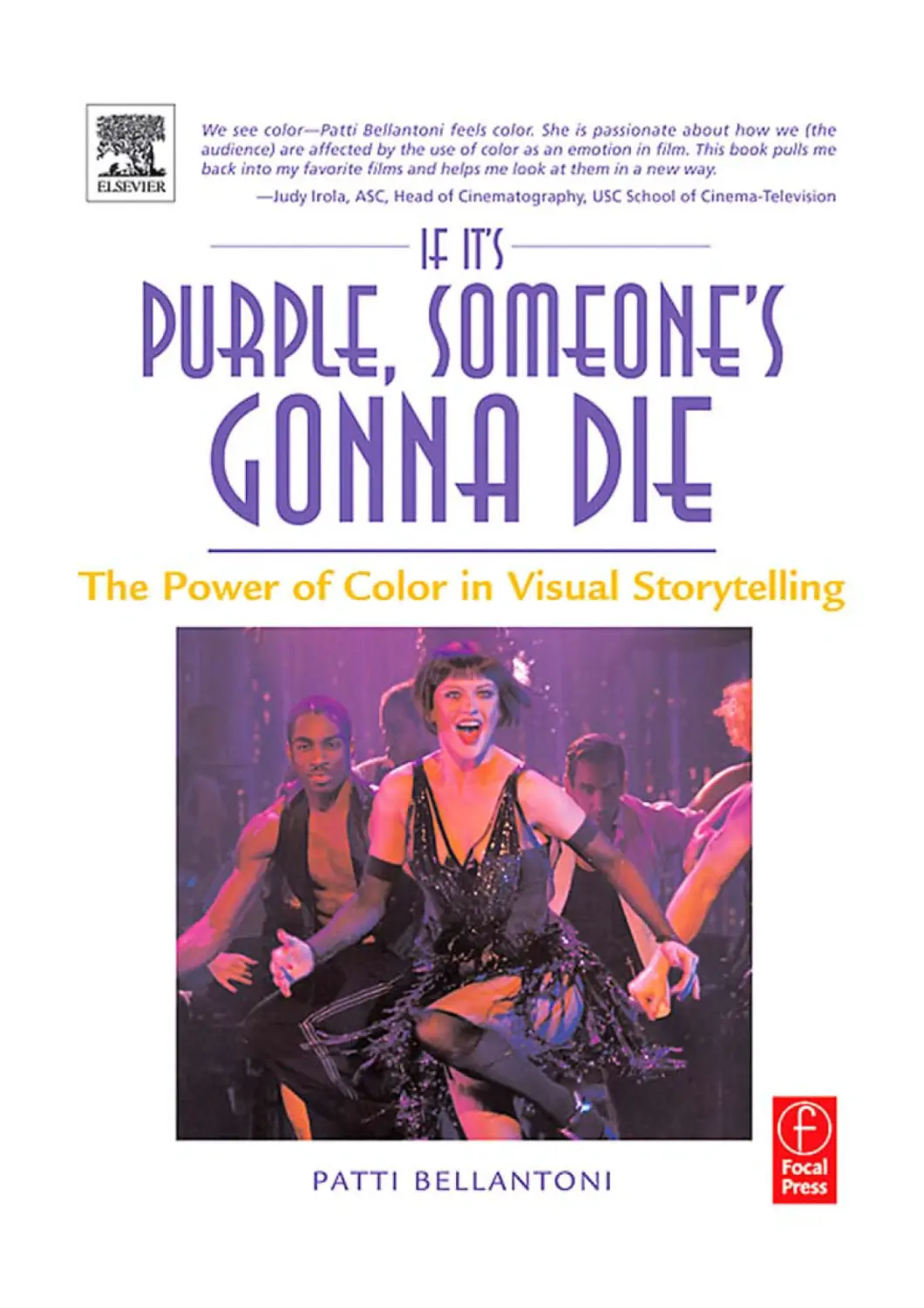
About the Cover
Why the image from Chicago?
There is something about the presence of deep purple
while singers sing and dancers dance that makes the
message more serious. Rich purple is not only associated
with death and delusion, it is perceived as having weight.
Underneath all the singing and dancing, there is killing
going on.

IF IT’S PURPLE,
SOMEONE’S GONNA DIE
The Power of Color in Visual Storytelling

P ATTI B ELLANTONI

AMSTERDAM • BOSTON • HEIDELBERG • LONDON
NEW YORK • OXFORD • PARIS • SAN DIEGO
SAN FRANCISCO • SINGAPORE • SYDNEY • TOKYO
focal press is an imprint of elsevier

Acquisitions Editor: Elinor Actipis
Project Manager: Kyle Sarofeen
Assistant Editor: Cara Anderson
Marketing Manager: Christine Degon
Cover Design: Julio Esperas
Interior Design: Linda Eberle
Focal Press is an imprint of Elsevier
30 Corporate Drive, Suite 400, Burlington, MA 01803, USA
Linacre House, Jordan Hill, Oxford OX2 8DP, UK
Copyright © 2005, Patti Bellantoni. All rights reserved.
No part of this publication may be reproduced, stored in a retrieval system, or
transmitted in any form or by any means, electronic, mechanical, photocopying,
recording, or otherwise, without the prior written permission of the publisher.
Permissions may be sought directly from Elsevier’s Science & Technology Rights
Department in Oxford, UK: phone: (+44) 1865 843830, fax: (+44) 1865 853333, e-mail:
permissions@elsevier.co.uk. You may also complete your request on-line via the
Elsevier homepage (http://elsevier.com), by selecting “Customer Support” and then
“Obtaining Permissions.”
Recognizing the importance of preserving what has been written, Elsevier prints its
books on acid-free paper whenever possible.
Library of Congress Cataloging-in-Publication Data
Bellantoni, Patti.
If it’s purple, someone’s gonna die : the power of color in visual storytelling for
film / Patti Bellantoni.—1st American pbk. ed.
p. cm.
Includes index.
ISBN 0-240-80688-3 (alk. paper)
1. Colors in motion pictures. I. Title
PN1995.9.C546B46 2005
791.43¢01—dc22
2005003311
British Library Cataloguing-in-Publication Data
A catalogue record for this book is available from the British Library.
ISBN: 0-240-80688-3
For information on all Focal Press publications
visit our website at www.books.elsevier.com
05

06 07 08 09 10

Printed in China.

10 9

8

7

6

5

4

3

2

1

FOR MY DEAR FRIEND AND MENTOR
ROBERT BOYLE
whose commitment to making it human is my greatest guide

C

ontents

Brief Filmographies
Foreword

xv

xvii

Acknowledgments
Backstory

1

xix

xxi

Red: The Caffeinated Color
Chapter 1—Powerful, Lusty, and Defiant Reds
Powerful Reds

5

5

The Wizard of Oz
Working Girl
8
Dick Tracy
10
Lusty Reds

1

5

11

The Thomas Crown Affair (Original)
11
Crouching Tiger, Hidden Dragon
11
Shakespeare in Love
11
Sea of Love
12
Defiant Reds

13

Rebel Without a Cause
Chocolat
14
Malcolm X
14

13

Chapter 2—Anxious, Angry, and Romantic Reds
Anxious Reds

19

The Sixth Sense
Run Lola Run
Angry Reds

19

19
22

23

Philadelphia
23
Schindler’s List
25
American Beauty
25
Romeo + Juliet
28
Romantic Reds

33

The Age of Innocence
An American in Paris

33
36
ix

Witness
37
Racing with the Moon
The Cider House Rules

2

38
39

Yellow: The Contrary Color

41

Chapter 3—Exuberant, Obsessive, and Daring Yellows
Exuberant Yellows

45

45

American Graffiti
Billy Elliot
47
The Wizard of Oz
Obsessive Yellows

45
51

52

Taxi Driver
52
Romeo + Juliet
53
The English Patient
53
Daring Yellows

57

The Thomas Crown Affair
Dick Tracy
59

57

Chapter 4—Innocent, Cautionary, and Idyllic Yellows
Innocent Yellows

63

63

Chinatown
63
Rosemary’s Baby
Cautionary Yellows

65

69

The Age of Innocence
69
The Caveman’s Valentine
69
Idyllic Yellows

74

Much Ado About Nothing
The Talented Mr. Ripley
Malcolm X
79
Gladiator
79

3

74
76

Blue: The Detached Color

81

Chapter 5—Powerless, Cerebral, and Warm Blues
Powerless Blues

85

Tootsie
85
The Wizard of Oz
86
Sense and Sensibility
86
The Shawshank Redemption
Rosemary’s Baby
91
Cerebral Blues

91

Crouching Tiger, Hidden Dragon
Malcolm X
91
Blow-Up
92
x

Contents

88

91

85

Warm Blues

95

Working Girl
95
Billy Elliot
95
Chocolat
96
Chapter 6—Melancholy, Cold, and Passive Blues
Melancholy Blues

101

101

The Shipping News
101
About Schmidt
104
Cold Blues

105

The Sixth Sense
105
Snow Falling on Cedars
Romeo + Juliet
106
Passive Blues

105

107

American Beauty
107
The Cider House Rules
107

4

Orange: The Sweet and Sour
Color
111
Chapter 7—Warm, Naïve, and Romantic Oranges
Warm Oranges

115

The Godfather
115
My Family/Mi Familia
The Big Easy
121
Naïve Oranges

115

117

123

Elizabeth
123
Thelma & Louise
American Graffiti
Romantic Oranges

128
130

130

Bull Durham
130
Far from Heaven
132
Chapter 8—Exotic, Toxic, and Natural Earth Oranges
Exotic Oranges

139

A Little Princess
Monsoon Wedding
Toxic Oranges

139

139
139

141

Blade Runner
141
Apocalypse Now Redux
Gattaca
149
Natural Earth Oranges

147

152

Unforgiven
152
Thelma & Louise
157
Contents

xi

5

Green: The Split Personality
Color
159
Chapter 9—Healthy, Ambivalent, and Vital Greens
Healthy Greens

163

Witness
163
Gorillas in the Mist
Ambivalent Greens

165

166

The Mosquito Coast
166
Crouching Tiger, Hidden Dragon
Vital Greens

163

169

169

Saving Private Ryan
The Thin Red Line

169
170

Chapter 10—Poisonous, Ominous, and Corrupt
Greens
173
Poisonous Greens

173

Snow White and the Seven Dwarfs
The Wizard of Oz
174
Ominous Greens

175

The Caveman’s Valentine
Gattaca
175
A Little Princess
175
Corrupt Greens

175

179

The Virgin Suicides
Cabaret
183
Great Expectations

6

173

179
183

Purple: The Beyond-the-Body
Color
189
Chapter 11—Asexual, Illusory, and Fantastic Purples
Asexual Purples

193

Eyes Wide Shut
Blow-Up
194
Illusory Purples

193

194

Rushmore
194
Tootsie
196
Dick Tracy
196
Far from Heaven
196
Fantastic Purples

Cabaret
Chicago
xii

Contents

197

197
198

193

Chapter 12—Mystical, Ominous, and Ethereal Purples
Mystical Purples

201

Snow White and the Seven Dwarfs
Eve’s Bayou
201
Ominous Purples

201

201

203

Gladiator
203
The Sixth Sense
204
Apocalypse Now Redux
205
Far from Heaven
205
Ethereal Purples

205

Déjà Vu
205
Crouching Tiger, Hidden Dragon
Color and Culture
Picture Credits
Index

209

217

225

231

Contents

xiii

B

rief Filmographies

Following are filmographies of cinematographers and production designers who are featured in If It’s Purple, Someone’s Gonna Die.
Each of these filmmakers has done many superb films. These are
the ones that are, at this moment in time, the most relevant to this
book.
Robert Boyle:
The Shootist, Fiddler on the Roof, The Thomas Crown Affair (Original), Marnie,
The Birds, North by Northwest
Henry Bumstead:
Million Dollar Baby, Mystic River, Bloodwork, Unforgiven, The Sting, Slaughterhouse-Five
Roger Deakins, BSC, ASC:
House of Sand and Fog, A Beautiful Mind, The Man Who Wasn’t There, [O]
Brother, Where Art Thou?, Kundun, The Shawshank Redemption
Edward Lachman, ASC:
Far from Heaven, Erin Brockovich, The Virgin Suicides, My Family/Mi
Familia, Mississippi Masala, Desperately Seeking Susan
Larry Paull:
Escape from L.A., Naked Gun 331/3, Another Stakeout, Born Yesterday, City
Slickers, Blade Runner
John Seale, ACS, ASC:
Cold Mountain, Harry Potter and the Sorcerer’s Stone, The Talented Mr.
Ripley, The English Patient, The Firm, Witness
Wynn Thomas:
Cinderella Man, A Beautiful Mind, Analyze This, Wag the Dog, Malcolm X,
Do the Right Thing
Amy Vincent, ASC:
Hustle & Flow, The Caveman’s Valentine, Way Past Cool, Freedom Song, Some
Girl, Eve’s Bayou
xv

T

h e magic of movies, a phrase often coined but seldom

defined. Maybe we call it magic because it affects us in ways
we’ve never taken the time to analyze. We talk about script, performance, and in my field, how the cinematography impacts
(supports) the script. We probably feel the importance of color
viscerally but we haven’t brought it to the table to talk about.
“The interior of the Lisbon house is permeated by a sickly
yellowish green, the kind of green that comes from not being
exposed to enough light. In essence, it is a guardhouse of five
virginal, about to bloom, young sisters. The house becomes a
metaphor for the parent’s obsession with not allowing any light
to come inside. The film is very much about not seeing.”
—Patti Bellantoni on The Virgin Suicides

Yummy. This book opens up new ways of looking at films we
love. It allows us to revisit and appreciate our romance with
movies. It’s like looking at a Vermeer when one is 20 years old,
and then again at 50. It only gets better and more intimate for
the viewer.
—Judy Irola, ASC
Head of Cinematography
USC School of Cinema-Television

xvii

A

cknowledgments

I express my deep gratitude to the following people:
First and foremost, to Elinor Actipis, Acquisitions Editor at
Focal Press, for her belief in this book, and my personal editor
at Focal, Christine Tridente, who calmly guided me in making the
book so much better than it began.
To my Proposal Editor, Jerry Gross, without whom my book
might never have happened. Thanks also to Arlene Gross, who
opened the door for many new colleagues.
To my agent, Irene Webb, who was there for me when it really
counted.
To the reviewers of my manuscript, who guided me to stay on
course. You were an invaluable help: Christopher Bowen, Judy Irola,
Heidi Mau, and David Waldman.
To Jamie Vuignier of the Kobal Collection for his immeasurable
assistance, far and above the call of duty, in color correcting the
images in this book.
To Linda Eberle for a design that really captures the spirit of
the book; and to David Bellantoni and Flora Carnevale for photographing the images for the Green and Orange Home Pages.
To my great computer technician, Emery Emery, whose exceptional knowledge, calm demeanor, and sense of humor prevented
me from jumping out the window.
To my friends from around the world who painted the
extraordinary paintings at the end of this book: Christiane
Benzonelli, France; Samuel Cordoba, Colombia; Ilya Noe, Mexico;
Juey Chong Ong, Singapore; Anna Vogt, Germany; and Keido
Yamada, Japan.
To MaryAnn Kilmartin for her decoding of the work of Carlo
Rubbia for me.

xix

To the brilliant and talented cinematographers and production
designers whom I interviewed for this book, I give thanks from
the heart. You have enriched the tone and texture of the book.
Above all, you have humanized it. Un abrazo to Bob Boyle, Henry
Bumstead, Wynn Thomas, Larry Paull, Roger Deakins, Ed Lachman,
John Seale, and Amy Vincent.
To Judith Searle for her guidance on the world of books.
To my Production team, headed by Kyle Sarofeen, who was
always willing and available to patiently explain the production
process to me.

xx

Acknowledgments

B

ack story

THE BEGINNING

The genesis for this book goes back to a day more than twenty
years ago at the School of Visual Arts in New York when I observed
that my design students were making arbitrary color choices in
their work. In order to investigate the conceptual possibilities
needed to inform their color decisions, I asked them to bring to
class what they thought was “Red.” There was no further instruction and no discussion.
On the day of the appointed class, the students appeared
wearing red, and predictably brought in paint chips and color
swatches, along with wrapping papers and fabrics. They even
flooded the room with red light. What also arrived, however, were
things no one had anticipated: hot peppers, muscle balms that
made the skin feel hot, toy fire engines with blinking lights and
sirens, red hot cinnamon balls, and rock ‘n roll music. What everyone experienced that day forever changed our awareness of how we
see color.
We became aware that there was a “Red” behavior happening.
The students compulsively gulped down salsa, talked louder, and
turned the volume up on the rock music. The males in particular
became sweaty and agitated. (One year later on Red Day, I had to
break up a screaming match between two young men who normally
were great friends.) After twenty minutes in the red environment,
the students were ready to leave. What had happened here? Everyone agreed to try the experiment again the following week, with a
different color. They chose blue.
As word of this experiment spread, students from other disciplines asked to participate, and they came to class. The class of
roughly twenty-five people divided into several groups. There was
only one rule: concepts and decisions were to be kept within the
confines of each group until Color Day.
Blue Day clinched that we were on to something. This time,
what the students brought was completely different. There were big

xxi

pale blue pillows, cooling mints, and new age music. Within
minutes, those loud, boisterous students from the week before
stopped talking, laid back and became almost listless. A sense of
calm permeated the room. As opposed to racing out the door, as
they had done previously, they didn’t want to move. Clearly, whatever was happening needed to be explored further.
The following year, I incorporated this experiment into my curriculum and made the project more specific. The class was to select
a color and then build an environment that explored the color’s
association with the five senses. Students divided into four groups,
each with four to five members. They were encouraged not to disclose their plans outside the group so their solutions to the assignment would be kept secret until Color Day. When the assignment
became more specific, the solutions became more revelatory. As
students began to explore the sounds, tastes, smells, textures, and,
of course, “sight” of a color, they discovered, for example, that what
smells, feels, or tastes a certain color may not be that color (e.g.
strawberries do not taste red). Because of this, the students began
to blindfold each other during their explorations of the color’s
smell, touch, and taste. Although their environments were filled
with the color, not being able to see what they were smelling,
touching, or tasting for those few minutes led them to a heightened awareness of their visceral responses. It also freed them to
seek out sense associations other than sight, which, in turn, gave
them a deeper understanding of that color’s effect on their perception. It also inspired the students to go beyond the superficial.
If red’s taste, for example, inspired students to bring in white raw
garlic and not red strawberries, then there is more to consider than
surface observation. For example, cinnamon was consistently perceived as a red taste, but cinnamon sticks are brown in their natural
state. However, the cinnamon-flavored candies called “Red Hots”
are artificially colored red. Similarly, artificially colored mint
candies and cough drops are often blue—a decision that seems to
be based on what the taste of mint looks like. It appeared to us
that product marketers were exploring something that our research
validated.
During this twenty-five-year period, patterns in the solutions to
the color problems began to emerge. In our experiments, red environments indeed nearly always included the tastes of jalapeño
peppers, the smells of spicy sauce, and the feel of hot muscle balm.

xxii

Backstory

There were sounds of cap pistols and those red balls of caps that
make sharp noises when hitting the floor. One of the reddest
sounds I have ever heard was a bullwhip that cracked like thunder
inside a kettledrum. The color indeed often inspired loud,
compulsive, and aggressive behavior. The following, written by
former SVA student Peter Coleman, is in response to my request
to write a paper on Red Day. Comments like these surfaced year
after year:
It’s important to note that I’m not a “red” person. If I had to guess,
I’d say I’m more blue . . . violet, maybe. But not red. Definitely not
red. Which makes it all the more peculiar that I petitioned so vehemently in favor of the color in the first place. (Author’s note: Students selected which color to explore by majority vote.) In the
process of campaigning for “Red‚” I became louder, more aggressive,
and, in short, a bigger, more cartoon-like and obnoxious version of
my usual self, challenging my classmates to “Screw the underdog”
(being any color other than red) and to ask themselves if they had
“the mettle”’ to choose red. Indeed, it took more guts for me to
choose this color than I had imagined.

After the “Red Experience,” Coleman continues,
Somewhere between the erotic and the ridiculous lies the explanation for our demonic and bizarre behavior on Red Day. Red comes
at you. It’s in your face. That element of the color seemed to possess
the group. I fed off the adrenaline created by the participants’ reactions . . . A heat seemed to be generating in the room, and I guess I
just went with it.

What began as a simple experiment became a revelation of a
force far more powerful than we had imagined, or really noticed.
The listlessness of Blue Day and the otherworldly atmosphere of
Purple Day, described next, reinforced my belief that color influences our choices, our opinions, and our emotional state. Our
feelings of euphoria or rage, calm or agitation can be intensified or
subdued by the colors in our environment. This is powerful information in the hands of a filmmaker.
WHY THIS TITLE?

Perhaps it is a reflection of our times—of our living on the edge
of the unexplainable—but each semester at least one class chose
to investigate purple, a color often associated with the mystical and

Backstory

xxiii

the noncorporal. The color resonated with the students in ways that
were consistent. The designs for their environments often dealt
with ritual, magic, and the spiritual. Every year at least one group
built an altar.
I had anticipated a royal interpretation of purple, but interestingly enough, interpretations of a royal connection to purple were
outnumbered by the mystical, spiritual, and paranormal by approximately ten-to-one. The association with the royal and regal
comes from the fact that purple is the most difficult color to come
by in nature. Its very scarcity associates it with the rare trappings
of emperors, kings, and queens. But altars are in a different genre
altogether. Altars are in the province of something beyond the
material. The altars the students designed for purple often used
religious associations as a springboard. There were even altars to
chocolate (a taste, we discovered, they associated with the color)
and to the smells of lavender. There were psychics, fortunetellers,
and witch doctors. The most pervasive interpretations of purple,
however, dealt with vigils, wakes, and funerals. One funeral was
complete with a tombstone for each member of the class.
These experiments led us to become more aware of the use of
purple in popular culture in general (ads for yoga are often purple)
and, of course, the use of purple in movies.
Films as varied as Cabaret, Dick Tracy, and The Sixth Sense all
use purple to foreshadow death. Purple, however, doesn’t always
signal a literal death of someone. It could mean something is going
to die. For example, Max Fisher, the adolescent rogue in Rushmore,
climbs a ladder to the purple bedroom of his teacher, only to lose
his delusion that he will sleep with her. In Tootsie, Dustin Hoffman’s
character Dorothy Michaels wears purple when she reveals her
character’s true identity as a man, thereby “killing” Dorothy.
Both colleagues and students tell me they were not previously
aware of how often the title If It’s Purple, Someone’s Gonna Die manifests itself in movies. Investigate it for yourself. The next time you
see purple in a film, watch carefully for what it reveals. Start with
Far from Heaven or even Chicago.
Out of more than a dozen potential titles for the book, my
students chose If It’s Purple, Someone’s Gonna Die because they felt
this title captured both the spirit and content of my color seminars
in Visual Storytelling at AFI.

xxiv

Backstory

THE BOOK’S LANGUAGE

You will find I often tend to attribute characteristics to a color.
For me, after years of investigation, colors indeed have distinct personalities. For example, hot reds are “lusty.” This does not mean
the color itself has that inherent emotional property. It means that
it can elicit that physical and emotional response from the audience. Both Gwyneth Paltrow’s bedspread in Shakespeare in Love
and Nick Cage’s bedspread in Moonstruck are a hot orange-red,
and they certainly accompanied lusty activity in those films. Does
it mean that that particular red is restricted to lusty activity? No,
but it’s a valid description of one of the activities the color can
trigger. A strong color elicits a strong visceral response. This, in
turn, can set up an audience to anticipate a particular action
(in this case, a lusty one).
Colors indeed have their own language, which can visually help
define a character arc or layer a story. In Malcolm X, for example,
bright, “look at me” red is the color that defines Malcolm’s cocky
small-time hoodlum years; blue, the contemplative years in prison;
and gold, his enlightened time in Mecca. Each of those colors layers
the journey of this man and has a different (and cumulative) effect
on the audience. Red is energizing, blue affects introspection, and
golden light inspires the spiritual or enlightened. Wynn Thomas,
production designer for Malcolm X, describes how he envisioned
the film in three acts, each defined by a particular color, on page 14.
WHY THE TERM “PURPLE”?

For years, I advised my students to use the term “violet” to
define the color that is midway between red and blue (in the additive system). But “purple” kept creeping into our day-to-day vocabulary, especially in communicating color names in the commercial
world. Indeed, a 1992 press release from Pantone, Inc. (a color
system for designers and printers), refers to purple as “a blend of
the excitement of red and the tranquility of blue.” The word “purple
“ in this book is used in that context. In the interest of communicating clearly, I have chosen terms for colors that are most consistent with our day-to-day living experiences: red, yellow, blue,
orange, green, and purple.
HOW THE BOOK IS ORGANIZED

The book is divided into six parts, one for each of these major
colors in the spectrum: Red, Yellow, Blue, Orange, Green, and

Backstory

xxv

Purple. Each part has a home page, which describes the emotional
and psychological influences we discovered about the color,
and contains two chapters, each of which explores films that best
illustrate those influences. Within these chapters, the color is
divided into six characteristics that help to influence our emotional
responses to the films.

LEGEND
SUPPORTING
COLOR

!

CROSS
REFERENCE

#"

Some films use a color’s transformation, or its flow, to support the
evolution of the characters and story throughout the movie. Others
have one brilliant scene that captures a color’s role in defining a character or expanding the story. Consequently, some of the chapters are
longer than others. If more than one color is explored in a film, the film
is listed under the color that is the major influence in the story and the
other color(s) will be keyed under “supporting color” icons in the
margin of the page. As well, “cross-reference” icons will appear in the
margins of the pages of the films where the same color appears. Please
note that, because my film commentaries follow the order of the script,
sometimes a supporting color may precede the major color in the film.
Films are indexed by movie title, color, and emotional state,
allowing easy access to a wide range of information, Or, led by the
moment, the book can be read beginning anywhere.
WHY THESE FILMS?

If It’s Purple, Someone’s Gonna Die explores big studio films and
limited-release indie films, Oscar winners and films that at the time
were critically dismissed and are just now being revisited. Each of
the films was chosen because it illustrates a brilliant use of color,
either in just one crucial scene or sequence in a movie or thematically throughout the entire movie. A film like Ang Lee’s Crouching
Tiger, Hidden Dragon uses color to define the story and the
characters’ arcs so completely that it appears under four colors.
There are some films where the visual storytelling is so rich,
particularly with visual metaphor, that it could become a seminar
unto itself. Accordingly, in keeping with our goal to expand the way
we see movies, I have chosen at times to explore in more detail
elements like subliminal symbols (The English Patient), visual
irony (Unforgiven), and visual politics (My Family/Mi Familia).
THE SIX CHARACTERISTICS: AN IMPORTANT NOTE
TO THE READER

The six characteristics listed for each color (e.g., Powerful,
Lusty, and Defiant Reds) were selected because these emotional

xxvi

Backstory

associations repeated themselves over and over again in our
research. These are simply examples of how a color can be used.
In no way are they meant to limit you, but rather to act as springboards from which you can go off and test further interpretations
on your own. Please remember, just because blue might appear
under Passive Blues, for example, does not mean it cannot exhibit
characteristics like Melancholic or Cerebral as well. By the same
token, both green and purple are listed as having the characteristic of Ominous. It all depends on the context in which they are
used. All the more reason to think for yourself and not try to turn
these categories into rigid formulas for color selection. Get a group
together and have them create a color environment and observe
how behavior will change (see page xxii). You will find that if you
don’t try to skew the results by giving your audience clues as to
what you want, your research will be amazingly consistent.
My goal is to facilitate your reliance on nonverbal information.
I want to encourage you to exercise your visceral muscles. Seeing a
movie demands skill that watching a movie doesn’t.
A CAVEAT FROM THE AUTHOR

There are times when I hear a filmmaker say, “Color can be
whatever you want it to be.” My experience tells me this is a dangerous misconception. It’s the cart before the horse, really. In fact,
my research suggests it is not we who decide what color can be.
After two decades of investigation into how color affects behavior,
I am convinced, whether we want it to or not, that it is color that
can determine how we think and what we feel.
One of the reasons color influences us is due to a phenomenon called resonance. MaryAnn Kilmartin, a bio-resonance expert in
San Diego, talked to me about the ideas of Carlo Rubbia, who won
the Nobel Prize for Physics in 1984. According to Kilmartin, Rubbia
calculated that we are one billion parts light to one part matter.
She explains, “Human beings are basically all light. We look like we
are all matter because we are hard-wired to see the particle nature
of light. As you recall, light has two forms: particle (solid) and wave
(frequency). We ‘feel’ light however because we are in resonance
with light in its wave form. That is what we mean when we talk
about feeling red/anger/energy, etc.”1
1
Bio Resonance and Multi-Resonance Therapy, Vol. 1, ed. Hans Brugemann, Carlo Rubbia, Hague International, Brussels,
English Edition, 1993, pp. 208–209.

Backstory

xxvii

So our perceptual nature is unable to see the wave nature of
light that affects how we “feel.” The irony is that color impacts us
in ways we cannot see, but it affects how we feel and how we
behave. When we walk into a red room, for example, it is as if the
color red and the human body become two resonating tuning forks.
Like a note, our whole system begins to “hum” red—physically, psychologically, and emotionally.
Each color affects us uniquely. Even the slightest variation of a
single color can have a profound influence on our behavior. In wise
hands, color can become a powerful tool for filmmakers to subliminally layer a story—to make a situation ironic, or absurd. In
Philadelphia, as the dying Tom Hanks clings to his IV stand, translating the lyrics to an opera whose theme is love and loss, he is
slowly enveloped by an intense red light from nowhere. It is like
visual salt rubbed into an emotional wound. Hanks speaks of love
and life, but the red belies his emotional reality. We are powerless
to ignore it. The red is the visual counterpoint to the words and
music. It is his unspoken rage and mortal pain, as well as a visual
adjective that supports and sustains Hanks’ brilliant performance.
On the other hand, the pale red (pink) in The Royal Tennenbaums makes an enormous difference in the audience’s attitude
toward the title character. Royal Tennenbaum does incredibly despicable things, but because he’s surrounded by bubble-gum pink,
we know instinctively not to take him seriously. The color has
rendered him silly.
Color is one of the elements rarely recognized by the audience
as manipulating them. This subliminal quality can be magic in the
director’s hands—or not. This much is clear: if we remain unaware
of this power awaiting our command, we relinquish a large part of
our control to chance. Color will continue to resonate, to send out
signals, irrespective of our intentions. So, whether it’s on or offscreen, it’s essential for us to know what we are doing.
GOING BEYOND THE VERBAL

How do you develop this facility with color? How can you
use this powerful force to layer a story? How can you create the
magic?
First and most importantly, you select your left-brain and click
“Quit.” You have to relinquish control of your thinking self and give
it over to what you are seeing. This is not easy in a culture that prides

xxviii

Backstory

itself on hard-nosed reason and in which our softer perceptual
skills are often dismissed. Most of us love to analyze films and love
to talk about what we analyze. Indeed, we are often so busy
analyzing the plot points that we are unaware of how we are being
affected by what we see. We’ve evolved into a generation of talkers
with lazy vision. We “watch” but we don’t see. And we miss out on
an experience that enriches our emotional core.
It will maximize your experience if, after reading this section,
you first see a film before you read the book. For example, if you
want to explore the emotional influence of blue, you might screen
About Schmidt. The film opens with one of the bluest offices in the
history of cinema. Don’t just register that as an idea and move on.
See how blue follows Warren Schmidt wherever he goes and pay
very close attention to what the blue is doing to you both physically and emotionally. Of course, it has layered Schmidt’s character, but it has also allowed you to have a visceral understanding of
who he is. That is a very different experience. If you use the book
in this way, you can compare and contrast your observations and
discoveries with mine. It will be more like a seminar than a lecture.
Another way to begin is to choose a film you are familiar with,
run it on fast-forward and look for how a color or colors propel the
story or modify the characters (color is, after all, a visual adjective).
In Elizabeth, for example, the color of Cate Blanchett’s costumes
defines her character arc as it morphs from innocent pale coral to
powerful blood red.
PITFALLS TO AVOID

Filmmakers should be careful not to make color choices based
solely upon an intellectual or abstract notion. If, for example, a
director chooses blue to symbolize “hope” because the sky is blue
when the sun shines, he or she may find it is possible for an
unwanted reaction to occur. Instead of feeling hopeful, the audience may involuntarily respond to blue by feeling tired—even
melancholy.
This is a true story: An executive decided on his favorite pale
blue as the color for his office reception area. As the months wore
on, he found himself complaining about the passivity, complacency, and lack of curiosity among his current crop of job candidates. He attributed it to the millennium and seriously
contemplated initiating a seminar called “Initiative for the 21st

Backstory

xxix

century.” My research has suggested that pale blue makes people
passive and introspective. Without knowing it, he spaced out every
person who sat more than five minutes in his waiting area. They
hummed to the tune he visually played for them.
Of course, it depends on which blue is used, but what one director thinks of as sky blue, another would call azure. Adjectives for
color are subjective. The experience of reading or hearing a word
and the physical sensation felt by seeing the actual color is not the
same. Actually, Jasper Johns, in an exhibition in the early 1960s at
the Jewish Museum in New York, “illustrated” the dichotomy
between a word and the thing that a word describes by hanging an
actual teacup on a canvas and then writing the word “cup” on the
painting with an arrow pointing to the cup. There was a lot of dialogue that took place about this piece, but the consensus seemed
to be that Johns was pointing to the fact that the two are not equal.
The same is true for color and the description of a color.
Interestingly enough you already possess the information you
need in choosing a color. It is simply stored in your own perceptual depository. Only recently a young designer, unknown to me,
asked me what a particular color meant. I asked her to close her
eyes and remember a time when she felt afraid and to tell me what
colors her feelings were. The colors she chose were exactly the
colors that my students had chosen over and over again in our
color experiments.
This book encourages you first to approach both filmmaking
and film viewing viscerally. Still, your intellect will always be
waiting. Sometimes it will want you to put a round peg in a square
hole because it wants the story to be more linear. Just demand that
it be patient. Once you’ve trained yourself to really see, your intellect will be back to weave its own brand of magic.
ARE COLOR CHOICES REALLY PLANNED?

At my seminars in Visual Storytelling, the first question often
asked is, “Is all this really planned?” The answer is not a simple yes
or no. Color may play a role in weeks of planning in preproduction.
Sometimes, however, plans are supplanted by gut decisions for
which a color simply “feels right” on the spot. Oscar-nominated
cinematographer Roger Deakins explains how he works with
both the planning and the instinctive in filming The Shawshank
Redemption:

xxx

Backstory

I was involved in Shawshank from very early on and had time to
discuss all (production designer) Terry Marsh’s plans for his sets and
how they would work in conjunction with the location. As our choice
[of color] had to work in varied lighting conditions we tested paint
colors on film many times before settling on the final tone. The
warm brown tones that I was intending to use for the night lighting
had a different effect on the gray we chose for the cooler daytime
lighting. It is simply that warm light hitting a bluish gray wall will
create a brown color, whereas cool daylight striking the same wall
will often bring out the blue in the color to a degree that can appear
too extreme on film. Film will often enhance blue anyway so it is
important to test colors of paint and costumes when a particular
“look” is sought.

However, Deakins also talks about how he likes to work from
instinct when he shoots:
It can be an analytical process but I think it is more often instinctual. It is usually a “feeling” that something is right or “it just looks
right” and what might have “looked right” in preproduction may not
be right on the day of the shoot. The instinctive may overcome the
analytical . . . That is the only way I work and many such choices are
made as the camera is being set and, maybe, after I have seen a
rehearsal.

ROGER DEAKINS

As our choice [of color] had
to work in varied lighting
conditions, we tested paint
colors on film many times
before settling on the final
tone.
$
Ultimately, it is your relationship with what is there
in front of you—the actors
and the set—that counts. It
is a gut reaction to these
elements and not some
thoughts you bring with
you.—Roger Deakins

Filmmakers can pragmatically verify a desired emotional
response to a color. An excellent example of wise decision making
is the way director Kasi Lemmons chose a particular green light,
which played a key role in The Caveman’s Valentine. In the script,
writer George Dawes Green had specified a “pernicious” (wicked)
green. Lemmons and cinematographer Amy Vincent tested the
effects of different greens on actor Samuel L. Jackson and gauged
his physical and emotional reaction to each one.
Color-flows that track the emotional arcs of a story are appearing on walls of studio art departments. More and more, colors are
being digitally altered in order to emotionally emphasize a scene.
So, yes, it is often planned, not just on the set but also in both preproduction and postproduction. Consideration of how a color will
manifest in a film is essential.
It’s obviously impossible that David Hand, the director of Snow
White and the Seven Dwarfs (1937); Sofia Coppola, director of The

Backstory

xxxi

AMY VINCENT

We wanted the green “ZRays” in The Caveman’s
Valentine to affect Romulus
(Sam Jackson’s character)
negatively in his very core.
“Z-Rays,” according to
Rom, are “the color of a
rich man’s bank account.”
There are many different
rules of the game in business and finance, and Rom
doesn’t live in that world at
all, so the green “Z-Rays”
are terrifying to him. When
Sam reacted to it strongly,
we knew it was the right
green.
—Amy Vincent

Virgin Suicides (2000); and Kasi Lemmons, director of The
Caveman’s Valentine (2001) met and decided unanimously to
choose green liquid as a metaphor for poison. But choose it they
did. What inspired these decisions? We do not know for certain,
but imagine how you would feel if someone offered you a tall glass
of bright green liquid. Maybe our knee-jerk response lies deeply
buried in our unconscious. Perhaps it’s a fear reaction lodged deep
in our genetic memory since we crawled up out of primal pond
scum. (See the opening scene in Terrence Malick’s The Thin Red
Line.)
In the air or in liquid form, green can effect an association with
the poisonous or toxic. Green in the atmosphere, for example,
often precedes a violent storm. This is an important consideration
in choosing to use green light. In both the African American and
the gay bars in Todd Haynes’ Far from Heaven, green light signals
to the audience that something is being perceived as not acceptable in the social environment. The audience responds to this viscerally. Their interpretation depends on how carefully the context
is established.
Throughout this book, you will find anecdotes from awardwinning cinematographers and production designers whose comments will underscore the essential interplay between the technical
and the esthetic and between the planned and the instinctive. In
choosing a color, one thing is for certain: Each without the other
can leave the end result to chance. And that is not, whether it’s
onscreen or off-screen, where you want it to be.
AN INVITATION

You are about to begin an exploration of more than ninety
selections from films in which color influences your perception of
who is a villain, who is a victim, who is about to fall in love, and,
sometimes, who is about to die. If It’s Purple, Someone’s Gonna Die
is written the way I teach: in an informal style and in accessible
language. It is important that your visual processing not be
interrupted by the need to digest unfamiliar terms. The concepts
presented in this book will demand your complete visual attention.
Using film after film as a reference, you will be building an awareness of how color affects your attitudes toward the character and
story. I hope you will use this book as a springboard to jump off on
your own. If you’re not sure a color will give you the effect you want,

xxxii

Backstory

test it on your audience. Whatever you do, don’t just talk about
color. Have swatches, photos, fabrics—whatever you like—to
illustrate what is in your head. Feel what the color is doing to you
physically.
It’s sneaky business, this thing called color. It’s right there in
front of you, but more times than not you don’t notice what it’s
doing. This book is written to heighten that awareness. Consider it
an invitation to join in our Visual Storytelling Seminars.
Patti Bellantoni

Backstory

xxxiii

Red
The Caffeinated
Color
1

Lola has twenty minutes to find 100,000 marks to save
Manni’s life. Red is her visual fuel.

B

right red is like visual caffeine. It can activate your libido, or make

you aggressive, anxious, or compulsive. In fact, red can activate whatever
latent passions you might bring to the table, or to the movie. Red is
power. But red doesn’t come with a moral imperative. Depending on the
story’s needs, red can give power to a good guy or a bad guy. After all,
both the Wicked Witch and Dorothy wore the ruby slippers.
Because we tend to see it first, red gives the illusion of advancing
toward us. Due to this, it can manipulate our sense of space. In Sydney
Pollack’s The Firm, for example, the camera places us directly behind
Tom Cruise when the door to the law firm opens. What we see is what
Cruise sees: It is a bright red wall that visually says “power.” Because
bright red has this visually aggressive quality, the space does indeed
appear to come forward, and it looks shallower than it actually is. That
is exactly what is going to happen to him at the firm. Cruise is about to
enter a high-powered place in which there is little room to maneuver.
Red can also make something appear to move faster. (Red cars get
more speeding tickets than cars of any other color.) Bright red can raise
your heart rate and anxiety level. It is visually loud and can elicit anger.
One of my students told of how her happy, well-adjusted family was
bored with the neutral color in their dining room. They wanted to make
it more cheerful. After selecting a number of paint chips, they decided
on a bright red. Almost immediately and without warning, they began to
have altercations every night at dinner. It sent them into a tailspin. In
fact, it got so bad, they went into family therapy. A few months went by
with no appreciable change. Frustrated, they ultimately searched for an
answer in the dining room itself. As the only thing that had changed was
the color, they decided to change the color back to the original pale
yellow. They stopped fighting almost immediately.

Bright red tends to be cold. Power-hungry Sigourney Weaver wears red
in Working Girl, and in The Sixth Sense the cold-blooded murderer wears
it at a funeral. This aggressive quality of bright red is somehow tempered
when the color becomes warmer. Warm reds (red-oranges) tend to be
sensual or lusty. Think Gwyneth Paltrow’s bedspread in Shakespeare in
Love. Rose (light red tinged with blue), like the train car in the last scene
of Racing with the Moon, is more romantic. (See illustration on page 39.)
Red darkened to burgundy reads as mature, regal, and elegant. In
Moonstruck, when Loretta (Cher) buys a burgundy dress for the opera, it’s
an important clue to a change in her heretofore-mundane character.
Burgundy, a deep red, that has a whisper of blue, is more sophisticated.
It’s like a fine vintage wine. It signals a growth and maturity in Loretta. This
may be her first opera, but that burgundy suggests it probably won’t be
her last.
In the last analysis, the color most people think of as “red” is the one
we call “fire engine red.” This is the red that makes people eat faster and
gamble more. Think of the sound a fire siren makes. Red is its visual
equivalent. It makes it difficult to believe that the red in the traffic lights
visually signals us to “Stop!”

Think About This:
Does the red in a traffic light
really signal you to stop?

1
Powerful, Lusty, and Defiant Reds
Powerful Reds

The Wizard of Oz
1939. Judy Garland, Ray Bolger, Burt Lahr, Jack Haley,
Margaret Hamilton. Directed by Victor Fleming.
Cinematography: Harold Rosson; Art Direction:
Cedric Gibbons.
RED: LITTLE SHOES/BIG POWER

Think of it this way: The green brick road, the yellow shoes, and
the ruby red city. Doesn’t work, does it? And it’s not only because
this film is part of our cultural heritage (it was voted number six
on AFI’s list of the 100 greatest American movies of all time) that
the yellow brick road, the emerald city, and the ruby-red shoes
are impressed as clichés in our consciousness. It’s because those
specific colors send specific signals for specific intentions in the
story.
Underneath all the charm, underneath all the delight is a
serious and scary story about the struggle to find power, compassion, and courage. It’s about facing the green witches and blue
monkeys of the adult world. It’s akin to Luke Skywalker’s using “the
force” to fight the dark side or Harry Potter’s summoning his
Patronus to repel the dementors. Luke had his lightsaber. Harry
had his wand. Dorothy, in a sweeter time, had her magic shoes. It’s
interesting to note that even though Dorothy’s slippers look like
adult shoes, they fit this little girl. Dorothy’s ready to grow up, and
they give her something that she desperately needs to travel down
that yellow road, and red is the clue to what it is.
Dorothy needs power. The pale blue of her pinafore doesn’t
send a strong enough signal to ward off the scary trees and flying
monkeys that she will face along the way to Oz. After all, it’s the
red shoes that will have contact with the cautionary yellow of the

5

road and, therefore, need the most power to carry her there. Red
is her visual courage.
Dorothy’s also a kid who’s been wrenched from home and feels
powerless in this strange world of witches and munchkins. It is
important to remember that in 1939, when the film was made, audiences were viewing films in black and white, and so it was brilliant
for the filmmakers to expose the audience to black and white in the
beginning of the movie so that they too could experience the
incredible shock of the exotic and bizarre Technicolor world along
with Dorothy. Intimations of vulnerability were rumbling through
the cosmos in 1939. People wanted to feel strong and invincible. It
was good to know that it was the home from Kansas that squashed
the Wicked Witch so Dorothy could have those ruby slippers and
the strength and the power to make it to the Emerald City. The
number one red signal is Power.

!

YELLOW: THE PROMISE AND THE WARNING

The yellow has it all. It’s bright, and it’s a color, like red, that
tends to take over the visual field. After all, we see it all the way to
the Emerald City. Because of its brightness and warmth, it is often
associated with happiness. Perceptually, it appears to come
forward. We “see” it first, which is one of the reasons it is used to
signal caution in traffic signs. That road leads the way to finding
happiness over the rainbow and at the same time it cautions
Dorothy of the unknown obstacles that will test her along the way.

!

BLUE: POWERLESS PINAFORES AND SCARY MONKEYS

Actually, Dorothy’s pinafore was a blue gingham-check, which
reads as pale blue. Year after year, our investigations revealed that the
paler a color is, the more powerless it is. She definitely needs that red.
Those monkeys, on the other hand, are a very cold and very
bright blue, and combined with their gargoyle-like faces, they are
the stuff of which nightmares are made. Scary-looking things that
are a cold color do not read as compassionate, and consequently
become even scarier. Blue is the coldest color in the spectrum. In
its most saturated form, it is not associated with emotional warmth
or empathy.

!

GREEN: THE MEAN OLD LADY AND THE EVIL WITCH

In the black-and-white beginning of the movie, the face of Miss
Gulch (Margaret Hamilton) is really scary. But when the scene shifts

6

Chapter 1 Powerful, Lusty, and Defiant Reds

to the Technicolor land of the Munchkins and she becomes the
Wicked Witch of the West, her face is green and she becomes
absolutely virulent.

Green transforms the
already horrid Miss
Gulch into the even
more evil Wicked
Witch of the West.

She is evil incarnate. Chalk it up to genetic memory of venomous reptiles crawling or sliding out of the slime, but our reaction
to green skin is programmed at a very deep level. Our aversion is
a knee-jerk response. We can’t help it.
GREEN: THE EMERALD ANOMALY

!

Then why aren’t we afraid of the emerald castle? The answer
lies perhaps in the idea of this green as a beautiful jewel. Not to
cast a shadow over a film icon, but in the last analysis (my research
shows green, when not in a natural state, can have very negative
associations), green may not have been the best choice for this
magical city. Renowned color consultant Faber Birren says in his
well-known book Color, “Green . . . is used to express both the curse
and the blessing of youth.”1
1

Faber Birren, Color, Marshall Editions, Limited, 1980, p. 206.

Powerful Reds

7

Try this experiment yourself: In the last sequence, the Wizard
is about to fly off in the balloon. A crowd of people dressed in green
forms around him, and the green city surrounds him. Wait until
the screen is nearly filled with green and put the video on “pause.”
Just stare at the screen as if it were an abstract painting and
see how you feel physically. Then you decide: Does it feel magical
or not?

Working Girl
1988. Harrison Ford, Melanie Griffith, Sigourney
Weaver. Directed by Mike Nichols.
Cinematography: Michael Ballhaus;
Production Design: Patrizia von Brandenstein.
THE FALL AND RISE

Accompanied by Carly Simon’s “Let all the dreamers wake the
nation,” the Staten Island ferry, in all its working-class glory, heads
toward Manhattan. This is a journey between two worlds. And the
credentials required to gain access into the more powerful one are
hard to come by for a girl from the “Bridge and Tunnel” crowd. Tess
McGill (Melanie Griffith) is a young woman who has worked hard
and long, gone to school at night, and won a degree with honors.
Yet she doesn’t have the resumé to make it in this part of town.
Her big hair lets us know that right away. When we first see Tess,
she’s in a brown vinyl car coat, rosebud textured tights, and lots of
costume jewelry. But Tess has great instincts. Her transformation
begins on her first day in her new job as a secretary in Mergers and
Acquisitions. She wears black. Her new boss, Kathryn Parker
(Sigourney Weaver), makes her entry softly, wearing an elegant suit
the color of deerskin with simple pearls over an ivory-colored
blouse. It doesn’t, however, take Kathryn—an egotistical powerobsessed control freak if ever there was one—long to begin
wearing red.
She throws a cocktail party to introduce herself to her colleagues. In a brilliantly staged scene, a gaggle of gray-suited men
swarms around her, like little boys to a candy store. Kathryn,
sophisticated and elegant, is a corporate temptress incarnate. In
the midst of this grayness, she stands, wearing a deceivingly simple
bright red dress. The color is dominant and signals power, but her
dialogue is laced with lusty innuendo. She promises “a bottle of

8

Chapter 1 Powerful, Lusty, and Defiant Reds

Cristal with two straws” to a smarmy guy if he can get her in on a
divestiture deal.
Tess, dressed in gray, disappears into the haze of the steam
table as she wheels a tray of Chinese dumplings through the
crowd. She may appear powerless, but she is also nearly invisible,
which allows her to listen, watch, and learn from Kathryn’s every
move.
Put this scene on “pause” and just look at the image, not for
the subject matter but as an abstract design, and you will see
Kathryn’s red visually “take over” the frame while Tess’ gray recedes
into the background. It’s a visual translation of exactly who each
woman is. At this moment.
A prophetic bright red, magenta, and orange watercolor of two
cougars walking in opposite directions hangs on Kathryn’s office
wall. Chances are, they are female cats.
Then there is the relationship-defining scene involving the red
ski boot: The sequence begins in Kathryn’s office as Tess, on her
knees, is fitting Kathryn’s big bright red boot. It’s shot in close-up,
so red dominates the screen and we get the lord-and-master
relationship visually.
Once the scene moves to the slopes, however, director Mike
Nichols riffs on the power angle by pushing Kathryn’s red to the
max. She’s in red from cap to boots, and with great élan she skis
confidently over the edge of a cliff and breaks her leg, allowing Tess
to commandeer her office and mask as a Mergers and Acquisitions
executive. This is a great visual set-up. Nichols has turned the
power thing on its head and used it sarcastically. It’s also an everso-light-hearted foreshadowing of Kathryn’s ultimate downfall.
Another huge clue to Tess’s rise/Kathryn’s fall in this scene lies in
what each of them is wearing. It’s very subtle and very significant:
in the ski-boot fitting scene, both Tess and Kathryn are wearing
nearly identical clothes—white blouse and a black skirt. It’s a
subtle hint of the equal matching of these women, like the two
powerful cats walking in opposite directions in Kathryn’s painting.
All the reds Kathryn wears are cold. There is not one hint of
warmth in them. Warm reds are closer to the color of a pimento or
a persimmon (see Shakespeare in Love). Colder reds are closer to
the color of a Red Delicious apple. They’re perfect for power.
Kathryn’s energy is cold, arrogant, and analytical, and in the end it
traps her. In her last scene, dressed in red, she tries to lie her way

Powerful Reds

9

out of the Machiavellian situation she has created. But this time
her power fails her.
It’s a wonderful visual irony, seeing Kathryn limping arrogantly
through the office corridor, wearing the color that no longer works
for her. Aside from the great “Get your bony ass out of my sight”
line, we see the demise of her power visually. As we watch her walk
away, both Weaver and the red diminish in size.

!

POPSICLE BLUE: BACK TO THE NEIGHBORHOOD

A witty and obvious visual conceit is Nichols’ use of hair as
character definer. Tess’ cutting of her big hair marks the beginning
of her conscious transformation from a naïve Staten Island secretary to a sophisticated executive in Mergers and Acquisitions. Far
subtler is his use of color to chart the journey of her character. For
her new “promotion” in the corporate world, Tess has worn tailored,
subdued blacks and whites and neutrals.
After her ruse is discovered and she gets the boot, she returns
to her working-class neighborhood to be a bridesmaid in her best
friend’s wedding. Her bridesmaid’s dress is a blue that defines
where Tess is at this moment. It’s a happy, unsophisticated, warm
blue that’s not been muted or otherwise intellectually messed
with. It’s simple, not subtle. It’s a sweet color, like the color of a
blue popsicle. The more elegant a dessert, the less sweet it is. It’s
exactly the same with color. Not better. Not worse. Just a different
taste. But Tess has tasted something different. She’s not the
same girl she used to be and it shows. This is a color from the old
neighborhood.
It’s a great character-revealing scene at the wedding when she
and her ex-boyfriend (Alec Baldwin) run into each other. He’s in a
rented powder-blue tux. He looks at home. She, now accustomed
to a more elegant environment, doesn’t. Seeing them standing
together, we remember where she’s been and see where she is and
feel the difference. And it’s her color arc that adds dimension to
that realization. What’s important is that Nichols does this without
slandering class or stereotype. It’s clear he can poke gentle fun at
each side equally.

"#

Dick Tracy
See “Red: A Power Force” on page 59.

10

Chapter 1 Powerful, Lusty, and Defiant Reds

Lusty Reds

The Thomas Crown Affair

"#

See “Red: The Unspoken Lust” on page 58.

Crouching Tiger, Hidden Dragon

"#

See “Red: The Dangerous Romantic” on page 210.
See “Red: The Lusty Bandit and the Spoiled Brat” on page 212.

Shakespeare in Love
1998. Gwyneth Paltrow, Joseph Fiennes, Geoffrey Rush.
Directed by John Madden. Cinematography:
Richard Greatrex; Production Design: Martin Childs.
LUST DROWNED OUT

In Shekar Kapur’s Elizabeth, the director uses colors and textures of his native India to evoke psychologically Elizabeth’s exotic
(read lusty) side. In Shakespeare in Love, director John Madden
uses a different approach to achieve the same end. His interpretation of Elizabethan colors reveals the architecture to be filled with
neutral grays and browns. Consequently, when a hotter or more
intense color appears, our senses respond accordingly.
Sometimes a minimal use of color can clue us in to how the
characters will behave within a given environment. Because it’s in
a darkened room, our heroine’s hot red bedcover appears even
more sensual. The color glows on the two young bodies as they
make love. This is the chamber where the heroine’s virginity is lost
behind closed doors, but to riotous effect due to the squeaking
rocking chair comic relief supplied by Viola’s (Gwyneth Paltrow’s)
nurse.
Warmer reds are more orange influenced but can run from the
color of poppies to the color of pimentos. They’re the ones that
really raise your temperature, pulse rate, and blood pressure. They
can inspire love or lust—emotions that are passionate, sometimes
compulsive and intense. The hot orange-red of Viola’s bed cover is
different from the cooler blue-reds of the Victorian red drawing
rooms in Martin Scorsese’s The Age of Innocence.

Lusty Reds

11

Two concepts are important here. One is the power of color by
contrast. If an environment is subdued or neutral, anything that is
placed within it will appear to be more intense. The sensual warm
red of Viola’s soft bedcover sends signals that this is a good place
to woo.
The second concept is that of warm and cold. Warmer, more
orange-reds tend to come forward and be inviting or romantic. The
colder reds like the Victorian reds in The Age of Innocence are bluereds and tend to recede and are more staid and old-money-powerful.

Sea of Love
1989. Al Pacino, Ellen Barkin, John Goodman. Directed
by Harold Becker. Cinematography: Adam Holender
and Ronnie Taylor; Production Design:
John Jay Moore.
THE REBELLIOUS SEXPOT

Al Pacino, after an extended hiatus from film, chose this thriller
as his comeback vehicle. It’s an interesting setup: in order to catch
a serial killer, Frank (Pacino), a lonely divorced cop, masks as
a poetic lonely guy who places an ad in a Personals column. The
murderer has a thing for killing men who write rhyming ads. The
murderer also has a penchant for leaving the song “Sea of Love”
playing at the murder scene.
Hoping to catch the killer, Frank and his partner (John
Goodman) set up a scheme to meet the women who respond to
the fake ad. Helen (Ellen Barkin) answers the ad and meets Frank
in a local bar. Barkin is a real bombshell. She wears a leather jacket
the color of a red-orange chili pepper. If there ever was a perfect
example of color as character, this is it. Red defines who Helen is.
Her animal presence is so powerful, it’s scary. She’s so sexy even
the camera sidles up to her the first time she’s onscreen. Helen is
a woman who knows what she wants (and what she doesn’t). Her
thoughts ricochet out of her mouth in a rhythm that even sounds
red: “I don’t believe in wasting time.” “You know what you know and
you go with it.” “You’re just not my type.” In less than two minutes
of screen time, she’s outta the bar, leaving Frank in the dust before
he could get her fingerprints on her wineglass.
There is no way in the world that Helen could wear anything
but red. As defined by the script, she embodies power, sex, and fear

12

Chapter 1 Powerful, Lusty, and Defiant Reds

all rolled into one dynamite package. Her sexuality and the power
that comes with it consume Pacino with fear, and his reactions in
turn provoke fear in her. As the story develops, they both become
compulsive and reactive. We, the audience, experience it all, and
it’s the energy of red that does it to us. It’s red that signals our
nervous system to respond. And sometimes, all of these emotions
colliding at once can be very funny.
It’s not just the sexy lady in the red jacket. Bright red, no matter
what its manifestation, jolts you physically. Helen’s jacket is a hot
orange-red and it affects your pulse rate and anxiety level. Remember, red is visual caffeine. That jacket goes way beyond sexy. It’s
meant to scare you and it does, especially when it looms up out of
a dark hallway. Red and darkness are lodged in our unconscious as
always foreboding. It’s what sets us up for the “surprise” ending.
Even Barkin admits this was a gutsy role for her. This is, after
all, the part that brought Pacino back, and she was his co-star.

Defiant Reds

Rebel Without a Cause
1955. James Dean, Natalie Wood, Sal Mineo.
Directed by Nicholas Ray. Cinematography:
Ernest Holler;
Production Design: Malcolm Bert.
THE DEFIANT HERO

The red jacket in Rebel became part of James Dean’s iconography. Of course, it’s bright and iconoclastic in the pink world of the
1950s, but there’s a lot more to it than that. The minute we see that
red, we form an opinion of this guy. Of course Dean would be the
rebel without it, but red pushes his personality to the max. It’s a
visual translation of who Jim Stark is.
We can’t separate Dean from red. It’s who he was. Especially
back then. It’s important to remember that the 1950s sensibilities
kept the idea of sex under wraps and reduced it to a whisper. But
that red jacket shouted not only “Sexy!,” it signaled danger, rage,
torment, and courage as well. It’s the red jacket that gives the visual
power to Dean as the quintessential antihero. A historically accurate black jacket would have made Dean a cliché—a Brando knockoff. (It would also have made him visually fit in with the bad guys.)

Defiant Reds

13

Think about this: Do we perceive red differently when it is worn
by a guy? Is our reaction to James Dean in red different from our
reaction to Ellen Barkin in Sea of Love? You betcha. No matter how
we try to explain it in our 21st-century sensibility, red on a woman
is often perceived as sexy, sometimes even slutty. Red on a man is
perceived as heroic. Very interesting.

"#

Chocolat
See “Red: The Rebel and the Count” on page 96.

Malcolm X
1992. Denzel Washington, Angela Bassett, Albert Hall,
Al Freeman, Jr., Delroy Lindo, Spike Lee. Directed by
Spike Lee. Cinematography: Ernest Dickerson;
Production Design: Wynn Thomas.

WYNN THOMAS

The first act is the story of
Malcolm’s youth. It’s an
exciting and extravagant
time in his life. It’s a riot of
emotions and feelings and
. . . color. Spike, Ernest
Dickerson, and I decided
that Act One was the
“Technicolor ®” portion of
the film. This allowed us to
use a wide range of color.
Generally, I develop the
visual concept for each act.
After getting the director’s
approval, I then share
those concepts with every
department . . . costumes,
camera,
props . . . Very
often, words mean different
things to different people,
but that’s where the
artistry and the collaboration comes in. It allows
someone else to interpret
what I’m saying.
—Wynn Thomas

14

This film could be a primer on how to use color to mirror the
life-arc of a real person. Follow the color as Malcolm evolves: from
his youthful escapades in Boston, to his hustling in Harlem,
through his time in prison, to his becoming a minister in the Nation
of Islam—and finally, to his enlightenment in Mecca. This is a man
whose ability to evolve from a two-bit hustler to a spiritual leader
is translated into three major color arcs in the three primary colors.
The filmmakers have taken contextually accurate colors from the
time periods of Malcolm’s life and artfully photographed them to
reflect the inner workings of the man. This is not easy.
Wynn Thomas, Malcolm X’s production designer, explained his
process to me:
Malcolm X’s story is larger than life. Designers have a responsibility to place the story in its proper historical context. What
I try to do is to satisfy my “sense memory” of what that time
period was and my hope is I will also convince the audience that
the choices I made are correct. So it’s not that I’m trying to
re-create things realistically. I’m trying to capture what they felt
like, as opposed to what they really were. The Roseland Ballroom
did not look the way that I designed it in the movie. My goal was
to capture the “spirit” of the Ballroom. I start off with a “feeling,”
then go back to my research material and use that research material to build upon what I think it should feel like. The whole idea

Chapter 1 Powerful, Lusty, and Defiant Reds

At the Roseland
Ballroom, Malcolm gets
set to boogie up a
storm.

was to establish this sense of time and place very quickly so the
audience knew exactly where it was. The scale is much larger than
it was in reality. So what we’re doing is letting the audience see
something that is epic in scale.

RED: RAW POWER AND SEASONED CUNNING

Red is Malcolm’s energy, all right. No matter where he is, it is
his innate power that defines the man and propels him to his
destiny. We only see him wear red, however, in the beginning, in his
early days. In Boston, he’s a lightweight. He wears what he thinks
is cool. His zoot suit is powder blue. He’s a slick innocent with no
awareness of his charisma. Still, Malcolm’s a fast learner and he’s
got a gut take on color. At the Roseland Ballroom, he boogies up
a storm in a red striped suit; and by the time Malcolm Little arrives
in Harlem, enters the Paradise Bar, and attracts the attention of the
powerful West Indian Archie, he’s wearing bright, cocky, look-at-me
red.

Defiant Reds

15

Archie, on the other hand, wears a suit that is the color of
cayenne—more refined and sophisticated. Archie’s a master of
façade. His power is based on his “rep.” He’s been at this game
longer and quite likely has reached his zenith. The cayenne pepper
red he wears is hot and spicy. Red signals both men are powerful,
but between Malcolm’s raw power and Archie’s seasoned cunning
there exists a fiery potential. The defining characteristic of their
relationship is the potential of the two reds to ignite. The possibility for violence always existed between them. Malcolm was
always brighter in every way. Archie was hotter. Archie’s fragile ego
didn’t allow for ambiguity, and because of this Malcolm narrowly
escaped with his life.

!
The color is drained from
the movie in Act Two. I
used primarily blues and
grays in this part of the
film. Malcolm is about to be
reborn spiritually. I saw
this rebirthing happening
in environments that were
devoid of color
—Wynn Thomas

BLUE: POWERLESS AND CEREBRAL

Archie had, however, given Malcolm a taste of the good life,
which led inevitably to a bust for robbery and to his going to jail.
It is here where the color arc takes a dramatic change. No more red.
Yes, it’s true prisoners wear blue denim and prisons are in neutral
colors, but much of the way we respond to this period of gestation
for Malcolm is due to the colors of his environment. Think about
this. In prison, a person is “neutralized.” Colors in the environment
are meant to keep order and calm, not to inflame or agitate in any
way. What Malcolm is taught there is pretty inflammatory stuff, and
the fact that it’s done in such a neutral environment allows the
audience to hear it more dispassionately. Two of blue’s major
signals are Powerless and Cerebral, and Malcolm’s environment
reflects both. He’s put in solitary confinement. He copies the entire
dictionary, including dubious definitions of the words “black”
(wicked, sullen, soiled) and “white” (pure, innocent, the opposite
of black). It is here where he meets Baines (Albert Hall) and learns
of Elijah Mohammad.
Malcolm begins his transformation convinced that in order for
African Americans to have self-respect, they must separate from
white society. Even though the colors of the period of Malcolm’s
ministry are historically accurate, they mirror the qualities dominant in Malcolm’s life at that time. When Malcolm becomes a
minister for the Nation of Islam, the screen is dominated by black
and white supported by blues, grays, and browns worn by the
followers of Elijah Mohammad. This is a period of preaching for
Malcolm. He believed strongly in what he had learned from his
prophet. The white shirt and dark suits reflect the serious discipline

16

Chapter 1 Powerful, Lusty, and Defiant Reds

of the Muslim men. Because of the relative absence of color, this
period also emotionally prepares us to more fully experience the
golden aura surrounding Malcolm’s enlightenment during his trip
to Mecca.
GOLDEN YELLOW LIGHT: ENLIGHTENED AND IDYLLIC

Malcolm breaks from the Nation of Islam. For the first time, he
reaches out to other black leaders to “find a common solution to
a common problem.” He states, “Black nationalism means control
over the politics in our own community.” To understand the practice of Islam more fully, he embarks on a pilgrimage to Mecca. There
he discovers a feeling of brotherhood with fellow Muslims who are
blonde and blue-eyed—followers from all over the world who come
together in faith. The warm golden light of the desert immediately
reflects the evolution of Malcolm’s beliefs. We see an exquisite long
shot where a line of white-garbed pilgrims defines the space
between golden desert and azure sky. Together, they form a stunningly balanced image. Throughout this sequence, the color of the
light is a fusion of rose petals and amber. It is a profound reflection of the enlightened change taking place deep within Malcolm.
He prays on a rich red carpet—a far cry from the flashy red he wore
in his youth. It signals the maturity of the man. Upon his return
home, he announces, “I do not subscribe to the tenets of racism.”
Malcolm has become a dangerous man.
Malcolm’s personal journey is bracketed by two ballroom
sequences. Boston’s Roseland Ballroom is a visual masterpiece
that not only captures a place and time, but a sound as well. That
velvety golden haze, the kind seen in a dream, is like a visual vibraphone. It’s the Big Band forties and young people, wearing a lot of
exuberant red, dance with abandon. It is a time for youth, where
everything seems possible. The red is the energy and the golden
light is the memory. This scene is not only a marvel of art direction
and cinematography, it is conceptually critical in providing a sense
of continuity for the film’s conclusion.
The night before Malcolm’s assassination in 1965, young
people again dance in an amber light in another ballroom—the
Audubon Ballroom in Harlem. They’re dancing to R&B now, but in
their youthful exuberance, we sense a continuation of Malcolm’s
dream. This time, however, the light is darker, tempered with red.
The dancers are intercut with shots of unknown assassins prowling
through the crowd, checking stairways and exits, and with Malcolm,

!

In the third act, Malcolm
has converted to Islam. I felt
this was the most earthbound time in Malcolm’s
life—what I tried to do was
to use colors that we associate with nature. . . colors
from the earth. Browns,
ochres, and greens. No
oranges or reds. I tried to
eliminate red completely
and just use it for Malcolm’s
assassination scene. I did
not succeed. There were
limited color choices in
Egypt. In Cairo, there’s a
scene where Malcolm’s
praying in a tent (See following page). I couldn’t find
anything but red carpets.
Sometimes we give ourselves these conceptual
restrictions. Sometimes it
works out and often it
doesn’t.
—Wynn Thomas
$
Interestingly, the Audubon
Ballroom set was actually
the same physical space we
used for the Technicolor
extravaganza of the Roseland Ballroom in Act One.
We were supposed to shoot
at the real Audubon Ballroom up at 160th and
Broadway. The space was
in an immense state of disrepair and it was going to
cost us a half million dollars
to fix it up. We were

Defiant Reds

17

During his pilgrimage to
Mecca, Malcolm prays
surrounded by a deep red
that signals his maturity.

running out of money at
this time. So, for budgetary
reasons we went back to the
Hotel Diplomat, which was
the location for the Roseland Ballroom. I changed
the architectural elements
and repainted it using
dark, sober browns and
greens—the color palette
for the third act. These
colors also captured the
mood of the story in this
act. The change in color
also helped disguise the fact
that I was revising a location that had been seen in
Act One of the movie.
—Wynn Thomas

18

isolated in his self-imposed hideaway, in an undisclosed hotel
room.
As Malcolm heads to speak at the Audubon the next day, in
contrast to the amber light of his pilgrimage, we see stark, leafless
trees in colors neutralized by winter. “It’s a time for martyrs now,”
he says. “The way I feel, I shouldn’t go out there today.” And as he
stands at the podium, in front of a golden velvet curtain, he is
riddled with bullets. The assassins were young black men.
THE IMPORTANCE OF THE THREE ARCS

We’ve followed Malcolm’s life as mirrored by the three primary
colors. This inevitably becomes a profound metaphor: it is from
these three pigments that all other colors are created.
Unfortunately, Malcolm might be remembered by some for only
the red and/or blue arcs of his life. But to look at the golden arc
only is also a mistake. Without seeing them all as a whole, we
would never know of the incredible transformation of this man who
was just beginning his journey into the interconnectedness of all
people.

Chapter 1 Powerful, Lusty, and Defiant Reds

2
Anxious, Angry, and Romantic Reds
Anxious Reds

The Sixth Sense
1999. Haley Joel Osment, Bruce Willis, Toni Collette.
Directed by M. Night Shyamalan. Cinematography:
Tak Fujimoto; Production Design: Larry Fulton.

HEROES, ICONS, AND DEMONS

Early in the film a door opens and Cole Sear (Haley Joel
Osment) scurries from his house with the faded red curtains and
disappears through a bright red door to a church. Inside the church
carpeted in red, this strange and timid boy and his small army of
toy soldiers find momentary sanctuary. As Cole leaves, he snatches
a red-robed statue of Jesus and stuffs it into his coat. Once back
in his room, he places the statue alongside an army of religious
icons, standing at attention, in wait for the terrifying forces that
seem to come at will and chill the darkness. These icons, like spirit
warriors standing sentinel, live in his red tent that glows in the
dark.
The sentinels Cole steals from the church and the red tent he
constructs protect him with the strongest energy of the spectrum.
Red is the color Cole instinctively chooses to defend himself. He
desperately needs strength and courage. Just as Dorothy did to get
to Oz, Cole needs red’s energy.
Red is such a visceral presence in this movie that we have no
choice but to become reactive. It becomes our guide to a twisting
journey through emotions we can’t anticipate because their causes
are often unseen. When a bright red party balloon leads Cole up a
spiral staircase to the invisible demons that will claw at his back,
like a knight from his toy army, he wears a red sweater with the

19

texture of chainmail. Pitting the forces of good and evil in equal
bright reds is unsettling to say the least. And it keeps us in a constant state of anxiety. These red energies play out against the dull
and dying colors of the interiors of home and school (but not
church).
Dr. Malcolm Crowe (Bruce Willis) is a psychologist who,
because of a past failure with a patient, desperately needs to help
Cole. Crowe, however, has troubles of his own. He feels estranged
from his wife, Anna (Olivia Williams), who seems more and more
to ignore him. At home, Anna is often cold. Literally. And it is she
who wears the warmest red in the movie. She wears a shawl the
color of a ripe red papaya, which she pulls around her when
Malcolm is near.
Anna’s repeated wrapping of the shawl around her seems
like such a normal thing to do, until we begin to sense it may be a
clue that M. Night Shyamalan has left for us. Clues are visceral in
this film. And falling temperature is a major one. In the end, it is
when Anna pulls the warm red shawl around her and we hear the
sound of a ring hitting the floor that we (and Malcolm) finally discover the truth.
It is as if there is a medieval subtext to the movie. Cole’s
sweater, his knight’s costume in the Arthurian school play, his
speaking Latin to his toy soldier, and the ruby red glass doorknob
are all profound clues to the surprise ending of the story. We know
the doorknob is important because the director repeatedly shows
it to us at our eye level. Whenever we see it, it is always in closeup, so it visually registers as the subject. Mystical in its deep transparency, like a fragment from a medieval rose window, it guards the
doorway between realities. The door to the basement is always
locked, but in scenes structured so seamlessly by the director, we
are tricked into not noticing, not realizing how Dr. Crowe gets to
his files in the wine cellar. We have not yet realized he no longer
needs to open a door. We don’t connect it with the fact that the
language Cole speaks and Malcolm researches is Latin: the dead
language.
Ultimately, red has taken us on an emotional journey that has
given us visual clues to the story all along. The force inherent in
red is what allows us to feel that the “dead people” Cole sees have
died violently. The murderer wears an intense red when she’s confronted with the truth. This is a red that is visually agitating. It is

20

Chapter 2 Anxious, Angry, and Romantic Reds

the perfect energy for confrontation—guilt and victory colliding
together all at once. A bright, powerful red is the color of Cole’s
fortress: a fortress that in the end, he no longer needs. As the story
ends, Cole’s mom wears a warm red-orange sweater and Malcom’s
wife is wrapped in a soft warm red shawl. These softer, warmer reds
allow us to feel the emotional climax of the story. For Malcolm and
Anna and Cole and his mom, the cold reds have gone.
BLUE: THE TURNING POINT

!

Red has guided us viscerally through the movie and kept
our anxiety level vibrating just beneath the surface. When the
story arc turns and Cole takes on the mission to help the dead girl
Kyra, we are, for the first time, confronted with blue. Kyra’s house
is decorated in cold, all-pervasive blues. It’s in the walls, the
drapes, the glass candleholders, and up the stairway to Kyra’s blue
room. This is a cold, icy blue and it’s the setting for a turning point
in the film. We’re in the presence of the dead girl but we don’t see
breath vapor. We see a video of an unmitigated act of brutal,
planned murder of a child by her mother. Emotionally, the blue
becomes horrifying in its coldness. When we return downstairs, we
are jolted by the red fury again—a mother who wears red at her
daughter’s funeral.
THE PURPLE OMEN

!

In the opening sequence, a lone bulb silhouettes a dimly
lit wine cellar. It is as if we are hiding behind the shelves as we
watch a woman in an iridescent purple dress descend the stairs.
We don’t see who she is. Shyamalan doesn’t show us her face. It’s
the color, iridescent and shimmering, that is the first real color we
see. She selects a bottle and returns upstairs where her husband
is waiting.
Anna is the character who inevitably reveals the secret to the
story, so it makes sense she is the first one we see. But, more
importantly, she is the vehicle for setting up the energy of this
mystery. Purple is the vibration of the nonphysical. We don’t see
her. We feel the signal purple sends and it provides the essential clue
to what will happen when she goes up the stairs.

Anxious Reds

21

Run Lola Run
1999. Franka Potente, Moritz Bleibtreu. Directed by
Tom Tykwer. Cinematography: Frank Griebe;
Production Design: Alexander Manasse.
HIGH-OCTANE VISUAL FUEL

The opening sequence begins with lines from T.S. Eliot, which
in essence suggest that we begin where we end and it is like the
beginning.
And so a strange fusion begins: T.S. Eliot meets a video game,
meets Lola, who has twenty minutes to find 100,000 marks to save
Manni’s life. But, the time/space continuum keeps changing, beginning again and repeating and changing, beginning again and
repeating. Breathlessly trying to keep up with each new scenario,
Lola runs for nearly the entire 81 minutes of the film. In fact, if it
weren’t for red’s energy, Lola couldn’t run fast enough for the
various time/space continuum shifts to play out. Not only is red
her high-octane visual fuel, the color also keeps our anxiety level
at the bursting point. Lola’s hair is dyed fire-engine red and inside
her head, her mind, racing with solutions, is what keeps her
running. (See the Red Home Page on page 2.)
In the red ambulance, Lola changes her future by bringing the
security guard (who began the movie) back to life.
It’s in the saturated red light of the “dream sequences” when
Lola and Manni choose whether to live or die.
With all of this “redness” going on, we are visually held hostage
and kept in a state of panic throughout the movie. When we are
unexpectedly released and Lola and Manni simply walk away, we
want to call them (from the red phone booth) back, and have
them do it all over again. After all, red has made us compulsive
too.

22

Chapter 2 Anxious, Angry, and Romantic Reds

Angry Reds

Philadelphia
1993. Tom Hanks, Denzel Washington, Antonio Banderas.
Directed by Jonathan Demme. Cinematography:
Tak Fujimoto; Production Design: Kristi Zea.
ECSTASY, RAGE, AND PAIN

Sometimes a film is designed with completely “normal”
colors—appropriate to the location except for one key scene in
which the ambient color changes for a reason. When it is done well,
we’re not conscious of it, but our nervous system and emotional
centers register it and it manifests physically. Without red, in the
scene described below, we would not experience the degree of
empathy we do with the Tom Hanks’ character. The red affects
us on a preverbal level. It is a response over which we have no
control.
Philadelphia is about transformation and its vehicle is AIDS discrimination. Hotshot lawyer and AIDS patient Andy Beckett (Tom
Hanks) has been fired by his prestigious law firm for “incompetence.” Attorney Joe Miller (Denzel Washington), initially homophobic, takes on Andy’s case. It is the night before Hanks is to give
his testimony. As Joe begins to go over Andy’s courtroom testimony, Andy, already very weak, tells Joe what he already knows—
that there is a possibility that he “won’t be around for the end of
the trial.” As they begin, music from the opera Andrea Chenier begins
to play in the background. Sensitive to Joe’s initial homophobia,
Andy asks if he “minds” opera. Joe shakes his head and Andy begins
to translate from the Italian. As if strengthened by the music, Andy
rises, leaning on his IV stand for support. The camera moves to a
downshot of Hanks. For the remainder of the scene, when the
camera is on Hanks, it keeps us in the air. Andy narrates the story
. . . a mother’s death . . . “Do you hear the heartache in her voice?
Can you feel it, Joe . . . ? ‘I bring sorrow to those who love me . . . .’”
Andy’s face, now a contorted mask of exquisite bliss and profound
suffering, is shot in deep light and shadow. He continues, “Live,
still . . . I am life!” With these words, a red light very gradually
crescendos from nowhere and the camera slowly moves in closer
to Andy. Tears are now streaming down his face . . . The red light
intensifies even more. Andy’s tortured voice is barely audible, “I am

Angry Reds

23

divine . . . I am oblivion . . . I am love.” Tears well in Washington’s
eyes. With an extreme close-up on Hanks’ exhausted face, the
intense red light slowly recedes. Hanks sighs heavily and the
walls of the room return to their normal blue green. Red has
become the visual metaphor for Andy’s emotional journey through
an aesthetic ecstasy, to profound yet gentle rage and ultimately
to raw existential pain. After all, the two things at stake here
are love and survival, and red is the metaphor for each. If this
scene had no red light, we would still be shaken by Hanks’ brilliant
performance. But it is the primal energy of red that agitates our
very core.
Red’s association with blood extends to association with both
pain and healing. (Think of the Red Cross.) Red is associated with
all “hot” emotions (e.g., aggression, lust, or anxiety), but it is more
than that. In all the years of my color experiments, I have never
seen a color affect people so physically. Sweat often broke out on
the participants’ faces and they often became louder and more agitated as the experience wore on. Indeed, one year, I had to break
up a potential fight between two young men who actually liked
each other. Hanks’ anger was pressurized and had nowhere to go.
The red light allowed it to escape.
Up to this point, Demme has kept us in an environment dominated by neutral colors that act as metaphors for the impersonal
systems of corporations and courts. When the red does come, it
has a primal force. Like death, it comes from an unknown source.
And, when it comes, the director suspends us in the air. Visually,
he has placed us in a state of vulnerability. We, like Andy, are
powerless to change the inevitable. Red then becomes the ultimate
rage.

!

BLUE: TORN BETWEEN TWO IMPULSES

Embarrassed by such excruciatingly intimate emotion,
Washington leaves and enters a hallway lit by pale blue. As he
walks away, he turns back to Hanks’ door, begins to knock, and
then turns away. He’s torn between two impulses. He desperately
needs to return home and hug his wife and daughter. His
emotions too are in an ambiguous state. Because of its kinship with
passivity and powerlessness, blue is often associated with the
ambiguous.

24

Chapter 2 Anxious, Angry, and Romantic Reds

Schindler’s List
1993. Liam Neeson, Ben Kingsley, Ralph Fiennes.
Directed by Steven Spielberg. Cinematography:
Janusz Kaminski; Production Design: Allan Starski.
A VISUAL NAME

In this quintessential tribute to the human spirit, the use of
transparent red for the little girl’s coat layers our experience of the
story. The red gives her a visual name and allows us to have a living
being to cling to in this mass of nameless dehumanized nearghosts. The child runs. She plays. She hides in this perverse
metaphor for hide and seek. The gentleness of the transparency of
that red coat is exactly what makes the metaphor profound.
Somehow we know it was once brighter, and the transparency is
what tells us that. Her coat is not pink, the color of little girls. It is
red, robbed of its power.
The irony of personalizing this color that symbolizes both birth
and death sets us up for the shock when we last see her, lifeless,
in the pile of nameless corpses traveling to a mass grave.

American Beauty
1999. Kevin Spacey, Annette Benning, Mena Suvari,
Chris Cooper. Directed by Sam Mendes.
Cinematography: Conrad Hall; Production Design:
Naomi Shohan.
THE DARK SIDE OF THE AMERICAN DREAM

Sometimes when color combinations are used obviously in a
film, we are lulled into not seeing when they also appear subtly.
Red, white, and blue permeate this dysfunctional family fable, both
obviously and subliminally. The three colors infiltrate even the dialogue. When the Burnham family’s neighbor asks Carolyn (Annette
Benning) how she grows such beautiful (red) roses, her answer is,
“Egg shells (white) and Miracle Grow (blue).” Run the film on fastforward to see how often and in what guises red, white, and blue
appear in the movie.
As Lester (Kevin Spacey), late for work, dashes toward the car,
his briefcase spills file folders over the sidewalk. If you look care-

Angry Reds

25

Red, white, and blue
file folders spill out of
Lester’s briefcase.

fully, you’ll see that they’re red, white, and blue. Mendes keeps the
trio coming in a visual rhythm of their own. Carolyn, wearing a blue
shirt and apron and white pants, cuts red roses on a white picket
fence. In a family portrait, Carolyn is in red, Lester in white, and
Cora in blue. In the living room with a blue and white striped couch,
Lester plays with his red toy car. Look for more. There are others.
The subliminal effect of the tricolor repetition is to burn into our
consciousness a terrifying archetype of the classic American
Family: good to look at from the outside, but tortured and decaying behind closed (and red) doors.
The dining room becomes a place where the real dynamics of
the Burnham family are exposed, literally and metaphorically. It is
here where the three familial strangers participate in an easy and
brutal ritual so well known to them, it’s terrifying.
The red, white, and blue table is designed in a quasi-religious
composition, its blue placemats, white candles, and ruby-red roses
glowing like a medieval rose window (cinematographer Conrad Hall
hid tiny little lights in the flowers). It is a ritualistic and vitriolic

26

Chapter 2 Anxious, Angry, and Romantic Reds

family get-together, enveloped by the national colors. It’s like
American Gothic painted by Francis Bacon.
SEETHING REDS

Then, of course, there are the fantastic super-saturated red rose
petals that tumble out of Lester’s mouth, Angela’s (Mena Suvari’s)
jacket and her virginal white bathtub. The intense reds comically
clue us in to Lester’s hyper-delusional lust. But there is also an
omen in the hyper-reality of those reds. They’re just a little too dark.
Too alluring. Like a kind of come-on from the underside. Theirs is
the reality more of a nightmare than a dream. And in the end, no
matter how hard he works out to “look good naked,” Lester is too
much of a nice guy to manifest what they represent.
Ultimately, it is the red of the tricolors that really takes us
through the story. And it is Lester’s arc that is defined by red. When
we first see him, he’s powerless in a bland blue-gray existence. As
he begins the transformation that leads to his empowerment, he
quits his job and buys his dream car, a 1975 red Pontiac Firebird.
Even Rickey Fitts (Wes Bentley), the dope dealer who sees beauty
in the ordinary, meets Lester and defines him by saying, “You live
in the house with the red door.” That door will open to events no
one could ever have anticipated. The repetition of red lulls us subliminally into becoming accustomed to the color’s appearance.
Cleverly, almost sadistically, this sets us up to expect red. But when
the red blood spatters on the white wall, we’re not prepared. We,
like Lester, have been blown away.
PASSIVE BLUES

!

One of the things you’ll learn about really seeing films is there
is almost always a color theme on screen. It’s just hiding, waiting
for you to see it. But it’s there to influence you. The color of Kevin
Spacey’s office is not really gray. This blue undertone affects how
you perceive Lester. It is the quintessential pale gray-blue that
signals passivity and powerlessness, similar to Tobey Maguire’s
character in The Cider House Rules. It is the pale gray-blue of the
kind of day when you feel like doing nothing. It’s a perfect jumpingoff place for a character who is about to change from passive to
active, like Lester. And like Maguire’s character in Cider House. Look
for the jail-like bars on Lester’s computer screen.

Angry Reds

27

Romeo + Juliet
1996. Leonardo DiCaprio, Claire Danes,
John Leguizamo, Brian Dennehy, Pete Postlethwaite,
Paul Sorvino. Directed by Baz Luhrmann.
Cinematography: Donald M. McAlpine;
Production Design: Catherine Martin.
FOLLOW THE TRAIL

Yes, it is Shakespeare on fast forward and full volume. But if
you suspend your judgment, you’ll be rewarded with brilliant and
witty visual metaphors and glorious production design. This is not
a trendy MTV riff. It is a carefully planned work of wit and intelligence. We may not know why yellow was chosen for Montague and
blue was picked for Capulet, or whether the choice was intellectual
or instinctive, but we do know once these colors were chosen to
identify each family, they remained consistent over the course of
the film. For example, the family cars are yellow and blue and the
fish in the tank through which the two lovers first flirt are yellow
and blue. The colors even act as a nonverbal layer of the plot, when
as a visual pledge of his fidelity, Romeo begins to wear Capulet
blue after he marries Juliet (and kills Tybalt). Hot yellow and cold
blue mirror the oppositional relationship between the two families.
And even more profoundly, because yellow and blue are the colors
of the poison each of them takes, they represent the fates of the
astrologically challenged young lovers. Remember Juliet’s “poison”
was Capulet blue and Romeo’s was Montague yellow. Each, in the
end, were poisoned by the colors of their own family. If you do
nothing more than follow the trail of the primary colors—yellow,
red, and blue—you will discover a very sophisticated visual system
at work.
RED: THE VIOLENT COLOR

The title appears with white type on a black background, with
one very important exception: the subtle “+” of the title (instead
of the traditional “and”) is in red. Separately the lovers are
innocent. When one is added to the other, there is the potential
for violence.
Juliet’s nurse (Miriam Margolyes), whose temperament is like
that of a wind-up toy on speed, becomes the surreptitious gobetween for the lovers. It is she who delivers the messages that

28

Chapter 2 Anxious, Angry, and Romantic Reds

result in the secret marriage. She is the “+” incarnate. By her connecting them together, the dormant potential for death predicted
by the stars is released. As she schemes to arrange their secret
marriage, she wears red.
Red, the color of both rage and passion, is tightly controlled,
so when it’s used it becomes even more powerful. The threat of
red’s violence is always near, sometimes only suggested. When
Romeo sees Juliet for the first time, an intense red glows behind
him signaling an ardor that will become consummated and sadly
terminated before the sun sets twice. There is one red fish in the
aquarium filled with harmonious blues and yellows (and ironically,
a fish that is red, yellow, and blue that teases with infinite possibilities) when Romeo and Juliet first meet. It is as if the two see
their ideal lives moving before their eyes. But, just as each of the
families has a loose cannon, that red fish is the loose cannon
metaphor in the mix.
At the gas station, it is Tybalt’s (John Leguizamo’s) match that
ignites the fires of violence and vengeance literally and metaphorically. His character dresses in the red and black of Satan at the
Masked Ball. And it is he who when he kills Romeo’s best friend,
Mercutio (Harold Perrineau), sets off the awful stream of events
that will inevitably condemn each family. Mercutio, with his bright
red lipstick, drives a red car. And Mercutio and Tybalt are the first
to die.
Blue neon crosses line the aisle of the church where, ultimately,
Juliet sleeps. Inside each one is a red +, reminiscent of the “+” in
the film title. As if a memorial, only one of the red +s is lit. Its effect
is visceral. The red visually mirrors Romeo’s pain. Earlier, when
Romeo says, “My mind misgives some consequence hanging in the
stars,” he has a vision of himself walking down this very aisle.
Romeo has no idea that when, in reality, he walks down that aisle
and reaches that altar, he will die.
YELLOW: THE MONTAGUE COLOR

!

It’s real visual noise, this bright yellow car. As soon as it careens
onto the screen, we know it defines the over-the-top Montague
Boys. Because it is so visually aggressive, opaque bright yellow,
depending upon the story, can signal both obsessive and daring
(see the Yellow Home Page on page 42). Here, in this film, it’s also
threatening because of the company it keeps. Orange, yellow’s
welcoming cousin, accompanied the playful hot rod in American

Angry Reds

29

Graffiti. This yellow car screams along with violent red and super
cold blue. It’s visually loud and cacophonous, just like its owners.
The three primary colors at full saturation like this always visually
vie with each other for attention.
But Romeo is a Montague and he’s not in the car. He’s defined
by a completely different yellow. Indeed, Romeo is defined by
golden light. When yellow manifests as light and not as an opaque
impenetrable surface, its character changes. Its very transparency
transports a story to the realm of romance and nostalgia. Romeo,
backlit by this golden glow, sits writing poetry in a “proscenium” by
the sea. Baz Luhrmann lets us know right away that we are seeing
this play on his own terms. The proscenium in which Romeo sits
is a hole blasted out of an old wall. Like ancient sentinels, two
Corinthian columns are standing on either side. Silhouetted
beyond him stands an empty lifeguard stand. With this vision,
Luhrmann lets us see and feel Romeo’s inner nature. He also shows
us he is mortally defenseless in this wild world of Verona Beach. In
essence, Romeo’s poetic nature isolates him from the gang mentality played out by his family peers. The hole he sits in renders the
wall useless. It is there to show us vestiges of a once formidable
power. Even the sentinels are part of the ruin. They have only the
hole to guard. Perhaps, most critically, the (life) guard post is
vacant. Romeo is vulnerable and he is alone.
Still, this scene, as brilliantly conceived as it is, would not work
at the level it does if it weren’t for that soft honey color. The romantic golden light sets us up emotionally. When the suicides come,
we feel even more devastated because we fall farther.
The design of the place of Romeo’s banishment is a flawless
visualization of the term “deserted.” There is no evidence of water,
the element that has protected him in the past (see Blue: The
Capulet Color on page 31). Each dust-covered trailer is a world unto
itself. If Edward Hopper had painted a desert trailer park, although
his yellows would have been colder it would feel like this one.
Romeo, the poet, is alone and isolated among other exiles. With
a makeshift bat, he hits a stone to no one. He is a poet with no
audience to hear or help him.
The golden of the light and of the sand is the height of irony.
It is bathed in a romantic glow, yet it is lonely and desolate. It is
a world of and for the forgotten. And the golden light makes us
perceive it as if it were already a place of memory. Because of this

30

Chapter 2 Anxious, Angry, and Romantic Reds

contrast of place and atmosphere, it becomes a space in which we
don’t know exactly how to feel. Luhrmann deliberately sends us
these contradictory visual messages to foreshadow what is about
to happen. As Romeo runs to meet the car from Verona, he unknowingly steps on the crucial message he is waiting for. Instead, he
receives the erroneous news of Juliet’s death. Romeo falls to his
knees and screams at the golden sun.
BLUE: THE CAPULET COLOR

!

Our color experiments have shown pale blue to be a passive
color. Yet the Capulets are anything but passive either in their
choice of cars or their fish. But that Capulet car is no passive blue.
This bright, saturated blue has energy like an ice cube—so cold it
seems hot. It’s a perfect foil for the Montague’s hot yellow.
The first time we see Juliet, her head is underwater and her hair
swirls around her face like an Aubrey Beardsley drawing. Water is
a silent place of escape for Juliet. When her head is underwater,
she cannot hear all the screaming that goes on in her household.
For Romeo underwater becomes, as the story develops, a place of
protection. Several times, he is able to hide under the blue water
of the Capulet pool. When Romeo first plunges his head in the
shell-shaped basin at the Capulet mansion, it is to clear his head,
and it is there that he loses his mask in the blue water. Even though
he wears the armor of a knight, he is a poet at heart. When he first
sees Juliet, it is through the blue water of an aquarium. As if to
remind him of his family however, exotic yellow fish swim in front
of his field of vision. (See following page).
When Romeo sneaks into the Capulet courtyard and surprises
Juliet, she is so startled that she grabs him and they both fall into
the blue pool. Here we see the aquarium metaphor become real.
The blue water that is like a baptism—a new beginning cleansed
of all familial history. They kiss underwater, unseen and protected
by the blueness. But before he leaves, he falls in the water once
more. Juliet has a vision of him “as one dead.”
When Friar Laurence (Peter Postlethwaite) sees the possibility
of an alliance between the two warring families potentially brought
about by their marriage, Romeo begins to wear blue. He will both
marry into and murder in that family.
Distraught over Romeo’s exile and pressured to marry Paris, the
Governor’s son (Paul Rudd), Juliet, for the first time in the film,
dresses completely in her family’s blue. She runs to the Friar and,

Angry Reds

31

As if a reminder of his
family, yellow fish
swim by Romeo as he
first sees Juliet.

feeling trapped, threatens suicide. Seeing a young girl with a
schoolgirl blue beret, white-collared blue dress. and blue gloves
put a gun (with a blue handle) to her head is dramatic enough. But
this blue—a deep dark blue—lets us know she is serious. Dark blue
is not an irrational color. When a color becomes darker, it reads as
“heavier.” Heavier, in turn, is perceived as more serious.
To give him time to arrange a pardon for Romeo and make
peace between the families, Friar Laurence creates the blue potion
that will feign death in Juliet. It is this blue potion, the same color
as the sky that surrounded Romeo on the night they met, that will
cause the consequences predicted by the stars.

32

Chapter 2 Anxious, Angry, and Romantic Reds

Romantic Reds

The Age of Innocence
1993. Daniel Day-Lewis, Michelle Pfeiffer, Winona Ryder.
Directed by Martin Scorsese. Director of Photography:
Michael Ballhaus; Production Designer:
Dante Ferretti.
RED: A GUIDE TO WHAT IS NOT SAID

There are many films in which color is meticulously researched
in order to provide historical accuracy. But it is the true master who
goes further and uses color as well to capture the inner life of the
characters and mirror the subtle intricacies of the story. Martin
Scorsese’s Victorian reds are accurate to a fault. But it is the way
that he shows them to us that affects us psychologically and emotionally. The brilliance of Scorsese’s approach to the use of red in
this film lies in the fact that it is reality-based and interpretive at
the same time. Ironically, the Victorians chose to act out their rigid
rules of strict behavior within drawing rooms and opera houses
where red, the color of lust and ardor, was a dominant visual theme.
Red becomes our guide to what is not said.
Unspoken intrigues are consistently being played out among
the characters in this tightly knit society. Newland Archer (Daniel
Day-Lewis), a scion of one of New York’s most prestigious families,
is a master of repression. Red is constantly around him, tantalizing him with its many guises. At the opera when he first is introduced to the Countess Ellen Olenska (Michelle Pfeiffer), the woman
who will become his obsession, a bright red wall vibrates around
him. As he admires the “audacious” painting of a nude in the Beaufort’s drawing room, the crimson of the interior activates the unspoken sexual energy in the room. Even in the uptown sitting room of
powerful and very clever matriarch Granny Mingott (Miriam
Margolis), red’s personality mirrors and supports the intrigues
that are hatched there. Granny, after all, has a bit of the devil in
her.
Red defines who Granny Mingott is. Under the guise of gentility and charm she is a powerful woman who enjoys creating
intrigues with other people’s lives. Granny is also very independent. Due to her considerable girth she is virtually immobile, but
rather than succumb to this inconvenience she builds her house at

Romantic Reds

33

the very edge of uptown New York. All the people who matter in
her class are obliged to come to her. Granny understands the intricacies of power and she actually delights in activating anxiety. She
keeps setting up situations to throw Ellen and Newland together.
When we see Granny, she is always in her red sitting room. The
deep red of the room actually sets up a spatial intimacy where the
walls tend to close us in. Scorsese understands the intricacies of
color. He uses red to keep the tension level alive and well in Mrs.
Mingott’s house.
In a luxurious gown, arriving late at her first New York formal
dinner party, or walking bundled in a bright coat through the white
snow at the Van der Leyden’s country estate, Ellen wears red. She,
like Granny, appears to be direct, but we are never quite certain
how much of it is planned and how much of it is innocent. She may
be a temptress, but a temptress who still stays within the rules.
She is the flame and Newland is the moth. Nevertheless, this
moth averts the flame as often as he is tempted by it, and
sometimes the flame avoids the moth. This dynamic, consistent
throughout the film, is both supported and sustained by the
anxious energy of red.
In a strange way, each of them is compulsive. She flees to the
country. He goes after her. She flees to Boston. He goes after her.
However, in the end, both of these not-quite-lovers wavered when
they might have acted. Red has the kind of compulsive and tense
energy that can be consuming, and then quickly gone. Newland’s
compulsion was always tempered by his caution. Another part of
his character was yellow. (See “Yellow: A Paralyzing Caution” on
page 35.)
Only twice in the film is red allowed to crescendo and saturate
the entire screen. These are key moments where we are able to
actually see abstractly what Newland feels. Of course, they both
relate to Ellen. However, The Age of Innocence is ultimately
Newland Archer’s story, and Scorsese uses these saturated reds to
give us a glimpse of the intense inner feelings of this elegant and
restrained young man. When all of New York Society declines
Granny Mingott’s invitation to meet the Countess, Newland
believes the refusals are not a rejection, but, rather, eradication. As
we hear these words, we see Ellen, her head bowed, bathed in an
intense red light. She turns, stares directly at us, and dissolves into
the saturated red that fills the screen. It is a brilliant visual translation of both the seething anger of Newland and the pain of Ellen.

34

Chapter 2 Anxious, Angry, and Romantic Reds

We see what he feels and why he feels it at the same time. It is not
a simple thing Scorsese does when he allows red to take over and
fill the screen. When the red light floods over Ellen, we’re trapped
between the objective and subjective and the specific and abstract,
simultaneously. It’s almost as if we bump into ourselves emotionally. Ellen’s body language signals a profound sadness, but the
bright red color signals Newland’s intense anger. For a brief
moment we are left in an uncomfortable place between a powerless image and an active energy.
Scorsese, however, saved the most subjective yet very abstract
red clue for last. After the farewell dinner for Ellen, Newland leaves
his circle of male friends in the drawing room and stands alone,
facing the fire, a mahogany red in front of him. His back is to us so
it is as if we are standing behind him. The red of the wall becomes
redder, slowly intensifies, surrounds him, and leaves. You can
actually feel that energy as it envelops him. It is this color and its
energy that intensifies Newland’s pain. He can no longer remain in
denial.
The red that visually overwhelms Newland is an irrational force.
It’s repressed fury. It’s angst. It’s intense pain. And all of this is communicated without seeing that incredibly expressive face of his.
Red reveals an emotional response to a realization that he has
been avoiding all evening. Somewhere deep within him he knows
he will never see her again.
PURPLE: THE DEATH OF DELUSION

!

Perhaps, all along, Newland’s wife, May (Winona Ryder), was
his perfect match. The first time we see her, she is in the palest of
pink, a distant reminder of red. That, in the end, makes a good deal
of sense. Pink sends a very innocent signal and it captures a critical element in May’s disingenuous character. She may appear innocent, but she is more than clever. May, in the final analysis, was the
most passive controller of all. It was she who wore purple at the
last dinner party.
YELLOW: A PARALYZING CAUTION

!

Newland sends Ellen roses that are yellow—a color that captures an essential element of his character. He can’t possibly send
Ellen red roses. It would be way too obviously lusty for him, and
besides, he’s far too romantic. Actually, yellow, particularly a
golden yellow, is the perfect color for a romantic idealist (think of

Romantic Reds

35

the great romantic legends, like Arthur and Guinevere or Romeo
and Juliet, and see if you don’t visualize them in golden light).
Yellow is cautionary: a trait that all but paralyzes Newland. It is
warm, not hot. It is just edgy enough to satisfy his romantic idea
of himself. In a moment of brilliant character exposition, Scorsese
has Newland put his card in the florist’s envelope, hesitate, and
then take it out and send the flowers anonymously.
Yellow also reflects the dynamic between Newland and Ellen.
When we see her arranging the roses he has surreptitiously sent
her, Scorsese shows us the importance of yellow to the dynamic
between Newland and Ellen. The blossoms have opened and the
color fills the screen behind her. (See the image in Chapter 4 on
page 70.) Gradually the entire screen becomes yellow and we see
her only enveloped in that light: his light. She is, after all, the object
of his passive obsession. The screen is filled with caution and the
object of his obsession all at the same time. It’s ingenious. Even
when the clever Ellen asks him at the theater if he thinks the
heroine’s lover will send her a box of yellow roses, Newland’s
response was “I was thinking about that too.” That’s what Newland
does. He thinks about it. He dreams about it. His actions stay
within the golden confines of his mind.
Indeed, yellow defines the arc of their relationship. To the end,
Newland is a dreamer. Even as he sees Ellen for the last time, a
vase of yellow roses stands like a sentinel at his side.
Both Newland and Ellen ultimately preferred to live with the
idea of being together. Even years later, when they are both free,
Newland chooses to sit directly beneath her window and remember
her. In his vision, she is bathed in a romantic golden glow and
she turns and looks directly at him—an act that would shatter
everything.

An American in Paris
1951. Gene Kelly, Leslie Caron. Directed by
Vincente Minnelli. Cinematography: John Alton and
Alfred Gilks; Production Design: Preston Ames and
Cedric Gibbons.
DANCING WITH DUFY

Rent this movie if for nothing more than to spend 17 minutes
inside the color-saturated world of turn-of-the-century French

36

Chapter 2 Anxious, Angry, and Romantic Reds

paintings. It’s like art history meets MTV as Gene Kelly, Leslie
Caron, and troupe become color incarnate, dancing through the
arrondisements of Dufy, Utrillo, Rousseau, and Lautrec.
Sure the story’s dated. But that’s not why you’re watching this
movie. Basically, an artist (Gene Kelly) and a shop girl (Leslie
Caron) fall in love. They sing “Our Love Is Here to Stay” on the
banks of the Seine. Problem is, she’s promised to marry a man
whom she loves and admires but is not in love with. Kelly and Caron
meet at a Black and White Ball the night before her wedding and
part tearfully. He rips a Dufy-like drawing of Paris and as a breeze
blows it back together, it becomes the backdrop for what’s to follow.
Kelly fades in to the foreground, picks up a red rose from the street,
and the dream sequence begins. Red, blue, and green, as if brushstrokes, wash over the painting. Dancers emerge in intense reds
and French blues. They dance through familiar post-impressionist
paintings you’ll recognize immediately. Kelly, dressed as the
capped dancer at the Moulin Rouge in the well-known Lautrec
drawing, is a classic.
As the dream sequence begins, red is the first color to appear.
It streaks onto the screen like a compulsive brushstroke. The first
dancers to appear are in red. Vincente Minnelli has grabbed our
attention and sustains it. The bright intense reds he uses energize
the screen whenever they appear. It’s visual exuberance with a
touch of lust thrown in.
We’re taken from the black and white reality of the ball and
moved into a fantasy not only of color, but of a time period when,
as Kelly says, artists came to Paris to find beauty. Minnelli’s visual
decision allows us be in that world of the romantic dreamer and,
at the same time, experience the physical charge of energy that
comes from the colors. The shot of Kelly and Caron as black silhouettes in front of a fiery sky is a visual analogy to another great
pair of movie lovers. Ultimately, when Caron and Kelly move in a
cloud of red steam, we’re transported to the emotional core of what
it’s like to be young and in love. When the fountain around them
glows red, it will take you over. Glue your eyes to red in this dream
sequence and feel your heartbeat. You’ll be saying Rhett and
Scarlett who?

Witness

"#

See “Red: The Emotional Undercurrent” on page 164.

Romantic Reds

37

Racing with the Moon
1984. Sean Penn, Nicolas Cage, Elizabeth McGovern.
Directed by Richard Benjamin. Cinematography:
John Bailey; Production Design: David L. Snyder.
A COLOR OF FIRST LOVE

This is an often-overlooked jewel of a film set in the Pacific
Northwest at the beginning of WWII. It’s the last summer before
Hopper (Sean Penn) and Nicky (Nicola Cage) go off to war, and it’s
love or the lack of it that propels the story. The movie captures both
the innocence and sweetness of first love and the brutishness of
first lust. Director Richard Benjamin has recreated a unique time
and place with such fidelity that it makes you long for something
lost, something you can’t quite put your finger on, but you know
it’s gone and not coming back. Additionally, the film has the best
bowling alley in movie history.
The last sequence is a simple one. As the boys are about to
leave for the war, Hopper and Caddie (Elizabeth McGovern), the
two young lovers, say goodbye in front of a red railroad car. It’s a
classic setup, but the artistry in the shot is that it uses one thing
to say another. The metal freight car loses its identity as part of a
train and becomes instead the romantic energy that envelops the
moment. It’s visual storytelling at its best.
The color that surrounds Hopper and Caddie at the train station
has a lot to do with affecting how we think and feel about them. It
is like magic the way that the color of the railroad car controls the
atmosphere. In the moment when that particular red surrounds
these two, the quality of the cold steel that is the railroad car transforms. It becomes a soft rose-petal-colored valentine to young love.
And yet, it’s still a railroad car. Indeed, it’s the same railroad car on
which Hopper and Nicky ride the rails into their future. That, in the
end, is the film’s brilliance. It appears to be a simple narrative, but
the use of color layers both the characters and the story. When
anyone suggests to you that young people back then were simpler,
suggest they get to know Hopper, Caddie, and Nicky.
AUTHOR’S NOTE:

In Witness (see page 164), Peter Weir also used a reality-based
red to inspire romance. However, when he used a glowing red taillight to illuminate the interior of the barn where Harrison Ford and

38

Chapter 2 Anxious, Angry, and Romantic Reds

Kelly McGillis danced, it amplified the sexual tension between
them. The red in Racing with the Moon is very different from the
lusty red glow in Witness. In fact, this is really not red at all. It’s
rose, a relative. This color is cooler (slightly bluer) and softer (a
touch paler). Our research indicates that rose is a color that
inspires romance. Actually, it is more like a color of a memory of a
romance.

The Cider House Rules

In Racing with the
Moon, the color of
roses transforms a
steel railroad car into
a valentine to
young lovers.

"#

See “Red: Apples and Orphans” on page 108.

Romantic Reds

39

Yellow
The Contrary
Color
2

Director Kenneth Branagh moved the location of Much Ado
About Nothing from dry and dusty Sicily to take advantage
of the marmalade-colored Tuscan light.

Y

ellow is a contrary color. It’s the color of both jonquils and yellow

jackets. That’s your first clue, or warning. One of the reasons yellow is the
color used for caution signs is that it’s visually aggressive. It appears to
come toward you. We’ve built it into our consciousness as a cautionary
color. Venomous reptiles and amphibians often are yellow—a warning to
all who come near, a big beware built into our genetic code.
It is also the color we identify with the sun. We associate yellow with
powerful life energy—exuberance itself. In whatever situation you find it,
or wherever it is, bright yellow can be the scene-stealer, always clamoring
for attention. Intense yellow, however, has an underbelly. The late Dr. Harry
Hepner, Professor of Psychology of Advertising at Syracuse University,
claimed, “Yellow is the color longest remembered and most despised.”
This is an interesting parallel to the color associated with happiness. Actually, this quality makes yellow a perfect signal for obsession. Steve
McQueen, the bored banker looking for a thrill in The Thomas Crown Affair,

wears it. So does Tom Ripley (Matt Damon), the twisted romantic in The
Talented Mr. Ripley. Travis Bickle (Robert de Niro), one of the greatest
obsessives in film history, drives a saturated yellow cab in Taxi Driver.
Even Warren Beatty as Dick Tracy wears it. All of them are, in one way or
another, obsessive. Dr. Hepner’s claim that the color is most despised
probably comes from the fact that bright yellow in large quantities can be
very hard on the eyes. Actually, in our experiments, we found an all-yellow
environment to be anxiety producing. Yellow was like a visual car alarm
trying to horn in on us. Carlton Wagner of the Wagner Institute for Color
Research, in the August 1990 issue of Woman, said, “People in the doldrums
believe yellow is light and sunny and will cheer them up. But yellow creates
anxiety and makes you more stressed out. . . . In yellow’s presence, you’ll
be more apt to lose your temper.”

In spite of this, yellow can be amazingly versatile. One key to putting
it under your control is to desaturate it. The more it is lightened, the more
elegant it becomes. The almost-white yellow of Faye Dunaway’s Packard in
Chinatown is the height of sophistication. A pastel yellow (half-yellow,
half-white), like the color surrounding Mia Farrow in Rosemary’s Baby,
mirrors her innocence. When left in a saturated state, like the acid yellow
bathing suit Matt Damon wears in The Talented Mr. Ripley, however, it
becomes a color that is so visually hostile, you back away from it.
Bright yellow’s aggressive quality, when used as light, can also read as
threatening. The “Y-rays” in The Caveman’s Valentine are a bright yellow
light that Samuel L. Jackson’s character characterizes as “cruel.”
Something magical happens, however, when the sun’s yellow begins its
transformation to the color of honey. It is in this golden light, the light of
the late-in-the-afternoon long shadows that memories, dreams, and idylls
are visually born. Think of how those shimmering golden strands of the
fishing line danced in the air in A River Runs Through It, or the how the
honeyed world of the young and rich on the Italian Riviera set the stage
for The Talented Mr. Ripley.

Think About This:
Bright opaque yellow can put you on alert.
Warm golden light can lull you into memory.

3
Exuberant, Obsessive, and
Daring Yellows
Exuberant Yellows

American Graffiti
1973. Richard Dreyfuss, Ron Howard, Cindy Williams,
Charles Martin Smith, Candy Clark. Directed by
George Lucas. Visual Consultant: Haskell Wexler;
Cinematography: Jan D’Alquen and Ron Eveslage;
Art Direction: Dennis Clark.
A CAR THAT DEFINED A GENERATION

The yellow neon of Mel’s Drive-In dominates a still photo of a
1962 inland California sunset. With the great cinematographer
Haskell Wexler as a “Visual Consultant” to this movie, you know
that this opening shot is not an accident. Like a snapshot, this
image captures an instant. It’s the perfect visual metaphor for late
adolescence.
It’s 1962 and the clock is rockin’ at Mel’s. As waitresses on
roller skates weave in and around the yellow and orange
carhop, Toad (Charles Martin Smith), the lovable and innocent nerd,
pulls in. In a great character-defining action, he loses control of
his little white Vespa and slams klutzily into a red-orange wall.
Steve (Ron Howard), in a pale blue shirt, watches, leaning against
his 1958 Chevy Impala with the laidback indifference of an
ex-Senior Class President. Curt (Richard Dreyfuss), the conflicted
lead character, arrives and kicks at the door of his battered
blue Citroen, as out of place as he is. Laurie (Cindy Williams),
wearing Steve’s varsity sweater, swings in, in a turquoise and cream
1958 Edsel—a car whose time will soon be over—like their relationship. The sense of location and time is set up. The passive
blues temper the dominant yellows and oranges. The metaphors
are in place.

45

And then it arrives. The exuberant yellow hot-rod glides into
the frame with the purr of a lion cub. This is the car that captures
all our attention—for different reasons. One look at that color and
you get a sense of playfulness. You also get a feeling of a time gone
by. It is, after all, a 1932 Ford deuce coup in a 1962 drive-in. Like
its owner, twenty-something John Milner (Paul LeMat), it’s a piece
of nostalgia, at first playful and attractive, but out of place in its
own context. John, the perpetual seventeen-year-old, is still spraying shaving cream on cute blondes’ windshields.
Bright yellow hits your eye fast and always wants to be noticed.
The moment you see that car, you know yellow is John’s color. It is
also the color for this generation at the end of a long and playful
limbo. The longer you’re exposed to bright yellow, the more
uncomfortable it can become. The yellow time for these kids is
about to be over, and they’re not sure how to deal with it. The blue
shirt Ron Howard wears and the blue of Richard Dreyfus’ car is
a color that recedes into the background. It’s a good color for
passivity or indecision.
As the hot-rod arrives, we hear Steve admonish Curt, “Do you
want to end up like John? You just can’t stay seventeen forever.”

!

THE ORANGE THAT GAVE It THE SYNTAX

And that is what the story is all about. The yellow hot-rod in
an orange world is a romantic illusion of perpetual adolescence
made manifest. It is what the early sixties were, at least as we
remember them: playful, exuberant, and short-lived. This saturated
yellow defined an era that had a brief encounter with innocence
and, like the hot-rod, was gone. November 22, 1963 wasn’t that far
away.
Orange is a warm color that signals a sweet presence. Its combination with the drag-race yellow becomes a supportive environment for the end of an era. Without orange, yellow could become
too agitating a presence in the film. Yellow’s energy becomes
happier in the presence of orange. The orange of Mel’s Drive-In provides the emotional context for these characters who are struggling
to grow up, but not in an extraordinary way. Our research has
shown orange to be cheerful, simple, and uncomplicated. Like the
time period. Like Mel’s. Like Toad.
This is not to suggest that all of these color choices were
planned out analytically. These color choices may have been com-

46

Chapter 3 Exuberant, Obsessive, and Daring Yellows

pletely intuitive. The point is, they work and can be used as a
jumping-off point for color selections in the future.

Billy Elliot
2001. Jamie Bell, Julie Walters, Gary Lewis. Directed by
Stephen Daldry. Cinematography: Brian Tufano;
Production Design: Maria Djurkovic.
A FAMILY IN CONFLICT

To the lyrics “I was dancing right out of the womb,” Billy (Jamie
Bell) bounds onto a screen filled with yellow sunbursts. He is exuberance itself, all twelve years of it. He’s twisting and turning and
running in air, as if to break out of some unseen force holding him
back. Without skipping a beat, he goes to the kitchen to make
breakfast for his dotty and lovable grandma, unconsciously choreographing, bopping his head into towels, and catching her toast as
it pops into the air.
Yellow is visually powerful. It’s a good choice for a character
who is both daring and exuberant. It’s a color that, once seen, tends
to stay in your consciousness, so it’s also a good choice for Billy,
who’s obsessive, not to mention obstinate. Yellow is a great way to
introduce this extraordinary young man, but it will be a long time
before we see him wear it again. In his house, yellow is mostly in
the presence of blue. Billy may be defined by yellow, but his world
is very much defined by blue. Normally, when in the company of
blue, yellow will always dominate. In the Elliot kitchen, however,
the blue is not a wallflower. It is the bright, saturated blue that is
like the feel of ice. It’s so cold that when you touch it, it exhibits
the opposite quality of heat. The Elliot family lives in a struggle
between two opposites. Between love and survival.
Billy’s grandma has wandered off into a field, and as Billy collects her, we see police in riot gear assemble on the hill above. The
Elliot men are miners and this is 1984 in Northeastern England,
where the miners are on strike. It is a year that, according to director Stephen Daldry, was “one of the defining moments of British
history since World War II.” If the miners lost their struggle, they
would lose their future. A young boy wanting to dance in this
climate was inconceivable, and not only did Billy want to dance,
but his teacher wanted him to audition for the Royal Ballet School.
The theme of this film revolves around struggle in the midst of

Exuberant Yellows

47

changing paradigms. A lot of different paradigms. And the opposite signals sent by hot bright yellow and cold bright blue in the
Elliot household define the characters and visually set up the story.
But what also works here is how the signals sent by yellow and
blue allow the audience to feel the tensions of this all-male mining
family. The yellow is happy, hot, and emotional, like Billy. The blue
is cold, repressive, and unyielding, like his dad (Gary Lewis). It is
as if what each of these colors represents struggles for dominance.
And no one struggles more deeply than Billy’s father.

!

THE MANY PERSONALITIES OF BLUE

Yellow is the unbridled Billy, but blue is the color that controls
his environment. Daldry uses different blues to provide insight into
the characters and the dynamics between them. In addition to the
bright cold blue, there are pale blues, gray blues, and a turquoise
blue. Each represents a different emotional state in the narrative,
or in a particular character or characters. Sometimes a blue is worn.
Sometimes it is in the environment. Sometimes a character or an
environment changes from one to another. This transformation
provides underlying clues to the evolution of this family.
The evolution begins when Billy’s dad sends him off to a boxing
club. The room normally used by a ballet class is being used for a
soup kitchen for the striking miners, so their class is moved into
part of the boxing hall. When Billy hears the sounds of the ballet
class’s piano, he’s in the midst of a sparring match. The kid can’t
help it: the music puts him on “auto-dance.” He begins to move
and weave to the rhythms of the piano and is knocked out cold.
The minute a punching bag sways, Billy’s swaying with it as if it
were his dance partner. This boy just has to dance. Through a series
of very funny mishaps, Billy secretly winds up in Mrs. Wilkinson’s
(Julie Walters’) ballet class.
Billy gets serious immediately and goes to the library and steals
a book on ballet so he can catch up in class. When Billy finally hits
the mark in a difficult move, he comes out of hiding. He dances
exuberantly down the village street in his light-blue jacket, his
ballet shoes hanging around his neck for all to see. When his dad
finds out, he orders him out of the class.
Throughout all of this, his dad is struggling with the cops in riot
gear, with the scabs who cross the picket lines, and now with
himself, as his son fights to follow his heart in a rapidly deterio-

48

Chapter 3 Exuberant, Obsessive, and Daring Yellows

rating world. We see blue playing different roles on each side of the
conflict. With the cops, darker blue is cold determination. In the
boxing/ballet hall, the paler blue is something else. As Billy and
Mrs. Wilkinson work together, the blues in the scene begin to get
softer and warmer. They become more a more warm blue-green.
Daldry shoots the blue in the boxing hall so that it appears to be
colder at times and warmer at others—like the dynamic between
Billy and his teacher. As Billy improves, and as his relationship with
Mrs. Wilkinson deepens, the blue of the hall and the blue Mrs.
Wilkinson wears both become warmer.
When Mrs. Wilkinson and Billy dance to “I Love to Boogie,”
Daldry shows us a great sequence of cuts: Tony, Billy’s brother,
dancing with an imaginary guitar in his room, grandma doing her
thing at a phantom ballet bar, and even dad doing stretches while
shaving. It seems the family, in its intimate moments, loves to
boogie, too.
There is a profound connection between blue and Billy’s muchloved dead mother. Billy tries to teach himself to play his mother’s
piano. His father yells at him. “Mom would allow it,” Billy says
softly. His father, clearly in conflict, slams down the piano cover.
Billy stubbornly plays on, looking at a photo of his mom on top of
the piano. She wears a pale blue dress, at once peaceful and
powerless. This blue establishes Billy’s tie to his mother, who
encourages him always to follow his dream. He goes to tend his
mom’s grave dressed in a pale blue jean jacket.
In order to design choreography for his audition for the Royal
Ballet School, Mrs. Wilkinson asks Billy to bring in objects that
have a special meaning for him. The first of those things is a tender
letter from his mother. As Billy and Mrs. Wilkinson both read the
letter aloud, they are sitting on the blue floor of the ring, the punching bag ever so slightly moving in the distance. There’s a great
close-up where Billy is alone against an out-of-focus background.
The blue guard-rope is in the foreground, suspended in a gentle
curve. The rope is shot so it loses its identity as a boxing ring
boundary. It becomes instead a visual metaphor for a connection
to his mom. It has no beginning and no end.
Back in his house, Billy goes to the fridge and begins to drink
milk out of the bottle and a voice says, “What’ve I told you about
drinkin’ out of the bottle?” It’s his mom, in flashback, and she’s
wearing a light-blue dress. Later, at the film’s turning point, as Billy
goes off to the Royal Ballet School, he carries a suitcase in the

Exuberant Yellows

49

The blue of the boxing
rope becomes a visual
metaphor for Billy’s
connection to his
late mother.

same light blue. The last thing his mother’s letter said was “Always
be yourself.” And that’s just what he did. The pale blue becomes
the visual metaphor of this pact between them.
The situation for the miners worsens, tempers flare, and resistances strengthen. Billy misses his audition. Mrs. Wilkinson and
Billy’s brother Tony and dad have a screaming match, and Billy
rebelliously dances out his anger and anguish, literally bouncing
off the narrow walls of his neighborhood. As a lone sailboat glides
by in the distance below, he dances up and down stairs and hills
until he’s literally stopped by a wall. The wall is old and rusted. It’s
been there for a long time.
Things are so bad that Billy’s mom’s piano is chopped up for
firewood. Around the fire, eating Christmas dinner, Billy’s dad cries
in anguish. Nevertheless, the room glows with a warm turquoise
blue. This is where they live. This is the color grandma wears. This
is a different blue from the strong cold blue in the kitchen and it
sends a different signal for what is beginning to happen in this

50

Chapter 3 Exuberant, Obsessive, and Daring Yellows

family. Under all the conflicts, the love has always been there. The
turquoise blue reflects the warmth of their emotional reality.
Dad goes to the pub and when, on the way back, he hears music
coming from the boxing hall, he goes in and finds Billy. Billy stares
straight at him and begins to dance defiantly. He blows his father
(and the audience) away with his brilliance. Dad walks out and goes
determinedly to Mrs. Wilkinson’s house and says, “How much will
it cost?”
The audition room at the Royal Ballet School in London is in
a blue that reflects the social class of its patrons. This is a prime
example of how color can define social and/or economic class. It is
a sophisticated blue, lighter and subdued, grayed slightly. It is a
color created by a mixture of hues. It is not a simple color and subliminally commands respect. The Elliot house, on the other hand,
is bright and loud and boisterous. Its power is not hampered by
subtlety. It is what it is. Direct and without guile.
When the miners lost in their struggle, as Daldry said, it was
the end of a way of life in Britain. But endings have a way for paving
beginnings not only in careers, but in frames of mind.

AND THE WINNER IS . . .

The decision to have Billy wear the exuberant yellow only at the
beginning and ending of the movie is a brilliant dramatic device.
Some years later, as Billy’s father and brother leave the London
underground, they follow a yellow line from the station to the
theater where Billy is performing. Yellow, long absent from the
movie, seems to be everywhere. The playbill is yellow. (The scene,
in reality, is from the much-lauded all-male production of “Swan
Lake.”) The “House Is Full” sign is in yellow. When Billy’s father,
with great pride, asks the usher to tell Billy Elliot “his family is
here,” it’s a full-circle moment. And when Billy, who has the lead,
leaps onto the stage, the yellow stage light dissolves into the sunbursts he leaped into as a boy in the opening sequence. We realize
now that they’re the sunbursts from the wallpaper in his room back
home. His family was always there. They just had to catch up to
realizing it.

The Wizard of Oz

"#

See “Yellow: The Promise and the Warning” on page 6.

Exuberant Yellows

51

Obsessive Yellows

Taxi Driver
1976. Robert De Niro, Harvey Keitel, Jodie Foster,
Cybill Shepherd. Directed by Martin Scorsese.
Cinematography: Michael Chapman; Production
Design: Charles Rosen.
A CAR THAT DEFINED AN OBSESSION

Travis Bickle,
everyone’s worst
nightmare, stalks his
dream girl in a car the
colors of a
stinging bee.

52

In the first thirty seconds of this film, we find ourselves visually
choking on fumes from unknown but menacing exhausts. The
camera places us on the ground. Literally, our eye level is at the
bumper. We have the visual alertness that comes from being physically vulnerable. The cab looms like a warning, nearly grazing
us, and leaves. We know only that it is a threatening, ominous
yellow that curves into a blackness, leaving us in the wake of its
contempt.

Chapter 3 Exuberant, Obsessive, and Daring Yellows

This is a long way from the California of both Chinatown and
American Graffiti. This yellow lives in the shadow of black and
sends a different signal. In nature, yellow and black are companions in venomous insects, reptiles, and amphibians who attack to
kill or at least incapacitate. With this title sequence, Martin
Scorsese creates the perfect fusion of color and character. Underexposed so that the blacks are darker and the yellow of the cab is
more saturated, the yellow combined with black signals there’s
poison lurking about.
Watch how all color drains from the cab as it moves out of
frame. It’s as if it’s been a hallucination sent from the underbelly
of the delusions Travis Bickle (Robert De Niro) pursues. The yellow
resurrects itself again as the sequence ends, in the title itself, proclaiming its dominance as a theme. There will always be a Travis
out there. And Scorsese knows this.

Romeo + Juliet

"#

See “Yellow: The Montague Color” on page 29.

The English Patient
1996. Ralph Fiennes, Juliette Binoche, Kristin Scott
Thomas, Willem Dafoe, Naveen Andrews, Colin Firth.
Directed by Anthony Minghella. Cinematography:
John Seale; Production Design: Stuart Craig.
A “SUBLIMINAL” PLANT

The opening sequence of the film begins with a close-up of a
painting in progress. We see the forms of umber swimmers gradually emerging from a watercolor brush. We don’t yet understand
their significance, but we know they are important because they’re
the first images the director chooses to show to us. The camera
moves into the air and a swimmer dissolves into a tiny shadow of
a biplane moving slowly over undulating waves of sand. The camera
pans, keeping us in the air, and reveals a silver biplane with two
passengers: one, the pilot, the other, a beautiful blonde woman
with an elegant white scarf fluttering in the wind. The plane is shot
down, crashes in a fiery mass, and a caravan rescues one terribly
burned survivor. The meanings of the images we have just seen will
be revealed slowly throughout the story. It is important to lock
them in your memory.

Obsessive Yellows

53

We are shown a close-up of a nomad’s hands examining a
small object from the wreckage. This tiny artifact will become a
central symbol for the love between these two passengers—
between these two explorers in the desert. We will see it again, but
not until much later, and its meaning will unfold gradually. Anthony
Minghella has put it there as a “subliminal” plant. We aren’t really
supposed to see it the first time around. Here’s a clue: look for a
thimble.
Cinematographer John Seale, who won the Oscar for this film,
told me:

JOHN SEALE

We decided on a deliberate
color change in preproduction. Anthony wanted a
distinction between Italy
and the desert. The
memory of the English
patient had to be distinct
because he didn’t want to
use “supers” (i.e., “Italy
1944”). We took all the
color out of the Italian
scenes so the audience
would know immediately
that they were now in Italy.
When we went to the
desert, it became more
golden, hotter, and more
appealing.
—John Seale

I’m always searching for what is in the frame at any moment to
continue telling the story of where we are, who these people
are, why they’re involved in something. It could be something
so subtle like a flower, or, as you note, a thimble, as an ongoing
theme. But the beauty of it is in the editing. The editors only use it
when it becomes a power. I can’t just say, “Go to the thimble,”
because that can overdo it. Then the audience can say, “Aw, there’s
that bloody thimble.” Instead, I give the editors the choice of
how to tell the story and it can really hit the audience, and they
go, “Oh gosh. The thimble!” That’s the beauty of the editing. So
there’s a long story trail to get to the final result and a lot of people
are involved in making it work. Anthony put a keynote in people’s
minds that this thimble had something to do with something
important.

The English Patient is so richly layered with complex relationships and story lines that it could become a seminar unto itself. To
that end, our exploration of this film will examine multiple aspects
of visual storytelling. It will also follow the thimble.
Unfortunately, we do not have the space here to explore the
incredible production design of the Italian sequences. It is something you can screen for yourself and see how the color-shifts
between the two places affect your response to what is going on in
the story. Watch how these two colors not only define place but
become the metaphors for present and past and reality and
memory as well.
A GOLDEN OBSESSION

It’s an odd choice to begin the film with a painting of a painting on a cave wall. The Cave of the Swimmers is a profound
metaphor, and it is important that the brush of Katharine Clifton

54

Chapter 3 Exuberant, Obsessive, and Daring Yellows

(Kristin Scott Thomas) paints it. This cave, lit by idyllic golden light,
is a repository of memories. In another age, in another time,
another painter recorded water here. It is a refuge from the desert,
hidden under “the shape of a woman’s back,” sculpted by the dry
winds of this now arid place. Katharine, who loves water, who rerecords these swimmers in water, will offer them to Almasy (Ralph
Fiennes) as a record for his explorer’s diary. These paintings of
people swimming on yellow ochre walls begin the powerful
push/pull dynamic between them—a dynamic that will stop only
with her death in this very cave. In the end, only her diary kept
in an ancient book remains. It’s as if their time as lovers was
borrowed somehow. Borrowed from another time and place. Like
this one.
Those waves of sand in the opening sequence, repeating
without boundaries, become a visual clue to what becomes one of
Almasy’s sensual fixations with Katherine. The shadow of his
biplane is like a tiny ghost that caresses the undulating forms, so
like that place at the base of her neck that became his
obsession.
What we don’t know when we first see the moving shadow
of the plane is that it’s an airborne coffin. It’s a flashback, and
Katherine is dead. The plane that carries her is a color with no
warmth. Geoffrey’s (Colin Firth’s) exuberant hot-yellow plane that
looped the loops at magic hour is gone. Gone in one obsessive
and raging murderous yellow crash. And in a few more moments,
this plane, too, will explode in a fiery collision where earth and sky
meet.
The four primal elements—air, earth, water, and fire—were
always part of who the lovers were. They were nearly buried in sand
by the howling desert winds when they first huddled in the cab of
the expedition truck. She loved to swim. He loved the rain. Fire
inevitably killed them both. Yellow light in its many incarnations
followed them everywhere. Yellow light is the color of the idyllic;
Opaque yellow, of obsession. (See the Yellow Home Page on page
42.)
Another odd directorial choice is to select a tiny thimble that
doesn’t appear until the second half of the film to be a major
metaphor in an epic. The metaphor of the thimble unfolds in time
that shifts like the sands. At the beginning, we see it emerge from
the charred wreckage of Almasy’s plane, but the image isn’t clear

Obsessive Yellows

55

enough for it to lodge specifically in our conscious mind. Because
it’s in close-up, it does, however, register on a level that informs us
enough to know it’s important. This is a mark of directorial magic:
the subliminal plant. Deep in your unconscious, you store it in your
memory. It is only at the very end that the light bulb goes off and
you think, “Wait a minute. That was the tiny burned object in the
beginning!” Always look for clues in opening sequences. You’ll
soon find you are seeing (and consequently experiencing) the
entire movie differently, and you’ll soon discover which directors
are the masters at giving you tip-offs to the characters and story.
Minghella is a good place to start. (See The Talented Mr. Ripley on
page 76.)
In reality, the thimble began as a kind of intimate joke between
them. She doesn’t sew at all. He sews “very badly.” It is an act of
exquisite tenderness when Almasy sews Katharine’s dress, which
moments before, in the romantic golden light of his room, he has
torn off in a scene so lusty and intense it excites either gasps or
concentrated silence from the audience. So, when later, he buys her
a thimble in a Cairo market, it has already lost its meaning as an
accessory to sewing. It has become a symbol of an intimate (and
obsessive) memory and of an enduring love. When Almasy carries
Katharine from the crash of Geoffrey’s yellow plane and sees she’s
wearing the thimble around her neck, she says, “I have always worn
it. I have always loved you.” Neither he nor we have been led to
expect this. We have been given the gift of surprise. Without it,
there would really be no story.
Like Almasy and Katherine, this thimble transcends its
accepted role. It is handcrafted silver. It is filled with saffron, an
exotic spice of rare value. And a spice that is yellow. It is from this
thimble that Almasy takes the yellow powder and tenderly paints
marks on Katharine’s dead face, while her voiceover says, “I want
all these marks on my body where the real country is, not the
boundaries drawn on maps” Almasy, the mapmaker, at last draws
the lines of no boundaries on the body that the desert sands
emulate. He draws them in a pale earthen yellow, a color born from
pollen that flies in the air and has the color of fire. The fourth
element, life-sustaining water, is missing. It is present only as a
memory, in the drawings in the Cave of the Swimmers.

56

Chapter 3 Exuberant, Obsessive, and Daring Yellows

Daring Yellows

The Thomas Crown Affair
1968. Steve McQueen, Faye Dunaway. Directed by
Norman Jewison. Cinematography: Haskell Wexler;
Production Design: Robert Boyle.
THE OBSESSIVE DAREDEVIL

This is the perfect movie to see what the fuss over Steve
McQueen was all about. The chess game between Vicki (Faye
Dunaway) and Tommy (McQueen) is one of the sexiest scenes in
cinema, and not one piece of clothing hits the floor. He’s a millionaire who, for fun, plans and executes the perfect bank robbery.
She’s the insurance investigator trying to trap him. They both like
to operate outside the rules and on the edge. It’s intellectual and
sexual magnetism at its most dangerous, but done with Norman
Jewison’s playful touch.
Robert Boyle, The Thomas Crown Affair’s production designer,
describes it this way:
For me, one of the most fascinating things about the story is this
constant adversarial situation that exists throughout the film. Old
money/new money, wealth/thievery, the hunter and the hunted, and,
of course, man and woman. Dunaway wants to convict McQueen but
at the same time is sexually attracted to him. At one moment, a tempestuous attraction and at another time, like opposing magnets,
they may come apart. There is a constant changing of the magnetic
relationship between the two characters. In a sense, they require
hot and cold color treatments. Crown has both a light side and
a dark side. The rich darks of his apartment speak of old money,
yet he wears a hot golden bathrobe, which is very modern. In
contrast to the colder fortress-like feel of his home, the bright
sun of the polo match and the yellow glider, from a color standpoint,
are an expression of freedom, which is what he’s trying to get. He
wants to be free. Both his light side and his dark side are looking
for freedom.
Dunaway wears violet, the opposite of yellow. Maybe what dies
is their relationship. But you don’t go into these things without
somewhere in your mind thinking about the fact that you may be
done in by all of this.

A key to the character of Thomas Crown is the particular color
yellow of his bathrobe. The yellow reflects Crown’s social status and

ROBERT BOYLE

It’s a very war-like picture.
The chess game is a great
metaphor for that. The
only thing that brings
McQueen and Dunaway’s
characters together is a
kind of respect for each
other. . . . And sex.
—Robert Boyle

Daring Yellows

57

his consequent need to invent “the Affair” in the first place. The
financial tycoon wears a bathrobe the color of rare and exotic
saffron (or the color of Midas’ gold). Tommy Crown is a golden boy,
who is cool and arrogant. This yellow is rich. Even in the confines
of his apartment, it maintains his status. The quintessential use
of yellow in defining his character, however, is in that elegant
glider.
A man with mutable (and secret) identities, Crown chooses the
loudest color in the spectrum to silently glide alone, distanced
from his environment. That color tempts fate. It’s the perfect toy
for the man who has accomplished everything he’s ever wanted
(except maybe a successful bank heist), and whose only concern is
who he wants to be tomorrow. He needs that kind of edge. That’s
why he needs Vicki.

!
Their relationship is all
about sex, but they don’t
talk about it. What they’re
talking about is business, so
we had to show a subtext.
Red makes it visually
erotic. It becomes a
comment on the narrative.
—Robert Boyle

RED: THE UNSPOKEN LUST

Jewison also has a way with red. As he did later in Moonstruck,
he uses it brilliantly for layering both character and story. McQueen
and Dunaway’s sauna scene would be hot enough, but when that
bright red light fills the screen you really don’t need the steam. The
red affects you physically. You have no control over it. Your pulse
rate accelerates. It’s as if you were implicated somehow in their
scheming. Red raises your anxiety level way up.
It is in the sauna that Tommy agrees to make a deal (at least
for the moment) with the police. When the police say “No deal,”
Crown says to Vicki, “Can’t you see? You’ve done too good a job,
Vicki. I’m all hung up.” The saturated red intensifies the anxiety
level both on the screen and in the audience. During the sauna
scene, put the player on pause and really stare at that screen and
feel what happens to your body.
The image dissolves to Crown alone speeding at the water’s
edge in his red dune buggy. The amount of red on the screen
reduces, and so does the anxiety level. Tommy’s a master at
blowing off steam.
In the end, the question is, did he blow it off for good?

58

Chapter 3 Exuberant, Obsessive, and Daring Yellows

Dick Tracy
1990. Warren Beatty, Madonna, Glenne Headly, Al Pacino,
Dustin Hoffman, Charlie Korsmo. Directed by Warren
Beatty. Cinematography: Vittorio Storaro; Production
Design: Richard Sylbert.
As the title appears, we see the bright yellow fedora slide down
from the top of the all-red screen and we feel his presence. Yellow
hits your eye like a blaring visual sound.
THE SCENE STEALER

The camera pans over a city that is flat and three-dimensional
at the same time. It is a reality of the print comic, color saturated
to the max. Oil drums, glowing in red and violet, green, and yellow,
surround a menagerie of poker players who look like relics of a
Halloween party gone wrong. In walks Tracy (Warren Beatty), sauntering in his bright yellow coat (more polo than trench) and trademark hat, and the audience reacts with delight. Tracy’s yellow is a
very controlled color presence. Notice how the screen becomes
energized whenever Tracy enters an environment. Bright yellow
always steals any scene. It’s the brightest and the lightest color, so
it leaps out of the background, energizing its surroundings. It’s
brash and daring. Like Tracy.
RED: A POWER FORCE

!

Tracy may have a two-way wrist radio, but this is definitely a
three-way love story between Tess Trueheart (Glenne Headly),
Tracy, and the Kid (Charlie Korsmo). The Kid, although the first time
he meets him tells Tracy to “Go suck an egg,” is a tough but sweet
orphan—an eating machine who idolizes the detective. Red
becomes a dominant presence in the relationship between the
three of them. They become a power force to be reckoned with. And
we can feel ourselves heat up physically.
THE COLOR RIOTS

The color energies never quit in the film. They are all supersaturated, so they set up visual tension, especially between Big Boy
Caprice (Al Pacino) and Tracy. We know what color Tracy wears, but
Big Boy is a fashion riot. He wears bright reds, blues, and purples.
His “boys” play poker with chips the color of M&Ms. Pacino clearly
gets a kick out of romping in the midst of this merry band of

Daring Yellows

59

deformed miscreants. The effect of all these colors keeps us where
the director intends: anxious, in the over-the-top realm of comic
absurdity.
The one character who has not jumped into this brawling
spectrum is Breathless Mahoney (Madonna). She always wears
black (unless she’s aping Marilyn). Breathless, who’s held hostage
singing in Big Boy’s club, has a thing for Tracy and totally becomes
the femme fatale around him. “Tell me you want it all,” she
coos.
As Big Boy plots to take over the city, a faceless black-clad
mystery man enters the scene and shoots a mobster who tries to
kill Tracy. The tension builds visually, as red, green, and blue ricochet off the screen in tandem with sprays of bullets. If you don’t
know his identity, don’t read the following until you’ve seen the
movie.

!

PURPLE: A TIP-OFF TO THE SURPRISE ENDING

Purple is the clue to the surprise ending. Big time. The color
surrounding Breathless is a huge clue to the story. We should have
seen it coming. The clues are all there. Breathless is surrounded by
purple. The camera pans over a purple street as we hear her sing
“I’m gonna love you and love you alone” in Lips’ club (see image
on page 196). She’s lit by purple light, which vibrates on the floor
she stands on. The first time they meet, Tracy opens the door and
walks into her purple room. It’s the encounter of the quintessential opposites in every way. (Purple is opposite from yellow on the
color wheel. Opposite colors are what I call “power pairs.” When
next to, or near each other, they become more intense.) Breathless
does everything she can to seduce Tracy (and nearly succeeds).
When the Mystery Man sets a trap to frame Tracy, there is a
purple light behind him. Breathless sings, “Sooner or later, you’re
gonna be mine” under a purple light. When he finally tells her outright that he loves Tess, Breathless walks out and gets in her purple
car, and Tracy, in his yellow coat, stares up at a brilliant yellow
moon.
What follows is a series of plots and counterplots between Tracy
and Big Boy, eventually framing Tracy for bribery and murder, and
kidnapping Tess. Tracy escapes and captures Mumbles (Dustin
Hoffman), one of Big Boy’s boys. Mumbles also wears purple in the
movie and he, in a very original way, loses his identity.

60

Chapter 3 Exuberant, Obsessive, and Daring Yellows

But the big surprise is the Mystery Man. In the end, as Big Boy
and Tracy face off in a dark tower, slow-moving gears cast gigantic
shadows over the stone walls. Tess is tied to one of them and is
about to be squished. It’s Lang’s Metropolis meets The Perils of
Pauline done as high camp. Suddenly, out of the shadows, appears
the mystery man. He pulls a gun on Big Boy and Tracy, and offers
to make a deal with Tracy.
“Together we can own this town’” he says. The Kid tackles the
Mystery Man. Big Boy shoots him and falls into the gear pit. Tracy
saves Tess and goes to the Mystery Man and pulls off his mask.
It’s Breathless, wearing a purple scarf.
“Tell me the truth, could it ever have happened between us?”
she asks. She raises herself up and kisses Tracy and . . . If it’s purple,
someone’s gonna die.

Daring Yellows

61

4
Innocent, Cautionary, and Idyllic Yellows
Innocent Yellows

Chinatown
1974. Jack Nicholson, Faye Dunaway, John Huston.
Directed by Roman Polanski. Cinematography:
John A. Alonzo; Production Design: Richard Sylbert.
A CAR THAT DEFINED A CHARACTER

Filmmakers have a way of getting us to visually register who
and what’s important to the story. It could have been just another
luxury car, an elegant accessory to go with an elegant lady. But the
filmmakers wanted more. We know because of the way we first see
Evelyn Mulwray’s (Faye Dunaway’s) pale yellow Packard convertible.
Jake Gittes (Jack Nicholson) has come to the home of Hollis
Mulwray, Chief Engineer for the Department of Water and Power
for the city of Los Angeles. The butler, with a “Wait here” command,
has just closed the heavy carved Spanish door unceremoniously in
his face.
As he stands there, we hear a high, rhythmic squeaking sound,
the kind that comes from the polishing of many layers of wax. With
a sardonic, world-weary smirk, Jake turns toward the noise and we
cut to the car standing alone in the driveway. Gradually, we see the
source of the sound: a chauffeur emerges from behind the car,
waxing and polishing. He’s lit with dappled light, like a Renoir. We
have been introduced to a metaphor for Evelyn Mulwray, a woman
with whom Jake will soon build a past. When Evelyn arrives,
dressed in a pale ivory riding outfit, we see why she is the owner
of the car.
The car tells us a lot about Evelyn Mulwray. It is well cared for,
like its owner, and set against the dark streets of Los Angeles, its
color is a defining clue to her character. It is the color of rich

63

smooth cream, a refined yet undefined color. Evelyn Mulray is a
woman who discusses ideas that are never really complete, never
really defined.
By drawing us to the specifics of the car, Roman Polanski lets
us know on a subliminal level who and, often, where she is. Very
little in this movie is what it seems to be, so by defining this car
in specifics, Polanski lets us know that this car is where crucial
things are said and done. The car carries the action forward and
lets us know where it’s going. Jake kicks the red glass from the rear
taillight so, in the dark, he can easily follow Evelyn to a house
where a major secret is revealed. When he threatens her that he
will go to the police if she doesn’t tell him the truth, Evelyn hangs
her head and sounds the car horn by mistake. We will hear that
horn again in Chinatown.
To take a color that is the brightest in the spectrum and desaturate it down from noisy to a murmur is understatement personified. It becomes more delicate, and it perfectly reflects the essence
of Mrs. Mulwray: chic, enigmatic, and vulnerable. She is a fragile
woman with a dark secret, and an obsession. Bright yellow, lightened to a pastel (e.g., 50% white) is archetypal innocence: perfect
for Rosemary in Polanski’s Rosemary’s Baby. Yellow lightened to the
color of Dunaway’s Packard (e.g., 90% white) is quintessentially
elegant.
The car takes Evelyn, and by extension us, on a journey of
intrigue and obsession that is both literal and metaphorical.
Chinatown is a place where nothing is what it appears to be. The
car takes on an expanded role as Jake’s ensnarement in the corrupt
politics of water in Los Angeles deepens and the secret of Evelyn’s
past comes to be revealed. We know where she is by where we see
the car parked. (By keeping the car in our field of vision, the filmmakers make certain of that.) The car traces Evelyn’s location as
her secret begins to spin out of control. Near the end, Jake pulls
down bamboo blinds as he watches Evelyn and the mystery girl
leave in the car, for Chinatown. Like everything else in the film, they
are partially obscured.
In the end, it is in the elegant pale yellow car where the years
of lying and corruption come together in a shattering effect. The
horn from the soft yellow car blares loudly into the dark night of
Chinatown: a place where nothing is what it appears to be. Not
even the car.

64

Chapter 4 Innocent, Cautionary, and Idyllic Yellows

Rosemary’s Baby
1968. Mia Farrow, John Cassavetes, Ruth Gordon, Sidney
Blackmer. Directed by Roman Polanski. Cinematography:
William Fraker; Production Design: Richard Sylbert.
A TRUSTING INNOCENCE

The titles are written in a pink script and a little girl’s voice sings
a la-la melody in the background. From the air, the camera moves
over The Branford, a rather austere and foreboding-looking building. In reality, it is The Dakota, a sinister-looking landmark on
Manhattan’s upper West Side. It is also the place where John
Lennon was murdered some twelve years after this movie was
made.
Newlyweds Guy and Rosemary Woodhouse (John Cassavetes
and Mia Farrow) have just moved into a building that is rumored
to have a history of strange occurrences. According to a friend, a
dead baby was found wrapped in newspaper in the basement and
a man named Adrian Marcato even claimed to have conjured up a
living devil. Even though the former occupant of their apartment
has died, (and left an ominous portion of a diary page), Rosemary
falls in love with the potential of the place. Soon, she transforms
it from a heavy, dark, and closed-in space to a light and airy one,
opened up by pale yellows and soft whites.
Polanski makes certain that Rosemary has a strong association
with yellow, particularly pale yellow. She wears it in many permutations. She and Guy sleep on yellow sheets. Their bedroom wallpaper is a yellow print. Their kitchen appliances and curtains are
yellow. Their couch is yellow. Eventually, the dress she packs for
the maternity hospital is yellow. Pale yellow is like Rosemary. It
signals open and happy and innocent.
Shortly after they move in, Rosemary meets a young woman
who lives with their next-door neighbors, Roman and Minnie
Castevet (Sidney Blackmer and Ruth Gordon). She wears a round
“good luck charm”—a filigreed amulet that has a strange smell. A
former drug addict, she tells Rosemary that Roman saved her life.
Soon after, she’s found dead on the sidewalk below the building,
lying in a pool of bright red blood, the charm still around her neck.
Emerging out of the darkness, Roman and Minnie, whom Rosemary
and Guy have not yet met, walk up to the scene, which has been
logged as a suicide.

Innocent Yellows

65

!

RED: THE WARNING SIGNAL

With this sequence comes the introduction of red in the movie.
Other than a few isolated ambient pots and casseroles, red has not
yet appeared on the screen. And Roman is the first to wear it. This
is not insignificant. Little by little, red begins to appear onscreen.
Be aware of how it affects you physically. Like a flashing red light,
it is sending you warning signals. That night, Guy and Rosemary
hear eerie chanting sounds through their bedroom wall. A vision
of the dead girl, surrounded by the red pool of blood, appears on
their yellow wallpaper.
A short time later, Minnie comes charging into their apartment
uninvited, and asks them to dinner. Later that evening, in the
Castevet’s dark interior, Roman, dramatically lit from above and
dressed in a bright blood-red sweater, sits at the far left side of the
screen. It is a composition that is asymmetrical and unsettling. It
acts in contrast to their easy social dialogue about travels and
careers. Red can activate anxiety, particularly when it’s in the presence of darkness. Think of our association of red and black to devils
on Halloween.
Little by little, the Castevets insinuate themselves into Guy and
Rosemary’s lives. Minnie gives Rosemary what appears to be the
same charm worn by the dead girl and which has the same strange
odor. Minnie tells Rosemary that it is a special root, and it’s for
good luck. Upon Guy’s urging, Rosemary reluctantly puts it on.
Roman is keenly interested in Guy, who is a struggling actor who
can’t seem to get a break. The young man, in turn, develops
a strong attachment to Roman and spends time alone with him
during the evenings. Guy, who does TV commercials, suddenly gets
a major stage role because the actor who had initially won the part
becomes blind. The more Guy and Rosemary see the Castevets, the
more red creeps slowly into the story. A big red bouquet of roses fills
the screen. It’s an apology from Guy for obsessing about his career.
He tells Rosemary he wants to make a baby. For their intimate
“seduction dinner,” Rosemary atypically dresses in elegant blood-red
crepe. Unexpectedly, Minnie arrives with a mousse she’s made for
their dessert and promptly departs. Rosemary doesn’t like the
“undertaste” of it, and upon Guy’s urging to finish it, she feigns eating
and dumps most of it into her napkin. Shortly after, she begins to
feel very dizzy. Guy puts her to bed and takes off her wedding ring.
Her dreams are filled with bizarre, unrelated imagery.
Michelangelo’s Sistine Chapel ceiling appears on a yacht.

66

Chapter 4 Innocent, Cautionary, and Idyllic Yellows

Naked and in the dark, she walks by a crackling fire toward a terrifying image of a ritualistically lit bed, surrounded by chanting
naked bodies. In bright red paint, Roman draws a symbol on her
body. Her legs are tied down. She hears Guy’s voice say, “She’s
awake! She sees!” We hear Minnie say, “She don’t see. As long as
she ate them, she can’t see or hear. She’s like dead. . . .” The horrific and traumatic sequence that follows is the stuff of night
terrors. Especially those bestial, red-rimmed yellow eyes. Our
experiments have shown that red, yellow, and black are the colors
most often associated with fear. Without a single special effect,
Polanski has created one of the most terrifying scenes in American
cinema. If evil has a face, this is it.
The next morning Rosemary wakes up in her sun-filled yellow
bedroom. Guy tells her she was drunk and he didn’t want to miss
“baby night.” “It was kind of fun . . . in a necrophiliac kind of
way,” he jokes. There are red claw scratches on her back. In this
innocent—looking pale yellow room, they are all the more horrific.
THE COLOR SWITCH

The specific character associations with both red and yellow
in the film are so established that if someone else wears them,
it signals an important change in the dynamic of the story.
Beginning with Rosemary wearing red the night of the rape, the
colors that initially defined the characters begin to move around.
Roman wears a golden yellow and Guy wears a blood-red scarf, normally associated with Roman. Each of these changes subliminally
affects our attitudes toward these characters. Polanski has put
us in an involuntary limbo, and it is not a nice place to be. When
we see soft-spoken, innocent Rosemary in that intense red, it’s a
physical jolt to the system. It’s a seductive color. This was the night
she and Guy were going to “make a baby.” Only she was horribly
duped. As the “pimp” for the act, Roman wears yellow, the color
associated with Rosemary. It’s a familial relation and its intimacy
is unnerving.
Rosemary has her hair cut and even though it’s by the then very
hot Vidal Sassoon, it is reminiscent of other short haircuts of other
women in the history of western civilization. The cutting off the hair
of women who have collaborated with the enemy has long been a
custom. It is significant, within the confines of the story, that
Rosemary had her own hair cut.
Rosemary becomes pregnant but begins losing weight and
having pains. Upon Roman and Minnie’s urging, Rosemary goes to

Innocent Yellows

67

With the power to end
the evil in her hand,
Rosemary wears the
color of powerlessness.

a new doctor, a Dr. Sapirstein (Ralph Bellamy). The doctor has
Minnie prepare some special herbal remedies. Rosemary begins to
eat raw red meat.
The Castevets have a New Year’s party, where they toast: “To
1966—the year One!” This may be one of the scariest references in
the movie. For them, the calendar has been recast. Rosemary,
unaware of the nature of the seed growing inside of her, decorates
the nursery with sweet patterns of yellow on white.
Their friend Hutch, who had been suspicious of Roman, mysteriously dies. At his funeral, an unknown friend gives Rosemary a
book Hutch had intended on giving her. She tells Rosemary that
Hutch said, “The name is an anagram.” The book’s title is All of Them
Witches. This annotated volume reveals the significance of the
charm, the herbs, the deaths and disabilities, the rituals, and, ultimately, the identities of Roman and Minnie. It also sends her
speeding away from the Castevet’s obstetrician friend, Dr.
Sapirstein. Rosemary, however, goes into labor before she can
escape, and when she wakes up in her pale yellow bed, the doctor
tells her there were complications and the baby died. But an infant
cries in the background.

68

Chapter 4 Innocent, Cautionary, and Idyllic Yellows

!

PALE BLUE AND POWERLESSNESS

Wearing a robe of pale blue, the quintessential color of powerlessness, Rosemary grabs a knife, finds the secret passageway in
their linen closet, and enters unseen into Roman and Minnie’s
apartment. A crowd is there, happily chatting and eating and drinking. In their midst is a baby bassinet. It is black.
Rosemary walks to the bassinet, parts the drapes and recoils in
horror.
Rosemary: “What have you done to it? What have you done to
its eyes?”
Roman: “He has his father’s eyes.”
Rosemary begins to rock the bassinet. A photographer shoots
a picture. A smile begins to cross her face. She has the object to
end the evil in her hand, but she is incapable of using it. The powerless signal the color sends affects us on a visceral level. We hear
the little girl singing the la-la song that began the movie. Polanski
ends the film leaving us afraid.
The camera, high above The Branford, backs off and away.
AUTHOR’S NOTE:

Polanski uses a pale yellow clue to character once again, six
years later, in Chinatown. In both cases, the yellow is a metaphor
for innocence. But it is innocence violently lost. Rosemary’s yellow
is pastel and childlike. Evelyn Mulwray’s is pale and elegant. Both
women are raped.

Cautionary Yellows

The Age of Innocence

"#

See “Yellow: A Paralyzing Caution” on page 35 and on the following page.

The Caveman’s Valentine
2000. Samuel L. Jackson, Ann Magnuson. Directed by
Kasi Lemmons. Cinematography: Amelia Vincent;
Production Design: Robin Standefer.
AMBER CLOISTERS AND YELLOW Y-RAYS

We hear otherworldly sounds like wings flying, whooshing. We
see curved veins in slowly moving translucent forms that turn from

Cautionary Yellows

69

In The Age of Innocence,
Newland can’t possibly
send Ellen red roses. It
would be too obviously
lusty for his cautionary
nature.

golden to reddish amber. Large wings, maybe? We don’t know
where we are. It’s some kind of a gothic vault. Maybe a cloister.
From above, we come slowly down to a man with long dreadlocks,
seated, head down in front of a closed grand piano. He raises his
head, looks at us, and screams, “Don’t you watch me!” and suddenly, we are outside in the snow. Romulus is screaming. He thinks
a social worker is trying to crawl into his brain to “see a show.” Rom
points to his head, “I’ve got legions of angels up here . . . like little
moths. . . .” We’re beginning to get an idea of where we’ve just
been.
Romulus Ledbetter (Samuel L. Jackson) lives a very full life. It
is populated by yellow and green rays of light, by a man named
Stuyvesant who spies on him from the top of New York’s Chrysler
Building, and by strangely powerful winged beings who play the
violin and saxophone and who writhe and fly within the confines
of exquisite golden vaulted arches. It is a breathtakingly beautiful
place. It is inside his head.
The world outside his head, however, is a very scary place for
Rom, and it’s dominated by intense yellow “Y-Rays.” Rom believes

70

Chapter 4 Innocent, Cautionary, and Idyllic Yellows

that the Y-Rays are sent by Stuyvesant to terrify and destroy him.
Yellow, indeed, seems to be a double-edged sword for Romulus.
On the one hand, the cloistered space in his head is illuminated
by a warm amber light. On the other, as Rom begins to play a grand
piano in the real world, traffic lights turn yellow—the color of
caution—and intense acid-yellow rays shoot outward from the top
of Stuyvesant’s Chrysler Building and surround him. As he finishes
playing, the lights gradually fade away, leaving Rom totally spent.
Betty asks, “Why does it hurt you to play?” Rom responds, “That
was another life.” It was his life before he chose to live free, in a
cave.
Amy Vincent, The Caveman’s Valentine’s cinematographer,
explains the conceptual color choices for the Y-Rays:
To work as a metaphor for Rom’s paranoia, yellow needed to be
something that exists in the real world but is exaggerated in Rom’s
head. If you notice, when he’s digging in a dumpster and the Chrysler
Building is in the background, a yellow tow-truck goes by, and
all of a sudden, he’s encased . . . engulfed in that yellow light. The
flash of the yellow triggers something in his brain and it freezes him.
Y-Rays for Rom are cautionary things, something that’s reminding
him, “Hey, look out! There may be someone following you.” So for
him, that obvious yellow traffic light, the tow-truck yellow, are all
warnings.

AMY VINCENT

In the The Caveman’s
Valentine, the Y-Rays
came from above. It was as
if they were pinned to the
floor encasing Rom. We
knew when we had found
the right yellow. You could
see it in Sam’s [Samuel
Jackson’s] body physically.
The audience can feel that
he’s an oppressed man—a
creative genius who’s
unable to work, and the
Y-Rays are a force that’s
bearing down on him.
—Amy Vincent

The saturated acid-yellow playing off the rich, warm amber
inside his head is like visual schizophrenia. Bright yellow is associated with obsession (see page 42), whereas the more orangeamber is welcoming and comforting. If there’s anything Rom needs
in his obsessive life, it’s the emotional protection of feeling safe.

!

GREEN: LIME RICKEYS AND Z-RAYS

Rom lives in a cave in a Manhattan park, where an unplugged
television broadcasts images of the Chrysler Building. Bob
(Anthony Michael Hall) and Betty (Kate McNeil) live in an elegant
uptown apartment, heavy with mahogany. Bob, who’s a bankruptcy
lawyer, has just given a hand-me-down suit to Romulus. Rom,
who’s a Julliard graduate, has just blown Bob away with his virtuoso playing on Bob’s 1930s grand piano. Everything in this room
is from the thirties, which were, according to Bob, “something of a
golden era for my kind.” Bob offers a toast “To eternal cycles of
failure and reorganization.” He proffers a tall glass filled with a
bright green liquid to Romulus and, because of the angle of the

Cautionary Yellows

71

shot, it’s as if he’s also offering it to us. The jarring color of the lime
rickey is visually in conflict with the conservative dark mahogany
interior, but conceptually, it’s on the money. Quite literally. It’s a
subliminal message—this toxic-looking green liquid—Bob is basically a generous man who gains his financial fortune from the misfortune of others. Rom, the sensitive and tortured eccentric, tunes
into this. (Deep in our visceral storehouse, green liquid can register as poison, and beginning with the green liquid that poisoned
the apple in Snow White and the Seven Dwarfs, wise filmmakers
have taken advantage of this.) Rom downs the drink in one gulp
and begins immediately to harangue Bob, implicating him with
Stuyvesant. As he does this, an intense green light envelops him
and eventually all of three of them. When Betty asks what it is, Rom
tells her, “It’s a new weapon. Something I’ve never seen before . . .
Z-Rays!”
During pre-production, the
props people brought Kasi
a bunch of green-looking
drinks. We wanted a murkiness to them. We didn’t
want them to be crystal
clear. The color was also
offset by the underplayed
colors (all the women
wearing
little
black
dresses), as well. Obviously, the absurdity of the
Caveman going up to Bob
and Betty’s for a cocktail
party is not funny. The
lime rickeys were filled with
fear for Rom.
—Amy Vincent

This is not the opaque green makeup of the Wicked Witch of
the West or the CGI coloring of The Hulk, where the green color
creates a character that is evil or alien. This is a green light from
an unknown source. It is like poisoned air that takes over all of
these people: both the well-off and the impoverished genius. ZRays do not discriminate. They become a metaphor for an entire
climate. The green becomes the filter that allows us to see how
Rom perceives his world, and understand why he chooses to live
in a cave.
Amy Vincent explains:
There’s literalness to Y-Rays being yellow and Z-Rays being green.
Rom says that very literally when he says, “Z-Rays are the color of a
rich man’s bank account.” Green and the color of money are the
same thing to Rom. He doesn’t live in Bob and Betty’s world at all.
So, Z-Rays are terrifying. They are what he’s deliberately removed
himself from.

Rom himself says, “Y-Rays are cruel, but this new weapon, ZRays, are green. They’re soft like moonlight . . . seductive . . . and
much more vicious. . . . Z-Rays smell like success.”
Cinematographer Vincent continues:
The Z-Rays are much more evil, much more deceptive, much less
clear to him. Y-Rays he’s been dealing with for a long time. He knows
them. There’s a familiarity to them even if it’s not comfortable. When
his ex-wife comes to visit him at Bob and Betty’s, she’s encased in

72

Chapter 4 Innocent, Cautionary, and Idyllic Yellows

a Y-Ray. There’s a cautionary aspect with Y-Rays that’s beautiful and
compelling and you want to know more and you want it to go further.
Green, on the other hand, to me is quite ugly. It’s offensive and not
comfortable. Rom perceives both of them as forces he can’t control.
But one of them is much more filled with fear for him because he
doesn’t know it as well.

As director Lemmons and cinematographer Vincent tell it,
author/screenwriter George Dawes Green describes the Z-Rays as
having a “pernicious shade of green.” The dictionary definition of
pernicious is “wicked or meaning to cause harm.” They tested
many greens and chose the one Samuel Jackson adversely reacted
to.

THE GOLDEN CLOISTER REDUX

Gradually, the story expands, and the camera finally reveals the
strange partial images we’ve been seeing in the amber-lit cloister.
As Romulus develops a unique relationship with the reality of a
crime he’s obsessed with solving, we see him come more and more
to grips with the Y-Rays. Ultimately we see him playing the piano
in the yellow light surrounded by his “legions.” We finally see the
exotic winged men/musicians/dancers. We finally see the moth
seraphs. According to Lemmons, it was a conscious decision
to reveal the seraphs slowly. The seraphs are what help Romulus
to “hold it together.” They represent his “ancestors . . . his posse
. . . his courage. They come to his rescue.” He was their flame,
and they flew to him gladly. The warmth, richness, and translucence of amber have become the perfect metaphor for
compassion.
Vincent describes the process of conceptualizing the look of the
cloister inside of Rom’s head:

The look of the inside of
Rom’s head begins with
George Dawes Green’s
writing, which incites all
the ideas and Kasi’s
interpretation of the moth
seraphs, which become
twelve naked, bald, black
men with moth wings.
Combined
with
Otis
Sallid’s
choreography,
and Terence Blanchard’s
music,
and
Robin
Standefer’s set, and Sam
Jackson’s
performance
. . . it’s an exemplary
collaboration.
—Amy Vincent

The inside of Rom’s head is more of an amber—an amalgam of a lot
of different tones. Kasi and I started looking at entomology books
for the moth’s wings for the seraphs and gothic architecture books
for the structure of the inside of Rom’s head. Robin combined real
human anatomy from Gray’s Anatomy for the interior of a head with
the color and softness of the moth’s wings. Somewhere in between
the gothic arches and bones, which have a translucent quality, she
created the design. She brought us this amazing book of these
German wax figures, which are all anatomically perfect, and inte-

Cautionary Yellows

73

grated that information into the mix. So, the concept comes from
really literal research but then you take it, meld it, and blend it, and
you add twelve naked, bald, black men and you put them into this
set and it’s like I feel as if I didn’t have to do anything.

That is hard to believe. But it is clear that this is an extraordinary work born from a marriage of talent, exhaustive research, and
powerful imagination—and of commitment to a unique vision.
So in the end, we are left where we began. Only this time, we
thrill to see these exquisite creatures slowly dancing and flying
through the vaulted golden archways of Rom’s mind. We understand that although Rom is still mad, he has functioned in the real
world to bring justice to a dead boy. And to forge a new relationship with his family.
The Z-Rays are gone. At least for a while.

Idyllic Yellows

Much Ado About Nothing
1993. Emma Thompson, Kenneth Branagh, Denzel
Washington, Michael Keaton, Robert Sean Leonard,
Keanu Reeves, Kate Beckinsale. Directed by Kenneth
Branagh. Cinematography: Roger Lanser; Production
Design: Tim Harvey.
TANNED (AND SILLY) IN TUSCANY

The screen is dark. Accompanied by an Elizabethan lute, Beatrice (Emma Thompson) reads Shakespeare’s words. As she speaks,
they appear, phrase by phrase, in white type on the black screen.
When her reading ends with “Converting all your sounds of woe,
into ‘Hey nonny, nonny,’ ” we know we’re in for some kind of
silliness. The words dissolve into a painting in progress: a villa set
luxuriously in a hillside. The camera pans beyond the painting
to reveal the actual villa.
Kenneth Branagh has Beatrice read aloud what is already
written on the screen to let us know that the written word and the
word heard in a visual context are not equal. They are not the same.
We see a painting of a villa, and as the camera pans beyond it, we
see the real, three-dimensional villa. They are not equal. They are

74

Chapter 4 Innocent, Cautionary, and Idyllic Yellows

not the same. The virtual play takes on a new reality in the virtual
medium of cinema. The subliminal message here could easily be:
experience plays as plays, movies as movies, and art as art.
Beatrice, tanned and golden haired and clearly without undergarments (which is made abundantly clear in the bathing scene
that follows), sits casually in a tree, reading to a handsome, elegant
crowd, both young and older, who look healthy and vigorous. By
the familiarity of their jests, we understand that these people have
known and loved each other for a long time. There are tanned
voluptuous women and open-shirted men, who eat grapes and loll
about awaiting the arrival of Don Pedro (Denzel Washington) and
his men coming home from the wars.
Branagh moves the film’s location to the golden highlands of
Tuscany to allow him to create a sense of place, which is essential
to his interpretation of the story. By moving the location from dry
Sicily to sunny Tuscany, Branagh transforms the film’s color palette
from dusty browns to golden honey and butterscotch. And therein
lies its magic. Everything glows golden. Lovers are tanned, buildings are ochre, and the elegant dark skinned Don Pedro exudes
graceful sexuality.
As the announcement of the arrival of Don Pedro’s troops is
signaled throughout the villa, female bodies, young and old, race
down a hillside, strip off their clothes, and leap naked into communal baths. (See the Yellow Home Page photo on page 41.) When
we see Don Pedro and his men, we understand why all the fuss.
Branagh has their handsome heads appear first, rising up from
beneath a crest of hill, pumping up and down on their horses
urging them forward. The men, too, leap stark naked into huge
baths, while the women scurry about pulling clean skirts over bare
bottoms, grabbing their mirrors, and powdering their bodies. It’s a
visually delirious moment. And it’s bathed in golden light.
When Branagh was asked what the opening sequence was
about, his reply was quick and immediate: “Sex!” was his answer.
That honeyed light had a lot to do with it, and, of course, we have
the two pairs of lovers. The sparring and witty-but-not-wise Beatrice and Benedick (Branagh) and the young and impressionable
Claudio (Robert Sean Leonard) and Hero (Kate Beckinsale). It is
within this marmalade-colored world that Don John (Keanu
Reeves), replete with a villain’s goatee, spreads the vicious lie that
Hero has been unfaithful to Claudio. And here is where we’re set

Idyllic Yellows

75

up. Everything is romantic and wonderful in this ideal world and
this horrid lie begins to ruin everything.
But from that first “Hey nonny, nonny,” we know this is a comic
melodrama, so we go along with all the silly subterfuges and fakeouts, knowing all along that everything’s going to be all right. So
we have some fun with the over-the-top Constable’s (Michael
Keaton’s) bizarre antics along the way, and forgive Claudio for being
such a prude and delight in the final getting together of the sparring partners, Beatrice and Benedick. The golden light has provided
a velvety playground for all of it.

The Talented Mr. Ripley
1999. Matt Damon, Jude Law, Gwyneth Paltrow,
Cate Blanchett, Philip Seymour Hoffman.
Directed by Anthony Minghella. Cinematography:
John Seale; Production Design: Roy Walker.
THE PRODIGAL AND THE IMPOSTER

There are strange similarities between Much Ado About Nothing
and The Talented Mr. Ripley. Both films are set in astonishingly
beautiful parts of Italy. Both, even though one is twisted, are love
stories. Both use honeyed light to establish a sense of place both
geographically and emotionally—with one big difference. While
Kenneth Branagh uses the golden light in the classic, idyllic sense,
Anthony Minghella allows us to feel the very romantic qualities of
this light, and then slowly and gradually, turns them upside down.
Both stories revolve around a lie. In Much Ado About Nothing, the
lie is revealed in service of good humor. In The Talented Mr. Ripley,
through what may be arbitrary twists of fate, the lie chillingly prevails. And the fact that it’s so terrifying is because the romantic
light subliminally takes us to a place where we’re unsuspecting and
vulnerable. It is a perfect example of setting up an audience for a
dramatic emotional shock.
The transparent bands of colors that appear during the credit
sequence mirror important aspects of the story as you watch the
movie. The film opens with angled verticals slowly cutting into
darkness, both forming and fragmenting the face of Tom Ripley
(Matt Damon). The screen fragments again to Tom playing the
piano at a party on an elegant balcony overlooking Manhattan’s
Central Park. Here he meets Herbert Greenleaf and allows him to

76

Chapter 4 Innocent, Cautionary, and Idyllic Yellows

assume he is a friend of Dickie, Greenleaf’s son (Jude Law). Greenleaf gives him one-thousand dollars to lure the prodigal son home
from the Italian Riviera, unwittingly setting off a series of events that
allow Ripley to display the full range of his bizarre talents. The
sequence ends with the Greenleaf limo leaving Tom’s grotty loft in
the meatpacking district and heading off to the Cunard Pier. Slaughtered pigs hang in rows across from his entrance. Throughout this
sequence, the film’s credits appear in transparent bands of color,
each altering the natural colors of the scene underneath them.
THE GOLDEN PEOPLE AND THE YELLOW VOYEUR

Both Much Ado About Nothing and The Talented Mr. Ripley
have scenes of young people diving into water in golden light, but
there is a big difference in how they are shot. In Much Ado About
Nothing, the cameras are right there as young tanned bodies leap
exuberantly into communal baths. We’re in the moment, leaping
right behind them, experiencing the anticipation of what’s about to
happen. In The Talented Mr. Ripley, we see the lean tanned bodies
of Dickie and Marge (Gwyneth Paltrow) dive from their yacht into
the Mediterranean at the golden hour. But this time, we’re set
apart, hidden, watching them through binoculars. We are not there.
We’re spying and it’s creepy. When Ripley looks at Dickie’s face
through those binoculars and matter-of-factly says, “This is my
face,” an uneasiness begins to insinuate itself into the scene.
The bright yellow bathing suit he wears reveals Tom’s character while the honeyed golden light captures Dickie’s. No matter how
well he plans his cover, there is something that feels out of place
about Tom here on the Riviera. It’s not just his white skin and brown
tie shoes. There’s something about his bright yellow bathing suit
that doesn’t work either. It sends a different signal from the golden
light of the idyllic village of Mangiabello. Bright yellow calls attention to itself. A strange choice for one who is trying to blend in.
Tom seems always to be a beat out of synch. He’s psychologically
a bit too close and physically often half hidden or watching from
afar. With all of this playing out in this honeyed light, he seems
even more out of place.
On the other extreme, Dickie is the quintessential spoiled
Golden Boy in perfect harmony with his surroundings. He belongs
on his yacht in the golden light. His girlfriend, Marge, describes
Dickie perfectly: “The thing with Dickie . . . It’s like the sun shines
on you . . . It’s glorious. Then he forgets you and it’s very, very cold.”

Idyllic Yellows

77

Remember those transparent bands of color in the opening
sequence? When Dickie says, “Everyone should have one talent.
What’s yours?” (Dickie’s is spending his allowance), Tom answers,
“Forging signatures, telling lies, and impersonating practically
anybody.” Those bands are like filters that change the realities of
the environment they enter. Like Tom, a psychopath on autopilot,
who disarms people by telling the truth.
As time goes on and Tom insinuates himself into Dickie’s life,
we begin to relax and dismiss our gut warnings. The light is golden,
the houses are rose-colored, and the jazz clubs are smoky. Tom
moves in with Dickie. One night Tom and Dickie play chess as
Dickie soaks in the tub. When Dickie steps out of the bath and Tom
watches his naked body in the mirror, the romantic golden light
begins to take on another meaning.
MURDER IN THE AFTERNOON

Tom and Dickie go to Rome. Enter Freddie (Philip Seymour
Hoffman), Dickie’s friend from Princeton. Freddie has a nose for
sniffing out false notes in this finely tuned world of the young and
rich and bored: “I want this job of yours, Tommy. You live in Italy.
You stay at Dickie’s house. You eat Dickie’s food. You wear Dickie’s
clothes. And his father picks up the tab.” Freddie may have good
instincts. But not this time. Tom’s obsessive delusion with Dickie
as his brother/lover peaks and cracks, and in a fit of jealousy, and
as they drift in the golden light of the Mediterranean, he does the
unspeakable. To witness such a brutal act in this romantic light
leaves us, the audience, in a state of disbelief that is profoundly
unsettling.
THE LIGHT DIMS

Tom begins to exist as Dickie, but because of the many people
who know them both, he also has to exist as himself. What follows
is an incredible balancing act that requires all of Ripley’s many
talents. But he’s not always successful. Sometimes he gets caught
because he’s not able to finesse a total impersonation. When
Freddie visits Dickie/Tom’s place in Rome, Freddie observes, “The
only thing like Dickie in this place is you.” Bad move for Freddie.
Marge observes, “Whenever I look for Dickie, I find you.” Almost a
bad move for Marge. As suspicions mount, the body count goes
up, and something happens to the light.

78

Chapter 4 Innocent, Cautionary, and Idyllic Yellows

As the body count goes up, the light changes. The golden light
begins to fade into shadow after Dickie’s murder and to darkness
after Freddie’s. Beginning with Freddie, Tom’s murders or potential
murders happen in a darkened interior.
THE MURDERER IN THE MIRROR

Something about the last shot is familiar. We’ve seen it before
in the opening sequence. As we hear the sounds of what we know
to be a murder, we see Tom’s face. We know now he’s in his stateroom and he’s again murdered someone he loved. The camera
moves around to his full face, half in the light and half in the dark,
and then to him facing left, his face now totally dark. This is the
visual story of Tom Ripley. He arrived in the light and left in darkness. In the end, his mirrored stateroom doors, now echoing the
verticals from the opening sequence, close in on him, leaving him
confined. He is trapped, alone with his multiple reflections in the
darkness. Minghella clued us in from the very beginning.

Malcolm X

"#

See “Golden Yellow Light: Enlightened and Idyllic” on page 17.

Gladiator

"#

See Golden Yellow: a Farmer’s Dream on page 203.

Idyllic Yellows

79

Blue
The Detached
Color
3

In a few weeks, a warm-hearted woman in a Winnebago will
tell Schmidt that he is a sad, sad man.

B

lue can be a tranquil pond or a soft blanket of sadness. It is quiet

and aloof. Year after year, our color investigations show that in a blue
environment, people become passive and introspective. It’s a color to
think to, but not to act. Think Hamlet. Director Lasse Hallstrom is a master
at creating a sense of longing—of something left unfinished—with a
grayed blue. Think of The Cider House Rules or The Shipping News. Both
have a pervasive sense of melancholy—what the dictionary calls “a
gentle sadness.”
There’s a great story about Knute Rockne, the famous Notre Dame
football coach, who, back in the 1920s, painted his visitors locker room
blue and won every game season after season. Theory is, he totally
spaced out his opponents with blue and fired up his own team with red.
True or not, it’s a great illustration of another of the influences of blue.
Blue is the quintessential color for powerlessness. Take one look at the
gray-blue of Kevin Spacey’s office in American Beauty and you know he

is a powerless man.
A saying like “true blue,” however, is not a visual concept. It doesn’t
stem directly from how the color affects us viscerally. It comes from an
idea. For example, we can depend on the sky being blue; therefore, blue
is synonymous with loyalty and dependability. Don’t fall into that trap.
Even a very pale blue has an amazing ability to influence our emotional
reactions to what is happening on screen. In fact, as the films in this
section will show, it can set the tone for the entire movie.
Steel blue and dark indigo are colors least associated with the
sensual and most associated with the intellect. Governesses and maiden
ladies wear dark blue. It’s the color worn by Charlotte Gainsbourg in Zeffirelli’s Jane Eyre and by Emma Thompson in Ang Lee’s interpretation of
Jane Austen’s Sense and Sensibility.
Hallstrom’s Chocolat, on the other hand, uses an intense turquoise
blue as an exotic presence that, because it’s combined with green,
82

Chapter 1 Powerful, Lusty, and Defiant Reds

visually warms the conservative forces in a tiny village. In our explorations
of blue-green/turquoise, we found it to be a color that inspired openness
and interaction. In the presence of blue-green, students happily chatted
away and actually lost their concept of time. In the presence of a paler,
cooler blue, they wanted to be quiet and still.
Because of its tendency to effect inertia, blue is rarely used as a
dominant color. In Billy Elliot, however, an intense blue is used to signal
a cold determination of a father who tries to keep his exuberant son under
his control. The son’s defining color is yellow. The cold blue and the hot
bright yellow in the Elliot kitchen set up a kind of visual warfare that
mirrors the arc of the story.
Blue can have seemingly contradictory traits because it’s the coldest
color in the spectrum. The slightest change in that color, therefore, can
completely alter how you respond to it. Perhaps blue, statistically, is everyone’s favorite color because each person thinks of it in a different way. It
is also why you need to make certain that the blue you choose will create
the response you want. Don’t just describe it. Test it on your “audience”
and then decide.

Think About This:
Feeling blue
isn’t turquoise.

5
Powerless, Cerebral, and Warm Blues
Powerless Blues

Tootsie
1982. Dustin Hoffman, Jessica Lange, Dabney Coleman,
Charles Durning. Directed by Sydney Pollack.
Cinematography: Owen Roizman; Production Design:
Peter S. Larkin.
THE RELUCTANT FEMINIST

We all know the story, but look at it this way. Tootsie uses powerless blue in a way rarely seen on film. The color becomes an ironic
undercurrent. In this case, it’s the guy who is powerless. Michael
Dorsey (Dustin Hoffman), an unemployed actor, can’t get a job.
Through incredible ingenuity, he transforms into Dorothy Michaels,
snags a plum role on a soap, and becomes a huge star. Dorothy’s
on the cover of a national magazine in a red sequined dress, but
Michael, who wears faded blue sweatshirts, is miserable because
he’s fallen in love with his co-star Julie (Jessica Lange) and can’t let
her know he’s a guy. Without Dorothy, Michael’s powerless economically. As Dorothy, he’s powerless to put a move on Julie.
PURPLE: THE DEATH OF DOROTHY

!

We don’t normally associate purple with comedies, but this
comedy deals with transformation. As soap character Emily Kimberly (a.k.a. Dorothy Michaels) reveals her true nature as Edward
Kimberly (a.k.a. Michael Dorsey), she wears a purple orchid.
It’s the death of Dorothy. Michael has been trying to kill her off
for a long time, and he did it when Dorothy was wearing a purple
orchid. Michael is finally free to be “a better man than I ever was
as a man, as a woman.” He just has to “learn to do it without the
dress.” Chances are, the choice to have Dorothy wear purple for
this scene was intuitive. But that is exactly the point. In our

85

explorations, purple often had an association with death and transformation. (See “Why This Title?” on page xxiii.)

"#

The Wizard of Oz
See “Blue: Powerless Pinafores and Scary Monkeys” on page 6.

Sense and Sensibility
1995. Emma Thompson, Kate Winslet, Alan Rickman,
Hugh Grant. Directed by Ang Lee. Cinematography:
Michael Coulter; Production Design: Luciana Arrighi.
OPPRESSED, REPRESSED, AND SINGLE

Underneath the rigid rules of social behavior in Ang Lee’s interpretation of Jane Austen’s novel lies a psychological world of abject
powerlessness. The director very subtly allows us to feel that
world—the world of the Dashwood women—by creating an environment dominated by blue. They wear blue, drink tea from blue
cups, and are closed in by walls that are a faded Wedgewood. Even
their weather is a pale gray-blue. The persistent presence of the
color provides the emotional context for their plight and influences
our sympathetic response to it.
Blue does what blue does best in this film. It subtly manipulates you. Look carefully at their surroundings. It’s hiding there.
Even when the women move to a new cottage, they can’t escape
blue. The walls and the staircases that appear to be a pale gray
actually have a subtle blue underpainting. These women are
intelligent, beautiful, and decent, but not empowered. Blue,
unless it is bright and bold (think royal blue), is not a color that
denotes power. If anything, our research has shown blue to inspire
lethargy.
Elinor (Emma Thompson) often wears a dark gray-blue that
reflects both her social position and her emotional state. This has
got to be one of the least sensual colors in the spectrum. It is cold
and it recedes into the background. Actually, this is the same color
worn by Charlotte Gainsbourg as Jane Eyre in the 1996 Franco Zeffirelli version of the Bronte classic. It is the color of governesses
and maiden ladies of modest means.
Jane Eyre was an orphan, so she lost all the way round. The
three sisters from Sense and Sensibility are from a higher class,

86

Chapter 5 Powerless, Cerebral, and Warm Blues

but they too are subjected to profound restrictions. Their father
has just died, and women were not allowed to inherit property
from their fathers. Further, if they were from an elevated social
class, they were not allowed to earn money either. Ergo: no dowry;
ergo: no marriage prospects. These talented, intelligent, and attractive young women became prisoners both of their class and their
sex. Existing on a meager allowance from the uncle and help from
distant relatives, they saw their environment shrink to a tiny
cottage and their happiness disappear and drift away.

Elinor wears a color
that is one of the least
sensual colors in the
spectrum. It reflects
both her social position
and her emotional
state.

Although they were victims of the kind of gossip that was social
currency, custom demanded a polite behavior that did not overtly
acknowledge their dilemma. The girls were entrapped in the
required bows and curtsies by a society that was visually defined
by the warmer colors seen in the scenes of the elite London parties.
Their blue environment set them apart.
OUT WITH THE BLUE, IN WITH THE RED

!

When a warm color appears, as in the golden yellow of the
sitting room of Mrs. Jennings’ house in London, it opens up the

Powerless Blues

87

screen for expansive emotions to take place. But the real award for
visually obliterating this repression goes to Alan Rickman’s Colonel
Brandon. On his wedding day as he exits the church, Kate Winslet
on his arm, the saturated red of his coat visually explodes on the
screen and signals that repression is over and passion is about to
begin.

The Shawshank Redemption
1994. Tim Robbins, Morgan Freeman. Directed by
Frank Darabont. Cinematography: Roger Deakins;
Production Design: Terrence Marsh.
THE CYNICAL STORYTELLER AND THE RELUCTANT HERO

As a van arrives with the newest crop of inmates, the camera
pans over the fortress-like building from above. We see a crowd of
men below moving toward the van like ants in slow motion. This
begins Shawshank Prison’s welcoming ritual where inmates tease
and threaten new arrivals. It is designed to intimidate and provide
grist for gambling on which one of them will break down first. The
prisoners disembark and Red (Morgan Freeman) bets on Andy
Dufresne (Tim Robbins), a banker who claims to be innocent in the
killing of his wife and her lover. This marks the beginning of an
enduring friendship between the two men, one of whom was wrong
for the first time in more than thirty years. Andy didn’t break down.
In fact, Andy became the hero in a very quiet human revolution.
Red is the observer/narrator in this place, where the very air
seems tinged with a pale blue-gray. From the moment of the van’s
arrival (the van, ironically, is white—the color of innocence; everybody in Shawshank, Red tells us, is “innocent”), the men are surrounded by this color. This is a film where color keeps us under its
control in an almost invisible way.
You can feel the impenetrable thickness of the stone as the men
file in under an archway and into a low-ceilinged gathering area.
Light filters in from small barred windows high in the wall and
backlights the men. Chained together in regular intervals, they cast
long shadows across the stone floor, creating a pattern of bars
formed by their own bodies. It is a brilliant way to visually begin a
movie whose ultimate theme is redemption.
Throughout the film, the men struggle with the “prison” inside.
Some win. Some don’t.

88

Chapter 5 Powerless, Cerebral, and Warm Blues

Van Gogh could have painted this scene. The stone, the blue
prison uniforms, and the gray-blue atmosphere are actually reminiscent of his painting Prisoners Exercising (after Doré), done in 1890.
The lighting in this film is so artfully done that we are not aware of
its effect on us. Because of this gray-blueness, there is an allpervasive melancholy that underscores the story. Prison is a sad
place, and the hope that Andy engenders in the men becomes all
the more poignant because it plays out in this atmosphere.

The hope that Andy
inspires becomes all
the more poignant
because it plays out in
this blue-gray
atmosphere.

When warmer light appears, it often supports acts of Andy’s
kindness. He creates a prison library, prepares tax returns for
guards, barters for beers for the men, and, one day, locked in an
office, he broadcasts an opera over the yard. The men stop what
they’re doing and listen transfixed. As the camera pans over them
in the sunlight (with the exception of the library, most of the results
of Andy’s benevolence happen outdoors), we can actually see the
humanity surface in their faces. Red says it best: “It was like some
beautiful bird flapped into our drab little cage and made those
walls dissolve away. And for the briefest of moments, every last
man at Shawshank felt free.”

Powerless Blues

89

Roger Deakins, Shawshank’s Oscar-nominated cinematographer, explains his color choices:

ROGER DEAKINS

The scenes on the roof
were shot late in the day
with sunlight—again for
that sense of hope and to
give a greater contrast with
the rest of the film. In
general we tried to shoot
the exteriors with soft gray
light, but there were exceptions, and sometimes we
had no choice but to shoot
in sunlight. That’s the
reality of such a shoot.
—Roger Deakins

It was, I feel, a pretty obvious choice to go for the soft gray/blue
palette for Shawshank. I wanted the audience to feel just that they
were there and to experience the feeling that Tim’s character, Andy,
was feeling. That demands naturalism but also a little more than
that. The feeling of the dark interior and the strength of the light
from outside, which was being left behind, is naturalistic but heightened also. As you note, I did vary the colors a little in the library, for
instance, and during the opera sequence when there was a moment
of hope, but for the most part I wanted to convey a sense of the
omnipotence of the place, which dwarfs the humanity of the individual. I also wanted a sense of timelessness—the feeling of one
day blending into another without relief—monotony and claustrophobia.

Under the stewardship of the sadistic and greedy warden
Norton, however, Shawshank is a place of cruelty beyond belief.
Norton murders, cheats, lies, and threatens. He is the consummate
bully. Because most of these actions take place in a cool gray-blue
light, his cold, uncaring nature becomes even more pronounced.
Bullying is an aggressive signal sent by red, not blue. Norton
exhibits cruelty without passion. The audience has been surrounded by gray-blueness throughout the film, and our explorations have shown that blue can effect feelings of powerlessness.
When we see horrible actions taking place in a blue atmosphere,
we can identify with the helplessness of the victims. This is important. The gray-blue not only describes the prisoners’ lives, it also
psychologically puts us in a place where we can empathize with
them. This layers our experience.
One day in the yard, Andy tells Red about Zijuatenejo, an
unknown place on the Pacific coast of Mexico, and adds that
Mexicans call the Pacific a “place with no memory.” He says, “That’s
where I want to live for the rest of my life . . . a little hotel on a
beach . . . fix up an old boat and take guests fishing.” For Andy, it
comes down to a simple choice. “Get busy living or get busy dying.”
When he stands up, there is blue sky behind him, as the sun angles
over the yard.
Andy gives Red directions to a specific hayfield, stone wall, and
an oak tree and tells him something is buried for him there. Red

90

Chapter 5 Powerless, Cerebral, and Warm Blues

promises he’ll look for it if he ever gets out. Soon after, Andy
accomplishes the most creative prison escape in the history of
prison-break movies. (There will be no revelation of how he did it
here.)
Red is finally paroled after forty years. He is so terribly illprepared and lonely, he even thinks about how he can break parole
and go back to Shawshank. In one of the most affecting moments
in the film, there is a shot that is pure Edward Hopper. Red sits,
slouching in an armchair, hands on his knees. A cold light filters in
from a curtained window, but he doesn’t look out. His eyes are
downcast, seeing only inward—into his own prison. He is cast in
deep shadow. You feel the heaviness of his very soul.
Inevitably, Red remembers the promise he made to Andy and
goes to the hayfield with a stone wall by an oak tree. Shot in the
rich warm colors of autumn, the colors reflect a turning point for
Red. The cold gray-blue is gone. As he finds the secret, the camera
tilts upward toward him and we see fluffy clouds and blue sky. A
letter says, “Hope is a good thing . . . I’m hoping this letter finds
you and finds you well.” There is no signature.

TURQUOISE: A COLOR WITH NO MEMORY

I think the best thing
about Shawshank, in
terms of its color, is its consistency. The overall tone
creates a sustained “mood”
for the picture. When Red
gains his freedom, since the
audience has been subjected
to the barrage of gray
and brown for so long, the
vibrancy of the green landscapes comes as a shock.
—Roger Deakins

!

The camera moves over a wide-open expanse of warm turquoise
blue. It is what the Mexicans call “a place with no memory.”

Rosemary’s Baby

"#

See “Pale Blue and Powerlessness” on page 69.

Cerebral Blues

Crouching Tiger, Hidden Dragon

"#

See “Blue: An Unspoken Melancholy” on page 209.

Malcolm X

"#

See “Blue: Powerless and Cerebral” on page 16.

Cerebral Blues

91

Blow-Up
1966. David Hemmings, Vanessa Redgrave, Sarah
Miles. Directed by Michelangelo Antonioni.
Cinematography: Carlo di Palma; Art Direction:
Assheton Gorton.
THE PASSIVE PHOTOGRAPHER AND
THE AIRPLANE PROPELLER

No matter what anyone tells you, this is not just a movie about
swinging London in the sixties. It’s about the inability to make
choices and connections, between reality and illusion, between art
and life, between people. It’s about the inability to act. It’s script
just waiting for blue.
The film begins with a noisy crowd of young people in whiteface racing around on a jeep, collecting money from passersby. It
is a gray London morning and Thomas (David Hemmings), disheveled and unshaven, is just leaving a shelter for homeless men.
A wrinkled paper bag of belongings in hand, he furtively looks
around, runs to a black Rolls-Royce convertible, gets in, and drives
away. Along the way he drives by two black nuns in white habits
and gives the yelling white-faced kids money. Noisy mimes, an indigent who drives a Rolls-Royce, and black nuns in white habits give
us clues to the film’s recurring theme: things are sometimes the
reverse of what they seem, or what we expect them to be. Especially in Antonioni movies.
Still in his clothes from the “doss house,” Thomas, in a shirt
that is a cross between blue and purple, walks into his studio and
begins to work. Work for Thomas is photographing things that
capture his interest, and obviously, from looking at his surroundings, pay very well. His subject is Verushka (in reality, a top international model at the time). Pale and mannequin-like, she looks
spent and he is exhausted. But, as Thomas gets into what he sees
through the camera, he becomes more and more excited, and the
scene ends with a hysterical pseudo-sex scene. Trouble is, Thomas
treats Verushka (or any other model, for that matter) the same as
he treats shooting at the shelter. He’s out for a “look.” He’s not
whatsoever involved with his subjects as people.
Thomas’s space is very cool—literally. It’s done in white and
blue-grays. He puts on a pale blue shirt, which is actually a small

92

Chapter 5 Powerless, Cerebral, and Warm Blues

blue and white gingham check similar to Dorothy’s in The Wizard
of Oz. It’s the pale blue of inertia, which is very interesting because
on the surface he’s compulsive, kicking his heels together in the
park or maniacally photographing Verushka. Hemmings has an
indolence about him, and the pale blue captures that. He comes
alive only through his camera. Outdoors, along with the blue shirt
and white pants, Thomas wears a black jacket—an interesting
combination since black and white together is often associated
with facts, and indeed one of the things Thomas is is a photojournalist. But black and white is also associated with the nuns and the
mimes, and this is, after all, an Antonioni movie in which meanings keep morphing into other meanings . . . and “facts” keep
changing into other facts.
Because he “can’t live without it,” Thomas compulsively buys a
large wooden airplane propeller from an antique shop that he may
(or may not) buy. The unattached propeller tells us a lot about
Thomas. A propeller’s purpose is to drive forward. Unattached, its
purpose becomes unclear. No wonder Thomas chooses it. That, and
the pale blue shirt: indeed, the common denominator between
wearing a pale blue shirt and buying an airplane propeller when
you don’t have an airplane is the key to Thomas’s passive character. He’s unconnected and his actions are often ambiguous. Participants in our investigations into the effects of blue often became
lethargic. They even brought pillows with them for Blue Day. Blue
is also the color that inspires the intellect. Thomas lives in the
world of his mind.
In a park near the shop, Thomas sees a couple laughing and
embracing in the distance and becomes fascinated with them.
Without their seeing him, he photographs them. The woman
(Vanessa Redgrave) suddenly sees him and desperately pleads with
him to give her the film. He refuses. She comes to his studio to try
to persuade him. Ignoring her plea, he immediately pulls down a
roll of purple seamless paper behind her. “You’ve got it.” He tells
her. “Show me how you sit.” One thing you can say about this guy
is he’s consistent. Everything he sees is fair game for his lens. If it
has “the look,” he wants it.
PURPLE: THE CLUE TO WHAT DOESN’T HAPPEN

!

The woman (Redgrave’s character has no name) takes off her
shirt. He tells her to put it back on, that he’ll cut out the negatives
she wants. (See the photo on page 195.) As he slides closed his

Cerebral Blues

93

darkroom door, the color purple takes over the screen. Surrounded
by this purple, she kisses him. He intentionally gives her the wrong
negatives. They head for the bedroom. His doorbell rings. His propeller has arrived. She leaves. But before she goes, she intentionally gives him her wrong phone number. Choices made and not
made . . . connections made and missed. Purple, the mystical color
that signals non-substantiality, is also associated with ambivalence. Blue, because of its passive nature, is associated with
ambivalence. Both colors play significant roles in this movie.
The woman’s desperation fuels Thomas’ interest in developing
the photos. He begins to enlarge the images of the two lovers.
Through the blow-up, he becomes aware that the woman is staring
at something in the bushes off camera and eventually realizes he
has photographed what might be a murder. In the yellow light of
his darkroom, he becomes obsessed (see Obsessive Yellows on
page 52) with blowing up the area of her stare. He pins up print
after print of his blow-ups on his studio wall and discovers what
may be a face and what is definitely a gun. There may also be, halfhidden, a body lying on the ground. Two giggling groupies with
whom he has a roll in the purple paper interrupt his activity. This
is an interesting use of the color. Our experiments showed purple
to be mystical and not sexual. It’s the color of the nonphysical.
Remember the pseudo-sex scene with Verushka? It is also interesting that purple is the color of the sliding doors to his darkroom.
It is only through his lens and in the darkroom that Thomas connects with the murder. When he does connect with it physically, it’s
too late.
Under the guise of a lot of activity, Thomas proves over and over
he is essentially a passive being. When the reality card is played,
he opts for his camera. No matter how obsessed he becomes with
“blowing up” his accidental photos of a murder, the closer he gets,
the less he sees. Even his action results in inaction. When finally
he goes back to the park and does indeed discover a body, he goes
to the house next door and stares voyeuristically at his neighbors
making love. Thomas is a voyeur with or without his camera. He
doesn’t get involved. The neighbor (Sarah Miles) comes over and
he tells her,
“I saw a man killed this morning.”
“Who was he?”
“Someone.”
“How did it happen?”

94

Chapter 5 Powerless, Cerebral, and Warm Blues

“I don’t know. I didn’t see.”
“You didn’t see?”
“No.”
“Shouldn’t you call the police?”
“That’s the body.”
Thomas, ignoring her call to action, shows her the blow-up.
At the film’s beginning, Thomas drives past us, parallel to the
strong bright energies of buildings and buses painted in the
primary reds, yellows, and blues. He doesn’t connect with them.
He is detached, living in a world of shallow space—the world of
the photograph.
His black blazer and white pants are like the “facts” of the
murder he’s trying so desperately to see, but can’t see without his
camera. Pale blue, the color of the shirt he wears throughout the
film, is a color that effects introspection. Thomas is introspective
to the point that his very introspection prevents him from achieving that which he is obsessed with finding out. By the time Thomas
gets back to the park the next morning, the body is gone.
The last scene is a film classic. Thomas, the propeller buyer with
nothing to propel, watches the raucous whiteface revelers play
“mime tennis.” Thomas’ head joins the others, turning from court
to court as the virtual ball is hit across the net. The imaginary ball
goes out of bounds, and a mime points and looks pleadingly at
Thomas to retrieve it and throw it back into play. To pick it up or
not to pick it up becomes a major metaphor. When at last he makes
his decision, some of the audience cheers. The others sigh. As
Thomas watches the phantom match, his expression subtly alters
from bemusement to something approaching profound sadness.
The camera zooms high overhead. Thomas is alone with his
camera.

Warm Blues

Working Girl

"#

See “Popsicle Blue: Back to the Neighborhood” on page 10.

Billy Elliot

"#

See “The Many Personalities of Blue” on page 48.

Warm Blues

95

Chocolat
2000. Juliette Binoche, Judi Dench, Alfred Molina,
Johnny Depp, Lena Olin. Directed by Lasse Hallstrom.
Cinematography: Roger Pratt; Production Design:
David Gropman.

!

RED: THE REBEL AND THE COUNT

It is a relentless North wind, cold blue and wet. Two forms in
red cloaks, one like a miniature of the other, struggle against it. The
screen itself becomes agitated with red’s intense presence. In a
conservative gray village, it is about to become an agent of change.
The cloaks belong to Vianne (Juliette Binoche) and her daughter
Anouk (Victoire Thivisol), who come to the village to transform an
unused pastry shop into a chocolaterie. The problem is it’s Lent and
all the villagers are, or should be, fasting.
We begin to understand why Lasse Hallstrom introduces us to
Vianne wearing red. With the exception of violence, although she
may indirectly provoke it, Vianne embodies red. She’s defiant and
romantic, lusty and angry, and she wears red shoes. Hallstrom
makes certain we notice this. It’s a set-up for what comes later.
The insular provincial town is completely in the grips of a
control-freak mayor, Comte de Reynaud (Alfred Molina), who is
relentless in his attempt to eradicate any perceived threat to the
religious and social order he has designed for its inhabitants. Le
Comte perceives his tiny domain in black and white. (He also wears
black and white through most of the movie.) Things are either his
way or they are against the laws of God. When the wind that
announces the arrival of Vianne blows open the doors of the church
and lets in the daylight, Le Comte, who has the somber presence
of an undertaker, marches authoritatively to the back and closes
the doors to the outside.

!

TURQUOISE: THE EMOTIONAL GULF STREAM

Vianne transforms the dilapidated patisserie into an island of
humanism in this ocean of cobblestone grayness. With a grand
sweep of a brush full of paint the warm color of the Mayan
Caribbean, she activates something that goes far beyond the confines of the walls of the little shop. This blue is warmed with green
and its warmth makes it appear to come forward. (In our explo-

96

Chapter 5 Powerless, Cerebral, and Warm Blues

rations of the color blue, the students often specifically chose bluegreen. Initially, the results were surprising. Instead of becoming
passive as they did with pale blues, they became extremely talkative and sociable.) Hallstrom’s exotic turquoise color insinuates
itself into the lives of the villagers like an emotional gulf stream.
Vianne becomes a purveyor of chocolate made from a two-thousandyear-old recipe laced with exotic ingredients, particularly chili.
Actually, Vianne is dispensing ancient Mayan remedies that awaken
hidden yearnings, particularly of the heart.

Turquoise insinuates
itself into the lives of
the villagers like an
emotional gulf stream.

As Vianne’s bright and positive influence spreads throughout
the village, the turquoise color of the chocolaterie appears more
and more on the screen. (Actually, the walls of the old patisserie
were a faded blue-green, so, like the Huguenots, turquoise was part
of the town’s history.) As the villagers start to respond to her compassionate nature, they begin to wear it. Even the curmudgeon
Armande (Judi Dench) wears it. She is so enamored with Vianne’s
chili-laced hot chocolate that she asks, “Sure you didn’t put booze
in there?” As the story develops and Vianne begins to really create

Warm Blues

97

value in this little place, an interesting thing begins to happen. The
reds she wears begin to deepen to the color of her chili-chocolate,
and villagers begin to wear the color of the Caribbean.
Josephine (Lena Olin), reduced to a hopeless, frazzled craziness
by a constricting marriage to the boorish café owner, steals, almost
to prove she’s alive. Appropriate for a thief, she wears neutral colors
that blend into the background. As she and Vianne become friends,
however, her wardrobe gradually mirrors her independence, and she
emerges from the background and wears the color that is synonymous with the shop. Josephine looks vibrant in Mayan turquoise.
When her husband, Serge (a great name, given his suit plays an
important role in this key scene), ostensibly comes to apologize,
each of them wears a blue that is a direct translation of who they
are. His is ice cold and uninviting. Hers is warm and expansive.
Sensing a threat to his control, Le Comte imperiously dismisses Vianne (who is a non-Catholic single parent) as an immoral
influence. He tells her, “Let me try to put this into perspective for
you. The first Comte de Reynaud expelled all the radical Huguenots
from this village. You and your truffles present a far lesser challenge.” Big Mistake. When he takes on the lady in the red shoes,
he unwittingly takes on something long lying in wait in the village.
It has to do with Vianne’s chocolate and everything her particular
“brand” of chocolate represents. Le Comte’s methods become more
devious. He stops at the beauty shop and fakes concern over
Vianne’s poor “illegitimate child.” Anouk comes home crying and
shouts, “Why can’t you wear black shoes like other mothers?”
One day a band of gypsies sails up the river and docks near the
village. Le Comte sees it is as an opportunity to get rid of both
them and Vianne. He organizes a “Boycott Immorality” campaign,
which, of course, throws Vianne and Roux (Johnny Depp), the
gypsies’, leader, into an alliance. This is a match made in rebel
heaven. When Vianne first sees Roux, the scene is shot through the
flames of a campfire. (Earlier in a flashback, we saw Vianne’s Mayan
mother introduce her French father to chili-laced chocolate
through a campfire.) Although sparks do indeed fly between these
two free spirits, the seeds of bigotry so insidiously cultivated by Le
Comte result in a conflagration that becomes a profound agent of
change in the lives of the villagers.
Roux reluctantly leaves. Vianne, emotionally undone, decides
she and Anouk must go with the North wind that blew them into

98

Chapter 5 Powerless, Cerebral, and Warm Blues

the village earlier. When they once more put on their cloaks, it is
as if we have gone visually backwards. The screen is again charged
with red’s agitating energy. But as soon as Vianne opens the door
to the kitchen, her pain is visually drowned out by what she sees.
It is her influence become manifest.
A room full of villagers wearing turquoise is in a flurry. Bowls
are being stirred . . . almonds are being chopped . . . molds are
being poured. There is a coming together of new lovers and old
enemies. At the Chocolate Festival that afternoon, even Le Comte
has cast off his tie and buttoned-up vest and opted for an open
shirt and ascot. He sees Vianne across the town square, takes a bite
of mousse, and smiles.
In the end it is the South wind, warm like the color of turquoise,
which sails up the river and brings Roux back to the village. As they
greet each other, Vianne wears burgundy and Roux, purple—two
colors whose taste, our experiments revealed, is associated with
chocolate.
AUTHOR’S NOTE:

Hallstrom, as in The Shipping News and What’s Eating Gilbert
Grape, once more uses the elements as agents of change. Vianne
is brought to the village by wind; Roux, by water. They are tested
by fire. Inevitably, they are brought together by chocolate, grown
in, and the color of, the earth.

Warm Blues

99

6
Melancholy, Cold, and Passive Blues
Melancholy Blues

The Shipping News
2001. Kevin Spacey, Judi Dench, Julianne Moore,
Cate Blanchett. Directed by Lasse Hallstrom.
Cinematography: Oliver Stapleton; Production Design:
David Gropman.
FLUTES, CABLES, AND KNOTTED ROPES

In my seminars in Visual Storytelling, we spend a good amount
of time studying opening sequences and how they often give clues
and establish themes in regard to both character and story. The
opening sequence of The Shipping News not only gives us a visceral sense of place but establishes visual metaphors for history
and family as well.
A HERITAGE OF FLUTES, DRUMS, AND KNOTS

Accompanied by tribal cadences of Celtic flutes and drums, in
extreme close-up, hands knot strands of weathered ropes. Snow,
the kind that stings and sticks to everything, blows relentlessly.
Intercut with this are the title and credits, all on a ground of the
palest of blues. We cut to a young boy, a nonswimmer, pushed by
his father into brownish water. The boy does nothing. He simply
sinks. “It was the first of many failures,” Quoyle’s voiceover says.
Nearly drowning in this water, the boy morphs into Kevin Spacey,
as the adult Quoyle. This begins our understanding of his mumbled
litany throughout the film, “I’m not a water person.”
THE TRANSFORMATION

The first time we see Quoyle head-on is through the windshield
of his car. Ironically, a heavy blue-gray rain falls monotonously,
accompanied by the steady “thud-swooish-thud” of the windshield

101

wipers. The weakness of the blue visually defines his passivity. (Our
studies have shown this to be the blue that inspires inactivity.)
Even his puffy face has a dazed expression of perpetual surprise
over each breath he takes. This is a perfect introduction to Quoyle.
He often wears a dark blue that affects a feeling of melancholy, and
in the film it rarely leaves his side. At his job as an ink man for the
Poughkeepsie News, he sits, dozing, earplugs in, cut off from life, as
presses for the local gazette speed print the news of the day. Quoyle
is a man perpetually out of place.
Due to sudden deaths in his family, Quoyle finds himself and
his daughter Bunny collected by his Aunt Agnis Hamm (Judi Dench)
and displaced to his family home on the coast of Newfoundland.
As the steel blue hull of a boat cuts through what might be
one of the coldest seas (other than Titanic) in the history of film,
we see a barren black craggy rock, not softened by a dusting of
snow. This is a cold and barren place, one that breeds a tenacious
and superstitious breed of inhabitants. Agnis says, “The people
who came here, came by accident. Those people who stayed,
learned that strange things can happen—omens, restless spirits
. . . magic.” All of these will manifest themselves before the end of
the movie.
The gray-blue station wagon they drive is at home in this place.
The gray-blue sky gives a heaviness to the very air. Even the dilapidated family house seems to be hunched over and pulled inward
against the elements. Surrounded by howling winds, it sits alone
and isolated, grounded by cables that creak and groan in some kind
of a remembered ancestral struggle to pull free. Blue rain falls.
Everything is cold. Bunny observes, “The house is sad. We should
let it loose.” Bunny is what the Newfoundlanders call “sensitive.”
She “knows” things. One day, out of the blue, she says, “They
dragged it here.”
A MELANCHOLY PLACE

Hallstrom’s Newfoundland is a melancholy place, and he
shoots it permeated with its natural blue palette. The question is:
what does this do to this already dismal mix? Think about this:
After sitting for twenty minutes in this wet and heavy blueness, your
responses will slow down. (See page 82.) Unconsciously you can
identify with Quoyle on a visceral level. When the atmosphere
begins to visually warm up, you feel that on a nonverbal level as
well. These visceral responses burrow into your memory. The film

102

Chapter 6 Melancholy, Cold, and Passive Blues

may not be your cup of tea, but you’ll remember it because you
feel the cold and the wetness physically, and it’s the pervasive blue
that effects your response.
Quoyle is told that a long time ago, on a nearby island, the old
Quoyles “couldn’t make a go of it,” and so they lashed the house
to logs and dragged it across the ice clear to the mainland. Later,
he learns that they were, in fact, pirates who guided ships aground
so they could attack and plunder them. He also learns that they
did something horrible and were consequently banished.
Agnis, Quoyle, and Bunny fix up the house and actually transform the kitchen into a bright (as bright as possible in this godforsaken place) blue-green and white room. The atmosphere begins
very gradually to become warmer. One day, Quoyle finds a knotted
string by the front door. Bunny tells him that “the ghost brought it.”
Quoyle is (by accident, as it were), hired as a reporter for the
local paper. He begins to practice writing headlines and actually
becomes a fair journalist. He also buys a boat that his colleagues
say would “sink in a bathtub.” Quoyle indeed capsizes and sinks. A
turning point in the film is captured in a shot that shows Quoyle,
completely isolated, clinging to a floating Coleman cooler, completely surrounded by gray-blue water.
Quoyle begins to make friends, among them Wavey Prowse
(Julianne Moore), an attractive young widow with a sweet young
son, Herry, rendered mentally challenged by an accident at birth.
As he does, the atmosphere continues to lighten up, literally. A
little sunlight begins to shine through and warmer colors appear.
Wavey wears a warm blue-green. So does Bunny.
One night, Quoyle sees a white-haired man and a white dog run
from the house, and he follows them to a hut on the beach. The
old man tells him that he tied magic in the knots in the rope to
protect him from the house. “No good ever come from that place.
Never,” he continues. “Tell Agnis hello from cousin Nolan. . . . Do
you know why Agnis come back? To show she ain’t afraid of the
place no more.”
But places carry memories even when moved, and Nolan’s tiny
magic knots were not tied to hold the house in place. Rather, they
had the power to set the Quoyles free. There are also the larger
knots we saw in the opening sequence—knots that metaphorically
bind people together. Even those people who are out of place. Even
a man who is not a water person who lives on an island.

Melancholy Blues

103

THE OPEN SPACE

Another night, in a violent windstorm accompanied once more
by the sound of ancient tribal drums, the cables snap, the shingles
rip off, the doors and windows blow out, and the very foundation
cracks. The house of horrible secrets disappears from the scene.
But it disappears horizontally, leaving the screen blank. It is as if
something was somehow wiped clean. Agnis says, “Maybe someday
we’ll build a summer house out here.” “Do they have summer here?”
Bunny asks. In a bright warm blue jacket, she runs happily along
the crest of the cliff.
In the end, Quoyle, the journalist, says, “If a piece of knotted
string can unleash the wind . . . then I believe a broken man can
heal.” In the end, it is almost sunny.

About Schmidt
2002. Jack Nicholson, Kathy Bates, Hope Davis.
Directed by Alexander Payne. Cinematography:
James Glennon; Production Design: Jane Ann Stewart.
A DEFINING SPACE

Warren Schmidt sits alone in his office, waiting. In a few
seconds, his round blue wall clock will reach five o’clock for the
final time. He will get up, turn out the light, and close the door,
thus ending the final chapter of his life as Assistant Vice President
and Actuary of the Woodmen of the World Insurance Company.
(See the Blue Home Page photo on page 81.)
Some people have defining moments. Schmidt has a defining
space. The design of this sequence visually reveals who this man
is, and, quite literally, what he’s about. All forty years of his professional life are stored in those few neatly stacked cartons. Going
by the book, he waits, wedged between his cleared desk and the
blank wall. Not a curious man, he sits with his back to the view of
the gray Omaha skyline. A pale blue permeates his atmosphere.
Indeed, blue’s melancholy energy is the controlling psychological
influence in this character’s life. Like the proverbial rain cloud, pale
blue seems to follow Schmidt wherever he goes. The color never
leaves his side. Even in his sleep, he wears blue pajamas and lies
on blue sheets.
In a few weeks, a warm-hearted woman in a Winnebago will tell
him that he is a sad, sad man.

104

Chapter 6 Melancholy, Cold, and Passive Blues

Cold Blues

The Sixth Sense
See “Blue: The Turning Point” on page 21.

Snow Falling on Cedars
1999. Ethan Hawke, Youki Kudoh, Rick Yune,
Max von Sydow. Directed by Scott Hicks.
Cinematography: Robert Richardson; Production Design:
Jeannine Oppewall.

THE UNSEEN BOUNDARY

One of the themes of this story is the making, blurring, and
breaking down of boundaries. It is World War II and we have Japanese Americans who fight Germans, Americans who fight Japanese
and Germans, and German-American landowners who renege on
agreements made with Japanese Americans. And then we have
a love between a Japanese girl, Hatsue (Youki Kudoh), and an
American boy, Ishmael (Ethan Hawke), who, because of these
boundaries and blurrings, suffer and are separated.
If ever there was a movie with a sense of place, this is it.
The blinding snow from the largest storm in the Puget Sound’s
history becomes a metaphor for the blurring not only of boundaries but of the truth itself. This is one of the coldest snows in
the history of cinema. The film is deliberately underexposed so that
all the colors appear to be heavier. It is dark and ominous and it
covers the green cedar forest where the boy and girl had met and
found refuge in their childhood. The atmosphere is gray-blue. It is
a coldhearted blue that permeates the very pores of this island
world.
To show a color and then take it away has a profound emotional
effect on an audience. It is precisely that we’ve seen this greenness
intimately in close-up that we feel its loss viscerally. It’s as if we
have smelled the mossy wetness. We have been in the secret hiding
place of the young Hatsue and Ishmael. We have seen the tall, thin
trees rise up from velvety beds of moss and delicate ferns. We have
seen rivulets of water roll down the paths in the bark. This is the
place where the boy and girl had felt safe. It is place of both sen-

Cold Blues

105

suality and innocence. Now it has disappeared under a cold and
heavy grayness. If we had not seen and experienced this greenness,
we would not feel the profound sense of loss of the freshness and
innocence of youth. The snow becomes a metaphor for what
the townspeople choose to ignore—the ability to not see the
boundaries.

#

RED: THE UNDERCURRENT

Because it is the only hot color in this leaden blue-gray film,
red becomes the visual magnet. It is the anomaly and the central
core at the same time. Actually, it is red’s presence that becomes
the subject around which everything in the story revolves. Indeed,
without what red symbolizes in this movie, there would be no story.
Post-WWII anti-Japanese sentiment is alive and well and hardly
hidden in this small island. Either a murder or an accident has
taken place. This psychological framework surrounds what is basically a story of love and loss, forgiveness and redemption. One man
is on trial for murder. Another has the power to free him. They both
are in love with the same woman. She, unwittingly, is the character who is defined by red. Indeed, red is Hatsue. She is a strawberry
festival, bright red lipstick, and even the rising sun. She unwittingly
embodies red’s power, anxiety, and lust. The heightened red of her
mouth, shown in close-up repeatedly, is the visual translation of
the unspoken passion and remembered lust that propel the film.
It becomes the motivating energy that somehow exists in this
heavy, wet blueness. Red’s supporting players visually are the neutrals and cold colors of a Puget Sound winter. They allow us to feel
the reds so strongly. They allow us to feel what Ishmael feels. In
the long run, it is, after all, his story. When he and Hatsue finally
embrace, it is an embrace of not just her forgiveness. The streetlights illuminate the falling snow as he walks away alone into the
blueness of the night. The red is gone. Perhaps Ishmael has finally
forgiven himself.
Originally, this film’s reviews suffered by comparison to
Guterson’s novel. See it now and judge for yourself. It’s a visual
gem. And besides, it’s one of Max von Sydow’s finest hours.

!"

Romeo + Juliet
See “Blue: The Capulet Color” on page 31.

106

Chapter 6 Melancholy, Cold, and Passive Blues

Passive Blues

American Beauty

!"

See “Passive Blues” on page 27.

The Cider House Rules
1999. Tobey Maguire, Charlize Theron, Michael Caine.
Directed by Lasse Hallstrom. Director of Photography
Cinematography; Production Designer: David Gropman.
DOING NOTHING

Sure there are those Northeastern autumnal warm reds. Barn
reds, brick reds, and (of course), apple reds all read “home” in this
beautifully orchestrated sense of place. But look more carefully for
the blues. They’re almost hidden and definitely subtle and they’re
what lock you in emotionally to what’s really going on. Check out
both the interiors and the exteriors. You’ll find them. Those blues
echo an underlying theme that is brilliantly articulated by the normally verbally spare Homer (Tobey Maguire). Never has a more
blue sentence been uttered in cinema than when Homer says, “To
do nothing is a great idea. Maybe if I just wait and see long enough
I won’t have to do anything . . . or decide anything. . . . Maybe if I’m
lucky enough, someone else will decide and choose and do things
for me.” Essentially it is one of the major themes of the movie:
what happens will happen if we just wait and see; and blue, almost
subliminally, provides its psychological underpinning.
If you look really carefully, you’ll see a blue underpainting on
the interior walls of the orphanage. It’s enough to give a cool, rather
than cold, ambience, and it really works as a foil to the love and
affection found among the inhabitants. But there is always the
undercurrent of being abandoned, and it’s the blue that effects that
subliminally. The light that comes in the windows at night is blue.
The light that washes over Candy (Charlize Theron) and Homer, as
they sit in front of a blank drive-in screen, is blue. This scene
deserves to be cited as one of the most exceptional visual
metaphors of the movie. Here sit two people. Their relationship,
which was always unformed, is being formed by impersonal forces
of an unseen war. They sit in front of a blank movie screen, whose
purpose is to reflect specific images of a narrative story. But this

Passive Blues

107

screen has nothing but blue shadows, which resemble the windblown surface of the water, where the two sat on the rain-soaked
dock and Homer uttered his blue sentence. As they sit, Homer says,
“At least there’s no more waiting and seeing.” It is a perfect
bookend to the blueness—to the melancholic nothingness on the
movie screen.

#

RED: APPLES AND ORPHANS

Hallstrom has a special gift with red. He understands its many
personalities and uses them to visually layer his stories. In the
opening sequence of Chocolat, against a pale blue-gray wind, he
uses bright red as a defiant presence. In the opening scene of The
Cider House Rules, as the train pulls away and reveals the weathered
deep red station house, we have a warm sense of place right away.
When the camera pans up to St. Cloud’s Orphanage on the hill
above, we see it’s another aged red building. It looks like it simply
belongs there, as if it grew many years ago on the hilltop. We know
this is an environment that’s been aged—that’s been there
awhile—a place that’s seasoned and has traditions. They may not
be the traditions that automatically come to mind, but they are
traditions nevertheless—traditions with a heart and a wise soul.
The color is comfortable, worn, deep, and warm, like the cover
of a favorite Dickens novel, the kind favored by Dr. Larch
(Michael Caine) and Homer Wells.
New England winters are harsh, like the world outside. It’s as
if the orphanage chose this remote spot to protect itself from
the “Rules” of the world at large. The warm, deep red belongs there
like apples in an orchard. So does Homer. We, like Homer, respond
to this red and know these things intuitively because of these
signals it sends. This red is not a flashy red. It is mature, and in
this context, it is safe.
When Homer leaves St. Cloud’s to make his way in the world
outside, he leaves in a convertible (how’s that for a metaphor?) that
has a deep red interior. He goes to work in “the apple business.”
As Homer finds his way in the outside world, this protective color
remains near him. The apples he picks are deep red. Candy often
wears sweaters of deep apple red. Although he tries to hide
it, Homer’s mentor at St. Cloud’s, Dr. Larch, loves the boy like a
father and misses him terribly. A lampshade in his office glows
red. Subliminally, when we see it, we, like Homer, feel the warmth
of home.

108

Chapter 6 Melancholy, Cold, and Passive Blues

In the end, after learning the “Rules” of the outside world,
Homer returns to St. Cloud’s. As he travels home, the interior of
the train is a deep red. When he arrives, once more we see the deep
red of the train station and the orphanage on the hill. That simple
visual bookend lets us feel what Homer feels. Throughout the film,
deep red has been a recognition, a reference to “Home.” It’s no
accident his name is Homer.

Passive Blues

109

Orange
The Sweet and Sour
Color
4

The colors of mangoes and curries welcome the guests . . .
and the rains.

O

range manifests its influence in a different way from the other

colors. While red says “I’m here!,” yellow is exuberant, and blue is laidback, our research revealed that orange is generically “nice”. Actually, of
all our investigations, opaque orange was the most upbeat and least dramatic of the colors. There were no flare-ups, no surprises. There were no
in-depth insights at the critiques. The color simply supported a warm
and welcoming congeniality. (Real estate agents suggest planting orange
marigolds in the front yard in order to sell a house faster.) Orange, rarely
absent in Gregory Nava’s My Family/Mi Familia, for example, becomes
the visual translation of the emotional glue that holds the generations
together (See page 118).
As light, however, orange has a double-edged quality. How we feel
at sunset is not just a romanticized cliché. Something actually happens
to us physically when we watch the intense brightness of the near-white
sun transform itself into a glowing rich orange in the sky. Glowing orange
light (and its associations with the sun) can take us on a visceral ride that
warms and expands our emotional field.
There are other kinds of orange skies, however, that come at a time
of day when the sun is higher in the sky. They are the skies of Blade
Runner and Gattaca. Their light signals air poisoned by pollutants. The
sky on page 114 is an example of an atmosphere not created for a film.
It was taken at 1:00 p.m. during the Los Angeles fires of 2003.
Orange light in an interior, on the other hand, can read as romantic.
Annie Savoy (Susan Sarandon) throws orange scarves over the lamps in
her bedroom to create a romantic atmosphere in Bull Durham.
Orange is also a color that celebrates the working class. Think of how
often we see it in inexpensive restaurants and movie motels. Watch for
how many versions of orange you’ll find in Thelma & Louise (see page
129). Variations of orange even manifest in the rich terra-cotta colors of
the earth along their route through the American Southwest.
Although earth colors are not spectrum colors, they are included here
because they have a familial relationship with orange. Terra-cottas,
siennas, ochres, and umbers have a kind of primal influence in how we

112

Chapter 1 Powerful,
Chapter Title
Lusty, and Defiant Reds

react to them. We respond positively to the colors of the earth. We feel
familiar with Clint Eastwood’s tiny adobe house in Unforgiven, for example.
This is a place where mud is a daily part of living. It is as if this home grew
out of the ground on which it sits, and Eastwood takes time to idle on the
adobe walls so they register in our senses. Look carefully inside and you
can see how the house tells the history of the man (see page 153).
Versatile orange can also read as exotic. Think of the luxuriant silks of
both Monsoon Wedding and Bend It Like Beckham. Actually, Alfonso
Cuaron used lush saffron and oranges brilliantly in A Little Princess to
define the young heroine and contrast her character with that of the muddy
greens worn by the headmistress of a repressive school for girls.
The film Elizabeth offers an opportunity to see the color as a character arc:
if you fast-forward through the film, you will visually be able to follow orange’s
role in the queen’s rise to power. From the first time you see her as an adolescent to her becoming one of the most powerful monarchs in history, watch
for the orange that defines her to evolve from sherbet to blood (see page 123).
After more than twenty years of color investigations, my students and
I have concluded that we do not expect orange to stimulate analytical
activity. If Thelma and Louise had only known . . .

Think About This:
Orange in an orange is healthy.
Orange in an afternoon sky is not.*

*Photo taken mid-afternoon during Los Angeles Fires, October, 2003.

7
Warm, Naïve, and Romantic Oranges
Warm Oranges

The Godfather
1972. Marlon Brando, Al Pacino, James Caan, Robert
Duvall, John Cazale, Diane Keaton. Directed by Francis
Ford Coppola. Cinematography: Gordon Willis;
Production Design: Dean Tavoularis.

A DICHOTOMY

Visceral control over an audience doesn’t get better than in the
opening sequence of The Godfather. There is a mystical quality to
orange/amber light, and we are under its spell from the first
moment we see the color illuminating the heavy velvet blackness
in the Don’s study. The look is ominous, but it is deep and rich and
the almost religious illumination makes it all the more intimidating—and, perhaps, inviting. We are in the presence of a malevolent but romantic power. The color concept itself ironically mirrors
the romantic fascination we have with the workings of the underworld, and with this movie.
The color of amber is a cross between yellow and orange. Used
in a story like Don Juan de Marco or Il Postino, in which dark colors
are not dominant, amber light is quintessentially romantic. In combination with the dark, dark shadows of the Coreleone family, we
perceive it as foreboding. Orange and black have deep associations
with the dark underbelly of Halloween.
Connie’s wedding is a pastel extravaganza, and to have it just
outside the walls of the Don’s dark study is a stroke of manipulative brilliance. We desperately want to keep this illusion that
everything va bene in this family. We like them. If the Sinatra-like
character Johnny Fontaine (in this context) sings at this orange

115

sherbet confection, then what could be so bad? Pastel orange can,
after all, be the color of child-like innocence. The bloodied black
head of a murdered racehorse hasn’t appeared yet.
There is a weight to the warm ambers and velvety blacks of the
Don’s study. Serious business is conducted within these walls. The
pale sherbet color outside is a lightweight color: not mature, not
serious, and not powerful. Like Connie. (We have to wait for The
Godfather, Part III to see her scary, powerful, red and black side
surface.) Even the reds in this film have an orange cast, which
makes us respond to them more intensely. Luca Brasi is murdered
with an intense red orange wall behind him. As Michael sits in the
Italian restaurant waiting to blow away Sollozzo and Captain
McCluskey, a red-orange neon sign vibrates behind him. When we
first meet sophisticated Kay at the wedding and later when Michael
asks her to marry him, she dresses in a red-orange. The closer
orange is to red, our experiments repeatedly showed, the more
powerful our reaction is to the color.
Try this: screen the opening sequence with the sound off. Let
yourself visually drift between the pale peach satins of the outdoor
wedding celebration and the interior amber and velvet darkness
of the Don’s study and get in touch with how you feel physically
and emotionally. See for yourself whether you’re being viscerally
“controlled.”
The color flow in this film is exquisite. Never has a church been
as dark for a baptism as in the baptism/slaughter sequence. As
Michael, his godfather, renounces Satan for his newborn nephew,
we are taken back and forth between the warm amber-lit ritual of
the church and the cold blue grayness of the assassinations. It is
important to see how these color contrasts are layering what is
happening in the story. Watch this sequence again and feel how
these colors are affecting you.
Ultimately we are taken back to colors of the Don’s office. Kay,
no longer in strong warm reds, is dressed in a powerless beige. As
she looks toward his office, her back to the window, she sees the
door to Michael’s darkness shut in front of her.

116

Chapter 7 Warm, Naïve, and Romantic Oranges

My Family (Mi Familia)
1995. Jimmy Smits, Edward James Olmos, Esai Morales,
Jenny Gago, Eduardo Lopez Rojas. Directed by Gregory
Nava. Cinematography: Edward Lachman; Production
Design: Barry Robison.
THE TINY HOUSE AND THE IMPOSING BRIDGE

The title, My Family, appears over an urban river. The camera
pans over a large bridge and stops at a tiny house nestled beneath
it. An orange glow colors the entire opening sequence. This is not
just establishing a sense of place for the film. These are powerful
visual metaphors for bloodline connections made (or missed), and
for the history of the Sanchez family itself. This is their memoir,
told by Paco (Edward James Olmos), who chronicles four generations of this extraordinarily warm and loving group of individuals
who comprise a unit that embraces life with unshakable belief in
(and tolerance for) each other. Orange is never far from them whenever they are together.
It all begins in the twenties. Jose, after a year’s journey on foot
from Michuacan, arrives at a tiny one-room plank and adobe house
owned by his only relative, “El Californio.” When the house was
built, we are told, the land was still Mexico, and the plot still preserves the natural rhythms of the earth, where traditions of the
ancestors still run deep, like the river. At the back of the house is
a tiny cornfield where the old corn is broken up and put back into
the earth to feed the new. This is the belief system of the Sanchez
family. They live in this house of the earth and keep the traditions
of the earth, buttressed by a religion of the earth under the
strange, sometimes dark, and often very funny guise of Mexican
Catholicism.
The house is nestled under an enormous steel and concrete
bridge, which at once dwarfs and protects it. From a distance, it
becomes the literal bridge between two very different worlds: the
world of the Mexican laborers who travel westward to garden and
care for the families in Los Angeles, and those who rarely, if ever,
travel to East L.A., the barrio whose customs and colors are a world
apart. The traffic, as Paco observes, is “one way.” Shot in close-up,
the bridge becomes a series of dark arches reminiscent of Gothic
vaults. Under these concrete girders, we will discover, a mystical
bird will sit waiting and a young virile man will be murdered.

EDWARD LACHMAN

The decision to shoot the
opening sequence in that
orange light is partly
because it was the L.A.
smog. But the film also
reflects what you said so
clearly about the warmth of
the family—the Mexican
tradition. I looked at the
great Mexican muralists—
Jose Clemente Orozco and
Diego
Rivera—because
they were representing the
dignity and social struggle
of the working class, and
that’s what we were also
trying
to
approach.
Gregory Nava did a very
interesting thing. He had a
Latina artist actually paint
some of the scenes from the
script so it allowed me to
approach the film more
like a painting. The colors
in the house were joyful,
as you said. It was very
important to show that
even though they were
poor, they had a rich life,
and those colors not only
represented their joy but
also their hope.
—Edward Lachman

Warm Oranges

117

And so begin the metaphors central to the story: the river, the
tiny house, and the imposing bridge. They will all evolve and
expand their meaning as three generations are born, grow, love,
lose, and die.
THE EMOTIONAL HEARTBEAT

Color becomes the emotional heartbeat of this irresistible
memoir. It begins and ends bathed in orange light. Like the family
it defines, the orange is warm and welcoming. “In our family, the
difference between a family emergency and a family party wasn’t
that big,” Paco writes. Follow the look of the house and you’ll see
the evolving emotional journeys of the Sanchez’s as their conceptions of their world shatter and reform almost daily. Our narrator
continues, “The house just grew and grew with the family and
the rooms weren’t planned much more than the kids were.” El
Californio is buried along with the corn in the back. The nanny and
the gardener wed and create a new household and a growing family.
The earth tones begin to take on a homey warmth, and as the family
grows, the colors in the interior exude a joyful fantasy-like quality:
reds, oranges, yellows, magentas, and turquoise. The house
becomes a visual fiesta. And the children grow: a writer, a nun, a
restaurant owner, a pachuco, a lawyer, and one whose childhood
trauma fills him with rage; and it was he who, according to Paco,
was the heart of the family.
THE OUTSTANDING DEBT

Jimmy’s trauma sprang from his witnessing the payment of a
debt, a debt owed to a spirit of a river in Mexico many years before.
During the Depression and pregnant with Chucho, Maria was
rounded up, along with hundreds of other legal Mexicans, and
deported back to Mexico. In her obsession with returning to Los
Angeles and Jose, she unknowingly made a bargain with a raging
river spirit who was “evil and powerful,” who “wanted her baby,” and
who took the form of a white owl.
The first time we see the white owl, it is in the daytime, an
unnatural time for nocturnal creatures. It sits near a rope bridge
that cannot withstand the furies of the water that Maria and her
baby Chucho must cross. They are swept away but spared, owing a
profound debt to be paid back on a future night under another
bridge—the bridge that shelters the little house. The white owl will
come to collect his due in the cold blue light of a sequence that is
one of the most powerful of the movie.

118

Chapter 7 Warm, Naïve, and Romantic Oranges

Chucho (Esai Morales) for whom the owl waited, became one
of the baddest pachucos on the whole Eastside. Like a Sonny
Coreleone of the barrio (there is an homage to Sonny in a sequence
in a parking lot for a wedding), he had a short fuse. He wheeled
and dealed, drove a bright red car, and taught the neighborhood
kids to mambo. And Jimmy, the youngest, adored him.
A POLITICAL UNDERCURRENT

During a macho gang scuffle, Chucho is mistakenly accused of
a murder. As the cops single-mindedly begin to hunt him down in
the cold blue light of the night, he hides under the cover of the protective shadows of the bridge. Intercut with this, the family, watching television in their shrimp-colored living room, laugh at Lucy
and Desi’s shenanigans, and the cold blue outside becomes even
colder as the hunt intensifies. It is an emotional roller-coaster ride
that allows us to identify with the character of Jimmy. It is ten-yearold Jimmy, who had innocently run after a baseball, who comes
upon Chucho by accident. He stares at his brother like a deer in
the headlights and alone witnesses a police bullet splatter blood
from his head.
How the filmmakers design the underpinnings for this climatic
scene is visually and psychologically brilliant. As the search for
Chucho intensifies, as if calling him, the rhythms of indigenous
Mexican flutes begin. The atmosphere becomes a steely cold blue.
From an unknown source, shafts of white light beam down, illuminating Chucho’s red shirt. It becomes an iconic Christian/pagan
fusion with Chucho as martyr. (Chucho’s given name is Jesus.) The
white owl appears, as if summoning him. Chucho stares directly at
him. The owl hoots and flies away. Alerted by the sound, a cop takes
aim and shoots. Under the arches of the concrete bridge, a red
police light illuminates the cold blue light of the night. The white
owl has gone. We are left with a memory of red, white, and blue.
Paco continues: “Everyone said the police killed Chucho, but
my mother never believed that. She knew Chucho was meant to die
at the river. Chucho’s whole life had been on borrowed time. But
you cannot cheat fate forever. The spirit of the river had come back
to claim what was rightfully his.” Chucho’s body is wheeled away
on a blue gurney, his red shirt partially covered by a white sheet.
Jimmy is left with an anger that will define much of his adult life.
While Chucho’s anger was always obvious, Jimmy’s was always just
beneath the surface and it ripped him apart.

The bridge is a symbol for
what connects the two worlds
of East L.A. and Los
Angeles, but it also had
an architectural design that
was oppressive. I tried to
use the red and the green
to represent the Mexican
flag, but when we got into
the 80s, I went more with
the red, white, and blue to
indicate they have lost their
Mexican heritage or tradition and now they have
become more a part of what
the American idiom is.
—Edward Lachman

Warm Oranges

119

!

BLUE: A CONTRARY DYNAMIC

The film cuts to twenty years later. In a blue light of a cold interior, we see a tall, lanky man with attitude walk down a prison corridor. Jimmy, now played by Jimmy Smits, was in for armed robbery,
but even seen from the sunny outside of the house, he’s shot
sitting, looking out through bars on the windows. It is Jimmy who
Paco tells us “. . . carried a lot of s*** for the rest of us . . . hate,
rage, injustice. If it wasn’t for him, we couldn’t go on and do all the
things we did . . . writing, politics . . . law. . . .
Jimmy and Isabel aren’t
able to show their emotions,
so even though there is
this passion between them,
they are caught in this
coolness that they are
trying to hide behind. So
again, in this way you
can use color in an emotional and a psychological
context, rather than color
used as a purely pictorial
element.
—Edward Lachman

In the last scene with the
colors of the Mexican flag
surrounding them, the
father and the mother still
try to hold on to and reintroduce what their tradition and values are.
—Edward Lachman

120

Through a series of complex, often funny incidents, Jimmy
meets Isabel (Elpidia Carrillo), a Salvadorian political refugee who
becomes his wife. She, too, has seen her family gunned down by
soldiers; it is through her Jimmy begins to open up and release the
rage that paralyzes him emotionally. In a haunting scene that is at
once beautiful, erotic, and wrenching, he tells her “The f***ing
anger just kind of fills me up. On the inside, I feel like I’m burning.
Outside, I’m just like a stone. . . . I don’t give a s*** about nothing.
It’s like I’m still in prison.” Isabel understands this, and a powerful
bond is forged between them. The scene is highly charged emotionally, but it is shot in a cold blue light. It is a brilliant example
of how color can layer our movie experience. The color sends one
signal, the words send another. We, like the characters, are left in
a confusing place.
Jimmy and Isabel have a son, and once more a horrific tragedy
revisits Jimmy’s life. Blinded with rage, he deliberately commits a
crime so he can retreat to the familiar blueness of prison. He tells
Paco, “Tell my son his father’s dead.” When Jimmy finally sees his
four-year-old, however, those long-buried powerful emotions rise
to the surface. But Carlitos is his father’s son and is torn by his own
anger at being abandoned. For weeks he refuses to let Jimmy come
into his life. In a rage, Carlitos takes a toy machete and furiously
hacks away at the corn stalks in the family’s garden. If anyone
understands this kind of rage, it is Jimmy. As Jimmy explains to his
son the family ritual of chopping the old corn to feed the new, tears
finally stream down his face. Jimmy has at last, in the garden of the
little house where the old corn feeds the new, found a bridge back
to his bloodline.
BRIDGES CROSSED

There are many bridges built and crossed in this movie. The
nun marries a priest, the lawyer marries a wasp from Bel Air, and

Chapter 7 Warm, Naïve, and Romantic Oranges

a convicted felon begins a new generation. All of them will always
return to the orange glow of the little house nestled under the big
bridge, where Maria (Jenny Gago) and Jose (Eduardo Lopez Rojas)
sit with their café con leche amidst the spirits that reside in the empty
chairs. The wall is red, the tablecloths are white and green: the
colors of the Mexican flag.
Visual storytelling doesn’t get better than this.

The Big Easy
1987. Dennis Quaid, Ellen Barkin, Ned Beatty. Directed
by Jim McBride. Cinematography: Affonso Beato;
Production Design: Jeannine Claudia Oppewall.
OPPOSING CURRENTS

It’s night in New Orleans and wiseguy Freddie Angelo lies face
down in the fountain of the Piazza d’Italia. Detective Remy McSwain
(Dennis Quaid) turns toward us and says, “Where’re you at?”—a
good question in this town. New Orleans is a place where not everything is what or where you think it is. There are a lot of opposing
currents at work in this port on the Mississippi.
Orange and blue are opposite from each other on the color
wheel, and that means they intensify each other. Throughout the
film, these colors vibrate with opposing energies that mirror the
character’s personalities: righteous/corrupt, outsider/native, reticent/lusty, to name a few. There is something about New Orleans
that orders up orange on a blue plate.
Remy’s from a long line of Cajun cops who, in keeping with tradition, are on the dole in “itty, bitty ways,” like free dinners at Paul
Prudhomme’s and cash payouts from the “Widows and Orphans
Fund.” (Remy uses his share to send his brother to college.) As
Remy sees it, they’re all part of the perks. People in the Big Easy
have “their own way of doing things.”
Enter Anne Osborne (Ellen Barkin), an Assistant D.A. on a
special task force investigating police corruption. Anne is as
uptight as Remy is loose. To Remy, it’s very simple: “There are good
guys and bad guys.” And as he says to Anne, “We’re all that stand
between you and them, Sugar.” But sparks indeed do fly between
these two adversaries. They’re opposites irresistibly attracted to
each other, and the design of the lighting in this film is constantly
amplifying this fact.

Warm Oranges

121

In Remy’s apartment, Anne is reading his police report on
Freddie’s murder. (She believes he has some connection to
police corruption.) Remy is dying for them to go to hear the Neville
Brothers at popular Tipitina’s. As she reads the report, the light
flooding the wall behind her is blue. The ambient light behind
Remy is orange. These two color opposites, one cold and the other
warm, become their visual theme song, capturing the chemistry
between the Yankee and the Cajun and leaving the audience in a
constant state of expectation.
What follows is one of the sexiest scenes burned onto film.
When Remy once again says, “Relax darlin’, this is the Big Easy.
Folks have a certain way of doing things down here,” it has an
entirely new meaning. It’s a good thing the orange light on one wall
is tempered by the blue on the other or the screen would have been
hotter than Remy’s Aunt Emmaline’s gumbo. The next morning
Anne wakes up, wrapped in Remy’s sheets, the color of police blue.
Remy may bend the rules, but underneath all his charm, he’s always
a cop.
Being a cop, however, has another meaning in the McSwain
clan. Like his daddy before him, Remy is on the pad and, through
a fluke, gets caught making a pickup from a bar on Bourbon Street.
The attorney prosecuting the case is a very ticked-off Anne. Key evidence somehow disappears, Remy is exonerated, and the family
celebrates in true Cajun style with Zydeco and barbeque. One of
Remy’s uncles “arrests” Anne and drives her to the party, and Anne
rips into Remy. “Why don’t you just face it, Remy, you’re not one of
the good guys anymore.”
Remy asks to be taken off the “Widows and Orphans” fund and
begins to investigate recent alleged drug war murders on his own.
After another murder during the investigation, for which Remy is
nearly run down by what he knows to be an unmarked police car,
he and Anne join forces and the truth begins to unravel quickly. As
Anne and Remy sift through police documents in Remy’s apartment, something different begins to happen with the light. This
time, the lighting is reversed. Remy, the reformed cop, is in blue
light and Anne, the woman with newfound passion, is in orange.
Together they sleep on blue sheets with a spread the color of
paprika.
The truth they discover together, however, will affect the
McSwain clan for a long time. Remy says, “You figure it’s the

122

Chapter 7 Warm, Naïve, and Romantic Oranges

system—that it’s not going to make a difference if you take a few
hundred here and there—you tell yourself you can be just as good
a cop, but you can’t.”
THE FUSION OF OPPOSITES

In the end, like the facts, it’s black and white. He’s in black and
she’s in white. They dance through a door onto a balcony into the
sunlight.

Naïve Oranges

Elizabeth
1998. Cate Blanchett, Joseph Fiennes, Geoffrey Rush,
Christopher Eccleston, Richard Attenborough. Directed
by Shekhar Kapur. Cinematography: Remi Adefarasin;
Production Design: John Myhre.
FROM INNOCENCE TO POWER

Her name emerges out of a red-purple haze filled with black
crosses that swirl slowly until only two are left. Like England’s religion, the two crosses are divided by a space between them. Visually, there are many clues that psychologically layer this story, and
color is not the least of them. The colors Elizabeth wears silently
mirror her life arc from an innocent dreamy-eyed romantic to a
reluctantly ruthless and steel-willed ruler and, most cleverly, to an
icon whose very name defined the idea of a monarch.
When we first see Elizabeth (Cate Blanchett), she is twirling on
a green lawn, her orange hair haloed in the golden light. A coralcolored sash is caught up in a fan-like bow. She looks over it and
beams like the light at Robert Dudley (Joseph Fiennes). This is an
open and exuberant young woman in love. The camera reciprocates. Bathed in magic hour light, the two dance slowly, erotically,
exquisitely. The chemistry between them eats up the screen.
Their ardor is interrupted by soldiers shouting “Elizabeth!”
Elizabeth is a Protestant and they have come to arrest her on false
charges of conspiring against the Catholic queen. Robert whispers
to her softly, “Remember who you are,” an admonition that is
prophetic for both of them. Elizabeth, the daughter of Henry VIII,
dressed in white, is interrogated in a dark stone room lit by light

Naïve Oranges

123

rays passing through
small windows in the
shape of crosses. The
camera moves around
her so the crosses
form a visual cadence
that quickens as the
interrogators become
more intense, until
finally she is captured,
framed by a narrow
cross-shaped opening.
It is a brilliant abstract
visualization of the
religious conflicts and
intrigues that transformed the course of
British history.

Her coral-colored sash
visually captures the
spirit of an innocent
young woman in love.

Elizabeth
does
indeed become queen
and immediately is
plunged into the machinations of a maledominated
court:
the Duke of Norfolk
(Christopher
Eccleston), who secretly
warns that Catholics
will murder Protestants;
Sir Francis Walsingham (Geoffrey Rush), a
Machiavellian Catholic;
and Sir William Cecil
(Richard
Attenborough), a wise counsel
who wants to ensure her ascendance to the throne. In meetings
with these men, Elizabeth, not yet queen, wears autumnal
orange—a color that, like the season, implies maturity. Along with
her political innocence, the playful coral-colored sash is gone.
In ermine and gold, Elizabeth is crowned Queen of England,
Ireland, and France. The steps on which she ascends to her throne

124

Chapter 7 Warm, Naïve, and Romantic Oranges

are carpeted in the same red worn by the influential courtiers who
surround her. The red is not bright; it is deep and rich and carries
with it an aura of power. England, however, is a country that is poor,
depressed, and vulnerable. Norfolk covets the throne. Sir William
councils her to secure her country through marriage and appoints
Walsingham (who always seems to be lurking in shadows) to watch
over her person. When asking her handmaidens to bring him her
bed linens for inspection, Sir William says, “Her majesty’s body and
person are no longer her own property. They belong to the state.”
Elizabeth, however, has other ideas of her own. Backlit by soft
amber light, she and Robert make love silhouetted through a haze
of gauzy drapes. The drapes undulate slowly and reveal a very
subtle (and visually witty) pattern of large eyes.
FROM DIPLOMAT TO VIRGIN

It seems France is going to attack while Elizabeth’s reign is still
uncertain. For the first time as queen, Elizabeth meets with her
advisors. Wearing a dress the color of blood, she grabs of goblet of
wine, drinks, and considers the men’s counsel. “I do not like wars,”
she says, “They have uncertain outcomes.” England is unprepared
and this war definitely has a certain outcome. Rivers run red with
blood; muddy banks sprawl with dead young bodies.
Walsingham tells her, “The bishops spoke against you from
their pulpits. They do not expect you to survive.” Sir William again
counsels her to marry and produce an heir. She agrees to meet the
duc d’Anjou, the nephew of Mary of Guise of France.
In a scene that visually captures the political gamesmanship
going on, Elizabeth meets with her advisors. The large black
mitered hats of the all-male court surround her, pen her in, and
dwarf her in size. The powerful red she wears, however, energizes
the space she does occupy, and the color dominates the room. She
talks to them, one moment like a man, another like a coquette. In
the end, in a steady low voice, she says, “Remember this: In your
hands lies the future happiness of my people and the peace of this
realm. Let that be on your conscience. . . .” With help from Sir
William, Elizabeth wins their support.
Ostensibly to honor the incredibly foolish French suitor, the
Thames has been filled with glittering barges lit by fireworks and
festooned with lanterns and exotic silks. Elizabeth and Robert lie
languidly on pillows as sounds of lutes and recorders weave around
them. He recites silly love poetry to her and she, dressed in a

Naïve Oranges

125

mixture of tangerine and rust (one youthful, the other mature),
giggles like a schoolgirl.
“Marry me,” he says. “Could any woman say no?” she answers.
“On a night like this, could a queen say no?” he asks. In a great marriage of script and art direction, gauzy curtains sprinkled with
sparkling stars enclose them as she says, “Does not a queen sit
under the same stars as any other woman?” They are young and in
love and their laughter mingles with the rhythms of the oars
dipping in and out of the river. It is their swan song, and it is an
important visual turning point in the film. From nowhere, arrows
suddenly shoot through the night. Elizabeth narrowly escapes.
As Elizabeth is rushed away to safety, her ladies-in-waiting
(always dressed in orange) surround her. In the design of the shot,
however, it is orange that envelops her. Orange, the color that has
defined her openness thus far, will not for long be in her presence.
When the gentle Sir William chastises her relationship with Robert,
she protests, “Yes, Sir William, I live my life in the open.” With difficulty, Sir William tells her, “You cannot marry Lord Robert. . . .
He’s already married!” This is the one moment in the film where
something in Elizabeth goes blank. She hides it well, but the next
day in court is the one time in the movie she wears blue.
After an absurd episode with the duc, Elizabeth, wearing black,
commands, “There will be no more talk of marriage!” At the ball,
Elizabeth orders a dance she and Robert favor. He whispers to her,
“You are still my Elizabeth.” In a deep and unwavering voice, she
replies, “I am no man’s Elizabeth. . . . I will have one mistress here
and no master.”
It seems everyone in a position of power in this high-stakes
game is either trying to marry or murder her. Even the Pope issues
an edict that states, “Any man who undertakes her assassination
will be welcomed by angels into the kingdom of heaven.”
Clearly, the pressure on the young queen demands both
wisdom and cunning. Walsingham (dressed in purple), who has
both, urges Elizabeth to strike first against her adversaries. Treasonous letters implicating Robert are uncovered. Norfolk is found
guilty of treason. Elizabeth orders his execution along with formerly
trusted allies at court. As she makes these decisions, Elizabeth
wears white. There will be no more warm orange in her reign.
There is still the decision of what to do about Robert. She finds
him drunk, waiting to be taken to the Tower. “Just tell me why?” she

126

Chapter 7 Warm, Naïve, and Romantic Oranges

demands. “Is it not plain enough to you?” he says, “It is no easy
thing to be loved by the queen. . . . It would corrupt the soul of any
man.” He begs her, “For God’s sake, kill me.” “No. I think rather to
let you live,” she says coldly. To Walsingham, she says, “I will make
an example of him. He shall be kept alive . . . to always remind me
of how close I came to danger.” Her countenance is steely white
and her dress is cold silver. She turns abruptly and leaves.
From above the white arches of a cathedral, Elizabeth’s voice
says, “I have rid England of her enemies. What do I do now? Am
I to be made of stone? Must I be touched by nothing?” Seeing her
frustration, Walsingham, the great insinuator, tells her, “To reign
supreme, all men need something greater than themselves to look
up to and worship. . . . They must be able to touch the divine here
on earth.” As he says this, Elizabeth, in purple, kneels beneath a
white marble statue of the Virgin. “She had such power over men’s
hearts. They died for her,” she says. The clever Walsingham again
hints, “They have found nothing to replace her.”
THE ICON

In a brilliant visual exposition, the camera tilts down from
a close-up of the statue’s head to a close-up of Elizabeth’s
head rising upwards. It signals the beginning of a historic
fusion. A ritual, almost religious in its exposition, begins: we see
a tearful lady-in-waiting cut off handfuls of Elizabeth’s golden-red
hair. As strands of the long waves fall softly to the floor, sounds
of a choir rise dramatically in volume. Hands mix a thick white
substance with mortar and pestle. As before a death, images from
her life flash across the screen. Hands rub the white makeup
on Elizabeth’s hands. This is a ritual of an idol in the making.
Elizabeth, shorn and a face scrubbed clean, says, “I have become
a virgin.”
The screen fades to white, and from it emerges a figure, more
icon than human. The choral music crescendos. The camera pans
over the court. As if for a wedding, ladies-in-waiting kneel in white
gowns and veils. Sir Robert, his eyes glued upon her, is in white.
Elizabeth stops, holds her hand out to Sir William, and says in a
commanding voice, “Observe, Lord Burleigh, I am married . . . to
England.”
It is a transformation forged by pure will. The Virgin Queen
incarnate, white of face, gown, and body, pearls gleaming in her red
wig, stands before us. She ascends stairs to the throne on a carpet

Naïve Oranges

127

the color of both blood and power, turns her marble-white countenance toward us, and stares directly ahead.
In the end, it is she who became the cleverest of all.
On screen appears:
“Elizabeth reigned another forty years. By the time of her death,
England was the richest and most powerful country in Europe. She
never married and never saw Dudley again. On her deathbed she
was said to have whispered his name.”

Thelma & Louise
1991. Susan Sarandon, Geena Davis, Harvey Keitel,
Brad Pitt, Michael Madsen. Directed by Ridley Scott.
Cinematography: Adrian Biddle; Production Design:
Norris Spencer.
THE PREVIEW

The black of the title sequence slowly dissolves into a black and
white image of what could be a Great American Back Roads calendar. Very slowly it saturates to full color—blue sky, fluffy clouds,
green fields. An enticing dirt road beckons us through green fields
and disappears into a faraway mountain. It’s a romantic cliché and
for a moment we revel in its kodachrome-like beauty. Slowly the
image fades back to total blackness. We don’t know that we’ve just
seen an abstract preview of the movie we’re about to see.
Black and white are not colors, they’re neutrals. In many ways
Thelma and Louise’s lives are in neutral. The perception of them,
particularly by the men in their lives, seems to be fixed. Daryl treats
Thelma as a nonentity. Jimmy can’t commit to his relationship to
Louise. For one brief intense moment, their lives peak with intensity. They become active forces: creative, courageous, and without
limits. This transition from black and white to color affects us emotionally and sets us up for what is to come. This is not an arbitrary
landscape image. We will see that mountain again. It’s the last
image just before the macho posse guys gang-drive Thelma and
Louise to the Edge.
AN “UNCOMPLICATED” SETUP

Sometimes a film looks and feels so real, it’s hard to imagine
it’s been designed. It becomes difficult to see a color’s influence.

128

Chapter 7 Warm, Naïve, and Romantic Oranges

That’s the time to look for the color to show up in other incarnations. Thelma (Geena Davis) and Louise (Susan Sarandon) are
defined by orange. Between them, their hair is the color of honey
and marmalade and it’s lit so it often glows. Their orange blush is
intentionally obvious. Scott shows them in close-up putting on
their orange lipstick. They travel in a world permeated by orange.
It’s a world full of cheap coffee shops and motels on the turnpikes
and highways across the Southwest’s red rock country.

They are two highly
intelligent and complex
women capable of
creative problem
solving. Unfortunately,
orange is not a color
that stimulates rational
thinking.

Orange is uncomplicated, welcoming, and warm. It’s the perfect
color for a rest stop. Unfortunately for their situation, it’s not a
color that stimulates analytical and objective thinking. It becomes,
therefore, the perfect color from which the complexities of these
characters can spring. These are two highly intelligent and complicated women, capable of creative problem solving. It’s just that the
data they use is emotional. No matter how crucial it is for them to
escape quickly to Mexico, because of a profound emotional wound,
Louise refuses to go through Texas. Thelma has absolutely no judgment when it comes to men and yet can orchestrate the most complicated series of illegal actions that makes complete sense. This

Naïve Oranges

129

is not the acrid orange atmospheres of Gattaca or Blade Runner.
This is the orange found in everyday reality. We are at home with
these things and can identify with these women. We know they
mean no harm and their hearts are in the right place. When Louise’s
bullet sets off that big orange explosion, we all cheer.
ORANGE: THE CONSEQUENCES

When they begin their nighttime drive through the bizarre earth
monuments of the Arizona Red Rock Country, we know the final
drama has begun. Scott lights the forms theatrically so the environment seems alien. They are alone in the darkness. In the intimacy of this blue-black night, these two powerful actors are lit with
an orange glow that supports a silent moment of exquisite pain
and tenderness. Somehow, Louise knows, on a primal level, she has
always known. As the drama builds, ironically the space in the
frame gradually opens up more and more until Thelma and Louse
are at the edge, literally. It’s as if their stakes have been upped
metaphorically. The orange of magic hour light glows on their faces.
Talk about a final frontier. Whether you agree with the ending or
not, their space is now limitless.

"#

American Graffiti
See “The Orange That Gave It the Syntax” on page 46.

Romantic Oranges

Bull Durham
1988. Kevin Costner, Susan Sarandon, Tim Robbins.
Directed by Ron Shelton. Cinematography: Bobby
Byrne; Production Design: Armin Ganz.
THE HEART VS. THE BRAIN

The film opens with sepia photos of the saints of baseball: back
lot players, the Babe, Pete Rose, women’s teams. Annie’s voiceover
tells us, “I believe in the Church of Baseball. . . . It’s the only church
that feeds the soul day in and day out.” The camera pulls back and
reveals a wall papered with orange flowers and even more shots of
great moments of the game. It continues panning by Annie’s
bedroom of pale blue and white lace—another shrine (of sorts) of

130

Chapter 7 Warm, Naïve, and Romantic Oranges

Annie’s. “There’s never been a ballplayer who’s slept with me who
hasn’t had the best season of his career,” she says proudly.
There is something quintessentially orange about Susan
Sarandon. The working class heroines she plays, whether it’s Louise
in Thelma & Louise, the waitress in White Palace, or Annie Savoy
in this film, are bright women who have deceptively simple goals
and who find themselves in complicated situations. They are
romantics who try hard to be realists and they are women who
deeply care. Orange is their perfect visual translation. It’s warm and
open. It resonates with the heart, but not the brain. (See the Orange
Home Page on page 112.) Annie is really intelligent, but her romantic nature dominates.
Annie both sleeps with and expands the mind of the most
promising ballplayer of each baseball season. (Sometimes she
reads Walt Whitman to them all night long.) She is monogamous
to a fault. Without guile, Annie says, “I make them feel confident,
they make me feel safe . . . and . . . pretty.” Orange is everywhere in
her house. Her couch is a light orange, the scarf she drapes over
the lampshade in her bedroom is orange, even her cat is orange.
Although initially her season pick for a bed-partner is the nottoo-swift young stud pitcher Ebby Calvin LaLoosh (Tim Robbins),
we never see him enveloped by Annie’s orange in the way that the
complex catcher Crash Davis (Kevin Costner) is. Crash has been
brought to the club to groom Ebby for the majors. He is also an
intellectual match for Annie (who teaches English Lit at a local
junior college), but when the two first meet (with an orange light
behind them) in the local hangout, their libidos intensify.
Obviously, when Ebby and Crash (two alpha males if there ever
were two) meet in the bar, we know they’re going to square off in
the alley to fight over who’s going to dance with Annie. The orange
light of the bar interior lets us know not to take the fight (which is
hysterically funny) seriously.
Annie tells Ebby, who has a “million dollar arm and a five cent
head,” he’s a regular nuclear meltdown, christens him “Nuke,” and
the name sticks. When Annie explains to the two men her tradition
of selecting one lover a season, Crash says, “After twelve years in
the minor leagues, I don’t try out” and leaves.
As time goes on, however, Crash can’t get Annie out of his head.
Even traveling on the team bus, he wears an orange shirt. It drives
Crash crazy that Nuke “has a gift, but he doesn’t give a damn”; but

Romantic Oranges

131

along with his guidance and Annie’s very funny and very original
teaching techniques, Nuke’s 95 mile-per-hour pitching becomes
more disciplined, and the Durham Bulls begin to win. As Annie
observes, “They began to play with joy and verve and poetry.”
Of course, predictable things follow and we love every one of
them. Orange has kept us feeling good, accepting, and nonjudgmental. After all, color’s influence doesn’t just emotionally support
the story, it influences the audience psychologically as well. We
revel in the honeyed candlelight as Crash paints Annie’s toenails
as she lies underneath a cover of white crocheted lace. As they
boogie amidst a cathedral of candles illuminating Annie’s orange
living room, her faith in the Church of Baseball takes on a new
meaning.

Far from Heaven
2001 Julianne Moore, Dennis Quaid, Dennis Haysbert,
Patricia Clarkson. Directed by Todd Haynes.
Cinematography: Edward Lachman; Production
Design: Mark Friedberg.
Cinematographer Edward Lachman explains this film’s stylistic
roots:
In Far from Heaven we created an homage to Douglas Sirk and his
1950s Hollywood melodramas. Sirk was among the many filmmakers who chose to emigrate from Germany before the Second World
War when he was at the height of his career. His roots were in
German theater and he used Brechtian techniques of gesture, light,
and color to create a world of artifice. He felt that creating this deliberately artificial world allowed people to reach to their own emotions.
Sirk developed a theatrical visual style that conveyed political
and social criticism of the status quo and he translated these ideas
into Hollywood creations designed for the mass audience. They were
the “chickflicks” of their day. He illuminated the social, racial, and
sexual tensions that defined post-war American life.

A “PERFECT” WORLD

A still frame of bright red-orange maple leaves fills the screen
as the title sequence begins. As the camera pans slowly over the
span of one block, the leaves begin to flutter imperceptibly and

132

Chapter 7 Warm, Naïve, and Romantic Oranges

they gradually become brown. By the end of the block, the leaves
disappear completely and the trees are left bare. In less than sixty
seconds, in pure visual language, we have just seen a perfect synopsis of the story.
The pan ends at the Hartford, Connecticut, train station, where
bright red, yellow, and green cabs look as if they were placed in a
model of a model town. A perfect 1950s pastel blue and cream
wagon drives a mother and daughter to a perfect upper-middle
class house with a lawn that looks as if the leaves have been placed
for a Better Homes & Gardens shoot. We hear a boy with Bryll-Creamed
hair say “Aw shucks,” and realize we’re trapped in a Father Knows Best
mid-century timeline. The dialogue is stilted and the characters are
ultra polite. But there is something about the colors that signal an
undercurrent. They’re just a little too saturated, as if they are trying
too hard to be what they’re supposed to be.
Perfectly coifed Kathy Whitaker (Julianne Moore), the paradigm
of suburban motherhood, is cinched and petticoated into an ideal
1950s silhouette. With bright red-orange gloves that perfectly
match her coat, she lifts bags of groceries from the wagon. Eleanor
(Patricia Clarkson), Kathy’s best friend, arrives in a shrimp-colored
two-tone sedan and the two croon over color samples (“The aqua
trim! Isn’t that smart?”) for a Magna-Tec ‘57 annual fete they are
hosting. These are very busy women living in a perfect pastel world
where everything is in its place. Or so it seems.
The phone rings. It’s the police department. It seems there’s
been a “big mix-up.” Kathy’s husband, Frank (Dennis Quaid), has
been arrested for being intoxicated and for loitering. In a great
moment of character exposition, the camera shoots Frank from
behind so we see what he sees. He’s sitting in the police station
looking into a corner. The walls are an intense lime green. Something about the color is unpleasant. It’s like a pond where you can’t
see what’s underneath the surface. Everything about Frank’s life is
mirrored in that shot. He’s a man whose identity is in question,
cornered by what he perceives to be the unspeakable.

EDWARD LACHMAN

Sirk was always exploring
the idea of repression
through beauty. In Far
from Heaven, the surface
beauty of the characters’
world becomes its betrayal.
It’s a beauty that they can
never be part of. Ironically,
they are seduced by what
keeps them from their
desire. The beauty points to
something it denies. Kathy
is always moving through
all these different worlds in
her picture-perfect environment, but somehow never
obtaining the emotional
stability of what middleclass life is supposed to
reward you with.
—Edward Lachman

Lachman speaks about his color concepts for supporting and
layering the story:
Frank’s world represents the perception of an aberration or a
distortion of what nature’s primary colors are. In the 50s, homosexuality was considered an aberration and so I wanted to show
colors that were not as pleasing to the eye but were more caustic,

Romantic Oranges

133

Through movement of the
camera (or lack of it), the
mood of the lighting and
the use of color, I’m always
looking for ways to enter
the interior world of the
characters. Color can be
represented through pictorial means, symbolic or
psychological interpretations. I’ve always been
more interested in the use
of symbolic and psychological means as a way to communicate stories.
—Ed Lachman

to show societal attitudes as well as Frank’s self image. Frank’s
world was one of secondary colors: lime greens and magentas. The
police station was a lime green, his office was lime green. Even the
coffee mug into which he pours from a flask is a lighter version of
the color.

Warm colors (orange to yellow) are Kathy’s world. When she
tries to make love to him, he tells her, “I’m so tired.” “Of course you
are,” she says and tucks him in and turns out the light. And so begin
the revelations of a world in denial in a bedroom lit by an icy blue.
The next day, a society page photo shoot is interrupted when
Kathy sees a strange man in her backyard.
“Who are you?” she demands.
COLORS OF THE EARTH

It seems he’s the son of her recently deceased gardener.
Raymond Deagan (Dennis Haysbert) has skin the color of black
walnuts and wears shirts in the plaid of fall’s colors and slacks the
color of caramel. He’s surrounded by leaves and flowers in the
warm rich earth colors of autumn. Raymond is everything Frank is
not—in many ways. The colors that surround each of these men
have already begun to mold our reactions to them long before we
know any specifics of their lives.

!

GREEN: A TAINTED MINDSET

Frank’s office at Magna-Tec is the same saturated lime green of
the police station. Indeed, green seems to follow Frank around.
After a late meeting, he walks under a movie marquee featuring the
multiple personality disorder classic Three Faces of Eve. He hesitates and then walks in and stands at the back of the theater. In a
scene that could have been staged by Edward Hopper, a lone young
man leans casually against a maroon wall of a stairway that leads
to the balcony. The young man turns and walks up into the same
lime green light. Another man follows.
As he leaves the theater, Frank sees two men laughing on the
street and follows them. They walk through a door in a dark alleyway. Frank continues, looking back cautiously. There’s a great shot
facing toward him as he enters. It’s a sliver of a doorway. A bright
red exit sign glows in the dark and a bright lime green light illuminates Frank from above, casting shadows on his face that hide
his identity. He pauses and then walks in. The place is filled with

134

Chapter 7 Warm, Naïve, and Romantic Oranges

men and with an eerie lime-green light emanating from the bar.
Lachman lit a maroon wall with magenta “to create a feeling of
emotional loneliness in this 50s Technicolor world.”
A greeter in an ascot asks him for an ID. A bartender with a
goatee and a red jacket with a black collar asks for his order. Frank
orders a scotch neat. A handsome man steps up to the bar and
says, “One more of the same.” They exchange looks and the scene
fades to black.
A NAIVE FANTASY

We cut to a gaggle of Kathy’s friends surrounding her, all
dressed in autumnal colors, reading an article on Kathy in the
society page. It mentions she’s “kind to negroes.” An unexpected
gust of wind blows the pale purple scarf Kathy is wearing into the
air and over the top of the house. Later, as the ladies in orange
depart, Kathy walks toward the back of the house and her scarf
enters the screen in close-up. Raymond is holding it. “I had a
feeling it might be yours. . . . the color . . . it just seemed right.”
Little did he know how right it was. The illusory nature of purple
will underlie and layer the development of their relationship.
Both of them are wearing a red-orange. Kathy’s is just a little
too bright and Raymond’s more muted, and with his olive jacket
and carmel-colored slacks, rich and earthy, like the color of his skin,
it seems to mirror a harmony within him. As Kathy walks away, the
purple scarf in her hand somehow defines her apart from her environment. Her world, already in denial, is about to become taken
over by fantasy. Purple, the color often associated in our studies
with the ethereal domain, visually supports the idea of illusion.
That evening Kathy discovers Frank embracing another man. As
Frank tells Kathy that his problem makes him feel “despicable,” a
bluish purple light of the fall evening filters through the window.
Indeed, purplish blue begins to appear more and more in their
environment.
Kathy and Raymond are becoming friends and she confides in
him that she and Frank are having troubles. “Sometimes it’s the
people outside our world we confide in best,” Raymond tells her.
“Once you do confide, they’re no longer really outside, are they?”
Kathy asks. She recalls seeing him at an art exhibition and tells
Raymond how she wonders what it must be like to be “the only one
in a room . . . how that might possibly feel.”

Romantic Oranges

135

Raymond takes her to one of his favorite spots in his neighborhood. As they walk in, the lighting is nearly identical to the gay
bar in Hartford. There is an orange-red neon beer logo and forest
green recessed lighting. Raymond offers a toast, “Here’s to being
the only one,” he says. Kathy asks him to ask her to dance. And on
a darkened dance floor, at least for a while, neither of them is the
only one.
Unfortunately the town gossip sees them go into the restaurant,
and society’s vicious rumor mill threatens to destroy both Kathy’s
and Frank’s positions in their world. But for Raymond, as a black
man, it’s devastating.
Lachman explains his color choices in terms of defining the
characters, emotions, and conflicts in the story:
The scenes in Far from Heaven have a palette in which contrasting warm and cool colors interact. If a scene is predominantly
cool, for example, then it has warm highlights, or if it is warm,
of course, the reverse. These interactions are subtle and complex
in the same way that the character’s emotions are complex.
I use combinations of advancing and receding colors to suggest
the interplay of a character’s emotions, and use cool colors against
warm colors to establish the character’s conflicts with themselves
and their environments. There are two bar scenes that illustrate
this: one is the gay bar and the other is the bar on the AfricanAmerican side of town. We used different greens and warm colors
in both settings, but to a very different effect. One scene has a
disturbing quality to it and the other is the film’s peak romantic
moment.
We wanted to show that the African-American bar was closer
to nature’s colors—the colors represented by Raymond, the
gardener—whereas the gay bar was viewed at that time as an
aberration. The same colors in different chromas and hues create
the character’s emotional space. The gay bar is done in secondary
colors of lime green and magenta. The African-American bar is done
in primary colors of nature: forest green and the yellow-orange of
the sun.

To try to reconcile, Kathy and Frank go on a vacation to Florida.
Their room is a soft, pastel salmon color. Frank sees a man standing in the doorway and falls hopelessly in love with him. Frank’s
belief that his homosexuality is a sickness has kept him buried in

136

Chapter 7 Warm, Naïve, and Romantic Oranges

self-loathing. For this pivotal scene, Lachman chose “the pastel
salmon pink to represent the emerging feminine side of his
world.”

!

PURPLE: THE COLOR OF LOSS

Kathy, hearing that Raymond’s daughter had been attacked by
white boys, goes to his house. He tells her that rocks thrown by
“coloreds” come through the windows every night. “Seems to be
the one place where whites and coloreds are in full harmony,” he
says. He tells her he and his daughter are moving to Baltimore.
Kathy fantasizes that she perhaps could come and visit . . . that
nobody would know them there.
“I’ve learned my lesson about mixing in other worlds,” Raymond
replies. “I’ve seen sparks fly . . . all kinds. . . .” He kisses the back of
her hand. “Good-bye, Kathy,” he says gently. Later that evening as
she lies sobbing on an empty mattress in her empty bedroom, like
a shroud, a purplish-blue light of spring covers her. Put this scene
on pause and really allow yourself to react to the color of that light.
You’ll see how it amplifies her feeling of loss.
They each signal a silent good-bye as his train moves away from
the station: he in earth tones and she in her autumnal red orange.
She leaves, goes to her powder blue and cream station wagon, and
drives away. The camera pans up to where it began, but this time,
there are the new white blossoms of spring.

Far from Heaven takes
place over different seasons,
which are a metaphor for
what’s happening to the
characters emotionally. To
suggest the emotional
arc of the story, as the
seasons changed, the night
becomes an emotional
texture for Frank and
Kathy’s world coming
apart. The fall night is
more of purplish blue in
transition to winter. As
their relationship disintegrates and winter comes, it
became more of a greenish
blue—more of an acerbic
night depicting the character’s isolation. As spring
begins, the light becomes a
purplish blue once more. It
is a new beginning.
—Edward Lachman

Romantic Oranges

137

8
Exotic, Toxic, and Natural Earth Oranges
Exotic Oranges

A Little Princess
See “Orange: The Land of Visual Spices” on page 175.

Monsoon Wedding
2002. Naseeruddin Shah, Vasundhara Das, Vijay Raaz.
Directed by Mira Nair. Cinematography: Declan Quinn;
Production Design: Stephanie Carroll.
THE LANGUAGE OF MARIGOLDS

A loud, joyous, and boisterous celebration explodes on the
screen in a flurry of hot color. It is visual cacophony. But on the
periphery, in the soft shadows, there is a gentle love story unfolding. And it is exquisitely told in golden orange marigolds.
On a mango-colored screen, the title appears in blue (orange’s
opposite energy), setting up a dynamic of clashes. Dubey (Vijay
Raaz), the sly wheeler-dealer wedding planner, responds disingenuously to deadline queries with a confident “Exactly. . .
Approximately!” Lalit Verma (Naseeruddin Shah), the bride’s father,
yells at Dubey. Dubey yells at his workers, who yell at each other
in a riotous domino effect. Continually softening the visual and
verbal dissonance throughout the movie, yellow-orange marigold
petals flutter down from above.
This is not the typical cliché of a traditional Indian wedding. A
plump preteen boy takes notes from the Food Channel. Multiple
cellphones ring. The bride (Vasundhara Das) watches her married
lover host a talk show whose guest is a woman who supplies the
voiceover in porno films. Alice (Tilotama Shome), the maid, stops
and picks up a fallen marigold blossom and instinctively puts it
behind her ear, revealing a profile Gauguin would have lusted after.

139

Dubey continually deals on his cellphone as marigolds keep falling
around him. He picks one out of his pocket and instinctively puts
it in his mouth.
Thus, the marigold connection begins: the shy beauty who uses
them to adorn herself and the funny-looking awkward guy who
loves to eat them. Interrupting a vulgar, curse-laden conversation
between Dubey and his workmen, Alice softly asks an unnecessarily complex question about Dubey’s preferences for water. At last,
Dubey finally sees her and his whispered “thank you” tells us he’s a
goner. This was definitely going to happen. The marigolds were the
visual clue. This is a different way to see a movie. One tiny element
becomes like the narrator telling a story without words.
As numbers of guests grow, singing and dancing, hugging and
animated conversations begin to fill the space. Colors of mango,
curry, grape, and pomegranate vibrate on the screen. Alice walks
through the dark, humming, picking up the orange marigold blossoms, sprinkling their petals on the ground, and eating their center.
As the bright red-orange colors of the wedding tent go up, the
predictable rains begin. The father worries about the cost, the
mother worries about how to look good, and all the bride wants to
do is sleep.
All the while, the colorful cacophony continues as more and
more guests arrive. Through a misunderstanding, Alice thinks
Dubey thinks she’s a thief. Hurt, Alice watches the celebrations,
sadly pulling off chrysanthemum petals. Dubey says he’s ill and
goes home. In the meantime, the bride and groom, who have just
met (and who really like each other), try to deal with some very real
problems. The drinking and dancing continue as the Punjabis playfully tell the Bengalis they are ostentatious and pretentious. Young
guests who are strangers tease and flirt and fall for each other.
But upstairs, apart from the din, an exquisitely tender marriage
proposal is taking place. The lonely, foul mouthed, odd-looking
wedding planner kneels, surrounded by candles, and silently gives
a heart made of golden marigolds to Alice, the beautiful, marigoldeating maid.
The musicians begin to energetically play. The rain, like liquid
confetti, pours down throughout the night and colors riot as everyone abandoning umbrellas begins to run. Through the deluge, the
handsome groom (Parvin Dabas) arrives on an elegant white horse,
his head covered in garlands of marigolds.

140

Chapter 8 Exotic, Toxic, and Natural Earth Oranges

In a gentler, softer rain, a flute plays in the shadows. Backlit by
a golden light on an arched bridge, Alice, in a yellow-orange sari,
and Dubey, holding an umbrella of marigolds, are quietly married.
He gives her a necklace and she gives him a single marigold, which
he tenderly eats. Friends cast orange petals over them, activating
the screen with the color that makes us feel the love radiating
around them.
The raucous wedding explodes with energy. Hot colors dance
in the downpour. The bride, unconcerned, in her elegant gown,
walks through the mud to the festivities. New people meet and
hints of new loves peer through the rain at each other. Mr. and Mrs.
Verma invite “Mr. and Mrs. Dubey” into the papaya-colored tent that
Dubey built, and the maid and the wedding planner celebrate both
weddings in a rain that joyfully soaks everyone equally. (See Orange
Home Page image on page 111.)
It also feeds the marigolds.

Toxic Oranges

Blade Runner
1982. DVD Director’s Cut: 1999. Harrison Ford,
Sean Young, Rutger Hauer, Edward James Olmos.
Directed by Ridley Scott. Cinematography:
Jordan Cronenweth; Production Design:
Lawrence G. Paull.
A WORLD PUT TOGETHER BY SCAVENGERS

Toward a glowing blood-red horizon, we zoom slowly in from
the air. It is a dark city, punctuated by thin black turrets belching
yellow gas flames into a wet and steamy sky. Red lights from flying
cars whoosh by, headed for two huge buildings that rise up out of
the dank urban core. These are structures of power, temple-like,
echoing the sacrificial pyramid tombs that rose out of the Mayan
jungles. This is the Tyrell Corporation. Its director, Dr. Tyrell, is the
creator of replicants. Replicants, used as slave labor on “Off World”
colonies, are virtually identical to human beings, with one exception: they have a four-year life expectancy. And they don’t like it.
Four of them are here to meet their “Maker” and to see what they
can do about that.

Toxic Oranges

141

Production designer Larry Paull explains how the visual
concept for the film was born:

LARRY PAULL

The visual imagery, like
the hard neon colors, the
signage, and the basic
forms, was meant to really
hit people in their gut.
—Larry Paull

Ridley felt Blade Runner was a futuristic version of film noir. The city
had to be very dark and dank. We lit it with neon, not only because
it was an artificial color, but because it was a visual throwback to
the thirties. One of the major concepts was that we had to visually
figure out how the city functions. Then we asked ourselves, “Who
would inhabit this inner-city?”
We wanted the look to be of a city that was improperly maintained
because the people who could maintain the city had left for “Off
World” colonies, and the people who lived there were trying to
subsist on a minimal level. They didn’t have the skills to repair
things like vehicles or air-conditioning systems. What they had to
do basically, instead of going internally and repairing something,
was to “retro-fit” or apply elements to the surfaces of existing structures. So what they would do is go to a utility company and get a
huge compressor or some piece of machinery that worked and put
it on the side of a building or in the street and attach it to a building. Consequently you’d have all these hoses and pipes connecting
and going into the buildings.

Powerful beams of light shoot up into the smog, visually
announcing these monuments to arrogance. Revealing an acid
orange haze behind them, the camera approaches from below,
making them appear even more intimidating. As we get closer, a
pattern to the design of the city emerges. The exterior of the Tyrell
corporation building looks as if a deco designer had a head-on collision with a great pyramid outside of Mexico City. This is urban
design at its swap-meet best. The movie is a monument to urban
archeology. Throughout the film, in terms of time and place, we
never quite know where we are. It is a polluted world put together
by scavengers.
We zoom closer still and we’re in a blue smoke-filled room with
a ceiling fan turning slowly, noir-like, as an examiner interrogates
a suspected replicant in custody. The examiner asks a suspect a
question about his mother. “Let me tell you about my mother,” the
man replies. He stands up and shoots the examiner dead. Welcome
to Los Angeles in 2019, the City from Hell. We were warned in the
opening shot by that blood-red horizon. Red and black registers
deep in our unconscious as evil. Think of all those devils on
Halloween.

142

Chapter 8 Exotic, Toxic, and Natural Earth Oranges

The orange
atmosphere tells us
about the air quality at
first glance.

We cut to the street. The city is tall and densely packed. In a
downpour, people with umbrellas push their way through the
cramped and steamy canyons. Digital images hawking “Off World”
adventures glide by on cables above the street. A blue neon
Chinese dragon leers from the roof of a low building, its red tongue
flicking out as if to catch something below. The only saturated
colors in this place are neon. Everything else is damp and dark.
None of the imagery is natural. If nature is there at all, it’s in rats
running around in the darkness. This is an alien place.
Across the street, a man sits solemnly, smoking, reading a
newspaper. This is Deckard (Harrison Ford), the policeman Blade
Runner: the killer of replicants. His job is to “retire” the four fugitives
who are suspected of trying to infiltrate the Tyrell Corporation.
Deckard does not want this job, and as his Captain (E. Emmet
Walsh) puts the pressure on, we see his sidekick, Lieutenant Gaff
(Edward James Olmos), who speaks in a mélange of Chinese,
Spanish, and English, pick up a gum wrapper, make an origami
chicken, and leave it on a desk where we see it in close-up. This is

Toxic Oranges

143

not an insignificant gesture. We will see Gaff’s origami again.
Through these tiny figures, Gaff reveals vital clues to Deckard. Clues
to who he really is (or might be).
Production designer Larry Paull continues:
Tyrell is a man who is manipulating mankind on earth as we know
it. One reason why we put him inside a pyramid is he’s like a
pharaoh. Once we got inside, the design had to do with a futuristic
influence of neo-Nazi architecture. We created that huge monolithic
room that said who Tyrell was. The crest in the interior is derived
from the imagery used by both Caesar and Hitler. These same
images re-made were visually saying the same thing about who’s in
power.

Suddenly, we’re inside the Tyrell Corporation. Like Gaff’s language, it is a mixture of styles: late Romanesque, early Gothic, with
a touch of Byzantine and deco (even a little Gaudi) on the side. It’s
like a sepia translation of a 1940s film-noir. Deckard is greeted by
Rachael (Sean Young), a Joan Crawford-straight-out-of-Mildred
Pierce look-alike. From inside this vaulted interior, the smogfiltered sun glows a romantic orange-gold, backlighting Deckard
and Rachel as they meet. From the exterior, this same color reads
as an acrid atmosphere—interesting as a visual underpinning for
their love story. When you know orange has this mutant ability to
alter its meaning depending on the context, you can, as Scott does
here, use it to psychologically layer a story.
In talking of Rachael’s character, Paull explains:
Rachael’s whole look was basically a throwback to the late 30s, early
40s. Part of it had to do with the fact that wardrobe also recycles
itself just as the buildings are recycled.

Rachael asks Deckard if he has ever “retired” a human by
mistake. Deckard answers, “No.” It seems Deckard has a machine
that can test and recognize a replicant. The great Dr. Tyrell enters
and asks Deckard to test his machine on Rachael. After the test is
complete, Deckard is convinced that Rachael is a replicant but
doesn’t know it. The great Dr. Tyrell explains that in order to
“cushion” emotions that accumulate in their short four-year life
span, they have “gifted” replicants with a past. They provide them
with memories that take the form of family photos and memorabilia. We cut to Deckard searching drawers in a suspect’s apartment
and finding family photos. Lieutenant Gaff appears and leaves an
origami man on a table. Clue number two.

144

Chapter 8 Exotic, Toxic, and Natural Earth Oranges

Paull continues:
The orange sky from outside is acid, from the inside with Deckard
and Rachael [it] is much softer and romantic. For Deckard’s
apartment, I got permission to cast decorative blocks from Frank
Lloyd Wright’s Ennis-Brown house here in Los Angles. The set,
metaphorically, was a cave, because he was one of the few, even
though he wanted to get out, who is still living on earth. His
whole backstory is that his wife and child had left him to live in
“Off World” colonies. So, for the cave-like feel I took the concrete
castings, staggered them, and made vaulting out of them. It gave
this very low, claustrophobic kind of look. Everything in Deckard’s
apartment had all warm tones, while the Tyrell Corporation was
done in cold tones. It’s as simplistic as the bad guys have cool colors
and the good guys all have warm tones. The warm tones influence
us to have empathy for Deckard. That was one of the big problems
with the character. He didn’t evoke a lot of sympathy. He came off
as a real cold person. Deckard had that sullen, detached attitude
Bogart always had whether he was playing Sam Spade or Philip
Marlow.

Deckard, clearly, is not a warm and cuddly man. His personal
space is covered with cast concrete designs that echo early Greek
and Mexican Olmec glyphs. But there’s a hint of warmth in their
deep sepia color. Rachael follows him there and shows him her
childhood photos to prove to him she’s not a replicant. He tells her
that they are implants and not her memories, then tries to recant.
But it’s too late. She leaves. As Deckard stands on his balcony, the
warm brown concrete is lit by a cold neon blue, amplifying his emotional state. He is, most definitely, a man in conflict: out of place
and out of time, like his apartment.
Later, in the darkness, Deckard, hunched over, plays his piano
with one finger. Family photos along with sheet music are on the
piano. As he plays, the camera dissolves to a soft, dream-like image
of a unicorn galloping slowly in a circular path through a warm,
misty woods. Its path brings it toward us, curving at the last
moment, twisting its head so its mane waves gracefully in the air
just as it dissolves back to Deckard’s finger on the piano. The
camera cuts to the family photos on the piano. It’s a visual nonsequitur and a huge clue simultaneously.
Deckard resumes his hunt for the four fugitives. Through them,
we see the cruelty of Tyrell in gifting them with emotions and
memories and then giving them only four years to live. We see

Toxic Oranges

145

the rage of those rendered powerless by arrogance. In the end,
there are none of the four left. And yet, there are, maybe, two. The
unicorn is the key.
Deckard calls Rachael to come meet him for a drink. She hangs
up but goes to where he is and inevitably, in a high-collared coat
of Persian lamb, looking very noir, saves his life. They go to
Deckard’s apartment, which has a searchlight casting long blue
shadows through the requisite noir Venetian blinds. Rachael asks
Deckard if he has ever taken the diagnostic replicant test himself.
She finally undoes the Joan Crawford hairdo and her hair, freed, is
wavy and natural. Her identity, visually, is no longer as a noir-clone
conceived by Tyrell.
In the meantime, Roy (Rutger Hauer), a violent and strangely
sympathetic character and the leader of the fugitives, meets his
Maker, his adversary, and his fate. With the blood of his lover,
drawn like warpaint on his face, he howls a primal howl that resonates in our very core. When he talks about the wonderful things
he has seen, he’s in a pale blue light, and rain streaming down
his face he says, “all those moments will be lost in time, like
tears in rain.” We understand the rage of a man who is powerless
over of his destiny. Pale blue is the quintessential color for
powerlessness.
THE UNICORN’S CLUE
As I look back, I think
Ridley threw out a lot of red
herrings to provoke the
audience into thinking. Is
he a replicant or is he not a
replicant?
—Larry Paull

In the end, Gaff appears and says, “Too bad she won’t live. But,
then again, who does?” Exhausted from the struggle with Roy,
Deckard desperately looks for and finds Rachael. As they walk
toward the elevator in his apartment and her heel steps on something on the floor, we see a tiny silver object. Deckard picks it up
and holds it toward us so we see it clearly. It’s an origami unicorn.
He almost smiles, nods, and puts it in his pocket. Gaff’s voice
echoes, “Too bad she won’t live. But then again, who does?” It is
Deckard’s final clue. The elevator door closes to his earth-toned
concrete apartment and the screen goes to black.
Well, what do you think? Is he a replicant or isn’t he?
In thinking back to 1975, production designer Paull concludes:
I’ve never been on a production before or since that has had that
much creative energy brought to a film from every department, both
in front of and behind the camera. In many ways, this film was way,
way ahead of its time.

146

Chapter 8 Exotic, Toxic, and Natural Earth Oranges

Apocalypse Now Redux
2000. Martin Sheen, Marlon Brando, Robert Duvall.
Directed by Francis Ford Coppola. Cinematography:
Vittorio Storaro; Production Design: Dean Tavoularis.
THE COLOR OF NAPALM AND AGENT ORANGE

This orange atmosphere surely isn’t the opaque bright orange
of American Graffiti. It is the orange exhaust from hell, and it permeates the movie visually. It’s that famous shot of the helicopters,
backlit by a sky that’s a color only seen when the poisons in the air
are at their densest. This is a new color for the 20th century. It’s
napalm and Agent Orange. And it’s accompanied bizarrely by
speakers blaring the music of Wagner.
The color of this air is born from new pollutants that envelop
everyone and everything without prejudice. An assassin (Captain
Willard/Martin Sheen) travels by boat deep into a Cambodian
jungle to find and kill a murderer (Colonel Kurtz/Marlon Brando).
Both of them are bathed in orange light.
PURPLE AS AN OMEN

!

From the first scene, the jungle is seen through the orange
smoke of napalm fires. In reality, colors from smoke grenades acted
as ground markers for the position of the wounded for the evacuation helicopters. They begin as green and yellow, but in the film,
almost unnoticed, the colored smoke begins to take on otherworldly and more ominous meanings. Appearing as a visual nonsequitur, bright red-orange (as from the bowels of the earth) shoots
geyser-like out of the jungle: a warning without warning coming
from the darkness. A bright magenta flare in the hand of a dancing
stoned surfer-soldier acts as a target for the enemy. Purple smoke
from nowhere appears at the river’s edge. And when it does, men
begin to die. Arrows and spears (the weapons used regress on the
evolutionary timeline) rain out of the dampness, killing two of the
crew as the boat goes deeper into the jungle carrying the assassin
of the madman-cum-god.
CHANGES WITHOUT WARNING

A master at manipulation, Francis Ford Coppola took great care
to establish very specific meanings for the colored smoke early in
the film in order to have the audience accept it as reality based. As

Toxic Oranges

147

Colored smoke
becomes an element of
a nightmare—an
ominous warning of
horrors to come.

the film progresses, the smoke, now subliminally identified by the
audience, becomes an element of a nightmare—an ominous
warning of horrors to come.
Changing visual meanings without warning, thereby placing the
viewer in a kind of psychological limbo that mirrors the experience
of the film’s characters at exactly that moment, is a stroke of brilliance. And it was the language of color that takes us to that place.
Dominating the river’s edge, as Willard arrives, is an all-white
temple encircled with crucifixions. Human heads mounted on stairways become a macabre greeting party in this domain of the mad
monarch. Slow-moving red smoke half-envelops a Cambodian
temple, half-eaten by the insatiable green of the jungle. Willard is
imprisoned in a cage where he’s taunted by a drug-addled exphotojournalist (Dennis Hopper). As the harangue goes on, like an
amorphous serpent, a nightmarish purple smoke floats in from
nowhere. We know from our research that purple is associated with
death and ritual, but in this context, it reads as incense come to
rest on a sacrificial altar where the assassin and the victim become
one. It is the ritual characteristic of purple that sends out the

148

Chapter 8 Exotic, Toxic, and Natural Earth Oranges

ominous warning. We are about to witness a ritual slaughter. And
a murder.
In its final appearance, the color of the smoke we see is a
grayish-white. It, like Kurtz, has been neutralized.

Gattaca
1997. Ethan Hawke, Uma Thurman, Jude Law, Alan Arkin.
Directed by Andrew Niccol. Cinematography:
Slawomir Idziak; Production Design: Jan Roelfs.
BLUE: THE CLUE TO THE ENDING (OR THE BEGINNING)

!

The entire screen is a close-up in antiseptic blue. Objects fall
and bounce to the bottom with loud thuds. Something resembling
snow falls, and strands of something else follow. We see Vincent
(Ethan Hawke) shaving, scrubbing, and showering. He sets fire to
something behind a grate on a blue cylinder. He goes to the fridge
and takes out plastic sacs of what look like urine and tapes one to
his leg. Then he injects blood into a clear shell-like shape that he
adheres to his fingertip. Visually this describes his daily ritual. It is
a ritual of a determined man shot in a monumental scale in the
color of impartial logic. One either performs the ritual or one
doesn’t. For Vincent, the very survival of his dream depends on it.
ATMOSPHERE AS METAPHOR

As he leaves his highly designed apartment compound we see
the atmosphere is a pervasive orange. It is not a welcoming orange,
nor is it the romantic orange of a sunset. It is the kind of orange
through which the light has to struggle to be seen. Psychologically,
it signals something toxic. Maybe literally. Certainly metaphorically. Never underestimate the power of an orange haze in the
atmosphere to make you feel something isn’t right. This film uses
the color to visually define an ethos where discrimination is not
only encouraged, it is refined down to a science.
Vincent drives to a long low building with arched windows.
Cathedral-like in its appearance, there is a dome and a steeple at
one end. It is Gattaca: the elite training ground for the Chosen.
Those who leave here are the best that best can be, and there
is an elaborate system in place to see that nothing interferes with
that. The graduates of Gattaca, after all, are the explorers of the
universe.

Toxic Oranges

149

As uniformly dressed men and women file through the
entrance, they place their index fingers into a device that extracts
a drop of blood. This is the key to their history, to every organ in
their body. Each day, urine is checked. There are routine inspections of the workspaces to reveal any irregularities in hair strands
or eyelashes. A single strand of hair can give complete biological
data that can even be used (surreptitiously) by women seeking a
perfect mate. Each person in the orange atmosphere of Gattaca has
been biologically designed to be perfect. Except one.
Vincent is a “faith-birth,” conceived in the back seat of a car. His
classmates, however, were chosen carefully from statistics on a computer screen. Vincent has to be diligent at every moment to protect
his invalid identity. We see him take a vile hidden in his shirt cuff
and sprinkle something brought from home over his keyboard. He
takes a hair from his pocket and puts it into his comb. He urinates
through the tube taped to his leg. An ID of VALID comes up on the
inspection screen. We’re beginning to understand that the ritual
performed earlier exfoliated his identity and supplied him with
these keys to a new one. This is a film about a commitment—a commitment to a dream. Director Josef (Gore Vidal) says to Vincent, “It’s
right that someone like you is taking us to Titan.” A statement more
ironic would be hard to find in this context.
The use of color to set the psychological stage for the story is
visually subtle. From outdoors, the atmosphere reads orange, but
when Vincent looks up through an arched skylight from inside
Gattaca and sees a rocket zoom across the sky, the sky is blue, like
his dream. Vincent wants to travel to the stars.
The drama that propels the story of how Vincent got to and
remains in Gattaca all revolves around Jerome Morrow (Jude Law,
in his first movie appearance). Jerome’s selection to Gattaca was
“virtually guaranteed at birth. He’s blessed with all the gifts
required . . . a genetic quotient second to none.” Except Jerome has
had an accident that has left him paralyzed. He and Vincent make
a deal. Vincent will pay the rent and Jerome will supply the bodily
fluids, as well as incidental pieces of hair and eyelashes, for the
daily inspections. Vincent, who has poor eyesight and a bad heart,
becomes Jerome Morrow, superbly designed human.

!

GREEN LIGHT AS CHARACTER EXPOSITION

Our visual introduction to the real Jerome Morrow is a masterful piece of character exposition. Law wheels himself around a

150

Chapter 8 Exotic, Toxic, and Natural Earth Oranges

corner to greet Vincent, a cigarette dangling from his mouth. Eerily
backlit by a green light, the smoke surrounds his face like poisonous vapors. His walls are a moldy green and the dropped ceiling
echoes with a green glow.
When Vincent remarks that he and Jerome don’t look anything
alike, the identity broker says, “It’s close enough. When was the last
time anyone looked at a photograph?” It is a chilling reference to
the loss of human identity that underlies this story. The green light
amplifies this with its signal that there is something intrinsically
unhealthy about Jerome.
Jerome, “engineered with everything he needed” to get into
Gattaca, had no desire to do so. He shows Vincent an Olympic
silver medal and says, “With all I had going for me, I was still second
best. So how do you expect to pull this off?” The key, ironically, is
Vincent’s heart, and not the biological one. As Jerome (when he’s
not drinking) prepares his samples, Vincent goes through incredible rigors, some very painful, in his process of becoming Jerome.
His voiceover explains, “Each day I would dispose of as much
loose skin, fingernails, and hair as possible to limit how much of
my INVALID self I would leave in the VALID world. At the same time,
Jerome would prepare samples of his own superior body matter so
I might pass for him.”
Gattaca’s Mission Director is murdered, and through a discovery of an INVALID eyelash, Vincent becomes a suspect. The lead
detective is Anton Freeman (Loren Dean), Vincent’s biologically
superior brother. The battle between biological superiority and
powerful determination becomes the core around which the story
is framed. It becomes more and more about the power of a dream.
The ending will not be revealed here.
On the eve of Vincent’s departure, Jerome presents him with
enough blood and urine sample to last “two lifetimes.” When
Vincent asks him why he has done this, Jerome replies, “So Jerome
will always be here when you need him.”
Something has changed in Jerome, and green has disappeared
from his environment. Vincent says, “I don’t know how to thank
you.” Jerome replies, “I got the better end of the deal. I only lent
you my body. You lent me your dream.”
As Vincent boards the spacecraft, we see Jerome hoist himself
into the same blue cylinder we saw at the beginning. He closes the

Toxic Oranges

151

door. The door slides shut behind Vincent. Flames fill the screen
and propel them both.
The screen fills with stars.

Natural Earth Oranges

Unforgiven
1992. Clint Eastwood, Gene Hackman, Jaimz Woolvett,
Morgan Freeman, Frances Fisher, Richard Harris.
Directed by Clint Eastwood. Cinematography:
Jack N. Green; Production Design: Henry Bumstead.
A RIFF ON A GREAT AMERICAN LEGEND

Backlit by a glowing orange sky, we see a lone house, a lone
hitching post, a lone tree, and a lone figure digging a grave. It is
the visual stuff of great romantic legends. It is also the beginning
of a mighty sneaky revisionist western. The characters are the opposite from what we expect. The hero is a killer. The sheriff is a sadist.
The outlaw-kid is so near-sighted he can’t hit the side of a barn
with a gun. It’s a great setup.
The first time we see William Munny (Clint Eastwood), he’s
wrestling unsuccessfully not with steers, but with enormous pigs.
(Munny doesn’t have good karma getting animals to do his
bidding.) When the Kid (Jaimz Woolvett), who’s looking for a killing
partner, comes to call, he sees Munny covered in pig slop and says,
“You don’t look like no rootin-tootin-son-of-a-bitch-of-a-coldblooded-assassin.” And damned Munny he’s not right. It seems
that if has evolved from a really dirty business to a clean dirty business. Reformed by his late wife, he refuses the Kid’s request and
watches him ride off toward the horizon. Framed by the pigpen, the
Kid disappears into the vast green fields that meet the pale gray
winter sky. There is a tremendous sense of place in this movie. We
are consistently reminded that we are in the incredibly beautiful
American West, a place where grudges run deep. The sheer beauty
of the place itself becomes visually ironic.
Munny does, however, change his mind. There’s a thousanddollar reward for killing a cowboy who slashed the face of a whore.
He wants a better future for his two young children, so he has to
dip into his killer past to hone his skills for a new tomorrow. He is

152

Chapter 8 Exotic, Toxic, and Natural Earth Oranges

a deeply conflicted man who honestly believes, “I’m just a fella now.
I ain’t no different from anyone else no more.”
Munny’s admirable goal, however, doesn’t keep Eastwood from
reminding us that there is a satirical undercurrent at work here. He
keeps up a just-this-side-of-slapstick humor by having the exoutlaw repeatedly fall off his horse as he tries to get into killer
shape, and the humor works because both the character and the
place are so visually believable. He joins the Kid, and for support
picks up his old partner Ned Logan (Morgan Freeman) along the
way. Ned discovers that the Kid, the would-be killer hero, can’t see
past 50 feet, which considerably limits his accuracy with a gun.
Another hole blown in the outlaw-kid legend mystique.
To see a fierce Western legend like Eastwood slip and fall
repeatedly in brown dung-filled mud is a reality-grounding device,
but to have him ride off toward the horizon, past his outhouse, is
the essence of sardonic visual humor. Sure, this is a parody, but it
is a parody grounded in a visual reality you can virtually smell.
THE HOUSE THAT DEFINES THE MAN

The look of Munny ’s tiny house on the Kansas prairie is a masterwork of character exposition. It very subtly creates a sense of
person and place. There is an artfulness to designing something so
real that it puts you physically into a place without your noticing
it. It’s in the small details. And the color. When we see the graybrown adobe bricks that form the house, we know without thinking that they’ve come from the ground on which the house sits.
(We’ve seen the dried mud on Munny’s body and it’s the same
color.) Munny and his environment are one and we sense a history
of their collaboration. It comes from how the camera shows the
house to us, almost lovingly, in detail. In the interior, we can feel
the cool of the bricks and the splinters in the hand-split wood; we
smell the oil in the soot-covered lamps and sense the heaviness of
the cast-iron pans on the walls. It’s a palette of naturals. It’s as if
the filmmakers had just stumbled onto this old adobe cabin, found
these objects, and dressed the set with them. Nothing here is out
of rhythm with the land.

HENRY BUMSTEAD

I try and do sets that look
like the people who live
there and it’s paid off. I’ve
worked steady for sixtyseven years.
—Henry Bumstead

This is a life and a place where mud is a daily part of living. We
respond positively to the colors of the earth. It’s as if it’s built into
our cellular memory. Eastwood takes time to idle on the outside
walls so they register in our senses. We see the individual charac-

Natural Earth Oranges

153

ter of the irregular packed-earth bricks and the rough-hewn
door jams. It is a simple home made with precision and care. A
visual scent of a female presence still lingers in the textured
interior. The sympathy we feel for William Munny begins with this
house.
Production designer Henry Bumstead describes the process of
creating the look of Munny’s adobe home:
Those bricks are cast adobe with straw added. Then they put real
grout in. They did it real fast and it looks wonderful because I had
a good ager. Good agers are hard to find these days. I always told
my students at AFI [The American Film Institute], when I taught
there, to be aware of aging. I was at a film festival recently and they
showed To Kill a Mockingbird (for which Bumstead won his first
Oscar). I had kids come up to me and say, “The aging on the doors
was great!” That’s what happens when people put their handprints
on the door jams or scuffmarks at the bottom of the doors where
it’s been kicked. I think a lot of younger art directors aren’t aware of
good aging. In the interior walls of Munny’s house, there are what
looks like mineral deposits. You glaze the walls and let the other
colors bleed through. That’s good aging. I learned that as an art
director at Paramount years ago during the studio system. They
don’t have the old-time talented art directors to teach you anymore,
and it’s too bad. All this learning is lost.
I have two color books I got together at Universal years ago. One
is adobe colors and then in the other book there are lots of old fashioned colors . . . greens and browns, and so forth, like colors we
used in The Sting (Bumstead’s second Oscar). For most pictures,
I use these adobe colors almost exclusively because I like the
color in the sets to come out in the set dressing and the costumes.
I used that theory for years. The interior of Munny’s adobe house
shows that a woman once lived there—the patterns on the bed
covers and the way the cast iron pans are hung on the walls—the
set decorator on Unforgiven, Janice Blackie-Goodine, did a wonderful job!

The only real color we see comes from the dramatic landscape,
and Eastwood delights us with those moments when nature provides us with the light and the shadows on its own. The art lies in
the decision of when to use these elements in service of the story.
As Munny and Ned ride on their journey, we see a warm, golden
wheat field spreading back into gentle curves that meet a cold and

154

Chapter 8 Exotic, Toxic, and Natural Earth Oranges

heavy gray blue sky. The field is shot in a long lens that lets us see
the bearded grains of the wheat in close-up so we sense that we
can touch them. (Wheat has always signaled a beginning of civilization. What kind of civilization is another question entirely, and
Munny seems to be caught in between a vengeful and a compassionate one.) These dramatic earth and sky shots may be just a
function of the landscape, but the decision to show them consistently throughout the film reminds us that we are in a real environment where the winds (and fortunes) can shift, literally or
metaphorically, at any time.
THE MACHO BLIND SPOT

Big Whiskey, Wyoming, where most of the story takes place, is
a dusty town at the beginning of foothills of the Rockies (shot near
Calgary). With the snow-dusted mountains beyond, it’s a town built
on a hill so you could photograph 360 degrees. The wood frame
houses near the stagecoach-stop where the whores lived are the
color of dust, and their yard is dirt. As they stand outside in their
beige dresses, they blend collectively into the environment. Theirs
is an undervalued position in an all-male town seething with rage
and fueled by delusion. It is a town without compassion, except for
the women who, because they blend in, have more power and
wisdom than any of the testosterone-fueled men realize; and it is
this that is the driving point of the movie. This is a brilliant example
of a character-driven color concept in service of the story. Its antihero-hero may be male, but its driving forces are the women who
fade into the background and keep their wisdom a secret.
As Munny comes face-to-face with the reality of his decision,
the film becomes darker, wetter, and more miserable. Munny is sick
as he and Ned ride into Big Whiskey at night in a downpour. In the
darkened local saloon/whorehouse, he sits alone. His body language tells us exactly what’s going on inside him. He is chilled and
huddled into himself, collar up, hat pulled down. Everything about
him is coiled inward. He pushes the whiskey bottle away and faces
the wall, waiting. Enter Little Bill (Gene Hackman), a sadistic
son-of-a-bitch antihero if there ever was one. This guy is about as
duplicitous as you can get. He is also the sheriff. He beats Munny
close to senseless and delights like a kid on Christmas as the
ex-gunman drags himself across the floor. The fact that this kind of
brutality takes place in a room of warm browns and lit by golden

I told Clint we didn’t have
time for Victorian Gingerbread design on Big
Whiskey, so we’d have to
keep the set very simple.
He liked that idea, so
that’s what we did. With
Canadian help, we built the
set in forty-three days.
"
I designed Big Whiskey in
Hollywood and took the
drawings to Canada with
my painter, Doug Wilson. I
bought the wallpapers in
Canada and coordinated
my colors with the Canadian decorator and costume
person there. We kept the
sets very simple: no big
nude photo behind the
bar—just a mirror. Every
building was finished on
four sides and waterproofed. One building was
for the camera department,
another was for props, etc.
We hid an army of trailers
and trucks out of sight
below the hill. It was like a
studio.
—Henry Bumstead

Natural Earth Oranges

155

When killing takes
place in a room of
comfortable warm
browns and golden
light, it places us in a
weird emotional limbo.

light places us in a weird emotional limbo. We’re repelled by the
violence, but emotionally we respond positively to the romantic
amber lighting. It’s as if our emotions are in conflict with one
another, and this feeling is happening in our gut, where we have
no control.
On top of a cold and windblown hill, the Kid muses on how it
didn’t seem real, how his victim “ain’t never going to breathe again.
Ever.” As he says this, the camera cuts to an asymmetrical closeup of William Munny against nothing but a cold and heavy gray
blue sky. “It’s a helluva thing killing a man,” Munny says, “You take
away all he’s got and all he’s ever gonna have.” It’s as if the pressure of the nothingness of the sky itself had pushed him into the
far-left corner of the screen. According to how we read in Western
culture, the left is perceived as the past. There’s a lot of undefined
space available on the right for Munny’s future, at least in the
context of this movie.
When Munny discovers Ned has been brutally murdered by
Little Bill and has been placed on display in a casket leaning
against the porch of the saloon, he takes the bottle of booze from

156

Chapter 8 Exotic, Toxic, and Natural Earth Oranges

the Kid and starts drinking. (We have learned earlier in the film that
when William Munny drinks, he kills.) He says to the Kid, “You’re
the only friend I have. Take your share of the money and take the
rest to my kids and tell them I’ll be home in a week.”
THE REVISIONIST HERO’S WARNING

Determined to avenge Ned’s death, he rides into the town and
exacts payback by killing the sadistic sheriff. Torches flicker over
the display of Ned’s dead body as Munny shouts at the hiding
townspeople, “You better bury Ned right . . . You better not cut up
or otherwise harm no whores.” With the American flag behind him
in the flickering light, Munny continues . . . “or I’ll come back and
kill everyone of you sons-a-bitches.”
The women silently appear out of the driving rain and stand like
a vigil as Munny/Eastwood rides past the coffin and disappears into
the darkness.
In the end, an epilogue scrolls over the opening shot of the
glowing orange sky explaining how Munny’s mother-in-law later
visited his wife’s grave: “And there was nothing on the marker
to explain . . . why her only daughter had married a known thief
and murderer, a man of notoriously vicious and intemperate
disposition.”
Maybe true. But the women in the audience understand why
she married him, and the warm tones of wood and earth have
played a supporting role in forming their opinion.

Thelma & Louise

#$

See “Oranges: The Consequences” on page 130.

Natural Earth Oranges

157

Green
The Split Personality
Color
5

Like a badly
painted copy of
a Lautrec come
to life, Nora
Driggers
Dinsmore hisses,
“Chick-a-boom!”

G

reen is really a dichotomous color. It’s the color of fresh vegetables and spoiled meat. Perhaps its duplicity comes from our

earliest times on this planet when green signaled both food and danger.
It is a simple fact that green, in its plant manifestation, signals life itself.
Green in the atmosphere, however, can signal a low-pressure system that
can spawn a tornado, and “Beware of the green water” is a sailor’s
warning. So green can signal health and vitality or danger and decay.
Precisely because of its positive associations in the plant kingdom,
green can be used as a powerful tool for irony. In The Thin Red Line when
murdered young men disappear into a sea of exquisitely alive undulating grasses, it is the very freshness of those grasses that moves us to
remember that moments ago they were alive. In Saving Private Ryan it

is a quieter, contemplative irony when we see the hundreds of gravestones marking the dead underneath a sea of vibrant green grass. In both
instances it is the color that provides the visual context within which the
story takes on a fuller emotional meaning.
Our association with green in slime-covered swamps filled with
snakes and alligators, however, has given birth to the look of dragons,
demons, and monsters. It may also play a role in our aversion to green
in liquid form. It’s obviously impossible that David Hand, the director of
Snow White and the Seven Dwarfs (1937); Sofia Coppola, director of The
Virgin Suicides (2000), and Kasi Lemmons, director of The Caveman’s
Valentine (2001) met and decided unanimously to choose green liquid
as a metaphor for poison. But choose it they did. Liquid green poison
infused the apple in Snow White. Green became a metaphor for a corrupt
and literally poisoned society in the asphyxiation party drinks in The
Virgin Suicides and in the lime rickeys in The Caveman’s Valentine. Try
drinking a clear green liquid (other than beer on St. Patrick’s Day) and
see for yourself that there is something about green drinks that you’d
rather stay away from.
When associated with the human body, green’s clue is often illness
or evil. How often have you heard, “Are you okay? You look green.” When
we first see the Wicked Witch of the West as Miss Gulch in The Wizard of

Oz, she is in black and white. We know she’s bad, but when the film turns
to color and we see her in green, she becomes virulent.
Because of green’s ambivalent nature, it is important to base your decision on which green to use in a particular scene on how the audience is
going to respond to it. It is crucial to have a very clear vision of what it is
you want and even then, to test it on a potential audience.

Think About This:
The grass is green. Would you hesitate to sit in it?
The liquid is green. Would you hesitate to drink it?

9
Healthy, Ambivalent, and Vital Greens
Healthy Greens

Witness
1985. Harrison Ford, Kelly McGillis, Lucas Haas,
Alexander Godunov. Directed by Peter Weir.
Cinematography: John Seale; Production Design:
Stan Jolly.
A SENSE OF PLACE AND BELIEF

We see director Peter Weir’s and cinematographer John Seale’s
collaborative process come to life as the film opens. He places us
on the ground, so from our vantage point the billowing green wheat
fields fill up half the screen. It is as if the greenness itself is the
subject. Weir keeps us there so we barely see the Amish families
above the grass. The farmers walk toward the left. (As noted earlier,
in cultures like ours, where we read from left to right, we associate
moving/looking to the left as toward the past). Their horse and
buggies are seen moving to the right (or to the present/future). It
is these vehicles from another time that transport the Amish who
venture into and abide by the rules of the outside world.
By showing the Amish to us in this way, he allows us to subliminally absorb that this is a culture that both keeps the traditions
of the past and pragmatically moves into the “English” world when
it is important to sustain itself. But, because he has these people
move parallel to us initially, we haven’t really been introduced to
them. Yet.

JOHN SEALE

First Peter runs the movie
in his head and asks, “Why
are these people here?
What do they do? How can
I represent them?” This is
where I began to learn how
to always make the visual
count.
—John Seale

And then it happens. As if the very greenness is giving birth to
them, the Amish farmers emerge slowly upward out of those waves
of green wheat and walk toward us. With this single establishing
sequence, we know at once that the Amish and the fields they walk
through are one. We know from their horse-drawn buggies that

163

their idea of time and of priorities is different from ours. We learn
that the farmers are going to a funeral today. The fields, however,
born under the farmers’ stewardship, will live for generations to
come. The pervasive greenness in this sequence subliminally lets
us know that the color has been there for a long time and that it
has defined a sense of place, of continuity, and of belief.
Monet would have loved these wheat fields. Throughout the film
their greenness billows, undulates, and shines like silk. The green
is a natural green; it is well cared for and where it belongs. It is a
calm place for a wounded urban cop to heal and become renewed.

!

RED: THE EMOTIONAL UNDERCURRENT

The use of red in just one scene is so good that it can’t go
unmentioned. It’s also a scene that is such quintessential Harrison
Ford that it was one of those selected for screening at his AFI Life
Achievement Award celebration.
We wanted to show there’s
a bit of danger here for
Harrison and this woman,
so I intensified the red.
—John Seale

Rachel Lapp (Kelly McGillis), the Amish widow, is innocent and
inexperienced. John Book (Harrison Ford) is not. They are alone in
the dark barn. As he tinkers, trying to fix his dead car, the taillights
unexpectedly come on, and everything around them glows with an
intense romantic red. The car radio crackles on and we hear Sam
Cooke’s rock ‘n roll classic “What a Wonderful World This Would
Be.” Suddenly John scoops up Rachel and spins her around in the
redness. Sparks fly. The two dancing in that moment are like the
song. It’s a pure and innocent 1950’s moment. . . . “But I do know
that I love you and if you say you would love me too, what a wonderful world this would be.” It is the first time they have touched,
and the glowing red signals just about every imaginable physical
sensation that is happening inside of them. They laugh. The red
feels compulsive, exciting, and dangerous. Outside, Grandfather
Lapp calls, “Rachel!” and whatever was going to happen stops. And
we have been left with what the characters feel. The source of the
redness is irrelevant. What’s important is that it was there and it
told us what was not said.
We know it’s the taillights from the get-go. The red light in this
scene is grounded in this fact. But once this is established, Weir
lets it go and allows it to take over the entire screen behind Ford
and McGillis. It takes us over in the process. And just as suddenly,
it is gone. The red has vibrated in our gut and allowed us to fly and
hope and lust with them so briefly. We feel the loss of this moment.
We don’t see red anymore when Rachel leaves the barn.

164

Chapter 9 Healthy, Ambivalent, and Vital Greens

Gorillas in the Mist
1988. Sigourney Weaver, Bryan Brown. Directed by
Michael Apted. Cinematography: John Seale;
Production Design: John Graysmark.
Motivated by her love for animals, Dian Fossey came to Africa
initially to take a census of a species of mountain gorillas that were
threatened with extinction. Local poachers had nearly decimated
the population by killing these animals to traffic their body parts
to the tourist trade. With the imprimatur of famed anthropologist
Louis Leakey, she became an expert on, and fierce advocate for,

these magnificent creatures, clearly making enemies of those
involved with the illegal killings of the animals. In 1985, she was
found murdered in her camp.

“All Dian saw was the
beauty of the gorillas
and the beauty of the
place and she loved it.”
—John Seale

John Seale, who had photographed what he portrayed as a
“dirty, greasy” jungle in The Mosquito Coast two years before,

Healthy Greens

165

describes a very different visual process at work in conceptualizing
the jungle for the Dian Fossey picture:

JOHN SEALE

Sigourney was in her
element. She just loved the
gorillas. In fact, one guide
who knew Dian Fossey
and had witnessed her relationship with the gorillas
felt that when Sigourney
arrived, dressed in a similar
wardrobe with a camera
around her neck, the gorillas actually stirred. It was
as if Dian had come back.
It was quite a moment.
—John Seale

We quickly decided that her jungle was absolutely magnificent
and that everybody would love it and say, “I want to go there.” Her
whole life was beautiful. All she saw was the beauty of the gorillas
and the beauty of the place and she loved it. So we opted to
make it a very appealing jungle. I used an Agfa negative, which loved
yellows and greens. The jungle looked so much prettier and it’s
nothing to do with filters or anything. The film created the filter and
gave us the greens we wanted. This was a much prettier jungle than
that of The Mosquito Coast. Even in the rain, it was beautiful. The
mists that pervaded through the Burunga mountains and the
Burunga volcanoes were so beautiful. So we used everything we
could get our hands on. We’d be walking up a hill with our porters
and cameras and suddenly the mist would clear and you’d see a
mountain and have the porter throw the camera down so we could
start shooting.

Perhaps influenced by Peter Weir, where he “began to learn how
to always make the visual count,” Seale is always on a visual alert
for the unexpected.

Ambivalent Greens

The Mosquito Coast
1986. Harrison Ford, Helen Mirren, River Phoenix.
Directed by Peter Weir. Cinematography: John Seale;
Production Design: John Stoddart.

HERO OR EGOMANIAC?

Allie Fox (Harrison Ford), an obsessed, pontificating, know-itall inventor, disgusted with western civilization, buys a Central
American town called Geronimo and moves his family (Helen
Mirren, River Phoenix, and Martha Plimpton) deep into a tropical
jungle. Sure, he’s an egomaniac, but Allie’s also a creative
genius. He literally has a gift for building something from
nothing, and soon the little village thrives. “God left the world
incomplete. It’s man’s job to finish it,” Allie says. Clearly, Allie
believes that it’s his.

166

Chapter 9 Healthy, Ambivalent, and Vital Greens

ONE MAN’S VISION

Cinematographer John Seale explains the conceptual process
for the look of Allie’s jungle:
In preproduction it was decided that the film would be shot like a
documentary. Peter wanted grain, as if it were shot on a 16-mm
camera and blown up. We tested all three negatives available at
that time and found that Agfa loved yellows and greens and made
the jungle look beautiful. Kodak was good. But the best one,
because Peter wanted grain, was a Fuji stock, which also was a
dirty sort of green. So, we opted for Fuji and when we tested it
through six to seven generations to the release print stage, we
found a little bit of grain and that it didn’t like green. It made the jungle
look olivey green and drab. This was perfect because the visual
side of it was that Peter wanted Allie to be the only one to see
the beauty. He wanted everybody else to see this drab, olivey green,
dirty jungle with greasy black shadows . . . A “What was the noise in
that shadow?” kind of shadow. The rest of the family would not enjoy
it. (See next page).

JOHN SEALE

The only person who could
see the beauty of where he
was going was Allie. It was
(visually) piped into the
audience so the audience
would just sit there and
say, “I’m damned sure I
wouldn’t go in there
either.” That’s the vision
Peter (Weir) wanted to
portray.
—John Seale

In looking for one film characteristic (grain), Weir discovered
another (drab green) that he wanted anyway. The moral for filmmakers, especially with green, is to test, test, and test.

!

YELLOW AS OBSESSIVE AND CAUTIONARY

At the start of the family trip to their new home, the only person
who wears yellow is Allie. As the family and the natives build a
unique pseudo-Utopian enclave, Mr. Haddy, Allie’s indigenous
assistant, arrives with a bolt of bright yellow cloth. “I sure do like
this color,” he says. Mother (Mirren) is soon busy sewing, and gradually everyone in the village is wearing yellow.
The color yellow spreads as the inventor-cum-god takes over
the primal environment. As Allie constructs his dream invention, it
becomes a major metaphor for what he’s really doing to the jungle.
In the cosmic scheme of things, yellow is a natural presence in the
tropics. Also, in the cosmic scheme of things, it has both a positive and negative side. It’s the color of hibiscus flowers and poisonous frogs. The significance of the spread of yellow throughout
the jungle village is not to be taken lightly.
At the river’s edge, under Allie’s direction, a monolithic structure begins to rise out of the jungle. Allie tells the natives he’s

Ambivalent Greens

167

building a monster.
“I’m Dr. Frankenstein,”
he boasts. A man
dressed in yellow
silently pad-dles by
this monument as if in
tribute to the great
self-appointed savior
Allie has come to save
the jungle and make
“ice from fire.” “That’s
why I came!” he proclaims. That’s why I’m
here.”

Peter Weir wanted
everybody to see this
drab, olivey green,
dirty jungle.

168

Like a carpet, a
bright yellow runner
unrolls into the river
from the air-conditioned
“ice house.” But then
it dramatically inflates
like a huge serpent—a
giant yellow “snake.”
Allie may think it
creates a Utopian
dream, but in reality,
it is bringing the
poison of civilization
to the jungle. Allie’s
ego,
however,
is
sufficiently powerful
enough to ensure he
doesn’t perceive this.
The shape is also a
har-binger of things to
come. When escaped
convicts threaten all
he has built, Allie intentionally traps them in the ice-making shed.
“They’ll be frozen solid,” he says. The fugitives’ gunshots, however,
ignite an explosion, and the temple to the great leader is blown up
and, because of the combination of chemical gases, the river is poisoned for eternity.

Chapter 9 Healthy, Ambivalent, and Vital Greens

In the jungle, it all began and ended with yellow. In the end, it
is only Allie who wears a tattered yellow shirt—the last vestiges of
the blind hubris of a true colonialist. Allie envisioned himself as a
Utopian futurist and inevitably sent what he touched back into a
time of darkness, where the yellow that is the sun can’t penetrate.

Crouching Tiger, Hidden Dragon

"#

See “Green: The Battle of Contradictions” on page 213.

Vital Greens

Saving Private Ryan
1998. Tom Hanks, Edward Burns, Tom Sizemore, Jeremy
Davies, Giovanni Ribisi, Matt Damon. Directed by Steven
Spielberg. Cinematography: Janusz Kaminski; Production
Design: Tom Sanders.
AN ESSENTIAL POLARITY

The green that happens in late spring covers the manicured
burial lawns of Omaha Beach. The color of the sky is not unlike the
day of the Normandy Invasion. This green is essential to layering
the emotional moment. It is a message sent by contrast. The grass
is the green that signals the beginning of the end of the deadness
of winter. The stark white stone of the grave markers is a cold
reminder that the young who lie here will have no more springs. It
is the essential polarity of this place.
Steven Speilberg has a profound understanding of how to visually translate what it means to be human. With the use of opposing visual images, he keeps our sense of humanity intact by giving
us, in the midst of the most intimate close-ups of the horrors of
young men forced by circumstance to murder one another in the
mud, scenes of equally charged intimate glimpses of natural
beauty. An exquisite shot of the first drops of a rainfall fall slowly
with luxurious grace into a puddle of muddy water. It’s all there in
that shot: the freshness, the fleeting instant and exquisite splendor of a single moment. Without the understanding of the necessity of these images that echo what it is to be whole, we would be
left with nothing other than the darkest possibilities of our nature.
This image takes this moment out of the intellectual. We see it. We
feel it. It is the visual that supports the script’s gift of hope.

Vital Greens

169

The Thin Red Line
1998. Jim Caviezel, Sean Penn, Nick Nolte, Elias
Koteas, Ben Chaplin, Adrien Brody, John Cusack.
Directed by Terrence Malick. Cinematography:
John Toll; Production Design: Jack Fisk.
This film, like all of Terrence Malick’s films, falls into a context
of its own making. Green here will not be analyzed as a color flow
or character definer. Green becomes the pervasive visual syntax for
what is going on underneath the interweaving stories. Green,
because of its ability to stimulate responses of both the positive
and the negative, becomes the central metaphor for the duality of
existence itself. (One minute we marvel over the sheer beauty of
the tropical flora and the next we see men fall dead into it.) Its presence dominates throughout much of the movie.
THE CROCODILE’S OMEN

As the camera pans, a crocodile slides slowly into a green
swamp. Beams from an unseen sun silently explode through jungle
steam, while snake-like vines vie with writhing trees for survival.
Aged dead roots form a natural architecture, like a ruined cathedral created by an alien and ancient god. Native voices sing faded
unknown hymns softly in the background. We hear a gentle male
voice ask, “What’s this war in the heart of nature?”
What war? We’ve seen no war. We see Melanesian youngsters
seated in a circle playing a game in unison. We see the children
silently swimming gracefully together underwater. What is going on
here?
Actually, these first few minutes visually capture the essential
message of the film. Think of what you’ve just seen as a metaphor:
a ferocious creature from a primal time submerges, leaving a swirl
of lacey green floating in its wake. There, under this delicate veil,
it will remain, in the darkness, waiting until the conditions are right
to attack. Healthy-looking algae float deceptively on water that is
stagnant. Young men fall dead in lush tropical grasses. These
images form the duality that is at the core of this movie, and green
is its metaphor: beautiful and deadly. Like the war in paradise, the
film has two realities: one that we see and one that is just under
the surface.

170

Chapter 9 Healthy, Ambivalent, and Vital Greens

When we see the person behind the voice, he is alone, peacefully paddling a canoe, smiling at the natives who glide happily by.
Witt (Jim Caviezel) is on this idyllic island because he’s AWOL and
it is he, the enigmatic gentle soul, who becomes the conscience of
the movie.
THE GENTLE SOUL AND THE HARDENED CYNIC

First Sergeant Welsh (Sean Penn), on the other hand, is a seasoned hard-ass. It is he and Witt who form the yin and yang
dynamic of the story. There is something about Witt that the cynical
Welsh is both drawn to and disturbed by, something that keeps him
fixated. He admonishes Witt with, “In this world a man himself is
nothin’. And there ain’t no world but this one.” Witt calmly disagrees: “You’re wrong there, Top. I’ve seen another world.” And so
begins their battle in a very green world. In fact, Witt and Welsh
have a lot in common with the color green.
Malick’s talent for setting us up emotionally is both sneaky and
visual. As the Americans land on Guadalcanal, no enemy is visible.
They walk inland. No one. A small, dark native walks by through
the tall grass and gives no notice of them. It is as if they weren’t
there, as if they were in parallel realities. The men walk toward a
tropical landscape Gauguin would have loved, past thick green
forests of bamboo with exotic red, yellow, and blue birds. Beams
of steamy light pierce the dense jungle overhead. Surrounded by
this incredibly beautiful reality, these young men seem not only
isolated, but also very, very vulnerable.
MURDER IN PARADISE

Because of what we see, green pushes how we feel about them,
particularly in the next few minutes. Their company begins to snake
slowly through high green grasses that blanket and soften the
mountain, concealing its cruelty. We marvel at the lushness of this
island, at the sun and shadow playing over the hill of grasses
waving calmly, like a gentle sea. It is the look of nature content with
itself. Without warning, the camera speeds. Gunfire sounds. Other
young men, camouflaged by this very lushness, have been silently
waiting. Like the crocodile. And so murder begins in Paradise. Soldiers disappear into the gently waving sea, and green, the color of
life, becomes an ironic presence. For years to come, these grasses
will blow in the wind on this island. The boys will remain dead
forever.

Vital Greens

171

In a now-famous shot, Malick chooses to place Witt and Welsh
on the ground, engulfed by the grasses. (It is not just the green that
affects you. Don’t underestimate how it’s shot, how his keeping you
on the ground manipulates your involvement in the story, and with
the characters.) Welsh continues his consistent pounding, “What
difference do you think you can make . . . ? If you die, it’s gonna be
for nothin’. There’s not some other world out there where everything’s gonna be OK. There’s just this one.” Witt gazes calmly overhead. There’s a beautiful moon framed by palm trees against a
cerulean sky. In the midst of the color that says “life,” with death
waiting at any moment, the two opposing sides continue their
battle. By the film’s end, one of them will die.
THE CROCODILE’S OMEN REDUX

Near the end, while walking through a native village, Witt holds
out his hand to a child. The child doesn’t take it. We hear natives
argue with each other. We see children with scabs all over their
backs. Skulls line shelves in the huts. Witt asks, “How’d it break up
and come apart . . . so that now we’re turned against each other,
each standing in each other’s light . . . ?” In a film that is visually
stunning, Malick often shows us those things war takes away from
us. He shows us the causes of the wounds that cannot be seen. He
creates a counterpoint to the visual beauty with Witt’s soft voice,
which both underscores and challenges what we see. Witt provides
the observer’s dispassionate questioning. His voice is the benevolent undercurrent.
As the soldiers depart from the island, a voice still struggling
with the duality says, “Darkness and light, strife and love, are they
the workings of one mind . . . features of the same face?” We see
islanders peacefully paddling a canoe in a calm lagoon. Brilliantly
colored tropical birds peck each other playfully, and a fallen
coconut lies in the lapping waves, new green life sprouting from its
shell. The image fades to black. Native children sing a hymn in the
background. Maybe the crocodile will not win after all. But under
that fragile green veil, he will always wait.

172

Chapter 9 Healthy, Ambivalent, and Vital Greens

10
Poisonous, Ominous, and Corrupt Greens
Poisonous Greens

Snow White and the Seven Dwarfs
1937. Directed by Maxwell Morgan. Realized by many
animators.
AUTHOR’S NOTE

Quite probably in 1937, these color choices were made intuitively. It’s inspiring to see how nearly perfect they are. Nearly
seventy years later, it’s a different world—one that sometimes
needs a jog to our intuitive side. (See Backstory.) Don’t underestimate the effect of the color choices in this movie.
THE POISONED MIND

Of course, this tale is about the healing power of love, but it’s also
about the poisoning effects of jealousy. We have known that ever
since “Mirror, mirror on the wall” was uttered back in 1937. The use
of color is as simple as the story itself. Nevertheless, it reflects the
emotional undercurrents that lie beneath the surface of the narrative.
Like an omen, a purple mist clouds over the face as the mirror
says, “Alas! Snow White is more fair than thee.” The story is also
about attempted murder, and someone is indeed going to die.
When the queen sees the prince with Snow White, she orders
her kindly huntsman to kill her. The huntsman tries to obey his
queen (a vile green even flashes in his eyes as he tries to kill her),
but as we know, he warns her to run away and never return. In her
rite of passage, Snow White runs through dark, monster-infested
swamps and falls down a tunnel filled with terrifying green-eyed
demons. She lands, however, in a very different place, and we know
right away that she is safe. This world is filled with gentle pastels,
green meadows, and sweet forest creatures. These greens have a
softer energy that is a far cry from the aggressive yellow-greens of

173

the demon eyes and the saturated greens of the poison cauldrons
we are about to encounter.
A GENTLER PLACE

The little animals take her to a tiny unkempt house inhabited
by seven untidy little men. Hoping they will ask her to stay, Snow
White and company “whistle while they work” through the place,
tidying up. When the dwarfs return home there is a very funny
sequence where they all get to know one another and they agree
to let Snow White stay.
THE POISON POTIONS

In the meantime, the green face in the misty purple mirror
tells the queen where Snow White is. Even more furious, the queen
concocts an opaque green brew that virtually bubbles with malevolence. She pours the liquid into a wineglass, offers a toast to her
hate, and drinks. A huge vortex swirls, her hands deform into
arthritic claws, and the green bubbling potion fills the screen. No
one has to tell us this is toxic stuff. Our aversion is visceral.
The queen transforms into a humpback crone replete with the
requisite wart. She now mixes a new recipe, one for a poisoned
apple that will cause a sleeping death. She dips the apple into a
bubbling dark green liquid, and as she removes it, the syrupy runoff
from the apple transforms first into a leering green skull and ultimately into a radiant red apple that is temptation incarnate.
The only antidote for this poison is love’s first kiss. In a classic
example of an obsessive-compulsive’s blind spot, the queen
believes there to be no chance of that. (The prince will think she’s
dead.) The deluded hag/queen goes off into the night.
In the morning, as tiny birds furiously attack her, the crone
appears at Snow White’s kitchen window and convinces her to try a
magic wishing apple, “One bite and all your dreams come true.” As
we all know, Snow White bites. We also know what she wishes for.

!

"#

PURPLE: THE COLOR OF TRANSFORMATION

The dwarfs couldn’t bury Snow White. They crafted a glass
coffin, encircled it with delicate purple flowers, and kept eternal
vigil by her side. The prince, hearing of the beautiful maiden who
sleeps in the crystal coffin, arrives, and the rest is a fairy tale history
of the riding into the sunset kind.

The Wizard of Oz
See “Green: The Mean Old Lady and the Evil Witch” on page 6.

174

Chapter 10 Poisonous, Ominous, and Corrupt Greens

Ominous Greens

The Caveman’s Valentine
See “Green: Lime Rickeys and Z-Rays” on page 71.

Gattaca
See “Green Light as Character Exposition” on page 150.

A Little Princess
1995. Liesel Matthews, Eleanor Bron, Liam Cunningham.
Directed by Alfonso Cuaron. Cinematography: Emmanuel
Lubezki; Production Design: Bo Welsh.

!

ORANGE: THE LAND OF VISUAL SPICES

This is a film where the use of color is obvious and subliminal
at the same time. Two parallel stories are told: one from an ancient
Indian epic, the other from the time of World War I. Color brilliantly
defines the sense of place for each. One is a golden fantasy, warm
and magical; the other is a stark, decaying atmosphere devoid of
light. We are aware that these environments are designed. But
even as we watch, color is influencing our attitudes and our opinions of the characters. We are completely under its control.
The title, A Little Princess (as opposed to The Little Princess),
implies the heroine is one of many. This is not a film made just for
children. The film is about the power of the imagination to effect
transformation, and the power belief to sustain it.
It begins as if we are looking through a spyglass. A tiny circle
on the screen gradually enlarges and reveals an enchanted marmalade-colored world. A blue-skinned prince stands on one leg and
plays a flute. Mists float over a stream that curves through golden
sand, and peacocks roam surrounded by mango trees and birds of
paradise. This is the enchanted world of the Sanskrit epic The
Ramayana, the story which Sara (Liesel Matthews) narrates that will
parallel her own. The princess’ love, handsome prince Rama, leaves
her to help a wounded deer in the forest. Before he goes, he draws
a protective circle in the sand around her and admonishes her not
to leave it. When she hears a cry for help and thinks it’s the prince,
however, she leaves the circle. Both the color and imagery in the
environment signal a subtle warning as she runs past malformed

Ominous Greens

175

green plants covered with thorns. There she finds an old beggar
man who suddenly shape-shifts into the terrifying ten-headed
green demon Ravana who imprisons her in a green tower covered
with spikes. We will soon learn that these images foreshadow
events that will happen to Sara. She will soon be taken from her
orange-colored enchanted world and be placed in a very different
kind of tower.
The location transforms and we see Sara with an Indian playmate, climbing over a giant head of a Buddha while a baby elephant exuberantly sprays himself with water from a golden pond.
It is a land of magic, filled with immense waterfalls, gentle rivers,
and sunsets framed by filigreed arches. It is a place where Sara’s
nanny tells her, “All women are princesses. It is our right.” It is,
however, a place Sara must leave. It is 1914 and Sara’s widowed
father, like Prince Rama, must go off and leave her and fight. For
her protection, he takes her to New York to her mother’s alma
mater, Miss Minchon’s Seminary for Girls. Before he goes, he gives
her a doll dressed in the curried colors of India. Orange has become
the conduit between Sara and her father. He tells her, “You can be
anything you want to be, my love . . . as long as you believe . . . I
believe you are and always will be my little princess.”
GREEN: THE SCHOOL DEPRIVED OF LIGHT

Miss Minchon’s, however, is anything but a protective circle for
Sara. It is a damp and dreary winter in New York. The leafless trees
are without any sign of the green that signals spring. As soon as
her carriage turns the corner and the school appears, there is a
sense of foreboding. The building is a moldy green, the kind of
green that looks as if it has been deprived of fresh air. Its tower is
pointed, not unlike the thorns of Ravana’s castle. As Sara looks
up, the camera frames the building from below, making the school
look even more imposing. In a perfect character exposition, Miss
Minchon (Eleanor Bron) descends a stairway from above, in a dress
the color of bile. Whatever was fresh and alive when Sara’s mother
was a student here is long gone. This is a green that has been
without sun for a long time. Minchon’s stifling influence permeates
everything; the walls, the faculty, and the school uniforms are all
this color that gives off a visual stench.
In a film that is a masterpiece of visual storytelling, Sara arrives
dressed in pure white. In the presence of this decaying atmosphere,

176

Chapter 10 Poisonous, Ominous, and Corrupt Greens

she becomes light incarnate. One of the first people Sara notices
is a young black girl mopping the floor. Soon Sara learns this is the
servant girl Becky (Vanessa Lee), and she is informed the girls are
not allowed to speak to the servants.
The school has arranged Sara’s room with her belongings from
India and the effect of the difference is staggering. Rich golden and
spice colors vibrate with even more warmth in this poisoned environment. Sara begins to reach out to girls who are suffering (including Becky), and soon her room is full of them listening to her exotic
stories. This, of course, does not please Miss Minchon (a perfect
manifestation of green as jealousy), who forbids “any more makebelieve in this school.” The girls, however, still sneak into Sara’s
room for enchanting tales of beautiful princesses and handsome
princes. Prince Rama is wounded by an arrow, which is intercut with
scenes of her father running through the trenches in France as
clouds of poison gas advance.
Suddenly and without warning, Sara receives shocking news.
She is stripped of her beautiful things, plummeted to orphan
status, and sent to the moldy green attic to live with Becky. Frightened, with a tiny piece of chalk, Sara draws a protective circle
around herself.
In a gray and stormy day, when Sara, dressed in rags, is out marketing, her shawl is ripped off and blows away in the wind. A turbaned man dressed in the color of saffron with a monkey in a
curry-colored jacket on his shoulder watches. Even through she is
starving, Sara gives a sweet bun away to little girls who are hungrier than she. Grateful, they give her a golden yellow flower in
return. “For the princess,” they say. Sara greets the man with the
turban who cares for an old man next door (See page 178). The man
has lost a son in the war. Sara puts the yellow rose in the door for
him as the Indian man watches from a window above.

!

ORANGE, INDIA, AND THE POWER OF THE IMAGINATION

Discouraged and on the verge of giving up, Sara clings to her
imagination. When their attic room is freezing, Sara tells Becky that
the air in India is “so hot, you can taste it.” The power of her ability
to visualize transports the girls from the freezing, moldy green attic
to the warm orange light of India, where they, elegantly dressed,
stand atop the head of the Buddha as the baby elephant plays in
the water below.

Ominous Greens

177

On a windy Manhattan
street, orphaned Sara,
in moldy green, and
mystic Ram Dass, in
the color of cardamom,
recognize a connection
to each other.

In reality, however, there is a blizzard raging in New York, and
as Sara sleeps, the wind blows open the window in her attic room.
The room, constructed in forced perspective, is full of multiple
angles of rays of light. As snowflakes flutter in the light, Sara is
drawn to the window. Almost as if waiting for her, the turbaned man
smiles from his window across the courtyard. He raises his hands
in a greeting of praise to her. She smiles and returns the gesture
and spins and twirls happily in the dancing powder. He bows to her
and she to him as the light and the snowflakes dance.
It is as if this encounter with Ram Dass (Errol Sitahal) creates
a new magic. His monkey in the orange jacket ambles daily over
the rooftop and comes to visit her, and they form a mystical
conduit. Sara becomes stronger and more defiant toward Miss
Minchon. The girls sneak up to the attic when the “Demon
Minchon” is asleep, as Sara continues the tale of Prince Rama. The
deer has given his life to Rama, and he races to the monster’s
palace to rescue the princess from the bile-colored land of thorns.
A terrifying thorny Revana roars.

178

Chapter 10 Poisonous, Ominous, and Corrupt Greens

As Miss Minchon discovers Sara still telling her stories, she
demands Sara give up her fixation that all girls are princesses and
punishes both girls with double work and no food for the following day. Sara encourages Becky to try to believe that their table is
groaning with muffins and sausages and that they’re wearing
elegant clothes. Sara dreams the prince kills Revana and rescues
the princess from the tower.
In the morning the girls awake to a manifestation of the power
of belief. The table is indeed filled with muffins and sausages and
everything they desired. The girls adorn themselves in elegant
robes and slippers that are waiting for them. Orange curtains and
tablecloths and pillows of silk glow with golden marmaladecolored light. The power of Sara’s imagination is so strong that this
magnificent transformation is real. We know because even the
Demon Minchon sees it, and it is her jealous rage that sets in
motion a series of dramatic, finger-biting events that lead to the
climax of the story.
Prince Rama kills the demon and frees the princess dressed in
orange from the thorn-covered green castle tower. As the parallel
story to the Ramayana nears its end, Sara too is freed from the
green tower, and the green begins to disappear from the story. The
tale ends visually as it began. A small circle around a princess and
her prince. This is no longer a legend. It has indeed become real.
Sara’s is not the orange light from Blade Runner or Gattaca.
This is a honeyed-orange that comes from the sun and from the
dyes from plants that grow in the light. The orange atmosphere in
the two science-fiction films does not come from natural light, but
a light that is filtered through an ether filled with toxins.

Corrupt Greens

The Virgin Suicides
2000. Kathleen Turner, James Woods, Kristin Dunst, Josh
Hartnett. Directed by Sofia Coppola. Cinematography:
Edward Lachman; Production Design: Jasna Stefanovic.
A HOUSE WITH NO LIGHT

The living room of the Lisbon house is permeated by a sickly
yellowish green, the kind of green that comes from not being
exposed to enough light. In essence, it is a guardhouse of five vir-

Corrupt Greens

179

ginal, about-to-bloom young sisters. The house becomes a
metaphor for the parents’ obsession with not allowing any light to
come inside. The film is very much about not seeing.
TREES AND CONSEQUENCES

Cecilia, whose rug is the color of mold, is the “first to go.” She
jumps out the window onto a railing below during one of those
awkward first parties for young adolescents. (It had been suggested
by a psychologist.) In response, the parents (Kathleen Turner and
James Woods) strip the house of the railing and eventually the yard
of anything that might be considered dangerous. Eventually, only
stumps are left as monuments to the obsessions that propel the
story.
Green pamphlets on suicide are given out in school. “We
thought green was cheerful, but not too cheerful. Certainly better
than red,” a clueless voice says. The brochures alert students to the
danger signals of potential suicides. Among them are lost interest
in activities and withdrawing from peers. The director, Sofia
Coppola, shows us the sisters in an eerily detached composition
sitting in the lime-green girl’s bathroom. The sisters always stay
together. They don’t really see anyone else.
We hear (and see) the story through the eyes and the memories of four boys whose narrator is simply called “We.” Early on,
“We” says, “They knew everything about us and we couldn’t fathom
them at all.” The boys don’t see that that which obsessed them was
what prevented them from seeing the signals.
LUX’S CARDINAL SIN

But Lux (Kirsten Dunst) saw Trip (Josh Hartnett), the school
Lothario. He made sure of that. In a great audio-visual riff, Trip
slides into the empty seat next to Lux during a school film on hurricanes. A voiceover talks about high-pressure and low-pressure
masses coming in contact with one another. “One mass is warm,
the other, cold. Low pressure slides down the sides of the high
pressure. They swirl in around one another, creating the beginnings
of the storm.” As Trip slides his fingers in between Lux’s, he tells
her he’s coming over to the house. Aside from her beauty, much of
what attracts Trip to Lux is what he perceives as her lack of interest in him. She becomes the challenge. In essence, the reality is
that Lux (whose name means “light”) is also light deprived. She
can’t feel much of anything. Yet.

180

Chapter 9 Healthy, Ambivalent, and Vital Greens

Coppola shows us a portrait of the family dynamic when Trip comes
to visit Lux. There they are, in front of the sick yellow-green living room
wall, with Mrs. Lisbon (Kathleen Turner) planted between them. Trip
leaves without kissing Lux goodnight. But as he sits in his bright red car
outside the house, Lux, in a peach-colored nightie, dashes into the car,
kisses him madly, and speeds back to the house before bed check. Lux,
the light of the house, begins her clandestine quest to feel alive.
Trip convinces Mr. and Mrs. Lisbon to allow all the girls to
go to the prom with him and his friends (the “We” of the story’s
narrator), and Lux, the virgin, and Trip, the pothead, are voted King
and Queen of the prom. The sisters and their dates drink, hidden
under the bandstand, while the poisonous yellows and greens of
the atmosphere await them beyond. Later that night Lux loses her
virginity to Trip and wakes up alone on the football field. The
camera shows us Lux lying alone from far above. She is surrounded
by the cool blue-greenness of the early morning.
BLUE: THE SUBLIMINAL MESSAGE

It’s important to be aware of the subtle, almost subliminal influence of pale blues and pastel pinks in the film. The first shot we
see is of a teenage girl’s vanity tabletop filled with bottles of exotic
perfumes. It is subtly lit by a pale blue exterior light that permeates the atmosphere. If you look carefully, you will see blue light
showing through from the outside in nearly all of the interiors,
including the psychiatrist’s office. Notice the pastel pale blues and
pinks in the girl’s room, particularly after the girls are punished for
Lux’s not making curfew. The girls, in pink nighties and surrounded
by pink stuffed animals, are made even more poignant against the
melancholy blue of the light.
Cinematographer Ed Lachman explains:
In the girl’s room, I was trying to create a preadolescent girl’s world
in baby blues and pinks. But also the perception of the boys of the
girls—that there was a certain innocence. I wanted the colors to
have a certain child-like feel to them. I played with color temperature of the film using daylight film indoors so that the practical lights
would feel warmer. I tried to create a homogenized, pastel suburban
world that imprisoned them in this cool bluish light, which became
a metaphor for a form of oppression.

!

EDWARD LACHMAN

With the blue light I
wanted to create the feeling
that the exterior world was
trying to seep through into
their interior world. It was a
world that they weren’t
allowed to be part of, but
it encompassed them. In
essence, they were imprisoned by the exterior.
Things happen in suburbia
behind the niceties. In a
way, it’s like Far from
Heaven—it’s about illusions, appearances, desires,
and repression.
—Edward Lachman
Corrupt Greens

181

What I was trying to create
was this adolescent female
world as seen through the
eyes of the boys in their
fantasies. What they were
perceiving was an illusion of
what these girls were, as
well as their dreams about
them.
—Edward Lachman

Lux’s cardinal sin of staying out all night sets the Lisbon’s
resolve in stone. The girls are taken out of school and kept in
maximum security in their house, which is virtually shut down. Lux
is even forced to destroy her rock ‘n roll records. On the roof, Lux
begins a series of clandestine assignations with many different
boys. Barred from being with the girls, the boys take to watching
them through a telescope. They devise a plan where they order the
same travel brochures the girls order and fantasize that they are
with them: “Cecelia hadn’t died. She was a bride in Calcutta.”
Inevitably, however, “We” observes: “These excursions scarred
us forever, making us happier with dreams than with wives.” We
begin to understand whose story this really is.

!

RED: THE WARNING SIGNAL

The girls contact the boys with a signal from a red light. The
boys then call them and they play music back and forth. We see
the girls in languid positions, again on a sick green and bluish background. One day, the boys get no answer. Instead a note arrives,
“Tomorrow at midnight. Wait for our signal.” When the boys arrive,
the girls are dead.
The Lisbon parents leave town and the boys steal family photos
put out with the trash. “In the end we had pieces of the puzzle, but
no matter how we put them together, gaps remained, like an oddly
shaped emptiness mapped by what surrounded them . . . like countries we couldn’t name.”
A SICK GREEN JOKE

“We’s” voiceover says, “It was over a year since Cecelia slit her
wrists, spreading poison in the air. A spill at the plant increased
phosphates in the lake and produced a scum of algae so thick that
a swamp smell filled the air. Debutantes cried over the season of
the bad smell.”
A coming out party’s theme was “asphyxiation.” As green
smoky light permeates the atmosphere, guests whose families
built buildings at Yale are dressed in sequined green gas masks.
They laugh and consume green cocktails, champagne, and
desserts, all in an eerily surreal gathering around a green pool. A
town is poisoned by the very industries that bring its families their
wealth.

182

Chapter 10 Poisonous, Ominous, and Corrupt Greens

Ed Lachman talks about how the idea of a lime-green party
came about:
In Jeffrey Eugenides’ book The Virgin Suicides, he writes about this
asphyxiation party where the well-heeled guests wear greensequined gas masks. I wanted the audience to feel that these people
were suffocating in their own toxic-chemical world. I chose limegreen as an industrial kind of color—almost like a poison. At the
end of the film, as the adolescents were losing their innocence and
their dreams, the community was suffocating in its own self-created
world.

THE LISBON LEGACY

What remained in the end were an empty house and some tree
stumps. They had removed everything external they could. We are
left with “We’s” voice:
“It didn’t matter that they were girls but only that we loved
them and they hadn’t heard us calling . . . still do not hear us calling
them out of those rooms where they went to be alone for all time.
. . . and where we will never find the pieces to put them back
together.”
The girls, in their lime-green prison, inspired the adolescent
longing that remains indelible. The debutantes and their families
will probably tell the tale of the strange Lisbon girls, but “We” and
his friends will live and relive those days forever.

Cabaret

"#

See “Green as Decadence” on page 197.

Great Expectations
1998. Ethan Hawke, Gywneth Paltrow, Anne Bancroft,
Robert De Niro. Directed by Alfonso Cuaron.
Cinematographer: Emmanuel Lubezki; Production
Designer: Tony Burrough.
A GREEN MEMORY

So obvious in its use of the color, this film is jokingly called
“Green Expectations” by many filmmakers. Yet no major critic at

Corrupt Greens

183

the time mentioned the color’s significance. Interesting in light of
the fact that painter Finnegan Bell (Ethan Hawke) in the opening
voiceover declares color to be a metaphor for subjective memory.
“There either is or is not a way things are. . . . The color of the
day . . . the way it felt to be a child. . . . sometimes the water is
yellow . . . sometimes it’s red . . . but what color it is depends on
the day. I’m not going to tell the story the way that it happened.
I’m going to tell it the way I remember it.”
Finn definitely remembers it in green. And that makes all the
difference in how we respond psychologically to his narrative. The
omnipresence of green influences, supports, and sustains our reactions to the characters and the story. To have this much green in
this many places sends contradicting signals from fertile to poisonous, and when you receive them all at once, indoors as well as
outside, it puts you in an unnatural place. Maybe critics didn’t
mention green because once you acknowledge its presence you
need a syntax to place it in and that syntax is visceral and intuitive.
It’s clearly a stylization with no reference except to itself.
We first see young Finn, alone with his sketchbook, steering his
small outboard toward the shore. It is here, through a terrifying
encounter with a violent escaped convict (Robert De Niro), that we
see two of Finn’s characteristics that propel his story forward: a
sweet naiveté and a stubborn loyalty to people who he perceives
to have power over him.
PARADISO PERDUTO

Finn is a poor kid who is being raised by Joe (Chris Cooper),
who wears a green shirt and is a gardener who drives a green truck
in this very green and very fecund world of the Florida Gulf Coast.
When Joe gets a job at the decaying estate of Paradiso Perduto
(Lost Paradise) owned by the richest lady in the Gulf, Finn’s green
world becomes even greener and more bizarre. Jilted at the altar
years earlier, Nora Driggers Dinsmore (Anne Bancroft) lives in an
overgrown monument to her lust for revenge. As the camera pans
over the twisted greenness in the place, we see banquet tables still
laden with silver reminders of an uneaten feast. This is a jungle
green that chokes all light in its obsession to perpetuate itself. Like
Ms. Dinsmore’s obsession with destroying men.
Shot with a long lens, Finn is framed by a soft green, into which
appears the young and very beautiful Estella, Ms. Dinsmore’s niece.

184

Chapter 10 Poisonous, Ominous, and Corrupt Greens

She wears a dress that is just a whisper of green, a color that sends
out a deceptively soft energy. She turns, walks away, and looks back
as if expecting him to follow. And so begins their dynamic, cruelly
orchestrated by Ms. Dinsmore, who sees Finn as a vehicle for her
to extract her revenge on all men and who has trained Estella as
the means to accomplish it. As the story unfolds, green will become
an oppressive presence that mirrors the corrupt longings of a sick
and bitter woman.
Finn is summoned to Paradiso Perduto to become a companion to Estella. As if participating as a player in an unknown game,
he wears a green shirt and tie for his arrival. Like a precocious
docent, Estella greets him in a yellow-green frock and gives him a
tour of the mansion. As she does, the adult Finn’s voiceover
observes, “It smelled like dead flowers and cat piss.”
A green parrot squawks Finn’s arrival and Ms. Dinsmore turns
around abruptly. In bejeweled green palazzo pajamas, like a badly
painted copy of a Lautrec come to life, she hisses, “Chick-a-boom!”
(See the photo on the Green Home Page, page 159.)
Grabbing Finn and spinning him around to “Besame
Mucho,” she demands that he entertain her. But Finn can’t dance.
What he can do is draw. Dramatically, Ms. Dinsmore rips a piece
of wallpaper from her decaying wall and summons Estella to sit
for a portrait. As Finn draws, she whispers insidiously in his
ear. “You think she’s beautiful?” It is a remarkable portrait,
which Estella cruelly tosses away. Only later will she tell him how
beautiful it was.
On the way out, Estella invites Finn to drink from an exquisitely backlit fountain. As he does, she drinks too, in what becomes
their first (and very sensual) kiss. A fleeting (and very knowing)
smile crosses her face, which almost immediately resumes its customary cold haughtiness. And so begins their dynamic, nourished
by the seeds of poison sown here, in this very green and very decadent world.
And so each Saturday, Finn visits Ms. Dinsmore and she
teaches the two young people to dance. As they twirl, they transform into young adults (Ethan Hawke and Gwyneth Paltrow). She,
again in a pale, deceptively innocent green, continues her sexual
seduction. They have one passionate but nonconsummated
encounter and she abruptly departs for two years of schooling
abroad.

Corrupt Greens

185

THE MYSTERIOUS PATRON

Out of nowhere, a representative of a mysterious client appears.
It seems this client wants to bring Finn to New York to have a show
in a major gallery. Suspecting right away it is she, Finn goes to see
Ms. Dinsmore and she tells him Estella is in New York. Of course,
Finn goes to New York, and even there, at least at first, green prevails. The subway seats are green, the subway station globes are
green, the interior of his gallery is green. One day in Central Park,
Finn, with a soft rich green again behind him, drinks from a fountain and another mouth seductively joins his. And there she is, in
an elegant olive green. “And here we are,” she says, “I have to run.”
AN AMBIVALENT DYNAMIC

Finn tells her he’d like to paint her and she appears one morning,
unannounced, and wakes him up. She models for him as if she’s been
posing for artists for years, disrobing seductively, haloed in golden
sunlight, smoking. He draws and the drawings capture a longing,
even a nostalgia, that goes beyond her physical beauty. “I have to
go,” she says. Finn chases after her and screams, “What’s it like not
to feel anything?” Estella replies, “What if a little girl were taught to
fear daylight . . . was taught it was her enemy . . . that it would hurt
her. And then, one day, you ask her to go out and play and she won’t.”
Finn counters, “I knew that little girl and I saw that light in her eyes,
and that’s still what I see.” “We are what we are,” Estella replies.
“People don’t change.” There is no green in this scene.
Finn gets a postcard from Ms. Dinsmore, asking, “How’s my
little mouse doing?”
As he rides upward to his loft in the dull green freight elevator,
he wonders aloud what Ms. Dinsmore’s plans were for him. Why
she was protecting and promoting him and what her reason could
be if not to make him equal to Estella?
Estella, however, tells him her boyfriend has asked her to marry
him and wants to know if he has anything to say. “Congratulations!
Sounds wonderful! I gotta go,” Finn replies. His voiceover says,
“She told me so I’d stop her, so I didn’t.”
So, of course, he pursues her and they inevitably make love.
The scene fades to white light, a subtle hint of what’s to come. Finn
wakes up on khaki-green sheets.
Finn lives in a spacious loft, his paints and living expenses are
paid for, and the curator of the Whitney Museum stops by. He, by

186

Chapter 10 Poisonous, Ominous, and Corrupt Greens

his own admission, has it all. The night of his opening, he leaves
his gallery with green walls and walks in the rain, backlit by the
high-fashion shop windows of SoHo. The windows are rimmed with
green borders as if giving him a route to follow. Obviously, they
lead him to Estella. Finn stands beneath her window and screams,
“I did it! I am a wild success! . . . Are we happy now? . . . Everything
I do, I do it for you. Anything that might be special in me is you.”
Estella marries another man.
Apparently, it is Ms. Dinsmore who succeeds. And green is her
visual metaphor. The film’s surprise climax (if you haven’t read
Dickens) will not be betrayed here.
Finn tells us at the beginning that what color a story is in
memory depends on the day. The color of Finn’s story up until now
has been green. Until the last sequence. On this day, as he and
Estella, surrounded by brilliant white light that blocks out all green,
look out over the Gulf, Finn wears a sophisticated olive green shirt
covered with a white linen jacket as he says, “It was as if it had
never been. It was just my memory of it.”
Perhaps now, as adults, they can begin to dance.
AUTHOR’S NOTES

When we see green in its natural state in the movie, it is decaying and overrun. When it permeates, indeed dominates, the urban
manmade environments, it becomes an artifice. This overuse of the
color turns the association with healthy and abundant on its ear
and becomes visually ironic. We’re so busy knowing it’s green,
however, we may be unaware of how the color is affecting us. Watch
the film on fast-forward and get in contact with how you feel physically. Alfonso Cuaron did much the same thing in his A Little
Princess in 1995 (see page 175), where green was used as a
metaphor for the poisonous effect of restrictions and prejudice.
Both stories ended with new beginnings. Both films, in their
endings, used white to cover over the green.

Corrupt Greens

187

Purple
The Beyond-the-Body
Color
6

“In this town,
murder’s a
form of
entertainment.”
—Matron
“Mama” Morton

T

here have been times, particularly in romantic tales and poetry,
when purple has been associated with sensuality. I suspect that may be
because of the color’s association with imbibing the grape. However,
during our more than twenty years of research into the effects of color
on behavior, purple was not once associated with sensuality. In fact, there
seemed to be no real evidence of purple’s having an effect in the physical realm at all. The color did, however, hold a powerful sway in the
realm of the noncorporal, the mystical, and even the paranormal.
A complete description of our color experiments appears in the Backstory on page xxiii. But to review our project briefly, during a period of
twenty-plus years, roughly two-thousand students were involved with
designing “environments” that explored color, its associations with the
senses, and its effect on behavior. Every semester, at least one class
chose purple and the color resonated with the students in ways that were
consistent. The designs for their environments often dealt with ritual,
magic, and the spiritual. Each year at least one group built an altar.
I had expected interpretations of “royal” and was ready to talk about
why that was an intellectual and not a visceral response to a color. I was
surprised, however, by the lack of royal references to purple. Actually,
royal interpretations of the color were outpaced roughly ten-to-one by
its associations with the spiritual and mystical. Occasionally there were
thrones in the environments, but the association with the royal and regal
comes from the fact that violet is the most difficult color to come by in
nature. Its very scarcity associates it with the rare trappings of emperors,
kings, and queens.

But altars are in a different genre altogether. Altars are in the province
of something beyond the material. The altars the students designed
often used religious associations as a springboard. There were altars to
chocolate (a taste often associated with the color) and to the smells of
lavender. There were psychics, fortune-tellers, and brujas. Often, there
were vigils, wakes, and funerals. One funeral was complete with a tombstone for each member of the class.
What is significant is there was absolutely no discussion about purple
or the signals it sends before the students designed their environments.
In fact, they were forbidden to tell anyone outside of their group what

they were doing for the project. The students simply were responding intuitively to the color. And for more than twenty years, the results were virtually without deviation.
We found purple is a color that inspires associations with the nonphysical. It sends a signal that someone or something is going to be transformed. For example, in West Side Story, Bernardo, his purple shirt as
intense as his attitude, mambos with Anita, not knowing that in twentyfour hours he will be dead. In The Sixth Sense, dressed in elegant iridescent violet, Anna goes to the wine cellar only to return and within minutes
see her husband murdered. In Gladiator, Marcus Aurelius, his silver hair
shrouded by a violet hood, watches his legions demolish the barbarians.
Visually, he is the regal grim reaper incarnate. Within the next half-hour of
movie time, he, too, will die.
The death may not always be literal. It may not always be someone but
something that will die or be lost when purple appears onscreen. It might
be love or youth or dream or illusion. Max Fisher, the adolescent rogue in
Rushmore, climbs a ladder to the purple bedroom of his teacher, only to
lose his delusion that he will sleep with her. In Eyes Wide Shut, the young
prostitute wears purple. Not only doesn’t she sleep with Tom Cruise, she
is also HIV-positive.
And in Chicago, where purple light is a consistent presence, murder
itself becomes a satirical song-and-dance act.

Think About This:
If it’s purple, someone’s (or something’s) going to die
(or be transformed).

11
Asexual, Illusory, and Fantastic Purples
Asexual Purples

Eyes Wide Shut
1999. Tom Cruise, Nicole Kidman. Directed by
Stanley Kubrick. Production Design: Les Tomkins and
Roy Walker.
WHAT YOU SEE AND WHAT YOU SEE

Dr. Bill Harford (Tom Cruise) walks the winter streets of New York
alone. A beautiful young woman, with the kind of long straight
blond hair that belongs to the girl next door, approaches him, points
to a very red set of doors, and invites him upstairs to her apartment
to “have a little fun.” She wears a fuzzy, fake fur hat and coat, which
is not quite in rhythm with her natural uncluttered beauty. In fact,
nothing quite fits in this scenario. He reluctantly follows her though
the red doors to her apartment, which glows playfully with magenta,
orange, and red Christmas tree lights. Purple, red, and white bras
dangle like laundry over the kitchen sink. She removes her fake fur
coat, revealing a purple halter so rich in color it would not be out
of place in a religious ritual. Stanley Kubrick is playing with duplicity here, and color plays a role in clueing us in to his deceit. The
carnal ritual doesn’t take place, but an ambiguous ritual does. “What
do you want to do?” she asks. As if to a waitress, “What do you recommend?” he answers. “I’d rather not put it into words,” she replies.
“Shall we?” she says. His cellphone rings. We cut to his wife (Nicole
Kidman) dressed in a passion-free pale blue robe in a pale blue
kitchen. She asks when he’s coming home. “It’s difficult to talk right
now,” he says. “It could be a while.” The young girl looks at him and
says, “Do you have to go?” “I have to go,” he replies. “I want to pay
you anyway,” he says. Nothing sexual has happened. Purple has
played its role well. Not only does Cruise not sleep with her, we
learn later she is HIV-positive.

193

This film is not about the coming together that we expect.
Perhaps it is the playing around with the pairing of opposites.

!

RED: A VISUAL NONSEQUITUR

We’re conditioned to think of pool tables as green, and maybe
that’s the point.
Kubrick chose a red pool table to be a central clue in really
seeing Eyes Wide Shut. Michael Herr in a Vanity Fair article said he
didn’t understand the pool table scene and that maybe it was
simply about the red pool table. Whether we understand it or not,
the approach is pure Kubrick. Eyes Wide Shut is often about things
being the opposite of what we believe to be true.
The title of the film comes into play here. Both the title and the
pool table are all about what we see (and what we don’t). People
who are color-blind are often red/green color-blind. The color red
is the opposite from green on the color wheel. The color choice
could be intentional. If it wasn’t, Kubrick probably would have
loved this theory: What you see is the opposite of what you see.

"#

Blow-Up
See “Purple: The Clue to What Doesn’t Happen” on page 93, Photo
on next Page.

Illusory Purples

Rushmore
1998. Jason Schwartzman, Bill Murray, Olivia Williams.
Directed by Wes Anderson. Cinematography:
Robert Yeoman; Production Design: David Wasco.
TOUGH LUCK, MAX

This film is the jewel that gave Bill Murray a slew of nominations for Best Supporting Actor and birth to the lovable teen
lothario Max Fischer (Jason Schwartzman). Interestingly enough,
purple plays a key role in the character of the teacher, played
by the same actress (Olivia Williams) who wore the purple dress
that signaled Bruce Willis’ demise in The Sixth Sense. This time,

194

Chapter 11 Asexual, Illusory, and Fantastic Purples

however, purple signals the
death of an illusion. It seems
fifteen-year-old
Max
is
obsessed with the idea that he
will sleep with her.
A sometimes adorable,
sometimes obnoxious, always
hysterically funny rogue, Max
uses every ruse in the book to
seduce Ms. Cross (Williams).
Ultimately, when he climbs
up a ladder to her bedroom,
feigning a head wound from
a phony bike accident, and
we see the purple walls of
Ms. Cross’s room, we know
absolutely that there is no
chance that a seduction is
going to happen. What makes
this really work is the fact that
the choice of purple is realitybased. Ms. Cross is a widow
and is living in her drowned
husband’s old room, which has
become a kind of posthumous
tribute to him (or to her
memory of him). She is in
mourning.
Because purple is a color
that inspires illusion (and in
Max’s case, delusion) and the
spiritual, it doesn’t hold a lot of sway in the carnal realm. The signal
it sends to our young lothario is, “Tough luck, Max. It’s not going
to happen.”

In Blow-Up, the woman
takes off her shirt. He
tells her to put it back
on, that he’ll cut out
the negative she
wants. Then he gives
her the wrong
negatives. Purple
supports ambivalence.
So does Antonioni.

Illusory Purples

195

Purple is the clue to a
delusional identity in
Dick Tracy.

"#

Tootsie
See “Purple: The Death of Dorothy” on page 85.

"#

Dick Tracy
See “Purple: The Tip-Off to the Surprise Ending” on page 60.

"#

Far from Heaven
See “Purple: The Color of Loss” on page 137.

196

Chapter 11 Asexual, Illusory, and Fantastic Purples

Fantastic Purples

Cabaret
1972. Liza Minnelli, Joel Grey, Michael York. Directed by
Bob Fosse. Cinematography: Geoffrey Unsworth;
Production Design: Rolf Zehetbauer.
PURPLE AS AN OMEN

It’s Berlin in the early 1930s and Sally Bowles (Liza Minnelli), a
tacky cabaret star wannabe, beckons us to “Come hear the music
play.” All around her, in plain sight, “unacceptable” people are
dragged on the streets and beaten by men in brown shirts. But
Sally, with green-painted fingernails and dressed in a just-thisside-of-slutty purple halter-dress, tries to sell us on the idea that
“Life Is a Cabaret.”
“Come taste the wine . . . Come hear the band,” she teases.
Sally even fantasizes herself looking great in a coffin. Like her old
friend Elsie, the hooker from Chelsea, Sally has made up her mind
that she will be a happy corpse.
It’s brilliantly ironic to have Sally dressed in purple for the final
scene. The world is about to collapse around her and she invites
us to follow her. Don’t underestimate the role purple subliminally
plays in this scenario. It is the color that supplies the irony to all
of this phony enthusiasm. It’s the color of mourning. “Come to the
Cabaret . . . Come with me and play,” Sally beckons. Come with me
and die.
The bizarre-looking audience is straight out of a George Grosz
caricature. The performers are even more grotesque; buxom banjo
players and voluptuous mud wrestlers provide the backdrop for the
bizarre character of the Master of Ceremonies (Joel Grey), who
prophetically tells us “goodbye” in many languages.
Through a mottled glass partition, the camera pans across the
audience. We see everything in distortion. It becomes a mirror of
the horrors that have only just begun. There are elements, however,
that stand out in repetition. They are insignias of a black on white
twisted cross on a red ground.

!

GREEN AS DECADENT

Sally, as she holds up her green-painted fingernails, says it
herself: “Divine decadence darling!” The green fingernails are an

Fantastic Purples

197

archetypal cliché. Green as mold. Green as decay. It’s brilliant in its
minimalism. There is nothing alive about this green. It is dark and
ominous. With Sally’s manic hand gestures and long cigarette
holder, the camera sees to it that we see green long enough for it
to register and affect us. It’s a brilliant tactic. What could be more
mundane than nail polish? It signals an acceptance of a decadent
color by the middle-class patrons of the cabaret who are the cornerstone of the new social order. The color of Sally’s “divinely decadent” nails mirrors her audience back to itself.

Chicago
2002. Catherine Zeta-Jones, Renee Zellweger,
Richard Gere, Queen Latifah. Directed by
Rob Marshall. Cinematography: Dion Beebe with
James Chressanthis; Production Design: John Myhre.
THE MURDERING CELEBS

The camera zooms into the pupil of an eye. A band plays. Velma
Kelly (Catherine Zeta-Jones) rises up out of the stage floor and
sings a sister act alone. Purple light spots the piano player. Roxy
Hart (Renee Zellweger), she of the aperture eye, stands awestruck
in the audience. Suddenly Roxy’s the one on stage, and she even
completes a line from Velmas’ song. We’re beginning to get that
we’re seeing through Roxy’s eyes, and what a stagestruck vision it
is.
Chicago is a highly original combination of history, reality, and
fantasy. Actually, Roxy and Velma have a lot in common. They’ve
both gunned down duplicitous lovers (and, in Velma’s case, a sister
too). And they’re both remanded to Murderer’s Row. This is not
such a bad time to be a murdering moll in Chicago. As Mama
(Queen Latifah) says, “In this town, murder’s a form of entertainment.” Both of these toughies become instant celebs through the
sleazy marketing of Billy Flynn (Richard Gere), a criminal lawyer
who knows how to “razzle-dazzle” both the press and the jury.
This, however, is anything but a linear story, at least visually.
Color becomes part of the glue that connects the disparate elements together. Purple light has been onstage as a supporting
color from the beginning, but after Roxy plugs her lying lover, it
becomes more obvious. She’s talked her sweet but dim-witted
husband Amos (John C. Reilly) into confessing to shooting “a

198

Chapter 11 Asexual, Illusory, and Fantastic Purples

burglar,” and while he is talking to the cops, Roxy, in tacky shrimpcolored satin, sees herself singing a song to Amos. The piano player
(Taye Diggs), who is a connecting link between the girls and their
dream, is dressed in a purple suit and fedora, and both he and Roxy
are lit by a purple light. Purple, in one form or another, will stay
with this story through the end. The story is, after all, about the
glamorizing of murderers (and sleazy lawyers). It’s also about the
blurring of boundaries between criminal behavior and celebrity.
The choice of purple, a color that has so many associations with
death and delusion (see the Purple Home Page on page 189), to
be a supporting color in what basically is a musical satire, is
perfect. There is something about the presence of this deep purple
while singers sing and dancers dance that makes the message more
serious. Rich purple is a heavy color visually. Because it is dark, it
is perceived as having weight. Underneath it all is a serious issue.
Purple reinforces this.
When I asked a colleague what he thought was the major theme
in Chicago, he replied, “The death of innocence.”

Fantastic Purples

199

12
Mystical, Ominous, Ethereal Purples
Mystical Purples

Snow White and the Seven Dwarfs

!"

See “Purple: The Color of Transformation” on page 174.

Eve’s Bayou
1997. Jurnee Smollett, Meagan Good, Samuel L. Jackson,
Lynn Whitfield, Debbi Morgan. Directed by
Kasi Lemmons. Cinematography: Amy Vincent;
Production Design: Jeff Howard.
THE DOMAIN OF THE UNSEEN

Purple is not a simple color. The more we investigated its influence, the more enigmatic it became (see the Purple Home Page on
page 189). It inspired interpretations of things that are not seen
(e.g., fortune-tellers and voodoo rituals); things that are in a
domain of the spirit; things that, because they are not seen, are
often ambiguous—things that happen in Eve’s Bayou.
The mists of the Louisiana bayou obscure the boundaries
between truth and illusion, memories and dreams, and maybe
between good and evil. Things are not often what they appear to
be. Perceptions are confused, and purple becomes the channel for
information that will reveal the secrets of the cursed and gifted
Batiste family.
The color does not appear often, yet it carries with it clues to
the inevitable events known to us from the very first words we hear:
“Memory is a selection of images . . . some illusive, others printed
indelibly on the brain. The summer I killed my father, I was ten years
old.”
By the end of the film, we learn even those words may not really
be the truth.

201

The first Eve Batiste was a slave whose “powerful medicine”
delivered Colonel Jean Paul Batiste from cholera. In gratitude,
he freed her and gave her land on the edge of a Louisiana
bayou, and she in turn bore him sixteen children. Ten-year-old
Eve (Jurnee Smollett), her descendent, has inherited this powerful
medicine but not yet the wisdom to know its consequences.
When purple appears on screen, watch for what consequences
follow.
Harbingers begin at a Batiste family party when a guest dressed
in purple gossips and we learn for the first time of the liaison
between Eve’s father, Louis (Samuel L. Jackson), and Mattie
Monroe (Lisa Nicole Carson)—the affair that will ultimately result
in his death.
At the party, Eve’s grandmother, in a purple dress, scornfully
voices her disapproval of Mrs. Monroe’s ever-so-obvious sexuality.
Both women will be in mourning before the summer is over.
Eve carries a basket of purple irises to the family cemetery and
lays the flowers on the graves. On the way home, as if it were a
coffin, she lays an iris on the net-shrouded bed of sleeping Aunt
Mozelle (Debbi Morgan). Mozelle, who counsels her clients in a
room tinged with purple, is a psychic who herself is a victim of a
curse. She has just become widowed for the third time. The three
graves are for her husbands.
THE INDELIBLE OMEN

Wearing a purple dress, Roz Batiste (Lynn Whitfield), Eve’s
mother, goes to the market and is drawn toward Elzora (Diahann
Carroll), a fortune-telling voodoo priestess. Elzora, her violet
candle burning, gives Roz the strange and enigmatic warning, “Look
to your children.”
Cisely (Meagan Good), Eve’s fourteen-year-old sister, romanticizes about becoming a woman. But when her first period arrives,
she is embarrassed, frightened, and withdrawn. When she tries to
console her, Roz wears purple.
There are many kinds of mourning in this film, and purple foreshadows all of them.
When Cisely tells Eve of the unspeakable advances from
their father, and Eve reads their father’s letter relating the
advances of Cisely towards him, the truth, inevitably, is still
obscured.

202

Chapter 12 Mystical, Ominous, and Ethereal Purples

But between those two revelations, Eve sets in motion a chain
of events that will lead to a tragic reality her gift was not mature
enough to understand.
The bayou is not shot in a purple light. That would be too specific for a color that thrives on ambiguity. Instead, purple has signaled clues to what might or might not have happened. Besides,
the ambiguous nature of purple has a kinship to the mists of the
bayou, and the spirit of Rashomon hovers within them. Much of what
activates the story has been whispered visually. And, if you allow
yourself to, you’ll hear it.
AN ADVISORY

The beginning voiceover is repeated at the end, with the exception of one very important change that is crucial to the entire
movie. Don’t miss it.

Ominous Purples

Gladiator
2000. Russell Crowe, Joaquin Phoenix, Connie Nielson,
Oliver Reed, Djimon Hounsou. Directed by Ridley Scott.
Cinematography: John Mathieson; Production Design:
Arthur Max.

#

GOLDEN YELLOW: A FARMER’S DREAM

Shot in soft focus in an amber light, a strong thick hand
caresses the beards of gently swaying wheat. This man, who wears
the leather wrist guard of a Roman soldier, clearly loves the feel of
wheat.
We cut to the cold blue light of Germania and we see his face.
It is a grave, intelligent face, furrowed by heavy responsibility. He
bends down, instinctively picks up a handful of earth, smells it,
mounts his horse and commands his troops with, “At my signal,
unleash hell.” In less than a minute, Scott has shown us two sides
of this complex man. He is able to make cold, calculating orders
for the destruction of his enemies. He is also a man who has no
desire for power. At heart, he is of the earth, a simple man who
loves completely and is incapable of betrayal. He is a man who can
hold onto a dream and a memory. The golden wheat field was a

Ominous Purples

203

memory, one that will sustain him throughout the movie. Golden
light can visually take us to a place of longing.
This man is Roman General Maximus (Russell Crowe),
who believes that in three weeks he will be harvesting the crops
he so dearly loves. He will be back with his wife whose hair is
the color of the fertile earth. He will be with his young son. He
will be on his farm made of pink stones that warm in the sun,
enjoying the aroma of herbs in the day and jasmine in the evening.
The amber color of the light supports our belief that a
farmer/warrior can have these needs. It allows us to see the
emotional softness inside that powerful body, and feel what is at
the core of Maximus. Without it, we would perceive him as a very
different kind of man.
When Caesar Marcus Aurelius (Richard Harris) asks how he can
reward him, Maximus replies, “Let me go home.”
Caesar has other things in mind. He says to Maximus, “There
was once a dream that was Rome . . .” He continues, “I want you to
become the protector of Rome . . . to give power back to the people
of Rome and end the corruption that has crippled it. Will you accept
this great honor . . . ?”
“With all my heart, no,” Maximus replies.
“That is why it must be you,” Caesar answers.
Marcus Aurelius is a man who holds on to a dream of a greater
Rome. Maximus is a man who has held on to the dream of returning to his farm. These memories have sustained them. The golden
light allows us to know that on a visceral level.
A PURPLE OMEN

As Marcus Aurelius, flying white hair protected by a purple
hood, watches his well-trained legions demolish the barbarous
Germanians, he visually becomes the royal harbinger of death: the
regal grim reaper incarnate. Really see the underlying design of this
image—particularly the silhouette of the purple hood. It could be
the ultimate visual translation of this book’s title. Within the next
half-hour of movie time, Marcus Aurelius will die.

!"

The Sixth Sense
See The Purple Omen on page 21.

204

Chapter 12 Mystical, Ominous, and Ethereal Purples

Apocalypse Now Redux

!"

See Purple as an Omen on page 147.

Far from Heaven

!"

See “Purple: The Color of Loss” on page 137.

Ethereal Purples

Déjà Vu
1997. Stephan Dillane, Victoria Foyt, Vanessa Redgrave.
Directed by Henry Jaglom. Cinematography:
Hanania Baer; Art Direction: Helen Scott.
It is fitting that this story begins in Jerusalem, a place whose
ambiance seems to straddle time. This story is about straddling
time. It is about unseen forces that work in the service of the heart.
Purple is the perfect vehicle for the unseen, and in this film, it is
used subtly and wisely.
Dana (Victoria Foyt) is an American who journeyed here to find
wares for her shop in a restored mansion in Los Angeles. As she
walks through the age-old bazaars, young children, as they have for
centuries, trot by on a camel. Street musicians play in front of a
Pepsi sign.
The ancient Citadel of David commands the hillside, and she
stops for a drink at a café beneath it. An elegant blonde woman
wearing a dress the color of French lilacs asks if she may join her
and they fall easily into conversation. The woman tells Dana she
comes to Jerusalem every year but stays in a hotel in Tel Aviv
because “the nights are too holy to sleep here.” She notices Dana’s
ring and says, “Engaged, I see.” “Yes, I suppose I am,” Dana replies.
Dana has been engaged for six years.
Dana admires an unusual jeweled clip the woman wears. It
seems familiar to her somehow. The woman tells her it was made
especially for her as an engagement present many years before and
insists Dana put it on. “Voila! I knew it would suit you,” she says.
She tells Dana it was part of a pair. “It was after the war when everything seemed possible again,” she begins. They were young; she a

Ethereal Purples

205

French Jewish shop girl and he an American from an old wealthy
family. “We were like soul mates, interchangeable, like twins,” she
says. “He was the love of my life.” He went on ahead to explain it
to his fiancée and family and said he would send for her. “Don’t
worry. We’ll always be together,” he told her. She gave him the other
clip from the pair and told him she would only wear them together
when they were reunited. “It’s the old story,” she says. “You know
the rest. He sent me one last letter with a photo of this beautiful
baby.” She never saw him again.
“Maybe he tried to reach you and the mail got lost,” Dana tries.
“I never moved,” she says. She lived in Montmartre in Paris and
eventually married too. “Life got hold of us . . . So we each lived out
our destiny, but nothing seemed so real ever again. In fact, all my
life since then has seemed like a dream.” She fights back tears and
excuses herself to the powder room.
She never returns.
So begins a strange story about coincidence and destiny, doubt
and certainty, and illusion and love. This is a film where the resonance of purple supports the ambiguities experienced by the characters, particularly Dana.
Worried about the valuable clip, Dana takes a cab to the hotel
where the woman was staying and discovers that it had been torn
down years ago. She flies to Paris, goes to the woman’s neighborhood, looking for a jeweler who may recognize the clip. She finds
the old man who crafted it and asks if he’ll put it in his window so
that the woman might find it. She also leaves her engagement ring
with him to be sized properly. She looks outside, glimpses a man
through the window, and forgetting her ring, compulsively runs out
only to lose sight of him. Under her black suit she wears a sweater
the exact pale purple color the woman in Jerusalem wore. Subtly,
we sense there is a connection, not to just the woman in lilac, but
perhaps to the half-seen man, as well.
She boards the train for London where she is to meet her
fiancé, but after hearing a woman on the train humming the 1940s
hit, “The White Cliffs of Dover,” she compulsively gets off at the
Dover station. Something about the song’s theme of hope and
renewal has lodged inside her. As she walks along the top of the
cliffs, she sees a man painting and walks toward him. “Have we met
before?” she asks. “I was wondering that,” he responds. As with the
woman in Jerusalem, the two fall into a conversation that repeats

206

Chapter 12 Mystical, Ominous, and Ethereal Purples

and repeats an endless theme between them. She: “Suddenly, you’re
in a place where you don’t belong and you feel everything clicks . .
.” He: “You see someone and you can’t live without them . . .” “Do
you think that person exists?” she asks. “More and more . . . Every
minute,” Sean (Stephen Dillane) replies. He drives her to London,
where she and Alex (her fiancé) are staying with friends. He switches
on the radio. “White Cliffs of Dover” is playing. They laugh.
He takes her to his studio, where an unfinished portrait sits on
an easel. “Who’s that?” Dana asks. “Dunno,” Sean replies, “I’m not
sure who it is yet.” Dana is drawn to a small painting of a couple
in silhouette looking toward to Eiffel Tower. “I just knew that’s the
one you’d be drawn to,” he says and gives it to her. Tentatively they
begin to make love and as he takes off her jacket, the lilac of her
sweater becomes a dominant visual chord. “I can’t do this,” she
says and leaves. Our research has shown time and again that purple
inspires the mystical or spiritual, but not the carnal.
Alex (Michael Brandon), Dana’s fiancé, is waiting at their
friend’s house and he wants to make love. She, still wearing purple,
doesn’t. Dana and Alex are compatible superficially, but they are
on parallel tracks in how they perceive practically everything. She
tells him about the woman’s emotional attachments to the clip. He
wants to know what the clip is worth. “She seemed to have something to tell me. Alex, when we met, did you feel connected to me
. . . as if you knew me?” “How could I feel connected?” he says, “I
didn’t know you.”
A beautiful young woman, Claire (Glynis Barber) knocks on
their door to introduce herself. She and her husband, who’s designing an extension to the house, are also guests this weekend. Dana
goes out for a walk alone and runs into Sean. For what seem like
endless moments of incredulity, each of them repeats, “What are
you doing here? . . . Why are you here?”
Sean is the architect and the beautiful Claire is his wife. Theirs
is not an unhappy relationship.
That night, all the guests in the London house sit around the
fire telling stories. All the stories somehow relate to missed connections or opportunities lost. The host’s sister Skelly (Vanessa
Redgrave) tells a childhood story about a young girl in a hospital
during the war who kept up hope that “things would be all right”
by singing “The White Cliffs of Dover.” Dana’s mouth drops and she
shakes her head incredulously. Sean buries his head in his hands.

Ethereal Purples

207

Like some kind of a cosmic thread, Dana is again wearing the color
of French lilacs.
Later that evening, Skelly and Sean talk alone. Sean tells her
about what’s happening and says, “What I can’t decide is how much
of it is an illusion.” In reply, Skelly, in what might be the best line
in this movie, says, “An illusion must be the scent of what’s real
coming close.”
Sean goes upstairs and asks Claire, “What do you think of our
marriage so far?”
“So far, so good,” she says. Sean can’t sleep and goes downstairs and runs into Dana. He tells her he thinks that what this is
is a test for their marriages. Inside, Dana feels both helpless and
furious. “I just don’t know what to do with this feeling—I don’t know
where to put it,” she says, crying. The red of her bathrobe underscores a real anger and becomes a visual turning point for their
relationship. The illusory nature of purple is no longer an influence.
She goes upstairs.
The next day, Alex and Dana are at an antiques market and have
a huge fight over style and meaning. Dana walks away and, of
course, runs into Sean. (One of the things Henry Jaglom does is
keep the story just this side of the possible. This is not as incredible as it might seem, given their interests. She’s designing a new
shop. He’s looking for ideas for his architecture.) They go to his
studio (this time, she wears a red sweater) and finally make love
that is not just physical. There has always been a spiritual quality
(reflected by the purple) to their being together. Each of them tells
their partner about their relationship.
As she talks with her fiancé, Dana takes off a red sweater and
puts on a white one. This is not insignificant. Up until now, the
color purple has been her link to an unseen connection. It was as
if the woman in Jerusalem had left visual crumbs on a trail for her
to follow. Pale purple has visually supported Dana’s dream of her
and Sean being together. Here, we see her change the color of her
sweater. Jaglom didn’t have to show us that unless it had some
meaning for the story. Dana has gone from wearing purple to red
to white. They met on the white cliffs. And, the song, as Skelly said,
“kept up hope that ‘things would be all right.’ ” White is also a clean
slate.
Although it turns out to be a false alarm, Dana is suddenly summoned home because her father has had a heart attack. It is as if

208

Chapter 12 Mystical, Ominous, and Ethereal Purples

some kind of unseen force conspired to get her there to finally put
all the pieces of what’s been happening together. Incredibly, what
she learns ties together the woman in lilac, the clip, Sean, and the
small painting of the two people in front of the Eiffel Tower.
It could only have happened through her returning home. And
it is as real as the cliffs where they met at Dover. And, as the dream
that began in Jerusalem.
Purple, a color associated with the ethereal, leaves us clues
from the very beginning.

Crouching Tiger, Hidden Dragon
2000. Chow Yun Fat, Michelle Yeoh, Zhang Ziyi,
Chang Chen. Directed by Ang Lee. Cinematography:
Peter Pau; Production Designer: Tim Yip.
Blending into the earth colors of a village busying itself with
the daily rituals of morning, the legendary hero Lee Mu Bai (Chow
Yun Fat) arrives quietly and at a distance. He is part of this whole.
He is also a warrior knight in the Wudan tradition—a way that
teaches that inner spiritual strength and the “crouching tiger” ready
to leap are integral parts of harmonious living. Balanced, these
virtues serve to maintain the values of honor and justice.
Here is a world where a pervasive duality interweaves throughout—youth and maturity, body and spirit, love and vengeance,
yearning and duty. Subtly underscoring this dynamic, director Ang
Lee’s choice of color not only defines a sense of place, but also
influences us to form opinions, anticipate actions, and identify with
or reject the characters we see on screen. Pay attention, for
example, to how you’re being emotionally controlled by the long
sequences of pale cool colors, and how your body immediately
reacts to the entrance of the hot reds. The green, as we shall see,
has its own duality. Purple is the color least noticed and, perhaps,
most controlling.

#

BLUE: AN UNSPOKEN MELANCHOLY

Pale blue is a quiet color, and much of this movie seems to be
encrypted in it. It’s a blue-gray, really. Aside from those obvious
shifts to red, detached blue and mystical purple are never far from
our visual field.

Ethereal Purples

209

This environment is a perfect reflection of Shu Lien’s (Michelle
Yeoh’s) and Li Mu Bai’s emotionally repressed world. As she hears
of Li Mu Bai’s arrival, a fleeting look of what might be guarded
excitement crosses Shu Lien’s face. It hardly has a chance to register because it’s as if the minute it occurs, her discipline as a
Wudan warrior holds it in check.
Li Mu Bai tells Shu Lien that during his meditations at Wudan
mountain, he did not feel the bliss of enlightenment. He tells her
he was surrounded by an endless sorrow. “There was something
pulling me back,” he says. When she asks him what it was, a slight
flicker barely registers on her face. “Something I can’t let go of,” he
answers, and changes the subject. The pervasive blue-grayness of
the interior (most of their conversations are in an enclosed space)
also amplifies the unspoken melancholy that exists between them.
It permeates both the words and the silences. Particularly the
silences. Often their dialogues are shot in close-up, which gives
their melancholy a kind of intimacy with the audience.
Later, Sir Te, a trusted friend, observes, “All these years, it’s a
shame neither of you is brave enough to admit the truth to the
other. . . . When it comes to emotions, even great heroes can be
idiots.”
Lee Mu Bai has come to turn in his sword, “Green Destiny.”
When Shu Lien reminds him he has used it justly, he replies, “It
only looks pure because blood washes so easily from its blade.”
However, first he must avenge the murder of his master by an evil
outlaw called Jade Fox. This quest to leave his warrior days behind
and begin anew becomes a personal crisis of critical proportions.
The sword is only a symbol. And it’s interesting that its
name includes the word “Destiny” and a color that is associated
with duality. Lee Mu Bai desires to give the Green Destiny to
Sir Te. But almost as soon as he leaves it in Sir Te’s house, it is
stolen.
The Governor and his family are also guests in Sir Te’s house.
They are there for the wedding of Jen, their young, very spoiled, and
very beautiful daughter.

#

RED: THE DANGEROUS ROMANTIC

Red arrives when Jen (Zhang Zi Yi) arrives. The color visually
excites the screen. We see it first in the large flowers in her hair. In
the presence of the blue-gray and purple (Shu Lien wears a subtle

210

Chapter 12 Mystical, Ominous, and Ethereal Purples

purple throughout), it becomes a harbinger of the hot-blooded
young woman she will reveal herself to be. Jen is a thrill-seeker with
a lust for outlaw living that makes her very dangerous. She’s an irresponsible romantic, blinded to reality and its consequences. She
rebels in order to be free. But freedom to Jen doesn’t included consequences. In an effort to mitigate Jen’s rampant romanticizing of
the warrior way, Shu Lien tells her that once she was engaged and
that he was a brother in oath to Li Mu Bai. Although he was killed
by Li Mu Bai’s enemy, they couldn’t dishonor his memory. The code
of the warrior requires extreme personal sacrifice, something Jen is
not at all interested in.
The location changes to the courtyard. The blue-gray of the
space becomes deeper with the night. A small lithe figure in a black
mask steals Green Destiny and effortlessly flies with it over the
rooftops. As a drum beats out an intense rhythm in a breathtaking
sequence, Shu Lien and the intruder fight, punch, and then fly as
if swimming through the air: scaling, leaping, twirling, and spinning. Suddenly the intruder is gone. Something about his moves
leads Shu Lien to believe the thief has been trained at Wudan.
VIOLENT ACTION AND PASSIVE RESTRAINT

We see punching and swordplay in a soft blue moonlight. We
see Shu Lien in pale purple. These nonviolent and mystical colors,
coupled with the violent actions and the sounds of intense drum
pounding, produce multilayered responses in the audience. The
blue is often buried in a gray and its effect is like the color—it lulls
us into a place where passive restraint prevails. When the balletic
battles do begin, we don’t shudder and scrunch down in our seats.
Rather, we revel in their virtuosity and lyricism. Lee allows us the
gift of not being terrified. We are thrilled instead. Blue does not
leave us in suspense. It suspends us and that is the difference.
Don’t underestimate the controlling effect of the detached blue
and mystical purple in these fight scenes. This is a war between the
wise and the foolish, the calm and the impetuous, it is a war of
ideas, of beliefs, and the detached influence of blue puts us in a
place where we can subliminally know that.
Eventually, we discover that Jen is the thief and that she has
learned her skills from Jade Fox. They are superficial skills, however—
all technique with no understanding. To her, it is “playing around.”
To Li Mu Bai, it is a way of life, and he wants to teach the talented
young woman because he fears she will become “a poison dragon.”

Ethereal Purples

211

When they’re not
fighting, Jen and Lo
make love surrounded
by hot and earthy reds.

#

When they fight, however, it is thrilling. They soar over the rooftops
and dance over the water. But they fight surrounded by the darkness of night. As they spar, he says to her, “I’ve always wanted a
disciple worthy of Wudan’s secrets . . . I can teach you to fight with
the Green Destiny, but first you must learn to hold its stillness.”
RED: THE LUSTY BANDIT AND THE SPOILED BRAT

A young man in a fur hat enters Jen’s room and they kiss passionately. “Come back with me to the desert. You’ll be free there,”
he says. We flashback to a caravan moving across a dry open plain
of golden brown earth. Straight out of a swashbuckler, Dark Cloud
(Chang Chen), the bandit of the Gobi, enters swinging his sword
and sending his henchmen swarming around the caravan and
looting its wagons. Jen is transfixed by him. He rides to her window,
snatches a pearl comb from her hand, winks at her, and impishly
rides on. Furious, Jen, in keeping with the brat she is, leaps out of
the wagon, jumps on a horse, pursues the bandit, and begins
shooting arrows at him. She pulls his purple cloak from him, revealing a rich earth red robe underneath. (How’s that for symbolism?)
He taunts her and rides off. She pursues him. “Give me back my

212

Chapter 12 Mystical, Ominous, and Ethereal Purples

comb,” she demands. “Come and get it,” he answers. And thus they
bond, beginning a passionate relationship that propels the story.
Lo (the bandit’s real name) is really a sweet guy with a developed esthetic sense. Filled with his bounty, his cave luxuriates with
lush earth reds and golds, exotic textures, and especially a hot
steamy bath made by dropping hot stones into a large tub of water
brought bucket by bucket up the mountain. It serves both as a place
to calm Jen down and to gear up for their next round of wooing and
warring. And do they woo! The reds of the cave glow and steam and
seduce us like exotic oils, and we catch their scent visually.
Sometimes color absolutely defines a character or the pairing
of characters. The heroic Li Mu Bai, of Wudan Mountain, and Dark
Cloud, the bandit of the Gobi Desert, are the cool, passive, and
warm active energies that reflect each of their personalities. Red
defines Jen’s character. She’s a vixen. She’s arrogant, stubborn,
compulsive, and powerful. Both Jen and Lo vibrate in hot and
earthy reds. Both Li Mu Bai and Shu Lien, in restrained blue and
spiritual purple, are visually calm and contemplative.
However, as both Jen and Lo, dressed in red, stand together
overlooking the desert plain, they know her powerful family is
looking for her and that this means real trouble. Lo tells Jen of a
legend: Anyone who dares to jump from a mountain . . . God will
grant his wish. . . . A faithful heart makes wishes come true.
Jen gives Lo her comb. “Return it to me when we are together
again.”
“I will,” he says.
It happens sooner than she thinks. During her wedding procession, Lo does come back to spirit her away. His plan is foiled,
however, and Li Mu Bai counsels him to go to Wudan and wait for
instructions. Still in possession of Green Destiny, Jen masquerades
as a young man “looking for action,” but it is clearly action that is
self-serving and heedless of consequences that are to come.

#

GREEN: THE BATTLE OF CONTRADICTIONS

In the meantime, Li Mu Bai and Shu Lien meet in a place where
color signals a change in their relationship. They sit in an interior
space, but this time one with an opening: a horizontal window (the
passive dynamic between these two could never be a vertical one)
that opens onto the outside world of a green bamboo forest. This
is a green that is vital and alive, and it activates a whole new phys-

Ethereal Purples

213

ical potential for them. He takes her hand, puts it against his face
and holds it there.
He tells her, “My master would say, ‘There is nothing we can
hold onto in this world . . .’ ” Shu Lien replies, “Not everything is an
illusion. . . . My hand, wasn’t that real?”
“All this time I’ve never had the courage to touch it,” he finally
admits . . . “I don’t know what to do. I want to be with you . . . just
like this. It gives me a sense of peace.” Mists soften the folds of the
green-covered mountains.
After having decimated a gang of warriors with Green Destiny,
Jen appears. Shu Lien has finally had it with Jen’s cavalier behavior. This time when they battle, their sword fight is deadly. With her
sword to her throat Shu Lien spares Jen and Jen responds by
wounding her. From nowhere, Li Mu Bai jumps down and reprimands Jen and tells her she doesn’t deserve the sword. Stubbornly,
Jen flies up and over rooftops, over water, touching only to glide
upwards again and finally into the vibrant green of the bamboo
forest. The two fly, hover and soar, surrounded by green. Weaving
slowly back and forth in visual counterpoint, theirs is a strange
ritual, both graceful and deadly. They skim over water the color of
emeralds. He, with the enigmatic smile of a Buddha, and she, filled
with adolescent rage. The trees bend and sway, mirroring what is
going on between the potential master and student. He wants to
teach her the philosophy of no growth without assistance, no
action without reaction, and no desire without restraint. “I can
teach you to fight with the Green Destiny. But first, you must learn
to hold its stillness,” he tells her.
The oppositional nature of green plays a significant part in the
story. The sword’s name is “Green Destiny,” and the villain’s name
is Jade Fox. Li Mu Bai’s concern that Jen can become a poison
dragon is his primary motivation in wanting to teach her. (see
green’s association with poison on page 160). When Li Mu Bai and
Jen battle, bend, and sway, it is in a green that is alive but so saturated that we sense that a greater kind of life is at stake. It isn’t
just a physical life-or-death battle. It is a battle for a soul. It is a
battle against Jen’s evil potential. When she dives into the water to
fetch the Green Destiny Li hurls into the lake, she swims into green
water. Jen disappears into the green forest and we cut to Jade Fox
making her poison darts.
From the place of intense greenness, we cut to a dark place in
the night rain. It is a cavern in a canyon of ruins, backlit by a light

214

Chapter 12 Mystical, Ominous, and Ethereal Purples

with no source. Jen lies drugged on the cave’s floor. Suddenly
poison darts fly. With brilliant circular moves with their swords, Li
Mu Bai and Shu Lien deflect them. Jade Fox shrieks and shoots like
an arrow toward Li Mu Bai. In an incredible feat of digital technology, her eye zooms at us, turns green, with the reflection of Li Mu
Bai deflecting the poison with his sword. The warrior hero and the
evil demon, however, are both mortally wounded.
There is an absence of all color as the atmosphere darkens. Li
Mu Bai tells Shu Lien, “I have wasted my whole life . . . I want to
tell you with my last breath I have always loved you. I would rather
be a ghost drifting by your side as a condemned soul than enter
heaven without you. Because of your love, I will never be a lonely
spirit.”
Two figures in white embrace in the darkness, duplicated in
mirror image in the water: one living and one dead, in an allencompassing duality.
THE WISHING BRIDGE

Shu Lien asks Jen to promise her what she herself did not
understand until it was too late: that whatever path takes her in
this life, she will be true to herself. She sends Jen to Wudan Mountain where Lo is waiting.
As we see them together, it is clear that red is no longer present
in their lives. Each wears mature colors. Lo, a deep blue, and Jen, a
subdued purple. They make love and when Lo awakes, he finds Jen’s
pearl comb is next to him. He runs to find her. Standing on a bridge,
she asks him, “Do you remember the legend of the young man?” “A
faithful heart makes wishes come true,” he answers. “Make a wish,
Lo.” “To be back in the desert together again,” he replies.
Silently, she leaps into the air and flies into the Wudan mists.
She floats past us, her purple robes billowing behind her.
EPILOGUE

Does she die?
We are left without an answer. Purple is the color associated
with the noncorporal. It is the color of the spirit . . . of the ideal. It
is also the color associated with death of a person or an ideal or a
dream.
This movie explores the ideals of love and honor and the evils
of revenge and betrayal. In this subtle blue and violet world of Li

Ethereal Purples

215

Mu Bai and Yu Shu Lien, profound emotions between them are
hidden, like identities and loyalties and longing. Their warrior training on Wudan Mountain is, for them, a spiritual bond. They are
mates of the soul.
Throughout the story, purple has been a consistent yet very
subtle presence. Each of the couples ultimately is not synchronous.
Purple is the color of the place beyond the body where they may
ultimately meet.

216

Chapter 12 Mystical, Ominous, and Ethereal Purples

C

olor and Culture

With their large pools of international students, the School of
Visual Arts in New York, California State University at Los Angeles,
and the American Film Institute in Los Angeles afforded me, as a
faculty member, the opportunity to explore cultural similarities and
differences in response to color. I discovered that while students’
individual stylistic approaches to color might indeed be different
in character, their primary response was instinctual and similar.
That is to say, the students tended to choose the same kinds of
colors to express the same emotions.
To verify this, I recently invited former students of mine from
different countries to participate in this experiment. First, by a vote,
the participants selected two different emotional states. They were
asked to recall an experience with those emotions that left a lasting
impression in their memory. These students visualized not what the
external experience looked like (they were instructed to put their
left brains on “quit”), but rather, what their inner visceral response
looked like. What, for example, were the feeling’s colors, direction,
size, and texture? They selected Tranquility and Rage.
Paints in the six major spectrum colors plus black and white
were set out for their selection. The first three participants painted
in Los Angeles at the same place at the same time.1 As they began
to paint, the students became so concentrated that the stillness in
the room was palpable. No one knew which emotion the others were
interpreting. They completed the paintings in less than an hour.
1

The fourth student painted in the same place on another time by himself. The student from Singapore painted alone
in New Jersey and the Mexican student painted alone in Davis, California. All participants had the same exact colors
available to them. Many of them painted on brown paper grocery bags.

217

Here are the results along with the students’ comments on their experience:

TRANQUILITY:
Juey Chong Ong
Singapore

I live on the Hudson River waterfront, and whenever
I'm in a state of unease, walking by the river always
makes me feel better, especially during sunset. The
flowing water seems to wash away the stress and the
negative feelings and the warmth of the glow from
the setting sun is comforting. When I thought of a
tranquil moment, I thought of water flowing past my
fingers, and of a certain warmth.

Anna Vogt
Berlin, Germany

For me, tranquility is this feeling of calmness deep
inside of myself. I always experience a feeling of
warmth when I am calm. I guess that’s why this tone
of peach and pale rose arose within me. When I
painted, I got calm myself and almost fell asleep.

Kaido Yamada
Tokyo, Japan

I have no “reason” how and why I picked these colors
for “tranquility,” they just came to my head. I knew
I wanted a lighter color for the center. I felt there was
something missing in my painting and this shape
came into mind. It’s not a tree or smoke. I don’t know
what it is. I picked up a different brush to do it. It
was a brush for Japanese calligraphy. (Author’s note
This was not Yamada’s brush. It was part of a selection of brushes set out by the author.)

218

Color and Culture

Ilya Noe
Mexico City, Mexico

I proceeded to lie down flat on my belly. It was quite
obvious to me that I was not going to need any “prosthetics.” My hands sufficed. My movements were
liquid, flowing smoothly and continuously for more
than 13 minutes. I had at least one hand in contact
with the paper at all times. I breathed gently.

Samuel Cordoba
Bogota, Colombia

I envisioned tranquility as a white, smooth color. At
first, I filled the paper only with white, but it made
me realize that pure white was so overwhelming that
it could almost change this feeling to its opposite.
Fear of emptiness. So, I just added a little bit of green
and black, very much mixed with the white in a very
smooth and soft way.

Christiane Benzonelli
Albertville, France

Two things that make me relaxed are the sea and
the sky. When I painted the blues of the sea and the
sky, I felt the calm in me so strong. It was like my
heart was beating with a lightly waving emotion. I
felt so relaxed doing it.

Tranquility

219

RAGE

Samuel
Bogata, Colombia

Rage is an explosion coming from black. I was actually astonished that
as I evoked this emotion, I saw a lot of green in it. Green mixed with
black and on top, the furious red.

Kaido
Tokyo Japan

Again, I have no reasons why I picked black, red, and yellow. I painted
spontaneously with no vertical or horizontal lines. I put some pattern
in based on my feelings.

Ilya
Mexico City, Mexico

The painting was done standing up and in 4 minutes at the most. A
spatula, a pair of scissors, and a utility blade were the tools I chose to
extend my body. My strokes were forceful sharp and spastic. I scraped
and injured the paper with blacks and different shades of reds. My
heartbeat sped up and my breathing became agitated.

220

Color and Culture

Anna
Berlin, Germany

It is almost like an explosion for me coming from the lower parts of my
body, moving up. Red came up immediately to me, but also black and
yellow.

Christiane
Albertville, France

On a sunny day (which is why I use the yellow), something explodes
in my heart for a moment. I bleed (red). I hurt deeply (black).

Juey
Singapore

There was a time in my life when I had a hot temper. I remembered
the times when I felt so angry that I lost control and became more
physical than I should. At those moments, I just blew up. It felt irrational, out of control, explosive. The end result wasn’t pretty. Today, I
painted an ugly red and repeatedly pounded my fist dipped in black
at the paper.
My seven-year-old noticed “Rage” when I was packing the paintings to bring to the FedEx office. In two seconds, she stunned me by
saying, “That looks like mad.” I hadn’t told her what I was painting.
She just knew.

Rage

221

It is important to remember that none of the participants knew
what choices the others made for their interpretations. Note how
red is included for the expression of “Rage” in all of the pieces. Red
may be the celebratory color of weddings in India or the color worn
by neighborhood vigilantes in New York. Whatever emotion this
color affects, however, whether it’s rage, fear, or euphoria, it is a
powerful and passionate response. And there is no doubt, as these
pieces (and many others) show, that tranquility is a horizontal state
of mind.
So in the end, we find that the more we experience color a
s it finds expression in all cultures, the more we can be able
to find our visual expression more finely tuned within
ourselves.
Art director and workshop participant Anna Vogt, from Berlin,
made this extraordinary observation:
Going through that experiment and realizing that these basic emotions are felt if
not in the same, then in a similar way, is exiting. In times where solitude has
become the basic condition of all of us, this experience gives comfort because it
creates a sense of community—a community not based on external confessions
or regulations but on the inner condition of each individual.

WHY NOT TRY THIS EXPERIMENT YOURSELVES?
Simply buy inexpensive red, yellow, blue, black, and white
tempera paint and one inexpensive one-inch brush from your local
art store. Have the bottles open and the brush ready to use. Use
brown grocery bags as your paper. (This eliminates the cost intimidation factor, as well as the fear of the blank white page.) Like a
frame, tape off an area on your paper with one-inch masking tape.
Use a plate or cookie tray as a palette for your paint.

222

Color and Culture

You are going to recall an emotional experience that left an
indelible imprint on you. Feel it in your body. Is it warm or cold,
vertical or horizontal, fast or slow, narrow or wide, etc.? Stay there
in that place and let the memory of that emotion guide what colors
you choose and how you move your painting implement. You don’t
have to use a brush; you can use a knife, fork, and spoon if you
want to. Anything that will put paint on paper will do. First, pick a
color (you will automatically know which one to choose), and paint
a base coat on the paper. Immediately begin to put other colors
down, either mixing them into the first coat or placing them on top
of it. Your painting is a direct translation of your physical and emotional experience. You will know what to do. You will know when
you are finished.
You can do this in a group or by yourself. However you do this
experiment, it will affect your awareness of how color and emotion
are inextricably bound, no matter where you are or where you come
from. With what you learned from this experience, you have the
information to be able to take charge of the emotions generated in
your environment, whether on or off screen. You have the proof that
it works. The rest is up to you.
—Patti Bellantoni

Color and Culture

223

P

icture Credits

page 1:
RUN LOLA RUN: 1999
Actor: Franka Potente
Director: Tom Tykwer
The Kobal Collection / Sony Pictures Classics / Bernd Spauke
page 7:
THE WIZARD OF OZ: 1939
Actor: Margaret Hamilton
Director: Victor Fleming
The Kobal Collection / MGM
page 15:
MALCOLM X: 1992
Actors: Denzel Washington, Spike Lee
Director: Spike Lee
The Kobal Collection / Warner Bros.
page 18:
MALCOLM X: 1992
Actor: Denzel Washington
Director: Spike Lee
The Kobal Collection / Warner Bros.
page 26:
AMERICAN BEAUTY: 1999
Actor: Kevin Spacey
Director: Sam Mendes
The Kobal Collection / Dreamworks/Jinks/Cohen / Lorey Sebastian
page 32:
ROMEO + JULIET: 1996
Actor: Leonardo Di Caprio
Director: Baz Luhrman
The Kobal Collection / 20th Century Fox

225

page 39:
RACING WITH THE MOON: 1984
Actors: Elizabeth McGovern, Sean Penn
Director: Richard Benjamin
The Kobal Collection / Paramount
page 41:
MUCH ADO ABOUT NOTHING: 1993
Actors: Emma Thompson, Kate Beckinsale, Imelda Staunton
Director: Kenneth Branagh
The Kobal Collection / Sam Goldwyn/Renaissance Films/BBC
page 50:
BILLY ELLIOT: 2000
Actor: Jamie Bell
Director: Stephen Daldry
The Kobal Collection / Tiger Aspect Pics
page 52:
TAXI DRIVER: 1976
Actor: Robert De Niro
Director: Martin Scorsese
The Kobal Collection / Columbia
page 68:
ROSEMARY’S BABY: 1968
Actor: Mia Farrow
Director: Roman Polanski
The Kobal Collection / Paramount
page 70:
THE AGE OF INNOCENCE: 1993
Actor: Michelle Pfeiffer
Director: Martin Scorsese
The Kobal Collection / Columbia
page 81:
ABOUT SCHMIDT: 2002
Actor: Jack Nicholson
Director: Alexander Payne
The Kobal Collection / New Line/Avery Pix

226

Picture Credits

page 87:
SENSE AND SENSIBILITY: 1995
Actor: Emma Thompson
Director: Ang Lee
The Kobal Collection / Columbia
page 89:
THE SHAWSHANK REDEMPTION: 1994
Actors: Tim Robbins, Morgan Freeman
Director: Frank Darabont
The Kobal Collection / Castle Rock Entertainment
page 97:
CHOCOLAT: 2000
Actor: Juliette Binoche
Director: Lasse Hallstrom
The Kobal Collection / Fat Free Ltd/Miramax / David Appleby
page 111:
MONSOON WEDDING: 2001
Actor: Vasundhara Das
Director: Mira Nair
The Kobal Collection /Mirabai Films/Delhi Dot Com
page 124:
ELIZABETH: 1998
Actor: Cate Blanchett
Director: Shekhar Kapur
The Kobal Collection / Polygram / Alex Bailey
page 129:
THELMA & LOUISE: 1991
Actors: Susan Sarandon, Geena Davis
Director: Ridley Scott
The Kobal Collection / MGM/Pathe
page 143:
BLADE RUNNER: 1982
Director: Ridley Scott
The Kobal Collection

Picture Credits

227

page 148:
APOCALYPSE NOW: 1979
Director: Francis Ford Coppola
The Kobal Collection / Zoetrope / United Artists
page 156:
UNFORGIVEN: 1992
Actor: Clint Eastwood
Director: Clint Eastwood
The Kobal Collection / Warner Bros.
page 159:
GREAT EXPECTATIONS: 1997
Actor: Anne Bancroft
Director: Alfonso Cuaron
The Kobal Collection / 20th Century Fox / Phillip Caruso
page 165:
GORILLAS IN THE MIST: 1988
Actor: Sigourney Weaver
Director: Michael Apted
The Kobal Collection / Warner Bros.
page 168:
THE MOSQUITO COAST: 1986
Director: Peter Weir
The Kobal Collection / Saul Zaentz Company
page 178:
A LITTLE PRINCESS: 1995
Actors: Liesel Matthews, Errol Sitahal
Director: Alfonso Cuaron
The Kobal Collection / Warner Bros.
page 189:
CHICAGO: 2002
Actor: Catherine Zeta-Jones
Director: Rob Marshall
The Kobal Collection / Miramax / David James

228

Picture Credits

page 195:
BLOW-UP: 1966
Actor: Vanessa Redgrave
Director: Michelangelo Antonioni
The Kobal Collection / MGM
page 196:
DICK TRACY: 1990
Actor: Madonna
Director: Warren Beatty
The Kobal Collection / Touchstone
page 212:
CROUCHING TIGER, HIDDEN DRAGON: 2000
Actors: Zhang Ziyi, Chang Chen
Director: Ang Lee
The Kobal Collection / Columbia/Sony / Chan Kam Chuen
Cover:
Chicago: 2002
Actor: Catherine Zeta-Jones
Director: Rob Marshall
The Kobal Collection/Miramax/David James
Book Design: Linda Eberle
“Think About This” Illustrations: Patti Bellantoni
Additional Photography: David Bellantoni, Flora Carnevale
Photographs of cinematographers and production designers:
Bob Boyle, by Emily Boyle
Ed Lachman, by Robert Marshak
John Seale, by Robert Marshak
Wynn Thomas, by Patti Bellantoni
Amy Vincent, by Kerry Hayes

Picture Credits

229

I

nde x

A
About Schmidt
credits
defining space, 104
melancholy blue in, xxix, 81, 104
Age of Innocence, The
blue-reds in, 11, 12
cautionary yellow in, 35–36, 70
credits, 33
purple as death of delusion in, 35
red as guide to what is not said in, 33–35
romantic red in, 33–35
Ambivalent greens, 166–169
Crouching Tiger, Hidden Dragon, 169, 213–215
Mosquito Coast, The, 166–167
American Beauty
angry red in, 25–27
credits, 25
passive blue in, 27, 107
powerless blue in, 27, 81
red, white, and blue permeating, 25–27
seething reds, 27
American Graffiti
car that defined a generation, 45–46
credits, 45
exuberant yellow in, 45–46
naïve orange in, 29–30, 130
orange that gives it syntax, 46–47
passive blue in, 45
Taxi Driver yellow versus yellow in, 53
American in Paris, An
credits, 36
romantic red in, 36–37
Angry reds, 23–32
American Beauty, 25–27
Déjá Vu, 208

Philadelphia, 23–24
Romeo + Juliet, 28–29
Schindler’s List, 25
Anxious reds, 19–22
Run Lola Run, 22
Sixth Sense, The, 19–21
Apocalypse Now Redux
credits, 147
ominous purple in, 147, 205
toxic orange in, 147
Asexual purple, 193–194
Blow-Up, 94, 95, 194
Eyes Wide Shut, 193–194
B
Bancroft and corrupt green in Great Expectations,
Anne, 184
Barkin, Ellen
in The Big Easy, 121
lusty red in Sea of Love, 12, 13, 14
Beatty, Warren
daring yellow in Dick Tracy, 59
obsessive yellow in Dick Tracy, 42
Bell and exuberant yellow in Billy Elliot, Jamie,
47
Bend It Like Beckham and exotic orange in, 113
Benning and red, white, and blue in American
Beauty, Annette, 25
Bentley in American Beauty, Wes, 27
Big Easy, The
credits, 121
opposing currents (orange and blue) in,
121–123
warm orange in, 121–123
Billy Elliot
cold blue in, 48, 49, 82

231

credits, 47
exuberant yellow in, 47–48, 51
family in conflict in, 47–48
hot bright yellow and cold bright blue
conflict in, 47–48
many personalities of blue in, 48–51
warm blue in, 49, 50, 51, 95
Binoche and defiant red in Chocolat, Juliette, 96
Blackie-Goodine as set director of Unforgiven,
Janice, 154
Blade Runner
credits, 141
orange sky in, 112
powerless blue in, 146
toxic oranges in, 141–146
Blanchett, Cate
Elizabeth and costume colors for, xxix
naïve orange in Elizabeth, 123
Blow-Up
asexual purple in, 93–95, 194, 195
cerebral blue in, 92–93
colors in reverse in, 92
credits, 92
obsessive yellow in, 94
passive photographer and airplane propeller,
92–93
purple as clue to what doesn’t happen,
93–95, 195
Blue (detached color), 81–109
cerebral, 16–17, 91–95
classroom experiment with, xxi–xxii
cold, 82, 105–106
inertia and, 82
melancholy, 81, 101–104, 209–210
overview, 81–82
passive, 27, 45, 107–109
powerless, 16, 24, 81, 85–90
warm, 95–99
Boyle, Robert
filmography, xv
on red in The Thomas Crown Affair, 58
on The Thomas Crown Affair, 57
Branagh, Kenneth
location for marmalade-colored Tuscan light
in Much Ado About Nothing, 41

232

Index

Minghella’s The Talented Mr. Ripley versus Much
Ado About Nothing, 76
opening shot in Much Ado About Nothing,
74–75
Brando and toxic orange in Apocalypse Now
Redux, Marlon, 147
Bull Durham
credits, 130
heart versus brain, 130–132
romantic orange in, 112, 130
Bumstead, Henry
on color and The Sting, 154
on creating look of house in Unforgiven, 154
filmography, xv
on set design, 153
on set design for Unforgiven, 155
on To Kill a Mockingbird and door aging, 154
Burgundy, 3
C
Cabaret
corrupt green in, 183, 197–198
credits, 197
fantastic purple in, 197
green as decadent, 197–198
ominous green in, 197–198
purple and death in, xxiv
Caine in The Cider House Rules, Michael, 108
Caron and romantic reds in An American in Paris,
Leslie, 37
Carroll and mystical purple in Eve’s Bayou,
Diahann, 202
Cautionary yellow, 35–36, 69–74
Age of Innocence, The, 35–36, 70
Caveman’s Valentine, The, 69, 70–71, 73–74
Mosquito Coast, The, 167–169
Caveman’s Valentine, The
amber cloisters and yellow y-rays, 69, 70–71
bright yellow as threatening in, 43
cautionary yellow on, 69, 70–71, 73–74
choosing the green shade for, xxxi
credits, 69
golden cloister redux, 73–74
green: lime rickeys and z-rays in, 71–73
obsessive yellow in, 71

as ominous green, xxxii, 160, 175
Vincent, Amy. See Vincent, Amy
Caviezel as conscience of The Thin Red Line, Jim,
171
Cerebral blue, 91–95
Blow-Up, 92–93
Crouching Tiger, Hidden Dragon, 91, 209–210
Malcolm X, xxv, 16–17, 91
Cher and burgundy in Moonstruck, 3
Chicago
credits, 198
fantastic purple in, 198
photograph of scene in, 189
purple and death in, xxiv, 191
Chinatown
car that defined a character, 63–64
credits, 63
almost-white yellow sophistication in, 43
innocent yellow in, 63–64, 69
Taxi Driver versus yellow in, 53
Chocolat
credits, 96
defiant red in, 14, 96
Hallstrom, Lasse. See Hallstrom, Lasse
turquoise as emotional gulf stream in,
96–99
warm blue in, 81–82, 96–99
Cider House Rules, The
credits, 107
doing nothing, 107–108
melancholy blue in, 81
passive blue in, 27, 107
red and opening scene, 108
red as apples and orphans, 108–109
romantic red in, 39
Clarkson in Far from Heaven, Patricia, 133
Cold blues, 105–106
Billy Elliot, 48, 49, 82
Gladiator, 203
My Family (Mi Familia), 119, 120
Romeo + Juliet, 31, 106
Sixth Sense, The, 21, 105
Snow Falling on Cedars, 105–106
Color
characteristics, xxv

mirror life arc of person, 14
pitfalls when selecting, xxix–xxx
planning choices question, xxx–xxxiii
our senses and, xxii–xxiii, xxviii
Cooper and green in Great Expectations, Chris,
184
Coppola and toxic orange in Apocalypse Now
Redux, Francis Ford, 147
Coppola, Sofia
corrupt greens in The Virgin Suicides, 180, 181
poisonous green in The Virgin Suicides,
xxxi–xxxii, 160
Corrupt greens, 179–187
Cabaret, 183, 197–198
Great Expectations, 183–187
Virgin Suicides, The, 179–181, 182–183
Costner and romantic orange in Bull Durham,
Kevin, 131
Crouching Tiger, Hidden Dragon, xxvi
ambivalent green in, 169, 213–215
cerebral blue in, 91
credits, 209
dangerous romantic red in, 210–211
ethereal purple in, 209, 212, 213, 215–216
lusty red in, 11, 210, 212, 213
melancholy blue in, 209–210
mystical purple in, 211
passive blue in, 211
poisonous green in, 214, 215
Crowe and idyllic yellow in Gladiator, Russell,
204
Cruise, Tom
asexual purple in Eyes Wide Shut, 193
powerful red in The Firm and, 2
Cuaron, Alfonso
exotic orange in A Little Princess, 113
poisonous green in A Little Princess, 187
D
Daldry and use of blues in Billy Elliot, Stephen,
48, 49
Damon, Matt
obsessive yellow in The Talented Mr. Ripley,
42
opening shot in The Talented Mr. Ripley, 76

Index

233

visually hostile yellow in The Talented Mr.
Ripley, 43
Daring yellows, 57–61
Dick Tracy, 59, 60
Thomas Crown Affair, The, 57–58
Davis and naïve orange in Thelma & Louise,
Geena, 129
Day-Lewis and romantic reds in The Age of
Innocence, Daniel, 33
De Niro, Robert
color in opening shot of Taxi Driver, 53
in Great Expectations, 184
obsessive yellow in Taxi Driver, 42
Deakins, Roger
on color choices in Shawshank Redemption, 90,
91
filmography, xvi
on rooftop scenes in Shawshank Redemption, 90
on Shawshank Redemption and color choices,
xxx–xxxi
on working from instinct, xxxi
Dean and defiant red in Rebel Without a Cause,
James, 13
Defiant reds, 13–18
Chocolat, 14, 96
Malcolm X, xxv, 14–16, 18
Rebel Without a Cause, 13–14
Déjá Vu
angry red in, 208
credits, 205
ethereal purple in, 205–209
lusty red in, 208
Dench, Judi
melancholy blue in The Shipping News, 102
warm blue in Chocolat, 97
Depp in Chocolat, Johnny, 98
Dick Tracy
color riots in, 59–60
credits, 59
daring yellow in, 59
illusory purple in, 60–61, 196
obsessive yellow in, 42
powerful red in, 59–60
purple and death in, xxiv
purple as clue to surprise ending, 60–61

234

Index

yellow as scene stealer in, 59
Diggs and fantastic purple in Chicago, Taye, 198
Don Juan de Marco and romantic orange, 115
Dreyfuss and passive blue in American Graffiti,
Richard, 45, 46
Dunaway, Faye
almost-white yellow sophistication in
Chinatown, 43
lusty red in The Thomas Crown Affair, 58
sexy chess game in The Thomas Crown Affair, 57
wearing purple in The Thomas Crown Affair, 57
Dunst in The Virgin Suicides, Kirsten, 180
E
Eastwood, Clint
natural earth orange in Unforgiven, 113, 152,
153
parody of Unforgiven, 153
Elizabeth
costume colors and character arc in, xxix, 11
credits, 123
from diplomat to virgin, 125–127
from innocence to power, 123–125
naïve orange in, 123–128
oranges in, 113
English Patient, The
colors defining places in, 54
credits, 53
golden obsession, 54–56
obsessive yellow in, 53–56
subliminal symbols in, xxvi, 17–18
Enlightened gold and Malcolm X, xxv, 17–18
Ethereal purple, 205–216
Crouching Tiger, Hidden Dragon, 209, 211–212,
215–216
Déjá Vu, 205–209
Far from Heaven, 135
Eve’s Bayou
credits, 201
mystical purple in, 201–203
Exotic oranges, 139–141
Bend It Like Beckham, 113
A Little Princess, 113, 139, 175–176, 177–179
Monsoon Wedding, 111, 113, 139–141
Exuberant yellow, 42, 45–51

American Graffiti, 45–46
Billy Elliot, 47–48, 51
English Patient, 55
Wizard of Oz, The, 6, 51
Eyes Wide Shut
asexual purple in, 193
credits, 193
death and purple in, 191
red as visual nonsequitor, 194
F
Fantastic purple, 197–199
Cabaret, 197
Chicago, 198–199
Far from Heaven
credits, 132
ethereal purple in, 135
green as tainted mindset in, 134–135
green light in, xxxii
illusory purple in, 137, 196
ominous purple in, 137, 205
purple and death in, xxiv, 137
romantic orange in, 132–134, 135
Farrow and innocent yellow in Rosemary’s Baby,
Mia, 43
Fiennes and naïve orange in Elizabeth, Joseph,
123
Fiennes in The English Patient, Ralph, 55
Firm and powerful red in, The, 2
Firth and exuberant yellow in The English Patient,
Colin, 55
Ford, Harrison
in Blade Runner, 143
in The Mosquito Coast, 166
romantic red in Witness, 164
Freeman, Morgan
opening shot in Shawshank Redemption, 88
in Unforgiven, 153
G
Gattaca
blue as clue to ending or beginning, 149
credits, 149
ominous green in, 150–152, 175
orange sky in, 112

toxic orange in, 149–150
Gere in Chicago, Richard, 198
Gladiator
cold blue in, 203
credits, 203
death and purple in, 191
idyllic yellow in, 79, 203
ominous purple in, 204
Godfather, The
color layering in, 116
credits, 115
warm oranges in, 115–116
Godfather, Part III and scary, powerful red and
black in, The, 116
Gold, enlightened, xxv, 17–18
Gorillas in the Mist
credits, 165
healthy green in, 165–166
Great Expectations
corrupt green in, 183–187
credits, 183
photograph of scene, 159
Green (split personality color), 159–187
ambivalent, 166–169
corrupt, 179–187
healthy, 163–166
ominous, 160, 175–179
overview, 160–162
poisonous, xxxi–xxxii, 160, 173–174
vital, 160, 169–172
Green on z-rays in The Caveman’s Valentine,
George Dawes, 73
Grey in Cabaret, Joel, 197
Griffith, Melanie
gray in Working Girl, 8, 9
powerful red in Working Girl, 8
H
Hackman in Unforgiven, Gene, 155
Hall in Malcolm X, Albert, 16
Hall and American Beauty, Conrad, 26
Hallestrom, Lasse
melancholy blue in The Cider House Rules, 81
melancholy blue in The Shipping News, 81, 102
reds and Chocolat, 96, 108

Index

235

warm blue in Chocolat, 81–82
Hamlet and grayed blue, 81
Hand, David
green poison in Snow White and the Seven
Dwarfs, xxxi–xxxii
Hanks and angry red in Philadelphia, Tom, xxviii,
23, 24
Hartnett in The Virgin Suicides, Josh, 180
Harris in Gladiator, Richard, 204
Hauer and powerless blue in Blade Runner,
Rutger, 146
Hawke, Ethan
blue in Gattaca, 149
color in Great Expectations, 184, 185
Haynes and green light in Far from Heaven,
Todd, xxxii
Haysbert and earth colors in Far from Heaven,
Dennis, 134
Headly and powerful red in Dick Tracy, Glenne,
59
Healthy green, 163–166
Gorillas in the Mist, 165–166
Witness, 163–164
Hemmings, David
colors in reverse in Blow-Up, 92
indolence about, 93
Hepner on yellow, Dr. Harry, 42
Hoffman, Dustin
powerless blue in Tootsie, 85
purple and Tootsie, xxiv
wearing purple in Dick Tracy, 60
Howard and passive blue in American Graffiti,
Ron, 45, 46
Hulk and green as evil or alien character, The,
72
I
Idyllic yellow, 17–18, 43, 74–79
Gladiator, 79, 203
Malcolm X, 17–18, 79
Much Ado About Nothing, 74–76
River Runs Through It, A, 43
Talented Mr. Ripley, The, 43, 76–78
Il Postino and romantic orange, 115
Illusory purple, 194–196

236

Index

Dick Tracy, 60–61, 196
Far from Heaven, 137, 196
Rushmore, 194–195
Tootsie, 85, 86, 196
Innocent yellow, 63–69
Chinatown, 63–64, 69
Rosemary’s Baby, 43, 64, 65, 67–68
J
Jackson, Samuel L.
choosing shade of green in The Caveman’s
Valentine, 73
mystical purple in Eve’s Bayou, 202
yellow and green rays of light in The
Caveman’s Valentine, 70
yellow as threatening in The Caveman’s
Valentine, 43
Jaglom and Déjá Vu, Henry, 208
Jane Eyre and dark gray-blue, 81, 86
Jewison, Norman
playful touch in The Thomas Crown Affair by, 57
red in Moonstruck and The Thomas Crown Affair,
58
Johns, Jasper, xxx
K
Kapur and lusty red in Elizabeth, Shekar, 11
Kelly and romantic reds in An American in Paris,
Gene, 37
Kidman and blue in Eyes Wide Shut, 193
Kilmartin, MaryAnn, xxvii
Korsmo and powerful red in Dick Tracy, Charlie,
59
Kubrick and color clues in Eyes Wide Shut, 193,
194
L
Lachman, Edward
on color choices and concepts in Far from
Heaven, 133–134, 136, 137, 181
on colors in My Family (Mi Familia), 117, 120
on colors in The Virgin Suicides, 181, 182
on colors of bridge in My Family (Mi Familia),
119
on Douglas Sirk, 132, 133

filmography, xv
on lime-green party in The Virgin Suicides, 183
on orange opening sequence in My Family
(Mi Familia), 117
on stylistic roots of Far from Heaven, 132, 133
Lange in Tootsie, Jessica, 85
Law, Jude
in Gattaca, 150
in The Talented Mr. Ripley, 77
Lee, Ang
blues in Sense and Sensibility and, 86
choice of colors in Crouching Tiger, Hidden
Dragon, 209
passive blue in Crouching Tiger, Hidden Dragon,
211
Leguizamo and angry red in Romeo + Juliet, John,
29
LeMat and exuberant yellow in American Graffiti,
Paul, 46
Lemmons, Kasi
green in The Caveman’s Valentine, xxxi, xxxii
moth seraphs in The Caveman’s Valentine, 73
Lewis and cold blue in Billy Elliot, Gary, 48
Little Princess, A
credits, 175
exotic orange in, 113, 139, 175–176,
177–179
ominous green in, 175, 176–177, 178
poisonous green in, 187
Luhrman and visual message in Romeo + Juliet,
Baz, 30, 31
Lusty red, 11–13
Crouching Tiger, Hidden Dragon, 11, 210, 212,
213
Déjá Vu, 208
Elizabeth, 11
Moonstruck, xxv, 58
Sea of Love, 12–13
Shakespeare in Love, 11–12
Thomas Crown Affair, 58
M
Madden and color use in Shakespeare in Love,
John, 11
Madonna wearing black in Dick Tracy, 60

Maguire and passivity and powerless blue in
The Cider House Rules, Tobey, 27, 107
Malick, Terrence
green in The Thin Red Line, xxxii
talent for setting us up emotionally, 171, 172
Malcolm X
absence of color, 17
cerebral blue in, xxv, 16, 91
color to mirror life arc of person, 14, 18
credits, 14
defiant red in, xxv, 14–16, 18
enlightened gold in, xxv, 17–18
idyllic yellow in, 17, 18, 79
powerless blue in, 16–17
raw power and seasoned cunning using red,
15–16
Marsh, Terry, xxxi
McGillis and romantic red in Witness, Kelly, 164
McGovern, Elizabeth
romantic reds in Racing with the Moon, 38
McQueen, Steve
lusty red in The Thomas Crown Affair, 58
sexy chess game in The Thomas Crown Affair, 57
wearing yellow in The Thomas Crown Affair, 42,
57–58
Melancholy blue, 101–104
About Schmidt, xxix, 81, 104
Cider House Rules, The, 81
Crouching Tiger, Hidden Dragon, 209–210
Shawshank Redemption, 89
Shipping News, The, 81, 101–104
Virgin Suicides, The, 181–182
Metropolis, 61
Miles in Blow-Up, Sarah, 94
Minghella, Anthony
Branagh’s Much Ado About Nothing versus The
Talented Mr. Ripley of, 76
subliminal plant in The English Patient, 54,
56
Minnelli and fantastic purple in Cabaret, Liza,
197
Minnelli and romantic red in American in Paris,
Vincente, 37
Mirren and obsessive and cautionary yellow in
The Mosquito Coast, 167

Index

237

Molina and black and white in Chocolat, Alfred,
96
Monsoon Wedding
credits, 139
exotic orange in, 111, 113, 139–141
language of marigolds, 139–141
Moonstruck
burgundy in, 3
lusty red in, xxv, 58
Moore, Julianne
romantic orange in Far from Heaven, 133
warm blue in The Shipping News, 103
Morales in My Family (Mi Familia), Esai, 119
Morgan and mystical purple in Eve’s Bayou,
Debbi, 202
Mosquito Coast, The
ambivalent green in, 166–167
credits, 166
jungle in, 165, 166
yellow as obsessive and cautionary, 167–169
Much Ado About Nothing
credits, 74
idyllic yellow in, 74–76
location for marmalade-colored Tuscan light,
41
tanned (and silly) in Tuscany, 74–76
Talented Mr. Ripley versus, The, 76, 77
Murray in Rushmore, Bill, 194
My Family/Mi Familia
blue as contrary dynamic, 120
cold blue in, 119, 120
color as emotional heartbeat in, 118
credits, 117
orange as emotional glue in, 112
political undercurrent, 119
visual politics in, xxvi
warm orange in, 117–119
Mystical purple, 201–203
Crouching Tiger, Hidden Dragon, 211
Eve’s Bayou, 201–203
Snow White and the Seven Dwarfs, 173, 174, 201
N
Naïve orange, 123–130
American Graffiti, 29–30, 130

238

Index

Elizabeth, 123–130
Thelma & Louise, 128–130
Natural earth orange, 152–157
Thelma & Louise, 130, 157
Unforgiven, 113, 152–157
Nava and My Family (Mi Familia), Gregory,
117
Nichols, Mike
color arc in Working Girl, 10
power red in Working Girl, 9
Nicholson and innocent yellow in Chinatown,
Jack, 63
O
Obsessive yellow, 42, 52–56
Blow-Up, 94
Caveman’s Valentine, The, 71
Dick Tracy, 42
English Patient, The, 53–56
Mosquito Coast, The, 167–169
Romeo + Juliet, 29–31
Run Lola Run, 53
Talented Mr. Ripley, The, 42
Taxi Driver, 52–53
Thomas Crown Affair, The, 42
Olin and warm blue in Chocolat, Lena, 98
Olmos, Edward James
as narrator in My Family (Mi Familia),
117
origami in Blade Runner, 143–144
Ominous green, 175–179
Cabaret, 197–198
Caveman’s Valentine, The, xxxii, 71–73, 160,
175
Far from Heaven, 133
Gattaca, 150–152, 175
Little Princess, A, 175, 176–177, 178
Ominous purple, 203–205
Apocalypse Now Redux, 147, 205
Far from Heaven, 137, 205
Gladiator, 204
Sixth Sense, The, xxiv, 21, 204
Orange (sweet and sour color), 111–157
exotic, 139–141, 175–176
naïve, 123–130

natural earth, 152–157
overview, 112–114
romantic, 112, 130–137
toxic, 141–152
warm, 115–123
Osment and anxious reds in The Sixth Sense,
Haley Joel, 19
P
Pacino, Al
color riots in Dick Tracy, 59–60
lusty red in Sea of Love, 12, 13
Paltrow, Gwyneth
greens in Great Expectations, 185
lusty red in Shakespeare in Love, 11
in The Talented Mr. Ripley, 77
warm red in Shakespeare in Love, 3
Passive blues, 45, 107–109
American Beauty, 27, 107
American Graffiti, 45, 46
Cider House Rules, The, 107–108
Crouching Tiger, Hidden Dragon, 211
Paull, Larry
filmography, xi
on look of Rachel character in Blade Runner,
144
on red herrings in Blade Runner, 146
on visual imagery in Blade Runner, 142, 144,
145
Penn, Sean
romantic red in Racing with the Moon, 30
vital green in The Thin Red Line and, 171
Perils of Pauline, The, 61
Pfeiffer and romantic reds in The Age of Innocence,
Michelle, 33
Philadelphia
angry red in, xxviii, 23–24
blue: torn between two impulses, 24
credits, 23
powerless blue in, 24
Poisonous greens, 173–172
Crouching Tiger, Hidden Dragon, 214, 215
Little Princess, A, 187
Snow White and the Seven Dwarfs, xxxi–xxxii, 72,
160, 173–174

Virgin Suicides, The, xxxi–xxxii, 160,
182–183
Wizard of Oz, The, 6–7, 174
Polanski, Roman
car importance in Chinatown, 64
innocent yellow in Chinatown, 69
innocent yellow in Rosemary’s Baby, 64, 65
use of colors in Rosemary’s Baby, 67
Pollack and powerful red in The Firm, Sydney,
2
Postlethwaite and Romeo + Juliet, Pete, 31
Powerful reds, 5–10
Dick Tracy, 59–60
Firm, The, 2
Godfather, Part III, The, 116
Wizard of Oz, The, 5–8
Working Girl, 8–10
Powerless blues, 16, 24, 27, 85–90
American Beauty, 27, 81
Blade Runner, 146
Cider House Rules, The, 27, 107
Malcolm X, 16–17
Philadelphia, 24
Rosemary’s Baby, 68, 69
Sense and Sensibility, 86–88
Shawshank Redemption, 88–91
Tootsie, 85
Wizard of Oz, The, 6, 86
Purple (beyond-the-body color), 189–216
altars and, 190
asexual, 193–194
classroom experiment with, xxiii–xxiv,
190–191
ethereal, 205–216
fantastic, 197–199
illusory, 194–196
mystical, 201–203
ominous, 203–205
overview, 190–192
Q
Quaid, Dennis
in The Big Easy, 121
ominous green in Far from Heaven, 133
Queen Latifah in Chicago, 198

Index

239

R
Racing with the Moon
credits, 38
romantic red in, 3, 38–39
Rebel Without a Cause
credits, 13
defiant red in, 13–14
Red (caffeinated color), 1–39
angry, 2, 23–32
anxious, 19–22
bright red, 2, 3
burgundy, 3
classroom experiment with, xxi, xxii–xxiii
cold reds, 9
defiant, 13–18
fire engine red, 3
introduction, 2–4
leather jacket in Rebel Without a Cause (male)
versus Sea of Love (female), 14
lusty, xxv, 11–13
powerful, 5–10
romantic, 33–39
rose red, 3
speed and, 2
warm red, 3, 11
Redgrave, Vanessa
in Blow-Up, 93
in Déjá Vu, 207
Reilly and fantastic purple in Chicago, John C., 198
Rickman and passionate red in Sense and
Sensibility, Alan, 88
River Runs Through It and idyllic yellow, A, 43
Robbins, Tim
opening shot in Shawshank Redemption, 88
romantic orange in Bull Durham, 131
Romantic orange, 130–137
Bull Durham, 130–132
Don Juan de Marco, 115
Far from Heaven, 132–137
Il Postino, 115
Romantic reds, 33–39
Age of Innocence, The, 33–35
American in Paris, An, 36–37
Cider House Rules, The, 39, 108
Crouching Tiger, Hidden Dragon, 210–211

240

Index

Racing with the Moon, 30, 38–39
Witness, 38, 39, 164
Romeo + Juliet
angry red in, 28
blue as the Capulet color, 31–32
bright yellow in, 29–31
cold blue in, 31, 106
credits, 28
golden light in, 30–31
hot yellow and cold blue combination, 28,
31
Rosemary’s Baby
credits, 65
innocent yellow in, 43, 64, 65
powerless blue in, 68, 69, 91
red as warning signal in, 66–67
trusting innocence in, 65
Royal Tennenbaums and pink, The, xxviii
Rubbia, Carlo, xxvii
Rudd, Paul
Romeo + Juliet, 31
Run Lola Run
anxious red in, 22
credits, 22
high-octane visual fuel, 22
obsessive yellow in, 53
red as visual fuel, 1
Rush in Elizabeth, Geoffrey, 124
Rushmore
credits, 194
illusory purple in, 194–195
purple and death in, xxiv, 191
Ryder and purple in The Age of Innocence,
Winona, 35
S
Sarandon, Susan
naïve orange in Thelma & Louise, 129
romantic orange in Bull Durham, 112, 131
working class heroines played by, 131
Saving Private Ryan
credits, 169
vital green in, 160, 169
Schindler’s List
angry red in, 25

credits, 25
Schwartzman in Rushmore, Jason, 194
Scorsese, Martin
cautionary yellow in The Age of Innocence, 36
opening shot in Taxi Driver, 53
reds in Age of Innocence, 11, 33, 34, 35
Scott, Ridley
Gladiator, 203
toxic orange in Blade Runner, 144
Scott Thomas and golden obsession in The
English Patient, Kristin, 55
Sea of Love
credits, 12
lusty red in, 12–13
Seale, John
on colors in The English Patient, 54
filmography, xv
on jungle in Gorillas in the Mist, 165, 166
jungle in The Mosquito Coast, 165, 166, 167
opening shot in Witness, 163
on Romeo + Juliet, 54
on Sigourney Weaver in Gorillas in the Mist,
166
Weir influence on, Peter, 166
on Witness, 163
Sense and Sensibility
credits, 86
dark blue in, 81
oppressed, repressed, and single, 86–87
out with blue and in with red, 87–88
powerless blue in, 86–87
Shakespeare in Love
credits, 11
lusty red in, xxv, 11–12
warm red in, 3
Shawshank Redemption, The
credits, 88
cynical storyteller and reluctant hero, 88–91
Deakins on, Roger, xxx–xxxi
melancholy blue in, 89
powerless blue in, 88–91
Red as observer/narrator in, 88
turquoise as color with no memory in, 91
Sheen and toxic orange in Apocalypse Now Redux,
Martin, 147

Shipping News, The
credits, 101
elements as agents of change, 99
melancholy blue in, 81, 101–104
open space in, 104
opening sequence importance in, 101
transformation in, 101–102
warm blue in, 103
Shyamalan and his clues in The Sixth Sense, M.
Night, 20, 21
Sirk, Edward Lachman on Douglas, 132, 133
Sixth Sense, The
anxious red in, 19–21
blue as turning point in, 21
bright red in, 3
cold blues in, 21, 105
credits, 19
heroes, icons, and demons in, 19–21
ominous purple in, xxiv, 21, 194, 204
purple and death in, xxiv, 21, 191
Smith in American Graffiti, Charles Martin,
45
Smits and cold blue in My Family (Mi Familia),
Jimmy, 120
Snow Falling on Cedars
cold blue in, 105
credits, 105
red as undercurrent, 106
unseen boundary, 105–106
Snow White and the Seven Dwarfs
credits, 173
mystical purple in, 173, 174, 201
poisonous green in, xxxi–xxxii, 72, 160,
173
purple as color of transformation, 174
Spacey, Kevin
melancholy blue in The Shipping News, 101
passive blue in American Beauty, 27
powerless blue in American Beauty, 81
red, white, and blue in American Beauty and,
25–26
Speilberg and visually translating being human
in Saving Private Ryan, Steven, 169
Suvari and seething red in American Beauty,
Mena, 27

Index

241

T
Talented Mr. Ripley, The
credits, 76
golden people and yellow voyeur, 77–78
idyllic yellow in, 43, 76–78
light dims, 78–79
Much Ado About Nothing versus, 76, 77
murder in mirror, 79
murder in the afternoon, 78
obsessive yellow in, 42
prodigal and imposter, 76–77
visually hostile yellow in, 43
Taxi Driver
car that defined an obsession, 52–53
credits, 52
obsessive yellow in, 42, 52–53
Thelma & Louise
credits, 128
naïve orange in, 128–130
natural earth orange in, 130, 157
oranges in, 112, 130
Theron and passive blue in The Cider House
Rules, Charlize, 107
Thin Red Line, The
credits, 170
green and opening shot in, xxxii
vital green in, 160, 169–172
Thomas, Wynn
on Act II in Malcolm X, 16
on Act III in Malcolm X, 17–18
on color in Malcolm X, xxv, 14, 15
filmography, xv
Thomas Crown Affair (original), The
credits, 57
daring yellow in, 57–58
lusty red in, 11, 58
obsessive daredevil in, 57–58
obsessive yellow in, 42
Thompson, Emma
dressed in dark gray-blue in Sense and
Sensibility, 81, 86
in Much Ado About Nothing, 74
Three Faces of Eve, 134
Tootsie
credits, 85

242

Index

illusory purple in, 85–86, 196
powerless blue in, 85
purple and death in, xxiv, 85–86
reluctant feminist in, 85
Toxic orange, 141–152
Apocalypse Now Redux, 147–149
Blade Runner, 141–146
Gattaca, 149–150
U
Unforgiven
credits, 152
natural earth orange in, 152
visual irony in, xxvi
V
Vincent, Amy
on collaboration in The Caveman’s Valentine,
73
on conceptual color choices in The Caveman’s
Valentine, 71
filmography, xv
green in The Caveman’s Valentine, xxxi, xxxii, 72
on look inside characters head in The
Caveman’s Valentine, 73–74
on yellow x-rays versus green z-rays in The
Caveman’s Valentine, 72–73
Virgin Suicides, The
corrupt green in, xvii, 179–181, 182–183
credits, 179
melancholy blue as subliminal message,
181–182
poisonous green in, xxxi–xxxii, 160, 182–183
red as warning signal in, 182
Vital green, 169–172
Saving Private Ryan, 160, 169
Thin Red Line, The, 160, 170–172
von Sydow as reason to see Snow Falling on
Cedars, Max, 106
W
Wagner on yellow, Carlton, 42
Walters in Billy Elliot, Julie, 48
Warm blue, 95–99
Billy Elliot, 49, 50, 51, 95

Chocolat, 81–82, 96–99
Shipping News, The, 103
Working Girl, 10, 95
Warm orange, 115–123
Big Easy, The, 121–123
Godfather, The, 115–116
My Family (Mi Familia), 117–121
Washington, Denzel
in Much Ado About Nothing, 75
in Philadelphia, 23, 24
Weaver, Sigourney
Gorillas in the Mist and John Seale on, 166
power red in Working Girl and, 3, 8, 10
Weir, Peter
jungle in The Mosquito Coast, 167, 168
opening shot in Witness, 163
romantic red in Witness, 38, 164
Seale influenced by, John, 166
West Side Story and purple and death, 191
Wexler and American Graffiti, Haskell, 45
What’s Eating Gilbert Grape and elements as
agents of change, 99
White Palace, 131
Whitfield and mystical purple in Eve’s Bayou,
Lynn, 202
Williams and passive blue in American Graffiti,
Cindy, 45
Williams, Olivia
anxious red in The Sixth Sense, 20
illusory purple in Rushmore, 194, 195
Willis, Bruce
anxious reds in The Sixth Sense, 20
purple and death in The Sixth Sense, 194
Witness
credits, 163
healthy green in, 163–164
romantic red in, 38, 164
sense of place and belief, 163–164
Wizard of Oz, The
credits, 5
exuberant yellow in, 51
green and the emerald anomaly in, 7–8

green and the evil witch in, 6–7,
160–161
overview, 5–6
poisonous green in, 6–7, 174
powerful red in, 5–6
powerless blue in, 6, 86
red as visual coverage, 6
ruby slippers in, 2, 5, 6
yellow in, 6
Working Girl
color arc in, 10
credits, 8
overview, 8–10
powerful red in, 3, 8–10
warm blue in, 10, 95

Y
Yellow (contrary color), 41–79
bright yellow’s aggressive quality, 43
cautionary, 35–36, 42, 69–74
daring, 57–61
exuberant, 42, 45–51
Hepner on, Dr. Harry, 42
idyllic, 17–18, 43, 74–79
innocent, 43, 63–69
intense yellow for attention getter, 42
obsessive, 42, 52–56
sun, association with, 42
Wagner on, Carlton, 42
Yeoh and melancholy blue in Crouching Tiger,
Hidden Dragon, Michelle, 210
Young as Mildred Pierce look-alike in Blade
Runner, Sean, 144
Yun Fat in Crouching Tiger, Hidden Dragon, Chow,
209

Z
Zellweger and fantastic purple in Chicago,
Renee, 198
Zeta-Jones and fantastic purple in Chicago,
Catherine, 198

Index

243